/
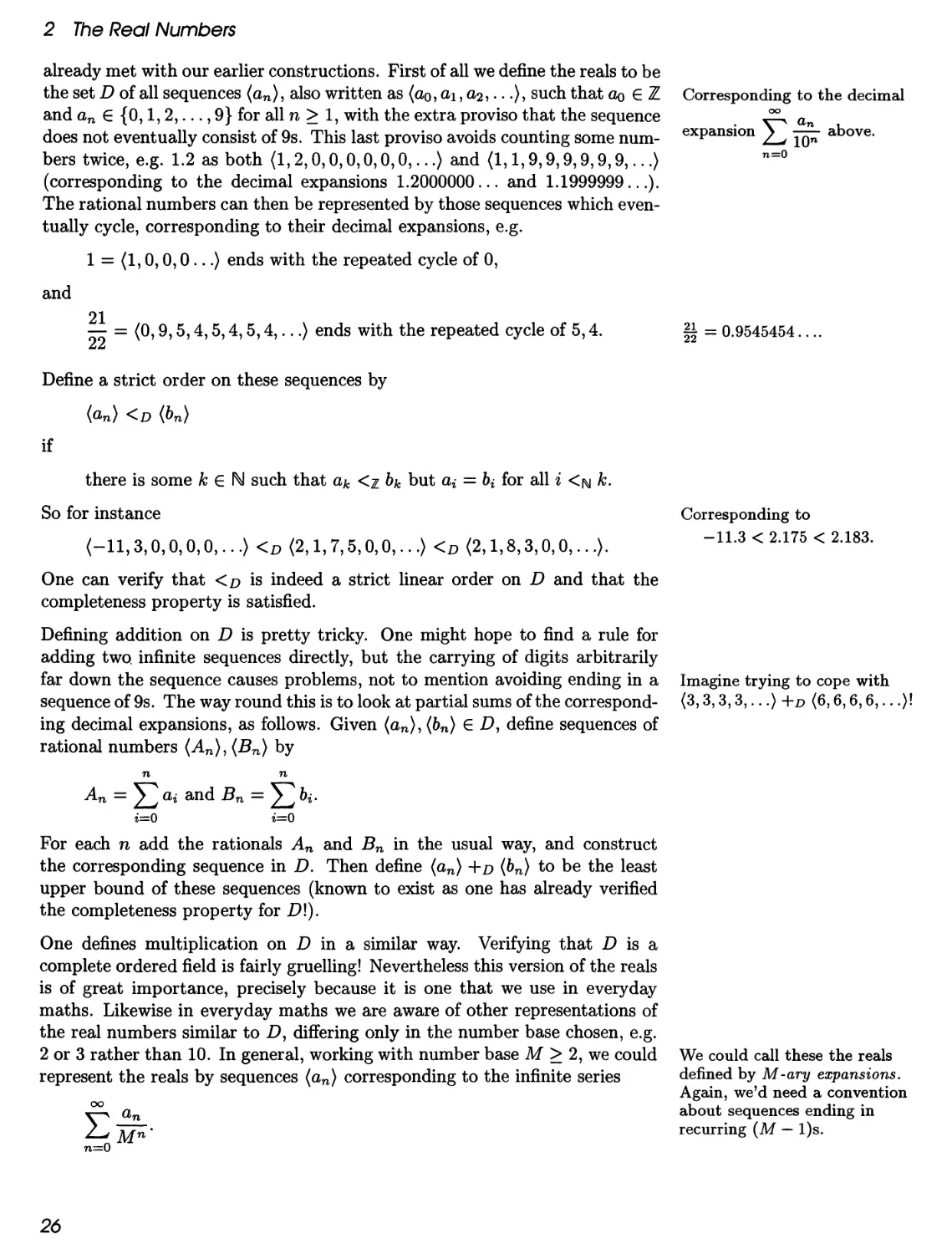
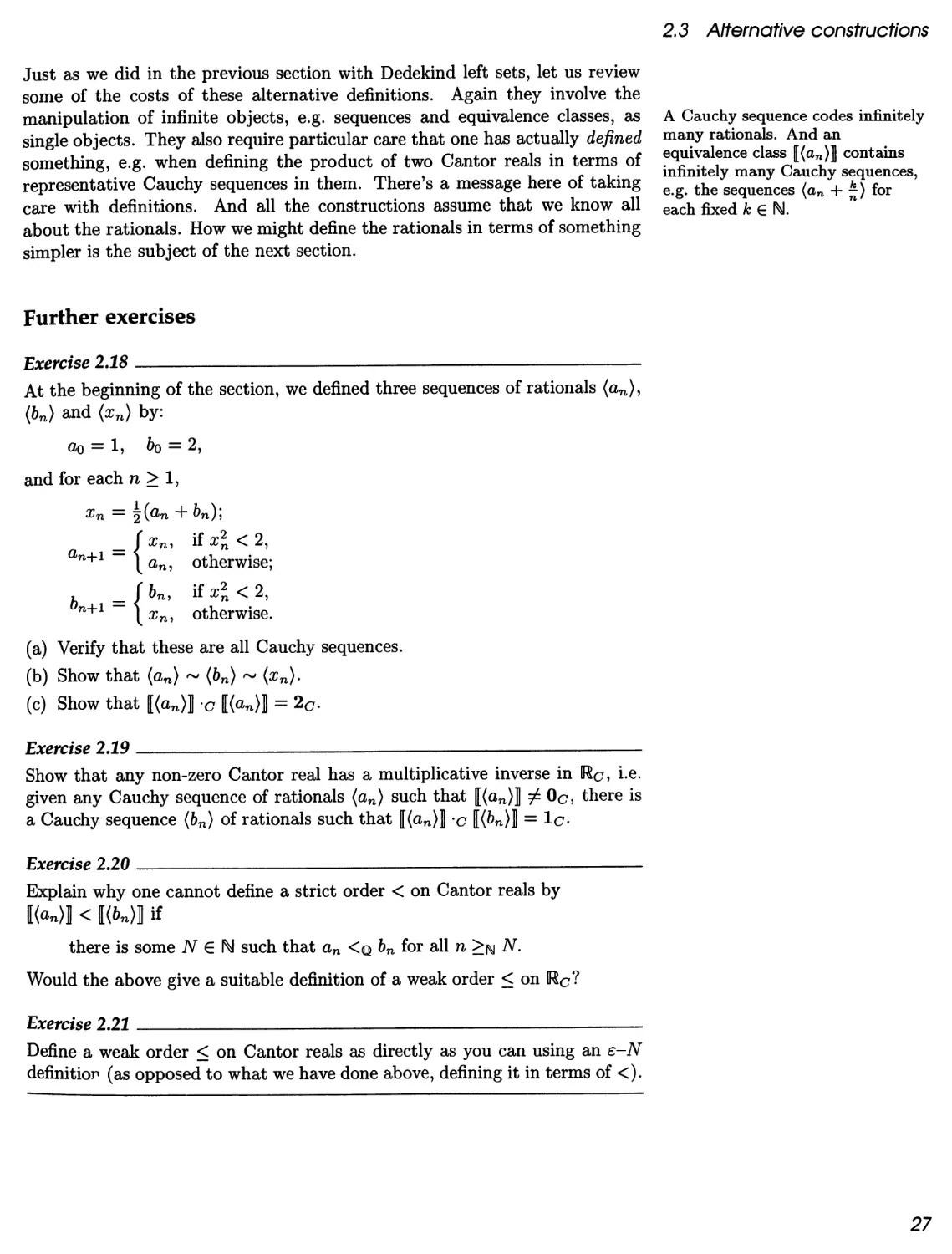
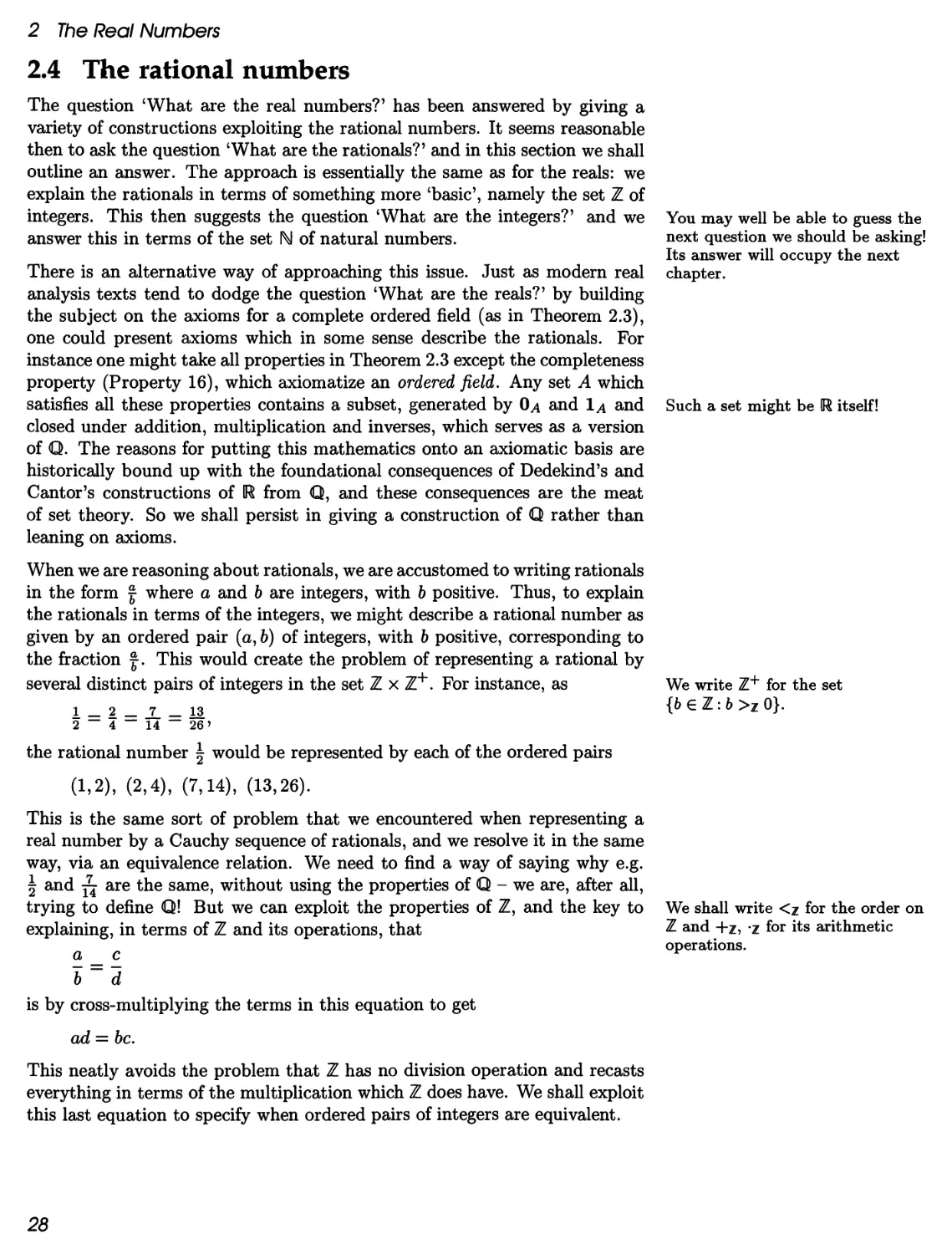
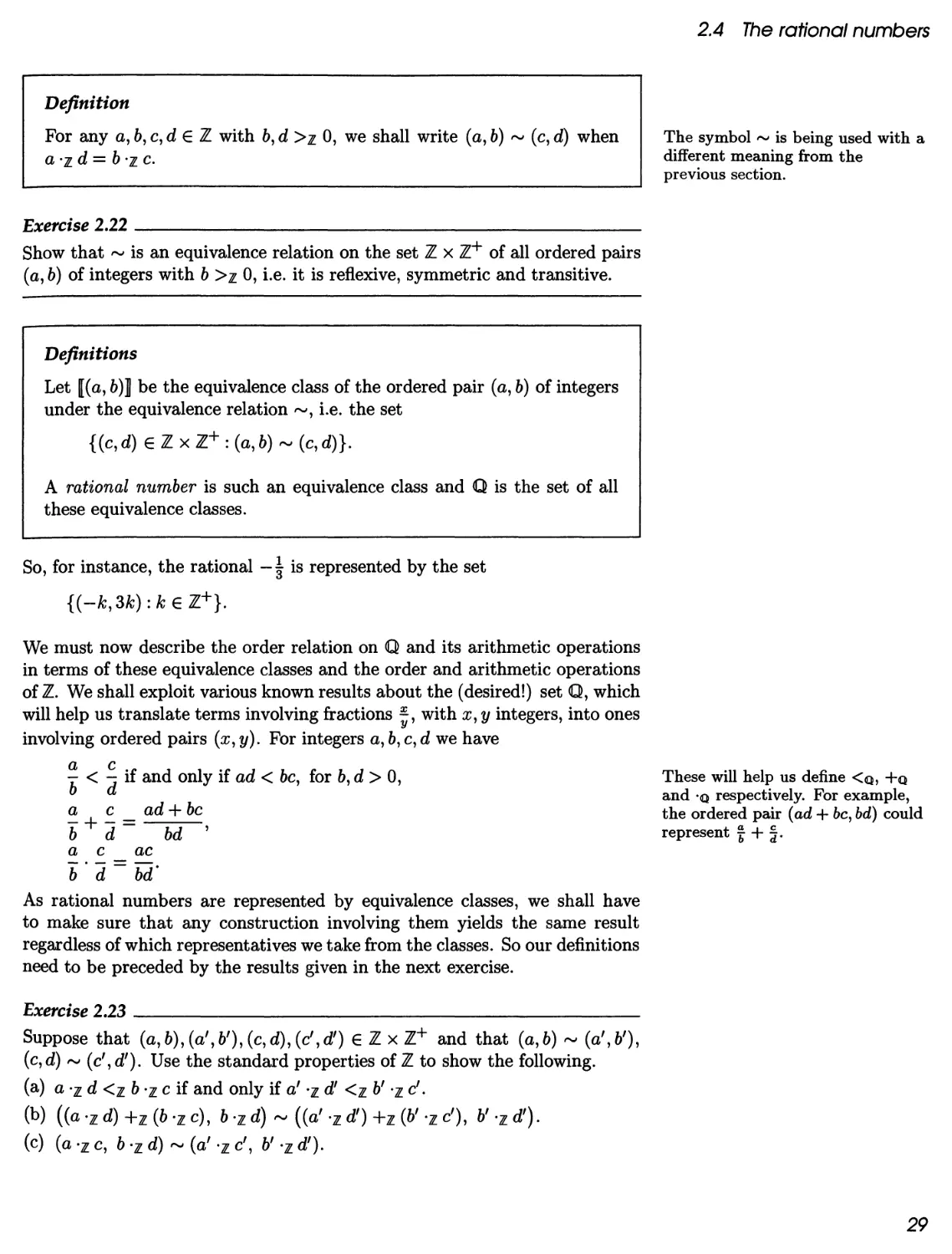
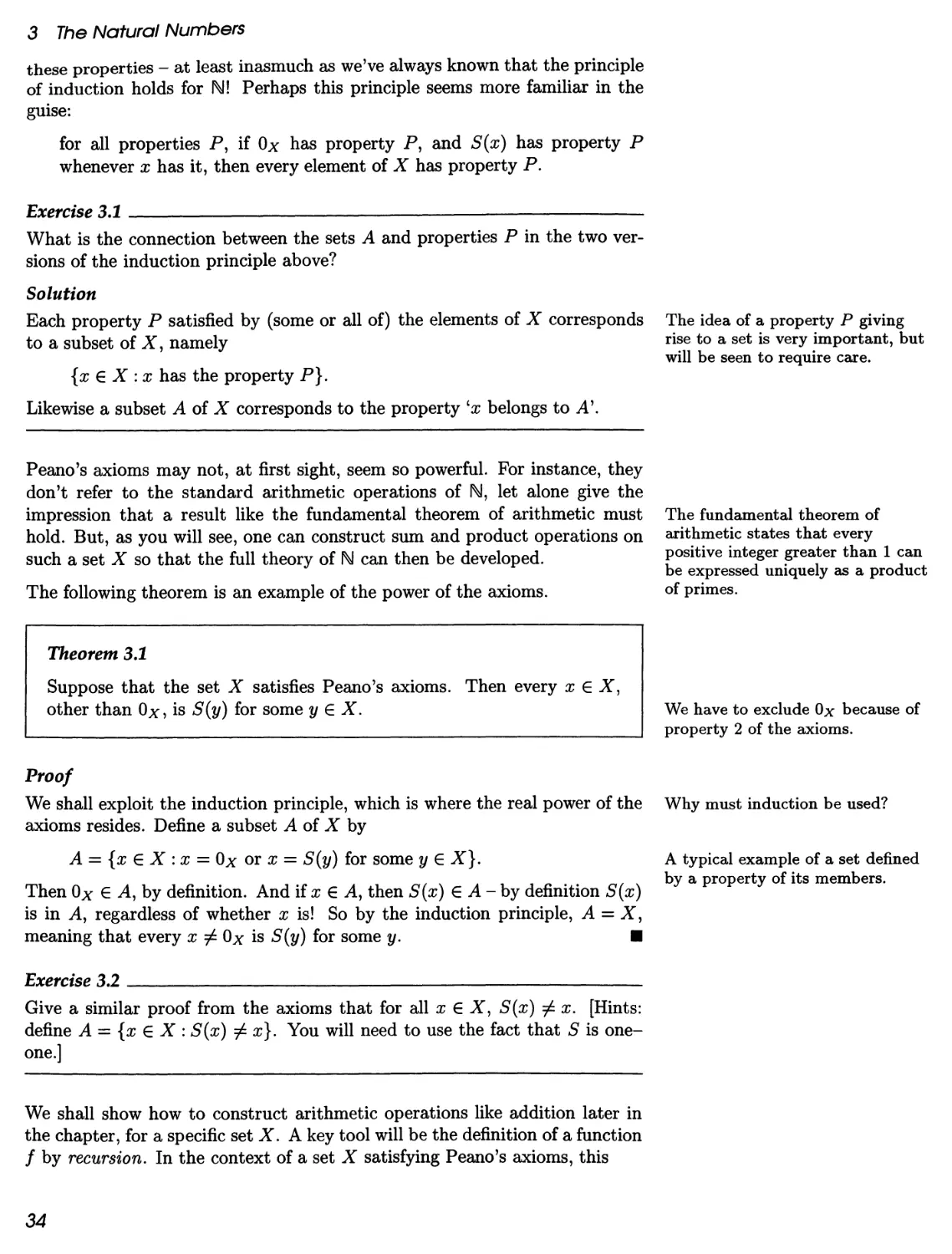
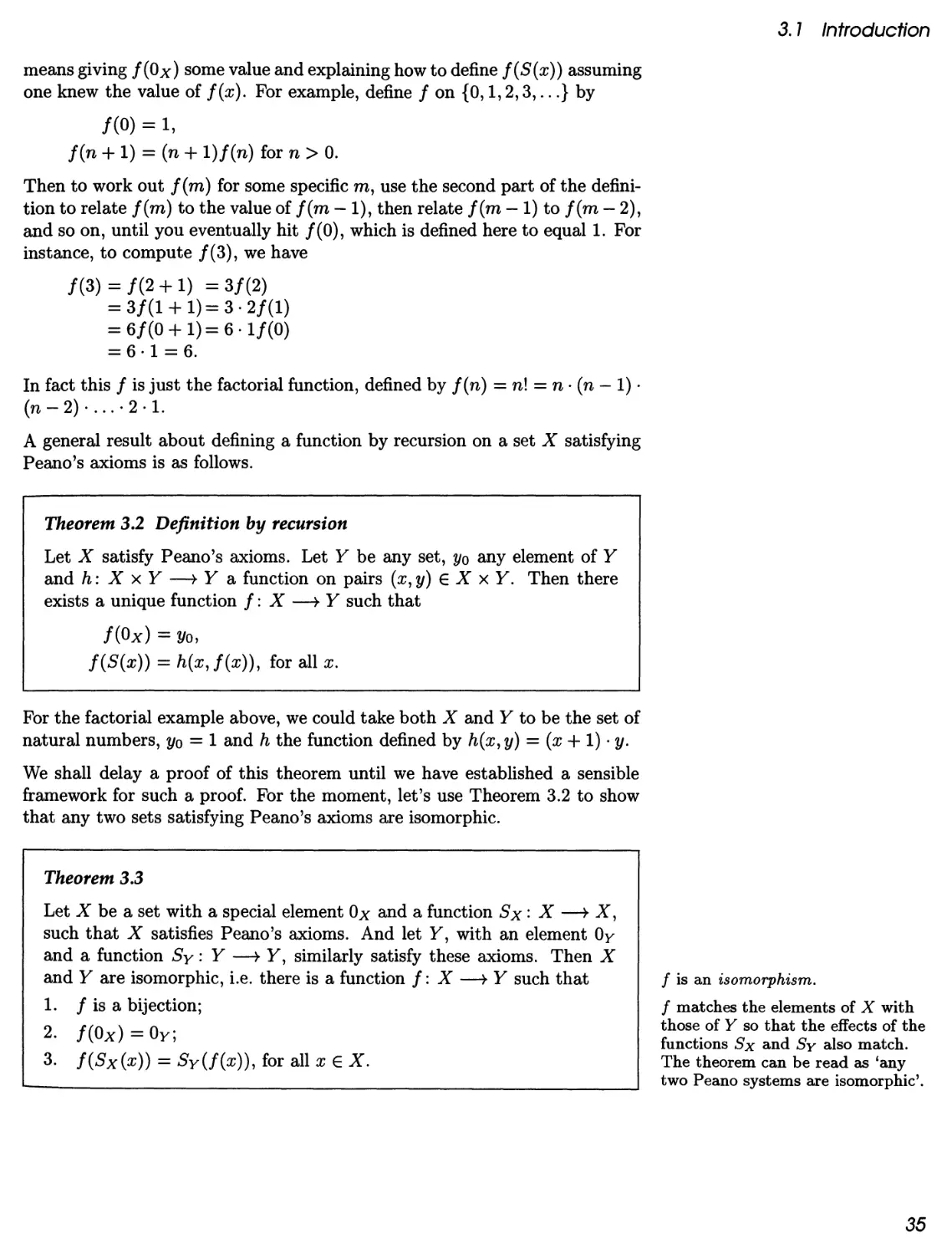
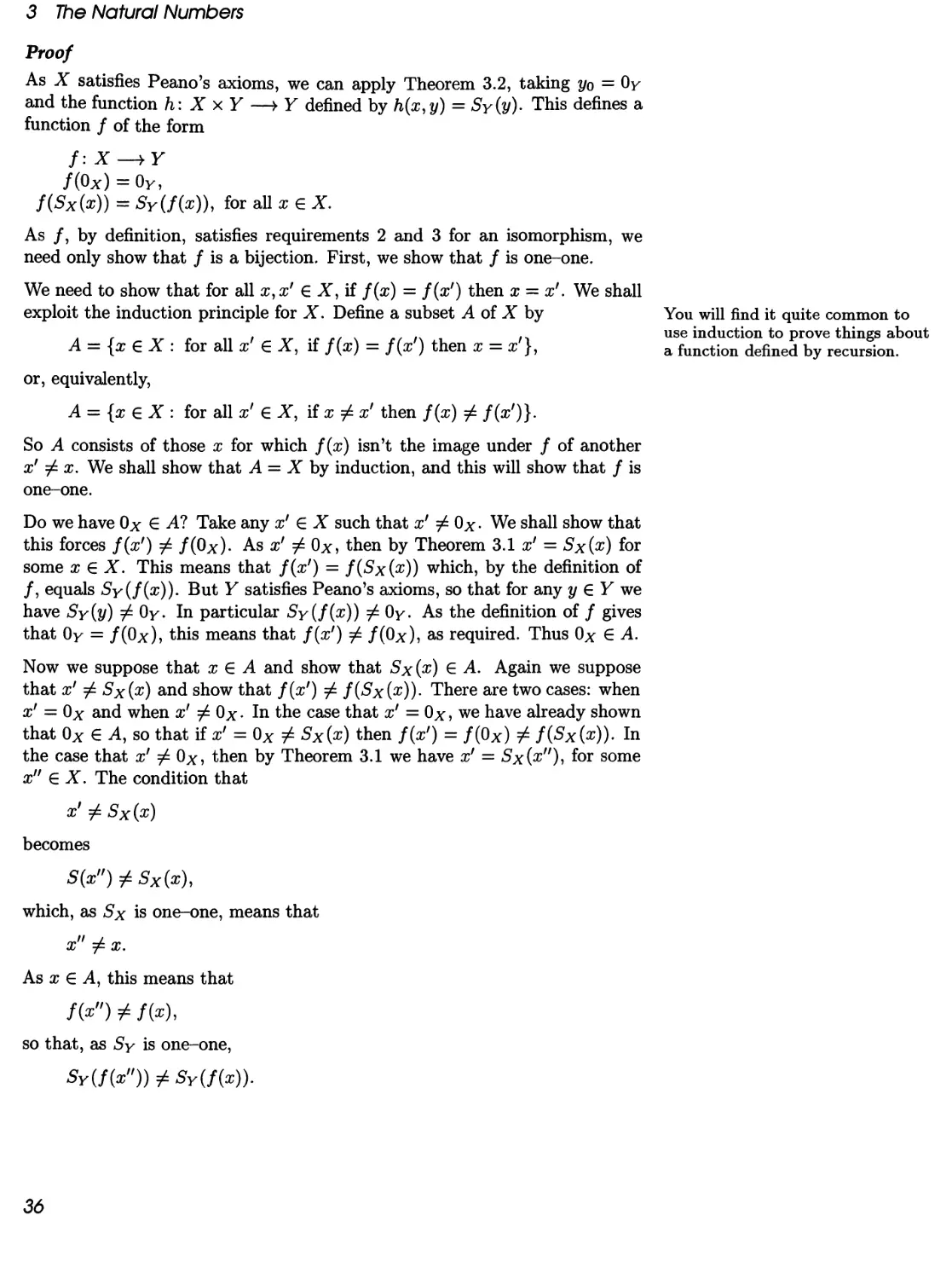
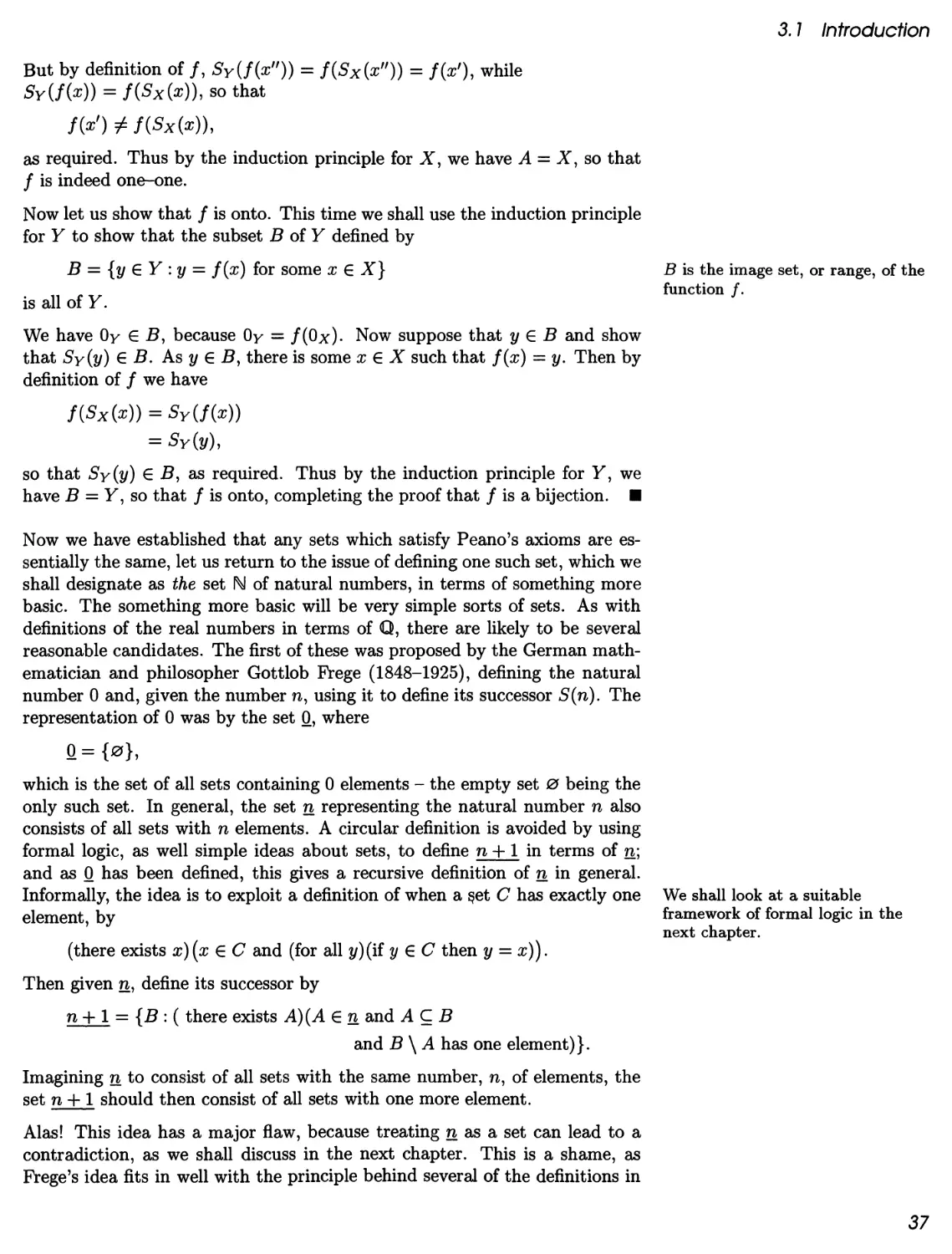
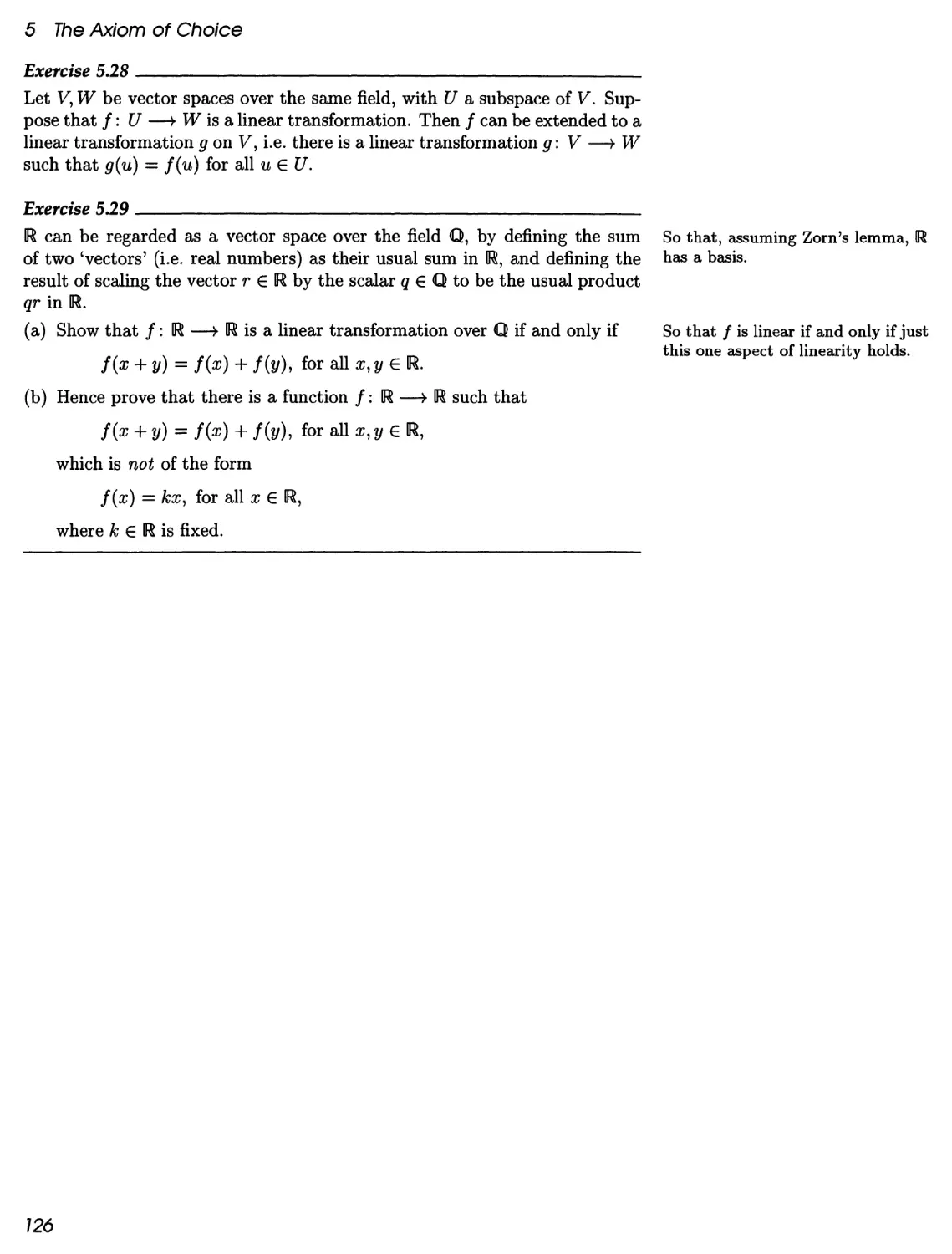
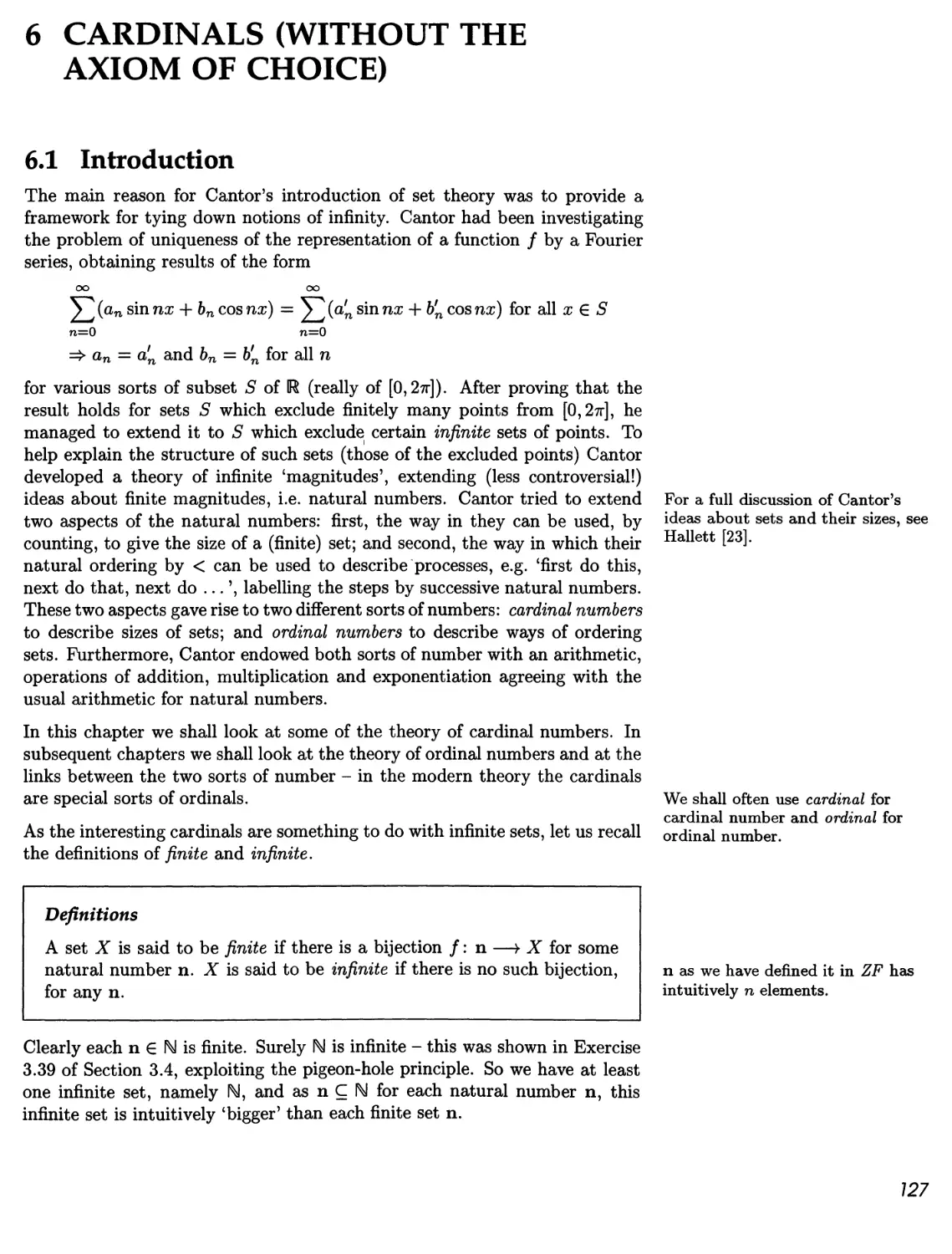
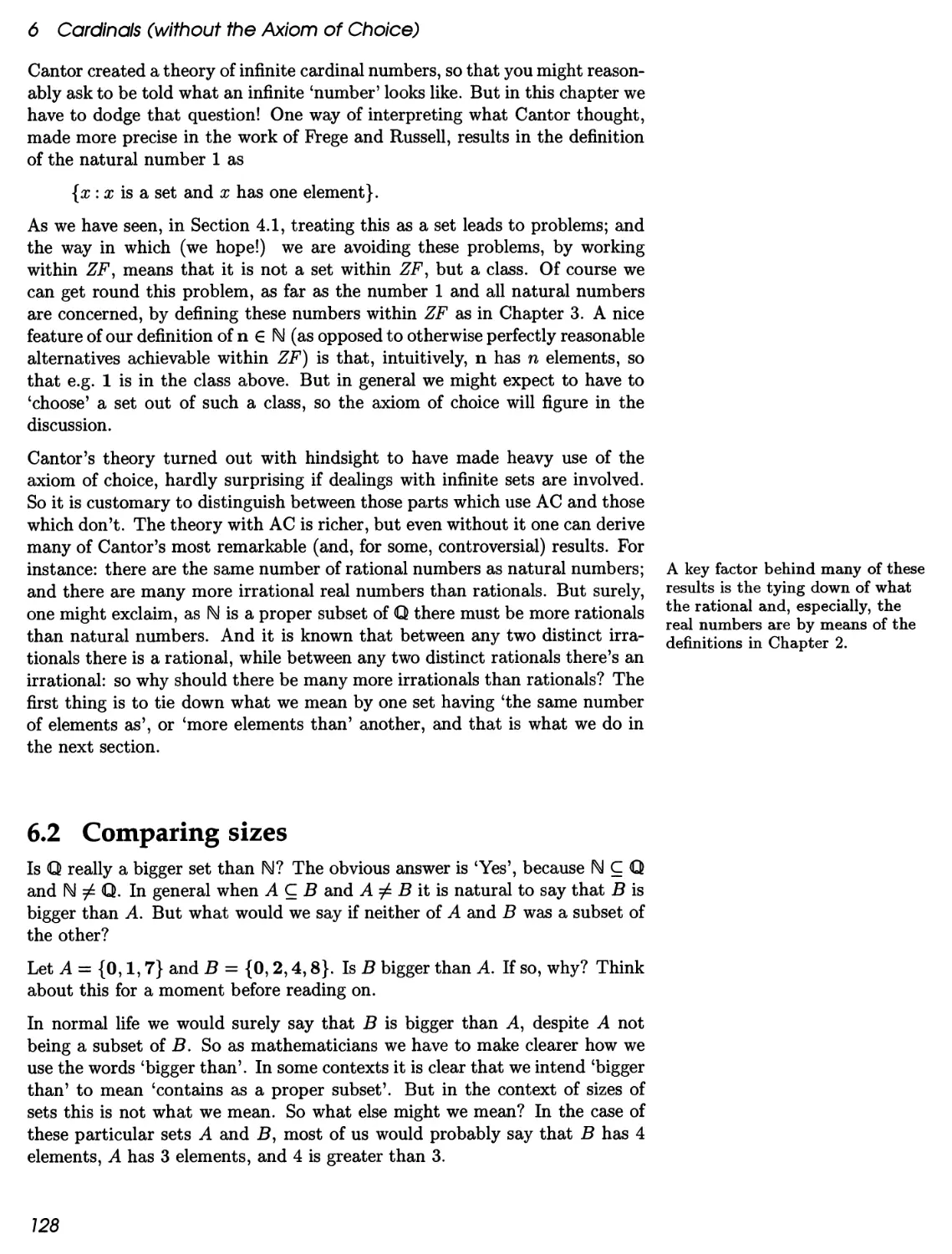
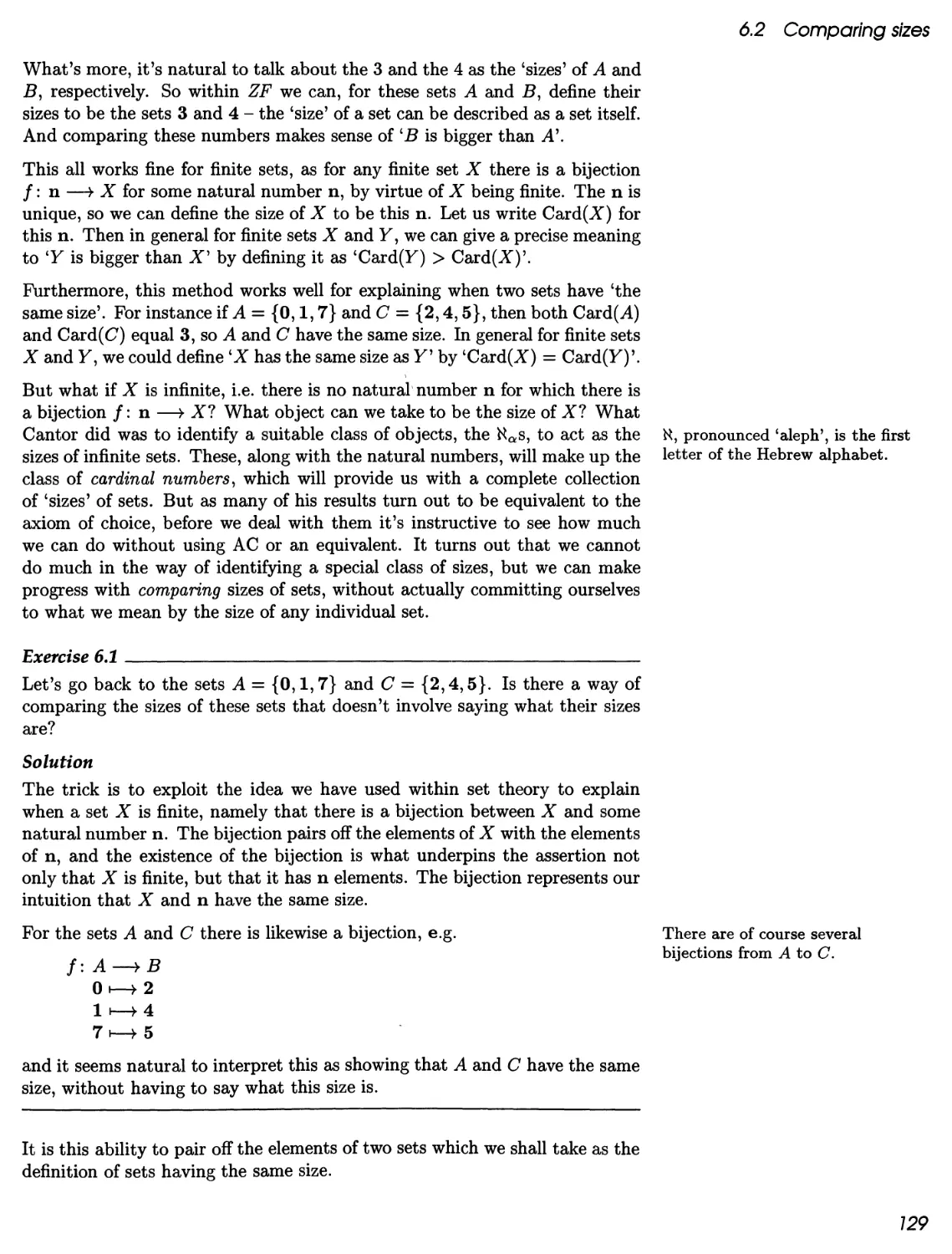






Текст
                    Classic Set Theory
A guided independent study
Derek Goldrei
Open University
UK
CHAPMAN & HALL
London • Weinheim • New York • Tokyo • Melbourne • Madras

Published by Chapman & Hall, 2-6 Boundary Row, London SE1 8HN, UK
Chapman & Hall, 2-6 Boundary Row, London SE1 8HN, UK
Chapman & Hall GmbH, Pappelallee 3, 69469 Weinheim, Germany
Chapman & Hall USA, 115 Fifth Avenue, New York, NY 10003, USA
Chapman & Hall Japan, ITP-Japan, Kyowa Building, 3F, 2-2-1 Hirakawacho,
Chiyoda-ku, Tokyo 102, Japan
Chapman & Hall Australia, 102 Dodds Street, South Melbourne,
Victoria 3205, Australia
Chapman & Hall India, R. Seshadri, 32 Second Main Road, CIT East,
Madras 600 035, India
First edition 1996
© 1996 Derek Goldrei
Printed in Great Britain by Page Bros Ltd, Norwich
ISBN 0 412 60610 0
Apart from any fair dealing for the purposes of research or private study, or criticism or
review, as permitted under the UK Copyright Designs and Patents Act, 1988, this
publication may not be reproduced, stored, or transmitted, in any form or by any means,
without the prior permission in writing of the publishers, or in the case of reprographic
reproduction only in accordance with the terms of the licences issued by the Copyright
Licensing Agency in the UK, or in accordance with the terms of licences issued by the
appropriate Reproduction Rights Organization outside the UK. Enquiries concerning
reproduction outside the terms stated here should be sent to the publishers at the London
address printed on this page.
The publisher makes no representation, express or implied, with regard to the accuracy
of the information contained in this book and cannot accept any legal responsibility or
liability for any errors or omissions that may be made.
A catalogue record for this book is available from the British Library
Library of Congress Catalog Card Number: 96-85139
^9 Printed on permanent acid-free text paper, manufactured in accordance with
ANSI/NISO Z39.48-1992 and ANSI/NISO Z39.48-1984 (Permanence of paper)

Vll
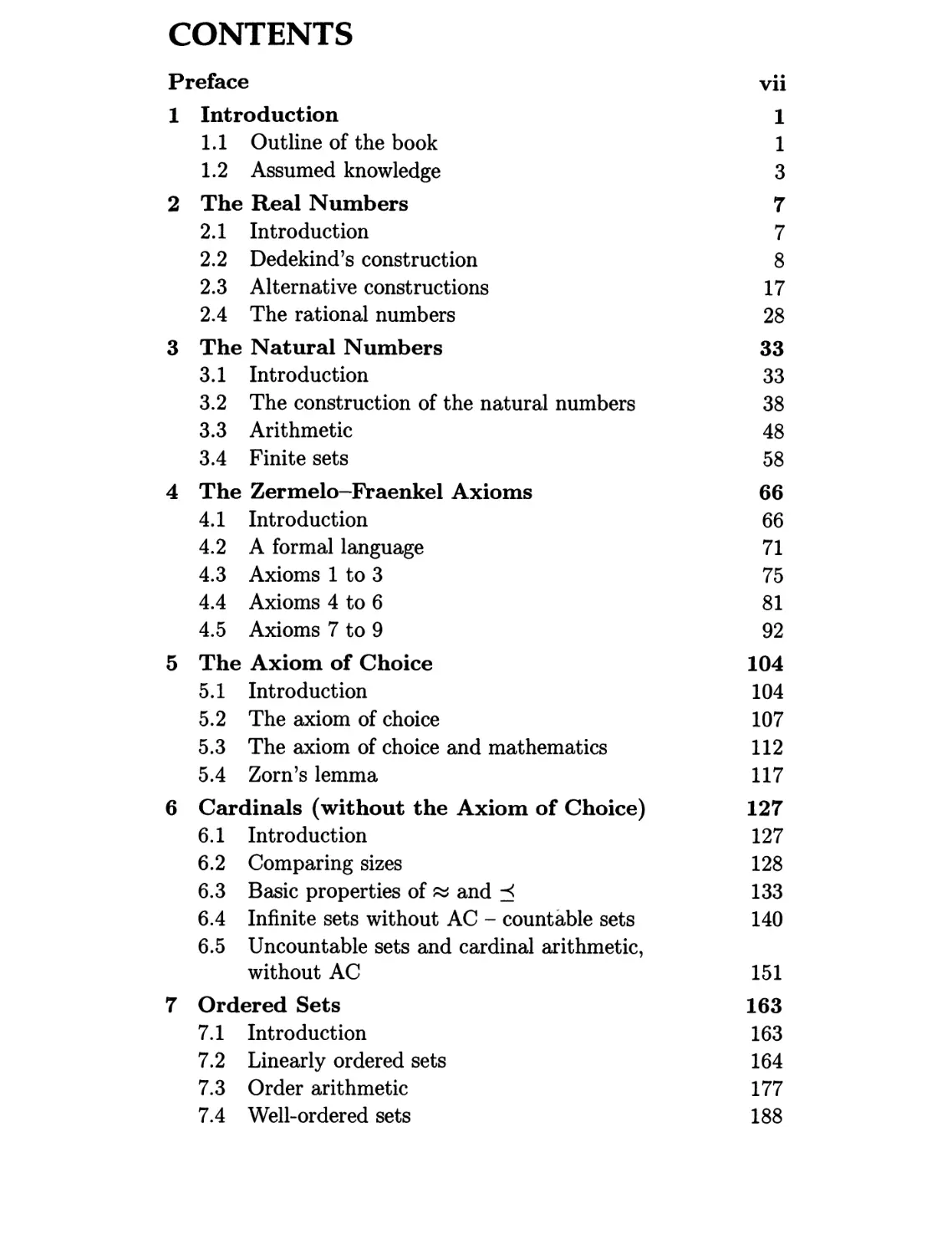
CONTENTS
Preface
1 Introduction 1
1.1 Outline of the book 1
1.2 Assumed knowledge 3
2 The Real Numbers 7
2.1 Introduction 7
2.2 Dedekind's construction 8
2.3 Alternative constructions 17
2.4 The rational numbers 28
3 The Natural Numbers 33
3.1 Introduction 33
3.2 The construction of the natural numbers 38
3.3 Arithmetic 48
3.4 Finite sets 58
4 The Zermelo-Fraenkel Axioms 66
4.1 Introduction 66
4.2 A formal language 71
4.3 Axioms 1 to 3 75
4.4 Axioms 4 to 6 81
4.5 Axioms 7 to 9 92
5 The Axiom of Choice 104
5.1 Introduction 104
5.2 The axiom of choice 107
5.3 The axiom of choice and mathematics 112
5.4 Zorn's lemma 117
6 Cardinals (without the Axiom of Choice) 127
6.1 Introduction 127
6.2 Comparing sizes 128
6.3 Basic properties of « and -< 133
6.4 Infinite sets without AC - countable sets 140
6.5 Uncountable sets and cardinal arithmetic,
without AC 151
7 Ordered Sets 163
7.1 Introduction 163
7.2 Linearly ordered sets 164
7.3 Order arithmetic 177
7.4 Well-ordered sets

8 Ordinal Numbers 202
8.1 Introduction 202
8.2 Ordinal numbers 203
8.3 Beginning ordinal arithmetic 218
8.4 Ordinal arithmetic 231
8.5 TheNs 254
9 Set Theory with the Axiom of Choice 263
9.1 Introduction 263
9.2 The well-ordering principle 264
9.3 Cardinal arithmetic and the axiom of choice 267
9.4 The continuum hypothesis 276
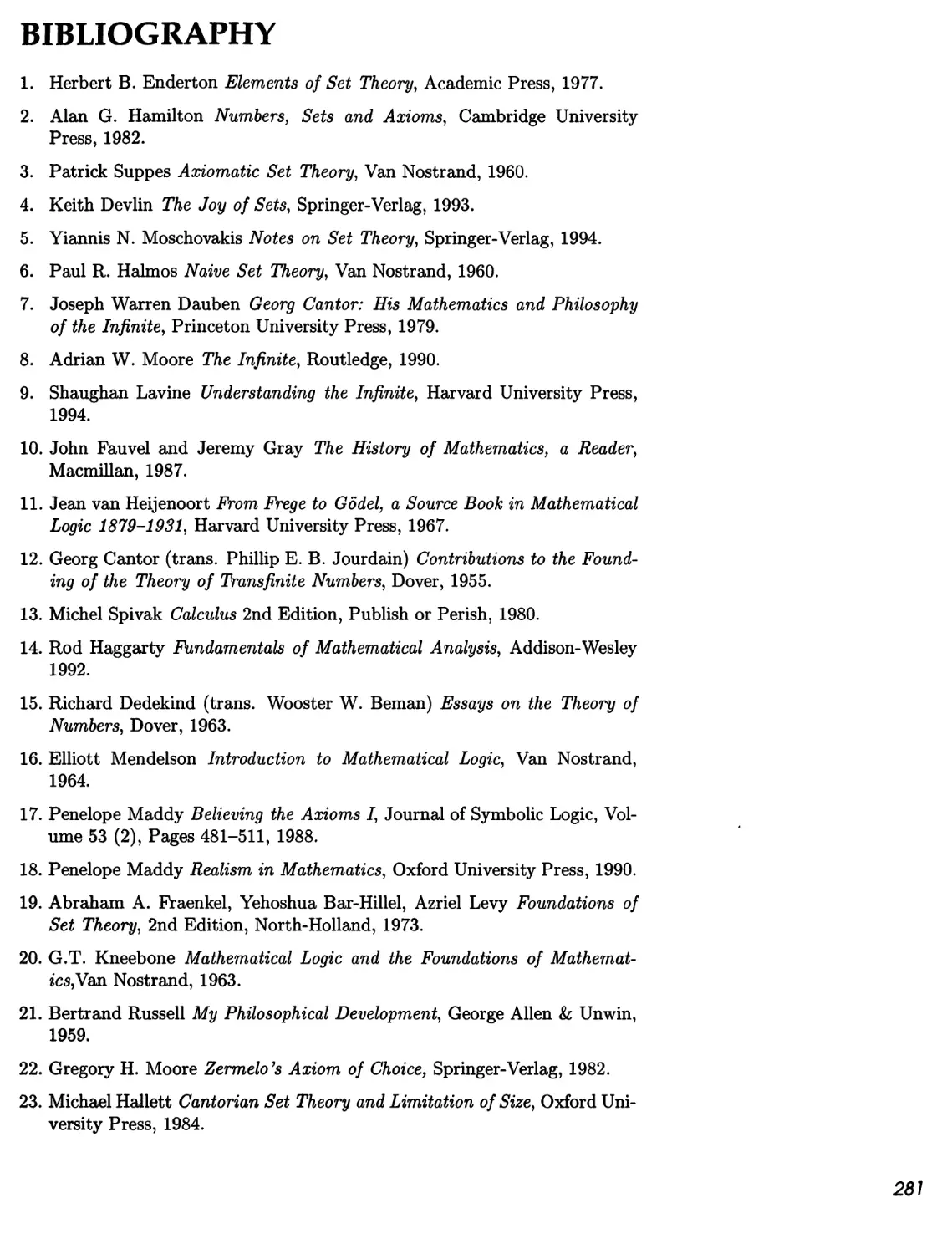
Bibliography 281
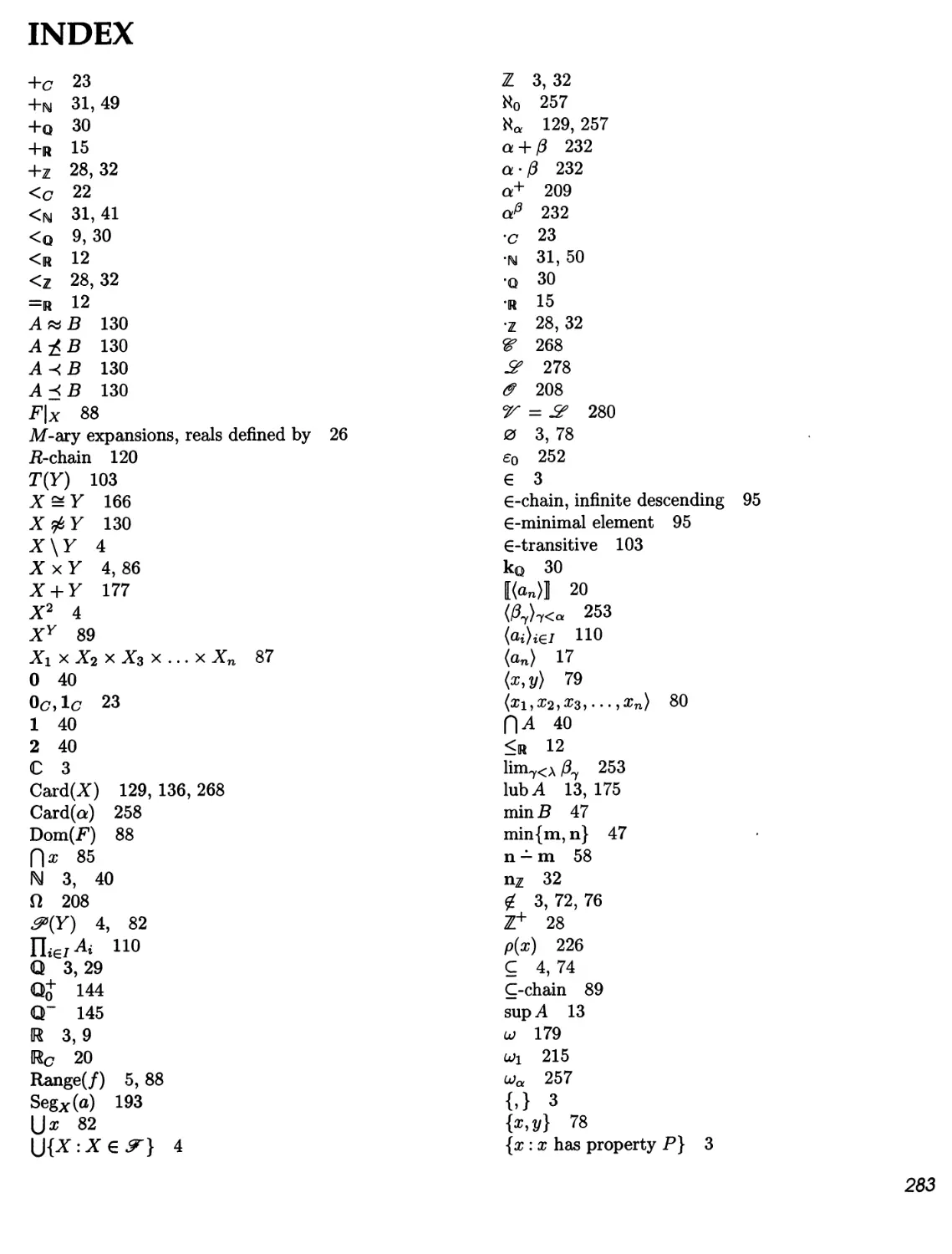
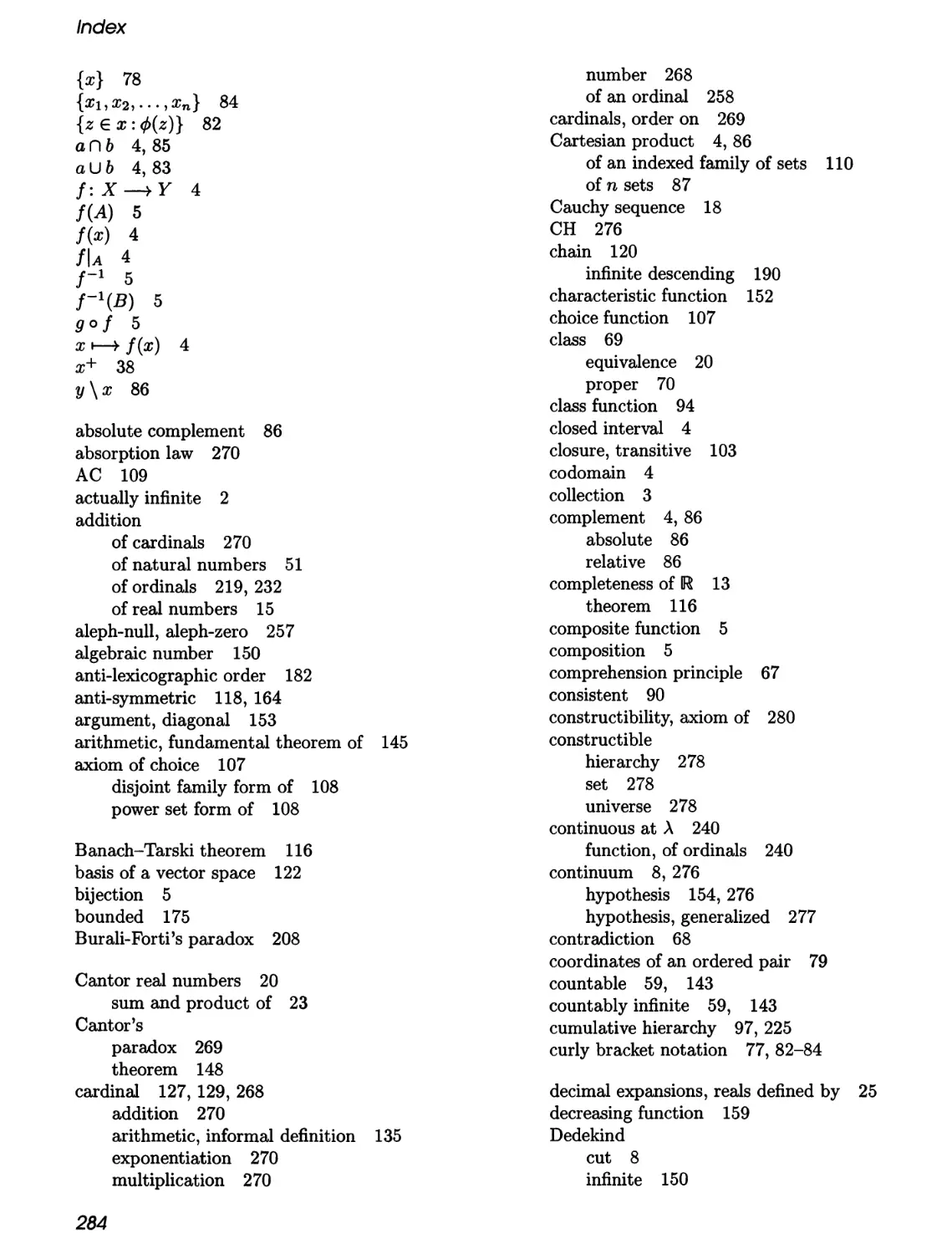
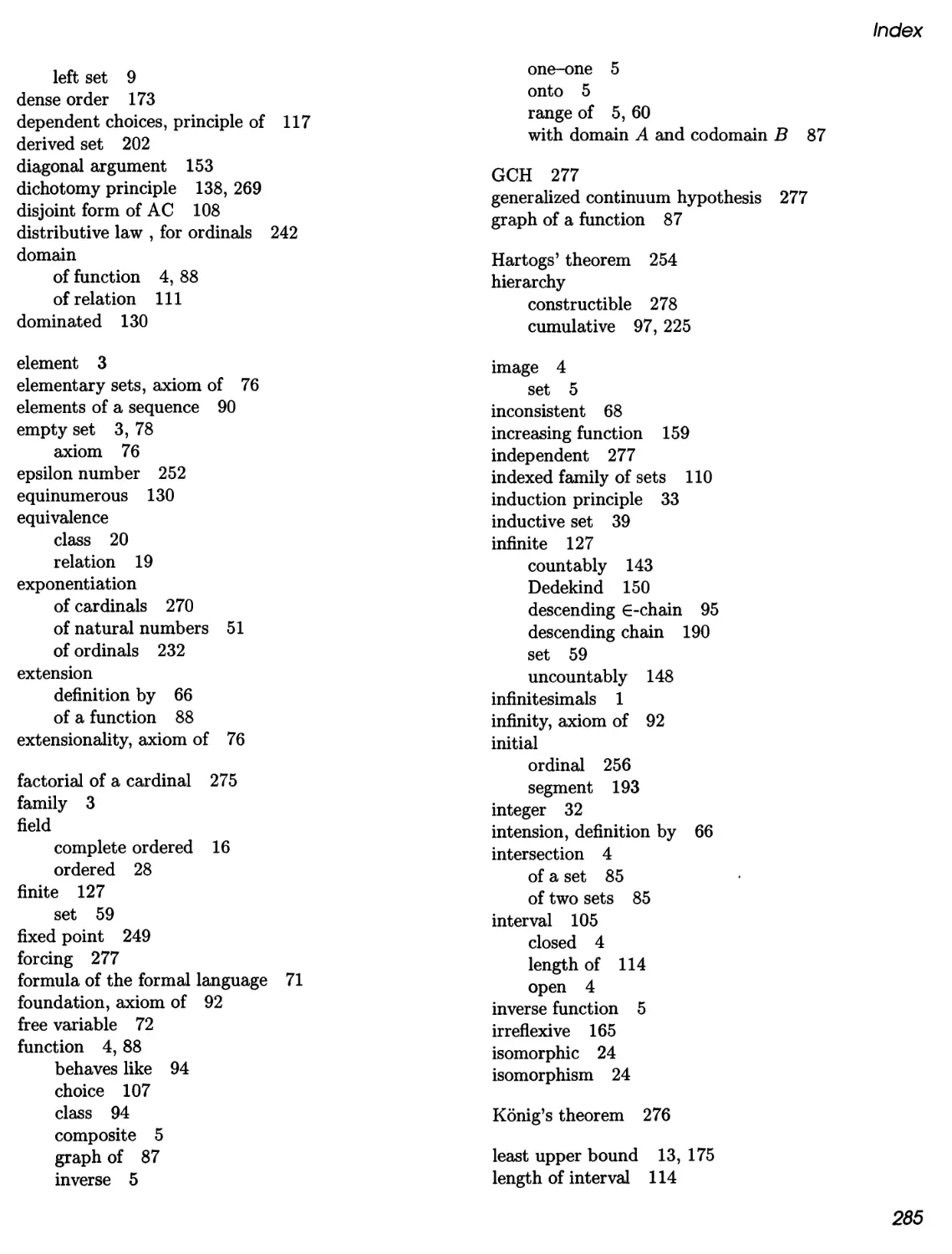
Index 283
vi

PREFACE
How to use this book
This book is intended to be used by you for independent study, with no other
reading or lectures etc., much along the lines of standard Open University
materials. There are plenty of exercises within the text which we would
recommend you to attempt at that stage of your work. Almost all are intended
to be reasonably straightforward on the basis of what's come before and many
are accompanied by solutions - it's worth reading these solutions as they
often contain further teaching, but do try the exercises first without peeking,
to help you to engage with the material. Those exercises without solutions
might well be very suitable for any tutor to whom you have access to use as
the basis for any continuous assessment of this material, to help you check
that you are making reasonable progress. But beware! Some of the exercises
pose questions for which there is not always a clear-cut answer: these are
intended to provoke debate! In addition there are further exercises located at
the end of most sections. These vary from further routine practice to rather
hard problems: it's well worth reading through these exercises, even if you
don't attempt them, as they often give an idea of some important ideas or
results not in the earlier text. Again your tutor, if you have one, can guide
you through these.
If you would like any further reading in textbooks of set theory, there are
plenty of good books available which use essentially the same Zermelo-Praenkel
axiom system, for instance those by Enderton [1], Hamilton [2] and Suppes
[3], all covering roughly the same material as this book, while the books by
Devlin [4] and Moschovakis [5] go some way further, looking at some of the
modern set theory built on the foundations in this book. For a short outline
of many of the key ideas, Halmos [6] is invaluable.
The book is also peppered with
notes in the margins, like this!
They consist of comments meant to
be on the fringe of the main text,
rather than the core of the
teaching, for instance reminders
about ideas from earlier in the
book or particularly subjective
opinions of the author.
Acknowledgments
I would like to thank all those who have in some way helped me to write this
book. First there are those from whom I initially learnt about set theory when
studying at the University of Oxford: Robin Gandy and Paul Bacsich. Then
there are my colleagues at the Open University who have both taught me so
much about maths and the teaching of maths, and encouraged me in the
writing of this book, especially Bob Coates. Next there are those who have given
me practical help in its production, not to mention a contract: Nicki Dennis,
Achi Dosanjh and Stephanie Harding at Chapman & Hall, several anonymous
(but not thereby any less deserving of my thanks!) reviewers, and Alison Ca-
dle and Chris Rowley at the Open University, for refining my LfilgKstyle files.
Richard Leigh copy-edited the book and made many very helpful comments.
Sharon Powell at the Open University helped me greatly with printing the
final version of the book. Last, but foremost in my mind, there are all my
old students at the Open University and at the University of Oxford,
especially the women (and now men!) of Somerville and St. Hugh's Colleges. In
As is customary, I would like to
absolve everyone else from any
blame attaching to anything in this
book or any of its inadequacies.
But whether I mean this is entirely
another matter!
vii

Preface
particular Fd like to thank the following for their comments on parts of the
book: Dorothy Barton, Kirsten Boyd, Cecily Crampin, Adam Durran, Aneirin
Glyn, Alexandra Goulding, Nick Granger, Michael Healey, Sandra Lewis, J-B
Lduveaux, David Manlove, Chris Marshall, Nathan Phillips, Alexandra Ralph
and Axel Schairer.
This book is dedicated to all students at both OUs, but especially to
M2090737.
viii

1 INTRODUCTION
1.1 Outline of the book
The language of sets is part of the vocabulary of any student or user of
mathematics, acquired very early in one's schooling. Words like 'intersection' and
'union' have become part of everyday mathematics. But the 'set theory' in
this book is about much deeper and more complicated ideas about sets, at the
heart of any discussion of the foundations of mathematics, especially about
the place of 'infinity' in the subject. Many of these deep ideas have their
origin in the work of Georg Cantor, a German mathematician at his most
active in the latter half of the 19th-century. Cantor had many remarkable (and
controversial) insights to the nature of infinity, producing a theory involving
two sorts of 'infinite number', each equipped with an arithmetic
incorporating and extending the familiar arithmetic of the natural numbers. Among the
questions which he was able to pose and resolve were such as:
1. Are there more rational numbers than natural numbers?
2. Are there more irrational real numbers than rational numbers?
3. Are there more points in the real plane than on the real line?
The obvious answer to the first of these questions is probably 'Yes', on the
grounds that the set of natural numbers is a proper subset of the set of rational
numbers - we make no apologies for leaping into use of the everyday language
of sets! The obvious answer to the third question might similarly seem to be
'Yes'. In both cases, Cantor's answer was in fact 'No', and one aim of this
book is to explain his reasons why.
There might not be such an obvious candidate for the answer to the second
question above - it all depends on how much you already know about the real
numbers. Another aim of this book is to give an explanation of what the real
numbers are, another aspect of Cantor's work, and part of the work of his
contemporary Richard Dedekind (1831-1916). This explanation leads to the
need to explain even more basic numbers, namely the natural numbers.
Cantor's work on infinity really stemmed from his and others' work on real
analysis, and there are several connections between the issues of infinity and
of the real numbers. First there was the drive in the 19th century to put
the calculus onto a rigorous footing, giving what is now taught as real
analysis: the last stage of this required a firm algebraic description of the reals,
while earlier stages needed to explain away or eliminate uses of infinity, e.g.
oo
the infinitely large, like the oo in Y^^n, and the infinitely small, namely
n=0
infinitesimals. Secondly the descriptions of the reals provided by Dedekind
and Cantor required the overt handling, as legitimate mathematical objects,
of infinite sets. And thirdly mathematical developments in real analysis led
to the desire both to study infinite subsets of the real numbers and to carry
out infinite processes on such subsets.
The key issue is whether it is legitimate to treat an infinite set as a
mathematical object which one can then use in further constructions. We are so
For a very accessible account of
Cantor's life (1845-1918) and work,
look at the biography by Dauben
[7]-
In set theory it is customary to use
'natural number' to mean a
non-negative integer.
However, if you are unhappy with
some of the set terminology, don't
worry! We shall explain it more
carefully later on.
Cantor's answer is 'Yes'.
Infinitesimals, infinitely small
quantities, played a major part in
the theory of calculus, until
banished through the work of
Weierstrass and others in the
mid-19th century.
Twentieth-century logic, inspired
in part by Cantor's work, has
resurrected infinitesimals within
the context of non-standard
analysis.
7

1 Introduction
used, in the final years of the 20th century, not only to writing and
talking about infinite sets like the set N of natural numbers and the set U of
real numbers, but also to manipulating such sets using e.g. operations like
intersection (n) and union (U), that it is easy to forget, or be unaware of,
how controversial the use of infinite sets was until (and perhaps still after)
Cantor's work. Mathematicians had been happy to regard, say, the natural
numbers as being potentially infinite, meaning that however (finitely) many
numbers one might list, there would always be an extra one that could be
added to the list; but they were wary of treating this list as though it could
be completed to give a single infinite object, what would be described as an
actually infinite object. This rejection was very deeply rooted, going back to
the work of Aristotle in the 4th century BC. Of course, over the same period
there had been much discussion, and use, of both infinitely small quantities
and what looked suspiciously like infinite processes (the dots '...' in so many
mathematical expressions), that some sort of resolution of infinity was due.
This resolution was essentially done by Cantor.
Cantor's work, by virtue of its revolutionary nature, raised very many difficult
and worrying issues. Matters were not helped by the initial imprecision of
some of the concepts involved. His results, and the unresolved questions
arising from them, attracted sufficient interest and enthusiasm from enough
of his contemporaries that much effort was subsequently made to put his
theory on more solid foundations. The aim of this book is to present this
classic theory of sets as it is now understood by most mathematicians, using
the framework of the Zermelo-Praenkel axiom system (probably the most
widely used of the systems for set theory). The theory is well worth studying
for its own sake, as an accessible and exciting part of mathematics. It also
provides a foundation for further study in modern set theory, beyond the
scope of this book, but studied at postgraduate, and sometimes at advanced
undergraduate, level.
The development of the book is roughly as follows. Chapter 2 gives
constructions of the real numbers in terms of rational numbers and shows how these
ultimately stem from set constructions involving natural numbers. Chapter
3 then shows how the natural numbers themselves can be constructed from
very simple sorts of set, like the empty set. Thus all these important number
systems in everyday mathematics can be constructed and explained purely in
terms of sets. Chapter 4 introduces axioms for set theory which underpin all
these constructions. Historically, axioms were introduced after Cantor had
produced his theory of infinite sets, which we describe in later chapters.
Axioms were felt necessary for two reasons: to help avoid paradoxes arising from
this theory of infinite sets; and to help establish the relationship between a
major unresolved problem arising from the theory involving a certain sort of
ordering of the real numbers and a special axiom called the axiom of choice. In
Chapter 5 we discuss this latter axiom, which turned out to be a very
pervasive mathematical principle. In Chapter 6 we look at some of Cantor's theory
of infinite cardinal numbers, including remarkable results about the sizes of
the real line, the real plane and the set of irrational numbers, all stemming
from the construction of the reals in Chapter 2. In Chapter 7 we look at some
of the general theory of ordered sets (a further legacy of Cantor's), and then
in Chapter 8 we look at his theory of ordinal numbers, a variety of richly
Both the history and philosophy
are well described in the books by
Adrian Moore [8] and Lavine [9].
Some of the pre-1900 mathematical
source material on infinity and the
calculus can be found in Fauvel
and Gray [10].
The use of 'classic' in the title of
this book is partly a deliberate
misuse of the word, inasmuch as it
can be used to mean 'to do with
ancient Greece' - ancient Greeks
like Aristotle might well have
abhorred Cantor's use of infinity!
Many of the crucial papers in the
development of set theory and the
foundations of mathematics can be
found in van Heijenoort [11], in
English translation and with very
valuable commentary by the editor.
Many of Cantor's results about
cardinal and ordinal numbers are
in papers translated in [12]. These
papers are not only vital source
material for the whole subject, but
are also very readable.
2

structured sets extending ideas about natural numbers into the realm of
infinite sets. In Chapter 9, the final chapter of the book, we both complete
Cantor's theory of infinite sets, linking cardinal and ordinal numbers via the
axiom of choice, and look at two major problems concerning the real numbers
which he had not resolved - in many ways the problem of the nature of the
real numbers pervades the subject, so it is fitting that we both start and end
the book with the reals.
7.2 Assumed knowledge
1.2 Assumed knowledge
The book is written on the basis that you have already had some experience of
using sets, functions and basic logic, and that you are familiar with a variety
of mathematical words and notations - ideally you will have already taken a
first course in real analysis so that some of the context of the material in this
book is known to you. Among what we hope you will have seen before is the
following material.
Set Notation
A set X is a collection of objects called the elements, or members, of X. We
sometimes use words like family and collection instead of sets, for variety and
sometimes, we hope, to aid comprehension. We shall often use letters like
a, 6,..., y, z, A, B,..., Y, Z to stand for sets or for elements of sets.
We write x € X to express that the object x is an element of the set X and
y £ X to say that y is not an element of X.
We use curly brackets, { and }, around a list of objects to signify the set of
all those objects. For instance {3,8,9} is the set with elements 3, 8, 9.
The order in which the elements are listed inside the curly brackets doesn't
change the set, nor does listing some element more than once. Thus {9,3,7}
and {3,3,7,9} both represent the same set as {3,7,9}. In general, two sets X
and Y are equal if and only if they contain the same elements or, equivalently,
if and only if every element of X is an element of Y and vice versa.
We use standard notation for the most common sets of numbers: N for the
set of natural numbers, Z for the set of all integers (positive, negative and
zero), Q for the set of rational numbers, R for the set of real numbers and C
for the set of complex numbers.
We use the notation 0 for the empty set, the set which contains no elements.
We can also describe a set using curly brackets in terms of a property possessed
by all its elements, as with {n : n is an even integer} or, equivalently,
{n € Z : n is even} for the set of all even integers {..., -4, -2,0,2,4,6,...}.
In general we write
{x : x has property P}
for the set of all x such that x has property P (some property which may or
may not be possessed by a given object x).
There are many excellent books on
real analysis, for instance those by
Spivak [13] and Haggarty [14].
Later on in the book all the objects
we shall consider are sets whose
elements are also sets!
When x G X, we also say 'x is in
X' or lx belongs to X\
Recall that in this book we take N
to include all the positive integers
and the number 0.
The colon ':' is read as 'such that'.
3

1 Introduction
We shall occasionally use standard notation for intervals of the real line:
(a, b) for the open interval {x 6 R : a < x < &};
[a, b] for the closed interval {x G R : a < x < &};
(a, 6] and [a, 6) for the half open and closed intervals {x € R : a < x < b}
and {x eU:a < x <b} respectively;
(—oo, b) and (a, oo) for the open intervals {x € R : x < b}
and {x eU:x > a} respectively;
(—oo, b] and [a, oo) for the closed intervals {x € R : x < b}
and {# G R : £ > a} respectively.
Given two sets X and y, we write
X U y for the union of X and y, i.e. the set of elements belonging to X
or y (or both);
X fi y for the intersection of X and y, i.e. the set of elements belonging
to both X and Y\
X \ Y for the complement of y in X, i.e. the set of elements of X not in
y.
Given a family of sets ^", we write (J{X : X € ^"} for the union of all the
sets in this family, i.e. the set {x : x € X for some X € ^"}. A family & of
sets might sometimes be indexed by another set, for instance the family of all
open intervals of R of the form (^-, oo) for n € N is effectively indexed by
the set N: in this sort of case we would write the family as {(^j, oo): n € N}
and the union of the family as U{(^+i > °°): n € ^} (which happens to equal
the set (0,oo)).
X is a subset of the set Y means that X is a set of which every element is also
an element of Y (so that, for all x, if x € X then x € Y). We write X C Y
for 'X is a subset of Y\ A subset X of Y is said to be proper if X ^Y. The
power set of y, written as ^(Y), is the set of all subsets of y.
We write X x y for the Cartesian product of X and y, i.e. the set of all
ordered pairs (x,y) with x € X and yGF. We use X2 as shorthand for
X x X, X3 for (X x X) x X and so on.
Function Notation
A function f from a set X to a set Y associates an element, /(#), of Y with
each element x of X. The r^/e of /, written as x i—^ /(#), describes this
process of association. The element f(x) of Y is called the image of x under
f. The domain of / is the set X and the codomain of / is the set Y. We use
the standard arrow notation for such a function, combining the information
of its domain, codomain and rule:
x
Y
fix)
If A is a subset of the domain of this function /, the restriction of / to A,
written as /|^, is the function
f\A:A-+Y
x h—* f(x)
We shall adopt the standard
mathematical use of the word 'or'
as allowing the 'or both' case -
what's called the inclusive use of
'or'.
4

i.e. /\a has the same rule and codomain as /, but has its domain restricted
to A
1.2 Assumed knowledge
The image set or range of /: X —> Y, written as Range(/), is the set of
images of /, namely {f(x): x € X}. For any subset A of the domain X the
set {/(#): x € A} is called the image set of A under /. We shall sometimes
write f(A) for this set, but we shall mostly use the notation Range(/|,4),
which represents the same set.
A function is said to be onto if for each y € Y there is an x € X with f(x) =y.
The function / is said to be one-one if for all z, x' € X, if f(x) = f(xf) then
x = x' (or, equivalently, if x ^ xf then /(#) ^ fix1)).
If / is a one-one function, then its inverse function /_1 is defined as the
function
f1: Range(/)
2/1
the unique x such that /(#) =2/
For any subset B of the codomain Y, its inverse image set under /, written
as f~l{B), is the set {x € X : /(z) € £}.
If /: X —y Y and g: Y —)► Z are functions then the composite function (or
composition of f and g) g o f is the function
gof:X—>Z
x ■—» 9(f(x))
If / is both one-one and onto, then / is a bisection. If /, g are both bijections
with the codomain of / equal to the domain of g, then the composition go f
is also a bijection.
Basic Logic
Suppose that p and q are propositions, or statements, about mathematics, of
the sort where it makes sense to ask whether they are true or false under some
given set of circumstances, or, equivalently, in a particular interpretation of
the symbols or words that they involve. Then the proposition 'if p then </' is
true in some interpretation unless p is true and q is false in this interpretation;
i.e. it is true not only when both p and q are true, but also when p is false.
And the statement 'p if and only if </' is true in an interpretation when 'if p
then </' and 'if q then p' are both true in this interpretation, which boils down
to both of p and q being true in this interpretation or both being false.
So that / is onto exactly when
Range(/) = Y.
The use of /_1 in this context does
not mean that the inverse function
f1 exists - a well-known source of
confusion!
We define g o / in exactly the same
way when the domain of g contains
the range of / as a subset, rather
than requiring that the domain of
g coincides exactly with the
codomain of /.
For example, p might be the
proposition '/ is a continuous
function' and q the proposition 'all
continuous functions are continuous
functions'. The truth of p depends
on the interpretation of / - do we
interpret / as a function and, if so,
is it continuous? - while q is always
true in normal usage of the words.
Further exercises
Exercise 1.1
Prove the following statements for all sets A, B and C.
(a) An(BuC) = (AnB)u(Ar\C)
(b) Au(BDC) = (AuB)n(AuC)
(c) A\(BUC) = (A\B)C)(A\C)
(d) A\(BC)C) = (A\B)U{A\C)
5

1 Introduction
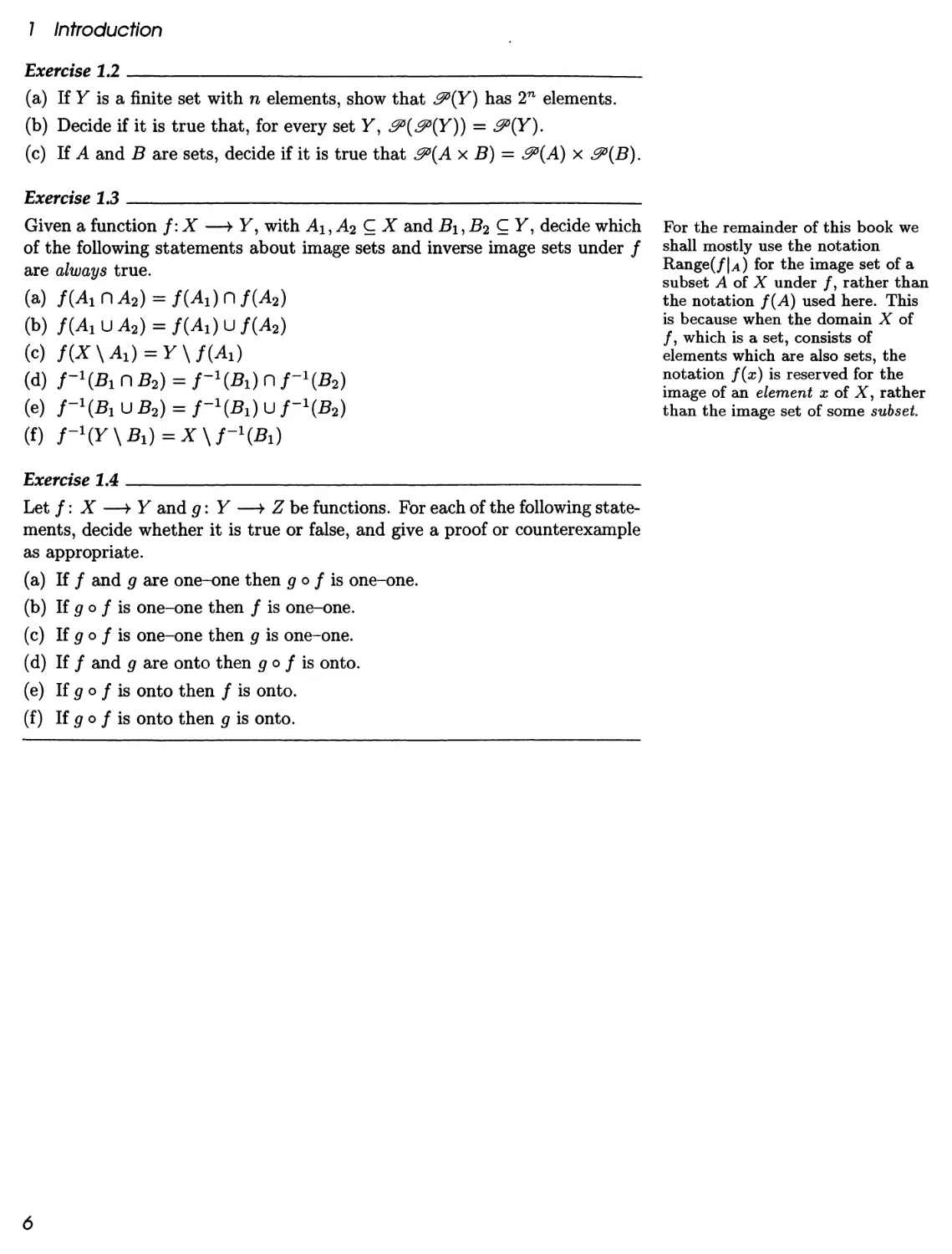
Exercise 1.2
(a) If Y is a finite set with n elements, show that &>(Y) has 2n elements.
(b) Decide if it is true that, for every set F, &>(&>(Y)) = &>{Y).
(c) If A and B are sets, decide if it is true that &>{A x B) = &>(A) x &(B).
Exercise 1.3
Given a function /: X —> Y, with Ai, A2 C X and B\,B2 C7, decide which
of the following statements about image sets and inverse image sets under /
are always true.
(a) f(A1nA2) = f(A1)nf(A2)
(b) f(A1uA2) = f(A1)Uf(A2)
(c) /(X\yl1)=y\/(A1)
(d) /-*(*! n B2) = /-HBi) n r\B2)
(e) f-1(B1UB2) = f-1(B1)Uf-1(B2)
(f) /-1(F\51)=X\/"1(Bi)
Exercise 1.4
Let /: X —> Y and g: Y —> Z be functions. For each of the following
statements, decide whether it is true or false, and give a proof or counterexample
as appropriate.
(a) If / and g are one-one then g o / is one-one.
(b) If g o f is one-one then / is one-one.
(c) If g o / is one-one then g is one-one.
(d) If / and g are onto then g o / is onto.
(e) If g o / is onto then / is onto.
(f) If g o / is onto then g is onto.
For the remainder of this book we
shall mostly use the notation
Range(/|A) for the image set of a
subset A of X under /, rather than
the notation f(A) used here. This
is because when the domain X of
/, which is a set, consists of
elements which are also sets, the
notation f(x) is reserved for the
image of an element x of X, rather
than the image set of some subset
6

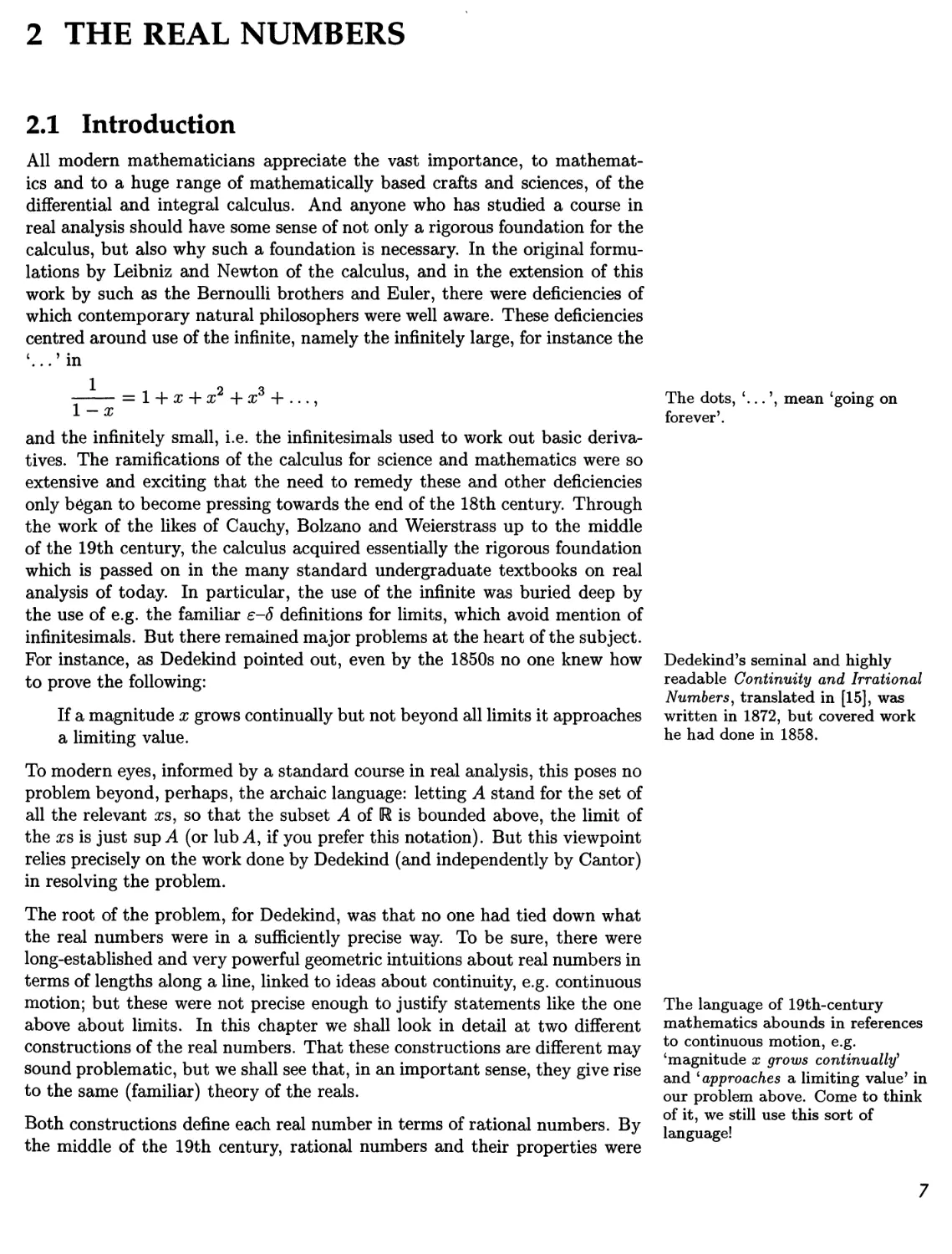
2 THE REAL NUMBERS
2.1 Introduction
All modern mathematicians appreciate the vast importance, to
mathematics and to a huge range of mathematically based crafts and sciences, of the
differential and integral calculus. And anyone who has studied a course in
real analysis should have some sense of not only a rigorous foundation for the
calculus, but also why such a foundation is necessary. In the original
formulations by Leibniz and Newton of the calculus, and in the extension of this
work by such as the Bernoulli brothers and Euler, there were deficiencies of
which contemporary natural philosophers were well aware. These deficiencies
centred around use of the infinite, namely the infinitely large, for instance the
'...' in
1
1-x
= l + x + x2+x3 + ...
and the infinitely small, i.e. the infinitesimals used to work out basic
derivatives. The ramifications of the calculus for science and mathematics were so
extensive and exciting that the need to remedy these and other deficiencies
only b^gan to become pressing towards the end of the 18th century. Through
the work of the likes of Cauchy, Bolzano and Weierstrass up to the middle
of the 19th century, the calculus acquired essentially the rigorous foundation
which is passed on in the many standard undergraduate textbooks on real
analysis of today. In particular, the use of the infinite was buried deep by
the use of e.g. the familiar e-S definitions for limits, which avoid mention of
infinitesimals. But there remained major problems at the heart of the subject.
For instance, as Dedekind pointed out, even by the 1850s no one knew how
to prove the following:
If a magnitude x grows continually but not beyond all limits it approaches
a limiting value.
To modern eyes, informed by a standard course in real analysis, this poses no
problem beyond, perhaps, the archaic language: letting A stand for the set of
all the relevant xs, so that the subset A of U is bounded above, the limit of
the xs is just sup A (or lub A, if you prefer this notation). But this viewpoint
relies precisely on the work done by Dedekind (and independently by Cantor)
in resolving the problem.
The root of the problem, for Dedekind, was that no one had tied down what
the real numbers were in a sufficiently precise way. To be sure, there were
long-established and very powerful geometric intuitions about real numbers in
terms of lengths along a line, linked to ideas about continuity, e.g. continuous
motion; but these were not precise enough to justify statements like the one
above about limits. In this chapter we shall look in detail at two different
constructions of the real numbers. That these constructions are different may
sound problematic, but we shall see that, in an important sense, they give rise
to the same (familiar) theory of the reals.
Both constructions define each real number in terms of rational numbers. By
the middle of the 19th century, rational numbers and their properties were
The dots,
forever'.
mean going on
Dedekind's seminal and highly
readable Continuity and Irrational
Numbers, translated in [15], was
written in 1872, but covered work
he had done in 1858.
The language of 19th-century
mathematics abounds in references
to continuous motion, e.g.
'magnitude x grows continually1
and 'approaches a limiting value' in
our problem above. Come to think
of it, we still use this sort of
language!
7

2 The Real Numbers
a sufficiently natural and uncontroversial part of mathematics that Dedekind
and Cantor could use them without qualms to define the more difficult and
controversial real numbers. Rational numbers seem in some sense simpler than
the reals. But the question 'what are the rationals?' is perhaps as deserving
of an answer as 'what are the reals?', so that we shall also look at a way of
constructing the rationals from something even 'simpler', namely the natural
numbers.
What this chapter essentially does is to provide an arithmetic or algebraic,
rather than geometric, description of the real line or, equivalently, what is
called the continuum. It is using this description to attempt further to
understand the nature of the continuum that underpins the rest of this book.
A dictionary definition of
'continuum' is as a continuous
body; and 'continuous' means
connected or joined together.
2.2 Dedekind's construction
The central problem with the real numbers was to explain irrational numbers.
Numbers like y/2 have been known to be irrational for over two thousand
years, and methods of approximating to y/2 by rational numbers became
increasingly sophisticated over that period. So it was quite natural for Dedekind
and Cantor to think of defining irrational numbers by reference to rational
numbers.
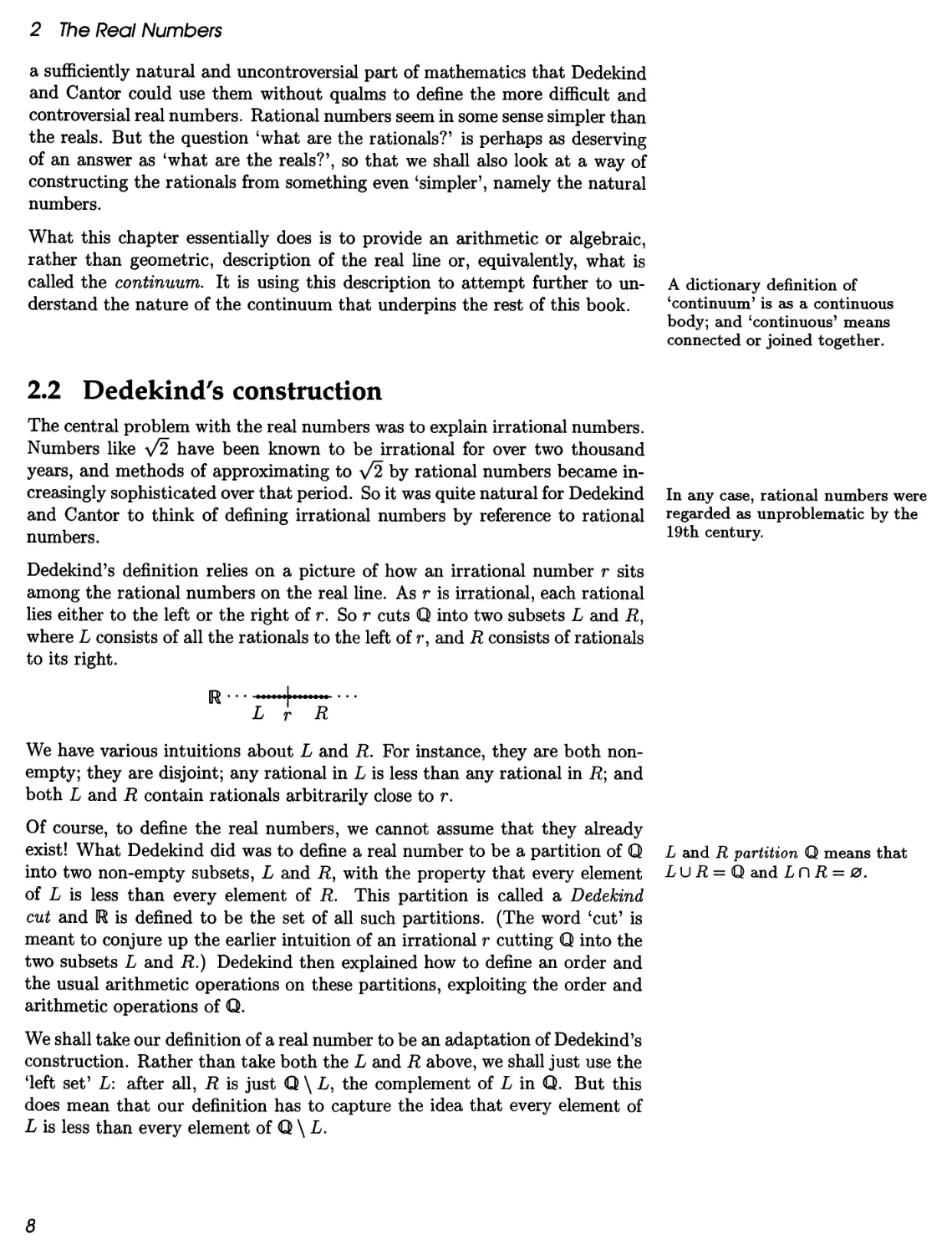
Dedekind's definition relies on a picture of how an irrational number r sits
among the rational numbers on the real line. As r is irrational, each rational
lies either to the left or the right of r. So r cuts Q into two subsets L and R,
where L consists of all the rationals to the left of r, and R consists of rationals
to its right.
R
We have various intuitions about L and R. For instance, they are both
nonempty; they are disjoint; any rational in L is less than any rational in R; and
both L and R contain rationals arbitrarily close to r.
Of course, to define the real numbers, we cannot assume that they already
exist! What Dedekind did was to define a real number to be a partition of Q
into two non-empty subsets, L and i?, with the property that every element
of L is less than every element of R. This partition is called a Dedekind
cut and R is defined to be the set of all such partitions. (The word 'cut' is
meant to conjure up the earlier intuition of an irrational r cutting Q> into the
two subsets L and R.) Dedekind then explained how to define an order and
the usual arithmetic operations on these partitions, exploiting the order and
arithmetic operations of Q.
We shall take our definition of a real number to be an adaptation of Dedekind's
construction. Rather than take both the L and R above, we shall just use the
'left set' L: after all, R is just Q \ L, the complement of L in Q. But this
does mean that our definition has to capture the idea that every element of
L is less than every element of Q \ L.
In any case, rational numbers were
regarded as unproblematic by the
19th century.
L and R partition Q means that
L U R = Q and L n R = 0.
8

2.2 Dedekind's construction
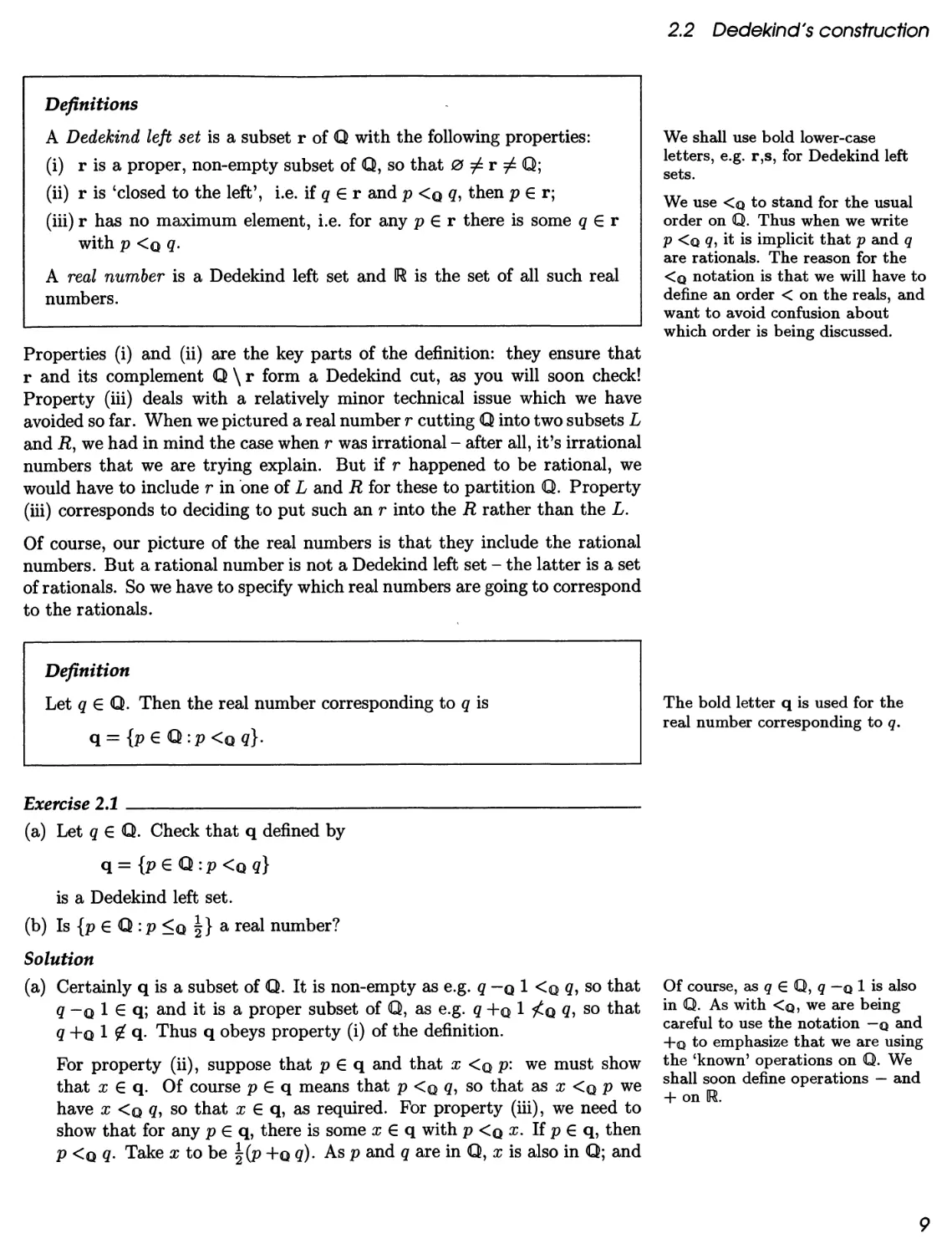
Definitions
A Dedekind left set is a subset r of Q with the following properties:
(i) r is a proper,
non-empty subset of Q, so that 0 ^ r ^ Q;
(ii) r is 'closed to the left', i.e. if q € r and p <q </, then p G r;
(iii) r has no maximum element, i.e. for any p G r there is some q € r
with p <q q.
A real number is
numbers.
a Dedekind left set and R is the set of all such real
Properties (i) and (ii) are the key parts of the definition: they ensure that
r and its complement Q \ r form a Dedekind cut, as you will soon check!
Property (iii) deals with a relatively minor technical issue which we have
avoided so far. When we pictured a real number r cutting Q into two subsets L
and i?, we had in mind the case when r was irrational - after all, it's irrational
numbers that we are trying explain. But if r happened to be rational, we
would have to include r in one of L and R for these to partition Q. Property
(iii) corresponds to deciding to put such an r into the R rather than the L.
Of course, our picture of the real numbers is that they include the rational
numbers. But a rational number is not a Dedekind left set - the latter is a set
of rationals. So we have to specify which real numbers are going to correspond
to the rationals.
We shall use bold lower-case
letters, e.g. r,s, for Dedekind left
sets.
We use <q to stand for the usual
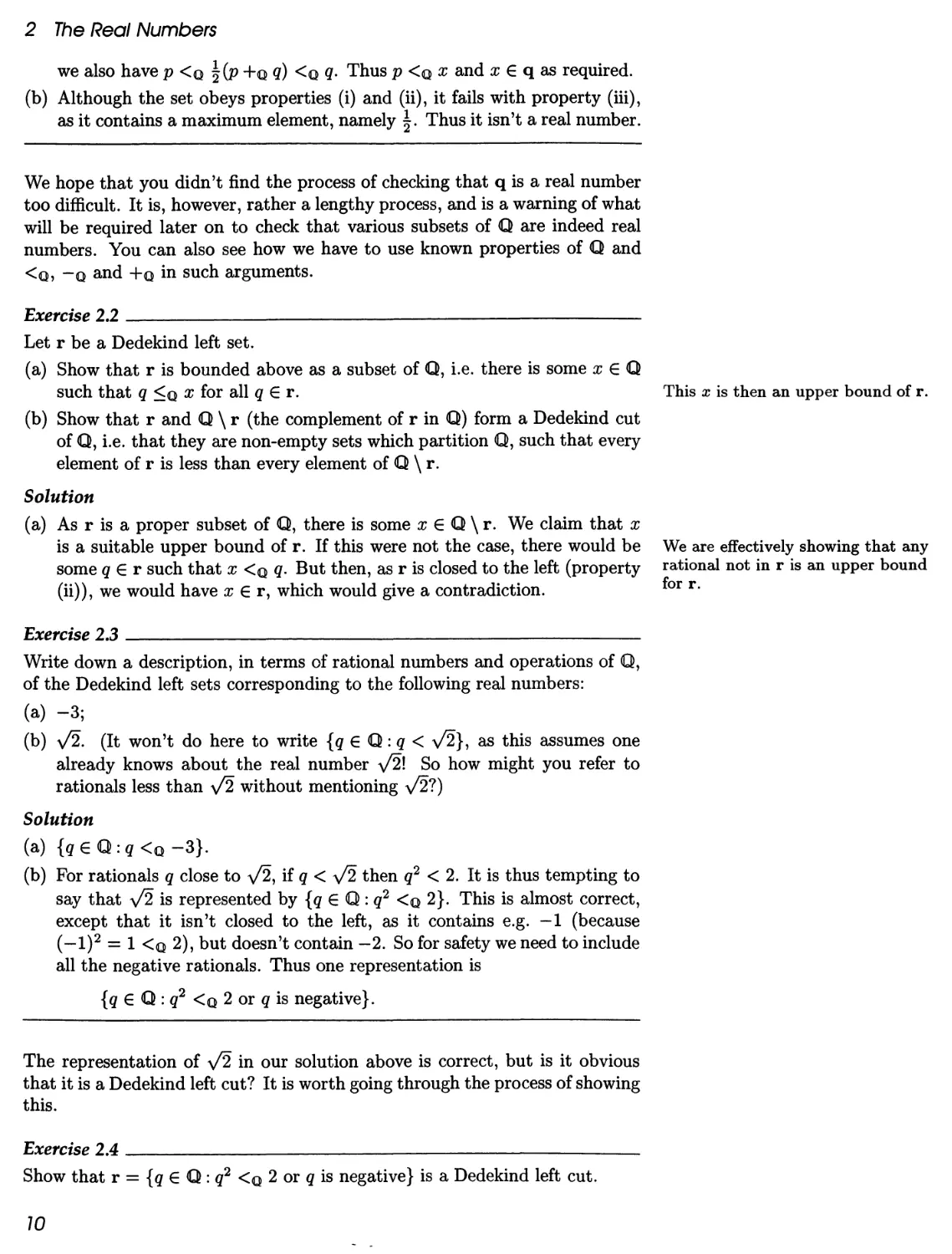
order on Q. Thus when we write
p <q q, it is implicit that p and q
are rationals. The reason for the
<q notation is that we will have to
define an order < on the reals, and
want to avoid confusion about
which order is being discussed.
Definition
Let q € Q. Then the real number
q = {p G Q
p <q q}.
corresponding to q is
The bold letter q is used for the
real number corresponding to q.
Exercise 2.1
(a) Let q G Q. Check that q defined by
<l={peQ:p<Qq}
is a Dedekind left set.
(b) Is {p G Q : p <q |} a real number?
Solution
(a) Certainly q is a subset of Q. It is non-empty as e.g. q — q 1 <q </, so that
q -q 1 € q; and it is a proper subset of Q, as e.g. q +q 1 ^q </, so that
q +q 1 & q- Thus q obeys property (i) of the definition.
For property (ii), suppose that p G q and that x <q p: we must show
that x G q. Of course p € q means that p <q g, so that as x <q p we
have x <q </, so that x G q, as required. For property (iii), we need to
show that for any p e q, there is some xGq with p <qx. If p G q, then
p <q q. Take x to be \{p +o q). As p and q are in Q, x is also in Q; and
Of course, as q G Q, q — q 1 is
in Q. As with <q, we are being
careful to use the notation — q and
+<Q to emphasize that we are using
the 'known' operations on Q. We
shall soon define operations — and
+ on U.

2 The Real Numbers
we also have p <q \{p +q q) <q q. Thus p <q x and xGqas required.
(b) Although the set obeys properties (i) and (ii), it fails with property (iii),
as it contains a maximum element, namely |. Thus it isn't a real number.
We hope that you didn't find the process of checking that q is a real number
too difficult. It is, however, rather a lengthy process, and is a warning of what
will be required later on to check that various subsets of Q are indeed real
numbers. You can also see how we have to use known properties of Q and
<q, — q and +q in such arguments.
Exercise 2.2 __
Let r be a Dedekind left set.
(a) Show that r is bounded above as a subset of Q, i.e. there is some x € Q
such that q <q x for all q € r. This x is then an upper bound of r.
(b) Show that r and Q \ r (the complement of r in Q) form a Dedekind cut
of Q, i.e. that they are non-empty sets which partition Q, such that every
element of r is less than every element of Q \ r.
Solution
(a) As r is a proper subset of Q, there is some x € Q \ r. We claim that x
is a suitable upper bound of r. If this were not the case, there would be We are effectively showing that any
some q € r such that x <q q. But then, as r is closed to the left (property rational not in r is an upper bound
(ii)), we would have iGr, which would give a contradiction. for r*
Exercise 2.3
Write down a description, in terms of rational numbers and operations of Q,
of the Dedekind left sets corresponding to the following real numbers:
(a) -3;
(b) \f2. (It won't do here to write {q e Q:q < \/2}, as this assumes one
already knows about the real number y/2\ So how might you refer to
rationals less than >/2 without mentioning \/2?)
Solution
(a) {q € Q : q <q -3}.
(b) For rationals q close to \/2, if q < y/2 then q2 < 2. It is thus tempting to
say that \/2 is represented by {q € Q : q2 <q 2}. This is almost correct,
except that it isn't closed to the left, as it contains e.g. -1 (because
(—l)2 = 1 <q 2), but doesn't contain —2. So for safety we need to include
all the negative rationals. Thus one representation is
{q G Q : q2 <q 2 or q is negative}.
The representation of y/2 in our solution above is correct, but is it obvious
that it is a Dedekind left cut? It is worth going through the process of showing
this.
Exercise 2A —
Show that r = {q € Q:q2 <Q2or</is negative} is a Dedekind left cut.
10

2.2 Dedekind's construction
Solution
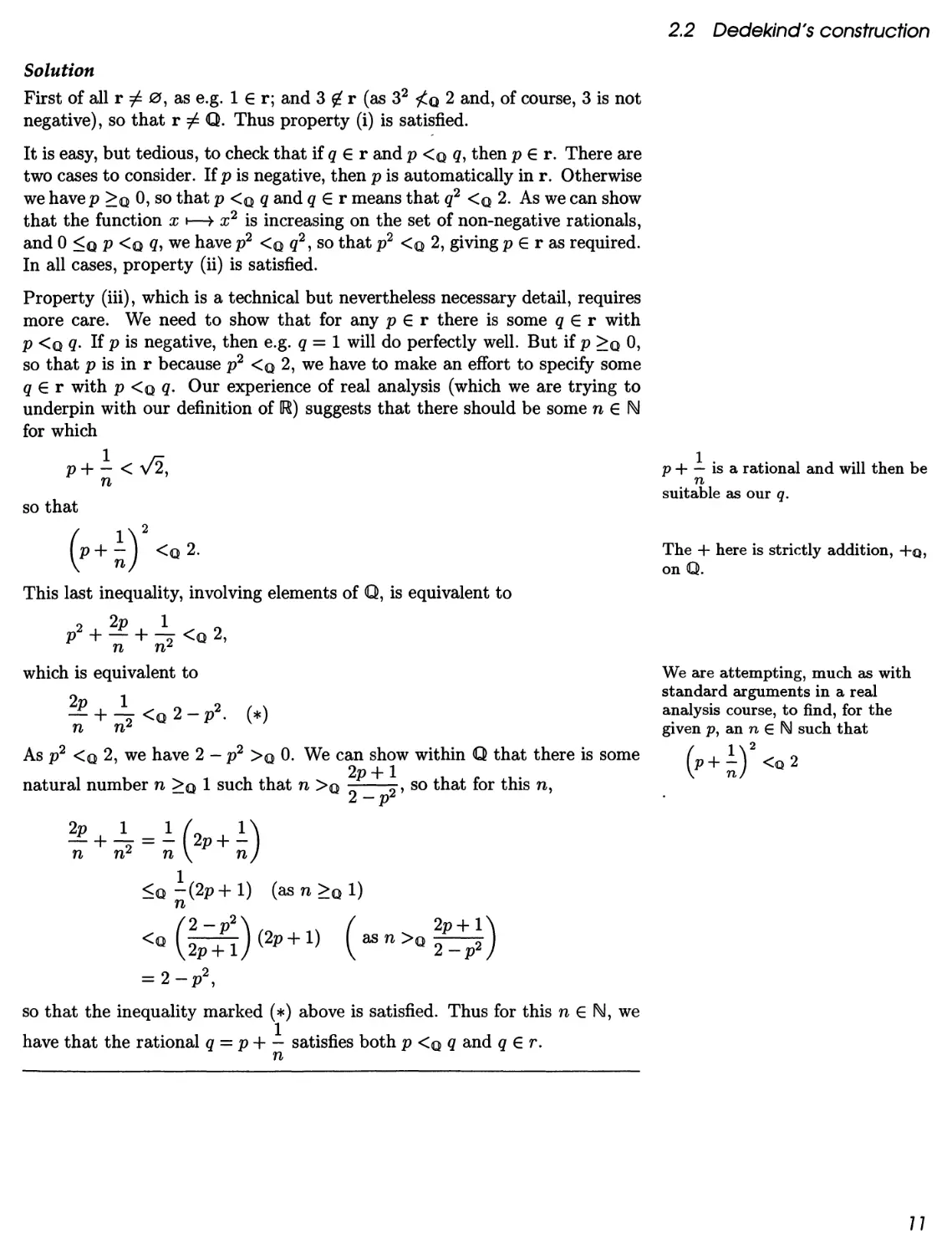
First of all r ^ 0, as e.g. 1 G r; and 3 £ r (as 32 ^q 2 and, of course, 3 is not
negative), so that r ^ Q. Thus property (i) is satisfied.
It is easy, but tedious, to check that if q G r and p <q </, then per. There are
two cases to consider. If p is negative, then p is automatically in r. Otherwise
we have p >q 0, so that p <oq and q € r means that q2 <q 2. As we can show
that the function x \—> x2 is increasing on the set of non-negative rationals,
and 0 <q p <q </, we have p2 <q q2, so that p2 <q 2, giving pGras required.
In all cases, property (ii) is satisfied.
Property (iii), which is a technical but nevertheless necessary detail, requires
more care. We need to show that for any per there is some q € r with
p <q q. If p is negative, then e.g. q = 1 will do perfectly well. But if p >q 0,
so that p is in r because p2 <q 2, we have to make an effort to specify some
q € r with p <q q. Our experience of real analysis (which we are trying to
underpin with our definition of U) suggests that there should be some n eN
for which
p + - < y/2,
so that
('♦=)'
<Q 2.
This last inequality, involving elements of Q, is equivalent to
2 2p 1
P2 + — + -j <Q 2,
n n2
which is equivalent to
2p 1 o
n
rc'
w
As p2 <q 2, we have 2 - p2 >q 0
natural number n >q 1 such that n >q
We can show within Q that there is some
2p+l
2-p-
■, so that for this n}
n nz n
1
=)
<q -(2p+l) (as n >Q 1)
n
<Q
V2p+iy
(2p+ 1) I as n >q
2p+l\
2-P2)
= 2-p2
so that the inequality marked (*) above is satisfied. Thus for this n E M, we
have that the rational q = p H— satisfies both p <q q and q er.
n
p-i— is a rational and will then be
n
suitable as our q.
The + here is strictly addition, +q,
on Q.
We are attempting, much as with
standard arguments in a real
analysis course, to find, for the
given p, an n G N such that
(P+i)2<o2
77

2 The Real Numbers
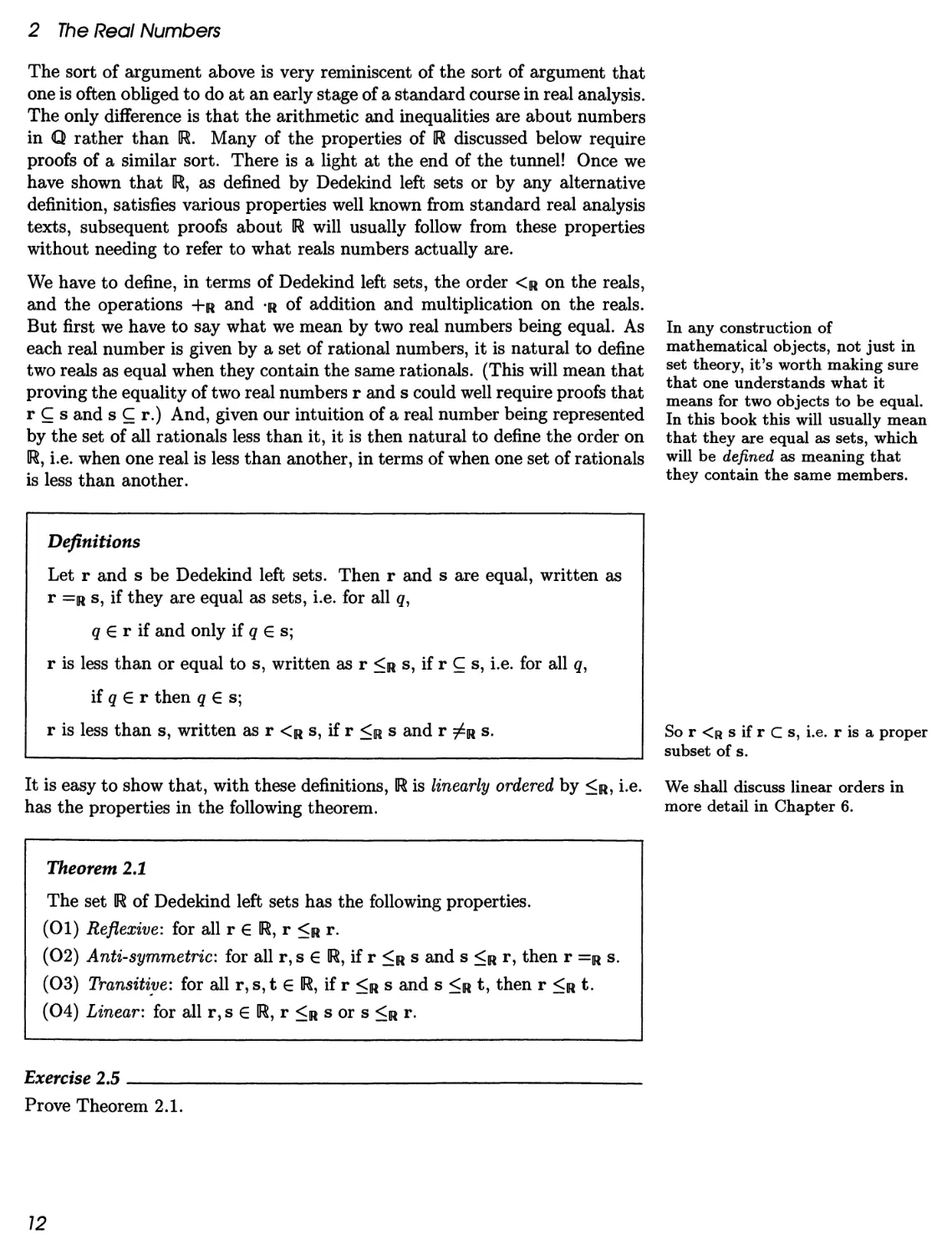
The sort of argument above is very reminiscent of the sort of argument that
one is often obliged to do at an early stage of a standard course in real analysis.
The only difference is that the arithmetic and inequalities are about numbers
in Q rather than R. Many of the properties of R discussed below require
proofs of a similar sort. There is a light at the end of the tunnel! Once we
have shown that R, as defined by Dedekind left sets or by any alternative
definition, satisfies various properties well known from standard real analysis
texts, subsequent proofs about R will usually follow from these properties
without needing to refer to what reals numbers actually are.
We have to define, in terms of Dedekind left sets, the order <r on the reals,
and the operations +r and -r of addition and multiplication on the reals.
But first we have to say what we mean by two real numbers being equal. As
each real number is given by a set of rational numbers, it is natural to define
two reals as equal when they contain the same rationals. (This will mean that
proving the equality of two real numbers r and s could well require proofs that
rCs and sCr.) And, given our intuition of a real number being represented
by the set of all rationals less than it, it is then natural to define the order on
R, i.e. when one real is less than another, in terms of when one set of rationals
is less than another.
In any construction of
mathematical objects, not just in
set theory, it's worth making sure
that one understands what it
means for two objects to be equal.
In this book this will usually mean
that they are equal as sets, which
will be defined as meaning that
they contain the same members.
Definitions
Let r and s be Dedekind left sets.
Thenr
r =r s, if they are equal as sets, i.e. for all
q G r if and only if q G s;
r is less than or equal to s, written as r <r
if q G r then gGs;
r is less than s, written as r <r s,
if r <u s
and s
0,
s, if r
and r
are
Cs
#n
equal, written as
, i.e. for all </,
s.
So r <r s if r C s, i.e. r is a proper
subset of s.
It is easy to show that, with these definitions, R is linearly ordered by <r, i.e. We shall discuss linear orders in
has the properties in the following theorem. more detail in Chapter 6.
Theorem 2.1
The set R of Dedekind left sets has the following properties.
(01) Reflexive: for all r G R, r <r r.
(02) Anti-symmetric: for all r, s G R, if r <r s and s <r r, then r =r s.
(03) Transitive: for all r, s, t G R, if r <r s and s <r t, then r <r t.
(04) Linear: for all r, s G R, r <r s or s <r r.
Exercise 2.5
Prove Theorem 2.1.
12

2.2 Dedekind's construction
Solution
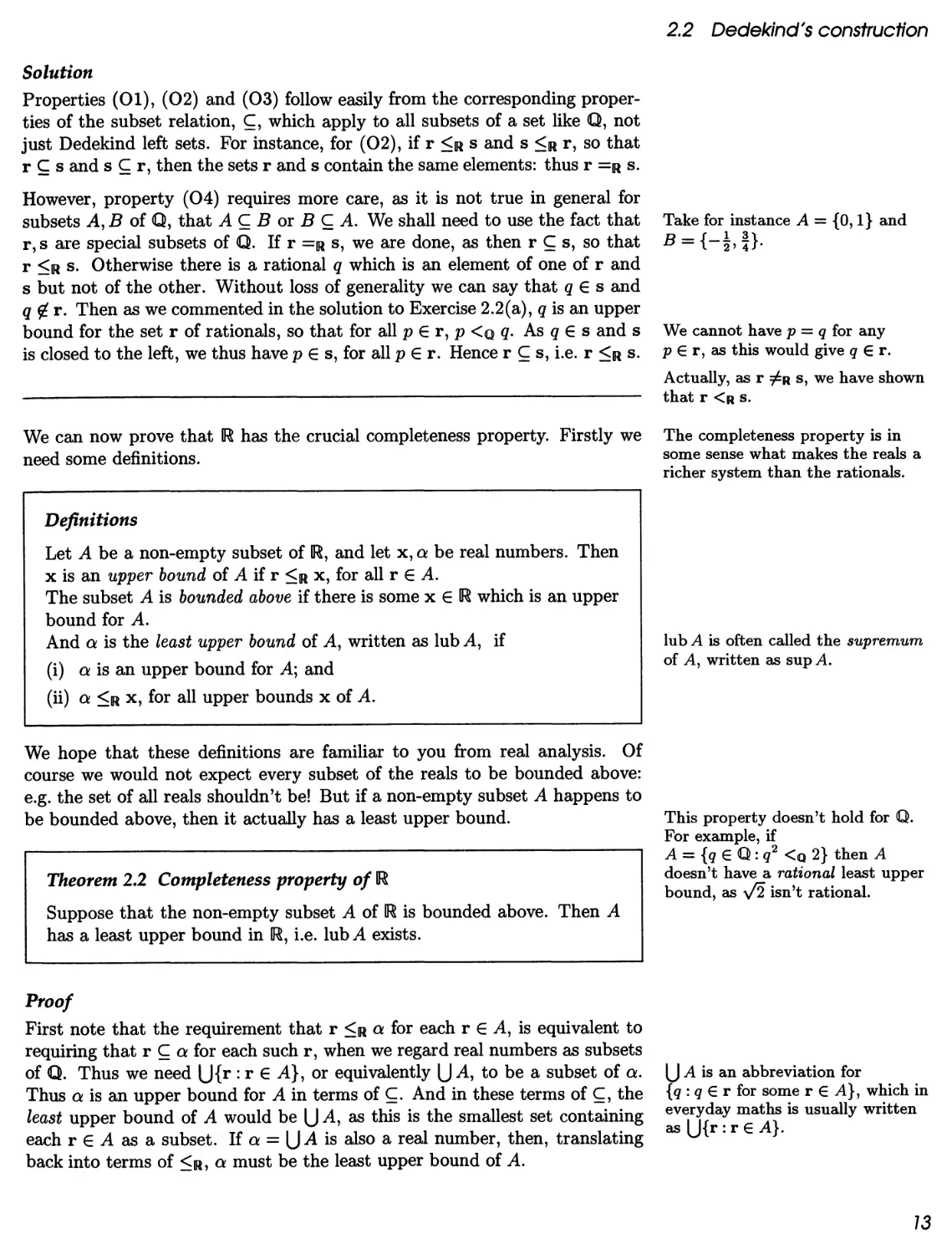
Properties (01), (02) and (03) follow easily from the corresponding
properties of the subset relation, C, which apply to all subsets of a set like Q, not
just Dedekind left sets. For instance, for (02), if r <r s and s <R r, so that
rCs and sCr, then the sets r and s contain the same elements: thus r =r s.
However, property (04) requires more care, as it is not true in general for
subsets A, B of Q, that A C B or B C A. We shall need to use the fact that
r, s are special subsets of Q. If r =r s, we are done, as then r C s, so that
r <u s. Otherwise there is a rational q which is an element of one of r and
s but not of the other. Without loss of generality we can say that q £ s and
q 0 r. Then as we commented in the solution to Exercise 2.2(a), q is an upper
bound for the set r of rationals, so that for all p € r, p <q q. As q G s and s
is closed to the left, we thus have p G s, for all p € r. Hence rCs, i.e. r <r s.
We can now prove that U has the crucial completeness property. Firstly we
need some definitions.
Definitions
Let A be a non-empty subset of R, and let x, a be real numbers. Then
x is an upper bound of A if r <R x, for all r € A.
The subset A is bounded above if there is some xGR which is an upper
bound for A.
And a is the least upper bound of A, written as lub A, if
(i) a is an upper bound for A; and
(ii) ol <u x, for all upper bounds x of A.
We hope that these definitions are familiar to you from real analysis. Of
course we would not expect every subset of the reals to be bounded above:
e.g. the set of all reals shouldn't be! But if a non-empty subset A happens to
be bounded above, then it actually has a least upper bound.
Theorem 2.2 Completeness property of U
Suppose that the non-empty subset A of U is bounded above. Then A
has a least upper bound in R, i.e. lub A exists.
Take for instance A = {0,1} and
B = {-if}-
We cannot have p = q for any
p G r, as this would give q6r.
Actually, as r ^r s, we have shown
that r <r s.
The completeness property is in
some sense what makes the reals a
richer system than the rationals.
lub A is often called the supremum
of A, written as sup A.
This property doesn't hold for Q.
For example, if
A = {q € Q: q2 <q 2} then A
doesn't have a rational least upper
bound, as y/2 isn't rational.
Proof
First note that the requirement that r <u a for each r € A, is equivalent to
requiring that r C a for each such r, when we regard real numbers as subsets
of Q. Thus we need |J{r :rGi}, or equivalently [j A, to be a subset of a.
Thus a is an upper bound for A in terms of C. And in these terms of C, the
least upper bound of A would be (J A, as this is the smallest set containing
each r € A as a subset. If a = \J A is also a real number, then, translating
back into terms of <r, a must be the least upper bound of A.
(J A is an abbreviation for
{q : q G r for some rGA}, which in
everyday maths is usually written
as (J{r : r G A}.
13

2 The Real Numbers
Taking the union, |J A, of a set A,
turns out to be a construction of
major importance within set
theory.
Secondly we must show that \J A is closed to the left. Suppose that p <q q,
where q G (J A. Then gGr, for some r € A, so that as r is closed to the left
we have per. Thus p G U A. Hence (J A is closed to the left.
Lastly we need to show that |J A has no maximum element. Suppose that
p G (J A. Then p G r, for some r G A As r is a real number, there is some
q 6r with p <q q; and as r G A, we have q G (J A. Hence no element of |J A
can be a maximum element.
Thus \J A is a real number. Hence lub A exists. ■
Exercise 2.6
Show that R is not bounded above, i.e. there is no real number s such that
r<RS for all r € R. [Hint: suppose that there was such an s. Then there
is a rational q with q g s. Let p = q + 1. Show that the corresponding real
number p does not satisfy p <u s.]
Let us now define the arithmetic operations on R. Our aim is to define r+ps
and r r s as real numbers, so that they are closed to the left and so on. And
we shall want the definitions to work the right way on our representation of
the rationals within R, e.g. 2 +u 3 = 5 and 2 -r 3 = 6. We might guess that
suitable definitions were
r +R s = {p +q q : p € r and q € s}
* 'U s = {p -q q : p G r and </ € s}.
The first of these works, but the second, for -r, doesn't.
Exercise 2.7
Why won't
r -R s = {p -Q Q : P € r and gGs}
be suitable as a definition?
It has problems with the large, negative rationals that must be in each of r
and s. For instance, -11 € 2 and -12 G 3, so that with this attempt at a
definition we would get
-11-0-12 = 132
as an element of what we wanted to be 6. Another problem, which we would
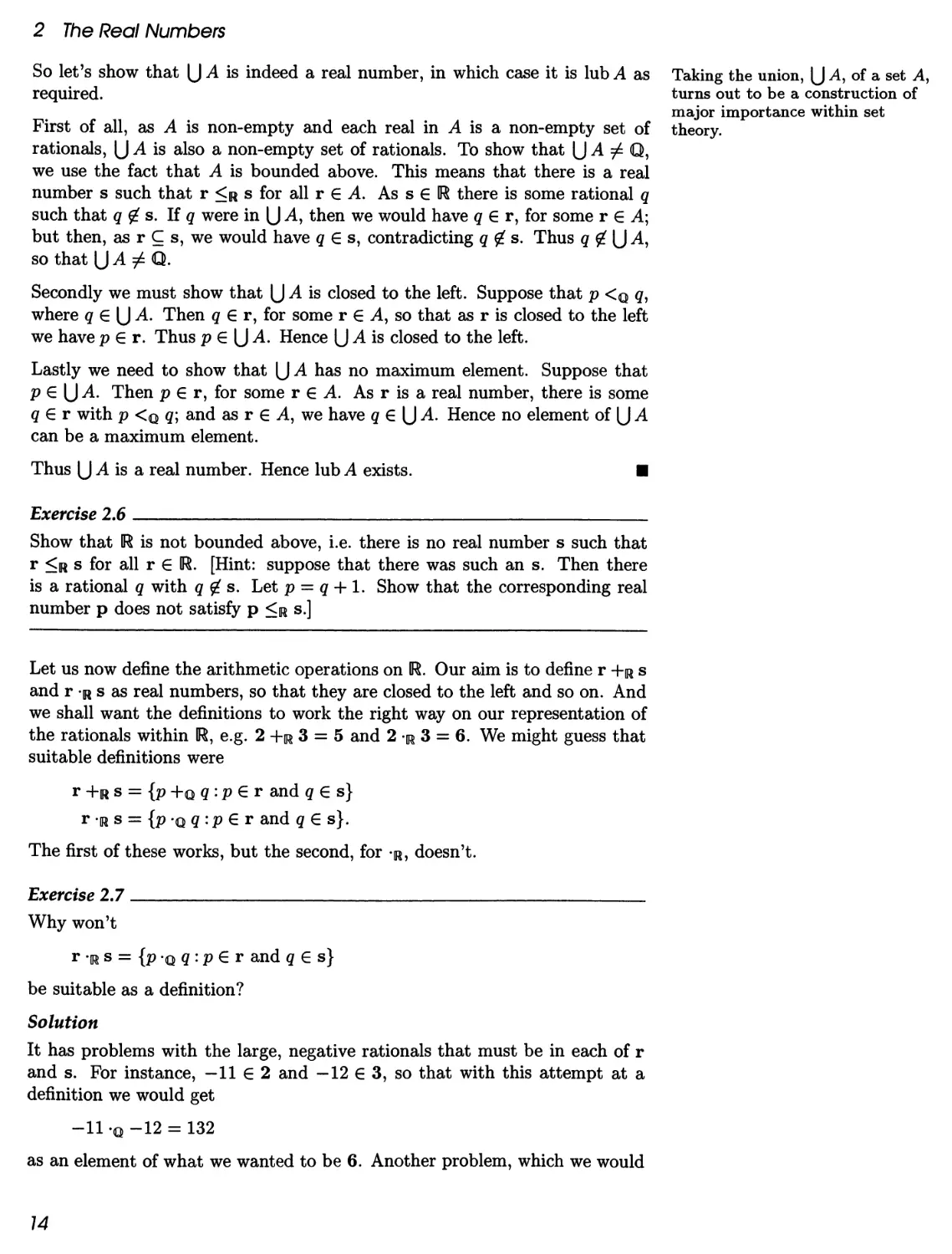
So let's show that \JA is indeed a real number, in which case it is lub A as
required.
First of all, as A is non-empty and each real in A is a non-empty set of
rationals, \J A is also a non-empty set of rationals. To show that (J A ^ Q,
we use the fact that A is bounded above. This means that there is a real
number s such that r <R s for all r € A. As s G R there is some rational q
such that q g s. li q were in (J A, then we would have gGr, for some r G A;
but then, as r C s, we would have gGs, contradicting q & s. Thus q & \JA,
so that NA^Q.
14

2.2 Dedekind's construction
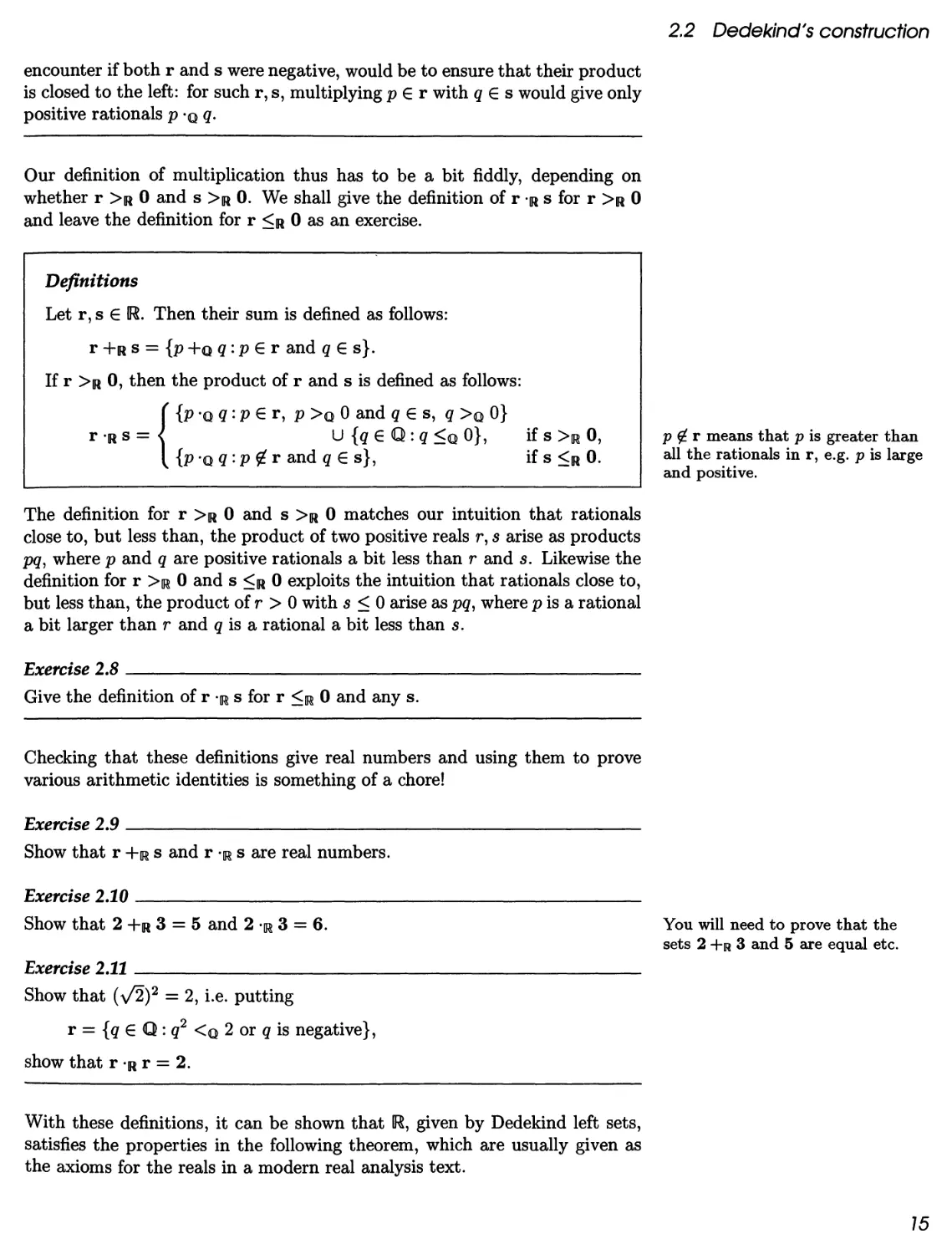
encounter if both r and s were negative, would be to ensure that their product
is closed to the left: for such r, s, multiplying p G r with q G s would give only
positive rationals p -q q.
Our definition of multiplication thus has to be a bit fiddly, depending on
whether r >r 0 and s>rO. We shall give the definition of r -r s for r >r 0
and leave the definition for r <r 0 as an exercise.
Definitions
Let r, s G R. Then their sum is defined as follows:
r +r s = {p +q q : p G r and q G s}.
If r >r 0, then the product of r and s is defined as follows:
{{p 'Q Q : P € r, p >q 0 and q € s, q >Q 0}
U {q G Q : q <q 0}, if s >r 0,
{p -Q Q : P & r and q G s}, if s <r 0.
The definition for r >r 0 and s >r 0 matches our intuition that rationals
close to, but less than, the product of two positive reals r, s arise as products
pq, where p and q are positive rationals a bit less than r and s. Likewise the
definition for r >r 0 and s <r 0 exploits the intuition that rationals close to,
but less than, the product of r > 0 with s < 0 arise as pq, where p is a rational
a bit larger than r and q is a rational a bit less than s.
Exercise 2.8
Give the definition of r -r s for r <r 0 and any s.
Checking that these definitions give real numbers and using them to prove
various arithmetic identities is something of a chore!
Exercise 2.9
Show that r +R s and r -r s are real numbers.
Exercise 2.10
Show that 2 +r 3 = 5 and 2 -r 3 = 6. You will need to prove that the
sets 2 +r 3 and 5 are equal etc.
Exercise 2.11
Show that {y/2)2 = 2, i.e. putting
r = {q £ Q:q2 <q 2 or q is negative},
show that r -r r = 2.
With these definitions, it can be shown that R, given by Dedekind left sets,
satisfies the properties in the following theorem, which are usually given as
the axioms for the reals in a modern real analysis text.
p & r means that p is greater than
all the rationals in r, e.g. p is large
and positive.
75

2 The Real Numbers
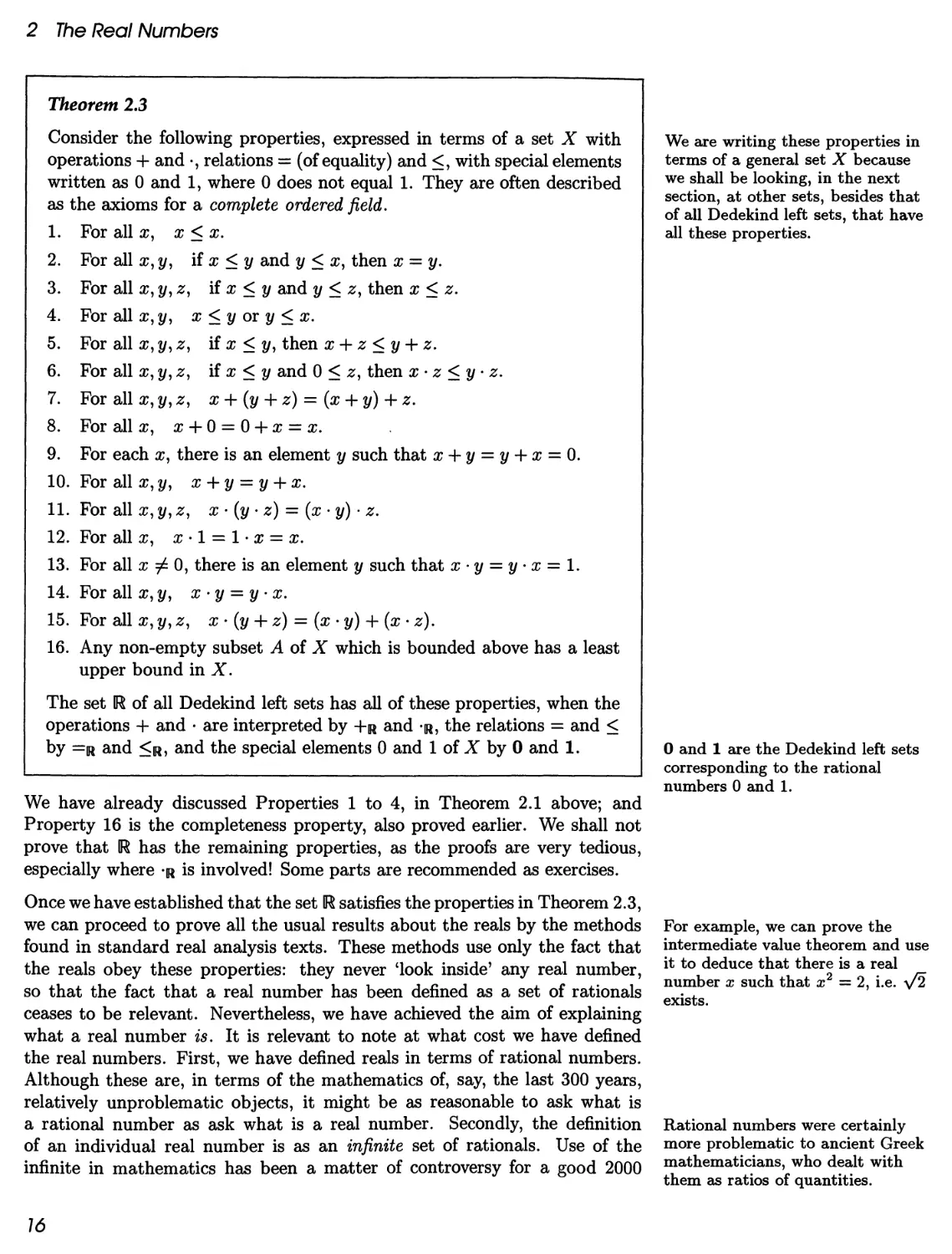
Theorem 2.3
Consider the following properties, expressed in terms of a set X with
operations + and •, relations = (of equality) and <, with special elements
written as 0 and 1, where 0 does not equal 1. They are often described
as the axioms for a complete ordered field.
1. For all x, x < x.
2. For all #, y, if x < y and y < #, then x = y.
3. For all #, y, z, if x < y and y < z, then x < z.
4. For all #, y, x < y or y < x.
5. For all x, y, z, if x < y, then x + z < y + z.
6. For all #, y, z, if x < y and 0 < z, then x • z < y • z.
7. For all x, y,z, x + (y + z) = (x+ y) + z.
8. For all a;, x + 0 = 0 + a; = a;.
9. For each #, there is an element y such that x + y = y + x = Q.
10. For all #, y, x + y — y + x.
11. For all x, y,z, x - (y - z) = (x - y) - z.
12. For all z, x • 1 = 1 • x = x.
13. For all x ^ 0, there is an element ?/ such that x -y = y - x = 1.
14. For all #, 2/, x -y = y - x.
15. For all #, ?/, 2, £ • (y 4- 2) = (x • 2/) + (a; • z).
16. Any non-empty subset A of X which is bounded above has a least
upper bound in X.
The set U of all Dedekind left sets has all of these properties, when the
operations + and • are interpreted by +r and -r, the relations = and <
by =r and <r, and the special elements 0 and 1 of X by 0 and 1.
We have already discussed Properties 1 to 4, in Theorem 2.1 above; and
Property 16 is the completeness property, also proved earlier. We shall not
prove that R has the remaining properties, as the proofs are very tedious,
especially where -r is involved! Some parts are recommended as exercises.
Once we have established that the set R satisfies the properties in Theorem 2.3,
we can proceed to prove all the usual results about the reals by the methods
found in standard real analysis texts. These methods use only the fact that
the reals obey these properties: they never 'look inside' any real number,
so that the fact that a real number has been defined as a set of rationals
ceases to be relevant. Nevertheless, we have achieved the aim of explaining
what a real number is. It is relevant to note at what cost we have defined
the real numbers. First, we have defined reals in terms of rational numbers.
Although these are, in terms of the mathematics of, say, the last 300 years,
relatively unproblematic objects, it might be as reasonable to ask what is
a rational number as ask what is a real number. Secondly, the definition
of an individual real number is as an infinite set of rationals. Use of the
infinite in mathematics has been a matter of controversy for a good 2000
We are writing these properties in
terms of a general set X because
we shall be looking, in the next
section, at other sets, besides that
of all Dedekind left sets, that have
all these properties.
0 and 1 are the Dedekind left sets
corresponding to the rational
numbers 0 and 1.
For example, we can prove the
intermediate value theorem and use
it to deduce that there is a real
number x such that x2 = 2, i.e. y/2
exists.
Rational numbers were certainly
more problematic to ancient Greek
mathematicians, who dealt with
them as ratios of quantities.
16

2.3 Alternative constructions
years. Arguably mathematicians of the 19th century were confident with
what is called a potentially infinite set, one for which, however (finitely) many
elements you have, there is always another available. But treating an actually
infinite set, like a Dedekind left set of rationals, as a legitimate mathematical
object suitable for all sorts of manipulation, seemed somewhat dubious.
In the next section we shall look at some alternative constructions of the
reals. In the final section of the chapter we shall look at how to construct the
rational numbers from something 'simpler'. And the issue of infinity is one
which will be a major topic in the rest of the book.
For instance, for any finite set of
natural numbers, there is always a
natural number bigger than any of
those in the set.
Further exercises
Exercise 2.12
Show that r +k 0 =r r, for any r € R.
Exercise 2.13
For each r € U there is an s € U such that r +r s = 0, i.e. s is —r. Describe s
as a Dedekind left set, giving your answer in the form s = {q G Q : ... }, in
terms of the rationals in r.
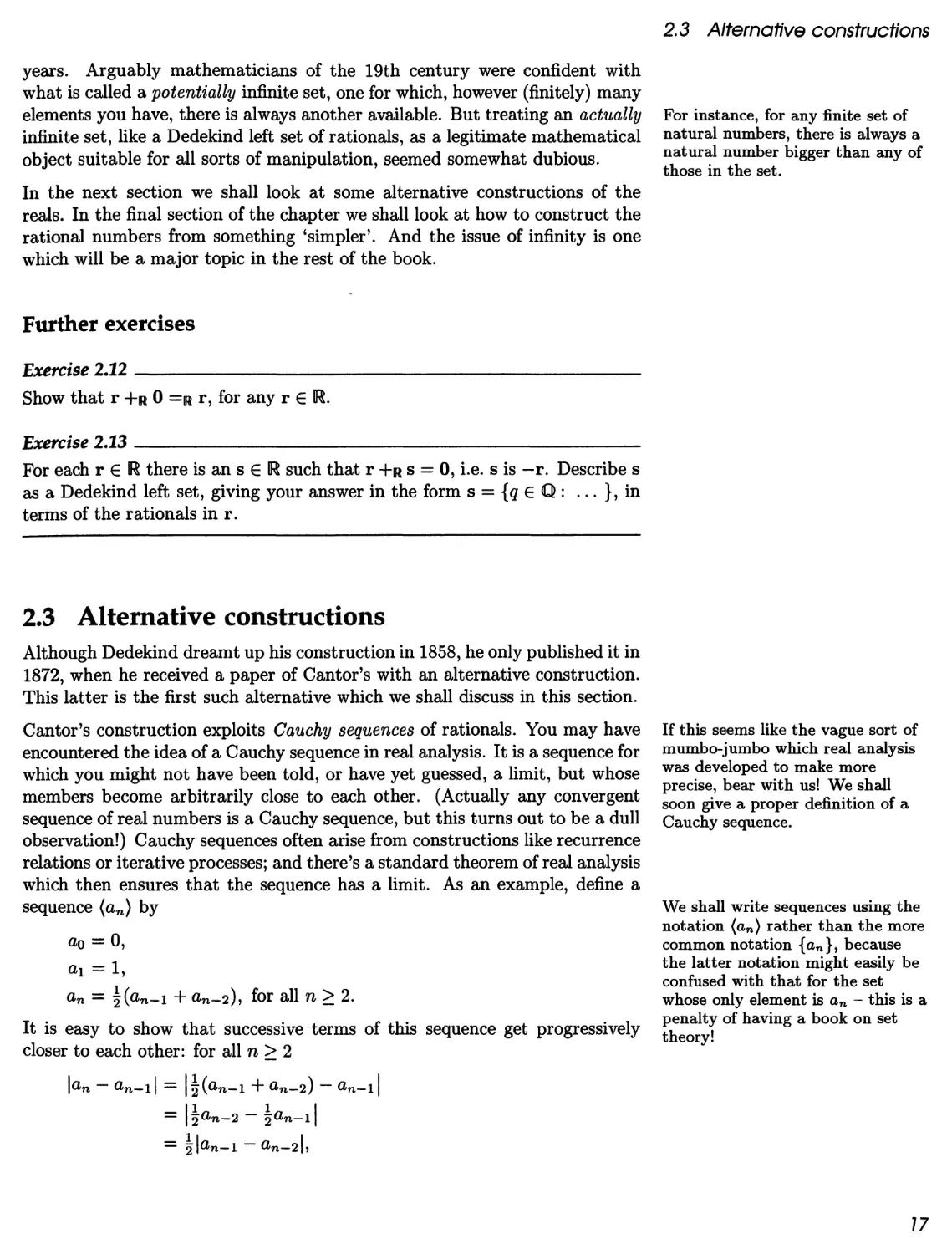
2.3 Alternative constructions
Although Dedekind dreamt up his construction in 1858, he only published it in
1872, when he received a paper of Cantor's with an alternative construction.
This latter is the first such alternative which we shall discuss in this section.
Cantor's construction exploits Cauchy sequences of rationals. You may have
encountered the idea of a Cauchy sequence in real analysis. It is a sequence for
which you might not have been told, or have yet guessed, a limit, but whose
members become arbitrarily close to each other. (Actually any convergent
sequence of real numbers is a Cauchy sequence, but this turns out to be a dull
observation!) Cauchy sequences often arise from constructions like recurrence
relations or iterative processes; and there's a standard theorem of real analysis
which then ensures that the sequence has a limit. As an example, define a
sequence (an) by
a0 = 0,
Q>\ = 1,
an = \(an-i + an-2), for all n > 2.
It is easy to show that successive terms of this sequence get progressively
closer to each other: for all n > 2
\an - an_i| = ||(an_i -j-an_2) -an_i|
= |2an-2 — 2an-1l
= 2la™~l ~~ an-2|,
If this seems like the vague sort of
mumbo-jumbo which real analysis
was developed to make more
precise, bear with us! We shall
soon give a proper definition of a
Cauchy sequence.
We shall write sequences using the
notation (an) rather than the more
common notation {an}, because
the latter notation might easily be
confused with that for the set
whose only element is an - this is a
penalty of having a book on set
theory!
17

2 The Real Numbers
so that a simple induction shows that
\an - an_i| = (^)n_1|ai ~ ao|
= (J)W"1-
Although the terms of this sequence become very close to each other, it may
not be at all obvious what the limit of the sequence is.
Cantor's idea was based on the idea that any irrational could be regarded as
the limit of a Cauchy sequence of rationals. Let us take \/2 as an example.
We shall construct a sequence (xn) of rationals approximating to \/2 by using
a standard numerical analysis technique, the bisection method. We define
three sequences, (an), (bn) and (xn), as follows:
ao = 1, bo = 2,
and for each n > 1,
Gn+l
Xn — 2 \P"n * Vn)\
fzn, ifa£<2,
\ an, otherwise;
f&n, ifx*
n+1~\^n, othei
<2,
otherwise.
For each n, the closed interval [an, bn] contains \/2 and [an+i, 6n+i] Q fan? bn].
Also the length of [an, 6n], i.e. bn — an, is (|)n. So for each of the sequences
(«n>, (&n> and (xn) of rationals, the terms of the sequence are getting closer
and closer to each other, and closer to \/2. But suppose now that we didn't
know all about the reals, and that all we knew about were the rationals. Then
all we could say was that each of these sequences appeared to be converging,
but not to a limit within the set Q with which we were familiar. Cantor's
idea was essentially to define a real number to be such a sequence - the
example above would define \/2. But there's a complication! We want \/2
to be defined as a unique object, whereas we have obtained three different
sequences which intuitively converge to it. So Cantor defined a real not just
as a single sequence of rationals, but as the set of all sequences of rationals
whose terms get arbitrarily close to the terms of this sequence. Let's now give
the proper definitions, starting with that of a Cauchy sequence.
Definition
The sequence (qn) of rationals is a Cauchy sequence if for each £>q0
(where e eQ) there is an N € N such that
\Qi -Q Qj\ <Q £-> for a11 hJ >N N.
So the terms of a Cauchy sequence get arbitrarily close to each other. As with
our earlier example involving \/2, there is the likelihood that such a sequence
will not converge to any limit in Q. But some Cauchy sequences will converge
quite happily in Q, for instance (n~L> is a Cauchy sequence and converges to
1.
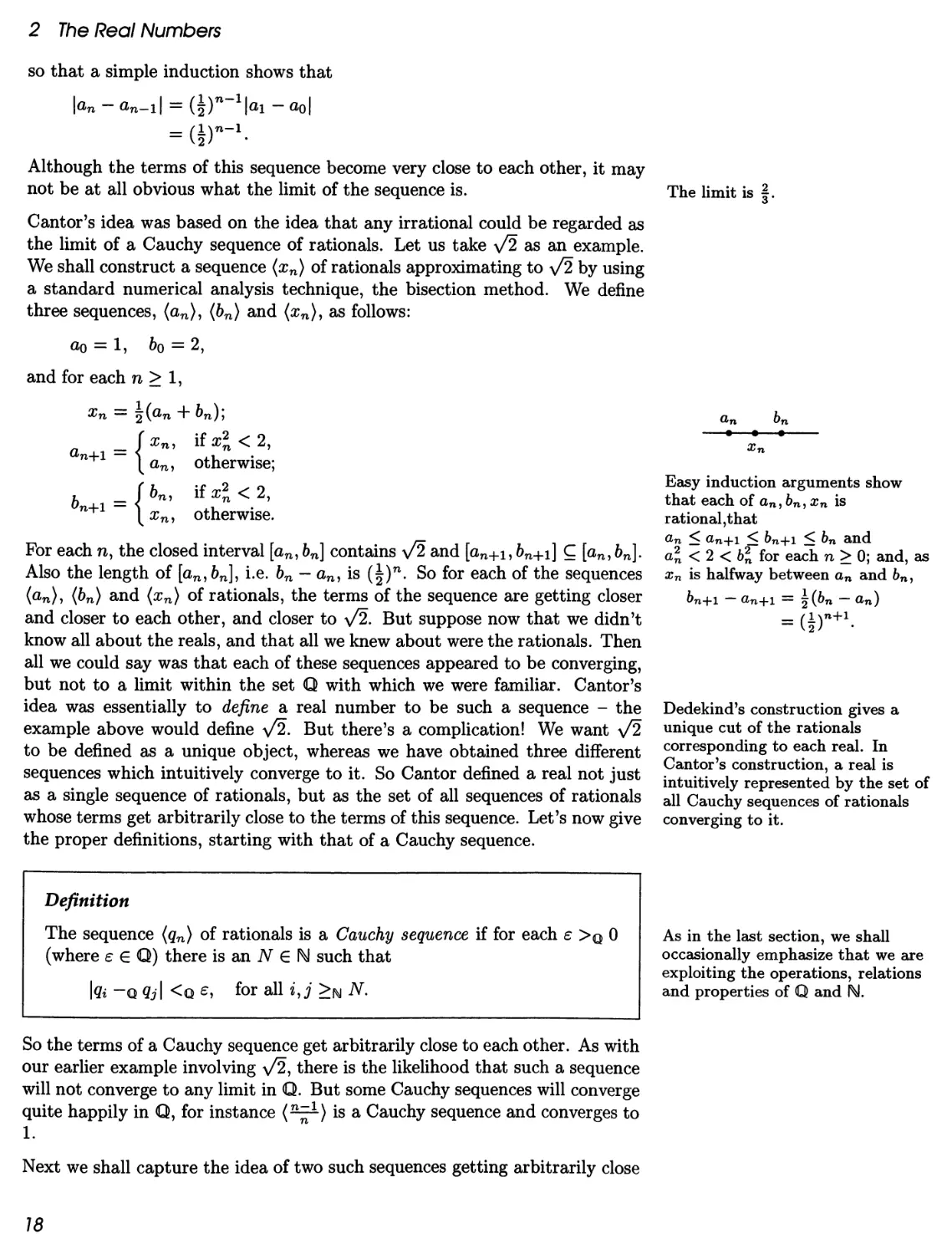
The limit is f.
an
Easy induction arguments show
that each of an, 6n, xn is
rational, that
an < an-f-i < 6n+i < bn and
a^ < 2 < b^, for each n > 0; and, as
xn is halfway between an and 6n,
bn+l — Cin+l = 2^n ~ an)
n+1
= (*>■
Dedekind's construction gives a
unique cut of the rationals
corresponding to each real. In
Cantor's construction, a real is
intuitively represented by the set of
all Cauchy sequences of rationals
converging to it.
As in the last section, we shall
occasionally emphasize that we are
exploiting the operations, relations
and properties of Q and N.
Next we shall capture the idea of two such sequences getting arbitrarily close
18

2.3 Alternative constructions
to each other, so that they are in some sense equivalent.
Definition
Let (an) and (bn) be Cauchy sequences of rationals. We shall say that
they are equivalent and write (an) ~ (bn) if for each e >q 0 there is an
N eN such that
\a>n ~ bn\ <Q e, for all n >n N.
What fleshes out the word 'equivalent' is that ~ is an equivalence relation.
Exercise 2.14
Show that ~ is an equivalence relation on the set of all Cauchy sequences of
rationals, i.e. it has the following properties:
(a) reflexive: for all Cauchy sequences (an), (an) ~ (an);
(b) symmetric: for all Cauchy sequences (an) and (6n), if (an) ~ (bn) then
{bn) ~ («n);
(c) transitive: for all Cauchy sequences (an), (bn) and (cn), if (an) ~ (bn)
and (6n) ~ (cn) then (an) ~ (cn).
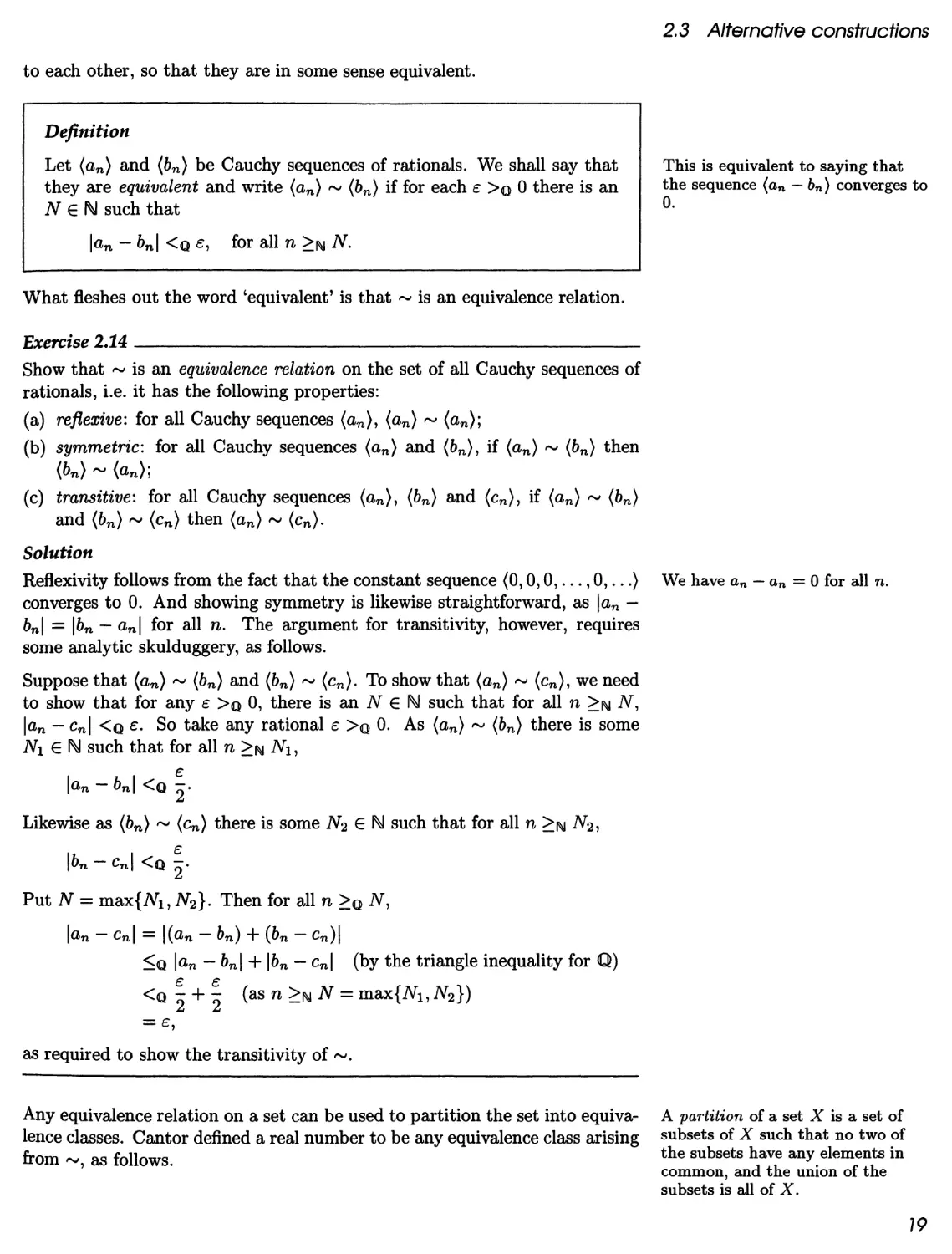
Reflexivity follows from the fact that the constant sequence (0,0,0,..., 0,...) We have an — an = 0 for all n.
converges to 0. And showing symmetry is likewise straightforward, as \an —
bn\ = \bn — an\ for all n. The argument for transitivity, however, requires
some analytic skulduggery, as follows.
Suppose that (an) ~ (bn) and (bn) ~ (cn). To show that (an) ~ (cn), we need
to show that for any e >q 0, there is an N G N such that for all n >n N,
\a>n ~ cn\ <q e. So take any rational e >q 0. As (an) ~ (bn) there is some
Nx eN such that for all n >n JVi,
Likewise as (6n) ~ (cn) there is some N2 € N such that for all n >py iV2,
Put AT = maxjiVi, AT2}. Then for all n >q JV,
|an - cn\ = \(an - bn) + (bn - cn)\
<q \a>n — K\ + \bn ~ cn\ (by the triangle inequality for Q)
<q - + I (as n >n N = max{Ni1N2})
= e,
as required to show the transitivity of ~.
Any equivalence relation on a set can be used to partition the set into
equivalence classes. Cantor defined a real number to be any equivalence class arising
from ~, as follows.
This is equivalent to saying that
the sequence (an — 6n) converges to
0.
A partition of a set X is a set of
subsets of X such that no two of
the subsets have any elements in
common, and the union of the
subsets is all of X.
19

2 The Real Numbers
Definitions
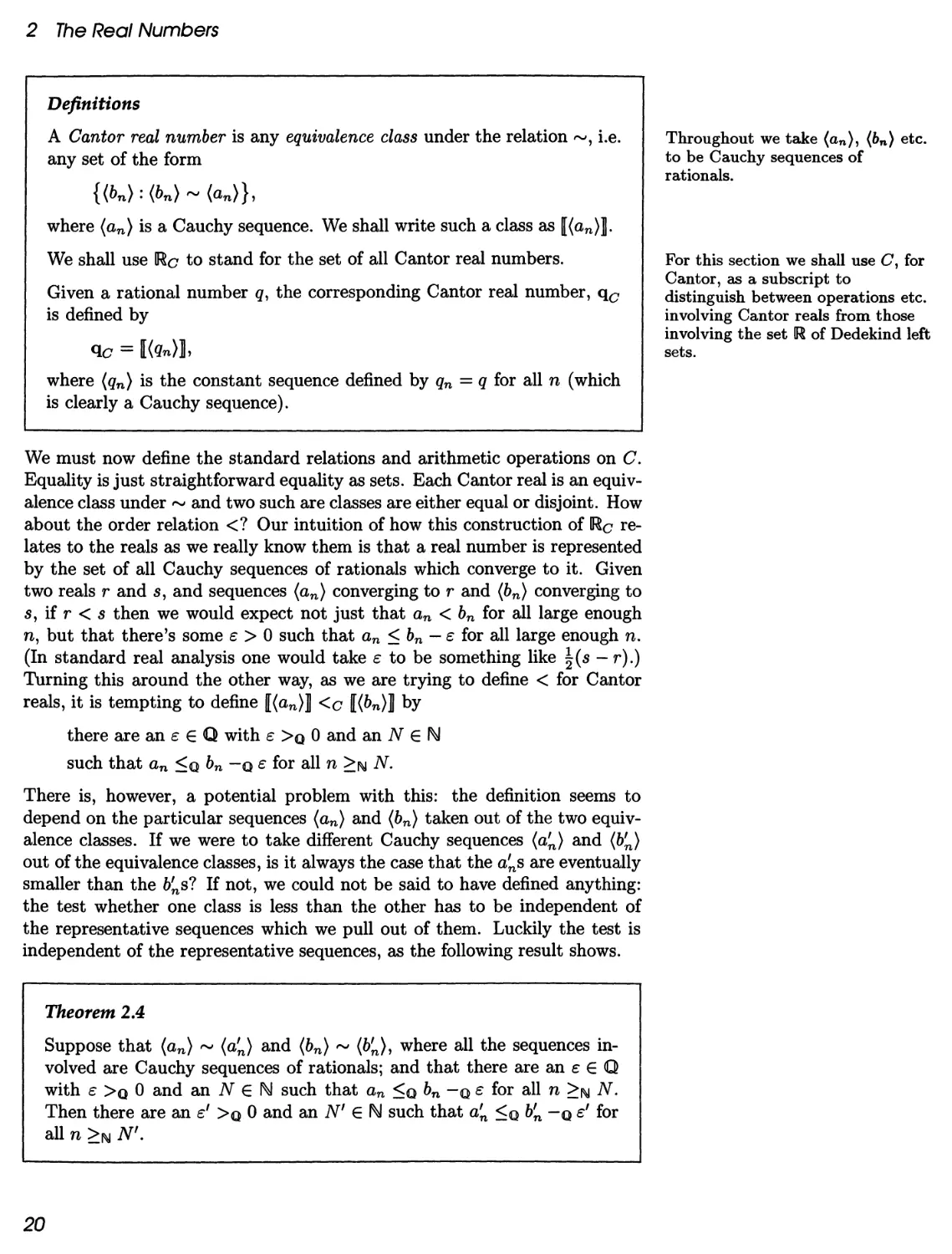
A Cantor real number is any equivalence class under the relation ~, i.e.
any set of the form
{(bn):(bn)~(an)},
where (an) is a Cauchy sequence. We shall write such a class as [(an)J.
We shall use Uc to stand for the set of all Cantor real numbers.
Given a rational number q, the corresponding Cantor real number, qc
is defined by
q<? = [<«n>],
where (qn) is the constant sequence defined by qn = q for all n (which
is clearly a Cauchy sequence).
We must now define the standard relations and arithmetic operations on C.
Equality is just straightforward equality as sets. Each Cantor real is an
equivalence class under ~ and two such are classes are either equal or disjoint. How
about the order relation <? Our intuition of how this construction of Uc
relates to the reals as we really know them is that a real number is represented
by the set of all Cauchy sequences of rationals which converge to it. Given
two reals r and s, and sequences (an) converging to r and (bn) converging to
5, if r < s then we would expect not just that an < bn for all large enough
n, but that there's some e > 0 such that an < bn — e for all large enough n.
(In standard real analysis one would take e to be something like |(s - r).)
Turning this around the other way, as we are trying to define < for Cantor
reals, it is tempting to define [(an)J <c l(bn)J by
there are an e € Q with e >q 0 and an N € N
such that an <q bn —q e for all n >n N.
There is, however, a potential problem with this: the definition seems to
depend on the particular sequences (an) and (bn) taken out of the two
equivalence classes. If we were to take different Cauchy sequences (a'n) and (b'n)
out of the equivalence classes, is it always the case that the a'ns are eventually
smaller than the 6'ns? If not, we could not be said to have defined anything:
the test whether one class is less than the other has to be independent of
the representative sequences which we pull out of them. Luckily the test is
independent of the representative sequences, as the following result shows.
Theorem 2.4
Suppose that (an) ~
«> and (6n> ~ (Vn)
volved are Cauchy sequences of rationals;
with £>q0 and an
Then there are an e'
all n >n N'.
N € N such that an
, where all the sequences in-
and that there are
£q bn —q e for all
>q 0 and an N' € N such that a'n <q b'n
an e € Q
n>\N.
—q £' for 1
Throughout we take (an), (bn) etc.
to be Cauchy sequences of
rationals.
For this section we shall use C, for
Cantor, as a subscript to
distinguish between operations etc.
involving Cantor reals from those
involving the set U. of Dedekind left
sets.
20

2.3 Alternative constructions
Proof
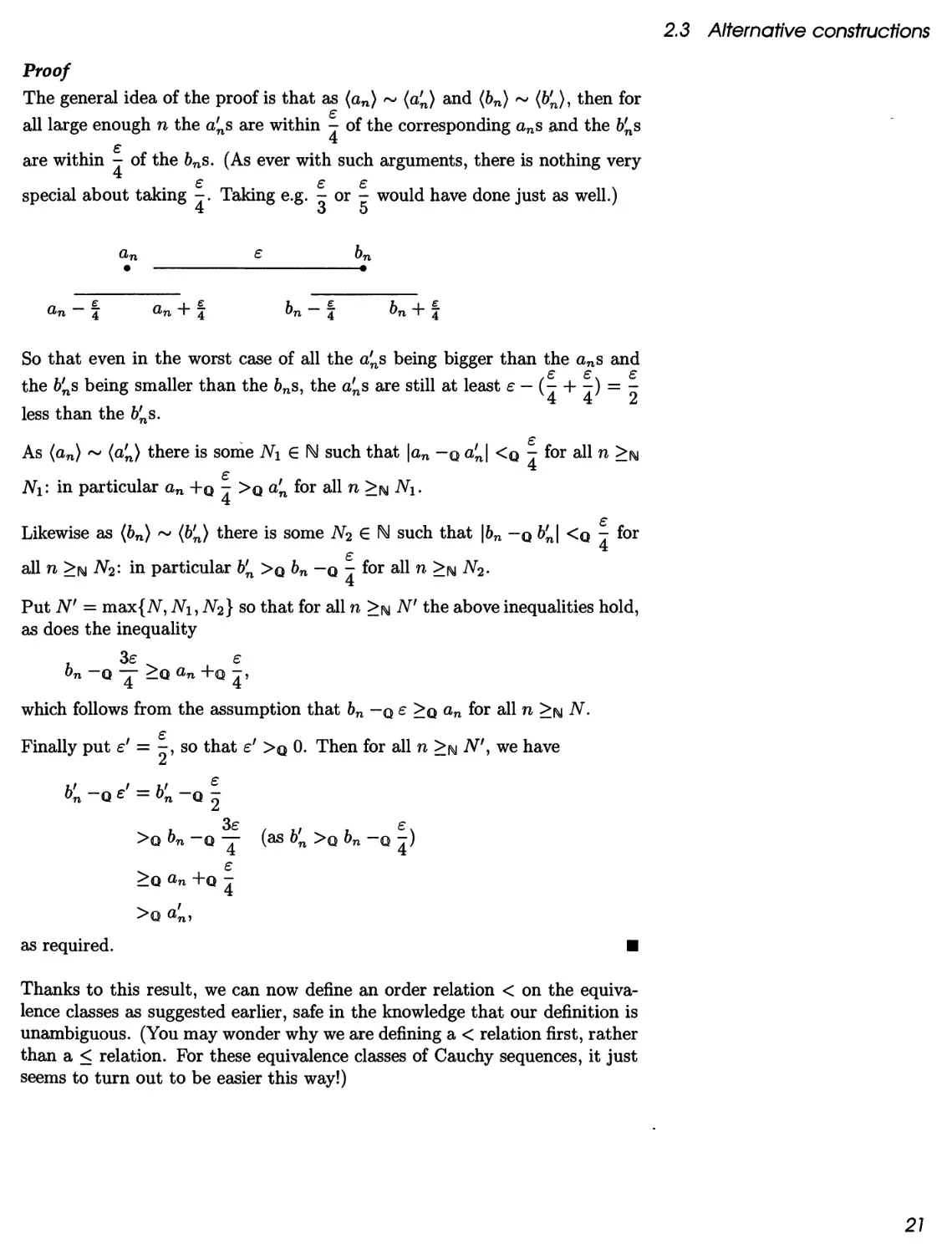
The general idea of the proof is that as (an) ~ (a'n) and (bn) ~ (&'n), then for
all large enough n the a'ns are within - of the corresponding ans and the b'ns
are within - of the 6ns. (As ever with such arguments, there is nothing very
£ £ £
special about taking -. Taking e.g. -or- would have done just as well.)
4 o o
an £ bn
*n 4
Q"n ~r ^ 0n ^ 0n -jr 4
So that even in the worst case of all the a'ns being bigger than the ans and
£ £ £
the b'ns being smaller than the 6ns, the a'ns are still at least £ — (- + -) = -
less than the b'ns.
As (an) ~ (a'n) there is some Ni € N such that \an —q a!n\ <q - for all n >n
Ni: in particular an +q - >q a'n for all n>nN\.
Likewise as (6n) ~ (b'n) there is some iV2 € N such that \bn —q b'n\ <q - for
all n>^ N2: in particular b'n >q bn -q - for all n >n iV2.
Put N' = max{iV, Ni, iV2} so that for all n >n iV' the above inequalities hold,
as does the inequality
bn ~Q -J" >Q «n +Q T,
which follows from the assumption that bn —q £ >q an for all n >n N.
Finally put e' = -, so that e' >q 0. Then for all n >n N', we have
bn~QS = bn -q -
3s £
>q &n -q -r (as 6^ >q 6n -q -)
£
as required. ■
Thanks to this result, we can now define an order relation < on the
equivalence classes as suggested earlier, safe in the knowledge that our definition is
unambiguous. (You may wonder why we are defining a < relation first, rather
than a < relation. For these equivalence classes of Cauchy sequences, it just
seems to turn out to be easier this way!)
21

2 The Real Numbers
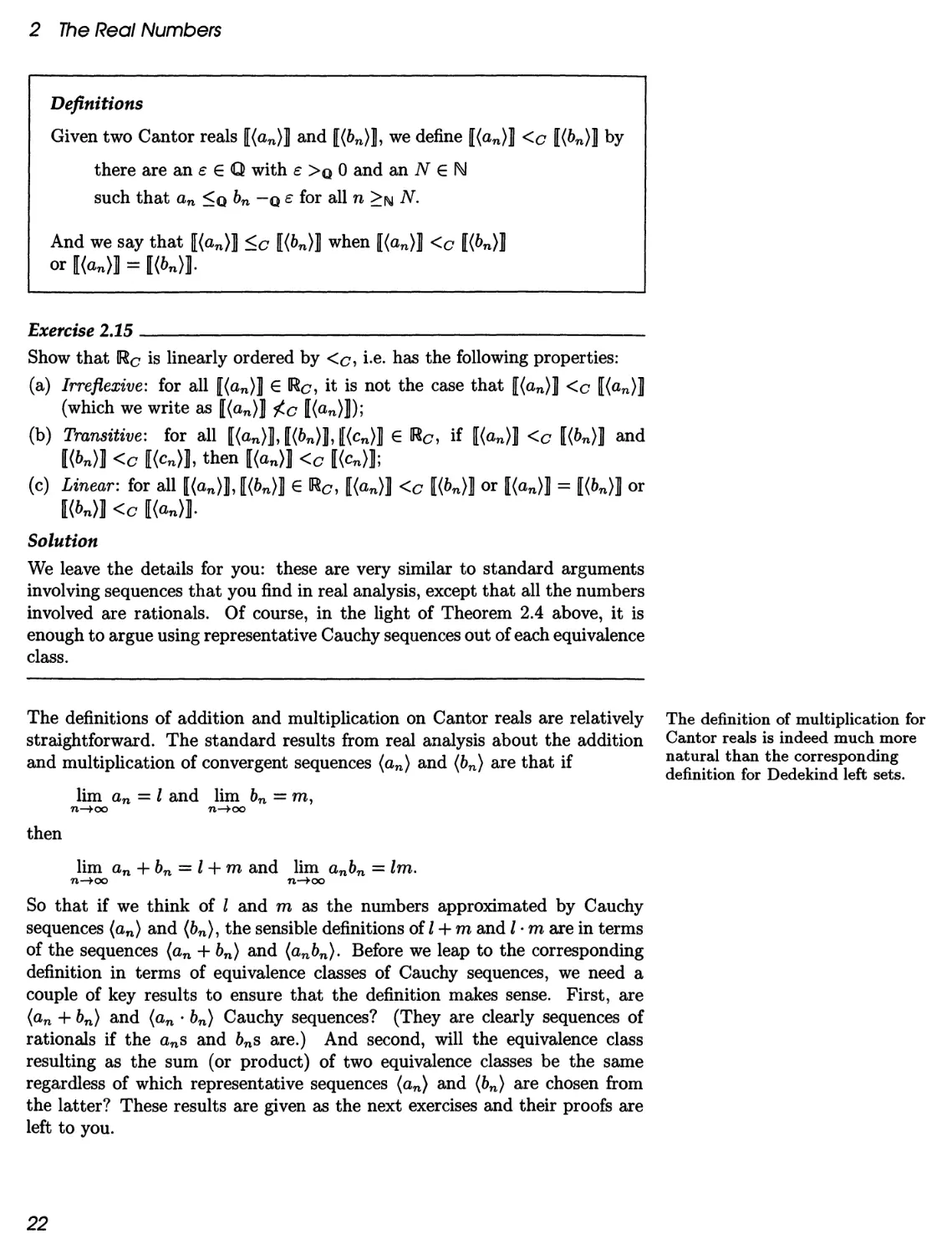
Definitions
Given two Cantor reals [(an)J and [fan)], we define [(an)J <c [fan)] by
there are an e € Q with s>qO and an N € N
such that an <q bn —q e for all n >n N.
And we say that [fan)] <c [fan)I when [(an)J <c [fan)I
or {(an)] = [fan)].
Exercise 2.15
Show that Re is linearly ordered by <<?, i.e. has the following properties:
(a) Irreftexive: for all [<on)] € Re, it is not the case that [(an)J <c [fan)]
(which we write as [(an)J <£c [fan)]);
(b) Transitive: for all [(an)J, [fan)J, [(cn)] € Re, if [(a„)] <c [fan)] and
[(bn)] <c [Ml then [<a»>] <c [fan)];
(c) Linear: for all [fan)], [fan)J € Rc, [K)l <c [(6n)] or [(an)J = [(6n)] or
I(6»>] <c l(an)l
Solution
We leave the details for you: these are very similar to standard arguments
involving sequences that you find in real analysis, except that all the numbers
involved are rationals. Of course, in the light of Theorem 2.4 above, it is
enough to argue using representative Cauchy sequences out of each equivalence
class.
The definition of multiplication for
Cantor reals is indeed much more
natural than the corresponding
definition for Dedekind left sets.
then
lim an + bn = I + m and lim anbn = Im.
n—too n—too
So that if we think of I and m as the numbers approximated by Cauchy
sequences (an) and (6n), the sensible definitions of I + m and / • m are in terms
of the sequences (an + bn) and (anbn). Before we leap to the corresponding
definition in terms of equivalence classes of Cauchy sequences, we need a
couple of key results to ensure that the definition makes sense. First, are
fan + bn) and fan • bn) Cauchy sequences? (They are clearly sequences of
rationals if the ans and 6ns are.) And second, will the equivalence class
resulting as the sum (or product) of two equivalence classes be the same
regardless of which representative sequences fan) and (bn) are chosen from
the latter? These results are given as the next exercises and their proofs are
left to you.
The definitions of addition and multiplication on Cantor reals are relatively
straightforward. The standard results from real analysis about the addition
and multiplication of convergent sequences fan) and (6n) are that if
lim an = I and lim bn = m,
n—foo n—►oo
22

2.3 Alternative constructions
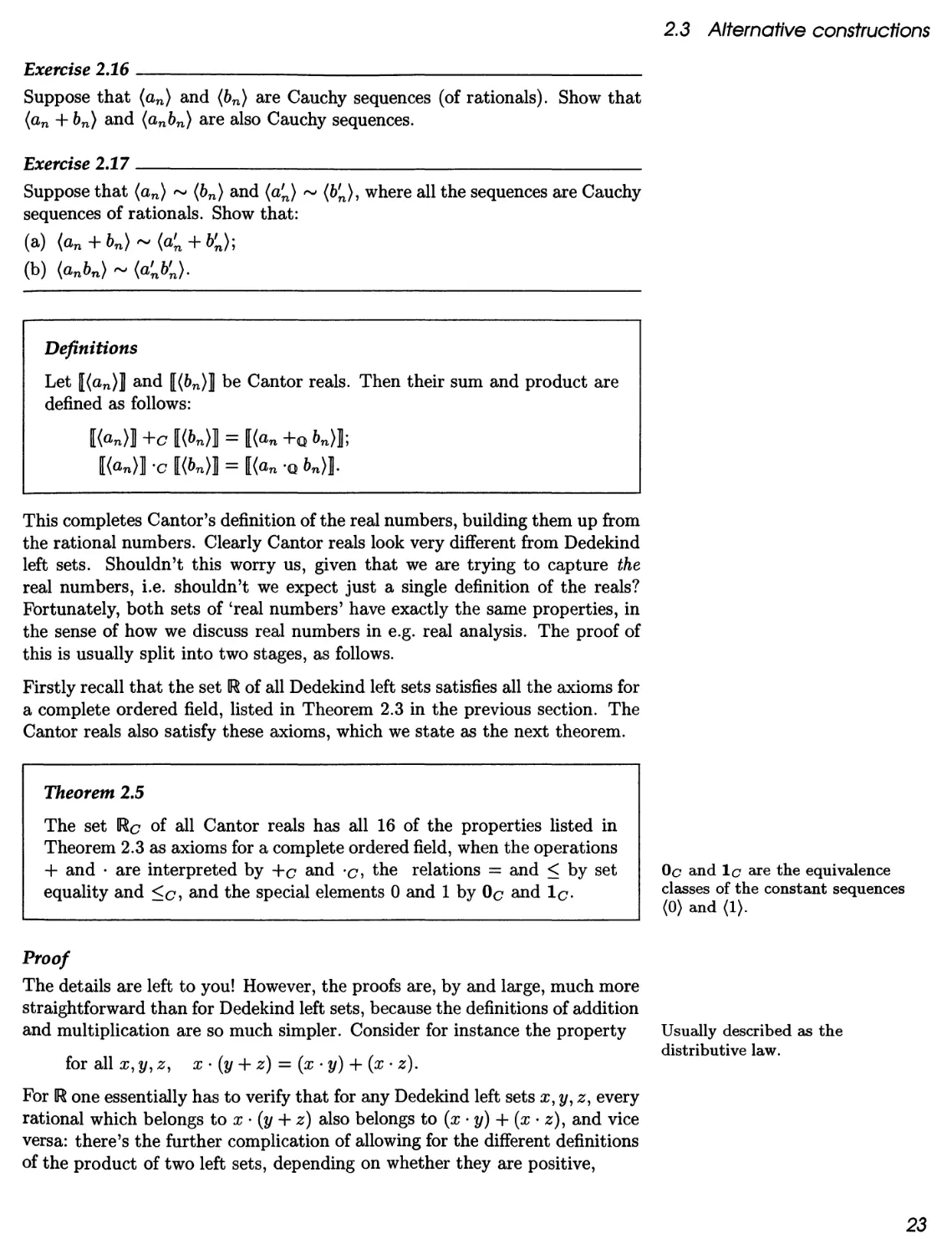
Exercise 2.16
Suppose that (an) and (bn) are Cauchy sequences (of rationals). Show that
(an + bn) and (anbn) are also Cauchy sequences.
Exercise 2.17
Suppose that (an) ~ (bn) and (a'n) ~ (6^), where all the sequences are Cauchy
sequences of rationals. Show that:
(a) (an + bn) -« + &;>;
(b) (anbn) ~ (a'nb'n).
Definitions
Let [(an>l and |(6n>] 1
defined as follows:
[(an)] +C [(bn)]
[(an)] 'C [(bn)]
3e Cantor reals.
= [(On
= [(an
+q bn)]\
•Q bn)].
Then their
sum
and product
are
This completes Cantor's definition of the real numbers, building them up from
the rational numbers. Clearly Cantor reals look very different from Dedekind
left sets. Shouldn't this worry us, given that we are trying to capture the
real numbers, i.e. shouldn't we expect just a single definition of the reals?
Fortunately, both sets of 'real numbers' have exactly the same properties, in
the sense of how we discuss real numbers in e.g. real analysis. The proof of
this is usually split into two stages, as follows.
Firstly recall that the set R of all Dedekind left sets satisfies all the axioms for
a complete ordered field, listed in Theorem 2.3 in the previous section. The
Cantor reals also satisfy these axioms, which we state as the next theorem.
Theorem 2.5
The set Re of all Cantor reals has all 16 of the properties listed in
Theorem 2.3 as axioms for a complete ordered field, when the operations
+ and • are interpreted by +c and •<?, the relations = and < by set
equality and <<?, and the special elements 0 and 1 by Oc and lc-
Proof
The details are left to you! However, the proofs are, by and large, much more
straightforward than for Dedekind left sets, because the definitions of addition
and multiplication are so much simpler. Consider for instance the property Usually described as the
distributive law.
for all x, y,z, x • (y + z) = (x • y) + {x • z).
For R one essentially has to verify that for any Dedekind left sets x,y,z, every
rational which belongs to x • (y + z) also belongs to (x-y) + (x- z), and vice
versa: there's the further complication of allowing for the different definitions
of the product of two left sets, depending on whether they are positive,
Oc and lc are the equivalence
classes of the constant sequences
(0) and (1).
23

2 The Real Numbers
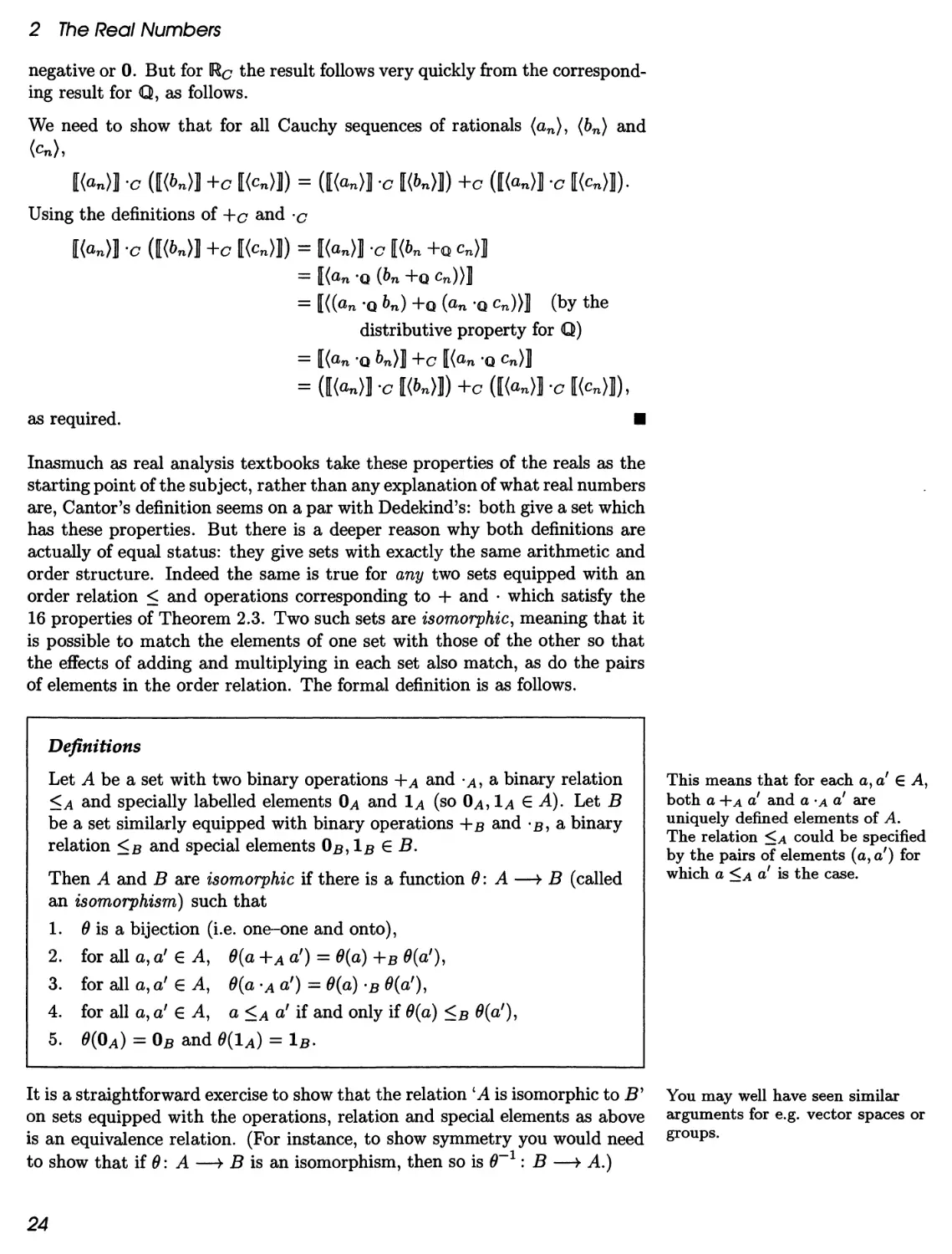
negative or 0. But for Uc the result follows very quickly from the
corresponding result for Q, as follows.
We need to show that for all Cauchy sequences of rationals (an), (bn) and
(Cn),
[K>] 'C ([(bn)] +C {(Cn)]) = ([(On)] 'C [(&»>]) +C ([(o»>] 'C [(<*)]).
Using the definitions of +c and •<?
[(*n)] 'C ([(bn)] +C [(Cn)]) = [W] 'C [(K +Q Cn>]
= [<an -q (bn +q c„))]
= [((a„ -q bn) +q (an -q cn))J (by the
distributive property for Q)
= [<an *Q 6n>] +C [(An -Q Cn)J
= (!K>] -c [<6»>]) +c ([(a»)] -c I(cn>]),
as required. ■
Inasmuch as real analysis textbooks take these properties of the reals as the
starting point of the subject, rather than any explanation of what real numbers
are, Cantor's definition seems on a par with Dedekind's: both give a set which
has these properties. But there is a deeper reason why both definitions are
actually of equal status: they give sets with exactly the same arithmetic and
order structure. Indeed the same is true for any two sets equipped with an
order relation < and operations corresponding to + and • which satisfy the
16 properties of Theorem 2.3. Two such sets are isomorphic, meaning that it
is possible to match the elements of one set with those of the other so that
the effects of adding and multiplying in each set also match, as do the pairs
of elements in the order relation. The formal definition is as follows.
Definitions
Let A be a set with two binary operations +a and -^, a binary relation
<a and specially labelled elements 0a and 1a (so Oa^Ia € A). Let B
be a set similarly equipped with binary operations +# and •#, a binary
relation <b and special elements 0#, 1# € B.
Then A and B are isomorphic if there is a function 6: A —> B (called
an isomorphism) such that
1. 6 is a bijection (i.e. one-one and onto),
2. for all a, a' G A, 6(a +a a') = 0(a) +B 0(a'),
3. for all a, a' € A, 0(a >A a') = 6(a) -B 0(a%
4. for all a, a' e A, a <A a' if and only if 6(a) <b 0(a!),
5. 0(OA) = OBand0(lA) = lB.
It is a straightforward exercise to show that the relation lA is isomorphic to B1 You may well have seen similar
on sets equipped with the operations, relation and special elements as above arguments for e.g. vector spaces or
is an equivalence relation. (For instance, to show symmetry you would need S^ups-
to show that if 6: A —> B is an isomorphism, then so is 0~l: B —> A,)
This means that for each a,ar G -A,
both a +a a' and a a a' are
uniquely defined elements of A.
The relation <a could be specified
by the pairs of elements (a, a') for
which a <a a! is the case.
24

2.3 Alternative constructions
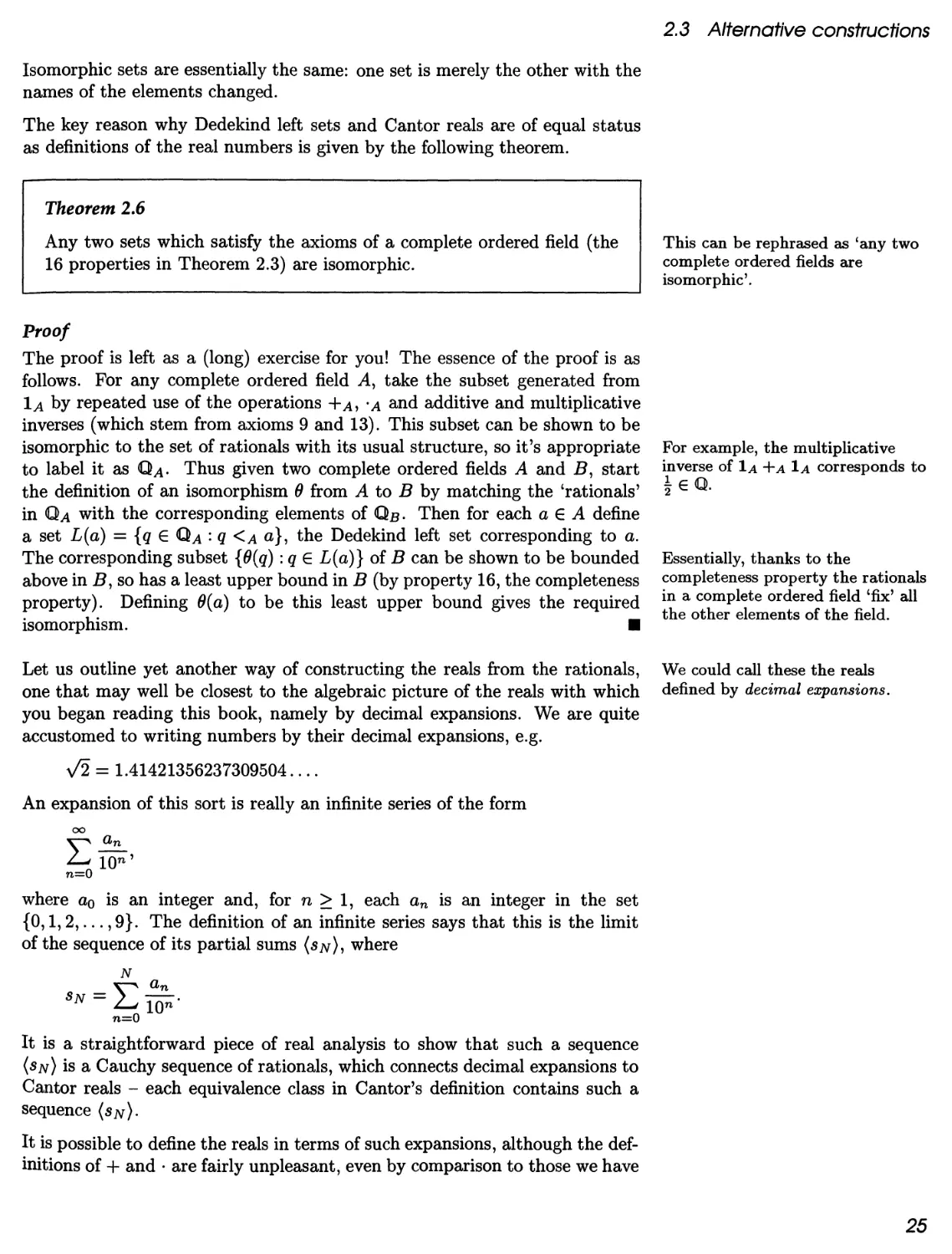
Isomorphic sets are essentially the same: one set is merely the other with the
names of the elements changed.
The key reason why Dedekind left sets and Cantor reals are of equal status
as definitions of the real numbers is given by the following theorem.
Theorem 2.6
Any two sets which satisfy the axioms of a complete ordered field (the
16 properties in Theorem 2.3) are isomorphic.
This can be rephrased as 'any two
complete ordered fields are
isomorphic'.
Proof
The proof is left as a (long) exercise for you! The essence of the proof is as
follows. For any complete ordered field A, take the subset generated from
1a by repeated use of the operations +4, 'A and additive and multiplicative
inverses (which stem from axioms 9 and 13). This subset can be shown to be
isomorphic to the set of rationals with its usual structure, so it's appropriate
to label it as Qa- Thus given two complete ordered fields A and B, start
the definition of an isomorphism 0 from A to B by matching the Nationals'
in Qa with the corresponding elements of Qb- Then for each a £ A define
a set L(a) = {q E Qa • q <a a}> the Dedekind left set corresponding to a.
The corresponding subset {0(q) : q E L(a)} of B can be shown to be bounded
above in B, so has a least upper bound in B (by property 16, the completeness
property). Defining 0(a) to be this least upper bound gives the required
isomorphism. ■
For example, the multiplicative
inverse of 1a +a 1a corresponds to
keQ.
Essentially, thanks to the
completeness property the rationals
in a complete ordered field 'fix' all
the other elements of the field.
Let us outline yet another way of constructing the reals from the rationals, We could call these the reals
one that may well be closest to the algebraic picture of the reals with which defined by decimal expansions.
you began reading this book, namely by decimal expansions. We are quite
accustomed to writing numbers by their decimal expansions, e.g.
V2 = 1.41421356237309504....
An expansion of this sort is really an infinite series of the form
oo
inn'
n=0
where a0 is an integer and, for n > 1, each an is an integer in the set
{0,1,2,..., 9}. The definition of an infinite series says that this is the limit
of the sequence of its partial sums (sat), where
sN
N
mn*
n=0
It is a straightforward piece of real analysis to show that such a sequence
(sn) is a Cauchy sequence of rationals, which connects decimal expansions to
Cantor reals - each equivalence class in Cantor's definition contains such a
sequence (sat).
It is possible to define the reals in terms of such expansions, although the
definitions of + and • are fairly unpleasant, even by comparison to those we have
25

2 The Real Numbers
already met with our earlier constructions. First of all we define the reals to be
the set D of all sequences (an), also written as (ao, a±, a2,...), such that a® E Z
and an £ {0,1,2,..., 9} for all n > 1, with the extra proviso that the sequence
does not eventually consist of 9s. This last proviso avoids counting some
numbers twice, e.g. 1.2 as both (1,2,0,0,0,0,0,0,...) and (1,1,9,9,9,9,9,9,...)
(corresponding to the decimal expansions 1.2000000... and 1.1999999...).
The rational numbers can then be represented by those sequences which
eventually cycle, corresponding to their decimal expansions, e.g.
and
1 = (1,0,0,0...) ends with the repeated cycle of 0,
21
— = (0,9,5,4,5,4,5,4,...) ends with the repeated cycle of 5,4.
Define a strict order on these sequences by
(0 <D (bn)
if
there is some k E N such that a^ <z bk but a; = b{ for all z <m k.
So for instance
(-11,3,0,0,0,0,...) <D (2,1,7,5,0,0,...) <D (2,1,8,3,0,0,...).
One can verify that <d is indeed a strict linear order on D and that the
completeness property is satisfied.
Defining addition on D is pretty tricky. One might hope to find a rule for
adding two. infinite sequences directly, but the carrying of digits arbitrarily
far down the sequence causes problems, not to mention avoiding ending in a
sequence of 9s. The way round this is to look at partial sums of the
corresponding decimal expansions, as follows. Given (an), (i)n) G D, define sequences of
rational numbers (An), (Bn) by
n n
An = Yl ai aild Bn = Yl bi'
i=0 i=0
For each n add the rationals An and Bn in the usual way, and construct
the corresponding sequence in D. Then define (an) +d (bn) to be the least
upper bound of these sequences (known to exist as one has already verified
the completeness property for D\).
One defines multiplication on D in a similar way. Verifying that D is a
complete ordered field is fairly gruelling! Nevertheless this version of the reals
is of great importance, precisely because it is one that we use in everyday
maths. Likewise in everyday maths we are aware of other representations of
the real numbers similar to D, differing only in the number base chosen, e.g.
2 or 3 rather than 10. In general, working with number base M > 2, we could
represent the reals by sequences (an) corresponding to the infinite series
oo
Corresponding to the decimal
oo
expansion N —^- above.
§ =0.9545454....
Corresponding to
-11.3 < 2.175 < 2.183.
Imagine trying to cope with
(3,3,3,3,...) +i> (6,6,6,6,...)!
n=0
We could call these the reals
defined by M-ary expansions.
Again, we'd need a convention
about sequences ending in
recurring (M — l)s.
26

2.3 Alternative constructions
Just as we did in the previous section with Dedekind left sets, let us review
some of the costs of these alternative definitions. Again they involve the
manipulation of infinite objects, e.g. sequences and equivalence classes, as
single objects. They also require particular care that one has actually defined
something, e.g. when defining the product of two Cantor reals in terms of
representative Cauchy sequences in them. There's a message here of taking
care with definitions. And all the constructions assume that we know all
about the rationals. How we might define the rationals in terms of something
simpler is the subject of the next section.
A Cauchy sequence codes infinitely
many rationals. And an
equivalence class |(an)J contains
infinitely many Cauchy sequences,
e.g. the sequences (an + £) for
each fixed k G fol.
Further exercises
Exercise 2.18
At the beginning of the section, we defined three sequences of rationals (an),
(6„) and (xn) by:
a0 = 1, b0 = 2,
and for each n > 1,
<2,
otherwise;
n+1 ~\an, othei
n+1 " 1 xn, othei
<2,
otherwise.
(a) Verify that these are all Cauchy sequences.
(b) Show that (an) ~ (bn) ~ (xn).
(c) Show that [(on)] -c [(an)] = 2C.
Exercise 2.19
Show that any non-zero Cantor real has a multiplicative inverse in Re, i.e.
given any Cauchy sequence of rationals (an) such that |(an)J ^ Oc, there is
a Cauchy sequence (6n) of rationals such that |(an)] -c KK)} — lc-
Exercise 2.20
Explain why one cannot define a strict order < on Cantor reals by
[(On)} < [<&»>] ^
there is some N € N such that an <q bn for all n >^ N.
Would the above give a suitable definition of a weak order < on Re?
Exercise 2.21
Define a weak order < on Cantor reals as directly as you can using an e-N
definition (as opposed to what we have done above, defining it in terms of <).

2 The Real Numbers
2.4 The rational numbers
The question 'What are the real numbers?' has been answered by giving a
variety of constructions exploiting the rational numbers. It seems reasonable
then to ask the question 'What are the rationals?' and in this section we shall
outline an answer. The approach is essentially the same as for the reals: we
explain the rationals in terms of something more 'basic', namely the set Z of
integers. This then suggests the question 'What are the integers?' and we
answer this in terms of the set N of natural numbers.
There is an alternative way of approaching this issue. Just as modern real
analysis texts tend to dodge the question 'What are the reals?' by building
the subject on the axioms for a complete ordered field (as in Theorem 2.3),
one could present axioms which in some sense describe the rationals. For
instance one might take all properties in Theorem 2.3 except the completeness
property (Property 16), which axiomatize an ordered field. Any set A which
satisfies all these properties contains a subset, generated by 0^ and 1a and
closed under addition, multiplication and inverses, which serves as a version
of Q. The reasons for putting this mathematics onto an axiomatic basis are
historically bound up with the foundational consequences of Dedekind's and
Cantor's constructions of R from Q, and these consequences are the meat
of set theory. So we shall persist in giving a construction of Q rather than
leaning on axioms.
When we are reasoning about rationals, we are accustomed to writing rationals
in the form f where a and b are integers, with b positive. Thus, to explain
the rationals in terms of the integers, we might describe a rational number as
given by an ordered pair (a, b) of integers, with b positive, corresponding to
the fraction f. This would create the problem of representing a rational by
several distinct pairs of integers in the set ZxZ+. For instance, as
1 — 2 _
2 ~~ 4 —
— I!
~~ 26'
the rational number \ would be represented by each of the ordered pairs
(1,2), (2,4), (7,14), (13,26).
This is the same sort of problem that we encountered when representing a
real number by a Cauchy sequence of rationals, and we resolve it in the same
way, via an equivalence relation. We need to find a way of saying why e.g.
\ and j£ are the same, without using the properties of Q - we are, after all,
trying to define Q! But we can exploit the properties of Z, and the key to
explaining, in terms of Z and its operations, that
a _ c
b~d
is by cross-multiplying the terms in this equation to get
ad = be.
This neatly avoids the problem that Z has no division operation and recasts
everything in terms of the multiplication which Z does have. We shall exploit
this last equation to specify when ordered pairs of integers are equivalent.
You may well be able to guess the
next question we should be asking!
Its answer will occupy the next
chapter.
Such a set might be U. itself!
We write Z+ for the set
{b e Z : b >z 0}.
We shall write <z for the order on
Z and +z, *z for its arithmetic
operations.
28

2.4 The rational numbers
Definition
For any a, 6, c, d € Z with 6, d >z 0, we shall write (a, 6)
a •/ d = b -z c.
(c, d) when
The symbol ~ is being used with
different meaning from the
previous section.
Exercise 2.22
Show that ~ is an equivalence relation on the set Z x Z+ of all ordered pairs
(a, b) of integers with b >z 0, i.e. it is reflexive, symmetric and transitive.
Definitions
Let [(a, 6)J be the equivalence class of the ordered pair (a, b) of integers
under the equivalence relation ~, i.e. the set
{(c,d)€ZxZ+:(a,6)~(c,d)}.
A rational number is such an equivalence class and Q is the set of all
these equivalence classes.
So, for instance, the rational -| is represented by the set
{(-fc,3fc):fceZ+}.
We must now describe the order relation on Q and its arithmetic operations
in terms of these equivalence classes and the order and arithmetic operations
of Z. We shall exploit various known results about the (desired!) set Q, which
will help us translate terms involving fractions |, with z, y integers, into ones
involving ordered pairs (z, y). For integers a, 6, c, d we have
a c
- < - if and only if ad < be, for 6, d > 0,
b a
a c
b + d
ad + be
bd '
a c _ ac
b"d~bd'
As rational numbers are represented by equivalence classes, we shall have
to make sure that any construction involving them yields the same result
regardless of which representatives we take from the classes. So our definitions
need to be preceded by the results given in the next exercise.
Exercise 2.23
Suppose that (a,6),(a',6,),(c,d),(c',d') G Z x Z+ and that (a,6) - (a',6;),
(c,d) ~ (c',d'). Use the standard properties of Z to show the following.
(a) a -I d <z b -z c if and only if a' -z d' <z b' -z c'.
(b) ((a -z d) +z (b -z c), b -z d) - {(a' -z d!) +z (bf -z c'), V -z dt).
(c) (a -z c, b -z d) - (a' -z c', V -z df).
These will help us define <q, +q
and -Q respectively. For example,
the ordered pair (ad + 6c, bd) could
represent f + § •
29

2 The Real Numbers
Solution
We shall do (c) and leave the others to you.
As (a, 6) ~ (a', b') and (c,d) ~ (c',d'), we have
a -z b' = b -z d and c-zd! =d-z c'.
Thus
(a -z c) -z {b1 -id') = (a -z b') -z (c -z d!) (by the commutativity and
associativity of -z)
= (b -z d) 'i (d -z c') (as (a, b) ~ (a', b') and
M)~(c',d'))
= {b -z d) -z {o! -z c') (by the commutativity and
associativity of -z),
which is what is required to show that (a -z c, b -z d) ~ (af -z c', b' -z d').
Definitions
Let [(a, 6)1 and [(c,d)]
[(*,&)! <q[M]
[(a,6)]+Q[(c,d)] =
[(a,6)].Q[(c,d)] =
Given an integer fc, the
ko = [(*,!)].
be any two rationals.
if a -z d <z b -z c\
= [((o-zd)+z(6-zc),
{{a-zc, b-zd)}.
Then
b-zd)l
corresponding rational number is
k<Q defined by
Exercise 2.24
Show that [(-1,2)] -q -2q <q -1q +q [(14,6)].
Solution
[(-1,2)]-q-2q = [(-1,2)]-q[(-2,1)]
= [(-1 -z -2, 2 -z 1)]
= [(2,2)].
-1q +0 [(14,6)] = [(-1,1)] +Q [(14,6)]
= [((-l-z6)+z(l-zl4), 1-z6)]
= [(8,6)].
To test whether [(2,2)] <q [(8,6)] we need to investigate whether
2 -z 6 <z 2 -z 8.
As 2 z 6 = 12 <z 16 = 2 z 8, the inequality holds, as required.
Exercise 2.25
Suppose that [(a, 6)] and [(c,d)] are rationals such that [(a, 6)] <q [(c,d)]. This shows that <Q is a dense
Show, by giving a construction, that there is a rational [(#,2/)] such that order.
[(a,6)]<Q[(^»)]<Q[(c,d)].
This matches our expectation that
-1.-2 = 1
as [(2,2)] = 1q.
Again, we expect that
1 ^ 6 6V3/
and |(8,6)] represents |.
30

2.4 The rational numbers
Solution
With ordinary rationals | and ^, we would expect the rational
1 /a c\ _ ad + bc
2\b + d)~ 2bd
to be halfway between them. So [((a -i d) +/ (6 •/ c), 2^6 •/ d)] ought to be
suitable as an [(x, j/)]. This is indeed the case and we leave you to verify the
details.
The result of the previous exercise also follows from the axioms for an ordered
field. We state without proof the following theorem, that Q is such a field. You
might like to give the proof yourself. (The proof is much more straightforward
than the corresponding proofs for R and Re)
Theorem 2.7
Q as constructed by equivalence classes of pairs of integers is an ordered
field, i.e. satisfies Properties 1 to 15 of Theorem 2.3.
We have defined the rationals in terms of integers. But what are the integers?
We shall define them in terms of the set of natural numbers N = {0,1,2,3,...}
and the order and arithmetic of N. The problem is, of course, how to represent
the negative integers without using subtraction, which is not a closed
operation on N. One trick is to represent the integer n by a pair (a, 6) of natural
numbers such that, in Z, a — b = n. So for instance —3 could be represented
by (1,4) or (7,10), and the integer 2 by (2,0) or (7,5). As ever, we have the
problem of representing each integer by a single object; and as ever we resolve
it via a suitable equivalence relation. This time, the key idea is that one can
express an equation involving —,
a — b = c — d,
in an equivalent way avoiding use of -, by
a + d = b + c.
It should come as no surprise that
we shall write <m for the order on
f^l and +n, -M for its arithmetic
operations.
Definition
For any a,b,c,d G N we shall write (a,b) ~ (c,d) if a +n d = b +^ c.
We leave you to check that ~ is an equivalence relation in the next exercise.
Exercise 2.26
Show that ~ as just defined is an equivalence relation on the set N x N of all
pairs of natural numbers.
Yet another meaning for ~! The
precise details of the constructions
of Q from Z and of Z from N are
not going to be of great significance
in the rest of the book, so it's not
worth inventing a special notation
for each of these equivalence
relations.
37

2 The Real Numbers
Definitions
Let [(a, 6)J be the equivalence class of the ordered pair (a, b) of natural
numbers under the equivalence relation ~, i.e. the set
{(c,d) € N x N : (a, b) ~ (c,d)}. An integer is such an equivalence class
and Z is the set of all these equivalence classes.
To define <z, +z and -j_ in terms of N, we are again guided by results that
we expect to hold for Z, involving natural numbers a, 6, c, d:
E.g. the ordered pair (a + c, 6 + d)
could represent the sum of a — 6
and c — d.
And to prepare the ground for our definitions, we have to check that they will
make sense for whatever representatives we take from the equivalence classes.
The results that we need are left for you as the next exercise.
Exercise 2.27
Suppose that (a,&),(a',&'), (c,d), (c',d;) € N x N and that (a, 6) ~ (a',6'),
(c, d) ~ (c',d'). Use the standard properties of N to show the following.
(a) a +n d <n b +n c if and only if a' +n d' <n b' +n c'.
(b) (a +n c, 6 +n d) ~ (a' +n c', b' +n d').
(c) ((o-nc)+n (&-Nd), (a-N d)+n (&-N c))
- ((a' -N c') +N (6' -N d;), (a' -N d!) +N (6' -N d)).
Definitions
Let [(o
[(«
[(a
[(a
Given a
6)]and[(c,d)]
,6)]<z[(c,d)]
,6)]+z[(c,d)] =
»»)]-z[(c,d)] =
be any two integers. Then
Lf a+N d <n 6+py c;
= [(a+NC,6+Nd)];
[((a -im c) +py (6 -N d), (6 -n c) +n (a •
i natural number n, the corresponding integer is nz
nz = [(n,0)].
wd))].
defined by
We shall not investigate the properties satisfied by the integers - not because
they are of no interest, but because they take us too far from the point of
this section, which is how one might construct the rationals, and thus the
reals, starting from simpler objects. As in the earlier sections of this chapter,
we note that our constructions involve treating infinite objects, equivalence
classes containing infinitely many pairs, as single objects; and this use of
infinity will need investigation. We have also reduced everything using quite
sophisticated set constructions to terms involving natural numbers. But what
are the natural numbers? This question, like that of 'What are the reals?', is
of sufficient significance to merit a chapter to itself.
a — b<c — d if and only if a + d < b + c;
(a - 6) + (c - d) = (a + c) - (6 + d);
(a — b){c — d) = (ac + bd) — (ad + be).
The idea of representing one set of
objects in terms of simpler objects
is of importance in computer
science, where complicated data
held on a computer are actually
represented, ultimately, by
electrical charges, or their absence.
For example,
-2Z = {(n, n + 2):nGl^}, which
has infinitely many elements.
32

3 THE NATURAL NUMBERS
3.1 Introduction
In the previous chapter we saw a way of constructing the real numbers from
the rational numbers. The rationals can be constructed from the integers,
and these can in turn be constructed from the set of natural numbers,
N = {0,1,2,3,...}. In this chapter we shall continue this process of reduction
by defining the natural numbers in terms of sets.
Why sets? One answer to this is that set constructions, in particular ones
involving infinite sets, were a vital part of the definition of the reals. Thus
set ideas, as well as the natural numbers, underlie our work so far. If we can
express natural numbers in terms of sets, then we have a single foundation
for our theory. Using sets in this way will, however, require us to be, or
to become, clear about the ways in which we might legitimately use sets.
When we were constructing reals in terms of rationals, rationals in terms
of integers, etc., we were reasonably relaxed about using familiar properties
of the 'known' number system when proving statements about the number
system being constructed from it. (Strictly speaking, we should perhaps have
defined N and proved all of its standard properties, then used these to define
Z and prove all its standard properties, and then done the same for Q and
then R.) But the use of sets to do much more than take the odd union or
intersection is less familiar; and the development of the theory of sets which
stemmed from e.g. Dedekind's and Cantor's work, turned out to be trickier
than anticipated! The impact for this chapter is that we shall have to start
the process of formalizing set theory, so that it supports both the special sets
which we shall take as the natural numbers and will also provide a framework
for establishing their familiar properties.
Also, as in the previous chapter, there is a different approach to explaining
the natural numbers, namely by giving axioms for them. Ideally such axioms
should be satisfied by essentially just one structure, as is the case with the
axioms for a complete ordered field: any two sets satisfying the properties
should be isomorphic. Such axioms were devised by Peano and are as follows,
expressed in terms of a set X.
Peano's axioms for the natural numbers
X
is a set with a special element Ox € X and a function S:
such that the following also hold:
1.
2.
3.
the function S is one-one, i.e. for all x,y E X,
T — 11'
for all x eX,Qx ^ S(x);
if S(x) =
for all subsets A C X, if A contains Ox and contains S(x)
x G A, then A is all of X.
X -
S(y)
-*X
then
whenever
One might reasonably argue on
historical and psychological
grounds that only the positive
integers (which are the counting
numbers) should be termed
'natural', not 0. But logicians
include 0 in the set, mainly because
of the importance of 0 in defining
arithmetic within set theory.
The Italian mathematician
Giuseppe Peano (1858-1932)
introduced these axioms in his 1889
paper, which you can find in [11].
Such an X is often called a Peano
system.
The idea of S is that it will be the
successor function, S(x) = x + 1.
This is called the induction
principle.
If we take X to be the set N = {0,1,2,3,...}, and interpret Ox by 0 and
the function S by the function n \—> n + 1, then it's clear that N satisfies all
33

3 The Natural Numbers
these properties - at least inasmuch as we've always known that the principle
of induction holds for N! Perhaps this principle seems more familiar in the
guise:
for all properties P, if Ox has property P, and S(x) has property P
whenever x has it, then every element of X has property P.
Exercise 3.1 —
What is the connection between the sets A and properties P in the two
versions of the induction principle above?
Solution
Each property P satisfied by (some or all of) the elements of X corresponds The idea of a property P giving
to a subset of X, namely rise to a set is verY important, but
will be seen to require care.
{x e X :x has the property P}.
Likewise a subset A of X corresponds to the property 'x belongs to A\
Peano's axioms may not, at first sight, seem so powerful. For instance, they
don't refer to the standard arithmetic operations of N, let alone give the
impression that a result like the fundamental theorem of arithmetic must
hold. But, as you will see, one can construct sum and product operations on
such a set X so that the full theory of N can then be developed.
The following theorem is an example of the power of the axioms.
The fundamental theorem of
arithmetic states that every
positive integer greater than 1 can
be expressed uniquely as a product
of primes.
Theorem 3.1
Suppose that the set X satisfies Peano's
other than Ox, is S(y) for some y E X.
axioms.
Then
every
x E X,
We have to exclude Ox because of
property 2 of the axioms.
Proof
We shall exploit the induction principle, which is where the real power of the
axioms resides. Define a subset A of X by
A = {x E X : x = Ox or x = S(y) for some y E X}.
Then Ox E A, by definition. And if x E A, then S(x) E A - by definition S(x)
is in A, regardless of whether x is! So by the induction principle, A — X,
meaning that every x ^ Ox is S(y) for some y. ■
Exercise 3.2
Give a similar proof from the axioms that for all xGX, S(x) ^ x. [Hints:
define A = {x E X : S(x) ^ x}. You will need to use the fact that S is one-
one.l
Why must induction be used?
A typical example of a set defined
by a property of its members.
We shall show how to construct arithmetic operations like addition later in
the chapter, for a specific set X. A key tool will be the definition of a function
/ by recursion. In the context of a set X satisfying Peano's axioms, this
34

3.1 Introduction
means giving /(Ox) some value and explaining how to define f(S(x)) assuming
one knew the value of f(x). For example, define / on {0,1,2,3,...} by
/(0) = 1,
f(n + 1) = (n + l)f(n) for n > 0.
Then to work out f(m) for some specific m, use the second part of the
definition to relate /(m) to the value of f(m — 1), then relate f(m — 1) to f(m — 2),
and so on, until you eventually hit /(0), which is defined here to equal 1. For
instance, to compute /(3), we have
/(3)=/(2 + l) =3/(2)
= 3/(1 + 1)= 3-2/(1)
= 6/(0 + 1)= 6-1/(0)
= 6-1 = 6.
In fact this / is just the factorial function, defined by f(n) = n\ — n • (n - 1) •
(n-2)-...-2-l.
A general result about defining a function by recursion on a set X satisfying
Peano's axioms is as follows.
Theorem 3.2 Definition by recursion
Let X satisfy Peano's axioms. Let Y be any set, yo any element of Y
and h: X x Y —> Y a function on pairs (x,y) £ X xY. Then there
exists a unique function /: X —> Y such that
/(Ox) = »o,
f(S(x)) = h(x,f(x)), for all x.
For the factorial example above, we could take both X and Y to be the set of
natural numbers, yo — 1 and h the function defined by h(x,y) — (x + 1) • y.
We shall delay a proof of this theorem until we have established a sensible
framework for such a proof. For the moment, let's use Theorem 3.2 to show
that any two sets satisfying Peano's axioms are isomorphic.
Theorem 3.3
Let X be a set with a special element Ox and a function Sx : X —> X,
such that X satisfies Peano's axioms. And let F, with an element 0y
and a function Sy: Y —
and Y are isomorphic, i.e.
1. / is a bijection;
1 2. /(0x) = 0y;
3. f(Sx(x)) = SY(f(x)),
> y, similarly satisfy these axioms. Then X
there is a function /: X —> Y such that
for all x e X.
f is an isomorphism.
f matches the elements of X with
those of Y so that the effects of the
functions Sx and Sy also match.
The theorem can be read as 'any
two Peano systems are isomorphic'.
35

3 The Natural Numbers
Proof
As X satisfies Peano's axioms, we can apply Theorem 3.2, taking yo — Oy
and the function h: X xY —>Y defined by h(x,y) = Sy(y). This defines a
function / of the form
f:X—>Y
/(0x) = 0y,
f(Sx(x)) = SY(f(x)), for all xeX.
As /, by definition, satisfies requirements 2 and 3 for an isomorphism, we
need only show that / is a bijection. First, we show that / is one-one.
We need to show that for all z, x' G X, if f(x) = f(x') then x — x'. We shall
exploit the induction principle for X. Define a subset A of X by
A = {x G X : for all x' € X, if f{x) = f{x') then x = x'},
or, equivalently,
A = {xeX: for all x' G X, if x ^ x' then f(x) ^ f(x')}.
So A consists of those x for which f(x) isn't the image under / of another
x' ^ x. We shall show that A = X by induction, and this will show that / is
one-one.
Do we have Ox € A? Take any x' € X such that x' ^ Ox- We shall show that
this forces f(x') ^ /(Ox). As xf ^ Ox, then by Theorem 3.1 x' = Sx(x) for
some a; € X. This means that f(xf) = f(Sx(x)) which, by the definition of
/, equals £y (/(#)). But Y satisfies Peano's axioms, so that for any y £Y we
have Sy(y) ^ Oy. In particular Sy(f(x)) ^ Oy. As the definition of / gives
that Oy = /(Ox), this means that f(x') ^ /(Ox), as required. Thus Ox € A.
Now we suppose that x € A and show that Sx(#) £ ^- Again we suppose
that x' ^ Sx(x) and show that f(x') ^ f(Sx(x)). There are two cases: when
x' = Ox and when x' ^ Ox- In the case that x' = Ox, we have already shown
that Ox € A, so that if x' = 0X ^ Sx(x) then f(x') = f(0x) ^ f(Sx(x)). In
the case that x' ^ Ox, then by Theorem 3.1 we have x' — Sx{x"), for some
x" € X. The condition that
*VSx(z)
becomes
S(x") # Sx(aO,
which, as Sx is one-one, means that
x" # re.
As a; € A, this means that
so that, as Sy is one-one,
SyU{x")) * Sy{f{x)).
You will find it quite common to
use induction to prove things about
a function defined by recursion.
36

3.7
But by definition of /, Sy(/(x")) = f(Sx(x")) = f(x'), while
SY(f(x)) = f(Sx(x)), so that
f(x')?f(Sx(x)),
as required. Thus by the induction principle for X, we have A = X, so that
/ is indeed one-one.
Now let us show that / is onto. This time we shall use the induction principle
for Y to show that the subset B of Y defined by
B = {y £Y :y = f(x) for some x G X}
is all of Y.
We have Oy G B, because Oy = /(Ox)- Now suppose that y G B and show
that Sy (y) GB. As y G B, there is some xGl such that f(x) = y. Then by
definition of / we have
f(Sx(x)) = SY(f(x))
= Sy(y),
so that Sy(y) G B, as required. Thus by the induction principle for F, we
have B = Y, so that / is onto, completing the proof that / is a bijection. ■
Now we have established that any sets which satisfy Peano's axioms are
essentially the same, let us return to the issue of defining one such set, which we
shall designate as the set N of natural numbers, in terms of something more
basic. The something more basic will be very simple sorts of sets. As with
definitions of the real numbers in terms of Q, there are likely to be several
reasonable candidates. The first of these was proposed by the German
mathematician and philosopher Gottlob Prege (1848-1925), defining the natural
number 0 and, given the number n, using it to define its successor S(n). The
representation of 0 was by the set 0, where
Q=M,
which is the set of all sets containing 0 elements - the empty set 0 being the
only such set. In general, the set n representing the natural number n also
consists of all sets with n elements. A circular definition is avoided by using
formal logic, as well simple ideas about sets, to define n + 1 in terms of n\
and as 0 has been defined, this gives a recursive definition of n in general.
Informally, the idea is to exploit a definition of when a §et C has exactly one
element, by
(there exists x)(x € C and (for all y)(ii y G C then y = x)).
Then given n, define its successor by
n+ 1 = {B : ( there exists A) (A en and ACB
and B \ A has one element)}.
Imagining n to consist of all sets with the same number, n, of elements, the
set n + 1 should then consist of all sets with one more element.
Alas! This idea has a major flaw, because treating n as a set can lead to a
contradiction, as we shall discuss in the next chapter. This is a shame, as
Prege's idea fits in well with the principle behind several of the definitions in
B is the image set, or range,
function /.
We shall look at a suitable
framework of formal logic in
next chapter.

3 The Natural Numbers
the previous chapter, in that n can be regarded as an equivalence class arising
from a very important equivalence relation. The idea behind this relation
is that one way of judging that two sets X and Y have the same number
of elements is that there is a bijection from one to the other. So define a
relation » by X « Y when there is a bijection /: X —> Y. It's easy to
show that « is an equivalence relation and that each n as above is one of
its equivalence classes. As treating n can lead to a contradiction, clearly this
plausible definition of « needs more careful treatment.
For the rest of this chapter we shall concentrate on a different definition of
natural numbers in terms of sets and logic. Our definition will in fact represent
each n by a specific set in the equivalence class n. To put the definition on
a sound footing, we shall keep an eye on what properties we shall expect of
sets, but we won't firm up on these properties until the next chapter.
We shall return to this important
relation in Chapter 6.
3.2 The construction of the natural numbers
To match Peano's axioms, we must not only describe the set N but also
explain which of its elements is the special element 0 and how to define the
successor function on it. There are many possible definitions. Ours, which is
now accepted as the standard one, represents natural numbers by sets whose
construction and relationship with each other depend on very basic properties
of sets. A major example of what we mean by a 'basic property' is the
membership relation E, i.e. the property of an object x being a 'member of
or 'element of a set y. Furthermore, we shall take all objects, like the x here,
to be sets themselves, to fit in with our aim of constructing natural numbers
purely from sets. But we shall not seek to explain here what we mean by a
'set' or what x € y means: for our purposes in this chapter, these are notions
informally understood from everyday mathematics.
Perhaps the simplest set we encounter in normal mathematics is the empty
set 0. We shall take 0 to represent the natural number 0. We represent the
successor function as follows.
As ever, we write x G y for 'x is an
element of y\ and x 0 y for lx is
not an element of y\
The attitude is similar to our
definition of the reals in terms of
the rationals, putting to one side
the issue of what the rationals are.
One way of explaining 0 is as the
set y such that
(for all x){x 0 y).
Definition
Given a set
£+ =
#, the successor
xU{x}.
of x,
written
as x ,
is the set
So
To support this definition we need
{x} to be a set whenever x is a set,
and A U B to be a set whenever A
and B are.
0+, 0++, 0+++ will represent
1,2,3 respectively.
0+ = 0U {0} = {0},
0++ = (0+)+ = {0} [J {{0}} = {0? {0}h
0+++ = (0++)+ = {0, {0}} U {{0, {0}}} = {0, {0}, {0, {0}}}.
It is an immediate consequence of the definition that x C of1", for all x. And We shall make frequent use of the
it looks as though x~*~ is a set with one element more than x. facts that x e x+ and x C x+.
Exercise 3.3
Is it true that x+ has one element more than the set x?
38

3.2 The construction of the natural numbers
Solution
As x+ = x U {#}, certainly x+ contains x as a subset, but would appear to
contain also the extra element x (the single element of the {x} in the union).
But for this element to be an extra, we need that x # x. If x G x then {x} is
a subset of x, so that x U {x} = x.
As we are aiming for the set x representing n to have, at least intuitively, n
elements, we shall want to show that for this sort of set it is not the case that
x G x.
This definition turns out to have more technical advantages than may be
immediately apparent. For instance, as we shall show in this section, it will
allow us to order N by the € relation, which is about as basic a notion in set
theory as you can get. But first we use it to define sets which will turn out
to include N.
In general, if y G z, then {y} C z.
It isn't obvious that there is no set
X which belongs to itself. Indeed,
the set of all sets, if there were
such a thing, would have to belong
to itself.
For instance, 0+ G 0+++,
corresponding to 1 < 3.
Definition
The set y is inductive if 0 G y and x+ G y whenever xGy.
Exercise 3 A
Show that if y and z are both inductive sets, then their intersection y n z is
also inductive.
Solution
We need to show that 0 G yf)z and that whenever x EyDz, then x+ G y D z.
As y and z are both inductive, 0 belongs to both of them, and hence to their
intersection. Likewise if x G y n z, then both x E y and x G z, so that as y
and z are inductive, x+ belongs to both of them, and hence to y n z.
The significance of inductive sets is that we are going to define N as the
intersection of all inductive sets, so that it will be the smallest inductive set.
There's only one snag with this: are there any inductive sets in the first place?
We shall assume that there is at least one, y say. (This is a major assumption!
From it flows the existence of infinite sets, from which most of the interest in
set theory derives. It will figure as one of the axioms of set theory.) Then the
intersection, N, of all inductive sets, which is a subset of each of them, must
be a subset of y in particular. And if z is any other inductive set, then N is
also a subset of z and y, and hence of y fl z, which is inductive by the result of
Exercise 3.4. Thus, given our assumption that there is an inductive set y and
our desire to define N as the intersection of all inductive sets, it is sufficient
to define N in terms of y and its inductive subsets, as follows.
39

3 The Natural Numbers
Definitions
The set of natural numbers N is the intersection of all inductive subsets
of any inductive set y, i.e.
(^| = f]{z : z is an inductive subset of y}
= {x : x G z for all inductive z C y}.
A natural number is a member of N. We write x = y for z, y G N when
x and y are equal as sets.
If A is a set (of sets), then f] A is
the set {x : x G z for all z G A}.
So x = y means that every member
of x is a member of y, and vice
versa.
Given that we want N to satisfy Peano's axioms and that we are going to take
the map S: x i—> x+ as the successor function on N, we require N to be an For S to be a function from I
itself, we need that x+ G N
to
inductive set. The next theorem shows this.
Theorem 3.4
The set N is inductive.
whenever x G I
Proof
The proof is very similar to the solution to Exercise 3.4. First, 0 belongs
to any inductive set, hence to all inductive subsets of y, and hence to their
intersection N. Now suppose that x G N, so that x G z for all inductive subsets
z of y. As each such z is inductive, x+ also belongs to z. Thus x+ belongs to
the intersection of these zs, i.e. x+ G N. Hence N is inductive. ■
As N is inductive, we can now define the successor function on N.
Definitions
The successor function S on N is the function
S: N—+N
We shall write 0 for 0 in its role as the 0 of N, and likewise 1 for 0+, 2
for 1+, i.e. 0++, etc. In general we shall use bold numbers and letters,
like n, for elements of N.
As we are trying to build f^lona
basis of just sets and logic, the
question arises of what is a
function. We shall later define
functions in terms of sets.
And we can show that M satisfies the inductive principle of Peano's axioms.
Theorem 3.5 Proof by induction on N
For all subsets A C N, if A contains 0 and contains n+ whenever n G A,
then A is all of N.
40

3.2 The construction of the natural numbers
Proof
Any such A is an inductive set. N is the intersection of all inductive sets
and is therefore a subset of any one of them. Thus f^CA But 4CN. So
A = N. ■
Theorem 3.5 provides the basis for almost every proof about the natural
numbers. Obviously we will encounter results about N whose proofs exploit
previously proved results about N, but somewhere in the history of these results
a proof by induction will almost inevitably lurk.
There are a number of tempting pictures of what N looks like. One is that,
because N is the smallest set containing 0 (= 0) and closed under the successor
function,
N = {0,0+, 0++, 0+++, 0++++,...},
with every element of N looking like
where the superscript consists of finitely many +s. Although this is a helpful
picture, the use of dots '...' in these expressions, standing for 'and so on', fails
to give a finite description of the set - and because statements about infinite
sets turn out to require some care, we shall try to avoid, where possible,
infinite descriptions of mathematical objects (even though we may use them
as a guide to our intuition). A finite description or definition of something is,
in principle, something which people can communicate to each other within
a finite time.
Another tempting picture is that not only is every element of a natural number
also a natural number, but also each natural number is the set of all its
predecessors:
1 = 0+ = 0U{0} = {0} (as 0 = 0),
2 = 1+ = 1U{1} = {0}U{1} = {0,1},
3 = 2+ = 2U {2} = {0,1} U {2} = {0,1,2},
and so on. Furthermore, the set n contains, intuitively, n elements. But
given that we are trying to define the natural numbers, this latter observation
involves a circularity. However, the intuition that each natural number is the
set of all its predecessors is one that we can put on a firm foundation, by
defining an order < on N in such a way that this becomes true.
Definitions
For all m, n € N we write m < n when m E n.
We write m < n when ra< n or m = n.
It is indeed true that if x G n,
where nGM, then x is a natural
number. See Exercise 3.13.
For a given everyday number n, we
use the bold version of the same
letter, n, for the set formally
representing it. Intuitively
_ n+++- +
We shall prove that < is a linear order on N. This is worth doing in its own
right, but will also help us finish showing that N satisfies Peano's axioms. We
n = 0
This defines the <n used in the
previous chapter. We shan't use
this notation from now on as there
will be no other order relations
around to confuse us!
41

3 The Natural Numbers
shall state the results in terms of E rather than <, as their proof will rely
heavily on the properties of €.
Theorem 3.6
The relation €
(i) irreflexive:
(ii) transitive:
linearly orders N, i.e.
for all n E N, n ^ n;
for all m, n,p E N, if
it has the following properties:
m E n and n E p, then m E p;
(iii) linear: for all m, n E N, m E n or m = n or n E m.
Proof
We shall do the proof in stages, leaving some parts as exercises for you. Note
that E doesn't linearly order every set of sets. For instance, as 0 E {0} and
{0} E {{0}} but 0 £ {{0}}, E is not in general transitive. So the result
depends on the particular properties of N. The picture that
N = {0,1,2,3,...}, where 1 = {0}, 2 = {0,1}, 3 = {0,1,2} and so on,
makes the theorem plausible, but does not constitute a general proof for all
natural numbers. We must instead make heavy use of Theorem 3.5, i.e. proof
by induction on N. We shall start with the transitive* property, as we shall need
this as a lemma for our proofs of the other properties.
A direct proof that if m E n and n E p then m 6 p gets nowhere. Instead we
use induction on p for fixed m and n. In terms of Theorem 3.5, we define a
subset A of N by
A = {p E N : ifmEnEp then m E p},
and shall show that A is inductive.
First, as 0 = 0 and 0 contains no elements, it cannot be true that m E n E 0,
so that the statement 'if m E n E 0 then m E 0' is vacuously true. Thus
0G A.
Now suppose that p E A and show that p+ E A. We need to show that if
m E n E p+ then m E p+ (i.e. p+ E A), where we can exploit the information
that if m E n E p then m E p (i.e. p E A). So suppose that
m E n E p+.
As n E p+ and p+ = p U {p}, we have two possibilities: n E p; or n E {p},
i.e. n = p. In the case that n E p we then have m E n E p, so that, as p E A,
we have m E p. But pCp+,so that m E p+, as required. In the case that
n = p, then m E n is the same as m E p, so that, as in the first case, m E p+.
In both cases we have obtained m E p+, which is what is required to show
that p+ E A.
Strictly speaking, we have shown
that E is not transitive on the set
{0,{0},{{0}}}.
A statement of the form 'if P then
<5' is false only when P is true and
Q is false. So when P is false, as
here, the statement is true.
The only element of {p} is p, so if
n E {p} then n = p.
Thus A is inductive, so that by Theorem 3.5 A =
transitive on M.
which shows that E is
Exercise 3.5
Give an example to show that E is not in general linear on a set of sets.
42
s "reflexive" in the printed book

3.2 The construction of the natural numbers
Exercise 3.6 .—
Show that E is irreflexive on N. [Hints: put A = {n E N : n £ n} and use
induction. You should find that the transitive property of E on N is needed
at some stage of the argument.]
Solution
Define the subset A of N by
A = {nE N:n£n}.
First, as 0 = 0 and 0 contains no elements, then we have, in particular, that
0 is not an element of 0, i.e. 0 0 0. Thus 0 E A.
Now suppose that n e A and show that n+ E A, i.e. n+ 0 n+. We shall
suppose that n+ E n+ and try to derive a contradiction. If n+ E n+, then
n+ E nU{n}.
This gives two possibilities, that n+ E n or n+ = n.
In the first case, that n+ E n, we have, as n E n U {n} = n+,
n E n+ E n.
But E is transitive on N, so that n E n, contradicting that n e A.
In the other case, that n+ = n, we have
n E n U {n} = n+ = n,
i.e. n E n, again contradicting that n E A.
In both cases we have a contradiction, so that in fact n+ 0 n+, showing So for natural numbers n, the set
that n+ E A. Thus A is inductive and by Theorem 3.5 A = N. Hence E is n+ does contain one more element
irreflexive on N. ttian n-
Before we tackle the linear property of E on N, we need some results about
the successor function, whose proofs we shall leave as exercises for you, to give
you practice in using induction with sets.
Theorem 3.7
For all m,neN,
(i) 0^n+;
(ii) if m E n then m+ E n+;
(iii) if m+ = n+ then m = n.
Exercise 3.7
Prove Theorem 3.7. [Hints: (i) is very straightforward! Then prove (ii), using
induction. It should then be possible to prove (iii) without needing to use
induction. Our solution to (iii) uses the result of (ii) and the fact that E is
irreflexive on N, i.e. n^n, for all n E N.]
Theorem 3.7(i) and (iii), along
with Theorem 3.5, show that N
satisfies Peano's axioms.
43

3 The Natural Numbers
Solution
(i) Note that if 0 = n+ for some n, then
n e n U {n} = n+ = 0 = 0,
i.e.
ne 0.
This of course contradicts that 0 has no members. Thus for all n G N,
0^n+.
(ii) We shall prove this by induction on n for fixed m, and we shall present
the induction proof in a more familiar mathematical style. Rather than
show that some subset A of N is inductive, we shall work with a property
P(n) of natural numbers n, and show that
P(0) holds and P(n+) holds whenever P(n) does,
from which it follows that P(n) holds for every natural number n. Here
our A is the subset
i = {neN: if men then m+ G n+},
and the corresponding property P(n) is
if m € n then m+ € n+,
where m is a fixed natural number.
For n = 0, m € 0 is false (as 0 = 0), so that
if m G 0 then m+ G 0+
is vacuously true (i.e. P(0) holds).
Suppose that P(n) holds, i.e.
ifmEn then m+ G n+,
and that m € n+. We shall show that m+ E n++, which then establishes
that P(n+) holds. As m € n+ and n+ = n U {n}, we have
m G nU {n},
so that either m € n or m = n.
In the case that m € n, the inductive hypothesis gives that m+ G n+. As
n+ C n++, this gives m+ € n++. In the case that m = n, then
m+ = n"1" G n++. So in either case m+ € n++, as required to show that
P(n+) holds. The result follows by induction (i.e. Theorem 3.5, but we'll
stop mentioning this now!)
(iii) This can be done directly, without induction. Suppose that m+ = n+.
This can be rewritten as
mU{m} = nU{n},
so that m, which is an element of mU {m}, is an element of n U {n}.
There are two possibilities: m G n and m G {n}, i.e. m = n.
For the connection between A and
.P, see Exercise 3.1 in the previous
section.
This is the basis of the induction,
equivalent to showing 0 G A.
This is the inductive step,
equivalent to showing that n+ G A
whenever n G A.
We've shown the equivalent of
A = N, i.e. P(n) holds for all
44

3.2 The construction of the natural numbers
In the case that m € n, part (ii) of the theorem gives that m+ G n+.
But m+ = n+, so that this means that m+ G m+, contradicting G being
irreflexive on N. This leaves only the case that m = n, the desired result.
As remarked above, parts (i) and (iii) of Theorem 3.7, along with Theorem
3.5, show that N satisfies Peano's axioms. As this was our main objective in
this chapter, it's worth recording as a theorem.
This means that any consequence
of Peano's axioms holds for N, like
Theorem 3.1 of the previous
section.
Exercise 3.8
Suppose that neN with n ^ 0. Show that 0 G n. [Hint: use Theorem 3.1 of
the previous section and induction.]
You should now have enough machinery to conclude the proof of Theorem 3.6
by proving that G is linear on N.
Exercise 3.9
(a) Show that for all m, n G N, m G n or m = n or n G m. [Hint: use
induction on n for fixed m.]
(b) Show further that for all m, n G N, exactly one of the above holds.
Solution
(a) We shall use induction on n for a fixed m to show that m G n or m = n
or n G m for all n G N.
For n = 0 we cannot have m G 0 (as 0 = 0). If m happens to be 0 we
are done, as then m = 0 = n. And if m ^ 0 then, by Exercise 3.8, 0 G m.
Thus the result holds for n = 0.
Now suppose that the result holds for n, so that m G n or m = n or
n G m, and show that the result holds for n+, i.e. m G n+ or m = n+ or
n+ G m.
In the case that m G n, then as n C n+ we have m G n+. And in the
case that m = n, then as n G n+ we have m G n+.
What about the case that n G m? This means that m is non-empty,
so that m ^ 0. Then by Theorem 3.1 in the previous section (which
applies as N satisfies Peano's axioms), m = k+ for some k G N. This
gives n G k U {k}, so that either n 6 k or n = k. If n G k then, by
Theorem 3.7(ii), n+ G k+, i.e. n+ G m; and if n = k then n+ = k+, i.e.
n+ = m.
In all cases we have m G n+ or m = n+ or n+ G m, as required.
(b) This one ought to be straightforward and is left to you.
Theorem 3.8
N, with special element 0 and the successor function S: n i—> n+,
satisfies Peano's axioms.

3 The Natural Numbers
The order on N has one extra property which is of great importance, in
everyday mathematics and within set theory, and that is being well-ordered.
Definition
A linearly ordered set X with (weak) order < is well-ordered if every
non-empty subset of X has a least element, i.e. for all non-empty BCI,
there is an element b0 G B such that 60 < &>
for all beB.
Theorem 3.9
N is well-ordered by G.
Proof
Let B be a non-empty subset of N, which we have shown to be linearly ordered
by <, where < is G. We shall show that B has a least element by assuming
that it doesn't have one and deriving a contradiction. So assume that B
doesn't have a least element. Define a subset A of N by
A = {n G N : m £ B for all m < n}.
We shall show by induction that A = N, so that B must be empty,
contradicting that B is non-empty.
First, 0 cannot be in J3, as otherwise 0 would automatically be the least
element of B. Thus 0 G A.
Now suppose that n E A and show that n+Gi As n G A we have m 0 B
for all m < n. For n+ to be in A, all we need to show is that n+ g B, because
if m < n+ then either m < n (and we already know that m # B for such m)
or m = n+. If it were the case that n+ G B, then, as m 0 B for all m < n+,
n+ would be the least element of B: this would contradict that B has no least
element, so we conclude that n+ £ B. Hence n+ G A, as required.
Then, by induction, A = N. This means that B is empty, contradicting that
B is non-empty. Thus B must indeed have a least element. ■
Exercise 3.10
Fill in the missing details of the proof above by showing that for all m, n G N,
m < n+ if and only if m < n.
G is a strict order < on fol. The
corresponding weak order < is
defined by m < n if m G n or
m = n.
As 0 = 0, there can be no m with
m G 0 (or equivalently m < 0).
Thus 0 is the least element of N.
This needs a bit of justification and
is left as an exercise.
A consequence of this exercise and of Theorem 3.9 is that the least number
greater than n is its successor n+. This is worth stating as a theorem.
46

3.2 The construction of the natural numbers
We write min B for the least
element of a non-empty subset of
the well-ordered set N.
Proof
First of all, note that the set {k G N : n < k} is non-empty, as it contains
n+. So as N is well-ordered by < this set does indeed have a least element.
To show that this element is n+, note that by Exercise 3.10, if m < n+ then
m < n. This means that there can be no m with n < m < n"1". Thus n+ is
the least element of {k G N : n < k}, as required. ■
In a later chapter we shall extend many of the features of N to give a theory
of infinite numbers; and well-ordered sets will be the basis of this theory. These numbers are called ordinals,
and the natural numbers turn out
In the next section we shall look at how to do arithmetic in N. to be the finite ordinals.
Further exercises
Exercise 3.11
Show that for all m, n G N, m < n if and only if m is a proper subset of n.
Exercise 3.12
Show that for all m, n G N, the least of m and n in the linear order on N,
min{m, n}, equals m H n.
Exercise 3.13
Show that for all n € N, if x E n then x € N.
Exercise 3.14
Show that for all m, n E N, if m+ € n+ then m E n
Exercise 3.15
Show that for all n E N, n++ ^ n.
Exercise 3.16
Show that for all m, n € N, if m < n then m+ < n.
Exercise 3.17
Let X be a set well-ordered (so also linearly ordered) by < (a weak order).
Suppose that X has a least element 0 and has the further property that for
each x € X the set
{y € X : x < y}
is non-empty. For each x let x+ be the least element of this set.
Show that X is inductive.
Theorem 3.10
For all n G N, n+ = min{k G N : n < k}.
So that each natural number is a
set of natural numbers.
So that 0 < x, for all x G X.
x < y meaning x < y and x # y.
47

3 The Natural Numbers
3.3 Arithmetic
In this section we shall define operations of addition, multiplication and
exponentiation on the set of natural numbers, and show that these operations
have the properties that we expect from everyday mathematics. Although we
shall frame the definitions in terms of our special set N, the definitions could
have been done for any set X satisfying Peano's axioms. Our major tool for
defining the operations will be definition by recursion (Theorem 3.2); and our
major tool for establishing their properties will be induction.
We shall use the following special case of definition by recursion obtained by
taking X = Y = N in Theorem 3.2.
Theorem 3.11 Recursion on N
Let y0 be any element of N and h: N xN —> N a function on pairs
(x,y) GNxN. Then there exists a unique function /: N —> N such
that
/(0)=y0,
/(n+) = /i(n,/(n)), for all n E N.
First of all, we shall define addition. The trick is to use recursion to define
m + n for a fixed m and all n. The / in Theorem 3.11 will be defined so that
/(n) is to be regarded asm + n. To emphasize this, we shall refer to this / as
/m- We choose y0 to give us the desired value of /m(0), which is m itself: so
put y0 equal to m. How about the choice of hi It is h that has to get us the
value of /m(n+) from the values of n and /m(n), or, equivalently, of m + n+
from n and m + n.
For instance, we expect addition to
be commutative, namely
x + V = V + x, for all #, y.
As N satisfies Peano's axioms, we
can indeed apply Theorem 3.2 to it.
Of course we want m + 0 to equal
m.
The definition could also use the
fixed value m.
ILxercise 3.18
Define h(x,y) so that /m(n+) = ft(m,/m(n)).
Solution
Our intention is that for any natural number k, its successor k+ ought to be
the same as k 4-1. So our definition of + should give that m+ n+ is the
same as m H- (n + 1), which in turn ought to equal (m + n) + 1, which is the
same as (m + n)+. We exploit this desired feature of + to define m -I- n+ to
be (m + n)+, i.e. define /m(n+) as (/m(n))+.
Thus we define h by
Recall that we use 1 as a
shorthand for 0+.
An important aspect of our definition of h above is that it exploits only a
function we assume that we already know about, namely the successor
function n i—► n+ on N. This is a vital part of defining a function by recursion,
that it is being defined in terms of known functions, although the importance
of this might not be obvious from the wording of Theorem 3.11. Bear in mind
that we are seeking to represent natural numbers by sets and that Theorem
3.11 will need proof within whatever framework we establish for sets. It will
You might also notice that in this
case the value of h(x, y) doesn't
depend on x.
48

3.3 Arithmetic
transpire that functions are themselves sets and that, along with other sets,
one has to justify their status as sets, given that there are dangerous non-sets
which look suspiciously like sets - all will be explained in the next chapter!
For the moment, note that by defining a function by recursion in terms of
other functions already known to be well-behaved sets, we are guaranteed
that the new function is also a well-behaved set.
To summarize, Theorem 3.11 will guarantee that there is a function
/m: N —► N defined by
/m(0) = m,
/m(n+) = (/m(n))+.
Writing /m(n) asm + n, this becomes
m -I- 0 = m,
m + n+ = (m + n)+.
We shall normally use this latter form, mainly because it is customary to
represent addition by +. But be very careful when working through the rest
of the section to remember that our definition of m + n is for a fixed m and
variable n.
The definition of + by recursion
appears in the work of both
Dedekind and Peano. Dedekind
appreciated the need to establish
results like Theorem 3.2 to validate
the construction.
This gives a definition for the +n
used in the previous chapter.
Exercise 3.19
Use this definition to compute the following:
(a) 3 + 2;
(b) 2 + 3.
Solution
(a) In terms of the /m notation above, 3 + 2 is the same as fs(2). To be able
to evaluate this using the definition of /3, we need to express the 2 as 1+,
giving
/8(2) = /3(1+)
= (/3(1))+.
This in turn requires us to compute /3(1), which, as 1 = 0+, the definition
gives as
/s(l) = /s(0+)
= (/3(0))+.
The definition specifically gives the value of /a(0) to be 3. We can now
amalgamate these calculations and do so using the + notation:
3 + 2 = 3 + 1+
= (3 + l)+
= (3 + 0+)+
= ((3 + 0)+)+
= ((3)+)+
= 3++
Recall that 2 = 1+ = 0++ and
3 = 2+= etc.

3 The Natural Numbers
(b) 2 + 3 = 2 + 2+
= (2 + 2)+
= (2 + l+)+
= ((2 + l)+)+
= ((2 + 0+)+)+
= (((2 + 0)+)+) +
= (((2)+)+) +
= 2+++
= 5
Exercise 3.20
Show that for all n G N, n + 1 = n+.
Solution
n + 1 = n + 0+
= (n + 0)+
= n+.
The definition of multiplication is handled similarly, by using recursion as in
Theorem 3.11 and defining m • n for fixed m and all natural numbers n. We This defines the m m n used in the
could again write /m instead of the / in Theorem 3.11, to emphasize that previous chapter.
/(n) will really mean m • n. We first define /m(0) by
/m(0) = 0.
How might we define /m(n+) in terms of n and the previous value fm(n) (and
the fixed value m itself)? What we would expect from normal arithmetic is
that m • n+ is the same as m • (n + 1) which ought to equal (m • n) + m.
This could be used to define /m(n+), which is m • n+, in terms of /m(n) and
m and +. One of the points of recursion is to define a function in terms of
previously constructed functions, and we have just constructed +. So we can
legitimately define /m(n+) by
/m(n+) = /m(n) + m.
In terms of the more usual notation for multiplication, this becomes
m 0 = 0,
m • n+ = (m • n) + m.
Exercise 3.21
Use a similar method to define exponentiation, i.e. mn. (As + and • have
already been defined, these functions can be exploited in the definition.)
Solution
We can use Theorem 3.11 to define mn for fixed m and all n, by the following: We could in fact have defined
^o
m + n and m • n for fixed n and all
111 — 1? m. But we could not do this for
mn+=m„.m_ m". Why not?
50

Let us summarize the definitions of the arithmetic operations on N, as follows.
Definitions
Addition, multiplication and exponentiation on N are defined, for fixed
m and all n, by:
m + 0 = m,
m + n+ = (m + n)+;
m 0 = 0,
m • n+ = (m • n) + m;
m° = l,
n ' n
m = m • m.
Exercise 3.22
Use the definitions above to compute the following,
(a) 0-3
(b)21
Solution
(a) Multiplication is the more complicated operation, as it is defined in terms
of the more basic operation of addition. When we make a use of the
definition of multiplication that results in an expression involving +, it makes
sense to then simplify the latter as much as possible using the definition
of addition, before going back to the more complicated multiplication
operation.
0 3 = 02+
= (0 • 2) + 0 (definition of m • n+)
= 0-2 (definition of m + 0)
= 0-1+
= (0 • 1) + 0 (definition of m • n+)
= 0-1 (definition of m + 0)
= 0 0+
= (0 0) + 0 (definition of m • n+)
= 0-0 (definition of m + 0)
= 0 (definition of m • 0)
(b) This time the most complicated operation is exponentiation, and we use
its definition to reduce the computation to the use of the definitions of
the more basic operations of multiplication and then of addition.

3 The Natural Numbers
21 = 20+
= (2°) • 2 (definition of mn+)
= 12 (definition of m°)
= 1-1+
= (1 • 1) + 1 (definition of m • n+)
= (l-0+) + l
= ((1 • 0) + 1) + 1 (definition of m • n+)
= (0 + 1) + 1 (definition of m • 0)
= (0 + 0+) + l
= (0 + 0)+ + 1 (definition of m 4- n+)
= 0+ + 1 (definition of m + 0)
= 0+ + 0+
= (0+ + 0)+ (definition of m 4- n+)
= 0++ (definition of m + 0)
= 2
Exercise 3.23
Use the definitions to prove the following identities.
(a) 3 = 0 + (2 + 1) = (0 + 2) + 1
(b) 2-3 = 6 = 3-2
(c) 31+1 = 9 = 31 31
(d) 21'2 = 4
(e) 222 = 16
We hope that you found these exercises restful, albeit a bit tedious! Of course
the results obtained were entirely to be expected, assuming that we have
indeed correctly defined the arithmetic operations. We expect, for instance,
that addition is associative, i.e.
m + (n + p) = (m + n) + p, for all m, n, p G N,
and that
mn+p = mn • mp, for all m, n, p G N.
We can verify these properties for small, specific, values of m, n and p, but
this process does not prove that they hold in general. For a general proof,
there is the one major proof technique, namely induction. This should not be
surprising, as induction is a key part of the definition of the natural numbers!
We shall list a whole host of standard properties which we desire N to have,
to match our everyday notions. We shall work through the proofs of some of
them and leave the rest for you to do as exercises. Most of the proofs require
induction. We give some of these properties below in the form of a theorem.
52

3.3 Arithmetic
Theorem 3.12 Properties of arithmetic on N
The following hold for all m, n, p 6 N (as appropriate).
1. m + (n + p) = (m + n) + p (associativity of addition);
2. m + n = n + m (commutativity of addition);
3. m • (n + p) = (m • n) + (m • p) (distributivity of multiplication over
addition);
4. m • (n • p) = (m • n) • p (associativity of multiplication);
5. m • n = n m (commutativity of multiplication);
6. mn+p = mn • mp;
7. (mn)p = mn p;
8. (m • n)p = mp • np (distributivity of exponentiation over
multiplication).
Exercise 3.24
Among these properties are the commutativity of multiplication,
m • n = n • m, for all m, n € N,
and the associativity of addition. Will it make any difference which we prove
first?
Solution
As the definition of multiplication is in terms of addition, it might be advisable
to establish properties of addition first, before tackling those involving
multiplication. Likewise, we should probably establish properties of multiplication
before those of exponentiation, given that the definition of exponentiation
exploits multiplication.
First let us prove the associativity of addition, m + (n + p) = (m + n) + p
for all m, n, p. We shall use induction on one of m, n, p, leaving the other
two fixed.
Exercise 3.25
Which of m, n and p shall be the induction variable?
Solution
For some of these proofs it doesn't matter which variable one chooses for
the induction. But it does matter here! Suppose that we chose n as the
induction variable. Then for the inductive step we would assume that the
result, m+(n-fp) = (m + n) -I- p, holds for n, and would try to show the
result for n+, namely m + (n+ + p) = (m + n+) -f p. We will have a problem
trying to relate the sides of the desired equation with the terms, m + (n -I- p)
and (m + n) + p, about which we know something. Although the definition
of addition turns (m + n+) -I- p into (m + n)+ -I- p, it doesn't then help us
turn this into anything to do with e.g. (m + n) + p.
These properties will hold for any
set satisfying Peano's axioms.
There are some curious constraints
besides these on the order in which
one proves the properties in
Theorem 3.12. For instance, one
needs the distributivity of • over +
to prove the commutativity of •.
Induction on m will hit a similar
difficulty.
53

3 The Natural Numbers
The problem is that the definition of addition, for m + n, is in terms of fixed
m, the term on the left of the +, and variable n, the term on the right of the
+. So our best bet for any proof by induction of something about + is to use
the variable on the right of the + for the induction. For the sums of three
numbers involved in the associative law, this means doing the induction on
the rightmost variable, p, for fixed m and n.
Similar situations will arise for
inductions involving multiplication
or exponentiation. When in doubt,
do induction on the rightmost
variable, with any others fixed.
So we fix m and n, and use induction on p. For p = 0 the definition of n + 0 Our argument is essentially
gives that m + (n -I- 0) = m + n, while also by definition
(m + n) + 0 = m + n. Thus m + (n + p) = (m + n) + p holds for p = 0.
For the inductive step, suppose that m + (n + p) = (m + n) + p holds for p.
Then
m+(n + p+) = m+(n-|- p)+ (by definition of addition)
= (m -I- (n -I- p)) (by definition of addition)
= ((m + n) + p) (by the inductive hypothesis)
= (m + n) + p+ (by definition of addition),
so that the hypothesis also holds for p+. The result follows by induction.
Exercise 3.26
Use induction to prove each of the following for all n G N.
(a) 0 + n = n
(b) l + n = n+
(c) 0n = 0
(d) ln = n
(e) ln = l
(f) n^n
Solution
We shall show by induction that 1 • n = n for all n € N and leave the other
parts with no solution.
For n = 0 we have 1 • 0 = 0, by the definition of multiplication. So 1 • n = n
holds for n = 0.
For the inductive step, suppose that 1 n = n holds for n. Then
1 • n+ = (1 • n) + 1 (by definition of multiplication)
= n + 1 (by the inductive hypothesis)
= n+ (by Exercise 3.20),
so that the hypothesis also holds for n+. The result follows by induction.
showing that
(pG^:m+(n + p)
= (m + n) + p}
is inductive.
We shall now show that addition is commutative, i.e. m + n = n + m for all
m, n G N. We shall use induction on n for fixed m - because of the symmetry
of the formula we are trying to prove, we could have equally reversed the roles
of m and n.
54

3.3 Arithmetic
For n = 0, we have m + 0 = m, by definition of addition. And how about
0 + m? By the first part of Exercise 3.26, this also equals m, so that
m + n = n + m holds for n = 0. There's a message here. When you do this
sort of thing on your own, you might come across an expression like 0 -I- n,
the simplification of which requires its own induction proof. And this won't
always have been done conveniently for you beforehand, as in Exercise 3.26!
For the inductive step, suppose that m + n = n + m holds for n and try to
show that m + n+ = n+ + m. There's no problem in getting started, as we
can write
m + n+ = (m + n)+
= (n + m)+ (by the inductive hypothesis);
but the next obvious manipulation that we can do gives
(n + m)+ = n + m"1",
rather than the n+ -I- m which we want. Instead of giving up in despair, we
can actually show that n + m+ does equal n+ -I- m.
Exercise 3.27
Use induction on a for fixed b to show that a + b+ = a+ + b, for all a, b E N.
Solution
For b = 0,
a + 0+ = (a + 0)+
= a+
= a+ + 0,
so the base step holds.
Suppose that a + b+ = a+ + b holds for b and try to prove the corresponding
result for b+, i.e. a + b++ = a+ + b+.
a + b++ = (a + b+)+
= (a+ -I- b)+ (by the inductive hypothesis)
= a++b+,
as required. The result follows by induction.
As a consequence of the result of this exercise, we can complete the inductive
step of our original argument. With the supposition that m + n = n + m, we
can now deduce that
m + n+ = n + m+ (we had got this far)
= n+ + m (by the last exercise).
Thus the result, that addition is commutative, follows by induction.
We shall leave the remaining results of Theorem 3.12 as exercises for you
without providing our solutions. They all involve very therapeutic inductions,
except perhaps the commutativity of multiplication, for which one needs a
lemma in the middle, rather as we needed in our proof of the commutativity
It seems unlikely, though true in
this case, that when one gets stuck
during one induction proof, one
proves the recalcitrant step by
another induction!
55

3 The Natural Numbers
of addition. To some extent the later results below need earlier results as
lemmas.
Exercise 3.28
Prove that the following hold for all m,n,p € N (as appropriate).
(a) m • (n + p) = (m • n) + (m • p)
(b) m • (n • p) = (m • n) • p
(c) m • n = n • m
(d) mn+p = mn • mp
(e) (mn)P = mn'P
(f) (m • n)P = mP • nP
There are also results connecting the arithmetic on N with its order. Recall
that in Section 3.2 we defined an order on N by m < n if m € n and that we
derived various results about this order.
Theorem 3.13
The following hold
1-
2.
3.
If m < n then <
If a > 0 and m
If a > 1 and m
for all a, m, n € N.
a + m < a +
< n then a •
n.
m < a • n.
< n then am < an.
Proof
We shall prove the second of these results and leave the rest as an exercise for
you.
Suppose that a > 0. We shall prove the result by induction on n for fixed
a and m. As multiplication is defined in terms of addition, we should not
be surprised if need some prior result about addition and order, and indeed
we shall assume that the first result in this theorem has already been proved.
(There should be no circularity in this argument, as the proof of the result
for addition is unlikely to exploit multiplication.)
By Theorem 3.10 in the previous
section m+ is the least number
greater than m.
Note that the result holds vacuously for all N such that n < m, on the logical
principle that a statement of the form 'if P then Q1 is true when P is false.
So that the smallest n for which there is anything significant to prove, namely
because m < n is true, is m+. We have
a • m+ = (a • m) + a (by definition of multiplication)
> (a • m) + 0 (by the theorem's result for +, as a > 0)
= a • m (by definition of multiplication),
so that the result holds for n = m+.
56

For the inductive step, suppose that the result holds for n where m < n. (As
remarked earlier, we do not have to do anything for n with n < m.) Then
a • n+ = (a • n) + a (by definition of multiplication)
> (a • n) + 0 (by the first result of the theorem for + as a > 0)
= a n (by definition of multiplication)
> a • m (by the inductive hypothesis),
so that the result holds for n+. The result follows by induction. ■
Exercise 3.29
Prove the rest of Theorem 3.13, i.e. for all a, m, n € N:
(a) if m < n then a + m < a + n;
(b) if a > 1 and m< n then am < an.
Exercise 3.30
Show the following for all m, n, a € N:
(a) if a + m = a + n then m = n;
(b) for a > 0, if a • m = a • n then m = n;
(c) for a > 1, if am = a11 then m = n.
One can go on to develop even more of the standard theory of the natural
numbers in terms of their representations as sets. Virtually none of this
development requires looking at the detail of this representation - one builds
on established results and makes considerable use of induction! The details of
the representation are, however, very useful to us within set theory as giving
a way of describing what we mean by a finite set, and this is what we shall
look at in the next section.
Further exercises
Exercise 3.31
Let m,n G N.
(a) Show that m + n = 0 if and only if m = n = 0.
(b) Show that m n = 0 if and only if m = 0 or n = 0.
Exercise 3.32
Show that for all m, n 6 N, if there is some k € N such that m + k = n then
m < n.
Exercise 3.33
Show that for all m,n € N, if m < n there is a unique k € N such that
m + k = n. [This can be done without using the subtraction operation which
is covered in the next exercise!]
57
3.3 Arithmetic
Note incidentally the order in
which we have written the terms in
these results, a + m rather than
m + a, etc. As ever, this is because
it ties in immediately with the way
in which addition etc. is defined.

3 The Natural Numbers
Exercise 3.34
An operation — can be defined by recursion as follows, for all ra,nGN with
n > m:
m- m = 0,
n+ - m = (n — m)+, for n > m.
(a) Show that for all m,neN with n > m
m + (n — m) = n.
(b) Show that for all m, k E N
(m + k) — m = k.
(c) Show that for all m, n, k G N with n > m
(n — m) + k = (n + k) — m.
(d) Show that for all m, n, k G N with n > m
(n-m)-k = (n-k)-(m-k).
Exercise 3.35
Prove the quotient-remainder theorem, i.e. if a, b E N with b > 0, then there
are q,r G N such that a = (b • q) + r, where r < b. [Hint: use induction on The number q is the quotient and
a.l r the remainder.
Show further that q, r are unique.
3.4 Finite sets
The main point of interest in this book is the theory of infinite sets. What
makes a set infinite? Clearly this question complements the question of when
a set is finite: a set is infinite when it is not the case that it is finite. And
there are several different ways of answering these questions. In this section
we shall define 'finite', so that 'infinite' will be defined as 'not finite'. And our
definition will make crucial reference to our representation of natural numbers
by sets.
Intuitively, by a finite set we mean one whose elements can be counted off by
natural numbers up to a particular number, e.g. as
1st element, 2nd element, 3rd element, ..., 25th (and final) element.
This counting off can be described in terms of a bijection between the set and
some suitable set of natural numbers. The way we have defined natural
numbers means that 0 (= 0) contains 0 elements, 1 (= {0}) contains 1 element,
2 (= {0,1}) contains 2 elements,..., 53 contains 53 elements, and so on. This
suggests that suitable sets of natural numbers to which we can refer finite sets
are the natural numbers themselves, and that the set n is somehow itself an
n-element set. We thus have the following definitions.
For n > m, n — m obviously
represents the usual n — m within
ZF. One can define n — m to equal
0 when n < m; but for this
exercise we are only interested in
the case when n > m.
We shall meet an alternative
definition in Exercise 6.38 in
Section 6.4.
58

3.4 Finite sets
Definitions
A set X is finite if there is a bijection /: n —> X for some n E N. If
there is no such bijection for any n G N, X is infinite.
If there is a bijection /: N —> X, then X is countably infinite. A
countable set is one which is either finite or countably infinite.
Clearly this definition of 'finite' depends crucially on the way we have chosen
to represent natural numbers by sets. As an example of using the definition of
finite, the set {blue, green, red} of colours is finite because there is a bijection
between it and the natural number 3 (= {0,1,2}) defined by
/:3
0
1
2
{blue, green, red}
blue,
green,
red.
This definition means that results about finiteness are essentially results about
the elements of N. Take for instance the pigeon-hole principle, which says that
for any finite set A, any function from A into a proper subset of itself
must map at least two elements of A to the same image.
This can be rephrased as
for any finite set A, any function from A to itself which is not onto cannot
be one-one.
And this is logically equivalent to saying
for any finite set A, any one-one function from A to itself must be onto.
If we can prove this last principle holds for all natural numbers n € N, i.e. if
a function /: n
all finite sets A.
n is one-one then it is onto, then the principle holds for
We shall look at infinite sets in
more detail in Chapter 6.
We could give a technical definition
of lX has n elements' as 'there is a
bijection from n to X\ So this set
of colours has 3 elements.
Have a think about it!
An alternative definition of A
being 'finite', due to Dedekind, is
indeed that any one-one function
from A to itself must be onto. The
equivalence of this to our definition
is non-trivial - see Exercise 6.38 in
Chapter 6.
Exercise 3.36
Justify this last remark!
Solution
Suppose that A is a finite set and that g: A -
there is a bijection ft: n —> A, for some n G
by / = h~l o g o ft,
► A is one-one. As A is finite
Then the function / defined
ft l o g o ft: n —> A
n,
is the composition of one-one functions and is thus one-one (from n into n).
Supposing that we have proved the pigeon-hole principle for n, this means
that / is onto. But this forces the original function g on A to be onto.
If / is onto then as g = h o f o ft-1
is the composition of onto maps, g
is also onto.
59

3 The Natural Numbers
So we shall now prove the pigeon-hole principle for natural numbers.
Theorem 3.14 Pigeon-hole principle
For any n € N, if /: n —> n is a one-one function, then / is onto.
Proof
It should be no surprise that our method of proof is induction on n. Our
inductive hypothesis for n will be that the result holds for all one-one functions
from n into itself.
The result is vacuously true for n = 0 (= 0), on the grounds that one cannot
find a one-one function from the empty set into itself which is not onto. If you
are not happy with basing the induction on this case, you might be happier
basing it on the case n = 1! As 1 = {0}, the only possible one-one function
/ from 1 into itself is defined by /(0) =0 and is thus also onto.
For the inductive step we assume that the result holds for n and shall show
that it holds for n+. So we shall consider a one-one function /: n+ —> n+.
Our strategy is to look at the restriction /|n of / to the subset n of its domain,
adapt this to obtain a one-one function g from n into n, use the inductive
hypothesis to obtain that g is onto, and then use this information to infer
that the original function / on n+ must also be onto. Much use will be made
of the fact that n+ = nU {n}, so that n+ consists of the elements of n along
with the one extra element, the set n itself. The argument needs some care!
We shall consider two cases, depending on whether the range of /|n, which
we write as Range(/|n), is a subset of n or not. The easy case is when
Range(/|n) C n. We can then regard the restriction /|n as a function from n
into itself.
*H
n
As / is one-one, /|n is also one-one (a very easy exercise for you) so that by
the inductive hypothesis /|n is onto. Turning to the question of whether the
original function / is onto, i.e. of whether each element of the codomain (n+)
is the image under / of some element of the domain (also n+), this means
that every element of the codomain other than n itself is accounted for as the
image of an element of the subset n of the domain. As / is one-one this forces
the image /(n) to be an element of n+ not in n, so that /(n) can only equal
n. Thus every element of n+(=nU {n}) is an image under /, so that / is
onto as required.
Of course, this / is the only
function from 1 to 1, let alone the
only one-one function!
The function /|n has domain n and
rule /|„(i) = /(i) for all i G n.
By Theorem 3.6 we have n £ n, so
that the element n of n+ is
genuinely an extra element.
For any function h we write
Range(h) for the range of h,
namely the set of images of h.
60

The more complicated case is when Range(/|n) is not a subset of n. This
means that n, the only element of n+ not in n, is the image /(k) of some
element k of n. And as / is one-one, it follows that /(n) cannot also equal n,
so that /(n) is some element of n (as any element ofn+ = nU {n} not equal
to n is an element of n).
^n
To be able to use the inductive hypothesis we shall adapt the restriction /|n
to create a one-one function g from n to n, as follows. Define g by
g: n
n
n
, if i =
k,
otherwise.
•
•
k.-—"
v_^
-3. .
•
"?'(n)
•
\J-J
~\
J
n
We need to check that the images of g do actually lie in n and that g is one-
one. First of all, #(k) is in n as /(n) G n. And for i ^ k we have g(i) equal
to /(i) which cannot equal n, as the image n was used up as /(k) and / is
one-one, so must also be in n. Thus g is into n.
We shall leave you to check that g is one-one as an exercise. The inductive
hypothesis then gives that g is onto and we can then argue that the original /
is onto, as follows. We must show that every element of the codomain n+ of
/ is the image of something in its domain. We already know that the element
n of n+ is /(k). How about the elements of n, i.e. the remaining elements
of n+? As g is onto, every element of n is g(i) for some i G n; and, with the
exception of the one element which is #(k), each g(i) is by definition the same
as /(i). The one exception for which g(i) ^ /(i), namely #(k), was originally
/(n), so is an image of /. Thus / is indeed onto. Thus the theorem follows
by induction. ■
Exercise 3.37
Suppose that h: A —> B is a one-one function and that CCA. Show that
the restriction h\c of h to C is also one-one.

3 The Natural Numbers
Exercise 3.38
Show that the function g used in the proof above is indeed one-one.
For our definitions of finite and infinite set to correspond to our firm
intuitions, we would hope to be able to show that N is infinite and that there
is no bijection between different natural numbers m and n. The pigeon-hole
principle is a vital aid in showing that these are indeed the case.
Exercise 3.39
Let n be a natural number. Show that there is no bijection /: n —> N. Thus according to the definition,
is infinite.
Solution
Our best bet is to assume that there is such a bijection and try to derive
a contradiction. So assume that there is a bijection /: n —> N. Then its
inverse function /_1: N —> n is also a bijection. Consider the restriction of
this map to the subset n of M,
/-Vn—>n
As f~l is one-one, so is /_1|n- But then, by the pigeon-hole principle, /_1|n
is also onto. Thus wherever /_1 maps elements of the complement N \ n, e.g.
n or n+, to images in n, /_1 can no longer be one-one. We have the desired
contradiction, so that N is indeed infinite.
Exercise 3.40
Suppose that m,nEN with m ^ n, so without loss of generality m G n.
Show that there is no bijection between n and m. [Hint: suppose that there
is a bijection /: n —> m, and consider /|m-]
Exercise 3A1
Does the pigeon-hole principle hold for N itself, i.e. is it the case that every
one-one function from N to itself is onto?
Defining finite sets in terms of our representations of natural numbers within
set theory has other advantages. For instance the theory of finite linearly
ordered sets is in some sense just the theory of < on the sets n G N, as we See e.g. Exercise 7.15.
shall see in Chapter 7.
To end this chapter, let us investigate the relationship between the arithmetic
on N and sizes of sets, in the following sense. Take, for instance, our definition
of +. Once we have built it up within a proper set theory, it will, for each
set m and nin N, produce a set which we write as m + n. The provable
behaviour of m+n has so far conformed to our expectations of addition of
our everyday natural numbers, e.g. commutativity, 0 is an additive identity
and so on. We now have a way of measuring the size of a finite set, and
can observe that, for instance, the set 2 + 3, which can be computed from
the definition to equal the set 5, has the same number of elements, 5 in the
real world, as we would expect from joining a 2-element set and a (disjoint)
3-element set. Indeed, for any manageably small particular values of m and
62

3.4 Finite sets
n we would expect to be able to show that the set m + n has 'm plus n'
elements in the same way. This, and similar results for m • n and mn, can
indeed be shown to be true for all m and n. Of course, as they are results for
all natural numbers, the likely method of proof will be induction.
For the addition result, we need a way of achieving a set with 'm plus n'
elements - it won't do to take m U n, as our construction gives that one of
m, n must be a subset of the other, so that m U n just won't be the right size.
We shall adopt a useful trick to create disjoint sets with m and n elements
using ordered pairs, namely
and
mx{0} = {(i,0):i€m}
nx{l} = {(j,l):jen}.
Once m and n become large, say
both equal to 1010, directly
working out m + n is not very
practicable! That's one reason why
we shall seek a general proof.
This trick will be used extensively
in this book.
So we shall need ordered pairs
within our set theory.
Exercise 3.42
(a) Show that there is a bijection between m and m x {0} and similarly one
between n and n x {1}.
(b) Explain why m x {0} and n x {1} are disjoint.
Solution
(a) Clearly / given by
i i
m x {0}
(i,0)
is a bijection. The n case is similar.
(b) As the second coordinate of any (i,0) in m x {0}, namely 0, is different
from the 1 which is the second coordinate of any (j,l) in n x {1}, we
cannot have any (i, 0) equal to any (j, 1).
Theorem 3.15
For any m, n € N there is a bijection between the set m + n and
(mx{0})U(nx{l».
We shall have to ensure that
ordered pairs in set theory have
this property, that if the
coordinates of two ordered pairs
don't match exactly, then the
ordered pairs aren't equal.
Proof
We shall prove the result for any fixed m € M and all n € N by induction on
n.
For n = 0 we have
m + 0 = m (by definition of +),
while
(m x {0}) U (0 x {1}) = (m x {0}) U (0 x {1}) (as 0 = 0)
= (m x {0}) U 0
= (m x {0}).
63

3 The Natural Numbers
As we saw in Exercise 3.42, there is an obvious bijection between m and
m x {0}, so that our result holds for n = 0.
Now suppose that the result holds for n, so that there is a bijection
/: m -I- n —> (m x {0}) U (n x {1}). We shall show that the result holds for
n+, i.e. there is a bijection between m -I- n+ and (m x {0}) U (n+ x {1}). For
m -I- n+ we have
m + n+ = (m + n)+ (by definition of +)
= (m + n)U{m + n}.
As k 0 k for all k G N, this is a union of disjoint sets - the set m + n+
genuinely has one more element than m + n.
On the other hand we have
(m x {0}) U (n+ x {1}) = (m x {0}) U ((n U {n}) x {1})
= (mx{0})U(nx{l})U({n}x{l})
= (mx{0})U(nx{l})U{(n,l)}.
This is also a union of disjoint sets. The ordered pair (n, 1) cannot be in
(m x {0}) as its second coordinate is 1 and cannot be in n x {1} as its first
coordinate is not an element of n: so it is a genuinely extra element. We can
thus extend our bijection / to a bijection g defined as follows:
g: m + n+ —► (m x {0}) U (n x {1})
m + n,
m + n.
5W-\(n,l), if i =
Thus the result holds for n+ as required. The theorem follows by induction.
It should be clear that g is indeed a
bijection.
Exercise 3 A3
Show that for all m, n € N with m, n > 1 there are bijections between the
following:
(a) the natural number m • n and the Cartesian product m x n;
(b) the natural number mn and the set of all functions from the set n to the
set m, i.e. domain n and codomain m.
Solution
(a) This one is left for you!
(b) Let us introduce a temporary piece of notation, Functions(ri, m), for the
set of functions from n to m. We shall use induction on n > 1 for fixed
m. (Induction on m for fixed n is not recommended!)
For n = 1 we have m1 = m (using the result of Exercise 3.26). What
functions are there from 1 to m? As 1 = {0} each such function / is
determined by which element of m is chosen as /(0). We can thus define
a straightforward bijection 6: m1 —> Functions(l,m) by
0(i) = the function / such that /(0) = i.
Suppose that the result holds for n > 1, so that there is a bijection
6: mn —y Functions^ m). We shall exploit this 6 to construct a
bijection from mn to Functions(n+,m).
In everyday maths, there are mn
functions from an n-element set to
an m-element set.
In the next chapter we shall
introduce the notation XY for the
set of all functions from Y to X.
With this notation
Functions^ m) gets written as
mn, which would make this
question very confusing! You will,
however, see in Chapter 6 how
creative this confusion can become.
64

3.4 Finite sets
First note that by definition of exponentiation m11 = mn • m. By the
result of the first part of this exercise there is a bijection, %j) say, between
mn and mn x m.
Now think about how Functi(ms{icL+ ,m) is related to Functions^ m).
We have n+ = nU{n} and the element n of n+ is an extra element not
already in n (as n 0 n). Thus any function / from n+ to m is determined
by what it does to the subset n of n+, or equivalently the restriction
function /|n, and by where it sends the element n of n+, i.e. the element
in the codomain m which is /(n).
By our assumption, for each i € mn there is a corresponding function 0(i)
in Functions^ m). So we can make each pair (i,j) € mn x m
correspond to the function / in Functions(n+, m) such that /|n = 0(i) and
/(n) = j. By composing the bijection tj) (from mn to mn x m) with
this correspondence, we can obtain the desired bijection from mn to
Functions(n+, m). Thus our result also holds for n+, so that it holds for
all n > 1 by induction.
As the definition of exponentiation
exploits that of multiplication, it is
no surprise that proving results
about the first operation requires
lemmas about the second.
Further exercises
Exercise 3.44
Show that for all m, n € N there is a bijection between m and (m + n) \ n,
i.e. the complement of n in (m + n).
Exercise 3.45
Show that for all m, n G N with n > m, there is a bijection between n — m (as
defined in Exercise 3.34 in the previous section) and n \ m, the complement
of n in m.
Exercise 3.46
(a) Suppose that X is a proper subset of n for n G N. Show that there
is a bijection between X and some natural number m € n. [Hint: use
induction on n.]
(b) Show that any subset of a finite set is finite.
Exercise 3.47
(a) Let A and B be finite sets. Show that their union A U B is finite.
(b) Show that the union of finitely many finite sets is finite.
65

4 THE ZERMELO-FRAENKEL AXIOMS
4.1 Introduction
So far in this book we have given the impression that sets are needed to help
explain the important number systems on which so much of mathematics (and
the science that exploits mathematics) is based. Dedekind's construction of
the real numbers, along with the associated axioms for the reals, completes
the process of putting the calculus (and much more) on a rigorous footing.
We have to a large extent followed an important strand of the historical
development of the subject. But we have leapt ahead in at least one important
respect, by giving a construction of the natural numbers which was done well
after the deaths of Dedekind and Cantor, the key developers of the subject.
This construction was produced because in the meantime the theory of sets
themselves, rather than the numbers which they were being used to explain,
had thrown up alarming and deep problems. The root of these problems
is, perhaps, the issue of infinity, with which we shall deal later, but which,
with the work of Cantor, provides the exciting and revolutionary mathematics
that set theory primarily seeks to underpin. To some extent, the axioms for
set theory which we shall present in this chapter are designed to avoid these
problems.
Let us look at where one the major problems arose. We have already
mentioned (in Section 3.1) Prege's definition of the natural numbers, in which he
used a logical formula to describe the property that a set contains exactly
one element and then exploited this to define N by an inductive process. It
is not the purpose of this book to explain all of Prege's work, but it is to be
understood that it was seminal in the development of modern logic - it
certainly allows us to tie down some of the problems caused by the imprecision
in Cantor's work. Prege identified two complementary ways of describing sets,
by extension and intension. Defining a set S by extension means explicitly
giving its elements, while defining it by intension means giving a property
which all its elements, and only its elements, possess. For instance,
{2,4,6,8,10,12,14}
and
{x e N : 0 < x < 15 and x is even}
both define the same set: the first definition is by extension and the second
by intension. The general form of a definition of a set S by intension is
{x : x has property P},
where P is a shorthand for some property which objects like x might, or might
not, possess. When dealing with infinite sets, we frequently appear to define
sets by extension, e.g.
S = {...,-4,-2,0,2,4,...},
It is important to realize that there
are schools of mathematics that
would reject 'standard' real
analysis and, along with it,
Dedekind's work.
The struggle to resolve these
problems pervading the discipline
of mathematical logic (and more)
has resulted in some of the most
important work in mathematics
and philosophy of the 20th-century.
You might find it helpful to think
of the 'extent' of a set as an
overview of everything in the set,
as opposed to its 'intent', what is
intended to be in it.
Built into this is the idea that
given any property P and object x,
either x has property P or it
doesn't. This alone generates
philosophical debate, especially
when linked to infinite sets and the
issue of decidability.
66

4.1 Introduction
but when challenged to explain, with some sort of finite description, what is
meant by the dots ... ('and so on'!), we fall back on a definition by intension,
like
{x G Z : x is even}.
A key feature of the set theory and mathematics in this book is that every
mathematical object that we discuss can indeed be described in a finite way.
As the most exciting part of set theory deals with infinite sets, and as such
a set can never be finitely described by extension, definition by intension is
crucial. Furthermore, given any finite set described by extension, e.g.
{1,7,43}
whose elements don't seem to have any elegant mathematical description, we
can always give an alternative (albeit cumbersome) finite description of it by
intension, like
{x : x = 1 or x = 7 or x = 43}.
Frege's hope was to be able to define the natural numbers in terms of pure logic
and sets, and the sets themselves from pure logic. He created a formal system
for reasoning in which sound arguments would be represented by symbolic
formulas standing for mathematical assertions being manipulated by agreed,
mechanical, rules. Within such a system, one could represent the property, of
a set C, that it contains exactly one element, by a formal version of
(there exists x)(x € C and (for all y)(if y E C then y = x)).
Frege also tried to explain what sets are and what properties they have.
Crucial in his analysis was that if P is a property of sets x, then there is a set,
defined by intension, consisting of precisely those sets x with property P, i.e.
{x : x is a set with property P}
is a set. Frege's definition of the natural number 1 was then as
{x : x is a set and x has one element},
i.e. the set of all one-element sets. There is no obvious circularity in this
definition, thanks to the logical formula by which Frege defined 'has one element',
so that the definition seemed very attractive.
Unfortunately the comprehension principle, on which Frege's definition rests,
has fatal flaws. First of all, it gives rise to some uncomfortable circularities,
as follows. Let us use [1] to stand for the set of all one-element sets. Then,
surely, we can form the one-element set {[1]}, whose only element is [1], and
which thus belongs to the set of all one-elements sets, namely [1] itself: i.e.
[l] e {[l]} e [l].
Does this fit our intuition of sets, that we have sets z, y such that x E y E x?
We can do better than this, again using the comprehension principle, to
construct the set *V of all sets,
yr = {x : x is a set}.
Then as *V is a set, we have
If you have encountered
propositional or predicate calculus,
you will have encountered the
fruits of Frege's work.
This defines 'C has one element'.
This principle, of creating sets from
other sets, is so important as to
merit a special name, the
comprehension principle.
This looks like the notation for an
equivalence class. Indeed Frege's
definition of 1 can be regarded as
an equivalence class - what's the
equivalence relation?
We shall call *V the universe of
sets. In what follows we shall
ensure that [lj and *V are not
treated as normal sets.
y e^.
67

4 The Zermelo-Fraenkel Axioms
Exercise 4.1
On the basis of what we've just done, give an example of a set x for which
there are sets y, z with x € y G z € x.
Solution
Just take x = y = z — *V !
Such circularities are not necessarily wrong. The idea of a set belonging
to itself is at this stage merely worrying. Surely it is more likely that a
set won't belong to itself. Alas, it is precisely this idea which, along with
the comprehension principle, delivers something fairly devastating, as follows.
Use the comprehension principle to define the set 3$ of all sets which do not
belong to themselves, i.e.
^ = {x : x is a set and x & x}.
This leads to something worse than a circularity. Either & belongs to itself,
or it doesn't do so. If £% does belong to itself, then it must be one of the sets
x such that x £ x, so that it does not belong to itself, i.e.
if & € & then M & M.
And if M does not belong to itself, so that it is an x such that x & x, it must
belong to M, so that it does belong to itself, i.e.
if m & & then 3t G M.
This gives a contradiction known as Russell's paradox, which was
communicated in 1902 by the British mathematician and philosopher Bertrand Russell
(1872-1970) to Prege, just as Prege was about to publish his major work on
the subject. The consequence of this argument was highly alarming, that set
theory as an attractive basis for explaining key mathematical systems like R
and N was contradictory. The damage was far greater in that set theory was
also the framework for Cantor's revolutionary theory of infinity (of which we
shall see a great deal in this book), not to mention an increasing amount of
other mathematics of the day. The paradox came on top of a number of other
apparent paradoxes arising from the theory of infinite sets, so some sort of
resolution was urgently required.
With hindsight, it is perhaps not surprising either that ideas about sets should
be in need of some sorting out or that even then they remain difficult and
problematic, any more than with the ideas behind calculus or geometry. Nor
is it surprising that the crisis should arise after there had been great
mathematical discoveries through these ideas. The point of much of this book is
to show both these discoveries and how, partly as a consequence of the crisis
caused by paradoxes, these have been put onto a more rigorous foundation.
So, how might the paradoxes be avoided?
First of all, we must face up to our inability to say exactly what a set is. Sets,
and the key relationship between them, namely that of one set belonging
to another, remain undefined. But we shall have to be more careful about
what sets there are, and how new sets can be constructed from known sets.
The comprehension principle, which allows us to collect sets together on the
basis of sharing a common property, seems fundamental and thus needs to be
The famous correspondence
between Russell and Prege is
reproduced in [11].
We call a mathematical system
from which we can prove a
contradiction, namely some
statement and its negation, an
inconsistent system. Classical logic
then shows that for such a system,
any statement is a theorem. So
Russell's paradox is drastic!
68

4.1 Introduction
rescued in some way, given that Russell's paradox stems from it. Russell's
solution was to regard sets as living in a hierarchy of types, essentially levels,
whereby collecting together some of the sets in one level gives a set at the
next highest level. In this way, defining the Russell set using sets x at one
level for which x & x gives a set £% at the next highest level, not at the same
level; and the point of the levels is that there is no question of a set at a
higher level being a member of one at a lower level. In this approach, Frege's
definition of the number 1 can be used, taking sets at the lowest level to give
a set at the next level. And the sets at this next level which have a single
element can be collected to form a new version of the number 1 at the next
highest level; and so on. This gives an annoying proliferation of number Is!
A more popular framework is to regard there as just being the one 'level'
of sets and to restrict the ways in which we construct new sets from old in
an attempt to avoid known pitfalls, like Russell's paradox. This is the route
we shall take, but we shall borrow something from a third framework, which
is to have two types of 'set', namely sets and classes. All sets will also be
classes, but not vice versa! Collecting together sets sometimes still gives one
a set, but sometimes gives an object 'too big' to be regarded as a set, yet still
meaningful as a class, like the universe ^ of all sets mentioned earlier.
Our definition below of class is motivated by the central importance of the
comprehension principle in defining sets. As you have seen, it would be
catastrophic for the theory to regard every object described by use of this principle
as a set. But precisely because such objects have descriptions, it is very useful
to have a name for them, as in the following definition.
This approach, developed by the
Hungarian and later American
mathematician John von Neumann
(1903-57) is well described in the
standard textbook by E.
Mendelson[16].
Definition
A class is any object of the form
{x : x is a set with property P}.
We shall avoid the (important philosophical) issue of what sort of object
a class is. One important feature of classes is that some, like ^, cannot be
regarded as sets (assuming that it is desirable that mathematics is consistent!),
while many others, like {x : x is a natural number}, can safely be called sets.
Another important feature is that classes provide a framework for discussing
objects like the universe "V which arise naturally within the theory.
As for what sets there are, and how we shall allow new sets to be constructed
from known ones, this shall be done in terms of axioms, expressed in a formal
language for logic. The axioms are based on those proposed by the German
mathematician Ernst Zermelo (1871-1953) in 1905. It is important to
realize, however, that Zermelo's motivation for producing axioms was not so
much the avoidance of paradoxes, but primarily to give a framework for a
controversial result about sets, of much interest to mathematicians of the day,
and still of great significance. This result concerned a problem of Cantor's,
whether it was possible to define a well-ordering on the set of real numbers,
and Zermelo's argument, exploiting a principle called the axiom of choice,
had previously been rejected by other mathematicians. By enunciating the
Cantor himself, the architect of the
theory of infinite sets and many of
the questions this then posed,
appears not to have been surprised
or worried by the paradoxes,
regarding them as inevitable when
feeling one's way with sets,
especially infinite sets. See e.g.
Cantor's 1899 article in [11].
69

4 The Zermelo-Fraenkel Axioms
assumptions about sets underlying his argument, Zermelo hoped to make it
harder for others to reject it.
In the author's view, it is important to bear in mind the spirit in which
Zermelo provided his axioms, and in which others later modified them. Such
axioms might in part be motivated by representing in a formal way what
is intuitively true about sets, from the ways in which we are accustomed to
think about them and use them. And the axioms attempt to steer us clear
of contradictions. But these axioms are also intended to underpin important
results, like the original work of Cantor, as well as Zermelo's own arguments,
and sometimes go beyond intuition (but not necessarily against it).
In the rest of this chapter, we shall give axioms for set theory and the logical
framework within which they sit. We have a shopping list of requirements
for the theory, e.g. that it permits the representation of natural numbers as
sets as in the previous chapter, and likewise the representation of the reals in
terms of the rationals. And we shall prove that some of these requirements
are indeed met. Much effort will go into showing that certain classes, like
{x : x belongs to both the sets a and 6}, are sets, without appearing to create
any contradictions in the theory. But we cannot actually prove that we are
avoiding paradoxes. This turns out to be impossible, for reasons beyond the
scope of this book - Godel's incompleteness theorems - but inspired in part
by the considerations stemming from the development of set theory.
Our intuition of sets might, in any
case, be hazy, so there is scope for
axioms to sharpen up intuition in a
variety of directions.
For a further analysis of the status
of the axioms, see Maddy [18].
If a class cannot be treated as a set
without entailing a contradiction,
we shall call it a proper class.
Paradoxes: some further remarks
This book is primarily intended to present the foundations of modern set
theory, a subject which has in many ways left Russell's and other paradoxes
far behind. The Zermelo-Fraenkel axioms in this chapter and the remarks in
the introduction above further this intention. But the paradoxes are of very
major interest, not just historically, but also because of their consequences for
20th century mathematics, philosophy and computer science, so we shall say
a little bit more about them here as an appendix.
There is a long history of important and tricky paradoxes involving infinity,
and perhaps it is thus unsurprising that Cantor's work should generate so
many new ones. The first of the latter was found by Burali-Forti in 1897 and
involved ordinals, one of Cantor's two sorts of infinite number. The essence
of the paradox is that, putting <f as the set of all ordinals, one can then show
that @ is itself an ordinal, so that ^G^: this in turn contradicts an essential
feature of ordinals.
Cantor's reaction to the Burali-Forti paradox was that some infinite collections
were too 'big' to be treated as sets, that they were 'inconsistent'. Cantor
reacted in the same way to a similar paradox involving his other sort of infinite
numbers, namely cardinals, should one form the 'set' of all cardinals. But
Russell's paradox appeared to undermine even more fundamental ideas about
what constituted a set.
It is important to realize that even before the discovery of these paradoxes,
Cantor's work had met with some very hostile reaction on grounds other than
that it involved logical contradictions: results like those about the size of R
A good discussion can be found in
Adrian Moore [8].
Ordinals will be dealt with in
Chapter 8 and this paradox
discussed in Exercise 8.7.
See Cantor's paper of (1899) in
in].
This paradox is the subject of
Exercise 9.6 in Section 9.3.
70

compared to that of N were very controversial. It is something of a matter of
wonder that his work survived the crisis!
4.2 A formal language
Russell's paradox relies in large part on our ability to make statements which
refer to themselves. Such statements can then be paradoxical in the sense
that judging them as either true or false results in a contradiction. Russell
and then others have produced a multitude of such paradoxical statements
in everyday language, but even the limited language for set theory which we
shall look at in the next section is rich enough to be able to express Russell's
paradox and ultimately support Godel's incompleteness theorems, of which
one major consequence is that we cannot prove that the Zermelo-Praenkel
axiom system is free from contradictions.
For Russell's original example, the
one of such serious set-theoretic
import, the relevant statement can
be taken as 3t G 31. If this
statement is true, then it's false;
and if it's false, then it's true!
And Godel's theorems themselves
exploit the capacity of the
language to make statements
referring to themselves.
4.2 A formal language
Before we give axioms for set theory, we must specify the framework within
which these axioms sit. That is the aim of this section.
We shall write the axioms using a very limited language, one that fits a formal
logical treatment using the predicate calculus. For the purposes of this book,
it is important to be able to use and interpret the formal language, but not
to construct formal proofs using it. It is, however, important to realize that
such formal proofs can in principle be given.
The simplest statements in this language will be of the form x £y and x = y,
for sets x,y. More complicated statements will be built up from these by
combining or prefixing them by a variety of logical connectives, symbols with
intended meanings as follows:
symbol
meaning
A
V
—i
-»
+±
V
3
and
or
not
implies
if and only if
for all sets
there exists a set
Our formal language uses these logical connectives, brackets, the symbols E
and =, and letters (subscripted should we desire) like
x, y, z,..., x0, xx,..., 2/5, • • •, X, y, Z,...
as variables to represent individual sets. The statements, or equivalently
formulas, of the language are all expressions of the forms
x € y and x — y,
where x, y are any variables, and any expression built up recursively from
The G symbol was introduced by
Peano.
71

4 The Zermelo-Fraenkel Axioms
these by finitely many applications of the following formation rules:
if 0, ip are formulas, then so are
(0AV),
(0vv>),
W ^ </>),
Vv0, for any variable v,
3u0, for any variable v.
The important thing for now is to explore the expressive power of this
language. For instance
-y3x\/y y € x
says that 'there is no set x such that all sets y are elements of x\ which can
be less awkwardly rephrased as 'there is no set to which all sets belong'. And
VxVy(x G y V (x — y V y € x))
says that 'for any two sets, one belongs to the other or they are equal'. Notice
that this is surely a false statement about sets. Writing down a statement
about sets doesn't entail that it has to be true!
We shall often use the formal language to express that a set x (or y or
whatever) has a particular property. For instance
\/y -i y € x
says that x is empty. The variable x occurs in this formula in a way which is
usually described as free. In general, the variable v occurring in a formula </> is
described as a free variable of 0 if no stage of the building up of <f> has involved
putting Vv or 3v in front of a statement in which v appears. (Actually, in any
standard treatment of predicate calculus, the term 'free variable' is used in a
slightly less restricted way, so that e.g. the underlined occurrence of y in
(3y y € z A -i y_ = z)
is a free variable of the formula - our definition gives only that the z is free.
We shall avoid any problem in this book by only writing formulas in which
variables free in one part of the formula are not used elsewhere in a non-free
way.)
The finite use of these rules means
that all statements involve only
finitely many symbols.
The construction rules use brackets
where necessary to ensure that
there is just the one way of reading
a statement.
The symbol V is intended to mean
the inclusive 'or', i.e. cf> V ip means
l<j) or V> or both'.
Note that all the objects we are
describing with our formal
language are sets. Thus if x has no
sets y as elements, it has no
elements at all - there can't be
some element (in x) which is not a
set.
Exercise 4.2
What do each of the following formulas say?
(a) Vx3y -i x G y
(b) VxVy((x £yAyez)^xez)
(c) Vx3y(<f)(x,y) A ^y'^x.y1) ->• y' = y)), where (j>{x,y) is a formula with
free variables x and y.
We shall eventually lapse into use
of the standard abbreviation x 0 y
for the formula -i x G y. Likewise
we shall use x ^ y for -• x = y. For
this section we shall stick to our
limited language without using
abbreviations.
72

4.2 A formal language
Solution
(a) For every set x, there is a set y of which x is not an element. This might
be expressed in a less stilted way by saying that for any set there is a set
to which it doesn't belong.
(b) All elements of any element of z are themselves elements of z, or
equivalent^, any element of z is a subset of z - think about it!
(c) This says that for any x there is exactly one y for which <j>{x,y) holds.
Thus </>(x,y) can be used to define a function /, where, for each z, f(x)
equals the y for which 0(z, y) holds.
It is often quite difficult to
translate statements about sets in
an unstilted way!
Examples of sets with this property
are the natural numbers n defined
in Chapter 3, following from the
transitivity of G on fol, as in
Theorem 3.6.
Exercise 4.3
Express the each of the following by a formula in the formal language.
(a) The set x contains at least one element.
(b) There is a set with at least one element.
(c) The set x contains exactly one element.
Solution
(a) The formula By y € x will do.
(b) We merely need to say that there is some x with the property in the
previous part of the exercise. So we can take the formula as 3x3y y G x.
(c) It would be nice to write something like 3y x = {y}; but this uses symbols,
{ and }, not in our limited language. We can capture the idea, however,
by saying that y £ x and that any y' in x is in fact this y, as follows:
3y(yex A Vy'(yf ex -> y' = y)).
Let us move closer towards the main way in which we shall use the formal
language to state the Zermelo-Fraenkel axioms. Most of these axioms will
state that certain sets exist. In Section 4.1 we discussed the two natural ways
of describing a set, by intension and extension, and how in practice we need
only use intension. So some of the axioms will be of the form
there is a set x of all sets y which have propertyP.
We shall confine ourselves to those properties P of sets y which can be
expressed by a formula (f>(y) within our formal language with a free variable y.
We want to capture the idea that x is the set of precisely those y with the
property </>(y) by a formula of our language; but as we have already remarked,
this language doesn't contain symbols for the set brackets { and }. The trick
is to exploit the symbol ** for 'if and only if to say exactly when y is an
element of z, by
(yex <r+ 0(y)).
Then the existence of a set x consisting of all these ys is represented by the
formula
3xVy{y G x <■+ 0(y)).
For instance, suppose that we wish to state within the language that for given
sets a, b there is an intersection set z, where x — adb. The property that
For example, the set {1,7,43}
defined by extension could be
defined by intension as
{x:(x = l V (x = 7 V x = 43))}
As you will see, confining ourselves
to properties expressible in our
formal language is not a great
hardship! But it is a restriction of
a sort - see Exercise 6.43 in Section
6.4.
73

4 The Zermelo-Fraenkel Axioms
characterizes elements y of a H b is of course that y E a and y E 6. So the
existence of such an x can be given by
3xVy(y ex <-» (|/Ea A y E b)).
Exercise 4.4
Express each of the following by a formula within the formal language.
(a) The union of a and 6 is a set (where a, 6 are given sets).
(b) For any sets, their union is a set.
Solution
(a) 3x\/y(y € x <-> (y E a V y E b))
(b) \/a\/b3xVy(y ex +> (y ea V y eb))
Exercise 4.5
Express each of the following by a formula within the formal language.
(a) z is subset of x.
(b) For any set, there is a set consisting of all its subsets.
Solution
(a) Vw(w e z ->» w ex)
(b) If we use the shorthand z C x for the formula Vw(w e z ->» w e x), then
the following formula would do:
Mx3y\/z(z ey <H z Cx).
The set y in this formula would be the set of all subsets of x. Eliminating
this piece of shorthand gives the following formula of our language:
Vx3yVz(z e y «-» \/w(w e z -> wex)).
Of course, just because we can write down a formula that says a certain set
exists, doesn't mean it does exist! For instance, we can construct a formula
which says that the Russell 'set' exists. Try this as the next exercise.
Exercise 4.6
Express by a formula within the formal language that there is a set consisting
of all sets which are not elements of themselves.
Solution
3xVy(y ex & -> y ey)
Notice that we are extending our
use of variable symbols by
permitting such symbols, in this
case a and 6, to stand as names for
given sets. In general, if some of
the free variables in a formula (j>
are replaced by names, we shall
describe the formula as referring to
named sets and only count the
remaining variables as its free
variables.
This set of all subsets is called a
power set.
Let us take this as the formal
definition of the symbol C and of
lz is a subset of x\
We shall soon move towards using
shorthand notations like z Q x to
make our formulas easier to
decipher.
Now that we have specified our formal language, we can formulate within it
some axioms for set theory, which we do in the next section. And one of our
hopes is that these axioms will not allow Russell's paradox to occur.
74

4.3 Axioms 1 to 3
4.3 Axioms 1 to 3
In this section, we shall give the first three axioms of set theory as proposed by
Zermelo and modified by others, including Praenkel. The theory is described
as Zermelo-Praenkel set theory - ZF for short. And we shall show how to
construct some of the basic building blocks of the theory on the basis of these
axioms, for instance how to represent ordered pairs and functions as sets. We
shall give the remaining axioms, and prove some of their consequences, in
Sections 4.4 and 4.5.
Recall that Zermelo's main aim in producing axioms was to underpin an
argument involving complicated set concepts, like well-ordering R. His axioms
were, to some extent, simple, straightforward and non-controversial
statements about sets; but they were also designed to serve the needs of his more
complicated argument, and are thus not immune from a degree of scepticism!
They do, however, underpin the replication of large amounts of standard
mathematics within a framework of sets, and in particular (with some
refinements introduced by other mathematicians) place Cantor's revolutionary work
on infinite sets on a more rigorous basis. They rapidly won acceptance from
the mathematical community as being the basis for most of the mainstream
work on sets and the foundations of mathematics.
A further feature of the Zermelo-Praenkel axioms, in common with many
other mathematical axiom systems, is that they are designed with a form of
economy in mind. Rather than give a large number of axioms, for instance
asserting the existence of intersections of sets, ZF has relatively few axioms
and requires ingenuity in deriving such a thing from the axioms. We shall not
give you all the axioms in one go, but derive one or two initial results from
the first few axioms before going on to the next batch.
Writing down axioms for sets in a formal language is also a way of dodging the
issue of what sets really are, just as the standard presentation of the theory
of the real numbers using axioms avoids committing oneself to saying what
the reals really are. The symbols we use for variables, x, y, etc., and the
symbols E and = have intended interpretations, respectively as sets, 'is an
element of and 'equals'. But we do not have to say what the words 'set' ,
'element', etc., mean. The theory of sets which follows in this book is, strictly
speaking, what the axioms and deductions from them tell us about sets. As
one aim of the axioms is to permit us to perform familiar, everyday (and
uncontroversial) manipulations with sets, most of the axioms will be easy to
read and understand in terms of our informal notions about sets. This means
that we can continue to talk about sets fairly informally. But we shall have
to be on our guard to ensure that what we claim can indeed be backed up
within the formal theory, from the axioms.
There are nine axioms of ZF set theory, which we shall label as ZF1 to ZF9,
but which we shall often refer to by their names. For each axiom we shall try
to give an informal description of what it says, as well as write it formally. If
you don't always understand the significance of an axiom just from reading,
don't worry, we shall discuss each of them in more detail later on! Here now
are the first three axioms.
Abraham Fraenkel (1891-1965)
was a German and then Israeli
mathematician. Accounts of the
process of modifying the axioms
and of alternative systems can be
found in e.g. Fraenkel, Bar-Hillel
and Levy [19] or Kneebone [20].
As we saw in Chapter 2, real
numbers can be defined in terms of
something 'more basic', although it
might be argued that any such
definition doesn't match any
intuition of a real number as a
number, rather than as e.g. a set of
other objects. Axioms for the reals
avoid the need to say what sort of
object a real number is. For sets it
is not clear in terms of which 'more
basic' objects one might define
'set'.
75

4 The Zermelo-Fraenkel Axioms
Axioms of ZF
ZF1
ZF2
ZF3
- Axiom of extensionaUty
VxVy(x = y <-»> Vz{z G x <-»> z G
Two sets are equal if and only if
• Empty set axiom
3x\/y y & x
There is a set with no elements.
• Axiom of pairs
v))
they contain the
Vx\/y3z\/w(w E z <r> (w = x V w — y))
For any two sets, there is a set whose elements are
these sets.
same elements.
precisely
The axiom of extensionaUty is a statement of the very standard connection
between set equality and set membership. You will probably have exploited
this connection in everyday mathematics, and we have used it implicitly many
times so far in this book. (You may wonder why we have both G and = as
basic symbols of our formal language, given that we could use this axiom to
define = in terms of G. The reason is that standard formal proof systems for
predicate calculus treat = as a basic symbol and include rules which permit
replacing a set mentioned in a statement by an equal set.)
The empty set axiom is important in two ways. It says that there is a set with
no elements - the idea of such a set often strikes students, when encountering
it for the first time in mathematics, as exciting or dangerous, rather like the
number 0! But it is also one of the only axioms of ZF which asserts that
there are any sets. Most of the other axioms have the character of the axiom
of pairs, which is of the form 'if ... are sets, then so is ... \ (Note that the
empty set axiom doesn't say that there is exactly one empty set. We shall
show that this is a consequence of the ZF axioms.)
The axiom of pairs, which gives an unexceptional way of constructing new
sets from known sets, is one of those whose importance is really in its role in
constructing interesting sets, as we shall soon see.
Although the axiom of extensionaUty is unexceptional, you might be interested
in the consequence of it arising in the following exercise.
From now on, we will write y 0 x
for -i y G x.
Zermelo bundled our ZF2 and ZF3
into a single axiom 0f elementary
sets, along with an axiom saying
that if x is a set then there is a set
with x as its only element. This
latter axiom is in fact a
consequence of ZF2 and ZF3.
Exercise 4.7
If one was trying to speculate on the nature of the universe of sets, it might be
tempting to think sets are built up from 'atomic' sets, where by an atomic set
we mean one that cannot be reduced in any way to other sets. In particular,
an atomic set would be one which had no elements. How many atomic sets
could there be in ZF set theory?
Set theories which allow more than
one atomic set have been fruitfully
explored.
76

Solution
Suppose that x and y are both atomic sets, so both have no elements. Then
by the axiom of extensionality (and the standard way we use 'if and only if),
x and y must be equal. So there is at most one atomic set. By the empty set
axiom there is at least one set with no elements. Thus there is exactly one
atomic set.
The discussion in the solution shows that there is exactly one set in ZF which
has no elements, so we are entitled to refer to it as the empty set. The axiom
of pairs is similar to the empty set axiom in that it says that given two sets x
and y, there is a set z whose elements are these, but it doesn't say that this
is a unique set. It can be shown that it is indeed unique.
Exercise 4.8
Show that given sets x and y there is a unique set z whose elements are x and
y-
Solution
By the axiom of pairs there is at least one set z whose elements are x and
y. If z' is another such set, then any element of z', namely x or y, is also an
element of z, and vice versa. By the axiom of extensionality we have z = z',
so that the set z is indeed unique.
We could describe the set z above as the pair set of x and y. And we shall
introduce the familiar curly bracket notation for sets by writing {x,y} for z.
We shall be careful in this section about justifying extending the use of this
notation beyond pair sets: for instance, we shall have to prove that for given
sets #, y and z, there is a unique set with these three sets as its elements. We
would of course want to write this set as {x,y,z}.
Exercise 4.9
What can we say about {#, y} if x and y are the same set?
Solution
By the axiom of extensionality, {#, x} must equal the set whose only element
is x. The normal name for such a set is a singleton.
This last exercise, along with the ZF axioms introduced so far, yields the
following theorem.
Theorem 4.1
For any set x there is a set whose only element is x.

4 The Zermelo-Fraenkel Axioms
Proof
As x is a set, the axiom of pairs gives that there is a set whose elements are
x and x (i.e. {x,x}). By the result of Exercise 4.9, this equals the set whose
only element is x (i.e. {#}), which shows that this is indeed a set. ■
The results so far, some of which are about the uniqueness of objects as well
as their existence, justify the following definitions.
Definitions
The empty set, written as 0, is the set with no elements.
Given sets x and y, we write {#, y} for the set whose elements are x and
y. This set is called a pair and also an unordered pair.
Given a set #, we write {x} for the set whose only element is x. This
set is called a singleton.
You may have been surprised by our slipping in the term 'unordered pair'
above as a way of describing the set {#, y}. We did this because we now wish
to discuss how to represent ordered pairs within set theory. We have already
seen how ordered pairs can be used to play a part in defining one sort of
number in terms of more basic numbers: for example, a rational number was
defined in terms of ordered pairs of integers. So we need to represent ordered
pairs as sets for this reason alone. But in fact ordered pairs and sets of ordered
pairs will be a vital tool for representing vastly more mathematics within ZF,
for instance functions and orderings. What we require, for each pair of sets x
and y, is a set representing the ordered pair (#, y) that allows us to distinguish
between the 'first' coordinate of the pair, x, and the 'second' coordinate, y.
Using {#, y} to represent this ordered pair will not do. By the axiom of
extensionality, the set {x,y} is the same as the set {y,x}. Even though we
have written the x before the y in {x,y}, someone else, to whom we hand
the pair set (as a single object, not with this particular written description),
might not be able to reconstruct the order in which we had written the two
elements down - that's why we call {x,y} an unordered pair. So we have to
find some other way to represent an ordered pair.
Our requirements are as follows.
1. For any sets x and y, we want a unique set to stand for (x,y).
2. We want to be able to distinguish (x,y) from (y,x), or indeed from any
other (a, b) where a =^ x or b ^ y.
The definition which follows can be shown to meet these requirements just
using ZF1, ZF2 and ZF3. To distinguish between our informal notion of the
ordered pair (x, y) (which we shall continue to use where appropriate) and the
particular set representing it in ZF, we shall write the latter as (x,y). (We
shall use the notation (x,y) where we think it is important to realize that we
are using this particular representation of the ordered pair as a set.)
As our definition of the pair {#, y}
does not require that x ^ y, it
could be the case that a pair might
actually be a singleton! This
sounds potentially confusing, but
in practice it won't be.
78

4.3 Axioms 1 to 3
Definitions
Given sets x and y,
{{z},{z,2/}},
which is called an
second coordinates,
we write (z,
y) for the set
ordered pair . The x and y
respectively, of the ordered
are called the first
pair.
and
Exercise 4.10
Show that for sets x,y, there is a unique set (x,y). [Hint: this is a
straightforward use of ZFl and ZF3 along the lines on earlier work in this section.]
Thus (x,y) satisfies requirement 1 above. Requirement 2 requires much more
work and we shall treat it as a theorem.
Theorem 4.2 The ordered pair property
For any sets x, y, u, v, if (x, y) = (u, v), then x = u and y = v.
Proof
Our proof will make extensive use of the axiom of extensionality (ZFl) and
the standard properties of = (like x = y implies {x} = {?/}). Suppose that
(x,y) = (w,v), i.e.
{{z},Rl/}} = {{"},{«, v}}.
By extensionality every element of the set on the left-hand side of this equation
(LHS for short) is an element of the right-hand side (RHS for short), and vice
versa - we shall make repeated use of this principle.
First take the element {x} of the LHS. This must equal one of the elements
{u} and {u, v} of the RHS. We'll deal with these two possibilities as separate
cases.
Case {x} = {u}
By ZF1 we have x = u. Now consider the element {x,y} of the LHS. This
must equal one of {u} and {u, v}, giving us a couple of sub-cases. Just for the
sake of variety, we shall investigate these in terms of whether x = y or x ^ y.
If x = y then by ZF1 we have {x,y} = {#}, so that by ZFl
{{x},{x,y}} = {{x},{x}}
= {{*>}•
As the {w, v} on our original RHS must be an element of the LHS, this forces,
again by ZFl, {w, v} = {#}, which in turn forces u — x and v = z, by ZFl.
This gives x = y = u = v, so that x = u and y = v as required.
If x 7^ y then we cannot have {x,y} — {u}, as ZFl would force x — u and
y = u, giving x = y, a contradiction! Thus we must have {x,y} = {u, v}. As
79
We give this result a grand name
as it is the critical property of
ordered pairs!
It might conceivably equal both of
them, meaning, of course, that {u}
and {u, v} are themselves equal.

4 The Zermelo-Fraenkel Axioms
u = x, this gives {x,y} = {#,v}. By ZFl the element y of {#,?/} equals one
of the elements of {#, v}, i.e. xorv. As y ^ x, we can only have y = v. Thus
x = u and y = v.
Hence if {#} = {w} we must have x — u and y — v.
Case {x} = {u,v}
This case is left as the next exercise for you. ■
Exercise 4.11
Complete the proof of Theorem 4.2 above by dealing with the case when
{x} = {u,v}.
Solution
By ZFl u — x and v = x, so that u = v. Thus by ZFl {u, v} = {u}, so that
{{u},{«,«}} = {{«},{«}}
= {{«}}
and our original equation becomes
{{*},{*,»}} = {{«}}.
The elements {x} and {x,2/} of the LHS must both be elements of the RHS;
but the RHS only has one element, namely {u}. Thus by ZFl
{x} = {x,y} = {u}.
Prom this, a similar argument using ZFl gives x = y = u. As£ = i>, this
gives the required result that x — u and y — v.
Our requirements for satisfactory representation of an ordered pair, in
particular that we have defined a unique set and that this set can be 'decoded' in
only one way, are typical of many set constructions.
We can exploit our definition of an ordered pair to define an ordered triple,
an ordered quadruple and so on.
A 3-tuple means the same as a
triple.
For n = 3 this gives the ordered triple (x,y,z) as (#, (y,z)). For any specific
value of n, this definition gives a finite construction, coded by the n, of an
n-tuple. You might wish to investigate the case n = 3 in the next exercise.
Definition
Suppose that xi,X2,xs,,..<txn are sets, where n G M, n > 3. Then the
ordered n-tuple (xi, z2, #3> • • • > xn) is defined recursively for n > 3 by
(xi1x2,x3l...,xn) = (xi,(x2,xz,...,xn)),
i.e. the ordered pair with first coordinate x\ and second coordinate
80

4.4 Axioms 4 to 6
Exercise 4.12
Let x,y,z be sets.
(a) Show that, with the definition above, (x,y,z) is a unique set.
(b) Show that if u,v,w are sets with {x,y,z) = (u,i>, w), then x — u, y — v
and z = w.
(c) An alternative candidate for the definition of an ordered triple is ((z, y), z)
Show that this also satisfies the properties in the preceding parts (so could
have been used as as the definition). Does it represent the ordered triple
by the same set as (x,y,z)t
It is perhaps curious that, given three sets x,y,z, we can now define the
ordered triple (x^y^z) as a set, whereas we cannot yet justify that there is a
set {x,y,z} with precisely these elements. Less surprising is that although
we can construct an ordered pair as a set, we cannot yet construct interesting
sets of ordered pairs, like Cartesian products Ax B. The batch of axioms in
the next section will rectify this situation and enable us to do much more.
Further exercises
Exercise 4.13
Show that {#, {y}} is not suitable as a definition of the ordered pair (z,y),
because it does not have the ordered pair property (as in Theorem 4.2).
Exercise 4.14
Which, if any, of the following constructions give a suitable definition of an
ordered triple (x,y,z)t (The key point is whether the definition has the
property dealt with in Exercise 4.12(b) above.)
(a) {{x},{x,y},{x,y,z}}
(b) <{*,»}, {y,*}>
(c) {(z,y),<y,*),(*,£)}
(d) {(x,y),(x,z),(y,z)}
(e) {<*,»), <!/,*)}
(f) {(x,(x,y)),((v,z)9z)}
4.4 Axioms 4 to 6
In the previous section we used axioms ZF1 to ZF3 to define ordered pairs as
sets. In this section we shall look at the next three axioms of ZF which will,
amongst other things, allow us to construct interesting sets of ordered pairs
like Cartesian products Ax B. Using Cartesian products, we shall then show
how to represent functions by sets within ZF.
81
This is the analogue of the ordered
pair property for ordered triples.
In parts (a), (c) and (d), you may
assume that it is possible to form
sets with three elements!

4 The Zermelo-Fraenkel Axioms
Axioms of ZF
ZF4
ZF5
ZF6
' Axiom of separation
Vx3yVz(z Gy <r> (z € a
of the formal language
free variable z.
; A <j){z))), where (f>(z) is any statement
(possibly referring to named sets) with
For any set x there is a set consisting of all z in x for which
<f>(z) holds.
• Power set axiom
Vx3y\/z(z G y <r> z C
For any set x there is a
* Union axiom
Vx3yVz(z ey <r> 3w(
For any set x there is £
of x.
X)
i set consisting of all subsets of x.
z G w A w G x))
i set which is the union of all the elements
Before discussing these axioms, let us introduce some important and familiar
notation associated with them. Each axiom has the form 'for all sets x there
is a set y such that...', and by an argument using the axiom of extensionality
along the lines of Exercise 4.8 in the previous section, we can show that for
any given x the y is unique. So we can introduce some notation for this y.
Definitions
Let x be a set.
For each formula (j)(z) (possibly referring to named sets) we write
{z € x : (/>(z)} for the set y in ZF4 such that
Vz(z £y <-► (z e x A 4>(z))).
We write ^(z), called the power set of z, for the set y in ZF5 such that
Vz{z G y <r> z C x).
We write \J x, called the union of x, for the set y in ZF6 such that
Vz(zEy & 3w(z€w A wEx)).
In the previous section, we showed
how to define ^Cxin terms of the
basic formal language. We can
therefore use this abbreviation
here.
This now extends our legitimate
use of the curly bracket notation
for sets within ZF in a big way!
Of course we can also call this the
set of all subsets of x\
Exercise 4.15
Let x be a set. Show that there is a unique set y whose elements are all the
subsets of x.
82

4.4 Axioms 4 to 6
This new notation makes it easier to see that the axiom of separation is a
version of the comprehension principle; but it is a very restricted version. First of
all, it limits the properties which we can use to define sets by the
comprehension principle to those expressible by a formula </)(z) of our formal language
(where (j)(z) might involve references to named sets): this isn't enough of a
limitation to bar Russell's paradox, as you may recall from Exercise 4.6 in
Section 4.2. The real restriction is that, rather than allowing us to create the
set of all zs with the property (j)(z), it only allows us to 'separate out' the
elements z of a given set x with this property. The axiom is thus saying that,
given a set z, there are certain sets definable as subsets of x.
By way of contrast, the power set axiom says that there is a set &(x) of
all subsets of a set x without telling us anything about any of these subsets.
This axiom may seem reasonable, given our experience with finite sets #, even
though such a set with n elements has rather a lot of subsets, namely 2n.
Whether it represents an intuitive statement about infinite sets is debatable.
But as it leads to some of the most exciting parts of Cantor's original work
on infinite numbers, there is not much point in arguing about its inclusion!
The union axiom and the notation \J x might take a bit of time to absorb.
We are all comfortable with the idea of the union a U b of two set a and b.
Imagine the set x as having as elements the sets a, 6, c, d,...: then \J x is their
union aUbUcUdU — Or perhaps you have seen the symbol |J used in
everyday mathematics in something like \J{A{: i E /}, in which case think of
\Jx as the same as \J{y : y € x}. Why do we have an axiom about unions in
this form? Why don't we have an axiom guaranteeing us that a U b is a set
for any sets a, 6? Indeed, can we show that a U b is a set?
Exercise 4.16
What are the elements of \J{a, 6}?
Solution
For any set z, z € U(a> &} ft and only ft z Ey for some y E {a, b}. The only
ys in {a, 6} are a and b. Thus z € U(a> &} ft an(^ on^y ft z E a ot z £ b, i.e z
is an element of what we customarily call a U 6.
Does axiom ZF4 avoid Russell's
paradox? See Exercise 4.32 below.
z E |J x if and only if z E y for
some y E x.
We shall occasionally backslide on
'legitimate' use of the curly bracket
notation by writing x = {y : y E #},
instead of x = {y E x : y E x} - the
latter is legitimate by ZF4.
As for any sets a and b there is a set {a, 6} (by ZF3), so that U(a> &} *s a set
(by ZF6), we can indeed define a U b within ZF.
Definition
The union of two sets a and 6, written as a U 6, is the set U(a> &}•
Exercise 4.17
Why do you think we need the union axiom in its given form, rather than
simply have an axiom guaranteeing that a U b is a set?
83

4 The Zermelo-Fraenkel Axioms
Solution
If we want to take the union of infinitely many sets, say Aq, A\, A2,..., Ani...,
we cannot do this using the U operator, as this would require an infinitely long
formula
i0UAiUi2U...UinU....
Providing that there is a set {An :n G N}, the \J operator will allow us to
represent the union by a finitely long formula, namely
[){An:n eN}.
The union axiom, like the power set axiom, gives a way of showing that there
are bigger sets around than those currently in our list. For instance, we can
now show (with a spot of ingenuity!) that if we have three sets z, y,z then
there is a set with these as its elements. First of all, we can form the sets
{x,y} and {z} (essentially using ZF3). We then take the union of these two
sets {x,y} U {z}. This is of course the desired set with elements x,y,z and
we are entitled to extend the use of our curly bracket notation within ZF and
write this as {x,y,z}.
Exercise 4.18
Let #i, z2, • • •»#n be sets, for n G N with n > 1.
(a) Show that there is a set with x\, #2,. • •>#n as its elements.
(b) Show that x\ U x<i U ... U xn is a set.
The result of this allows us to extend our curly bracket notation and write
{x\, X2,..., Xn) for the set with x\, X2,..., xn as its elements.
Exercise 4.19
Show that \J{x} = x-
Exercise 4.20
Show that if y € x then y C \J x.
Exercise 4.21
Show that if x is a set, then so is x+, where x+ = xU {x}. This is an item on our shopping list
for sets arising from our
construction of N using sets.
We have shown that for sets a and b their union a U b is a set. How about
their intersection a D 6? It is tempting to say that this is a set because
aC\b = {z:(z ea A z € 6)};
but this use of the comprehension principle hasn't been authorized by our
axioms. The property that the zs must have is fine: it is indeed given by a
formula of the language. But we also need the zs to be 'separated' out of some
^ set x. We can find a suitable set x by taking it to be a U 6, which we already
know to be a set. And now we can correctly use the axiom of separation to
justify that a n b is a set, justifying the definition below.
84

4.4 Axioms 4 to 6
Definition
The intersection of two sets a and 6, written as a n 6, is the set
{zeaUb:(z ea A *€ 6)}.
The method we have just used for showing that a n b is a set is very
powerful. We can frequently define a 'set' using the comprehension principle,
{z : z has property P}, where the property P is expressible by a formula 0(z)
in our formal language. Our definition almost looks like the format for the
axiom of separation, except that we haven't got a set x from which to
'separate out' the zs. We can often construct a suitable 'big' set x using one or
both of ZF5 and ZF6\ and then use ZF4 to obtain the set we really wanted.
Exercise 4.22
Let x be a non-empty set. Show that the intersection of z, written as f] x ,
and defined informally by
P| x = {z : z € y for all y € #}, So if x = {a, 6, c,...} then
is indeed a set in ZF. [Hints: show that f]x C \Jx, and then use the axiom
of separation.]
Exercise 4.23
Let x be a set. Show that {{y} : y e x} is a set.
Now that we have dealt with union and intersection, let us deal with the other
familiar operation on sets, namely complement.
Exercise 4.24
One might sloppily attempt to describe the complement of a set x as the set
of all objects not in z, namely {z: z & x}. Is this a set?
Solution
If x is a set and {z : z £ x) is also a set, then their union would be a set. But
this union equals ^", the universe of sets, so that "V is a set. We could then
use the axiom of separation to show that
{z € V : z £ z)
is a set - the "V takes the place of the set x in the standard format for this
axiom. As z € 5^ says no more than that z is a set, we have really shown
that
c^= {z:z & z}
is a set. But this means that Russell's paradox can be derived in ZF.
Thus if the complement {z : z & x) is a set, ZF is inconsistent. For reasons
which we shall discuss later, this does not prove that the complement is not
a set: it only shows us that it is highly undesirable that this should be the
case!
85

4 The Zermelo-Fraenkel Axioms
Note that this last solution also shows that assuming W is a set leads to
Russell's paradox.
In practice in mathematics, we never use the complement of x in the way
above. We always use the complement of x in another set, y say, often
written as y \ x. That this is a set is easily shown using separation, as follows
immediately from the definition below. (The class {z : z $. x} is often called
the absolute complement of x.)
Definition
Let x and y
the set {z E
be sets.
Then the
complement of
xiny,
written
as
y\x,
is
We have already defined ordered pairs. We shall now show that Cartesian
products consisting of sets of them exist. Given sets X and Y, their Cartesian
product X x Y is the set {(x,y) :x e X,y eY}. This is of course the normal
mathematical definition, but it doesn't match the axiom of separation. We
can get closer to the correct format of this axiom by writing the set as
{z:3x3y((xEX A y E Y) A z=(x,y))}.
As (x,y) can be defined within our formal language, the defining property is
also expressible within it. All we want is some known 'big' set in which the
zs sit.
A typical z is of the form {{#}, {x, y}}, where x e X and y E Y. Now x and y
axe both elements of X U Y, which is known to be a set. The key observation
is to note that the element {x,y} of z is a subset of X U y, so that
{xlV}e^(xuY).
Likewise the other element {x} is also an element of «^(IU7), so that,
repeating the observation about subsets,
z={{x},{x,y}}C<P(X\JY),
giving
ze ^(Xu7)).
As X and Y are sets, so is ^{^{X U Y)). Thus we can now define X xY in
ZF, because we can use ZF4 to separate out those elements of ^(^(X U Y))
which are ordered pairs, as follows.
Cartesian products play a key role
in set theory. They provide a way
of representing by sets important
objects like functions and order
relations, which don't immediately
strike one as being sets. Thus a
theory only of sets can deal
simultaneously with objects like
numbers and sets of numbers and
also any mathematical
relationships between them.
Definition
For sets X and Y the Cartesian product,
{z E &>{&>(X U y)) : 3x3y((x E X
written as X x
A y E y) A z
y, is the set
= <*,»»}•
86

Exercise 4.25
4.4 Axioms 4 to 6
Let Xi, X2,..., Xn be sets, where n £ N with n > 2. Show that the Cartesian
product Xi x X2 x X3 x ... x Xn is a set, where this is defined recursively
by
Xi x X2 x X3 x ... x Xn = Xi x (X2 x X3 x ... x Xn).
Now that we can represent Cartesian products by sets within ZF, we can also
represent important objects like relations (e.g. orders) and functions by sets.
For instance the order <^ on N can be represented as a set by
{(m,n) € N x N:mE n},
which will be a set by the axiom of separation, once we have shown that N
is a set. For the rest of this section, we shall concentrate on how Cartesian
products are used to represent functions as sets. The key observation from
everyday mathematics is that virtually all the information about a function
/: A —> B is contained in the set of ordered pairs {(a, /(a)) : a E A}. This
set is often called the graph of the function /.
Exercise 4.26
Given a subset F of A x £, how might we judge whether it is the graph of
some function / with domain A and codomain Bl
Solution
For / to be a function with domain A, we require that for each a E A there is
a unique element to which a maps under /. In terms of ordered pairs in the
graph of /, this means that there is a unique 6 E B, namely 6 = /(a), such
that (a, b) is in the graph. So given a subset F of Ax B, F is the graph of
some function with domain A if for each a £ A there is a unique b e B such
that (a, b) E F.
This definition matches that of
ordered n-tuple, so that
X\ x X2 x Xs x ... x Xn is a set
of ordered n-tuples. There are
alternative definitions. In what
follows we shall use Cartesian
products of more than two sets
without being too fussy about their
precise definition in ZF.
For the benefit of purists, the only
information which gets lost is that
the codomain of the function is B.
Given the graph of /, one can
recover the image set, or range, of
/ - all one knows about the
original codomain is that it
contains the range as a subset.
In terms of our formal language, in which we would of course use our
representation of ordered pairs by sets (a, 6), this condition on F becomes
Va(aeA -» 36(6 EB A (a,6)EF A V6'((a,6') E F -> b' = b))).
What we have just done becomes the first of a couple of definitions of functions
represented by sets within ZF.
Definition
Let A, B and F be sets with F C A x B.
with domain A and codomain B if
\/a(a eA^ 36(6 E B A (a, 6} E F
We say
^ V6'((a,
that F
b')€F
ls a
-►
function
b' = b))).
As with other mathematical objects represented by sets within ZF, we shall
continue to use the familiar mathematical notation, here f: A —> B, except
where our particular representation of the object as a set is important.
For the sake of ease of reading, we
shall drop the brackets where
several statements are joined by
the connective A: e.g. we shall
write (cf) A ^ A 0) rather than
((f) A (V> A 0)) or (((f) Aif>)A0) which
are logically equivalent. We shall
similarly drop brackets when we
are joining several formulas
together with V.
More colloquially, we say that F is
a function from A to B.
87

4 The Zermelo-Fraenkel Axioms
Once we are representing functions by the sets of pairs in their graphs, it will
become useful to be able to talk about a set F of pairs as a function without
necessarily specifying in advance what its domain is. The key property which
we shall require is that for any a there is at most one b such that (a, b) 6 F.
This can done by a simple formula. We shall then define the domain of F to
be the set of those as for which there is some b with (a, b) € F. We would like
to write this set as {a: 3b (a, b) € F}; but we have the usual problem with
the axiom of separation that we need to specify a set in which the as lie, from
which we can then separate out the required set.
Exercise 4.27
Given a set F of ordered pairs (a, 6), give a set in ZF in which all the as and
6s lie.
Solution
A typical element (a, b) of F is a set {{a}, {a, &}}. Thus \J F is the set of all
the {a}s and {a, 6}s for (a, b) G F, so that U(U-^) ^s tne se^ °f ^ as an(^ &s
for which (a, b) € F. As F is a set, (J(U ^) is also a se*> by the union axiom.
The result of this last exercise will allow us to define not only the domain of
a function using separation, but also its range (or image set).
Definitions
Let F be a set of ordered pairs
VaV6V6'(((c
The domain of a
Dom(F) =
i, b) e F A (a
. F is said to be a
b') e F)
function F, written as
{aeU(U^):
3b{a,b)
-»■ 6 =
Dom(F)
eF}.
i function if
*')•
, is the set defined by
Dom(F) is a set by ZF4 and £F£.
There are some further important sets associated with functions, as in the
following definitions.
Definitions
Suppose that the set F is a function.
The range of a function F, written as Range(F), is the set defined by
Range(F) = {b € U(U(^)): 3a (a, 6} E F}.
Suppose that X is a subset of Dom(F). Then the restriction of the
function F to X, written as F|x, is the set
{{a,b)eF:aeX}.
In general, if G is a function with G C F, then G is said to be a restriction
of F and F is said to be an extension of G.
Note that with this definition of a function as a set of pairs with a special
property, two functions are equal exactly when they are equal as sets.
Range(F) is a set by ZF4 and
ZF6. It is also called the image set
of the function.
F\x is a set by ZF4- It is a
function with domain X - see
Exercise 4.30.
In many mathematics books, two
functions are equal only when they
have the same codomain, as well as
having the same graph.
88

4.4 Axioms 4 to 6
Recall that 2 = {0,1}.
Exercise 4.28
Let F be the function {(0,1), (1,2), (3,1)}. Write down the elements of each
of Dom(F), Range(F), and F|2.
Solution
Dom(F) = {0,1,3};
Range(F) = {l,2};
F|2 = {<0,1>,<1,2>}.
Exercise 4.29
Is the empty set 0 a function?
Solution
We have not insisted that there are any ordered pairs in the set F representing The argument is essentially that 0
a function. And the property is a function because it is not the
VaV6V6,(((a,6> G F A (a,6') € F) -+ b = b')
is vacuously true when F is empty. Thus 0 is a function.
Exercise 4.30
case that it is not a function!
Let F be a function and X a subset of Dom(F). Show that F\x is indeed a
function with domain X.
Exercise 4.31
Let %? be a set of functions which has the following property:
for any /, g € ^, / C g or g C /. ^ is said to be a chain under
ordering by C, or a C-chain for
Show that (J ^ is a function and describe its domain in terms of the domains short.
of the functions / in ^.
An important set of functions is the set XY of all functions from a set Y to a
set X. Every such function is a subset of Y x X, so is an element of ^(Y x X).
This allows us to define XY as a set using the axiom of separation as follows.
Definition
Let X, Y be sets.
Xy, is defined by
XY = {Fe
Then the set of all functions from FtoX,
&(Y )
<X)
F is a function}.
written
as
Is the notation meant to look like exponentiation? Yes, it is! The reason will
become clearer in Chapter 6 when we look at cardinal arithmetic. For the
moment, reflect on the fact that the number of functions from a y-element set
Y to an ^-element set X, where x,y G N, is xy, which matches the notation
XY for the set of all these functions.
We might occasionally need a formal representation of sequences by sets. A
sequence (xn) can be regarded as a set of ordered pairs {(n,xn):nGN}: this
For each of the y elements of Y,
there are x independent choices of
its image in X under a function.
This gives x • x •... • x different
y
functions.
89

4 The Zermelo-Fraenkel Axioms
is as good a way as any of associating an object with each n E N. Formally,
we have the following.
Definitions
A set S is said to be a sequence of elements of the set C if S is a function
with domain N and codomain C. We can write (S(n)) for this sequence.
We shall periodically follow standard mathematical practice by referring
to the values of the function S as elements of the sequence.
There's one minor problem with this definition and this is that we don't yet
know that our system so far guarantees that N, as we constructed it in Chapter
3, is a set. In fact it can be shown that the system so far does not guarantee
the existence of any infinite sets, so that a further axiom is required, which
we shall look at in the next section along with two further axioms of ZF.
Zermelo's main objective in producing axioms was to solve an important
problem arising from Cantor's work. And a major objective of this book is to
describe Dedekind's and Cantor's work within the framework of these
axioms. But a subsidiary objective has to be ensuring that the theory avoids
contradictions like Russell's paradox.
Exercise 4.32
Let x be a set. By the axiom of separation, there is a set y defined by
y = {zex:zgz},
which is similar to the construction involved in Russell's paradox. Is there
anything paradoxical about this set yl
Solution
To match Russell's paradox, we would have to have that if y E y then y & y,
and if y £ y then y E y.
First, what happens if y E yl Then indeed y is a z E x for which z & z, so
that y g y, giving a contradiction. We can thus conclude that y & y.
But y £ y no longer automatically leads to the contradiction, as with Russell's
paradox, that y E y. This is because there is no reason to suppose that y is
an element of x. Were it the case that y E z, as well as y & y, so that y is
a z E x for which z & z, we could indeed conclude that y E y, giving us a
contradiction. All this last argument does is to force us to conclude that in
fact y is not an element of x, assuming that we are fighting to the last to
avoid contradictions in ZF\
We would normally write a
sequence as (xn), using subscript
notation, and being a bit casual in
using n instead of n. And strictly
speaking xn shouldn't be called an
element of the sequence, as within
ZF it is in fact an element of the
range of the function representing
the sequence.
Note that we have not definitively
shown that y 0 x. It might be the
case that there is some set x for
which the y is an element of #,
from which it would follow that ZF
is inconsistent. All we have really
shown is that Russell's short and
snappy argument doesn't
automatically work for our set y.
The work of Kurt Godel in the 1930s has the consequence that the consistency
of ZF cannot be proved within ZF. So we cannot be sure that the axioms of
ZF avoid some ultimate contradiction. The same applies to a very broad
class of alternative axiom systems, so ZF is not at any particular fault. The
important feature of the axioms is that they provide a framework for much of
mathematics, especially the theories of the natural numbers, of the reals, and
of infinite sets, and that so far no one has derived a contradiction from them.
A system is consistent if one
cannot derive a contradiction
within it.
90

4.4 Axioms 4 to 6
For convenience we shall assume from now on that ZF is consistent. This will
enable us to distinguish between proper classes and sets: a class is a proper
class and not a set when assuming that it is a set leads to a contradiction.
Thus we shall say that {x : x £ x) is not a set and is a proper class; and
likewise the absolute complement of a set x, namely {z: z & #}, is not a set
(by Exercise 4.24).
This is a key assumption. It
essentially relieves us from making
statements of the form 'if X is a
set then we can derive Russell's
paradox within ZF\ We can
instead say lX is not a set'.
Further exercises
Exercise 4.33
Which of the following statements are true for all sets A and B and which
are false? In each case either prove the statement or give a counterexample
as appropriate.
(a) {J(AuB) = [)Au{JB
(b)r\(AnB) = f)AnnB
(c) [J(AnB) = [jAn[jB
(d)no4uB) = n^nns
(e) rpnB) = n^uns
(f) \J<P(A)=A
(g) #>(l)A)=l)<?(A)
(h) &>(A xB) = &>(A) x &>(B)
Exercise 4.34
Let M be a non-empty set. Explain why
{Ax{A}:ACM,A^0}
is a set.
Exercise 4.35
In Chapter 2 we defined real numbers in terms of rationals, rationals in terms
of integers, and integers in terms of natural numbers. Assuming that N is a
set within ZF, from which sets will we be able to separate out the sets Z, Q
and R? Recall that an integer k in Z was defined as an equivalence class of
pairs of natural numbers, so that k can be represented as a particular subset
of N x N. This means that k E ^(N x M), so that Z can be separated out of
the set &>(N x N).
(a) Treating real numbers as being given by Dedekind cuts of rationals (and
the rationals as being given by equivalence classes of pairs of integers,
etc.), show that R is a subset of
&>{&>(&>(N xN)x &>(N x N))).
(b) Find a similar expression in terms of N for the real numbers treated as
equivalence classes of Cauchy sequences of rationals.
91

4 The Zermelo-Fraenkel Axioms
Exercise 4.36
Use appropriate axioms out of ZFl to ZF6 to show that neither of the fol
lowing classes is a set.
(a) {x : x is a singleton}
(b) {x : x is an ordered pair}
Exercise 4.37
In Section 3.4 of Chapter 3 we defined X to be finite when there is a bijection
/: n —> X for some nGN. Show that lX is finite' is representable by a
formula within our formal language.
4.5 Axioms 7 to 9
We now come to the last three axioms of ZF. These have very different
characters. One will ensure both that N is a set and that there are infinite sets
(the latter being the main point of the book). The other two are considerably
more technical, but one of them will have huge benefits, including
underpinning defining functions and sets recursively within ZF, while the other will
give an agreeable structure to the universe "V of sets. We shall state the
axioms and explain them in detail later on.
Axioms of ZF
ZFl
ZF8
ZF9
• Axiom of infinity
3x(0 e x A Vy(y Ex 4
There is an inductive set.
• Axiom of replacement
Vx3yVy'(y' € y O 3x'{x'
formula (possibly referring
Vs3t(<t>(s,t) A Vt'(0(M;)
If 0(5, t) is a class function
yv{y}£x))
Ex A </>(xf,yf))), where 0(5
to named sets) such that
-»• f = t)).
, then when its domain is
restricted to z, the resulting images form a set y.
- Axiom of foundation
Vx3y{y ex A xC\y = 0)
, t) is a
Every set is well-founded, i.e. contains an G-minimal element.
What does the axiom of infinity have to do with infinity? Axiom ZFl
guarantees that there is an inductive set, so that we can define N as in Chapter
3 and show that N is a set within ZF. We can then define both 'finite' and
'infinite' within ZF in terms of this set N, as done in Section 3.4. And we can
then show that the set N itself is infinite, as in Exercise 3.39 of Section 3.4 so
Remember that this requires
showing that if either is a set, then
Russell's paradox or some other
contradiction can be derived in ZF.
Zermelo's original axiom of infinity
was in a slightly different form. See
Exercise 4.52. The other two
axioms were added later (by
Fraenkel and others) to enrich the
formal theory.
92

4.5 Axioms 7 to 9
that there is an infinite set. It can be shown that the remaining axioms of ZF
do not entail that there is an infinite set: there is an interpretation of these
axioms in which every set is finite. Given that the excitement of Cantor's
work lies in the theory of infinite sets, it is thus crucial that we have an axiom
like ZF7 guaranteeing the existence of at least one such set. It is perhaps
remarkable that from an axiom asserting the existence of just one infinite set,
it follows that there are many more, as we shall see in later chapters.
Exercise 4.38
In Chapter 3 we defined N as the intersection of all inductive subsets of any
inductive set y. Explain why N is a set within ZF.
Solution
By the axiom of infinity there is an inductive set x. Then 3°(x) is also a set,
so that by the axiom of separation
{z € 3°(x) : z is inductive} 'z is inductive' is easy to express in
our formal language,
is a set. Then by Exercise 4.22 in the previous section
f]{z £ 3°(x) : z is inductive}
is a set; and by definition, this is N, so that N is a set.
The axiom of replacement, ZF8, was not one of Zermelo's original axioms.
Praenkel and others noticed that these axioms did not imply the existence of
a set
{N, ^(N), ^(^(N)), ^(^(^(N))), ...}, We shall show that this is a set
within ZF at the end of this
which has significance in Cantor's theory of infinite sets. The axiom of replace- section.
ment makes sure that this is not only a set, but also has a host of desirable
consequences. Not the least of the latter is that we can define functions on
N by recursion, as we shall show later in this section; and perhaps even more
importantly, we can do the same for functions on ordinals, as we shall see in
Chapter 8.
Let us look at what the axiom of replacement says. The key ingredient is a
formula <j)(s,t) with the property that for every set s there is a unique set t
such that </>(s,t) holds. So 0(s,£) is rather like a function.
Exercise 4.39
Why might </>(s,t) not actually describe a function in ZF?
Solution
Corresponding to 0(s, t) is the class of ordered pairs
{(s,£): </>(s,t) holds, s any set}.
If this class is a set, it would indeed be a function within ZF. But if it is a
set, so is the class of first coordinates of the ordered pairs it contains, namely
the universe <V. But "V is not a set, so neither is the class corresponding to
0(M).

4 The Zermelo-Fraenkel Axioms
Because the pairs (s,t) for which <f)(s,t) holds form a proper class, we can
describe 0(s,£) as being a class function. Now suppose that we restrict this
class function to a set x as domain, to obtain
{(s,t): s € x and (j)(s,t) holds}.
This looks very like a function in ZF. Its domain is a set and for each element
in the domain there is a unique image to which it maps. Indeed we shall
say that </>(s,t) behaves like a function with domain x. There is just one
problem! We don't know to which set the images belong. What the axiom of
replacement tells us is that there is a set y consisting of these images.
Exercise 4.40
Use the axiom of replacement to show that if c/)(s,t) behaves like a function
with domain x then it does indeed define a function in ZF.
Solution
By the axiom of replacement there is a set y consisting of all ts such that
0(5, t) holds for some sGx. Thus all the corresponding ordered pairs (s,t)
are elements of the set x x ?/, so that by the axiom of separation
{(s,t) E x x y : <f)(s,t)} is a set. Because (/>(s,t) behaves like a function, this
set is indeed a function within ZF.
It seems so 'obvious' that (f>(s,t)
ought to define a function (as a
set) that ZF8 is an uncontroversial
axiom, unlike some of the others!
Note that y is the image set, or
range, of this function.
As an application of this axiom, we shall provide an alternative argument to
that we hoped you used in solving Exercise 4.23, which asked you to show
that if x is a set, so is {{y} : y E x}. Let </>(s, t) be the formula
t = {s}.
This behaves like a function when its domain is restricted to any set x (as for
each s E x there is a unique t equal to {«}). So by the axiom of replacement
there is a set consisting of all the corresponding images, i.e. {{y} : y E x} is
a set.
We shall look at a major application of the axiom of replacement later in
this section, where it plays a crucial role in defining functions within ZF by
recursion. Meanwhile there are a couple of useful technical dodges in its use
which we shall mention now. First of all, the statement of the axiom, writing
0(5, t) just involving two variables s and £, makes it look as though it can only
be used to define functions of one variable. But for instance a function of two
variables si, 52 could be represented by a formula </>(s, t) where s is the ordered
pair (51,52). For simplicity we would usually write the formula as </>(si,S2,t)
rather than </>((si,S2),£). ^e ot^er dodge is used when we have a unique
set t associated by a formula </>(s,£) with each 5 in a particular set x which
interests us - our aim being to show that there is a set {t: s E x A </>(s, t)}
using replacement - but we don't have any set t to associate with sets not in
this x. All we do is bolt on an extra clause with 'and', associating some fixed
set with each of these extra sets 5, as in
(sex -^ <f)(s,t)) A (sgx ->- t = 0):
this formula is now a class function, and it behaves like a function with domain
x, so that the axiom of replacement gives that {t:s£x A </>(s, t)} is a set.
The intended solution for this
exercise was one using ZF4 and
ZF5.
{(s,t) : 0(5, t)} would be the graph
of a function of one variable
mapping s to the t such that
The 0 could be replaced by any
fixed set.
94

4.5 Axioms 7 to 9
Let us now have a look at ZF9, the axiom of foundation. This says that each
set x contains an element y such that x H y = 0. This y is said to be an
^-minimal element of x and in general a set might have more than one such
element: e.g. {{1}, {1,3}, {{1},2, {1,3}}} contains two E-minimal elements,
{1} and {1,3}, while the other element {{1},2,{1,3}} is not €-minimal, as
it has elements which are also elements of the original set. As you can see,
this is a somewhat more obscure axiom than some of the others - it may
not be immediately obvious what its significance is! Try the next exercise for
yourself, to see one of its desirable consequences.
Exercise 4.41
(a) Let z be any set. By using the axiom of foundation with x = {z} show
that z $. z.
(b) Use the first part to deduce that the universe *V of all sets is not itself a
set.
Solution
(a) As z is a set, so is {z}. By the axiom of foundation there is an element y
of {z} such that {z} n y = 0. As the only element of {z} is z, this y can
only be z, so that
{z}Dz = 0.
This means that the element z of the {z} is not in the other set involved
in this intersection, i.e. z & z, as required.
(b) If ^ was a set z, then by definition we would have z E z, contradicting
the result of the first part above.
The result of this last exercise can be regarded as a special case of the following
theorem.
Theorem 4.3 No infinite descending ^-chains
Suppose that (xn) is a sequence. Then this sequence cannot form what
is called an infinite descending G-chain, i.e. we cannot have
... E £n+i € xn E ... E X2 E x\ € Xq.
Proof
We shall suppose that the sequence does form an infinite descending E-chain
and derive a contradiction. We use the axiom of foundation, taking x to be
the set {xn : n E N}. By the axiom there is some y £ x such that x n y = 0.
As y E x we must have y = xn for some n. But then xn+\ is an element both
of x and of y (as zn+i E xn), so that
zn+i ExDy,
contradicting that x D y = 0. ■
95
Recall that a sequence in ZF is a
function with domain N.
Strictly speaking, if we regard a
sequence as a function with domain
f^J, then x is really the range of this
function.

4 The Zermelo-Fraenkel Axioms
Taking each xn as x in Theorem
4.3.
Exercise 4.42
Use Theorem 4.3 to show the following.
(a) There is no set x such that x £ x. (This is an alternative argument to
that given in Exercise 4.41.)
(b) There are no sets x,y such that x ey and y E x.
Solution
(a) If x E x, then there is an infinite descending E-chain
...ExexG...GxExGx,
contradicting the result of Theorem 4.3.
(b) This one is left for you!
Take any set xq. Imagine investigating its elements, then their elements, and
so on. This will give rise to lots of descending E-chains
... € xn E ... € X2 E x\ E Xq.
As a consequence of Theorem 4.3 all such chains are finitely long. What
set can the bottom member of such a chain be? It has to be a set with no This can be expressed more
elements, so it can only be the empty set 0. formally using the idea of transitive
Exercise 4.43
For one of these descending E-chains, say 0 E zn-i E ... E x2 E ^i E x0,
what sort of set xn-\ might come just above the bottom member of the
chain?
Solution
It is tempting to say that xn-i has to be {0}, but the situation could be
much more complicated than this. In general zn_i might have lots of other
chains going down through it, not just the one we were given, e.g.
Xn-! ={0,2}
xn = 0
closure. See Exercise 4.53 at the
end of the section.
Recall that 0 =
2 = {0,1}.
0, 1 = {0} and
In spite of this complication, a consequence of the axiom of foundation, along
with the other axioms of ZF, is that all sets are built up from the empty
set. Indeed, thanks to this axiom one can show that the universe of sets "V
can be constructed by an iterative process starting from the empty set and
repeatedly forming power sets and unions. This process, forming
96

what is called the cumulative hierarchy of sets, begins as follows:
4.5 Axioms 7 to 9
^n+ = ^(^n), for n € N,
and collects together all these ^s by forming
U{^n : n € N}.
This latter class is a set, as a consequence of the axiom of replacement: let's
call it X. As X is a set, we can carry on with the process, repeatedly taking
power sets, giving
X, <P(X), &{&{X)), <?(<?>{&{X))), ...,
taking the union of these along with all the earlier 5^s
IK^o, *i, ^2, ..., X, <?{X), &{&>{X)), &(&(<P(X))), ...}
then taking power sets again, and so on. It can be shown that every set will
eventually appear as an element of one of the sets in this hierarchy. It would
clearly be very useful to have a way of labelling the sets like X and &>(X) that
follow on from the ^s so that we can count where they lie in the hierarchy.
We shall be able to do this using ordinals, which we shall discuss in Chapter
Strictly speaking, these ^s are
defined by recursion, which we
shall soon justify as Theorem 4.5.
When we have defined the ordinal
cj, we shall write this X as %.
We shall look at this again in
Chapter 9.
Exercise 4.44
Give a sketch of the descending e-chains (along the lines of our solution to
Exercise 4.43) starting with the set N as xo and explain why none of these
chains is infinite (without reference to Theorem 4.3).
To end this chapter, we shall now give a proof of a version of the recursion
principle for N used in Chapter 3. We delayed giving a proof of this until
we had established N as a genuine set within ZF (requiring, not least, the
axiom of infinity) and had other important machinery in place, e.g. functions
represented by sets within ZF. Much use will be made of induction - scarcely
surprising, as this is the key feature of N - and one crucial step will exploit
the axiom of replacement.
Theorem 4.4 The recursion principle
Let 2/o be any element of a set Y and h:
pairs (x,y) €
such that
x Y —> Y a function on
x Y. Then there exists a unique function /: M —> Y
/(0) = 2/o,
/(n+) = /i(n,/(n)), for all n €
Theorem 3.11 of Section 3.3,
recursion on f^J, is the special case
when Y is the set N.
Proof
It will be helpful, just for the purposes of this proof, to give a name to a
function which approximates to the desired / in the following sense. We
97

4 The Zermelo-Fraenkel Axioms
shall call g an n-function, for n G N, if the following hold:
(i) g is a function;
(ii) the domain of g is the set n+;
(iii) 0(0) = y0\
(iv) for all i G n, g satisfies the rule g(i+) = fo(i, #(i)).
We shall show that there is a unique n-function, let's say #n, for each n G M
and that these can be arranged in a C-chain
5o^iC^C...C^nC5n+C....
We shall then define / as the union of this chain (this is the step that requires
the axiom of replacement) and check that it has the required properties. First
of all we need the following lemma.
Lemma: Suppose that g is an n-function and gf an n'-function. Put m
equal tonfln'. Then
Proof of Lemma: We shall use induction to show that g(i) = g'(\) for all
elements i of m+. Both #(0) and g'(0) are defined to be y0, so the result
holds for i = 0. Suppose now that the result holds for i G m, so that
(j(i) = gf(i): we shall show that it also holds for i+. We have
(j(i+) = h(i,g(i)) (as g is an n-function)
= ft(i,(/(i)) (by our assumption that g(i) = g'(i))
= #'(i+) (as g' is an n'-function),
which shows that the result holds for i+, as required. Induction gives that
the result holds for all i G m+, completing the proof of the lemma. □
As a consequence of this lemma, if both g and g' are n-functions (so that
n = n' in the lemma), then g = gf. Thus if there is any n-function, it is
unique.
We shall now show that there is an n-function, which we shall call gn, for each
n G M. We shall do this by induction on n.
For n = 0 we require a function g0 with domain 0+. As the only element of
the domain is 0, all we need do is to set go(0) equal to yo to guarantee that
go is a 0-function. So define g0 as a set of ordered pairs by
9o = {(0,2/o)}.
This is indeed a function with domain 0+ satisfying requirements (iii) and
(iv) (the latter vacuously) for a 0-function.
For the inductive step we assume that an n-function gn exists for n and show
that there is an n+-function. All we need to do is bolt an extra ordered
pair onto gn to cope with the extra element n+ in the domain, n++, of an
n+ -function; and the extra pair simply has to meet requirement (iv) for an
n+ -function. So we define gn+ by
9n+ =0„u{(n+,/i(n,0n(n)))}.
Remember that functions are
represented by sets of ordered
pairs.
Between them (iii) and (iv) cover
the values of a(j) for all j in n+,
the domain of g.
Remember that each gn is a set.
By Exercise 3.12 in Section 3.2
nfln' equals min{n,n'}, and is
thus a natural number, one of n
and n'.
As every element of m+, other
than 0, is of the form i+ for some
i G m, our argument does cover all
the elements of m+.
0+ = 0 U {0}
= 0 u {0}
= {0}
Formally within ZF we show that
{n G N : 3g(g is an n-function)} is
inductive. And we can represent
'#n is an n-function' by a formula
along the lines of
((#n is a function)
A Dom(<7n) = n+
A £n(0) = yo
AVi(iGn -► gn(i+) = h(i,gn(
98

4.5 Axioms 7 to 9
We shall leave it as a straightforward exercise for you to show that this gn+
meets all the requirements to be an n+-function. The existence of an
n-function for each nEN then follows by induction.
We shall now construct the required function /. From our earlier lemma it
follows that if m € n (so that m H n = m) then
9m = 9m\m+ (m+ is just the domain of gm)
= <7n|m+ (by the lemma, asm = mfln)
Q9n-
We can thus regard all the gns as forming a C-chain
9o Q 9i Q 92 C ... C gn C gn+ C ....
We define / to be the union of this chain, i.e.
f = \J{ga-.neN},
and shall show that this satisfies the requirements of the theorem. But we
must first show that / is a set in ZF. This follows from the union axiom once
we have shown that {gn : n G N} is a set. And this latter fact follows from
the axiom of replacement taking the formula </>(s, t) to be
(s € N -» (* is an s-function)) A (s &N -> t = 0).
We have shown that for each natural number n there is a unique n-function,
so that 0(5,*) is a class function. Taking x in the axiom of replacement to
be the set N, the resulting set of images is {gn : n G N}, so that the latter is
indeed a set.
Prom the result of Exercise 4.31 in the previous section, it follows that / is
a function with domain equal to the union of the domains of the gn, namely
N. Whenever m E n we have gm C gn C /, so that /(m) = gn(m). Thus we
have
/(0) =0n(O) for any n
= 2/o;
and for any n € M we have
/(n+)=5n+(n+)
= ft(n,0n+(n)) (as gn+ is an n+-function)
= h(n,f(n)).
Thus / is the function required for the theorem.
There is one final detail of the theorem to be checked, namely that the function
/ is actually unique. This is left for you to check, as part (b) of the next
exercise. ■
The clause (s & N -► t = 0) in
0(5, t) ensures that for all sets 5,
not just those in N which really
interest us, there is a unique set t
for which 0(s, i) holds.
99

4 The Zermelo-Fraenkel Axioms
Exercise 4.45
Complete the proof above by filling in the following gaps.
(a) Show that if gn is an n-function, then gn+ defined by
9n+ =0nU{(n+,/i(n,#n(n)))}
is an n+-function.
(b) Show that if two functions / and /' have the desired properties of Theorem
4.4, then / = /'.
Among the applications of this version of the recursion principle is in
underpinning the proof of Theorem 3.3 of Section 3.1, which shows that two Peano
systems are isomorphic.
To round off this chapter, we would like to introduce one further, even more
powerful, version of the recursion principle. Rather than state it straightaway,
let us look at a situation which it will resolve. We mentioned earlier that the
axiom of replacement was added to Zermelo's axioms when it was found that
the class
{N, ^(N), ^(^(N)), ^(^(^(N))), ...}
could not be shown to be a set. This class has particular significance within This set corresponds to the
Cantor's theory of infinite sets, hence the interest in it being a set. We would cardinal number Ho,. We shall meet
like to argue as follows. Use Theorem 4.4 with h defined by h(x,y) = &>{y) such numbers later in the book-
to define a function / with domain N by
/(0) = N,
/(n+) = ^(/(n)), for all n G N.
Then Range(/), which is precisely the class we want, is a set.
Exercise 4.46
There is a flaw in our argument defining the / above. What is it?
Solution
The statement of Theorem 4.4 requires a set Y for which h: NxY —> Y is a
function. In this case Y would have to include as a subset precisely the class
{N, ^(N), &>(&>(N)), ^(^(^(N))), ...} which we are trying to show is a
set!
One might easily think that this flaw means that what otherwise looks like a
desirable and natural mathematical definition of / is doomed. But in fact the
statement of Theorem 4.4 can be modified by replacing the function h by what
we have described earlier as a class function k:Nxf —> W, corresponding
to a formula <f>(x, y, z) such that for each pair of sets #, y there is a unique set
z such that <)){x,y,z) holds. Here we would take (^(x^y^z) to be the formula
which yields the class function h where h(x,y) = &{y) for all x G M and all
sets y. The modified form of the theorem is as follows.
700

4.5 Axioms 7 to 9
Theorem 4.5 Recursion principle for N, class form
Let c/)(x,y,z) be a formula of set theory such that for each x € N and
set y there is a unique set z such that (j){x,y,z) holds. Thus (t>(x,y,z)
essentially defines a class function
t:Nxf —y^,
where "V is the universe of sets. And let y0 be a given set. Then there
is a unique function / with domain N such that
/(0) = 2/o,
/(n+) = fc(n,/(n)), for all n G N.
Proo/
The proof is exactly the same as that of Theorem 4.4! The only place where
one has to be slightly more conscious of what's going on is the stage left as
part of Exercise 4.45, in showing that gn+ defined by
9n+ =0nU{(n+,/i(n,0n(n)))}
is actually a set (which is part of what is required for it to be a function).
As the induction hypothesis at this stage of the proof was that gn is a
function, this means that there is a unique set z, namely /i(n,(jn(n)), such that
</>(n,gn(p),z) holds. Then by the ordered pair construction we have that
(n+,ft(n, gn(n))) is a set, so that the singleton {(n+,/i(n,^n(n)))} is a set,
giving that the union gn U {(n+, /i(n, (jn(n)))} is a set. ■
We frequently disguise the use of this theorem by saying that we are defining a
sequence of sets (j4n), rather than saying that we are constructing a function
/ with domain N. An immediate consequence of the theorem is that the / Once / is known to be a function
has an image set, which we would write in terms of the Ans as {An : n E N}. in ZFy it then has an image set.
This sort of construction is so common that we shall honour it as the following
loosely stated theorem, which is a simple consequence of Theorem 4.5.
Theorem 4.6
Suppose that g: *V —y V is a class function and let
Then a sequence of sets (An) can be defined by
A0 = 2/0,
Ai+i = g(An),
and {An : n € N} is
for all n
a set.
el\l,
2/o
be
a given
set.
We have now seen all the axioms of Zermelo-Praenkel set theory. These axioms
provide the most widely used basis for both a formal framework within which
mathematics can be done and the study of sets themselves. For the rest of the
book we shall usually be very relaxed about the use of these axioms, rarely
referring to them in any detailed way. Rest assured that the new ideas we
shall be describing, primarily Cantor's work on infinite sets, can be rigorously
101

4 The Zermelo-Fraenkel Axioms
described within the theory, and that theorems about them can be shown
to follow from the axioms. But there will be occasions where we have to be
very careful to explain that certain sets, or constructions involving them, can
really be represented within the theory, not least so that we can be reasonably
confident that we are avoiding contradictions. And in the next chapter we
shall investigate an area where such caution is needed. The subject of the
chapter is the only one of Zermelo's original axioms which was deliberately
not included in the eventual list of axioms of ZF, because of its subtle and
controversial nature: the axiom of choice.
Further exercises
Exercise 4.47
Show that |J N = N.
Exercise 4.48
Show that the ordered pair (x, y) could be defined in ZF as {#, {#, y}}. [Hint:
you will need to exploit ZF9]
Exercise 4.49
Explain why there are sets ^ for all n E N and a set {2^ : n E N} such that
% = 0,
^n+ = &>(Vn), for n E N.
Exercise 4.50
(a) Show that ^i = 1, ^ = 2 and % = 3 U {1}. Compute ^4 and 2^.
(b) Show that n C ^ for all n E N (so that n E 2^+). Deduce that
NCUft:neN}.
(c) How many elements does 5^ have for each n eM?
Exercise 4.51
Show that if m, n E N with m < n then 2^ C ^n. [Hint: use induction on n
for fixed m.]
Exercise 4.52
Zermelo's original infinity axiom was as follows:
3x(0 E x A Vy(y Ex -)► {y} E x)).
(Zermelo actually used
0. {0}, {{0}}, {{M}}, •••
to represent the natural numbers.)
Show that the existence of such a set x follows from the axioms of ZF.
102

4.5 Axioms 7 to 9
Exercise 4.53
Let Y be a set. A function / with domain N is defined by
/(o) = y,
/(n+) = U/(n), forallneN.
The transitive closure of Y, written as T(Y), is defined by
T(Y) = l)Range(/),
so that, informally,
T(y) = yuU^uUU^uUUU^----
(a) Explain why T(Y) is a set.
(b) Show that if x E y E T(Y) then x E T(Y) (or equivalently if y E T(Y) T(Y) is said to be e-transitive.
then y C T(F)).
(c) Show that if X € y then T(X) C T(Y).
(d) Let Z be a set with the properties that Y C Z and that whenever
xE^EZ then x E Z. Show that T(F) C Z. So that T(y) is the smallest
(e) By the axiom of foundation there is a y E T(Y) such that y n T(F) = 0. fjj^81^6 Set containinS Y as a
What set must y be? Prove your answer.
703

5 THE AXIOM OF CHOICE
5.1 Introduction
In this chapter we shall have our first look at the only one of Zermelo's original
axioms not to be included among the ZF axioms, the axiom of choice. This
principle, initially very controversial, turns out to play a pivotal role in the
theory of infinite sets and in much 'ordinary' mathematics involving infinite
sets.
One of the most interesting activities of abstract mathematics is finding new
mathematical objects. This involves describing the object and convincing
others that the object does exist, often by giving a construction. The issues
of the existence of objects, what constitutes a description and what constitutes
a construction are heavily interlinked, and full of complications. For instance
{x : x & x) appears to describe a set, but, as you know, such a set cannot exist
without creating a contradiction in set theory. And there are arguments which
justify the existence of an object, for instance by assuming its non-existence
and obtaining a contradiction, without giving a way of constructing it.
Set theory is very careful about asserting the existence of set objects: some
of the axioms assert the existence of sets, and others assert the existence
of certain sets on the basis of constructions involving known sets; and the
development of the subject includes showing that other, more sophisticated,
constructions of sets are legitimate. The axiom of choice, which can be
expressed in several provably equivalent ways, likewise asserts the existence of
a set - usually in the form of a function. One of the reasons why the axiom
is of interest is that for some people it sounds plausible that the existence
of this function should already be deducible from the other standard axioms;
whereas for others the axiom seems unacceptable because it doesn't give a
construction of the function. Before we state the axiom, think about the
following question:
Suppose that /: A —> B is an onto function. Is there a one-one function
g: B —> A such that f(g(b)) = b for all b E B? g is called a transversal.
Do you feel that the answer to this question is yes, or no, or it depends? What
would constitute an argument that there is such a function g? Although there
might be more roundabout methods, a direct construction of g would surely
be one's first choice.
Exercise 5.1
Let /: N —y B be an onto function. Show that there is a one-one function
g: B —> N such that f(g(b)) — b for all b E B by giving a construction of g.
Solution
We shall construct g by specifying g(b) for each b E B. The requirement that
f(g(b)) = b means that g(b) has to be an element of the set /-1 ({&})♦ As / /_1({6}) means {aeN: /(a)
is onto, we are guaranteed that this latter set is non-empty, for each b. How
704

5.7 Introduction
might we specify a member of this set? - after all, we don't know too much
about /. Luckily we know lots about N, in particular that each non-empty
subset of N has a least element: so we shall specify g(b) by defining it to be
min f-^ib}).
An advantage of the above construction of g over simply asserting that some
g exists, is that whoever uses it with a given / will always end up with the
same g as any other user. For one of us to assert that g exists without this
sort of precise construction does not allow us to share g in quite the same
way.
Exercise 5.2
Let /: R —> N be an onto function. Does there exist a g: N —> R such that
f(g(b)) = b for all 6 E A/7 (Think about this, but not for too long!)
Solution
We cannot simply reuse the construction of Solution 5.1, as a non-empty
subset of R does not necessarily contain a least element (e.g. (-oo, —3)). And
we are not allowed to describe g by giving a table listing its values, as such
a table would be infinitely long, and we want objects like g to have finite
descriptions. But surely we know enough about R, e.g. its arithmetic and
order properties, to be able to describe, finitely, a way of obtaining g(b) for
each b e N? Alas it can be shown that there is no such way of doing so which
only uses the framework of the set theory axioms we have introduced so far.
So we have run into a problem in describing g because R turns out to lack
some vital piece of structure. But this is for a somewhat general onto function
/ with domain R. Although the domain and codomain of / are specified, the
rule of / is essentially arbitrary. To a large extent we are bound to run into
problems precisely because the rule of the original function / is so arbitrary.
If we have more information about /, e.g. its rule, we might sometimes be
able to describe g.
Exercise 5.3
Suppose that /: R —> R is onto, continuous and non-decreasing. Show that
there is a g: R —> R such that f(g(b)) = b for each b E R. [You need some
knowledge of real analysis for this exercise.]
Solution
Take any b € R. It is easy to show that f~l({b}) is a (non-empty) interval
using the fact that / is non-decreasing and the intermediate value theorem. I C IR is an interval if whenever
If this interval consists of just one point, on, say, then the only candidate for x,y e I with x < y, then [z,y] C I.
g(b) is at. If the interval has more than one point and is bounded below, then
it has a greatest lower bound, a& say. As / is continuous at a& and takes the
constant value b just to the right of a&, we have that /(a&) = &, so that a\> is
in fact the least element of /_1({6}). Then we can set g{b) equal to a&.
705

5 The Axiom of Choice
We can summarize our construction so far by saying that if /_1({b}) is
bounded below, then g(b) = min/_1({6}). Lastly, what if /_1({6}) is not
bounded below? From the given information about / we can show that this
cannot happen. As / is onto, for any b there is an x for which f(x) = b — 1:
as / is non-decreasing, this x must be a lower bound for /_1 ({&}). Thus
/_1({6}) is always bounded below.
Thus our definition of g is
g(b) = mmf-1({b}).
Exercise 5A
Suppose that /: R —> B is onto, where B is finite. Show that there is a
g: B —>R such that f(g(b)) = b for each b E B.
Solution
There seems to be much less solid information to grab hold of than in the
previous exercise! But as the image set B is finite, you can work your way
(in a finite length of time) through the elements of B choosing an element
Jgl/~1({^}) foJ^LSffo) f°r eac^ ^' anc^ ^hen describe your function g to other
mathematicians by means of a perhaps long but, importantly, finite list of
cases.
If this does not satisfy you, you can dress up the argument by using induction
on the number of elements of B. A suitable inductive hypothesis would be
that for any onto function /: C —> D, where D has n elements and C C R,
there is a suitable g: D —> C. Completion of the proof is left to you.
This last exercise reminds us of an important feature of what constitutes a
construction of something which we claim to exist: we should be able to
describe the construction in a finite way, as well as in a way which enables
others to replicate our construction. A long finite list of values of g(b) may
be an unsatisfying or boring way of describing g (compared to e.g. a single
general rule for g(b)), but it does describe it.
Let us summarize what we have gleaned so far about our original problem
concerning functions of the form /: A —> B and the existence of a
corresponding function g. If B is finite there is no problem in describing g. But
if B is infinite we need further information, about A or / or both, to ensure
we can describe g. And if we cannot describe #, other than by stating the
property desired of such a g (i.e. that f(g(b)) = b for each 6), on what basis
can we assert that g exists? It is to resolve this problem that we introduce a
special axiom, the axiom of choice, which we do in the following section. And
it should come as no surprise that this axiom is intimately connected with
issues about infinite sets, as we shall see in later chapters of the book.
706

5.2 The axiom of choice
5.2 The axiom of choice
There are number of different ways of formulating the axiom of choice - Zer-
melo, who first introduced it, used several himself. In this section we shall
give one formulation and prove its equivalence to various others.
Axiom of choice
Suppose that & is a family of non-empty sets. Then there is a function
h: & —► (J & such that for each AG/, h(A) E A.
h is said to be a choice function for 5F.
A choice function h 'chooses' an element, namely ft(A), for each member of
the family ^~. The axiom doesn't say how the choice is made, only that such
a function exists.
Bertrand Russell [21] gave an entertaining illustration of the use of the axiom
of choice, as follows. Think of how one might describe how to choose a shoe
from each of an infinite set of pairs of shoes. By 'description' we mean much
more than Tick any old shoe at random': we mean some sort of description
which can be passed to other people and used by them so that, for any
particular pair of shoes, each person would take the same shoe - of course, we are
really talking about a choice function on the set of pairs of shoes: the people
are really applying this function, not making their own individual choice.
Without making even more of a meal of the situation, we can easily specify
such a choice function by means of a finite description, for instance
Always choose the left shoe from each pair.
Now try to do the same thing for an infinite set of pairs of socks. There is
no comparable finite description of a choice function on these pairs of socks.
The unsubtle approach of specifying a choice function, e.g. by attaching some
sort of sticky label to one sock of each pair, involves an infinitely long
description, and the real issue here, for the abstract world of set theory, is that the
description should be finite. The axiom of choice simply says that there is a
choice function, which it conjures up from thin air!
Back to proper set theory! How does the axiom of choice relate to the question
discussed in the previous section:
Suppose that /: C —> D is an onto function. Is there a one-one function
g: D —>C such that f(g(d)) = d for all d E Dl
Well, given the function /, we need to choose an element out of /-1({<i}) for
each d E D to be able to define g(d). So define the SF in the statement of the
axiom to be the family of sets {/_1({^}): d e D}- Tnen U & is Just C (as /
is onto), and AeF means A is an /_1({d}). And the function h guaranteed
by the axiom, such that h(A) E A for all AG/, allows us to construct the
required function #, by setting
g(d) = M/-1 ({<*})) ^ all d E D.
As pointed out in the previous section, we don't always need to use the axiom
of choice to choose an element of f~l{{d}), for instance if D is finite, or if /
We use 'family' to mean 'set'.
Note that AC[j^as Ae^.
'Family' here just means 'set'.
A pair of shoes means what what it
does in everyday life. In 1996 this
still means two matching shoes,
one intended for the left foot and
one for the right foot, of the same
person!
Again, in 1996 a pair of socks
means two socks which cannot be
distinguished from each other, in
theory at least!
Had there been only finitely many
pairs of socks, such an unsubtle list
would have been adequate. The
analogous position for true sets is
the description of a choice function
on a finite family of sets by means
of the full, but nevertheless finite,
table of its values.
{/-1({d}) : d E D} is a set by the
axiom of replacement.
707

5 The Axiom of Choice
or C has useful structure, as in the case C — N, where we exploited the fact
that any non-empty subset of N contains a least element. Although use of the
axiom seems to have gained widespread acceptance in mathematics (largely
for reasons with which we shall deal in the next section), it is often regarded
as preferable to avoid its use where possible.
Let us now look at some of the equivalent formulations of the axiom and prove
that they are indeed equivalent to it.
The useful structure of N here is
that it is well-ordered. Well-order
is interestingly related to the axiom
of choice.
Theorem 5.1
The following statements are equivalent to the axiom of choice:
Disjoint family form
Suppose that IF is a disjoint family of non-empty sets, i.e. for any
distinct A,B € ^, A H B = 0. Then there is a function h: & —> \J&
such that for each A € ^, h{A) € A.
Power set form
Suppose that M is a non-empty set. Then there is a function
h: &>(M) \ {0} —> M such that for all non-empty subsets A of M,
h(A) € A.
In both cases above it still seems natural to call h a choice function (for SF
and 3°{M) respectively). The disjoint family form is very subtly different
from the axiom of choice - you might like to think why. We shall prove the
theorem by showing that
axiom of choice
choice.
disjoint family form =>► power set form =>► axiom of
Bear in mind that each statement is really preceded by a universal quantifier,
'for all families 9"1 or 'for all non-empty sets AT; and that our proof should
only use set constructions which are allowed by the other axioms of ZF.
Proof
Axiom of choice =>► disjoint family form
This implication is trivial. (It's the reverse implication which requires
ingenuity!)
Disjoint family form =>► power set form
Let M be a non-empty set. Then &>(M) \ {0} is a family of non-empty sets.
Alas, we cannot directly apply the disjoint family form of the axiom to this
family, as in general pairs of subsets of M won't be disjoint. So we use a trick
to turn the problem into one involving disjoint sets, by denning a new family
of sets
F = {Ax{A}:ACMyA^0}.
Then for 0 ^ A,B C M, we have (x,y) e (Ax {A}) n (JB x {B}) implies
x e AnB and y G {A} n {B}, which forces y = A = B. So if A and B
axe different non-empty subsets of M, the corresponding members of F are
disjoint. So we can now apply the disjoint family form to & to get a choice
function g: & —> \J F such that for each A x {A} G ^", we have
There is a more direct proof that
axiom of choice =^ power set form
which doesn't run into this
problem. This is left for you as
part of Exercise 5.9.
We quite often need this trick to
turn possibly overlapping sets into
disjoint sets. Technically &~ is a set
because it's a subset of
&>(M x <^(M)).
708

g(A x {A}) e Ax {A}. This means that g(A x {A}) is of the form (a, A) for
some a £ A.
We can now define the required function h: ^(M) \ {0} —> M by
h(A) = 7Ti(g(A x {A})) for each non-empty ACM,
where tt\ is the function
7Ti: M x ^(M) —► M
(x,2/) 1—>x.
Power set form =>► axiom of choice
Given a family 9~ of non-empty sets, the trick is to define M = \J &~. Note
that if A € ^", then ACM. Now let # be the choice function
g: &>(M) \ {0} —> M as in the power set form of the axiom of choice. This g
chooses an element out of each non-empty subset of M, including each subset
which also happens to be an A in &. So to define our choice function h for
<^~, we need only take h to be g\&-, i.e. the restriction of g to ^",
h: 9- —+U^" (=M)
A>—>g(A). ■
Each of these three forms of the axiom has its uses, and as they are equivalent
we shall from now on adopt the following convention:
Convention
By the axiom of choice, abbreviated as AC, we mean either the axiom
as first stated or either of the two equivalent forms in Theorem 5.1.
Let us now look at some more equivalents to AC.
Exercise 5.5
We have already shown that AC implies the statement
Suppose that /: C —> D is an onto function. Then there is a one-one
function g: D —> C such that f(g(d)) = d for all de D.
Prove that AC is in fact equivalent to this statement.
Solution
We need to show that the statement implies AC. It turns out to be most
convenient to take AC in the disjoint family form, so suppose that <F is a
disjoint family of non-empty sets. We'll need to involve some sort of onto
function /, and the trick is to take
x 1—> the A € & to which x belongs.
This / is well-defined as a function, as not only does each x in (J &~ belong to
at least one member of ^, by definition of \J S^, but also the condition that
^ is a disjoint family ensures that x belongs to at most one such member.

5 The Axiom of Choice
And / is clearly onto. Then the transversal function g: 9~ —> \J 9~ such
that f(g(A)) = A for all A E &~ is precisely a choice function on ^. (The
only elements of (J <F which / maps to A are those already in A: so g(A) has
to be an element of A.)
For the next equivalent to AC we need to refine the idea of a Cartesian
product, like A\ x A2, to cover the Cartesian product of infinitely many
sets, say an indexed family of sets {Ai :i E /}. We cannot simply write
Ai x Av x Ay x ... as this would give an infinitely long expression. What we
do is treat each member of this infinite product as a sequence (a^)^/, where
ai E Ai for each i E /, and define the infinite product as the set of all such
sequences. This leads to the following definitions.
Formally, such an indexed family of
sets should really be represented by
a function F with domain I where
F(i) = Ai for each i E /, rather
than the set of its images
{Ai :iel}. Note that the AiS
need not be distinct.
Definitions
Given a; E Ai for each i E /, the sequence (ai)iej is the function
/: I —> L){^» :i E 1} where f(i) = ai for each i e I. The Cartesian
product of the indexed family of sets {Ai: i E /} is the set of all such
sequences, i.e. of all functions /: I —> \J{Ai :i E 1} such that f(i) E Ai
for each i E I. We shall write this product as YiieI Ai.
So, for instance, if I = Z and, for each i E Z, Ai is the open interval (i, i + 1) of
R, then one element of YlieI Ai is (i -f |)iez, i.e. the function /: Z —> R \ Z
defined by f(i) =i + \.
For afinite indexed family of sets, e.g. {Ai, A2}, this definition of product does
not produce the same set as A\ xA2. But there is a reasonable correspondence
between them. If it isn't clear from the context which product of finitely many
sets to take, then stick to the usual one in terms of ordered n-tuples. (For an
infinite indexed family of sets there's only the one possibility.)
ILxevcise 5.6
(a) Explain why Ai x A2 and n»e{i,2} ^ are different sets in ZF.
(b) Show that there is a bijection between Ai x A2 and n*e{i,2} ^*
Solution
(a) A typical member of A\ x A2 in ZF is an ordered pair (01,02), i.e.
{{ai}?{ai>a2}}» where 01 E A\,a2 E A2. And {{01}, {01,02}} is a subset
o{^f(AlUA2).
A typical member of Ylie{i 2} ^ *s a function /: {1,2} —> A\ U A2 where [j{Ai: i e {1,2}} = Ai U A2
f(i) E Ai for each i E {1,2}. Technically within set theory / is a subset of As a set, a function is represented
{1,2} x (Ai U A2). So the sets Ai x A2 and ri;e{i,2} Ai contain different by its graph,
sorts of element, and cannot be equal.
(b) Define 6: ILe{i,2}^* -^ At x A2 by
»(/) = (/(l),/(2)).
It is straightforward to show that 8 is one-one and onto.
7 70

Exercise 5.7
Show that AC is equivalent to the following statement:
The Cartesian product of an indexed family of non-empty sets is itself
non-empty.
Of course AC is not needed in the case that the indexed family is finite, for
reasons similar to those in the solution to Exercise 5.4. The familiarity of the
result for the finite case might make the statement in Exercise 5.7 seem more
plausible than some of the other forms of AC.
Exercise 5.8
Suppose that Ai— A for each iG/, where A ^ 0. Is AC needed to show that
Our discussion so far of AC has been entirely in terms of its significance for
the basic abstract objects of set theory, particularly sets and functions. In
the next section we shall look at some of the ways in which AC is used in
everyday mathematics.
Further exercises
Exercise 5.9
Try to find direct proofs (as opposed to those in our proof of Theorem 5.1) of
the following:
(a) AC =>► power set form;
(b) power set form =>► disjoint family form;
(c) disjoint family form => AC.
Exercise 5.10
Consider the following statement:
Suppose that /: A —> B is a one-one function. Then there is an onto
function g: B —> A such that g(f(a)) = a for each a e A.
Does the proof of this statement require AC? Is the statement equivalent to
AC?
Exercise 5.11
R is said to be a relation between sets A and B if R C A x B. The domain
of R is the set {a E A: (a, 6) E R for some b E B}. Recall that a function F
is a set of ordered pairs such that for each a there is at most one b for which
(a, b) E F. Show that AC is equivalent to the statement:
Suppose that R is a relation between non-empty sets A and B. Then
there is a function F with the same domain as R such that F C R.

5 The Axiom of Choice
Exercise 5.12
For each of the following families ^", construct, where possible, a choice
function h for &, i.e. h: <F —> \J <F such that for each AG/, h(A) G A.
(a) & = &>{Z) \ {0}
(b) ^ = ^(Q) \ {0}
(c) ^~ is ^(R[z]), the set of all polynomials with variable x and real
coefficients.
(d) &~ — {Af : / G C[z]}, where C[z] is the set of all polynomials in z with
complex coefficients and Af = {z G C : f(z) — 0}.
Exercise 5.13
Let {Ai: i G /} be a (possibly infinite) family of disjoint non-empty sets. What
conditions need to be imposed on the Ai for there to exist a one-one function
/• \J{Ai 'i € 1} —> Tliei A%7 Prove that / exists under these conditions,
using AC if you like.
53 The axiom of choice and mathematics
The axiom of choice arose not so much from any introspection on the nature
of sets, but as a principle justifying other seemingly valuable pieces of
mathematics. The particular piece of mathematics which prompted Zermelo to
formulate AC was the well-ordering principle:
The well-ordering principle
Every set can be well-ordered.
Cantor introduced this principle to develop some of his results on the theory of
infinite subsets of R. The principle was very controversial. Some
mathematicians, for instance the very influential Hilbert, thought that the special case
that R can be well-ordered was well worth investigating. But by and large
mathematicians doubted WO as a general principle. Zermelo then formulated
AC specifically to prove WO. This proof was received with some suspicion as
it related the use of arbitrary choices in some parts of mathematics, hitherto
somewhat unnoticed and relatively uncontroversial, with a principle which
was much more controversial. (In fact this suspicion of his proof was what led
Zermelo to formulate axioms for set theory, to defend his work.) In an
atmosphere of heightened awareness of use of contentious principles of reasoning, it
was discovered that some previously accepted arguments within mathematics
made use of some form of AC and that there were other useful principles of
reasoning, such as WO, which didn't look as though they involved choice
functions, but were in fact equivalent to AC. (All this is detailed in the excellent
book Zermelo's Axiom of Choice by Greg Moore[22].) To try to settle the
issue of whether to accept or reject AC, mathematicians hoped to show that
AC was actually either provable or disprovable from the other axioms of ZF.
We shall abbreviate the
well-ordering principle as WO. We
shall discuss the relationship
between AC and WO later in the
book, when we have more
information about the theory of
orders.
As Zermelo wished to prove WO,
he included AC as one of his
original axioms. The controversy
over AC led those who
subsequently developed his axioms
not to include it as a basic axiom
in ZF.
112

5.3 The axiom of choice and mathematics
Godel showed that if ZF was
consistent so was ZF along with
AC. The consistency of ZF,
however, cannot be proved within
ZF, by Godel's earlier
incompleteness theorems.
In 1940 Godel showed that AC was consistent with the rest of ZF, so it was not
disprovable within ZF. And in 1963 Cohen proved that AC was independent
of ZF, so could not be proved from ZF. This means that acceptance of AC
has become more overtly a matter of taste, where one is influenced by the sort
of mathematics entailed by, or underpinned by, AC. In the following we look
at some of this mathematics.
Exercise 5.14
A function /: R —> U is said to be sequentially continuous at a if for every
sequence (xn) with lim xn = a, we have lim f(xn) — f(a).
n—too n—too
Prove that / is continuous at a, i.e. for every e > 0 there is a S > 0 such that
if \x - a\ < S then \f(x) - f(a)\ < e
if and only if / is sequentially continuous at a.
Where in your argument have you used some form or consequence of the axiom
of choice?
Solution
Suppose that / is continuous at a and that lim xn = a. We shall show that
n—>-oo
for any e > 0 there is an N such that if n > N then \f(xn) - f(a)\ < e.
Given e > 0 there is a S > 0 such that if \x — a\ < S then \f(x) - f(a)\ < e,
as / is continuous at a. For this 6 > 0 there is an N such that if n > N
then \xn — a\ < S, so that \f(xn) — /(a)| < e as required. So / is sequentially
continuous at a.
Conversely, suppose that / is not continuous at a. We shall show that / is not
sequentially continuous at a, i.e. there is some sequence (xn) with lim xn = a
n—^oo
for which it is not the case that lim f(xn) = f(a).
n—too
f not continuous at a means that there is some e > 0 such that for any S > 0,
however small, there is an x with \x — a\ < S for which \f(x) — f(a)\ > e. So
for each positive integer n, taking S = ^ gives an xn for which \xn - a\ < ^ and
\f(xn) — f(a)\ > e. But this means that for this sequence (xn), lim xn = a
n—>cx>
and lim f(xn) ^ f(a). Thus / is not sequentially continuous at a.
n—^oo
AC is needed in the second half of the proof, when for each n we choose an There is no choice of xn as
xn out of the set An = {x : \x - a\ < £ and \f(x) - f(a)\ > e}. So we need a something straightforward like
choice function on the family {An : n E N,n > 0}. min^n It is easy to show that
mm An doesn t exist.
The above is a standard result in textbooks on real analysis which was proved
more than 30 years before Zermelo's work and was apparently accepted
without any qualms!
A standard and fundamental result in the theory of Lebesgue integration is:
Theorem 5.2
A countable union of null sets is null.
7 73

5 The Axiom of Choice
(A subset X of U is said to be null if for any given e > 0 there is a sequence (In)
of intervals covering X with total length less than e\ i.e. X C \J{In : n ^ ^} If -fn is any one of the intervals
and y^i(Jn) < e.) (an,6n),(an,6n],[an,6n),[an,6„],
^—f, the length l(In) of In
IS On (2-n •
Proo/
Suppose that X = |J{^m • m £ ^}, where each Xm is null. Then given e > 0,
there is, for each m, a sequence (im,n) of intervals covering Xm with total
length less than 0m+1- We define a sequence (Y^) of intervals by working our This argument is based on that
- - - used by Cantor to show that Q is
countable, which you will meet in
Section 6.4.
^0,1 ^0,2
way through a rectangular array of the J,
A.3
So Y0 = Jo,o, Yi = Ii,o, Y2 = ib,i, *3 = h,o and in general Im,n appears in the
list as Yi(m+n)(m+n+1)+n. It is easy to check that X C \J{Yk : k e N} and
that a bound for the total length of the Yks is given by
£ i(Yk) = £ '(J°>») + E '(jm) + • • • + E /(/-.")+ • • •
keN neN neN n£N
£6: €
= e
Thus given e > 0 there is a suitable sequence of intervals covering X of length
less than e. Hence X is null. ■
Exercise 5.15
Where in the proof above have we used some form of AC?
Solution
There was a sneaky use of AC when we argued that
... given e > 0, there is, for each m, a sequence (Im,n) of intervals covering
Xm with total length less than om+1-
There will in general be many such sequences for each m, and we need to use
some form of AC to choose one for each m in the infinite set N.
You might like to verify that
J(m, n) = ~(m 4- n)(m + n + 1) + n
defines a bijection J: N X N —> N.
Another consequence of AC for Lebesgue's work, in the related field of measure
theory, is that there are non-measurable subsets of the spaces Rn, as we shall
explain. The idea of measure of a subset of Rn fleshes out intuitions of the
length of an interval of R or a curve in R2, of the area of a shape in R2 and of
114

5.3 The axiom of choice and mathematics
the volume of a solid in R3. In the Lebesgue theory, a measure is a function
li from some set Y of subsets of Rn to R U {00} with the following properties:
(i) /j,(X) > 0, for any subset X in Y\
(ii) if X and Y are congruent subsets of Rn, then /jl(X) = n(Y)\
(iii) n is countably additive, i.e. if Xo, -X\, X2,..., Xn,... are countably many
disjoint subsets of Rn, then
A*(ll *n)=f>(*»)-
Usually one also imposes some sort of yardstick for a specific measure: for
instance, for measuring lengths of subsets of the real line R, one would usually
define the measure of the unit closed interval, //([0,1]), as 1, and the measure
of an interval [a, b] to be b — a. Null sets, as in Theorem 5.2 above, are just
the sets of measure 0. And it makes sense to regard the measure of R itself
as 00.
The question arises of whether there is a measure on all subsets of Rn. Using
AC, the answer is no. We shall show that there is some subset of the unit
circle in R2, i.e. {(cos a, sin a) : 0 < a < 27r} which is not measurable. Our
argument will be by assuming that the special subset is measurable, i.e. has
measurable length, and obtaining a contradiction with the measure of the
circumference of the whole circle being 2n.
X is said to be measurable with
measure fJ>(X).
The need for countable additivity
is seen in, for instance, probability
theory, where one often wants the
probability of some event occurring
eventually, e.g. after some
unspecified finite number of moves
or throws. Modern probability
theory makes considerable use of
Lebesgue measure theory.
Theorem 5.3
There is a subset of the unit circle C with non-measurable length.
Proof
Let Pa be the point (cos a, sin a) on C, so that C = {Pa : 0 < a < 27r}. Define
a relation ~ on C by
Pot ~ Pp if and only if (3 - a = qn for some q € Q.
It is easy to show that ~ is an equivalence relation on the points of C.
Let re be the rotation of the plane with centre the origin through an angle 6
anti-clockwise. Then, given Pa, a typical point in C equivalent to it, which
must be of the form Pa+2nq7r for some rational q in [0,2), can also be written
as rq7r(Pa) for this q. Thus the set {rq7r(Pa) : q G [0,2)} is the equivalence
class of Pa.
Now use AC to choose a Pa from each of the equivalence classes and let Xq
be the set of all these Pas, so that Xq contains exactly one point from each
class. Suppose that this set X0 is measurable. For each rational q € [0,2) let
Xq7r be the result of rotating the set Xq by rq7r, so that Xqn is congruent to
X0 and consequently ii{Xqi^) — ij>(X0). The construction ensures that XqiTs
for different values of q in [0,2) are disjoint, while we have also shown that
Note that Pa is the same point as
Pa+2kn for any k eZ.
Define +2^ °n [0,2n) along the
lines of addition modulo n, by
ol +2* P =
a + A
a + & - 2tt,
if a + 0< 2tt
if 2?r < a + 0
115

5 The Axiom of Choice
the union of all the Xq7rs must be C. Thus
KC) = /* (IK***: tf € [0,2), g rational})
= 2^ viXqn) (Q is countable and \x is count ably additive)
ge[o,2)
g rational
= 2_j M-^o) (as each Xq7r is congruent to X0)
«e[o,2)
9 rational
■{:
0, if/x(Xo) = 0,
oo, if /x(X0) > 0.
t^ 27T (which is the length of C)
The contradiction arises at the stage where we suppose that Xq is measurable,
i.e. ii(X0) exists. /jl(X0) does not exist, i.e. the subset Xq has no measurable
length. ■
Note that lurking in the above proof is also a proof that the subset
{a: P(a) € Xo} of [0,27r) is not measurable, and it wouldn't take much to
turn the proof into one showing that there is a subset of the unit disc,
{(r cos a, r sin a) : 0 < r < l,a € [0,2)}, which is not a measurable subset of
R2.
The existence of non-measurable subsets of Rn, while of obvious importance
to measure theorists, is nothing like as dramatic as the following theorem.
We shall show that Q is countable
in Chapter 6.
Another way out of the
contradiction is to reject AC! But
the point of this chapter is to
investigate the consequences of AC.
Theorem 5.4 Banach-Tarski theorem
Let 5 be a unit ball in R3, i.e. all points within a sphere of radius
1. Then S can be partitioned into finitely many subsets which can be
moved, using translations and rotations, to produce two unit balls.
This theorem is often described as a paradox! The proof uses AC and is non-
constructive. And most of the pieces of the ball are non-measurable sets, so
very hard to visualize.
Should we regard the Banach-Tarski theorem as such an undesirable paradox
that we should reject the axiom of choice? Or is the axiom of choice such a
natural or useful principle that we should live with it and its consequences,
even though some of the latter are a trifle surprising? In the next section we
shall look at an equivalent principle to AC which helps us to see more of its
mathematical consequences - of a desirable and non-paradoxical variety! And
there are further equivalents (not just consequences!) of AC with importance
in other parts of mathematics which you might encounter within
undergraduate mathematics, for instance the following: Tychonoff's theorem in topology,
which says that the (infinite) product of compact spaces is compact; and the
completeness theorem for arbitrary infinite languages in first order predicate
calculus, which says that a set of formulas is consistent if and only if it has
a model. And later in the book we shall see more of how AC is intimately
connected to the theory of infinite sets, and that it has other tempting
mathematical equivalents. In the author's, and many other mathematicians', view,
116

5.4 Zorn's lemma
AC and its equivalents have so many reasonable consequences that it seems
desirable to accept it as a firm part of mathematics. Prom this point of view,
results like the Banach-Tarski theorem and the existence of non-measurable
sets serve to inform one's intuition, and lack of intuition, about complicated,
infinite sets. But as this position is open to debate, we shall take a cautious
position in the rest of this book, by seeking to avoid use of AC wherever
possible, and highlighting any use of it.
Further exercise
Exercise 5.16
A weak consequence of AC, i.e. something which is a consequence of AC but
which is not equivalent to AC, is the principle of dependent choices, as follows.
Suppose that R is a relation between sets A and B, i.e. R C A x B, such
that the range of R, {b € B : (a, b) G R for some a G A}, is a subset of
the domain of iJ, {a € A : (a, 6) € R for some b € B}. Then there is a
function /: N —> A such that for all n G M,
/(n)i?/(n+).
(a) Show that AC implies the principle of dependent choices. [Hints: define
/ by recursion. How will AC get used?]
(b) Suppose that we were to drop the axiom of foundation, ZF9, from our
axioms of set theory and that x was a set that was not well-founded, i.e.
for this x there is no y € x such that xC\y = 0. Use the principle of
dependent choices to show that there is an infinite descending G-chain
... £ xn+x e xn G ... € x2 € x\ G x0
where each xn is an element of x.
(c) In Exercise 5.14 above, we used AC to show that sequential continuity
implies continuity. Use the principle of dependent choices instead of AC
to prove this result.
5.4 Zorn's lemma
Why have we singled out the axiom of choice from among the many assertions
about, and axioms for, sets? One reason is that AC is intimately connected
with what makes Cantor's original theory of infinite sets work, as we will
discuss later. Another reason is that AC is equivalent to several other principles
which do not look as though they have very much to do with choosing
elements out of sets, but have interesting mathematical consequences. In this
section we shall look at one such, called Zorn's lemma.
Zorn's lemma - ZL for short - concerns partially ordered sets. We shall look
at ordered sets in some detail in Chapter 7, but only need a part of the
terminology now.
Many of the results of 19th-century
real analysis which made
unconscious use of AC can be
proved from the weaker principle of
dependent choices. Some
mathematicians who reject the full
version of AC are willing to take
the latter principle as an axiom.
Max Zorn introduced the principle
known as Zorn's lemma in 1925.
117

5 The Axiom of Choice
Definitions
Let P be a set and R a subset of P x P. (We shall often write xRy
for (x,y) E P.) P is a w/eaA; partial order on P, or P is weakly partially
ordered by P, if it has the following properties:
reflexive for all x in P, zPz;
anti-symmetric for all x and y in P, if zift/ and yRx then x = y;
transitive for all x, y and z in P, if zify and yRz then #Pz.
Associated with each weak partial order R on a set P there is a strict
partial order 5, where S is also a subset of P x P and, for all x,y E P,
(#,?/) € 5 (or x5y) exactly when xRy and x ^y.
The most relevant example of a weak partial order for the applications in this
section is to take P to be some set of subsets of a set Y, i.e. P C <^(Y), and
R to be C. For instance, P might be ^(N), or the set of all infinite subsets
of M, or the set of all proper ideals of a ring 5, or the set of all functions with
domain some subset of A and codomain P, all of which are partially ordered
bye.
Exercise 5.17
Explain how the set of all functions with domain some subset of a set A and
codomain the set B can be regarded as partially ordered by C.
Solution
Technically, a function / of this sort is represented in ZF by a set of pairs in
Ax B, i.e. a subset of A x P, where for each a E A there is at most one b E B
for which (a, b) E /. Thus it makes sense to compare two such functions, /
and #, in terms of one being a subset of the other. We have
fCg
if and only if
whenever (a, b) E /, then (a, b) E g
if and only if
/(a) = g(a), for all a E Dom(/).
The usual < and < on N are
examples of a weak, and the
corresponding strict, partial order.
They have the additional property
of being linear.
This sort of example usually gives
a partial order which is not linear.
We shall often just write 'partial
order', instead of 'weak (or strict)
partial order'. The context will
usually make it clear whether a
given order is weak or strict. Here,
as W C X includes the case when
W = X, the partial order must be
weak.
Recall the definition of the domain
of /, Dom(/), as the subset
{a E A : (a, 6) E / for some b E B}
of A. Then for all a E Dom(/),
there is exactly one b E B with
(a,6)E/.
Exercise 5.18
Let Y be a set and suppose that P C «^(Y). Show that P is partially ordered We hope that you find this exercise
by C. very routine indeed!
The statement of Zorn's lemma will refer to an 'upper bound' of a subset and
a 'maximal' element within a partially ordered set. The definitions of these
concepts rely on a convention of treating a weak partial order R as 'less than
or equal to', rather than 'greater than or equal to'. Thus xRy is treated as
though x was less than or equal to y) which makes the following definitions
match our intuitions about the use of the words defined.
118

5.4 Zorris lemma
Definitions
Let P be a set weakly ordered by R. If X is a non-empty subset of P,
then an element y of P is an upper bound of X if xRy for all x E X. An
element x of P is a maximal element of P if there is no y E P such that
y ^ x and xRy.
Note that # being a maximal element just means there is no greater element
y. It does not necessarily mean that x is the maximum element of P, in the
sense of being greater than every other element of the set, as some of the
examples below will illustrate.
Exercise 5.19
Let P be the set &>(N) \ {N}, i.e. all subsets of N other than N itself, partially
ordered by C.
(a) Show that N \ {0} is a maximal element of P.
(b) Are there any other maximal elements of P? If so, what are they? And
does P have a maximum element? If so, what is it?
(c) Find upper bounds, if they exist, for each of the following subsets of P.
(i) X = {{2n,2n + 6}:neN}
(ii) X = {{n,n + 2}:ne N}
Solution
(a) We need to show that there is no element of P which contains M \ {0} as
a proper subset. The only candidate in ^(N) for such an element is M,
but this is not an element of P. Thus N \ {0} is maximal.
(b) Similarly, N \ {n} is a maximal element of P for each n E M. The only
subset of N which would be a candidate for a maximum element of P is
N itself, but N isn't an element of P.
(c) (i) For a set P of subsets of Y partially ordered by C and a subset X of
P, the natural candidate for an upper bound of X is [jX. This union of
subsets of Y will also be a subset of Y, and if it is in the particular set P
then it will be an upper bound for X in P, as
A e X implies that A C \J X.
In addition, it will also be the least upper bound: if B E P is any upper
bound for X, then [jX CB.
For the subset X in this exercise,
\JX = {J{{2n,2n + 6}:neN}
= {2k:keN},
which is an element of P. This is the least upper bound of X and any
element of P containing it as a subset is also an upper bound of X.
(ii) In this case \JX equals N, so that any upper bound for X in the
ordered set P must contain M as a subset. But no element of P has M as
a subset, so that X has no upper bound in P.
Of course f^J is the maximum
element of c^(f^J) when partially
ordered by C. But the point of this
exercise is that a partially ordered
set need not contain a maximum
element.
7 79

5 The Axiom of Choice
Exercise 5.20
Let P be the set of all finite subsets of f
If so, what are they?
Does P have any maximal elements?
Solution
P has no maximal elements. For any element A of P there is a larger finite
subset of N, hence also an element of P, containing A as a proper subset:
thus A is not maximal.
Exercise 5.21
Let P be the set of all one-one functions with domain a subset of A and
codomain P, partially ordered by C (as in Exercise 5.17 above). Suppose
that / is a maximal element of P. What special properties, if any, does this
function / possess?
Solution
Treat / as a subset of A x B. As / is a maximal element of P, it must
be impossible to add an extra pair (a, b) to / so that / U {(a, b)} is also an
element of P, i.e. / is also a one-one function. Clearly we could not add a
new pair (a, b) for an a which is in Dom(/), as this would stop /U {(a, b)}
from being a function - it wouldn't be single-valued. This leaves us with two
cases. Either Dom(/) has already used up all the as in A, i.e. Dom(/) equals
A. Or there is still some a G A not in Dom(/), but Range(/) has used up
all of P, so that adding an extra pair (a, 6) to those in / creates a function
/ U {(a, b)} which is not one-one, hence not in P.
In the case that Dom(/) = A, we have a one-one function from A to B. In
the case that Range(/) = P, the inverse function f~l is a one-one function
from B to A.
We are not claiming here that P
necessarily has any maximal
elements. The issue of whether a
maximal element exists turns out
to be of considerable importance,
as you will see later.
To state Zorn's lemma, we need one further definition, as follows.
Definition
Let P be a set weakly partially ordered by P, and let ? be a
nonempty subset of P. Then 9 is said to be a chain if it has the following
additional property:
linear for all z, y E &, xRy or yRx.
In terms of the strict partial order S associated with P, this becomes
for all x,y6?, xSy or x = y or ySx.
Examples of chains are
{{0,1,2,..., n} : n G N} in £*(N) partially ordered by C,
and
{open intervals (^,a) : a € R,a > 1} in ^(R) partially ordered by C
Sometimes we shall use the
description R-chain to emphasize
that the chain is associated with
the order R, rather than some
other order also being discussed.
We shall look at linear orders in
more detail in Chapter 7.
720

5.4 Zorn's lemma
We can now state Zorn's lemma.
Zorn's lemma
Let P be a non-empty set partially ordered by R with the property that I don't know why it's called a
every chain & in P has an upper bound in P. Then P contains at least lemma. According to Moore [22],
one maximal element. Zorn himself regarded it as an
axiom. Its status here in this book
is as a principle equivalent to AC.
Before we look at the relationship between Zorn's lemma and AC, let's see
how Zorn's lemma is used in some different parts of mathematics. An obvious
application is to show that a set has a maximal subset with some sort of
interesting structure, for instance the following:
a group contains a maximal Abelian subgroup,
and
a commutative ring with a multiplicative identity contains a maximal
proper ideal.
It is worth noting here, even if you don't happen to know all these
mathematical terms, that these results can all be proved without use of Zorn's lemma
for finite groups and rings. It is when the latter are infinite that Zorn's lemma
might be needed; and, as with AC, it is when they don't have 'enough other
structure' that Zorn's lemma will be needed.
Theorem 5.5
Let G be a group. Then, assuming Zorn's lemma, G has a maximal
Abelian subgroup.
Proof
If G is Abelian then G itself is the required maximal subgroup. So we shall
now deal with the case where G is not Abelian, so that any Abelian subgroup
of G must be a proper subgroup.
To set up the use of Zorn's lemma, define P to be the set of all Abelian
subgroups of G, and partially order P by C. Then a maximal element of
P given by the lemma is just what we are looking for, namely a maximal
Abelian subgroup of G. So we have to check that the conditions of the lemma
are satisfied.
It is straightforward to show that P is non-empty - the trivial subgroup
containing just the identity, e<3, of G is Abelian. The real work is in showing
that if 9 is a chain in P, then ^ has an upper bound in P. In this context, <&
being a chain means that the elements of ^ are Abelian subgroups of G and
that given any two of them, A and B, either AC B or B C A. As suggested in
the solution to Exercise 5.19(c) (ii), the sensible candidate for an upper bound
of a C-chain, as here, is its union. Given that the partial order relation is
C, we are guaranteed that (J ^ is an upper bound of the chain g\ We have
to check whether this upper bound is in P, i.e. whether (J & is an Abelian
subgroup of G.
121

5 The Axiom of Choice
This is where we make crucial use
of the fact that W is a chain.
Let's check whether \J & is closed under the group operation, i.e. if a, b G |J g7,
then ab E U ^. So take any a, 6 € (J 8*. This means that there are A, 2? in
the chain ^ for which a G A and b e B. As ^ is a chain, then either ACB
or B C A. Without loss of generality, we can suppose that ACB. Then
both a and b are in B, so that as B is a subgroup of G (and hence closed
under the group operation) the product ab is also in B. As B E ^, this means
that a6 G U ^> so tnat U ^ is closed, as required. Furthermore, as i? is also
Abelian and a,b € B, we have that ab = 6a, so that elements of \J & commute.
It is much more straightforward to show that (J ^ satisfies the other properties Checking these properties doesn't
for being a subgroup of G (e.g. containing the identity zq of G and being closed require use of the fact that ^ is a
under inverses). chain, rather than any old set of
Thus U^7 is an Abelian subgroup of P, so that the chain ^ has an upper
bound in P. We can now conclude from Zorn's lemma that P has at least one
maximal element, i.e. G has a maximal Abelian subgroup. ■
Abelian subgroups of G.
Exercise 5.22
Verify that \J & in the proof above does contain eo and is closed under
inverses.
There are other mathematical applications where the maximality criterion is
not quite so explicit, for instance:
every vector space has a basis,
and
if X is partially ordered by R, then there is a linear order R* on X
extending R, i.e. for all x, y G X, if xRy then xR*y.
We shall show that every vector space has a basis. This is, of course, a
standard result for finite-dimensional vector spaces, but there are plenty of
infinite-dimensional spaces for which a special proof might be required. Take,
for instance, the set Uu of all functions from U to itself, with addition and
scalar multiplication defined by / -I- g and af being the functions
and
/ + g: x i—> f(x) + g(x), for all x G
af: x i—> a • /(#), for all x G
for all functions /, g G U and scalars a G R. It is easy to check that this makes
U a vector space over R, and it is fairly easy to convince oneself that it does
not have a finite basis. And it turns out that there is no obvious basis - we
really need to explain what is meant by a basis for infinite-dimensional vector
spaces! A basis of a vector space V over a field F is a linearly independent
subset B of V such that every vector of V is a finite linear combination of
vectors in B; and B is linearly independent means that no finite subset of
B is linearly dependent. Another piece of standard terminology from linear
algebra is that of the span of a set B of vectors, written as (J5), which is the
set of all finite linear combinations of vectors in B. Thus B is a basis of V if
it is linearly independent and its span is V.
Observe again the distinction
between a result for finite
dimension, where AC is not
needed, and infinite dimension,
where it might be needed.
One way to show that IR doesn't
have a finite basis is to use
cardinalities, which we deal with
later. Any finitely generated
subspace of IR has smaller
cardinality than IR .
Note that we don't allow infinite
linear combinations of vectors.
122

5.4 Zorn's lemma
Theorem 5.6
Let V be a vector space. Then, assuming Zorn's lemma, V has a basis.
Proof
Zorn's lemma is relevant here because a basis of V is also a maximal linearly
independent subset of V. If B is a maximal linearly independent subset and
there is a vector v € V which is not in the span of B, then B U {v} is a larger
linearly independent set than B, contradicting the maximality of B. So we
define a set P of all linearly independent subsets of V, partially order P by
C, and try to show that P satisfies the conditions of Zorn's lemma, so that P
has a maximal element.
If V consists of only the zero vector, the result is trivial. Otherwise V contains
at least one non-zero vector v, so that P is non-empty, as it contains the
linearly independent subset {v}. Now we must show that any chain 9 has an
upper bound in P. As with the previous example, the natural candidate for
an upper bound is \J %?. Is it a linearly independent set of vectors? We must
show that every finite subset of it is linearly independent. Take finitely many
vectors
Then there are elements
j?i, j?2 > • • • > Bn £ ^
such that
Vi eBi
for each i = 1,2,..., n. As 9? is a chain, either Bi C Bj or Bj C Bi for each
z,j in {1,2,..., n}, and as n is a natural number, and therefore finite, one of
the BiS must contain all the other BjS as subsets. Then this Bi contains all
of vi, ^2, • • •, vn; and as Bi € P, so that B; is linearly independent, the subset
{vi, ^2, • • •, vn} is also linearly independent, as required.
Thus (J ^ is an upper bound for 9 in P, so that by Zorn's lemma P contains
a maximal element, meaning that V has a basis. ■
We shall leave some of the mathematical consequences of Theorem 5.6 as
exercises at the end of this section.
Let us now turn to some of the more specifically set-theoretic applications of
Zorn's lemma. First of all we shall follow up the results of Exercises 5.17 and
5.21 above with an important result about functions between sets A and B.
Theorem 5.7
Let A and B be sets. Then, assuming Zorn's lemma, there is a one-one
function /: A —> Bora one-one function g: B —> A.
123
The elements of & are sets of
vectors, so that (J & is a set of
vectors.

5 The Axiom of Choice
Proof
Define a set P of subsets of A x B by
P = {/CAxi3:/isa one-one function with Dom(/) C A},
and partially order P by C. Prom the solution to Exercise 5.21, if P has
a maximal element /, then either / is a one-one function from A to B or
g = f~l is a one-one function from B to A, as required. We shall show that
P satisfies the conditions of Zorn's lemma, so that a maximal element exists.
P is non-empty, as the trivial empty function is in P. Now we must show that
any chain 9 has an upper bound in P. We shall investigate whether (J 9? is
in P, as if it is, then it will be such an upper bound.
First, as every element of 9 is a subset of A x J3, then so is \J&.
Next, we need to check that \J & is a function, i.e. if (a, b) and (a, b') are both
in U^, then b = b'. If (a, 6), (a, 6') € (J^> then there are elements /,# € ^
such that
(a, 6) 6 / and (a, 6') € #.
As 9 is a chain, either / C # or g C /. Without loss of generality, we can
suppose that / C g. Then both (a, 6) and (a, 6') are in g, so that as g is a
function we have 6=6', as required.
We shall leave checking that (J 9 is one-one as an exercise for you.
Thus, assuming Zorn's lemma, P has a maximal element, so that the required
result follows. ■
Exercise 5.23
Complete the proof of Theorem 5.7 by showing that \J^ is one-one.
Solution
Suppose that (a, b) and (a', b) are both in (J g\ We must show that a = a'. As
(a, 6), (a', 6) € U^ there are elements /, # € ^ with (a, 6) G / and (a7,6) G #.
As ^ is a chain, either / C g or g C /. Without loss of generality, we can
suppose that / C g, so that both (a, b) and (a', 6) are in g. But # is one-one,
so that a = af, as required.
As with other results of this
section, there is no need for use of
Zorn's lemma if A and B are finite,
or if the sets have 'enough'
structure to enable a definition of /
or g.
The importance of this result will be seen in the context of cardinalities later
in the book. In the terminology of cardinality, we have proved that Zorn's
lemma implies the dichotomy principle. Likewise, later we shall show that
Zorn's lemma, the dichotomy principle and the axiom of choice are in fact
equivalent to each other. As the final result of this section and chapter, we
would like you to prove another part of this equivalence, namely that Zorn's
lemma implies the axiom of choice.
We shall discuss the dichotomy
principle in Chapter 6.
124

5.4 Zorn's lemma
Exercise 5.24
Prove that Zorn's lemma implies the axiom of choice. [Hints: consider the
equivalent to AC given by Exercise 5.11:
Suppose that R is a relation between non-empty sets A and B. Then
there is a function F with the same domain as R such that F C R.
Put P = {f C A x B : f is & function and / C R} and partially order P by
C.l
In this chapter, we have tried to show how the axiom of choice and an
equivalent, though seemingly different, principle, Zorn's lemma, have various
important mathematical consequences for dealing with important sorts of infinite
set. In a later chapter we shall see how AC is intimately involved with
Cantor's theory of infinite numbers, both cardinals and ordinals, which is both
the main historical starting point of set theory and the goal of this, and other
similar, books.
Further exercises
Exercise 5.25
Let X be a set weakly partially ordered by R. Prove, assuming Zorn's lemma,
that R can be extended to a linear order F on I, i.e. such that R* is
a linear order on X and for all x,|/Gl, if xRy then xR*y. [Hints: put
P = {S C X x X : S is a, weak partial order on X and R C S} and partially
order P by C. Use Zorn's lemma to show that P has a maximal element R*
and show that iJ*, which is automatically a partial order with R C JS*, has
the linear property - this involves a bit more effort than in previous examples!]
Equivalent^ R C R*.
As ever, Zorn's lemma would not
be required if X was finite.
Exercise 5.26
Let R be a commutative ring with a multiplicative identity 1. Show, using
Zorn's lemma, that R has a maximal proper ideal.
(Hints: you should be able to invent a suitable partially ordered set P to
which to apply Zorn's lemma! When checking that any chain has an upper
bound in P, you might need the result for commutative rings with identity
that, for all ideals I of ii, I is a proper ideal if and only if 1 0 J.)
Exercise 5.27
Show that Zorn's lemma, as a general principle for all partially ordered sets
P, is equivalent to each of the following general principles.
(a) Every set P partially ordered by R has a chain which is maximal with
respect to C, i.e. has an P-chain 9 such that there is no P-chain Of
containing ?asa proper subset.
(b) For every set X partially ordered by C, there is a maximal C-chain.
The following exercises investigate some of the mathematical consequences of
Theorem 5.6, that, assuming Zorn's lemma, every vector space has a basis.
They require no further use of Zorn's lemma or AC.
This exercise requires a cool head
to cope with potentially confusing
notation and the use of C
simultaneously on sets and on sets
of these sets!
725

5 The Axiom of Choice
Exercise 5.28
Let V, W be vector spaces over the same field, with U a subspace of V.
Suppose that /: U —> W is a linear transformation. Then / can be extended to a
linear transformation g on V, i.e. there is a linear transformation g: V —> W
such that g(u) = f(u) for all u eU.
Exercise 5.29
R can be regarded as a vector space over the field Q, by defining the sum So that, assuming Zorn's lemma, R
of two 'vectors' (i.e. real numbers) as their usual sum in R, and defining the has a basis,
result of scaling the vector r € R by the scalar q G Q to be the usual product
qr in R.
(a) Show that /: R —> R is a linear transformation over Q if and only if So that / is linear if and only if just
M, v m, v _ this one aspect of linearity holds.
Six + y) = S{x) + /(»), for all x,y € R.
(b) Hence prove that there is a function /: R —> R such that
S(x + y) = S(x) + /(y), for all s,y G R,
which is not of the form
f(x) = kx, for all x G R,
where k € R is fixed.
726

6 CARDINALS (WITHOUT THE
AXIOM OF CHOICE)
6.1 Introduction
The main reason for Cantor's introduction of set theory was to provide a
framework for tying down notions of infinity. Cantor had been investigating
the problem of uniqueness of the representation of a function / by a Fourier
series, obtaining results of the form
CO CO
y] (an sin nx + bn cos nx) = 2^ (a'n sin nx + b'n cos nx) for all x G S
n=0
n=0
=>► an = a!n and bn = b'n for all n
for various sorts of subset S of R (really of [0,27r]). After proving that the
result holds for sets S which exclude finitely many points from [0,27r], he
managed to extend it to S which exclude certain infinite sets of points. To
help explain the structure of such sets (those of the excluded points) Cantor
developed a theory of infinite 'magnitudes', extending (less controversial!)
ideas about finite magnitudes, i.e. natural numbers. Cantor tried to extend
two aspects of the natural numbers: first, the way in they can be used, by
counting, to give the size of a (finite) set; and second, the way in which their
natural ordering by < can be used to describe processes, e.g. 'first do this,
next do that, next do ...', labelling the steps by successive natural numbers.
These two aspects gave rise to two different sorts of numbers: cardinal numbers
to describe sizes of sets; and ordinal numbers to describe ways of ordering
sets. Furthermore, Cantor endowed both sorts of number with an arithmetic,
operations of addition, multiplication and exponentiation agreeing with the
usual arithmetic for natural numbers.
In this chapter we shall look at some of the theory of cardinal numbers. In
subsequent chapters we shall look at the theory of ordinal numbers and at the
links between the two sorts of number - in the modern theory the cardinals
are special sorts of ordinals.
As the interesting cardinals are something to do with infinite sets, let us recall
the definitions of finite and infinite.
Definitions
A set X is said to be finite if there
natural number n. X is said to be
for any n.
is a bijection /: n -
infinite if there is no
—> X for some
such bijection,
Clearly each n € N is finite. Surely N is infinite - this was shown in Exercise
3.39 of Section 3.4, exploiting the pigeon-hole principle. So we have at least
one infinite set, namely N, and asnCN for each natural number n, this
infinite set is intuitively 'bigger' than each finite set n.
For a full discussion of Cantor's
ideas about sets and their sizes, see
Hallett [23].
We shall often use cardinal for
cardinal number and ordinal for
ordinal number.
n as we have defined it in ZF has
intuitively n elements.

6 Cardinals (without the Axiom of Choice)
Cantor created a theory of infinite cardinal numbers, so that you might
reasonably ask to be told what an infinite 'number' looks like. But in this chapter we
have to dodge that question! One way of interpreting what Cantor thought,
made more precise in the work of Prege and Russell, results in the definition
of the natural number 1 as
{x : x is a set and x has one element}.
As we have seen, in Section 4.1, treating this as a set leads to problems; and
the way in which (we hope!) we are avoiding these problems, by working
within ZF, means that it is not a set within ZF, but a class. Of course we
can get round this problem, as far as the number 1 and all natural numbers
are concerned, by defining these numbers within ZF as in Chapter 3. A nice
feature of our definition ofnG N (as opposed to otherwise perfectly reasonable
alternatives achievable within ZF) is that, intuitively, n has n elements, so
that e.g. 1 is in the class above. But in general we might expect to have to
'choose' a set out of such a class, so the axiom of choice will figure in the
discussion.
Cantor's theory turned out with hindsight to have made heavy use of the
axiom of choice, hardly surprising if dealings with infinite sets are involved.
So it is customary to distinguish between those parts which use AC and those
which don't. The theory with AC is richer, but even without it one can derive
many of Cantor's most remarkable (and, for some, controversial) results. For
instance: there are the same number of rational numbers as natural numbers;
and there are many more irrational real numbers than rationals. But surely,
one might exclaim, as N is a proper subset of Q there must be more rationals
than natural numbers. And it is known that between any two distinct
irrationals there is a rational, while between any two distinct rationals there's an
irrational: so why should there be many more irrationals than rationals? The
first thing is to tie down what we mean by one set having 'the same number
of elements as', or 'more elements than' another, and that is what we do in
the next section.
A key factor behind many of these
results is the tying down of what
the rational and, especially, the
real numbers are by means of the
definitions in Chapter 2.
6.2 Comparing sizes
Is Q really a bigger set than N? The obvious answer is 'Yes', because M C Q
and N ^ Q. In general when AC B and A ^ B it is natural to say that B is
bigger than A. But what would we say if neither of A and B was a subset of
the other?
Let A = {0,1,7} and B = {0,2,4,8}. Is B bigger than A, If so, why? Think
about this for a moment before reading on.
In normal life we would surely say that B is bigger than A, despite A not
being a subset of B. So as mathematicians we have to make clearer how we
use the words 'bigger than'. In some contexts it is clear that we intend 'bigger
than' to mean 'contains as a proper subset'. But in the context of sizes of
sets this is not what we mean. So what else might we mean? In the case of
these particular sets A and B, most of us would probably say that B has 4
elements, A has 3 elements, and 4 is greater than 3.
128

6.2 Comparing sizes
What's more, it's natural to talk about the 3 and the 4 as the 'sizes' of A and
B, respectively. So within ZF we can, for these sets A and B, define their
sizes to be the sets 3 and 4 - the 'size' of a set can be described as a set itself.
And comparing these numbers makes sense of lB is bigger than A\
This all works fine for finite sets, as for any finite set X there is a bijection
/: n —> X for some natural number n, by virtue of X being finite. The n is
unique, so we can define the size of X to be this n. Let us write Card(X) for
this n. Then in general for finite sets X and Y, we can give a precise meaning
to lY is bigger than X' by defining it as 'Card(F) > Card(X)'.
Furthermore, this method works well for explaining when two sets have 'the
same size'. For instance if A = {0,1,7} and C = {2,4,5}, then both Card(A)
and Card(C) equal 3, so A and C have the same size. In general for finite sets
X and y, we could define "X has the same size as Y' by 'Card(X) = Card(Y)'.
But what if X is infinite, i.e. there is no natural number n for which there is
a bijection /: n —> XI What object can we take to be the size of XI What
Cantor did was to identify a suitable class of objects, the Nas, to act as the K, pronounced 'aleph', is the first
sizes of infinite sets. These, along with the natural numbers, will make up the letter of the Hebrew alphabet.
class of cardinal numbers, which will provide us with a complete collection
of 'sizes' of sets. But as many of his results turn out to be equivalent to the
axiom of choice, before we deal with them it's instructive to see how much
we can do without using AC or an equivalent. It turns out that we cannot
do much in the way of identifying a special class of sizes, but we can make
progress with comparing sizes of sets, without actually committing ourselves
to what we mean by the size of any individual set.
Exercise 6.1
Let's go back to the sets A — {0,1,7} and C = {2,4,5}. Is there a way of
comparing the sizes of these sets that doesn't involve saying what their sizes
are?
Solution
The trick is to exploit the idea we have used within set theory to explain
when a set X is finite, namely that there is a bijection between X and some
natural number n. The bijection pairs off the elements of X with the elements
of n, and the existence of the bijection is what underpins the assertion not
only that X is finite, but that it has n elements. The bijection represents our
intuition that X and n have the same size.
For the sets A and C there is likewise a bijection, e.g. There are of course several
bijections from AtoC.
0*—>2
1 h—>4
7>—>5
and it seems natural to interpret this as showing that A and C have the same
size, without having to say what this size is.
It is this ability to pair off the elements of two sets which we shall take as the
definition of sets having the same size.
129

6 Cardinals (without the Axiom of Choice)
Definition
Let A and B be sets. We say that A is equinumerous with B if there is
a bijection /: A —> B; and we write A « B.
So {0,1,7} » {2,4,5}.
'Equinumerous' is just a posher way of saying 'has the same size as', and is
standard terminology. Likewise, we can capture the idea of A having size less
than or equal to that of B by the following:
Definition
We say that A is less than or equinumerous with B if there is a one-one
function /: A —> B\
and we write A ■< B.
Lastly, we can capture the idea that the size of A is strictly smaller than that
of B by:
Definition
A is dominated by B if A ■< B and it
we then write A ■< B.
is not the
case
that A
«£;
Let's use these definitions to compare the sizes of a few sets.
Exercise 6.2
For each of the following pairs X, Y of sets, decide which, if any, of the
following holds:
x«y, Xr<y, y^x, x^y, y-<x.
(a) X = {0,2,4}, Y = {1,3,5,7}
(b) X = {0,1,2}, Y = N
(c) x = n, y = z
(a) We have X ^ y because we can define a one-one function / from X to
yby
/:x—>y
Oh^I
2 i—>3
4h—+5
Clearly we ought to have X -< Y, but as this is our first use of the
definition of -< we ought to prove it. X -<Y requires showing both that X •< Y,
which we've already done, and that it is not the case that X « Y (which
we'll write as X 96 Y). So we have to show that X 96 y, i.e. there is no We may also write A ^ B for 'not
bijection g: X —► y. ^ ^ #' etc.
730

6.2 Comparing sizes
Assume, hoping to obtain a contradiction, that there is such a bijection
g. Then its inverse g~x: Y -» X, which exists as g is a bijection, is also
a bijection. Also there is a bijection h between the natural number 3
(= {0,1,2}) and X defined by
h: 3—>X
0*—>0
If—>2
2*—>4
and similarly there is a bijection k: 4 —> Y. Then the composite function
is a bijection from 4 to 3. But this contradicts the pigeon-hole principle
proved for the natural numbers within ZF (Theorem 3.14 of Chapter 3.
Thus there is no bijection g: X —> Y. So X 96 Y, from which we have
X -<Y.
Similar arguments by contradiction could be used to show that neither
Y ■< X nor Y -< X holds.
(b) Clearly X -<Y using the inclusion map
i: X —+Y
x 1—> x.
Obviously we'd hope to get X 96 Y, so as before let's assume that X « Y
and try to obtain a contradiction.
By our assumption there is a bijection g: X —> Y. Then g~l exists and
g~l: N —> 3 is a bijection - note that X = {0,1,2} is just the natural
number 3. Now consider the restriction of g~l to the subset 3 of N,
^IsiS—>3.
As g~l is one-one, so is g~x\s. But, from our work on natural numbers,
any one-one function from 3 to itself must also be onto, so that g_1\z is
onto. Then #(3), #(4) etc. cannot have been defined as members of 3
without contradicting that g is one-one.
The contradiction gives us that X 96 Y, from which it follows that X -< Y.
For maps like this which don't
really depend on the precise
representation of natural numbers
within ZF, we shall often not
bother to use bold type for natural
numbers. We shall usually write
bold n, rather than n, when a
construction depends on inner
properties of natural numbers as
sets.
Again similar arguments can be used to show that Y £ X and y/I.
But surely », ^, -< are sufficiently like =, <, < for us to be able to
assert these without lengthy arguments by contradiction. We had better
investigate this soon!
(c) Again the inclusion map
i: N—+Z
n 1—> n
shows that N ^ Z. At first sight we might expect that, as M is a proper
subset of Z, N ~< Z, but, remarkably, this is not so. The function
/:N—>Z
f fc, if n = 2fc,
nh~M-A;, ifn = 2fc + l,
131

6 Cardinals (without the Axiom of Choice)
is easily seen to be a bijection, so that in fact M « Z. (So we also have
Z * N, N -A Z and Z ^ N.)
The results of these last exercises leave us with a variety of problems. First of
all, we ought to investigate the extent to which the definitions of «, ■< and ■<
capture the properties we expect of =, < and < for sizes of sets. We shall do
this in the next section. Second, we have seen how for infinite sets we do not
obtain all of the results which our experience of finite sets might lead us to
expect: in particular, for infinite sets A and B with A a proper subset of B, it
is not always the case that A ■< B. Does this mean that all infinite sets have
the same size? Whatever the answer, it is clear that we need to investigate
infinite sets with an open mind, which we shall start in the section after the
next.
Further exercises
Exercise 6.3
Show that for any sets A and B, if A C B then A-<B.
Exercise 6.4
Let m and n be natural numbers (in ZF). Show that
(a) if m < n then m ^ n;
(b) if m < n then m •< n.
Exercise 6.5
Let n € N. Show that n 96 N.
Exercise 6.6
Suppose that N ^ A. Show that A is infinite.
Exercise 6.7
Let A and B be finite sets. Show that A ^ B or B ^ B. [Hint: bear in mind
the way we have earlier defined a 'finite' set.]
Exercise 6.8
Decide which, if any, of the following statements hold:
2Z ^ Z, 2Z » Z, 2Z ■< Z.
Exercise 6.9
A possible alternative definition of 'less than or equinumerous', which we'll
write as ^*, is given by
A :<* B if there is an onto function /: B —> A.
Is it the case that A ^* B exactly when A-<B1
132

6.3 Basic properties of« and ^
6.3 Basic properties of « and •<
In the previous section you were asked to investigate, for the sets X = {0,2,4}
and Y = {1,3,5,7}, which of the relationships X « Y, X ^ Y, Y ^ X,
X -< y and y -< X hold. Our solution showed that X <Y and X 96 Y, from
which it followed by definition that X ■< Y; and we said that arguments by
contradiction could be used to show that Y -£ X and F/I. But surely
these last two results ought to follow immediately, without any complicated
argument, if «, •< and -< really capture our intuitions about =, < and < for
sizes of sets. In this section we shall investigate the (substantial) extent to
which this does happen.
Let us look first of all at the sort of properties we would want « to possess
to justify that it captures the idea of 'has the same size as'. The usual bare
minimum we expect of a mathematical definition of 'the same as' is that it is
an equivalence relation.
Exercise 6.10
Show that « is an equivalence relation between sets, i.e. that it is
(a) reflexive: for all sets A, A « A;
(b) symmetric: for all sets A and B, if A « B then B « A\
(c) transitive: for all sets A, B and C, if A « B and B « C then A « C.
That « is an equivalence relation is a good start. Ideally we would like more,
e.g. that performing similar 'size' constructions on equinumerous sets yields
equinumerous sets, as in the following exercises.
Exercise 6.11
Suppose that A » B and C w D. Show that A x C » B x D.
Solution
As A w J3 and C & D there are bijections /: A —> B and #: C —> D. Then
define a function h by
h: AxC —y B xD
(a,c) *—» (/(a),0(c))
It is easy to show that /i is a bijection, so that Ax C & B x D.
Exercise 6.12
Suppose that A & B and that C is any set. Give an example to show that it
is not always the case that AUC & BUC. Suggest a condition on C which
would guarantee that AuCwBuC.
Solution
We can run into trouble if C overlaps with either A or B. For instance, if
A = {0,1} and B = C = {1,2}, then A U C = {0,1,2} and B U C = {1,2},
which are not equinumerous.
But if C is disjoint from both A and B, the problem disappears. If / is a
733

6 Cardinals (without the Axiom of Choice)
bijection from A to £, it is easy to check that the function g defined by
g: AuC —+ BUC
\x, if
x e A,
xec,
is a bijection. (Where do you need to know that C is disjoint from both A
and B?)
In the next exercise we ask you to show that various pairs of sets are equinu-
merous. You will have to do this by exhibiting appropriate bijections, which
will test your understanding (and memory!) of the definition within ZF of
various sets, e.g. Ax B and AB. You will see later in the section that there
is an alternative strategy, which would be less elegant for these particular
examples. It might make doing the exercise more interesting to know that you
are really proving some of the basic results about the arithmetic of cardinals
- more on this soon!
Exercise 6.13
Prove the following statements by exhibiting an appropriate bijection in each
case.
(a) AxBnBxA
(b) A x (B x C) * (A x B) x C
(c) A2 & Ax A, where 2 = {0,1}.
(d) Ax(BuC)n(AxB)u(Ax C).
(e) ABUC &ABx Ac, where BnC = 0.
(f) CAxBn(CB)A
Solution
(a) Define / by
f:AxB —> B xA
(a, b) i—> (6, a)
Although this / is clearly a bijection, it is worth bearing in mind in all Verifying that one has specified a
these exercises how to justify that one's construction works. bijection is not always as easy as
First of all, is / actually well-defined as a function? Here this involves
noting that given a member x of Ax B, the ordered pair construction
guarantees both that there are unique a € A, b G B with x = (a, b) and
that the proposed image of x under / is thus a uniquely defined member
of5xA
Next, is / one-one? Here we could argue as follows: if we have
/(ai,6i) = /(a2,&2), then (&i,ai) = (62,^2); the ordered pair
construction then guarantees that 61 = 62 and ai = a2, so that (ai,&i) = (a2,&2)>
as required.
Lastly, we must show that / is onto. Here this is particularly
straightforward as (6, a) is the image under / of (a, b).
(b) Not given.
this example!
134

6.3 Basic properties of« and x
(c) A typical member of A2 is a function g: {0,1} —> A. Define a function
0by
0: A2 ^AxA
3—>(2(0),<K1))
You can check that 6 is a bijection.
(d) Not given.
(e) Define 0 by
0: aBuC -^AB xAc
9*—>(9\b,9\c)
You can check that 6 is a bijection. (You need the fact that B DC = 0
to show that 6 is onto: if your bijection is defined the other way round
from ours, i.e. from AB x Ac, you'd need this fact to show your mapping
is well-defined.)
(f) Not given. (This is probably the hardest part of this exercise.)
We probably ought only define arithmetic operations on cardinals (in
particular addition, multiplication and exponentiation) when we have said what a
cardinal number is - this needs the axiom of choice and for the moment we're
trying to see how far we can get without using this. But the basic idea can
be phrased informally in terms of 'sizes' of sets as follows:
size of A plus size of B size of (A x {0}) U (B x {1})
size of A times size of B size of Ax B
size of A to the power size of B size of AB
You might like to mull over whether these operations seem reasonable - a
good place to start would be with finite sets, e.g. if A has m elements and B
has n elements, does the set AB have the right number of elements? (Note
that if we had A and B disjoint, a good measure of the size of A plus the size
of B would be the size of A U B. But in case not, we use the trick of creating
disjoint sets equinumerous with A and B,)
With these arithmetic operations we can view the results of the previous
exercise as telling us something about the properties of the operations. For
instance, Ax B & B x A essentially says that the multiplication is
commutative. You can see that Cantor's arithmetic of cardinals is beginning to look
as though it not only incorporates the usual arithmetic for natural numbers
(regarding n as a set with n elements), but also extends many of its everyday
properties into the realm of more general sets. And our definition of « looks
like the right way of expressing 'equalities' in this arithmetic.
Let's now look at ^ and how well it captures what we might expect of < for
sizes of sets. The most basic requirement of a < relation is usually that it
satisfies the axioms for a partial order. Does this happen for ^? We would
need ^ to have the following properties:
reflexive for all sets A, A< A',
anti-symmetric for all sets A and B, if A ■< B and B ■< A then A = B\
transitive for all sets A, B and C, if A -< B and B ■< C then A ■< C.
Strictly speaking ^ could never be
a relation within ZF as such a
relation would have to be a set.
735

6 Cardinals (without the Axiom of Choice)
Exercise 6.14
In fact ^ has two of the above properties. Find the property it doesn't have
and explain what goes wrong. And prove ^ does have the other two properties.
Solution
You may have found it easier to spot the two properties which do hold, namely
reflexivity and transitivity. Proofs of these are very straightforward: the
identity function on A is automatically one-one, so A ^ A; and if there are
one-one functions from A to B and from B to C, then their composition is a
one-one function from A to C, giving the transitivity of -<.
So by a process of elimination the property which doesn't hold must be
antisymmetry. To justify this we need a counterexample - sets A and B with
A-<B and B •< A for which A^B. And we have already seen examples of
unequal sets A and B for which A « B, so that both A<B and B •< A (why
does this follow?), for instance {0,1,2} and {2,4,5}, or N and Z. Any such
pair of equinumerous but unequal sets provides a counterexample.
How inconvenient of •< not to fit into the familiar mould of a partial order!
But with hindsight we should not have expected anti-symmetry. If ■< does live
up to our intuition of 'has size less than or equal to' then A<B and B ■< A
should entail that A and B have the same size, not that they are equal. That
they do entail this is the content of the following:
Theorem 6.1 Schroder-Bernstein theorem
If A -< B and B -< A then A « B.
The proof of this highly desirable result is sufficiently hard to have challenged
several great mathematicians, so it gets a name! We shall leave the proof
to the end of this section. The theorem gives us an alternative strategy for
showing that A « B: if we can't find a bijection from one set to the other, we
can always try to find a pair of one-one functions, from A to B and from B
to A, and use this theorem.
It's worth noting here that Cantor's theory of cardinal numbers defines a set
Card(X) for each set X in such a way that A « B if and only if
Card(A) = Card(B), even when A^B. And when ^ is restricted to these
cardinals it becomes anti-symmetric in the proper sense, i.e. if Card(A) ■<
Card(£) and Card(B) ^ Card(A) then Card(A) = Card(£).
Thanks to the Schroder-Bernstein theorem, we can regard ■< as essentially
'less than or equal to' where the corresponding 'equal to' is «, rather than
=. In the next exercise you are asked to check that < and « indeed have the
sort of relationship you'd expect between < and =.
Exercise 6.15
Using bijections and one-one functions where appropriate, show that:
(a) if A ^ B and B « C then A ^ C;
(b) if A « B and B ^ C then A ^ C.
The theorem is sometimes called
the Cantor-Schroder-Bernstein
theorem. Ernst Schroder
(1841-1902) and Felix Bernstein
(1878-1956) were German
mathematicians. Cantor's own
proof in 1896 used an equivalent of
AC. Schroder's proof at around the
same time contained an error
which was ultimately corrected.
Bernstein's proof, published in
1898, was the first correct proof
avoiding use of AC.
This is easy to show, but you need
that Card(Card(X)) = Card(X)
for each set X. We shall revisit
these ideas in Chapter 9.
136

6.3 Basic properties of» and •<
In the next exercise, you are asked to derive results about ■< which will
eventually translate into inequalities involving the arithmetic operations.
Exercise 6.16
Suppose that A-<B. Prove the following inequalities by defining appropriate
one-one functions.
(a) AUC^BUC, where C is disjoint from both A and B.
(b) A x C ± B x C. 'r
(c) Ac -<BC.
(d) CA^CB.
Solution
(a) As A ■< B there is a one-one function /: A —> B. Define h by
h: AUC —+BUC
' x e A,
xec.
7/0*0, if;
\ z, if:
h is well-defined because C n A — 0. The facts that / is one-one and
that C C\B = 0 can then be used to show that h is indeed one-one.
(b) Not given.
(c) Not given.
(d) Not given.
These results will translate into statements about cardinal arithmetic, e.g.
part (i) above becomes 1k < X implies k, + /i < A + /x\
Lastly, let's look at some of the properties of -<. By definition A ■< B when
A ■< B and A 96 B, which is pretty similar to the definition of a strict partial
ordering < from a given weak ordering <. So you might expect to be able to
show that -< is a strict partial ordering on sets. This is your next exercise!
Exercise 6.17
Show that ■< is
(a) irreflexive: for all sets A, A -ft A\
(b) transitive: for all sets A, B and C, if A ■< B and B -< C then A -< C.
Solution
(a) By the reflexivity of « we have A » A. So by the definition of -< we have
A^ A.
(b) Suppose that A ■< B and B ■< C. Then by definition A -< B and B < C,
so by the transitivity of •< we have A < C.
To conclude that A ■< C we have to show that A 96 C, so we assume that
A « C and try to derive a contradiction. But if A « C, then as B •< C
we have that B ■< A (using the result of Exercise 6.15). As we also have
A-<B, the Schroder-Bernstein theorem gives us that A » B. But this
contradicts the original assumption that A ■< B. Hence A 96 C, so that
A ■< C as required.
137

6 Cardinals (without the Axiom of Choice)
Things are looking so straightforward that it's time to bring ourselves down
to earth with a bump by noting some of the properties -< does not have! For
instance, you might like to think about the following exercise - no solutions are
given as suitable examples will become clearer after reading the next section.
Exercise 6.18
Find counterexamples for each of the following statements.
(a) If A ■< B and C is disjoint from both A and B, then AUC -< B\JC.
(b) If A ■< B and C ^ 0, then AxC -<BxC.
(c) If A ■< B and C ^ 0, then Ac ■< Bc.
The point is that cardinal arithmetic will not always preserve strict
inequalities, even though it will usually preserve weak ones.
And we don't just have problems with -<. We can, and later will, have big
problems with « and -<. Many plausible statements involving these - plausible
because of our intuition with finite sets or familiar infinite sets - can turn out
to be unprovable without some extra principles of set theory, or even wrong!
We dodged a major example of such a statement earlier on, when we were
looking at the properties we might expect •< to have: a nice property possessed
by many partial orders in mathematics is that of linearity, which for ■< would
be expressed as
A ^ B or B ^ A, for all sets A, B.
This innocent statement (called the dichotomy principle) is in fact equivalent
to the axiom of choice. And AC is essentially what is needed to develop
Cantor's full theory of cardinal numbers. So we will meet dichotomy again
later!
To end the section, let us now give a proof of the Schroder-Bernstein theorem.
Theorem 6.1 Schroder-Bernstein theorem
If A ^ B and B ^ A then AnB.
Theorem 5.7 in Section 5.4 shows
that the dichotomy principle
follows from Zorn's lemma. We
shall show that both these
principles are equivalent to AC in
Chapter 9.
Proof
As A •< B and B •< A there are one-one functions /: A —> B and
g: B —> A. Of course, if one of / and g was onto, then we would have the
desired bijection to show that A«R But in general neither will be onto, so
that we have to adapt them in some way to construct a suitable bijection.
First we define subsets An of A for all n E M by recursion, by setting
A0 = ,4 \ Ranged),
and defining Ai to be the image set of A0 under the composite function g o /,
A<i to be the image set of A\ under go f and so on:
An+1 =g(f(An)), forallnEN.
138

6.3 Basic properties of « and ^
We then define subsets Bn of B for all neNby
Bn = /(An).
Note that if a & A0 then a G Range(#), so that a = g(b) for some b e B. As g
is one-one, this b € B is unique, so that in this case we can write b as g~1(a).
This means that we can now define a function h from A to B by
h: A—>B
h(a)
if {a), if a
\0_1(a), othi
G An for some n €
otherwise.
This defines a value /i(a) for all a E A as if a is in none of the Ans, then in
particular a & A0, so that (as already discussed) g~1{a) exists.
We shall show that h is a bijection, so we must show that it is both one-
one and onto. For the one-one property we shall take a, a' E A such that
h(a) = h(af) and show that a = a'. If both a and a' are in |J{An : n E N},
we have h{a) = f(a) and h(a') = f(af): as / is one-one, this forces a = a'.
Likewise, if neither a nor a' is in \J{An : n G N}, then as g is one-one we also
have a — a1. The only problem is when one of a, a', say a, is in \J{An :n EN}
and the other, a', is not. Suppose that a € An. Then
Ma) = f(o) € Bn,
while
/i(a') = <rV)-
Could #-1(a') equal /(a)? If so, then
a' = 0GrV))
= g(f(a)) (as we are assuming g~1(af) = /(a))
€ An+i,
contradicting that a' is not in \J{An : n G M}. Thus in this case we also have
a = a', completing the proof that h is one-one.
Now for the onto property, showing that for each b E B there is some a E A
with h(a) = 6. There is no problem if 6 € (J{^n ' n G N} as then b = f(a) for
an a in some An. But what if b 0 [j{Bn : n E M}? The trick is to look at g(b)
and investigate whether g(b) E An for some n. In fact #(&) 0 An for any n
(which we shall leave as an exercise for you) so that the definition of h gives
Hg(b)) = g-1^)) (as g(b) # \J{An : n e N})
= b,
giving that b is indeed in Range(ft).
Thus h is onto, so that h is a bijection and giving A w B, as required. ■
Exercise 6.19
Complete the detail of the proof above, namely that if b £ \J{Bn : n E
then g(b) £ An for all n G N.
It's easy to check that
g(Bn) = j4n+i.
When a function g is one-one but
not onto, it is quite common to use
the notation g~x for the 'inverse'
function defined on Range(#).
Regarding functions as sets of pairs
in ZF, g~l is the set
{{a,b):(b,a)eg}.
139

6 Cardinals (without the Axiom of Choice)
Solution
lig(b) e A0 this would contradict that A0 = A \ Range(^). So g(b) & A0. Also
as b & Bn and g is one-one we cannot have g{b) G g{Bn), i.e. g(b) & An+i.
Thus g(b) £ An for all neN.
Exercise 6.20
In the proof above of the Schroder-Bernstein theorem take A = B = N and
let / and g be the one-one functions defined by f(n) — 2n and g(n) = 2n + 1.
Describe the rule of the corresponding function h constructed in the proof.
In the next two sections we shall see some impressive applications of the
Schroder-Bernstein theorem.
Further exercises
Exercise 6.21
Show that if A « B then Ac nBc.
Exercise 6.22
Show that if A « B then &(A) « &>(B).
Exercise 6.23
Can one define a sensible operation of subtraction on 'sizes' of sets?
Exercise 6.24
Is there a set A such that A ^ B for all sets B? Likewise is there a set C such
that B •< C for all sets B?
Exercise 6.25
Prove that the principle of dichotomy holds for finite sets, i.e. if A and B are
finite sets, then A-<B ox B •< A.
Exercise 6.26
Suppose that X, Y are sets each with at least two elements. Show that
X U Y ■< X x y.
Exercise 6.27
Show that ifiCBCCCjDandiwD, then B » C.
6.4 Infinite sets without AC - countable sets
Let us now look more closely at infinite sets and how they are related to each
other using « etc. We know that N is infinite, so presumably any 'bigger' set N was shown to be infinite in
is also infinite - verify this in the following exercise. Section 3.4.
740

6.4 Infinite sets without AC - countable sets
Exercise 6.28
Suppose that N ■< X. Show that X is infinite. [Hint: assume that X is finite
and derive a contradiction.]
2N, where 2N = {2n: n € N}, i.e. the set
Thus the set Z of all integers is indeed infinite, as N C Z, so that N ^ Z. But
we have already seen the first of Cantor's surprises, namely that M « Z, even
though N is a proper subset of Z. So we have to educate our intuitions about
» for infinite sets. Let's look first at N and its subsets.
Exercise 6.29 l
Give a bijection to show that
of even integers.
Solution
Define / by
/: N—>2N
n i—> 2n
It is easy to show that / is a bijection.
We continue the convention of
using bold type for natural
numbers, n rather than n, 0 rather
than 0 etc., only when we think it
might be important to remember
that natural numbers are
particular sets within ZF.
It is easy to show similarly that N « kN (= {kn : k € N}). So N has the same
size as quite a few of its proper subsets. The question arises of what are the
possible sizes of subsets of N. Clearly some of the subsets A are finite, i.e.
there is some natural number n such that n « A. But is there some subset A
of N which is neither finite, so by definition is infinite, nor equinumerous with
N? If such an A exists, then A -^ N, so we have a smaller degree of infinity
than N. To put you out of your misery, no such A exists, as the next theorem
shows.
We use bold n here, not n, because
in the definition of 'finite', it does
matter how natural numbers are
represented as sets.
Theorem 6.2
Suppose that 4CN. Then either A is finite or A i
Proof
For a posh proof we need to set up a bijection between A and either Nora
natural number n. What structure does A have which we can exploit to define
such a bijection? Our best bet is surely the ordering of the numbers in A by
the usual <, which arranges the members of A into a list in ascending order
- first member, second member, etc. And the most natural way of setting up
a bijection is to define one, / say, from N to A by:
0 i—> first member of A
1 i—> second member of A
2 i—> third member of A
and so on.
We can smarten up our intuition of the elements of A listed in ascending order
by using the language of well-order. So 'first member of A* becomes min(A),
'second member' becomes mm{A \ {/(0)}) and so on. So it looks as though
We've shown that for n G N,
n 96 fol, so that A cannot be
simultaneously finite and
equinumerous with fol.
The author is suspicious of most
arguments that try to define a
bijection from A to fol: they usually
turn out to presuppose an
enumeration of A as ao, ai,...,
which really means that our / has
already been constructed!
141

6 Cardinals (without the Axiom of Choice)
we could define / by
f:N —>A
n i—> min (A \ Range(/|n))
This is a rather flash definition, yielding for instance that
/(0) = min(A\Range(/|o))
= min(A \ 0) as 0 = 0 and Range(/|0) = 0
= min(j4),
/(l)=min(A\Range(/|i))
= min (A \ Range(/|{0}))
= min(A\{/(0)})
and intuitively
/(n) = min (A \ {/(0), /(l),..., /(n - 1)}).
Will this definition do? Could anything go wrong? Stop and have a think!
There is always a potential problem when finding the minimum element of a
subset of a well-ordered set: what if the subset is empty? So can
A \ Range(/|n) ever be empty? Yes, of course! If A is finite, surely there's
some n for which, intuitively, {/(0), /(l),..., /(n — 1)} lists all of the
elements of A. So our definition of / must somehow cope with the case that A is
finite. Although one could structure the argument by defining / in two ways,
once for the case that A is finite and once for when it isn't, there is
something attractive about the following construction, which covers both cases.
The trick is to introduce a new set c not in A to be the image of n, should
A \ Range(/|n) be empty. Then our definition of / becomes
/ =
n
Au{c}
min(A\Range(/|n)),
{mi
ifA\Range(/|n)^0,
otherwise.
Unlike our earlier, tentative, definition, this / is well-defined, whatever subset
A is of N. We now have two cases: when c is in Range(/) and when it isn't
(intuitively when A is finite and when it is infinite).
Case: c G Range(/)
Intuitively, if /(n) = c, then /(m) = c for all m > n; and the first n such that
/(n) hits c is the size of A. To define this n formally, note that {m: /(m) = c}
is non-empty (as c € Range(/)) and is a subset of N, so has a least element:
let n be this least element. We claim that /|n is a bijection from n to A, so
that A is finite.
/|n is onto A, as follows. By the minimality of n, we have that /(i) ^ c for all
i < n, so that each such /(i) is in A. Thus Range(/|n) C A. And by definition
of n, /(n) = c, so that A \ Range(/|n) = 0. But then A C Range(/|n), so
that /|n is onto A.
The details of showing that / is one-one are left to you as part of the next
exercise. Note for the moment that our solution to the exercise will actually
show more than that / is one-one. It will show that / is strictly increasing,
i.e. if i < j for members i, j of n, then /(i) < /(j).
Remember that, for a general
n€N,{/(0),/(l),...,/(n-l)}is
not a proper expression within ZF:
however, Range(/|n) is.
For example, c =
(O,O>0N.
(0,0) will do, as
/ strictly increasing implies that /
is one-one.
142

6.4 Infinite sets without AC - countable sets
Case: c & Range(/)
In this case we have /(n) € A for all n, so that Range(/) C A. The same
argument as that showing /|n to be one-one will show that / is both one-one
and strictly increasing. It remains to show that / is onto. It will help to have
the following lemma:
Lemma: /(n) > n for all n G N.
Proof of Lemma: We shall use the fact that / is strictly increasing, and
proceed by induction.
For n = 0 we have that /(0) is some member of A C N, so that /(0) > 0.
Suppose that /(k) > k for some k G N. Then as / is strictly increasing,
/(k + 1) >/(k), so that
/(k + l)>/(k) + l
> k + 1 using the inductive hypothesis.
The result of the lemma follows by induction. □
We will now show that / is onto, arguing by contradiction. Suppose that
/ is not onto. Then there is some a G A with a 0 Range(/). Let's
investigate the value of /(a). By the lemma above, /(a) > a. Also /(a) =
min (A \ Range(/|a)), so that /(a) < b for any b E A \ Range(/|a). However,
Range(/|a) C Range(/) and a £ Range(/), so that a £ Range(/|a). Of course
a € A, by definition of a, so that a G A \ Range(/|a), giving that /(a) < a.
Putting the two inequalities together, we get /(a) = a. But then a G Range(/),
contradicting our assumption that a 0 Range(/).
Thus / is onto, and hence / is a bijection, so that A « N. ■
Exercise 6.30
Prove the claim in the proof above that /|n is strictly order-preserving. (It
may help to remember that for natural numbers i, j within ZF, i < j if and See Exercise 3.11.
only if i € j if and only if i is a proper subset of j.)
Solution
Take i, j in n such that i ^ j. Without loss of generality i < j, so that as sets
in ZF, i C j. Then Range(/|i) C Range(/|j), so that
A\Range(/|j)CA\Range(/|i).
Now /(j) eA\ Range(/|j) so /(j) € A \ Range(/|i). But by definition
/(i) = min (A \ Range(/|i)), so that /(i) < /(j). Also, as sets in ZF, i E j,
so that /(i) € Range(/|j), while from the definition /(j) 0 Range(/|j). Thus
/(j) cannot equal /(i). Hence /(i) < /(j).
Definitions
A set A is said to be countable if it is finite or equinumerous with N.
We say that A is countably infinite if A is equinumerous with N.
and equinumerous with fol.
If n G N, then n 96 N (Exercise
3.6). So A cannot be both finite
143

6 Cardinals (without the Axiom of Choice)
By our theorem above, any subset of N is countable; and we have shown that
N « Z, so that Z is countable. How about some other famous sets, like Q,
which are clearly infinite? Before we investigate these, let's review the ways
in which we might show that a set A is countably infinite. First of all we
can construct a bijection from N to A (or vice versa). We could also exploit
the Schroder-Bernstein theorem, by constructing two one-one functions, one
from N to A and one in the reverse direction - it's sometimes easier to do this
than to find a bijection. And with both methods we can of course replace N
by another known countably infinite set. In the next exercise we'd like you to
justify a further method.
Exercise 6.31
Suppose that the function /: N —> A is onto and that N ^ A. Prove that A
is countable. (Can you avoid using any form of AC? The set A will of course
be countably infinite, but as this is such a mouthful, it seems customary to
be somewhat sloppy with one's terminology!)
A restatement of Exercise 6.31 is that if one can list the members of a set X
as #o, #i > • • •>#n> • • •> where each member of X appears at least once as an xn
for some n € N, but possibly appears several times, then X is countable.
Let's now use each of these methods to prove one of the first of Cantor's
surprising results, that Qq , the set of non-negative rationals, is countable. (It
hardly seems necessary to say that the result, at least the first time one meets
it, is usually surprising - there seem to be vastly more rationals than natural
numbers!) As N C Q^~, we have N ■< Qq". Let's define an onto function from
N onto Qq", so that by the result of the previous exercise, ®£ is countable.
List all the positive rationals in an array as follows
12 3
1 1 1
12 3
2 2 2
12 3
3 3 3
12 3
4 4 4
so that the rational ^ appears as the entry in the nth row and rath column.
4
I
4
2
4
3
4
4
144

6.4 Infinite sets without AC - countable sets
Now count through the array, starting at the top left corner and proceeding
up successive 'anti-diagonals' as follows:
In this counting process j is counted as item 1, | as item 2, | as item 3, and
you can check that the entry ^ appears as the (|(m + n — l)(ra + n - 2) + ra)th
item.
This counting process defines a function / from the set of positive integers
to the set of positive rationals, and by setting /(0) = 0 we obtain a function
from N to Qj. Clearly every non-negative rational is f(n) for some n, and
in fact any positive rational is the image of infinitely many n: for instance |
appears in the array as |, | etc. So / is onto, and the result of Exercise 6.31
allows us to conclude that N « Qq.
An alternative method is to define, in a direct way, a one-one function from
Qj to N and, given that N ^ Qj, use the Schroder-Bernstein theorem to
deduce the result. An attractive trick is to exploit the fundamental theorem
of arithmetic as follows. Define a function / by
/:Qf
fO, if</ = 0,
\2™3n, if</ = f
and gcd(ra,ra) = 1.
The condition that gcd(m,n) = 1 is of course needed to give a well-defined
image for q. And it is easy to check that / is one-one as required.
How about the most direct way of showing that N and Qj are equinumerous,
namely defining a bijection from one to the other? Well, it can be done,
grubbily!
Now that we have shown Qq to be countable, it's relatively easy to show that
Q is countable. First show that the set Q~ of negative rationals is countable.
Then prove the following theorem:
Explain this formula!
The fundamental theorem of
arithmetic says that every positive
integer greater than 1 has a unique
decomposition into a product of
primes of the form p^p*2 • • >Prr
where p\, p<z,..., pr are primes with
P\ <P2 < ... <Pr, and
k\, &2, • • •, kr are positive integers.
See Exercise 6.42.
145

6 Cardinals (without the Axiom of Choice)
Theorem 6.3
Let A and B be countable sets. Then A U B is countable.
Applying this theorem to Q and 0£ then gives that Q is countable.
Exercise 6.32
Show that Q~ is countable. (You have a choice of methods!)
Exercise 6.33
Prove Theorem 6.3. [Hint: asiuB equals the union of the disjoint sets A
and B \ A, it is enough to prove the result for A and B disjoint. Only do the
case where both A and B are infinite.]
Exercise 6.34
Prove that the union of finitely many countable sets is countable.
Solution
This is just a straightforward induction on the finite number of countable sets.
The next exercise asks you to prove the following theorem in a couple of ways:
Theorem 6.4
Let A and B be countable sets. Then Ax B is countable.
Exercise 6.35
(a) (i) Give a one-one function to show that N •< N x N.
(ii) Give a one-one function which shows that NxN^N. [Hint: exploit
the trick with prime factorization used for Qq ]
(iii) Prove Theorem 6.4. [How do you prove the result in the case that
one or both of A and B are finite?]
(b) Exploit the construction earlier involving an array (of rationals, in that
case) to define a bijection between N and MxN.
Solution
(a) (i) Define / by
n i—> (n, 0)
This / is clearly one-one.
(ii) Define g by
g: NxN —► N
(ra,rc)>—>2m3n
Again it is easy to show that g is one-one.
746

6.4 Infinite sets without AC - countable sets
(iii) Prom the first two parts, we can use the Schroder-Bernstein theorem
to conclude that NwNxN. Thus if A and B are both countably infinite,
i.e. A « B « N, we can use the result of Exercise 6.11 to deduce that
ixBwNxN. Thus A x B « N, so is countable.
The case where one of the sets, A say, is countably infinite and the other,
B, is finite, can be tackled in a variety of ways. For instance, as B is finite
there is some n € N for which B « n. Suppose that n > 1. Then What happens if n = 0?
■< N asnCN,
so that
AxB-<AxH
«NxN
while also
(remember that 1 = {0})
as 1 •< n
So N ■< A x B and AxB^N, from which we can conclude that
A x B « N, so that A x J3 is countable.
Finally, if both A and B are finite, say A « m and J3 « n, for m, n € N,
the result follows from the fact that m x n « m • n, where m • n is the
product of m and n within ZF.
(b) This time let us use the familiar picture to define a bijection h from MxN
to N, as follows:
h: NxN—+N
(m,n) i—> \(m + n + l)(m + n) +rc + 1
Note that the diagonal containing
(m, n) has m + n + 1 entries. The
preceding diagonals have
1 + 2 + • • • + (m + n) entries. And
(ra, n) is the (n + l)th entry along
its diagonal.
It is easy to check that h is indeed a bijection.
The bijection in the last solution above is often helpful in constructing
bisections showing that other sets are countable. Likewise, the fundamental
theorem of arithmetic can be very helpful.
So far in this section, all our infinite sets have been countable. Is this the
case for all infinite sets? The answer is a resounding 'No\ as is given by the
147
NnA
«ixl
^ixn
«ixB
(0,0) (0,1) (0,2) (0,3)
(1,0)/(1,1/(1,2)
(m, n)
(3,0)

6 Cardinals (without the Axiom of Choice)
following theorem of Cantor
the subject really take off!
in some sense it is this theorem which makes
Theorem 6.5 Cantor's theorem
For any set X, X -< &(X).
Think about the consequences of this for a moment! For instance, starting
with N, we have a sequence of infinite sets
-<
-<
Recall that -< is irreflexive and
transitive, so the sequence cannot
of strictly increasing 'size'. So there are lots of different 'sizes' of infinite sets. i00p back on itself.
Furthermore, there is no set X of 'maximal size', as X is dominated by the
set &>(X).
Proof of Cantor's theorem
We need to show both X * &>{X) and X 96 &>{X).
It is easy to show that the function
f-x
X
&>{X)
{x}
&>{X). Define
is one-one, so that X •< 3°{X).
Assume that X « 3°{X). Then there is a bijection g: X
a subset Y of X by
Y = {xeX:x#g(x)}.
As g is onto, there must be some y 6 X for which Y = g(y). Is y G Y? If
so, then by definition of Y we have y $. g(y)\ but g(y) = Y, so we have a
contradiction. So we must have y &Y; but as Y — g(y) this means that
y € y, so again we have a contradiction. So g is not onto, so not a bijection,
contradicting our assumption as required. ■
Definition
An infinite set which is not countable is said to be uncountable or
uncountably infinite.
In the next section we shall investigate some uncountable sets and start to
look at an arithmetic of cardinals. But to end this section, let's look at two
final conundrums involving countable sets. First of all, in Exercise 6.34 we
showed that the union of finitely many countable sets is countable. Here is a
powerful extension of this result and its 'proof.
Theorem 6.6
Let X be a countable set, each element of which is itself countable. Then
(J X is countable; i.e. a countable union of countable sets is countable.
We are aiming to derive a
contradiction.
148

6.4 Infinite sets without AC - countable sets
Proof
Consider the most interesting case where X and all its members are countably
infinite. As X is countably infinite, there is a bijection /: N —> X. Each
member of X is thus f(i) for some i eN. f(i) is countably infinite, so there
is a bijection gi: N —> f(i). Then the function h defined by
h:NxN—>\jX
(iJ)*—> 9i(J)
is a bijection, so that N x N « \JX. By Theorem 6.4, [jX is countable. ■
What, if anything, is fishy about this proof? It is that the proof needs a mild
form of the axiom of choice, and in this section we hoped to avoid use of AC.
Exercise 6.36
(a) Where did we use some form of AC in the proof?
(b) Might we need to use AC to prove that a countable union of 2-element
sets is countable?
Solution
(a) The problem occurs when we say that for each i € M there is a bijection
gi: N —> f(i). In general there will be several bijections between N and
the countable set /(i), so that we need to choose one of these for each
i eN. If the sets /(z), iGN, have sufficient structure, then there may be
some way of specifying each gi. But if not, then a form of AC is needed.
(This is the same sort of problem as encountered when proving that the
union of countably many null sets is null, in Section 5.3.)
(b) Alas AC might still be needed! For each 2-element set there are two
possible bijections between the natural number 2 and the set. Unless
each 2-element set has some nice structure, we will again have to make
countably many choices to get all these bijections.
Our final conundrum concerns the relationship between an infinite set X and
N. We already know that if N •< X then X is infinite. Surely the converse is By Theorem 6.28.
true: if X is infinite then N ■< X. Alas (or not as the mood takes you) this
result needs a mild form of AC! Knowing that X is infinite just doesn't give
us quite enough structure to define a one-one function from N to X.
Exercise 6.37
Let X be an infinite set. Assuming AC, prove that N ■< X. [Hints: by AC
there is a choice function /: ^(X) \ {0} —> X. Exploit this / to define
by recursion a one-one function from N to X, along the lines of the proof
of Theorem 6.2 - you will need the fact that X is infinite, i.e. not finite,
somewhere!]
Why are the other cases less
interesting?
149

6 Cardinals (without the Axiom of Choice)
Further exercises
Exercise 6.38
We shall call a set Dedekind infinite if there is a bijection between it and a
proper subset of it.
(a) Let X be an infinite set. Show, assuming AC, that X is Dedekind infinite.
[Hint: use the result of Exercise 6.37.]
(b) Show, without using AC, that the converse of the above result holds, i.e.
if X is Dedekind infinite then X is infinite.
For each of the exercises below, it is possible to avoid use of AC.
Exercise 6.39
For the purpose of this exercise, regard a finite sequence of natural numbers
as an ordered n-tuple of natural numbers for some nGN. Thus the set
|J{Nn : n € N} can be regarded as the set of all finite sequences of natural
numbers. Show that this set is countable.
Exercise 6.40
(a) Show that the set of all 2-element subsets of N is countable.
(b) Show that, for a fixed n E N, the set of all ra-element subsets of N is
countable.
(c) Show that the set of all finite subsets of N is countable.
(d) Is the set of all infinite subsets of N countable? Explain your answer.
Exercise 6.41
A complex number is said to be algebraic if it is a root of a polynomial equation
xn + an_ixn_1 + ... + a\x + ao = 0, where each coefficient a; is rational.
(a) Show that, for a fixed nGN, the set of all roots of all polynomials of
degree n with rational coefficients is countable.
(b) Show that the set of all algebraic numbers is countable.
Exercise 6.42
Define a bijection from N to Q^, the set of non-negative rationals. [Hint:
exploit the list of rational numbers which we used to construct an onto function
from N to Qj}\]
Exercise 6.43
This was Dedekind's definition of
an infinite set. It cleverly avoids
reference to 'finite'. It is of interest
that showing the equivalence of
Dedekind's definition and the one
that we use in this book requires
use of AC. (In fact only a weak
version of AC is required.)
As opposed to such a sequence
being a function from n into fol.
In the first three parts you might
like to try to specify bijections, as
well as exploit the
Schroder-Bernstein theorem.
We can take the variable symbols for sets in our formal language for set theory,
as in Chapter 4, as those in the countable set {xo, #i, #2,..., xn,...}. Thus A formula of the language has to be
formulas are built up from these variables, brackets and the symbols €,=,-«, finitely l°ng, so can involve the use
a w . y_v w ana q of at most finitely many variables.
Show that there are countably many formulas </>(y) of one free variable y in
the formal language. (This shows that the axiom of separation can be used to
describe at most countably many subsets of an infinite set z, whereas Cantor's
theorem says that such an x has uncountably many subsets. Our inability to
describe all of the subsets of x in a finite way is of course an important
limitation of both set theory and of us!)
750

6.5 Uncountable sets and cardinal arithmetic, without AC
Exercise 6.44
Hilbert's Hotel has a countable infinity of bedrooms, numbered by the natural
numbers. The hotel can be filled up in a straightforward way, putting the first
guest to arrive in Room 0, the next guest in Room 1, the next in Room 2,
and so on. And when the hotel is full, there's a way of squeezing in an extra
guest. All the existing guests move from their current room to the one with
the next highest number. This frees up Room 0, into which the new guest
can move.
(a) The new night manager has been told about this way of adding a guest
when the hotel is full. On his first night on duty the hotel is full and
20 new guests arrive, each hoping for a room. He applies the technique
for adding a guest 20 times in succession and everyone is satisfied. The
next night a somewhat larger number of new guests, namely a countable
infinity of them, turn up successively during the evening (at time intervals
diminishing by a factor of a half each time), and the night manager
accommodates them on the same basis. At breakfast the next morning, the
kitchen staff notice that demand is a bit slow. What has happened? What
should the night manager have done the night before to accommodate the
new guests (and the old)?
(b) Business for the hotel recovers and it is full again. The hotel has warning
of the arrival, during the evening, of countably infinitely many coach
parties, each coach carrying countably infinitely many people requiring
separate rooms.
(i) Suggest a scheme for the arrival time of the nth person in the mth
coach, assuming that the first person in the first coach checks in at 6.00
p.m. and that all the new guests have checked in by 8.00 p.m.
(ii) How might the night manager (who has apparently retained his job)
accommodate all the guests, new and old?
Such a hotel was used as a lecture
example by Hilbert. The hotel does
have a Room 13, unlike some
hotels, and a Room 0, unlike most
hotels.
It's mildly irritating for the original
guests to have to move rooms so
often, but the inconvenience is
matched by the price.
6.5 Uncountable sets and cardinal arithmetic,
without AC
In this section we shall investigate the cardinalities of some interesting sets:
many will turn out to be uncountable. Among the tools we shall use are the
results of Section 6.3, which are really results of cardinal arithmetic. Many of
the results are about R and we shall exploit the various ways of defining the
real numbers in Chapter 2. For this section we shall again try to avoid use of
AC.
First of all, let us relate the sizes of two important, but very different looking,
sorts of set.
Theorem 6.7
For any set X, &(X) « 2X.
2X = {0,1}X, the set of functions
from X to {0,1}.
757

6 Cardinals (without the Axiom of Choice)
Proof
Define a function / by
/: 0(X)—>2X
where \a ls tne characteristic function of A, i.e.
Xa-A—>2
*>={;; S:
It is easy to show that / is a bijection.
' x e A,
x & A.
So Cantor's theorem (Theorem 6.5) can be equivalently stated as
for any set X, X -< 2X.
AsX-< <?(X)&2X.
Exercise 6A5
Prove directly that X 96 2x by assuming that there is a bijection between X Don't involve &(X) in your
and 2X and deriving a contradiction. argument!
Let us now investigate R, the set of real numbers. As N C R, we certainly
know (from Exercise 6.28) that R is infinite. But is R countably infinite?
Cantor showed not, by the following theorem.
Theorem 6.8
R is uncountable.
Proof
Suppose that R is countable. Then we can list the reals in the interval [0,1)
as
with each real in [0,1) appearing as an for exactly one n G N, n > 1. We shall
represent each such real r by its decimal expansion,
r = 0.rir2r3 .. ,rn ...,
avoiding the use of recurring 9s (so that e.g. we represent 0.2 by 0.2000...,
rather than 0.1999...). We can then picture the reals in [0,1) written out in
an array:
a\ = O.ai^ai^cii^ ...
0,2 = 0.(22,1^2,2^2,3 • • •
a3 = 0.a3,ia3,2a3,3 ...
How do we know that there are
infinitely many reals in [0,1)? See
Exercise 6.46 below.
As outlined in Chapter 2 all
complete ordered fields are
isomorphic. An isomorphism is,
among other things, a bijection, so
that any two such fields are
equinumerous. Thus arguments
about the cardinality of IR don't
depend on which representation of
IR is used. Our argument here is
prettier using the decimal
expansions of everyday maths,
rather than Dedekind cuts or
Cauchy sequences!
0-^n,lan,2^n,3 • • •
152

6.5 Uncountable sets and cardinal arithmetic, without AC
Now define a real number r — 0.7*1^3 ... rn ... by
f 4, if an?n > 6,
rn \7, if an,n< 6.
Then r belongs to [0,1). However, r has been constructed to disagree with
each an at the nth decimal place, so it cannot equal an for any n. Thus r does
not appear in the list, contradicting that the list contains all reals in [0,1).
Thus [0,1) 96 N. As N •< [0,1), we must then have N -< [0,1), so that, as
[0,1) C R, we have that R is uncountable. ■
Exercise 6A6
Explain the following steps of the proof of Theorem 6.8.
(a) How do you know that there are infinitely many reals in the interval [0,1)?
(b) Assuming that there are countably infinitely many reals in the interval
[0,1), why can you list them as
^1,^2,^3? • • • >^n?- • •
with each number appearing as an for exactly one n E N, n > 1?
Solution
(a) [0,1) contains the rationals ^ for each n G N with n > 1. This can be
used to show that N •< [0,1), so that [0,1) is infinite by Exercise 6.3.
(b) Assuming that [0,1) is countably infinite, there is a bijection
/: N —y [0,1). Then each real in [0,1) is f(n) for exactly one n e N.
Putting an+i = fin), the ans have the claimed property. (So why bother
with the ans? Why not just use the f(n)s? I suppose that the variety of
notation makes things easier to read.)
This attractive argument tells us that R is uncountable, but doesn't relate
the size of R to that of any other set we know. The next theorem, however,
does just this!
Theorem 6.9
R m ^(Q) w 21
Proof
We shall use the Schroder-Bernstein theorem, treating the reals as given by
Dedekind cuts. This makes it easy to show that R ■< ^(Q), as the function
/ defined by
r 1—> r
is clearly one-one.
As Q « N, we have &>(Q) w ^(N), so by Theorem 6.7 ^(N) » 2N. So to By Exercise 6.22.
complete the proof we need to show that 2N ^ R.
This is called a diagonal argument.
It is essentially the same sort of
argument as used in the proof of
Cantor's theorem, X -< «^(X), and
is of great use elsewhere, e.g. in the
theory of computable functions.
Recall that as a Dedekind cut, the
real r is a subset of Q.
753

6 Cardinals (without the Axiom of Choice)
Given / € 2N, define a set /* of rationals by
/* = {g6Q:,</(0) + ffl + M + ... + Mfor8ome„g.
You can check that /* is a Dedekind cut. Then define a function 6 by
0: 2N —> R
You can also check that 0 is one-one, so that 2N ^ R.
Exercise 6.47
(a) Show that /* in the above proof is a Dedekind cut.
(b) Show that 0 in the above proof is one-one.
The idea is that /* corresponds to
the decimal expansion
/(0)./(l)/(2)/(3)....
We can now state one of the
earliest, and most famous, of
Cantor's problems: is there is a
subset X of R with N -< X -< U?
Cantor's earliest version of the
continuum hypothesis is that no
such X exists. We shall return to
this problem in Chapter 9.
Now that we have connected the sizes of two very important sets within
mathematics, N and R, let us investigate how the sizes of other such sets compare.
We already know, for instance, about Z, Q and N x N: they are all equinu-
merous with N; while ^(N) is equinumerous with R. How about, say, R \ Q,
the set of irrational numbers: or C, the set of complex numbers: or R , the
set of all real-valued functions of a real variable? For the next exercise, think
about some of the possible bounds on the sizes of these sets.
Exercise 6.48
(a) Could R \ Q be countable? If not, why not?
(b) Why is C not countable?
(c) Is it possible that Ru » R? If not, why not?
Solution
(a) R \ Q cannot be countable. If it were countable, then, as R equals
(R \ Q) U Q, R would be the union of two countable sets, hence countable.
This contradicts that R is uncountable.
(b) R is uncountable and R C C. Thus C is uncountable.
(c) By Cantor's theorem R ■< 2U. But 2 ^ R, so that 2U ^ RR. Thus R -< RR. If A * B then Ac ^ Bc.
So RR 56 R.
Let us try to tie down the sizes of these sets some more. First consider R \ Q.
We have shown that R \ Q 96 N, and as R \ Q C R we have R \ Q ■< R. Can
we locate the size of R \ Q somewhere between those of N and R? It may
seem obvious that N ^ R \ Q>, but even this needs justification, e.g. in the
form of a one-one function from N to R \ Q.
Exercise 6.49
Find a one-one function / from N to R \ Q.
So we can at least conclude that R\Q is infinite (by Exercise 6.28). As
R \ Q is not countable the question then arises of whether it might have a size
strictly between those of N and R. The question of whether R contains
754

6.5 Uncountable sets and cardinal arithmetic, without AC
any infinite subset which is equinumerous with neither N nor R was, perhaps,
the most famous one arising from Cantor's work. His continuum hypothesis
is that there is no such subset and its resolution was proposed by Hilbert as
one of the most important tasks for mathematicians in the 20th century. You
might guess from this discussion that R \ Q does not disprove the continuum
hypothesis! So as R \ Q is not countable, it must be the case that it is
equinumerous with R, which you will now show.
As a consequence of the previous exercise, we know that R contains two
disjoint countably infinite subsets (Q and f(N)). The result that R \ Q » R
will follow from the next theorem.
The continuum is a name for the
real line.
The German David Hilbert
(1862-1943) was one of the most
influential mathematicians at the
beginning of the 20th century.
By the construction of /,
/(N)CR\Q.
Theorem 6.10
Let X be a set with
AnB = 0. Then X
countably infinite subsets A and B such that
\A&X.
So X is infinite.
Exercise 6.50
Prove this theorem. [Hints: X \ A ■< X is clear. To show X ■< X \ A, try
using the identity function on X\(A\JB): where will you map AUBI]
So the set of irrationals is not just uncountable: it is equinumerous with R.
As there is the challenge of trying to find a subset of R which disproves the
continuum hypothesis, we shall give you some exercises investigating the sizes
of various infinite subsets of R. The chances are, however, that they will be
equinumerous with N or R! One immediate class of examples is that of all
open intervals (x,y), where x < y.
Exercise 6.51
(a) Find a bijection between the interval (—1,1) and R.
differentiate functions which will work.]
(b) Suppose that x < y. Show that (x,y) « R.
[Hint: there are
Next let us look at the set C. R C C, so C is uncountable. Is R « C or is it
the case that R -< C? It will help to make the connection between R and C
more precise: C = {a + bi: a, b € R}. So there is an obvious bijection between
R x R and C.
So the problem is equivalent to comparing R and R x R, i.e. the real line
and the Euclidean plane. Surely there can be no bijection between them!
But there is! We shall show this by two methods, both of which have their
attractions.
/:
(a, b) i
c
a + bi
This result was one of those
regarded as particularly dramatic
by Cantor's peers. As size, the
'obvious' candidate, fails to
distinguish the line from the plane,
mathematicians had to look for
some other difference. This was
found in part in the development of
topology, in which the two sets are
not homeomorphic.
755

6 Cardinals (without the Axiom of Choice)
Proof
The first method is by constructions of appropriate one-one functions and use
of the Schroder-Bernstein theorem.
Define a function /: (0,1) x (0,1) —> (0,1) as follows. Given any two reals
a and 6 in (0,1), we can express both by their decimal expansions:
a = Q.aia,2a3 .. .Oi...
6 = 0.6i62 b3...bi...
where the a^s and 6;s are digits in {0,1,..., 9}, and both expansions avoid the
use of recurring 9s, using recurring 0s instead where necessary. Then define
/(a, 6) to be the real number with decimal expansion
0.(2161(2262(2363 ... aibi...,
interleaving the digits of the expansions of a and 6. It is easy to check that / is
one-one, so that (0,1) x (0,1) •< (0,1). By Exercise 6.51 we have (0,1) « R,
so we can deduce that R x R ^ R.
It is very straightforward to show that R ^ R x R, for instance by using the
function g: R —> R x R defined by g(r) = (r, 0), which is clearly one-one. As
R x R ■< R, it follows from the Schroder-Bernstein theorem that R » R x R.
The second method is to make cunning use of some of the basic facts about
» from earlier sections, as follows:
R x R « 2M x 2N as R « 2N
~ 2N x 2Nx<°> as N « N x {0}
* 2Nu<Nx<°» as ABUC m AB x Ac when Bf)C = 0
« 2N by Theorem 6.3
This argument is a modification of
Cantor's first attempt to construct
a bijection
/: (0f>l)x(0,l)—►(0,1). See
Exercise 6.60.
I = 0.3333.
For instance, if a
and b = \ = 0.25
then /(a, b) = 0.32353030.
The first method used above, giving explicit one-one functions, gives one the
satisfaction of having got inside the structure of the sets involved. The second
method has the attraction of looking like an algebra, where one exploits a
number of fundamental results about M and R, like R « 2N and the union of
two countable sets is countable, along with some essentially dull facts about
bijections. If this method does not seem to be getting anywhere, then see if
you can adapt it to use the Schroder-Bernstein theorem, as in the following
exercise.
Exercise 6.52
Show that R « NN by two methods, both giving the result by using the
Schroder-Bernstein theorem:
(a) construct one-one functions /: R —> NN and g: NN —> R;
(b) use 'algebra' and suitable facts about •< to show that R ^ NN and NN ■< R.
Solution
(a) Represent real numbers by their decimal expansions, avoiding recurring
9s, with a minus sign at the front if they happen to be negative:
a = (-)AnAn-i . . . A0.<2i<22 . . . <2n
Another crucial result is
NxN«N.
Use whichever representation of I
you find most convenient.
166

6.5 Uncountable sets and cardinal arithmetic, without AC
-> NN by f(a) = a*, where for a > 0,
Aw-., if i < N,
27, if i = N + 1 (so that 27 represents the
decimal point),
Oi_(Ar+i), if i > JV + 1,
so that a* is the function
0 1 ... N JV+1 iV + 2 ... iV+l + rc
Aiv Ajv-i • •. Ao 27 ai ... an
For a < 0 adapt the definition of a* by setting a* (0) = 93 to represent the The only significance of the
minus sign, and then shifting everything in the definition above along by mysterious 93 and 27 is, of course,
-i that they are different from
0,1,...,9.
It should be clear that / is one-one.
Now define g: N —> R as follows. Given / € NN define a corresponding
real number /+ with decimal expansion consisting of Is separated by f(i)
0s, so that e.g. the identity function
i: N—>N
n i—> n
maps to
one 0 as
i(i)=i
i
0-10100100010000100...
t I
no 0s as four 0s as
i(0) = 0 i(4) = 4
Formally /+ is the real number O.aia^a^ ... an ... where
{1, if n — k + V)?-n /(*) for some fc > 1, ._ . . ... x . . Al x ^ .
' . . ' ^-"-(Ww - > You might, like to check that this
0, otherwise. works!
Then define # by
ff: NN—>R
You should check that # is one-one.
(b) First note that R « 2N. Then as
we can use the result of Exercise 6.16(c) to deduce that If A -< B then Ac -< Bc.
Thus R •< NN.
157

6 Cardinals (without the Axiom of Choice)
The above is rather unsurprising. It's the other way round which is rather
spectacular! We have
M di 2N (by Cantor's theorem)
so that by using again the result of Exercise 6.16(c),
NN ^ (2NjN
« 2NxN (by Exercise 6.13(f)) CAxB » (CB)A.
« 2N (asNxNw N),
so that
You can now use one or other of these methods to resolve the last issue raised
by Exercise 6.48. We had shown that Uu 96 R by noting that 2U ^ Ru. Is
2U -< R ? If you now suspect that the answer is 'No', then you are right!
Exercise 6.53
Show that 2U « NR « RR.
By now we have made quite an inroad to cardinal arithmetic. We have lots
of results comparing the sizes of sets under the relations « and ■<. It is very
tempting to regard such results about, respectively, the disjoint union of two
sets, their Cartesian product, and the set of functions from one to the other
as being about addition, multiplication and exponentiation of their sizes. But
of course we have rather dodged saying what the size of a set actually is.
Without using AC the best we can really do within ZF is to say that the set
representing the size of a set X is X itself. But with AC we shall be able to
define Card(X) to be a special sort of set which will enable us to define an
arithmetic on the cardinals of all sets, with a linear order - indeed a well-order
- obeying familiar number-like rules such as
if k < A then *** < A*\
And within this arithmetic, we shall become accustomed to some of its
differences from the arithmetic of N, once we involve infinite sets. For instance
any 'multiplication' of two infinite sets we have done so far has not produced
a set of bigger size than both the ones we started with: e.g. NxNwN and
RxR«R.
Exercise 6.54
(a) Show that 22* x 22" » 2^.
(b) Show that N x R » R.
Results like these suggest that in the arithmetic of infinite cardinals we should
have
k - A = max{tt, A},
where max means the greatest relative to the order ■<; but without AC we
cannot show that there is a 'greatest' of two arbitrary sets. (We have only
758

6.5 Uncountable sets and cardinal arithmetic, without AC
been successful so far because we have been dealing with sets possessing a rich
enough structure, like N and R.)
In the next chapter we shall investigate the other cornerstone of Cantor's
theory, the theory of ordinals. With these and AC, we can then really describe
Cantor's cardinal arithmetic.
Further exercises
Several of the following exercises ask you to locate the sizes of sets of more or
less mathematical significance. Some require a piece of mathematical
knowledge from outside the confines of set theory. For many you will need to use
the Schroder-Bernstein theorem to prove your result.
Exercise 6.55
Suppose that X is a set for which X x X « X.
(a) Must X be infinite?
(b) Suppose that X is infinite. Show that:
(i) 2X*XX;
(ii) (X x {0}) U (X x {1}) m X.
Exercise 6.56
What are the sizes of the following sets? (That is, are they equinumerous
with N, 2N, 22 or some other well-known set?)
(a) The set of all infinite subsets of Q.
(b) The set of all finite subsets of R.
(c) The set of all countably infinite subsets of C.
Exercise 6.57
What are the sizes of the following sets? (That is, are they equinumerous
with N, 2N, 22 or some other well-known set?)
(a) The set of all continuous functions /: R —> R.
(b) The set of all open subsets of R with the usual topology.
oo
(c) The set of all convergent series of real numbers ^J ^n-
n=0
Exercise 6.58
A function /: N —> N (or /: R —> R) is said to be increasing when for all
x,y € N (or respectively x,y € R),
if a; < y then f(x) < f(y).
Similarly / is said to be decreasing when for all z,2/,
if x < y then f(x) > f(y).
What are the sizes of the following sets? (That is, are they equinumerous
with N, 2N, 22N or some other well-known set?)
(a) The set of all increasing functions /: N —> N.
159
Such a function is sometimes called
weakly increasing because of the
requirement that f(x) < f(y)
rather than f(x) < f(y).

6 Cardinals (without the Axiom of Choice)
(b) The set of all decreasing functions f:N
(c) The set of all increasing functions /: R -
(d) The set of all decreasing functions /: R
Exercise 6.59
(a) Show that any two points in the subset R2 \ Q2 of the plane can be joined
by a circular arc which lies entirely in this subset.
(b) How many such arcs are there? (That is, is the set of all such arcs joining
the two points equinumerous with a well-known set like M or R?)
Exercise 6.60
In our proof of Theorem 6.11 we exploited a function
/: (0,1) x (0,1) —> (0,1) defined as follows. Given any two reals a and b in
(0,1), express both by their decimal expansions:
a = O.aiazds .
b = O.&1&2&3 • ■
• Q>i
.bi...
where the a^s and ft^s are digits in {0,1,..., 9}, and both expansions avoid the
use of recurring 9s, using recurring 0s instead where necessary. Then define
/(a, b) to be the real number with decimal expansion obtained by interleaving
the digits of the expansions of a and b:
0.ai&ia2&2G3&3 • • • CLibi
Explain why / is not a bijection. [Hint: there is a problem with recurring 9s.]
Exercise 6.61
(a) Show that Rm « Rn for all m, n in N.
(b) Cantor's result that R and R2 are the same 'size' closed one promising
avenue for explaining why R and R2 are 'different'. However, no bijection
between the sets is continuous. Thus the sets are not homeomorphic, so
that within point-set topology one can establish that they are 'different'.
(Cantor's work was a foundation stone for point-set topology.) If you have
done some topology (and in particular have met the concepts of continuity
and connectedness) you should be able to do the following exercise.
Show that there is no continuous bijection /: R2
have their usual topologies.
Exercise 6.62
R, where R and R2
The Cantor set C is defined as the set of all real numbers of the form
n=l
an3"
where each an takes one or other of the values 0 or 2.
(a) Show that C is uncountable.
(b) C is a null set within the context of the theory of Lebesgue measure, or,
equivalently, a set of measure 0. (See Section 5.3 for a brief description of
the Lebesgue measure on R.) Let J? be the set of all Lebesgue measurable
subsets of R. What is the size of ^?
This is a throwaway remark of
Cantor's!
Cantor's first attempt to show that
IR x R « IR was essentially by
constructing this function / and
claiming that it was a bijection.
Dedekind, to whom he sent the
argument, spotted the error.
A homeomorphism is a continuous
bijection with a continuous inverse.
760

6.5 Uncountable sets and cardinal arithmetic, without AC
Exercise 6.63 . _
Cantor's first published proof (in 1874) that U is uncountable used a different
method from his later (1891) diagonal construction. This exercise attempts
to take you through this earlier argument. Suppose first that R is countable,
so that all the reals can be listed in a sequence xo,xi,X2,^3,..., without
repetitions. Sequences (an) and (bn) of real numbers are defined as follows.
Find the first two numbers in the list of all the reals which lie in the open
interval (0,1). If there aren't two such numbers, it is easy to construct a
real number not in the list, giving a contradiction. Otherwise call these two
numbers clq and &o> taking ao < &o- Now look for the first two numbers in the
list in the open interval (a0,fy))> calling them a\ and &i, taking a\ <b\. (Again
if there aren't two such numbers, it is easy to obtain a contradiction.) Carry
on in this way, so that an and 6n, with an < 6n, are the first two numbers in
the list in the open interval (an_i,6n_i), where
0 < a0 < ai < a2 < ... < an_i < 6n_i < ... < b2 < h < b0 < 1,
assuming that one doesn't run out of numbers in the list at some finite stage of
the process (in which case we can construct a real number not in the original
list).
(a) Show that if, at the stage of looking for the first two numbers in the list in
the open interval (an_i,6n_i), one fails to find two numbers, then there
is a real number in this interval not in the list, hence contradicting that
the list contained all the real numbers.
(b) Suppose now that an, bn have been successfully constructed for all n E N
in the above manner. The sequence (an) is strictly increasing and bounded
above by any of the 6ns, so has a limit a. Likewise, the sequence (bn) is
strictly decreasing and bounded below (by any of the ans), so has a limit
/?. It is straightforward real analysis to show that a < ft.
(i) Show that xn & (an, bn) for each n eN.
(ii) Show that a ^ an for any n € N, thus contradicting the assumption
that the xns listed all real numbers.
Exercise 6.64
A complex number is said to be transcendental if it is not algebraic (as defined
in Exercise 6.41). Show that the set of transcendental numbers is equinumer-
ous with R. (With any luck, you have essentially replicated Cantor's
argument.)
Liouville had shown in 1844 that transcendental numbers exist (see the next
exercise), using a bit of calculus. The number e was shown to be
transcendental by Hermite in 1873, using quite a lot more calculus. The transcendence
of 7r had to wait for Lindemann in 1882. So you can imagine the stir caused
by Cantor's argument (in 1874), which could be interpreted as saying that
almost all real numbers are transcendental, without constructing a single one
of them!
161

6 Cardinals (without the Axiom of Choice)
Exercise 6.65
The purpose of this exercise is to illustrate Liouville's demonstration that the This exercise has nothing to do
^2^ 1 with set theory. It uses instead
number L defined by L = > —-r is transcendental. various standard results of real
analysis.
n=0
Suppose that a is an irrational algebraic number with f(x) a polynomial with
integer coefficients of minimal degree d such that /(a) = 0. (f(x) can be
obtained from the minimum polynomial m(x) of a over Q by multiplying
m(x) by the least common multiple of the denominators of its coefficients.)
P
(a) Let - be any rational number, where p, q G Z.
Q
(i) Show that
■G)
>- -v
qd
(ii) Suppose that
a
Q
< 1. Use Taylor's theorem to show that
©HH-(£si'w<4
where /W is the ith derivative of /.
d 1 I
(iii) Show that /'(a) ^ 0 and deduce that k = ]T - /W(«)
i=l
> 0. [Hint:
recall that / is a polynomial of minimal degree such that f(a) = 0.]
(iv) Deduce that if
p ~
a
< 1, then
P
a
Q
<
kqd
has no solutions in p, q.
(b) Let L be defined by L =
00 1
2^ io^"*
n=0
(i) Explain why L is not rational.
I N 1
L- V —
Z^ 1 On!
(ii) Show that
n=0
<
(10™)
N+l*
(iii) Use the preceding results to deduce that L is transcendental.
762

7 ORDERED SETS
7.1 Introduction
We have made considerable progress in investigating one sort of number,
namely cardinals. In this chapter we shall lay the ground for the second
of Cantor's numbers, the ordinals, by looking in greater detail at ordered sets
- an ordinal will be a special sort of ordered set. Much of the theory of ordered
sets, like so much of what this book covers, was developed by Cantor himself.
The usual orders on N, Z, Q and R are a familiar and important part of
everyday mathematics. As N C Z C Q C R, the orders are closely related:
for instance, -2 < 1 is true whether one regards -2 and 1 as members of Z
or of Q or of R. But to what extent are the orders on these sets the same?
Exercise 7.1
Find properties which distinguish between the orders on N, Z, Q and R, i.e.
find some property expressible in terms of the order (rather than, say, the
arithmetic or size) on each set which does not hold for some of the others.
Solution
There are plenty of ways of distinguishing between these orders, and one
purpose of this chapter is to investigate properties of order such as those
below. For instance:
N has a minimum element under its order: the other sets do not have
one;
for each element of Z there is a next biggest element in the order: this is
also true for N, but not for Q or R;
between any two distinct elements of Q there is another element of Q;
this is also true for R, but not for N or Z;
every subset of R which is bounded above has a least upper bound in R:
this is not true for any of N, Z or Q.
All of the above properties are expressible in terms of the orders on the sets.
But note that we have not yet said
what the cardinal numbers are!
One of the key properties of the order on N, not mentioned in the solution
above, is that of well-order, and that will form the basis of the construction
of the ordinals. So in this chapter we shall devote considerable attention to
properties of well-ordered sets. We shall also investigate an arithmetic of
ordered sets, i.e. ways in which we might add or multiply two ordered sets to
get another ordered set. But first we shall remind ourselves of some of the
basic axioms and language of the theory of order, which we do in the next
section.
Well-order is intimately related to
the principle of mathematical
induction, which is a distinctive
feature of fol.

7 Ordered Sets
7.2 Linearly ordered sets
First let us remind ourselves of the definitions of the most basic sorts of order.
Definitions
Let X be a set and R a subset of X x X. Ris said to be a relation on
X. We shall often write xRy for (x,y) G R.
R is a weak partial order on X, or X is weakly partially ordered by i?, if
it has the following properties:
reflexive for all xinX, xRx;
anti-symmetric for all x and y in X, if #ift/ and yRx then x = y;
transitive for all #, 2/ and z in X, if zify and yRz then zite.
If a weak partial order # has the following additional property:
linear for all x and y in X, zify or yito,
it is a tueaA; linear order on X, and X is weakly linearly ordered by i£.
Standard examples of such orders are:
(a) the usual < on any of N, Z, Q and U - these are all linear;
(b) the usual > on any of N, Z, Q and R - these are all linear;
(c) C on ^(N) - this is partial but not linear.
Given an ordered set X, any subset of X is also ordered in a natural way.
Formally, we have the following.
Definition
Let R be a
partial order on X,
restriction of R to A, written as
{(a, 6)
:a,b € A and aRb}.
and let A be a subset of X.
#UxA,
is the set of pairs
Then the
An n-ary relation on X is some
subset of X x ... x X. So R here
n times
is technically a 2-ary, or binary,
relation.
Technically, < on f^J is the subset
{(m,n):m<n} of N x N.
Exercise 7.2
Let R be a partial (respectively linear) order on X, and let A be a subset of
X. Show that R\axA is a partial (respectively linear) order on A.
So given an ordered set X and ACI, we shall treat A as an ordered set,
where it is understood that the order on A is the restriction to A of the order
on X. The point of this is that it gives us a quick way of describing a rich
class of examples of ordered sets, namely the subsets of one of the standard
ordered sets, like N or Q.
The usual linear order on N can be represented both by the subset of NxN
corresponding to < and by the subset corresponding to >, which are clearly For example, (2,1) G >, but
different as subsets. (2,1) $. <•
764

Exercise 7.3 _
Let R be a weak partial order on X. Show that R~l, defined by
(x,y) e R'1 if and only if (y,x) € R,
is also a partial order on X.
7.2 Linearly ordered sets
So where we deal with a set with a familiar order, like N, the result of Exercise
7.3 tells us that we always have a choice of two ways of regarding the order:
we shall opt for the one we usually regard as '<'. And if we have a less familiar
(weak) order, we shall still discuss it as though it were < rather than >. For
instance, if R is a weak linear order on X and z e X has the property that
xRz for all x € X, we describe z as the maximum element in the ordered set.
Associated with every weak order R on X is a corresponding strict order 5,
where xSy means xRy but xj^y. Axioms for strict order are as follows.
Definitions
Let X be a set and S a subset of X x X. 5 is a strict partial order on X,
or X is strictly partially ordered by 5, if it has the following properties:
irreflexive for all x in X, it is not the case that xSx\
transitive for all z, y and z in X, if xSy and ySz then xSz.
If a strict partial order S has the following additional property:
linear for all x and y in X, xSy or x = y or ySx,
it is a s£nc£ fc'near order on X, and X is strictly linearly ordered by 5.
Our convention from now on is to
read xRy as 'x is less than or equal
toy'.
For example, the usual < on N is
associated with the usual <.
This is the 'strict' version of the
linear property.
Exercise 7A
(a) Suppose that R is a weak partial order on X, and that the relation S is
defined by
xSy if and only if xRy and x ^ y.
Show that 5 is a strict partial order on X, and that if R is, in addition,
linear, then so is S.
(b) Suppose that 5 is a strict partial order on X, and that the relation R is
defined by
xRy if and only if xSy or x = y.
Show that R is a weak partial order on X, and that if S is, in addition,
linear, then so is R.
So each weak order on X is associated with a. strict order on X, and vice
versa. This means that when we talk about a partially or linearly ordered
set X, we shall exploit either the weak or strict form of the order, depending
on which is the more convenient for the discussion. And following our earlier
convention, we shall treat a strict order 5 on X as though it is 'less than',
rather than 'greater than'.
765

7 Ordered Sets
For the rest of this chapter we shall deal only with linearly ordered sets. We
shall often write the order relation on X as <x or <x, depending on whether
the order is strict or weak. We shall also use the phrase 'ordered set X' to
mean the set X with a particular order on it.
We shall need a way of saying when two ordered sets are essentially 'the same'
as ordered sets. As an order <x on a set X is completely determined by the
pairs in <x, we shall say that the orders <x on X and <yon7 are the same
if there is a bijection between X and Y which matches the pairs in <x with
the pairs in <y. Formally, this is as follows.
Definition
Let <x and <y be strict partial orders on X and Y, respectively. Then
X and Y are order-isomorphic, written X = Y, if there is a bijection
/: X —> Y such that
for all #i, x2 € X, x\ <x #2 if and only if f(x{) <y f(x2).
The map / is said to be an order-isomorphism.
The definition in terms of the
corresponding weak orders <x and
<y looks essentially the same. See
Exercise 7.16.
Exercise 7.5
Show that N is order-isomorphic to 2N (i.e. the set of all even natural
numbers), where each set has the usual order.
Solution
Define / by
/:
n
2N
2n.
It is easy to show that / is a bijection and that, for all m, n e
m < n if and only if /(m) < /(n),
so that / is an order-isomorphism.
You could equivalently show that,
for this bijection /, m < n if and
only if /(m) < /(n), for all
To be sure that we have captured at least some of the essence of being cthe
same' as ordered sets with this definition, it is customary to check that being
order-isomorphic is an equivalence relation. This is a routine exercise.
Exercise 7.6
Prove that = is an equivalence relation on partially ordered sets, i.e.
(a) ^ is reflexive: for all X, X ^ X;
(b) ^ is symmetric: for all X and Y, if X ^ Y then Y £ X;
(c) ^ is transitive: for all X, Y and Z, if X ^ Y and Y ^ Z, then X ^ Z.
Assume that X, Y and Z are
strictly partially ordered by <x>
<y and <z, respectively.
We shall also need the idea of X being order-isomorphic to a subset of Y. It
will be more convenient to have a word for the map that shows this.
766

7.2 Linearly ordered sets
Definition
The function /: X —> Y is said to be an order-embedding (of X into Y)
if / is one-one and, for all £i,#2 G X,
xi <x x2 if and only if f(xi) <y f(x2).
f is also said to be
order-preserving.
Exercise 7.7 . —_
Give two different order-embeddings of N into Z.
Solution
There are a large number of possible answers, for instance /: N —> Z defined
by any of the following:
f(n) = n,
Sip) = n - 10,
frn\ _ J °> if n = 0,
/w"\n + 2, ifn>0.
As the name suggests, we can picture the elements of a linearly ordered set
X as strung out on a line.
x x
If <x is the order on X, and the elements z, x' of X are related by x <x x', we
picture # to the left of #': so 'smaller' elements lie towards the left and 'larger'
ones to the right. Of course, we must not read too much into the picture. The
picture is very suggestive of the usual real line, but for instance there might
not be any elements of X between x and x1 in the picture above; and indeed
there might be no order-embedding from X into R with its usual order. But
a picture can help us understand an ordered set. For example, pictures could
help us decide whether sets might, or might not, be order-isomorphic.
Exercise 7.8
Which, if any, pairs of the following three subsets of Q, with the usual order,
are order-isomorphic?
A = {1
n+1
:n£
B = AU{1}.
Solution
Can you think of a condition on a
linearly ordered X which would
guarantee that it could not be
order-embedded into U?
0 12 3

7 Ordered Sets
The pictures of the sets make it clear that any candidate for an order-
isomorphism from N to A would have to send the least element of N to
the least element of A (i.e. 0 to 0), the next least element of N to next least
of A (i.e. 1 to |), and so on. The map / given by this process, i.e.
/: N—>A
is in fact an order-isomorphism. (You can check that / is indeed a bijection
matching the orders.) The picture helps by suggesting this process, but might
initially mislead one into saying that N is unbounded as a subset of R, while A
is bounded, so that the sets cannot be order-isomorphic - this latter reasoning,
referring to the set R, is irrelevant: we must really confine our attention to
the order properties of the sets themselves.
The picture also suggests that any candidate for an order-isomorphism from A
to B must send 0 to 0, | to |, ..., ^- to ^y, But this will exhaust the
elements of A, leaving no element which can be mapped to 1, which behaves
as a top element of B. (This process in fact defines an order-embedding of A
into B.) So it looks as though B is not order-isomorphic to A, and hence not
to N either (as A s N).
The argument above suggesting that A is not order-isomorphic to B is, we
hope, reasonably convincing. But it would be nice to have a sharper argument
establishing that there is no order-isomorphism from A to B - perhaps the
picture is misleading in some way. What we need are some properties which
an ordered set might possess, that are preserved under order-isomorphism,
so that if one set has a particular property and the other doesn't, then they
cannot be order-isomorphic. Does having a top element, like 1 in B above,
constitute such a property? Indeed it does.
We call such a property an
order-theoretic invariant.
Definitions
Let X be weakly ordered by <x and suppose that b G X. We say that
b is the maximum element of X if x <x b for all x G X.
Similarly, we say that a € X is the minimum element of X if a <x x for
all x G X.
Thus the set B above has a minimum element, 0, and maximum element, 1,
whereas the set A has minimum element, also 0, but no maximum element.
We then have the following theorem.
Recall that we are now adopting
the convention that all our ordered
sets are linearly ordered. So you
can show that if X has a maximum
element, it is unique.
Theorem 7.1
Let /: X —> Y be an order-isomorphism from X ordered by <x to Y
ordered by <y. Then if X has a maximum element then so does Y; and
if X has a minimum element then so does Y.
168

7.2 Linearly ordered sets
Proof
Suppose that X has a maximum element, 6. Then for all x € X we have
x <x b. As / is an order-isomorphism, we must then have f(x) <y /(&), for
all x G X. But / is a bijection, so that every element y of Y is of the form
f(x) for some x € X. Thus y <y f(b) for all y € Y, showing that Y has a
maximum element, namely f(b).
The argument when X has a minimum element is similar. ■
Use of this theorem confirms that our previous sets A and B are indeed not
order-isomorphic, as B has a maximum element while A does not have one.
Exercise 7.9
Show that N and Z are not order-isomorphic.
Let us now consider the following subsets of Q with the usual order:
A = {1 - ^j :n€N} (as earlier),
^{i-^ne^u^-^-.ne
Exercise 7.10
Are A and D order-isomorphic? Justify your answer.
Solution
D
0
3 4 n 1
4 5 n+1
2 3 4 n 1
3 4 5 n+1
1|
1*
X3
Arguing as in the solution to Exercise 7.8, we can see that any possible order-
isomorphism from A to D would simply map the elements of A to themselves
so that there would be no element of A left to map to 1, let alone any larger
number in D.
This solution is somewhat inelegant, and there is a nicer way of showing that
A and D are not isomorphic. The key is that the element 1 of D has a further
property which is an order-theoretic invariant. For every element x of D with
x < 1, there is some element y of D with x < y and y < 1. The element 1 is
said to be a limit point. In general, we have the following.
Definition
Let <x be a strict order on X. The element c of X is a limit point of
the ordered set if
there is some element x of X with x <x c, and
for every element x e X with x <x c there is some y G X with
x <x y and y <x c.
That is, c is not the minimum
element of X
169

7 Ordered Sets
Theorem 7.2
Let /: X —> Y be an order-isomorphism from X ordered by <x to Y
ordered by <y. Suppose that c is a limit point of X. Then /(c) is a
limit point of Y.
This gives another way of showing that our sets A and D are not isomorphic:
D has a limit point, 1, but A has no limit point to correspond to 1 under an
order-isomorphism.
Exercise 7.11
Prove Theorem 7.2.
Suppose that c is a point in the ordered set X which is not a minimum element
of X. Can we say anything interesting about c if it isn't a limit point? Well, it
is not the case that for every element x € X with x <x c there is some y E X
with x <x y and y <x c. This means that there is some x with x <x c such
that there is no y strictly in between x and c. This leads to the following
definition.
Definitions
Let <x be a strict order on X and let z, c be elements of X. Then c is
the successor of x if
x <x c and
for all 2/, if x <x y then c = y or c <x y-
We also say that x is the predecessor of c.
Thus c is the successor of x if c is the first element of X greater than x.
Exercise 7.12
Let <x strictly order X and suppose that the element c of X is neither a
minimum element of X nor a successor. Show that c is a limit point.
Exercise 7.13
Identify the successors and limit points, if any, of the following ordered sets.
(a) Q with the usual <
(b) Z with the usual <
(c) i1 " mT : n e ^} u (2 ~ TTfi : n e N} U W with the usual <
Solution
(a) Every rational q is a limit point. For any such </, if x E Q with x < </, then
put 2/ = ^y1. This y is rational (as x and </ both are). Also x <y < q (y
is in fact half way between x and q). Hence q is a limit point.
As all points in Q are limit points and a successor cannot be a limit point,
Q has no successors.
We shall often write x+ for the
successor of x.
Of course, Q has no minimum
element.
770

7.2 Linearly ordered sets
(b) Every element of Z is a successor: n is the successor of n - 1. So Z has
no limit points.
(c) 0 is the minimum element of the order, so is neither a successor nor a
limit point - to be a candidate for either of these, there would have to be
some element smaller than 0.
Every element of the form 1 - ^- with n > 0 is a successor (of 1 - ~).
The element 1 (which equals 2 — ^~) is a limit point and every element
2 tt with n > 0 is a successor.
n+l
Lastly, 3 is a limit point of the order. (Note that a limit point in the
order-theoretic sense does not have to be a limit point of the set in the
topological sense.)
Exercise 7.14
Let c be a limit point of the ordered set X, strictly ordered by <*. Suppose
that for each x with x <x c, x has a successor x+. Show that the set
{x € X : x <x c} is infinite. (Thus X is infinite.)
Solution
Note first that if x <x c, so that x has a successor #+, then by definition of
successor either x+ = c or z+ <x c. But c is a limit point. Thus x+ <x c.
c is a limit point, so there is a smaller element x0, i.e. x0 <x c. Define a
function / recursively by
/: N —> {x e X : x <x c}
/(0) = xo
/(n + l) = (/(n))+forn>0.
We can show by induction that the function is well-defined. For the base
step, /(0) = xo and we are given that x0 <x c. For the inductive step, from
/(n) <x c we know that that /(n) has a successor (/(n))+ and as c is a limit
point, we must have (/(n))+ <x c.
Likewise, we can show that / is an order-embedding: for instance, fix m and
show by induction on n > 1 that /(m) <x /(m + n). Thus / is one-one, so
that {x € X : x <x c] is infinite.
This set is called the initial
segment of X determined by c.
In general, a linearly ordered set need not have either a maximum or a
minimum element. But examples of such sets (other than 0) have to be infinite.
In the next exercise we ask you to show that any finite linearly ordered set
really looks like a natural number in ZF, ordered by G. So words like maximum
and minimum can be used without risk for such sets.
Exercise 7.15
(a) Let /: n
X be a bijection from the natural number n, in its guise as
a set in ZF, to the set X linearly ordered by <x- Show that there is an
order-isomorphism g: n —> X.
(b) Why does a finite linearly ordered set X (non-empty!) have minimum
and maximum elements?
Recall from Chapter 3 that < on
and on any natural number n is
defined as G.
171

7 Ordered Sets
Solution
(a) As ever, the basic technique is induction, i.e. showing that the set of n
with this property is inductive.
For n = 0, if /: 0 —> X is a bijection, then X has to be the empty set, If you are uneasy with n = 0, try
so that the result is vacuously true. the case n = 1. Then X = {/(0)},
so that / is already an
Suppose that the result holds for n > 0, i.e. for all linearly ordered sets X, order-isomorphism,
if there is a bijection from this n to X, then n and X axe order-isomorphic.
Now take an ordered set A for which there is a bijection /: n+ —> A.
To exploit the inductive hypothesis for n, restrict / to the subset n of
n+. As / is a bijection, the range of /|n is clearly A \ {/(n)}. Also /|n Recall that n+ = nU {n}.
is one-one, so that
/|n:n->A\{/(n)}
is a bijection. A \ {/(n)} is a subset of A, hence linearly ordered by <x-
Then by the inductive hypothesis there is an order-isomorphism
g:n-*A\{f(n)}.
We shall exploit this g to construct an order-isomorphism
,fc: n+ —► A.
The trick is to reinsert /(n) into A and shift the images under g
accordingly.
Define a subset S of n by
S = {ieN:g(i)>f(n)}.
If S = 0 then /(n) is in fact the maximum element of A and we can
define h by
fc(i)=(/ft)i if^:n'
w \^(i), ifi€n.
It is easy to check that h is indeed an order-isomorphism.
If S ^ 0, then as n is well-ordered, S has a least element k.
n
A\{/(n)>
k ►
• »
• I I
* I I
2 *
1 >
n. J 1 »
/(n)
172

7.2 Linearly ordered sets
In this case we define h to agree with g for all i (if any) below k, fit /(n)
in as h(k) and make h(k + 1) equal to #(k), etc. Formally, define
{^(i-l), ifi>k,
/(n), if i = k,
(j(i), ifi<k.
Again it is straightforward to show that h is an order-isomorphism.
The result follows by induction.
(b) By virtue of X being finite, there is a bijection /: n —> X for some
n G N. Thus there is an order-isomorphism g: n —> X. As X is
nonempty, we must have n ^ 0, so that n has a minimum element, 0, and
a maximum element, n — 1. Then X has minimum element #(0) and
maximum element g(n — 1).
Thus a finite linearly ordered set is really just a dressed-up version of some
natural number n, ordered by E. We shall primarily be looking at well-
ordered sets like n, where the identification and use of successors and limit
points will be of great value. But it would be a shame to end this section
without investigating count ably infinite linearly ordered sets. We shall need
to look at an interesting property of the standard order on Q. In the solution
to Exercise 7.13(a) we found that each element of Q is a limit point of the
order. But this isn't the most interesting way of looking at the order on Q.
The property which is of much more significance is that between any two
distinct rationals there is another rational. The corresponding definition is as
follows.
Definition
The strict order <x on X is dense if for all x,y € X,
if x <x y, then there is some z £ X with x <x z and z <x y-
It is easy to show that density is an order-theoretic invariant. The density of
the usual < on Q is a key part of the following theorem, due to Cantor.
Theorem 7.3
Let <x be a strict linear order on a countable set X. Then there exists
an order-embedding of X into Q (with its usual order).
Proof
We shall deal with the case when X is countably infinite. (The result for finite
X will then drop out in an obvious way.) One key to the proof will be that
< is a dense order on Q. The other is that the countability of X allows us to
list its elements as
•^0 > «^l > «^2 > • • • > %n > • • •
without repetitions, so that each element of X appears as xn for exactly
773
Technically, if X is countably
infinite, there is a bijection
g: N —y X. Then xn is just g(n).

7 Ordered Sets
one n € N. This will permit us to define an order-embedding /: X —> Q
recursively on X, as follows.
To start the recursive definition, set f(x0) to be any rational that you like.
For the sake of definiteness in the construction, fix some listing of Q:
Then define f(xo) to be </o-
For the recursive step, suppose that we have defined / on {#o, x\, #2, • • • > xn-\}
to be order-preserving. How can we now define f(xn) so that / is order-
preserving on {x0,xi,X2,... ,xn_i,xn}? First note that x0,xi,X2,... ,#n-i
split the rest of X into n + 1 disjoint intervals, Jo, Ji, J2, • • •»^n _ si picture
may help.
This is no problem, as Q is
countable.
/l
X
X2
xz
Xq
X\
Some of the J; might in fact be empty, but this won't matter. These In The picture illustrates that the list
are disjoint and their union is X \ {x0l xi, x2,..., zn-i}, so that xn lies in a «o,«i, x2,... is usually not in
unique interval Ik. ascending <x order.
To be somewhat more rigorous, put Xn = {aJo>£i>#2> • • • >#n-i}- Then the
map
h: n —> Xn
Xi
is a bijection from n to the linearly ordered subset Xn of X. Thus by Exercise
7.15 there is an order-isomorphism
k: n —► Xn.
Define the subsets Ii, where i — 0,1,..., n, of X \ Xn by
h = {xeX :x<x *(0)},
Ji = {xGX:k(i- 1) <x x and a; <x k(i)} for 1 < i < n - 1,
Jn = {z G X : k(n - 1) <x x}.)
As f\Xn is order-preserving, the rationals /(x0),/(xi),/(x2),...,/(xn_i)
split the rest of <Q into n + 1 corresponding disjoint intervals J0, Ji, J2,..., Jn-
Then define f(xn) to be the first qj in the listing of Q that is in the interval
Jfc, where Ik is the interval containing xn - as < is dense on Q, and as Q has
no maximum or minimum element, there are rationals in J^, so that f(xn) is
really defined!
Hence we can define / by recursion to give an order-embedding of X into Q. ■
The upshot of this result and that of Exercise 7.15 is that the rather humdrum-
looking set Q contains an example, up to order-isomorphism, of any possible
countable linear order, just by finding the right subset. As you will see in the
next section, finding such a subset is not always too easy, and we shall look
at other ways of describing linear orders.
Q is said to be universal for linear
orders.
774

7.2 Linearly ordered sets
Further exercises
Exercise 7.16
This then gives a definition of
order-isomorphism in terms of
weak orders.
Let <x and <y be strict partial orders on X and Y respectively, with
corresponding weak orders <x and <y, and let /: X —> Y be a function. Show
that / is an order-isomorphism if and only if
/ is a bijection and for all xi,x2 G X, x\ <x x2 if and only if
f(xi) <Y /(*2).
Exercise 7.17
Give examples of subsets of Q which, when ordered by the usual <, have the
following properties.
(a) A dense order with maximum and minimum elements.
(b) An order with one limit point in which every other element is a successor.
(c) An order with infinitely many limit points, each of which has a successor.
Exercise 7.18
Let X, Y and Z be linearly ordered sets. Decide whether each of the following
statements is true or false, and give a proof or counterexample as appropriate.
(a) If X is order-embeddable in Y and Y is order-embeddable in Z, then X
is order-embeddable in Z.
(b) If X is order-isomorphic to Y and Y is order-embeddable in Z, then X is
order-embeddable in Z.
(c) If X is order-embeddable in Y and Y is order-embeddable in X, then X
and Y are order-isomorphic.
Exercise 7.19
Let X be a linearly ordered set and let A be a non-empty subset of X. An
element x of X is said to be the least upper bound of A if both of the following The terminology supremum is often
are satisfied: used instead of least upper bound.
(1) x is an upper bound of A, i.e. y < x for all y E A; A is said to be a bounded subset of
(2) x is the least such upper bound of A, i.e. if z is an upper bound of A, X if [t has an upper bound in X'
then x < z.
The notation lub A is sometimes used for the least upper bound of A.
(a) Show that if the non-empty subset A of X has a least upper bound, then
lub A is a unique element of X.
(b) Let A be a non-empty subset of X. Show that x = lub A if and only if
both the following are satisfied:
(1) x is an upper bound of A;
(2') for all z, if z < x then z is not an upper bound of A, i.e. there is some
y G A with z <y.
(c) Show that being a least upper bound is an order-theoretic invariant, as
follows. Let /: X —> Y be an isomorphism between linearly ordered sets
X and Y. Let A be a non-empty subset of X and x an element of X.
Show that
x = lub A if and only if f(x) = lub /(A).
That is, the same as (1) above.
175

7 Ordered Sets
Exercise 7.20
(a) Let a, 6, c, d be rationals with a < b and c < d. Show that there is an
order-isomorphism /: Q —> Q such that f(a) = c and f(b) = d.
(b) Let a;, c», for i = 1,2,..., n, be rationals with ai < a2 < a% < ... < an
and ci < C2 < C3 < ... < cn. Show that there is an order-isomorphism
/: Q —y Q such that /(a;) = a for alH = 1,2,..., n.
Exercise 7.21
Is there an order-isomorphism /: Q —> Q such that /(l — ^~) = 1 — ~^-
for all n € N and /(l) = 2?
Exercise 7.22
(a) Show that there are infinitely many order-isomorphisms /: Q —> Q.
(b) With which of the following is the set of all such order-isomorphisms /
equinumerous: N, 2N, 2^1
Exercise 7.23
Suppose that X and Y are both countably infinite sets, both linearly
ordered by dense orders (respectively <x and <y), and both with neither
maximum nor minimum elements. Show that X and Y are order-isomorphic.
[Hint: adapt the proof of Theorem 7.3. It may help you to know that the
classic proof, by Cantor, uses what is called a 'back and forth' argument'!]
Exercise 7.24
Prove each of the following.
(a) If the non-empty set X is linearly ordered and has neither a maximum
nor minimum element, then X is infinite.
(b) If the linearly ordered set X contains a limit point c, then X is infinite.
(c) If a linear order on X is dense and X has at least two elements, then X
is infinite.
Exercise 7.25
Let X be a countably infinite set linearly ordered by <x-
(a) As X is countably infinite, there is a bijection /: M —> X. Define a
relation Rf on M by
mRfU if and only if /(m) <x /(^), for all m,n eN.
Show that Rf is a linear order on M and that M with this order is order-
isomorphic to X.
(b) The relation Rf in part (a) is a subset of N x N. Consider the set of
all subsets of NxN which represent orders on M order-isomorphic to X
linearly ordered by <x- With which of the following is this set
equinumerous: N, 2N, 22N?
776

7.3 Order arithmetic
7.3 Order arithmetic
Our goal in the next chapter is the theory of ordinal numbers, along with their
arithmetic. Ordinals are special sorts of ordered set, so we shall investigate
an arithmetic of ordered sets, to which ordinal arithmetic corresponds.
First, let us look at a way of 'adding' together two ordered sets X and Y. One
natural idea is to take all the elements of X in ascending <x order and then
add on, as greater elements, all the elements of Y in ascending <y order.
X Y
x <x x1 ; ~ v
... x < x' < ... < y < y'...
So we could tentatively define the 'sum' of X and Y to be X U Y with this
order. There's just one technical hitch, which is what to do if X and Y happen
to have elements in common. The solution is to create copies of X and Y
which are disjoint and then define the sum as follows.
Definition
Let X and Y be linearly ordered sets. Then define the order sum of X
and Y, written as
X + Y,
to be the linearly ordered set
(Xx{0})U(Fx{l»
with order < defined by
(x, 0) < (#', 0) if x, x1 e X and x <x x\
(z, 0) < (y, 1) if x e X and y G Y,
(y, 1) < (</', 1) if y,y' G Y and y <y y'.
Exercise 7.26
(a) Check that X + Y with < as defined above is a linearly ordered set.
(b) Show that there are order-embeddings of both X and Y into X + Y.
Let us investigate what happens when familiar ordered sets are added in this
way. Do we always obtain cnew' ordered sets? By cnew' we mean sets not
order-isomorphic to the sets we added together. For finite sets we intuitively
do obtain new orders - indeed it is the mental picture for finite sets which
motivates the definition. As typical finite linearly ordered sets we can take
natural numbers within ZF, by Exercise 7.15. In fact, we would surely expect
that, for m, n € M, the sum m + n in the order sense of m and n should
be order-isomorphic to the natural number m + n. As a temporary piece of
notation, let us write the usual + operation on natural numbers in ZF as 0,
so that this expectation becomes the following theorem.
777
Clearly X x {0} and Y x {1} are
disjoint.

7 Ordered Sets
Theorem 7.4
Let m, n be natural numbers within ZF, with their usual orders (i.e. <
is €). Then their order-theoretic sum m + n is order-isomorphic to their
arithmetic sum m 0 n.
Proof
As is often the case with statements about general natural numbers within
ZF, we shall proceed by induction, on n for fixed m.
Remember that 0 in ZF is the
empty set 0.
For the inductive step, suppose that for some n > 0 we have m + n = m 0 n:
let /: m + n —> m 0 n be a corresponding order-isomorphism. Then on the
one hand
m + n+ = (m x {0}) U (n+ x {1}) (appropriately ordered)
= (m x {0}) U (n x {1}) U ({n} x {1}) (as n+ = nU {n}),
while on the other
m 0 n+ = (m 0 n)+
= (m0n) U {men}.
Then it is clear that the function g defined in terms of the order-isomorphism
/by
g: m + n+ —> m 0 n+
(i,0)h->/((i,0)) fori€m
(j,l)h->/((j,l)) for j €n
(n, 1) i—> m0n
is an order-isomorphism from m -I- n+ to m0n+. The result follows by
induction. ■
As ® on N is commutative and associative, Theorem 7.4 allows us to conclude
that order 4- on finite linearly ordered sets is also commutative and associative,
with respect to order-isomorphism, i.e.
m + n = n + m and 1 + (m + n) = (1 + m) + n,
where the + here is the order-theoretic sum. For instance
m + n = m0n by Theorem 7.4
= n0m
= n + m by Theorem 7.4 again.
What happens when we add infinite sets? As ever, we would expect some
surprises! For the exercises below, and the rest of the book, it will help to
have a new piece of notation to describe a familiar and important ordered set.
For n = 0, we have on the one hand that m + 0 is the ordered set
(m x {0}) U (0 x {1}), i.e. m x {0}. On the other hand m 0 0 equals m, by
the definition of 0. These sets are clearly order-isomorphic, so that
m + 0^me0.
178

7.3 Order arithmetic
Definition
Define u to be the set I
by G in ZF).
of natural numbers with its usual order < (given
This is often more informative than
giving an order-isomorphic subset
of Q.
Why do we want this notation? Partly it is because we might want to define
other orders on N, so that it is convenient to reserve a symbol for the set with
its usual order. Indeed one natural way of describing a countable ordered set
is by reordering N to give an order-isomorphic set, as you will see later in this
section. And partly it is because it is a standard notation!
Exercise 7.27
Which, if any, of the ordered sets uj + 2, 2 + uj and uj are order-isomorphic? Recall that in ZF the natural
number 2 is the set {0,1} with <
Solution defined to be G.
A sketch might help.
2
UJ
u) + 2 •—•—•-
0 12
2
0 1
UJ
2 + uj
• mm
0 10 12
0 12
In our sketch above of uj -f 2 we should, strictly speaking, have labelled the
members of the copy of uj as (0,0), (1,0), (2,0), etc., and the members of the
copy of 2 as (0,1) and (1,1). But the sloppy notation conveys a good sense
of what is going on, and we shall continue to use it!
The sketch should convey that uj + 2 has a limit point, namely the 0 in the
copy of 2. (Technically the point (0,1) of uj + 2 is a limit point.) Thus uj + 2
cannot be order-isomorphic to uj.
It doesn't look from the sketch as though 2 + u has a limit point. In fact it
not only doesn't have one, but is also order-isomorphic to a;, and the sketch
makes it plainer how to define an order-isomorphism. Define / by
/:«■
2 + w
/(i,0),
\(i-2,l),
This / is an order-isomorphism.
if i = 0or 1,
if i > 2.
Similarly, in the sketch of 2 + u> the
members of the copy of 2 should be
(0,0) and (1,0), and those of uj
should be (0,1), (1,1), (2,1),....
So adding two ordered sets sometimes gives a new order. But we are warned
that addition of order is not commutative with respect to order-isomorphism,
as uj + 2 §£ 2 + uj. Order addition does, however, have some familiar
algebraic properties, for instance associativity, as we ask you to show in the next
exercise.
179

7 Ordered Sets
Exercise 7.28
Show that addition of order is associative with respect to order-isomorphism,
i.e. if X, Y and Z are linearly ordered sets, then X + (Y + Z) ^ (X + Y) + Z.
We have seen how a sketch of X + Y can help us understand the order. But
for countable sets there are (at least) two other helpful ways of representing
the order. One way is as a subset of Q, using the result of Theorem 7.3. And
the other way is to take a well-known countable set, namely M, and reorder it,
exploiting its rich structure, so that it is order-isomorphic to the given order.
For the latter it will help to know something about the order structure of
subsets of N with the normal <.
Exercise 7.29
Let A be a subset of N ordered by the usual <. Show that A is order-
isomorphic to either some n E N or to w.
Solution
If A is finite the result follows from Exercise 7.15. If A is infinite, one would
expect to be able to set up an order-isomorphism /: N —> A by something
like
/(0)=min(A),
/(n) = min(A \ Range(/|n)), for n > 0.
And indeed this works fine! In fact the details of the argument for any subset
A, finite or infinite, are precisely as in the proof of Theorem 6.2 in Section
6.4.
You'll apply this in the next batch of exercises, but first have a think about
conditions on X and Y which guarantee that X + Y is countable.
Exercise 7.30
Suppose that X and Y are countable linearly ordered sets. Show that X + Y
is also a countable set.
Solution
I«Ix {0} and Y &Y x {1}. Also X and Y are both countable, and
the union of two countable sets is countable, so that X + Y, which equals
(X x {0}) U (Y x {1}), is countable.
Exercise 7.31
For each of the following ordered sets X,
(a) X = u + 2, (b) X = u) + (j,
(i) give an order-embedding of X into Q with the usual order;
(ii) define a new order <' on the set N so that with this order N is order-
isomorphic to X.
180

7.3 Order arithmetic
Solution
(a) There are many correct answers, for instance as follows,
(i) Define / by
/: u + 2 —>Q
(n,0)^l-^
(0,l)i—>1
(l,l)i—> 2.
Then / is a suitable order-embedding with image set as below.
U)
2 3 4 n 1
3 4 5 n+1
(ii) Define <' so that
2</3</4<\..</n<\..</0</l.
(b) (i) Define / by
f:w + uj —► Q
(11,0)^1-^
(11,1)^2-^.
Then / is a suitable order-embedding with image set as below.
u
0
2 3 4 n 1
3 4 5 n+1
1|
1*
(ii) Define <' so that
0 <' 2 <' 4 <' ... <' 2n <' ... <' K' 3 <' 5 <' ... <' 2n + K'
Let us now define a multiplication of ordered sets. If we were to look at the
natural numbers n and m as ordered sets in ZF, we might aim to define their
product as ordered sets so that it was at least isomorphic, if not actually
equal, to the natural number m ♦ n. As m • n « m x n, this would suggest
defining the order product to be some sort of order on the Cartesian product
m x n. And this is what we shall do in general, for any linearly ordered sets
X and Y. One clever sort of order onlxY copies the way one orders words
in an English dictionary.
In this solution, as elsewhere, we
use bold type for natural numbers,
e.g. n and 0, rather than the
ordinary n and 0, when it might be
important to remember that we are
dealing with our particular
representation of natural numbers
within ZF.
Clearly, or by Exercise 7.29,
{2,3,4,...} So;!
Exercise 7.32
Describe an algorithm for deciding the order in which words are found in an
English dictionary. The algorithm would have to sort a list like
feast beast bear
into the correct order.
bird
181

7 Ordered Sets
Solution
We are taught the alphabet of 26 letters in a particular order:
a, b, c, d, e, ..., y, z.
To decide which of a pair of words, like 'feast' and 'beast', comes first in
a dictionary, we look at the first letters of the words, i.e. their leftmost
characters, and if they are not the same, as with this example, the word
starting with the earlier letter in the alphabet comes earlier in the dictionary:
so here 'beast' comes before 'feast'. But if the words start with the same
letter, as with 'bear' and 'bird', we look at the second letters of each word,
again working from left to right, and if the second letters are not the same
we put the word whose second letter is earlier in the alphabet earlier in the
dictionary: so 'bear' comes before 'bird'. And if the second letters, as well as
the first, are the same, we look at the third letters; and if they are the same,
we look at the fourth letters, and so on. So 'bear' comes before 'beast'.
If we confined ourselves to words with exactly 2 letters, we would have a
special case of the following definition.
Definition
Let X and Y be linearly ordered
X x Y is defined by
(x,y) < {x',y') if (i) x <x
or (ii) x — x
sets.
f and
Then the
y <y y'-
lexicographic
order
on
Before you get too excited by this entirely reasonable definition, let us define
the product of two ordered sets by a different, but clearly very similar order,
called the anta-lexicographic order. This differs from the dictionary order by
reading words from right to left rather than from left to right.
One meaning of 'lexicon' is
'dictionary'.
Like in a Hebrew dictionary.
Definition
Let X and Y be linearly ordered sets. Then the product of these orders
is the set X x Y with the anti-lexicographic order defined by
(x,y) < (x',y') if (i) y <y y',
or (ii) y = y' and x <x x1'.
There is a feeble reason for preferring the anti-lexicographic to the
lexicographic order, which will become apparent only later, but they are clearly
strongly related, as you will show in one of the subsequent exercises. The
following exercises are designed to give some feel for the product order.
Exercise 7.33
Show that the anti-lexicographic order on X x Y is indeed a linear order.
182

7.3 Order arithmetic
Exercise 7.34 -
(a) Show that X xY with the anti-lexicographic order is order-isomorphic to
Y x X with the lexicographic order.
(b) Is it true in general that X xY with the anti-lexicographic order is order-
isomorphic to X x Y with the lexicographic order? Prove it, if true; give
a counterexample, if false.
Prom now on, when we talk about the ordered set X x Y we shall assume
that it has the anti-lexicographic order. It will also sometimes help to have a
mental picture of X x Y.
Y
<Y
'y
<Y •y' <Y •ytt <Y
XxY
X
X
X
It is as though a copy of X is attached to each y € Y, with the order increasing
from left to right (as usual) through these copies of X.
Exercise 7.35
(a) Show that 2x3 = 6, where we are treating natural numbers as sets in
ZF.
(b) Show that m x n = m • n for all m, n E N.
Exercise 7.36
Which, if any, of the ordered sets
uj x 2 uj + uj 2 x uj
are order-isomorphic?
Solution
A sketch of each set may help us.
ujx2 •—+-
UJ 1 UJ •—• ■
•
0
2 v t.i •
-•-
—•—
•
0
UJ
UJ
•
1
•
2
UJ
•
3
—•
•
1
UJ
UJ
s
It is clear that uj x2 and uj -f uj must be order-isomorphic. In fact, a look In general X x2 = X + X, but
at how they are defined shows that they are actually the same sets with the ^g. X x 3 / X +^+ X;
same order!
However, 1x3^1 + 1 + 1.
183

7 Ordered Sets
However, 2xuj looks different - for instance, it looks as though every element,
except the minimum, has a predecessor, so that there are no limit points. And
indeed it is the case that 2 x uj is order-isomorphic to uj. So multiplication of Construct a suitable
orders is, like addition, not commutative with respect to order-isomorphism. order-isomorphism between 2xw
and (jj\
Exercise 7.37
Is X x (Y x Z) order-isomorphic to (X xY) x Z, for ordered sets X, Y
andZ?
Exercise 7.38
For each of the following ordered sets X,
(i) give an order-embedding of X into Q with the usual order;
(ii) define a new order <' on the set N so that with this order M is order-
isomorphic to X.
(a) X = uj x 3
(b) X = (uj x 3) + 4
(c) X = uj x uj
(d) X = (uj x uj) + uj
Solution
(a) A picture of uj x 3 might help.
ujxS • • •
UJ
UJ
(i) We can mimic the order-isomorphism from uj to {1 - ^~ : n E N}
which we have used often above. Map the copy of uj attached to 0 to This copy of u> is the subset
{1 - ^rr : n G N}, the copy of uj attached to 1 to {2 - ^ : n E N}, and {(0,0), (1,0), (2,0),..., (n,0),...}
so on. Formally define a function /by of a; x 3.
f'.UJXZ
(n, m) i
Q
m —
l
n+l *
It is easy to check that / is an order-embedding.
(ii) We just need to split M into three infinite subsets, each ordered by the
usual <, and order these subsets sensibly. For instance, take the subsets
{Sn:ne N}, {Sn + 1: n E N}, {3n + 2 : n E N},
in this order, and define <' by
0 <' 3 <' 6 <' ... <' K' 4 <' 7 <' ... <' 2 <' 5 <' 8 <' ....
(b)
Each subset is order-isomorphic to
lj, by Exercise 7.29.
(uj X 3) + 4 •-•-♦-
UJ
UJ
UJ
^r*
184

7.3 Order arithmetic
(i) We can easily adjust our solution to part (a)(i) above by selecting four
rationals greater than or equal to 3 to which to map the copy of 4 in
(uj x 3) + 4, for instance 3, 4, 5 and 6. The description of the
corresponding order-embedding, g say, is a bit messy, mainly because the description
of (a; x 3) + 4 is so messy!
g: (uj x 3) + 4 —► Q
((njmJjOjK-^m-^;
(i,l)i—>3 + i.
(ii) Likewise, we can pluck out four natural numbers, say 0, 1, 2 and 3,
from the subsets in our answer to part (a)(ii), and place them at the top
of our new order <':
6 <' 9 <' 12 <' 15 <' ... <' 4 <' 7 <' 10 <' 13 <' ...
... <' 5 <' 8 <' IK' 14 <' ... <' 0 <' K' 2 <' 3.
(c)
UJ X U)
UJ UJ UJ UJ
(i) Again we can exploit the idea of the order-isomorphism between uj
and {1- ^i'.ne N}. Put
Am = {m-^:neN},
for each m € N. Clearly Am = uj. Note that if m < m' then any number
in Am is less than any number in Amf> (Check this!) Thus making the
copy of uj corresponding to m in uj x uj map to Am in the obvious way This copy of u is the subset
will give an order-embedding h. Formally this order-embedding (there {(0,m),(l,m),...,(n,m),...} of
are many correct alternatives) is defined by uj xu.
h: uj xuj —y Q
(n,m)i—►ro-;^r.
(ii) This time we need to split N into infinitely many infinite subsets,
{Bn :n eN}. Order each Bn by the usual <, so that Bn = a;, and arrange
the Bn order-isomorphically to uj.
There are many ways of defining these Bn. For instance, one can exploit
the fact that there are infinitely many prime numbers. Let pn, for n > 1,
be the nth prime, ordering the primes in the usual way. Then for each So pi =2,p2 = 3, p3 = 5, etc.
n > 1 put
Bn = {pi:i>0}.
The Bn are clearly infinite and disjoint, but their union is not the whole
of N - it doesn't include 0 or 1 or any of the infinitely many composite
numbers. So just put all these numbers into a set Bo, ordering them by
the usual < to obtain B0 — uj.
185

Ordered Sets
Alternatively, one can exploit any bijection h: N xN —> N by putting
Bn = {h(n,i): i G N}, for each n.
However we have defined the J3n, we can then re-order N by <' to obtain
a set order-isomorphic to uj x uj by, for example,
i <' j if i,j G Bn for some n and i < j,
or i G Bm and j G Bn and m <n.
uj
For instance, the bijection h used
in our proof of Theorem 6.4 in
Section 6.4.
{uj x uj) + uj
UJ
UJ
UJ
UJ
UJ
(i) Unfortunately, we cannot easily adapt our solution to part (c)(i) by
putting some subset of Q order-isomorphic to uj to the right of those used
in that solution - the image set of h is unbounded above! But of course
Theorem 7.3 guarantees that there must be some order-embedding. We
must somehow squash up a copy of uj x uj into a bounded portion of Q.
It would be handy if there were some sort of order-preserving function
squashing Q, or part of it. For the moment, suppose that there is an order-
preserving function 8: [0, oo) —> [0,1) which maps rationals to rationals.
Then applying 0 to the subset M of [0, oo), which of course is uj, gives
a subset of [0,1) order-isomorphic to uj. For each m £ N construct an
order-isomorphic copy of this lying in the interval [ra,ra +1), say Cm,
where
Cm = {ra + 6(n): n G N}.
So that if m < m' then any number in Cm is less than any number in
Cm>. Then the set C is order-isomorphic to uj x uj, where
C = {J{Cm:meN}.
The trick is to now use 6 again to shrink C into a subset of [0,1) order-
isomorphic to uj x uj and add a suitable subset of [1, oo) order-isomorphic
to uj to give a subset of Q order-isomorphic to (a; x uj) + uj. Formally this
amounts to defining an order-embedding k by something like
k: (a; x uj) + uj
((n,m),0)
(i,l)
Q
0(m + 6(n))
l + i.
Obviously rather a lot of the above depends on finding the function 6. We
ask you to do this in the next exercise.
(ii) Take the infinite subsets Bn as in part (c)(ii), but this time arrange
them so that everything in Bq is greater than the members of the other
Bn: i.e. define <; by
i <' j if i,j € Bn for some n,
or i € Bm and j € Bn and 0 < m < n,
or i e Bm for some m > 0 and j G Bq.
The function x \—> ^ arctan(x)
would do if only it mapped
rationals to rationals - which it
doesn't!
So far this is like the solution to
part (c)(i) above.
We are really arranging the
subscript ns in the order oj -f-1 and
exploiting the fact that
(wxw)+w = wx (a; +1).

7.3 Order arithmetic
Exercise 7.39
Find an order-preserving function 0: [0, oo) —> [0,1) which maps rationals
to rationals.
Solution
One such function, essentially already exploited in much of the above, is
0;[O,OO)—►[0,1)
You can check that 0 is in fact an order-isomorphism from [0, oo) to [0,1).
Clearly if x is a rational, then so is ~^-, hence also 0{x).
To round off this excursion into the arithmetic of order, we should ask if
there is any further nice connection between order sums and products. Our
experience of ordinary arithmetic makes us look at the distributivity of + over
x.
Exercise 7.40
Let X, Y and Z be ordered sets.
(a) Show that X x (Y + Z) ?* (X xY) + (X x Z),
(b) Is it always the case that (X + Y) x Z ^ (X x Z) + (Y x Z)l
It is now time to leave the arithmetic of sets with any old linear order, and
to concentrate on more specialized ordered sets, namely well-ordered sets, in
particular ordinals. Happily, many of the examples investigated above are
well-ordered sets. Indeed, all natural numbers n and uj itself are actually
ordinals. We shall define an arithmetic on ordinals, using a sum and product
which are different from the order-theoretic operations of this chapter; but
the results of applying the ordinal operations will give sets order-isomorphic
to those obtained by using the order-theoretic operations.
Further exercise
Exercise 7.41
Let X be a linearly ordered set. Let Xn stand for the ordered set
X x X X ... X X, for n G N, n > 0. As order product is associative
^ relative to order-isomorphism, we
don't have to worry about brackets.
For each of the following ordered sets X,
(i) give an order-embedding of X into Q with the usual order;
(ii) define a new order <' on the set M so that with this order M is order-
isomorphic to X.
(a) u?
(b)Z3
(c) u3 + (uj2 x 2) + uj
Sum and product on ordinals will
extend the definitions for the
members of N in ZF.
187

7 Ordered Sets
7.4 Well-ordered sets
We shall now look at a special sort of linear order, called well-order. Ordinals,
which are what we aiming at in the next chapter, are well-ordered sets, so that
the results of this section will help us later on, as well as being of mathematical
interest in their own right.
Cantor devised the ordinals as a way of extending beyond the finite the idea
of numbering the stages of a process - 'first do this, next do that, next do
that, ...'. If we represent these stages by the elements of an ordered set X,
then we require that for a given stage x there is a 'next' stage x+ (unless x
happens to be the 'final' stage, i.e. x is the maximum element of X). So if x
is not the maximum element of X, in which case {x' € X : x < x'} ^ 0, we
want this latter set to contain a least element x+. As a bit of overkill, for
a well-ordered set we shall require that every non-empty subset of X has a
least element.
x < x' means that stage x comes
earlier than stage x'.
x+ is the successor of x.
Definition
A set X is said to be well-ordered by < if X is linearly ordered by <
and in addition has the well-ordering property:
if A is any non-empty subset of X, then A contains a least element,
i.e. there is some element x € A such that x < a for all a € A.
The classic example of a well-ordered set is u, i.e. the set N with the usual <
(G in ZF). See whether you can spot other examples in the next exercise.
< is said to be a well-order.
Exercise 7.42
Decide which of the following ordered sets are well-ordered.
(a) 5 in ZF, i.e. {0,1,2,3,4} ordered by G.
(b) Z with the usual order.
(c) The closed interval [0,1] of U with the usual order.
(d) The subset {m + ^- : m, n € N} U {0} of Q with the usual order.
(e) The subset {m — ^-: m, n € N} of Q with the usual order.
(f) u2 with the product order.
Solution
(a) 5 is well-ordered. 5 is a subset of the well-ordered set u, so as well as
being linearly ordered by €, any non-empty subset of 5 is a subset of
u, so has a least element. In general any subset of a well-ordered set is
well-ordered.
(b) Z is not well-ordered, as e.g. the subset Z itself has no least element.
The key feature here of Z is that the negative integers form an infinite
descending Ochain. An ordered set with such a descending chain cannot
be well-ordered.
(c) [0,1] is not well-ordered. For instance, the subset given by the open
interval (0,1) contains no least element. Similarly any subset of R containing
Recall that cv is a; x a;.
Similarly every natural number in
ZFis well-ordered.
We define 'infinite descending
<-chain' in Exercise 7.45 below.
188

7.4 Well-ordered sets
a non-trivial interval (a, b) is not well-ordered by the usual <, in particular
R itself.
(d) This set is not well-ordered. For instance, it includes the numbers 1 + ~^,
n € N, which form a descending <-chain. As with R, one would expect
Q to contain lots of subsets which are not well-ordered.
(e) The set {m - -^ :m,n G N} is well-ordered. As we already know that
it is linearly ordered, all we need to show is that it has the well-ordering
property. So take any non-empty subset A and show that A contains a
least element. To guess what this least element should be, it helps to
realize that the m in each m — ^- is more important than the n, in the
sense that
(f)
m ~ ^TT < m' ~
^f if and only if m < m!
or m = m' and n < n'.
Thus the least element of A has to have the least m available among the
elements of A and the smallest n for this m. More precisely, put
B = {meN:m
—~ € A for some n €
n-f-i.
As A ^ 0, B is a non-empty subset of N and so has a least element ra0.
As mo € B there is at least one n such that mo — ^W € A so that the
set
C = {n e N : mo - ^ € A}
is a non-empty subset of M and thus has a least element no. As no G C, we
have that mo —
is an element of A. You can check that mo
n0+l
n0+l
is indeed the least element of A.
u2 is well-ordered. You could show this directly by an argument similar
to the one we used in the preceding solution, showing how to find the least
element of any non-empty subset A of u2. In fact this sort of argument
can be used to show that the product of any two well-ordered sets is well
ordered. Or you could show that being well-ordered is an order-theoretic
invariant, and exploit the function
/: {™>-^T:m'n€
m •
l
n+l
(n,m)
which is an order-isomorphism. As {m — ~^- :m,n e
so is uj2.
is well-ordered,
That is, being well-ordered is
preserved under
order-isomorphism.
Now prove for yourself some of the general results arising from the examples
above.
Exercise 7A3
Show that any finite linearly ordered set is well-ordered. [Hint: look at the
exercises in Section 7.2.]
Exercise 7.44
Suppose that X is well-ordered by < and that Y is subset of X. Show that
Y is also well-ordered by <. Technically the order on Y is
< \yxy-
189

7 Ordered Sets
Exercise 7.45
Suppose that the set X, ordered by <, contains an infinite descending Ochain,
i.e. contains elements € N, such that
... <Xn< ... <X2 <X\ <Xq.
Show that X is not well-ordered by <.
Exercise 7.46
Suppose that X and Y are ordered sets and that /: X —> Y is an order-
isomorphism. Show that if X is well-ordered then so is Y.
Exercise 7.47
Suppose that X and Y are well-ordered sets. Show that the ordered sets So e.g. u + 2 and a;2 + a; are
X + Y and X x Y are both well-ordered. well-ordered.
Why are well-ordered sets worth studying? First of all, they provided Cantor
with a way of extending counting beyond the natural numbers. Second, in
the light of historically later concerns over the use of the axiom of choice,
a well-order on a set X provides a rich enough structure to define a choice
function on X, with no need for AC.
Exercise 7.48
Suppose that X is well-ordered by <. Show how to define a choice function
on X of the form
/: &(X)\{0}-+X
such that
f(A) € A for all non-empty subsets A of X.
Solution
Just define f(A) to be the least element of A\
As we have seen, R is not well-ordered by the usual <. What can we say
about subsets of R? If we could find a subset A equinumerous with R which
was well-ordered by the usual <, we could exploit the bijection between A
and R to define a well-ordering of R, settling one of Cantor's main problems.
Clearly no subset of R containing a non-trivial open interval (a, b) is well-
ordered - a shame, as such a subset would be equinumerous with R! In fact
any well-ordered subset of R must be a long way short of equinumerous with
R, as the next exercise shows.
Exercise 7.49
Let A be a subset of R which is well-ordered by the usual < on R. Show that
there is an order-embedding /: A —> Q, where Q has the usual order and
hence deduce that A is countable. [Hints: exploit the fact that between any
two distinct reals there is a rational, and for each a G A define f(a) to be a
suitable rational greater than a]
190

7.4 Well-ordered sets
Solution
For each a G A, as long as a doesn't happen to be the maximum element of
A, a will have a successor a+ in A, i.e. the least element of A bigger than a.
Between a and a+ there is at least one rational, so define /(a) to be such a
rational. As the open interval (a, a+) of R contains no elements of A, there is
no danger that the rational f(a) could be associated with another element b
of A, so that / will be one-one (and in fact order-preserving as well).
More formally, list the rationals in some way as </0> 0i> <fe> • • • > (/n> • • •• Provided
that the set {b G A : a < b} is non-empty, define a+ to be the least element of
this set. Now define /: A —> Q by:
ft \ _ / the first Qi in tne list in (a> a+)> if {be A:a<b} ^ 0,
J^ ' ~~ \ the first qi in the list in (a, oo), otherwise, i.e. a is max A.
To check that / is an order-embedding, suppose that a, a' G A with a < a'.
Then
Then as /(a) G (a,a+) and
{i)GA:a<i)}/0,
so that a+ exists, and by definition a+ < a',
/(a') > a', we have
a < f(a) < a+ <a! < /(a7),
giving /(a) < /(a') as required.
In particular / is one-one, so that A •< Q, from which we can deduce that A
is countable.
A need not have a maximum
element.
In fact there are infinitely many
rationals in (a,a+).
We are making the choice of the
rational f(a) more definite and
coping with the possibility that a
might be max(-A).
In the rest of this section we shall derive a result about the comparison of
well-ordered sets with each other, i.e. whether, given two well-ordered sets
X and y, one is order-embeddable in the other. For linearly ordered, but
not necessarily well-ordered, sets X and y, this isn't always true: take for
instance Z and {1 - ~^- :n6N}U {1}, both with the usual <.
Exercise 7.50
(a) Explain why there can be no order-embedding
/:Z-»{l-^:n€N}U{l}.
(b) Explain why there can be no order-embedding
/:{l-^:n6N}u{l}^Z.
Solution
(a) The set {1 — ~-j- : n G N} U {1} is well-ordered so doesn't contain an
infinite descending <-chain. Thus there is no way of order-embedding the
negative integers into the set.
(b) Whichever integers we chose for /(0) and /(l), there would only be finitely
many possible images between them for the infinitely many 1 — ^~j,
n > 0. So we could not define / to be both one-one and order-preserving.
0 = 1
i
o+i-
It isn't even the case that for linearly ordered X and Y with X order-
embeddable in y and Y order-embeddable in X, we are then guaranteed
that X and Y are order-isomorphic.
You might have worked this out for
yourself when doing Exercise 7.18
in Section 7.2.
191

7 Ordered Sets
Well-ordered sets are, however, comparable with each other via order-embedding:
given any two well-ordered sets, X and Y, then either they are order-isomorphic
or one can be order-embedded into the other.
The basic idea is to pair off the least elements of X and F, then their next As X and Y are well-ordered,
least elements, and so on. If the process has worked for all the elements of X 'least' and 'next least' make sense,
less than some limit point x of X, it turns out that the least available element
of Y to be paired up with x also has to be a limit point. And if in this process
we run out of elements of both X and Y at the same stage, we have an order-
isomorphism; while if we run out of elements of one of the sets before we've
used up all the elements of the other, then we have an order-embedding of
one set into the other.
Consider, for instance, the subsets
X = {1 - ± : n € N} U {2 - £ : n € N} U {2}
and Check that X and Y are
- ^ , well-ordered!
Y = {l-£I:neN}l>{l}
n+1
of Q with the usual order.
X
8 x x2 x4 x8 z
1 3 7 .« i 1
2 4
1 I 2 3 5 -,
1 2 3 4 6 x
Both sets are well-ordered. The process would give the function Y runs out of elements before X
does.
/: Y —>X
l-^i—H-i neN
1_>1 (= 2-£)
which is clearly an order-embedding.
Exercise 7.51
For the X and Y above, find an order-embedding g: Y —Y X mapping
|(=l-I€y)tolf (=2-£€X).
Solution
There are several correct answers, for instance
g:Y—YX
1-z±t>—Yl-± ra = 0,l,2,3,4
n+l ' ' x 2n
1 i—► 2.
1-^-^2-5^ » = 5,6,...
Although there are plenty of order-embeddings from Y to X like g above,
the one (/) given by our earlier process is special in that it maps Y onto the
corresponding initial portion of X. In some sense X is just Y with some extra
elements added at the (right-hand) end. The initial portion of X, involving
all the elements of X up to a particular element, is worth a general definition:
192

7.4 Well-ordered sets
Definition
Let X be a well-ordered set with
determined by a, written as SegA
Segx(a) =
= {x € X :
x < a}.
a ex.
(a), is
Then the initial
the set
segment
oiX
Our order-embedding / above maps Y onto the initial segment Segx(2|) of
X. And, for instance, with X = u and a = 3,
Se&„(3) = {n G u: n < 3}
= {0,1,2}
= 3.
We can now state the main theorem about comparing well-ordered sets.
Theorem 7.5
Let X and Y be well-ordered sets.
holds:
1. X is order-
2. X is order-
3. Y is order-
Then exactly one
isomorphic to an initial segment of Y;
isomorphic to Y;
isomorphic to an initial segment of X.
of the
following
Exercise 7.52
Let X be N and Y be {m — ~^-: ra = 1,2 and n G M}, both with their usual
orders. One of X and Y is order-isomorphic to an initial segment Seg(a) of
the other. Decide which set is which and identify the element a.
Solution
X is order-isomorphic to Segy(l).
Exercise 7.53
According to Theorem 7.5, given an infinite well-ordered set X and a;, either
they are order-isomorphic or one is order-isomorphic to an initial segment of
the other. Suppose that they are not order-isomorphic. Decide which one is
order-isomorphic to an initial segment of the other and give the corresponding
order-isomorphism.
Solution
As u) is such a basic infinite set, it seems likeliest that it is u that is order-
isomorphic to an initial segment of X, rather than the other way round; and
this is indeed the case. Let c be a set not in X and define a function g by
g: u) —y Xu{c}
nl y f min(X \ Range(^|n)), if min(X \ Range(#|n)) ^ 0,
\ c, otherwise.
193

7 Ordered Sets
You should by now recognize this sort of construction! Firstly we can show
that c is not in Range(#), arguing by contradiction. If c is in Range(#), put
n = min{m € N : #(m) = c}. You can check that g\n is an order-isomorphism
from n to X, contradicting that X is infinite.
We can conclude that Range(#) is a subset of X. As u and X are not order- You can check that g is an
isomorphic, Range(#) must be a proper subset of X. That means that order-embedding.
X \ Range(#) is a non-empty subset of X, so it has a least element, y say.
We'll leave you to show that g gives an order-isomorphism from u to the initial
segment Segx(y).
It's worth comparing this result to that of Exercise 6.37 of Section 6.4.
Knowing that an infinite set X is well-ordered enables one to show that N ^ X
without assuming AC. We shall explore the strong relationship between well-
ordering and AC in Chapter 9.
Theorem 7.5 is a very strong result. It says that any two well-orders are
essentially the same or one of them is just the other with some extra elements
tacked on at the end. It also suggests that one can organize well-ordered sets
in terms of their 'length' as orders - we shall do this properly in the next
section by looking at ordinals, which are just special well-ordered sets.
In the rest of this section we shall prove Theorem 7.5. The proof, not
surprisingly, will make essential use of the well-ordering property, which lends itself
to very powerful proof techniques. We shall leave some of the details for you
to verify - they don't require special tricks! First of all, we shall need some
results about initial segments.
Exercise 7.54
Let X be a well-ordered set and let x,x' G X. Show the following.
(a) Segx{x) C Segx(x') if and only if x < x'.
(b) x is the least element of X \ Segx(z).
(c) If x < x' then SegSegx{xl)(x) = Segx(z).
Exercise 7.55
Let /: X —> Y be an order-isomorphism between well-ordered sets X and
Y. Show that for any x € X, Segx(z) ^ Segy(/(z)).
Solution
It is easy to show that the restriction of / to Segx(z), i.e. /|segx(x)> is onto
the subset Segy (f(x)) of Y. The restriction inherits being one-one and order-
preserving from /.
Of course 'same' means
order-isomorphic.
The well-ordering property for N i
equivalent to the principle of
mathematical induction, which is
pretty powerful!
This result really only needs that
X and Y are linearly ordered.
However, our definition of initial
segment applies only to
well-ordered sets.
The terminology of initial segments makes it more straightforward to state
a pleasing property of well-ordered sets, namely that one can prove things
about them by induction.
194

7.4 Well-ordered sets
Theorem 7.6 Principle of transfinite induction
Let A be a subset of the well-ordered set X such that
(i) the least element of X is in A;
(ii) for all other x G X, if Segx(z) C A then x £ A.
Then A = X.
If you think of A as the subset of X consisting of all elements with a particular
property P, then the inductive step can be read as saying that
if every element less than x has property P, then so does x itself.
And A = X just says that every element of X has property P.
Let us now prove Theorem 7.6.
Proof
Let A be a subset satisfying (i) and (ii). Suppose that A does not equal X.
Then the subset X \ A of X is non-empty, so as X is well-ordered .it/lias
a least element, x say. By (i) x cannot be the least element of X, so that
Segx(#) is non-empty. By the minimality of this z, for any y < x we must
have y & X \ A, i.e. y € A. This means that Segx(#) C A, so that by (ii)
x € A, contradicting that a; is in X \ A.
Thus A = X. M
The method used in this proof could be described as that of the 'minimal
counterexample' - assume that the sought-for result does not hold for all the
elements of X, so that as X is well-ordered there is a least element of X for
which it doesn't hold: then exploit this least element in some way or other to
try to obtain a counterexample.
We shall prove the next result needed in our proof of Theorem 7.5 by
induction. But the proof can also be done by the method of the minimal
counterexample, which we shall give you as an exercise.
Theorem 7.7
If /: X —> X is an order-embedding of a well-ordered set X into itself,
then x < f(x) for all x € X.
Proof
Define the subset A of X by
A = {xeX:x <f{x)}.
We shall show by induction (Theorem 7.6) that A = X.
Assume that X is non-empty, so that X has a least element Xq. Then as /(#o) For X = 0, the result is trivial,
has to be some element of X, we have xo < f(xo) by the minimality of xo.
Thus the least element of X is in A.
"Transfinite' because the induction
might go beyond the finite, e.g. if
X = u) + w.
The base step.
The inductive step.
We shall try to obtain a
contradiction.
195

7 Ordered Sets
Now for the inductive step. Suppose that x is an element of X for which
Segx(x) C A. We must show that xGi, i.e. x < f(x).
For each y < x we have both
V<f(y) (^yeSegx(x)CA)
and
f(y) < f(x) (as / is an order-embedding),
so that
V < f(x).
Thus Segx(#) C Segx (/(#)), so that by the result of Exercise 7.54(a)
#</(#)> as required for the inductive step.
Hence by Theorem 7.6 A = X. ■
Exercise 7.56
Prove the last result using the method of the minimal counterexample, i.e.
assume that there are elements of X for which it is not the case that x < /(#),
so that there is a least such element x0, and try to derive a contradiction.
This technical result is used in the proof of the next, somewhat more
surprising, theorem.
Theorem 7.8
Let /: X —y X be an order-isomorphism of the well-ordered set X with
itself. Then / is the identity function.
Proof
Take any x € X. Then as / is an order-embedding, the previous result gives
x < /(*).
But /_1 is also an order-embedding, so the same result (applied to the element
f(x) of X) also gives
M<rHf(x)),
i.e.
Six) < x.
Hence f(x) = x for all z, so that / is the identity function. ■
This result is quite impressive as it does not apply to linearly ordered sets
which are not well-ordered.
Exercise 7.57
Give an example of a linearly ordered set X and an order-isomorphism of X
with itself which is not the identity function.
796

7.4 Well-ordered sets
The last result can be used to prove something slightly more general: the
content of the next exercise.
Exercise 7.58
Suppose that /: X —> Y and g: X —> Y are both order-isomorphisms
between the well-ordered sets X and Y. Then f = g.
Solution
The composite function g~l o / will be an order-isomorphism of X with itself,
so by the result of the last exercise must be the identity. Hence / = g.
The last result we need before we prove the big theorem comes out of the next
set of exercises.
Exercise 7.59 .
Let X be a well-ordered set. Show that X cannot be order-isomorphic to
Segx(z) for any x G X.
Exercise 7.60
Let Y be a well-ordered set with y,y' € Y. Show that if SegY(y) = SegY(yf),
then y = y'.
We are now in a position to prove Theorem 7.5.
Theorem 7.5
Let X and Y be well-ordered sets. Then exactly one
holds:
1. X is order-
2. X is order-
3. Y is order-
isomorphic
■isomorphic
isomorphic
to an
toy;
to an
initial segment of Y;
initial segment of X.
of the following
We shall essentially formalize our informal process of matching the least
elements of the sets, then the next least elements, and so on. Define a subset E
ofXxYby
E={(x,y):Segx(x)<*SegY(y)}.
It is easy to show that E is an order-isomorphism from a subset of X to a
subset of Y. What is only a bit harder is showing that either
Dom(_0 = X and Range(E) = Y,
in which case X and Y are order-isomorphic, or
Dom(E) = X and Range(E) is an initial segment of Y,
or
Range(-E) = Y and Dom(E) is an initial segment of X,
in which case E~l is an order-isomorphism of Y with an initial segment of X.
197
So that if X £* Y, there's exactly
one order-isomorphism from X to
Y. This is not true in general if X
and Y are merely linearly ordered
rather than well-ordered.

7 Ordered Sets
First of all, let us show that for each x G Dom(E) there is a unique y eY
such that (#,y) G E. Given such an x there is at least one y with (x,y) G E,
as we are assuming that x G Dom(E). If there was another y' eY such that
(x,f/')G£, then we would have both
Segx(x)~SegY(y)
and
Segx(x)*SegY(y'),
so that
Segy(</)~Segy(</').
It follows from the result of Exercise 7.60 that y = y', giving the uniqueness
of the y such that (x,y) G E. Thus E is a function.
A similar argument exploiting the result of Exercise 7.60 shows that for any
y G Range(i£), if (#,?/), (x',y) G E then x = xf. Thus i£ is one-one.
To show that E is an order-embedding, suppose that x, x' G Dom(E) with
x <x xf. As x <x xf we have that x G Segx(z'). As x' G Dom(E), there is a
y' eY such that
Seg^'^SegyQ/),
so that under this isomorphism x must map to some y G Segy(?/). Then by
the result of Exercise 7.55
Se&Segx(x')(x) - SegSegy(y)(y),
which by the result of Exercise 7.54 simplifies to
Segx(x)~SegY(y).
This means that (x,y) G -E, i.e. y = E(x) (now that we know E is a function).
What we have shown above in a somewhat roundabout way is that if x <x xf
then
E(x) = y
<Y y' as y G Segy(y')
= E{x').
Thus E is an order-embedding and gives an order-isomorphism of the subset
Dom(E) of X with the subset Range(E) of Y.
Next we shall show that at least one of the subsets Dom(.E) and Range(-E) is
all of, respectively, X and Y. Suppose that this is not the case. Then both
X \ Dom(.E) and Y \ Range (E) are non-empty, so have least elements x' and
y', respectively. It is a straightforward exercise to show that
1. Dom(£;) = Segx(z'),
2. Range(E) = Segy(»;),
and
3. Segx(x') = Segy(i/')-
y is E(x).
We have also effectively shown that
if x' e Dom(E) then
Segx(;z') CDom(E).
We'll use the method of the
minimal counterexample.
198

7.4 Well-ordered sets
Exercise 7.61 .
Prove 1, 2 and 3 above.
Prom 3 above (x',y') G E, contradicting the definitions of x' and y'. Thus
either Dom(E) = X or Range(E) = Y or both.
If both Dom(E) = X and Range(E) = y, then without further ado E is an
order-isomorphism from X to Y.
Exercise 7.62
Suppose that Dom(E) = X and Range(E) is a proper subset of Y. Show that
Range(E) is an initial segment of Y. [Hint: for which y' eY will Range(E)
equal Segy(y')?]
So if Dom(E) = X and Range(E) is a proper subset of y, then X is order-
isomorphic to an initial segment of Y .
Similarly if Range(E) = Y and Dom(.E) is a proper subset of X, then Y is
order-isomorphic to an initial segment of X.
We have almost completed the proof of Theorem 7.5. We have shown that at
least one of the following holds:
1. X is order-isomorphic to an initial segment of Y\
2. X is order-isomorphic to Y\
3. y is order-isomorphic to an initial segment of X.
We must now tidy up the detail of Theorem 7.5 that exactly one of the above
holds.
Exercise 7.63
Complete the proof of Theorem 7.5 by showing that at most one of 1, 2 and
3 above can hold.
Solution
Make use of Exercise 7.59.
Now that we have finally proved Theorem 7.5 let's look at what might follow
from its result.
Clearly order-isomorphism acts as an equivalence relation on well-ordered sets.
Unfortunately the equivalence classes are indeed classes - they are too big to
be sets! But if we can find a 'nice' member of each class, then these 'nice'
members will give examples of all possible well-orders. By Theorem 7.5 we
can then order these by the relation 'is order-isomorphic to an initial segment
of: it would not be surprising if this turned out to be a well-ordering! In the
next chapter we shall find such 'nice' well-ordered sets.
199
As E is an order-isomorphism from
Dom(£) to Range(E).
Consider the order-isomorphism
E'1 from Range(E) to Dom(E).
The equivalence is of course not a
relation within ZF.
Indeed this is the effect of Exercise
7.66 below.

7 Ordered Sets
Further exercises
Exercise 7.64
Explain why in general the collection of well-ordered sets order-isomorphic to
a given well-ordered set is a proper class, not a set. Is there an example of a
well-ordered set for which this collection is indeed a set?
Exercise 7.65
Let X be a well-ordered set. Show that X is order-isomorphic to the set
{Segx(#): x G X} of all initial segments of X, where these are ordered by C.
Exercise 7.66
Let W be a set of well-ordered sets.
(a) Show that W contains a member A with the property that for each
B € W either A = B or A is order-isomorphic to an initial segment of B.
(b) Does W contain a member C with the property that for each B € 3T
either B = C or B is order-isomorphic to an initial segment of CI
Exercise 7.67
Let X be a linearly ordered set. In Exercise 7.45 you were effectively asked to
show that if X is well-ordered then there is no infinite descending <-chain of
elements of X, i.e. there is no sequence {xn}n^ of elements of X such that
. . . < Xn+i < Xn < . . . < X2 < X\ < Xo.
Does the converse to this result hold, i.e. if X contains no infinite descending
chain then X is well-ordered?
Exercise 7.68
For each of the following linearly ordered sets, decide whether the order is
also a well-order. For each set which is well-ordered, how does it compare, in
the sense of Theorem 7.5, with the sets cjn, for n € N?
(a) The subset {^r — ^-: m, n € N} of Q, with the usual order.
(b) The subset {2m - ^ : ra,n € N} of Q, with the usual order.
(c) The set N+ of positive integers ordered by <' defined by
m <' n if either m has fewer divisors than n
or m and n have the same number of divisors and m < n,
where < is the usual order on N+.
(d) The set S of all sequences of natural numbers which are zero almost
everywhere, i.e. regarding such a sequence as a function from N to N,
S = {f eNN : for some nGN, f(i) = 0 for all i > n},
ordered by <', where Check that this is a linear order!
/ <' g if there is some m € N such that f{m) < g(m)
and f(i) = g(i) for all i> m.
200

7.4 Well-ordered sets
(e) The set S as in part (d) ordered by <*, where
/ <* g if there is some meN such that f(m) < g(m)
and f(i) = g(i) for all i < m.
(f) The set T of all sequences of Os and Is which are zero almost everywhere,
i.e.
T = {/ G 2N : for some n G N,/(i) = 0 for all i > n},
ordered by the same <' as earlier, i.e.
/ <' g if there is some m € N such that f(m) < g(m)
and f(i) = g(i) for all i > m.
(g) The set T as in part (f) ordered by <* as earlier, i.e.
/ <* g if there is some m G N such that /(m) < g(m)
and f(i) = #(z) for all z < m.
Exercise 7.69
Let X be well-ordered by <. Define a relation # on the set of pairs X x X
as follows:
(x,y)R(x',y') if (i) max{z,s/} < max-jV,?/'},
or (ii) max{z,2/} = max^V,^'} and y < y',
or (iii) max{#,2/} = maxja;',?/'} and y = y' and a; < x'.
(a) Show that R is a well-order on X x X.
(b) (i) Suppose that X is set u. Show that cj x u ordered by R is order-
isomorphic to u.
(ii) Suppose that X is cj + 1. Find m,nEN such that the well-ordered
set (uj + 1) x (u + 1) ordered by # is order-isomorphic to (a; x m) + n
with its usual order.
(c) Put x0 = minX and suppose that x e X. Show that
Segx(z) x Segx(x) « SegXxX((x,x0)),
where both sets are ordered by R.
{0,1} = 2 is ordered by the usual
<.
R will usually not be the same as
the more usual anti-lexicographic
order on X x X.
201

8 ORDINAL NUMBERS
8.1 Introduction
Cantor's work on Fourier series (see Section 6.1) led him to a construction on
subsets A of R described as rinding the derived set of A. The derived set of
A, written as A', is the set of all limit points of A, where in this context x is
a limit point of A if every neighbourhood of x contains infinitely many points
of A. Cantor considered the sequence of sets obtained by starting with A,
finding its derived set A!, then the derived set A" of A', and so on:
A, A', A", A'",....
Recall that Cantor was interested in the uniqueness of representation of a
function / on [0,27r] by a Fourier series and, in some sense, how far one could
push the subset 5 of [0, 2tt] on which two Fourier series for / had to agree to
ensure that the series were in fact identical. Putting A as the complement
of S in [0,27r], he proved uniqueness not only in the case when A is empty,
but also when one of the derived sets A\A",A,n,... is empty. The case
when A^ 0 and A' = 0 corresponds to A being finite. And when A' ^ 0
and A" = 0, this means that A is infinite, but somehow with a very sparse
structure - note that if A included a non-trivial closed interval [a,b], then
each of Af, A", A'",... would also include it, so that none of the latter could
be empty.
Cantor wished to continue his construction in the case when none of A', A", A"',
etc., was empty. He ultimately hit on the idea of constructing a set A^°°^ as
the intersection of A', A", A'",.... He then made repeated use of the derived
set construction on this set to give A^°°+1\ A^°°+2\..., and in the case when
none of these was empty, he again took their intersection, to give A^00*00),
and so on.
Ultimately Cantor studied the superscripts
oo, oo -I-1, oo + 2,..., oo + oo,...
in their own right, the ordinal numbers, as an extension of the natural
numbers. He introduced the u notation, rather than oo, to describe the first
'infinite' one. He focused on their order properties - in some sense what is
important about them is that each one has a successor and that there is some
process of taking limits. This he finally encapsulated in terms of well-order.
He then defined an ordinal as an order-type, meaning what was in common as
an order to a whole class of order-isomorphic well-ordered sets. Thus u was
the order-type of all ordered sets order-isomorphic to N with its usual order.
And this order-type was 'greater than' any finite order-type, e.g. 1, which is
the order-type of any one-element linearly ordered set.
This, however, gives rise to a considerable problem when trying to represent
such mathematical objects in terms of sets - remember that the main purpose
of ZF or any other form of set theory is precisely to validate Cantor's use of
infinity! Can a set represent an order-type? The natural set to take is the
collection of all ordered sets of a given order-type. But, as we hope you showed
in Exercise 7.64 at the end of the previous chapter, this usually gives you a
The definitions of A' and limit are
not of direct importance here. But
they, and Cantor's work on subsets
of IR, were seminal for a variety of
mathematical developments. It is
not important for you to
understand all of this introduction!
This was where Cantor explicitly
described the intersection of
infinitely many sets, another
example of consciously
incorporating the infinite into
mathematics.
We have seen another example in
this book of where we wish to
continue an iterative process
beyond the natural numbers,
namely the iterative hierarchy of
sets jy n discussed in Section 4.5.
202

8.2 Ordinal numbers
proper class, not a set. For instance, the order-type 1 would be represented
by the class of all singletons, which is not a set.
In this chapter, we shall look at a construction developed by von Neumann
(arising out of work by the Russian and Swiss mathematician Dimitry Mir-
imanov) which gives a particular set out of each order-type of well-ordered
sets in a systematic way, without any need for axioms beyond those in ZF.
We shall then reconstruct Cantor's arithmetic on his ordinals using the von
Neumann ordinals, which from here on we shall just refer to as the ordinals.
Cantor's arithmetic on ordinals gives an insight into what infinite ordinals
look like. At the end of the chapter, we shall start to see how Cantor's two
sorts of infinite number, ordinals and cardinals, relate to each other.
Recall from Chapter 3 that if the
collection of all singletons was a
set, then the universe % of sets
would also be a set, ultimately
leading to Russell's paradox.
Actually, some of the axioms in ZF
are there precisely so that von
Neumann's construction works!
Exercise 8.1
Which set might we take as the representative of all n-element well-ordered
sets?
Solution
Within the context of this book, the obvious choice is the natural number n
within ZF. Our intuition is that n has n elements.
8.2 Ordinal numbers
In the previous chapter we saw that well-ordered sets can be compared with
each other in a particularly strong way. By Theorem 7.5 in the Section 7.4,
given any two well-ordered sets, either they are order-isomorphic or (exactly)
one is not merely order-embeddable in the other, but is order-isomorphic to
an initial segment of the other. It would be nice to be able to pick from each
class of order-isomorphic well-ordered sets a single such set to represent them
all. All these representatives could then be linearly ordered by the relation 'is
order-isomorphic to an initial segment of. It would be even nicer if the 'order-
isomorphism to an initial segment' took some very simple form - simplest of
all would surely be the identity function, which would entail that given any
two such representative sets, one would be a subset of the other.
So how might we chose the representatives? Let's look at some of the well-
ordered sets about which we know something. The classic interesting well-
ordered set is surely the set of natural numbers N with its usual order -
what we've also called the set u. Another interesting example is any natural
number n within ZF - what makes this particularly interesting for us now is
that by Exercises 7.15 and 7.43 of Chapter 7 every finite well-ordered set is
order-isomorphic to some n € N. Thus, given that we know lots about natural
numbers within ZF', we might as well choose these to be the representatives
of all finite well-ordered sets. And as these are all elements of the well-ordered
set cj, we might as well take u as the representative of its order-isomorphism
class of well-ordered sets. How do uj and its members shape up as
representatives? Certainly there's no duplication: distinct natural numbers aren't
order-isomorphic, and no natural number is order-isomorphic to u - there are
no bijections connecting them. And there are no well-ordered sets that 'fit in
between' uj and its members: every finite well-ordered set is represented by a
'Pick' suggests that we might have
to use AC. Will we?
This relation would even be a
well-order, by Exercise 7.66 in
Section 7.4.
You've been set up! Historically
this representation of N within ZF
stemmed from von Neumann's
representation of the ordinals,
which is what we're working up to.
203

8 Ordinal Numbers
member of uj; and by Exercise 7.53 any well-ordered set that isn't finite, i.e.
is infinite, is, or contains an initial segment, order-isomorphic to uj, so cannot
fit 'below' uj.
Exercise 8.2
What does an 'order-isomorphism to an initial segment of look like when
comparing distinct elements of {uj} U uj?
Solution
It will simply be the identity function. Each n G cj is an initial segment of uj,
namely Segu;(n). And similarly if m ^ n, so that without loss of generality
m < n, we have m = Segn(m).
Of course we've not exhausted all order-isomorphism classes of well-ordered
sets by taking uj and its members as representatives. For instance, none of
these is order-isomorphic to uj + uj. So what aspects of uj and its members shall
we exploit to extend our class of representative well-ordered sets? First of all,
note that for all of them the < relation is actually €, i.e. set membership. As G
is one of the fundamental starting points of ZF, there is something satisfying
in using it as the order relation. And second, note that for each of these sets,
any member of the set is also a subset of it - the G relation gives them a very
strong structure as well-ordered sets. These aspects become the key features
of our definition of the special, representative, well-ordered sets, namely the
ordinals.
Definition
A set a is said to be an
(i) a is well-ordered by
(ii) if 0 € a then /3 C a.
ordinal if
6, and
All n G uj and uj itself are ordinals - our definition was made to ensure this.
Are there any other ordinals?
Exercise 8.3
(a) Let n G uj. Show that uj £ n and that uj £ uj. [Hint: use the definition
of ordinal and properties of well-ordered sets, rather than the axiom of
foundation or any of its consequences.]
(b) Show that uj U {uj} (= uj+) is an ordinal.
(c) Is uj+ equal to uj or some n €uj?
Solution
(a) If uj G n then, as n is an ordinal, all the elements of uj are elements of n.
In particular we have n G n, which is not true. Hence uj £ n.
If uj G uj, we have that {uj} is a subset of uj. But the only element of
this subset fails to obey the requirement of being its least element, as the
subset contains an element less than it - uj G uj is the same as uj < uj. This
contradicts that uj is well-ordered. Hence uj #uj.
It's common to use Greek letters to
stand for ordinals.
Equivalently, if 7 G (3 and (3 G a
then 7 G a. So a is G-transitive.
There better had be some more!
As before, we shall use the
notation a+ to stand for a U {a}.
204

8.2 Ordinal numbers
As an alternative to the above, we could have exploited the consequence
of the axiom of foundation, ZF9, that there are no infinite descending
€-chains of sets. If uj G n then, as n G w, we would have the G-chain
...GnGwGnG...GwGn6u;,
giving a contradiction. Similarly if uj G uj, the chain
... €uj £uj £ ... euj £uj
gives a contradiction. Our preferred argument essentially uses only well-
ordering, which is intrinsic to the whole point of ordinals. The whole
theory of ordinals can be developed entirely without the axiom of
foundation, so it is customary to avoid its use, as we shall do in this chapter.
(b) First we must show that uj U {uj} is well-ordered by 6. We need to check
that G is a linear order on this set and then check the well-ordering
property.
How about irreflexivity? We know from our work on natural numbers in
ZF that n 0 n for all n G uj. And from the previous part we have uj £ uj.
Thus G is irreflexive on uj U {uj}.
For transitivity, the only cases we need to consider are
and
1 G m and m G n for n in uj
1 G m and m £ uj.
In the first case 1 G n as G is transitive on n; and in the second case 1 G uj
as all elements of a natural number are natural numbers.
We already know that G is linear on the elements of uj. And we can
compare any element of uj with the other member of uj U {uj}, namely uj
itself - we have n E uj\ Hence the order is linear.
To show the well-ordering property suppose that A is a non-empty subset
of uj U {uj}. If A is simply the subset {uj}, then as u 0 uj we have that uj
is the least (and only!) element of A. Otherwise A contains at least one
element of uj: as uj is well-ordered by G, the least such element in A, n
say, is also the least element of A - we have n G m for all other ms in A,
and if A also includes uj then automatically n£uj.
We must also show that if /? G uj U {uj} then /3 C uj U {uj}. This is
straightforward: as ft is either a natural number or uj we have
/3CujCujU{uj}.
(c) If uj+ equalled uj then we would have
uj G uj U {uj} = uj,
so that u G uj, which is not true. Likewise if uj+ equalled n for some n G uj,
we would have
n G u C cj+ = n,
so that n G n, which is not true.
Note that all the exercises in this
chapter expect you to avoid use of
ZF9 in your answers. As ZF9 is
one of the more technical, and less
intuitive, of the axioms, it is nice
to know it is not needed for this
part of the theory.
As we cannot have uj G n or uj G uj.
205

8 Ordinal Numbers
Another way of approaching this is by comparing the order structure of
uj+ with the ordered sets considered in previous sections. It is easy to
show that u)+ is order-isomorphic to the order sum u + 1, which is known
not to be order-isomorphic to u or any finite set. So that u+ cannot
actually equal any of these latter sets.
We shall look at how order sums
and products relate to ordinals in
the next section.
So u+ is an ordinal we hadn't listed before. We shall show that there are
further ordinals, enough to represent all well-ordered sets. But first let's
establish some of the basic properties of ordinals.
Exercise 8 A
Let a be an ordinal and let 0 G a.
(a) Show that 0 is an ordinal.
(b) Show that 0 = Sega(/3).
Solution
(a) First of all, we must check that 0 is well-ordered by E. As 0 € a and a is
an ordinal, we have that 0 C a. Any subset of a well-ordered set is clearly
well-ordered by the same order, so that 0 is well-ordered by £.
We must also show that if 7 G 0 then 7 C /?, i.e. that for all 5,
if S € 7 then S G 0.
So suppose that 7 6/3 and take any 5 G 7. If we knew that 5, 7 and 0
were all members of a, then as € is a linear order on a, the transitivity of
the order would allow us to conclude that S G 0, which is what we want.
We are given that 0 is in a. And as a is an ordinal this means 0 C a.
Now 7 6/3 and 0 C a, so that 76 a. Similarly, this gives that 7 C a, so
that as 5 € 7 we also have S G/a. Thus <5, 7 and /3 are all in a, and our
argument is complete.
(b) Left for you!
We can use the results of this exercise to rephrase the principle of transfinite
induction (Theorem 7.6) when the well-ordered X to which it is applied is an
ordinal, a say. We leave it for you to check that it is merely a rephrasing!
So that any member of an ordinal
is also an ordinal; and an initial
segment is an ordinal.
Theorem 8.1
Principle of transfinite induction
Let A be a subset of the ordinal a such that
(i) 0 6 A;
(ii) for all 0
Then A = a.
€ a, if 0 C A then 0 6 A.
for
ordinals
Theorem 8.2
Suppose that a and 0 are order-isomorphic ordinals. Then a = 0.
206

8.2 Ordinal numbers
Proof
We shall argue by contradiction. Suppose that /: a —> P is an order-
isomorphism and that / is not the identity map. Then {7 G a : f(j) ^ 7}
is a non-empty subset of a, so has a least element 70. We shall consider the
restriction, /|sega(7o)> of / to the initial segment of a determined by 70.
From the solution to Exercise 7.55 in Section 7.4 we know that f\sega(y0) is an
order-isomorphism between Sega(70) and Seg/3(/(70)). We can use the result
of Exercise 8.4(b) to rephrase this by saying
/It0 •' 7o —^ /(7o) is an order-isomorphism.
By the minimality of 70 we have
/kW = /(*) = * for all 6 G7o,
so that the sets 70 and /(70) have precisely the same members. But this
means that 70 = /(7o)> contradicting the definition of 70. By the axiom of extensionality.
Hence / is the identity map, so that a = p. ■
This theorem tells us that if, as we hope, each class of order-isomorphic well-
ordered sets contains an ordinal, then this ordinal is unique. We have yet to
show that there is such an ordinal! The theorem will also help us prove that
the class of ordinals, not just any single ordinal a, is well-ordered by G, which Why not the set of ordinals?
we do now.
Theorem 8.3
The class of ordinals
(i) for all ordinals a,
| (ii) for all a, /3 and 7
(iii) for all ordinals a
is well-ordered by G
a £ a;
, if a G P and (3 G 7
and /?, a G P or a =
, in the following sense:
then
Pot
(iv) any non-empty set X of ordinals contains
a G7;
Pea;
a least element.
Proof
The proofs of (i) and (ii) are left as an exercise for you: they can both be done
using the basic definition of ordinals. (Although (i) is an easy consequence of
the axiom of foundation, avoid its use here!)
For (iii), suppose that a and P are ordinals and that a ^ /?. Then by Theorem
8.2 a and P are not isomorphic. So by the big result on comparing well-ordered
sets, Theorem 7.5, one of a and P is order-isomorphic to an initial segment
of the other. Without loss of generality P is order-isomorphic to an initial
segment of a, so that
P = Sega(7), for some 7 G a.
By Exercise 8.4(b) Sega(7) is just 7 itself, so that
P = 7 for some 7 G a.
But then, by Theorem 8.2, P equals 7 for this element 7 of a, i.e. Pea.
207

8 Ordinal Numbers
(iv) follows from Exercises 7.66 and 8.4(b). We can also prove this directly
as follows. If X is a non-empty set of ordinals, then it contains at least one
ordinal, a say. Consider the set Y = {/3 € X : /? G a}. If Y is empty then a
is the least element of X. And if Y ^ 0 then, as Y is a non-empty subset of
the well-ordered set a, Y has a least element 7, which must also be the least
element of X. ■
Exercise 8.5
Prove (i) and (ii) of Theorem 8.3 above. (For (i) in particular, avoid use of
the axiom of foundation or any of its consequences, especially that x £ x for
any set #, not just an ordinal.)
Exercise 8.6
Suppose that a and /3 are ordinals. Show that
a < /3 if and only if a C /?.
Solution
Suppose first that a < /3 and show that a C /?. If a = /3 there is nothing more
needed, so suppose that a < /?, i.e. a € /?. Then as /? is an ordinal, we have
a C /3 by the definition of ordinal.
Conversely, suppose that it is not the case that a < /?, so that a 0 /3 and
a^/3, and show that it is not the case that a C /?. Then as G linearly orders
the ordinals, we have /3 G a, so that, as in the first part of this solution, () C a.
As a 7^ /? we must in fact have that /? is a proper subset of a, so that a cannot
be a subset of /?.
We have been careful to avoid saying that there is a set of all ordinals - there
isn't such a set and we are now in a position to prove this.
Exercise 8.7
Suppose that there is a set (f whose members are precisely the ordinals.
(a) Show that <? is an ordinal.
(b) Hence derive a contradiction.
Solution
(a) Theorem 8.3 shows that (f is well-ordered by €. And if a € (?, then as
every member of a is an ordinal (by Exercise 8.4(a)) we have a C (?.
Thus <? is an ordinal.
(b) As we are supposing that (f is the set of all ordinals, we must have (f € (?.
But this contradicts Theorem 8.3(i).
This contradiction is called Burali-Forti's paradox, published in 1897 by the
Italian Cesare Burali-Forti (see [11]). It was the first key paradox to arise
from Cantor's work and sparked the proper evaluation of the foundations of
set theory. Its significance in the context of ZF is that the ordinals form a
proper class. To help us towards our goal of showing that each isomorphism
class of well-ordered sets does contain an ordinal, the following theorem gives
a couple of very useful ways of constructing an ordinal from other, known,
ordinals.
The same proof shows that any
non-empty class of ordinals
contains a least element.
Using Theorem 8.3.
It is often convenient to use the
notation & for the class of all
ordinals. (Some books use Cantor's
notation, fi, the last letter of the
Greek alphabet.)
208

8.2 Ordinal numbers
Theorem 8.4
(i)
(ii)
Let a be an ordinal. Then
(a) an ordinal;
(b) the successor of a.
Let X be a set of ordinals,
(a) an ordinal;
a+ is
Then \JX is
(b) the least upper bound of X.
(Thus we can write \J X as
lubX.)
a+ is a U {a}.
Least in the ordinals.
Proof
(i) is left as an exercise for you.
To prove (ii)(a), suppose that X is a set of ordinals. To show that \JX is an
ordinal, we have, as ever, to show that it is well-ordered by E and that each
of its members is a subset.
Each member of \J X is in some ordinal a in the set X, so is itself an ordinal.
Thus (J X is a set of ordinals and is then, by Theorem 8.3, well-ordered by E.
Now suppose that (3e\JX. We shall show that /3C(JX. As /3e[jX,we
have /? G a for some a G X. As a € X then a C\JX and as a is an ordinal
we then have /? C a. Thus /3 C (J X as required.
Now that we have proved that \J X is an ordinal, it is meaningful to attempt
(ii)(b). We have to show that
(1) (J X is an upper bound of X, i.e. a < \J X for all a E X, and
(2) |J X is the least such upper bound, i.e. if 7 is an upper bound for X
then U X < 7.
For (1), suppose that a G X. Then a C (JX, so by Exercise 8.6 a < (J X as
required.
For (2), suppose that the ordinal 7 is an upper bound for X. We shall show
that (J X C 7, so that by Exercise 8.6 we have (J X < 7 as required. Take
s^y /3 € U X. Then /3 € a for some a G X. As 7 is an upper bound for X, we
have a < 7, which by Exercise 8.6 means that a C 7. Thus /3 G a and a C 7,
so that /3 € 7. ■
Least upper bounds were covered
in Exercise 7.19 of Section 7.2.
Equivalently we could show that:
(2)' if S < Q X then S is not an
upper bound of X.
In the theory of ordinals, it is quite
common in arguments about order
words, like 'upper bound', to
switch between < and G.
Exercise 8.8
Prove Theorem 8.4(i), i.e. if a is an ordinal then a+ is
(a) an ordinal;
(b) the successor of a.
That is, the least ordinal greater
than a.
It will help here to introduce some streamlined terminology to describe
different sorts of ordinals. We know from Exercise 7.12 that as the ordinals are
linearly ordered, then every ordinal is either a minimum element of the order,
or a successor, or a limit point of the order. The ordinals certainly have a
209

8 Ordinal Numbers
minimum element, namely 0. We shall sometimes use the phrase successor 0 is the set 0.
ordinal for an ordinal which is a successor and limit ordinal for an ordinal
which is a limit. As we now know that every ordinal a has a successor a+,
it will be a very straightforward for you to prove a simple but convenient
reformulation of the definition of limit ordinal, given in the next exercise.
Exercise 8.9
Let A be a non-zero ordinal. Show that A is a limit ordinal if and only if
for all ordinals a, if a < A then af1- < A.
Exercise 8.10
Identify the ordinal \J X for each of the following sets X
(a) X = 0;
(b) X = {2,4,6};
(c) X = {2'n:neu}.
Exercise 8.11
Let A be an ordinal.
(a) Suppose that A is a limit ordinal. Show that (J A = A.
(b) Suppose that \J A = A. Show that A is a limit ordinal.
Solution
(a) We have a choice of arguments: one using the terminology of G and \J A
as the union of a set; one using the terminology of < and least upper
bounds; and, when feeling cavalier, one mixing both lots of terminology!
We shall give arguments of the first two sorts.
First let's use the language of € and unions. We need to show that
UACAand AC(JA.
Suppose that /? € U A. Then 0 G a for some a € A. As A is an ordinal we
then have /3 € A. Thus (J A C A.
Suppose that a G A. Then as A is a limit ordinal we have a+ € A. But
a € a+, so that a G U A. Thus A C |J A. ae{a}C a+.
Now let's try the argument using the terminology of order. By Theorem
8.4 it is enough to show that the least upper bound of the set A of ordinals
is A itself.
First we show that the set of ordinals A has A as an upper bound. If a is
a member of A, then a < A (as < is the same as €). Thus the set A has
upper bound A.
Now we must show that A is the least upper bound. We will take the
route of showing that no smaller ordinal 7 is an upper bound. Take any
7 < A. As A is a limit ordinal then 7+ < A, so that 7+ is in the set A of
ordinals. Thus as 7 < 7+ it cannot be that 7 is an upper bound of the
set A of ordinals. Hence A is the least upper bound of the set A, so must
equal \J A (by Theorem 8.4).
(b) Left for you!
For ordinals a < f3 means the same
as a G /?.
270

Exercise 8.12
8.2 Ordinal numbers
What is U(a+) m terms of a, where a is an ordinal?
Exercise 8.13 _
Let X be a non-empty set of ordinals and let a = \J X. Show that if a & X,
then a is a limit ordinal.
Solution
Suppose that a & X. Let /? € a. We must show that there is an ordinal 7
with /3 € 7 € a. As € is the same as < for ordinals, we have 0 < a, so that as
a = lub X, we know that /? is not an upper bound for X. Thus there is some
7 G X for which /? < 7. As a is lubX, we have 7 < a. But a 0 X, whereas
7 G X, so that 7 7^ a. Thus /3 < 7 < a, as required to show that a is a limit
ordinal.
(5 < 7 < a translates into
/?G7Ga.
Now that we have some ways of constructing ordinals, we might be in a better
position to show that each isomorphism class of well-ordered sets contains
an ordinal. At the beginning of this section we showed that the ordinals
included 0,1,2,3,..., a; and cj+, but asked whether we had an ordinal
order-isomorphic to the order sum uj + uj. Prom your work in Chapter 7, you
might agree that uj + uj is a pretty simple and straightforward well-ordered
set! Recall its shape:
uj
u
U + UJ •—♦
0 12
0 12
It should seem reasonable to say that uj + uj is a 'smallest' well-ordered set
which contains initial segments order-isomorphic to each of the order sums a;,
uj + 1, uj + 2, ..., uj + n, ... for all n G uj. Now apply the result of Theorem
8.4(i)(a) finitely many times to the ordinal uj to show that there is an ascending
sequence of ordinals
Finite applications of such a result
are legitimate in ZF. As ever, it's
only infinite processes which cause
a problem!
a;,w+,u++,w+++,
.,+++-+
for each n € uj. It is pretty plausible (and true!) that we can use Theorem
8.4(i)(b) to show that
n
uj + n ^ uj+++"'+
for each n. Then surely uj + uj will be order-isomorphic to the least upper
We write a>++ for (to+)+ etc.
bound of all these uj'
,+++•••+
s, which by Theorem 8.4(ii) would be the ordinal
U{c^WW++,..-}-
This will all turn out to be correct, but note that there is a significant snag
with what we have said so far: the application of Theorem 8.4(ii) requires not
only that uj, uj+ , uj++ ,... are ordinals, which is unproblematic, but that there
is a set
{a;)W+,a,++,u;+++,...}
211

8 Ordinal Numbers
containing all of them. To show that this is a set we can exploit the recursion
principle for N (in its class form, Theorem 4.5 of Section 4.5 of Chapter 4),
defining a function / with domain N by
/(n)={(W,
if n = 0,
ifn = k+.
By the recursion principle, / is a function within ZF, so that Range(/), i.e.
,i+ /.!++ /.!+++ ...}? is indeed a set.
{uj,uA,urr~r\uj^
The recursion principle for M, which we have just exploited, is a consequence
of the axiom of replacement, ZF8. This axiom has a crucial role in the
further development of the theory of ordinals, as we shall see not only in a
moment, when we prove that every well-ordered set is order-isomorphic to
some ordinal, but in the next section when we extend the recursion principle
to define functions within ZF with domains much larger than N. Recall that
the axiom essentially says that if a well-formed formula c/)(x, y) of set theory
behaves like a function / with domain known to be a set, X, but no codomain
is specified as a set, then the collection of images, Range(/), is a set. For a
function / like the one we used above to show that {u,u+,u++,u+++,...} is
a set, we had a set (N or equivalently uS) as domain and sets as well-defined
images of elements of the domain. But we could not specify in advance any set
as codomain; and a function within ZF has to have a set as codomain. As we
are trying to construct the ordinals within ZF and could not have otherwise
shown that there are enough of them to provide a set as codomain for even
this very modest /, the axiom of replacement will prove to be very helpful.
Now that we have identified the likely need for use of the axiom of replacement,
we can prove a result which virtually achieves our aim of showing that there
are 'enough' ordinals.
Theorem 8.5 t
Let X be a well-ordered set. Then for each x
such that Segx(z) is order-isomorphic to a.
e X there
is an
ordinal a
A function is a subset of X x Y,
where X and Y are sets.
It is the author's impression that
most mathematicians are very
relaxed about the crucial role of
this axiom within set theory:
arguably it is more natural and
much less contentious than
seemingly more basic axioms, like
the power set axiom.
Proof
Let X be a well-ordered set. Let A be the set
{x € X : there is some ordinal a such that Segx(#) = a}.
We shall show by transfinite induction that A = X. That is, using Theorem 7.6.
If X is empty then so is A, so that A = X. So now suppose that X is
nonempty. We need to show that
(i) the least element of X is in A;
(ii) for all x € X, if Segx(z) C A then x € A.
The least element xo of X is in A because Segx(#o) is just the empty set 0,
and 0 is the ordinal 0.
For the inductive step, suppose that xGlis such that Segx(#) C A, where We are trying to show that x e A,
x is not the least element of X, This means that for each x' with x' <x x, ie- that there is some a such that
Segx(x)~a.
212

8.2 Ordinal numbers
there is some ordinal f3 for which Segx(z') = /3. By Theorem 8.2 the (3 for
each such x' is unique. Thus the well-formed formula <f> defined by
if x' < x then 0(x',/3) if and only if Segx(z') ^ /3,
and /3 = 0 otherwise,
behaves like a function on the universe "V. This is just the sort of situation
for which we included the axiom of replacement as one of the ZF axioms. By
the axiom of replacement <f> does define a function (i.e. a set) when its domain
is restricted to the set
{x' G X : x' <x z}, i.e. Segx(z);
and the images of this function form a set, so that
{/3: (3 is an ordinal with /3 = x' for some x' <x x}
is a set, Y say. It should seem reasonable that the function g defined by (/> is
an order-isomorphism between Segx(z) and Y. So if we could prove that Y
is in fact an ordinal, we would have shown that x G A, as required.
Y is a set of ordinals, so is well-ordered by G, by Theorem 8.3. The extra
thing needed to show that Y is an ordinal is that if (3 G Y then /? C Y. So
suppose that f3 eY and that 7 G /3. As /3 € Y there is some x' <x x with We shall show that 7 e Y.
Segx(z)' = /3. Let /: Segx(x') —> f3 be the corresponding isomorphism. As
7 G /3, there must be some x" G Segx(z') such that f(x") = 7. Then by
Exercise 7.55, we have
SegSegx(a;o^,,) = Seg/3(7).
By Exercise 7.54(c),
Segsegx(a;o(^,,) = Segx(x,,),
while by Exercise 8.4(b),
Seg£(7) = 7-
Thus
Segx(z") = 7,
so as x" <x x', and hence x" <x %, the ordinal 7 must be g(x") and in the
set Y.
This shows that if /3 € Y then /3 C Y, completing the argument that Y is an
ordinal. This in turn completes the proof of the inductive step, i.e.
if Segx (x) C A then x € A.
Thus by Theorem 7.6 A = X. ■
Exercise 8.14
Check that the function g in the proof above, i.e.
g: Segx(z) —> Y
x' 1—> the unique ordinal /3 such that Segx(x') = /3
is an order-isomorphism.
Take it on trust that <f> can be built
up within our formal language for
sets.
213

8 Ordinal Numbers
We are now in a position to prove the promised theorem that there are enough
ordinals to represent all well-ordered sets.
Theorem 8.6
Let Y be a well-ordered set. Then there is a unique ordinal a which is
isomorphic to Y.
Proof
The trick is to construct a well-ordered set X which contains Y, or an
isomorphic copy of y, as an initial segment Segx(z) for some x G X. Then Theorem
8.5 tells us that there is an ordinal a isomorphic to Seg^(x) and hence to Y.
The uniqueness of a follows from Theorem 8.2.
There are several ways of constructing a suitable X. We shall define X to be
the order-theoretic sum Y + 1, i.e. the set (Y x {0}) U (1 x {1}). By Exercise
7.47 Y + 1 is well-ordered. Our result follows because
Y S Y x {0}
= Segx((0,1)) (0,1) is in 1 x {1} and is greater
than any (t/,0).
We have finally justified that there are enough ordinals to represent, up to
isomorphism, all possible well-ordered sets. The next question is: how big
can ordinals get? We already know that there is no set of all ordinals, which
usually suggests that there are too many of them to form a set! All our
examples so far of well-ordered sets, and hence, up to isomorphism, of ordinals,
just happen to be countable sets. And there are indeed too many countable
well-ordered sets for there to be a set of all of them.
Exercise 8.15
Explain why there is no set
{X : X is a countable well-ordered set}.
Solution
If this was a set, then it would have as a subset
{{x} : x is a set},
which would thus be a set in its own right. But we know that this is not a See Exercise 4.36 of Section 4.4.
set, so that there is no set of all countable ordinals.
Our solution to this exercise suggests that we did not get a set because we
had included too many copies of each order-isomorphism class of countable
well-ordered sets. If we look at only the countable ordinals, taking just one
member of each order-isomorphism class, might we get a set? That is, is
ui = {a : a is a countable ordinal}
a set? If so, then as there is no set of all ordinals, there must be some ordinals
In the next section we shall exploit
the structure of ordinals to simplify
and extend the arithmetic of
ordinals, to recapture Cantor's
original vision.
214

8.2 Ordinal numbers
which are not countable, i.e. are uncountable. We shall now show not only
that uj\ is a set, but is also an uncountable ordinal.
Theorem 8.7
Let (Ji be defined by
ujx = {a : a is a countable ordinal}.
Then uj\ is the smallest uncountable ordinal.
Proof
We must show that
(i) u\ is a set;
(ii) that it is an ordinal;
(iii) that it is uncountable;
(iv) that it is the least uncountable ordinal.
Within the context of this section it won't be surprising that the axiom of
replacement will help show that u\ is a set; and that some of the other parts
of the proof will be similar to earlier arguments involving ordinals.
(i) Let a be a countable ordinal. By virtue of being countable, there must be a
bijection between a and a subset of N (finite in the case that a is finite). The
ordering on a induces an ordering on this subset of N. And this last ordering
is given as a set by some subset of N x N. In fact there will in general be
many subsets of NxN arising in this way from a, as there can be several
different bijections from a to subsets of N. See Exercise 8.17 below.
Turning the above process on its head, by starting with a subset of NxN
representing a well-order, there must be a countable ordinal a to which this
well-order (on Nora subset) is order-isomorphic. Of course by Theorem 8.2
this ordinal a is unique. So that we can (plausibly!) define a formula </>(R, y)
within set theory such that
for all subsets RofNxN representing a well-order on a subset of M and
all y,
(j)(R, y) if and only if y is the ordinal order-isomorphic to the
subset of N well-ordered by R.
and for any other R, take y = 0 (or some other fixed set).
Now put
W = {ilCNxN:ilisa well-order on a subset of N}.
W is a subset of ^(N x N), so is a set. By the axiom of replacement, the
formula (j) above defines a function with domain W. It should be clear from
the way we arrived at </> that the range of this function is ui. Thus uj\ is a
set.
(ii) u)\ is a set of ordinals, so is well-ordered by €. Thus to show that u)\ is See Theorem 8.3.
an ordinal, it remains to show that if a G u>\ then a C u\. So suppose that
We shall later use the notation u>o
for <jj\ and there'll also be an u>a for
each ordinal a.
215

8 Ordinal Numbers
a € u)\ and that /3 6 a. Then a is a countable ordinal, while (3 is an ordinal
which is also a subset of a. Thus ft is also countable and must be in ui. Hence
a C w1. Thus wi is an ordinal.
(iii) If uj\ was countable then, as it is now known to be an ordinal, we would
have uj\ € cji, which is impossible. Thus u)\ is uncountable.
(iv) We shall leave it to you to show that (Ja;i = ^i- Then by Theorem 8.4
uj\ is the least upper bound of the set of all countable ordinals, so that any
smaller ordinal than ui must be countable. Thus as ui is uncountable, it
must therefore be the smallest uncountable ordinal. ■
Exercise 8.16
Prove that (J u\ = ui.
Exercise 8.17
Give two different bijections from the ordinal u+ to
from u+ to a proper subset of N.
and give a bijection
We shall show in a later section that there are ordinals even larger, in the
sense of cardinality, than u)\. You might reasonably ask why we did not
give examples earlier than now of uncountable well-ordered sets. Surely, for
instance, we could have given an example of a well-ordering on the set R of all
reals. As we saw earlier, the usual < on R is not a well-order; but R has such
rich structure - think of all that real analysis! - that one might think that
some sort of well-order on it could be defined. This was what Cantor thought
very early on in the development of his tfieory of infinite sets, but he came
to realize that such a definition was difficult, so formulated the well-ordering
problem: can R be well-ordered? As we shall see in the final chapter of the
book, this major problem has a non-trivial resolution! You might also ask
how the size of uj\, which is the smallest uncountable ordinal, compares with
that of other uncountable sets, in particular R or equivalently, in terms of
cardinality, ^(N) or 2N. This, the other of Cantor's major problems, will
likewise be discussed in the final chapter.
See the solution to Exercise 7.42(c)
in Section 7.4.
See also Exercise 8.22 below.
Further exercises
Exercise 8.18
Which of the following assertions is true? Explain your answers.
(a) If a is an ordinal, then (J a is an ordinal.
(b) If X is a set of ordinals, then X is an ordinal.
(c) If X is a set of ordinals and (J X = X, then X is a limit ordinal.
(d) If X is a set such that [jX = X, then X is an ordinal.
Exercise 8.19
(a) Let a and /3 be ordinals. Show that if a+ = /J-1-, then a — ft. So that the successor (class)
(b) Is the above result true for sets which are not necessarily ordinals? That function is one-one on ordinals,
is, if x and y are sets with x~*~ = 2/+, then x = y? In general, z+ = z\J {z}.
216

8.2 Ordinal numbers
Exercise 8.20
(a) Let a be an ordinal. Show that there is a limit ordinal // with a < //.
[Hint: consider the set {a, a+, a++, •••}•]
(b) Show that there is no set of all limit ordinals, i.e. {A: A is a limit ordinal}
is not a set.
Exercise 8.21
The theory of ordinals could have been developed without using results about
general well-ordered sets like Theorem 7.5. Try proving the following results
straight from the basic definition of an ordinal. Recall that the set a is an
ordinal if
(i) a is well-ordered by G, and
(ii) if 0 G a then 0Ca.
(a) Show that for any ordinal a, it is not the case that a G a.
(b) Show that for any ordinals a and /?,
a G 0 if and only if a C 0.
[Hints: one way round follows from the definition. For the other, suppose
that aCft put 7 = min(/3 \ a) and show that 7 = a.]
(c) Show that for any ordinals a and /?, exactly one of the following holds:
a € /? or a = 0 or /? G a.
[Hints: suppose that a ^ /?, so that without loss of generality a \ 0 ^ 0.
Put 7 = min(a \ /?) and show that 7 = 0. The result of the previous part
should be of use.l
Our approach in this section has
been to make heavy use of results
of Chapter 7.
a C 0 means that a is a proper
subset of 0.
Exercise 8.22
(a) Without using AC show that
[Hints: if a is an infinite countable ordinal, then as in Exercise 7.25 of
Section 7.2 there is at least one bijection between N and a. Using such
a bijection, one can construct an order on N so that with this order N
is order-isomorphic to a. This order on N is completely represented by
a set of ordered pairs of natural numbers, i.e. by a subset of N x N. In
general there will be several such bijections, each giving a corresponding
subset of N x N. Use these ideas to construct a one-one function from ui
to &>(&>{N))]
(b) Use AC to show that uj\ ■< 3°(U). [Hint: if you managed to follow the
line of attack suggested by the hint for the previous part, you might be
able to identify a stage at which use of AC can give the result for this
part.]
See also Exercise 9.16 in Section
9.3.

8 Ordinal Numbers
8.3 Beginning ordinal arithmetic
In the previous section, when discussing whether there is an ordinal order-
isomorphic to u + cj, we mentioned that it would be easy to use Theorem
8.4(i)(b) to show that
u> + n *£ u>+++'"+
for each n. This suggests the more general question of identifying the ordinals
to which sums and products of well-ordered sets are isomorphic. For this we
cannot simply take order sums and products of ordinals, as these do not in
general give ordinals. Take, for instance, the sum of u and the ordinal 1: their
sum u + 1 is the set
(w x {0}) U (1 x {1});
and this is not an ordinal, e.g. it isn't well-ordered by G. However, w+ 1 is
order-isomorphic to the ordinal cj+, which suggests that by repeatedly taking
successors of ordinals, we might define an operation, 0 say, on ordinals, rather
than general well-ordered sets, corresponding to order addition. How might
such a definition go?
For a start, note that it is not enough to use repeated successors to obtain
ordinal sums. While this works for adding w and n, giving the ordinal
n
it doesn't do for u + a;, which in the previous section was given as order-
isomorphic to the ordinal
UK"+,u;+W++,...},
which involved taking the union of a set of ordinals.
There are other problems: how do we express the taking of n '+'s in
The sum and product of two
well-ordered sets are both
well-ordered, by Exercise 7.47 in
Section 7.4, so must both be
order-isomorphic to an ordinal.
For this section, we shall use the
symbol 0 for our new operation
which gives an ordinal as the 'sum'
of two ordinals, to distinguish it
from the + which has so far in this
chapter meant order sum. And we
shall call the new operation ordinal
sum.
within ZF\ and for u + u we need to know about all the ordinals corresponding
to the smaller sums u + n, for n € u.
The way to solve these problems is to adapt the method for defining + on the
set of natural numbers, namely recursion; i.e. define the sum of two ordinals
in terms of the sum (or sums) of smaller ordinals. As for + on N, we shall
define a 0 /? for a fixed ordinal a and all ordinals /?. As with natural numbers,
we distinguish between adding 0 and adding other ordinals /?, setting
a0O = a.
To ensure that our definition gives the sensible result for finite ordinals, we
then set
a 0 7+ = (a 07)+.
So far we have defined a 0 (3 when (3 is 0 or a successor 7+. What about when
We defined + on 1^1 by
m + 0 = m,
m + n+ = (m + n)+,
for fixed m and all n G fo
218

8.3 Beginning ordinal arithmetic
0 is a limit ordinal? Following the example of u + u above, we define, for a
limit ordinal A,
a © A = \J{a © 7: 7 G A}.
Putting these together, we appear to have defined a function, for a fixed
ordinal a and all ordinals /?, as follows:
a© 0 = a,
a ©7+ = (a ©7)+,
for a limit ordinal A.
a©A = |J{a©7:7€ A}
This tells us, by means of a finite description, how to add a to any ordinal,
as it covers all possible cases: 0, a successor ordinal /3"1", a limit ordinal A.
In each case (except when adding 0) the sum depends on the sum of a with
smaller ordinals. Some questions arise:
1. Surely, as there is no set of all ordinals, we cannot have defined a function
within ZF, i.e. a set?
2. Is a © /?, as defined above, always an ordinal?
3. Does a © /?, as defined above, meet our requirement of being order-
isomorphic to the order sum of a and 0?
4. Is definition by such a recursive process legitimate within ZF1
We can dodge the first question by fixing on some (large!) ordinal 6 and using
the definition for all 0 G 6 - this will turn out to give a function within ZF. Or
we can face it more directly by saying that it defines a class function, on the
class & of all ordinals, just as the operation of adding two arbitrary ordered
sets is a class function - in these cases, the result of applying the function to
sets gives a set.
We shall adopt the dodge above to show that the ordinal sum a © /3 is always
an ordinal. Given any /?, take any ordinal S greater than /?, and show that
a © /3 is an ordinal for all /3 G S.
= \J{w 0 n : n G a;}
It's common to reserve the letter A
for a limit ordinal.
5 = 0+ would do!
Exercise 8.23
Let a and S(> 0) be ordinals. Use the principle of transfinite induction for
ordinals (Theorem 8.1) to show that a © 0 is an ordinal for all /3 G S.
Solution
We want to show that the subset A = {/3 G S: a © /? is an ordinal} of S is all
of 6.
As 6 > 0, the least element of S is 0. By definition a © 0 equals a, so that
0G A.
We must now show that for 0 G 6, if /3 C A then 0 G A. The definition of
a © 0 deals with three cases for 0, so our argument should deal with each case The three cases are: 0 is 0, a
in turn. successor or a limit.
The case when 0 = 0 has in fact already been done, as 0 = 0 C A and we
have just shown that 0 G A. The remaining cases are when 0 is a successor
and when 0 is a limit.
219

8 Ordinal Numbers
Suppose first that 0 C A where 0 is a successor, 7+ say. As 7 € 7+ this means
that 7 € A, so that a 0 7 is an ordinal, by definition of A. Then
a 0 /? = a 0 7+
= (a 0 7)+
which is the successor of an ordinal and is hence an ordinal, by Theorem
8.4(i). Thus/3€ A
Now suppose that 0 is a limit ordinal A and that ACA. This means that
a 0 7 € A for all 7 € A. Then
a0A = U{a®7:7€ A}.
As A is a set and 7 1—> a 0 7 behaves like a function on A, the axiom of
replacement ensures that it is a function and that its images {a 0 7: 7 G A}
form a set. Thus a 0 A is the union of a set of ordinals, which is an ordinal
by Theorem 8.4(ii). So that 0 € A, as required.
In all cases, we have shown that if 0 C A then 0 € A, so that by transfinite
induction A = 5.
Exercise 8.24
Why did we argue by induction on 0 rather than^* in the exercise above?
Solution
One obvious answer is that the definition of a 0 0 is given for a fixed a and
all 0. However, the definition does give us a recipe for dealing with all a, so
that we might expect to be able prove the result by induction on a for fixed
0. A proof along these lines is going to run into complications quite quickly,
as for instance it is not obvious from the definition how to relate a+ 0 0 to
a 0 0. Indeed as we are hoping to show that ordinal addition corresponds to
the standard addition of ordered sets, in which one sometimes finds a and 0
for which a+ + 0 equals a + 0, the method seems particularly messy.
Next let us show, at least in outline, that the ordinal sum of a and 0 is Their order sum is well-ordered, by
order-isomorphic to their order sum. Exercise 7.47 in Section 7.4, so is
order-isomorphic to an ordinal.
Theorem 8.8
Let a and 0 be ordinals. Then the order sum a + 0 is order-isomorphic
to the ordinal sum a 0 0.
Proof
As before, we shall prove this for a fixed a by transfinite induction on all 0 in
some suitably large ordinal 5. Strictly speaking, we should define a subset A
of all ordinals 0 € S for which the result holds, i.e.
A={/3€5:a + /3^a0/?},
and use induction to show that A = S. But instead we shall structure the
argument, and similar ones to come, a bit more informally, as follows.
This is probably the trickiest part
to justify properly, even though it
hopefully seems very natural!
220

8.
For P = 0, i.e. /? = 0, both a + /3 and a © /? equal a. So the result holds
trivially for (3 = 0.
Next suppose that the result holds for all ordinals up to, and including, 7,
and show that it holds for 7+, i.e. a + 7+ = a © 7+. On the one hand
a + 7+ = (a x {0}) U (7+ x {1})
= (c*x{0})u((7U{7})x{l})
= ((ax{0})U(7x{l}))u({7}x{l})
= (a + 7)U({7}x{l}),
which is the ordered set a + 7 with the extra element (7,1) at the top. On
the other hand
a © 7+ = (a © 7)+
= (a © 7) U {a © 7},
which consists of the ordinal a © 7, i.e. all the members of this ordinal, with the
extra element a © 7 at the top. By hypothesis, there is an order-isomorphism
from a + 7 to a © 7. It should be reasonably clear that this order-isomorphism
can be extended, by mapping (7,1) to the element a © 7 of (a © 7)+, to give
an order-isomorphism from a + 7+ to a © 7+. Thus a -I- 7+ = a © 7+ as
required.
Now suppose that a + 7 = a © 7 for all 7 6 A, where A is a limit ordinal. As
A is a limit ordinal,
= U{7.-7€A},
so that
a + A = (a x {0}) U (A x {1})
= (ax{0})U(U{7:7€A}x{l})
= (ax{0})uU{7x{l}=7eA}
= U{(<*x{0})u(7x{l}):76A}
= U{a + 7=7eA}.
For each 7 € A, let /7 be the order-isomorphism from a + 7 to a © 7: regard
/7 as a set of ordered pairs. Now put
/ = U{/y:7€A}.
If 7, V € A with 7 < V, then 7 is an initial segment of V, so that by Exercise
7.55 we have /7 C /y. This means that /, as a set of pairs, is a function. The
domain of / is
U{Dom(/7): 7 E A} = [J{a + 7:7 € A},
which from the argument above is a + A. And its image set is
U{a©7:7€ A},
which is by definition a © A. It is straightforward to show that / is an order-
isomorphism, so that a + A = a©Aas required.
Thus by transfinite induction a + /3 = a © /3 for all /3 € S. ■
3 Beginning ordinal arithmetic
That is, OeA.
This is essentially the argument to
show that if ft C A then f3 G A, in
the case that f3 is a successor, 7"*".
{7}X{1} = {(7,1)}
So that 7+ G A.
This is essentially the argument to
show that if f3 C A then /? G -A, in
the case that f3 is a limit, A.
/7 is unique by Exercise 7.58 of
Section 7.4.
/ is a set by the axiom of
replacement.
So that A G A.
221

8 Ordinal Numbers
Much of what we have done above hinges on the legitimacy of our use of Subsequent induction proofs will
recursion to define a 0 0. This legitimacy is guaranteed by the following, be structured in the more informal
very important, theorem. stvle of the above Proof-
Theorem 8.9 The recursion principle for ordinals
Let <f>(x, y, z) be a formula of set theory such that for each ordinal 0 and
set y there is a unique set z such that <f>(/3, y, z) holds. Thus <j) essentially
defines a class function
ft:^xf
■y,
where & is the class of all ordinals and y is the universe of sets. Let
6 be an ordinal. Then there is a unique function / with domain 5 such
that for every 0 € 5,
/(/?) = MA/I/O-
The function / is usually described as being defined by transfinite recursion.
As f\(3 consists of the pairs (a, /(a)) for all a < /?, the definition of f(0) as
h(0, f\p) means that f(/3) depends potentially on all the values of f(a) for
a < /3. We shall give the proof of this theorem at the end of this section.
Right now it is more important to see how this formulation of the recursion
principle relates to the way in which we defined a 0 0.
First, note that we defined a 0 0 for fixed a and variable /3, so that the
function / which we are defining has rule
/(/3) = a0/3.
Rather than defining straightaway the appropriate formula 0, it's easier to
give first the corresponding function h. We defined a 0 0 in different ways,
depending on whether 0 is 0, a successor ordinal 7+, or a limit ordinal A: so
we would expect that the function h might likewise have different rules for
these different cases.
For 0 = 0, we need to define /i(0, /|0) to give us the required value of /(0),
that is to say a 0 0, which is just a. Of course /|0, the restriction of / to the
empty set 0, is just 0. So we must define
ft(O,0) =a.
Actually, we need to define h(0,y) for any set y, even though we will only
want its value when y = 0. We can define, for all sets y,
h(0,y) = a.
For 0 a successor ordinal, say 0 = 7+, we want h(0, /I/3) to give /(/3), which is
(/(t))"1"- How can we obtain 7(7) using some formula of set theory involving
the arguments of h(0, /I/3), namely 0 and f\0R First, we can identify 7 by the
process which identifies that 0 is a successor, using a formula like
37 ((7 is an ordinal) A 0 — 7+).
/ will be a genuine function within
ZF. i.e. a set.
Of course 0 equals 0\
/(/?) = /(7+)
= a©7+
= (a © 7)+
= (/(7))+-
222

8.3 Beginning ordinal arithmetic
Then we can obtain f(j) from the function f\p, because as 7 G 7+ = /?, we
have that 7 is in the domain of this function and
/l/»(7) = /(7).
Of course, once we have recovered the value of f{pj) in this way, we simply
take its successor to obtain f(/3).
Lastly, we must deal with the case when (3 is a limit ordinal, say A. For a
limit ordinal A we want
/(A)=a0A
= [J{a®<y:ye\}
= U{/(7):7GA}
= (jRange(/U).
Thus we need /i(A, /|a) to equal [j Range(/|A), which we can achieve by
defining, for /3 a limit ordinal,
u(o \ _ / UR-ange^l^), if y is a function with /? C Dom(y),
ll^y)-\0, otherwise.
We now have to define the formula (j){x, y, z) to capture the definition of ft(/3, y)
as above, coping with the three different sorts of ordinal /?. For instance,
(/)(x,y,z) could be the disjunction of three formulas 0O, </>successor an(^ ^limit?
where <t>0(x,y,z) is
When y is /|a, we have
J/|a= (/|a)|a
The case where j3 = 0.
The case where /? is a successor.
The case where f3 is a limit.
# = 0 f\z = a,
08uccessor(^»2/^) is
37((7 is an ordinal) A x = 7+ A (y is a function)
A 7 € Dom(s/) A * = (2/(7))*),
and0limit(x,2/,^) is
(a; is an ordinal) A (# is a limit) A (y is a function)
AxC Dom(2/) A * = (jRange^^).
Of course, strictly speaking, many of the informally expressed subformulas
within the above formulas, like (y is a function), still need to be expressed
formally within set theory - in fact, we saw how to do this in Chapter 4.
Exercise 8.25
Express the following formally within the language of set theory.
(a) R is a subset of the Cartesian product x x x.
(b) R is a strict linear order on x.
(c) x is well-ordered by €.
(d) a; is an ordinal.
(e) a; is a limit ordinal.
To summarize the above, we have given an outline of how to show that a 0 0 We needed a separate argument to
is well-defined as a set. It is pretty usual for books at this level to present show that a 0/3 is actually an
the definition of a function / on an ordinal using transfinite recursion fairly ordmal-
223

8 Ordinal Numbers
informally, without giving any detail of the formula (j) involved, or the
corresponding class function h (in the notation of Theorem 8.9). But for further
studies in set theory, it is often important to look at the structure, e.g. the
logical complexity, of the 0 - as well as to be sure that such a 0 really exists!
In our arguments above about a 0 0 for fixed a and variable /?, we took an
appropriate ordinal 6 and proved results about all 0 G S. As this S could be
chosen to be any ordinal, we have effectively dealt with a 0 0 for all ordinals 0.
This means that we can regard 0 i—> a 0 0 as a class function with 'domain'
the class & of all ordinals. Whenever we restrict the domain of this class
function to an ordinal 5, we return to the firm ground of sets. If we were to
develop further the terminology of classes, we could then restate the principles
of both transfinite recursion and induction for ordinals in somewhat more
succinct terms, as follows.
Strictly speaking, as functions
within ZF are sets, domains ought
also to be sets. But it's clear what
is meant here!
Theorem 8.9 The recursion principle, class form
Let 0(z, y, z) be a formula of set theory such that for each ordinal 0 and
set y there is a unique set z such that 0(/3, y, z) holds. Thus </> essentially
defines a class function
h: <? xJT
■y,
where <? is the class of all ordinals and V is the universe of sets. Then
there is a unique class function / with 'domain' & such that for every
ordinal /?,
Theorem 8.1 Transfinite induction for ordinals, class form
Let A be a 'subset' of the class (f of all ordinals such that
(i) OGi;
(ii) for all ordinals /3, if 0 C A then 0 € A.
Then A = <?.
Another example of an important function defined by transfinite recursion is
multiplication of ordinals. The definition will exploit the sum, namely 0, that
we have previously defined - typically, we define functions on ordinals in some
sort of hierarchy: for instance, we use successor to define sum, and then use
sum to define product, just as we did for N. We shall, for the moment, use
the notation a ® 0 for the ordinal product of ordinals a and /?, and define it,
for a fixed a and variable /?, as follows.
a O0 = 0,
a <g> 7+ = (a (8) 7) 0 a,
ol <g> A = (J{a <g> 7: 7 6 A} for a limit ordinal A.
As for addition, the definition at least corresponds to that for the natural
numbers within ZF, which are precisely the finite ordinals. For the rest of
As A turns out to be the class ^, it
won't be a set, so that a word like
'subclass' would have to be
invented to describe it, rather than
'subset'.
Remember that we want ordinal
multiplication both to give an
ordinal as its output and to
correspond to our previous product
of ordered sets.
We defined • on N by
m-0 = 0,
m • n+ = (m • n) + m,
for fixed m and all n G N.
224

8.3 Beginning ordinal arithmetic
this book, we shall rely on it being 'obvious' to you and us that a definition
like the above does really match the recursion principle, so that a <g> (3 is a
well-defined set, and that it is also an ordinal. The 'obviousness' is meant to
follow from the transparency of what appears on the right-hand side of the
= signs in the definition. In the following exercises we ask you to check, just
the once, that you can justify the 'obvious'!
Note that we shall often define
functions of ordinals by transfinite
recursion whose images are not
ordinals.
Exercise 8.26
Show that there is a function a (g> j3 defined as above, for a fixed ordinal a and
all ordinals /3 G 5, where S is some fixed ordinal, by identifying the /, h and
(/> in the statement of Theorem 8.9.
Exercise 8.27
Show that a (g> /3 is an ordinal, for all ordinals a and /3.
We shall now ask you to justify that ordinal multiplication of ordinals a and ft
does give an ordinal order-isomorphic to their order product, i.e. the Cartesian
product a x /3 with the anti-lexicographic order. (Although the latter is well-
ordered, by Exercise 7.47, it is not in general an ordinal.)
Theorem 8.10
Let a and /3 be ordinals. Show that the order product
isomorphic to the ordinal product a ® /3.
a x
/9is
order-
Exercise 8.28
Prove Theorem 8.10. [Hints: use transfinite induction, as in the corresponding
result for addition, Theorem 8.8. You will need this result for addition for
part of the inductive step, as the definition of <g> exploits the function ®.]
In the next section we shall investigate the properties of ordinal addition and
multiplication, to build up a full arithmetic of ordinals.
As another application of the recursion principle, let's look again at the
cumulative hierarchy of sets. We first mentioned this in Section 4.5 of Chapter
4, but lacked the necessary machinery, namely ordinals, with which to give
its full definition.
We can now explain why we
defined order product using the
anti-lexicographic order, rather
than the lexicographic order. The
latter would have given us the
aesthetically less pleasing result
axf3**/3®a\
Definition
The cumulative hierarchy
follows:
^0 =
0,
U{5V7€A}
of sets,
(for a
*i
for all ordinals a,
limit ordinal A).
is defined
as
So x € 2%+ if and only if x C 2^.
225

8 Ordinal Numbers
The recursion principle ensures that there is a class function with rule
a i—> % for all ordinals a, with each % being a set. We shall now justify
our remarks in Chapter 4 that as a consequence of the axiom of foundation
(along with other axioms of ZF) every set appears in some member of this
cumulative hierarchy. Introducing the temporary notation ^o for the class
of all sets which are in at least one of the ^s, i.e.
we shall show that ^o equals ^ the universe of sets.
Note first that for any set x in 5^o, so that x G 5^ for some ordinal a, there
must be a least ordinal for which this is true. What can we say about the
least ordinal /? for which x € ^? First of all, we cannot have /3 = 0 as ^b is
the empty set.
Exercise 8.29
Suppose that ft is the least ordinal such that xG^. Show that /3 cannot be
a limit ordinal.
Solution
If /? was a limit ordinal, then by definition Vp would equal |J{^7 : 7 € /?}•
Thus if x € 5^g, x would be in ^ for some 7 G /?, so that /? couldn't be the
least ordinal for which x € ^3.
The union will give 2^o as a proper
class.
Thus the least ordinal /3 for which xG^ must be a successor, a+, for some a.
This allows us to associate a unique ordinal with the set x as in the following
definition.
Definition
For any set x
a for which x
the rank of z,
written as
P(z)>
is
the least ordinal
This p can be regarded as a class function:
p:^oo—^
x 1—> p(x).
And of course we have x € ^(x)+> whenever p(x) is defined.
Exercise 8.30
Show that for any set x € 5^, p(x) is the least ordinal such that x C ^(x).
The idea of rank will be used in the proof that ^ = 2^x>; and with this
theorem, so that every set has a rank, the idea is correspondingly more powerful.
p is the Greek letter 'rho'
corresponding to 'r'.
Theorem 8.11
So that every set has a rank.
226

8.3 Beginning ordinal arithmetic
Proof
We shall show that every set is an element of 3^, for some ordinal a. As each
3^ is a set (so that all elements of 3^, are sets), the result that the universe
V equals the class 3*^> follows immediately. We need the following useful
lemma.
Lemma: Suppose that every element of a set X is in 3*^, i.e. X C 3^.
Then X is also in 3^.
Proof of Lemma: As X is a set and p{x) is defined for all x G X, the
axiom of replacement gives that {p(x) : x € X} is a set (of ordinals).
Thus \J{p(x): x € X} is an ordinal, say /3; and there is a limit ordinal A
greater than this /?. Note that as A is a limit and ft < A, we also have
P^ < A - a detail we'll use below. For any xGlwe then have
x € 2^(:e)+ (by definition of p{x))
Q U{^ : 7 € A} (as p(x) < /3, so that p(x)+ < /3+ < A)
= ^A (by definition),
so that
xcrx.
But then the definition of ^x+ as ^(3^) gives
*€3V,
so that X € 3^o, proving the lemma. □
Now we prove the theorem. Let Y be any set. Note that if every element of
Y is in 3^, then the lemma gives that Y is in 3^, as desired.
Now suppose that not every element of Y is in 3^». We shall show that this
leads to a contradiction. First we form the transitive closure T(Y) of Y, i.e.
the set
T(y) = yuU^uUU^uUUU^u...,
with the property that if x € y € T(Y) then x € T(Y).
Let Y' be the complement, T(Y) \ 3^, of 3^ in T(Y) - taking the
complement of a class in a set doesn't sound legal, but all is well, as we can express
y as a set using the axiom of separation by
Y' = {y G T(Y): -i3a((a is an ordinal) A y € 3^)},
where 'a is an ordinal' and cj/ E 3V are both representable by formulas within
our formal language.
As Y C T(y) and there are elements of Y not in 3^,, we have Y' ^ 0. By
the axiom of foundation Y1 contains an €-minimal element y0, meaning that
yo € Y' (so that also yo € T(Y)) and 2/0 H Y' = 0. It is consideration of this
set y0 which is going to generate the contradiction, as follows.
As y0 € Y' C T(Y) and T(Y) is G-transitive, we have that if x e yo then
x G T(Y), so that 2/0 Q T{Y). As y0 nY' = 0 we thus have
yoQT(Y)\Y'
= T(Y)n3^o,
Such a limit A exists by Exercise
8.20.
T(Y) is G-transitive. Transitive
closure and some of its properties
were the subject of Exercise 4.53 of
Section 4.5.
This is the critical use of the axiom
of foundation, ZF9. In fact it can
be shown, using the system for set
theory consisting of all the axioms
of ZF except foundation, that ZF9
is equivalent to 3^ = 3^,.
227

8 Ordinal Numbers
so that every element of y0 is in 2^. Using the lemma above again, this gives
Vo € ^o, contradicting that yo € Yf.
This contradiction means that every element of our original set Y was in
^o, which we have already shown entails that Y itself is in 2^, proving the
theorem. ■
As a consequence of this theorem, every set x has a rank p(x). We leave some Most of the interesting sets in
of the properties of rank and working out the ranks of some famous sets, like everyday maths have quite small
R, as further exercises at the end of the section. rank>less than w +LJ-
We shall end this section with a proof of the recursion principle. The proof
has similarities with the proof of the recursion principle for N which we gave
in Section 4.5 as Theorem 4.4. It makes vital use of transfinite induction and
has a key step where the axiom of replacement is needed to guarantee that
we are dealing with sets in ZF.
Theoreht 8.9 The recursion principle for ordinals
Let 0(#, y} z) be a formula of set theory such that for each ordinal ft and
set y there is a unique set z such that 0(/3, y} z) holds. Thus 0 essentially
defines a class function
h: & x<r
^,
where (9 is the class of all ordinals and "V is the universe of sets. Let
5 be an ordinal. Then there is a unique function / with domain S such
that for every /3 € 5,
Proof
Our proof will investigate approximations to the desired function / which we
shall call, just for the purposes of this proof, 7-functions. We shall say that g
is a 7-function, where 7 is an ordinal, if the following hold:
(i) g is a function;
(ii) the domain of g is 7;
(iii) for all ordinals ft € 7, g satisfies the rule g(/3) = ft(/3, #|/3).
So g is just like the required function / except that its domain is 7 rather
than S. (The required / would be a 5-function.) We shall make heavy use of
the following lemma.
Lemma: Suppose that g is a 7-function and g' is a V-function. Then
p|7ny = pIthy*
Proof of Lemma: We shall prove the lemma by transfinite induction on
P in 70 y. We shall show that g(0) = g'(0) and that if g(/3) = g'(/3) for
all 0 € a, where a € 7 H V, then g(a) = g(a'): we can then deduce that
9(0) = 9'(/3) for all /3 € 70 Y, using transfinite induction.
That is, g is a genuine function
represented by a set!
We shall use ft(/3, g\p) as a
shorthand for the unique z such
that <£(/?, #|/3, z) holds.
707' is just the ordinal min{7, Y}.
In the notation of Theorem 8.1, we
are taking A to be the set
{/?€7n7':ff(/3)=s(/3')}.
228

8.3 Beginning ordinal arithmetic
As g is a 7-function, we have
g(0) = h(0,g\o)
= /i(0,0) (as 0 = 0 and g\0 = 0 for any function g).
Similarly, we have g'(0) = /i(0,0), so that #(0) = #'(0) as required.
For the inductive step, we assume that g(/3) = g'(fa) for all ft € a, where
a € 70 Y, and shall show that g(a) — g'(a). Our assumption that
g(/3) = g'(fi) for all ft € a can be restated as g\a = g'\a. This means that
g(a) = h(a, g\a) (as # is a 7-function and a € 7)
= h(a,g'\a) (by our assumption)
= g'(a) (as #' is a Y-function and a G 7'),
as required. Our lemma now follows using transfinite induction. □
An immediate consequence of this lemma is that if the desired function /
exists on 5, it must be unique. (Any two such functions would both be 5-
functions, so would agree on 5 n 5, i.e. on 5, meaning that they are the same
function.) Similarly, if for some ordinal 7 there is a 7-function g, then g is
unique for this 7, and in this way the lemma also plays a part in showing that
the function / exists.
We shall use transfinite induction to show that a 7-function, which we shall
write as #7, exists for all 7 € 5*. As we have just said, our lemma guarantees
that each g1 will be unique. And gs will be our required function /.
For 7 = 0, we take the function g0 to be 0, which is vacuously a 0-function.
Next we assume that g1 exists and show that g7+ exists. Define a set of pairs
Fby
F = gyu{(%h(%9y))}.
It is straightforward to show that F is a 7+ -function and we leave this to you
as Exercise 8.31 below. We can thus set g^+ to be this F.
Lastly, suppose that g7 exists for all 7 G A, where A is a limit ordinal. We
shall use these gys to construct a A-function. Observe that, by our lemma
above, if 7 € V G A, then g7 = #y |7, so that gy C gy. Thus the g7s for 7 € A
can be arranged in a C-chain
• • • Q 9y Q 9y+ Q #7++ Q
Taking the union of this chain should give good prospects of giving a function
with domain A with the extra property needed to be a A-function.
First of all, we must check that we are dealing with sets within ZF. As 71—> gy
behaves like a function on A, the axiom of replacement guarantees that it is a
function, so that its images form a set {gy : 7 G A}. We can thus define a set
F within ZF by
^ = U{fl7 = 7€A}.
Is F a function? Any element of F is an element of some #7, so is an ordered
pair. Suppose that (/3,x) and (/3,x') are both in F. Then there must be
7,Y € A such that (fax) G g1 and (fax1) G gy. Without loss of generality
To have 0 G 7 fl 7', we are
assuming that 70 7' ^ 0. In the
case that 7 fl 7' = 0, the lemma is
vacuously true as both p|7n7' and
#|7ny equal 0.
For this particular argument, we do
not need to separate the inductive
step into the cases when a is a
successor ordinal or a limit ordinal.
For this induction the set A in
Theorem 8.1 is
{7 G S+ : a 7-function exists}.
If S itself is 0, then we take / to be
0. So we shall assume that S > 0.
Recall that a function is
represented by a set of pairs.
For this argument, we have split
the inductive step into the separate
cases of a successor ordinal and
limit ordinal.
229

8 Ordinal Numbers
7 < Y, so that g7 C g1. This means that both ordered pairs belong to gy>,
which is a function, forcing x = x'. Thus F is a function.
What is the domain of the function F? As F is a union of functions, its
domain is just the union of their domains, i.e.
Dom(F) = \J{Dom(gy) : 7 € A}
= U{7: 7 € A} (as each gy is a 7-function)
= A (as A is a limit ordinal).
Thus F has domain A. For F to be a A-function, all that remains is to show
that F(/3) = ft(/3, F\p) for all /3 G A. For any /3 G A, we also have /?+ G A, as A
is a limit ordinal. By the definition of F, the value of F(/3) is the same as that
of <fy?+(/3); and the restriction -F|/3 is the same as gp+\p. Thus our required
property for F(/3) i| the same as gp+(0) = ft(/3,0/3+l/?)> which holds because
gp+ is a /^-function. This completes the proof that F is a A-function.
It follows by transfinite induction that there is a 7-function for all 7 € 5+. In
particular there is a S-iunction which we can take as the required /. ■
Exercise 8.31
Show that if g7 is a 7-function, then F, where F
7+-function.
07U{(7,/i(7,07))}, is a
Solution
We must show that F is a function, that its domain is 7+, and that
F(/3) = ft(^F|^),forall/3e7+-
As g1 consists of ordered pairs, then so does F. As the domain of g1 is 7,
adding on a pair with first coordinate 7 itself does not break down the unique
image property of functions (as 7 0 7 = Dom(07)). Thus F is a function. This
argument also shows that the domain of F is Dom(07) U {7} = 7U {7} = 7+,
as required.
For f3 € 7 we automatically have F(/3) — h(/3, F\p) because F(/3) and F\p are,
by definition, respectively <77(/3) and 07|/3, and g1 has the required property
for this /3 (as it is a 7-function). As 7+ = 7U {7}, it only remains to check
that F(i) = ft(7,F|7). By the definition of F, ^(7) = h(%gy). And as F|7 is
just the same as g , we indeed have that ^(7) = /i(7,F|7).
Thus F is a 7+ -function.
Recall that 7 < 7' means that
7 G 7' or 7 = 7'.
That {Dom(#7): 7 G A} is a set
also follows from the axiom of
replacement.
Further exercises
These exercises concern the cumulative hierarchy 5^ for all ordinals a and
the rank function p.
Exercise 8.32
Use transfinite induction to show the following.
(a) Show that each 5^ is G-transitive, i.e. if x G y G 2^ then xG^a (or,
equivalently, if y G ^ then y C 5^).
(b) Show that if a, 0 are ordinals with a < ft then 5^C^.
230

Exercise 8.33
8.4 Ordinal arithmetic
Using results from Exercise 8.32 as appropriate, show the following.
(a) % = {x : p(x) < a}
(b) For any set y, if x € y then p(x) < p(y).
(c) For any set y, p(y) = \J{p(x) + 1: x € y}.
Exercise 8.34
(a) Use transfinite induction to show that p(a) = a for all ordinals a. [Hint:
the results of Exercise 8.33 might help.]
(b) Deduce that the set of ordinals in ^ equals a, i.e. 2^ n & — a.
Exercise 8.35
(a) Show that ^n is finite for all n G N.
(b) Show that 2^ « u> without using AC. [Hint: it is possible to define an
explicit well-order on each 5^ by induction.]
(c) Show that 3^+i « 2N.
Exercise 8.36
(a) Let x be any set. Show that p(&(x)) = p({x}) = p(x) + 1.
(b) Let x,y be sets and let a = max{p(x),p(y)}. Show that p(x Uy) = a,
p({x,y}) = a + 1 and that for the ordered pair (x,y), p{{x,y)) = a + 2.
(c) Take the sets of numbers Z, Q and IR as constructed in Chapter 2, with U
constructed using Dedekind cuts. [The result of Exercise 4.35 of Section
4.4 will be useful for this part of the exercise.]
(i) Use the fact that p(N) = p{uj) = u to show that p(N x N) = u. [Hint:
use the result above about p((x,y)) and the result of part (c) in Exercise
8.33.]
(ii) Use the result of part (i) to deduce that p(Z) = u + 1.
(iii) Show that p(Z x Z) — uj + 3. [Hints: every integer in Z has rank
cj, as it is an infinite subset of N x N. Now use the result above about
p({x,y)) and the result of part (c) in Exercise 8.33.]
(iv) Find p(Q) and show that p(R) = u + 5.
With AC, this is an immediate
consequence of Theorem 6.6 of
Section 6.4. To avoid AC, we need
to be able to specify bijections
between each % and the natural
number with which it is
equinumerous. Specifying a
well-ordering of % effectively
specifies such a bijection.
8.4 Ordinal arithmetic
In the previous section we defined the operations of ordinal addition and
multiplication, and gave some thought as to the set-theoretic machinery needed
to show that these were well-defined within ZF. We shall now investigate
some of the properties of these operations, along with an extra operation of
exponentiation (i.e. taking the power of one ordinal by another).
First, let us define these operations. Although you have already seen the
definitions of addition and multiplication, 0 and (8) in the previous section,
we shall give them again using the more customary notation of + and •, which
we shall use from now for the rest of the book. We have also used + for order
sum: we hope that the context will make clear which -I- is being considered.
Virtually all the results of this
section come from Cantor's 1897
paper in [12]; but the proofs are
adjusted to match the definition of
ordinal within ZF.
The order sum of two ordinals is
order-isomorphic to their ordinal
sum, by Theorem 8.8. But the
order sum is not usually an ordinal.
231

8 Ordinal Numbers
We define ordinal addition, for a fixed ordinal a and all ordinals /?, as follows:
a + 0 = a,
a+ 7+ = (a+ 7)+,
a + A = \J{a + 7: 7 G A} for a limit ordinal A.
We define ordinal multiplication, for a fixed ordinal a and all ordinals /?, as
follows.
a-0 = 0,
a • 7+ = (a • 7) + a,
a • A = (J{a • 7: 7 € A} for a limit ordinal A.
The extra operation, ordinal exponentiation, is defined to coincide with the
equivalent definition for natural numbers, i.e. the finite ordinals, and similarly
exploits multiplication - this time of ordinals. For a fixed ordinal a and all
ordinals /?:
a
0 _
= 1(=0+),
a7 = (a7) • a,
ax = U{a7 : 7 € A}
for a limit ordinal A.
These can all be shown to be well-defined functions, for fixed a and all /3 G 5,
where S is some fixed ordinal, by use of Theorem 8.9. And one can show
that for all ordinals a and /?, each of a + /?, a • /? and a^ is an ordinal. (Note
also that in this chapter, when we write a^ we mean the ordinal obtained by
ordinal exponentiation, not the set of all functions from the set ft to the set
a. These two notions do not coincide. Should we wish to look at the latter
set of functions from one ordinal to another, we shall make this clear in the
text.)
In theory, we should now be able to compute arithmetic expressions like a^
for some interesting ordinals a and /?, along the lines of computing, say, 32
for the natural numbers 3 (= 0+++) and 2 (= 0++) in ZF, with the aim of
ending up with a 'simpler' answer, like 9. For instance, if our definition of
ordinal exponentiation does capture some of our expectations for the same
operation on natural numbers, we should be able to show that a2 = a • a, for
all ordinals a.
We defined mn on N by
m° = l,
mn+ = (mn) •
m,
for fixed m and all n G I
You might have noticed that we
often define /(A) for limit ordinals
A to be the union of all the /(7)s
for the previous 7s.
32 = 31+
= (31)-3
= ((3°). 3). 3
Exercise 8.37
Show that a2 — a-a, for all ordinals a. (Don't be surprised if you hit a snag!) 2 = 1+ = 0++.
Solution (
It seems simple!
2 i+
= ((a0) - a) - a
= ((l-a)-a)
— ?
Oh dear! We cannot simply say, without some extra proof, that 1 • a = a,
232

8.4 Ordinal arithmetic
even though it is presumably true. The problem is that to use the definition of
the ordinal product 1 • a, we need to know more about the a, namely whether
it is 0, or a successor, or a limit.
Luckily, we have a method of proof tailor-made for coping with such a general
a, namely the principle of transfinite induction for ordinals (Theorem 7.6).
This is going to be our major proof technique, because it goes hand in hand
with the definition of the arithmetic functions using transfinite recursion.
Exercise 8.38
Use the principle of transfinite induction for ordinals (Theorem 7.6) to show
that 1 • a = a, for all ordinals a.
Solution
We shall present our solution in the more informal style of the proof of
Theorem 8.8. This means proving the result for a = 0 (the base step), and for a
equal to a successor or limit ordinal on the basis that the result holds for all
smaller ordinals (the inductive step). As ever, we shall prove the result for all
a in a suitably large ordinal S.
For a = 0,
la = 10
= 0
= a,
as required.
Next suppose that the result holds up to, and including,
holds for 7+:
1 • 7+ = (1 • 7) + 1
= 7+1 (as
= 7+0+
= (7 + 0)+
= 7+,
again as required.
the result holds for 7)
(using the definition of +)
7 and show that it
Lastly, suppose that the result holds for all 7 G A, where A is an initial ordinal.
We must show that it holds for A.
1-A = (J{1'7:7EA} (using the definition of multiplication)
= (J {7: 7 € A} (by the inductive hypothesis)
= A (as A is a limit ordinal),
as required.
As can often happen, there is an alternative method to that used above,
exploiting Theorem 8.10, that an ordinal product is order-isomorphic to the
We know from Theorem 8.10 that
the ordinal product a • f3 is
order-isomorphic to the order
product a x /?, and from Section
7.3 that order product is not
commutative with respect to
order-isomorphism. So we might
have some ordinals a, /3 for which
a • /? # 0 • a. Indeed u> • 2 # 2 • w.
We shall increasingly omit mention
of the 'suitably large S\ We shall
behave as though we have justified
the class form of the principle of
transfinite induction for ordinals
mentioned in the previous section.
Although we are assuming that the
result holds for all ordinals f3 < 7,
it is typical for the 7+ case that we
only use the result for 7.
By Exercise 8.11.
233

8 Ordinal Numbers
corresponding order product. Here we have
1-aSlxa
= {0} x a,
which is pretty obviously order-isomorphic to a. As the ordinals 1 • a and
a are order-isomorphic, they must be equal, by Theorem 8.2. This is a
perfectly good proof, but many problems are not easily amenable to this sort
of technique. For the rest of this chapter, we shall use, and ask you to use,
techniques exploiting the detailed structure of ordinals, rather than of order.
The ideas of order-theoretic sums and products will still be important, as they
will help us form mental pictures of some of what is going on.
Not all results of ordinal arithmetic require proofs which consist entirely of
transfinite induction. For instance, try the following exercise.
Exercise 8.39
Show that a • 1 = a, for all ordinals a. (Use the methods of ordinal arithmetic,
rather than those of order arithmetic, even though these work well here.)
Solution
For any ordinal a,
a • 1 = a • 0+
= (a • 0) + a
= 0 + a (from the definition of multiplication).
Obviously we need to show now that 0 + a = a. As the expression 0 + a
has a general ordinal on the right, we will probably need to use transfinite
induction: here goes!
For a = 0,
0 + a = 0 + 0
= 0 (by definition of +)
= a
If the result holds up to, and including, 7, then
0 + 7+ = (0 + 7)+
= 7+ (by the result for 7),
as required.
If the result holds for all 7 E A, where A is a limit ordinal,
0 + A = |J{0 + 7-7€ A}
= (J{7: 7 E A} (by the induction hypothesis)
= A (as A is a limit ordinal),
as required.
234

8.4 Ordinal arithmetic
The result 0 + a = a, for all ordinals a, follows by transfinite induction.
Applying it to our original problem gives us
a-1 = 0 + a
= a,
for all a.
How can one judge whether to derive a result directly from the definition or by
transfinite induction, or, as in the last exercise, by a mixture of methods? As
a rule of thumb, if the result involves arithmetic expressions in which there's
a general ordinal on the right, as in
l-a, a + /3, (a?y,
you will probably need to use induction on the right-most variable,
respectively
a, /?, 7,
keeping the other ordinals fixed. But, as in Exercise 8.39, you might not know
that you will need induction until you are some way into the argument. Try
the following exercises, in which you could need any of these methods.
Exercise 8.40
Show that each of the following holds for all ordinals a
(a) a - 2 = a + a
(b) 0 • a = 0
(c) a1 = a
(d) a2 = a- a
(e) 1<* = 1
Let us try something more ambitious. Within order arithmetic, order addition
is associative with respect to order-isomorphism, so that ordinal addition has
to be associative. Thus we expect to have the following theorem.
Theorem 8.12
For all ordinals a,
(a + 0) + 7 =
/? and 7,
= a + {/3 +
7).
Exercise 8A1
Try to prove Theorem 8.12 by ordinal methods, by using transfinite induction
on 7, for fixed a and /3.
Solution
For 7 = 0, we have
(a + 0) + 7 = (a +13) + 0
= a + /3 (by definition of +),
In a • 1, the general ordinal a is on
the left-hand side of the expression.
Use ordinal arithmetic, to get the
practice!
You may hit another rock!
235

8 Ordinal Numbers
and
ol + (P + 7) = ol + (P + 0)
= a + /3,
which is the same. Thus the result holds for 7 = 0.
Suppose the result holds up to, and including, 7. Then
(c* + /3)+7+ = ((a + /3)+7)+
= (a + (/3 + 7)) (from the result for 7)
= a + (/3 + 7)+ (by definition of +)
= a + (P + 7+) (by definition of +),
so that the result holds for 7+.
We hit the rock with the limit ordinal case! Suppose that the result holds for
all ordinals 7 € A, where A is a limit ordinal. Then
(a + p) + A = \J{(a + P) + 7: 7 € A} (by definition of +)
= U(a + (P + 7): 7 € ^} (by the inductive hypothesis),
which looks promising! But how do we show that this last expression equals We shall complete this argument in
, , _ n ^ Exercise 8.47.
a + U{/3 + 7:7£ A},
which equals a -f (P + A)?
We need some extra machinery, which will come from deriving some very
useful inequalities involving the three standard ordinal arithmetic functions.
These basically show that for fixed a, all of a + /?, a • P and a*3 strictly increase
with increasing /3. For inequalities, it seems more natural to use the notation
<, rather than 6, for the order relation on ordinals. But when reading or
writing arguments, remember that < and € mean the same thing for ordinals.
Theorem 8.13
Let a, /?, 7 be ordinals.
(i) if P < 7, then a + /:
(ii) if a > 0 and P < 7,
(iii) if a > 1 and /? < 7,
Then
J < a -1- 7;
then a • /? < a • 7;
then a^ < a7.
The need for the conditions on a in
(ii) and (iii) should be obvious.
Proof
We shall prove (ii) and leave the other parts for you as an exercise. Our Induction on 7 is a sensible choice
method is transfinite induction on 7 for fixed a and p. as i* is on tne right of one of the
ordinal products involved.
Suppose that a > 0. We wish to show that
if P < 7 then a • P < a - 7
by induction on 7 for fixed a, /?.
236

8.4 Ordinal arithmetic
It is pointless to put much effort into the case when 7 = 0, as we cannot then
have /3 < 7. This means that the result is vacuously true for 7=0. Similarly When 7 < ft the statement 0 < 7
the result is vacuously true for any 7 with 7 < /3. The first interesting case is is false> so that 'if 0 < 7 then ...'
when 7 is the least ordinal greater than /3, namely /3+. is (vacuously) t™e.
Thus the base case is when 7 = 0*~. For this 7 we have
a • 7 = a • 0*~
= (a • /3) H- a (by definition of multiplication)
> (a • /3) + 0 (by the result of (i), as a > 0)
= a - 0 (by definition of +),
so that the result holds for 7 = 0+.
Suppose that the result holds up to, and including, 7, where 0 < 7. We shall We are only interested in ordinals 7
show that it also holds for 7+. We have greater than 0.
a • 7+ = (a • 7) + a
> (a • 7) + 0 (by the result of (i), as a > 0)
= a • 7
> a- /3 (as the result holds for 7),
as required.
Lastly, suppose that the result holds for all 7 € A, where A is a limit ordinal,
with 0 < A. We shall show that the result also holds for A. By definition,
a- A = \J{a -7:76 A}.
As A is a limit ordinal and /? < A, i.e. (3 G A, we have
so that
ol-P Q U{a'7-7£ A}.
We have already shown that a • 0 < a • /?+, i.e.
a-/3e a-/?"1",
so that
a-/3eU{a-7:7(=A},
which translates into
a • /? < a - A, < and € are the same!
as required. Result (ii) follows by the principle of transfinite induction. ■
Of course, the above argument relies on part (i) of the theorem, for addition,
as we'd expect, given that the definition of multiplication depends on addition.
Exercise 8.42
Prove parts (i) and (iii) of Theorem 8.13, namely, for ordinals a,/?,7,
(i) if 0 < 7, then a + 0 < a + 7;
(iii) if a > 1 and 0 < 7, then a? < a7.
237

8 Ordinal Numbers
Solution
We give a solution only for (i). We shall use transfinite induction on 7, for
fixed a and 0.
The result is vacuously true for all 7 with 7 < 0. The first interesting case is
when 7 = /?+. Then
a + /?+ = (a + /3)+
> a + 0 (as 5 G 5+, i.e. 5 < 5+, for all 5),
so that the result holds for 0+.
Suppose that the result holds up to, and including, 7, where 0 < 7. Then
a + 7+ = (a + 7)+
> a + 7
> a + 0 (using the result for 7),
so that the result holds for 7+.
Finally, suppose that the result holds for all 7 € A, where A is a limit ordinal
with 0 < A. Then
a + 0 € a + 0^~ (just shown above)
C \J{a + 7: 7 G A} (as A is a limit and 0 G A, so that /3+ € A)
= a + A (by definition of +),
which translates into the result for A:
a + 0<a + \.
The result thus holds for all 7, by transfinite induction.
Theorem 8.13, with earlier results, gives us some idea of the order structure
of the ordinals. For instance
u)<u) + 1<...<uj + ii<u) + u) = u)-2<u)-2 + 1<...
...<(jj-2 + u) = uj-S<...<uj'Uj = u?<...<uJ2+u)<...
... < up + up = up • 2 < ... < u2 • uj = uj3 < ... < uu.
We are now in a position where we can use ordinal, rather than order,
arguments to show that ordinal addition and multiplication are not commutative.
For instance, we can show that
1 + uj = cj,
whereas, by Theorem 8.13,
u + 1 >uj + 0
= UJ.
Exercise 8.43
Show that 1 + uj = uj.
238

8.4 Ordinal arithmetic
Solution
By definition of +,
l+w = \J{l + n:neu}.
As the finite ordinals are simply the natural numbers within ZF, we know
that 1 + n = n + 1, for all n G a;, so that
1 + u = U{n + 1: n G u}.
There are several straightforward ways of showing that [j{n + 1: n € uj] = u.
One way is by the standard method of showing sets A and B are equal, namely
proving that they have the same members. Another way is by exploiting the
order-theoretic properties of ordinals, which we do below as an illustration of
this attractive method.
By Theorem 8.4, U{n + 1: n G uj} is the ordinal which is the least upper
bound of the set {n + 1: n G uj}. So we shall show that uj is this least upper
bound. First we must show that uj is an upper bound, which follows easily as
n -I-1 < uj for each n € uj. And we must also show that no smaller ordinal is
an upper bound. This is also easy, as for a smaller ordinal m, we have
m<m + lG{n+l:nG uj},
so that m is not an upper bound for the set. Thus uj is the least upper bound
of the set, as required.
Exercise 8.44
(a) Show that 2 • uj = w.
(b) Show that ordinal multiplication is not commutative.
Exercise 8.45
Give examples of non-zero ordinals a, /?, 7 for which a < /?, but a7 </i /P.
Justify your answer with computations of a7 and fP for your a, /?, 7.
Exercise 8.46
Let a, /?, 7 be ordinals. Show that if a < /3 then each of the following holds:
(a) a + 7 < /3 + 7;
(b) a • 7 < 0 • 7;
(c) a7</T.
Let us now fill in the hole in Exercise 8.12, where we asked you to prove that
ordinal addition is associative. We had shown that
(a + /3) + A = U{a+(/3 + 7):7£A},
but had not shown that this equalled
a + U{/3 + 7:7£A},
which equals a + (/? + A). This requires a result which is worth proving for
more general ordinal operations than just addition, and which needs a couple
of technical definitions.
239

8 Ordinal Numbers
Definitions
Let 5,5' be ordinals and /: 5 —> 5f a function. Let A G S be a limit
ordinal. Then / is said to be continuous at A if
/(A)=IK/(7):7€A}.
If / is continuous at all limit ordinals A in its domain, then / is said to
be a continuous function.
Thus each of addition, multiplication and exponentiation is continuous, in the
sense that the functions
0 *—> a + /3, 0 i—► a • /3, 0t-+a(3,
for a fixed a, are all continuous because of the way they are defined for limit
ordinals.
Definition
Let 5,8' be ordinals and /: 5 —> 5' a function. Then / is said to be a
normal function if it is strictly increasing and continuous.
By Theorem 8.13 each of addition, multiplication and exponentiation is
normal, in the sense that the functions
0 i—> a + /?, 0 i—> a • 0 (for a > 0), /3 \—> a*3 (for a > 1), We need the conditions on a for the
functions to be strictly increasing,
for a fixed a, are all normal.
Theorem 8.14
Let 5,6' be ordinals and /: S —
non-empty set X of ordinals,
/(U*) = U{/(7):7€X}.
>#
a normal function.
Then for
any
Proof
By Theorem 8.4 \J X is an ordinal /? and is lubX, the least upper bound of
X. The proof considers separately two possibilities for /?: that it is in X, and
that it isn't.
Consider the case when /3 € X. Then for any 7 G X,
7</3 (as/3is lubX),
so that, as / is increasing (because it is normal),
/(7) < /(/?)•
As 0 € X, this means that f(0) is the least upper bound of {/(7) : 7 € X},
so that by Theorem 8.4
/(/?) = U{/(7):7€X}.
/ might as well be given as a class
function /: & —> (?.
Again, / might as well be given as
a class function /: <? —> &.
240

Thus
8.4 Ordinal arithmetic
/(U *) = /(/?)
= U{/(7):7€X},
as required.
Now consider the case when P&X. Then by the result of Exercise 8.13, f3 is
in fact a limit ordinal. As / is continuous (as it is normal), we then have
/(/?) = ll{/(7):7€/?}.
For our theorem we are interested in U{/(7): 7 € X}- As /3 = lubX, we have
{/(7):7€X}C{/(7):7€/3},
so that
U{/(7):7eX}=lub{/(7):7€Jt}
<lub{/(7):7€/?}
= /(£),
Thus /(/?) is an upper bound of {/(7): 7 6 X}. Is f(0) = lub{/(7): 7 e X}?
Given any a with
a</(/3)=lub{/(7):7€/?},
a can't be an upper bound for {/(7): 7 G /3}, so that there is some 7 G /? with We want to show that a is not an
a < f(i). As /? = lub X, 7 is not an upper bound of X, so that there is some upper bound of {/(7): 7 G X}.
V G X with 7 < y. As / is increasing, 7(7) < /(y), so that
« < /(7) < /(-/),
so that a is not an upper bound for {/(7) : 7 G X}. Thus /(/3) is the least
upper bound of this set, so that
= lub{/(7):7€X}
= U{/(7)--7€X},
as required. ■
We are now in a position to complete the proof that ordinal addition is
associative, and to prove a variety of other identities of ordinal arithmetic.
Exercise 8.47
Suppose that a, /3 are ordinals and that A is a limit ordinal. Show that
[j{a + (/? + 7): 7 G A} = a + (/3 + A).
SoZufion
We shall exploit Theorem 8.14. Take / to be the function defined by
f{rj) = a + r?,
for all ordinals 17 (in some arbitrarily chosen ordinal 5). As we have already
observed, / is a normal function. And let X be the set
X = {/3 + 7:76A}.
Although the 7 might not have
been in X, the 7' is.
This completes the argument of
Exercise 8.41, to show that ordinal
addition is associative.
241

8 Ordinal Numbers
Then by Theorem 8.14,
U{f(v):vex} = f()jx).
The left-hand side of this equation is
\J{a + T,:r,eX} = \J{a + (P + <Y):(l3 + i)eX}
= U{<* + (/3 + 7):7€A},
and the right-hand side is
a + U{£ + 7:7€A},
which, by definition of /3 + A for a limit ordinal A, equals
a + (P+\).
Thus the equation becomes
U{a + (/3 + 7):7€A} = c* + (/3 + A),
as required.
As (P + 7) G X if and only if 7 G A.
Armed with the normality of the three standard arithmetic operations and
methods like proof by transfinite induction, we can prove several more, rather
familiar-looking, identities for ordinal arithmetic.
Theorem 8.15
For all ordinals
(i) a-ifi + i)--
(ii) (a-/3)-7 =
(iii) a"+T = a"
(iv) {aP)i = a?-
a, 0 and 7,
= (a ■ /3) + (a
«-(/3-7);
«T;
7.
•7);
The distributive law
Associativity of multiplication.
Soe.g. a;-o;n=a;1+n = a;n+1.
Proof
We shall prove (i), the distributive law, and leave the rest as exercises. We
shall use transfinite induction on 7, for fixed a and /3.
For 7 = 0 we have
a.(/3 + 0) = a-/3,
and
(a • /3) + (a • 0) = (a • /9) + 0
= a./3,
so that
a-(j8 + 0) = (a-i8) + (a-0),
i.e. the result holds for 7=0.
242

8.4 Ordinal arithmetic
Now suppose that the result holds up to, and including 7, and show that it
also holds for 7+:
a • (/? + 7+) = a • (/9 + 7)+ (by definition of +)
= (a • (/3 + 7)) -l- a (by definition of multiplication)
= ((a • /3) + (a • 7)) + a (using the result for 7)
= (a • /?) + ((a • 7) + a) (by the associativity of +)
= (a • /3) + (a • 7+) (by definition of +),
so that the result also holds for 7+.
Lastly, suppose that the result holds for all 7 € A, where A is a limit ordinal,
and show that it also holds for A:
a • (/? + A) = a • \J{/3 + 7: 7 G A} (by definition of + at a limit)
= LKa * (/? + 7) : 7 £ A} (by the normality of multiplication)
= LK(a • /?) + (a • 7) : 7 G A} (using the result for all 7 G A)
= (a • /3) + (J{a • 7: 7 G A} (by the normality of +)
= (a • /3) -I- (a • A) (by definition of multiplication),
showing that the result holds for A.
The result follows by transfinite induction. ■
Exercise 8A8
Prove the rest of Theorem 8.15, i.e. for all ordinals a, /3 and 7:
(a) (a-/3)-7=M/?*7);
(b) cfi+y = a? • oF\
(c) (aPy = aP"*.
Exercise 8.49
Find counterexamples to each of the following statements.
(a) (a + 0) - 7 = (a • 7) -I- (/3 • 7), for all ordinals a, /?, 7.
(b) (a + /3)2 = a2 + (a • /J) + (/3 • a) + /32, for all ordinals a, /J.
Just as in Exercises 8.43 and 8.44, we can prove that m -I- uj = u and m • u> — u>
for any mGw. Taken with the distributive law, this produces some curiosities
of ordinal arithmetic, for instance that if j, m G uj then
(^•m)+^+1=^+1.
This follows because
((J • m) + 0J+1 = {(J • m) + ((J • u)
= iJ • (m + uj) (by the distributive law)
= UJ* 'UJ
What has happened here is that addition of e smaller ordinal, uJ • m, to the As m < uj we have
left of the larger ordinal, u^+1, has simply produced this larger ordinal. In (J -m<(J -uj
the next exercise we ask you to investigate this phenomenon further. = ^J*1.
243

8 Ordinal Numbers
Exercise 8.50
(a) Suppose that i, m € uj with i > 1. Show that m -I- uj1 = uj1. [Hint: use the
result of Exercise 8.46 to show that uj{ < m -I- (J < uj1'1 + uj1.]
(b) Suppose that i, j, m € uj with i > j. Show that (uj* • m) + uj1 = u1.
(c) Show that 1 + uj3 + (uj2 • 2) + uj + uj2 + 3 = uj3 + (uj2 • 3) + 3.
Solution
(a) Taking the hint, we have
J = 0 + J
< m + (j* (by Exercise 8.46, as 0 < m)
< (J'1 + u{ (by Exercise 8.46, as m < u}'1)
= u1'1 - (1 + uj) (by the distributive law)
= J1'1 • uj
= ujl.
This forces m + uj1 = cj1, as required.
(b) We have already shown the result in the case that i = j + 1. Ifi>j + 1,
so that i — j > 1 and the result of part (a) can be used, we have
((J • m) + (J = (J • (m + cji"j)
= (J • J'*
= uj\
(c) 1 + u3 + (u2 • 2) + uj + uj2 + 3 = (1 + uj3) + (u2 • 2) + (uj + w2) + 3
= w3 + (w2 • 2) + uj2 + 3
= w3 + ((w2.2)+u;2) + 3
= w3 + (uj2 • 3) + 3.
This exercise shows that in certain circumstances, adding an ordinal a smaller
than /? to the left of /? (to form a + /3) simply gives /?. (Beware! This doesn't
always hold.) And part (c) suggests that complicated ordinal sums can be
simplified into sums consisting of terms which decrease as one moves from left
to right. This is indeed the case, as we shall see later (in e.g. Exercise 8.56).
Exercise 8.51
Give an example of infinite ordinals a, (3 with a < /3 for which a + 0 ^ 0. An example involving finite
ordinals a, 0 would be bit too easy!
The arithmetic of ordinals has great elegance, but one might well ask what
other value it has. It's worth comparing ordinal arithmetic with that of N
in everyday mathematics. The latter has manifold practical applications,
but also provides important insights into the structure of N. Cantor wanted
to exploit the ordinals as a way of counting beyond the finite, e.g. when
iterating a process more than finitely many times, and needed insights into
the structure of infinite ordinals. For instance, the classification of non-zero
ordinals as either successors or limits gives some insight into this structure.
One benefit of ordinal arithmetic is that it gives further insights. Another
As addition is associative, we can
write the sum without brackets.
244

8.4 Ordinal arithmetic
example of such an insight is given by the next theorem. It deals with the
following question.
If a is an ordinal, how near is it to a limit ordinal?
Of course, if a is finite, the nearest limit ordinal is uj. What happens if a is
infinite, i.e. if a > <J?
Theorem 8.16
\ Suppose that a > uj.
that
a = A + n.
Then there is a
Furthermore the A and n are unique.
limit ordinal A and an n € uj such
Proof
We shall deal with the uniqueness first. Suppose that
a = A + n = A' + n',
where A, A' are limit ordinals and n, n' G uj. Without loss of generality we can As a general strategy, one usually
suppose that A < A', and we shall show first that the two limit ordinals must tackles the big ordinals first,
be equal.
Suppose that A < A' and try to derive a contradiction. As A' is a limit
ordinal and A < A', we have A+ < A', so that similarly A++ < A', and so on.
Continuing this process, we would expect that
n
A + i^A+^+^A'^A' + n',
contradicting that A + n = A' + n'. Of course the '...' in the expression above
for A + n tells us that we need a general proof that
A + n< A',
for all n G uj. This proof is a very straightforward induction on all nGw,
exploiting the facts that A' is a limit ordinal and that A < A' (which gives the
base step, that A + 0 < A').
The upshot of the above is that A = A', so that
a = A + n = A-hn',
where, without loss of generality, n < n'. Suppose, to obtain a contradiction,
that n < n'. Then by Theorem 8.13,
A + n< A + n',
giving us a contradiction.
This completes the proof of the uniqueness of the A and n. We must now
prove that these ordinals exist. We shall discuss several different methods,
to emphasize the variety of proof techniques that one can exploit: transfinite
induction is one such technique, but there are others which can be useful,
especially when one gets stuck on an induction!
245
This is left as a straightforward
exercise.

8 Ordinal Numbers
Method 1: Transfinite induction
We shall prove that A and n exist by transfinite induction on a, where a > u.
For a = uj we have
a = cj + 0,
which is in the required form.
Next suppose that the result holds up to, and including, 7 and show that it
holds for 7+. As the result holds for 7, there is a limit A and annGw such
that 7 = A + n. Then
7+ = (A + n)+
= A + n+,
which is in the required form (as n+ € u).
Lastly, suppose that the result holds for all 76 a, where a is a limit ordinal,
and show that it holds for a. We are in luck, as the result is immediate! a is
a limit, so that
a = a + 0,
which is in the required form, and our result follows by transfinite induction.
One reason for showing you alternative proofs of this result is that we were
very lucky with the limit ordinal case above! We didn't actually have to make
use of the inductive hypothesis, namely that for each 7 < a there were a limit
A and n such that a = A + n. If we had had to do so, we might well have
found it a problem that both A and n depend on the 7: there's no guarantee
that the As, or the ns, are nicely related to each other for all the 7s less than
a.
Method 2: Minimal counterexample
The method is to suppose that the result does not hold for all ordinals and
to let a be the least for which it fails. Then try to show that this leads
to a contradiction. We shall not go through the details of such a proof, as
they are essentially the same as those for a proof by transfinite induction,
namely dealing with three different cases for a: the least possible value of a,
normally 0, but for this theorem uj\ the successor case, when a = 7+; and a
a limit ordinal.
Method 3: Direct construction
This method involves describing how to construct the required A and n. Here
our first step is to define a set X of ordinals by
X = {/j, <a: fiis a, limit ordinal}.
Note that X is a set, because it is a subset of a+. Also X is non-empty, as
a > u, so that uj 6 X.
Let A = lubX. We claim that A is a limit ordinal. There are two cases to
consider, depending on whether or not A G X. If A € X, then A is a limit,
by definition of X. If A 0 X, then A is a limit by the result of Exercise 8.13.
Whichever is the case, A is a limit.
The base case.
This should not be surprising,
given that our proof of the
principle of transfinite induction
made essential use of the method
of the minimal counterexample.
246

8.4 Ordinal arithmetic
As a is an upper bound of X, we must have that A < a. This means that A If fj, is a limit with fx < a, then
is the greatest limit ordinal with A < a. /^ G X, so that \i < lub X = A.
Now define a subset Y of uj by
Y = {nGw:A + n < a}.
y is non-empty, asA + 0 = A<a, so that 0 € Y. Put /3 = lub Y, so that
f3 < uj, as uj is an upper bound for Y.
As a is an upper bound for {A + n : n G Y}, we have
a > lub{A + n : n € Y}
= U{Hn:ney}
= A + U{n : n G Y} (as + is normal)
= A + /3 (asp = \ubY = \JY).
If we had 0 = uj, this would mean that the limit ordinal A + uj, which is As 0 < u>, we have
greater than A, would satisfy A + uj < a, contradicting the maximality of A. A = A + 0<A + a;.
Thus f3 < uj, so that /3 G Y.
We have A + /3 < a. Could it be that A + /3 < a? If so, then We would really like to show that
A + /3+=^A + /3)+ A + ^oforthis/,
so that /?+ € y, contradicting that /3 is lub Y. Thus A + /3 must equal a, and
as A is a limit and /3 G cj, we have proved the theorem.
This method can be very useful in the circumstances mentioned above, where
transfinite induction doesn't seem to work well.
Method 4- Arithmetic of order
Using the arithmetic of order, rather than ordinal arithmetic, plus the results
that order sums/products of ordinals are order-isomorphic to their ordinal
sums/products, sometimes works well - not here though! ■
Exercise 8.52
Fill in a minor detail arising from one of the proofs of the previous theorem.
Suppose that A' is a limit ordinal and that /3 is any ordinal with /3 < A. Show
that /3 + n < A', for all n G uj. Does this mean that /3 -I- uj < A'?
Exercise 8.53
Theorem 8.16 deals with the nearest limit A to an infinite ordinal a which
satisfies A < a. Which limit A, if there is one at all, is the smallest satisfying
a<A?
You should be able to derive the following further results about ordinals and
their arithmetic. They are given as exercises rather than theorems, but many
of them have a status important enough to be classed as theorems! Some
of them lead towards what are called normal forms, namely standard ways
of writing ordinals as sums of certain simple ordinals. (So, for instance, to
test if two ordinals are equal, one might try to compute their equivalents in a
particular normal form and then see whether these are the same.)
247

8 Ordinal Numbers
Exercise 8.54
Suppose that a and f3 are ordinals with a> f3. In this exercise we would like
you to use two different methods to show that there is an ordinal S such that
a = /3 + 6. In fact the S is unique, as we shall also ask you to show. So S is a — (3.
(a) Let X be the set {7 G a+ : f3 + 7 < a}.
(i) Show that X is an ordinal.
(ii) Show that X ^ 0.
(iii) Show that X is not a limit ordinal.
(iv) As X is neither 0 nor a limit ordinal, it must be a successor, 6+ say.
Show that a = (3 + 5. [Hints: why is f3 + 5 < a? And why can we not
have j3 + 6+ < a?]
(b) Consider the complement a \ f3 of f3 in a. This is a well-ordered set so is
order-isomorphic to an ordinal S. Why does a — f3 + 5? [Hint: use the
arithmetic of order.]
(c) Show that the S above is unique, i.e. if a = (3 + 5 = /3 + 5', then 5 = 5'.
(d) Is there a unique ordinal S such that a = S + /3?
Exercise 8.55
Let a be an ordinal with a < w2.
(a) Show that if u • n < a < uj • (n -I-1) for some n € cj, then there is a unique
m € w such that a = (cj • n) + m.
(b) Show that there is indeed some n 6 uj such that uj -n < a < u • (n + 1).
Exercise 8.56
Let a be an ordinal with a < uj"
(a) Show that there is some n G uj for which a < cjn+1.
(b) Let n be as above. Show that there is some m € uj such that
ujn • m < a < ujn • (m + 1).
(c) Let n and m be as above. Show that there is some /3 < un such that
a = (ujn • m) + /3.
(d) With n as above, show that there are m0,mi,...,mn € uj for which
a = (ujn • mn) + (cjn_1 • mn_i) + ... + (uj • mi) + m0.
(e) Suppose that a,/3 are ordinals less than uj". Show that both a + f3 and
a-13 are less than uj". [Hints: there are m,n6w with a < ujm and
f3 <ujn. Use the results of Theorem 8.13 and Exercises 8.46 and 8.50 to
get suitable upper bounds.]
Exercise 8.57
Let a, f3 be ordinals with f3 > 0. Show that there are unique ordinals 7,5 such
that a = (/? • 7) + <S, where 0 < S < /3, as follows.
(a) Show that a < f3 • a < 13 • a+.
(b) Let X be the set {7 € a+ : /3 • 7 < a}. Show that X is a successor ordinal,
7+ say. [Hint: show first that X is an ordinal, and then show it is neither
0 nor a limit.]
So that if a < uj2, then a is of the
form uj • n + m, for some n, m G uj.
This is a normal form for ordinals
less than ujw .
Taken with results of the sort of
Exercise 8.50, we can easily
computes sums and products of
ordinals less than uj" and give
answers in the normal form.
This is the quotient-remainder
theorem for ordinals.
248

8.4 Ordinal arithmetic
(c) With 7 as in the last part, explain why
/3-7< a < /3-7+.
(d) Let Y be the set {5 E 0: (0 • 7) -I- S < a}. Show that Y is a successor
ordinal, 5* say.
(e) With S as in the last part, show that
(/?.7) + 5<a<(/?-7) + (S-f,
and deduce that a = (0 • 7) -I- 5.
Let us now look more deeply at the results of a couple of earlier exercises, in Exercises 8.43 and 8.44.
which you were asked to show that
1 + w = uj and 2 • u = u.
We can describe the first of these results by saying that the function /, where
f(a) = 1 + a for all a,
has a fixed point at a;, i.e. f(u) = w. Similarly the function g defined by
g(a) = 2 • a for all a,
has a fixed point at u, as 2 • w = u. Do these functions have other fixed points?
For / the answer is 'Yes', as the result of Exercise 8.50 with m = 1 gives
In general, a function / has a fixed
point at a if f(a) = a.
f{<J) = l+J
• LJ
for all i E u. How big can fixed points of / be? The answer is that / has
arbitrarily large fixed points. In general, any normal function - this particular
/ is normal - has arbitrarily large fixed points, as we shall now show.
First, we shall ask you to prove a helpful lemma as an exercise.
Exercise 8.58
Let / be a normal function. Show that a < /(a), for all ordinals a.
Solution
We shall argue by transfinite induction on a.
For a = 0, we have that /(0) is some ordinal, so that /(0) > 0.
Next, suppose that the result holds for all ordinals up to, and including, 7.
We shall show that it holds for 7+. We have
/(7+) > 7(7) (as 7+ > 7 and / is strictly increasing)
> 7 (by the result for 7).
As 7+ is the least ordinal greater than 7, and /(7+) is some ordinal greater
than 7, this means that /(7+) > 7+. Hence the result also holds for 7+.
Lastly, suppose that the result holds for all 7 < A, where A is a limit ordinal,
and show that it also holds for A. We have
/(A) = (J{/(7) : 7 E A} (as / is continuous at all limit ordinals)
>/(7), for all 76 A,
> 7, for all 7 E A (as the result holds for all 7 E A).
249

8 Ordinal Numbers
Thus /(A) is an upper bound of the set {7:76 A}, i.e. the set A, and is thus
greater than equal to the least upper bound of this set, which is also A as A
is a limit ordinal. Hence /(A) > A, i.e. the result holds for A.
Thus the result holds for all ordinals by transfinite induction.
We can now show that any normal function has arbitrarily large fixed points.
Theorem 8.17
Let / be a normal function and let a be any ordinal. Then there is an
ordinal (3 with a < f3 for which f((3) = (3.
Proof
If f(a) already equals a, then we are done. So suppose that f(a) ^ a, which,
by the result of Exercise 8.58 above, means that a < /(a). The general idea
is to construct the set
X = {a, /(a), /2(a),..., /n(a),...}, /2(a) meaning /(/(a)) etc.
and put /?= \JX. Then
f(P) = f({JX)
= f({J{F(«):neN})
= U{/(/n(a)) : n e N} (as / is normal)
= {J{fn+1(a):neN}
= P-
Is it the case that a < /?? As a < f(a) and f(a) C LK/n(a) : n ^ ^}> we in
fact have a < j3, so that /? is as required.
The only detail that needs tidying up is the construction of the set X. All
this needs is the definition by recursion on lj of an ordinal-valued function g
by
<K0) = a
g(n+) = /(#(n)), for all nEw.
Then X = Range(p). ■
It is quite interesting to see what fixed points the construction in this proof
identifies, for specific normal functions. For instance, with / defined by
/(a) = 1 + a, and starting with a = 1, the fixed point /? would be given by
/? = U{M + i,i + (i + i),...}
= oj.
But starting with a = uj + 1, the construction would give
/9 = U{w+l,l + (c*; + l),l + (l + (c*; + l)),...}
= (J{w + l,c*; + l,w + l,...}
= U{" + 1}
= a;, (by the result we hope you obtained in Exercise 8.12)
As ever, g will be a function in
because of the axiom of
replacement.
l + (a;+l) = (l + a;) + l
= a;+l (as 1 +
and so on.
250

8.4 Ordinal arithmetic
which is less than a. Given that the theorem guarantees us a fixed point 0
with 0 > a, it must be that a was already a fixed point - it wasn't appropriate
for us to use the construction!
Exercise 8.59
Show that 1 -I- a = a for all ordinals a with w < a. So that all infinite ordinals are
fixed points of /(a) = 1 + a.
Exercise 8.60
For each of the following (normal) functions / and ordinals a, find the
corresponding fixed point 0 with a < 0 given by the proof of Theorem 8.17.
(a) f(a) = u + a with a — 0 and u.
(b) f(a) = 2 • a with a = 1 and u.
(c) f(a) = u - a with a = 0 and 1.
(d) f(a) = 2a with a = 0 and u.
Solution
(a) For a = 0, the fixed point /? is
(J{o;, uj + u,u) + u)-\-(jj,...} = a; • a;
For a = cj, we get the same fixed point, up.
(b) For a = 1, we get f3 = u. And for a = a;, the /3 is also a, as a is already
a fixed point.
(c) For a = 0, the /? is also 0. For a = 1, the /? is
(J{w,cj • w, w • (w • w),...} = (J{w,^2>^35 • • •}
(d) For a = 0, the 0 is
U{l,2,4,...,2n,...} = u;.
And for a = a;, the /? is also a;. Note that 2" = a>.
Exercise 8.61
The proof of Theorem 8.17 constructs, for a given a and a normal function /
such that a < /(a), a fixed point 0 of / with a < 0. Could there be a fixed
point 7 of / with a < 7 < 01
The interest of the fixed points increases with the complexity of the function
/. For instance, take / defined by f(a) = u/\ Let us find the fixed point 0
of / given by the construction in the proof of Theorem 8.17 for a = u. We
obtain
which must be pretty huge! It's not easy to picture this as an ordered set -
none of our previous illustrations of well-ordered sets have involved anything
more complicated than cj^, and you'd have to have dug around in one of the
further exercises at the end of Section 7.4 to find an example of an order as
257

8 Ordinal Numbers
complex as even that! This monster ordinal /? is called e0 and is often written
as
Just how big is e0? The obvious measure of 'big' is in terms of cardinalities,
and for numbers like eo we run into problems unless we assume some form of
the axiom of choice. Let us assume a weak form of AC and get an insight into
the size of e0» in the next, fairly long, exercise. We shall leave most of the
work for you, as much of it is useful practice of what we have already seen.
Exercise 8.62
In this exercise, you may assume that the union of countably many countable
sets is countable. Also recall that ui is the least uncountable ordinal, so that
a < uj\ if and only if a is a countable ordinal.
(a) Let X be the set
X = {an:ne N},
where each an is a countable ordinal. Show that \J X is also a countable
ordinal. [Hints: we know that \J X is an ordinal: why it is countable?
Some form of AC is needed because for each of infinitely many a we may
have to choose a 'counting' of a - there may not necessarily be a uniform
rule for selecting such a bijection between a and N.]
(b) Let a, /3 be ordinals with a, /? < u\. Show that a + /?, a- /3 and ofi are all
less than uj\. [Hints: fix a and use a well-known method of proof! And
in which order should you prove the results? The result of the first part
will be useful.]
(c) Show that
(d)
(e)
(f)
(J + Ui = U) • Ui
= «/** =
Ul.
Show that eo <u\.
We shall say that the ordinal 7 is an e- number if uf1 — 7. By using the
construction in the proof of Theorem 8.17, show that there is a countable
^-number greater than e0- [Hint: start with a — eo + 1-]
Show that there are uncountably many e-numbers less than u\. [Hints:
argue by contradiction. Assume that there are countably many e-numbers,
show that there is a countable ordinal larger than all of them, and show
that there is a countable e-number greater than this, to obtain a
contradiction.!
£0, pronounced 'epsilon zero', is the
least of what Cantor called the
epsilon- numbers.
We shall be looking at how
cardinals and ordinals are related,
once AC is assumed, in the next
chapter.
This is a weak consequence of AC.
Let us end this section with another of Cantor's normal forms for ordinals,
this time one which holds for all ordinals. The result is an exercise for you.
Exercise 8.63
Let a be an ordinal.
(a) Explain why a < ua.
(b) Show that there is some ordinal /3 with
(J*3 < a < uj^ .
252

8.4 Ordinal arithmetic
(c) With (3 as in the previous exercise, show that there are an m E u and
7 < u)P such that
a = (ujP • m) + 7.
(d) Show that for some n E N there are ordinals /3i,/?2>-- ->/?n an(* finite
ordinals m0, mi, m2,..., mn E cj such that
a = (aA • mn) + (ciA-1 • mn_i) + ... + (a/1 • mi) + m0.
Further exercises
Exercise 8.64
Suppose that a, /? are non-zero ordinals with a^fleuj". Show that
a + /? = /3+a
if and only if there are n,a,b E u and 7 < a;11 for which
a = (wn • a) + 7 and /? = (w11 • 6) + 7.
[Hint: use the normal form for ordinals in u" given by the result of Exercise
8.56.1
If /3y say, is 0, we know that
a + 0 = 0 + a (=a).
Exercise 8.65
Let a be an ordinal. We say that a is closed under addition if, for all /3,7 E a,
we have /? + 7 E a. Similarly a is dosed imder multiplication (respectively
exponentiation) if /? • 7 E a (respectively fF € a) for all /?, 7 E a. In each of
the following cases, find the smallest ordinal a > uj with the given property:
(a) a is closed under addition;
(b) a is closed under multiplication;
(c) a is closed under exponentiation.
Exercise 8.66
Cantor's original work, and many modern texts, present some of the results
of this section in terms of limits of sequences of ordinals, rather than unions
(which are also least upper bounds) of sets of ordinals. For the sake of
completeness, we give some of the definitions and corresponding results below.
A sequence of ordinals is a function /: a —> 5, where a, S are ordinals. We
write /3 for 7(7) and use the notation
(/?7>7<a
to represent the sequence.
Let A be a limit ordinal and let (/?7)7<a be a sequence of ordinals. We say
that the ordinal a is the limit of the sequence, and write
a = lim /3
7<A T
if for each S < a, there is some 7^ < A such that for all 7 with 7^ < 7 < A,
S < /97 < a.
Of course to is closed under
addition, multiplication and
exponentiation.
253

8 Ordinal Numbers
(a) Show that if (/?7)7<a has a limit, then this limit is unique.
(b) Suppose that (/?7)7<a is an increasing sequence of ordinals, where A is a
limit ordinal. Then lim 0 exists and equals {J{0~ : 7 £ ^}-
(c) Suppose that / is a normal function and let A be a limit ordinal. Show
that
/(A) = lim/(7).
7<A
8.5 TheNs
Let us now look at the connection between the two aspects of Cantor's theory
of infinite numbers, by asking about the size (cardinality) of the ordinals. We
have already seen that there is an uncountable ordinal, namely u\, where
uj\ = {a : a is a countable ordinal}.
Is there an ordinal a larger than u\, in the sense that ui -< a? The answer
(which is 'Yes') is one of the consequences of the following theorem.
See Theorem 8.7.
Theorem 8.18 (Hartogs' theorem)
Let X be a set. Then there is an ordinal a such that a ■£ X, ie.
not the case that a ■< X.
it is
Surely X -< a\ See Exercise 8.67
below to see why this might not be
the case.
Proof
We shall actually construct the least such ordinal a. As every smaller ordinal
0 would have the property that 0 ^ X, we will try to define a by
a = {0: 0 is an ordinal and 0 -< X}.
Suppose that this does define an ordinal a. Is it the case that a -^ XI If not,
i.e. if we had a ■< X, then by definition of a we would have a E a, which is
of course impossible (by Theorem 8.3). Thus a ■£ X as required, while the
definition of a guarantees that it is the least ordinal with this property.
Let us show that a is indeed a set. First, note that for any ordinal 0 with
0 •< X, there is at least one subset Y of X and a well-ordering R onY such
that 0 is order-isomorphic to Y ordered by R. This is because 0 •< X, so
that there is some one-one function /: 0 —> X; and all we need do is take
Y = Im(/) and define R on Y by
yRy' if and only if f-\y) e f~1(yf),
which turns / into an order-isomorphism between 0 and Y.
Now define the set W of all well-orderings R on subsets of X, i.e.
W = {RC X x X : Ris & well-ordering on Y for some Y C X},
so that for all ordinals 0 with 0 •< X, there is some R in W representing a
well-order on a subset of X order-isomorphic to 0. Likewise, for every R in
That is, 'smaller' in the G-order of
the ordinals.
We have yet to show first that this
defines a set and next that it is also
an ordinal.
254

8.5 The Ns
W there is some ordinal 0 order-isomorphic to a Y C X well-ordered by R,
so that 0 « Y C X, giving 0 ^ X. Note that W is a set, as W is a subset of
&(X x X). Now define a formula (/> within set theory such that
(f)(R, 0) if and only if 0 is the ordinal order-isomorphic to the subset of X
well-ordered by R.
The 0 for a given R is unique by Theorem 8.2, so that <\> essentially defines a
function on W. Then using the axiom of replacement, the image set of this
function is a set; and clearly this image set is
{0: 0 is an ordinal and 0 ■< X}.
Thus a is a set.
Is a an ordinal? Certainly a is a set of ordinals, so is well-ordered by G. So
all we need to show is that for all /?, if 0 G a then 0 C a. Take any 0 G a and
7 G /?. Then /? is an ordinal (with 0 ■< X), so that 7 is also an ordinal with And try to show 7 g a!
7 C 0. But then as 0 ^ X we have 7 C /J ^ X, so that 7 ^ X. Thus 7 G a as
required.
Thus a is an ordinal, completing the proof of Hartogs' theorem. ■
This proof of Hartogs' theorem is very similar to that of Theorem 8.7, showing
that ui = {a : a is a countable ordinal} is the least uncountable ordinal: the
proof of the latter is effectively that of Hartogs' theorem with X = N. For
u>i we were able to conclude not only that u\ ■£ N, but also that N -< u\.
Can't we likewise conclude that in general the a in Hartogs' theorem satisfies
X -<al
Exercise 8.67
Explain why we can't conclude that X ■< a.
Solution
Intuitively as the size (cardinality) of a is neither smaller than nor equal to
that of X, one itches to say that its size is actually bigger! But to say that
X -< a, we need to have a one-one function from X to a. In the special
case where X = N, we have N = wCw1, so that there is a natural one-one
function (the identity map) from M to u\. But when X has no known helpful
structure, how do we construct a one-one function?
Exercise 8.68
Suggest a class of sets for which we can conclude that X -< a for any X in
the class.
Solution
How about the class of all ordinals! Suppose that X is an ordinal, 0 say, and
that a is an ordinal as given by Hartogs' theorem, so that a -£ 0. As a and 0
are ordinals, we must still have a C 0 or 0 C a. It cannot be that a C /3, as
then a-< 0. Then it must be that 0 C a, so that 0 < a. As a 2? 0, we cannot
have a « /3, so that 0 ■< a as required.
Our solution to Exercise 8.68 proves the following result about the sizes of
ordinals.
255
If we add AC to our list of axioms,
our problem is solved!

8 Ordinal Numbers
Theorem 8.19
There is no ordinal of largest cardinality, i.e. for any ordinal /?, there is
an ordinal a with (3 -< a.
We shall exploit this theorem, along with the principle of transfinite recursion,
to construct special ordinals which will fill the role of cardinal numbers. These
ordinals will have the property that any ordinal which is smaller in the ordinal
sense is also smaller in 'size': formally they are defined as follows.
Definition
An infinite ordinal a is said to be an initial ordinal if for all /? < a, we
also have P -< a.
Prom what we have already done, we know that u and u\ are initial ordinals.
And there are plenty of other initial ordinals. For any infinite ordinal /3,
Theorem 8.19 gives an ordinal a such that P -< a, so that
{7 < a : P -< 7}
is a non-empty set of ordinals, and thus has a least element 70. The minimality
of 70 ensures that if S < 70, then
so that 70 is an initial ordinal. /? < 70. We have thus proved part (i) of the Clearly p < 70, as if 70 < p then
following result. 7o Q A so that 7o 1 P' this
contradicts that P -< 70.
Theorem 8.20
For
(i)
(ii)
any infinite ordinal /?,
there is a least initial ordinal 70 such that /? -< 70;
there is a unique initial ordinal f30 such that /? « j30.
Note that f30 < f3 < 70.
Exercise 8.69
Prove part (ii) of Theorem 8.20. [Hints: let A = {7 < /3:7 w /3}. Then A ^ 0,
as /? € A. Let (30 be the least element of A. Show that (30 has the required
properties.]
Exercise 8.70
Let P and 7 be initial ordinals. Show that P < 7 if and only if /? -< 7.
The initial ordinals clearly have special significance for describing the sizes of
infinite ordinals. We shall attempt to tie down their structure a bit more by
256

8.5 TheXs
H, written in English as 'aleph' and
pronounced a/e/, is the first letter
of the Hebrew alphabet.
This exists by Theorem 8.20.
defining the following (class) function N on all ordinals by transfinite recursion:
N(0) = u>
N(<y+) = the least initial ordinal a such that ^(7) -< a
N(A) = U{^(7) : 7 € A}, for a limit ordinal A.
Prom the definition, N(a) is an initial ordinal for a equal to 0 or a successor.
Is N(A) an initial ordinal for each limit ordinal A? The answer is yes, and you
might like to prove this for yourself in the next exercise.
Exercise 8.71
Let A be a limit ordinal. Show that N(A) is an initial ordinal. [Hints: clearly N(A) is the lub of all the ^(7)3 for
N(A) is infinite, as 0 < A, so that u> = N(0) < N(A). So it remains to show that 7 < A. So that one way of
if/9<N(A)then/?-<N(A).]
Solution
Suppose that /? < N(A), i.e. /3 € N(A). As N(A) = \J{t<(i): 7 € A}, there must
be some 7 G A for which /3 G ^(7). We then have
J8CN(7) (as/3€N(7))
-« N(7+) (by definition of N(7+))
C N(A) (as 7 € A and A is a limit, so that 7+ G A),
so that (3 ■< N(A), as required.
interpreting this result is that K(A)
is the least initial ordinal greater
than all the previous N(7)s.
Thus every N(a) is an initial ordinal. We hope that it seems likely to you See Exercise 8.72 below.
that every initial ordinal is an N(a) for some a. Let us introduce some new
notation.
Notation
For each ordinal a, we shall write N(a) as Na.
So rewriting the definition of the N(a)s in terms of this new notation, we have
No = w
N7+ = the least initial ordinal a such that N7 -< a
#\ = U{^t : 7 € ^} f°r a linut ordinal A.
Let us now show that every initial ordinal is an N7 for some 7.
Exercise 8.72
(a) Let a be an ordinal. Explain why a < Na.
(b) Now let a be an initial ordinal. Define a set X of ordinals by
X = {0 G a+ : N/3 < a}.
Show that X is a successor ordinal, say 7+, and explain why a equals N7.
Authors often use the notation wa
when discussing the ordinal
properties of the set. And Na is
used when one is interested in
cardinality properties.
Ho is called 'aleph-zero' or
'aleph-null'.
257

8 Ordinal Numbers
Solution
(a) It is easy to show that the N function above is in fact normal. Thus by the
result of Exercise 8.58 in the previous section, we have a < N(a) = Na.
(b) First we must show that X is an ordinal. X is a set of ordinals, so all we
need to show is that if /3 G X, then /3 C X. So suppose that /3 G X and
take any 7 6/3. Then
N7 < Xp (as 7 < /?)
<a (as/3GX),
so that 7 G X. Thus /3 C X as required, so that X is an ordinal.
Next we show that X is a successor ordinal by showing that it is neither 0
nor a limit. As a is an initial ordinal, a has to be infinite, so that uj < a,
or, equivalently, N0 < a. This means that 0 G X, so that X is non-empty,
i.e. I/O. Could X be a limit ordinal? If so, then as N7 < a for all
7 G X, we would have a as an upper bound for the set {N7:7 G X}, so
that
a>U{*V7€X} (=lub{N7:7€X})
= Kx (as X is a limit);
but this would mean that X G X, which is impossible. Thus X cannot
be a limit, which only leaves the possibility that X is a successor ordinal,
say 7+.
As 7 G 7+ = X, we must have N7 < a. But as X 0 X, we have N7+ ^ a,
so that a < N7+. Thus
N7 < a < N7+.
All three of N7, a and N7+ are initial ordinals, and by definition N7+ is
the least initial ordinal greater than N7. We must thus have
N7 = a,
as required.
Thus the N7s completely describe the different possible sizes (or cardinals) of
the infinite ordinals, as by Theorem 8.20 every infinite ordinal is equinumerous
with some initial ordinal, hence to some N7. In Chapter 6 we avoided saying
what we meant by the size or cardinal of an infinite set. For ordinals, we are
now in a position to say what we mean!
Definition
Let a be an
as follows:
For a finite,
ordinal.
Card(a)
The cardinal of
is simply a.
For a infinite, Card(a) is the least K7
a, written
as Card(a),
equinumerous with a.
is defined
255

8.5 The Ns
Furthermore, if an infinite set X can be well-ordered, we can find an N7 with
which it is equinumerous, so that this N7 serves as a measure of the size of X.
This is the content of the next exercise.
Exercise 8.73
Let X be an infinite set which can be well-ordered. Explain why there is an
N7 such that X » N7.
Solution
As X can be well-ordered, by R say, there is some ordinal a order-isomorphic By Theorem 8.6.
to X; and the order-isomorphism is a bijection between X and a. Thus
X « a. As X is infinite, so too is a, so that there is some N7 with a « N7.
Hence X « N7.
So if every set can be well-ordered (the well-ordering principle), the N7s, along
with the natural numbers, would completely describe the cardinals of all sets.
In Cantor's original theory, the N7s were indeed his cardinal numbers, but with
hindsight this depended on heavy use of equivalents of the axiom of choice,
including the well-ordering principle. In the next chapter we shall investigate
what happens when one assumes AC.
For the moment, let's investigate the structure of the N7s a bit more. Those
that we have met before, namely No and Ki (i.e. u and u;i), are both limit
ordinals. The next exercise shows that this is the case for all the N7s.
Exercise 8.74
(a) Let 0 be an infinite ordinal, so that uj < 0. Construct a bijection to show
that ffi w 0.
(b) Hence show that an N7 is a limit ordinal.
Solution
(a) We can exploit the fact that u is a subset of 0 and hence of /J"1" (= 0 U {/?}).
Define a function / by
f0, if7=/3
71—> < 7+ 1, if 7 < uj
[7, if uj < 7 < /3
It is easy to show that / is a bijection.
(b) If K7 is a successor ordinal, say /T1", then N7 is equinumerous with the
ordinal /?, which is smaller in the sense that 0 < N7. Thus N7 cannot be
initial. Hence any initial ordinal can be neither a successor nor 0 (as an
initial ordinal must be infinite), and must thus be a limit.
What happens, in terms of cardinality, when one adds N7s to each other? It
helps to investigate the ordinal sum // + // for a limit ordinal //.
First of all, this sum is order-isomorphic to the order sum /j, + /i, so that this
order-isomorphism is a bijection between // + // and (/x x {0}) U(/iX {!}).
We could thus extend the
definition of cardinal by setting
Card(X) = H7.
259

8 Ordinal Numbers
Next note that every element of // is either of the form n for some n € u or
of the form A + n for some limit ordinal A and n G u. Then we can define a
function /:/ix {0} —> jjl by
f(n,0) = 2n, for n 6 u>,
/(A + ra, 0) = A + 2n, for each limit A € /i and n € a;,
and similarly a function #: /i x {1} —> jjl by
g(n, I) = 2n + 1, for n € a;,
#(A + n, 1) = A + 2n + 1, for each limit A € // and n € u>.
You can check that as // is a limit ordinal, / and g are well-defined and one-
one, and that by gluing / and g together we obtain a bijection from
(// x {0}) U (// x {1}) to //. Thus n + /i « //.
This means that for each 7,
N7 + N7 « N7.
The next exercise looks at the cardinality of the sum of two different N7s.
Exercise 8.75
Show that
N« + N/3 « max{Na, Xp] (= Hmax{a,/3}).
[Hint: use Theorem 8.13 and Exercise 8.46 to obtain suitable upper and lower
bounds for the sum in terms of the biggest of Na and Up]
By Theorem 8.16 every infinite
ordinal is of the form A + n, for
some limit A and n6w.
In the next chapter we shall use
the symbol + to stand for a sum
operation on cardinals, so could
write this as N7 + N7 = N7. Care
will be needed to distinguish
between cardinal + and ordinal +:
for the latter N7 + N7 > N7.
There is a corresponding result for the multiplication of two N7s. Recall that
the ordinal product a • /3 of two ordinals is order-isomorphic to their Cartesian
product a x /3 with the anti-lexicographic order: this means that in terms of
cardinality, a • (3 » a x /?. The key result which follows makes much more use
of the fact that an N7 is an initial ordinal, not just a limit ordinal, than in
our argument for addition.
By Theorem 8.10 of Section 8.3.
All we want out of the
order-isomorphism here is that it is
a bijection!
Theorem 8.21
Let /c be an initial ordinal. Then
k • /c « /c.
In terms of the N7 notation, this becomes, for any ordinal 7,
N7 • N7 « N7.
It's easier to write k than N7!
Proof
We shall show by transfinite induction that for every infinite ordinal a,
a x a « a,
which, by Theorem 8.10, implies that a • a » a.
The result holds for a = a;, the smallest infinite ordinal, by Theorem 6.4 of
Section 6.4.
So we are looking at all infinite
ordinals, not just those which are
initial. The proof is not all that
easy ...
260

8.5 The Ns
Suppose that the result holds for an infinite ordinal /?. We shall show that it
holds for 0~. By Exercise 8.74, 0~ » /?. Thus
/?+ x /?+ « /3 x /? (as /?+ «/3)
» /? (by induction hypothesis)
as required to show that the result holds for 0~.
Now suppose that the result holds for all infinite 7 less than a limit ordinal
A, where A > u. We shall show that it holds for A. There are two cases. The
easy case is when A is not an initial ordinal, as then A « 7 for some 7 < A, so
that
A x A « 7X 7
« 7 (by induction hypothesis)
«A.
The hard case is when A is an initial ordinal, in which case we have 7 -< X for
all 7 < A. We shall show that A x A « A by constructing a special ordering
R on A x A which makes the set order-isomorphic to A, so that there is a
bijection between the sets, as is required to show that they are equinumerous.
We define R by
(a,0)R(a',0) if (i) max{a,/3} < maxfa',/?'},
or (ii) max{a, 0} = max{a', 0} and /? < 0,
or (iii) max{a, 0] = max{a', 0} and (3 = 0 and a < a'.
It can be shown (using the result of Exercise 7.69) that ii is a well-order on
A x A. It is easy to show that
AxA = U{7X7--7€A}.
Also from Exercise 7.69, for any 7, V € A with 7 < V, we can show that 7x7
is an initial segment of both V x V and A x A under the order R. Thus
{7 x 7: 7 6 A} forms a C-chain with union order-isomorphic to A x A, with
all the sets ordered by R.
For each 7 € A let 0(7) be the ordinal number order-isomorphic to 7 x 7
ordered by R. Then {#(7): 7 G A} forms a C-chain, this time of ordinals, with
each element order-isomorphic to the corresponding element of the earlier
chain {7x7:76 A}, so that
Ax A^(J{7X7^7€A}
*UW7)-"7€A}.
(ordered by R)
But for each 7 € A we have 0(7) = 7 x 7, so that 0(7) « 7 x 7, which by the
induction hypothesis means that 0(7) « 7. As in this case A is an initial
ordinal and 7 € A, so that 7 ■< A, this means that 0(7) ■< A, for each 7 € A.
Thus A is an upper bound for the set of ordinals {0(7): 7 € A}, so that
AxA£(J{0(7):7€A}
< A (as A is an upper bound).
Thus A x A :< A. As trivially A ^ A x A, this gives us A x A « A, as required. ■
This R is the same order as dealt
with in Exercise 7.69 in Section 7.4.
This is left as an easy exercise for
you.
It is the initial segment
SegXxA((7,0))/
0(7) is unique by Theorem 8.6 of
Section 8.2.
261

8 Ordinal Numbers
Exercise 8.76
Fill in the following detail of the proof above. Use the fact that A is a limit
ordinal to show that
Ax A = U{7X7:7€ A}.
Theorem 8.21 along with the result of Exercise 6.26 of Section 6.3 provides a
simple alternative proof that N7 + N7 « N7. We leave the details for you as an
exercise. Likewise we shall leave the proof of the analogous result to Exercise
8.75 above for the multiplication of different N7s as a straightforward exercise
for you.
Exercise 8.77
Use Theorem 8.21 and the result of Exercise 6.26 to show that N7 + N7 « N7.
Exercise 8.78
Show that
Ka • Np « max{Na, ^} (= Nmax{a,/?})-
So if the N7s are going to be our infinite cardinal numbers, their addition But exponentiation of the N7s is
and multiplication as cardinals is a bit dull! In the next chapter, we shall see very interesting!
how the axiom of choice resolves many of the issues surrounding cardinals,
and connects them firmly with ordinals, in particular the N7s, as in Cantor's
original theory.
Further exercises
Exercise 8.79
Let Na be any initial ordinal and n G N. Show that
Na + n « Na • n « Na.
Exercise 8.80
Show that if /c is an initial ordinal and X, Y are sets such that k^IxF,
then k •< X or /c •< Y. [Hints: suppose that /: k —> X xY is one-one. Put
A= {x € X : (x,y) € Range(/) for some y € Y}
and
B = {y 6 Y : (x,y) G Range(/) for some x € X},
so that k w Range(/) C Ax B. Show that both A and B can be well-ordered,
so that there are initial ordinals Na and N/j such that A « Na and B » ftp.
Now exploit the fact that k is initial and the result of Exercise 8.78.]
262

9 SET THEORY WITH THE AXIOM OF
CHOICE
9.1 Introduction
We are now in a position to construct the remainder of Cantor's remarkable
theory of infinite numbers. That we have taken so much space to get here,
compared to Cantor's original work, is mainly a reflection of the very complex
issues that this raised and the consequent attempts to place his work on a
more rigorous footing. One of these issues is the role of the axiom of choice:
as you will see in this chapter, AC is inextricably caught up with Cantor's
work linking cardinals and ordinals.
First of all, let us remind ourselves of some of Cantor's results which can be
obtained without using AC.
There are as many natural numbers as rationals.
There are more real numbers than rationals.
There are uncountably many transcendental real numbers.
There are as many points on the real line as in the plane.
Along with these very impressive results, we have proved important technical
results, like the Schroder-Bernstein theorem, telling us much about how to
compare the 'sizes' of sets, without having used AC. But we have avoided
the issue of saying what the size, Card(X), of an infinite set X actually is!
Cantor's definition of Card(X) was effectively equivalent to saying that it is
the class {Y : X « Y}, which is a proper class. If this class were to contain
some well-ordered sets, then within the theory that we have developed so
far, the class would contain a unique initial ordinal Na - we could then take
Card(X) to be the corresponding Na. But if X is equinumerous with some
ordinal, then the bijection between them can be used to define a well-order
on X. That's where AC comes into the theory of cardinals, as the principle
from which Zermelo proved that every set can be well-ordered.
In the next section of this chapter we shall look at the relationship between
AC and the well-ordering principle, (which we abbreviate as WO) namely
that every set can be well-ordered. And in the third section we shall look at
the impact of AC on cardinal arithmetic.
We started the book by looking at Cantor's and Dedekind's answers to the
question:
What are the real numbers?
Much of this last chapter hinges on two questions which Cantor raised as a
consequence of his work on infinite sets:
1. Is there a well-ordering of R?
2. Is there an infinite subset of R equinumerous with neither N nor R?
In the final section of the chapter (and book) we shall discuss these questions
and look at some of the ways in which set theory can be further developed.
That is, N « Q.
That is, Q -< R.
That is, U « U2.
Cantor didn't actually attempt to
represent Card(X) by a set.
Instead he represented it by the
property l... is equinumerous with
X'; but the corresponding class is a
proper class.
That is, is there anXCl
N-<X -<U?
with

9 Set Theory with the Axiom of Choice
9.2 The well-ordering principle
Zermelo's answer to Cantor's question of whether U can be well-ordered was
effectively to prove that every set (so in particular R) could be well-ordered, on
the basis of his axiom of choice. In this section we shall look at a proof of not
only this result, but also of the equivalence of the following three apparently
unrelated mathematical principles.
The axiom of choice (AC)
Suppose that M is a non-empty set. Then there is a function
h: ^(M) \ {0} —> M such that for all non-empty subsets A of M,
h(A) G A.
The well-ordering principle (WO)
Every set can be well-ordered.
Zorn's lemma (ZL)
Let P be a non-empty set partially ordered by R with the property that
every chain ^ in P has an upper bound in P. Then P contains at least
one maximal element.
We have taken the power set form
of AC for convenience.
We shall break down the proof that these principles are equivalent into
separate stages. We shall give separate proofs that WO => AC, AC =>► WO, There are many attractive
ZL => AC, AC => ZL. alternative routes, e.g. proving
First, let's look at the proof that WO implies AC. This is so straightforward
that you might like to try it as the next exercise.
WO =* AC =*► ZL =» WO.
Exercise 9.1
Assume WO, i.e. for every set X there is a well-order R on X\ and suppose that
M is a non-empty set. Show that there is a function h: ^(M) \ {0} —> M
such that for all non-empty subsets A of M, h(A) € A. [Hint: by WO there
is a well-order R on M. Exploit this to define each h(A).]
Solution
Let Rbe a, well-order on M. Then each non-empty subset A of M contains a
least element min A under this order. Thus we can define a choice function h
by
h: ^(M)\{0}
A
M
min A
We have thus proved the following theorem.
Theorem 9.1
The well-ordering principle implies the axiom of choice.
The proof of the converse is more complicated, so we shall actually show it to
you!
264

9.2 The well-ordering principle
Theorem 9.2
The axiom of choice implies the well-ordering principle.
Proof
Let X be any non-empty set. To define a well-order on X, we shall first
construct a function / from an appropriately chosen ordinal onto X. It will
then be very straightforward to define a well-order R on X, exploiting the
well-order on the ordinal.
But how do we choose the ordinal? The answer comes from Hartogs' theorem
(Theorem 8.18 in Section 8.5). This gives us an ordinal a such that a ■£ X.
Although we cannot assume that this means that X -< a, we have the feeling
that in some sense a is bigger than X! This will show up in our construction
below, in the following way. We shall try to define a one-one function / from
a to X by transfinite recursion: as a 2? X, we must run out of elements of X
as possible images under / before we have used up all of the domain a. This
means that we shall need some set c not in X for the remaining elements of
a to map to - a by now familiar trick!
Where will AC fit in? Our method will be to define /(/3), for each /3 E a,
to be one of the elements of X not already used up as 7(7) for some 7 G /?,
i.e. an element of X not in Range(/|/3). To choose one of these elements we
shall need a choice function on non-empty subsets of X. So, assuming AC, as
is permitted for this theorem, take a choice function h: ^(X) \ {0} —> X
such that for all non-empty subsets A of X, h(A) € A.
We can now fit all the ingredients of our construction together. Define a
function / on a by transfinite recursion as follows:
/:a—>XU{c}
0 >—> h(X),
f h (X \ Range(/|/?)), if X \ Range(/|^) # 0,
p \ c, otherwise.
We shall leave you to exploit / to complete the proof as Exercise 9.2 below. ■
Exercise 9.2
Work through the details of the end of the proof of Theorem 9.2 as follows.
(a) Show that if neither f{i) nor f(/3) equals c, so that both are in X, with
7</?,then/(7)#/(/3).
(b) If c £ Range(/), then we can infer from part (a) that / is one-one,
contradicting that a 2? X. Thus we must have c € Range(/). Let S be the
least element of a such that f(6) = c.
Show that f\s is a bijection between S and X.
(c) Exploit f\s to define a well-order on X.
Let us now turn to the equivalence of AC and ZL. We asked you to show that
ZL implies AC as Exercise 5.24 in Section 5.4. So all we need to show here is
If X = 0 the result is trivially true.
Recall that a 2? X means that
there is no one-one function from
a into X.
For this definition, we don't need
to distinguish between /3 being a
successor ordinal or a limit ordinal.
This construction is very
reminiscent of others in this book,
for instance that used in Theorem
6.2 of Section 6.4 showing that if
AC^I, then A is finite or A « N.
265

9 Set Theory with the Axiom of Choice
that AC implies ZL.
Theorem 9.3
The axiom of choice implies Zorn's lemma.
One of the interests of this is that
ZL implies the dichotomy principle
for cardinals, namely that for any
sets A, B, we have A ^ B or
B<A. This is Theorem 5.7 in
Section 5.4.
Proof
Let P be a non-empty set partially ordered by R - we shall take R to be a
strict order - with the property that every chain 9 in P has an upper bound
in P. We have to show that P contains at least one maximal element.
Our method will be to take a suitably big ordinal a and define an order-
embedding / by transfinite recursion from a into P. We shall attempt to
define /(/3), for each j3 G a, so that f(i)Rf(/3) for all 7 G /?. As an ordinal is
linearly ordered by G, the images of / will thus form an #-chain. What we
mean by a 'suitably big ordinal a' is one as given by Hartogs' theorem, so that
a-£P. This will ensure that something has to go wrong with our construction,
because we cannot end up with / providing an order-embedding, hence a one-
one function, from a into P. What will turn out to have gone wrong is that
for some /3 the element /(/?) of P is a maximal element of P.
Let us assemble the ingredients required for our attempt at an order-embedding.
First, we use Hartogs' theorem to give us an ordinal a with a ■£ P. Next, let
us have a compact notation for the subset of P consisting of all elements, if
any, greater under the order R than a given x: we shall call this subset Sx,
so that
Sx = {yeP:xRy}.
Note that x is a maximal element of P if and only if Sx is empty. Next, as we
are assuming AC, let /ibea choice function on non-empty subsets of P, i.e.
ft: &>(P) \ {0} —► P such that for all non-empty subsets A of P, h(A) € A.
Lastly, as so often in these arguments, we shall need a set c not in P as a
possible image for when we have run out of suitable images in P; and for
the sake of convenience in the definition below, we set 5C = 0. Now define a
function / as follows:
In terms of a strict order R, an
upper bound for ^ is a y G P such
that for all zG?, xRy or x — y.
It might be more appropriate to
say "what has gone right" here, as
we actually want to find such a
maximal element of P!
/: a—>PU{c}
/(0) = ft(P)
f(P+)
otherwise,
for a limit A, /(A) = / h (H^/W : ^ A» • */!{?/« = 7 ^ A} ^ 0,
c,
otherwise.
Just to make sure that you see the significance of the conditions determining
the definition above, note that
and
Sf(p) ^ 0 if and only if there is some y with f(fi)Ry,
n{5/(7) : 7 G A} 7^ 0 if and only if there is some y with
f(<y)Ry for all 7 G A.
266

9.3 Cardinal arithmetic and the axiom of choice
Furthermore, if f(j) equals c for some 76 a, then /(/3) = c for all ft > 7. Also
note that until c is obtained as an image, / will be strictly order-preserving
and thus one-one (which we shall ask you to confirm in Exercise 9.3). As
a 2? P there can be no one-one function from a to P, so that we must have
f(j) = c for some 76 a.
Put S = min{7 € a : /(7) = c}. As P is non-empty, S cannot be 0, so that S
is either a successor, /3+, for some /?, or a limit A. If S is of the form /J"1", what
can we say about /(/3)? As /(/?) doesn't equal c, it must be some element of
P. And as /(/J"1") = c, it must be that the set S/(/j), i.e. the set of all elements
of P greater than /(/?) in the order P, is empty. This would mean that f(/3)
is a maximal element of P, which is what we are looking for.
What would happen if 5 was a limit ordinal? This would mean that f(j)
was defined for all 7 G S and that f){Sf(y) : 7 € 6} = 0, so that there was no
y with fi^Ry for all 7 € A. But f\s is order-preserving and, of course, the
ordinal 6 is linearly ordered by G, so that the subset ^ defined by
of P is an P-chain. By the special condition on P (the only place in this proof
where we use it) this chain has an upper bound, y say, in P. Can this y be
one of the elements of the chain %"l If y did equal f(^) for some 7 € 5, then
as S is a limit ordinal, we also have 7+ G 5, so that /(7+) is also an element of
&. But the construction of /(7+) guarantees that /(7)P/(7+), so that f(^)
is not an upper bound of &. It follows from this contradiction that y does
not equal 7(7) for any 7 G 5, so that f|{5^(7) : 7 G 5} 7^ 0, giving us a further
contradiction. Thus S cannot be a limit ordinal.
We are left with the conclusion that 5 is indeed of the form /?+ for some /?,
and that F(/3) is a maximal element of P, as required. ■
Exercise 9.3
Confirm the following detail of the proof of Theorem 9.3. Show that if neither
f(i) nor /(/3) equals c, so that both are in P, with 7 < /3, then f(i)R(f3).
[Hint: use transfinite induction on 0 for fixed 7.]
Recall that we are trying to show
that P contains a maximal element
with respect to its order by R.
Remember that R is a strict order.
9.3 Cardinal arithmetic and the axiom of choice
Given the results of the previous section, on the equivalence of AC to WO
and ZL, we are now able to see the impact of AC on the theory of cardinals.
What we shall really be doing is resurrecting much of Cantor's work, as in
[12], within the more rigorous setting of ZF. Assuming the axiom of choice
we can define the cardinal number Card(X) of an infinite set, can show that
such numbers are linearly ordered by ^, and can perform arithmetic with
them. We shall also see the extent to which Cantor's edifice of cardinals
actually requires the axiom of choice, by showing that many of his results
about cardinals, which follow from AC, are actually equivalent to AC.
By and large, we could not do
these things in Chapter 6, where
we were avoiding use of AC.
267

9 Set Theory with the Axiom of Choice
Let's look first at how to define the cardinal number of an infinite set X.
Cantor effectively associated the cardinal of X with the property 'is equinumerous
with X\ which in terms of ZF would give rise to the class
{Y:YnX}.
But this is a proper class, not a set, and we want the cardinal of X within ZF
to be a set. What AC allows us to do is to select a special set out of this class
to be the cardinal of X, namely an ordinal, as follows. Assuming AC, which
is equivalent to WO, X can be well-ordered. There are then several ordinals
to which possible well-orders on X are order-isomorphic, and we will specify
one of them as the cardinal of X. The obvious candidate is the least such
ordinal. This is essentially the content of Exercise 8.73 of Section 8.5, which
says that there is an initial ordinal N7 with X « N7. We can restate this as a
theorem.
Theorem 9.4 Every set has a cardinal
AC implies that for every infinite set X there is an N7 such that X « N7.
This allows us to define the cardinal of X as follows.
Definitions
Let X be an infinite set. Assuming AC, the cardinal number (or, more
simply, cardinal) of X, written as Card(X), is the initial ordinal N7 for
which X « N7.
The class g* of cardinal numbers consists of the finite and initial ordinals,
i.e.
9 = {a : a is a finite or initial ordinal},
or equivalently
9 — uj U {N7 : 7 is an ordinal}.
For two sets X and Y, we say that the sets have the same size if
Card(X) = Card(Y)
An immediate consequence of these definitions is that
X « Card(X),
for all sets X.
In the next (we hope very straightforward) exercise we ask you to show that
there is only one cardinal number of each 'size'.
Exercise 9.4
Show that for any sets X, Y, Card(X) = Card(Y) if and only if X « Y. We are implicitly assuming AC in
these exercises, so that Card(X) is
Exercise 9.5 alwavs defined-
Show that for any cardinal /c, Card(/c) = /c.
268
Without AC, the best we can do is
define Card(X) to be X itself and
say that Card(X) = Card(Y) when
X « Y. The resulting theory is as
in Chapter 6.
For a set X which is finite, so that
X « n for some n G fol, we have
already defined Card(X) to be n
(in Chapter 6).

Exercise 9.6
9.3 Cardinal arithmetic and the axiom of choice
Show that ^ is not a set.
Ordinals have a very rich structure, which cardinals (assuming AC) then
inherit. By Exercise 9.4 the relation of equality (=) on cardinals is much less
cumbersome than that of equinumerosity («) on sets, which is merely an
equivalence relation. Let's look now at the order structure of cardinals. The
class (f of all ordinals is well-ordered by the usual < (i.e. the € relation), and
the subclass 9 must then also be well-ordered by this <. For cardinals k and
A, i.e. finite and initial ordinals, the relationship /c < A has the desired special
significance that /c < A if and only if k -< A. So we shall take the usual < as
our order on the cardinals.
Assuming that ^ is a set leads to a
contradiction, produced by Cantor
in 1899 (see [11]) and often called
Cantor's paradox.
See e.g. Exercise 8.70 of Section
8.5.
Definition
Let /c, A be cardinals. Then we shall say that k < A exactly when /c € A,
i.e. when k < A in the order of the ordinals.
Of course one of the properties of < on ordinals is the linearity property which,
in terms of the associated weak order <, can be written as
for all /c, A, /c < A or A < /c.
This means that AC resolves a deficiency of ^ left over from Chapter 6, as
follows.
Linearity also means that for any
sets X, Y, their cardinals have a
maximum, written as
max{Card(A:), Card(Y)}.
Theorem 9.5 The dichotomy principle
AC implies the dichotomy principle, namely that for any sets A,B,
A •< B or B ■< A.
Proof
One proof uses the fact that, assuming AC, every set X is equinumerous to
its cardinal, namely the ordinal Card(X). By the linearity of the usual order
on the ordinals, either Card(A) < Card(B) or Card(B) < Card(A). Without
loss of generality, let's suppose that Card(A) < Card(B), which implies that
Card(A) C Card(B). This gives
A « Card(A)
1 Card(B)
so that A -< B.
(asACB)
Another proof exploits the fact
that AC implies Zorn's Lemma.
The result then follows from
Theorem 5.7 in Section 5.4.
Of course if Card(£) < Card(A),
we end up with B •< A.
Exercise 9.7
Let X be a non-empty set and assume AC. Show that there is an element
xq € X such that xq ■< x, for all x € X. Does the result still hold if X is a
proper class?

9 Set Theory with the Axiom of Choice
Using AC we can also define arithmetic operations on cardinals. With these
operations, many of the results of Chapter 6 translate into very familiar and
attractive properties of this arithmetic.
Definitions
Assume AC and let X, Y be any sets. Then the operations of cardinal
addition, multiplication and exponentiation are defined on the cardinal
numbers as follows:
Card(X) +^ Card(Y) = Card((X x {0}) U(Fx {1}));
Card(X) -v Card(Y) = Card(X x Y);
Card(X)Card(r)=Card(Xy).
So, for instance,
Card(N) +<# Card(N) = Card(N),
because (N x {0}) U(Nx {1}) « N. And
Card(N) -r Card(R) = Card(R),
because NxR«R. Also
Card(2)Card(N> = Card(2N).
The notation for cardinal exponentiation is potentially confusing. If k and A
are cardinals (and thus sets, namely natural numbers or ordinals N7), does kx
mean the set of functions from A to k or the cardinal of this set, which is how
the cardinal exponential kx is defined? We hope that it will be clear from the
context which of these is meant. If kx appears in an equation or inequality
involving other cardinals and the symbols =, < or <, we shall usually mean
the cardinal exponential.
The results of Section 8.5 about adding and multiplying the ordinals N7 mean
that the addition and multiplication of cardinals is dull, perhaps surprisingly
so.
By Theorem 6.3 of Section 6.4.
By Exercise 6.54 of Section 6.5.
Theorem 9.6 The absorption law
Assume AC and let X, Y be sets, at least one of which is infinite. Then
Card(X) +r Card(Y) = Card(X) •* Card(Y)
= max{Card(X), Card(Y)}.
The bigger of Card(X) and
Card(Y) 'absorbs' the smaller.
Proof
For any two ordinals 7,5, their ordinal sum 7 + S is equinumerous with The sets are equinumerous because
(7 X {0}) U (S X {1}). In particular, this result holds when 7 and 6 are car- they are order-isomorphic.
dinals. As at least one of X and Y is infinite, at least one of Card(X) and
Card(Y) is an Na, for some a; and the other is either an N/3 or an n G M. The
270

9.3 Cardinal arithmetic and the axiom of choice
results of Exercises 8.75 and 8.79 of Section 8.5 then translate into the result
for cardinal addition:
Card(X) +<# Card(Y) = max{Card(X), Card(F)};
and the results of Exercises 8.78 and 8.79 of the same section translate into
the equivalent result for cardinal multiplication. ■
The result of this theorem can be written directly in terms of cardinals.
Assuming AC, for any cardinals k, A, at least one of which is infinite,
/c +sf A = k -& A
= max{/c, A}.
Exercise 9.8
Show that 2U x 2R « 2U. You may assume AC.
Solution
Using AC we have
2^x2^ Card (2U) x Card (2U)
« Card (2u)-# Card (2U)
= max {Card (2U) , Card (2U)} (by Theorem 9.6)
= Card(2R)
«2R.
This result can in fact be derived quite easily without using AC, by the
methods of Section 6.5, which some might consider gives it a higher status! The
use of AC does, however, make the derivation even easier.
Exercise 9.9
Why does the result of Theorem 9.6 require at least one of X and Y to be
infinite?
An alternative proof exploiting AC
uses that Card(2R) is an H7, along
with Theorem 8.21 of Section 8.5
which says that H7 • H7
fcy
This latter theorem says that in
general
rv * rv — rv,
for all infinite cardinals k.
You might like to try this yourself
as a revision of the use of the
Schroder-Bernstein theorem.
The result of Exercise 9.8 can be written in terms of cardinal arithmetic as
Card (2R) -^ Card (2R) = Card (2U). There are many other results of cardinal
arithmetic which, like this one, follow from earlier results obtained without
using AC, especially results from Chapter 6. Take, for instance, the result
that for all sets A, B, A x B « B x A. In terms of cardinals, this becomes
for all cardinals /c, A, k^A = A-^ /c,
as follows. We have
«Axk (as A x B « B x A for all A, B)
w A -gr k,
and as two cardinals are equal if and only if they are equinumerous the result
follows. We can similarly state and prove other attractive equalities involving
cardinals, fully justifying Cantor's description of cardinals as possessing an
arithmetic.
This is the result of Exercise 6.13
of Section 6.3.
By Exercise 9.4 above.
271

9 Set Theory with the Axiom of Choice
Theorem 9.7
Assume AC and let /c,
holds.
(i) k +& A = A +^ k.
(ii) k +<# (A +^ n) = (
(iii) k -<# A = A -<# k.
(iv) k -gr (A -^ //) = («
(v) /c •* (A +^ //) = (k
(vi)«A+"i = i6A-r^.
(vii)/sA^ = (/cA)M.
A,// be any
/« +«r A) +$f
sr A) -^ //.
, -^ A) +g? (k
cardinals.
//.
•arM)-
Then each of the
following
Here k, etc. are cardinals, not sets
of functions.
Exercise 9.10
Prove Theorem 9.7. [Hint: use Exercise 6.13 of Section 6.3.]
Likewise, there are very attractive results about cardinal inequalities, for
instance those arising from Exercise 6.16 of Section 6.3, as follows.
Theorem 9.8
Assume AC and let /c, A, // be any cardinals with k < A. Then
(i) k +<& ii < A +y n
(ii) k-& n<\-& ii
(iii) k» < A**
(iv) nK < nx
Exercise 9.11
Prove Theorem 9.8.
Exercise 9.12
Prove the following results of cardinal arithmetic assuming AC, where k and
A are infinite cardinals.
(a) 2"+r/s = 2"
(b) 2K -v 2A = 2max"tK>A}
(c) If k < A then kx = 2A. [Hint: show that 2A < kx and kx < 2A.]
We have already remarked that the addition and multiplication of infinite
cardinals are essentially rather dull, thanks to Theorem 9.6. It is cardinal
exponentiation which is exciting, in that it often produces bigger cardinals
As the context of this exercise is
cardinal arithmetic, the 2" in this
exercise is the cardinal resulting
from cardinal exponentiation,
rather than the set of functions
from k, to 2. Similarly with the 2A
and kx.
272

9.3 Cardinal arithmetic and the axiom of choice
than those that it is operating on! This of course is a consequence of Cantor's
theorem, which in terms of cardinal arithmetic is written as
k< 2",
for all cardinals /c. Using AC we have that for any infinite cardinal k, 2" is also
a cardinal, so that for instance 2*° is an N7 for some 7. The natural question
is What is 7?'. Of course 7 > 0, as 2*° > N0; and it turns out that there
are some other restrictions, such as 7 ^ u>. But otherwise the issue cannot
be resolved within ZF alone! We shall return to this problem, the continuum
problem, in the next section.
To end this section, let us look at how some of the results above about
cardinals which stem from AC actually entail AC themselves. That such principles
are then equivalent to AC illustrates the extent to which Cantor's original
theory of cardinals is intimately bound up with Zermelo's axiom of choice.
First, let us look at the result of Theorem 9.4:
AC implies that for every infinite set X there is an N7 such
that X « N7.
Let's investigate the converse of this result. If X is an infinite set for which
X « N7, for some N7, then the bijection between X and the (initial) ordinal
N7 can be used to define a well-order on X. Thus if this holds for all infinite
sets X, then every infinite set can be well-ordered, so that the well-ordering
principle holds. (What happens for finite sets? Look at Exercise 9.13 below.)
As WO is equivalent to AC, we have proved the converse to Theorem 9.4:
Theorem 6.5 of Section 6.4.
The problem is one of the major
problems posed by Cantor. The
cardinal Card (2*°) is the size of
R, the continuum.
If /: X —> N7 is the bijection,
define <x by x <x %' if
f(x) < f(x') (with the usual
ordinal < on N7). It is very easy to
show that <x is a well-order on X.
Theorem 9.9
If for every infinite set X there is an N7 such that X
holds.
N7, then AC
With Theorem 9.4, this means that
this principle is equivalent to AC.
Exercise 9.13
Explain why every finite set X can be well-ordered, without needing to use
AC or any equivalent.
Next, let us look at the dichotomy principle, which Theorem 9.5 shows to be
a consequence of AC. We shall show that this principle actually implies AC.
Theorem 9.10
Suppose that the dichotomy
A ^ B or B :< A.
Then AC holds.
principle
holds,
i.e.
for
any
sets A, B
Thus the dichotomy principle is
equivalent to AC.
273

9 Set Theory with the Axiom of Choice
Proof
As with the previous theorem, we shall actually show that dichotomy implies
WO. We take any set X and show that X can be well-ordered. This time, our
argument will use some high-powered machinery, namely Hartogs' theorem. Theorem 8.18 of Chapter 8.
Assume the dichotomy principle and let X be a set. Then by Hartogs' theorem
there is an ordinal a such that a ■£ X. By the dichotomy principle we have
that either a •< X or X ■< a, so as a ■£ X we must have X <a. This means
that there is a one-one function / from X into a. This / can be exploited to
define a well-order <x on X (which you can show as the next exercise).
Thus every set can be well-ordered, and as WO is equivalent to AC, this means
that AC holds. ■
Exercise 9.14
Actually X -< a, but this fact isn't
required for the argument.
Complete the proof of Theorem 9.10 by showing how to exploit the one-one
function /: X —> a (with codomain the ordinal a) to define a well-order <x
onX.
Let's look now at the absorption law in Theorem 9.6. If we remove the
terminology of cardinals and cardinal arithmetic, this theorem can be rewritten as
follows: assuming AC, then for any sets X, Y, at least one of which is infinite,
(Xx{0})U(Y x{l})«Xx Y
« one of X and Y
We do this because the terminology
of cardinals, like Card(X), requires
use of AC to make sense: and we
are going to show that the
absorption law implies AC.
Theorem 9.11
Suppose that for all sets X, Y,
(X x {0}) U (Y x
Then AC holds.
{!})«
at least one of which is infinite,
one of X and Y.
Again, this means that this
principle is equivalent to AC.
Proof
We shall show that the dichotomy principle holds. Then by Theorem 9.10,
AC holds.
Take any sets X, Y. If both sets are finite then there are natural numbers
m, n with X « m and Y & n. As m C n or n C m, it is easy to show that
either X -<Y ovY •< X. Otherwise at least one of X, Y is infinite, so that by
supposition
(X x {0}) U (Y x {1}) » one of X and Y
In the case that (X x {0}) U (Y x {1}) » X, we have
y w Yx{i}
C(Xx{0})U(Yx{l})
«x,
so that Y ■< X. Similarly if (X x {0}) U (Y x {1}) « Y, we have X < Y.
Thus the dichotomy principle holds, from which it follows that AC holds. ■
274

Exercise 9.15
9.3 Cardinal arithmetic and the axiom of choice
Prove the corresponding result to the above theorem for 'multiplication', as
follows. Suppose that for any sets X, Y, at least one of which is infinite,
X x Y » one of X and Y.
Show that AC holds.
We can go on in this way, showing that various principles of cardinal arithmetic
are actually equivalent to AC. For instance, the principle that for any infinite
set X,
which follows using AC from Theorem 8.21 of Section 8.5, itself implies AC.
We have in this section essentially finished the recreation of Cantor's theory
of cardinals and their arithmetic. And we have hit one of Cantor's major
problems arising from this theory: assuming AC (which Cantor didn't realize
was needed), which cardinal N7 is the size of the continuum R (or equivalently
of 2**°)? We shall look further at this question in the next, and final, section
of this book.
The details can be found in Rubin
and Rubin [24], a compendium of
remarkably many equivalents to
AC.
Further exercises
Exercise 9.16
Assuming AC, show that ^ ^ 2^°. [Your argument could now be very much
shorter than that suggested in the hint to Exercise 8.22 of Section 8.2: this
exercise deals with ui and ^(N), but these are essentially the same as or
equivalent to Ni and 2N]
Exercise 9.17
Let X be a set of cardinals. Show that \JX is a cardinal. [Hints: X is also a
set of ordinals, so that \J X is an ordinal. Investigate two cases: first, when
X contains a greatest cardinal; and second, when it doesn't.]
Exercise 9.18
Let X be any set and let Sym(X) be the set of all bijections from X to itself.
(a) A transposition in Sym(X) is a permutation swapping two elements of
X and leaving all the remaining elements of X fixed. Let X be infinite.
Assuming AC, find Card({/ : / is a transposition in Sym(X)}). [Hint:
the answer is one of Card(X) and 2Card(x).]
(b) Show that if X » Y then Sym(X) « Sym(Y).
(c) The result of part (b) means that, assuming AC, we can define a factorial
operation on cardinals by
k\ = Card(Sym(/c)),
for all cardinals k. Show, assuming AC, that k\ = 2K.
We could equivalently regard
Sym(X) as the set of all
permutations of X.
In everyday maths, the number of
permutations of a finite set with n
elements is n!.
275

9 Set Theory with the Axiom of Choice
Exercise 9.19
Let {Ai :i £ 1} and {Bi :i € 1} both be indexed families of non-empty sets,
with Ai ■< Bi for each i € I.
(a) Assuming AC, show that
\J{AnieI}l ft Bi,
iei
by constructing a suitable one-one function.
(b) Show that \J{Ai :i e 1} ■< HieI Bi as follows. Suppose that
6' \J{Ai :i € /} —> Yli£i Bi is any one-one function. Define a function
6i with domain Ai for each i € / by
0ii Ai—±Bi
a\—> 6(a)(i).
(i) Explain why 0i is not onto. You may assume AC.
(ii) Assuming AC, show that 6 is not onto. [Hint: consider an element of
Tliei{Bi \ RanSe(0i)) and show that it cannot equal 6(a) for any
ae\J{Ai:ieI}.]
(c) Let X be a set. Put I = X. Put Ai — {i} and Bi — 1 for each i G I. Use
the result above to deduce Cantor's theorem, X ■< 2X.
This result is called Konig's
theorem.
The definition of J\i^i ^* gives
that 6(a) is a function with domain
/ such that 6(a)(i) G Bi for each
iei.
Thus there is no bijection from
\J{^i-iei} to UieIBi.
9.4 The continuum hypothesis
In this final section of the book we shall look at what is probably the major
problem posed by Cantor but not resolved during his lifetime, the continuum
problem.
As part of his analytic work on subsets of the real line, Cantor came to
suspect that any infinite subset of the continuum is equinumerous with either
the natural numbers or itself:
if A C R with A infinite, then A « N or A w R.
All of the infinite subsets of R that he encountered fell into one of these two
cases. One version of his continuum hypothesis is that the above is true.
If R can be well-ordered (for instance, if we assume AC) then one can ask
which of the N7s equals Card(R), or equivalently equals the cardinal 2*V For
there to be only the two sorts of infinite subset of R, Cantor's continuum
hypothesis, usually abbreviated as CH, then becomes as follows.
For Cantor and his contemporaries,
a 'continuum' was essentially any
non-trivial segment of the real line
and the continuum was the
segment consisting of the real line
itself. Of course Cantor's work on
cardinals showed that any two such
segments have the same size.
The continuum hypothesis
(CH) 2*°=Ni.
Once Cantor had hypothesized that the cardinal exponential 2**° equals the
next biggest cardinal after N0, it was natural to suggest that the same pattern
276

9.4 The continuum hypothesis
might hold for all cardinals, i.e. 2*a equals the next biggest cardinal after
Na. This is called the generalized continuum hypothesis, usually abbreviated
asGCH:
The generalized continuum hypothesis
(GCH) 2"« = Na+, for all ordinals a.
Proving CH was the first of Hilbert's list of 23 problems which he presented
in 1900 as the major unsolved problems facing mathematicians for the 20th
century. The issue of whether R can be well-ordered was not far behind in
its interest for mathematicians - indeed the subsequent introduction of the
axiom of choice and the discovery of all its ramifications made AC a more
significant issue than CH. The resolution of these issues was perhaps even
more momentous than Hilbert had anticipated!
Theorem 9.12 (Godel, 1940)
If ZF is consistent, then so is ZF with AC and GCH.
This means that, assuming ZF is consistent (which, by Godel's incompleteness
theorems of 1930-31, essentially cannot be proved), neither AC nor GCH can
be disproved from ZF. And then in 1963 the American mathematician Paul
Cohen showed, again assuming that ZF is consistent, that AC and CH (and
thus GCH) cannot be proved from ZF - indeed CH cannot be proved from
ZF even if one adds AC as an extra axiom.
Hilbert's problems, presented at
the Paris International Congress of
Mathematicians in 1900, both set
and reflected much of the agenda
for mathematical research in the
20th century. Doubtless there'll be
some competition in the near
future to attempt the same task for
the next millennium!
For Cohen's account of his work,
see Cohen [25].
Theorem 9.13 (Cohen, 1963)
If ZF is consistent, then so are ZF with the negation of AC, and also
ZF along with AC and the negation of CH.
Cohen's work exploited a method he called forcing, which we shall not attempt
to describe in this book. This method has been very fruitful in showing the
independence of various set-theoretic principles from axiom systems like ZF.
We shall, however, give a brief idea of how Godel proved the consistency of
AC and CH with the ZF axioms. The key is to mimic the construction of the
cumulative hierarchy of sets, the 2^s of Section 8.3, to produce what is called
the constructible hierarchy of sets, with the stages of the hierarchy written as
-S^ for each ordinal a.
One way of regarding the cumulative hierarchy is that it shows how, given the
ordinals, one can construct all possible sets by building up from the empty set,
using power sets and unions. Godel's constructible hierarchy does the same
sort of thing, producing a more limited class of sets, with a much tighter idea
of having constructed sets at any level from the sets at lower levels. Godel's
construction of the -S^s does the same as that of the 2^s at the 0 and limit
ordinal stages. It's at the successor ordinal stage, where arguably the meaty
business is done, that the constructions differ.
This means that AC is independent
of ZF, meaning that AC cannot be
proved from ZF. Likewise CH is
independent of ZF + AC.
A further account of forcing can be
found in e.g. Kunen [26].
^ = UK^eA} (limit A).
Taking power sets gives one really
big sets; whereas taking unions
seems a much more mundane way
of getting infinite sets!
277

9 Set Theory with the Axiom of Choice
The construction of ^+ includes all the subsets of <V1. This is something
of a bludgeon, as it doesn't of itself give much information about what these
subsets look like. Godel's -2^+ is more like a rapier, in that it includes only
those subsets of S?^ that are definable using formulas of the formal language
in quite a strong sense, as follows. Let (j)(z) be a formula with free variable
z and possibly referring to named sets in -S^. This formula could be used,
as in the axiom of separation, to define the subset of -^ consisting of those
zs in .2^ such that <f)(z) holds. But Godel's construction uses it in a subtler
way, by insisting that in assessing the truth of (t>(z), the quantified variables
are taken as ranging over the elements of -S^ rather than over the universe
"V of all sets - we shall describe this by saying that (j){z) holds in «S^. Let's
look at an example to try to explain this subtle distinction.
Our definition will result in &\ being the set {0}, which is the same as 5*i.
Let us investigate the subset of Jz?i defined by the formula c/)(z) given by
3x(z G x).
In the normal unrestricted sense, this subset would consist of those zs in &\
for which there is some set x such that z G x is true. As J?i = {0}, the only
z to be considered is z = 0, and there are plenty of candidates for a suitable
set x such that 0 G z, e.g. {0} or the set N in ZF. Thus (j){z) defines the
subset {0} of -£i. What happens in the subtle restricted sense that we have
introduced? For z = 0, is there a set x in J&i itself for which 0Gx? The
answer is 'No', as the only element x in &\ is 0, and z = 0 & 0 = x. So the
set of zs in Sf\ for which this c/)(z) 'holds in S?\ is just 0.
The definition of the J?as is as follows.
Normally we regard a statement
about sets like \fxO(x) as true if
6(x) holds for all sets x: likewise
3x0(x) is true if 9{x) is true for
some set x. In the restricted
context of forming J^+ from J^,,
we regard MxO(x) (respectively
3x0(x)) as true when 9{x) is true
for all sets (respectively for some
set) x in J^.
Definitions
The constructible hierarchy of sets, J?ai for each ordinal a is defined by:
-% = 0,
-2*7+ = {y C &y : y = {z e &y : </>(z) holds in &^} for some
formula <j>{z) with z free which can refer to named
sets in J£y}
£?x = LK-^T : 7 € *} (for a limit ordinal A).
A set is constructible if it is an element of Sfa for some a. The class of
all constructible sets is called the constructible universe and is written
as &.
Like the 5^s, the &as have many nice properties, for instance:
(i) if a < /3 then S?a C ^;
(ii) each J?a is G-transitive;
(iii) a C &a and a G Jz?a+.
It is easy to show that J?n is finite for each ne u and that SP^ is countably
infinite, similar to the results for 5^ and 5^,. But whereas 2^+ has cardinality
2**° and includes all the subsets of N (as u C 5^,), .2^+ is only countably
These are similar to some of the
results in Exercises 8.32-8.36 at
the end of Section 8.3.
278

9.4 The continuum hypothesis
infinite. This is because there are only countably many formulas </>(z) of the
right sort available at the .2^+ stage, so that at most countably many subsets
of -2L are produced at this stage - J^,+ is the set of just these subsets.
Exercise 9.20
Explain why there are only countably many formulas c/)(z) at the stage of
forming .££,+ .
Solution
Such a formula is built up using finitely many symbols out of the formal
language, where some of the free variables are replaced by named sets out of
the countable set J?u. The formal language uses symbols which are brackets
'(' and ')' and the logical connectives (A, V, ->, ->», <H, V and 3), along with
variables: no more than finitely many variables can appear in any one formula,
so that a countable set of such variables, like {#o, #i, £2,...}, is all that's really
needed by the language. Using a specific enumeration of the countably many
symbols of the language along with the countably many sets in -2^, we can
specify an enumeration of all the finite strings made up of these symbols and
sets. As the formulas (j){z) of the sort we want appear in this list (along with
some non-formulas!), there are just countably many such formulas.
Our hand-waving solution above gives an idea of a key step in showing that
each &a is well-ordered. We would of course use transfinite induction on a.
For the successor stage we would assume that £fa is well-ordered and try
to show that -2^+ is also well-ordered. If &a is well-ordered, we can then
adjoin the symbols of the formal language in an organized way to Jz?a so that
the symbols and sets from which we construct the </>(z)s for the next stage
are well-ordered. As each c/)(z) uses only finitely many of these symbols, it is
relatively straightforward to well-order the set of the </)(z)s. Each <f)(z) defines
an element of -S^+, and the well-order of the </>(z)s can thus be used to well-
order -^a+. Well-ordering S?\ for a limit ordinal A, assuming that each .2^
for 7 < A can be well-ordered, is also straightforward, as these Jz?7s form a
C-chain and Sf\ is the union of this chain - the well-order relation on S?\
(regarded as a set of pairs) can be taken as the union of the relations (suitably
chosen to be compatible) of all the -2^s for 7 < A.
Once we have shown that each J^ is well-ordered, it follows that each
constructive set (which is a subset of some Jz?a) is also well-ordered. The
relevance of this to the proof of Theorem 9.12 is as follows. Assuming that
there is a universe "V of sets in which all the axioms of ZF are true, it can
be shown that these axioms are also true in the subclass S£ of ^ consisting
of all constructible sets; and as every element of £? can be well-ordered, the
axiom of choice is also true in &. Putting this in terms of consistency, if ZF
is consistent, then so is ZF with AC added to it as an extra axiom.
Furthermore, as it transpires that all constructible subsets of N appear in an
&& for some a < uj\ , the number of such subsets is at most
Card(U{-^:a<u;i}),
which, as &<* for a < w\ is countable (for reasons similar to those in
Exercise 9.20 above), equals N0 -g* Ni, which in turn equals Ni. Thus within the
So one has to ask whether there
are more than countably many
constructible subsets of N. There
are but it takes lots of stages for
them to appear. In fact they have
all appeared by the time one gets
to Sfu,1, but the proof is non-trivial.
Using the enumeration of the
symbols and the sets, the argument
is essentially the same as in
Exercise 6.39 in Section 6.4
showing that the set of all finite
sequences of natural numbers is
countable.
The connection between the truth
of formal axioms like those of ZF
and consistency stems from yet
another of Godel's achievements,
the completeness theorem for
first-order predicate calculus, which
says that a set of formulas in a
formal language such as the one we
have used for ZF is consistent if
and only if it has a model, a
'something' in which all the
formulas are true. A major catch,
also due to Godel through his
incompleteness theorems, is that
for a powerful theory like ZF', in
which a formal theory of f^J and its
arithmetic can be created, there
are effectively insuperable barriers
to proving by finite means that the
theory is consistent. Hence the
need for the condition 'if ZF is
consistent' in the statements of
Theorems 9.12 and 9.13.
279

9 Set Theory with the Axiom of Choice
constructible universe & the cardinality of ^(M), i.e. 2*°, equals Ni, so that
the continuum hypothesis holds in &. Similarly, it can be shown that the
generalized continuum hypothesis holds in Sf. Hence, in terms of consistency,
if ZF is consistent, then so is ZF with GCH added to it as an extra axiom.
Because the construction of & has a sufficient claim to be 'natural' in the eyes
of some mathematicians, J& has a higher status than just that of a technical
device used in the proof of Theorem 9.12. For instance, every set required by
everyday pure mathematics is in Jz?. It is tempting to add the proposition
that £f is the whole universe of sets to the list of axioms for set theory: this
proposition, called the axiom of constructibility, is written as
^ = .2%
and the content of Theorem 9.12 becomes rephrased as follows.
As the -S^s are definable within
ZF, the proposition can be
expressed within our formal
language by
V#3a(a is an ordinal A x G -^*),
and can thus be used as an axiom.
Theorem 9.12
If ZF is consistent, then V = & entails both AC and GCH.
Part of the temptation to assume that "V = S? is that it resolves several
other set-theoretic and mathematical problems that cannot be resolved from
ZF alone, besides AC and GCH. But it cannot resolve every problem of set
theory, not least because of the limitations of Godel's incompleteness
theorems. And part of the richness of modern set theory, a fruitful vein of
mathematical research, stems from investigating alternatives to "V — Jz?, and
indeed alternatives to some of the axioms of ZF itself.
One of the aims of this book was to give accounts, from a modern
perspective, of Dedekind's and Cantor's theory of the nature of real numbers, crucial
to underpinning the calculus, and of Cantor's theory of infinite sets. The
questions which so quickly arose as part of these theories, of whether the real
numbers can be well-ordered and of determining the possible sizes of infinite
subsets of R, turned out to be really good questions, with unexpectedly
ambivalent answers. Every mathematician should know at least that much of
what's called set theory! And we hope that you might be interested in finding
out, and indeed developing, some more!
For an accessible introductory
account of this see Devlin [4]. The
detailed work is impressive and
very difficult! A short, readable
survey of the whole development of
set theory to this point can be
found in Kanamori [26].
For further reading, you might like
to try e.g. Devlin [4], Moschovakis
[5] or Kunen [27].
280

BIBLIOGRAPHY
1. Herbert B. Enderton Elements of Set Theory, Academic Press, 1977.
2. Alan G. Hamilton Numbers, Sets and Axioms, Cambridge University
Press, 1982.
3. Patrick Suppes Axiomatic Set Theory, Van Nostrand, 1960.
4. Keith Devlin The Joy of Sets, Springer-Verlag, 1993.
5. Yiannis N. Moschovakis Notes on Set Theory, Springer-Verlag, 1994.
6. Paul R. Halmos Naive Set Theory, Van Nostrand, 1960.
7. Joseph Warren Dauben Georg Cantor: His Mathematics and Philosophy
of the Infinite, Princeton University Press, 1979.
8. Adrian W. Moore The Infinite, Routledge, 1990.
9. Shaughan Lavine Understanding the Infinite, Harvard University Press,
1994.
10. John Fauvel and Jeremy Gray The History of Mathematics, a Reader,
Macmillan, 1987.
11. Jean van Heijenoort From Frege to Godel, a Source Book in Mathematical
Logic 1879-1931, Harvard University Press, 1967.
12. Georg Cantor (trans. Phillip E. B. Jourdain) Contributions to the Found-
ing of the Theory of Transfinite Numbers, Dover, 1955.
13. Michel Spivak Calculus 2nd Edition, Publish or Perish, 1980.
14. Rod Haggarty Fundamentals of Mathematical Analysis, Addison-Wesley
1992.
15. Richard Dedekind (trans. Wooster W. Beman) Essays on the Theory of
Numbers, Dover, 1963.
16. Elliott Mendelson Introduction to Mathematical Logic, Van Nostrand,
1964.
17. Penelope Maddy Believing the Axioms I, Journal of Symbolic Logic,
Volume 53 (2), Pages 481-511, 1988.
18. Penelope Maddy Realism in Mathematics, Oxford University Press, 1990.
19. Abraham A. Praenkel, Yehoshua Bar-Hillel, Azriel Levy Foundations of
Set Theory, 2nd Edition, North-Holland, 1973.
20. G.T. Kneebone Mathematical Logic and the Foundations of Mathemat-
ics,Van Nostrand, 1963.
21. Bertrand Russell My Philosophical Development, George Allen & Unwin,
1959.
22. Gregory H. Moore Zermelo's Axiom of Choice, Springer-Verlag, 1982.
23. Michael Hallett Cantorian Set Theory and Limitation of Size, Oxford
University Press, 1984.
281

Bibliography
24. H. Rubin and J. Rubin Equivalents of the Axiom of Choice, North-Holland,
1963.
25. Paul J. Cohen Set Theory and the Continuum Hypothesis, W. A.
Benjamin, 1966.
26. Akihiro Kanamori The Mathematical Development of Set Theory from
Cantor to Cohen, Bulletin of Symbolic Logic, Volume 2, 1996, pages 1 to
71.
27. Kenneth Kunen Set Theory: An Introduction to Independence Proofs,
North-Holland, 1980.
282

INDEX
+c 23
+N 31,49
+q 30
+R 15
+z 28, 32
<c 22
<M 31, 41
<q 9, 30
<R 12
<z 28, 32
=R 12
A « B 130
A 2< 5 130
vl X B 130
A X 5 130
F\x 88
M-ary expansions, reals defined by 26
i?-chain 120
T(Y) 103
X 2 Y 166
X 56 y 130
X\F 4
xxy 4,86
X + Y 177
X2 4
Xy 89
Xi x X2 x X3 x ... x Xn 87
0 40
0c,lc 23
1 40
2 40
C 3
Card(X) 129, 136, 268
Card(a) 258
Dom(F) 88
Da; 85
N 3, 40
n 208
&(Y) 4, 82
IW^U no
Q 3,29
Q£ 144
Q~ 145
R 3, 9
Re 20
Range(/) 5, 88
SegA:(a) 193
\Jx 82
UR:X€^"} 4
Z 3,32
No 257
Na 129,257
a + /3 232
a-/? 232
a+ 209
a" 232
c 23
N 31, 50
Q 30
R 15
z 28,32
& 268
& 278
^ 208
T = & 280
0 3,78
£0 252
e 3
€-chain, infinite descending
e-minimal element 95
€-transitive 103
kQ 30
{(an)} 20
(M
jh<a
253
(ai)ieI 110
(On) 17
(x,y) 79
(a;i,X2,a;3,...,a;n) 80
fM 40
<R 12
lim7<A/37 253
lub^ 13, 175
min B 47
min{m, n} 47
n — m 58
nz 32
£ 3, 72, 76
Z+ 28
p(x) 226
C 4,74
C-chain 89
sup A 13
w 179
wi 215
wa 257
U 3
{x,y} 78
{# : x has property P} 3

Index
{x} 78
{x1,X2,---,xn} 84
{zex: <j>{z)} 82
a H b 4, 85
aUb 4, 83
f:X—>Y 4
/(*) 4
/U 4
r\B) 5
0°/ 5
a; i—> f(x) 4
x+ 38
2/\z 86
absolute complement 86
absorption law 270
AC 109
actually infinite 2
addition
of cardinals 270
of natural numbers 51
of ordinals 219, 232
of real numbers 15
aleph-null, aleph-zero 257
algebraic number 150
anti-lexicographic order 182
anti-symmetric 118, 164
argument, diagonal 153
arithmetic, fundamental theorem of 145
axiom of choice 107
disjoint family form of 108
power set form of 108
Banach-Tarski theorem 116
basis of a vector space 122
bijection 5
bounded 175
Burali-Forti's paradox 208
Cantor real numbers 20
sum and product of 23
Cantor's
paradox 269
theorem 148
cardinal 127, 129, 268
addition 270
arithmetic, informal definition 135
exponentiation 270
multiplication 270
number 268
of an ordinal 258
cardinals, order on 269
Cartesian product 4, 86
of an indexed family of sets 110
of n sets 87
Cauchy sequence 18
CH 276
chain 120
infinite descending 190
characteristic function 152
choice function 107
class 69
equivalence 20
proper 70
class function 94
closed interval 4
closure, transitive 103
codomain 4
collection 3
complement 4, 86
absolute 86
relative 86
completeness of R 13
theorem 116
composite function 5
composition 5
comprehension principle 67
consistent 90
constructibility, axiom of 280
constructible
hierarchy 278
set 278
universe 278
continuous at A 240
function, of ordinals 240
continuum 8, 276
hypothesis 154, 276
hypothesis, generalized 277
contradiction 68
coordinates of an ordered pair 79
countable 59, 143
countably infinite 59, 143
cumulative hierarchy 97, 225
curly bracket notation 77, 82-84
decimal expansions, reals defined by 25
decreasing function 159
Dedekind
cut 8
infinite 150
284

Index
left set 9
dense order 173
dependent choices, principle of 117
derived set 202
diagonal argument 153
dichotomy principle 138, 269
disjoint form of AC 108
distributive law , for ordinals 242
domain
of function 4, 88
of relation 111
dominated 130
element 3
elementary sets, axiom of 76
elements of a sequence 90
empty set 3, 78
axiom 76
epsilon number 252
equinumerous 130
equivalence
class 20
relation 19
exponentiation
of cardinals 270
of natural numbers 51
of ordinals 232
extension
definition by 66
of a function 88
extensionality, axiom of 76
factorial of a cardinal 275
family 3
field
complete ordered 16
ordered 28
finite 127
set 59
fixed point 249
forcing 277
formula of the formal language 71
foundation, axiom of 92
free variable 72
function 4, 88
behaves like 94
choice 107
class 94
composite 5
graph of 87
inverse 5
one-one 5
onto 5
range of 5, 60
with domain A and codomain B 87
GCH 277
generalized continuum hypothesis 277
graph of a function 87
Hartogs' theorem 254
hierarchy
constructible 278
cumulative 97, 225
image 4
set 5
inconsistent 68
increasing function 159
independent 277
indexed family of sets 110
induction principle 33
inductive set 39
infinite 127
countably 143
Dedekind 150
descending €-chain 95
descending chain 190
set 59
uncountably 148
infinitesimals 1
infinity, axiom of 92
initial
ordinal 256
segment 193
integer 32
intension, definition by 66
intersection 4
of a set 85
of two sets 85
interval 105
closed 4
length of 114
open 4
inverse function 5
irreflexive 165
isomorphic 24
isomorphism 24
Konig's theorem 276
least upper bound 13, 175
length of interval 114
285

Index
less than or equinumerous 130
lexicographic order 182
limit
ordinal 210
point 169
of sequence of ordinals 253
linear order 164, 165
maximal element of a partial order 119
maximum 168
member 3
minimal counterexample, method of 195
minimum 168
multiplication
of cardinals 270
of natural numbers 51
of ordinals 224, 232
of real numbers 15
named sets 74
natural number 40
addition of 51
exponentiation of 51
multiplication of 51
Peano's axioms for 33
normal forms for ordinals 247, 248, 252
normal function 240
null set 114
number
cardinal 268
natural 40
rational 29
real 9
one-one 5
onto 5
open interval 4
order 118, 164
order-embedding 167
or der-isomorphic 166
order-isomorphism 166, 175
order-preserving 167
order-theoretic invariant 168
ordered
field 28
n-tuple 80
pair 79
pair, coordinates of 79
pair property 79
ordinal 204
addition, sum 219, 232
exponentiation 232
initial 256
multiplication, product 224, 232
ordinals, sequence of 253
pair
ordered 79
set 77
pairs, axiom of 76
paradox
Burali-Forti's 208
Cantor's 269
Russell's 68
partial order 118, 164, 165
partition 19
Peano system 33
Peano's axioms 33
pigeon-hole principle 59
potentially infinite 2
power set 4, 82
axiom 82
form of AC 108
predecessor 170
product
Cartesian 4
of ordered sets 182
of ordinals 224, 232
proper
class 70
subset 4
quotient-remainder theorem
for N 58
for ordinals 248
range 5
of a function 60, 88
of a relation 117
rank 226
rational number 29
real number 9
Cantor's definition 20
addition of 15
multiplication of 15
recursion principle
for N 97
for N, class form 101
for ordinals 222
for ordinals, class form 224
recursion, transfinite 222
reflexive 118, 164
relation 111, 164
286

domain of 111
range of 117
relative complement 86
replacement, axiom of 92
restriction
of a function 4, 88
of a partial order 164
rule of a function 4
Russell's paradox 68
Schroder-Bernstein theorem 136
segment, initial 193
separation, axiom of 82
sequence
Cauchy 18
elements of 90
formal definition of 90
of ordinals 253
sequentially continuous 113
set 3
empty 78
strict
order 165
partial order 118
subset 4, 74
successor 33, 170
ordinal 209, 210
set 38
sum
of ordered sets 177
of ordinals 219, 232
supremum 175
transcendental number 161
transfinite induction
for ordinals, class form 224
for ordinals, principle of 206
principle of 195
transfinite recursion 222
transitive 118, 164
closure 103
€- 103
transversal 104
TychonofTs theorem 116
uncountability of R 152
uncountable 148
union 4
axiom 82
of a set 82
of two sets 83
universe 67
constructible 278
upper bound 13, 119, 175
variable, free 72
weak order 118, 164
well-founded 92
well-order 188
well-ordered set 46
well-ordering
principle 112, 263
property 188
WO 112, 263
ZF set theory 75
ZL 117
Zorn's lemma 121

JOIN US ON THE INTERNET VIA WWW, GOPHER, FTP OR EMAIL:
WWW: http://www.thomson.com
GOPHER: gopher.thomson.com I(¥)p
FTP: ftp.thomson.com a service ot i^;r
EMAIL: findit@kiosk.thomson.com

Classic Set Theory
FOR GUIDED INDEPENDENT STUDY
DEREK GOLDREI
Classic Set Theory \s designed for undergraduate students of set theory. It covers the
classic work of Georg Cantor and Richard Dedekind and their immediate successors,
viewed from a modern perspective. This includes:
■ the definition of the real numbers in terms of rational numbers and
ultimately in terms of natural numbers;
■ defining natural numbers in terms of sets;
■ the potential paradoxes in set theory;
■ the Zermelo-Fraenkel axioms for set theory;
■ the axiom of choice;
■ the arithmetic of ordered sets;
■ Cantors two sorts of transfinitc number - cardinals and ordinals - and
the arithmetic of these.
The book is designed for students studying on their own, without access to lecturers
and other reading, along the lines of the internationally renowned courses produced
by the Open University. There arc thus a large number ot exercises within the main
body of the text designed to help students engage with the subject, many of which
have full teaching solutions (as opposed to short, impenetrable answers). In addition
there arc a number of exercises without answers so that students studying under the
guidance of a tutor may be assessed.
Classic Set Theory gives students sufficient grounding in a rigorous approach to the
revolutionary results of set theory, as well as pleasure in being able to tackle significant
problems arising from the theory.
Derek Goldrei is Senior Lecturer and Staff Tutor at the Open University, and part-
time Lecturer in Mathematics at Somerville and St Hughs Colleges, Oxford, UK.
CHAPMAN & HALL
London Wemheim New York Tokyo Melbourne Madras
ISBN 0-412-60610-0