/
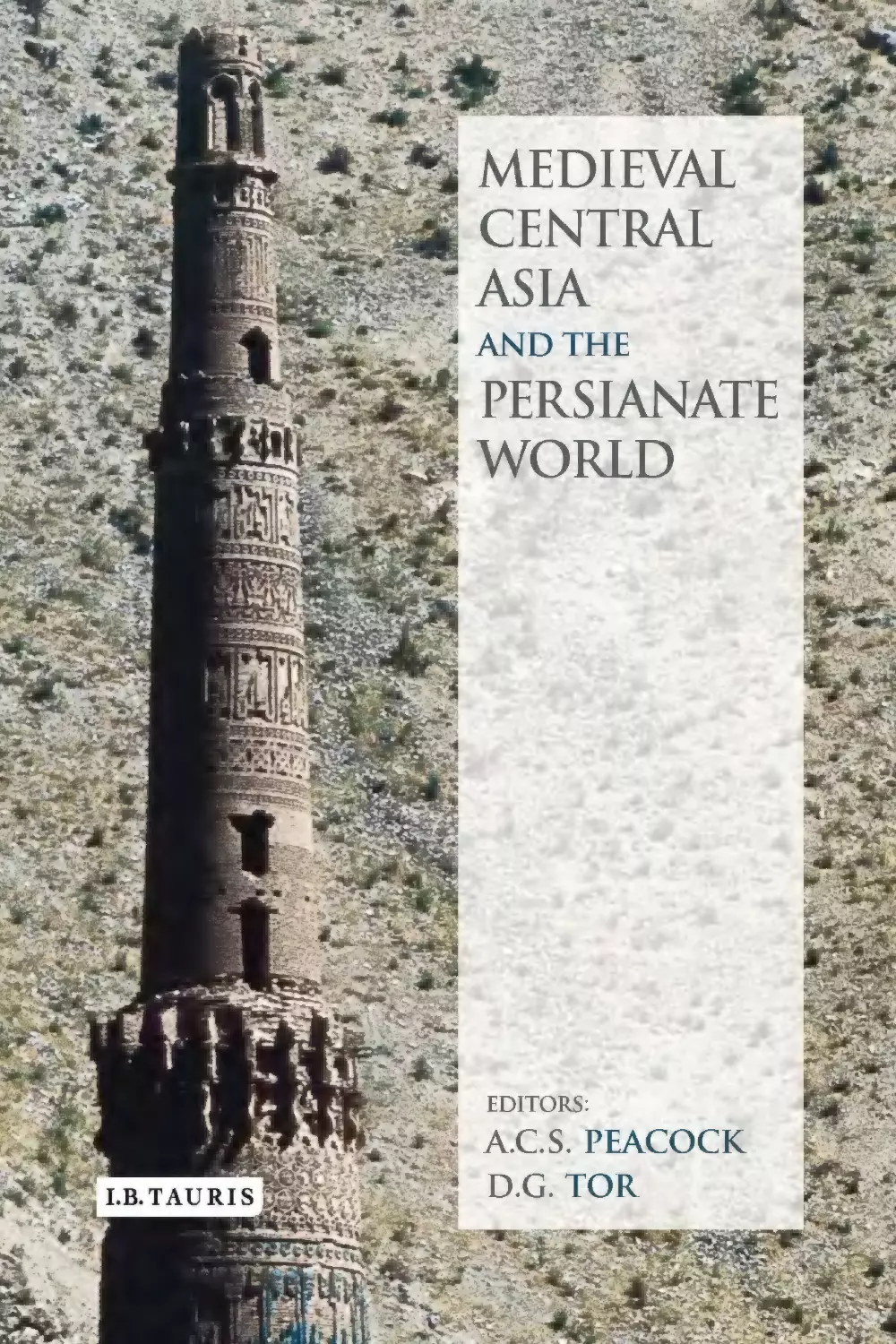


Автор: Peacock A.C.S. Tor D.G.
Теги: islam history of the middle ages iran central asia history of persia
ISBN: 978-0-85772-946-0
Год: 2015
Текст
A.C.S. Peacock is Reader in Middle Eastern History at the University of St
Andrews, and holds a PhD in Oriental Studies from the University of Cambridge.
He is the author of The Great Seljuk Empire (2015) and Early Seljuq History: A
New Interpretation (2010), and is the co-editor of The Seljuks of Anatolia: Court
and Society in the Medieval Middle East (2012) and Ferdowsi, the Mongols and the
History of Iran: Art, Literature and Culture from Early Islam to Qajar Persia (2013).
D.G. Tor is Assistant Professor of Medieval Middle Eastern History at the
University of Notre Dame, and holds a PhD in History and Middle Eastern
Studies from Harvard University. She is the author of The Great Seljuq Sultanate
and the Formation of Islamic Civilization: A Thematic History (forthcoming) and
Violent Order: Religious Warfare, Chivalry and the ‘Ayyar Phenomenon in the
Medieval Islamic World (2007), and the editor of The ‘Abbāsid and Carolingian
Empires: Comparative Studies in Civilisational Formation (forthcoming, 2016) and
a co-editor of The Cambridge World History of Violence. Volume 2: The Medieval
Period (2018).
I.B.Tauris & BIPS Persian Studies Series
Series ISBN 978 1 84885 203 7
Series Editor
Vanessa Martin
Editorial Board
C. Edmund Bosworth, Robert Gleave, Vanessa Martin
The I.B.Tauris / BIPS Persian Studies Series publishes scholarly works in the
social sciences and humanities on Iran. Such works include: original research
monographs, including biographies and suitably revised theses, specially planned
books deriving from conferences, specially commissioned multi-authored
research books, academic readers and translations.
1 The Practice of Politics in Safavid Iran: Power, Religion, Rhetoric
Colin P. Mitchell
978 1 84511 890 7
2 The Ilkhanid Book of Ascension: A Persian-Sunni Prayer Manual
Christiane Gruber
978 1 84511 499 2
3 Hafiz and his Contemporaries: A Study of Fourteenth-Century
Persian Love Poetry
Dominic Brookshaw
978 1 84885 144 3
4 The Ornament of Histories: A History of the Eastern Islamic Lands AD 650−1041
The Original Text of Abū Sa‘īd ‘Abd al-Hayy Gardīzī
Tranlsated and Edited by C. Edmund Bosworth
978 1 84885 353 9
5 The Safavid Dynastic Shrine: Architecture, Religion and Power in
Early Modern Iran
Kishwar Rizvi
978 1 84885 354 6
6 Iran Between Islamic Nationalism and Secularism:
The Constitutional Revolution of 1906
Vanessa Martin
978 1 78076 663 8
7. Medieval Central Asia and the Persianate World: Iranian Tradition
and Islamic Civilisation
Edited by A.C.S. Peacock and D.G. Tor
978 1 78453 239 0
Medieval Central Asia and the
Persianate World
Iranian Tradition and Islamic Civilisation
Edited by
A.C.S. Peacock and D.G. Tor
Published in 2015 by
I.B.Tauris & Co. Ltd
London • New York
www.ibtauris.com
Copyright editorial selection © 2015 A.C.S. Peacock and D.G. Tor
Copyright individual chapters © 2015 C. Edmund Bosworth, Minoru Inaba, Carole Hillenbrand,
Robert Hillenbrand, Louise Marlow, Christopher Melchert, Roy Mottahedeh, Jürgen Paul and
A. C. S. Peacock
The right of A.C.S. Peacock and D.G. Tor to be identified as the author of this work has been asserted
by the author in accordance with the Copyright, Designs and Patents Act 1988.
All rights reserved. Except for brief quotations in a review, this book, or any part thereof, may not
be reproduced, stored in or introduced into a retrieval system, or transmitted, in any form or by
any means, electronic, mechanical, photocopying, recording or otherwise, without the prior written
permission of the publisher.
British Institute of Persian Studies 7
Every attempt has been made to gain permission for the use of the images in this book. Any omissions
will be rectified in future editions.
References to websites were correct at the time of writing.
ISBN:
eISBN:
978 1 78453 239 0
978 0 85772 946 0
A full CIP record for this book is available from the British Library
A full CIP record is available from the Library of Congress
Library of Congress Catalog Card Number: available
Typeset by Swales & Willis Ltd, Exeter, Devon
Printed and bound by CPI Group (UK) Ltd, Croydon, CR0 4YY
In Memoriam C. Edmund Bosworth and Berenike Walburg
CONTENTS
List of Illustrations
In Memoriam
Acknowledgements
Abbreviations
Contributors
Maps
Preface, by A.C.S. Peacock and D.G.Tor
viii
x
xii
xiii
xiv
xvi
xix
1 The Importance of Khurasan and Transoxiana in the Persianate
Dynastic Period (850–1220)
1
D.G. Tor
2 The Spread of Ḥanafism to Khurasan and Transoxiana
13
Christopher Melchert
3 The khāṣṣa and the ‘āmma: Intermediaries in the Samanid Polity
31
Louise Marlow
4 Content versus Context in Samanid Epigraphic Pottery
56
Robert Hillenbrand
5 A Venture on the Frontier: Alptegin’s Conquest of Ghazna and its
Sequel
108
Minoru Inaba
6 Finding Iran in the Panegyrics of the Ghaznavid Court
129
Roy Mottahedeh
7 Khurasani Historiography and Identity in the Light of the Fragments
of the Akhbār Wulāt Khurāsān and the Tārīkh-i Harāt
143
A.C.S. Peacock
8 The Life and Times of ‘Amīd al-Mulk al-Kundurī
161
Carole Hillenbrand
9 Local Lords or Rural Notables? Some Remarks on the ra’īs in Twelfth
Century Eastern Iran
174
Jürgen Paul
10 The Ghurids in Khurasan
210
C. Edmund Bosworth
Index
222
vii
LIST OF ILLUSTRATIONS
0.1
0.2
0.3
5.1
Figures
The Iranian World, c. 388/998 (reproduced from C. E. Bosworth,
‘The political and dynastic history of the Iranian world, ad 1000–
1217)’ in J.A. Boyle (ed.), The Cambridge History of Iran, Vol V: The
Saljuq and Mongol Periods (Cambridge, 1968) p. 2 © Cambridge
University Press, 1968, reproduced with permission)
The Ghaznavid Empire at its greatest extent, c. 421/1030 (reproduced
from C. E. Bosworth, ‘The political and dynastic history of the Iranian
world, ad 1000–1217)’ in J.A. Boyle (ed.), The Cambridge History of
Iran, Vol V: The Saljuq and Mongol Periods (Cambridge, 1968) p. 21 ©
Cambridge University Press, 1968, reproduced with permission)
The Seljuq Empire at the death of Malikshah (485/1092) (reproduced
from C. E. Bosworth, ‘The political and dynastic history of the Iranian
world, ad 1000–1217)’ in J.A. Boyle (ed.), The Cambridge History of
Iran, Vol V: The Saljuq and Mongol Periods (Cambridge, 1968) p. 104
© Cambridge University Press, 1968, reproduced with permission)
The Eastern Islamic world in the tenth century.
Plates
4.1
4.2
4.3
4.4
4.5
4.6
4.7
4.8
4.9
4.10
Bowl, Freer Gallery of Art, Washington (57.34) (after Atıl, Ceramics).
Dish, Paris, Louvre (A.O. no. AA.96) (after Roux, L’Islam).
Bowl, Doha, Museum of Islamic Art (P0.1031.2009).
Dish, Doha, Museum of Islamic Art (P0.877.2008).
Plate, Almohad, 12th century, Murcia (Centro Municipal de
Arqueología de Murcia) (after Caviró, Cerámica).
Bowl, Doha, Museum of Islamic Art (430.2006).
Bowl, Tehran, Riza ‘Abbasi Museum (53–348) (after Ghouchani,
Inscriptions).
Plate, Manises, Rotterdam, Historisch Museum (after Du Ry, Art).
Bowl, Doha, Museum of Islamic Art.
Bowl, Doha, Museum of Islamic Art (1055.2010).
viii
xii
xiii
xiv
110
List of Illustrations
4.11
4.12
4.13
4.14
4.15
4.16
4.17
4.18
4.19
4.20
4.21
4.22
4.23
4.24
4.25
4.26
4.27
4.28
4.29
4.30
4.31
4.32
4.33
4.34
ix
Bowl, formerly Khalili Gallery (after Fehérvári and Safadi, 1400 Years
of Islamic Art).
Bowl, Doha, Museum of Islamic Art (P0.143.2000).
Dish, Doha, Museum of Islamic Art (P0.24.1999).
Fragment, Doha, Museum of Islamic Art (P0.1002.2009).
Vase, Momtaz Gallery (after Momtaz, Islamic Art).
Bowl, Momtaz Gallery (after Momtaz, Memories).
Jug, Sarikhani collection.
Bowl, Doha, Museum of Islamic Art (P0.414).
Bowl, Tehran, Iran Bastan Museum (no.21169) (after Du Ry, Art).
Bowl, Doha, Museum of Islamic Art (P0.686.2007).
Bowl, Tehran, Riza ‘Abbasi Museum (53–348) (after Ghouchani,
Inscriptions).
Money jar with Chinese inscription, Changsha ware, 858 A.D.
(courtesy of Dr Anita Chung).
Inscribed Cizhou wares, 14th century (Cixian Museum) (courtesy of
Dr Anita Chung).
Bowl, owner unknown (after Ghouchani, Inscriptions).
Samanid epigraphic ware: Kufic alphabet (after Bol’shakov, ‘Nadpisi’,
1958).
Samanid epigraphic ware: ‘ceramic cursive’ alphabet (after Bol’shakov,
‘Nadpisi’, 1958).
Folio 15b from a fragmentary 7-part Qur’an, 11th century, The
Nasser D. Khalili Collection of Islamic Art, QUR 89A (after Déroche,
The Abbasid Tradition).
Folio from a Qur’an copied in Isfahan in 383/993, The Nasser
D. Khalili Collection of Islamic Art, KFQ 90 (after Déroche, The
Abbasid Tradition).
Bowl, Tehran, Riza ‘Abbasi Museum (53–41) (after Ghouchani,
Inscriptions).
Dish, Freer Gallery of Art, Washington (54.16) (after Atıl, Ceramics).
Bowl, Metropolitan Museum of Art, New York (40.170) (after
Ghouchani, Inscriptions).
Bowl, Tehran, Riza ‘Abbasi Museum (53–369) (after Ghouchani,
Inscriptions).
Plate, Freer Gallery of Art, Washington (52.11) (after Atıl, Ceramics).
Samanid epigraphic ware: typical prompts (after Bol’shakov, ‘Nadpisi’,
1958).
Table
5.1
Ghazna/Ghaznīn in the early Islamic sources.
115
In Memoriam: Clifford Edmund Bosworth (1928–2015)
and Berenike Walburg (1984–2012)
This volume is dedicated to the memory of two individuals, of very different ages
and life stages, but who were both an integral part of the original conference and,
in Edmund Bosworth’s case, this volume:
Clifford Edmund Bosworth was one of the most distinguished and prolific
scholars of his time. After taking a 1st class degree in Modern History at St.
John’s, Oxford, he completed an M.A. in Middle Eastern Languages (1956) and
a PhD (1961) at the University of Edinburgh. Following a stint as a lecturer in
Arabic at the University of St. Andrews (1956–1965), he joined the University of
Manchester, in which he served as Professor of Arabic Studies from 1967–1990.
During this time, he also joined the editorial board of, and composed an astonishing number of entries for, the second edition of the Encyclopaedia of Islam,
overseeing the completion of the project. In many of the fields he researched,
ranging from the Saffarids and Ghaznavids to the Ghurids, he was the trailblazer,
whose work opened up that area of research to subsequent scholarly exploration.
Characteristically, Edmund was the only contributor to this volume who had
published research on every single dynastic period that falls within its purview.
His work was invariably meticulous, comprehensively researched, and judicious,
and will surely be read for many years to come. He was also a generous and courteous colleague, a good friend and correspondent, and a supportive mentor to
younger scholars, whom he treated as full equals of his very eminent self. For the
editors, he was an integral and essential participant in any conference, and his
death is a blow to us personally. He is deeply missed, but we are grateful for the
privilege of having known him.
Berenike Walburg was a graduate student of the University of St Andrews who
was killed in a road traffic accident in Aberdeenshire on Saturday 1 December
2012.
At the time of her death, Berenike was a matter of months away from submitting her doctoral thesis, which was focused on the nature and development of
x
Note
xi
international trade across Central Asia, the Near East and the Caucasus between
600 and 900 CE. Berenike was a very talented young scholar. Her research was
characterised by great clarity of thought, a mastery of detail and a willingness to
challenge long-held assumptions. While still a doctoral student, she had come to
the attention of the wider scholarly community and impressed all who encountered her. Anyone prepared to undertake both a month of archaeological investigation at Merv in Turkmenistan and a week of intensive advanced Classical
Armenian at the Welcome Library in London must have great resilience and total
dedication to their field. In recognition of her scholarship and high standing in the
academic world, the University of St Andrews awarded Berenike a posthumous
doctorate in June 2013.
Berenike was known personally to many of those who attended the conference
convened at the University of St Andrews in March 2013 under the title Eastern
Iran and Transoxiana, 750–1150 from which this volume of essays stems. She
contributed to its organisation and had been invited to deliver a paper. It is therefore appropriate that this volume should be co-dedicated to her memory.
ACKNOWLEDGEMENTS
This volume is based on discussions at a conference convened by the Institute
of Iranian Studies at the University of St Andrews in March 2013 under the title
Eastern Iran and Transoxiana, 750–1150. We are extremely grateful to those institutions whose financial support made the conference and the resulting volume
possible: the British Institute of Persian Studies, the Iran Heritage Foundation, the
Honeyman Foundation, the Medieval Institute of the University of Notre Dame,
the School of History of the University of St Andrews, the Institute for Advanced
Study, Princeton, and the National Endowment for the Humanities. The editors
would also like to express their gratitude to Dr Paul Churchill for his assistance
both in organising the conference and in editing the volume. We are also grateful
to the British Institute of Persian Studies for agreeing to include this volume in its
publication series and to Ali Ansari for his efforts to secure its passage through
the press.
A.C.S. Peacock
D.G. Tor
xii
ABBREVIATIONS
EI 2 Encyclopaedia of Islam, second edition, 12 vols plus indices (Leiden, 1960–2005)
EI 3 Encyclopaedia of Islam, third edition (Leiden, 2007–)
EIr Encyclopaedia Iranica (London and Costa Mesa, 1982–; online edition
www.iranicaonline.org)
xiii
CONTRIBUTORS
C. Edmund Bosworth (†2015) was Emeritus Professor of Arabic Studies,
Manchester University. He was British editor of the Encyclopaedia of Islam, 2nd
edition, editor of two volumes of the UNESCO History of the Civilizations of Central
Asia, and contributor to the New Cambridge History of Islam and the Cambridge
History of Iran. His books include works on pre-modern Arabic literature, on the
history of the medieval Iranian world and Central Asia, and studies of European
travellers, explorers and interpreters of the Middle Eastern lands and Inner Asia.
Carole Hillenbrand, OBE, FBA, FRSE, is Professor Emerita of Islamic History
at the University of Edinburgh and Professor of Islamic History at the University
of St Andrews. Her books include The Crusades: Islamic Perspectives (Edinburgh,
1999), and Turkish Myth and Muslim Symbol: The Battle of Manzikert (Edinburgh,
2007). Her new book, Islam: A Historical Introduction, was published by Thames
and Hudson in January 2015.
Robert Hillenbrand, FBA, Professor Emeritus of Islamic Art, Edinburgh
University, and currently Professor of Art History at St Andrews University, has
published 9 books, co-authored, edited or co-edited a further 12 books, and
published some 170 articles. He has been Slade Professor at Cambridge and has
held visiting professorships at Princeton, UCLA, Bamberg, Dartmouth College,
New York, Leiden, Cairo and Groningen. His interests focus on Islamic architecture (especially in Iran and Umayyad Syria), book painting and iconography.
Minoru Inaba is Professor of the Department of Oriental Studies, Institute for
Research in Humanities, Kyoto University. He specialises in the pre- and early
Islamic history of Afghanistan and adjacent regions. Recent publications include:
Coins, Art and Chronology II: Indo-Iranian Borderlands, 2010 (co-editor);
‘Sedentary rulers on the move: The travels of the early Ghaznavid sultans’, in
D. Durand-Guédy (ed.), Turko-Mongol Rulers, Cities and City Life, (2013); and
‘Arab soldiers in China at the time of An-Shi rebellion’, Memoirs of the Research
Department of the Toyo Bunko, 68, (2011).
Louise Marlow teaches at Wellesley College in Massachusetts. She received her
undergraduate degree from Cambridge University and her doctoral degree from
xiv
Contributors
xv
Princeton University. Her research concentrates on Arabic and Persian mirrors for
princes and the pre-modern history of western Asia and Iran. Her book Wisdom
and Politics in Tenth-Century Iran is forthcoming with Edinburgh University Press.
Christopher Melchert has a bachelor’s degree from the University of California
at Santa Cruz, a master’s from Princeton University, and a doctorate from the
University of Pennsylvania, all in History. He has published two books, The
Formation of the Sunni Schools of Law (1997) and Ahmad ibn Hanbal (2006), and
close to fifty articles. Since 2000, he has taught at Oxford, currently covering the
fields of hadith, Islamic law, and early Sufism. He aspires to be a scholar on the
pattern of his master, George Makdisi.
Roy Parviz Mottahedeh is the Gurney Professor of History at Harvard University.
He has written extensively on the history of the Middle East in the tenth and eleventh centuries C. E. His publications include Loyalty and Leadership in an Early
Islamic Society, The Mantle of the Prophet, and Lessons in Islamic Jurisprudence. He
has written numerous articles on the social, intellectual and political history of the
Middle East from the 7th century to the present.
Jürgen Paul is Professor Emeritus of Islamic Studies, Martin-Luther-Universität
Halle-Wittenberg. His research field is the medieval history of Iran and Central
Asia, in particular the pre-Mongol period. He has a special interest in forms of
local rule and in relations between local and imperial rule in Seljuq and postSeljuq Iran. Recent publications include ‘Sanjar and Atsız: Independence, lordship, and literature’ in Jürgen Paul (ed.), Nomad Aristocrats in a World of Empires,
(Wiesbaden, 2013), pp. 81–129; ‘Where did the dihqāns go?’, Eurasian Studies 11
(2013), pp. 1–34; ‘Khidma in the social history of pre-Mongol Iran’, Journal of the
Economic and Social History of the Orient 57/3 (2014), pp. 390–420.
A.C.S. Peacock is Reader in Middle Eastern Studies at the School of History,
University of St Andrews. His research focuses on the medieval history and historiography of the eastern Islamic lands. Main publications relevant to Central
Asia include Mediaeval Islamic Historiography and Political Legitimacy: Bal‘amī’s
Tārīkhnāma (London, 2007); Early Seljūq History: A New Interpretation (London,
2010); The Great Seljuk Empire (Edinburgh, 2015).
D.G. Tor is a member of the Department of History at the University of Notre
Dame. Her research focuses on the history of the central and eastern Islamic lands
from the Abbasid Revolution to the Mongol invasions. Current work pertaining
to Khurasan and Persianate Central Asia includes ‘God’s Cleric: Fuḍayl b. ‘Iyāḍ
and the transition from Caliphal to Prophetic Sunna’, in Islamic Cultures, Islamic
Contexts: Essays in Honor of Professor Patricia Crone, ed. Behnam Sadeghi, Asad
Q. Ahmed, Adam Silverstein, and Robert Hoyland (Leiden, 2014); ‘The political
revival of the ‘Abbāsid Caliphate: al-Muqtafī and the Seljuqs’, (under review); ‘The
religious history of Rayy in the Seljuq period’, Der Islam 94:1 (forthcoming 2017);
and editing the Islamic and Near Eastern sections of the medieval volume of The
Cambridge World History of Violence (Cambridge, forthcoming 2018).
Figure 0.1 The Iranian World, c. 388/998 (reproduced from C. E. Bosworth, ‘The political and dynastic history of the Iranian World, ad 1000–1217)’ in J.A. Boyle (ed.), The
Cambridge History of Iran, Vol V: The Saljuq and Mongol Periods (Cambridge, 1968) p. 2 ©
Cambridge University Press, 1968, reproduced with permission)
Figure 0.2 The Ghaznavid Empire at its greatest extent, c. 421/1030 (reproduced from
C. E. Bosworth, ‘The political and dynastic history of the Iranian World, ad 1000–1217)’
in J.A. Boyle (ed.), The Cambridge History of Iran, Vol V: The Saljuq and Mongol Periods
(Cambridge, 1968) p. 21 © Cambridge University Press, 1968, reproduced with permission)
Figure 0.3 The Seljuq Empire at the death of Malikshah (485/1092) (reproduced from
C. E. Bosworth, ‘The political and dynastic history of the Iranian World, ad 1000–1217)’
in J.A. Boyle (ed.), The Cambridge History of Iran, Vol V: The Saljuq and Mongol Periods
(Cambridge, 1968) p. 104 © Cambridge University Press, 1968, reproduced with permission)
PREFACE
A.C.S. Peacock and D.G. Tor
The ‘Iranian Intermezzo’ or ‘Persian Renaissance’ in the tenth century, when much
of the eastern Islamic world was ruled by ethnically Persian dynasties, has long
been recognised as a period of key importance for the formation of Islamic civilisation, both in political and cultural terms. Politically, it saw the effective break-up
of the political control of the Abbasid Caliphate and the emergence of successor
states such as the ethnically Iranian Samanids, Saffarids and Buyids. Culturally, it
witnessed the emergence of New Persian as a literary and administrative language
and an ever more explicit regard for the pre-Islamic Iranian past, most famously
signalled by the composition of the masterpiece of Persian literature, Firdawsī’s
Shāhnāma. Yet the origins of these phenomena remain little understood, and their
influence on later, ethnically Turkish but culturally Persianate dynasties such as
the Ghaznavids and Seljuqs has yet to be fully explored. Moreover, much of the
research on this period has focussed specifically on Shi‘ism and the Buyid dynasty
that ruled in Iraq and western Iran. Yet Islamic Central Asia – the provinces
known as Khurasan and Transoxiana (Arabic Mā Warā’ al-Nahr), or collectively
the mashriq, comprising, roughly speaking, modern eastern Iran, Afghanistan,
Turkmenistan and Uzbekistan – constituted the bulwark of Sunnism, and were
making their greatest contribution to its formation.
In short, the focus on tenth-century Shi‘ism has somewhat blinded historians to
the larger significance and cultural continuity of the Persianate dynastic period in
the eastern Islamic world; as a result, we still lack a broad understanding of why so
many of the major cultural and religious developments of this period should have
originated in Khurasan and Transoxiana, apparently so distant from the heartlands of both the Caliphate and the Sasanian Empire. This volume aims to explore
the origins and nature of Sunni Iranian cultural and political florescence, and to
shed led on one of the most formative yet unexplored eras of Islamic history.
The cultural and political developments in Khurasan and Transoxiana during
this period had an impact upon a wide range of fields, and this is reflected in the
essays in this book. The significance of the period can be found in virtually every
area of historical inquiry. Geopolitically, the region first gave rise to the Abbasid
Revolution, provided the troops for its success, and supplied the military slaves
xix
xx
Medieval Central Asia and the Persianate World
and auxiliaries that led to its political dissolution. From the second part of the
ninth century, Persianate dynasties formed the mainstay of Islamic military might
for the ensuing 400 years. During the period of Persianate dynastic hegemony, the
Muslim religion spread into Turkic Central Asia and Muslim rule expanded deep
into Central Asia and the Indian subcontinent. Militarily and politically, Persianspeaking dynasties held sway over the Islamic heartland, from India to Egypt.
From the eleventh century, as a result of the political reunification of the Islamic
heartlands under Persianate Seljuq rule, the traditional Islamic conception of the
Caliphate as the sole legitimate universal political authority for Sunnis was challenged, thus leading to a sea change in Sunni political theory and the writing of the
classic works of this genre, as well as to a deadly rivalry between the new Sultans
and the Abbasid caliphs.
In the linguistic and literary sphere, the Sunni Persianate dynastic period was
characterised by the cultural dominance of the Persian-speaking court, thus
bringing about the literary flowering of the classical Persian language and its
acceptance as the second primary Islamic language of high culture. This development in turn led to the writing of many of Islamic civilisation’s greatest works
of poetry, philosophy, biography, history, belles-lettres, and religion in Persian.
Culturally, these dynasties presided over, and in many cases helped further, the
formation of much of classical Islamic civilisation. In the religious sphere, most
of the normative Sunni religious developments and texts came into being during
this period, ranging from the compilation and canonisation of the six Sunni books
of ḥadīth to the fostering and spread of the madrasa, and the promulgation and
mainstreaming of Sufism.
Despite its seminal importance, this period in the eastern Islamic world has
remained one of the most obscure and neglected in Islamic history. The standard
survey of political history remains Barthold’s Turkestan Down to the Mongol
Invasion, published in English in 1928 but originally defended as a dissertation
in St Petersburg in 1900.1 However, the work remains in print and is widely cited,
signifying the sluggish pace of scholarship – or at least, the fact that even where
Barthold’s conclusions have been superseded, revisionist scholarship in Russian
has remained inaccessible to western audiences; and even in the west scholarship
on specific aspects of the period has not always been widely disseminated.
Nonetheless, in many areas considerable progress has been made. Barthold can
now usefully be supplemented by the History of Civilizations of Central Asia, vol.
IV, the Age of Achievement (1998, 2000), edited by Asimov and Bosworth,2 which
brings together more recent Russian, Central Asian and Western scholarship, and
there are also important monographs on the Ghaznavid dynasty by Bosworth,3
and on the major Khurasani city of Nishapur by Bulliet,4 as well as an increasing
volume of research on the Saffarids5 and the Seljuqs.6 Paul has also contributed
an important study of the social, military and political dynamics of the period.7
However, research on the Islamic east has tended with these exceptions to focus
primarily on the early Abbasid period, owing to the importance of Khurasan in
the Abbasid state and the role of Khurasanis there.8 There exists only one previous
Preface
xxi
volume of essays devoted to surveying some of the major features of the period
of the Persian Renaissance, D. S. Richards’s Islamic Civilisation 950–1150.9 That
volume, however, while it was a good beginning to the study of at least part of
this period, adopted a different intellectual approach from the present work, in
that it did not differentiate between the Shi‘ite ‘‘Irāqayn’ on the one hand, and
the culturally cohesive world of Sunni Khurasan and Transoxiana on the other.
The Richards volume, originally meant to be a promising beginning for further
exploration of the period, has never been followed up; it has therefore remained
an indispensable part of the literature for the past forty years, by default. Our aim
in this volume is to produce a more up-to-date, fuller, and more comprehensive
volume of essays by many of today’s leading scholars, focussed upon the Eastern
Iranian world of Khurasan and Transoxiana, which formed intellectually and
culturally the Sunni heartland, from the emergence of the first ethnically Iranian
dynasties in the mid ninth century to the eve of the Mongol invasions. The volume
explores a broad spectrum of subjects touching upon the religious, social, cultural
and political history of the region during the relevant period, many of them never
previously addressed.
One reason for the comparative lack of research on Khurasan and Transoxiana
in this period is the problematic source base. While for the Ghaznavid dynasty –
which has received the most detailed monograph treatment – we do have some
contemporary Arabic and Persian chronicles, for most dynasties of the period we
are reliant on scattered information in a disparate array of sources.10 There is no
extant dynastic history of the Samanids, Saffarids, or Ghurids; and even for the
Seljuqs, the works that have come down to us were composed in the west of their
domains and often leave events in Central Asia in obscurity. Thus while scholars of
the Buyids (for instance) have at their disposal detailed contemporary chronicles
such as that of Miskawayh, for the eastern Islamic world the situation is much
more challenging for the scholar. So poorly attested is the Qarakhanid dynasty
that dominated Transoxiana in the twelfth century, for instance, that numismatics
has been the major source for reconstructing its history and the sequence of its
rulers.11
As a result, studies based purely on the fragmentary evidence of chronicles and
focussing on political history are always likely to be of limited efficacy in improving
our understanding of the period. A wider range of sources and approaches
is needed, and this volume aims to give a sampling of these. Our contributors
accordingly draw on sources ranging from Arabic biographical dictionaries to
mirrors for princes, from local chronicles to poetry, and from hagiographies to
art historical evidence such as ceramics, to shed light on the cultural, religious and
political transformations of the period.
The volume opens with an essay by D.G. Tor which outlines in more detail
the significance of Khurasan and Transoxiana in the medieval Islamic world and
surveys the political history of the region in the period, providing a context for
the following chapters. We then proceed to Christopher Melchert’s discussion of
a formative aspect of the region’s Sunni character, the emergence in Central Asia
xxii
Medieval Central Asia and the Persianate World
of the Ḥanafi Sunni madhhab (law school). Melchert examines the relationship
between the spread of Hanafism and Abbasid state sponsorship, and the local
factors in Khurasan and Transoxiana that might account for its acceptance there.
The next two essays examine aspects of cultural history under the Samanids,
the foremost of the ethnically Iranian dynasties to dominate the region after
the dissolution of direct Abbasid rule. Louise Marlow’s chapter constitutes an
in-depth exploration of what one mirror for princes, the Naṣīḥat al-Mulūk,
reveals about rulership, social status, hierarchy, and function, and the means by
which rulers ‘bridge[d] the chasm between the ruler and the population’ in the
Samanid realms. Robert Hillenbrand then turns to examine Samanid epigraphic
pottery, widely regarded as one of the high points of Islamic art as a whole. This
article details the context of this pottery in other contemporary ceramics and
metalwork, and problems of dating and authenticity; identifies the various ways
in which these ceramics were revolutionary, how they relate to non-epigraphic
wares and what heritage they bequeathed to later potters; and, finally, highlights
the intentions behind the choice of texts and suggests what kinds of models might
have inspired these wares. As such, it offers insights into Samanid social as well
as artistic history.
With Minoru Inaba’s chapter, we turn to the origins of the first of the Turkish
states that succeeded the Samanids – the Ghaznavids. Alptegin, the effective
founder of the Ghaznavid state, had started his career as a soldier in Samanid
service; Inaba examines the circumstances that allowed him to carve out his
polity in Ghazna in the south of modern Afghanistan, exploiting the frontier
status of the region in order to establish and expand political power and rule.
Roy Mottahedeh’s contribution examines the Ghaznavids’ interpretation of the
idea of Iran they had inherited from the Samanids, as illustrated by Ghaznavid
court poetry. Mottahedeh considers the works of the panegyrists who served the
Ghaznavid Sultans Maḥmūd (reg. 387/997 – 421/1030) and Mas‘ūd (reg. 421/1030
– 432/1040) in order to gain insight into the ideologies and the courts of both
rulers. The essay focuses on two particular issues: how these poets understood
the word ‘Iran’, and also how they themselves viewed the role of the panegyrist. It
concludes with some general observations about Persian panegyric poetry.
The question of identity also forms the theme of A.C.S. Peacock’s chapter,
which examines a recently discovered twelfth century local history of Herat that
also incorporates significant sections of a lost Samanid history of Khurasan, the
Akhbār Wulāt Khurāsān attributed to al-Sullāmī. Peacock argues that these texts
suggest that for many, Khurasan in fact provided a more meaningful focus of identity than the idea of Iran, the popularity of which was restricted more to the elite
court audience discussed by Mottahedeh.
Carole Hillenbrand’s essay, meanwhile, focuses on a key personality in the
transition from Ghaznavid to Seljuq rule, the neglected figure of the first Seljuq
Sultan Ṭughril’s vizier ‘Amīd al-Mulk Kundurī. Hillenbrand offers a reassessment
of this important but overlooked character, showing how Kundurī, born into a
Khurasani landowning family, was able to serve as both a cultural and political
Preface
xxiii
broker for the new Turkish ruler, facilitating the establishment of Seljuq rule not
just in Khurasan, but further west in the Abbasid lands.
The Seljuq period also forms the focus of Jürgen Paul’s essay, an attempt to understand the social and political history of twelfth century Khurasan, which also sheds
light on conditions under the Seljuqs’ successors in the east, the Khwarazmshāh
dynasty. Paul examines the various functions of the individuals described in the
sources by the term ra’īs (pl. ru’asā’). The ra’īs could be variously the head of the
representatives of a particular school of law (madhhab) in a given locality (such
as the ra’īs of the Shāfi‘īs at Marw); or, secondly, the effective governor of a larger
town or city, who generally held an appointment deed from the regional or imperial ruler, and who tended to form regional dynasties of ru’asā’; or, thirdly, rural
ru’asā’ and their attendant fiscal, military, and social functions. The article also
examines the relations of the ru’asā’ to their overlords and to their constituencies
in the villages or small towns; and their relations to other locally powerful figures.
Thus the ra’īs also might play a role as a sort of power broker, negotiating relationships between local communities and imperial powers.
The volume concludes with an essay by Edmund Bosworth, examining the
history of the Ghurid dynasty – which, together with that of the Khwarazmshāhs,
was the last of the great eastern Sunni Persianate dynasties before the coming of the
Mongols – under its two greatest rulers, the brothers Ghiyāth al-Dīn Muḥammad
(r. 558–99/1163–1203), and Mu‘izz al-Dīn Muḥammad (r. 569–602/1173–1206).
Bosworth shows how the Ghurids, originally from a remote region of Afghanistan,
but founders of an empire that spread over much of Khurasan and northern India,
propagated a strongly Sunni identity through inscriptions on their architectural
monuments and through their support for the Abbasid Caliphs.
The essays in this volume illustrate both the progress that has been made in
recent years and the amount that remains to be done. Our corpus of sources has
expanded somewhat (although not dramatically) since Barthold was writing,
especially as historians have learned to use a more diverse array of texts in a more
sophisticated manner – Paul, for instance, shows the utility of combining archaeological evidence with materials drawn from hagiographies as well as chronicles to
draw a picture of social life. With the end of the Soviet Union, modern archaeological methods have started to be applied to some of the major cities and sites of
the period, in particular the great city of Marw, although the situation in Iran and
Afghanistan is more problematic owing to the difficulty of conducting fieldwork.12
Closer collaboration among historians, scholars of literature and intellectual life,
and specialists in material culture can shed unexpected light on many features
of the age and to a degree compensate for the lack of chronicles. Yet there is still
more that can be done in terms of publishing relevant written source materials. It
is only very recently, in 2004, that the major Ghaznavid history, ‘Utbī’s al-Yamīnī,
was published in an adequate edition.13 The collection of Seljuq chancery documents, the Aḥkām-i Salāṭīn-i Māḍī, used by Paul, is only partially accessible
through the selections published by Barthold in the companion volume of texts
which accompanied his Turkestan and still awaits full publication.14 The discovery
xxiv
Medieval Central Asia and the Persianate World
of the fragments of the twelfth century history of Herat (at the time of writing
still unedited and only available in facsimile) and the recent reconstruction of the
Akhbār Wulāt Khurāsān, both discussed by Peacock, suggest there are more texts
waiting to be discovered, edited, or reconstructed. And as Marlow shows, much
can be done with a sophisticated analysis of those texts we do have: her evidence
is based on a text wrongly thought to come from eleventh century Iraq, but which
Marlow shows is tenth century Khurasani.
Moreover, despite considerable progress in individual areas, plenty of dynasties
still await their historian – most egregiously the Samanids and the Khwarazmshahs,
two major Khurasani states that have not yet been the subject of a satisfactory
monograph in any western language.15 In time, we hope, this picture will change;
and we hope that this volume will play a part in encouraging future research by
presenting a picture of the state of the field at the current time, showing both the
importance of Khurasan and Transoxiana in this period, and the possibilities their
study offers to researchers for understanding more generally the Islamic world.
The complex interplay between Iranian and Islamic elements that our contributors illustrate in the history of Khurasan in the period was to shape decisively the
political and cultural contours of Islamic civilisation more generally.
1
2
3
4
5
6
7
8
9
10
11
Notes
W. Barthold, Turkestan Down to the Mongol Invasion (London, 1928; 3rd ed. 1968).
M.S. Asimov and C. E. Bosworth (eds), UNESCO History of Civilizations of Central
Asia, vol: IV, The Age of Achievement, A.D. 750 to the End of the Fifteenth Century,
Part One: The Historical, Social and Economic Setting (Paris, 1998); Part Two: The
Achievements (Paris, 2000).
C. E. Bosworth, The Ghaznavids: Their Empire in Afghanistan and Eastern Iran,
994–1040 (Edinburgh, 1963).
Richard Bulliet, The Patricians of Nishapur: A Study in Medieval Islamic Social History
(Cambridge, MA, 1972); see also his ‘Medieval Nishapur: A topographic and demographic reconstruction’, Studia Iranica 5 (1976), pp. 67–89.
D.G. Tor, Violent Order: Religious Warfare, Chivalry, and the ‘Ayyār Phenomenon in the
Medieval Islamic World (Würzburg, 2007); C. E. Bosworth, The History of the Saffarids
of Sistan and the Maliks of Nimruz (247/861 to 949/1542–3) (Costa Mesa, 1994).
See A.C.S. Peacock, The Great Seljuk Empire (Edinburgh, 2015) for an overview of
recent scholarship.
Jürgen Paul, Herrscher, Gemeinwesen, Vermittler: Ostiran und Transoxanien in vormongolischer Zeit (Beirut, 1996).
For example, Elton Daniel, The Political and Social History of Khurasan under Abbasid
Rule 747–820 (Minneapolis, 1979); Étienne de la Vaissière, Samarcande et Samarra.
Elites d’Asie central dans l’empire Abbasside (Louvain, 2007); Étienne de la Vaissière
(ed.), Islamisation de l’Asie central. Processus locaux d’acculturation du VIIe au XIe
siècle (Louvain, 2008).
D.S. Richards (ed.), Islamic Civilisation 950–1150 (Oxford, 1973).
For a survey of historiography in the period, see Julie Scott Meisami, Persian
Historiography to the End of the Twelfth Century (Edinburgh, 1999); Charles Melville
(ed.), Persian Historiography (London, 2012).
Boris Kochnev, Numizmaticheskaya Istoriya Karakhanidskogo Kaganata (991–1209)
(Moscow, 2006).
Preface
12
13
14
15
xxv
For an overview of recent archaeological work at Marw in our period see Tim
Williams, ‘The city of Sultan Kala, Merv, Turkmenistan: Communities, neighbourhoods and urban planning from the eighth to the thirteenth century’ in Amira K.
Bennison and Alison L. Gascoigne (eds), Cities in the Pre-modern Islamic World: The
Urban Impact of Religion, State and Society (London, 2007), pp. 42–62.
al-‘Utbī, al-Yamīnī fī sharḥ Akhbār al-Sulṭān Yamīn al-Dawla, ed. Iḥsān Dhunūn
al-Thāmirī (Beirut, 2004).
Aḥkām-i Salāṭīn-i Māḍī. MS St Petersburg, Institute for Oriental Manuscripts,
C-816; partially published in V.V. Bartol’d, (ed.), Turkestan v Epokhu Mongoloskogo
Nashestviya. Chast’ 1: Teksty (St Petersburg, 1898).
For the Samanids, the main work remains Luke Treadwell’s DPhil Thesis (‘The Political
History of the Samanid State’, University of Oxford, 1991); for the Khwarazmshahs,
see İbrahim Kafesoğlu, Harezmşahlar Devleti Tarihi (485–618/1092–1221) (Ankara,
1956); Z.M. Buniyatov, Gosudarstvo Khorezmshakhov-Anushteginidov, 1097–1231
(Moscow, 1986).
Bibliography
Asimov, M. S. and C. E. Bosworth (eds), UNESCO History of Civilizations of Central Asia,
Vol. IV: the Age of Achievement, A.D. 750 to the End of the Fifteenth Century, Part One:
The Historical, Social and Economic Setting (Paris, 1998); Part Two: The Achievements
(Paris, 2000).
Barthold, W., Turkestan Down to the Mongol Invasion (London, 1928; 3rd ed. 1968).
Bartol’d, V. V. (ed.), Turkestan v Epokhu Mongoloskogo Nashestviya. Chast’ 1: Teksty (St
Petersburg, 1898).
Bosworth, C. E., The Ghaznavids: Their Empire in Afghanistan and Eastern Iran, 994–1040
(Edinburgh, 1963).
Bosworth, C. E., The History of the Saffarids of Sistan and the Maliks of Nimruz (247/861 to
949/1542–3) (Costa Mesa, 1994).
Bulliet, Richard, The Patricians of Nishapur: A Study in Nedieval Islamic Social History
(Cambridge, MA, 1972).
Bulliet, Richard, ‘Medieval Nishapur: A topographic and demographic reconstruction’,
Studia Iranica 5 (1976), 67–89.
Buniyatov, Z. M., Gosudarstvo Khorezmshakhov-Anushteginidov, 1097–1231 (Moscow, 1986).
Daniel, Elton, The Political and Social History of Khurasan under Abbasid Rule 747–820
(Minneapolis, 1979).
Kafesoğlu, İbrahim, Harezmşahlar Devleti Tarihi (485–618/1092–1221) (Ankara, 1956).
Kochnev, Boris, Numizmaticheskaya Istoriya Karakhanidskogo Kaganata (991–1209)
(Moscow, 2006).
Meisami, Julie Scott, Persian Historiography to the End of the Twelfth Century (Edinburgh,
1999).
Melville, Charles (ed.), Persian Historiography (London, 2012).
Paul, Jürgen, Herrscher, Gemeinwesen, Vermittler: Ostiran und Transoxanien in vormongolischer Zeit (Beirut, 1996).
Peacock, A. C. S., The Great Seljuk Empire (Edinburgh, 2015).
Richards, D. S. (ed.), Islamic Civilisation 950–1150 (Oxford, 1973).
Tor, D. G., Violent Order: Religious Warfare, Chivalry, and the ‘Ayyār Phenomenon in the
Medieval Islamic World (Würzburg, 2007).
Treadwell, W.L., ‘The Political History of the Samanid State’, Unpublished DPhil thesis,
Oxford, 1991.
xxvi
Medieval Central Asia and the Persianate World
al-‘Utbī, al-Yamīnī fī sharḥ Akhbār al-Sulṭān Yamīn al-Dawla, ed. Iḥsān Dhunūn al-Thāmirī
(Beirut, 2004).
de la Vaissière, Étienne, Samarcande et Samarra. Elites d’Asie central dans l’empire Abbasside
(Louvain, 2007).
de la Vaissière, Étienne (ed.), Islamisation de l’Asie central. Processus locaux d’acculturation
du VIIe au XIe siècle (Louvain, 2008).
Williams, Tim, ‘The city of Sultan Kala, Merv, Turkmenistan: Communities, neighbourhoods and urban planning from the eighth to the thirteenth century’ in Amira K.
Bennison and Alison L. Gascoigne (eds), Cities in the Pre-modern Islamic World: The
Urban Impact of Religion, State and Society (London, 2007), pp. 42–62.
1
THE IMPORTANCE OF KHURASAN
AND TRANSOXIANA IN THE
PERSIANATE DYNASTIC PERIOD
(850–1220)
D.G. Tor
While Islam may have begun in Arabia, the civilisation that it fashioned during its
classical period, over the succeeding six centuries, was by no means an Arab – let
alone an Arabian – artefact. Among the many different ethnic groups and peoples
that contributed to the cultural, political, religious and literary formation of this
new civilisation, none played a greater role than the inhabitants of the Persianate
cultural world.1 The vital contribution of the Persianate world – its people, dynasties, individuals, and religious and intellectual movements – to Islamic civilisation
has been and remains, however, one of the most understudied areas of Islamic
history: there exists no published monograph, for instance, on the Samanid
dynasty, despite its realm having been the major political, religious, military, and
intellectual centre of Sunnism during the tenth century;2 and only now are the
first monographs appearing and being written on the Seljuq period in its entirety.3
During the centuries under consideration here, the Persianate world included,
geographically, not only the former lands of the Sasanian Empire (roughly, the
Iranian plateau, and the lands adjacent to the western and southern shores of the
Caspian Sea), but also the then-culturally Persianate lands of Central Asia (most
of which have become, today, both linguistically and ethnically Turkic), the area
stretching from the Caspian Sea to the Tien Shan mountains, and the areas of the
Indian subcontinent conquered by Muslims.4
During the Umayyad period, Khurasan and Iranian Central Asia were still
very much in the process of being conquered and colonised.5 Even in these years,
though, Khurasan already began to play a seminal role in the religious, political,
and intellectual development of the Islamic oecumene.6 However, the region fully
came into its own as one of the leading centres of Islamic civilisation with the advent
of the Abbasid Revolution. There are two factors which aided in this process. First,
immediately after the Revolution, the political history of western Central Asia was
decided by the famous showdown between the Muslim and Chinese armies at
1
2
Medieval Central Asia and the Persianate World
Talas in 751, a battle that finally determined to which empire and cultural world
the region would belong, at least until the modern era;7 and, second, the peculiar
significance and centrality of Khurasan to the Abbasids themselves.
It was, of course, Khurasan that served as the cradle of the Abbasid Revolution,
which broke out in Marw, in Central Asia, and by 750 had overthrown the Umayyad
Dynasty.8 The Abbasid armies were composed of Khurasanian troops, both Arab
and Persian;9 and, after the Revolution, the new elite of the empire, known as the
abnā’ al-dawla or abnā’ al-da‘wa, were Khurasanis by origin.10 Indeed, throughout
the early Abbasid period, the new ‘service aristocracy’ was manned largely by
Khurasanis and their descendants,11 and included some of the most famous and
revered vizieral and military families in Islamic history, such as the Barmakids, the
Sahlids, and the Ṭāhirids, who ran, protected, and expanded the Islamic empire.
One of the more notable aspects of this Khurasani influence in the late eighth
and early ninth centuries was not merely that it grew, but also that it grew steadily
more Central Asian. This can be seen in many different areas, perhaps most strikingly in caliphal lineage itself. Al-Ma’mūn was the first caliph with a Khurasanī
mother,12 and basically re-enacted (and consciously claimed to be re-enacting)
the original Khurasanian Abbasid Revolution during the Fourth Fitna,13 while
attempting to make it more definitively Khurasanian – his propaganda emphasised his Khurasani origins,14 and al-Ma’mūn even, throughout the first years of
his reign, relocated the capital of the empire from Baghdad to Marw.15
Al-Ma’mūn’s half-brother and successor, al-Mu‘taṣim, was the son of a Sogdian
woman,16 and during his reign Central Asians from the Khurasanī Transoxianan
provinces became ever more prominent. Most notably, under this caliph the army
became gradually more Central Asian, so that in al-Mu‘taṣim’s day, the preponderance of prime army units were recruited amongst Central Asians, either free
(e.g. regiments such as the Ushrūsaniyya and Farāghina, and the Shākiriyya guard
corps, which was a Sogdian institution borrowed wholesale17) or slave (the famous
ghilmān corps for which this caliph is primarily remembered by subsequent medieval Muslim historians);18 and the most powerful figures during his reign were
Iranian and Turkic Central Asian commanders, both slave and free, most prominently the hereditary prince of Ushrūsana, who is referred to in the Arabic sources
by his Central Asian title of Afshīn.19
The importance of Khurasan and its Persianate Central Asian dependencies
is also reflected in the developing political organisation of Abbasid rule, from
the Revolution until the time at which the provinces went their own autonomous way in the 860s. Although at the outset of Abbasid rule, Khurasan briefly
enjoyed a special, virtually autonomous status under its governor Abū Muslim,
this arrangement proved too threatening to central authority. Yet the attempt over
the following decades to treat Khurasan, together with its Transoxianan dependencies, as just another province also proved unworkable, as witnessed by the many
revolts there over the ensuing decades.20 Khurasan was simply far too big, too rich,
and too important to be treated as merely another province.
The Importance of Khurasan and Transoxiana
3
It was partly to address the Khurasani problem that Hārūn al-Rashīd devised
his ultimately disastrous succession solution, with his son al-Ma’mūn, son of
the Khurasani mother, anointed virtually autonomous governor of the province
and its dependencies.21 Al-Ma’mūn subsequently tried two different solutions to
the Khurasanian-Transoxianan problem: First, by relocating the capital itself to
Khurasan, to the city of Marw in what is today Turkmenistan; then, after Abbasid
family opposition forced him to return the rule of the empire to Baghdad,22 in his
awarding special governing arrangements and a hereditary role in Khurasan to
the Tahirids, who became powerful stadtholders on the scale of famous Umayyad
governors such as Ziyād b. Abīhi and Ḥajjāj b. Yūsuf, and whose rule continued
for four generations until they were swept away by the first of the autonomous
Persianate dynasties, the Saffarids.23
Finally, when Abbasid rule collapsed in the mid-ninth century, Khurasan and
its Central Asian dependencies gained permanent autonomy from the Caliphate,
thus opening the astoundingly brilliant three centuries, stretching from the midninth until the mid-twelfth centuries, during which this part of the Persianate
lands became the seat of the leading political and military powers of the Sunni
world, thus inheriting the role formerly played by Iraq, and assuming primacy, not
only in the political, military, and economic spheres, but also in the cultural, religious, and intellectual life of the Islamic world east of North Africa. Indeed, even
after the cultural debacle accompanying the Seljuq downfall of the mid-twelfth
century, the succeeding Persianate dynasties of the eastern Islamic lands, most
notably the Ghurids and the Khwarasmshahs, continued to hold military and
political sway until the coming of the Mongols.
Throughout this era, Khurasan-Transoxiana undoubtedly constituted the heart
of the Sunni Islamic world. First of all, the dynasties based here – the Saffarids,
Samanids, Ghaznavids and Seljuqs – provided a military and political bulwark
against non-Sunni groups, whether Infidel, Kharijite or Shi‘ite, of which the biggest
challenge throughout most of this era was Shi‘ism in its various manifestations,
whether in the form of Fatimid anti-caliphate, Buyid amirate, or Zaydī imamate.24
The Sunni Persianate dynasties were also the prime bearers of the banner of jihād
in this period, presiding over the first large-scale conversion of Turkish Central
Asia to Islam in the mid-tenth century; and, under the Ghaznavids, completing
the conquest of Afghanistan and achieving a breakthrough, after centuries of
stalemate, in the conquest of India, including the Punjāb and Kashmir.25
But their significance extended far beyond the political and military. For one
thing, these were also the wealthiest areas of the Sunni lands; in the tenth century,
much of this wealth flowed not just from agriculture, manufacturing, and mining
within Khurasan and Transoxiana, but also from Samanid control of the entry of
slaves into the Islamic world from the Central Asian steppes, and of the northern
trade routes with Europe, particularly Viking Europe.26 Under the Ghaznavids,
similarly, enormous wealth flowed in from slaves and plundered treasures from
their Indian conquests.27
4
Medieval Central Asia and the Persianate World
More importantly, and partly as a result of the flourishing economic condition of these areas, during the first three centuries of the Persianate Dynastic
Period Khurasan and Transoxiana constituted the religious, cultural, and intellectual heart of the Islamic world as well. In virtually every area, from the natural
sciences – in which Khurasan nurtured the likes of al-Fārābī, al-Bīrūnī, and Ibn
Sīnā (Avicenna) – to the religious sciences – ranging from five of the six authors
of the canonical Sunni books of ḥadīth at the outset of this period,28 to great legal
scholars, theologians and Sufi saints such as al-Qushayrī, Imām al-Ḥaramayn
al-Juwaynī, al-Ghazālī, and Aḥmad-i Jām in the latter part of it – to art and architecture,29 this time and place was astonishingly, brilliantly fecund, producing
many of the finest works of classical Islamic civilisation.
The dazzling efflorescence of medieval Khurasan and Persianate Central Asia
came to an abrupt end, however, due to political disaster. First, in 1141, Islamic
Central Asia fell to the Qara Khitai, in the first of the great Infidel steppe invasions,
and was temporarily detached from the rest of the Islamic world, while Khurasan
remained unconquered under the Great Seljuq Sultan Sanjar.30 In 1153, however,
a greater evil overtook Khurasan: Sultan Sanjar was taken prisoner in battle by a
group of newly-arrived Oghuz Turks; he remained a prisoner for three and a half
years,31 and Khurasan lay leaderless and defenceless before the rather thorough
program of spoliation upon which the Oghuz then embarked: During these years
of Sanjar’s captivity, the physical and intellectual infrastructure of Khurasan was
destroyed.
The thoroughness of this disaster was due to two particular factors. First, as
Turkmen nomads fresh off the steppe, these Oghuz bands had little or no interest
in the norms and practices of settled society. Had the Oghuz killed Sanjar, another
king could have taken his place and restored order. Had they themselves aspired to
rule, they could have taken over Khurasan in much the same manner as the original Seljuq invaders and their Turkmen tribes had done. But these particular bands
of Oghuz apparently did not aspire to the settled model of territorial rule; rather,
their main goal seems to have been to engage to the greatest extent possible in that
favourite nomadic activity from time immemorial: plunder. The ensuing years of
unbridled pillage and rapine resulted in the complete ruination of Khurasan.
Second, the Khurasan intellectual and cultural elite, the ulema, had been so
closely associated with Seljuq rule32 that the Seljuqs’ political enemies identified
them with the Seljuq regime to such a degree that they poured their wrath upon
the ulema alongside government functionaries.33 Accordingly, after the downfall
of Sanjar in 1153, when the Oghuz went on their rampage in Khurasan, they, too,
classed the ulema together with government officials, targeted them, and exterminated them wholesale.34 In the elegiac words of one source:
the [Oghuz] killed them with torture; palates and mouths which had for
so many years been the revealers of the Shar‘ī sciences and the founts of
religious ordinances, they [viz., the Oghuz] stuffed with earth [until they
died].35
The Importance of Khurasan and Transoxiana
5
The result of this wholesale slaughter of the clerical class was, unsurprisingly (at
least for the denizens of the age that has witnessed the similar results produced by
the actions of groups such as the Khmer Rouge), the destruction of intellectual
and cultural life in Khurasan.
The medieval authors themselves were aware of the permanent damage that
had been wrought, and their descriptions, long ignored by modern scholars, foreshadow the similar depictions of the Mongol devastation of the early thirteenth
century.36 A sampling of the descriptions of this ruin should suffice:
The Oghuz during that time wreaked desolation upon the world and held
lawful for themselves the property, lives, and privities of the Muslims. In
all Khurasan there did not remain a village that was not destroyed by their
oppression.37
In Nishapur alone, the Turkmen are said to have killed 30,000 people,38 and a
river of blood flowed in the streets.39 Indeed, the destruction there was so severe
that, according to one passage reminiscent of the Lamentations of Jeremiah: ‘no
one recognised his own quarter and house, and those places where the familiar
mosques and madrasas of religious knowledge and assemblies [had stood]… were
become pastures for sheep and hiding places for wild beasts and serpents…’40 Of
the capital, Marw, the Saljūqnāma relates that after three solid days of looting by
the Oghuz, ‘in all the city nothing remained except the stuffing of cushions and
mattresses... and that also they [then] took. Most of the people of the city they
took captive.’41
By the time Sanjar escaped three years later, he returned to a realm that is
described having been too desolated to reconstitute. In the succinct description
of one account of Sanjar’s return from captivity, ‘since the Sultan’s life was drawing
to a close, the dynasty’s rule [dawla] was finished, and the realm destroyed, this
was of no profit.’42 Sanjar is explicitly described as having realised his realm was
no longer capable of sustaining the infrastructure of kingship, certainly not on the
former scale of prosperity and resulting cultural productivity:
… For he saw that the treasury was empty, his dominions destroyed, the
populace driven away and the army non-existent…Care and spiritual
thought were joined with human weakness, and it ended in an illness which
was his final illness …43
In the pithy summation of one source: ‘Khurasan was destroyed with the death
of Sanjar b. Malikshāh.’44 In fact, it was destroyed during the preceding years of
rampant riot and despoliation.
The result was that by the end of the 1150s, the role of Khurasan had shifted:
From having been the centre of realms and the seat of culture of the entire mashriq
for over three centuries, it became instead a politically unsettled subordinate
province, over the possession of which forces from the periphery – namely the
6
Medieval Central Asia and the Persianate World
Khwarazmshahs, whose power was based upon the steppes around the Aral Sea
and, at the opposite border, the Ghurid sultans, whose might drew on the resources
of India – fought. The Ghurid sultans appeared to be winning that battle until
their political collapse in 1206, resulting in the victory of the Khwarazmshahs
in the contest for Khurasan. This triumph of the Khwarazmshahs was shortlived, however; in less than fifteen years, Chingiz Khān and his hordes arrived
and remade the political and demographic map of the Persianate world. Khurasan
was never again to be the political, military, economic and cultural centre of the
Islamic lands.
Notes
The author is grateful to the Institute for Advanced Study, Princeton, and the National
Endowment for the Humanities for funding this research, and to Michael Cook for reading
and commenting upon it.
1. This is here defined as the areas where an Iranian language and Persian culture were
dominant.
2. The fine study by Luke Treadwell (W. L. Treadwell, ‘The Political History of the
Sāmānid State’, Unpublished DPhil Thesis, Oxford, 1991) has never been published;
and Richard N. Frye’s Bukhara: The Medieval Achievement (Costa Mesa, California,
1997) is a popular work, not a scholarly monograph.
3. A.C.S. Peacock, The Great Seljuk Empire (Edinburgh, 2015); D.G. Tor, The Great Seljuq
Sultanate and the Formation of Islamic Civilization: A Thematic History (Cambridge,
forthcoming).
4. See e.g. Richard N. Frye, The Heritage of Central Asia (Princeton, 1996); W. Barthold,
Turkestan Down to the Mongol Invasion, 3rd edition, tr. Minorsky, C. E. Bosworth, ed
(London, 1968), passim.
5. On this process see H.A.R. Gibb, The Arab Conquests in Central Asia (1923), passim;
Elton Daniel, ‘The Islamic east,’ in Chase Robinson (ed.), The New Cambridge History
of Islam. Volume I: The Formation of the Islamic World, Sixth to Eleventh Centuries
(Cambridge, 2010), esp. pp. 448–468.
6. For example, Khurasanis played a preponderant role in the rise of the Ahl al-ḥadīth
proto-Sunni movement in late Umayyad times, see D.G. Tor, Violent Order: Religious
Warfare, Chivalry, and the ‘Ayyār Phenomenon in the Medieval Islamic World
(Würzburg, 2007), Chapter 2; on growing ‘Persian’ importance generally in the
Umayyad period, Patricia Crone, The Nativist Prophets of Early Islamic Iran: Rural
Revolt and Local Zoroastrianism (Cambridge, 2012), pp. 7–11.
7. For a clear yet succinct explication of the complex geopolitical situation in this area
in the mid-eighth century, see Peter Golden, Central Asia in World History (Oxford,
2011), Chapter 4, especially pp. 58–61.
8. On the well-established role of Khurasan in the Revolution see Julius Wellhausen,
The Arab Kingdom and Its Fall, tr. M.G. Weir (Calcutta, 1927), chapters 8 and 9
(pp. 397–566); Moshe Sharon, Black Banners from the East. The Establishment of the
‘Abbāsid State – Incubation of a Revolt (Leiden, 1983).
9. For discussions of the ethnic composition of the Abbāsid army, both before and after
the Revolution, see Roy Mottahedeh, ‘The ‘Abbāsid Caliphate in Iran,’ in R.N. Frye (ed.),
Cambridge History of Iran. Vol. IV: From the Arab Invasion to the Saljuqs (Cambridge,
1975), pp. 59–63; Elton Daniel, ‘Arabs, Persians, and the advent of the ‘Abbāsids reconsidered,’ Journal of the American Oriental Society cxvii (1997), pp. 542–548; Amikam
El‘ad, ‘The ethnic composition of the Abbasid revolution: A reevaluation of some
recent research,’ Jerusalem Studies in Arabic and Islam xxiv (2000), pp. 246–326.
The Importance of Khurasan and Transoxiana
7
10. Note that this does not necessarily mean that they were ethnically Iranian; thus, the
controversy regarding the relative percentage of ethnic Iranians versus ethnic ‘Arabs’
(keeping in mind that, so long as descent was in the male line, someone with only, say,
one Arab paternal great-great-grandfather would have defined himself as ‘Arab’, despite
being a native Persian speaker) amongst the Khurasani supporters of the Revolution
is irrelevant here (on this subject vide. e.g. Elad, ‘Transition’ and idem, ‘The armies
of al-Ma’mun in Khurasan (193/809–202/817–18): Recruitment of its contingents
and their commanders and their social-ethnic composition,’ Oriens xxxviii (2010),
pp. 35–76). On the abnā’, see Patricia Crone, ‘‘Abbāsid abnā’ and Sāsānid cavalrymen,’
Journal of the Royal Asiatic Society viii (1998), pp. 1–19 and John P. Turner, ‘The abnā’
al-dawla: The definition and legitimation of identity in response to the Fourth Fitna,’
Journal of Oriental and African Studies cxxiv (2002), pp. 1–22.
11. In Crone’s words (Patricia Crone, Slaves on Horses: The Evolution of the Islamic Polity
(Cambridge, 1980), p. 66): ‘They held a virtual monopoly on the offices most intimately associated with the fortunes of the dynasty. In Baghdad they commanded the
caliph’s personal troops…held the leadership of his personal guard…and commonly
enjoyed the privilege of guarding his private seal. In the provinces they held a large
number of military commands and governorships; and above all, they supplied the
governors of Khurāsān.’
12. From Bādhghīs; see Wilferd Madelung, ‘Was the Caliph al-Ma’mūn a grandson of
the sectarian leader Ustādhsīs?’ reprinted in Studies in Medieval Muslim Thought and
History (Farnham, Surrey, 2013), Article XX.
13. On which see Albert Arazi and ‘Amikam El’ad, ‘“L’Épître à l’Armée”. Al-Ma’mūn et la
seconde Da’wa,’ Studia Islamica lxvi (1987), pp. 27–70 and lxvii (1988), pp. 29–73.
14. Muḥammad b. Jarīr al-Ṭabarī, Ta’rīkh al-Rusul wa’l-Mulūk (Beirut: 1989), reprint of
the Leiden edition, ed. M.J. de Goeje, iii, p. 774.
15. This attempt to re-enact – correctly, this time around – the ‘Abbāsid Revolution did
not work out very well; see D.G. Tor, ‘An historiographical re-examination of the
appointment and death of ‘Alī al-Riḍā,’ Der Islam lxxviii/1 (2001), pp. 103–128.
16. Noted by Étienne la Vaissière, Samarcande et Samarra: Élites d’Asie central dans
l’empire Abbasside (Paris, 2007), p. 169.
17. On the institution of Chākar see la Vaissière, Samarcande et Samarra, pp. 65–75.
In Peter Golden’s words (Central Asia in World History, pp. 53–4): ‘To guard themselves, Sogdian rulers and high nobles had their own chākar units, highly trained elite
soldiers, whom they supported, educated, and even fictively adopted to ensure their
loyalty.’
18. E.g. Ḥamdallāh b. Abī Bakr Aḥmad Mustawfī Qazwīnī, Tārīkh-i Guzida, ed. ‘Abd
al-Ḥusayn Nawā’ī (Tehran, 1362/1983f), p. 316.
19. See W. Barthold and H. A. R. Gibb, ‘Afshīn’, EI2; de la Vaissière, Samarcande et Samarra,
pp. 39–40.
20. On which see e.g. Elton Daniel, The Political and Social History of Khurasan under
Abbasid Rule 747–820 (Minneapolis, 1979) and Patricia Crone, The Nativist Prophets,
pp. 79–190.
21. Pace Tayeb El-Hibri, ‘Harun al-Rashid and the Mecca Protocol of 802: A plan for
division or succession?’ International Journal of Middle East Studies xxiv (1992),
pp. 461–80 which argues that, in contrast to the explicit testimony of the primary
sources, al-Ma’mūn was in reality supposed to have filled in Khurāsān merely a
subordinate role as marcher-lord, parallel to that of his brother al-Mu’tamin on the
Byzantine frontier, and that the primary sources are therefore tendentious in their
citation of the Mecca Protocol (p. 462: ‘The equivalence in the specific military functions of al-Ma’mun and al-Mu’tamin thus reflected a similarity of subordination
towards the central authority’). El-Hibri does not take into consideration, however,
8
22.
23.
24.
25.
26.
27.
28.
29.
30.
31.
32.
Medieval Central Asia and the Persianate World
the peculiar status and importance of Khurāsān, amply borne out during the reign
of al-Ma’mūn and thereafter; nor does he explain why the important pilgrimage and
ratification of the Protocol in the Ka‘ba included only al-Amīn and al-Ma’mūn; if the
latter were to be on an equal footing with al-Mu’tamin, why was al-Mu’tamin not
there as well? The obvious answer would be that al-Ma’mūn’s prominent participation
reflected his correspondingly far more important role, exactly as the primary sources
portray it, and that his position resembled al-Amīn’s far more than it resembled that of
any absent brother.
On this episode see Tor, ‘An historiographical re-examination.’
On Tahirid rule see C. E. Bosworth, ‘The Ṭāhirids and Ṣaffārids,’ in R. N. Frye (ed.), The
Cambridge History of Iran. Vol. IV: From the Arab Invasion to the Saljuqs (Cambridge,
1975), pp. 90–115; for the end of Tahirid rule, the Saffarid takeover, and early Saffarid
rule generally, see D.G. Tor, Violent Order, chapters 3 through 6.
Leading much of this period to be termed the ‘Long Shi‘ite Century’, explained by
Marshall Hodgson (The Venture of Islam. Vol. II: The Expansion of Islam in the Middle
Periods [Chicago, 1974], p. 36) as follows: ‘The age of Fāṭimid and Būyid pre-eminence
in some of the central lands of Islamdom has been called “the Shī‘ī century” because of
the prominence of Shī‘īs then in various capacities.’
See e.g., among many others, D.G. Tor, ‘The Islamization of Central Asia in the Sāmānid
era and the reshaping of the Muslim world,’ Bulletin of the School of Oriental and
African Studies lxxii (2009), pp. 272–299; and C. E. Bosworth, ‘The early Ghaznavids,’
R.N. Frye (ed.), The Cambridge History of Iran, Vol. IV: From the Arab Invasions to the
Saljuqs (Cambridge, 1975), esp. pp. 166–80.
See the articles in Thomas Noonan, The Islamic World, Russia and the Vikings,
750–900: The Numismatic Evidence (Aldershot, 1998); Tadeusz Lewicki, ‘Le commerce
des Samanides avec l’Europe orientale et centrale à la lumière des trésors de monnaies
coufiques,’ in Dickran K. Kouymjian (ed.), Near Eastern Numismatics, Iconography,
Epigraphy and History: Studies in Honor of George C. Miles (Beirut, 1974), pp. 219–233;
Michael Mitchiner, ‘Evidence for Viking-Islamic trade provided by Samanid silver
coinage,’ East and West xxxvii (1987), pp. 139–150; and Melanie Michailidis, ‘Samanid
silver and trade along the fur route,’ Medieval Encounters xviii (2012), pp. 315–338.
Thus Bosworth notes (C. E. Bosworth, ‘Maḥmūd of Ghazna in contemporary eyes
and in later Persian literature,’ Iran iv (1966), p. 88): ‘From the temple of Somnath
alone, Maḥmūd is said to have carried off 20 million dinars’ worth of plunder, and the
precious metals thus gained were used to beautify the palaces and public buildings
erected in the capital Ghazna and elsewhere. They also enabled the Sultans to maintain
a high standard of gold and silver coinage, thereby facilitating trade and commerce
across the Ghaznavid empire. In regard to slaves, ‘Utbī says that they were so plentiful
after the Kanauj campaign of ’ 1018, when 53,000 captives were brought back, that
slave merchants converged on Ghazna from all parts of eastern Islam and slaves could
be bought for between two and ten dirhams each.’ On Sebüktegin as devoted jihadist
see Abū’l-Sharaf Nāṣir b. Ẓafar Jarfadhqānī, Tarjama-i Tārīkh-i Yamīnī, ed. Ja‘far Shi‘ār
(Tehran, 1345), 20; Ḥamdallāh Mustawfī Qazwīnī, Tārīkh-i Guzīda; Rashīd al-Dīn
Faḍlallāh, Jāmi‘ al-Tawārīkh, ed. Ahmed Āteş (Ankara, 1957), i, pp. 6, 11.
Ibn Māja, the exception, hailed from Qazwīn.
On which see e.g. Robert Hillenbrand, Islamic Art and Architecture (London, 1999,
chapter 4); idem. (ed.), The Art of the Saljuqs in Iran and Anatolia (Costa Mesa, 1994).
On the conquest of Transoxiana see Michal Biran, The Empire of the Qara Khitai in
Eurasian History: Between China and the Islamic World (Cambridge, 2005), pp. 35–46.
See s.v. D.G. Tor, ‘Sanjar, Aḥmed b. Malekshāh,’ EIr.
Thus by Sanjar’s time even serving as viziers in his administration; e.g. the cleric Shihāb
al-Islām ‘Abd al-Razzāq al-Ṭūsī, whom Sanjar hauled ‘out of the corner of the madrasa’
The Importance of Khurasan and Transoxiana
33.
34.
35.
36.
37.
38.
9
in order to appoint him to the vizierate (Ghiyāth al-Dīn b. Humām al-Dīn Khwānd
Mīr, Dastūr al-Wuzarāʾ, ed. Sa‘īd Nafīsī, (Tehran, 1317/1938f.), p. 189, corroborated
by Nāṣir al-Dīn Munshī Kirmānī, Nasāʾim al-Asḥār min laṭāʾif al-akhbār dar tārīkh-i
wuzarā, ed. Mīr Jalāl al-Dīn Ḥusaynī Urmawī, Tehran 1338/1959, pp. 58–59). Other
clerical viziers include ‘the ‘ālim Naṣīr al-Dīn Maḥmūd b. al-Muẓaffar b. Abī Tawba
al-Khwārizmī,’ described in his eulogy as having been ‘a master of and expert in
the jurisprudence of the legal school of Imām Shāfi‘ī’(Kirmānī, Nasāʾim al-Asḥār,
pp. 69–72; al-Fatḥ b. ‘Alī b. Muḥammad al-Bundārī, Zubdat al-Nuṣra wa-nukhbat
al-‘uṣra, ed. M. Th. Houtsma in Recueil de textes relatifs à l’histoire des Seljoucides,
Vol. II: Histoire des Seldjoucides de l’Irâq (Leiden, 1889), p. 268, who lists him under
the nisba of ‘al-Marwazī’, mentions only his close relations with the clerics, without,
however, noting the fact that he himself was also an ‘ālim). C. E. Bosworth (‘The political and dynastic history of the Iranian world A.D. 1000–1217,’ in J. A. Boyle (ed.), The
Cambridge History of Iran. Vol. V: The Saljuq and Mongol Periods, (Cambridge, 1968),
p. 154) notes that ‘many members of the religious institution, which was closely linked
with the established order, were put to death.’
This is the case even prior to the Oghuz; after Sanjar’s defeat at the battle of Qaṭwān
in 1141, the Khwārazmshāh seized and imprisoned Abū’l-Faḍl al-Kirmānī, the leader
of the Ḥanafites, together with ‘a group of the fuqahā‘’, because of their identification
with Sanjar’s rule (Ibn al-Jawzī, al-Muntaẓam fī Taʾrīkh al-umam wa l-mulūk, ed. M.
‘A. ‘Aṭā (Beirut, 1412/1992), xviii, p. 17. See D.G. Tor, ‘The religious history of Rayy in
the Seljuq period,’ Der Islam xciv (2017), forthcoming.
Ẓāhir al-Dīn Nīshāpūrī, Saljūqnāma, ed. A. H. Morton (Chippenham, 2004), p. 65;
Mīrkhwānd, Tārīkh Rawḍat al-ṣafā (Tehran, 1339/1920f.), iv, p. 318.
Nīshāpūrī, Saljūqnāma, p. 65.
The level of destruction visited upon the eastern Islamic world at this time by Oghuz
frenzy, while lamented in detail in the sources, has been largely ignored or discounted
by modern researchers; vide e.g. R. W. Bulliet, Cotton, Climate, and Camels in Early
Islamic Iran: A Moment in World History (New York, 2009); his chapter on the Seljuqs
(pp. 96–126) does not cite any Seljuq primary source on the Oghuz destruction. C. E.
Bosworth (‘The political and dynastic history of the Iranian world,’ p. 154), maintains,
regarding the wholesale killing of the clerics: ‘Even so, the sources may well exaggerate
the numbers of those killed,’ citing the figures named by Köymen and by later medieval
Islamic sources. However, this position fails not only to give due weight to the virtually
contemporaneous reports, which should be given more credence than those of later
writers, but also to take into account the fact that for every famous named figure killed
there were probably dozens, possibly hundreds, of lesser clerics similarly eliminated.
Bulliet’s statistical table in Cotton, Climate and Camels (p. 139) of the geographical
origin of religious scholars named in the biographical works is highly revealing in this
respect: the decline in numbers hailing from anywhere in Iran (not just Khurāsān)
between 1146 and 1196 is precipitous. Moreover, it is impossible to infer anything
about the level of destruction at this time based upon substantially later descriptions
of Khurāsānī towns: Yāqūt, for instance (Yāqūt, Mu‘jam al-Buldān, (Beirut, n. d.), v,
pp. 112–17) describes Marw, which he visited in the year 1216f (see Claude Gilliot sv
‘Yāḳūt,’ EI2), as flourishing, but he of course had no basis of comparison and could not
judge Marw of 1216 as compared to Marw of, say, 1140; and in any case one would
expect some level of recovery sixty years later: the fact that Dresden and Hiroshima
do not look like wastelands in the second decade of the twenty-first century does not
mean that they were not such in 1945.
Mustawfī Qazwīnī, Tārīkh-i Guzīda, p. 452.
Ṣibt Ibn al-Jawzī, Mirʾāt al-Zamān fī ta’rīkh al-a‘yān, ed. K.S. al-Jubūrī (Beirut,
1434/2013), xiv, p. 29.
10
Medieval Central Asia and the Persianate World
39. Muḥammad b. Muḥammad b. al-Niẓām al-Ḥusaynī al-Yazdī, al-‘Urāḍa fī l-ḥikāya
al-Saljūqiyya (Baghdad, 1979), ii, pp. 106–7.
40. Nīshāpūrī, Saljūqnāma, p. 66.
41. Ibid, p. 63.
42. Mustawfī Qazwīnī, Tārīkh-i Guzīda, p. 452
43. Nīshāpūrī, Saljūqnāma, pp. 67–68; in greater detail, al-Yazdī, al-‘Urāḍa fī al-ḥikāya
al-Saljūqiyya, ii, p. 112.
44. Ṣadr al-Dīn al-Ḥusaynī, Akhbār al-Dawla al-Saljūqiyya, ed. M. Iqbāl (Beirut, 1984),
p. 196.
Bibliography
Arazi, Albert and ‘Amikam El’ad, ‘“L’Épître à l’armée”. Al-Ma’mūn et la seconde Da‘wa,’
Studia Islamica lxvi (1987), 27–70; lxvii (1988), pp. 29–73.
Barthold, W. Turkestan Down to the Mongol Invasion (3rd edition, London, 1968).
Biran, Michal, The Empire of the Qara Khitai in Eurasian History: Between China and the
Islamic World. (Cambridge, 2005).
Bosworth, C. E., ‘The early Ghaznavids,’ in R.N. Frye (ed.), The Cambridge History of Iran.
Vol. IV: From the Arab Invasion to the Saljuqs (Cambridge, 1975), pp. 162–97.
Bosworth, C. E., ‘Maḥmūd of Ghazna in contemporary eyes and in later Persian literature,’
Iran iv (1966), pp. 85–92.
Bosworth, C. E., ‘The political and dynastic history of the Iranian world (A.D. 1000–1217)’,
in J.A. Boyle (ed.), The Cambridge History of Iran. Vol. V: The Saljuq and Mongol Periods
(Cambridge, 1968), pp. 1–202.
Bosworth, C. E., ‘The Ṭāhirids and Saffarids,’ in R.N. Frye (ed.), The Cambridge History
of Iran. Vol. IV: From the Arab Invasion to the Saljuqs (Cambridge, 1975), pp. 90–135.
Bulliet, Richard W., Cotton, Climate, and Camels in Early Islamic Iran: A Moment in World
History (New York, 2009).
al-Bundārī, Zubdat al-Nuṣra wa-nukhbat al-‘uṣra, ed. M. Th. Houtsma in Recueil de textes
relatifs à l’histoire des Seldjoucides, Vol. II: Histoire des Seldjoucides de l’Irâq (Leiden, 1889).
Crone, Patricia, ‘Abbasid abnā’ and Sāsānid cavalrymen,’ Journal of the Royal Asiatic Society
viii (1998), pp. 1–19.
Crone, Patricia, The Nativist Prophets of Early Islamic Iran: Rural Revolt and Local
Zoroastrianism (Cambridge, 2012).
Crone, Patricia, Slaves on Horses: The Evolution of the Islamic Polity (Cambridge, 1980).
Daniel, Elton, ‘Arabs, Persians, and the advent of the ‘Abbāsids reconsidered,’ Journal of the
American Oriental Society cxvii (1997), pp. 542–8.
Daniel, Elton, The Political and Social History of Khurasan under Abbasid Rule 747–820
(Minneapolis, 1979).
Daniel, Elton, ‘The Islamic East,’ in Chase Robinson (ed.), The New Cambridge History of
Islam. Vol. I: The Formation of the Islamic World, Sixth to Eleventh Centuries (Cambridge,
2010), pp. 448–505.
El‘ad, Amikam, ‘The armies of al-Ma’mun in Khurasan (193/809 – 202/817–18):
Recruitment of its contingents and their commanders and their social-ethnic composition, ’ Oriens xxxviii (2010), pp. 35–76.
El‘ad, Amikam, ‘The ethnic composition of the Abbasid Revolution: A reevaluation of some
recent research, ’ Jerusalem Studies in Arabic and Islam xxiv (2000), pp. 246–326.
El-Hibri, Tayeb, ‘Harun al-Rashid and the Mecca Protocol of 802: A plan for division or
succession?’, International Journal of Middle East Studies xxiv (1992), pp. 461–80.
The Importance of Khurasan and Transoxiana
11
Frye, Richard N., Bukhara: The Medieval Achievement (Costa Mesa, California, 1997).
Frye, Richard N., The Heritage of Central Asia (Princeton, 1996).
Gibb, H.A.R., The Arab Conquests in Central Asia (London, 1923).
Golden, Peter, Central Asia in World History (Oxford, 2011).
Hillenbrand, Robert (ed.), The Art of the Saljuqs in Iran and Anatolia (Costa Mesa,
California, 1994).
Hillenbrand, Robert, Islamic Art and Architecture (London, 1999).
Hodgson, Marshall, The Venture of Islam. Vol. II: The Expansion of Islam in the Middle
Periods. (Chicago, 1974).
al-Ḥusaynī, Ṣadr al-Dīn, Akhbār al-Dawla al-Saljūqiyya, ed. M. Iqbāl (Beirut, 1984).
Ibn al-Jawzī, al-Muntaẓam fī Taʾrīkh al-umam wa l-mulūk, ed. M. ‘A. ‘Aṭā (Beirut,
1412/1992).
Jarfadhqānī, Abū’l-Sharaf Nāṣir b. Ẓafar, Tarjama-i Tārīkh-i Yamīnī, ed. Ja‘far Shi‘ār
(Tehran, 1345).
Khwānd Mīr, Ghiyāth al-Dīn b. Humām al-Dīn, Dastūr al-Wuzarāʾ, ed. Sa‘īd Nafīsī
(Tehran, 1317/1938f).
Kirmānī, Nāṣir al-Dīn Munshī, Nasāʾim al-Asḥār min laṭāʾim al-akhbār dar tārīkh-i wuzarā,
ed. Mīr Jalāl al-Dīn Ḥusaynī Urmawī (Tehran, 1338/1959).
Lewicki, Tadeusz, ‘Le commerce des Samanides avec l’Europe orientale et centrale à la
lumière des trésors de monnaies coufiques,’ in Dickran K. Kouymjian (ed.), Near Eastern
Numismatics, Iconography, Epigraphy and History: Studies in Honor of George C. Miles
(Beirut, 1974), pp. 219–33.
Madelung, Wilferd, ‘Was the Caliph al-Ma’mūn a grandson of the sectarian leader
Ustādhsīs?’ in idem, Studies in Medieval Muslim Thought and History (Aldershot, 2013),
Article XX.
Michailidis, Melanie, ‘Samanid silver and trade along the fur route,’ Medieval Encounters
xviii (2012), pp. 315–38.
Mīrkhwānd, Tārīkh Rawḍat al-ṣafā (Tehran, 1339/1920f).
Mitchiner, Michael, ‘Evidence for Viking-Islamic trade provided by Samanid silver coinage,’
East and West xxxvii (1987), pp. 139–150.
Mottahedeh, Roy, ‘The Abbasid Caliphate in Iran,’ in R.N. Frye (ed.), The Cambridge History
of Iran. Vol. IV: From the Arab Invasion to the Saljuqs, Cambridge, 1975), pp. 57–89.
Mustawfī Qazwīnī, Ḥamdallāh b. Abī Bakr Aḥmad, Ta’rīkh-i Guzīda, ed. ‘Abd al-Ḥusayn
Nawā’ī (Tehran, 1362/1983f).
Nīshāpūrī, Ẓāhir al-Dīn, Saljūqnāma, ed. A.H. Morton (Chippenham, 2004).
Noonan, Thomas, The Islamic World, Russia and the Vikings, 750–900: The Numismatic
Evidence (Aldershot, 1998).
Peacock, A. C. S., The Great Seljuk Empire (Edinburgh, 2015).
Rashīd al-Dīn Faḍlallāh, Jāmi‘ al-Tawārīkh, ed. Ahmed Ateş (Ankara, 1957).
Sharon, Moshe, Black Banners from the East. The Establishment of the Abbasid StateIncubation of a Revolt (Leiden, 1983).
Ṣibt Ibn al-Jawzī, Mir ʾāt al-Zamān fī ta’rīkh al-a‘yān, ed. K.S. al-Jubūrī. (Beirut, 1434/2013).
al-Ṭabarī, Muḥammad b. Jarīr, Ta’rīkh al-Rusul wa’l-Mulūk, ed. M.J. de Goeje (Beirut, 1989).
Tor, D. G., ‘An historiographical re-examination of the appointment and death of ‘Alī
al-Riḍā,’ Der Islam lxxviii (2001), pp. 103–128.
Tor, D. G., ‘The Islamization of Central Asia in the Samanid era and the reshaping of
the Muslim world,’ Bulletin of the School of Oriental and African Studies, lxxii (2009),
pp. 272–299.
12
Medieval Central Asia and the Persianate World
Tor, D. G., ‘The religious history of Rayy in the Seljuq period,’ Der Islam, xciv/1 (2017),
forthcoming.
Tor, D. G., Violent Order: Religious Warfare, Chivalry, and the ‘Ayyār Phenomenon in the
Medieval Islamic World (Würzburg, 2007).
Treadwell, W. L., ‘The Political History of the Samanid State’, Unpublished DPhil Thesis,
Oxford, 1991.
Turner, John P., ‘The abnā’ al-dawla: The definition and legitimation of identity in response
to the Fourth Fitna’, Journal of Oriental and African Studies cxxiv (2002), 1–22.
de la Vaissière, Étienne, Samarcande et Samarra: Élites d’Asie central dans l’empire Abbasside
(Paris, 2007).
Wellhausen, Julius, The Arab Kingdom and Its Fall, tr. M.G. Weir (Calcutta, 1927).
Yāqūt, Mu‘jam al-Buldān (Beirut, n.d.).
al-Yazdī, Muḥammad b. Muḥammad b. al-Niẓām al-Ḥusaynī, al-‘Urāḍa fī l-ḥikāya
al-Saljūqiyya (Baghdad, 1979).
2
THE SPREAD OF ḤANAFISM TO
KHURASAN AND TRANSOXIANA
Christopher Melchert
Nurit Tsafrir has traced the spread of Ḥanafi law from Kufa to the cities of Iraq,
Fars, Egypt, and North Africa.1 As for its spread to Khurasan and Transoxiana,
the leading studies begin with a book (originally a doctoral dissertation) by
Muḥammad al‑Mudarris, which draws on various biographical sources to list
the jurisprudents of Balkh in north-eastern Khurasan (some of them emigrants
from Balkh to other places, not all of them demonstrably Ḥanafi) before reviewing
problems from the Ḥanafi legal literature over which there are opinions peculiar to
men from Balkh.2 An article by Wilferd Madelung traces especially the association
of Ḥanafism with political Murji’ism and its early hold on Balkh.3 Berndt Radke
summarises Mudarris and Madelung’s leading source, Faḍā’il Balkh (on which
more below).4 Josef van Ess very systematically surveys Murji’ism throughout
Khurasan.5 Eyyup Said Kaya has published a chapter discussing the three centres
of Iraq (actually mainly Baghdad), Balkh, and Bukhara, touching only lightly
on the eighth and ninth centuries.6 Most recently, Arezou Azad has published a
book-length survey of Faḍā’il Balkh, including remarks on the jurisprudents it
describes, although minimising their affiliation with any formal Ḥanafi institution.7 The first object of this essay is simply to extend Tsafrir’s sketch to Khurasan
and Transoxiana.
The evidence of biographical dictionaries
The earliest biographical source to identify Ḥanafiyya is that of Ibn Saʽd (d.
230/845). These are the eight men he identifies with Abū Ḥanīfa:8
Abū Yūsuf (d. Baghdad, 182/798; vii/2, pp.73–4 vii,330–1);
Asad b. ʽAmr al-Bajalī (d. Kufa? 190/805–6; vii/2, p.74 vii, p.331);
ʽĀfiya b. Yazīd al-Awdī (d. after 170/786; vii/2, p.74 vii, p.331);
Muḥammad al-Shaybānī (d. near Ray, 189/804–5; vii/2, p.78 vii, p.336–7);
Yūsuf b. Abī Yūsuf (d. Baghdad, 192/808; vii/2,78–9 vii, p.337);
al-Ḥusayn b. Ibrāhīm b. al-Ḥurr (d. Baghdad, 216/831–2?; vii/2,87–8, vii,
p.348);
13
14
Medieval Central Asia and the Persianate World
Bishr b. al-Walīd al-Kindī (d. Baghdad, 238/853; vii/2, p.93 vii, p.355–5);
and
al-Naḍr b. Muḥammad al-Marwazī (d. 183/800; vii/2, p.105 vii, p.373).
These are all from the section on Baghdad except for the last, who is Khurasani.
An early biographical source from within the Ḥanafi school is the account of the
qadi al-Ḥusayn b. ʽAlī al-Ṣaymarī (d. 436/1045) appended to his biography of Abū
Ḥanīfa himself. He does not mention al-Naḍr b. Muḥammad or, indeed, any other
Khurasani adherents. However, regional biographical dictionaries do mention other
Khurasani adherents of the Ḥanafi school. Al-Ḥākim al-Naysābūrī’s (d. 405/1014),
Tārīkh Naysābūr, is the most important of these. Although now lost except for
fragments and a Persian abridgement (little more than a list of names), it is often
quoted in Mamluk-era biographical dictionaries, of which the most important for
the purposes of this study is Ibn Abī l-Wafā’ (d. 775/1373), al-Jawāhir al-muḍiyya.9
Also significant is Faḍā’il Balkh, of uncertain authorship, completed in Arabic in
610/1214, extant only in Persian translation.10 It offers stories not found in other
sources, although few additional names. Less full but the very earliest extant Ḥanafi
biographical dictionary is ‘Abdallāh b. Muḥammad al-Sa‘dī Ibn Abī l-‘Awwām’s (d.
335/946–7?) Faḍā’il Abī Ḥanīfa, whose section on Abū Ḥanīfa’s adherents includes
a sub-section on the people of Rayy and Khurasan.11
Of about ninety followers of Abū Ḥanīfa, as identified by Ibn Abī l-Wafā’, who
died in the second half of the second century H. (roughly 768–816), the overwhelming majority were Iraqi but ten were Khurasani; of 130 who died in the
first half of the third century H. (roughly 816–65), 23 appear to be Khurasani or
Transoxianan. It appears from his coverage of the school that Ḥanafism was first
introduced to Marw and Balkh at about the same time by students of Abū Ḥanīfa
himself. Early figures in Marw are the following:
Abū Ḥamza Muḥammad b. Maymūn al-Sukkarī (d. 168/784–5?), quoted as
relating legal theory of Abū Ḥanīfa.12
Al-Jāmi‘, Abū ‘Iṣma Nūḥ b. Abī Maryam al-Marwazī (d. 173/789–90), qadi
of Marw at his death, by one account called ‘al-Jāmi‘’ because he learnt
jurisprudence from Abū Ḥanīfa and Ibn Abī Laylā.13
Al-Naḍr b. Muḥammad al-Marwazī (d. 183/799–800), who learnt jurisprudence from Abū Ḥanīfa.14
Abū ‘Abd Allāh al-Faḍl b. Mūsā al-Sīnānī (d. Rāmāshāh, 192/808?), who
related hadith of Abū Ḥanīfa.15
Tawba b. Sa‘d b. ‘Uthmān (fl. 170/786–7), qadi of Marw, who learnt jurisprudence from Abū Yūsuf.16
Abū Yazīd ‘Abd al-Raḥmān b. ‘Alqama al-Sa‘dī al-Marwazī (d. 201–10/816–
26?), ‘one of the aṣḥāb of Muḥammad b. al-Ḥasan, sighted in ra’y and
ḥadīth, a pious man.’17
Abū Bakr Ibrāhīm b. Rustam (d. Nishapur, 211/826?), who learnt jurisprudence from Muḥammad b. al-Ḥasan.18
The Spread of Ḥanafism to Khurasan and Transoxiana
15
These are all directly connected to Iraq. Abū ‘Iṣma and al-Naḍr b. Muḥammad
were both accused of Murji’ism, confirming that there was some connection
between irjā’ in theology and Ḥanafism in law.19 Madelung associates the Murji’a
first of all with an early political doctrine, refusal to condemn either ‘Alī or
‘Uthmān, but his explanation for Murji’ prevalence in Transoxiana and Khurasan
is rather a later theological doctrine, that one is either a believer or not, hence no
less a one if one omits ritual works – convenient in a land of recent converts.20
On the other hand, Abū ‘Iṣma is also said to have been hard on the Jahmiyya, so
not everything that animated the Ḥanafi school of Iraq likewise prevailed among
the Ḥanafiyya of Khurasan.21 Wakī‘ (b. al-Jarrāḥ, Kufan, d. 197/812?) identified
al-Faḍl b. Mūsā as an exemplar of orthodoxy (ṣāḥib sunna).22 However, neither Ibn
Sa‘d nor al-Bukhārī mentions any connection with Abū Ḥanīfa, so his adherence
specifically to Ḥanafi law is in doubt.23
Early figures in Balkh are the following:
Abū ‘Alī ‘Umar (‘Amr) b. Maymūn b. Baḥr b. al-Rammāḥ (d. Balkh, 171/787–
8), qadi, who learnt jurisprudence from Abū Ḥanīfa.24
Abū Muḥammad Wasīm b. Jamīl (d. Balkh, 182/798–9), immigrant from
Basra, who related hadith of Abū Ḥanīfa.25
Abū ‘Alī Shaqīq b. Ibrāhīm al‑Balkhī (d. 194/809–10), famous renunciant,
disciple to Abū Yūsuf, before whom he read Kitāb al-Ṣalāt.26 A significant
source of biographical information in al-Bakrī (d. Khwārizm, 568/1172–
3), Manāqib al-Imām Abī Ḥanīfa.27
Salm b. Sālim (d. Mecca? 194/810?), Murji’ renunciant brought to al-Raqqa
and imprisoned by Hārūn.28
Abū Muṭī‘ al-Ḥakam b. ‘Abd Allāh b. Maslama b. ‘Abd al-Raḥmān al-Balkhī
(d. 199/814?), qadi, who related al-Fiqh al-Akbar from Abū Ḥanīfa
himself.29
Abū Mu‘ādh Khālid b. Sulaymān (d. Balkh, 199/814), disciple to Abū Ḥanīfa
alongside Abū Muṭī‘ and Abū Yūsuf.30 Also related hadith of Sufyān
al-Thawrī and Mālik.31
Abū ‘Iṣma ‘Iṣām b. Yūsuf b. Maymūn (d. Balkh, 210/825–6?), who learnt
jurisprudence from Zufar, Abū Yūsuf, ‘Āfiya, and one other of the aṣḥāb
of Abū Ḥanīfa.32
Shaddād b. Ḥakīm (d. 210/826?), qadi, a disciple to Zufar.33
Abū Sakan Makkī b. Ibrāhīm (d. 215/829), ṣāḥib to Abū Ḥanīfa.34
Abū Sa‘īd Khalaf b. Ayyūb (d. 215/830?), among the aṣḥāb of Muḥammad
al-Shaybānī and Zufar, also said to have learnt jurisprudence from Abū
Yūsuf and Ibn Abī Laylā.35
Abū Isḥāq Ibrāhīm b. Yūsuf b. Rustam al-Mākiyānī (d. 239/853?), brother
to ‘Iṣām and Muḥammad, who learnt jurisprudence from Abū Yūsuf.36
Again, they are all connected directly to Iraq. Madelung alleges that ‘Balkh…
became the chief centre of Ḥanafite learning in the east. In other towns of eastern
16
Medieval Central Asia and the Persianate World
Khurasan and Transoxiana, the school of Abū Ḥanīfa also found an early foothold
though it did not gain immediately such predominance.’37 This seems possible but
uncertain, first from lack of evidence that Ḥanafism initially spread to the rest of
Khurasan from Balkh, secondly from evidence of non-Ḥanafi ulema in Balkh as
in other centres.38 Ibn Abī l-Wafā’ names two in the next generation who studied
under Abū Muṭī‘: Abū l-Faḍl ‘Abd al-Mu’min b. Muḥammad b. Muḥammad
al-‘Āṣimī (n.d.)39 and Abū Muḥammad al-Qāsim b. Zurayq (d. 201/816–17).40 The
most important Ḥanafi of Balkh in the second half of the ninth century seems to
have been Muḥammad b. Salama (d. 278/891–2), who learnt jurisprudence from
Abū Sulaymān al-Jūzajānī (d. 204/819–20?), a prominent student of Muḥammad
al-Shaybānī’s, and Shaddād b. Ḥakīm (d. 210/826?).41 The latter was active in
Balkh, but so far as can currently be ascertained the former taught in Iraq, so
knowledge from Iraq still distinguished the important scholar. This stated, Balkhi
jurisprudents outnumbered those from other cities who contributed to the Ḥanafi
legal tradition well into the tenth century, as documented from al-Sarakhsī below.
Abū Muṭī‘ and Khalaf b. Ayyūb were said to be Murji’a.42 Salm b. Sālim was
imprisoned for his outspoken advocacy, and Ibn Abī l-Wafā’ may have claimed
him for the school simply on the assumption that a Murji’ from Balkh must
have been Ḥanafi in law, since no source that I have discovered names any direct
connection to Abū Ḥanīfa, although Abū Ḥanīfa’s rival Sufyān al-Thawrī is often
mentioned among Salm’s shaykhs. Ibn Ḥibbān alleges that Ibrāhīm b. Yūsuf
outwardly adhered to Murji’ism but inwardly to the Sunna, presumably an indication of how prevalent was Murji’ism in Balkh.43 On the other hand, Ibrāhīm b.
Yūsuf is quoted as disallowing even to abstain from pronouncing that the Qur’an
is increate, which, like Abū ‘Iṣma’s opposition to the Jahmiyya, goes against the
prevailing theological trend among the Ḥanafiyya of Iraq.44
Early figures in Nishapur are the following:
Abū ‘Umar Ḥafṣ b. ‘Abd al-Raḥmān b. ‘Umar al-Balkhī (d. 199/815), qadi,
who related hadith of Abū Ḥanīfa.45
Abū Sa‘īd Ashraf b. Muḥammad (n.d.), qadi, among the aṣḥāb of Abū
Yūsuf.46
Abū ‘Alī (or al-Ḍaḥḥāk) al-Jārūd b. Yazīd (d. 206/821–2?), ṣāḥib to Abū
Ḥanīfa.47
Abū Sulaymān Ḥammād b. Sulaymān b. al-Marzubān (d. 201–10/816–
26?), who in his old age learnt jurisprudence from (tafaqqaha ‘inda)
Muḥammad b. al-Ḥasan.48
Abū Sahl Bishr b. Abī l-Azhar Yazīd (d. 213/828), qadi and renunciant, who
learnt jurisprudence from Abū Yūsuf; an immigrant from Kufa.49
Abū ‘Alī al-Ḥasan b. Ayyūb al-Ramjārī (n.d.), who learnt jurisprudence
from Abū Yūsuf.50
Abū Muḥammad ‘Abd Allāh b. ‘Umar b. Maymūn al-Rammāḥ (d. 234/849),
qadi, who learnt jurisprudence from his father (d. Balkh, 171/787–8),
who learnt jurisprudence from Abū Ḥanīfa.51
The Spread of Ḥanafism to Khurasan and Transoxiana
17
Abū Muḥammad Naṣr b. Ziyād b. Nahīk (d. 236/850?), qadi, who learnt
jurisprudence from Muḥammad al-Shaybānī.52
Aḥmad b. Ḥājj al-‘Āmirī (d. 237/851–2), who learnt jurisprudence from
Muḥammad b. al-Ḥasan.53
Abū l-Qāsim Sahl b. Bishr b. al-Qāsim (d. 239/853–4), qadi, who learnt
jurisprudence from his father.54
Abū Muḥammad al-Ḥusayn b. Bishr b. al-Qāsim (d. 242/856–7?), qadi, who
learnt jurisprudence from his father.55
Abū ‘Alī al-Ḥasan b. Bishr b. al-Qāsim (d. 244/858–9), qadi, who learnt
jurisprudence from his father and al-Ḥasan b. Ziyād al-Lu’lu’ī.56
Here was no apparent connection between Ḥanafism and Murji’ism. ‘Abdallāh
b. ‘Umar b. Maymūn al-Rammāḥ strongly opposed the doctrine that the Qur’an
was create, defiantly walking out of a session (presumably in Baghdad between
212/827 and 218/833) at which the caliph was present behind a screen.57 Ḥafṣ b.
‘Abd al-Raḥmān al-Balkhī was the son of an earlier qadi for Nishapur appointed
by Qutayba b. Muslim (governor of Khurasan 86–96/705–15?). After some time,
Ḥafṣ repented and withdrew from the judgeship. There must have been some
presumption that he was suitable to be appointed qadi in the first place. Assuming
he took up Ḥanafi law, it presumably reflects some preference for Ḥanafi law on the
part of the Abbasids who appointed him qadi. With Sahl, al-Ḥusayn, and al-Ḥasan
the sons of Bishr, we evidently have the beginning of a local Ḥanafi tradition, not
directly dependent on Iraq. However, it is unclear what sort of law was taught by
their father Bishr b. al-Qāsim (d. 215/830–1), since his biographies mention no
Ḥanafi teacher.58
Indeed, the Nishapuran Ḥanafi tradition remains obscure in the later ninth
century. Al-Ḥākim al-Naysābūrī describes Abū Naṣr al-Labbād (d. 280/893–4)
as ‘the shaykh of ahl al-ra’y in his time and their ra’īs (chieftain)’, but we do not
know the name of his teachers in law.59 Similarly, he says of ‘Alī b. Mūsā b. Yazīd
(or Yazdād; d. 305/917–18), ‘the imām (leader) of ahl al-ra’y in his time’ and of
the qadi ‘Abd al-Raḥmān b. al-Ḥusayn b. Khālid (d. 309/921), ‘the imām of ahl
al-ra’y in his time without contest’, yet we do not know the name of their teachers
in law, either.60 This is not surprising, considering the nature of schools of law at
this point: the guild schools with boundary enforcement mechanisms were yet to
come, so that learning jurisprudence was still somewhat like learning hadith, with
no set curriculum and depending on multiple teachers.61
The fourth great city of Khurasan was Herat, where I have found just one Ḥanafi
who died in the first half of the third century hijri:
Abū Ja‘far Furāt b. Naṣr al-Quhunduzī al-Harawī (d. 236/850–1), who learnt
jurisprudence from Abū Yūsuf and also related the books of Muḥammad
al-Shaybānī.62
18
Medieval Central Asia and the Persianate World
An odd story is told of the introduction of Ḥanafism to Sarakhs. Khārija b.
Muṣ‘ab (d. 168/785), alleged to be a Murji’, apparently collected hadith in Iraq and
Medina. According to an Abū Ma‘mar al-Hudhalī, ‘The partisans of ra’y would go
to the questions (masā’il) of Abū Ḥanīfa and create asānīd for them from Yazīd b.
Abī Ziyād from Mujāhid from Ibn ‘Abbās. Then they put them in his books and he
would relate them.’63 The story may indicate that later traditionalists were puzzled
to see hadith supporting Ḥanafi positions transmitted by Khārija b. Muṣ‘ab, whom
they were inclined to respect. It usefully reminds us that there were more advocates of Ḥanafi doctrine about, such as these anonymous partisans of ra’y, than are
named in the extant biographical literature.
Some Ḥanafiyya are on record in other places in the Northeast:
‘Abd al-‘Azīz b. Khālid al‑Yazīdī (d. 180s/797–806), disciple to Abū Ḥanīfa,
qadi for Tirmidh.64
Abū Muqātil Ḥafṣ b. Salm al‑Samarqandī (d. 208/823–4?), who transmitted
Abū Ḥanīfa (attrib.), Kitāb al-‘ālim wa-l-muta‘allim, a Murji’ creed,
notable for ignoring hadith, also sometimes said to have related hadith
of Abū Ḥanīfa.65
Abū Ḥafṣ Aḥmad b. Ḥafṣ al-Kabīr (d. Bukhara, 217/832), who learnt jurisprudence from Muḥammad al-Shaybānī.66
Sawra b. al-Ḥasan al-Alūzānī (n.d.), among the aṣḥāb of Muḥammad
al‑Shaybānī.67
Abū Isḥāq Ismā‘īl b. Sa‘īd al-Shālanjī (d. Astarabadh? 230/844–5?), who
learnt jurisprudence from Muḥammad al-Shaybānī.68
Al-Shālanjī is said to have repented late in life of adherence to ra’y and written a
Kitāb al-Bayān systematically refuting the opinions of his teacher, al-Shaybānī.69
Ibn Abī l-Wafā’ also names two Ḥanafiyya of the next generation who studied
under Abū Ḥafṣ al-Kabīr: Ḥātim b. Naṣr b. Mālik b. Sam‘ān al-Ghujdawānī (n.d.)70
and Abū ‘Abd Allāh b. Abī Ḥafṣ al-Kabīr (d. 274/888).71 This indicates some local
tradition of Ḥanafism, likewise the assertion that the chieftaincy of the Ḥanafiyya
of Bukhara devolved on Abū Ḥafṣ al-Kabīr, then on his son.72 Abū Ḥafṣ is said to
have had the famous traditionalist Muḥammad b. Ismā‘īl al-Bukhārī (d. 256/870)
expelled from Bukhara for giving an inane fatwā (declaring that it created a
marriage bar for two infants to drink the milk of the same animal), presumably
around the time al-Bukhārī, only 15 or 16, left with his brother for the pilgrimage
in 210/825–6.73
The evidence of hadith collections and law books
Secondly, I have looked at transmitters of hadith from Abū Ḥanīfa who appear in
al-Khwārizmī (d. 665/1266–7?), Jāmi‘ al-Masānīd.74 This is a synthesis of fifteen
earlier compilations of hadith related from Abū Ḥanīfa. In a sample of 381 reported
isnāds, 21 transmitters from Abū Ḥanīfa (6 per cent) are Khurasani. Khurasanis
make up a similar proportion of transmitters from transmitters, although the very
The Spread of Ḥanafism to Khurasan and Transoxiana
19
large number of unknowns at this level makes comparison with other regions
difficult. Still, this is a smaller percentage of Khurasanis than in the list of Abū
Ḥanīfa’s adherents as identified by Ibn Sa‘d (13 per cent) and of second-century
Khurasanis (11 per cent) and earlier third-century (18 per cent) as identified by
Ibn Abī l-Wafā’. These Khurasani Ḥanafiyya made it into the biographical tradition
to a greater extent than into the hadith or legal literature of the school.
As another indication of how important different individuals were to the Ḥanafi
legal tradition, we might observe the number of citations collected in an index to
the massive Mabsūṭ of al-Sarakhsī (d. 483/1090–1?).75 To some extent, citations
in the legal literature act as a control on early identifications with Ḥanafism in
the biographical literature. For example, Abū Ḥamza, named above for having
related a legal principle of Abū Ḥanīfa (mainly giving priority to hadith from the
Prophet, staying within the range of Companion opinions, and feeling free to
disagree with the Followers), seems to have been mainly a renunciant and traditionalist. However, al-Sarakhsī never cites him, so he must be characterised as an
outside observer of the Ḥanafi tradition, not a significant participant. Placing the
leading contributors to the Ḥanafi tradition in chronological order, we obtain the
following (going down to four or more citations in the whole Mabsūṭ):
Abū Ḥanīfa (d. Baghdad, 150/767), 2015 citations
Zufar (d. Basra, 158/774–5), 446
Abū Yūsuf (d. Baghdad, 182/798), 1792
Asad b. ‘Amr al-Bajalī (d. Kufa? 190/805–6), 16
Muḥammad al-Shaybānī (d. near Ray, 189/804–5), 1795
Yūsuf b. Khālid al-Samtī (Basran, d. 189/805), 4
al-Ḥasan b. Ziyād al-Lu’lu’ī (active in Kufa and Baghdad, d. 204/819–20),
218
Abū Sulaymān al-Jūzajānī (Baghdadi, d. 204/819–20?), 37
al-Ḥasan b. Abī Mālik (Baghdadi, d. 204/819–20), 15
Abū ‘Iṣma ‘Iṣām b. Yūsuf (d. Balkh, 210/825–6?), 8
Ibrāhīm b. Rustam (d. Nishapur, 211/826), 16
Mu‘allā b. Manṣūr (Baghdadi, d. 211/826–7), 12
Abū Ḥafṣ al-Kabīr (Nishapuran, d. Bukhara, 217/832), 39
Bishr b. Ghiyāth al-Marīsī (Baghdadi, d. 219/834–5?), 23
‘Īsā b. Abān (d. Basra, 220/835?), 44
Muḥammad b. Samā‘a (d. Baghdād, 233/847–8), 77
Muḥammad b. Shujā‘ al-Thaljī (Baghdadi, d. 266/880?), 19
Muḥammad b. Salama (Balkhi, d. 278/891–2), 8
‘Abd al-Ḥamīd b. ‘Abd al-‘Azīz, Abū Khāzim (d. Baghdad, 292/905), 4
al-Ṭaḥāwī (d. Old Cairo, 321/933), 69
al-Ḥākim al-Shahīd al-Marwazī (d. 334/945), 28
Abū l-Ḥasan al-Karkhī (d. Baghdad, 340/952), 52
Abū Ja‘far al-Hinduwānī (Balkhi, d. Bukhara, 362/973), 14
Abū Bakr al-Jaṣṣāṣ al-Rāzī (d. Baghdad, 370/981), 25
20
Medieval Central Asia and the Persianate World
Muḥammad al-Maydānī (Bukharan, fl. first half fourth/tenth cent.), 17
Abū Zayd al-Kabīr, Aḥmad b. Zayd (Iraqi, fl. first half fourth/tenth cent.?), 6
The impression gained from frequency of citation is of some decline of importance from the late second/eighth century (the Spearman rank correlation coefficient is 40), which is to say a preference for citing earlier authorities. There is also
a strong early predominance of Iraqis (ten of the first thirteen names are Iraqi,
nine of the second, but 99 per cent of all citations in the first thirteen, down to 65
per cent in the second). No one is named from North Africa or Fars, and only one
from Egypt. Here, then, is a chronological list of Khurasanis cited by Sarakhsī (this
time going down to two or more citations):
Abū ‘Iṣma ‘Iṣām b. Yūsuf (d. Balkh, 210/825–6?), 8
Ibrāhīm b. Rustam (d. Nishapur, 211/826), 16
Khalaf b. Ayyūb (Balkhi, d. 215/830–1?), 2
Abū Ḥafṣ al-Kabīr (Nishapuran, d. Bukhara, 217/832), 39
Muḥammad b. Salama (Balkhi, d. 278/891–2), 8
Muḥammad b. al-Naḍīr (al-Naḍr? Nishapuran, d. 291/903–4), 2
Abū Naṣr Muḥammad b. Sallām (Balkhi, d. 305/917–18), 2
Aḥmad b. ‘Iṣma, Abū l-Qāsim (Balkhi, d. 326/938), 3
Abū Manṣūr al-Māturīdī (Samarqandi, d. 333/944–5), 2
al-Ḥākim al-Shahīd al-Marwazī (d. 334/945), 28
‘Abdallāh b. al-Ḥasan (Ḥusayn) the qadi (Balkhi, d. 357/967–8), 2
Abū Ja‘far al-Hinduwānī (Balkhi, d. Bukhara, 362/973), 14
Muḥammad al-Maydānī (fl. Bukhara, first half fourth/tenth cent.), 17
Ibn Abī Muṭī‘, al-Mu‘tamid b. Muḥammad (Nasafi, d. 430s/1039–49), 3
Shams al-A’imma al-Ḥalwānī (Bukharan, d. Kishsh, 449/1057–8?), 4
Balkh seems indeed to be the most important centre until the later tenth century
(e.g. we observe six Balkhis, just three Nishapurans), when Transoxiana seems
to take over. Up to Muḥammad b. Salama, they all learnt Ḥanafi jurisprudence
directly from Iraqi teachers. Muḥammad b. al-Naḍr is identified by al-Ḥākim
al-Naysābūrī as an adherent of Ḥanafism, but no source records his teacher in
law.76 Similarly, many teachers of hadith are named for Muḥammad b. Muḥammad
b. Aḥmad, al-Ḥākim al-Shahīd, but no particular teacher of jurisprudence.77
Aḥmad b. ‘Iṣma learnt jurisprudence from Abū Ja‘far al-Hinduwānī.78 Abū Ja‘far
al‑Hinduwānī himself, Muḥammad b. ‘Abd Allāh b. Muḥammad, learnt jurisprudence from Abū Bakr Muḥammad b. Sa‘īd al-A‘mash (d. Marw, 318/930–1), once
said to have learnt jurisprudence in turn from Abū Bakr Muḥammad b. Aḥmad
al-Iskāf (d. 336/947–8); but al-Iskāf is also said, more plausibly, to have taught
Abū Ja‘far al-Hinduwānī directly.79 Our knowledge of how Ḥanafism spread in
Khurasan is still very slight, then, even for the earlier tenth century. Muḥammad
al-Maydānī is probably to be identified as a contemporary of al-Hinduwānī’s
whose formation is completely unknown.80 Nothing is said in our sources of how
The Spread of Ḥanafism to Khurasan and Transoxiana
21
Ibn Abī Muṭī‘ learnt jurisprudence, either.81 We are told that Shams al-A’imma
al-Ḥalwānī (or Ḥalwā’ī) learnt jurisprudence from Abū ‘Alī al-Ḥusayn b. al-Khaḍir
al-Nasafī (Bukharan, d. 424/1033), of whom we hear in turn only that he learnt
jurisprudence in Baghdad.82 The Ḥanafi guild school of law crystallised only with
the teaching of Abū l-Ḥasan al-Karkhī in Baghdad (d. 340/952) and the spreading
out of his students.83
Alternatives to Ḥanafism
One might have expected the predominant school of law in Khurasan to be whatever was predominant in Basra. The conquest of Khurasan had been organised
from Basra, and there is much evidence of Basran influence on the development
of religion in Khurasan. Of those Followers (tābi‘ūn) in Nishapur, identified by
al-Ḥākim as coming from outside Khurasan, eight are from Basra, one each from
Kufa and Mecca. It must be borne in mind that this is from the severe abridgement; the original is likely to have mentioned more. However, it is consistent with
the section on the Followers and later men in Ibn Sa‘d’s section on Khurasan,
of whom five are identified as coming from outside: four from Basra, one from
Sijistan. The jurisprudence most likely to have dominated in Khurasan might then
have been some Basran variety, such as the Basran Mālikism embraced by some of
the ninth-century Abbasids, notably al-Muwaffaq (d. 278/891).
In fact, Khurasani Mālikism is completely absent from Ibn Sa‘d. Significant
quantities of hadith were related of Mālik by Yaḥyā b. Yaḥyā (d. 226/840?) in
Nishapur and Qutayba b. Saʽīd (d. 240/854) near Balkh, but along with much
hadith from others.84 Al-Qāḍī ‘Iyāḍ names 156 aṣḥāb to Mālik, only three of them
from Khurasan: Ibn al-Mubārak, Yaḥyā b. Yaḥyā, and Qutayba b. Sa‘īd.85 Māliki
legal opinions were related in Khurasan, such as this from Sahl b. ‘Ammār (d.
Nishapur, 267/880–1?):86
<Sahl b. ‘Ammār, when he was qadi over Herat< ‘Abd Allāh b. Nāfi‘: ‘Mālik
was asked about going into women’s rears. He said, ‘I have just now done so
with my umm walad. I heard Nāfi‘ say, “I do so with my wives and concubines.” Concerning this came down, “Your women are a tillage. Go to your
tillage as you wish (Q. 2:223).”’
Yet Sahl himself was not counted a Māliki. Al-Dhahabī characterises him rather
as the chief of ahl al‑ra’y in his time, once also as a Ḥanafi.87 The earliest jurisprudent I have come across to be expressly identified as a Māliki is Ibrāhīm b.
Maḥmūd b. Ḥamza (d. 299/911–12?), former student under Ibn ‘Abd al-Ḥakam
of Egypt (i.e. Muḥammad, d. 268/882) and said to have become the shaykh of
the Mālikiyya in Nishapur – also to have had no successor in the teaching of
Mālikism there.88 Until the later ninth century, the local alternative to Ḥanafism
appears to have been old-fashioned eclecticism, sometimes with a notable traditionalist inflection; for example, it seems, the law taught by Yaḥyā b. Muḥammad
Ḥaykān al-Dhuhlī (d. 267/881), the ra’īs of Nishapur put to death by the warlord
22
Medieval Central Asia and the Persianate World
al-Khujistānī and said to have been counted among both aṣḥāb al-ḥadīth and
aṣḥāb al-ra’y.89 After that point, the chief alternative became Shāfi‘ism, with a few
stray Ḥanābila and Ẓāhiriyya. Muḥammad b. Ja‘far b. Maḥmūd (d. 347/958–9) of
Herat was said to be a Ḥanbali.90 Writing in about 375/985, al-Maqdisī reports
some Ḥanābila in Qumis and Tabaristan.91 Al-Dārawardī (d. Bukhara, 376/986?),
qadi for various cities in Khurasan and Transoxiana, was said to be the jurisprudent of the Dāwūdiyya in his time in Khurasan.92
No form of Shāfi‘ism seems to have caught on in Khurasan until the spread of
the Mukhtaṣar of al-Muzanī and the Umm of al-Rabīʽ b. Sulaymān in the second
half of the ninth century. Aḥmad b. Sayyār (d. 268/881), said to have brought
back the books of al-Rabī‘ and others to Marw, seems to be remembered chiefly
for his aberrant opinions.93 ‘Abdān b. ‘Īsā (d. 290’s/902–12) travelled from Marw
to Egypt when Ibn Sayyār would not allow his books to be copied, confirming his
independence of the nascent Shāfi‘i school; that is, he plainly treated the works
of al-Shāfi‘ī as a basis for his own teaching, not as something for him to transmit
as he had received it.94 Isḥāq b. Mūsā (Ibrāhīm? d. Isfarayin, 284/897–8) is said
to have learnt jurisprudence from al-Muzanī and heard al-Mabsūṭ from al-Rabī‘,
which he presumably brought back to Transoxiana.95 Alternatively, however, the
traditionalist Abū ‘Awāna Ya‘qūb b. Isḥāq (d. 316/928–9?) is credited with introducing the books of al‑Shāfi‘ī to Isfarayin.96 One Abū Sahl Maḥmūd b. al-Naḍr b.
Wāṣil al-Bukhārī is said to have been a disciple to al-Buwayṭī and the first to take
the books of al-Shāfi‘ī to Bukhara.97 However, he is an exceedingly obscure figure,
with no separate biography in any source I have examined.
The four Muḥammads were men who learnt Shāfi‘i doctrine in Egypt from
al-Muzanī and al-Rabī‘ but were notoriously too independent in their thought
to be easily identified as members of the school. One of them was Muḥammad
b. Isḥāq b. Khuzayma (d. 311/924) of Nishapur, another Muḥammad b. Naṣr
al-Marwazī (d. 294/906), who grew up in Nishapur and taught mainly in
Samarqand.98 Probably not very different from them in orientation was al-Ḥasan
b. Sufyān al-Nasawī (d. Baluz, near Nasa, 303/916), who learnt jurisprudence from
Abū Thawr (d. Baghdad, 240/854) and al-Shāfi‘ī’s Egyptian disciple Ḥarmala (d.
243/858?).99 Al-Dhahabī states that he gave opinions according to the doctrine
(madhhab) of Abū Thawr.100 A stable Shāfi‘i tradition developed in Khurasan
only with the return of students under the Baghdadi Abū l-‘Abbās b. Surayj (d.
306/918).101
Conclusion
It appears from the present study that Abbasid favour accounts for initial Ḥanafi
penetration of Khurasan and Transoxiana, the region whence the Abbasids had
originally come to confront the Umayyads. They did not bring Ḥanafi jurisprudence with them to Iraq from Khurasan. Rather, on coming to power in Iraq, they
initially favoured Medinese jurisprudence.102 Before long, however, they turned
to Ḥanafism, strong in their new capital of Baghdad. This favour was quickly
communicated to Khurasan by students returning from Iraq, so that Ḥanafism
The Spread of Ḥanafism to Khurasan and Transoxiana
23
was the earliest and strongest of the personal schools to be represented there. This
is to confirm a prominent theme of Tsafrir’s study, that Ḥanafi strength depended
on the authority of the Abbasid dynasty; hence, for example, Ḥanafism had special
difficulty establishing itself in Syria, where sympathy for the defeated Umayyads
was still strong, hostility to the favoured jurisprudence of the Abbasids correspondingly high.
The thesis that state support was vital to the flourishing of the Ḥanafi school, even
the stress on qadi appointments, goes back at least to Ibn Ḥazm (d. 456/1064):103
The origin of that was Abū Yūsuf ’s prevailing on Hārūn al-Rashīd and Yaḥyā
b. Yaḥyā’s on ‘Abd al-Raḥmān b. al-Ḥakam so that no one was appointed
in East or West save whom these two men indicated and concerned themselves with. People were avid for the world, so the majority became their
pupils, not from piety but from seeking worldly fortune, the assumption of
the judgeship and giving of opinions, crowing over their neighbours in the
cities, suburbs, and villages, and acquiring wealth by means of being known
for jurisprudence.
The timing here does not quite work, for Hārūn al-Rashīd cannot have appointed
Abū Yūsuf chief qadi before he became caliph in 170/786. On the other hand, Abū
Yūsuf was apparently first appointed qadi by al-Mahdī (r. 158–69/775–85), so it
seems likely that even fifteen years before Abū Yūsuf became chief qadi, Khurasani
students in Baghdad could see the direction of patronage and be sure to pick up
some of the new Ḥanafism. In 166/782–3, that caliph’s son Mūsā appointed Abū
Yūsuf qadi for Gurgan, not in Khurasan but nearby.104
One possible explanation is that the Khurasanis were predisposed to take up
Ḥanafism in law because they were already Murji’a in theology. Madelung’s first
proposal that they specifically liked the Murji’ exclusion of ritual works from the
definition of who was a believer, who not, is not entirely convincing. Surely new
converts could have been taught to perform the ritual prayer; more surely still, the
Khurasani Ḥanafiyya we know about were aristocrats who could travel to Iraq and
back to become teachers and qadis: they cannot have needed to be excused from
performing the ritual prayer. Besides, we lack evidence that this exclusion of the
ritual prayer from the definition of faith was a defining characteristic of Murji’ism
before the ninth century. There are other ways than association with Murji’
theology in which Ḥanafism might have been especially attractive to Khurasanis.
For example, the Ḥanafi school is friendlier than the others to performing the
ritual prayer in other languages than Arabic.105 Again, however, the élite of Balkh,
Nishapur, and so on should have been in little need of such a dispensation. On the
contrary, indeed, their mastery of correct ritual must have been a major support
to their aristocratic status.
More important than Murji’ doctrine on faith and works is the early Murji’
association with political dissidence in Khurasan. Early on, Orientalists
supposed that the Murji’a were necessarily quietist. It now seems clear that this
24
Medieval Central Asia and the Persianate World
was a position the Murji’a arrived at only over time, from about the last third
of the eighth century. Before then, they upheld al-amr bi-l-ma‘rūf wa-l-nahy ‘an
al-munkar, ‘commanding right and forbidding wrong’, as much as the Khawārij
and other parties.106 Besides being often identified as a Murji’ himself, Abū Ḥanīfa
was involved with mediating between the caliph and one important Khurasani
Murji’ rebel, al-Ḥārith b. Surayj in 126/744, as pointed out by Madelung in his
1982 article.107 Thus, the earlier, politically activist Murji’ism is securely located in
Khurasan at mid-century, and it becomes more explicable that the Khurasani élite
(especially, it appears, in Balkh) should have been eager to pick up the law now
associated with both Murji’ism and favour from the new dynasty.
Imperial favour and local predisposition are complementary explanations
of Ḥanafi strength inasmuch as state support would be offered to a school that
already commanded important local support, so that favour to the school would
win friends for the state. As George Makdisi puts it, ‘The doctors of the law, or
the school of law, had first to be important enough to attract the prince’s attention and to secure his favours in return for what the school could do for him.’108
Finally, it must be admitted that the difficulty of defining school adherence before
the advent of the guild school in the tenth century (and its spread from Baghdad)
makes it as difficult to firmly identify early Ḥanafiyya in Khurasan as it is to identify them in Iraq.
Notes
1. Nurit Tsafrir, The History of an Islamic School of Law: The Early Spread of Hanafism
(Cambridge MA, 2004).
2. Muḥammad Maḥrūs ʽAbd al‑Laṭīf al‑Mudarris, Mashāyikh Balkh, 2 vols. (Baghdad,
1978–9).
3. Wilferd Madelung, ‘The early Murji’a in Khurāsān and Transoxania and the spread of
Ḥanafism’, Der Islam lix (1982), pp. 32–9.
4. Bernd Radtke, ‘Theologien und Mystiker in Ḫurāsān und Transoxanien’, Zeitschrift
der Deutschen Morgenländischen Gesellschaft cxxxvi (1986), esp. pp. 536–51.
5. Josef van Ess, Theologie und Gesellschaft im 2. und 3. Jahrhundert Hidschra, 6 vols
(Berlin, 1991–5), ii, pp. 534–62.
6. Eyyup Said Kaya, ‘Continuity and change in Islamic law: The concept of madhhab and
the dimensions of legal disagreement in Hanafi scholarship of the tenth century’, in
Peri Bearman, et al. (eds), The Islamic School of Law (Cambridge MA, 2005), pp. 26–40.
7. Arezou Azad, Sacred Landscape in Medieval Afghanistan: Revisiting the Faḍā’il-i Balkh
(Oxford, 2013), chap. 3.
8. Ibn Sa‘d, Biographien, ed. Eduard Sachau, et a., 9 vols. in 15 (Leiden, 1904–40) =
al‑Ṭabaqāt al‑Kubrā, 9 vols (Beirut, 1957–68). References to the latter edition in italic.
9. Ibn Abī l-Wafā’, al-Jawāhir al-Muḍiyya fī ṭabaqāt al-ḥanafiyya, ed. ‘Abd al-Fattāḥ
Muḥammad al-Ḥulw, 5 vols (Cairo, 1398–1408/1978–8, repr. Giza, 1413/1993). The
Persian abridgement is al-Ḥākim al-Naysābūrī, Tārīkh Naysābūr, abr. al-Khalīfa
al-Naysābūrī, published in facsimile in Richard Nelson Frye (ed.), The Histories of
Nishapur, Harvard Oriental ser. 45 (London, 1965), also as Tārīkh-i Nīshābūr, ed.
Bahman Karīmī (Tehran, n.d.), and ed. Muḥammad Riḍā Shafī‘ī Kadkanī (n.p. , 1375).
References to the latter edition in italic.
10. ‘Abd Allāh b. ‘Umar al-Wā‘iẓ al-Balkhī (attrib.), Faḍā’il Balkh, trans. ‘Abdallāh
Muḥammad (attrib.), ed. ‘Abd al-Ḥayy Ḥabībī, Manābi‘-i tārīkh u jughrāfiyā-yi Īrān
The Spread of Ḥanafism to Khurasan and Transoxiana
11.
12.
13.
14.
15.
16.
17.
18.
19.
20.
21.
22.
23.
24.
25.
26.
27.
28.
29.
30.
31.
32.
25
37 (n.p., 1350 sh.). See C. A. Story, Persian Literature, 2 vols (London, 1953), i/2,
pp. 1296–7, also Radtke, ‘Theologien’, pp. 536–51, and Azad, Sacred Landscape, chp. 1.
‘Abdallāh b. Muḥammad al-Sa‘dī Ibn Abī l-‘Awwām, Faḍā’il Abī Ḥanīfa, ed. Laṭīf
al-Raḥmān al-Bahrā’ajī (Mecca, 1431/2010), pp. 212–22.
Ibn Abī l-Wafā’, Jawāhir, iv, p. 39. See also also al-Dhahabī, Tārīkh al-Islām, ed. ‘Umar
‘Abd al-Salām Tadmurī, 52 vols, (Beirut, 1407–21/1987–2000), x (161–170 H.),
pp. 544–5, with further references; Sa‘dī, Faḍā’il, p. 214.
Ibn Abī l-Wafā’, Jawāhir, i, pp. 7–8, ii, p. 67. See also Dhahabī, Tārīkh, xi (171–180 H.),
pp. 386–7, with further references; Sa‘dī, Faḍā’il, pp. 217–18; van Ess, Theologie, ii,
pp. 549–51.
Ibn Abī l-Wafā’, Jawāhir, iii, p. 556. See also Dhahabī, Tārīkh, xii (181–190 H.),
pp. 424–5, with further references; Sa‘dī, Faḍā’il, pp. 219–20.
Ibn Abī l-Wafā’, Jawāhir, ii, pp. 697–8. See also Dhahabī, Tārīkh, xiii (191–200 H.),
pp. 337–8, with further references; Sa‘dī, Faḍā’il, p. 218; Ibn Ḥajar, Tabṣīr al‑muntabih,
ed. ‘Alī Muḥammad al‑Bijāwī, rev. Muḥammad ‘Alī al-Najjār, 4 vols (Cairo, 1964?‑7,
repr. Beirut, n.d.), ii, p. 820 (confirming ‘Sinānī’ rather than ‘Sībānī’).
Ibn Abī l‑Wafā’, Jawāhir, i, p. 473.
Ibid, ii, p. 385, quoting al-Ḥākim, Tārīkh Naysābūr. See also Dhahabī, Tārīkh, xiv
(201–210 H.), pp. 230–1, with further references.
Ibn Abī l‑Wafā’, Jawāhir, i, pp. 80–2. See also Dhahabī, Tārīkh, xiv, pp. 39–40, with
further references; van Ess, Theologie, ii, p. 555.
Ibn Ḥibbān, Kitāb al-Thiqāt, ed. Muḥammad ‘Abd al-Mu‘īd Khān, (Hyderabad, 1393–
1403/1973–83, 7 vols), vii, p. 536; Ibn Ḥajar, Tahdhīb al-Tahdhīb, 12 vols (Hyderabad,
1325–7, repr. Beirut, n.d.), x, p. 488.
Madelung, ‘Early Murji’a’, p. 33; also idem, ‘The spread of Māturīdism and the Turks’,
in Actas, IV Congresso de Estudos Arabes e Islâmicos (Leiden, 1971), pp. 122–3.
Dhahabī, Tārīkh, xi, p. 387. The doctrine that the Qur’an was created is to be identified
with the Ḥanafiyya rather than the Mu‘tazila, at least to start with, for which see Josef
van Ess, ‘Ḍirār b. ‘Amr und die “Cahmīya”’, Der Islam xliii (1967), pp. 241–79, xliv
(1968), pp. 1–70, 318–20, and M. Hinds, ‘Miḥna’, EI2, vii, pp. 2–6.
Apud Dhahabī, Tārīkh, xiii, p. 338.
Ibn Sa‘d, Ṭabaqāt, vii/2, p. 104 vii, p. 372; al‑Bukhārī, Kitāb al‑Tārīkh al‑Kabīr, 8 vols
(Hyderabad, 1941–5, repr. Hyderabad, 1377/1958, repr. with index Beirut, n.d.), vii,
p. 117.
Ibn Abī l‑Wafā’, Jawāhir, ii, pp. 672–3. See also Dhahabī, Tārīkh, xi, pp. 278–9, with
further references.
‘Abd Allāh, Faḍā’il Balkh, p. 156; Ibn Abī Ḥātim, Kitāb al-Jarḥ wa-l-Ta‘dīl 9 vols,
(Hyderabad, 1360‑71, repr. Beirut, n.d.), ix, p. 46.
Ibn Abī l‑Wafā’, Jawāhir, ii, pp. 254–5. See also Dhahabī, Tārīkh, xiii, pp. 227–32, with
further references; Azad, Sacred Landscape, p. 177.
Al-Muwaffaq b. Aḥmad al‑Bakrī Khaṭīb Khwārizm, Manāqib al‑Imām Abī Ḥanīfa, 2
vols (Hyderabad, 1321).
Ibn Abī l-Wafā’, Jawāhir, ii, p. 232. See also Dhahabī, Tārīkh, xiii, pp. 207–10, with
further references; van Ess, Theologie, ii, pp. 540–1.
Ibn Abī l-Wafā’, Jawāhir, iv, pp. 87–8. See also Dhahabī, Tārīkh, xiv, pp. 158–60, with
further references; van Ess, Theologie, ii, pp. 536–9.
Ibn Abī l-Wafā’, Jawāhir, ii, p. 162; Faḍā’il Balkh, pp. 142–6, where his name given as
Ḥārith and where alone a connection with Abū Ḥanīfa is identified. See also Dhahabī,
Tārīkh, xiii, p. 167, with further references; van Ess, Theologie, ii, pp. 535–6.
Ibn Ḥajar, Lisān al‑Mīzān, 7 vols (Hyderabad, 1329‑31, repr. Beirut, 1406/1986), ii,
p. 377; Azad, Sacred Landscape, p. 177.
Ibn Abī l‑Wafā’, Jawāhir, ii, pp. 527–8.
26
Medieval Central Asia and the Persianate World
33. Ibn Abī l‑Wafā’, Jawāhir, ii, pp. 247–8. See also Dhahabī, Tārīkh, xv (221–220 H.),
p. 186, with further references; van Ess, Theologie, ii, pp. 542–3.
34. ‘Abd Allāh, Faḍā’il Balkh, pp. 202–6.
35. Ibn Abī l‑Wafā’, Jawāhir, ii, pp. 170–2. See also Dhahabī, Tārīkh, xiv, 143–5, with
further references; van Ess, Theologie, ii, pp. 541–2.
36. Ibn Abī l-Wafā’, Jawāhir, i, pp. 119–21. See also Dhahabī, Tārīkh, xvii (231–240 H.),
pp. 78–9, with further references; van Ess, Theologie, ii, pp. 543–4.
37. Madelung, ‘Early Murji’a’, p. 38.
38. For example, from Ibn Sa‘d, Ṭabaqāt, vii/2, pp. 101–9 vii, pp. 368–79; however, men
in Balkh identified somewhere as Ḥanafiyya appear to be less outnumbered by others
(about 3:1) than men in Marw identified as Ḥanafiyya are outnumbered (about 8:1).
39. Ibn Abī l-Wafā’, Jawāhir, ii, p. 477.
40. Ibid, ii, p. 705; also ‘Abd Allāh, Faḍā’il Balkh, p. 177. The latter (where he appears as
ibn Ruzayq) credits al-Qāsim also with transmitting K. al-Qaḍiyya directly from Abū
Yūsuf, although the editor puts a question mark after the name of this book, otherwise
unattested.
41. On Muḥammad b. Salama, see Ibn Abī l‑Wafā’, Jawāhir, iii, pp. 162–3. On Abū
Sulaymān al‑Jūzajānī, see Ibn Abī l‑Wafā’, Jawāhir, iii, pp. 518–19, also Dhahabī,
Tārīkh, xv, p. 423, with further references.
42. Ibn Sa‘d, Ṭabaqāt, vii/2, p. 105 vii, p. 374; al-‘Uqaylī, Kitāb al-Ḍu‘afā’ al-Kabīr, ed. ‘Abd
al-Mu‘ṭī Amīn Qal‘ajī, 4 vols (Beirut, 1404/1984), ii, p. 24. But Abū Muṭī‘ is claimed
rather for the Mu‘tazila by Abū l-Qāsim al-Balkhī, Maqālāt al-Islāmiyīn, in Fu’ād
Sayyid (ed.), Faḍl al-I‘tizāl (Tunis, 1393/1974), p. 105.
43. Ibn Ḥibbān, Thiqāt, viii, p. 76.
44. ‘Abd Allāh, Faḍā’il Balkh, pp. 214–15.
45. Ibn Abī l-Wafā’, Jawāhir, ii, pp. 137–8; Dhahabī, Tārīkh, xiii, pp. 150–1, with further
references.
46. Ibn Abī l-Wafā’, Jawāhir, i, p. 440. See also Dhahabī, Tārīkh, xiv, p. 80, with one further
reference.
47. Ibn Abī l-Wafā’, Jawāhir, ii, pp. 6–7. See also Dhahabī, Tārīkh, xiv, pp. 86–7, with
further references.
48. Ibn Abī l-Wafā’, Jawāhir, ii, p. 150. See also Dhahabī, Tārīkh, xiv, p. 131, with further
references.
49. Ibn Abī l-Wafā’, Jawāhir, i, p. 456. See also Dhahabī, Tārīkh, xv, p. 83, with further
references. Immigration from Kufa is implied especially by his description as nazīl-i
Naysābūr in al‑Ḥākim, Tārīkh, p. 20 82.
50. Ibn Abī l-Wafā’, Jawāhir, ii, pp. 48–9.
51. Ibid, ii, pp. 319–20. See also Dhahabī, Tārīkh, xvii, pp. 219–20, with further references.
52. Ibn Abī l-Wafā’, Jawāhir, iii, pp. 537–8. See also Dhahabī, Tārīkh, xvii, pp. 373–4, with
further references.
53. Ibn Abī l-Wafā’, Jawāhir, i, p. 153. See also Dhahabī, Tārīkh, xv, p. 84, with further
references.
54. Ibn Abī l-Wafā’, Jawāhir, ii, p. 239. See also Dhahabī, Tārīkh, xvii, p. 188, with one
further reference, and Heinz Halm, Die Ausbreitung der šāfi‘itischen Rechtsschule,
Beihefte zum Tübinger Atlas des vorderen Orients: Reihe B, Geisteswissenschaften, 4
(Wiesbaden, 1974), p. 67, where he is identified as a qadi.
55. Ibn Abī l-Wafā’, Jawāhir, ii, p. 102. See also Dhahabī, Tārīkh, xviii (241–250 H.), p. 236,
with one further reference, and Halm, Ausbreitung, p. 68, where he is identified as a
qadi.
56. Ibn Abī l-Wafā’, Jawāhir, ii, p. 49. See also Dhahabī, Tārīkh, xviii, p. 221, with further
references.
57. Dhahabī, Tārīkh, xvii, p. 220, drawing partly on al-Ḥākim, Tārīkh Naysābūr.
The Spread of Ḥanafism to Khurasan and Transoxiana
27
58. Ibn Abī l-Wafā’, Jawāhir, i, pp. 450–1. See also Dhahabī, Tārīkh, xv, p. 88, with one
further reference.
59. Ibn Abī l-Wafā’, Jawāhir, i, pp. 320–1. See also Dhahabī, Tārīkh, xx (261–280 H.),
p. 275, with one further reference.
60. Ibn Abī l-Wafā’, Jawāhir, ii, pp. 378, 618–19; al-Ḥākim, Tārīkh, pp. 49, 50 117, 119.
61. For the stages of regional, personal, and guild schools, see George Makdisi, ‘Ṭabaqātbiography’, Islamic Studies, xxxii (1993), pp. 389–91. See also Christopher Melchert, ‘The
formation of the Sunnī schools of law’, in Wael B. Hallaq (ed.), The Formation of Islamic
Law, The formation of the Classical Islamic world 27 (Aldershot, 2004), pp. 351–66.
62. Ibn Abī l-Wafā’, Jawāhir, ii, p. 690.
63. Ibn Ḥajar, Tahdhīb, iii, p. 77.
64. Ibn Abī l-Wafā’, Jawāhir, ii, p. 430; ‘Abd Allāh, Faḍā’il Balkh, pp. 145–6. See also
Dhahabī, Tārīkh, xii, pp. 276–7, with further references (but none to his Ḥanafism).
65. Dhahabī, Tārīkh, xiv, pp. 114–15, with further references; van Ess, Theologie, ii,
pp. 560–2.
66. Ibn Abī l-Wafā’, Jawāhir, i, pp. 66–7, iv, p. 37. See also Dhahabī, Tārīkh, xv, pp. 39–41,
with further references.
67. Ibn Abī l-Wafā’, Jawāhir, ii, p. 242.
68. Ibid, i, pp. 406–07. See also Dhahabī, Tārīkh, xvi (221–230 H.), p. 90, with further
references.
69. Al‑Sahmī, Tārīkh Jurjān, ed. Muḥammad ‘Abd al‑Mu‘īd (Beirut, 1401/1981), p. 141.
70. Ibn Abī l‑Wafā’, Jawāhir, ii, p. 26.
71. Ibid, iv, p. 62. See also Dhahabī, Tārīkh, xx, pp. 153–4, with one further reference.
72. Dhahabī, Tārīkh, xx, p. 154.
73. Ibn Abī l-Wafā’, Jawāhir, i, pp. 166–7. But Abū Ḥafṣ is also said to have travelled with
Bukhārī: Dhahabī, Tārīkh, xx, p. 154.
74. Muḥammad b. Maḥmūd al‑Khwārizmī, (d. 665/1266–7?), Jāmi‘ Masānīd al‑imām
al‑a‘ẓam, 2 vols (Hyderabad, 1332,).
75. Khalīl al‑Mays, Fahāris al‑Mabsūṭ li‑Shams al‑Dīn al‑Sarakhsī (Beirut, 1400/1980).
On Sarakhsī, see N. Calder, ‘al‑Sarakhsī’, EI2, ix, pp. 35–6.
76. Ibn Abī l-Wafā’, Jawāhir, iii, p. 383; al‑Ḥākim, Tārīkh, p. 58 128. See also Dhahabī,
Tārīkh, xxii (291–300 H.), pp. 301–2, with further references.
77. Ibn Abī l-Wafā’, Jawāhir, iii, pp. 313–15. See also Dhahabī, Tārīkh, xxv (331–350 H.),
pp. 113–14, with further references.
78. Ibn Abī l-Wafā’, Jawāhir, i, pp. 200–01.
79. For the sequence Hinduwānī < al‑A‘mash < al-Iskāf, see Ibn Abī l-Wafā’, Jawāhir,
iii, p. 192, also Dhahabī, Tārīkh, xxiii, pp. 571–2. For al-A‘mash, see Ibn Abī l-Wafā’,
Jawāhir, iii, p. 160. For al-Iskāf, see Ibn Abī l-Wafā’, Jawāhir, iii, p. 76, iv, pp. 15–16.
80. See Ibn Abī l-Wafā’, Jawāhir, iii, pp. 193–4.
81. See ibid, iii, p. 491, also Dhahabī, Tārīkh, xxix (421–440 H.), p. 508.
82. Ibn Abī l-Wafā’, Jawāhir, ii, p. 429 (Shams al-A’imma), p. 109 (al‑Ḥusayn b. al-Khaḍir).
See also Dhahabī, Tārīkh, xxx (441–60 H.), pp. 179–80, 397–9 (Shams al-A’imma),
xxix, pp. 127–9 (al-Ḥusayn b. al-Khaḍir).
83. See Christopher Melchert, The Formation of the Sunni Schools of Law (Leiden, 1997),
pp. 125–36; idem, ‘Formation’, p. 6.
84. For example, Bukhārī’s Ṣaḥīḥ includes 20 hadith reports < Qutayba < Mālik but 66 <
Qutayba < Layth b. Sa‘d: M. Fuad Sezgin, Buhârî’nin Kaynakları Hakkında Araştırmalar
(Istanbul, 1956), p. 284. On Yaḥyā b. Yaḥyā, see Dhahabī, Tārīkh, xvi, pp. 459–63, with
further references; on Qutayba b. Sa‘īd, v. Dhahabī, Tārīkh, xvii, pp. 299–301, with
further references.
85. al-Qāḍī ‘Iyāḍ, Tartīb al-Madārik, ed. Muḥammad b. Tāwīt al-Ṭanjī, et al., 8 vols (Rabat,
&c., 1966–83), i, pp. 6–15.
28
Medieval Central Asia and the Persianate World
86. Al-Ḥākim al‑Naysābūrī, apud Ibn Ḥajar, Lisān, iii, 121.
87. Al-Dhahabī, Mīzān al-I‘tidāl, ed. ‘Alī Muḥammad al-Bijāwī, 4 vols (Cairo, 1963–4), ii,
p. 240; likewise idem, Tārīkh, xx, p. 102; idem, Siyar a‘lām al-nubalā’ (Beirut, 1981–8,
25 vols), xiii (ed. ‘Alī Abu‑ Zayd), p. 32. Included as a Ḥanafi by Ibn Abī l-Wafā’,
Jawāhir, ii, pp. 239–40.
88. Al-Ḥākim al‑Naysābūrī, apud Dhahabī, Tārīkh, xxii, p. 101; al-Ḥākim, Tārīkh, p. 40
107.
89. Ibn Abī l-Wafā’, Jawāhir, iii, p. 601. See also also Dhahabī, Tārīkh, xx, pp. 198–200,
with further references.
90. Dhahabī, Tārīkh, xxv, p. 108.
91. Al-Maqdisī, Aḥsan al-Taqāsīm ilā ma‘rifat al-aqālīm, ed. M. J. De Goeje, 2nd edn
(Leiden, 1906), p. 365.
92. Dhahabī, Tārīkh, xxvi (351–380 H.), p. 577, with one further reference.
93. Ibid, xx, pp. 45–6, with further references.
94. Ibid, xxii, pp. 174–5, with further references.
95. Al-Subkī, Ṭabaqāt al-Shāfi‘iyya al-Kubrā, ed. Maḥmūd Muḥammad al-Ṭanāḥī
and ‘Abd al-Fattāḥ al-Ḥulw, 10 vols (Cairo, 1964–76), ii, 258–9; al-Maqrīzī, Kitāb
al-Muqaffā l-kabīr, ed. Muḥammad al-Ya‘lawī, 8 vols (Beirut, 1991), ii, pp. 57–8.
96. Dhahabī, Tārīkh, xxiii (301–320 H.), pp. 525–6, with further references.
97. Ibn Kathīr, Ṭabaqāt al‑Fuqahā’ al‑Shāfi‘iyyīn, ed. Aḥmad ‘Umar Hāshim & Muḥammad
Zaynuhum Muḥammad ‘Azab (al‑Ẓāhir, Egypt, 1413/1993, 3 vols), i, p. 160.
98. On Ibn Khuzayma, see Dhahabī, Tārīkh, xxiii, pp. 422–6, with further references; on
Ibn Naṣr, see Dhahabī, Tārīkh, xxii, pp. 295–9, with further references. The others
were Muḥammad b. Jarīr al‑Ṭabarī (d. Baghdad, 310/923) and Muḥammad b. Ibrāhīm
b. al-Mundhir (d. Mecca, 318/930–1?).
99. Subkī, Ṭabaqāt, iii, p. 263.
100. Dhahabī, Tārīkh, xxiii, p. 117.
101. See Melchert, Formation, pp. 92–101.
102. For the evidence of judicial appointments, see Mathieu Tillier, Les cadis d’Iraq et l’état
abbaside (132/750–334/945) (Damascus, 2009), pp. 148–51.
103. Ibn Ḥazm, al-Iḥkām fī Uṣūl al-aḥkām, ed. Aḥmad Muḥammad Shākir, 8 vols in 2,
(Cairo, 1345–7), pp. iv, 230 = 2 vols (repr. Beirut, n.d.), i, p. 625.
104. Al-Ṭabarī, Annales, ed. M. J. de Goeje, et al., (Leiden, 1879–1901, 3 vols in 15), iii,
p. 517 = Tārīkh al‑Ṭabarī, ed. Muḥammad Abū al-Faḍl Ibrāhīm (Cairo, 1960–9, 10
vols), viii, p. 162.
105. For example, al-Qaffāl al-Shāshī, Ḥilyat al-‘ulamā’, ed. Yāsīn Aḥmad Ibrāhīm
Darādakah, 8 vols (Amman & Mecca, 1988), ii, pp. 92–3.
106. For a thorough review, see Patricia Crone and Fritz Zimmermann, The Epistle of Sālim
ibn Dhakwān, (Oxford, 2001), pp. 219–43.
107. Madelung, ‘Early’, p. 34, citing Ṭabarī, Annales, ii, p. 1867 = Tārīkh, vii, p. 293. For Abū
Ḥanīfa’s theological position, see van Ess, Theologie, i, pp. 191–200.
108. George Makdisi, ‘The significance of the Sunni schools of law’, International Journal of
Middle East Studies, x (1979), p. 5.
Bibliography
Azad, Arezou, Sacred Landscape in Medieval Afghanistan: Revisiting the Faḍā’il-i Balkh
(Oxford, 2013).
al-Bakrī, Muwaffaq b. Aḥmad Khaṭīb Khwārizm, Manāqib al‑Imām Abī Ḥanīfa. 2 vols
(Hyderabad, 1321).
al‑Balkhī, ‘Abd Allāh b. ‘Umar al‑Wā‘iẓ (attributed), Faḍā’il Balkh. Translated by ‘Abd Allāh
Muḥammad (attributed), ed. ‘Abd al‑Ḥayy Ḥabībī (N.p., 1350 sh).
The Spread of Ḥanafism to Khurasan and Transoxiana
29
al‑Balkhī, Abū l‑Qāsim, Maqālāt al‑Islāmīyīn, in Fu’ād Sayyid (ed.), Faḍl al‑I‘tizāl
wa‑ṭabaqāt al‑mu‘tazila (Tunis, 1393/1974), pp. 57–119.
al-Bukhārī, Kitāb al-Tārīkh al-Kabīr. 8 vols (Hyderabad, 1941–5), reprinted Hyderabad,
1377/1958, reprinted with index Beirut, n.d.
Calder, N., ‘al-Sarakhsī’, EI2, ix, pp. 35–6.
Crone, Patricia, and Fritz Zimmermann, The Epistle of Sālim ibn Dhakwān (Oxford, 2001).
al-Dhahabī, Mīzān al-I‘tidal fī naqd al-rijāl, ed. ‘Alī Muḥammad al-Bijāwī, 4 vols (Cairo,
1963–4).
al-Dhahabī, Siyar A‘lām al-Nubalā’, ed. Shu‘ayb al‑Arna’ūṭ, et al., 25 vols (Beirut,
1401–9/1981–8).
al-Dhahabī, Tārīkh al-Islām, ed. ‘Umar ‘Abd al‑Salām Tadmurī, 52 vols (Beirut,
1407–21/1987–2000).
Van Ess, Josef, ‘Ḍirār b. ‘Amr und die “Cahmīya”’, Der Islam xliii (1967), pp. 241–79, xliv
(1968), pp. 1–70, 318–20.
Van Ess, Josef, Theologie und Gesellschaft im 2. und 3. Jarhundert Hidschra, 6 vols (Berlin,
1991–5).
Halm, Heinz, Die Ausbreitung der šāfi‘itischen Rechtsschule von den Anfängen bis zum
8./14. Jahrhundert. Beihefte zum Tübinger Atlas des vorderen Orients: Reihe B,
Geisteswissenschaften, 4 (Wiesbaden, 1974).
Hinds, M. ‘Miḥna’, EI2, vii, pp. 2–6.
Ibn Abī Ḥātim, Kitāb al-Jarḥ wa-l-Ta‘dīl, 9 vols (Hyderabad, 1360‑71), reprinted Beirut, n.d.
Ibn Abī l-Wafā’, Al-Jawāhir al-Muḍiyya fī ṭabaqāt al-ḥanafiyya, ed. ‘Abd al-Fattāḥ
Muḥammad al-Ḥulw, 5 vols (Cairo, 1398–1408/1978–8, reprinted Giza, 1413/1993).
Ibn Ḥajar, Tabṣīr al-Muntabih bi-taḥrīr al-Mushtabih, ed. ‘Alī Muḥammad al-Bijāwī,
reviewed by Muḥammad ‘Alī al-Najjār, 4 vols (Cairo, 1964?‑7), reprinted Beirut, n.d.
Ibn Ḥajar, Lisān al-Mīzān, 7 vols (Hyderabad, 1329‑31, reprinted Beirut, 1406/1986).
Ibn Ḥajar, Tahdhīb al-Tahdhīb. 12 vols (Hyderabad, 1325–7, reprinted Beirut, n.d.).
Ibn Ḥazm, Al-Iḥkām fī uṣūl al-aḥkām, ed. Aḥmad Muḥammad Shākir, 8 vols in 2 (Cairo,
1345–7, repr. 2 vols Beirut, n.d.).
Ibn Ḥibbān, Kitāb al-Thiqāt, ed. Muḥammad ‘Abd al-Mu‘īd Khān, 7 vols (Hyderabad,
1393–1403/1973–83).
Ibn Kathīr, Ṭabaqāt al-Fuqahā’ al-Shāfi‘iyyīn, ed. Aḥmad ‘Umar Hāshim and Muḥammad
Zaynuhum Muḥammad ‘Azab, 3 vols (Al-Ẓāhir, Egypt, 1413/1993).
Ibn Sa‘d, Biographien, ed. Eduard Sachau, et al., 9 vols in 15 (Leiden, 1904–40). Also
al-Ṭabaqāt al-Kubrā, 9 vols (Beirut, 1957–68).
‘Iyāḍ al-Qāḍī, Tartīb al-Madārik wa-taqrīb al-masālik li-ma‘rifat a‘lām madhhab Mālik, ed.
Muḥammad b. Tāwīt al-Ṭanjī, et al., 8 vols (Rabat, 1966–83).
Kaya, Eyyup Said, ‘Continuity and change in Islamic law: The concept of madhhab and
the dimensions of legal disagreement in Hanafi scholarship of the tenth century’ in
Peri Bearman, Rudolph Peters, and Frank E. Vogel (eds), The Islamic School of Law:
Evolution, Devolution, and Progress (Cambridge MA, 2005), pp. 26–40.
al-Khwārizmī, Muḥammad b. Maḥmūd, Jāmi‘ Masānīd al-Imām al-A‘ẓam, 2 vols
(Hyderabad, 1332).
Madelung, Wilferd, ‘The early Murji’a in Khurāsān and Transoxania and the spread of
Ḥanafism’, Der Islam lix (1982), 32–9.
Madelung, Wilferd, ‘The spread of Māturīdism and the Turks’ in Actas, IV Congresso de
Estudos Arabes e Islâmicos, Coimbra-Lisboa, 1 a 8 de setembro de 1968 (Leiden, 1971),
pp. 109–68.
30
Medieval Central Asia and the Persianate World
Makdisi, George, ‘The significance of the Sunni schools of law in Islamic religious history’,
International Journal of Middle East Studies x (1979), pp. 1–8.
Makdisi, George, ‘Ṭabaqāt-biography: law and orthodoxy in classical Islam’, Islamic Studies
(Islamabad) xxxii (1993), pp. 371–96.
al-Maqdisī, Aḥsan al-Taqāsīm fī Ma‘rifat al-aqālīm, ed. M. J. De Goeje (Leiden, 1906, 2nd
ed.).
al-Maqrīzī, Kitāb al-Muqaffā l-Kabīr, ed. Muḥammad al-Ya‘lawī, 8 vols (Beirut, 1991).
al-Mays, Khalīl, Fahāris al-Mabsūṭ li-Shams al-Dīn al-Sarakhsī (Beirut, 1400/1980).
Melchert, Christopher, ‘The formation of the Sunnī schools of law’, in Wael B. Hallaq
(ed.), The Formation of Islamic Law, The formation of the Classical Islamic world 27
(Aldershot, 2004), pp. 351–66.
Melchert, Christopher, The Formation of the Sunni Schools of Law, 9th–10th Centuries C. E.
(Leiden, 1997).
al-Mudarris, Muḥammad Maḥrūs ʽAbd al-Laṭīf, Mashāyikh Balkh wa-mā infaradū bihi min
al-masā’il al-fiqhiyya, 2 vols (Baghdad, 1978–9).
al-Naysābūrī, al-Ḥākim, Tārīkh Naysābūr. Abridged by al-Khalīfa al-Naysābūrī. Published
in facsimile in Richard Nelson Frye (ed.). The Histories of Nishapur (London, 1965).Also
published as Tārīkh-i Nīshābūr, ed. Bahman Karīmī (Tehran, n.d.). Also published as
Tārīkh-i Nīshābūr, ed. Muḥammad Riḍā Shafī‘ī Kadkanī (N.p., 1375).
al-Qaffāl al-Shāshī. Ḥilyat al-‘ulamā’ fī ma‘rifat madhāhib al-fuqahā’, ed. Yāsīn Aḥmad
Ibrāhīm Darādakah, 8 vols (Amman & Mecca, 1988).
Radtke, Bernd, ‘Theologien und Mystiker in Ḫurāsān und Transoxanien’, Zeitschrift der
Deutschen Morgenländischen Gesellschaft cxxxvi (1986), pp. 536–69.
al-Sa‘dī Ibn Abī l-‘Awwām, ‘Abd Allāh b. Muḥammad, Faḍā’il Abī Ḥanīfa, ed. Laṭīf
al-Raḥmān al-Bahrā’ajī, (Mecca 1431/2010).
al-Sahmī, Tārīkh Jurjān, ed. Muḥammad ‘Abd al-Mu‘īd, (Beirut, 1401/1981).
Sezgin, M. Fuad, Buhârî’nin Kaynakları Hakkında Araştırmalar (Istanbul, 1956).
Storey, C. A., Persian Literature, 2 vols (London, 1953).
al-Subkī, Tāj al-Dīn, Ṭabaqāt al-Shāfi‘iyya al-Kubrā, ed. Maḥmūd Muḥammad al-Ṭanāḥī
and ‘Abd al-Fattāḥ al-Ḥulw, 10 vols (Cairo, 1964–76).
al-Ṭabarī. Annales (Tārīkh al-Rusul wa-l-mulūk), ed. M. J. de Goeje, et al., 3 vols in 15
(Leiden, 1879–1901). Also Tārīkh al-Ṭabarī, ed. Muḥammad Abū al-Faḍl Ibrāhīm, 10
vols (Cairo, 1960–9).
Tillier, Mathieu, Les cadis d’Iraq et l’état abbaside (132/750–334/945) (Damascus, 2009).
Tsafrir, Nurit, The History of an Islamic School of Law: The Early Spread of Hanafism
(Cambridge MA, 2004).
al-‘Uqaylī, Kitāb al-Ḍu‘afā’ al-Kabīr, ed. ‘Abd al-Mu‘ṭī Amīn Qal‘ajī, 4 vols (Beirut,
1404/1984).
3
THE KHĀṢṢA AND THE ‘ĀMMA:
INTERMEDIARIES IN THE SAMANID
POLITY
Louise Marlow
The recurrence of the paired categories of khāṣṣa and ‘āmma in descriptions of
societies far apart from one another in time and distance attests to the remarkable
flexibility of this binary terminology.1 Although applications of the terms might
be precise or imprecise, the former invariably implied ‘special’ and ‘distinctive’
status, the latter ‘common’ status and lack of distinction. The broad scope of the
terms, their abstract quality, as well as their sheer persistence, tend to obscure
specific meanings and implications that they may have carried in the contexts in
which they are invoked.2 This paper addresses the designations khāṣṣa and ‘āmma,
the ‘special people’ and the ‘common people’, in an early tenth-century Samanid
context. It relates the testimony of an Arabic mirror for princes to the information furnished in various contemporary and near-contemporary sources, and
considers the role of specifically enumerated categories among the khāṣṣa and the
‘āmma in the functioning of governance under the Samanids in the first half of the
tenth century.
It is assumed in the present article that the Arabic mirror, known as Naṣīḥat
al-Mulūk, despite its attribution to al-Māwardī, originated in the Samanid
domains, probably in Balkh but possibly in Samarqand, towards the middle of the
tenth century. The author’s conclusion of his chronology of praiseworthy rulers
with ‘al-Shahīd’, that is, al-Amīr al-Shahīd Aḥmad II b. Ismā‘īl (r. 295–301/907–
14), establishes the book’s composition after 301/914, and suggests a dating during
the reign of Aḥmad’s successor, Naṣr II b. Aḥmad (r. 301–31/914–43), an inference supported by many other aspects of the text. A combination of indicators,
including a set of references to the Buddha and to Buddhist iconography, suggests
Balkh as a likely location for the text’s first composition.3
Intended for an unnamed ruler, the book consists of ten thematic chapters. At
the centre of his mirror, the author has placed a sequence of three chapters dedicated to the three ‘governances’ (siyāsāt): governance of the self, the khāṣṣa and the
‘āmma. As the later tenth-century writer al-Khwārazmī (d. 387/997) observed in
his encyclopaedic Mafātīḥ al-‘ulūm, this three-fold cluster of siyāsāt corresponded
31
32
Medieval Central Asia and the Persianate World
to the (Aristotelian and late Alexandrian) division of practical philosophy into
ethics, economics and politics, or, in al-Khwārazmī’s language, ‘ilm al-akhlāq, the
science of moral dispositions; tadbīr al-manzil, the management of the household;
and siyāsat al-madīna wa-l-umma wa-l-mulk, governance of the city, the community and kingdom.4 The author of the Naṣīḥat al-Mulūk, who appears to have
participated in the development of the Kindian tradition,5 was certainly familiar
with the branches of practical philosophy, but did not invoke them in this presentation for a courtly audience.
This essay explores Pseudo-Māwardī’s sixth chapter, devoted to the governance of the khāṣṣa, and parts of his seventh chapter, devoted to the governance of
the ‘āmma. It seeks to demonstrate that, notwithstanding its prescriptive nature,
the author’s unusually detailed treatment of the king’s khāṣṣa, read in conjunction with passages concerning the ‘āmma, illuminates the particular character of
governance in his early tenth-century environment. The Naṣīḥat al-Mulūk, it is
proposed, offers a local perspective on the relationship of the Samanid court to
the society in which it was situated, and accordingly complements the impression,
frequently emphasised among modern scholars, that Samanid governmental practices constituted replications of Abbasid models.6 For Pseudo-Māwardī, individual
caliphs, like individual kings, exhibited exemplary conduct, but the institution of
the caliphate held little relevance or interest. Instead, Pseudo-Māwardī’s presentation evokes a distinctive political culture that draws its support from, above all,
the sacred sources of the Qurʾan and the Prophetic model, and next from human
wisdom, exemplified in the ‘Testaments’ of Ardashīr, Shāpūr and the Indian king
Sāb.t.r.m, Kalīla wa-Dimna, and the epistolary cycle of Aristotle and Alexander –
in accordance with mā jāʾat bihi al-sunna wa-waṣafahu ahl al-ḥikma, ‘that which
the Prophet’s example has established and that which persons of wisdom have
described’, as he writes in one instance.7 In its general principles and in several
matters of detail, the author’s presentation anticipates later Persian mirrors, such
as the Pandnāma ascribed to Sebüktegin (r. 366–87/977–97), the Qābūsnāma or
Andarznāma (475/1082–3) of Kaykāʾūs b. Iskandar (r. from 441/1049), and the
Siyar al-Mulūk of the vizier Niẓām al-Mulk (410–85/1019–92).
Within a hierarchical symbolic framework, Pseudo-Māwardī portrays governance as a co-operative affair in which the ruler relies of necessity on the co-operation of numbers of intermediaries. Addressing the king and beginning his
exposition with the figure of the monarch, Pseudo-Māwardī posits a ruler-centred
political culture; yet as he develops his presentation, he accentuates the indispensable nature of the king’s engagement with a diverse set of mediating and often
local holders of authority.8 At the opening of his chapter devoted to the governance
of his khāṣṣa, the author presents a sacralised conception of kingship: he likens the
king’s position in the social order to God’s position in relation to the world of His
creation.9 Just as God has singled out amongst His creation angels, whom He has
placed closest to Himself, and then prophets, whom He appointed as stewards over
His creatures, the king, ‘according to his capacity and the extent of his strength’,
should train and govern his khāṣṣa, so that they become the quickest of people
The khāṣṣa and the ʿāmma
33
to show obedience to him and the most determined in coming to his assistance
(ḥattā … lā yakūna fī ahl mamlakatihi … man huwa asra‘ ilā ṭā‘atihi … wa-aqwā
‘azman fī nuṣratihi).10 This portrayal, which resumes the author’s consistent urging
of the king to emulate the divine through the cultivation of the divine attributes,
conforms to Roy Mottahedeh’s observation of the king’s perceived position as
above and apart from society.11 From this detached position, the king possessed the
potential capacity to wield his khāṣṣa, who constituted an instrument (āla), in the
formative management of his ‘āmma, who constituted the raw material (mādda)
of the kingdom.12 The author’s depictions of the king, parallel to the divine on the
one hand and the artisan (al-ṣāni‘) on the other, convey both the unique isolation
associated with the royal office and the mediated nature of the ruler’s relationship
with his kingdom. The khāṣṣa who, in Pseudo-Māwardī’s presentation, constituted
the king’s ‘instrument’ correspond to the ‘intermediaries’, to whose vital activities
in the maintenance of the societies of eastern Iran and Transoxiana Jürgen Paul,
in particular, has devoted illuminating attention.13 As Pseudo-Māwardī explains,
it is not the king but the king’s khāṣṣa who operate in contact with the ‘āmma, and
their conduct reflects on him:
(He should devote his highest attention to his khāṣṣa) because the larger
part of his affairs are entrusted to them and tied to them, while they (in
turn) are related to him and compared to him. From their modes of conduct
(ādāb), his conduct (adab) (is inferred); from their moral dispositions
(akhlāq), his disposition (khulq), and from their religion, his religion; he will
be judged, favourably or unfavourably, according to that which is witnessed
from them.14
Somewhat later in his chapter, the author, in an unusually precise and detailed
fashion, supplies a definition of the khāṣṣa:
It is incumbent on the virtuous king to follow the command of God and
imitate (the example of) His Prophet in the governance of his khāṣṣa, his
family (ahl), his retinue (ḥāshiya), his armies (junūd) and his notables
(a‘yān). The king’s khāṣṣa whom we mean in this place consist of categories
(ṭabaqāt) that are constructed so that some of them are more special than
others (buniyat ba‘ḍahum akhaṣṣa min ba‘ḍin). The most special among them
to him are his children, and his khadam among his relatives and his family
members; then his personal and military slaves (‘abīduhu wa-mamālīkuhu),
and the élite among his personal military staff and his personal body-guards
(khāṣṣ fityānihi wa-ghilmānihi); then his viziers and his secretaries, and
those who discharge the affairs of his palace (kufāt ashghāl ḥaḍratihi); then
his army, his senior commanders, his cavalrymen and soldiers (junduhu
wa-quwwāduhu wa-asāwiratuhu wa-muqātilūhu);15 then his officials
(‘ummāl), to whose assistance he has recourse in the improvement (ensuring
the welfare) of his kingdom beyond his palace and his court, and outside his
34
Medieval Central Asia and the Persianate World
central and established place of residence (‘ummāluhu alladhīna yasta‘īnu
bihim fī iṣlāḥ mamlakatihi al-nāʾiya ‘an bābihi wa-dārihi wa-l-khārija ‘an
markazihi wa-qarārihi).16
In this evocative depiction, the author portrays the khāṣṣa as comprising internal
divisions and rankings, correlated to degrees of closeness, physical or symbolic,
to the polity’s centre, represented in the king’s person. The theme of proximity
recurs in the author’s several references to ‘the khāṣṣ and the ‘āmm, the near and
the far’ among them (for example, an yuẓhira lahum khāṣṣahum wa-‘āmmahum
wa-aqṣāhum wa-adnāhum).17 The quality of ‘specialness’ dissipates in proportion
to the degree of involvement beyond the confines of the Amir’s dār and qarār
– the pair of terms employed, incidentally, in Ibn Ḥawqal’s near-contemporary
account of Amir Abū Ibrāhīm Ismā‘īl b. Aḥmad (r. 279–95/892–907)’s selection
of Bukhara as his capital: ‘The first member of the Samanid dynastic family to
adopt it [Bukhara] as a (royal) residence (dār) and to make it a permanent settlement (qarār) was Abū Ibrāhīm…’.18 The royal court remained mobile, however,
and the Amir moved periodically from one location to another.19 Naṣr II b.
Aḥmad (r. 301–31/914–43), who reportedly developed a fondness for the city of
Herat, famously engaged his troops in an extended period of settlement there;
the soldiers’ desire to return to their families in Bukhara prompted Rūdakī (d. c.
329/940–1) to compose a celebrated poem, which effectively moved the Amir to
return.20
Pseudo-Māwardī thus depicts the king at the centre of a set of five ranked
groupings. The first group consists of his immediate family and his relatives,
including his khadam, literally ‘servants’ but in this case, since they are members
of the dynastic family, evidently a designation for individuals who were servile
in a purely metaphorical sense. (As David Ayalon established several decades
ago, the term khādim also connoted ‘eunuch’, a meaning that did not apply in
this context.)21 In this instance, the author’s reference to the king’s khadam is
likely to have connoted persons who, whether or not they were related to him by
consanguinity or marriage, constituted, by reciprocal bonds of loyalty and obligation, extensions of his family. As Paul has demonstrated, the khādim, in this
sense, entered into a formalised relationship with his makhdūm, the king, who,
in exchange for the pledge of obedience and loyalty, incurred the obligation to
provide ‘benefits’ (ni‘am).22 The second grouping consists of linked categories,
tied to the king’s person, and employed in various capacities at the court, in the
royal bodyguard, or in the Amir’s military activities; the varied vocabulary of
‘abīd, mamālīk, fityān and ghilmān evokes the diverse functions undertaken by
these groupings.23 The third category among the khāṣṣa consisted of the administrators, who discharged the ruler’s affairs in situ. The fourth group (junduhu
wa-quwwāduhu wa-asāwiratuhu wa-muqātilūhu) comprised the various territorial levies that, when summoned, still constituted large portions of the Samanid
armies.24 These categories, separate from the Amir’s personal troops, characteristically resided on their estates, which they possessed either as familial properties or
The khāṣṣa and the ʿāmma
35
as gifts, marks of ni‘ma, ‘favour’, dispensed by the ruler.25 The fifth group consisted
of the king’s official representatives, who, dispersed across his dominions, were
particularly responsible for the collection of revenue.
The equation of distinguished status and physical proximity to the royal person
found expression in the architectural planning of palaces and their precincts. In
a celebrated example, Narshakhī, who composed his Tārīkh Bukhārā in 332/943,
relates that Naṣr II b. Aḥmad had constructed in Bukhara, in the ancient vicinity
of the Rīgistān, where kings had built palaces since antiquity, a new palace, at great
expense and of great loveliness, for himself, and ‘at its door’ a palace for his officials (sarā-yi ‘ummāl), each of whom had his own dīvān bar dar-i sarā-yi sulṭān.26
The design suggests in physical terms the close relationships of the groups accommodated within these dīvāns with the ruler, and their status within his khāṣṣa.
After this explanation of the groups that comprised the ruler’s khāṣṣa, the author
turns his attention to the king’s governance of these groupings. He begins with the
king’s immediate family. Addressing the physical, intellectual and moral formation of princes, he first advises the king regarding the choice of a mother, and, in
the event that the mother is unable to breastfeed her child, of a wet-nurse; and
the criteria for the selection of a pleasing and suitable name. After discussing the
prince’s infancy and early childhood, he turns to the prince’s education. The choice
of a teacher, he avers, is at least as important as the choice of the child’s mother
and wet-nurse. The prince should learn the Qurʾan with Arabic, and the author
expatiates on the importance of acquiring a working proficiency in that language
for religious, cultural and intellectual reasons. He offers advice on methods of
instruction in Arabic and recommends appropriate reading matter. He stipulates
the importance of physical education, and, in an echo of ancient practices of royal
training, includes polo among the athletic pursuits appropriate for princes.27
After a brief treatment of the king’s relatives, whom, regardless of their behaviour, the ruler is obliged to treat with generosity and kindness, the author turns
to the king’s khadam and ḥasham. The latter term, usually rendered as ‘retinue’,
appears to have functioned as a synonym for ḥāshiya (pl. ḥawāshī).28 As the extract
reproduced below reveals, Pseudo-Māwardī links these two groups with the previously mentioned categories of ghilmān and fityān. This grouping, as well as the
author’s recommendation of a common course of instruction and a common mode
of treatment for all of these categories, would seem to suggest that they shared a
common status; it is possible, however, that the author grouped the khadam and
ghilmān, and the ḥasham and fityān, in this order primarily for reasons of rhyme.
The groups constituted sub-categories of the khāṣṣa, and were bound to the ruler
through relationships of khidma, ‘service’, and iṣṭināʾ, ‘nurturing’:
As for the needs of the ‘servants’ (khadam) and ‘retinue’ (ḥasham): it is essential that there be in the kings’ palace instructors and teachers who will teach
the ghilmān, khadam, fityān and ḥasham that which each one’s condition
can bear of the Qurʾan and religion; remind them time after time of God;
inform them of the principles of the religion, the religious laws (sharāʾi‘), and
36
Medieval Central Asia and the Persianate World
the performance of the prayers with the full ritual purity (ṭuhūr), bowing
(rukū‘) and prostration (sujūd); explicate to them the religion’s supererogatory acts (nawāfil) and its branches; teach them fine moral dispositions and
praiseworthy acts; admonish them, remind them and instill in them fear
of the Fire; call them to Paradise and the Abode of Permanence; and urge
them to jihād. He should restrain them from corruption and bad habits, and
committing that which God has forbidden of the major sins (kabāʾir), such
as fornication and false accusation. (If) anyone among them commits a sin
out of inadvertence and negligence, then the way to proceed in this case is
to turn aside and feign inattention. (In the case of) anyone who commits
a minor sin (ṣaghīra) – to the exclusion of that which requires one of the
statutory penalties, or brings about corruption against the kingdom and the
religion (wa-man irtakaba ṣaghīratan dūna mā yajibu fīhi lillāh ḥadd aw
ya‘ūdu ‘alā l-mamlaka wa-l-dīn bi-fasād) – then (the path to adopt is that of)
exhortation, reproach, arousing distaste for it and deterrence. If he repents
of (the misdemeanour), abandons it and turns remorsefully to God, then
(he should receive) pardon and forgiveness for it. If, on the other hand, he
continues (in it), then (he merits) punishment and exemplary chastisement,
in accordance with his obstinacy and persistence and in proportion to the
degree of the crime and sin.29
This passage reflects a courtly environment in which the ruler’s ghilmān,
evidently acquired from culturally distant locations, had attained such numbers
and prominence that Pseudo-Māwardī largely equated them with the ruler’s
khadam and ḥasham. The Samanids’ location at the frontier facilitated their
predominance in the capture, training and sale of slaves, whose ethnicities and
native languages pass without mention in Pseudo-Māwardī’s account, but who,
he indicates, required rudimentary instruction in prayer and fitting behaviour,
and initiation into the established culture of the court and society.30 Unlike the
author’s earlier invocation of ‘abīd and mamālīk, the terms ghilmān, fityān and
ḥasham need not connote the status of slavery, and even in the case of terms, such
as mamālīk and khadam, that evoked servile (or formerly servile) status, their
usage appears to have encompassed a set of figurative meanings.31 The individuals
who composed the ruler’s personal khadam and ḥasham were assimilated in the
likeness of foster-children into the royal household.
The author’s diversified vocabulary of ghilmān, khadam, fityān and ḥasham is
likely to correspond to a variety of posts and activities, as well as a range of levels
of status and prestige; it is likely that, following Central Asian custom, a number of
the ghilmān served in the Amir’s personal bodyguard.32 In a later passage, PseudoMāwardī discusses the moral status of the purchase of slaves; his discouragement
of the acquisition of slaves for purposes of pleasure and his endorsement of their
purchase for purposes of defence indicate the prevalence of their employment in
both domestic and military settings in the early tenth-century Samanid court.33
In the present context, Pseudo-Māwardī’s allusion to the preparation of ghilmān
The khāṣṣa and the ʿāmma
37
for participation in jihād indicates the military purposes for which some, perhaps
many, of the slaves were intended. According to Niẓām al-Mulk (410–85/1019–
92), Ismā‘īl had sent an army of ghulāmān against Abū Bilāl al-Qarmaṭī as early
as 295/907,34 and it is possible that over the course of the tenth century, the Amirs
sought to reduce their dependence on the essentially voluntary services of military and landowning leaders whose wealth, property and status enabled them to
dispose of large numbers of recruits, animals and weapons, and to replace these
contingents with a greater proportion of soldiers under the command of their
personal retainers.35 Military ghilmān owed their training, equipment and social
positions to the ruler, their patron or ṣāni‘, to whom they were taught to display
obedience and gratitude.36
Pseudo-Māwardī’s account emphasises acculturation rather than professional training of the kind ascribed to the Samanids in the Siyar al-Mulūk, yet
the Samanid author anticipates Niẓām al-Mulk’s encouragement of tolerance and
readiness to pardon minor and inadvertent indiscretions, especially, in Niẓām
al-Mulk’s presentation, amongst persons promoted to high rank (kasānī-rā kih bar
kashand wa-buzurg gardānand).37 Pseudo-Māwardī’s exclusion of such lenience
in cases of ‘corruption against the kingdom’ perhaps responds to the involvement
of ghilmān in the murder of Aḥmad II b. Ismā‘īl in 301/914 and their subsequent
attempt to occupy Bukhara and control the succession.38
Pseudo-Māwardī continues:
If the king is a person who takes the matter of religion into account especially, then it is necessary in (his) governance that there should be with him,
in his presence and in his palace some persons from among the people of
tawḥīd and religious understanding (ahl al-tawḥīd wa-l-fiqh fī l-dīn) who
will teach them its roots and acquaint them with its general principles, and
increase (the level of his teaching) for anyone in whose nature (ṭab‘) he
perceives a capacity to accept such increase, and from whom he expects
aptitude for learning.39
The king, then, should engage qualified instructors to educate the ghilmān, and
respond to the potential of those in whom they detect a capacity for further education. The passage suggests the potential and encouragement for particularly able
ghilmān, initiated into the new cultural milieu, to advance to prominent positions.
The author next enumerates ten principles according to which he should treat
all members of his khāṣṣa, regardless of their positions within that category. Some
of these recommendations anticipate the advice set forth in the Siyar al-Mulūk:
the timely payment of salaries, predictable patterns of advancement in accordance with individual merit, the prevention of injustice towards the subjects, the
forgiveness of minor infractions, the impartial application of punishment in
cases where it is required, the avoidance of inactivity among the khāṣṣa, care
in the selection of trustworthy advisers from among them, the prevention of
dissolute behaviour, accessibility, care for their sick, aged, orphans and heirs,
38
Medieval Central Asia and the Persianate World
and replacement of their animals, weapons and possessions when these have
been expended in his battles.40
After identifying these general principles, the author introduces another aspect
of ‘special’ or ‘distinguished’ status, namely the specialised nature of the offices and
functions subsumed within the ruler’s khāṣṣa:
There is no alternative for the king other than to avail himself of the most
distinguished (specialised) persons (al-akhaṣṣ), and (particularly) those
persons among his khadam who are most distinguished (al-akhaṣṣ min
khadamihi) in the important matters of his districts, (such as) the collection of wealth in the kingdom, and the disbursement of it among the armies
(juyūsh) in accordance with persons’ rightful claims (fī sabīl al-ḥuqūq).41
These individuals, in the author’s depiction, participate in the king’s khadam,
a differentiated group within which some persons were more distinguished than
others. The author proceeds to detail these particular participants in the maintenance of the kingdom:
In the maintenance of the kingdom and the great provinces (fī iqāmat
al-mamlaka wa-l-wilāyāt al-‘aẓīma), it is impossible to dispense with
viziers, deputies, secretaries, commanders of armies, overseers of military
affairs, directors of police, overseers (of the conveyance of information) or
leaders (of communities), officers of the guard, gatherers of information,
(fiscal) agents and judges (lā budda … min wuzarāʾ wa-khulafāʾ wa-kuttāb
wa-aṣḥāb juyūsh wa-‘āriḍīn wa-aṣḥāb shuraṭ wa-nuqabāʾ wa-aṣḥāb ḥaras
wa-aṣḥāb akhbār wa-wukalāʾ wa-quḍāt).42
The author’s list of these eleven positions, operative in ‘the kingdom’ and ‘the great
provinces’, augments the accounts of Narshakhī and al-Khwārazmī, who, writing
during the first and second halves of the tenth century respectively, also provided
information pertinent to the offices and specialised functions involved in Samanid
governance. In his account of Naṣr b. Aḥmad’s construction of the royal precincts
in Bukhara, Narshakhī enumerated ten dīwāns located in the ‘palace of the officials’ (sarā-yi ‘ummāl) that the Amir had had constructed next to the royal palace.
The Amir had the complex built in order that ‘every official should have a separate dīwān’ (chunān-kih har ‘āmilī-rā … dīwānī būdī).43 Narshakhī’s list consisted
of, in this order, the dīwān-i wazīr; the dīwān-i mustawfī, the department of the
treasury; the dīwān-i ‘amīd al-mulk, the office of correspondence; the dīwān-i ṣāḥib
shuraṭ, the office of the chief of police;44 the dīwān-i ṣāḥib-i muʾayyid;45 the dīwān-i
sharaf (or dīwān-i ishrāf), department of inspection;46 the dīwān-i mamlaka-yi
khāṣṣ, the office for the private domains of the ruler; the dīwān-i muḥtasib, the
office of the inspector of markets and public space; the dīwān-i awqāf, the department responsible for the oversight of religious endowments; the dīwān-i qaḍāʾ,
the office for the administration of justice.47 Al-Khwārazmī, who possessed expert
The khāṣṣa and the ʿāmma
39
knowledge of Samanid administrative affairs and procedures, supplies supplementary information in his list of seven divisions among the Amir’s secretarial
staff: the kuttāb dīwān al-kharāj; the kuttāb dīwān al-khazn; the dīwān al-barīd;
the kuttāb dīwān al-jaysh; the dīwān al-ḍiyā‘ wa-l-nafaqāt; the dīwān al-māʾ; and
the kuttāb al-rasāʾil.48
These three lists of administrative components are complementary rather
than equivalent. The author of the Naṣīḥat al-Mulūk presents a list of the specific
functions necessary to rulers in their governance of the kingdom and the great
provinces subsumed within or affiliated to it; Narshakhī provides a list of the
administrative offices represented in physical form in the environs of the Amir’s
palace; al-Khwārazmī supplies a more restricted list of the divisions among the
administrative and secretarial staff. Similarities among the lists are nevertheless
apparent. Narshakhī’s first and last dīwāns correspond to the first and last posts
mentioned in the Naṣīḥat al-Mulūk. In many depictions, the vizier was expected
to remain in close proximity to the monarch; Pseudo-Māwardī’s contemporary
Abū Zayd al-Balkhī (d. 322/934), however, wrote that a vizier who upheld high
standards of competence and trustworthiness might be permitted to reside in the
more distant provinces and dispatched to the remote regions in order to promote
the prosperity of the lands and to govern the subjects.49 The office of ṣāḥib shuraṭ
appears in both lists. All three authors refer to the ruler’s secretarial staff; where
Narshakhī mentions the dīwān of the ‘amīd al-mulk, Pseudo-Māwardī lists the
kuttāb, and al-Khwārazmī the kuttāb al-rasāʾil.50 These offices, of course, existed in
every administration of the period, and the authors’ accounts reflect the frequently
noted parallels between Samanid and Abbasid institutions. Consideration of the
presentation of these categories among the khāṣṣa in the light of Pseudo-Māwardī’s
later presentation of the ‘āmma, however, yields a more complex and particular
impression of the workings of Samanid governance.
Pseudo-Māwardī, Narshakhī and al-Khwārazmī include in their listings, under
various designations, the gatherers of information. Pseudo-Māwardī refers to
the aṣḥāb akhbār, ‘conveyers of information’, and al-Khwārazmī to the department of information, under the rubric of dīwān al-barīd. The dīwān al-barīd
appointed gatherers and conveyers of information (aṣḥāb al-barīd) to the provinces, including the regions under the governance of vassals to the Samanids, who
appointed officers in turn. The ṣāḥib al-barīd was responsible for informing the
administration of the political circumstances in his district; in the employ of the
state, he was not subject to the authority of the provincial governor under whom
he served, and might inform against him.51 The author’s aṣḥāb akhbār performed
the functions of the mukhbir, an agent of the barīd.52 Pseudo-Māwardī accentuates the importance of the collection and communication of intelligence in a
later passage, in which he advises the king to appoint over all his officials ‘spies,
overseers and supervisors’ (an yaj‘ala ‘alā kullin minhum ‘uyūnan wa-mushrifīn
wa-azimma).53 Pseudo-Māwardī’s use of the terms aṣḥāb akhbār and mushrif[ūn],
as opposed to aṣḥāb al-barīd, is likely to reflect the shift, underway during his lifetime in Iraq and elsewhere, in the responsibility for gathering information to these
40
Medieval Central Asia and the Persianate World
groups from the barīd.54 Mushrifs operated in the domains of the Ghaznavids
and Seljuqs in particular, and the Naṣīḥat al-Mulūk suggests that they operated
in the Samanid period as well.55 Narshakhī’s list includes two offices possibly
related to the gathering and conveyance of intelligence.56 If the emendation of
Narshakhī’s dīwān-i sharaf to dīwān-i ishrāf is adopted, it probably suggests, as
in Pseudo-Māwardī’s vocabulary, the function of inspection or oversight;57 and if
the reading of dīwān-i barīd is substituted for dīwān-i muʾayyid, it connotes the
office mentioned by al-Khwārazmī. Later advisory writings in Persian, notably
the Pandnāma of Sebüktigin and the Siyar al-Mulūk, affirm the importance of the
gathering and reliable communication of information.58
The apparent omission from Narshakhī’s list of departments dedicated to military affairs and administration has occasioned considerable scholarly reflection.59
Pseudo-Māwardī, by contrast, includes in his inventory of essential categories
the aṣḥāb juyūsh, the ‘āriḍūn and the aṣḥāb shuraṭ, mentioned in sequence and
apparently all distinct from one another. The term jaysh (pl. juyūsh) sometimes,
though by no means invariably, appears to imply a permanent military body, and
Pseudo-Māwardī’s aṣḥāb juyūsh perhaps represents the ruler’s standing military
personnel, including commanding officers and senior staff.60 His category of
‘āriḍūn, officials in charge of military affairs, chiefly the mustering and inspection of troops and the administration of the troops’ allowances and salaries,
corresponds to al-Khwārazmī’s kuttāb dīwān al-jaysh. The aṣḥāb shuraṭ, police
commandants, possessed deeds of appointment from the ruler for the performance of police duties in regional locations, where they discharged these duties
in conjunction with local notables.61 The ṣāḥib shuraṭ appeared in Narshakhī’s list,
whereas the aṣḥāb ḥaras, officers of the guard, appear only in Pseudo-Māwardī’s
text, where they are listed immediately after the police commandants. The Round
City of Baghdad, the quintessential example of the architectural embodiment of
political relationships, included quarters for both the ḥaras and the shurṭa, in a
design perhaps replicated at Samarra.62 Under the Ghaznavids, the amīr-i ḥaras
or commander of the guard maintained discipline at court and in the vicinity of
the palace.63
The representations of Narshakhī in particular and al-Khwārazmī to a somewhat lesser degree presuppose a Bukharan perspective; the extent to which the
offices detailed in the Tārīkh-i Bukhārā functioned beyond the confines of the city
and region of Bukhara is questionable.64 By contrast, the author of the Naṣīḥat
al-Mulūk, who lived, it is proposed, probably in Balkh but possibly in Samarqand,
wrote at remove from the capital. In his list of specialised functional categories
within the king’s khāṣṣa, Pseudo-Māwardī employs only indefinite plural forms;
this unvarying usage, together with his references to ‘the kingdom’ (al-mamlaka)
and ‘the great provinces’ (al-wilāyāt al-‘aẓīma), evoke a network, its elements
linked by means of a system of intermediaries, replicated at differing levels across
the vast terrains of the Samanid realm. The near-contemporary author of the
Ḥudūd al-‘ālam, completed in 372/982 and similarly the product of a regional,
possibly Chaghani perspective, explains, ‘The mīr of Khorāsān resides at Bukhārā
The khāṣṣa and the ʿāmma
41
…; he is from the Sāmān family (āl-i Sāmān) …. These (princes) are called Maliks
of the East and have lieutenants (‘ummāl) in all Khorāsān, while on the frontiers
(ḥadd-hā) of Khorāsān there are kings (pādhshāhān) called “margraves” (mulūk-i
aṭrāf)’.65 Pseudo-Māwardī provides an elaboration of this general observation
of the relationship of Bukhara to the provinces and extremities of the Samanid
domains.
In an indication of his regional point of view, Pseudo-Māwardī, unlike Narshakhī
and al-Khwārazmī, includes in his account the Amir’s deputies (khulafāʾ), to
whom he assigns a prominent position.66 The amirs appointed deputies to represent them during periods of absence, usually for purposes of military campaigns,
from their principal bases of authority. Reports of the appointment of deputies
appear frequently in relation to the reigns of the earlier amirs, who, unlike their
successors, participated actively in ghazw-related warfare,67 and whose example
Pseudo-Māwardī invoked for the benefit of his recipient.68 In the early Samanid
period, the amirs often appear to have chosen as their deputies members of collateral branches of the dynastic family. When Ismā‘īl, at the beginning of his conflict
with his brother Naṣr (I) (r. 250–79/864–92), left Bukhara for Samarqand, he left
as his deputy (khalīfa) in Bukhara his nephew Abū Zakariyyā Yaḥyā b. Aḥmad
b. Asad, and when Naṣr II in [3]13 left Bukhara for Nishapur, he appointed Abū
l-‘Abbās Aḥmad b. Yaḥyā b. Asad Sāmānī in the capital as his deputy.69
The ruler’s khulafāʾ represented him in situations that involved direct contact
with the population, and for this reason, like his tax collectors (‘ummāl), they
provided and disseminated an impression of the character of his rule. In a later
passage, Pseudo-Māwardī alludes to this representational role when he writes,
‘The king … should know that he has no more implacable enemy … than his
(financial) official (‘āmil) if he is unjust and oppressive, and his deputy (khalīfa)
if he is aggressive and tyrannical’.70 Ibn Ḥawqal, who embarked on his travels in
331/943, visited the Samanid domains in the reign of Manṣūr I b. Nūḥ b. Naṣr
(r. 350–65/961–76) and is likely to have been a younger contemporary of the
author, demonstrates the force of the impression created by the king’s representatives when he praises the efficiency and fairness of the Samanid provincial
administration. Each district (nāḥiya) had a qadi, a ṣāḥib khabar wa-barīd, a
ṣāḥib ma‘ūna and a kātib salla, also known as a bundār, responsible for the
collection of the kharāj and other sorts of funds owed to the authorities, most
of them due to the governor of Khurasan (ṣāḥib Khurāsān).71 In this descriptive
passage, Ibn Ḥawqal mentions two offices missing from the lists of PseudoMāwardī, Narshakhī and al-Khwārazmī. The ṣāḥib (‘āmil) al-ma‘ūna, as Patricia
Crone has indicated, from the ninth century onwards assumed responsibility
for policing and the execution of justice; in some locations his office perhaps
came to resemble that of the military governor.72 The kātib salla or bundār,
also absent from the lists of Pseudo-Māwardī, Narshakhī and al-Khwārazmī,
appears to have exercised the functions of the ‘āmil; the titles perhaps represented regional designations for the widely used term.73 The mustawfī,
mentioned only in Narshakhī’s report, was responsible for supervising the work
42
Medieval Central Asia and the Persianate World
of the tax collectors who levied the kharāj and other types of revenue in provincial locations.74
In a further indication of his regional rather than Bukharan orientation,
Pseudo-Māwardī omits from his list of essential categories the personnel associated with the department of royal lands (dīwān-i mamlaka-yi khāṣṣ), and the
department of religious endowments (dīwān-i awqāf). These two departments,
included in Narshakhī’s portrayal, were principally concerned with lands situated
in the environs of Sughd.75
The department of correspondence or chancery, the dīwān al-rasāʾil, which
appears in al-Khwārazmī’s account, corresponds to Narshakhī’s dīwān-i ‘amīd
al-mulk. Many of the poets whose biographies appear in the Yatīmat al-dahr were
employed in this department as secretaries (kuttāb).76 Al-Khwārazmī mentions
specialised groupings within the administrative staff, most of whom were considered, in a general sense, kuttāb. He alone mentions the dīwān al-māʾ, which, he
states, was situated in Marw and had responsibility for matters of distribution and
taxation related to water;77 as Paul has indicated, the maintenance of irrigation
systems constituted a major area in which effective mediation between the state
and the population was an absolute requirement. Pseudo-Māwardī refers to the
kuttāb, secretaries, without further differentiation, and it is likely that his reference applies primarily to the secretaries involved in the king’s correspondence,
al-Khwārazmī’s kuttāb al-rasāʾil. This interpretation finds support in PseudoMāwardī’s later reference to the qualities required in the kātib: ‘an excellent knowledge of literary culture (adab) and language, a fine hand and clarity of expression,
facility of presentation and excellence of talent’. At the same time, ‘an excellent
knowledge of accounting and matters of income and expenditure’ constituted the
necessary qualification for ‘the agents and collectors of taxes among the secretaries’ (al-wukalāʾ wa-jubāt al-amwāl min al-kuttāb).78
This last reference permits the inference that Pseudo-Māwardī’s wukalāʾ, listed
independently as an indispensable group among the king’s khāṣṣa, constituted
a specialised grouping within the ranks of the kuttāb. Like the jubāt al-amwāl,
they were perhaps involved in the collection or administration of revenue. Under
the Ghaznavids, the designation wakīl or wakīl-i khāṣṣ would denote an agent
involved in the management of the court, and especially the financial administration of the court’s expenditures and provisions.79 Whether Pseudo-Māwardī’s
wukalāʾ performed these specifically court-related functions in the Samanid
context is uncertain. Figures closely associated with the court, such as the chamberlain (ḥājib), do not appear in his enumeration of essential functions; nor do
such individuals as the boon companion (nadīm), the pen-case holder (davātdār,
dawātī), cupbearer (sharābdār) and keeper of the wardrobe (ṣāḥib al-kiswa).80 By
his own testimony, the author had no intention of addressing the trappings of
courtly life, which, he averred, had been thoroughly addressed already in books
ancient and modern.81
Though Pseudo-Māwardī displayed little interest in the ceremonial offices
attached to the court, his treatment of the khāṣṣa reflects his perceptions of
The khāṣṣa and the ʿāmma
43
governance in the context of the provincial cities. In his list of essential personnel,
he includes, like Narshakhī, the judicial function. Since the leading judges in the
provinces held their offices by central appointment, the dīwān-i qaḍāʾ constituted
a link between the state and the populations of regional locations. The qadi was, of
course, responsible for the administration of justice in accordance with the sharī‘a;
in some cases, he also presided over courts of maẓālim, the redress of grievances,
which, in the early Samanid period, the amirs and members of the dynastic family
often dispensed in person.82
Unlike Narshakhī and al-Khwārazmī, Pseudo-Māwardī also mentions the
nuqabāʾ, by which term he perhaps meant individuals involved in the relay
of information from the provinces to the court,83 or the nuqabāʾ al-ashrāf, the
‘marshals of the nobility’, namely the descendants of the Prophet and his family,
the ahl al-bayt, especially the ‘Alids, descendants of ‘Alī and Fāṭima. The nuqabāʾ
al-ashrāf oversaw genealogical, material and moral matters pertaining to the
ahl al-bayt; their duties included the proper administration of the awqāf established for the ashrāf. By the end of the ninth century, all of the larger towns had
naqībs, who fell under the supervision of a chief naqīb, the naqīb al-nuqabāʾ.84 The
author’s reference to nuqabāʾ perhaps denotes the leaders of communities, and
especially the ‘Alids, whose status and level of activity in public affairs had risen
markedly over the preceding half-century, as the Tārīkh-i Bayhaq (completed in
563/1167), a later work informed extensively by earlier sources, illustrates with
particular clarity.85 In Nishapur, Hamadan, Qum, Rayy and Samarqand, ‘Alid
families frequently combined their Prophetic genealogy with other kinds of social
capital, such as marriage relations, wealth and scholarship.86
In accordance with his discursive purposes, Pseudo-Māwardī’s discussion of
the essential personnel within the king’s khāṣṣa presents the role of intermediaries
from the ruler’s point of view. The author’s social description reflects and accentuates the relativity of the ruler’s power and his dependence on the co-operation
of parallel networks of individuals and groups that linked disparate regions and
populations to the court. In a later passage, situated in his next (seventh) chapter,
devoted to ‘the governance of the common people’, Pseudo-Māwardī offers a
description in which he treats the role of intermediaries from a complementary
perspective. In this context, he describes the ruler’s reputation and effectiveness
(his ‘adornment’) in the following terms:
Among the things that must be known is that the king’s adornment lies in the
wellbeing of the subjects. The more affluent and distinguished the subjects,
the nobler their condition in (terms of) religion and the world, and the
more prosperous and extensive his kingdom, then the greater in authority
(a‘ẓam sulṭānan) and the more illustrious in repute (ajall shaʾnan) the
king; (whereas) the more base in state and dejected in mind (the subjects),
the more negligible in sovereignty, the more insignificant in income and
demeaned in reputation is the king. For it is not suitable for the governing
king to seek the prosperity of his station (manzila) by ruining the stations
44
Medieval Central Asia and the Persianate World
(manāzil) of the subjects, nor to amplify (the contents of) his treasuries and
the repositories of his wealth by depleting and diminishing the houses of the
common people.87
His adornment and magnificence lie as much in the prosperity of the
kingdom, the plenty of its revenue, the abundance of its wealthy (aghniyāʾ),
its elders (mashāyikh), its dihqans (dahāqīn), its scholars (‘ulamāʾ), jurists
(fuqahāʾ), exponents of (political) opinions (dhawū l-ārāʾ),88 its notables
(sarawāt), judges (ḥukkām), ascetics (nussāk), philosophers (ḥukamāʾ), and
the categories of those possessed of ranks and meritorious status (officeholders and members of respected families) (aṣnāf dhawī l-marātib wa-lmanāqib) among them, as in the prosperity of his castles (quṣūr), the
lavishness of his palaces (dūr), the abundance of his horses, his troops
(junūd), his khadam and his furnishings (athāth).89 The might that he
possesses against his enemies, derived from his listening and obedient
subjects, bound in love to him and defending him, is no weaker than
the strength (that he acquires) through his assistants (a‘wān) and troops
(junūd). Moreover, the fear that he harbours against his enemies, those
who are external to his kingdom and those who oppose him in his religious
community (milla) and his community (umma), is no more severe than his
fear of the opposition of his subjects’ hearts – rather, that which comes to
him from all of these quarters concerning his subjects is more extensive,
more far reaching, more consequential and more decisive.90
In this passage, Pseudo-Māwardī provides a further description of the categories that constituted indispensable intermediaries in the political culture of the
Samanid domains. In two successive articulations, he distinguishes between
two groups: categories of persons who were directly dependent on the ruler and
subject to his command, and categories whose service was primarily voluntary
and accordingly negotiable. Pseudo-Māwardī asserts that the king’s enduring
sovereignty and the stability of the polity owed as much to the second set of categories as to the first. He refers to the first set of categories in terms that liken
them to possessions; the king’s ‘assistants’ (a‘wān), troops (junūd) and khadam,
here almost certainly connoting persons who have entered into relationships
of khidma with the ruler, are in metaphorical terms ‘his’, and assimilated in the
author’s description to the king’s castles, palaces, horses and furnishings. The
second set of categories, in contrast, are associated not with the king’s person but
with the kingdom. This set consists of groups largely independent of the king’s
direct control, on whose co-operation (in the author’s language, ‘love’) and goodwill he nevertheless depends. The social stature of these persons stemmed variously from wealth, inherited status and lineage, merit acquired through learning,
the cultivation of the intellect and personal conduct, esteemed ways of life, and
professional rank.
It is quite striking that the author begins his list of categories whose support
for the ruler was of a voluntary nature with ‘the wealthy’. According to al-Iṣṭakhrī
The khāṣṣa and the ʿāmma
45
and Ibn Ḥawqal, the wealthy people (ahl al-tharwa, ahl al-amwāl) of Transoxiana
were distinctive in their expenditure not for the sake of their own amusements
but for the numerous ribāṭāt and public works associated with jihād.91 PseudoMāwardī is likely to have invoked the wealthy, as well as the dihqans, on account
of their capacity to supply material support and muster numbers of recruits for
the ruler’s military undertakings. The author’s early mention of the dahāqīn
reflects the enduring distinctiveness of this category in the eastern regions during
the first half of the tenth century. Al-Iṣṭakhrī and Ibn Ḥawqal remarked on the
dahāqīn’s importance as commanders of troops and praised their loyal service.92
In the eastern territories, unlike in Iraq and western Iran, the dihqans remained
a significant social force, and contributed in a range of political, military and
cultural functions; the poetry of Rūdakī provides a contemporary testimony to
their continuing prominence in the Samanid polity, and the figure of Aḥmad b.
Sahl (d. 307/920) provides a particularly telling example.93
While the wealthy and the dahāqīn provided troops and material support for
the ruler’s campaigns, religious scholars and ascetics also featured in PseudoMāwardī’s listing of categories whose co-operation was necessary to the ruler, as
they possessed the authority to confer legitimacy on his undertakings, military
and otherwise. In addition, individual scholars and renunciants sometimes participated in and led ghazi campaigns.94
Pseudo-Māwardī’s distinction of the mashāyikh among his second set of social
groupings corresponds to the capacity of this group, usually associated with
a particular urban setting, to intervene in affairs by means of mediation and
endorsement. In one example, the mashāyikh of Samarqand, having learnt of the
death of Aḥmad II in 301/914, pledged allegiance to his uncle Isḥāq b. Aḥmad, the
governing amir of the city; in another case, ‘Amr b. al-Layth (r. 265–88/879–901)
dispatched to Ismā‘īl b. Aḥmad a group of the mashāyikh of Nishapur, apparently in an effort to avert hostilities.95 The author’s ‘categories of those possessed
of ranks and meritorious status’ (aṣnāf dhawī l-marātib wa-l-manāqib) is likely to
have referred to office-holders, including, perhaps, local figures whose involvement was required in the collection of revenue. The second element in the formulation perhaps designated above all the ‘Alids, who, in the cities of Khurasan by
the late ninth century, constituted, in Richard Bulliet’s phrase, ‘a blood aristocracy
without peer’.96
Pseudo-Māwardī’s exposition of the categories whose satisfaction and co-operation were essential to the ruler’s governance articulates a fundamental characteristic of the political culture of the Samanid kingdom, namely that the dynasty’s
capacity to endure depended on the periodic participation and active support of
the region’s multiple communities and constituencies. The governors of cities and
their subordinates; the leading members of local landowning families, including
the distinctive category of the dahāqīn; prominent members of the urban elites,
such as religious scholars, judges, members of eminent ‘Alid families and renunciants: these categories, like Pseudo-Māwardī’s earlier listing of the essential
personnel among the king’s khāṣṣa, mediated between the changing rulers and the
46
Medieval Central Asia and the Persianate World
local populations, and their co-operation was essential to the functioning of the
Samanid system. The ‘āmma, often portrayed as an undifferentiated collectivity,
similarly consisted of agents whose co-operation, or at least acquiescence, was
required.97 Paul has analysed the varied arrangements by which the intermediaries functioned; some individuals undertook certain responsibilities, such as the
collection of taxes, on a contractual basis; some held official appointments, but
required the consensus of the local population in order to discharge their duties;
and some held no official appointment, but possessed authority through the
loyalty of the local population.98 The two passages discussed in the present article
illustrate, from differing perspectives, the modes of mediation within the Samanid
polity. Various groupings among the khāṣṣa represented the king and acted on his
behalf; their ability to act among the population, however, required the co-operation of further levels of intermediaries. This system of interdependent networks
suggests that the distinction between khāṣṣ and ‘āmm, so pervasive in expressions
of political culture and seemingly absolute, was often relative and indeterminate.
Large categories of individuals occupied positions between khāṣṣ and ‘āmm, or,
perhaps more accurately, their standing was khāṣṣ in relation to persons subordinate to them, and ‘āmm in relation to persons endowed with superior authority.
In his following chapter, devoted to the governance of the common people, the
author makes this point explicitly:
Among them [ten qualities that the author proceeds to enumerate] are
some in which is no difference between the khāṣṣa and the ‘āmma, because
the king’s khāṣṣa, according to the amount of (their) acquaintance (with
the king) (‘alā miqdār al-ta‘āruf), are, in relation to those apart from them,
commoners (‘āmma), since it is agreed that in no one of the countries is there
a greater abundance among the sum of the kings than his slaves (‘abīd) and
his khadam, nor the like of their numbers. Also among them (the ten qualities) are those that are unique to the ‘āmma to the exclusion of the khāṣṣa.99
Nor did proximity to the king’s person, and a higher position in the hierarchy
of the khāṣṣ, necessarily correspond to greater power; in some instances, greater
distance coincided with greater independence.
To conclude, the Naṣīḥat al-Mulūk, an advisory text composed in the Samanid
domains probably towards the middle of the tenth century, attests on the one
hand to the semi-sacralised representation of kingship and the exclusive place of
kings in the divine order, and on the other to the indirect and contingent nature of
governance in the Samanid polity. It illustrates the author’s perception of a political
culture that, while intensely hierarchical in its representation, entailed the amirs’
dependence on networks that stretched across their domains, and in which a
variety of local figures performed essential mediating functions. Pseudo-Māwardī
distinguishes between groupings composed of individuals who were bound to the
ruler through ties of personal loyalty and obligation, and categories whose voluntary co-operation and support the ruler was obliged to cultivate. He writes at a
The khāṣṣa and the ʿāmma
47
moment when it was still possible to imagine and promote human mechanisms
by which to bridge the chasm between the ruler and the population; the personal
involvement of rulers in matters of governance, such as the convening of courts of
maẓālim and leadership of military campaigns, remained within living memory.100
Finally, it might be noted that, in articulating this perception, the author refers
not to Abbasid models but to the Prophet’s practice and the customs of the sagacious kings of the past. He emerges as a strong advocate of the mode of governance associated with the earlier generation of Samanid amirs, exemplified by the
three sons of Aḥmad, Naṣr I, Ismā‘īl and Isḥāq, whose ‘horizontal’ style of leadership, as Treadwell has suggested, intentionally blurred the boundaries between the
amir’s household and the leaders of the community.101 His presentation attests to
a distinctive and confident regional culture with deep roots in Islam and universal
wisdom.
1
2
3
4
5
6
7
8
Notes
On these categories, see Roy P. Mottahedeh, Loyalty and Leadership in an Early Islamic
Society (Princeton NJ, 1980), pp. 115–16, 121–2 – or the second edition (London,
2001), pp. 115–16, 121–2; Bernard Lewis, The Political Language of Islam (Chicago
and London, 1988), p. 67; M. A. J. Beg, ‘al-Khāṣṣa waʾl-‘āmma’, EI2, iv, pp. 1098–90. The
present discussion does not address the usage of the term khāṣṣa to denote the king’s
private property.
Cf. Axel Havemann, Riʾāsa und qaḍāʾ: Institutionen als Ausdruck wechselnder
Kräfteverhältnisse in syrischen Städten vom 10. bis 12. Jahrhundert (Freiburg, 1975),
pp. 18–19.
That the Naṣīḥat al-Mulūk does not belong to the oeuvre of al-Māwardī has been
established by Fuʾad ‘Abd al-Mun‘im Ahmad, in the essay that precedes his critical
edition of the text: ‘Muqaddimat al-taḥqīq wa-l-dirāsa’, Naṣīḥat al-Mulūk al-mansūb
ilā Abī l-Ḥasan al-Māwardī (Alexandria, 1988), pp. 5–33; and also in a separate
monograph, Abū l-Ḥasan al-Māwardī wa-kitāb Naṣīḥat al-Mulūk, (Alexandria, [n.
d.]). On the likely location and dating for the work’s composition, see, in addition to
Ahmad, ‘Taḥqīq’, Louise Marlow, ‘A Samanid work of counsel and commentary: The
Naṣīḥat al-Mulūk of Pseudo-Māwardī’, Iran xliv (2007), pp. 181–92; and at greater
length, Wisdom and Politics in Tenth-Century Iran (Edinburgh University Press, forthcoming), Vol. 1, chapters one and two. See also Hassan Ansari, ‘Yak andīsha-nāma-yi
siyāsī-yi arzishmand-i mu‘tazilī az Khurāsān dawrān-i Sāmānīyān’, Bar-rasī-hā-yi
tārīkhī, http://ansari.kateban.com/entryprint1951.html (accessed 3 October, 2013);
Ansari’s conclusions coincide to a large extent with those of the present author.
Al-Khwārazmī, Mafātīḥ al-‘ulūm, ed. G. van Vloten, Liber Mafâtîh al-olûm (Leiden,
1968), p. 132.
On the ‘Kindian tradition’, see Peter Adamson, ‘The Kindian tradition: The structure
of philosophy in Arabic Neoplatonism’, in Cristina D’Ancona (ed.), The Libraries of the
Neoplatonists (Leiden, 2007), pp. 351–70, especially p. 352 and n. 3.
Perhaps first explored in W. Barthold, Turkestan Down to the Mongol Invasion, fourth
edition, (London, 1977), pp. 226–32. See further W. L. Treadwell, ‘The Political History
of the Sāmānid State’, Unpublished D.Phil thesis, Oxford, 1991, pp. 121–30.
Fuʾad ‘Abd al-Mun‘im Ahmad, Naṣīḥat al-Mulūk al-mansūb ilā Abī l-Ḥasan al-Māwardī
(Alexandria, 1988), p. 211.
In their coinage and in their posthumous regnal titles, the Samanids adopted the title of
Amīr. The term malik does not appear in their titulature until the reign of Nūḥ b. Naṣr
48
9
10
11
12
13
14
15
16
17
18
19
20
21
22
23
24
25
26
27
28
29
Medieval Central Asia and the Persianate World
(r. 331–43/943–54), who assumed the title al-Malik al-Muʾayyad. Many contemporary
sources refer to the Samanid rulers as mulūk, however, and Pseudo-Māwardī states that
malik was the term in most common use in his milieu (Naṣīḥat al-Mulūk, p. 66).
Cf. Patricia Crone, God’s Rule: Government and Islam: Six Centuries of Medieval Islamic
Political Thought (New York, 2004), pp. 153–4, 252–4.
Naṣīḥat al-Mulūk, p. 203.
Mottahedeh, Loyalty and Leadership, pp. 178–9.
Naṣīḥat al-Mulūk, p. 205. Probably in an indication of his acquaintance with the
Kindian tradition, Pseudo-Māwardī likens the king’s khāṣṣa to the artisan’s tool and
the ‘āmma to raw matter in more than one location; see further Naṣīḥat al-Mulūk,
pp. 66–7, 255.
Jürgen Paul, Herrscher, Gemeinwesen, Vermittler: Ostiran und Transoxanien in vormongolischer Zeit (Beirut, 1996). Paul has especially indicated the areas of irrigation, taxation and armed action (related to military and police matters) in which mediation
and co-operation between the structures of power and the population were essential
(pp. 31–66, 66–92, 93–139).
Naṣīḥat al-Mulūk, p. 205.
Pseudo-Māwardī, like al-Khwārazmī, employs the term jund, ‘more characteristic of early Islamic Syria’, in a Samanid context (cf. C. E. Bosworth, ‘Abū ‘Abdallāh
al-Khwārazmī on the technical terms of the secretary’s art: A contribution to the
administrative history of mediaeval Islam’, Journal of the Economic and Social History
of the Orient xii [1969], pp. 113–64, 145). On the term asāwira in the Samanid context,
see also al-Khwārazmī, Mafātīḥ al-‘ulūm, p. 115 (jam‘ al-uswār wa-huwa al-fāris).
Naṣīḥat al-Mulūk, pp. 208–9.
Ibid, pp. 226, 237.
Ibn Ḥawqal, Kitāb Ṣūrat al-Arḍ, ed. J. H. Kramers, (Leiden, 1938–9), p. 491.
C. E. Bosworth, The Ghaznavids: Their Empire in Afghanistan and Eastern Iran
994–1040 (Edinburgh, 1963), p. 34.
Niẓāmī ‘Arūḍī Samarqandī, Chahār Maqāla, ed. Muhammad Mu‘in (Tehran, 1336
[1957]), pp. 22–4; cf. E. G. Browne, A Literary History of Persia, Vol. II: From Firdawsí
to Sa‘dí (Cambridge, 1928), pp. 15–17.
David Ayalon, ‘On the eunuchs in Islam’, Jerusalem Studies in Arabic and Islam i
(1979), pp. 67–124, esp. pp. 74–89; Ayalon, Outsiders in the Lands of Islam: Mamluks,
Mongols and Eunuchs (London, 1988), section III.
On the institution of khidma, see Herrscher, Gemeinwesen, Vermittler, pp. 166–7, n. 18,
173, and Jürgen Paul, ‘Khidma in the social history of pre-Mongol Iran’, Journal of the
Economic and Social History of the Orient lvii/3 (2014), pp. 392-422. I am grateful to
the author for providing me with a copy of this article before its publication. See also
Mottahedeh, Loyalty and Leadership, pp. 82–96.
In other contemporary contexts, the term fityān designates free soldiers; cf. D.G. Tor,
Violent Order: Religious Warfare, Chivalry, and the ‘Ayyār Phenomenon in the Medieval
Islamic World, (Würzburg, 2007), esp. pp. 231–51. In the present context, as a later
passage indicates, the linkage of the fityān with ghilmān appears to suggest that the
categories shared a common status.
See D.G. Tor, ‘Privatized jihad and public order in the pre-Seljuq period: The role of
the Mutatawwi‘a’, Iranian Studies xxxviii (2005), pp. 555–73.
Cf. Mottahedeh, Loyalty and Leadership, pp. 72–82 and passim.
Narshakhī, Tārīkh-i Bukhārā, tr. Abū Naṣr Aḥmad b. Muḥammad b. Naṣr al-Qubāwī,
ed. Mudarris Raḍawī, (Tehran, 1351 [1984)], p. 36.
Naṣīḥat al-Mulūk, pp. 209–21.
Mottahedeh, Loyalty and Leadership, p. 115.
Naṣīḥat al-Mulūk, p. 225.
The khāṣṣa and the ʿāmma
30
31
32
33
34
35
36
37
38
39
40
41
42
43
44
45
49
The narrative of a Chinese embassy to the Samanid territories during the reign of Naṣr
b. Aḥmad refers explicitly to ‘Turkish’ ghilmān (al-Qāḍī al-Rashīd Ibn al-Zubayr, Kitāb
al-Dhakhāʾir wa-l-tuḥaf, ed. M. Hamidullah, (Kuwait, 1984), p. 145 [alf ghulām turkī],
p. 146 [miʾa ghulām turkī]), perhaps as if to distinguish them from other groups of
ghilmān.
The Kitāb al-Dhakhāʾir also refers to kull ghulām mamlūk ṣaghīr wa-kabīr, possibly in
order to specify mamlūk status of the ghilmān in the case in question (al-Dhakhāʾir,
p. 141); Bosworth translates the phrase as ‘every military slave … young and old’, ‘An
alleged embassy from the Emperor of China to the Amir Naṣr b. Aḥmad: a contribution to Sâmânid military history’, in M. Minuvi and Iraj Afshar (eds), Yadnameh-yi
Iranu-yi Minurski (Tehran, 1969), pp. 17–29, 19.
Cf. C. I. Beckwith, ‘The early history of the Central Asian guard corps in Islam’,
Archivum Eurasiae Medii Aevi iv (1984), pp. 29–43; Étienne de la Vaissière, Samarcande
et Samarra: Élites d’Asie Centrale dans l’empire abbasside, (Paris, 2007), pp. 59–88,
esp. pp. 68–77.
Naṣīḥat al-Mulūk, p. 377.
Siyar al-Mulūk (Siyāsatnāma), ed. Hubert Darke, (Tehran, 1347/1962), p. 297 =
Hubert Darke, The Book of Government or Rules for Kings, second edition, (London,
1978), p. 220.
The extent of this replacement and the factors involved in the transformation are by no
means self-evident, however; see Jürgen Paul, The State and the Military: The Samanid
Case (Bloomington IN, 1994), esp. pp. 20–30; Treadwell, ‘Political History’, pp. 131–2;
D.G. Tor, ‘The Mamluks in the military of the pre-Seljuq Persianate dynasties’, Iran
xlvii (2008), pp. 213–25, esp. pp. 214–15.
Mottahedeh, Loyalty and Leadership, pp. 84–9. On the military training of the ghilmān
under the Samanids, see de la Vaissière, Samarcande et Samarra, pp. 262–5.
Siyar al-Mulūk, 174 = 127, 141 = 103–4, cf. 166–8 = 121–3. Bosworth has observed
that Niẓām al-Mulk’s elaborate account was likely to represent ‘an ideal rather than an
actuality’ (Bosworth, Ghaznavids, p. 102); see further ‘The Pand-nāmah of Subuktigīn’,
ed. M. Nazim, Journal of the Royal Asiatic Society (1933), pp. 605–28, 613, 623, and
Bosworth, ‘An alleged embassy’, pp. 17–29.
See W. L. Treadwell, ‘Ibn Ẓāfir al-Azdī’s account of the murder of Aḥmad b. Ismā‘īl
and the succession of his son Naṣr’, in C. Hillenbrand (ed.), Studies in Honour of
Clifford Edmund Bosworth, Vol. II: The Sultan’s Turret: Studies in Persian and Turkish
Culture (Leiden, 2000), pp. 397–419, and Luke Treadwell, ‘Urban militias in the
eastern Islamic world (third-fourth centuries AH/ninth-tenth centuries CE)’, in Teresa
Bernheimer and Adam Silverstein (eds), Late Antiquity: Eastern Perspectives (Exeter,
2012), pp. 128–44, 133–5.
Naṣīḥat al-Mulūk, p. 225.
Ibid, pp. 225–38.
Ibid, pp. 238–9.
Ibid, p. 239.
On the topography and urban design of Bukhara, including the Rigistan, see Ibn
Ḥawqal, Kitāb Ṣūrat al-Arḍ, pp. 482–5, 491.
Barthold rendered the phrase as ‘captain of the guard’ (Turkestan, pp. 229, 230), Frye
as ‘chief of the guards’ – see Richard N. Frye, Al-Narshakhi’s The History of Bukhara
(Princeton, 2007), p. 31. Cf. Havemann, Riʾāsa und qaḍāʾ, pp. 51–7.
The phrase remains unidentified; Frye, apparently following Barthold (Turkestan,
p. 229), suggests the reading dīwān-i barīd and renders the office as ‘bureau of the
postmaster’. See R. N. Frye, ‘The Sāmānids’, in R. N. Frye (ed.), The Cambridge History
of Iran, Vol. IV: From the Arab Invasion to the Saljuqs (Cambridge, 1975), pp. 136–61,
144; Frye, History of Bukhara, p. 31.
50
46
47
48
49
50
51
52
53
54
55
56
57
58
59
60
61
62
63
64
65
66
67
Medieval Central Asia and the Persianate World
The text reads dīwān-i sharaf; the proposed emendation follows Bosworth, ‘Technical
terms of the secretary’s art’, p. 142, Ghaznavids, p. 29, and Frye, ‘Sāmānids’, p. 144. Cf.
Barthold, Turkestan, pp. 229, 231 (‘Dīwān of the Mushrifs’).
Narshakhī, Tārīkh-i Bukhārā, p. 36.
Mafātīḥ al-‘ulūm, p. 53.
Cited in (Pseudo)-Tha‘ālibī, Tuḥfat al-Wuzarāʾ al-mansūb ilā Abī Manṣūr ‘Abd al-Malik
b. Muḥammad b. Ismā‘īl al-Tha‘ālibī, eds Ḥ. ‘Alī al-Rāwī and I. M. al-Ṣaffār, (Baghdad,
1977), pp. 81–2.
Cf. Bosworth, ‘Technical terms of the secretary’s art’, p. 118.
Adam J. Silverstein, Postal Systems in the Pre-modern Islamic World (Cambridge, 2007),
pp. 125–31; Barthold, Turkestan, pp. 230–1; Treadwell, ‘Political History’, pp. 126–7.
Cf. Bosworth, ‘Technical terms of the secretary’s art’, p. 127.
Naṣīḥat al-Mulūk, p. 244.
Silverstein, Postal Systems, pp. 114–15.
Bosworth, Ghaznavids, pp. 93–6.
See above, nn. 45 and 46.
Barthold surmised that the mushrif, ‘observer’, in charge of ishrāf, oversaw the sums
allotted for the maintenance of the court, and Frye translates the term as ‘chief of
protocol’ (Turkestan, p. 231; Frye, History of Bukhara, p. 31).
Nazim, ‘Pand-nāmah’, p. 620, 627; Siyar al-Mulūk, pp. 63–78, 85–96, 101–16 = 47–59,
63–71, 74–87.
Barthold suggested that the ‘āriḍ operated within the dīwān-i ṣāḥib-i shuraṭ,
the office of the ‘captain of the guard’, to whom he was subordinate (Turkestan,
p. 230); Bosworth suggested that ‘unlike those departments with fixed quarters,
the Department of the Army was peripatetic and followed the troops on their
campaigns’, and accordingly lacked permanent premises in the Rigistan (Bosworth,
‘Technical terms of the secretary’s art’, pp. 117–18); Mudarris Raḍawī suggested
that the office of the ‘āriḍ had not yet come into existence (Tārīkh-i Bukhārā,
p. 213); Treadwell, observing the absence from Narshakhī’s list of two departments,
the dīwān-i lashkar (jaysh) and the dīwān-i ṣāḥib al-shuraṭ, responsible for army
and police respectively, considered Barthold’s suggestion that the functions of both
were confined to the dīwān-i ṣāḥib al-shuraṭ ‘quite reasonable’ (Treadwell, ‘Political
History’, p. 128, n. 115).
Frye notes the use in Arabic of the term ṣāḥib juyūsh for sipah-sālār (Frye, ‘The
Sāmānids’, p. 143). In his narrative of the Chinese embassy, Ibn al-Zubayr lists,
and apparently distinguishes between, the juyūsh of Farghana and the ‘volunteers’
(muṭṭawwi‘a), although he refers to the ‘gathering’ of both categories (al-Dhakhāʾir,
p. 141).
Paul, Herrscher, Gemeinwesen, Vermittler, p. 94.
Alistair Northedge, ‘An interpretation of the palace of the Caliph at Samarra (Dar
al-Khilafa or Jawsaq al-Khaqani)’, Ars Orientalis 23, Pre-Modern Islamic Palaces
(1993), pp. 143–70, 147 (with reference to al-Ya‘qūbī, Kitāb al-Buldān, [Leiden, 1891],
p. 240).
Siyar al-Mulūk, pp. 181–6; Bosworth, Ghaznavids, p. 138.
Paul, Herrscher, Gemeinwesen, Vermittler, p. 70, n. 11.
Ḥudūd al-‘ālam. ‘The Regions of the World’: A Persian Geography 372 A.H.–982 A.D.,
tr. V. Minorsky, second edition, (Cambridge, 1970), p. 102.
The term khalīfa also, of course, means ‘successor’; when Nūḥ b. Asad died, he made
his brother Aḥmad b. Asad his khalīfa, and when Aḥmad died, he made his son Naṣr
khalifa, all of them governing in Samarqand (Tārīkh-i Bukhārā, pp. 105–6).
See D.G. Tor, ‘The Islamization of Central Asia in the Sāmānid era and the reshaping
of the Islamic world’, Bulletin of the School of Oriental Studies, lxxii (2009), pp. 279–99.
The khāṣṣa and the ʿāmma
68
69
70
71
72
73
74
75
76
77
78
79
80
81
82
83
84
85
86
51
Naṣīḥat al-Mulūk, pp. 106–8; cf. Marlow, ‘Counsel and commentary’.
Tārīkh-i Bukhārā, pp. 110, 130. For further examples, including ninth-century cases in
which a khalīfa presided over the funeral prayers of a qadi and a ghazi, see J. Paul, ‘The
histories of Samarqand’, Studia Iranica xxii (1993), pp. 69–92, 88, citing the Istanbul
MS of the Arabic Qandiyya.
Naṣīḥat al-Mulūk, p. 243. The formula perhaps evokes the combined governmental,
military and fiscal responsibilities of the early ‘ummāl (Havemann, Riʾāsa und qaḍāʾ,
pp. 38–45).
Ibn Ḥawqal, Kitab Ṣūrat al-Arḍ, p. 424 (kātib salla yu‘raf bi-l-bundār yuṭālib bi-l-kharāj
wa-wujūh al-amwāl al-wājiba lil-sulṭān) = La configuration de la terre (Kitab surat
al-ard), tr. J. H. Kramers and G. Wiet, (Paris, 1964), p. 411. Cf. Treadwell, ‘Political
History’, p. 125, n. 104; Barthold, Turkestan, pp. 229–30.
Ibn Ḥawqal, Kitab Ṣūrat al-Arḍ, pp. 424, 469–70. See P. Crone, ‘Ma‘ūna’, EI2, vi, p. 848;
Silverstein, Postal Systems, pp. 101–2.
Cf. Paul, Herrscher, Gemeinwesen, Vermittler, pp. 86, 73–4, n. 19. On the practices and
personnel involved in the collection of revenue, see further pp. 66–92.
Treadwell, ‘Political History’, p. 125, n. 104; cf. Barthold, Turkestan, pp. 229–30.
Treadwell, ‘Political History’, p. 129.
Al-Tha‘ālibī, Yatīmat al-Dahr fi maḥāsin ahl al-‘aṣr, ed. Mufīd Muḥammad Qumayḥa
(Beirut, 1983), iv, p. 73 (Abū Aḥmad b. Abī Bakr al-Kātib), p. 87 (Abū Manṣūr
al-‘Abdūnī), p. 90 (Abū l-Ṭayyib al-Muṣ‘abī), p. 96 (Abū Bakr Muḥammad b. ‘Uthmān
al-Naysābūrī al-Khāzin), p. 103 (Abū Muḥammad al-Sulamī), p. 108 (Abū ‘Alī
al-Sallāmī), pp. 108, 112 (Abū l-Qāsim ‘Alī b. Muḥammad al-Iskāfī al-Naysūbūrī). In
certain cases, as attested elsewhere for the early Samanid period, the term kātib overlaps with or is even synonymous with the term wazīr.
Mafātīḥ al-‘ulūm, p. 68; see further Paul, Herrscher, Gemeinwesen, Vermittler,
pp. 31–66, esp. pp. 55–65.
Naṣīḥat al-Mulūk, pp. 240–1.
Siyar al-Mulūk, p. 119 (Wakīl-i khāṣṣ) = p. 88 (‘the steward of the household’); Bosworth,
Ghaznavids, pp. 68–9, 138; Barthold, Turkestan, p. 229; Frye, ‘The Sāmānids’, p. 144.
Treadwell, ‘Political History’, pp. 129–30 and notes; cf. Barthold, Turkestan, pp. 227–8.
Naṣīḥat al-Mulūk, p. 143.
Examples among the Samanid dynastic family include the brothers Isḥāq b. Aḥmad
(al-Sam‘ānī, al-Ansāb (Hyderabad, 1382–1402/1962–82, vii [1396/1976]), p. 25),
Ismā‘īl b. Aḥmad (Siyar al-Mulūk, pp. 28–9 = 21–2), and both brothers together
(al-Khaṭīb al-Baghdādī, Taʾrīkh Baghdād, iii, [Cairo, 1931] p. 318). Other figures who
presided over courts for the redress of grievances included, in Nishapur, the governor
Muḥammad b. ‘Abd al-Razzāq (Tārīkh-i Gardīzī, ed. ‘Abd al-Ḥayy Ḥabībī, [Tehran,
1363/1984–5], p. 353), and in Balkh an individual named Abū ‘Alī al-Misbakhī
(al-Tha‘ālibī, Yatīmat al-dahr Yatimat al-Dahr, iv, pp. 167–8).
Siyar al-Mulūk, p. 117 (naqībān, specifically identified with ‘the custom of the past’
[‘ādat-i guzashteh]) = p. 87 (‘sergeants’); cf. Silverstein, Postal Systems, p. 130.
A. Havemann, ‘Naḳīb al-ashrāf ’, EI2, vii, pp. 926–7. See also Richard W. Bulliet, The
Patricians of Nishapur: A Study in Medieval Islamic Social History (Cambridge MA,
1972), esp. pp. 234–40; Bosworth, Ghaznavids, pp. 196–8.
The evidence of the Tārīkh-i Bayhaq speaks especially eloquently of the prominence
of ‘Alid families; see Ibn Funduq, Tārīkh-i Bayhaq, ed. Ahmad Bahmanyar, (Tehran,
1960), pp. 54–65; 168, 169, 170, 179, 180, 186, 190, 221, 231, 232, 246, 250, 253–5,
284–6 and passim.
Paul, Herrscher, Gemeinwesen, Vermittler, p. 123; Teresa Bernheimer, ‘The rise of
sayyids and sādāt: The Āl Zubāra and other ‘Alids in ninth- and tenth-century
Nishapur’, Studia Islamica c/ci (2005), pp. 43–69.
52
Medieval Central Asia and the Persianate World
87 It is possible that, in a parallel to the khazāʾin and buyūt of the following clause, the
author’s manzila and manāzil refer to physical residences rather than social stations.
88 I am grateful to Christopher Melchert, who advises that the phrase dhawūʾl-ārāʾ is likely
to signify ‘political advisers’; cf. Christopher Melchert, ‘Traditionist-Jurisprudents and
the framing of Islamic law’, Islamic Law and Society viii (2001), pp. 383–406, 386–7.
89 Niẓām al-Mulk would write that senior officers should prepare appurtenances,
weapons and the tools of war and buy slaves, for their stature lies in these possessions rather than in the appurtenances, equipment and adornment of the household
(ma‘rūfān-rā … bibāyad guft tā tajammul wa-silāḥ wa-ālat-i jang sāzand wa-ghulām
kharand kih jamāl wa-shikūh-i īshān andar īn chīz-hā būd na andar tajammul wa-ālat
wa-zīnat-i khāna) (Siyar al-Mulūk, p. 165 = 121).
90 Naṣīḥat al-Mulūk, pp. 253–4. See also Naṣīḥat al-Mulūk, pp. 264–5.
91 Al-Iṣṭakhrī, Masālik al-Mamālik, ed. M. J. de Goeje, (Leiden, 1870), p. 290; Ibn
Ḥawqal, Kitāb Ṣūrat al-Arḍ, p. 466.
92 Al-Iṣṭakhrī, Masālik al-Mamālik, pp. 291–2; Ibn Ḥawqal, Kitāb Ṣūrat al-arḍ, p. 468.
93 Tārīkh-i Sīstān, ed. Malik al-shu‘arāʾ Bahār, (Tehran, 1314 [1935]), p. 319; cf.
Ahmad Tafażżoli, ‘Dehqān’, EIr, vii, pp. 223–5. Cf. Jürgen Paul, ‘Nachrichten arabischer Geographen aus Mittelasien’, Bamberger Mittelasienstudien; Konferenzakten,
Bamberg 15–16. Juni 1990 (Berlin, 1994), pp. 179–91, 184–5. In ‘Where did the
Dihqāns go?’ Eurasian Studies xi (2013), pp. 1–34, Jürgen Paul has argued that even
after the eclipse of the term dihqan, the persons to whom it had applied persisted
and continued to exercise authority; I am grateful to the author for making this
article available to me prior to its publication. On Aḥmad b. Sahl, see Tārīkh-i
Gardīzī, pp. 332–4; Ibn al-Athīr, al-Kāmil fī l-Taʾrīkh, ed. C. Tornberg, (Beirut,
1965–7), viii, pp. 118–19; Jürgen Paul, ‘Aḥmad b. Sahl’, EI3, i, pp. 60–1; Treadwell,
‘Political History’, p. 111 and n. 40, and Appendix One, ‘Aḥmad ibn Sahl ibn Hāshim
al-Kāmkārī al-Marwazī’, pp. 313–14; Bosworth, ‘Aḥmad b. Sahl b. Hāšem’, EIr, i
(1985), pp. 643–4.
94 Paul, ‘Histories of Samarqand’, pp. 82–7; Paul, The State and the Military, esp. pp. 20–30;
Tor, ‘Privatized Jihad’, pp. 555–73.
95 Treadwell, ‘Ibn Ẓāfir’, pp. 141 = 155, 139 = 154; Narshakhī, Tārīkh-i Bukhārā, p. 103.
96 Bulliet, Patricians of Nishapur, p. 234.
97 Urban populations, described as ‘āmma or ahl, not only participated in revolts, but
also rose to the defence of their cities and intervened in political contests; for examples, see Paul, Herrscher, Gemeinwesen, Vermittler, pp. 201–4; 94, n. 2; 96–7; 119; cf.
210.
98 Ibid, pp. 6–7, 237–51.
99 Naṣīḥat al-Mulūk, p. 257.
100 On the theme of direct access to the ruler, with particular reference to its prominent treatment in the Siyar al-Mulūk, see Paul, Herrscher, Gemeinwesen, Vermittler,
pp. 148–56.
101 Luke Treadwell, ‘The Samanids: The first Islamic dynasty of Central Asia,’ in Edmund
Herzig and Sarah Stewart (eds), The Idea of Iran, Vol. V: Early Islamic Iran (London,
2012), pp. 3–15, 8.
Bibliography
Aḥmad, Fuʾād ‘Abd al-Mun‘im, ‘Muqaddimat al-taḥqīq wa-l-dirāsa’, Naṣīḥat al-Mulūk
al-mansūb ilā Abī l-Ḥasan al-Māwardī (Alexandria, 1988), pp. 5–33.
Adamson, Peter, ‘The Kindian tradition: The structure of philosophy in Arabic
Neoplatonism’, in Cristina D’Ancona (ed.), The Libraries of the Neoplatonists (Leiden,
2007), pp. 351–70.
The khāṣṣa and the ʿāmma
53
Ansari, Hassan, ‘Yak andīsha-nāma-yi siyāsī-yi arzishmand-i mu‘tazilī az Khurāsān
dawrān-i Sāmānīyān’, Bar-rasī-hā-yi tārīkhī, http://ansari.kateban.com/entryprint1951.
html (accessed 3 October, 2013).
Ayalon, David, ‘On the eunuchs in Islam’, Jerusalem Studies in Arabic and Islam i (1979),
pp. 67–124 = Outsiders in the Lands of Islam: Mamluks, Mongols and Eunuchs, London,
Variorum, 1988, III.
al-Baghdādī, al-Khaṭīb, Taʾrīkh Baghdād aw Madīnat al-salām, 14 Vols, (Cairo, 1931).
Barthold, W., Turkestan Down to the Mongol Invasion, fourth edition, (London, 1977).
Beckwith, C. I., ‘The early history of the Central Asian guard corps in Islam’, Archivum
Eurasiae medii aevi iv (1984), pp. 29–43.
Beg, M. A. J., ‘al-Khāṣṣa waʾl-‘āmma’, EI2, iv, pp. 1098–90.
Bernheimer, Teresa, ‘The rise of sayyids and sādāt: The Āl Zubāra and other ‘Alids in ninthand tenth-century Nishapur’, Studia Islamica c/ci (2005), pp. 43–69.
Bosworth, C. E., The Ghaznavids: Their Empire in Afghanistan and Eastern Iran 994–1040
(Edinburgh, 1963).
Bosworth, C. E., ‘Abū ‘Abdallāh al-Khwārazmī on the technical terms of the secretary’s art:
A contribution to the administrative history of mediaeval Islam’, Journal of the Economic
and Social History of the Orient xii (1969), pp. 113–64.
Bosworth, C. E., ‘An alleged embassy from the Emperor of China to the Amir Naṣr b.
Aḥmad: a contribution to Sâmânid military history’, in M. Minuvi and Iraj Afshar (eds),
Yādnāmeh-yi Īrānī-yi Mīnūrskī, (Tehran, 1969), pp. 17–29.
Bosworth, C. E., ‘Aḥmad b. Sahl b. Hāšem’, EIr, i, pp. 643–4.
Browne, E. G., A Literary History of Persia, 4 vols (Cambridge, 1906–1928).
Bulliet, Richard W., The Patricians of Nishapur: A Study in Medieval Islamic Social History
(Cambridge, MA, 1972).
Crone, Patricia., ‘Ma‘ūna’, EI2, vi, p.848.
Crone, Patricia, God’s Rule: Government and Islam: Six Centuries of Medieval Islamic
Political Thought (New York, 2004).
Frye, R. N., ‘The Sāmānids’, in R.N. Frye (ed.) The Cambridge History of Iran, Vol. IV: From
the Arab Invasion to the Saljuqs (Cambridge, 1975), pp. 136–61.
Gardīzī, Tārīkh-i Gardīzī, ed. ‘Abd al-Hayy Habibi, (Tehran, 1363 [1984–5]).
Havemann, Axel, Riʾāsa und qaḍāʾ: Institutionen als Ausdruck wechselnder Kräfteverhältnisse
in syrischen Städten vom 10. bis 12. Jahrhundert, (Freiburg, 1975).
Havemann, Axel, ‘Naḳīb al-ashrāf ’, EI2, vii, pp. 926–7.
Ḥudūd al-‘ālam: ‘The Regions of the World’: A Persian Geography 372 A.H.–982 A.D., trans.
V. Minorsky, second edition, (Cambridge, 1970).
Ibn al-Athīr, al-Kāmil fī l-Taʾrīkh, ed. C. J. Tornberg, (Leiden, 1862); reprinted Beirut,
1965–7.
Ibn Funduq, Tārīkh-i Bayhaq, ed. Ahmad Bahmanyar, (Tehran, 1960).
Ibn Ḥawqal, Kitāb Ṣūrat al-arḍ, ed. J. H. Kramers, (Leiden, 1938–9) = La configuration de la
terre (Kitab Surat al-Ard), tr. J. H. Kramers and G. Wiet, (Paris, 1964).
al-Qāḍī al-Rashīd Ibn al-Zubayr, Kitāb al-Dhakhāʾir wa-l-tuḥaf, ed. M. Hamidullah,
(Kuwait, 1984).
al-Iṣṭakhrī, Masālik al-Mamālik, ed. M. J. de Goeje, (Leiden, 1870).
al-Khwārazmī, Mafātīḥ al-‘ulūm, ed. G. van Vloten, Liber Mafâtîh al-olûm, (Leiden, 1968).
Lewis, Bernard, The Political Language of Islam (Chicago & London, 1988).
Marlow, Louise, ‘A Samanid work of counsel and commentary: The Naṣīḥat al-Mulūk of
Pseudo-Māwardī’, Iran, xliv (2007), pp.181–92.
54
Medieval Central Asia and the Persianate World
Marlow, Louise, Wisdom and Politics in Tenth-Century Iran, Vol. I: The Naṣīḥat al-Mulūk
of Pseudo-Māwardī: Contexts and Themes; Vol. II: The Naṣīḥat al-Mulūk of PseudoMāwardī: Texts, Sources and Authorities (Edinburgh, [forthcoming]).
Melchert, Christopher, ‘Traditionist-Jurisprudents and the framing of Islamic law’, Islamic
Law and Society, viii, (2001), pp. 383–406.
Mottahedeh, Roy P., Loyalty and Leadership in an Early Islamic Society (Princeton, 1980) =
Roy P. Mottahedeh, Loyalty and Leadership in an Early Islamic Society, second edition,
(London, 2001).
Narshakhī, Tārīkh-i Bukhārā, tr. Abū Naṣr Aḥmad b. Muḥammad b. Naṣr al-Qubāwī, ed.
Mudarris Razavi, (Tehran, 1351 [1984]) = Frye, Richard N., Al-Narshakhi’s The History
of Bukhara (Princeton, 2007).
Naṣīḥat al-Mulūk al-mansūb ilā Abī l-Ḥasan al-Māwardī, ed. Fuʾad ‘Abd al-Mun‘im Ahmad,
(Alexandria, 1988).
Nazim, M., ‘The Pand-nāmah of Subuktigīn’, Journal of the Royal Asiatic Society (1933),
pp. 605–28.
Niẓām al-Mulk, Siyar al-Mulūk (Siyāsatnāma), ed. Hubert Darke, (Tehran, 1347/1962) = The
Book of Government or Rules for Kings, trans. Hubert Darke, second edition, (London,
1978).
Niẓāmi ‘Arūḍī Samarqandī, Chahār Maqāla, ed. Muḥammad Mu‘in, (Tehran 1336/1952).
Northedge, Alistair, ‘An interpretation of the palace of the Caliph at Samarra (Dar
al-Khilafa or Jawsaq al-Khaqani)’, Ars Orientalis, xxiii, Pre-Modern Islamic Palaces
(1993), pp. 143–70.
Paul, Jürgen, ‘The histories of Samarqand’, Studia Iranica, xxii (1993), pp. 69–92.
Paul, Jürgen, ‘Nachrichten arabischer Geographen aus Mittelasien’, Bamberger
Mittelasienstudien; Konferenzakten, Bamberg 15–16. Juni 1990 (Berlin, 1994),
pp. 179–91.
Paul, Jürgen, The State and the Military: The Samanid Case (Bloomington IN, 1994).
Paul, Jürgen, Herrscher, Gemeinwesen, Vermittler: Ostiran und Transoxanien in vormongolischer Zeit, (Beirut, 1996).
Paul, Jürgen, ‘Aḥmad b. Sahl’, EI3, i, pp. 60–1.
Paul, Jürgen, ‘Where did the dihqāns go?’ Eurasian Studies, xi (2013), pp. 1–34.
Paul, Jürgen, ‘Khidma in the social history of pre-Mongol Iran’, Journal of the Economic and
Social History of the Orient lvii/3 (2014), pp. 392–422.
al-Sam‘ānī, al-Ansāb, (Hyderabad, 1382–1402/1962–82).
Silverstein, Adam J., Postal Systems in the Pre-modern Islamic World (Cambridge, 2007).
Tafażżoli, Ahmad, ‘Dehqān’, EIr, vii, pp. 223–5.
Tārīkh-i Sīstān, ed. Malik al-Shu‘arāʾ Bahār, (Tehran, 1314 [1935]).
al-Tha‘ālibī, Yatīmat al-Dahr fī maḥāsin ahl al-‘aṣr, ed. Mufīd Muḥammad Qumayḥa,
(Beirut, 1983).
Tor, D. G., ‘Privatized jihad and public order in the pre-Seljuq period: The role of the
Mutatawwi‘a’, Iranian Studies, xxxviii (2005), pp. 555–73.
Tor, D. G., ‘The Mamluks in the military of the pre-Seljuq Persianate dynasties’, Iran, xlvii
(2008), pp. 213–25.
Tor, D. G., ‘The Islamization of Central Asia in the Sāmānid era and the reshaping of the
Islamic World’, Bulletin of the School of Oriental Studies, lxxii (2009), pp. 279–99.
Tor, D. G., Violent Order: Religious Warfare, Chivalry, and the ‘Ayyār Phenomenon in the
Medieval Islamic World (Würzburg, 2007).
The khāṣṣa and the ʿāmma
55
Treadwell, W. L., ‘The Political History of the Sāmānid State’, Unpublished DPhil Thesis,
Oxford, 1991.
Treadwell, W. L., ‘Ibn Ẓāfir al-Azdī’s account of the murder of Aḥmad b. Ismā‘īl and the
succession of his son Naṣr’, in C. Hillenbrand (ed). Studies in Honour of Cliford Edmund
Bosworth, Vol II: The Sultan’s Turret: Studies in Persian and Turkish Culture, (Leiden,
2000), pp. 397–419.
Treadwell, Luke, ‘Urban militias in the eastern Islamic world (third-fourth centuries AH/
ninth-tenth centuries CE)’, in Theresa Bernheimer and Adam Silverstein (eds), Late
Antiquity: Eastern Perspectives (Exeter, 2012), pp. 128–44.
Treadwell, Luke, ‘The Samanids: The first Islamic dynasty of Central Asia’, in Edmund
Herzig and Sarah Stewart (eds), The Idea of Iran, Vol V: Early Islamic Iran (London,
2012), pp. 3–15.
de la Vaissière, Étienne, Samarcande et Samarra: Élites d’Asie Centrale dans l’empire
Abbasside (Paris, 2007).
al-Ya‘qūbī, Kitāb al-Buldān (Leiden, 1891).
4
CONTENT VERSUS CONTEXT IN
SAMANID EPIGRAPHIC POTTERY
Robert Hillenbrand
The epigraphic pottery found mainly, though not exclusively, in Afrasiyab
(Samarqand) in Transoxiana and in Nishapur in eastern Iran is traditionally
associated with the Samanid dynasty which ruled eastern Iran, and Transoxiana
between 265/874 and 395/1005. It will be convenient to begin by sketching the
broad historical context of these wares, and then moving to the manifold issues
that they raise, before tackling the principal themes of this paper.
The enormous empire built up during the first century of the Arab conquests
between 10/632 and 114/732 did not survive intact for more than a few years
after the fall of the Umayyad dynasty in 132/750. The Abbasids who supplanted
them lost, in quick succession, first Spain and then Morocco. Their control over
the eastern periphery of their domains was also challenged, but in a subtler way.
Thus in the course of the ninth century the eastern Islamic world was ruled by
provincial governors who effectively enjoyed political independence of Baghdad
but acknowledged their formal allegiance to the Abbasid caliph, honouring his
name on the coinage and from the pulpit. The most powerful of these local dynasties was that of the Samanids. Their principal cities were Bukhara1 and the megalopolis2 of Nishapur.3 They claimed descent from the Sasanians, and during their
heyday in the tenth century their court became a focus for what has been termed
‘the Persian Renaissance’. Here the first masterpieces in New Persian were written
by such luminaries as Bal‘amī, the translator of the Ta’rīkh al-Rusul wa’l-Mulūk
of al-Ṭabarī,4 and the poets Rūdakī and Daqīqī among many others.5 Indeed,
Firdawsī himself began his career under Samanid patronage. The revival of preIslamic Persian traditions at this period – perhaps, among other things, a signal
of anti-Arab feeling6 – takes several forms. In the visual arts it can be noted in
architecture7 and coinage8 alike, but is perhaps most fully reflected in the figural
ceramics of Nishapur, which perpetuate – admittedly in strikingly denatured form
– hallowed Sasanian images, for example of hunting and feasting.9 These themes
resonated far into the Islamic period. It might be argued that this choice of subject
matter mirrored, in the realm of the visual arts, that independence of Baghdad
and, more generally, of Arab culture, that can be detected in the literature of the
56
Content versus Context in Samanid Epigraphic Pottery
57
period; Buyid hegemony in western Iran offers instructive parallels,10 not least in
the visual arts.11 In the case of early medieval Central Asia, a Buddhist substratum,
which expressed itself in literature12 as well as in architecture and numismatics,13
should not be forgotten.
Problems posed by Samanid epigraphic wares
This context confronts quite sharply the problems posed by the epigraphic pottery.
Samanid epigraphic pottery – an umbrella term which has been subdivided on
technical grounds into at least eight sub-groups14 – is widely regarded in the West
as one of the high points of Islamic art as a whole. While the breath-taking beauty
of these ceramics has long been acknowledged, often in repetitively rhapsodic
terms; but scarcely one of them (Fig. 4.1) has attracted intensive analysis.15 And
that is only one of the gaps in current knowledge. Troubling questions remain,
and they come thick and fast. How do these wares relate to other uses of writing
on Islamic pottery? Why were they made only in Khurasan and Transoxiana? Is
their marked concentration in only two cities, cities 1100 km apart, an accident of
archaeological discovery or a signal of cultural unity?16 Why did their production
suddenly cease? What inspired these wares and what kinds of relevant models
were available? In practical terms, how were they made? That is to say, by what
technical means were the inscriptions themselves executed? And, more generally,
how do these ceramics fit into the wider picture of the arts of Iran in the tenth and
eleventh centuries, and of the culture which produced them? Why did they leave
no significant legacy for later potters?
Another set of questions relates to what is written on them. The very idea of
using pottery as a surface in this way for significant writing (as distinct from,
say, bearing a signature) is worthy of note, for this was not a feature of Roman,
Byzantine or Sasanian ceramics. But one need not be surprised at the link between
proverbs or nuggets of wisdom – the most common content of these pieces – and
the daily business of eating and drinking. The specious wisdom and empty rhetoric
of the fortune cookie, or the trite message of the Christmas cracker, quickly come
to mind. Both these types of messages are found in the context of a communal
meal. Nor is it strange that the common themes of these Samanid inscriptions
should move from eating and drinking to the related themes of hospitality and
generosity – and, it must be said, greed – since the prime utilitarian purpose of
these ceramics was to hold food.
Much less obvious, though – in fact, counter-intuitive – is the reason why
Samanid epigraphic wares make exclusive use of Arabic in a society whose
everyday language was Persian – Persian itself having no lack of proverbs of its
own.17 The quintessentially Arab nature of its writing and content is patent.18 It
is strongly impregnated with the ideals of pre-Islamic Arab society, notably their
emphasis on generosity, hospitality, patience in adversity and the manly virtues
in general19 – and pre-Islamic proverbs circulated widely, at least in the ninth
century.20 How can all this be explained against a background of burgeoning
‘national’ sentiment21 and increasing independence from Arab rule? And while
58
Medieval Central Asia and the Persianate World
many of the intelligentsia operated easily in both Arabic and Persian,22 that is less
likely to be true of the buyers of Samanid epigraphic wares, many of whom (as will
be suggested below) came from a more modest social level. So were the citizens
of Nishapur and Afrasiyab trying to turn the clock back? Were these wares made
for diehard Arabophiles stubbornly resisting the winds of change? They present
the paradox of high art in low dress, of a moral message in a modest medium.
Could it be, indeed, that the medium is the message? That the proverbial, gnomic
and aphoristic content of these inscriptions is almost literally grounded, like the
humble earthenware of which these wares are made, in the life of the common
man and of the homely wisdom by which he lives? That the cheapest material of
all, the earth on which we live and move and have our being, can be transformed
into a source of wisdom, ethical and spiritual guidance and moral uplift? This may
sound far-fetched, but one should at least consider the possibility that an extended
metaphor is at work here.
The status of these ceramics in that time and place poses another riddle. The
high aesthetic quality of many (but by no means all) pieces suggests that they
were made for elite patrons (Fig. 4.2), but the remarkably large numbers of sherds
which have been found suggest otherwise, and indeed point to a high level of
literacy, or aspirations to literacy, among the non-elite population. Even so, one is
still left wondering who bought them, and why. That enquiry immediately generates another, namely what governed the choice of texts? Any attempt to understand the phenomenon of this Samanid production must consider the context of
this pottery in other contemporary ceramics both from the same region and from
further afield to both east and west. It should also note potential connections with
higher-status media such as textiles, metalwork and the arts of the book. And it is
important to remember that, however much these ceramics are prized today, they
do not rate a mention in the medieval texts; al-Tha‘ālibī, for example, who indeed
was a native of Nishapur, devotes three pages to the products of the city, ranging
from rhubarb and edible earth to turquoises and textiles,23 but he has nothing to
say about pottery.
One further general point needs to be made, for it is crucial to any detailed
consideration of these wares. Of course many pieces have been restored to make
them ‘complete’. At the very least, some are no doubt more repaired than others.24
Indeed, some that have gone on sale are, to put it bluntly, a lucky dip of several
individually distinct shattered wares held together by modern material. That
reflection imposes caution on any attempt to use a few isolated pieces as the basis
for general remarks about this pottery. In short, the basic physical material on
which all scholarship on Samanid epigraphic wares must rest is often badly flawed.
Yet the larger the sample that is investigated, the weaker the impact of these
deficiencies, and the sheer number of sherds (as distinct from complete pieces)
with fine calligraphy suggests that the spectre of outright forgery – while it does
occur in this field – should not be allowed to distort the assessment of Samanid
epigraphic wares.25 So despite a degree of modern interference which lurks behind
the current appearance of numerous ceramics of this genre, and which imposes
Content versus Context in Samanid Epigraphic Pottery
59
caution in the analysis of many a given piece, that is no reason to avoid trying to
highlight the intentions behind the choice of texts, to identify the various ways
in which these ceramics were revolutionary, and to suggest what kinds of models
might have inspired these ceramics. With that caveat constantly in mind, then,
one may begin to examine them.
This is not the place to propose definitive answers to such a barrage of questions; that would require a book rather than an article. But at least such searching
questions provide a framework for any close enquiry. And, for all the popularity
of Samanid epigraphic pottery, they remain largely unanswered. This is because,
despite their rare beauty, these ceramics have not attracted the amount of serious
research that their quality would so amply justify,26 though Russian scholarship
has by far the longest tradition here.27 The scholarship in Western languages has
been slow to catch up.28 Moreover, scholars have devoted too little discussion to
the content of these wares.29 Most references to them in the scholarly literature
(except, of course, articles and books focusing specifically on the subject) and in
auction catalogues recycle the same set of comments, mostly variations on Arthur
Lane’s celebrated dictum: ‘Their beauty is of the highest intellectual order; they
hold the essence of Islam undiluted’30 – a seriously erroneous judgment, incidentally, since it attributes to these wares a religious element which (with very few
exceptions) their texts plainly do not possess.
Major themes for discussion
In what follows, it will be convenient to begin, after some brief remarks on chronology, by underlining the various ways in which this pottery is special. First and
foremost, perhaps, comes its minimalist aesthetic, memorably but incorrectly
termed ‘Islamic’ by Arthur Lane. A second theme is how these ceramics relate to
other early Islamic epigraphy, and also how Samanid practice differed from the
later uses of inscriptions on pottery. A natural subset of this theme is the sheer
range of scripts employed, including pseudo-epigraphy,31 and the wider implications of this. A fourth topic concerns the various compositional devices employed;
this subject will entail occasional detours into a discussion of the related wares
which dispense with inscriptions altogether. The fifth section will focus on the
ornamentation of letters in the wider context of Islamic epigraphy in other media.
The next theme is the key issue of legibility, which includes an explanation for
the use of prompts and addresses the language on these wares. It also highlights
the silent battle between the desire to inform and the desire to decorate. There
follows a brief and admittedly speculative discussion about how these ceramics
might have been executed. Thereafter, in the rest of this paper, most of the space
will be devoted to the eighth theme, and so to confronting the actual content of
these inscriptions and the problems that it poses. A ninth and final section will
consider the possible sources of inspiration for these wares.
60
Medieval Central Asia and the Persianate World
Chronology
Close scrutiny of these wares dispels even the illusion of a chronology, and makes
it plain that their attribution to the Samanid period,32 though tenable and indeed
plausible, is as far as it is reasonable to go.33 There is as yet no question of developing a set of criteria that would allow this material to be sorted in some kind of
chronological order, although there are pointers in that direction, for example the
introduction, perhaps in the eleventh century, of outlining for letters.34 The meticulous work of Bol’shakov suggests that Central Asian ceramics in simple Kufic are
frequently of ninth-century date.35 But the fundamental problem is that a reliable
database for these ceramics simply does not exist. And a database is sorely needed,
for these wares are found in their thousands, and that means that there is a sufficient quantity of data for patterns – of use, type, shape, content and epigraphic
style, to mention only a few categories – to be discerned. But some issues are plain
enough. Not a single piece of this pottery is dated, although impudent forgeries
exist with dates in banner headlines.36 Also, the traditional association with
the Samanids rests on the discovery of this kind of ware in the Samanid levels
at Afrasiyab, that is Samarqand – the only location so far, apart from Nishapur,
where they have been found in huge quantities.37 Indeed, excavations at Afrasiyab
disclosed an entire potters’ quarter with at least fifteen households.38 Wares of this
kind have also turned up elsewhere in the eastern Islamic world, in sites as widely
scattered as Gurgān,39 Sirjān,40 Binkath (modern Tashkent),41 Marw, Ura-tyube,42
Paykand,43 Munchak-Tepe,44 Akhsīkath,45 Utrār46 and the province of Shāsh.47 The
apparent absence of such wares in quantity from the principal Samanid capital,
Bukhara, is noteworthy, though future excavations might alter this picture. In
the past century, medieval Nishapur has been systematically wrecked by clandestine excavations, with the result that the official American excavations there
were unable to produce anything approaching a reliable stratigraphy. Since then,
hundreds of further pieces have come to light, but without an archaeological pedigree. These ceramics, then, are dated to the tenth century for convenience as well
as by common consent. They could be a century or more later, perhaps even as
late as the twelfth century therefore, or alternatively they could be as early as the
ninth century. That prompts the reflection that some of them could have been
produced under Qarakhanid rule,48 which extended over much of Transoxiana,
and indeed the remarkably assured, elegant Kufic epigraphy of some Qarakhanid
silver issues49 has obvious points of contact with the epigraphic wares. The fragments of Qarakhanid epigraphy in the frescoes found at Samarqand, although
cursive, point in the same direction.50 Therefore, the comment by Spuler that these
ceramics are better described as Turkistani rather than Samanid is worth taking
seriously.51
A minimalist aesthetic
Samanid epigraphic wares must rank in the West as one of the most popular of
Muslim ceramic types. The reason is not far to seek. Arthur Lane, for all his unfortunate use of words, was certainly on to something. At their best, these are the
Content versus Context in Samanid Epigraphic Pottery
61
most uncompromisingly reductive wares that one could imagine to have come
from a culture renowned for its emphasis on plentiful ornament. Their beauty
resides principally in that reduction to essentials; less is more. The intense focus
on the word, silhouetted against a neutral white ground, creates a powerful tension
between solid and void. At times, that immediate impact owes little to the quality
of the glaze on these wares, or their form, or their potting technique. Frequently
that glaze is uneven and pitted, the form irregular and perhaps lumpy, the technique safe rather than daring, which means that at close quarters their heaviness
belies the echoes of porcelain evoked at a distance by their white slip. But these
wares were probably not intended to withstand such detailed scrutiny. If, on the
contrary – as seems likely – they were meant to be viewed from a couple of metres
away rather than a few centimetres, the defects of this surface would have disappeared as if by magic. At that distance the principal impact would have been the
startling tonal contrast between the expanse of plain white- or cream-glazed body
and the black or blackish-brown script. It seems quite likely that the intention of
this contrast was to accentuate the whiteness of the body and thus to underline
its affinity with Chinese porcelain, for centuries a symbol of excellence and prestige to Islamic potters. Thus at least some Samanid wares can be interpreted as
precursors of the Seljuq stonepaste pottery in which the floriform treatment of
the rim, the pierced body and the flowers or buds impressed on the surface all
claim an association with Chinese porcelain, or with certain Song wares. There
will be more to say about this later. One should also note that the very best pieces
of Samanid epigraphic ware are remarkably large, originally possessed a glossy
transparent glaze (usually denatured as a result of burial) and were very thinly
potted. So the quality of these wares is distinctly uneven, ranging from the coarse
to the superlative.
The mere notion of reduction is of course not enough to define the particular
appeal of these wares. The real clue lies plainly in the arcane scripts which they
employ. One might particularly stress ‘scripts’, in the plural, since this in turn is
revealing. It shows that, quite apart from the specific dimension of ornament,
mystery and difficulty were deliberately sought in these inscriptions. The proof
lies in the bewildering variety of unusual, indeed highly mannered, hands. Many
are, it seems, intentionally difficult to decipher, and often their idiosyncratic
layout intensified that difficulty. These wares therefore appeal to anyone who is
game for a challenge.52 Small wonder that radically different interpretations have
been proposed for a given inscription.53 They announce that the content of their
inscriptions is not everything. Their beauty is also important. But once the hard
work of decipherment is done, one may regretfully conclude that to travel hopefully is perhaps better than to arrive. Like the messages tucked into the fortune
cookies in Chinese restaurants, these aphorisms sound good to begin with, but
sometimes, on reflection, one gradually suspects that the glib wording hides an
essential banality and hollowness.
The same waywardness which characterises the rendition of the texts can be
recognised in the way that some of the pieces are signed by the craftsman. Most
62
Medieval Central Asia and the Persianate World
striking of all, perhaps, is the utterly plain bowl in the Forughi collection whose
only message is ‘made by al-Akhwal’, placed with modest ostentation on the lip
of the bowl. On another bowl, however, the same craftsman cast discretion to
the winds and signed himself squarely in the centre of the piece, again brooking
no competition with any other decoration.54 Several pieces have the single word
‘Aḥmad’ at the centre (Fig. 4.3),55 and it is natural to assume that this is the name
of the craftsman,56 though since this is usually unaccompanied by the standard
formula ‘amal or its variants, it may not in fact be a signature at all.57 It could be
interpreted to mean ‘most commendable’, and of course in that event it could be a
pun with the additional meaning of Aḥmad as the name of the potter.58 Still other
possibilities have been canvassed.59
That quality of understatement, that instinctive sense of interval which allowed
these potters to make empty space so eloquent, was not confined to the epigraphic
wares. It found expression also in wares with purely abstract designs, such
as palmettes. And the way that these are conceived also reveals a close affinity
with the epigraphic wares.60 Clearly the same principles generated both types,
and yet others in this notably creative period.61 The preference for open bowls
and dishes highlighted the interior rather than the exterior of these wares, and
fitting an appropriate design into a circular format was a further challenge.62 The
abstract ceramics make much play with radiating designs, with the constantly
shifting interplay between the centre and the outer field. Occasionally they
bear the mandala motifs for which a Buddhist connection has been proposed.63
Sometimes the centre is blank; sometimes it is marked by a small dot, with clusters
of dots wheeling around it at intervals like planets in their orbits. Of course, the
boundaries between the epigraphic and the non-epigraphic wares break down at
times – for instance, when the birds that constitute the sole ornament themselves
bear inscriptions or have a calligraphic character. Some have read certain versions
of this motif as the word, or part of the word, ‘Allah’. Others have interpreted it
as a bird.64 The interpretation depends on how the bowl is held. Sometimes an
entire inscription takes on an avian character, in that the letters resemble a flock
of swans.65 Or huge, richly textured palmettes, big with meaning, spread inwards
from the rim of a dish (Fig. 4.4),66 perhaps in pairs to assert an axis, or in an equilateral triangle, or in a quartet to mark matching axes, such as the four cardinal
points of the compass. This kind of antiphonal rhythm is also common in the
placing of inscriptions (Fig. 4.5).67 In all such cases, symmetry is of the essence,
but it is redeemed from any suspicion of being mechanical by the sense of free
space which envelops the design. Indeed, empty space is an integral element of the
layout. It is a matter for keen regret that by and large Islamic art turned away from
the exploration of such felicities.
Early Islamic epigraphy
To assess accurately the role of Samanid epigraphic wares both in their immediate eastern Iranian context and, more generally, in the development of medieval
Islamic art, it is vital to be aware of how revolutionary they were in their own
Content versus Context in Samanid Epigraphic Pottery
63
time. Islamic art historians, schooled in the central role played by inscriptions
in Islamic art in the later middle ages, are apt to overlook that, in the first two
centuries of the Islamic era, inscriptions played a very subsidiary role indeed. It
is true that the Dome of the Rock has lengthy inscription bands, but it is equally
true that these are located high up in the building and that they are always difficult, in fact frequently impossible, to read with the naked eye. Moreover, they are
quite remarkably repetitious, a feature which has not attracted the attention that
it deserves. Most other surviving monuments of Umayyad and early Abbasid art
are notably devoid of inscriptions. None of this is to deny that epigraphy played
an honoured role in coins and – certainly from the ninth century onwards – in
textiles. However, these are exceptions. One has only to look at the Islamic metalwork securely dated before, say, 1000 A.D. to realise that the notion of using
epigraphy as a major element of the design rather than merely to inform had not
yet caught on. As for making epigraphy the sole medium of ornament, that was
simply unheard of at the time.
The same goes for the earliest Islamic glazed high-quality pottery, namely
the various wares associated with Sāmarrā’. The earliest epigraphic wares are
not Samanid but Umayyad and of course early Abbasid: on Umayyad oil lamps,
on blue and white wares,68 and on relief ceramics.69 None have the elegance of
Samanid wares, but they certainly habituated potters to the idea of writing on
pottery, and then, by degrees, to writing better on pottery. And while the wealth
of early Qurʾan manuscripts (maṣāḥif) indicates how strong the fascination with
writing was in these early centuries, they demonstrate calligraphy, not epigraphy
– though to term them epigraphy on vellum would not be entirely inappropriate.
Thus, when seen from the vantage point of later Islamic art, these Samanid wares
can be regarded as marking a watershed. They define a new role for Arabic inscriptions in early Islamic times, and they do so in a Persian-speaking context.
The main argument in this paper is that this breakthrough operates principally
in the specific role of writing as ornament, but it actually goes for the use of writing
per se as well. And the ramifications of Samanid epigraphic pottery extend further
than this. These wares establish a new balance between decoration and emptiness,
somehow making that emptiness active. And perhaps most of all, they document a
new popular role for fine pottery, emancipating it from the taste of the court. With
them, beautiful Arabic writing in a popular context comes of age.
It is precisely in the manifold later uses of epigraphy in Muslim ceramics that
the originality, the discipline, the sheer sure-footedness of the Samanid calligraphers is highlighted. Not for them the hasty cursive scribble so frequently found
on Seljuq lustreware. Not for them, either, the massed uprights of Mamluk honorific inscriptions, standing stiffly to attention like a guard of honour for the dignitary whom they extol. In the Seljuq pieces the writing is treated visually as little
more than an afterthought; in the Mamluk ones, by contrast, the writing elbows
aside everything else, creating a claustrophobically crowded field – full of power
but also full of tension. Between these particular polarities there are naturally
countless other ways of using inscriptions – bold headlines, somewhat coarsely
64
Medieval Central Asia and the Persianate World
carved, marching across the centre of a jug;70 deliberately etiolated or squat letters
disposed with mechanical regularity around the rim of a plate, expressing repetitive litanies of good wishes as in twelfth-century Almohad platter from Murcia
inscribed ‘peace’, al-salāma (Fig. 4.5);71 planned contrasts of cursive and Kufic
hands; cartouches placed at intervals across the surface; and thin panels arranged
concentrically, vertically, radially, in tiered or spiralling fashion and even in
zigzags. All this affords eloquent testimony of how enthusiastically later potters
took up the basic idea embodied in these Samanid wares and developed it in all
kinds of directions. It is nonetheless significant that they virtually never recaptured the innate stylishness of Samanid wares. And the reason is simple: they were
not content to leave well alone. Only rarely did later potters confine the decoration
of their wares to epigraphy, and even more rarely were they ready to permit large
tracts of empty space in the design. Indeed, by the twelfth century, the interests
of potters had moved away from fine writing; they preferred to develop figural,
vegetal and geometric themes. Finally, too, it has to be admitted that most types
of cursive hands lacked the formidable presence of the best Samanid Kufic, while
equally some of the Kufic found on later pottery is coarsened, simplified, even
monotonous in comparison with its Samanid counterparts. By the twelfth century,
too, pottery had definitively ceased to be in the forefront of experiment in Kufic
hands. Qurʾans and architecture dominated the epigraphic field.
The range of scripts on Samanid pottery
These ceramics testify to a sudden and intense fashion for epigraphic pottery
that was clearly served by a number of workshops – as proved by the masses of
sherds found so abundantly in Afrasiyab and Nishapur especially. It embraced any
number of variations from plain or simple Kufic (as defined by Bolshakov),72 (Fig.
4.25) to what he terms ceramic cursive (Fig. 4.26),73 a style close to the broken
cursive of tenth- to eleventh-century Qurʾans (figs 4.27–4.28). Like many such
fashions, it fed off itself, creating its own momentum and taking off in all manner
of directions. Many of these pieces have a distinctly experimental feel, almost as if
they were exercises or doodles by acknowledged masters who were trying to see
how far they could go in making writing beautiful but almost impenetrable. It is
likely enough that, as in other crafts, the makers worked cheek-by-jowl with each
other and were thus well placed to keep a sharp eye on the innovations devised by
their colleagues and rivals. The material that provided the surface for the writing
was as cheap as it could possibly be – fired earthenware – and thus encouraged
experiment. Broken pots and wasters could have been used by calligraphers for
doodling, practising, following through an idea, and simply inventing. After all,
paper – though much less costly than parchment – was by no means cheap. And
the maturity of the script used in many of these pieces argues long practice.
With this school of ceramic epigraphy, fine writing decisively emancipated itself
from the constraints of a book hand, constraints that were particularly marked in
the field of Qurʾanic calligraphy which accounts for the overwhelming majority of
so-called Kufic hands in books. That dominance of Qurʾanic scripts lasted some
Content versus Context in Samanid Epigraphic Pottery
65
three hundred years, from the later seventh to the later tenth centuries, and in that
time it consistently imposed decorum as well as discipline on calligraphers.
That situation changed when they could put their skill to secular uses. One
might argue that some top calligraphers, habituated to certain writing practices
by a lifetime of copying sacred, chancery and literary or scientific texts, would
be inhibited from experiment of the kind shown in the pottery, or might indeed
disdain it. Others might embrace such an opportunity. And yet others, unable to
make a living from such formal calligraphy alone, would be versatile enough to
turn their skills to account with other commissions. One must also reckon with an
environment where – as the quantity and variety of the sherd evidence suggests –
there was a fever of experiment and of competition.
At long last, then, fine writing for the sake of fine writing, unconnected with the
religious impulse, could strike out on its own, and plainly calligraphers revelled in
their new-found freedom. Pots were on just the right scale for such experiment,
unlike coins on the one hand – where small size curbed the imagination – and
unlike architecture on the other, where the correspondingly large scale called for
greater formality. And in both textiles and metalwork, where the scale was closer
to that of ceramics, the difficulty of working the material itself discouraged the free
flow of the calligrapher’s imagination. Moreover, the material of which ceramics
were made was cheap and abundant. None of this is to deny that these inscriptions were often impressive, stately, formal. Their form alone contrived to suggest
that their content too was significant. Thus the nuggets of wisdom dispensed in
these striking calligraphic compositions were a kind of objective correlative to
the stylish writing. Occasionally, one must admit, form trumps content, even
to a faintly absurd degree, as if the message in a Christmas cracker were read
in a dramatic style more suited to Shakespearean blank verse. This is bombast
masquerading as philosophy.
Sometimes the inscription looks as if it were written with an instrument held
at an angle guaranteed to stress thinness rather than thickness, so that occasional
recourse to a thick stroke stands out with greater force. Other wares renounce
such delicacy in favour of repeated thick strokes that evoke huge headlines, with
the individual letters sometimes almost two centimetres thick. Such inscriptions
(Fig. 4.6–7) were clearly executed using a thick brush,74 and the traces of its individual fibres can be detected at close quarters. But the variations in execution are
so wide as to forbid any attempt to judge the main body of these wares by a single
aesthetic standard. Most, in point of fact, are rather coarsely written and, as will be
seen later, could very well have been executed by stencil.
There are similar polarities between a ductus that rigorously eschews ornament
and one that is overloaded with it in the form of knotting (Fig. 4.29),75 arabesques
or floral flourishes. Many inscriptions exploit the contrasts of filled and empty
space, solids and voids, by dint of cramming certain letters close together and
conversely stretching them far apart. Thus the calligrapher creates a variety of
rhythms: measured, stately, staccato, syncopated and so on. In just the same way
there is perhaps something musical in the contrast between extreme extension
66
Medieval Central Asia and the Persianate World
and extreme compression. Links with music can be proposed for other media
of Islamic art, for example architecture.76 And a common device for creating a
continuous rhythm is for the extended flourish of a terminal rā’, nūn or wāw to
break into the following word (Fig. 4.3).77
Sometimes repeated words or phrases echo each other across the largely empty
space of the interior of a bowl or dish, and that symmetrical repetition points
a moral.78 Pseudo-epigraphy allows the artist to create continuous unbroken
patterns broadly based on letter forms (Fig. 4.4),79 but it also creates split words,
distortions of various kinds and, on occasion, may even have symbolic meaning.80
The astonishing, unprecedented variety of all these experiments becomes most
apparent when the achievement of Samanid calligraphers is seen as a whole, and
that is when one can recognise everywhere the impact of powerful individuality,
playfulness, humour and sheer joie de vivre expressed through writing. It is in
this humble medium, even more than in the far more austere and formal world of
Qurʾanic calligraphy, that the limitless potential of ‘Kufic’ hands makes itself felt.
It almost follows that many of these hands are found only on these wares. They are
one-off. And their impact can be felt even in other media and in later times. Thus
it is surely no accident that the Qarakhanid coins mentioned above, minted alongside and in the immediate aftermath of Samanid power, have some of the most
elegant calligraphy in all of Muslim numismatics, in which the severely reduced
scale of the coins scarcely challenged the virtuosity of the die-engraver.
Countless other irregularities are inflicted on the Arabic alphabet in these
wares. Thus letters which ought to extend below the baseline are wrenched out of
true so as to stay on it, while letters meant to extend above the line can flourish
freely. Often the purpose of these elaborate calligraphic games is to set up rhythms
at variance with that of the baseline. Indeed, it is the core text, so to speak, rather
than the flourishes applied to it, that can best exploit blank space and inject
rhythm into the design. These calligraphers knew not only how to fit a pint (and
sometimes as little as a gill) into a quart pot, but could also manage the reverse
with remarkably little strain. And of course they could operate with ease anywhere
along the sliding scale between these two poles. In the spoken word the equivalent
would be to allow long pauses to develop at intervals, or conversely to gabble,
and throughout to place the stress wherever the speaker wishes. Thus the placing
of words is closely akin to punctuation. Blank space serves to ‘underline’ words
and to heighten their significance, an especially appropriate device for the gnomic
proverbs which are the staple content of these ceramics.81 A visual antithesis thus
mirrors one of content, for example in inscriptions which form a straight line
right across the plate (Fig. 4.30).82 The text ‘He who talks too much errs too much’
divides neatly into one phrase or word for each cardinal point of the compass
(Fig. 4.31).83 Here the extreme parsimony which marks the placing of the words
accurately reflects the sense of the text. Or the key word may appear in the middle
of the dish, with the rest of the text sandwiched above and below it (Fig. 4.7).84 A
really short text – al-ḥurru barrun, ‘the free man is charitable’- lends itself to being
repeated twice,85 and to even out the spaces the scribe has run the phrases into
Content versus Context in Samanid Epigraphic Pottery
67
each other so that each group consists of three letters, in defiance of sense, not of
two or four letters respectively (Fig. 4.32).86 Once again the effect is antiphonal – a
matter of sound as well as spacing. A strikingly similar result can be recognised in
certain Hispano-Moresque wares made in Manises in the fifteenth century which
bear the repetitive legend Ave Maria in Gothic minims (Fig. 4.8).87 They serve
as a reminder of how much more limited than Arabic that European script was.
It is a matter for future research to determine the extent to which proverbs were
chosen for the visual puns that they could suggest – for example, in Arabic words
like ‘rest’, ‘relaxation’, ‘comfort’ and ‘patience’ (rāḥa, istirāḥa, ṣabr) can be given
an extra length that mimics what they actually mean.88 Other proverbs contain
assonances that can find expression in visually similar letters. The phenomenon of
rhyming titles in Islamic books comes to mind in this connection.89
Compositional devices
The sense of absolute rightness in the best Samanid epigraphic pottery is of course
not achieved by accident. Certain compositional devices were used to this end.
Thus a single dot at dead centre served as a magnet for the satellite letters orbiting
around it. In this way the design is given a focus. This centring dot was sometimes
replaced by a rosette or a yin/yang combination, or a knotted cartouche, or even
a bird. But the commonest form taken by this motif was a simple dot. There is no
denying the change it makes to the design, though to analyse why this should be so
involves trespassing into the domain of the psychologist. The dot does more than
merely articulate space. It serves as a kind of magic eye. A more practical function
for such dots will be discussed in detail below in the section on technique.
These inscriptions are notoriously some of the most difficult to decipher in
the whole canon of Islamic art, and there is evidence aplenty that they were not
easily read in their own time either. Often the calligrapher considerately provides
a guide for the baffled would-be reader: a single inconspicuous motif,90 sometimes
one that can easily be mistaken for a letter form but is not. It may be a red alif (here
it is colour that draws attention to the clue), a dot, a palmette, a vertical attenuated
oval, or conversely a fat one, or a horizontal one enclosing two dots,91 or a triangle
whose sloping sides are lobed, a pellet, a pair of dots or a simple horizontal bar.
Such motifs may also take the form of a bell or a pair of book-ends.92 Bol’shakov
gives a selection of them (Fig. 4.34).93 Whatever their form, they mark a distinct
break and thus serves to signpost, in a suitably subtle way, the beginning or the
end of the inscription. Such prompts, then, are an aid to comprehension. Their
frequency is a tacit acknowledgment that these inscriptions are hard to read. Yet
all this also suggests that the inscriptions were indeed meant to be read, even if the
literacy of the intended viewer might be somewhat shaky.
In many cases, the location of an inscription is an intrinsic element in its
impact. Some inscriptions create a long horizontal band in the middle of the dish,
bisecting it neatly. Or they cling close to the rim of the dish or bowl that they
decorate, taking an area a few millimetres inside that rim as a notional baseline.
This emphasises the circular shape of the piece. Normally this leaves a ragged edge
68
Medieval Central Asia and the Persianate World
facing the centre, which of course allows the letters free rein to develop. But the
ascenders may be disciplined, indeed squashed, paradoxically by means of applied
ornament, into a regular continuous line, so that their tops form an inner circle
(Fig. 4.9). Circularity can be stressed still more insistently, and in more ways than
one. Two concentric inscriptions may do the job (Fig. 4.10). On other occasions
the potter uses a baseline about halfway down the surface of the bowl, with the
shafts of the letters pointing to the rim rather than to the centre of the bowl. Thus
the ascenders have to conform to its rim, with the baseline (being even) creating
an inner circle. In this way both the upper and the lower confines of the inscription are strictly regulated (Fig. 4.11).94 This variation may have been inspired by
coins.95
Sometimes the letters seem to glory in their slender proportions, with exaggeratedly long shafts96 ending in razor-sharp serifs or foliations. Alternatively the
letters may stretch in notably long horizontal bars or sweeping curves hugging
the baseline (Fig. 4.12). A third option – among many more – is for an inscription to be limited to a height of no more than a couple of centimetres despite all
its applied ornament, as distinct from the aspirational quality of an inscription
distinguished by its shooting vertical shafts whose length creates a radial pattern
that is the dominant feature of a bowl (Figs 4.2 and 4.13). The pieces which operate
horizontally may be a conscious exercise in virtuosity, an attempt to show how
much variety can be crammed into a small low space; they are full of contained
energy. Yet the actual content of the inscription has nothing to do with these visual
exercises, some of which seem to be pruning devices.
The ornamentation of the letters
This theme has as many ramifications as the preceding one. Here, too, Samanid
epigraphic wares are in the vanguard not just in Iran or even the eastern Islamic
world, but in the lands of Islam generally. Most inscriptions of the first three centuries of Islam are found either on buildings or on tombstones, and the unyielding
surfaces used for such epigraphy inhibited the free flow of fantasy in adding ornamental flourishes to the component letters of a text. As already noted, regarding
Qur’anic manuscripts, convention severely restricted the amount of added ornament that was permissible for the most holy of texts. The principal forerunners of
Samanid wares in this respect are Abbasid blue and white ceramics, which deploy
a range of decorative devices for the letters of their inscriptions. These favour
triangular or blob-like serifs and terminations, mashq, jagged spikes, extreme
contrasts of thick and thin letters and S-shaped beginnings to the letter ḥā’.97 But
the execution of these features looks rough rather than delicate, the result perhaps
of using a thick and loaded brush. So in this respect, as in the devising of new
variations of letter forms, the calligraphers working on Samanid pottery effectively had a blank canvas before them. They were the first to exploit intensively
the rich potential of individual letters of the Arabic alphabet as vehicles for extra
and indeed redundant ornament. In so doing they also opened up new horizons
for the internal transformation of letters.98 Thus their range of options was wide.
Content versus Context in Samanid Epigraphic Pottery
69
Knotting or plaiting was a favoured device along both the horizontal and vertical
planes, and sometimes it greatly extended the length of certain letters, a device
recorded in tenth-century numismatic inscriptions from this part of the world.99
It slows down the process of decipherment like a road-block, but also lays down
a challenge to the reader and has the extra advantage of diversifying the otherwise over-extended stretches of some letters. A dense knot or a bulbous U-shaped
protrusion might mark the centre of a vertical shaft. Rosettes proliferated within,
say, ‘ayn, ghayn and mīm. Terminal wāw, nūn and rā’ acquired the graceful curves
of a swan’s neck. Medial mīm or ‘ayn/ghayn might take the form of a helmet. The
terminus of many a letter ends in a bud or a blossom. Small vertical channels are
cut into horizontal letters as if to impede their flow. Some terminations bifurcate
like leaves while others have shredded ends like fronds.
Quite aside from such tinkering with the forms of the individual letters themselves, the impulse to decorate takes several other forms in these ceramics. On
many occasions, too, the calligrapher executes part of a letter in red, and this
lends an extra chromatic dimension to the inscription as a whole, quite aside from
imparting an extra rhythm to it by ensuring the regular beat of a flash of bright
colour at set intervals (Fig. 4.9). Or words in red balance the words in black in a
contrast between the inner and outer ring of an inscription.100
The decorative flourishes which embellish so many of these inscriptions deserve
a word or two to themselves. This is a subject full of surprises. This ware is not the
first to demonstrate the desire of the Muslim potter to decorate his inscription;
Abbasid blue and white wares display, besides a variety of layouts for the inscription proper,101 a whole range of devices, even though the range of the messages is
very limited, confined as it is almost exclusively to good wishes and signatures.102
But in Samanid wares, perhaps for the first time in Islamic epigraphy, redundant
single or paired shafts are added to an inscription for purely aesthetic purposes,
such as asserting rhythm or syncopation. Sometimes, in the contrast between a
central field with the letters disposed horizontally and an outer circular inscription whose base is well within the rim, an echo of the standard numismatic layout
can be sensed.103 In some inscriptions, certain types of ornament are reserved for
specific letters, yet this usage is not consistent, so that sometimes the letter in
question is plain while on its next occurrence it is embellished. It is plain that
these technical inconsistencies are dictated by the overall design, which demands
certain types of ornament at given locations.
It is quite common for a single inscription to be arranged in two-tier fashion
so that the letters that convey information are on the lower tier, keeping close to
the baseline, while often enough the upper tier exhibits a baroque exuberance,
with complex compositions neatly divided from each other by the straight vertical
shafts of the definite article, alif and lam. That upper tier, as already noted, may
be disciplined into an even inner circle which mimics the broader circle of the
baseline. Above all, the curvilinear quality of many inscriptions is manifest as
long serpentine extensions (not required by sense) double back on themselves,
sprouting leaves as they go. A terminal curve may end in a spreading bifurcated
70
Medieval Central Asia and the Persianate World
palmette which can form a kind of umbrella over an entire word, and many a letter
can sprout subsidiary ornament in this way (Fig. 4.14). In many plates a substantial role is allotted to arabesque ornament, creating in the process a rhythmic beat
– so much so that on occasion it threatens to squeeze the inscription off the plate.
Indeed, the most pervasive change of all is the way that the free-flowing arabesque
infiltrates much of the alphabet, frequently changing direction and creating
continuous scrolling vegetal forms. Thus the calligrapher creates a dense thicket
whose wilful complexity seems to imprison the letters in its toils. Many of these
felicities were repeated by the designers of later inscriptions in more forbidding
materials such as stone and terra cotta, wood or woven material, but it was the
Samanid calligraphers who had blazed a trail. This emphasis on the transformative power of the arabesque is a reminder that plaiting is only one aspect of the
decorative repertoire.
Legibility and language
The difficulty of reading many of these inscriptions, especially those executed with
the utmost care, has long been generally recognised. A whole series of explanations could be adduced for this. It seems likely enough that some calligraphers
delighted to showcase their skills, and a deliberate complexity was one way to
do so. Another possibility is that the intention was to make the reader work hard
so as to concentrate all the better on the meaning of the text, and to contemplate its significance. Sometimes, indeed, the text is almost self-referential in this
respect, as when one reads that knowledge is bitter to the taste at first, but in the
end is sweeter than honey.104 In that respect, the difficulty of the script could be
interpreted as a direct challenge to the reader’s intelligence and level of literacy.
In certain especially familiar groups of letters, notably baraka and li-ṣāḥibihi105 –
perhaps the commonest inscription on these wares (Fig. 4.15), sometimes with an
extra word such as ni‘ma (Fig. 4.6) – an element of abbreviation can be detected,
with the letters sometimes suggesting these words rather than explicitly rendering
them. Thus a symbolic element enters the equation;106 the scribe gives himself
licence to play, knowing that the message will still get across. And of course, as
already noted, there might be a deliberate connection between the elaborate script
and the profound wisdom of the saying which it renders. There may even be an
appeal to the pride and snobbery of those readers who could make sense of these
riddling inscriptions.
There are many different ways in which these inscriptions are hard to read.
Lisa Volov’s classic article plots the internally consistent evolution of many of the
devices which these potters employed.107 A common pitfall that awaits the unwary
reader is the playful use of mashq or extension, whereby letters are wrenched out of
true and extended to the very limits of legibility. This extreme stretching may be so
placed as to confound expectation, and there ensues a pause while the reader tries
to assimilate what this unfamiliar concatenation of shapes might mean. Legible
handwriting, after all, depends on the reasonable assumption that a more or less
Content versus Context in Samanid Epigraphic Pottery
71
even space will be maintained between letters and also between words. When that
law is flouted, chaos threatens.
Stretching is, of course, not the only way to disguise the normal form of a letter.
Looping the upper part of a letter backwards, and even making it produce multiple
loops, is another way of disguising its normal form. Or the whole inscription may
be so flattened that it barely rises above the baseline, in which case almost every
letter is hard to recognise. Or a horizontal stroke may change its thickness quite
markedly over a couple of centimetres. It is common practice for an entire inscription to exploit the contrast between very thick and very thin strokes, and this
can disorientate the reader. Letters may nest together like spoons (Fig. 4.16),108
or alternatively they may overlap. A common ploy is to attach a long line to the
right of the opening letter of a word. This is not just redundant but positively
misleading. A more elegant version of the same idea is the rightward sweeping
curve of an isolated alif. This serves as a bridge between two words that would
otherwise be set very markedly apart from each other, as sense requires. Or the
elongated lower stroke of a rectilinear terminal dāl, nūn or rāʾ may perform the
same connecting function, interlocking two words. A plate in the British Museum
repeats this device four times in quick succession.109 Another device is to use
different forms for the same letter in a single inscription. Or both the shafts of
vertical letters and the bars of horizontal letters may suddenly generate sudden
compressed S-bends, re-entrants, doglegs, bumps, hooks, dents, notches, nicks or
bulges, which slow down the process of recognising the sequence of letters and
therefore understanding what the text says. And sometimes the curvaceous sweep
of an inscription judders to a halt as it is brought up short by an obstinately rectilinear letter such as rā’ or dāl. However, there is no doubt that the principal device
of this kind is knotting, which can be single, double, or multiple; indeed, disparate
letters can even be knotted together. Lisa Volov noted that contemporary coins
from Rayy also displayed this feature,110 although it is interesting to note that this
fashion is apparently not found in the Samanid-period coins of Nishapur itself.111
The eye is constantly enticed astray by the way that the upper parts of letters break
into extravagant vegetal flourishes, foliations, blossoms or scrolls. In all these
devices one may recognise easily enough the urge to decorate; but they also serve
to confuse the reader. Hence the need for the prompts discussed earlier: the calligrapher is showing a modicum of mercy to the reader.
Finally, then, the language of these inscriptions. Arabic to the citizens of
Nishapur and Afrasiyab was a foreign tongue, although of course there was a longestablished Arab minority in Khurasan. No doubt members of that minority were
among the customers for the epigraphic wares, but most of the buyers would not
have known Arabic, just as most medieval Europeans would not have known Latin.
The parallel is just, in that, like Latin in medieval Europe, Arabic was not only a
foreign language in the medieval Iranian world but also the language of culture
and, of course, the language of religion. It therefore enjoyed a quite special cachet.
To display pottery with maxims in that tongue was therefore to display one’s own
knowledge and culture, even if they had somewhat insecure foundations. And
72
Medieval Central Asia and the Persianate World
when those maxims were written in a ductus that instantly called to mind contemporary luxury Qurʾans, and whose colour scheme of brown and cream resembled
that of these manuscripts, the subliminal associations of these texts were with holy
writ. So to have such ceramics in one’s home where visitors could see them was to
lay silent claim to both culture and piety.
Yet without exception these Samanid wares, produced in an environment
where Persian was the normal medium of communication, ostentatiously
dissociate themselves from that everyday language. They are all in Arabic. And
that phenomenon deserves closer scrutiny. Although Nishapur, as one of the
major cities of the Samanid realm, no doubt had an Arab element in its population, it was located a thousand miles away from the linguistic frontier between
Arabic and Persian. The epigraphic wares are far too numerous to be explained
as being made specifically for such an Arab minority. The same argument
excludes the suggestion that the patrons were that small minority of people
who used both languages regularly.112 And while Arabs might have constituted
a significant element in the city in the eighth century, its rapid growth under
the Samanids, which seemingly led to its attaining a population of perhaps two
hundred thousand, would surely not have involved a major expansion of this
Arab element. Moreover, Persian had enough proverbs of its own and had no
need to plunder the resources of Arabic for this purpose. So why was Arabic
chosen? Indeed, not just Arabic, but Arabic showcased in a spectacularly difficult and decorative script?
Technique
The makings of a solution to this problem may lie, paradoxically enough, in that
same austerity that has aroused such admiration in the West. Seen from the practical angle of employing time-intensive labour, this austerity means that the only
decorated surface on many of these ceramics is the underglaze writing itself, set
off in spectacular fashion by the colourless lead glaze coating it.113 If that writing
could somehow be done expeditiously with no loss of quality, strikingly handsome wares would be produced at remarkable speed. And they would be relatively
cheap. The implications of that finding will be explored in the next section, which
deals with patronage. For the moment, it will be convenient to examine the technical side of that speed and cheapness. Broadly speaking, two possibilities present
themselves: were these inscriptions produced largely or entirely by mechanical
means, or were they executed freehand?
The first of these possibilities has been proposed by ‘Abdallah Ghouchani, who
has probably devoted more time to this pottery than anybody else apart from
Bol’shakov. He is of the opinion that the inscriptions were executed not freehand but by ‘a flexible mould, probably of leather’ – in other words, a stencil. This
seems a reasonable supposition, especially if the leather in question were soft, like
chamois leather. Much follows from this. It helps to explain an otherwise puzzling
aspect of these inscriptions, namely how an accomplished professional calligrapher, accustomed to writing on treated parchment or sized paper and thus on
Content versus Context in Samanid Epigraphic Pottery
73
a smooth, flat surface, could replicate his normal high standard of execution on
these ceramics. After all, their frequently gritty texture would tend to impede the
even flow of the writing implement, especially if it were a reed pen. Similarly, the
steeply plunging sides or convex surfaces of these wares would have necessitated
constant and abrupt changes of angle in the process of writing. So even if a calligrapher repeated a text so many times that he could, as it were, write it in his sleep,
these practical obstacles would remain.
A parchment original, cut to serve as a stencil, would sidestep these disadvantages, and would accommodate any angle of ceramic surface. Such a master copy,
moreover, could continue to be used almost indefinitely. And the use of a stencil
meant that a professional calligrapher could be employed by the potter,114 and suitably paid, without the need to pass on to the customer the full cost of his much
sought-after expertise. Otherwise it would be difficult to reconcile the mass output
of these wares with the participation of probably the most highly paid craftsmen
in contemporary society. Given that most of these bowls or dishes probably took
less than four minutes to make, and were thereafter rapidly covered in slip, to be
decorated eventually in this mechanical fashion, the huge output of these wares
– as witnessed by the thousands of known sherds – is readily explained. So these
ceramics could not have been very expensive. Probably they were cheaper than
a sheet of calligraphy on paper. Stencils would not be economic unless they did
indeed save a lot of time, so it seems unlikely that they were time-consuming to
use, with the colour being applied by brush or even a finger. If there was a slight
fuzziness, as one might expect with a stencil, that could be tidied up right away
with a knife or some blotting agent.115 That same knife could be used to make tiny
scratches in the letters to suggest plaiting or other internal decoration.
Moreover, more than one kind of stencil is imaginable – at one extreme, a
complete inscription; at the other extreme, a stencil that ran the full circumference of a bowl or dish but was limited to a few key markings. Such a simplified
stencil would be ideal for subsequent manual titivation and embellishment. That
way the broad outline of the epigraphic design would be certain to work; its main
components would all be in the right place and of the correct size. Given that many
inscriptions survive on multiple wares, it seems likely enough that those who wrote
them would quickly have become proficient at executing them at speed, thanks to a
few fixed points, quickly put in place on the ceramic by a stencil or compass, which
would ensure that no part of the inscription would over-run or under-run.
This is where the central dot found on so many of these pieces makes good
sense. Achaemenid metalworkers used a centring dot and a compass to lay out the
decoration evenly.116 Some similar process, using peg, string and charcoal, probably operated in the production of these Samanid wares – for example, charcoal
marks to draw the basic guidelines within which the inscription was to fit. Hence
the frequent presence of a central dot. Heat would destroy such guidelines of charcoal and perhaps also the tell-tale traces of fibre in a brush.
What, then, of the second possibility, that these inscriptions were executed
freehand? In some cases one might assume that a stencil was not used, for two
74
Medieval Central Asia and the Persianate World
reasons, one specific and one more general: first, the occasional mistakes in design
cannot easily be reconciled with the use of a stencil, since the text would have been
calculated precisely well in advance. So any piece with a gap, or with a filler word,
should be considered at least as a possibility to have been executed freehand. The
second, and more general, reason is that certain pieces – the very finest – are too
free and assured to be readily explained by a stencil. The more precise and tinyscale knottings also point in that direction.
However, other arguments in favour of freehand execution could also be
deployed. Thus the use of a thick slip would make the surface much smoother
and therefore more suitable as a surface on which to write. Moreover, a craftsman
seated cross-legged on the ground would be able to rotate the ceramic bit by bit,
supported by his body, as he wrote; no assistant would be necessary to move it for
him. Craftsmen typically sat on the floor to work. Nor should one underestimate
the sheer awesome technical ability that a talented craftsman might develop over
a long period of very specialised work. So to argue that the pieces with plunging
sides were simply too awkward to bear the finest calligraphy written freehand is
perhaps mistaken.
A related issue is the type of instrument employed for these inscriptions. Many
of the so-called ‘pseudo-inscriptions’ (Fig. 4.4), for example, seem to have been
done freehand with a brush and therefore would have taken longer, for all that
their quality was less high. And one might propose still other scenarios. For these
pieces are so very varied that plainly one explanation does not fit all of them. Some
may have used a stylus or reed pen, others a brush. The finest knotting would be
simply impossible with a reed pen, since the manual dexterity required would be
too great and the lightest of touches would be required. Such knotting calls for
a very fine brush. There is also frequently a sense of last-minute improvisation.
It is also doubtful whether a reed pen could have held enough slip. Instead, it is
perhaps more likely that something fibrous, something more suited to holding
fluid, was used, perhaps something like a toothbrush. Paintbrushes could be of
the most varied kind, from extreme thickness to extreme delicacy. The artists
often worked with a fully loaded instrument, since so many pieces have the letters
standing proud of the surface and this is instantly plain to the touch. Had that
instrument been a pen, it would have needed frequent refills, more than a brush
would, and the strokes would have had to be much more interrupted. The use
of some kind of fibre or brush – a felt-tip pen is perhaps an appropriate modern
equivalent – would allow the calligrapher to overcome the problem of a gritty
surface. Such a surface would present a greater problem if he used a reed pen.
The fact that the slip has congealed in little drops or pools, like impasto paint, is
perhaps a further argument in favour of free-hand application. And still other
possibilities present themselves. An unpublished jug in the Sarikhani collection
(Fig. 4.17), for example, has an inscription read by Will Kwiatkowski as ‘the death
of the (chivalrous) youth is preferable to the youth than miserliness, and miserliness is preferable to a miserly request’. It is of such clarity and purity of execution
that one might consider another method of manufacture, namely outlining the
Content versus Context in Samanid Epigraphic Pottery
75
letter forms with a stylus or qalam and filling them in with a brush. This jug would
have been a difficult form to write on, with its marked convex bulge.
Perhaps the strongest argument in favour of freehand writing is the ability –
scarcely to be underestimated – of a craftsman to achieve the hand-eye coordination necessary to repeat a given text ad infinitum until he could almost repeat
it with his eyes shut. This would not exclude minor variations en route. Hence
even a piece with a dense repeated group of letters which fit together in virtuoso
fashion (Fig. 4.16)117 would present no difficulties after multiple repetitions. Even a
schoolboy writing lines can manage that. And the finest craftsmen would develop
a sixth sense of how to fit their inscriptions into the space available,118 allowing
themselves a fair amount of discretion along the way. And the oftener they wrote
a given text, the more confident they would become in creating visual riffs on it.
These inscriptions often have a freedom, a liveliness, a fantasy that does not sit well
with the discipline of pen-made writing and its emphasis on slow, steady execution. They have more in common with the individuality, the sense of personal
expression, of Chinese calligraphy, and also with a sense of art for art’s sake. All
this points to the use of a brush for most of the best pieces. Even so, a few of the
grandest – and, one may note, the simplest and the least amenable to redundant
ornament – may deliberately have used the pen in an attempt to lend the piece the
look of a book.
Plainly, then, it is too crude a polarity to propose either an unmodulated stencil
option or an equally unmodulated freehand one. It seems almost certain that there
was an extensive middle ground in which mechanical means such as simplified
stencils or charcoal markings were used to greater or lesser extent. Similarly, it
would be premature to propose the exclusive use of either a brush or a qalam; it is
likely that both were used.
Patronage
The preceding discussion suggests that many, perhaps most, of these pieces could
not have been very expensive, since often enough the element of an artist’s individual contribution had been virtually removed. In this respect one may point
to the contrast with the Nishapuri figural wares with their strong neo-Sasanian
elements. Despite their somewhat coarse execution, many of these Nishapuri
dishes, with their over-populated fields, represented hours of work for the painter,
which in turn suggests that they were significantly more expensive than most of
the epigraphic wares. While the spectacular calligraphic display pieces universally hailed as masterpieces were plainly made to be used on special occasions by
well-to-do patrons, the majority of epigraphic wares are of a much lower quality.
Bol’shakov noted that extended benedictions were found only on good-quality
wares and that the use of baraka on its own was often associated with coarse,
cheap wares, with a concomitant difference in the social status of the purchaser.119
Sometimes it seems that an inscription written by a calligrapher of indifferent
quality is itself rendered still more defective because it is copied by an unskilled
potter,120 perhaps himself illiterate.121 Could one then propose that it was the
76
Medieval Central Asia and the Persianate World
figural wares that expressed the aspirations of the Persian renaissance in Samanid
times?122 Perhaps one could make the further deduction, on this particular body
of evidence, that this renaissance was the concern of a more moneyed class than
that represented by the epigraphic pottery.
In this perspective, the typical buyer of most epigraphic pottery would most
likely have been someone of relatively modest social status rather than a rich
merchant or official.123 Many such patrons would have been, in modern jargon,
upwardly mobile. A few of them are identified by name or title: Abū Ja‘far b. ‘Arīb,
whose name appears on a bowl of first-class quality (Fig. 4.18);124 Muḥammad
Faḍl;125 and an anonymous amir.126 There is even a piece inscribed repetitively ‘to
you’ (laka)127 – clearly a gift. Many pieces have repetitions of a single word like
al-yumn (‘prosperity’; or ‘joy’, ‘good luck’),128 and here again one may assume that
the purchasers were not of high social status.
To return to the choice of language, namely Arabic, the key factors may be the
length of the inscription and the quality of the epigraphy. For it may be that these
provide the best clue to the otherwise puzzling use of Arabic in a context where
it was not required, as it would have been, say, in Qurʾānic studies. Knowledge
of a prestigious foreign language is being flaunted, and all the more so when the
inscription is long, complex in content and displaying abstrusely executed calligraphy of a bleakly cerebral kind. Someone is showing off. In plain terms, then, are
we dealing with snobs? With the Samanid equivalent of modern people who lace
their conversation with Latin or French or Italian tags whose meanings they do
not fully understand? That would explain why a certain type of Samanid customer,
like his latter-day counterpart struggling with a French menu in a non-French
restaurant, needed a bit of help. Perhaps that help was of a more radical kind than
the surviving evidence suggests – though if someone cannot even discover where
the inscription begins, never mind what it says, that person is in a pretty bad way.
One wonders whether the potter sold, along with the pot itself, a crib complete
with translation. Then the owner, baraka to him, would be able to reel off the
text on his pot to admiring visitors. Such ceramics, then, could have been fancy
visiting cards on permanent display.
None of this is intended to exclude the possibility that the buyers of such
ceramics – some of whom might indeed have belonged to the Arab minority – had
a genuine loyalty to what might have been seen as traditional Arab culture, and that
they expressed that loyalty in the choice of the pottery that they bought. Richard
Bulliet has suggested that they may have been members of the earliest families
to accept Islam and saw themselves as an elite group for that reason.129 Samanid
material culture, and most particularly pottery, mirrors the clash of opposing attitudes and loyalties, between a conservative attachment to the Arab past, which
would also embrace its prestige as the language of Islamic civilisation in general,
and an equally conservative attachment to the more ancient Iranian civilisation.
The evidence of that clash in material culture, moreover, is not confined to pottery.
Standard Arab plans for mosques, and a number of mausolea whose tenants
are identified, against all common sense, as the Prophet’s Companions, such as
Content versus Context in Samanid Epigraphic Pottery
77
‘Abdallāh b. Burayda130 and Qutham b. al-‘Abbās,131 contrast with local pre-Islamic
structural and decorative modes. Alongside everyday coinage of standard panIslamic design and content are medallions whose iconographic roots are firmly in
the eastern Iranian world.
This seductive scenario begs the question of how such visitors would ever see
these ceramics, for the whole point of the purchase would be lost if they were
not prominently on display. A lucky find by the American expedition which
excavated medieval Rayy in the early 1930s indicated how this might have been
managed. A merchant’s house was discovered in which one wall contained a
series of plaster niches whose shapes mimicked the forms of contemporary
ceramics.132 Much more fully preserved chambers of this kind, though of
Safavid date, survive in Ardabil133 and Isfahan.134 They are the Persian equivalent of the Welsh dresser, but have this advantage over it – that the forms of the
niches are tailored to the ceramics which they hold, so that every such collection is personalised. And the principle holds if only a single piece is displayed.
This function of display goes far both to explain the large size of so many pieces
and the fact that the inscriptions are frequently laid out so as to be seen all at
once, not bit by bit.
Nevertheless, warnings against greed135 and gluttonous desires,136 wishes that
‘everything may be wholesome’137 and that the dish may be ‘a blessing to drink
with’,138 the consoling reflection that ‘it is permissible and dainty to eat from a
bowl that is always full’139 or that ‘the thankful eater is comparable to the one that
fasts patiently’,140 all suggest that the purpose of these wares was not exclusively
display. Of particular interest here is the energetic fourfold ‘kul!’ (‘eat!’)141 placed
strategically at the base of the interior of a deep bowl, so that the diners see it only
when they have nearly emptied its contents (Fig. 4.19). One can almost hear the
voice of the attentive host urging his guests to finish all that has been served up to
them. This takes up a theme already found inscribed on Abbasid blue and white
pottery,142 Thus, for the most part, these wares were probably for use as well. But
that use was, as it were, sanctified by the immemorial and honourable tradition of
Arab hospitality, one of the linchpins of Jāhiliyya society.
The desire to show off, then, can be proposed as at least one tenable explanation for this pottery. So can the encouragement to eat. However, these are only
two explanations. Another line of investigation might stress the special qualities
of the Arabic language. There is no denying that it is a tongue eminently suited to
proverbs: brief, sharp, concentrated. Did proverbs simply sound better in Arabic
than in Persian, and were they in almost every mouth? Even today, several nonArabic languages in the Muslim world contain a very high incidence of Arabic
words and phrases.
Yet another explanation might be that at this period the very notion of
inscribing an object in any language other than Arabic was not seriously considered. The prestige of that language was still unchallenged in the visual arts. It was,
after all, not until the Timurid period that Persian inscriptions began to figure
significantly in architecture143 and the so-called ‘minor arts’. By that reckoning, the
78
Medieval Central Asia and the Persianate World
Persian Renaissance was a phenomenon of the court and its sphere of influence
was limited in the main to literature.
Thus the intended functions of these ceramics pose some knotty problems.
So far, very few have been discovered with obviously personalised inscriptions naming a specific owner,144 and none mentioning a place or date. It seems
fair to conclude that they were manufactured “on spec” for sale to the general
public rather than to order. This suggests that they were aimed at a significantly
lower level of patronage than, say, decorative metalwork or most textiles. They
would have been the poor man’s metalwork – and Persian metalwork, too, it
has to be remembered, has almost exclusively Arabic inscriptions in the early
medieval period. The frequent repetition of good wishes in these inscriptions
(especially baraka, ‘blessing’ [Fig. 4.15]), suggests that they may have been
intended as gifts, perhaps on the occasion of the major festivals of the Muslim
year such as the two ‘īds. It would have been attractive to propose that they
could have served as a form of Nawrūz greeting, but the absence of Persian in
this epigraphy excludes that possibility. Nevertheless, the generic similarity to
Christmas cards can perhaps be accepted readily enough, and that might also
explain the simpler designs with only a few words per plate. Perhaps these were
the result of bulk orders.
Content
It is now time to confront squarely the problems posed by what these inscriptions
say, and how they say it. The study by ‘Abdallah Ghouchani of a substantial sample
of 140 pieces of this ware greatly expands the previous research by Bol’shakov,
and, basing herself on this material, Oya Pancaroğlu has made it possible for the
first time to suggest some preliminary conclusions about the nature and purpose
of these inscriptions.145 It may be useful to begin by clearing away a few of the
standard misconceptions. None of the pieces quote poetry, none use the Persian
language, and there are no quotations from the Qurʾan, though some scholars
have professed to detect occasional echoes from it. Nor is there an obvious Sufi
strain, despite the important role that Sufis played in tenth-century Nishapur.146
Even the very word ‘Allāh’ occurs only rarely, notably in several pieces bearing the
familiar motto al-mulk li’llāh – ‘power belongs to God’ (Fig. 4.20). One further
piece expands this message – al-mulk li’llāh, al-wāḥid, al-qahhār, thus adding two
attributes of God, the One and the Subduer. Perhaps this reluctance to employ
overtly religious inscriptions may stem from the feeling that pottery is not an
appropriately dignified vehicle for such texts. Three ḥadīths of the Prophet have
been found, one of which occurs on two pieces.
Far more ceramics bear sayings attributed to ‘Alī b. Abī Ṭālib – a total of eleven
found on 35 separate pieces. Thus some 27% of the sample analysed could be
claimed to have religious associations, and that connection has a pronounced
Shi‘ite tinge – and it was precisely the later tenth century that witnessed the public
celebration of Shi‘ite festivals, even in Baghdad itself, the seat of the Sunni caliphs,
but now controlled by the Buyids, a Western Iranian Shi‘ite military elite.147 One is
Content versus Context in Samanid Epigraphic Pottery
79
immediately reminded of the concentration of Seljuq lustre tiles in Shi‘ite shrines
in Iran – though there the percentage of ‘Shi‘ite’ tiles148 in relation to all lustre
tiles is very much higher, whereas in this particular sample of Samanid epigraphic
wares allegedly from Nishapur it is only a quarter of the total. Moreover, Seljuq
lustre wares were manufactured in Kāshān, a town which in the late twelfth and
thirteenth centuries was well known for its fervent Shi‘ite sympathies. Nishapur,
like any other major Iranian city of the tenth and eleventh centuries, had its Shi‘ite
community, but the work of Bulliet149 and Bosworth150 does not suggest that it
accounted for more than a quarter of the population. And of course it would be
a gross abuse of these statistics to interpret them as leading to the conclusion
that this segment of the city’s population bought wares with sayings attributed to
‘Alī. Nevertheless, it is a factor to bear in mind in any general survey of Samanid
Nishapur.
The remaining three-quarters of these wares, then – a very substantial majority
– consists of proverbs, 40 in all, some repeated three, four, six, eight, fifteen or even
thirty-five times on separate pieces. A high moral tone is adopted which somehow
adds a gloss of religious respectability to these nuggets of practical wisdom. Hence
the frequent references to reward and punishment, the Garden and the Fire. Oya
Pancaroğlu has proposed three major categories for these proverbs, each with its
subdivisions: generosity, virtuous conduct and knowledge.151 A few examples will
suffice to give the flavour of these aphorisms.
Knowledge is bitter to the taste at first,
But in the end it is sweeter than honey
The free man is still free even if touched by harm
Patience is the key to joy and happiness152
Generosity and paradise are for pious men …
Impiety and parsimony are hell’s children.
With good health!
The noblest of riches is the abandonment of desire
Generosity is the custodian of honour and property153
Generosity is a quality of the people of paradise154
The free man does not break his promise
Safety lies in silence, and only speech
Will reveal the inner side of the man with faults155
80
Medieval Central Asia and the Persianate World
All this is very elevating, and no doubt all of us have visited houses – perhaps
some of us also live in them – where similarly uplifting sentiments are prominently displayed, with messages like ‘Better once in heaven than ten times at the
gate’. The difference is merely that the medium of expression nowadays is more
likely to be a poster than a pot. In an earlier age, samplers were a favourite repository for such axioms, and they were made to be put on display, not tucked away
in a drawer somewhere. And even today, some of the sentiments inscribed on
Samanid wares can be found on pottery – and not high-end pottery either. ‘Best
wishes from Bognor’, ‘Greetings from Blackpool’. Or, as a direct equivalent to the
frequent references to food on Samanid ceramics, the message on plates that read
‘Give us this day our daily bread’. No doubt similar homely messages seen over
the years, expressions of popular culture, will come to mind in this context. The
plaque by the front door that says ‘Home Sweet Home’. The doormat inscribed
‘Welcome’. That, one may suggest, is at least part of the context of these wares.
And yet it is only one part. The kind of message just discussed is always couched
in everyday language. It is not in a foreign tongue. That foreign tongue distances the
sentiment expressed, no matter how homely it is, and removes it to a higher plane.
It also imparts an extra authority and formality to the message. This brings us back
to the notion that these wares embody aspirations to greater social distinction.
Some of these pieces exert a special fascination because something seems
to have gone wrong. It is probably safer to say ‘seems’, since the evidence is too
ambivalent to convict the calligrapher of an outright mistake. Is it a mistake,
for example, when the scribe adds one or two unrelated words, such as al-ni‘ma
(‘delight’), al-yumn (‘prosperity’), al-salāma (‘good health’) or baraka (‘blessing’)
to an otherwise self-contained text? One cannot generalise. Sometimes the extra
word is required not for its sense, but visually, because the alif and lam of the
definite article fill an otherwise painful gap in the regular succession of ascenders.
Sometimes it is only the alif that is so stressed. Or the redundant element may be
a single letter, such as a dāl which, in the Kufic ductus typical of these wares, can
be prolonged for several centimetres without appearing unduly distorted. In some
cases the redundant letter or word can be understood in a humorous sense. Lisa
Volov has noted the comic contradiction embodied in the carefully written text
‘Deliberation before action protects you from regret’ – we would say ‘Look before
you leap’ – which is then followed by the otiose letter kāf, proving that deliberation did not occur in this case.156 Sometimes the calligrapher seems to be playing
with his readers, leading them on only to disappoint them. Take a famous piece in
the Freer Gallery of Art (Fig. 4.33),157 one of the most accomplished of the entire
series. The outer inscription reads ‘He who believes in recompense is generous.
And to whatever you accustom yourself, you will grow accustomed. Blessing to
the owner’. The inner one repeats the proverb exactly except for the crucial last
word. That leaves the sense hanging in the air, as if the scribe had written: ‘What
then?’ So what at first sight looks like a virtuoso technical display – the repeating
of the identical inscription, executed with equal grace and fluency, but on a much
smaller scale – suddenly turns, at the very last moment, into an enigma. One is
Content versus Context in Samanid Epigraphic Pottery
81
left contemplating the central eye, and asking oneself ‘so what does happen when
you have accustomed yourself to anything?’ Given the flawless execution of this
inscription, it is perhaps more likely than not that the scribe was producing his
own ironic commentary on the proverb by the very way he wrote it.
A similar irony could be detected in an inscription running across the centre
of a plain dish: ‘O he that seeks the universe when it is Death that seeks him’
(Fig. 4.21).158 The text begins not at the far right of the bowl, where one might
legitimately expect it, but well in towards the centre, surrounded by plenty of free
space – perhaps suggesting thereby the ample aspirations of the seeker with the
whole world to conquer. But the end of the text is treated very differently from the
beginning, for the second half – ‘it is Death that seeks him’ – climbs sharply up the
plunging surface of the bowl and is so laid out that the final suffix -hu (i.e. ‘him’)
ends right on the rim. It is as if Death himself had finally nailed the speaker despite
his frantic attempts to escape his allotted span, his appointment in Sāmarrāʾ.159
There may even be a punning reference to ‘Alī b. Abī Ṭālib, to whom the proverb is
ascribed, in the double repetition of the verb ṭalaba, ‘to seek’. A further refinement
of meaning may be intended by the way the inscription begins halfway across the
dish, as if to suggest that the ambitious seeker after the universe has less time left
than he thinks. All this may seem rather fanciful, but it does provide at least a
possible explanation for the otherwise puzzling irregularity of the layout.
What is one to make of the sudden guillotine applied to the loquacious and
rambling text which runs, in the manner of some Persian Polonius, ‘money is
what you spend, not what you collect, and crops are not what you harvest, but
what you cultivate, and it is said’? Could that last phrase be poking sly fun at the
ponderous and repetitive banality of the sentiments that precede it? As if the
speaker had still more examples up his sleeve but was cut short in mid-sentence?
Humour can also be detected, not just in the actual content of these inscriptions, or more precisely in the relationship between what they say and the way
the writing comments sotto voce on the message, but also in the idiosyncrasies
of the writing itself, independent of the meaning it puts across. These examples indicate that humour makes more than just a guest appearance in Samanid
epigraphic wares.160 A bowl from Utrār even has a caricatured lugubrious face
on its base.161
The possible sources of Samanid epigraphic wares
A major problem still remains to be tackled at this stage: why was the writing on
these ceramics of this particular kind? This question highlights the problem of
what sources might have inspired these wares. Hitherto, the discussion of Samanid
pottery has focussed, reasonably enough, on the mere fact that these pieces exalt
the decorative potential of writing. This approach is fine, so far as it goes. But it
does not go far enough, and it does not sufficiently grapple with the problem of
why this particular use of writing is so different from the other ways in which
epigraphy figures on Islamic pottery. For while Samanid pottery is no stranger to
display, it is also not averse to the gentle art of suggestion. Indeed, what it suggests,
82
Medieval Central Asia and the Persianate World
in several different ways – and that word ‘suggests’ is significant – is a connection
with the Qurʾan. It may be, in fact, that this was the decisive factor in its popularity.
The sheer range of Kufic scripts encountered in Samanid pottery is enough to
prove beyond doubt that this was a golden age of experiment. Surely it is no accident that it coincides in time, though not in space, with the increasingly bold
development of what has been variously known as Carmathian or East Persian or
New Kufic, or more recently as broken cursive,162 and with the celebrated innovations of Ibn Muqla and Ibn al-Bawwāb163 – innovations memorialised above all
in the Kufic Qurʾans of the tenth and early eleventh centuries and in the earliest
naskhi Qurʾans. Thus fine writing had come to imply the Qurʾan. Indeed, it is
not impossible that some of the varieties of Kufic found on these Samanid wares
reflect more or less closely some of the styles developed by the leading calligraphers of the age. If so, that would indicate an unheralded democratisation of this
most prestigious art. Indeed, these wares provide proof positive that the appreciation of calligraphy was not confined to court circles. On the contrary, there was a
large popular market among the less moneyed classes for this finest of Islamic fine
arts – even if the medium was unusually modest.
And surely the element of competition, of emulation, is not to be underrated; twenty-six of the 140 pieces analysed by ‘Abdallah Ghouchani are signed
by craftsmen. Though the craft is not defined, this quantity of signatures sets a
new benchmark of pride of achievement in Islamic pottery.164 Moreover, since
these wares were presumably for sale in the bazaar, the calligraphers would have
been able to keep an eye on each others’ work. Calligraphers working on or
for pottery could allow themselves a freedom unthinkable in the context of a
Qurʾan, where propriety would demand a consistent performance. Moreover,
each of these wares represented a one-off commission (even if the stencil of the
inscription was made and was used many times). Samanid ceramic epigraphy
thus shines a spotlight on workshop practice in the field of calligraphy at an
unprecedentedly popular level. No wonder, then, that so many of the styles on
Samanid ceramics are not known from any other source. In a sense, they can be
interpreted as exercises – not mere doodles, but consciously intended as experiments. It is as if an artist’s sketchbook had survived, complete with mistakes
and dead ends. Calligraphers could sharpen their graphic skills and earn money
at the same time – and, not least, they could have fun. They could play with
grotesque distortions of familiar letters and words, with rhythms too bizarre
to be maintained for long on the written page, with baroque incrustations of
applied ornament. Of course these endless and unpredictable variations in style
made such wares eminently collectable.
However, the main point to stress here is that some of the finest of these inscriptions – unlike those on practically every other kind of ceramics in the Muslim
world – seem, to judge by their very high quality, to have been the work of professional calligraphers, not of potters. And the most prestigious task of such calligraphers was of course to copy the Qurʾan. This, then, is where the art of the book and
the art of the pot meet – not for the last time in Persian ceramics, though sadly the
Content versus Context in Samanid Epigraphic Pottery
83
later interplay of book writing and pottery inscriptions was of a decidedly lower
standard. At the most obvious level, this connection is asserted, as already noted,
by the type of Kufic employed. It is important to stress here that it was by no means
self-understood, whether in earlier or later periods or indeed in Samanid times,
that the style of writing used on pottery should have anything to do with that used
for Qurʾans. Indeed, earlier potters, and many Samanid ones (as noted earlier) had
relinquished any claim to such a connection by using a brush for their inscriptions,165 and thereby sacrificing the razor-sharp outline made possible by the reed
pen, the qalam. The craftsmen responsible for many Samanid ceramics, on the
other hand, did employ the qalam,166 either via a stencil or directly. Inscriptions
executed with the brush may have their full measure of impetuosity, power,
freedom from restraint; but in many cases their fuzzy, even ragged outlines simply
cannot match the precision and delicacy of pen-made writing. In the context of
ceramics, such writing had all the shock of the new. And its immediate association
would have been with the Qurʾan. The contrast between extreme thickness and
extreme thinness (as found on the Sarikhani jug – Fig. 4.17) is typical of certain
Qurʾans (Fig. 4.28).
That association is driven home by a number of other features. Chief among
them is the colour scheme adopted in these ceramics. For the most part this
comprises a cream-coloured slip, often with a slightly brownish or buff tinge,
against which the dark chocolate-brown of the epigraphy stands out dramatically.
These are precisely the dominant colours in contemporary east Persian Qurʾans
(Fig. 4.27). And as with these Qurʾans, the exclusion of other colours focuses
attention on the writing and charges it with extra energy. Occasional grace notes
of red pigment used for single letters or for some of the ornamental flourishes
echo the sparing use of touches of red in Qurʾans, where, for example, red dots
mark shaddas, short vowels, verse endings or difficult words.167 The colour scheme
of brown on white can be reversed; moreover, the manganese pigment used for
brown can shade into purple or black, the red can turn pink, the ground can be
pale lilac, and sometimes an ochre inscription stands out against a red ground. So
the palette has several sub-sets.
In addition, as noted earlier, many of these wares contain extraordinarily
complex and densely composed palmettes which bear a strong generic similarity
to the palmette or little tree (shujayra) so often encountered in early Qurʾans,
including those from tenth-century Iran. And just as the palmettes in Qurʾans are
placed at the furthest lateral extremity of the page, perhaps among other things to
energise the empty space of the margin, so too these palmettes on pottery extend
to the very edge of the plate, their huge bulk well removed from the inscription
itself. Placed at strategic intervals along the circumference of a dish, they fulfil a
secondary function as space-dividers.
Letters may be given a plain cream background which broadly follows their
shape and has a red border, while the rest of the available space around the letters
thus enclosed is filled with brown dots. The result is that an abstract pattern correlated roughly to the form of the inscription acts not just as a contouring device
84
Medieval Central Asia and the Persianate World
but also as a foil to the text and as a subsidiary focus of interest. This is a means
of superimposing the writing on the ornament and, in order to ensure that there
is no conflict of interest, to give each letter or group of letters its own surround
of plain white. That basic idea is already found in a less developed form in
Sāmarrān lustreware and – more significantly in the context of an association with
Qurʾanic manuscripts – in the colophon of the famous Qurʾan of Ibn al-Bawwāb
of 391/1000.168 The effect is comparable to that of a halo, and indeed that association can perhaps be recognised in some later Qurʾans, where the text sent down
from heaven is appropriately enveloped in a nimbus of star-spangled cloud. These
ceramics, then, offer some of the earliest examples of what was later to be called
abrī painting.169 Some of its most powerful expressions can be seen in fourteenthcentury Mamluk Qurʾans where the entire text (as distinct from individual letters
or words) appears to float on a delicately spotted cloud which encases its general
form; and abrī painting persisted for centuries thereafter.170
It seems, then, that this catalogue of resemblances between Samanid pottery
and the Qurʾans of this period stretches the long arm of coincidence well beyond
breaking point, and that the connection must have been intentional. But why was
that connection devised in the first place? The extreme reverence accorded to the
Qurʾan sufficiently explains why its actual words are not inscribed on dishes which
at least in theory could be used to hold food or drink. But these numerous parallels with fine Qurʾans – for instance, the subtle use of elongation of letters – indicate that these ceramics were intended to partake in some measure of the sanctity
enveloping that book. They radiate a residual holiness. The proverbial wisdom of
their texts acquires an extra resonance conferred by the baraka of Holy Writ. And
all this is subliminal: implied, not stated. The implied connection with religious
faith becomes explicit in some cases where the content is a saying of the Prophet
or of ‘Alī, and this can be linked to the religious controversies of the later tenth
century in the eastern Islamic world.171 Perhaps, too, those who bought these wares
saw them as a kind of amulet, to be displayed in the house rather than worn on
the person – and such a belief could explain why the single word most commonly
found on them is precisely baraka,172 a word which in this context takes on the
lineaments, the magical efficacy, of a talisman.173 Nor is this the only motif with
potential talismanic significance.174 Such reflections provide still another explanation of why the texts had to be in Arabic: for this was the language of the Qurʾan
and of the Muslim faith.
There is an instructive footnote to the discussion above. This Samanid pottery
offers an early example of what later became a standard practice of Islamic art:
the migration of ideas and designs from one medium to another. And since a
switch of this kind usually involves changes in scale, execution, colour, texture
and of course function, the result is apt to be a transformation rather than a
mere transference. The connection between Samanid ceramics and contemporary silverware is an obvious case in point;175 it extends from double concentric
inscriptions or the use of aphorisms or similar forms to such details as interlaced geometric designs or floral motifs.176 In China, potters created porcelain
Content versus Context in Samanid Epigraphic Pottery
85
imitations of silverware, and in similar fashion Julian Raby documents how an
increase in the value of silver in the tenth century in the Samanid realm was
matched by a burgeoning of fine pottery with a similar aesthetic.177 Thus it is
noticeable that one of the most characteristic methods employed by Muslim
craftsmen to regenerate tired designs and to devise new approaches by seeking
inspiration from within – as distinct from outside – the Islamic world was already
well developed in eastern Iran by the tenth century. Of course it could be taken to
extremes, perhaps under the influence of undue regulation in court workshops.
This is shown in particular by Safavid art, where the same visual clichés infiltrate pottery and textiles, frescoes and miniature paintings, lacquer and wall tiles,
carpets and bookbinding. In that case one might argue that the various media are
not enriched but impoverished. But such abuses, if they may be so termed, lay far
in the future. In the Samanid ceramics under discussion one sees potters looking
beyond the obvious parallels of metalwork or foreign pottery, and thinking laterally. The result was to give their wares an entirely new dimension. The choice of
manuscript Qurʾans as a source of inspiration, moreover, conferred a far greater
weight of meaning on their wares than did, say, the widespread use of Sāmarran
stucco motifs on glass, woodwork and the like. In that sense their introduction
of an entirely different art form, complete with its own set of distinctive associations, into the much more humble medium of pottery, opened new vistas for
Islamic art.
The connection with the Qurʾan, however plausible it may be, is not the only
possible explanation for these wares. Earlier scholarship has tended to underplay
or even discount the possibility that Chinese elements were at work in them. Yet
the historical situation makes it likely enough that Samanid culture as a whole was
open to ideas and artefacts from China. The Samanids acted as a bridge between
east and west, and were the obvious middlemen for all goods travelling by land
between China and the Islamic world in both directions.178 Their eastern frontier was with China or with states politically dominated by the Chinese. Chinese
princesses were despatched to marry Central Asian rulers;179 Chinese painters, it
seems, worked at the Samanid court,180 and they are at any rate a topos in Samanid
poetry.181 Embassies were exchanged between the two sides.182 The golden peaches
of Samarqand were only one of the many kinds of Muslim exotica coveted by the
T’ang court,183 while Chinese mirrors and other metalwork found a ready market
in Transoxiana.184 As it happens, pottery represents perhaps the best documented
of all these forms of cultural and commercial interchange. Imperial Chinese
porcelain as well as many other less valued Chinese wares, such as celadon and
white wares, reached the Abbasid court through the intermediary of the Samanid
rulers,185 and T’ang splashed ware (which also on occasion bore inscriptions in
ceramic cursive186) as well as celadon was widely copied at Nishapur.187 Sherd
evidence from Afrasiyab has also yielded two types of wares with Chinese connections.188 Indeed, the whole subject of the interplay of Chinese and Persian modes
in ceramics has generated a substantial scholarly literature, expertly surveyed by
Oliver Watson some twenty years ago.189
86
Medieval Central Asia and the Persianate World
But this discussion has not dealt in detail with inscribed wares, and it may be
that that there are still some discoveries to be made in this area. A probably ninthcentury bottle of Changsha ware bears what may well be intended as an inscription,
although it strains credibility to recognise it as Arabic;190 and this is only one of
several such pieces. And most telling of all, Chinese wares with no decoration other
than Chinese characters were produced at least as early as the ninth century. Thus a
money jar of Changsha ware dated 858 A.D. displays Chinese inscriptions executed
in brownish-black on a buff ground and arranged in repeated vertical columns (Fig.
4.22),191 and bowls of the same period, similarly decorated, are known.192 Specimens
of Changsha ware found their way to the Muslim world and have been recorded at
sites as far distant from each other as Sāmarrā’, Sīrāf, Nishapur and Fusṭāṭ, among
many other sites.193 Thus there is no denying the possibility that potters in Central
Asia could have seen Chinese wares with no decoration other than writing, and have
found them inspirational. These were, after all, pieces from pre-Samanid or very
early Samanid times, so that there would have been enough time for these ideas of
connecting writing with pottery to have taken root over an extended period. The
connection was not limited to Changsha wares. Indeed, one variety of Song ware, the
Cizhou/T’zu-chou type which was popular for centuries, uses precisely the cream
and chocolate colour scheme of Samanid wares. Sometimes, like some Samanid
dishes, it favours highly stylised creatures, as the principal decoration;194 more often
it features vegetal or floral ornament; and occasionally it bears inscriptions. In some
pieces, indeed, the writing is the only decoration,195 and this continued into the Yuan
period, using free calligraphy that reads, for example, qingjing (‘purity’, ‘peace’, ‘tranquility’) or, more plainly, jiu (‘wine’) in Chinese cursive script (Fig. 4.23). Maxims for
moral behaviour were both common and commonplace,196 as in Samanid pottery,
as were simple references to the content of the piece.197 The inscription on a wine
jar of Cizhou type of about the eleventh century,198 for instance, proclaims ‘purity,
clarity and endurance’ in strong, outlined calligraphy against a background of tiny
circles. Cizhou wares were for everyday use and not made for an elite, and many
display bold, flowing, sweeping designs; in all these respects they have clear points
of contact with Samanid epigraphic wares. They may even have passed through the
Samanid domains, though the vast body of Chinese wares exported to the Middle
East made their way west by sea.
The uncertain chronology of Samanid wares prohibits any definite statement
as to whether it was the Islamic or the Chinese potters who first experimented
seriously with writing on ceramics in this particular combination of colours in the
ninth and tenth centuries, though the balance of probability points to the Muslim
craftsmen as the innovators. Certainly, they experimented much more widely and
boldly in this genre of pottery, and even, it seems, imitated Chinese characters, but
so badly that they were meaningless.199 In just the same way, Chinese wares with
allegedly Arabic inscriptions depict marks which might suggest Arabic epigraphy
to those not familiar with it, but are not easily recognisable as such.200 However,
the key ideas could first have travelled in either direction. At all events, the striking
consonance in form, colour and content between Chinese epigraphic wares and
Content versus Context in Samanid Epigraphic Pottery
87
Samanid ones that seem to be slightly earlier cannot lightly be set aside, especially when one remembers how greatly early Islamic pottery was indebted to the
example of China. If, then, these Samanid epigraphic wares drew on the prestige of both Arab and Chinese culture, they would appropriately express the wide
cultural horizons of Samanid Central Asia.
Conclusion
It seems plausible, when one surveys these inscribed ceramics as an entire genre,
to conclude that they take to an extreme the conflict between the desire to inform
and the desire to decorate. There can be no doubt that ornament trumps meaning.
Indeed, to this day the popularity of these wares depends overwhelmingly on their
beauty, which is obvious to all, rather than on their meaning, which is hidden
from all except the privileged few. That mystery has much to do with their unique
status among the ceramics of the Muslim world. In their own time, as this paper
has tried to show, they served a variety of purposes; they gave aesthetic pleasure,
they ministered to snobbery, they held food and, by extension, promoted hospitality, they proclaimed loyalty to traditional Arab values, and they lent themselves
to public display – all this at the same time as providing moral uplift, sometimes
with a distinctly religious flavour201 and even subliminal echoes of the Qurʾan. No
wonder that they were so popular.
It is the great achievement of these Samanid calligraphers to have been the first
– at least so far as surviving evidence shows – to exploit, beyond the privileged
domain of the book, the expressive potential of the Arabic alphabet. Some say
that in this respect it is much richer than our Roman one. I wonder. One has
only to walk down a typical High Street in almost any British town to see a weird
assortment of script styles, including pastiches of Chinese, Celtic, Greek, Russian
and Arabic scripts, advertising anything from hairdressers to greengrocers. The
difference is that for the Roman alphabet such freedom from convention has been
achieved only in the last century or so; the Muslim world is a thousand years
ahead of the West in that experiment. All the more sad, then, that the first great
peak of attainment in the Samanid period was also arguably the high point of the
entire development – though modern calligraphers in Iraq, Algeria, Egypt and
Pakistan are using the Arabic alphabet as a foundation for all kinds of pictorial
experiments. Ottoman and Qajar calligraphers had already explored some of this
potential a century and more ago. Nevertheless, in the sphere of non-monumental
inscriptions whose message is intended to be legible, these Samanid wares reached
a level of technical and aesthetic excellence that was to remain unsurpassed.
Notes
I should like to thank Dr Barbara Brend, David Gye and most especially Dr Melanie Gibson
for their helpful comments on this paper, and Kathy Judelson for translations of the articles
by Bol’shakov. Much of this paper was written while I was a Senior Research Fellow at the
Museum of Islamic Art at Doha. I am most grateful to Dr Thalia Kennedy and her staff for
facilitating my work at every turn, and for permission to publish some of the Museum’s
Samanid pieces, which are still relatively little known.
88
1.
2.
3.
4.
5.
6.
7.
8.
9.
Medieval Central Asia and the Persianate World
For Samanid Bukhara at its apogee, see Richard N. Frye, Bukhara. The Medieval
Achievement (Norman, Oklahoma, 1965), pp. 50–84. For a survey of the dynasty as a
whole, see Richard N. Frye, ‘The Samanids’, in Richard N. Frye (ed.), The Cambridge
History of Iran,Vol IV: From the Arab Invasion to the Seljuqs (Cambridge, 1975),
pp. 136–61. For useful summaries of Samanid politics and culture see A.C.S. Peacock,
Mediaeval Islamic Historiography and Political Legitimacy: Bal‘amī’s Tārīkhnāma
(London, 2007), pp. 16–21 and 35–48. A substantial up-to-date monograph on the
Samanids is long overdue; meanwhile, see W. Luke Treadwell, ‘The account of the
Samanid dynasty in Ibn Zāfir al-Azdī’s Akhbār al-duwal al-munqaṭi’a’, Iran xliii (2005),
pp. 135–73.
But this term is relative. C. Edmund Bosworth, The Ghaznavids: Their Empire in
Afghanistan and Eastern Iran 994–1040 (Edinburgh, 1963), p. 162, estimates the size
of Nishapur at 30,000–40,000. For a more detailed analysis of this issue, see Richard W.
Bulliet, ‘Medieval Nīshāpūr. A topographical and demographic reconstruction’, Studia
Iranica 5 (1976), pp. 67–89; and, more recently, Richard W. Bulliet, Cotton, Climate
and Camels in Early Islamic Iran. A Moment in World History (New York, 2009), p. 4
(with an estimate of 200,000).
For an in-depth study of Nishapur in the tenth and eleventh centuries, see Bosworth,
Ghaznavids, pp. 145–202.
Peacock, Mediaeval Islamic Historiography, especially pp. 49–140.
Jan Rypka, History of Iranian Literature, ed. Karl Jahn (Dordrecht, 1968), pp. 139–71.
See the discussion of the Shu‘ūbiya by Ignaz Goldziher, ‘The Shu‘ūbiyya’ and ‘The
Shu‘ūbiyya and its manifestation in scholarship’, in Muslim Studies. Muhammedanische
Studien, ed. Samuel M. Stern, tr. Samuel M. Stern and C. Renate Barber (London,
1967), I, pp. 137–63 and 164–200; Roy P. Mottahedeh, ‘The Shu‘ubiyah controversy and the social history of early Islamic Iran’, International Journal of Middle
East Studies vii/2 (1976), pp. 161–182; and Susanne Enderwitz, ‘Shu‘ūbiyya,’ EI2, ix,
pp. 513b-516a.
Thus the celebrated Tomb of the Samanids could be seen as a reincarnation of the
standard Sasanian fire temple or chahār ṭāq, and so could its nearest Qarakhanid
equivalent, the tomb popularly known as that of ‘Ā’isha Bībī (Monique Kervran, ‘Un
monument baroque dans les steppes du Kazakhstan: Le tombeau d’Örkina Khatun,
princesse Chaghatay?’, Arts Asiatiques lvii [2002], pp. 5–32).
W. Luke Treadwell, ‘A unique portrait medallion from Bukhara dated 969 A.D.’, The
Ashmolean xxxvi (1999), pp. 9–10. This is one of several closely related variants on
Sasanian and Central Asian models; I am indebted to Dr Treadwell for this information. See also W. Luke Treadwell, ‘Shāhānshāh and al-Malik al-Mu’ayyad: The legitimation of power in Samanid and Būyid Iran’, in Farhad Daftary and Josef W. Meri
(eds), Culture and Memory in Medieval Islam. Essays in Honour of Wilferd Madelung
(London and New York, 2003), pp. 328–30 and 336–7 and Shamsiddin Kamoliddin,
‘On the Religion of the Samanid Ancestors’ Transoxiana 11 (July 2006), unpaginated,
§§19–25 (www.transoxiana.org/11/kamoliddin-samanids.html), accessed 21 July
2014. Kamoliddin extends still further the comparanda for this fascinating medallion.
This aspect of Nishapuri figural wares is fully explored in Teresa Fitzherbert,‘Themes
and images on the animate buff ware of medieval Nīshāpūr’ (unpublished MPhil dissertation, University of Oxford, 1983), especially pp. 29–64; cf. also Richard Ettinghausen,
‘A case of traditionalism in Iranian art’, in Oktay Aslanapa and Rudolf Naumann (eds),
Forschungen zur Kunst Asiens. In Memoriam Kurt Erdmann 9. September 1901 – 30.
September 1964 (Istanbul, 1969), pp. 88–110 and Robert Hillenbrand, ‘The Islamic
re-working of the Sasanian heritage: two case studies’, in Patricia L. Baker and Barbara
Brend (eds), Shifting Sands, Reading Signs. Studies in Honour of Géza Fehérvári
(London, 2006), pp. 1–14.
Content versus Context in Samanid Epigraphic Pottery
89
10. For the Būyid ‘renaissance’, see Adam Mez, The Renaissance of Islam, tr. Salahuddin
Khuda Bakhsh and David S. Margoliouth (Patna, 1937), passim but especially
pp. 15–31, 379–408 and 418–29; Bertold Spuler, Iran in frühislamischer Zeit. Politik,
Kultur, Verwaltung und öffentliches Leben zwischen der arabischen und seldschukischen
Eroberung 633 bis 1055 (Wiesbaden, 1952), pp. 342–56 (though some of this material
refers to eastern Iran); Wilferd Madelung, ‘The assumption of the title Shāhānshāh by
the Būyids and “The reign of Daylam (Dawlat al-Daylam)”’, Journal of Near Eastern
Studies xxviii (1969), pp. 84–108 and 168–83; Heribert Busse, Chalif und Grosskönig.
Die Buyiden im Irak (945–1055), (repr. Beirut, 2004), pp. 154–6 and 203–26 and Joel
L. Kraemer, Humanism in the Renaissance of Islam (Leiden, 1992).
11. For some characteristic examples of the visual expression of this process, see
Mehdi Bahrami, ‘A gold medal in the Freer Gallery of Art’, in George C. Miles (ed.),
Archaeologica Orientalia in Memoriam Ernst Herzfeld, (Locust Valley, N.Y., 1952),
pp. 5–20. For a general survey of the visual arts in this period, see Ernst Kühnel,‘Die
Kunst Persiens unter den Buyiden’, Zeitschrift der Deutschen Morgenländischen
Gesellschaft cvi (1956), pp. 78–92, an account which badly needs updating at length;
meanwhile, cf. Jonathan M. Bloom, ‘The expression of power in the art and architecture of early Islamic Iran’, in Edmund Herzig and Sarah Stewart (eds), The Idea of Iran,
Vol V: Early Islamic Iran (London, 2012), pp. 102-19.
12. Assadollah S. Melikian-Chirvani, ‘L’évocation littéraire du bouddhisme dans l’Iran
musulman’, Le Monde Iranien et l’Islam ii (1974), pp. 34–65.
13. Kamoliddin, ‘Ancestors’, §§1–25. He illustrates mandala designs, to which he attributes a Buddhist origin, both on Samanid coins (§§12, 16–18; see too Fig. 1, a copper
fals of 359/969–70 with an 8-petal design, and Fig. 2, a mandala design of 3 superposed squares) and on buildings (§13 – the reference is to the spandrel design over the
entrance arch of the Tomb of the Samanids, which is similar to his Fig. 2 – and Figs
3–6, featuring a complex multi-layered polygonal mandala, with a central spiral motif,
on the tomb of Astāna-Bābā).
14. Peter Morgan, ‘Samanid pottery. Types and techniques’, in Ernst J. Grube, The Nasser
D. Khalili Collection of Islamic Art. Volume IX (General editor Julian Raby), Cobalt and
Lustre. The First Centuries of Islamic Pottery (London and Oxford, 1994), pp. 55–9.
15. This is the most famous of them all, the large bowl (diameter 39.3cm) in the Freer
Gallery of Art in Washington (57.24), brilliantly analysed by Sheila Blair (Text and
Image in Persian Art [Edinburgh, 2014], pp. 11–16 and 48).
16. Some of the differences between the two groups have been identified, but the problem
of distinguishing one from another is most challenging precisely in the case of the
wares with a white ground (see Charles K. Wilkinson, ‘The glazed pottery of Nīshāpūr
and Samarkand’, Bulletin of the Metropolitan Museum of Art, N.S. xx/3 [1961], p. 109;
cf. Blair, Text and Image, pp. 22–3). While some groups can safely be associated with
either Afrasiyab or Nishapur, others were made in both cities. So far as design and
calligraphic quality are concerned, it is often hard to tell the products of these two
centres (not to mention other sites) apart.
17. Rudolf Sellheim, ‘Eine unbekannte persische Sprichwörtersammlung’, Der Islam lxxxi
(2004), pp. 243–8. This was produced for the ruler of Sīvās in 693/1294 and contains
material stretching back to pre-Islamic times. For further information on ancient
Persian wisdom literature (andarz), see Wolfhart Heinrichs, ‘Orientalisches Mittelalter’,
in Klaus von See (ed.), Neues Handbuch zur Literaturwissenschaft (Wiesbaden, 1990), v,
pp. 346–65 and Mohsen Zakeri, ‘‘Alī ibn ‘Ubayda al-Rayḥānī), and a forgotten belletrist
(adīb) and Pahlavi translator’, Oriens xxxiv (1994), pp. 78, 81 (on the collection of proverbial sayings from the Avesta by the ninth-century scholar ‘Alī b. ‘Ubayda al-Rayḥānī) and
p. 91 (on the popularity of his book of Avestan proverbs, al-Maṣūn, among the Persians
of Khurasan). Zakeri suggests that ‘many of the Avestan dictums’ were ‘filtered through
90
18.
19.
20.
21.
22.
23.
24.
25.
26.
Medieval Central Asia and the Persianate World
the medium of Arabic translations’ (‘ar-Raiḥānī’, 92). Al-Rayḥānī apparently translated
from Pahlavī some of a collection of maxims made by the sixth-century Zoroastrian
mobad of Khusraw Anūshīrwān, Mihr Aḏar Gušnasp, as had Ibn al-Muqaffa‘ before
him (Ibid, p. 101). Cf. too the remarks by Walter B. Henning on such axioms to the effect
that what is long-winded and cumbersome in Middle Persian is elegant, stylish and
pointed in Arabic (‘Eine arabische Version mittelpersischer Weisheitschriften’, Zeitschrift
der Deutschen Morgenländischen Gesellschaft cvi (1956), p. 75. But see Laurence
P. Elwell-Sutton, Persian Proverbs (London, 1954), pp. 3–4, for examples full of rhyme
and rhythm, pungency and wit. And it is worth noting that al-Maydānī, perhaps the
most famous medieval collector of Arabic proverbs, was a Persian who died in – of all
places – Nishapur; see Hartmut Bobzin (ed.), 1001 Alt-arabische Sprichwörter. Deutsch
von Friedrich Rückert. Aus dem Nachlaß ausgewählt, herausgegeben und eingeleitet von
Hartmut Bobzin (Wiesbaden, 1988), p. 15.
The Rückert translation published in Bobzin, Sprichwörter, is from Freytag’s edition
of al-Maydānī (Georg W. Freytag, Arabum Proverbia, vocalibus instruxit, latine vertit,
commentario illustravit et sumptibus edidit G.W.Freytag i-iii (Bonn, 1838–43, repr.
Osnabrück 1968), and is itself a masterpiece of conciseness and ingenious rhyme.
Balance, assonance, alliteration and rhyme are as commonplace in Arabic proverbs in
recent as in medieval times; see John L. Burckhardt, Arabic Proverbs (London, Dublin
and Totowa, N.J., 1972), nos. 203, 205, 314, 399,415, 437 and 566.
For an overview of the characteristics of the oldest Arabic proverbs, and especially their
roots in pre-Islamic Arab society, see Toufic Fahd, Etudes d’Histoire et de Civilisation
Arabes et Islamiques II (Istanbul, 2006), pp. 85–99. For a useful bibliography of works
on Arabic proverbs, see Bol’shakov, ‘Nadpisi’, XVI, 1963, pp. 50 and 52.
Shlomo D. Goitein, ‘The present-day Arabic proverb as a testimony to the social history
of the Middle East’, Studies in Islamic history and institutions (Leiden, 1968), p. 368. It
was, he notes, particularly Persians who collected these ancient Arabic proverbs.
Which was not confined to the Samanids. For the same process at the Saffārid court,
cf. Samuel M. Stern, ‘Ya‘qūb the Coppersmith and Persian national sentiment’, in C.
Edmund Bosworth (ed.), Iran and Islam. In Memory of the Late Vladimir Minorsky
(Edinburgh, 1971), especially pp. 537–49.
Edward G. Browne, A Literary History of Persia. Vol. I: From the Earliest Times until
Firdawsí (repr. Cambridge, 1977), pp. 453–4; Rypka, History, pp. 143 and 166. Cf. n.48
below.
C. Edmund Bosworth (tr.), The Book of Curious and Entertaining Information. The
Laṭā’if al-Ma‘ārif of Tha‘ālibī (Edinburgh, 1968), pp. 131–3.
The images in Galina V. Shishkina and Ludmilla V. Pavchinskaja, Terres secrètes de
Samarcande. Céramiques du VIIIe au XIIIe Siècle (Paris, 1992), pp. 56–9 and 90, offer
a salutary reminder of the actual condition of many of these wares; see too Kirsty
Norman, ‘Restoration and faking of Islamic ceramics: case histories’, in Oliver Watson
(ed.), Ceramics from Islamic Lands (London, 2004), pp. 69–89.
Bol’shakov’s material, which comes almost exclusively from Afrāsiyāb, consists almost
entirely of sherds, and this, taken with the lack of a developed commercial market
in Central Asia in the 1950s, effectively renders his database bullet-proof against
any suspicion of faking or forgery. This cannot be claimed for the material allegedly from Nīshāpūr, and in recent decades much suspect material has entered the
market; see Oliver Watson, ‘Fakes and forgeries in Islamic pottery’, in Barbara Finster,
Christa Fragner and Herta Hafenrichter (eds), Kunst und Kunsthandwerk im Islam. 2.
Bamberger Symposium der islamischen Kunst 25. – 27. Juli 1996, Oriente Moderno xxiii
(lxxxiv)/2 (2004), pp. 517 and 521–8.
A first attempt in this direction was made by Samuel Flury, ‘B. Ornamental Kūfic
inscriptions on pottery’, in Arthur U. Pope and Phyllis Ackerman (eds), A Survey
Content versus Context in Samanid Epigraphic Pottery
27.
28.
29.
30.
91
of Persian Art from Prehistoric Times to the Present (London and New York, 1938–
9), 1751–5. It should be pointed out that Samanid epigraphic wares get astonishingly short shrift in this pioneering survey of Persian Islamic pottery; only two of
them – the majestic Louvre piece (Fig. 2) and an indifferent bowl, formerly in the
Debenham collection – figure among the 474 pieces illustrated in the 256 coloured
or black and white plates, in which Seljuq lustre and mīnā’ī wares dominate. Even
in Maurice Pézard’s groundbreaking survey La Céramique archaïque de l’Islam et ses
Origines (Paris, 1920), limited in scope as it is to wares which were made before 1000
A.D., only eight of the 198 Islamic wares in that time-span depict Samanid epigraphic
pottery. Clearly, for Western scholars its time had not yet come. Sheila Blair, in Text
and Image, pp. 11–56, gives the fullest, most nuanced and best contextualised study of
these ceramics to date.
Here the pioneer is Vera Kratchkovskaya, especially her article ‘Evoliutsiya
Kūficheskogo pisma v Srednei Azii’, Epigrafika Vostoka III (1949), pp. 3–27. Pride
of place goes to Oleg G. Bol’shakov, who in a series of articles took scholarship in
this area to a new level; all were published in various issues of Epigrafika Vostoka –
XII (1958), pp. 23–38; XV (1963), pp. 73–87; XVI (1963), pp. 35–55; XVII (1966),
pp. 54–62; and XIX (1969), pp. 42–50 – under the same title: ‘Arabskie nadpisi na
polivnoy keramike Sredney Azii IX-XII vv.’ He did not include the material from
Nishapur in his analysis. Thereafter work has continued apace, thanks to studies
by Vakturskaya, Lunina, Akhrarov, Uzmanova, Tashkhodzhaev, Saiko, Shishkina,
Brusenko, Bryashimova, Stolyarova, Baipakov and Erzakovich, but these have
been published only in Russian and in books and articles that are very difficult of
access. It has therefore not made its full impact on Western scholarship in this field
(for bibliographical details, see Jangar Y. Ilyasov, ‘Exotic images: on a new group
of glazed pottery of the 10th and 11th century’, Journal of the David Collection iv
[2014], pp. 85–7).
A precocious pioneering article by Lisa Volov (Golombek) (‘Plaited Kūfic on Samanid
epigraphic pottery’, Ars Orientalis vi [1966], pp. 107–33) brought the challenges of these
wares to a much wider circle of readers; it has remained a landmark in the field. Her work
has been supplemented in Western languages by important contributions by Charles K.
Wilkinson (Nīshāpūr: Pottery of the Early Islamic Period [New York, 1973], pp. 90–178);
Grube, Cobalt and Lustre, pp. 51–3, 66–7, 76 – 80, 82–3, 86–7, 91, 94–6, 98–105 and 109;
and Oliver Watson’s concise survey of the relevant material in the Al Sabah collection,
which includes many intriguing insights (Ceramics, pp. 91 and 205–19).
Apart from Bol’shakov’s pioneering work, see Giovanna Ventrone, ‘Iscrizioni inedite su
ceramica samanide in collezioni italiane’, in Maurizio Taddei (ed.), Gururājamañjarikā.
Studi in onore di Giuseppe Tucci (Rome, 1974), pp. 221–32, and Oya Pancaroğlu,
‘Serving Wisdom: The contents of Samanid epigraphic pottery’, in Rochelle L. Kessler
et al., Studies in Islamic and Later Indian Art (Cambridge, Mass., 2002), pp. 59–75 – an
important step forward thanks to the categories which she proposes for the content of
these wares. See too Oya Pancaroğlu, 2005, ‘Functions of literary epigraphy on medieval Islamic ceramics: Part One: Samanid epigraphic pottery’, http//islamicceramics.
ashmolean.org/Samanids/oya-part-one-.htm, accessed 19 August 2014. This, besides
offering a brief but carefully considered historical context for these wares, has a useful
appendix of 41 proverbs, aphorisms and ḥadīths found on Samanid pottery. But the
key work so far has indisputably been that of ‘Abdallah Ghouchani: Inscriptions on
Nishabur Pottery, tr. Martin Charlesworth (Tehran, 1986), which brings together no
less than 140 pieces of Samanid epigraphic ware, each presented in full-page plates
(28 in colour) and – more important still – with an accompanying transcription and
translation of each inscription.
Arthur Lane, Early Islamic Pottery (London, 1947), p. 18.
92
Medieval Central Asia and the Persianate World
31. This is a topic in itself; for the argument that it mirrors an economic decline at the end of
Samanid rule, see Djamal Mirzaaxmedov, ‘La production céramique du Maverannahr
du IXe au début du XIIIe siècle’, in Étienne de la Vaissière (ed.), Islamisation de l’Asie
Centrale. Processus Locaux d’Acculturation du VIIe au XIe Siècle (Paris, 2008), pp. 64–8.
32. It is noticeable that Bol’shakov’s parameters for the Afrasiyab material are the ninth to
twelfth centuries, when in fact Samanid rule ended with the death of Ismā‘īl II b. Nūḥ
in 395/1005.
33. See Bol’shakov, ‘Nadpisi’, XII, 1958, p. 26, quoting Vera Kratchkovskaya to the effect
that the wares with ‘simple’ Kūfic date to the ninth century.
34. Bol’shakov, ‘Nadpisi’, XII, 1958, p. 32.
35. Bol’shakov, ‘Nadpisi’, XVI, 1963, pp. 38–9 and 43.
36. Such as the bowl which bears, in defiance of all norms long established for these
wares, a central inscription with both a Qurʾānic text and a date (300 A.H.); see Géza
Fehérvári, Ceramics of the Islamic World in the Tareq Rajab Museum (London and
New York, 2000), pp. 56–7. This piece is no longer on display.
37. Kurt Erdmann notes that in a group of 20,000 miscellaneous sherds found in
Afrāsiyāb and sent to Berlin in the early twentieth century there were ‘not less than
eighty wasters’ of tenth-century ware, plus several hundred whose glaze was defective, whereas Nishapur produced little evidence of local production (‘Afrasiab ceramic
wares’, Bulletin of the Iranian Institute vi/1–4 and vii/1 [1946], pp. 102–3). He adds
(p. 107) that the sherds included some 6,000 fragments of the epigraphic wares in black
on a white ground, mainly bowls and plates. However, in a recent joint French-Iranian
venture, excavations in the citadel of Nishapur yielded 67 sherds which petrographical
analysis revealed to be of local manufacture. See Rocco Rante and Annabelle Colinet
(with contributions by Rajabali Labbaf Khaniki, A. Bouquillon, Y. Coquinot, C.
Doublet, Y. Gallet, A. Genevey, E. Porto and A. Zink), Nishapur Revisited: Stratigraphy
and Pottery of the Qohandez (Oxford, 2013).
38. Galina A. Pugachenkova and Eduard V. Rtveladze, ‘Afrāsīāb’, EIr, i, p. 577b.
39. M. Yusuf Kiani, The Islamic City of Gurgan (Archaeologische Mitteilungen aus Iran.
Ergänzungsband 11) (Berlin, 1984), pp. 42–3; but he does not illustrate these wares
(his pl.39 does not correspond to his description of them).
40. Andrew Williamson, ‘Regional distribution of mediaeval Persian pottery in the light
of recent investigations’, in James Allan and Caroline Roberts (eds), Syria and Iran.
Three Studies in Medieval Ceramics (Oxford Studies in Islamic Art, IV) (Oxford, 1987),
p. 18 (on p. 19 he mentions related wares at Jiruft and Zarang, but does not specify that
they used epigraphic decoration; see too his Map 5 on p. 20).
41. The production of epigraphic ware outside Afrasiyab and Nishapur has been highlighted
by Saida Ilyasova and her colleagues (Saida Ilyasova and Nadeshda Wischnewskaya,
‘Glasierte Keramik von Binket (Taschkent) aus der Sammlung des Staatlichen Museums
für Orientalische Kunst’, Tribus li [2002], pp. 114–26 and Saida Ilyasova and Rawschan
Imamberdyev, ‘Eine Sammlung glasierter Keramik aus Taschkent’, Tribus liv [2005],
pp. 91–102) and, most recently, Jangar Y. Ilyasov (‘Exotic images’, pp. 50–87).
42. Bol’shakov, ‘Nadpisi’, XIX, 1969, p. 47.
43. Bol’shakov, ‘Nadpisi’, XII, 1958, p. 29; Bol’shakov, ‘Nadpisi’, XV, 1963, p. 76.
44. Bol’shakov, ‘Nadpisi’, XII, 1958, p. 35.
45. Mirzaaxmedov, ‘Production’, p. 90 and pl.III-5, 6 and 7. See now Christina M. Henshaw,
Early Islamic Ceramics and Glazes of Akhsiket, Uzbekistan (unpublished PhD dissertation, University College, London, 2010), pp. 67-71.
46. Karl Baipakov and Lev Erzakovich, Keramika srednevekovogo Otrara – Ceramics of
Medieval Otrar (Alma-Ata 1991), pls. 105, 108, 111, 114–5, 119 and 126.
47. Maria Baskhanova, ‘Flowers, calligraphy and the potter’s wheel. Glazed ceramics
from the Mawarannahr’, in Mikhail Baskhanov, Maria Baskhanova, Pavel Petrov and
Content versus Context in Samanid Epigraphic Pottery
48.
49.
50.
51.
52.
53.
54.
55.
56.
57.
58.
59.
60.
61.
62.
63.
64.
93
Nikolaj Serikoff, Arts from the Land of Timur. An Exhibition from a Scottish Private
Collection (Paisley, 2012), p. 169, item 350. Cf. also the Samanid ceramics of Khulbuk
in Tajikistan; see M. Pierre Siméon, Étude du materiel de Hulbuk (Mā wārā al-nahr
Khuttal) de la conquête islamique jusqu’au milieu du XIe siècle (90/712-441/1050).
Contribution à l’étude de la céramique d’Asie centrale (Oxford, 2009), pp. 226–7 and
322–6.
Peter B. Golden, ‘The Karakhanids and early Islam’, in Denis Sinor (ed.), The Cambridge
History of Early Inner Asia (Cambridge, 1990), pp. 354–61; Omeljan Pritsak, ‘Die
Karachaniden’, Der Islam xxxi (1953–4), pp. 25–34.
The most accessible survey outside the rich Russian literature (see especially the work of
Elena A. Davidovich) is the useful but seriously outdated one by Richard Vasmer, ‘Zur
Münzkunde der Qarahaniden’, Mitteilungen des Seminars für Orientalische Sprachen
xxxiii (1930), pp. 83–104. See also the brief remarks of George C. Miles, ‘Numismatics’,
in Richard N. Frye (ed.), The Cambridge History of Iran. Vol. IV: From the Arab Invasion
to the Saljuqs (Cambridge, 1975), pp. 376–7 and pl.29/2–3. For a representative set of
images in colour, see Bashkhanova, Arts, pp. 313–17, items 596–616.
Yury Karev, ‘Qarakhanid wall paintings in the citadel of Samarqand: First report and
preliminary observations’, Muqarnas xxii (2005), pp. 66 and 69 and figs.26–8.
Spuler, Iran, p. 281.
Venetia Porter once told me that a group of enthusiasts with whom she read inscriptions was dubbed ‘The Headache Club’.
Thus the inscription on a splendid dish in the Keir collection has been read both as
‘When a creature is overcome by misfortune [he calls upon his Lord]’, a quotation
from Qurʾan 39: 8 and 50 (Ernst J. Grube, Islamic Pottery of the Eighth to the Fifteenth
Century in the Keir Collection [London, 1976], p. 97) and as ‘The free man is still
free even if touched by harm’ (Ghouchani, Inscriptions, p. 90). The latter reading is
preferable.
Ghouchani, Inscriptions, pp. 168–9.
Wilkinson notes (‘Glazed pottery’, p. 113) that this inscription indicates a Nīshāpūri
provenance; see too Blair, Text and Image, p. 34.
As David Storm Rice believed (Bol’shakov, ‘Nadpisi’, XVII, 1966, p. 58).
See Don Aanavi, ‘Islamic Pseudo Inscriptions’, unpublished PhD thesis, Columbia
University, 1969, pp. 77–8, for the suggestion that it may have mystical significance.
On the other hand, the word Aḥmad preceded by ‘amal does occur on Abbasid blue
and white ware (Ghouchani, Inscriptions, pp. 136–7).
For a recent discussion of this problem, see Watson, Ceramics, p. 211.
Ventrone, ‘Iscrizioni’, pp. 224–5.
This is especially clear in the case of wares with interlaced abstract designs; see Sharip
S. Tashkhodzhaev, Khudozhestvennaya Polivnaya Keramika Samarkanda IX – nachala
XIII vv. (Tashkent, 1967), Fig. 32.
For a useful survey of most of the major types, with an emphasis on the Central
Asian material, see Baskhanova, ‘Flowers’, pp. 322–8. For the corresponding case of
Nishapur, see Wilkinson, Nishapur Pottery.
Cf. Oleg Grabar, ‘Notes on the decorative composition of a bowl from Northeastern
Iran’, in Richard Ettinghausen (ed.), Islamic Art in The Metropolitan Museum of Art
(New York, 1972), p. 96.
By Kamoliddin, ‘Ancestors’, §12. See Tashkhodzhaev, Keramika, Figs 21, top right and
left and bottom left; 25, top right and left and bottom left; 35, bottom right; 37, centre;
38, bottom left; pl.4, centre right; pl.6, bottom left; pl.11, centre right; and pl.12, top left.
For example, Eric J. Zetterquist, Persian Ceramics and Related Materials, (New York
and London, 1993), pl.1 and 35th unpaginated page; Wilkinson, Nishapur: Pottery,
pp. 170–1; cf. also Tashkhodzhaev, Keramika, Fig. 27.
94
Medieval Central Asia and the Persianate World
65. Grube, Cobalt and Lustre, p. 96.
66. For heavy palmettes of this kind, see Tashkhodzhaev, Keramika, Fig. 23 and Fig. 24 top
right and left.
67. See also Ghouchani, Inscriptions, pp. 85, 95, 113, 115, 127, 143, 153, 173, 177, 193, 207,
227, 245, 251, 271 and 295.
68. Vera C. Tamari, ‘Ninth-Tenth Century White Mesopotamian Ceramic Ware with Blue
Decoration’, Oxford University, MPhil. thesis, 1984, pp. 37–51.
69. Ralph H. Pinder-Wilson, ‘A lustre relief dish of the early Islamic period’, British
Museum Quarterly xxvii/3–4 (1963–4), pp. 91–4; for a colour plate, see Carel J. Du Ry,
Art of Islam, tr. Alexis Brown (Baden-Baden, 1970), p. 43.
70. Irène Momtaz, Momtaz Islamic Art. Ornament and inscription, ed. Ralph PinderWilson (London, 2004), pp. 12–13.
71. See Balbina Martinez Caviró, Cerámica Hispanomusulmana Andalusi y Mudéjar
(Madrid, 1991), p. 72.
72. Bol’shakov, ‘Nadpisi’, XII, 1958, p. 25, Fig. 1.
73. Bol’shakov, ‘Nadpisi’, XII, 1958, pp. 24 and 26–7 and Fig. 2; Ilyasova and Wischnewskaya,
‘Binket’ (=Binkath), pp. 121 and 124 and Fig. 5.
74. For a piece of this kind in the Seattle Art Museum, see Irene Bierman, ‘Near East
Gallery’, Arts of Asia xxii/3 (May-June 1992), pp. 120 and 122, which twice repeats an
invocation to God – yā huwa – yet where the third repetition should be (between three
and seven o’clock) the text is different, with an alif, long ya and waw. This section may
not belong with the rest of the bowl.
75. Ghouchani, Inscriptions, pp. 184–5; here the motif of knotting is so obsessively
employed that some letters resemble branches of trees laden with fruit.
76. As in the façade of the Court of the Lions in Granada, whose ‘rythme subtil’ is analysed
by Georges Marçais, ‘Remarques sur l’esthétique musulmane’, Mélanges d’Histoire
et d’Archéologie de l’Occident Musulman. Tome I. Articles et Conférences de Georges
Marçais (Algiers, 1957), pp. 99–102.
77. Bashkhanov et al., Land of Timur, plate on p. 122.
78. Thus in the proverb man kathura kalāmuha kathura saqṭuhu (‘He who speaks too
many words has too many faults’), the admonitory kathura is at twelve o’clock and six
o’clock of the bowl (Ventrone, ‘Iscrizioni’, pp. 227–8).
79. Aanavi, Pseudo Inscriptions, pp. 92–3; Lane, Pottery, pl.19b.
80. Aanavi, Pseudo Inscriptions, pp. 58, 69–70, 74–78; Don Aanavi, ‘Devotional writing:
“Pseudoinscriptions” in Islamic Art’, The Metropolitan Museum of Art Bulletin (May,
1968), pp. 352–8.
81. Arthur Lane, Islamic Pottery from the Ninth to the Fourteenth Centuries A.D. in the
Collection of Sir Eldred Hitchcock (London, 1956), pp. 12 and 19–20 and pl.4 (al-‘afw
taḥta lisānihi / baraka wa khayr, tentatively rendered as ‘Forgiveness under his tongue.
Blessing and well-being’). See Ventrone, ‘Iscrizioni’, p. 229.
82. Ghouchani, Inscriptions, pp. 124–5. Note how the single word baraka at twelve o’clock
and six o’clock contrives to bring all the empty space into play.
83. Ibid, Inscriptions, pp. 84–5.
84. Ibid, Inscriptions, pp. 36–7.
85. For another example, tajuz barran (‘may you be well rewarded’), see Oya Pancaroğlu,
Perpetual Glory. Medieval Islamic Ceramics from the Harvey B. Plotnick Collection
(Chicago, 2007), pp. 64–5.
86. Ghouchani, Inscriptions, pp. 142–3.
87. Du Ry, Art, p. 139.
88. As in the case of the ṣād of ṣabra in Fig. 15. For further comments on puns in Samanid
wares see Blair, Text and Image, pp. 33–4.
Content versus Context in Samanid Epigraphic Pottery
95
89. Arne A. Ambros, ‘Beobachtungen zu Aufbau und Funktionen der gereimten klassischarabischen Buchtitel’, Wiener Zeitschrift fur die Kunde des Morgenlandes 80 (1990),
pp. 13–57.
90. Sometimes there are two such devices, as in the celebrated Freer bowl (Blair, Text and
Image, p. 15).
91. Baskhanov et al., Land of Timur, 127, item 255.
92. Grube, Cobalt and Lustre, pp. 100–101.
93. Bol’shakov, ‘Nadpisi’, XII, 1958, p. 27, Fig. 3.
94. Ghouchani, Inscriptions, pp. 86–7. Note how the central image of the bird is mimicked
in the ascenders of the inscription.
95. ‘Abdallah Ghouchani Rey Hoard of Nishapur Dinars (Tehran, 1383), passim.
96. Bol’shakov. ‘Nadpisi’, XII, 1958, p. 25 notes that the ratio of high to low letters may rise
to 6:1.
97. Tamari, Ceramic Ware, pls.58–64, with 28 figures.
98. Volov, ‘Plaited Kūfic’, pp. 121–6.
99. As shown by Volov, ‘Plaited Kūfic’, pp. 119–20, 129–30, Fig. 5 and pl.6.
100. Margaret S. Graves and Benoît Junot (eds), Treasures of the Aga Khan Museum – Arts
of the Book & Calligraphy (n.p. , 2010), p. 33, cat. no.9.
101. See the diagrams in Tamari, Ceramic Ware, p. 43. Note that not a single piece has its
inscription round the inner rim or on the exterior of the piece. In both these ways,
therefore, the Samanid wares offered major innovations. On the other hand, no
Samanid piece takes up the arrangement of an inscription in three lines, one above the
other, at the centre of the pot, as in Abbasid blue and white ware.
102. Tamari, Ceramic Ware, two-page list between plates 57 and 58.
103. Yet there is no parallel for the design of a Bukharan fals of 353H. whose central inscription (an abbreviated shahāda) is arranged centrifugally around a circle, while the outer
inscription gives the bismillāh, the mint and the date (Richard Plant, Arabic Coins and
How to Read Them [London, 1980], p. 44).
104. The most famous example of this text is on the celebrated Louvre dish (Fig. 2); it recurs
on five Samanid ceramics in Russian collections alone, though with minor variations
in the text (Bol’shakov, ‘Nadpisi’, XVI, 1963, pp. 36–7).
105. The earliest discussion of these terms in the context of eastern Islamic epigraphic
pottery is in Samuel Flury, ‘Une formule épigraphique de la céramique archaïque de
l’Islam’, Syria V (1924), pp. 53–62.
106. Tamari, Ceramic Ware, p. 41.
107. Volov, ‘Plaited Kūfic’, especially pp. 109–15. Her analysis has stood the test of time.
108. E.g. a bowl inscribed al-anāt qabl al-ra’y (‘deliberation before [voicing] opinion’); see
Irène Momtaz, Memories from Islamic Lands (London, n.d.), pp. 22–3 and 222.
109. For a good colour plate, see Giuseppe Scavizzi, Maioliche dell’Islam e del Medioevo
occidentale (Milan, 1966), pp. 20–1 and pl.7.
110. Volov, ‘Plaited Kūfic’, pp. 119–20 and 129–30, text Fig. 5 and pl.6, Figs 13–14. These
coins are from Rayy.
111. ‘Abdallah Ghouchani has published a substantial hoard of medieval dīnārs minted
in Nishapur: Rey Hoard. Out of 296 Samanid-period dīnārs minted in Nishapur and
belonging to a hoard found in Rayy, only two used plaiting. The great majority used
mashq for the final dāl of Muḥammad, and other epigraphic flourishes include a
forked terminal nūn (p. 281, no.191, 315H.) and a hanging hook for terminal rā’ or
nūn (p. 285, no.205, 321H.). Interestingly enough, the use of plaiting in the dāl of
Muḥammad which does occur is very modest; it is found in two dīnārs in the name
of Abu ‘Alī b. Sīmjūr (Ghouchani, Rey Hoard, p. 262, nos. 435 and 436, both of 393H).
The conclusion that imposes itself here is that, so far as plaiting is concerned, there
is practically no correlation between the Samanid gold dīnārs of Nishapur and the
96
112.
113.
114.
115.
116.
117.
118.
119.
120.
121.
122.
123.
124.
125.
126.
127.
128.
Medieval Central Asia and the Persianate World
epigraphic wares produced there. It may be that the larger space available on silver
dirhams may point to different conclusions, but the huge empty flans of Samanid
macrodirhams and their relatively cramped interior design suggest otherwise (Gilles
Hennequin, ‘Macrodirhams sāmānides inédits (collection particulière), Annales
Islamologiques 20 [1984], pls.XXXV-XL and Gilles Hennequin, ‘Grandes monnaies
Sāmānides et Ghaznavides de l’Hindū Kush, 331–421 A.H. – Étude numismatique et
historique’, Annales Islamologiques 9 (1970), pls.XII-XVI; none of the smaller dirhams
that he discusses uses plaiting). Flury, ‘Formule’, speculates that plaiting originated in
the eastern Islamic world, and analyses an example of a plaited kāf on a tenth-century
vase attributed to Rayy (‘Formule’, pp. 58–9 and Fig.3).
Mikhail Zand, ‘Some light on bilingualism in literature of Transoxiana, Khurasan
and Western Iran in the 10th century A.D.’, in Jiři Bečka (ed.), Yādnāme-ye Jan Rypka
(Articles on Persian and Tajik Literature) (Prague, 1967), p. 162, speaks of a ‘unified
literature in two complementary languages’ whose authors and readers were bilingual.
Examining those poets who produced work in both languages, he makes a particular
distinction (p. 164) between who are known especially for their Persian verse (Shahīd,
Kisā’ī and Āghājī) and those noted especially for their work in Arabic (Qābūs and
Abu’l-Fatḥ al-Bustī). Cf. Richard N. Frye, ‘Development of Persian literature under the
Samanids and Qarakhanids’ in Bečka, Yādnāme, pp. 70–3. Cf. n.15 above.
For a clear step-by-step description of how these ceramics were made, see Blair, Text
and Image, pp. 12–13.
Cf. Shishkina and Pavchinskaja, Terres secrètes, pp. 54 and 56.
For the suggestion that the ‘drawing of the letters was refined with a sharp instrument’,
see Barbara Brend, Islamic Art (London, 1991), p. 88. Cf. Bol’shakov, ‘Nadpisi’, XV,
1963, p. 76.
I am grateful to Dr John Curtis for this information. Barbara Brend makes a similar
suggestion in her analysis of a splashed-ware bowl from Nīshāpūr (Islamic Art, p. 86).
Momtaz, Memories, pp. 22–3; for other examples, see Ghouchani, Inscriptions, pls.10,
19, 62, 65, 85, 96, 98–9, 117–8, 136, 138 and 140.
This can readily be observed in the minor adjustments made line by line in the celebrated Qurʾān copied by Ibn al-Bawwāb; see, for example, David S. Rice, The Unique
Ibn al-Bawwāb Manuscript in the Chester Beatty Library (Dublin, 1955), pls.VI-VIII
and Elaine Wright, Islam. Faith. Art. Culture. Manuscripts of the Chester Beatty Library
(London, 2009), pp. 128–30.
Bol’shakov, ‘Nadpisi’, XII, 1958, p. 30.
Bol’shakov, ‘Nadpisi’, XV, 1963, p. 75.
For examples of this see Bol’shakov, ‘Nadpisi’, XVI, 1963, pp. 45–6, with a discussion
of the progressive distortion of letters that resulted from frequent copying of a text by
those who did not understand it.
See Richard W. Bulliet, ‘Pottery styles and social status in medieval Khurasan’, in A Bernard
Knapp (ed.), Archaeology, Annales and Ethnohistory (Cambridge, 1992), pp. 80–1, for
similar conclusions based on proposed dating of this material and on the kind of food
served in many buff ware bowls.
Pace the arguments put forward by Mirzaaxmedov, ‘Production’, pp. 61–2, which gloss
over the implications of the sheer quantity of sherds of this ware that have come to light.
Blair, Text and Image, pp. 40–1; her reading seems preferable to the ‘‘Azīz’ mentioned
by Mirzaaxmedov, ‘Production’, p. 63.
Blair, Text and Image, pp. 40 and 42.
Mirzaaxmedov, ‘Production’, p. 63.
Momtaz, Memories, pp. 40–1 and 222.
Bol’shakov, ‘Nadpisi’, XII, 1958, pp. 31–4; Bol’shakov, ‘Nadpisi’, XV, 1963, pp. 79–82. He
ascribes a date in the eleventh or twelfth century to most of them (p. 79); the spelling
Content versus Context in Samanid Epigraphic Pottery
129.
130.
131.
132.
133.
134.
135.
136.
137.
138.
139.
140.
141.
142.
143.
144.
145.
146.
147.
148.
149.
150.
151.
97
of the word yumn is often defective, perhaps in the interests of symmetry (Bol’shakov,
‘Nadpisi’, XV, 1963, p. 82).
Bulliet, ‘Pottery’, p. 81.
Thomas Leisten, Architektur für Tote. Bestattung in architektonischem Kontext in den
Kernländern der islamischen Welt zwischen 3./9. und 6./12. Jahrhundert. Materialien
zur Iranischen Archäologie, Band IV (Berlin, 1998), pp. 34 and 164.
Lisa Golombek and Donald Wilber, The Timurid Architecture of Iran and Turan
(Princeton, 1988), i, pp. 233–4. Cf. Oleg Grabar, ‘The earliest Islamic commemorative structures, notes and documents’, Ars Orientalis vi (1966), p. 39. A study by Dr
Venetia Porter on medieval Central Asia mausolea attributed to other Companions is
in progress.
Arthur U. Pope, ‘Discoveries at Harun ar-Rashid’s birthplace’, The Illustrated London
News, clxxxvi (22 June 1935), pp. 1122–3.
For the pre-restoration state of the Chīnīkhāna in Ardabīl, see Friedrich Sarre,
Denkmäler Persischer Baukunst (Berlin, 1910), pp. 41–4, figs. 41–2 and pl.LII; for
its current appearance, see Kishwar Rizvi, The Safavid Dynastic Shrine. Architecture,
Religion and Power in Early Safavid Iran (London and New York, 2011), pp. 143–55
and colour pl.17.
Sussan Babaie, Isfahan and its Palaces. Statecraft, Shi‘ism and the Architecture of
Conviviality in Early Modern Iran (Edinburgh, 2008), p. 148 and colour pl.13; Rizvi,
Shrine, colour pl.18.
Grube, Cobalt and Lustre, p. 78, notes five examples of the saying ‘Greed is a sign of
poverty’.
Ghouchani, Inscriptions, pp. 144–5.
Ibid, Inscriptions, pp. 94–5.
Ibid, Inscriptions, pp. 118–9.
Ibid, Inscriptions, pp. 28–9.
Ibid, Inscriptions, pp. 58–9.
For a colour plate, see Du Ry, Art of Islam, p. 59.
Tamari, Ceramic Ware, p. 44 and pl.4: kul hani’an wa mali’an, “eat with pleasure
until you are full”. An almost identical formula occurs on Samanid wares and also
on medieval metal spoons (Bol’shakov, ‘Nadpisi’, XV, 1963, pp. 85–7 and Fig. 16). Cf.
Ghouchani; Inscriptions, pp. 94–5.
Bernard O’Kane, The Appearance of Persian on Islamic Art (New York, 2009),
pp. 117–34; for earlier examples in Central Asia and Afghanistan, see pp. 17 and 20.
For two exceptions, see Blair, Text and Image, p. 40 and Figs 2.18 and 2.19.
Pancaroğlu, ‘Serving wisdom’, pp. 59–75.
Margaret Malamud, ‘Sufi organizations and structures of authority in medieval
Nīshāpūr’, International Journal of Middle East Studies 26 (1994), pp. 436–8.
Reuben Levy, A Baghdad Chronicle (repr. Philadelphia, 1977), pp. 159–60 and 168.
That is to say, tiles whose location (as distinct from their content) has a Shī‘ite connection. Their content, however, in the large majority of cases, has nothing distinctively
Shi‘ite about it. See O. Watson, Persian Lustre Wares (London, 1985), pp. 150–6.
R. Bulliet, The Patricians of Nishapur. A Study in Medieval Islamic Social History
(Cambridge, Mass., 1972), pp. 14–15, 30 and, for the case of a single ‘Alid family,
pp. 234–45.
Bosworth, The Ghaznavids, pp. 194–200, gives the situation in immediately postSamanid times (but cf. p. 166 on the situation c.980); C. Edmund Bosworth,
‘Nīshāpūr. i. Historical Geography and History to the Beginning of the 20th Century’,
Encyclopaedia Iranica online (http://www.iranicaonline.org/articles/nishapur-i) (last
updated September 17, 2010), accessed 13 August 2014.
Pancaroğlu, ‘Serving wisdom’, pp. 72–5.
98
Medieval Central Asia and the Persianate World
152. Bol’shakov, ‘Nadpisi’, XVI, 1963, pp. 52–5, records nine versions of this saying,
including variants, in Russian collections. It is attributed to ‘Ali.
153. Bol’shakov, ‘Nadpisi’, XVI, 1963, pp. 46–52, records fifteen examples of this aphorism
in Russian collections.
154. This saying has been recorded on 35 objects (Grube, Cobalt and Lustre, p. 76).
Bol’shakov records 24 of them, including minor variants in the text, in Russian collections (Bol’shakov, ‘Nadpisi’, XVI, 1963, pp. 37–46).
155. For a slightly different translation of this inscription, see Volov, ‘Plaited Kūfic’, p. 133.
156. Volov, ‘Plaited Kūfic’, p. 117.
157. Accession number 52.11; see Esin Atıl, Ceramics from the World of Islam (Washington,
D.C., 1973), pp. 28–9 and Bol’shakov, ‘Nadpisi’, XIX, 1969, pp. 48–50.
158. Ghouchani, Inscriptions, pp. 72–3. This piece, though attributed to Nishapur, has
much in common with Abbasid blue and white wares.
159. Cf. the story with that title by W. Somerset Maugham (1933), itself reworking a tale
found in the Babylonian Talmud.
160. Grube, Cobalt and Lustre, p. 77 (a misplaced ‘he said’ – why not yuqāl? And qāla
should begin a quotation, not be tacked on at the end) and p. 78 (‘Be pious, and’). The
way that inscriptions end with something unresolved has perhaps a teasing quality. It
may of course be simple incompetence, but that sits ill with the finished appearance of
these inscriptions. This does not happen with inscriptions on buildings or coins. But
on Samanid wares these inscriptions, whether unresolved or simply unfinished, seem
to have something of a sting in their tail, and this occurs too often to be an accident.
It may be intentionally humorous. Cf. Volov, pp. 118 and 128, n.21 and Blair, Text and
Image, pp. 33–4.
161. Baipakov and Erzakovich, Ceramics, pl.117.
162. Sheila S. Blair, Islamic Calligraphy (Edinburgh, 2006), pp. 145–57.
163. Ibid, Calligraphy, pp. 157–67.
164. For a preliminary discussion of this topic in the context of pottery, see Marilyn
Jenkins, ‘Muslim: an early Fatimid ceramist’, The Metropolitan Museum of Art Bulletin
(May, 1968), pp. 359–69.
165. Especially for what Bol’shakov calls ‘ceramic cursive’ (‘Nadpisi’, XII, 1958, p. 24).
166. As suggested by Julian Raby, ‘Looking for silver in clay: a new perspective on Samanid
ceramics’, in Michael Vickers (ed.), Pots & Pans. A Colloquium on Precious Metals
and Ceramics in the Muslim, Chinese and Graeco-Roman Worlds, Oxford 1985 (Oxford
Studies in Islamic Art, III) (Oxford, 1986), p. 187.
167. Some of the many uses of the red dot are outlined by Y. Dutton, ‘Red dots, green dots,
yellow dots and blue: some reflections on the vocalisation of early Qur’anic manuscripts: Part I’, Journal of Qur’anic Studies i/1 (1999), 115, 117–20 and 123 and ‘Red
dots, green dots, yellow dots and blue: some reflections on the vocalisation of early
Qur’anic manuscripts: Part II’, Journal of Qur’anic Studies ii/1 (2000), pp. 11–12.
168. As noted by Richard Ettinghausen, ‘Abrī painting’, in Miriam Rosen-Ayalon (ed.), Studies
in Memory of Gaston Wiet (Jerusalem, 1977), p. 350; but he adds (p. 351, n.22) that the
beginnings of this idea can be traced back to far earlier Qurʾāns, such as an example
attributed to ninth-century Baghdad (Annemarie Schimmel, Islamic Calligraphy [Leiden,
1970], pl.IVa). For a colour plate of the Chester Beatty colophon, see Wright, Islam, p. 131.
169. For the history of this technique, see Ettinghausen, ‘Abrī painting’, pp. 345–56. For
its connection with metalwork, see Bol’shakov, ‘Nadpisi’, XII, 1958, p. 28 and Raby,
‘Silver’, p. 199.
170. Nan B. Freeman and Walter B. Denny, Ebrû Art: Marble on Paper, The Work of Feridun
Özgören (Bahrain, 2001).
171. Bol’shakov, ‘Nadpisi’, XIX, 1969, p. 46.
172. Bol’shakov, ‘Nadpisi’, XV, 1963, pp. 73–9.
Content versus Context in Samanid Epigraphic Pottery
99
173. This is perhaps especially the case when abbreviations are used; baraka is in itself an
abbreviation, for the blessing comes from Allāh (the complete form of the commonest
inscription would be barakat Allāh li-ṣāḥibihi), and another example is the word takfa’
which is an abbreviation of tawakkul takfa’ (‘trust [in Allāh]: you will be rewarded’).
See Bol’shakov, ‘Nadpisi’, XV, 1963, pp. 82 and 85, and, for a further example, so abbreviated as to be meaningless, Bol’shakov, ‘Nadpisi’, XVII, 1966, p. 61.
174. Note, for instance, two examples of the seal of Solomon (khatam Sulaymān):
Tashkhodzhaev, Keramika, p. 60, Fig. 12.
175. Raby, ‘Silver’, pp. 179–203.
176. Ibid, pp. 188, Figs 11–12; 189–90; 191 and 194, Figs 22–3; and 195, Figs 24–7 and
198–9.
177. See Jessica Rawson, ‘Chinese silver and its influence on porcelain development’, CrossCraft and Cross-Cultural Interactions iv (1989), pp. 275-99 and Raby, ‘Silver’, pp. 191-8.
178. Frye, ‘Samanids’, p. 148.
179. For a detailed account of this theme, of which the Chinese chronicles record several
examples over many centuries, see Toh Sugimura, The Encounter of Persia with China.
Research into Cultural Contacts based on Fifteenth Century Persian Pictorial Materials,
in Senri Ethnological Studies, No.18 (Osaka, 1986), pp. 71–131, especially pp. 114–19,
an analysis of a famous fifteenth-century painting in Istanbul; for a good colour plate,
see David J. Roxburgh (ed.), Turks. A Journey of a Thousand Years, 600–1600 (London,
2005), pl. on p. 252 and p. 431. For a discussion of such a marriage between a Chinese
princess and a Bukharan or Eastern Turkish monarch within the period 572–626 see
Josef Markwart, Wehrot und Arang. Untersuchungen zur mythischen und geschichtlichen Landeskunde von Ostiran (Leiden, 1938), p. 152 and n.3.
180. See Minorsky’s translation of the older preface to the Shāhnāma, which mentions that
Naṣr b. Aḥmad asked his minister Khwāja Bal‘amī to translate Ibn al-Muqaffa‘’s Arabic
text of the Kalila wa Dimna into Persian; that done, Rūdakī turned it into verse and
‘the Chinese added images to it so that the seeing and reading of it should please
everybody’ (Vladimir Minorsky, ‘The older preface to the Shāh-Nāma’, repr. in Iranica
[Tehran, 1964], p. 266 and n.3). Cf. Frye, Bukhara, p. 83.
181. Browne, Literary History, i, p. 454, quoting Abu Shu‘ayb Ṣāliḥ b. Muḥammad of Herat.
182. Richard N. Frye, The History of Bukhara: Translated from a Persian Abridgement of the
Arabic Original by Narshakhī (Cambridge, MA, 1954), p. 109; for example, a certain
Abū Dulaf acted as an ambassador to China for the amīr Naṣr and wrote up his travels
(Frye, ‘Samanids’, p. 143).
183. See Edward H. Schafer, The Golden Peaches of Samarkand (Berkeley, CA, 1963).
184. Yuka Kadoi, ‘Translating from jing to mir’at/a’ina: medieval Islamic mirrors revisited’,
Art in Translation v/2 (2013), pp. 256–9 (online journal: http://www.bloomsbury.com/
uk/journal/art-in-translation/), accessed 22 August 2014.
185. Lane, Early Islamic Pottery, p. 10.
186. Bol’shakov, ‘Nadpisi’, XII, 1958, p. 29 (the word baraka).
187. Wilkinson, Nishapur Pottery, pp. 54–89.
188. Erdmann, ‘Afrasiab’, p. 109.
189. Oliver Watson, ‘Chinese-Iranian Relations XI. Mutual influence of Chinese and
Persian ceramics’, in Ehsan Yarshater (ed.), Encyclopaedia Iranica V (Costa Mesa, CA,
1992), pp. 455a-457b. The list of exports to the Chinese court from Central Asia in
the 7th-10th centuries assembled by Schafer is astonishing. It includes ceramics (p. 4),
Turkish slaves (p. 44), pygmies (p. 48), music (p. 52), actors, flautists and oboists (p.
54), marionette plays (p. 54), male and female dancers (pp. 54- 5 and 106), including
the much sought-after ‘Western Twirling Girls’ (p. 56), blood-sweating horses (p. 61),
Arab horses (p. 64), camels and cameleers (p. 71), fat-tailed sheep (p. 75), hunting dogs
(p. 77), lions (p. 85), cheetahs (pp. 87-8), dyed red deerskins and boots (p. 106), saffron
100
190.
191.
192.
193.
194.
195.
196.
197.
198.
199.
200.
201.
Medieval Central Asia and the Persianate World
(p. 125), wine (p. 144), the astringent myrobalan (p. 145), fragrant drugs (p. 148), dance
mats (p. 148), embroidered carpets (p. 148), sugar (‘stone honey’) (p.153), cotton (p.
201), “hair brocade’ (p. 202), indigo (p. 212), black salt (p. 217), gems (p. 222), a jade
finger ring (p. 226), carnelian (p. 228), lapis lazuli (p. 231), gold (p. 254) and silver (p.
256), ostrich-egg cups (p. 258), an incense brazier (p. 259), a jewelled couch (p. 259),
and chain mail (p. 261). Cf. John Guy, ‘Rare and strange goods. International trade in
ninth-century Asia’, in Regina Krahl, John Guy, J. Keith Wilson and Julian Raby (eds),
Shipwrecked. Tang Treasures and Monsoon Winds (Washington, D.C., 2010), pp. 19-27.
Hsueh-man Shen, ‘Chinese polychromes in the Indian Ocean trade during the 9th
century’, in Lorenz Korn (ed.), Beiträge zur Islamischen Kunst und Archäologie IV
(Wiesbaden, 2014), p. 111 and Fig. 3. Here the ‘Arabic’ inscription is so garbled that it
is illegible. It is a pleasure to acknowledge the help that I have received from Dr Shen.
See Wu Yuejian, Tang feng miaocai: Changsha yao jingpin zhan (Marvelous Color and
Tang Style: Exquisite Wares of Changsha Kiln) (Changsha, 2008), I, p. 272. The inscription reads: ‘The government of Tanzhou [in Hunan province] approved for [sic] the
reconstruction of the Daolin temple. There were 2,500 donors, each sponsoring 1,000
characters, for the production of 5,000 volumes of the Buddhist sutras. The sutras were
preserved at the Yihe stupa. The completion of the sutras granted common happiness.
Monk Shuyan reported this in the seventh month of the 12th year of the Dazhong
reign’ [Tang dynasty, 859 A.D.]. I am most grateful to my friend Dr Anita Chung for
this reference.
Shen, ‘Familiar differences’, p. 121, Fig. 6.
For further information on these links, see Krahl et al. (eds), Shipwrecked, pp. 4, 27, 69,
118, 170 and 187.
William Watson, The Arts of China 900–1620 (New Haven and London, 2000), pp. 35
and 38–9.
For example, a bowl from Northern China, datable 1100–1200, with an inscription
in a triple concentric circle in brown slip on white slip beneath a clear glaze (Oxford,
Ashmolean Museum, Ingram gift EA 1956.1313).
Such as ‘Speak little in a crowd; if it’s no business of yours then go home’ (Li Zhiyan,
Virginia L. Bower and He Li [eds], Chinese Ceramics From the Paleolithic Period
through the Qing Dynasty (New Haven and London, 2010), pp. 288–9). Other wares of
the Song period also bore inscriptions, sometimes lengthy ones, but on the base of the
piece and therefore out of sight (Chin Hsiao-yi, China at the Inception of the Second
Millennium. Art and Culture of the Sung Dynasty, 960–1279 [Taipei, 2000], pp. 146–7,
151 and 159).
Thus a somewhat later wine bottle in the British Museum bears an inscription
in Phagspa script proclaiming ‘a bottle of good wine’. The language is not that of a
modern wine buff but the meaning comes across clearly enough. I owe this reference
to the kindness of Dr Anita Chung.
Charleston, World Ceramics, p. 49, Fig. 132.
Aanavi, Islamic Pseudo Inscriptions, p. 96 (see p. 85 for a possible example of pseudoHebrew script on Samanid ware); ‘Devotional writing’, p. 355.
Such as two examples of glazed Changsha stoneware of the ninth century, namely a
money box and a covered box from Hunan province (Wu Yuejian, Marvelous Color, i,
pp. 275 and 280). I am most grateful to my friend Dr Anita Chung for this reference.
Such as ‘modesty is a branch of faith’; this occurs in various forms, and is a saying
attributed to Muḥammad (Bol’shakov, ‘Nadpisi’, XIX, 1969, pp. 42–4; on p. 46 he
mentions a similar utterance found – always in distorted form – in more than twenty
examples. These distortions betray a consistent lack of understanding of what the text
says.
Content versus Context in Samanid Epigraphic Pottery
Bibliography
101
Aanavi, Don, ‘Islamic Pseudo Inscriptions’, Unpublished Ph.D. thesis, Columbia University,
1969.
Aanavi, Don, ‘Devotional writing: “Pseudoinscriptions” in Islamic art’, The Metropolitan
Museum of Art Bulletin (May, 1968), pp. 352–8.
Allan, James and Caroline Roberts (eds), Syria and Iran. Three Studies in Medieval Ceramics.
Oxford Studies in Islamic Art, IV (Oxford, 1987).
Ambros, Arne A. ‘Beobachtungen zu Aufbau und Funktionen der gereimten klassischarabischen Buchtitel’, Wiener Zeitschrifi für die Kunde des Morgenlandes lxxx (1990),
pp. 13–57.
Aslanapa, Oktay and Rudolf Naumann (eds), Forschungen zur Kunst Asiens. In Memoriam
Kurt Erdmann 9. September 1901 – 30. September 1964 (Istanbul, 1969).
Atıl, Esin, Ceramics from the World of Islam (Washington, D.C., 1973).
Babaie, Sussan, Isfahan and its Palaces. Statecraft, Shi‘ism and the Architecture of Conviviality
in Early Modern Iran (Edinburgh, 2008).
Bahrami, Mehdi, ‘A gold medal in the Freer Gallery of Art’, in George C. Miles (ed.),
Archaeologica Orientalia in Memoriam Ernst Herzfeld (Locust Valley, N.Y., 1952),
pp. 5–20.
Baipakov, Karl and Lev Erzakovich, Keramika srednevekovogo Otrara – Ceramics of
Medieval Otrar (Alma-Ata, 1991).
Baker, Patricia L., and Barbara Brend (eds), Shifting Sands, Reading Signs. Studies in Honour
of Géza Fehérvári (London, 2006).
Baskhanova, Maria, ‘Flowers, calligraphy and the potter’s wheel. Glazed ceramics from
the Mawarannahr’, in Mikhail Baskhanov, Maria Baskhanova, Pavel Petrov and Nikolaj
Serikoff, Arts from the Land of Timur. An Exhibition from a Scottish Private Collection
(Paisley, 2012), pp. 322–30.
Baskhanov, Mikhail, Maria Baskhanova, Pavel Petrov and Nikolaj Serikoff, Arts from the
Land of Timur. An Exhibition from a Scottish Private Collection (Paisley, 2012).
Bečka, Jiři (ed.), Yādnāme-ye Jan Rypka (Articles on Persian and Tajik Literature) (Prague,
1967).
Blair, Sheila S., Text and Image in Persian Art (Edinburgh, 2014).
Bol’shakov, Oleg G., ‘Arabskie nadpisi na polivnoy keramike Sredney Azii IX–XII vv.’,
Epigrafika Vostoka xii (1958), pp. 23–38; xv (1963), pp. 73–87; xvi (1963), pp. 35–55;
xvii (1966), pp. 54–62; and xix (1969), pp. 42–50.
Bosworth, C. Edmund, The Ghaznavids: Their Empire in Afghanistan and Eastern Iran
994–1040 (Edinburgh, 1963).
Bosworth, C. Edmund (tr.), The Book of Curious and Entertaining Information. The Laṭā’if
al-Ma‘ārif of Tha‘ālibī (Edinburgh, 1968).
Bosworth, C. Edmund (ed.), Iran and Islam in Memory of the Late Vladimir Minorsky
(Edinburgh, 1971).
Bosworth, C. Edmund, ‘Nishapur. i. Historical Geography and History to the Beginning
of the 20th Century’, EIr online (http://www.iranicaonline.org/articles/nishapur-i),
accessed 13 August 2014.
Bierman, Irene, ‘Near East Gallery’, Arts of Asia, xxii/3 (May–June 1992), pp. 120–7.
Bloom, Jonathan M., ‘The expression of power in the art and architecture of early Islamic
Iran’, in Edmund Herzig and Sarah Stewart (eds), The Idea of Iran, Vol. V: Early Islamic
Iran (London, 2012), pp. 102-19.
Brend, Barbara, Islamic Art (London, 1991).
102
Medieval Central Asia and the Persianate World
Browne, Edward G., A Literary History of Persia. Vol. I: From the Earliest Times until
Firdawsí (repr. Cambridge, 1977).
Bulliet, Richard W., The Patricians of Nishapur. A Study in Medieval Islamic Social History
(Cambridge, MA, 1972).
Bulliet, Richard W., ‘Medieval Nishapur. A topographical and demographic reconstruction’,
Studia Iranica, v (1976), pp. 67–89.
Bulliet, Richard W., ‘Pottery styles and social status in medieval Khurasan’, in A. Bernard
Knapp (ed.), Archaeology, Annales and Ethnohistory (Cambridge, 1992), pp. 75–82.
Burckhardt, John L., Arabic Proverbs (London, Dublin and Totowa, N.J., 1972).
Busse, Heribert, Chalif und Grosskönig. Die Buyiden im Irak (945–1055) (Beirut, 1969, repr.
2004).
Caviró, Balbina Martinez, Cerámica Hispanomusulmana Andalusí y Mudéjar (Madrid,
1991).
Charleston, Robert J. (ed.), World Ceramics: An Illustrated History (London, 1977).
De la Vaissière, Étienne (ed.), Islamisation de l’ Asie Centrale. Processus Locaux
d’ Acculturation du VIIe au XIe Siècle (Paris, 2008).
Du Ry, Carel J., Art of Islam, tr. Alexis Brown (Baden-Baden, 1970).
Dutton, Yasin, ‘Red dots, green dots, yellow dots and blue: some reflections on the vocalisation of early Qur’anic manuscripts: Part I’, Journal of Qur’anic Studies i/1 (1999), 115–40.
Dutton, Yasin, ‘Red dots, green dots, yellow dots and blue: Some reflections on the vocalisation of early Qur’anic manuscripts: Part II’, Journal of Qur’anic Studies ii/1 (2000), 1–24.
Elwell-Sutton, Laurence P., Persian Proverbs (London, 1954).
Enderwitz, Susanne, ‘Shu‘ubiyya’, EI2, ix, pp. 513–516.
Erdmann, Kurt, ‘Afrasiab ceramic wares’, Bulletin of the Iranian Institute vi/1–4 and vii/1
(1946), pp. 102–10.
Ettinghausen, Richard, ‘A case of traditionalism in Iranian art’, in Oktay Aslanapa and
Rudolf Naumann (eds), Forschungen zur Kunst Asiens. In Memoriam Kurt Erdmann 9.
September 1901 – 30 September 1964 (Istanbul, 1969), pp. 88–110.
Ettinghausen, Richard, ‘Abrī Painting’, in Miriam Rosen-Ayalon (ed.), Studies in Memory of
Gaston Wiet (Jerusalem, 1977), pp. 345–56.
Fahd, Toufic, Etudes d’Histoire et de Civilisation Arabes et Islamiques II (Istanbul, 2006)
Fehérvári, Géza, Ceramics of the Islamic World in the Tareq Rajab Museum (London and
New York, 2000).
Fitzherbert, Teresa, ‘Themes and Images on the Animate Buff Ware of Medieval Nishapur’.
Unpublished MPhil dissertation, University of Oxford, 1983.
Finster, Barbara, Christa Fragner and Herta Hafenrichter (eds), Kunst und Kunsthandwerk
im Islam. 2. Bamberger Symposium der islamischen Kunst 25–27 Juli 1996 in Oriente
Moderno XXIII (LXXXIV)/2 (2004), pp. v–vi and 355–539.
Flury, Samuel, ‘Une formule épigraphique de la céramique archaïque de l’Islam’, Syria v
(1924), pp. 53–66.
Flury, Samuel, ‘B. Ornamental Kufic inscriptions on pottery’, in Arthur U. Pope and Phyllis
Ackerman (eds), A Survey of Persian Art from Prehistoric Times to the Present (London
and New York, 1938–9), pp. 1743–69.
Freeman, Nan B., and Walter B. Denny, Ebrû Art: Marble on Paper, The Work of Feridun
Özgören (Bahrain, 2001).
Frye, Richard N., ‘Development of Persian literature under the Samanids and Qarakhanids’,
in Jiři Bečka (ed.), Yādnāme-ye Jan Rypka (Articles on Persian and Tajik Literature)
(Prague, 1967), pp. 69–74.
Content versus Context in Samanid Epigraphic Pottery
103
Frye, Richard N., Bukhara. The Medieval Achievement (Norman, Oklahoma, 1965).
Frye, Richard N., ‘The Samanids’, in Richard N. Frye (ed.), The Cambridge History of Iran.
Vol. IV: From the Arab Invasion to the Saljuqs (Cambridge, 1975), pp. 136–61.
Frye, Richard N. (tr.), The History of Bukhara. Translated from a Persian Abridgement of the
Arabic Original by Narshakhī (Cambridge, MA, 1954).
Ghouchani, ‘Abdallah, Inscriptions on Nishabur Pottery tr. Martin Charlesworth, (Tehran,
1986).
Goitein, Shlomo D., ‘The present-day Arabic proverb as a testimony to the social history of
the Middle East’, Studies in Islamic history and institutions (Leiden, 1968), pp. 361–79.
Goldziher, Ignaz, ‘The Shu‘ūbiyya’ and ‘The Shu‘ūbiyya and its manifestation in scholarship’,
in Ignaz Goldziher, Muslim Studies. Muhammedanische Studien, ed. Samuel M. Stern,
tr. Samuel M. Stern and C. Renate Barber (London, 1967), I, pp. 137–63 and 164–200.
Golden, Peter B., ‘The Karakhanids and early Islam’, in Denis Sinor (ed.), The Cambridge
History of Early Inner Asia (Cambridge, 1990), pp. 354–61.
Golombek, Lisa and Donald Wilber, The Timurid Architecture of Iran and Turan (Princeton,
1988)
Grabar, Oleg, ‘The earliest Islamic commemorative structures, notes and documents’, Ars
Orientalis vi (1966), pp. 7–45.
Grabar, Oleg, ‘Notes on the decorative composition of a bowl from Northeastern Iran’, in
Richard Ettinghausen (ed.), Islamic Art in The Metropolitan Museum of Art (New York,
1972), pp. 91–98.
Graves, Margaret S., and Benoît Junot (eds), Treasures of the Aga Khan Museum – Arts of the
Book & Calligraphy (n.p., 2010).
Grube, Ernst J., Islamic Pottery of the Eighth to the Fifteenth Century in the Keir Collection
(London, 1976).
Grube, Ernst J., The Nasser D. Khalili Collection of Islamic Art. Volume IX. Cobalt and
Lustre. The first centuries of Islamic pottery (general editor: Julian Raby) (London, 1994).
Guy, John, ‘Rare and strange goods. International trade in ninth-century Asia’, in Regina
Krahl, John Guy, J. Keith Wilson and Julian Raby (eds), Shipwrecked. Tang Treasures and
Monsoon Winds (Washington, D.C., 2010), pp. 19-27.
Heinrichs, Wolfhart, ‘Orientalisches Mittelalter’, in Klaus von See (ed.), Neues Handbuch
zur Literaturwissenschaft V (Wiesbaden, 1990), pp. 346–65.
Hennequin, Gilles, ‘Grandes monnaies Sāmānides et Ghaznavides de l’Hindū Kush,
pp. 331–421 A.H. – Étude numismatique et historique’, Annales Islamologiques ix
(1970), pp. 127–77.
Hennequin, Gilles, ‘Macrodirhams sāmānides inédits (collection particulière), Annales
Islamologiques xx (1984), pp. 197–221.
Henning, B. Walter, ‘Eine arabische Version mittelpersischer Weisheitschriften’, Zeitschrift
der Deutschen Morgenländischen Gesellschaft cvi (1956), pp. 73–7.
Henshaw, Christina M., Early Islamic Ceramics and Glazes of Akhsiket, Uzbekistan (unpublished PhD dissertation, University College, London, 2010).
Herzig, Edmund and Sarah Stewart (eds), Early Islamic Iran (The Idea of Iran, Vol. 5)
(London, 2012).
Hillenbrand, Robert, ‘The Islamic re-working of the Sasanian heritage: Two case studies’,
in Patricia L. Baker and Barbara Brend (eds), Shifting Sands, Reading Signs. Studies in
Honour of Géza Fehérvári (London, 2006), pp. 1–14.
Hsiao-yi, Chin, China at the Inception of the Second Millennium. Art and Culture of the Sung
Dynasty, 960–1279 (Taipei, 2000).
104
Medieval Central Asia and the Persianate World
Ilyasov, Jangar Y., ‘Exotic images: On a new group of glazed pottery of the 10th and 11th
century’, Journal of the David Collection iv (2014), pp. 50–87.
Ilyasova, Saida and Nadeshda Wischnewskaya, ‘Glasierte Keramik von Binket (Taschkent)
aus der Sammlung des Staatlichen Museums für Orientalische Kunst’, Tribus li (2002),
pp. 114–26.
Ilyasova, Saida and Rawschan Imamberdyev, ‘Eine Sammlung glasierter Keramik aus
Taschkent’, Tribus liv (2005), pp. 91–102.
Jenkins, Marilyn, ‘Muslim: An early Fatimid ceramist’, The Metropolitan Museum of Art
Bulletin (May, 1968), pp. 359–69.
Kadoi, Yuka, ‘Translating from jing to mir’at/a’ina: Medieval Islamic mirrors revisited’, Art
in Translation v/2 (2013), pp. 251–72 (online journal: http://www.bloomsbury.com/uk/
journal/art-in-translation/), accessed 22 August 2014.
Kamoliddin, Shamsiddin, ‘On the religion of the Samanid ancestors’, July 2006, www.transoxiana.org/11/kamoliddin-samanids.html, accessed 21 July 2014.
Karev, Yury, ‘Qarakhanid wall paintings in the citadel of Samarqand: First report and
preliminary observations’, Muqarnas xxii (2005), pp. 45–84.
Kervran, Monique, ‘Un monument baroque dans les steppes du Kazakhstan: Le tombeau
d’Örkina Khatun, princesse Chaghatay?’, Arts Asiatiques lvii (2002), pp. 5–32.
Kessler, Rochelle L. et al., Studies in Islamic and Later Indian Art (Cambridge, Mass., 2002).
Kiani, M. Yusuf, The Islamic City of Gurgan (Berlin, 1984).
Kraemer, Joel L., Humanism in the Renaissance of Islam (Leiden, 1992).
Krahl, Regina, John Guy, J. Keith Wilson and Julian Raby (eds), Shipwrecked. Tang Treasures
and Monsoon Winds (Washington, D.C., 2010).
Kratchkovskaya, Vera, ‘Evoliutsiya kuficheskogo pisma v Srednei Azii’, Epigrafika Vostoka
iii (1949), pp. 3–27.
Kühnel, Ernst, ‘Die Kunst Persiens unter den Buyiden’, Zeitschrift der Deutschen
Morgenländischen Gesellschaft cvi (1956), pp. 78–92.
Lane, Arthur, Early Islamic Pottery (London, 1947).
Lane, Arthur, Islamic Pottery from the Ninth to the Fourteenth Centuries A.D. in the
Collection of Sir Eldred Hitchcock (London, 1956).
Leisten, Thomas, Architektur für Tote. Bestattung in architektonischem Kontext in den
Kernländern der islamischen Welt zwischen 3./9. und 6./12. Jahrhundert. Materialien zur
Iranischen Archäologie, Band 4 (Berlin, 1998).
Levy, Reuben, A Baghdad Chronicle (repr. Philadelphia, 1977).
Madelung, Wilferd, ‘The assumption of the title Shāhānshāh by the Buyids and “The
Reign of Daylam (Dawlat al-Daylam)”’, Journal of Near Eastern Studies xxviii (1969),
pp. 84–108 and 168–83.
Malamud, Margaret, ‘Sufi organizations and structures of authority in medieval Nishapur’,
International Journal of Middle East Studies xxvi (1994), pp. 427–42.
Marçais, Georges, ‘Remarques sur l’esthétique musulmane’, Mélanges d’Histoire et
d’Archéologie de l’Occident Musulman. Tome I. Articles et Conférences de Georges Marçais
(Algiers, 1957), pp. 93–104.
Markwart, Josef, Wehrot und Arang. Untersuchungen zur mythischen und geschichtlichen
Landeskunde von Ostiran (Leiden, 1938).
Melikian-Chirvani, Assadollah S., ‘L’ évocation littéraire du bouddhisme dans l’Iran
musulman’, Le Monde Iranien et l’Islam ii (1974), pp. 1–72.
Mez, Adam, The Renaissance of Islam, tr. Salahuddin Khuda Bakhsh and David S.
Margoliouth (Patna, 1937).
Content versus Context in Samanid Epigraphic Pottery
105
Miles, George C. (ed.), Archaeologica Orientalia in Memoriam Ernst Herzfeld (Locust
Valley, N.Y., 1952).
Miles, George C., ‘Numismatics’, in Richard N. Frye (ed.), The Cambridge History of Iran.
Vol. IV: From the Arab Invasion to the Saljuqs (Cambridge, 1975), pp. 364–77.
Minorsky, Vladimir, ‘The older preface to the Shāh-Nāma’, repr. in Iranica. Twenty Articles
(Tehran, 1964), pp. 260–73.
Mirzaaxmedov, Djamal, ‘La production céramique du Maverannahr du IXe au début du
XIIIe siècle’, in Étienne de la Vaissière (ed.), Islamisation de l’Asie Centrale. Processus
Locaux d’Acculturation du VIIe au XIe Siècle (Paris, 2008), pp. 59–70.
Momtaz, Irène, Momtaz Islamic Art. Ornament and Inscription, ed. Ralph Pinder-Wilson
(London, 2004).
Momtaz, Irène, Memories from Islamic Lands (London, n.d.)
Morgan, Peter, ‘Samanid pottery. Types and techniques’, in Ernst J. Grube, The Nasser D.
Khalili Collection of Islamic Art. Volume IX (General editor Julian Raby), Cobalt and
Lustre. The first centuries of Islamic pottery (London and Oxford, 1994), pp. 55–9.
Mottahedeh, Roy P., ‘The Shu‘ubiyah controversy and the social history of early Islamic
Iran’, International Journal of Middle East Studies vii/2 (1976), pp. 161–182.
Pancaroğlu, Oya, ‘Serving Wisdom: The contents of Samanid epigraphic pottery’, in Rochelle
L. Kessler et al., Studies in Islamic and Later Indian Art (Cambridge, MA, 2002), pp. 59–75.
Pancaroğlu, Oya, 2005, ‘Functions of literary epigraphy on medieval Islamic ceramics: Part
One: Samanid epigraphic pottery’, http//islamicceramics.ashmolean.org/Samanids/oyapart-one-.htm
Pancaroğlu, Oya, Perpetual Glory. Medieval Islamic Ceramics from the Harvey B. Plotnick
Collection (Chicago, 2007).
Peacock, A. C. S., Mediaeval Islamic Historiography and Political Legitimacy: Bal‘amī’s
Tārīkhnāma (London, 2007).
Pinder-Wilson, Ralph H., ‘A lustre relief dish of the early Islamic period’, British Museum
Quarterly xxvii/3–4 (1963–4), pp. 91–4.
Plant, Richard, Arabic Coins and How to Read Them (London, 1980).
Pope, Arthur U., ‘Discoveries at Harun ar-Rashid’s birthplace’, The Illustrated London News
CLXXXVI (22 June 1935), pp. 1122–3.
Pope, Arthur U. and Phyllis Ackerman (eds), A Survey of Persian Art from Prehistoric Times
to the Present (London and New York, 1938–9).
Pritsak, Omeljan, ‘Die Karachaniden’, Der Islam xxxi (1953–4), pp. 17–68.
Pugachenkova, Galina A. and Éduard V. Rtveladze, ‘Afrāsīāb’, EIr, i, pp. 576b–578b.
Raby, Julian, ‘Looking for silver in clay: A new perspective on Samanid ceramics’, in
Michael Vickers (ed.), Pots & Pans. A Colloquium on Precious Metals and Ceramics in
the Muslim, Chinese and Graeco-Roman Worlds, Oxford 1985 (Oxford Studies in Islamic
Art, III) (Oxford, 1986), pp. 179–203.
Rante, Rocco and Annabelle Colinet (with contributions by Rajabali Labbaf Khaniki, A.
Bouquillon, Y. Coquinot, C. Doublet, Y. Gallet, A. Genevey, E. Porto and A. Zink),
Nishapur Revisited: Stratigraphy and Pottery of the Qohandez (Oxford, 2013).
Rawson, Jessica, ‘Chinese silver and its influence on porcelain development’, Cross-Craft
and Cross-Cultural Interactions iv (1989), pp. 275-99.
Rice, David S., The Unique Ibn al-Bawwāb Manuscript in the Chester Beatty Library (Dublin,
1955).
Rizvi, Kishwar, The Safavid Dynastic Shrine. Architecture, Religion and Power in Early
Safavid Iran (London and New York, 2011).
106
Medieval Central Asia and the Persianate World
Roxburgh, David J. (ed.), Turks. A Journey of a Thousand Years, 600–1600 (London, 2005).
Rypka, Jan, History of Iranian Literature, ed. Karl Jahn, (Dordrecht, 1968).
Sarre, Friedrich, Denkmäler Persischer Baukunst (Berlin, 1910).
Scavizzi, Giuseppe, Maioliche dell’Islam e del Medioevo occidentale (Milan, 1966).
Schimmel, Annemarie, Islamic Calligraphy (Leiden, 1970).
Schafer, Edward H., The Golden Peaches of Samarkand. A Study of T’ang Exotics (Berkeley,
1963).
Sellheim, Rudolf, ‘Eine unbekannte persische Sprichwörtersammlung’, Der Islam lxxxi
(2004), pp. 243–8.
Shen, Hsueh-man, ‘Chinese polychromes in the Indian Ocean trade during the 9th century’,
in Lorenz Korn (ed.), Beiträge zur Islamischen Kunst und Archäologie iv (Wiesbaden,
2014), pp. 107–22.
Siméon, M. Pierre, Étude du materiel de Hulbuk (Mā wārā al-nahr Khuttal) de la conquête
islamique jusqu’au milieu du XIe siècle (90/712-441/1050). Contribution à l’étude de la
céramique d’Asie centrale (Oxford, 2009).
Sinor, Denis (ed.), The Cambridge History of Early Inner Asia (Cambridge, 1990).
Spuler, Bertold, Iran in früh-islamischer Zeit. Politik, Kultur, Verwaltung und öffentliches
Leben zwischen der arabischen und seldschukischen Eroberung 633 bis 1055 (Wiesbaden,
1952).
Stern, Samuel M., ‘Ya‘qūb the Coppersmith and Persian national sentiment’, in C. Edmund
Bosworth (ed.), Iran and Islam. In Memory of the Late Vladimir Minorsky (Edinburgh,
1971), pp. 535–55.
Sugimura, Toh, The Encounter of Persia with China. Research into Cultural Contacts based
on Fifteenth Century Persian Pictorial Materials, in Senri Ethnological Studies, No.18
(Osaka, 1986).
Taddei, Maurizio (ed.), Gururājamañjarikā. Studi in onore di Giuseppe Tucci (Rome, 1974).
Tamari, Vera C., ‘Ninth-Tenth Century White Mesopotamian Ceramic Ware with Blue
Decoration’, Oxford University, MPhil thesis, 1984.
Tashkhodzhaev, Sharip S., Khudozhestvennaya Polivnaya Keramika Samarkanda IX –
nachala XIII vv. (Tashkent, 1967).
Treadwell, W. Luke, ‘The account of the Samanid dynasty in Ibn Zāfir al-Azdī’s Akhbār
al-duwal al-munqaṭi’a’, Iran xlii (2005), pp. 135–73.
Treadwell, W. Luke, ‘Shāhānshāh and al-Malik al-Mu’ayyad: The legitimation of power
in Samanid and Buyid Iran’, in Farhad Daftary and Josef W. Meri (eds), Culture and
Memory in Medieval Islam: Essays in Honour of Wilferd Madelung (London and New
York, 2003), pp. 318–37.
Treadwell, W. Luke, ‘A unique portrait medallion from Bukhara dated 969 A.D.’, The
Ashmolean xxxvi (1999), pp. 9–10.
Vasmer, Richard, ‘Zur Münzkunde der Qarahaniden’, Mitteilungen des Seminars für
Orientalische Sprachen xxxiii (1930), pp. 83–104.
Ventrone, Giovanna, ‘Iscrizioni inedite su ceramica samanide in collezioni italiane’, in
Maurizio Taddei (ed.), Gururājamañjarikā. Studi in onore di Giuseppe Tucci (Rome,
1974), pp. 221–32.
Vickers, Michael (ed.), Pots & Pans. A Colloquium on Precious Metals and Ceramics in the
Muslim, Chinese and Graeco-Roman Worlds, Oxford 1985 (Oxford Studies in Islamic Art,
III) (Oxford, 1986).
Volov, Lisa, ‘Plaited Kufic on Samanid epigraphic pottery’, Ars Orientalis 6 (1966),
pp. 107–33.
Content versus Context in Samanid Epigraphic Pottery
107
Watson, Oliver, Persian Lustre Wares (London, 1985).
Watson, Oliver, ‘Chinese–Iranian Relations XI. Mutual influence of Chinese and Persian
ceramics’, EIr, v, pp. 455a–57b.
Watson, Oliver, ‘Fakes and forgeries in Islamic pottery’, in Barbara Finster, Christa Fragner
and Herta Hafenrichter (eds), Kunst und Kunsthandwerk im Islam. 2. Bamberger
Symposium der islamischen Kunst 25. – 27. Juli 1996, Oriente Moderno XXIII
(LXXXIV)/2 (2004), pp. 517–39.
Watson, Oliver, Ceramics from Islamic Lands (London, 2004).
Watson, William, The Arts of China 900–1620 (New Haven and London, 2000).
Wilkinson, Charles K., ‘The glazed pottery of Nishapur and Samarkand’, Bulletin of the
Metropolitan Museum of Art, N.S. xx/3 (1961), pp. 102–15.
Wilkinson, Charles K., Nishapur: Pottery of the Early Islamic Period (New York, 1973).
Williamson, Andrew, ‘Regional distribution of mediaeval Persian pottery in the light
of recent investigations’, in James Allan and Caroline Roberts (eds), Syria and Iran.
Three Studies in Medieval Ceramics (Oxford Studies in Islamic Art, IV) (Oxford, 1987),
pp. 11–22.
Wright, Elaine, Islam: Faith, Art, Culture. Manuscripts of the Chester Beatty Library
(London, 2009).
Wu Yuejian, Tang feng miaocai: Changsha yao jingpin zhan (Marvelous Color and Tang
Style: Exquisite Wares of Changsha Kiln) (Changsha, 2008).
Zakeri, Mohsen, ‘ ‘Alī ibn ‘Ubaida ar-Raiḥānī: A forgotten belletrist (adīb) and Pahlavi
translator’, Oriens xxiv (1994), pp. 76–102.
Zand, Mikhail, ‘Some light on bilingualism in literature of Transoxiana, Khurasan and
Western Iran in the 10th century A.D.’, in Jiři Bečka (ed.), Yādnāme-ye Jan Rypka
(Articles on Persian and Tajik Literature) (Prague, 1967), pp. 161–4.
Zetterquist, Eric J., Persian Ceramics and Related Materials (New York and London, 1993).
Zhiyan, Li; Bower, Virginia L.; and Li, He (eds), Chinese Ceramics From the Paleolithic
Period through the Qing Dynasty (New Haven and London, 2010).
5
A VENTURE ON THE FRONTIER:
ALPTEGIN’S CONQUEST OF GHAZNA
AND ITS SEQUEL
Minoru Inaba
After the political break-up of the Abbasid caliphate in the first half of the ninth
century, the history of Khurasan and Mā Warā’ al-Nahr (Transoxiana) is characterised by the further expansion of the Islamic world to the east. The period up to
the thirteenth century witnessed a third wave of conquests, especially in Central
Asia and South Asia, which were carried out by the non-Arab local Muslims. In
Central Asia, the Saffarids and the Samanids played the leading roles in the initial
stages of these advances. The former started to expand from Sistan, the southwestern part of present-day Afghanistan, and eventually incorporated Afghanistan
and most of Khurasan under their rule. The latter expanded their realm in Mā
Warā’ al-Nahr and, after emerging victorious from a decisive battle against the
Saffarids in 287/900, secured their supremacy in the east. According to Jürgen Paul
and Deborah Tor, both dynasties implemented a common policy of conducting
vigorous jihād against non-Islamic lands to bolster their political legitimacy,1 and
this policy of jihād is a distinct feature of expansion in the period in question.
It was, however, the Ghaznavids who continued this jihād policy and opened
a new frontier in north-western India.2 The origin of the Ghaznavids lies in the
military conquest of Ghazna, which had once been under the rule of the Saffarids,
in the first half of the 350s/ 960s by Alptegin, a Samanid general of military slave
origin. In this sense, the Ghaznavids inherited the legacy of these two earlier
dynasties, and this paper outlines how these precedents were integrated within
the process of Ghaznavid state formation, and how this was related to the frontier features of this region, thereby illustrating not only the economic aspects of
the frontier but also the politico-military potential of this eastern frontier of the
Islamic world in the period in question.
1. Alptegin
The well-known story of the conquest of the city Ghazna by Alptegin illustrates the
characteristics of the Samanid military and jihād policy. Alptegin originally had
been a Turkish ghulām of the Samanid Aḥmad b. Ismā‘īl (r. 295–301/907–914),
108
Alptegin’s Conquest of Ghazna and Its Sequel
109
and was gradually promoted until he became one of the most powerful figures in
the army under Nūḥ b. Naṣr (r. 331–343/943–954). In the reign of ‘Abd al-Malik
b. Nūḥ (r. 343–350/954–961), powerful local lords, such as Āl-i Muḥtāj of
Chaghāniyān (the region along the Surkhāndaryā river, present-day Uzbekistan)
and Turkish generals of slave origin were contending for effective control of
the state.3 Alptegin, who was one of these Turkish generals, was most influential in the Samanid court as ḥājib-i buzurg (Chief Chamberlain). According to
Gardīzī, he killed Bakr b. Mālik (d. 345/956), who was then serving as sipāhsālār
(Commander-in-Chief) of Khurasan. Abū l-Ḥasan Muḥammad Sīmjūrī, who was
also a Turkish general, was appointed as Bakr’s successor.4 After Abū l-Ḥasan was
dismissed in 349/960–1 Alptegin managed to orchestrate the appointment of his
successor, namely Abū Manṣūr Muḥammad b. ‘Abd al-Razzāq. Moreover, at the
same time, the post of wazīr (Chief Minister) was given to Abū ‘Alī Muḥammad
Bal‘amī, who was a trusted friend of Alptegin.5 According to Gardīzī, a Persian
chronicler of the eleventh century, the amīr ‘Abd al-Malik, who was anxious about
further extension of Alptegin’s power, tried to remove him from Bukhara by
appointing him to the post of the governor of Balkh. Faced with Alptegin’s refusal,
however, he abandoned this plan, and Alptegin was instead made sipāhsālār of
Khurasan.6
In Dhū al-Ḥijja 349/February 961, Alptegin went to Nishapur, which was
the centre of Samanid rule in Khurasan, and Abū Manṣūr, who was serving as
sipāhsālār at the time, was forced to move to Tus.7 In November of the same year,
‘Abd al-Malik died abruptly. Alptegin and Bal‘amī thereupon manoeuvred together
to enthrone Naṣr, a son of ‘Abd al-Malik. However, Fā’iq Khāṣṣa, who was also a
Turkish general of slave origin and had been a companion of Manṣūr, a brother
of the late amīr, succeeded in winning the support of the members of royal family
and other notables of the Bukharan court for Manṣūr’s succession, and Naṣr was
forced to abdicate in favour of his uncle after only one day on the throne.8 When
Alptegin received the news at Nishapur, he immediately departed for Bukhara
with his army, intending to gain control of the situation. When he arrived at Amul,
a ford of the Amu Darya, there was already an army on the opposite side, which
had been dispatched from Bukhara to bar his way.9 At the same time, the new
amīr sent an order to Abū Manṣūr b. ‘Abd al-Razzāq, who had been entrusted
by Alptegin with the affairs of Khurasan when the latter left Nishapur, to attack
Alptegin from the rear, offering him the position of sipāhsālār as an incentive. Abū
Manṣūr agreed and marched toward the shore of the Amu Darya. Realising that
he was likely to be caught in a pincer movement, Alptegin decided to escape from
Khurasan and marched along the Amu Darya up to Balkh.10
According to Niẓām al-Mulk and Shabānkāra’ī, Alptegin stayed at Balkh
for a while and gathered volunteers by proclaiming a jihād against India. After
successfully repelling the pursuit of the Samanid army at Khulm, he crossed the
Hindukush mountains via Bāmiyān.11 The sources differ regarding the number
of the people who were with him at that time. Gardīzī states that when Alptegin
fought with the Samanid army between Balkh and Khulm, there were 700
110
Medieval Central Asia and the Persianate World
ghulāms; Niẓām al-Mulk adduces the number of 2,200 ghulāms and 800 ghāzīs;
Shabānkāra’ī records 700 ghulāms and 2,500 Tajiks; and Mustawfī counts 3,000
ghulāms. Even if we take the smallest number, given by Gardīzī, it is conceivable
that there were from 1,500 to 2,000 people as a whole, since there must have been
non-combatants with them.12
Emerging south of the Hindukush, Alptegin attacked Kabul. The city was
garrisoned by the Indian army under the command of the son of the Kābulshāh
(i.e. Hindūshāh), who tried to intercept the Muslim army near the city but was
defeated. The troops of Alptegin then reached Ghazna, where the defeated son of
the Kābulshāh had taken refuge. Alptegin besieged the city and a certain Lawīk,
the ruler, surrendered and yielded the city to Alptegin.13 Subsequently, Lawīk and
the son of the Kābulshāh are reported to have attempted once more to occupy the
city, but were repelled by Alptegin. The exact date of Alptegin’s capture of the city
is not known from the sources, but Muḥammad Nāẓim supposes it to have been
in Dhū al-Ḥijja 351/January 963.14
Thus Alptegin’s exodus from Khurasan was the result of his defeat in a political
struggle among various Turkish generals and notables that was triggered by the
succession dispute that resulted from ‘Abd al-Malik’s death. As has already been
pointed out by Barthold, the position of sipāhsālār of Khurasan, based in Nishapur,
might be financially rewarding. Nishapur was, however, too distant from Bukhara
to allow one to respond easily to the dynamic politics of the Samanid court,
unless one had a trustworthy and capable deputy in the capital. It was fatal, in that
sense, for Alptegin’s power bid that Bal‘amī quickly abandoned his support for the
succession of Naṣr and took the side of Manṣūr.15
Alptegin’s departure from Khurasan follows a pattern that can be observed
elsewhere: those who were defeated in the political struggles and/or lost their
foothold there tended to quit the Samanid realm in search of new opportunities. Abū Manṣūr b. ‘Abd al-Razzāq, who had been promised by the Bukharan
people the position of sipāhsālār, was eventually betrayed and fled to Gurgān via
Marw to join the service of the Buyids. Another refugee to the Buyids was Abū
‘Alī Chaghānī (343/954),16 and as will be discussed below, the same is true of the
cases of Qarategin Isbījābī and Muḥammad Ilyās some decades before Alptegin.
Therefore, Alptegin’s self-imposed exile can be viewed as following a regular
pattern observed in Samanid history. However, the question remains: why did he
cross over the Hindukush instead of staying at Balkh or Ṭukhāristān? According
to his own proclamation, the reason was simply that the region to the south of the
Hindukush was ruled by the kāfirs (infidels) and was the target of jihād. Let us
now examine this point more closely.
2. Pre-Ghaznavid eastern Afghanistan
(1) The ‘Gate of India’
The Ḥudūd al-‘Ālam, a Persian geographical work of the tenth century by an
anonymous author, describes two cities in eastern Afghanistan as the ‘Gate of
rs
ia
n
Gu
Rayy
lf
FA
R
S
Isfahan
Shiraz
Siraf
Sea
Pe
ian
UR
KIRMAN
Kirman
KH
Nishapur
AS
Tus
AN
Tiz
Bust
H
a
Z
ilm
NA
HR
In
Daybul
SIND
Qusdar
Qandahar/
al-Rukhkhaj
du
s
Ghazni
Kabul
Bamiyan
TAN
A B U L IS
nd
Ghazni
0
ir
SI
jsh
Kabul
PI
n
Pa
100 200
Lahore
Gardiz
Kabul
KA
Multan
Charkh
ISTAN
Khulm
Gh
nd
Parwan
a
orb
Loghar
Bamiyan
TUKHAR
Samarqand
AL-
Balkh
RA
Harirud
GHUR
Amu
MAKRAN
T
SIS
Zaranj
AN
Herat
WA
Bukhara
MA
Marw
a
Hamadan
p
Cas
ry
Amul
RG
GU
AN
Kath
KHWARAZM
A
Da
mu
Peshawar
500 km
Bannu
Jalalabad
ar
un
K
Figure 5.1
The Eastern Islamic world in
the tenth century.
112
Medieval Central Asia and the Persianate World
India (dar-i Hindūstān)’. One is Parwān on the south side of the Hindukush, at the
northern edge of the so-called ‘Kabul Basin.’ The city was located at the confluence
of the Panjshīr and the Ghorband rivers. These two rivers flow along the southern
fringe of the Hindukush, and both river valleys served as routes connecting the
two sides of the Hindukush. Parwān was situated on the intersection of these two
routes, and it was actually a ‘Gate of India’ for the traveller from the north heading
to India. However, the role of ‘Gate of India’ on the south of the Hindukush has
been played by cities such as Kāpiśī and Kabul as well, in accordance with historical conditions.17 The other ‘Gate of India’ mentioned in the Ḥudūd al-‘Ālam is
Bust, whose remains can still be seen in the vicinity of Lashkarigah in southern
Afghanistan.18 It was located on the route connecting southern Afghanistan with
the lower Indus valley via the Bolān Pass.19 However, in this case too, we should
regard Bust as a part of a broader nexus where trunk routes joined each other. In
fact, the route towards the lower Indus valley itself starts from the circular road
surrounding the Central Afghan Mountain massif at al-Rukhkhaj (Qandahār),
which lies to the east of Bust. Thus, the situation prior to the mid-tenth century in
the Kabul Basin, and at Bust and al-Rukhkhaj, as well as at Ghazna, must be examined to understand the background of Alptegin’s crossing over the Hindukush.
(2) Kabul
In or shortly after 40/660, the Arab Muslim army marched from Sistan to the
north, which may have given the Turks in Kabul the opportunity to expand their
rule and eventually to usurp the kingdom of the Kāpiśī dynasty which had ruled
along the Kabul river as far as Gandhāra. These Turks are called the Kābulshāhs
in the Islamic sources. Around 61/680, a member of the dynasty became independent in Zābulistān or Ghazna and established a kingdom whose rulers
were named Rutbīl (or Zunbīl) by Muslims.20 From the Umayyad period to the
Abbasids, nearly two centuries, these two kingdoms, while suffering from the
intermittent attacks of the Muslims, held control of eastern Afghanistan. A significant change was brought about by the Saffarid conquest of Afghanistan in the
250s/870s. The Kābulshāhs, whose ruling family had changed from the Turkish
dynasty to a ‘Hindu’ dynasty in the first half of the ninth century, had to abandon
Kabul and withdraw to Gandhāra.21 Then, as mentioned above, when Alptegin
attacked Kabul, the city was again under the rule of the Kābulshāh. This means
that sometime in the first half of the tenth century, or maybe before, the city was
retaken by the Hindūshāhs. However, judging from the continuous issuing of the
Muslim coins on the southern side of the Hindukush, such as at Panjshīr, Parwān,
and Bāmiyān, those places seem to have been more or less under the control of the
Samanids in the first half of the tenth century. This implies that Kabul was at that
time on the front line of the non-Muslim domains.22
(3) Bust/al-Rukhkhaj
Bust and al-Rukhkhaj were also incorporated into the Muslim world by the
Saffarid conquest. However, after the defeat of the Saffarids by the Samanids in
Alptegin’s Conquest of Ghazna and Its Sequel
113
287/900 and the seizure of the city of Sīstān by the latter in 299/911, Bust and
al-Rukhkhaj were fought over by various powers. In 301/913–4, Faḍl b. Ḥamīd,
who had been sent there by Badr b. ‘Abdullāh, the amīr of Fārs, on the Caliph’s
behalf, fought with the Samanid army for rule over Bust. In the following years,
Abū Yazīd Khālid b. Muḥammad, another general of the army of Fārs,23 rebelled
against the Caliphate in Sistan but was eventually killed. Kathīr b. Aḥmad, a
local leader and the former general of Khālid, became amīr of Sistan and ruled
Bust, but he also was killed, in 306/919. In 320/932, Qarategin Isbījābī, who
was another general of the Samanids and supported the revolt of Abū Zakaryā
Yaḥyā against his own brother, Naṣr b. Aḥmad, the then amīr of the Samanids,
fled to Bust and al-Rukhkhaj after being defeated. He himself died soon after,
but his army may conceivably have remained in Bust for several more decades
(see below).24
(4) Ghazna
(i) The Saffarid conquest of Ghazna
What was the condition of Ghazna, located between the two ‘Gates of India’?
We know that the city was subject to a Samanid governor after the decline of the
Saffarids from the fact that the Samanid garrison of Bust, reinforced from Ghazna,
often fought with the army of Fārs.25 What is more interesting about this city is
that, after the conquest by the Saffarids around 256/870, the city seems to have
been reconstructed and renovated as a new centre for Muslim rule in eastern
Afghanistan, and probably as a new bridgehead for jihāds on the Indian frontier. Gardīzī relates that the city of Ghazna had been severely destroyed by the
conquest of Ya‘qūb b. al-Layth:
Then he (Ya‘qūb b. al-Layth) came from Sīstān to Bust and seized it, and
from there marched against Panjwāy and Tegīnābād and attacked the Rutbīl.
He employed a ruse and killed the Rutbīl, and seized Panjwāy in Rukhwad.
From there he proceeded to Ghaznīn, occupied Zābulistān and razed the
inner city of Ghaznīn to the ground.26
Another eleventh century chronicler, Abū l-Faḍl Bayhaqī, in his account of
the flood which damaged Ghazna in 422/1031, suggests that the city was reconstructed in the reign of ‘Amr b. al-Layth, a brother and a successor of Ya‘qūb:
The water mounted and overflowed from its banks, and swept into the
markets, reaching the quarter where the moneychangers lodged, inflicting
much damage. The greatest calamity of all was that the torrent uprooted
the entire bridge, together with the shops, from its foundations and water
found its way everywhere. It also destroyed many caravanserais that were
ranged along, and the markets were entirely obliterated. The waters reached
the lower foundations of the citadel, which already existed before the time
114
Medieval Central Asia and the Persianate World
of Ya‘qub b. Layth; for it was ‘Amr, Ya‘qub’s brother, who restored the inner
city and the citadel of Ghaznīn.27
(ii) The emergence of Ghazna/Ghaznīn
The appearance of references to the city in geographical works apparently correlated with its incorporation into the Islamic world. The table below shows whether
the name of Ghazna (or Ghaznīn) is mentioned in major geographical works in
Arabic and Persian written up to the eleventh century and in the major chronicles mentioning the events which occurred in eastern Afghanistan. As the table
shows, there is a clear distinction between the work of Ibn Rusta, which was
completed as late as 300/913, and the work of al-Iṣṭakhrī, whose earliest possible
date is 318–321/930–933. We find the name of Ghazna in the works completed
after al-Iṣṭakhrī, but not in the works before Ibn Rusta. This may imply that some
change happened around Ghazna in that period. The descriptions of Kabul after
its conquest by the Saffarids in 287/870 found in various geographical works helps
to specify what this change was. Al-Iṣṭakhrī relates: ‘There is an impregnable castle
in Kabul, which can be reached by only one route. Muslims are in the city. The
city has a rabaḍ, where reside Indian infidels (kuffār).’28 Very similar passages are
found in the works of Ibn Ḥawqal, of al-Muqaddasī, and in Ḥudūd al-‘ālam. What
is described here must be the state of affairs of Kabul after the Saffarid conquest
in 287/870. On the other hand, such a description of Kabul is not found in the
works completed before the beginning of the tenth century. Thus, it is highly probable that the geographical works after al-Iṣṭakhrī’s depict eastern Afghanistan as
it was conquered and ruled by the Saffarids, and that ‘Ghazna/Ghaznīn’ appears
in those works after the Saffarid conquest. This assumption may be supported
by the chronicles listed in the table, where ‘Ghazna/Ghaznīn’ only appears after
the events of the end of the ninth century. In spite of their considerably detailed
descriptions on the earliest Muslim invasions into this region in the second half of
the seventh century, al-Balādhurī and al-Ṭabarī do not mention ‘Ghazna/Ghaznīn’
(see below). Needless to say, unlike the situation with the chronicles, it is difficult
to evaluate the historical precision of the accounts of such geographical works.
Also, the works listed in the table are far from being exhaustive. Nevertheless,
it seems to be fairly obvious that the name ‘Ghazna/Ghaznīn’ came to appear in
the principal written sources after the conquest of the Saffarids, and this must be
related to the presumable renewal of it as a Muslim city by them.
This is not, of course, to imply that the name ‘Ghazna/Ghaznīn’ appeared
then for the first time in history. Formerly, it had been assumed that ‘Ga(n)zaka’,
which is listed as a region in Paropamisadai in Ptolemy’s Geography,30 is the oldest
mention of the city Ghazna.31 This identification is based on the assumption that
the word *gazn-, which is considered to have been the origin of ‘Ghazna/Ghaznīn’,
derived from Old Persian *ganza- (treasure) as a result of the metathesis of -nz-/nj- to -zn-. However, Walter B. Henning has shown that the way of the metathesis
is likely to have been vice versa, namely, from -zn- to -nz-/-nj-, that the metathesis
Alptegin’s Conquest of Ghazna and Its Sequel
115
Table 5.1: Ghazna/Ghaznīn in the early Islamic sources.29
Source
Zābul/
Zābulistān
(a) date of composition
(b) date of author’s death
Geographical Works
×
al-Khwārizmī
Ibn Khurdādhbih ×
×
al-Ya‘qūbī
×
Ibn al-Faqīh
×
Ibn Rusta
○
al-Iṣṭakhrī
○
al-Mas‘ūdī
○
Ibn Ḥawqal
○
Ḥudūd al-‘ālam
○
al-Muqaddasī
×
○
○
○
×
×
○
×
○
△
(b) 232/847 ca
(a) 232/846–7 (272/885–6)
(a) 276/889–90
(a) 290/903 ca
(a) after 290/903
(a) 318–321/930–933 ca
(b) 355–56/956–57 ca
(a) 356/967 (367/977, 378/988)
(a) 372/982 ca
(a) 375–80/985–90 ca
Chronicles
al-Balādhurī
al-Ṭabarī
al-Kūfī
Gardīzī
○
○
×
○
(b) 279/892 ca
account up to 302/915
(b) 314/926–7
account up to 432/1041
Tārīkh-i Sīstān
Ibn al-Athīr
Ghazna/
Ghaznīn
×
×
×
○ (in
accounts after
256/870)
○ (after
285/898)
○ (after
301/913)
○ (Kabul wa (a) mid eleventh century
Zābul)
○
(a) 628/1231
itself occurred in the Median language, and that it eventually was borrowed by
Old Persian. According to him, the form with -zn- was widely distributed and
observed in eastern Iranian languages, such as Parthian and Sogdian (Bactrian
should be included now),32 and the form with -nz-/-nj- ‘belongs only to the western
edge of the Iranian world’.33 Therefore, the identification of Ptolemy’s ‘Ga(n)zaka’
as the oldest mention of Ghazna can be doubted. Josef Marquart supposed that
‘al-Junza,’ which appears in the chronicle of al-Balādhurī as the place where the
‘Umayyad general ‘Ubaydallāh b. Zỉyād fought with the rebel troops of Kabul
before or after the death of Yazīd I, is identical with ‘Ghazna.’34 As a matter of fact,
it is possible that the army of ‘Ubaydallāh, which had started from Sīstān, met with
the army from Kabul somewhere around Ghazna. However, unless ‘al-Junza’ was
a clerical error for ‘al-Jazna’ or something similar, here also we see no good reason
why the form with -nz-/-nj-, which appeared as a result of the metathesis in the
Medieval Central Asia and the Persianate World
116
remote past on the ‘western edge’, should appear as the name of Ghazna in the
eastern fringe of the Iranian world in the seventh century.35
In fact, the name recorded by the Chinese Buddhist monk Xuanzang should be
counted as the oldest obvious mention of ‘Ghazna/Ghaznīn’. He refers to He-xi-na
(鶴悉那 *EMC: γak-sit-na < Ghazna) as a capital of the country Cao-ju-zha (漕矩
吒 *EMC: dzau-kǐu-ȶa < Zābul) in the first half of the seventh century.36 However,
except for this, we have no reference to ‘Ghazna/Ghaznīn’ before the conquest of
the Saffarids. Already in the Sāsānid period several coins are known to have been
issued there, and several types of coins are recognised as having been issued in the
time of the Rutbīl kingdom, i.e., from the second half of the seventh century to the
first half of the eighth. Nevertheless, only Zābulistān (z’wlst’n) or Arachosia (lhwt’)
are inscribed on those coins as mint names.37 Taking these pieces of information
into account, one may assume that the city had usually been designated as Zābul/
Zābulistān before the Saffarids, and that ‘Ghazna/Ghaznīn’ was simply an epithet,
or one of the epithets, of it. Presumably, the Saffarid ruler might have believed that
the city, which was being renewed as a Muslim centre, should be provided with a
different name, and ‘Ghazna/Ghaznīn’ was singled out from among the epithets of
the city because of its auspicious meaning.38 The city came to be generally called
‘Ghazna/Ghaznīn’ from this time on up to the present day.39
(5) Entrepôts in eastern Afghanistan
The other interesting point we find in the accounts of geographical works is that the
tenth century works, such as those of al-Iṣṭakhrī, of Ibn Ḥawqal, of al-Muqaddasī,
and Ḥudūd al-‘ālam, especially note the prosperity of Kabul and Ghazna.
Kabul:
•
•
•
•
There is an impregnable castle in Kabul to which leads only one road. …This
place is a farḍa for India.40
The city of Kabul has a reputed impregnable and invincible castle to which
only one road leads…This city is also a farḍa for India. Trunk roads reach
to the city from every direction…They sell indigo there, and with this item,
the annual sales amount to more than two million dinars, according to the
testimony of traders, for the product only in the city and the surrounding
countryside, excluding the deposits of merchants...41
Kabul has a populous suburb. The merchants meet in this town. It has a
remarkable impregnable quhandiz. This is the land of the finest myrobalan,
so prized by the people of India.42
Kabul, a borough possessing a solid fortress known for its strength. Its inhabitants are Muslims and Indians…43
Alptegin’s Conquest of Ghazna and Its Sequel
117
Ghazna:
•
•
•
•
In the region of Balkh, there is no city which has more wealth and commerce
than Ghazna. It is a farḍa for India.44
In the region of Balkh and Bāmiyān, there is no city which has more wealth
and commerce than Ghazna, because, though it changed after the conquest by
ḥājib Alptegin and presence of his army there, it has been a farḍa for India.45
Ghaznīn, the capital, is not big, though roomy and prosperous. Prices are
low, meats plentiful, fruits excellent and abundant. There are important towns
here, and the way of life is good. This is one of the mercantile towns (faraḍ) of
Khurasan, one of the entrepôts (khazā’in) of al-Sind.46
Ghaznīn, a town situated on the slope of a mountain, extremely pleasant. It
lies in Hindustan and formerly belonged to it, but now is among the Muslim
lands. It lies on the frontier between the Muslims and the infidels. It is a resort
of merchants (jā-yi bāzargānān), and possesses great wealth.47
As for Ghazna, Ibn Ḥawqal obviously describes the state of affairs after the
conquest of Ghazna by Alptegin.48 The account of the Ḥudūd al-‘ālam must imply
that after the reigns of the Saffarids and the Samanids the region was once reoccupied by the non-Muslims, i.e., the Kābulshāh and the Lawīk.
We should also note the word farḍa (pl. faraḍ). This Arabic word has the meaning
of ‘port, harbour.’ It appears, for instance, 24 times in al-Iṣṭakhrī’s work for the
cities on shores of the seas and rivers as well as for some inland cities. Therefore,
it should be translated as ‘entrepôt’ here. It is also possible to interpret it as something like the ‘port of trade’ of Karl Polanyi.49 In any case, these are at places where
the cultural and political milieu changes, which may result in a temporary accumulation of merchandise in transit, and/or places where the geography changes
and the means of transportation may need to be modified accordingly.
Kabul is called farḍa because the area around Kabul was a ‘Gate of India’.
Unfortunately, we do not know how large the scale of the trans-Hindukush
trade was at that time. However, we can conjecture that it endowed the city with
considerable profit, judging from the vast pre-Islamic monuments around Kabul
and Kāpiśī (including the huge Buddhist complex of Bāmiyān).50 As for Ghazna,
which was also located on the frontier between South Asia and West Asia, it can
be assumed that this city, too, was important because it was on the cultural as well
as politico-military frontier between the Muslim world and Indian world from the
seventh century.51 Such circumstances could have contributed to the commercial
prosperity of the city as described by the geographers, and this wealth must have
attracted the troops of Alptegin.
(6) Bases for a ‘venture’
Since both the Saffarids and the Samanids employed jihād to establish their
legitimacy as Islamic rulers, warfare with non-Muslims would probably have
been familiar to people in these eastern frontier regions, especially to those who
118
Medieval Central Asia and the Persianate World
were, or at least who endeavoured to be, good Muslims as well as good warriors.
Unfortunately, we have no information about Alptegin’s personal devotion except
for some conventional praise of his piousness.52 However, for Alptegin, the
cities of Kabul and Ghazna under the rule of non-Muslims must have met his
purposes. Both cities, being located on the border between the Islamic world and
the Indian world, prospered as entrepôts and must have accumulated considerable wealth. Moreover, the mountains of the Hindukush could have been considered as a natural barrier against the pressure of the Samanids from Khurasan and
Ṭukhāristān. Thus, the land to the south of the Hindukush was a kind of ideal place
for the ‘venture’ of Alptegin and not only from the point of view of conducting
jihāds. Though we do not know the exact reason why he chose Ghazna as his base
instead of Kabul, the former could have been attractive as it had been renewed as
a Muslim city by the Saffarids, although we have no trace of such renewal in the
literary sources nor through the archaeological excavations so far.
3. From frontier troops to the Ghaznavids
(1) After Alptegin
Let us now look at the other story of Ghazna, from the time of the death of
Alptegin until Sebüktegin, the first Ghaznavid, finally became the ruler. It is much
less known than the circumstances of Alptegin’s revolt, but more significant for the
purpose of this paper.
Alptegin died soon after the conquest of Ghazna, probably in the autumn of
352/963. His son, Abū Isḥāq Ibrāhīm, succeeded him.53 According to al-‘Utbī,
Ibrāhīm went to the court of Bukhara accompanied by Sebüktegin and returned to
Ghazna with a mandate for Ghazna bestowed by the Samanid amīr.54 Shabānkāra’ī
relates that Ibrāhīm fell into disfavour with his father’s men and had to flee from
the city to Bukhara. Then he returned with the mandate and reinforcements
provided by the Samanid amīr, with which he successfully repelled the army of the
Lawīk, the former ruler of Ghazna, who was attacking Ghazna.55 Jūzjānī explains
that Ibrāhīm fled to Bukhara, driven out by the army of the Lawīk,56 while Ibn
Bābā only speaks of the return of Ibrāhīm with the mandate of the Samanid amīr,
without mentioning the reason for the former’s journey to Bukhara.57 Integrating
these accounts, it is possible to summarise events as follows: In the reign of
Ibrāhīm, Ghazna was retaken by the Lawīk, and Ibrāhīm went to Bukhara seeking
aid. With a Samanid mandate and reinforcements, he could repel the Lawīk, but
the course of events cast doubt upon his capability as a leader of the troops in
Ghazna.58 This suggests that at that time the Muslim troops of Ghazna were still
small in number and weak, surrounded by their enemies (kāfirs), and afflicted by
discontent.
Ibrāhīm died around 355/966 and Bilgätegin, the former general of Alptegin,
became the leader of Ghazna on account of his support from other Turkish
generals.59 Shabānkāra’ī says that the city of Gardīz surrendered in his reign, while
according to Ibn Bābā, Bilgätegin was killed during the siege of Gardīz by a stray
Alptegin’s Conquest of Ghazna and Its Sequel
119
arrow.60 Another Turkish general, Pīrī, succeeded him, but he was not a capable
leader, and proved unable to control the Turks. The people of the city suffered
much from this, and they wrote a letter to the Lawīk inviting him to come back
and retake the city. As the army of the Lawīk, aided by the Hindūshāh, approached
from India, the Turks of Ghazna agreed to make Sebüktegin as their commander,
who then made a sally as far as Charkh, which lies midway between Kabul and
Ghazna.61 After a fierce battle, the army of Ghazna succeeded in repelling the
enemy. Consequently, in 366/977, Sebüktegin was enthroned as the ruler of
Ghazna, marking the foundation of the Ghaznavid dynasty, which survived under
his descendants until 581/1186.62
(2) Frontier troops
The movement of Alptegin and his troops from Khurasan to Ghazna was simply
a search for a political refuge in a marginal area, by marginalised people, of which
there are plenty of similar instances in the history of the Islamic world and elsewhere. I have discussed in previous work the anti-Abbasid refugees who sheltered
in Ferghāna in Mā Warā’ al-Nahr at the beginning of the Abbasid period, and
some of them even reached as far as China in search of opportunity.63 Qarategin
Isbījābī, who remained at Bust with his troops, and Muḥammad b. Ilyās, who
escaped to Kirmān, were more direct predecessors of Alptegin. This kind of military body is apt to become a rabble when their first leader disappears. In the case
of Alptegin’s troops, there must have been many Turkish generals and officers who
had been personal military slaves of Alptegin. When they lost Alptegin, the focus
of their personal loyalty, they may have become out of control. This underlies why
Alptegin’s son incurred the displeasure of the Turks.
As a social group, Alptegin’s troops had had no connection with the local interests of Ghazna or of eastern Afghanistan before they arrived there. This distinguishes them from both the Saffarids, whose background was among the local
‘ayyārs of Sistan, or the Samanids, who arose from the local dihqāns of Mā Warā’
al-Nahr. Alptegin and his men came to a land unknown to them, conquered the
city by force, and tried to acquire new resources by force. In this respect, they can
be viewed as purely professional warriors without any other means of providing
for themselves than military domination. When such a body of men does not
have the opportunity to engage with an enemy and obtain booty, it tends to use
up the local resources of the place where it is staying. As far as we know from the
sources, the conquest of Gardīz was the only remarkable military achievement by
the troops of Ghazna after the death of Alptegin, which implies that the amount
of resources which became newly available to them was, in fact, limited. This kind
of situation may also have lain behind the estrangement of the people of Ghazna
from the Turks when Pīrī was the leader of the troops.
(3) The emergence of the Ghaznavids
Qarategin Isbījābī’s troops in Bust seem to have been in a similar situation to the
Turkish military in Ghazna. The former seem to have ruled Bust for nearly half a
120
Medieval Central Asia and the Persianate World
century, until Sebüktegin finally subjugated the city at the end of the 360s/970s. Why
were neither they nor the Ilyāsids in Kirmān successful, while the troops of Ghazna
could develop into an imperial power? The simplest and most convincing answer is
that in Ghazna there appeared a highly capable leader in the person of Sebüktegin.
The troops of Ghazna were able to unite against the Indian army under the leadership
of Sebüktegin, which eventually led to the formation of the formidable Ghaznavid
empire, in the same fashion as the Saffarids, with Ya‘qūb as their head, had developed
from being a loose band of warriors into a mighty conquering army. As Bosworth
has pointed out, the troops of Bust suffered both from internal strife and pressure
from the Saffarids of Sistan, and could not resist the Ghaznavid attack.64 The same
was true for the Ilyāsids in Kirmān, who had to confront the Buyid incursions into
Kirmān, which finally resulted in the subjugation of the region by ‘Aḍud al-Dawla.65
In contrast, there is no doubt that the Ghaznavids’ success was facilitated by the
decline of the Saffarids and the political break-up of the Samanids. In the reign of
Sebüktegin, responding to requests for aid by the Samanids, the Ghaznavids were
able to advance into Khurasan and defeat competing military factions such as the
Sīmjūrids, Fā’iq, and others. In the meantime, in Mā Warā’ al-Nahr, the Samanids
became enfeebled by the successive attacks of the Qarakhanids from the east, which
enabled Maḥmūd, son of Sebüktegin, to inherit his father’s acquisitions in Khurasan.
An even more significant difference however might be the Ghaznavid involvement in north-western India, which constituted land previously unexploited by
the Muslims. Toward this direction, they could mobilise various kinds of warriors,
including volunteers and nomadic tribes.66 Through military activity on the
Indian frontier, the Ghaznavids could unite some of the unruly tribal people in
Afghanistan by giving them a direction to move and a pretext to fight. An example
is the Khalaj. They were actually the remnants of the people who had established
the kingdoms of Kabul and Zābulistān before the Saffarid conquest.67 Later, some
of them were incorporated into the Ghaznavid army. As is seen in the case of
Muḥammad b. Bakhtiyār, who led the Khalaj people to Bengal and allegedly gave
a final blow to Buddhism there, they also played an important role in the Ghurid
conquest of northern India. Even later, in 689/1290, another leader of this tribe,
Jalāl al-Dīn Fīrūzshāh Khaljī, established the Khaljī dynasty in Delhi.68 Moreover,
the remarkable success of the Ghaznavids in India also could have attracted other
people from outside Afghanistan who sought new opportunities, which may have
been one of the backdrops of the vigorous tribal migrations across the Amu Darya
thereafter.
What was also important for these processes was that the Ghaznavids could
secure the trunk routes towards India in the early stage of expansion. Al-Bīrūnī
relates:
[Sebüktegin] preferred the holy war (ghazwa) and was surnamed with it.
For his successors, he constructed several roads in order to debilitate the
flanks of India. Yamīn al-Dawla Maḥmūd marched through those roads for
more than thirty years.69
Alptegin’s Conquest of Ghazna and Its Sequel
121
The two ‘Gates of India’ fell into the hands of the Ghaznavids in the reign of
Sebüktegin. Kabul was finally secured when Sebüktegin won the battle against
the Hindūshāh Jaypāl around 376/987.70 Bust and al-Rukhkhaj were, as stated
above, subjugated by the Ghaznavids at the end of 360s/970s, and Sebüktegin (and
later Maḥmūd) led expeditions to Quṣdār, in present-day Baluchistan, from this
southern ‘Gate of India’.71 Through the two ‘Gates’ and the other roads between
the Afghan highland and the Indus valley, the Ghaznavids could control the flow
of people, merchandise, and information between South Asia and Central Asia as
well as South Asia and West Asia. All of these points, of course, were intertwined
with the frontier character of the early Ghaznavid state.
*
*
*
In essence, Alptegin, who had been defeated in the political strife within the
Samanid court, had to seek a new opportunity, and therefore undertook the
‘venture’ of seizing a commercial, prosperous city, under the rule of the infidels,
by conducting jihād, which was within the scope of the ethos of that period.72 In
the regions to the south of the Hindukush, the base of his ‘venture’, a Muslim presence had been gradually established after the Saffarid conquest. However, most of
the regions remained under the rule of non-Muslims in the mid-tenth century. In
other words, the regions were located on the edge of non-Muslim lands opposed
to the Muslim realm, and were potentially productive from an economic as well
as politico-military viewpoint. First the defence of the city and then the acquisition of the ‘Gates of India,’ which were likely to have represented paths for success,
may have given a common cause to the somewhat wayward troops of Ghazna,
who were left at loose ends after the death of Alptegin. When they were combined
together, the path to creating a great empire was opened.
1
2
3
Notes
Jürgen Paul, The State and the Military: The Samanid Case. Papers on Inner Asia
26 (Bloomington, 1994); idem, Herrscher, Gemeinwesen, Vermittler: Ostiran und
Transoxanien in vormongolischer Zeit (Beirut, 1996); D.G. Tor, ‘Privatized jihad and
public order in the pre-Seljuq period: The role of the Mutatawwi‘a’, Iranian Studies
xxxviii/4 (2005), pp. 555–73; eadem, Violent Order: Religious Warfare, Chivalry, and
the ‘Ayyār Phenomenon in the Medieval Islamic World (Würzburg, 2007); eadem,
‘The Islamization of Central Asia in the Sāmānid era and the reshaping of the
Muslim world,’ Bulletin of the School of Oriental and African Studies lxxii/2 (2009),
pp. 279–99.
For the general history of the Ghaznavids, see Wilhelm Barthold, Turkestan down to the
Mongol Invasion, second edition, (Cambridge 1968); Muḥammad Nāẓim, The Life and
Times of Sultān Maḥmūd of Ghazna (New Delhi, 1971 [reprint]); Clifford E. Bosworth,
The Ghaznavids: Their Empire in Afghanistan and Eastern Iran, 994–1040 (Edinburgh,
1963); idem, ‘The early Ghaznavids,’ in Richard N. Frye (ed.) The Cambridge History
of Iran, Vol. IV: From the Arab Invasion to the Saljuqs (Cambridge, 1975) pp. 162–97;
idem, The Later Ghaznavids (Edinburgh, 1977).
Abū Sa‘īd Gardīzī, Zayn al-Akhbār, ed. A. Ḥ. Ḥabībī, (Tehran, 1968), pp. 159–61:
English translation by C. E. Bosworth, The Ornament of Histories: A History of the
122
4
5
6
7
8
9
10
11
12
13
14
15
16
17
18
Medieval Central Asia and the Persianate World
Eastern Islamic Lands AD 650–1041 (London and New York, 2011), pp. 65–7; Cf.
Barthold, Turkestan, pp. 249–50.
Gardīzī, Zayn al-Akhbār, p. 160 (trans., p. 66).
Cf. Barthold, Turkestan, p. 250.
Gardīzī, Zayn al-Akhbār, p. 161 (trans., p. 67); cf. Barthold, Turkestan, p. 250.
Gardīzī, Zayn al-Akhbār, p. 161 (trans., p. 67).
al-Muqaddasī, Aḥsan al-Taqāsīm fī ma‘rifat al-aqālīm, ed. M. J. de Goeje, (Leiden,
1967), p. 337: English translation by Basil Collins and M. H. Alta’i, The Best Divisions
for Knowledge of the Regions (Reading, 2001), p. 274; cf. Barthold, Turkestan, p. 250.
Gardīzī, Zayn al-Akhbār, p. 161 (trans., p. 67).
Ibid, p. 162 (trans., p. 68); cf. Abū ‘Alī Ḥasan Niẓām al-Mulk, Siyar al-Mulūk, ed. H.
Darke, (Tehran, 1976) pp. 148–50: English translation by Hubert Darke, The Book of
Government or Rules for Kings, second edition, (London, 1978) p. 109–10.
Gardīzī, Zayn al-Akhbār, pp. 161–2 (trans., pp. 67–9); Ḥamdallāh Mustawfi, Tārīkh-i
Guzīda, ed. ‘A. Ḥ. Nawā’ī, (Tehran, 1984), pp. 379, 381.
Gardīzī, Zayn al-Akhbār, p. 162 (trans., p. 68); Niẓām al-Mulk, Siyar al-Mulūk,
p. 150 (trans., p. 111); Muḥammad b. ‘Alī Shabānkāra’ī, Majma‘ al-Ansāb. ed. M. H.
Muḥaddith, (Tehran, 1985), p. 29; Mustawfī: Tārīkh-i Guzīda, p. 382. It is, of course,
possible that some people other than ghulāms and volunteers were involved in his army.
Niẓām al-Mulk, Siyar al-Mulūk, pp. 153–4 (trans., pp. 113–14); Shabānkāra’ī,
Majma‘ al-Ansāb, pp. 30–1. ‘Abd al-Ḥayy Ḥabībī assumes that Lawīk should be read
as ‘Loyak’, who was of a noble family of Ghazna from the second century and who
then ruled Gardīz, too. See ‘A. Ḥ. Ḥabībī, Tārīkh-i Afghānistān ba‘d az Islām, (Tehran.
1985), pp. 31–47; cf. C. E. Bosworth, ‘Notes on the pre-Ghaznavid history of eastern
Afghanistan’, The Islamic Quarterly 9 (1965), pp. 18–22.
Barthold, Turkestan, pp. 250–1; R. N. Frye, ‘The Sāmānids,’ in R. N. Frye (ed.) The
Cambridge History of Iran, Vol. IV. From the Arab Invasion to the Saljuqs (Cambridge,
1975), p. 112; cf. Abū Bakr Muḥammad Narshakhī, Tārīkh-i Bukhārā, ed. M. Riḍawī,
(Tehran, 1965), p. 135: English translation by R. N. Frye, The History of Bukhara
(Cambridge MA, 1954), p. 99.
Barthold, Turkestan, p. 251. Mustawfī, Tārīkh-i Guzīda, p. 381 states: ‘In the reign of
him (‘Abd al-Malik), Alptegin was the governor of Khurāsān, and incredible amount
of money had been gathered by him’.
Abū ‘Alī Chaghānī was a member of Āl-i Muhtāj, the local lord of Chaghāniyān, a
region along the Surkhān Daryā river. He was appointed to the sipāhsālār of Khurāsān
in 327/939 under amīr Nūḥ b. Naṣr. He revolted against the Sāmānids twice: in 333/945
when he was dismissed from the office while he was engaged in the conquest of Jibāl;
in 343/954 again when Nūḥ died and his son ‘Abd al-Malik succeeded his father. Abū
‘Alī once took the complete control of Nīshāpūr, but eventually was expelled by the
new sipāhsālār Bakr b. Mālik from the city. He fled to Ray to be protected by Rukn
al-Dawla of the Būyids but was killed in the next year. As to the detailed career of Abū
‘Alī, see Barthold, Turkestan, pp. 246–9; C. E. Bosworth, ‘The rulers of Chaghāniyān in
early Islamic times’, Iran xl (1981), pp. 4–9.
As to the geographical setting of the Kābul basin, or the Kāpiśī/Kābul area, see for
instance Alfred Foucher, La vieille route de l’Inde de Bactres à Taxila, i, Mémoires de la
Délégation Archéologique Française en Afghanistan i, (Paris, 1942) pp. 29–30; ‘Kābul,
i, Geography of the Province’, EIr.
As to the site of Bust, see Jean-Claude Gardin, Lashkari Bazar II: Céramique et
monnaies de Lashkari Bazar et de Bust, Mémoires de la Délégation Archéologique
Française en Afghanistan VIII, (Paris, 1963), pp. 5–13; Terry Allen, ‘Notes on Bust,’
Iran xxvi (1988), pp. 55–68; idem ‘Notes on Bust (continued)’, Iran xxvii (1989),
pp. 57–66; idem ‘Notes on Bust (continued)’, Iran xxviii (1990), pp. 23–30.
Alptegin’s Conquest of Ghazna and Its Sequel
19
20
21
22
23
24
25
26
27
28
29
30
31
32
123
Cf. Ḥudūd al-‘alām: ‘The Regions of the World’. A Persian Geography 372A.H.–982A.D.,
trans. V. Minorsky, second edition, (Cambridge, 1970), pp. 110, 112.
Cf. Minoru Inaba, ‘The identity of the Turkish rulers to the south of Hindukush from
the 7th to the 9th centuries A.D.’, Zinbun xxxviii (2005), pp. 1–19.
Cf. Abdur Rahman, The Last Two Dynasties of the Śāhis (Islamabad, 1979), pp. 101–05;
Inaba: ‘The identity of the Turkish rulers’.
I will discuss this issue in detail elsewhere.
The background of the intervention by the Abbasids in the affairs of Sīstān and the
regions to the east of it, consisted in the previous conquest of Fārs by Ya‘qūb b. al-Layth
in 261/875. Even after the death of Ya‘qūb and the decline of the dynasty after 287/900,
the Ṣaffārids tried to retain their hold over Fārs, for which they fought several times
with Sebük-eri, who had been a Turkish general of the Ṣaffārids but became semiindependent at Fārs winning the support from the caliphate. In this struggle, Sāmānid
amīr Aḥmad b. Ismā‘īl (r. 907–14) participated by sending an army to the south which
eventually conquered Zaranj in 911. However, when Aḥmad b. Ismā’īl died abruptly in
301/914, the Sāmānid rule over the peripheral areas of the empire seems to have been
relaxed. Al-Muqtadir, the Abbasid caliph at that time, turned this into an opportunity
to extend his authority as far as Sīstān and the regions beyond it. The army, which
fought with the Sāmānids around Bust in 301/914, was dispatched by Badr al-Kabīr,
the Abbasid governor of Fārs, for that purpose. See, C. E. Bosworth, The History of the
Saffarids of Sistan and the Maliks of Nimruz (247/861 to 949/1542–3) (Costa Mesa and
New York, 1994), pp. 240 ff., especially pp. 275–7.
Ibn al-Athīr, al-Kāmil fī l-Ta‘rīkh, 13 Vols, ed. C. J. Tornberg, (Beirut, 1979), vii,
pp. 79–80, 211; anonym., Tārīkh-i Sīstān, ed. Malik al-Shu‘arā’ Bahār, (Tehran, 1935),
p. 326, n.1: English translation by Milton Gold, The Tārīkh-e Sistān (Rome, 1976),
p. 266, n. 2.; cf. Bosworth, The History of the Saffarids, p. 305.
Ibn al-Athīr, al-Kāmil, vii, p. 79; Tārīkh-i Sīstān, p. 304 (trans., p. 247).
Gardīzī, Zayn al-Akhbār, p. 139 (trans., p. 47). Transliteration modified by Inaba.
Abū al-Faḍl Bayhaqī, Tārīkh-i Bayhaqī. ed. ‘A. A. Fayyāḍ, (Mashhad, 1977), p. 342:
English translation by C. E. Bosworth and M. Ashtiany, The History of Beyhaqi: The
History of Sultan Mas‘ud of Ghazna, 1030–1041 by Abu’l-Fażl Beyhaqi, 3 Vols, (Boston
and Washington D.C., 2011) i, pp. 367–8). Transliteration modified by Inaba.
al-Iṣṭakhrī, al-Masālik wa al-Mamālik, ed. M. J. de Goeje, (Leiden, 1967) p. 280.
The works referred to in the table, excluding those which are referred to in other notes,
are the following (in order of appearance): al-Khwārizmī, Kitāb Ṣūrat al-‘Arḍ, ed. H.
von Mzik, (Vienna, 1926); Ibn Khurdādhbih, Kitāb al-Masālik wa al-Mamālik, ed. M.
J. de Goeje, (Leiden, 1967); al-Ya‘qūbī, Kitāb al-Buldān, ed. M. J. de Goeje, (Leiden,
1967); Ibn al-Faqīḥ al-Hamadānī, Kitāb al-Buldān, ed. Yūsuf al-Hādī, (Lebanon, 2009);
Ibn Rusta, Kitāb al-A‘lāq al-Nafīsa, ed. M. J. de Goeje, (Leiden, 1967); al-Mas‘ūdī,
Murūj al-Dhahab wa Ma‘ādin al-Jawhar, 9 Vols, ed. & trans. C. Barbier de Meynard
and P. de Courteille, (Paris, 1861–77); al-Balādhurī, Futūḥ al-Buldān, ed. Ṣalāḥ al-Dīn
al-Munajjid, (Cairo, 1956); al-Ṭabarī, Ta’rīkh al-Rusul wa l-Mulūk. ed. M. J. de Goeje,
(Leiden, 1879–1901); al-Kūfī, Kitāb al-Futūḥ, 8 Vols in 4, (Beirut, 1986).
Ptolemy, Claudii Ptolemaei Geographiae libri octo, ed. F. G. Wilberg, (Essen, 1838)
p. 435; Claudii Ptolemaei Geographia, ed. C. F. A. Nobbe, (Leipzig, 1845) ii, p. 134.
Cf. Émile Benveniste, ‘Le nom de la ville de Ghazna’, Journal Asiatique ccxxxvi (1935),
pp. 141–3; Harold W. Bailey, ‘Asica,’ Transactions of the Philological Society (1945),
pp. 1–38.
Cf. Jonathan Lee and Nicholas Sims-Williams, ‘The antiquity and inscription of Tang-i
Safedak’, Silk Road Art and Archaeology ix (2003), p. 166; N. Sims-Williams, Bactrian
Documents from Northern Afghanistan Vol. II: Letters and Buddhist Texts (London,
2007), p. 205.
124
33
34
35
36
37
38
39
40
41
42
43
44
45
46
47
48
49
Medieval Central Asia and the Persianate World
Walter B. Henning, ‘Coriander’, Asia Major, New Series, x/2 (1963), pp. 195–9; cf.
Ilya Gershevitch, Philologia Iranica, ed. N. Sims-Williams, (Wiesbaden, 1985),
pp. 203–05.
Josef Marquart, Ērānšahr nach der Geographie des Ps. Moses Xorenac‘i, (Berlin, 1901), p. 37.
Alessio Bombaci, following Marquart, states that even in the Arabic sources
‘Ghazna’ was called ‘Ǵanza (Janza),’ referring to Yāqūt’s Mu‘jam al-Buldān (Alessio
Bombaci, ‘Summary Report on the Italian Archaeological Mission in Afghanistan. I)
Introduction to the Excavations at Ghazni’, East and West x/1–2 (1959), p. 21, but the
relevant part of the source (Yāqūt al-Rūmī, Mu‘jam al-Buldān, 5 Vols, (Beirut, 1979)
iii, p. 798) only has ‘Jazna,’ not ‘Janza’.
Samuel Beal, Si-Yu-Ki: Buddhist Records of the Western World, 2 Vols, (London, 1884),
ii, p. 283.
Post-Sasanian and Arab-Sasanian coins issued in Zābulistān have been discussed
by Rika Gyselen in detail. See R. Gyselen, ‘Two notes on post-Sasanian coins’, in R.
Gyselen (ed.), Sources pour l’histoire et la géographie du monde iranien (224–710)
(Leuven, 2009), pp. 143–72; eadem, ‘Umayyad’ Zāvulistān and Arachosia: Copper
coinage and the Sasanian monetary heritage’, in M. Alram et al. (eds), Coins, Art and
Chronology II: The First Millennium C. E. in the Indo-Iranian Borderlands (Vienna,
2010), pp. 219–41.
The same could have happened in Qandahār in the end of the ninth century, too. See
‘Kandahar, iii, Early Islamic Period’, EIr.
The name of the city appears in the Arabic sources basically as ‘Ghazna,’ and in the
Persian sources as ‘Ghaznīn.’ As is mentioned above, the origin of both forms was
*gazn- meaning ‘treasury’. Two different adjective suffixes -ag and -ēn were added to
this stem, and they became *Ghaznag and *Ghaznēn, respectively (cf. Benveniste:
‘Le nom de la ville de Ghazna’). Under the heading ‘Ghazna,’ Yāqūt says that learned
people take Ghaznīn as the correct form (Yāqūt, Mu‘jam al-Buldān, iii, p. 798). The
reason why Arabic sources continued to use the form Ghazna is not known.
Iṣṭakhrī, al-Masālik wa-l-Mamālik, p. 280.
Ibn Ḥawqal, Kitāb Ṣūrat al-Arḍ, ed. J. H. Kramers, (Leiden, 1967), p. 450.
al-Muqaddasī, Aḥsan al-Taqāsīm, pp. 303-04 (trans., p. 247).
Minorsky, Ḥudūd al-‘Ālam, p. 111.
al-Iṣṭakhrī, al-Masālik wa al-Mamālik, p. 280.
Ibn Ḥawqal, Ṣūrat al-Arḍ, p. 450.
al-Muqaddasī, Aḥsan al-Taqāsīm, pp. 303–04 (trans., p. 247).
Minorsky, Ḥudūd al-‘Ālam, p. 111.
Ibn Ḥawqal’s account on Kābul is unparalleled and significant especially for a description of the state of affairs in Kābul when Alptegin and his army crossed the Hindūkush.
The geographer relates, as he witnessed, that as a result of the ‘entrance of the army with
ḥājib there’ and the subsequent conflict with surrounding small principalities, the land
tax and poll tax which were added to the previously fixed tribute were heavily imposed
on the local people. The ḥājib appearing here is no one but Alptegin, as is obvious in
Ibn Ḥawqal’s description of Ghazna (see above). Then this account may imply that
Alptegin conquered Kābul at least once, though it is not clear if this happened when
he first attacked Kābul or if he attacked the city again after he had conquered Ghazna.
André Miquel says that Ibn Ḥawqal might have travelled to the east around 358/969
(André Miquel, ‘Ibn Ḥawḳal’, EI2, iii, pp. 786–8). Although, unfortunately, no further
details are known so far, it seems that Ibn Ḥawqal’s account could well be the only
contemporary record for eastern Afghanistan just after the conquest of Alptegin.
Polanyi calls the cities such as ‘Kandahar and Ispahan’ ‘quasi ports of trade’, but
without specifying the era (Karl Polanyi, ‘Ports of trade in early societies’, The Journal
of Economic History xxiii/1 (1963), p. 31).
Alptegin’s Conquest of Ghazna and Its Sequel
50
51
52
53
54
55
56
57
58
59
60
61
62
63
64
65
66
67
68
125
For the economic background of the construction of the Bamiyan colossi, see Shoshin
Kuwayama, Across the Hindukush of the First Millennium: A collection of the Papers
(Kyoto, 2002), pp. 140–55.
Cf. C. E. Bosworth, Sīstān under the Arabs, from the Islamic Conquest to the Rise of the
Ṣaffārids (30–250/651–864) (Rome, 1968), pp. 33–7.
For instance, see Niẓām al-Mulk, Siyar al-Mulūk, pp. 148–9 (trans., p. 104).
Cf. Nāẓim, The Life and Times, p. 26.
al-‘Utbī, Kitāb al-Yamīnī, 2 Vols, in Shaykh Manīnī’s al-Fatḥ al-Wahbī (Cairo, 1869), i,
p. 57. Nāẓim, The Life and Times, p. 28 says that Sebüktegin became ‘Ḥajibu’l-Ḥujjāb’
of Ibrāhīm, though I could not find such description in ‘Utbī which Nāẓim refers to
note 7.
Shabānkāra’ī, Majma‘ al-Ansāb, p. 31.
Minhāj al-Dīn Jūzjānī, Ṭabaqāt-i Nāṣirī, 2 Vols, ed. ‘A. Ḥ. Ḥabībī (Kābul, 1963), i,
p. 227 (English translation by Henry G. Raverty, Ṭabaḳāt-i Nāsirī, 2 Vols, (New Delhi,
1970 [reprint]), i, pp. 71–2.
Ibn Bābā al-Qāshānī, Kitāb Ra’s Māl al-Nadīm, in Bosworth, Later Ghaznavids, p. 134.
Ibrāhīm apparently was a geographer as well. It is stated by Ibn Ḥawqal: ‘As is claimed
by Abū Isḥāq Fārsī and Abū Isḥāq Ibrāhīm, who is the son of Alptegin, ḥājib of the
Lord of Khurāsān, the empire of China covers an area of four months’ journey by three
months’ journey’ (Ibn Ḥawqal, Ṣūrat al-Arḍ, p. 14). Moreover, as to the description
of the people of Gog, the geographer says that no one is better informed about these
people than Ibrāhīm, son of Alptegin, ḥājib of the Lord of Khurāsān (Ibn Ḥawqal,
Ṣūrat al-Arḍ, p. 15). There is no doubt that Ibn Ḥawqal was personally acquainted
with Ibrāhīm, who might have been a geographer. However, it is not known whether
they met each other when Alptegin was in Khurāsān or when they had already moved
to the south of the Hindūkush. In any case, if this means that Ibrāhīm was a person of
scholarly type, it could have hindered him from appearing as a brave, heroic military
leader.
Nāẓim, The Life and Times, p. 26.
Shabānkāra’ī, Majma‘ al-Ansāb, p. 32; Ibn Bābā, Ra’s Māl, p. 134.
Geographically, this place forms a natural boundary between the Kabul region and the
Ghazna region. There is a large pre-Islamic site called Kharwār in this region, which
because of the security problem has not been duly excavated so far. Cf. Giovanni
Verardi, ‘The archaeological perspective’, in G. Picco and A. Lui Palmisano (eds),
Afghanistan. How much of the Past in the New Future (Gorizia, 2007), pp. 221–52.
Shabānkāra’ī, Majma‘ al-Ansāb, pp. 31–3; Jūzjānī, Ṭabaqāt-i Nāṣirī, i, p. 227 (trans.,
i, pp. 71–4); Ibn Bābā, Ra’s Māl, p. 134; cf. Nāẓim, The Life and Times, pp. 26–7;
Rahman, The Last Two Dynasties, p. 128. ‘Utbī, al-Yamīnī, i, p. 57, however, states
that Sebüktegin was elected to the leader of the troop first, because there was no one
in Alptegin’s descendants to succeed the throne and Sebüktegin was a preeminent in
many virtues. Thereafter, he engaged in the jihād against India.
M. Inaba, ‘Arab soldiers in China at the time of the An-Shi Rebellion’, The Memoirs of
the Research Department of the Toyo Bunko lxviii (2010), pp. 35–61.
Cf. Bosworth, The History of the Saffarids, p. 305.
Cf. C. E. Bosworth, ‘The Banū Ilyās of Kirmān (320–57/932–68)’, in C. E. Bosworth
(ed.), Iran and Islam. In Memory of the Late Vladimir Minorsky (Edinburgh, 1971),
pp. 107–24.
Cf. Bosworth, The Ghaznavids, pp. 107–14.
Cf. Inaba, ‘The identity of the Turkish rulers’.
Cf. Vladimir Minorsky, ‘The Turkish dialect of the Khalaj’, Bulletin of the School of
Oriental Studies, x/2 (1940), pp. 417–37; Peter Jackson, The Delhi Sultanate: A Political
and Military History (Cambridge, 1999), chap. 4 & 9. One hundred years after the
126
69
70
71
72
Medieval Central Asia and the Persianate World
decline of the Khaljī dynasty, a ruler with the name Muḥammad Shāh Khaljī appeared
in the kingdom of Mālwā, and his family continued until 937/1531 when Mālwā was
conquered by the Sultan of Gujarāt (cf. Upendra N. Day, ‘Malwa’, in M. Habib and K.
A. Nizami (eds), A Comprehensive History of India, Vol. 5, second edition, (New Delhi,
1993), pp. 907 ff.).
al-Bīrūnī, Taḥqīq mā lil-Hind, (Beirut, 1983) p. 19: English translation by Eduard C.
Sachau, Alberuni’s India, 2 Vols, (New Delhi, 1983 [reprint]), i, p. 23.
Cf. Nāẓim, The Life and Times, pp. 29–30. See also note 48 above.
Cf. Nāẓim, The Life and Times, pp. 29, 74.
See Tor, ‘The Islamization of Central Asia’, especially pp. 297–8.
Bibliography
Allen, Terry, ‘Notes on Bust’, Iran xxvi (1988), pp. 55–68.
Allen, Terry, ‘Notes on Bust (continued)’, Iran xxvii (1989), pp. 57–66.
Allen, Terry, ‘Notes on Bust (continued)’, Iran xxviii (1990), pp. 23–30.
Bailey, Harold W., ‘Asica’, Transactions of the Philological Society (1945), pp. 1–38.
al-Balādhurī, Futūḥ al-Buldān, ed. Ṣalāḥ al-Dīn al-Munajjid, (Cairo, 1956).
Barthold, Wilhelm, Turkestan down to the Mongol Invasion, second edition, (Cambridge
1968).
Bayhaqī, Abū al-Faḍl, Tārīkh-i Bayhaqī, ed. A. A. Fayyāḍ, (Mashhad, 1977).
Beal, Samuel, Si-Yu-Ki: Buddhist Records of the Western World, 2 Vols, (London, 1884).
Benveniste, Émile, ‘Le nom de la ville de Ghazna’, Journal Asiatique ccxxxvi (1935),
pp. 141–3.
al-Bīrūnī, Taḥqīq mā lil-Hind (Beirut, 1983).
Bombaci, Alessio, ‘Summary report on the Italian archaeological mission in Afghanistan. I)
Introduction to the excavations at Ghazni’, East and West x/1–2 (1959), 3–22.
Bosworth, C. E., ‘Notes on the pre-Ghaznavid history of Eastern Afghanistan’, The Islamic
Quarterly ix (1965), pp. 18–22.
Bosworth, C. E., Sīstān under the Arabs, from the Islamic Conquest to the Rise of the Saffarids
(30–250/651–864) (Rome, 1968).
Bosworth, C. E., ‘The Banū Ilyās of Kirmān (320–57/932–68)’, in C. E. Bosworth (ed.), Iran
and Islam. In Memory of the Late Vladimir Minorsky (Edinburgh, 1971), pp. 107–24.
Bosworth, C. E., The Ghaznavids: Their Empire in Afghanistan and Eastern Iran, 994–1040
(Edinburgh, 1963).
Bosworth, C. E., ‘The early Ghaznavids’, in Richard N. Frye (ed.), The Cambridge History of
Iran, Vol. IV: From the Arab Invasion to the Saljuqs (Cambridge, 1975), 162–97.
Bosworth, C. E., The Later Ghaznavids (Edinburgh, 1977).
Bosworth, C. E., ‘The rulers of Chaghāniyān in early Islamic times’, Iran xl (1981), pp. 4–9.
Bosworth, C. E., The History of the Saffarids of Sistan and the Maliks of Nimruz (247/861 to
949/1542–3) (Costa Mesa & New York, 1994).
Bosworth, C. E., The Ornament of Histories: A History of the Eastern Islamic Lands AD
650–1041 (London & New York, 2011).
Bosworth, C. E., and M. Ashtiany, The History of Beyhaqi: The History of Sultan Mas‘ud of
Ghazna, 1030–1041 by Abu’l-Fażl Beyhaqi, 3 Vols, (Boston & Washington D.C., 2011).
Day, Upendra N., ‘Malwa’, in M. Habib and K. A. Nizami (eds), A Comprehensive History of
India, Vol. 5, second edition, (New Delhi, 1993).
Foucher, Alfred, La vieille route de l’Inde de Bactres à Taxila, Vol. 1, Mémoires de la
Délégation Archéologique Française en Afghanistan, (Paris, 1942).
Alptegin’s Conquest of Ghazna and Its Sequel
127
Frye, R. N., The History of Bukhara (Cambridge MA, 1954).
Frye, R. N., ‘The Samanids’, in R. N. Frye (ed.), The Cambridge History of Iran, Vol. IV: From
the Arab Invasion to the Saljuqs (Cambridge, 1975).
Gardin, Jean-Claude, Lashkari Bazar II: Céramiques et monnaies de Lashkari Bazar et de
Bust, Mémoires de la Délégation Archéologique Française en Afghanistan, xviii (Paris,
1963), pp. 5–13.
Gardīzī, Abū Sa‘īd, Zayn al-Akhbār, ed. ‘Abd al-Ḥayy Ḥabībī, (Tehran, 1968).
Gershevitch, Ilya, Philologia Iranica, ed. N. Sims-Williams, (Wiesbaden, 1985).
Gold, Milton, The Tārīkh-e Sistān (Rome, 1976).
Gyselen, Rika, ‘Two notes on post-Sasanian coins’, in Rika Gyselen (ed.), Sources pour
l’histoire et la géographie du monde iranien (224–710) (Leuven, 2009), pp. 143–72.
Gyselen, Rika., ‘“Umayyad” Zāvulistān and Arachosia: Copper coinage and the Sasanian
monetary heritage’, in M. Alram et al. (eds), Coins, Art and Chronology II: The First
Millennium C. E. in the Indo-Iranian Borderlands (Vienna, 2010), pp. 219–41.
Ḥabībī, ‘Abd al-Ḥayy, Tārīkh-i Afghānistān ba‘d az Islām (Tehran. 1985).
Henning, Walter B., ‘Coriander’, Asia Major, New Series, x/2 (1963), pp. 195–9.
Ḥudūd al-‘alām: ‘The Regions of the World’. A Persian Geography 372A.H.–982A.D., trans.
V. Minorsky, second edition, (Cambridge, 1970).
Ibn al-Athīr, al-Kāmil fī l-Ta’rīkh, ed. C. J. Tornberg, 13 vols, (Beirut, 1965–7).
Ibn al-Faqīḥ al-Hamadānī, Kitāb al-Buldān, ed. Yūsuf al-Hādī, (Lebanon, 2009).
Ibn Ḥawqal, Kitāb Ṣūrat al-Arḍ, ed. J. H. Kramers, (Leiden, 1967).
Ibn Khurdādhbih, Kitāb al-Masālik wa-l-Mamālik, ed. M. J. de Goeje, (Leiden, 1967).
Ibn Rusta, Kitāb al-A‘lāq al-Nafīsa, ed. M. J. de Goeje, (Leiden, 1967).
Inaba, Minoru, ‘The identity of the Turkish rulers to the south of Hindukush from the 7th
to the 9th Centuries A.D.’, Zinbun xxxviii (2005), pp. 1–19.
Inaba, Minoru, ‘Arab soldiers in China at the time of the An-Shi rebellion’, The Memoirs of
the Research Department of the Toyo Bunko lxviii (2010), pp. 35–61.
al-Iṣṭakhrī, al-Masālik wa al-Mamālik, ed. M. J. de Goeje, (Leiden, 1967).
Jackson, Peter, The Delhi Sultanate: A Political and Military History (Cambridge, 1999).
al-Jūzjānī, Minhāj al-Dīn, Ṭabaqāt-i Nāṣirī, 2 Vols, ed. A. Ḥ. Ḥabībī, (Kabul, 1963); trans.
Henry G. Raverty, Ṭabaḳāt-i Nāsirī, 2 Vols, (New Delhi, 1970 [reprint]).
al-Khwārizmī, Kitāb Ṣūrat al-Arḍ, ed. H. von Mzik, (Vienna, 1926).
al-Kūfī, Kitāb al-Futūḥ, 8 Vols in 4, (Beirut, 1986).
Kuwayama, Shoshin, Across the Hindukush of the First Millennium: A Collection of the
Papers (Kyoto, 2002).
Lee, Jonathan and Nicholas Sims-Williams, ‘The antiquity and inscription of Tang-i
Safedak’, Silk Road Art and Archaeology ix (2003), pp. 159–84.
Marquart, Josef, Ērānšahr nach der Geographie des Ps. Moses Xorenac‘i (Berlin, 1901).
al-Mas‘ūdī, Murūj al-Dhahab wa Ma‘ādan al-Jawhar, ed. & trans. C. Barbier de Meynard
and P. de Courteille, 9 Vols, (Paris, 1861–77).
Minorsky, Vladimir, ‘The Turkish dialect of the Khalaj’, Bulletin of the School of Oriental
Studies x/2 (1940), pp. 417–37.
Miquel, André, ‘Ibn Ḥawḳal’, EI2, iii, pp. 786–8.
al-Muqaddasī, Aḥsan al-Taqāsīm fī ma‘rifat al-aqālīm, ed. M. J. de Goeje, (Leiden, 1967);
trans. B. Collins and M. Alta’i, The Best Divisions for Knowledge of the Regions (Reading,
2001).
Mustawfi, Ḥamdullāh, Tārīkh-i Guzīda, ed. A. Ḥ. Nawā’ī, (Tehran, 1984).
Narshakhī, Abū Bakr Muḥammad, Tārīkh-i Bukhara, ed. M. Riḍawī, (Tehran, 1965).
128
Medieval Central Asia and the Persianate World
Nāẓim, Muḥammad, The Life and Times of Sultān Maḥmūd of Ghazna (New Delhi, 1971
[reprint]).
Niẓām al-Mulk, Abū ‘Alī Ḥasan, Siyar al-Mulūk, ed. H. Darke, (Tehran, 1976); trans. H.
Darke, The Book of Government or Rules for Kings, second edition (London, 1978).
Nobbe, C. F. A. (ed.), Claudii Ptolemaei Geographia (Leipzig, 1845).
Paul, Jürgen, The State and the Military: The Samanid Case, Papers on Inner Asia 26,
(Bloomington, 1994).
Paul, Jürgen, Herrscher, Gemeinwesen, Vermittler: Ostiran und Transoxanien in vormongolischer Zeit (Beirut, 1996).
Polanyi, Karl, ‘Ports of trade in early societies’, The Journal of Economic History xxiii/1
(1963), 30–45.
Ptolemy, Claudii Ptolemaei Geographiae libri octo, ed. F. G. Wilberg, (Essen, 1838).
Rahman, Abdur, The Last Two Dynasties of the Śāhis (Islamabad, 1979).
Sachau, Eduard C. (trans.), Alberuni’s India, 2 Vols, (New Delhi, 1983 [reprint]).
Shabānkāra’ī, Muḥammad b. ‘Alī, Majma‘ al-Ansāb, ed. M. H. Muḥaddith, (Tehran, 1985).
Sims-Williams, N., Bactrian Documents from Northern Afghanistan II: Letters and Buddhist
Texts (London, 2007).
al-Ṭabarī, Ta’rīkh al-Rusul wa al-Mulūk, ed. M. J. de Goeje, (Leiden, 1879–1901).
Tārīkh-i Sīstān, ed. Malik al-Shu‘arā’ Bahār, (Tehran, 1935).
Tor, D. G., ‘Privatized jihad and public order in the pre-Seljuq period: The role of the
Mutatawwi‘a’, Iranian Studies xxxviii/4 (2005), 555–73.
Tor, D. G., Violent Order: Religious Warfare, Chivalry, and the ‘Ayyār Phenomenon in the
Medieval Islamic World (Istanbul, 2007).
Tor, D. G., ‘The Islamization of Central Asia in the Samanid era and the reshaping of the
Muslim world’, Bulletin of the School of Oriental and African Studies lxxii/2 (2009),
279–99.
al-‘Utbī, Kitāb al-Yamīnī, 2 Vols, in Shaykh Manīnī, al-Fatḥ al-Wahbī (Cairo, 1869).
Verardi, Giovanni, ‘The archaeological perspective’, in G. Picco and A. Lui Palmisano (eds),
Afghanistan. How Much of the Past in the New Future (Gorizia, 2007), 221–52.
al-Ya‘qūbī, Kitāb al-Buldān, ed. M. J. de Goeje, (Leiden, 1967).
Yāqūt al-Rūmī, Mu‘jam al-Buldān, 5 vols, (Beirut, 1979).
6
FINDING IRAN IN THE PANEGYRICS
OF THE GHAZNAVID COURT
Roy P. Mottahedeh
Persian panegyric poetry is both painful and revealing. It is painful to the modern
reader who fears its exaggerated and far-fetched nature and who is embarrassed by
its extravagant style. In 1909 Richard Gottheil, a professor at Columbia University,
after praising Firdawsī, explained his unfavourable view of classical Persian
literary style as follows:
We feel grateful that the battle of Salamis [in 480 B.C.] stopped the Persian
invasion of Europe, which would doubtless have resulted in changing the
current of literature from that orderly and stately course which it had taken
from its fountain in a Greek Parnassus, and diverted it into the thousand
brawling rills of Persian fancy and exaggeration.1
To its original patrons, however, for whom feasting and fighting were central activities that had to be memorialised, Persian panegyric poetry must have been exhilarating. To its modern readers, this panegyric poetry is revealing in its portrayals
of the aspirations of these patrons to a world just beyond their grasp.
The panegyrists who served the Ghaznavid Sultans Maḥmūd (reg. 387/997
– 421/1030) and Mas‘ūd (reg. 421/1030 – 432/1040) give new insights into the
ideologies and the courts of both rulers. In this essay I discuss how these poets
understood the word ‘Iran’, and also how they themselves viewed the role of the
panegyrist. I conclude with some general considerations about Persian panegyric
poetry.
We should always keep in mind how central Persian poetry was and is to
Iranian culture. Most Russians at some time in their life try to play chess. Similarly,
most literate Persian speakers at some time in their lives try to compose poetry.
A repeated subject of illustration in Persian miniatures and other illustrations of
the Shāhnāma from the thirteenth century onward shows Firdawsī, soon to be
admired as Iran’s greatest epic poet for his Shāhnāma, being introduced by three
court poets, ‘Unṣurī, ‘Asjadī and Farrukhī, to the mighty Sultan Maḥmūd. From
this time onward no great Persian court was complete without its poets.2
129
130
Medieval Central Asia and the Persianate World
The four poets shown in the miniatures of the Shāhnāma,3 the three court panegyrists and the poet of epic, Firdawsī, are the principal subjects of this essay. They
are all figures of the first half of the fifth/eleventh century. The senior figure among
them is ‘Unṣurī, who lived at least until 422/1031. A fifth poet, Manūchihrī, of a
somewhat younger generation, who entered the court after the reign of Sultan
Maḥmūd, acknowledges the primacy of ‘Unṣurī, whom he calls ‘the master of the
masters of the present time.’4 Farrukhī, perhaps the most talented of the court
panegyrists, wrote an elegy on the death in 432/1040 of Mas‘ūd, the son and
successor of Maḥmūd, which gives a terminus post quem for his death date. As
for ‘Asjadī, very little remains of his poetry, but he seems to have survived into the
reign of a later Ghaznavid ruler, Mawdūd (reg. 432/1041 to 440/1048).5 Some of
these poets composed panegyrics in praise of Mas‘ūd’s half-brother, Muḥammad,
who ruled briefly in 421/1030 and then again in 432/1040–1.
Firdawsī’s traditional death date is 411/1020. It is said that Firdawsī presented
himself to ‘Unṣurī, ‘Asjadī and Farrukhī when just arrived in Ghazna, Maḥmūd’s
capital. ‘Unṣurī said: ‘O brother, we are the king’s poets, and none but poets may
enter our company.’ Each poet produced a poem of three lines, and Firdawsī
capped each of them with a perfectly metrical and rhyming fourth line.6
The younger Manūchihrī attached himself to Mas‘ūd in the early 420’s/1030’s
and stayed with him until Mas‘ūd’s death, at which time he moved to the new
court of the Seljuqs. Except for Firdawsī,7 he is the best preserved of the five poets
discussed here. He is a skillful poet, much admired in the Persian tradition.
Muḥammad ‘Awfī, the celebrated anthologist of the early seventh/thirteenth
century, presents a stunning portrait of ‘Unṣurī’s first patron, Sultan Maḥmūd
(here given according to A.J. Arberry’s robust translation):
He was such a king, that his name stands as a frontispiece to the scroll of
world-empire by reason of his noble qualities and proud exploits; the robe
of glory and grandeur was richly embroidered by his virtues and triumphs.
From the centre of his kingdom, like a circle’s circumference he encompassed
all the climes of earth; his bidding and forbidding embraced in absolute
authority every land and sea. Omnipotent as heaven straddling the earth,
the whole world shone in reflected splendor of his sun … [D]espite all [his]
preoccupations he did not neglect for a moment to care for the learned and
the eminent. For their conversation he entertained a sincere passion, and
he always sought every occasion to associate with them. He lavished noble
gifts and splendid prizes upon poets, so that inevitably every one according
to the limits of his capacity strove to immortalize his fair fame and goodly
name, filling many volumes of Arabic and Persian verse and prose with the
record of his laudable attributes and mighty achievements.8
As this passage suggests it was wise for panegyrists to depict the ruler as a
universal ruler. In this vein, Farrukhī writes:
Finding Iran in the Panegyrics
131
یمین دولت محمود شهریار جهان ** بشهریاری و رادی و خسروی بزیاد
سپهر با او پیوسته تازه روی و مطیع ** چنانکه مادر دختر پرست با داماد
Maḥmūd, auspicious in Fortune, [a play on Maḥmūd’s title ‘Right Hand of
the Caliph’], the ruler of the world, is one with abundant rulership, generosity and kingliness (khusrayī).
In his presence Heaven is always smiling and obedient, just as a mother who
adores her daughter behaves towards the bridegroom.9
Nevertheless, these poems make it absolutely clear that the specific area that
Maḥmūd ruled and defended was Iran. Farrukhī calls Maḥmūd’s highest official
‘the vizier of the Irānshāh.’10 In a poem of apology to Maḥmūd he calls this sultan
‘Khusraw of Iran’, a more historically specific title for an Iranian king.11 ‘Unṣurī
calls Maḥmūd ‘the mighty Lord of Persian speakers’ (khudāyigān-i ‘Ajam).12
Farrukhī in a poem to a boon companion of the king says:
پاداش همی یابد از شهنشاه ** بر دوستی و خدمت فراوان
هستند ز نیم روز تا شب ** در خدمت او مهتران ایران
He continuously finds reward from the Shahanshāh for his abundant friendship and service,
The great men of Iran are at his [the Shahanshāh’s] service from mid-day
till night.13
Iran is frequently mentioned as the country of the King of Kings in contrast
with Tūrān, the area to the north and east of the Oxus, very approximately the
area we associate with Turkish Inner Asia. ‘Unṣurī, in a poem of praise for Sultan
Maḥmūd, says that when the banner of the non-Iranian ruler, the Qarakhanid
Īlak Naṣr, moves toward ‘the clime (kishwar) of Iran and consequently comes to
do battle with the Shāh, he [the Īlak] flees with his neck lacerated [back] towards
Turkestan.’14
This understanding of Iran and Tūrān is mentioned as well in the very laudatory
Arabic prose description of Maḥmūd’s rule by al-‘Utbī. This historian writes that
a certain religious figure ‘carried a priceless pearl from the Sea of the Turks to the
land (’arḍ) of Iran.’15 Farrukhī makes it clear that the people of the two regions are
named after their respective ‘climes’:
بایرانی چگونه شاد خواهد بود تورانی
پس از چندین بال کامد ز ایرانشهر بر توران
How will the Tūrānī be happy with the Īrānī
After so much calamity has been visited on Tūrān by Īrānshahr?16
132
Medieval Central Asia and the Persianate World
Manūchihrī is even more fulsome on the subject of the conflict of Iran and
Turan, perhaps reflecting Sultan Mas‘ūd’s struggle with the invasion of the Ghuzz
Turks under the Seljuq leadership. In rather wild exaggeration he writes:
ملکت تورانیان همه بستاند ** بر در ماچین خلیفتی بنشاند
مرز خراسان به مرز روم رساند ** لشکر شرق از عراق در گذراند
He will seize the kingdom of the Tūrānians in its entirety;
He will set up a representative in outer China;
He will cause the border land of Khurasan to stretch to the border land of
Byzantium;
He will cause the army of the East to pass onward from Iraq.17
‘Unṣurī echoes this sentiment in another poem written in praise of Maḥmūd:
زچین و ماچین یکرویه تا لب جیحون
ز ترک و تاجیک از ترکمان و غز و خزر
From China and outer China continuously up to the Oxus,
[The invaders] consist of Turks and Persian-speakers (Tājīk) and of
Turkomans and Ghuzz and Khazars.18
The first passage clarifies the ambition of the Ghaznavids to expand to the
borders of the Byzantines, which would create a kingdom that would approximately correspond with the fifth/eleventh century understanding of the land of
Iran. The second passage, by mentioning Persian-speakers among the Central
Asians, makes clear that for ‘Unṣurī Iran was primarily a territorial concept that
ends at the Oxus.19
Farrukhī in his poetry frequently invokes another well-known instance of
contrastive pairs, ‘Arab and ‘Ajam, the latter of which in this context means Persian
speakers. In a poem in praise of Muḥammad, the younger son of Maḥmūd,
Farrukhī offers an interesting reflection on royal legitimacy using this contrast:
خسرو خسرو نسب
پادشه زاده محمد خسرو پیروز بخت ** سرفراز تاجداران عجم و آن عرب
A king (khusraw) of kingly lineage;
Muḥammad, born of a ruler (pādshāh-zāda) and king (khusraw) with the
good fortune to reach victory;
The one exalted among the Persian bearers of crowns as well among those
of the Arabs.20
Finding Iran in the Panegyrics
133
The Ghaznavid desire to forget that they are descended from a Turkish slave
soldier comes through very strongly in this verse. In one case Farrukhī lays out
this contrast with the somewhat rarer word, Pārsīyān, which seems to mean
Persian speakers:
اندر عرب در عربی گویی او گشاد ** و او باز کرد پارسیان را در دری
He opened by speaking in Arabic amongst the Arabs
Then spoke on to the Pārsīyān in court Persian (darī).21
How comfortable these claims to Iranian kingship sat with the religious claims
of Maḥmūd and his sons Muḥammad and Mas‘ūd is shown in verses by ‘Unṣurī.
In a poem in praise of the Maḥmūd, a very zealous Sunnī ruler, he writes:
خدای طاعت خویش و رسول و سلطان خواست ** نکرد فرق بدین هر سه امر در فرقان
نجات خلق بحمد محمد و محمود ** سر نبی و نبی خدایگان جهان
از آنکه بد بحجاز آن و این به ایرانشهر ** حجاز دین را قبله است و ملک را ایران
God has asked for obedience to Himself, the Prophet and the Sultan,
Having never made any distinction in these three [matters] in the Qur’an
(Furqān),
The salvation of humankind lies in praising [the Prophet] Muḥammad and
[the Sultan] Maḥmūd,
The chief Prophet and the most exalted of the Lords of [this] world.
Since the former [i.e., Prophethood] occurred in the Ḥijāz and the latter in
Irānshahr,
Ḥijāz is the qibla for religion and Iran is the qibla for kingship.22
Farrukhī expresses somewhat similar sentiments. In his poem praising Sultan
Muḥammad mentioned above, he writes:
شاه جهان مح ّمد محمود کز خدای ** هر فضل یافتست برون از پیمبری
King of the world, Muḥammad son of Maḥmūd, who has received from the
Lord
Every excellence in the world except Prophethood.23
The qibla-like nature of the ruler is attested everywhere in these poets. Farrukhī
writes: ‘Your house has become the qibla for humankind.’24 A poem by Bū Hanīfa
Iskāfī addressed to the Ghaznavids flatly states that their capital, Ghazna, is: ‘The
Ka‘ba of the world’s kingship.’25
All of these references point to a strong belief on the part of Iranians that traditions of kingship are most perfectly preserved and still fully flourishing in Iran. As
134
Medieval Central Asia and the Persianate World
‘Unṣurī tells Maḥmūd, ‘While you have the eloquence of the Arabs (muḍar), you
have the governmental skills of the Iranians (siyāsat-i ‘Ajamī).’26
Readers may well ask whether this approach is partly or entirely exclusive to
Eastern Iran. A good way to consider this question is to study the almost contemporary dīvān of the poetry of Qaṭrān, who was born near Tabriz in Azerbaijan, the
northwest province of Iran. He wrote for local rulers in this area, chiefly for the
rulers of Tabriz and Ganja (now in the Republic of Azerbaijan). He was active as a
poet before 438/1046, when he met Nāṣir-i Khusraw, and afterwards at least until
462/1070, a date mentioned in his poetry.27
Qaṭrān repeatedly mentions Iran and Tūrān together although Tabriz is about
a thousand miles from the Oxus.28 He also repeatedly calls the minor rulers he
praises the Shāhanshāhs of Iran. As he tells Abū Khalīl Ja‘far, a Shaddādid ruler, a
king so obscure that his dates remain uncertain:
تو ساالر دلیرانی تو شاهنشاه ایرانی
هم از دل فضل بی عیبی هم از تن فخر بیعاری
You are the courageous leader [or, commander of the brave],
You are the Iranian Shāhanshāh
Both in respect to your heart your excellence is without fault,
And in respect to your body your honour is without blemish.29
In a panegyric addressed to Abū Naṣr Justān (or Jastān), an equally obscure
member of a ruling family, Qaṭrān says:
مباد ایران از تو خالی که هستی قبله ایران
که ایران بی وجود تو بیکساعت شود ویران
May Iran never be empty of you since you are the qibla of Iran,
For if Iran for one second were without your existence it would be ruined.30
For another ruler, the slightly more important Abū l-Ḥasan ‘Alī Lashkarī of
Ganja, he writes:
قبله شاهان نباشد جز مقام لشکری
There is no qibla for Shahs except for the place where Lashkarī is.31
In short, even minor rulers of this period in Iran, who lived in the east or the
west of that ‘clime,’ wanted to be remembered in the canon of the kingly tradition
that was established in the first half of the fifth/eleventh century.
What did these poets understand themselves to be doing in writing these panegyrics? The ever observant and ever perceptive Bayhaqī, who served as historian
Finding Iran in the Panegyrics
135
to Sultan Mas‘ūd, devotes a long aside to this question. He holds that the best
panegyric tells the truth:
Such honest and blunt advice must be proffered repeatedly to exalted and
blessed monarchs so that it may be written down. Mighty rulers must be
impelled to construct an edifice of noble deeds, for although the intention itself is engrained in their natures, it will be awakened and aroused
by external prodding and wise counsel. Truly indomitable and resolute
monarchs always made a treasury out of wise words.32
In this passage we get hints as to some uses of panegyrics. First, it is speech
‘that may be written down’—that is, the kind of speech, namely poetry, which is
most memorable and worth recording in the canons of this culture. Furthermore,
panegyric not only memorialises the ‘good deeds’ shown by rulers, but it also
holds rulers up to a standard ‘by external prodding.’ Memorialisation is one of
the reasons that great kings ‘have always made a treasury out of wise words.’ In
another passage Bayhaqī declares that, ‘As long as the world continues to exist,
monarchs will do mighty deeds and poets will relate them in verse.’33
However, Bayhaqī gives us an ambiguous message as to what would be appropriate or inappropriate in panegyric poetry. On the subject of a panegyric poem in
Arabic, he says, ‘Had he not possessed these virtues [described in the poem], how
would [the poet] … ever have had the courage to describe him thus, since great
men cannot stomach ridicule (ṭanz)?’ Yet on the very same page Bayhaqī writes
of his later patron, Sultan Ibrāhīm, grandson of Maḥmūd, that ‘people will see
exploits like those of Sultan Maḥmūd from this great Sultan Ibrāhīm, so that cavaliers of poetry and prose will enter the arena of eloquence and display such virtuoso
performance that they will put preceding generations in the shade.’34 Clearly, for
all his pious condemnation of undue praise, Bayhaqī could not restrain himself
from offering such praise to a comparatively minor ruler. Of course, Bayhaqī’s
claim to be a reluctant panegyrist may well have been intended to reinforce the
strength of his panegyric.
Farrukhī directly addresses the issue of panegyrics and his role in composing
them, as in this poem addressed to a high official:
من ثناگوی بزرگانم و م ّداح ملوک ** خاصه مدحتگر آن راد عطا بخش کریم
I am the praiser (thanā-gū) of the great and the panegyrist of kings
(maddāḥ-i mulūk),
In particular the panegyric-maker (midḥat-gar) for that happy, generous,
noble person.”35
In another poem, this time directed to Muḥammad, son of Sultan Maḥmūd,
Farrukhī says:
136
Medieval Central Asia and the Persianate World
از زائر و سائل و خدمتگرومداح ** هر روز بدان درگه چندین نفر آید
مادح بر او پوید زیرا که ز مدحش ** الفاظ نُکت گردد و معنی ُغرر آید
من مدحت او چونکه همی مختصر آرم ** آری چو سخن نیک بود مختصر آید
Every day several people from among the visitors, petitioners, servitors and
panegyrists come to that court;
The panegyrist (mādiḥ) seeks after him because in praising him mere words
become subtle conceits and their ideas become points of brilliancy.
Since I always bring praise for him in brevity,
Let you so bring it since the best speech is that which is brief.36
Of course, reward remains a very strong and openly acknowledged motive for
panegyric. Farrukhī writes:
ز بس بر سختن ز ّر ش بجای مادحان هزمان ** زناره بگسلد کپان ز شاهین بگسلد پله
From the quantity of gold that he continually weighs out for panegyrists
(mādiḥān)
The tongue of the balance/steelyard is detached and the pan breaks off from
the beam.37
Bayhaqī actually records the distribution of gifts by Sultan Mas‘ūd at the festival
for the end of the Fast in 422/1031: ‘The Amīr (Mas‘ūd) ordered that the less
well-known poets should receive 20,000 dirhams. Fifty thousand dirhams were
conveyed to the house of [the poet] ‘Alawi Zaynabī on an elephant. ‘Unṣurī was
given one thousand dinars.’38
A poem in Arabic by Abū l-Fatḥ al-Bustī (d. circa 400/1009), a sometime panegyrist for Sultan Maḥmūd, addresses rulers in general:
نصحتکم یا ملوک االرض ال تدعوا
کسب المکارم باالحسان والجود
وانفقوا بیضکم والحمر فی شرف
ال ینتهی باختالف البیض والسود
هذا ذخا ئر محمود قد انتهیت
و اال انتهاب لنا فی ذکر محمود
I advise you, kings of the earth, do not let go acquisition of noble characteristics through generosity and good deeds.
Spend your white and red [silver and gold] for the sake of honour (sharaf)
That will not cease with the alternation of black and white [night and day].
These are the treasures of Maḥmūd that have come to an end.
Was there not plunder for us in the mention of one praiseworthy?39
Finding Iran in the Panegyrics
137
In this passage the ‘cash and carry’ exchange between patron and panegyrist
is combined with the offer of eternal human remembrance through the poetry
purchased.
Another aspect of panegyrics in this tradition is that it uses a self-replenishing
repertoire of images. Not only are these images shared by ‘Asjadī, ‘Unṣurī, Farrukhī
and Manūchihrī but many of them come out of the Arabic tradition of panegyric.
Farrukhī mentions the relation of the much admired Arabic poet, Mutanabbī, with
one of his patrons, Kāfūr, the ruler of Egypt, and mentions Buḥturī (d. 284/897),
the great panegyrist of the Abbasids, with high praise.40
One theme, the renewal of the land and its people through the good king, is
continuous from the ancient Near Eastern kings to our Iranian kings of the fifth/
eleventh century. Farrukhī addresses Maḥmūd as:
خداوند ما شاه کشور ستان ** که نامی بدو گشت زاولستان
سر شهرياران ايران زمين ** که ايران بدو گشت تازه جوان
Our Lord king who grasps whole regions through whom Zāvulistān [which
is the province around Ghazna] became famous,
Chief of the kings of the land of Iran (Irānzamīn), Iran through him has
again become young.41
Firdawsī in a similar vein writes in his panegyric to Maḥmūd at the beginning
of the Shāhnāma:
زفرش جهان شد چو باغ بهار
هوا پر ز ابر و زمین پر نگار
From his kingly glory the world has become like a spring garden;
The air is full of rain clouds, the earth is full of beauty.42
Panegyric is, therefore, highly valued memorialisation since good poetry (and
with it the events and settings it describes) survives ordinary speech. Niẓāmī
‘Arūḍī, writing almost exactly a century after these poets, says:
A king cannot dispense with a good poet, who shall provide for the immortality of his name, and shall record his fame in dīwāns and books. For when
the king receives that command which none can escapee, no traces will
remain of his army, his treasure, and his store; but his name will endure
forever by reason of the poet’s verse.43
It was the mark of a great ruler to have great panegyrists. Panegyrics involve
exchange between the poet and the recipient. The lavish size of some of the
138
Medieval Central Asia and the Persianate World
rewards paid to the panegyrists indicates the ruler’s appreciation or judgment of
their worth to him and his reign.
Niẓāmī ‘Arūḍī reports that the panegyrist Rashīdī, who wrote Persian lyrics for
the Īlak Khān, was generously rewarded by that ruler:
On this day he ordered Rashīdī to receive all four trays [made of gold and
silver], so he obtained the highest honour, and became famous. For just as
a patron becomes famous by the verse of a good poet, so do poets likewise
achieve renown by receiving a great reward from the King, these two things
being interdependent.44
Dishonouring the poet might also hurt the ruler’s chances for ‘fair fame.’ Niẓāmī
‘Arūḍī tells us of the negative consequences of the decision of a slightly later
Ghaznavid ruler to imprison another prominent panegyrist, Mas‘ūd Sa‘d Salmān:
‘The ill repute of this deed remained on this noble house [of the Ghaznavids].’45
The performance of the panegyric is an important part of its meaning. It is a
ritual that can only have its full impact in a court setting. Since the practice of
writing panegyrics was already several centuries old in the Islamic Middle East, a
self-renewing repertoire existed for panegyrists that made these poems instantly
recognisable to ruler and audience alike as an essential ritual for affirming
kingship.
One way to reconstruct the eleventh-century Iranian world in which these
panegyrists worked is to see it as a network of mutual expectations. The ruler
expects his ceremonial occasions and significant deeds to be memorialised in
the most highly wrought and indelible speech, poetry. The ruler also expects this
speech to resonate with the speech offered to other rulers so that the ruler is seen
as, at least, their equal and, preferably, their superior. He expects, moreover, to be
portrayed as the ideal king as understood in this tradition, in which justice and
protection of the weak were so highly prized. His reign is supposed to make the
world young again and to renew the land. Rulers surely wanted such portrayals
both for their own self-esteem and for the esteem it would engender among their
subjects. Their portrayal as fonts of true generosity would be reinforced by the
lavish rewards given to their chosen poets—rewards that, in turn, conveyed the
immensity of resources at the rulers’ disposal.
The public inside the ruler’s kingdom might find in the panegyrics hope that
the ruler was an approximation to the ideal king. They might also hope that the
ruler would be encouraged toward the ideal because the poet had portrayed him
as upholding it. The subjects of the ruler would certainly see him in the spiritual
lineage of kings because this ritual was performed for him. The public outside the
kingdom would know that this ruler wanted to be considered a proper king and a
possible source of both patronage and protection.
The poet would of course understand that his poem and its performance was the
basis of his livelihood. He probably wished to inculcate the traits of the ideal king
in the real king by recounting them in his poem and ascribing them to the subject
Finding Iran in the Panegyrics
139
of his poem. He would certainly hope that his skill as a panegyrist would make
him a desirable commodity in competing courts. (Manūchihrī left the Ghaznavids
as the Seljuqs emerged as richer and more powerful patrons.) He would probably
hope to be remembered for his contribution to both the genre of panegyric and to
the memory of great events.
These poems also greatly clarify the geographic boundaries of the land designated by the word ‘Iran’ in the eyes of early fifth/eleventh century Iranians. More
than that, they tell us that in Persian-speaking lands kingly glory in the eyes of the
poet, patron and public alike was intimately associated with Iran. To be the Shah
of Iran was to be a proper king. However much Maḥmūd and Mas‘ūd’s ancestor
may have begun life as a Turkish slave, his descendants bravely shouldered their
duty as Iranian rulers and defended Iran against outsiders, particularly the people
of Tūrān.
1
2
3
4
5
6
7
8
9
Notes
Richard Gottheil, Persian Literature (New York, 1909). I would like to thank several
scholars who helped me in my research: Mohsen Ashtiany, Hossein Kamaly, Justine
Landau and above all Tajmah Asefi-Shīrāzī who complemented my search through
two readings of Farrukhī by a yet more serious search. Unfortunately, I did not have
access to the Persian poetry database ‘Dorj’.
Julie Scott Meisami, Medieval Persian Court Poetry, (Princeton, 1987) is a good general
reference. Meisami has written several articles on panegyrics of which ‘Ghaznavid
panegyrics: Some political implications’, Iran xxviii (1990), pp. 31–44 and ‘The poet and
his patrons’, Persica xvii (2001), pp. 91–105 are particularly relevant. G. E. Tetley’s The
Ghaznavid and Seljuk Turks: Poetry as a Source for Iranian History (London, 2009) is an
extremely helpful book on the subject. C. E. Bosworth’s ‘Farrukhī’s elegy on Maḥmūd
of Ghazna’, Iran xxix (1992), pp. 43–9 is an exemplary study of a specific panegyric. See
also the valuable article of Franklin Lewis, ‘Sincerely flattering panegyrics: The shrinking
Ghaznavid qasida’ in F. Lewis and S. Sharma (eds), The Necklace of the Pleiades: 24 Essays
on Persian Literature, Culture and Religion (Leiden, 2010), pp. 209–50. Among the many
excellent books on Arabic panegyric I have found Andras Hamori, The Composition of
Mutanabbī’s Panegyrics to Sayf al-Daula (Leiden, 1992) particularly helpful.
See, for example, The Houghton Shahnameh, edited by M. B. Dickson, S. C. Welch
(Cambridge MA, 1981), ii, plate 2 (folio 7 recto).
François de Blois, Persian Literature: a Bio-Bibliographic Survey, Vol. V: Poetry of the
Pre-Mongol Period, (London, 2004), p. 201.
‘Asjadī, Dīwān, ed. Ṭāhirī Shihāb, (Tehran, 1334); de Blois, Persian Literature, V,
pp. 97–8.
Edward G. Browne, A Literary History of Persia: Vol II: From Firdawsī to Sa‘dī (London,
1906), p. 129. Browne summarizes Dawlatshāh, Tadhkirat al-Shu‘arā’, ed. Fāṭima
‘Alāqa, (Tehran, 1385), p. 92.
I do not discuss the meaning of ‘Iran’ in Firdawsī because this subject has been thoroughly covered by Dr. Ḥasan Anwarī in his article, ‘Īrān dar Shāhnāma’, Namīram az
īn pas, (Tehran, 1374), pp. 719–29.
‘Awfī, Lubāb al-Albāb, ed. Sa‘īd Nafīsī, (Tehran, 1333), pp. 24–25, tr. A. J. Arberrry,
Classical Persian Literature, (London, 1958), p. 53 (slightly abbreviated).
Farrukhī, Dīwān, ed. Dabīr-Siyāqī Muḥammad, (Tehran, 1333), pp. 35–6. I use
Shāhanshāh instead of the Parthian and later Persian usage of Shāhinshāh because
the coins of the Ghaznavid period often write out this title as Shāhānshāh, based on a
140
10
11
12
13
14
15
16
17
18
19
20
21
22
23
24
25
26
27
28
29
30
31
32
33
34
35
36
Medieval Central Asia and the Persianate World
mistaken etymology of the word as ‘of the King’s King’. From this mistake the shortened form becomes Shāhanshāh.
Farrukhī, Dīwān, p. 356; see also p. 355 in the panegyric for Yūsuf, son of Sebüktegin;
again, on p. 138.
Ibid, p. 267.
‘Unṣurī, Dīwān, ed. Muḥammad Dabīr-Siyāqī, (Tehran, 1342), p. 195.
Farrukhī, Dīwān, p. 323; Manūchihrī calls Mas‘ūd ‘the commander of the commanders’,
which the editor of his poems understands to mean ‘king of kings of Iran’: Manūchihrī,
Dīwān, ed. Bar’āt Zanjānī, (Tehran, 1387), p. 282.
‘Unṣurī, Dīwān, p. 197; presumably the reference is to the Īlak/Ilig Naṣr b. ‘Alī, who
invaded Khurāsān in 396/1006.
Abū Naṣr al-‘Utbī, al-Yamīnī, ed. Iḥsān al-Thāmirī, (Beirut, 2004), p. 257.
Farrukhī, Dīwān, p. 256. See a similar verse in Manūchihrī, Dīwān, p. 74, l. 26.
Manūchihrī, Dīwān, p. 282. In reading these lines it is important to remember
that Mas‘ūd had conquered Isfahan which was considered part of ‘ ‘Ajami Iraq.’
Compare Farrukhī, Dīwān, p. 81, where the younger son of Maḥmūd is called
‘Shah of the East’, perhaps because Maḥmūd left him (Muḥammad) the eastern
half of his kingdom. In a letter of 421/1030 to the Turkish ruler Qādir Khān, Sultan
Mas‘ūd announces his intention to assume control of Iraq (and raid Byzantium);
see Bayhaqī, The History of Beyhaqi, tr. C. E. Bosworth and Mohsen Ashtiyani,
(Boston, 2011), i, pp. 159–66.
‘Unṣurī, Dīwān, p. 122.
See Roy P. Mottahedeh, ‘The idea of Iran in the Buyid dominions’, in E. Herzig and S.
Stewart (eds), The Idea of Iran, Vol V: Early Islamic Iran (London, 2012), pp. 153–60.
Farrukhī, Dīwān, p. 5; on Arab and ‘Ajam, see also pp. 14, 139 (books of Arabs and
‘Ajam), 242, 245; see also Unṣurī, Dīwān, p. 195: ‘Those who were in opposition to
[Maḥmūd] the Lord of the ‘Ajam became nothing.’ Compare n. 17.
Farrukhī, Dīwān, p. 381; see the author’s discussion of ‘Pārsīyān’ in ‘The eastern travels
of Solomon: Reimagining Persepolis and the Iranian past’, in M. Cook, N. Haider, I.
Rabb and A. Sayeed (eds), Law and Tradition in Classical Islamic Thought (New York,
2013), p. 263.
‘Unṣurī, Dīwān, p. 201.
Farrukhī, Dīwān, p. 381.
Ibid, p. 41
Bayhaqī, The History of Beyhaqi, tr. by C. E. Bosworth and Mohsen Ashtiyani, (Boston,
2011), i, p. 390.
‘Unṣurī, Dīwān, p. 280.
De Blois, Persian Literature, Vol V, pp. 186–9. De Blois conveys a rumor that the single
manuscript of this dīwān, no longer extant, is a fake, an issue on which I am not qualified to judge. If so, the forger has offered false information on Azerbaijani history not
available elsewhere. I. Dehgan, ‘Ḳaṭran’, EI2, iv, p. 773, says that one reference in his
poems can be dated to 481/1088.
Qaṭrān-i Tabrīzī, Dīwān, ed. Muḥammad Nakhjawānī, (Tehran, 1362), pp. 64, 359, 452.
Ibid, p. 391; see also pp. 381, 432, 448.
Ibid, p. 271.
Ibid, p. 432.
The History of Beyhaqi, ii, p. 31.
Ibid, ii, p. 33.
Ibid, ii, p. 33; see ‘Awfī, Lubāb, p. 25.
Farrukhī, Dīwān, p. 244.
Ibid, p. 40. The last line is a reference to a famous Arabic proverb. See parallels: p. 153
(shā‘irān-i thanā-gū’ī) and p. 381 (midḥat-garān).
Finding Iran in the Panegyrics
37
38
39
40
41
42
43
44
45
141
Ibid, p. 350 and Jan Rypka and Milos Borecky, ‘Farrukhī’, Archiv Orientalni xvi (1947–
49), p. 68.
The History of Beyhaqi, i, p. 383. Zaynabī is often counted as one of the poets of the
early Ghaznavid court. Of the few poems that survive one can be dated to 422/1031.
See De Blois, Persian Literature, Vol V, pp. 207–08.
Dawlatshāh, Tadhkira, p. 47; cited in Browne, Literary History, ii, p. 99, with his
different translation.
Farrukhī, Dīwān, p. 196 (Mutanabbī), p. 381 (Buḥturī).
Ibid, p. 248. See the outstanding essay on this subject by Stefan Sperl, ‘Islamic kingship
and Arabic panegyric poetry in the early 9th century’, Journal of Arabic Literature viii
(1977), pp. 20–35.
Firdawsī, Le livre des rois, ed. Jules Mohl, (Paris, 1876), i, pp. 24, l. 218.
Niẓāmī ‘Arūḍī Samarqandī, Chahār Maqāla, ed. Muhammad Mu‘in (Tehran
1336/1952), p. 29.
Ibid, p. 53.
Ibid, p. 51.
Bibliography
Anwarī, Ḥasan, Namīram az īn pas (Tehran, 1374)
Arberrry, A. J., Classical Persian Literature (London, 1958).
‘Asjadī, Dīwān, ed. Ṭāhirī Shihāb, (Tehran, 1334).
Awfī, Lubāb al-Albāb, ed. Sa‘īd Nafīsī, (Tehran, 1333).
Bayhaqī, The History of Beyhaqi, tr. by C. E. Bosworth and Mohsen Ashtiyani, (Boston,
2011).
de Blois, François, Persian Literature: A Bio-Bibliographic Survey, Vol V. Poetry of the
Pre-Mongol Period, (London, 2004).
Bosworth, C. E., ‘Farrukhī’s elegy on Maḥmūd of Ghazna’, Iran xxix (1992), pp. 43–9.
Browne, Edward G., A Literary History of Persia, vol. II: From Firdawsī to Sa‘dī (London, 1906).
Cook, M., N. Haider, I. Rabb and A. Sayeed (eds), Law and Tradition in Classical Islamic
Thought (New York, 2013).
Dawlatshāh, Tadhkirat al-Shu‘arā’, ed. Fāṭima ‘Alāqa, (Tehran, 1385).
Dickson, M. B. & S. C. Welch (eds), The Houghton Shahnameh (Cambridge MA, 1981).
Farrukhī, Dīwān, ed. Muḥammad Dabīr-Siyāqī, (Tehran, 1333).
Firdawsī, Le livre des rois, ed. Jules Mohl, (Paris, 1876).
Gottheil, Richard, Persian Literature (New York, 1909).
Hamori, Andras, The Composition of Mutanabbī’s Panegyrics to Sayf al-Daula (Leiden, 1992).
Lewis, Franklin, ‘Sincerely flattering panegyrics: The shrinking Ghaznavid qasida’ in
F. Lewis and S. Sharma (eds), The Necklace of the Pleiades: 24 Essays on Persian Literature,
Culture and Religion (Leiden, 2010), pp. 209–50.
Manūchihrī, Dīwān, ed. Bar’āt Zanjānī, (Tehran, 1387).
Meisami, Julie Scott, Medieval Persian Court Poetry (Princeton, 1987).
Meisami, Julie Scott, ‘Ghaznavid panegyrics: Some political implications’, Iran xxviii (1990),
pp. 31–44.
Meisami, Julie Scott, ‘The poet and his patrons’, Persica xvii (2001), pp. 91–105.
Mottahedeh, Roy P., ‘The idea of Iran in the Buyid dominions’, in E. Herzig and S. Stewart
(eds), The Idea of Iran, Vol. V: Early Islamic Iran (London, 2012), pp. 153–60.
Mottahedeh, Roy P., ‘The eastern travels of Solomon: reimagining Persepolis and the
Iranian past’, in M. Cook, N. Haider, I. Rabb and A. Sayeed (eds), Law and Tradition in
Classical Islamic Thought (New York, 2013), pp. 248–67.
142
Medieval Central Asia and the Persianate World
Niẓāmi ‘Arūḍī Samarqandī, Chahār Maqāla, ed. Muḥammad Mu‘in, (Tehran 1336/1952).
Qaṭrān-i Tabrīzī, Dīwān, ed. Muḥammad Nakhjawānī (Tehran, 1362).
Rypka, Jan and Milos Borecky, ‘Farrukhī’, Archiv Orientalni xvi (1947–49), pp. 17–75.
Stefan Sperl, ‘Islamic kingship and Arabic panegyric poetry in the early 9th century’, Journal
of Arabic Literature viii (1977), pp. 20–35.
Tetley, G. E., The Ghaznavid and Seljuk Turks: Poetry as a Source for Iranian History
(London, 2009).
al-‘Utbī, Abū Naṣr, al-Yamīnī, ed. Iḥsān al-Thāmirī, (Beirut, 2004).
7
KHURASANI HISTORIOGRAPHY AND
IDENTITY IN THE LIGHT OF THE
FRAGMENTS OF THE AKHBĀR WULĀT
KHURĀSĀN AND THE TĀRĪKH-I HARĀT
A.C.S. Peacock
Early medieval Khurasan was home to a vibrant tradition of historical writing.
In contrast to later periods and other regions, very little of the pre-Mongol historiographical production of Khurasan was stimulated by patronage on the part of
rulers or political elites. The most notable exception is Bal‘amī’s famous translation
of Ṭabarī’s Arabic History of Prophets and Kings, composed at the behest of the
Samanid ruler Manṣūr b. Nūḥ (c. 352/963). Yet Bal‘amī had nothing whatsoever
to say about the Samanids themselves, and his work’s agenda was probably broadly
piety-minded. While three historical works did emerge from the Ghaznavid court
milieu, ‘Utbī’s al-Yamīnī, Bayhaqī’s Tārīkh-i Mas‘ūdī, and Gardīzī’s Zayn al-Akhbār,
and these do deal with the dynasty, the first two were composed on the initiative
of their authors, at least in part for their own factional purposes, and the third
(admittedly incomplete) is surprisingly laconic on Ghaznavids. The Seljuq court
in Khurasan seems to have had few if any historical works composed for it.1
In contrast to this poverty of dynastic history, Khurasan was home to a vibrant
tradition of local historiography. In this it was not unique: local histories are
attested from all over the medieval Islamic world, and over the tenth to twelfth
centuries quite a number were composed in western Iran too, especially Isfahan,2
while some of the earliest extant Persian historical works are local in focus.
However, the Khurasani tradition does appear to have been exceptionally rich.
In his history of the town of Bayhaq, composed in the second half of the twelfth
century, Ibn Funduq lists no fewer than fifteen separate histories of Khurasani
cities known to him. There were histories of Marw, Nishapur, Balkh and earlier
ones of Bayhaq, and two on the history of Herat.3 We know from other sources
such as Yāqūt’s Mu‘jam al-Udabā’ of other city histories lost to us – of Abiward
and Nasa, for instance4 – and there were others, not mentioned by Ibn Funduq,
which have come down to us, most notably the Tārīkh-i Sīstān. Indeed, it seems
143
144
Medieval Central Asia and the Persianate World
that virtually every major town of Khurasan was the subject of at least one local
history before the thirteenth century.5
The surviving works can be divided into several categories. Some were biographical dictionaries of scholars, such as the various histories of Nishapur. Information
on local scholars and religious figures was also provided by works on the virtues
(faḍā’il or mafākhir) of a given locality. There were also books which tended
more towards narrative history, discussing the coming of Islam, local rulers,
and unusual events which had affected a given place. Of this type, the history of
Bukhara by Narshakhī is perhaps the most famous example.6 Some works, such as
Ibn Funduq’s own Tārīkh-i Bayhaq, may be said to combine elements of all these
types. In addition, there were works which concentrated more on a region, not just
a town – the Persian Tārīkh-i Sīstān and, from western Iran, the Fārsnāma being
our earliest examples, dating from the mid eleventh and early twelfth centuries
respectively. Analysing these early works is made problematic not just by the fact
that what survives is clearly just the tip of the iceberg, but also because the extant
works very frequently only exist in later translations which are evidently quite
different from the original texts – whether by abridgement, interpolation or addition. Nonetheless, the fact that there evidently was such a market for these works
in later times is indicative of the enduring interest of their themes.
The tradition of local historiography both in Khurasan and the Iranian world
more generally has been the subject of a considerable body of scholarship. The
biographical dictionaries of Nishapur have been probed for the insights they can
offer into Islamisation, religion and politics in the town;7 the Faḍā’il Balkh, dealing
with the holy men of Balkh, has been the subject of a recent monograph;8 and the
histories of Bayhaq, Bukhara and Samarqand have received detailed attention in
a number of works.9 Whatever their utility to the historian, and however great
their differences in style and approach, such works were, as Ann Lambton argued,
an expression of local patriotism to the author’s town or region.10 They provide
important evidence for how people in early medieval Khurasan thought about
their identity. Research on the Iranian world in the seventh to eleventh centuries
has suggested that Iran and ‘Iranianness’ did not feature very prominently – if at
all – as categories by which people – or at least Muslims – defined their identity;
rather, they thought largely in local or regional terms.11
In addition to the city histories mentioned above, there were also numerous
historical or biographical works concerned with Khurasan itself, and these have
received less scholarly attention owing to their imperfect preservation. Indeed,
the fact of their loss may reflect how in later periods a sense of Khurasani identity was supplanted by other loyalties, such as the idea of Iran itself. This essay
addresses two such imperfectly preserved histories: the tenth-century Akhbār
Wulāt Khurāsān (History of the Governors of Khurasan), which is preserved
only in later quotations, and a recently discovered, albeit fragmentary, twelfthcentury history of Herat, which, however, is concerned as much with Khurasan as
a whole.12 These works suggest that local allegiances to one’s town could co-exist
with a broader sense of Khurasani patriotism. The Tārīkh-i Harāt, however, is also
Khurasani Historiography and Identity
145
characterised by a distinct anti-Iraqi sentiment, testimony not just to the political
and cultural fissures that rent the Seljuq empire but also to this distinct sense of
Khurasani identity that had developed since the region’s incorporation into the
Arab empire and evidently survived to the eve of the Mongol invasions.
The emergence of local historiography in the Islamic east
The origins of Khurasani historiography can be traced back almost to the beginnings of Arabic historical writing itself, to the period of the Arab conquests in the
seventh and eighth centuries. The conquest of Khurasan is especially well attested
in the sources preserved, much better than even major regions of the Middle
East such as Egypt.13 In particular, the reports compiled in Iraq by al-Madā’inī
(d. c. 255/869), although lost in their original forms, are a vital source for the
conquests in the east. The bibliographer Ibn al-Nadīm attributes to him a Kitāb
Futūḥ Khurāsān, dealing with the Umayyad governors of Khurasan Junayd b.
‘Abd al-Raḥmān, Rāfi‘ b. al-Layth b. Naṣr b. Sayyar and Quṭayba b. Muslim.14 He
also wrote separate works on Qutayba, the Kitāb Nawādir Quṭayba b. Muslim
bi-Khurāsān, on Naṣr b. Sayyār and on the conquest of various other regions of the
mashriq: the Kitāb Fatḥ Kābul wa-Zābulistān, Kitāb Futūḥ Sijistān, and the Kitāb
Futūḥ Jurjān wa-Ṭabaristān. It must be said that these Khurasani works represented only one part of al-Madā’inī’s interests – he also wrote extensively on the
conquest of western Iran, Syria, Egypt, and even India (Kitāb Thaghr al-Hind and
the Kitāb ‘ummāl al-Hind), but his Iranian, and especially Khurasani, works seem
to have been preserved much more extensively – doubtless nonetheless in heavily
edited and revised form – in the histories of al-Ṭabarī and al-Balādhurī.15
Al-Madā’inī’s main informants were members of the conquering Arab elite
who settled in Khurasan;16 their reports, as so often with early Arabic historiography, doubtless had practical purposes such the assertion of primacy in
the inter-tribal disputes that bedevilled early Arab society in Khurasan, and
priority regarding the financial privileges to which the conquerors were entitled. Nonetheless, these were not the sole motives. Hugh Kennedy has identified
in al-Ṭabarī what he has described as a ‘saga’ recounting the deeds of Mūsā b.
‘Abdallāh b. Khāzim, an El Cid-like warrior hero and son of the Arab governor
‘Abdallāh b. Khāzim. The prose epic of Mūsā, uninterrupted by the isnāds and
variant accounts that usually characterise al-Ṭabarī’s reports transmitted from
al-Madā’inī, recounts his adventures doing battle with legendary-sounding
characters such the Knight of Soghdia [fāris al-ṣughd], and his capture by wile of
the fortress of Tirmidh that was to become his base. Mūsā is depicted as something of an outcast from Arab society:
The people of Khurasan used to say, “We have never seen the like Mūsā b.
‘Abdallāh b. Khāzim, nor have we heard of anyone like him. He fought his
father for two years than he went out travelling through the land of Khurasan
until he came to a king, whose city he conquered from him and expelled
him from it. Then Arab and Turkish troops advanced on him, and he fought
146
Medieval Central Asia and the Persianate World
the Arabs in the morning and the non-Arabs (‘ajam) in the afternoon. He
resided in his fortress [at Tirmidh] for fifteen years, and Transoxiana came
under the control of Mūsā and no could overcome him.”17
Mūsā is thus depicted as something of an authentic local hero, battling both Arab
and Turkish invaders, of whom popular stories circulated among the Khurasanis.
The early Islamic Khurasani historiographical tradition thus comprised two
main oral elements of which we know: akhbār dealing with the circumstances
of the conquest, circulated by men who formed the sources for al-Madā’inī’s
account, and heroic epics such as that of Mūsā. There is no clear evidence,
however, that these were ever put into writing in the east at the time. The first
indications of written historiography in Khurasan are roughly contemporary
with al-Madā’inī. A certain mawlā, Abū Ṣāliḥ Sulaymān b. Ṣāliḥ al-Laythī,
known as Sulayma, in the third/ninth century apparently wrote three works: a
Futūḥ Khurāsān, a Kitāb al-Dawla dealing with the Abbasids and Khurasan, and
a work on Marw.18 Another city history of Marw was written in the mid-third/
ninth century by Abū l-Faḍl ‘Abbās b. Muṣ‘ab b. Bishr al-Marwazī.19 Yet we know
little of the contents of most of the fourteen works on Khurasani local history
thought to have been composed between c. 250 and 350AH.20 Most seem to have
been city histories, and most probably constituted biographical dictionaries in
some form. However, some certainly had a broader agenda, as is suggested by
the Akhbār Wulāt Khurāsān.
The Akhbār Wulāt Khurāsān and Khurasani historiography in the fourth/
tenth and fifth/eleventh centuries
While scholarship has traditionally ascribed authorship of the Akhbār Wulāt
Khurāsān to a single individual, Abū ‘Alī al-Ḥusayn al-Sallāmī, more recent
research has suggested it was a composite work written by three members of
the same family: Abū l-Ḥusayn ‘Alī al-Sallāmī, d. c. 300/912, his brother Abū
‘Alī al-Ḥusayn b. Aḥmad, and his nephew the muḥaddith Abū l-‘Abbās Aḥmad
b. Ḥusayn) who lived in the late third/ninth and early fourth/tenth centuries.21
Although the Akhbār Wulāt Khurāsān has not come down to us intact, substantial quotations have been preserved by later authorities writing in Arabic and
Persian, including Ibn al-Athīr, Gardīzī, and ‘Awfī, to name but a few. Muḥammad
‘Alī Kāẓim Bīkī, the scholar who has assembled and edited the extant fragments
of the work, believes that the Sallāmīs had direct access to Khurasani sources,
unlike Ṭabarī, who could only consult them through the accounts preserved by
al-Madā’inī.22 Although for the Umayyad and earlier Abbasid periods the evidence
for this is rather indistinct, a passage found in Ibn al-Athīr, dealing with the reign
of the Samanid Nūḥ b. Naṣr and the revolt of his general Abū ‘Alī Ṣaghānī, does
confirm the impression of a distinctive Khursani historiographical school:
This is what the Khurasani historians (aṣḥāb al-tawārīkh min
al-khurāsāniyyīn) have related. The Iraqi historians have related these events
Khurasani Historiography and Identity
147
in a different fashion (‘alā ghayr hādhihi al-siyāqa), and the people of every
country are more knowledgeable of their own circumstances.23
The extant fragments of the Akhbār Wulāt Khurāsān serve to give some impression of its contents. It seems to have been arranged around the tenure of governors or rulers of Khurasan from the Arab conquest down to Samanid times, and
there is no evidence it contained the isnāds and variant accounts of al-Ṭabarī.
Although written in a relatively plain Arabic, judging by the extant quotations,
it contained frequent quotations from Khurasani Arabic poets – indeed, there
is an elegy by Abū ‘Alī al-Ḥusayn al-Sallāmī himself on the death of his patron
Abū ‘Alī Ṣaghānī.24 A few, very fragmentary references to hadith on, for instance,
the date of birth of the Prophet and the deeds of the ṣaḥāba suggests that the
Akhbār Wulāt Khurāsān did occasionally range beyond the theme of Khurasani
governors, although Kāẓim Bīkī believes this is a result of the final compiler, Abū
l-‘Abbās Aḥmad al-Sallāmī, who was a muḥaddith, imposing his own alterations
on the work.
What is almost certainly the introduction (or a part of it) to the Akhbār Wulāt
Khurāsān was preserved in an abridgement by Yūsuf b. Aḥmad b. Maḥmud
al-Yaghmurī, itself now lost, but seen and recorded by the Mamluk historian
al-Sakhāwī.25 Abū l-Ḥusayn ‘Alī al-Sallāmī wrote:
One of the leading sciences is the science of history, for it is a way to indicate the names of famous men of every age, to distinguish the events which
occurred in it, the reports [relating to them] that have been, and to show their
causes. By making use of knowledge of the time of events and the circumstances of the days of the notables in every period, the historian [ṣāḥibuhu]
should be safe from making or causing mistakes with regard to what he
says about them and what he reports concerning them. We see people who
relate things, but they do not know the period of their occurrence, and they
date as early what happened recently and vice versa, especially those from
the land of Khurasan (siyyamā man kāna min arḍ Khurāsān). Its people
experienced great events,26 which no other people did. It is incumbent upon
scholars from among its people [ṣāḥib al-ma‘rifa min ahlihā] to know all
its history [jumal anbā’ihi], and to preserve [the memory of] the days of its
rulers [umarā’ihā]. There is nothing more contemptible than ignorance of
the history of one’s land [akhbār arḍihi].27
The work’s composition thus seems to have been inspired above all by a sense of
Khurasani patriotism – the need to preserve the memory of the rulers of Khurasan.
There are a few hints of the Sallāmīs’ political connections: Abū ‘Alī al-Ḥusayn
al-Sallāmī had been secretary to the Samanid generals Bakr b. Muḥammad Ilyasa‘,
the governor of Jurjan, and Abū ‘Alī Ṣaghānī. It has been suggested that the account
of the latter’s rebellion against his Samanid overlord is distinctly partisan towards
Ṣaghānī,28 while citations from the work preserve fragments of a qaṣīda by Abu
148
Medieval Central Asia and the Persianate World
‘Alī al-Ḥusayn mourning the death of Bakr b. Muḥammad b. Ilyasa‘.29 Yet as far
as we can gather the composition of the Akhbār Wulāt Khurāsān was entirely a
personal initiative by members (or a member) of the Sallāmī family, and there
is no evidence that the work was ever commissioned by a Khurasani ruler, nor
constituted in any sense an ‘official’ history.30
This sense of a distinctive Khurasani identity was probably propagated by
several other works known to have been composed in the tenth to eleventh centuries. Al-Ḥadīthī’s survey of Khurasani local historiography lists a further seven
works dealing with Khurasani history in the period, some evidently biographical
dictionaries, others probably more general in scope.31 These were, in rough chronological order:
•
•
•
•
•
•
Mafākhir Khurāsān, by Abū’l-Qāsim b. Aḥmad b. Maḥmud al-Ka‘bī al-Balkhī
(d. 319/929)32
Maḥāsin Ahlihā (i.e., Maḥāsin Ahl Khurāsān), by Abū Zayd b. Sahl al-Balkhī
(d. 322/933)33
The Mazīd al-Ta’rīkh, a continuation of the Akhbār Wulāt Khurāsān by Abū’lḤasan Muḥammad b. Sulaymān (circa second half of fourth/tenth century)34
Akhbār ‘Ulamā’ Khurāsān, by Ibn al-Bay‘, Abu ‘Abdallāh Muḥammad b.
‘Abdallāh al-Ḥākim al-Naysābūrī (d. 405/1014)
Akhbār ‘Ulamā’ Khurāsān, by Abū Naṣr al-Marwazī (probably d. 484/1091–2)35
Ta’rīkh Khurāsān, by Abū’l-Muẓaffar Muḥammad b. Aḥmad al-Abīwardī (d.
507/1113)
Of uncertain date is:
•
Title unknown, by ‘Abbās b. Muṣ‘ab36
However, unlike the Akhbār Wulāt Khurāsān, too little of these works – apart
from their titles – has survived to give us much idea of their contents, although
the very fact of their composition is suggestive of the growing interest in a specifically Khurasani identity. This is reflected in other works of the tenth and eleventh
centuries that have come down to us. For instance, the Arab conquest of Khurasan
and early Islamic rule there occupies a central place in another Samanid work,
Bal‘amī’s translation of al-Ṭabarī’s history (although admittedly, the imperfect
preservation of Bal‘amī’s text makes any assertions regarding the work’s contents
in Samanid times somewhat speculative). This apparent interest is perhaps natural
given that Bal‘amī’s Samanid patrons were known as the ‘kings of Khurasan’
(mulūk Khurāsān).37 In one passage which has no parallel in the Arabic original,
and which illustrates the emergent sense of Khurasan as a realm in its own right,
the appointment of the Arab governor Naṣr b. Sayyār is described as ‘receiving
kingship over Khurasan’ (pādshāhī yāft bar Khurāsān) from the Umayyad Caliph
Hishām.38 Later historical works reinforce the same idea of Khurasan as a distinctive kingdom. In Gardīzī’s Zayn al-Akhbār written in the mid-eleventh century
Khurasani Historiography and Identity
149
and drawing heavily on the Akhbār Wulāt Khurāsān, rule over Khurasan as ‘amir’
is depicted being transferred from the Umayyad and Abbasid governors on behalf
of the Caliphs down to the Samanids and on to the Ghaznavids – even if, in reality,
the Ghaznavids had lost all of their Khurasani territories at the time of writing
(c. 440/1049–443/1052).39 Ibn Funduq’s Tārīkh-i Bayhaq, composed around
563/1168, goes so far as to omit any account of the Arab governors, and starts his
list of the rulers of Khurasan with the first prominent local dynasty, the Tahirids.40
However, the clearest indication of the enduring appeal of this Khurasani identity
is in another local history, the twelfth-century Tārīkh-i Harāt.
Khurasani identity in the Tārīkh-i Harāt
In 2008, the fragments of history of Herat, written in Persian in the reign of the
Great Seljuq sultan Sanjar, came to light in an antique shop in Yazd in the form
of some 80 folios written in a seventh/thirteenth century naskh script. Although
published in facsimile by Mīrāth-i Maktūb in Tehran,41 the work does not yet seem
to have attracted much attention outside of Iran. No author’s name is given in the
text, but it is most likely the same work as that quoted by Isfizārī in his Timurid
history of Herat (composed 875/1470–1) and attributed by him to Shaykh Thiqat
al-Dīn ‘Abd al-Raḥmān Fāmī,42 who is also mentioned by various medieval sources
as the author of a history of Herat.43 According to internal evidence, it was written
sometime after 521/1127, but when Sanjar was still alive (i.e. before 552/1157).44
The authorship of the work has been debated at some length by Iranian scholars.45
There are clear parallels between passages attributed by Isfizārī to Fāmī and those
in the Yazd manuscript, a fact which strongly supports the attribution.46 On the
other hand, there is some doubt as to Fāmī’s dates and the contents of his text.
Subkī gives Fāmī’s dates as Dhū’l-Ḥijja 472/1079-Dhū’l-Ḥijja 546/1151,47 and
praises him as a leading hadith scholar (muqaddam al-muḥaddithīn bi-Harāt).
Paul has therefore suggested that his work was an Arabic biographical dictionary
of Herati ulema.48 This leads to objections against the identification of the author
as Fāmī on two counts.
Firstly, Isfizārī and his predecessor Sayfī (d. after 721/1321) quote a Persian
poem which they both specifically state comes from Fāmī’s history, composed by
the author in praise of ‘Izz al-Din ‘Umar Marghānī, who was vizier to the Ghurid
rulers, Ghiyāth al-Dīn Muhammad and his son Maḥmud.49 As Marghānī, who
was effective ruler of Herat in the later sixth/twelfth century, died in or after
598/1203,50 it seems quite unlikely there would have been much of an overlap
between his career and Fāmī’s if the latter did indeed die in 546/1151. The most
likely explanation is that Fāmī’s work, which continued in circulation in Herat to
the ninth/fifteenth century when Isfizārī consulted it, accreted additional material on the way. The poem on ‘Izz al-Dīn al-Marghānī may represent one of these
later interpolations, probably by an author writing under the Kartid dynasty
(ruled Herat 643/1245–791/1389). The Kartids claimed descent from Marghanī’s
brother, and indeed, the poem may even have been attributed to Fāmī by Sayfī (or
his source) to enhance the respectability of his patrons by associating them with
150
Medieval Central Asia and the Persianate World
Herat’s most famous scholar and historian.51 Nonetheless, we cannot exclude the
possibility that Subkī’s dates are simply wrong, and that Fāmī was active a good
half century later than he indicates, and later than our text.
Our second problem is that of contents and language. It does not seem especially likely that a Persian poem in praise of a local amir would be incorporated
into an Arabic biographical dictionary of ulema; where poetry occurs in the
Arabic biographical dictionaries, it is invariably in Arabic, and the focus tends
to be fairly tightly restricted to ulema, not to other social strata (compare, for
instance, Nasafī’s al-Qand fi Dhikr ‘Ulamā’ Samarqand). Furthermore, none of
the extant quotations from Fāmī’s work in Isfizārī look as if they come from a
biographical dictionary.
For the purposes of this essay, I shall refer to the author as Fāmī, although
accepting there is a question mark over the attribution. The extant fragments are
as follows:
•
•
•
[Chapter Four, beginning and chapter heading missing missing] Account of
the governors and rulers of Khurasan down to Mahmud of Ghazna, including
the Tahirids,52 Saffarids,53 Samanids54 and Simjurids.55
Chapter Five. Unusual events which happened in Herat (Bāb-i panjum dar
ḥawādith-i nādir kih bi-Harāt būda-ast].56
Chapter Six. The honour and merits of Herat (Bāb-i shishum dar sharaf wa
fadīlat-i Harāt).57
Chapter Four draws heavily on the Akhbār Wulāt Khurāsān and is for the most
part attested in other well-known sources like Gardīzī, and Chapter Six is largely
ahistorical, so from the point of view of the historian looking for new information, the most interesting section is Chapter Five. Although some of the material
is already known from Isfizārī’s reuse of it in the Rawḍat al-Jannāt,58 there are
new details in the manuscript, which offers some nice vignettes of everyday life
in the eleventh and twelfth centuries, especially their tribulations – famines, fires,
and prices.59 We learn, for instance, of the Turkmen in the vicinity of the city
being obliged by famine to come and sell their own children into slavery in the
market. There is also some valuable detail dealing with earlier periods, such as the
description of the disputes over the construction of a new mosque to replace the
Zoroastrian ātishkada (fire-temple) at the village of Karijird, which is of interest
from the perspective of the establishment of Islam in Khurasan.60 However, the
purpose of this essay is to examine the extant fragments from the historiographical rather than the historical point of view for the light they shed on notions of
identity in pre-Mongol Khurasan and Herat in particular.
The contents of Chapter Four in particular provoked Kāẓim Bīkī to doubt
whether this was a history of Herat at all (and therefore the attribution to Fāmī),
and admittedly, Herat features rather rarely in this section. Although Sallāmī is
only mentioned directly once,61 comparison of the text, especially common lines
of verse, with the extant fragments of Sallāmī shows beyond doubt that the Akhbār
Khurasani Historiography and Identity
151
Wulāt Khurāsān was the main source of this part of our text. Elsewhere, there are
inconsistencies which suggest that the text we have has been cobbled together
rather clumsily from a variety of sources. For instance, at the end of Chapter Four
Maḥmūd of Ghazna is lavishly praised;62 but in Chapter Five, his oppression of
the people of Herat is condemned.63 Among the sources mentioned specifically
are Ḥākim Abū ‘Abdallāh Ḥāfiẓ’s Ta’rīkh Naysābūr,64 the Kitāb al-Ru’asā’ wa-lAjilla of Abū’l-Ḥusayn [Ibn] Fāris,65 and the fifth-century muḥaddith Shaykh
al-Ḥāfiz al-Ḥasan b. Aḥmad al-Samarqandī.66 Another source Isfizārī tells us that
Fāmī used is a history (kitāb-i tārīkh) by a certain Ḥāfiz Abū Isḥāq Aḥmad b.
Muḥammad b. Yāsīn.67 The latter, known in full as Ḥāfiz Abū Isḥāq Aḥmad b.
Muḥammad b. Yāsīn al-Harawī al-Ḥaddād, most probably died in 334/945–6 and
was the author of a history of Herat, presumed to be a biographical dictionary.68
The text, if it has one overarching theme so far as can be judged from the
surviving fragments, focuses on the place of Herat in Khurasani history. This is
true of Chapter Four, dealing with Khurasani history, as much as Chapter Six,
which concentrates on the virtues of Herat. Although in Chapter Four Herat rarely
takes a central place, the author is careful to relate events to Herat where possible,
a feature which becomes increasingly evident in the later parts of the text. For
instance, praise of Abū Muslim’s reign of justice is specifically put into the mouth
of a Herati, while the account of the Saffarids starts with Ya‘qūb b. Layth’s pursuit
of the Kharijite ‘Abd al-Raḥīm in Herat.69 Fāmī goes into considerable detail on
the rebellion of Aḥmad b. ‘Abdallāh al-Khujistānī against the Saffarids. The reason
for this interest was probably the fact that, as Fāmī tells us, Herat was a stronghold of the revolt and the descendants of the rebel’s main allies still lived around
Herat in his day, where they seem to have occupied prominent positions in local
society.70 When dealing with Samanid history, Fāmī notes the separate Samanid
line in Herat, descendants of the Tahirid-appointed governor Ilyās b. Asad b.
Sāmānkhudā. The Samanid ruler Naṣr b. Aḥmad came to Herat to marry Ilyās’s
daughter, and Ilyās’s grandson Mansur revolted and had the khuṭba proclaimed in
his own name as ruler in Herat in 306/918–9.71
Although Chapter Six as a whole purportedly deals with the virtues of Herat, in
fact the first part of it is devoted to Khurasan, with the start of the section on the
Faḍā’il-i Harāt marked in red ink as a separate sub-chapter.72 The first half of the
chapter consists largely of hadith on the merits of Khurasan and Khurasanis. For
instance, Bū Ṣāliḥ Salmūya cites the Prophet that, ‘When you send a group on an
important mission, strive that it should be made up of Khurasanis’.73 One of Fāmī’s
sources was a book on the ‘glories of Khurasan’ (Dhikr Mafākhir Khurāsān) which
has not come down to us but which seems to have comprised such hadith.74 The
subsection on Herat deals not merely with the city’s virtues, but with its vital place
in Khurasan. For instance, a hadith is cited to the effect that
The people of Khurasan will enjoy good things, prosperity and happiness as
long as the people of Herat exist. If ill appears in Herat, afterwards no good
can be hoped for in Khurasan.75
152
Medieval Central Asia and the Persianate World
Another hadith is quoted praising Herat as the best region of Khurasan, and
condemning Sistan as the worst.76
All this fits in well with what we know from Isfizārī of Fāmī’s agenda, which
seems at least in part to have consisted of asserting the centrality of Herat in
Khurasan:
The late Shaykh Thiqat al-Din ‘Abd al-Rahman Fāmī related in his book
that, ‘I have seen in the histories that the governors and rulers of Khurasan
resided in Herat, and sent their deputies and appointees to other towns and
places. The abode of kingship (dār al-mulk) and royal residence in ancient
times was also Herat.’77
One of Fāmī’s most striking concerns is to denigrate Khurasan’s rivals, especially Iraq. For instance, Khurasan’s town were captured by sulḥ, not by force
(jang), unlike those of Iraq and Syria:
One of the glories of Khurasan is that most of its towns were not conquered
by war, so its people are free (aḥrār), and control their own bodies and
lands (mālik-i tan-i khwīsh wa zamīnhā-yi khwīsh). They are not like the
people of Iraq and Syria, whose lands were conquered by war. Were it not
for ‘Umar b. al-Khattab’s judgement and his disagreement with some of
the ṣaḥāba over the people of those provinces [Syria and Iraq], they would
all be slaves.78
In a similar vein, Fāmī cites the transmitter Ibn al-Quṭāmī relating a hadith from
the muḥaddith al-Waṣṣāfī that ‘We came to the king of Khurasan [shāh-i Khurāsān,
a name for Herat],79 and everything we found there was better than what we had
left in Iraq’.80 One amir is even quoted as denigrating his Iraqi troops:
One amir who held both Khurasan and Iraq said in an address (khuṭba)
which he gave, speaking of the Iraqis in his army: ‘O troops of women and
helpers of cattle (yā jund al-mar’a wa-a‘wān al-bahīma), when the [battle]
cry goes out you respond, but when you get wounded you flee … Alas that
it should be a group of Khurasanis that help us and by their aid we arrive at
our aim and desire and defeat the army of Satan.’81
Sometimes the sentiment is explicitly anti-Arab. On one occasion, ‘Arabs’ are
contrasted negatively with ‘Muslims’ – the local Herati population. In the reign
of Ma’mūn, Fāmī tells us, ‘there was a group of Arabs in Herat who oppressed
the Muslims (bar musulmānān ẓulm mīkardand)’; the Tahirid governor, an Arab
of the same tribe as this group named Aḥmad b. Khālid allowed them to persecute the righteous qadi who tried to intervene on the oppressed Heratis’ behalf.82
Elsewhere, Fāmī reports that people of Nishapur complained,
Khurasani Historiography and Identity
153
‘Why does the fortune of the Arabs [Āl Ma‘add] – remain intact when their
state is collapsing under its utter corruption, but the fortune of the Tahirids
has not been passed on to their descendants despite their absolute justice?’
To this they were told by their ra’īs Abū ‘Amr Aḥmad b. Naṣr al-Khanaf that it was
‘because of the extent of the Tahirids’ justice and nobility and the [Arabs’] utter
oppression’.83
While local histories are of course generally intended to promote the superiority
of a given locality, Fāmī’s work stands out by this explicit denigration of rival
regions as well as by virtue of its insistence on Herat’s place within a broader
Khurasani identity. For instance, the virtues of Balkh sung by the Faḍā’il-i Balkh
are comparable to those mentioned in the chapter entitled the Faḍā’il-i Harāt in
Fāmī’s work. There is the same insistence on the town as a seat of governors and
kings,84 and comparable hadith stressing Balkh’s unique virtues.85 However, there
is no criticism of rivals either within Khurasan or outside, and the sense of identity
expressed in the text is overwhelmingly Balkhi rather than specifically Khurasani.
The Tārīkh-i Sīstān is another text infused with a sense of local patriotism, but it
merely notes Sistan’s virtues in general terms, in particular Sistan’s [i.e. Zarang’s]
imposing castle.86 Herat is mentioned in passing as one of the eastern towns
with which Sistan is advantageously compared, but there is no parallel to Fāmī’s
vaunting of Herat over Sistan, the ‘worst [part] of Khurasan’.87 Our other main
surviving works of Khurasani local history, Narshakhī’s history of Bukhara and
Ibn Funduq’s Tārīkh-i Bayhaq, evince a similar pride in their localities but rarely
explicitly relate them to a broader Khurasani context in the way that Fāmī’s
Tārīkh-i Harāt does.
Conclusion
Fāmī’s Tārīkh-i Harāt thus represents something of an anomaly within the tradition of local historiography as attested by its surviving examples. Yet if we consider
it in the broader context of Khurasani historiography, exemplified by the Akhbār
Wulāt Khurāsān on which it drew, the sense of Khurasani patriotism it evinces is
clearly not unique, even though this has generally been disregarded in scholarship to date. Another example of this tendency was doubtless the Dhikr Mafākhir
Khurāsān which Fāmī cites. It is also telling that histories of Khurasani cities
evidently circulated quite widely within Khurasan. As mentioned above, Fāmī
of Herat evidently had access to Ḥākim Abū ‘Abdallāh Ḥāfiẓ’s Ta’rīkh Naysābūr,
while Ibn Funduq tells us he used histories (probably biographical dictionaries)
of Nishapur and Khwar in his work. Although it is not clear to how many of
the fifteen Khurasani city and regional histories he mentions he had access, it
is striking that he refers to none from outside Khurasan, with the exception of
Baghdad, even though numerous works on other major centres of western Iran
such as Isfahan, Qumm and Fars certainly existed at this point.88 The circulation
of local histories within Khurasan, but not ones from outside it, is suggestive.
Identity could exist simultaneously at both a city and regional level, but feelings
154
Medieval Central Asia and the Persianate World
of belonging to Khurasan were evidently much more real than ones of belonging
to Iran. The term Iran occurs not once in Fāmī’s work, while in the Tārīkh-i
Sīstān Iranshahr is used to mean the west, in contrast to the quite distinct and
independent Khurasan.89 The regional identities that Sarah Savant, on the basis
of works down to the eleventh century, observed as pre-eminent, continued to
dominate into the twelfth century. However, even to describe them as regional
is somewhat misleading: these texts give no sense that Khurasan was part of a
larger Iran.
Supposing that medieval Khurasanis imagined Khurasan as a distinct country,
not merely as ‘Eastern Iran’, how do the sentiments of anti-Arab hostility exhibited by Fāmī fit into this? At first glance the attacks on the Arabs’ injustice do
appear strikingly reminiscent of the shu‘ūbiyya trends, the Arab-Persian rivalry
that played such a vital role in Abbasid literary and cultural politics. However, the
importance of shu‘ubism in post-conquest Iran has been questioned,90 and it is
certainly true that little evidence points to much Khurasani interest in the questions of Persian versus Arab superiority that were hotly debated in second/eighth
and third/ninth century Baghdad.
A much more real political and cultural cleavage around the time Fāmī was
writing was that between the eastern and western parts of the Seljuq empire – or,
to use the terminology of the day, Khurasan and Iraq (Iraq in its medieval sense
comprising most of western Iran). Despite the title of al-sulṭān al-a‘ẓam and his
acknowledgement as ruler throughout the Seljuq lands, in practice Sanjar was
unable to exert his authority west of Rayy on the ground. To solidify Seljuq rule
over newly conquered territories in the fifth/eleventh century, Khurasani bureaucrats and ulema had been imported to the west to staff the senior ranks of the
Turks’ administration. These were much resented in Iraq and Syria, and sources
from the western bureaucracy such as the eleventh-century Baghdadi Ghars
al-Ni‘ma exhibit a bitter hostility to the Khurasanis.91
It is obvious why the old elites of the conquered west – Iraq – should have
resented the Khurasanis who displaced them. Although Iraqi elites regained
their old importance in the sixth/twelfth century, the wounds must have
remained painful, for ‘Imād al-Dīn al-Iṣfahānī (born Isfahan, died in Syria in
598/1201) exhibits a similar hostility to easterners, caustically remarking of the
Seljuq vizier Muḥammad Jūzqānī that he was appointed ‘for being a Khurasani,
not for any human characteristics’.92 Fāmī’s text casts new light on this phenomenon, suggesting that this antagonism was not merely a consequence of western
resentment. By holding up Iraq as the antithesis of Khurasan, as a reluctantly
Islamised province inhabited by cowards, Fāmī offers a rare insight into
Khurasani views of Iraq. Both the contents of the Tārīkh-i Harāt itself, and the
vibrant but independent tradition of Khurasani historiography, underline the
fact that when we are dealing with the pre-Mongol period, the political map of
the Seljuq empire comprising a sort of greater Iran is profoundly misleading.
While poets might make reference to a shared pre-Islamic Iranian past, vaunting
rulers like Maḥmūd of Ghazna as shāhanshāh-i Īrān,93 the evidence of local
Khurasani Historiography and Identity
155
histories suggests these concepts did not have much currency outside court
circles. Rather, as the fragments of Fāmī suggest, Khurasan was a much more
viable political concept for contemporary needs and for the coalescence of a
sense of identity than Iran.
1
2
3
4
5
6
7
8
9
10
11
12
13
14
15
Notes
On this poverty of political history see the discussion in A.C.S. Peacock, ‘Court historiography of the Seljuq Empire in Iran and Iraq: Reflections on authorship, content
and language’, Iranian Studies xlvii (2014), pp. 327–45; on Bal‘amī’s agenda, see idem,
Mediaeval Persian Historiography and Political Legitimacy: Bal‘ami’s Tārīkhnāma
(London, 2007).
For a list of books dedicated to Isfahan written in the pre-Mongol period, most of
which are lost to us, see David Durand-Guédy, Iranian Elites and Turkish Rulers: A
History of Iṣfahān in the Saljūq Period (London, 2010), pp. 317–8. See also Jürgen Paul,
‘The histories of Isfahan: Mafarrukhi’s Kitāb maḥāsin Iṣfahān’, Iranian Studies xxxiii
(2000), pp. 117–32.
Ibn Funduq, Tārīkh-i Bayhaq, ed. Aḥmad Bahmanyar (Tehran n.d.), pp. 21; cf. Jürgen
Paul, ‘Herat.v. Local histories’, EIr, xii, pp. 217–9.
Yāqūt, Mu‘jam al-Udabā’: Irshād al-Arīb ila Ma‘rifat al-Adīb, ed. Iḥsān ‘Abbās, (Beirut,
1993), v, p. 2364.
For a listing of these works see Qaḥtān ‘Abd al-Sattār al-Ḥadīthī, al-Tawārīkh
al-Maḥaliyya li-Iqlīm Khurāsān (Basra, 1990).
See the translation by Richard N. Frye, The History of Bukhara, translated from a
Persian abridgement of the Arabic original by Narshakhi (Cambridge MA, 1955).
Richard Bulliet, The Patricians of Nishapur: A Study in Medieval Islamic Social History
(Cambridge MA, 1972); idem, Conversion to Islam in the Medieval Period: An Essay in
Quantitative History (Cambridge MA, 1979).
Arezou Azad, Sacred Landscape in Medieval Afghanistan: Revisiting the Faḍā’il-i Balkh
(Oxford, 2013).
Parvaneh Pourshariati, ‘Local historiography in early medieval Iran and the Tarikh-i
Bayhaq’, Iranian Studies xxxiii (2000), pp. 133–64; Jürgen Paul, ‘The histories of
Samarqand,’ Studia Iranica xxii (1993), pp. 62–92; for further references consult Azad,
Sacred Landscape, p. 22, n. 2; also Julie Scott Meisami, Persian Historiography Down
to the End of the Twelfth Century (Edinburgh, 2000), pp. 108–36, 162–88, 209–229;
Sarah Bowen Savant, The New Muslims of Post-Conquest Iran: Tradition, Memory, and
Conversion (Cambridge, 2013), pp. 109–28. For a different approach to local histories
see Mimi Hanaoka, ‘Visions of Muhammad in Bukhara and Tabaristan: Dreams and
their uses in Persian local histories’, Iranian Studies xlvii (2014), pp. 289–303.
Ann K.S. Lambton, ‘Persian local histories: The tradition behind them and the
assumptions of their authors’ in Biancamaria Scarcia Amoretti and Lucia Rostagno
(eds), Yad-nama in memoria di Alessandro Bausani (Rome, 1991), i, pp. 228–9. Further
on local histories in Persian, consult the special issue of Iranian Studies xxxiii (2000)
edited by Charles Melville.
Savant, The New Muslims of Post-Conquest Iran, pp. 9–11, 233–4.
This work was discovered only after Jürgen Paul published his study of medieval Herati
historiography, ‘The Histories of Herat’, Iranian Studies xxxiii (2000), pp. 93–115.
Hugh Kennedy, The Great Arab Conquests: How the Spread of Islam Changed the World
We Live In (London, 2007), p. 226.
Ibn al-Nadīm, al-Fihrist, ed. Yūsuf ‘Alī Ṭawīl (Beirut, 2002), pp. 165–6.
However, recent research has challenged the idea that al-Madā’inī actually wrote
anything down himself. See Ilka Lindstedt, ‘The transmission of al-Madā’inī’s historical
156
16
17
18
19
20
21
22
23
24
25
26
27
28
29
30
31
32
33
34
35
36
37
38
39
40
41
42
Medieval Central Asia and the Persianate World
material to al-Balādhurī and al-Ṭabarī: A comparison and analysis of two akhbar’ in
Sylvia Akar, Jaakko Hämeen-Anttila & Inka Nokso-Koivisto (eds), Travelling through
Time: Essays in honour of Kaj Öhrnberg, Studia Orientalia cxiv (2013), pp. 41–63.
Sallāmī, Akhbār Wulāt Khurāsān, ed. and introduced by Muḥammad ‘Alī Kāẓim Bīkī
(Tehran, 2011), Introduction, pp. 44–7.
al-Ṭabarī, Ta’rīkh, ed. M.J. de Goeje, (Leiden, 1893–1903), ii, pp. 1160.
See Sallāmī, Akhbār, Introduction, pp. 29–31. A Kitāb al-Dawla is also mentioned
among al-Madā’inī’s works (Ibn al-Nadīm, al-Fihrist, p. 166).
Sallāmī, Akhbār, Introduction, p. 32.
Ibid, p. 33.
See, for instance, C. E. Bosworth, ‘al-Sallāmi, Abū ‘Alī al-Ḥusayn’, EI2, viii, pp. 996–7.
Sallāmī, Akhbār, Introduction, pp. 49, 54.
Ibid, p. 213; Ibn al-Athir, al-Kāmil fī l-Ta’rīkh, ed. C. Tornberg, 13 vols, (Beirut, 19657), viii, p. 464.
See, for instance, Sallāmī, Akhbār, pp. 99, 103, 183, 184.
Sakhāwī, al-I‘lān bi-Tawbīkh li-Man Dhamma al-Ta’rīkh, ed. Franz Rosenthal (Beirut,
n.d.), p. 262 on this.
Reading, as suggested by Rosenthal (see n.25), al-ḥawādith al-‘iẓām rather than the
nonsensical al-wājib al- ‘iẓām of the ms.
Ibid, pp. 79. Unfortunately Kāẓim Bīkī’s edition contains several misprints in this
passage. Consult instead his source, Sakhāwī, al-I‘lān, pp. 73–6.
W.L. Treadwell, ‘The Political History of the Samanid State’, Unpublished DPhil thesis,
Oxford, 1991, p. 213.
Sallāmī, Akhbār, pp. 193–4.
For the biography of the Sallāmīs see Sallāmī, Akhbār, Introduction, pp. 10–23; on the
lack of official patronage, ibid, pp. 50–1.
Al-Ḥadīthī, al-Tawārīkh al-Maḥaliyya, pp. 30–1. The main primary sources on which
al-Ḥadīthī drew were: Sakhāwī, al-I‘lān, pp. 261–2; Ḥājjī Khalīfa, Kashf al-Ẓunūn, ed.
Şerefettin Yaltkaya, (Istanbul, 1941), i, p. 292; Ṣafadī, al-Wāfī bi’l-Wafāyāt, ed. Hellmut
Ritter, (Wiesbaden, 1974), i, p. 48.
Ibn Funduq, Tārīkh-i Bayhaq, pp. 138, 154.
Sakhāwī, al-I‘lān, p. 262. This work may be a confusion with Abū Zayd al-Balkhī’s
book on Balkh (or vice versa); see further Azad, Sacred Landscape, p. 47.
On this work see Yāqūt, Mu‘jam al-Udabā’, ii, p. 923; also Sallāmī, Akhbār, Introduction,
pp. 10, n. 3; Ibn Funduq, Tārīkh-i Bayhaq, p. 132. Al-Ḥadīthī gives the title as Farīd
al-Ta’rīkh fī Akhbār Khurāsān, but farīd is most likely just a misprint for mazīd.
Although Hajjī Khalīfa, Kashf al-Ẓunūn, i, p. 292 is the only source to mention this
work, a specialist in Qur’anic sciences named Abū Naṣr al-Marwazī who died in 484 is
named by Yāqūt, Mu‘jam al-Udabā’, v, pp. 2358–60, and it seems likely he is identical
with our author.
Ḥājjī Khalīfa, Kashf al-Ẓunūn, i, p. 292.
Muqaddasī, Aḥsan al-Taqāsīm fi Ma‘rifat al-Aqālīm, p. 260.
Bal‘amī, Tārīkhnāma, ed. Muḥammad Rawshan (Tehran, 2003), p. 1000; cf. Tabari,
Ta’rīkh, ii, pp. 1659, 1764–5.
Meisami, Persian Historiography, pp. 66–8, 72–4, 78–9.
Ibn Funduq, Tārīkh-i Bayhaq, p. 65ff.
Shaykh ‘Abd al-Raḥmān Fāmī Harawī, Tārīkh-i Harāt (dastnawīs-i naw-yāfta),
facsimile prepared by Muḥammad Mīr Ḥusaynī and Muḥammad Riḍā Mihrīzī,
preface by Īraj Afshar, (Tehran, 2008). An edition of this work is currently in preparation (David Durand-Guédy, pers. comm.)
Mu‘īn al-Dīn Muḥammad Isfizārī, Rawḍat al-Jannāt fi Awṣāf Madīnat Harāt, ed.
Muḥammad Kāẓim Imām, (Tehran, 1338), i, pp. 42, 87, 88, 94, 252, 378, 383, 403.
Khurasani Historiography and Identity
43
44
45
46
47
48
49
50
51
52
53
54
55
56
57
58
59
60
61
157
Sayf b. Muḥammad b. Ya‘qūb al-Harawī [Sayfī], Tārīkhnāma-i Harāt, ed. Ghulāmriḍā
Ṭabaṭabā’ī Majd, (Tehran, 1383), p. 63. For further references and the various forms of
the Fāmī’s name given in the sources see, Paul, ‘Histories of Herat’, pp. 99–100.
For the date of 521, see Fāmī, Tārīkh-i Harāt, pp. 125. For references to Sanjar see ibid,
pp. 133. A couple of mistaken dates, where much earlier events are accidently put in
the sixth century hijri, suggests this too. Fāmī, Tārīkh-i Harāt, p. 19 puts the defeat of
the sons of the Umayyad governor Muhallab in 502; ibid, p. 159, the Abbasid governor
Faḍl b. Yaḥyā comes to Khurasan in 598.
Ibid, Introduction, pp. 27–33; see also the objections of Kāẓim Bīkī in his Introduction
to the Akhbār Wulāt Khurāsān, pp. 57–8. The debate has focused largely on the
presumed contents of Fāmī’s work and their relationship to the extant fragments; the
problem of the poem on Marghanī discussed below has not as far as I am aware been
raised previously.
See Fāmī, Tārīkh-i Harāt, Introduction, p. 29. Further, compare for instance Isfizārī,
Rawḍat al-Jannāt, i, p. 94, where Fāmī is cited as quoting Wahb b. Wahb al-Qarshi
on the virtues of Herat, and Fāmī, Tārīkh-i Harāt, p. 147, where the same passage
from Wahb is quoted. See also Isfizārī, Rawḍat al-Jannāt, i, p. 90 where the ‘Shaykh-i
marḥūm’ (i.e. Fāmī) is quoted as citing an unattributed book on the virtues of
Khurasan, and Fāmī, Tārīkh-i Harāt, p. 140, where the same work is mentioned. For
another example, compare Isfizārī, Rawḍat al-Jannāt, i, p. 87, and Fāmī, Tārīkh-i
Harāt, p. 136. See also n. 57 and 58 below.
Subkī, Ṭabaqāt al-Shāfi‘iyya al-Kubrā, ed. Maḥmūd Muḥammad Tanāḥī and ‘Abd
al-Fattāḥ Muḥammad Ḥulw, 7 vols, (Cairo, 1964), vii, pp. 105–6
Paul, ‘Histories of Herat’, p. 101.
Sayfī, Tārīkhnāma-i Harāt, p. 177; Isfizārī, Rawḍat al-Jannāt, i, p. 403.
Laurence Potter, ‘The Kart Dynasty of Herat: Religion and Politics in Medieval Iran’,
PhD thesis, Columbia University, 1992, pp. 34–7. ‘Izz al-Dīn ‘Umar b. Muḥammad
al-Marghanī is first mentioned by Ibn al-Athīr sub anno 567/1171–2 as ‘amīr Harāt’
(Ibn al-Athīr, al-Kāmil, xi, p. 384). Potter’s source for Marghanī’s death is not entirely
clear, but the last reference to him in Ibn al-Athīr comes sub anno 598, see ibid, xii,
p. 177.
Fāmī’s reputation may be judged by the fact that he was known to the authors of
biographical dictionaries in Mamluk Egypt and Syria, see Paul ‘Histories of Herat’,
p. 100.
Fāmī, Tārīkh-i Harāt, pp. 42–5
Ibid, p. 46ff.
Ibid, p. 66ff.
Ibid, p. 100ff.
Ibid, pp. 115–136.
Ibid, pp. 136–60. Parts of this section were incorporated more or less verbatim into
Isfizārī, Rawdat al-Jannāt, pp. 94–100.
The material relating to the Seljuq period has been studied by Jürgen Paul in his
‘Histories of Herat’ on the basis of Isfizārī’s version, which as noted in n. 57, is very
close to Fāmī’s text and therefore does not warrant separate investigation here.
Fāmī, Tārīkh-i Harāt, pp. 116–7, 125.
Ibid, pp. 120–1. The mosque was built next to the ātishkada in a village outside Herat,
but, fired up with religious enthusiasm, one night the inhabitants destroyed the firetemple. The majūs appealed to the governor of Khurasan ‘Abdallāh b. Ṭāhir, who sent a
deputy to investigate. However, all the Muslims bore false witness that no firetemple had
ever existed, although eventually the story came out through the investigations of the
qadi. Presumably the reader is meant to be impressed with the Heratis’ zeal for Islam.
Ibid, p. 31.
158
62
63
64
65
66
67
68
69
70
71
72
73
74
75
76
77
78
79
80
81
82
83
84
85
86
87
88
89
90
91
92
93
Medieval Central Asia and the Persianate World
Ibid, p. 114.
Ibid, p. 124.
Ibid, p. 43
Ibid, p. 36. Presumably Abū’l-Ḥusayn Aḥmad Ibn Fāris (d.395/1004 in Rayy) is meant,
a noted philologist who also wrote on a wide variety of other subjects. See further H.
Fleisch, ‘Ibn Fāris’, EI2, iii, pp. 764–5.
Fāmī, Tārīkh-i Harāt, pp. 136. On this individual, who spent his life in Samarqand
and Nishapur and wrote a work on hadith called the Baḥr al-Asānīd, see al-Imām
al-Ḥāfiz Abū ’l-Ḥasan al-Fārisī, al-Mukhtaṣar min Kitāb al-Siyāq li-Ta’rīkh Naysābūr,
ed. Muḥammad Kaẓim al-Maḥmūdī, (Tehran, 1384), pp. 21–3 (no 1722).
Isfizārī, Rawḍat al-Jannāt, i, p. 378.
See Paul, ‘Histories of Herat’, pp. 99–100; Ibn Funduq, Tārīkh-i Bayhaq, p. 21.
Fāmī, Tārīkh-i Harāt, pp. 36, 46. On ‘Abd al-Raḥīm (also known as ‘Abd al-Raḥmān),
see C. E. Bosworth, The History of the Saffarids of Sistan and the Maliks of Nimruz
(247/861 to 949/1542–3) (Costa Mesa, 1994), pp. 81–2, 115–6.
Fāmī, Tārīkh-i Harāt, pp. 54, 64–66. On Khujistānī see Bosworth, The History of the
Saffarids of Sistan, pp. 126–34, 184–5, 194–200, and for a detailed analysis of his
revolt and its association with Herat, see D.G. Tor, ‘A numismatic history of the first
Saffarid dynasty (AH 247–300/AD 861–911),’ The Numismatic Chronicle clxii (2002),
pp. 300–305.
Fāmī, Tārīkh-i Harāt, pp. 66–7, 71.
Ibid, p. 148
Ibid, p. 136.
Ibid, p. 140: dar kitābī dīdam kih bi-kasī mansūb nabūd Dhikr-i Mafākhir-i Khurāsān.
Ibid, pp. 155–6.
Ibid, p. 150.
Isfizārī, Rawḍat al-Jannāt, i, p. 387.
Fāmī, Tārīkh-i Harāt, p. 146.
See ibid, p. 146 for Herat as shāh-i Khurāsān.
Ibid, p. 147.
Ibid, p. 139.
Ibid, p. 118.
Ibid, p. 44
Abū Bakr ‘Abdallāh b. ‘Umar Wā‘iẓ Balkhī, Faḍā’il-i Balkh, ed. ‘Abd al-Ḥayy Habībī,
(Tehran, 1350), p. 52.
For example, ibid, pp. 24–5.
Tarikh-i Sīstān, ed. Muḥammad Taqī Bahār, (Tehran, 1381), p. 56.
Ibid, p. 68. The Tārīkh-i Sīstān’s definition of Sistan includes Isfizar, in the Herat
region, suggesting that Sistani insistence on a grandiose definition of the region might
have been one reason for irking Herati sensibilities and provoking the condemnation
of Sistan found in Fāmī. See ibid, p. 66.
Ibn Funduq, Tārīkh-i Bayhaq, p. 21.
Tārīkh-i Sīstān, p. 68: ‘har chih ḥadd-i mashriq ast Khurāsān gūyand wa har chih
ḥadd-i maghrib ast Īrānshahr.’
Savant, The New Muslims of Post-Conquest Iran, pp. 27–8.
See the discussions of this phenomenon in Durand-Guédy, Iranian Elites and Turkish
Rulers, pp. 111ff, 191; A.C.S. Peacock, The Great Seljuk Empire (Edinburgh, 2015),
Chapter 5.
al-Bundarī, Zubdat al-Nuṣra, ed. M.T. Houtsma in Recueil de textes relatifs à l’histoire
des Seldjoucides, Vol. II: Histoire des Seldjoucides de l’Irâq (Leiden, 1889), p. 101.
See the paper by Roy Mottahedeh in this volume.
Khurasani Historiography and Identity
Bibliography
159
Azad, Arezou, Sacred Landscape in Medieval Afghanistan: Revisiting the Faḍā’il-i Balkh
(Oxford, 2013).
Bal‘amī, Tārīkhnāma, ed. Muḥammad Rawshan, 5 vols, (Tehran, 2000).
Balkhī, Abū Bakr ‘Abdallāh b. ‘Umar Wā‘iẓ, Faḍā’il-i Balkh, ed. ‘Abd al-Ḥayy Habībī,
(Tehran, 1350).
Bosworth, C. E., The History of the Saffarids of Sistan and the Maliks of Nimruz (247/861 to
949/1542–3) (Costa Mesa, 1994).
Bosworth, C. E., ‘al-Sallāmī, Abū ‘Alī al-Ḥusayn’, EI2, viii, pp. 996–7.
Bulliet, Richard, The Patricians of Nishapur: A Study in Medieval Islamic Social History
(Cambridge MA, 1972).
Bulliet, Richard, Conversion to Islam in the Medieval Period: An Essay in Quantitative
History (Cambridge MA, 1979).
al-Bundarī, Zubdat al-Nuṣra wa-nukhbat al-‘usra, ed. M.T. Houtsma in Recueil de textes
relatifs à l’histoire des Seldjoucides, Vol. II: Histoire des Seldjoucides de l’Irâq, (Leiden,
1889).
Durand-Guédy, David, Iranian Elites and Turkish Rulers: A History of Iṣfahān in the Saljūq
Period (London, 2010).
Fāmī Harawī, Shaykh ‘Abd al-Raḥmān, Tārīkh-i Harāt (dastnawīs-i naw-yāfta), facsimile
prepared by Muḥammad Mīr Ḥusaynī and Muḥammad Riḍā Mihrīzī, preface by Īraj
Afshar, (Tehran, 2008).
al-Fārisī, al-Imām al-Ḥāfiz Abū ’l-Ḥasan, al-Mukhtaṣar min Kitāb al-Siyāq li-Ta’rīkh
Naysābūr, ed. Muḥammad Kaẓim al-Maḥmūdī, (Tehran, 1384).
Fleisch, H., ‘Ibn Fāris’, EI2, iii, pp. 764–5.
Frye, Richard N., The History of Bukhara, Translated from a Persian Abridgement of the
Arabic Original by Narshakhi (Cambridge MA, 1955).
al-Ḥadīthī, Qaḥtān ‘Abd al-Sattār, al-Tawārīkh al-Maḥaliyya li-Iqlīm Khurāsān (Basra,
1990).
Ḥājjī Khalīfa, Kashf al-Ẓunūn, ed. Şerefettin Yaltkaya, 2 vols, (Istanbul, 1941).
Hanaoka, Mimi, ‘Visions of Muhammad in Bukhara and Tabaristan: Dreams and their uses
in Persian local histories’, Iranian Studies xlvii (2014), pp. 289–303.
Ibn al-Athīr, al-Kāmil fī l-Ta’rīkh, ed. C. Tornberg, 13 vols, (Beirut, 1965).
Ibn Funduq, Tārīkh-i Bayhaq, ed. Aḥmad Bahmanyar, (Tehran, n.d.).
Ibn al-Nadīm, al-Fihrist, ed. Yūsuf ‘Alī Ṭawīl, (Beirut, 2002).
Isfizārī, Mu‘īn al-Dīn Muḥammad, Rawḍat al-Jannāt fi Awṣāf Madīnat Harāt, ed.
Muḥammad Kāẓim Imām, (Tehran, 1338).
Kennedy, Hugh, The Great Arab Conquests: How the Spread of Islam Changed the World We
Live In (London, 2007).
Lambton, Ann K. S., ‘Persian local histories: The tradition behind them and the assumptions of their authors’ in Biancamaria Scarcia Amoretti and Lucia Rostagno (eds),
Yad-nama in memoria di Alessandro Bausani (Rome, 1991), i, pp. 227–38.
Lindstedt, Ilka, ‘The transmission of al-Madā’inī’s historical material to al-Balādhurī and
al-Ṭabarī: A comparison and analysis of two akhbar’ in Sylvia Akar, Jaakko HämeenAnttila & Inka Nokso-Koivisto (eds), Travelling through Time: Essays in honour of Kaj
Öhrnberg, Studia Orientalia cxiv (2013), pp. 41–63.
Muqaddasī, Muḥammad ibn Aḥmad, Aḥsan al-Taqāsīm fi Ma‘rifat al-Aqālīm, ed. M. J. de
Goeje (Leiden, 1877).
160
Medieval Central Asia and the Persianate World
Meisami, Julie Scott, Persian Historiography Down to the End of the Twelfth Century
(Edinburgh, 2000).
Melville, Charles (ed.), Special Issue on local histories in Persian, Iranian Studies xxxiii
(2000).
Paul, Jürgen, ‘The histories of Samarqand’, Studia Iranica xxii (1993), pp. 62–92.
Paul, Jürgen, ‘The histories of Isfahan: Mafarrukhi’s Kitāb maḥāsin Iṣfahān’, Iranian Studies
xxxiii (2000), pp. 117–32.
Paul, Jürgen, ‘The Histories of Herat’, Iranian Studies xxxiii (2000), pp. 93–115.
Paul, Jürgen, ‘Herat.v. Local histories’, EIr, xii, pp. 217–9.
Peacock, A. C. S., Mediaeval Persian Historiography and Political Legitimacy: Bal‘amī’s
Tārīkhnāma (London, 2007).
Peacock, A. C. S., ‘Court historiography of the Seljuq Empire in Iran and Iraq: Reflections
on authorship, content and language’, Iranian Studies xlvii (2014), pp. 327–45.
Peacock, A. C. S., The Great Seljuk Empire (Edinburgh, 2015).
Potter, Laurence, ‘The Kart Dynasty of Herat: Religion and Politics in Medieval Iran’, PhD
thesis, Columbia University, 1992.
Pourshariati, Parvaneh, ‘Local historiography in early medieval Iran and the Tarikh-i
Bayhaq’, Iranian Studies xxxiii (2000), pp. 133–64.
Ṣafadī, al-Wāfī bi’l-Wafāyāt, ed. Hellmut Ritter, (Wiesbaden, 1974).
Sakhāwī, Muhammad ibn ʽAbd al-Rahmān, al-I‘lān bi-Tawbīkh li-Man Dhamma al-Ta’rīkh,
ed. Franz Rosenthal, (Beirut, n.d.)
Sallāmī, Akhbār Wulāt Khurāsān, ed. and introduced by Muḥammad ‘Alī Kāẓim Bīkī,
(Tehran, 2011).
Savant, Sarah Bowen, The New Muslims of Post-Conquest Iran: Tradition, Memory, and
Conversion (Cambridge, 2013).
Sayf b. Muḥammad b. Ya‘qūb al-Harawī, Tārīkhnāma-i Harāt, ed. Ghulāmriḍā Ṭabatabā’ī
Majd, (Tehran, 1383).
al-Subkī, Tāj al-Dīn ‘Abd al-Wahhāb b. ‘Alī, Ṭabaqāt al-Shāfi‘iyya al-Kubrā, ed. Maḥmūd
Muḥammad Tanāḥī and ‘Abd al-Fattāḥ Muḥammad Ḥulw, 7 vols, (Cairo, 1964).
al-Ṭabarī, Ta’rīkh al-Rusul wa’l-Mulūk, ed. M.J. de Goeje, (Leiden, 1893–1903).
Tārīkh-i Sīstān, ed. Muḥammad Taqī Bahār, (Tehran, 1381).
Tor, D. G., ‘A numismatic history of the first Saffarid dynasty (AH 247–300/AD 861–911),’
The Numismatic Chronicle clxii (2002), pp. 293–314.
Treadwell, W.L. ‘The Political History of the Samanid State’, Unpublished DPhil thesis,
Oxford, 1991.
Yāqūt, Mu‘jam al-Udabā’: Irshād al-Arīb ilā Ma‘rifat al-Adīb, ed. Iḥsān ‘Abbās, (Beirut,
1993).
8
THE LIFE AND TIMES OF ‘AMĪD ALMULK AL-KUNDURĪ
Carole Hillenbrand
There is no doubt that the most famous vizier of the first Seljuq sultan Tughril
has acquired a somewhat curious reputation.1 Two lurid episodes stand out from
the story of his life and death – firstly, his castration ordered by Tughril (or his
alleged self-castration); and, secondly, his death at the behest of Niẓām al-Mulk,
after which his body parts were sent to diverse places in the eastern Islamic world.
These stories do him no favours at all. Indeed, much of the accepted view of
Kundurī’s life comes through the lens of a retrospective and negative comparison
between him and Niẓām al-Mulk, his immediate successor in the Seljuq vizierate.
This perception is present already in most of the primary sources and is swallowed
wholesale by none other than George Makdisi in his article on Kundurī in the
second edition of the Encyclopedia of Islam.2 In this piece, Makdisi, normally such
a sound scholar, goes overboard; his presentation of Kundurī is little more than a
tirade against him, a rant in which Niẓām al-Mulk emerges superior to Kundurī
on every front. Makdisi writes:
The main ambition of these two viziers was to manipulate power and influence through the sultans whom they served. Niẓām al-Mulk did this with
consummate skill for three full decades, outmanoeuvring his rivals, and
always keeping a step ahead of them in their plots and intrigues against him.
Makdisi then declares: ‘In comparison with the magisterial politics of Niẓām
al-Mulk, Kundurī appears as a bungling fool’.3 Thereafter Makdisi embarks on an
account of what he views as the egregious blunders committed by Kundurī during
his career as vizier. Anyone looking for a detailed biography and balanced assessment of Kundurī will not find it in Makdisi’s article.
This paper will not discuss one key facet of Kundurī’s career – his religious
policies, and in particular his involvement in the inter-sectarian disputes in eleventh-century Nishapur. This is a subject that has already received a great deal of
academic attention and has produced lively debate amongst scholars of medieval Islamic history, law and theology.4 Recent scholarship has provided a more
161
162
Medieval Central Asia and the Persianate World
nuanced and balanced picture of Kundurī’s attitudes and conduct in the complex
religious and political milieu of Seljuq Nishapur and the events of the anti-‘Asharite
miḥna there, showing that he was by no means as fanatical and intransigent in his
views as he has been painted.5
After giving a short summary of Kundurī’s life, this chapter has three aims:
firstly, to examine aspects of the episode of Kundurī’s castration – a subject that has
received little attention in the scholarly literature; secondly, to analyse Kundurī’s
career on its own terms, without its being constantly seen through the prism of the
achievements of his much more famous successor, Niẓam al-Mulk; and thirdly, to
reflect more generally on the characteristics of the early Seljuq vizierate as exemplified in Kundurī’s career.
A short summary of Kundurī’s life
Kundurī was born in 415/1024–5 into a landowning family of Kundur in
Khurasan.6 He was educated alongside the poet Bākharzī in Nishapur in the circle
of the Shāfi‘ī scholar al-Muwaffaq al-Nīshāpūrī. Kundurī joined the service of
the Seljuq sultan Tughril as a scribe in the dīwān al-rasā’il when Tughril came
to Nishapur.7 In 446/1054–5 Kundurī, a mere thirty or so years old, took over
as probably Tughril’s fourth vizier.8 At such a young age his rise to power was
meteoric.
The primary sources chronicle in some detail a series of important occasions on
which Kundurī played a key role. They include the following events. When Tughril
arrived in Iraq in Ramāḍān 447/December 1055 Kundurī negotiated, both outside
and inside Baghdad, on Tughril’s behalf with the entourage of the caliph al-Qā’im;
eight days before the end of Ramāḍān/15 December 1055, al-Qā’im pronounced
the khuṭba in Tughril’s name.9 In Muḥarram 448/April 1056, Kundurī then
successfully brokered a marriage between the caliph and Tughril’s niece, Arslān
Khātūn.10 During Tughril’s visit to Baghdad in 449/1057–8, Kundurī orchestrated
a grand ceremonial face-to-face meeting between his master and the caliph.11 In
453/1061 Kundurī drew up a contract for Tughril to marry the caliph’s daughter.
The horrified caliph summoned Kundurī to protest but was finally forced to sign
the marriage contract the following year.12 The bride was taken to the caliphal
palace in 455/1063.13
When the childless Tughril died in Rayy later the same year, Kundurī was seventy
leagues away besieging Tughril’s nephew Qutlumush in the fortress of Girdkūh
near Dāmghān. Kundurī acted decisively, arriving in Rayy only two days later, and
he himself conducted Tughril’s funeral.14 He then had Tughril’s nephew, Sulaymān
b. Chaghrī, named in the khuṭba as his heir. This appointment was, however, only
short-lived. Sulaymān’s brother, Alp Arslān, was in Qazwin with his vizier Niẓām
al-Mulk, who arranged for the khuṭba to be said in Alp Arslān’s name. Hoping to
stay in his post with the new sultan, Kundurī then gave his public support in Rayy
for Alp Arslān and, according to some sources, Alp Arslān appointed him as his
vizier.15 However, in 456/1064, after Niẓām al-Mulk had met Kundurī and had
become jealous and intimidated by the latter’s grand retinue and large number of
The Life and Times of ‘Amīd al-Mulk al-Kundurī
163
troops, he obviously recognised a serious rival and at once moved against him. 16
He persuaded Alp Arslān to arrest Kundurī and to send him in custody to Marw
al-Rūdh. Kundurī spent a year there in captivity before being killed. He died on 16
Dhu’l-ḥijja 456/29 November 1064. He was in his early forties, and had served as
vizier for eight years and a few months.17
This short summary of the major events in Kundurī’s career highlights some
substantial successes, and shows that despite his relative youth he was a seasoned
and supple politician, clearly a man to reckoned with. Niẓām al-Mulk, though,
had no room for a colleague to share his throne.
1. Kundurī’s castration
The custom of male castration in ancient and medieval societies is, of course, well
known. Castration could be religiously motivated as in Christian contexts. The
famous example of ‘the towering genius’,18 Origen (c.185 – c. 254), comes to mind.
Taking literally Jesus’ words in Matthew 19: 12: ‘And there be eunuchs, which have
made themselves eunuchs for the kingdom of heaven’s sake’, Origen performed
what has been called ‘a brave, irrevocable, and controversial act’;19 he castrated
himself to devote himself exclusively to God.
Eunuchs were used at the Sasanian court to guard the harem and possibly also
as cupbearers.20 Medieval Muslim rulers also employed eunuchs to supervise the
women’s quarters.21 Medieval Muslim ethnographic writings, such as the works of
al-Muqaddasī and al-Mas‘ūdī, devote short chapters to the subject of eunuchs.22
However, amongst the terrible punishments inflicted on malefactors in medieval
times in the Islamic world, there would appear to be little mention of the punishment of castration.
The story of Kundurī’s castration is included in almost all the chronicles which
deal with Seljuq history, and there is no good reason to doubt it. This event is
shown to have happened early during Tughril’s time, except in two accounts when
the story is improbably placed at the beginning of the reign of Alp Arslān.23 There
are two main versions of the story – one in which Tughril had Kundurī castrated,
and one (less frequently given) in which Kundurī castrates himself. Some chronicles include both versions; others relate only that the castration was carried out
on Tughril’s orders. No version mentions only Kundurī’s self-castration. An additional variant is that Alp Arslān ordered the castration shortly after he had become
sultan. The exact timing of the event though is not as significant as the event itself.
i) The castration of Kundurī ordered by Tughril
In this version of the story Tughril had Kundurī castrated because when he sent
him to ask on his behalf for the hand in marriage of an unnamed woman, Kundurī
married her himself. Despite the castration, Tughril kept him in his service.24 The
chroniclers do not give an exact date for this event but al-Bundārī says that it
happened at the beginning of Tughril’s reign.25 Supposing this story is taken at
face value, it is noteworthy that, despite Kundurī’s unwise action in stealing the
woman from Tughril, who then had him castrated, the sultan still kept Kundurī in
164
Medieval Central Asia and the Persianate World
his service as his vizier. In this version of events, it is clear that Tughril still recognised and needed Kundurī’s outstanding professional abilities. Meting out such
a punishment guaranteed that any further sexual misconduct would not recur;
Kundurī would now focus single-mindedly on the job in hand.
ii) Kundurī’s self-castration
Ibn al-Athīr also mentions the self-castration as occurring in Tughril’s time and
quotes a poem about the event by Bākharzī containing puns about testicles.26 A
variant of the story, included in the account given by Ibn Khallikān, relates that
after Alp Arslān had confirmed Kundurī in the post of vizier after Tughril’s death
and had sent him to secure a marriage contract with the Khwarazmshah’s daughter,
Kundurī’ s enemies spread a rumour that he wanted to marry her himself. When
Kundurī heard that Alp Arslān was angry about this, he was so afraid that he
cut off his beard and ‘eradicated from his body every trace of manhood’.27 In this
version it is obvious that, despite being in his prime, Kundurī preferred high office
and the exercise of enormous power to continued sexual activity.
iii) Reflections on the castration narratives
The castration story is inserted into the chronicles without any comment at all.
Yet its widespread inclusion in the primary Arabic and Persian sources suggests
that its memory lingered on tenaciously in twelfth- and thirteenth- century historiography. Perhaps the chroniclers of this period, who are so laudatory about the
achievements of Niẓām al-Mulk, include the castration story (in one or both of
its two main versions) in order to stress even more strongly the superiority of
Niẓām al-Mulk, Kundurī’s successor as Seljuq vizier. However, the story is often
placed somewhat uneasily in their obituary notices of Kundurī alongside the usual
stereotypical panegyric phrases accorded to famous men.
One does wonder whether the castration story has an additional function and
whether it is being used here in a metaphorical sense, as an exemplary warning
of the dire dangers inherent in the exercise of supreme power. It is in this metaphorical sense that its probable historical context in Tughril’s reign carries with
it some significant historical connotations which would not have been lost on
an educated Persian audience. There are unmistakable resonances here from the
story of Abarsām, the close adviser of the first Sasanian ruler, Ardashīr son of
Bābak.28 This story appears in Firdawsī’s Shāhnāma 29 but it is told at some length
before Firdawsī’s time by al-Ṭabarī in his World History.30 Firdawsī would not,
however, have needed the narrative of al-Ṭabarī to inspire him to write about the
Sasanians since he could draw on ‘an ancient and still living folk tradition’.31 In the
story of Abarsām and, as already mentioned, in some of the accounts of Kundurī’s
life, both these high-ranking government advisers castrate themselves. Both serve
the first ruler of a new dynasty. Both are associated, if only by gossip (especially
in the case of Abarsām), with sexual misconduct, involving a woman in whom
the ruler has an interest. Finally, and perhaps most significantly, both advisers
continue to serve their masters afterwards. Abarsām gives Ardashīr a sealed box
The Life and Times of ‘Amīd al-Mulk al-Kundurī
165
containing his testicles and tells him that he has castrated himself so as to exonerate himself from any potential suspicion on the part of the king. He says to
Ardashīr: ‘I castrated myself so that no-one could speak evilly of me and soak me
in a sea of infamy’.32
Sasanian history and culture were very familiar to the cultivated Perso-Islamic
elites in Khurasan, especially in view of the popularity of Firdawsī’s Shāhnāma
and the oral traditions on which this poetic masterpiece were based. Moreover,
the numerous exemplary anecdotes and models of good government provided
in the Siyāsatnāma of Kundurī’s arch-enemy, Niẓām al-Mulk, reveal just how
deeply entrenched the memories of Sasanian statecraft and culture still were in
Khurasan.33 So it is highly likely that Kundurī and his contemporaries, as well as
some at least of the twelfth and thirteenth-century chroniclers, both those who
wrote in Arabic and those who used Persian, would have known the story of
Ardashīr and Abarsām. It is also worthy of mention that at the beginning of his
account of Tughril’s reign, Rāwandī quotes a saying of none other than Ardashīr b.
Bābak: ‘Every king must obtain a vizier…for his vizier is the prop of his kingdom’.
These arguments suggest that even in the twelfth and thirteenth centuries
the exemplary nature of Sasanian models of good government had not been
forgotten. While no Arabic or Persian source explicitly links the Sasanian and
Seljuq castration stories, it is eminently plausible that Kundurī himself would have
been familiar with an episode from early Sasanian history that had such sinister
personal relevance to his own case.
2. Kundurī’s achievements as vizier
Previous scholarship about Kundurī, notably the studies by Makdisi and
Bosworth, has highlighted vigorously the series of mistakes Kundurī made during
his short but eventful career in his handling of the complex internal rivalries
within the Seljuq family. In the light of hindsight, Kundurī seems to have backed
the wrong members of the family on several occasions. In particular, his decision
after Tughril’s death to support his nephew Sulaymān b. Chagrī for the sultanate
proved disastrous. Kundurī proved no match for Niẓām al-Mulk with his candidate for the sultanate, Alp Arslān, and even after Kundurī had belatedly declared
his support for Alp Arslān, his future career was doomed.
To balance, to some extent at least, the above-mentioned negative judgement of
Kundurī, the following discussion will focus instead on what may be viewed as his
successes during the turbulent eight-year period of his vizierate. There is no doubt
in the sources about his administrative abilities. Al-Bundārī mentions that when
Tughril came to Nishapur he needed a scribe who could manage both literary
Arabic and Persian; al-Bundārī adds that by taking Kundurī into his service
Tughril had acquired ‘a youth with the judgement of a middle-aged man’.34 This
makes excellent sense, since otherwise his promotion to the post of royal vizier
at such an early age would simply not seem reasonable. Ibn Ḥassūl, a scribe in
Tughril’s administration from 434/1058, whom Kundurī called the best scribe of
the age,35 writes in his Arabic epistle extolling the virtues of the Turks that Kundurī
166
Medieval Central Asia and the Persianate World
read and commented on his work and that he translated it into Turkish for the
sultan and explained it to him.36
Kundurī’s vizierate was a very difficult time for the Khurasani Perso-Muslim
bureaucratic elite. To be sure, they had been acquainted with Turks during the
Ghaznavid period, but there were no precedents for how to manage nomadic
Turks coming into Khurasan on the scale of the Seljuq mass migration. Tughril’s
entry into Baghdad was fraught with difficulties and it required sophisticated and
delicate handling as well as linguistic and diplomatic skills of the highest order to
deal with them. These qualities Kundurī possessed in abundance, and he managed
the extremely difficult task of negotiating the relationship between the Abbasid
caliph al-Qā’im on the one hand and the untutored Turkish-speaking Seljuq sultan
Tughril on the other hand. When speaking or writing to the caliph elaborate
Arabic protocols that befitted his office were needed, and Kunduri appears to have
been the ideal man to write these.
The build-up to Tughril’s eventual entry into Baghdad was complicated.
Preliminary meetings were held by Kundurī with the caliphal retinue, and
indeed with the caliph himself. Kundurī needed to draw up documents and
letters in Arabic and then to translate and explain these as well as the caliph’s
responses to his master Tughril in Turkish, presenting their contents in an
appropriate light so as to flatter the sultan’s vanity and not to antagonise him.
Once in control in Baghdad, Kundurī the administrator came to the fore; as
the author of the Pseudo-Nishāpūrī writes: ‘Al-Kundurī took all the official
governmental correspondence under his control in such a manner that the
dust of affliction settled nowhere’.37 In particular, Kundurī asked to see papers
on the taxation revenues of Baghdad and he decided on a suitable revenue
for the caliph.38 In other words, he controlled the caliphal purse strings. The
same source relates that whilst in custody just before his death, Kundurī was
questioned closely by Niẓām al-Mulk about the conditions in the provinces
and about the contents of the tax-registers of every city and district.39 More
generally, it is clear from the sources that Kundurī’s administrative skills were
fully recognised by Niẓām al-Mulk, who was envious of Kundurī’s ostentatious
public persona but must also have feared him just because of his all-round
competence.40 Much then had been achieved in just over eight years by such a
young but brilliant linguist and bureaucrat.
Kundurī’s last hours are presented in the sources as a model for how to meet
death with courage, dignity and piety. Al-Bundārī takes the trouble to point out
the high status that Kundurī had enjoyed in his heyday by mentioning that his
torso was wrapped in a cloth which was part of the covering of the Prophet’s burda
and in a brocade; both these valuable textiles he had received as gifts from the
caliph al-Qā’im himself.41 However, Kundurī’s death at such a young age provides
an opportunity for the chroniclers to launch into didactic mode about the fragility
and dangers of power; indeed, according to the well-known exemplary quotation
given by Ibn Khallikān (and mentioned in different phrasing in other sources),
Kundurī instructed his executioner to say to the vizier Niẓām al-Mulk: ‘You have
The Life and Times of ‘Amīd al-Mulk al-Kundurī
167
acted wrongly in teaching the Turks to put to death their viziers and administrative heads. He who digs a pit shall fall into it’.42
3. The characteristics of the early Seljuq vizierate as exemplified in Kundurī’s
career
Goitein rightly pointed out that in the period of Turkish and Mongol rule ‘the
delegation of the highest civil authority to a competent official chosen from the
conqueror’s cultivated subjects became imperative’.43 However, a Seljuq vizier had
no prescribed role and no fixed tenure of office.44 The career of Kundurī epitomises many of the characteristics as well as the hazards of the vizierate. This was
a dangerous position to fill. On the one hand, there was the potential for wielding
enormous power and for the acquisition of great wealth. On the other hand,
the office brought with it many dangers. It was not easy to enjoy a lasting and
close relationship with the sultan who could often become jealous of the power
wielded by his vizier. And the safety of a vizier was often endangered by rivalry
from other contenders for his position. Many a vizier came to a violent end. All
three famous early Seljuq viziers – Kundurī, Niẓām al-Mulk and Tāj al-Mulk –
suffered this fate.
Scholars such as Lambton have argued for a clear distinction between the
‘men of the pen’, to which group viziers, usually Persian, belonged, and the ‘men
of the sword’ who in the Seljuq period were mostly of Turkish extraction.45 She
points out, moreover, that the most important function of the vizier was the
supervising of state finances. Given his religious education and his administrative skills, Kundurī certainly conforms to the usual profile of a ‘man of the
pen’ trained in Perso-Islamic learning and statecraft. However, the distinction between ‘men of the pen’ and ‘men of the sword’ in early Seljuq times was
certainly not as clear-cut as Lambton, or indeed Makdisi, suggested, and it is
important to correct Makdisi’s confident but erroneous assertion in the last
sentence of his Encyclopaedia of Islam2 article where he declares: ‘Not the least
among al-Kundurī’s mistakes was his personal engagement in battle, whereas
Niẓām al-Mulk remained a man who manipulated the pen, leaving the sword for
those better suited to the battlefield.’46
In fact this is totally wrong. Both these viziers, as well as some other later
Seljuq viziers, entered the military arena. In his obituary notice of Niẓām al-Mulk,
al-Subkī states grandly that Niẓām al-Mulk participated in military operations
in Rūm, Aleppo, Khurasan and Transoxiana,47 and according to Sibṭ b. al-Jawzī,
Kundurī besieged the citadel of Girdkūh in the year 455/1063.48
The problems posed by these unassimilated nomadic Turks were exacerbated
by the peripatetic lifestyle that they continued to follow once they had entered
the eastern Islamic world. Tughril was constantly on the move, but for the Iranian
bureaucrat and scholar that Kundurī was, to accompany the sovereign such
protracted journeys must have required enormous reserves of stamina. Yet he had
to go with the sultan in order to keep control of what was going on. His strategic
skills had to be exercised on the move.
168
Medieval Central Asia and the Persianate World
Kundurī had to contend with many conflicting groups and their relationship
both with each other and with him – the relationships between the Seljuq family
with their nomadic followers, between individual members of the Seljuq family,
between the Seljuq sultan and the caliph, and between all these groups and himself.
This called for him to perform a diabolically difficult balancing act.
Other areas of the role played by Kundurī as vizier included acting as a kind of
tutor to the sultan. In his high-flown panegyric of Kundurī, Ibn Ḥassūl mentions
the vizier’s vast range of knowledge in the religious sciences, Arabic grammar,
astronomy and physics and he records that Kundurī gave Tughril lessons in good
manners, telling him edifying tales about wise men from the past.49 Ibn al-‘Imrānī
writes that when Tughril met al-Qā’im, Kundurī translated the caliph’s words from
Arabic into Turkish for Tughril.50
Ibn al-Athīr is sometimes hostile to Kundurī, measuring his behaviour unfavourably against that of Niẓām al-Mulk. For example, under the year 451/1059–60,
Ibn al-Athīr tells the story of a library in Karkh being burned and books looted;
Kundurī came and selected the best of the books. They numbered over 10,000
volumes. Having banished the mob who were looting the books, Kundurī then sat
down to choose some for himself. Ibn al-Athīr remarks that this was a misuse of
his power and wicked behaviour on his part, concluding as follows: ‘What a difference between his conduct and that of Niẓām al-Mulk who built his madrasas,
organized learning in all the lands of Islam, and made pious donations of books
and other things’.51
Kundurī does not seem to have appointed a family network in important governorships and high administrative posts in the Seljuq state, in order to bolster his
own position, as Niẓām al-Mulk was to do later. Kundurī hardly had the time to
do so though.
Concluding remarks
Kundurī established a key part of the role of the vizier in Seljuq times – namely
to begin the protracted process of embedding the rule of the Seljuq Turks into
what may be called Perso-Islamic government and making the presence of the
Turkish military leaders and their nomadic followers palatable to the Arab and
Persian populations whom they dominated by their military might. Moreover,
Kundurī was striving to create a pragmatic working relationship between the
Turkish military usurpers and the caliph. Yet there was no fixed blueprint for the
role of a Seljuq vizier, nor for how long the post should last, although there were
ample precedents from Abbasid, Sāmānid and Ghaznavid times. The difference
for Kundurī and for those who were to succeed him in the post of Seljuq vizier was
the need to learn how to handle the Turkish leaders and to control the disruptive
presence of the Turkish nomads.
Above all, Kundurī had the difficult – and at times it must have seemed impossible – task of serving as the intimate adviser and first port of call to a ruler who
was a powerful and wilful personality and whose upbringing and mindset could
scarcely have been more different from his own. Tughril was a Turk, not a Persian,
The Life and Times of ‘Amīd al-Mulk al-Kundurī
169
and he belonged to a nomadic society, not a settled one. Tughril’s Weltanschauung
was not that of Kundurī, and it required constant vigilance on the latter’s part to
handle the difficulties that arose as a natural result of these different perspectives.
Despite the hostile comments made about Kundurī in the primary sources
because of the mistakes he made about which Seljuq aspirants to the sultanate
he supported, the chroniclers give a generally favourable image of him. Indeed
Qummī waxes lyrical about him: ‘After ‘Amīd al-Mulk Kundurī there was no
vizier more distinguished in the blessed Seljuq state than he was’.52 Ibn Khallikān
praises Kundurī for his ‘acuteness of mind and abilities as a scribe, adding that
‘he administered the state with uncontrolled authority’.53 Al-Bundārī, drawing on
a respected historiographical genealogy which went back through ‘Imād al-Dīn
al-Isfāhānī to the earlier twelfth-century Seljuq vizier Anūshirwān b. Khālid,
gives the following assessment of Kundurī: ‘He had sound judgement, he was
eloquent, he gave good advice (and) he was dominant in his position, having
command of his sultan’.54 However, in his ornately phrased obituary notice of
Kundurī, al-Bundārī balances this favourable assessment with a reference to his
irresponsibility and the weakness of his ‘long hand’; 55 in other words, he lacked
the firm grip of the true despot.
In sum, it can be said with some confidence that Kundurī was very far from
being a bungling fool, as Makdisi avers. He was clearly an outstanding linguist,
translator and negotiator. He was the de facto ruler of the Seljuq state at perhaps
its most critical stage – that of obtaining from the Sunni caliph the necessary
credentials of rule and titulature for the Seljuqs as ‘sultans of the east and the west’.
Through protracted and tortuous negotiations, and despite a highly volatile situation, Kundurī managed to effect a modus operandi between caliph and sultan.
It was his misfortune to arouse the hostility of Niẓām al-Mulk because of their
religious differences and their intense political rivalry.
It is surely inappropriate and unfair to compare Kundurī’s eight-year rule with
the thirty-year rule of Niẓām al-Mulk, as the primary sources, and indeed earlier
secondary research which deals with the Seljuq period, have tended to do. Indeed,
it can certainly be said that Niẓām al-Mulk built on the precedents set by Kundurī
as well as creating his own strategies for staying in power. Kundurī was a young
man though and the castration story, even if apocryphal, suggests his impetuosity
and lack of self-control. Nevertheless, in the arena of grandiose ceremonies and
negotiating at the highest level in the land, his reputation must have been a hard
act to follow. In a number of ways, he was indeed a trailblazer for Niẓām al-Mulk.
1
2
3
Notes
This contribution should be read in conjunction with my forthcoming book chapter
about Niẓām al-Mulk where there is also an analysis of aspects of the Seljuq vizierate:
cf. Carole Hillenbrand, ‘Nizam al-Mulk: A maverick vizier?’, in Edmund Herzig and
Sarah Stewart (eds), The Idea of Iran, Vol V: The Age of the Seljuqs, (London, 2014),
pp. 24–35.
George Makdisi, ‘Al-Kundurī’, EI2, v, pp. 387–8.
Ibid..
170
4
5
6
7
8
9
10
11
12
13
14
15
16
17
18
19
20
21
22
Medieval Central Asia and the Persianate World
Cf. the impressive corpus of research published by Bulliet on Khurāsān in Sāmānid,
Ghaznavid and Seljuq times – for example: Richard W. Bulliet, ‘Local politics in
Eastern Iran under the Ghaznavids and Seljuks’, Iranian Studies xi/1 (1978), pp. 35–56,
and idem., ‘The Shaikh al-Islām and the evolution of Islamic society’, Studia Islamica
xxxv (1972), pp. 53–67.
Peacock argues this case most cogently: cf. A.C.S. Peacock, Early Seljuq History: A New
Interpretation (London, 2010), pp. 99–127.
For other accounts of Kundurī’s career, cf. Heinz Halm, ‘Der Wesir al-Kundurī und
die Fitna von Nīsāpur’, Die Welt des Orients, vi/2 (1971), pp. 205–33; C. Edmund
Bosworth, article ‘Kondurī, Mohammad b. Mansur’, EIr.
Harold Bowen, ‘Notes on some early Seljuqid viziers’, Bulletin of the School of Oriental
and African Studies, xx/1 (1957), p. 110, citing Bākharzī, Dumyat al-Qaṣr wa-‘uṣrat
ahl al-‘aṣr, ed. Muḥammad Rāghib Ṭabbākh, (Aleppo, 1930), p. 641. According to
al- Ḥusaynī, Kundurī’s first post was as court chamberlain (ḥājib al-bāb); al-Ḥusaynī,
Akhbār al-Dawla al-Saljūqiyya, tr. C. E. Bosworth as The History of the Seljuq State: A
Translation with Commentary of Akhbār al-dawla al-saljūqiyya (London, 2011), p. 22.
Cf. Ibn al-Athīr, al-Kāmil fi l-Ta’rīkh, tr. D. S. Richards as The Annals of the Seljuk
Turks (London, 2002), p. 57; Nīshāpūrī, The Saljūqnāma of Ẓahīr al-Dīn Nīshāpūrī, ed.
A. H. Morton, (Chippenham, 2004), p. 20. However, according to Rāwandī, Kundurī
was Tughril’s third vizier – cf. Rāwandī, Rāḥat al-Ṣudūr wa-āyāt al-surūr, ed. M.
Iqbāl (London, 1921), p. 98. Al-Bundārī calls him ‘the first vizier of the Seljuqs’ – cf.
al-Bundārī, Zubdat al-Nuṣra wa-nukhbat al-‘uṣra, ed. M. T. Houtsma in Recueil de
textes relatifs à l’histoire des Seldjoucides Vol. II: Histoire des Seldjoucides de l’Irâq
(Leiden, 1889), p. 10.
Ibn al-Athīr, Annals, tr. Richards, p. 100.
Ibid, pp. 103–04.
Ibid, p. 114.
According to Ibn al-‘Imrānī, Kundurī was in charge of organising the marriage
contract. He took it with the caliph’s signature to Tughril and explained its contents to
him. Ibn al-‘Imrānī also gives the text of the document; cf. Ibn al-‘Imrānī, Al-Inbā’ fī
Ta’rīkh al-Khulafā’, ed. Qāsim al-Samarrā’ī, (Leiden, 1973), p. 198.
Ibn al-Athīr, Annals, tr. Richards, pp. 141–2.
Ibid, pp. 142–3.
Ibid, p. 145; Sibṭ b. al-Jawzī, Mir’āt al-Zamān fī ta’rīkh al-a‘yān, ed. A. Sevim (Ankara,
1968), p. 110. For the short-lived appointment of Kundurī as Alp Arslān’s vizier, cf. Ibn
al-‘Imrānī, p. 199; Ibn Khallikān, Kitāb wafāyāt al-a‘yān. tr. Baron Macguckin de Slane
as Ibn Khallikan’s Biographical Dictionary, vol. iii, reprint, (Beirut, 1970).
Ibn al-Athīr, Annals, tr. Richards, p. 146; Sibṭ b. al-Jawzī, Mir’āt, p. 112.
Al-Bundārī, Zubda, p. 29; al-Ḥusaynī, History, tr. Bosworth, p. 24.
Peter Brown, The World of Late Antiquity. From Marcus Aurelius to Muhammad
(London, 1971), p. 82.
Timothy D. Barnes, Constantine and Eusebius (Cambridge MA, 1981), p. 83.
Touraj Daryaee, Sasanian Persia. The Rise and Fall of an Empire (London, 2009), p. 52.
For a detailed discussion about eunuchs in medieval Muslim contexts, see David
Ayalon, ‘On the eunuchs in Islam’, Jerusalem Studies in Arabic and Islam i (1979),
pp. 67–124; idem, ‘On the term khādim in the sense of ‘eunuch’ in the early Muslim
sources’, Arabica xxxii (1985), pp. 289–308.
Al-Muqaddasī, Best Divisions for Knowledge of the Regions: Aḥsan al-taqāsīm fī ma‘rifat
al-aqālīm, tr. Basil Collins, (Reading, 2001), p. 200; al-Mas‘ūdī, Murūj al-dhahab, tr.
Paul Lunde and Caroline Stone as The Meadows of Gold. The Abbasids (London and
New York, 1989). pp. 345–6; cf. also Lutz Richter-Bernburg, article ‘castration’ in EIr,
v, pp. 70–3 and Charles Pellat, ‘Khāṣī’, EI2, v, pp. 1087–92.
The Life and Times of ‘Amīd al-Mulk al-Kundurī
23
24
25
26
27
28
29
30
31
32
33
34
35
36
37
38
39
40
41
42
43
44
45
46
47
48
49
50
51
52
53
54
55
171
Al-Ḥusaynī, Akhbār, tr. Bosworth, p. 23; Ibn Khallikān, Biographical Dictionary, tr. de
Slane, pp. 293–4. Bosworth rightly points out the improbability of such a placing for
this event: C. E. Bosworth, ‘Kondori’.
Ibn al-Athīr, Annals, tr. Richards, p. 148; Sibṭ b. al-Jawzī, Mir’āt, p. 124.
Al-Bundārī, Zubda, p. 30.
Ibn al-Athīr, Annals, tr. Richards, p. 148.
Ibn Khallikān, Biographical Dictionary, tr. de Slane, iii, pp. 293–4; see also al-Ḥusaynī,
Akhbār, tr. Bosworth, p. 23.
Al-Ṭabarī writes this name as Harjand b. Sām; cf. al-Ṭabarī, Tar’īkh al-Rusul wa’lmulūk, tr. C. E. Bosworth as The History of al-Tabari. Volume V. The Sasanids, the
Byzantines, the Lakhmids, and Yemen (Albany, 1999), p. 24, n.85.
Abolqasem Ferdowsi, Shahnameh. The Persian Book of Kings, tr. Dick Davis, (New
York, 2000), pp. 556–8.
Al-Ṭabarī, History, tr. Bosworth, Vol. V, pp. 24–6; see also al-Dīnawarī, Kitāb
al-Akhbār al-Ṭiwāl, ed. ‘Abd al-Mu‘nim ‘Āmir and Jamāl al-Dīn al-Shayyāl, (Cairo,
1960), pp. 43–5.
Davis, ‘Introduction’, in Ferdowsi, Shahnameh, tr. Davis, p. xiii.
Ferdowsi, Shahnameh, tr. Davis, pp. 556–8.
See Deborah G. Tor, ‘The long shadow of pre-Islamic Iranian kingship: antagonism
or assimilation’ in Theresa Bernheimer and Adam Silverstein (eds), Late Antiquity:
Eastern Perspectives, (Oxford, 2012), pp. 145–163.
Al-Bundārī, Zubda, p. 10.
Pseudo-Nīshāpūrī, tr. K.A. Luther as The History of the Seljuq Turks from the Jāmi’
al-tawārīkh. An Ilkhānid adaptation of the Saljuqnāma of Ẓahīr al-Dīn Nīshāpūrī
(London, 2001), p. 43.
Ibn Ḥassūl, Kitāb Tafḍīl al-Atrāk ‘alā sā’ir al-ajnād, ed. A. ‘Azzawī, (Cairo, 1940), p. 45.
Pseudo-Nīshāpūrī, History, trans. Luther, p. 46.
Ibid, p. 44.
Ibid, p. 47.
Ibid.
Al-Bundārī, Zubda, p. 29.
Ibn Khallikān, Biographical Dictionary, tr. de Slane, p. 294.
S. D. Goitein, ‘The origin of the vizierate and its true character’, Islamic Culture
xvi (1942), pp. 255–62, 380–92; reprinted in idem, Studies in Islamic History and
Institutions (Leiden,1968), p. 190.
S. Fairbanks, ‘The Ta’rīkh al-vuzārā’: A History of the Saljuq Bureaucracy’, unpublished PhD dissertation, (University of Michigan, 1977), p. 140.
A. K. S. Lambton, ‘Wazīr’, EI2, xi, p. 192.
Fairbanks, ‘The Ta’rīkh al-vuzārā’’, pp. 152–3.
Al-Subkī, Ṭabaqāt al-Shāfi‘iyya al-Kubrā, ed. Maḥmūd Muḥammad Tanaḥī and ‘Abd
al-Fattāḥ Muḥammad al-Ḥulw, (Cairo, 1964), v, p. 313.
Sibṭ b. al-Jawzī, Mir’āt, p. 101.
Ibn Ḥassūl, Kitāb Tafḍīl al-Atrāk, p. 49.
Ibn al-‘Imrānī, al-Inbā’, p. 189.
Ibn al-Athīr, Annals, tr. Richards, pp. 130–1.
Najm al-Dīn Qummī, Tar’īkh al-Wuzarā’, ed. Ḥusayn Mudarrisī Ṭabāṭabā’ī, (Tehran,
1389), p. 118.
Ibn Khallikān, Biographical Dictionary, tr. de Slane, p. 291.
Al-Bundārī, Zubda, p. 10.
Ibid, p. 29. The Arabic term used here – yaduhu al-ṭūlā – is a calque of the Persian
darāz-dast. The term was famously used of the Achaemenid ruler Artaxerxes I, known
to the Romans as Longimanus. Once again, there are echoes of ancient Persian models
172
Medieval Central Asia and the Persianate World
here. What began as a physical description of Artaxerxes I, as shown in the rock relief
on his tomb at Naqsh-i Rustam, took on the metaphorical meaning of rapacity and
oppressive rule.
Bibliography
Ayalon, David, ‘On the eunuchs in Islam’, Jerusalem Studies in Arabic and Islam i (1979),
pp. 67–124.
Ayalon, David, ‘On the term khādim in the sense of ‘eunuch’ in the early Muslim sources’,
Arabica xxxii (1985), pp. 289–308.
Bākharzī, Dumyat al-Qaṣr wa-‘uṣrat ahl al-‘aṣr, ed. Muḥammad Rāghib Ṭabbākh, (Aleppo,
1930).
Barnes, Timothy D., Constantine and Eusebius (Cambridge MA, 1981).
Bosworth, C. Edmund, ‘Kondori’, EIr.
Bosworth, C. Edmund, ‘The political and dynastic history of the Iranian world (A.D. 1000–
1217)’, in J.A. Boyle (ed.), The Cambridge History of Iran, Vol V: The Saljuq and Mongol
periods, (Cambridge 1968), pp. 1–202.
Bowen, Harold, ‘Notes on some early Seljuqid viziers’, Bulletin of the School of Oriental and
African Studies, xx/1 (1957), pp. 105–110.
Brown, Peter. The World of Late Antiquity. From Marcus Aurelius to Muhammad (London,
1971).
Bulliet, Richard W., ‘The Shaikh al-Islam and the evolution of Islamic society’, Studia
Islamica xxv (1972), pp. 53–67.
Bulliet, Richard W., ‘Local politics in eastern Iran under the Ghaznavids and Seljuks’,
Iranian Studies xi/1 (1978), pp. 35–56.
al-Bundārī, Zubdat al-Nuṣra wa-nukhbat al-‘uṣra, ed. M. T. Houtsma in Recueil de textes
relatifs à l’histoire des Seldjoucides vol II: Histoire des Seldjoucides de l’Irâq (Leiden,
1889).
Christensen, Arthur, L’empire des Sassanides. Le peuple, l’ état et la cour (Copenhagen, 1907).
Daryaee, Touraj, Sasanian Persia. The Rise and Fall of an Empire (London, 2009).
al-Dīnawarī, Kitāb al-Akhbār al-Ṭiwāl, eds. ‘Abd al-Mu‘nim ‘Āmir and Jamāl al-Dīn
al-Shayyāl (Cairo, 1960).
Fairbanks, S., ‘The Ta’rīkh al-vuzārā’: A History of the Saljuq Bureaucracy’, unpublished
Ph.D. dissertation, University of Michigan, 1977.
Ferdowsi, Abolqasem, Shahnameh. The Persian Book of Kings, tr. Dick Davis, (New York,
2000).
Goitein, S. S., ‘The origin of the vizierate and its true character’, Islamic Culture xvi (1942),
pp. 255–62, 380–92; reprinted in S.S. Goitein, Studies in Islamic History and Institutions
(Leiden, 1968), pp. 168–96.
Halm, Heinz, ‘Der Wesir al-Kunduri und die Fitna von Nisapur’, Die Welt des Orients, vi/2
(1971), pp. 205–33.
Hillenbrand, Carole, ‘Niẓām al-Mulk: A maverick vizier?’, in Edmund Herzig and Sarah
Stewart (eds), The Idea of Iran, Vol. V: Early Islamic Iran (London, 2012), pp. 24-35.
al-Ḥusaynī, Akhbār al-Dawla al-Saljūqiyya, tr. C. E. Bosworth as The History of the Seljuq
State: A Translation with Commentary of Akhbār al-dawla al-saljūqiyya, (London,
2011).
Ibn al-Athīr, al-Kāmil fi l-Ta’rīkh, tr. D.S. Richards as The Annals of the Seljuk Turks (London,
2002).
Ibn Ḥassūl, Kitāb Tafḍīl al-Atrāk ‘alā sā’ir al-ajnād, ed. A. ‘Azzawī, (Cairo, 1940).
The Life and Times of ‘Amīd al-Mulk al-Kundurī
173
Ibn al-‘Imrānī, al-Inbā’ fī Ta’rīkh al-Khulafā’, ed. Qāsim al-Samarrā’ī, (Leiden, 1973).
Ibn Khallikān, Kitāb Wafāyāt al-A‘yān, tr. Baron Macguckin de Slane as Ibn Khallikan’s
Biographical Dictionary, Vol. III, reprinted (Beirut, 1970).
Klausner, C. L., The Seljuk Vezirate: A Study of Civil Administration 1055–1194 (Cambridge
MA, 1973).
Lambton, A. K. S., ‘The internal structure of the Saljuq empire’, in J. A. Boyle (ed.), The
Cambridge History of Iran, Vol. V: The Saljuq and Mongol Periods (Cambridge, 1968),
pp. 203–82.
Lambton, A. K. S., ‘Wazīr’, EI2, xi, pp. 192–4.
Makdisi, George, ‘Al-Kundurī’, EI2, v, pp. 387–8.
Makdisi, George, ‘The marriage of Tughril Beg’, International Journal of Middle Eastern
Studies i (1970), pp. 259–75.
al-Mas‘ūdī, Murūj al-dhahab, tr. Paul Lunde and Caroline Stone as The meadows of gold.
The Abbasids (London and New York, 1989).
al-Muqaddasī, Best Divisions for Knowledge of the Regions: Aḥsan al-taqāsīm fī ma‘rifat
al-aqālīm, tr. Basil Collins, (Reading, 2001).
Nīshāpūrī, The Saljūqnāma of Ẓahīr al-Dīn Nīshāpūrī, ed. A. H. Morton, (Chippenham,
2004).
Niẓām al-Mulk, Siyāsatnāma, tr. H. Darke as The Book of Government or Rules for Kings
(Henley-on-Thames, 1978).
Nöldeke, T., Das iranische Nationalepos (Berlin and Leipzig, 1920).
Peacock, A. C. S., Early Seljuq History: A New Interpretation (London, 2010).
Pellat, Charles, ‘khāṣī’ EI2, iv, pp. 1087–92.
Pseudo-Nīshāpūrī, tr. K. A. Luther as The History of the Seljuq Turks from the Jāmi’
al-tawārīkh. An Ilkhānid adaptation of the Saljuqnāma of Ẓāhir al-Dīn Nīshāpūrī
(London, 2001).
Qummī, Najm al-Dīn, Ta’rīkh al-Wuzārā’, ed. Ḥusayn Mudarrisī Ṭabāṭabā’ī, (Tehran, 1389).
Rāwandī, Rāḥat al-Ṣudūr wa-āyāt al-surūr, ed. M. Iqbāl, (London, 1921).
Richter-Bernburg, Lutz, ‘Castration’, EIr, Vol. V: pp. 70–3.
Sibṭ b. al-Jawzī, Mir’āt al-Zamān fī ta’rīkh al-a‘yān, ed. A. Sevim, (Ankara, 1968).
al-Subkī, Ṭabaqāt al-Shāfi‘iyya al-Kubrā, ed. Maḥmūd Muḥammad Tanaḥī and ‘Abd
al-Fattāḥ Muḥammad al-Ḥulw (Cairo, 1964).
al-Ṭabarī, Tar’īkh al-Rusul wa’l-Mulūk, tr. C. E. Bosworth as The History of al-Tabari.
Volume V. The Sasanids, the Byzantines, the Lakhmids, and Yemen (Albany, 1999).
9
LOCAL LORDS OR RURAL NOTABLES?
SOME REMARKS ON THE RA’ĪS IN
TWELFTH-CENTURY EASTERN IRAN
Jürgen Paul
The term ra’īs is notoriously protean.1 It can mean a person in any position of
leadership, and sometimes the word seems to hold no particular meaning besides
‘leader’ or ‘urban notable’, so that a man can be said to be ‘one of the ru’asā’’ of a
given place.2 Most noted, however, are the following functions:3
•
•
•
•
the ra’īs is the head of the representatives of a given school of law in a given
locality (such as the ra’īs of the Shāfi‘īs at Marw4 or Sarakhs5). This function has been studied to a certain degree (Bulliet for Nishapur6; Pritsak for
Bukhara where the title ṣadr was used7), but in general local ‘ulamalogy’
remains understudied.
the ra’īs of a larger town or city, sometimes a district or a province, who as
a general rule held an appointment deed by the regional or imperial ruler,
such as the ra’īs of Balkh, Nishapur or other cities. Such men tended to form
regional dynasties of ru’asā’ (e.g. in Bayhaq and Sabzawār). This type of ra’īs
has received some scholarly attention in works on urban notables (Havemann
for Syria8; Lapidus9 and Shoshan10 for Khurasan). In western Iran, dynasties
of urban ru’asā’ are well known.11 This type of ra’īs mostly worked as a mediator between the imperial or regional ruler and the town or city where he
resided.12
Appointment deeds have also been studied (Horst13, Lambton14, Kurpalidis15,
Beradze16), and in this context the ‘official’ character of the position was
stressed. In this study, no dichotomy between appointed figures and those
who did not need an appointment is intended. There is a category of mediators who need both: the appointment by the ruler and the consensus of their
community.17
the leader of a tribal group or of any group.18
In this contribution, I have focused on the rural ru’asā’ and their functions, a
question which has not been studied before. ‘Rural’ ru’asā’ are men with a leading
174
Local Lords or Rural Notables?
175
position in small towns and villages. In the first section, the functions of ru’asā’
in larger cities and in provinces will be presented, to be followed by the ru’asā’
of smaller towns and, finally, villages. One of the questions will be whether they
owned the villages where they were ra’īs. I will also try to assess their relation
to other locally powerful figures such as the shiḥna, the muqṭa‘ and others. The
functions of the rural ru’asā’ could be social, political, fiscal, and military. In the
concluding section, I then turn to the question of whether these figures could be
seen as local lords or should rather be understood as rural notables.
I came to the rural ru’asā’ when I studied the history of the dihqān stratum.19
In Nasawī’s Sīrat al-sulṭān Jalāl al-Dīn Mingburnī, we meet three men whom he
calls ru’asā’ of a given village. All of them appear in a military function, they lead
the men of their village in military matters, defending the village against outward
aggression, both of Mongols and of troops under the command of Khwarazmian
princes or generals. One of these men had allied himself to the Mongols and tried
to use this position for his own ambitions; he wrote to his counterparts in other
villages and told them to join him in raids against yet other villages or towns, and
if they refused, they were killed and their villages sacked. Another one, also with
a Mongol alliance, had promised them to join forces against an ex-Khwarazmian
commander, but the Mongols lost that battle, and then the ra’īs did not offer them
refuge in his village, as a result of which they were all killed (the ra’īs was later
executed). The third man whom Nasawī mentions as a raʾīs had closed the gates of
his village before a small force of cavalry, but had then found out that Jalāl al-Dīn,
the Khwarazmian prince, was leading that force. He thereupon informed his lord,
the lord of Nasā, about what had been going on.20
The three reports in Nasawī first raise the question of the military potential and
importance of villages and villagers. In the background, there is one of the central
questions in social history of agrarianate societies, the social structure of villages
in general, the hierarchy, questions of social, political and military leadership.
A village ra’īs normally would appear as a ‘village headman’ in English translation.21 A ‘headman’ would imply a rather egalitarian structure within the village,
consisting of the ‘village elders’ who were recognised as such by virtue of their
age and the respect they commanded, and the ‘village headman’ as a kind of
spokesman representing the village in its dealings with the outside world.22 This
seems to be a thoroughly romantic vision of the village. The ru’asā’ in Nasawī
clearly are no mere ‘village elders’ or ‘headmen’: they wield real power, and they
lead their subordinates to fight, not only in self-defence, but also in aggressive
raids. In this respect, the rural ru’asā’ in Nasawī are heirs to the earlier dahāqīn
who also led the villagers to war.
Fortified villages (qal‘a)
We shall first turn to the outward structure of villages in pre-Mongol eastern Iran.
Not much is known about the outward appearance of villages in general, and fortified villages in particular – archaeology apparently has only started to investigate
the subject. There are first tentative studies for modern-era sites, villages which
176
Medieval Central Asia and the Persianate World
were abandoned in the middle of the twentieth century.23 Medieval villages of this
type are mentioned in passing in archaeological reports, but clearly enough that
it is possible to state that the type did exist in pre-Mongol Iran.24 I do not know
any description of villages in any written sources from the pre-Mongol period.25
In addition, there are summaries of anthropological reports and travellers’ diaries
from the late nineteenth – mid-twentieth century, and studies in social geography
from the mid-twentieth century.
Fortified villages in Khurasan (and in many other parts of Iran and the TurcoIranian world) were of a type that is called qal‘a or kalāt or kalāta in Persian.
According to an account by one Soviet anthropologist, the main feature of some
fortified villages was that the residential buildings were arranged in a rectangle
or square around a central courtyard in such a way that their back walls together
formed the outer wall of the village. This wall was made of mud brick and could
be up to 6–10 meters high. One gate only led into the village; in such villages
dating from the modern period, these gates were made of wood, and they were
closed every night. In some cases, such as in the Herat region, boulders were rolled
before them from the inside to ensure that they could not be opened from without.
Above the gate, there often was a place where bowmen or – later – gunmen could
be posted. The walls had turrets on the four corners; in some cases, turrets were
added on the wall at certain distances, every 80 or 100 meters.26 This account does
not go into details regarding the inner structure of such villages.
The qal‘a villages mentioned by archaeologists and social geographers did not
have such long walls. Various authors insist on the social hierarchy within the
village. In a description from the twentieth century, a ‘manor’ appears within a
fortified village; it is much larger than the other residential buildings and it is
the only one to have a garden intra muros.27 The village in question measured
about 100x110 meters including the walls, and the garden along with the manor
(Herrenhaus) roughly 45 by 30 meters, thus a substantial portion of the living
space of the village. The villages, or rather manors, which have been found in the
Marw oasis and dated to the twelfth century were a bit smaller still: the report says
that built
structures [there] comprised a large number of usad’bas, i.e. fortified estates
similar to qal‘as. Most of them were almost square in plan (70x75 m on
a side). The estates were surrounded by walls and included complexes of
dwellings and domestic areas set at opposite corners. Tower-like parts of the
dwellings (dings) can be clearly seen at two of the estates.28
Thus, archaeological as well as geographical and ethnographical studies stress
that villages of the qal‘a type showed ‘a clear separation of the space for the landlord and for the farmers, with the landlord occupying a much larger area than any
single farmer’, and there could be a wall separating the lord’s space from the rest of
the village where the peasants lived.29
Local Lords or Rural Notables?
177
Villages of the qal‘a type were of very varying size, in the modern period from
two to more than 100 families; villages of up to 3000 inhabitants are on record.30
Single farmsteads also could be of the same architectural type – as, indeed, the
usad’ba-type settlements in the Marw oasis may have been.
The fortified villages as Lambton saw them were in many cases hamlets attached
to the main village, and they were walled ‘for security both against encroachment
by raiders and against the depredation of wild animals’; they ‘often consist merely
of a walled homestead or qal‘eh in which are quarters for the peasants and their
animals with possibly a part reserved for the owner’.31 Again, the clear separation
between a ‘lordly’ and a ‘peasant’ space in the village becomes evident.
Ehlers states that villages of this type were very common all over Iran, but he
remarks that in particular northern Khurasan was a classic site for these settlements, and adds that to the south and east of Mashhad, villages of the qal‘a-type
also dominated. In the early twentieth century, Diez mentions that on the road
from Astarābād to Sabzawār and in particular around Bujnūrd, villages are fortified, whereas in the regions of mixed Iranian-Turkmen settlement, they are not.
Fortified villages were known then as qal‘adih or dihqal‘a.32 Much of the information we have about fortified villages in Khurasan in the pre-Mongol period
comes from the two parts of the province which Ehlers also mentions, the north
(including the region around Nasā and also Bayhaq, where we have Nasawī and
Ibn Funduq as sources) and the south-east (around Jām, with Ghaznawī).
The fortification was useless in the modern period and was often left to decay.
Following demographic pressure, sometimes the inner courtyard was more or less
filled with buildings.33 In the twentieth century, villages had begun to spill over
the village walls, and in the late 1970s, most of the qal‘a-type villages were either
abandoned or else in advanced stages of decline.34 Lambton also describes qal‘atype settlements as overcrowded in Khurasan (from her personal observations,
probably dating back to the 1930s and 40s).35
In the modern period, such villages did not have moats; in the pre-Mongol
period, many of them did: Nasawī explicitly says so. He also says that villages had
Friday mosques, so that probably they were larger in the pre-Mongol period than
in the nineteenth century.36 This is corroborated by a story in Ghaznawī’s hagiographic account of shaykh Aḥmad-i Jām’s life: when Aḥmad wanted to build a
khānaqāh in this village where he was living, the timber which his disciples had
brought from the mountain forest had been deposited at the door of the Friday
mosque, on the way which led to the village gate.37
As we see from Nasawī, the military strength of such fortified villages should
not be underestimated. They were able to defend themselves against small groups
of aggressors (not all of them nomads), but of course not against regular armies,
and the fortifications will have served them above all in inter-village strife and
against small-scale raids.
Taken together, thus, the pre-Mongol sources very rarely refer to the architectural shape of villages, but these rare hints seem to support the thesis that there
was a high degree of continuity in the overall shape of villages, with, however,
178
Medieval Central Asia and the Persianate World
some major changes: at least some medieval villages probably were larger or
even much larger than the modern ones38 (until the demographic revolution of
the nineteenth and twentieth century); and as just stated, they were better fortified. Probably the internal structure of villages was also different to some degree;
whereas most villagers must have been at least part-time tillers of the soil, the
sources name people who were craftsmen, such as millers or makers of sickles. In
Ibn Funduq at least, we also get the impression that notable families – including
families who held important offices in towns and cities – still had their (main)
residence in the village.39 It seems, however, that not all villages in twelfth century
Khurasan were fortified, at least not in the rectangular or square form described
for later periods.40 In modern times as well, the fortified village was by no means
the only type of rural settlement, another important form (in the mid-twentieth
century) being a rather open structure, a ‘clustered village’; these tended to be the
larger settlements.41
Villages evidently were not egalitarian, but rather had an internal hierarchy; as
Nasawī shows, the ra’īs led them in military matters, and there was a ra’īs in many
such villages (if not in every such village). But Nasawī does not give us a clue,
however, as to how a ra’īs came into this office, and there is no way of telling, from
Nasawī alone, if the ra’īs owned the village or what he owned there, if anything at
all.42 Starting from these observations, I shall try to assess the functions of rural
ru’asā’.
Small towns
The transition from village to market town or small town in general was fluid; no
sharp boundaries can be drawn in their architecture. The feature which divided
towns from smaller or less important settlements was the ‘citadel’, ark, which was
the seat of the governor if there was one in the town. Smaller villages did not
have markets, whereas bigger ones did; and towns always had markets.43 Thus, if
markets were held in villages, this was a sign that those villages ‘resembled a town’.
The same applies regarding the presence of Friday mosques; they normally were
an ‘urban’ feature, but could be found also in larger villages which then ‘resembled
a town’.44 The small towns which we will examine in this contribution probably all
had a citadel (even if, in some cases, it is not mentioned); they all had markets and
Friday mosques. Small towns are introduced as a separate category here because
of their ru’asā’, not because they are intrinsically different from larger villages or
larger towns.
Ru’asā’ in larger cities and provinces
It must be remembered that a ra’īs is not a ra’īs. It will be shown that the functions
of men called ra’īs in the sources differed, depending on whether they were active
in larger cities or provinces, in small towns or in villages. The presentation of the
material starts with the larger cities and provinces. Small towns and villages are
dealt with in the following sections. Some digressions and meanderings have been
inevitable.
Local Lords or Rural Notables?
179
In the inshā’-collections, there are several appointments for ru’asā’, most of
them appointed over a province or a larger city. They tell us something about what
a ra’īs was and what he did in such a context.
On the highest level, the ra’īs could be a delegate and representative of
the ruler himself, in particular if he was appointed over central parts of the
realm.45 We know that there was a sarā-yi riyāsat in Marw under Sanjar; the
tax officials were told to cooperate closely, and one of the officials involved
was the ra’īs.46 A ra’īs of Marw, in a probably idealised fashion, is described as
one of the largest landholders in Khurasan, incredibly rich and influential.47 In
Tabrīz as well (the city came to be a significant centre for the Ildegüzids) there
was a ra’īs who is told to cooperate with the new head of the tax administration.48 These people without doubt were more or less professional bureaucrats
and had nothing in common with rural notables or local lords (at least not in
their function as ra’īs). This type of ra’īs has led earlier authors such as Horst
to believe that a ra’īs – at least in general – was an official, appointed by a
government, and earning his salary by serving it.49 This is certainly true for
this type of ra’īs and also the provincial ra’īs, but not for the local and village
ru’asā’, as we will see below.
Provincial ru’asā’ are also mentioned in inshā’-documents. Thus, in Badī‘
Atabak al-Juwaynī’s ‘Atabat al-kataba, there are two appointments for the riyāsat
of Māzandarān (possibly two versions of one appointment). This position was
hereditary in the family of the appointee. In both texts, the appointee is an important figure in taxation, and his function in this respect involves at least two major
features: he is to oppose the introduction of new taxes50, and he is responsible for
the sessions in which taxes (no information which kind of taxes) are divided up;
they are to be held in his office or residence, the sarā-yi riyāsat.51 This division of
taxes is mentioned in several places, on the provincial as well as the local level, and
if it is mentioned, it takes place in the sarā-yi riyāsat.52 One of the central tasks of
a ra’īs, at least of this type, then, was division and in general local management of
the tax collection process.53
In general, this kind of ra’īs seems to be close to the mustawfī, the regional
tax manager. In one case, in the town and region of Bisṭām, the two offices are
held by one person only.54 In another source, the riyāsa is close to the ‘imāda, the
function of ‘amīd – this also is a person who assesses and extracts taxes. In this
case, the source states that in a given district, there was no one to oversee the tax
payments (the office of mu‘āmalat was vacant), and therefore, landowners (arbāb-i
amlāk) had lodged a number of complaints and now the appointee is sent out to
investigate.55
Sometimes, the provincial ra’īs is also responsible for appointing local ru’asā’
and zu‘amā’.56 In another appointment deed, however, it seems to be the qadi
who appoints the local ru’asā’.57 We will see yet other persons who could bring
a local ra’īs into his office. Therefore, it is no surprise that the inshā’ documents
do not include appointment deeds for ru’asā’ in small towns or villages; if such
appointments were indeed written, they were not handed out by the central
180
Medieval Central Asia and the Persianate World
administration, but by a provincial governor or another official or power-holder
on the provincial or regional level.
At least on occasion a regional or provincial ra’īs could also be in charge of some
types of regional expenditure, privileges and tax reductions or exemptions.58 In
particular, payments or grants for religious scholars came into the competence of
the sarā-yi riyāsat.59 This can also be seen in texts which originated farther west,
and in one case it is a person who is called a za‘īm who is to hand out a stated sum
to a scholar.60
So far, the evidence discussed has shown that the level on which a ra’īs was
active was either a province (Māzandarān, Gurgān) or the capital of a large realm
or another noted town (Marw, Tabrīz, Iṣfahān, Nishapur61; Sarakhs, Bisṭām). Other
towns are also mentioned, some of them smaller: Sāwa in central Iran62, Urmiya
in the northwest,63 Ashnuh in the same region64, and Ṭūs in the east; the Ṭirimāḥī
family were hereditary ru’asā’ in Ṭūs or of the Ṭūs region.65 Sarakhs in particular is
relatively well documented; the position was hereditary there early on, even if the
family ties cannot be established over more than a couple of generations.66 There
apparently was a family in Gurgān that held the position of ra’īs in that city or province on an hereditary basis.67 Some of these men may however have held positions
in the field of religious sciences and teaching. Alongside their tasks in the process
of assessing and collecting taxes, eventually dividing up standard and extra taxes,
urban ru’asā’ also could be told to exert control over the market.68 Military functions
of ru’asā’ are not mentioned in the appointment deeds in the inshā’-collections.
To summarise: urban ru’asā’ of this type seem quite close to the administration,
and many of them certainly were appointed from above. Thus, they may have been
officials; some of them, however, apparently had deeper roots in the region, and
a principle of heredity was accepted in a number of cases. There were, moreover,
families of ru’asā’ – this alone makes one question the purely administrative nature
of the ra’īs. On the one hand, the riyāsa evidently was an office, but on the other
hand, this office could be part of a family’s patrimony, and the ruler was by no
means free to appoint whomever he saw fit. In all, it is for the urban ru’asā’ of this
type that the ‘mediating’ mode is best attested.
Local ru’asā’: small towns
In narrative sources of different kinds (chronicles, regional histories, hagiography),
ru’asā’ of small towns are sometimes mentioned. They are interesting because
they seem to express or to negotiate the political alignments of the town in times
of need, in particular if the imperial power is absent or a separation from that
power is intended. The following small towns are on record with their ru’asā’:
Mayhana (in northern Khurasan, close to Sarakhs);69 Khusrawjird in the Bayhaq
region; Ṭabas70 and Turaythīth/Turshīz in Quhistān; and, in less detail, Būzjān, in
Nishapur province. As an example from western Iran, a story about Jurbādhaqān
will be adduced.
I start with Mayhana. This town and its ra’īs are mentioned in a hagiographic
source, Ibn Munawwar’s account of the life, sayings and miraculous deeds of
Local Lords or Rural Notables?
181
Abū Sa‘īd-i Abū’l-Khayr (357–440/967–1048). The ra’īs was Khwāja Ḥamawayh.
Mayhana was the town where Abū Sa‘īd had been born, and he returned there
after his long years in Nishapur, towards the end of his life, so that he was there
when the Seljuqs conquered Khurasan in the late 1030s. At first, the people in
Mayhana were not in favour of Abū Sa‘īd, possibly because he caused some kind of
factionalism. Therefore, the ra’īs decided to get rid of him, and he invited a learned
scholar from Sarakhs who was to hold a public disputation with Abū Sa‘īd. But the
shaykh simply said that he was not competent in those questions.71
Ghaznawī’s account of the life and miraculous deeds of shaykh Aḥmad-i Jām
also shows a ra’īs trying to prevent a Sufi shaykh from settling in his town. The
place is Būzjān (in Nishapur province, the main settlement qaṣaba in the district
of Jām)72. The ra’īs there was called Abū’l-‘Abbās-i Wakīl. This man went to see his
superior, the emir of the region (shahr), and complained of shaykh Aḥmad. Thus,
if wakīl in that man’s name is in fact related to his social position, he may have
been a ‘representative’ of that emir, and he would probably owe his position as ra’īs
to this very fact – he then would have been appointed by the emir (who may or
may not have been a muqṭa‘ in this district). This ra’īs then made a public speech
and incited the people to resist Aḥmad (and eventually to throw him out): This
stranger, he claimed, is destroying the town; because of the factionalism (ta‘aṣṣub)
he brought, there is nothing but strife. The result of course was that the emir, who
at first had seemed to back the ra’īs, turned out to be a follower of Aḥmad’s, and
the end was that the ra’īs contracted a mortal illness.73 Both stories show that a ra’īs
could be interested above all in keeping the place quiet and not letting factionalism gain too much ground – we should remember that factionalism was rife
in Khurasan in the twelfth century, and that many cities and even smaller towns
were split into mortally opposed factions, often coming in madhhab garb.74 But in
trying to keep control of newcomers, they evidently did not dispose of means of
coercion.
Other stories about Mayhana belong in the context of the Seljuq invasion.
Mayhana had decided early on to join the Seljuqs; the source says this was because
the Ghaznavid ruler of the time, Mas‘ūd, spent his life in wanton and illicit amusements. It is therefore the Ghaznavid ruler and not the Seljuqs who laid siege to
the town, whither many people had sought refuge. The townspeople fought
valiantly, in particular a group of bowmen who shot very precisely and killed a
lot of Mas‘ūd’s soldiers. Yet in the end, the ra’īs went out for peace talks, and a
kind of truce was concluded; but this involved the extradition of those bowmen,
who were punished: the Ghaznavid had their right hands chopped off.75 The story
then immediately turns to the decisive battle, evidently the battle at Dandānaqān,
not far away from Mayhana, where Mas‘ūd definitively lost control of Khurasan.76
This defeat is styled as a result of the harsh treatment of the valiant townspeople at
Mayhana, who in a way had been under the shaykh’s care and protection.
The following stories are also set in the context of the Seljuq invasion: in two
more accounts, the ra’īs is shown criticising Abū Sa‘īd, but without being punished
in return; Abū Sa‘īd explained why he had had to act the way he did.77 The next
182
Medieval Central Asia and the Persianate World
stage was reached when the ra’īs became a follower (murīd) of Abū Sa‘īd; he
contributed to a big dinner-party that Abū Sa‘īd wanted to organise in honour of
a Transoxianan dervish who was passing through Mayhana on his way back from
Mecca. The ra’īs gave 100 mann78 of bread together with what went with the bread.
The main expenses, however, went on things which were unavailable in a provincial town such as Mayhana; these were taken on by a group of merchants who had
made a vow to that effect.79 In the end, the ra’īs apparently participated regularly
in the shaykh’s gatherings, and his daughter came as well.80 When a young man
came – he said he was from Khotan in Eastern Turkistān – and wanted to see the
mihtar-i Mayhana, people directed him to the ra’īs, but the guest then said that
he had seen a dream in which he had been told to go to Mayhana in order to
learn Islam from the mihīn-i Mayhana – this evidently was not the ra’īs, but the
shaykh.81 In this last anecdote, the shaykh convincingly demonstrated that he was
the most important person in town, and the report that he sent his servant Ḥasan
to Ḥamawayh to enquire about the latter’s health and about what was going on
is not only polite, but serves the same purpose. On a very cold day, Ḥasan came
all the same, even if he did not say more than that it was very cold outside – the
shaykh did not want Ḥamawayh to get the impression that the shaykh did not
think of him on such days.82
In these reports, the ra’īs in Mayhana has a military and political function: it is
he who goes out for peace talks; he sees himself as responsible for the inner tranquility of the town and therefore thinks he should prevent trouble-mongers from
coming and settling there, including Sufi shaykhs; and he is involved in hospitality.
A fiscal function or a position as landowner is not mentioned explicitly, however;
that Ḥamawayh was a landowner can only be deduced from the fact that he is
able to contribute a substantial amount of bread for a dinner-party. This bread
evidently was made from his stocks of grain and baked at his sarā – even if this
sarā is never mentioned.
Taken together, the stories make it clear that Ḥamawayh in Mayhana was a
really influential and even powerful man; we do not learn who had taken the decision that Mayhana would join the Seljuqs and leave the Ghaznavid empire, but he
must have had a hand in that. No local governor is on record for Mayhana, but if
indeed there was none, that may be explained by the exceptional situation in the
late 1030s. If left alone, a small town like Mayhana still had one authority left, and
that was the ra’īs.
Ḥamawayh the ra’īs is seen negotiating and arranging the political allegiance of
the town. This was something which in larger cities rested with the urban notables
as a group.83 In small towns, it seems to have been the ra’īs – and more or less he
alone – who had this power. This is well attested in the ways in which the Ismā‘īlī
regional state in Quhistān originated and spread.
The beginnings of the Ismā‘īlī state in Quhistān go back to successful propaganda, but its success finally depended on the support of the locally powerful men.
In a place near Qā’in, a local leader (mutaqaddim) had accepted their teachings,
and thus they grew strong. From the start, thus, it is a local leader whose decision
Local Lords or Rural Notables?
183
makes the difference.84 The next steps are likewise explained by the initiative of a
locally powerful figure. Descendants of the Banū Sīmjūr had remained influential
in the region,85 in the relevant period a man called Munawwar. This man is styled
as ra’īs in or of Ṭabas (the town and/or the region), a man ‘whom the people
obeyed, elite as well as commoners’.86 The pro-Ismā‘īlī report in Rashīd al-Dīn
is more explicit; the descendants of the Sīmjūriyya are presented as lords of the
citadel at Ṭabas.87 The acting Sīmjūrī then quarrelled with the Seljuq emir who
had been sent there, Qïzïl Sarïgh, over personal matters.88 For that reason, and not
out of religious motives, the ra’īs and lord of Ṭabas joined the Ismā‘īlīs. This was a
breakthrough for them in Quhistān.
This was not the only case in which locally powerful persons whom the sources
call ra’īs decided to go over to the Ismā‘īlīs (and carried the allegiance of their
constituencies); they could expand their rule to Ṭuraythīth (Turshīz) because the
‘amīd (probably a man involved in the assessment and extraction of taxes) there,
who had held the position of ra’īs in this district on a hereditary basis, finally chose
to ally himself with them.89
A particularly rich source for rural ru’asā’ is Ibn Funduq. This is because his
book is in large part a list of noble and notable families, and Ibn Funduq does
not omit the offices and positions they held, often as part of the family heritage or
patrimony. There was a noble family, the Fulādwand, of Dailamī origins, who had
come to the region under the early Ghaznavids (that is, probably around 1000).
Since then, they had been ra’īs of the entire region until the days of the author
(mid-twelfth century). One of the functions which the source shows is military –
to protect the region against Ismā‘īlī raids.90 One of their descendants (who died
in 527/1132–3) is therefore known under the title amīr isfahsālār. Another one
(who was killed in 497/1103–4 during an Ismā‘īlī raid) bears the title al-ḥākim
al-ra’īs; it is not altogether clear whether ḥākim could be synonymous with ra’īs,
but in this case at least, both titles seem close enough to go with one person.91
This family had a sarā, where also their ‘office’ was, the dār al-riyāsa; this was situated in Khusrawjird, one of the more important settlements in the district.92 Ibn
al-Athīr mentions an old castle in Khusrawjird for the mid-twelfth century – thus
in Ibn Funduq’s lifetime – which did not want to surrender to the post-Seljuq lord
of Nishapur, Ay Aba.93 There is no information as to the relationship between the
Fulādwand family and this castle.
Another family served as hereditary ḥukkām of a district called Mazīnān.94
Their ancestor also had come to the region under Maḥmūd the Ghaznavid, thus in
the late tenth or early eleventh century, and had been given the riyāsa of Mazīnān
as a delegate for the governor of Khurasan province, the Khwāja ra’īs ṣāḥib-dīwān
Sūrī.95 Apparently, the family had managed to keep the post into the times of the
author.
Thus, the ru’asā’ of such small towns had important political functions. They
were responsible for keeping the internal peace in their town, and that meant
that they tried to control who settled there, even if they did not dispose of any
means of coercion. Moreover, they decided, more or less on their own, about the
184
Medieval Central Asia and the Persianate World
political allegiance of the place, in particular in times of crisis, when the imperial government had become shaky, or when they came to the conclusion, for
whatever reason, that a change would be better for them. Such ru’asā’ sometimes
hailed from older families; in some cases, their pedigree can be followed over a
number of generations. Even if an ancestor had first been appointed to the post,
no such appointments are on record for later generations; the Fulādwand ru’asā’ at
Khusrawjird, the ru’asā’ of Mazīnān, and the Sīmjūrī descendants, lords of Ṭabas,
are examples of families who had struck roots in the region; in Turaythīth likewise,
the position was hereditary as it was also in some bigger cities. For Ḥamawayh,
the ra’īs of Mayhana, no such information is available. This political function also
carried military implications – the ru’asā’ of small towns could also be responsible
for protection and defence.
Jurbādhaqān was a small town, a bulayda, between Iṣfahān and Hamadān; it
was fortified with walls and a citadel. The ra’īs there (from the context, in the
early thirteenth century) was a man called Jamāl Bādih. The story reports that he
had made a rule of never going to see the governor or ruler of the province. The
governors tolerated this, saying that it would not be a good idea to molest him.
But when the Khwarazmshah Muḥammad conquered the region, he sent one of
his sons there together with a governor called ‘Imād al-Mulk. This man was told
about the ra’īs at Jurbādhaqān and his habit of not coming to see the governor.
‘Imād al-Mulk was furious and bade the ra’īs come immediately. The ra’īs did not
comply, however, and therefore the Khwarazmian governor had to take military
action against him. He took the town quite easily, but the ra’īs continued to resist
from the citadel; after some days of fighting, he fled. The governor had the citadel
destroyed and a lot of inhabitants killed in revenge for the casualties his troops had
sustained. Shortly after, the Mongols came, and ‘Imād al-Mulk was killed fleeing;
the Khwarazmian prince was killed as well. And then, the ra’īs came back, and
assumed his position as before.96
This is an extreme example, and the author makes it clear that this was not
the rule: in general, small town ru’asā’ probably did not behave that way. But it
shows how far the ra’īs of a small town could go if circumstances allowed and
all the regional and imperial powers were weak. Jurbādhaqān may be extreme,
but it shares all the significant features with other small towns: the real authority
locally is the ra’īs; this man does not necessarily rely on appointment deeds from
a sultan; he commands the military potential of the town. In the late twelfth and
early thirteenth century, regional and imperial powers had to come to terms with
these local figures, not only in western Iran.
Village ru’asā’: material from central and western Iran. Fiscal function
As stated above, local ru’asā’ are mentioned very rarely in the inshā’-collections
stemming from the central Seljuq or Khwarazmian administration, possibly
because the local figures, and in particular the rural ones, were not appointed
by royal decree but by provincial figures – or did not have an appointment deed
altogether.
Local Lords or Rural Notables?
185
The following cases come from the inshā’ collection known as the Mukhtārāt
min al-rasā’il. Many pieces in it deal with the Iṣfahān region and other regions in
western and north-western Iran. It is not self-evident that the social structure in
the western Iranian countryside was in every respect comparable to the situation
in Khurasan.97 Therefore, I present the material from this source separately. The
documents in this collection go down to the local level to an extent not found in
the Khurasanian and Khwarazmian sources with their imperial perspective, but at
the same time, with the caveat just stated – conclusions should be drawn from this
material only if supported by Khurasanian evidence.
In the Mukhtārāt, some documents show that local ru’asā’ were involved in the
process of tax assessment and tax collection, and therefore they had to know about
tax privileges, and in particular they had to respect exemptions from taxes; properties could enjoy fiscal privileges by royal decree or by tradition.98 Local ru’asā’
had to cooperate with local iqṭā‘-holders and to hand over the taxes which previously had gone to the diwan, to a freshly appointed man’s representatives.99 In one
case, a dihkhudā and ra’īs is told that his village has now (the document is dated
to 587/1191) been allotted to a tax farmer, and that he has to hand over the tax
emoluments to that person, and moreover to cooperate with him in rebuilding
the infrastructure and especially the irrigation system (kārīz).100 In this particular
case, we can assume that the dihkhudā and ra’īs was a large landowner and probably the owner of the village in question. In another case from the same source, the
ra’īs probably is not the owner, but the diwan: the village is allotted to the diwan of
a princess or the queen (khātūn), and the ra’īs is in charge of collecting the taxes;
he is told not to introduce new taxes, but there is a promise of – probably military
– support if the peasants do not understand reason and resist.101
In another text from the same source, the writer tells his addressee that in the
village of Wādhanān, the ru’asā’ and important people (buzurgān) have decided
to profit from the opportunity and to complain that they have been ill treated by
the peasants (no details given, but shares which the landlords claimed and the
peasants were unwilling to give come to mind immediately), and the addressee is
reminded that it is one of the main tasks of the regime to protect and support the
old families.102
In yet another document, the ru’asā’ of an unnamed village are informed that
the rent (irtifā‘) of a given hamlet or group of fields (mazra‘a) belongs to the diwan,
and that the diwan has taken a decision regarding the parts of the harvest to which
the diwan has a claim. They are to bring the peasants (ra‘āyā) together, make the
decision or decree (qarār) known to them, and then help the ustuwār (apparently
another title for a village notable, not found in Khurasanian sources) to bring it to
where it belongs.103
The two last quoted documents are remarkable because they presuppose a
plurality of ru’asā’ in one village. This could not be the case if the ra’īs were just
an official in charge of helping the tax administration – there would be no need
to have more than one in a village, and indeed it would not serve administrative purposes to multiply the office-holders. Therefore, it is very unlikely that
186
Medieval Central Asia and the Persianate World
the people called ru’asā’ in these two documents held any ‘official’ position. The
ru’asā’ in these documents, particularly if the term goes together with buzurgān
or another generic term used for notables, probably were just that: rural notables,
important land-owners coming from respected families. Thus, it seems probable
that the villages in question were rather large, and that there was room in them for
more than one well-to-do landowner, and thus probably not of the qal‘a type. Yet,
the ru’asā’ still serve as mediators between the diwan and the peasants, and they
are in contact – directly or indirectly – with the state administration.
Apart from that, the local ru’asā’ in this set of documents are to help the tax
administration by putting their local knowledge (including the customary rules,
the traditional exemptions and so forth) to good use. It is this local knowledge that
enables them to oppose the introduction of new taxes and rules.
In the Khurasani material, fiscal functions of village ru’asā’ are mentioned much
less frequently. Yet, we have some instances in the pre-Mongol sources where a
local official was instrumental in dividing up taxes in his district. He was called a
pīshwā, and the district was Juwayn. In a letter he wrote to the central administration, he reported that the people there were quite happy with their mustawfī. Now
an additional tax had been levied, and thanks to the good cooperation between
the pīshwā and the mustawfī, it had been paid in full; but any other taxation would
now be ruinous and the peasants would then leave the villages.104 In another letter,
the same writer asked for tax exemption for the year because of crop failure.105 It is
uncertain what kind of position this man held in Juwayn; the term pīshwā is close
enough to ra’īs; and in other cases as well, the ra’īs has been seen to cooperate
closely with the mustawfī. In all, thus, there seem to be no essential differences in
this regard between western and central Iran on the one hand and Khurasan on
the other.
Village ru’asā’: social functions. Hospitality
In other sources, we see the rural ru’asā’ as well-to-do people who have a residence which the sources call a sarā or the dār al-ra’īs. When the early Seljuq vizier
Kundurī feared for his life, he fled, and came to Marwarrūdh where he ‘stayed
at the dār ra’īsihā’.106 Thus, important people as well sometimes had to rely on a
ra’īs for hospitality; Marw al-Rūdh is a small town rather than a village, and thus,
again, the transition between small town and large village is seen to be fluid. If no
hostel is available for travellers in a given village, or if the travellers do not want to
stay in the hostel, they go to the dār al-ra’īs. Yāqūt transmits a verse on a village in
Khwarazm (which is otherwise completely unknown): ‘We came to Timurtāsh on
Thursday * and we spent the night there at the dār al-ra’īs’.107
Other instances come from hagiography. When the famous Sufi shaykh Abū
Sa‘īd once travelled to Ṭūs, he approached a village called Rafīqān (also unknown
from other sources). He sent some of his companions to find out where the group
could spend the night, possibly at a hostel (a khānaqāh), but they discovered that
the village did not have such an institution. Moreover, the inhabitants were all bad
people, robbers and evildoers, and probably no licit food could be obtained there.
Local Lords or Rural Notables?
187
The only exception seemed to be a teacher who consequently offered his home.
But the shaykh insisted on staying with the ra’īs.108 The point of the story is that
the ra’īs was very much intrigued and also flattered to have such a guest and subsequently repented; for us, however, it is more important to see that indeed rural
ru’asā’ had larger houses than the rest of the villagers, and that probably travellers
used to stop there for the night and the ra’īs had to feed them. Here again, we are
reminded of the earlier dahāqīn, and in particular the story of a dihqān in the Ṭūs
region lodging and feeding Hārūn al-Rashīd and his cortège for months.109
In another case, shaykh Abū Sa‘īd travelled back home from an attempt to make
it to Mecca (he had not left Khurasan in fact), and the whole group spent one
night at a mihtar’s place (another synonym for ra’īs). This man not only offered his
sarā for the night, but also arranged an opulent dinner party.110 The next day, the
dervishes needed an agreeable place to spend the morning in mystical exercises,
and the mihtar offered his garden (bāgh).111
A well-to-do ra’īs who presided over the village of Bushkhān (probably in
the region of Nasā) was cured from a sickness by some bread crumbs which the
shaykh had given the disciple whom he had sent there. The ra’īs then asked to buy
one of the crumbs, and paid 30 dinars for it; for that sum, the Sufi group built a
khānaqāh there.112
The house of the ra’īs as a hospitable place is also mentioned in other sources. It
is possibly Niẓām al-Mulk who best describes the ra’īs in this capacity: somebody
came to see the vizier and said that he was the ra’īs in a given district (nāḥiyat),
that the door of his house (khāna) had always been open for guests, travellers, and
scholars, and that he [thus] had served men and God. This apparently was how
rural ru’asā’ saw themselves in the Seljuq period or how the central administration
thought they should work.113
Thus, these people, rural notables or local lords, were richer – even much richer –
than ordinary villagers. It was a privilege and an honour to house many guests – in
these cases, the Khurasanian ra’īs is not unlike a bedouin shaykh who also has
a guest-house (or tent) and is the only one in a given location to have one. It is
tempting to look at modern times again, see above (at notes 23–26) about the
outward form of these villages: in many cases, a ‘lordly’ space was separated from
the ‘peasant’ space. This is not to claim that twentieth-century villages resembled twelfth-century ones, and no statement is made about a ‘lordly’ space in the
usad’ba-type structures in the northern Marw oasis. As stated above, the question of the size, make-up, and inner structure of eastern Iranian fortified or open
villages in the immediate pre-Mongol period must be left to future archaeological
research.
To continue the presentation of the historical evidence, we now turn to more
indirect forms, stories, most of which should not be taken as ‘historically true’, in
which rural ru’asā’ make an appearance. Thus, in Ibn al-Athīr, there is an anecdote which shows the za‘īm of a village in the region of Khabūshān (northern
Khurasan) in a similar function. Ay Aba (the lord of Nishapur after Sanjar’s death,
ruled there 1157–1174) was once taken prisoner by a Ghuzz warrior, who however
188
Medieval Central Asia and the Persianate World
did not recognise him. Ay Aba then tried to fool the Ghuzz and told him that he
would give him much gold if he let him free. The Ghuzz, however, wanted to see
the gold, and Ay Aba led him to a village where he said he had hidden his treasure.
When they came to the walls of the village (jidār), Ay Aba quickly climbed it (he
was a hero, remember that village walls could be up to six and even ten meters
high in the nineteenth century) and the Ghuzz evidently could not follow him. In
the village, Ay Aba found a miller whom he knew and bade him lead him to the
za‘īm. The miller did as he was told, and then Ay Aba asked the za‘īm to give him
a horse with which he would be able to reach Nishapur.114 This narration is not to
be taken as a factual report. What is important for us here is the function of the
za‘īm as the rural notable or local lord – he is the one whom you ask for a favour,
to house you or to help you with a mount if hard pressed.
Village ru’asā’. How to become a ra’īs
It is again in a hagiographic source that we find the most complex and probably
most realistic picture of how rural ru’asā’ worked. Sadīd al-Dīn Ghaznawī’s account
of the life and deeds of shaykh Aḥmad-i Jām is one of the very rare sources where
rural realities come to light at all, among them the rural ra’īs.
The first anecdote is about getting appointed as a ra’īs. The scene is set in the
village where Aḥmad was living, Nāmaq in the district of Jām, Nishapur province.
A man called Bū l-Ḥasan ‘Īsā, a khwāja and son of khwājas (in the context of the
source, a khwāja is a learned man, but most of the time also a landowner) wanted
to get appointed as ra’īs of the village. For that purpose, he had been to see the
‘Amīd-i Khurasan (this must be the head of the tax administration of the province, a really highly placed person, and possibly not of easy access) several times,
and he had also spent much money (on the trips, but probably in bribes as well),
but to no avail: he had not succeeded in getting the diploma. In the meantime, he
was in fact doing the work of the ra’īs and this had been going on for quite a while.
He then asked the shaykh to appoint him as ra’īs and offered a public repentance
(tawba) in return. The shaykh accepted and had him summon all the villagers to
his sarā. There the shaykh announced to the assembly that Bū l-Ḥasan had been
made ra’īs and that they therefore had to obey him. This in itself would be interesting enough (if only because no one asked to see the written diploma), but the
surprise comes at the end: the shaykh went to see another man, the other ra’īs, and
told him not to worry because he had asked Bū l-Ḥasan to let him and his family
alone.115 Thus, after this event, there were two men in the village who could call
themselves ra’īs, and we do not learn of any difficulties this may have occasioned.
Village ru’asā’. Dealing with the outside world
We meet Bū l-Ḥasan the ra’īs another time, when the village had decided to send a
delegation to the Ismā‘īlīs at Ṭabas. The Ismā‘īlīs were asking the khums (literally,
one fifth; this was the Ismā‘īlī land tax), and at the same time, Sanjar’s tax collectors also were taking in the kharāj (the regular ‘Sunni’ land tax, possibly around
one-fifth of the harvest). The village could not pay twice, and the villagers thought
Local Lords or Rural Notables?
189
they could come to an agreement with the Ismā‘īlīs (apparently, they had no hope
of negotiating their tax burdens with the Seljuq authorities) and sent a delegation
to the Ismā‘īlī headquarters at Ṭabas. But then they learned that Sanjar had come
to Nishapur (much closer to them than Marw), and they were very much afraid; it
was Bū l-Ḥasan in particular who lamented that Sanjar would have them all killed.
The shaykh therefore was asked to send the delegation a supernatural message so
that they turned back.116 Interestingly, in the village in question (Nāmaq) it apparently was another person who was in charge of collecting the kharāj, a man called
Khwāja ‘Amīd Ibrāhīm-i Sāwardī.117
The point here is that a village, under the leadership of its ra’īs, could try to
find its way between two contesting powers of which one, the Seljuq empire, was
rather distant whereas the other one, the Quhistānī Ismā‘īlīs, was close enough;
they evidently were to be taken seriously as a regional power. It is the ra’īs, again,
who is the spokesman of the village in matters of taxation, but in this case, it is
not taxation alone: it was a kind of submission delegation which the villagers sent
to Ṭabas, and in doing so they knew full well that they were leaving the imperial
polity, Sanjar’s empire, for the regional power of Quhistān, and therefore had to
fear the sultan’s wrath. The ra’īs acted with the consent of his constituency (at least
the other notables but not shaykh Aḥmad). In this case, the village ra’īs behaved in
very much the same way as the ru’asā’ of small towns: he represented the village,
and this included changing allegiances in very particular cases. The village ra’īs in
this story, though, does not decide alone: there appear to have been deliberations
about which course of action to take.
‘Going Ismā‘īlī’ apparently was an option also in the border region between the
territories controlled by Alamūt and the Seljuq empire. In a village called Shayzar
(next to Rayy) the ra’īs and a number of other people had adopted the Ismā‘iī
teaching. They were harassed because of that, so they went to Alamūt, and were
given a castle (a diz called Manṣūrābād).118 It also happened the other way round:
in Qaṣrān, another village in the region of Rayy, the ra’īs and his son were killed
in an Ismā‘īlī raid because they had opposed the Ismā‘īlīs.119 As stated above, the
success of the Quhistānī Ismā‘īlīs may at least partly be due to this freedom of
local power-holders to choose and change their allies and even masters; and taken
together, in territories close enough to the border to make this an option, even
villages could change sides, and it was the ra’īs who decided.
Village ru’asā’: keeping the peace
Village ru’asā’ are not seen distributing land among villagers in the pre-Mongol
sources. This does not mean that they were not in fact doing just that, the sources
simply do not give any information about redistribution of lands. But there is one
account of a ra’īs who tried, together with the provincial fiscal administration,
to deny somebody access to his village: In a hagiographic source from Fārs, one
of the transmitters relates that he was originally from a village called Juftaq, but
because of the taxes he had left and gone to another village, Dawān. One day the
mihtar of that village caught him and brought him to the ḥākim (here probably:
190
Medieval Central Asia and the Persianate World
governor) of the district at Kāzarūn who was a Zoroastrian, and there the mihtar
offered to pay one third out of that man’s tax arrears on condition that he go back
to Juftaq.120 We can only speculate on the background (maybe there were no shares
to be distributed in Dawān and therefore the newcomer was unwelcome), but we
see the mihtar in a powerful position which possibly is also linked to the distribution of shares. At the end, however, the man stayed on in Dawān.
This story is very similar to the ones told about ru’asā’ in small towns. In all
these stories, the ra’īs tries to control who settles down in his town or village; in all
the stories, he cannot use violent means or threat to do so; in some of the stories,
he then turns to superior authorities to arrange things according to his ideas. It
does not matter that he fails; it is the social function of keeping the peace which is
evident in all the stories, and also the limits of the ra’īs’s power.
The local ra’īs or mihtar also was responsible for not letting inter-village strife get
out of control. When the two villages of Ma‘dābād and Kārīz (again in the district
of Jām) clashed and one man had been killed in the fighting (we do not learn from
which side the victim was), the authorities (here: lashkargāh) appointed shaykh
Aḥmad-i Jām as arbitrator. The Ma‘dābādīs however did not comply, and therefore they had to find out that a group of twenty military slaves under command of
a sālār were on their way to kill the mihtar of that village and to exact 7000 dinars
as fine.121 This did not happen because the shaykh then intervened, but still it is
remarkable that the story takes it for granted that the authorities held the mihtar
responsible for keeping the peace, and that it was he who would suffer first if he
failed to do so.
Rural ru’asā’ – landowners?
As stated in the introduction, one of the most important points is whether village
ru’asā’ were landowners, and more precisely whether they owned the villages
where they lived. In general, it is clear that nobody could claim and maintain a
leading position in a village without being a landowner, and an important one, so
that all the men whom the sources introduce as ru’asā’ probably were landowners.
But there is also direct evidence: Yāqūt says so without hesitation in his explication
for the Persian ‘Sāmānkhudāt’ (the title under which the ancestors of the Sāmānids
were known): ‘the ru’asā’ of villages are called dihkhudā because dih is the term for
a village and khudā is the owner as if someone says owner of a village’.122 But if one
looks for explicit support for that statement, the record is not overwhelming. In
the preceding paragraphs, only a relatively small number of rural ru’asā’ could be
identified as owners with any degree of certitude, among them a man who is called
a dihkhudā and a ra’īs at the same time (above at note 100); the Fulādwand family
in the Bayhaq region (above at note 90).
The following examples can be added to the record, all of them from Sam‘ānī’s
Ansāb; the point is that landowners appear in this source only in their qualities of transmitters of ḥadīth and not in their own right. There also is a certain
overlap with dihqān,123 and it seems that some of the older dahāqīn are also
termed ra’īs in this source. The first example is Abū l-Qāsim ‘Alī b. Abī Naṣr
Local Lords or Rural Notables?
191
Aḥmad al-Shābarābādī, one of the villages in the Marw oasis, and he was ‘one
of the ru’asā’ of this village and its leaders’.124 He died after 530/1135–6, but he is
not explicitly called a landowner. Another one was Abū l-Fatḥ Mas‘ūd b. Sahl b.
Ḥamak al-Ḥamakī of Nishapur (the nisba refers to an ancestor, not to a place).
He was ‘one of the noted ru’asā’, a very rich man’, and in his youth led a life in
debauchery, but finally repented and spent much of his money in charity. He died
after 478/1085–6.125 With another one, one suspects that he was a landowner, but
he is a ra’īs because he was a high-ranking member of the royal (Qarakhanid)
bureaucracy: Abū Bakr Muḥammad b. al-Qāsim al-‘Imrānī was from the village
of Kasaba in the region of Nasaf in Transoxiana, held important positions in the
administration in Samarqand, but retired when he was old and spent the rest
of his life transmitting ḥadīth; he died at age 83 in 513/1119–20.126 A parallel
between dahāqīn and ru’asā’ is explicitly made in the last example: Muḥammad
b. Aḥmad […] al-Kāraznī (who died earlier than 370/980–1) was ‘one of the
dahāqīn of Kārazn and one of the ru’asā’ there’.127
More examples come from Ibn Funduq. The ‘sons of the Turk’ (awlād al-Turk)
family has a short entry. One of their representatives is the za‘īm in or of a village
called Abārī.128 The Mujāhidiyān family, descended from the famous commentator of the Qur’an,129 came to be ḥukkām in or of a village called Bāshtīn, and they
still held that position when the book was written.130 Thus, in Ibn Funduq the position of ra’īs or za‘īm or ḥākim (if they refer to the same kinds of activity) of a small
town, a rural district, or a village, is often hereditary within well-known families, who hold this position over many generations. It is nowhere stated, however,
that a given ra’īs was at the same time a large landowner and that he owned the
particular place where he was ra’īs. This is not improbable, but the source does not
offer any clear evidence on this question. Ibn Funduq does show one ra’īs who did
acquire vast landholdings, but unfortunately he does not tell us whether he held
the position of ra’īs in the village(s) which was/were his property.131 The notable
families in Ibn Funduq are all more or less great landowners; some of them are
said to have owned vast stretches of land, sometimes an entire district (rub‘). But
these people are not automatically termed ra’īs, and therefore it is improbable that
Ibn Funduq used ra’īs for any large landowner. Thus, in Ibn Funduq, the title is
linked to a set of activities, in fiscal and in military matters, and is not generally
used for rich landowners who do not hold such an ‘office’.
To conclude the presentation of the evidence, another direct statement that
ru’asā’ were landowners comes from a rather unexpected source, Najm al-Dīn
Rāzī’s religious treatise Mirṣād al-‘ibād. In a section called ‘On the spiritual
progress of leaders, landowners and crop-sharing peasants’, he deals with the
spiritual merits of agriculture as a licit trade. He distinguishes three groups: the
first are ‘leaders (ru’asā’) and landowners who own wealth and property and need
crop-sharing peasants, helpers, bailiffs and hired labourers who may engage on
their behalf in agriculture’.132 The situation which Rāzī apparently took for typical
thus involved (absentee) landlords for whom he uses ru’asā’ and dahāqīn; they
cultivated their land-holdings with either sharecroppers or with hired labourers;
192
Medieval Central Asia and the Persianate World
for control of the production (and probably also for taking in the rent) they used
overseers whom Rāzī calls mubāshirān (‘bailiffs’ in the quoted translation).
Altogether, the evidence for the rural ru’asā’ being landowners, and in particular
owners of the villages where they lived and were ra’īs, is strong enough. Some
rural ru’asā’ surely were heirs of the dahāqīn in this respect, too, and they perhaps
were the only landowners in their village or even owned more than one village.
But in other villages, in particular where we have a plurality of ru’asā’, things
cannot have been so simple. Patterns of landownership probably varied locally.
It is not possible so far to link any pattern of landholding to the ‘fortified village’
and another one to the ‘clustered’ village. These questions, however, are far beyond
the scope of this contribution; the evidence quoted here, however, makes it clear
that private ownership of land was not really exceptional, and that a stratum of
private landowners can be said to have existed (at least) down to the Mongol invasion. Last but not least, of course, many of the ru’asā’ who appear as heads of local
madhhab groups or as officials in larger towns or in provinces, also could have
been landowners even if this is not made so explicit. These people then would have
been absentee landlords quite in keeping with what Rāzī wrote.
Village ru’asā’ among other village notables
Ghaznawī’s hagiography also allows some insight into the rural ‘elite’ in general.
In a village called Bīzad, ‘Uthmān was ra’īs, but of dubious mores; he was reported
to break the fast in Ramadan with wine. He did not want to repent, and as we
might expect, he had an accident shortly after, a serious one, so that people were
afraid that he would die. The shaykh learned about that when he was dining with
sipahsālār ‘Umar (whom we will meet again) at the latter’s home. The ra’īs was the
son-in-law or brother-in-law (dāmād) of another local notable, the katkhudā, and
this man had married his wife’s sister to the shaykh, so that there were marital
ties amongst the three of them, the ra’īs, the katkhudā and the shaykh. It was the
katkhudā who asked for his in-law’s life, and the shaykh agreed to forgive him on
condition that the ra’īs repented.133
There is no clue about the relative position of the katkhudā and the ra’īs in this
village or in general. The story shows, however, that in such villages there could be
a small number of notable families who intermarried and who held all positions of
influence and prestige among them. Marital ties with ra’īs families were important
for Aḥmad (who had become a big landowner, and his sons likewise had acquired
large landholdings). One of the last stories in the book is about a young girl, aged
only fourteen, whom Aḥmad – who was past eighty at that point – wanted to
marry because, as he said, he had been promised a son by this girl. The father of
that girl, the ra’īs of Ṣāghū (the qaṣaba or central settlement in the district), soon
gave in to the request, but the mother’s consent was harder to come by. A miracle
was needed: the house (again, sarā) broke down (possibly in an earthquake), and
Aḥmad – who was waiting nearby – said that he would save the girl if the marriage
contract was signed there and then. That was done, people fetched the girl from
where Aḥmad had said they would find her, and the same night, the marriage was
Local Lords or Rural Notables?
193
consummated, sixty times, in order to put an end to all the rumours that Aḥmad
was too old to marry a young girl.134
Rural ru’asā’ and local officials
In many appointment deeds in the inshā’-collections, ru’asā’ are mentioned alongside other officials in the sabīl, the part where they all are admonished to behave
in a certain way. Most of the time, they are simply told to cooperate with the man
who is appointed in the document. Not much can be gained from these documents as far as the real interaction between local ru’asā’ and other local officials
or local notables is concerned: the documents do not state how local officials and
notables should cooperate (they only postulate that they should), and moreover,
the texts are normative and do not describe what happened on the ground.
Therefore, again, we have to turn to other types of sources, and not surprisingly, the hagiographies, and in particular Ghaznawī, offer at least a glimpse of the
interaction among local notables, ru’asā’ and local officials. Regarding taxation,
the ru’asā’ in Ghaznawī are not involved. We have seen one example where besides
a ra’īs, there also is an ‘amīd in a village who is taking in the kharāj (see above at
note 117). In another story, we meet a man who is otherwise a scholar, who has
the ‘amal of three villages; one could suppose that he was some sort of tax-farmer
there.135 In yet another report, which is set at the village of Kārīz, where one of
Aḥmad’s sons was living at that point, a man who is called amīr, wālī and ḥākim
was in charge of the kharāj; perhaps he also was the recipient.136 Whereas the first
two men do not seem to belong to the provincial administration, the amīr and
wālī most probably does; he is not called a muqṭa‘, however, and it is not certain
whether he was a military man.
A muqṭa‘ appears once in Ghaznawī; it is the muqṭa‘ of Jām, and probably many
of the villages where the stories are set belonged to his iqṭā‘. His centre (which
the source calls his dār al-mulk, perhaps something like ‘the official place where
the mulk is present’) was at the small town of Ṣāghū (later, the shaykh wanted
to marry the ra’īs’s daughter, see above at note 134). This man, Ṭughril-tegin-i
Sanjarī (we do not learn whether he was a military slave, but this is probable)
came into conflict with the shaykh over some timber that he wanted for building
a bārgāh (a place where he could receive visitors, not necessarily a palace; a more
open construction is also possible). The conflict shows two different ideas about
the land: whereas the muqṭa‘ and his men thought that forests and mountains
were the sultan’s property, the villagers did not think so. Either the forest where
the wood comes from was communal property like the village pastures, or else it
was the property of all Muslims.137 The muqṭa‘, also called a wālī, is a completely
hostile figure and linked to local conditions only through violence, but he seems to
reside in his district. No cooperation between the local officials and rural notables
and this man is shown at all.138
Another position in the fiscal and/or military administration was the shiḥna.139
These men were perceived in very much the same way the muqṭa‘ was. Food from
the shiḥna was illicit beyond doubt,140 and so were his gifts;141 a shiḥna is shown
194
Medieval Central Asia and the Persianate World
debauching the rural youth with wine,142 a shiḥna beats a man in the marketplace
to extort money;143 and the most oppressive of all Seljuq princes, Ibrāhīm b. Yinal,
once was shiḥna in Nishapur.144 It is however not evident what the shiḥna is there
for, another sign that the workings of the Seljuq administration perhaps were none
too clear to the local population.
To conclude this section: the local ru’asā’ were not the only local officials or
notables. At least in some places, there was a man in charge of the military activities which elsewhere came within the competence of the ra’īs; the role of the village
ra’īs in matters of taxation may have been less prominent than could be assumed
with their urban counterparts because other men were involved in this business.
Cooperation with the men sent from the imperial or provincial level, the muqṭa‘ in
the first place, was no option, and people seem to have avoided contact with them
as far as possible. The Turkish soldiery (not necessarily the Turkmen nomads)
were feared and hated, and in the countryside, their links to local notables were
tenuous at best.
Village ru’asā’: military function
The military function of village ru’asā’ was where this whole study started: the
three men in Nasawī are most noted for their military activities, as allies or subordinates of the Mongols or as loyal fighters for the Khwarazmians – or rather, their
regional lord, the lord of Nasā. But these people are no exceptions. In the emergency of the Mongol invasion, the village ru’asā’ may have been much more active
militarily than in more regular circumstances, but the sources show that even in
such circumstances, military leadership in the village devolved on the ra’īs, and
sometimes also to another village notable.
One of the examples is the story about ‘Uthmān, the ra’īs in Bīzad, who used
to break the fast with wine (see above at note 133). Two more local notables
appeared in that story, a katkhudā145 and a sipahsālār, and of course the shaykh
also is a prestigious figure. These men were linked together through marriage, and
they formed a small group of elite persons in their village. Out of the three, the
sipahsālār reappears in two more reports. One of them is quite telling: People from
a neighbouring village were coming, and sipahsālār ‘Umar and other men met
at the mosque and agreed that it would be a shame to let them enter the village.
They were about to take up arms – probably sticks rather than ironware – when
they learnt that the strangers had come as friends of the shaykh; the point is that
sipahsālār ‘Umar immediately felt a pain in the hand.146
This sipahsālār came from a wealthy family; he had an elder brother who fell
ill and was close to death. The shaykh asked the father for how much he would
buy his son’s life; at first the father offered one thousand dinars (an enormous
sum), and the shaykh said ‘He isn’t worth that much’; in the end he ‘bought’ him
for seven dinars in coin and five pieces of cotton cloth (karbās) worth something
close to three dinars.147 The relationship between the shaykh and the sipahsālār
and his family is not entirely friendly, but that is not the point. This village had a
sipahsālār, certainly not a professional soldier, but a member of one of the notable
Local Lords or Rural Notables?
195
local families. The village also was fortified, otherwise one could not hope to
prevent strangers from entering. And the ‘office’ of sipahsālār co-existed with the
position of ra’īs; in this case, thus, the ra’īs was not himself the military leader of
the village. There is no information about how ‘Umar could have obtained this
position.
It should be noted that this is exactly the region where the famous ‘sālār-i Būzjān’
came from: one hundred years before, he had sided with the Seljuqs together with
his force of three to four thousand men. The sipahsālār ‘Umar in Ghaznawī looks
like a distant small-scale descendant.148 Like his better-known predecessor, he led
the rural population in their military activities, most of the time probably in intervillage strife. We are solidly within the autonomous organisation and activities of
the village, the sipahsālār very clearly is not a state official.
A military function of the village ra’īs is mentioned also by Ibn Funduq, even if
it is reported from earlier periods. The narration is dated to the times of Ḥamza b.
Ādharak the Khārijite149 and his raid into Khurasan in 213/828–9. When he came
to a certain village (called Nawrandagān or something like that), the za‘īm of that
village came out and offered submission, declaring that he was of the same sect
(madhhab). The Khārijites came into the village and were apparently divided up
amongst the inhabitants for the night; but the za‘īm had ordered the village people
to kill the Khārijite they had in their house.150 It is not important whether this
really happened151 – it is enough that the za‘īm here again has a kind of political
and military function, and that the village was fortified. It should also be recalled
that the Fulādwand family was active in defending their home town Khusrawjird
against Ismā‘īlī raiders (see above at note 91).
In all, men from ru’asā’ or zu‘amā’ families led the peasants in their fights against
aggressors; for such purposes, the rural population evidently did not rely on the
ruler’s army or garrisons. Safety on a local level had to be ensured locally, and it
was the ru’asā’ (or the local notable families who also held the riyāsa) who were the
natural candidates for leadership in this respect.
Summary of results
There is no single meaning for the term ra’īs in the sources under study, not even
if the ru’asā’ who were local leaders of their school of law and other ulema are
excluded. The urban and provincial ru’asā’ were part of the administration: they
held appointment deeds, and these were transmitted in inshā’-collections. Their
office involved cooperation with the mustawfī and other officials, they had to see
to it that no taxes were levied without government approval, and they were the
ones who made complaints and grievances of the taxpayers known to the central
administration. They also had to divide up taxes levied on their constituencies
or to organise the process of division. Probably they were also landowners, but
this is mentioned only rarely. Not infrequently, this position was hereditary, and
there seems to be no objection to a principle of heredity in the sources, so that
the position often became part of a family’s patrimony. In all, the urban and
196
Medieval Central Asia and the Persianate World
provincial ru’asā’ are in a mediating position between the taxpayers and the tax
administration.
In small towns, the ra’īs likewise tends to be a hereditary position, and some ra’īs
families can be traced over a number of generations, up to roughly two centuries.
No appointment deeds are extant on this level, but this does not mean that there
were none; appointments are mentioned as the primary reason why the families
held the position which they later were able to appropriate as their patrimony.
Fiscal functions are reported much less frequently on this level. In a number of
cases, however, the ra’īs of a small town negotiates the political and military allegiance of the place: surrender to a besieging army, and even transition to another
polity (in the reported cases, the Ismā‘īlī regional state of Quhistān). The ra’īs in
a small town by himself acts like the community of notables in larger cities in
this respect. Another important feature was that ru’asā’ in small towns strove to
maintain the internal peace of the town; that meant that they tried to control who
settled there. Behind that, one senses the very real danger of (religious or other)
factionalism. On the big city level, there also are examples in this direction.
The third category of ru’asā’ are the rural and village leaders, the ‘village
headmen’. Other terms also were in use for this position, such as za‘īm and mihtar,
possibly ḥākim and pīshwā; a katkhudā who also is mentioned appears alongside a ra’īs and therefore it is not evident that the term is synonymous with ra’īs.
Two independent early thirteenth century sources both state that ra’īs is a term
for landowners, absentee or not, and a parallel to the earlier dihqān is visible in
a number of cases. And certainly, the village ra’īs belonged to a different social
group than the ordinary peasant, and his residence was larger, so that it often is
called a sarā in Persian; in the Arabic sources, the term dār al-ra’īs or dār al-riyāsa
appears frequently, not only for the place where the ra’īs sits in office, but also
for his personal residence. Evidence from later periods shows a clear division in
villages between a ‘lordly’ and a ‘peasant’ space, and it seems altogether possible
that this was the case already in the pre-Mongol period. These village ru’asā’ would
be the ones whom their urban and provincial namesakes had the right to appoint,
and such appointments, even if they are not reported frequently, clearly took place
and carried weight, above all when the position was contested. In many cases,
though, the ra’īs could get along very well without an appointment deed. The position probably was hereditary.
Rural ru’asā’ are said to have held an important position in taxation in their
villages. This is supported by evidence from the Mukhtārāt, but the Khurasanian
sources are not so clear: a number of other officials appear in that way, so that the
position of the Khurasanī village ra’īs may have differed in this respect.
The social functions of rural ru’asā’ are quite evident. First, they had to cater to
guests and travellers, lodging and feeding them. Their position thus was one of
prestige (‘social capital’ earned by entertaining guests and having a guest-house or
guest apartments in his sarā). Another function was to see to it that factionalism
and intra-village strife did not get out of control; in order to ensure that, village
as well as small town ru’asā’ evidently sometimes tried to get rid of newcomers;
Local Lords or Rural Notables?
197
but for that, they needed support from the state administration. It is important to
note that the village ra’īs did not dispose of any means of coercion in this respect.
Another function may have been the regular re-distribution of land (among the
members of the village community); this is however never mentioned directly in
the sources under study, and only rarely can we guess that something like that in
fact took place.
The political and military functions of rural ru’asā’ are prominent as well. The
reports in Nasawī certainly relate to a very exceptional situation, but the way
villages and their ru’asā’ behaved during the Mongol invasion is in keeping with
what we learn from earlier and less exceptional times. References to fortifications
of villages appear every now and then, even if we cannot tell how many villages
indeed were fortified. Sometimes villages tried to come to an agreement with
regional powers, such as the Quhistānī Ismā‘īlīs, even if that meant that they were
leaving the imperial polity. Village ru’asā’ are also shown negotiating the surrender
of their village to aggressors. In this respect, they work just as their namesakes in
small towns. In one case, we have a village ‘official’ in charge of military affairs, the
rural sipahsālār.
Whereas urban and provincial ru’asā’ were told to cooperate closely with the
other officials in the tax administration and very probably did so on a day-to-day
basis, such cooperation is rarely even hinted at in the sources under study for
the local and small-town level. The representatives of the imperial power, Sanjar’s
empire for much of the evidence quoted, were not loved but rather feared by the
rural population.
Local lords or rural notables?
The difference between lords and notables is in the degree of coercive power they
have over their dependents or constituencies. ‘“Lordship” […] refers diversely
to personal commands over dependent people who might be peasants in quasiservile status or knights or vassals having or seeking elite standing’.152 A lord
commands, a notable has to convince. ‘The landlord [in Iranian villages in the
twentieth century] had considerable power over the lives of the people in his
domain’.153 But we seldom see the rural ru’asā’ giving orders. They must have, if
there was anything like a domainal economy in these villages, but that is exactly
what we do not know. We do know that the owner of a village was entitled to a
part of the harvest; how large a part, again, is unknown and may have differed
from village to village. Practically nowhere is a ra’īs seen interfering in agricultural
production itself.
We do not see the local ra’īs as a judge, either, punishing crimes and enforcing
the law. What we see of his social and political function is more or less directed
towards the outside – he is hospitable; he is in contact with state officials and other
locally powerful people; he sometimes seems to decide who can settle down in the
village and who cannot – but in the latter case in particular, without coercive power.
This makes him a representative of the village more than a lord over the village.
198
Medieval Central Asia and the Persianate World
On the other hand, the signs that the ra’īs was not a primus inter pares are much
too clear to be ignored. The villages in twelfth century Khurasan were not egalitarian, the ra’īs was not a senior peasant – he was a landlord, and he derived his
income out of the fields that the peasants tilled. This is not to say that the peasants had ‘quasi-servile status’, that they were tied to the soil in the manner of glebi
adscripti. There is reason to believe that they were not – there are many reports
about peasants leaving their village, and in the pre-Mongol sources, this does not
seem to be a crime. So even in this respect, the coercive power of the ra’īs as landlord seems limited.
In their dealings with the outside, as a general rule, ru’asā’ of villages as well as
small towns seem to have been able to dispose of the allegiance of their communities. How this was organised is not known; we have no reports about assemblies
or anything of the sort where a consensus of the village or small town could have
been reached. Sometimes, in particular if the ra’īs or else a part of the village population wanted to go over to the Ismā‘īlīs and the others were opposed, the ensuing
conflict could be resolved only by separation: one of the parties had to leave the
village.
It was the military function of the rural ra’īs which brought him closest to
lordship. Peasant levies became less important after the coming of the Turks to
Khurasan, and imperial armies tended to rely more heavily on cavalry. But in
some contexts, the military potential of villagers was still important. Villages
could not and did not rely on regional armies for protection; security was a nearly
entirely local question. Security was threatened by small-scale as well as largescale enemies, from neighbouring villagers to the Mongols.
The military careers of the three ru’asā’ in Nasawī that stood at the outset of
the present study perhaps were exceptional – certainly they belong to an exceptional situation. In other cases, military leadership of the village men apparently
involved collective decisions to a high degree. What happened if the responsible
persons in the village decided to take military action is nowhere stated; it seems
likely, though, that all able-bodied (young) males were called to participate, and
that non-compliance with such a summons was next to unthinkable.
In all fields, thus, there are virtually no traces of the village or small town ra’īs
wielding coercive power to any significant degree. Coercive power rested with the
representatives of the imperial state, above all the muqṭa‘ and the shiḥna. Village
and small town ru’asā’ did not need coercion to be effective, and as long as the
concept of ‘lordship’ remains linked to coercive power, evidently they were rural
notables, not local lords; but this does not diminish their importance in any way,
nor does it take away anything of the social cleavage in the village.
Local Lords or Rural Notables?
Notes
1
2
3
4
5
6
7
8
9
10
11
199
Lambton changed her mind concerning the ru’asā’ in the pre-Mongol period: whereas
she translated the term as ‘heads (of districts, i.e. ru’asā)’, she came back to that in the
‘Errata’: ‘should be “heads of religious rites (mazhabs)”’; Ann K.S. Lambton, Landlord
and Peasant in Persia. A Study of Land Tenure and Land Revenue Administration
(London, 1991) (first published Oxford, 1953), pp. 67, 438. In the glossary, she states:
‘ra’īs, chief, leader, head of a village, quarter etc. in Seljūq times, the ra’īs was an important local official’ (Ibid, p. 459). All of the translations and explanations are justified.
Muḥammad ‘Awfī, Lubāb al-albāb, ed. Sa‘īd Nafīsī (Tehran, 1335/1956), pp. 128, 133,
and Abū ‘Abdallāh Yāqūt al-Ḥamawī, Mu‘jam al-Buldān, 5 Vols, (Beirut 1955–7),
s.v. Bīshak, a small town in Nīshāpūr province; he quotes a person there as min ahl
al-riyāsa wal-jalāla wal-‘uẓma wal-tharwa, ‘one of the leading figures, prominent,
powerful, and rich’.
Ann K. S. Lambton, ‘The internal structure of the Saljuq empire’, in J.A. Boyle (ed.)
Cambridge History of Iran, Vol. V: The Saljuq and Mongol Period (Cambridge, 1993),
pp. 205–82 (279–81) on the ra’īs: ‘This term, like various others, is used in a variety of
senses and not always with precision. In some instances, as stated above, it is broadly
synonymous with a provincial governor; it is also used to designate the head of a
religious corporation. But in its most common use the term ra’īs designated a local
official representing the local people vis-à-vis the government in general and the tax
administration in particular.[…] normally he was one of the leaders of local society,
for only a man of local influence and standing could carry out his duties’ (p. 279). In
what follows, Lambton however does not distinguish between ru’asā’ in capital cities,
provinces, smaller towns; and she does not address the question of rural – village
– ru’asā’.
This was the position of the Sam‘ānī family, e.g. Ibn al-Athīr, al-Kāmil fī l-Tārīkh,
ed. C. Tornberg (reprinted: Beirut, 1982), x, p. 524. The Ḥanafīs at Marw had their
own ra’īs, see Abū Sa‘d ‘Abd al-Karīm al-Sam‘ānī, al-Ansāb, 13 Vols, ed. Yamānī
(Hyderabad/D. 1962–82), i, p. 166 s.v. Arsāband. Also in Muḥammad Ibn Munawwar,
Asrār al-Tawḥīd fī maqāmāt al-shaykh Abī Sa‘īd, ed. Dhabīḥallāh Ṣafā (Tehran,
1332/1953), p. 77, where the ra’īs of the aṣḥāb al-ra’y (the Ḥanafites) at Nīshāpūr is
mentioned alongside the head of the Karrāmīs and the Twelvers. There was a ra’īs
al-‘ulamā’ – or a man whom people used to call thus – in the village of Afrakhsh in the
Bukharan oasis, he died in 384/994–5; Yāqūt, Mu‘jam s.v.
The Dāghūlī family held this post at Sarakhs; Sam‘ānī, Ansāb, v, p. 359 where he also
states that they were ‘a major family at Sarakhs’ bayt kabīr bi-Sarakhs. Sam‘ānī mentions
three generations of them (fourth century A.H.). More examples from Sam‘ānī are
listed in J. Paul, Herrscher, Gemeinwesen, Vermittler: Ostiran und Transoxanien in
vormongolischer Zeit (Beirut, 1996), p. 188, n.12.
Richard Bulliet, The Patricians of Nishapur (Cambridge MA, 1972).
Omeljan Pritsak, ‘Āl-i Burhān’, Der Islam xxx (1952), pp. 81–96.
Axel Havemann, Ri’āsa und qaḍā. Institutionen als Ausdruck wechselnder
Kräfteverhältnisse in syrischen Städten vom 10. bis zum 12. Jahrhundert (Freiburg, 1975).
Ira M. Lapidus, ‘The evolution of Muslim urban society’, Comparative Studies in
Society and History xv (1973), pp. 21–50.
Boaz Shoshan, ‘The “politics of notables” in medieval Islam’, Asian and African Studies
xx (1986), pp. 179–215.
David Durand-Guédy for Iṣfahān: Iranian Elites and Turkish Rulers. A history of
Iṣfahān in the Saljūq period (London, 2010); Bert Fragner for Hamadān: Geschichte
der Stadt Hamadān und ihrer Umgebung in den ersten sechs Jahrhunderten nach der
Hijra (Vienna, 1972); Roy Mottahedeh for Qazwīn, ‘Administration in Buyid Qazwīn’,
in D.S. Richards (ed.), Islamic Civilization, 950–1150 (Oxford, 1973), pp. 33–45.
200
12
13
14
15
16
17
18
19
20
21
22
23
24
Medieval Central Asia and the Persianate World
Paul, Herrscher, in particular pp. 212–4.
Heribert Horst, Die Staatsverwaltung der Großselǧūqen und Ḫōrazmšāhs (1038–1231)
(Wiesbaden, 1964).
Ann K.S. Lambton, ‘The administration of Sanjar’s empire as illustrated in the ‘Atabat
al-kataba’, Bulletin of the School of Oriental Studies xii (1957), pp. 367–88.
G.M. Kurpalidis, ‘Institut gorodskikh raisov pri Seldzhukidakh (po “‘Atabat
al-kataba”)’, in: Tovarno-denezhnye otnosheniia na Srednem i Blizhnem Vostoke v
ėpokhu srednevekov’ia (Moscow, 1979), pp. 154–9.
Grigol Beradze, ‘K voprosu ob institute “gorodskikh raisov” v Irane XI-XII vv.’, Iran.
Sbornik stat’ei (Moscow, 1971), pp. 62–71.
Paul, Herrscher, p. 143. They are ‘mediators of the second type’ in the terminology of
that study. The third type of mediators does not need an appointment deed, whereas
the first type is closely linked to the ruler.
Yāqūt, Mu‘jam, s. v. Albān in the mountains between Kābul and Ghazna, where he
remarks that all the ru’asā’ there have an Arabic (Muslim) and an Indian name. –
Afḍal al-Dīn Abū Ḥāmid Kirmānī, Saljūqiyān wa Ghuzz dar Kirmān. Recension of
Mīrzā Muḥammad Ibrāhīm Kirmānī, ed. Muḥammad Ibrāhīm Bastānī Pārīzī (Tehran,
1373/1994), p. 584, where the chiefs ru’asā’ of the group forbid their people qawm
to pay any taxes, they all flee to their respective qal‘a, but are soon driven to waterless mountain tops where they then pitch their tents. – In a report about the early
Seljuqs, Mīrkhwānd speaks of the riyāsat-i tarākima as the leading position in the
Seljuq ruling family and therefore among the Turkmen. Mīrkhwānd, Rawḍat al-ṣafā
(Tehran, 1339/1960), iv, p. 243.
J. Paul, ‘Where did the dihqāns go?’, Eurasian Studies xi (2013), pp. 1–34.
Shihāb al-Dīn Muḥammad al-Nasawī: Sīrat al-sulṭān Jalāl al-Dīn Mankburnī, ed. and
Russian translation Z. Buniiatov, (Moscow, 1996), text pp. 65–6, 74–5, 81–3; translation pp. 93, 100, 105–7; French translation Houdas pp. 90–1, 102, 111. The Turkish
name of this prince is given in various forms; it does not serve the purpose of this
contribution to insist on a given spelling and/or meaning.
Petrushevskii has starosta and starshina (inspired by the terminology for ‘village
elders’ in use in the Russian village community); Ilya P. Petrushevskii, Zemledelie i
agrarnye otnosheniia v Irane XIII-XIV vekov (Moscow, 1960). Houdas translates préfet
and commandant as well as chef; Nesawi/Houdas, pp. 90–1, 102, 111. Buniiatov leaves
ra’īs untranslated; he gives the following explanation: ‘The office of ra’īs existed in
every town and district, and as a general rule, local inhabitants were appointed to the
position. The ra’īs was subject to the district walī’, Buniiatov, Zhizneopisanie, p. 294 n.5;
my translation, JP. He has no explanation for village ru’asā’ in particular – evidently he
thinks that there is only one type of ra’īs and that this is a well-defined position.
Lambton, Landlord and Peasant. The quoted vision of the village is linked to the question of the village community. See Jürgen Paul, ‘Le village en Asie centrale aux XVe et
XVIe siècles’, Cahiers du Monde russe et soviétique xxxii/1 (1991), pp. 9–16.
Things are a bit different for Soviet Central Asia, but there the interpretative framework
was so massively ideological that the reports can only with great difficulty be used.
– Hassan Fazeli, Minoo Salimi, Ruth Young, ‘Landlord villages of the Tehran plain,
Iran and historical archeology in Iran’, Iran 47 (2009), pp. 149–64; this is an investigation into a small number of villages of the qal‘a type. Another publication about
the same group of villages: Hassan Fazeli, Ruth Young: ‘Revolutionary archaeology or
the archaeology of revolution? Landlord villages in the Tehran plain’, in Sarah May,
Hilary Orange, Sefryn Penrose (eds), The Good, the Bad and the Unbuilt: Handling the
Heritage of the Recent Past. BAR International Series 2362 (Oxford, 2012), pp. 85–96.
A. Bader, V. Gaibov, G. Koshelenko, ‘Materials for an archaeological map of the Merv
Oasis: The Durnali region’, Bulletin of the Asia Institute viii (1994), pp. 117–28. This is
Local Lords or Rural Notables?
25
26
27
28
29
30
31
32
33
34
35
36
37
38
39
40
41
42
43
201
the only archaeological publication known to me where medieval fortified villages in
Iran are mentioned at all. Durnali is a bit downstream from Marw.
This is not the place to investigate travellers’ reports from the early modern period, in
particular to Safavid Iran.
See A.Z. Rozenfel’d, ‘Qal‘a (kala) – tip ukreplënnogo iranskogo poseleniya’, Sovetskaya
Ėtnografiya i (1951), pp. 22–38, and the literature he quotes.
Eckart Ehlers, Iran. Grundzüge einer geographischen Landeskunde (Darmstadt, 1980),
p. 404 fig.72. The villages studied by Fazeli and Young also have such mansion-like
dwellings of the landlord; Fazeli/Young, ‘Revolutionary archaeology’. Their size is in
keeping with the observations in Ehlers.
Bader, Gaibov, Koshelenko, ‘Materials’, p. 127. In the Russian literature, the term qal‘a
is used frequently for a fortified village.
Fazeli/Young, ‘Revolutionary archaeology’, p. 88.
Ibid, p. 89 (quoting a report from Fārs province).
Lambton, Landlord and Peasant, p. 8.
Ernst Diez, Churasanische Baudenkmäler (Berlin 1918), p. 14.
Ehlers, Iran, p. 404 fig.72 for plans of a village of the qal‘a-type (‘Qalehdorf ’) and of a
farm within it. Some of the ground plans in Fazeli/Young, ‘Revolutionary archaeology’,
also show buildings in the inner space of the village (houses not abutting the outer
wall).
Ehlers, Iran, pp. 360, 362. – Ehlers takes it for granted that the fortified village as a type
of settlement originated as a response to the nomad incursions which began in the
eleventh century. He claims that villages of that type were more widely known in areas
on the margins where nomad threats were more real. This is not the place to discuss
this thesis; I believe that only thorough archaeological research can lead to any form
of answer. At any rate, by the twelfth century, according to Ehlers, the villages should
have been fortified and this should have become a habitual feature of Iranian and
particularly Khurāsānian villages. Balland and Bazin are not so specific, but they also
state that ‘[i]n Persia, all qal‘a villages are located in easily invaded plains and broad
valleys […] that is, wherever villagers have been threatened by nomads of invaders of
whatever origin’, Daniel Balland, Marcel Bazin, ‘Deh’, EIr, vii, pp. 204–9. This statement apparently goes back to Lambton, Landlord and Peasant.
Lambton, Landlord and Peasant, p. 388.
The demographic decline of Iran over much of the Islamic period until the nineteenth
century is well known.
Sadīd al-Dīn Muḥammad Ghaznawī, Maqāmāt-i Zhinda-pīl, ed. Ḥishmatullāh
Mu’ayyad, (Tehran, 1340/1961–2), p. 47.
Petrushevskii, Zemledelie, tries to estimate the size of villages, and comes to the
conclusion that their population often was in the thousands, p. 302.
Ibn Funduq not infrequently informs us about where a given man was born, and
in many cases, this place is the village where the family properties are; Ibn Funduq,
Tārīkh-i Bayhaq, ed. A. Bahmanyār (Tehran, 1317/1938).
It is, for instance, difficult to see how a place like Sinj in the Marw oasis could have
been fortified: Yāqūt, Mu‘jam, describes it as a village, very long (one farsakh, ca. 6
km) and very narrow, with the residential buildings lined up along the main canal. He
adds though that the place then came to be a madīna, more like a town.
Balland/Bazin, ‘Deh’.
Paul, ‘Dihqāns’.
Rozenfel’d, ‘Qal‘a (kala)’. Rozenfel’d also quotes reports from the late nineteenth
century. See also Balland/Bazin, ‘Deh’. Balland/Bazin confirm the geographical repartition of this village type, but do not make a statement about its origins and age. In
(Soviet) Central Asia, the fortified village of this type was said to be very old. – Xavier
202
44
45
46
47
48
49
50
51
52
53
54
55
56
57
58
59
Medieval Central Asia and the Persianate World
de Planhol, ‘Les villages fortifiés en Iran et en Asie centrale’, Annales de Géographie
lxvii (1958), pp. 256–8, is a response to Rozenfel’d and Lambton’s Landlord and
Peasant; de Planhol thinks that the qal‘a-type of settlement is very old and links it to
the emergence of horse pastoralism in the steppe.
Yāqūt, Mu‘jam, s.v. Shīraz. This is ‘one of the villages of Sarakhs’ min qurā Sarakhs,
but it resembles a town (madīna) because it has a market and a Friday mosque. – The
sharp distinction between urban and rural settlements which Max Weber stressed
so much is not helpful in Iranian medieval contexts. For an assessment of Weber’s
writings on the ‘Islamic city’, see J. Paul, ‘Max Weber und die “Islamische Stadt”’, in
Hartmut Lehmann, Jean Martin Ouédraogo (eds), Max Webers Religionssoziologie in
interkultureller Perspektive (Göttingen, 2003), pp. 109–37.
al-Mukhtārāt min al-rasā’il, ed. Ghulām-Riḍā Ṭāhir and Īraj Afshār (Tehran,
1378/1999). Indices Maryam Mīr-Shams, no.378, p. 404; an amīr ra’īs is appointed
over the dār al-mulk.
Muntajab al-Dīn Badī‘ Atabik Juwaynī, ‘Atabat al-Kataba, ed. Muḥammad Qazwīnī
(Tehran, 1329/1950), no.15, p. 48.
Niẓām al-Mulk, Siyāsat-nāma, ed. Muḥammad Qazwīnī (Tehran 1334/1955), p. 156.
Mukhtārāt, no.388, p. 410.
Horst, Staatsverwaltung. Horst sees the local administration as a smaller and in many
cases simplified version of the provincial administration, which in turn is a smaller
and simplified version of the central administration. People with important social
functions within their communities not appointed by any government do not come
into his purview. This is not surprising because he used only the inshā’-collections in
his study.
This is a standard point in the admonitions which are an obligatory part of the documents (corresponding to the adhortatio in medieval Latin documents; the Arabic term
could have been wiṣāya). Opposing the introduction of new taxes is also mentioned in
an appointment for a ra’īs in Sarakhs, Juwaynī, ‘Atabat, no.12, p. 41.
Juwaynī, ‘Atabat, no.5, pp. 21–6, in particular p. 26; no.6, pp. 26–30, in particular
pp. 29, 30. See also Muḥammad b. ‘Abd al-Khāliq Mayhanī, Dastūr-i Dabīrī, ed.
Adnan Erzi, (Ankara, 1962) (Selçukiler Devrine Âid İnşâ Eserleri; 1), pp. 108–9, 111.
See also Paul, Herrscher, pp. 77–87.
Aḥkām-i Salāṭīn-i Māḍī. MS St Petersburg, Institute for Oriental Manuscripts, C-816,
fol. 10b, appointment deed for a mushrif in Gurgān, who has to write down the results
of these divisions and inform the dīwān-i ishrāf accordingly; Juwaynī, ‘Atabat, no.15,
p. 48; appointment for a mustawfī in Marw. In the inshā’ collections made by Rashīd
al-Dīn Waṭwāṭ, there are no details on ru’asā’, but in one case at least the ra’īs is also
close to the mustawfī: Rashīd al-Dīn Waṭwāṭ, Nāmahā-yi Rashīd al-Dīn-i Waṭwāṭ, ed.
Qāsim Tūysirkānī (Tehran, 1338/1959), p. 80.
For further sources and a discussion of the function of the ra’īs in the process of
levying the taxes, see Paul, Herrscher, pp. 81–5.
Juwaynī, ‘Atabat, no.20, pp. 55–6; again one of the tasks seems to be to abolish or
amend extraordinary taxes.
Mukhtārāt, no 377, p. 404.
There are many synonyms or near-synonoms for local ru’asā’ – za‘īm is just one of
them. See above pp. 174–5.
Aḥkām, fol.14b-15a; the text is an appointment deed for a qadi, but does not give the
region over which this man is appointed.
Bahā’ al-Dīn Muḥammad b. Mu’ayyid Baghdādī, Al-Tawassul ilā l-Tarassul, ed.
Aḥmad Bahmanyār, (Tehran, 1385) (recte 1315/1936–7), p. 123.
Aḥkām, fol.138b. A preacher had come to court, and he is granted the right to preach
in Herat in the Friday mosque.
Local Lords or Rural Notables?
60
61
62
63
64
65
66
67
68
69
70
71
72
73
74
75
76
77
78
203
Mukhtārāt, no. 325, p. 377 for a payment, and no. 409, p. 432 for the za‘īm in this
function.
Ru’asā’ of Nīshāpūr also mentioned in Ghaznawī, Zhinda-pīl, pp. 115, 120, in both
cases, the title refers to a vizier.
al-Bundārī, Zubdat al-Nuṣra wa nukhbat al-‘uṣra, ed. M.Th. Houtsma in Recueil de
textes relatifs à l’histoire des Seldjoucides, Vol. II: Histoire des Seldjoucides de l’Irâq.
(Leiden 1889), p. 151, no particular function described.
Mukhtārāt, no. 231, p. 225.
Ibid, no. 389 p 411; this is an appointment for a tax collector ‘āmil, and the ra’īs and the
military man at that place, the shiḥna, are told to support him.
Sam‘ānī, Ansāb, ix, p. 71 s.v. Ṭirimāḥī. Abū l-Muḥammad ‘Abdallāh b. Muḥammad […] b.
Ṭirimāḥ al-Ṭūsī; thus, the nisba refers to an ancestor, not to a place. Four generations are
on record. The grandson and the great-grandson both died in 387/997. The great-grandfather is wajh al-nāḥiya wa-ra’īsuhā, the grandson likewise held the title ra’īs, the greatgrandson is called a muzakkī, someone who gave testimony for the notarial witnesses.
Beradze, ‘K voprosu’, p. 63. See also Sam‘ānī, Ansāb, Vol. ix, p. 369: ‘This is a wellknown old family in Sarakhs’; the person whom Sam‘ānī had seen personally, al-ra’īs
Abū l-Ḥasan ‘Alī b. Muḥammad al-‘Imrānī, had made a career under Sanjar, but was
later imprisoned and executed; Sanjar’s views on him changed in 545/1150–1. The
text does not say, however, that this man was ra’īs at Sarakhs; he could have held the
title also on account of his position in the central administration as his namesake and
possibly relation.
Sam‘ānī, Ansāb, Vol. i, p. 240 s.v. Ismā‘īlī mentions three generations of them (fourth
century A.H.).
Juwaynī, ‘Atabat, p. 30.
Today Miana or Meana in Turkmenistan.
Ṭabas-i Gīlakī or Ṭabas-i Tamr, see C. Edmund Bosworth, ‘Ṭabas’, EI2, x, pp. 22b-23a.
Ibn Munawwar, Asrār, p. 234.
Yāqūt s.v.
Ghaznawī, Zhinda-pīl, p. 96.
An early example of that way of understanding the position of ra’īs comes from
Ghaznavid Nīshāpūr: the ra’īs there had had a madrasa built for each of the relevant
four madhāhib in the city; Paul, Herrscher, p. 135; Ibn Funduq, Bayhaq, p. 194f.
The shaykh had foreseen that: he had arranged for boiling oil to be ready to cauterise
the wounds, but there is no trace of a military intervention on his part.
Ibn Munawwar, Asrār, p. 171. The battle at Dandānaqān was fought in May 1040. The
anti-Ghaznavid bias of the source might be linked to the fact that the book was written
for the Ghurid Ghiyāth al-Dīn Muḥammad; the Ghurids were inveterate enemies of
the later Ghaznavids. The Seljuqs are styled as God’s instruments in a number of places
in Ibn Munawwar.
Ibn Munawwar, Asrār, pp. 173, 174. The first story is about an old craftsman who
towards the end of his life turned to Abū Sa‘īd; instead of treating the old man with
respect, the shaykh had him sweep the mosque floor and courtyard, and Ḥamawayh
asked why. – The second story is about the same old man; Abū Sa‘īd had sent him
to the mill with some other dervishes, and when the Turkmens (Seljuq warriors)
attacked the mill, this old man crept out of the door and was nailed to it by a
Turkmen arrow. The ra’īs then asked why the shaykh had killed the old man. – In
both stories, thus, the ra’īs argues in favour of ‘ordinary’ good manners in a thoroughly ‘secular’ way; he has to learn everything about the more spiritually refined
ways of living and thinking.
There is no clear information about the mann in this time and region. The most probable version would be the northern Iranian mann, 1920g. See Walter Hinz, Islamische
204
79
80
81
82
83
84
85
86
87
88
89
90
91
92
93
94
95
96
97
98
99
100
101
Medieval Central Asia and the Persianate World
Maße und Gewichte umgerechnet ins metrische System (Leiden, 1970), p. 17. 100 mann
of this weight would therefore yield roughly 192 kg.
Ibn Munawwar, Asrār, p. 166.
Ibid, pp. 201, 202. The daughter is introduced as the kadbānū.
Ibid, p. 202.
Ibid, p. 235.
For some examples, see Paul, Herrscher, pp. 118–21. During the Seljuq conquest of
Khurāsān, we have detailed reports about Herat and Nīshāpūr; in both cases, the notables, and in particular the religious authorities led by the qadi, decided what course
to take; Paul, ‘The Seljuq conquest(s) of Nishapur. A reappraisal’, Iranian Studies
xxxviii (2005), pp. 575–85; Paul, ‘The Histories of Herat’, Iranian Studies xxxiii (2000),
pp. 93–115.
Ibn al-Athīr, al-Kāmil fi l-Ta’rīkh, x, p. 314.
For the Banū Sīmjūr, see Erdoğan Merçil, ‘Simcûrîler’, Türkiye Diyanet Vakfı İslâm
Ansiklopedisi Vol. 37 (2009), pp. 210–11. The origins of the family go back to the early
tenth century, the Sāmānid period; they had been influential in southern Khurāsān all
along, with property in the Herat region and a kind of family tomb in Qā’in. See also
Sam‘ānī, Ansāb s.v. Sīmjūrī, vii, pp. 351–5; and ‘Abd al-Raḥmān Fāmī Harawī (attr.),
Tārīkh-i Harāt, facsimile edition, (Tehran, 1387/2008), pp. 93, 95.
Ibn al-Athīr, Kāmil, x, p. 317; kāna ra’īsan muṭā‘an ‘inda l-khāṣṣa wal-‘āmma.
Rashīd al-Dīn Faḍlallāh, Faṣlī az Jāmi‘ al-tawārīkh: Sar-gudhasht-i Ḥasan-i Ṣabbāḥ
wa-jā-nishīnān-i ū, ed. Muḥammad Dabirsiyāqī, (Tehran, 1385/2006–7), p. 50.
The Turkish emir wanted to marry one of Munawwar’s sisters without taking the shariatic preconditions into account. See also Rashīd al-Dīn, Sar-gudhasht, p. 30.
Yāqūt s. v. Ṭuraythīth, Mu‘jam, iv, p. 33a.
Ibn Funduq, Bayhaq, pp. 90ff; military functions: pp. 96–7.
Ibid, p. 97. – The term ḥākim sometimes denotes a person who is in charge of keeping
track of water rights and tax shares, he has a qānūn-i āb wa kharāj. Juwaynī, ‘Atabat,
pp. 96–7. The function is close enough to what we can assume was the job of a ra’īs.
In irrigated agriculture, it would make sense to divide the tax burden of the village
up according to the allocation of water shares, and indeed that was the case in many
instances, see Paul, Herrscher, pp. 81, 91–2.
Ibn Funduq, Bayhaq, p. 79; the context is an anecdote about Niẓām al-Mulk’s father
and how he was treated by the top people in the Ghaznavid administration.
Ibn al-Athīr, Kāmil, xi, p. 259.
Ibn Funduq, Bayhaq, p. 169. Bayhaq was divided into a number of districts called rub‘
,‘quarters’; there were seven of them, and one of these was Mazīnān.
Sūrī was ‘amīd of Khurāsān under Mas‘ūd (in the 1030s), see C. Edmund Bosworth,
The Ghaznavids (Edinburgh, 1963; reprinted: Beirut, 1973), pp. 87–9.
Zakaryā b. Muḥammad b. Maḥmūd Qazwīnī, Āthār al-Bilād wa-akhbār al-‘ibād.
(Editor not quoted). Beirut n.d. (1960?). The Khwārazmian prince probably was Rukn
al-Dīn Gūrsanjtī, and the governor, his vizier, was ‘Imād al-Mulk al-Sāwī. Both were
killed in 1220 in the fighting which surrounded the Khwārazmshāh Muḥammad’s
flight across Iran, Nasawī, Sīrat, p. 56; translation Buniiatov, p. 86; İbrahim Kafesoğlu,
Harezmşahlar Devleti Tarihi (485–617/1092–1229) (Ankara, 1956), p. 281.
Durand-Guédy, Iranian Elites, has shown that the differences between western and
eastern Iran were important, and therefore it would be rash to draw conclusions from
western material for eastern questions.
Mukhtārāt, no. 450, p. 452.
Ibid, no. 384, p. 409.
Ibid, no. 460, p. 457.
Ibid, no. 397, p. 420.
Local Lords or Rural Notables?
102
103
104
105
106
107
108
109
110
111
112
113
114
115
116
117
118
119
120
121
122
123
124
205
Ibid, no. 52, p. 147.
Ibid, no. 478, p. 470.
Juwaynī, ‘Atabat, p. 144; also in Lambton, Landlord and Peasant, p. 75.
Juwaynī, ‘Atabat, p. 166.
Sibṭ b. al-Jawzī, Mir’āt al-Zamān fī tārīkh al-a‘yān, ed. Ali Sevim (Ankara, 1968), p. 127
s.a. 457 (1064–5).
Yāqūt, Mu‘jam, s.v. Timurtāsh. ḥalalnā Timurtāsh yawm al-khamīs * wa-bitnā hunāka
bi-dār al-ra’īs.
Ibn Munawwar, Asrār, p. 191. Sometime after the narrated events, Niẓām al-Mulk
bought the village and made it waqf for the descendants of ustād Abū Aḥmad, who
in turn was descended from Abū Sa‘īd on his mother’s side. The village Rafīqān is
mentioned in another story, and in that one, there is a khānaqāh there. Abū Sa‘īd had
grown old (and probably also had put on weight), and had to be transported to Mayhana
in a litter when he left Nīshāpūr. In Rafīqān, next to Ṭūs, the ustād Abū Bakr organised
the transportation. He told a group of the inmates or dependants of the khānaqāh that
this year he would not take their kharāj but he wanted them to carry Abū Sa‘īd’s litter
(Ibn Munawwar, Asrār, pp. 162–3; jamā‘atī az khānaqāh-i dīh […] rāst kard ki imsāl
kharāj-i shumā na-khwāham). – The ustād Abū Bakr probably is a descendant of Abū
Aḥmad, apparently he was the mutawallī of the waqf, and by the same token the head of
the khānaqāh, which evidently had been founded together with the waqf. The kharāj in
this story therefore should be the income of the waqf, and the inmates of the khānaqāh
(or their families) were peasants in the village: kharāj is used here not for the part of
the harvest which goes to the state (‘tax’), but for that part which goes to the landowner
(‘rent’) – or both, if Niẓām al-Mulk had exempted the village from taxes.
Paul, ‘Dihqāns’.
Abū Sa‘īd was notorious for his parties, which earned him the accusation of being a
spendthrift; the term is bā takalluf, ‘with all extras’, which included candles, choice
fruits and sweets together with entertainment (singing boys or the like) besides the
usual meat, bread and sauce.
Ibn Munawwar, Asrār, pp. 152–3. The trip continues via Jājarm and a number of
villages; in some places, there apparently was a khānaqāh, and we do not learn where
the group spent the night in the other places – but we can assume that, again, it was at
the sarā of a ra’īs, mihtar or za‘īm.
Ibn Munawwar, Asrār, pp. 68–9. The sum apparently means ‘a large sum’ (far beyond
ordinary villagers), as is evidenced by the fact that a whole building could be erected
from it.
Niẓām al-Mulk, Siyāsat-nāma, p. 28.
Ibn al-Athīr, al-Kāmil, xi, p. 233.
Ghaznawī, Zhinda-pīl, p. 112.
Ibid, p. 103. The source of course is violently anti-Ismā‘īlī even if only moderately
pro-Seljuq.
Ibid, p. 110.
Rashīd al-Dīn, Sar-gudhasht, p. 76, dated ca. 530/1135–6.
Ibid, p. 83.
Maḥmūd b. ‘Uthmān, al-Firdaus al-murshidīya; Die Vita des Scheich Abū Isḥāq
al-Kāzarūnī, ed. Fritz Meier (Istanbul, 1948), p. 356.
Ghaznawī, Zhinda-pīl, p. 126.
Yāqūt s.v. Sāmān. qīla li-ru’asā’ al-qurā dihkhudā li-anna dih ism al-qarya wa-khudā
mālik ka-annahu qāla mālik al-qarya aw rabb al-qarya.
Paul, ‘Dihqāns’.
Sam‘ānī, Ansāb, viii, p. 2 s.v. Shābarābādī. min ru’asā’ hadhihi l-qarya wal-muqaddimīn
bihā.
206
Medieval Central Asia and the Persianate World
125 Ibid, iv, p. 253 s.v. Ḥamakī.
126 Ibid, ix, p. 369 s.v. ‘Imrānī. It is noteworthy that one of his authorities in ḥadīth was a
man called al-Dihqān al-‘ālim Abū Ismā‘īl Ibrāhīm b. Muḥammad al-Ḥāǧǧī al-Ḥilmī
(no entry in the Ansāb), the region was one where dahāqīn could be shown to have
been active until the eleventh century CE; see Paul, ‘Dihqāns’.
127 Yāqūt, Mu‘jam, iv, p. 428 s.v. Kārazn, taken from Sam‘ānī, Ansāb, x, p. 315.
128 Ibn Funduq, Bayhaq, p. 126.
129 Probably Mujāhid b. Jabr. – Many of the old and notable families in Ibn Funduq
boasted descent from early companions of the Prophet rather than pre-Islamic Iranian
nobles; Mujāhid was a Successor, but a very prominent one, and one certainly could
take pride in being his descendant. On Mujāhid, see Andrew Rippin, ‘Mudjāhid b.
Djabr’, EI2, vii, p. 293a-b.
130 Ibn Funduq, Bayhaq, p. 243. There is no way of knowing at which point this family had
settled down in Bayhaq.
131 Ibid, p. 186, property is amlāk.
132 Quoted after Lambton, Landlord and Peasant, p. xxvii. The author died in 1256; he is
thus roughly contemporary with Yāqūt. ‘Landowners’ is dahāqīn, ‘crop-sharing peasants’ is muzāri‘ān.
133 Ghaznawī, Zhinda-pīl, p. 126.
134 Ibid, p. 173.
135 Ibid, p. 102.
136 Ibid, p. 76; at least he can decide on what to spend even larger sums.
137 Ibid, p. 48. Petrushevskii has a short discussion of communal property, including
forests and village pastures, Zemledelie, p. 276.
138 The general note of hostility towards the muqṭa‘-level of Seljuq rule is well attested
also in Ibn Munawwar. Jürgen Paul, ‘Histoires de Turcs dans l’hagiographie persane
pré-mongole’, Véronique Schiltz (ed.), De Samarcande à Istanbul: étapes orientales.
Hommages à Pierre Chuvin, ii (Paris 2015), pp 195-204.
139 David Durand-Guédy, ‘The Türkmen-Saljūq relationship in twelfth-century Iran: New
elements based on a contrastive analysis of three inšā’-documents’, Eurasian Studies ix
(2011), pp. 11–66.
140 Ghaznawī, Zhinda-pīl, p. 130.
141 Ibn Munawwar, Asrār, p. 120.
142 Ghaznawī, Zhinda-pīl, p. 28.
143 Ibn Munawwar, Asrār, p. 121.
144 Ibid, p. 126.
145 The katkhudā reappears once more; his son dies because the villagers have passed
before the shaykh’s khānaqāh in a procession with music (and possibly with wine).
There seems to be no inner link between the punishment and the person of the
katkhudā who is called ‘one of the most important persons’ in the village; Ghaznawī,
Zhinda-pīl, p. 93.
146 Ghaznawī, Zhinda-pīl, p. 127.
147 Ibid, p. 128.
148 Paul, ‘Nīshāpūr’, p. 581.
149 On him, see C. Edmund Bosworth, ‘Ḥamza b. Ādharak’, EIr, xi, p. 648a-b.
150 Ibn Funduq, Bayhaq, p. 267.
151 The motif of the inhabitants of a settlement conspiring (or, in this case, being told) to
kill all the enemies who had rashly taken up night quarters in the homes of the seemingly vanquished inhabitants recurs several times in different settings.
152 Thomas Bisson, The Crisis of the Twelfth Century. Power, Lordship, and the Origins of
European Government (Princeton and Oxford, 2009), p. 3.
153 Fazeli/Young, ‘Revolutionary archaeology’, p. 86.
Local Lords or Rural Notables?
Bibliography
207
Aḥkām-i Salāṭīn-i māḍī. MS St Petersburg, Institute for Oriental Manuscripts, C-816.
ᶜAwfī, Muḥammad, Lubāb al-Albāb, ed. Saᶜīd Nafīsī, (Tehran, 1335/1956).
Bader, A., V. Gaibov, G. Koshelenko, ‘Materials for an archaeological map of the Merv
Oasis: the Durnali region’, Bulletin of the Asia Institute viii (1994), pp. 117–28.
Baghdādī, Bahā’ al-Dīn Muḥammad b. Mu’ayyid, Al-Tawassul ilā l-Tarassul, ed. Aḥmad
Bahmanyār, (Tehran, 1385) (recte, 1315/1936–7).
Balland, Daniel & Marcel Bazin, ‘Deh’, EIr, vol. vii, pp. 204–9.
Beradze, Grigol, ‘K voprosu ob institute “gorodskikh raisov” v Irane XI–XII vv.’, Iran.
Sbornik stat’ei (Moscow, 1971), pp. 62–71.
Bisson, Thomas, The Crisis of the Twelfth Century. Power, Lordship, and the Origins of
European Government (Princeton and Oxford, 2009).
Bosworth, C. Edmund, The Ghaznavids (Edinburgh, 1963).
Bosworth, C. Edmund, ‘Ḥamza b. Ādharak’, EIr, vol. xi, p. 648a–b.
Bosworth, C. Edmund, ‘Ṭabas’, EI2, x, pp. 22b–23a.
Bulliet, Richard, The Patricians of Nishapur (Cambridge MA, 1972).
al-Bundārī, Zubdat al-nuṣra wa nukhbat al-ᶜuṣra, ed. M.Th. Houtsma in Recueil de textes
relatifs à l’histoire des Seldjoucides, Vol. II: Histoire des Seldjoucides de l’Irâq (Leiden,
1889).
Buniyatov, Z. M., Zhizneopisanie sultana Dzhalal ad-dina Mankburny, see Nasawī.
Diez, Ernst, Churasanische Baudenkmäler (Berlin, 1918).
Durand-Guédy, David, Iranian Elites and Turkish Rulers. A History of Iṣfahān in the Saljūq
Period (London, 2010).
Durand-Guédy, David, ‘The Türkmen-Saljūq relationship in twelfth-century Iran: New
elements based on a contrastive analysis of three inšā’-documents’, Eurasian Studies ix
(2011), pp. 11–66.
Ehlers, Eckart, Iran. Grundzüge einer geographischen Landeskunde (Darmstadt, 1980).
Fazeli, Hassan & Ruth Young: ‘Revolutionary archaeology or the archaeology of revolution?
Landlord villages in the Tehran plain’, in Sarah May, Hilary Orange, Sefryn Penrose
(eds), The Good, the Bad and the Unbuilt: Handling the Heritage of the Recent Past. BAR
International Series 2362 (Oxford 2012), pp. 85–96.
Fazeli, Hassan, Minoo Salimi, Ruth Young, ‘Landlord villages of the Tehran plain, Iran and
historical archeology in Iran’, Iran xlvii (2009), pp. 149–64.
Fragner, Bert, Geschichte der Stadt Hamadān und ihrer Umgebung in den ersten sechs
Jahrhunderten nach der Hijra (Vienna, 1972).
Ghaznawī, Sadīd al-Dīn Muḥammad, Maqāmāt-i Zhinda-pīl, ed. Ḥishmatullāh Mu’ayyad
(Tehran, 1340/1961–2).
Havemann, Axel, Ri’āsa und qaḍā. Institutionen als Ausdruck wechselnder Kräfteverhältnisse
in syrischen Städten vom 10. bis zum 12. Jahrhundert, (Freiburg, 1975).
Hinz, Walter, Islamische Maße und Gewichte umgerechnet ins metrische System (Leiden,
1970).
Horst, Heribert, Die Staatsverwaltung der Großselǧūqen und Ḫōrazmšāhs (1038–1231)
(Wiesbaden, 1964).
Ibn al-Athīr, al-Kāmil fī l-tārīkh, ed. C. Tornberg, (reprint: Beirut, 1982).
Ibn Funduq, Tārīkh-i Bayhaq, ed. A. Bahmanyār, (Tehran, 1317/1938).
Ibn Munawwar, Muḥammad, Asrār al-Tawḥīd fī maqāmāt al-shaikh Abī Saᶜīd, ed.
Dhabīḥallāh Ṣafā, (Tehran, 1332/1953).
208
Medieval Central Asia and the Persianate World
Juwaynī, Muntajab al-Dīn Badīᶜ Atabak, ᶜAtabat al-Kataba, ed. Muḥammad Qazwīnī,
(Tehran, 1329/1950).
Kafesoğlu, İbrahim, Harezmşahlar Devleti Tarihi (485–617/1092–1229), (Ankara, 1956).
Kirmānī, Afḍal al-Dīn Abū Ḥāmid, Saljūqiyān wa Ghuzz dar Kirmān. Recension of Mīrzā
Muḥammad Ibrāhīm Kirmānī, ed. Muḥammad Ibrāhīm Bastānī Pārīzī, (Tehran,
1373/1994).
Kurpalidis, G.M., ‘Institut gorodskikh raisov pri Seldzhukidakh (po “ᶜAtabat al-kataba”)’, in:
Tovarno-denezhnye otnosheniia na Srednem i Blizhnem Vostoke v ėpokhu srednevekov’ia,
(Moscow, 1979), pp. 154–9.
Lambton, Ann K.S., ‘The administration of Sanjar’s empire as illustrated in the ‘Atabat
al-kataba’, Bulletin of the School of Oriental Studies xii (1957), pp. 367–88.
Lambton, Ann K.S., ‘The internal structure of the Saljuq empire’, in J.A. Boyle (ed.), The
Cambridge History of Iran, Vol. V: The Saljuq and Mogol Period (Cambridge, 1968),
pp. 205–82.
Lambton, Ann K.S., Landlord and Peasant in Persia. A Study of Land Tenure and Land
Revenue Administration, (London, 1991) (first published Oxford, 1953).
Lapidus, Ira M., ‘The evolution of Muslim urban society’, Comparative Studies in Society
and History 15 (1973), pp. 21–50.
Maḥmūd b. ᶜUthmān, al-Firdaus al-murshidīya; Die Vita des Scheich Abū Isḥāq al-Kāzarūnī,
ed. Fritz Meier, (İstanbul, 1948).
Mayhanī, Muḥammad b. ᶜAbd al-Khāliq, Dastūr-i Dabīrī, ed. Adnan Erzi, (Ankara, 1962)
(Selçukiler Devrine Âid İnşâ Eserleri; 1).
Merçil, Erdoğan, ‘Simcûrîler’, Türkiye Diyanet Vakfı İslâm Ansiklopedisi, xxxvii (2009),
pp. 210–11.
Mottahedeh, Roy, ‘Administration in Buyid Qazwīn’, in D.S. Richards (ed.), Islamic
Civilisation, 950–1150 (Oxford, 1973), pp. 33–45.
al-Mukhtārāt min al-rasā’il, ed. Ghulām-Riḍā Ṭāhir and Īraj Afshār, (Tehran, 1378/1999).
Indices Maryam Mīr-Shams.
al-Nasawī, Shihāb al-Dīn Muḥammad, Sīrat al-sulṭān Jalāl al-Dīn Mankburnī, ed. and
Russian translation Z. Buniyatov, (Moscow, 1996). Russian translation entitled
Zhizneopisanie sultana Dzhalal ad-dina Mankburny.
Nesawi, Mohammed, Histoire du Sultan Djelal ed-din Mankobirti, traduit de l’arabe par O.
Houdas (Paris, 1895).
Niẓām al-Mulk, Siyāsat-nāma, ed. Muḥammad Qazwīnī (Tehran, 1334/1955).
Paul, Jürgen, Herrscher, Gemeinwesen, Vermittler: Ostiran und Transoxanien in vormongolischer Zeit, (Beirut, 1996).
Paul, Jürgen, ‘Histoires de Turcs dans l’hagiographie persane pré-mongole’, Véronique
Schiltz (ed.), De Samarcande à Istanbul: étapes orientales. Hommages à Pierre Chuvin, ii
(Paris 2015), pp 195-204.
Paul, Jürgen, ‘The Histories of Herat’, Iranian Studies xxxiii (2000), pp. 93–115.
Paul, Jürgen, ‘Max Weber und die “Islamische Stadt”’, in Hartmut Lehmann, Jean Martin
Ouédraogo (eds), Max Webers Religionssoziologie in interkultureller Perspektive
(Göttingen, 2003), pp. 109–37.
Paul, Jürgen, ‘The Seljuq conquest(s) of Nishapur. A reappraisal’, Iranian Studies xxxviii
(2005), pp. 575–85.
Paul, Jürgen, ‘Le village en Asie centrale aux XVe et XVIe siècles’, Cahiers du Monde russe et
soviétique xxii/1 (1991), pp. 9–16.
Paul, Jürgen, ‘Where did the dihqāns go?’, Eurasian Studies xi (2013), pp. 1–34.
Local Lords or Rural Notables?
209
Petrushevskii, Ilya P., Zemledelie i agrarnye otnosheniia v Irane XIII–XIV vekov (Moscow,
1960).
de Planhol, Xavier, ‘Les villages fortifiés en Iran et en Asie centrale’, Annales de Géographie
lxvii (1958), pp. 256–8.
Pritsak, Omeljan, ‘Āl-i Burhān’, Der Islam xxx (1952), pp. 81–96.
Qazwīnī, Zakaryā b. Muḥammad b. Maḥmūd, Āthār al-Bilād wa-akhbār al-‘ibād. (Editor
not quoted), (Beirut, no year, 1960?).
Rashīd al-Dīn Faḍlallāh, Faṣlī az Jāmiᶜ al-Tawārīkh: Sar-gudhasht-i Ḥasan-i Ṣabbāḥ wa-jānishīnān-i ū, ed. Muḥammad Dabirsiyāqī, (Tehran, 1385/2006–7).
Rippin, Andrew, ‘Mudjāhid b. Djabr’, EI2, vii, p.293.
Rozenfel’d, A.Z., ‘Qalᶜa (kala) – tip ukreplënnogo iranskogo poseleniya’, Sovetskaya
Ėtnografiya i (1951), pp. 22–38.
al-Samᶜānī, Abū Saᶜd ᶜAbd al-Karīm, al-Ansāb, 13 vols, ed. Yamānī, (Hyderabad/D.,
1962–82).
Shoshan, Boaz, ‘The “politics of notables” in medieval Islam’, Asian and African Studies xx
(1986), pp. 179–215.
Sibṭ b. al-Jawzī, Mir’āt al-Zamān fī tārīkh al-aᶜyān, ed. Ali Sevim, (Ankara, 1968).
Waṭwāṭ, Rashīd al-Dīn, Nāmahā-yi Rashīd al-Dīn-i Waṭwāṭ, ed. Qāsim Tūysirkānī, (Tehran,
1338/1959).
Yāqūt al-Ḥamawī, Muᶜjam al-Buldān, 5 Vols, (Beirut, 1955–57).
10
THE GHURIDS IN KHURASAN
C. Edmund Bosworth
Ghūr is a highly mountainous and inaccessible region of what is now central
Afghanistan, the name surviving in the Ghūr or Ghōrāt province of contemporary Afghanistan.1 The lack of knowledge about it in the outside world is seen in
the fact that, although European travellers had been exploring and writing about
Afghanistan since the first half of the nineteenth century, there was a dearth, if
not a near total absence, of first-hand knowledge of Ghūr. The minaret at Jām in
the upper Hari Rud valley, built by the Ghurid sultan Ghiyāth al-Dīn Muḥammad
b. Sām in 570/1174–5, very probably at or near the site of the Ghurid dynasty’s
summer capital, Fīrūzkūh, is one of the great monuments of medieval eastern
Islamic architecture. Robert Hillenbrand suggests that it seems to be, for its time,
the loftiest minaret ever built, towering 213 feet/65 metres above the river bank.2
Yet its existence was only sketchily known to British officials of the 1880s Afghan
Boundary Commission and only summarily recorded by more recent local Afghan
historians and archaeologists. It was not until 1957 that the French archaeologist
André Maricq described in in detail, thereby making it fully known to the Western
scholarly world.3
Medieval Islamic writers had been equally uninterested in Ghūr before the
Ghurids burst on the wider eastern Islamic scene in the sixth/twelfth century, for
it had not produced any Muslim scholar or religious figure of even minor significance. Nor had the Islamic geographers shown much interest in elucidating its
topography; since it had no significant urban centres and no important trade routes
crossed it, there was no impetus for the careful enumeration of roads and staging
posts, vital for such travelling groups as merchants and diplomatic envoys, which
was characteristic of early Muslim ‘road book’ geographical literature. Indeed,
Ghūr remained an enclave of paganism – but of what this paganism consisted
is wholly unknown to us -- intermittently raided during the Abbasid period by
Muslim powers outside its borders in order to collect captives for the slave markets
of Herat and Sistan. It was only the campaigns into Ghūr of Maḥmūd and Masʻūd
of Ghazna in the first half of the fifth/eleventh century that brought local Ghūrī
chiefs loosely into the orbit of the Ghaznavid empire.4 We can certainly discount
the attempts of later historians and eulogists of the Ghurid dynasty, such as Jūzjānī
and Fakhr al-Dīn Mubārakshāh, to give the petty, infidel warlords of Ghūr both a
210
The Ghurids in Khurasan
211
connection with the heroic Iranian pre-Islamic age and also a glorious Islamic past.
Thus Jūzjānī was to record that the eponymous ancestor of the Ghurids, Shansab,
received Islam and formal investiture of his lands at the hands of the Caliph ‘Alī,
that a member of the family assisted Abū Muslim in the Abbasid Revolution and
that the family was invested with the permanent rulership (imārat) of Ghūr by
Hārūn al-Rashīd. Jūzjānī had already traced the family’s origins to the tyrant of
Iranian mythology, Azhd Zahāk, whose family was said to have established itself
in the fastnesses of Ghūr after Zahāk’s thousand-year dominion was overthrown
by Farīdūn. These are clearly myths of a familiar type cultivated by the apologists
and publicists for newly-established, parvenu powers.5
Recent travellers in Ghūr have noted how the countryside bristles with the ruins
of fortresses and towers.6 The Shansabānīs must have been just one line of many
petty chiefs in Ghūr, each with its own, well-defended power base. Indications
in the Ghaznavid historian Abū l-Faḍl Bayhaqī and in Jūzjānī’s Ṭabaqāt-i Nāṣirī
show that the Shansabānīs’ centre of power was in the district of Warshāda in the
region of the upper reaches of the Hari Rud; it was here that the capital, Fīrūzkūh,
of what became the main branch of the family, was to be established. The anonymous author of the Ḥudud al-‘ālam, writing in northern Afghanistan towards
the end of the fourth/tenth century, states that the ruler of Ghūr (but it is highly
improbable that the region was under a unified authority at that time) was a vassal
of the amir of Gūzgān, i.e. of the Farīghūnids, the author’s own patrons.7
In the fifth/eleventh century, the sultans in Ghazna must have exercised only a
vague suzerainty over Ghūr, and during this time the Shansabānīs were apparently
attempting to extend their authority over other local lords; at one point in the
later years of the century, records Jūzjānī, these chiefs appealed to the Ghaznavid
sultan Ibrāhīm b. Mas‘ūd that he should intervene and curb Shansabānī aggressiveness, causing Ibrāhīm to march into Ghūr against the Shansabānīs.8 But from
the early sixth/twelfth century onwards, Ghaznavid influence in Ghūr was giving
place to that of the Great Seljuqs on the eastern Islamic fringes, seen especially
in Sanjar’s successful intervention at Ghazna in the succession dispute of Mas‘ūd
III b. Ibrāhīm’s sons after that sultan’s death in 508/1115 and the Seljuq’s placing
of Bahrām Shāh on the throne of Ghazna as his tributary. Already in 501/1107–8
Sanjar had raided into Ghūr from Khurasan, and the Shansabānī chief ‘Izz al-Dīn
Ḥusayn b. Ḥasan (r. 493–540/1100–45) – whose father had considered himself
powerful and exalted enough to adopt a princely honorific, that of Quṭb al-Dīn
– had perforce to become Sanjar’s vassal and to forward tribute to Marw which
included such specialities of Ghūr as mailed coats, products of the local iron
industry of the region, and dogs of a ferocious local breed.9
Quṭb al-Dīn Hasan’s grandson ‘Alā’ al-Dīn Ḥusayn b. Sām (r. 544–56/1149–61)
was the first Shansabānī ruler who felt strong enough to challenge the Ghaznavids
for dominion over eastern Afghanistan. In ca. 545/1150 (the sources vary regarding
the exact date) he defeated Bahrām Shāh in battle, drove him into temporary exile
in India and sacked Ghazna in a frightful fashion, earning for himself the sobriquet of Jahān-sūz, ‘World Incendiary’; the spoils of Ghazna doubtless contributed
212
Medieval Central Asia and the Persianate World
subsequently to the building and ornamenting of Fīrūzkūh and the financing of
the Ghurid armies.10 ‘Alā’ al-Dīn Ḥusayn’s pretensions to a more than local role
now led him to imitate Ghaznavid and Seljuq practice and to style himself by the
honorific of al-sulṭān al-mu‘aẓẓam, ‘Mighty sovereign’, and to adopt one of the
other insignia of royalty, the chatr or ceremonial parasol.11 He was not, however,
strong enough to throw off Seljuq control and to extend his power westwards from
Ghur and towards Khurasan. In 547/1152 he was decisively defeated by Sanjar in
the Hari Rud valley near Herat, causing him willy-nilly to divert Ghurid efforts
eastwards and southwards against the last Ghaznavids. It only became possible for
‘Alā’ al-Din Husayn completely to throw off Seljuq control after Sanjar’s death in
553/1157.12
The early history within Ghūr of the Shansabānī family had been one of internecine disputes and feuding, but with the acquisition in the second half of the
sixth/twelfth century of what became a vast if transient empire, they seem to have
obtained a sense of responsibility and a patrimonial conception of power so that,
as they expanded territorially, various members of the family established themselves in the different parts of their empire. Thus Tukhāristān, Badakhshān and
Shughnān in the upper Oxus region were taken over by ‘Alā’ al-Dīn Ḥusayn after
his victory over the Ghaznavids; he installed there and at Bāmiyān in 540/1145
his brother Fakhr al-Dīn Mas‘ūd, and this branch ruled there in north-eastern
Afghanistan until overwhelmed by the Khwarazmians in 612/1215.13
Much more important, however, was the partnership between the two greatest
members of the main branch of the Ghurid dynasty, sons of Bahā’ al-Dīn Sām:
Shams al-Dīn, later also Ghiyāth al-Dīn Muḥammad (r. 558–99/1163–1203), and
Shihāb al-Dīn, later also Mu‘izz al-Dīn Muḥammad (r. 569–602/1173–1206),
who came to power after their cousin Sayf al-Dīn Muḥammad had been killed by
the Oghuz whilst campaigning against them in the vicinity of Marw al-Rūdh in
558/1163.14 The two brothers generally maintained a mutual amity and evolved a
division of spheres of authority and military expansion. Once the Turks who had
seized Ghazna after the last Ghaznavids had finally and irrevocably withdrawn to
their Indian possessions in the Panjab, had been ejected, Sultan Mu‘izz al-Dīn was
to use Ghazna as a springboard for raids down to the plains of India, inaugurating
what was to be the most lasting historical significance of the Ghurids, the definitive establishment of Islam in the northern part of the subcontinent.15 His elder
brother Ghiyāth al-Dīn was to rule over the western lands of the empire from
his capital Fīrūzkūh, its fortress having been founded by his uncle Quṭb al-Dīn
Muḥammad.16 Ghiyāth al-Dīn’s major concern was to be expansion westward into
Khurasan, aiming to enlarge his territories and to check the ambitions there of
what was to become the other great Islamic power of the eastern Islamic world,
the Anūshteginid Khwarazmshāhs, and it is with Ghiyāth al-Dīn’s policy there that
we are now concerned.
Khurasan had fallen into near-anarchy after the demise of Seljuq authority there,
with control disputed between various Turkish commanders and the Qarakhanids
of Transoxiana, and with the increasing power of the Khwarazmshahs bringing
The Ghurids in Khurasan
213
a new, aggressive and expansionist force into the region; these last were to prove
the main antagonists of Ghiyāth al-Dīn in his efforts to take over the region.17
His first concern was to secure one of the great cities of eastern Khurasan, Herat,
downstream from Fīrūzkūh where the Hari Rud widened out into the plains. The
Ghurids had briefly held Herat in 545/1150–1, invited there in the first place, so
Ibn al-Athīr says, by the town notables and local people, tired of the excesses of
the Turks;18 but within six or seven years the city was apparently again in the hands
of Turkish warlords, doubtless connected with the Oghuz or Ghuzz who had in
549/1153 captured the Seljuq sultan Sanjar and held him a virtual prisoner almost
till his death. Ghiyāth al-Dīn in 559/1164 attacked and killed the Turkish amir Tāj
al-Dīn Yïldïz, who had established himself in Herat, and temporarily too over the
city and its surrounding region Bādghīs. But soon afterwards we find the people
of Herat seeking aid from yet another Turkish commander, the former ghulām of
Sultan Sanjar, Mu’ayyid al-Dīn Ay Aba of Nishapur, who sent his troops to the city
and compelled the Oghuz, who were besieging Herat, to retreat. Ay Aba assumed
control there, but over the next years possession of Herat oscillated between
various contenders for power.19 Ay Aba was killed by the Khwarazmshah Tekish’s
troops in 569/1174,20 and two years later Ghiyāth al-Dīn was at last able to take
over first Herat and then the town of Pūshang to its south; Herat was to remain
under Ghurid authority for over thirty years.21 Possession of the city gave Ghiyāth
al-Dīn the key to further expansion into Khurasan; and the prestige accruing to
him caused the local ruler of Nīmrūz or Sistan, to the south of the Khurasanian
region of Quhistān, the Naṣrid Malik Tāj al-Dīn Ḥarb (r. 564–610/1169–1213) to
acknowledge the Ghurids as his suzerains. Tāj al-Dīn placed them in the khuṭba
of his capital Zarang and, on various occasions, sent troop contingents for the
Ghurid army, to be employed against the Khwarazmians. Even the last Seljuq
amirs in distant Kirman allegedly paid homage to Ghiyāth al-Dīn.22
The inscriptions on the minaret at Jām show Ghiyāth al-Dīn with the grandiose
titles al-sulṭān al-mu‘aẓẓam and al-shāhanshāh al-a‘ẓam, whilst that of qasīm
Amīr al-Mu’minīn ‘Associate, Partner of the Commander of the Faithful’, which
was normally acquired from a specific grant of the caliph in Baghdad,23 reflects
the strongly orthodox Sunni ethos of the Ghurids. In earlier times, it seems that
missionaries of the strongly pietistic sect of the Karrāmiyya may have brought the
faith of Islam to Ghūr from Khurasan, where the Karrāmiyya had their origin. Ibn
al-Athīr and Jūzjānī record that Ghiyāth al-Dīn and Mu‘izz al-Dīn, however, abandoned their former adherence to the Karrāmīs early in their reigns when they took
over Ghazna and Khurasan, for the more orthodox Shāfi’ī or Hanafī law schools;
Jūzjānī relates that a Shāfi‘ī faqīh, the Qādī Shaykh Wajīh al-Dīn Marwarrūdhī,
was instrumental in this changeover, whilst Ibn al-Athīr attributes to the great
Shāfi‘ī scholar Fakhr al-Dīn Rāzī a major part in the polemics involved at the
Ghurid court.24
The Ghurids gave their moral support to the Abbasid caliphs al-Mustanjid,
al-Mustaḍī’ and al-Nāṣir, the latter of whom, after the demise of his enemies
the Great Seljuqs in 590/1194, fell out of the frying pan into the fire and was
214
Medieval Central Asia and the Persianate World
now increasingly threatened by the advance of the Khwarazmshahs across Iran
as far as Rayy, Hamadan and Isfahan. High-level emissaries were frequently
exchanged between Baghdad and Fīrūzkūh (the father of the historian Jūzjānī
was a member of one Ghurid embassy to the seat of the caliphate). The caliph
seems to have incited the Ghurids to act against the Shahs, and al-Nāṣir certainly
gave the Ghurids moral support, on several occasions sending them honorific
titles and robes of honour, granting them the right to a panj nawba, the fivetimes daily military band ceremonial salutation, and enrolling Ghiyāth al-Dīn
in his revived and reformed futuwwa order.25 For their part, both Ghiyāth al-Dīn
and Mu‘izz al-Dīn on various occasions sent expeditions into Quhistān against
the Ismā‘īlī heretics, stigmatised in the sources as malāḥida, ‘deviationists’. Thus
in either 597/1200–1, according to Ibn al-Athīr, or 601/1204–5, according to
Jūzjānī, Mu‘izz al-Dīn or his kinsman ‘Alā’ al-Dīn Muḥammad b. Shujā‘ al-Dīn
‘Alī, led a large-scale expedition into mulḥidistān, i.e. Quhistān, capturing Qā’in
and them Gūnābād, where the public worship was then performed according to
Sunni practice.26
The main efforts of the Ghurids were concentrated on defending their
Khurasanian conquest against the Khwarazmshahs, and we have copious information on these struggles, above all from Jūzjānī and Ibn al-Athīr, and, for the
last years of the dynasty, from Juwaynī. As well as the native Ghūrī tribesmen, the
armies of the sultans included Tajiks recruited from the newly-acquired territories
in Khurasan; Khalaj tribesmen from south-eastern Afghanistan (whatever may
have been their specific ethnicity); and Turkish ghulāms or slave guards, these last
prominent amongst the sultans’ leading commanders.27
The Khwarazmshah Tekish b. Il Arslan’s elder brother and rival Sulṭān Shāh,
excluded from the succession in the capital Gurgānj by his brother’s action, had fled
southwards into Khurasan and thence to the Ghurid court at Fīrūzkūh. Ghiyāth
al-Dīn gave him shelter there but refused to give him troops for an attempt to
secure the Khwarazmian throne. Subsequently, Sulṭān Shāh became a new force
in the eastern Islamic lands. He carved out for himself a principality in northern
Khurasan, based on such centres as Marw, Sarakhs and Ṭūs, seeking aid from the
Qara Khitai who had in the middle years of the century come from Mongolia to
take over Transoxiana and to make its local rulers their tributaries.28
The Khwarazmian assembled an army in order to attack the Ghurids’ position
in Herat and Bādghīs, but Ghiyāth al-Dīn summoned troops from the Naṣrids in
Sistan, from the Ghurid branch in Bāmiyān and from his brother Mu‘izz al-Dīn,
and in 586/1190 decisively defeated Sulṭān Shāh at Marw al-Rūdh.29 With the
threat from Sulṭān Shāh thus averted and the latter’s death three years later in
589/1193, the two Ghurid brothers were able over the next few years to acquire
Marw, Nishapur and Ṭūs, installing there members of the Ghurid family as governors, even penetrating as far west through Khurasan as Bisṭām (where the last of
the Ghurids, ‘Alā’ al-Dīn Muḥammad b. Shujā‘ al-Dīn ‘Alī, acquired for himself
a grave adjacent to the shrine of the famous mystic Abū Yazīd Bisṭāmī, and was
eventually buried there).30
The Ghurids in Khurasan
215
By Ghurid times, the great period for local histories of Nishapur had passed. Of
the few surviving histories of Herat, that of Fāmī (in any case, known only fragmentarily) was written in the middle or later years of Sanjar’s reign and does not
note the appearance of the Ghurids in the city, whilst the later histories, notably
Sayf b. Muḥammad’s Tārīkhnāma-yi Harāt and Mu‘īn al-Dīn Zamchī Isfizārī’s
Rawḍāt al-Jannāt fī Awṣāf Madīnat Harāt, concentrate more on the post-Ghurid
history of the city under the Kart Maliks and the Timurids. Thus Isfizārī merely
gives a succinct, uninformative account of the Ghurid dynasty and notes the
burial place of Ghiyāth al-Dīn Muḥammad in the city, but has nothing of any
consequence on the internal state of Herat under Ghurid rule.31
We would like to know more about the internal history of Herat and other cities
at this time. The Ghurids certainly adorned Herat with at least one notable building,
the mausoleum of Ghiyāth al-Dīn Muḥammad, adjacent to the congregational
mosque, which it seems that the sultan had restored in 597/1201, installing there
a Shāfi‘ī as Imam.32 The sultan may have begun the tomb for himself at some point
before his death in 599/1203, or it may have been completed by his son Ghiyāth
al-Dīn Maḥmūd. The building is no longer extant, having been demolished in the
1950s, but it has been described in detail, and copiously illustrated, from earlier
accounts and photographs, by Robert Hillenbrand, who describes it as ‘a masterpiece on many accounts’.33
Juwaynī implies that Ghurid rule was far from popular in Khurasan, stating
that, just before Ghiyāth al-Dīn Muḥammad’s death, his brother Mu‘izz al-Dīn,
campaigning in western Khurasan against the Khwarazmshah ‘Alā’ al-Dīn
Muḥammad, caused discontent amongst the people of Ṭūs because of his troops’
excesses, including the confiscation of grain of theirs stored under the protection
of the Imām ‘Alī al-Riḍā’s shrine at Mashhad, making people in revulsion incline
to the cause of the Khwarazmshahs.34
Against this, however, one should take into account the obvious point that in his
history Juwaynī shows himself as very hostile to the Ghurids. He states that, when
the news of the Shāh Tekish’s death had reached the two Ghurid brothers Ghiyāth
al-Dīn and Mu‘izz al-Dīn, ‘those painters, the promptings of the demon Ambition,
limned pictures of wicked and unprofitable imaginings and drawings of lewd and
fruitless phantasies upon the page of their brain; and the bride-dressers known
as Human Pride perfumed and painted the brides called Greed and Cupidity’ led
them to advance into Khurasan.35
Juwaynī in fact shows himself as distinctly favourable – insofar as his collaborationist position vis-à-vis his Mongol masters allowed – to the Khwarazmshahs.36
Ibn al-Athīr in fact relates that when Ghiyāth al-Dīn in 597/1200–01 captured
Nishapur from the Khwarazmians, he restored to their owners all the property and goods that his forces had initially plundered, and in his death notice
for Ghiyāth al-Dīn the historian praises the Sulṭān for his building of Shāfi‘ī
mosques and madrasas and his general justice and benevolence towards his
subjects, including towards the ‘Alids.37 It is certainly true that the Ghurids
brought peace to a city like Herat for something like thirty years, after it had
216
Medieval Central Asia and the Persianate World
suffered twenty years of control by incessantly changing, exploitative Turkish
condottieri masters.
Another of the great cities of Khurasan, Balkh, on the northern fringes of the
Ghurid empire, long eluded the sultans’ control. In 547/1152 ‘Alā’ al-Dīn Ḥusayn
had briefly occupied it with help from the Oghuz, but after plundering the city
and destroying many public buildings, it was the Oghuz who were to hold it
for many years, initially under the leadership of Qumāch, a former ghulām of
Sanjar’s and under the theoretical suzerainty of the Qarakhanid Maḥmūd Khān,
Sanjar’s nephew and nominally his heir in Khurasan. Ghiyāth al-Dīn managed to
kill Qumāch in battle, but Balkh passed under the authority of the Qara Khitai
until in 594/1198 Bahā’ al-Dīn Sām b. Muḥammad, of the Bāmiyān branch of the
Ghurids (r. 588–602/1192–1212), at last captured it definitively from a certain
Turkish commander called Azyāh (?), who had paid tribute to the Qara Khitai,
and incorporated it into the Ghurid empire. Yet Ghurid control over Balkh was
only brief, enduring for a mere eight years until the Khwarazmshah ‘Alā’ al-Dīn
Muḥammad took Tirmidh and Balkh, with the latter city to fall in turn to Chingiz
Khan’s Mongols in 618/1221 and to suffer devastation on such a scale that Balkh
did not revive till Timurid times.38
The Ghurid position in Khurasan gradually crumbled under the onslaught of
‘Alā’ al-Dīn Muḥammad, who succeeded his father Tekish in 596/1200. The new
Shāh invaded Khurasan soon after his accession, but failed to capture Herat and
was compelled to withdraw. Ghiyāth al-Dīn Muḥammad died in 599/1203. Just
after this, the Khwarazmshah made a second attack on Herat but again withdrew,
and later in that year 601/1204 Mu‘izz al-Dīn Muḥammad returned from India
and launched an invasion of Khwarazm. His army was, however, heavily defeated
at Andkhūy on the Oxus by the combined forces of ‘Alā’ al-Dīn Muḥammad and
his Qara Khitai allies, and a separate Ghurid attack aimed at Marw was repelled at
Sarakhs by the Shāh’s commander Chaqïr.39
Mu‘izz al-Dīn was assassinated in the Indus valley whilst returning from India
in 602/1206 (possibly by Ismā‘īlī fidā’īs40) only three years after his brother Ghiyāth
al-Dīn’s death. The latter’s successor in Ghūr and its dependencies, Ghiyāth al-Dīn
Maḥmūd, lingered on at Fīrūzkūh from 602/1206 till his murder in 609/1212,
latterly as a mere puppet ruler of the Khwarazmians, whilst Ghazna fell under the
control of the Turkish commander Tāj al-Dīn Yïldïz, who had been Mu‘izz al-Dīn’s
principal lieutenant. All Khurasan had by then been lost to the Ghurids, including
Herat, which fell, after a prolonged thirteen months’ siege, in 605/1208–9.41
The Ghurids thus left only a temporary mark on the history of Khurasan,
although after ca. 643/1245 the local Herati family of the Karts established themselves in the city for some century and a half, basing the legitimacy of their rule
there on a marriage connection with a Shansabānī princess; they could thus claim
to be in some degree heirs of the Ghurids. Nevertheless, the Ghurids were to have
a lasting significance in the history of the Islamic East, since the sultans and their
slave commander epigoni in India were to be the first Muslim power to achieve
a permanent implantation of the faith in the northern part of the subcontinent.
The Ghurids in Khurasan
1
2
3
4
5
6
7
8
9
Notes
217
Cf. the map of post-1964 Afghanistan administrative divisions in Louis Dupree,
Afghanistan (Princeton, 1973), p. 157.
Robert Hillenbrand, ‘The architecture of the Ghaznavids and Ghurids’, in Carole
Hillenbrand (ed), Studies in Honour of Clifford Edmund Bosworth.Vol. II: The Sultan’s
Turret: Studies in Persian and Turkish Culture (Leiden, 2000), p. 157.
Amongst a considerable literature on the subject, see the pioneer study by André
Maricq and Gaston Wiet, Le minaret de Djam. La découverte de la capital des sultans
ghorides (XIIe-XIIIe siècles) (Paris, 1959); Warwick Ball, ‘The towers of Ghur. A Ghurid
“Maginot Line”?’, in Warwick Ball and Leonard Harrow (eds), Cairo to Kabul. Afghan
and Islamic Studies Presented to Ralph Pinder-Wilson (London, 2002), p. 21; Janine
Sourdel-Thomine, Le minaret ghouride de Djām. Un chef d’œuvre du XIIe siècle (Paris,
2004); David Thomas, ‘Firuzkuh. The summer capital of the Ghurids’, in Amira K.
Bennison and Alison L. Gascoigne (eds), Cities in the Pre-Modern Islamic World. The
Urban Impact of Religion, State and Society (London and New York, 2007), pp. 115–44;
Finbar B. Flood, ‘Jam Minaret’, EIr, xiv, pp. 432–6; idem, Objects of Translation: Material
Culture and Medieval ‘Hindu-Muslim’ encounter (Princeton and Oxford, 2009),
pp. 96–100. The paucity of knowledge by travellers of the minaret’s existence and of
traces of other buildings of the Ghurid capital in the vicinity which have now come
to light (see Alison L. Gascoigne, ‘Archaeological investigations at Jam, Afghanistan’,
Fondation Max Van Berchem, Geneva, Bulletin, no. 20 [December, 2006], pp. 1–3) is
in part explicable by the fact that, in recent times, the route along the Heri Rud basin
has made a detour out of the main river valley and along an affluent, thus bypassing
the site; see Maricq and Wiet, Le minaret de Djam, pp. 13–20, 55–64. Fīrūzkūh is
described as the summer capital of Sultan Ghiyāth al-Dīn Muḥammad (on whom see
pp. 212–3) by the historian of the Ghurid dynasty, Jūzjānī, Ṭabaqāt-i Nāṣiri, second
edition, ed. ‘Abd al-Ḥayy Ḥabībī (Kabul, 1342–3/1963–4), i, p. 367, tr. H.G. Raverty
(London, 1881–99), i, p. 389, giving the garmsīr or warm region of Zamindawar in
southeastern Afghanistan as his winter capital.
C. E. Bosworth, ‘The early Islamic history of Ghūr’, Central Asiatic Journal, vi (1961),
pp. 116–17, 120ff.
Ibid, pp. 125–6, citing Jūzjānī, Ṭabaqāt, i, pp. 320–1, tr. I, pp. 302–9, and giving
citations from Fakhr al-Dīn Mubārakshāh in later works; Bosworth, ‘The heritage
of rulership in early Islamic Iran and the search for dynastic connections with the
past’, Iran, xi (1973), pp. 52–3; K.A. Nizami, ‘The Ghurids’, in M.S. Asimov and C. E.
Bosworth (eds), UNESCO History of the Civilizations of Central Asia. Vol. IV. The Age
of Achievement: A.D. 750 to the End of the Fifteenth Century. Part 1. The Historical,
Social and Economic Setting (Paris, 1998), pp. 178–9.
See Ball, ‘The towers of Ghur’, pp. 21–4 (also observing, p. 41, that ‘The sheer quantity
of the remains adds up to one of the most extraordinary archaeological complexes
in the eastern Islamic world’), and Bruce Wannell, ‘Echoes in a landscape – western
Afghanistan in 1989’, in Ball and Harrow (eds), Cairo to Kabul, pp. 236–47.
Ḥudūd al-‘alām: ‘The Regions of the World’. A Persian Geography 372A.H.–982A.D.,
trans. V. Minorsky, second edition, (Cambridge, 1970), p. 110, and comm. pp. 342–4.
Jūzjānī, Ṭabaqāt, i, p. 332, tr. Raverty, i, pp. 331–2; C. E. Bosworth, The Later
Ghaznavids, Splendour and Decay. The Dynasty in Afghanistan and Northern India
1040–1186 (Edinburgh, 1977), p. 69.
The author of the Ḥudūd al-‘ālam, written nearby (see above, n. 7), had stressed that
Ghur produced armour, coats of mail and weapons; the name of the settlement of
Ᾱhangarān, lit. ‘the blacksmiths’, in the upper Heri Rud valley presumably relates to
the iron-working industry of Ghūr. See Bosworth, ‘The early Islamic history of Ghūr’,
p. 120, and Nizami, ‘The Ghurids’, p. 178.
218
10
11
12
13
14
15
16
17
18
19
20
21
22
23
24
25
26
Medieval Central Asia and the Persianate World
Bosworth, The Later Ghaznavids, pp. 115–16.
Ibn al-Athīr, al-Kāmil fi l-Ta’rīkh, ed. C. Tornberg (Beirut, 1385–7/1965–7), xi, p. 166,
tr. D.S. Richards, The Chronicle of Ibn al-Athīr for the Crusading Period from al-Kāmil
fi’l-Ta’rīkh. Part 2. The years 541–589/1146–1193: The age of Nur al-Dīn and Saladin
(Farnham, 2007), p. 47, and see C. E. Bosworth, ‘The political and dynastic history
of the Iranian world (A.D. 1000–1217)’, in J.A. Boyle (ed.), The Cambridge history of
Iran. Vol V: The Saljuq and Mongol Periods (Cambridge, 1968), p. 161. The littérateur
Niẓāmī ‘Arūḍī Samarqandī further gives his patron ‘Alā’ al-Dīn Ḥusayn the honorific Ikhtiyār Amīr al-Mu’minīn ‘The Chosen One of the Commander of the Faithful’,
anticipating the Qasīm Amīr al-Mu’minīn of his nephew Ghiyāth al-Dīn Muḥammad,
see above, p. 213.
Wiet, ‘Commentaire historique’, in Maricq and Wiet, Le minaret de Djam, pp. 31–54;
Bosworth, ‘The political and dynastic history of the Iranian world (A.D. 1100–1217)’,
p. 160; Bosworth, The Later Ghaznavids, pp. 115–19; Bosworth, ‘Ghurids’ EIr, x,
pp. 588–9.
Jūzjānī, Ṭabaqāt, i, pp. 384–92, tr. Raverty, i, pp. 421–37; Wiet, ‘Commentaire historique’, in Maricq and Wiet, Le minaret de Djam, pp. 35–6; Nizami, ‘The Ghurids’,
p. 184.
Jūzjānī, Ṭabaqāt, i, pp. 352–3, tr. Raverty, i, pp. 367–8; Ibn al-Athīr, al-Kamil, xi,
pp. 293–4, tr. Richards, pp. 140–1.
See André Wink, Al-Hind. The Making of the Islamic World. Vol. II. The Slave Kings and
the Islamic Conquest 11th-13th Centuries (Leiden, 1997), pp. 135–46; Peter Jackson,
The Delhi Sultanate. A Political and Military History (Cambridge, 1999), pp. 7–22.
See Wiet, ‘Commentaire historique’, in Maricq and Wiet, Le minaret de Djam, pp. 38–9,
and concerning Firuzkuh, above, n. 3.
See Ibrahim Kafesoglu, Harezmsahlar Devleti Tarihi (485–617/1092–1229) (Ankara,
1956), pp. 147–55; Bosworth, ‘Khwarazm-Shahs’, EI2, v, p. 1067.
Ibn al-Athīr, al-Kāmil, xi, p. 151, tr. Richards, Part 2, p. 37.
Cf. Jürgen Paul, ‘The histories of Herat’, Iranian Studies xxxiii (2000), pp. 112–13.
W. Barthold, Turkestan Down to the Mongol Invasion (London, 1928), pp. 337–8,
citing Ibn al-Athīr and Juwaynī.
Ibn al-Athīr inserts in his chronicle, at al-Kāmil, xi, pp. 170–1, tr. Richards, Part 2,
p. 52, the definitive occupation of Herat under the year 547/1152–3, but states that he
has telescoped various events together to make a continuous narrative.
Jūzjānī, Ṭabaqāt, i, pp. 58, tr. Raverty, i, pp. 337–8; Wiet, ‘Commentaire historique’,
in Maricq and Wiet, Le minaret de Djam, p. 39; C. E. Bosworth, The History of the
Saffarids of Sistan and the Maliks of Nimruz (247/861 to 949/1542–3) (Costa Mesa and
New York, 1994), pp. 399–401.
Cf. Sourdel-Thomine, Le minaret ghouride de Jām, pp. 130–1.
Ibn al-Athīr, al-Kāmil, xii, pp. 151–2, 154, tr. D.S. Richards, The chronicle of Ibn al-Athīr
for the Crusading period from al-Kāmil fi’l-Ta’rīkh. Part 3. The years 589–629/1193–
1231: The Ayyubids after Saladin and the Mongol menace (Farnham, 2007), pp. 46–7,
48; Jūzjānī, Ṭabaqāt, i, pp. 362–4, tr. Raverty, i, pp. 384–5; Wiet, ‘Commentaire historique’, in Maricq and Wiet, Le minaret de Djam, pp. 49–50; Bosworth, ‘The early
Islamic history of Ghūr’, pp. 129–31.
Jūzjānī, Ṭabaqāt, i, p. 361, tr. Raverty, i, pp. 382–3; Angelika Hartmann, an-Nāṣir
li-Dīn Allāh (1180–1225). Politik, Religion, Kultur in der späten ‘Abbasidenzeit (Berlin
and New York, 1975), pp. 98ff., 265–6, and 293 (list of envoys from al-Nāṣir to the
Ghurids); Mohsen Zaker, ‘Javānmardi’, EIr, xiv, pp. 596–7.
Farhad Daftary, The Isma‘ilis, their history and doctrines (Cambridge, 1996), p. 404; C.
Edmund Bosworth, ‘The Isma‘ilis of Quhistān and the Maliks of Nīmrūz or Sīstān’, in
Daftary, ed., Medieval Isma‘ili history and thought (Cambridge,1996), p. 225.
The Ghurids in Khurasan
27
28
29
30
31
32
33
34
35
36
37
38
39
40
41
219
See concerning the composition of the Ghurid troops and their various roles in
internal Ghurid affairs, Wiet, ‘Commentaire historique’, in Maricq and Wiet, Le
minaret de Djam, pp. 45–7, and Peter Jackson, ‘The fall of the Ghurid dynasty’, in
Carole Hillenbrand (ed.), Studies in Honour of Clifford Edmund Bosworth. Vol. II. The
Sultan’s Turret (Leiden, 2000), pp. 210–11, 230–1.
See C. E. Bosworth, ‘Ḳara Ḵẖitay’, EI2, iv, pp. 580–2; Michal Biran, The Empire of the
Qara Khitai in Eurasian History. Between China and the Islamic world (Cambridge,
2005), pp. 41ff.
For all these events, essentially recorded by Jūzjānī and Ibn al-Athīr, see Barthold,
Turkestan Down to the Mongol Invasion, pp. 337ff.; Bosworth, ‘The political and
dynastic history of the Iranian world (A.D. 1000–1217)’, pp. 188–92.
Jūzjānī, Ṭabaqāt, i, p. 383, tr . Raverty, i, pp. 419–20.
Rawḍāt al-Jannāt, ed. Sayyid Muḥammad Kāẓim Imām (Tehran, 1338/1959), i,
pp. 393–400; cf. Paul, ‘The Histories of Herat’, pp. 98–103.
Wiet, ‘Commentaire historique’, in Maricq and Wiet, Le minaret de Djam, p. 43.
‘The Ghurid tomb at Herat’, in Ball and Harrow (eds), Cairo to Kabul, pp. 123–43.
Tārīkh-i Jahān-gushāy, tr. J.A. Boyle, The History of the World-Conqueror (Manchester
1958), i, pp. 318–19.
Ibid, trans. Boyle, i, pp. 315–16.
Above all, he is laudatory of the last of the Anushteginids, Jalāl al-Dīn Mengübirti, cf.
The History of the World-Conqueror, Translator’s Introduction, i, pp. xxxi-xxxii.
Ibn al-Athīr, xii, pp. 165–6, 181–2, tr. Richards, Part 3, pp. 57–8, 68–9.
C. E. Bosworth, ‘Balḵ. ii. History from the Arab conquest to the Mongols’, EIr, iii,
p. 590.
See for these events, Barthold, Turkestan Down to the Mongol Invasion, p. 350–1.
Cf. Juwaynī, tr. Boyle, The History of the World-Conqueror, i, pp. 326–7 and n. 27.
For these last years of the dynasty, see the detailed study of Jackson, ‘The fall of the
Ghurid dynasty’, pp. 207–35.
Bibliography
Ball, Warwick, ‘The towers of Ghur. A Ghurid “Maginot Line”?’, in Warwick Ball and
Leonard Harrow (eds), Cairo to Kabul. Afghan and Islamic Studies Presented to Ralph
Pinder-Wilson (London 2002), pp. 21–45.
Barthold, W., Turkestan down to the Mongol Invasion (London, 1968, 3rd ed.).
Biran, Michal, The Empire of the Qara Khitai in Eurasian History. Between China and the
Islamic world (Cambridge, 2005).
Bosworth, C. Edmund, ‘The early Islamic history of Ghūr’, Central Asiatic Journal, vi (1961),
pp. 116–33.
Bosworth, C. Edmund, ‘The political and dynastic history of the Iranian world (A.D. 1000–
1217)’, in J.A. Boyle (ed.), The Cambridge History of Iran, Vol. V: The Saljuq and Mongol
Periods (Cambridge, 1968), pp. 1–202.
Bosworth, C. Edmund, The Later Ghaznavids, Splendour and Decay. The Dynasty in
Afghanistan and Northern India 1040–1186 (Edinburgh, 1977).
Bosworth, C. Edmund, ‘Ḳara Khitay’, EI2, iv, pp. 580–3.
Bosworth, C. Edmund, ‘Balḵ. ii. History from the Arab conquest to the Mongols’, EIr iii,
pp. 588–91.
Bosworth, C. Edmund, ‘Khwārazm-Sẖāhs’, EI2, iv, pp. 1065–8.
Bosworth, C. Edmund, The History of the Saffarids of Sistan and the Maliks of Nimruz
(247/861 to 949/1542–3), Columbia Lectures on Islamic Studies No. 8 (Costa Mesa and
New York, 1994).
220
Medieval Central Asia and the Persianate World
Bosworth, C. Edmund, ‘The Isma‘ilis of Quhistān and the Maliks of Nīmrūz or Sīstān’,
in Farhad Daftary (ed.), Mediaeval Isma‘ili History and Thought (Cambridge, 1996),
pp. 221–9.
Bosworth, C. Edmund, ‘Ghurids’, EIr, x, pp. 586–90.
Daftary, Farhad, The Isma‘ilis, Their History and Doctrine (Cambridge, 1990).
Flood, Finbar B., ‘Jām minaret’, EIr, xiv, pp. 432–6.
Flood, Finbar B., Objects of Translation. Material Culture and Medieval “Hindu-Muslim”
Encounter (Princeton and Oxford, 2009).
Gascoigne, Alison L., ‘Archaeological investigations at Jam, Afghanistan’ in Fondation Max
Van Berchem, Geneva, Bulletin no. 20 (Dec. 2006), pp. 1–3.
Hartmann, Angelika, an-Nāṣir li-Dīn Allāh (1180–1225). Politik, Religion, Kultur in der
späten ‘Abbasidenzeit, (Berlin and New York, 1975).
Hillenbrand, Robert, ‘The architecture of the Ghaznavid and Ghurids’, in Carole Hillenbrand
(ed.) Studies in Honour of Clifford Edmund Bosworth. Vol. II: The Sultan’s Turret: Studies
in Persian and Turkish Culture (Leiden, 2000), pp. 124–206.
Hillenbrand, Robert, ‘The Ghurid tomb at Herat’, in Warwick Ball and Leonard Harrow
(eds), Cairo to Kabul. Afghan and Islamic Studies Presented to Ralph Pinder-Wilson
(London, 2002), pp. 123–43.
Ḥudūd al-‘alām: ‘The Regions of the World’. A Persian Geography 372A.H.–982A.D., trans.
V. Minorsky, second edition, (Cambridge, 1970).
Ibn al-Athīr, ‘Izz al-Dīn, al-Kāmil fi l-Ta’rīkh, 13 Vols, (Beirut, 1385–7/1965–7), tr. Donald
S. Richards, The chronicle of Ibn al-Athīr for the Crusading period from al-Kāmil fi
‘l-Ta’rīkh. Part 2. The years 541–589/1146–1193: The age of Nur al-Dīn and Saladin.
Part 3. The years 589–619/1193–131: The Ayyubids after Saladin and the Mongol menace
(Farnham, 2007).
Isfizārī Zamchī, Mu‘īn al-Dīn, Rawḍāt al-Jannāt fi Awṣāf Madīnat Harāt, ed. Sayyid
Muḥammad Kāẓim Imām, 2 Vols, (Tehran, 1338/1959).
Jackson, Peter, The Delhi Sultanate. A Political and Military History (Cambridge, 1999).
Jackson, Peter, ‘The fall of the Ghurid dynasty’, in Carole Hillenbrand (ed.), Studies in
Honour of Clifford Edmund Bosworth. Vol. II: The Sultan’s Turret: Studies in Persian and
Turkish Culture (Leiden, 2000), pp. 207–37.
Jūzjānī, Minhāj al-Dīn Sirāj, Ṭabaqāt-i Nāṣirī, 2nd ed. ‘Abd al-Ḥayy Ḥabībī, 2 Vols, (Kabul,
1342–3/1963–4). tr. Henry George Raverty, Ṭabakāṭ-i-Nāṣirī: A General History of the
Muhammadan Dynasties of Asia, Including Hindustan; from A.H. 194(810 A.D.) to A.H.
658 (1260 A.D.), 2 Vols, (London, 1881–99).
Kafesoğlu, Ibrahim, Harezmşahlar Devleti Tarihi (485–617/1092–1229), (Ankara, 1956).
Maricq, André, and Gaston Wiet, Le minaret de Djam. La découverte de la capitale des
sultan ghorides (XIIe–XIIIe siècles), Mémoires DAFA, Tome XVI, (Paris 1959).
Nizami, Khaliq Ahmad, ‘The Ghurids’, in Muhammad S. Asimov and C. E. Bosworth (eds),
UNESCO History of the Civilizations of Central Asia. Vol. IV. The Age of Achievement:
A.D. 750 to the end of the fifteenth century. Part 1. The historical, social and economic
setting (Paris, 1998), pp. 177–90.
Paul, Jürgen, ‘The histories of Herat’, Iranian Studies xxxiii (2000), pp. 93–115.
Sourdel-Thomine, Janine, Le minaret ghouride de Jām. Un chef d’œuvre du XIIe siècle,
Mémoires de l’Académie des Inscriptions et Belles-Lettres, Tom. XXIIX, (Paris, 2004).
Thomas, David, ‘Firuzkuh. The summer capital of the Ghurids’, in Amira K. Bennison and
Alison Gascoigne (eds), Cities in the Pre-Modern Islamic World. The Urban Impact of
Religion, State and Society (London and New York, 2007), pp. 115–44.
The Ghurids in Khurasan
221
Spuler, Bertold, ‘Ᾱl-e Kart’, EIr, i, pp. 758–60.
Wannell, Bruce, ‘Echoes in a landscape – western Afghanistan in 1989’, in Warwick Ball and
Leonard Harrow (eds), Cairo to Kabul. Afghan and Islamic Studies Presented to Ralph
Pinder-Wilson (London 2002), pp. 236–47.
Wink, André, Al-Hind. The Making of the Islamic World. Vol. II: The Slave Kings and the
Islamic Conquest 11th–13th Centuries (Leiden, 1997).
Zakeri, Mohsen, ‘Javānmardi’, EIr, xiv, pp. 594–601.
INDEX
Abarsām 164–5
Abbasid caliphate
epigraphy 63, 68, 69, 77
fall of 3, 108
historiography of 146
jurisprudence 21, 22–3
loss of land 56
Revolution 1, 2, 211
‘Abd al-Malik b. Nūḥ 109
‘Abd al-Raḥmān b. al-Ḥakam 23
‘Abd al-Raḥmān b. al-Ḥusayn b. Khālid 17
‘Abdallāh b. ‘Umar b. Maymūn
al-Rammāḥ 17
‘Abdān b. ‘Īsā 22
Abū ‘Abd Allāh b. Abī Ḥafṣ al-Kabīr 18
Abū ‘Alī al-Ḥusayn b. al-Khaḍir
al-Nasafī 21
Abū ‘Awāna Ya‘qūb b. Isḥāq 22
Abū Bakr Muḥammad b. Sa‘īd
al-A‘mash 20
Abū Bilāl al-Qarmaṭī 37
Abū l-‘Abbās b. Surayj 22
Abū l-Ḥasan al-Karkhī 21
Abū Ḥamza 19
Abū Ḥanīfa 18, 19–20, 21, 24
Abū Isḥāq Ibrāhīm 118
Abū ‘Iṣma 15
Abū Manṣūr b. ‘Abd al-Razzāq 109, 110
Abū Muḥammad al-Qāsim b. Zurayq 16
Abū Muslim 2, 211
Abū Naṣr al-Labbād 17
Abū Sa‘īd-i Abū’l-Khayr 181–2, 186, 187
Abū Ṣāliḥ Sulaymān b. Ṣāliḥ al-Laythī
(Sulayma) 146
Abū Sulaymān al-Jūzajānī 16
Abū Thawr 22
Abū Yūsuf 23
Abū Zayd al-Balkhī 39
‘Aḍud al-Dawla 120
Afghanistan 108, 110, 111–12, 114,
116–17, 210–12
Afrasiyab (Samarqand) 56, 60, 71
Aḥmad II b. Ismā‘īl, al-Amīr al-Shahīd 31,
37, 45, 108
Aḥmad b. Sahl 45
Aḥmad b. Sayyār 22
Aḥmad-i Jām 177, 181, 188, 190
Akhbār Wulāt Khurāsān 144, 146–9, 150,
153
‘Alā’ al-Dīn Ḥusayn b. Sām 211
‘Alā’ al-Dīn Muḥammad 214, 215, 216
‘Alawi Zaynabī 136
‘Alī b. Abī Ṭālib 43, 78, 79, 81, 84
‘Alī b. Mūsā b. Yazīd 17
‘Alids 43, 45, 215
Alp Arslān 162, 163, 164, 165
Alptegin 108–10, 112, 117–19, 121
‘Amīd al-Mulk see al-Kundurī, ‘Amīd al-Mulk
‘āmma 31–3, 39, 46
‘Amr b. al-Layth 45, 113
Anūshteginid Khwarazmshahs 212
Arabic language
on Chinese wares 86
geographical works 114, 117
historiography 145, 146, 147, 149, 150
panegyric poetry 135–7
panegyric prose 131
Samanid epigraphy 57, 63, 66–8, 71–2,
76–8, 84, 87
Aral Sea 6
Arberry, A.J. 130
Ardabil 77
Ardashīr 164–5
army 2, 33
‘Asjadī 129, 130
Atabat al-kataba 179
Ay Aba, see Mu’ayyid al-Dīn Ay Aba
Ayalon, David 34
Azad, Arezou 13
Azhd Zahāk 211
Bābak 164–5
Baghdad
architecture 40
222
Index
and Buyids 78
as capital 2, 3, 13, 22
independence of 56
and Tughril 166
Bahā’ al-Dīn Sām b. Muḥammad 212,
216
Bahrām Shāh 211
al-Bākharzī 164
al-Balādhurī 115
Bal‘amī, Abū ‘Alī Muḥammad, 56, 109,
110, 143, 148
Balkh 13–16, 20, 23, 24, 31, 40, 109, 110,
117, 143, 144, 153, 174, 216
Bāmiyān 109, 112, 117, 212, 214, 216
Basra 15, 19, 21
Bayhaqī, Abū l-Faḍl 113, 211, 134, 135,
136, 143
Bilgätegin 118
al-Bīrūnī 120
Bishr b. al-Qāsim 17
Bisṭām 179
Bol’shakov, Oleg G. 60, 64, 67, 78
Bosworth, C. Edmund 79, 120, 165
Bū Hanīfa Iskāfī 133
Buddhism 31, 57, 62, 116, 120
al-Buḥturī 137
Bukhara 13, 18, 20, 22, 34–5, 37, 38, 40,
41, 46, 56, 60, 109, 110, 118, 144, 153,
174
al-Bukhārī , Muḥammad b. Ismā‘īl 18
Bulliet, Richard 45, 76, 79
al-Bundārī 163, 165, 166, 169
Bust 112, 113, 119, 121
al-Buwayṭī 22
Buyid dynasty 57, 78, 110, 120
Būzjān 181
calligraphy see epigraphic pottery
castration 163–5
Central Asia xix, xx, xxi, 1-6, 36, 57, 60, 85,
86, 87, 108, 121, 132
see also Khurasan; mashriq; Transoxiana
ceramics
Abbasid 68, 69
Chinese 61, 86, 87
excavations 60
figural 56
Hispano-Moresque wares 67
and Sāmarrā’ 63
see also epigraphic pottery, Samanid
China 84, 85, 87, 119, 132
Chingiz Khan 6, 216
223
cities, governance of 178, 179–80
Crone, Patricia 41
Daqīqī 56
al-Dārawardī 22
al-Dhahabī 21, 22
Diez, Ernst 177
dihqāns 45, 119, 175, 187, 190, 196
Dome of the Rock 63
eclecticism 21
Ehlers, Eckhart 177
epigraphic pottery, Samanid 56–87
austerity of 72–3
Buddhist connection 62
Chinese influence 85–6, 87
chronology of 60
compositional devices 67–8
content 78–81
and early Islamic epigraphy 62, 63–4
and language 57, 63, 71, 72, 76, 77, 82,
84
legibility of 70, 71
ornamentation of letters 68–70
and patronage 75–8
pre-Islamic traditions 57
proverbs 57–8, 66–7, 77, 79–81, 84
‘pseudo-inscriptions’ 74
and Qurʾān 82–4
reduction of 60, 61–2
scholarship 58
scripts 61, 63, 64–7, 82
and Shi‘ism 78, 79
signatures 61, 62
sources 81, 82–6, 87
and status 75, 76
technique 72–5
Faḍl b. Ḥamīd 113
al-Faḍl b. Mūsā 15
Faḍā’il Abī Ḥanīfa 14
Faḍā’il Balkh 13, 14, 144
Fakhr al-Dīn Rāzī 213
Fāmī, Thiqat al-Dīn ‘Abd al-Raḥmān 149,
150, 151–4, 155, 215
Farrukhī 129, 130–3, 135–7
Fārsnāma 144
Fāṭima 43
Firdawsī 56, 129, 130, 137
Fīrūzkūh 210, 211, 212
fityān 34, 35–6
Fulādwand 183
224
Medieval Central Asia and the Persianate World
Gardīzī 109, 110, 143, 148
‘Gate of India’ 110, 111–12
Geography (Ptolemy) 114, 115
Ghazna 108–21, 133, 210, 211, 212, 213,
216
and Alptegin 118–19
historical references to 114–16, 117
Saffarid conquest of 133, 134
and Sebüktegin 120
Ghaznavid dynasty
court officials 40, 42
and expansionism 108
foundation of 119, 120–1
and Ghūr 210, 211, 212
historiography 143, 149
and India 3, 108, 120
and Mayhana 181, 182
panegyric poetry 129–39
Ghaznawī, Sadīd al-Dīn 177, 181, 188,
192
ghilmān 34, 35, 36–7
Ghiyāth al-Dīn Maḥmūd 149, 216
Ghiyāth al-Dīn Muḥammad b. Sām, Shams
al-Dīn xxii, 149, 210, 212, 213, 214,
216
Ghouchani, Abdallah 72, 78
Ghūr 210–16
Ghurid dynasty 3, 6, 120, 210–16
Ghuzz see Oghuz
Goitein, S. D. 167
Gottheil, Richard 129
al-Ghujdawānī, Ḥātim b. Naṣr b. Mālik b.
Sam‘ān 18
al-Ḥākim al-Naysābūrī, Abū ‘Abdallāh
Ḥāfiẓ 14, 17, 153
Ḥafṣ b. ‘Abd al-Raḥmān al-Balkhī 17
Ḥamza b. Ādharak 195
Ḥanafism 13–24
alternatives to 21–2
biological dictionaries 13–18
hadith collections 18, 19–20, 21
and state support 23, 24
al-Harawī, al-Ḥāfiz Abū Isḥāq Aḥmad b.
Muḥammad b. Yāsīn 151
Hari Rud 210, 211, 213
Ḥarmala 22
Hārūn al-Rashīd 3, 23
al-Ḥasan b. Sufyān al-Nasawī 22, 24
ḥasham 35–6
Henning, Walter B. 114, 115
Herat xxiv, 17, 21, 34, 144, 149–53, 176,
219, 211, 212, 213, 214, 215, 216
Hillenbrand, Robert 215
Hindushāhs 112, 119, 121
History of Prophets and Kings see Ta’rīkh
al-Rusul wa l-mulūk
Ḥudūd al-‘ālam 40, 110, 112, 117, 211
al-Ḥusayn b. ʽAlī al-Ṣaymarī 14
Ibn ‘Abbās. 18
Ibn ‘Abd al-Ḥakam 21
Ibn Abī l-‘Awwām, ʿAbdallāh b.
Muḥammad al-Sa‘dī 14
Ibn Abī l-Wafā’ 13, 14, 15, 16, 18, 19
Ibn Abī Muṭī‘ 21
Ibn al-Athīr 146, 168, 213, 214, 215
Ibn al-Bawwāb 82, 84
Ibn al-‘Imrānī 168
Ibn al-Mubārak 21
Ibn al-Nadīm 145
Ibn al-Quṭāmī 152
Ibn Bābā 118
Ibn Funduq
and historiography 143, 144, 149, 153
on local governance 183, 191, 195
Ibn Ḥassūl 168
Ibn Ḥawqal 34, 41, 45, 117
Ibn Ḥazm 23
Ibn Ḥibbān 16
Ibn Khallikān 166, 169
Ibn Muqla 82
Ibn Rusta 114
Ibn Saʽd 13, 15, 19, 21
Ibrāhīm b. Maḥmūd b. Ḥamza 21
Ibrāhīm b. Mas‘ūd 211
Ibrāhīm b. Yinal 194
Ibrāhīm b. Yūsuf 16
Īlak Khān 138
Ilyās b. Asad b. Sāmānkhudā 151
‘Imād al-Mulk 184
al-‘Imrānī, Abū Bakr Muḥammad b.
al-Qāsim 191
India 3, 108, 109, 120, 212
Gate of India 110, 112, 116–17, 121
Iran xix, xx. xxii, 33, 56, 57, 68, 79, 85,
129, 131–4, 137–9, 143, 144, 153, 154,
176, 184, 214
Iraq
historiography 145, 146, 152, 154
jurisprudence 15–18, 20, 22, 23
Isfahan 77, 143, 153, 154, 214
Index
al-Iṣfahānī, ‘Imād al-Dīn 154 see also
al-Bundarī
Isfizārī, Mu‘īn al-Din Zamchī 149, 150,
152, 215
Isḥāq b. Aḥmad 45
Isḥāq b. Mūsā 22
al-Iskāf ,Abū Bakr Muḥammad b.
Aḥmad 20
Ismā‘īl b. Aḥmad, al-Amir Abū Ibrāhīm 34
Ismā‘īlis 182-3, 188-9, 195, 196, 197, 214,
216
al-Iṣṭakhrī 44, 45, 114
‘Izz al-Dīn Ḥusayn b. Ḥasan 211
Jāhiliyya 77
Jahmiyya 15, 16
Jalāl al-Dīn Fīrūzshāh Khaljī 120
Jām 210, 213
Jamāl Bādih 184
Jāmi‘ al-Masānīd 18
al-Jawāhir al-muḍiyya 14
Jaypāl 121
jihād 3, 37, 45, 108, 109, 110, 117
Jurbādhaqān 184
jurisprudence 17, 21
al-Juwaynī, Badī‘Atabak 179
Juwaynī, ‘Aṭā Malik 215
Jūzjānī 118, 211, 213, 214
Kabul 110–12, 114–18, 120, 121
Kābulshāhs 110, 112, 117
Kāfūr 137
Kāpiśī 112, 117
Karrāmiyya 213
Kartid dynasty 149
Kāshān 79
Kathīr b. Aḥmad 113
Kaya, Eyyup Said 13
Kāẓim Bīkī, Muhammad ‘Alī 146, 147, 150
Kennedy, Hugh 145
khadam 33, 34–6, 38, 44
Khalaf b. Ayyūb 16
Khalaj 120
Khaljī see Jalāl al-Dīn Fīrūz Shāh Khaljī
Khārija b. Muṣ‘ab 18
khāṣṣa 31–5, 37–43, 45–6
al-Khujistānī, Aḥmad b. ‘Abdallāh 22, 151
khulafā 41
Khurasan 1–6, 40, 41, 45, 57, 71, 117, 118,
119, 120, 132, 162, 165, 166, 167, 174,
185, 186, 187, 198
225
‘Alids in 45
and Alptegin 108–10
Ghurids in 210-18
Ḥanafism 13–24
historiography 143–54, 155
ra’īs in 179-84, 188-96
Seljuq conquest of 132, 186-7
villages 176-8
Khwāja Ḥamawayh 181–2, 184
Khwarazm 186
Khwarazmians 175, 184, 185, 194, 212, 213
Khwarazmshahs xxiii, xxiv, 6, 164, 184,
212, 214–16
al-Khwārizmī 18, 22, 31, 38–42
Kitāb Futūḥ Khurāsān 145
Kufa 13
Kufic epigraphy 60, 64
al-Kundurī, ‘Amīd al-Mulk 161–9, 186
Kwiatkowski, Will 74
Lambton, Ann 144, 167, 177
Lane, Arthur 58, 60
Lawīk 110, 118, 119
literacy 58, 70, 75, 129
Mā Warā’ al-Nahr xix, 108, 119, 120
see also Transoxiana
al-Mabsūṭ 19–20, 22
al-Madā’inī 145
Madelung, Wilferd 13, 15, 23, 24
Mafātīḥ al-‘ulūm 31
al-Mahdī 23
Maḥmūd of Ghazna, Sultan, xxii, 120,
121, 129, 130, 131, 132, 133, 134, 135,
136, 137, 151, 154, 183, 210,
Maḥmūd Khān 216
Makdisi, George 24, 161, 165, 167
Mālikism 21
al-Ma’mūn 2, 3
Manṣūr b. Nūḥ 143
Manūchihrī 130, 132, 139
al-Maqdisī 22
Marghānī, ‘Izz al-Din ‘Umar 149
Maricq, André 210
Marquart, Josef 115
Marw
as capital 3
destruction of 5
Ghurid attack 216
historiography 146
introduction of Ḥanafism 14
226
Medieval Central Asia and the Persianate World
Marw cont.
leadership 176
villages 176, 177
Marw al-Rūdh 186, 212, 214
al-Marwazī, Abū l-Faḍl ‘Abbās b. Muṣ‘ab b.
Bishr 146
mashriq (The East) xix, 5, 145
see also Khurasan; Transoxiana
Mas‘ūd of Ghazna 129, 130, 133, 136, 181,
210
Mas‘ūd Sa‘d Salmān 138
al-Māwardī 31
Mayhana 180, 181–2
Mirṣād al-‘ibād 191, 192
Mongol invasion 5, 145, 167, 192, 194, 197
Mottahedeh, Roy 33
Mu’ayyid al-Din Ay Aba 183, 187, 188, 213
al-Mudarris, Muḥammad 13
Muḥammad b. al-Naḍr 20
Muḥammad b. Bakhtiyār 120
Muḥammad b. Salama 16
Muḥammad b. Ja‘far b. Maḥmūd 22
Muḥammad b. Maḥmūd, Sultan of
Ghazna 130, 132, 133, 135
Muḥammad b. Naṣr al-Marwazī 22
Muḥammad b. Isḥāq b. Khuzayma 22
Mu‘izz al-Dīn Muḥammad b. Sām, Shihāb
al-Dīn xxii, 212, 213, 214, 215, 216
Mukhtārāt 185, 196
Murji’ism 13, 15, 16, 17, 23, 24
Mūsā b. ‘Abdallāh b. Khāzim 145, 146
Mustawfī 110
al-Mutanabbī 137
al-Mu‘taṣim 2
al-Muwaffaq 21
al-Muwaffaq al-Nīshāpūrī 162
al-Muzanī 22
Najm al-Dīn Rāzī 191, 192
Narshakhī
and historiography 144, 153
on royal palaces 35, 38, 39, 40, 41, 42
Nasawī 175, 177
Naṣīḥat al-Mulūk 31, 32, 39, 40, 46
al-Nāṣir (Abbasid Caliph) 213, 214
Naṣr I b. Aḥmad 41, 47, 151
Naṣr II b. Aḥmad 31, 34, 35, 38, 41
Naṣr b. Sayyār 148
Nāẓim, Muḥammad 110
New Persian texts 56
Nishapur 41, 43, 45, 176, 177, 161, 162, 165,
174, 180, 181, 183, 188, 189, 191, 194, 214
historiography 143, 144, 151, 215
jurisprudence 16–17
numismatics 71
Oghuz attack 5, 213
pottery 56, 60, 64, 71, 72, 75, 79, 85
Niẓām al-Mulk 37, 109, 110, 161–9
Niẓāmī ‘Arūḍī 137, 138
numismatics 63, 66, 69, 71, 116
Oghuz or Ghuzz Turks 4–5, 132, 187-8,
213, 216
Origen 163
Pancaroğlu, Oya 78, 79
Pandnāma 40
panegyric poetry, Persian 129–39
Parwān 112
Paul, Jürgen 33, 34, 42, 46, 108, 149
Persian language
biographical dictionaries 14
geographical works 114
historiography 144, 146, 149
‘Persian Renaissance’ xix, 56, 77, 78
and Samanid epigraphic pottery 57,
58, 72
Prophet Muḥammad, The 32, 33, 43, 47
pseudo-epigraphy 59, 66, 74
Pseudo-Māwardī 32–47
on governance 32
on khāṣṣa 33–4, 37–8
on khulafā 41
Pseudo-Nishāpūrī 166
Ptolemy 114, 115
Punjāb 3
al-Qā’im 162, 166
Qandahar see al-Rukhkhaj
Qara Khitai 4, 214
Qarakhanid dynasty xxi, 60, 66, 120, 191,
212, 216
Qarategin Isbījābī 113
Qaṭrān-i Tabrīzī 134
Quhistān 182-3, 189, 196, 197
Qummī, Najm al-Dīn 169
Qurʾan 16, 17, 32, 63, 64, 82–5, 133, 191
Qutayba b. Muslim 17
Qutayba b. Saʽīd 21
Quṭb al-Dīn Muḥammad 212
al-Rabīʽ b. Sulaymān 22
Raby, Julian 85
Radke, Berndt 13
Index
ra’īs (pl. ru’asā’) 22, 174–98
fiscal function 184, 185–6, 189
as landowners 190–2
in larger cities 178, 179–80
and local officials 193–4
and military function 194–5
and peace keeping 189, 190
in small towns 178, 180, 181–4
social functions 186–8
status of 192, 193, 197–8
in villages 175, 176–8, 184, 185–6
Rashīd al-Dīn 183
Rāwandī 165
Rawḍāt al-Jannāt fī Awṣāf Madīnat
Harāt 150, 215 see also Isfizārī
Rayy 14, 71, 77, 214
Rīgistān 34, 35, 45, 56
Rūdakī 34, 45, 56
al-Rukhkhaj (Qandahār) 112, 113, 121
rural areas, governance of 190–2, 193–4
Sadīd al-Dīn Ghaznawī 188
Safavid dynasty, art of 77, 85
Saffarid dynasty 3, 108, 112–14, 116–21, 151
Sahl b. ‘Ammār 21
al-Sakhāwī 147
Saljūqnāma 5
al-Sallāmī, Abū ‘Alī al-Ḥusayn 146,
147 150
Salm b. Sālim 16
Samanid dynasty
base 3
culture 76, 77
expansion 108–10, 112, 113, 118
historiography 143, 146, 148, 150, 151
khāṣṣa and ‘āmma 31–47
see also epigraphic pottery, Samanid
Sāmānkhudāt 190
Samarqand 20, 22, 31, 40, 41, 43, 45, 56, 60,
85, 144, 150, 191
Sāmarrā’ 63
Sanjar 4, 5, 149, 154, 179, 187, 188-9, 197,
212, 213, 216
al-Sarakhsī 16, 19–20
Sasanian Empire 1, 165
Savant, Sarah 154
Sayf al-Dīn Muḥammad 212
Sayf b. Muḥammad 215
Sayfī 149
Sebüktigin 40, 119, 120–1
Seljuqs
‘Amīd al-Mulk al-Kundurī and 161-9
227
art and ceramics 61, 63, 79
dynasty xix, 3, 4, 40, 118, 130, 132, 143,
149, 154, 183, 184, 186, 187, 189, 194,
211, 212, 213, 214
invasion of Khurasan 132, 181-2
Shabānkāra’ī 109, 110, 118
al-Shāfi‘ī 22
Shāfi‘ism, Shāfi‘is xxiii, 22, 162, 174, 213,
215
Shāhnāma 129, 130, 137, 164, 165
Shansabānīs 211, 212
al-Shaybānī, Muḥammad 16
Shihāb al-Dīn b. Sām see Mu ‘izz al-Dīn
Muḥammad
Shi‘ism, Shi‘ites xix, 3, 78-9
see also Ismā‘īlīs
Sibṭ b. al-Jawzī 167
Sīmjūrids 120, 150, 183
Sīrat al-sulṭān Jalāl al-Dīn Mingburnī
175
Sistan 108, 112, 113, 115, 119, 144, 152,
153, 210, 213
Siyar al-Mulūk or Siyāsatnāma 37, 40,
165
slavery 2, 3, 36, 37
Spuler, Bertold 60
al-Subkī 149, 167
Sufis 181, 182, 186, 187
Sufyān al-Thawrī 16
Sughd 42
Sulaymān b. Chagrī 165
Sultan Ibrāhīm of Ghazna 135
Sulṭān Shāh 214
Sunnism xix, xx, 1, 3, 4, 78, 169, 188, 213,
214; see also Ḥanafism; Shāfi‘ism
Syria 23, 145, 152, 154, 174,
Ṭabaqāt-i Nāṣirī 211
al-Ṭabarī 56, 143, 145, 164
Tabriz 179
Tahirid dynasty 3, 149, 151, 153
Tāj al-Dīn Ḥarb 213
Tāj al-Dīn Yïldïz 213, 216
Talas 2
Ta’rīkh al-Rusul wa’l-Mulūk 56, 143
Tārīkh-i Bayhaq 43, 144, 149, 153
Tārīkh-i Bukhārā 35, 40
Tārīkh-i Harāt 144, 149–53, 154, 215
Tārīkh-i Mas‘ūdī 143
Tārīkh Naysābūr 14, 151, 153
Tārīkh-i Sīstān 142, 144, 153
taxation 185–6, 189, 194
228
Medieval Central Asia and the Persianate World
al-Tha‘ālibī 58
Tor, Deborah 108
towns, small, governance of 178, 180–4
Transoxiana xix, xxii, xxiv, 33, 45, 85, 108,
146, 167, 182, 191, 212
epigraphic pottery 56, 57, 60
Hanafism in 13-24
importance of 1–6
jurisprudence 20
and Qara Khitai 214
Treadwell, W.L. 47
Tsafrir, Nurit 13, 23
Tughril 162, 163, 164, 165–6, 168, 169
Tūrān 131, 132, 134
‘Ubaydallāh b. Zỉyād 115
ulema 4, 16, 149, 150, 154, 195
Umayyad dynasty 1, 2, 3, 22, 23, 56
‘Unṣurī 129, 130, 131, 133, 134
Ushrūsana 2
al-‘Utbī 118, 131, 143
van Ess, Josef 13
villages, fortified, governance of 175,
176–8, 184, 185–90, 192, 193, 194–5
Volov, Lisa 71, 80
Wakī‘ 15
al-Waṣṣāfī 152
Watson, Oliver 85
Xuanzang 116
Yaḥyā b. Muḥammad Ḥaykān
al-Dhuhlī 21
Yaḥyā b. Yaḥyā 21, 23
Ya‘qūb b. al-Layth 113
al-Yamīnī xxiii, 143
Yāqūt 143, 186, 190
Yazīd b. Abī Ziyād 18
Yūsuf b. Aḥmad b. Maḥmud
al-Yaghmurī 147
Ẓāhiriyya 22
Zarang 153, 213
Zayn al-Akhbār 143, 148
Zoroastrianism 150, 190
4.1 Bowl, Freer Gallery of Art,
Washington (57.34) (after Atıl, Ceramics).
4.2 Dish, Paris, Louvre (A.O. no.
AA.96) (after Roux, L’Islam).
4.3 Bowl, Doha, Museum of Islamic Art
(P0.1031.2009).
4.4 Dish, Doha, Museum of
Islamic Art (P0.877.2008).
4.5 Plate, Almohad, 12th century,
Murcia (Centro Municipal de
Arqueología de Murcia) (after
Caviró, Cerámica).
4.6 Bowl, Doha, Museum of Islamic
Art (430.2006).
4.7 Bowl, Tehran, Riza ‘Abbasi Museum
(53–348) (after Ghouchani, Inscriptions).
4.8 Plate, Manises, Rotterdam,
Historisch Museum (after Du Ry, Art).
4.9 Bowl, Doha, Museum of Islamic Art.
4.10 Bowl, Doha, Museum of Islamic Art
(1055.2010).
4.11 Bowl, formerly Khalili Gallery
(after Fehérvári and Safadi, 1400 years
of Islamic art).
4.12 Bowl, Doha, Museum of Islamic
Art (P0.143.2000).
4.13 Dish, Doha, Museum of Islamic
Art (P0.24.1999).
4.14 Fragment, Doha,
Museum of Islamic Art
(P0.1002.2009).
4.15 Vase, Momtaz Gallery (after
Momtaz, Islamic Art).
4.16 Bowl, Momtaz
Gallery (after Momtaz,
Memories).
4.17 Jug, Sarikhani collection.
4.18 Bowl, Doha, Museum
of Islamic Art (P0.414).
4.19 Bowl, Tehran, Iran Bastan Museum
(no.21169) (after Du Ry, Art).
4.20 Bowl, Doha, Museum
of Islamic Art (P0.686.2007).
4.21 Bowl, Tehran, Riza ‘Abbasi
Museum (53–348) (after
Ghouchani, Inscriptions).
4.22 Money jar with Chinese
inscription, Changsha ware, 858
A.D. (courtesy of Dr Anita Chung).
4.23 Inscribed Cizhou wares, 14th
century (Cixian Museum)
(courtesy of Dr Anita Chung).
4.24 Bowl, owner unknown (after
Ghouchani, Inscriptions).
4.25 Samanid epigraphic ware: Kufic
alphabet (after Bol’shakov, ‘Nadpisi’, 1958).
4.26 Samanid epigraphic ware:
‘ceramic cursive’ alphabet (after
Bol’shakov, ‘Nadpisi’, 1958).
4.27 Folio 15b from a fragmentary 7-part Qur’an, 11th
century, The Nasser D. Khalili
Collection of Islamic Art,
QUR 89A (after Déroche, The
Abbasid Tradition).
4.28 Folio from a Qur’an
copied in Isfahan in 383/993,
The Nasser D. Khalili
Collection of Islamic Art,
KFQ 90 (after Déroche, The
Abbasid Tradition).
4.29 Bowl, Tehran, Riza ‘Abbasi
Museum (53–41) (after Ghouchani,
Inscriptions).
4.30 Dish, Freer Gallery of Art,
Washington (54.16) (after Atıl, Ceramics).
4.31 Bowl, Metropolitan Museum
of Art, New York (40.170) (after
Ghouchani, Inscriptions).
4.32 Bowl, Tehran, Riza ‘Abbasi Museum
(53–369) (after Ghouchani, Inscriptions).
4.33 Plate, Freer Gallery of Art,
Washington (52.11) (after Atıl, Ceramics).
4.34 Samanid epigraphic ware: typical prompts (after Bol’shakov, ‘Nadpisi’, 1958).