/






Текст
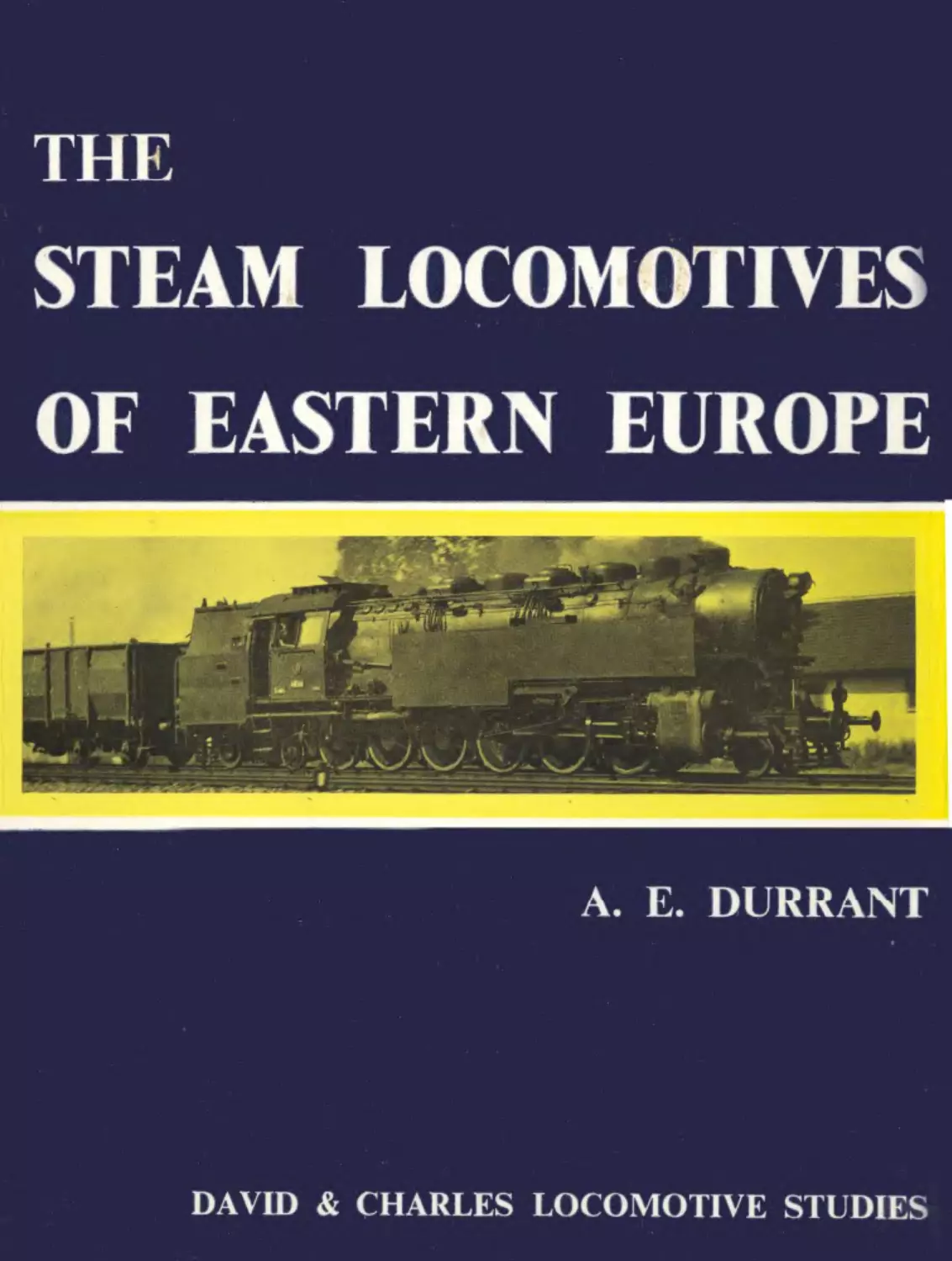
                    THE

STEAM LOCOMOTIVES

OF EASTERN EUROPE

A. E. DURRANT

DAVID & CHARLES LOCOMOTIVE STUDIES
THE STEAM LOCOMOTIVES

OF EASTERN EUROPE
David & Charles Locomotive Studies

General Editor:

O.S. NOCK, BSc, C Eng, FICE, FI Meeh E

Published Titles

The Steam Locomotives of Eastern Europe, by A.E. Durrant

The Fairlie Locomotive, by Rowland S. Abbot

The Garratt Locomotive, by A.E. Durrant

Steam Locomotives in Industry, by The Industrial Locomotive Society

4—8—o Tender Locomotives, by D. Rock Carling

Steam Locomotives of the South African Railways, Vols I & 2, by D.F. Holland

In preparation

The Mallet Locomotive, by A.E. Durrant

Australian Steam, by A.E. Durrant
Climbing up from the Adriatic coast, cx-Hungarian 4—8—0,
Jugoslav class it, stands out against a background
of majestic scenery
DAVID & CHARLES LOCOMOTIVE STUDIES

THE

STEAM LOCOMOTIVES

OF

EASTERN EUROPE

A. E. DURRANT

DAVID & CHARLES

NEWTON ABBOT

DEVON
SBN о 7153 4077 8

First published in 1966

This edition, revised, 1972

© A.E. Durrant 1966 and 1972

Printed in Great Britain by
Redwood Press Limited
Trowbridge, Wiltshire
for David & Charles (Holdings) Ltd
South Devon House Newton Abbot Devon
CONTENTS

PAGE

Preface to the First Edition	...	...	...	...	...	9

Foreword to this Edition	...	...	...	...	...	10

Chapter i. Austria ...	...	...	...	...	...	и

2.	The Prussian State Railways	...	...	...	19

3.	Hungary	...	...	...	...	...	27

4.	Rumania	...	...	...	...	...	41

5.	Greece	...	...	...	...	...	50

6.	Bulgaria	...	...	...	...	...	61

7.	Turkey	...	...	...	...	...	72

8.	Czechoslovakia	...	...	..	. .	...	90

9.	Poland	...	...	...	...	...	106

10.	Jugoslavia	...	...	...	..	...	119

11.	East Germany	...	...	...	...	...	135

12.	Baltic States and Albania ...	..	...	...	144

13.	Wartime Locomotives ...	..	...	...	151

Acknowledgements	...	...	...	...	...	157

Bibliography ...	...	...	...	...	...	157

Index ...	...	...	...	..	...	...	159

PREFACE TO THE FIRST EDITION

As the modernisation of British Railways pro-
ceeds, many cherished classes of steam disappear
and enthusiasts are increasingly heading abroad in
their quest for steam. However, many of the coun-
tries nearest to Britain have also been replacing
steam, often at an even faster rate than Britain, and
at the time of writing Holland has no steam at all,
and Sweden no duties for hers, which are all in
reserve.

Hence, the tendency is to go farther afield, and
Eastern Europe is a paradise of steam, with an
excellent variety, from incredible old-timers to
extremely modern locomotives, whilst some coun-
tries possess a significant portion of narrow-gauge
railways.

Until about five years ago, most of these coun-
tries were almost entirely steam-operated, with the
exception of railcars, and even today steam pre-
dominates. Other European countries have pro-
duced a book or books dealing with their steam
power, but in Eastern Europe there is no literature
in book form available and intending visitors have,
like the author, to find out what there is and where
it works by trial and error methods.

However, with this book, the first on its subject
ever published, one will be able to plan a trip, and
identify the locomotives encountered. It should be
mentioned, however, that photography is officially
forbidden in the countries concerned, and care
should be taken with one’s camera.

In a volume covering so wide a field as this, one
obviously cannot give the detail possible where the
subject is more specialised. Thus it is necessary to
describe the author’s aims, together with the scope,
and limitations, of this book.

The principal aim has been to lay down a broad

outline covering, in some way nr other, most of the
steam locomotives which have run in Eastern
Europe. Many of these were inherited from the
Prussian and Austrian Empires after 1919, and so
descriptions of their principal types, together with
subsequent disposal, form the subject matter of the
first two chapters.

The main bulk of the book comprises chapters
on the present Eastern European countries, the
term ‘East’ being defined as those countries behind
the Iron Curtain, plus Greece and Turkey. In these
chapters, a brief historical survey of the earlier
locomotive stuck has been followed by a more ex-
tended description of the modern types likely to be
seen today. Technical features of interest have been
pointed out, but not described at length, and all
dimensions have been condensed into tabular form.

Overall details of the quantities, building dates,
and the builders of all main classes have been
included, and where classes have been built for
specialised duties these, and their location, have
been shown. Most of the lines concerned had a
large proportion of second-hand power, due to the
political upheavals of the area, and to avoid need-
less repetition most of this has been condensed into
the tables which form part of the text.

References to the present day relate the latest
information available to the author, confirmed dur-
ing visits by himself and his correspondents, and
bring most of the book up to date to the summer
of 1964, with the Rumanian, Czechoslovakian and
Jugoslav chapters dated 1963.

A. E. DURRANT
Chiswick

January 1966
FOREWORD TO THIS EDITION

Since preparing the manuscript for the original
edition, great changes have taken place In Eastern
Europe. During 1963-65, when 1 first worked on
the book, steam was predominant behind the
Iron Curtain, but in the ten years which have since
elapsed, electrification and dicsclisation have in-
creasingly taken over from the fine, and often
unique, steam engines which formerly moved the
traffic. In the first edition, prepared when conditions
were reasonably stable, details of the general
allocations and duties of the more interesting
classes were included as a guide for prospective
travellers behind the Iron Curtain, but in this
edition no attempt has been made to update such
information, as this would need extensive revision
of the text, and be an expensive and useless exercise,
becoming out of date before the edition’s publica-
tion. Instead, with steam in Eastern Europe steadily
becoming a matter of history, the revisions included
have been confined to the rectification of errors,
and the inclusion of further material not available
when the first edition was written. These revisions
will, it is hoped, enhance the book’s value as a work

of reference and the most comprehensive book
available on its subject.

Publication of the first edition fostered a welcome
interest in the steam locomotives of Eastern Europe,
and three countries now have a book each dealing
with their locomotives, while other useful illus-
trations have appeared in pictorial books, such as
Steam in Europe. For those wishing to keep abreast
of the times, and to travel East for the purpose of
experiencing the dwindling ranks of the steam power
there, two magazines can be especially recom-
mended, European Railways which carries out an
annual Steam Survey throughout east and west
Europe, and the Continental Railway Journal,
which, in covering steam throughout the world,
carries, on an average, information appertaining
to about four Eastern European countries in each
issue. The addresses of these two journals will be
found in the extended bibliography which has been
included in this revised edition.

A.E. DURRANT
Sydney, Australia
February 1972
CHAPTER 1

AUSTRIA

It is not proposed in this chapter to attempt the
fascinating task of reviewing the entire Austrian
stock. Instead, Austria is covered down to 1919,
when its stock was divided amongst the emergent
Eastern European states.

The Austrian part of the old Hapsburg Empire
formed an important basis for the present-day
Eastern European systems, some of which were
almost entirely inherited from Austria-Hungary.
The Kaiserlich Koniglich Osterreichische Staats-
bahnen (KKStB) was formed in about 1880 from a
number of formerly independent lines and, as time
went on, others were absorbed. Some of these
lines are today largely in Eastern Europe and a
brief survey of the principal railways is given below,
the brackets containing the present-day name and
operating railway.

The locomotive stock of the dual monarchy was
similar in general outline throughout the regime
and only branched out into more widely differing
designs after 1900.

1.	Kaiser Ferdinand Nordbahn (kfnb). Absorbed
1907. Wien Nordbahnhof—Ganserndorf—
Lundenberg (Breclav Csd)—Prerau (Prerov
Csd)—Oderberg	(Bohumin	Csd)—Krakau

(Krakow pkp). Branches: Lundenberg—Brunn
(Brno Csd), Brunn—Prerau, Hullein (Hulin
Csd)—Tcschen (C. Tcsin Csd)—Bielitz (Biel-
sko pkp), Ganserndorf—Marchegg (present
frontier with Csd), Lundenberg—Laa a.d.
Thaya—Zellerndorf.

The locomotives concerned are listed in the
following table.

The great bulk of the stock were outside-framed
0—6—os and compound 2—6—os, whilst the
‘Atlantics’ were the largest and last of the classic
Austrian outside-framed classes. Only Nos. 1001-
1008 were superheated.

KFNB  Nos.	Group	KKSTB  Class	Type	Ctass °'herS
184-224	He	104	4-4-0	264 6
225-281	lid	308	4-4-2	274 0
907-908	IX	191	0-6-4T	300 0
387-390	VI	67	0-6-0T	304 0
383-386	VI	167	0-6-0T	304 1
921-957	IX	197	0-6-0T	310 I
287-363	Vcl-	2 149	0-6-0	3113
391-406	Vd	51	0-6-0	312 1
283-286	Vd	43	0-6-0	312 5
407-510	Vd	51	0-6-0	313 0
909-911	IX	564	0-6-0T	313 5
35-71	X	66	0-6-0T	314 3
525-745	VIII	260	2-6-0	333 1 jd2 130
511-524	Ve	159	0-6-0	334 0
801-811	Ilic	27	4-6-0	354 5
1001-1008	Ila	111	4-6-0	365 1

2.	Osterreichische Nordwestbahn (onwb).

Absorbed 1909. Wien Nordwestbahnof—
Stockerau—Retz—Znaim (Znojmo Csd)—
Tglaii (Jihlava	(FVAin

Prag (Praha Csd)—Koniggratz (Hradec
Kralove Csd)—Geiersberg (Letohrad Csd)—
Mittelwalde (Mcidzylcsie pkp). Reichenberg
(Liberec Csd)—Koniggratz—Deutsch Brod
(Havlickuv Brod Csd).

The 6nwb classes relevant to this book are listed
below.

ONWB Nos.	Class	KKStB  Class	Type	/?D Others Class
13-58	llla-b	16	4-4-0	232 0
84-100	Ic-d	301	4-4-0	252 0
661-685	Xlla-c	102	4-4-0	254 1
701-708	XVIb	208	4-4-2	264 4
101-112	IV	133	0-6-0	311-2
136-193	Vb-e	151	0-6-0	312 2
201-218	XIII	155	0-6-0	314 1 jd2 127
501-566	Xa-c	163	0-6-0T	314-2
241-260	XIa-b	55	0-6-0	324 0
776-779	XIX	209	4-6-0	354 2
751-754	XVIII	309	4-6-0	354 3
601-629	XlVa-b	11	4-6-0	354 4
321-374	Vila	171	0-8-0	4110
301-306	VI	271	0-8-0	411 1
The only locomotives of note were the 751-754
series 4—6—o, which were thrce-cylinder com-
pounds, 776-9 being similar but four-cylinder
compound.

3.	Siidbahn (sOd). Remainder absorbed 1924.

Wien Siidbahnhof—Graz—Marburg (Maribor
jDi)—Laibach (Ljubljana JDZ)—Triest. Mar-
burg—Mahrenberg (Dravograd jdJ)—Klagen-
furt—Franzenfeste (Fortezza fs). Kufstein—
Innsbruck—Bozen (Bolzano fs). Weiner Neu-
stadt—Sopron (mav)—Nagy Kanizsa (mav).
Pragcrhof (Pragersko ]Di)—Nagykanizsa—
Budapest (mav).

After the First World W'ar, the extremities of the
Siidbahn found themselves in Jugoslavia and
Italian territory, the locos being re-numbered into
those systems. The Austrian section was absorbed
by the бвв in 1924, but the Hungarian section re-
mained an independent concern and renamed itself
the Donau Save—Adria railway. The locos on this
section, whilst of Siidbahn design, were mostly
built in Hungary, some still existing on the mav,
which took over the dsa in 1943.

In later years a number of kksib classes were
built for the Siidbahn which, nevertheless, con-
tinued to develop its own designs, and one class,
the ‘629’ 4—6—2T, was introduced on the Siid-
bahn and later built by the KKStB. the бвв, and the
£sd.

Sud Nos.	Class	Type	jo2 Class	mAv Class
51-64	4	0-4-2T	162
101-129	106*	4-4-0	104	224 3
130-9  54-62	206*	4-4-0			225 3
372-431  667-99'  712 883	17C	4-4-0	103	—
	29	0-6-0	124	332 0
937-1011	35	0-8-0	132	—
1101-73	60*	2-6-0	131	330 3
1301-14	110*	2-6-2	110	—
1611-83	32C	0-6-0	——	333 0
1701-27	32f	4-6-0	109	—
3001-54	170*	2-8-0	24	——
306 01-2	306*	4-4-0	—	225 9
109 01-44	109	4-6-0	03	—
109-101-09	109	4-6-0	—	302
429 01-06	429*	2-6-2	—	323 9
(DSA)	270	2-8-0	—	403-5

*KKSta designs.

4.	Cisterreichische Staats Eisenbahn Gesellschaft
(sieg). Absorbed 1909. Wien Ostbahnhof—
Stadlau—Laa—Briinn (Brno Csd)— Bodenbach
(Podmokly 6sd). Brunn—Stadlau—Marchegg.

Apart from the lines given above, there was a
network in Hungary, which was taken over by the
mav in 1895. Many of the Austrian locos passed to
the fiso.

Later classes were as follows:

StEG  189Я	StEG  Old Nos.	Type	KKStB	CSD	MAV
2201-56	367-459	O-4-6T	14		250
2301-26	65-122	2-4-2	5	—	223
2351-52	141-142	2-4-2	105	—	—
2401-30	161-190	2-4-2	. 205	254 3	—
2501	144	4-4-0	506	264-3
2601-16	——	4-4-0	406	264 2	—
3001-15	621-51	0-6-0T	393	—	369
3201-40	860-921	0-6-0T	166	334 5	350
3251-67	710-57	0-6-4T	—	—	368
3301-74	758-859	0-6-0	32	3111	358
3401-11	1001-53	0-6-0	31		340
3451-77	1054-80	0-6-0	131		——
3501-35	501-21	0-6-0	231	333 0	339
3601-10	—	4-6-0	211	363 0	329*
3651-64	—	4-6-0	109		—
3701-34	—	2-6-0	560	344 3	—
3751-71	—	2-6-0	560	334 2	—
3801-43	—	2-6-0	760	344 1	—
3851-60		.	2-6-0	660	344 2	—
3901-20	—	2-6-0	228	344 0	—
4001-16	—	2-8-0T	179	421 0	477*
4101-4	1301-13	O-8-0T	378	403 3	450
4201-73	1112-50	O-8-0	571	401 0	459
4301-06	1251-56	0-8-0	75	4143	—
4401-19	1257-71	0-8-0	175	414 4	•—
20001-2	203-4	0-4-0T	283	—	—
30001-2	608-18	0-6-0T	195	300 4	380
31001-10	460-69	0-6-0T	195	300 4	—
32001-07	420-3.83-5	0-6-0T	195	300-4	382
33001-03	591-3	0-6-0T	196	—	—
40001-19	1361-78	0-8-0T	478	400 I	476
—	1286-1300	2-4-0	—	—	252
—	57-64	0-4-6T	—	—	268
—	42-44	0-4-6T		—	269

*Ex-csd in 1945.

5.	Kaiser Franz Josefs Bahn (kfjb). Absorbed
1884. Wien fjb—Gmund—Tabor (Csd)—Prag
( Praha Csd). Gmund—Budweis (Ccske Bude-
jovice Csd)—Pilscn (Plzen Csd)—Eger (Cheb
Csd).

Although absorbed by the KKStB some forty
years earlier, four out of kfjb’s five loco classes
survived to the Cso re-numbering, as follows:

KFJB Class	KFJB Nos.	Type	KKStB Class	tsD Class
AFI	1-32	2-4-0	24	233 0
AFI I	33-50151-4	2-4-0	26	233 1
AFI 11	201-13	4-4-0	3	——
BFI	51-106	0-6-0	35	312-3
BFIII	131-140	0-8-0	72	403 0

6.	Various Railways now mainly in

Czechoslovakia

These, and their locomotives, can be listed
briefly as follows:

(a)	Bohmisch Norbahn (bnb). Absorbed 1908.

(b)	Bohmisch W'estbahn (bwb). Absorbed 1895.

(c)	Dux (Duchkov 6sd)—Bodenbacher

(Podmokly 6sd) (db). Absorbed 1884.
Heralded by the star in front of the chimney of the leading engine, a pair of old Austrian locos,
2—6—0 and o—io—o, struggle through Czechoslovakia with a heavy freight

(d)	Eisenbahn Pilscn (Plzen Csd), Priesen
(Komotau—Chomutov Csd) epp (k).
Absorbed 1884.

(e)	Prag—Duxcr Eisenbahn (pd). Absorbed
1884.

(f)	Reichenberg (Liberec)—Gablonz (Jablonec)
—Tannawaldcr (Tanvald)—Eisenbahn
(rgte). Absorbed 1899.

(g)	Galizische Carl Ludwig Bahn (clb) in
Galicia. Absorbed 1892.

(h)	Mahrische—Schesische Zenrralbahn
(mszb). Absorbed 1895, in Central
Moravia and Silesia.

(i)	Galizische Transversalbahn (gt). Absorbed
about 1885.

(j)	Bohmische Kommerzialbahn (bkb).
Absorbed 1909.

Their surviving locomotives, listed conveniently
in order of their £sd classification, are set out in a
table on the following page.

There were also the Dalmatiner Staatsbahn,
from Spalato (Split jdJ) up to Knin and a branch
to Sebenico (Sibcnic joi), isolated from the rest of
the system until the Jugoslavs, after 1918, built a
new railway south to Knin. The ns had only half-a-
dozen о—6—os, which became KKStB 37 and JD?.
121 classes.

Finally, there was the Ixmberg—Czernowitz—
Jassy Eisenbahn in the extreme north-east, at the
end of a long arm with which Austria shielded

В
Hungary from the Teutons and Slavs. Further
details of this will be found in Chapter 4, Rumania.
Naturally, there were a number of minor railways,
but these cannot be dealt with here.

iso Class	Origin	Type	Orig. class	KKStB  Class
232 0	MSZB	4-4-0		16
244 0	CLB	2-4-0	Ilf	17
254-0	GT	4-4-0	ARIII	2
300 Z	RGTE	0-6-0T	G	293
310 2	HKB	0-6-0T	Ills	397
3110	RP	0-6-0	BPI	32
311 4	MM	0-6-0T	M	262
312 0	PD	0-6-0	BUII	50
312 4	BWB	0-6-0	III-IV	-to
312 6	DBE	0-6-0	BOI	45
312 7	BNB	0-6-2T	VIb	265
312-8	epp(k)	0-6-0	BK I	36
3131	MSZB	0-6-0	—	54
314 0	DBE	0-6-0	BO II	53
322-0	EPP(K)	0-6-0	BK II	39
322-1	BNB	0-6-0	in	147
323 0	MGB	0-6-0	BM II	49
323 1	BNB	0-6-0	V	53
342 0	BNB	2-6-0	Il c	128
353 0	BNB	4-6-0	II b	127
400-0	RGTE	0-8-OT	G	78
401-1	epp(k)	0-8-0	BK III	71
403-1	BWB	0-8-0	V	176
403 2	PD	0-8-0	BL’ IV	77
414 1	BNB	0-8-0	Va	74

KKStB Standard Locomotives

At this stage it may be convenient to explain
the Austrian system of classification by numbers.
It is as follows:

Series 1-9 Express locos

10-29 Passenger locos

30-68 Goods (six-coupled;

69 Rack

70-79 Goods (eight-coupled)

80-82 Goods (ten-coupled)

83-89 Localbahn locos (four-coupled)

90-99 Localbahn locos (six-coupled)

too Mountain locos (twelve-coupled)
There were a few exceptions to this rule. As this
gave only room for 100 different classes, it was
expanded in two ways to include further varieties.
One was by prefixes, such that the standard com-
pound 4—4—os were, for example, classes 6, 106,
206 and 306. The second was in allocating different
‘hundreds’ numbers to variations within a class.

The first four classes prior to development were
distributed as below:

KKStB	Type	CSD	jd2	PKP
4	4-4-0	254 2
48	0-6-0	—	127
56	0-6-0	324-1	127	Th-20
73	0-8-0	414 0	133	Tp 15

Dealing with the later classes in groups relating
to their duties, there were four classes of two-
cylinder compound 4—4—os, the last having a
superheater. The final two classes were preceded by
a four-cylinder compound 4—4—2 which, like the
later 4—4—0 and the earlier 2—6—2 express
locos, had their running plates curved over the
wheels in the form of ‘mudguards’. These four-
coupled classes, built from 1894 to 1908, were
distributed:

KKStB  Class	Type		PKP	jd2	MAV
6	4-4-0	264 0	Pd-12
106	4-4-0	264 1	Pd-I3	104	224-3*
206	4-4-0	265 0	Pd-14	—	225-3*
306	4-4-0	—	——	——	225-9*
103	4-4-2  *E\ DSA.	275-2	—	—	—

A series of four-cylinder compound express locos
was produced from 1905 to 1918, the first being
the 110-class saturated 2—6—2. With steamdriers
they became 110.500, and with superheaters plain
class 10, as though Golsdorf, knowing that defects
existed, had reserved the basic class number for the
final perfected version, a phenomenon to be noted
elsewhere. Locomotives with larger wheels for
speed, and larger boilers for power, were needed
within the 14-ton axle load existing, so a four-wheel
truck was added, making the rare 2—6—4 type.
These came in three varieties, series 210 with
steamdrier, 310 with superheater, and 310.300
with Brotan boiler as well. A total of in of these
2—d—45 were built, the first large application of a
four-wheeled truck under the firebox, ante-dating
the USA’s ‘invention’ of this construction by seven-
teen years! The final type of express locos, a two-
cylinder superheated simple, was the 910-class
2—6—2, the express classes being divided as
below:

KKStB Class	Type	OSD	PKP	jd2
10	2-6-2
110	2-6-2	354 9(b)	—	110(a)
100-500	2-6-2		—-
210	2-6-4		Pn-11	—
310	2-6-4	375 0	Pn-12	—
310 300	2-6-4	—	Pn-12	—
910	2-6-2	364-0	—	—

(a) Built for Sudbahn.

(b) Built for Kaschau-Oderberger Bahn.

For ordinary passenger work, the 2—6—2 type
with two cylinders was adopted, the first type,
series 329, being compounds with slide-valves, and
a Clench steamdrier. Ninety-three were built in
An Austrian two-cylinder compound о—to—о in service in Jugoslavia
and noteworthy for its enormous low-pressure cylinder

1907-09, plus two for the Banjaluka—Dobrljin and
65 for the mav. These were followed in 1909-10 by
fifty-seven superheated versions, series 429, with
piston-valve high-pressure and slide-valve low-
pressure cylinders, the final compounds being the
126 locos numbered 429.100-225, superheated with
piston-valves both sides. The 197 superheated
simples, built 1911-17, were 429.900-99 and
1900-96. For shorter distance local work seven-
teen a 6—oTs of class 139 were built in 1903.
They were developed into a 2—6—2T and 239
built for the KKStB in 1904-07, plus eleven for the
S'idbahn. Classed 229, a further seventeen were
added in 1906-12 by re-building the 129-class, both
being saturated slide-valve compounds. Finally,
thirty-six superheated piston-valve 2—6—2Ts of
class 29 were turned out in 1912. For the heaviest
turns, the Siidbahn brought out a superheated
simple 4—6—2T in 1913-15, later adopted by the
KKStB from 1917, and again developed as a stan-
dard class by the Csd. The various passenger
engines above were distributed and classed as below
by the Eastern systems:

KKStB  Class	Type	c.sr>	jni	mAv	PKP
29	2-6-2T	—	116		Okl-11
229	2-6-2T	354 0	116	——	Ok1-12
329	2-6-2	354 6	107	323	01-11
429	2-6-2	354 7	—	—	01-12
429 100	2-6-2	354 7	106	—	01-12
429-900	2-6-2	354 7	106	—	01-12
629	4-6-2T	354-1	18	343 3	0 km-11

Turning now to freight engines, some twenty-
three of the classic outside-framed о—6—os were
produced in 1885-88, scries 48, the last of the type
built for the KKStB. Further 0—6—os, with inside
frames, were delivered from 1888 to 1900, classed
56 and totalling 153 engines. While these were in
course of delivery, Gdlsdorf was initiating com-
pounding, with the 59-class locos having inside
frames, two outside cylinders and slide-valves driven
by Walschearts valve-gear; T93 of these were built
between 1893 and 1903. In 1895, the type was
developed as a 2—6—о class 60, with larger boiler
and higher speed potential. These became very
popular, 297 to the original design being built up
to 1910, plus Nos. 60.500-521 with Clench and
Nos. 60.800-802 with Piclock steamdriers, and
seventy-three locos for the Siidbahn. Forty-six of a
superheated version, with piston-valves, class 160,
came out in 1909-10.

Eight-coupled locos had been in service in
Austria from 1855, and in 1885 the 0—8—0, stan-
dard class 73, appeared. These distinctive little
locos, with inside frames and motion but cylinders
outside the disc wheels, were highly successful and
no less than 453 were built by 1909. Some are still
in service today and, despite their age, are extremely
sprightly, being able to complete a shunting move-
ment in the time a diesel takes to build up its
engine revolutions.

For the heaviest duties, Gdlsdorf preferred com-
pounds and the о—6—о of 1893, enlarged to
Former Siidbahn о—6—о, now class 333, in Hungary

2—6—o in 1895, was developed in 1897 to a
2—8—о and in 1900 to an 0—10—0, a most rapid
increase in capacity. The 2—8—os were classed
170 and no less than 796 were delivered by 1919,
plus fifty-four for the Sudbahn, whilst deliveries
continued in Czechoslovakia to the tunc of a further
fifty-eight, a total of 908 locomotives.

Despite the continued delivery of the 170s, a
superheated simple version, with piston-valves, was
evolved in 1917, leap-frogging the usual super-
heated compound stage. This new 270-class was
built as recently as 1930 for the Csd and dsa, being
delivered new to Czechoslovakia, Poland, Jugo-
slavia, Italy and Rumania, only 100 of the 491
built spending any more than a couple of years
working for Austria.

The о—io—0 type, in addition to being prolific,
also combined the maximum number of possible
Golsdorf variations, within a two-cylinder basis.
Earliest were 180.01-181 and Siidbahn 4001-27,
built from 19CO to 1909 with saturated boilers
sporting two domes and connecting pipe, compound
cylinders, and slide-valves. Next came 180.500-557
with Clench steamdriers, and one dome. The
superheated compounds were 80.01-37 with h.p.
piston-valves and 80.100-203 plus Siidbahn 80.31-
38 with piston-valves both sides. Finally, there
were the superheated simples, 420 locos numbered
80.900-99,1900-99,2900-99, 3900-99 and 4900-19.

Most of the 39XX series, plus others, were actually
delivered new to Poland, Rumania, France and
Jugoslavia, whilst subsequent deliveries were made
to Greece (fifty locos in 1924-26) and Jugoslavia

(four locos in 1929).

Details of the distribution of these eight classes
of freight engines, ranging from 0—6—os to
o—to—os, are set out in tabular form below;

Class	Type	Csd	jo2	mAv	CFR	PKP	SEK
59	0-6-0	324-2	127		—	—	—
60	2-6-0	334-1	131	330 3	60	Til2	—
160	2-6-0	—	—	—				Til6	—
170	2-8-0	434 0	24	—	—	Trll
270	2-8-0	434 1	25	403	140-3	Trl2	—
SO	0-10-0		28	—-	—	Twl2	—
eu V	U-1U-U	524-U	2»	5 ZU Э	5U	1 W1Z	KD
180	0-10-0 523 0		135	—	180	Twll	—

There now remain to be catalogued only the
principal tank engine classes for shunting and local
work, these being more uniform and without the
wide variations within classes.

Oldest and smallest were the locos gathered
together in series 97, minute 0—6—oTs with in-
side frames, but all else outside. About 250 of these
were built from 1878 to 1911, many for local rail-
ways, and there were a variety of differences in
tank capacity, some very noticeable.

For branch passenger services, Golsdorf pro-
duced little 2—6—oT two-cylinder compounds,
the earlier 99-class with double-dome 'handle'
boilers, the later 199-class with single domes and
larger tanks and bunkers. The two classes totalled
sixty-nine and twenty locos respectively, and were
built between 1897 and 1913.

Most numerous were the 178-class 0—8—oT
which, like the 2—6—oT, were compounds and
had Gdlsdorf valve-gear, a primitive bell-crank
arrangement later developed in the USA as Baker
gear. Some 223 of these were turned out from 1900
to 1919, plus others for private lines.

The distribution of the tank classes was:

Class		jd2	PKP
178	422 0	52	Tkp-11
97	3100	150	—
99	320 0	153	—
199	—	1»	—

AUSTRIA-HUNGARY: RACK AND
NARROW-GAUGE LOCOMOTIVES

Rack Engines

Following the success of the Erzbergbahn in
Austria proper, opened in 1890, three more
standard-gauge rack lines were built in the Empire.
All the locomotives were built by Florisdorf and
had the same sized cog wheels and adhesion wheels,
plus rack cylinders of the same diameter and stroke.
This may have	cimply mnvpnipnt for rhp

builders, but rather suggests an overall strategy
aimed at making possible the transfer of locomo-
tives from one line to another.

The Austrian line was worked by a series of

eighteen o—6—zTs built between 1890 and 1908,
class 69, and set the pace, with simple expansion of
both rack and adhesion mechanisms, separate regu-
lators, but combined reversing gear. To facilitate
entry of the engine onto the Abt rack section, whose
first length is sprung, the locos had geared to the
rack wheels a red and white ‘target’ which rotated
in time to the adhesion wheels. Thus, by opening
the rack regulator so that the target could be seen
to rotate in time to the adhesion exhaust beats, a
smooth transition occurred. Because of the steep
gradients of these lines, the water gauges were
outside the boilers, in line with the front of the
firebox.

First after the Erbergbahn was a section of the
mav, between Tiszolcz to Zolyombrezo, six kilo-
metres with a gradient of 50 •/ being rack. For
this, Florisdorf built three 0—8—4TS in 1896, and
another in 1900, curious machines with open-back
cabs and back tanks only. These locos could push
trains of 175 tons, and in 1919 exchanged their
mav class 41 numbers for £st> 403.5.

Next was the Tannwald—Griinthal line, of the
Reichenbach—Gablonz—Tannwalder Eisenbahn,
opened 1901-2, with three о—8—2Ts built in
1901. These became KKStB 169-class, and again

This massive Sudbahn 4—6—0, seen .at Pazin, in Jugoslavia, is of a type which is also
still in service in Hungary and in its native Austria
passed to the cst>, as class 404.0, being rated to
push a 160-ton train up the 5$ km of 567...
gradient.

Finally, in 1908, the mav opened the Karansebes
—Hatszeg line, which included 5} km of у6°1ао
gradient, and for this were built eight 2—8—zTs,
class 40, with the same boiler and cylinders as the
earlier о—8—4TS, but normal side tanks. These
locos were rated for гбо-ton trains, and all passed

with the line to Rumania in 1919.

Narrow Gauge

Most of the Austrian narrow-gauge mileage was
in Austria proper, and scarcely concerns this
volume. However, a few lines were taken into the
£sd and the jdz, and these used the standard U
class 0—6—2T, 760 mm gauge, whose new owners
classed them ‘U37.0’ and T88’ respectively.

AUSTRIAN STATE RAILWAYS (KKSt B)
TYPICAL DIMENSIONS OF PRINCIPAL CLASSES

Class	Type	Cylinders		Coupled Wheel Dia- meter mm.	Heating Surface  m1	Super- Heating Surface  m-	Grate Area  m-	Total W'eight (Working Order) t	Adhe- sion Weight t	Pressure  Kgcm-
		No	Dimensions  nun. • mm.
106	4-4-0	f I	500 680 3	2100	140 4		30	557	28-7	13
		\ 1	760 • 680 /
108	4-4-2	J	350 , 680 \	2100	214 8	——	3 53	68-3	29-0	15
		\ 2	600 - 680 7
309	4-6-0	f 1	490  650 \	1730	178-7	—-	31	63-3	42 0	13 5
		\ 2	600  650 7
110	2-6-2	/ 2	370 • 7201	1780	232 0			4 0	69-1	42 9	15
		\ 2	630  720 /
310	2-6-4	J 2	390 • 7201	2100	191-6	55 2	4 62	86-0	44 1	15
		\ 2	660 • 720 ?
910	2-6-2	2	540  680	1780	147-5	36 2	3 0	68 0	41 0	14
229	2-6-2T	/ 1	420 x 720 1	1574	95 5		2-0	67-1	38 0	14
		\ 1	650 - 720 7
329	2-6-2	/ 1	450 , 7201	1574	152 5			30	59-7	43 0	15
		1 1	690 • 720 7
429	2-6-2	/ 1	475-7201	1574	118 6	27-2	3-0	61-2	43 0	15
		1 1	690 x 720 f
429 900	2-6-2	2	475 x720	1574	118 6	27-2	3 0	61-2	43 0	15
48	0-6-0	2	450 x 632	1258	132 7	—	1 94	41 1	41 1	11
56	0-6-0	2	450 x 632	1258	118 8	—	1 81	41-5	41 5	11
59	0-6-0	( 1	500 x 632 1	1258	118 8	—.	1-81	42 0	42 0	11
		\ 1	740 X632 7
60	2-6-0	7 1	520x6321	1258	130-2	—	2-7	53-5	43 I	13
		\ 1	740x6327
170	2-8-0	7 1	540 x 6321	1258	225 0	—	3 36	68-5	57 0	12
		t 1	800X632 f
270	2-8-0	2	570 x 632	1258	165 3	48 7	3 87	68 0	57 3	13
73	0-8-0	2	500 x 570	1100	163 8	—	2 25	55 1	55 1	10
178	0-8-0T	r 1	420x5701	1100	89 8	—	1-65	48-0	48 0	12
		\ 1	650 <570 7
80	0-10-0	7 1	590 x 6321	1258	135 2	34 0	3-42	69 4	69 4	14
		\ 1	850 x632 7
80 900	0-10-0	2	590 x632	1258	135 2	34 0	3-42	69 4	69 4	14
160	0-10-0	/ 1	500 X032 \	1236	102 7	• —		03- f	03- /	13
		\ 1	850x6327
97	0-6-0T	2	345 x580	930	53 2	—	104	29-0	29-0	10
99	2-6-OT	7 1	370 x 5701	1100	73 8			1-42	39 3	28 0	13
		\ 1	570 x 570 f
CHAPTER 2

THE PRUSSIAN STATE RAILWAYS:
KONIGLICH PRUSSISCHEN EISENBAHN
VERWALTUNG (kpev)

The effect of Prussian locomotive practice on the
railways of Eastern Europe is far greater than
might first be imagined. From the geographical
viewpoint, large tracts of present-day Poland were
in Prussia at the time when the German Empire
extended eastwards to the borders of Poland and
Lithuania, which States were within the Tsarist
Russian Empire. Thus, naturally, the Polish State
Railways inherited large numbers of Prussian loco-
motives, most of the standard classes appearing in
the pkp rosters.

The Prussians gave their locomotives four major
class distinctions—S for Schnellzug locomotives
(express loco), P for Personenzuglokomotive (pas-
senger locomotive, approximately in capacity to the

British ‘mixed traffic' types), G for Guterzugloko-
motive (freight loco), and T for Tenderlokomotive,
or tank engine.

The main classification letter was followed by a
cypher, such that express classes were Si, S2, S3,
etc. and, in early days, this often grouped a variety
of classes of similar power rating, not necessarily of
the same wheel arrangement. A parallel case was
the power classification of the London Midland &
Scottish Railway.

However, as the older and less standard locomo-
tives, many of which were taken over from formerly
separate railway concerns, were replaced by stand-
ard classes, the expression G7, for example, began
to mean a definite class rather than a group of

One of the Prussian three-cylinder G-12 2—10—os now fitted with pulverised fuel
equipment, banking a freight out of Dresden, East Germany
classes. This was helped by the introduction of
suffixes such that classes differing in detail became
G71, G7', G7’ etc.

The introduction of superheating, first success-
fully applied on the kpev, led to the refinement
whereby superheated engines received even and
saturated engines odd class numbers. Such satur-
ated engines as were later superheated were not,
as might be expected, re-classified into the nearest
superheated series, but were given the suffix ‘H’ for
heissdamf, an example being T11H.

The kpev express classes were not widely dis-
persed in Eastern Europe, only Poland having vir-
tually a complete set. For many years there were
few express locomotives in Prussia, and the first
standard was the Si-class of 2—4—os built in
1886-97. Series S2 covered a variety of semi-
experimental locomotives, mostly of the 4—4—0
type but including some 2—4—2s of Belgian
design.

The first standard express class of any signific-
ance were the S3 4—4—os, handsome two cylinder
compounds with outside Walschaerts valve-gear,
slide-valves, and using saturated steam. Over 1,000
of these were built from 1892 to 1904, and were
widely used throughout the system. Superheating,
with piston valves and simple expansion, produced
the S4-dass, of which about 100 were built, these
being mainly a stepping-stone to the later S6-class.

Series S5 covered a variety of saturated com-
pound 4—4—os. S5 ‘ in its earlier and most numer-
ous form covered the four-cylinder von Borries
engines, whose features included unified drive on
die lidding cuuplcd dale, iwu acts uf inside Wal-
schaerts valve-gear actuating all four valves, and
combination plate and bar frames, as later adopted
by Churchward on the Great Western Railway.

An entirely different S5‘-class comprised a num-
ber of de Glehn compounds, built at Graffenstaden
and differing only from their French cousins in the
provision of kpev cabs, tenders and fittings. The
S5*-class were two-cylinder compounds, and were
a slight enlargement of the Sj-class, and difficult to
distinguish from these earlier locomotives.

The final 4—4—os were the S6-class, large two-
cylinder simple superheated locomotives, built
mainly by Linke Hoffman of Breslau and allocated
generally in the Eastern divisions. Nearly 600 were
built in the years 1906 to 1914.

S7 series comprised a variety of saturated four-
cylinder compound ‘Atlantics’, both of the de
Glehn and von Borries designs, and were enlarge-
ments of the two types of S51. The von Borries
locomotives, which again were the most numerous,
all had wide round-top fireboxes, but the de Glehns

had both round-top and Belpaire narrow boxes,
together with wide round-top boxes. No sub-indices
were used for this variegated bunch of machinery,
all of which were simply S7. Some of the von
Borries engines had Pielok superheaters, or more
correctly, steamdriers, and these were more latterly
classed S8.

The final four-coupled design was the S9
‘Atlantic’, a larger and more modern type, built in
гроЯ-р. using four cnmpnnnd cylinders driving the
leading axle. The limited adhesion of these loco-
motives led to the adoption of the 4—6—0 type
for express work, a number of different designs
being evolved, all superheated and classed in the
Sro series.

Sio, without any further index, comprised some
200 four-cylinder simples, all cylinders driving on
the leading axle. These were built between 1910
and 1914, the earliest having low running plates
with splashers, whereas the bulk had very high
running plates, these latter being very handsome
engines.

Class Sio1 covered four-cylinder compound loco-
motives, of which there were two distinct designs,
the earlier locos built 1911-15 having plate frames
throughout, cylinders arranged de Glehn pattern,
and low running plates, whilst the later locos
utilised the combined bar and plate frames, intro-
duced on the S5' von Borries locomotives, and had
high running plates and all four cylinders in line,
but divided drive. These were built in 1914-16,
and somewhat over 100 were built, the earlier
version numbering over 150.

Cuuiciupuiaiy wiili ilie compounds were about
120 three-cylinder simples, classed Sio-', all cylin-
ders driving on the leading axle, so that they were
very similar in appearance to the later Sio-class.
Like these, the Sio- had the combined plate and
bar frame, and high running plate. These were the
last express designs built for Prussia, but ten ex-
Austrian 2—6—4 locos of class 310.300 spent a
short time on the kpev lists as series St I.

Of the express classes enumerated above,
examples of nearly all went to Poland, whereas
other Eastern lines had none, and it is convenient
to tabulate these below.

KPEV  Class	PKP  Class	KPEV  Class	PKP  Class
S3	Pd-l	S 7 V.B.	Pf-1
S4	Pd-2	S 7 d.G.	Pf-2
S51 V.B.	Pd-3	S 10	Pk-1
25*	Pd-4	S 10'	Pk-2
S6	Pd-5	S 102	Pk-3
		S 11	Pn-12

The ordinary passenger engines had a less com-
A Prussian T18 4—6—4T in service on the Polish State Railways

A gleaming Prussian P8 4—6—0 pulling into Arad, in Rumania,
with a westbound freight
plicated build-up, and one class in particular was
spread widely. Most of the older 2—4—os had
been scrapped by about 1920, but a few of the old
Рз' simple expansion engines survived in Germany
and Poland, which latter country classed them Oc-i.

However, 1,200 passenger 4—4—os were built
for the kpev from 1892 tc 1912, featuring saturated
boilers, two outside cylinders and outside Wal-
schaert’s valve-gear, 500 being simples and 700
compounds, classed Рд' and Рд2. Many of these
were still in use in 1919 and, naturally, Poland
inherited a goodly number, classifying them Od-i
and Od-2 respectively. These classes were also in
use in the Baltic States, whose requirements hardly
justified express engines.

One of the Pq-class was used in Schmidt’s early
superheating trials and although this did not lead to
a general superheating of the class, it did lead to
the introduction of the P6-class 2—6—0, built for
the lighter passenger duties from 1903 to 1916.
Poland had a number of these, classes Oi-t, and
otherc were uced in Latvia and Lithuania.

As a superheated general passenger engine, the
P6s were soon completely outclassed by the P8-
class 4—6—0, introduced in 1906. These, like the
P6, were straightforward two-cylinder jobs, with
piston-valves, but were more powerful, faster and
generally more useful. The moderate 16-ton axle
load enabled the P8 to operate over a wide range
of routes, and the popularity of the class was such
that about 3,800 locomotives were built to the same
design, with very few differences.

The P8s were widely distributed throughout both
East and West Europe, and even in die East die list
of countries which used them is quite formidable,
as shown below:

P8 Class in Eastern Europe

Czechoslovakia .	. Class 377 0
Poland	.	„ Ok-1
Jugoslavia	..
Greece	„ Z5
Rumania	» 230
Lithuania	„ K8
Latvia	• ,, ?
Russia	.	„ (38 Ex-Germany)  (230 Ex-Rumania)

The final Prussian passenger class was the Pio,
a magnificent three-cylinder 2—8—2 which ap-
peared in 1922, but was not used in Eastern Europe
except, when considered politically, in East
Germany.

Freight classes on the kpev were as diverse as
the express types, the eight- and tcn-coupled types
being spread widely through Eastern countries. As
the six-coupled types were more limited in distri-

bution, appearing mainly in Poland, these will be
dealt with in less detail.

The 0—6—os included in series G3 and G4
were obsolescent by the turn of the century, and
the main classes pertinent to this book were the
G3S and the virtually identical G41-class, which
were built from about 1880 to the turn of the cen-
tury. A two-cylinder compound version was classed
G42, and all three series had the common features
of outside cylinders, inside Allan straight-link
motion, and ‘long boiler’ construction with the fire-
box behind the trailing axle. The Poles classified
the G3, G41 and G42 classes Th-i, Th-2 and Th-3
respectively, and the Czechs had a few old G3S
which were re-numbered into the 314.4 series.

The only Prussian о—6—о to approach a
modem design were the fifty-eight G4' locos built
in 1903-7. These were two-cylinder compounds,
with outside cylinders and Walschaert’s valve-gear,
and boasted a high-pitched running plate. Once
again Poland inherited some, classing them Th-4.

Prussia developed the о—б о into 0260
type, using cylinders and motion largely standard
with the G41 and G42 classes, but with the coupled
wheelbase extended rearwards to embrace the fire-
box. Indecision as to the merits of compounding
resulted in some 268 simple G5'-class being pro-
duced, together with 500 compound G52s in 1893-
1901 and 1896-1908 respectively. Later, the G5
series was completely re-designed with a shorter
coupled wheelbase, outside Walschaert’s valve-gear,
with slide-valves over the cylinders, and classes G51
and G54 were the simple and compound versions of
this design, in tnis case, me nonours were more
even, nearly 800 simples and over 700 compounds
being built between 1901 and 1910. The Poles
inherited all four varieties, and re-classified them
T1-1 to T1-4 in order.

Existing records probably do not do justice to
the likely wanderings of the Gys, but Czecho-
slovakia had a few Gj's in their 335.0 series,
Jugoslavia some Gs’s as class 128, and Turkey
G52s and G5S as class 34.026 and 34.019 respec-
tively. G6 was a blank series, but the G7 0—8—os
were light, simple and useful engines which found
widespread use in Eastern Europe. A light axle
load of thirteen tons allowed them to run almost
anywhere, and although the earliest were built in
the 1890s, examples can still be seen at work today.

Two varieties were constructed, the G71 simple
and the G72 compound, both being saturated en-
gines with inside Allan motion and outside cylin-
ders. Only 200 Gy's were built at first from 1893,
but during the First World War they became the
standard lightweight military engine and over 1,000
were built for the Prussian Army, plus some for
Austria.

The compound G72 totalled over 1,600 locomo-
tives built between 1895 and 1911, and the two
classes were distributed in Eastern Europe as shown
below. It is interesting to note that simple and
compound engines were mainly grouped together,
only Poland allocating them separate classes.

The G7 0-8-0 in Eastern Europe

G7* Simple G7S Compound

Czechoslovakia	class 413'0	class 413-0
Austrian Army	274	——
Hungary	431	431
Poland	Tp-1	Tp-2
Jugoslavia	23	23
Bulgaria	26	26
Greece	Ha	—

Turkey	(Scrapped before classification system)

built, from 1912 to 1913. Nevertheless, the satur-
ated engine had not quite died, and a couple of
hundred large о—8—os with outside Walschaert’s
gear, but unsuperheated with slide-valves, were
built during 1908-11. They were classed G9, and
Poland had some as their class Tp-5. These, at
sixty tons, were somewhat larger than the G8, but
1913 saw the appearance of the G81, an enlarged
superheated locomotive weighing sixty-seven tons.
Wartime requirements for a powerful and versatile
engine for heavy freight duties proved the making
of the G8', and by the time production ceased in
1921, over 5,000 had been built, including new
examples for Poland and Rumania.

The G8, and to a greater extent the G81, have
proved popular wherever they were used, and few
countries in Europe were without one class or the
other, some of the G8s being found as far afield as

A Prussian Gio, built in Rumania, hauling a Bucharest-bound freight

A third variety of G7 was the G71, which was a
2—8—0 version of the G72 compound. By adding
a leading pair of wheels and pushing the boiler for-
ward, a locomotive with higher speed potential, and
even lower axle load, resulted but only fifteen were
built, during 1893-95. However, war requirements
produced the conditions which the G7' fulfilled,
and a further seventy of this already obsolescent
class were built in 1917. Those that went to Poland
were classed Tr-i, whilst after the Second World
War, Jugoslavia found that the Germans had left
them one, which they numbered 142.001.

Whilst the later G7S were still in course of
construction, a far more modem о—8—о was
built, the G8, with superheater, piston-valves and
Walschaert’s valve-gear. These became the standard
freight engine for the kpev and over 1,000 were

Syria. They were not dispersed in Eastern Europe
so widely as the earlier G7S or later Gio series, due
to their heavier axle loading, but the Czechs in-
cluded both classes as 425.0, Poland classed them
Tp-3 and Tp-4 respectively, and Rumania had
some G8's numbered in their 40.001 series. The
lighter G8 was favoured in Turkey as series 44.001
and a few G8's were to be found as class 44.101.
A very few found their way into Jugoslavia, where
they were numbered in the 23.101 series, plus one
odd loco tagged onto the G7 locos as 23.044.
Between the two wars, the dr rebuilt a considerable
number of G8's as 2—8—os, and one of these was
left to the jd2, who numbered it 143.001, whilst
Poland had a number as class Tr-5.

Before the arrival of the heavier G8' о—8—о, a
locomotive of similar power was built with the
о—io—о wheel arrangement, and classed Gio. A
feature of these was that the boiler was inter-
changeable with the P8 4—6—o, and with a lighter
axle load than either the G8 or the G8', the Gio
became a popular heavy freight engine in Eastern
Europe. Gios were built new for Poland, Turkey
and Rumania, and in the latter country they be-
came the standard freight engine and were built in
some hundreds. The Gio distribution was as below.

Czechoslovakia
Austrian Army
Poland
Jugoslavia
Greece
Rumania
Turkey

Class 534 1
„ 680
» Tw-1
,, 35
„ K₽
„ 50 101
„ 55 001

The final phase of Prussian locomotive design,
which favoured wide Belpaire fireboxes, bar frames
and three cylinders, was ushered in during the
latter years of the First World War, and was thus
concerned mainly with freight locomotives, only the
Pio passenger class being built.

Three cylinder propulsion had already appeared
on an experimental 2—8—2T in 1913, and on a
series of narrow firebox 2—10—os built for both
Prussia and Saxony in 1915-17, the latter being
G121. The principal locos, with all the final features,
were classed G12, and were the first German stan-
dard locomotives, over 1,500 being built, not only
for Prussia but also for the Saxon, Baden and
Wurttcmburg State Railways. These appeared
generally too late for distribution after the war,
although Poland had some and classed them Ty-i,
but the Second World War saw them sent to Bul-
garia arid Jugoslavia, where they arc still at work
as series 13 and 36 respectively.

A variation was evolved, known as G12 Turk,
which had smaller wheels and a larger boiler with
round-top firebox. Fifteen of these were built in
1917-18, ten of which went to Turkey. One re-
mained in Germany and three went to Belgium, in
1918, these latter being transferred to Luxembourg
in 1931, where they outlived the actual Turkish
examples.

Foilowing the G12S, a return was made to eight-
coupled locos, and two very heavy 2—8—0 classes
appeared in 1919, being classed in the G8 series.
Both had the wide Belpaire firebox and bar frames
of the G12, and one class, G8’, had three cylinders
also. Only eighty-five of these were built, but the
two-cylinder G8: version ran to over 1,000 locomo-
tives, including sixty-two built for Turkey and 104
for Rumania, in which countries they were the
most powerful locomotives for some years. Poland
now has a number of G8!s, ex-DR, which are classed
Tr-6.

There now remains to be considered only the
tank engines which, as previously mentioned, did
not differentiate between passenger freight or
shunting locomotives when classed. The earliest
type to have any significance in this book was the
T3 0—6—oT, of which over 1,500 were built for
both the Prussian State and numerous private rail-
ways, from the 1880s until the early 20th century.
These were well-tanks with outside Allan valve-
gear of delightfully ancient appearance, and quite a
number exist today in industrial sidings or on
minor railways. Those that went to Poland bore
class Tkh-i.

The T4 series covered a variety of 0—4—2T
and 2—4—oT passenger engines which had been
mostly scrapped by about 1920. Further passenger
engines of two distinct types came under series T5,
a 2—4—2T built from 1895 t0 1905, class T5',
and a 4—4—oT, T52, built in 1899-1900. Both
were saturated engines with slide-valves and Wal-
schacrts valve-gear, the well-tank T5' numbering
over 300 examples, whilst only thirty eight of the
side-tank T52 were built. Both classes found their
way to Poland, as Oke-i and Okd-i respectively.
Poland also inherited a few of the kpev T6-class
2—6—2Ts, which were built as three-cylinder
saturated engines for the Berliner Stadbahn, the
object being to obtain high acceleration. With the
advent of the later superheated 2—6—oT, the T6s
were rebuilt to two-cylinder locos and spread
around amongst various kpev divisions, those in
the East becoming pkp Okl-i.

Two types of 0—6—oT, heavier than the T3,
wcic built, the Т/ saturated slide-valve engine of
1877-1900, and the later superheated piston-valve
T8 of 1906-09. Neither lasted so well as the little
T3, but Poland used both classes, numbering them
Tkh-2 and Tkh-3.

Further freight locos were built in series T9
w'hich embraced two-wheel arrangements. Earliest
were the T91 0—6—2T, built between 1893 and
1902, and these were, to a large extent, an enlarged
version of the T7-class. Over 400 were built con-
temporaneously with the T92 which, although
having opposite wheel arrangement of 2—6—oT,
was as closely as possible the same engine. Only
250 of the latter were built, but when the design
came in for revision, the 2—6—oT was chosen.
The T9’, as the later locos were called, was a far
more chunky engine, with short-coupled wheelbase
and Walschaerts valve-gear. It became the standard
light shunting engine, and over 2,000 were built
between 1900 and 1914. All three varieties of T9
were found in Poland, where they were classes
Tki-i, Tki-2 and Tki-3 respectively, whilst Jugo-
A Prussian G8 о—8—о in service in Turkey

slavia, after the Second World War, had some T91
in their series 154.

The Tio 4—6—oTs did not find their way to
Eastern Europe, but two series of 2—6—oT pas-
senger engines, Tn and T12, with saturated and
superheated steam, were built in large numbers,
Poland classing them Oki-i and Oki-2.

The heavier tank engines, like the lighter, did
not have the same wide distribution as the tender
engines, and were confined mainly to Poland in the
East. The T13 0—8—oT, the standard heavy
shunter of which nearly 700 were built in the years
1910-22, turned up in Poland as the Tkp-i, whilst
a few in Czechoslovakia were series 415.0.

Two classes of superheated 2—8-—2Ts were
built, differing mainly in the distribution of their
water tanks. Prussia classed them T14 and T14'
and they were intended mainly for freight work,
although often used on heavy local passenger trains
because of their high acceleration. Once again,
Poland was the chief recipient of the classes, which
they called Tkt-t and Tkt-2, but after the Second
World War, Jugoslavia found herself with a couple
of Tt4's which were placed m senes 158.
Altogether about 1,400 of these 2—8—2Ts were
produced between 1914 and 1924.

For the heaviest shunting and banking duties,
some 1,600 0—to—oTs were built between 1905
and 1922, these being classed T16 and Tt6‘;
rather surprisingly, in view of their appearance
before the T14S.

The T16 appeared early enough to have some
examples fitted with Schmidts smokebox Super-

heater, and about the first hundred had Golsdorf
drive onto the fourth coupled axle. The later and
more numerous variant, numbering over 200, drove
onto the centre axle. Although quite different in
appearance and design, the Poles this time included
both types together as Tkw-r, whilst Bulgaria had
ten of the later version as class 50. The Ti6'-class
was a variant of the later T16, with increased coal
and water supplies, and about 1,400 were built
from 1913 to 1924. Poland, naturally, used them,
classing them Tkw-2, and Jugoslavia had one as
No. iyy.uui.

Finally, a useful class of 500 4—6—4T suburban
engines was built from 1912 to 1927, class T18.
Poland’s examples were class Oko-i, whilst eight
of the same type were built new for Turkey in
1927.

The last kpev tank design, the T20 2—io—2T,
did not find its way East and the higher classes,
rack and narrow-gauge engines, were naturally
more restricted in operation, and less likely to
wander. However, three classes of 785 mm-gaugc
locos of Prussian design were used in Poland,
which did not re-classify them, these being:

T38	O-8-OT	Built 1914-19

T39	0-10-0T	„ 1919

T40	O-IO-OT	„ 1919-29

In the foregoing account of Prussian classes, only
those which appeared in Eastern Europe have been
mentioned, except where necessary to preserve
continuity. Totals built have been given approxi-
mately as the inter-divisional re-numbering; losses
during the First World War and distribution imme-
diately afterwards make the determination of exact
quantities impossible. It is very likely that a few
old classes also went to Eastern Europe and were
broken up before re-classification. Nevertheless, the

foregoing should prove a useful guide, and will
prevent the repetition of much information in the
later chapters. For fuller details of the locomotives
themselves, Helmholz’s Die Entwicklung der
Lokomotive is invaluable.

PRUSSIAN STATE RAILWAYS (KPEV) '
TYPICAL DIMENSIONS OF PRINCIPAL CLASSES

Class	Type	Cylinders		Coupled Wheel Dia- meter mm.	Heating Surface  m2	Super- Heating Surface  m2	Grate Area  m2	Total Weight (Working Order) t	Adhe- sion Weight t	Pressure  Kg,cm2
		No.	Dimensions mm. • mm.
SI	2-4-0	2	420  600	1980	94 2	—	207	41-3	27-6	12
S3	4-4-0	/ 1	460  600 \	1980	118 4	—	2 27	50 5	30 4	12
		X 1	680  600 /
S4	4-4-0	2	540 x600	1980	104 6	33-9	2-27	55 0	34 5	12
S5'VB	4-4-0	J 2	340-640 \	1980	122 0	—	2 26	56-7	32 1	14
		X 2	530 X 640 /
S5!	4-4-0	J 1	475 X 600 \	1980	136 4		2 27	55 2	32 7	12
		1 1	700 X 600 ?
S6	4-4-0	2	550 x 630	1980	136 3	40-3	2-29	60-7	34 7	12
S7VB	4-4-2	/ 2	360x600x	1980	162 9	—	2 71	62-9	30 3	14
		X 2	560 X 600 /
S9	4-4-2	J 2	380 x 600 \	1980	229 7	—	4 0	74-5	33 0	14
		к 2	580X 600 1
S10	4-6-0	4	430x630	1980	153 1	61-5	2-86	77 2	50 9	14
S101	4-6-0	/ 2	400 x 660 \	1980	161 2	58 5	3 18	83-3	53 4	15
		к 2	610 x 660/
S102	4-6-0	3	500 x630	1980	155 5	61-5	2 86	80-9	53 4	14
P42	4-4-0	/ 1	460x 600X	1750	118-8	—	2-27	50 4	30 2	12
		\ 1	680 X 600 /
P6	2-6-0	2	540 X 630	1600	134 9	41-9	2 25	57-1	44 6	12
P8	4-6-0	2	575 x630	1750	142 3	58-9	2 64	78-2	51 6	12
PIO	2-8-2	3	520 X660	1750	220 5	82 0	4 0	110 4	75 7	14
G42	0-6-0	/ 1	460x630X	1340	116 0	—	I 53	41 2	41-2	12
		\ 1	650X630/
G5‘	2-6-0	2	450 x630	1350	13/0	—		415	Я-1	12
G5«	2-6-0	f 1	480 X 630 X	1350	137 0	—	2 25	50 0	40 6	12
		\ 1	680 X 630 /
G5‘	2-6-0	2	490 X630	1350	137 0	—	2-25	54 0	42 7	12
G54	2-6-0	f 1	520x630X	1350	137 0	—	2 25	55 6	43 9	12
		\ 1	750 x 630/
G7‘	0-8-0	2	520 x 630	1250	149 4	—	2 28	52 6	52 6	12
G7!	0-8-0	f 1	530 x 630 x	1250	136 6	—	2 25	52-9	52-9	12
		\ 1	750 x 630 f
G8	0-8-0	2	600 x 660	1350	137 5	40 4	2 42	58-5	58 5	12
G81	0-8-0	2	600 X 660	1350	146 2	51 9	2 66	69 9	69 9	14
G82	2-8-0	2	620 x660	1400	163 4	53 3	3 4	83-7	69 9	14
G8’	2-8-0	3	520 x 660	1400	164-1	53-1	3 43	84-3	69 7	14
G9	0-8-0	2	550 x630	1250	197-6	—	3 05	59 8	59 8	12
GIO	0-10-0	2	630 x 660	1400	141 5	58 9	2 63	76-6	76 6	12
G12	2-10-0	3	570 x 660	1400	191 5	68-4	3 90	95-7	82 5	14
T3	0-6-0T	2	350 - 550	1100	59-2	—	1 35	35 9	35 9	12
T91	2-6-OT	2	450  630	1350	104 3	—	1 53	59 9	45 0	12
T12	2-6-OT	2	540  630	1500	106 0	33 4	1 73	67-2	50 1	12
T13	0-8-0T	2	500  600	1250	113 2	—	1-76	60-2	60-2	12
T14	2-8-2T	2	600 • 660	1350	127-1	50 3	2 56	97 6	63 4	12
T161	0-10-0T	2	610 x660	1350	127 0	45 3	2-30	84 9	84 9	12
T18	4-6-4T	2	560 • 630	1650	135 9	49 2	2 44	1060	51 1	12
CHAPTER 3

HUNGARY : MAGYAR ALLAMVASUTAK ( mav)

PART ONE: 1867-1912

This sub-chapter deals briefly with the earlier
Hungarian locomotives up to 1912, when a re-
numbering scheme coincided with the general
introduction of superheating and modem designs,
making a convenient division point.

Whilst the State took over most of the railways
at an early date, starting in 1867, there were at
one time quite a number of separate concerns, most
of which purchased their locomotives from various
builders, mainly Austrian, German or Hungarian,
whilst others used standard mav classes entirely.
Those using non-standard classes, take-over dates
in parenthesis, were:

Magyar Eszakkeleti
Vasut

Magyar Nyugati

Vasut

Duna Dravai Vasut

Arad - Csanadi

Egyesult Vasut

(Hungarian North-Eastern Rail-
way (1890)

(Hungarian Western Railway)

(1889)

^Danube - Drau Railway)

(Arad Csanad Union Railway)

(1)

(2)

0)

(4)

(5)

(6)

(7)

(8)

(9)

UOj

ALFOLD - FIUMEI
VASUT
ostrAk-magyar
Al l A.MVASUT
TARSASAG (Austro-
Hungarian State Rail-
ways)
BUDAPEST-PECSI
VASUT

(av) Grosswardein (Cluj)
(1884) - Villany. Now era.
(avt) Former StEG lines in
(1880) Hungary

(BPV) Budapest (Kelenfold)
- Pecs Dombovar

and Szekszard.

ELSO” ERDI-LYI (eev) Arad - Gyulafeher-

VASUT	(1884) var. Now cfr.

MAGYAR-GALICIAI (MGV) Galicia, now pkt.
VASUT

Two notable international railways were the
Kassa—Odcrbcrgi Vasut which, as the Kaschau—
Oderbcrgcr Bahn, is dealt with in Chapter 8, and
the Gyor—Sopron—Ebenfurti Vasut which, even
today, remains international, with sections in
Austria and Hungary.

A wide variety of machinery was inherited from
these railways, and to start with they were simply
numbered in a heap with previous mAv engines.
Eventually, in 1891, a re-numbering and classifica-
tion scheme was introduced whereby engines were
given a category, and a class and running number
within that category. Express engines were
Category I, the oldest being I numbers 1 to 6. Then
came la, Nos. 11-2 it, and so on, the final type
reached being In, Nos. 802-825. Ordinary passen-
ger engines were Category II, six- and eight-coupled
freight Categories III and IV respectively. After

MAGYAR ESZAKI
VASUT
PECS -BARCSI
VASUT
torontAli
helytFrdfkO
VASUT
TISZAVIDEKI
VASUT
(TISZA Provincial
Railway)

VAGVOLGYI
VASUT

(Waag Valley Railway)

(mev) Budapest - Hatvan -
(1867) SalgotarjAn.

(pbv) Pecs - Bares.

(thev) Torontali District
Railway.

(tvv) Ceglad - Szolnok -
(1880) Debrecen - Kassa.

Szaiol - Arad. Pus-
pokladany - Gross-
wardein.

(wv) Pressburg (Bratis-

(1879) lava) - TrcnCin
(Treniin). NowCsn.

The railways which used standard classes, easily
assimilated when taken over, were:

A massive Brotan-boilered 4—6—o, one of the
may’s most useful classes, ,28
such logic, Categories V to XXI were dished out
generously to all sorts of odd engines which cer-
tainly did not deserve separate recognition. Certain
main-line tank engines were included in the II,
III and IV series with a prefix T, whilst the
о—6—6—о Mallets, being freight engines with
six-coupled axles, were classes Vim, the ‘tn’ for
Mallet distinguishing them from the existing VI-
class of minor о—6—os. The small four-wheeled
tank engines for motor trains were given a separate
M scries. As originally conceived, Categories Xlla
to XXIc were numbered 5551 to 5972, but as the
XXI о—6—oTs were built above 5550, all the
following class had their numbers increased by
1000.

The Standard Classes

The first mav standards came out in 1869, a
2—4—о passenger engine and 0—6—0 freight,
series 238 and 335 respectively. Both had the
standard Austro-Hungarian outside frames and
cylinders, -with inside valves and Stephenson
motion, a type of construction retained until the
1890s. Production of the passenger engines con-
tinued until 1885, and the freight to 1878, many
of both types being supplied to independent lines
which were later absorbed by the mav.

Whilst these two classes handled most of the
traffic, there was room for more specialised types,
and in 1870 there appeared the 374 lightweight
0—6—o, built until 1898, and the 441-class
0—8—0 for the heaviest duties, built only to 1874.
The little 2—4—os, which were ‘long boiler’ en-
gines with firebox behind the trailing axle, would
undoubtedly have wagged their tails rather severely
at speed, and so the 240-class with long wheelbase
accommodating the firebox came out in 1872-4.
These were still small-wheeled engines, and 1874
also saw the introduction of the first real express
class, the 259 4—4—0, with large driving wheels
and the valve gear outside the frames but inside
the coupling and connecting rods, a system which
tended to push the cylinder centres even further
apart, partially nullifying the steadying influence of
the bogie. This was of short wheelbase, inside-
framed construction with no side play, the centrepin
being situated well back so that the leading wheels
were under the cylinders.

The year 1874 was obviously one when things
were done, as it also saw the light and standard-
weight о—6—os built with larger wheels, presum-
ably for mountain passenger services. The two
types were classes 373 and 338 respectively, and
completed a range of engines which sufficed until
the end of the decade.

No sooner were the 1880s in than a proliferation
of new types appeared, larger and improved engines
for the main Unes, and some very small tanks for
branches. First to appear, in 1880-4, were 501116
Elbel’s о—2—2T combined engine and baggage
vans, followed in 1881-3 by a conventional
0—4—oT, these two branch classes being 150- and
20-cIasses.

Based upon the 259s, a much improved 4—4—о
с'ягпг nut in tRRt, 'J'ja, и/irh «mailer wheels,
larger boilers and considerably extended wheelbase,
but of the same general design. These were so
successful that construction continued until 1905 as
the standard passenger engine, a survivor being seen
as late as 1961. Like many a successful class, few
major alterations were ever made, No. 220.051
receiving a Brotan boiler and No. 220.193 a super-
heater and piston valves in 1914. A few similar
locos with smaller wheels, class 221, were also built
in 1883-8.

Meanwhile, freight power was receiving atten-
cion, the 335~с1азз being modified in detail, appeal*
ing in 1882 and becoming class 326. No less than
497 of these were built by 1898, plus more for
other railways, and today they can still be seen in
service on three or four national systems, evidence
of a thoroughly sound design. A further batch of
0—8—0 class 420 was also built in 1882-91, again
differing only in detail from their predecessors. The
final class of the decade was the 377 о—6—oT
for shunting, once again a most successful design,
although rather small, of which 488 were built from
1885 to 1909. Because of their smaller capacity,
they have not lasted quite so well as the 326s, but
some remain, including No. 377.247 with Brotan
boiler.

The final decade of the 19th century saw the last
of the outside-framed types designed, largely due to
the general introduction of the two-cylinder com-
pound. A remarkable class of outside-framed com-
pounds did, however, appear in 1890, these being
large 4—4—O express engines with cylinders
arranged in tandem. The design was well worked
out with the l.p. cylinders ahead of the h.p. and
directly under the chimney, whilst for the first time
the mav used Walschaerts valve-gear. The first four
engines had h.p. and l.p. cylinders of different dia-
meters and ratios for comparison, the next six being
the same as the first loco, and the remainder slightly
different again. Altogether, ninety-three of the class
were built by 1904, Nos. 222.059 and 222.073
later receiving Brotan boilers of the earlier type
with full-length upper drum. To make a direct
comparison between simple and compound expan-
sion, two of the 1891 batch were built as two-
2—4—4—0 Mallet used for mixed traffic work. This whole class went to Jugoslavia

A

cylinder simples but, proving inferior to the com-
pounds, were later brought into line.

The final outside-framed classes were built for
heavy duty, the first being the 320-class 4—6—o,
a new wheel arrangement which was to prove most
popular in Hungary. Eight were built in 1891-2,
plus another in 1896, and were employed on moun-
tain passenger services in Transylvania, ending
ihcii days un die cfr. Tliiily-fivc v— 8^—мь of
similar size were built in 1895-96 for heavy freight
work, class 421, and both these final types, like the
tandem compounds, used Walschaerts valve-gear,
driving slide-valves set at a steep angle above the
cylinders. Lastly, there was the 475-class о—8—oT
for heavy shunting duties, some forty being turned
out in 1896-1901. These, remarkably, were two-
cylinder compounds, their small wheels enabling
the cylinder size to be kept within acceptable limits.
Otherwise, they share features common with the
320- and 421-dasses.

We have digressed slightly from chronological
order to complete the outside-framed classes, as the
first inside-framed locos built for the mav, class
325, had appeared in 1893. This was a two-cylinder
compound 0—6—0, heavier than the old 326-class,
and with larger wheels and much more boiler
power. They revolutionised freight services, and
altogether 247 had been built by 1907, most of
them working in mountain areas later to become
parts of Jugoslavia and Rumania. A lightweight

version, class 370, came out in 1898, slightly larger
than the old 373-dass, and 139 of these useful little
branch-line engines had been built by 1908.

The first passenger engines to adopt the new
inside frame, two-cylinder compound features, were
a series of eighteen heavy 4—6—os, class 321, built
in 1897-99 to supplement the 320-class. They were
followed, in 1900, by an experimental 4—4—2
cxpiess engine, die fit si Hungarian type io exceed
sixty tons weight. Only one of this fine-looking
201-class was built, but there followed in 1902
another engine, class 202, which was similar except
that it was simple expansion, and employed piston
valves, the first in Hungary. Once again only one
loco was built, and in 1910 it was superheated, and
given new straight-ported cylinders with inside
instead of outside admission piston valves. In 1918
the compound loco was altered to suit, becoming
No. 202.002.

Finally, there came the 203 ‘Atlantics’, similar in
appearance but four-cylinder compounds with
piston valves on ail cylinders, which drove, like the
two-cylinder engines, the leading coupled axle. Two
American features introduced were the wide firebox
and Vanderbilt tender, and twenty-four of these
rakish machines were completed between 1906 and
1908.

Meanwhile, even greater strides were being made
in freight power. The first locos, class 422, were of
no greater capacity than their 0—8—0 predecessors
but they introduced to Hungary the Mallet system.
The thirty engines of this class built in 1898-1902
used saturated steam and slide-valve cylinders, the
wheel arrangement being 0—4—4—o, with separ-
ate tenders. Having successfully set the standard, a
far more ambitious design was evolved, a seventy-
five-ton 2—4—4—0, contemporary with the 203
‘Atlantics’, and sharing the features of wide firebox
and piston-valves all round. Remarkably, these were
built as mixed traffic engines for the difficult line to
Fiume, and all fifteen of the class found themselves
in Jugoslavia after 1918. Like the 203-class, they
were built to a sixteen-ton axle load, whereas all
previous classes had been limited to fourteen tons.
Nos. 401.003/5 at some time acquired Brotan
boilers.

Immediately after their completion there ap-
peared an 0—6—6—0 version, for purely freight
duties, using the same boiler, the additional pair of
wheels enabling the axle load to be kept down to
twelve tons. With their high power and route
availability, rh<»y multiplied until, by 1914,
there were fifty-eight locos. The Kassa—Oderbcrgi
was also supplied with twenty-four to the same
design and another thirteen slightly heavier versions
with Brotan boilers, constituting, at ninety-five, the
most numerous class of Mallet tender engines in
Europe.

Having provided high-powered engines for
express and freight duties, attention was focussed

upon a general-purpose type, and no less than three
classes of 2—6—2S appeared in the years 1908-09.
Sixty-five of these, forming series 323, were simply
Gblsdorfs 329-class, obviously a stop-gap measure,
ail being built in Austria. More ambitious were the
forty locos of scries 322, which were mixed traffic
versions of the 203 ‘Atlantics’, the four compound
cylinders being io line and steeply inclined to clear
the leading coupled axle. Though powerful and
useful locomotives, they were nver-elahorate for a
general-purpose type, being constructed only in
1908-9, which latter years saw the appearance of
the first 324-class.

These engines were two-cylinder saturated com-
pounds, thirteen tons lighter than the 322, but with
almost as much adhesion weight, so that their per-
formance on freight and stopping passenger services
was little inferior. The usefulness of this well-
balanced design was such that, by 1913, no less
than 355 had been built, and were spread all over
the system.

Whilst the above claeeee were the firot true
‘Prairies’ on the system, the 2—6—2 type had
already appeared on a tank class for branch line
work, the series 375, being a light job with an
eleven-ton axle load. Nevertheless, although satur-
ated compounds, they used piston-valves and repre-
sented modern thinldng in the way of branch-line
power. Some 151 were built between 1907 and
1913, whilst 305 of the even lighter 376-type were

An immaculate example of Hungary’s most useful
locomotive—the 424-class 4—8—0
Л truly ancient outside-framed о—6—о with Brotan
boiler, photographed in 1962, class 326

built from 1910-13, these being similar in design
but with axle load down to nine tons.

Three curious classes now remain to be covered;
all were introduced in 1907-10 for light motor-train
working, and were the means of introducing super-
heating to Hungary. First, were a pair of ndd
0—4—oTs, built in 1907, and later classed 12.
These had two cylinders fitted midway between
the driving axles, each cylinder containing two
pistons connected to their adjacent axles, on the
opposed piston principle. Piston-valves almost as
big as the cylinders were driven by Walschaert’s
gear mounted on the rear axle, which was kept in
phase with the leading one by inside coupling rods.
The firebox was so arranged that coal could be
fired from an overhead hopper, thus facilitating
one-man operation. In 1908 a pair of slightly larger
locos was built in which only one axle was driven,
being 0—2—2T. The cylinders were placed well
back, beside the carrying wheels, whose diameter
was the same as the drivers. To make up for having
only two cylinders, they were compounded, and a

Another noble veteran whose incredible 4—4—о
features include outside frames, tandem
compound cylinders, and Brotan
boiler, class 222

Brotan boiler added for good measure.

As class 10, the 0—2—2T apparently came close
to requirements, as the production model boasted
similar features except that the wheel arrangement
was reversed to 2—2—oT. These, the lightest of
the three classes, had slide-valves and drivers larger
than the leading wheels. As class it, no less than
thirty-one were built in 19to-13.

Narrow Gauge

Hungary possessed a number of narrow-gauge
feeder lines and ran them mostly with a collection
of rather ordinary 0—6—oTs, 0—6—2Ts and

A miniscule 0—6—oT with outside frames and

Brotan boiler, class 377

o—8—oTs. Of these, the 490-class 0—8—oTs
were the most numerous, being built from 1906 to
as late as 1953, the later examples with superheaters
and piston-valves.

Four classes of tender engines were employed,
the oldest being die 38/-class и—6—v, with four
built in 1873 and 1897 for the Garamb—
Berszencze—Selmeczbanya metre-gauge railway,
small editions of the classic Austro-Hungarian
о—6—о. In 1919, the railway and locos went to
Czechoslovakia, which finally employed the latter
on the ‘Pioneer’ line near Kosice. For the 760 mm-
gauge railway from Segesvar to Szt, Agota, three
0—6—os, class 388, were built in 1896, these
having tram-type covers over the driving wheels, a
curious covered tender, and a diamond stack for
wood burning. Jugoslavia inherited two and
Rumania one of these locos in 1919, the latter
returning to the mav in 1940.

Class 389 covered a pair of о—6—os with out-
side valve-gear and drive on to the third axle, built
for the Taraczvolgyi Vasut, three similar locos
being later built for a salt railway near Maramaros.
Finally, in 1898, Weitzer of Arad built six 289-class
0—4—os for the Torontal local railways. All these
tender classes had outside frame, outside cylinders
and four-wheel tenders.
The original Hungarian 'Atlantic' class 20г

THE STEAM LOCOMOTIVES OF EASTERN EUROPE
•-к»

The Hungarian mixed traffic Mallet, cla s 401

HUNGARY
The locomotives covered in this section are those
dating from 1912, when the current numbering
scheme was introduced, whilst from then all new
classes were superheated. Three existing classes
continued to be built, modified from saturated
compound to superheated simple, whilst a few
superheated compounds were experimented with,
unsuccessfully.

The First World War, which interrupts this
narrative at an early stage, had a profound effect on
mav motive power as, with the loss of mountainous

continued, without Brotan boilers, from 1915 to
1923, the engines being 375,501-72. Concurrently,
some 141 of the simple Brotan type were turned
out, 375 803-943 from 1916 to 1920, after which
the class seemed complete. However, the Second
W’orld War produced conditions which demanded
more power for light branches and 375 573-82 came
out in 1941, whilst after the war there appeared
about 130 or 140 more numbered up to 375.699
and 375.toot to about 1030, the final examples
appearing as late as 1959. Some of the old saturated

The mav’s standard light 2—6—2, class 324, undertakes most secondary main-line
work in Hungary today

Transylvania to Rumania and Croatia to Jugo-
slavia, there was no further need to develop types
of great power and, with the exception of the 424-
class, it was many years before any advance in
capacity was made.

Superheating appears to have been pursued with
some caution, starting, as we have seen, with small
motor engines for unimportant branches. Next were
four of the 375-class 2—6—2Ts built in 1911
which, apart from being superheated, differed from
their predecessors in having Brotan boilers. Two
locos, 7433-4 (375.701-2), were compounds and the
others, 7435-6 (375.801-2), simples, to determine
whether there was any advantage in compounding
superheated locomotives. Two other pairs of super-
heated compounds were tried about the same time,
as will be seen later, but in all cases were not re-
peated, subsequent locomotives being superheated
simples. Construction of the superheated 375-class

compounds were rebuilt to conform, these being
numbered into the 375.1500 scries, the highest
noted being 375.1517.

The even smaller 376-class were also developed
as superheated simples, with and without Brotan
boilers, the normal ones appearing in 1914-15,
Nos. 376.401-483. These were immediately fol-
lowed by the Brotan engines 376.484-591, built
from 1915 to 1923, the latest batch, up to about
376.650, following, with normal boilers, during the
Second World W'ar.

The third of the existing compound classes to be
continued was the 324 ‘Prairie’, no less than 143
being built in 1914-15, Nos. 324.401-543. The class
was then modified by providing a Brotan boiler and
even greater quantities built, Nos. 324.544 to
324.845 in 1915-23, although some of the later
locos, in the 324.800 series, have been noted with
normal boilers, and may well have been built so.
One of the mav's rakish 4—6—os, class 327. built for express work, which
still find use on secondary trains

A further Brotan batch, 324.901-995, were pro-
duced in 1916-17 and paid for by the Hungarian
War Office, hence their separate number series.

Finally, some of the earlier compounds were
superheated and simpled, series 324.1000, whilst
there also exists the 324.1500 scries, believed to
have been built new from about 1943 onwards.
There were nearly too of these, the later examples
having the dome and sandbox covered by a single,
rather severe, casing.

The first completely new main-line locos to be
provided with a superheater were the 301-class
‘Pacifies’, which appeared in 1911-12. These were
four-cylinder engines, the first two, 301.001-2,
being simples, followed bv 101Л01-2, which were
compounds, the low-pressure cylinders being out-
side. In both cases, the drive was divided between
the first and centre-coupled wheels, the inclined
inside cylinders being somewhat ahead of the

outside. These ‘Pacifies’ were extremely powerful,
being rostered to haul 600-700-ton trains over the
mountainous Transylvanian lines, and a further
eighteen simples were built in 1913. Fourteen
simples and one of the compounds went to Rumania
in 19*9, but appear to have now disappeared,
although a few still exist in Hungary.

With their long wheelbase, the 301s were re-
stricted to lines equipped with suitable turntables,
so for more general use the 327-class 4—6—о was
designed, coming out just after the ‘Pacifies’. The
first batch was of fifteen locomotives, of which the
third and fourth were compounds. All were two-
cylinder engines, the drive, surprisingly, being on
the leading coupled axle, and so giving a multi-
cylindered impression. Although rather frail in
appearance, the 327s are in fact quite powerful
engines, and have a deep, hefty exhaust to prove it.
Such was their success that a further 125 of the

An ultra lightweight 2—6—2T, class 376, which is typical of present-day
Hungarian branch-line power
simple version were produced in 1913-14, the class
being numbered 327.001-138 and 327.501-2
(compounds).

After 1919, only twenty-three remained in
Hungary, the remainder having been swallowed up
by Rumania (61), Jugoslavia (34) and Czecho-
slovakia (22 locos), but in 1942 the thirty-two
surviving jdz engines were returned to Hungary,
where they reassumed their old numbers, some
having been recently noted. A further batch of this
class appears to have been built to replace those
lost in 1919, as engines up to 327.152 have been
noted, together with 327.1501, which is probably a
rebuild from one of the compounds.

Having provided new power for express services,
heavy freight in mountainous areas next claimed
attention, and there appeared in 1914 the first
two locos of the remarkable 601-class. Their
2—6—6—0 wheel arrangement was a logical
advance on the previous о—4—4—о, 2—4—4—о
and о—б—б—о types. However, in overall dimen-
sions they were by far the largest locomotives built
for Hungary, scaling 109 tons in working order,
without tender, and even today, some half a century
later, no mav steam locomotive has exceeded their
size and power. Boilers were superheated and of the
Brotan type, and due to its large diameter, twin
steam drums were provided, the only such type on
the MAV. The first two locomotives had old-pattern
cylinders without straight ports, together with a
small-diameter chimney. No. 601.001 had the fire-
box casing following the lines of the tubes and
drums, but 601.002 and all subsequent locos ear-
ned the casing round, so that it looked like an
ordinary round-top firebox. From 1915 to 1917 a
further fifty-eight locos were built with straight-

ported cylinders and large-diameter chimneys. They
were used for heavy wartime traffic in Transylvania,
the Tatra mountains and, especially, the line down
to Fiume (Rijeka). Three of a batch of thirty build-
ing in 1918 were diverted to the Turkish Oriental
Railway, where they worked passenger as well as
freight trains.

After 1919, no less than thirty-six of the class
were in Jugoslavia, where a few exist today, six
went to Czechoslovakia, and most of the remainder
to Rumania. The break-up of the old empire
eliminated the need for such power in Hungary
proper; which is a great pity when one imagines
what could have developed had Hungary retained
the mountain territories.

The mav then focussed attention on the growing
suburban traffic, especially around Budapest, for
which no locomotives had been expressly built. The
first exercise was a 2—6—2T, class 342, consider-
ably larger than the 375 branch engines and with
much larger wheels also, for higher speeds. Two
were built in 1915 and proved such useful engines
that, in 1916-18, no less than 295 were built, 145
by Henschel and 150 by Budapest, forty-four of the
latter engines, Nos. 342.901-44, being to War Office
account. The others were Nos. 342.001-253, and
there seems to be a certain amount of doubt as to
how many had Brotan boilers, the official version
excepting Nos. 342.001-2 only, but three non-
Brotan engines have been noted in Jugoslavia
recently.

Internally, some locos differed in having small-
tube superheaters, and of the class, a round 200
were lost in 1919, the bulk to Rumania (109) and
Jugoslavia (86), together with five locos to Czecho-
slovakia. In later years, about twenty of the class

This handsome four-cylinder compound ‘Atlantic*, class 203, continued to give good service
in Hungary until the late t<Mos
Two of Hungary4 curiously streamlined 4—4—4Ts entering Budapest
on the ‘Balt-Orient’ express

had an adjusted weight distribution to give in-
creased adhesion, and these have been reclassified
as 315

Even greater power became necessary on certain
suburban routes, and a larger 2—8—1T was de-
signed based upon the 342-class, and including a
Brotan boiler. After the usual pair of prototypes,
which emerged in 1917, the class was added to in
1918-21, but only thirty tn all were built, ten of
which were to War Office account. The numbers
were 442.001-20 and 442.901-10 but, more re-
cently, the 901 batch have been renumbered
442.021 upwards. For many years this class was
based almost entirely on the services from Budapest
Keleti, but a few were scattered, some in Transyl-
vania going to Rumania, whilst a couple went south
in the Second World War, finding themselves even-
tually in joz stock.

After the 2—8—2T, Budapest applied itself to
designing an improved 4—6—0 express engine, the
result being the 328-class. A number of new feat-
ures were incorporated in this design, including a
Brotan firebox whose construction was such as to
eliminate the need for tapering the rear ring of the
boiler barrel. Furthermore, despite the six-foot
driving wheels, a wide firebox was included, giving
a greater grate area than the 327-class. With the
increased boiler power available, the cylinders were
enlarged and a modern, straight-ported design in-
cluded. Striking features were the steampipes which

emerged from the superheater header, out of the
smokebox top, and thence down to the cylinders.
Whilst completely outside steam pipes were not
uncommon in Hungary, France and elsewhere,
usually on saturated compounds, these modestly
hugged the boiler and were scarcely noticeable. The
32 8’s steampipes, however, stood boldly out, well
clear of the high-pitched boiler, and with the
snarply-V'd cab and conical smokebox door so
typical of Hungary, gave the engines an unmistak-
ably proud, gaunt, yet rakish air.

Surprisingly, the first engines were built by an
outside contractor, Henschel, with whom a 100-
strong order was placed, delivered in 1918-20.
These were to have been numbered 328.601-700,
but the last seventeen were requisitioned as armis-
tice reparations, the intention being to send them
to France. France’s loading gauge was insufficient
to accommodate these tall machines, so they were
diverted to Czechoslovakia. Budapest commenced
deliveries in 1919, continuing until 1922, when
328.001-058 had been supplied. During the Second
World War, seven of the locos exiled to Czecho-
slovakia found their way back to native rails for
the first time, becoming 328.501-7. The 328s were
the first new class of the reduced Hungary and.
except of course for the Csd batch, were not dis-
persed amongst the new States, except for five
which went to Jugoslavia in the Second World War.

What is undoubtedly the most useful class in
Hungary, the 424 4 —8—o, followed the 328s out
of Budapest works in 1924. A sound, simple, com-
pletely straightforward mixed traffic design with no
exotic features to excite comment (not even a Brotan
boiler), the 424s are superbly engineered down to
th: last split-pin, and are capable of handling any-
thing the operating department is likely to hook
onto the tender.

When first built, there was but a limited need
for engines of such power and only twenty-six were
produced, all in 1924. The first six differed slightly
in the boiler mountings, the feed-water purifier
being in two horizontal drums instead of the addi-

424.365. There were, however, never 365 of the
class working on the mav, as some had been lost to
Jugoslavia, Czechoslovakia and Russia. An unknown
number was also exported to China, these having
buckeye couplers without side buffers, whilst others
were delivered to Russia after 1946, as war repara-
tions. Today, the 424s are the most frequently seen
engines in Hungary, being most versatile machines
which can be used on any sort of duty warranting
their power capacity. The Russian batch are now
being returned to the mav, and re-numbered
424.toot upwards.

No. 424.088 was experimentally fitted about

This early о—2—2T for light passenger trains was the forerunner
of the later 2—2—oT version

tional dome of the later examples. A twenty-seventh
engine was built in 1929, to carry Budapest works
number 5000, but it was wartime conditions which
really brought out the need for a powerful mixed
traffic engine, a parallel being the lner V2-class.
From 1940 to 1944 some 216 locos, Nos. 424.028
to 424.243, were built, plus fifteen more for the
Slovakian Railways. Then in 1946-8, Jugoslavia
was supplied with forty-nine locos, supplementing
thirteen already inherited from Hungary, whilst
two more were taken into stock by the mav.

By 1955, the design had been revised to include
large. German-style smoke deflectors, and ten were
delivered to Jugoslavia, followed by about 120 to
the mAv, so that by 1958, numbers ran up to about

1958-9 with both a large scoop around the chimney
and small German-pattern smoke deflectors, but
nowadays, following the fitting of ‘Ister’ exhaust,
the bulk have large deflectors. Some have been
equipped with push-and-pull gear for use on the
heavy nine-car Budapest suburban trams.

In 1927, following the 424-class, there appeared
a pair of freight 2—8—os, Nos. 402.001-002, using
the 424 boiler and cylinders, but with smaller
wheels. Whilst perfectly sound engines, they had
not the same general usefulness as the 4—8—os,
and were not multiplied, but one was noted at
Nyiregyhaza in 1959.

The next two mav designs were four-coupled
tank engines for light passenger work and reflected
(he need for speedier steam local trains to compete
with railcars and road transport. First were the
22-class, neat and efficient little 2—4—2Ts first
built in 1928 and, being extremely useful, no less
than 136 were built by 1939, plus others for Jugo-
slavia. As is often the case with small modern tank
engines, these have a very snappy performance,
accompanied by a sharp bark, and are considerably
faster than the earlier light 2—6—2T. Sometime
after the Second World War they were reclassified
275-

The other passenger tank was a different proposi-
tion altogether, being designed for fast inter-city
trains with limited accommodation. It was of the
4—4—4T type and fully streamlined, most unusual
for a tank engine. Classed 242, two were built in
1936 and another pair in 1939. Used on the
Budapest—Miskolc services, they maintained
speeds of 75 m.p.h. in service, and attained too
m.p.h. on test. Apart from the streamlining, no
special features were included, and during the war
the lower shrouding of the casing was removed to
improve accessibility. As now running, they have
istcr’ chimneys and smoke-deflector plates. Two
engines double-headed have been noted a number
of times on the westbound ‘Balt—Orient’ express,
east of Budapest.

After the Second World War, the mav had a

number of plans for building improved motive
power, including both 4—8—4T and 2—IC—О
versions of the 424-class, but the only project which
lived was a heavy express engine, of which only
two were built. These, Nos. 303.001-2, were of the
4—6—4 type, with ten-wheel tender, and are of
impressive proportions. However, the pattern of
Hungarian express services today, with limited
maximum speeds and frequent stops, makes these
io<j-ton engines less effective than the 86-ton
4—8—os, and with steam construction now ceased
these straightforward two-cylinder engines will re-
main alone in their class, and are now believed
withdrawn. For freight work, Hungary has acquired
numerous USA 2—8—os and German 2—10—os
(see Chapter 15).

The ‘Isler Exhaust

Following Austria's success with the Giesl ejector
Hungary developed a multiple-jet device called the
‘Ister*. In its normal form it can be recognised by
the large diameter tapered chimney uaed, whilst on
certain large locos a double ‘Ister’ arrangement is
used. Classes so far noted fitted are as follows:

Single ‘Isler’: 242, 324, 327, 328, 342, 375, 411,
442

Double ‘Isler’ : 301, 424

Hungary’s final steam design—the express
4—6—4 class 303

A table giving typical dimensions of the principal locomotive classes of
the Hungarian State Railways appears overleaf
HUNGARIAN STATE RAILWAYS (MAV)
TYPICAL DIMENSIONS OF PRINCIPAL CLASSES

Class	Type	Cylinders		Coupled Wheel Dia- meter mm.	Heating Surface m-	Super- Heating Surface  m-	Grate Area  m-’	Total Weight (Working Order) t •	Adhe- sion Weight 1	Pressure  Kgcm'-’
		No.	Dimensions mm. mm.
10	O-2-2T	f 1	235 420 \	1180	27-6	5 55	0-86	23 5	115	16
		1 1	360 • 420 J
11	2-2-0T	f 1	220 400 V	1040	25-7	5-20	0-78	19 1	9 5	16
		\ 1	330  400 j
20	O-4-0T	2	220 • 400	856	31 3	—-	0-69	184	18 4	12
22	2-4-2T	2	355 x 460	1220	49 2	16 7	1-25	34 4	20 0	13
40	2-8-2T	/ 2	500 • 500	1050 <	165 8	—	2-4	713	48 1	12
		1 2	420 x450	688 j
41	0-8-4T	f 2	500 • 500	1050 \	165 8	—	2 4	72 0	53 5	12
		\ 2	420 • 450	688 /
201	4-4-2	f 1	500 • 680 \	2100	189 0	—	2-82	64 7	30 9	13
		\ 1	750 680 /
202	4-4-2	2	510 - 680	2100	189 0	—	2-82	63 8	31 1	13
203	4-4-2	f 2	320  660 1	2100	262 3	—	39	74 4	31-7	16
		1 2	620  660 1
220	4-4-0	2	450-650	1826	135 6		2 1	48 8	28-3	12
221	4-4-0	2	430 x 650	1726	121 9	—	2 1	43 7	25 4	10
222	4-4-0	f 2	320 650 \	2001	134 9	—	2'98	54 7	280	13
		I 2	490 >650 J
238	2-4-0	2	400 x632	1510	129 0	—	1-64	39 0	26-4	10
242	4-4-4T	2	430  650	2000	110 0	43 0	2-79	85'3	29 2	19
259	4-4-0	2	400 • 632	1922	96 7	—	1 95	40 5	23 6	10
301	4-6-2	4	430 • 660	1826	261 9	53 6	4-84	84-7	47 2	12
301 500	4-6-2	/ 2	410 x 660 \	1826	261 9	53 6	4-84	88-4	—	16
		I 2	650 • 660 J
303	4-6-4	2	550 x700	2000	240 0	95 0	5 5	109 5	54 0	18
320	4-6-0	2	500 x650	1606	142 3	—	30	57 2	41 6	13
321	4-6-0	Г 1	510-650 1	1606	163-6	—	2 6	57-7	42 7	13
		\ 1	750  650 J
322	2-6-2	J 2	360 x 660 v	1606	256-8		3 91	71 2	43 1	16
		к 2	620 x 660 J
324	2-6-2	/ 1	460 x 650 \	1440	213 6	—	3 15	58 I	41 7	15
		1 1	690 X 650 J
324	2-6-2	2	510x650	1440	175 4	39-8	3 15	601	42-3	12
325	0-6-0	f 1	485x650 \	1440	122 4	—	2 1	425	42 5	13
		I 1	700 x 650 J
326	0-6-0	2	460 X632	1221	125 4	—	1 65	39 6	39 6	10
327	4-6-0	2	550  650	1826	152-8	34 0	3 09	62 9	424	12
328	4-6-0	2	570  650	1826	164-7	45 2	3 25	690	42 9	12
335	0-6-0	2	460 • 632	1220	128 4	—	1 65	39 6	39 6	8-5
342	2-6-2T	2	500x650	1606	100 8	40 7	2 34	71 0	43 2	13
370	0-6-0	f 1	410x580 1	1180	91 9	—	1 41	30 6	30 6	12
		t 1	620 x 580 /
374	0-6-0	2	345 x 580	1180	67 2	—	10	26 0	26 0	8-5
375	2-6-2T	/ 1	390 x 600 \	1180	103 5				1 83	521	32 1	14
		L 1	590 x 600 f
375	2-6-2T	2	410 x600	1180	81-7	19 8	1 85	53 8	32 7	12
376	2-6-21	( 1	370 x 540 \	1040	86 2	—	16	44 8	27 0	14
		\ 1	560 x 540 )
376	2-6-2T	2	370 • 540	1040	65 4	16 9	16	45-9	27 8	12
37/	0-6-0T	2	350 x 480	1110	51 7	—	1-2	29-3	29 3	10
401	2-4-4-0	f 2	390 x 650 \	1440	234 8	—	3 55	75-3	65 3	16
		\ 2	635 x 650 J
402	2-8-0	2	600 X 660	1350	214 6	58 0	4 45	77 9	642	13
420	0-8-0	2	520 x 610	1085	176 5	—	2 0	47 8	47 8	10
421	0-8-0	2	520 x 610	1220	168 1	—	2 9	56 2	56 2	13
422	0-4-4-0	/ 2	385 x 610 \	1220	166 9	—	2 6	56 9	56 9	13
		1 2	580 x 610 J
424	4-8-0	2	600 x 660	1606	162 6	58 0	4 45	83-2	57 2	13
441	0-8-0	2	520 x 610	1085	168-7	—	2 05	47 8	47-8	8-5
475	0-8-0T	/ 1	435 x460 \	950	96-9	—-	19	40 3	40 3	12
		\ 1	620 x 460 1
601	2-6-6-0	f 2	520  660 1	1440	275 0	660	5 1	108 0	96 2	15
		I 2	850 - 660 1
651	0-6-6-0	1 2	400x6101	1220	235 2	—	3 61	71-5	71 5	16
		1 2	620x610 J
CHAPTER 4

RUMANIA : CAILE FERRATE
ROMANE (cfr)

Rumania is a country which has, during the
railway era, fluctuated widely in size. Until the
Balkan wars, it was an irregular L-shaped land,
with Wallachia as the horizontal and Moldavia as
the vertical components, and Dobruja, as a heel,
between the Danube and the Black Sea.

After the First World War, Bessarabia was
acquired from Russia, making the Dniester the
north-east frontier, whilst to the west, Transylvania
was obtained from Hungary, an area almost as
large as the original Rumania. Connecting Transyl-
vania to Bessarabia, over the top of Moldavia, was
the little area of Bukovina, obtained from Austria.

Bessarabia was returned to Russia after the Second
World War, taking with it the northern half of
Bukovina. These geographical contortions were, of
course, to result in large fluctuations of the locomo-
tive population.

Early Railways

The first railway to run in what is now Rumania
was across the Dobrudja, from Tchernavoda to
Kustendje (Constanza), at that time in Ottoman
hands. This was built by British engineers, and to
a certain extent the locomotives appear to have
been interchanged where necessary with those of

Mountain country in Rumania : eastbound over the Carpathians, a train leaves
Turnu Severin behind two 2—to—os and a 2—8—4
the Rusebuk Varna (Chapters 6 and 7). Those
which survived to be taken into cfr stock about
1895 were seven Bever Peacock о—6—os of 1860-
61 vintage, and an 1866 Manning Wardle
0—6—oT. The cfr numbers allocated were 681-
687, and 05 respectively.

Normally considered as the first line in Rumania
was the Bucuresti—Giurgiu Railway, connecting
the capital with the Danube, and opened in 1869.
Again British, the first locomotives were built at
the Canada W'orks, Birkenhead. Later locos were
from Austria and, so far as is known, only thirteen
locomotives were owned by this railway from in-
ception to absorption into the cfr in 1882. How-
ever, one of the Canada Works а—4—os, era No.
43, an inside-cylinder machine, is preserved outside
Bucuresti Nord station, undoubtedly the only
surviving loco by this builder in the whole world.

The Bucuresti—Giurgiu locos are listed above,
details in brackets being assumed.

The most important railway of the early cfr

B.G. No.	Type	Builder	Date	CFR Nos.
(1-3)	(0-6-0)	Canada	(1868)	—
w	0 6 0	<~Lun.u da	1868	592
(S-9)	2-4-0	Canada	I860	40-44
10-11	0-6-0	Sigi	1875	130-33 later 519-22
12-13	2-4-0	SIEG	1877	45-50

absorptions was an international concern whose
trackage had a peculiarly chequered history. This
was the Lemberg—Czemowitz—Jassy Eisenbahn,
originally situated mainly in Austria, with the
south-eastern end, Jassy, in Rumania. In 1888-9
th<- 1in<* split between the respective countries,
most of the locos going to the kksib, with some to
the CFR. However, after the First World W'ar, Czer-
nowitz came with Bukovina into Rumania, whilst
the Lemberg end transferred to Poland, the town
itself becoming Lwow. Finally, in 1945, after the
Second W'orld W'ar, Russia annexed Eastern Poland

__________inta

The final

CFR ‘Mogul’,
series 130.501-80
and Northern Bukovina, and with them al) the old
Austrian section of the lcje. Jassy, in Rumanian
parlance, is Iasi, and with its attendant trackage is
thus the only section to have remained entirely
under one flag. The lcje stock, and its distribution
in 1888-9, was:

LCJE NOS.	Type	Builder	Date	Later Rly & Nos.
	2-4-0	>	1855	KKStB. 14 01
1 17	0 6 0	Sigl/StEG	1866	„ 40 01-14; 26-8
18-27	2-4-0	StEG WN	1866	„	18 01-10
28-33	0-6-0	Gouin	1869	cfr.201-6 -»• 579-  84
34	0-6-0	Diibs	1869	„ 213 -> 591
35-9	0-6-0			KKStB 40-15-19
40-15	0-6-0	Y.E.C.	1870	cfr. 207-12 >585- 90

46-48	2-4-0	Neilson	1870	KKStB. 1811-13
49-51	2-4-0	»	1870	CFR.107-8,112
52-57	2-4-0	Canada	1870	cfr. 109-11,113-5
58-63	0-6-0	Diibs	1871	KKStB. 40  20—24
64-67	0-6-0	Sigi	1874	KKStB. 46 • 37-40 ► PKP
68-69	?	?	?	? ?
70-75	0-8-0	Flor	1877	KKStB. 171-23-28
76-79	»	«	1877	cfr. 209-12 -»512- 5
80-81			1877	KKStB 171 -21-22
123-27	4-4-0	W.N.	1883	KKStB 1-24-28
128-31	2-4-0		1873	KKStB. 19 08-1)

The last of the independent lines was the Ploesti
—Predeal, a mountain line climbing the southern
slope of the Carpathians. This had Nos. 1-7
0—6—os for passenger work and 21-27 freight
о—8—os, all by stEG in 1877. In 1882, the line

An impressive 2—8—4 of Austrian design prepares to take a westbound express from
Turnu Severin, at the foot of the Carpathian Mountains
was absorbed by the cfr, who numbered the en-
gines 144-50 and 205-11 respectively, later re-
numbering them 537-43 and 505-11.

Turning now to the State Railways proper, which
commenced operations about 1870, the first loco-
motives were all built by Egestorff of Hannover in
1869-70, and comprised twenty 2—2—2 passenger
engines, Nos. 1-20, and fifty-five 0—4—2 freight
locos, Nos. 51-105. Single driver No. 2 was later
rebuilt as an 0—4—2 and numbered 106.

Heavier freight power was soon needed, and
Nos. 151-185, 0—6—os by stEG, were supplied in
1873-5, *hc samc works supplying in 1878 the first
о—8—os, Nos. 201-204. Some years then elapsed
while the separate lines were being assimilated, and
the next new power was for express services,
replacing the singles, and were of two types.

Nos. 20-27 were 2—4—2s by stEG and Nos.
28-33 4—4—°s by Hartman of Chemnitz, single
No. 20 having been renumbered 2 to ensure con-
tinuity. From 1890 to 1893, s*x firms contributed
towards the supply of seventy-eight о—6—os for
general purposes, these being numbered 214-301.
After this, the cfr indulged in its one and only
general renumbering (also affecting absorbed locos)
and the effect of this upon the early standard locos
was as follows:

Old Nos.	Type	New Nos.	Builders
151-185	0-6-0	544-78	StEG
214-243		597-626	Henschel Fr-Beige.
244-247		593-596	Maffei
248-269		627-648	Breda
Т7Л-7Я5			Ияпплют
286-301		649-664	SACM (G)
201-204	0-8-0	501-504	StEG

Around 1880-1882, a number of locomotives
were acquired from the ‘Russian Administration,
Ungheni Camp’, although the exact significance of
this has escaped the author. Ungheni was on the
Russo—Rumanian frontier east of Iasi, but why so
many engines were encamped there seems rather a
mystery. However, details are appended below,
with both original and final cfr running numbers.

Old cfr Nos. Type		Builder	Date	New Nos.
45-48	2-4-0	Maffei	1877	—
120-22	0-6-0	SACM (G)	1877-8	500-02
123-26	O-6-0	Krauss.	1877	512 15
127-29	0-6-0	W.N.	1876	516-18
134-39	0-6-0	Esslingen	18713	52? 28
140-43	0-6-0	Florisdorf	1873	533-36
186-94	0-6-0	SACM (G)	1874	501-11
195-98	0-6-0	Esslingen	1871/3	529-32
06	0-6-0T	Canada W	1869	—
07-09	0-6-0T	T ubize	1876	—

Note that the numbering of tank engines com-
menced with ‘o’, a system continued until 1919,
extended so that narrow-gauge locos commenced
‘00’ and 5 ft (Russian) engines ‘000’. These latter
prefixes appear to apply to tank engines only, as
the Ungheni locomotives were very likely 5 ft
gauge, but were absorbed into the existing number-
ing scheme.

Around the turn of the century, large numbers
of locomotives were supplied, and for express work
stEG built forty-five of the 2—4—2 type numbered
801-45, later 455-99. These were very similar to
those of the StEG railway, by the same builders, and
were based on those originally built for the Paris—
Orleans Railway.

The first six-coupled express engines were intro-
duced in 1901, and were four-cylinder compounds
with cylinders and divided drive arranged on the
de Glehn system. Built by Breda, and numbered
8001-10 by the CFR, they were the only compound
engines built for Rumania, although such machines
were inherited from Austria and Hungary.

Most traction requirements, however, were met
by smaller six-coupled types, and the c—6—os
were multiplied between 1899 and 1907 by engines
688-743, from various builders. For mixed traffic
work, a larger-wheeled type was built, starting with
1480-99, by Henschel in 1894 and working back-
wards in batches until, in 1907, the series ran from
1441-99, various builders again being concerned.

With these larger-wheeled о—6—os, the type
was seen to have reached the limit of its usefulness,
being restricted in speed, so that the 2—6—о type
was developed as a faster alternative, allowing a
greater range of duties. First were some seventy-
eight locomotives, Nos. 1001-78, built in 1905-08
by Hartman, StEG and Lugansk, with slide-valves
using saturated steam, and Walschaert’s valve gear.
These were followed in 1910-11 by a superheated,
piston-valve version, Nos. 1351-78, by Henschel.
Then in 1911-1916 came a batch of ‘Moguls’
which, whilst saturated and slide-valve, had very
much larger boilers than their predecessors, with
wide fireboxes. Numbered 1379—1427 and 1286-
1350, these locos were in course of delivery at the
beginning of the war, so 1347-50 were drafted to
the kpev (Magdeburg) as 4001-4, later ending up
in Poland. Nos. 1293-1316 were built by O.M.
Milano and diverted to the FS (Italy) as 645.01-24,
although a Hanomag postcard exists showing No.
1293, a curious overlap. The final Henschel batch
had piston-valves.

Two other pre-war ‘Mogul’ classes were supplied,
a large-wheeled superheated, piston-valve type
numbered 2001-93, built by stEG, Kolomna, Hen-
The first built of her class and the last steam design in Rumania—
a a—6—2T at Arad

schcl, Tubize and Schwartzkopf in 1906-17, and
2501-10, a Wiener Neustadt class of 1907. How-
ever, 2074-93 were, before delivery in 1917,
diverted to the Austrian kukhb as 328.001-20 for
use in Serbia, finally ending up in Poland, which
classed them Oi-101.

Whilst these 'Moguls' formed the backbone of
the system's motive power, heavier engines were
required for the mountain sections and the 0—8—0
type was at first chosen, others of the same type
having, of course, been already inherited. Sixteen
were supplied by sacm (Graffenstaden), Nos. 516-
31, in 1890-91, and were soon renumbered 1515-30.
These were similar to those built for the po and
Midi Railways.

The next batch of eight-coupled locos introduced
the ‘Consolidation' type, with a Henschel design of
large proportions but using saturated steam and
slide-valves. The drive, and Walschaert’s gear, was
on the second coupled axle, and twenty of the class
were built in 1909-10, plus a further score by scam
in 1913. Superheating seems to have been regarded
with some suspicion by the Rumanians, as four
superheated, piston-valve versions of the same
general design, also by Henschel, in 1909-10, were
not repeated. The two classes were numbered
1601-40 and 1701-04.

The largest locomotives delivered to the cfr
before the First World War were a class of four-

cylinder simple ‘Pacifies’ designed by Maffei, who
built forty between 1913 and 1916, numbered
2201-40. Apart from the use of simple expansion,
these engines were detailed in a similar manner to
other contemporary Maffei 4—6—2s for Bavaria
and elsewhere, and were the first bar-framed en-
gines in Rumania. However, the arrangement of the
front end in general was extremely curious, the
four cylinders being in line and driving the leading
coupled axle. Outside Walschaert’s gear drove two
piston-valves which each fed two cylinders by
means of crossed ports. To keep the total wheelbase
down, the bogie was set well back, so that the
leading wheels were under the cylinders, which
were inclined to clear. Eight-wheeled rigid tenders
were supplied and these engines a great advance
upon previous express power.

Very few tank engines were built for Rumania,
and these were all numbered in a heap from 01
upwards. Nos. 02-04 and 05 were o—4—oTs by
St Leonard and Manning Wardle of 1876 and 1896
vintage, and the remaining engines from 01 to 099
were a collection of 0—6—oTs, the main batches
being as listed below:

Nos.	Builder	Date
010-39	SACM	1886
046-65	Hannover	1911-12
066-68	Maffei	1912
069-88	Hannover	1914-15
HE STEAM LOCOMOTIVES OF EASTERN EUROPE

Maffei four-cylinder simple ‘Pacific’, No. 231065, approaching Dirza on a
nerthbound express from Bucharest
The intermediate numbers covered odd engines
obtained from time to time, some being second-
hand. However, in 1912 Henschel supplied six neat
little 2—4—oTs, 0101-0106, with Walschaert’s
gear and piston-valves, but using saturated steam,
and these were the only tank engines of other than
a purely shunting nature used before 1919.

The Larger Rumania

The Rumania of post-1918, including Transyl-
vania, Bessarabia and Bukovina, was about double
the area of that previously, and a large demand for
locomotives was created by the correspondingly
increased railway mileage. Transylvania brought
with it a host of Hungarian types up to the 301-
class 4—6—2S and the 601 2—6—6—о Mallets.
None of these was re-numbered, although they re-
ceived new CFR-pattem number plates, and many
arc still at work today, classes noted recently being
the 324, 326, 327, 342, 375 and 376. A few
Austrian locos were also inherited with Bukovina,
and these also retained their original identifies

All locomotives built subsequently were num-
bered in a new scheme, in which the first part
showed the axle arrangement, as in France. Gaps
were left in the 2—6—0, 4—6—2 and 2—8—0
series for re-numbering earlier engines, but this was
never effected, and no provision seems to have been
made for the inclusion of former Austrian and
Hungarian types, о—8—о and о—10—о engines
were classed ‘40' and ‘5°’ rather than ‘040’ etc,
although certain 0—tc—os were delivered with
*050’ numbers. This was presumably to avoid
confusion with the old scheme whereby all tank
engines commenced with ‘o’.

For light passenger work, the 2000-class ‘Mogul’
was redesigned with a considerably larger firebox
and eighty were built by Skoda in 1921 and num-
bered 130.501-80. Apart from the larger firebox,
which necessitated placing the whole boiler farther
forward, these engines were identical with their
predecessors. Some are still in use.

In 1922, a further fifty ‘Pacifies’ of the existing
design were produced by Maffei and Henschel,
Nos. 231.041-090, and differed only in detail from
the earlier examples. Variations in boiler mountings
occur on these engines and in latter years the cabs
have been extended and fitted with doors to give
all-weather protection. Many of these engines are
kept in splendid condition with white tyres,
polished bands round chimney and boiler and, most
striking, the row of four cylinder and two valve
covers, seen above the buffer beam, are brightly
polished, or even chromium-plated.

Most numerous, however, were the Prussian ‘P8’

4—6—os, the type adopted by the cfr as its stan-
dard passenger engine. Seventy-five were supplied
by German firms in 1921, a further eighteen were
taken over ex-KPEV as armistice reparations, and
another eighteen were purchased from the dr in
1926.

Germany then supplied twenty in 1930 and,
from 1932 to 1939, the new Rumanian locomotive
works at Malaxa and Resita built over 230 more,
the highest number noted in the main batch being
230.338. However, 230.501-30 were built in 1936,
twenty with Lentz and ten with Caprotti poppet-
valve gear, but none of these has been recently
noted. An odd engine, 230.401, may be one of these
rebuilt with piston-valves. They are today to be
seen all over Rumania, mainly on passenger work,
and many arc kept in superb condition, almost as
bright as the ‘Pacifies’.

For speed of delivery, existing classes of freight
engines were multiplied, to save time in designing
and tooling-up. First were the famous U.S. Army
‘Parching’ >—R—ГК, fiftppn nf Raidwin iptR-vinr-
agc being actually cx-U.S.A., whilst a further 150
were built new by alco and Baldwin in 1920, the
class being numbered 140.101-165. The Austrian
270-class 2—8—0 wsa also taken into stock, a few
being ex-KKStB, but too were delivered new in
1921-2 to a slightly modified design by Skoda, and
were numbered 140.251-350. The class ran, in all,
from 140.201 to 351.

Three Prussian classes were also adopted, the
G8' 0—8—0 already existing with half-a-dozcn
examples, built in 1914 and numbered 1531-36.
Thcac became 40.031 36 following on from thirty
locos cx-kpev. Seventy-six were built in 1921-2 to
bring the total up to 112 locomotives. Largest were
the G8: 2—8—os, of which 104 were supplied
from Germany in 1921-2, numbered 140.401-504.
A further forty were taken over cx-dr in 1926. For
some years this class boasted the heaviest axle load
in Rumania. None of the foregoing eight-coupled
classes has been noted in any quantity recently, and
it seems likely that most of them have been
scrapped.

Ten-coupled engines have an obvious appeal to a
country like the large Rumania, with its great
mountainous tracts, and the first step towards
acquiring a suitable stud of such machines was
taken in 1918-20 when ten of Austria’s 80.900-class
of o—to—os were acquired, and numbered
5001-10. Seventy more were supplied in 1920-22,
numbered 50.011-80, the earlier ones later being
renumbered into the same series. A few more were
obtained ex-Poland in 1939.

However, the Prussian Gio 0—10—0 seemed a
The largest
Rumanian design,
2—IO—2

No. 151-001.

Only two of
this design
were ever
built

more attractive proposition, being a heavier engine,
with larger wheels, and with a boiler interchange-
able with the P8 4—6—o. Accordingly, very large
numbers of these were taken into stock from 1921
to 1942, their numbers running from 50.101 to over
50.900. 50.1001-10 were built by Resita with
poppet-valves in 1936, but two of the batch have
recently been noted rebuilt with normal piston-
valve cylinders. Forty-one of the class (50.253-293)
were ex-DR in 1926, but all the others were new
and included the third engine built at Kesita, m
1926 (50.243), and the first Malaxa engine, of 1929
(50.340). Like the P8, this class is universal
throughout the cfr, and represents nearly a quarter
of the steam stock today.

Greater express power became necessary in the
1930s and, rather than try their hand at a new
design, the Rumanians decided to adopt an existing
type. Austria's new 214-class of 2—8—4 was
selected as suitable, being of ample dimensions,
moderate axle load and a straightforward two-
cylinder machine. No less than seventy-nine of
these were built, from 1936 to 1940, compared with
but thirteen in Austria itself. In 1939 a batch was
built with Caprotti instead of Lentz poppet-valves,
including 142.049/52/53, but as 142.049/51 have
been noted recently with Lentz valves, the Italian
gear has presumably been removed. These fine
engines work the principal expresses on cfr main
lines and put up some excellent performances.

In 1939 Malaxa produced a 2—10—2 freight
version of the 2—8—4s, the first design of Ruman-

ian origin. Because of the war, only one other,
151.002, was built, also by Malaxa, in 1941, and it
is a great pity that the design has not been revived
since. These engines had piston-valves instead of
the poppets of the passenger version, whilst the
1500 mm wheels pointed to a higher speed potential
than the existing freight engines.

Also in 1939, Resita produced a design, a
2—6—2T, to replace the various Hungarian en-
gines of that type on local services. These were
about the size and proportions ot the mav 375-class,
including the third axle drive, but all the detailing
was decidedly Germanic. Rumanian engines bum a
mixture of coal and oil fuel, tenders having a
bunker and fuel tank in tandem above the water
tank. On the 2—6—2T, a normal bunker is fitted
behind the cab, but the oil is contained in two small
sloping and tapered containers above the side tanks.
The containers are recessed to clear the water filler,
and give the whole structure a curious appearance.
Forty-two of these engines were built in 1939-40,
and later examples up to 131.062 have been noted.

The Second World War put an end to Rumania’s
activities in locomotive design, and the major addi-
tions to stock since then have been German
2—10—os of classes 50 and 52. The 52-class were
built in 1943-4 at various places under German
domination, and are numbered 150.1001-1120,
although further examples from Russia will in-
crease their total. Comparatively few retain the
original semi-circular section tenders of the 52-class
although presumably all originally had them.
The 50-class, presumably commencing with a
few ex-DR engines, was adopted as a standard class,
the majority being built in Rumania. Apart from
the obvious alterations to accommodate the oil/coal
firing, these have totally-enclosed cabs, whilst a few
of the later engines carry double chimneys. The
numbers range from 150.001 to a maximum noted
of 150.277 and were built as late as about 1958.
Both classes are concentrated mainly in the moun-
tain divisions where they work freight and assist
passenger trains. The author has noted freights
with as many as four 2—to—os in the Tumu
Severin area, the same district also providing two
triple-headed passenger trains with a pair of
2—10—os piloting a 2—8—4. However, at the
time of writing, diesels are moving into the area
and such spectacular combinations of power may
not be available by the time this book is published.

Narrow Gauge and Miscellaneous

There are comparatively few narrow-gauge lines
in Rumania, the bulk being of 760 mm gauge, with
a little of 60 cm and some metre gauge. The most
popular type of locomotive is the 0—8—oT, prin-
cipal classes being the 764.001 and 764.101, both
introduced by Schwartzkopf in 1924 and 1937 re-
spectively, together with cx-mav 490-class. Some
0—8—о tender engines were also supplied by
Chrzanow in 1948.

On the metre gauge, some old mav outside-

framed tender engines have been noted, and there
exists some 5 ft-gauge trackage, worked mainly by
ex-Russian locomotives plus five о—8—oTs, Nos.
40.0001-5, built by Resita in 1928.

From time to time, in old magazines, one comes
across references to a batch of seven Maunsell
2—6—os, built by Woolwich Arsenal during the
first world war, and sold to Rumania. These seem
now established as a myth, nobody has ever seen
nor heard of them in Rumania, and it would appear
that the engine components concerned were
assembled into Southern Railway ‘N’ class Nos.
1400-14.

Rumanian engines carry on their cabsides a
battery of cast plates. Topmost is the one bearing
the initials cfr. Next and largest is the number-
plate, while the base of the triangle has, from left
to right: (a) an inscription plate with details of last
repairs etc.; (b) the maximum authorised speed, in
km per hour; (c) the allocation in code, rather in
the old Great Western style, some examples being:

Ard	Arad
BcT	Bucuresti
CLJ	Cluj
Pl	Predeal
TScv	Turnu Severin

Certain engines with restricted cabside areas
have the plates rearranged to suit the available
space.

RUMANIAN STATE RAILWAYS (CFR)
TYPICAL DIMENSIONS OF PRINCIPAL CLASSES

Class	Type	Cylinders		Coupled Wheel Dia- meter mm.	Heating Surface m-	Super- Heating Surface  Ш*	Grate Area  m*	Total Weight (Working Order) t	Adhe- sion Weight t	Pressure  Kg,'em2
		No.	Dimensions mm.  mm.
I- 20	2-2-2	2	380 x 523	1570	85 2			1 33	25 0	10 0	8-6
51-106	0-4-2	2	419-576	1412	85 2	—	1 35	27-3	20 3	8-6
455- 99  28- 33	2-4-2  4-4-0	2  2	430 • 650  440 x 610	1900  1900	121 07	—	2 25	47-4  41-8	26 7  26 5	9 5  10
0-46-65	0-6-0T	2	435 • 550	1140	88 3	—	1 60	47-2	47-2	13
688-743	0-6-0	2	430 x630	1330	126 2	—	1-64				12
1001- 78	2-6-0	2	480 X650	1468	159 0	—-	2 12	56 8	47-0	12
1286-1427	2-6-0	2	480  650	1350	214 5	—	3 05	59 9	46 5	12
1351- 77	2-6-0	2	—				—	—	—
2001- 73	2-6-0	2	520 • 650	1665	127 0	34 5	2 12	63 0	50 0	12
130 501	2-6-0	2	520  650	1665	1280	34 8	2-62	62-9	49 1	12
131 001	2-6-2T	2	—	—	—-	—	—	—
2201,231.	4-6-2	4	420 • 650	1855	254 0	60 6	4 0	89-5	49 0	13
1601-20	2-8-0	2	560 • 660	1350	248 0	—	2 89	74 1	63 9	13
1701- 04	2-8-0	2	600 • 660	1350	195 4	47-7	2 89	76-2	64 6	13
140 101	2-8-0	2	533X711	1422	126 53	46 45	—	75 8	67-3	13 5
142 001	2-8-4	2	650 x 720	1940	262 0	77-8	4 72	123-5	72-1	15
151001	2-10-2	2	650 x720	1500	262-0	77-8	4 72	127-0	91-0	16
8001-10	4-6-0	{i	370x6101  585 x 610/	1665	146 25	—	2 50	—	—	15

D
CHAPTER 5

GREECE

(21ДНР0Р0М01 EAAHNIKOY KPATOYZ)

Greece is one of the two present-day countries
covered in this book where narrow gauge plays a
substantial part. Nevertheless, standard gauge holds
seniority, even though for many years it filled a
minor role, being confined to the ten kilometre-long
Athens & Piraeus Railway (sap). Much of the
mileage in the north of present-day Greece was
built by the Turks before the Balkan wars, and the
locomotives of these lines are dealt with more fully
in Chapter 7.

Athens—Piraeus Railway

The Athens—Piraeus Railway, connecting
Greece’s capital with her principal seaport, com-
menced services in February 1869 with three
Hudswell Clark tank engines, an о—6—oT named
Constantine, and two 2—4—oTs named Olga and
George, all built in 1868. An older 0—4—2T, built

by Neilson in 1866, was presumably used in the
construction of the line. These engines sufficed for
a decade, after which Sharp’s supplied another
2—4—oT. Six more 2—4—oTs were delivered
from Sharp’s and Hudswell Clarke in 1879-84, the
popularity of this type indicating a predominance
of passenger traffic.

At the end of the 19th century, traffic continued
to grow and five more locos were built in 1892, two
2—4—oTs by Sharp Stewart of Glasgow, an
c—6—oST by Manning Wardle, and two
4—4—oTs by Neilson. Finally, in 1896, three
0—4—2Ts were supplied by St Leonard of Liege,
after which it was decided to electrify the line, this
taking place in time to commence services in 1904.

Little is known of these early engines, the
2—4—oTs being of the usual British inside-
cylinder type, but they were not all of the same

The last and largest of Greek steam locomotives, the Iulian-built 2—10—2,
No. 1015, seen at Levadia
A passenger train hauled by an Italian 2—8—2 crossing the Corinth Canal

design. A photograph of one of the 1868 locos
shows a corrugated-iron cab roof, presumably a
later addition, a raised round-top firebox, circular
section coupling rods and a stovepipe chimney.
Later versions were similar to the 2—4—oT sup-
plied to such railways as the Barry & Port Talbot.
Tlit 4—4—uTs wcic ucai outside-cylinder jobs
and the 1892 о—6—oST, named Manna, was one
of Manning Wardle’s typical inside-cylinder jobs.

After electrification, the steam locos were stored
for a while, the newer of them being taken into
stock by the State Railways.

The Hellenic State Railways

The SEK (Sidirodromoy Ellinikoy Kratoys), al-
though the main line of today, was the last Greek
railway to be incorporated. The Athens—Piraeus
Railway has already been dealt with, and two
flourishing metre-gauge systems were in operation
in Thessaly and the Peloponnesus before the SEK
started operations in 1904. At the time, with the
British Empire in its heyday and traffic to India an
important consideration, the Greeks had the idea
of making Piraeus a port to compete with Brindisi
for the lucrative mail and passenger services be-
tween India and Britain. To effect this, a standard-
gauge railway connection with the Turkish and
Serbian systems was necessary and this was pushed

northwards, with services starting in 1904. But for
this grandiose scheme, which never carried the
traffic for which it was built, the line to Salonica
would probably have been of metre gauge, giving
a desirable uniformity throughout the land, though
preventing today’s through services to Athens.

Гог the initial services, ten 2—6—ol’s were
built in 1903 by Batignolles, to be followed by a
further three in 1905. From the start, the sek had
a numbering system by classes, and these locos
were Nos. 101-113. Possibly Nos. 1 upwards were
locos used on the construction of the line, very
likely ex-SAP. As rhe line lengthened, tender en-
gines became necessary, and seven 4—6—os were
supplied by Batignolles in 1906, Nos. 201-207.
These were four-cylinder de Glehn compounds,
based on the Midi 1400-class and, one would have
thought, over-complicated for such an embryonic
main line. Nevertheless, they gave good service and
one still existed in 1964, after a decade or so of
disuse.

Next, the Athens—Piraeus locos were acquired,
and the two 4—4—oTs numbered 301-2, the
others either retaining their names or being given
numbers below 100. A further ten 2—6—oTs, by
St Leonard, were delivered in 1907, becoming Nos.
114-123, and these sufficed for some years. As the
main line drove slowly northwards, through rugged
barren country towards a junction with the
Oriental Railway at Plati, just outside Salonica, it
became evident that further main-line power would
be needed, and twenty ‘Mikado’ engines, Nos. 401-
20, were ordered from alco, and built in 1915.
They were the second class of 2—8—2s in Europe,
only the plm building the iype earlier, and then by
but a year, and their haulage capacity must have
proved invaluable during the fighting on the
Salonica front, for which they arrived just in time.
The ‘Mikados’ were the last locomotives built for
the old Greece, but after the wars, eight old plm
0—6—os, probably left behind by the military,
became Nos. 351-358.

The end of the First World War found Greece
with a lot of new territory in the north, all acquired
at the expense of the Ottoman Empire. This in-
cluded the Salonica—Monastir and Junction,
Salonica and Constantinople standard-gauge rail-
ways in their entirety, a 6ocm-gauge military rail-
way from Salmanli to Stavros, and part of the
Oriental Railway (co). Apart from the last-named,
these railways and their locomotives were taken
into sek stock, together with eight Bulgarian
machines which had presumably been captured by
the Turks and transferred to the Salonica area. Ten
P8 4—6—os were obtained from Prussia and five
0—8—os of two classes from Switzerland.

W’ith such a motley collection, the original idea
of giving each class its own block of too numbers
fell down, and a new classification and numbering
scheme was evolved whereby each wheel arrange-
allnrafpd я rapital letter and я hlnrlr of
too numbers, different classes having a suffix small
letter and different numbers in ‘tens’ within the
‘hundred’ block. For some odd reason, the
0—6—os, which could all have been accommodated
within the 101-200 block, extended from 51 to 114;
but otherwise the system, which proved adequate
to absorb all later locos, was well executed.

Details of certain classes arc not to hand, but a
list as is known, with additions surmised, is given
in the next column, together with details of the ex-
Bulgarian engines which were, for a short time,
numbered 221 (4—6—o), 401 (o—8—o), 601
(small 2—8—0), 621-2 (large 2—8—o), and 521-2
(0—10—0).

From the table, it can be seen that the sek
were, from a motive power viewpoint, not in the
most envious position for running trains through
difficult and mountainous terrain, most of their
engines being too old, complicated, or non-standard
for efficient operation.

Hence, an order was placed with the Austrian

Staatseisenbahngesellschaft (stEG) of Vienna for
fifty 0—to—о superheated simples of the OBB

	Class	Numbers	Type	Origin	Old Nos.
Aa	(Aa)	1-4	0-4-0T	CO	403-08
Ba	(Ba)	11-?	2-4-0T •	co	321-8 series
Го	(Ga)	21-2	4-4-0T	S.A.P.	301-2
гр	(Gb)	31-4	4-4-0	C.O.	—
Да	(Da)	5«	O-6-0ST	S.A.P.
ДР	(Db)	61-?	0-6-0	ROD	(Dean Goods?)
Ду	(Dg)	71-75	0-6-0	J.S.C.	50-4
Д6	(Dd)	81-87	0-6-0	CO	4-10
Де	(De)	88-103	0-6-0	CO	11-54 series
дс	(Dz)	111-14	0-6-0	CO.	502-6
Еа	(Ea)	201-23	2-6-OT	S.E.K.	101-23
Ер	(Eb)	231-2	2-6-0	CO.	509-10
Еу	(Eg)	241-3	2-6-0	CO.	521-3
Za	(Za)	301-7	4-6-0	S.E.K.	201-7
zp	(Zb)	311	4-6-0	S.E.K.	221
zy	(Zg)	321-30	4-6-0	J.S.C.	IOI-II
Z8	(Zd)	341-50	4-6-0	KPEV	(P8)
На	(Ha)	401	0-8-0	J.S.C.	(G7)
нр	(Hb)	411-23	0-8-0	J.S.C.	1-16
Ну	(Hg)	431-2	0-8-0	S.B.B.	4105/12
Н6	(Hd)	411-3	0-8-0	S.B.B.	4130/4/5
9а	(ТЬл)	501	2-8-0	S.E.K.	601
©В	(Th.b)	511-2	2-8-0	S.E.K.	621-2
1а	(la)	701-20	2-8-2	S.E.K.	401-20
Ко	(Ka)	801-2	0-10-0	S.E.K.	521-2

80.900-class, and these were delivered in 1924,
numbered KB (Kb) 811-860. Whilst these proved
a great boon, even greater power was required, and
forty 2—10—os were ordered, again to an Austrian
design, the Sudbahn 580. Ten were built by StEG
in 1926, and thirty by Skoda of Czechoslovakia in
1927. Numbered Aa (Ca) 901-40, ilitse proved <1
great success, and for the next two decades were
the principal main-line class. Further 0—10—os
being desirable, orders went to four Belgian
builders, Tubize, Haine St Pierre, St Leonard and
La Meuse, for twenty locos of a new design, К7
(Kg) 861-80, all built in 1929.

With this influx of no ten-coupled locos, where
but two second-hand examples ran before, require-
ments were satisfied for some time, and it was not
until after the Second World War that further
motive power was acquired.

Twenty of the standard USA 0—6—о I s went
into stock as Л» (Da) 51-70, replacing the old
2—6—oT as the standard shunting engine. In
order to reduce the axle load, certain engines had
their side tanks removed and were fitted with ten-
ders off scrapped locos, this variant being found
mainly in the north.

The USA ‘S.160’ 2—8—0 was also acquired,
seventeen coal-burners being 0y (Th,g) 521-537
and ten oil-bumcrs F)y 551-60. A surprising acqui-
Лп Austrian type о—io—о, which was the most numerous of all Greek classes
until the appearance of the USA type 2—8 о

This powerful-looking 2—6—2 of the Chemin de Fer Franco Helleniqtie (сгтн)
was in service at Alexandropolis in 1953
A pre-war 2—6—2T, No. 31, of the Thessalian Railway, seen at Volos in 1962

sition was a batch of sixteen British WD 2—10—os
which became ЛД (Lb) 951-966, their thirteen-ton
axle load allowing them to be used along the old
JSC section, where they work both passenger and
freight trains. The Greeks seem to be the only
people to take to these locos, which are probably
the sole survivors in operation out of 150 built.

Surprisingly, none of the dr 52-class, which are
ideal for Balkan conditions, found their way to
Greece. However, eight locos of similar capacity
were obtained from Baldwin in 1947, being classed
Ay (Lg) 991-998, and deployed mainly on the
Salonica—Athens main line.

The Germans did leave some Gros in Greece,
and eleven operable ones were numbered КЙ (Kd)
881-891, but did not long remain in service. Larger
power became necessary as trains, particularly
international expresses, became heavier, and an
order was placed for twenty gigantic 2—10—2s for
delivery in 1953-54. For some incredible reason,
the order was placed in Italy, where no steam
locomotives of such size and power had ever been
built, and where no main-line steam power had
been built for a quarter of a century. That the
Italians were, understandably, completely out of
touch was evident from the poor proportions in-
volved, a boiler 7 ft 6 in. diameter, with only 60 sqi
ft grate area, whose great weight was compensated
for by the use of light plate frames. The numbers
are Mi (Ma) 1001-1020.

Once in service, these impressive-looking mach-
ines soon gave a great deal of trouble and had to

be temporarily withdrawn while suitable modifica-
tions were made. This led to a shortage of motive
power, but Austria, fortunately, had redundant a
number of the Sudbahn 580-class 2—10—os, cor-
responding to the existing Лз-class. These retained
their Austrian 258 series numbers but with a prefix
A, and were on loan for about four years from
1957. The troubles of the 2—10—2s are too funda-
mental to allow full rectification without increasing
their weight, already up to the maximum, and it is
unlikely that they will remain in service for more
than a few years.

The Chemin de Fer Franco Hellenique (cffh)

The final phase of State ownership concerning
the standard-gauge lines in Greece was when the
cffh was taken over at the end of 1953. This was
the last surviving remnant of the once extensive
Ottoman Oriental Railway (see Chapter 7), the
bulk of which had passed into the Turkish and
Bulgarian State systems. Presumably, some long-
standing agreement kept the cffh independent for
$0 long, but it was a poor concern, run on a
shoestring.

Headquarters and works were at Alexandropolis,
and the line ran eastwards to Pithion, where con-
nection was made with the tcdd. From Pithion, the
line turned north up the Maritza river to the
Bulgarian frontier at Svilengrad, with a brief incur-
sion over the Turkish border to serve Edirne
(formerly Adrianople). The tcdd exercised running
powers over the eastern section, using their own
locomotives.

The cffh did not re-number any of their loco-
motives, which retained their original co number-
plates until taken into sek stock. Exactly what
locomotives were owned during the existence of
the cffh is unknown, but when the writer visited
the system in 1953 there were four °f the French-
built 2—8—os of 1924-7 vintage, three of the four
Hanomag 2—6—as, and an ancient outside-framed
4—4—0, No. 102. There was also an ex-PLM
о—io—о of Austrian origin, still with its plm
number, half-remembered as 5005, whilst an old
Hanomag 0—6—o, No. 291, lay derelict. It seems
likely that further examples of the 4—4—о and
о—6—о classes mentioned had come into cffh
stock, together with some of the old Austrian
design outside-framed 0—6—os, so numerous on
the co.

When the sek came round to re-numbering the
cffh stock, some peculiar identities were decided
upon. The 4—4—о became Ay (Dg) 76, in the
0—6—0 series This number, tagged onto the end
of the jsc 0—6—0, was probably intended for No.
291, but someone boobed. No. 2—6—2 series

existed, so these, sensibly, were inserted into the
4—6—о series as Ze (Ze) 331-3, but the 2—8—os
which should have gone into the 500 series, became
He (He) 444-6 at the end of the 0—8—os. Possibly
they had simply been recorded as eight-coupled
freight engines, or some similarly ambiguous title.
The only loco really to find a home was the plm
о—io—o, which was the same as the 811-60-class
and became Kb 809. When re-numbered, the cffh
stock had a line painted through the old plate and
the new number stencilled on, but they did not
long remain in service.

The final steam locos taken into stock by the
sek were a further twenty-five USA 2—8—os,
which were purchased in 1959-60 from Italy, where
they were surplus to requirements. These were
numbered W» 571-595 and, with the twenty-seven
locos already in stock, formed by far the most
numerous class of locomotives to run in Greece.

Narrow-gauge Lines

Piraeus—Athens—Peloponnesus Raihnay (SPAP)

The use of a narrow gauge, one metre wide,
seems to have been introduced into Greece by the

An spap metre-gauge 2—8—о and a 2—6—oT on a mixed train near Mpilali
on the Pclopponcsus peninsula
TANK LOCOMOTIVE FOR THE THESSALIAN RAILWAY

Weight (working order)
........................ 35	tons

Weight (empty) ...... 28.3 tons

Gauge ............... 3ft.	3jin.

Greatest length.....28ft. 3ft in.

Greatest breadth .... 8ft. 2ftin.

Greatest height......12ft. 8 ft in.

Water tanks ............ 770	gal.

Coal bunkers  ..........1.0 ton

Cylinder diameter......... 15	jin.

Stroke ...................22	ft in.

Driving wheels (diam.). 4ft. 3ft in.
Average tractive power. .. 91051b.
Firebox heating surface 65.6 sq. ft.
Tubes heating surface . 492 sq. ft.
Superheater ....... 197.6 sq. ft.
Grate area ..........11.8 sq. ft.

AN ITALIAN-BUILT MAIN LINE EXPRESS LOCOMOTIVE: HELLENIC STATE RAILWAYS

BELOW : This gigantic 2—io—2, No. Mi toot, was one of twenty built in Italy by Ansaldo for the Hellenic State
Railways in the middle 1950s. The locomotive weighed 135,000 kg in working order and the tender, full, another
65,000 kg. Cylinder dimensions were 660 x 750 mm and the boiler working-pressure was 18 kg/cm:. The class gave
much trouble in early service and all underwent considerable modification

THE STEAM LOCOMOTIVES OF EASTERN EUROPE
Athens tramways, which commenced operations in
1882 with Krauss 0—4—oTs, eventually building
up to a total of sixteen Krauss and Winterthur tram
engines.

Next was a local railway from Pyrgos to Katakolo
on the Peloponnesus peninsula, forerunner of over
750 km of metre-gauge railway in this part of
Greece, all built very rapidly and opened between
1885 and 1891. Three о—6—oTs were supplied by
Krauss in 1882 for the Pyrgos line, and a further
two in 1922 and 1931. When the line was even-
tually absorbed by the spap, one of the 1882 locos,
plus the two later engines, became spap numbers
A (L) 751-53, all locos having tram-engine-type
covers over the wheels and motion.

The first locos for the spap were six Krauss
о—4—oTs, built in 1883 for constructing the line,
four of which were taken into stock as Class A

peculiar inside-framed bogie with tiny wheels and
short wheelbase, all wheels being behind the
cylinders.

The year 1888 saw the second 2—6—oT class
modified to 4—6—oT and two locos, A (D) 253-4,
built, plus another four of the original and well-
tried 2—4—oTs, which became Bt 1-14. Up to this
year, all locos had been built by Krauss of Munich,
but in 1890 sacm of Graffenstaden supplied the
first of numerous 2—6—oTs. actually three dis-
tinct classes, covered by series Z501, the 400 num-
ber group being inexplicably never, used. These Zs
were typical French narrow-gauge engines, with
inside frames and outside Stephenson valve gear,
and some seventeen were built by 1901, the last six
being two-cylinder compounds. A pair of
2—6—oTs, by St Leonard of Liege, H 551-552,
were supplied in 1891, after which the spap, hav-

An American Locomotive Company 2—8—2 which was built for Greece's
northern main-line extension

numbers 1 to 4. For train services proper, eight
2—4—oTs were ordered from the same makers,
neat little jobs with inside frames, outside cylinders
and Helmholz valve gear. These were numbered
B101-108, thus initiating the numbering and classi-
fication system which the spap retained, and which
the sex was later to adopt and develop.

Greater power was soon needed and five
2—6—oTs supplied it in 1885, the same year as
the opening of the first 99 km from Piraeus to
Corinth. These locos naturally became Г (G) 201-
205, introducing a wheel arrangement which was to
prove extremely popular on the system. In the same
year, a further о—4—oT, No. A5, was obtained to
assist in construction duties. Two more 2—6—oTs,
A (D) 251-2, were supplied in 1886, whilst in 1887
a pair of 4—4—oTs were built, first numbered
E151-2, but later becoming E301-2. These were
rather odd little engines with outside frames and a

ing completed all its route mileage, felt that traffic
warranted something better than small tank locos.
Accordingly, in 1892, Krauss supplied three
2—8—0 tender engines. These were of unusual
design, with a wide firebox behind the rear-coupled
wheels, but the cylinders ahead of the leading
carrying wheels, all wheels therefore being
crammed together in the middle. Drive on the third
coupled axle gave good long rods: otherwise, the
design was normal, with inside frames and outside
Helmholz gear, and they were numbered H (Th)
601-603.

Also in 1892, the Myli—Kalamata railway was
absorbed and its twenty locos numbered into spap
stock. Eight 2—6—oTs, by Couillet of 1890, be-
came Г (G) 261-8, but were later re-numbered
Г 2ii-8. Ten 2—4—oTs by Soc. Beige, built in
1889, were given numbers J651-60, and there were
also a couple of 0—6—oTs. One of 1889, by
Krauss, was built for Kalamata harbour and later
numbered K701, but details of the other are un-
certain. Couillet built in 1S91 an odd engine for
the railway, and this is given in their list as a
2—6—oT. However, an 0—6—oT of undoubtedly
Couillet design, named Messologgion, was seen in
1963 and is probably the same engine. Its sek
number appears to be A15.

A further batch of compound 2—6—oTs were
built by Krauss between 1902-06, and numbered
Z518-526, and these, although dimensionally simi-
lar to the Graffenstaden engines, differed in detail,
the most important change being the substitution of
Walschaert’s valve gear for Stephenson, and the
inclusion of a Krauss—Helmholz truck.

The year 1908 saw delivery from Krauss of three
0—4—4—о Mallet tender engines, neat little jobs
with piston-valves and outside frames on the rear,
but slide-valves and inside frames on the front unit,
these being the first spap engines to use piston-
valves. They were numbered M801-803 and were
not a particular success, as no further articulated
engines were supplied.

That this narrow-gauge line kept abreast of the
times is shown by the fact that, as early as 1911,
the first superheated engines were delivered, four
Z-series 2—6—oTs, numbered 530-533. Another
three Z540-542 were obtained in 1926, and the
class multiplied by absorbing others from the Attica
railway, and by rebuilding the compound variety,
until the series ran from Z530 to Z555. Apart from
superheating, the class had a larger boiler, and the
tank capacity was reduced to keep the weight
within limits. Walschaert's valve gear was used,
with inside admission piston-valves.

Five modern 2—4—oTs, with superheaters and
piston-valves, of Henschel build, appeared in 1912,
and henceforth these features became standard on
the line. The 2—4—oTs were numbered B15T-155
and the same year saw two 2—8—о tender engines,
E701-702, built by Borsig, a further three, E711-
713, following in 1914. Thus, with three classes of
modern locomotives, the railway was able to face
the First World War, and no new power was
acquired until 1925, when Linke Hofmann supplied
five more 2—8—os, generally to the previous de-
sign but with larger wheels and cylinders, together
with six-wheel tenders, all previous tenders having
had four wheels. Henschel produced three more to
the same design in 1936, the class being numbered
E721-728.

Only two more classes were built for the spap,
both 2—8—2 tender engines. First were eight locos
of the USA ‘MacArthur’ type, built in 1947 by the
Vulcan Iron Works of Wilkes Barre, and these were

followed in 1952 by ten Breda versions of much the
same size but with larger cylinders. These last two
classes took over numbers and classes of previously-
scrapped engines, becoming △ (D) 101-108 and
111-120 and, with the Z-series of 2—6—oTs, form
the backbone of the line’s motive power today.

The Attica Railway

A second metre-gauge line from Athens was the
Attica railway, running down to the coast at
Laurium, with a short branch to Kephissia. Almost
as old as the spap, it commenced operations with
four Tubizc 0—6—2Ts built in 1885, another four
being delivered in 1886 and 1889, presumably
being numbered 1 to 8. The author has not been
able to trace the next six engines, but No. 15 was a
Krauss compound 2—6—oT built in 1908, the
same as the Z518 series. A further five 2—6—oTs
of the superheated Z530 version were then built
from 1912 to 1925 and, some time after this, the
line was absorbed by the spap. It is believed that
No. 15 became spap Z527 and the others Z534-
538, but what happened to the older locos, if still
in existence, is as yet undiscovered.

The Thessalian Railway

This railway, the third metre-gauge line of the
1880s, commenced with the 61 km Volos—Larissa
line, opened in 1884, to which was added a 144 km
branch from Valestina to Kalambaka in 1886. At
the time, the line may have been partly strategic, as
it served the area immediately south of the Turkish
frontier and was isolated from the other railways
in Greece for over twenty years. All locomotives
were tank engines, and generally less interesting
than those of the spap.

First were nine Tubize 0—6—2Ts, rather simi-
lar at first sight to those for the Attica railway but
with the drive on the third axle, and outside frames.
At some time in its career, No. 9 was converted to
a two-cylinder compound 2—6—2T, but the others
are believed to have remained unaltered.

For heavier work, three о—8—2Ts were built in
1884 by St I-eonard of Liege, who supplied a
further example in 1887, these being numbered
31-34. Also in 1887, Tubize supplied three small
о—6—zPTs, possibly built for another railway as
the maker’s photograph shows a central buffer-
coupler instead of side buffers. This use of side
buffers and central screw couplings, unusual on
narrow-gauge lines, was shared by the Thessalian
and Attica railways, the buffers being closer
together on the latter.

Apart from an 0—8—oT by Weidknecht in
1895, no new locos were provided until 1908, when
Tubize built five superheated 2—6—zTs, Maffei
building two more in 1912 and Tubize completing
the class, which was numbered 20-29, in 1920. Like
the 0—6—2Ts, these engines drove on the third
coupled axle, and were of more modern design than
their appearance suggested.

Fifteen years elapsed before more new power was
acquired, five 2—6—2Ts then being built by
Krupp. With them was an 0—6—oT, No. 72, fol-
lowing on from No. 71, an о—6—oT supplied in
1920 with the 2—6—oT. The Krupp ‘Prairies’
were numbered 30-34 and were the first modem
engines on the line. In 1947, a number of locos
were obtained second-hand from Switzerland, three
2—6—oTs numbered 203-205 and two о—6—oTs
1056 and 1058, from the Briinigbahn, and an
0—8—oT, No. 54, ex-Yverdon-Ste-Croix No. 4.
The Briinig engines retained their old numbers and

the 0—6—oTs, which had been rack-engined, had
that mechanism removed.

The final steam locos were five more 2—6—2Ts,
considerably larger and built by Jung in 1951,
numbers 40 to 45. At present, these are out of
service, being intended for conversion to 2—6—о
tender engines when the line is extended further
inland from Kalambaka. The system has ample
power for its operations, the Volos—Larissa section
having been converted to standard gauge, following
the take-over of the system by the sek in about
1955-

Minor Railways

The Thessalian railway has a branch from
Volos to Miliai built to 60 cm gauge, and through
the streets of Volos there is now, following the con-
version of the Larissa line, triple-gauge track. This

This delightful 4—4—o, No. 102, photographed at Alexandropolis, was in service with the
Chetnin de Fer Franco Hellcnique as late as 1953
little railway started life with three Hagans
о—4—4—oTs, followed by two Tubizc 2—6—oTs
in 1903, three more being obtained from Haine St
Pierre in 1912. This latter year also saw two
0—4—oTs introduced, from the works of Weid-
knecht, so the roster was completely of Belgian
origin. Names are carried, but not numbers.

Another 60 cm line connected Stavros on the
coast with Salmanli, just north of Salonica. Origin-
ally a military railway of First World War vintage,
it is now closed, but some Baldwin 4—6—oTs,
believed to have worked there, were dumped at

Larissa in 1962.

Finally, there is the North Western railway,
situated on the mainland across the Gulf of Corinth
from Patras. The extent of this line is from
Krioneri to Agrinion, with a branch to Katochi,
but the author has been unable to trace details of
the locomotives used.

From about 1962, the sek took over the narrow-
gauge lines, and the Thessalian locos had 6000, the
spap 7000, and the 750 mm-gauge locos 8000
added to their numbers.

GREECE

TYPICAL DIMENSIONS Of- PRINCIPAL CLASSES

Class	Type	Cylinders		Coupled Wheel Dia- meter mm.	Heating Surface  m-“	Super- Heating Surface  m-	Grate Area  m-	Total Weight (Working Order) t	Adhe- sion Weight t	Pressure  Kg.'cm-
		No.	Dimensions  mm. mm.
la701	2-8-2	2	HELLEN  584 660	C ST Al  1524	E RAIL’  179 0	KAYS  38 1	30	84-8	60'0	12
KS861	0-10-0	2	575 660	1300	150 0	45 0	3 2	700	70 0	14
Ла901	2-10-0	2	610 720	1450	211 0	58-3	4 47	85-4	72-2	14
ЛБ991	2-10-0	2	533 • 711	1450	175 5	56 0	4 61	850	74 0	15
MalOOl	2-10-2	2	660 750	1600	—	—	5 6	135 0	99 5	18
011,101	2 4 OT	2	335 500	SP. laoo	A.P.  55 33		0 06	26 8	20 6	10
B151	2-4-OT	2	320 • 500	1110	51 15	13 65	1 09	28-0	19 0	11
Д201,251	2-6-OT	2	380 • 530	1220	73 4	—	1 25	35 5	27 0	10
2501	2-6-OT	2	380 • 500	1200	69 01	—	0 93	32 9	26 7	to
Z530	2-6-OT	2	420 • 500	1200	56 12	16 56	1 17	37-2	30 0	12
0601	2-8-0	2	400-540	1000	105-45	—	1 60	38-2	30 6	12
E701	2-8-0	2	470 x550	1200	116-8	36 0	216	45 0	38 0	11
E721	2-8-0	2	500 x 550	1200	106 4	36 7	2 16	48-0	40 0	12
Alli	2-8-2	2	470x610	1-200	134 6	35 0	2 86	59 0	40 0	13
M801	0-4-4-0	/ 2	340 - 5401	1100	106 6	—	1 51	39-2	39 2	12
	0-6-2T	i 2  2	500  540 /  AT  350 560	ПСА R/  1300	.ILWAY  67-5			0-72	32-2	27 0	12 5
1	0-6-2T	2	THES  380 • 560	JALIAN  1300	RAILWt  81 5	.Y	1-90	390		10-5
20	2-6-OT	2	400  560	1300	51 8	16 55	1-10	34 0	27 0	12
30	2-6-2T	2	380  600	1300	55 7	21 8	1 25	41 4	28 0	13
CHAPTER 6

BULGARIA :

Българска Държавпи Жсл'Ьзпици (Бдж BDZ)

Bulgaria is a country late in the field of railways,
although two lines were in use from comparatively
early times as a result of Turkey's ambitions. The
mountainous terrain no doubt inhibited early rail-
way builders, the country being poor and sparsely-
populated, so giving little hope of remunerative
traffic. Hence, the State built most of the railways
which have, as in the USA, provided the means for
the expansion of agriculture and industry. Heavy
gradients are of such extent that single-driver and
four-coupled locomotives have never been built for
road service on the bdz (there were a couple of
о—4—oTs for light shunting) and today there are
only five six-coupled tender engines on the system.
Eight-, ten- or twelve-coupled engines are the
normal means of traction in Bulgaria.

The earliest railway in Bulgaria was promoted by
the Ottoman Empire and connected Ruschuk
(Ruse) on the Danube with Varna on the Black
Sea. At Ruse, it made connection by ferry with
the first Rumanian railway, from Giurgiu to
Bucuresti. Opened in 1866, the Ruschuk—Varna’s

earliest power were nine tank engines by Couillet,
built in 1865. Early records show them simply as
six-coupled, eight-wheeled engines, 0—6—2Ts,
and they were numbered 1 to 9.

Nos. to and и were 0—6—0 tender engines by
Beyer Peacock, built in 1862, and were probably
used on the construction of the line. Two more bp
о—6—os, Nos. 12 and 13, followed in 1868, in
company with eight о—6—os from Sharp’s of
Manchester, Nos. 14 to 21. Built on the cheap, and
with little traffic, the railway was almost bankrupt,
but managed to sell itself in 1873 t0 the Ottoman
Government, who included it in the co system,
although there was no physical connection. On the
co, the tanks were numbered 311-319 and the
0—6—os 279-290, but not in order (see Chapter 7).
Further freight power was obtained by the co
second-hand from Austria, in the shape of four
о—8—о tender engines, the former stEG numbers
1243-6 being altered to co 243-246. By 1888, the
Bulgarians had set up their own State railways,
which then took over the CO lines, including the

This Henschel built three-cylinder 4—10—0 is the only class of its kind
remaining in the world today
Ruschuk—Varna. Despite the Bulgarians’ love of
renumbering, these locos presumably retained their
co numbers, as these did not clash, until they were
scrapped.

Another part of Bulgaria, Eastern Rumelia, was
under Turkish rule until 1885, and within this the
co had penetrated to Philippopolis (Plovdiv), and
had a branch from Tirnova (Maritza) under con-
struction in the direction of Burgas. Undoubtedly,
rhe cn Ineos user! within Eastern Rumelia would
have passed into bdz stock, but the author has been
unable to trace any details.

The first section of the bdz proper, from the
Serbian frontier at Dragoman, through Sofia, to
the ex-со railhead at Philippopolis, was opened in
1888 and to work it stEG of Vienna supplied twelve
engines in 1887. Five of these were о—6—os for
passenger duties, including the ‘Orient Express’,
the remaining seven being о—8—о freight jobs,
based on the Siidbahn 35 series, but with Bclpairc
fireboxes. These engines were numbered 1-5 and
51 57 respectively. Two further о 6 os by stec
in 1890 were 64 and 65, the intermediate numbers,
58-63, being filled by five Hanomag о—8—os of
1891 build.

The 0—6—о type having proved unsuitable for
express work, six ‘Moguls’ with large wheels, out-
side cylinders but inside valve gear and numbered
6-11, were supplied by stEG in 1890, but eight two-
cylinder compound 0—6—-os for freight work were
built by Vulkan of Stettin in 1896-7, numbered
28-35 and corresponding roughly with the Prussian
G4’-class.

Ai about this time, the first re-nuniberiiigs took
place, so that the new batch of express locomotives
could become No. 1 upward. These re-numberings
are tabulated below:

Old Nos.	Type	New Nos.
1-5	0-6-0	21-25
6-11	2-6-0	14-19
64-5	0-6-0	26-27

The new express engines were four-cylinder
compound 4—6—os with divided drive, and the
first two, 1 and 2, were turned out by Maffei in
1897. The design was later enlarged and built for
Bavaria as class CV, but further locos for the bdz,
Nos. 3 to 8, were turned out to the original design
in 1904.

Meanwhile, Maffei were working on an improved
design with bar frames and all cylinders driving the
leading coupled axle, and in 1905 delivered both to
Bavaria and to Bulgaria, the latter being Nos. 9 to
13. The bdz accepted two more in 1907 and an-
other five in 1908, numbered 14-20.

Having digressed from chronological order to
discuss passenger engines, we must return to freight
locos, with four 0—8—os by Vulkan, presumably
two-cylinder compounds, in 1896-97, Nos. 64-67,
these being followed by No. 68, a 2—4—4—о
Mallet by Maffei. This was built in 1900 and ex-
hibited at the Paris Exposition that year before
going into service on the bdz, but it was not a
success; in fact, it seems to have put the Bulgarians
off articulated Irwnc fnr gnnd, no others ever being
introduced. The next batch of freight power was
again 0—8—os by Hanomag, numbered 42-46 and
delivered in 1905, whilst twenty-four Prussian G7
0—8—os, Nos. 71-94, were supplied by three
builders in 1901-06.

At this stage, with an expanding network of
railways covering the country, it became obvious
that locomotives of increased capacity and in
greater quantity would be required, so another
re-numbering scheme was introduced, so that
engines of similar capacity occupied the same
‘hundreds group’, new construction to follow with
a fresh hundred for each class. Only the 4—6—о
remained unchanged, the numbering being thus:

Previous Nos.	Type	New Nos.
1-13	4-6-0	1-20*
14-19	2-6-0	101-106
21-27	0-6-0	151-157
28-35	0-6-0	171-178
51-63	0-8-0	201-213
68	2-4-4-0	250
64-67,42-46	0-8-0	251-259
71-94	0-8-0	320-343
101-109	0-6-0T	1001-1009
*14-20 delivered	after re-	numbering.

The only peculiarity of this scheme was the
starting of the G7 series at 320 instead 301. How-
ever, there was another batch of G7S, supposedly
built in 1908 by Henschel. These were later re-
numbered 352-364, following eight locos by
Hanomag in 1908, and further examples by
Henschel in 1909 became 365-372.

Tank engines, being exceptional at the time,
were numbered 1001 upwards, with a batch of neat
shunting locos built by Maffei between 1897 and
1900 some, still in sendee, being the oldest engines
in the country today. There were also some odd
tank engines of obscure origin, numbered in the
1900s, presumably at one time running from 1901
upward and probably acquired originally for con-
struction work. Those known are 1918-19
0—4—oTs by Hanomag, vintage 1887-9, 1920 an
unidentified о—6—oT, and 1921-2 two more
0—6—oTs, formerly mAv Nos. 6601 and 6605.

With the numbering scheme ready' for infinite
Л bdz compound 2—10—о which represented Bulgaria’s mixed traffic power of the
1920s but is now relegated to secondary work

expansion, the bdz took full advantage and
launched a programme of big engine operation,
starting with seven Golsdorf two-cylinder com-
pound о—io—os by Maffei in 1909. These, and
other later classes, borrowed extensively from
Austrian practice, although none was built in that
country. The 0—to—os, numbered 501-507, drove
on the fourth axle, the first, third and fifth having
sideplay and the h.p. cylinder was on the driver’s,
or right-hand, side. Further examples were built
every year until 1913, when fifty were in service.
Some of the earlier locos, probably the fourteen
built in 1909-10, had Austrian ‘Kobel’ spark-

arresting chimneys, and No. 510 was named Sofia,
obviously by the builders (Hohenzollem) as it was
not in Cyrillic. After a gap of twelve years,
Hanomag and Skoda produced another thirty-seven
locos, 551-587 in 1925, completing the class, but
after this they were gradually superheated and con-
verted to simple expansion, with new Lentz poppet-
valve cylinders.

The next new class was introduced in 1910, a
2—8—0 having the same size wheels and boiler as
the 0—10—0, but driven by four compound cylin-
ders. All cylinders drove the second coupled axle,
and there were only two piston-valves, driven by
Л combination of immense power : a 2—to—o, together with a 2—12—4T, hauls a load of
empty wagons out of Sofia, heading towards the coalmines at Dimitrovo (formerly Pernik)

outside Walschaert’s valve gear. Only eighteen. Nos.
701-18, were built as the design had less adhesion
weight than the о—to—0, but the wheels were not
sufficiently large for passenger work, except of a
local nature. Meanwhile, tank engines were coming
into prominence, another batch of 0—6—oTs, Nos.
1010-1020, being supplied by Henschel and Maffei
in 1909-10, which latter year also saw the introduc-
tion ot the first bdz tank engine for road service,
a 2—6—2T by Hanomag. Ten of these were built,
followed by another ten in 1916, the class being
numbered 2001-20. A straightforward saturated
slide-valve job of neat appearance, the only unusual
feature was the tank, a flat affair extending right
across the engine under the high-pitched boiler. In
1919 another twenty-five, Nos. 2021-2045, were
built by Scbwartzkopf and these differed in having
normal side tanks.

The year 1913 saw the introduction of two most
important mixed traffic classes, both four-cylinder
compounds of similar design but differing in size.
First were 2—8—о Nos. 801-20, similar to the
701-class but with larger wheels. Further examples
were built in 1917-18 and 1921-22, all by Henschel
who brought the total up to sixty-two locos. Finally,
Nos. 863-874 were supplied by Skoda in 1925- A
very useful class, they were subsequently super-
heated and fitted with an assortment of smoke-
deflectors, and today are mainly engaged in branch
line and local passenger work.

The contemporary 900-class were 2—to—os for
heavy service over steep gradients, and they were
all built with superheaters. The cylinder arrange-
ment, with all four cylinders in line and steeply
inclined, and driving the centre coupled axle, was
obviously inspired by Gdlsdorfs 280 and 380
2—10—os, built for similar services, but bdz Nos.
901-970 were all supplied by Hanomag in 1913,
1916 and 1917. Some still exist on secondary trains
in the mountains, but they will probably not last
long.

What might be described as the Hanomag phase
of bdz development ended with two classes of
heavy tank engine for mineral traffic. Both had in
common two-cylinder compound expansion, using
saturated steam, and Gdlsdorf drive on to the
fourth axle. First were fifteen 0—10—os built by
Hanomag in 1917, Nos. 3001-15. The running gear
was the same as the 500-class o—10—0 tender
engines, but a smaller boiler was used. Water tanks
were the same Hat, under-boiler type as the 2000-
class 2—6—2Ts. Nos. 3016-3025 were also built in
1917, but by Schwartzkopf, and with larger tanks
extended up the boiler side. Some of the class arc
still in service on heavy shunting duties.

The final design of the series was a too-ton
0—12—oT, ten engines, Nos. 4001-10, being sup-
plied by Hanomag in 1922. The boiler, apart from
not being superheated, was the same as the 901-
class and the wheels were larger than the о—to—os,
U----------------------------------UH5

A three-cylinder 2—12—4T, series 46.13-20

a longer piston stroke also being employed. Alto-
gether magnificent-looking engines, they were
eventually superheated and given simple expansion
Lentz-valve cylinders, but the writer was told in
1961 that they were all out of service, and he has
not seen one since 1955.

Apart from the acquisition of ten Prussian T16
0—to—oTs, second-hand and numbered 3501-10,
no more new power was supplied until 1930, when
a new era commenced.

Modem Locomotives

The modern era in Bulgarian motive power
began in 1930, when deliveries started of three
classes considerably larger than those previously
supplied. This was due to a relaxation of the maxi-
mum axle load from fourteen to eighteen tons for
general main-line work, only rhe o—10—oT and
о—12—oT types having previously exceeded four-
teen tons. General detailing was to Reichbahn
standards, except that wider fireboxes were used to

Л Maffei 4—6—о compound express locomotive (second series), class 08.09-19

A Maffei 2—4—4—о Mallet, class 29

65
utilize the indigenous lignite. The similarity of
these classes to those supplied to Jugoslavia and
Turkey in the same decade point to good German
salesmanship, motivated, from a strategic point of
view, with the desire to have standard German
locos all over South-East Europe. All the classes
were thoroughly sound, straightforward designs
with superheaters, two simple cylinders, bar frames
and carried interchangeable boilers.

The first class to appear was a 2—8—2 for
express duties, and preparation for this had been
made in 1928 when one of the 800s was converted
to a 2—8—2 and numbered 8.001. The new locos,
by Hanomag, carried on with 8.002-10 and Nos.
8011-14 were subsequently supplied by Chrzanov.
For mixed traffic duties a 2—10—0 with smaller
wheels and larger cylinders was adopted, and ten of
these, numbered 9.001-10, were supplied by
Schwartzkopf in 1931.

Finally, there were twelve locos for heavy mineral
traffic, incredible 2—12—4TS weighing no less
than 149 tons in working order. They used the
same size wheels as the о—12—oT but the Gdls-
dorf drive was not incorporated, the drive being on
the third coupled axle, as on the 2—8—2 and
2—to—o. While the tender classes sported smoke-
deflectors the tanks did not, being intended for
duties where the exhaust erupts skywards for a
considerable height before bending back over the
train! The coal and water capacities, ten tons and
4,000 gallons, are as great as the biggest British
tender engines, and the boilers are even bigger.
The cylinders are ‘square’, being 700 mm dia. x
700 mm stroke, and these truly eminent machines
regularly haul eighty-wagon trains of coal empties
up 1 in 40 gradients unassisted, on the Sofia—
Pernik line. They carried numbers 4.501-12, and
were built by Cegielski in 1931.

In the interim, two classes of shunting engines

were delivered, twenty 0—6—oTs, Nos. 1021-40,
by Skoda, more modern than the previous locos,
with high-pitched boilers and piston-valves, and
three о—8—zTs, Nos. 1401-03, by Hanomag, in
1930, an unusual type which nevertheless filled the
rather large gap in capacity between the 0—6—oT
and о—io—oT.

By then, the Bulgarians decided it was time to
have another renumbering scheme, and it would be
interesting to know whether there is any significance
in the fact that at almost exactly the same time
both the bdz and the Jugoslavs renumbered their
stock on a simplified Reichbahn system. Details of
the bdz rc-numberings are given below:

Old Nos.	Type	New Noe.	Duty
8002-14	2-8-2	01 01-13	Pass.
1-8	4-6-0	0801-08
9-20	4-6-0	08 09-19
9001-10	2-10-0	10 01-10	.M.T.
28-35	0-6-0	16 01-
801-74	2-8-0	17-01-71
8 001	2-8-2	1801
901-70	2-10-0	1901-70	*9
201 etc.	0-8-0	25 01-	Freight
320 etc.	0-8-0	26 01-	»>
701-18	2-8-0	2701-16
501-87	0-10-0	28 01-84	»>
21X11-45	2-6-2T	35 01-45	Pass. Tank
4001-10	0-12-0T	45 01-10	Frt. Tank
4 501-12	2-12-4T	46 01-12	» »
1001-10	0-6-0T	4701-40	Shunting
1401-03	0-8-2T	48 01-03
3001-25	0-10-0T	49 01-25	»
3501-10	O-IO-OT	50-01-10

Further locos were added to two of the above
classes in lyj), U1.14-2J and iu.11-16. By this
time, however, the Bulgarians had become inter-
ested in three-cylinder propulsion, and the first two
locomotives were delivered in 1935. These were,
apart from the machinery, identical with the 01-
class 2—8—2s, and were numbered 02.01-2. The

A standard 2—8—2, No. 01.18, outside the slm works at Wintertur,
where she was built
drive was divided, the inside cylinder driving the
second and the outside the third coupled axles,
while independent Walchearts motion was provided
for each valve. The 02 can be counted a complete
success, as from then onwards all new engines for
the bdz had three cylinders, and had it not been
for the war a much larger quantity would have
been supplied. Three more 2—8—2s, Nos. 02.03-
05, were built by Chrzanov in 1938, but the design
was subsequently modified to include a leading
bogie and unified drive onto the second coupled
axle. These 4—8—2s, Nos. 03.01-12, were de-
livered in 1940-41, and the added length improves
the appearance compared with the 2—8—2s. On
both types, an unusual feature for the respective
wheel arrangements is that the firebox is over,
rather than behind, the trailing coupled wheels.

Contemporary with the 03 were the mixed
traffic version, a 4—10—0, ten being delivered in
1940-41, like the 4—8—2 from Henschel. They
were followed in 1943 by twelve further locos from
Stlrnda and Rnrrig, and rhe rla« wac mimh^r^d
u.01-22. These 4—10—os are the only examples
of their wheel arrangement in the world today, the
only other one known being the solitary El
Gobanador built for the Central Pacific Railroad
some sixty years previously. The author has been
fortunate to witness one of these 4—10—os double-

heading a 2—12—4T, thus having, on one train,
representatives of two currently unique wheel
arrangements.

A surprising return to six-coupled wheels was
made in 1941, when five ‘Pacifies’, Nos. 07.01-05,
were supplied by Krupp. These were a small-wheel,
unstreamlined version of the DR 0310 class, despite
which their wheels are the biggest in Bulgaria,
where they remain the only six-coupled tender
engines in service today. Presumably, a network of
fast limited services was planned to come into
being, but the war stopped that.

Finally, three-cylinder propulsion was included
in two tank classes, both introduced in X943. These
had a number of features in common, including a
return to a leading pony truck with the same
divided drive arrangement as the 02 ‘Mikados’.
Both classes also had trailing bogies with outside
frames and independent suspension.

For passenger work, ten 2—8—4TS, Nos. 36.01-
10, were supplied by Krupp, being largely intended
яс я rf-plar^mi^nr fnr	nn 1лгя1

the axle load being kept to below sixteen tons.
Large coal and water capacities made them avail-
able for a wide range of duties, and small smoke-
deflectors were carried on the top of the smokebox.

Much larger were eight 2—12—4TS which, in
the absence of any suitably vacant class number,

The only true express type in service in Bulgaria today—a three-cylinder ‘Pacific’, now class 05,
on a Plovdiv train at Stars Zagora
were tagged onto the end of the two-cylinder ver-
sion as Nos. 46.13-20. Apart from the outside-
framed bogie and three cylinders, these differed
from the earlier locomotives in having side tanks
shortened at the front, despite which, by some
clever feat, the capacity is the same. Weight was
increased to 155 tons, making them the heaviest
tank engines to run in Europe, and their perform-
ance is probably slightly better even than Nos.
46.ПТ-Т2. No. 46.20, the last built, has small
German blinker-type smokc-dcflectors, probably
fitted when new, the class being built by Schwartz-
kopf. A number of new locomotives were on order
in 1943, but all were cancelled, probably because
the Germans refused to interrupt their war pro-
gramme. These were: Nos. 03.13-28, 07.06-20,
11.23-34 and 36.11-20.

War and Post-War Additions

Whilst the final new steam classes were in course
of delivery, a peculiar incident temporarily in-
creased the number of both locomotives and classes
of the bdz. The portion of Northern Macedonia
centred on Skopje had always been coveted by
Bulgaria as ‘lebensraum’, and with the Bulgars
allied to the Nazis, who had vanquished Jugo-
slavia, some goodwill was easily obtained by giving
this territory to Bulgaria. Railway-wise, the new
frontier extended 34 km west of Dimitrovgrad, to
Stanicenje, and then crossed over to the Nis—
Skopje main line at Grdelica. The Kraljevo—Skopje
line was bisected at Stagovo, just north of Kacanik
junction, the new border curving round to cut the
Ochnd line at letovo. south and east of this line
all branches became bdz lines.

Five standard-gauge classes, totalling ninety-
three engines, were within this territory and they
all received bdz numbers. W'ith the exception of
one or two engines which may have been stabled at
Dimitrovgrad, all were physically divorced from
the bdz proper, as the important junction of Nis
remained Jugoslav property, and as it seems un-
likely that any through workings were instituted,
these ‘bdz’ engines probably never kissed buffers
with any of the Bulgarian stock proper. The locos
concerned were as follows:

jdz Class	Type	BDZ Class	Quantity
01	2-6-2	07	29
20	2-6-0	15	22
26	2-8-0	24	20
30	2-10-0	13	7
61	0-6-0T	51	15

To make room for these, the 07 ‘Pacifies’ were
re-numbered 05, whilst the 13 scries was subse-

quently used again, as will be seen below. To work
this section of the bdz, whose seven ten-coupled
locomotives were inadequate for the heavy wartime
traffic, the dr loaned a couple of dozen Gio
о—to—os and about thirty G12 2—10—os. .After
the war the Gios went to Greece and the G 12s to
the bdz proper, where they became class 13.

Meanwhile, the Germans had on their hands a
number of mixed traffic 2—10—os, built for
Turkey. Seven of these were sent to Bulgaria, where
they became Nos. 12.01-07, and twenty-five were
taken into dr stock as Nos. 58.2501-25. The first
ten of these were subsequently diverted to the bdz,
becoming 12.08-17.

Thirty German 50-dass 2—10—os, on loan to
Bulgaria, became class 14 on the bdz, and class 15
covered the dr 52, which proved a very useful
engine, about seventy-five being initially taken into
stock, followed by a batch from East Germany in
about 1958, and a further batch from Russia from
about 1961, making a total of approximately 265
locomotives, the most numerous class ever owned
by the Bulgarians. The ex-Russian locomotives are
easily recognised by their American-type smokebox
with small access door.

A small class of unusual origin was taken into
stock, probably quite early in the war, the locomo-
tives concerned being part of an order for small-
wheeled 2—8—2s, placed in Czechoslovakia for
delivery to China. Wartime conditions prevented
their shipment, so they found their way to the
bdz as class 20, there being perhaps six to ten
locomotives.

The filial class iuliuduccd was the Gelman 42
medium-weight 2—10—0, of which thirty-three
locomotives, all built by Flbrisdorf, were delivered
from Austria in 1952.

Livery, Allocation, etc.

Bulgarian standard livery is green, although a
number of engines are black, whilst wheels and
frames are red. Tyres are often whitened, and odd
brasswork is frequently polished. Most locos are
kept clean, some superbly so, and one of the
most inspiring sights the author has seen was a
2—12—4T drifting into Sofia with a great parade
of white-tyred wheels revolving in unison. In the
last decade, during which the author has become
familiar with the system, most of the classes have
been allocated to definite depots or areas (except
for the more numerous varieties), and for those
planning visits details may be of interest, and are
given overleaf, although electrification and diesel
traction will undoubtedly cause changes. Neverthe-
less, it illustrates a surprisingly well-organised and
meihodically-planncd department, covering some
remarkable motive power in what, to many, is
erroneously considered a peasant country.

Allocation Guide - 1061

(last year of all-steam working)
Class Wheel Arrgt. Centred on

01	2-8-2	Sofia
02	2-8-2	Plovdiv
03	4-8-2	Gorna Orjahovitza
OS	4-6-2	Star a Zagora
10	2-10-0	Sofia-Plovdiv
11	4-10-0	Sofia
12	2-10-0	Central Regions
13	2-10-0	Sofia
14	2-10-0	Central Regions
15	2-10-0	Nearly everywhere
16	2-10-0	Ruse and Gorna Orjahovitza
17	2-8-0	Central & Eastern Area
19	2-10-0	» » »
20	2-8-2	Burgas
26	0-8-0	Scattered survivors
27	2-8-0	>»	N
28	0-10-0	Central & Eastern Area
35	2-6-2T	Scattered
36	2 8 4T	Believed Varna - were at Plovdiv for Svilengrad line in 1953-5.
45	0-12-0T	Out of service - site unknown.
46	2-12-4T	Sofia - Pernik
47	0-6-0T	Scattered
48	0-8-2T	Sofia
49	0-10-0T	Scattered
50	0-10-0T	»

Apart from the quite adequate classification by
engine number series, bdz locos carry on their
cabside a further class series, a national crest and
the home depot, all on cast brass plates which are,
of course, polished. In the earliest days no class
designation was carried, but when the ‘hundreds’
number system was introduced, class plates
appeared, too, as the example below:

p±

In this, the P stood for passenger, or more
realistically, mixed traffic (S for express, G for
freight and T for tank loco). ‘4/5’ was the axle
arrangement, in this case (a 2—8—0) four axles
out of five coupled, while the lowest letter C stood
for compound, simple engines being Z. Apart from
the C for compound, all letters, which were in the
Latin alphabet, stood for the appropriate German
words.

When, in 1935, classes were numbered 01, 02,
etc., a new class appeared at the lower rear comer
of the cab. In this, the characters were on three
different levels, first a Cyrillic capital indicating the
class of traffic, then the axle arrangement, and
finally the axle load in tonnes. Thus the plate on
the 03 4—8—2 express locos read Б 2—4—11R

Bulgaria’s largest express power, a three-cylinder 4—8—2, on an eastbound
train leaving Gorna Orjahovitza
The first
twelve-coupled
Bulgarian design
was this
compound
0(2О I
from Hanomag
ill lyzz

The German designations, it should be noted, were
dropped, this express engine being no longer re-
lated to 'Schnellzug’, but to ‘Brzi Voz’.* In the
opposite comer of the cabside is the locomotive’s
allocation.

'Designations used:—

Б — Express	I It — Mixed Traffic Tank

П - Mixed Traffic Tt Freight Tank
T — Freight

Narrow Gauge

Bulgaria docs not possess a great deal of narrow-
gauge mileage. One line, from Septembri and
Pazardzik down the Metzma valley to Dobrinishta,
is a steeply-graded line, and between Sv. Petka and
Avramovi Kolibi gains height by means of a loop
and spiral, a device used on the standard-gauge
main lines in two places. Next in importance is the
line from Ccrrenbrcg up to Or; above, on the
Danube, both these being 760 mm gauge. There
are also two 60 cm branches, both bifurcated, one
centred at Gen. Todorov, near the Greek frontier,
and the other starting from Kaspichan, on the

Ruse—Varna line. The former was once an exten-
sive system running down the Struma valley from
Radomir and connecting with the JSC line at
Demirhisar, but the upper section has been con-
verted to standard gauge and the Greek connection
removed.

The Orjahova line had in the 1930s an 0—4—oT,
ten 0—6—2Ts and an о—8—oT, further details
being unknown, but they doubtless dated from the
line’s building, during the First World War. On the
Septembri line, with its heavy gradients, the ckd
supplied 0—10—oTs in 1927, numbered 501’* to
504 6, followed by two more by Schwartzkopf,
5O5 ''-5o6>', in 1931. The index after the running
number indicates the gauge. After 1945, a number
of large 2—to—2Ts were built for this line, ten
by Chrvannv, Arт?6-А->л7*, following others from
East Germany (601-6to'6).

The 60 cm lines were all built during the First
World War, to ‘Fcldbahn’ standards, and before the
Struma Valley line was standard-gauged there

A two-cylindcr 2—12—4T of the earlier series drifting down into Sofia
with a load of coal from Dimitrovo
were three о—4—oTs, nine о—6—oTs, and 91
Fcldbahn standard о—8—oTs, together with at
least one Baldwin 4—6—oT. The о—8—oTs were
numbered variously from 1001 to 1150 in the

Fcldbahn lists, and arc believed to have become
401 upwards in the 1935 renumbering, leaving the
tot, 201 and 301 classes vacant for the Orjahova
line locos.

BULGARIAN STATE RAILWAYS (BDZ)

TYPICAL DIMENSIONS OF PRINCIPAL CLASSES

Class	Гуре	Cylinders		Coupled Wheel Dia- meter mm.	Heating Surface  m1	Super- Heating Surface  m2	Grate Area  m-’	Total Weight (Working Order) t	Adhe- sion Weight t	Pressure  Kgcm2
		No.	Dimensions mm. -mm.
01	2-8-2	2	640 X 700	1650	224 0	83 9	4-86	99 4	67 6	16
02	2-8-2	3	500 - 700	1650	224 0	83 9	4 86	100-3	68 3	16
03	4-8-2	3	500  700	1650	224 0	83 9	4 86	1080	68 0	16
05	4-6-2	3	470 • 700	1850	214 0	79 0	4-8	100 6	52-2	16
08 01	4-6-0	f 2 к 2	380 660 1  610  660 f	1640	128 0	—	2 5	57 0	41-0	13
08 09	4-6-0	J 2  I 2	340  640 1  570  640 f	1640	165 5	—	2 6	642	42 0	15
10	2-10-0	2	680  700	1450	224 0	83 9	4 86	101 0	85 0	16
11	4-10-0	3	520 • 700	1450	224 0	83 9	4 86	109 6	85 0	16
17	2-8-0	J 2 к 2	400 • 650 \  640 650 1	1450	226 7	—•	3 96	71 2	57 0	15
19	2-10-0	J 2 к 2	430 • 720 \  660  720 f	1450	201 8	50 0	4 5	83 8	70 5	15
20	2-8-2	2	615 <710	1370	194 4	44 0	4 1	83 0	64 0	14
27	2-8-0	/ 2 к 2	375  650 \  600 650 J	1250	232 0	—	40	67-3	55 1	15
28	0-10-0	{1	580 650 V  850 • 650 f	1250	210 0	—	3 75	70 0	70 0	15
35	2-6-2T	2	460  660	1340	141 2	—	2 9	f 66 4  t 72 6	42 3\  45 2/	12
36	2-8-4T	3	440 -700	1550	176 0	65 0	4 0	110 9	62 6	16
45	0-12-OT	{!	620  700 \  900 x 700 /	1340	225 5	—	4-6	101 0	101-0	15
46 01	2-12-4T	2	700 • 700	1340	224 0	83 9	4-86	149 1	101 7	16
46 13	2-12-4T	3	550  700	1340	224 0	83 9	4 86	155 8	108 0	16
47 21	0-6-0T	2	420<610	1206	90 0	—	160	47-6	47 6	17
4»	U-B-Zi	z	7UU • tnu	11U0	141 5	—	30	70 6	58 0	13
49	0-1O-0T	{:	580 • 650 3  850 - 650/	1250 f	161-5  150 8	—	30  3 2	72-7 76-3	72-7’1  76-3/	15

A four-cylinder simple 4—6—2, No. 21, was
supplied by Cockerill in 1912 and was a lightweight
version of the Belgian 'Flammc' Pacifies. This later
became No. 09.01 and the 2—4—4—о Mallet, No.
251, became 29.01. Three more о—8—2Ts, Nos.
48.04-06, were built in the Sofia workshops in
1949, the only locos built in Bulgaria.

A three-cylinder 2—12—4T makes an all-out
effort as it heads up to the mines
CHAPTER 7

TURKEY : TURKIYE CUMHURIYETI
DEVLET DEMIRYOLLARI (icuu)

Turkey is an unusual country which lies on two
continents, Europe and Asia Minor, and, strictly
speaking, perhaps only the European section quali-
fies for inclusion in this book. However, as the
whole system is of an Eastern European character,
with interchange over the Bosporus between the
two sections, it has been decided to include all of
present-day Turkey-in-Asia, but not such lines as
the Hcdjaz railway, which never Ixxaine pan uf
the tcdd. Very properly, the railways in Europe
will be tackled first.

A note on the tcdd locomotive numbering system
is not out of place here. It consists of a first digit
indicating the number of coupled axles, followed

by a second showing the total number of axles.
Thus an о—8—о is *44’ and 2—to—2 *57’> The
complete number is four-figured in the case of tank
and five-figured for tender engines, so that
0—6—oT and о—6—о start at 3301 and 33001
respectively. Some general rules prevailed, such as
that locos from the European system were num-
bered in the *5 Г or ‘501’ series (excepting 0—6—oT
and z—IQ—u, fvi obvious reasons) and other than
standard-gauge locos were in the 800 and 90/900
series. Some of the narrow-gauge tank engines had
five-figure tender engine numbers, possibly because
they also trailed small tenders. The eventual re-
numbering of the early standard-gauge 2—10—os

A 2—8—2 and an 0—8—2T of the former Smyrna—Aidin railway (orc)
double-head a suburban train out of Izmir
Another two cx-Smyrna- -Aidin railway locomotives seen at Izmir in 1955, an о—8—о,
No. 44.091, and its о—8—zT version, No. 45.02

into the 900 series had, of course, nothing to do
with gauge, and the curious 2—6—os, with addi-
tional carrying axle between the coupled axles,
were always series 34 and not, as is strictly correct,
35-

The Oriental Railway (CO)

This was the main line in Ottoman Europe, and
started from Istanbul. Projected as early as 1855,
nothing was started until 1869 when a building
concession was granted and construction proceeded
rapidly, so that by 1874 the main line wao almost
at Phillipoppolis (now Plovdiv, in Bulgaria) and
had a branch to DcdeAgatch (now Alexandropolis,
in Greece) together with a further branch across
the Zagora plain, which was eventually extended to
form the line to Burgas. Much of this line is now
still in Turkey, of course, but a contemporary line
is now entirely in Greece and Jugoslavia. This was
from Salonica up the Vardar valley to Uskub
(Skopje), and thence on to Mitrovica. The third
section started was the western end from Dobrljin
to Banjaluka in Bosnia, and this has been dealt
with in die section on Jugoslavia. From 1873 to
1888 the Ruschuk—Varna railway formed part of
the co which, as can be seen, consisted of four
disconnected sections.

A section from Salonica to Monastir (Bitola) was
built in 1890-94 and, for some unknown reason,
the locomotives of this line were numbered separ-
ately. The two main sections of the co were, in
1892-5, joined physically by a separate railway, the
Junction, Salonica and Constantinople, which ran

from Salonica to DedeAgatch.

Earliest co locomotives were small tank engines,
probably used in building the line, and the numbers
they carried were almost certainly allocated at a
later date. Nos. 301 to 303 were о—6—oTs, built
by Schneider in 1869-70, whilst Nos. 304-5 were
also 0—6—oTs, from sacm. Smaller 0—4—oTs
were in the 400 series, Nos. 401-4 being built by
Tubizc in 1872 and used on the Banjaluka section.
Nos. 405-408 were typical Krauss locos, of 1874
vintage, and No. 407 survived to become tcdd
22ji, and vm still in service al Айона iu 1^64, by
which time, at ninety years of age, it was the oldest
locomotive in Turkey. A couple more Tubize locos
were Nos. 411-412.

Most of the work for the first quarter of a
century was carried out by outside-framed 0—6—os
of the standard Austro-Hungarian pattern, of
which Nos. 1 to 10 were built by Wiener Neustadt
in 1871, but the bulk, Nos. 11 to 54, were turned
out by Hannover in 1872-75. The longevity usually
associated with this type held good in Turkey, as
eight survived to become tcdd 33.501-08, and five
of these were still m use in the 1950s! For the
Istanbul suburban services, eight 2—4—oTs were
supplied by Krauss in 1875, but these did not
survive into tcdd days. Like many Krauss engines,
they were well-tanks, and their co numbers were
321-8.

The Ruschuk—Varna engines carried co num-
bers from 1873-88, the old Beyer Peacock 0—6—os
Nos. 10-13 becoming co 287-90, whilst the Sharp
о—6—os, Nos. 14 to 21, became co 279-86. The
Built 1891. and still going strong in 1964 : an о—S—oT, No. 3362, of the Turkish
State Railways, seen at Izmir (Smyrna) Docks

Belgian tank engines R-V 1 to 9 became co 311-319
but it is not clear whether they were о—6—oTs or
a—6—uTs, A batch uf и—6—us by Haiiuuiag, uf
Prussian design, were produced in 1871-75 and
numbered 291-300, though why they were separate
from the main series seems unknown—possibly
they were put to work on the Ruschuk—Varna line,
but No. 291 at least seems to have regained the
main line, as it passed to the Chetnins de Fer
Franco-Hellenique and was at Alexandropolis in
1953. Heavy work on the Ruschuk—Varna was
carried out by four 0—8—os of the stEG type,
originally ordered by that line as 1243-46. These
were of the class that eventually became KKStB
series 571, and on the CO they took numbers 243-46
until passing, with the line, to Bulgaria in 1888.

That year also saw the first main-line passenger
engines appear on the co in the shape of ten
outside-framed 4—4—os very similar to the
Austrian State class 4, and built by stEG in 1888.
Proving useful, a further half-a-dozen were built in
1889-94, the last two by Krauss, and the class was
numbered 101-116. The last survivor, No. 102, was
working on the cffh as late as 1953, and was very

rightly pensioned off in its 65th year.

The co’s first locomotives with any claim to
supliisiivaiiun were three little compound 4—6—os
by Wiener Neustadt in 1897-8, numbered 55 to 57.
No counterpart existed in Austria, and they differed
from all the Golsdorf compounds in having their
cylinders arranged in de Glehn fashion, with
divided drive. They survived long enough to carry
tcdd numbers 35.501-03. The next co class was
also a compound 4—6—o, but considerably larger
and more imposing, and three again, Nos. 58 to 60,
were built, this time by Maffei in 1908. In these,
the four cylinders drove the leading axle, whilst the
frames were of the bar type, the class being almost
identical to the Bavarian P3/5 class introduced a
few years earlier, and of the Bulgarian locos Nos.
9-20, which they may well have met at the frontier.
The tcdd numbers of these were 35.504-06.

Like the rest of the world, the co then turned
away from compounds and the next locos, a much
needed heavy freight class, were superheated, two-
two-cylinder simples. Henschel built the class of
nine engines, from 1910 to 1913, and the co num-
bered them 201-209, later becoming TCDD 44.501-
This ancient survivor of the Oriental Railway, Locomotive No. 33.503, was still
in service at Alpullu at a comparatively recent date

09. Much the same size as a Prussian G8, they
performed useful work, and are still in service.

The fulluwing ycai, 1911, saw iwu new classes,
both of the 2—6—2 wheel arrangement. Four were
superheated tender engines by Hanomag, Nos.
71-74, and built for express duties. As a small class,
they did not come into the tcdd but were taken
over by the cffh, No. 74 being noted in service in
1953. A decade later, one was still to be seen in
the scrap yard at Piraeus, the Greeks having re-
numbered it Ze33i. These were particularly neat
and pleasing engines, as well as being efficient.

The other ‘Prairies’ were tank engines, Nos.
331-40, built by Maffei in 1911-12. As built, they
were saturated engines, with very small side tanks,
most of the water being carried in a well tank.
Later, however, normal side tanks were fitted, and
they may well have been superheated. These
2—6—2Ts took over the Istanbul suburban trains
from the old 2—4—oTs and ran them for over
forty years, until electrification, when the engines
were transferred to Izmir for that city’s locals.
Trains of up to twenty four-wheel carriages were
hauled around Istanbul in the later steam days.

tcdd numbers were 35.51-60.

The co’s next class consisted of three locomo-
tives only, giant 2—0—6—о Brotan-boilered
Mallets of the mAv 601-class. Delivered in 1918,
and numbered 601-603, their introduction was
presumably necessitated by heavy wartime traffic,
and they did not survive to receive tcdd numbers.
In fact, as will be seen elsewhere in this chapter,
articulated engines never seemed to survive long in
Turkey.

Finally, a 2—8—0 class was built, very similar
to some already in service on the Smyrna—Kassaba
railway, although not by the same builders. Twenty-
two were supplied by Schneider and Batignolles in
1924-27, and were numbered 241-262. At that time
the old Ottoman Empire was in process of dis-
memberment, and eighteen remained in Turkey,
becoming tcdd Nos. 45.501-18; the other four,
together with a number of other co locomotives,
going to the cffh. This latter was, in effect, a sec-
tion of the co under Franco—Greek management
in Greece, and it survived the co proper (which
passed into the tcdd on I January 1937) by nearly
a score of years, the SEK absorbing it on 1 January
THE STEAM LOCOMOTIVES OF EASTERN EUROPE

This 2—io—о of the Turkiye Cimhuriyeti Dcvlet Dcmiryollari (tcdd), No. 56913, was built in France and was
the largest povcr of the former Smyrna—Kassaba Railway
1955. Right to the end, the cffh locos retained
their co numberplates, with rather flowcry figures.

Salonica—Monastir Railway

The first power on this line consisted of eight
0—6—о tender engines built by Esslingen between
1892-94. It is believed that they were actually built
at that firm’s works in Saronno, and four of them
survived to become sek locos Nos. Az 111-114.
In 1908, two ‘Moguls’ were supplied from Maffei,
generally to the Prussian G5' design, whilst an-
other class of ‘Mogul’ superheated was built by
Borsig in 1912. These latter were the same as the
Serbian type (jdz class 20) and these 2—6—os,
Nos. 509-10 and 521-23 respectively, became sek
EB231-2 and Ел 241-3, after a comparatively few

this time their Illb (6sd 322.4). These had outside
cylinders with inside valves and gear and were
numbered 50 to 54, three being by Wiener Neustadt
in 1894 with a further couple in 1905.

The jsc’s only other class of engine was a
4—6—0 express engine, the initial eight by StEG
in 1895 being the first of their type built in Austria
and slightly larger versions were later built for the
onwb and the beb, Austrian class П. Three more
were built for the jsr. by Wiener Neustadt in
1906-7, the class being numbered ioi-iii. Greek
disposal was:

________jsc_____________Type______________sek

1-16	0-8-0	H₽	411-23

50-54	0-6-0	Ду	71-75

101-111	4-6-0	Zy	321-30

Four of these large three-cylinder 2—to—2Ts were built by Henschel and Jung for the tcdd in
1951-1952 and used for banking on the 16-km stretch from Bilccik to Karakoy. Though
based on the DK-85 class, these had smaller cylinders and higher pressure

years in Turkish hands.

The function Salonica and Constantinople Railway
(JSC)

Most of the motive power of this line was built
in 1894-95, and like the Monastir railway, all
survivors passed to the Greek State after the First
World War. Most important were a series of sixteen
о—8—о locos for freight traffic, with outside cylin-
ders and valve-gear, which were virtual duplicates
of the Aussig Teplitzer eb class IVc (iso 413.2).
The first ten of these were built by Wiener
Neustadt in 1894 and six more by SLM Winterthur
in 1895, the class being numbered 1-16.

Light passenger traffic was handled by a series of
о—6—os, also, surprisingly, based on an ate type.

TURKEY IN ASIA

The Ottoman Railway Company (ORC)

The first railway in Asiatic Turkey was a British
concern: the Ottoman Railway Company (Smyrna
—Aidin railway), or, to use its Turkish title, the
Aydin Dcmiryolu. This line ran from the seaport
of Smyrna (now Izmir) through to Aydin inland,
and eventually was further extended and had a
number of branches added.

First locomotives were six 4—4—о tender en-
gines with outside cylinders built by Stephenson in
1859-62, a further four of the same type being
ordered but not delivered, and eventually going to
the London, Chatham & Dover Railway. These
were fine locomotives, and very advanced for
British practice at the time. Numbered 1 to 6, they
lasted well into the 20th century, one or two as
late as 1930.

Less ambitious was the next class, a Sharp
Stewart 2—4—0 of classic British proportions,
which would have looked perfectly at home on the
ger. Six, Nos. 11-16, were built in 1869, and after
a twelve-year gap came 21-23 in 1881, 24-28 and
17 in 1884, and finally 18-20 in 1888. Cylinders
were inside and the leading wheels had outside
bearings. Six of the class survived to become tcdd
23.001-06, and one of the last batch, No. 23.004,
was lying outside Yedikule works on the European
side in 1955, where it is still believed to be.

Meanwhile, a number of 0—6—oTs had been
built by Stephensons in 1875, 1887 and 1891,
numbered 29 to 35. They had curious saddle-tanks
with flat tops, inside cylinders and open-back cabs;
two survived the rest by many years, becoming
tcdd Nos. 33.61-2, and were still working around
Izmir docks in 1964. For the dock shunting, Sharp
Stewart brought out four о—4—oTs, with outside
cylindcis and square saddlc-ianks, in 1889. These
were Nos. 36-39, and the whole class came to the
tcdd as 22.01-04. However, they appear very

recently to have been withdrawn and scrapped.

The year 1889 saw the first proper freight en-
gines supplied, six typically English о—6—о tender
engines with inside cylinders, two more following
in 1890. All, Nos. 40-47, were by Sharp's, and
became tcdd 33.011-18. Two further locomotives,
which would presumably have been Nos. 48 and 49,
were built in 1898, but as delivery could not be
effected, they went to the London, Tilbury &
Southend Railway, where they became Nos. 49 and
50.

To supplement the early 4—4—os, four more
locomotives of the same wheel arrangement were
supplied by Neilson & Co. in 1890, and were of the
English pattern with inside cylinders. Their run-
ning numbers were 50-53, and the last two survived
to take tcdd numbers 24.001-2. The cab of the
latter was on the scrapyard at Izmir in 1955 but,
unfortunately, not the rest of the engine.

All the preceding engines, it will be seen, were
numbered in a solid block from 1 to 53 (Nos. 7 to
10 and 48-49 being ordered but nor delivered), but
after this each class had its own block of numbers.
In the 70s were a variety of odd tank engines which

Л Turkish State Railways 2—6—0, No. 34007, with intermediate carrying axle, photographed
in 1964 at Izmir on the level-crossing of the former Aidin and Kassaba lines
Л Humboldt-built 2—8—о. No. 45.128, of the former
Smyrna—Kassaba railway

had been acquired, and No. 71 was an 0—6—oST
said to have been built by the railway at Izmir.
Nos. 76-77 were о—4—oTs built by Gouin in 1864
for work on the Sues Conal, upon completion of
which they were bought by the Aidin railway.
Details of 72 to 75 are missing.

The railway presumably was not in too healthy
a state during the fifteen years after 1890, for no
new locos were delivered. However, in 1906 four
large 0—8—0 tender engines, Nos. 80-83, were
supplied by Stephenson’s. These were handsome
engines of distinctly Great Central appearance and
were for use on the heavy gradients encountered
inland, climbing out of the Izmir plain on to the
Anatolian plateau. The tcdd at first numbered them
44.111-114, but they later became 44.091-94.

In 1911 twelve locomotives were delivered by
Stephenson's, the biggest batch in the line's history.
Six were 0—6—0 tender engines, similar to those
previously built and numbered 90-95, later be-
coming tcdd 33.021-26.

Three were 0—8—2T versions of the о—8—о
locos, intended for banking duties, Nos. 65 to 67,
later tcdd 45.01-03, whilst the other three were
inside-cylinder о—6—2Ts of a similar design to

those built for a number of railways in South
Wales. These latter were intended for suburban
workings from Izmir, and were numbered 5 to 7,
replacing two uf the original 4—4—OS, the TCDD
numbers being 34.01-03. In 1955, the о—6—2T
had been displaced from the suburban turns by the
more powerful 0—8—2T, and these in turn have
now been superseded by the 2—6—2T of the
Istanbul suburban line.

The orc was, in the First World War, used by
the Turks, who were then our enemies, and it was
left in a pretty sorry condition in 1918. To ease the
power shortage, a number of ex-Great Western
Railway 0—6—os were obtained from the British
Army, Railway Operating Department (ROD), four
old Armstrong double-framers which became orc
Nos. 100-103 and two standard ‘Dean’ goods Nos.
no and tn. One of the ‘Dean Goods’ survived to
become tcdd No. 33.041.

First new power after the war was a Beyer
Garratt 2—8—о + о—8—2, No. 225, built by
Beyer Peacock in 1927. This was a curiously ‘dated’
specimen, being without a superheater and having
slide-valve cylinders. It can hardly be considered a
success, having a remarkably short life which did
S’

THE STEAM LOCOMOTIVES OF EASTERN EUROPE

The only express-type steam locomotive on the tcdd today, this magnificent 2—8—2, No. 46.053, was one of
eleven built for Turkey in 1937. Despite recent deliveries of main-line diesels, they are
still to be found at the head of the best expresses
not last until tcdd days.

Last on the drc's roster was a class of neat light-
weight 2—8—23, Nos. 131-36, again by Stephen-
son, of which four were built in 1929 and two in
1932. They were the first locos on the line to have
superheaters and piston-valves and, apart from the
Garratt, were the first with Walschaert’s gear.
Although remarkably small for a 2—8—2, they do
good work and are still around today, as Nos.
46.101-106, although displaced from main-line
duties by the tcdd 2—10—2.

The orc was absorbed by the tcdd on 1 June
«935-

The Chemins de Fer Ottoman Anatolie (CFOA)

It is not generally realised that the present trunk
railway of Turkey, the Anatolian line from Haydar-
pasa (on the cast side of the Bosporus from
Istanbul), started life as a minor railway with the
narrow gauge of 1100 mm. Apparently this was
built with French capital, and it reached as far as
(pt km) and is hplievpd rn havp jvmerrarpd
far as Adapazari (140 km), whilst still narrow
gauge. In 1880 a British company took control.

Earliest locos were half-a-dozen 0—6—oTs by
Tubize and Couillet in 1872, Nos. 1 to 6. There

were also a number of о—6—о tender engines, of
distinctly French design, built by the Yorkshire
Engine Co. presumably after 1880. These had
outside Stephenson gear, and small, four-wheel
tenders. Records of these early locomotives are
extremely sparse, but Nos. 13 and 14 were
0—4—oTs by Neilson, Nos. 31 to 33 2—4—os of
unknown origin, and Nos. 41-4 0—6—os by Cock-
erill, dated 1874. It seems highly likely that there
was also a class numbered 21 upwards, but these
have not been traced.

In 1888 a German company took over the rail-
way, and it was extended to Angora (Ankara) as a
standard-gauge line. Izmit, being on a navigable
gulf, made a convenient railhead, and it is possible
that some years elapsed before the section to
Haydarpasa was converted to standard gauge. If
this was the case, then some of the material could
have been used for the Hcdjaz railway.

The standard-gauge railway which eventually
stretched right across Turkey can be considered in
three Kerf inns First, there wa« the CFOA proper
which ran down to Konya, with a main branch
from Eskisehir to Angora. Secondly, there was the
Bagdad railway, whose function was to join Konya
with Bagdad. This was commenced in 1903, and

Representative of Turkey's first large main-line passenger power, but now mainly on
secondary work, this 4—8—0, No. 46006, was one of thirteen
delivered by Henschel in 1926-27
THE STEAM LOCOMOTIVES OF EASTERN
with work proceeding from both ends, was finally
linked in 1918. A certain amount of locomotive
pooling seems to have taken place between the
Bagdad and the cfoa, although their locomotives
were numbered separately, the Bagdad all being
over 500. After 1920, the Bagdad railway was split,
the eastern end becoming the Iraqi Railways, while
the central section, from Cobanbey to Nusaybin,
became known as the Turkish Southern Railway
(Cenup Demiryollari), and was not taken into the
tcdd until January 1948. The western rump was
amalgamated with the CFOA to form the tcdd.

First standard-gauge locos were a group of four-
teen outside-framed 0—6—os by Esslingen, the
first four being built in 1890 and the remainder
erected at Saronno in 1891-92. The Esslingen ones
were Nos. 1, 2, 7 and 8, and the Saronno batch 3 to
6 and 19 to 24. Presumably to avoid confusion with
the narrow-gauge engines these were almost imme-
diately renumbered 51 to 64, whilst Saronno pro-
duced four more, 65 to 68, in 1893. Ten became
tcdd Nos. 33.001 10 ех-сгол, whilst six from the
Cenup, amongst which were No. 51, 55, 56, 61
and 66, later took tcdd Nos. 33.031-36. No. 33.008
was derelict at Izmir (Basmahane) in 1955, possibly
the last survivor.

From 1894 to 1899, Maffei delivered twenty
2—6—os, Nos. 71-90, which were of the Prussian
G5' design. Only seven survived to become tcdd
34.036-032 cx-cfoa. Meanwhile, in 1896-7, six
0—6—oTs had been supplied by Esslingen, and
their numbers 6 to 11 suggest that some of the
narrow-gauge locos had by then been scrapped,
the TCDD seem to Have numbered the survivors
33.26 upwards and exactly how many survived has
not been determined, but No. 33.28 was the last
survivor, some of the other numbers having been
re-issued to ex-Cenup engines.

As can be seen, all the locomotives supplied up
to then were of moderate size and power for such
a heavily-graded line, and further progress was in
the direction of heavier freight power, with six
0—4—4—о Mallets by Maffei in 1895-6 as the first
step. The complications of articulation and com-
pounding did not really appeal to the Turks, and
as a result these engines, Nos. 101-106, had a
relatively short life.

Similarly, the first 2—8—os, which were two-
cylinder compounds by Borsig, were not destined
to survive into tcdd days. These were Nos. 121-
126, built in 1903, and No. 127, a slightly heavier
engine of 1906. As with many Borsig engines of
this period, they had a distinctly English appear-
ance, accentuated by the inside valve gear.

The same builder produced a batch of 2—6—oTs

EUROPE

in the same period, and these had outside Wal-
chcart’s gear. Their large wheels spelt ‘passenger
engine' and their first duties were almost certainly
the Haydarpasa suburban services. Built as Nos.
15-23 between 1905 and 1909, all but one became
tcdd 34.01-08, and some are still around today,
scattered around the country on light shunting
duties.

As the rest of the world was discovering, super-
heating was the real answer, and in 1909-10 the
cfoa took delivery of eighteen eight-coupled super-
heated locomotives from Henschel. All were identi-
cal, as far as boilers, wheels, cylinders, motion, etc.
went, but whereas the bulk, Nos. 131-146, were
2—8—os for main line work, the remaining two,
presumably Nos. 151 and 152, were 0—8—os,
doubtless for banking. The 2—8—os (bar one)
became tcdd Nos. 45.101-115 and the 0—8—os
Nos. 44.107-108. Shortly afterwards, in 1912-13,
Maffei built a further four о—8—os of similar
dimensions but with a slightly shorter boiler and
longer wheelbase, and these were cfoa Nos. 161-
164, later tcdd Nos. 44.103-106.

The final locomotives built for the cfoa were
some large 2—6—0 passenger engines which had
an interesting career, and some of them an even
more interesting deviation from normal locomotive
practice. Although most of the Bagdad locos are
dealt with separately, the members of this class
seem well mixed with the cfoa, and it is essential
to deal with them together. All were built by
Hanomag and Borsig and the first two batches,
cfoa Nos. 201-21 i and Bagdad Nos. 611-622,
came out together in 1911-12. At this time the
Bagdad line was presumably not ready for all their
engines, and some were put to work on the cfoa,
including No. 614.

The i5+-ton axle load on these engines was too
great for certain cfoa lines, and as the wheels were
widely spaced most of the 200-series had a small
pair of carrying wheels between the driving and
trailing coupled wheels, bringing the axle load
down to 13I tons and giving a wheel arrangement
which can best be described as 2—6—(2)—o.

In 1914, a further eleven locos, Nos. 623-633,
were built and of these, Nos. 627-30, never reached
their destination, being captured by the British
while on board ship and diverted to Egypt, where
they became esr Nos. 102-105.

Those on the Anatolian section became tcdd
Nos. 34.001-18, of which the first nine were cfoa
200-series locos, and Nos. 34.001-2-4-6-7-9 have
the intermediate carrying axle, while No. 34.003
definitely does not, although it appears to have
done so at one time. Of those working on the
Bagdad proper, three came to the tcdd ex-Cenup
as Nos. 34.046-48, and three went to the Iraq
Railways as Nos. 407-409, later Nos. 1407-09. This
leaves eight locos unaccounted for, presumably
either destroyed in the First World War or scrapped
by the Ccnup before 1948.

The Bagdad Railway

Apart from, presumably, the inevitable contrac-
tors’ locomotives, the Bagdad started off its motive
power roster with a couple of engines really too
grand for such a line. These were de Glehn com-

just been dealt with in the cfoa section. For the
Mersin—Tarsus—Adana railway, a subsidiary of
the Bagdad, Maffei built five small 2—6—2Ts, well
tanks, in 1909-11, as Nos. 701-705. These are still
in use on their native metals, mainly now on
shunting, and carry tcdd Nos. 3501-05.

The final Bagdad main-line engines were thirteen
superheated 2—8—os identical with the cfoa
series Nos. 131-146, and these, built by Henschel
in 1012-13. were numbered 801-13. The last seven
of these went to Iraq, becoming Nos. 410-416, later
1410-16, and the remainder were presumably on

Easily recognisable by its ‘skyline’ casing over all top fittings, this immense 2—to—0 weighs
110 tons, and has a 20-ton axle load. Eighty-eight of these giants were built by Vulcan
of Wilkes Barre (USA) in 1947-49 and now work mainly in Eastern Turkey

pound 4—6—os, built by Henschel in 1904-05,
and thoroughbred express engines with six-foot
wheels. Slight differences existed as built, No. 501
apparently being a coal-burner, whilst No. 502 had
cylindrical oil tanks on the tender, and also boasted
a V-franted, wind-splitting cab. They were, how-
ever, saturated slide-valve engines and must have
been of very limited use, never receiving tcdd
numbers.

More useful must have been eight 2—6—os,
built by Cail in 1905 and numbered 601-608, al-
though these again were unsuperheated. Five sur-
vived to become tcdd Nos. 34.041-45, whilst, of
course, the Nos. 611-633 batch of 2—6—os have

the Cenup line, although they cannot be traced as
becoming tcdd property.

Also in 1913, Hanomag built four 0—6—oTs
for the Bagdad, Nos. Mt, М2 and 751-752. The
'M' may perhaps have denoted some military
account. No. 751 went to Iraq, becoming No. 406,
later 1206, whilst the others, presumably surviving
on the Cenup line, became tcdd Nos. 3326-27-29,
straddling the last old Esslingen o—6—oT.

The Izmir—Kasaba ve temdidi

(Smyrna—Cassaba et Prolonguements') (SCP)

This line, like the Aidin railway, was built to
open up the hinterland behind Smyrna and appears
Ten of these neat 2—6—2Ts were supplied by Maffei in 1911-12 to work the Istanbul
suburban trains and remained on the same duties until 1955

to have also been of British origin, although later
taken uvet by Ficus.li iutcicsis aftci a pciivd of
German control. Rather than share facilities with
what can hardly have been considered a competitor,
it had its own terminus (Basmahane) in Izmir,
access being over a level-crossing with the Aidin's
line from their Alsancak station.

Early locomotives were all built by Beyer Pea-
cock, Nos. 1-4 and 7-8 being о—4—2 tender
engines, built 1864, and Nos. 5-6 were 2—4—oTs,
built in 1865. Another five 0—4—2s, Nos. 9-13,
were supplied in 1874, together with a further
2—4—oT, No. 14. These later о—4—2s were, in
1891-90, converted to 0—0—os to increase their
adhesion weight. A small о—4—oT, No. 15, was
built in 1889 together with six 2—6—os, Nos. 16-
21. These were the first engines which could be
considered as main-line engines and they sufficed
for a decade until Wiener Neustadt supplied three
little four-cylinder compound 4—6—os, the same
as they had built for the co in 1898. Despite their
complexity (for so small a railway), the 1900 batch
were followed in 1909-11 by six more, this time
from Maffei. Numbered 61-69, they were the oldest
scp to last until the tcdd took over in May 1934,
when they became Nos. 35.001-009.

In 1911-12, Maffei built five sturdy о—6—oTs,
Nos. 31-35, with Walschaert’s gear, but saturated
and slide-valved, and as tcdd Nos. 3351-55 they
remain in service. The year 1912 saw the introduc-
tion of superheating on the SCP when twelve small
2—8—os were built by Humboldt. These were to a
design originally produced by Maffei in 1910, for
the Damas—Hama et Prolonguements railway in
Syria; the same design, by French builders, even-

tually being supplied to the CO in 1924, as has been
seen. They arc very ordinary little 2—8—os, so
why they should have proved so popular remains a
mystery. The scp locos, Nos. 101-112, were mar-
ginally smaller in boiler and cylinders than the
others, and became tcdd Nos. 45.121-132, some
being still in use.

Soon after the war, in 1923, six 2—6—2Ts were
built by Corpet Louvct to work the Smyrna subur-
ban trains. These neat little engines, however, were
not superheated and had slide-valves. They took
over Nos. 1 to 6 from the original locos, became
tcdd Nos. 35.11-16 and were still on their original
duties until alter 1955. Ten Prussian G.8s, Nos.
51-60, were supplied in 1924.

The final and largest scp class was also a Corpet
Lou vet, built 1926-7, and consisted of eight
2—to—0 freight engines, Nos. 81-88. Although,
at 76^ tons, they were small for a ‘Decapod’, they
were thoroughly modern, with good cylinder design
etc., while their light axle load enabled them to
provide useful power capacity over lightly-laid
lines. The tcdd numbered them 56.011-18, but
this was altered to 56.911-18, in 1940.

War Engines

In the First World W’ar, when Germany was on
Turkey’s side, a number of Prussian locomotives
were drafted to Turkey, and twenty locos were also
ordered by the Turkish Army. The Prussian types
included G54 compound 2—6—os, whose survivors
became tcdd Nos. 34019-25, and large numbers of
о—8—os, classes G72, G8 and G81. The G7:s do
not appear to have found much favour, and did not
survive tcdd renumbering, but the G8 proved most
popular, and eighty-three were acquired, as Nos.
44.001-083. The first forty-six, all ex-Prussian, had
a few temporarily renumbered into cfoa stock as
Nos. 31, 32, 33, etc., and Nos. 44.047-056 were
built for the scp, Nos. 51-60. The remainder are
ex-Prussian, probably via the Cenup railway, and
No. 44.079 has been fitted with a multiple-jet
chimney and smoke deflectors. The G8‘ class were
too heavy for general service in Turkey, and two
only became tcdd Nos. 44.101-2.

The engines for the Turkish Military comprised
ten о—6—oTs of modem designs, with piston-
valves, by Henschel in 1918. They were a typical
German industrial/light railway type and became
tcdd Nos. 3301-10. More exciting were the ten
2—10—os which introduced what is now Turkey’s
most numerous wheel arrangement. These were
based on the Prussian Gi2-class, but differed quite
considerably in having smaller wheels and cylin-
ders, a larger diameter boiler, with round top
instead of Belpaire firebox, and modified spacing
of the wheelbase. Altogether, fifteen were built in
1917-18, ten going to Turkey where they became
tcdd Nos. 56.001-10, later 56.901-10. By 1953,
however, they had been scrapped. The other five
stayed in Germany, one becoming dr No. 58.1001,
whilst the others went to Belgium and ended in
Luxemburg, outliving those in Turkey.

The TCDD

Formed in 1927 by amalgamating the cfoa with
the most westerly section of the Bagdad railway,

the tcdd set about covering the country with a
suitable network of lines. The independent railways
were gradually acquired and over 3,000 km of new
lines built. Many of the older lines had been lightly
built, restricting axle loads in some cases to twelve
or thirteen tons, and the new administration set
about making the main lines suitable for an
eighteen-, and later a twenty-ton axle load. With
so much new construction proceeding, new locomo-
tives barely kept pace with the increased traffic
and, as has been seen earlier, numerous veterans
continued in service for many years.

The first engines built for the tcdd were, in fact,
ordered for the cfoa, but as they were of new
classes, and only ran for a year or two as cfoa
engines, they have been considered as tcdd. First
were some Prussian Gio о—io—os of which half-
a-dozen were to hand after the war. Twenty cfoa,
Nos. 480-499, were built by Schwartzkopf in 1924
and five, Nos. 475-479, by Henschel in 1926. These
became tcdd Nos. 55.025-049 following on from
eighteen by Nohab in 1927, and the ex-Prussian
locos, which were Nos. 55.001-24.

Another Prussian class, the T18 4—6—4T, then
appeared in 1925, as cfoa Nos. 251-258, soon to
become TCDD Nos. 3701-08. These replaced the old
2—6—oT on the Haydarpasa suburban trains,
which they still work today. The next class was a
semi-Prussian as, although composed almost en-
tirely of kpev standard components, no such engine
ever ran in Germany. It was a 4—8—о and could
be considered an elongated P8, a very handsome

A group of standard 2—10—os seen recently at Ankara shed. Left foreground is an American 2—8-2

85
design. Thirteen were built by Henschel in 1926-
27, the first ten being allocated cfoa numbers
551-560, and the class eventually became tcdd
Nos. 46001-13. In their day, they were the prin-
cipal express class, but are now mainly on second-
ary work.

First of the heavy engines, with 17.7-ton axle
load, were a group of Prussian G8; 2—8—os. Built
in 1927-35, fifty-four by Nohab and eight by
ТиЫзв, they had a longer boiler barrel than their
kpev prototypes, this being noticeable when com-
paring the relative positions of cylinders and
smokebox. TCDD numbers were 45001-062, but few
remain in service today.

The only steam shunting engines purchased by
the tcdd were acquired in 1928. Fifteen, Nos.
3311-25, were extremely neat 0—6—oTs by
Nohab, with piston-valves, Walschaert’s gear, and
drive on the third axle, deliveries extending into
1929. The others were a pair of 0—8—oTs by
Schwartzkopf, doubtless a stock design, and were
numbered 44U1-UZ.

Secondary lines were not being neglected, and
in 1930 Nohab delivered ten pleasing 2—6—0
superheated engines, rather similar to the German
24-class but of better proportions. The similarity
with the German class was accentuated by the next
batch, by Henschel and Krupp in 1933-34, which
had smoke-deflectors, and a German clerestory cab.
The class was numbered 34051-68 and remain in
service, as do all the following*types.

A further batch of 4—8—os by Henschel and
Krupp, Nos. 46014-25, were delivered between
1932 and 1935. These were more imposing-looking
than the first lot, having a higher running plate,
smoke-deflectors, and two combined dome and
sandbox casings, as compared with the four separ-
ate ‘knobs’ on the earlier locos.

By using the 4—8—0 boiler, Gio wheels and
motion, and a couple of two-wheel trucks, a very
useful lightweight 2—10—2 was evolved, with an
axle load of only 13} tons, but a sizeable power
output. Henschel, Krupp and Schwartzkopf built
twenty-seven of these from 1933 to 1937 and they
are used mainly in the Izmir area, on all types of
traffic. W'hen the writer was there in 1955, one of
these, with two coaches, substituting for a failed
diesel express railcar, maintained the railcar timings
from Eskisehir to Izmit.

Really big power first came to Turkey in 1937,
when Henschel delivered two classes, an express
2—8—2 and mixed traffic 2—10—o, interchange-
able in most details. Both had an axle load of i8|
tons and were truly eminent machines, better really
than the Germans built for themselves! Eleven of

the express engines were built, all in 1937, and a
further ten ordered in 1940 for delivery in 1941,
but due to war conditions these were cancelled and
never reinstated. Even in 1964, after delivery of a
number of main-line diesels, they can still be found
at the head of the best expresses, and are numbered
46.051-61.

The contemporary mixed traffic engines were no
less eminent than their express counterparts, and
in fact are more generally ueeful in Turkey, where
heavy loads and stiff gradients rather than high
speeds are the rule. First built were Nos. 56.021-32
by Henschel in 1937, and by 1941 there were
seventy-nine, numbered 56.001-79, the numbers
vacated by the earlier 2—10—os being filled in
1940. Most German builders contributed to the
class, of which one hundred and eleven were built
in Germany, but in the war seven were sent to
Bulgaria and twenty-five retained in Germany, the
first ten of which were later transferred to Bulgaria.
bdz and dr numbers of these were 12.01-17 and
58.z8u1-.z5. Tliiily-scvcu iuuic wcic uidcicd fiuni
Britain but, because of the war, could not be built,
and were finally delivered by Vulcan Foundry and
Beyer Peacock in 1948, Nos. 56.080-116.

Fifty of the class were also built in Czecho-
slovakia by Skoda and ckd in 1949; these had im-
proved cylinder design, together with an all-welded
tender with a greater coal capacity. This Czech
batch, Nos. 56.117-166, which are slightly heavier
than the others, are most frequently used on pas-
senger trains, upon which they perform with a good
turn of speed. In i960, No. 56079 of the earlier
senes was fitted with a Giesl ejector, and m 1961
two new locos of the Czech type, Nos. 56.201-02,
were built in the tcdd workshops at Sivas and
Eskisehir. These are oil-burners named Grey Wolf
and Brown Wolf.

During and after the war a variety of new classes
were added to the tcdd roster, which otherwise
would not have been. First were the dr 52
‘Kriegslok’ 2—10—os, ten being supplied new by
Henschel in 1943, 35 tcdd Nos. 56.501-10. These
were followed by a further forty-three, all in solid
blocks of dr numbers by various builders, and it
seems certain that they must have been brand new.
Nos. 56.511-53 were ex-DR, 52.364-68 Borsig,
4855-64 mba, 6062-3, 6-73 Schwartzkopf, 7285-92
and 7425-34 Florisdorf. These 52s, with their
moderate axle load, have proved very useful in pro-
viding greater power on certain lines than was
previously possible. A couple are the biggest en-
gines on the European section, and regularly
worked the ‘Simplon Orient Express’ and its later
equivalents.
Л three-cylinder banking tank locomotive standing outside its shed
at Bilecik in Western Turkey

Three classes of British and American war en-
gines were drafted to Turkey, lms Stanier 2—8—o,
USA standard *S.t6o’ 2—8—о and the USA
Middle East type i—8—2. The tcdd numbers of
these are respectively 45.151-70, 45.171-220 and
46.201-53. Of the 2—8—28, which work the
Ankara suburban services with great gusto, twenty-
nine were sent direct to Turkey, the other twenty-
four following ex-Iranian Railways about

In 1947-49 the Vulcan works of Wilkes Barre,
Pennsylvania, built eighty-eight giant 2—10—os,
Nos. 56.301-88, weighing no tons and having a
20-ton axle load. They are mechanically stoked,
and have the largest boilers on the tcdd, these
having a ‘skyline’ casing over all the top fittings.
They work mainly in Eastern Turkey. With these
locomotives in service, the tcdd was in the possibly
unique position of possessing locomotives by
Vulkan of Stettin (Prussian G8 о—8—о), Vulcan
Foundry, Great Britain (Standard 2—10—0) and,
of course, the Vulcan Iron Works, USA.

For banking on the 16 km stretch from Bilecik
to Karakoy, four large three-cylinder 2—ic—2Ts
were built, two by Henschel in 1951 and two by
Jung in 1952. These were based on the dr 85-class
but had smaller cylinders and higher pressure.
Additionally, the boiler was increased in size, both
the firebox and barrel being lengthened. Small
smoke-deflectors were added—hardly necessary for
a banking engine—whilst even more incongruous

was the cow-catcher on the front buffer beam
(which was always pushing behind the train), but
not on the rear buffer beam where it might have
been needed when running light downhill back-
wards! These locos, numbered 5701-04, remain at
work from Bilecik, the banking shed.

The final steam type to appear were also three-
cylinder, and consisted of forty-eight German 44-
cla&s л—iu—0» obtained from the suer where, аз
class 150X, they were rendered redundant by the
Valenciennes-Thionville electrification. They were
overhauled and placed into service at Haydarpasa
and Eskisehir between May and October 1955, after
being hauled dead through Europe, and ferried
across the Bosporus. As Nos. 56.701-48 they are
now at work in the Adana—Konya area.

Miscellaneous Locomotives

Most railways seem to acquire a miscellany of
odd locomotives, and the tcdd is no exception. One
is a little о—6—or of vaguely British appearance,
No. 3330, which the author found at Eskisehir
works in 1955. Th*s was not on tbe present or past
lists of locomotives which had been kindly provided
and enquiries brought the answer that it never
existed! A search through the repair record cards
confirmed its existence and gave a few dimensions
but no clue as to origin.

The other miscellaneous locomotives are those of
non-standard gauge, 750 mm, metre, 1,050 mm and
5 ft. Dealing first with the 5 ft line this, as could be
expected, was Russian-built, and was a branch in
Armenia off the southernmost route to Baku, a
strategic line running along the Turkish and Iranian
borders. The branch ran to Kars, when that was
part of Russian Caucasia, and thence on to the
frontier at Sarikamish, with 5 branch from Kars to
Arpacay.

Locomotives consisted of a neat little о—6—гТ,
kuuwu lu lire Turks as die ‘Kaikuv’ type, alllivugli
Rakov’s book, which illustrates the type, gives it as
built at Kolomenski in 1913. As tcdd No. 34.901
it was in use in 1956.

Other known Russian locos consisted of half-a-
dozen 0—8—os of which Nos. 44.901-02 were old
Ov-class (compound with Walschaert's gear), and
Nos. 44.903-05 Od-class, similar but with Joy gear.
There was also No. 44.951, which was probably
another of the variations on the О-class, and there
may have been other locos at one time. These

engines did not carry the usual tcdd plate, but
their own version with intertwined letters in a
square plate.

From Sarakamish to Erzcrum, a 750 mm-gauge
line ran, probably constructed by the Russian Army
in the First World War, and this used two types of
о—6—oT Nos. 33.901-50 were Russian-built,
known as the ‘Kalominka’ type, and were small
ten-ton machines similar to a Krauss but with
rurally ciivluscd cub fui tlic severe winters. All were
withdrawn by 1956, except Nos. 33.914/20 on the
Samsun line. Nos. 33.951-86 were heavier twenty-
ton engines built in 1916 by alco (Cooke). Accord-
ing to the alco records there were seventy, and
they were destined for Poland, but most of the first
half seem to have gone to the Erzcrum line where,
with small tenders, they were known as the
’Amerikan’ class.

Another line, metre gauge, ran from Mudanya,
on the Sea of Marmara, to Brusa. This had an

Though built from standard parts, this lightweight 2—to—2 mixed traffic locomotive.
tcdd No. 57.006, presents a particularly pleasing appearance
о—4—oT and also a 2—6—oT by La Meuse, built
1912, which became tcdd Nos. 2291 and 34.851
respectively, together with some Tubize 0—6—oTs
whose tcdd numbers are unknown. Further down,
past the Dardanelles, another line of 750 mm gauge
ran from Ilica on the Gulf of Adrmayti to Palamut-
luk, and seven Krauss 0—6—oTs of 1893 vintage
became tcdd Nos. 3391-97.

North on the Black Sea, was the Samsun—
Carsamba 750 mm-gauge line which had four
Henschel 2—6—oTs, of 1924 vintage; these were
modern, superheated jobs with piston-valves, and
became Nos. 34.801-04. The other Black Sea line,
further east, ran from Trebizond to Devizlik, and
was of 1,050 mm gauge, but no details of the locos
can be traced.

TURKISH STATE RAILWAYS (TCDD)

TYPICAL DIMENSION’S OF PRINCIPAL CLASSES

Class	Type	Cylinders		Coupled Wheel Dia- meter mm.	Heating Surface  m!	Super- Heating Surface  m4	Grate Area  m*	Total Weight (Working Order) t	Adhe- sion Weight t	Pressure  Kgcm-
		No.	Dimensions mm. • mm.
22-01	0-4-OT	2	381 • 558	1231	65 0			0-97	30-3	30 3	9-5
23 001	2-4-0	2	406 • 558	1371	71 0	—	1-33	30-7	20 2	9 8
33 01	0-6-0T	2	450  550	1100	68 6	25 5	1 60	44-0	44 0	13
33 11	0-6-0T	2	450  630	1250	82 0	—	1 50	48-0	48 0	12
33 51	0-6-0T	2	430 x630	1250	67-5	—	1 50	39-0	39-0	12
33 001	0-6-0	2	450 x 630	1350	147 4		1-60	41-0	41 0	10
33 011	0-6-0	2	477x610	1384	106-3	—	1 47	38 6	38 6	9 8
33-501	0-6-0	2	450 x630	1400	115-4	—	1 60	36-0	36 0	10
33 901	0-6-0T	2	250 x 300	590	28-2	—	0 56	10 5	10 5	12
33 951	0-6-0T	2	280  400	775	43 7	—	0-80	19 5	19 5	12
34 01	2-6-OT	2	450 x 630	1500	106 7	—	1-60	54 9	42-0	14
34 001	2-6-(2)-0 \	2	540 X630	1500	130 1	39 3	2 25	J 59 6	41 21	12
34 001	2-6-0 J							1 58-8	46 5/
34 041	2-6-0	2	465 X 660	1350	146 0	——	2-57	53-3	45 5	14
34 051	2-6-0	2	500 X 660	1400	101 0	38-0	2 00	56-5	45 0	13
35 01	2-6-21	2	460 X 600	1350	120 8		1 80	53 6	32 6	12
35 11	2-6-2T	2	480 x 600	1400	129-0	—	1 97	58-0	39 0	12 5
35 51	2-6-2T	2	500 X630	1410	163-7	—	2 73	//3	49 Z	1Z
35 001	4-6-0	Г 2	360 X 600 1	1500	134 4	—	1 85	54 0	37 5	13
		t 2	530 X 600 7
44 091	0-8-0	2	495 X 660	1384	165 9	—	2 35	58 1	58 1	12 6
44 103	0-8-0	2	600 X 630	1350	154 2	40 0	3 13	64-8	64 8	12
44 501	0-8-0	2	600 x 660	1-100	153 1	44 4	3-03	63 5	63 5	12
45-001	2-8-0	2	630 X 660	1400	182 6	64 3	3 40	86-0	70 6	14
45 101	2-8-0	2	600 X 630	1350	148 5	40 0	3 13	69 6	58 9	12
45 121	2-8-0	2	530 X 660	1400	173-9	—	2 40	60-1	48 6	12
45 501	2-8-0	2	550 x 660	1450	154 9	32 0	2-60	65-0	54-0	12
46 001	4-8-0	2	630 x660	1650	180 6	75 5	3 03	87-0	64-0	12
46 051	2-8-2	2	650 x660	1750	222-9	106 0	4 01	104-5	74 0	16
46 101	2-8-2	2	495 X660	1580	133 5	28-6	236	70-0	46 5	12
56 001	2-10-0	2	650 x 660	1450	222 9	106-0	4 01	105 9	91 8	16
56 301	2-10-0	2	599x611	1450	267-1	81-3	5 37	110 6	99 0	17 6
56 901	2-10-0	3	560	660	1250	225-2	80-9	4 00	91 2	80 2	13
50 911	2-10-0	2	630 x 610	1350	256 6	65 0	3 65	76 5	66 0	13
57 01	2-10-2T	3	570 X 660	1400	207-5	78 6	4-00	136 0	100 0	16
57 001	2-10-2	2	630 X 660	1400	180 6	75 5	3 03	90-5	67 5	12
ORC225	2-8-8-2	4	445 X 660	1282	250 8	—	4 51	142-7	117-1	12 6
CHAPTER 8

CZECHOSLOVAKIA ? CESKOSLOVENSKE
STATNI DRAHY (csd)

Czechoslovakia was formed after the First World
War from the states of Bohemia and Moravia, for-
merly under Austrian rule, and Slovakia, which
was previously Hungarian. As a result, the original
&D stock was all second-hand, but there still re-
mained a few important private railways which
would eventually have been absorbed into the
respective State systems. Most noteworthy of these
was the Kaschau—Oderberger Bahn, which ran
between what arc now Kosice and Bohumin, this
being an international concern with the eastern end
in Hungary and the northern in Austria, whilst
locos of both systems’ standard types were used.

The other independent railways of importance
were the Aussig—Teplitzer Bahn and the Busch-
tdhrader Eisenbahn, both situated in Bohemia. As
will have been seen in Chapter t, there were also
a number of Austrian railways which lost their
independence shortly before the First World W’ar
and were wholly or mainly in territory «ihseqnently
Czechoslovakian. These, of course, contributed
their own peculiarities in the way of locomotives.

From an enthusiast’s point of view, the original
stock of the Csd was a paradise of variety and by
the time the re-numbering scheme was in operation,
about 1925, there were 3,757 absorbed locos of 184
different classes, many of which were feeble or
obsolete. The views of the railway on this motley
collection must have been less favourable than the
enthusiast’s and, to impose some sort of order, all
locos were re-numbered into a system which gave
details of the axle load, number of coupled axles
and maximum permitted speed. Thus, confronted
with a strange engine number on his list, the run-
ning foreman could decide what the engine could
haul, at what speed and over which routes.

The first digit gave quite simply the number of
coupled axles, but the second had to have three
added and then be multiplied by ten, giving the
maximum permitted speed in kilometres per hour.
Finally, the third figure added to ten produced the

axle load in tonnes. Thus, series 498 indicated a
class with four coupled axles, an eighteen-tonne
axle load and a capability of reaching 130 km/hr.
Naturally, there was often more than one class
having similar characteristics, so the first figure of
the actual engine number split the basic series into
separate classes, e.g. class 498.0 was numbered
498.001 upwards and 498.1 from 498.101 upwards.
Where a class had more than ninety-nine locomo-
tives seven-figure numbers were used; for example,
354.099 was necessarily followed by 354.0100 to
avoid confusion with the 354.1 class.

It is impossible, within the scope of this book, to
describe all the absorbed classes in detail although,
in fact, this is done to a certain extent in Chapter 1,
and only those of the three separate railways men-
tioned earlier will be covered, the Csd classes being
given in brackets. The ков was a main-line con-
cern, some 350 km long, and for the heaviest ex-
there were five 4—R—n Ineos (455.0) of
the Austrial Siidbahn’s 570-class. Built in 1917,
these gave excellent service and one was still to be
seen, out of use, at 2dice in 1963, a long way from
home ground. Light locals were hauled by outside-
framed 2—4—о (221.0 and 232.1) and 4—4—о
(253.1 and 254.4) locos of standard Hungarian and
Austrian classes respectively. The principal general
passenger engines were eighteen four-cylinder com-
pound 2—6—2s, of the Austrian 1 to-class (354.9).
Freight was hauled by a variety of 0—6—os (313.2,
313.3, 3*3 6> 321.1 and 334-3)» most of which were
classic outside-framed types. Fur the heaviest freight
trains in the mountain divisions there were two
series of о—6—6—о Mallets, the later batch with
Brotan boilers (622.0 and 623.0). Tank engines
were relatively few, and comprised 0—4—oTs
(200.2), four 0—4—2T Elbel ‘Gepacklok’ (210.0),
some 0—6—oTs (310.5, 310.6 and 310.7), and a
solitary 0—8—oT (410.0) for shunting, with some
2—6—2Ts (320.2) of Hungarian design for branch
lines.
Czechoslovakia's standard mixed traffic power, this lean 4—8—2, class 475.1, is
light enough for many secondary routes

The Buschtehrader Eisenbahn contributed about
250 locomotives, dating back to 1870, the great
majority being freight engines. For the lightest
passenger trains 2—4—0 (232.2) and 4—4—0
(253.3) classes were available, but the principal
passenger engines were three classes of 4—6—os,
all lumped together in Csd series 354.4. By far the
most numerous was the 060 type, with fifty
four examples of 322.2 and ninety-six outside-
framed machines (324.3). Two classes of 0—8—os
(412.0 and 413.1) completed the stud of tender
engines, and there were two tank clases, 0—6—oT

(300.6) and 2—to—2T (524.1), this latter being
multiplied by the Csd. There were also some old
Engerth о—6—4TS of 1855 vintage, and although
these did not receive Csd numbers, one was retained
and is now in the Prague Transport Museum.

Centred on what are now Usti n. Labe and
Teplice, the Aussig—Teplitzer was more of a main
line than the dcd and is now an extremely busy
section of the Csd, with heavy coal trains running
every few minutes. It had more classes than the
beb, but less than 150 locos though, of much the
same types, 2—4—0 and 4—4—0 (220.1 and

Pioneer of a highly successful Czech class, No. 387.001, a three-cylinder Skoda-built
‘Pacific’, as now running with double Kylchap chimney
Л 4—6—2T. class 354.1, developed from an Austrian design and still a popular and
useful class on local passenger trains

253.2), numerous 0—6—os (302.1, 322.3 and
322.4) and о—8—os (402.2, 412.1 and 413.2). For
luiscd liafliv and passenger work there were two
classes of ‘Mogul’ (334.4 and 344.6), some
4—6—os (344.5), and three very neat little modem
2—6—2s (354.8). The company owned their own
collieries, for which three 0—10—Ts were built
becoming, at a later date, is» 514л.

The foregoing account, covering only three of
Csd’s constituents, gives some idea of the complexity
of the locomotive stock inherited, a complexity
which was greatly magnified by the mav and KKStB
contributions. The pattern of traffic was, of neces-
sity, also changed, from the north-south axis, pass-
ing through Vienna or Budapest, to an east-west
axis through Prague. Thus many steeply-graded
branches were upgraded to form the new main
lines, and the existing locomotive stock was found
to be inadequate both in power and quantity. There
are two methods of remedying this, one being to
rebuild old, and the other to build new locomotives.
For a while, both methods were employed, but
eventually rebuilding was abandoned as most locos
worth rebuilding were gradually so treated.

Czechoslovakia was fortunate in having within
its inheritance two locomotive-building firms, the
Erste Bohmisch-Mahrische Maschinenfabrik (First
Bohemian-Moravian Locomotive Works) dating
from 1899, and Breitfeld Danek & Co., established
in 1910. Both were situated in Prague, and in 1928
amalgamated to form the Ceskomoravska-Kolbcn-
Danek works, in Eastern Prague. To increase the
available capacity, the Skoda armaments factory at
Plzen commenced production of locomotives in
1919-20, and a small works at Adamov, near Brno,
built about seventy locos from 1924 to 1929.

At first, a number of Austrian freight locos were
still in course of delivery, these being 2—8—0
compound (434.0), z—8—0 superheated (434.1)
and 0—to—o superheated (524.0). The 434.1 are
the most interesting of these as they were built as
late as 1930, gradually incorporating fisD design
features as they developed. Following the first
ninety-nine locos, 434.101-199, of direct Austrian
descent, there were twenty locos, 434.1100-1119,
which occupied works numbers 1 to 20 in the
Skoda list, dated 1920. Breitfeld Danek then built
a dozen, 434.1120-1131, in 1922 but both batches
were originally numbered in the Austrian series
270.300-331, being a constituent design. Fourteen
locos built by B.D. in 1925-20, 434.1132-45,
sported outside steam pipes and an improved cab,
together with the old Austrian double dome and
connecting pipe, a feature already discarded by the
Austrians but, surprisingly, re-introduced by the
Czechs. The final batch of these 2—8—os,
434.1146-65, had larger cabs again, with clerestory
roofs, similar to those fitted on the 534.0-class.

Although some seventy-one of the compound
434.0-class were built in 1920-21 by the three
Czech builders, it was very soon decided that two-
cylinder compounds, using saturated steam, were
not good traffic machines. Consequently, from 1923
onwards, these were superheated and converted to
simple expansion, using new piston-valve cylinders
of modern design. These rebuilds became class
434.2 in order of rebuilding, and eventually most of
the 368 original compounds were rebuilt. With
their modem cylinders they are a better engine
than the original 434.1 simples, and are at present
being fitted with Giesl ejectors.

Both classes of 2—8—os are spread widely over
the system but another class, 436.0, somewhat of an
oddity, is centred upon 2ilina, in Slovakia. These
ten engines are of the Swiss 2 601-series, and for
some obscure reason were ordered by the British
R.O.D. in 1919 although delivered to the Csd,
where they were at first numbered 570.711-20 A
further loco was assembled from spare parts at
Ceske Trebova in 1932.

First ‘Standards'

While the Austrian-type 2—8—os were rolling
off the production line, the Ckd works were pre-
paring the drawings for the first purely Czech
design which, like many a herald of a new era, was
for express passenger duties. A straightforward
two-cylinder superheated 2—6—2 was the result,
of power output roughly equal to the Golsdorf
2—6—4s (375.0) for which they were stated to be
replacements, whilst to a certain extent they could
be considered as developments of the Austrian
910-class of like features, all of which were taken
into stock as class 364.0 The new locos were
classes 365.0, twenty being built in 1921 and a
further score in 1923. A sound and handsome class,
they have remained virtually unaltered except for
No. 365.023, which has recently acquired a double
Kylchap chimney, and the class is still very much
at work in Bohemia. The author well remembers

No. 365.016, the first Csd loco he ever saw, as it
stood at the head of the ‘Orient Express’ at
Schnirding in 1953.

Having fulfilled their immediate requirements
for express locomotives, Ckd then produced a ver-
sion for heavily-graded lines, in the shape of that
rather rare type, the large-wheeled 2—8—o. Ten
were completed in 1924, the last proudly bearing
works number 1000. First classed 445.1, they were
soon upgraded in speed potential and re-numbered
455.1. These engines were presumably sent to the
ков section, supplementing the 4—8—os, and are
still at 2ilina performing a variety of duties ranging
from hump shunting to local passenger turns.

Although the foregoing two classes set a new
design standard, other contemporary new construc-
tion included Austrian features, and twenty
4—6—iTs, numbered 354.101-20 and built by
Skoda in 1922, were modified Austrian 629-class,
with larger cabs and two-dome, connecting pipe
boilers, features which never appeared on Austria’s
version of the class.

Actually, fifteen Austrian members, numbered
variously up to 629.20, had been inherited by the
Csd, Skoda adding a further ten, 629.21-30, in
1920-1, the whole later becoming 354.121-145.
New construction then continued from 354.146 in
1924 to 354.1219 in 1939. In 1940 there appeared

Czechoslovakia's first post-war express locomotives were these handsome
three-cylinder 4—8—2s, class 498.0
The last express locomotives fol the Csd, chss 498.1

STEAM LOCOMOTIVES OF EASTERN EUROPE
Л standard 556.0-class 2—10—о exerts all its 3,000 h.p. in lifting a heavy
oil train out of Ceskc Trebova

a much modified version, 354.1220-29, with a
higher-pitched boiler, low mountings and smoke-
deflectors, in some respects a smaller version of the
later 464.0-class 4—8—41. by 1941, the Csd had
been split up with the Olsa and Sudeten area incor-
porated into the Reichbahn, the Bohemian and
Moravian sections designated the Bohmish-
Mahrisch Bahn (bmb), with Slovakia also running
her own railways, the Slovenske Zeleznicar (si).
For the si, five more 4—6—2Ts were built in
1941, numbered, confusingly, 354.1215-19; these
being, it is believed, of the earlier version. When
the csd was re-integrated in 1945, these were
re-numbered 354.1230-34, whilst a few locos taken
over from Austria then became 354-1235 onwards.

Returning now to 1922, a lightweight 2—8—2T
was produced for working the numerous branch
lines, the class 423.0 indicating their low thirteen-
ton axle load. The first ten were built without
superheaters, in view of their light and rather
interminent duties, whilst the next ten were super-
heated for comparison. Although, in fact, a further
ten saturated engines were built in 1923, all future
members of the class were superheated. Altogether,
some 149 of this class were produced by 1937,

differing very little from each other. The design was
then revised, as with the 4—6—2T, and twenty-
one locos with high-pitched boilers etc. were pro-
duced in 1938, looking far more massive but
weighing little more. Over sixty more of this later
type were added to stock after the war, from 1946
to 1950. A variant of the type is the 433.0-dass, in
outward appearance very similar to the later 423.0,
but having higher pressure and smaller cylinders,
thus reducing the amount of reciprocating weight
and enabling higher speeds to be attained. These
locos are somewhat of a mystery, as they do not
bear maker’s plates and the author suspects that
they may be rebuilds from the 423.0-class, about
fifty being in service.

Whilst these smaller locos were being introduced
it was becoming evident that the Austrian 2—8—0
and о—io—о classes were not adequate for the
growing freight traffic, and a larger machine with
the speed potential of the former, coupled with the
haulage capacity of the latter, was desirable. This
was achieved by using the 2—10—0 type, up to
then not represented in the £sd roster, in a rather
old-fashioned looking design with low-pitched
boiler and tall chimney which gave a deceptively
The second of three successive versions of class 534.0, these 2—to -os arc now
mainly on cvn veconctary «ervicc*

small appearance. Ninety-three locos were built to
this design from 1923 to 1931, differing externally
only in that some had ‘Kobel’ spark-arresting chim-
neys, and some a large casing enclosing the two
domes, connecting pipe and sandbox. Internally,
some locos had an ‘E'-type small-tube superheater,
which gave a considerably higher superheating
surface.

In 1938, the design was revised in the usual way,
pitching the boiler higher etc. without altering the
major dimensions, and some thirty-nve examples
were built, plus a further ten in 1941, being num-
bered 534.094-0138. In later years, a number of
this second series has been fitted with smoke-
deflectors and, with the earlier locomotives, they
are employed extensively on heavjr shunting.

A third version of the series appeared in 1943
when sixteen locos were built, numbered in a
separate series 534.0301-16. These were, externally,
similar to the second series but had higher-pressure
boilers and smaller cylinders, together with a
general rounding off of dimensions, such as from
the old Austrian 2 ft stroke (632 mm) to 630 mm.
Being already prepared at the end of hostilities, the
design was immediately put into production, and
about two hundred were produced in 1945-47, the
highest number noted being 534.0511. These locos
are still in use on main-fine freight turns, especially
on lines too light for the later 556.c-class, and arc
at present being fitted with Giesl ejectors.

Whilst the main-line freight was thus being
adequately catered for, further power was being

produced for the heavy short-distance freight which
is invariably to be found in mining and industrial
areas. As has already been mentioned, the beb had
six suitable 2—10—2Ts, these becoming Csd
524.101-6. In 1926 this design, with certain modi-
fications, was put into production, and 122 were
built by 1937, in addition to the ех-внв locos. A
number of these locos had Lentz poppet-valves, in
an experiment which also included a 354.1
4—6—2T. The class then went through the same-
two stages of metamorphosis as the 534 0
2—10—o, ten locos, 524.1129-1138, being built in
1940 with higher-pitched boiler etc. and a further
twenty, numbered 524.1301-20, with modified
dimensions appearing in 1943-4.

The series is distributed widely over the Csd,
the earlier version being progressively Giesl-fitted.
The ten engines of the second series have not been
noted, but some of the final type arc stationed at
Brno, where they work heavy suburban trains.

In 1927 the class 514.0 was introduced, an
o—10—oT using the same boiler, cylinders, wheels
and other details as the 423.0-class. Twelve of these
were produced by 1930, the only steam shunting
engines designed for the Csd. The three similar
ate locos became 514.101-3, and a third type of
о—io—oT, of which little is known, is the 525.0-
class designed for heavy industrial service. Just as
the 514.0 were shunting versions of the early 423.0,
the 525.0 were a version of the 433.0. How many
were built and when remains unknown at present,
but 525.003 has been photographed.
Rebuilding

Before proceeding with the more modern new
classes, it is convenient here to discuss the variety
of rebuilding which was indulged in before the
Second World War put a stop to such activities.
Mostly, this consisted of converting saturated
compound engines to superheated simples and,
where the compound, which the Czechs seemed to
dislike intensively, was multi-cylindered, rebuilding
invariably reduced these to two. Except in one
case, wheel arrangements remained unaltered.

Dealing, for convenience, with these locos in
numerical order, there existed a useful class of
superheated piston-valve 2—6—os, ex-KKStB 228,
which became Csd 344.001-20. Forty-three en-
gines, identical except for slightly smaller wheels,
were class 344.1, these being developed from satur-
ated slide-valve engines of three types as tabulated
below:

Two-cyiinder simple	kksi.b.560-01	csd	344-3

Two-cylinder compound	KKSt.B.560-51	Csd	334-2

Thrcc-cylindcr compound	KKSt.B.660	Csd	344-2

The simples remain unaltered, but three of the
three-cylinder and seven of the two-cylinder com-
pounds were rebuilt into 344.1-class. Four of the
three-cylinder compounds were converted to 344.3-

class saturated simples, as were a pair of ate locos
originally numbered 334.401-2, one being a three-
cylinder and the other a two-cylinder compound.

A total of 145 2—6—2Ts, class 229, had been
inherited from Austria, Csd 354.0, and nine of
these were superheated and given new piston-valve
cylinders. Five remained 2—6—2T with increased
axle load, class 355.0. To make them more useful
on light branches, the last four were altered to
2—6—4T, spreading the weight and becoming
353 i

Featuring largely in the programme were
2—6—2 tender engines, and rebuilding the
Austrian 329-class had commenced in 1925, before
re-numbering. The three machines so treated be-
came 354.601-3, and the un-rebuilt versions
354.650-84. These latter were then allocated num-
bers 354.604-38 as they were rebuilt and, on re-
building received modem design cylinders, new
large smokeboxes and Csd chimneys with flared
tops. A total of 148 2—6—2s of Austrian class 429
were also inherited and, whilst these were already
superheated, twenty-seven were compounds with
slide-valve l.p. cylinders, fifty-four compounds with
piston-valves both sides, the remainder being
simples. As Csd class 354.7, no re-numbering took

This handsome iso 4—8—4T, No. 464.035, was photographed at Liberec
in the autumn of 1962
THE STEAM LOCOMOTIVES OF EASTERN EUROPE

The final Czech express passenger class, the magnificent 498.1 three-cylinder 4—8—2 with ten-wheel tender anc roller-
bearings throughout. Built in 1954, fifteen of these engines originaly worked expresses eastwards
from Prague but are today almost entirely centred on Bratislava
place but the compounds were gradually simplified,
retaining the Austrian-pattem cylinders, smokebox
and chimney. When new boilers were required,
double-dome, connecting pipe jobs were supplied
and some locos received Csd circular smokebox
doors in place of the Austrian double type, but
others to this day are unaltered.

Eight 4—6—os were selected for the usual treat-
ment, four being four-cylinder and four three-
cylinder compounds, the Austrian and £sd classes
being 209 (354.2) and 309 (354.3). As they differed
only in the cylinder arrangement a uniform re-
build, 364.2, resulted. The cylinders, alone of the
rebuilds, were of old pattern piston-valve design,
without straight ports, whilst the drive was altered
to the centre instead of the leading coupled axle.
It seems likely that cylinders and motion were
made identical to the 363.0-class 4—6—0, ex-
Austrian series 211, which the rebuilds strongly
resembled.

Two more classes of 2—6—2s now claim our
attention, both four-cylinder compounds. Twelve
were cx-mav 322-class and bore Csd class 365.2,
both before and after rebuilding. The other
eighteen, which were of the KKStB по-class, were
ex-ков and were originally Csd 354.9. As rebuilt,
these were class 365.3, and presented an excitingly
rakish appearance, in contrast to the other rebuilds
which were decidedly pedestrian. The author was
thrilled to discover some still working in the Zvolen
area in i960, but they are probably gone now.

Finally, there were 108 о—io—о compounds of
Golsdorf’s original 180-class, including twenty-one
with Clench sicuudriers, scries i8u.yuu. The Csv
classed all as 523.0; all but three were rebuilt, be-
coming 524.2. The former Clench boilers retained
their single domes and twin manhole covers, one
being seen at 2dice in i960. Modern cylinders, as
developed for these rebuilds, were also fitted to a
few 524.0-class 0—10—os which were, of course,
already superheated simples.

More Modem Classes

Returning to new construction, a new era began
in 1925 when six three-cylinder ‘Pacifies’ class
386.0 were turned out by Skoda. These engines
achieved a new elegance, both in overall appearance
and in detail, which latter included cast steel main-
frames, and valve gear for the inside cylinder
driven from an additional return crank on the left-
hand trailing wheel, through a rocking lever. As
their weight was somewhat greater than antici-
pated, a not unusual locomotive phenomenon, these
engines were almost immediately classed 387.0.
The same year, 1925, saw the production of a

further ‘Pacific’, No. 386.001, which was later
temporarily streamlined. How the additional weight
of streamlining was prevented from increasing the
axle load remains as much of a mystery as the
subsequent fate of the engine.

The straightforward 387.0 proved highly suc-
cessful and a further thirty-seven were built from
1930 to 1937. As built, the class had small-tube
superheaters and were without smoke-deflectors,
but the later locos reverted to large-tube super-
heaters and were built with smoke-deflectors, the
latter subsequently being fitted to the earlier
examples. Low-sided tenders with 23 m3 of water
capacity were at first supplied, but the final ten
locomotives introduced a new design of tender,
with curved sides, containing 30 m’ of water. This
design of tender became standard on post-war
locomotives. After the Second World War about
half the class were fitted with double Kylchap
chimneys, and all continue to perform most useful
work on both local and express trains, mainly west
of Bratislava.

Following these ‘Pacifies’, it became necessary to
provide power for the heavy local and suburban
passenger traffic, with which the 354.1-class were
unable to cope. A useful basis existed in the 455.1
2—8—0, so tanks, bunker and a trailing bogie
were added to make a 2—8—4T. Apart from
changing the drive from the second to the third
coupled axle, and increasing the superheating sur-
face, these haughtily handsome engines were the
same mechanically as the tender engines. However,
the sixteen-ton axle load proved too great for most
of the of the lines on which they were Intended to
run, so only twenty-seven were built, from 1928 to
1932. All but the last four were turned out as
class 446.0, but a promotion in permitted speed
caused the class to be numbered 456.0. This class
is spread today very thinly over most of the
country, having been noted recently from Pl?.en to
Banska Bystrica, though Slovakia probably contains
the bulk.

For general service over the lighter lines, the
class was revised to a 4—8—4T, at the same time
slightly reducing both water and coal capacity, and
six new engines, class 464.0, appeared in 1934. In
the ensuing five years, their success was such that
a further seventy-one were built, the last nine with
skf roller bearings on the bogies. The first twenty
or so locos were, like the 2—8—4T, without
smoke-deflectors, but were later fitted to conform
with later examples (the 456.0-class never received
deflectors). The 464.0 are one of the classes
selected for fitting with Giesl ejectors, and a
number have been noted already.
A development of the 464.0, appearing in 1939,
was the 464.1, also a 4—8—4T and of virtually
identical appearance. In this, the working pressure
was increased from 13 to 18 kg/cnr, with a cor-
responding reduction in cylinder diameter, whilst
for some extraordinary reason, the grate area was
reduced from 4I to 3I sq. metres. Only one or two
of these were built, further construction being
halted by war. The 464.0-class are today mostly in
Bohemia, including a large number around Prague
for suburban work.

Following the success of the 387.0 ‘Pacifies', a
further trio of three-cylinder designs appeared, all
with eight-coupled wheels and intended for heavy
passenger duty. All retained, to a great extent, the
features of the 4—6—2s, and were sufficiently
recent to have had smoke-deflectors from the start.

First were the 486.0-class of 4—8—2S, with
slightly smaller wheels than the express engines.

were presumably not so successful, as only three
were built and they remain practically unaltered
today, retaining their British-type single chimneys
and small tenders. The author has been hauled by
both Nos. 486.102 and 103 in 1961 and i960
respectively, when they were stationed at Brno,
where one was again noted in 1963.

The third of the three-cylinder trio was a
4—8—4T, No. 475.001, completed in 1935. Com-
parrd tn th<* twn-rylindrr 464 ruclacc, thU rnginr
had a larger boiler, higher pressure and increased
cylinder capacity, and all coal and water is carried
behind the cab, there being no side tanks. Whilst
remaining a solitary engine, the 475.0 paved the
way to the later and larger 4—8—4T, and the
author was very fortunate to secure in 1958 a
photograph of this original engine on a train near
Praha Smichov, where it is presumably stationed,
being noted there again in 1961.

Threc-cylinder 4—8—4T, class 476.1, later re-classified 477.0

Increased tractive power at lower speeds was
obviously required of these engines, as their
boiler, longer and thinner, had much the same
grate area as the ‘Pacifies’, and a similar horsepower
could be expected. Drafted, like the 455.1
2—8—os, to Slovakia, they now work mainly from
2ilina to Bratislava, and have acquired double
Kylchap chimneys, high-capacity tenders and,
possibly, mechanical stokers. Although built with a
combined dome and sandbox well forward on the
boiler. No. 486.004 now has these mountings
further back, possibly implying that a 486.1-class
boiler is fitted, whilst No. 486.001 has an addi-
tional pair of small smoke-deflectors alongside the
chimney. The ten engines of this class were built
in I934-38-

Contemporary with the first 486.0 came the
486.1-dass, of similar size and capacity but having
the wheel arrangement reversed to 2—8—4. These

Before describing the post-war classes, and
ignoring the purely war locos, which arc dealt with
in a separate chapter, there were five classes added
to stock in 1939-45 whose appearance was, so to
say, an accident of war.

First were six large two-cylinder ‘Pacifies’, of
typically Czechoslovakian design but about the
size of a German 01, which were built by Skoda in
1939 for Lithuania. Prevented from reaching their
destination, they were taken into Csd stock as class
399.0. In i960 they were stationed at Praha (Stred)
and worked up the line to DeCin, No. 399 003 still
with the original short chimney and looking most
impressive indeed. But withdrawals of this modem,
but non-standard, class have already commenced.

As already mentioned, Slovakia operated its
railways independently during the war, and with
its bias towards Hungary, new locomotives were
obtained from that country and from Austria, an
unexpected return to the old monarchies. As, pre-
sumably, the appropriate drawings were not avail-
able, the new locomotives were not of Csd types,
but of classes native to their suppliers.

First were six of Austria’s DTi-class, 2—4—2Ts
with built-in luggage compartment. These were
numbered by the si in the railcar series as M.273.1
and one was noted derelict near Bohumin in i960,
the class presumably not finding much favour
because of its limited usefulness. A more useful
type was the 431.0 2—8—2T based on Austria’s
378-class, twenty-five of which were delivered in
1942-4. These, like the foregoing class, differed in
a number of details to those supplied for Austria.
A handy class, of roughly comparable capacity to
the 423.0, they are mostly still in use, being de-
ployed along branch lines near the present Hun-
garian border and are accompanied by some ex-
obb examples. From Hungary came a number,
about ten, of the standard light 2—6—2 class 324,
some forty-seven being already in Czech stock as
class 344.4. The new engines, in company with the
original examples, still perform usefully on local
passenger and freight duties. Finally, fifteen of
mav’s splendid 424-class 4—8—os were delivered
new, and numbered 465.001-15. Numerous others,
making up a total of over fifty, were taken over
from Hungary at the war’s end, presumably with
the return of Southern Slovakia to Czechoslovakia.

Three classes of wartime freight engines were
taken into stock (see Chapter 15), whilst a number
of dr classes etc. were also left behind and allocated
Csd classes. As these are largely of incidental

interest, they are tabulated below.

Csd Class	Type	Origin
365 4	2-6-2T	DR ‘64’
365 5	4-6-0	Saxon XII h2, ex-DR
377 0	4-6-0	Prussian P8 ex-DR
455 2	2-8-2T	DR '86'
456 1	2-8-0	USA'S.l60‘
459 0	2-8-0	UNRRA ‘Liberation'
555 0	2-10-0	dr ‘52’ Some ex cccp 1963
555 1	2-10-0	DR‘50’

The Final Phase

There now remains to be told the last and most
exciting phase of Czechoslovakia's complex loco-
motive story. Having a background of thoroughly
sound locomotive engineering, the Czechs were not
averse to learning new techniques from others and
the dr 52-class, many of which were built in
Czechoslovakia, employed a great deal of welding
in their construction. The amount of welded detail
was, in fact, unprecedented and, but for the urgency
of war, would nnt have been attempted so boldly.
However, these components proved themselves so
well in service that the Czechs utilised the tech-
niques for normal peacetime engines.

Furthermore, a close liaison was maintained
between Czech and French engineers from the end
of the war until the Communist coup d'etat in
1948, and this resulted in the adoption of the
Kylchap exhaust. A surprising reversion was
made, albeit fleetingly, to compound expansion and
two classes were built having distinctly French
smoke-deflectors. Most indigenous coal being

Most advanced lank engines in the world today are these 477.0 4—8—4T&. This one.
No. 477.020, an ex-476.1-class, was built in 1951 and later modified to
bring it into line with the later 477.0s of 1955
brown and of low calorific value, the problem of
providing high output was solved by using mech-
anical stokers and, once again, French experience
probably proved very useful, as no other European
country had sufficiently comprehensive practical
knowledge in this matter.

With the war barely cooled off, a new 4—8—2
express class with three cylinders was produced in
1946, series 498.0. These were a development of
rhe pre-war yjRfi o-class with which most of the
leading dimensions tallied, but the overall height
was reduced by 335 mm to produce a far more
impressive-looking machine. The design included
the large curved-sided tender used on the final
batch of 387.0 ‘Pacifies’ and the 534.0301
2—10—os, and also introduced a neat trailing
truck with tubular frame. Otherwise they were
fairly conservative, having single blastpipes and
hand-firing, but fireboxes, and in the case of the
last two or three engines, the boilers were welded.

Altogether, forty-two had been built by 1948, up
to at least 498.0x9 having axnokc deflectors which
are both shorter and lower than those of the later
locos. Some of these earlier locos now carry the
large deflectors, and all have received mechanical
stokers and double Kylchap exhausts. The class is
concentrated principally on the Prague-Plzen-Cheb
line and the Prerov-Bohumin Zilina section, whilst
others are seen east of Bratislava.

After the 498.0, a smaller two-cylinder mixed
traffic 4—8—2 was produced, class 475.1, this
being a considerably more sophisticated design
with taper boiler, combustion chamber and thermic
syphon as well as roller bearing axleboxes through-
out. The author saw 475.125 and another at Nove
2amky in 1958, with a single chimney, and it is
possible that the first twenty or thirty were so
built, but all now seem to have double Kylchaps
with which most were fitted when new.

No. 475.125, already mentioned, at one time had
an experimental smoke-deflector in the form of a
casing round the chimney but, as others have dis-
covered, this was not effective. All now carry large
side plates, some raked back on the leading and
trailing edges, whilst others gradually close in over
the boiler to the rear, being very similar to the
sncf i4i.R-class in this respect.

By 1950, over 140 had been built, some of the
later few having roller-bearing crankpins, and they
are to be founds throughout the length and breadth
of Czechoslovakia, putting in so much continuous
hard work that the casual observer would imagine
more really exist. Some are said to have been
exported to China, and confirmation of this would
be welcome.

Following the 475.1 there came five more
4—8—2s, using a boiler of the same dimensions
and heating surface but with the pressure increased
from 16 to 20 kg/enr. The wheels, smaller than
those of the 475.1, were driven by three compound
cylinders. This was most surprising when recalling
that all the older three-cylinder compounds had
been converted to simples, but it must be remem-
bered that Csd practice was being influenced by
Chapelon. who was progressing in the same
direction.

The general layout of the motion, with piston-
valves and independent sets of Walschaert’s valve
gear, was the same as for previous three-cylinder
simple engines, but an extremely advanced feature
never, to the author’s knowledge, used elsewhere,
was the air-operated reversing gear whereby, upon
setting the high-pressure cut-off, that of the low-
pressure cylinders would be automatically set to
give the optimum h.p./l.p. ratio. One can imagine
that this was a box of tricks bound to give trouble,
however correct it may have been in theory, and
it is not surprising that only five were built, one
being given to Russia and named Drug (Friend).
With their general similarity to the 475.1, these
compounds are difficult to spot, but have been
noted working east of Ceskc Trcbova in 1958 and
i960 but not since, despite which they are prob-
ably still in service somewhere.

Using the same boiler again, but this time
pressed to 18 kg/cnr, a 2—10—0 was evolved for
heavy freight work. Although a straightforward
two-cylinder job of moderate (95 tons) weight, this
556.0-ciass iimncdiaicly proved highly cffcuiivc,
and from about 1952 to 1957 just over 500 were
built. The class introduced a new high-capacity
ten-wheeled tender and included no major varia-
tions, the first seventy or eighty having full-depth
smoke-deflectors, while the remainder had the
small ‘blinker’ type developed in Germany. A
photograph of No. 556.020 shows a style midway
between the two but this was possibly experimental.

The haulage powers of the purposeful-looking
556.0s arc simply phenomenal for engines of their
size, and coal trains of up to 3,000 tons have been
seen handled uphill (gradient unknown) by these
engines unassisted. The author estimates that they
can produce 3,000 i.h.p. continuously, and they are
undoubtedly the best motive power investment the
Csd ever made. It is significant that the only other
double-Kylchap engine the author has ever heard
to make as much noise as a 556.0 was a Chapelon
240P, climbing flat out from Dijon to Blaisy-Bas.

With their moderate axle load, the staccato
crackle of a 556.0 can be heard over most of the
Despite modifications including a higher-pitched boiler and low mountings, this Skoda-built
4—6—2T of 1940 is no more advanced or powerful than an earlier version

Csd system and, until electrification was completed,
three or four would handle heavy westbound
freights out of Puchov, but nowadays one is
unlikely to see more than two on a train.

Turning now to passenger tank engines, Ckd
turned out sixty three-cylinder 4—8—4TS, based
on the solitary 475.0-class, but incorporating all
the post-war refinements used on the tender
engines, including mechanical stokers, the only
complete class of tank engines so equipped in the
world. Alone of the Csd classes, all boiler mount-
ings were covered by a 'skyline casing reminiscent
of Southern Pacific practice and adding to the
gaunt handsomeness which characterised the class.

The first thirty-eight engines were turned out in
1951 and had, like the original 475.0, back tanks
only. These were classed 476.1, and they presum-
ably gave trouble with overloading on the trailing
bogie, for the design was then modified. In the new
version, some of the water was transferred to two
short side tanks placed well forward, the interven-
ing space alongside the firebox being filled in with
a false tank which housed brake reservoirs etc.
This alteration naturally increased the load on the
driving wheels and the new engines, which did not
appear until 1955, were numbered 477.039-060,
the last two having roller-bearings on crankpins, as
well as axleboxes. At some time unknown, a start
was made to bring the earlier engines into line
with the later, but the false tank was dispensed
with, the short forward side tank being very
noticeable. The 476.1-class then took over Nos.
477.001-38, but as recently as 1963 Nos. 477.006/

19 were noted at Bratislava unaltered, but never-
theless re-numbered. The biggest concentration of
the class is in the Prague area, but they also appear
elsewhere such as in the Zilina—Bratislava area,
where they at one time worked main-line expresses.

The final express passenger class came out in
1954, the magnificent 498.1 three-cylinder
4—8—2. A third stage in the development which
started with the 486.0, these fifteen engines in-
cluded all the refinements which had been gradu-
ally introduced on previous post-war classes. They
were tbe only passenger engines to bear the ten-
wheel tender and the only complete class to have
roller-bearings throughout, including even the
inside big-end. When first built, they worked
expresses eastwards from Prague, but as electrifica-
tion progressed their activities became increasingly
in the east, and today they are to be found almost
entirely between Ceske Trebova and Nove Zamke,
centreing on Bratislava. A turn, presumably regu-
lar, seen two days running in 1963, featured
double-headed 498.1, a most impressive sight.

In view of the general progress in size and power
it is sad to relate that the last new steam class, of
which two only were built in 1956, was a moderate-
sized tank engine, class 464.2. Designed to supple-
ment the 464.0, these newcomers were perhaps the
best-looking of the Csd 4—8—4TS, and have rather
a resemblance to a 556.0, plus tanks and bunkers.
Being of moderate dimensions, they were hand-
fired, whilst the connecting and coupling rods had
plain bearings. Surprisingly, the class did not
feature in the 1958 loco catalogue, and made their
Front elevation, class 476.1

unexpected debut when No. 464.201 hauled Mr
Kruschev’s train from Bratislava to the Austrian
frontier at Marchegg in 1961. This bore a Jihlava
allucatiuu, and il ьссшь likely dial they remain
there, as one was seen at Brno in 1963.

Narrow Gauge

There remains to be described the small stud
which operated the limited narrow-gauge mileage.
Most was 760 mm, but one line, near Kosice, now

used as a children’s ‘Pioneer Railway’, was metre
gauge. This latter is the only steam-operated line
comprised a couple of 0—4—4—oT Mallets, which
were derelict at Jindrichuv Hradec in i960, and
U48.0 was a 2—8—2T rebuilt in 1939 from an
Austrian 0—8—oT built in 1911. Largest power
seems to have been a dr 99.671-class of о—io—oT
which found its way to the Csd during the war,
becoming U58.0. On the metre-gauge pioneer line
at Kosice, an old Hungarian outside-framed tender
engine, type class U35.1, is still in use, and U35.0
were possibly similar.

Locomotive Liveries

Typical Eastern European liveries were applied
to Csd locos, black for the majority and green for
principal express classes, lined out thinly in red,
and with red wheels. Number-plates were origin-
ally cast brass, but in post-war years, as this be-
came a valuable commodity, these have been re-
placed by enamelled plates with white figures on a
red background, a style adopted also for the
builder’s plates of the later locos.

Some of the post-war locomotives came out in
blue, a light metallic shade on the 476.0, and a
more royal blue on the 498.1-class. White running
plates were frequently seen and, after 1948, a large
left, as a batch of diesels was built recently for the
760 mm lines. A numbering system was evolved
similar to, but simpler than, the standard-gauge
classes, only the number of coupled axles and the
actual axle load being included, no calculation
being therefore necessary. The numbers were pre-
ceded by the letter U, for Uckorocchodnc (narrow
gauge). No new steam locomotives were built,
although numerous narrow-gauge industrial loco-
motives were produced. The author knows little of
the locomotives, except that the most numerous
class seems to have been the U37.0, a Krauss
0—6—2T similar to the Austrian U-class. U47.0

Additional details of narrow-gauge locos

Csd Series	Type	Builder	Date	Origin
U25.001-10			O. & K.	1927
U29.001-02	Rack Locos	Florisdorf	1896	Strba-Strbse Rly.
U34.001-02	0-6-0T	Budapest	1909	Boriel Valley Rly.
U35.001-02	0-6-0T	Maffei	1908	»» » »
U35.201	0-6-0T	O. & K.	1899	—
U35.3O1	—	Budapest	1910	MAV No. 2624
U36.001 -04	—	Hagans	1884	Selnice Valley Rly.
U44.001	0-8-0T	Maffei	1913	Boriel „	„
U44.101	0-8-0T	Krauss	1916	KKHB no. 7225
U45.001-02	0-8-0T	Budapest	1912	Boriel Valley Rly.
red star appeared on smokeboxes, centred on the
distinctive circular locking wheel of Csd standard.
Older locos with double smokebox doors had a
small red star mounted above the smokebox, whilst
the final classes, 464.2, 498.1 and 556.0, had small
gilt stars in relief centred on the smokebox door,
which was secured by peripheral dogs and had no
centre wheel. The Czechoslovakian national em-
blem, a two-tailed lion, is carried on a small plate
on rhe cabside above the number, and the allocated
district and depot are stencilled on the lower cab-
side.

Steam Railcars

Six classes of steam railcars were operated by the
Csd, all but one being numbered in the M series.

The F.lbei—Gdlsdorf steam baggage wagon in its
small о—2—2T form was class Mt 12.0, but the
larger о—4—2T version ех-ков were recorded
simply as 210.0. Some small four-wheeled steam
railbuses, with a single driving axle, were Mt24.0
and one sits today in Prague Transport Museum.
M233.0 were a more ambitious effort of 1908
vintage, with an о—4—0 vertical boilered ‘locomo-
tive’ at one end and an articulated passenger
compartment, supported at the other end by a
foUr-wheel bogie.

M220 were ‘Skoda-Sentinel’ railcars, 1925
vintage, doubtless built under licence by the former,
whilst the final type, the M273.1, were, as recorded.
Austrian-built for the si.

CZECHOSLOVAKIAN STATE RAILWAYS (CSD)
TYPICAL DIMENSIONS OF PRINCIPAL CLASSES

Class	Type	Cylinders		Coupled Wheel Dia- meter mm.	Heating Surface m-	Super- Heating Surface  tn5	Grate Area  m2	Total W'eight (Working Order) t	Adhe- sion Weight t	Pressure  Kg,'em2
		Nu.	Diman cione mm.  mm.
M273-1	2-4-2T	2	290 • 570	1450	44-9	20 6	115	47 0	26 0	18
353 1	2-6-4T	2	390 720	1624	90 5	30 1	2 0	75-7	37 8	14
554 1	4-6-2T	2	475 • 720	1624	121-9	37 0	2-7	860	44 0	13
354 12	4-6-2T	2	475 - 720	1624	121-9	37 0	2-7	84-7	432	13
355 0	2-6-2T	2	420 720	1624	91 4	34 4	2 0	729	45 2	14
364 2	4-6-0	2	550 x650	1730	1510	26'4	3 1	66-1	43 3	13 5
365 0	2-6-2	2	570  680	1780	227 6	44 5	40	73 0	45 9	13
365 2	2-6-2	2	570 x660	1606	185 9	79 8	3-86	71 65	43-8	13
365 3	2-6-2	2	570 X720	1780	186 6	79-8	4 0	73-8	45 0	13
386 0	4-6-2	3	525 X680	1850	246 9	89-3	4-57	88-14	—	—
387.0	4-6-2	3	525 X680	1900	260 0	930	48-4	92-6	51-5	13
399 0	4-6-2	2	590 x 680	2000	254-2	800	4-84	99-0	55 0	16
423 001	2-8-2T	2	480x570	1150	200 0		2-07	69 8	49-2	15
423 011	2-0-2T	2	400  370	1150	123 O	>5 0	2 OO	72 4	40 0	13
423 0	2-8-2T	2	480 X 570	1150	105-4	338	2 07	73-7	50-2	15
433 0	2-8-2T	2	480 x 570	1150	97-6	33 8	207	70-6	46-3	15
434 2	2-8-0	2	570x632	1300	183-7	48-4	3-87	68-0	57 3	13
436 0	2-8-0	2	534x640	1379	159 4	28-6	2-52	71 4	600	13
455 1	2-8-0	2	600x720	1624	215-2	55 6	4 4	75-1	61-2	13
456 0	2-8-4T	2	600 x720	1624	231-6	82-7	4 4	109-3	60-5	13
464 0	4-8-4T	2	600 x720	1624	191-2	70-3	4 38	114-5	57-7	13
464 1	4-8-4T	2	500 x720	1624	169 8	69-9	3 5	113 3	57-6	18
464-2	4-8-4T	2	500 x 720	1624	166 0	67 1	3 8	112 0	56-0	18
475 0	4-8-4T	3	525 x680	1624	226 0	64 4	4 84	118 6	61-1	16
475 1	4-8-2	2	530 x680	1750	2011	75-2	4 34	102 7	620	16
476 0	4-8-2	Г 2	580 - 680 \	1624	2010	63 3	4 34	1084	72-1	20
		\ 1	500 x600 f
476 1	4-8-4T	3	450 x 680	1624	192 2	75-5	4 34	130-7	68-7	16
477 0	4-8-4T	3	450 x 680	1624	2010	75-5	4 34	130-7	68-7	16
486 0	4-8-2	3	550 - 6SO	1S3O	355 O	ООО	4-93	102-3	630	16
486 1	2-8-4	3	550 X680	1830	270'3	105 6	500	107-6	63-9	16
498 0	4-8-2	3	500 X680	1830	257 6	89 1	4-7	107-0	72-2	16
498 1	4-8-2	3	500 X 680	1830	228 4	738	4-85	113-5	74 4	16
5141	0-10-OT	2	480-570	1100	123 0	35 0	2-06	—-	—	15
524107	2-10-2T	2	570 X 632	1309	154 5	68 8	3-87	97-8	67-1	13
524 1	2-10-2T	2	570 x 632	1309	144 4	46-3	3 87	98-2	67 3	13
5241301	2-1O-2T	2	550x630	1310	144 0	488	3 23	96-6	63-1	15
525 0	0-10-OT	2	480x570	1150	97 1	37-2	2 07	72 9	72 9	16
534001	2-10-0	2	620 X632	1309	200 7	63 0	4-2	82-8	70-4	14
534 0	2-10-0	2	620 x632	1309	218 9	63-0	4 15	84-5	70 0	14
534 0301	2-10-0	2	580  630	1310	190-8	65 8	408	82-7	72 1	16
556 0	2-10-0	2	550 x660	1400	187-2	72-2	4 34	95-0	80 0	18

Ю5
CHAPTER 9

POLAND : POLSKI KOLEJE
PANSTWOWE (pkp)

Although Poland is a nation of great antiquity,
the birth and development of railways saw her
under Russian, Prussian and Austrian dominance,
and her railways operated under these administra-
tions. One main line was under separate control,
the Warsaw—Vienna railway, which, although of
standard gauge, possessed locomotive stock of dis-
tinctly Russian aspect, built in that country.

Not, therefore, until 1919 did the Poles hnd
themselves in possession of their own railway sys-
tem, a system neglected due to war and comprising
a motley collection of equipment. An early attempt
to produce order out of chaos was the renumbering
of the locomotive stock, the absorbed locos being
1 to 4999, whilst new classes started at 5001, 6001,
etc. This was very short-lived, but certain re-

numberings arc known to have taken place and
about 200 new locos bore what turned out to be
temporary numbers.

A new scheme was introduced in 1920 whereby,
with typical Eastern European complexity, the
engine number showed the type of service, wheel
arrangement and origin or date of introduction.

The first symbol of the number gave the loco’s
intended sphere of duty, as below:

P	=	Pospiean	—	Express

О	=	Osobowy	=	Ordinary	Passenger

T	=	Tcnoarowy	=	Freight

On tank engines, this was followed by К for
Kusy. The author once looked this up in a Polish-
English dictionary and found that it means
‘chopped off short, or truncated’, an amusingly apt

The final Polish express class, Pt-47 2—8—2, differs only in detail
from the pre-war Pt-31-class
This rare bird—an express passenger 2—10—2T—was built, as class Okz-32, for heavy suburban and
mountain express duties. Here it is seen heading the Zakopane express at Krakow in 1964

description of a tank engine. The final letter indi-
cated rhe wheel arrangement, two letters of the
alphabet being blank and three more denoting
wheel arrangements which were never used by the
PKP. Some older types of loco, where early
obsolescence could be expected, shared a letter.
The full list is:

a - 0-4-0
b - 0-4-2
C = 2-4-2
d = 4-4-0 or 0-4-4
c = 2-4-2

f - 4-4-2 or 2-4-4

*g  4-4-4
h - о-6-л
i = 2-6-0 or 0-6-2
j = not allocated
к = 4-6-0

1 - 2-6-2
m — 4-6-2
n = 2-6-4

•allocated, but never used.

о = 4-6-4

p - 0-8-0
q = not allocated
r = 2-8-0
s = 4-8-0
t = 2-8-2
u - 4-8-2

«V — 0-Й-Д
w = 0-10-0

*x = 0-10-2

у = 2-10-0

z 2-10-2

Following these came the class number, 1 to 10
denoting ex-Prussian types, extended after the
Second World War to include cx-dr locos, 11-19
being former Austrian classes, and 101 upwards,

engines from miscellaneous sources such as Saxony
and Russia. The intervening numbers from 20
onwards denoted the year of introduction, or, more
likely, the year of ordering, as a number of classes
seem to have first appeared the year after their
nominal date. Thus the first new class Tr-20 was a
freight engine (T), of 2—8—о type (r) introduced
in 1920 (20), and Tr-20 appears on a plate on the
cabside. Above this is another plate depicting the
Polish eagle, and below the class plate a third plate
giving the engine number, starting from 1 for each
class.

As in other Eastern European countries ar the
time, there was a distinct locomotive shortage, and
this was met by continuing deliveries of Austrian
and Prussian classes for a few years, and details of
their pkp classes will be found in the respective
chapters on those countries.

The first new class to appear in Poland was the
First World War ‘Pershing’ 2—8—0, of which 175
were built by Baldwin between September 1919
and December 1922, the first being numbered
6001-6150, later being brought into line with the
A heavy 2—6— 2T, clans Okl-27, used for suburban traffic on the Polish .State Railways

final batch, which were Tr-20 121-175. These put
in good service for many years, and some were
noted in 1964 at Skarzysko—Kamienna, where they
appeared to handle all the yard work.

Of the four classes which appeared in 1921-1924,
only one can be considered a true Polish type, the
others being of Austrian or Prussian basis. First
was a 2—8—о Tr-21, of which the first batch were
built by stEG in 1922-23. This firm obviously
prepared the design which was thoroughly Austrian
in detail, although no counterpart existed in
Austria, but it could be considered as a smaller
2—8—о version of the Sudbahn 580-class
2—10—0. Setting a basic pattern for future Polish
engines, it was a straightforward two-cylinder,
superheated job, as were all succeeding pkp types.
Following the first twenty-six from StEG, about a
hundred were built as an initial order by the new
Chrzanow locomotive works and, with a balance
from Tubize of Belgium, a total of 148 were in
service by 1925. The locos were slightly modified
in respect of cabs, cylinders and steampipes, which
were brought into line with the developing pkp
standards. None of this class has been noted
recently, although a pocket of them may be in
service somewhere.

The first new passenger class was the Ok-22, a
4—6—o. The initial five, built by Hanomag in
1922, were simply a Prussian P8 chassis upon
which was mounted a large, high-pitched boiler,

with wide firebox, and a big cab, whilst the tender
remained of Prussian type. An extended period
elapsed whilst more important freight locos were
being built, and then 185 more were produced by
Chrzanow in 1928-34. A number were noted around
Katowice in 1964, but many would appear to have
been scrapped.

The following year saw the introduction of a
really heavy freight type, the 1 y-23 2—10—0. 1 he
first seventy-five of these were built abroad, mainly
in Germany, but the design was entirely new,
although it bears a superficial resemblance to a
two-cylinder G12. Weighing ninety-five tons, these
engines were of imposing proportions and had Bel-
paire boilers, the only pkp class so fitted. Cylinder
design was poor, with very small valves and crooked
ports, but nevertheless they proved satisfactory for
slow-speed heavy haulage, and 511 of the first series
were built by 1931, with 101 of a second series,
numbered Ty-23 601-701, appearing in 1931-34,
although exactly how these differed the author has
been unable to discover. All three of Poland’s
locomotive works, Cegielski of Poznan, Chrzanow,
and Parowozow of Warsaw, built the class but they
are not much in evidence today, except as heavy
shunting and transfer engines around such indus-
trial centres as Katowice and Gleiwice.

The annual introduction of new classes came to
an end in 1924, when a heavy passenger 4—8—0,
class Os-24, was ordered. Chrzanow actually built
One of the earlier and lighter examples of Poland’s post-war 2—io—о class Tv-ле.
some 448 of which were built and arc now widely distributed
throughout the country

the sixty engines of the class in 1925-27 and, apart
from a few detail alterations, they were identical to
the Sudbahn 570-class of 1915, and the Kaschau—
Oderberger engines of 1916. One at least (No.
Os-24-20) had Lentz poppet-valves and the class
seems always to have been elusive, few photographs
existing of them. Some went to Russia after 1945,

but none seem to have been noted in recent years.

Having catered for the needs of the main freight
and passenger services, the pkp now began to think
in terms of machines for local and suburban trains,
and the first fruit of this was the Okl-27, a fairly
large 2—6—2T, in fact, at 81.8 tons, the heaviest
in Europe. A total of 122 of these chunky engines
were built, all by Cegielski, in 1928-33, and those
noted recently have been around Katowice, seem-
ingly a good area for the older pkp classes.

The only major type of engine thus missing from
the pkp standards was a purely express engine
which, up to about 1930, had not, due to the
disturbed state of the services, been strictly neces-
sary. However, there then appeared what were the
three most elegant of all Polish locomotives, the
Pu-20-class 4—8—2. Containing nothing special in
the way of technical features and in fact lacking
straight-ported cylinders, they had a massive gran-
deur that must have been a joy to behold. All were
built by Cegielski in X930 but, unfortunately, their
long wheelbase prevented their use on many turn-
tables, hence a more compact design was evolved.

The new design, a 2—8—2 class Pt-31, duly
appeared from Chrzanow in 1932, and in most
major dimensions was the equal of the 2—8—2s.
Also fine-looking engines, the opportunity was
taken in the re-design to include straight-ported
cylinders, and the drive, ac would be expected, wan
on the third coupled axle rather than the second of
the Pu-29. There is no question that the Pt-3 is were
completely satisfactory, as witnessed by their steady
production from 1932 to 1940, by which time they
numbered 1 to engines, the last twelve coming out
as dr Nos. 39.1001-12. Three of the class remained
in Austria for a decade after the war, latterly work-
ing the Sudbahn, and the author’s experience
suggested that they were a better engine for this
line than either of the native 4—8—0 or 2—8—4
types. Once again, some are now in Russian hands

and few were seen in 1964.

Next in line for consideration were the passenger
trains in Poland’s narrow southern fringe of moun-
tains, and for heavy suburban services. The Okl-
27-class were well outclassed on these duties and,
rather than take the obvious next step to a
2—8—2T, Poland went the whole hog with a
2—to—2 passenger tank, class Okz-32. Twenty-
five of these were delivered by Cegielski in 1934-36
and at first glance they look like я tank version of
the Ty-23 class. However, the motion was com-
pletely redesigned, and the cylinders, which were
smaller both in diameter and stroke, had straight
ports and large-diameter piston-valves. The round-
top boiler was generally smaller than the tender
engines and worked at a higher pressure. The
original trials were on the line from Krakow to
Zakopane, which had gradients of 1 in 40, and
some were still in use in 1964, hauling expresses
over that section. Others, naturally, ranged else-
where, and some are known to have been taken
into Rusoian otock after 1945*

Events by 1936 had brought Poland into the
pre-war ‘streamline’ era, when many administra-
tions were introducing streamline trains hauled by
locomotives occasionally of beauty, but more often
of an indescribably bulbous hideousness. Poland,
too, decided to have a go and in 1937 produced a
pair of ‘Pacifies’, class Pm-36, built by Chrzanow.
Pm-36-1 was a fully-streamlined job, not too bad to
look at, whilst Pm-36-2 was unstreamlined, and
had a double chimney, presumably Kylchap. They
exceeded all other pkp designs both in their work-

The first wholly Polish design, a heavy freight 2—10—o, class Ty-23, now
largely relegated to heavy shunting duties
Poland’s latest general passenger class, the 01-49 2~6—2, of which 116 were built by Chrzanow.
These imposing engines are often used on higher-class trains and introduced a new
type of smoke-deflector which has now become standard practice

ing pressure (is kg/спг) and their wheel diameter
(2,000 mm) and were the only true high-speed
express engines ever built for the country, being
designed for speeds of 140 km/hour (87 m.p.h.).
Hitler’s invasion of Poland, of course, put an end
to this venture, and in German hands Pm-36-1 (as
dr 18.601) was de-streamlined.

The final pre-war pkp class was the Ty-37
2—to—0, of much the same size as the earlier
Ty-23 but very much more modern in detail, such
that it could be considered rather as the freight
version of the Pt-31. The main advantage of this
class, with its superior front end, was in enhanced
performance at speed and, but for the war, many
would doubtless have been built. Ty-37.1-27 were
built in 1937-38 by Cegielski, who also built a
further ten in 1940-41, as dr 58.2919-28.

After the Nazi invasion of Poland, almost the
whole of the pkp stock was taken over by the dr,
as will be seen from the table below, which deals
with the standard classes only, and not the absorbed
stock.

Class	No. Built	dr numbers	NO. to DR
Tr-20	175	56 3701-844	144
Tr-21	148	56 3901-4026	126
Ok-22	190	38'4501-4630	130
Ty-23	612	58 2303-2702	470
Os-24	60	33 201-216	16
Okl-27	122	75 1201-1320	120
Pu-29	3	12 201-02	2
•Pt-31  Okz-32	110  25	19 101-SOf  95 301-18	80  18
Pm-36	2	18 601-02	2
•Ty-37	37	58 2901-28	28
fLast 12 originally 39-1001 * Include* Inm* hiiilt after r		-12.  "id rak^rtvrr

As with other invaded countries, the principle
involved seemed to be that locomotives in former
German or Austrian territories were re-numbered
into DR stock, whilst the remnant of the pkp con-
sisted of cx-Russian provinces. The only new loco-
motives supplied to the truncated pkp were dr
design 2—10—os of classes 42 and 52 which be-
came pkp classes Ty-43 and Ty-42 respectively. As
far as is known, over too of each were supplied.
1X2

POLAND’S MOST HANDSOME DESIGN

THE STEAM LOCOMOTIVES OF EASTERN EUROPE

Most elegant of ail Polish locomotives, the Pu-29-class 4—8—2 was built by Ccgielski in 1930. Their long wheel-
base unfortunately prevented their use on many turntables and only three were produced
before they were superseded by a more compact design
Poland’» first passenger type—a Prussian PS 4—6—o, with large boiler, wide firebox
and typically Polish cab, class Ok-22

After the war, Poland suffered a geographical
revolution by being moved bodily westwards. The
new eastern frontier, which followed the River Bug
for much of its way, gave Poland the southern half
of East Prussia, but lost was the eastern too to 150
miles of country, including the city of Lwow. As
recompense, the Poles were given an approximately
equal area of Eastern Germany, so that the rivers
Oder in die nuilli and Nyw in tin. south became
the new boundaries. Poland did rather well out of
this, gaining the ports of Gdynia and Gdansk
(Danzig), the important city of Breslau (now
Wroclaw) and, of course, all the remaining areas of
Silesia, with such industrial centres as Gliwice,
Bytom and Zabrze. From the locomotive point of
view, large numbers of pkp types were lost to
Russia, including probably all the remaining OS-24S
whilst, of course, many dr locos were brought into
pkp stock. Many of these were Prussian types al-
ready in the pkp lists and in some cases, such as
the G12 2—10—os, Poland increased her stock
from a handful to over 100.

New classes known are listed in the table above.

After the war Poland found herself once again
with much inherited territory and locomotives, and
just as after the First World War they took over
the kukhb 370-class 2—8—о which became ТП04,
so did some 2—8—0 classes find their way into
stock after 1945, a new class series in the 200
number block being used for some unknown reason.

dr Class	Type	pkp Class
01	4-6-2	Pm-1 *
03	4-6-2	Pm-2
03,u	4-6-2	Pm-3
41	2-8-2	Ot-1
42 (New)	2-10-0	Ty-43
42 (cx-dr)	2-10-0	Ty-3 *
44	2-10-0	Ty-4
50	2-10-0	Ty-5
22 (New;	2-10-0	Гу-42
52 (ex-DR)	2-10-0	Ty-2
56= "(GH'Rcb)	2-8-0	Tr-5
56=«	2-8-0	Tr-6
86	2-8-2T	Tkt-3
‘Unconfirmed.

Tr-201 may have been British WD 2—8—0, but
Tr-202 are the Vulcan ‘Liberation’ 2—8—0, of
which the thirty locos are mainly in the Wroclaw
area. Tr-203 arc the USA 160-class, about 500 of
which went to Poland.

The first post-war Polish type proper was the
Ty-45 2—to—o. It differed but little from the pre-
war Ty-37 except that the dr 52-class tenders were
fitted, and altogether some 448 were built, 258 by
Cegielski and 190 by Chrzanow. As can be
imagined, they are distributed widely over Poland,
but mostly in the south.

Whilst the Ty-45s were in production, some really
big 2—10—os were being built in the USA by
alco and Baldwin & Lima in 1947. Classed Ty-246,
they were of much the same weight as a dr 44-class
but had two cylinders and a vastly bigger firebox.
POLAND’S FINAL EXPRESS CLASS

RIGHT: A 2—8—2 class Pt-47,
of which 120 were built by
Chrzanow and 60 more by
Cegielski. They now haul most
of Poland’s express trains on the
non-electrified sections

THE STANDARD POST-WAR PASSENGER DESIGN

THE STEAM LOCOMOTIVES OF EASTERN EUROPE

ABOVE: The OI-49 2—6—2 which replaced the Prussian P8s and Austrian 2—6—zs on
Poland’s ordinary passenger trains
Л Tkt-48-class 2—8—2T, now Poland's standard general-purpose tank engine,
on a suburban train at Warsawa (Gdansk)

There Is no doubt that these iuo locos were im-
mensely successful, being capable of greater haul-
age powers than anything else on pkp metals,
although their twenty-ton axle load somewhat
restricted their range of operation.

Next to need motive power were the express
services, and a modified version of the pre-war
2—8—2 was built, class Pt-47. Main differences
from the earlier type were in details only, an
overall cab and DR-type tender. Cegielski built 60
and Chrzanow 120, and today they haul most of
Poland’s express trains on the non-electrified
sections.

To supplement the Okl-27 2—6—2T there was
built a 2—8—2T, class Tkt-48, which gave not
only increased power output but also a reduced
axle load, allowing a wider sphere of duties. Some
too were built by Chrzanow and 94 by Cegielski
and, whilst classed as a freight engine, they spend
much of their life on local passenger trains, includ-
ing Warsaw’s last steam suburban service. Although
built without, they now have smoke-deflectors of

die type introduced on the next class to be
described.

For ordinary passenger trains, mainly to replace
the Prussian P8s and Austrian 2—6—2s, came the
OI-49 2—6—2, of which 116 were built by
Chrzanow. Considerably larger than the classes
they replaced, these imposing machines are often
used on higher-class trains, and they introduced a
type of smoke-deflector, mounted on top of the
smokebox beside the chimney, which became
standard practice. The shape of these deflectors
differs in some of the earlier examples but other-
wise the class seems uniform. They are distributed
widely throughout Poland.

The final new class, Ty-51, was simply the
American Ty-246 2—10—0 with a number of
comparatively minor modifications, such as the
substitution of a Laird crosshead and open revers-
ing link by single slidebars and box-type links of
German/Polish pattern, a Polish cab and tender,
and the new smoke-deflectors. In all major dimen-
sions the two types are almost identical, and
Cegielski built 232 of these powerful engines.

Polish history, however, does not end with the
Ty-51, as in 1955 there was found to be a shortage
of medium passenger engines and shunting tanks,
whereas a surplus had arisen in the ranks of the
USA 2—8—os, class Tr-203, which were outclassed
for main-line freight.

Accordingly, some extremely interesting re-
building took place. On the one hand, a 2—8—о
was stripped down to its bare chassis, upon which
was mounted a boiler, cab, tanks and bunker, of
Polish design, apparently very similar to that of an
Okl-27 2—6—2T. This new 2—8—oT, classed
Tkr-55, was noted in 1964 shunting at Zychlin on
the electrified Warsaw—Poznan line, and is
presumably stationed at Kutno.

The other type was a large 4—6—0, class Ok-55,
which had a new chassis complete with an outside-
framed bogie and roller-bearing rods. Upon this
was mounted the 2—8—o’s boiler and cab, al-

though a new and longer smokebox was provided,
with the latest smoke-deflectors. The original
tender was also utilised, with the coal bunker built
up to a greater height. The result was a most
imposing engine, but unfortunately few of either
class were dealt with due to a decision to cease
steam development.

Narrow Gauge

Poland has a considerable mileage of narrow-
gauge track, but details of the locomotives used are
not easily come by. No less than sixty-eight narrow-
gauge routes totalling 2,789 km appear in the public
timetable, the longest being 137 km, with a journey
time of 7! hours. Some of these are ex-German
and some, of both German and Polish ownership,
were privately-owned lines taken into pkp owner-
ship after the Second World War. Hence, at one
time there must have been a great variety of motive
power, details of which may largely be lost in

A Pole in exile, a former pkp 2—8—2 in service in Austria soon after the end of the
Second World War. This type was the pkp class Pt-31
Standard general-purpose 2—8—2T, of which nearly 200 were built

4532

oblivion. In 1927, the pkp operated 330 narrow-
gauge loeomotivea, and if one assumes that the
Polish private and German contributions were each
about 200 locos, then today’s stock could be around
700.

The principal gauge in use is 750 mm, but there
are stretches of 785 and 600 mm gauges. An ex-
Austrian line in Silesia was presumably originally
760 mm gauge, but was later converted to 750 mm.
Locomotives appear at first to have been simply
numbered from 1 upwards, within the same series
as the standard-gauge locos, but whereas these
latter soon acquired their new numbers and classes,
tbe narrow gauge kept to the old system. This led
to narrow-gauge engines having such numbers as
2600, whereas there were never as many in service.

Many of those in use between the wars were the
superheated Prussian T38 (0—8—oT), T39 and
T40 (0—10—oT). The T39 had Luttermollcr
geared-end axles, but the others were of straight-
forward design. The T40S were actually delivered
after the formation of Poland, the first being built
by Schwartzkopf, others following from Chrzanow,
the class apparently carrying pkp numbers 2600-15
built 1919-29.

A Chrzanow catalogue of 1929 shows a variety
of narrow-gauge engines, some 0—4—oTs,
о—6—oTs and о—8—oTs being almost certainly
for industrial use. However, there is an 0—8—oT,
No. 1002, with slide-valves, an almost identical
loco with piston-valves and a four-wheel tender, a
2—6—oT and one of the T40S, No. 2611, which
all appear to be for line service.

Some idea of the stock used between the wars
can be obtained by studying the list of those locos

taken into Reichbahn stock in 1939, these being as
follows:

DR NOS.	Type	PKP Class	Dates built	Notes
600 mm. Gauge.  99-1501-04	0-4-0T  99 1511-19 0-6-0T  99-1521-26	0-6-0T  99	1531-60	0-8-0T  99	1561-80	0-8-0T  99	1581-1601	0-8-0  99	1602-06	0-8-0T  99-1611-17 0-10-0T  99 1625	0-10-0		Cl  C3 DI D3  El ES	1906-23 1914-29 1915-27 1914-23 1907-28 1914-28  1914-29 1918-19 1919	Superheated
99 1631-33 99 -1641—43	0-8-0T  0-6-6-0T	K4	1914-18 1939	Superheated

Total: iw locos—probably mostly or Deutscne reiaoann
types.

750 mm. Gauge.

99 2501-06	0-6-0T	C-6-111884-1917
99 2511-13	0-6-0	H	1913-14
99-2521-38	0-6-0T	C 6-9	1913-16
99-2541	0-6-2T		1897	KKStB ‘U’
99-2551-60	0-8-0T	D-5-8	1904-28
99-2561-62	0-8-0T	D 5-8		Compound
99 2563	0-8-0T		1916	mav 490
99 2571	0-8-0			К UK
				Heerssfeld
99 2572-73	0-8-0			ditto Com-
				pound
99 2574-84	0-8-0	Wp-29	1929-30
Total. 65 Ivvuiiivti» vs.
785 mm. Gauge.
99 401-413	0-8-0T		1914-18	T38
99-419-421	0-8-0T		1918-19	T38
99 436-437 t	^0-10-OT		1919	T39
99 451-460	0-10-0T		1919-29	T40

Total: 28 locomotives.________________________________

Of the above, those shown as tender engines are,
for the most part, tank engines with additional
tenders, often small four-wheel jobs. After 1945,
some of these will have been left behind when
Russia moved eastwards, whilst additional ex-DR
engines will have been acquired with the lands east
of the Oder and Nysa.

One batch of locos, it will be noted, acquired a
class number Wp-29, the ‘W’ no doubt meaning
‘Waskotorowa’, or narrow gauge, whilst ‘29’ would
indicate the date of introduction. Further locos
built after 1945 uscd c>ass letters and dates,
although the running numbers continued in the
old series and did not start from *1’ in each class.

For the 785 mm gauge lines a further twenty of
the T40 о—io—oTs were built by Chrzanow in

1947, and a like number in 1953, being classed
Tw-47 and Tw-53 respectively and, it is believed,
numbered 2551 to 2590. Many more locos were
built for the 750 mm lines, also by Chrzanow, and
these were о—8—oT or 0—8—0 tank tender
classes, the engine units being identical, and were
classes Tx-48 and Px-48 respectively. A number of
the PX-48S have been noted, and they are numbered
in the 1700 series, as may also be the tank versions.
Altogether. 121 of these superheated engines were
supplied before steam construction ceased.

POLISH STATE RAILWAYS (PKP)

TYPICAL DIMENSIONS OF PRINCIPAL CLASSES

Class	Type	Cylinders		Coupled Wheel Dia- meter mm.	Heating Surface  m1	Super- Heating Surface  m!	Grate Area  m-	Total Weight (Working Order) t	Adhe- sion Weight t	Pressure kg,cm-'
		No.	Dimensions mm. • mm.
Pm-36	4-6-2	2	530 x 700	2000	198 0	71-2	3 86	94 0	51-6	18
Pt-31	2-8-2	2	630  700	1850	239 8	90 2	4-5	105 0	73 0	15
Pt-47	2-8-2	2	630 • 700	1850	230 2	100 5	4 47	105 5	83-2	15
Pu-29	4-8-2	2	630 x 700	1850	238 5	86 5	4 8	113 8	72 6	15
Ok-22	4-6-0	2	575 x630	1750	182 1	61 6	4 0	78-9	51 0	12
01-49	2-6-2	2	500 x630	1750	159 4	68 3	3-7	83-5	51 4	16
Os-24	4-8-0	2	615 - 650	1750	199 8	75 5	4 35	900	63 2	14
Okl-27	2-6-2T	2	540 x 630	1500	122 7	45 2	2 6	81-8	52 5	14
Okz-32	2-10-2T	2	630 x 700	1450	182 0	66 0	3-8	116 6	83-8	15
Tr-20	2-8-0	2	584 • 660	1440	184 0	42 5	3-17	73 0	63 5	12
Tr-21	2-8-0	2	615-660	1350	209 3	58 5	4-12	78 0	64 0	13
Ty-23	2-10-0	2	650 x 720	1400	223 9	73 5	4-5	95 0	860	14
Ty-37	2-10-0	2	630 x700	1450	197 8	—	4 5	98-5	86-4	16
Ty-45	2-10-0	2	630 x 700	1450	196-9	—	4 55	97-5	85 0	16
Ty-246	2-10-0	2	630 x 700	1450	275 0	66 0	6 27	116 0	99 5	16
Ty-51	2-10-0	2	630 x 700	1450	242 0	85 6	6-3	112 0	97 0	16
lkt-48	2-8-21	i	500 X 700	1450	123 1	48 6	30	95-0	64 0	16

The final new class in Poland, a Ty-51 2—10—о
CHAPTER 10

JUGOSLAVIA : JUGOSLOVENSKE
DRZAVNI ZELEZNICE (jdz)

Jugoslavia has the most complex geographical
and political make-up of all the countries covered
in this book. It had, and has, a wide variety of
locomotives in its comparatively small roster yet,
as so many of them are second-hand, their descrip-
tion can be largely omitted and simply cross-
referenced to other chapters.

The country was formed after the First World
War from Serbia, Bosnia, Herzegovina, Monte-
negro, and parts of Austria and Hungary, and was
known for a short while as the Kingdom of the
Serbs, Croats and Slovenes. The locos carried
initials CXC-SHS (Cyrillic and Latin), Croatia
being in local parlance, Hrvatska.

Austria’s contribution was Karnten (Camolia),
whose principal city was Laibach, now Ljubljana.
Through this ran the Siidbahn main line from Graz
to Trieste, and at Pragerhof (now Pragersko) was
the junction for the Siidbahn’s Hungarian line to
Budapest. At the western end of Karnten was
Kustenland, which included Trieste and the Istrian
peninsula, this area going to Italy, the frontier on
the main line then being Planina. During the
Second World W'ar, Italy occupied the western end
of Karnten and, as recompense for this, Jugoslavia
was granted most of Kustenland after 1945, al"
though Trieste itself was not included. With this
new area were inherited a number of ex-FS loco-
motives, the great majority of which were formerly
Austrian, and were simply assimilated into the
existing jdz series.

The remainder of Karnten was, in the Second
World W'ar, occupied by Germany and the locomo-
tives re-numbered into dr stock. Some of these
never came back, but in their place a number of
post-1919 classes appeared, thus adding to the
variety of JdZ locomotive types. Sub-varieties also
appeared, such as the poppet-valve versions of the
standard Austrian о—io—о and 2—10—о classes
and the compound 2—to—0 (class 80.9, 81.4 and
181) which were absorbed into jdJ classes 28 and

29. The best way of dealing with these upheavals
is by means of the three tables, set out below:

(l) Austrian Classes to Jugoslavia, 1919

jo2 Class (1933) Austrian Class		Type	Notes
03 001-13	Sud 109	4-6-0
07 001-07	KKStB 380 1	2-10-0
24 001-22	KKStB 170	2-8-0	(compound)
24 023-34	Sud 170	2-8-0	(compound)
25001-13	KKStB 270	2-8-0
28 001-14  28 015-35	(Built for SHS) KKStB 80	0-10-0  0-10-0	(compound)
28 036-39	KKStB 80 9	0-10-0
29 001-10	(Built for SHS)	2-10-0
103 001-2	Sud 17c	4-4-0	(12 uken over 1919)
104001-18	Sud 106	4-4-0	(104 001 ex- KKStB) (compound)
106 001-02	KKStB 429	2-6-2
106 003	KKStB 429 9	2-6-2
107 005-08	KKStB 329	2-6-2	(compound)
109 001-02	Sud 32f	4-6-0	(11 taken over 1919)
110 001-14	Sud 110	2-6-2
116 001-13	KKStB 229	2-6-2T
121 001-04	KKStB 37	0-6-0	(Dalmatincr E)
124 001-32	Sud 29	0-6-0	(64 taken over 1919)
127 001-11	KKStB 59	0-6-0
127 012-15	KKStB 155	0-6-0
127 016-18	KKStB 56	0-6-0
127 019-20	KKStB 48	0-6-0
130 001-03	KKStB 260	2-6-0
131 001-28	Sud 60	2-6-0
131 024-38	KKStB 60	2-6-0
132 00(^2	Sud 35a-c	0-8-0	(34 taken over  (1919)
133 001-03	KKStB 73	0-8-0
135 001-06	KKStB 180	0-10-0
151 001-02	Rohitchcr	0-6-0T (Sud 32d class)
	I.okalbahn
151 003-09	Barcs-Pakrasz LB	0-6-0T (Sud 32d class)
151 010-19	Sud 32 d	0-6-0T
153 001-11	KKStB 99	2-6-OT
161 001-2	KKStB 86	0-4-0T
162 001-4	Sud 4	0-4-2T (7 taken over
			1919)

(2) In addition, the following classes were taken
over, but withdrawn before the 1933 classification
scheme:
120

THE STEAM LOCOMOTIVES OF EASTERN EUROPE

Jugoslavia’s first standari express class was this rather Briish-looking 2—6—2,
originally built for Serbia, now class .ci
Slid Class	Type	KKStB Class	Type
36	О-4-ОТ	103	4-4-0
17a	4-4-0	4	4-4-0
18	2-4-0	32	0-6-0
19	4-4-0	34	0-6-0
		35	0-6-0
24	0-6-0	47	0-6-0
30	0-6-0	55	0-6-0
		65	0-6-2T
		185	0-4-0T
		97	0-6-0T

(3) The JdZ locomotives which were taken into
dr stock during German occupation arc listed
below, in order of their dr numbers:

DR Noe.	Type	joi Class
35 389-91	2-6-2	106
38 501-02	4-6-0	109
38 4118-30	4-6-0	03
39 401-15	2-8-2	06
53 7151-65	0-6-0	124
54 041-42 081-2	2-6-0	131
54 655-56	2-6-0	128
55 6201—04	0-0-0	133
56 ’3372-90 4201-07	2-8-0	24
56 3534-37	2-8-0	25
57 378-93	0-10-0	28 (simple)
57-486-97	0-10-0	28 (compound)
57 801-02	0-10-0	134
75791-99	2-6-2T	116 (saturated)
75 836	2-6-2T	116 (superheated)
75-1401-04	2-6-2T	17
90-1101-07	2-6-2T	51 (compound)
90 1111	2-6-2T	51 (simple)
92 2329-35	0-8-0T	52
98 1381-9,91-2	2-6-OT	153
98 7041—46 51	0-6-0T	151
98 8101	0-4-2T	162
99 831-32	0-8-0T	81
99 7833 34	0 6 2T	1B8

The above list, as will be seen, comprises mainly
ex-Austrian types, but includes one joi standard
class, and a few ех-мАу and Prussian types.

With the cessation of hostilities, the locomotives
remaining on Jugoslavian territory were, after
lengthy arguments as to ownership, taken into jd£
stock, and whilst many of the above engines were
included, a fair number did not return and were
replaced by the engines listed below, a list which
includes a number of fresh classes.

jd2 Class	Type	Formerly
03014-15	4-6-0	mav (dsa)
03 101-05	4-6-0	dr17‘ (0 409)
07 008-10	2-10-0	dr 58* (0-380)
08 001-06	4-6-0	mAv 328 (temporarily 02 101-06)
09 001-07	4-6-0	dr3810(P8)
10 001-05	4-8-0	DR 331 (0 113)
11 001-13	4-8-0	mAv 424
17 087-	2-6-2T	mAv 342
18 001-05	4-6-2T	DR 77= (0 629)
22 088-101	2-6-2	mAv324

jd2 Class	Type	Formerly
(Continuedi  23 033-34	0-8-0	DR 55*
23 035-37	0-8-0	FS421 (G7)
23 038-46	0-8-0	? (G7)
23 044 101-3	0-8-0	dr 55=’(G8‘)
24 034-54	2-8-0	DR 56’1
24 055-61	2-8-0	fs 729
25 010-15	2-8-0	DR 56:u
25 016-34	2-8-0	FS 728
28 040-48	0-10-0	DR 572 (simple)
28 049-50	0-10-0	DR 57= (compound)
za 051-02	0-10-0	гь 473 (uuiupuiuid)
28 063-69	0-10-0	fs 476 (simple)
(28 067)	0-10-0	ceh 841 (simple)
29 011-27	2-10-0	dr 58" (0 81)
29 028-42	2-10-0	dr 58* (0-181}
35 001-163?	0-10-0	dr 57111 (GIO)
36 001-49	2-10-0	dr 58IU(G12)
51 147-61	2-6-2T	mav (some via csd 331 0)
52-008-14	0-8-0T	DR 92is
52 015-16	0-8-OT	fs893
53 001-29	2-8-2T	dr 931:1 (O- 378)
106 004-07	2-6-2	DR 35=
106 008-16	2-6-2	FS 688
107 009-14	2-6-2	mAv 323
116018-22	2-6-2T	DR 75=
117 001-02	2-8-2T	mav 442
113 001-02	2-0-2T	ГЗ 940
127 021	0-6-0	DR 53' =
131 039-46	2-6-0	DR 54“
133 004-08	0-8-0	DR 55s’
135 007-13	0-10-0	DR 57°
135 014-15	0-10-0	fs477
136 001-2	2-6-0	dr 54’ (0 360, temporarily
142 001	2-8-0	131 101-2)  DR 56 001 (G-73)
143 001	2-8-0	dr 56  383 (temporarily
145 001-03	2-10-0	25 101)  DR 58» (Slid 580)
145 004-05	2-10-0	FS482
146 001-03	2-10-0	dr 58=’ (pkp Ту 23)
147 001-06	2-12-0	dr 59“ (Wiirttcmburg K)
151001	0-6-0T	DR 98T“ (0 97)
151 003	0 6 OT	rs S22
153 012	2-6-OT	FS877
154 003-7	2-6-OT	dr 91' > (T93)
157 001	0-8-0T	DR 92=4(0 478)
158 001-2	2-8-2T	dr 93’ (T141)
159 001	2-8-2T	dr 94 1515 (T161)

For convenience, the above list includes locomo-
tives taken over not only from Germany, but also
from Hungary and Italy, whilst the odd Greek loco
will be noted with interest. Excluded, however, are
the locomotives of specifically war types, which will
be dealt with in Chapter 13.

Hungarian Contribution

Hungary’s contribution to the original Jugo-
slavia was the province of Croatia, centred on
Agram (Zagreb) and reaching down to the Adriatic
at Fiume (Rijeka), and Slavonia, the long strip of
land between the rivers Drava and Save. Above the
Drava, an area each side of the river Tisza was also
included. Most of this area was flat, and part of the
great Hungarian plain, but the line down to Fiume
from Zagreb is very steeply graded and was the
reason for building a number of the larger mav
classes. A considerable selection of mav classes was
inherited, many being scrapped before the 1933
classification, and details are as below:

jo2 Class	Type	mAv Class
02 001-32	4-6-0	327
22 001-25	2-6-2	324 (compound)
22 026—50	2-6-2	324 (simple)
22 051-87	2-6-2	124 (Нготяп)
27 001-15	2-4-4-0	401
31 001-09	0-6-6-0	651
32001-36	2-6-6-0	601
50 001-21	2-6-2T	376 (simple)
50 022-92	2-6-2T	376 (compound)
51 001-30	2-6-2T	375 (simple built for SHS)
51 031-40	2-6-2T	735 (simple)
51 041-62	2-6-2T	375 (simple, Brotan boiler)
51 063-128	2-6-2T	375 (compound)
51 129-131	2-6-2T	Ex-jdz class 155
51 132-146	2-6-2T	Built Slavonski Brod 1942
102 001-08	4-4-0	220
105001	4-4-0	222
107 001-04	2-6-2	323
120 001-23	0-6-0	370
123 001	0-6-0	335
125 001-72	0-6-0	326
126 001-46	0-6-0	325
150 001	0-6-0T	380
152 001-77	0-6-0T	377
156 001	0-8-0T	475
160 001	2-2-0T	11
81 001-06	0-8-0T	490
174 001-04	0-4-0	289
182 001-02	0-6-0	388

Those scrapped before classification were of mav
classes 20, 40, 150, 221, 223, 238, 239, 240, 241,
256, 3M, 34°> 358, 369, 373> 374, 383’ 421, 45°>
459-

The Serbian State Railways (CDZ)

Like Bulgaria, Serbia was late in the field for
railways, opening her first through connection,
between Austria-Hungary and Bulgaria, in 1888.
In 1900, the system consisted simply of a main line
from Beograd to Nis, splitting there to Zaribrod
(Dragoman) on the Bulgarian frontier and Vranja
(Vranj) on the Turkish frontier. Branch lines were
few, and included some of 760 mm gauge.

The railways were not at first nationalised, but
very soon became so, in 1889, after which there
was a stagnant period until about 1904, when a
number of schemes were commenced. Principal
amongst these were the two narrow-gauge lines
which formed an east-west trunk route, from
Paracin east to the Timok valley, opened in 1912,
the same year seeing the completion of a west-
bound line from Stalac to Uzice. Between Paracin
and Uzice, a narrow-gauge connection parallelled
the standard gauge.

The earliest standard-gauge locomotives were all
0—6—0 tender engines, the first being a pair by
Hanover works, dated 1882, and probably used in

The first standard Jugoslavian freight design, this curiously long 2—8—0 is
now found principally in Serbia, Jt>4 class 26
^Now jo2 class 51, this former Hungarian 376-class 2—6—2T is still popular
on local trains in Jugoslavia

the construction ot the line, t hey became Nos. 31
and 32 of the cdz in a numbering scheme which
grouped the engines in ‘tens’, with plenty of space
between classes. The first major class, also 0—6-—0,
was by Hartmann of Chemnitz and consisted of
twelve engines numbered 1-12, with large wheels
for mixed traffic work. The same year saw the in-
troduction of a class of Austrian outside-framed
design which proved most successful, for further
batches were built until 1911, when there were
twenty-eight locos numbered 51-78, the most
numerous cdz class. Ten of the last two batches
built in 1908-11 survived to become jdz 122.001-
10. In 1885-89, a further batch of Hartmann
0—6—os, plus some by StEG similar to the Saxon
V-class, were delivered and numbered 81-89.

The first purely passenger engines were a series
of 4—4—os with outside frames and cylinders, in
the Austro-Hungarian style. The first batch in
1887 were by Esslingen, but Hartmann, Weitzer
(of Arad) and Haine St Pierre built subsequent
lots, the class eventually totalling eighteen engines

numbered 101-11». hive of the last two batches
became jd2 tot.001-05.

Early tank engines were Nos. 201-2, о—6—oTs
by Cail in 1886, 301-2, 0—4—oTs by Henschel
and Krauss in the same year, and 303-4,0—6—oTs
from Krauss in 1882. The numbering would sug-
gest that 201-2 were purely shunting engines,
whilst 301-04 were intended for branch lines. None
of these engines were re-classified by the jdz.

The opening of 760 mm-gauge branches brought
the need for suitable locomotives, the first being
Nos. 351-3, о—6—oTs by Hartmann in 1891-3.
These sufficed for a decade, but the east-west 760
mm trunk route soon brought a need for more and
bigger engines. First was a ‘Hagans’ 0—10—oT
(or 0—6—4—oT, this type being difficult to
classify), No. 381, built by Henschel in 1902.
Presumably, the complications of the ‘Hagans’
type were of more trouble than value, as no more
were acquired. In 1904, a compound 0—6—2T of
typical Krauss design was introduced, but this firm
built only the first pair, Nos. 361-2. Henschel sup-
plied 363-368 in 1907, in which year and 1908
Haine St Pierre built seventeen of the class, 369-
375 for the cdz, and ten engines for a pair of lines
which fed the Danube but were not connected to
the main system, Sabae—Loznica (which had
locos Nos. I to 4) and Dubravica—Pozarevac,
(engines 101-106).

Greater power was already a necessity and two
0—4—4—oT Mallets, 391-392, had been built by
Henschel in 1906, ten more, 393-402, following on
from Hohenzollcrn in 1911. These were just like
many other small Mallets scattered over Europe,
but their success led to the introduction of a much
larger 2—6—6—oT weighing no less than fifty-five
tons, no mean size for 2 ft 6 in. gauge. Although
not superheated, they were up-to-date engines with
piston-valves on both high- and low-pressure units
and five members, Nos. 501-505, were supplied by
Borsig in 1913, the final and the best cdz narrow-
gauge power

Under the scheme of 1933, the surviving cdz
narrow-gauge engines were numbered by the jdz
as follows:

CDZ	Type	joi
361-375	0-6-2T	72 001-18*
391-402	0-4-4-0T	90 001-09
501-505	2-6-6-OT	91 035-38
•includes Pozarevac	101-106.

Returning to the standard gauge, 1907 saw two
new classes appear, an о—6—dT for shunting and
о—io—о tender engines for heavy freight. The
tanks were uf typically Get titanic design, and four-
teen were built in three batches by Henschel,
Hohenzollen and Schwartzkopf in 1907, 1911 and
1914 respectively, cdz Nos. 203-216. The
‘decapods’, however, were a strange mixture. Tech-
nically, they were a copy of Golsdorf’s 180-class in
Austria, with two compound cylinders, drive on the
fourth axle and a wide firebox. In appearance they
followed the ‘imitation English’ style used by the
builders, Borsig, at the time, with flared chimney,
curved running plates, at each end, and no pro-
trusions on the boiler bar dome and safety-valves.
The running numbers were 21-24, filling a gap in
the о—6—o classes.

Having thus instituted a big engine policy,
similar power for passenger duties was then needed
and 1912 saw the introduction of two four-cylinder
2—6—2 classes of virtually identical appearance.
First built were Nos. 151-158, saturated com-
pounds, followed by 121-126, superheated simples,
all by Schwartzkopf. The design of both classes
was light and elegant, the running plate, curved

down at each end, being low enough to require
splashers. All four cylinders of both classes had
piston-valves, the outside ones being driven by
Walschaert’s gear, and the inside, horizontal above
inclined cylinders, by vertical rocking-shafts from
the outside gear. In the case of the compounds, the
low-pressure cylinders were inside.

Two more classes appeared in 1913, four
2—6—2Ts, numbered 251-254, being of the KKStB
229-class, needing no more description. The other
was an ungainly 2—6—0 by Borsig, again featuring
the ‘imitation English’ style but of peculiar propor-
tions, with a very pronounced overhang at the
front, such that the centre line of the chimney was
about eighteen inches ahead of the leading axle.
Nevertheless, with superheater and piston-valves,
these engines, 601-620, were a success, as will be
seen later.

The final four classes built for Serbia were
delivered in 1915, after the start of the First World
War, and their separate numbering suggests that
capital was charged to a separate account, probably
War Office. All were American engines, European
builders being too immersed in war to supply.
Fifteen were of the 2—6—2 tender type, numbered
001-015. Built by alco, they bore no resemblance
to the Schwartzkopf ‘Prairies’, having small wheels,
two cylinders, third axle drive and, of course, bar
frames. Some were used by the British Army in
Salonica. Six others were 0—6—oTs by theVulcan
Iron Works, Wilkes Barre, and were as European
as an American tank engine can be. cdz numbers
were 060-065.

Two otner classes were for the 700 mm gauge
and twelve of these were 2—8—о tender engines of
uninhibitedly American appearance. Outside bar
frames, inside Stephenson gear etc., would have
made them completely at home on the drgw, or a
South American plantation line.

Ten others, also tender engines, were much
more exciting, being 2—6—6—2 Mallets. Also
outside-framed, they included a peculiar feature
whereby the coupled axles had normal outside
cranks, but the main rods drove onto a sort of
outside flywheel on the third axle of each unit.
Leading and trailing trucks also had outside bear-
ings. High-pressure cylinders with piston-valves
took steam straight from the dome, through outside
steam pipes, and the low-pressure cylinders had
slide-valves, all motion being Walschaerts. A photo-
graph exists showing one of these engines carrying
the inscription ‘KUK Hcercsbahn’ (Austrian
Military Railways) and the number Via 6101.

Jugoslavian numbers of this later cdz stock after
the 1933 classification was:
CDZ	Type	jt>2
21-24	0-10-0	134 001-3
121-26	2-6-2	01 121-26
151-58	2-6-2	04 001-07
203-16	0-6-0T	61 051-64
251-54	2-6-2T	116 014-16
601-20	2-6-0	20 201-17
001-15	2-6-2	21 001-15
060-65	0-6-0T	60 001-06
?	2-8-0	84 001-12(760
>	2-6-6-2	mm. gauge)  93 001-10(760
		mm. gauge)

Bosnia and Herzegovina

Bosnia and Herzegovina were under Turkish
rule until 1878, when they were invaded by Austria,
who remained in possession until the formation of
Jugoslavia. The two states were separated from
Austria proper by Hungary, part, of course, of the
same empire. The first railway in the province of
Bosnia was started in 1872 as part of a through line
to Constantinople, and was included in the Oriental
1 ail way. Starting from the Hungarian border at
Dobrljin, the line had reached Banja Luka by 1878

when the Austrians invaded. From then onwards it
was used as a military line and known as the K.K.
Militarbahn Banjaluka—Dorberlin. Five locos built
in 1872 were in existence in 1878, three о—4—oTs
by Tubizc, with Walschaert’s valve-gear, and two
Hanomag 0—6—os of Austrian type with outside
frames. These were numbered 401-3 and 40-41
respectively.

Austria provided a further six 0—6—os, all by
Wiener Nienstadt, in tSSt-rpO^, and as these were
of three different classes they were presumably all
of whichever classes the works happened to be
producing at the time. About 1900, there was a
re-numbering scheme, so that each class had its
own scries, as below:

Old Nos.	Type	New Noe.
401-03	0-4-0T	11-13
40-41	0-6-0	21-22
50	0-6-0	31
51	0-6-0	41
52-54	0-0-0	51-53
—	0-6-0	54

Supplied by Borsig in 1930, these two-cylinder mixed-traffic 2—8—2s are now
mainly engaged on freight work and arc centred on Ljubljana,
a steeply-graded area
Last and largest of Hungary's Mallets, 2—6—6—о No. 32.021 is seen at work
banking near Kostajnica in Jugoslavia

For passenger work, a pair of compound
2—6—2s were provided in 1908, ihese being of
the Austrian 329-class, and were numbered 61-62.
TidfTiv in llic First World Wat required further
power and two Austrian 160-class superheated
compound 2—6—os were supplied in 1915, Nos.
71-72. Finally, in 1917, three Brotan-boilered mav
375-class were supplied from Budapest, these being
Nos. 11-13, replacing the old 0—4—oT. The jd2
numbers of the survivors in 1933 were:

kxmb (B-D)	Type	jd2
61-62	2-6-2	108 001-2
71-72	2-6-0	129 001-2
11-13	2-6-2T	155 001-3 later
		31•IZV-jH

With the Austrian invasion of Bosnia came that
country's main railway system, which started as a
military railway of 760 mm gauge, opened in 1879
and called the кик Bosnabahn. Messrs Hugel &
Sager built the line, using a variety of contractor
type о—4—oTs of 20 to 60 horsepower, all by
Krauss and dated 1873 to 1878. These worked the
line until its first road engines arrived, eight pairs

of 0—4—0 and 0—4—oT back-to-back engines,
numbered 1-16 and built by Krauss in 1881-83.
Apart from being paired, they were quite normal
Hide Krauss side tanks.

Far more exotic, however, were the next class
built in 1885-93, also by Krauss, on the Klose
system. These had inside cylinders (on 2 ft 6 in.
gauge!) and outside frames, the valves and
Stephenson gear being outside the frames. The
Klose system is a form of articulation whereby,
using a pantograph system, the end axles can
move radially to the fixed axle or axles. These
engines being 0—6—2T had, therefore, but one
fixed axle. Even the trailing end was odd, the
bunker and rear half of the cab being mounted
onto the pony truck, swivelling with it. From 1885
to 1893, nineteen of this class were delivered,
numbered 21 to 39.

The кик Bosnabahn ran from Bosnisch Brod
to Sarajevo with a branch from Doboj to Simin
Han and, in 1885, there was opened the Bosnisch
—Herzegowinische Staatsbahn (bhsib), which
penetrated much further than the Bosnabahn,
from Sarajevo, south to Gravosa (Dubrovnik), and
branches east to Vardiste and Uvas, plus a separate
section westwards from the bb to Lasva to Bugojno
and Jajee, taking about twenty years to build
completely.

First locos were 2—4—oTs, numbered 1-3 and
11-14, and built by Krauss in 1883 and 1885.
These were pretty little engines, but of normal
construction. They were followed by some of the
Klose О—6—zTs of the same class as the Bosna-
bahn, Nos. 4 and 5 being built in 1888 and 1890,
and later re-numbered 31-32. Further engines. 33
to 38, followed in 1892-4.

A rack section was necessary between Jablanica
and Konjic and, for this, Florisdorf built eight
о—6—2Ts, Nos. 41-48, in 1890. These had out-
side frames and were simple expansion, the rack
and adhesion cylinders both taking steam at boiler
pressure. They were the first narrow-gauge
Bosnian locos to have Walschaert’s gear.

In 1893 there was produced an incredible
machine in the shape of a Klose о—io—2T. This
had the same features as the Klose 0—6—2T, i.e.
inside cylinders, articulated bunker unit etc., and
the three centre-coupled axles were rigid, the outer

ones being radial. Probably the only o—10—2T
ever built, this Krauss job was numbered 61.

The following year, 1894, saw the first tender
engine on the BHStB, 2—4—2 No. 201. This was
an outside-framed, inside-cylinder compound and,
part from the axles being normally coupled, the
design followed that of the Klose engines. In 1895
the locomotive stocks of the Bosnabahn and the
BHStB were pooled and re-numbered, the system
eventually being known as the Bosnisch—Herzego-
winische Landesbahn (bhlb). The locos were
re-numbered as below:

bb Nos. BHStB	Type	BHLB Nos.	BHLB  Class
1-16	—	0-4-0 & 0-4-0T	11-26	IIa2
1-3,11-14	2-4-OT	51-57	IIa3
21-39	31-37	0-6-2T	201-227	IIIa4
61	0-10-2T	501	Vb6
201	2-4-2	101	IIa4
41-48	0-6-2T	601-608	Hlb4

The firet locomotives supplied after amalgama-
tion were of existing types, 0—6—2T Klose Nos.

Built in 1939, and the only metre-gauge twelve-coupled engine in the world for
about fifteen years, this 0—12—oT was built by Krauss
for service on a colliery line
228-234 in 1895-6, and 2—4—2 102-108 in 1895.

Larger rack engines were also required both for
the Konjic section and for the Travnik—Bugojno
line so, from 1894 to 1919, no less than thirty-eight
0—6—4TS were supplied, numbered 701-38.
These were virtually о—6—os with articulated
four-wheel tenders, and differed from the earlier
locos in having a modified form of Joy valve-gear.
This was a highly successful class, and many are
ctill in service today.

The gradual extension of the system made tender
engines necessary for freight, and the first attempt
at achieving this was by an 0—6—4 articulated job,
similar in principle to the 701-class rack engines.
However, two inside compound cylinders were
used, and the rods coupled by Klose gear, the
valves being driven by Allan straight-link motion.
Forty-five of these, numbered 301-45, were de-
livered by Krauss and Weitzer of Arad in 1900-01.
In recent years, some of the class have had their
Klose rods replaced by standard side rods. A larger
version, built in 19UI-U4 by Kiauss arid Budapest,
was numbered 801-811.

The problem of obtaining a flexible wheelbase
with four coupled axles resulted in the production,
in 1900-01, of five curious tank engines of incred-
ible complexity. Nos. 401 and 402 were double-
bogie engines, but had only two cylinders, which
were secured to the main frames. Each cylinder
drove two large rocking-leveft (one for each bogie)
and the drive to the wheels was taken from the
lower end of these levers by means of normal
connecting rods. There was also a complicated set
ot additional rods and bell-cranks to couple the
two units together and allow for angularity of the
bogies.

Nos. 403-406 looked fairly normal 0—8—oTs,
except that the centre coupling rod consisted of
upper and lower members. Between these, and
cross-connected to the rod on the opposite side of
the loco, was a further system of cranks and levers
which allowed the extreme coupling rods to expand
or contract. This was governed by the sideplay of
the end axles, and a connection pivoted on the
main frame from the end axles controlled the
degree of movement, causing the end axles to take
up radial positions on curves. It is hardly surprising
that these engines, by Krauss, did not last long!

Last of the real curiosities on the bhlb were two
rack engines built in 1906. These were vastly
larger than the previous о—6—2T and 0—6—4T
types, being 0—4—6—0 Mallet tender engines.
The rear unit took high-pressure steam for working
six adhesion wheels, and the exhaust was then
passed onto the leading unit, where low-pressure

steam drove two rack wheels, a pair of carrying
axles supporting the unit. The main advantage of
this system was in keeping all the motion outside,
but the hauling capacity of the loco, with due
deduction for the deadweight of its tender, was
probably less than for the smaller engines. At any
rate, only two were built, Nos. 751 and 752, both
by Florisdorf.

Meanwhile, a very satisfactory solution to Bos-
nion motive power problems had been evolved, an
о—8—2 tender engine. This gave a high propor-
tion of adhesion weight, with support for an ample
firebox, and developed into the most numerous
type on the system. Straightforward two-cylinder
compounds, they had none of the fiendish compli-
cations of the earlier locos, their four-coupled axles
negotiating the curves perfectly. From 1903 to
1908, twenty-nine were built by Krauss, the bhlb
numbers being 1001-29.

For purely passenger work, a 2—6—2 tender
class was produced, again by Krauss, in 1907, and
twenty-three were built by 1913, Nos. ryr-r/j.
These returned to outside frames, the 0—8—2s
having them inside, and were sufficiently up-to-date
to possess superheaters and piston-valves, which is
more than can be said for many contemporary
British express locomotives. These 2—6—2s are
very sprightly little engines and, despite their age,
are still doing good work. The final bhlb class was
a development of the 0—8—2, but with simple
expansion piston-valves and superheaters, fifty-five
being built by various firms from 1909 to 1919,
numbered 1101-55.

The joZ classification In 1933 of the bhlb stock
was as below:

BHLB Nos.	Type	JDZ Nos.
11-26	double 0-4-0T	175 001-
11-26	single 0-4-0T	173 001-15
51-57	2-4-OT	176 001-07
101-08	2-4-2	178 001-08
151-73	2-6-2	73 001-23
201-34	0-6-2T	189 001-34
301—45	0-6-0	185 001-45
401-06	0-8-0T	—
501	0-10-2T	191 001
601-08	0-6-2T	195 001-08
701-38	0-6-4T	97 001-38
751-52	0-4-6-0	196 001-02
801-11	0-6-0	186 001-11
1001-29	0-8-2	83 124-52
1101-55	0-8-2	83 069-123

Jugoslavia (jt>i)

With the locomotive development of the prin-
cipal components traced, it is now time to examine
the actions of the Jugoslavs when faced with a
motley collection of power, much of it in poor
condition. There was no time to prepare fresh
designs, and the types multiplied were mainly
existing Serbian types of proven usefulness. Express
locos were of the cdz simple expansion 2—6—2
type, and the 120 new locos, all built in 1922-3,
were numbered 1001-1120.

The heavy freight loco was the only non-Serbian
type and was of a 2—8—о-class supplied to the
кик Heeresbahn by Linke Hoffman in 1914, кик
class 370. Whilst the original locos went to Poland,

of Serbian design, and these were numbered 2001-
50. In 1933, the above engines were re-numbered
as follows:

Orig. Nos.	Type	1933 Numbers
1001-1120	2-6-2	01 001-120
2001-2050	0-6-0T	61 001-050
6001-6200	2-6-0	20 001-200
7001-7100	2-8-0	26 001-100
kukhb 860xxx	2-6-0	20 221-225

Jugoslavia's standard express locomotive of the 1940s, the ‘Pacific’ class O5. is now
largely relegated to secondary trains by American diesels

becoming pkp class Tr-104, they had probably been
used in Serbia during the war, and impressed the
Serbs more than their own compound 0—10—0.
As a result, too of these 2—8—os, Nos. 7001-7100,
were supplied in 1922-23, rhe design in detail being
a typical Prussian superheated two-cylinder simple,
the one unusual feature being the long-drawn-out
coupled wheelbase, with drive on the second axle.

For general service, 200 of the Serbian 2—6—os
were built, all in 1922, whilst a further five were
taken over from the kukhb, which had received
twenty of the type in 1916, classifying them 860.
The new locos were numbered 6001-6200. The
year 1922 also saw fifty shunting 0—6—oTs, also

All the above classes are very much in use today,
mainly in the Serbian area of Jugoslavia, i.e. east of
Zagreb. For the cx-Austrian section, where heavier
power was needed to cope with severe gradients,
fourteen 0—10—os and ten 2—10—os of Austrian
design were delivered new, later becoming 28.001-
14 and 29.001-10 respectively.

No further new power was then supplied until
1930, when certain sections of main line had been
upgraded to take an eighteen-ton axle load, the
previous maximum having been mainly fourteen
tons, with some sixteen-ton stretches on the ex-
Hungarian section. In 1930, however, no impos-
ing locomotives of three different classes were
delivered, all carrying the same boiler, and having
identical tenders, as many details as possible being
standardised. AU were straightforward superheated
piston-valve jobs with bar frames, most detailing
being generally to Reichbahn standards.

For express work, there were forty two-cylinder
4—6—2s built by Schwartzkopf, and these were
numbered 301-340 before being given their present
numbers, 05.001-040. These engines are employed
mainly in the flatter areas from Beograd south to
Nis or west to Slavonski Brod, and until the arrival
of the USA diesels, hauled all the principal ex-
presses on these lines. Thirty mixed traffic
2—8—2s were supplied by Borsig, 486.301-330,
later becoming 06.001-030, and these, like the
‘Pacifies’, were two-cylinder jobs. Their sphere of
activity is west of Zagreb, centred on Ljubljana, a
steeply-graded area. Until the diesel invasion, they
were to be found mostly on passenger work, but
are now mainly on freights. Like the ‘Pacifies’, they
are unusual for their type in having the firebox
partly over rather than behind the trailing coupled
wheels.

The standard freight engine was a 2—to—о and
differed from the other two classes in having three
cylinders, the drive being divided between the
second and third axles. Three sets of Walschaert’s
gear were used, the primary movement for the
centre set coming from a double return crank on
the right-hand side. Officially numbered 583.901-
040, a photo shows one as built, numbered simply
905. However, they soon became 30.001-40. Built
at first without smoke-deflectors, they eventually
icixivcd ihciu, su coining inlu line willi die uj-
and 06-classes which always had them. The 30-
class are to be found in both the 05 and 06 areas,
on heavy freight, although at one time they could
occasionally be seen on heavy expresses in the
Ljubljana area.

These no engines were the only standard-gauge
locos expressly designed for Jugoslavia, and since
1930, when they were all built, all subsequent
engines have been to someone else’s designs, many
being second-hand. In 1932 came the introduction
of the mav 22-class 2—4—2T, with thirteen locos
built new for Jugoslavia, Nos. 414.001-13, later
16.001-13. These were foUowed, in 1939-41, by
Nos. 16.014-035, all built by Slavonski Brod, and
the first locomotives built in Jugoslavia. The last
five had Lentz poppet-valves driven by outside
cardan shafts, whilst smoke-deflectors were also
added to the Hungarian design.

During the war, as was seen earlier in this
chapter, much of Western Jugoslavia was taken
into German, Hungarian and Italian hands, but the

remainder was split into two separate systems, the
Serbian State Railways (cdz) regaining its old title,
whilst the railways of Croatia became the hdz.
Photographs exist to show that the hdz went to the
length of casting new initial plates, in Latin only,
for their locomotives, but the locomotives retained
their jdz numbers. The only new power supplied
during the war were dr 52-class 2—to—os, fifteen
for the SDZ being numbered 33.001-15 and twenty-
five for the hdz, numbered 33.001-25. In 1945,
when the railways were unified again, these locos
became jdJ 33.001-040 respectively, and over 200
more were acquired ex-DR.

Post-war power shortages were met mainly by
ex-USA standard locos. About thirty-five of the
Si60 2—8—os became series 37, and later, about
1957, further examples were bought from Italy,
there being over sixty today. One, No. 37.031, was
noted at Knin in 1957, coupled to the tender off a
scrapped 21-class 2—6—2, a curious link between
the two wars.

The other American class was the о—6—oT, of
which about 105 went to Jugoslavia as class 62,
becoming the standard shunting engine. So popular
did these prove that a further twenty-five were
built at Slavonski Brod from about 1958. These
were modified considerably, the principal difference
being in the use of plate instead of bar frames.
Cranked steampipes, greatly improved cabs and
bunkers, taller chimneys, and flattened tops to the
dome and sandboxes make these engines distinct-
ively different from the originals, although still
classed 62.

Tlic bulk uf Vulcan Foundry’s Liberation’
2—8—os, some sixty-five locos, went to the jdz as
38.001-065 and, once again, a few more were built
at Slavonski Brod in 1958, with a few modifications
such as the addition of smoke-deflectors and Heinl
feed-water heaters. A most important type was the
Hungarian 424-class 4—8—0 of which, as has been
seen, thirteen were left in Jugoslavia. A further
batch was ordered, and forty-nine locos, 11.014-
052, were delivered in 1947-48. The quarrel be-
tween Tito and Stalin stopped further deliveries,
but after some years, when Jugoslavia was again in
favour, Nos. 11.053-062 were supplied. Built in
1955, this last batch were, as the later mav
exaniples, fitted with large smoke-deflectors, and
many of the earlier ones now have small deflectors
beside the chimney. The n-class are employed
largely on the lines radiating in all directions out
from Zagreb.

jd2 Narrow Gauge

The policy adopted by the jdz for its narrow-
Standard power on the JDi 760 mm gauge, thirty of these о—8—2 tender engines were built at
Slavonski Brod in 1948-49. This one. No. 83.154. is of the final superheated batch

gauge (760 mm) lines was definitely one of big
engines. It has been seen how, just before the war,
the Serbian system bought large Mallet tank and
tender engines and the tank class, during the war,
was multiplied by the kukhb, no less than forty-six
locomotives being built. These differed from the
original cdz locos in a number of details, but the
basic organs remained unchanged. The Austrian
numbers were 6001-46, and thirty-four of these
remained in Jugoslavia after the war, the remainder
eventually finding their way into Italian hands,
where they were converted to 950 mm gauge and
exiled to Sardinia. All were built by Henschel in
1916.

The following year, 1917, Henschel turned out a
version with separate tender, enlarged boiler and
cylinders, making a remarkable design for so nar-
row a gauge, weighing fifty-five tons without and
eighty-eight tons with tender. These locomotives,
twenty in number, were superheated, and were
larger and more powerful locomotives than some

major British standard-gauge railways then
possessed!

All this latter class came into Jugoslavia in 1919
and a further thirty ordered from the same builders
were delivered in 1922. After the linking of the
Bosnian and Serbian 760 mm-gauge sections, a
continuous through route existed from Beograd
through Sarajevo down to Dubrovnik, and these
Mallets were ideal for the heavy freight on this
section, particularly the Sarajevo—Beograd stretch.
This crossed a high range of mountains, and from
Visegrad eastwards a scries of loops and spirals
were built to gain height, and over this section
freights, hauled by 2—6—6—0 Mallets, were
banked by the 2—6—6—oTs. The completion,
after the Second World War, of a standard-gauge
line to Sarajevo, robbed this line of much of its
freight, and the Mallets were mostly then scrapped.

Soon after the formation of Jugoslavia, all
Serbian narrow-gauge locos were re-numbered into
a new series from 10001 upwards, and details of
this scheme, as far as is known, are set out below:

shs Nos.	Type	Former Noe.	1933 jni Nos.
10001-20	0-4-0T		172 001-005
10007 ?	0-4-0T	—	170 001
?	0-4-0T	—	171 001-005
10030 0-4-0 &0-4-0T	—			175 001
10701	0-4-4T	——	177-001
11010	0-6-OT	—	180-001
11021-42	0-6-0T	—	71 001-022
11301-18	O-6-2T	cuz 361-373 etc.	72 001-18
12001-05	0-8-0T	—	82-001-05
12011	0-8-0T	—	190 001
12021-29	O-8-0T	—	80 001-09
12201-12	2-8-0	—-	84 001-12
13001-09	0-4-4-0T	coz* 391-402	90 001-09
14201-34	2-6-6-OT	kukhb  6001-40	91-001-34
14251-54	2-6-6-OT	cdz*501-505	91 035-38
14301-50	2-6-6-0	—	92 001-50
14401-10	2-6-0-2	kukhb -6101-10?	93 001-10
15101	0-6-4-0T	(HAGANS) COZ.381	193 001
15102-3	0-10-0T	—	88 001-02

The large blank areas within this scheme suggest
that it was intended to include all 760 mm locos,
but only those in Serbia are known to have been
dealt with. The series breaks down into a recognis-
able pattern, as below:

Series	10000	—	four-coupled

„	IIOOO	—	six-coupled

„	12000	=	eight-coupled

„	13000	=	eight-coupled	(articulated)

,,	14000	=	twelve-coupled(	„	)

„	15000	=	ten-coupled

The bhlb 0—8—2, in its superheated form, was
multiplied by Jugoslavia, with twenty-four locomo-
tives, numbered for some obscure reason RU1-24,
built by Jung in 1923-34, and forty-four locos,
1301-44, from Budapest in 1929. These were later
83.045-068 and 83.001-044 respectively. After a
gap of nearly twenty years, thirty more of these
useful engines, Nos. 83.153-182, were built at
Slavonski Brod in 1948-49. These latter differed
from the earlier examples in having a combined
dome and sandbox casing, and were built new with
feed-water purifiers, whereas the older locos had
these fitted at a later date.

There appeared in 1930 some thirty-five of a
new type, the 2—8—2, built by Budapest. Having
larger wheels than the 0—8—2 and a leading truck,
they were faster engines, but slower than the
sprightly old 2—6—2s. The boiler was consider-
ably larger than either class, and these ‘Mikados’,
Nos. 1501-35, later 85.001-35, became the stand-
ard heavy-duty mixed traffic engine. Naturally, they
had superheaters and piston-valves, and none ever
seemed to carry the Kobel spark-arresters that

added a quaint touch to so many older locos. A
further batch of the class, Nos. 85.036-045, was
later produced by Slavonski Brod.

After the Second World War, in 1945-6, H. K.
Porter (USA) supplied thirty-four small 0—8—0
tender engines to the UNRRA for use in Jugo-
slavia. These were numbered 1-34, later being
classed 19 for some odd reason, and becoming
19.01-34. They are a useful branch line engine,
replacing many older types. Also in 1945, the
Skoda works at Pilscn built a batch of 760 mm
gauge engines, six-coupled 0—10—о tender and
four 0—6—oTs, whose maker’s numbers were
1932-41 respectively. Strictly speaking, these latter
engines hardly qualify for inclusion in this book,
being primarily industrial engines, but the
о—io—os were for the Steinbeisbahn, a forest line
of considerable importance whose stock included
ten 0—4—4—oTs, five о—4—4—2Ts, eight
о—io—oTs, three 0—6—6—oTs, an 0—8—0,
and four о—io—0 tender engines. These were
eventually taken over by the jni, together with
many other odd engines from minor lines, too
numerous to mention here.

The Slavonia Drav Vasut (SDV)

This is the only metre-gauge system of any
importance in Jugoslavia and was, as its title sug-
gests, originally in Hungary. Based on Osijek
(Hungarian Eszeg), a small network ran westwards
therefrom, serving mainly agricultural land, but
including a small coalfield. Unusually for the nar-
row gauge, the locomotives had side buffers and
three link couplings, no contmuous brakes being
fitted. Under Jugoslavia, the line became the
Slavonska Podravska 2eljcznica (sp2), and was
eventually taken into the jDi.

Locomotive practice showed a continual develop-
ment in size, although most were quite ordinary
little tank engines. Nos. 11 and 12 were 0—4—oTs,
as were a different class, Nos. 21-25, built by
Krauss in 1878-90. In 1889-90 the same builders
produced four о—6—oTs, Nos. 31-34, some of
which are still at work and have Allan motion.
Thoroughly Krauss were three о—6—2Ts, Nos.
41-43, built in 1898-1900, with cylinders driving
the second axle, the Helmholz gear coming off the
third. As power requirements increased, a new,
eight-coupled type was produced, and from 1904
to 1913 nine of these о—8—о well tanks were
built, again by Krauss and with Helmholz gear.
These were numbered 51-59.

In 1908, two engines, 61 and 62, were provided,
differing from the remainder of the stock in a
number of ways. First, they were tender engines
This sprightly 2—6—2, photographed at Jablanica in 1957, polished the JDi's
760 nun-gauge rails for over fifty years

(0—8—0), secondly they had outside frames, and
finally they were not built by Krauss but by
Budapest. Possibly they were built for a different
railway, to which they were not delivered.

Whatever may be the reason for Nos. 61 and 62,
the sdv returned to Krauss for the remainder of its
stock, three 0—8—oTs, Nos. 71-73, in 1920,
differing from the 51-class by having side tanks,
whilst the drive, through very long rods, was on
the fourth axle. An ex-Wiirttemberg 0—10—oT
worked on the system during the Second World
War, but just before this, in 1939, a most interest-
ing machine was obtained from Krauss. Intended
for service on colliery lines with grades of up to
8°/00 (1 in 12), this was no less than an
0—12—oT, and the first engine on the line to have
piston-valves. Numbered 81, it was the only metre-
gauge twelve-coupled engine in the world for about
fifteen years, when some о—12—2T rack engines
were built for the Argentine.

Recently, the SPi locos have been re-numbered
by the jd£ in a simple system whereby, for example,
engines 41-43 became class 40, numbered 40.41 to

40.43, 51-59 became class 50, and so on.

60 cm-Gauge Locos

The only area of Jugoslavia where 60 cm lines
are at all important is the deep south, where a line
ran from Skopje to Lake Ochrid and also up to
Vrbestica. Later, much of the Ochrid line from
Skopje to Gostivar was converted to standard
gauge, considerably reducing the locomotive stock
required. These were all ex-Deutsche Feldbahn and
numbered in series 99, those with two-coupled axles
being 99.2XXX, with three-coupled axles 99.3XXX
and by far the most numerous, the standard
reldbahn о—8—oT, Nos. 99.4001-200.

The Antivari Railway

This little line built to 750 mm gauge ran from
the coast at Antivari (Bar) to Lake Scutari at
Virpazar, and was the only railway in Montenegro
at the formation of Jugoslavia. Eventually, however,
the bhlb line was extended by the jdJ from Hum
through Podgorice (now Titograd) to Plavnica on
the opposite shore of the lake, and in recent years
a new standard-gauge line has been built from Bar
round the west end of the lake, to Titograd. The
only locomotive which the author can trace on the
Antivari line is a 2—4—4—oT Mallet, named

Rumnija, and built by Borsig in 1910, later joi
192.001. This found its way to Austria during the
Second World War, becoming Tschagguns—
Parthenon Bahn No. 4.

JUGOS1.AVIAN STATE RAILWAYS (JDZ)
TYPICAL DIMENSIONS OF PRINCIPAL CLASSES

Class	Type	Cylinder*		С* гчпр!#».! Wheel Dia- meter mm.	Heating Surface  m2	«••г— Heating Surface  tn2	Grate Area  m2	Total Weight (Working Order) t	Adhe- sion Weight t	Pressure  Kg,'em2
		No.	Dimensions mm.  mm.
01	2-6-2	4	410 • 650	1850	126 5	38 6	3 0	670	43 7	12
04	2-6-2	/ 2	350 x 650 \	1850	170 0	—	3 0	670	43 0	12
		I 2	550 x 650 /
05	4-6-2	2	580 x 660	1850	214 4	73 0	5 04	99 8	59 9	16
oo	2-8-2	2	630 x 660	1600	214 4	73 0	5 04	101 4	71 9	16
20	2-6-0	2	520 x630	1350	113 8	48 9	2 40	55-2	41 9	12
21	2-6-2	2	483x610	1350	134-8	32 8	2 56	63-1	40 1	12 7
26	2-8-0	2	600 - 630	1330	154 0	51 0	3 62	72 0	58 0	12
30	2-10-0	3	550 • 660	1350	214 4	73 0	5 04	106-3	90 1	16
60	0-6-0T	2	356  508	1016	67 6	—	1 30	36-7	36-7	12-7
61	0-6-0T	2	400 x600	1300	78 9	—	1 47	41 0	41 0	12
101	4-4-0	2	440 x 650	1850	133 0	—	2 4	42 6	25-0	II
122	0-6-0	2	460x 632	1330	128-0	—	16	40 0	40 0	10
134	0-10-0	f 1	560 x632 J	1316	201 0	—	3 46	67-1	67-1	14
		1 1	850 x 632 /
			760 mm. Gauge
72	O-6-2T	/ 1
		\ 1	7
73	2-6-2	2	370 x 450	1100	77 4	16 3	1 55	30 5	20-6	12
83(comp.)	0-8-2	/ 1	370 x 450 \	900	112 0	—	1-71	36 0	32 -0	13
		1 1	550 - 450 /
83(sup.)	0-8-2	2	430 x450	900	88 2	23-9	1-71	36 0	32 0	12
84	2-8-0	2	381 x 508	914	98 3	—	1 22	36 4	30 5	11’2
85	2-8-2	2	430x480	1020	115 0	340	2 2	49 0	34 0	13
41	2-6-6-01	J 2	330 • 400 I	800	108 8		2 VI	54-5	48 0	13
		\ 2	500  400 J
92	2-6-6-0	J 2	360 • 400 \	800	99 7	40 0	3 0	55 0	48 6	14
		к 2	560 x 400/
93	2-6-6-2	J 2	331 x520 \	914	123 8	—	2 16	57 0	46 0	14
		I 2	520 < 520 /
97	0-6 1 4	J 2	340 x450	8001	89 0		1 66	37-7			12
		> 2	360  360	688 [
178	2-4-2		290 x 450 \	1100	62 0	—	1 20	213	12 0	12
			430 x 450 f
185	0-6 * 4		310 • 450 \	900	58 4	—	0 94	35 5	19 5	13
			470 x450 f
186	0-6 • 4		340 x 450 \	900	83 7	—	1 33	41 0	24 0	13
		\ 1	520-450/
189	0-6-2T	2	290 x450	900	58-8	—	0 90	25 6	19 2	12
19)	0-10-2Т	2	390x450	900	112 7	—	1 70	48 0	37 0	14
192	2-4-4-OT	/ 2	250 400 \	600	□O'	—	0*9	29 0	23 0	12
		\ 2	360 • 400 /
195	O-6-2T	7 2	340  450	800 J	70 0	—	12	30 8	—	12
		I 2	300x360	688 /

note: In the 1950s, the well-known initials JDZ were contracted to JZ, presumably because, by then, everybody knew
it was a state railway.
CHAPTER 11

EAST GERMANY : DEUTSCHE
REICHBAHN (dr)

East Germany, or the Deutsche Demokratische
Republik (ddr), is included in this book as a
country politically rather than geographically east.
After the Second World War, the giant German
Empire, after returning the occupied territories to
their former owners, was divided into three main
sections. All Germany east of the Oder and Neisse
rivers was given to Poland and the remainder
divided into zones of British, French, American
and Russian military occupation. The three former
zones are now federated into a single republic and
the railways called the Deutsche Bundesbahn,
whilst the Russian zone called itself the ddr and
retained for its railways the pre-war title (dr). Such
main-line trains as run to West Berlin arc operated
by dr locomotives.

The original locomotive stock held by the dr

contained, naturally, large quantities of Prussian
and standard classes, together with a considerable
number of old Saxon locos, Saxony occupying the
southern extremity of the ddr. Some of the
numerically small ‘standard’ classes were only to be
found in the ddr, such as 61.002 (4—6—6T), 89
(0—6—oT), 84 (2—10—2T), 23 (2—6—2), 43
(2—10—0), whilst others were entirely on the db.

In addition, there were a number of French, and
probably other engines which the war had left in
East Germany, but as the bulk of these were
Prussian, plus a few Saxon types from the 1918
armistice, they were easily assimilated into the dr
stock. Three thoroughly French four-cylinder com-
pounds were taken into stock and numbered as
follows:

This 4—6—0, No. 38.332, is one of a number of Saxon classes still
hard at work in East Germany
or No.	Гуре	Formerly
07 1001  08 1001  79 001	4-6-2  4-8-2 4-8-4T	Nord (231.E.18)  Est. (241. A.21) al. '8602':

Little was done to the tank engine, which still
exists at Halle, but the two express engines were
used in experiments with pulverised fuel (pf). No.
oR.toot was little altered externally, apart from
the provision of a pre-war dr tender with pf equip-
ment, but 07.1001 was fitted with small dr ‘blinker’
smoke-deflectors, a German cab, and a 52-class
framelcss tender with the pf gear. At a later date,
the Kylchap exhaust was replaced by a single
chimney and a different tender, probably off
08.1001, fitted. The two engines were withdrawn
about 1957-8 and cut up in 1961-2. These French
engines arc important only inasmuch that they
assisted in the development of pulveriscd-fuel
firing, later adopted on a larger scale.

Numerically more important were the 480 loco-
motives taken over from seventy-four private rail-
ways which, in a Communist state, could not be
allowed to exist. The railways ranged from the
important standard-gauge Halberstadt—Blanken-
berger eb, which used massive 2—10—2T engines,
down to rural narrow-gauge concerns. One com-
mon characteristic ran through these railways—that
of employing a heterogeneous collection of locomo-
tives, such as would cause complete indigestion to
the dr numbering scheme, were it applied in the
normal manner.

A new scheme was then evolved in which the
existing series number was retained, but the run-
ning was coded according to the engine’s axle load
and whether superheated or not. The first two
figures of the running number were 50, plus the
axle load, which for a fourteen-ton axle load was
thus 64. Saturated engines ran from 01 to 75 and
superheated 76 to 99, so that an 0—6—oT (series
89) with a fourteen-ton axle load would be num-
bered somewhere in the 89.640 x-6475 group if
saturated or 89.6476-6499 if superheated.

The narrow-gauge locos used a different system
whereby 99.3000-3999 were 600 mm gauge,
99.4000-4999 750 mm, and 99.5000-6999 metre
gauge. In this case the second figure of the running
number indicated the axle load and, in the case of
the larger engines running on the metre gauge with
axle loads of ten tons or more, the axle load added
to the original 50 gave numbers in the 99.6000
series. The final two figures in the running numbers
were grouped 01-50 for tank and 51-99 for the
tender engines.

It is impossible to list all the individual engines
or their origins within the space available, but the
serial numbers are shown below:

OR Nos.	Type	DR. NOS.	Type
64 6576	2-6-2T	89-6276-82	0-6-0T
69 6101	0-4-2T	89 6301-10	0-6-OT
70 6176-79	2-4-OT	89-6376	0-6-OT
70 6376	2-4-OT	89-6401—13	0-6-OT
74 6676-80	2-6-OT	89-6476-81	0-6-OT
75 6276-79	2-6-2T	89-6501	0-6-OT
75•6476	2-6-2T	896576	0-6-OT
75 6676-87	2-6-2T	89-6601	0-6-OT
75-6776-77	2-6-2T	89-6676	0-6-OT
89 5901-03	0-6-0T	90-6401—2	0-6-2T
89-6001-32	0-6-0T	90-6176-77	2-6-OT
89 6101-68	0-6-OT	91-6276-85	2-6-OT
89 6201-38	0-6-0T	91-6301	2-6-OT
91 6376	2-6-OT	92-6476-94	0-8-0T
91 6401-04	2-6-OT	92-6501-04	0-8-0T
91 6476-96	2-6-OT	92-6576-88	0-8-0T
91 6501	2-6-OT	92-6676	0-8-0T
91-6576—91	2-6-OT	92-6776-77	0-8-0T
91 6676	2-6-OT	92-6876-78	0-8-0T
92-6001	0-8-0T	93-6476-81	2-8-2T
92-6101-06	0-8-0T	93-6576	2-8-2T
92-6176	0-8-0T	93-6676-83	2-8-2T
92 6201	0-B-0T	93-6776—78	2-8-2T
92-6276-77	0-8-0T	94-6776	O-IO-OT
92-6376-83  92-6401	0-8-0T	95-6676-79  0-8-0T Lokalbahn		2-10-2T
98 5901	0-4-0T	98 6051	0-4-4-OT
98 6001-10	0-4-0T	98 6151-53	0-4-4-0T
98-6101-02	0-4-01’	98 6376-78	2-8-OT
98 6201-19 98-6301-02	0-4-0T  0-4-0T  600 mm.	98 6476  Gauge	2-8-OT
99 3311-14	0-8-0T	99 3461-62	0-8-0
99 3351-53  99 3361  99 3451	0-6-2T I T  0-8-0  0-6-2T+T  750 mm.	99 3651-52  Gauge	0-4-0T + T
00-4301	0 8 O*r	99 1631	0 6 4T
99 4401	0-8-0T	99 4631-33	0-8-0T
99 4501-05	0-6-OT	99 4641-45	0-8-0T
99 4511-12	0-6-2T	99 4651-53	0-6-0
99 4521-25	0-4-4-OT	99 4701	0-6-OT
99 4531-32	0-8-0T	99 4711	0-6-2T
99 4601-03  99 4611-15	0-4-0T  0-6-OT  Metre (	99 4801-02  jauge	2-8-OT
99 5601-06	0-4-0T	99 5801-04	0-4-0T
99-5611	0-6-OT	99 5811	0-6-OT
99 5621-22	0-4-4-OT	99 5901-06	0-4-4-OT
99 5631	2-6-OT	99 5911-12	0-8-0T
99-5701-07	0-4-0T	99-6001	2-6-2T
99 5711-14	0-4-4-0T	99 6011-12  99 6101-02	2-4-4-2T  0-6-OT

Undoubtedly, the above locomotives, particu-
larly the standard-gauge examples, played an im-
portant r61e during the acute post-war locomotive
shortage, but on a recent visit to East Germany
only half-a-dozen were seen, although others
undoubtedly exist.

Most of the locomotive building machinery in
East Germany was removed by the Russians to the
Soviet Union, so it was some considerable time
before new construction got into its stride. A few
42 and 52 2—10—os from wartime orders were
completed and for some years new work consisted
mainly of narrow-gauge о—8—os for Russia, a few
of the same type also being diverted to the dr,
numbered 99.1401 etc. This concentration on
narrow gauge was hardly surprising, as the only
works left to continue construction was the old
Orenstein and Koppel Factory at Babelsberg,
Berlin, now named the Karl Marx Works.

The first two new classes for the DR, which
appeared in 1952-54, were, in fact, narrow-gauge
engines, and were both 2—10—2Ts, based on the
pre-war standards. Nos. 99.231-249 were metre-
gauge engines, and were a development of the
pre-war 99.221-223 class, whilst Nos. 99.771-794
followed the footsteps of the earlier 99.731-762
scries. Both classes differed from their predecessors
in having plate instead of bar frames, and in both
cases also the grate area was substantially increased.
In all other major dimensions they were unaltered.

New construction for the dr followed the db in
most technical features in that frames were of the
plate type with top and bottom flanges welded on,
to make a rigid T seaion, whilst the boilers were
tapered and included a combustion chamber, con-
siderable use of welding being made in their con-
struction. All were straightforward two-cylinder
types, moderate in size, the heaviest work being

entrusted to the pre-war Ot- and 44-classes, as in
West Germany. First off the stocks were a pair of
experimental mixed traffic 2—8—0 locomotives,
Nos. 25.001 and 25.1001, built in 1954-5. These
had 1,600 min-diameter wheels, but the centres
were spaced out to enable 1,750 mm wheels to be
fitted if desired, the drive being on the second
coupled axle. The two engines differed considerably
from each other, although this is not apparent at
first glance. No. 25.001 was a normal coal-burner
with wide firebox, combustion chamber and tapered
boiler, and was the true prototype of the new
standard classes. The tender was of the pre-war
pattern. No. 25.1001, however, was built expressly
as a pulverised-fuel loco, and had a long narrow
firebox which did not need a combustion chamber.
The boiler barrel was parallel and the length be-
tween tubeplates less than 25.001. The tender was
of the semi-circular 52-type with, of course, the pf
container etc. Main frames of each engine were
identical, except at the rear where the top was
recessed differently to accommodate the two types
of firebox. Neither was multiplied but, retaining its
original boiler, No. 25.00т was converted to pf
firing and renumbered 25.1002, the tender appar-
ently being that previously coupled to Nos. 07.1001
and 08.1001.

What could be described as a tank version of the

A splendid rebuild of an Ot ‘Pacific*, No. 01.504, complete with Gies] ejector
THE STEAM LOCOMOTIVES OF EASTERN EUROPE

No. 52-8092, a rebuilt wartime 52-class 2—10—o, over one hundred of which have been
modernised at Stendal. Improvements included a rapcred boiler, wider
firebox and a Hcinl feed watcr-hcarci
Scarcely recognisable as a former Prussian Gl2, this 2—to—o, No. 58,3002, is one of fifty-six rebuilt
for the dr and given a standard tender in place of the Prussian1* six-wheeler

z5-class appeared also in ry)4> employing the seme
size wheels and cylinders. Here, however, the re-
semblance ended, for the 65,0-class 2—8—4T had
a shorter coupled wheelbase and drive on the third
axle. The boiler followed pre-war standards in
having a parallel barrel without combustion cham-
ber, and the grate area was less than the tender
engines. Coal and water capacities were consider-
able for a tank engine, and were larger all round
than the db 65l0-class. By 1958 there were eighty-
eight engines, numbered 65.1001-88, and they arc
today spread widely over the DR.

A smaller version of the 65'“ was introduced in
1955-56, Nos. 83.1001-27, with a fifteen-ton axle
load to make them suitable for branch lines. Of
much the same output as the earlier 86-class
2—8—2Ts, greater coal and water capacity was
provided, hence the choice of a 2—8—4T arrange-
ment. Very small wheels, 1,250 mm diameter, were
employed, making them too slow for main-line
work, whilst at 103 tons they are really too heavy
for branch lines, hence their non-multiplication.

They wuik mainly iii Saxony.

Two important classes appeared in 1956 and
were built until i960, the first being the 23l0-class
2—6—2. Second were the 5O4l’-class of 2—10—os,
both classes being of the same general dimensions
as the pre-war 23- and 50-classes. Each, however,
had welded T section plate frames and a tapered
boiler with combustion chamber, the boilers of the
two classes being interchangeable. They were the
two most numerous of the dr standard classes, and
are numbered 23.1001-1113 and 50.4001-92. With
these, steam construction in East Germany came to
an end, only 322 new standard-gauge locos having
been built, but development was by no means at an
end, as a very considerable rebuilding programme
was initiated.

Rebuildings

With a promising line of new standard classes
stopped for political reasons, the dr found itself
able to continue steam development by rebuilding
the older classes, using standard boilers as devel-
Rebuilding of this imprcssivs class of 4—6—2 included installs ion of a larger boiler and an
increase in grste area to 4.96m2. It has now bcc«mc class Ois

THE STEAM LOCOMOTIVES OF EASTERN EUROPE

Introduced in 1955'56 these 8310 class 2—8—4Ts were wilt for branch lines,
and now work mainly in Saxony
The first numerous post-war standard-gauge class in East Germany were these large
2—8—4Ts, series 6510, built for heavy suburban services

oped for the 23'0- and 5o"-classes. With a standard
diameter, front and rear, of 1,740 and 1,840 mm,
two main boiler types have been evolved, a smaller
one with 3.71m2 and a larger with 4.23m2 of grate
area, the former being that of the 2310- and 5040-
classes. These engines had 4,200 mm between tube-
plates but the boiler used for rebuilding was 4,700
mm btp and used on three 2—to—о classes. With
standard boiler the 50-class became 50'5 and, com-
mencing 1957, over 200 have been rebuilt at
Stendal so far, Nos. 50.3501-3708 being known.
Stendal also rebuilt the 52-class 2—to—os with
the same boiler, classing them 52е0, Nos. 52.8001-
8125 being known, this latter (52.8125) being noted
ex-works in July 1964.

More drastic was the rebuilding of the old
Prussian G12 2—to—os with the same boiler, as
in this case the original conjugate valve gear has
been removed, and replaced by a third set of Wals-

chaert’s gear for the inside cylinder. Standard
tenders replace the Prussian six-wheeler of the G12
and fifty-six of the class have been rebuilt at
Zwickau, and are now Nos. 58.3001-56.

The larger boiler with 4.23m2 grate area and
5,700 mm between tubeplates has been used to
reboiler the O3,0-dass 4—6—2 and the 41-class
2—8—2, none of which are renumbered when
dealt with. The same boiler could, obviously, be
used on the 03-class, but so far this has not
occurred. An interesting rebuild is the Prussian
Pio-class three-cylinder 2—8—2, better known by
its later dr class, 39. These originally had a Belpaire
firebox with trapezoidal grate, as on many French
engines, and of the too (approx) in East Germany,
eighty-five have been rebuilt with standard boilers
and new tenders, and reclassified, their present
numbers being 22.001-085. The remainder were
scrapped.
Seen in Leipzig station, this rebuild of a 39-class 2—8—2 retains all that
class's excellent features and adds others of its own

Two other odd engines received the larger stan-
dard boiler, the first being a most interesting re-
build. In East Germany was left, after rhe war, the
streamlined 4—6—6T, No. 61.002, a three-cylinder
job with 7 ft 61 in. driving wheels. This was of
limited use and, when the boiler wore out, it was
converted to a 4—6—2 tender engine, using the
standard boiler, with the trailing wheels of scrapped
2—10—2, No. 45.024. As a ‘Pacific’, it has been
given a semi-streamlined treatment and numbered
18.201. A second odd ‘Pacific’ is an old Baden
compound, No. 18.314, which has been given a
similar boiler, but with shortened barrel, the length
between tubeplates being 5,480 mm. A similar
semi-streamlining has been applied, and she retains
her original number.

The most imposing of the rebuilds are the Oi
4—6—2 which, upon rebuilding, became class Oi5.
The reboilering follows the same lines as on earlier
classes, but with a bigger boiler whose diameters
are 1,899 and 2,000 mm, the grate area being

4.96m-. No. 01.501 was a straightforward rebuild,
except that the smoke-deflectors were of rather
peculiar proportions, and a ‘skyline’ casing envel-
oped the domes and sandboxes. The next dozen or
so locos had a deepened valance to the running
plate, together with ‘Boxpok’ main driving wheels,
and more normal smoke-deflectors.

Continuations of the class are similar, but retain
their original spoked driving wheels. Between Nos.
01.510 and 01.517 there appears to be no distinct
break between ‘Boxpok’ and spoked-drivered en-
gines, but later engines noted (up to No. 01.528)
all seem to retain spoked drivers. No. 01.504 has a
Giesl ejector and a few of the later engines are oil
burning, so that the ОI’-class has a surprisingly
large number of variants.

A number of other odd rebuilds need mention,
first being the old Sio compound No. 17.1119
which, in 1949, was fitted with pulverised-fuel
firing and a condensing tender. The appearance
was modified greatly at the front by fitting a high
running plate, similar to DR standard classes, to-
gether with matching smoke-deflectors, whilst a
standard cab was also added. The locomotive was
purely for obtaining experimental data and no other
Sio was rebuilt.

The 2—io—2, No. 45.024, the only one of its
class in Eastern Germany, was fitted with a La
Mont water-tube boiler, and condensing gear for
tests, but has now been broken up, the trailing
truck and certain other components going into the
rebuilt ‘Pacific’ No. 18.201.

Recently, one of the two pre-war 23-class
2—6—2s, Nos. 23.001-2, has been fitted with a
standard boiler, presumably the same as on the
50” class, whilst the other has been withdrawn.
Two of the old Saxon 2—8—2s, Nos. 19.015 and
19.022 were rebuilt with standard boilers of the
same type as the 22 class.

Pulverised-Fuel Firing

Reference has been made a number of rimes to
locos with pf firing, and a brief description of this
is necessary. Large deposits of dusty lignite exist in
East Germany, whilst large coal is in short supply,
so that in the 1920s and 1930s experiments were
carried out to determine a method by which it
could be used as locomotive fuel, being unsuitable
for normal firing. Pulverisation became the answer.

the coal being crushed and ground to a powder.
The partition of Germany made it imperative for
the East Germans to continue the development
which was interrupted.

The coal is pulverised in stationary plants, the
equipment being too heavy and expensive to make
worthwhile its being mounted on the tender. Dis-
tribution is by special covered hopper wagons, from
which the coal dust is blown by pipe to bunkers at
the loco depots.

Transfer from the bunker to the covered con-
tainer on the tender is also by closed pipeline. From
the tender, a screw, similar to that on a mechanical
stoker, conveys the coal dust to the burner in the
firebox, where it is sprayed out by steam jets. The
place of the normal ashpan is taken by a brick-lined
fire-pan, which increases considerably the available
combustion volume. The whole arrangement, in-
cluding controls, is therefore rather similar to an
oil-burning locomotive, with which it shares two
important advantages. Ash and clinker do not form
in the firebox, there being no grate, thus making
the preparation of the engine shorter and less dis-
agreeable. The fireman’s capacity is no longer a
limiting factor in power output, and continuous
hard steaming is possible. It is probably for this
latter reason that most of the pf installations seem
to be on heavy three-cylinder 2—10—os of the 44
and 58 (G12) classes.

EAST GERMANY
TYPICAL DIMENSIONS OF PRINCIPAL CLASSES

Class	Type	Cylinders		Coupled Wheel Dia- meter mm.	Heating Surface  m*	Super- Heating Surface  m!	Grate Area  m-’	Total Weight (Working Order) t	Adhe- sion Weight t	Pressure  Kg'crn2
		No.	Dimensions mm. X mm.
01 5	4-6-2	2	600 x660	2000	229 2	97 9	4 88					16
18-2	4-6-2	3	520 x660	2300	206 3	83-8	4 23	—	—	16
18-314	4-6-2	/ 2	440  680'1	2100	199 5	80 0	4 23	1040	54 9	16
		i 2	550  680 f
220	2-8-2	3	520x660	1750	206 5	83-8	4 23	108-4	75 4	16
23-10	2-6-2	2	550  660	1750	159 6	68 5	3 71	84 0	53 4	16
25-0	2-8-0	2	600 X 660	1600	171 8	61 0	3-87	86-1	70-4	16
25-10	2-8-0	2	600 x 660	1600	158 6	65 0	3 76	890	72-0	16
50 35	2-10-0	2	600 x 660	1400	172 3	654	3 71	—	—	16
50 40	2-10-0	2	600 ' 660	1400	159 6	68-5	3-71	85 8	73 6	16
52 80	2-10-0	2	600 x 660	1400	172 3	65-4	3-71		—	16
58 30	2-10-0	3	570  660	1400	172 3	65 4	3 71	97-6	83-6	16
65 10	2-8-4T	2	600 x 660	1600	147 4	47-4	3 45	120 0	70 0	16
83 10	2-8-4T	2	500 X 660	1250	106 2	39 3	2 5	103 0	60 0	14
99 23	2-10-2T	2	500 X 500	1000	95 5	30 0	2-8	65 0	48 0	14
99 77	2-10-2T	2	450 x400	800	76 1	27 0	2 57	58-0	44 0	14
CHAPTER 12

BALTIC STATES AND ALBANIA

The purpose of this chapter is to record some-
thing of those countries whose motive power, or
the knowledge of it, is too small to warrant each a
separate chapter. The countries concerned are
Estonia, Latvia, Lithunia and Albania.

Estonia: EestiVabariigi Raudteede

This is the most northern of the Baltic States,
being bounded on the east by Russia and the south
by Latvia. Like her neighbours, she enjoyed inde-
pendence only from 1919 to 1939. In 1870, when
the first railway from Narva to Reval (Tallinn) was
built, she was the Russian province of Esthonia and
the northern half of Livonia, and is now again in
Russia, as the Estonskaja SSR.

During her separate existence, Estonia built a
number of lines to give a more balanced system
than that inherited from Russia, and these consisted
of a line (5 ft gauge) from Tartu to Petseri giving
a direct route to the south-east, two 750 mm-gauge
lines, one from Papiniidu to Eidaporc, shortening
the distance from Pamu to Tallinn, and a parallel
line from Rapla to the coast at Virtsue. In 1939
there were 492 km of 5 ft gauge with 674 km of
750 mm, and comparison of the 1961 Russian
official map with the pre-war Estonian map shows
that all but a few odd branches exist. But, as the
Russian map does not differentiate between gauges,
it is not clear whether or not some of the narrow
lines have been widened.

A 2—4—2T built by Henschel in 1936, which proved a useful type for
Latvia's light traffic on level lines
Climbing a gradient near Zalov, in Czechoslovakia, this ‘Pacific’ is one of a number built for
Lithuania but which, because of the war, never reached their destination

Very little has been discovered by the author
about the locomotives, of which from 1929 to 1938
there were 104 of 5 ft gauge, all ex-Russian and
consisting mainly of O-class 0—8—os, N-class
2—6—os, with some ancient 0—6—os. One is re-
ported to be by Sharp’s, of 1858 vintage, and there
were two of 1861-2, fifteen built in 1870-80, thirty-
one each in the date groups 1895-1900 and 1901-05,
twenty-two built 1906-10, and one only, by Putilov,
of 1911.

Narrow-gauge engines m the same period totalled
109, of which the oldest were by St Leonard of
Liege in 1894, and the newest twelve by ai.co
(Cooke) of 1916, these presumably being 0—6—oTs
of the same batch that went to Turkey via Russia.
Kalomna built forty-six of the locos, Koppel
eighteen, and there was a Borsig dated 1911. One
of the newer locos built for the Eesti vr was a
2—8—о superheated tender engine, No. SK155,
which ran on the narrow gauge.
THE STEAM LOCOMOTIVES OF EASTERN EUROPE

Most useful of Latvia’s three tank engine designs was this 2—6—2T. The first three were built by Chrzanow in
1933 and this one, No. Ct-126, was one of fourteen produced by Henschel in 1936-40
A 750 mm-gaugc о—io—о built by Skoda as a freight locomotive for the Lithuanian State Railways

Latvia: Latvijas Valsts Dzelzsceli

Latvia is, again, a former Tsarist Russian area,
and its present extent corresponds with the south-
ern half of Livonia, together with Courland and
the eastern tip of Vitebsk. Like the other Baltic
States, she only existed separately between the two
world wars, and is now the Latviskaya SSR.

Although mostly 5 ft gauge (1,746 km), Latvia
possessed standard-gauge Unes penetrating from
Lithuania to Liepaja and Riga, and a metre-gauge
line from Liepaja to Aizpute. The standard and
metre gauges amounted to 319 and 49 km respec-
tively. There were also extensive branches of
narrower gauges, 312 km of 750 mm, and 529 km
of 600 mm. The current Russian map shows all
these lines in service, together with some additions,
but doubtless much of the narrower gauge has been
converted to 5 ft.

After the First World W'ar there were only fifty
old locos, half of which were unserviceable, but by
1928-29 the system owned 318 locos and 263
tenders. Twenty-four 5 ft-gauge engines were
acquired from Lithuania in exchange for a like
number of standard-gauge machines, and between
1929 and 1935 some forty-five 5 ft, eleven 750 mm
and twenty-five 600 mm engines were supplied.
Comparative figures for the three main gauges in
1919 and 1933 were:

5ft. Oin. 750 mm. 600 mm. Total

1919	37	14	57	108 locos.

1933	223	21	66	310 locos.

Exact details of the stock seem hard to come by,
but the ex-Russian 5 ft stock seems to have con-

sisted mainly of О-class о—8—os for freight, N-
class 2—6—os for passenger (Latvian class Bk),
and three express classes. S-class 2—6—2s became
Ck, and the old Ak-class compound 4—6—os re-
tained their original classification. The B-class
superheated 4—&—os being considered, doubtless,
as equivalent to the 2—6—2s were classed CKf>.

New 5 ft locos were mainly tank types, including
five 2—2—2Ts which, however, were of modern
design with superheaters, piston-valves, etc., and
were erected in Latvia from parts provided by
Germany. They were numbered Tk-233-237. In
1933, Chrzanow built three 2—6—zTs, Nos.
Ct-122-124, and fourteen more of the same type
came from Henschel in 1936-40. Henschel alsn
filled the power gap by building in 1936 some
2—4—2Ts numbered from Bt-57.

The standard-gauge locos were of the smaller
Prussian types, such as G5, G7, P4 and P6. No
notes are available on the metre-gauge locomotives,
but the 750 mm gauge included a variety of tender
engines as large as 2—8—0. Some of these were of
modem design with superheaters and piston-valves,
an earlier batch by Linke Hofmann of Breslau
being followed by six from Chrzanow dated 1931,
Nos. Rp-760-765. The 600 mm-gauge locomotives
were largely of the Deutsche Feldbahn type, the
0—8—oT predominating.

Lithuania: Lietuvos Gelezinkeliu

Lithuania differed from its Baltic neighbours in
being principally a standard-gauge country.
Although originally in 5 ft territory, the broad-
gauge lines were converted to standard. The
original provinces consisted of Kovno, Vilna, and
the small finger of Russian Poland between them,
THE STEAM LOCOMOTIVES OF EASTERN EUROPE

One d five 2—2—2Ts built in Latvia from German parts and whose modern design includes superheaters and
piston valves. Of 5 ft gaugr, they are employed on the lightest of Latvia’s branch trains
Of unusual design, this large 2—4—4T was chosen by Lithuania for local passenger work.
The smokc-dcflcctor is uncommon on a tank engine

but almost immediately in 1920 the Vilna province
was annexed by the new Poland.

About 1929, there were I,I to km of standard
gauge, upon which ran 163 locos, 125 km of 750
mm with eighteen locos, and 285 km of 600 mm
with fifty-nine locos. By 1930, when the standard
gauge total had dropped to 161, these were divided
into thirty-four passenger, 112 freight and fifteen
shunting locos. In 1940, the Memel area was
annexed by Germany, including the Memel
( Klaipeda)—Tilsit line, but some of the Vilna area,
including the town of that name, had been ceded by
Russia to Lithuania, so that there were then 1,215
km of standard gauge with 153, and 473 km of
narrow gauge with fifty-two locomotives.

The great bulk of the standard-gauge locomo-
tives were of Prussian classes, and in most cases the
Lithuanian class numbers coincided with the
Prussian, but the following letters were used:

G = express

К = passenger

P = freight

Some of the classes known are listed above.

Lit. class	Type	Prussian Class
Gt	4-6-0	sin
G3	4-4-0	S3
K4	4-4-0	P4
K6	2-6-0	P6
K8	4-6-0	P8
P4	0-6-0	G4
P5	2-6-0	G5
P7	0-8-0	G7
P8	0-8-0	G8

As in Poland, a small *k’ followed on such tank
classes as existed.

Few new locomotives were purchased, but some
modified Prussian G81 о—8—os were turned out
by Skoda, who also built all the other new power
mentioned below. For local passenger work, an
unusual design was chosen in the shape of a
2—4—4T. These were large engines, thoroughly
modem and, unusually for tank engines, had smoke-
deflectors. During the war, one of these, No. Rk-14,
found its way to Austria, and for a year or so
afterwards worked suburban trains out of Wien
West.

For the 750 mm gauge, some locomotives of
unusual power were built, again of modem design
and having outside bar frames. Freight locos were
о—io—o, class P5, built to the maximum weight
possible upon a scvcn-and-a-half-ton axle load. The
passenger engines, 2—8—2s, were altogether
larger, being on a ten-ton axle load and, on a
slightly narrower gauge, were even bigger than the
Jugoslavian 85-class ‘Mikados’.

Finally, a batch of standard-gauge express en-
gines was built, two-cylinder ‘Pacifies’, Nos. Gp-21-
36, with an eighteen-ton avlc load. The Fnrnpean
situation in 1939 prevented their delivery and they
remained in Czechoslovakia, being used by the Csd,
who eventually took them over as Nos. 399.001-006.
In latter days, they worked trains from Praha
(Stred) to DeCin.

Lithuania now forms the Litovskaya and Kalinin-
gradskaya SSR, and it is believed that all the
standard gauge has been converted to 5 ft, together

with the more effective motive power.

Albania

The steam locomotive story in Albania is ex-
tremely sparse. Although started by the Italians in
the Second World W’ar, the railway was not opened
until 1947, with extensions in 1949 and 1950, so
that it now runs from Durazzo to Tirana and
Elbasan. There may have been some Italian locos
left over trom construction work, and it is believed
that there were some cx-pkp Okl-27-class
2—6—2Ts brought in to open the line. The only
known photograph shows another pkp type, the
Tkt-48 2—8—2T, presumably supplied new at a
later date. Still later, Czechoslovakia diesels were
introduced, but whether these replaced or supple-
mented the steam is unknown.

MAL 11C МЛ1 ts
TYPICAL DIMENSIONS OF PRINCIPAL CLASSES

Class	Type	Cylinders		Coupled Wheel Dia- meter mm.	Heating  Surface  m*	Super- Heating Surface  m!	Grate Area  nt2	Total Weight (W'orking Order) t	Adhe- sion Weight t	Pressure  Kg,cm2
		No.	Dimensions mm. x mm.
			i	1	1  LATVIAN STATE RAILWAYS
Tk	2-2-2T	2	320 • 520	1500	51 4	21-8	1 25	37-2	15 4	14
Bl	2-4-2T	2	430 x630	1720	98 0	35 0	19	680	34 8	15
Г»	9-6-9T	2	480 630	1720	112-3	40 1	2-2	81-2	64 6	15
Rp	2-8-0
			LITHUANIAN STATE RAILWAYS
Tk	2-4-4T	2	500 x630	1600	105 1	38 5	2 04	81-6	350	14
Gp	4-6-2	2	590  680	2000	254-3	80-0	4-8	990	55-0	16
	2-8-2	2	450  550	1150	101 3	38 7	2-1	54 0	40 0	14
P5	0-10-0	2	450  450	900	76 5	23 0	18	37 5	37-5	14
CHAPTER 13

WARTIME LOCOMOTIVES

The years 1940 to 1945 saw f^c production of
locomotives especially for war purposes by Britain,
America and Germany. Some of the British and
USA locomotives were built specifically for the Far
East sphere of operations and do not therefore
concern this book.

Dealing first with Germany, their war engines
were built in two stages, intermediate and final.
The intermediate type, which were known as
Ubergangskriegslokomotive (UK), were simply
existing classes whose manufacture had been some-
what simplified in various and progressive direc-
tions. The classes concerned were the 44, heavy
three-cylinder 2—10—os; the 50, light two-
cylinder 2—to—os; and 86, standard 2—8—2Ts.
From the 50-class was developed the 52, or
kriegslokomotive, whose construction was almost
entirely welded, with a tremendous saving in pro-
duction man-hours. However, the 50-class had been
gradually approaching this ideal, and at one stage
the Germans were not quite certain how far they
had got, and a number of the early 52-class were
renumbered into 50s. Within the 52-class was a
number of variations, such as one with poppet-
valves (No. 52.4915), four with stayless boilers

(Nos. 52.3620-23), and 176 with condensing ten-
ders (Nos. 52.1850-2026). However, these
‘specials’ hardly concern us, as it was only the
standard variations which spread throughout
Eastern Europe.

Within this territory there was a great deal of
trackage suitable for an eighteen-ton axle load and
the Germans found themselves in the position of
having a twenty-ton engine (44-class) which was
too heavy, and two fifteen-ton types (50 and 52)
which were not as powerful as the track could bear.
Accordingly, a heavier version of the 52-class was
prepared, with an cightecn-ton axle load, class 42.
These had a 52-class chassis, but with larger
cylinders, and on this was mounted a 44-class boiler
with shorter barrel, the firebox remaining the same
size. A particularly handsome and effective locomo-
tive was the result but, surprisingly, only Poland
had the class at the end of the war, although
Bulgaria soon acquired some new from Austria, and
Hungary in latter years had a few second-hand
from the obb.

Distribution of the German war locos is as
follows (figures in brackets indicate approximate
quantities):

DISTRIBUTION OF GERMAN WAR LOCOMOTIVES

RAILWAY

D.4 CLASS

	г  42	44	50	52	86
BDZ	16(33)	-	.	14(50)	15(265)	——
СССР	TL(150)	——	ТЕ (100)	Те (1500)	—
CSD	—		5551(303	555 0(300)	455 2(20)
CFR	—	—	—	15О'"(120)	—
JDZ	—	—	—	33(300)	—
MAV	501(5)	—	—	520(165)	—
PKP	(TyX-) )	Ty4(120)	Ty4(120)	( Ту2( 1400) \	Tkt3(50)
	\Ty4X120) 1			\ Ту42(150) !
SEK	os			—^в	^^В
TCDD	—	56-7(48)	—	56 5(53)	—

Note: Of the 1,500 Russian 52-class, large numbers (approx. 800) have been sold to the BDZ, CSD, JDZ, MAV and pkp,
and are included in the totals for those countries also.
A Vulcan Foundry ‘Liberation’ 2—8—о pilots an old Austrian 2—8—о in Czechoslovakia. With
a 19-ton axle load, these engines were expressly designed for post-war European conditions

American Engines

The main American war engines were small, not
only by USA but also by European standards, and
consisted of a 2—8—0 tender engine, class Si60,
and an 0—6—oT. Both were designed into the
British loading gauge and many in fact worked in
Britain before the invasion of Europe. Most were
built to standard gauge, but some of the 2—8—os
were to 5 ft gauge, and were sent straight to
Russia. For more specialised duties, there were a

pair of 2—8—2 designs, a heavy type built in
various gauges and used in the Middle East, India
and Australia, and a small type built for the metre
and 3 ft 6 in. gauges. Finally, after the war, a
number of narrow-gauge 0—8—os was built for
L’NRRA.

Only the 2—8—os spread themselves widely in
Eastern Europe, and the countries which used
them, together with the classes and, in brackets,
the approximate quantities, are as follows:
Built in the United States during the Second World War for service in the Middle East,
this large z—8—2 is now to be found in numbers in Turkey

Poland Tr-203 (500), Czechoslovakia 456.1 (70),
Hungary 411 (510), Jugoslavia 37 (65*), Greece
HA (52*), Turkey 45171 (50).

* Including some ex-Italy (fs)

The large 2—8—2s appear only in Turkey, as
Nos. 46.201-53, the last twenty-four being ex-
Iranian railways. Similarly, the small 2—8—2s

appear only on the spap in Greece, but these were
not ex-US Army, having been supplied new. Two
countries used the 0—6—oT, Jugoslavia, with over
100 as class 6л, becoming the standard oteam
shunter, Greece had 20-class Д», some of which
had their side-tanks removed and tenders added.
Finally, the narrow-gauge 0—8—os, which were

American wartime 2—8—os, little altered as this one, have spread themselves widely over
Eastern Europe and are the largest class in Greece today
built by Davenport and Porter. The latter’s build
numbered thirty-four locos, and went to UNRRA
for service on the 760 mm gauge in Jugoslavia.
They were numbered 1-34, and are now 19.01-34.
For Poland, forty were supplied, thirty for 750 mm
and ten for 900 mm gauge. One of the pkp locos,
converted to 785 mm gauge, has been noted num-
bered Pxu 2658. All the 0—8—os of both builds
are dated between September 1945 and April 1946.

A number of о—4—oTs were also built for
UNRRA to use in Jugoslavia, but as these are
probably purely industrial locos they are not strictly
within the province of this book. However, there
were, by Porter, twelve for 600 mm gauge in 1947,
fifteen for 760 mm and thirteen for 900 mm gauge
in 1950, plus six ‘Vulcan’ locos in 1947.

Finally, there are the British locomotives. Twenty
of the Stanier 2—8—os which worked in the
Middle East became tcdd Nos. 45.151-170, whilst
the WD type 2—8—0 does not seem to have pene-
trated into Eastern Europe. However, Poland have
a blank class, Tr-201, which could have covered
either of these two 2—8—о classes. The WD
2—10—0 is represented by sixteen engines only

which became sek X/i 951-966, some of which are
believed to have been recently sold to Syria.

Britain's main contribution was the UNRRA
‘Liberation’ 2—8—o, built by the Vulcan Foundry
in 1947. These were by far the largest of the
2—8—os, having a nineteen-ton axle load, and
were designed expressly for post-war European
conditions, in conjunction with Continental en-
gineers. Nevertheless, it is most surprising that a
2—10—о type was not built. Three Eastern
countries used this type, the biggest user being
Jugoslavia with sixty-five locomotives, numbered
38.001-65. Their main sphere of operation is the
Zagreb—Rijeka area and around Beograd. Poland
came next with thirty locos, Tr-202 Nos. 1-30,
which work in the Wroclaw area. Lastly, the Csd
have fifteen of the class whose main sphere of
operation has been banking out of Ceske Trebova.
As supplied, UNRRA numbered them ID 1-110
and a large world was carried on the cab side. In
recent years, however, only the Jugoslav locos re-
tained this, travelling incognito with both jd?. and
UNRRA, and their respective numbers displayed.

An American 2—8—o, seen near Miskolc in Hungary, looks a much smaller engine
than it really is because of its raised cab and taller chimney
WARTIME LOCOMOTIVES
TYPICAL DIMENSIONS OF PRINCIPAL CLASSES

Class	Type	Cylinders		Coupled Wheel Dia- meter mm.	Heating Surface  m2	Super- Heating Surface  m2	Grate Area  m2	Total Weight (Working Order) 1	Adhe- sion Weight t	Pressure  Kg/cm2
		No.	Dimensions mm. - mm.
				GERA	tANY
42	2-10-0	2	630  660	1400	199 6	758	4'7	96'6	85 5	16
44	2-10-0	3	550 • 660	1400	238 0	100 0	47	110 0	95 2	16
50	2-10-0	2	600  660	1400	177 6	64 1	3 9	86-9	75-3	16
52	2-10-0	2	600 • 660	1400	177 6	63 7	3 9	84-4	75 4	16
86	2-8-2T	2	570 • 660	1400	117 3	47 0	2 34	88-5	60 6	14
				U.S.A.
	0-6-OT 0-8-0  2-8-0	2	419x610	1372	72-5	—	1-81	47-5	47 5	14-8
S.16O		2	483 x 660	1448	164 7	44 6	3 81	73-7	64 0	16
	2-8-2	2	406 x 610	1220	127 5	34-8	2 56	53 5	36 2	13
	2-8-2	2	533x711	1524	2010	57 9	4 34	89 0	64 7	14
				BRITAIN
8F	2-8-0	2	470 x 711	1435	153 2	22 7	2 66	73 2	64 1	16
WD	2-10-0	2	483x711	1435	181 0	39 4	3-72	79 5	68 0	16
Liberation	2-8-0	2	550 x 711	1450	210 6	61 3	4 1	857	74-8	16

SOURCES OF PHOTOGRAPHS

The author and publishers thank the following
for permission to use illustrations:

Rend Delie, title page; J. D. Blythe, pp. 74, 78;
H. Frohlich, pp. 16, 27, 31 (top), 31 (centre); G.

Hoare, p. 55; L. King, pp. 50, 51, 54; J. G.
Lanham, pp. 83, 85; C. Rickwood, p. 97; M. A.
Schuman, p. 127. Others were taken by the author
or supplied by loco builders.

ACKNOWLEDGEMENTS

In preparing this book, valuable information in
the form of notes and photographs has been re-
ceived from many persons, without which the
present state of completeness would be impossible.
The author would particularly like to thank the
following for their help:

J. D. Blyth
В. H. Deer
H. Frohlich
C. Firminger
Dr A. Gicsl-Gieslingcn
H. Griebl

P. M. Kalla-Bishop
W. H. C. Kelland
F. Kemper

L. King

J. G. Lanham

G.	S. Moore

H.	Pearce

C. Rick wood

L.	Rutgers v. Rozenburg

M.	A. Schumann

W. A. Swale

Dr A. Vial

Ing. E. Wohllebe

Thanks are also extended to Messrs Day and
Molnar for their photographic work, and to Joyce
Bushell for typing the manuscript.

An appreciation is also due to the police forces of
a number of states, for their tolerance in releasing
the author and his equipment after he had been
apprehended in the dastardly acts of photographing
or tape recording their trains. This tolerance is, he
is delighted to cay, increasing, and facilities have
recently been granted to parties for visiting certain
Eastern European railways, whereas ten or twelve
years ago the enthusiast was regarded as a most
dangerous and criminal person indeed!

BIBLIOGRAPHY

In preparing the text for the first edition of this
book, the author had little previously published
material to assist him. Helmholz’s Die Entwicklung
der Lokomotive gave a good account of Austrian,
Prussian and Hungarian practice up to 1922, and
in East Germany there were Fur Unser Lokarchiv
(Gerlach), and Deutschland* Dampflokomotive gestem
und heute (Maedel). Published in Austria bv
Ployer & Co. and expanded from a series of articles
in Eisenbahn, was Lokomotiven in Bahnen der
Bosnien und Herzegowinen, but other published
information was usually restricted to locomotive
builder’s catalogues.

In the field of regular magazines and journals,
there was more to be found; and for technical
descriptions of selected modem classes, with a little
historical matter, the author can recommend:

The Locomotive, Railway Carriage and Wagon
Revietc

Die Lokomotive

Glasers Annalen

The Railway Gazette

A considerable amount of information appears
from time to time in the Austrian Eisenbahn, and a
series entitled 'Maly Lokomotiv Atlas', which
appeared in the Czechoslovakian railwayman’s
journal Zeleznicar, dealt with past and present CSD

locomotives, and is believed to be due to appear
in book form at an early date.

Since publication of the first edition, there have
been a number of books covering selected Eastern
European countries in greater detail, and these are:

Dampflok Archru (East Germany) by Klaus
Gerlach

CSD Dampflokomotiven (two parts) by Helmut
Griebl

The Locomotives of Rumania, by C.J. Haliwell
Steam Locomotives of Jugoslavia, by Tadej

Brate

Other works with an Eastern European content
are Die Kriegslok, dealing in depth with the German
war engines; Steam in Europe, by P. B. Whitehouse,
a pictorial with some excellent photographs; and
Locomotive Panorama by E.S. Cox, which has
useful views on E.E. steam, as seen through the
cyca of a British locomotive cngiiivui.

As mentioned in the forew'ord to this edition,
two magazines are essential reading for anyone
contemplating a visit to Eastern Europe. These are:

Continental Railway Journal from: 9, Westlands
Avenue, Huntercombe, Slough, Bucks,
SLi 6AG, England.

European Railways from: Evelyn Way, Cob-
ham, Surrey, KT11 2SJ, England.

INDEX

American-built locomotives 47, 52, 58, 60, 71, 87, 88,

IM, 107. 114. 115. 124. 13П, 132. 145, 152

Antivari Railway 133

Athens-Piraeus Railway 50

Attica Railway 58

Aussig-Teplitzer Eisenbahn 77, 90, 97

Austrian Military Railways (KUKHB) 45, 113, 124

Back-to-back locos 126

Baden State Railway 142

Bagdad Railway 81,83

Banjaluka-Dobrljin Railway 15, 125

Beyer-Garratt locos 79

Bohmisch Kommerzialbahn 13

Bohmisch Mahrisch Bahn 95

Bohmisch Nordbahn 12

Bohmisch Westbahn 12

Rosnia Xr McrTC-gnvina 125

British-built locomotives 42, 49, 50, 54, 61, 73, 77, 81,

84, 86, 101, 113, 130, 145, 154

Brotan boilers 14, 28, 30, 31, 34, 36, 37, 75

Buschtihrader Eisenbahn 90, 96

Central Pacific Railway 67

Chemins de Fer Franco-Helleniquc 54, 75

Chemins de Fer Ottoman Anatolic 81

China 68, 102

Classification Systems:—

Austria 14

Bulgaria 62, 66, 69

Czechoslovakia 90

East Germany (absorbed) 136

Greece 51, 52

Hatngarv (лМ) 9*7

Jugoslavia 119, 121,122, 128,129,132

Poland 106

Prussia 19

Rumania 44,47

Turkey 72

Czechoslovakia—absorbed classes 11 ct scq., 22-24,36-7

151,153

Dalmatincr Staatsbahn 13

Donau-Save-Adria Railway 12

Dux-Bodenbacher Bahn 12

Egyptian State Railways 82

Eisenbahn Pilscn-Priesen (Komotau) 13

Erzbergbahn 17

French (iNCl) locomotives 87, 135

Galizische Carl Ludwig Bahn 13

Galizische Transversalbahn 13

Giesl ejectors 38, 86, 92, 96, 99

Great Western Railway 52, 79

Hagans locomotives 60,123

Halberstadt Blakcnberger Railway 136

Iranian Railways 87

Iraqi Railways 82, 83

Ister exhaust 38, 39

Italy 119

Junction, Salonica and Constantinople Railway 52

Kaiser Ferdinand Nordbahn 11

Kaiser Franz Josefs Bahn 12

Kaiserlich Koniglich Osterreichische Staatsbahnen 11,

15

Kaschau-Oderberger Bahn 27, 30, 90, 109

Klose locomotives 126

Kylchap exhaust 93, 99, 101 et seq., 110

Lcmberg-Czernowitz-Jassy Eisenbahn 13, 42

London Tilbury and Southend Railway 78

London Chatham and Dover Railway 77

Mahrische-Schlesische Zcntralbahn 13

Mallet locomotives 30, 36, 47, 58, 62, 75, 82, 90, 124,

128, 131, 134, 155

Mechanical atnkers 1 ПЛ, 1П7 cr

Myli-Kalamata Railway 57

Narrow-gauge:—

American Wartime 152

Anatolia 81

Austria 18

Bosnia & Herzegovina 126

Bulgaria 70

Czechoslovakia 104, 155

E. Germany 136,137

Estonia 145

Greece 55

Hungary 31

Jugoslavia 130, 132, 154

Latvia 147

I ithtiania 1 ДО

Poland 116, 154

Rumania 49

Serbia 123

Turkey 87

Oil-firing 48, 52, 142

Oriental Railway 36, 52, 54, 61, 73, 125

Osterreichische Nordwestbahn 11

Ottoman Railway Co—see Smyrna-Aiden Railway

Piraeus-Athens-Peloponnesus Railwav 55

Poppet Valves 47, 48, 63, 96, 109, 119, 130

Prag-Dux Eisenbahn 13

Pulverised Fuel 143

Pyrgos-Katakolo Railway 57

Rack engines 17, 127, 128

Railcars (steam) 105

Reichenberg-Gablonz Tannwaldcr Eisenbahn 13, 17

ROD (Railway Operating Department) 52, 79, 93

Ruschuk Varna Railway 42, 61, 73

Russia 38, 42,44, 49, 88,102, 137, 144, 147

Salonica-Monastir Railway 52, 73,77

Saxon State Railways 135,143

Serbian State Railways 77, 122

Slavonia Drav Vasut 132

Slovakian Railways 95,101

Smyrna Aidin Railway 77
Smyrna Kassaba Railway 83

Staats Eisenbahn Gesellschaft 12

Streamlined locos 39, 99, 110, 142

Sudbahn 12, 119

Swiss locomotives 52, 59, 93

Tandem compounds 28

Thessalian Railway 58

Triple-gauge track 59

Turkish Army 84

Twelve-coupled locos 64, 66, 67, 123

Volos-Miliai Railway 59

Warsaw-Vienna Railway 106

LIST OF ABBREVIATIONS

ALCO	American Locomotive Company	KOB	Kaschau Oderbergcr Bahn
ATE	Aussig Teplitzer Eisenbahn	KPEV	Kbniglich Prussischcn Eisenbahn Vervaltung
BB	Bosna Bahn	KUKHB	Kaiser und Koniglich Heeresbahn
BDZ	Bulgarian State Railways	LCJE	Lemberg Czcrnowitz Jassy Eisenbahn
HER	Buschtchrader Eisenbahn	LMS	London Midland & Scottish Railway
BG	Bucuresti-Giurgiu Railway	MAV	Magyar Allamvasutak
BHLB	Bosnisch Herzogowinische Landesbahn	OBB	Austrian Federal Railways
BHSCB	Bosnisch Hersogowinische Staatsbahn	ONWB	Osterreichische Nordwestbahn
BMB	Bohmish Mahrisch Bahn	ORC	Ottoman Railway Company (Smyrna-Aidin)
СССР	Union of Soviet Socialist Republics	PF	Pulverised Fuel
CDZ	Serbian State Railways	PKP	Polski Kolcjc Panstwowe
CFFH	Chemins de Fer Franco-Hellenique	PLM	Paris Lyon & Mediterranean Railway-
CFOA	Chemins de Fer Ottoman Anatolie	ROD	Railway Operating Department
CFR	Caile Ferrate Romane	SACM(G)	Societe Alsacienne de Constructions Mech-
Ckd	Ccskomoravska Kolben Danck		aniques (Graffesnstaden)
co	Oriental Railway	ЯАР	Athene Л	Railway
Csd	Ccskoslovenske Statni Drahy	SCP	Smyrna Cassaba et Prolonguemcnts Slavonia Drav Vasut
db	Deutches Bundesbahn	SDV
DR	Deutches Reichsbahn	SECR	South Eastern & Chatham Railway
DS	Dalmatiner Staatsbahn	SEK	Hellenic State Railways
DSA	Donau-Savc-Adria Railway	SHS	Serbian, Croatian & Slovenian Railways
ESR	Egyptian State Railways	SNCF	Societe Nationale de Chemins de Fer Franyais
FS	Ferrovie dello Stato	SPAP	Piracus-Athens-Pelponnesus Railway
GER	Great Eastern Railway-	SP2	Slavonska Podravska Zelcznica
GWR	Great Western Railway	StEG	Osterreichische Staats Eisenbahn Gesellschaft
HDZ	Croatian State Railways	siiD	Sudbahn (Austria)
jd2	Jugoslovcnske Drzavni Zclcznicc	si	Slovenske Zclcznicar
JSC	Junction Salonica & Constantinople Railway	TCDD	Turkish State Railways
KFJB	Kaiser Franz Josefs Bahn .	UNRRA	United Nations Relief & Rehabilitation
KFNB	Kaiser Ferdinand Nordbahn		Administration
KKStB	Kaiserlich Kdniglich Osterreichische Staats-	WD	War Department
	bahn	WN	Wiener Neustadt

THE STEAM LOCOMOTIVES
OF EASTERN EUROPE

The steam locomotives of Eastern Europe are remarkable, not only for their
incredible variety of type and origin, but also for the unusual features which
went into many of their designs. The surging frontiers of two world wars, the
Balkan wars, 19th-century Russian and Ottoman, Prussian and Austrian
imperialism, and finally the ‘Iron Curtain’, have mixed every possible
locomotive ingredient into one gigantic punch bowl.

From the mixture has emerged, in some cases such as Czechoslovakia, a
national standard of design well above average, whilst other countries, for
instance Bulgaria, rely on imported locomotives but produce such onerous
specifications as to make even twelve-coupled types necessary. Furthermore,
despite the introduction of electric, and to a lesser extent, diesel traction,
Eastern Europe relies mainly on steam for its bulk transport, and is a
paradise for enthusiasts.

DAVID & CHARLES

NEWTON ABBOT