/

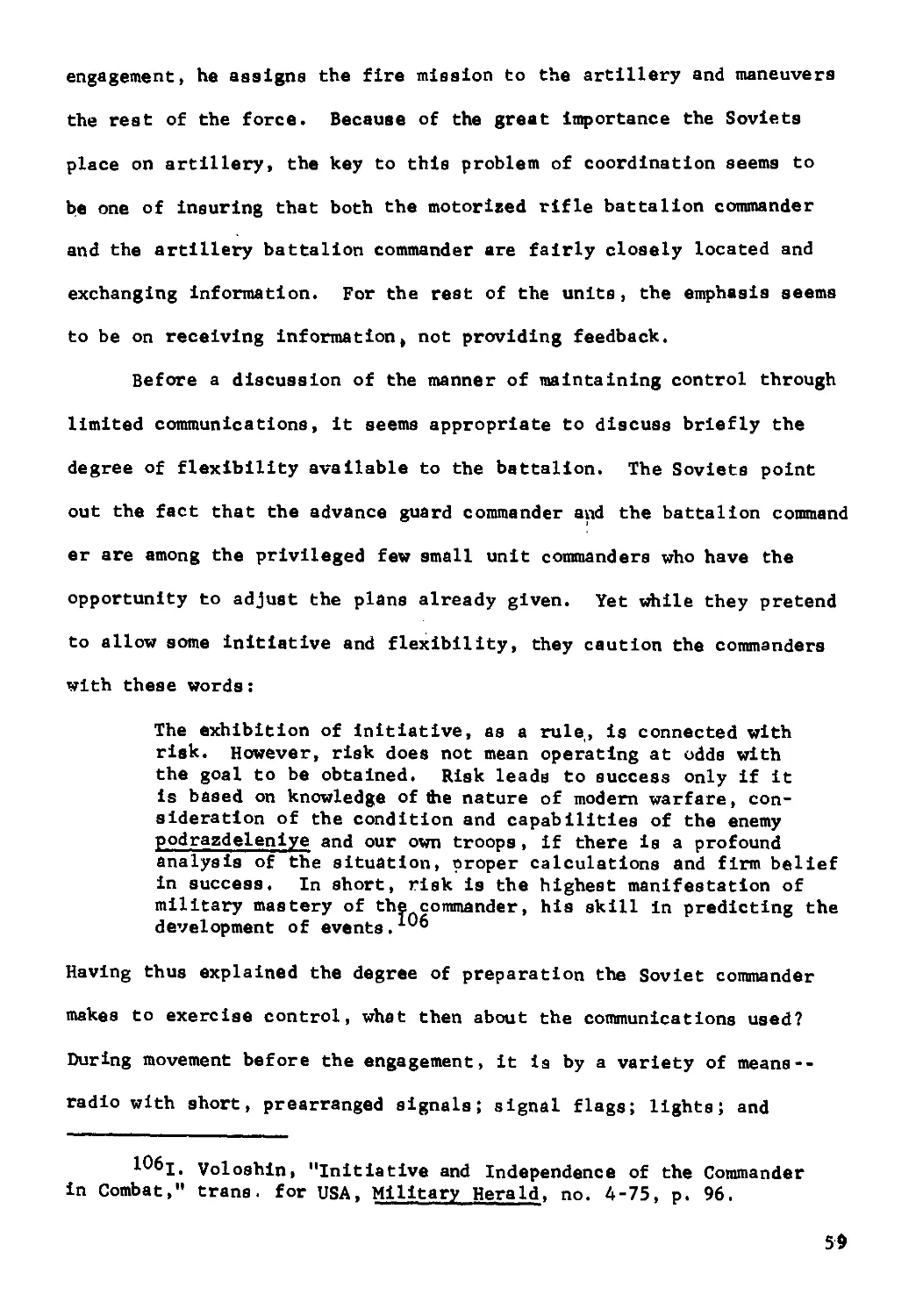
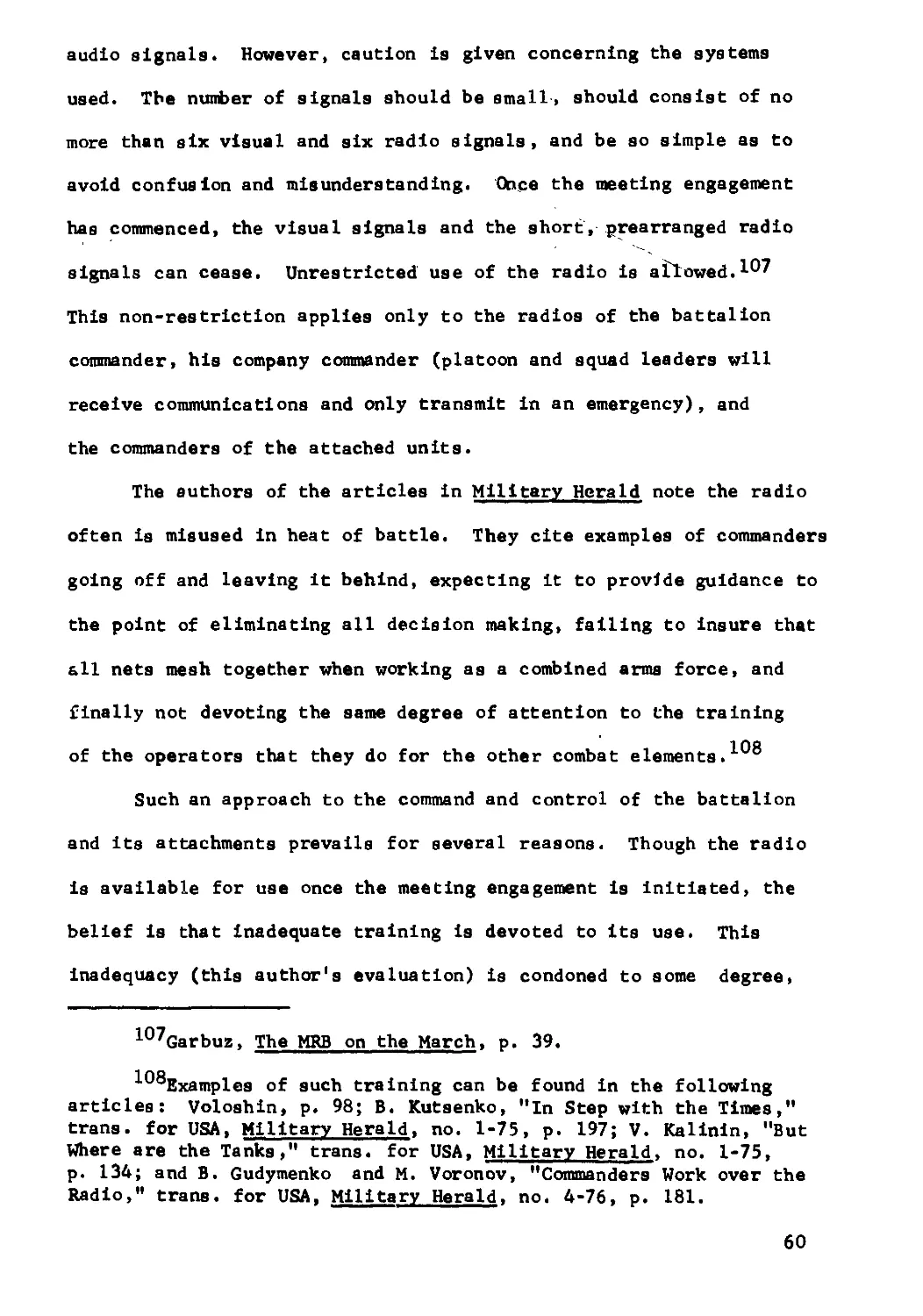
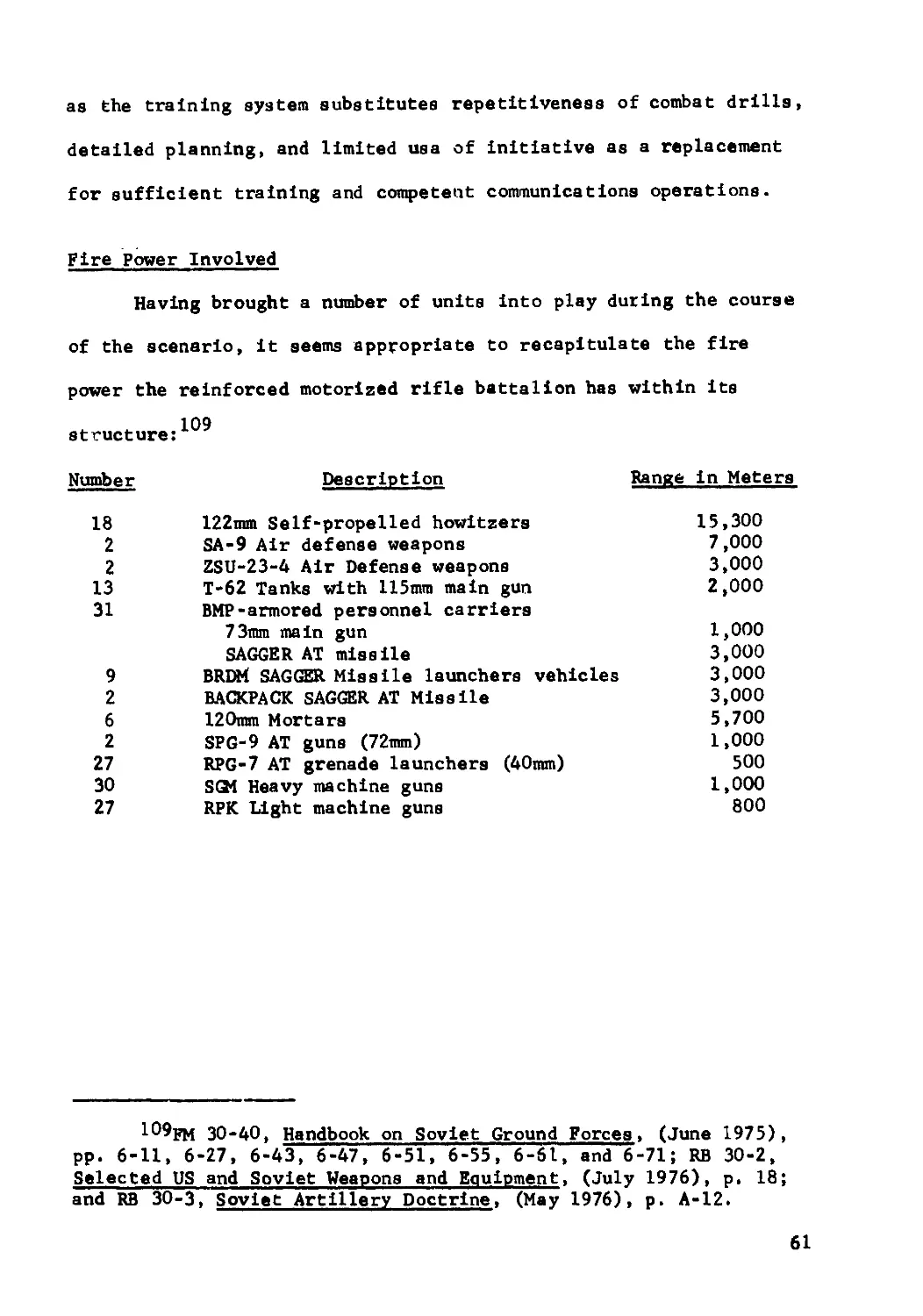
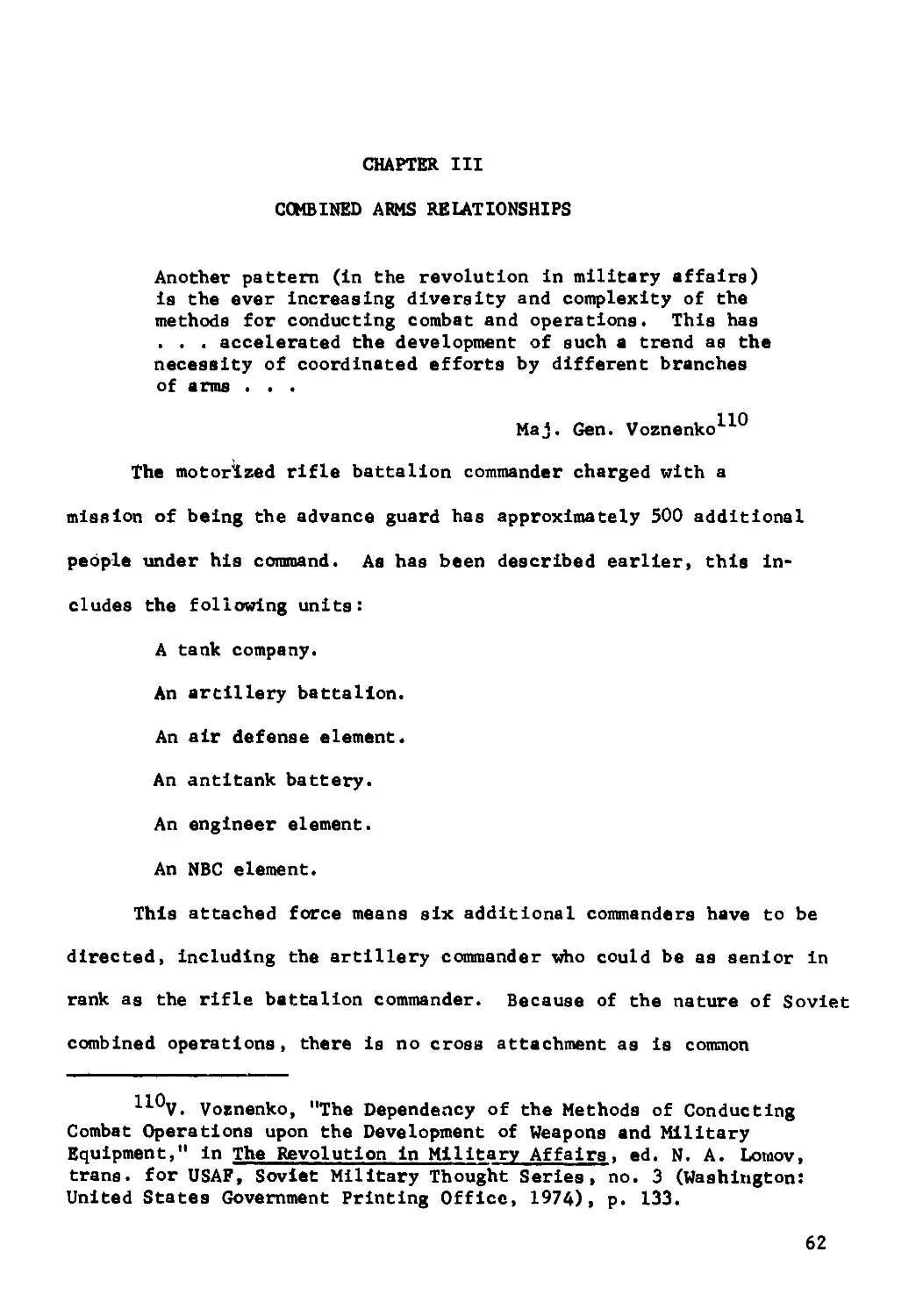
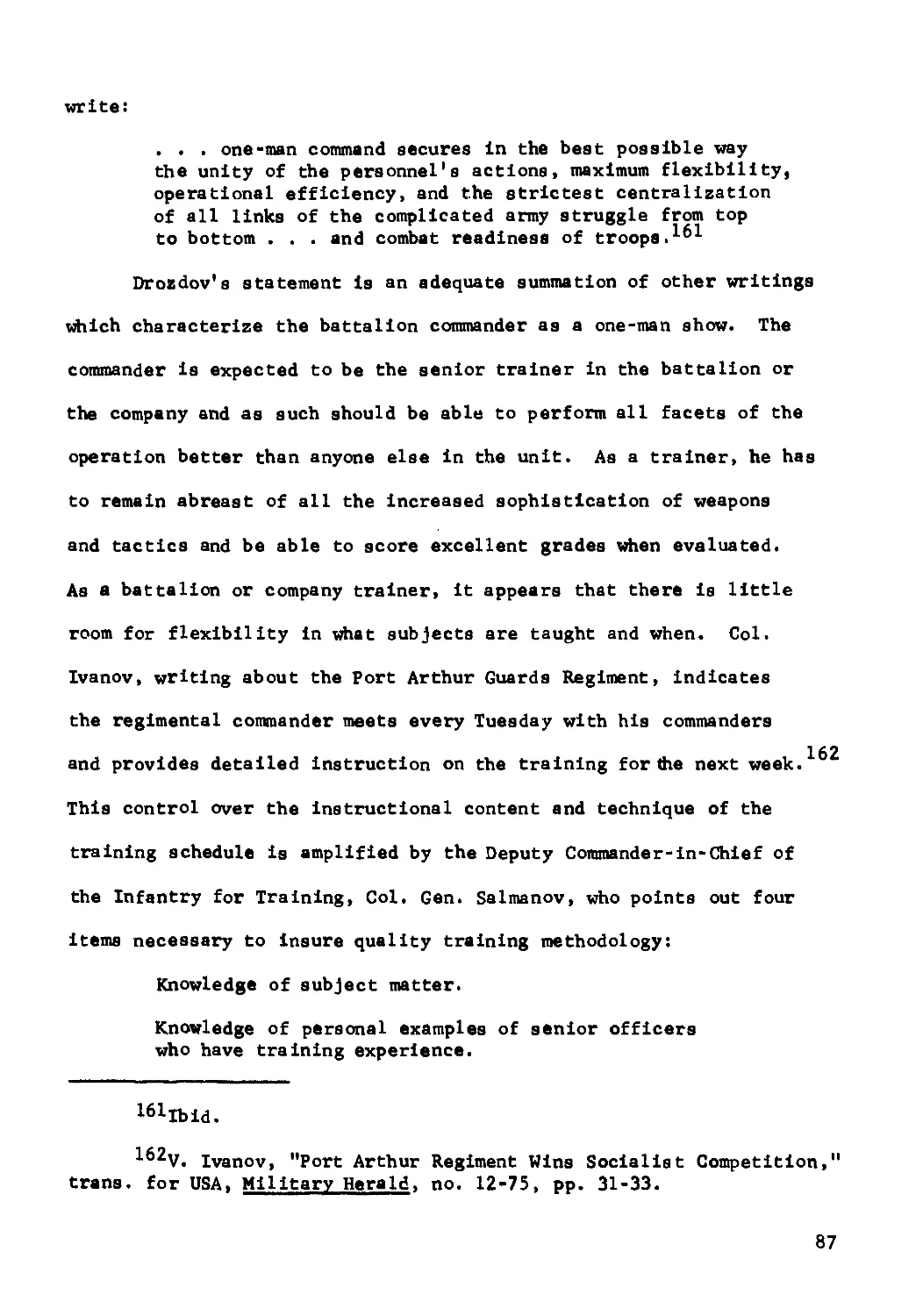
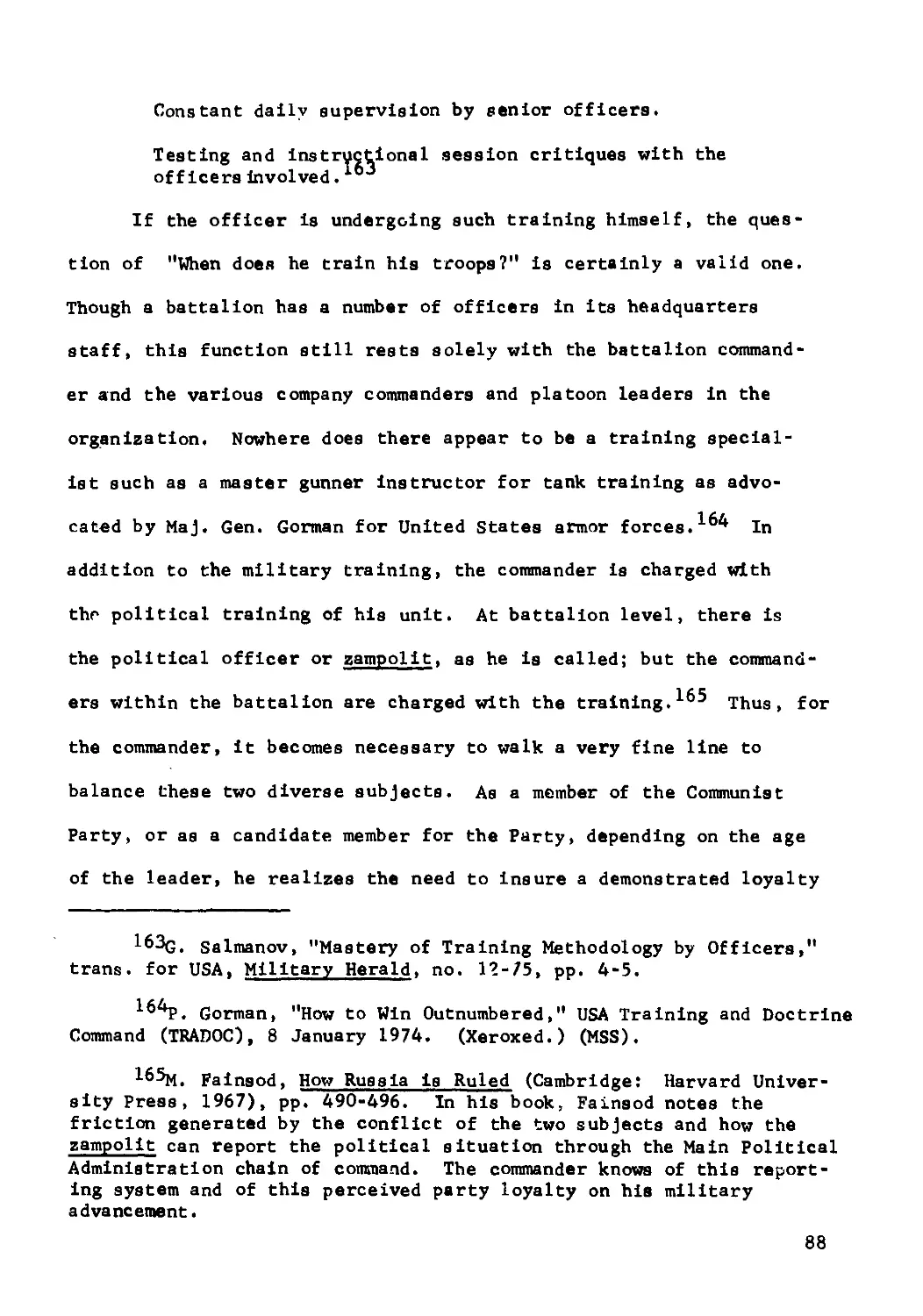
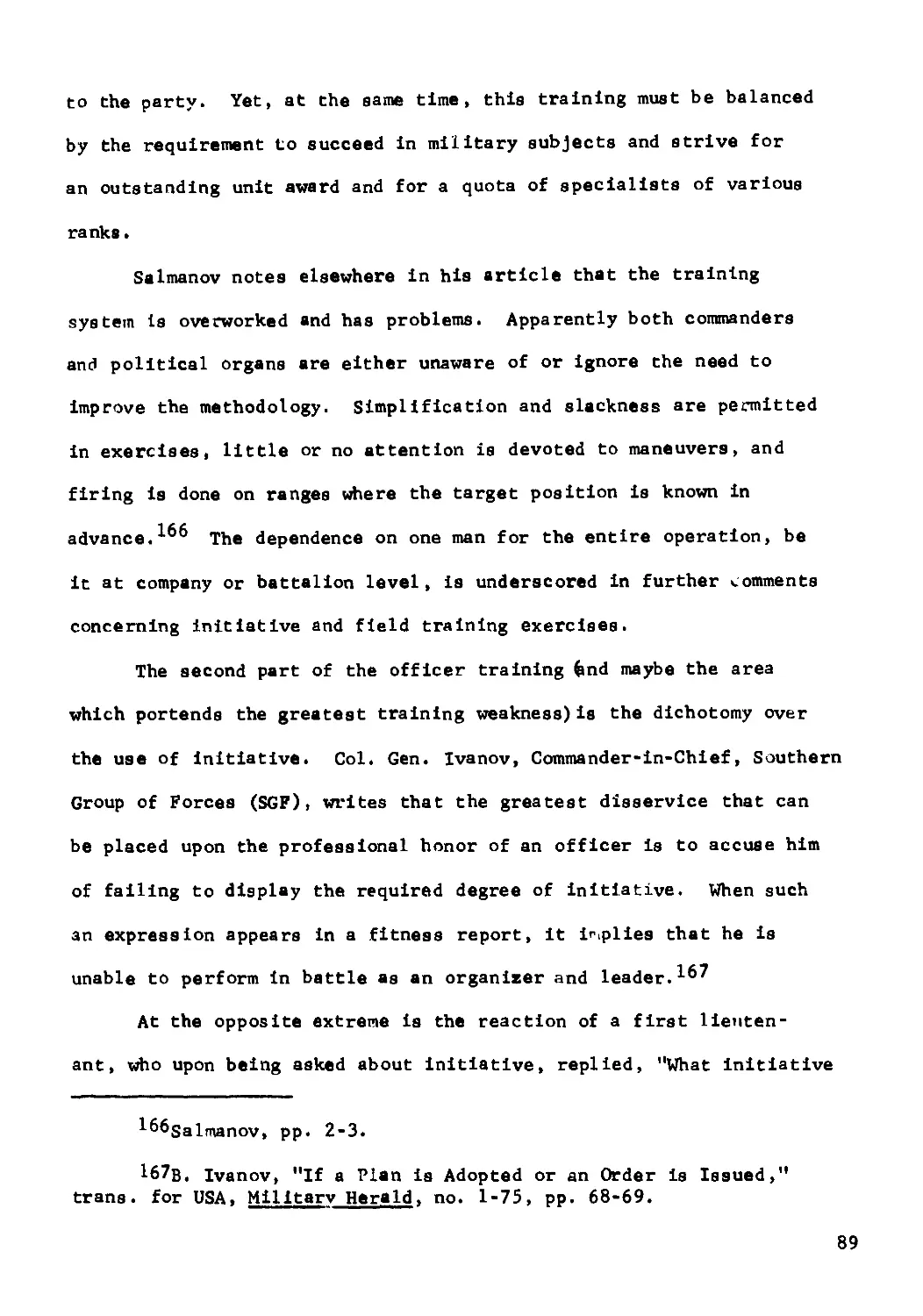
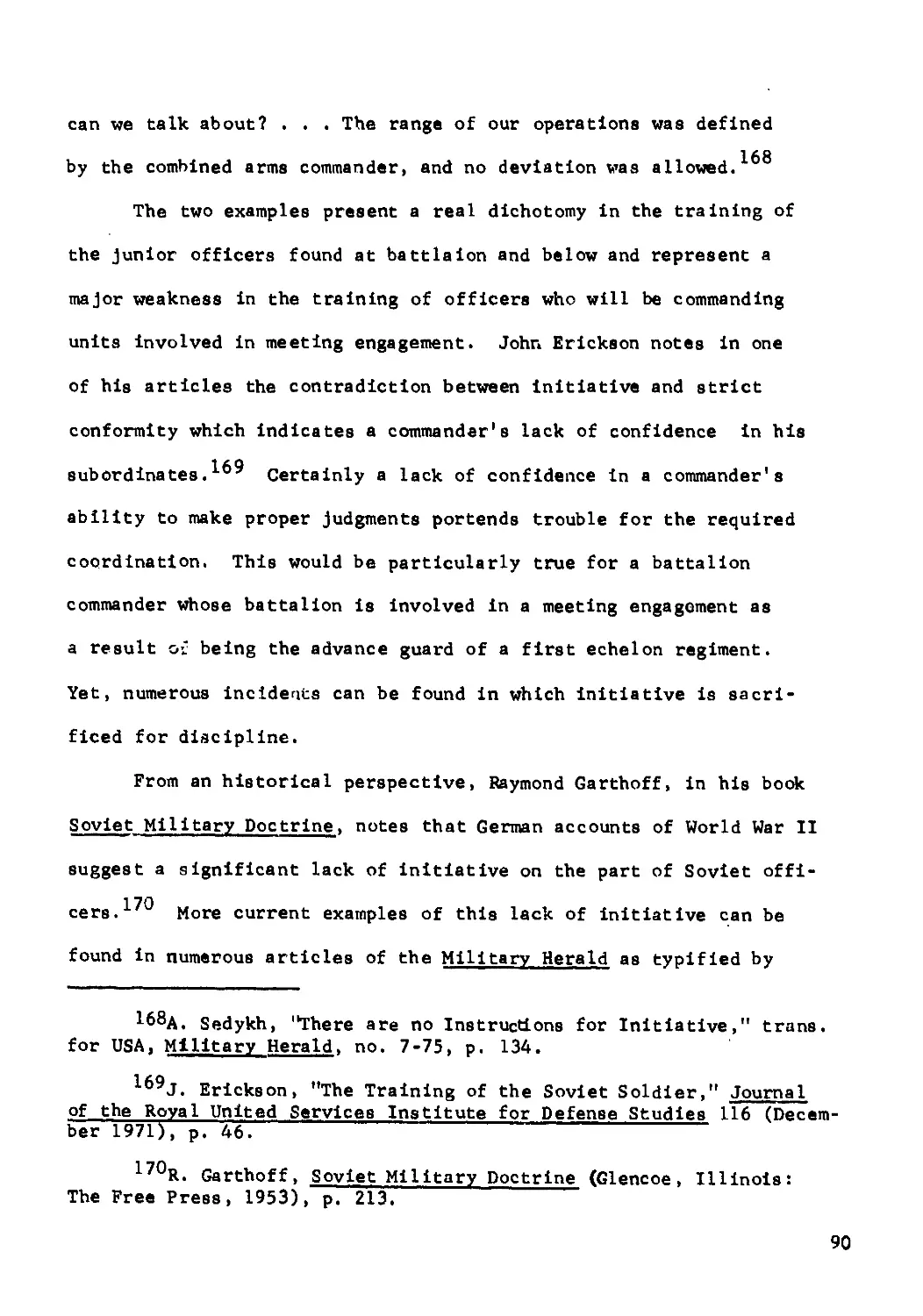

Теги: firearms military science combat tactics
Год: 1977

Текст
                    SECURITY CLASSIFICATION OF THIS PAGE (When Data Entered)
RT NUMBER
REPORT DOCUMENTATION PAGE
RESuTNSTRUCTIONS
BEFORE COMPLETING FORM
3. RECIPIENT’S CATALOG NUMBER
TLE (and Subtitle)
The Soviet Motorized Rifle Battalion in the
Meeting Engagement f
7. AUTHORfeJ
Kimball, John A., MAJ, USA
9. PERFORMING ORGANIZATION NAME AND ADDRESS
Student at the U.S. Army Command and General Stafr
College, Fort Leavenworth, Kansas 66027
YPE OF REPORT & PERIOD COVERED
2. GOVT ACCESSOR NO.
Final
TWSgram ELEMENT, PROJECT, TASK
AREA & WORK UNIT NUMBERS
G ORG.
0 June 1977
ORT NUMBER
. CONTROLLING OFFICE NAME AND ADDRESS
US Army Command and General Staff College [ //
ATTN: ATSW-SE	V
130
ES
14. MONITORING AGENCY NAME & ADDRESSfff different from Controlling Ottlce)
15. SECURITY CLASS, fof thia report)
UNCLASSIFIED
ISe. DECL ASSIFIC ATI ON/DOWN GRADING
SCHEDULE
is. distribution statement (at thia Report)
Distribution limited to U.S. Government agencies only: Proprietary Informatior
Other requests for this document must be referred to U.S. Army Command and
General Staff College, Fort Leavenworth, Kansas 66027
1 6 AUG 1977
17.	DISTRIBUTION STATEMENT (at Uta ebetrect entered tn Black 20, If different tram Report)
Approved for public release; distribution unlimited.
18.	supplementary notes
Master of Military Art and Science (MMAS) Thesis prepared at CGSC in partial
fulfillment of the Masters Program requirements, U. S. Army Command and General
Hrtaff College, Fort Leavenworth, Kansas 66027.
19.	KEY WORDS (Continue on revere* aide if neceeeary end identify by black number)
20b. AM I RACY fCocrtfisu* an r*v*ra* of& ft песеемсу end. identify by black number)
See reverse.
EDITION OF 1 NOV 88 IS OBSOLETE
	— '-1^1 жЛ -Ж.	_
SECURITY CLASSIFICATldj* OF TB» FAOE(W»«n D*e BntertQ
This research project is designed to examine the available evidence
concerning the employment of a Soviet Army reinforced motorized rifle battalion
in the conduct of a meeting engagement.
Specifically addressed herein are three questions: (1) what is the
doctrine for the employment of a reinforced motorized rifle battalion in a
meeting engagement; (2) do the units involved train to comply with the doctrinf
and (3) how well do they train? In order to answer these questions, this study
has concentrated on available Soviet writings published sihce the Middle East
War of 1973.
The investigation of the available material indicates there is some
very specific doctrine for the employment of the battalion that has been
considered for modification since the Yom Kippur War of 1973. The typical
motorized rifle battalion generally follows the doctrine during its training
cycle. However, their training seems to leave much to be desired.
THE SOVIET MOTORIZED RIFLE BATTALION
IN THE MEETING ENGAGEMENT
51.5-Л1БО
MASTER OF MILITARY ART AND SCIENCE
THESIS APPROVAL PAGE
Name of Candidate Major John A, Kimball
Title of Thesis The Soviet Motorised Rifle Battalion ir the
Meeting Engagement------------------------------------------
Approved by:
Research Advisor
Member, Graduate Faculty
Member, Consulting Faculty
Accepted this / *7 day of f	1977
Director, Master of Military Art (Ind Science
The opinions and conclusions expressed herein are those of the
individual student author and do not necessarily represent the
views of either the U.S. Army Coomand and General Staff College
or any other governmental agency. (References to this study
should include the foregoing statement.)
ABSTRACT
This research project is designed to examine the available
evidence concerning the employment of a type unit of the Soviet Army
in a particular offensive action. This paper is the result of this
author's efforts to understand the use of a Soviet Army reinforced
motorized rifle battalion in the conduct of a meeting engagement.
Specifically addressed herein are three questions: (1) what
is the doctrine for the employment of a reinforced motorized rifle
battalion in a meeting engagement; (2) do the units involved train
to comply with the doctrine; and (3) how well do they train? In
order to answer these questions, this study has concentrated on avail-
able Soviet writings published since the Middle East War of 1973.
The investigation of the available material indicates there is
some very specific doctrine for the employment of the battalion that has
been considered for modification since the Yom Kippur War of 1973.
The typical motorized rifle battalion generally follows the doctrine
during its training cycle. However, their training seems to leave
much to be desired.
iii
ACKNOWLEDGEMENTS
It is difficult to remain steadfast to the task of writing such
a paper when others are busily engaged in enjoying "the best year of
your life." The critical examination of small unit operations of the
Soviet Army is still in its Infancy. My perseverance hopefully has
been rewarded by providing a better understanding of how one type
unit conducts one particular offensive action.
The fact that I have not faltered, but followed the research
to some conclusion is due largely to the efforts of Lieutenant Colonel
George F. Steger, Threats Division, Combined Arms Combat Development
Activity, Fort Leavenworth, Kansas. For the great deal of time he
withdrew from his own activities to work with me and for guidance and
assistance, I wish to express my sincere appreciation.
To Captain Harry L. Wolbers , also of the Threats Division,
Combined Arms Combat Development Activity, and to Professor Harry J.
Psomiades, consulting faculty advisor from the Political Science Depart
ment of Queens College, who provided me with valuable assistance in
the structural formulation of this project, I wish to express my
gratitude. Additionally, I wish to express my thanks to the staff of
the Command and General Staff College Library for their aid in obtain-
ing research material.
Finally, to my family who was so patient and understanding,
particularly to my wife for her encouragement, support, editing, and
iv
typing, I owe an Immense debt. To the combined efforts of all these
people, I can only say thank you.
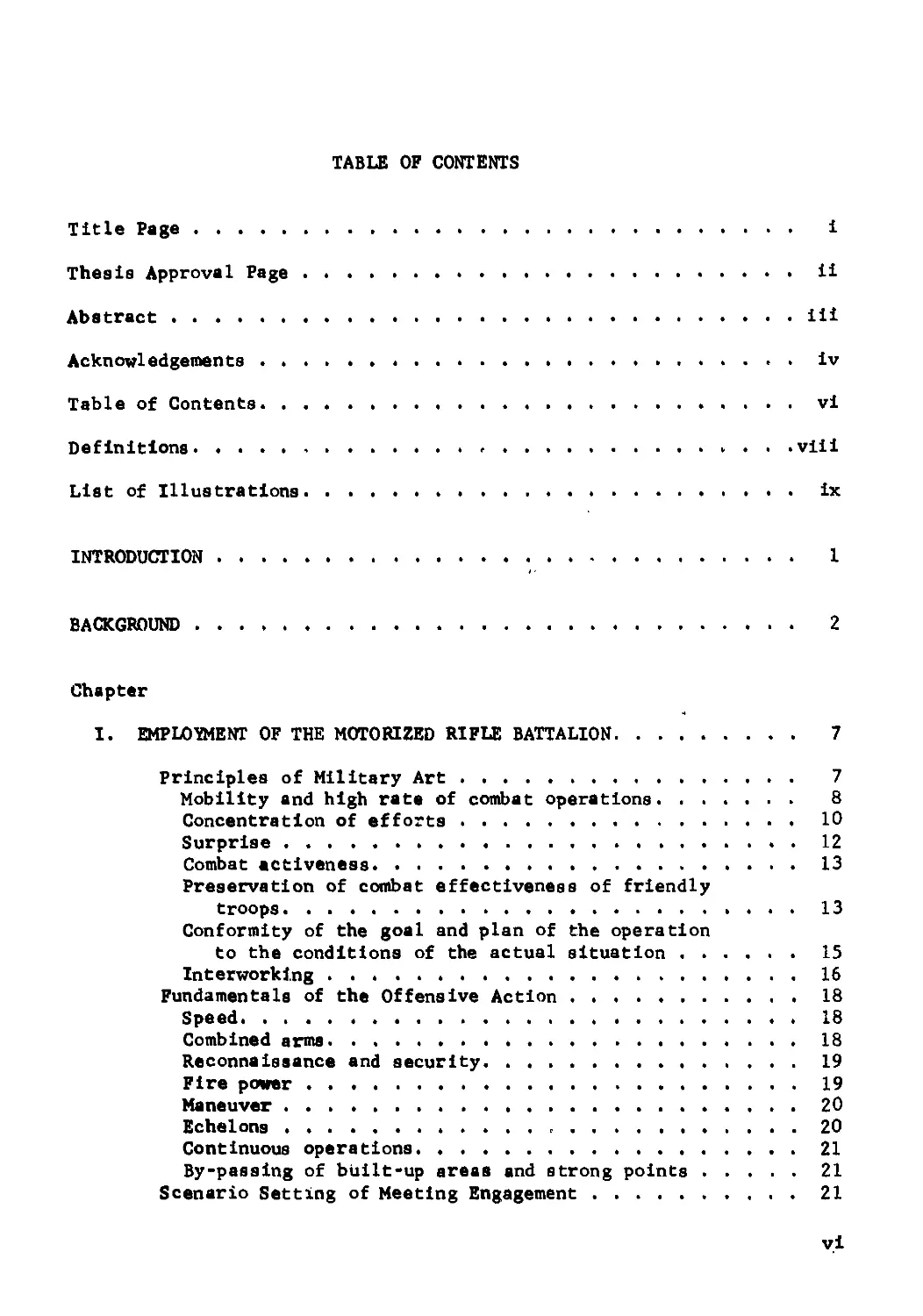
TABLE OF CONTENTS
Title Page.......................................................... i
Thesis Approval Page.............................................  •	ii
Abstract............................................................Hi
Acknowledgements....................................................iv
Table of Contents.................................................  vi
Definitions. ...................................................  viii
List of Illustrations.............................................  ix
INTRODUCTION........................................................ 1
BACKGROUND.......................................................... 2
Chapter
I. EMPLOYMENT OF THE MOTORIZED RIFLE BATTALION................... 7
Principles of Military Art ................................. 7
Mobility and high rate of combat operations............... 8
Concentration of efforts................................  10
Surprise ..... .......................................... 12
Combat activeness.........................................13
Preservation of combat effectiveness of friendly
troops..................................................  13
Conformity of the goal and plan of the operation
to the conditions of the actual	situation...........15
Interworking..............................................16
Fundamentals of the Offensive Action	... ................ 18
Speed...................................................  18
Combined arms.............................................18
Reconnaissance and security...............................19
Fire power................................................19
Maneuver................................................  20
Echelons................................................  20
Continuous operations.....................................21
By-passing of built-up areas and strong points .......... 21
Scenario Setting of Meeting Engagement .................... 21
vl
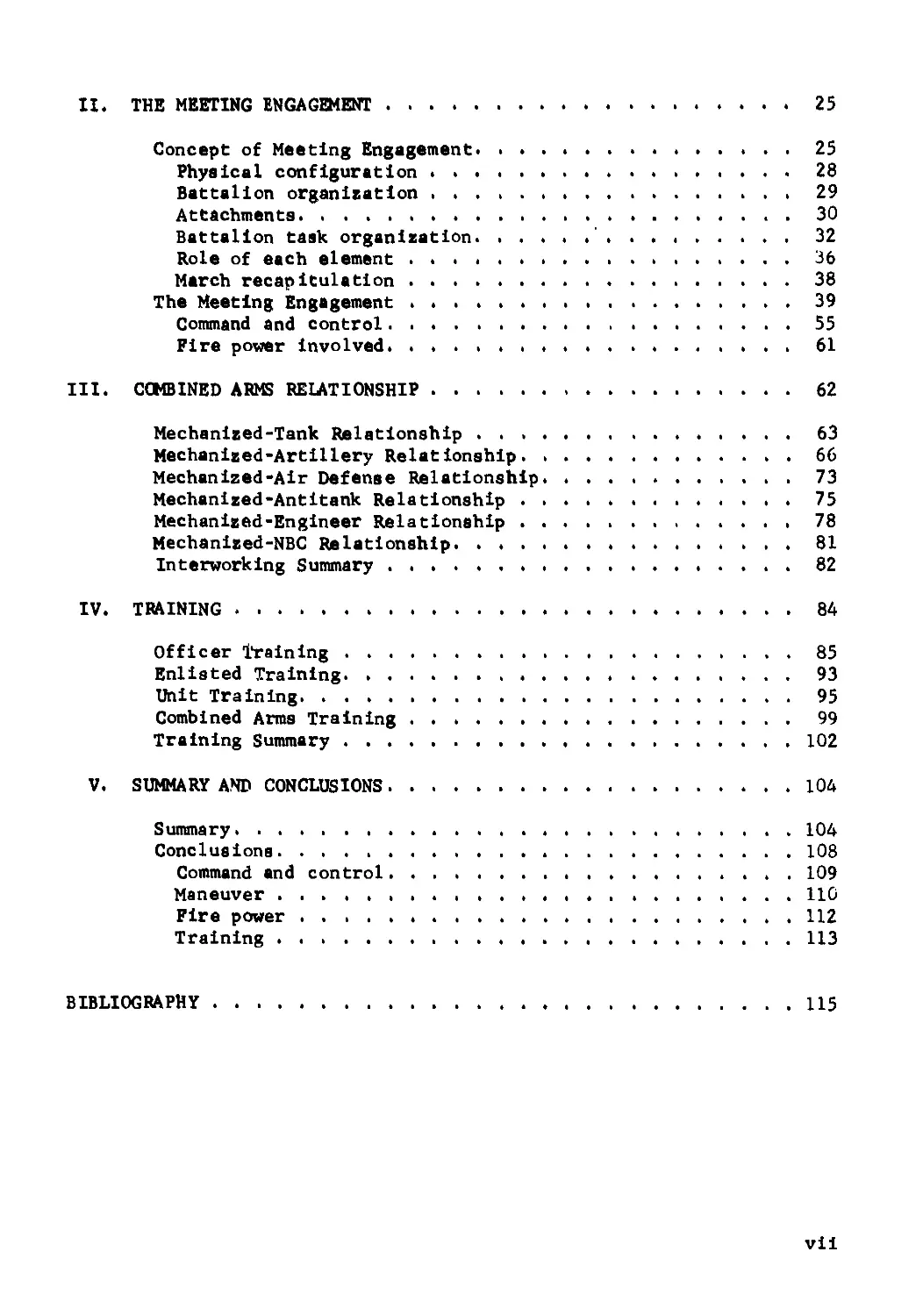
II.	THE MEETING ENGAGEMENT....................................25
Concept of Meeting Engagement. .............. 25
Physical configuration .............................. 28
Battalion organization..............................  29
Attachments...........................................30
Battalion task organization. .............. 32
Role of each element..................................36
March recapitulation..................................38
The Meeting Engagement................................  39
Command and control...................................55
Fire power involved...................................61
III. COMBINED ARMS RELATIONSHIP................................62
Mechanized-Tank Relationship ... ............... ......	63
Mechanized-Artillery Relationship.......................66
Mechanized-Air Defense Relationship.....................73
Mechanized-Antitank Relationship ..... ................ 75
Mechanized-Engineer Relationship ...................... 78
Mechanized-NBC Relationship...........................  81
Interworking Summary .................................. 82
IV. TRAINING...................................................84
Officer Training........................................85
Enlisted Training.....................................  93
Unit Training...........................................95
Combined Arms Training .................................99
Training Summary ..................................... 102
V. SUMMARY AND CONCLUSIONS....................................104
Summary..............................................  104
Conclusions............................................108
Command and control..............................    109
Maneuver.............................................110
Fire power...........................................112
Training.............................................113
BIBLIOGRAPHY..................................................115
vii
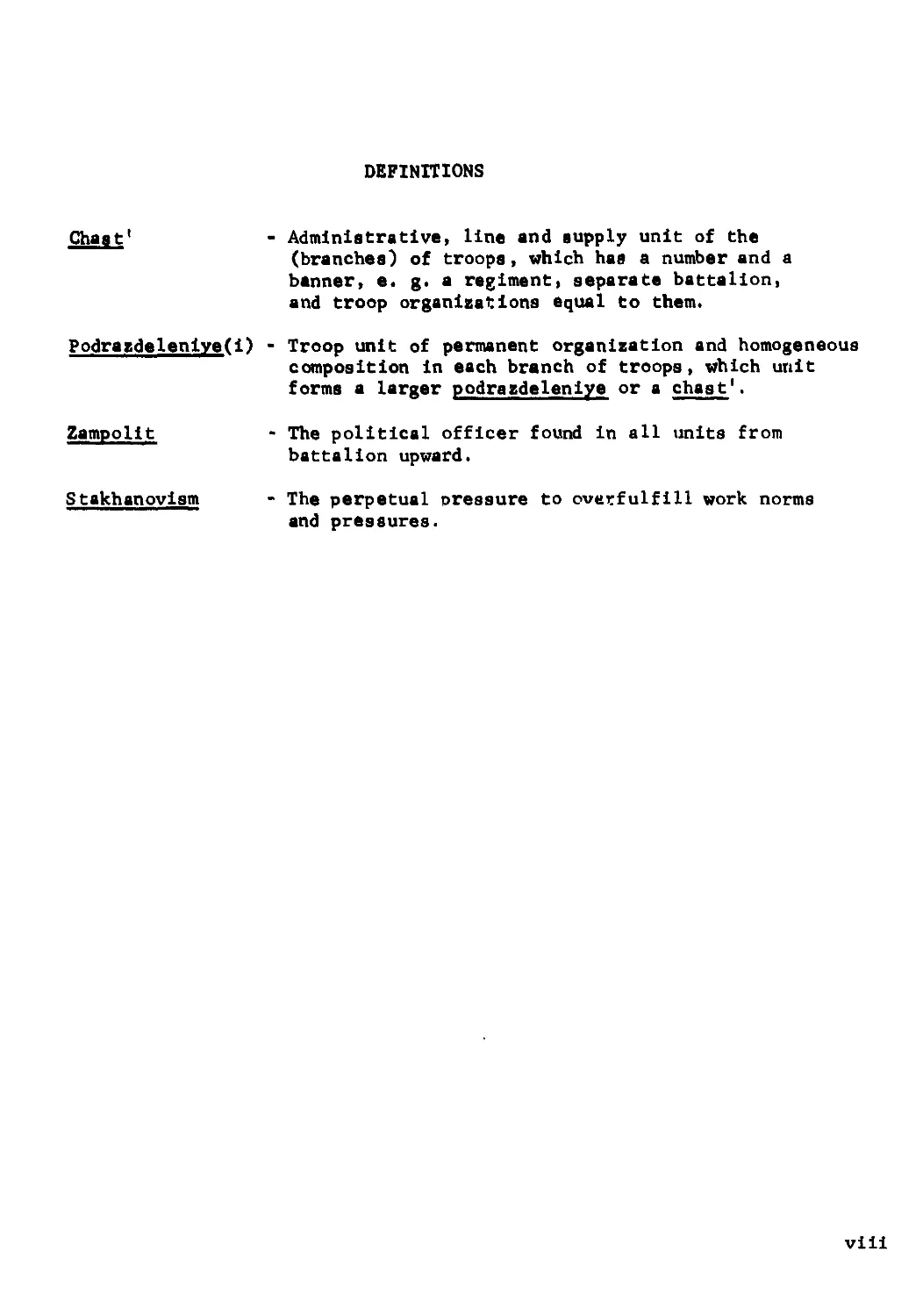
DEFINITIONS
Chast1	- Administrative, line and supply unit of the (branches) of troops, which has a number and a banner, e. g. a regiment, separate battalion, and troop organizations equal to them.
Podrazdeleniye(i)	- Troop unit of permanent organization and homogeneous composition in each branch of troops, which unit forms a larger podrazdeleniye or a chast1.
Zampolit	- The political officer found in all units from battalion upward.
Stakhanovism	- The perpetual pressure to overfulfill work norms and pressures.
viii
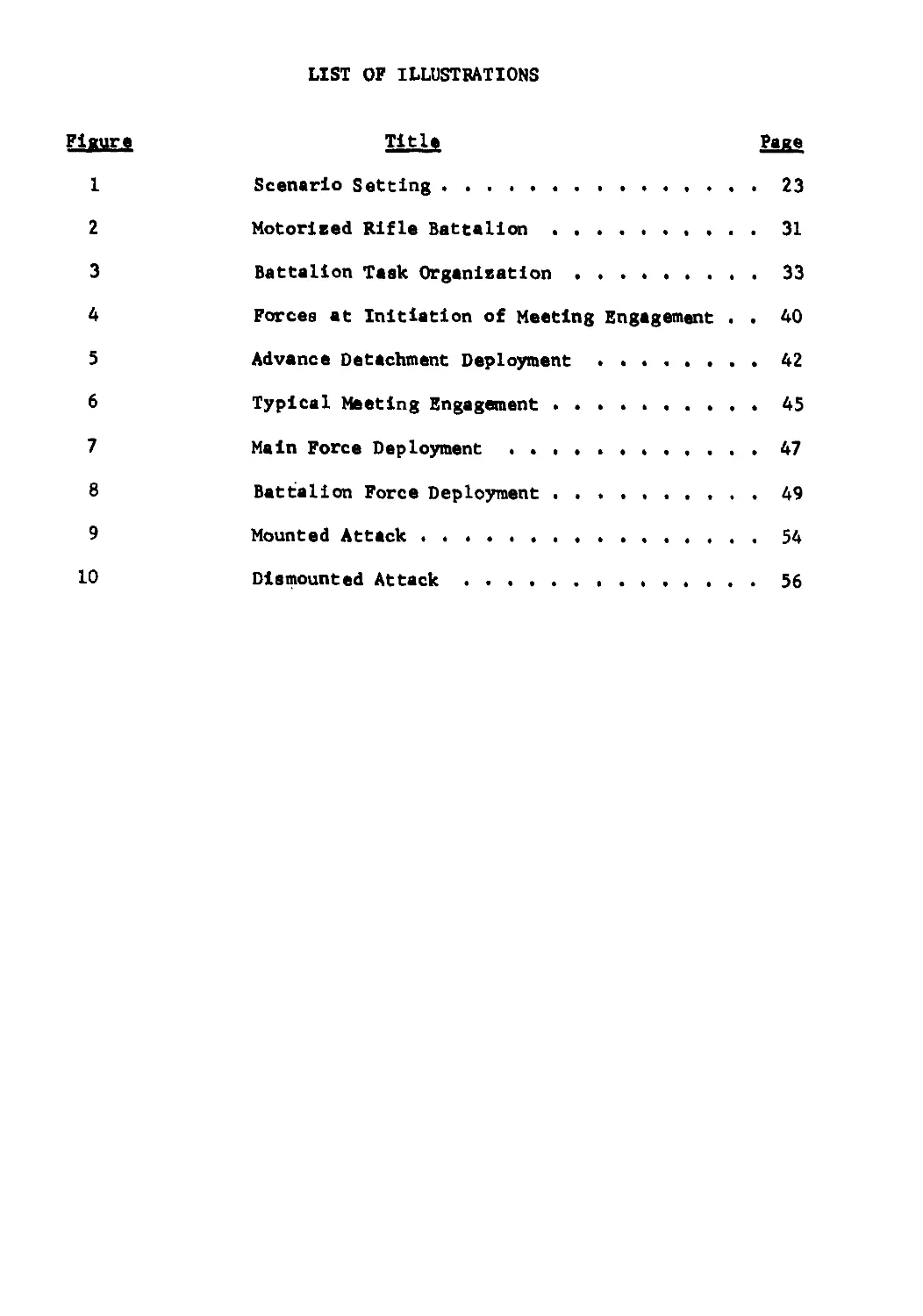
LIST OF ILLUSTRATIONS
Figure	Title	Page
1	Scenario Setting ............................. 23
2	Motorised Rifle Battalion .............. .....	31
3	Battalion Task Organisation .................. 33
4	Forces at Initiation of Meeting Engagement . . 40
5	Advance Detachment Deployment ................ 42
6	Typical Meeting Engagement ..... ............. 45
7	Main Force Deployment ........................ 47
8	Battalion Force Deployment .... .............. 49
9	Mounted Attack . ............................  54
10	Dismounted Attack............................  56
INTRODUCTION
Equipment of Itself does not make the difference.
It Is the people In tfiose hands this equipment is
located, in their knowledge and ability to employ
this equipment with greatest effect, to squeeze from
It everything It can give.
Marshal Grechko1
The Soviet motorized rifle battalion has been equipped,
ct least in part, by the most modern armored personnel carrier
in the world. It is supported by new self-propelled artillery
and by more than adequate tanks. This quality improvement,
however, will not guarantee success in every battle for the Soviet
Army. As Marshal Grechko said, people and their training still
make the difference.
This paper is an attempt to determine how well the
Soviet motorized rifle battalion in one type of offensive
action--the meeting engagement--comblnes Its equipment capabil-
ities and Its personnel talents to produce an effective fight-
ing force. The paper will focus on three questions: (1) What
is the doctrine for the employment of this battalion? (2) Does
A. Bessarad, "Class Rating is an Important Component of
Combat Readiness," trans, for USA, Military Herald, no. 11-75,
pp. 124-5. Bessarad takes a quote from a speech given by Marshal
Grechko at the All-Army Conference of Otllchniki of Combat and
Political Training. (Throughout the paper, the number of the
Military Herald will reflect the number of the original version
when published In Moscow as Voyennyy Vestnik. Page numbers will
correspond to page numbers In translated copy.)
it train to comply with the doctrine? and (3) How well does it
train?
BACKGROUND
The Soviet Army has 110 motorized rifle divisions^ in various
stages of combat readiness stationed throughout the Soviet Union
and Eastern Europe; and, though Soviet political writings affirm
that the Soviet Union will not be the first to attack in an East-
West confrontation, its ground forces definitely are oriented on the
offensive. Soviet military writings contain three forms of offensive
action: (1) the meeting engagement, (2) the breakthrough, and
(3) the pursuit.
The meeting engagement has been defined "as the most common
offensive action and is likely to occur when one or both forces
meet unexpectedly and enter immediately into the battle."3
Because of the importance attached to the meeting engage-
ment, this paper will be limited to that single form of offensive
action. Contemporary Soviet military writers reinforce die im-
pression that the meeting engagement is of premier importance in
the offensive. Col. Savkin in his book Operational Art and Tactics
has this to say about the meeting engagement, "Maneuverable combat
operations of troops along axes have begun to have decisive impor-
tance in attaining high rates of advance, as opposed to the methodical
2	. Military Balance 1975-76 (London: The International
Institute for Strategic Studies, 1975), p. 8.
^U. S., Department of the Army, Office of the Assistant Chief
of Staff for Intelligence, Military Operations of the Soviet Union,
ISAITAD report no. 14-U-76 (1976), pp. 13-14.
2
breakthrough of the past,"^ Col. Sidorenko In his book The Offensive
writes at some length on the methods by which troops will launch
offensive action.He suggests that the meeting engagement Is a
natural evolution In offensive warfare because artillery ranges
are Increased and, therefore, weapons do not have to be positioned
so close to the forward edge of the battle area (FEBA). The impli-
cation of his comments are that the meeting engagement adds to the
speed of maneuver and thus aids the desired rate of advance and
provides a relative degree of surprise and secrecy. He further
acknowledges there are certain weaknesses such as counterbattery
fire, coordination of movement, and simultaneous action on the
part of all elements of the task force In going directly into battle,
i
but believes the advantages outweigh the disadvantages.
Thus the paper proceeds from two assumptions at this point:
(1) Both Col. Savkln and Sidorenko's writings are accepted as
doctrine, and (2) there Is a desire to know as much as possible
about how the combined arms team, led by the motorized rifle battalion
will conduct the meeting engagement.
This desire to know what the Soviet forces do in this par-
ticular type of offensive action and how they do it took on added
Importance following the Arab-Israeli War of 1973. The lethality
^V. Y. Savkln, The Basic Principles of Operational Art and
Tactics, trans, for the USAF, Soviet Military Thought Series, no. 4
(Washington: United States Government Printing Office, 1975), p. 198
^A. A. Sidorenko, The Offensive, trans, for the USAF, Soviet
Military Thought Series, no. 1 (Washington: United States Government
Printing Office, 1975), pp. 64-70.
3
of that three-week encounter left an Indescribable impact on the
minds of military planners. Suddenly planners In the Defense
Department realised the United States could not fight such a war
and expect to win by winning the last battle. In fact, there
might not be a second battle. The first battle had to be won.
If the forces of the Middle East, equipped and supplied by the
Soviet Union and the United States, could create such a holo-
caust with these weapons of destruction, what would war be like
In the hands of the troops of the two superpowers? For example,
more tanks were lost In those three weeks than the United States
has In Europe. Destructiveness of the modern weapons of conven-
tional forces lent Impetus to finding new ways to prepare for
that next "first battle."
The new-found Impetus has resulted In a number of studies
being made throughout the Army as to the doctrine of the Soviet
armed forces. Certainly some very valuable Information has been
uncovered, but equally as certain Is that there are many questions
which remain unanswered. Many of the unanswered questions Involve
basic Soviet Amy tactics. This study attempts to add to that
body of knowledge by examining the tactics of the motorized rifle
battalion In the meeting engagement.
For a number of years, the Uhlted States Intelligence
community analyzed and wrote about the strategic posture in terms
of numbers of divisions, amounts of equipment, and tactics of armies
and fronts. Thus, until recently (mid 1974) little or no Informa-
tion was available on how smaller units were designed and equipped
4
to fight (and what was available was often classified so as not
to be available to the average soldier). Since that time, a number
of articles have appeared,6 but a number of gaps still exist.
Therefore, there Is not an abundance of source material about either
the meeting engagement or the motorized rifle battalion.
Because of the perceived threat, United States Army interest
Is focused on Europe and the Warsaw Pact forces. Therefore, the
data collection effort for this study has been limited to a revlevi
of material providing insight Into European operations. The fic-
titious scenario is portrayed along the edges of the North German
Plains. This countryside is characterized as being relatively flat
and open terrain. Rivers and valleys do not canalize cross-country
movement as is the situation further south. Such conditions as are
present make the area ideally suited to armor operations and provide
Warsaw Pact forces with the best terrain to conduct high-speed
offensives across Western Europe to the major port facilities along
the coast. The ffi' .Ing engagement is the form of the offensive
which best supports the high-speed attack. The battalion is the
basic organizational unit and In many respects corresponds to a
company in the United States Army.
Studies of this nature are, of course, greatly dependent
upon the validity of the sources of material used for research.
Such an assumption becomes even more important when studying
^Examples of the more recent worthwhile publications de-
voted to small unit tactics Include: TC 30-102, The Motorized
Rifle Company; TC 30-4, The Motorized Rifle Regiment; DDI-1100-
77-76, The Soviet Motorized Rifle Company; DDI-1120-129-76, Soviet
Tank Company Tactics; and FM 30-40, Handbook on Soviet Ground Forces.
5
facets of the USSR because of the closed nature of the society*
Therefore, three general areas, all unclassified, are used for
source material. They are:
(1)	Interviews with persons who have served with the
United Stb£es Military Liaison Mission (USMIM) In the Democratic
Republic of Germany.
(2)	Soviet publications which for the most part were printed
In Russian for Internal consumption and subsequently were available
In English translations. The most significant of these Is the
Military Herald which Is published monthly as Voyennyy Vestnlk.
(3)	Writings of those Individuals In the West who have become
recognised experts In tha field of Soviet armed forces.
6
CHAPTER I
EMPLOYMENT OF THE MOTORIZED RIFU BATTALION
"The principles of military art are a consequence
of the reflections in people's heads of demands of
laws of warfare and laws of armed conflict and of
those conditions under which it is conducted and
under which the armed forces operate."
Col. Savkin?
In finding a point from which to launch an analysis of the
Soviet motorized rifle battalion in the meeting engagement, it is
appropriate to discuss briefly two points: (1) the tactical and
offensive principles of war and (2) the scenario in which the bat-
talion action will be staged.
A. Principles of Military Art
Col. V. Y. Savkin enumerates in his book Operational Art
Q
and Tactics the following seven principles of military art:
(1) mobility and high rates of combat operations, (2) concentra-
tion of main efforts and creation of superiority in and means over
tha enemy at the decisive place and at the decisive time, (3) sur-
prise, (4) combat activeness, (5) preservation of the combat
effectiveness of friendly forces, (6) conformity of the goal and
plan of the operation to the conditions of the actual situation, and
(7) interworking.
7Savkin, Operational Art, p. 121.
8Ibid., p. 165.
It Is well to have an appreciation of these seven principles
prior to a discussion of either the fundamentals of offensive action
or the conduct of the meeting engagement, for they furnish the frame-
work upon which the fundamentals of the offensive can be developed.
Maj. Gen. Vosnenko, In his contribution to the book The Revolution
In Military Affairs, writes that to assume the soldier will find a
method for using new weapons and tactics at the time of battle Is
Q
to doom that soldier's unit to defeat. He then writes further and
explains that new methods of armed combat are not created spontaneous-
ly. Ю To understand how these thoughts affect the relationship be-
tween the principles and the fundamentals, one has only to realise
the relationship between operational art and tactics. The term
operational art is a tool whereby the Soviet thought process moves
from strategy to tactics. From a Soviet viewpoint, an understand-
ing of operational art is necessary before one can successfully
apply the tactics. Therefore, In order to understand the fundamentals
of the offensive and how the Junior officers In the battalion will
apply the tactics, it Is necessary to have some understanding of
these principles.
Mobility and High Rate of Combat Operations
The Soviets do not limit this term simply to the maneuver
and the speed necessary to move from point A to point B. Rather
they look upon the term as representing a measure of a commander's
о
N. A. Lomov, ed. Scientific-Technical Progress and the
Revolutloi In Military Affairs, trans, for USAF, Soviet Military
Thought Series, no, 4 (Washington: united States Government Print-
Office, 1974), p. 131.
10Ibld.
8
efficiency in conducting a battle from beginning to end. It in**
eludes all the inherent decision-making processes with changing
instructions and shifts in organisation. Technology has had a
i
profound impact on the ability of troops to move rapidly (personnel
carriers, self-propelled artillery, helicopters), and this speed
has decreased the time conmanders and staffs of all units will have
to make appraisals of battle situations.
I The rate of advance phrase deserves special consideration.
The daily speed goals established in the tactics of the 1960's,
when nuclear warfare was considered the only option,varied from
11	12
97 to 121 kilometers. More recent writings scale down these
figures roughly fifty percent to "29 kilometers in a conventional
13
role and 58 kilometers in a nuclear environment." Col. Savkin
writes,
. . • the most important methods of troop operations
directed toward attaining high rates of advance are:
reliable neutralisation of the enemy by fire and timely
exploitation of results of nuclear fires, . . . the
conduct of maneuverable combat operations along axes;
swift crossing of zones of radioactive contamination;
and nonstop assault crossings of water obstacles.1Й>
^Trevor Cliffe, "Military Technology and the European Balance,
Adelphi Papers. no. 89 (London: The International Institute for
Strategic Studies, 1972), p. 33. (Where miles have been converted
to kilometers,a conversion factor of one kilometer  .621 mile has
been used.)
^Malcolm Mackintosh, Juggernaut: A History of the Soviet
Union (New York: The Macmillan Co., 1967), p. 306.
S., Department of the Army, Office of the Assistant
Chief of Staff for. Intelligence, Handbook on Soviet Ground Forces
FM 30-40, 1975, pp. 5-13.
^Savkin, Operational Art, p. 190.
9
To attain these rates of advance it is necessary for "the personnel
carriers to move immediately behind the tanks not only before the
battle, but during it as well,"15 and for the troops not to fight
in a dismounted attack; for if they do, the attack is no longer
a meeting engagement, but a deliberate attack. In recent months,
there has been quite a discussion as to which arm should spear-
head the assault.16 This reconsideration is an outgrowth of the
Soviets' review of tactics since the Yom Kippur War. The lethality
of the antitank weapons presented such a wall of steel that obvious-
ly some Soviet thinkers are now beginning to wonder if enough tanks
will be left after a successful breakthrough to support or lead
the exploitation and pursuit.1?
Concentration of Efforts
The Soviets describe this principle as follows:
To attain victory over the enemy one must not dissipate
his forces and means equally across the entire front, but
the main efforts must be concentrated on the most important
axis or sector and at the right time in order to form there
the necessary superiority over the enemy in man and weapons.
15Ibld., p. 197.
16д discussion of this doctrinal point can be found in Phillip
Kerber's article "The Soviet Anti-Tank Debate" in the May/June 1976
issue of Survival.
Grechko, Armed Forces of the Soviet State, 2d ed. (Moscow,
1975), p. 198 cited by P. Kerber, "The Soviet Anti-Tank Debate,"
Survival (May/June 1976): 106, in which Grechko writes "that the
main striking force of the attackers--tanks--has become more vulner-
able, and the use of them on the battlefield, more complicated.
The continuing process of perfecting the anti-tank weapon has placed
before science and technology a serious task in the business of
tangibly raising the viability of tank troops and developing more
effective ways and means of reliably suppressing anti-tank defense."
18savkin, Operational Art, p. 201.
10
Note the author does not define this concentration simply
in terms of men and weapons. Rather he chooses to say it is
through concentration of effort to gain superiority in men and
weapons. There seems to be a rather subtle difference between
the term concentration of effort and the term concentration of
mass. Therefore, to the Soviets the term has passed from strictly
a quantitative measurement to a more qualitative character. Such
a change has been completed In an evolutionary manner primarily
since World War II.
Before, and to some extent during, the "Great Patriotic
War", the front line unit commanders had only to worry about those
forces directly in front of their units to determine combat power.
Therefore, it was much easier to speak of concentration of mass.
However, several important improvements, such as the mechanisation
of the infantry, the development of the long range missile and its
warhead, the Increase in the capability to see the depth of the
battle, and finally the development of the self-propelled artil-
lery, have changed the character of the concentration.
These improvements increase the capability of the command-
er to place more troops and weapons at a given point in time at
the expense of other areas. However, it is the realization that
the defense can do the same thing which makes the concentration
one of effort.
This effort becomes a key point when measured in terms of
such things as increased fire power, mobility, morale, leadership,
training, and equipment characteristics. It is these factors
which must be added to the concentration of raass--men and weapons--
11
to build the concentration that Col. Savkin writes about when
he uses the tern.
Surprise
This principle is the heart of the meeting engagement. By
definition, the meeting engagement is set apart from other forms
of offensive action by the fact that one or both sides meets the
other unexpectedly. It
. . . consists of the attempt to begin and resolutely
conduct military operations unexpectedly for the enemy
with the most expedient grouping of fully combat effec-
tive troops against the weakest or the strongest but
poorly trained enemy groupings on that axis and at that
time when they least expect it. 9
Col. Savkin writes that "Surprise steadily rises with the
development of the means of combat .... Its role is especially
great in brief operations and battles where the time factor is
20
of decisive importance." If such be the case* surprise is
likely to assume an added significance in a war between NATO and
Warsaw Pact forces. For the intensity of such a war just may be
too great to last very long. Savkin enumerates three methods to
achieve surprise:
(1) a тазу build up in weapons in a particular location
may lead to surprise when used, (2) a search for the
most skillful and original method for the unexpected
use of available weapons may be the answer, or (3) the
commanders and staffs might employ new or unexpected
organisations and tactics to surprise the enemy. 1 19 20 21
19Ibid., p. 230.
20Ibid., p. 232.
21
41Ibid., p. 236-7.
12
Combat Activeness
Soviet doctrine emphasises the Importance of the attack
in providing a psychological boost to the attacking
side by showing a stronger will than the opposing
forces. 2
According to Col. Savkln, success in combat is achieved by
that side which, with all else being equal, acts more aggressively
and resolutely by taking the initiative and holding it firmly.
The abilities of commanders to make bold decisions and put them
into effect, the energetic, decisive actions of the troops, and
the desire to win victories through total defeat of the enemy
are the keys to this principle.2^, 24
However, there seems to be a major gap between the doctrine
and practice of this principle. Writers in the monthly publica-
tion Voyennyy Vestnlk describe numerous situations in which the
Soviet officers and non-commissioned officers (NCOs) are chastised
for not adequately implementing the doctrine of combat activeness
during the course of the unit training cycle.
Preservation of Combat Effectiveness of Friendly Troops
In the course of an operation or battle the combat
effectiveness of troops must be constantly maintained
at the level which insures successful accomplishment
of assigned combat missions. 3
This principle seems to have become much more significant 22 23 24 25
22M. Frunze, Selected Works. (Moscow, Voyenizdat, 1950), p. 206,
cited by Savkln, Operational Art, p. 242.
23
Savkin, Operational Art, p. 240.
24Ibid., p. 241.
25
4 ibid., p. 258.
13
for Soviet planners since the 1950's and the development of
nuclear warfare. Col. Savkln writes that combat effectiveness
can no longer be considered s inpl у a major duty of commanders
and their staffs, but it has to be elevated to an independent
principle and be Included in the basic guiding rules of troop
J 26
operations.
This fear of nuclear weapons and their ability to destroy
entire units on an ever increasingly lethal battlefield seens to
be foremost in Col. Savkln's mind througnuut his writings on the
subject. In fact, he writes that:
If it is violated, it become practically unbelievable
to apply all other principles of operational art and
tactics since troops who have lost combat effective-
ness cannot conduct successful operations.
In order to preserve combat effectiveness, the Soviet
28
Army seems to divide the problem into four areas:
Methods of combat operations.
Protection against NBC weapons.
Constant combat readiness.
Restoration of troop effectiveness.
The first can be accomplished by the use of active and
forceful combat operations which tend to disrupt the enemy's use
of tactical nuclear weapons. The second is achieved through
better protective clothing and equipment and the development of
tactics which do not leave troops grouped in open areas for any
extended periods of time. The third masure to maintain readiness
26Ibld., p. 259.
27ibld., p. 258.
28ibld., p. 260.
14
Is through high physical and psychological training standards
coupled with equips*nt that is simple and ruggad. The fourth
group of measures Is to restore effectiveness. This is done by
sound management principles which basically Involve knowing where
all assets are located and their conditions. With such know-
ledge, units can quickly be reconstituted and retrained for
battle.
Conformity of the Goal and Plan of the Operation to the Conditions
of the Actual Situation
The goal of the operation or battle must fully conform
to the conditions of the actual operational (combat)
situation and be commensurate with the forces and means
In their correlation with the enemy's forces and means „
and with consideration of the factors of space and time.3
In many ways this is what leadership is all about, ana only
those who skillfully apply the principle are successful leaders.
2Q
The measure of combat effectiveness and how quickly a
unit's effectiveness can be lost or restored Involves a very
subjective evaluation. It can vary over time depending on many
factors. В. H. Liddell Hart, in his book, The Red Army (New
York: Harcourt, Brace and Company, 1957), pp. 236-237, has this
to say about the Russian soldier: "Russians, especially Soviet
Russians, react to battle differently from civilised city dwell-
ers. They remain unaffected by high casualties, by threats to
their flanks, by close combat, by battles at night, in villages
and in forests. They were used to misery, to lack of care, to
absence of leave and mall, to suffering cold and hunger." To-
day it may be doubtful if such is an accurate characterisation.
The modernisation of the USSR has made the society much more
urban and much more attuned to a softer life. The result may be
that those things which Hart cites as being somewhat peculiar
have changed»and with the change has come about a way of life
that may decrease the legendary hardness of the individual.
mhe result is that the Soviet Army's control of combat effective-
ness may have been altered, possibly not to the betterment of
the combat power of the force.
^Savkin, Operational Art, p. 266.
15
It is a skill tfiich "presumes £ thorough and profound estimate
of the situation, making a substantiated decision, and precise
31
organization of support of combat operations and troop control."
The adherence tc the principle, or problems adhering to it, are
found in many of the monthly issues of Voyennyy Vestnik. There,
much is written each month about leaders showing initiative, or
the lack thereof, which presumably would allow them to make the
changes needed to orient their forces to the actual situation
Such initiative seems particularly desirable for the commander
of the unit in the meeting engagement since that force is out some
distance from the senior commander. Yet month after month bat-
talion commanders are chastised for failure to display initiative
when exercises do not go as planned by the senior staff.
The Soviets plan operation^ to the nth degree with all forms
of fire power and control measures against what they see as the
enemy's strength. Assignments of missions to first and second
echelons certainly are done according to what is recognized as
the enemy threat. However, if intelligence is incorrect and the
goal becomes unrealistic, it is possible that the Soviet command
structure may be too rigid to alter the goals until too late.
Interworking
The success of contemporary combat operations may be
achieved only through the joint efforts of all forces
and means participating in an operation or battle on
31
Ibid., p. 266.
16
the basis of their close and continuous interworking
and fullest use of combat capabilities.32
Col. Savkin is, of course, saying that combined arms
teams are the only way to get the mission accomplished. The
Soviets have been much better at writing about this than they have
been about putting it into practice if the amount of practice is
related to the number of times the principle is praised or faulted
in open literature. The combined arms team of the motorized rifle
battalion usually will consist of the motorized rifle battalion;
an artillery battalion; a tank company; and antitank, air defense,
engineer, and chemical elements. Col. Sidorenko writes of the
positioning of these forces by saying, "podrazdeleniya of each
combat arm and of special troops are assigned that place in the
combat formation which under given conditions provides for their
closest coordination and control."33
The methods by which this formation is put together is
being reviewed and changed constantly as technology makes qual-
itative changes in equipment possible. Such is the case in the
on-going discussion of which should go into battle first--the
personnel carrier or the tank--and how close should they be posi-
tioned? There are times, however, when the Soviets believe
speed of advance outweighs combined arms; and in such cases the
interworking relationships are not so important and should not be
used. At least one advocate of this separation of the combined
32ibid. , p. 273.
33gidorenko, The Offensive, p. 92.
17
arms team is Lt. Gen. Bukharenko who mades such a point in a recent
article in Voyennyy Vestnik.
B. Fundamentals of the Offensive Action
The principles of military art have then provided a basis
upon which to build some of the more important fundamentals of
the offensive. A list of these fundamentals would vary as often
as the list is made; but each list might well include the follow-
ing: (1) speed, (2) combined arms» (3) reconnaissance and
security, (4) fire power, (5) maneuver, (6) echelons, (7) con-
tinuous operations, and (8) by-passing of built-up areas and
strong points. In a discussion of the meeting engagement which
is to follow in the subsequent chapter, each fundamental will be
reflected in the conduct of that engagement.
Speed
Speed is the cornerstone of all offensive action. Forces
are organized and equipped to provide for a maximum rate of ad-
vance, which will take them quickly to and through enemy positions -
the objective being to destroy the enemy rather than to seize key
terrain.
Combined Arms
Much is written of the massive numbers of tanks and the
shock action provided. However, the Soviets still view the
motorized rifle troops as the basic arm of the ground forces.
With such a combination to form the backbone of the combined arms
Bukharenko, "Emnloyment of the ICV in Combat." Military
Herald, no. 11-75, pp. 103-104.
team, the Soviets tend to organize all formations into a combined
arms unit. Most open literature indicates the motorized rifle
battalion positioned as the advance guard will contain a tank
company, an antitank battery, an artillery battalion, an air de-
fense battery, an engineer platoon, and a chemical squad.35
Reconnaissance and Security
One of the roles of the battalion in the meeting engagement
is to fulfill a reconnaissance and security mission. As a recon-
naissance element, its mission is to find the shortest, most
unimpeded route for the main force to follow. As a security
force, it is designed to prevent the main force from being attacked
unexpectedly. It is also designed to keep the force moving at
maximum speed by overrunning those defensive positions encountered
which are designed to force the main body to deploy for a deliberate
attack. Where the enemy cannot be overrun, the by-pass technique
is practiced.
Fire Power
Fire power in volume is a trademark of Soviet offensive
operations in both the nuclear and conventional role. Artillery
has been provided to forces down through regimental level, and
mortars are in the companies and battalions. All major offensive
actions are preceded by lengthy and heavy preparations, and roll-
ing barrages moving just ahead of the attacker are standard for
35l. Garbuz, D. F. Loza, and I. F. Sazonoy, The Motorized
Rifle Battalion in Modern Combat, trans. Foreign Science and
Technology Center. Published in Мояcow in Russian in 1965, p. 5.
19
breakthrough operations. The selection of conventional fire power
is varied, but includes the standard tube artillery (122mm available
at battalion level), rocket launchers, mortars, and superior tank rounds
The conventional rounds are also supported by a wide variety of nuclear
weapons.
Maneuver
Maneuver is stressed over and over again in literature. Training
in this area supposedly is practiced often. However, descriptions
of battalion level attacks often show little fire and maneuver except
in meeting engagements. The Soviets obviously tie this doctrine to
that of speed and attempt to move quickly from assembly areas into
the attack. Support such as river crossing equipment is in abundance
and used extensively in practice. Axes and routes of advance are
provided to lower echelons to ensure the proper movement to arrive at
the new position in an expedient manner.
Echelons
Soviet offensive doctrine calls for the attacking force at
regimental level and higher to be organised into three waves.
The first two are referred to as first and second echelons> and
each is provided a specific mission when operational orders are
prepared. This third wave is the reserve and is committed by the
unit commander when and where needed. The first and second ech-
elons are divided on a two to one ratio. The reserve is small
and usually will consist of a force two units lower than the
20
parent unit, i. e., a platoon reserve for a battalion or a company
reserve in the regiment. Such organization lends depth to the
attacking force and allows for a concentration of force.
Continuous Operations
The Soviets view their offensive as being a continuous
day and night operation. Based on the provided fire power, the
mechanization of the total force, and the extensive night train-
ing and river-crossing practice which supposedly is conducted,
round-the-clock operations are an integral part of Soviet strategy
By-passing of Built-Up Areas and Strong Points
Attacking forces of the first echelon of the dlvision--the
most likely location of the battalion in the meeting engagement--
are given the primary task of destroying the enemy force. In an
effort to inflict maximum casualties, speed of advance is most
important; and all effort is made to by-pass strong points and
built-up areas which will slow the rate. Battalions involved in
the meeting engagement have a primary role of assisting higher
units in avoiding such locations.
C. Scenario Setting of Meeting Engagement
In studying the terrain, the battalion commander deter-
mines the camouflage conditions for the entire length
of the route of march and, proceeding from this, he
establishes those sectors along the routes at which it
is necessary to cover the podrazdeleniye against enemy
air strikes most dependably. Next, he analyzes the
terrain from the point of view of protecting the battal-
ion against weapons of mass destruction and he deter-
mines the areas which have the most favorable conditions
for the landing and operations of enemy tactical air-
borne assaults and reconnaissance-sabotage groups.
21
The battalion commander devotes considerable attention to
evaluating the terrain at the line (lines) of possible
clashes with the enemy.
The Soviet concept for the attack would allow a motorised rifle
battalion to be positioned in one of three locations in %, ch it could
become involved in a meeting engagement: (1) a forward detachment,
(2) an advance guard or flank detachment, or (3) In the main column
at either the head or tail of formation.
In the role of the advance guard, the battalion should:
. . . assure the unhindered movement of the main body, warn
it against surprise enemy attack, assure it of suitable
conditions for commitment to battle, and algo prevent the
penetration of enemy ground reconnaissance. '
For purposes of discussing in some detail the interworkings of
the combined battalion force, a scenario setting has been fictitiously
created. The battalion in the setting has been successful in the
breakthrough operation of a first echelon division and is now moving
as a portion of the exploitation force. Enemy reinforcements have
been hurried forward to act as a blocking force. In some low hills
five to eight kilometers forward of the battalion headquarters, the
point element or reconnaissance platoons of the two forces have become
engaged. The Soviet battalion commander coming over the crest of the
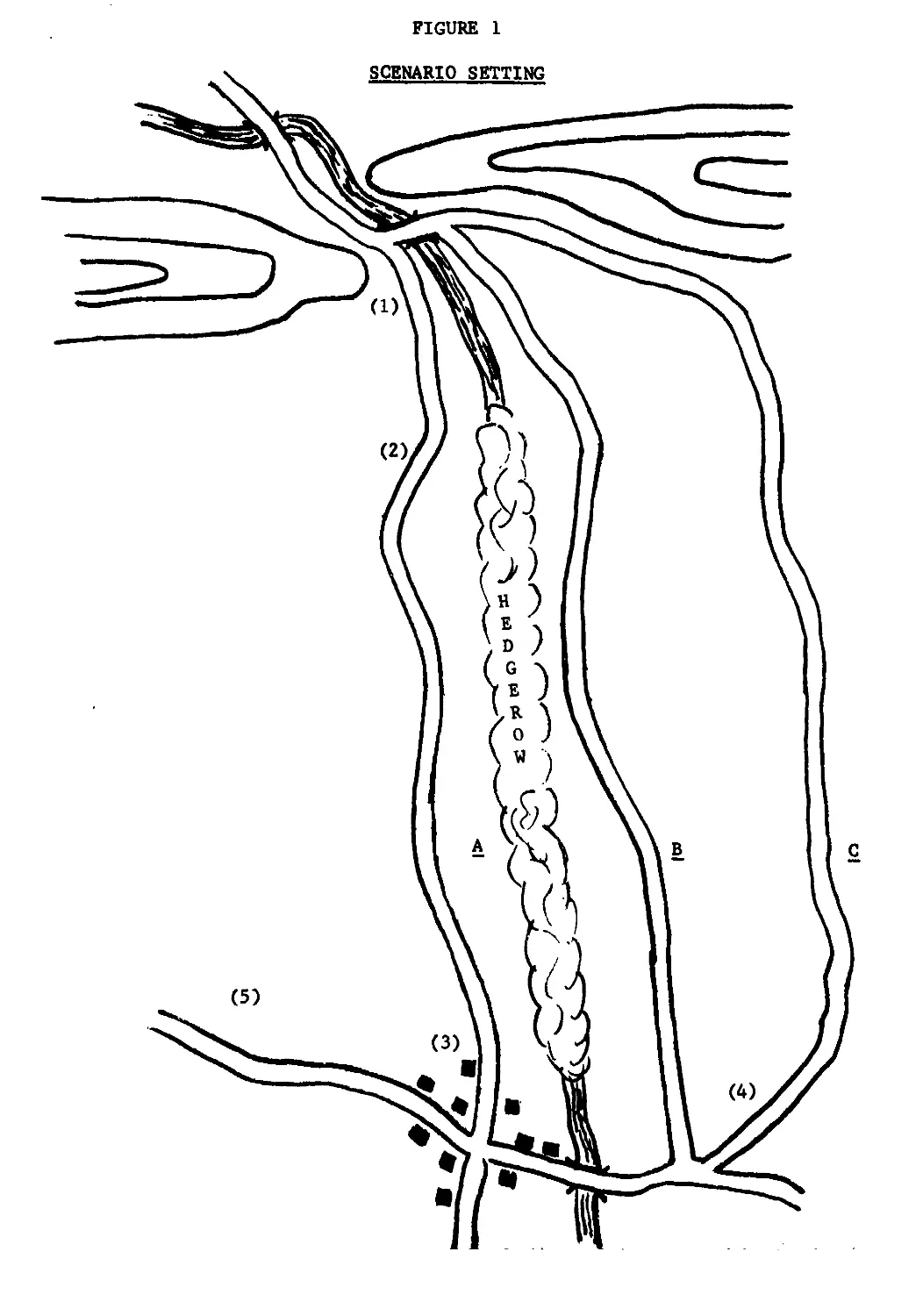
hill has a view down the valley of the contested area (Figure 1).
The lead element (reinforced motorised rifle platoon) is
in the distant hills (Pt. 1). Approximately one kilometer back
^Garbuz, Motorized Rifle Battalion in Modern Combat, p. 9.
3?G. Garbuz, D. Loza, and I. Sasonoy, The Motor Rifle Battalion
on the March and in the Meeting Engagement, (undated), p. 5.
22
FIGURE 1
(Pt. 2) is the vanguard of the advance guard. This force is
composed of a motorized rifle company minus the platoon in con-
tact. Now just coming into the area is the main portion of the
battalion, which is approximately five to six kilometers to the
rear of the vanguard (Pt. 3). There is one squad of flank security
located at points four and five. The terrain is forested to the
left of the main highway (Rt. A). To the right of the highway
the terrain consists of gently sloping open fields with two
roads (Rts. В and C) running parallel to the main highway.
The commander of the motorized rifle battalion now no
longer commands a battalion in a movement to contact role. He
is now involved in a MEETING ENGAGEMENT. Subsequent chapters
deal with how he utilizes various elements of this force to
prevent any slowdown in the rate of advancement of the main
formation of troops which are following.
24
CHAPTER II
THE MEETING ENGAGEMENT
The meeting engagements usually are of a fast
moving nature. Their duration depends on the
quantity and quality of means of armed combat
and the basic means of routing the enemy is the
destruction of the enemy by parts.
Maj. Gen. Reznichenko^
The Soviet Army expects the meeting engagement to be the
form of offensive action most frequently encountered on the modern
battlefield. By definition the two opponents will approach each
other at relatively high speeds with at least one of the forces
entering the fray unsuspectedly. As each commander attempts to
seize and hold the initiative, the contact will be fast-paced, lack
clarity, and be filled with sudden changes in the situation.
A. Concept of Meeting Engagement
The Soviet concept stems from their belief that there will
be an absence of static front lines which were characteristic of
World War II. Instead, troops will be constantly on the move, re-
inforcing weak spots or gaps that exist, moving reserves forward
to concentrate on strong points, or conducting exploitation and
3&V. Reznichenko, "Tactics During World War II," trans, for
USA, Military Herald, no. 4-75, p. 86.
3^This definition represents an aggregate of the various
individual definitions noted in numerous articles by Soviet authors.
25
pursuit roles. The Soviet's desire for speed and a specific rate
of advance necessitates near constant movement. Gen. Pavlovskiy
points out that under present conditions units must always be
ready to march rapidly over long distances, to change direction of
movement quickly, and to deploy and be committed in short periods
of time.
Certainly this offensive action is currently practiced exten-
sively. It is a carry-over from Wo . ’ War II where it was used in
both attack and defensive operations. The key goal of the meeting
engagement is the retention of the initiative and the desire to put
constant pressure on the enetny.^ The motorized rifle battalion
may be assigned one of several roles In which a meeting engagement
could occur. It may have a regimental assigned mission of acting as
the advance guard or the flank or rear guard during the course of
a regimental march, in which case it would be the lead battalion of
the first echelon regiment. It might assume a role following the
breakthrough in which it would be in a position to encounter reserve
forces being sent forward to bolster the defense, or it could meet
unexpectedly withdrawing enemy forces during the pursuit operation.
There is also a new theory involving a tactic called the "daring
thrust," which envisions regiments being used more or less independ-
ently in surprise, non-reinforced attacks designed to penetrate deep
4^1. Pavlovskiy, Commander in Chief of the Soviet Ground Forces,
"A High Degree of Field Training is a Guarantee of Constant Combat
Readiness," trans, for USA, Military Herald, no. 6-75, p. 6.
^^See Major John F. Concannon's student research report,
The Soviet Concept of the Meeting Engagement, Garmisch: USA Insti-
tute for Advanced Russian and East European Studies, 1976.
26
into the enemy*s rear area.42 If such a maneuver were employed, the
lead battalions of such regiments would conduct meeting engagements
against enemy forces being hastily deployed to prevent the capture
of key terrain features or facilities in the rear areas.
Since the initial NATO contact with Soviet ground forces will
be the result of a Soviet offensive, the first forces encountered will
be those organized in a march formation. As such, a division will
have out an advance guard positioned between the division reconnaissance
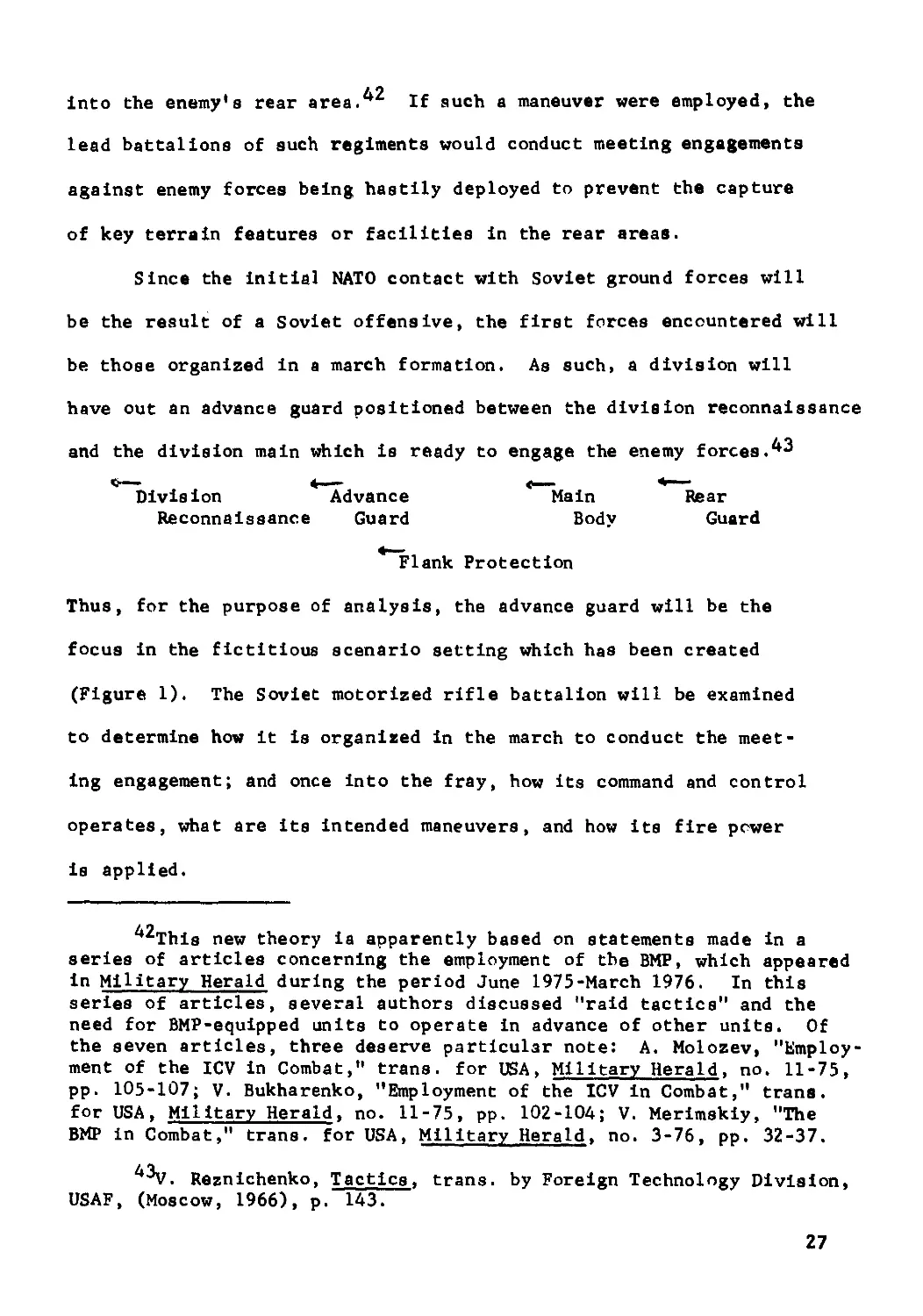
and the division main which is ready to engage the enemy forces.43
Division	Advance	Main	Rear
Reconnaissance Guard	Body	Guard
*~Flank Protection
Thus, for the purpose of analysis, the advance guard will be the
focus in the fictitious scenario setting which has been created
(Figure 1). The Soviet motorized rifle battalion will be examined
to determine how it is organized in the march to conduct the meet-
ing engagement; and once into the fray, how its command and control
operates, what are its intended maneuvers, and how its fire power
is applied.
42*rhis new theory la apparently based on statements made in a
series of articles concerning the employment of the BMP, which appeared
in Military Herald during the period June 1975-March 1976. In this
series of articles, several authors discussed "raid tactics" and the
need for BMP-equipped units to operate in advance of other units. Of
the seven articles, three deserve particular note: A. Molozev, "Employ-
ment of the ICV in Combat," trans, for USA, Military Herald, no. 11-75,
pp. 105-107; V. Bukharenko, "Employment of the ICV in Combat," trans,
for USA, Military Herald, no. 11-75, pp. 102-104; V. Merimskiy, "The
BMP in Combat," trans, for USA, Military Herald, no. 3-76, pp. 32-37.
4^V. Reznichenko, Tactics, trans, by Foreign Technology Division,
USAF, (Moscow, 1966), p. 143.
27
Physical Configuration
Just as the division to which the selected battalion belongs
employs a security screen, so, too, does the motorised rifle battalion
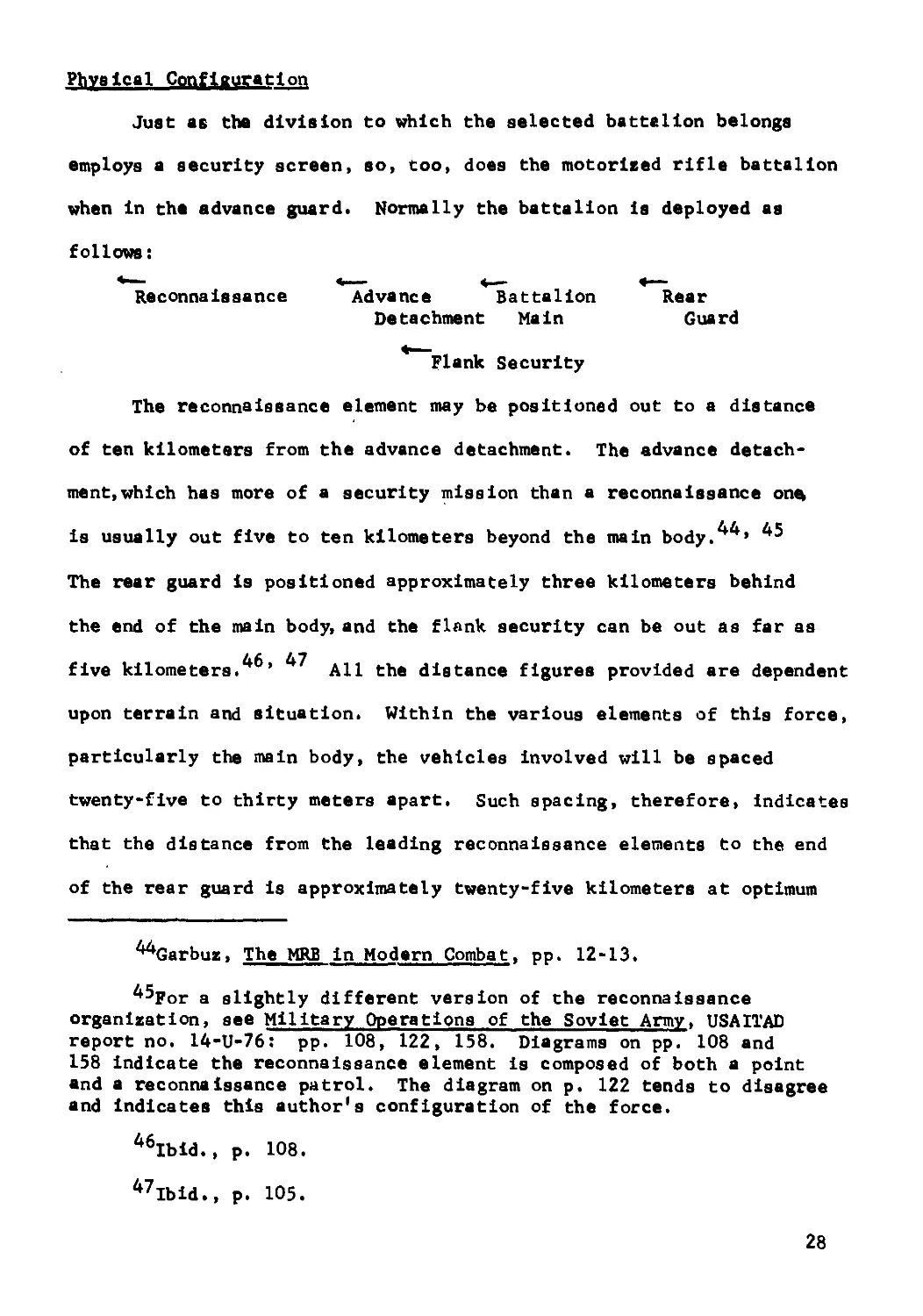
when in the advance guard. Normally the battalion is deployed as
follows:
Reconnaissance Advance Battalion Rear
Detachment Main	Guard
* Flank Security
The reconnaissance element may be positioned out to a distance
of ten kilometers from the advance detachment. The advance detach-
ment, which has more of a security mission than a reconnaissance onet
is usually out five to ten kilometers beyond the main body.44, 4^
The rear guard is positioned approximately three kilometers behind
the end of the main body, and the flank security can be out as far as
five kilometers.All the distance figures provided are dependent
upon terrain and situation. Within the various elements of this force,
particularly the main body, the vehicles involved will be spaced
twenty-five to thirty meters apart. Such spacing, therefore, indicates
that the distance from the leading reconnaissance elements to the end
of the rear guard is approximately twenty-five kilometers at optimum
^Garbuz, The MRB in Modern Combat, pp. 12-13.
45por a slightly different version of the reconnaissance
organization, see Military Operations of the Soviet Army. USAITAD
report no. 14-U-76: pp. 108, 122, 158. Diagrams on pp. 108 and
158 indicate the reconnaissance element is composed of both a point
and a reconnaissance patrol. The diagram on p. 122 tends to disagree
and indicates this author's configuration of the force.
46Ibid., p. 108.
47Ibid., p. 105.
28
conditions.
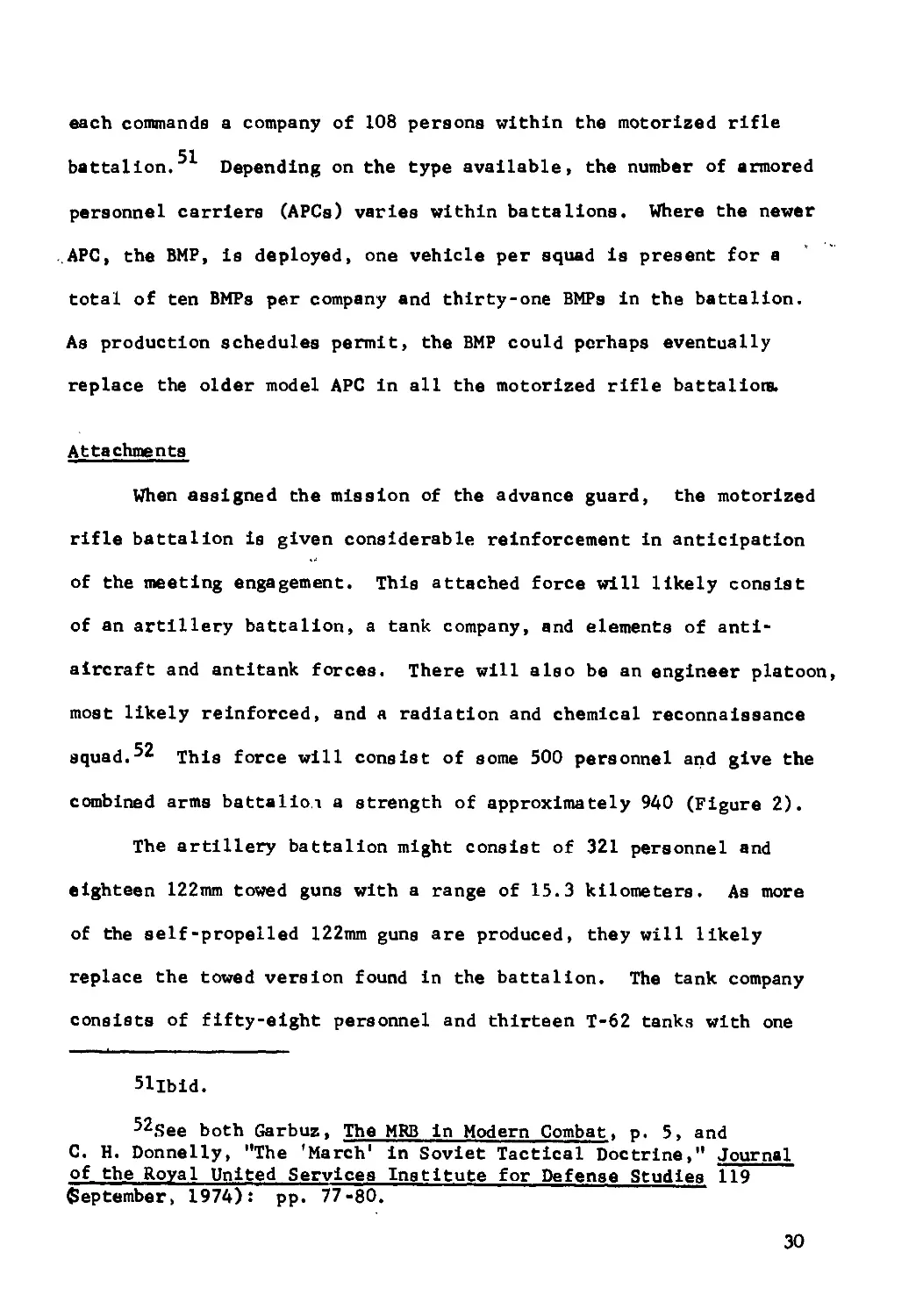
In such a configuration, the motorised rifle battalion is
expected to perform the following missions
prevent enemy main forces from occupying key terrain,
conduct reconnaissance,
insure unimpeded movement of the main force.
f' warn the main force of surprise attack.
assure the main force of suitable conditions for combat,
prevent the penetration of enemy ground force reconnaissance.
Battalion Organization
The motorized rifle battalion is the basic combined arms force
of the Soviet army. It is a pure motorized rifle unit in organization
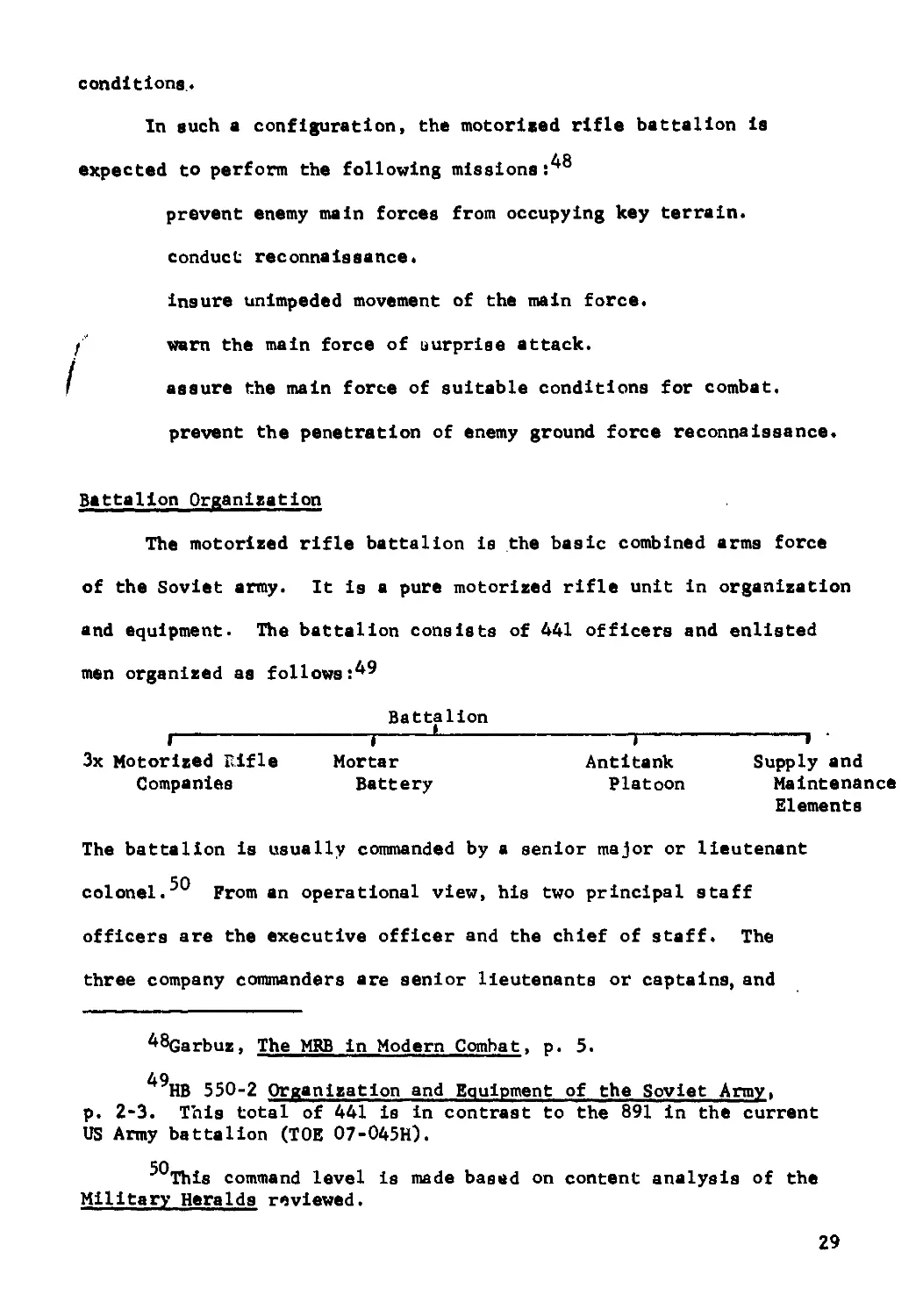
and equipment. The battalion consists of 441 officers and enlisted
men organized as follows:^
Battalion
I-----------------j——t---------------------,---------------1 .
3x Motorized Rifle Mortar	Antitank Supply and
Companies	Battery	Platoon	Maintenance
Elements
The battalion is usually commanded by a senior major or lieutenant
colonel.50 From an operational view, his two principal staff
officers are the executive officer and the chief of staff. The
three company commanders are senior lieutenants or captains, and
^Sgarbuz, The MRB in Modern Combat, p. 5.
49
HB 550-2 Organization and Equipment of the Soviet Army.
p. 2-3. This total of 441 is in contrast to the 891 in the current
US Army battalion (TOE 07-045H).
50jhis command level is made based on content analysis of the
Military Heralds reviewed.
29
each commands a company of 108 persons within the motorized rifle
battalion.51 Depending on the type available, the number of armored
personnel carriers (APCs) varies within battalions. Where the newer
..APC, the BMP, is deployed, one vehicle per squad is present for a
total of ten BMPs per company and thirty-one BMPs in the battalion.
As production schedules permit, the BMP could perhaps eventually
replace the older model APC in all the motorized rifle battalions.
Attachments
When assigned the mission of the advance guard, the motorized
rifle battalion is given considerable reinforcement in anticipation
of the meeting engagement. This attached force will likely consist
of an artillery battalion, a tank company, and elements of anti-
aircraft and antitank forces. There will also be an engineer platoon,
most likely reinforced, and a radiation and chemical reconnaissance
squad.52 This force will consist of some 500 personnel and give the
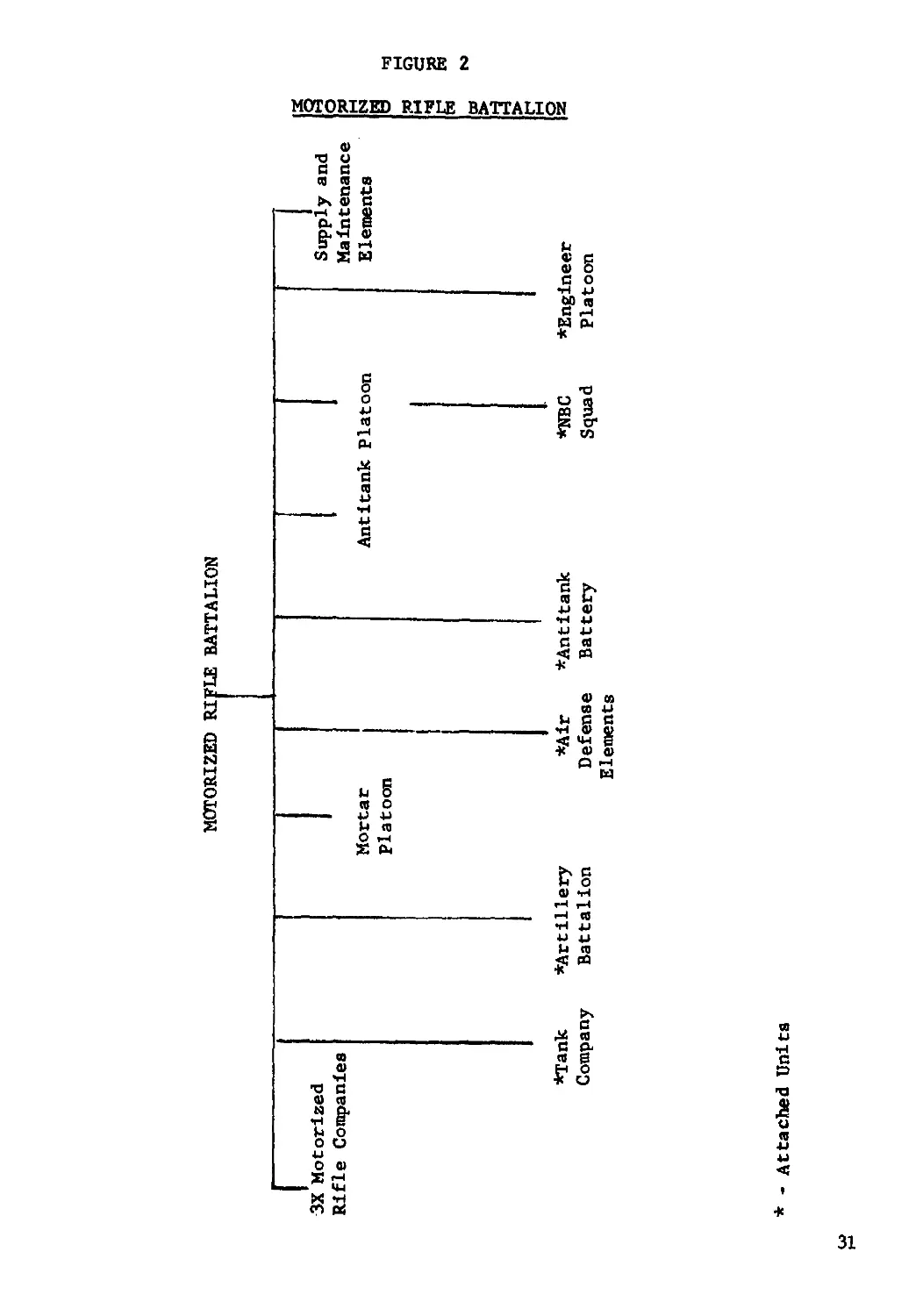
combined arms battalio.i a strength of approximately 940 (Figure 2).
The artillery battalion might consist of 321 personnel and
eighteen 122mm towed guns with a range of 15.3 kilometers. As more
of the self-propelled 122mm guns are produced, they will likely
replace the towed version found in the battalion. The tank company
consists of fifty-eight personnel and thirteen T-62 tanks with one
51lbid.
52gee both Garbuz, The MRB in Modern Combat, p. 5, and
С. H. Donnelly, "The 'March' in Soviet Tactical Doctrine," Journal
of the Royal United Services Institute for Defense Studies 119
September, 1974): pp. 77-80.
30
MOTORIZED RIFLE BATTALION
3X Motorized
Rifle Companies
*Tank	*Artillery
Company Battalion
* - Attached Units
Mortar
Platoon
*Air *Antitank
Defense Battery
Elements
Antitank Platoon
Supply and
Maintenance
Elements
*NBC *Engineer
Squad Platoon
MOTORIZED RIFLE BATTALION
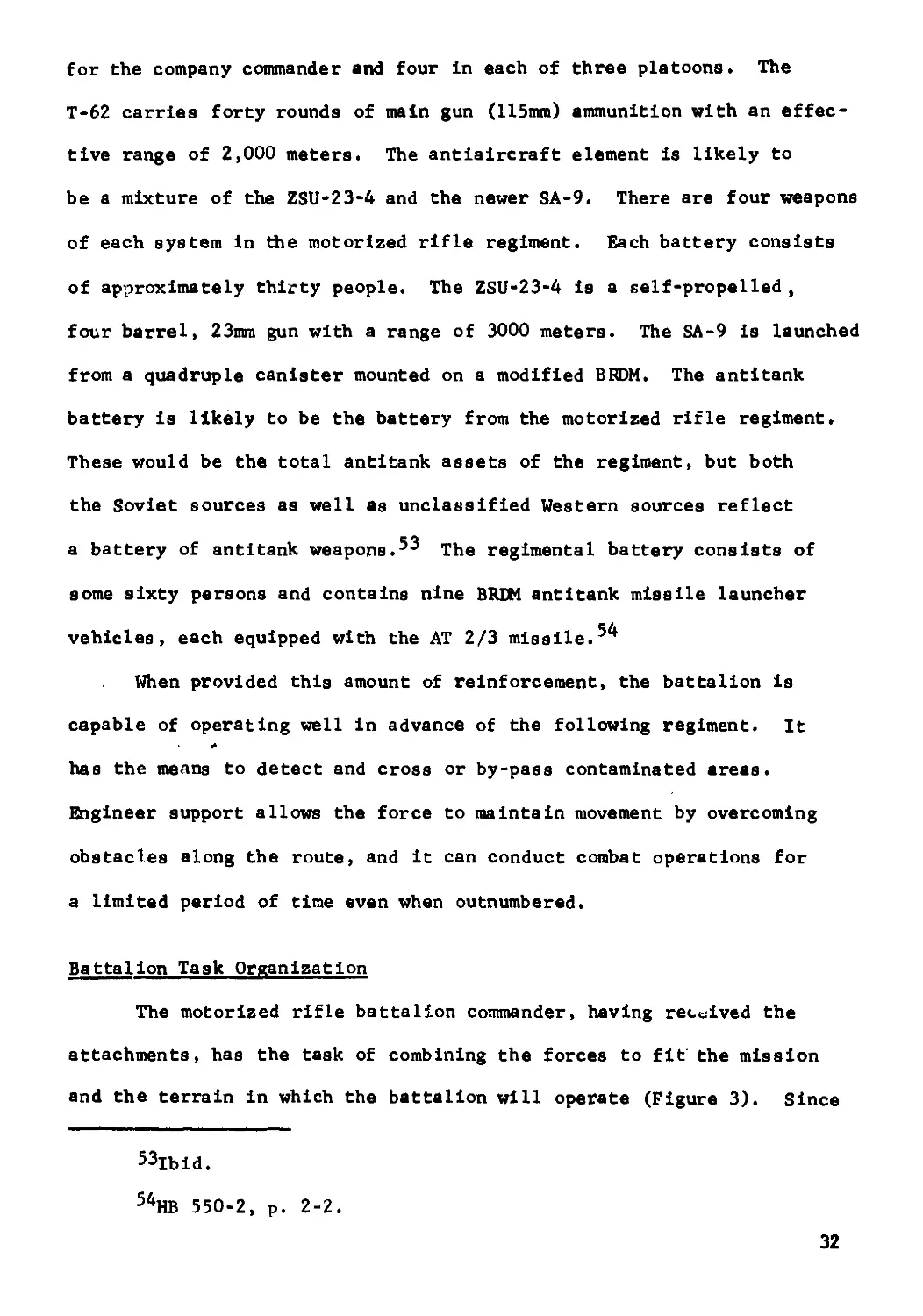
for the company commander and four in each of three platoons. The
T-62 carries forty rounds of main gun (115mm) ammunition with an effec-
tive range of 2,000 meters. The antiaircraft element is likely to
be a mixture of the ZSU-23-4 and the newer SA-9. There are four weapons
of each system in the motorized rifle regiment. Each battery consists
of approximately thirty people. The ZSU-23-4 is a self-propelled ,
four barrel, 23mm gun with a range of 3000 meters. The SA-9 is launched
from a quadruple canister mounted on a modified BRDM. The antitank
battery is likely to be the battery from the motorized rifle regiment.
These would be the total antitank assets of the regiment, but both
the Soviet sources as well as unclassified Western sources reflect
a battery of antitank weapons.53 The regimental battery consists of
some sixty persons and contains nine BRTM antitank missile launcher
vehicles, each equipped with the AT 2/3 missile.
When provided this amount of reinforcement, the battalion is
capable of operating well in advance of the following regiment. It
И
has the means to detect and cross or by-pass contaminated areas.
Engineer support allows the force to maintain movement by overcoming
obstacles along the route, and it can conduct combat operations for
a limited period of time even when outnumbered.
Battalion Task Organization
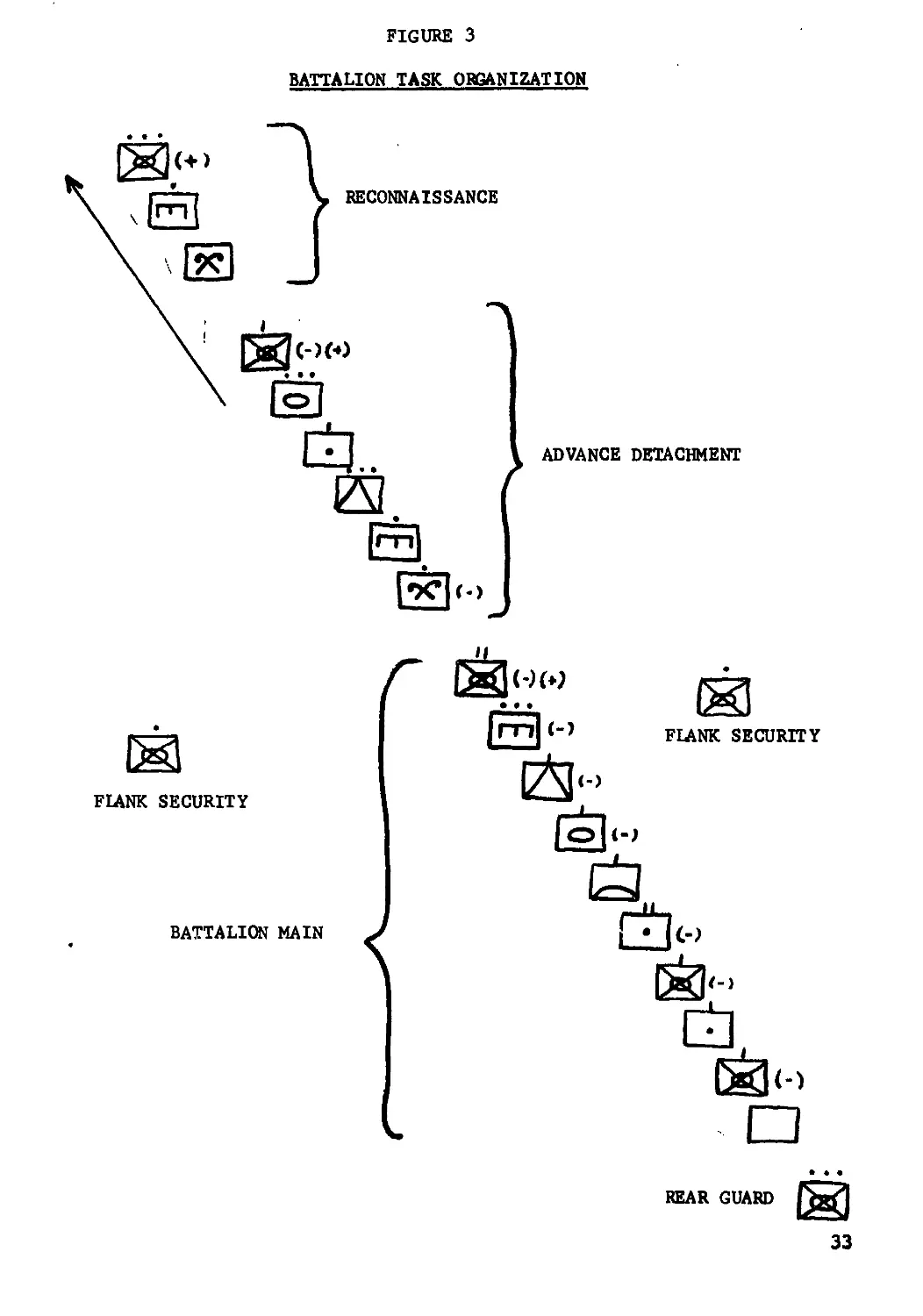
The motorized rifle battalion commander, having received the
attachments, has the task of combining the forces to fit the mission
and the terrain in which the battalion will operate (Figure 3). Since
53lbid.
54HB 550-2, p. 2-2.
32
FIGURE 3
BATTALION TASK ORGANIZATION
ADVANCE DETACHMENT
ЭЗ
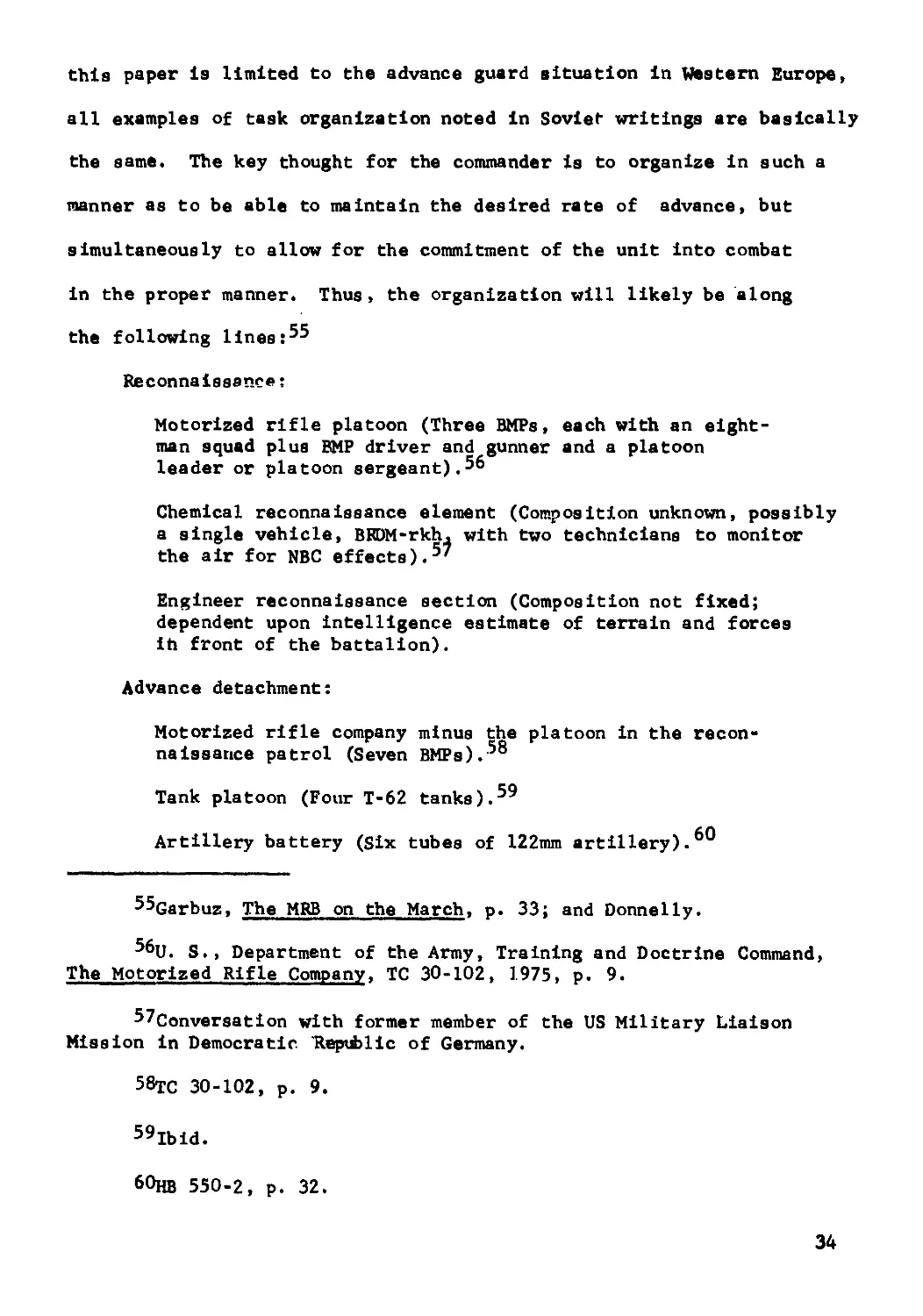
this paper is limited to the advance guard situation in Western Europe,
all examples of task organization noted in Soviet* writings are basically
the same. The key thought for the commander is to organize in such a
manner as to be able to maintain the desired rate of advance, but
simultaneously to allow for the commitment of the unit into combat
in the proper manner. Thus, the organization will likely be along
the following lines:55
Reconnaissance:
Motorized rifle platoon (Three BMPs, each with an eight-
man squad plus BMP driver and gunner and a platoon
leader or platoon sergeant).56
Chemical reconnaissance element (Composition unknown, possibly
a single vehicle, BRDM-rkh, with two technicians to monitor
the air for NBC effects).5'
Engineer reconnaissance section (Composition not fixed;
dependent upon intelligence estimate of terrain and forces
ih front of the battalion).
Advance detachment:
Motorized rifle company minus the platoon in the recon-
naissance patrol (Seven BMPs).58
Tank platoon (Four T-62 tanks).5®
Artillery battery (Six tubes of 122mm artillery).^
55garbuz, The MRB on the March, p. 33; and Donnelly.
56u. S., Department of the Army, Training and Doctrine Command,
The Motorized Rifle Company, TC 30-102, 1975, p. 9.
^Conversation with former member of the US Military Liaison
Mission in Democratic Republic of Germany.
58-rc 30-102, p. 9.
59lbid.
60hb 550-2, p. 32.
34
Antitank element (Three В RDM missile launcher vehicles
with AT 2/3).
Combat engineer section (Composition unknown).
Chemical reconnaissance sections (Probably two vehicles of
the type in the reconnaissance element).61
Battalion Main:
Battalion headquarters (Sixteen personnel; one BMP).62
Field engineer platoon (Would vary in composition, depending
on perceived need).
Antitank battery minus one platoon (This would be the remain-
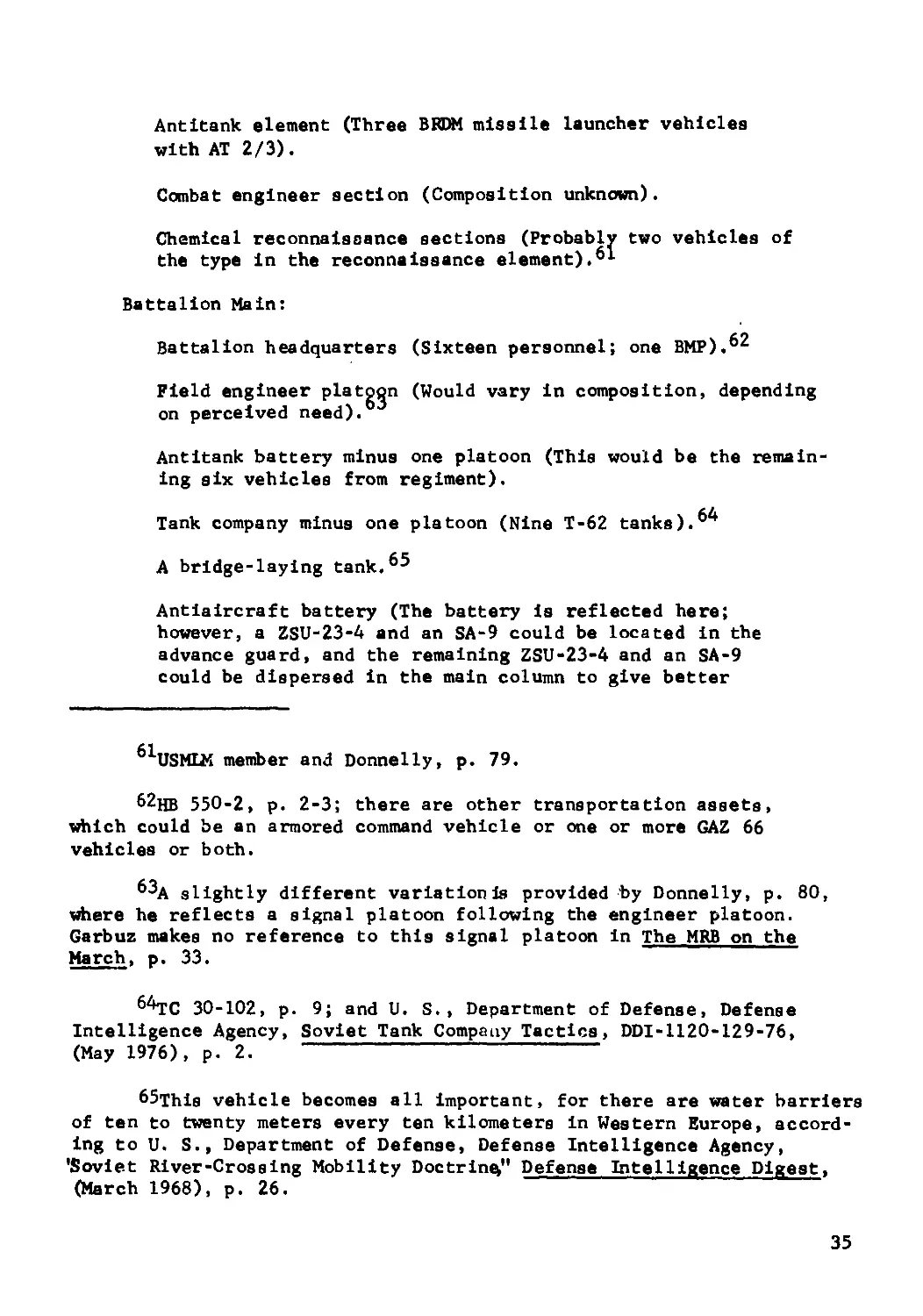
ing six vehicles from regiment).
Tank company minus one platoon (Nine T-62 tanks).
A bridge-laying tank.65
Antiaircraft battery (The battery is reflected here;
however, a ZSU-23-4 and an SA-9 could be located in the
advance guard, and the remaining ZSU-23-4 and an SA-9
could be dispersed in the main column to give better
61USMIM member and Donnelly, p. 79.
62дв 550-2, p. 2-3; there are other transportation assets,
which could be an armored command vehicle or one or more GAZ 66
vehicles or both.
63д slightly different variation is provided by Donnelly, p. 80,
where he reflects a signal platoon following the engineer platoon.
Garbuz makes no reference to this signal platoon in The MRB on the
March, p. 33.
6^TC 30-102, p. 9; and U. S., Department of Defense, Defense
Intelligence Agency, Soviet Tank Company Tactics, DDI-1120-129-76,
(May 1976), p. 2.
65This vehicle becomes all important, for there are water barriers
of ten to twenty meters every ten kilometers in Western Europe, accord-
ing to U. S., Department of Defense, Defense Intelligence Agency,
'Soviet River-Crossing Mobility Doctrine^" Defense Intelligence Digest,
(March 1968), p. 26.
35
protection since this element is more likely to be organized
to protect the march than to be used in the meeting engage-
ment.)
The artillery battalion minus one battery (twelve 122mm
howitzers, possibly the D-30 towed type, but more likely
the newer self-propelled version).
A motorized rifle company. (The company could be intact,
or it might be minus two squads which would be posted
to the flanks to serve as flank security.)0
A mortar battery. (This unit consists of six 120mm
mortars.)67
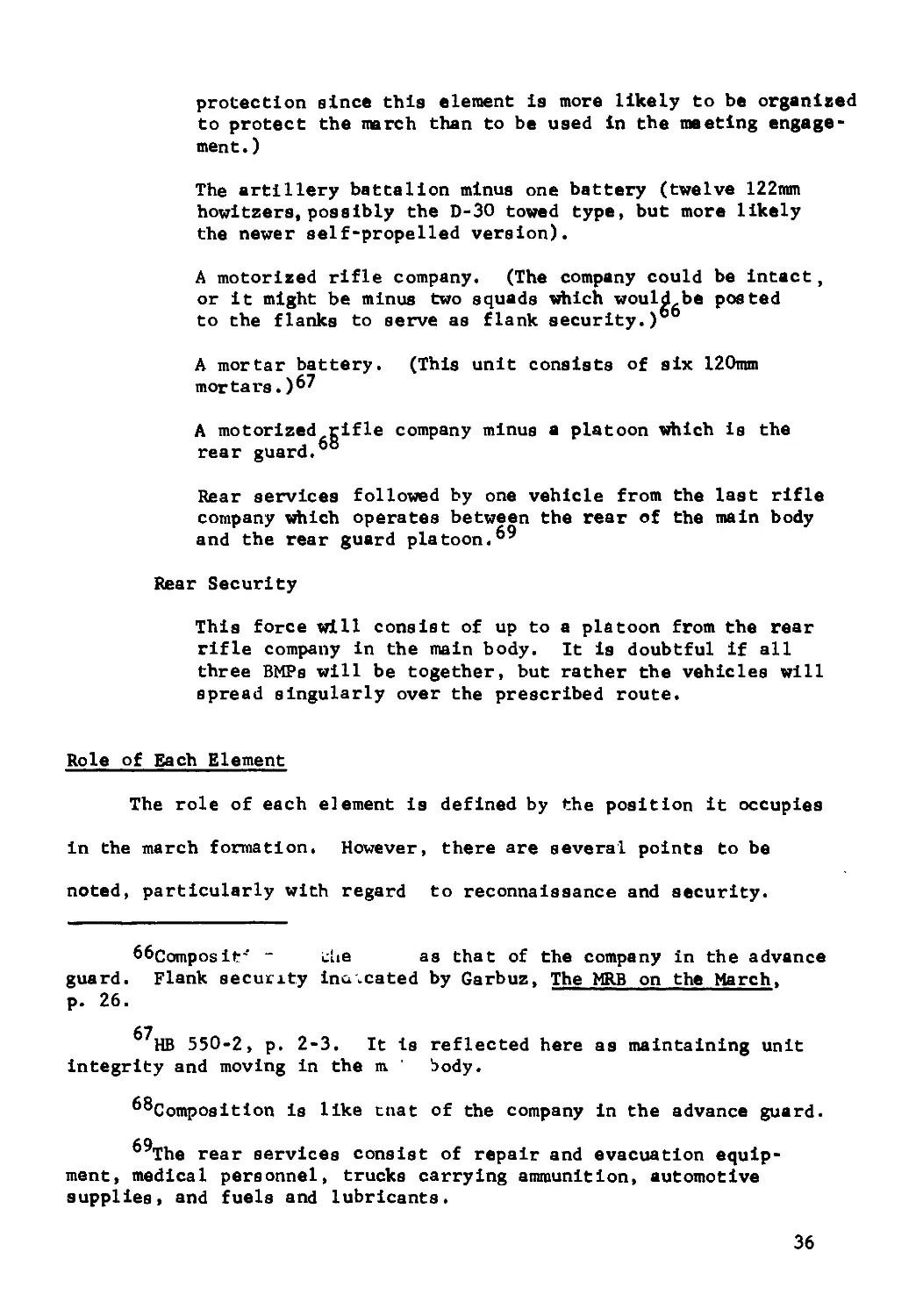
A motorized rifle company minus a platoon which is the
rear guard.
Rear services followed by one vehicle from the last rifle
company which operates between the rear of the main body
and the rear guard platoon.
Rear Security
This force will consist of up to a platoon from the rear
rifle company in the main body. It is doubtful if all
three BMPs will be together, but rather the vehicles will
spread singularly over the prescribed route.
Role of Each Element
The role of each element is defined by the position it occupies
in the march formation. However, there are several points to be
noted, particularly with regard to reconnaissance and security.
66composit- “ Che as that of the company in the advance
guard. Flank security inc .cated by Garbuz, The MRB on the March,
p. 26.
550-2, p. 2-3. It is reflected here as maintaining unit
integrity and moving in the m body.
^Composition is like tnat of the company in the advance guard.
M
The rear services consist of repair and evacuation equip-
ment, medical personnel, trucks carrying ammunition, automotive
supplies, and fuels and lubricants.
36
The overall mission of the battalion force as a whole has been
outlined; however, in assigning the mission to the reconnaissance
element, the following represents the detailed type of information
expected to be gathered:
Finding the enemy.
Determining the grouping of his units.
Determining the presence of nuclear weapons, tanks, and artillery.
Determining the locations of artillery, mortars, antitank
guided missiles.
Locating the span of deployment and determining the direction
of advance.
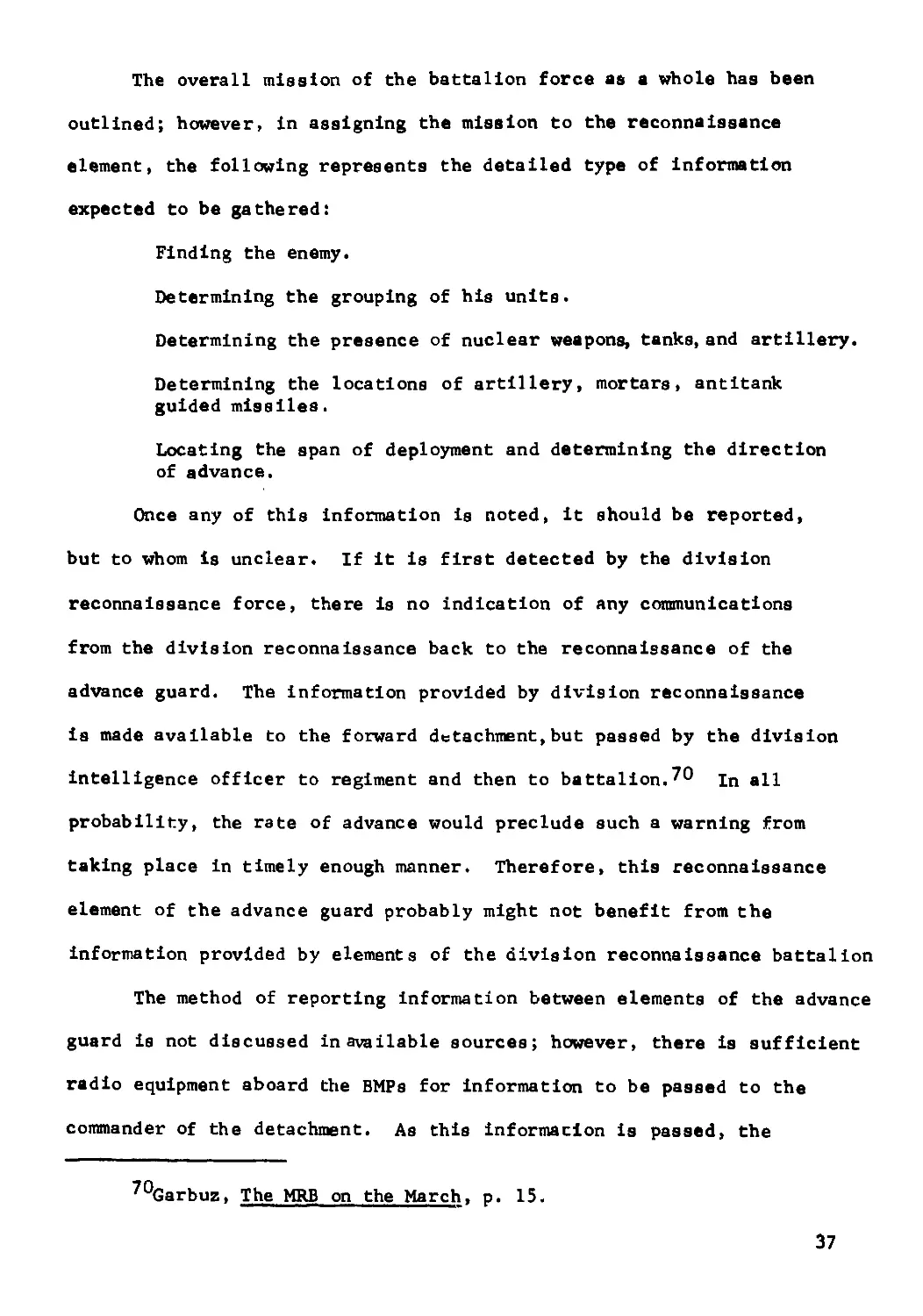
Once any of this information is noted, it should be reported,
but to whom Is unclear. If it is first detected by the division
reconnaissance force, there is no indication of any communications
from the division reconnaissance back to the reconnaissance of the
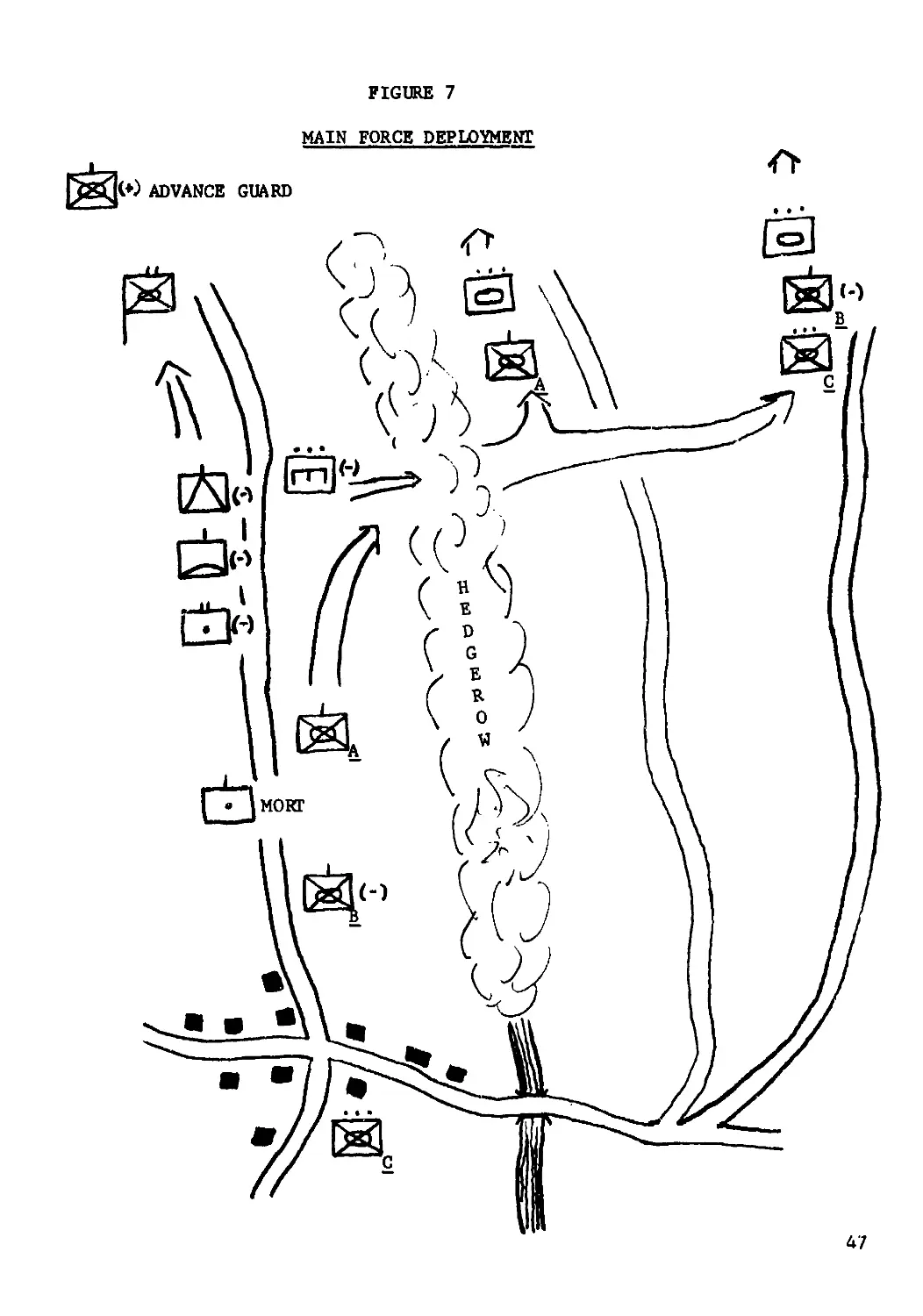
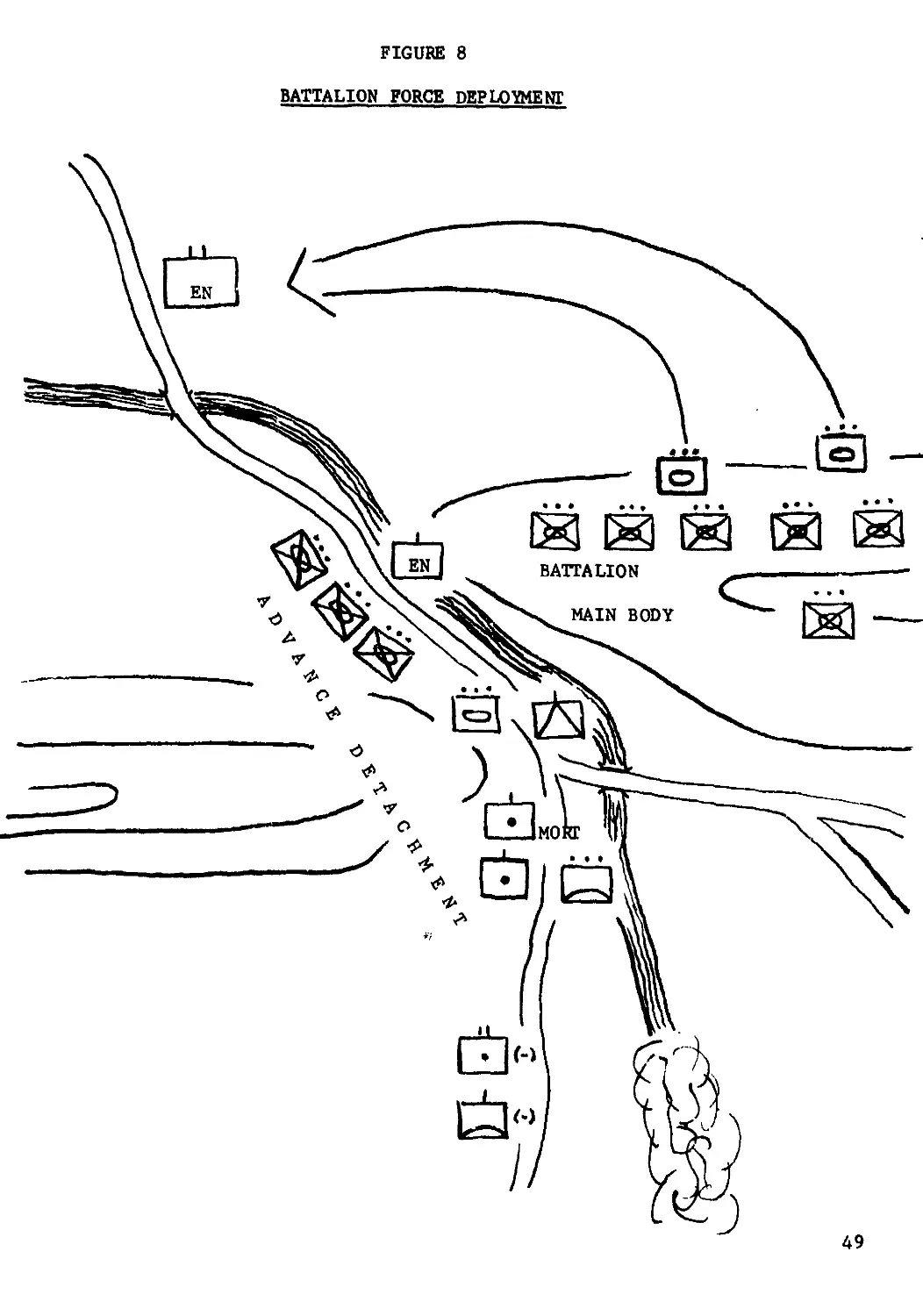
advance guard. The information provided by division reconnaissance
is made available to the forward detachment, but passed by the division
intelligence officer to regiment and then to battalion.70 In all
probability, the rate of advance would preclude such a warning from
taking place in timely enough manner. Therefore, this reconnaissance
element of the advance guard probably might not benefit from the
information provided by elements of the division reconnaissance battalion
The method of reporting information between elements of the advance
guard is not discussed in available sources; however, there is sufficient
radio equipment aboard the BMPs for information to be passed to the
commander of the detachment. As this information is passed, the
^Garbuz, The MRB on the March, p. 15.
37
reconnaissance element of the battalion moves forward, by-passing initial
enemy elements.
The advance detachment is the first element of the Soviet Army
which will be organized and assigned the mission of engaging the enemy
in decisive combat. It will do so based on the information provided
by the reconnaissance element. Moving to meet the enemy, it will
attempt to insure the selected road network is free of obstacles; and
it will make hasty repairs and alert the main body as to the work to
be accomplished. Contaminated areas will be marked and by-passed where
possible. Once the decision has been made to by-pass or cross such
areas, the main body is notified.
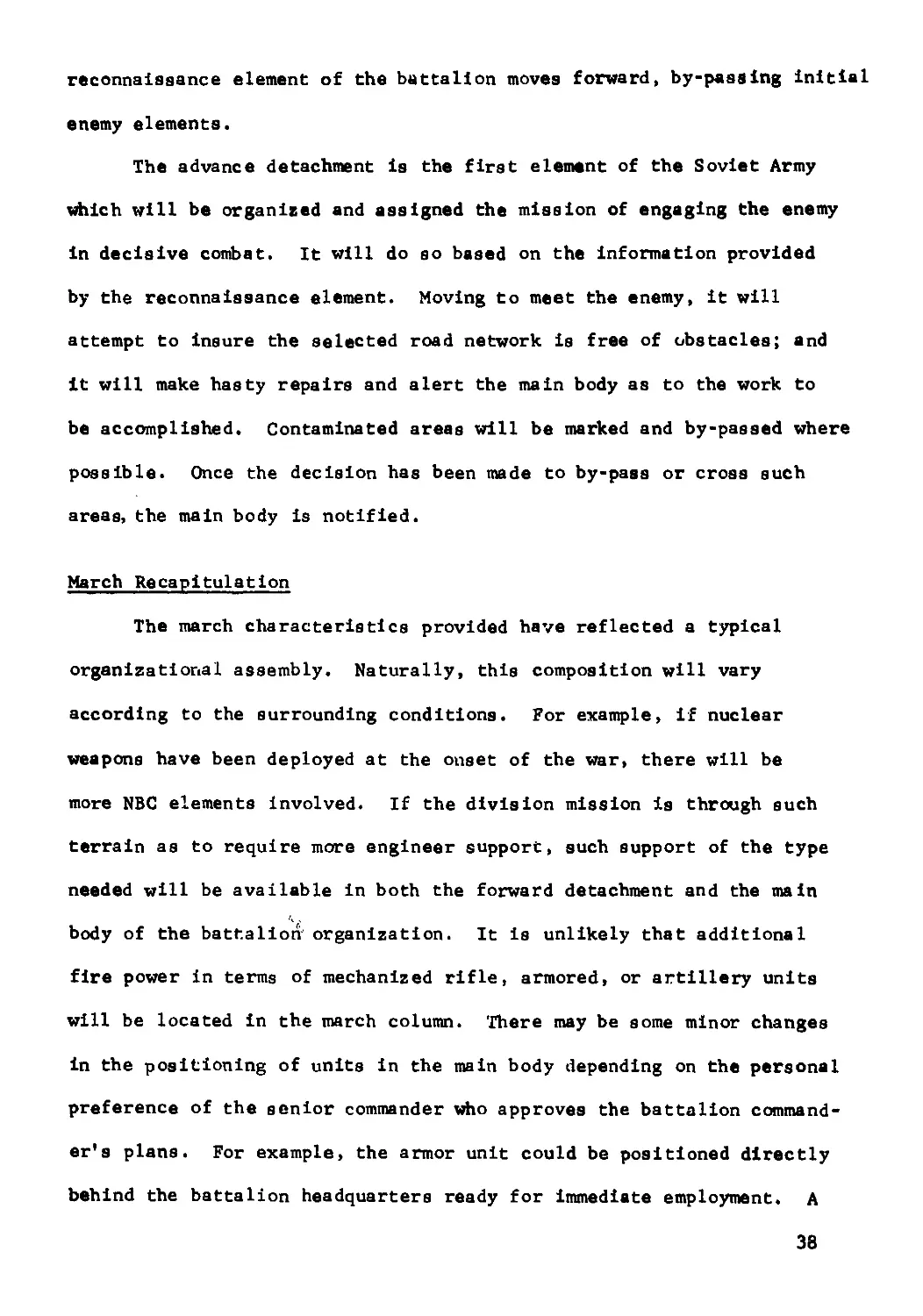
March Recapitulation
The march characteristics provided have reflected a typical
organizational assembly. Naturally, this composition will vary
according to the surrounding conditions. For example, if nuclear
weapons have been deployed at the onset of the war, there will be
more NBC elements involved. If the division mission is through such
terrain as to require more engineer support, such support of the type
needed will be available in both the forward detachment and the main
body of the battalion organization. It is unlikely that additional
fire power in terms of mechanized rifle, armored, or artillery units
will be located in the march column. There may be some minor changes
in the positioning of units in the main body depending on the personal
preference of the senior commander who approves the battalion command-
er's plans. For example, the armor unit could be positioned directly
behind the battalion headquarters ready for immediate employment. A
38
similar possibility would be to move the two rifle companies ahead of
the artillery battalion.71 However, if that were done, the commander
would be putting himself in a position in which his armor and motorized
forces might be ready and, In fact, have to attack before the artillery
could be ready to fire in support.
Even with these variations, the Soviet commander is now organized
to fulfill the battalion missions of decisively engaging the enemy.
As the reconnaissance elements report the advancing enemy forces, the
march is ready to develop into the meeting engagement.
B. The Meeting Engagement
Garbuz and his fellow authors write:
To achieve success in a meeting engagement, it is necessary
to discover the advancing enemy troops in time and establish
continuous observation of them. It is important to forestall
the enemy in seizing a position suitable for the engagement
and in opening artillery and tank fire. The podrazdeleniye
(units) of the battalion deploy quickly into combat formations
and move into the attack immediately after nuclear strikes
Launched by the weapons of the senior commanders and conduct
fire from their own weapons. They operate boldly and decisively
striving to break up the enemy into individual groups and de-
stroy them in detail.72
As the meeting engagement opens, the forces could be displayed
on the terrain as indicated in Figure 4. The reconnaissance element
passes to the commander of the advance detachment the information
concerning the approaching enemy unit. In a sequence of events, the
following actions are likely to occur:
Up until this time, the battalion has operated under radio
71-Donnelly, p. 80.
^Garbuz, The MRB on the March, pp. 17-18.
39
FIGURE 4
FORCES AT INITIATION OF MEETING ENGAGEMENT
—LI-
EN
silence for the most part. The only radio exchanges have
been short prearranged signals. Where possible, hand and arm
.and flag signals have been used. At this'time, restrictions
have been lifted; and the radio is used with extensive refer-
ence to the detailed coded map.73
The advance detachment up until this time has been moving under
available cover and concealment in short bounds, examining local features
from short halts. Built-up areas, such as the village Just passed,
are reconnoitered with special care.74 With the report from the recon-
naissance element of the advancing enemy, such careful advance stops;
and the detachment increases the rate of advance as the artillery
pulls out of the formation to prepare to fire. There being no evidence
of artillery forward observers with the reconnaissance element, the
artillery battery will fire initially with no adjustment.The tank
platoon will make a frontal attack against the enemy, while the rifle
company will attempt to move to the flank and attack (Figure 5).
There will be no immediate need for the chemical and engineer elements.
The air defense element will follow the tanks as will the antitank
platoon. The attack by the tanks will be most effective for the Soviets
as they approach the range of 1500-1200 meters. The rifle company
73Ibid. , p. 39.
74Ibid., p. 86.
7^There are artillery scouts, but their mission does not appear
to be that of the forward observer as is known in US artillery doctrine.
For those who have an interest in this particular point, the following
three sources are provided to support the belief that there is presently
no forward observer: Maj. Gen. of Artillery N. Besedin, "Striking of
Fixed Targets," trans, for USA, Military Herald, no. 10-75, p. 142;
Col. 8. Ostroumov, "Firing for Effect," trans, for USA, Military Herald,
no. 1-76, p. 131; and Col. G. Litvinovich, "Battalion Firing at Observed
Targets," trans, for USA, Military Herald, no. 1-76, p. 137.
41
FIGURE 5
ADVANCE DETACHMENT DEPLOYMENT
42
will move off to the flank in a company column formation breaking down
to nine BMPs on line, with no reserve to attack the flank by surprise.
The company will attempt to carry out the maneuver without the dis-
mount of the infantry squad.
The air defense platoon will move behind the tanks and the
antitank platoon. Such positioning will give the tanks and antitanks
weapons space to deploy, but will not degrade the antiaircraft pro-
tection. Because the terrain is relatively flat in the area, the
guns will likely operate one behind the other. The guns will remain
within 400 meters of the tanks and separated by about 150 meters.77
The commander of the rifle company is also the commander of
the advance guard. He will report by radio to the battalion commander
the proposed action; and, when approval is given, he will then
move with the rifle company. Upon being notified of the impending
combat, the battalion commander will start to move forward to direct
the operation. The three major subunit commanders--motorized infantry,
armor, and artillery--all seem to be free at this point to perform as
they see the situation from their respective areas* In the main, the
advance guard has fulfilled its role. It has protected the main body
from surprise attack, insured favorable conditions for deployment, and
hopefully prevented enemy reconnaissance from further advances.
This form of offensive is one of the few times company commanders
in the Soviet Army have any opportunity to show initiative. They are
76r. Rodiirov, "Battle Formations in Offensive Combat," trans,
for USA, Military Herald, no. 1-76, p. 156.
77Ibid., p. 154.
43
out in the front far enough to act independently until the battalion
commander arrives.
As the battalion commander moves forward to take command of
the battle, the reconnaissance, now forward of the combat involving
the advance detachment, reports the approach of the main body of the
enemy formations.
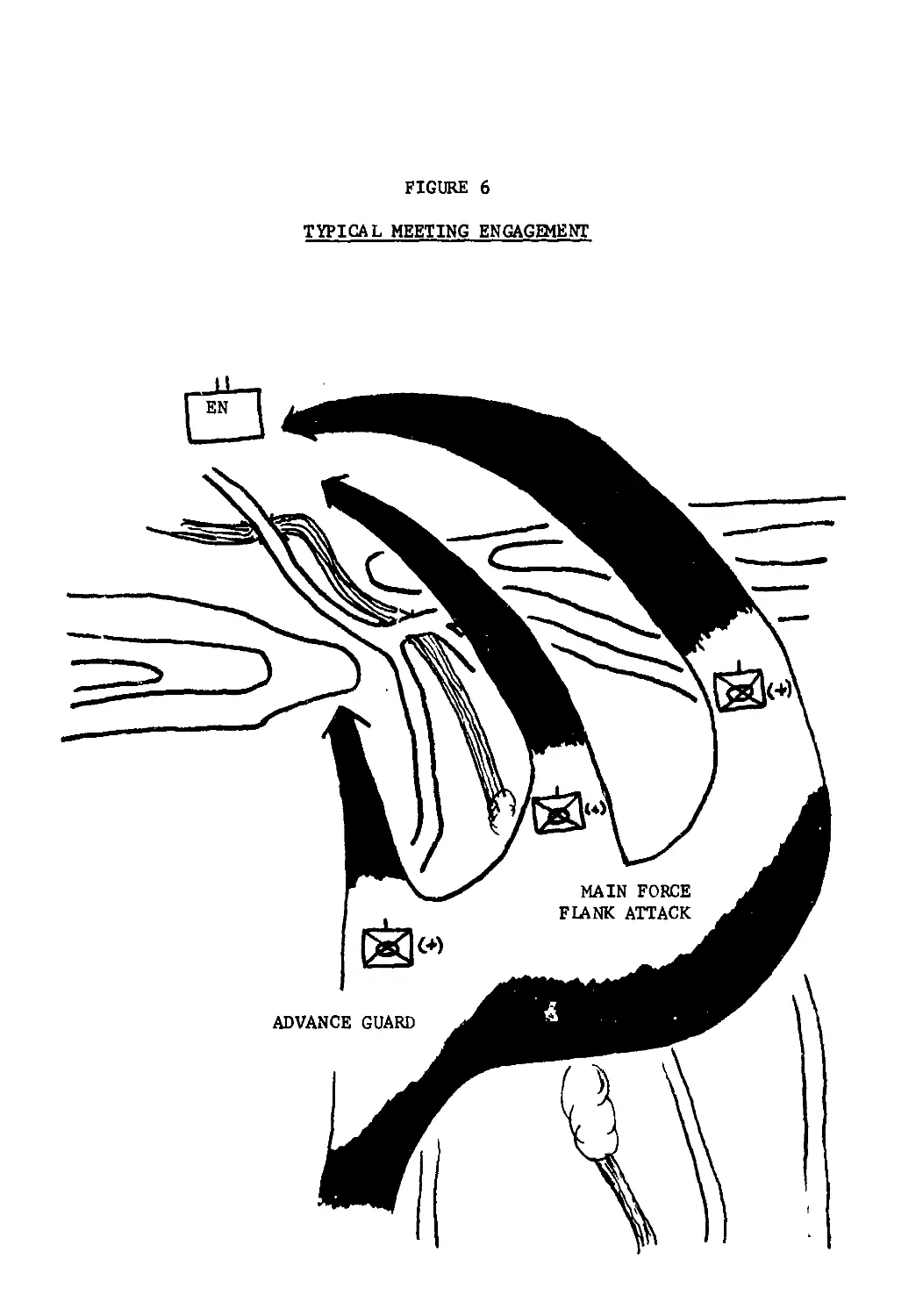
The battalion commander now has to make a quick estimate of
the situation. As the enemy formation approaching is of sufficient
size, it will cause the deployment of the battalion into a full meeting
engagement (Figure 6). The limited high ground to the front is the
key terrain vrtiich will significantly aid the side occupying it. There
are parallel roads to the right that can be used; however, these roads
are separated from the major route by one of the numerous streams that
flow across the West European countryside. By using the two secondary
roads, he can reduce the time required to move troops forward by nearly
one half (Figure 6). Since his rate of march in daylight is twenty to
thirty kilometers per hour and the distance is some ten kilometers
to the hill mass, the utilization of the other routes means he can reach
the hills in about twenty minutes.Deploying the maneuver element
on all three routes, the battalion commander has created sufficient
maneuver space to block the enemy’s advance with his own advance
guard and send his main body on a flanking attack.gy U8ing
^®Garbuz, The MRB on the March, p. 7, provides the speed. The
twenty minutes is based on Time “ Distance ? speed.
79U. S., Department of Defense, Defense Intelligence Agency,
Soviet Tactics: The Meeting Engagement, DDI-1100-143-76, (Dec. 1976),
p. 10, figures C and D.
44
FIGURE 6
TYPICAL MEETING ENGAGEMENT
this flanking maneuver, the commander has avoided the commitment of
the battalion in piecemeal deployment as they arrive at the hill mass
ЯП
where the advance guard is deployed.
Having reached his decision as to the manner of engaging the
enemy, the battalion commander notifies his chief of staff (battalion
operations officer) of the plan and moves on to Join the combat being
conducted by the advance guard. As he moves, he informs both the
artillery commander and the commander of the advance detachment; and
the chief of staff informs the remaining elements of the main body.81
In this manner there will be no need to interrupt the movement of the
main body.
As missions are assigned, units begin to move to their assigned
tasks. It becomes clear the commander intends to move his fire support
forward to where the advance detachment has halted or is halting the
enemy advance and intends to use his two remaining motorized rifle
companies and the tank company minus to move to the right and attack
the left flank of the enemy (Figure 7).
The engineer platoon, including the bridge-laying tank, moves
S^This mental estimate made by the battalion commander may be
implemented; however, there is some doubt about the time lag involved.
Though writers in the Military Herald emphasize the initiative allowed
commanders in meeting engagements, Garbuz infers that the senior
commander will also play a part in this decision-making process.
Since the battalion as described here is leading a regimental force,
this senior commander will be a regimental commander. If such is the
case, the procedure indicates a weakness (as a result of lack of
timeliness) in tha effective command and control. Garbuz, The MRB
on the March, p. 78.	<'
81
A. Bogdanov, "Coordination in Combat," trans, for USA,
Military Herald, no. 9-75, p. 54.
46
FIGURE 7
advance guard
47
out to the right to use its bulldozer and the bridge-laying tank to
provide a crossing of the stream and hedgerow for the tank company
and two motor rifle companies (Figure 7). As the tanks pass the
engineer-prepared crossing, one section of engineers continues to the
far road to support the third motor rifle company, while the engineer
commander and one section move to the head of the second motor rifle
company. The tanks and motorized rifle units move with all possible
speed, using folds in the terrain and artillery and mortar fire to
protect: the advance. The rifle troops will remain mounted as long as
possible as they go into the attack. The dismount will be made only
when the fire power of the tanks and BMPs is insufficient to effect
the destruction of the enemy.
The antitank battery of BRDM/SAGGERS will continue to move
forward until it can deploy within a 300.0 meter range of the advancing
enemy armored vehicles (Figures 7 and 8). It will Join the base of
fire already being provided by the platoon of tanks and antitank guns
of the advance detachment.
The air defense element has two weapons forward with the advance
detachment, thus leaving two with the battery headquarters (Figures 7
and 8). Depending on the decision of the commander, it is highly
probable these latter two guns were divided during the march with one
near the front of the main body and one near the rear.8? to give
proper coverage to the force throughout the attack, the trailing pair
of guns might be given the mission of moving with the third company.
Such a mission would afford protection against helicopters being
B^Rodurov, p. 155.
48
FIGURE 8
BATTALION FORCE DEPLOYMENT
deployed by the enemy. However, since artillery is such a prime
target for enemy helicopters, several Soviet writers hinted that anti-
aircraft guns remain near the artillery to give it air defense SUp-
ВО
port. (Figure 8)
The artillery battalion is not concerned with moving forward
to the location of its advance battery. Instead, its employment will
be rapidly accomplished so as to hit the enemy before he is able to
employ his own forces and weapons.^4 Therefore, having advanced
beyond the point in which the main body deploys from the march column,
the artillery will deploy quickly to* the side of the road to fire
(Figure 8). As it does, likely targets will be determined by the
battalion control platoon based on information from both the recon-
naissance elements well ahead of the combat and from the forward bat-
tery commander.85
86
During the elapsed time of some fifteen to twenty minutes, °
as the two batteries of artillery prepare to fire (remember the
Soviets do not use the "hip-shot" method or a similar technique)??
8^V. Ivanov and V. Nesterov, "A Question on the Survivability
of Artillery Podrazdeleniye," trans, for USA, Military Herald, no.
10-75, p. 143-49.
Qz
P. Kunitskiy, "On Meeting Battles," trans, for USA, Military
Herald, no. 8-74, p. 117.
85м. Sidorov, "Collection and Analysis of Reconnaissance Data
in the Artillery Battalion," trans, for USA, Military Herald, no. 4-76,
pp. 128-49.
86
Y. Yardashevskiy, "Providing Fire When Deploying from the
Move," trans, for USA, Military Herald, no. 9-75, p. 49.
87
U. S., Department of the Army, The Field Artillery Cannon
Battery FM 6-50 (July 1976), pp. 6-1 and 6-2. The "hip-shot" is a term
long known for what is now also called the Emergency Occupation. It
is the ability of an artillery battery to provide immediate fire support
while moving. For more details on the technique see the additional
information on the cited pages.
50.
the battalion commander continues to move forward so as to be adjacent
QQ
to the motorized rifle battalion commander. ° Without the aid of
QQ
forward observers (as characterized in US artillery terminologyX° the
battalion commander becomes important to the adjustment of the artil-
lery fire.90 Several authors have noted that where the commander
was to visually adjust the fires, the initial rounds should be smoke
or high explosive so as to see better the burst in relationship to
the target. In addition, the use of smoke rounds serves to mask the
deployment of the rifle troops from the enemy and aids in suppressing
the gunners of the antitank weapons.9^ Once positioned to support the
maneuver force, the battalion will remain in place until moved by the
motorized rifle battalion commander.
The mortar battery organic to the motorized rifle battalion
presents somewhat of a mystery as to its place in the scheme of maneuver
The weapon has a range of 5,700 metera which indicates it cannot stop
8®P. Kunitskfy, p. 118.
QQ
The Soviets devote large portions of their artillery writings
to the acquisition of targets through various reconnaissance means.
However, once the firing starts, little detailed information is avail-
able to support a description of the manner of adjustment. Artillery
reconnaissance is defined at length in the Great Soviet Encyclopedia,
Third ed., Vol. II, "Artillery Reconnaissance," as being carried out
by reconnaissance subunits with the aid of optical and electronic
optical instruments, sound-ranging observation posts, radar and radio
technical stations, artillery reconnaissance groups, and the crews
of reconnaissance fire-correction helicopters.
QQ
S. Ostroumov, "Firing for Effect," trans, for USA, Military
Herald, no. 1-76, p. 131.
9^-See both the article by V. Koritchuk, "Combat with Antitank
System in the Offensive," trans, for USA, Military Herald, no. 6-74,
p. 119, and A. Rodin, "Peculiarities of Firing at Maximum Range,"
trans, for USA, Military Herald, no. 7-75, p. 124.
51
end fire at any eignificicant distance short of the area* in which the
advance guard is engaged in combat. One article available in Military
Herald refers to the battery being at the end of the advance party;
however, this article is concerned with the utilisation of the battery
QO
in the mountains. There, maneuver space might be so critical as to
require such a positioning. The authors of The Motorized Rifle Bat-
talion on the March and in the Meeting Engagement sugg*-"*. there are
no mortars in the advance guard, but rather show a platoon of mortars
in the main body. The latter positioning (in the main body) seems to
be the more correct. The mortar is towed by the thin-skinned GAZ-66
vehicle and, therefore, is unlikely to be forward in the advance guard
where it might be subjected to a surprise attack by antitank weapons.
Placing the mortars in the main body during the march gives the com-
mander a bit more leeway as to their positioning in the assault phase
in case advance [uard action does not clear enemy resistance. He
can bring them forward to serve as a base of fire (as is done in this
scenario), or he can have the battery follow the two motorized rifle
companies used in the flanking attack (Figure 8). While the rifle
companies deploy from column to on-line positions, the mortars can
deploy to support the attack.
Thus as the deployment phase ends, the motorized rifle battalion
is arranged as indicated in Figure 8. Provided the meeting engage-
ment follows the expected course, the battalion has fulfilled the
9?o. Begoyan, "A Mortar Battery in the Mountains," trans, for
USA, Military Herald, no. 1-76, p. 122.
^Garbuz, The MRB on the March, p. 33.
52
requirements of the meeting engagement. The march has been made,
the direction of movement has suddenly been changed, and the forces
have been deployed and committed in a relatively short period of time.
The battalion is now ready to deliver the final blow by striking the
flank of the enemy with the motorized rifle troops while stopping the
advance with the advance detachment and fire power.^4
With the advance of the enemy forces halted, the two companies
involved in the flanking movement are now ready to attack the main
body of enemy troops. Under cover of fire from the artillery battalion
the mortar battery, and the antitank battery, the two companies can
attack in one echelon, with the tanks leading the BMPs on a front up
to 2,000 meters.95 such a front presupposes a distance of 100 meters
between vehicles in a platoon with 100 meters between platoons in a
company. The distance between companies may be as much as 400 to 500
meters. However, since one platoon is being used as the battalion
reserve, width of the assault force will be reduced to 1,700 meters9^
(Figure 9).
Obviously, as the attack is made, the troops will remain mounted
in the BMPs. The BMPs should follow the tanks at a distance of not
more than 400 meters in a mounted attack, according to Lt. Gen. of
Tank Troops A. Bondarenko.However, for the purpose of the scenario,
94
A. Zheltoukov, "Conditions for Success," trans, for USA,
Military Herald, no. 8-74, p. 124-25.
95Garbuz, The MRB on the March, p. 79. The distance may be
reduced to approximately 166 meters if nuclear weapons have not been
employed.
96Ibid., p. 79.
9?A. Bondarenko, "Concerning the Employment of BMP in Combat,"
trans, for USA, Military Herald, no. 10*75, p. 109.
53
FIGURE 9

it is assumed the enemy fire is sufficiently strong to cause a dis-
mounted attack. As the tanks approach to approximately 400 meters
from the enemy position, the BMPs which have been trailing by the
required distance suddenly rush forward to Join the tanks; the
infantry squad dismounts; and the BMPs follow the troops at about
200 meters, adding its fire power to the assault. 9® (Figure 10) If
the assault is successful, the BMPs move forward to Join with the tanks
and pick up the members of the rifle squad to begin the pursuit oper-
ation.
If all has gone well) the forces involved should perform in the
following manner:
Artillerymen destroy the enemy's weapons, primarily anti-
tank weapons, depriving them of die opportunity of offering
organized resistance and hindering the swift advance of motor-
ized rifle and tank podrazdeleniye. The artillerymen also
neutralize personnel. Motorized rifle podrazdeleniya move
behind the tanks and in turn do battle with antitank weapons,
while with their fire and shock power, the tanks neutralize
weapons which interfere with the advance of the motorized
riflemen. Antiaircraft artillerymen cover the attackers
against air attack, and combat engineer podrazdeleniye support
the cressing of mine fields, natural and artificial obstacles,
log obstacles and centers of fire.99
Command and Control
Recalling the previous chapter, one of the principles of
operational art was that of coordination. In effect, how is the
commander expected to maintain a close successful working relation-
ship among the elements of this reinforced motorized rifle battalion?
98ibid., p. 110.
99gogdanov, p. 55. Maj. Gen. Bogdanov was the deputy commander
for combat training, Turkestan Military District, in 1975,
55
FIGURE 10
DISMOUNTED ATTACK
56
Maj. Gen. of Signal Troops Favlov expresses that task in this manner,
’’High combat readiness of troops supposes constant, firm, and flexible
control.1,100
The Soviet writers note that increases in mobility and maneu-
verability, rapid changes in situations, and the need for instant
reactions have greatly increased the task of troop control. Thus,
the Soviet training theme in this area seems to be one of constant
repetition to the point that what the battalion does and what the
enemy does no longer is unexpected;and, thus, the troops are not
caught unprepared.
Command and control of the meeting engagement is a reflection
of this preparedness theme in that it starts back at the point the
battalion commander is given the mission. Upon the receipt of the
mission, the planning sequence indicates the commander will provide
the subunit commanders with initial guidance. One author indicates
the following is provided by the battalion commander: the tasks which
must be done and when they must be done, the length and composition
of the column, and where and when the combat mission is to be supplied.1^1
The battalion commanders' guidance is supplied by the senior commander
102
(in this case, the regimental commander) in the following terms. 4
The plan of operation on meeting the enemy.
The organization of the march formation and the distribu-
tion of forces and weapons.
100уи, pavlov. "Tactics and Communications are Inseparable "
trans, for USA, Military Herald, no, 6-74, p 165.
101N. Chernov, "Increasing the Rate of March" trans, fcr USA,
Military Herald, no. 6-75, p. 82.
102u. S., Department of the Army, United States Army Infantry
School, Opposing Forces Handbook ST-7-288. (FY77), p. 2-6.
57
The tasks of the forward detachment and the inarch security
troops.
The taste of all subordinate elements on the march.
The movements routes, initial line, and control points.
As a planning factor, Col. A. Demidov writes, "Experience has
shown that a company commander requires up to two hours in order to
evaluate a situation, make his decision, assign combat tasks and pre-
pare the subunits for the march.ЮЗ не was referring to the commander
of the advance guard.
As Gen. Bogdanov further stated, organization of this
coordination is only one side of the commander's Job. The more
difficult side is constantly to maintain the coordination in com-
bat. 10^ Missions are passed usually in person and in sufficient time
to allow the units to maneuver outside the range of antitank weapons.
Ao the advance guard is deployed into combat, the battle assignments
come down in a way that allows the platoon commanders to receive
missions by the time subunits arrive at the deployment line.^-’
Of primary importance is the position of the battalion commander.
In the Soviet concept of one-man command, the key to the meeting engage-
ment is the location of the command post. As was shown in the scenario,
the commander moves forward as soon as the advance guard is in combat;
for until he has a full understanding of the action, no other deploy-
ment takes place. Once he is in position to conduct the meeting
Ю^А, Demidov, "In a Forward Patrol of Advance Guard," trans, for
USA, Military Herald, no. 11-73, p. 37-38.
lO^Bogdanov, p. 50.
lOSGarbuz, The MRB on the March, p. 88.
58
engagement, he assigns the fire mission to the artillery and maneuvers
the rest of the force. Because of the great importance the Soviets
place on artillery, the key to this problem of coordination seems to
be one of insuring that both the motorized rifle battalion commander
and the artillery battalion commander are fairly closely located and
exchanging information. For the rest of the units, the emphasis seems
to be on receiving information* not providing feedback.
Before a discussion of the manner of maintaining control through
limited communications, it seems appropriate to discuss briefly the
degree of flexibility available to the battalion. The Soviets point
out the fact that the advance guard commander and the battalion command
er are among the privileged few small unit commanders who have the
opportunity to adjust the plans already given. Yet while they pretend
to allow some initiative and flexibility, they caution the commanders
with these words:
The exhibition of initiative, as a rule, is connected with
risk. However, risk does not mean operating at odds with
the goal to be obtained. Risk leads to success only if it
is based on knowledge of die nature of modern warfare, con-
sideration of the condition and capabilities of the enemy
podrazdeleniye and our own troops, if there is a profound
analysis of the situation, proper calculations and firm belief
in success. In short, risk is the highest manifestation of
military mastery of the commander, his skill in predicting the
development of events.
Having thus explained the degree of preparation the Soviet commander
makes to exercise control, what then about the communications used?
During movement before the engagement, it is by a variety of means--
radio with short, prearranged signals; signal flags; lights; and
106j. Voloshin, "Initiative and Independence of the Commander
in Combat," trans, for USA, Military Herald, no. 4-75, p. 96.
59
audio signals. However, caution is given concerning the systems
used. The number of signals should be small, should consist of no
more than six visual and six radio signals, and be so simple as to
avoid confusion and misunderstanding, Once the meeting engagement
has commenced, the visual signals and the short, prearranged radio
signals can cease. Unrestricted use of the radio is allowed.
This non-restriction applies only to the radios of the battalion
commander, his company commander (platoon and squad leaders will
receive communications and only transmit in an emergency), and
the commanders of the attached units.
The authors of the articles in Military Herald note the radio
often is misused in heat of battle. They cite examples of commanders
going off and leaving it behind, expecting it to provide guidance to
the point of eliminating all decision making, failing to insure that
all nets mesh together when working as a combined arms force, and
finally not devoting the same degree of attention to the training
of the operators that they do for the other combat elements. °
Such an approach to the command and control of the battalion
and its attachments prevails for several reasons. Though the radio
is available for use once the meeting engagement is initiated, the
belief is that inadequate training is devoted to its use. This
inadequacy (this author's evaluation) is condoned to some degree,
lO^Garbuz, The MRB on the March, p. 39.
10R
Examples of such training can be found in the following
articles: Voloshin, p. 98; B. Kutsenko, "In Step with the Times,"
trans, for USA, Military Herald, no. 1-75, p. 197; V. Kalinin, "But
Where are the Tanks," trans, for USA, Military Herald, no. 1-75,
p. 134; and B. Gudymenko and M. Voronov, "Commanders Work over the
Radio," trans, for USA, Military Herald, no. 4-76, p. 181.
60
as the training system substitutes repetitiveness of combat drills,
detailed planning, and limited usa of initiative as a replacement
for sufficient training and competent communications operations.
Fire Power Involved
Having brought a number of units into play during the course
of the scenario, it seems appropriate to recapitulate the fire
power the reinforced motorized rifle battalion has within its
109
structure:
Number	Description	Range in Meters
18	122mm Self-propelled howitzers	15,300
2	SA-9 Air defense weapons	7,000
2	ZSU-23-4 Air Defense weapons	3,000
13	T-62 Tanks with 115mm main gun	2,000
31	BMP-armored personnel carriers
	73mm main gun	1,000
	SAGGER AT missile	3,000
9	BRDM SAGGER Missile launchers vehicles	3,000
2	BACKPACK SAGGER AT Missile	3,000
6	120mm Mortars	5,700
2	SPG-9 AT guns (72mm)	1,000
27	RPG-7 AT grenade launchers (40mm)	500
30	SGM Heavy machine guns	1,000
27	RPK Light machine guns	800
30-40, Handbook on Soviet Ground Forces, (June 1975),
pp. 6-11, 6-27, 6-43, 6-47, 6-51, 6-55, 6-61, and 6-71; RB 30-2,
Selected US and Soviet Weapons and Equipment, (July 1976), p. 18;
and RB 30-3, Soviet Artillery Doctrine, (May 1976), p. A-12.
61
CHAPTER III
COMBINED ARMS RELATIONSHIPS
Another pattern (in the revolution in military affairs)
is the ever increasing diversity and complexity of the
methods for conducting combat and operations. This has
. . . accelerated the development of such a trend as the
necessity of coordinated efforts by different branches
of arms . • .
Maj. Gen. Voznenko^O
The motorized rifle battalion commander charged with a
mission of being the advance guard has approximately 500 additional
people under his command. As has been described earlier, this in-
cludes the following units:
A tank company.
An artillery battalion.
An air defense element.
An antitank battery.
An engineer element.
An NBC element.
This attached force means six additional commanders have to be
directed, including the artillery commander who could be as senior in
rank as the rifle battalion commander. Because of the nature of Soviet
combined operations, there is no cross attachment as is common
HOy. Voznenko, "The Dependency of the Methods of Conducting
Combat Operations upon the Development of Weapons and Military
Equipment," in The Revolution in Military Affairs, ed. N. A. Lomov,
trans, for USAF, Soviet Military Thought Series, no. 3 (Washington:
United States Government Printing Office, 1974), p. 133.
62
practice in the United States Army; but rather the additional units
are simply added to the battalion. For example, in the previous
chapter vrtien the tank company minus and two motorized rifle companies
attacked the flank of the advancing unit, the battalion commander
had an additional company commander in the scheme of maneuver. This
chapter is an attempt to determine if the reinforcement of such a
large number of forces presents any real difficulty to the command
and control structure of the reinforced motorized rifle battalion.
A.	Mechanized-Tank Relationship
A Military Herald writer defines the relationship between the
infantry and armor when he writes that armor protects the motorized
infantrymen with its tanks and defends them with both machine gun
and main fire, while motorized riflemen protect the tanks from
antitank weapons, look for mine fields, and aid tank crews in over-
coming various obstacles.x4
Such an arrangement has worked well historically; however,
with the introduction of the BMP with its speed and mobility, several
Soviet writers are suggesting the meeting engagement may be a place
where the BMP-equipped unit can ill afford to wait on the less
maneuverable and slower tanks.Such thoughts still seem to be
in the concept stage. Descriptions of exercises noted in available
literature do not indicate the maneuver forces practice piecemeal
^M. Tychkov, "The Landing of Riflemen Mounted on Tanks,"
trans, for USA, Military Herald, no. 1-75, p. 119.
exampie of such writing is Lt. Gen. Bukharenko, p. 103.
63
commitment of the combined arms team. This conceptual thinking is
reflected in a recently concluded series of articles that appeared
in the Military Herald during the period June 1975 to March 1976
113
concerning the role of the BMP in combat. Presently, the produc-
tion rate of the BMP has allowed only one regiment per division to be
equipped with the vehicle. As more are entered into the inventory,
the Soviets seem to have difficulty deciding the role it will assume
in relationship to the tank. The Soviets recognize the greater speed
and maneuverability of the BMP over the tank; and, as Phillip Karber
points out, "What is clearly illustrated in recent Soviet writings
on antitank weapons is not so much concern over the survival ability
of the tank, as of the operational viability of motorized infantry.
Therefore, because of the concern for the survival of the BMP
and the lack of strong evidence of use of the BMP ahead of the tanks,
it still seems the two arms will work together in the meeting engage-
ment. Where they do work together, it may be in either of the two
ways illustrated in Figures 5 and 8 of the previous chapter. In
one situation, the tanks provide a base of fire, and the BMPs
maneuver. In the second situation, the tanks and BMPs maneuver and
fire together as a single unit.
The command and control of the tank company with the battalion
is worthy of discussion. The tank company, be it the ten or thirteen
ИЗтье series of articles began with an article by V. Pishakov
and L. Kirpach, "Infantry Combat Vehicle in Battle," trans, for USA,
Military Herald, no. 6-75, pp. 72-79; and ended with an article by
Merimskiy, pp. 32-37.
H^Karber, p. 108.
64
tank variety, by necessity is to be divided during the course of the
march and subsequent meeting engagement.45 Because of the normal
cohesion of this unit, the dividing of the tanks makes the commun-
ication between the two forces especially important.
Communications between the tankers and Infantry include the
normal radio signals, flares, and messengers. Under normal conditions,
when the tank company is working as a single unit, the tank platoon
leaders would be able to initiate conversation only in emergencies,
due to strict traffic discipline. The individual tank crews will
receive communications only. Also, this same VHF system in the com-
pany will allow the tank company commander to communicate with the
motorized rifle commander. 46 Just as the tanker communications
work downward, so does that of the motorized rifle battalion. The
supporting artillery has the capability to enter the company nets
of both the tank company and the motorized rifle battalion. When the
troops are mounted, there is no company net, but a single battalion
one. 4? The procedure as to who can initiate communications in the
ll^soviet tank battalions for a number cf years contained
thirty-one tanks--ten tanks per company and one in the battalion
headquarters. As more tanks are made available to the force in the
field, the number of tanks in the various tank battalions has changed.
The tank battalion of the motorized rifle regiment has forty tanks.
This increase has resulted in thirteen tanks to the company and one
in the battalion headquarters. The tank battalions of the tank
regiments still have thirty-one tanks. The independent tank battalion
of the motorized rifle division has a total of fifty-one tanks. A
difference in the three battalion organizations can be seen on pp.
2-5, 2-7, and 2-11 of UB 550-2. Where there is a company of thirteen
tanks, each platoon contains four tanks as reflected in the diagrams
and drawings of TC 30-102.
46ddi-1120-129-76, Soviet Tank Company Tactics , p. 5.
S. , Department of Defense, Defense Intelligence Agency,
The Soviet Motorized Rifle Company DDI-1100-77-76. October 1976, p. 28.
65
rifle battalion is the same as that in the tank company. Obviously,
there is need to make some modification to such a system during a
meeting engagement when sub-elements of both the tank and motorized
rifle units are separated. Such a modification is necessary to allow
tank platoon leaders and motorized rifle company commanders to commun-
icate with each other. There have been no data uncovered reflecting
the modification, but the communications equipment is available.
Therefore, it seems likely the tank platoon leader in the advance
guard will be able to communicate directly with the motorized rifle
company commander. The tank company commander will be able to commun-
icate with the battalion commander and the other two motorized rifle
company commanders. In the control of various elements, it should
be noted that only the officers are equipped with maps; and such limited
distribution may account for the way the communications procedure is
structured. During the course of the assault if the infantrymen are
forced to dismount, only the platoon leader and the company commander
can maintain radio communications, both between themselves and with
the tanks. Squad leaders will be forced to use other signal means,
118
since they have no radios when dismounted.
B.	Mechanized-Artillery Relationship
A German writer in a recent article on Soviet artillery writes
that the Soviets have done all possible to strengthen and modernize
their artillery since World War II. Then he adds, that with the
build up of this material’ the problem of effective artillery operations
118Ibid., p. 25.
66
still is not solved.119 What the writer says seems to have some
merit. Much has been written about the massive Soviet Array artillery
fires, and no doubt there is every reason for NATO planners to con-
sider this fire power. However, at the lower unit level, there do
seem to be problems in combined arms operation.
For example, in the meeting engagement, there is a battalion
of divisional artillery (122mm) attached to the motorized rifle
battalion as was illustrated. When the operations of this battalion
are examined, the Soviets artillery does not look nearly so formi-
dable as it does when viewed en masse firing a preparation fire.
There is no doubt that when firing pre-planned fire at both point
and area targets, a tremendous amount of divisional artillery can be
brought to bear on the enemy target with a high degree of accuracy.
However, in the meeting engagement, pre-planned fire may not be pos-
sible, since the two forces may not meet at the location selected dur-
ing the planning phase. When the actual contact point and the pre-
planned point do not coincide, there seems to be no way effective
fire can be placed on the enemy in a timely manner because of the
lack of an adjustment mechanism. Such a lack during the meeting
engagement greatly detracts from this formidable power capability.
The Soviet concept of one-man command seems most overworked in
this particular relationship. There is just so much proficiency
a middle-level grade officer can attain, and the complexity of
119Erich Sobik, "The Concept of Artillery Utilization and
Artillery Fire in the Soviet Land Forces," trans, for USA, Trup-
penpraxis (May 1976): p. 11.
67
artillery seems to create difficulties, according to writers in the
Military Herald.120 Contrary to the United States Army system in
which the supporting artillery commander moves and shoots his artil-
lery to support the maneuver force, in the Soviet Army this is the
responsibility of the maneuver force commander. Col. Krysanov has
this to say:
Experience gained in combined exercises of motorized rifle
and artillery units shows there are many deficiencies in the
organization of their cooperation. Some commanders do not
assign missions to the attached artillery at the proper time
(especially in the meeting engagement) and do not always
order displacement in time for the artillery to support the
attack. As a result the attack is slowed, the pace of the
offensive is slowed and unnecessary losses are encountered.121
Regardless of how effectively the motorized rifle battalion
commander employs the artillery, numerous writers indicate that his com-
mand post and that of the supporting artillery battalion commander
should be reasonably close together.122 Since all writers reflect
the need for the motorized rifle battalion commander to be near the
front where he can direct the battalion, the artillery post will be
equally close to the front. Of course, the artillery commander
has to be as near the action as possible, for he has no forward ob-
servers to direct the artillery fire and must do so himself.
Though this explanation has focused on the two battalion
^^Difficulties in using the artillery are noted by both V.
Krysanov, "Artillery in a Tactical Attack Formation," trans, for
USA, Military Herald, no. 12-75, p. 133; and R. Kiudmaa and V. Selyavin,
'Supporting the Advance Party," trans, for USA, Military Herald, no.
8-74, p. 173.
121^rysanov.
122KUnitskiy, p. 118.
68
commanders> the same relationship will exist between the commander
123
of the advance detachment and the supporting artillery battery.
The apparent lack of a forward observer would seem to create
124
enormous command and control problems. If the battery and bat-
talion commanders have to be with their counterparts at company and
battalion to relay targets to the firing units from the maneuver
force, one tends to wonder who really controls the firing units.
Certainly it becomes a heavier responsibility for the unit chief of
staff. The Soviets have what is referred to as an artillery scout
or reconnaissance scout in the artillery organization; and, though
he is trained to detect targets, he does not seem to be located with
the maneuver force for the purpose of fire control. His role seems
to be one of pure reconnaissance to provide information back to the
artillery battalion control platoon. This control platoon is charged
with the preparation of intelligence which is in turn shared with
the combined arms unit to which the battalion is attached. ^5 Thus,
whatever has been perceived as a target by the scout is reported to
the artillery battalion and passed through the motorized rifle bat-
talion commander, who then tells the artillery to fire--obviously
something the artillery would have done earlier if the system would
have allowed it. If this procedure is ever utilized in a war, it
Sedykh, "Continuity of Attack by Fire on the Enemy,"
trans, for USA, Military Herald, no. 11-75, p. 164.
124
Or maybe it is the failure of a weetern-crained mind to under-
stand how or why it would be done any other way.
125M. Sidorov (Lt. Gen. of Artillery), pp. 124-130.
69
seems likely that those expedient measures always learned as soon
as one is shot at will include a simpler way to get fire to the
target.
Reznichenko, in his book Tactics , writes that it may take
twenty-five to thirty minutes to prepare the firing batteries of the
artillery battalion.^^6 Lt. Gen. Kardashevskiy, in a much more
recent article, writes that as much as fifteen to twenty-two minutes
is required for. the battalion to undergo full preparation to fire.
The writer implies the timing is made possible by the use of "a
specially equipped topometeorological vehicle (TMM) which contains
a computer, a reconnaissance scout as an operator, and a dosimeter-
chemical specialist."I?? The additional information in Kardashevskiy1s
article seems to suggest that his example involves all three batteries
of the battalion. However, such a situation is not likely to be
found, since one battery is forward with the motorized rifle company
in the advance guard. If the commander does not prepare to fire until
all batteries are co-located, the criticism of employing artillery in
a timely manner seems valid. Reznichenko says the artillery must
quickly set up firing sites along the march route regsrdless of con-
venience, however, insuring that the guns are not less than one half
128
of their range from the enemy. He also suggests that speed is so
important that batteries should fire on their own iu a matter of
126Reznichenko, Tactics, p. 150.
^^Kardashevskiy, p. 49.
^^^Reznichenko, Tactics, pp. 147-149.
70
eight to ten minutes. There is no available data to suggest the time
the batteries need to prepare for firing. Nor is there data available
to reflect the accuracy of thito battery fire _en not tied into some
central battalion control mechanism.
Regardless of the timeliness of the initial firing, the battery
currently uses one of three deployment schemes: on-line parallel to
FEBA, in a "V", or in a "U" formation.1^9 This deployment pattern,
however, may be a topic under consideration for possible change. Two
writers indicate the lessons learned in the Middle East War show the
normal deployment pattern to be extremely vulnerable to counter-
battery fire.130
Realizing there are problems associated with the artillery
firing once the motorized rifle commander gives the order, it seems
a matter of training before the problems are reduced. Part of this
reduction can be overcome by accepting advice from the artillery
commander and having a better knowledge of when to order deployment.
Two authors suggest the rifle commander should never order deploy-
ment and fire on enemy reconnaissance; for if it is done, the artil-
lery will be deployed too far to the rear to develop the attack in
depth. Additionally, firing at long range is a waste of ammunition,
because it is ineffective. ~"L
Finally, a description should be added concerning the fire that
s., Department of the Army, United States Army Field
Artillery School, The Threat, T0--CR TO 01CS, AT--OR, February 1976,
p. 19.
^3®ivanov and Nesterov, p, 14/.
-^iRiudmaa and Selyavin; p. 173.
71
is finally delivered. One author suggests that artillery delivered
along the depth of the march where a meeting engagement will most
likely begin prevents the enemy from using his weapons to the full-
est. 132 Such a statement implies that fires other than from the attached
artillery battalion will be made available to the rifle battalion com-
mander. Such a situation does not seem likely because of the distance
between the lead elements of this advance guard and the main body of
troops.
In any event, regardless of where the artillery is located, the
first rounds to be called for by the commander should be smoke.133
This will better enable the artillery battalion commander to adjust
the next salvo and at the same time possibly impair the enemy force
in the effective use of their antitank weapons. Once the smoke rounds
have been fired, the high explosive fires are maintained on the enemy
until the distance between the troops is 300-500 meters. At that
point, the fires are ordered to be shifted. 1^
Thus, it bears repeating: the Soviets have huge amounts of
artillery and rifle troops; but in the meeting engagement there are
some very real problems to be solved before effective coordination is
attained. The problems involve the difficulty for the motorized rifle
battalion commander in employing the artillery support properly;
l^Kunitskiy, p. 117.
133Koritchuk.
134gedykh, p. 163,
72
the apparent lack of a forward observer, other than the commander,
to adjust fires; and quite possibly the timely delivery of fire power
once the command to deploy has been given.
C. Mechanized Air Defense Relationship
Col. Gen. of Artillery Levchenko, Chief of the Air Defense
Troops of the Ground Forces, places this relationship in the Soviet
perspective when he writes that the combined arms commander must
continuously control the air defense weapons at his disposal and
take all the steps necessary to insure the air defense battery is
ready to open up timely and effective fire against the enemy. 135
In the scenario used, the air defense weapons of the attached element
are moved from point to point with no clear indication that they are
specifically positioned by the motorized rifle battalion commander.
Whereas in United States Army doctrine the battalion commander would be
given an overall mission to the air defense, the Soviet doctrine
seems to direct the battalion commander to make the decisions on exact-
ly where and how the guns are to be used.
Several writers, among them Maj. Gen. of Artillery Kutsenko,
seem to reflect a new approach to assigning missions to air defense
1 36
units. In effect, these writers indicate it is no longer possible
to base the operations of antiaircraft gunners solely on the air sit-
uation, but also on the ground activity as well.
As has been illustrated, the guns assigned to the battalion
135
P. Levchenko, "Problems of Modern Combat," trans, for USA,
Military Herald, no. 4-76, p. 70.
Kutsenko, "In Step with the Times," pp. 196-201. Other
articles also appeared in Military Herald in early 1975.
73
are broken up and committed in pairs--one pair to the advance guard
and one pair in the main body. This manner seems to be the ideal
way of employment.137 Once the battalion deploys for the meeting
engagement, the battery can consolidate on a narrow front or spread
wide depending on the desires of the rifle battalion commander.
Distance can be adjusted within the restrictions imposed by the 40G
meter depth and 150-200 meter separation distances.138 Locating the
entire element at a single firing position as reflected in the scenario
makes it easier to control the fire and increases the effectiveness
139
of the unit. Where the enemy is using attack helicopter^ it seems
the air defense battery will move only one gun at a time during dis-
placement. Such a procedure does not degrade the capability to a
great extent, though it takes longer to complete the move.
Finally, as the battalion commander studies the deployment
and utilization of this air defense element, a fact to be recognized
is that there will be no friendly fixed-winged aircraft over his
position within the range of these particular weapons. As he assigns
the mission, the commander can give the unit a free-fire mission on
all of this type of aircraft, for the Soviet doctrine does not use
close air support inside the air defense umbrella. However, as more
HIND helicopters are produced, it would seem likely this doctrine
would be modified to allow close air support from these attack
Gatsolayev, (Lt. Gen. of Artillery), "When Helicopters
Are Airborne," trans, for USA, Military Herald, no. 11-73, p. 123.
138Rodurov, p. 154.
139Ibid., p. 155.
74
helicopters.140 The helicopter seems particularly valuable in a
meeting engagement)where the motorized rifle battalion and its attached
forces are out beyond the range of the weapons of the regimental artil-
lery group (RAG).
D.	Mechanized-Antitank Relationship
The use of the attached antitank battery seems to be the most
confusing of all the attached forces. Both С. H. Donnelly and Garbuz
and his fellow authors, in their respective articles, indicate the
presence of an antitank battery in the march column of the motorized
rifle battalion. The only battery likely to be available is the
antitank battery from the regiment to which the battalion belongs.
Therefore, in the description of the battalion organization in the
previous chapter, the entire battery is reflected as being attached
to the battalion. As a force, this batteiy contains nine BRDM vehicles,
each equipped with fourteen SAGGER missiles.^2 These nine vehicles
are believed to be divided into three platoons of three vehicles
1 U. S., Department of the Army, Fort Leavenworth, Selected
US and Soviet Weapons and Equipment RB 30-2 (July, 1976), p. 99.
The HIND A and В are the first helicopter gunships deployed by the
Soviets. The HIND-A is the antitank version that can carry the SAGGER
antitank missile as part of its armament. The HIND-B carries rocket
pods but not the SAGGER. Both versions can carry between eight and
twelve troops in addition to their weapons load, and both have an
automatic weapon in the chin turret (believed to be a 23mm weapon).
The HIND A and В have an estimated cruising speed of 122 knots and a
range of approximately 260 nautical miles. The closest US counterpart
is the Cobra.
^Donnelly, "The 'March? in Soviet Tactical Doctrine," p. 79;
and Garbuz, The MRB on the March, p. 33.
30-40, p. 6-61; and U. S. Department of the Army, Train-
ing and Doctrine Command, TRADOC Bulletin #2 (April, 1975), p. 8.
75
each.143 The above organization varies with the organization shown
in another Training and Doctrine Command publication, TC 30-102. in
which only two BRDM SAGGER vehicles are noted operating with a motor-
ized rifle company.144 There is some evidence to support the former
organization in the book Antitank Warfare.14^ The authors give an
example of deployment using a three-vehicle illustration with vehicle
capability approximating that of the BRDM/SAGGER.
In addition to this regimental battery, there are a number of
antitank weapons available to the force. There are the tank company,
the thirty-one BMPs, each containing one missile rail (four missiles),
the twenty-seven RPG-7 antitank grenade launchers, and the organic
antitank platoon with two SPG-9s.
Because there is so little documentation available on the
organization and deployment of this battery and because of the number
of antitank weapons of the battalion, the understanding of the employ-
ment of these weapons becomes somewhat of a "what if" situation. The
authors of Antitank Warfare in their discussion of antitank combat in
the meeting engagement write that there have to be sufficient antitank
weapons in the advanced detachment to cause the enemy force to deploy.146
If the battalion commander attaches his antitank platoon of SPG-9s to
143ibid. , p. 17.
144tc 30-102, p. 11-13.
145
G. Biryukov and G. Melnikov, Antitank Warfare, trans, by
David Myshne, (Moscow, 1972), p. 97. (It should be noted that this
book is not considered as authoritative as some of the other Russian
books used as source material.)
146lbid., p. 152.
76
the rifle company in the advance detachment and provides a platoon
from the antitank battery, the requirement to have the enemy force
deploy seems to have been satisfied. The remaining two platoons are
free to deploy in the flanking movement with the rifle companies.
Or they can be used, at least in part, to cover the gap between the
advance detachment and the main body of the battalion when the gap
exceeds five kilometers.^4? By filling the gap that exists, the pla-
toons are able to move forward quicker to reinforce the blocking posi-
lAg
tion established by the advance detachment.
An alternate deployment scheme which could be utilized would
be to attach only one platoon ,from the regimental battery to the motor-
ized rifle battalion. Such an attachment would increase the survival
of the battery by insuring that accurate or lucky counter-battery fire
would not eliminate the entire regimental asset. Withholding a portion
of the battery, the commander can position it at the head of the march
column and rush it forward to support the battalion. Biryukov and
Melnikov write that the motorized rifle company should be able to
hold back an enemy tank battalion for one hour.^^ This delay would
allow these remaining two platoons to be sent forward to reinforce
the battalion force.
Viewing the command and control situation, it would seem to be
more advantageous to the motorized rifle battalion commander if only
one platoon were attached to the battalion. By attaching the platoon
147Ibid.
148DDI-1100-143-76, p. 10.
l^Biryukov and Melnikov, p. 52.
77
to a motorized rifle company, the battalion commander has one less
commander to control. The one platoon concept must be balanced
against tha confusion which would occur when attempting to reinforce
the battalion with the remaining elements of the battery once the
meeting engagement begins. To attach or not attach the entire bat-
tery is one of those command decisions which must be made based on the
situation and personalities involved.
E.	Mechanized-Engineer Relationship
The motorized rifle battalion commander, in his effort to main-
tain the desired rate of advance, is greatly dependent for such pur-
poses upon the engineer assets in the platoon attached to the bat-
talion. Under condition of an anticipated meeting engagement, the
combined arms commander has to insure he has requested, received, and
positioned the correct engineer assets; for once he commits his various
elements to battle from the march, there will be no time for any re-
arrangement of these particular assets.^0
The attached platoon may have a number of squads and pieces of
equipment. It is not likely to be a set organization. The base
of the platoon comes from a platoon in the combat engineer company
of the regiment, and is reinforced as needed with equipment and
personnel from the engineer battalion at division. In the illustrated
scenario of the previous chapter, only a portion of those missions of
150i.	p, Lysukhin, V. Ya. Plyaskin, and V. A. Rvinskiy, Engineer
Support of Combined-Arms Combat (Moscow: Voyenizdat, 1970), trans, for
USA, 1973 (FSTC-HT-23-1122-73).
78
engineer support as listed by Garbuz and his fellow authors will need
to be performed.151 They will include:
The reconnaissance and obstacle clearance of routes.
The preparation of terrain for cross-country movement.
The possible preparation for crossing contaminated areas.
The battalion moving forward will be moving across unfamiliar
terrain. Therefore, in an effort to insure the desired rate of
march, considerable equipment has to be available. Within the
battalion there are the pioneer tools (crowbar, shovel, saw, and
ax) on each vehicle. A power saw is available in each company.
Attached heavy equipment includes a road grading machine, one half
set of heavy mechanized bridges, a bulldozer equipped tank, three to
six mine plows with blade sections, a mine plow with drag sections,
and a truck-mounted crane.152
In order to obtain the proper utilization of engineer'assets,
the battalion commander will create a movement support detachment
(MSD) commanded by the platoon leader of the attached engineer pla-
toon. This MSD is organized into a reconnaissance group, a barricade -
clearing group, and a highway-bridge group. These groups can be
organized and positioned in the march column as the situation demands.
Many times the reconnaissance group will consist of one engineer
squad mounted on an APC and equipped with mine detectors, road
sign kits( a mine-clearing claw, and a number of small high
151Garbuz, MRB in the Meeting Engagement, p. 52.
IS^a. Belokin and V. Kalayda, Engineering Support of the
Motorized Rifle (Tank) Battalion on the Mar<~h and in the Meeting
Engagement, trans, for USA, (Moscow, 1975), pp. 14, 67, 105.
79
153
explosive charges. This squad will move with the reconnaissance
element of the battalion. The barricade-clearing group may be with
the reconnaissance or between the reconnaissance and the advanced
detachment. This group will be part of the squad and be furnished
mine detectors and a tank with a mine plow. It is also possible that
the bridge-laying vehicle will be with this group. The highway-
bridge group composed of the platoon minus the one squad holds the
rest of the equipment. Its position and organisation is highly flex-
ible. It could move with the advance detachment or with the main
body, or it could divide and move some equipment and personnel with
each group.
A battalion conducting a meeting engagement at the end of a
long march will have considerable equipment, and there is likely to
have been considerable interplay between the commander and the engi-
neer. In the scenario provided, there has been no nuclear exchange;
and the meeting engagement to occur is likely to be on relatively
uncluttered terrain, thus requiring little engineer effort. The
meeting engagement will last at this level only two or three hours,
which reinforces the need to get engineer effort organized right
the first time. Once the battle commences, there is likely to be
little or no interface between the battalion commander and his engi-
neer. Engineer support requirements usually will be clear enough so
as to need no further dialogue.
The Soviet concern for protection of equipment in training
means that little of this engineer equipment will be used in routine
153Ibid., p. 66.
80
training. Instead, the equipment and the functions it performs will
be simulated, and therefore, no training in a combined arms relation-
ship will occur.
F.	Mechanized-NBC Relationship
The Soviet Army in recent years has shifted its doctrine for
the conduct of war to include a non-nuclear phase in addition to the
massive nuclear war. As such, they have shifted the training effort
for the possibility of a non-nuclear phase. In the process, they
seem to have increased NBC training and improved the equipment in-
volved.
In the battalion, NBC protection is limited to the protective
suit and gas mask issued to individuals and to the qualitative im-
provement of many of its vehicles. At the regimental level, a
twenty-seven man chemical defense company is available^^^ from which
a squad is dispatched to the battalion.
For a battalion expecting to become involved in a meeting
engagement, a squad from the chemical defense company is provided.
This squad is divided between the battalion reconnaissance and the
advance detachment. The reconnaissance NBC representation is likely
to be one BR£M-rhk--a vehicle with crew capable of monitoring the
1^However, because of the nature of the subject, either
very little is known about actual operational aspects or it is
highly classified. As a result a paucity of information is avail-
able in both US and USSR publications. For example, note the limit-
ed information found in the DIA reports The Soviet Motorized Rifle
Company, DDI-1100-77-76 and Soviet Tank Company Tactics, DDI-1120-
129-76; and in Garbuz, The MRB in Modern Combat.
155HB 550-2, p. 2-13.
surrounding area for NBC effects. At the advance detachment, there
may be two of the same vehicles to continue to probe for KBC affects.
Because of the nature of the work of this squad, it will. 'Ike*
ly work in very close harmony with the engineer elements of the
reconnaissance and advance detachment. This work is Halted to
providing support to the reconnaissance and security mission- The
chemical scouts will attempt to assure the movement of the follow-
ing units through the most direct route providing the least con-
tamination. The engineers will supplement the work by adding the
markers where contaminated areas are discovered and doing limited
engineer work to degrade the effect of the NBC agent.
No clear indication is noted on the command and control of this
squad. However, because of its size and mission, it will likely
belong to the MSD and function under the control of the engineer
platoon leader.
Interworking Summary
The size of the motorized rifle battalion more than doubles
with the attachment of the six units reflected in Figure 2 and
described in this chapter. Because there is no cross attachment
in the Soviet Army, these added units also serve to nearly double
the span of control. Each attached element is there not to support
in an unsupervised method, but to be directed in all decision mak-
ings and tasks. Some attachments apparently are easier for the
battalion commander to control than others. For some units, the
mission is clear enough that the attached units can do it with
little exchange of command level guidance. Other attached units
82
present real difficulties, and the commander often does not know
how to use their assets. As will be noted in the next chapter,
the amount of Joint training between the battalion and the attached
units makes a huge difference in determining how well a battalion
commander functions when his unit Increases from 441 to 940 personnel.
8
CHAPTER IV
TRAINING
... it Is apparent that during a meeting engagement
special importance is attached to orienting oneself
to the existing situation, being able to develop .the plan
in a rapid manner and acquainting the podrazdeleniye with
their tasks, so that they will be able to carry out surprise
strikes against the enemy and in the most vulnerable areas.
Such actions require that all commanders be familiar with
the nature of a meeting engagement and that they constantly
improve their technical knowledge and their ability to
employ that knowledge in actual practice.
Lt. Col. V. Kokhanov156
Having described what the motorized rifle battalion does in
one variation of a meeting engagement, there is then a question
of how well is the battalion trained to do what it does. The
answer to that question is that it does not do it very well. But
then, no army does very well in training when measured against the
capabilities of the weapons it uses, which is the only valid measure-
ment one can use in a peacetime situation. This conclusion is not
based upon a comparison with other services; rather it is based upon
as subjective a judgment as can be made.
Col. Gen. Yakushin makes a sufficient attempt to define combat
readiness when he says it is a very broad concept.* 15^ де then goes
156y, Kokhanov, "Meeting Engagement of a Motorized Rifle Bat-
talion," trans, for USA, Military Herald, no. 3-57, p. 103.
15?V. Yakushin, "Staff and Combat Readiness of the Troops,"
trans, for USA, Military Herald, no. 2-75, p. 1.
84
on to make a list of many of the factors one has to evaluate in
158
determining combat readiness.
Without becoming involved in such a wide range of subjects,
it still seems possible to determine the combat readiness of the
average motorized rifle battalion. To do so seems possible from
the standpoint of not what is right about the unit, but what is
wrong and, therefore, where the weaknesses are likely to be. In
order to make a determination, it seems reasonable to look at four
areas of training:
Officer.
Enlisted.
Unit.
Combined Arms.
A.	Officer Training
Two items immediately come into focus when examining the
training received by the officers. One is the term one-man command
and what it implies to the Soviet concept of training. The second
is the dichotomy of the training goals found both in the junior
officer schooling and in battalion level field training in which
158in his article, Yakushin indicates the concept ". . . com-
prises a high moral-combat quality for all personnel, their instruc-
tion, discipline, organization, and physical hardening. Such ques-
tions enter here as the equipping of the chast1 and podrazdeleniye
with arms, combat equipment and their maintenance in precise condi-
tion; the coordination of companies, battalions and regiments; a
high level of cowbat and special preparation of the commanding cadres
thair ability to direct the troops, their skill in guiding their
activities, and to organize and secure a regular supply of material
facilities; and the readiness of political workers, party organiza-
tion and all communists to inspire the troops in the fulfillment of
combat tasks with words and by personal example."
85
one faction indicates that initiative and creativity are taught and
another faction indicates none is allowed. Both items have an impact
on the conduct of the battalion in the meeting engagement.
There has been an earlier reference to the theme of one-man
command and to the possibility of that principle representing a
weakness.159 y, Drozdov, writing in the Soviet Military Review,
characterizes one-man command as the most important principle in
the development of Soviet Armed Forces.1^0 не then goes on to
159The term one-man command as used in this paper means cen-
tralized control, which is the conscious effort of the commander
to retain for himself the authority to make all decisions affecting
his subordinates. The evolution of the term had itc beginning with
the Soviet revolution of 1917 and the subsequent civil war. At
that time, the Red Army had to rely on military commanders who
could not be trusted politically. In an effort to counter this
unreliability, the Soviets placed a Communist Party member in the
unit with command authority equal to the tactical commander. By
1934, the Soviet officer corps was considered reliable; and the
political commissar was removed. By 1937-38, the commissar was back;
and over the next twenty years, the situation changed several times.
At present, there is one-man command with a single commander and a
deputy commander for political affairs or zampollt. There is a
view that duel command exists because the zampolit is tasked with
preparing political reports on both the commander and the unit and
sending these reports up the chain of command of the Main Political
Administration. However, it seems the command structure is willing to
accept the prying eye of the zampolit so long as the zampolit does
not attempt to exercise command over the subordinate unit commanders.
In an effort to maintain the present situation, the tactical commanders
insure that command authority is not relaxed at all for fear of the
power of the political officer increasing. By not releasing this author
ity, the term one-man command can be used to describe this centralized
control. (The United States Army also operates on the principle of
one-man command, although its commanders delegate authority much better.
The willingness to delegate is not hampered by the presence of forces
seeking to gain more authority.)
160y, Drozdov, "The Soviet Officer Corps," Soviet Military
Review, no. 2-77, p. 8.
86
write:
. . . one-man command secures in the best possible way
the unity of the personnel's actions, maximum flexibility,
operational efficiency, and the strictest centralization
of all links of the complicated army struggle from top
to bottom . . . and combat readiness of troops.161
Drozdov's statement is an adequate summation of other writings
vdiich characterize the battalion commander as a one-man show. The
commander is expected to be the senior trainer in the battalion or
the company and as such should be able to perform all facets of the
operation better than anyone else in the unit. As a trainer, he has
to remain abreast of all the increased sophistication of weapons
and tactics and be able to score excellent grades when evaluated.
As a battalion or company trainer, it appears that there is little
room for flexibility in what subjects are taught and when. Col.
Ivanov, writing about the Port Arthur Guards Regiment, indicates
the regimental commander meets every Tuesday with his commanders
162
and provides detailed instruction on the training for the next week.
This control over the instructional content and technique of the
training schedule is amplified by the Deputy Commander-in-Chief of
the Infantry for Training, Col. Gen. Salmanov, who points out four
items necessary to insure quality training methodology:
Knowledge of subject matter.
Knowledge of personal examples of senior officers
who have training experience.
161Ibid.
^62y, Ivanov, "Port Arthur Regiment Wins Socialist Competition,"
trans, for USA, Military Herald, no. 12-75, pp. 31-33.
87
Constant daily supervision by senior officers.
Testing and instructional session critiques with the
officers involved.
If the officer is undergoing such training himself, the ques-
tion of "When does he train his troops?" is certainly a valid one.
Though a battalion has a number of officers in its headquarters
staff, this function still rests solely with the battalion command-
er and the various company commanders and platoon leaders in the
organization. Nowhere does there appear to be a training special-
ist such as a master gunner instructor for tank training as advo-
cated by Maj. Gen. Gorman for United States armor forces.^4 jn
addition to the military training, the commander is charged with
the political training of his unit. At battalion level, there is
the political officer or zampolit, as he is called; but the command-
ers within the battalion are charged with the training.165 Thus, for
the commander, it becomes necessary to walk a very fine line to
balance these two diverse subjects. As a member of the Communist
Party, or as a candidate member for the Party, depending on the age
of the leader, he realizes the need to insure a demonstrated loyalty
163q, Salmanov, "Mastery of Training Methodology by Officers,"
trans, for USA, Military Herald, no. 12-75, pp. 4-5.
16^P. Gorman, "How to Win Outnumbered," USA Training and Doctrine
Command (TRADОС), 8 January 1974. (Xeroxed.) (MSS).
165м. Fainsod, How Russia is Ruled (Cambridge: Harvard Univer-
sity Press, 1967), pp. 490-496. In his book, Fainsod notes the
friction generated by the conflict of the two subjects and how the
zampolit can report the political situation through the Main Political
Administration chain of command. The commander knows of this report-
ing system and of this perceived party loyalty on his military
advancement.
88
to the party. Yet, at the same time, this training must be balanced
by the requirement to succeed in military subjects and strive for
an outstanding unit award and for a quota of specialists of various
ranks.
Salmanov notes elsewhere in his article that the training
system is overworked and has problems. Apparently both commanders
and political organs are either unaware of or ignore the need to
improve the methodology. Simplification and slackness are permitted
in exercises, little or no attention is devoted to maneuvers, and
firing is done on ranges where the target position is known in
advance.166 The dependence on one man for the entire operation, be
it at company or battalion level, is underscored in further comments
concerning initiative and field training exercises.
The second part of the officer training fend maybe the area
which portends the greatest training weakness) is the dichotomy over
the use of initiative. Col. Gen. Ivanov, Commander-in-Chief, Southern
Group of Forces (SGF), writes that the greatest disservice that can
be placed upon the professional honor of an officer is to accuse him
of failing to display the required degree of initiative. When such
an expression appears in a fitness report, it inplies that he is
unable to perform in battle as an organiser and leader.167
At the opposite extreme is the reaction of a first lieuten-
ant, who upon being asked about initiative, replied, "What initiative
166galmanov, pp. 2-3.
^67b. Ivanov, "If a Plan is Adopted or an Order is Issued,"
trans, for USA, Military Herald, no. 1-75, pp. 68-69.
89
can we talk about? . . . The range of our operations was defined
168
by the combined arms commander, and no deviation was allowed.
The two examples present a real dichotomy in the training of
the junior officers found at battle ion and below and represent a
major weakness in the training of officers who will be commanding
units involved in meeting engagement. John Erickson notes in one
of his articles the contradiction between initiative and strict
conformity which indicates a commander's lack of confidence in his
subordinatesCertainly a lack of confidence in a commander's
ability to make proper judgments portends trouble for the required
coordination. This would be particularly true for a battalion
commander whose battalion is involved in a meeting engagement as
a result of being the advance guard of a first echelon regiment.
Yet, numerous incidents can be found in which initiative is sacri-
ficed for discipline.
From an historical perspective, Raymond Garthoff, in his book
Soviet Military Doctrine, notes that German accounts of World War II
suggest a significant lack of initiative on the part of Soviet offi-
cers. 170 More current examples of this lack of initiative can be
found in numerous articles of the Military Herald as typified by
Sedykh, "There are no Instructions for Initiative," trans,
for USA, Military Herald, no. 7-75, p. 134.
Erickson, "The Training of the Soviet Soldier," Journa1
of the Royal United Services Institute for Defense Studies 116 (Decern-
ber 1971), p. 46.
Garthoff, Soviet Military Doctrine (Glencoe, Illinois:
The Free Press, 1953), p. 213.
90
the following quotes. From the commander of the Rocket Troops comes
the comment, "Therefore, in training exercises more initiative should
be accorded platoon leaders and battery commanders . . . This
can be countered by the Head of the Main Staff of the Ground Troops
who writes, "The daily routine is the law of military life . . . The
least deviation from the demands of the regulations can be the cause
of gross violations."172 Finally, the Commander-In-Chief of Ground
Forces seems to contradict himself in one paragraph when he writes,
" . . . the commander is called upon to create an imaginative en-
thusiasm," and tempers the call by adding, "and be guided by state
interest in matters large and small . . . "173
This listing could continue, but the volume would only reinforce
the existence of the dichotomy of initiative by showing that much is
written about the need for the display of initiative, when, in fact,
the Soviet military establishment discourages initiative, particularly
at the lower spectrum of command.^74
171g. Peredel'skiy, "The Main Directions in the Training of
Rocket and Artillerymen Gunners," trans, for USA, Military Herald,
no. 2-74, p. 109.
172Yakushin, p. 10.
173paviovskiy, p. 9.
174rhis dichotomy on the use of initiative seems particularly
noticeable in the peacetime force. In a wartime situation, there
might be some improvement, but there is a question as to whether the
war will last long enough for the improvements to be learned and
applied. In most issues of Military Herald, there are examples of
acts of initiative on the part of individual soldiers during World
War II. There is a trend of thought existing in United States analyt-
ical circles which indicates this lack of initiative weakens command
and control at division and below. At army and higher level, there is
adequate display of initiative. Phillip Karber, in his articles "The
Soviet Anti-tank Debate", certainly alludes to this weakness and the
level of command where it is a problem area.
91
Therefore, in a meeting engagement, as portrayed in the
scenario created in Chapter I, the battalion commander is faced with
a fundamental dilemma. In a march column, he is far enough forward
(approximately twenty-five kilometers) of the regiment's/division's
main body to have to make timely decisions as to the deployment and
conduct of the motorized rifle battalion and its attached units.
When.all activities go according to plan, the battalion is organized
and'iquipped to give a credible performance. However, how often is
the initial plan free from modification as the battle progresses?
When modifications have to be introduced, the battalion commander is
in trouble. Because of the heavy responsibilities placed on the
battalion commander and the increasing complexity of control caused
by sophisticated weapons and the large number of attached units,
the battalion commander, perhaps more than any other commander, will
be hard pressed just to follow the plan, let alone show initiative.
All wil| wait^ for the motorized rifle battalion commander because
he is the one with all responsibility. Much the same can be said
about the use of initiative and bold action on the part of the
commander. Having never been allowed to show any initiative on
the training field, why is he suddenly expected to do so in battle?
It is not likely to be done, at least initially.^75
Here it should be mentioned that there is the possibility that
the Soviets do not intend for any initiative to bo displayed, at
Hammel, "Lack of Initiative and Independence: A Weakness
in the Soviet Officer Corps," Fort Leavenworth, February, 1977.
(Xeroxed) (MSS).
92
least at lower levels of command. The void created by the lack of
initiative might be filled by the mass of troops and equipment.
However, such a possibility is not likely to be the case, since
if initiative were not desired, the issue would never be raised
in publications such as the Military Herald, or at least not to the
extent that it is.
B.	Enlisted Training
The Soviet Army's attitude toward their enlisted troops has
been summarized in an excellent statement by Maj. R. Frasche when
he writes, "... many junior officers do not properly utilize
their NCOs, that is, they assume leadership in everything, large or
small, command individual soldiers, suggest ready-made decisions
to the sergeants, and attempt to do everything themselves."176
The theme of enlisted training is rote memory and no indepen-
dent action. There are articles in Military Herald in which the
training of soldiers and noncommissioned officers (NCOs) is dis-
cussed. While one may discuss the attention being devoted to the
creative and intense training,177 tnany mOre articles will be found
which imply simplified training conditions.1^®
176ddi-1100-77-76, The Soviet Motorized Rifle Company, p. 40.
177g. Moiseev, "The Effectiveness of Tactical Training," trans,
for USA, Military Herald, no. 6-74, p. 109.
178peredel!skiy, p. 112. Other examples of this simplification
include S. Bulyzhkin, "Preparation Fire of the Antiaircraft Podrazdele-
niye," trans, for USA, Military Herald, no. 6-76; A. Bessarab, "High
Efficiency for Driving Classes," trans, for USA, Military Herald, no.
6-76; G. Salmanov, "Improve Training of Sergeants," trans, for USA,
Military Herald, no. 8-76; and__________, "Increase the Cohesiveness
of Small Podrazdeleniye," trans, for USA, Military Herald, no. 5-76.
93
It it a recognised fact that over the years the Soviet Army
has had to train a number of soldiers who were not particularly
mechanically minded. As their economy and living standards have
improved, so has the caliber of their new recruits. However, the
training Institution has not changed as rapidly; and, to some extent,
training methods are outdated. Officers assigned to the United
States Military Liaison Mission accredited to the Group of Soviet
Forces, Germany (GSFG), often speak of seeing soldiers standing
around while out at the training sites. The training seems to be
done in a rotating style from one instructional area to another
where an inordinate amount of time is devoted to the very basics
of the tactics and skills. The troops become bored and lose even more
interest In learning.179
In an effort to receive the unit award and reach the training
goal, the unit commander will often Insure training is done under
very simple conditions. In addition, the squad or platoon selected
to represent the unit will be filled with the most skilled soldiers.
Often, when all troops have to compete, the pencil score satisfies
the requirement.180 Where this kind of training is conducted, a
writer in Military Herald illustrates the results. '*Teachers . . .
checked on this. The results Indicated eighty percent of the trainees
could not overcome the three most difficult obstacles, ten percent
179por those who have access to the publication, the Special
Research Detachment has assembled a multi-volume work, Soviet Tank
Crew Training, done in 1975/76 and classified CONFIDENTIAL, which
delves in considerable depth into the training cf the tank crew.
180ln many cases, grades recorded have no actual relationship
to that score actually obtained, except by accident, according to a
former Soviet soldier.
94
violated the rules at all points, and only :en percent succeeded in
getting a high score."181
In an article elsewhere in Military Herald, an incident is
related in which a lieutenant had scored his troops even though
no tesc had baen given. When questioned as to where the scores
were obtained, his defense was limited to the statement that he
knew his men.182 jf this kind of a problem is not a source of
concern, it is doubtful if these articles would ever be published
in writings available for widespread Soviet consumption.
Therefore, in the meeting engagement, the NCOs, not trained
to function as laaders, will not likely do so under the stress of
the battle. Certainly, where the officers are present, there will
be a hesitancy to do anything without being told.
C.	Unit Training
Again referring to various conversations with former members
of the United States Military Liaison Mission, the impression is
gained that the Soviet Army units do a great deal of unit training
in the field. The question to be answered is how good is this unit
training? Apparently, the answer depends on both the source and
the particular facet of training being discussed.
In an article entitled "The Battalion at the Training Center,"
the author writes that the conduct of training sessions at the
181ц. Bal'shem, "Driving Over Obstacles and Through Narrow
Gaps," trans, for USA, Military Heraid, no. 12-75, p. 119.
l82y, postriganov, "H.w They Achieved Success," trans, for USA
Military Herald, no. 12-75, p. 47.
95
battalion level with the units going out to tha training centers
permits the best utilization of the training process. The realiza-
tion of this author and others like him is that troop training in
the field makes the training more effective and of better quality.
Probably for the most part, this is correct, However, there remain
incidents in which serious deficiencies exist in the unit training,
which once again reflect on the role of the units in a meeting
engagement. In fact, Col. Gen. I. Ivanov characterizes the field
training this way:
It would be frivolous to maintain that deficiencies in field
training have been eliminated throughout. To this very day
individual officers fail to struggle persistently to improve
training quality, tolerate simplifications and indulgences,
and conduct exercises at times on a low level, running through
combat operations according to a plan completely worked out
in advance.184
Note the author does not question the amount of time in the
field engaged in unit training, but rather he is concerned about
how it is done. What has been summarized can be found individually
in various articles as indicated by these examples:
Experience gained . . . shows the individual commanders . . .
often reduce everything to stereotyped orders concerning the
operation.185
Often firing is done by the best riflemen and not the entire
platoon . . . Targets often come in the same sequence and
officers and NCOs coach so as to get high scores.188
183n. Karabut, "The Battalion at the Training Center," trans,
for USA, Military Herald, no. 6-75, p. 103.
184b, Ivanov, "Skill is Forged on the Field," trans, for USA,
Military Herald, no. 1-76, p. 65.
185_________, 'Improving Organization for Combat," trans, for
USA, Military Herald, no. 10-75, p. 6.
186l. Krepyshev, "Imaginatively Train Troops in Fire Exercise,"
trans, for USA, Military Herald, no. 11-75, p. 175.
96
Commanders do not teach gunners to engage at longer ranges
because the scores will be lower. '
At artillery practice some commanders pamper the young officers
In an attempt to obtain high grades, the officer is placed
under easy conditions. “°
Combat training experience has revealed that . . . commanders
are unaware of the true status of these subunits, (second
echelons and reserves) . . . they often completely forget
about them. As a result they often lag behind during a
battle, communications with them is lost and finally when
a requirement exists for introducing them into the battle,
they are tardy in moving out to the appropriate line. °’
. . . too many officers, not thinking, using poor tactics
because of notional enemy.190
There still are instances when units (antiaircraft) arrive
at the firing positions long before the appearance of planes
in the air. They slowly deploy into a battle formation.
The readiness of the physical stage for firing is checked
several times and, furthermore, young commanders are placed
by officers. ’1
These examples should be tempered somewhat by the conclusion
that there are obviously units which do well in unit training be-
cause the commander is properly organized.192 There seems to be no
187Ibid., p. 178.
188V. Ivanov, "Battery Commanders Must be Trained," trans, for
USA, Military Herald, no. 3-74, p. 129.
189у, Onisyuk, "New Manual on Tactical Training," trans, for
USA, Military Herald, no. 11-73, p. 21.
19^n. Akimov, "The Value of ForesigH;" trans, for USA,
Military Herald, no. 1-76, p. 67.
1 QI
V. Pashkovskiy, "Fire While Carrying out a Complex Mission,"
trans, for USA, Military Herald, no. 1-75, p. 157.
192Rarabut, pp. 104-106. In his article, Col. Karabut uses
the tank company of a battalion commanded by Lt. Col. Kirienko to
demonstrate a proper way of organizing die unit training. He writes,
"The battalion was allotted three days . . . When drawing up the
plan for the sessions in the training center, Lt. Col. M. Kirienko
provided for carrying out the following tasks: conduct combat
firing of the platoons (fifty per cent day and fifty percent night),
97
question of the various units involved in the meeting engagement
spending a great deal of time in the field. What becomes apparent
is that not a great deal of that time includes tactical training.
check the coordination of the platoons in offensive and defensive
aspects of tactical training, work out norms for the personnel of
the platoon for OMP (weapons of mass destruction) and defense from
them and for engineer and technical training, and to carry out among
the members of the platoon an exercise in driving combat vehicles.
The plan also provided for throwing grenades, completing a firing
exercise with automatic rifles, conducting a cross-country three
kilometers charge while firing their individual weapons, and sprint-
ing for six kilometers after completing all training sessions and
when returning to the location of the chast1.
An examination in more detail of the content of one-day sessions
revealed the following: The first tank company under the command
of Lt. V. Brusov occupied three training sites. The first platoon
trained at the first site. Here the chief of the chemical service
of the chast' checked the way the tankers satisfied the norms of OMP.
At the second--the chief of the engineer service of the chast'
checked the second platoon in engineer training, and the third site,
the third platoon practiced the throwing of combat grenades. Here
the inspector was one of the officers of the chast1.
The exchange of training sites took place in the following sequence.
The first platoon went to the site of the second--to that of the
third, and third--to that of the first.
The second tank company under the command of Sen. Lt. V. Lobov
occupied the fourth through sixth training sites. At the fourth,
the chief of staff of the battalion checked the first platoon for
tactical training on a model of the terrain. The second platoon
conducted subcaliber firing on the fifth training site (the inspector
was the battalion commander). The third platoon ran the three
kilometers cross-country charge while firing. The sports organizer of
the battalion who was not on the regular staff calculated the results.
The third tank company under the command of Sen. Lt. N. Alenin occupied
the seventh through ninth training sites. At the seventh the first
tank platoon carried out an exercise in driving combat vehicles. The
deputy commander of the battalion for technical affairs did the check-
ing. At the eighth, an officer of the chast1 staff checked the tankers
of the second platoon. They were working at the norms for technical
training. At the ninth, the third platoon fulfilled tactical norms
on the equipment. Here the inspector was the deputy chief of staff
of the chast1 ."
98
For troops such as those stationed in East Germany, the lack of
tactical training may be influenced by the lack of nearby adequate
facilities. There, many units are seen moving from barracks to field
locations; but once moved, the training is often oriented more toward
the individual rather than the unit. Where unit training is conducted
in a tactical simulation, the weakness caused by individual deficiences
becomes apparent, and the unit does not appear to train well to do
the job it is supposed to do.
D.	Combined Arms Training
The success of the meeting engagement is greatly dependent
upon the success of the various units belonging to and attached to
the motorized rifle battalion and how they work with each other. A
review of the available material reveals few instances of a combined
arms meeting engagement that lacks deficiencies. Once again, it seems
appropriate to defend such a statement by saying that the Military
Herald would not contain articles of criticism unless senior command-
ers found the various illustrations used were prompted by major
deficiencies in the training of the troops.
Military Herald contains a number of articles relating to
combined arms training, and again, personal accounts of those who
have had the opportunity to observe the Soviet forces in training
indicate a large amount of combined arms training. What is missing,
however, is any indication of how often the units repeat the training.
It would seem likely, though it cannot be supported, that units
train with the units they are likely to be associated with in combat
situations. Therefore, a particular motorized rifle battalion would
99
train with the same artillery, tank, or engineer unit so as to be-
come a more cohesive working force.
In any event, regardless of how the units are combined, the
same problems are encountered enough times to be described in the
literature. The one theme that comes out most forcefully is the
failure of the motorized rifle battalion to plan in sufficient time
the manner in which the attached units are to be employed; therefore,
they are often left behind or committed too late.
Maj. Gen. Bogdanov of the Turkestan Military District writes
that as a result of inadequate prior planning "... matters of
supporting the unit with artillery fire . . . are often omitted,
and infantry combat vehicles and combat engineer units are not always
employed intelligently."193
Gen. Pavlovskiy describes an incident in the Kiev Military
District by writing "... march training practiced during day-
light was not conducive to secrecy . . . insufficient study was
made of the terrain which caused vehicles to lag behind, traffic
control points worked in a slipshod way, and the engineers could
not cope . . . "194
Cd. Gen. Grinkevich, Chief of Staff, Group of Soviet Forces,
Germany (GSFG), describes an incident in which the commander forgot the
principle of combined arms combat; therefore, the actions of the attack-
ing forces were not coordinated in time, location or objective.195
Bogdanov, "Coordination in Combat," trans, for USA,
Military Herald, no. 9-75, p. 57.
194pavlovskiy, p. 6.
195D. Grinkevich, "Control of Troops at the Level of Modern
Demand," trans, for USA, Military Herald, no. 4-76, p. 80.
100
Maj, Gen. Akimov writes of a demonstration in which the troops
were so successful they became careless. In their carelessness, the
commander of the motorized rifle battalion incorrectly appraised
the situation and had major errors in his march plan. The conse-
quences. of auch action might have been overcome had not the commander
also failed to organize reconnaissance and send out a security detach-
ment .
Finally, one more incident appliew which is an excellent ex-
ample of the results of poor combined arms training. The battalion
commander was given ninety minutes to turn his unit nearly ninety
197
degrees and make a thirty kilometer march. Instead of being able
to do so on the move, the commander stopped the unit, and spent
forty minutes issuing the necessary instructions before attempting
to make a combined arms attack on the flank of the enemy. This
illustration points out a major weakness in Soviet field training,
and that is the fear of making a mistake. In order to preclude the
mistake, the commander becomes extremely cautious. Maj. A. McMullen,
in his report Soviet Tactics? The Meeting Engagement, indicates there
is likely to be at least an hour between the time of the reconnais-
sance element's initial contact with the enemy and the decision to
initiate a meeting engagementHowever, he then says once the
decision has been made, the initiative of subordinates is critical
l^Akimov, p. 67.
197(jrinkevich, pp. 79-80.
198
EDI-1100-143-76, Soviet Tactics; The Meeting Engagement, p. 6.
101
199
to the launching of the attack. Thue if the commander is so con-
cerned about nuking a mistake that he cannot become involved in
critical decision making, the meeting engagement is not going to be
successful.200
E.	Training Summary
The Soviet Army's offensive is built to a large degree around
the principle of speed and, thus, the all-important rate of advance.
In principle, the reinforced motorized rifle battalion's training
appears to be in tune with the offensive concept. In practice, that
training falls considerably short of the goal. Initiative is so
stifled as to preclude independent action, which appears to be a
199ibid.
In a recent symposium at Fort Leavenworth (Command and General
Staff College, Symposium on Officer Responsibility in Training, 19-20
April 1977) some eighty discussion groups selected key training issues
for discussion. Of the ten key issues most discussed, seven were:
(1)	Inability of field grade officers to manage resources.
(2)	Commanders have no program for development of subordinate
leaders and trainers.	'
(3)	Unit commanders oversupervise rather than take a chance
of failing a test or looking bad.
(4)	Junior officers and NCOs weak in training management
skills.
(5)	Personnel turbulence and shortage of qualified NCOs.
(6)	Training.realism weakness exists.
(7)	Mental capacity of soldiers.
These seven issues are used to show a comparison of the training
deficiencies of the Soviet motorized rifle battalion and its attached
forces as compared to the training deficiencies the students of the
1976-77 CGSC class perceived as existing in the United States Army.
There are many conclusions which can be made from such a comparison.
For this paper, it is sufficient to suggest once again that armies do
not train very well, not even the armies of the world's superpowers.
102
keystone of the meeting engagement. Unit training, to include
combined arms training, is designed to meet a training norm. The
pressure for that success is so strong that commanders will often
train the unit as if that norm were the ultimate goal instead of
tactical proficiency on the battlefield.
103
CHAPTER V
SUMMARY AND CONCLUSIONS
A.	Summary
This paper on the motorized rifle battalion in the meeting
engagement focused on three questions:
What 1b the doctrine for the employment?
Does it train to comply with the doctrine?
How well does it train?
The three questions were addressed and the research was con-
ducted against a scenario setting on the North German Plains in
vrtiich the battalion was the lead battalion of a regimental march
column upon the initiation of hostilities. The evaluation of that
research permits the following responses to the questions posed.
The doctrine for the employment of the motorized rifle bat-
talion in the meeting engagement can be determined with a reason-
able degree of accuracy. The battalion commander envisions meeting
the enemy force often in an unexpected manner in which the battle
will be violent, subject to sudden change, and last only a few hours.
During the course of the battle, the commander will attempt to seize
and hold the initiative in order to defeat the enemy, even a numer-
ically superior one. The battalion acting as an advance guard will
be reinforced with six additional units (armor, artillery, air defense,
104
antitank, engineer and NBQ thus increasing the personnel from 440
to approximately 940.
The battalion commander will have his forces spread approx-
imately twenty-five kilometers along the selected route and divided
into a reconnaissance element, an advance detachment, the main body,
and both rear and flank guards. The reconnaissance element will be
organized and equipped to provide advance warning of both approach-
ing enemy and impending engineer/NBC obstacles. The advance detach-
ment is organized to conduct a security mission and stop the advance
of the lead elements of the enemy force. The main body of the bat-
talion contains the preponderance of the fire power and is capable
of advancing to meet the enemy in a frontal or flanking attack.
Unless stopped by terrain obstacles or the enemy, the motorized
rifle battalion commander will attempt to conduct a flanking attack
with the forces from the main body, while the advance detachment
serves as a base of fire.
The goal of the reinforced motorized rifle battalion is to
destroy the enemy force in sufficient time to prevent a delay in
the rate of advance of the following regimental force. Failing to do
that, hopefully it will succeed in the secondary mission of forcing
the enemy to deploy and halt its forward movement.
Generally, the training the motorized rifle battalion does to
prepare for the meeting engagement follows the doctrine for that form
201
of offensive action. Various articles written in the Military Herald
201
Bxamples of the training conducted can be found in the follow*
ing articles: I. Vasko and A. Tyshechenko, "In the Interest of a Forward
Detachment," trans, for USA, Military Herald, no. 5-74, pp. 207-211; K.
Serikbayev and Yu. Kontsevoy, "A Company as an Advance Party," trans, for
USA, Military Herald, no. 12-74, pp. 147-155; and V. Kokhanov, pp. 95-103
105
describing training activities Indicate organisations and formations
similar to those organisations and formations described In the pub-
202
llcatlons designed to present the doctrine. The most frequent
grouping of arms nuced In the literature on training Includes the
motorized rifle, artillery, and tank units. Articles Indicating
the combined training of the antitank, air defense, and englneer/NBC
troops with the motorized rifle battalion are considerably more
scarce. There are at least three possibilities for this apparent
lack of joint training: (1) perhaps the doctrine has been misinter-
preted, but that does not seem likely; (2) perhaps the training
areas are so crowded that there Is neither room nor time to exercise
with these elements, (3) or quite possibly, there is not the em-
phasis on the training of the battalion with the smaller attached
units. In the accounts of the training conducted between the major
units of this reinforced battalion, the most frequently observed
abnormality is the attaching of an artillery battery Instead of an
artillery battalion to the motorized rifle battalion. This variance
may well be explained by the size of the training area available to
the unit Involved. Frequently, In the Group of Soviet Forces, Germany,
the local training areas are quite small because of the crowded pop-
ulation near the unit's location. Therefore, when articles depicting
an artillery battery attached to a motorized rifle battalion appear
in literature, it may be that the writer is suggesting such an
202gxainpies of these doctrinal publications include Garbuz. The
MRB on the March; Garbuz, The MSB on the March and In the Meeting
Engagement; Savkin, Operational Art; Belokln and Kalayda, Engineer
Support of the MRB; Concannon, The Soviet Concept of the Meeting
Engagement.
106
arrangement is an alternative training method.
Though the personnel of the motorized rifle battalion train to
comply with the doctrine for the conduct of the meeting engagement,
most reports indicate that they do not train very well. In terms of
leadership, there are two problems. First, there is the idea of one-
man command in which neither authority nor responsibility la delegated.
Consequently, few subordinates do anything until told to do io by a
superior. Nor does the superior usually want anything done until he
so directs. Secondly, there is a dichotomy in the training of all
leaders. The division is over the term initiative. One thought is
that initiative is allowed and therefore, taught. The other thought
is that no initiative is allowed. The latter thought seems to be the
correct one, at least at battalion level. Separated from the regiment
by a geographical distance and possibly isolated by communications
pitfalls, it would seem the battalion commander would be a much better
leader if allowed to display initiative. Noncommissioned officers
and soldiers, as a general rule, improve in quality as each year passes.
However, the poor quality of the instruction and the techniques used
tend to make the training very boring and inefficient.
The fire power available to the battalion is formidable in
terms of both direct and indirect artillery, tank, and antitank fires.
Artillery fire, considered to be quite good when viewed en masse,
seems to have some shortcomings when viewed at the battalion level
firing at unplanned targets. These shortcomings--lengthy time to
initiate fire and poor adjustment of fire--seem to result from the
apparent lack of an artillery forward observer with the maneuver forces.
107
The battalion in the meeting engagement la expected to main*
tain a high rate of advance. However, in order to demonstrate the
capability to do so, training is made rather simple and few obstacles
are placed in the way. Such artificial conditions may very well give
a false sense of success to the battalion. Field training does seem
to be conducted often enough to allow the units to practice the re-
quired maneuvers. Both tank and motorised units train to conduct
the expected on and off-road movements needed by the reinforced
battalion in both the march and meeting engagement.
B.	Conclusions
This study was designed to isolate a very small segment of
the Soviet Army performing a particular function--a motorized rifle
battalion in a meeting engagement--and to provide a better under-
standing of that segment and the way in which it operates. The paper
has in no way attempted to focus on one particular battalion,but
rather represents a type unit. In an actual situation, it would be
unusual to find all the characteristics described in this paper in
any one of the 1,132 motorized rifle battalions in the Soviet Army.203
Considering the large number of battalions in the Soviet Army,
there will be battalions that are curve busters at one end of the
curve or the other. Therefore, combat commanders and their intel-
ligence officers should realize the descriptions and insights provided
serve only as a guHe to understanding the actions of a potential foe.
203rhis total is based on 110 motorized rifle divisions and 49
tank divisions (Military Balance. 1975-76, p, 8) and nine motorized
rifle battalions per motorized rifle division and three motorized
rifle battalions per tank division (HB550-2, pp. 2-1, 2-2, 2-9, and
2-10).
108
Command and Control
The span of control for the motorised rifle battalion commander
is too large to be controlled effectively. Normally, the battalion
commander would have six subordinates; but by attaching the six
additional units, the total is now twelve. The total size of the
force has more than doubled. If a cross'attachment procedure were
utilized, the commander could lose one motorized rifle company command*
er when he gains a tank company commander. Because he only gains, he
is presented with the situation shown in Figure 8 in which the force
attacks with two companies abreast; and the scheme of maneuver has to
somehow accommodate a third commander.
The term one-man command (in this context, meaning centralized
control) can be used to describe the situation whereby no one in a
unit moves without direct instruction from the commander. in an
effort to insure that only he commands, the motorized rifle battalion
commander apparently retains not only all responsibility, but all
authority as well. Such a policy may well account for the numerous
incidents in descriptions of training exercises in which the commander
reacted too slowly or failed to employ a force in a timely manner. The
reason for such a failure may simply be the inability of the commander
to be everywhere at once.
Little or no initiative is allowed the various commanders from
the battalion commander downward. Much is written about the creative
thought that !□ taught; when, in fact, very little display of creativity
is tolerated. This seems particularly true the further down the chain
ZO^See f.n. no. 159.
109
of command one happens to be. Under current training conditions, the
various commanders in the battalion, as well as the motorised rifle
battalion commander himself, are not allowed to make any significant
decisions requiring judgment. Thus, in battle when the battalion is
well forward of the regiment and the communications-electronics con-
dition makes radio communications practically impossible, the battalion
commander may find it difficult to seize or hold the initiative.
The communication practiced has both its good and bad points.
The Soviet units apparently do an excellent job enforcing radio
silence. Because they do, the forces learn to use a number of non-
electronic signal devices. This method of training may assist in
overcoming the difficulties of operating through the communication-
electronic environment on the battlefield. Realizing their depend-
ence on the signal devices, NATO forces should consider using volumes
of smoke and high explosive artillery to force Soviet forces to keep
vehicles hatches closed. Where the radio is used, there may well be
detrimental effect on command and control due to the need to wait for
all instructions to be provided before undertaking any action.
Maneuver
The reinforced motorized rifle battalion is well organized to
advance ahead of the main body and attempts to clear the route of
advance. Its major combat forces move on modern equipment designed
to operate on both a nuclear and a conventional battlefield. The
BMP has no equal at present. A new generation tank, the T-72, is being
introduced into the force, as well as new self-propelled l£2mm artil-
lery. The attached antitank capability is also quite mobile and
110
and contains much fire power.
The distance this battalion operates ahead of the main body
may entail significant risk. It has support weapons, but these may
be too few in number to protect the force against a strong antitank
force or an air attack. The force seems particularly vulnerable to
the air attack. There are only four air defense weapons (there are,
of course, the 7.62mm and 12.7mm machine guns on certain vehicles);
and the battalion might count on little support from regiment because
it is operating near the maximum range of the SA-6 which might be
attached to the regiment. It is also operating at the outer limits
of the artillery pieces contained in the regimental artillery group
(RAG).
The BMPs of the three motorized rifle companies create difficul-
ties in employment. They are superior to the tanks and artillery in
both speed and maneuverability, but not built with the armor plating
of the tanks. Writers within the doctrinal development areas of the
Soviet Army have considered allowing these BMPs to move independently
of the armor and artillery.2^5 However, as the noted author Jac Weller
once pointed out, "The BMP is not a tank; and until Soviet junior
officers realize such a fact, an unacceptable number will be lost in
combat."206
The physical relationship of this reinforced motorized rifle
2О5тур1са1 of such writers is Lt. Gen. Bukharenko. Bukharenko,
pp. 103-104.
206^r. Weller’s comment was made to this author in February,
1974, following Mr. Weller's visit to Israel after the Arab-Israeli
War of October, 1973.
Ill
battalion to the reconnaissance forces from both division and regiment
seems to provide little warning to the battalion. This conclusion is
reached based on the absence of any known communications between the
recouLiaissancc elements and their respective headquarters which can
be monitored by the radios in the battalion. In addition, no indica-
tion of such a monitoring effort was noted in description of the
various exercises contained in available literature. If reconnaissance
reports have to be passed to the parent unit and then down the chain
of command to the battalion, the battalion will be upon the enemy or
obstacle before the reconnaissance report arrives.
Fire Power
The battalion contains a tremendous amount of fire power, but
possibly insufficient fire control mechanism. The attachment of an
entire artillery battalion, up to a BRIM antitank battery and a
platoon equivalent of air defense weapons, places a tremendous burden
on a battalion staff that normally operates only two SPG-9 antitank
weapons and six 120mm mortars. If the battalion were going to attack
a defensive line and had the time to make detailed plans against
stationary enemy units, this additional fire power could be handled
easier. However, since both sides are moving and fire is more of an
on-call arrangement than pre-planned, the motorized rifle battalion
commander and staff are overtaxed to control this fire adequately.
This lack of control is further compounded by the lack of a for-
ward observer from the artillery dedicated to each maneuver company. The
battery or artillery battalion commander apparently acts as the for-
ward observer. Command functions may not be properly carried out
112
under such conditions, or so it would appear,
Finally, the artillery fire is needed on a timely basis against
targets of opportunity; and such does not seem possible. The Soviet
artillery force apparently does not practice a hip-shot method to
get off quick fire. If such a conclusion is correct, the United
States artillery should be able to fire first for greater effective-
ness .
If the antitank forces attached to the battalion have been depicted
i
correctly, there may be a problem of overkill. The regimental commander
is not likely to allow all of his available antitank assets to be com-
mitted by the battalion, thereby leaving himself with no BPDMs to in-
fluence the battle. The decision by the regimental commander will be
influenced by the presence of the BMPs. The thirty-one BMPs in the
battalion used throughout this paper negate the need for large amounts
of additional Weapons from the antitank battery. On the other hand, if
this advance guard in a regimental march were a motorized rifle bat-
talion equipped with the older APC models, the regimental commander
might attach the entire antitank battery to the motorized rifle bat-
talion.
Training
The training tests are often simplified in order to insure a
high grade. There is considerable pressure on each unit to score
well in the ever-present socialist competition--a form of stakhanovism
present in the armed forces even today. Under the pressure to exceed
the norms, the unit commander will insure the established training
does not require his subordinates to take risks that might lead to
113
failure. Instead, the learning curve is maintained on a moderate, but
safe, incline.
Far too much simulation is allowed to present a realistic
setting for the meeting engagement. In an effort to prevent wear and
tear of the equipment, small caliber inserts are placed in the main
gun barrels of tanks, artificial models are fabricated, and simulated
motion is applied. In an effort to attain the desired rate of advance,
engineer obstacles are played down; and where they are introduced, the
terrain and the technique needed to overcome the obstacles are so well
known that realism is not possible.
Training methodology stresses repetitiveness to the point of
boredom. The small details are practiced over and over. This may be
a way of overcoming the apparent lack of initiative and creative thought.
Soviet soldiers spend a great deal of time with their equipment,
both in the garrison and in the field. This often gives the impression
of training when, in fact, it is frequently very routine and inefficient
maintenance that is under way. Additionally, a considerable amount of
time is devoted to driving and road marches vrtiich does not really improve
training under combat conditions.
Finally, one of the better features in Soviet ground forces train-
ing is the NBC training. The forces have a great deal of NBC equipment,
and they train with the equipment in an NBC environment.
114
BIBLIOGRAPHY
115
SELECTED BIBLIOGRAPHY
PRIMARY SOURCES
Belokin, A., and Kalayda, V. Engineering Support of the Motorized
Rifle (Tank) Battalion on the March and in the Meeting Engage-
ment. Translated for USA. Moscow» 1975.
Biryukov, G., and Melnikov G. Antitank Warfare- Translated by
David Myshne. Moscow, 1972.
Frunze, M. Selected Works. Moscow, 1950.
Garbuz, I.; Loza, D.; and Sazonoy, I. The Motorized Rifle Battalion
in Modern Combat. Translated for Foreign Science and Technology
Center. Moscow, 1965.
________. The Motor Rifle Battalion on the March and in the Meeting
Engagement. Moscow, 1972.
Lomov, N. Scientific-Technical Progress and the Revolution in Military
Affairs Translated for USAF. Soviet Military Thought Series,
no. 3. Washington: U. S. Government Printing Office, 1975.
Lysukhin, I.; Plyaskin, V., and Rvinskiy, V. Engineer Support of
Combined-Arms Combat. Translated for USA. Moscow, 1970.
Reznichenko, V. Tactics. Translated by Foreign Technology Division,
USAF. Moscow, 1966.
Savkin, V. The Basic Principles of Operational Art and Tactics.
Translated for the USAF. Soviet Military Thought Series, no. 4.
Washington: U. S. Government Printing Office, 1975.
Shtemenko, S. The Sovie't General Staff at War. Translated by Robert
Daglish. Moscow, 1970.
Sidorenko, A. The Offensive. Translated for the USAF. Soviet
Military Thought Series, no. 1. Washington: U. S. Government
Printing Office, 1975.
116
Articles
Akimov, N. "The Value of Foresight." Translated for USA. Military
HeraId, no. 1-76.
Bal'shem, N. "Driving Over Obstacles and Through Narrow Gaps."
Translated for USA. Military Herald, no. 12-75.
Begoyan, 0. "A Mortar Battery in the Mountains." Translated for
USA. Military Herald, no. 6-75.
Besedin, N. "Striking of Fixed Targets." Translated for USA.
Military Herald, no. 10-75.
Bessarab, A. "High Efficiency for Driving Classes." Translated for
USA. Military Herald, no. 6-75.
. "Class Rating is an Important Component of Combat Read-
iness." Translated for USA. Military Herald, no. 11-75.
Bogdanov A. "Coordination in Combat." Translated for USA. Military
Herald, no. 9-75.
Bondarenko, A. "Concerning the Employment of BMP in Combat." Trans-
lated for USA. Military Herald, no. 10-75.
Bukharenko, V. "Employment of the ICV in Combat." Translated for
USA. Military Herald, no. 11-75.
Bulyshkin, S. "Preparation Fire of the Antiaircraft Podrazdeleniye."
Translated for USA. Military Herald, no. 6-76.
Chernov, N. "Increasing the Rate of March." Translated for USA.
Military Herald, no. 6-75.
Demidov, A. "In a Forward Patrol of Advance Guard." Translated for
USA. Military Herald, no. 11-73.
Drozdov, V. "The Soviet Officer Corps." Soviet Military Review,
no. 2-77.
Gatsolayev, V. "When Helicopters are Airborne." Translated for USA.
Military Herald, no. 11-73.
Grinkevich, D. "Control of Troops at the Level of Modem Demand."
Translated for USA. Military Herald, no. 4-76.
Gudymenko, B. and Voronov, M. "Commanders Work over the Radio."
Translated for USA. Military Herald, no. 4-76.
Ivanov, B. "If a Plan is Adopted or an Order is Issued." Translated
for USA. Military Herald, no. 1-75.
117
. "Skill is Forged on the Field. Translated for USA.
Military Herald, no. 1-76.
Ivanov, V. "Battery Commanders Must be Trained." Translated for
USA. Military Herald, no. 3-74.
. "Port Arthur Regiment Wins Socialist Competition."
Translated for USA. Military Herald, no. 12-75.
Ivanov, V. and Nesterov,- V. "A Question on the Survivability of
Artillery Podrazdeleniye." Translated for USA. Military
Herald. no. 10-75.
Kalinin, V. "But Where are the Tanks." Translated for USA. Military
Herald, no. 1-75.	,
Karabut, N. "The Battalion at the Training Center." Translated
for USA. Military Herald, no. 6-75.
Kiudmaa, R. and Selyavin, V. "Supporting the Advance Party."
Translated for USA. Military Herald, no. 8-74.
Kokhanov, V. "Meeting Engagement of a Motorized Rifle Battalion."
Translated for USA. Military Herald, no. 3-75.
Koritchuk, V. "Combat with Antitank System in the Offensive."
Translated for USA. Military Herald, no. 6-74.
Krepyshev, I. "Imaginatively Train Troops in Fire Exercise."
Translated for the USA. Military Herald, no. 11-75.
Krysanov, V. "Artillery in a Tactical Attack Formation." Translated
for USA. Military Herald, no. 12-75.
Kunitskiy, P. "On Meeting Battles." Translated for USA. Military
Hera1d, no. 8-74.
Kutsenko, B. "In Step with the Times." Translated for USA. Military
Herald, no. 2-75.
Litvinovich, G. "Battalion Firing at Observed Targets." Translated
for USA. Military Herald, no. 1-76.
Merimskiy, V. "The BMP in Combat." Translated for USA. Military
Herald, no. 3-76.
Moiseev, G. "The Effectiveness of Tactical Training." Translated
for USA. Military Herald, no. 6-74.
Molozev, A. "Employment of ICV in Combat." Translated for the USA.
Military Herald, no. 11-75.
118
Onisyuk, V. "New Manual on Tactical Training." Translated for USA.
Military Herald, no. 3-74.
Ostroumov, S. "Firing for Effect." Translated for USA. Military
Herald. no. 1-76
Pashkovskiy, V. "Fire While Carrying Out a Complex Mission."
Translated for USA. Military Herald, no. 1-75.
Pavlov, Yu. "Tactics and Communications are Inseparable." Translated
for USA. Military Herald, no. 6-74.
Pavlovskiy, I. "A High Degree of Field Training is a Guarantee of
Constant Combat Readiness." Translated far USA. Military
Herald, no. 6-75.
Peredel* skiy, G. "The Main Directions in the Training of Rocket and
Artillerymen Gunners." Translated for USA. Military Herald,
no. 2-74.
Pishakov, V. and Kirpach, L. "Infantry Combat Vehicle in Battle."
Translated for USA. Military Herald, no. 6-75.
Postriganov, V. "How They Achieved Success." Translated for USA.
Military Herald, no. 12-75.	1
Reznichenko, V. "Tactics During World War II." Translated for USA.
Military Herald, no. 4-75.
Rodin, A. "Peculiarities of Firing at Maximum Renge." Translated
for USA. Military Herald, no. 7-75.
Rodurov, R. "Battle Formations in Offensive Combat." Translated for
USA. Military Herald, no. 1-76.
Salmanov, G. "Mastery of Training Methodology by Officers." Translated
for USA. Military Herald, no. 12-75.
. "Improve Training of Sergeants." Translated for USA. Military
Herald, no. 8-76.
Sedykh, A. "There are no Instructions for Initiative." Translated
for USA. Military Herald, no. 7-75.
. "Continuity of Attack by Fire on the Enemy." Translated
for the USA. Military Herald, no. 11-75.
Serikbayev, K. and Kontsevoy, Yu. "A Company as an Advance Party."
Translated for USA. Military Herald, no. 12-74.
Sidorov, M. "Collection and Analysis of Reconnaissance Data in the
Artillery Battalion." Translated for USA. Military Herald, no. 4-76
119
Tychkov, M. "The Landing of Riflemen Mounted on Tanka*" Translated
for USA. Military Herald, no. 1-75.
Vasko, I. and Tyshechenko, A. "In the Interest of a Forward Detach-
ment." Translated for USA. Military Herald, no. 5-74.
Voloshin, I. "Initiative and Independence of the Commander in Combat."
Translated for USA. Military Herald, no. 4-75.
Yakushin, V. "Staff and Combat Readiness of the Troops." Translated
for USA. Military Herald, ho. 2-75.
Yardashevskiy, Y. "Providing Fire When Deploying from the Move."
Translated for USA. Military Herald, no. 9-75.
Zheltoukov, A. "Conditions for Success." Translated for USA.
Military Herald, no. 8-74.
. "Increase the Cohesiveness of Small Podrazdeleniye.11
Translated for USA. Military Herald, no. 5-76.
. "Improving Organization for Combat." Translated for
USA. Military Herald, no. 10-75.
SECONDARY SOURCES
Fainsod, M. How Russia is Ruled. Cambridge: Harvard University
Press, 1967.
Garthoff, R. Soviet Military Doctrine. Glencoe, Illinois: The
Free Press, 1953.
Liddell Hart, B. The Red Army. New York: Harcourt, Brace and Com-
pany, 1957.
Mackintosh, M. Juggernaut: A History of the Soviet Union. New York:
The Macmillan Co., 1967.
__________. Military Balance 197#-1976. London: The International
Institute for Strategic Studies, 1975.
Articles
Concannon, J. The Soviet Concept of the Meeting Engagement. Garmisch:
USA Institute for Advanced Russian and East European Studies.
1976.
Cliffe, T. "Military Technology and the European Balance." Adelphi
Papers 89. 1972.
120
Donnelly, C. "The 'March' in Soviet Tactical Doctrine." Journal
of the Royal United Services Institute for Defense Studies 119.
(September, 1974).
Erickson, J. "The Training of the Soviet Soldier." Journal of the
Royal United Services Institute for Defense Studies 116.
(December111971).
Gorman, P. "How to Win Outnumbered." USA Training and Doctrine
Command, TRADOC. 8 January 1974. Xeroxed, MSS.)
Hammel, R. "Lack of Initiative and Independence: A Weakness in the
Soviet Officer Corps." Fort Leavenworth. February, 1977.
(Xeroxed, MSS.)
Karber, P. "The Soviet Anti-Tank Debate." Survival. May/June 1976.
Sobik, E. "The Concept of Artillery Utilization and Artillery Fire
in the Soviet Land Forces." Translated for USA. Truppenpraxis.
May, 1976.
Military Publications
U. S. Department of the Defense, Defense Intelligence Agency. The
Soviet Motorized Rifle Company DDI-1100-77-76. 1976.
U. S. Department of Defense, Defense Intelligence Agency. Soviet
Tactics: The Meeting Engagement DDI-1100-143-76. 1976.
U. S. Department of Defense, Defense Intelligence Agency. Soviet
Tank Company Tactics DDI-1120-129-76. 1970
U. S. Department of Defense, Defense Intelligence Agency. "Soviet
River-Crossing Mobility Doctrine." Defense Intelligence
Digest. March, 1968.
U. S. Department of the Army. The Field Artillery Cannon Battery
FM 6-50. 1976.
U. S. Department of the Army. Office of the Assistant Chief of Staff
for Intelligence. Military Operations of the Soviet Army.
USA IT AD no. 14-U-76. 1976.
U. S. Department of the Army. Office of the Assistant Chief of Staff
for Intelligence. Handbook on Soviet Ground Forces,
no. 30-40. 1975.
U. S. Department of the Army. Training and Doctrine Command. The
Motorized Rifle Regiment. Training Circular, no. 30-4.	1975.
U. S. Department of the Army. Training and Doctrine Command. The
Motorized Rifle Company. Training Circular, no. 30-102.	1975.
121
U. S. Department of the Army. Training and Doctrine Command.
TRADOC Bulletin #2.	1976.
U. S. Department of the Army. Combined Arma Combat Development
Activity. Organization and Equipment of the Soviet Army
HB 550-2. 1976.
U. S. Department of the Army. United States Army Field Artillery
School. The Threat TO--CR TOPICS. AT--0H. February, 1976.
U. S. Department of the Army. United States Army Infantry School.
Opposing Forces Handbook ST-7-288. FY 77.
U. S. Department of the Army. Command and General Staff College.
Selected US and Soviet Weapons and Equipment RB 30-2. 1976.
U. S. Department of the Army. Command and General Staff College.
Soviet Artillery Doctrine RB 30-3. 1976.
CONVERSATIONS
Baltes, P. (Maj., USA.) Former member United States Military Liaison
Mission, Berlin. Conversations, January-March 1977.
Evans, R. (Col., USA.) Former member United States Military Liaison
Mission, Berlin. Conversations, October 1973-July 1975.
Turner, F. (Col., USA.) Former member United States Military Liaison
Mission, Berlin. Conversations. November 1974-July 1975.
Weller, J. Princeton, New Jersey. Conversation, February, 1974.
ENCYCLOPEDIA
Great Soviet Encyclopedia, Third ed. S.v. "Artillery Reconnaissance."
122