/



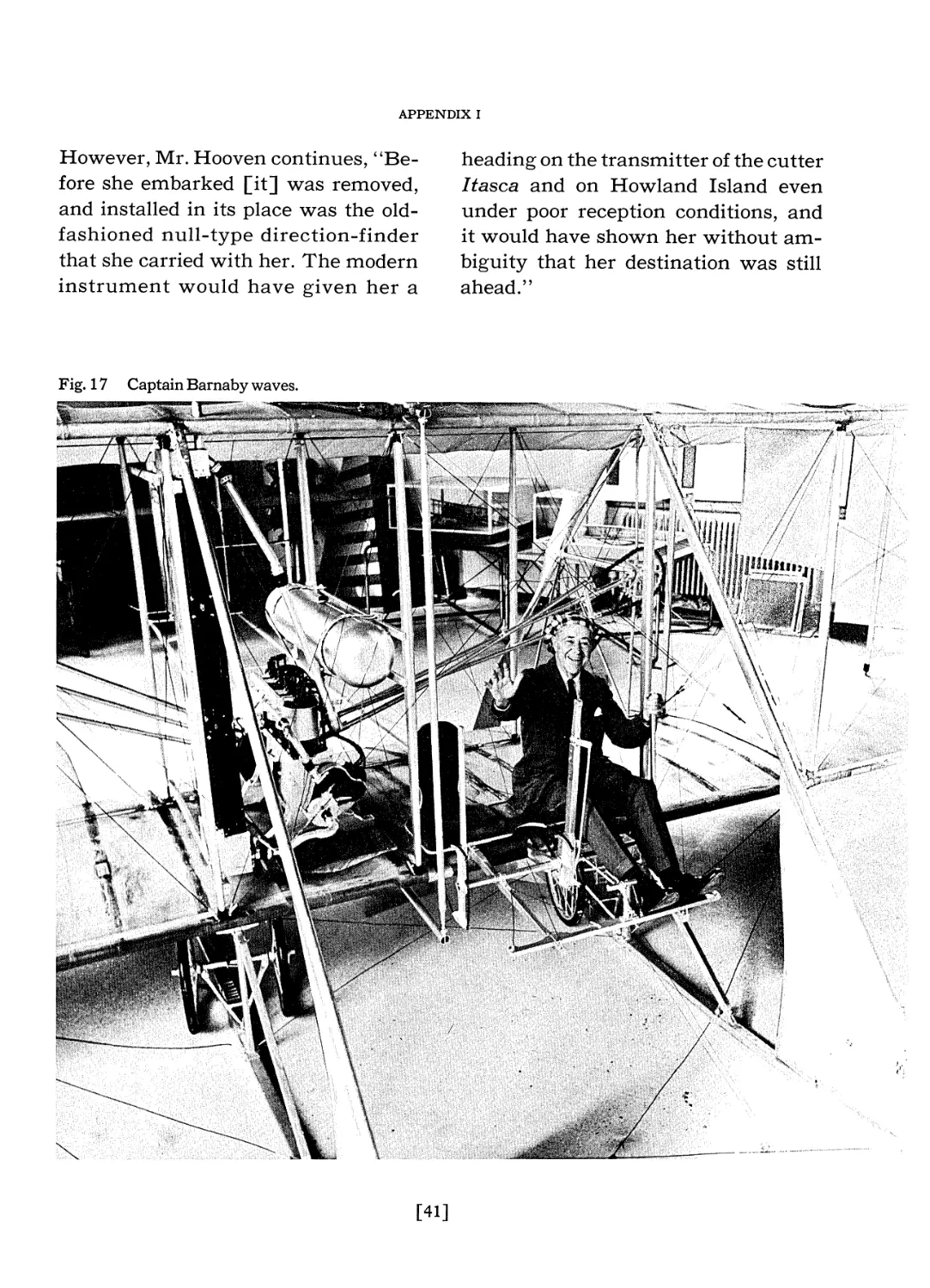
































Текст
'"".
'I':
:
\./
"'
/...' ..
4 "'::'
>' :?>:
.;......... ....
.(1':. .' ..\
::t;i;
-
';f:.
"'Jfi; 1? '
. :?/' .
..: .
':i
t\.
. ... t
{ .:
;}
}
i.
;-i
Alp,
.....I,
'
..'i
. .,::":,: .J ..,
by
JERRY MANDER, GEORGE DIPPEL
and HO-WARD GOSSAGE
The official record, analysis, and fly-it-yourself compendium
of high-achievement paper airplanes from the Scientific American
1st International Paper Airplane Competition,
held during the winter of '66-'67, an event that has
already taken its proper place in aeronautical history.
Told by the men who were the
e. (Illustrated and annotate
)
A FIRESIDE BOOK
PUBLISHED BY
Simon
and Schuster. N ew York
All rights reserved
including the right of reproduction
in whole or in part in any form
Copyright @ 1967 by Shade Tree Corporation
A Fireside Book
Published by Simon and Schuster
Rockefeller Center, 630 Fifth Avenue
New York, New York 10020
SEVENTEENTH PAPERBACK PRINTING
SBN 671-21129-3
Library of Congress Catalog Card Number: 68-12169
Manufactured in the United States of America
Printed by Mahony & Roese, New York, N.
Bound by Electronic Perfect Binders, Inc., Bloomfield, N.J.
Dedication
The authors wish to dedicate this manuscript to Capt. Fear God
Bascomb, out of New Bedford, Massachusetts, who brought the
first known pad of lined 8%" x II" paper from China on May 1,
1743. It may well be said of Capt. Bascomb that without him, the
paper airplane as we know it would not have been possible.
Acknowledgments
Since the conclusion of the 1st International Paper Airplane
Competition, the most persistent question that has been asked of
authors Gossage, Mander and Dippel (respectively the conceptu-
alizer of the event; the writer of the ads; and the art director) has
been this:
"How on Earth did you ever get a responsible, respected
magazine like Scientific American to go along with such a thing?"
Finally, the true story can be told:
The idea was hatched full-blown during a lunch at a New
York restaurant; those present, Howard Gossage, Gerard Piel
(Publisher of Scientific American) and Stephen Fischer (Assist-
ant to the Publisher of the magazine).
One gentleman said, "Why don't we have a paper airplane
competition for the magazine?" Another answered, "Why not?"
and embellishments aside, there you have it.
The spirit of the occasion was carried along with Gossage
via metal airplane back to his associates Jerry Mander and George
Dippel of Shade Tree Corporation in San Francisco, and the rest
is history. But before proceeding with that history within these
pages, the authors would first of all like to pay tribute to Mr. Piel,
who is often praised for having built Scientific American to its
present eminence as one of the few most respected publications
in the world, but not so often praised for the fact that he has done
so without that dreadful self-consciousness which precludes other
great men and ventures from undertaking a paper airplane com-
petition or the like, at least now and then.
In our experience we have found that the biggest thinkers
we have dealt with are the ones most willing to support such
"frivolous" projects; they are doubtless the ones most capable of
understanding the importance of them during such days as we
find ourselves living in. To Gerard Piel, then, thank you.
Having done that we would also like to point out that the
day-to-day running of such a competition-especially the cata-
loguing and flight testing of 12,000 entries; the publicity demands
deriving therefrom; and the organization of arrangements for such
huge subcompetitions as were held by American Airlines and the
San Francisco Chronicle-is no easy matter. The authors, there-
fore, are brimming with respect and thankfulness toward Mr.
Stephen Fischer and Mr. William Yokel, Scientific American's
Airplane Design Coordinator, for shouldering this immense bur-
den without shipping it all out to San Francisco to us, as we were
in constant fear they would.
There is little doubt that without these two men, the au-
thors, having created a monster, would have had to flee to refuge
in Anguilla, or elsewhere, lest we be forever lost under a moun-
tain of paper airplanes.
The authors and the publishers are grateful to the following per-
sons and institutions:
A. A. Backstrom, Waldridge Bailey, Captain Barnaby,
Bibliotheque Nationale, Robert Black, Black Star, D. L. Cairns,
Esteban Cordero, John Craig, Joseph W. Dauben, Wanda Dillon,
Fretz & Wasmuth Verlag AG (for Das Kleine Buch yom Papier-
flugzeug by Richard Katz), L. Groom, Leo Heisser, Y. Hihomiya,
Frederick J. Hooven, Edward E. Keyse, Andrew Kimball, Curtis
D. Kissinger, Edmund V. Laitone, Clifford Lang, Library of Con-
gress, Fukuo Misumi, Rev. M. Eugene Mockabee, Musee de L' Air,
Nasza Ksiergarnia (for Duza Ksiazka 0 Malych Samolotach by
Pawel Elsztein), Jim Noble, William Pain, George Peck, Robyn
Reinen, Dennis Rietz, Ben Rose, Frank Rosenberg, Royal Aero-
nautical Society, Pr,of. James Sakoda, George S. Schairer, Tim
Schisler, Louis W. Schultz, David Segal, Cliff Speck, Ronald R.
Thompson, S. J. Tweedie, W Heffer & Sons Ltd. (for Paper Aero-
planes by H. G. G. Herklots), Mark B. Wanzenberg, Wide World
Photos Inc., R D. Woodruff, Mary Sue Wunderlich, Mr. Yolen.
Contents
Preface ................................,........................................................... 11
Introduction.................................................................................... 15
Brief Annotated History f Aeronautics .................................... 25
Prologue: In Tribute to Rufus Porter, the Inventor
of the Aeroport ............................................................ 27
Chapter . . . . . . . . . . . . . . . . . . . . . . . . . . . . . . . . . . . . . . . . . . . . . . . . . . . . . . . . . . . . . . . . . . . . . . . . . . . . . . . , . . . . . . . . .. 29
Appendix I: Letters................. ..... ...... ...... ...... ...... .......... ..... ......... 33
Special Added Chapter: A Fly It Yourself Compendium........ 47
Epilogue ........... ............................................................................. .125
Preface
I N 1931, W. Heffer & Sons Ltd. of
Cambridge, England, published a
book of essays called Paper Aeroplanes
by H. G. G. Herklots. The lead essay
in the book is also called "Paper Aero-
planes." It is the only essay in English
the authors have ever been able to find
on this subject, though it has many
historical virtues beyond its uniq ue-
ness.
As the reader will note, keeping in
mind the year of the essay's publica-
tion, it in many ways pioneered the
way for this volume. For Herklots, as
you will see, is the first to complain in
print over the dearth of published re-
search on the subject.
It was this very failure in serious
scholarship which was also at the root
of Scientific American's project.
Therefore, when Herklots wrote, "No-
where in literature is there a long-
winded thesis on paper aeroplanes,"
he anticipated the premise of the 1st
International Paper Airplane Compe-
tion by no less than 35 years! (See
Plate 1.)
(Between the time of Herklots' writ-
ings and the events we report in this
volume, two other general informa-
tion books have appeared, concerning
themselves with less significant as-
pects of paper' airplane theory and
design. We refer to: Duza Ksiazka 0
Malych Sam.olotach by Pawel EI-
sztein, published by Nasza Ksiergar-
nia, Warsaw, 1956; and of course
Richard Katz's 1933 classic, Das
Kleine Buch vom Papierflugzeug.)
There were differences, however,
between Herklots' method and Scien-
tific American's. Herklots felt, for ex-
ample, that paper airplanes play their
primary role wi thin "the facul ty of
mental escape in the building up of
society and of civilisation."
In this respect, he presents a point
of view not in consonance with Scien-
tific American's, which included no
such unsafe assumptions in advance
of empirical evidence. (The headline of
the second Scientific Am.erican adver-
tisement said, "If We Knew What It
Was We Would Learn, It Wouldn't
Be Research, Would It?" See Plate 2.)
Herklots also raises the shocking
question of prejudice against paper
airplane designers. "Even at school I
was persecuted for my hobby," he
says, though in his circle, no one ever
[11]
PREFACE
laughed at golfers, Ping-Pong players
or Rugby athletes.
Before the reader surm.ises from.
these statem.ents that Herklots suf-
fered from. paranoia, we wish o once
again rem.ark that the period was
1931, when England was in the grip
of a severe depression. Furtherm.ore,
prewar tensions were being felt in in-
creasing degree throughout Europe,
reflecting them.selves in a tendency to
be critical of all form.s of free expres-
.
Slone
We know of no such tendency today.
So then, with these prelim.inary re-
m.arks, we will leave the reader to
judge Herklots in Herklots' own
words.
"In these days, when our universities
produce so great a num.ber of industri-
ous and indefa tiga ble researchers in to
all m.anner of out-of-the-way subjects,
I am a little surprised to discover that
no man has written a serious and long-
winded thesis, treatise, dissertation or
m.onograph on the part played by the
faculty of m.ental escape in the build-
ing up of society and of civilisation.
The University of Chicago has lately
approved a thesis written by a woman
on the all-important subject of dish-
washing, but more im.portant and
wider things are left unheeded. No'
one, for instance, has yet written the
deplorable history of rice pudding. Nor
is this really surprising. Som.e subjects
are too vast for com.pression into thesis
form. Not the m.ost long-winded of our
researchers possesses a long enough
[12]
wind even to run round the confines
of the lands of mental escape. For the
history of escape is the history of m.ost
of the sins and m.ost of the arts of m.an-
kind. The whole of the world sighs
constantly for the wings of a dove that
it m.ay escape, not necessarily to the
desert, but anywhere, so long as it is
somewhere else. It is because we
would like to change, that we take up
cat-burgling or barracking at cricket
m.atches. For this reason we play golf
or go to the pictures, or engage in what
the Victorians used to call brown stud-
ies, or get drunk, or, if we happen to
be Kubla Khan, living in Xanadu, de-
cree a stately pleasure dom.e. Modern
civilisation em.ploys hundreds of thou-
sands of paid distractors of the m.ind
who are engaged in creating worlds,
fantastic or absurd, strange or terrify-
ing, wherein we m.ay forget the things
we have to do tom.orrow m.orning and
what So-and-so said to us yesterday
afternoon. Philosophical speculations
and m.etaphysical consolations both
subserve the sam.e end. Music and art
-these are also the wings of the dove
whereby we m.ay escape. Mr. Siegfried
Sassoon has expressed this well in his
last book of poem.s:
When Selfhood can discern no comfort for its cares,
Whither may I turn but to you whose strength my
spirit shares?
Where may I find but in you.
Beethoven, Bach, Mozart,
Timeless, eternally true,
Heavens that may hold my heart?
"As for me, when the world goes
wrong, when the work I have to do
tom.orrow m.orning is especially labor-
PREFACE
ious and when the things that So-and-
so said to m.e yesterday afternoon were
peculiarly galling, I seldom. turn to any
of these things. I turn instead to paper
aeroplanes. By paper aeroplanes I do
not m.ean paper darts. Darts are easy
to rnake, but there is little satisfaction
to be found in them.. You throw them.;
they go straight; that is all. The paper
aeroplane is a very different affair. It
is, rnore accurately, a paper glider. You
do not throw it. You let it go-or push
it very slightly; and the weight ahead
carries it forward, gracefully and gent-
ly, like a sea gull com.ing to rest upon
the deck of a ship. A little while ago
it was a sheet of notepaper, but now
it glides like the fairest of white birds.
Yet a perfect flight requires very often
an infinitude of patience, a folding and
refolding, a shaping and reshaping
with the scissors. So far as I can tell,
there is only one form. of paper dart.
"The variety of paper aeroplanes is
alm.ost endless. There are m.onoplanes
and biplanes. There are planes like
beetles and there are planes like birds.
There are planes that fly swift and
straight and there are planes that fly
slowly in circles. There are planes that
can be made to loop the loop. And
there are India paper aeroplanes so
srnall and so delicate that even in a
dining room. they are swiftly lost to
sight.
"And yet, for all this, I am. practi-
cally a lone flier. There is no annual
yearbook of suggested designs. Butch-
ers and bakers and candlestick-m.ak-
ers, anti-vivisectionists, aquarists and
pondkeepers, m.em.bers of the food and
[13]
cookery and catering world, m.odern
churchm.en, and those interested in
the utilization of waste m.a terial- all
these have their own m.agazines in
which they can discuss their prob-
lem.s. But I have never lighted on a
copy of The Paper Aeroplane in which
I can discuss m.y problerns: the prob-
lem. of elevators, the problem. of guid-
ance in the air, the peculiar problerns
of out-of-door flying, the advisability
of the m.etal paper clips for weighting.
And not only arn I a lone flier. I am.
also a persecuted flier. Nobody laughs
at golf, nobody laughs at Rugby foot-
ball; few people laugh nowadays at
ping-pong, and whereas men snigger
at chess they respect it too. But when
my friends discover m.e trim.m.ing the
wings of paper aeroplanes they laugh
m.e to scorn. Even at school I was per-
secuted for m.y hobby. It was in 1918
and we all had influenza. In the dorm-
itory that had hastily becom.e a sana-
torium. ward I whiled away m.any
hours of tedium. by m.anufacturing my
planes. After a time I grew bolder and
flew them from. the window in to the
courtyard below. I was afraid that I
might be beaten for this, but punish-
m.ent cam.e in a subtler form.. In a later
issue of the school m.agazine there was
a sarcastic note about the disgusting
m.ess created by those who had thrown
darts into Wright Senior Quad. Darts!
They called m.y aeroplanes darts. Tha.t
was the worst of all, a wound cutting
deeper far than any beating. Even
nowadays I dare not fly my aeroplanes
by daytim.e from. the windows of m.y
house into the street below. Public
PREFACE
Opinion would never stand it. Yet
sometimes, at night, I turn out the
light in my room, creep to the window
and open it silently. And while the
earth is still I watch tny dovelike cre-
ations floating afar, or eddying to the
ground, braving the wind or finding
their way round the corn.er into the
next street. Then I shut the window,
draw the curtains, turn on the light,
and clean up the disgusting mess in
my room.
"This is my complaint-that I have
never had a chance. No one supports,
helps or advises rne. No newspaper
offers a big rnoney prize for me to win
a cotnpetition. No newspaper even
placards my adventures-LoNE FLIER
CROSSES BOLSOVER STREET. Often
enough, while I've been watching a
play from a seat in the gallery, rny
heart has leapt up at the thought of
paper aeroplanes. With a pair of scis-
sors I would so fashion my progratntne
that it would clear the stalls and alight
W
...J
<C
Z
e
i=
<C
Z
w
::>
o
w
::I:
J0-
e
...J
m
m
CJ)
w
a..
<C
Jo-.
CJ)'
W
en
w
o
Jo-
W
Z
m
<C
()
upon the stage. But again, Public
Opinion would be all against it. I
would be laughed to scorn or hounded
from the place. Two cornmunists were
arrested who showered leaflets from
the gallery of the House of Cornmons:
I know what would happen to me if I
started with paper aeroplanes. And
only once have I been to the Albert
Hall. There I listened frotn the bal-
cony to brave words and fine speeches.
But there was always one thought at
the back of rny rnind, that carne into
full consciousness in the lacunae be-
tween my enthusiasms-that this was
the world's rnost wonderful place for
paper aeroplane flights. Lend rne the
Albert Hall for a night, and I will show
you things.
"Paper aeroplanes of another kind
I sornetimes rnake. . . sotne, it rnay be,
will catch the wind alight and go sail-
ing across the road, round the corner,
and into the wider world beyond. I
hope so."
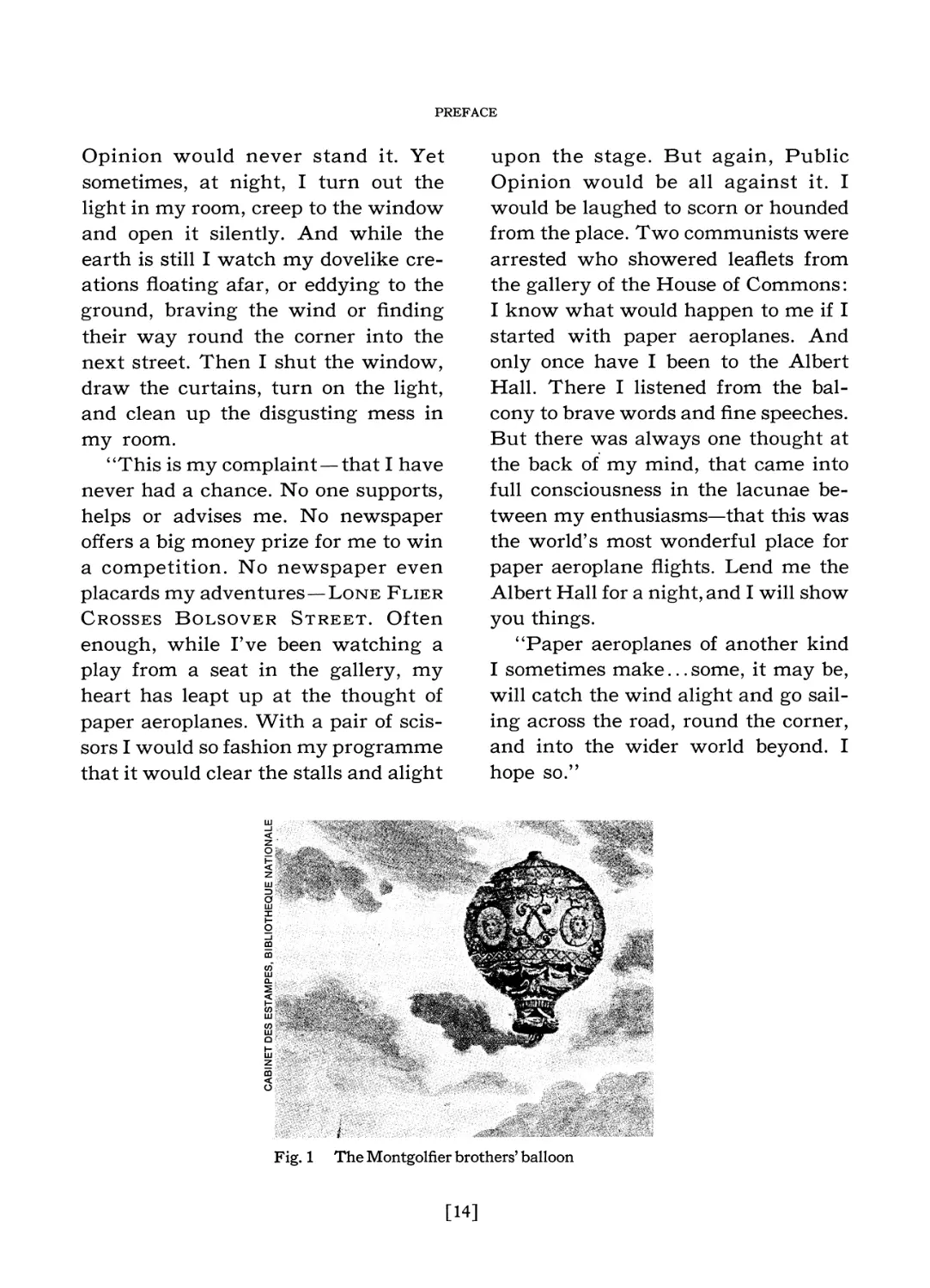
Fig. 1 The Montgolfier brothers' balloon
[14]
Introduction
O N DECEMBER 12,1966, a day that
was otherwise a "light news
day," there appeared on page 37 of
The New York Ti1T1es a full-page ad-
vertisemen t on behalf of Lockheed-
California Corporation which sug-
gested that it was an altogether good
idea, considering Am.erica's situation
balance-of-payments-wise, for we the
people to push on toward completing
development of a supersonic transport
plane (SST).
For, if there were no Am.erican
SST, the ad suggested, speed-eager
U.S. airlines would be reduced to buy-
ing the Anglo-French Concorde SST,
thereby further aggravating the al-
ready aggravating balance-of-pay-
rnents crisis. Nor rnust we forget the
irnplied consequences of "the Soviet
SST (TU-144) which also is in devel-
oprnent," as the ad pointed out with
ominous restraint.
So rnuch for page 3 7 of T he New
York Times. We turn now to page 38.
To this day, no one has been able to
learn the iden ti ty of the rnan in the
composing roorn at The New York
Times, December 11, 1966, who ar-
ranged that Scientific A1T1erican's ad-
[15]
vertisement should appear on the very
page behind Lockheed's. Scientific
A1T1erican has fielded a number of
charges that it had prior knowledge of
the Lockheed advertisement, and
without question, Lockheed has been
accused of arranging that its ad run
adjacent to theirs. Both deny any such
dealings and ask investigating bodies
to ferret elsewhere.
Thus another unsolved rnystery en-
ters into the annals of aviation.
By nine 0' clock of the 12 th, the or-
dinarily quiet offices of Scientific
A1T1erican Publisher Gerard Piel were
shoulder deep in newsmen. At 1 0 : 30
A.M., Mr. Piel found it necessary to
adjourn the press to larger quarters to
hold a conference.
He was asked if he had planted a
spy in the composing room.s. "No, we
hadn't," he said.
He was asked if the competition
was a thinly veiled cover to protest the
SST development. "We are in favor of
science," Mr. Piel answered, throw-
ing a paper airplane.
One newsman wondered if there
was im.plied "a paper airplane gap"
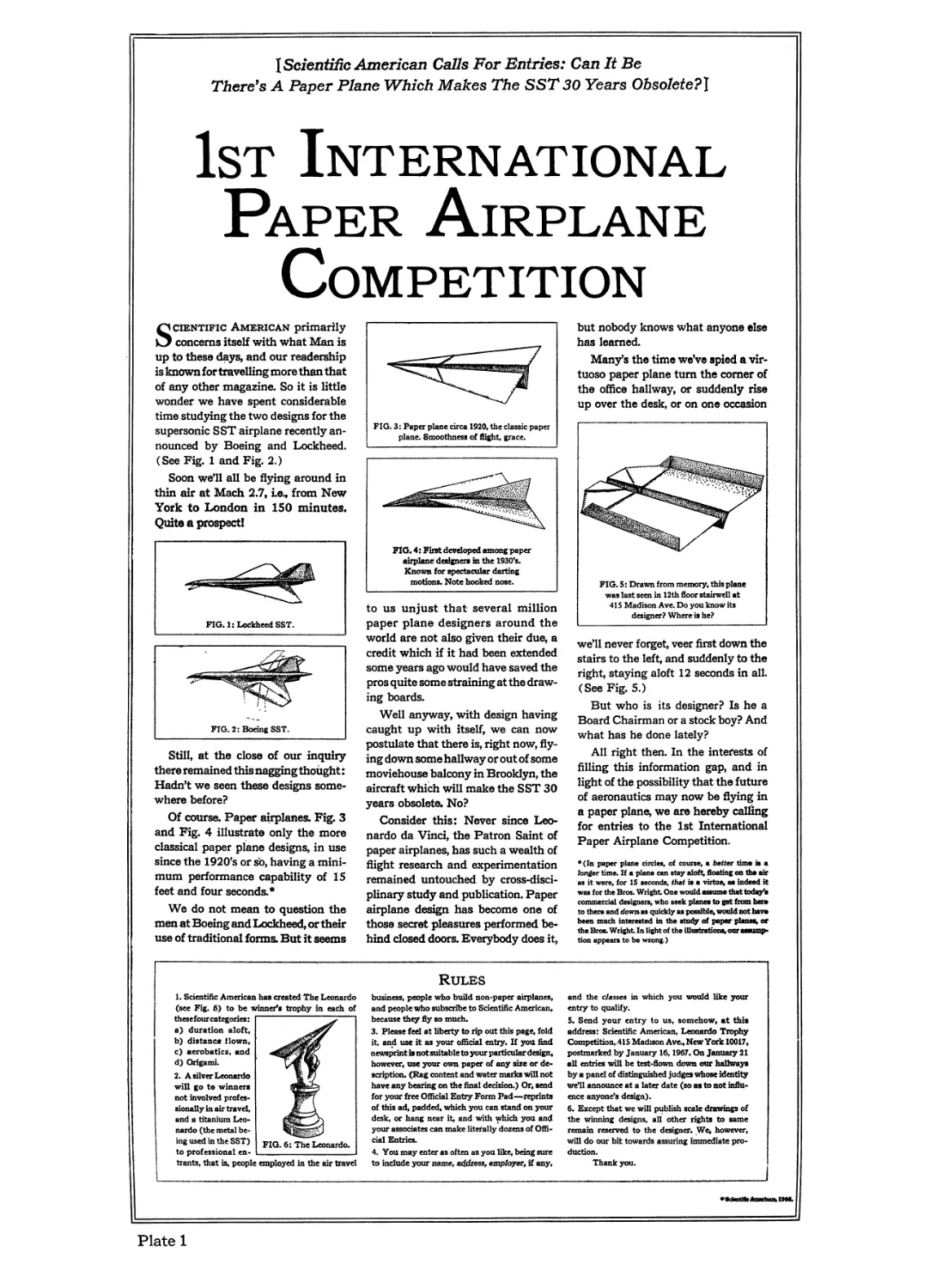
I Scientific American Calls For Entries: Can It Be
There's A Paper Plane Which Makes The SST 30 Years Obsolete?I
1ST INTERNATIONAL
PAPER AIRPLANE
COMPETITION
S CIENTIFIC AMERICAN primarily
concerns itself with what Man is
up to these ys, and our readership
is known fortravel1ing more than that
of any other magazine. So it is little
wonder we have spent considerable
time studying the two designs for the
supersonic SST airplane recently an-
nounced by Boeing and Lockheed.
(See Fig. 1 and Fig. 2.)
Soon we'll aU be flying around in
thin air at Mach 2.7, i.e., from New
York to London in 150 minutes.
Quite a prospect!
.,,::...
FIG. I: Lockheed SST.
.1--'
..........
FIG. 2: Boeing SST.
Still, at the close of our inquiry
there remained this nagging thought :
Hadn't we seen these designs some-
where before?
Of course. Paper a lanes. Fig. 3
and Fig. 4 illustrate only the more
classical paper piane designs, in use
since the 1920's or s'o, having a mini-
mum performance capability of 15
feet and four seconds. *
We do not mean to question the
men at Boeing and Lockheed, or their
use of traditional forms. But it seems
1. Scientific American has created The Leonardo
(see Fig. 6) to be winner's trophy in each of
thesefourcategories:
a) duration aloft,
b) distanc.. flown;
c) aerobatics, and
d) Origami.
2. A silver Leonardo
wiD go te winners
not involved profes-
sionally in air travel,
and a titanium Leo-
nardo (the metal be-
ing used in the SST) FIG. 6: The Leonardo.
to professional en-
trants, that is, people employed in the air travel
Plate 1
FIG. 3: Paper plane circa 1920, the classic paper
plane. Smoothness of flight, grace.
FIG. 4: First developed among paper
airplane'desicne1'S in the 1930's.
KnoWlt for spectacuIar darting
motions. Note hooked nose.
to us unjust that several million
paper plane designers around the
world are not also given their due, a
credit which if it had been extended
some years ago would have saved the
pros quite some straining at the draw-
ing boards.
Well anyway, with design having
caught up with itself, we can now
postulate that there is, right now, fly-
ing down some hallway or out of some
moviehouse balcony in Brooklyn, the
aircraft which will make the SST 30
years obsolete. No?
Consider this: Never since Le0-
nardo da Vinci, the Patron Saint of
paper airplanes, has such a wealth of
flight research and experimentation
remained untouched by cross-disci-
plinary study and publication. Paper
airplane design has become one of
those secret pleasures performed be-
hind closed doors. Everybody does it,
RULES
business, people who build non.paper airplanes,
and people who subscribe to Scientific American,
because they fly so much.
3. Please feel at liberty to rip out this page, fold
it, and use it as your official entry. If you find
newsPrint ia not suitable to your particuJar design,
however, use your own paper of any size or de-
scription. (Rag content and water marks wiD not
have any bearing on the final decision.) Or, send
for your free Official Entry Form Pad-reprints
of this ad, padded, which you can stand on your
desk, or hang near it, and with !lhich you an4
your associates can make literally dozens of Offi-
cial Entries.
4. You may enter as often as you like, being sure
to include your name, ac!dress, employer, if any,
but nobody knows what anyone else
has learned.
Many's the time we've spied a vir-
tuoso paper plane turn the comer of
the office hallway, or suddenly rise
up over the desk, or on one occasion
FIG. 5: Drawn from memory, thisp1ane
was last seen in 12th floor stairwell at
415 Madison Ave. Do you know its
designer? Where is he?
we'll never forget, veer first down the
stairs to the left, and suddenly to the
right, staying aloft 12 seconds in all.
(See Fig. 5.)
But who is its designer? Is he a
Board Chairman or a stock boy? And
what has he done lately?
All right then. In the intetests of
filling this information gap, and in
light of the possibility that the future
of aeronautics may now be fiying in
a paper plane, we are hereby ca1!ing
for entries to the 1st International
Paper Airplane Competition.
· (In paper plane circles, of course, a better time. a
longer time. If a plane can stay aloft, floating on the air
as it were, for 15 seconds, that ill a virtue, .. indeed it
was for the Bros. Wright. One would 8II\III1e that today's
commercial designers, who seek planes to cet from here
to there and down as quickly as possible, would DOt haft
been much interested in the atud,y of peper p1aDel, or
the Bros. WriKht. In light of the i11ustraticma, oar....,.
tion appears to be ws:ong.)
and the classes in which you would like your
entry to qualify.
S. Send your entry to us, somehow. at this
address: Scientific American, Leonardo Trophy
Competition,.415 MadISOn Ave., New York 10017,
postmarked by January 16, 1967. On January 21
an entries wiD be test-flown down our haUwaya
by a pand of distinguished judges whose identity
we'll announce at a later date (so as to Dot influ-
ence anyone's design).
6. Except that we will p blish scale drawings of
the winning designs, aU other rights to same
remain reserved to the designer. ,We, however,
will do our bit towards assuring immediate pro-
duction.
Thank you.
.1dIDtiIc UM.
INTRODUCTION
as between the Soviet Union and the
United States and what the implica-
tions of such rnight be. Another won-
dered if, as the ad suggested, it were
true that the SST designs were ac-
tually derivative of classic paper air-
plane designs, would not that throw
all rights to them into "the public do-
u.
u.,
..J
o
a:
w
z
a:
w
3:'
I
a:
<'
....
en, '
()
:5
m
such enthusiasm to the competition.
(See also Chapter for further observa-
tion on the question of the rights to
SST design.)
Within days, editorials supporting
the effort were seen in more than a
hundred American newspapers. (Sur-
prisingly, dozens of the editorials were
exactly the same, word for word, in
papers as geographically separate as
the Athol (Mass.) News, the San An-
tonio (Texas) Express, and the Evans-
ville (Indiana) Courier . At first, we
passed it off as another startling coin-
cidence. But giving it further thought,
we wonder whether there isn't, some-
where, an underground syndicate that
provides editorials as the AP and UPI
do "hard news"? We find it disturbing
sotnehow to realize that it is possible
ROME, N.Y., SENTIN
Fame on
A full-page advertisement in the
Dee 13 New York Times so emn y
d uilled the Lockheed-Califo a
's case for building a supersoroc
tr sport or SST. On the next page,
d · '.lar in appearance to Lock..
's sun ounced the Scientific
G d P o I P bl o h f s O OJ::, A ° Am erican's First International Paper
erar Ie, U IS er 0 ClentlHc meTl- \ Airplane Competition. Thus do he
can, holds paper airplane. sublime and the ridicul X1 t,
even though it is no easy. m thIS In-
stance to ten which IS whIch.. tif
The ordinarily staid Sclen c
American was struck, it said, by t. e
resemblance of proposed SST a r..
frame designs to those of pape.r aIr..
lanes The magazine reasoned It 'Y as
r.unju t" that paper airplane bU1 -
ers had not been given their due, a
credit which if it had been extended
some years ago would .h ve saved
\ the pros quite same str mmg at the
· bo ards" EntrIes - thou..
drawmg · h been
sands of them - were to ave .
I test.flown in the haIlways of th f ;
entific American's New York 0 IC ..
Jan 21 But, response to the-con
w 'S overwhelming that the
fly-off date had to be moye<;1 ba \:
Fig. 3 Feb. 14. A "panel of dIStingulS
the Wings of Paper
judges" will determine. the
which then will be dupllc t
sheeted brass and flo m
smoke tunnels of Princeto
sity.
"Never since Leonardo
the Patron Saint of pa
has such a wealth. of flI
and experimentatIO .re
touched by. cross-disclpill.
and publication," th:
American asserts. n: t 1S
accepted, it is only fIttin
winners in the paper all
test should be awa ed t.r
ed Leonardos. Entnes WI1
in four categories: (1) duo
(2) distance .fl0"':1' (3)
and (4) orlgann (th:
art of paper folding).
While the contest l i
frivolous, it could pr u
formation of scientific v,:
on Mackenzie, direCtor.
seum of Art. Science anc
Briodeprgt, Conn.,. wa
the winning entries 1:
gallery. Mackenzie coulc.
that everyone laughed a
Wilbur Wright too.
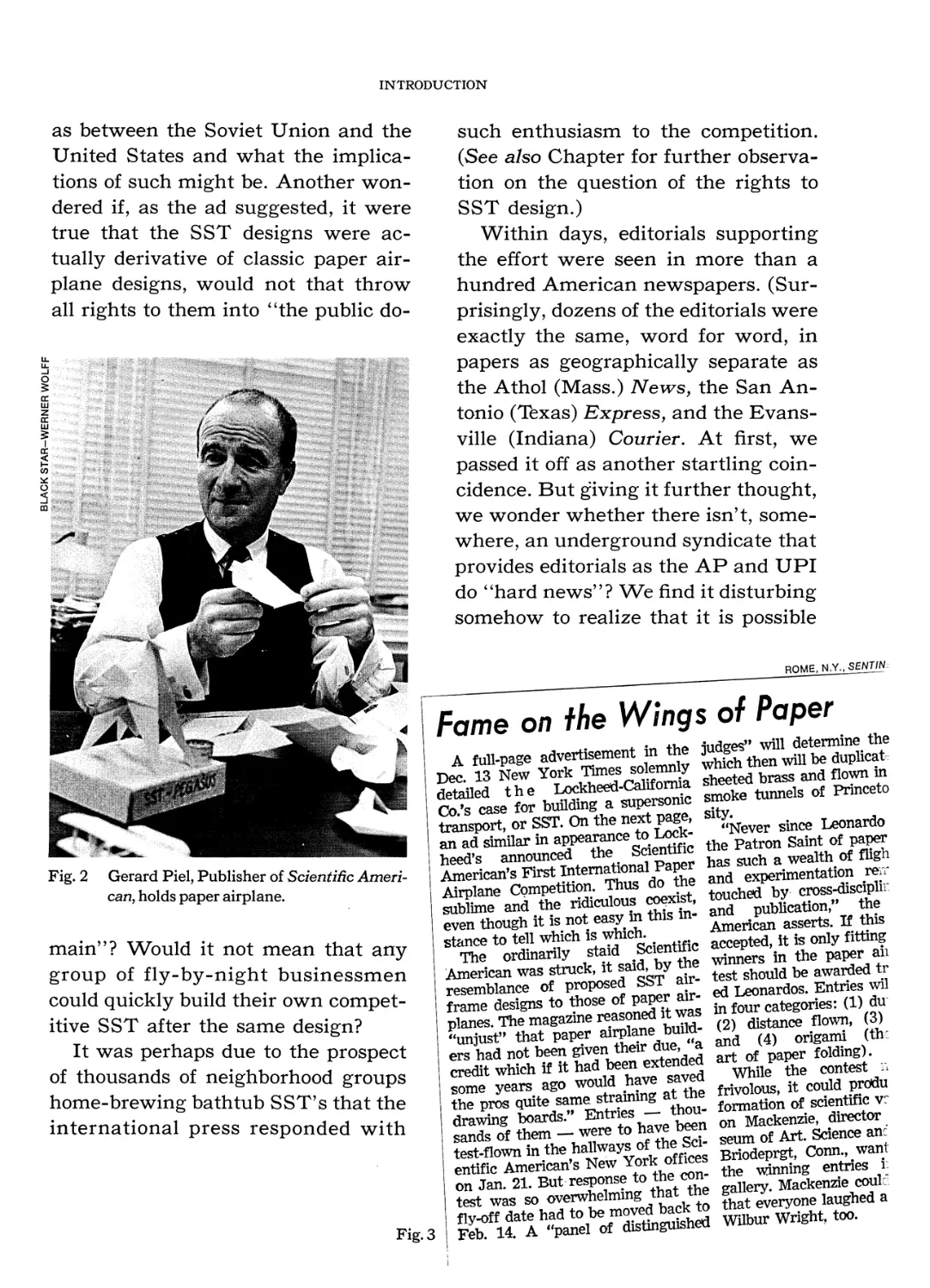
Fig. 2
main"? Would it not mean that any
group of fly- by-night businessmen
could quickly build their own compet-
itive SST after the sarne design?
It was perhaps due to the prospect
of thousands of neighborhood groups
hOtne-brewing bathtub SST's that the
international press responded with
INTRODUCTION
that the editorial of the South Croupier
(Nevada) News is not written, after
all, by a thin rnan with a green visor,
but by a New York angle-shooter. But
then, that's the subject of another
book entirely.)
Abroad, news magazines and pa-
pers responded with some m.ixture of
dism.ay, enthusiasm. and delight at this
la test venture in Am.erican fancy. The
politically middle-of-the-road Paris
daily France-Soir, for exam.ple,
cheered the developm.ent:
"We await with impatience the re-
sults of these first investigations. . . . It
is in any case good news; perfectly
illustrative of certain typically Arneri-
can qualities-ingeniousness, in-
genuousness, a sense of humor and
straig h tforwardness. ' ,
But the left-wing Nouvel Observa-
teur, often critical of the military im.-
plica tions of American aerospace
achievernents, was more cautious in
its response, only reporting the facts of
the event, preferring perhaps to see if
the winning paper plane was con-
verted im.mediately to m.ilitary uses.
The Australian press ignored the
political irnplication of the event and
got right down to paper airplanes. At
least three of Australia's dailies un-
dertook competitive competitions-
two for paper airplanes, and one, The
Australian, created something called
a "Paper Bootbox, Biscuit Barrel,
Whatever Contest," surpassed in ob-
scurity of meaning only by Andy
Warhol's "Water Bomb Competition"
[18]
presented in the New York World
journal 'Tribune.
By the end of the com.petition, m.ore
than thirty-five pounds of news clip-
pings were collected (a stack roughly
three feet square by four feet high,
after scissor-clipping) and as Scien-
tific American's sum.m.ary ad indi-
cated, the final fly-offs were covered
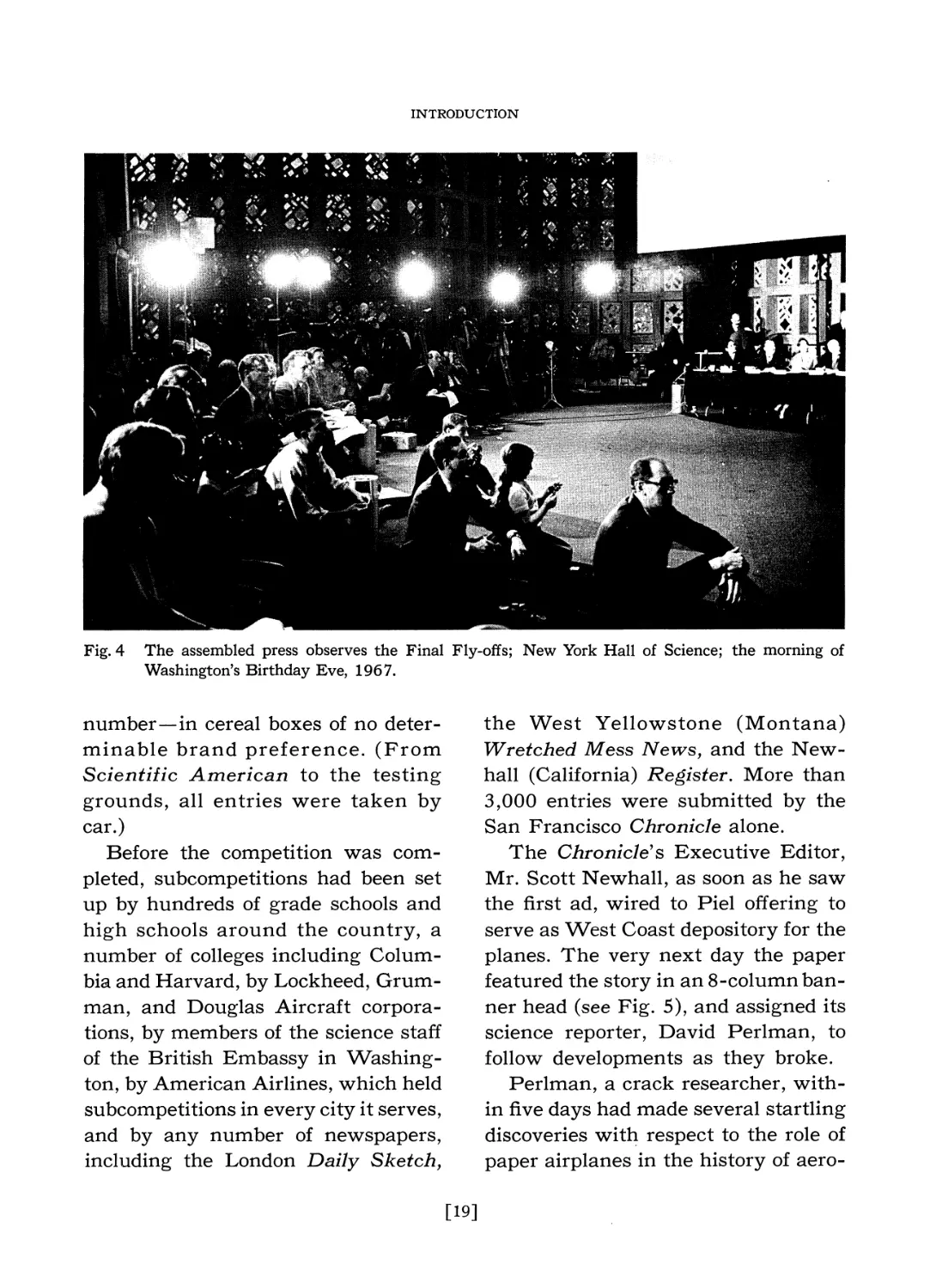
by a television and press corps equaled
in size only by the visit of Pope Paul
to New York. (See Fig. 4.)
Twelve thousand entries carne in,
almost everyone with a lengthy let-
ter attached giving detailed instruc-
tions to whoever was to throw it and
providing notes on the significance of
the particular design. Som.e of these
letters are quoted in Appendix I, en-
titled "Letters," but all of them, suffice
it to say, were marked by a devotion to
cause that was moving in its sincerity.
As a further indication of the en-
thusiasm of respondents, it is worth
noting tha t the problem of how to
physically get one's paper plane
through the mails to Scientific Amer-
ican required a certain arnount of tirne,
energy, and ingenuity. The entrants
solved the problem. each in his own
way. Som.e were m.ailed with 5c
stam.ps affixed to the nose (with little
apparent effect on aerodynamic char-
acteristics); others in cardboard tubes,
airplane hangar-like boxes, styrofoam
concoctions, coffee cans, plastic boxes,
shoe boxes, cigar boxes, candy boxes,
I-gallon rnilk cartons, a 6-foot-Iong
metal cylinder, and- by far the largest
INTRODUCTION
Fig.4 The assembled press observes the Final Fly-offs; New York Hall of Science; the morning of
Washington's Birthday Eve, 1967.
nurnber-in cereal boxes of no deter-
rninable brand preference. (From.
Scientific Arrzerican to the testing
grounds, all entries were taken by
car. )
Before the competition was com.-
pleted, subcompetitions had been set
up by hundreds of grade schools and
high schools around the country, a
nurnber of colleges including Colum.-
bia and Harvard, by Lockheed, Grum.-
rnan, and Douglas Aircraft corpora-
tions, by mernbers of the science staff
of the British Ernbassy in Washing-
ton, by Arnerican Airlines, which held
subcornpetitions in every city it serves,
and by any nurnber of newspapers,
including the London Daily Sketch,
the West Yellowstone (Montana)
Wretched Mess News, and the New-
hall (California) Register. More than
3,000 entries were subrnitted by the
San Francisco Chronicle alone.
The Chronicle's Executive Editor,
Mr. Scott Newhall, as soon as he saw
the first ad, wired to Piel offering to
serve as West Coast depository for the
planes. The very next day the paper
featured the story in an 8-colum.n ban-
ner head (see Fig. 5), and assigned its
science reporter, David Perlm.an, to
follow developments as they broke.
Perlman, a crack researcher, with-
in five days had made several startling
discoveries wi t respect to the role of
paper airplanes in the history of aero-
[19]
INTRODUCTION
nautics and dutifully reported them to
his readers:
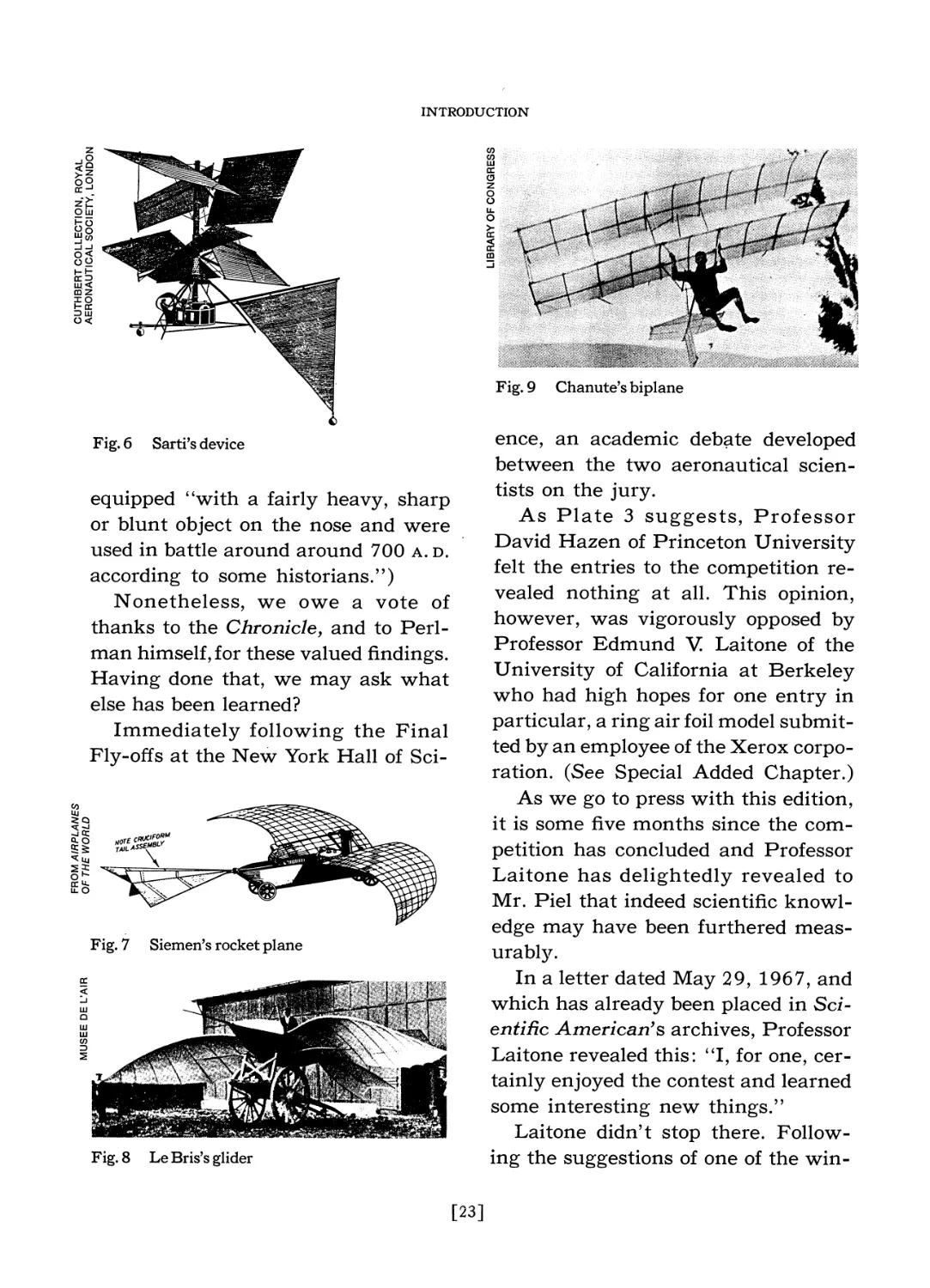
"Vittorio Sarti of Italy in 1828 de-
signed a genetic hybrid between a
sail boa t and a helicopter with great
vanes of paper designed to catch soar-
ing breezes. It never got beyond draw-
ing paper. (See Fig. 6.)
"But in 1847 Werner Siem.ens, a
German Arrny officer and student of
aerial navigation, designed the world's
first rocket plane, propelled by gun-
powder. I ts tail resem bled comm.on
con temporary versions of paper
gliders. (See Fig. 7.)
, 'An al ba tross inspired France's
Jean-Marie Le Bris to build his glider
in 1868. I t was launched from. a cart
drawn by a galloping horse. (See Fig.
8.) Note the plane's needle nose, direct
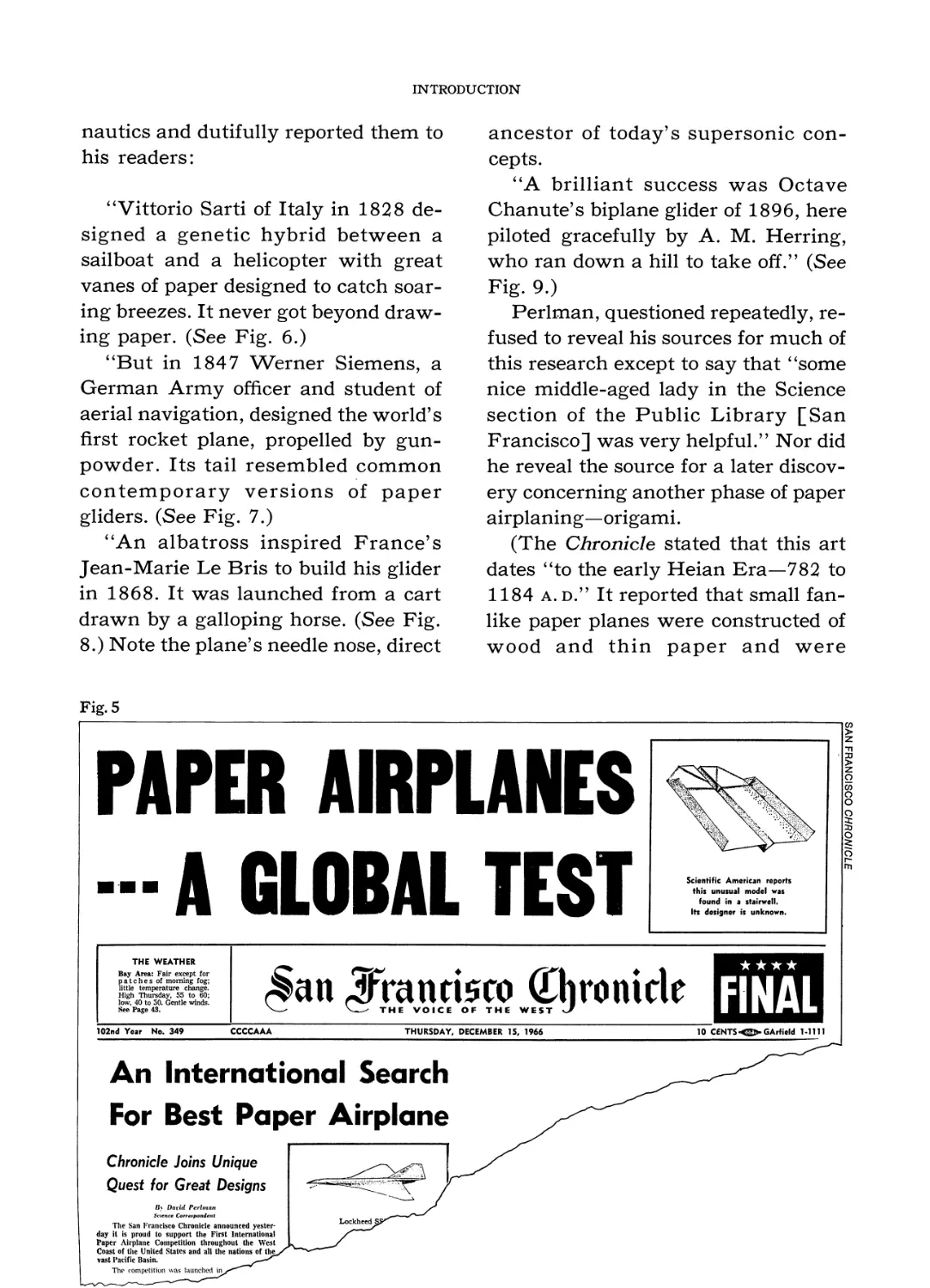
Fig. 5
ancestor of today's supersonic con-
cepts.
"A brilliant success was Octave
Chanute's biplane glider of 1896, here
piloted gracefully by A. M. Herring,
who ran down a hill to take off." (See
Fig. 9.)
Perlm.an, questioned repeatedly, re-
fused to reveal his sources for much of
this research except to say that "sorne
nice middle-aged lady in the Science
section of the Public Library [San
Francisco] was very helpful." Nor did
he reveal the source for a later discov-
ery concerning another phase of paper
airplaning -origam.i.
(The Chronicle stated that this art
dates "to the early Heian Era-782 to
1184 A. D." It reported that srnall fan-
like paper planes were constructed of
wood and thin paper and were
en
»
z
"T1
IJJ
»
z
()
en
()
o
()
::t
:xJ
o
<:
C5
r-
",
111-11111
THE WEATHER
Bay Area: Fair except for
pat c he s of morning fog;
little temperature change.
High Thw'Sday, 55 to 60;
low, 40 to 30. Gentle winds.
See Page 43.
Scientific American reports
this unusual model was
found in a stairwell.
Its designer is unknown.
an Jf! v !i:?r wg;hronicte
102nd Yoar No. 349
CCCCAAA
THURSDAY, DECEMBER 15, 1966
10 CeNTS GArfield 1-1111
An International Search
For Best Paper Airplane
Chronicle Joins Unique
Quest for Great Designs
.... ," . ' . ' .. .......','....... '."'"
:, -=- .. .":'..... .., ,J. . ' . .:.jJ . --. '_.,,,,..,':, ,.. ...... . ...
..... . ...... ..:'...... \. ", "'.' .' .. .", I .
---
-
n Dflt.ill PerlmRn
S lence Corre8ponderU
The San Francisco Chronicle announced yester-
day it is proud to support the First International
Paper Airplane Competition throughout the West
Coast of the United States and all the nations of the
vast Pacific Basin.
ThE' competition was launched in
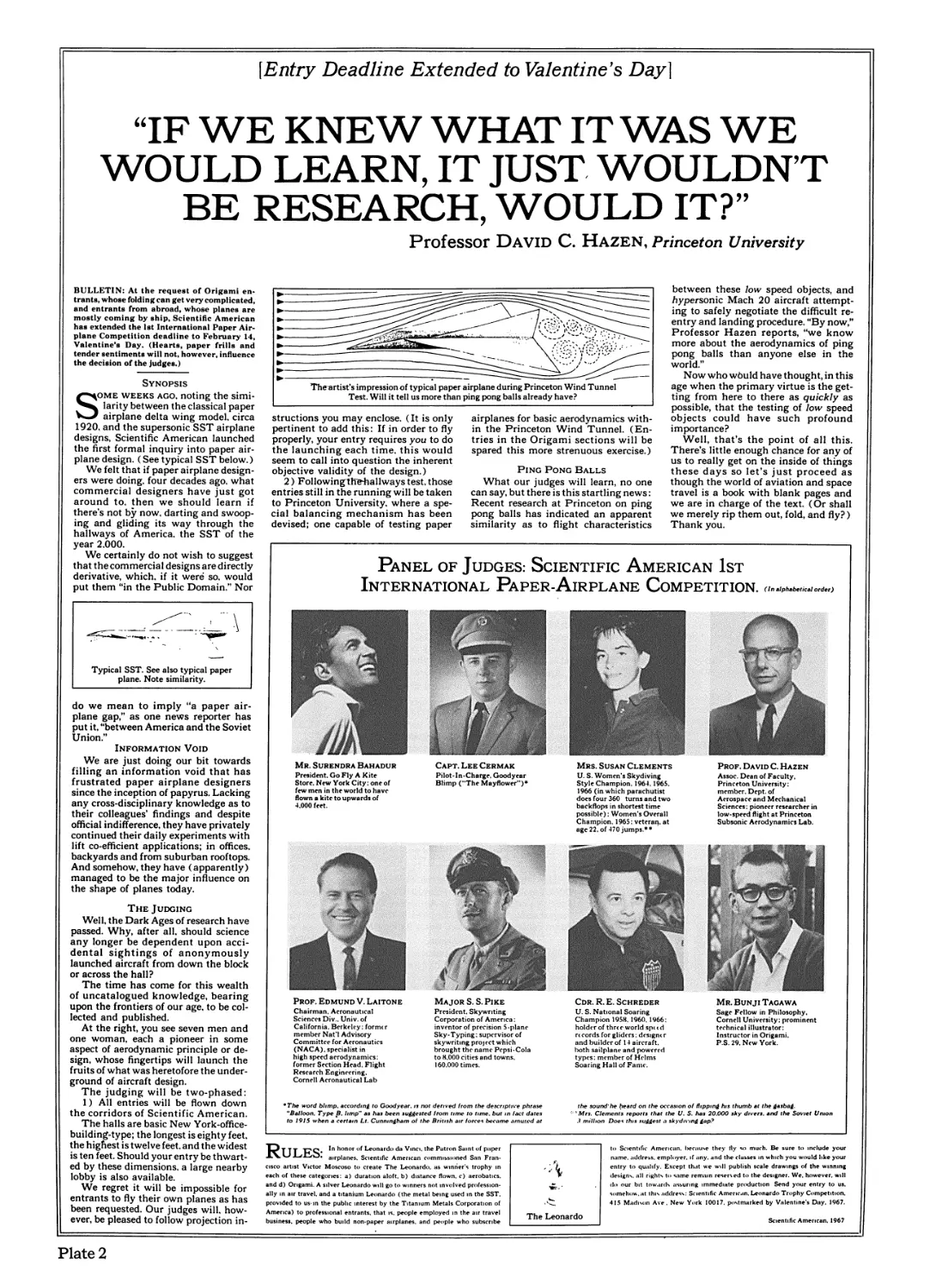
fEntry Deadline Extended to Valentine's Dayl
"IF WE KNEW WHAT IT WAS WE
WOULD LEARN, IT JUST, WOULDN'T
BE RESEARCH, WOULD IT?"
BULLETIN: At the request of Origami en-
trants, whose folding can get very complicated,
and entrants from abroad, whose planes are
mostly coming by ship, Scientific American
has extended the 1st International Paper Air-
plane Competition deadline to February 14,
Valentine's Day. (Hearts, paper frills and
tender sentiments will not, however, influence
the decision of the judges.)
SYNOPSIS
S OME WEEKS AGO. noting the simi-
larity between the classical paper
airplane delta wing model. circa
1920. and the supersonic SST airplane
designs, Scientific American launched
the first formal inquiry into paper air-
plane design. (See typical SST below.)
We felt that if paper airplane design-
ers were doing. four decades ago. what
commercial designers have just got
around to. then we should learn if
there's not by now. darting and swoop-
ing and gliding its way through the
hallways of America. the SST of the
year 2.000.
We certainly do not wish to suggest
that the commercial designs are directly
derivative, which. if it were so. would
put them "in the Public Domain." Nor
._' \
-- ....-..: .-;: - - --: -
Typical SST. See also typical paper
plane. Note similarity.
do we mean to imply "a paper air-
plane gap," as one news reporter has
put it, "between America and the Soviet
Union."
INFORMATION VOID
We are just doing our bit towards
filling an information void that has
frustrated paper airplane designers
since the inception of papyrus. Lacking
any cross-disciplinary knowledge as to
their colleagues' findings and despite
official indifference, they have privately
continued their daily experiments with
lift co-efficient applications; in offices.
backyards and from suburban rooftops.
And somehow, they have (apparently)
managed to be the major influence on
the shape of planes today.
THE JUDGING
Well. the Dark Ages of research have
passed. Why, after all. should science
any longer be dependent upon acci-
dental sightings of anonymously
launched aircraft from down the block
or across the hall?
The time has come for this wealth
of uncatalogued knowledge, bearing
upon the frontiers of our age. to be col-
lected and published.
At the right, you see seven men and
one woman, each a pioneer in some
aspect of aerodynamic principle or de-
sign, whose fingertips will launch the
fruits of what was heretofore the under-
ground of aircraft design.
The judging will be two-phased:
1) All entries will be flown down
the corridors of Scientific American.
The halls are basic New York-office-
building-type; the longest is eighty feet.
the hignest is twelve feet. and the widest
is ten feet. Should your entry be thwart-
ed by these dimensions. a large nearby
lobby is also available.
We regret it will be impossible for
entrants to fly their own planes as has
been requested. Our judges will. how-
ever, be pleased to follow projection in-
Plate 2
Professor DAVID C. HAZEN, Princeton University
/
- --- . -.','
--- ,....-. :.' \ ...."::" \
- -- , ":,,. . ,':-::' .:..,.
... ......... "' ..:.. .::. ". '-,"., \, '.... . ,....-.., -.. : :":. ..
. "...: ;;, .. _ I ...:: ....':.
'<"..:... ' I"')" ". . ,' '::::"":'\":: ; I":";.:.':";..'
-_________ '......_'..,. ",..."f
. . ..,
The--artist's impression of typical paper airplane during Princeton Wind Tunnel
Test. Will it tell us more than ping pong balls already have?
between these low speed objects, and
hypersonic Mach 20 aircraft attempt-
ing to safely negotiate the difficult re-
entry and landing procedure. "By now,"
Professor Hazen reports, "we know
more about the aerodynamics of ping
pong balls than anyone else in the
world."
Now who wbuld have thought, in this
age when the primary virtue is the get-
ting from here to there as quickly as
possible, that the testing of low speed
objects could have such profound
importance?
Well, that's the point of all this.
There's little enough chance for any of
us to really get on the inside of things
these days so let's just proceed as
though the world of aviation and space
travel is a book with blank pages and
we are in charge of the text. (Or shall
we merely rip them out, fold, and fly?)
Thank you.
structions you may enclose. (It is only
pertinent to add this: If in order to fly
properly, your entry requires you to do
the launching each time. this would
seem to call into question the inherent
objective validity of the design.)
2) Following111e-hallways test. those
entries still in the running will be taken
to Princeton University. where a spe-
cial balancing mechanism has been
devised; one capable of testing paper
airplanes for basic aerodynamics with-
in the Princeton Wind Tunnel. (En-
tries in the Origami sections will be
spared this more stren uous exercise.)
PING PONG BALLS
What our judges will learn, no one
can say, but there is this startling news:
Recent research at Princeton on ping
pong balls has indicated an apparent
similarity as to flight characteristics
PANEL OF JUDGES: SCIENTIFIC AMERICAN 1ST
INTERNATIONAL PAPER-AIRPLANE COMPETITION.
(In alphabetical order)
MR. SURENDRA BAHADUR
President. Go Fly A Kite
Store. New York City: one of
few men in the world to have
ftown a kite to upwards of
4.000 feet.
CAPT. LEE CERMAK
Pilot-In-Charge. Goodyear
Blimp ("The Mayftower").
MRS. SUSAN CLEMENTS
U. S. Women's Skydiving
Style Champion. 1964. 1965.
1966 (in which parachutist
does four 360 turns and two
backftops in shortest time
possible): Women's Overall
Champion. 1965: veteral'}. at
age 22. of 470 jumps."
PROF. DAVID C. HAZEN
Assoc. Dean of Faculty.
Princeton University:
member. Dept. of
Aerospace and Mechanical
Sciences: pioneer researcher in
low-speed ftight at Princeton
Subsonic Aerodynamics Lab.
PROF. EDMUND V. LAITONE
Chairman. Aeronautical
Sciences Div.. Univ. of
California. Berkf-ky: former
member Nat'l Advisory
Committee for Aeronautics
(NACA). specialist in
high speed aerodynamics:
former Section Head. Flight
Research Engineering.
Cornell Aeronautical Lab
MAJOR S. S. PIKE
President. Skywriting
Corporation of America:
inventor of precision 5-plane
Sky- Typing: supervisor of
skywriting project which
brought the name Pepsi-Cola
to 8.000 cities and towns.
160.000 times.
CDR. R.E. SCHREDER
U. S. NatIOnal Soaring
Champion 1958. 1960. 1966:
holdt'r of thrt e world Spt t d
n cords for gliders: design< r
and builder of 14 aircraft.
both sailplant' and powered
types: membt'r of Helms
Soaring Hall of Fame.
MR. BUNJI TAGAWA
Sage Fellow in Philosophy.
Cornell University: prominent
technical illustrator:
Instructor in Origami.
P.S. 29. New York.
*The word blImp. accordmA to Goodyear, I!I not detlved Irom the desctlptl\'e phrase
"Balloon, Type B. lImp" as ha!l been suAgested Irom tIme to tIme. but m lact dates
to 1915 when a .certam Lt. Cunnmgham 01 the BritIsh alt lorce" became ,1mw;ed at
the sound' he heard on the occasIon 01 fllppmA hl!l thumb at the Aa!lbaA.
'="'Mrs. Clements reports that the U. S. ha!l 20.000 !lky d/w t!I, and the SovIet Union
J millIon Doe" thIs suggest ,1 sk}'d/\"Ing gap?
R u LES In honor of Leonardo da VtnCI. the Patron Satnt of paper
. airplanes. SCientific American comml!osioned San Fran-
CISCO artist Victor Moscoso to create The Leonardo. as wtnner''i trophy 10
each of these categories: a) duration aloft. b) distance flown. c) aerobatics.
and d) Origami, A silver Leonardo will go to wtnners not tnvolved profession-
ally 10 air travel. and a titanium Leonardo (the metal betng used 10 the SST.
provided to us.tn the pubhc tnterest by the TltaOlum Metals Corporation of
America) to professional entrants. that l'i. people employed 10 the air travel
business. people who bUild non'paper alfplanes. and people who subscribe
.r
'.'
to SClentlfk American. hecauo..e they l1y 'iO much. Be sure to tnelude your
name. addre!os. employer. If any. and the chl!oses 10 which you would lake your
entry to qualify. Except th.lt we will publish scale drawtngs of the wtnntng
design.... all riKht... to 'iame remain re'ief\ed to the designer. We. however. will
do our bit tow.lrcJ.., a'i!ounng Immediate production Send your entry to us.
'iomeho\\o. at th.... addre'....: Snentlfic Amerlc.tn. Leonardo Trophy Competition.
415 Mad."10 Ave. New York 10017. po...tmarked by Valentine's Day. 1967.
.e:- .
.....
"-
The Leonardo
Scientific Amencan. 1967
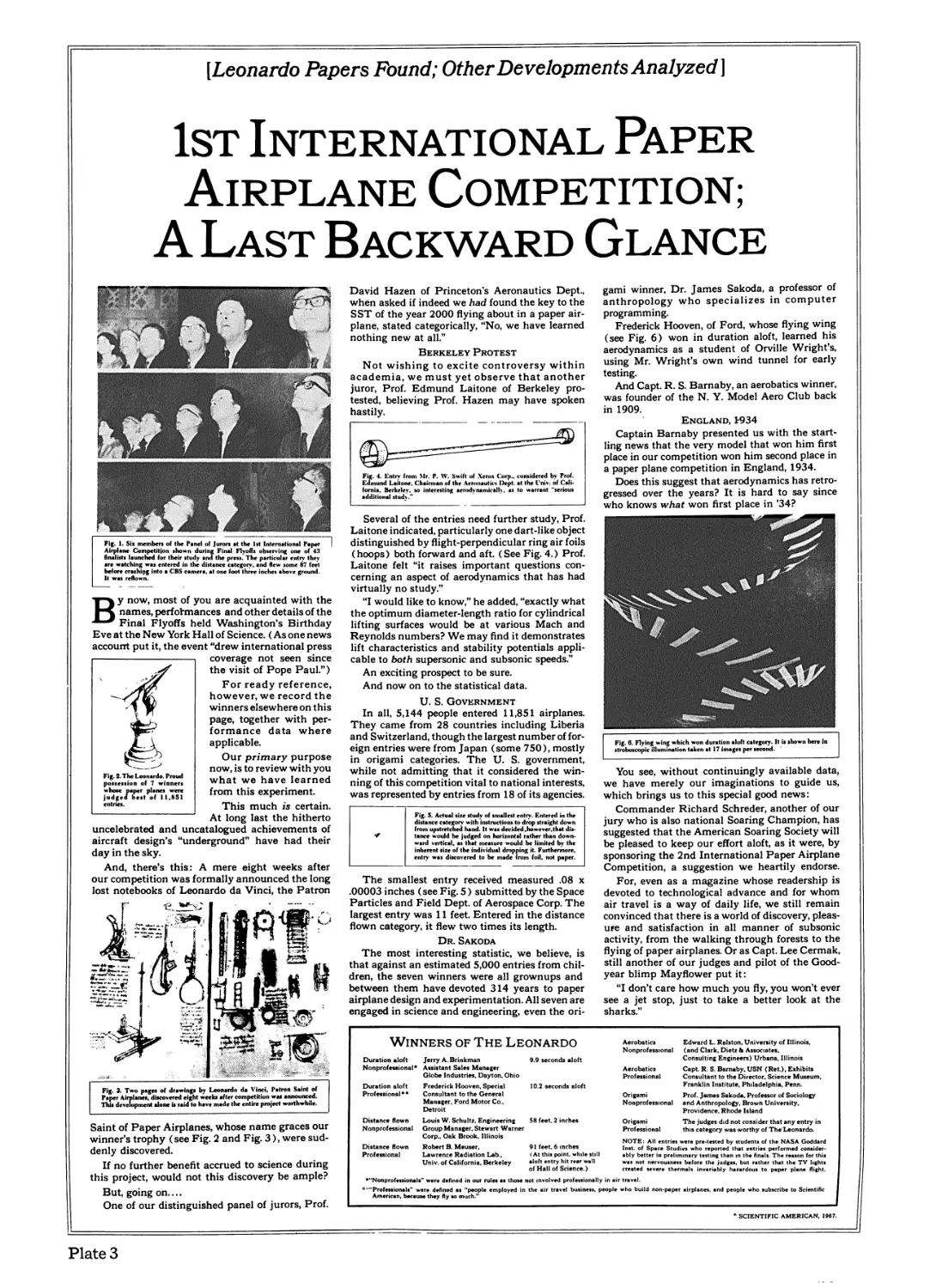
[Leonardo Papers Found; Other Developments Analyzed]
1ST INTERNATIONAL PAPER
AIRPLANE COMPETITION;
A LAST BACKWARD GLANCE
FiS. I. Six memben of the P.nel of Juron .t the 1st Intern.tion.1 P.per
Airpl.ne Competition shown during Fin.1 Flyolls observinJl: one of 43
&nalists I.unched for their study .nd the press. The p.rticul.r entry they
.re w.tching w.s entered in the dist.nee c.tegory. .nd Hew some 87 feet
before Cl'uhi\1S into. CBS c.mer.. .t one foot three inches .bove ground,
It w.s reflown.
B y now, most of you are acquainted with the
names, perfol-mances and other details of the
Final Flyoffs held Washington's Birthday
Eve at the New York Hall of Science. (As one news
account put it, the event "drew international press
coverage not seen since
the visit of Pope Paul.")
For ready reference,
however, we record the
winners elsewhere on this
page, together with per-
formance data where
applicable.
Our primary purpose
now, is to review with you
what we have learned
from this experiment.
This much is certain.
At long last the hitherto
uncelebrated and uncatalogued achievements of
aircraft design's "underground" have had their
day in the sky.
And, there's this: A mere eight weeks after
our competition was formally announced the long
lost notebooks of Leonardo da Vinci, the Patron
i .- 'e \.:
' .
. , '.
. ,,,... )
f .... ............ .. .. /
t ":'<c+,........ ...
c, =- : f.
.1 t: .
-... . t '
- .,.....,. _.'
. =::.,'7' :,
..... ..
." ..... _t: .
.. - ........... .......
!:.-=: .
:,' '
. . ' . . ' . ' . . .-... . . . «, . '
.../..'W'..... "'..
,.' ....:.:, '-...,...'
"',' '. ..0)
A
-.
FiS. 2. The Leon.rdo. Proud
poueuion of 7 winners
.'hose I .per pl.net were
judge best of 11,851
entries.
:; ::;;;;:;'*:;.
:<::\.:::.::;; :
FiS' 3. Two P.S" of dr.wins. by Leon.rdo d. Vinci, P.tron S.int of
P.per Airpl.net, discovered eiSht weeks .fter competition w.. .nnounced.
Thi. development alone is s.id to hne m.de the entire project worthwhile.
Saint of Paper Airplanes, whose name graces our
winner's trophy (see Fig. 2 and Fig. 3), were sud-
denly discovered.
If no further benefit accrued to science during
this project, would not this discovery be ample?
But, going on....
One of our distinguished panel of jurors, Prof.
Plate 3
David Hazen of Princeton's Aeronautics Dept.,
when asked if indeed we had found the key to the
SST of the year 2000 flying about in a paper air-
plane, stated categorically, "No, we have learned
nothing new at all."
BERKELEY PROTEST
Not wishing to excite controversy within
academia, we must yet observe that another
juror, Prof. Edmund Laitone of Berkeley pro-
tested, believing Prof. Hazen may have spoken
hastily.
. 2.::
Fig. 4. Entry from Ir. P. W. Swift of Xem!! Corp.. l'onsidered by Prof,
Edmund L.itone. Ch.irm.n of the . emn.util-s l:Hpt. .t the l'niv. of C.li-
forni.. Berkeley. so interestinJl: .ercKl,'n.mil'.II,. as to w.rr.nt "serious
.ddition.1 stud,:'
Several of the entries need further study, Prof.
Laitone indicated, particularly one dart-like object
distinguished by flight-perpendicular ring air foils
( hoops) both forward and aft. (See Fig. 4.) Prof.
Laitone felt "it raises important questions con-
cerning an aspect of aerodynamics that has had
virtually no study."
"I would like to know," he added, "exactly what
the optimum diameter-length ratio for cylindrical
lifting surfaces would be at various Mach and
Reynolds numbers? We may find it demonstrates
lift characteristics and stability potentials appli-
cable to both supersonic and subsonic speeds."
An exciting prospect to be sure.
And now on to the statistical data.
U. S. GOVERNMENT
In all, 5,144 people entered 11,851 airplanes.
They came from 28 countries including Liberia
and Switzerland, though the largest number of for-
eign entries were from Japan (some 750), mostly
in origami catego'ries. The U. S. government,
while not admitting that it considered the win-
ning of this competition vital to national interests,
was represented by entries from 18 of its agencies.
c
FiJI:. S. Actu.1 size study of smallest entry. Entered in the
dist.nce c.teJl:ory with instructions to drop str.iJl:ht down
from upstretched h.nd. It w.s dec:ided,hOwever.th.t dis-
t.nee would be judged on horizont.1 r.ther th.n down.
w.rd vertic.I, .s th.t me.sure would be limited by the
inherent lize of the indh'idu.1 droppin it. Furthermore.
entry w.s discovered to be m.de from foil. not p.per,
The smallest entry received measured .08 x
.00003 inches (see Fig. 5) submitted by the Space
Particles and Field Dept. of Aerospace Corp. The
largest entry was 11 feet. Entered in the distance
flown category, it flew two times its length.
DR. SAKODA
The most interesting statistic, we believe, is
that against an estimated 5,000 entries from chil-
dren, the seven winners were all grownups and
between them have devoted 314 years to pap r
airplane design and experimentation. All seven are
engaged in science and engineering, even the ori-
WINNERS OF THE LEONARDO
Duration aloft
Nonprofessional.
Jerry A, Brinkman
Assistant Sales Manager
Globe Industries, Dayton. Ohio
Frederick Hooven. Special
Consultant to the General
Manager. Ford Motor Co..
Detroit
Louis W. Schultz. Engineering
Group Manager. Stewart Warner
Corp., Oak Brook. Illinois
Robert B. Meuser,
Lawrence Radiation Lab"
Univ. of California, Berkeley
9,9 seconds aloft
Duration aloft
Professional. ·
10.2 seconds aloft
Distance flown
Nonprofessional
S8 feet. 2 inches
Distance flown
Professional
91 feet. 6 Inches
( At this point, while stili
.Ioft entry hit re.r wall
of Hall of Science.)
gami winner, Dr. James Sakoda, a professor of
anthropology who specializes in computer
programming.
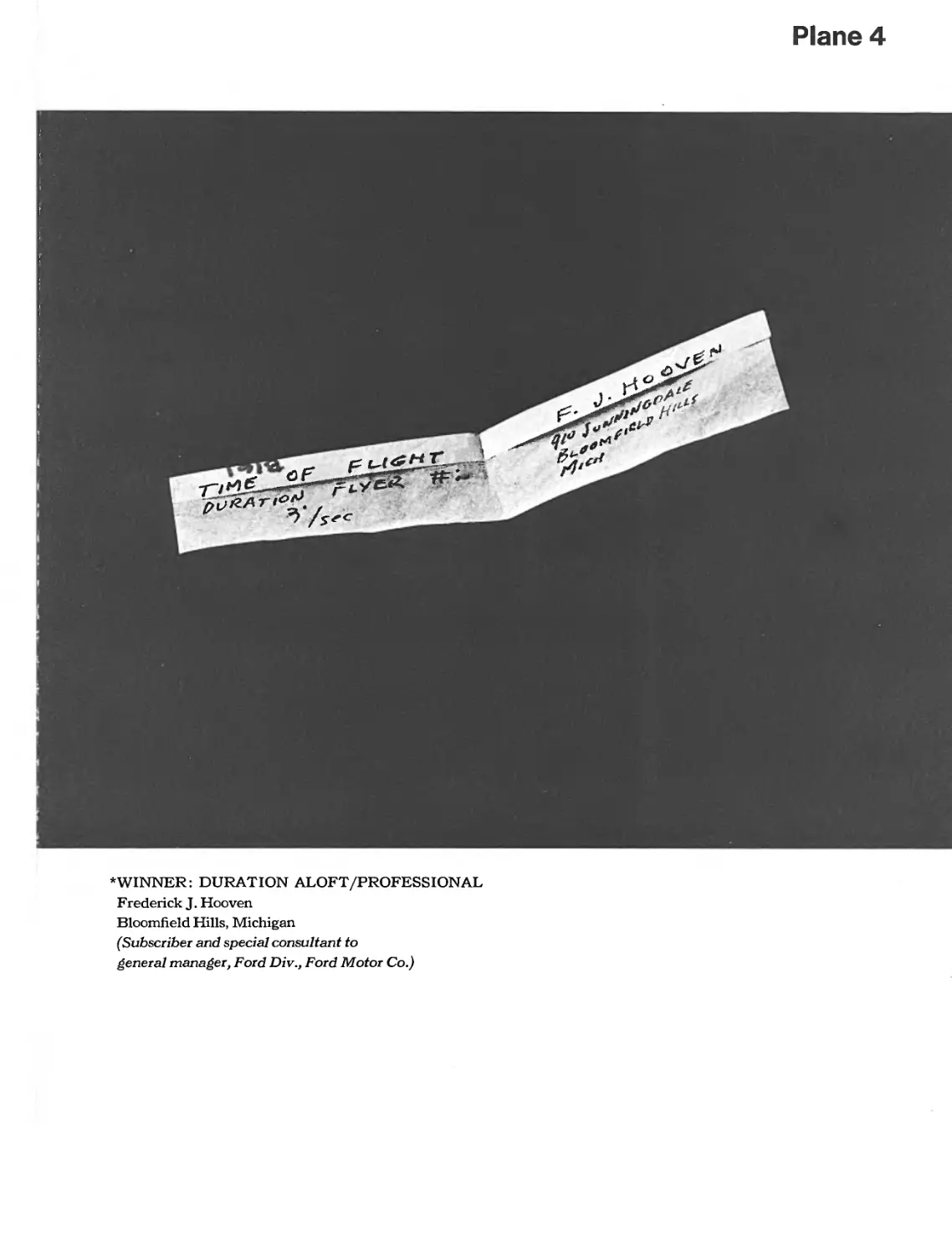
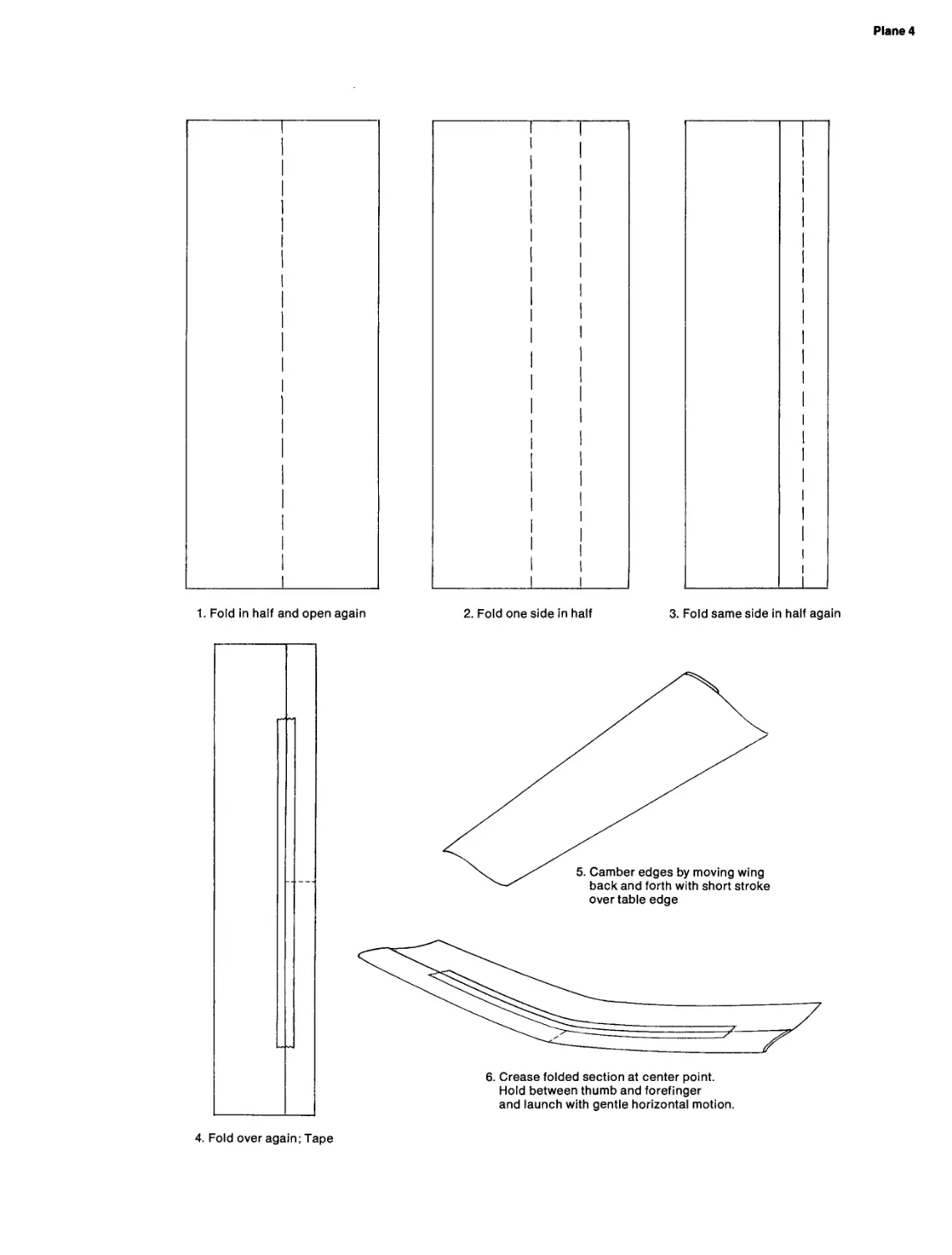
Frederick Hooven, of Ford, whose flying wing
(see Fig. 6) won in duration aloft, learned his
aerodynamics as a student of Orville Wright's,
using Mr. Wright's own wind tunnel for early
testing.
And Capt. R. S. Barnaby, an aerobatics winner,
was founder of the N. Y. Model Aero Club back
in 1909.
ENGLAND, 1.934
Captain Barnaby presented us with the start-
ling news that the very model that won him first
place in our competition won him second place in
a paper plane competition in England, 1934.
Does this suggest that aerodynamics has retro-
gressed over the years? It is hard to say since
who knows what won first place in '34?
II
I
Fig. 6. Flying wing which won dur.tion .Ioft c.tesory. It ilshown here in
stroboscopic iIIumin.tion t.ken .t 17 im.ges per second. .
You see, without continuingly available data,
we have merely our imaginations to guide us,
which brings us to this special good news:
Commander Richard Schreder, another of our
jury who is also national Soaring Champion, has
suggested that the American Soaring Society will
be pleased to keep our effort aloft, as it were, by
sponsoring the 2nd International Paper Airplane
Competition, a suggestion we heartily endorse.
For, even as a magazine whose readership is
devoted to technological advance and for whom
air travel is a way of daily life, we still remain
convinced that there is a world of discovery, pleas-
ure and satisfaction in all manner of subsonic
activity, from the walking through forests to the
flying of paper airplanes. Or as Capt. Lee Cermak,
still another of our judges and pilot of the Good-
year blimp Mayflower put it:
"I don't care how much you fly, you won't ever
see a jet stop, just to take a better look at the
sharks."
Aerobatics Edward L. Ralston, University of Illinois,
Nonprofessional (and Clark. Dietz 115 Associates.
Consulting Engineers) Urbana. Illinois
Aerobatics Capt. R. S. Barnaby, USN (Ret.), Exhibits
Professional Consultant to the Director, Science Museum,
Franklin Institute, Philadelphia, Penn,
Origami Prof. James Sakoda, Professor of Sociology
Nonprofessional and Anthropology, Brown University,
Providence. Rhode Island
Origami The judges did not consider that any entry in
Professional this category was worthy of The'Leonardo.
NOTE: All entries were pre-tested by students of the NASA Godd.rd
Inst. of Space Studio!S who reported th.t entries performed consider-
ably better in preliminary testing than In the finals, The reason for this
was not nervousness before the judges. but rather that the TV hghts
created severe thermals invariably hazardous to paper plane flight.
."Nonprofessionals" were defined in our rules .s those not Involved profession.lly in air travel.
o""Profession.ls" were defined .1 "people employed in the air tr.vel business. people who build non-paper airplanes, and people who subscribe to Scientific
Americ.n. bee.u.. they fty 10 much."
.. SCIENTIFIC AMERICAN, 1967,
INTRODUCTION
Z
..JO
<0
>-Z
00
CC..J
..>=
ZI-
Ow
i=(3
00
WC/)
..J
..J..J
0<
00
I-i=
CC:)
w<
CC'Z
IO
I-CC
:)w
0«
Fig. 6 Sarti's device
equipped "with a fairly heavy, sharp
or blunt object on the nose and were
used in battle around around 700 A. D. .
according to some historians.")
Nonetheless, we owe a vote of
thanks to the Chronicle, and to Perl-
man himself, for these valued findings.
Having done that, we may ask what
else has been learned?
Immediately following the Final
Fly-offs at the New York Hall of Sci-
CI)
UJ
<=Q
q:
....,
a- 0 NoTE CRUC E :Jsf: M
3: TAIL ASS \
q:UJ
:t:
01-
CCLl...
LLO
Fig. 7 Siemen's rocket plane
CC
<
w
o
w
w
C/)
:)
Fig. 8 Le Bris's glider
en
en
w
cc
Z
o
o
LL
o
>-
cc
c(
cc
m
::i
Fig. 9 Chanute's biplane
ence, an academic deb te developed
between the two aeronautical scien-
tists on the jury.
As Plate 3 suggests, Professor
David Hazen of Princeton University
felt the entries to the competition re-
vealed nothing at all. This opinion,
however, was vigorously opposed by
Professor Edmund V. Laitone of the
University of California at Berkeley
who had high hopes for one entry in
particular, a ring air foil model submit-
ted by an employee of the Xerox corpo-
ration. (See Special Added Chapter.)
As we go to press with this edition
,
it is some five months since the com-
peti tion has concluded and Professor
Laitone has delightedly revealed to
Mr. Piel that indeed scientific knowl-
edge may have been furthered meas-
urably.
In a letter dated May 29, 1967, and
which has already been placed in Sci-
entific A111erican's archives, Professor
Laitone revealed this: "I, for one, cer-
tainly enjoyed the contest and learned
some interesting new things."
Laitone didn't stop there. Follow-
ing the suggestions of one of the win-
[23]
INTRODUCTION
ners, Mr. Frederick Hooven, he is
proceeding on the researching of fly-
ing wings of paper begun by none
other than Orville Wright.
A particularly startling and unex-
pected aspect of the research, accord-
ing to Laitone, is that "in order to
conduct these tests we have had to
develop a very accurate wind tunnel
balance that can simultaneously meas-
ure the lift and drag of a model to an
accuracy of l/lOth gram, or 0.0035 oz.
This in itself," he pointed out, is inter-
esting, "... because we constructed this
extremely accurate balance at practi-
cally no cost and very little effort, by
utilizing the mechanical parts from a
war-surplus aircraft auto pilot.
[24]
"As far as we know," Laitone con-
tinued on the subject of his wind
tunnel balance, "the accuracy we ob-
tained of 1/1 Oth gram is more than
ten times more sensitive than any
wind tunnel balance we have ever
heard of."
Congratulations, sir!
But what about the planes them-
selves? Well, even in this day of su-
personic flight, not every answer is
obtainable at first blush. Professor
Laitone's work on the ring air foil
model from Xerox continues without
interruption and he promises news of
its achievements in the future. For
that moment, we, as you, wait with
eager hearts.
Brief Annotated History
of Aeronauti cs
B EFORE PUSHING ON into the Intro-
duction, Appendices, et cetera,
the authors wish to place the extraor-
dinary developments of '66 and '67
into the perspective of aeronautical
history . We have therefore engaged in
a limited research effort, the findings
of which we present for you here, with
appropriate annotations.
The history of aerona u tics da tes
clear back to the ancients, when ,"ob-
servers of the flight of birds and of
projectiles stirred speculation as to the
forces involved and the manner of
their interaction. These speculations,
however, were in general carried on
without benefit of what has become
known as the 'experimental meth-
od.' ,,1
Skipping on up to 1250, we find
Roger Bacon making the first printed
suggestion for a gas-filled balloon that
could carry a man. But it took Leo-
nardo da Vinci to determine that air
offered resistance to the movement of
a solid object, though he believed air
compression was the key to loft. He
thought, for example, that the rapid
lEncyclopaedia Britannica. Vol. 1. "A-Antarah," page 824.
flapping of birds' wings created a re-
gion of compressed air beneath the
wings, providing the loft. 2
Nothing could have been further
from the truth.
Galileo later established the fact of
air resistance and arrived at the con-
clusion that the resistance was pro-
\ portional to the velocity of the object
passing through it. 3 Then, in the 17th
century, a Dutch physicist, Christian
Huygens "may have been the first to
appreciate that the resistance of air to
the motion of a body was proportional
to the square of the velocity."4 Huy-
gens, though, "used an experimental
approach. Newton reached the same
Gonclusion by deduction."s
"The work of Newton in setting
forth the laws of mechanics marked
the beginnings of the classical theories
of aerodynamics." He discovered that
"the pressure acting on the plates that
face an air stream is proportional to
the product of the density of the air,
the area of the plate, the square of the
2Ibid.
30 p cit.
4Ibid.
SIbid.
[25]
BRIEF ANNOTATED HISTORY OF AERONAUTICS
velocity and the square of the sine of
the angle of inclination."6
Of course, the rest is implied.
Still it is vital to especially note that
the first public launching of a work-
able aircraft-a hot-air balloon of
"showy appearance,,7 - was accom-
6Ibid.
7Encyclopaedia Britannica, 11th Edition (Handy Volume
Issue). Page 262.
plished on June 5, 1 783, by Joseph and
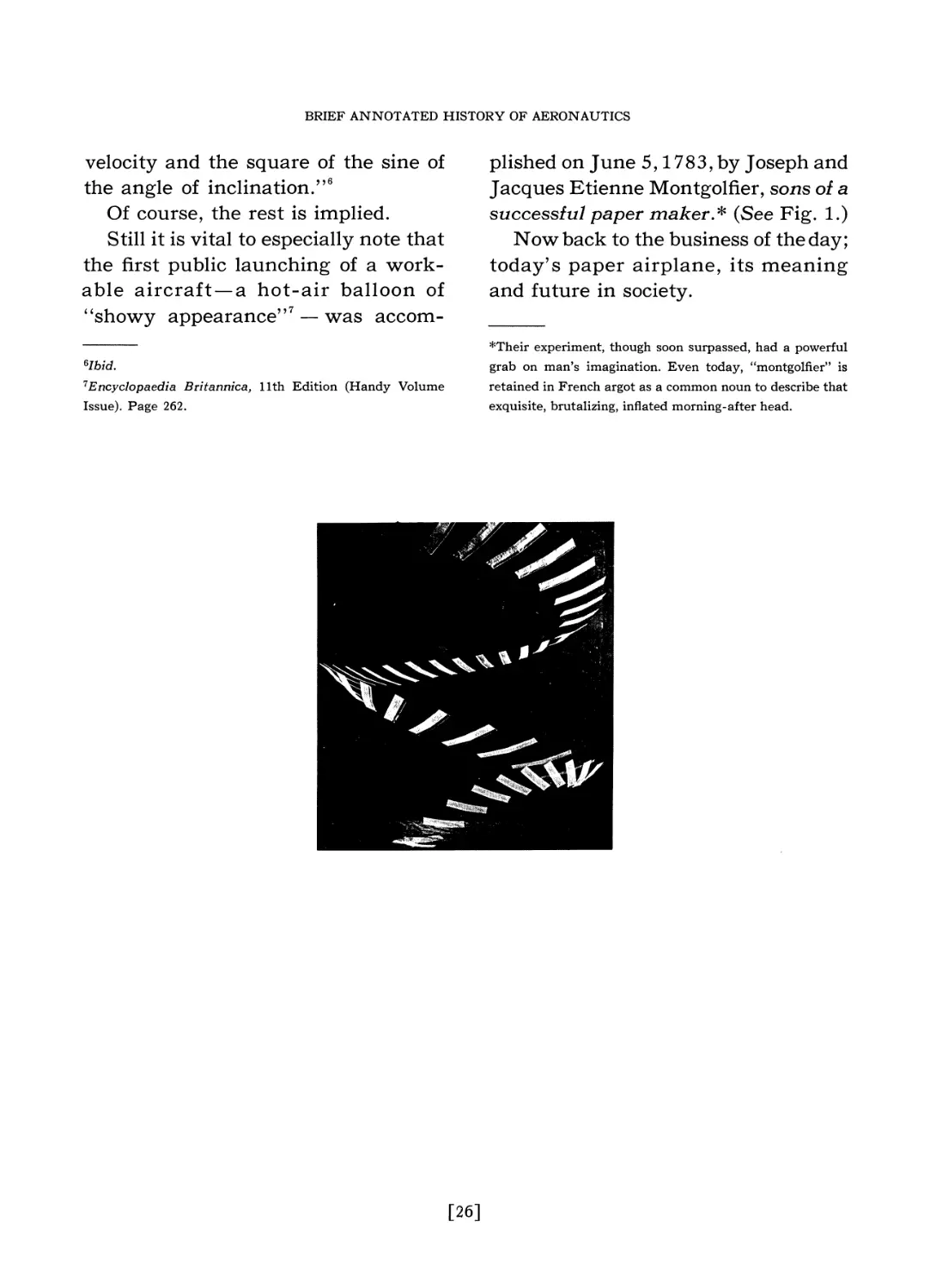
Jacques Etienne Montgolfier, sons of a
successful paper m.aker.* (See Fig. 1.)
N ow back to the business of the day;
today's paper airplane, its meaning
and future in society.
*Their experiment, though soon surpassed, had a powerful
grab on man's imagination. Even today, "montgolfier" is
retained in French argot as a common noun to describe that
exquisite, brutalizing, inflated morning-after head.
/(t .. .
:::;C:',
.>t ./ . . ....,' ,., . ' . . . . .. ',
;(..?,/ .r ....':<!
/ .. .
. . .
. -.'"..,
,:;4
· t
"",. ?..
Ii
/
.,
',,""
J. . ,. . , ." . . . : _ .. . ...
- . . '....
.'.
[26]
Prologue
IN TRIBUTE TO
RUFUS PORTER, THE INVENTOR
OF THE AEROPORT
O N ANY NUMBER of counts, Rufus
Porter is deserving of special at-
tention in this book.
Not the least irnportant of these to
the authors is the fact that in 1845 he
founded Scientific AInerican, sponsor
of the event with which we are dealing.
But equally important, surely, is
that he was hirnself the inventor of the
first self-propelled airship, and more.
For, having pondered his new dirigi-
ble's irnplications and realizing, doubt-
less, that it is not enough to fly-there
is also the importance of landing-Mr.
Porter surpassed even that achieve-
ment by inventing the first "aeroport."
It is with no attempt to discredit that
we point out that he invented the aero-
port for dirigibles, not jets. There was
hardly any point in inventing anything
that would only be grown over with
grass by the time it was used, not to
rnention the inevitable upkeep costs
frorn 1850 to 1 950 when there would
be some practical value for such a jet-
port.
It is also worth adding that on Jan-
uary 23, 1851, Porter very nearly did
hasten our en try in to the Air Age, as
on that date he urgently appealed to
the Sena te for an appropria tion of
funds to experiment in practical avia-
tion. (Is it possible he had budding jet-
port plans after all?)
The Senate, however, with the un-
canny prescience unique to lawmakers
and public officials, was somehow
aware that the Air Age was not sched-
uled to begin officially until a much
later date and hence declined to invest
in it prematurely. (It is just such in-
valuable insights that keep history on
\j.ts orderly course frorn war to war and
\
revent us from rushing headlong in-
to an uncertain future.)
Praiseworthy as Porter's aeronau-
tical notions may have been, they
would not of thernselves occasion this
special tribute in a book on paper air-
planes. There were, in years past,
many other men who left the thumb-
prints of their genius on the skies.
Why then choose Rufus Porter?
Well, why not choose Rufus Porter?
There is little enough question, judg-
ing from the way he lived his life, that
[27]
PROLOGUE
he was the sort of man who would be
pleased a bou t being honored in any
book devoted to paper airplanes.
Mr. Porter, to illustrate our point,
made no pretense of devoting his life
to Science. The very idea would have
made hi11l laugh. He devoted his sci-
ence to Life. That uniquely fulfilling
viewpoint enabled him to be in one
lifetime a rn usician , portrait painter,
landscape artist, soldier, sailor, danc-
ing master, protean husband and fa-
ther, religious philosopher, inventor,
editor, and a good 11lany other things
that have nothing directly to do with
paper airplanes.
His given reason for establishing
the Scientific AInerican was that
while there were scores of publi-
cations devoted to all sorts of things,
there was none "devoted to improve-
ment." Accordingly, he filled its pages
wi th news and notes and com men tary
on anything and everything that
[28]
might enrich an individual life or im.-
prove the common condition. In a se-
ries of articles on painting for' exam-
ple, he advised the would-be landscape
artist, "... it is neither necessary, nor
expedient, in all cases, to imitate na-
ture."
In any event, Porter enjoyed ex-
horting others to "excel nature itself."
To create something beautiful even
"though not in perfect imitation of
anything."
Rufus Porter saw the world as the
God-given playground of man and he
looked to science to provide the toys.
His Scientific AInerican had no qualms
about including jokes on the front page
along with sober-sided technical news.
In that spirit, a paper airplane com-
petition could hardly be deemed less
worthy than the competition to design
an S ST
To Rufus Porter, therefore, thanks
and Godspeed.
Chapter
T HERE WAS some talk of omitting
the main section of the book al-
together except that it seemed fitting
to use this otherwise waste space to
reflect on What Might Have Been: lost
opportunities, their fragile fragrance
forever pressed in the center of this
massive tome.
First we should like to pay tribute
to the men who constituted the back-
bone of Scientific AInerican' s 1 st In ter-
national Paper Airplane Competition:
those who never got it off the ground.
We refer to the host of would-be con-
testants who read about the competi-
tion and thought it was a grand idea.
With faces aglow they started to fold-
ing anew their accustomed version of
the paper airplane-the very model
they had brought to perfection in Sth-
grade study hall and which had given
them solace and relief from corporate
tedium through the ensuing years. At
last! A chance to match their nonpa-
reil against All Those Others.
There must have been millions of
them. If only they had listened to the
boy inside, whispering, "My plane can
beat your plane!" Of course they
didn't.
[29]
Wha t they did do, after defea tist
grown-up reflecting on it, was wist-
fully flick their lovechild across the
room, smashing it into a blank wall
along with their bittersweet drearns of
glory.
We think we can reconstruct the
logic, perhaps justified (who is now to
say?), which. prornpted this horde of
paper kamikazes. After the first fine
flush evaporated, they looked on their
handiwork with new eyes. That is to
say that they fel t the eyes of others
upon it and experienced something
akin to stage fright. Why?
Recall that since childhood this had
been a secret practice. Now, on sub-
mission, everyone would know. Sud-
denly their custom-built wonder be-
came a very poor creature indeed.
Besides, one could be sure (the de-
spairing logic went) that, with Scien-
tific AInerican sponsoring it, the tech-
nical competition would be stiff, quite
stiff; some scientific fellow would sure-
ly win. This, as we have seen, is ex-
actly what did happen, though what
the outcorne would have been had the
bashful rnillions ventured forth is hard
to irnagine.
CHAPTER
Enough to say that this eleventh-
hour withdrawal, not to say cringing,
on the greater part of the very grass
roots of paper aircraft design-every
man who has ever folded a plane-
represents an incalculable loss to the
.
SCIence.
Where did all go wrong? It may
have been in the very beginning. Per-
haps if the opening announcernent of
the Competition had been less serious,
less scientifically intimidating.. .
In passing, why is it that paper avi-
ation is exclusively a male domain?
Has anyone ever known of a paper
aviatrix? How 11lany have ever seen a
small girl scale a paper plane across a
classroom or anywhere else? (Of the
12,000 entries to the paper airplane
competition, fewer than 1,000 were
from women.) Is it a field (like the
conducting and c011lposing of music,
chess, barbecuing, the humor of W C.
Fields) with which women cannot
really cope? Science does not tell us.
Of rnore than passing interest is the
failure of anyone to try to establish a
verifia ble claim to the basic S S T de-
sign by virtue of priority. In our opin-
ion, the rights to this valuable property
could have been authenticated easily.
Perhaps they still can, though it is
likely that, with Scientific A11lerican's
competition having come and gone
without even one claimant, the delta
wing is now in the public domain for
[30]
good. Maybe it is just as well, though
it is a shame to think of all that royalty
money just lying around with nobody
getting the good of it.
To have staked out a clairn to the
basic patent would have been simplic-
ity itself. All one needed to do for start-
ers was be elderly-over 100, say-and
presen t affidavits: from one's princi-
pal, Sunday school teacher, etc.
There are, on the face of it, a couple
of drawbacks to this straightforward
approach, arnong thern: a) A 110-year-
older is not as likely to be aggressive
in asserting his rights as a person of
less mature years might be; b) Most
people are sirnply not foresighted
enough to gather eyewitness vouchers
at the time.
Viewed retroactively, the securing
of affidavits for an action that occurred
some years ago is beyond the scope
of all but the most adroit individual.
However, the procedure presents no
insuperable problerns when thought of
in terms of the National In terest;
which this certainly is, as noted in the
Introduction. A nation can do any-
thing it wants on its own soil, and
sornetimes on other people's.
But for the moment let us consider
this stake-claiming as a purely domes-
tic matter; tirne enough to go interna-
tional arbitration, or worse, later on.
Take any country. Australia? It is
near the start of the alphabet and a
known paper air power. It was also
very keen (if incomprehensible, as
noted) in its recent efforts to get some-
thing gliding Down Under besides
CHAPTER
boomerangs. And it is rem.ote-a sig-
nifican t factor, as we shall see.
The first thing Australia should
have done, in our opinion, had they
yearned to nail down the rights to the
SST, score a solid scoop on the world,
and garner a tidy little something
gold-flow-wise, would have been the
following:
1. Conduct a nation-wide search for
the oldest man in Australia. Now this
is not a mere piece of Sunday tabloid-
isrn like trying to ferret ou t the Loch
Ness Monster or the Abominable
Snowman. There is, without doubt,
an Oldest Man in Australia. They
would have found him somewhere,
probably in a remote harnlet or sheep
station. There seems to be a direct
ratio between remoteness and longev-
ity. Claimants to great age live neither
anywhere close by, nor in a place that
is at all stimulating. The cynical might
opine that these far-flung locales are
so dull that the inhabitants find diver-
sion in lying to one another about their
ages. It helps pass the time, which
[31]
must get a little draggy after one has
spent 100 years in Australia, or 160
years in the Caucasian People's Re-
public. (There is no paper in the Cau-
casus, therefore we may exclude their
old-timers as clai11l- jumping pos-
sibles.)
2. When this oldest Australian had
been located, the Governor-General or
Prime Minister or some other top offi-
cial (the higher the better, for the rec-
ord) should have then taken a com-
mon, garden variety, delta wing, SST-
prototype paper airplane and flashed it
on him. And asked hirn The Ques-
tions: A) Did you ever see one of
these? (Yes). B) Did you ever m.ake
one? (Sure). C) When did you m.ake the
first one? W hat year?
This last question is the pivotal one.
Any answer before, let us say, 1847,
properly notarized before the flower of
Australian officialdorn, would have
certainly swung it for the Antipodes.
Now, alas, it is too late.
This concludes the book proper. Now
back to the Appendix.
Appendix I
LETTERS
A T THE OUTSET, we should note that
.t'1. hardly an entry was received at
Scientific Am.erican that was not en-
closed within, attached to, or other-
wise associated with a letter. The first
thing to be learned from this competi-
tion, it would seem, is that designers of
paper airplanes are inveterate letter
writers.
Some merely wished to express the
im.portance of the event to them per-
sonally-Wanda Dillon of Hardy, Vir-
ginia, for example: "I would like to
very m.uch win because when I was
m.aking it [the plane] all the boys in
my class laughed at me."
A great m.any entrants were frank
to say that as they had never won any-
thing at all before, they were hoping
to win a Leonardo, at least.
Others merely wished to be friend-
1y:
"My name is Jim Noble. My teacher
is the greatest. Her name is Mrs.
Jones. My m.om's name is Maxine. My
father's nam.e is Vance and my broth-
er's nam.e (little) is David. I am in a
class of 16 children here at Warren
School. It is the best school. I am
eleven years old and in the fifth grade.
Very truly yours, Jim Noble, Terre
Haute, Indiana."
By far the largest socio - economic
group entering the competition were
children, and by this we surmise that
in terms of actual num.bers young peo-
ple tend to work with paper planes in
greater quantity than older folk. Sev-
eral of their entries are distinguished,
we think, in design conception, as can
be seen by Figures 10 through 13.
While we can credit children with
the most intensive research, as the
final advertisement pointed out, it was
adults, and professional ones at that,
who ultim.ately were victorious. Let's
get on then, with the thinking of the
adult mind.
Rev. M. Eugene Mockabee of the
Lexington Theological Seminary in
Lexington, Kentucky, tells us that he
timed a paper plane's flight at three
and one-half m.inutes, from a 400-foot
railway bridge over the Kentucky
River. Fuller Brush Man Waldridge
Bailey counts among his better ef-
forts a fifteen-minute flight from the
[33]
APPENDIX I
thirty-sixth floor of 100 Park Avenue,
". . . utilizing a thermal rising from
Pershing Square."
And from the New York Depart-
ment of Housing and Urban Develop-
ment, Mr. William Pain reports hav-
ing launched "...a single delta from the
31st floor of the old Time-Life Build-
ing which soared for 1 hour and 3 3
minutes before disappearing up and
out of sight." Mr. Pain notes that this
took place during the "Golden Age of
paper plane competition, before cen-
tral air conditioning in high-rise office
buildings. ' ,
San Francisco architect Felix Ros-
enthal is also a member of the Over-
PQ Q"3"" Plo."e.,.
o
1
Fig. 10
Fig. 11
0/
TIM SCHISLER, PORTLAND, OREGON
ROBYN REINEN, PORTLAND, OREGON
p fI(o'l
[34]
One-Hour Club, having described a
flight from Rockefeller Center, in
which the plane ultimately disappeared
over Times Square, somewhere. Mr.
Rosen thaI also tells us that he is the
only known launcher of a paper plane
across the Arno River; it was hurled
from a second-story window.
Recalling his childhood in pre-de-
pression Germany, Mr. Rosenthal en-
joys remembering the days in grade
school when the Jewish children were
permitted a one-hour recess while
their Christian classmates went to re-
ligious instruction. "That hour every
week was just the time we needed to
perfect our paper airplaning," so that
CLIFF SPECK, PORTLAND, OREGON
Fig. 12
Fig. 13
MARY SUE WUNDERLICH, PORTLAND, OREGON
U.S. 1\\'(' -to,c.e +utCrt.er- a-\r/ P\Q'()8
o
APPENDIX I
before long a clear superiority was es-
tablished.
Mr. George S. Schairer, Vice Pres-
ident Research and Development,
The Boeing Company, Seattle, Wash-
ington, writes of an early experience
which might constitute an unofficial
record for distance flown:
"During the summer of 1930, I was
in Paris with a number of model air-
plane builders. We had been the win-
ners of the American Boy model air-
plane contest, and during spare mo-
men ts in Paris directed our a tten tion
to designing paper airplanes. One par-
ticular design proved to be very suc-
cessful. I do not know who originated
it, and certainly it was not me, but it
is the best glider I have encountered
among paper airplanes.... We sailed
possibly a thousand of these from the
top of the Eiffel Tower, and picked
one up at the Alexander III Bridge
which is several miles away."
In another development, one relia-
ble source has named a certain Mr.
Yolen, who is President of the Kite
Flyers Association of America, as
having devised something known as
the Ragallo Wing, which at once
solves all the problems associated with
the SST program. According to this
source, Mr. Yolen's device, being an
"evolved kite airfoil in concept, can be
towed cross-country on long tether by
existing railroads. No problems with
the FAA...the developers of the Ragal-
10 Wing need only have their lawyers
[35]
remind FAA officials of 'rights-of-way'
for railroads and there you have it. The
passengers can ride down below in the
train in maximum security and safety
-enjoying the spectacle of the giant
Ragallo Wing SST as it is towed
across the land. And the problem of
supersonic speeds is also surmounted,
by placing the burden of its solution
squarely where it belongs: on the rail-
roads, not on the long-suffering avia-
tion industry."
The spokesman for Mr. Yolen saw
in this creation "the answer to the
mass transport of millions." We could
a d that it has the apparent further
advantage of a certain savings in de-
velopment funds. And, too, there is the
added pleasure of viewing the coun-
tryside and small towns as they go by,
which will doubtless be found to be an
exciting experience to travelers of the
future.
Another San Francisco competitor,
Mr. Frank Rosenberg, attached to his
paper plane these thoughts on the fu-
ture of air travel:
"The plane of the future will be a con-
cept in reality transition rather than
commutation. As house to airport
comm uta tion will be almost instan-
taneous, negative energies in relation
to travel will be mitigated. Air travel
will not appear unusual as air will be
accepted as atmosphere similar to fish
in water. As people travel more and
more by air or underground, the
earth's surface ma.y be re-established
APPENDIX I
for walking. The plane of the future
will be more like a telephone experi-
ence than an exertion of physical en-
ergies. The plane will be a shuttle
between realities and simplicity, and
comfort will be more important than
elegant meals, hostesses and in-flight
movies."
<
z
o cc
z 0
< !::
...J
CJ<
oZo
<:5
...J (/)
co .w
. J: ...J
ccow
I-CCCJ
a:o z
wu.<
co!::(/)
O...Jo
ccO...J
Fig. 14
We learn from Mssrs. Robert R.
Black and Clifford H. Lang that their
en try ( Fig. 14) dates back in origin
to Baron Von Lufthaven. The full
story is an in teresting one:
"Gentlemen:
The aircraft design herewi th en tered
for competition is unique in that it has
been handed down from father to ille-
gitimate son for two centuries. Origi-
nally, the craft was designed and built
by the legendary Baron Von Luftha-
ven, gentleman butcher, raconteur,
and sportsman. Specifications for the
craft's design and flight characteristics
have been handed down through the
family line by. word of mouth only.
This is the first public disclosure of the
family secret.
"On April 1, 1767, the elder Luft-
[36]
haven was preparing to draw and
quarter a swine, the first step in pre-
paring his then internationally famous
specialty 'Luftwurst,' when one of his
cuff protectors rolled off the chopping
block and started to fall to earth.. Sud-
denly, it attained stability and lift and
glided past young Jukes, first illegiti-
mate son of Lufthaven, who was ca-
vorting on the ground on all fours, his
normal posi tion , having not yet
learned to walk erect at the tender age
of twenty-one. The sensitive young
boy-ninth offspring of the gamekeep-
er's tender, mild and sympathetic
daughter, Chatterley Dietrich-his sci-
entific interest piqued, attempted to
pick its wings off-his first inclination
in the pursuit of knowledge. The boy's
frustrated screams in finding that the
object had no wings attracted his fa-
ther's attention.
"Lufthaven, on discovering that the
cuff protector actually flew, proceeded
to expend the considerable family for-
tune over the remainder of his lifetime
in developing the gliding-cuff concept
into a profitable commercial venture,
with no success. He eventually met
his demise at the controls of a twelve-
meter cuff launched from the signal
tower of Lufthaven Schloss, thereby
leaving a legacy-of nothing but a glid-
ing butcher's cuff in 18.66 generations
of poor illegitimates."
Turning to more practical matters,
the relationship between man-sized
gliders and paper ones was explored
by A. A. Backstrorn of Dallas whose
Fig. 15 Backstrom's glider
paper glider was an outgrowth of a
real one-rnan glider of his own design.
A sturdy, handsotne craft (see Fig. 15),
Mr. Backstrom's glider inspired his
paper entry which when tested in the
cornpetition finished about 5,OOOth.
As one further light on people's
thoughts about the future of aeronau-
tics, we refer to the drawing of Dennis
Fig. 16
DENNIS G. RIETZ, NORTH HIGHLANDS, CALIFORNIA
/k INrPRNAritJAlAL. PeR AIRPLANe tONP£T/T/cJAJ
SUPER 50NIC TKAN PO T
{) IGN " EW: j) PAT:/iP I O/5c;, /9156
4824 \IV I L. LOW 6ROO/<.. () I
NO IH l-1/GU LAN , CALIF. oc.c UPAT I ON
fo/IPLOYER: US GQI/'T CIVIl. SG-RV/CE, SiA,/sri CA L
NME'« ,MCCLELLAN A1=S, CALIF. -P AFT6MAN
')
p G# ..s- coAlC"'e;DT/ A.J
r : 5cA..EI1-trfic A fYJerlC Bfl, ,
J,.EOYl5vc:l 0 Trophy COMpetlt/tJn,
415 MAO/SON Ave" NEW YORK-
100/7
---
NOTE
wINGS FeL.l)
OOWN FOR
5 l..OW Fl..lG H r;
TAKE....DFF &
LANDINGS
-,--we:> tfi"A. ?APER A/R,PLAIY£ ENTRieS
'Lt:)56.o. " -il
CLA 6NrIER!i.O :r OI<IGAMI r-o !3()Trr
r',ft6Jt4J1t1W ::JI,J;h; 80rH G/lJ7 /£S
fLY.
Rietz, of North Highlands, California,
shown in Figure 16. As can be seen,
Mr. Rietz recommends that the wings
of SST aircraft be designed to flap, as
it were, depending upon whether one
is in flight or slowing down for land-
.
Ings.
In another vein, we found this note
both interesting and amusing:
*
-
17
/;'
I \ \
-
@
,- -r
=:
(E)
-f1-
-
...l
,
.....,.
-
l":(
71
y
?
.
I
'J
11
.......
-"
&;
t
L fT A;. c.\1 1t
? I U\ 'I " 1. -::I- I d
1 .!
\ \ t T l, 1t :2-
· · 7, \\ IJ o\.)
t, I ...;:t < t!'
b 'I r t b
"" 1.. 9 0
\\ < ) 0)-&
Llcb -Z-d
J k
"9 JI <. (I I\..
,. 11" '-\ ,;:"
"?'
-nr \. \ If\ lJ!lJ
...oL 17'-
b '- .. ..
" j ;1b
f- 1t 7.. f!.
l )
... tA.t. G ( L
l;t " t iJ <) 7.f:=-
i,lL 1 :-
. J :1 ;
L ;; 'fiX ,
J ( - l {t
;} b*7
t. It J \ \
(. Jt1 t
Id /; '
b
APPENDIX I
And this one:
Barclays Bank D.C.O.,
Reef Trustee Branch,
F? O. Box 8000,
Johannesburg, South Africa
DEAR SIRS,
Enclosed is my entry to your com-
petition. (SIGNED) D. L. Cairns
I hereby certify tha t the above
narned is employed by Barclays Bank
D.C.O. (SIGNED) L. GrODIn
Before we get on with a few com-
ments sent along by the winners to
the competition, we want to reprint in
its entirety a most involving report
sent us by Mr. Joseph w. Dauben of
Harvard University. We believe it will
be self-explanatory.
, ' 6 "':' ,: Joseph W.' Dauben, ,
G --1 Y", "77 Perkins H , all '
, ' \ Harvard University
, Cambridge., a$Sachuseus
4aZUtc 9tM'£ f
. '
3.
'" 'Iii. IIH .
AnC¥"ld, ilaT; fh lUt&
ih d./uw-L i4 a .f;tll -!>
, f Itdt0lt U /UIr
,t2kPap II !a<U.)'.4() MaT
,lit ct?2f <' I C" I.
. all .. WM d4. )'/ ?Wf'.dt;;/ -fo tJt:/
.. 1!1(/-HaJ&) :/.@ (NUd&) - :/ c4 q I
'K ,cltl C!S+he /.- Z;Z& e :2 e
IWIce. '
A,::;: 2: £ MT .J.BdB ::.
/Tc. () ilB 2
';C fJe"tfeJt+ 2. f ;..L£!$C 2£idB
(:J fTC () Z ,
" <na. at ac/H;j'Lf i17-=?T; filL, ,>
4-nbf4aOd,pur 41 j' aT "',
At " ", , . " '7' f , " ........ U 0" po. . ,;2:{-'.
/nCUJ 'I /b ;;L -iJ'ai- ....... '. ·
APPENDIX I
\ t::;: . '; . :' , ..> .';..' . ,'f ! . .. .,, ..' .. . ., 'C". "; , ,.:.,-.; i,."" ....' .'"",,'.' i. ..' ;>\ <,,' .',' A.; 2';" ).: . "''';; ! _," '.. \ " :,,/;.,<,
..... :., .',' .'. '. . . . :, . ' <.: {":'''' ,. . '.... .":',,'; '.' .: ;"". ..::. '.. ..:'..... '. .,.......:--.; . :.', '. ,. ' "'. ' "...., ....{.....:
.' . ». ,. :";""." .'-'.' .:' ,. .:\ i '-:/: ,.J " ..,i',.;'.,;.... '" .,:
:'J?,.' ....:. ,. ':...,)....:/,">':.;>'-:' ',':,S: '.'7/;::;;'-:..
< :: '.: .:-' .,, -f,,/:/}j; il . . ',.: 'f ;,.'! '.""
, '. '.' ,,;: ': J.:,:; ... .:. ",)! ',...:' '. /(. / ., '
"'>. '. '" t ""':'.. f.< ,/c " "\ q /.:, "-
\:. ;': "::' : ;i:; c' ' .
';, l l ' , '. .,;: ",;< ', ':,:' 'y' l, \......: '.',::i",., ::.:.>")',';>:':
.':,. ,;: .:...<....' .......,.,...' )c.... .....,.,;..\,.; ..,'>,;rJ.. :;
, . ,<....,....'..';::..: ',...,. .... .... '....:>..;.,X,,' ;.
:" : ':,\ '. , \:Y,', <:.,/ ;'. ;,(
' : " ,:I'.: '. .,:. ; .:..,.' ;:/ ".'!.', '/\, '.' i.' .. \.'/ " ..'
;./ ,.Y.' ......:';......:.,.,'. ,., ,'.' ........... ..::$ '1. , \</'.,.:..'; i>:, ", ;.,:'.
;;.,}t. is;.',\: :' I< / "",....,: ;:':>;'<;<' . ;,;>/,./ ; :\"
:". >;.' '.-" . ,. .r':. ,.;., : ":,',',.:,-' .<'.
;...., ;:.:, } :.,;.:",'.,;, :.; . y ,'. :,:<:i' .':.'::;/,:, :,.," :"'" '"
.,: ...;.,........>';..,; , <"':"":,,,,;'>. ; !::",., ....
." '. :'. .:'..1 '; :.'...'>.... . .. .. ..... . '.., ',.,:.'.:" . '.' ;, .. '. "';" ;" " ..;-.:.." '.
, : :"";',;.;,i.":.'.:':'.".:'.!. , fi' , i ,;: : :,' '.' r :' ;" { . ," .: 7 .: {':j;j .i;/';;:';,
..,..:,....:: ".c" ;....' ......;...:. .:'," >., i""" ."'. '.:...:---"",,;;..,.' '....... ..., ".'..',;:",:,;' '::" /::.;..........' " ",
";>... "{" , ...... " :,'; . .;0..::,,',:.,.... .''-',:.'::-' f,..::y\>': ' ;".
:,.' ",< ....... ":;!);; " h<?:\:"/<',' , . : ; '..".' .' '.,
, :, '" :< .'. ;;, .' >..::, ' .l i: > ....: ., ,;'
" ,:" .,......'. ". ...,......'.,. ; '> (!' I' r,; '.
! \-..::': ;-: ?,: '<t
! '..... ..;..... . ..... .':- . ....... . '.i ....... ..... .. ,'_. 'i. '. ..'- .. ,," .:'::;>;:";' . 1.-' ",'.
,>:;. ,. .... . , ,< .. \, .'. .. .." ..\;, .' ".:".'; : ,' '\ ';. ( ..i......'.:
, '. ." . :: t"':::'::/"::" ., "'-
:....'.;, .
. .' ... . ;:;;. . ::,
'\ ,.
APPENDIX I
. ':., : :.c':' '. ',:/' ;CJ;1:"C'" :' : ,< . . .:. :
. . '.,' '.' ".'/.';" . . ,,:."
.' .., .:',.' '.';>: !:'.:.":3 .{><:,.;l.::\ i";:' :
.;.!; :....,:l'..;'. ;: .. '. .', ".:r:
. ..... .." .. >r, l\',.;(; .jJ " J::).'"' ,.' , ..,' ; , '.i
) ". ",'i". ::r;j/ ! .. 'L. vi., ," .: ... "
:,;; y "iS.'. : "'.'
/.C 2! '),,;.;{: f:.; ;;y' ,
'.: :;') )«fj /t. ·
, . .4:'.:;;;/'t..: C ,'. ,,:/ /;.,.......: .... ;-
r . . ." ,:..... i :i: ; ""';}"I'\;«/';4.. :
. '.:. :;...... . /'. ":;"'.:" ('.7..;;;. ..,.
.":.. .' .. .,.:,.: .; /' , ,." ,:.' './ ;.\,'" .;" ."". '.. . ..:; . ,.,' . ....(
.' / / :) /tfj! f' [ < ,>' :J: j
/' . . ;/, < ,:i(.,) ;' ,.
'" . ... " /<'. ,.....,,:;.' . :::..'.<t:... ',>i'. .,
;"" « ,:;:.:i'::,: t:':::;:; :. .,. ':;),'; '{"
. .... . , :'.... ...: .; / ;.;' >',,c.)..; . "
. . . . .;".;. ......:... .;.:...,... .........:.. ....... ":;. . ..,' .' :.:'.<,'
, ' . ';:;:::; .. .i,. .... '\ ';< ,..'. .'
. .'. "'::><:''':':'''<; ; ';;.. :.:.:
'. ",,' .......;; ; '."
. \ '. ..;;;;,,:).; ,.: .' >,:
:'. .... : :\ '\ ; :<: :.....: "; ;...
" \, "".:....; .;.. :'\.. . .;. .:' , . ... : : ) \;"\ . ...
..., .............'.... '.. .>:, , ..
'!»v" '....: .....,....;.. ,....;.....<'.,..:.. .. ;.;,\..,. ".' "". '" .'.
/ '..... :.:.(, :.,. .;.. ..,. "; '.. '. '; .... . .' ::'.:'" . ;.......... .. ".' .,
, ..' /y.,__>.;....,>: i:::. ,'....... ,'. ':..
I 3 :(...;.....,.:.' ....... ':,,' ". ..., /, ,":." '.;.' ..' . . .. "
/ ,(...... ..,;:......,< ".' "
I //,'.... .:..: '
i . / ,. . '>"." "';.. .:;:, '
/ .//.,./; :..,;.:.,..;',; .'." .:.,< ;;." ,;,.,..., ;..,. ..'.. ..;.'
, J::">:</"';' ,<.! .' ',,: ..'
// .:.: ,,: : >: ,; j .:.:', l' .;
,...",.;',f'i;;.i:,,; '>
" '.,Vit}""
)\ .\ ......
:>. :'
1
The third advertisement, announc-
ing the winners of the competition,
poin ts ou t that all of them were in one
way or another experienced in techni-
cal matters. Perhaps it should have
been of little surprise to discover that
men with some actual knowledge of
what they were after, and with certain
scientific data with which to work,
achieved more than others.
Two of the seven winners knew
Orville Wright personally. One of the
winners, Captain Barnaby (see Fig.
17), is something of an air pioneer him-
self, being the first rnan to fly a sail-
plane launched from a dirigible, an
[40]
achievement, among a long list of
others, that has earned him the title
Air Pioneer extended by the Air Asso-
ciation of the United States. As for
Mr. Hooven, he went to some lengths
in a letter describing his boyhood ex-
periences with Mr. Wright (see p. 42).
Mr. Wright wasn't the only intirnate
of Mr. Hooven. In a letter to Fred
Goerner, author of The Search for
Amelia Earhart, Mr. Hooven reveals
that just before Miss Earhart's depar-
ture on the ill-fated flight, "I installed
one of the first prototypes of the rnod-
ern aircraft radio direct jon-finder."
APPENDIX I
However, Mr. Hooven continues, "Be-
fore she embarked [it] was removed,
and installed in its place was the old-
fashioned null-type direction-finder
tha t she carried with her. The modern
instrurnent would have given her a
heading on the transmi tter of the cu tter
Itasca and on Howland Island even
under poor reception conditions, and
it would have shown her without am.-
biguity that her destination was still
ahead."
Fig. 1 7 Captain Barnaby waves.
1111 . " .... > i':"" . . . ' . " . ..,.",,;,.../ .
'".'; f ,,<.;;, Xi:, ,
m:-' :,:' '.,,<;:.; ,J .' :. /'\J;. .' .
'. .:. ii', . ." ' i' . .
". ';i ., . .\.1.01; t.'
'.;'.'
\d;;"
;;..... .
"":'
e \" I '.'.. .';.""",,,.,,'.,,.
.. '.. 'i>iii,,". . ." ..' <'i,, 'i t Ji ';:;;:?:;
..J _ t. . III i : \,l.' .'
. ..'., iI' k #lf>\ IJ / i '--:; " . /
K .' ..,$' fl' \ I //
/1\ Ii i' rfI! .... ,1,; '1 "
iT "Z.._. . ..... 'qf' i".ilf'.
, I .' ' l l.'<t}.'
': ":1;
l .< \ t
< ,[ M ;q '
"":'I . .... . ' ', '\.' Y "'
Ii iii,'J;. I'. .
I I! > \. .'
'.; . t'L' .,';. '." \
',.r .1 1 '/? ' \
\\' ; .' ,,' \'
.. t:- '''' \ \1,
i !. :......., , . , .
I ."" . "
r"" "."
\ ;. ./'; "'.'.
t '''', "", t
.. / } ;: , .
't :z ';
>Jr.,.
""t
-....>:J...
'i.
:.:%:.:i'. ::.:.:.::
.' :; (;'i;'::; '
".
. .. ..,'., ,"
,; ...(;;,)
..... ><.. ."i>'X. .
':i ..< ,..,.,.',/i.'"
...)
"
.. '
..,' .,..
..;,....,.,.,.......
\ :)
<,"
.
..
)
t
. }
"
. I...
1\ ,
ij
\
j,
r
.JI<,_,&,
'".-
(\\'
, /S ',:: .. ' A.il . > /
,ie' . ., :;;..,.., '1,' .., r
\.'.i' \" ;, \ l1 :'vi' 'i'.: ....
. ",' .Kb; j .'.
,',,: t' i"WL: "
t i
l' } t ,Jr
; .' !....
. ........3.'
U \
' ; 1;1> f .:
n;; ; (. / " "
( , t -x '
. ...
;0:
1,
{ \::::
..
. . '1\\
.. "":. .\ \\
." >M, ., ,.: ."'"
. .. . ""'--'\'" ..' . '. '''' . ... . .. . . '' «<,....
, . ''' .,.''''''' ... .:> , .:-. ',. . :>«;., ,
"'> . ,..". . ,
\.. . .
\" \ \
"x\ '" '\. 'J\
., \.'''''' "
>.....
"
.....
".
) :
..;;;
\ 'Sj,
. ""
;;r.';x'
..'1'; ><'i . ..". . ...... "tl; i.... i'.,.;
. . ,... .
i ..... '..,. ,
, \/ .." In,,1
, i .
.. . ,..... j
.,
....
"',
e.
;I'sta/ . [., !
.\ 'tJ\ . 1, .
: t {'f:,!y ';;; " t'L"
; 1(/< '" !tk,',"
";7'\; . ... . t:
,... $.,.""'. '..".:. ;.".,"..,. ',. t.,. ;.
· ......"...,...; <.'.. .. .,
.. ""i.., . ..
'. };:...
" f,:j: :::::< : - _:: : :: ::::::;::.-:
':i.. . .... ,:.;; A"
/{ ',;'r: '.:
. ,;;""t". '. '.
"Z'
., .
r- h :",: .'
. ...,
.
: ;
<
.,
j(......,)'".,....
';
, %';' /:'.'
........ .,. ......
'\i>x ;. .,.,....;:"" .
'J" ,i' \
t' :..., \
:<.. c...''
............:;;'
'.. ...... ...,.
. .;'.',. .....
'.'...
..., :L'>x,
1 ...,>..,,!,.; w
:.f=:.".. i!i ji;' . .7 "
. :;': :e: "" ... .........
...; ;,,(i ,... .....:.
,.." '<.. .....,........:, .... .'.',;. ;...:.::.; ......
)i..it.. . ... jf.. . ... ',: ,:: . . ... : . . ... .' .
>., .in...,..".... ..."..'..,... .' .....::}..., ,............ . .,..;. ..... ....
t:/t' ...... <t. n i . . . ;(.' , n . ...... . . . in . .'. . . ...:: . :. . . ;.n..;' . ....... . .' . ' ...,.. . ...... . .C. ... . . . ' . .... : .... .... . .. . :....;:!+ .' .".,. ; ;' . ! . . ..' "'.';:"' , .';;1 1 , '" .
, ':' . ........ . .: . .:.< . . . . .. ,;". .. . :: .. .:,; ./ ................ ........... '.. .....<,; . ....... "
.;0". '" .1. .ii. . .." ,: ..., .:...:.....:..,' ;". '5" '.. "' . .....:,. ........ .
.. , .... .' ". c.' '. ...., ): ..... ,. ....'.
.,' ';'>' ."<'f.<" . ........ "'.' ,,i. ".. \
\...U: L . .; . . .,i'; .. J., ..... .........
.\/ .:.. .ii. .. . :.;'. .....,.,,;...<: "..i,..:.;;, ..... .
. ....t .. 'iv' ..i; ....... . Xi'. ...... '.n ...... . "/i i/" ·
'''' . .. : . [,.c. .....:. . '" "'.; ..'.: . . : .,. '. ..
....':. \.. ..' .,t::'::.. '.Lt>: '. ..... '..
"£.:... "0:.. .n...... . .... ..
...
./
;)/<:} w
....j;.;' . .,. ..,j:.:'.' ........; ;
:;/:.",." :...... ...:.......
..;i. . '"..''.''.,':\''''' .,.
. .....'. .'.' " . ,i.'/I':..
· .<. . ;"'1'
.. .....:/1.;
'x '.Y,
....'....i.
':rt'?:........
.\i
.J'}"',,;,"'.'..'''' .....
.{...."'...:.,. .......
2;")... ..... .. ..... .
,;.. . , . ..
.'
'.\f 1
: \ < .
.. \
. . ..' ..:(
"
'4
!
J
j
j
!
j
j
i
"
1.
l;
,'..
,
8(
."
......,......<
"".
"""""'" "" ...", ....;.M....,"" J.....
[41]
FREDERICK c.J. HOOVEN
910 SUNNINGDAI..Z DRIVE
BLOOMFIELI) HIL:L . ,,'\IOHIGAN
January 26, 1967
. Leonardo da Vinci
c/O SCIENTIFIC AMEBIC
Paper Airplanes Division
415 Adison Avenue
New York City New York 10017
Dear Leonardo:
The enclosed folded paper flying wings re very little larger than the wing
section models Orville Wright and I tested nearly 50 years ago in his wind
tunnel. They have just a sufficient reflex trailing edge to keep center of
pressure travel Vi thin the stable range. If the duration and distance of
flight are measured in terms of steady state sinking rates and gliding angles
rather than in terms of how far somebody can throw the airplane, then these
models should perform pretty well. They are entered in those two categories.
In 1920 when I was a schoolboy of 15, four of my :t"riends and I built an air-
plane. Orville Wright was one of the trustees of the school we went tOt and
it, seemed the natural thing to go to ask his advice about our plans and ideas.
He liked boys. I think he felt relaxed with them, and he didn't feel that
reservation that he felt with most adults who were trying to get him to endorse
something or to introduce somebody to somebody e1ge, or one of those things
that people are always after a great man to dOe
Anyway, however silent he was in public, and however reserved he was with
people he didn't knoW' too well t he was kind and natural wi th us, and talked
for hours about aeronautics, the things he and Wilbur did. and the problems
they r n into and how they solved them
Some people forget that boys can understand things, but he complimented us by
talking gravely and seriously just as he would have to any grown-up engineer.
Aeronautics had just gone through the impetus of the war of 1914-1918, and had
changed and developed rapidly. We read avidly all the textbooks and the pub-
lications of the National Advisory Committee .for Aeronautics which in those
days were written in terms that a 15-ye r-old could understand i and we could
soon see that so far as aeronautics was'concerned, Orville had died when
Wilbur did Nothing that he referred to or told us about in aeronautics dated
from a time after vTilbur's death, but what impressed us most was how much of
the whole problem of flight these brothers had thought about and dealt with
before that timei
We we t back many times to the laboratory on Third Streeto He was never too
busy to see us and ta about o problems. lIe didn't make us design the air-
plane as he would have done it. Ire YTould argue wi th us about fundamental
poi:lts about the wing sections and tell us how he and Wilbur found out n.ow to
prev t spins, but he saved our pride. One of the things we argued about was
thick and thin wings. We wanted to use a thick wing, and showed him the NACA
report that told how much better they were than the thin kind he wanted us
to use. He didn't get stuffy about this affront to his authority. He just
showed us the results of the tests that he and Wilbur had made in 1908 and
some in 1902. We found some of the old models c..:1.d we made some of our own
and we tested them again in his wind tunnel, us g the ingenious and elegant
little balance that he_and Wilbur had used to asure the tiny forces on
the model airfoils. The results were just as he told us they would be. We
decided to use a thin ving
It had happened to him before and he had learned to believe his and Wilbur's
experiments 9 even when they made liars out of some eminent authority like the
NACA or Simon Newcom (who had proved that flight was impossible), or Samuel
Langley. We believed them too.
Years later we learned about Reynolds numbers and the affect of air visCQsity
on small-scale low-speed results Modern aerodynamics has forgotten what
might be called the third range, or the viscous sub-subsonic range of aero-
dynamics t but i played an important part in the early development of the
airplane,
The Wright Brothers wind tunnel used airfoils having a span of six inch s. and
a chord of one inch at an air speed of about 40 miles per hour or 59 feet per
second. All of the early wind tunnels were of comparable dimensions and air
speed. Of these probably the outstanding was that of Eiffel (the builder of
the Eiffel Tower)Q
,
Wnen the velocities and dimensior, are both small, the effects of air viscosity
produce a more laminar and less turbulent flmr, and since the effects of
viscosity and scale effects were not then recognized, the designs of early
full-scale aircraft embodied tpe erroneous conclusions of the small scale wind
tunnels of the day. One of the os important of these errors was to indicate
the superiority of thin wing sections, which showed much better ratios of drag
to lift than any thick wing. This explains the early prevalence of bipla es
or monoplanes wi th many brac e wires Q, Tony Fokker t who was only 19 a. t the time
and too young to know better, was the first to use internally braced thick
wing on a full-sized airplanea
Ho {ever erroneous the early wind tunnel results were as they applied to full-
scale aircraft, they still apply to model airplanes and particularly to fold-
ing-paper airplanes It is only a coincidence that the thin wing is better
than the thick wing for supersonic aircraft. The folding-paper airplane is
still best understood in terms of pre-1915 aerodynamicsa
FJH/l e
SincerelYi
: : - . . . ..' C . '. t-:
.r' ('! -:-. . - '"
!.. .l. . ;.' t _ ,) ..:..,' .
fredericK Ja'Hooven
The origami winner, Dr. Sakoda
(see Fig. 18), who is also an expert in
cornputer programming, reports,
"... there appear to be some common
skills required in computer program-
ming and origami. . . and I have corne
across a nurnber of programmers who
are also paperfolders. One common re-
quirernent is the fitting of parts into a
circurnscribed area . . . i.e., to work
spatially in a restricted environment."
Dr.. Sakoda then points out that"...
because of the need to conserve space
in an aircraft, the art of paper folding
m.ay be of use to someone, say, going to
the m.oon."
And on that thought we close.
Fig. 18 Dr. Sakoda shown here among other fa-
vorite origami creations.
Fig. 20 Pocket Rocket. Instructions:
Wrap aluminum foil around upper half
of paper match. Push straight pin up
under foil to head of match and remove
again, leaving an exhaust channel. Place
match on opened paper clip and hold
lighted match to tip. Step back.
S. J. TWEEDIE AND F. D. WOODRUFF,
FALLS CHURCH, VIRGINIA
Fig. 22
CURTIS D. KISSINGER,
GLOVERSVILLE, NEW YORK
Fig. 19
JOHN CRAIG AND GEORGE PECK,
NEW YORK, NEW YORK
Fig. 2 1
Y. HIHOMIYA,
TOKYO, JAPAN
Fig. 23
Fig. 24
LEO HEISSER,
AKRON, OHIO
Fig. 25
ESTEBAN CORDERO,
NEW YORK, NEW YORK
Fig. 27
DAVID SEGAL,
PH I LADELPH lA,
PENNSYLVANIA
Fig. 26
ANDREW KIMBALL AND
MARK B. WANZENBERG,
LARCHMONT, NEW YORK
APPENDIX I
f .d 1 J
-- T
1 ...-, t...,.
w .. .-::0 "' r-
en
>-
w
w
o
a:
<
_ ONIC p O) r " _L
This airplane is designed to enable passergers ani crew to escape the main cause or
fatalities in an airplane crash. That is, to get away from explodirg fuel tanks, hot
burning engines and the holocaust they make.
MA IN FEA TURES
1. sepera t inp; superst ruct u re a ll owi wing -- :- ifrou gc huteSd e"plQye<i"'-rrom -f'rorit-'and
._---,......t!U?1'f !! y. hatches to slow pl. .
::s"",,;;..,."' .-.....----. -: --:-- I . . --. _____ .. .
f__.:-=::::; _ : " j '. , .r-'>/ \ - . ..
.....;::::.. .... ....,.. ,., .-"""" -. -- , " ..
" ! c==-. I
.. .-- J;: l t t.) ,_.-:
. . _. .__ ." c::::J 1;"r:'::.:J. StJ.. ,....t J , ,:;' ; -"'"""": :' .".:"::'c' "_ , :. -- . . .'- I
A PPLICA TIONS
1. Emergency Landing
A. Approach
, "
. .....".. '.......... I.... .. I.
,
rear
...'"':'" -
B. Wing Detatched
c. Wing erashes, fuselage gos
on down the runway.
'¥-" . H ,,::: ;,:,:; ;, , ,:: ,:-: -
-.- . ....._. ...,,¥ - . _.- ...
. '-" T ..... ....a. -;
"----.......... ...
I ." - ., ,.,..;.;.;..,.:..........o;.,t " """""'I\;_,'f'i....1'>"< "<"' .""'i'. .
. ;; - . ., " "
'.... 'I ,,, \ . \
X. _, -.-...;:" \ \ . "
.-,.; '. i... . ...', \, '\ ._\ .'
.' _.".... .r __ .4 \ ..... __-.. ......-,. ...
t.;:;::: .. A.. - -- It!... , ___._
t. . . : e::;,CJ._...__. ....-. ...--
'.::"...... ......h:< ...:.....;,;; ...-..:.._......"" ;.:::;.,.. ;,:.;.:.._.:., ..;: ;.:;:-;.:. -,: . ...... .:\-. . ..-= 76 . ." '.. ....... . -'.... 6..... .
. " )<... .... .. .L. W(w;,1.; M"'" "'\...': . 1'..4:. ':i)r.,!.....:......:..._-.:.::7'_!. ..,..........-::.. f ;0......
J. ,.. __.._.. ............... --..._....... _..............-_,,.. ....... ......._.., ............._-............"......_.""" ...'" .. _.... ..... ........ ..............._............... ......_......_ too .....---..... .. . ......................_ ................. .. ........ ,.....,.".........,.."...................................... .... .,. -
2. Failure on take off
. ....;;z>
.
._-
.
. -'- "'"'
C. Wing crashed. Droug chutes
slow fuselage.
-
t /
,.. ,
,..\,-
. r .r..,---\...".", "....
\.....:.:..:: -'- .--
A. Airplane loses power.
.
,I". ,'.'. \' ' . :!::> ;-.-;--:...;:"..:;. ;, .._ :. ;;.c._.". . , '!"_ ..:.t .... T ..........t:V.,''I!- j::..'-: -. . .,. J '!n!... 'f ;: . ':" " .........-,i;t; .....;..._. ......__.........
......_. ....""""'..-_... ..........__._ - _ .........-'-.....,..'I'IV _ ..,"«....A " "¥ ......,.....,.4I'6O..u<\-.Mn'..........,. ..,.."....,.... .............,.. ,.4........."...__-:t....... . ......, ....\A., ...)....._4...A. ..-4... "''''''';.
3. Overshooting the runway B.Broug chutes slow plane, (C.)at capitain's decision wing
detached Jri i_.;.. ( ... ____.._'... " - left.__in t:t reard: :ed.
. - -- -- --' --' , . 1 --". .--- . ------ l-
I . - . .. t - . -- ... . ";'. . ' - --;.::- '.' __ . . . - -. _-..-_--- _._ : . ":.--..--...- -- I ·
I . ..... "-- . ' . .. -- .' . ._ ..-....__._-- -""-...... ........ ... ". .. ."""... ," ..... _._- . . .. . '.' ,, !f: .-. -...... ----. '.nt.............. ""'. . .. .. I 'I '-
_ . . . .. .... ...- .--....- '-'-H".'." ...
"'"" I _-1-_"'...._ ...__....,......._.....,......,_.___ . ..; .._.... . __ . I I
.... . '" . ..\, ........ ......__ ....................,"".,... '#1/Il.._....... -"...._.....po_'1o . I....... _............. \wi..........,........... I _ .... ....."... .., ,
f h.Mid Air failure at high alltitude.
,
I A. Wing detached.
B. Drou chutes slow fuselage.
I . -"" - --'---"- . ' - :. C. Larger drouge8 slow more and sta rt
vertical drop.
I I
-, - -.- - . -
I
f
;
\
o
D. Two large
I
\
1
I
j
t
.
-TL-
.
. - .............._- .. .... . .- .. ,... ....... .... ...--.......
t
I'
By Edward E. Keyse
Fig.28 Keyse's Supersonic Detachable Wing
[46]
Special Added Chapter
A FLY IT YOURSELF
COMPENDIUM
Y OU MAY WONDER what a Chapter
is doing back here after the Ap-
pendix and where exactly Appendix
II is located. Fact is, the authors had
every intention of having this section
be "Appendix II," but our publisher
pointed out that these twe ty tear-
out, fold-them-yourself paper air-
planes consti tu ted more than half the
total volume of the book and ought at
least be given the status of "Chapter."
Still, though, as one of the primary
features of any tear-out is that it
should be torn out without creating
irnmense havoc to the binding of the
rernainder of the book, which is re-
quired to stay in place, there was sim-
ply no moving this chapter up forward
where the other one is. We tell you all
this merely to assure you that what
turned out to be a peculiar arrange-
ment of sections in this book has not
taken that form gratuitously.
One more word about the drawings.
They have all been very carefully
worked out. However, the success of
each plane depends upon how faith-
fully you attend to minor details in
folding and cutting and how patiently
you experiment with various launch-
ing efforts. (Some models will do well
with brisk arm tosses; others, such as
Captain Barnaby's winning entry and
Mr. Hooven's, require very gentle re-
lease from upheld hands.)
The pattern pages are perforated,
as you see, so as to more easily allow
you o tear them out and fold. Despite
this, you may find in the case of some
planes that your success improves
with your own paper of different size
an-a- weight. Serious constructors
might do well to purchase a bond
paper pad from an art supply store.
They corne in different sizes and
weights and fold nicely. It may also
be helpful to try a prototype airplane
on bond paper before attempting to
build the plane from the printed page
itself-practice, in paper airplanes as
in all things, makes perfect!
THE AUTHORS
[47]
Plane 1
"
bh,
!\,
., -'>1?
-isv.v.
O'V/1 '.....:; ...
..",
.. .
w ,"
'.
.,
,
*WINNER: AEROBATICS/PROFESSIONAL
Capt. R. S. Barnaby U.S.N. (Ret.)
Philadelphia, Pa.
(Exhibits consultant, The Franklin Institute; pioneer
aviator with title of "Elder Statesman of Aviation")
Plane 1
1---------
'-------' - ./
4'12"
3. Continued folding
until about
4 '12" are left
1. Crease 8 '/ 2 " x 11" sheet down center
2. Start with a fold of about 1/4" J
,-
,
,
\
\ ,
'-
/ / Fold tail
e: fins down
,
.
,
,
4. Fold in half
and cut as shown
I I I
I I I I I I I I
1 I 1 I I I I I I
-1- -1 - 1_ L - t- - - +- - l - -1 - - - - - - ---
I I 1 I I I J
I I I I I
I I I I I I I
I I I I I I
I I I I I I
I 1 I I I I
I I I I I I
I I I I
I : I I I
I I I I
I I
I I J I
I I I
I I
I I I
I I I
I I I
I 1 I
I I I
1 I I
1 I I
1 I I I I
1 1 I I
I 1
--f- --- -------,--
I I I I
I I I I
I I
1 I I 1
I I I I
I 1
I I I
I I
I I I
1 I I
I I I
I I I
I I
1
I I
I I
I 1
I I
I I
I I
I 1
I I
I I
I 1 I I I
I I I 1
-1- -1- -I - -+ - I - -I - -I - -I - _I - - - - - - - - -
I I I I 1 I 1 I
I I I I I I I I I
I I I I I I I I I
Plane 1
Plane 2
£"-t; 9 0'1 t flO
, ooil g .J.> It
. ?",,::r.. '/' (j 0 tJ '> I () 01
oQt 11 7 (!.....:)('">-m
- ..J.'o r'
-1,
"f'I-
.P i#i- ...
<" ..;'ir 5 ' .
,, .- .,:, «""...1#:..
., ')fIt.....,:.J&. ... ""' .
'-'"' ...;!!: .--
/ .
_:....._....J.?'-
*WINNER: DISTANCE FLOWN/PROFESSIONAL
Louis W Schultz
Oak Brook, Illinois
(Employed at Stewart Warner Corp.)
I- 8 ' 12" '1
//1 "- r
/ I "-
/ '-
/ I "-
/ '-
/ 1 "- 4"
/ , 1
/ ,
/ ,
'-
11"
/
/
/
/
/
/
/
/
/
I
/
I
\
\
\
\
\
\
\
\
\
\
\
1. Crease on center line.
Fold corners in as shown
2. Fold again on dotted line
4. To get this
Bottom view
5. Tape as shown
Plane 2
3. Fold away from you
on center line.
Make opposite folds
on dotted lines
Top view
4. Hold wings together with tape
giving them a slight
upward angle (see photo)
Plane 2
/i II '"
/ / / 11\ \ "
/ / ' I ' \ '"
/ I \ '"
/ / II \ '"
// / 11\ \ "'"
/ / /1\ \ "
/ / 1 1 \ \ '"
// / I I \ \ '"
/ / \ '"
/ / I I \ \ '"
// I I 1 I \ "
/ I I I \ \ "
/ I I 1\ \ '
/ \ '"
/ / 11\ \ '
/ / I I \ \ '
/ f '
/ / I \ \ '
V / I \ \ '
I I I \ \ ",
/ I I \ \
/ I \ \
/ I I \
I I \ \
/ ! I \ \
/1\ \
/ I I \ \
/ I I \ \
/ I \
/ I \
/ I \ \
I I I II \
/ I I \ \
/ I I \ \
/ I: \ \
/ I \ \
I I 1 \ \
/ I I \ \
I I I \ \
I 1 I \
I J 1 I \
/ I I \ \
II I I \ \
I I I \
J I \ '.
I I \
I I \
I I \
I I \
\
Plane 3
J .........
-.. ....... .,. - .
t- cr,lIA r llVO ...... ..: ,'"
J + .,.,. " " :<lio
,. . " . O'i
; 1 /ii'o
..... -;.
..I-tE?:/YJ.,q.,.. '.'. ;." ..' '"!>
-- .
}; ..
+
.If' .+O..tr ""...
::,; .. ' '.
;, . .'. . ... \
.. '\.o"'\. .
..() .. ..c!' .. . ,
.. ....
.."
'"
.'<"
. _ ;.
, X "'i>...<>
-,,):#
,, o O"'C#
!'F ;> :+04
R J" ..."
, ..;., -4"
to
#. .... C"'"..
\ "
, J)
:, ,','. '\
*WINNER: DURATION ALOFT/NONPROFESSIONAL
Jerry A. Brinkman
Dayton, Ohio
(Assistant sales manager, Globe Industries)
I
I
I
I
I
I
I
I
I
I
I
I
I
I
I
I
I
I
I
I
I
1. Fold 8" x 10 '/4" sheet
on center line
and open again
3. Bottom view
6. Fold on center line
2. Fold corner forward
as shown
4. Turn plane over
7. And on dotted lines
Plane 3
Fold flap ,/
under
3. Do same to other side
5. And fold nose forward
at dotted line
8. And shape as shown
-cut finger hole as indicated
Plane 3
I
I
I
I
I
I
I
I
I
I
I Cut this
6°"'
I
I
I
I
I
I
I
I
I
r
I
I
I
I I I
\ I I I /
\ -- - --r- -- -- - - - -----I
\ I : : II
\ I I I
\\ I I I /
\ I I I /
\ I I I /
\ I I I /
\ I I 1/
\J I /
\ I
\ r
\ I
\ I
\ 1
\ 1 /
\ I /
¥ - - - - - - - - - - - - - - - -- - -
11\
/ I \ Tuck flap under
/ I \
Cut L _ _ _ _ _ _ Cut
\
\
\
\
\
\
\
\
\
\
\
\
\
\
\
\
\
\ \
\ \
\
\\
"
\
\
\
\
\
\
\
\
\
\
\
Cut
Cut
I
I
I
I
I
I
I
I
I
I
I
I
1
I
/
/
/
/
, /
1/
J'
/
1
1
1
1
/
/
/
/
/
/
/
/
': F 1,<;;.H.!!: , ) ,.
1'"".1 t! t:) F r I.. yr;iK" 1f. .
puR-ArlO,.).. .
/S C
*WINNER: DURATION ALOFT/PROFESSIONAL
Frederick J. Hooven
Bloomfield Hills, Michigan
(Subscriber and special consultant to
general manager, Ford Div., Ford Motor Co.)
Plane 4
.........
1. Fold in half and open again
4. Fold over again; Tape
I I
I I
I I
I
I I
I
I
I
1
I
I
I
I
I
I
I
I
I
I I
I I
I I
1
1 I
I I
I I
Plane 4
2. Fold one side in half
I
I
:
3. Fold same side in half again
5. Camber edges by moving wing
back and forth with short stroke
over table edge
6. Crease folded section at center point.
Hold between thumb and forefinger
and launch with gentle horizontal motion.
Plane 4
I I I T
I I 1 I
I I 1 I
I I I I
I 1 I I
I I I I
I I I I
I I I I
I I I I
I I 1 1
I I I 1
I
I 1 I
I
I I I I I
I I I I
I 1 I I
I I I I
I I I
I I I
I 1 I
I I 1
I I I
I I I
I
1 I
I
I I
I
I I
I I I
1
I I
I
1 I
I I I
Plane 5
- ",'
*WINNER: AEROBATICS/NONPROFESSIONAL
Edward L. Ralston
Urbana, Illinois
(Employed at Clark, Dietz 8f Associates)
,.
6"
/
1if /
/
/
/
/
/
/
/
/
/
1.
5. Refold on creases to get this
9. Press sides in as shown
11. Fold in half on center line.
Trim out plane shape
(see pattern)
.1
2.
6. Fold points forward
10. To look like this.
Turn nose section under
leaving point exposed.
\
1.--/
Bottom view
12. Trim out part
of under wing
to reduce weight
1'"
'-
"
"
" /
/- - - 'y:;- - - -
,
Reopen and / '-
crease here / '-
/ '"
/ '-
/ '-
3.
7. Crease here and unfold
Plane 5
//
/
/
/
4.
8. And here
Top view
13. Fold wings and tail as shown
I
I
I
I
I
I
I
I
I
I
I
I
I
I
I
I
I
I
I
I
I
I
I
I
I
I
I
I
I
I
I
I
I /
'" I /
- ----- ---- --" /-
--
/1'" ------
/ I "
/ "
/ I '"
/ I '"
/ I '"
// I '"
/ I "'-
/ I '"
// I '"
/ I "
/ I
/ I
// I
/ I
/ I
/ I
"
'"
"
"
'"
"
'"
'"
"
"
"
"'-
I
I
I
I
I
I
I
I
"
'"
"'-
"'-
"'-
"
'"
"'-
I
I
I
I
\
\
\
\
\
\
\
\
\
Plane 5
/
/
/
/
/
/
/
/
/
/
/
/
'"
'"
'"
'"
'"
"
*WINNER: DISTANCE FLOWN/NONPROFESSIONAL
Robert B. Meuser
Oakland. California
(Physicist, Lawrence Radiation Laboratory,
University of California at Berkeley)
'-i.-
'
\
\
\
\. -
'- <::,.. __ ?/1
---
#
'"
"-
'"'; :;'" ...:..s,.....Ri..m...
.-.......4-
. : ..:.... -
, .
........
....
""-
'\ '- '"'"".
Plane 6
.
- __.M2.-
10"
1. Fold on center line.
Open and make fold as shown
4. Fold down on center line.
And up on sides
Plane 6
18"
2. Fold back again at center line...
3. And back again.
Trim off part that extends beyond
center. Repeat on other half.
5. Glue body and all loose sections together.
Trim as indicated.
Position wings at an upward angle (see photo)
Note: Winning entry was made with heavy art paper 10"x 18"
Winning plane
was made
with heavy paper
10"x 18"
Plane 6
'l,; II ill \\ \ "
'if I1 II \ \\\ ""
/ II \\ '\" "
///1/ 1 1\\\ ""
/ / / / / / I \ \ \ \ \ " ",
//1///1\\\ "'"
// / / / / 1 I \ \ \ \" ,
/ III \ \\ \ ""
/ 1 I \ "
// / j / I / I \ \ \ \ \
/ /j / / /1 \ \ \ \ "
/ / I I I I \ \ \ \ " ,
/ / / I / / I I \ \ \ \ \ ",
/ / / I / I 1\ \ \ \ \
/ / / I I 1\ \ \ \ \
I / / /1 1\ \ \ \
/ / / / I 1 \ \ \ \ '\
/ / / / I I \ \ \ \
j / I 1 I \ \ \ \
1 / / I 1 \ \ \ \
/ / / 1 \ \ \ \
/ / 1 I \ \ \ \
/ / I I 1 \ \ \
I I I I \ \
I I / I \ \ \
/ I 1 I \ \ \
I I I I \ \ \
/ I / I \ \ \
I / 1 1 \ \ \
/ / I \ \ \
I 1
/ / / I \ \
/ I I \ \
/ I I \ \
I I I \ \
I I \ \
/ / I \ \
/ / I \ \
/ I I \ \
/ / I \ \
/ I \ \
I I I \ \
/ I I \ \
/ I I \ \
/ / - \ \
/ I \ \
/ I \
I \
1 \
I \
I \
I
,
,
"
"
,
"
*WINNER: ORIGAMI/NONPROFESSIONAL
Professor James M. Sakoda
Department of Sociology and Anthropology
Brown University
Providence, Rhode Island
Plane 7
" . -..
"-
"'-
"
2. Fold the nose of the plane back
to the point marked X.
5. Narrow down nose by
folding edge to center line.
Plane 7
1. Take a square piece of paper.
White bond paper 8 112" x 8 112" is suitable.
Make a crease along one diagonal
and fold two sides to this diagonal line
to form the nose and wings of the plane.
See next figure for desired result.
3. Fold over leading edges of the wings;
then tuck in between wing and nose.
A
4. Pull nose out forward.
6. Fold up plane in half along center line, A.
Fold down wings along B, and then
spread out horizontally. Turn up
trailing edge of wings at slight angle at C.
Adjust this angle to provide proper amount of lift.
If plane drops rapidly lift flap up more;
if it rises too rapidly and stalls,
flatten the flap down more.
KEY
Fold up
Fold down
Plane 7
'-..
"
'"
"
'-..
"
"'"
"
-1\
1\
- \ I \
\ I
"'" \ I I
' \ I \
", \\ I \
" + \ 1 \
:7, \ I \
' I
'" \ I \
' \ I \
", \ I \
' \ I *-___
" \ 1 / \
' \ 1 / \
" \ I / I
" / \
' 1/\
"" ',I // \ ___
" ' I \ __ \
". '/ ---/'
' 'V ____ /\ \
-T,- /
------/ ," / I \
/ I ' / I \
/ " / \
/ I / \
/ , / \ \
/ 1 / \
/ /, \ \
/ I / " \ \
" " " / I // , \ \
Y '-.. '-.. ..... I / '\ I
I '-.. '-.. / '\
I --j( ..... " 'I \
I I ....."" "II
I I """, \\
1 I ....." '\
t- _ _ _ " ..... '-,I
I I ___________
I
I I
I I
"
""
"
"'"
"
...................
'-.........
-
'-.........
........
......................
.........
/".
/
/
/
*WINNER: WESTERN DIVISION
Lewis G. Lowe
San Francisco, California
(Artist with Walter Landor G;. Associates)
Plane 8
,
.\
" /
"" /
V
/"
/ "
/ "
1.
'- /
" /
'" /
- -//¥" -,,-
/ " )
4. Unfold and crease here
7. Open and refold like this...
10. Bring dotted lines on ends
of wing and tail together
and glue to form tubes.
Glue on wing support flush
with leading edge of wing
2.
5. Refold on creases to make this
8. To make this
Plane 8
3.
6. Crease on dotted lines
I
9. Fold lower section back under body
leaving nose sticking out. Cut out shape.
Fold body up on center line
and glue together. Bend wings down
/ ---
11. Glue on tail assembly
Plane 8
- ---
*'i}
'!} .s'lt.o.o
0/"1
"'", I" / /'/j
'" I '" / .........--/
" 1 _/' / /
--- I ';<: / /
'" I / "'/ /
'" / A /
'" 1/ / ",I
'" I I / Y.......-
'" 1 ( ......./'/' '"
____ "'- 1/ / ;,-....... "
------------------ /'/'_ -- '"
/ I \"'- - ......... - - - -;
/ I \ "......... /
/ "'................
/ I \ "'- /t.......
/ I \ '" / \..............
/ I \ A \
/ / "-
/- - - -- I \( '" \
/ /\' \
/ I / \.............. "\
/ I // \ .......,, ,,\
'-
---
-------
\
\
\
v
!
William Clymer Bidlack
Los Angeles, California
(Customer relations, Lockheed Aircraft)
,
"$f '
\\<1'
,'-
i' "
;p..."
..rJi"'y.:-
4'
,,;;<' ;;
Plane 9
......
81/2"
Tail section
I
9 3/8" /
1 /",/
//
/
/
/
/
1. Cut out tail section.
Fold on dotted line
5. Refold on creases to make this
9. Fold in sides
as shown here
to look like next drawing.
I nsert tail section
into nose of plane
-I j
) 1 5fa"
IT
/
2. Fold corner up . . .
6. Fold points down
10. Fold lower section
back under plane
at dotted line leaving
point sticking out
3. To make this
7. Crease here and unfold
Bottom view
11. Fold plane and tail
down center
away from you
Reopen
and
crease
here
Plane 9
/
/
/
/
,
,
'-
,
,
, /
, /
(---- ---
/ ,
/ "
/ ,
/ ,
// ,
4.
8. And again here
Top view
12. Launch this
side up
Plane 9
/
/
/
/
/
/
/
/
/
/
/
/
/
/
/
/
/
/
/
/
/
/
/
/
/
/
/
/
/
/
/
/
/
/
/
/
/
/
/
/
/
/
/
/
/
/
/
/
/
/
/
/
A
B
------
--
I
I
I
I
I
I
I 0
I
I
I
I
I I
_L___ __ E
-- I
: I
I I
1 1
C 0
C
I
I
I
I
I
I
I
I
I
I
Plane 10
..
'.,
,
. {
>(,'" .
Richard K. Neu
Wilmington, Ohio
. L th e 8i' Tool Co.)
(Cincinnati a
-INSTRUCTIONS
Cut along all OI : Sbackward.
Fold A !orw o.verlap by folding D.
Fold C In .an d 0 fold up at E.
After folding C a f om high position
Launch by dropping r
J
.",
William Seno
Hackensack,New Jersey
(Employed at Raymond Loewy /Wm. Snaith)
Plane 11
\\
"T ..
,
'-
'-
,
"-
"-
,
"-
,
"-
"
"
"-
"
"-
"
'"
"
,
1. Fold 7" x 10" paper
on dotted line
4. See plane 5 for detail
of this fold
Bottom view
7. Cut out. Fold body together
on center line and
spot glue at nose and tail.
Bend wings and tail down
at dotted lines and apply crimp
on bottom section of wings
to create curve
/
/
/
/
/
/
/
/
/
2. Fold again
5. Fold corners forward
and down
Plane 11
3. To get this
6. Fold point back
underbody
8. Hold nose together
with Scotch tape
I
I
I
I
I I
1 I
I I
I I
I I
I I
I I
I I
I I
I I
I I
I I
I
I I
I I
I . I I
'" I I /
'" L I /
-- --l---.J_--:-{
I '" I / I
I '" I / l
I '" / I
I '" I / I
I '" I // I
- - - - - - - --!- - - - "',y I
"", I / '" - - - I - - - - - -
'" I / I '" I /
'" I / I '" I /
"'", : / 1 '" I /
'" / '" I /
'" :/ 1 '" I //
'" /------+---- /
'" / I '" //
V I '" /
/'" X
/ '" 1 / '"
/ '" I / '"
/ '" I / '"
/ '" I // '"
/ '" I / '"
// '" I // '"
/ '" '" I / '"
,I /
,/ "
. 0)'
.:;,.
:a:
"
"'-
"'-
'"
'"
'"
'"
'"
-- '"
-==-.:::: -==
Start folding with lines on back
Plane 11
. :
: 0)'
.:;"
:a:
/
/
/
/
/
/
/
/
/
,k- :__ -==
o
.!2P
-
I /
I
I I I I
I I I I I
- - +--- - ---J- - - t- -T -1- - -!---
I 1 I I I I
I I I I I
2 - - t- - ----I- - - 1- - +- - -I - -
I I I I
I I I I I
3 ---t--I---.l--I--,--
I I I I I
I I I I 1
4'- - -I-- ----l---
I I I I
I I I I
I I I 1
I I I I
I I I I
I 1
I I I I
I I I I
I I I I
Plane 12
N ori Sinoto
New York City
Fold at 2. Then 1 and 3 together.
Fold again at 4. After fold is
in position, crease along
vertical bottom lines
to form a gentle curve
Gil de la Roza
Northwood School
Lake Placid, New York
'.
Y.
'.'
'':'1;
'"!
)ii»S
./ -"' . . . ';.q . - . ... . .' .
-,., €J'I ; ..
. -<.tC';', . . '. -
' ;:;1 .1 .
//-
'OJ
r:
. '..-:J#".,.
:'
..' 'F ','
...- ':y
v
p'/'
'"
"'" .
Plane 13
8'/2"
11"
,
,
"
"-
"-
"
/
/
/
/
/
/
1. Fold on center line
and open up
4. To make this
/
/
/
A /
/
/
2. Fold corners in to
center line. Fold in
to center again on line A
5. Tape as shown
Top view
Plane 13
3. Fold up on center line
and down on lines B . . .
6. With a second
8 '/2' x 11" sheet,
repeat preceding folds-
but only through number 3
-to get this
Bottom view
7. Insert first section
into second section and
tape two parts together
- --
-0--
-
-t: -l!
"c
i..
:, Ii..
"
Robert D. Sherrill
Dayton, Ohio
(Employed at Wright-Patterson AFB)
'1IJ
- 'q
-- ,'
/
0-t\O"
-V \J to-
;;
,/
a tv.' -.:;.
,.:.i
"1 "
Plane 14
\. j
T< .. --:;
. _. .
c \,1. ....
E. ""t"\)- .
"?'2. 'l..."()\...\.. s i
""'("\()\\ ,f;}'ft\'b
- """\'""!. ,
..
8 '/{
I\.
'-
"-
'-
'-
,
"-
, 11"
"-
"
"-
"-
"
"-
"-
"
"-
,
,
1. Fold up on dotted line
4. See plane number 5
to help you make this fold.
3
I
I 5
I
I
I
/
/
/
/
/
/
/
/
/
2. Fold again as shown
5. Fold corners down
so they don't quite
meet at center
2
4
6
7. Fold up on center line.
Fold wings down
on lines 1 and 2.
Fold wing tips up
slightly on lines 3 and 4.
Cut sides of wing flaps
and bend up slightly
on lines 5 and 6
Plane 14
Original entry was made of tracing paper
3. Now you have this.
Open up again and...
6. Fold point up
Plane 14
I
I --- I I
I \ I I --- I
I I I I I
I I
I I I I
I I I I I
I I I I I
I I I I I
I I I I I
I I I
I I I I
I I I I I
I I I I I
"
'- I I I I I /
'- I I
" I I
'..J. I I I I /
1/
" I I I Y
" I I
" I /
, I 1 /
" I I /
" I I I /
" I
'" I I /
" I I I /
" I /
" I I /
" I I I
" /
'" I I I /
'" I I I /
"- I I I /
'" I I /
" I I I
'" I /
'" I 1
"I 1 I /
I 1/
'" /
",1/
--- --
---- /¥
--
--
-----
--
/ '" ----
/ I '"
/ I '"
/ I '"
/ '"
/ I '"
/ I '"
/ I '"
/ '"
/ I '"
/ I '"
/ 1 '"
/ '"
/ I '"
/ I '"
/ I '"
/ '"
/ I '"
// I '"
/ '"
/ I '"
/ I '"
/ I '"
Plane 15
tH.ly
0,
..........
Yvon Belisle
Montreal, Canada
(Employed at Telemetropole Corp.)
.
\
\
\
\
\
\
\
\
\
\
\
\
\
\
\
\
\
\
\
\
\
\
\
\
\
\
\
\
\
\
\
\
\
\
\
\
\
\
I::: '
,/ ,;;!.' \,
C')
c:
.2
13
Q)
rn
.!!1
:5
.E
Qj
a.
co
a.
C)
c:
'0
.!2>
Q)
rn
(j)
'"OC:
c:=
co '"0
Q)Q)
.... a.::::
Q)COO
a. J:: '"0
corn
g.
001:
0 Q)
g>
.Qca
0 Q)
co_:3
Oc:-
.._ C)
CD-=-
Q) a."E
_coco
o a. 0
.= ....
o Q) - .
. ._ 0 rn
'io>- Q)
_ Q) C'O . c: c:
:3.c..... o =
o IDQ)'"O
_EQ) Q)
:30 o::::
:=. .g
('II
r- -1
\J
...
Q)
a.
co
a. ai
C)Q)C:
c: _ 0
._ 0 0
0"" Q) a.
'o en
_.....0....
_-c:Q.)
J:: co >
.!2> J:: E 0
E ..Qca
0-'"0 Q)
"-:3c.2
L1.ococ.!'
-<i
.!!1
:5
Q)
Q)
.0
Q)
a.
co
J::
en
("j
Q)
C)
co
Qj
rn
:3
-;;c:
_0
Q)E
o
.= a.
.!!1
.2:5
c.!'£
u)
Plane 15
-..
>
.,
......
,....
Q)
'"0
.00
.=
'"0
(5
L1.
Q)
C)
co
Qj
rn
.2
'0
<# ;-
- ,
,
... -
:' "
....
"b /t-'-:!- '
::
\- { ' ":
"
Chuck Cas ell
New York
(Doyle Dane Bernbach, Media Dept.)
. --
'.
"" 'i'
:""
' h
-
- \
' "..
. T ,\
---
.i.
'1
"
...
.....
4.
'.
-
-
-
Cillo--
Plane 16
".
'\.
.....
. .
. .
INSTRUCTIONS
Fold at center line. Unfold and fold at 1.
Hold down and fold at 2. Fold at center
and then fold away from center at 3 to
form wing. Fold up at.4 to form
stabilizer. After folding is completed.
cut along solid lines 5-double up on dotted line
to lock body together.
Plane 16
//I "
/ 1 1 \'"
/ / '"
/ / 1 \ '"
/ I 1 \ '"
/ I I \ '"
/ I "
/ / ! : \ ",
/ I \ '"
/ \ '"
I I "
II \ "'-
/ I I, '"
/ I I : \ '"
!: I I \ ""
/ I 1\'"
I I I I \ "'1
/ I 1 1 "
/ I I I \ "",
! 1 1 \ '
/ I 5 1 I \ "
! Iii: : \ "
/ I ; I; I \
2 I I 5 I \
/ I 1 I
/ I I 1 \ 2
I \
/ I I \
/ ::: \
/ 1 I I \
/ 1 I 1 \
/ 13 I I \
I 1 3
/ I I \
{ I 1 I \
! I I I \
/ 1 I 1 1 1 \
/ I I I
/ I I 1 I \
/ 1 1 I I \
/ 1 I 1 I I \
/ 1 I I 1 I \
/ 1 1 1 \
! 1 I I I 1 \
/ I I 1 1 : \
/ . I I 1 1 I \
II I I 1 \
: I I 1 I. \
I I I I \
I \
I
--r
/
/
/
/
/
/
1 /
/
/
/
/
/
1//
J \" -\
(C'''o: .-(
,-""".r. .,J"
."",9= t;;. "\ {
;J"cf- .u"""- ,, ..:.'
C-''' Q.'''' , ,<:-s. 5
";;'J . " ... &o\'- r. L\J . -(.<-
c p..<;':' "..,,,, (>oj"
= C> \) tz-0 ,r-'
f}-. f'c- ... ('I
v) VII-'
?>;')
William C. Etherington
Englewood, Colorado
(Martin Company)
U J -,,'Vr 1'\
V \ . .
..o 'l\l
+t;, ""0 f u
o o"" ,
-?'..." '
L (c..c,. o r_+ rr;'"
" '\$ "'"
'" '"
. ."
; ."'!t'!';Y
Plane 17
.j
i I
.\ ,
.
INSTRUCTIONS
Cut out on all solid lines.
Starting from top, make overlapping folds
until you reach last dotted line 1.
Then fold up on center line
and down on lines 2 and 3. Tape fold
together at nose. Work line 4
to form upward curve. (See photo)
Plane 17
I I I
-------- ---1-- 1 -- 1 ---------1---
I I I I I
- - T - - - - - - -, - ;- - 1- - - - - - - - T - --
- - t - - - - - - - -+ - I - t- - - - - - - - T ---
- -[- - - - - - - -:- - :- - :- - - - - - - - f- --
- _1- _ _ _ _ _ _ _ -+ _ _1_ _1_ - - - - - - - + - - -
I I I I
- -1- - - - - - -:- -:- -:- - - - - - -1---
--4--------t-i-+--------+---
I I I I I
-- -,- - - - - - - - 1- -1- -1- - - - - - - - I - --
--r--- _____1__1__:________.1__
I I I I
- I - - - - - - - +- - - - - - - - - - -L- - --
I 1 1 I I
- - - - - - - - - I - L - + - - - -1- - - - t - - -
1 I I
I I I I
I I I
I I I
I I I
1. 4 I I 4 1
1 I I
1 I I
1 I I
1 I I
1 I
I I
I I
I I
-2 21
I I
I I
I I
I I
I
----
....
.
.<V ."
Philip W. Swift
Rochester, New York
Plane 18
1
.W
....:
."
INSTRUCTIONS
.1. Cut out A. Bring two ends together
to form a ring. Overlap to dotted line
and glue together
2. Repeat with B
3. Cut out C. Score along
dotted lines. Overlap two sides and glue
to form a triangular rod
4. Place each ring on ends of rod
so that a flat side of the rod
is glued to inside of ring.
- ---
A
B
I I I
I I I
I I I
I I I
I I I
I I I
I I I
I I I
I I I
I I I
I I I
I I I
I I
I I
I I
I I
I I
I I
I
I I
I I
I I
I I
I I
I I
I I I
I I I
I I I
I I
I I I
I I
I I I
I I I
I
I I
I I
I
I
I I
I I
I I
I I
I I
I
I I
I
I I
I I
I I
Plane 18
c
Plane 19
,'"
o
-., . - 5
1:-i .' . '-t ,i 4. ())
{,J . , . .'
"v, " -
, -t.- i q " of'-
l,..j (] 'y
'{t - '.. s '."">.:,.-"J,.
.. l/yo{ ,
.
.. .
." .' "" ;'
" ,"j. '- . "
.,. (;"0 .po ",_ .."
V < ;.T -'0 .
Jl"; <<-,. '5!... ....,
VO"",< ...
-9 ;;: Y 7'- . ' -
-"..I- -
?- -
:...t ,
.. i I
, .. '9,
,<
dJ '. "J .' . . ,.. .
'- f "... x .... ..
'-Y ;.
J O I
" .('
3 ,/uti: \
:r t ">'
· :J: ..</
r- III I
.....CI'j,tI
...ft...t......v
,.....x.. .
',- ........ "',
':'.!:-.
. ,.
.;..
..,-
') .
Felix Rosenthal
I
San Francisco!, California
(Architect) \
1.7" x 10" paper
/
/
/
/
/
/
" /
- - -<- - - - -
/
/ "
/ "
/ "
/ "
/ "
"-
"-
"
"
"
'-
5. Fold in both corners.
Fold over the bottom strip
9. Bring two points
together to form nose
/
/
/
2.
6. Refold to get this
10. Fold under at dotted line
leaving nose exposed
3.
7. Crease along dotted lines.
Lift points A and tuck in . . .
Plane 19
/
/
/
/
/
/
'- /
------ ------
/ "-
/ "-
/ "
/ "-
/ "-
/ "-
/ "-
""-----------7<,
'-
"-
"-
"
'-
"
4. Crease along intersection
and also bottom corners
and 1/ 4 " along bottom
8. Bringing points B
forward and down
toward bottom point
11. Cut out shape.
Turn over and fold
per drawing at right
Bend ailerons and
elevators to suit
Plane 19
"
"-
"-
"
"-
'"
'"
I
I I
I
I I
I I
I I I
I I I
I I I
I I I
I I I
I I I I
" " I I I I I
"'- -- _ _ _ _L _ -1 _ - 1 ---'----'
'" I f-- - - -
"", I I I I I
"", I I I I I
" " I I 1 I I
"'" I I I I I /
". I I I I I /
" I /
I '" 1 I 1 / /1
I '" I )/ I
I I" I I I
_ _ _ _ _ _ _ _ _ _ _ _,_ _1_ >.: .L _ L _ _ _ _ _ _ _ _ _ _
/ I "
'"
/ I '"
/ I '"
/ '"
/ I '"
/ I '"
/ '"
/ I '"
/ 1 '"
/ "
/ I '"
/ I '"
/ '"
/ "
/ '"
/ I '"
\ / "
" / I '"
------- /
/ ',,- - - - - - - - - 1- - - - - - - - - - - - - - /
// "
/
/
/
/
/
/
/
/
- -j
/
/
/
/
/
/
'...
Irl R. Otte
St. Louis MO
( , Issouri
M cDonnp. 11 A .
"1 lrcraft C
orporation)
\)\) "-' -
..so.Vf'L ..."",c.'''
If; //. h
:.....
op.'1 _ .,0'" o'iP
.......9
Plane 20
..
'-
'-
,
'-
"
"
'"
,
"
"
"
'"
'"
"
'"
'"
'"
'"
1.8'N'x11"paper
4. See plane 5 to
help with this fold
7. Like this
A
\
\
\
B \ \
\ \
\ \
\ \
\ \
\ \
\\
\\
\
10. Turn plane over.
Score and fold in at A.
Score and fold out at B
/
/
/
/
/
/
/
/
/
/
2.
5. Fold tip over
at dotted line
8. Tuck side points into
fold of bottom point. . .
Plane 20
3.
6. Fold points A
into center. . .
9. To get this
A
B
11. Crease at center
of leading edge to
give a gentle curve
Plane 20
/
\ I
\ /
\ /
\ /
\ /
\ /
\ / /
\ \ / /
\ \ I /
\ \ / /
\ \ /
\ \ / / /
"'", \ \ I / /
"'" \ \ / / / /
'" \ / / /
"" '" \ \ / / / .//
"" '" \\ \ / / / / / /
" '" \\ II//' ./
"'" """ '" \ \ / / / ./ ././
""", ,,'" \ \ I / / /' ./
""", "" '" \ / I / /" .,/.,/
" "",\ ////.,//
"'" ",,,,\\ I///, ./
"'" I ./
"'" "'" '" \ \ / / ./ ./
" \ /{{::-.,/
"' \ - -. - -- -- - - //
I '" / I
'" / I
I '" / I
I '" // I
I '" /
----,- - --- --- - --
----------- ---t----- I ................/
- / '" .......... / /
\ "'" .................. I / '" I .................. / /
\ '" ........ ........ I / / '" I .................. / /
\', --- --- '- I / "I ___ / / /
\ '" ............................... 1/ "'..................... / /
\ "'", / ------ -- '" // /
\ '" / \ / '" / /
\ '" / \ / '" / /
\ "'", / \ / '" / /
\ '< \ / />\ /
\ //', \ / // """, /
\ // ',\ / // "j -----
- - - - -1( '" \ / / _ '1',
/1 ....... '" --- I' .
/ I -.................... '" \ / / .........- '"
/ I ......... '" \ /..................... I '"
/ .................. '" \ / /............ I '"
/ I .................... '" \ // ..........- I '"
/ I ......................" /.....................
Epilogue
" W ORKING AS an ordinary hand in
a Philadelphia ship-yard, until
within a few years, Was a man named
John L. Knowlton. His peculiarity
was, that while others of his class
were at the ale houses, or indulging in
jollification, he was incessantly en-
gaged in studying upon mechanical
combinations. One of his companions
secured a poodle-dog, and spent six
months in teaching the quadruped to
execute a jit upon his hind-legs.
Knowlton spent the same period in
discovering some method by which he
could saw out ship timber in a beveled
form.
"The first man taught his dog to
dance. Knowlton, in the same time,
discovered a mechanical com bina tion
that enabled him to do in two hours
the work that would occupy a dozen
men, by slow and laborious processes,
an entire day. That saw is now in use
in all the ship-yards of the country. It
cuts a beam to a curved shape as
quickly as an ordinary saw-mill saw
rips up a straight plank.
"The same unassuming man has
invented a boring-machine, that was
tested in the presence of a number of
scientific gentlemen. It bored at the
rate of twenty-two inches an hour,
through a block of granite, with a
pressure of but three hundred pounds
upon the drill. A gentleman present
offered him ten thousand dollars upon
the spot for a part interest in the in-
vention, in Europe, and the offer was
then accepted. The moral of all this
is, that people who keep on studying
are sure to achieve something."
-FROM AN ESSAY, "The Value of Brains,"
in the Scientific American Reference Book, 1876.
[125]
DESIGN - YOUR-OWN PAGE
[126]
DESIGN-YOUR-OWN PAGE
[127]
DESIGN-YOUR-OWN PAGE
[128]