/











































Текст
r. ,,:<: ... y. ,.,.. "'IF
, t.31t.:. Jt:.Jit..3 t. J it.:j IC: I <:"" I . f ""
C'" - """ t-
,t:} . t. -
C";' . '\ G t
r: \ J-.. R'
"\ - '-..,
(:), €
I #1.. , G
\ , ' t · '. ' :
I t r . 1';:--- _..; ,
· .... , "=i'\ ( .., ... '" "' .
c.. .. 3' '":'t I :.:;:. V"" )-
...: , ...J ) ";; \.
: V"' t';' -', . , "' f
. ).. J / < \ . .-
.-- \ /" \\ l t - D
0 f -Y, , J
{.J " , tp i" -. I ,2:-;1
,',/ I . 1 * ' t -1
- ' i ..... K_;: ", .
. ;., ", 1' 1 : .,1 11 ' t:3'
' _' < l_ / . . . \T.. I
. I ", '. . \ 1\ r :
. , "' ,11 ,-' ! (' .
.. 0' tp. \" t t '-- \- 1,.;.i ...;...
<v.. .' 4 1 '-" L 1 f ,, 4t
;., 1 . _11f ('" ... . ; -f
)0 1 "". -- - t . ....
t;..)')'":"" ... ..- ........,;. 1).........¥''''' )o...... "-. ' <1'. <.. \;")
.t..jL-}i£.,j t.,t3it..,:1 t<i t.J t..) t. I€..3tt.) .-4-
r .. .... .... "
. ...
\ -
t. .
,...1
P-* .
4<')
.....
""
"'---
....
p
€
T
".( .
.. "
", j
"
.i")
' ;;
.
;0 . ....."J
..."
--'-
IS'J
.
1
..</,....
'",. 6'
Translated,
with lntroductio
I'a N R.C.
and Notes, by
A RTYN
; 00 S 10-14
-,.
,
MEDIAEVAL SOURCES IN TRANSLATION 40
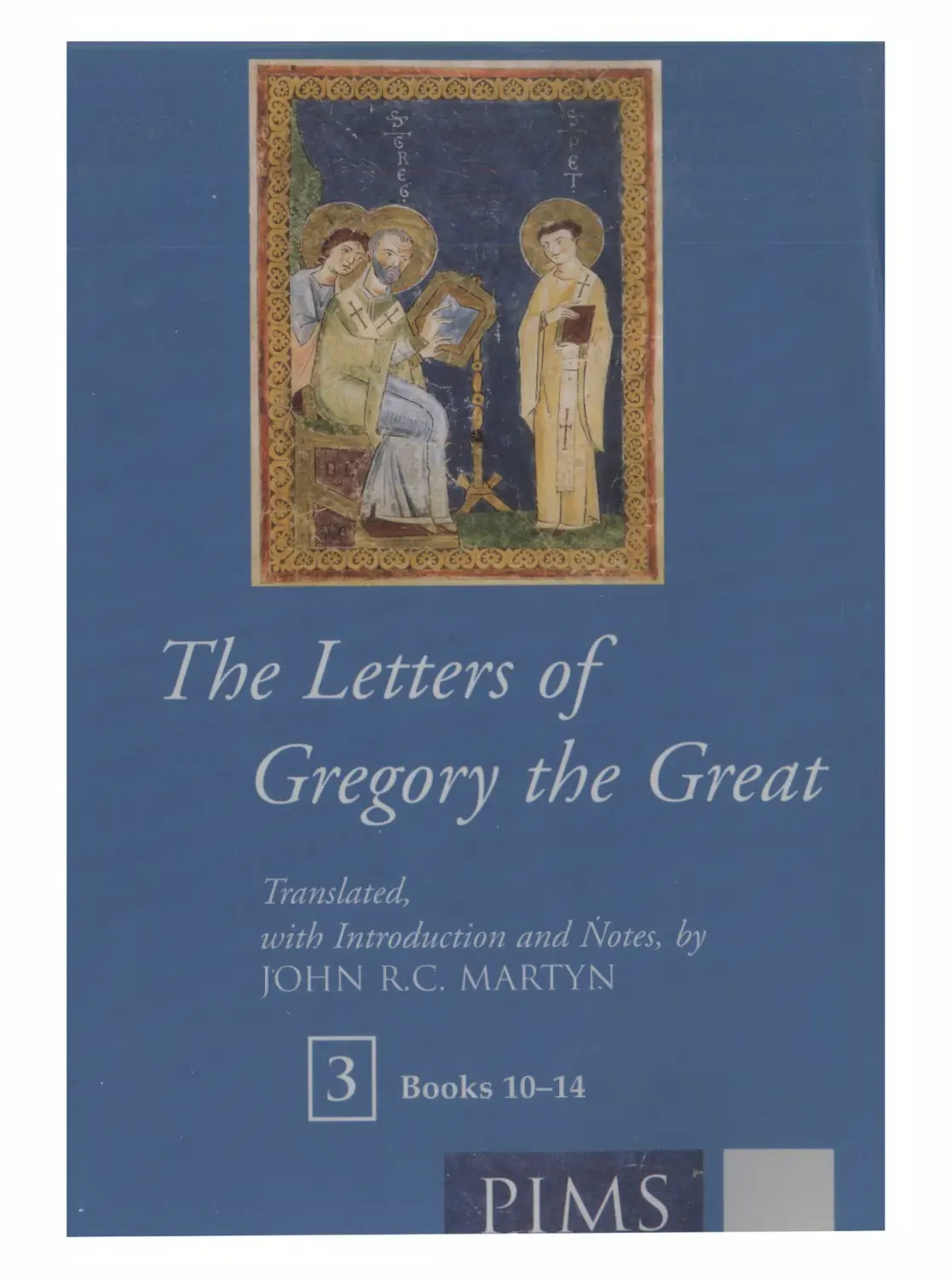
The Letters
of Gregory the Great
Translated, with Introduction and Notes, by
JOHN RC. MARTIN
Volume 3
BOOKS 10-14
PONTIFICAL INSTITUTE OF MEDIAEVAL STUDIES
LIBRARY A -r> ARCHIVES CANADA CATALOGUING IN PUBLICATION
Gregory I, Pope, ca. 540-604.
The letters of Gregory the Great / translated, with introduction and notes,
by John R.C. Martyn.
(Mediaeval sources in translation, ISSN 0316-0874 ; 40)
Translation of: Registrum epistularum.
Includes bibliographical references and index.
Complete contents: v. 1. Books 1-4 - v.2. Books 5-9 - v.3. Books 10-14.
ISBN 0-88844-290-4 (set)
1. Gregory I, Pope, ca. 540-604 - Correspondence. 2. Popes - Correspondence.
I. Martyn, John R.C. ll. Pontifical Institute of Mediaeval Studies m. Title. IV. Series.
BR65.G53R43132004
270.2' 092
C2004-903351-4
@2004
Pontifical Institute of Mediaeval Studies
59 Queen's Park Crescent East
Toronto, Ontario, C4nada M5S 2C4
.
www.puns.ca
PRINTED IN CANADA
Contents
Abbreviations and Sigla
Preface
. .
Vll
.
IX
The Letters of Gregory the Great
Book Ten
Book Eleven
Book Twelve
Book Thirteen
Book Fourteen
713
735
806
822
867
Appendices
Glossary
Bibliography
Index of Names
Inde ef Subjects
884
896
897
915
958
Abbreviations and Sigla
BIB Ill0NS AND BOOKS
Editions of the Bible cited in the notes include the Latin Vulgate, as well
as modem editions, abbreviated as below. With minor exceptions, citations
of books of the Bible follow the conventions of the N(w American Bible.
AV
NAB
Vulgate
Authorized (King James) version
New American Bible
Biblia sacra vulgata! edition is Sixti V pontificis maximi jussu
recognita et Clementis VIII auctoritate edita (Paris, 1844)
GREGORY'S LETTERS: EDITIONS, TRANSLATIONS, MANUSCRIPTS
The Registrum epistularum (Register of letters) is cited by book and letter
number. Citations to specific letters use the abbreviation Ep(P) through-
out. App refers to the Appendices in the third volume. Although system-
atic treatment of textual matters is beyond the scope of this translation,
the notes make reference to numerous readings in previous editions of the
Registrum as well as to manuscripts containing the letters. For ease of
citation, the following abbreviations are used. In textual notes, references
to MGH and to PL are to the editions of the Registrum in those respec-
tive series. Detailed information can be found in the Bibliography.
Editions and translations
Barmby SeltrteJ Epistles of Gregory the Great, Bishop of Rome, Books I-XIV,
trans. James Barmby (Oxford, 1895)
Gussanvillaeus Sancti Gregorii Papt:e Primi cognomento Magni opera, ed. Pierre
de Goussainville, 3 vols. (paris, 1675)
MGH (Ewald; Gregorii I papae Registrum epistolarum, ed. Paul Ewald and Ludo
Hartmann) Moritz Hartmann, Monumenta Germaniae Historica: Epistolae
1-2, 2 vols. (Berlin, 1887-1899)
Minard Registre des lettres, trans. Pierre Minard (with facing Latin text,
ed. Dag Norberg), 2 vols. (Paris, 1991)
Norberg S. Gregorii Magni Registrum epistularum, eel. Dag Norberg, Corpus
Christianonun Series Latina 140, 14OA, 2 vols. (fumhout, 1982)
PL S. Gregorii Magni Registrum epistolarum, Maurist edition (Paris,
1705), repr. in Patrologiae cursus completus, Series Latina 77:
442-1368
Recchia Lettere, trans. Vincenzo Recchia {with facing Latin text, ed. Dag
Norberg), 4 vols. (Rome, 1996-1999)
VIII
ABBREVIATIONS AND SIGLA
Manuscripts
For further information on the manuscripts see the list in MGH 2: vii-
xxvi and also in Norberg's edition 1: v-xii. A superscript C in some sigla
(such as Rl') refers to scribal corrections made by a second hand.
P -= Pa (pal, 2) and Pb (pbl, 2, 3, 4, 5, 6, 7)
Pal St Petersburg, Rossiiskaia Natsionalnaia Biblioteka, F.v.1.7 (8th century)
Pa2 Bamberg, Staatsbibliothek, Msc. Patr. 23 (10th century)
Pbl Cologne, Erzbischofliche Diozesan- und Dombibliothek, 92 (8th century)
Pb2 Vienna, Osterreichische N ationalbibliothek, Vindobon. lat. 934
(9th century)
Pb3 Diisseldorf, Universitats- und Landesbibliothek, B.79 (9th century)
Pb4 Berlin, Deutsche Staatsbibliothek zu Berlin-Preussischer Kulturbesitz,
Theol. lat. quart. 322 (9th century)
Pb5 Cologne, Erzbischofliche Diozesan- und Dombibliothek, 94 (10th century)
Pb6 Wolfenbiittel, Herzog August Bibliothek, 75 Gud. lat. (11th century)
Pb7 Munich, Bayerische Staatsbibliothek, Clm 14641 (9th century)
C II:: Cl, 2, 3
C 1 Cologne, Erzbischofliche Diozesan- und Dombibliothek, 92 (8th century):
see Pb 1 above
C2 Vatican City, Biblioteca Apostolica Vaticana, Pal. lat. 266 (9th century)
C3 Diisseldorf, Universitats- und Landesbibliothek, B.79 (9th century):
see Pb3 above
R II:: Rl,2,3,4
Rl Montecassino, Archivio dell' Abbazia, 71 (11th century)
R2 Trier, Stadtbibliothek, 171 (10th century)
R3 St. Gall, Stiftsbibliothek, 670 (10th century)
R4 El Escorial, Real Biblioteca de San Lorenzo, d.I.la (11th century)
r .. rl, 2
rl Paris, Bibliotheque nationale de France, lat. 2279 (10th century)
r2 Paris, Bibliotheque nationale de France, lat. 11674 (9th century)
e -= el, 2, 3, 4
el Milan, Biblioteca Ambrosiana, C 238 info (10th century)
e2 Paris, Bibliotheque nationale de France, nou. acq. lat. 1452
(10-11th centuries)
e3 Paris, Bibliotheque nationale de France, lat. 2278 (9th century)
e4 Trier, Stadtbibliothek, 170 (9th century)
H -= Hl, 2, 3, 4
Hl Paris, Bibliotheque nationale de France, lat. 1565 (10th century)
H2 Paris, Bibliotheque nationale de France, lat. 10741 (10th century)
H3 El Escorial, Real Biblioteca de San Lorenzo, d I 2, f. 338 (976 AD)
H4 El Escorial, Real Biblioteca de San Lorenzo, d I 1, f. 313 (992 AD)
Melb Melbourne, Potter Museum, Melbourne University (11th century)
Preface
The letters in this third volume cover the final four-and-a-half years of the
pope's life, from September 599 to March 604, again a mostly successful but
extremely painful period for the bishop of Rome. Most letters were sent in 599,
a very interesting fin de siecle, when the pope was still often confined to his
sickbed. Still, he ended the year with several long and highly significant letters.
The main themes of the letters in this volume were outlined in the Intro-
duction. During these late years of his life, it seems that Gregory's mind
remained as active as ever, but his body grew increasingly feeble as it was
attacked by spasms of intense pain, from worsening gout and fevers. Besides
a continuing interest and involvement in his ambitious missions, especially
those to Sardinia, Gaul and England, he did all he could to finish his reorgani-
zation of the Church's domains in Sicily, North Africa and Spain. He also
tried repeatedly to persuade John the Faster, the patriarch of Constantinople,
and his successor Cyriacus to give up the archbishop's claim to the title of
'universal patriarch,' which in the pope's opinion had proved so divisive,
although the Emperor Maurice did not share his concern. But this near obses-
sion was symptomatic of Gregory's desire to unite the entire Catholic Church
under the succession of Saint Peter in Rome.
Problems arose at this time with the church of Corcyra, but the pope left
their solution to his very capable emissary and deacon, Boniface, who had pre-
viously served as the head of the pope's defenders, an office that Gregory
created and which proved so effective in achieving good government on his be-
half throughout Italy and the provinces. Not long after Gregory's death, this
trusted and most experienced friend became pope himself, in February 606, and
followed his mentor's policies until his own untimely death in November 607.
This volume also contains Gregory's most important letters to the military
usurper of the throne in Constantinople, Phocas, who had murdered the
pope's old friend, Maurice, and all of his sons and his brother, and was set on
amassing a fortune from the richer courtiers, many of whom had become close
family friends of the pope while he was a young monk representing the pope
in Constantinople. Fortunately for the pope, he did not live long enough to
hear of the slaughter of Emperor Maurice's wife and of their three daughters.
But he had to compose a flattering letter to win over the new empress.
x
THE LE TTERS OF GREGOR Y THE GREA T
A long letter to the ex-consul Leontius (Ep 11.4) provides another import-
ant document in assessing the reaction of the pope to the murderous new em-
peror, Phocas. The appendix, with the Senate's restrained reaction to its reception
of the icons of Phocas and his wife, Leontia, is also included (App 8). There is also
a very interesting second draft of the pope's long letter to the learned anchor-
ite, Secundinus (see App 10 in this volume; the first appears as Ep 9.148). Like
the first two letters he sent as pope, the very last two of Gregory's letters were
also sent to his beloved province of Sicily, while he was extremely close to
death, but in this case to put an immediate ban on monks from sharing their
beds with young women in the monastery of Saint Vitus on Mt Etna.
It might interest readers when they reach Book 11, that it contains far the
longest of the pope's letters to any single individual, Ep 11.27, sent to
Theoctista, the sister of the Emperor Maurice and in charge of the education
of his seven children. It is almost 301 lines long in translation, and mainly
deals with heretics who were harassing the princess, just as they had worried
Gregory, it turns out, when he was a young monk staying in the palace, as the
godfather of the emperor's eldest son and heir, Theodosius. The preceding let-
ter is also very long (114 lines) and was sent to another close friend from
Constantinople, Rusticiana. Both are expressed with far more biblical quota-
tions than is usual, but these are skilfully adapted to the character of each lady.
But the longest of all the letters was the pope's initial encyclical to the four
patriarchs (and one retired one), namely Ep 1.24 (400 lines). The blueprint for
Peter's initial settlement of Sicily, Ep 1.42, takes up 242 lines and covers a wide
range of topics. Equally interesting is the other very long letter, Ep 5.53a,
which was sent to his fellow-spirit and dearest friend, Leander, and has 226
lines. It is the most autobiographical of all his letters and, as the Introduction
shows, describes the pope's early life as a monk in Rome and then an emissary
in Constantinople, where he wrote his commentary on Job and shared his exile
with this Spanish friend and fellow-intellectual. His own problems with heresies
are mentioned in Ep 11.27, where Greek theologians are seen pestering him in the
royal palace, a detail that helps somewhat to flesh out the stimulating intellectual
life that he must have led in that most resplendent royal city.
The third volume contains an index to all the proper names used in the
Introduction, and throughout the fourteen books of letters. For the most part,
modern names have been used, for the benefit of modern readers, although a
list of equivalents for many medieval place names is also provided. This index
corrects a great many errors and anomalies in the Index Personarum et
Locorum compiled by L.M. Hartmann for the MGH edition and the Index No-
minum in Dag Norberg's critical edition for the Corpus Ch(istianorum Series
Latina.
PREF ACE TO VOLUME 3
XI
Finally, students and scholars making use of these translations should have
access, if possible, to all three volumes, as the footnotes often refer back to the
Introduction, and many of the leading characters are active in two or all three
of the volumes. Likewise the major provinces and missions, and the reforms
of Church administration and of the monastic system, cover all three volumes.
Indeed, ,all three should be extremely useful for source material for any medie-
vali orking on the history or theology of the sixth to seventh centuries.
The fact that all of Saint Gregory's letters, encompassing over a thousand
pages of mostly Ciceronian Latin, have at last been translated into modern
English across three volumes containing an almost equal number of pages is
something of a miracle in the rush of modern academic life. The translation
was extremely time-consuming, and it certainly remains the main purpose of
this work, although an Introduction and some quite copious notes throughout
have been added, to help users to find their way around this large and mostly
unexplored body of historical evidence. For the Latin original, they will have
to rely on the critical edition by Dag Norberg, which is not without its diffi-
culties, as the reader of the notes to this translation will discover, but-which
was nevertheless reproduced unchanged by both Pierre Minard for his French
version of Books 1-2 and by Vincenzo Recchia for his recent Italian version
of all fourteen books.
BOOK TEN
10.1 Gregory to Romanus, defender of Sicil y l I September-October 599
There is no advantage in punishing the sins of priests and in penalizing them
for th rimes by demoting them, if for those who are demoted when found
guilty of a crime, the loss of their rank should begin to be a comfort and a
profit for their fall. Thus T rajan, 2 our brother and fellow-bishop, has com-
plained to us that a certain Lucillus,3 once bishop of the island of Malta,
although terrified by the iniquity of his shameful act, removed property
belonging to the church of which he had become not the bishop, but rather
its enemy. Moreover, he kept a lot that accrued to the same church from past
bishops. In fact, he managed to spend nothing on its fabric and on repairing
its buildings, but sacrilegiously endeavored to embezzle all of it into his own
savings. And because it is extremely serious and contrary to God that his
demotion should not be a punishment for him but an advantage, let your
Experience warn him strictly that he must restore without delay items he has
removed and still has in his possession from former Church property. And if
perhaps he should wish to deny the wickedness of which he has been accused,
since it is said that he" can easily be convicted, join with our most reverend
brother and fellow-bishop, John,4 who resides at Syracuse, and investigate the
truth of this matter with a very careful inquiry. See that he openly restores
whatever he has clearly removed or concealed, blushing with embarrassment
over what he secretly stole without any shame. Peter, the son of the aforesaid
Lucillus, is also said to have removed many items from the above-mentioned
church. You must therefore take care to advise him to restore them, having
consideration for what is right. Otherwise, he should also be presented for
your judgment, so that by considering the matter very carefully, both their
cases might be decided with a single judgment.
Furthermore, our above-mentioned brother, Trajan, has requested us that
four or five monks ought to have been given to that place from his monastery,
which is situated in the city of Syracuse. In our opinion, this request for some
1. For the all-important Romanus, see Ep 9.22. He plays a major role at the stan of this
book (Epp 10.1, 3, 4, 12).
2. For Trajan, see Epp 5.20 and 13.20. He had been a monk in his family's monastery
in Valeria before being driven out by the Lombards. Fleeing to Syracuse, he later became
abbot of a monastery there. In February 595, he was one of the candidates for the important
see of Syracuse, but the pope's preferred candidate, Bishop John, was elected. Trajan was
later made bishop of Malta, by October 599.
3. For Lucillus, see Epp 2.36; 9.25. He had been bishop of Malta, but failed to pay taxes
on Church land in North Africa, and was guilty of other cases of financial misappropriation.
He was removed from this office by October 598.
4. For John, bishop of Syracuse, see Ep 9.16.
714
THE LETTERS OF GREGOR Y THE GREA T
relief as he sets out for a land that he does not know should not be denied
him. For if he does not have men he already knows, whose support he can
rely on, his mind will be affected by sadness and will not arouse him enough
to be of any benefit, and will begin to give in even before he gets to work. In
this case, so that we should not appear to diminish the prerogatives of the
privileges of our above-mentioned very reverend brother, John, you will know
that this concession has been made to him, but entirely subject to the judg-
ment of our brother and fellow-bishop, John. Our aforesaid brother had added
to his request that he should be allowed to remove the young slaves bought
with his own money and the manuscripts belonging to him and his father, or
any other objects owned by him that he has in that monastery. To refuse this
seems unreasonable to us. But in case we should appear to be giving in to his
demands indiscriminately, know that this observance should be kept, that is,
that he should be at liberty to remove whatever he bought or acquired by legal
means, after he was demoted from the position of abbot. And without any
doubt, he should also have returned to him what he removed and took with
him from that monastery in which he became a monk, as he left it when
driven out by the enemy. For it is well-known that his father built that mon-
astery in the province of Valeria, on his own property. But since what belongs
to one party cannot simultaneously be owned by someone else, he must realize
that whatever he acquired while he was acting as abbot, since it was at one
time associated with his rule over the monastery, belongs not to him but to
that monastery. Thus we do not allow the removal of anything else from the
control of that monastery. Now Capitulina,5 who founded the above-men-
tioned monastery, decided by means of her last will that the aforesaid brother
of ours should inherit her annual bequest over the same monastery. And so,
with your Experience's support, let him receive this without any delay, with
justice on his side.
10.2 Gregory to Sabinus, regional sub-deacon 6 I September-October 599
Since what among the laity is a mere fault, is generally a crime for those in
holy orders, anyone who zealously upholds what is right knows very well
how strictly a sinful act should be punished. For indeed, it has been brought
to our attention by the report of certain men that Sisinnius,7 a priest of the
city of Reggio - and this is quite intolerable even to hear - venerates and
worships idols, to the extent that he dared to have some idol placed in his
home. Moreover, they say he is polluted by the crime of sodomy, which is
5. For the many wealthy ladies who, like Capitulana, founded monasteries and con-
vents, see the Introduction, pp. 8-9.
6. See Ep 9.111.
7. Not to be confused with the Sisinnius in Ep 8.3, the defender of Messina. Some of
the defenders were priests, but this idol-worshipping sodomite in Reggio was not one. It
appears to be a unique case.
BOOK TEN
715
similarly wicked. And so, since the iniquity of such a great crime needs to be
investigated with a strict and very careful investigation, and punished, we
hereby authorize you to look into it fully with earnest vigilance and diligent
care, and if you can obtain any proof of this charge, then place him in strict
custody while you report back to us, so we may consider how such a mon-
strous crime ought to be shattered and punished. And know that this case is
wi t doubt going to show your earnest Zealousness what sort of person
you are as you face these most wicked of crimes. You will know that in our
sight, you are either highly recommended for your concern over this matter,
or accused for your neglect, to your peril. Therefore, you must to be keen to
show yourself so vigilant in this examination that you please us over your
solicitude and make God pleased with you.
This also has been announced to us concerning the priest mentioned
above. Victorianus, a former priest, had entrusted him with the care of various
items and ornaments from his service, and some money. Sisinnius denied the
deposit, and so a trial was held and Sisinnius was convicted and ordered to
return the deposit. And he put off restoring what he had been ordered to give
back, and meanwhile the priest, who is said to have deposited it, died. But
now his children are apparently in trouble through need. Let your Experience
inquire into this diligently, and bring this case to a reasonable conclusion. If
things are as I have heard, ensure that he does not falsely retain the other
man's goods, and that the orphans receive what is theirs, even though their
father is dead. 8
10.3 Gregory to Bishop Marinianus 9 I October 599
If the complaint of the bearer of this letter, that most famous gentleman,
Stephen,10 has some basis in truth, your Fraternity must understand that we
are extremely distressed by the fact that you have been so sluggish and
indolent that we heard of the wickedness of a deed before its punishment.
Stephen complained that a certain Peter,11 an extremely wicked man, had
finally persuaded one of Stephen's female relatives, with diabolical intent, to
leave her convent. Our notary, Gratiosus, subsequently recalled her to the
convent she had left, and got her to put on her habit again, but an extremely
wicked man again used unfair techniques to lure her from the convent once
more, and until now he has been keeping her shamelessly in his house. For
this reason your idleness has greatly distressed us, as we have said, as she has
not yet been recalled and reinstated in her convent.
8. The identity of Victorianus is unknown. Here, as is usual, the orphans are most
important to the pope, just as much as the priest's punishment for his heinous sins.
9. This Marinianus was bishop of Porto Torres in Sardinia: see Epp 1.59 and 9.11, 203.
10. Not the deceased Stephen associated with the church of Cagliari in Sardinia (Ep 4.10).
11. We know nothing about this evil Peter, or about the pope's notary, Gratiosus.
716
THE LETTERS OF GREGOR Y THE GREA T
Even now, therefore, let the consideration of your rank and the zeal of
your Chastity inflame you greatly to strive in every possible way to be able
to mitigate the ill-will that we have stirred up, thanks to the perpetration of
such great wickedness, with a quick correction. For we have also advised
Vitalis, the defender, 12 not to hesitate in offering you support in this case.
But since the Peter mentioned above is apparently represented by an agent of
our son, the magnificent Philoxenus, you must earnestly appeal to him, with
all passion and love, to restore her without any postponement. We believe that
he will see to this without delay, because he is said to be a thoroughly good
man. But if there is some inexplicable delay, which I do not believe will
happen, then he must be called to witness publicly even, and your Fraternity
should report back to us on this matter. Thus we could then write to the
royal city asking that that offence which manages to escape being punished as
it should be, might receive its just retribution.
10.4 Gregory to Romanus, defender of Sicily I September-October 599
It has been reported to us that our most reverend brother and bishop, Basil, 13
is occupied in law cases as though the last man there, and attends in the praetor's
courts quite pointlessly. Since this behavior both demeans that man and destroys
the reverence due to a priest, your Experience should, on receiving this order,
compel him with a strict indictment to return, insisting that he is not allowed to
delay there for more than five days, whatever his excuse. Otherwise, if you allow
him to delay there in any way, I shall begin to hold you liable as well as him.
Month of November, third indiction
Month of December, third indiction
Month of January, third indiction
Month of February, third indiction
10.5 Gregory to Gudiscalc, duke of Campania 14 I February 600
The concern of those in charge is beneficial and their caution is laudable, when
all their actions are controlled by reason and irrationality has no hold over
them. Therefore, power should be restrained by reason and nothing should be
done if one's mind is aroused before it returns to tranquillity. For as long as
he is agitated, an angry person thinks that what he has done is just. 15
-
12. This defender controlled the papal patrimony in Sardinia (see Epp 9.2, 124, 204).
13. For this over-litigious bishop of Capua, see Ep 9.73.
14. It seems that Gudiscalc succeeded the general Maurentius as duke of Campania. His
name suggests a Germanic origin.
15. Gregory is prone to moralizing at the start of his letters, here underlining the danger of
uncontrolled anger for a man in authority, in this case a duke who breaks into a monastery to
apprehend an abbot, some of whose monks have deserted, it seems. The pope's parallels on
blaming third parties reminds us of his own legal training, and he neatly shows the duke's
culpability over his own soldiers deserting.
BOOK TEN
717
And so it has come to our attention that your Greatness has been so
driven by the impetus of fury that not only did you have the doors of the
monastery of the Holy Archangel broken open, but also had what was found
inside removed. Moreover, you are said to have been so angry with the abbot
of that monastery that, if he had not concealed himself and remained hidden
while you were in a rage, he would have been in serious danger. As a direct
resu!7.he is terrified by fear of you, and until now he would not dare to leave
thenouse to which he retreated some time ago.
And in case you might appear to have done this fruitlessly, we have heard
that you are bringing a charge against that monk of handing himself over to
the enemy. And if that is so, we are most upset and quite astounded by your
cunning. For if you think it legal that the fault of others should be damaging
to a third party, then many people might be subjected to this charge. For the
slaves of various noblemen, the clergy of many churches, the monks of various
monasteries and the servants of many judges have frequently handed them-
selves over to the enemy. Therefore, if this is true, certainly the masters of
these slaves, the bishops of these clergy, the abbots of these monks and the
judges owning these various runaways are. all at fault and liable for this charge.
In the days of your Greatness, did not many soldiers slip away in flight
to the Lombards from the city in which you lived? And who could be found
so entirely indiscrete and totally stupid as to imagine that their wickedness
should be applied to you? Therefore, consider this carefully and think of the
cases you bring against others, and do not be led by false suspicions into antag-
onizing people. But if there is someone who could say something about the
abbot of the aforesaid monastery that might suggest fault and guilt on his part,
we do not want this to be ignored, but rather we want the case to be
examined strictly and carefully in every way, together with those who are in
fact involved in it, so that he is either punished if guilty or absolved by the
truth if innocent. And if no one can be found to assert against him what you
alone charge him with, we exhort you, magnificent son, to refrain from oppos-
ing the above-mentioned monastery and that abbot, but rather to show your
love for him, for God's sake. And if there is anything whereby your feelings
may have been offended, send it for us to mediate for you, and adapt yourself
rather to helping them, as befits Christians and people with good sense, so that
we might thank you and you might acquire a reward before our almighty
Lord in return for the comfort you have given to His servants.
10.6 Gregory to Clementina, patrician 16 I March 600
Glorious daughter, you should know that the priest Amand has been elected
as bishop of Sorrento. And because we wrote that he ought to be sent here,
16. Clementina clearly had a lot of influence in Church appointments, in this case over the
promotion of an old friend to the see. As the next letter shows, the sub-deacon is to inquire into
his character, helped by Fonunatus, bishop of Naples, and if he is suitable, Clementina must be
visited and told, but Amand is to be sent anyway: see Epp 1.11, as well as 3.1 and 9.86, also sent
to Clementina. Sorrento long remained a basis for Byzantine power in the Campanian region.
718
THE LETTERS OF GREGORY THE GREAT
you should not be upset over his absence, as you cannot believe that one who
is in your thoughts has really left you. And since the man who pleased you
some time ago is now welcome to those seeking a bishop, bless almighty God and
rejoice all the more over this with Christian devotion. Joyfully take care that he
may quickly come to us to benefit others, because it is a sign of sincere love to be
joyful when he who is loved is called for this purpose, that he may grow.
10.7 Gregory to Anthelm, sub-deacon of Campania 17 I March 600
After the priest elected to the bishopric of the city of Sorrento appeared
unsuitable to us, they elected Amand,18 who was a priest of the oratory of
Saint Severinus, situated in the castle of Lucullus. For that reason we advise
your Experience to be keen to send over that priest to us with all speed and
without making any excuse, so that the desires of those seeking him may be
fulfilled with Christ's help, if there is nothing to stop him. But first take care
to make a diligent inquiry about him, together with Fortunatus,19 our
brother and fellow-bishop, since the way of life and actions of Amand can be
known better there, where he has lived for a long time. And if there is
nothing that might prevent him from reaching that holy rank, he should be
sent over to us without any delay. And so that our glorious daughter, Clemen-
tina, does not take offence, your Experience must go to her and carry this out
with her support. But if she is perhaps unwilling to support the move, then
let your Experience send him over here, as we have said, without delay. For
the minds of our children should be placated in such a way that the benefit for
souls should not be prevented. 20
10.8 Gregory to John, praetorian prefect of Italy21 I March 600
Whatever is given to the poor, if it is judged with ca eful consideration, is not
a gift but a loan, because what is given is certainly recovered with compound
interest. And you wrote to us saying that we should tell Dulcitius, a magni-
ficent gentleman who is acting on your behalf, not to dare spend any amount
over a representation. 22 And although it may be laudable to look to the
future, yet caution is totally ineffectual if it is not strengthened with the help
of piety. Thus in this concern of yours, we discovered what was not certain
17. For Anthelm, administrator of the Campania patrimony, see Ep 9.106.
18. See the previous letter for this candidate and his friend, the aristocratic Clementia.
There may be word-play on Amand(us]' name ('lovable'), with 'pleased you,' 'sincere love'
and 'who is loved' above, and 'desires' here - an innocent 'love' of course.
19. For this bishop of Naples, see Ep 9.105.
20. One wonders if Anthelm was as tactful as the pope, although it seems certain that
Clementina stayed with her candidate.
21. For this John, see Ep 9.5.
22. The rare word, OUXrlnrWULP, was a rhetorical term for a 'description' (Martianus
Capella, De nuptiis Philologiae et Mercurii 5.524). Gregory studied rhetoric for five years as
pope, including Greek rhetoric.
BOOK TEN
719
on your part. Thus it is said that your Eminence has withdrawn the corn
supply and customs of the deaconries 23 employed at Naples. And this would
have been less astounding, perhaps, if they had not been administered at the
time of your predecessor, John. And so, if that man, whom all know was
responsible for a really unpleasant action, has not denied it, you should wisely
consider what it means if an evil man were to overcome you, even in some
good yrk. For it was not right for you to withdraw it for any reason. But
if perhaps no one was willing to charge this to your account, it should not
overburden you to supply it from your own resources, so that piety of this
sort might be a patron in your assistance that had been a servant in your
work. Therefore, your Eminence should examine this with every means
possible, and should prefer to show the generosity of your goodness, so that
the rights that were not withdrawn under your predecessors might be
administered in the usual way. Thus you should not incur any adversity in
what you do following our order, and so that the administration of this office
may both provide praise for you before your fellow men, and prepare a reward
· for you before almighty God.
10.9 Gregory to Fortunatus, bishop of Naples 24 I April 600
While your Fraternity is attempting to reduce your responsibility for the
monasteries under your control, you are both incurring the risk of a repri-
mand and saddening us over your lack of firmness. For it has come to our
attention that a certain Maurice, who recently became a monk in the monas-
tery of Barbatianus, has fled from that monastery, taking other monks with
him. In this matter his haste i to us a strong indictment of the aforesaid
Barbatianus, who rashly tonsured a secular man without probation. Did we
not write to you that you should first put him on probation, and if he was
suitable, you should then appoint him abbot 5 Even now, therefore, show
concern over the person whom you chose. For you are transgressing as he trans-
gresses, if he has begun to reveal himself as unworthy to control his brethren.
Furthermore, your Fraternity must prohibit all the monasteries more
strictly from even daring to tonsure those whom they have received for conver-
sion before they have completed two years in a monastic way of life. 26 But
during this time, their way of life and morals must be carefully tested, in case
any of the is no longer happy with his former wish or disapproves of what he
23. The Greek word, OLaICOJlLa, rare in Latin, was a religious term for the 'deaconries'
that looked after poor relief. The pope regularly supports the interests of the poor, and here
he roundly condemns this blow to the poor by John's agent, Dulcitius.
24. For Fortunatus, the bishop of Naples, see Ep 9.105.
25. See Ep 9.12, where Gregory sends this monk to Naples as a possible abbot, pending
his probation, warning the bishop against the monk's arrogance.
26. This is what was known as the monastic 'novitiate.' The two year period had been
legislated by Justinian (Nowllae 5.2; 123.35), but the Rule of Saint Benedict 58 allowed one
year. This is an aspect of the Rule not accepted by Gregory.
720
THE LETTERS OF GREGORY THE GREAT
chose originally. For although it may be serious for men to be placed under the
control of others without first being tested, who could say how much more
serious it is for men to be attached to the service of God without first being tried?
If a soldier should want to become a monk, before the matter has been
reported to us,27 and we have given our consent, let no one presume to
accept him for any reason. And unless this rule is carefully maintained, know
that all the guilt of your subjects devolves upon you, inexcusably, as the facts
prove that you could not care less about the welfare of your charges.
10.10 Gregory to Zittanis, a general 28 I May 600
I hereby inform you that I have received your letters, dictated in the Greek
language,29 in which you say that certain religious places refuse to answer
public law over matters appropriate for it. This attitude has completely dis-
tressed me, because it is our habit not only to avoid prejudice totally, but also
to endure what is done with equanimity, unless perhaps we are forced to
defend the property of poor people with good reason, so that we should not
be found guilty before almighty God. Therefore I have sent over to your Glory
what I wrote to my defender Fantinus,30 that he should compel all of his reli-
gious people in the district of Palermo to come before elected judges, and to give
an account of their own activities. May almighty God provide you with his gift
of heavenly mercy, so that you serve his grace throughout all that you do.
10.11 Gregory to Constantius, bishop of Milan 31 I May 600
After reading the letters again that you sent through Marianus, the bearer of
this letter,32 we replied that your concern over us was welcome, because you
were quite unwilling to conceal what had reached you concerning our brother
and fellow-bishop, Pompey, who still needs to be so nominated by us. 33 But
if there had been as much subtlety in discussion as there had been concern in
the inquiry, nothing of what was said about him would have been ambiguous,
but whether it was true or concocted would have been revealed. For just such
an inquiry had already been moved against him some time ago in Sicily, before
our brother of reverend memory, Bishop Maximian. 34 But because his case
27. See Ep 8.10.
28. From the context, Zittanis held a military command in Sicily, and here is asked to
support the defender of Palermo, Fantinus, in defending the property of the poor.
29. The inhabitants of Sicily used both Greek and Latin, but Zittanis may well have
been a Byzantine general. Gregory read his Greek letters without any trouble, it seems. See
the Introduction, pp. 102-103 for his knowledge and use of Greek.
30. For this important defender of Palermo, Fantinus, see Ep 9.8.
31. For Constantius, bishop of Milan, see Ep 9.150.
32. For Marianus, defender of the church of Milan, see Ep 7.14.
33. It seems that Pompey was consecrated as bishop without first obtaining the pope's
approval. Gregory normally insisted that any bishops for his suffragan sees should first
receive his approval. Pompey's character explains why he failed to do so.
34. For Bishop Maximian, see Ep 9.92.
BOOK TEN
721
was inquired into with an extremely detailed investigation, he was cleared of the
crime with which he was charged. Now, therefore, since what was said against
him was not inquired into or handled with due strictness, and the charges
subsequently lodged before your Fraternity could not be proved sufficiently either
for his condemnation or for his absolution, it is a very serious business that the
decision should have been made so carelessly and cursorily. For it is extremely
serio d improper that a definite opinion should be given over a matter in
doubt. And these deeds could in fact be suitably explained if a confession by the
accused followed, but if a very careful examination extracted the same confession
from hidden sources and it was not extorted by any violent pain, that frequently
brings it about that even the innocent are forced to confess their guilt.
For after the aforesaid bishop, as they say, asserted that he was tormented
by his custody and consumed by famine, if that is so, you should know if it
is harming him. But if his confession has been extracted in this way, surely
when such cases have a sentence and are called to the apostolic see, is not the
person who is being judged present there, and is not the truth sought with
very great strictness and from every angle, so that it might then be decided
whether the sentence should stand or not? Moreover, if the aforesaid bishop
also wanted to appeal to the apostolic see, his case must be scrutinized
internally and with all diligence. And for that reason, as that person is absent
and the actions that you sent over to us, as we said before, do not appear to
be truly satisfactory, we neither should nor can decide anything about the
bishop's person, in case (Heaven forbid!) we are found blameworthy among
our people, who agree to withdraw the sentences of other men by law.
As for what was indicated to you about the Germans,35 we have stayed
further north than you and we have no doubt at all that it is untrue. But your
Fraternity did well to write what you heard for our information. 36
Month of June, third indiction
10.12 Gregory to the ex-praetor, Libertinus 37 I June 600
Weare well aware how much you are being oppressed by a shortage of
worldly goods. But since for those placed in the greatest tribulation the only
consolation is the Creator's mercy, place your hope in him, turn yourself to
him with all your mind, as he justly lets whom he wants to be afflicted, but
35. In Latin Alamanni, the tribes on the upper Rhine, used by the Gauls for 'Germans.'
The 'we lived' is positi sumus' ('we were placed'), and 'north' is added to longius ('further')
from the German context. Gregory says that he knew first hand what was going on there.
See John R.C. Martyn, 'Six Notes on Gregory the Great,' Medieulia et Humanistica n.s. 29
(2003): 1-25, esp. 21.
36. This is one of the few autobiographical remarks in the letters, and it suggests that
Gregory may have visited Gaul not long before this letter. If so, no scholar working on Gre-
gory or his time has noted it. The pope never talks about his trips, even within Italy, and
it is most unlikely that he never left Rome. From his very detailed knowledge of the island,
he seems to have visited Sicily; see the brief biography in the Introduction, pp. 1-2.
37. For Libertinus, see Epp 3.37; 5.32; 7.19; 9.5, 28.
722
THE LETTERS OF GREGORY THE GREAT
with his mercy will free whoever trusts in him. And so, offer thanks to him
and patiently endure whatever is inflicted on you. For it is a sign of a right
mind not only to bless God in prosperity but also to praise him in adversity.
Therefore, in these things that you are suffering, let no murmur against
God steal into your heart, for no one knows for what purpose our Creator
does this. For perhaps, my magnificent son, you somehow offended him when
prosperous and so he wants you to be purged by kind bitterness. And for that
reason do not let earthly affliction break you down or the loss of goods
torment you, because if in adversity you offer thanks and appease God with
your patience, then what you have lost is returned multiplied, and moreover
eternal joys are guaranteed.
But I beg you not to be offended that we have ordered twenty garments
a yea 8 to be provided for your boys, through our defender, Romanus,39
because what are offered from the goods of Saint Peter the apostle, however
small they may be, should always be received as a great blessing, since he will
be able to bestow greater things on you here, and provide eternal benefits
before almighty God.
10.13 Gregory to Ecclesius, bishop of Chiusi 40 I June 600
Our glorious son, Ansfrid,41 has sent a letter to us, indicating that in the
Castle of Balneum Regis 42 he and the inhabitants of that place have chosen
a deacon, John, to be consecrated as its bishop, and he has testified that John's
life is entirely good. But because they are not conversant with the Church
canons and we do not dare to lay our hands rashly on unproven and unknown
men, your Fraternity should be keen to inquire with all carefulness and
vigilance into the way of life and actions of this priest in whatever different
ways you can. And if no objection could be made against him on canonical
grounds, it should be asked also if he has been keen in working for God and
knows the psalms. 43 And if he is such a person, send him to us with a letter
from him giving proof of his willingness. But if he proves otherwise, indicate
it to us similarly with your letters, and exhort the inhabitants of that place if
that man is unsuitable, as we have also written to our son the aforesaid
38. Norberg has R1's annonas ('provisions') obelized, but annuos ('annual') in e2 (annos
el) makes good sense. The boys were slave-boys, their master very hard up.
39. For this defender, see Ep 9.22.
40. For Ecclesius, the bishop of Chiusi, see Ep 11.3. His diocese was in Etruria, in the
frontier zone between the Byzantines and Lombards.
41. Ansfrid was probably a military commander, active in the duchy of Perusina. His
name suggests a Germanic origin. He only appears here, but affairs in this duchy frequently
occupied Gregory's mind (see Epp 1.58; 5.36; 9.117).
42. The castle of Balneum Regis later fell to the Lombards; see Paul the Deacon Vita
Gregorii 4.32.
43. A sound knowledge of the Psalms was one of Gregory's prerequisites for promotion
to an episcopate: see Epp 5.51; 12.4; 14.11 and Martyn, 'Six Notes,' 15-17.
BOOK TEN
723
Ansfrid 44 that they should select another candidate for themselves, who
might be found suitable for this office, by the grace of God.
Month of July, third indiction
10.14 Gregory to Eulogius, patriarch of Alexandria 45 I July 600
In the past year, I have received most charming letters from your Holiness, but
I was-utiable to reply to them until now, due to the extreme nature of my
sickness. For look, the second year has now almost ended of my confinement
to my wretched bed,46 suffering from such painful gout that, on feast days,
I can scarcely get up for a space of three hours to celebrate solemn Mass. And
soon I am forced by my severe pain to lie down again, so that I may tolerate
my torment, while shaken by groans. My pain is sometimes moderate and
sometimes extreme, but neither moderate enough to recede nor extreme
enough to kill me. From this it comes about that, while I am facing death
every day, I am held back from death every day. And it is not surprising that
I have long been kept shut in a prison of bodily decay, being such a great
sinner. And so, I am compelled to exclaim: 'Lead my soul out of prison, so
that I may confess your Name.,47 But as I do not yet deserve to obtai_n this
with my own prayers, I beg you, let the prayer of your Holiness provide me
with the help of your intercession. Release me from the heaviness of my sin
and corruption, in that freedom of the glory of God's children that is well
known to you.
But your Beatitude, so sweet to me and always to be honored, has notified
me that our common son, the deacon Anatole, had written to you from the
city of Constantinople, saying that the monks of some monasteries had come
to me from the region of Jerusalem, to make some inquiry from me about the
error of the Agnoetae. 48 And you say that he asked your Holiness to write,
asking me what you should feel about that inquiry. But no monks came to me
from the region of Jerusalem asking about anything. I do not suspect that the
same common son could have written to you anything but the truth, but I do
suspect that the interpreter made a mistake in the deacon's letter. For the same
deacon, more than two years ago now, wrote to me that monks had come
from that same region to the city of Constantinople, making such inquiries,
and he was keen to ask me what I felt. And a long time before I had received
44. This letter to Ansfrid has not survived.
45. For his dear friend Eulogius, see Epp 1.24; 5.41; 6.61; 7.31, 37; 8.28, 29; 9.176. The
content of this letter is very close to that of Ep 10.21, suggesting a first draft. Gregory
regularly revised his literary works, including some of his letters (see Epp 11.37 and 56).
46. The diminutive lectulo suggests not a 'small bed,' but the pope's aversion to it.
47. Ps 141 (2):7.
48. The Agnoetae, or Themistiani, were connected with the sixth century Monophysite
controversy, led by a deacon of Alexandria, Themistius, who preached the limitation of human
knowledge of Christ. Eulogius wrote a treatise against this heresy, extracts of it being quoted by
Photius. The patriarch of Jerusalem, Sophronius, pronounced the anathema against Themistius.
724
THE LETTERS OF GREGORY THE GREAT
your letters, I made the same reply to him against the same heresy as I found
afterwards in the letter of your Holiness.
And I have offered great thanks to almighty God, that concerning all such
inquiries, the Fathers of the Romans and the Greeks, whom we now follow,
have spoken with one spirit. For in many ways I found that the same letter
of yours was just like reading the writings of the Latin Fathers against the
aforesaid heresy. And consider how much I could love and praise the goodness
of my most holy brother, in whose mouth I have recognized the venerable
Fathers, whom I greatly love. Therefore, praise be to Him and glory in the
Highest, by whose gift the voice of Mark still cries out in the see of Peter. 49
And from the effusion of his spirit, when the priest enters the holy of holies
to search for the mysteries, of course, spiritual bells then resound in the sacred
church, as if in the tabernacle, from the words of the preaching. And your
preaching is righteous, therefore, and extremely laudable. So we pray our
almighty Lord to protect you for a long time, even in this life, so that from
the organ of God, which you are, the voice of truth may resound more widely
in this world. And intercede on my behalf, I beg you, asking that the path of
this fcilgrimage, that has become too bitter for me, may quickly reach its
end. 0 Thus, since I cannot do so through my own merits, I may through
yours be able to attain the promises of an eternal homeland and to rejoice
with the citizens of Heaven.
10.15 Gregory to Maxirnus, bishop of Salona 51 I July 600
Our common son and priest, V eteranus, 52 came to the city of Rome and
found me so weak from the pains of gout that I was in no way able to reply
to your Fraternity's letters on my own. In fact I am very much afflicted and
disturbed over the race of Slavs that threatens you so greatly. I am afflicted by
the suffering that I share with you, and I am disturbed that the Slavs have
already begun to enter Italy through the Istrian approach. 53
As for the recruiting-officer, Julian,54 what should I say, when I see (since
our sins come to haunt us) that we are disturbed everywhere both by nations
49. The patriarch of Alexandria was held to be the vicar of Mark just as the bishop of
Rome was held to be the vicar of Peter.
50. As with the release above from the 'heaviness of my sin' this prayer for an end to
his bitter pilgrimage underlines the intensity of the pain he was suffering in his legs and
stomach during the last five years of his life.
51. Gregory had by now forgiven the penitent Maximus for all his sins. The Slavs were
a real threat to Italy, through the Istrian peninsula (frieste approach). See Michael Whitby,
The Emperor Maurice and His Historian (Oxford, 1988), pp. 114-115. See Ep 9.155 for Callini-
cus' successes against the Slavs, as Whitby shows. He was the first modern scholar to make
some use of Gregory's letters to show the developments in the Balkans. For the pope's
quarrel with Maximus, see Epp 4.20; 5.6, 39; 6.3, 25; 8.34; 9.150, 155-156, 178-179, 231, 234.
52. Veteranus will appear again in Ep 13.8.
53. Their entry into Italy was not for long, perhaps turned back by Callinicus.
54. For the 'magnificent' Julian, see Ep 5.29. A senior officer in the army, it seems.
BOOK TEN
725
without and by judges within? But do not be totally dejected by such things,
because those who live after us will see worse times, so much so that in compari-
son with their own times they will think that we had days of bliss. 55
But as far as your Fraternity is able, you should present yourself on behalf
of the poor, and on behalf of the oppressed. And even if you are unable to
benefit them at all, the devotion of your mind that you have given him is
suff!gent for almighty God. For it is written: 'Deliver those that are drawn
unto death, and cease not to free those that are ready to be slain.' 56 But if
you should say, 'My powers are not sufficient,' He who looks into our heart
understands it. Therefore, in everything that you do, aim to win the support
of Him who looks into your heart. Do not fail to do whatever is needed to
please him, for human terrors and graces are like smoke, that vanishes when
caught by a light breeze. Know this with absolute certainty, that no one can
please God and wicked men. And so, let your Fraternity consider that you
have pleased almighty God just as much as you will learn that you have
displeased sinful humans. But let your defense of the poor be moderate and
serious, so that men do not think that you suffer from the pride of youth, if
we do anything too rigidly. But our defense on behalf of the oppressed must
be found to be of such a sort that the humble may feel protection and the
oppressors may not easily find something to blame with their malevolent
minds. Attend, then, to what is said to Ezekiel: 'Son of man, unbelievers and
subverters are with you, and you dwell among scorpions.,57 And the blessed
Job says: 'I was a brother to dragons, and a companion to owls.,58 And Paul
says to his disciples: 'in the midst of a crooked and perverse nation, among
whom you shine as lights in the world.,59 We should walk much more cau-
tiously, therefore, as we know that we are living among the enemies of God.
With regard to the Frontinianists,60 your Fraternity must be extremely
concerned and must endeavor, as you have begun, to recall them to the bosom of
the Holy Church. But if any want to come to me to receive an explanation, let
them first swear an oath that they would not permit their people to persist in
their error, even after receiving the reason. Afterwards, let your Holiness promise
them that they are suffering no violence from me, but that 1 am giving an expla-
nation. H they recognize the truth, let them accept it, but if they do not do so, 1
shall dismiss them unharmed. But if any of them want to come to us to attack
you, your Fraternity must not detain them. For when they come, they will either
accept the explanation or you can be sure that they will never see that land again.
55. Gregory's frequent apocalyptic theme of an imminent end to the corrupt world does not
agree with his vision here of a more miserable future.
56. Pry 24:11.
57. Ez 2:6. Gregory read increduli and subversores for the prophet's 'briars and thorns.'
58. ]b 30:29.
59. Phil 2:15.
60. These schismatics followed Frontinianus, who had refused to subscribe to the three
Chapters. They were most active in the Salona region.
726
THE LETTERS OF GREGORY THE GREAT
10.16 61 To Innocent, praetorian prefect of Africa I July 600
The splendid eloquence of your Eminence, seasoned with the sweetness of
your heart, has so poured its taste into the depths of our heart and has so
seized us with love for it, that what you write sounds charming to us and
what you do has a sweet savor. And this is with good reason, as one who is
adorned with his good studies is great in men's judgment, not in their par-
tiality. But learning that you have taken on the military service 62 of the pre-
fecture, our sadness is mingled with joy. For on the one hand we are delighted
over the promotion of our most charming son, but on the other hand, we
certainly feel from our own pain how hard it is to be put in charge of higher
positions in a time of turmoil. Thus we should be totally committed to making
difficult tasks an opportunity for a reward. For as you know, corn emerges from
land. full of thistles and a rose is produced from thorns. Therefore, while it is a
suitable time for you to be sowing, do not stop sowing the seeds of good works,
so that on harvest day you may bring back larger sheafs of joy,63 and from the
merit of your transitory honor you may rightly come to eternal glory.64
Knowing, therefore, what sort of keenness you showed in preparing the
cutters,65 we relieve your anxiety with the report you have been waiting for.
We can tell you that we have made a peace treaty with the king of the Lombards,
until the month of March of the coming fourth indiction, by the grace of our
Lord. We do not know if he is going to keep to it, because it is reported that the
same king has died, although this report is still thought uncertain. 66
As for Anamundarus,67 we have done what you asked in your letter,
but if only an outcome would follow our wish, because we do not refuse to
support those afflicted with our intercession, as far as we are concerned.
But as for your wish that a codex be sent over to you on the expositiqn
of the holy Job, we certainly rejoice over your keenness, since we see that
your Eminence is keen to study that work, which would not allow you to go
61. This letter and the next one were sent by the notary, Hilary. For this administrator
of the papal patrimony in Africa, see Epp 1.73-75, 82, and 9.133.
62. This noun, usually plural, means a sword-belt, a symbol of military service. See
Virgil, Aeneid 12.942.
63. See Ps 126 (125):6.
64. It seems from this letter that Innocent has ju.st been promoted to the office of
praetorian prefect. In the Byzantine West, exarchs, as at Ravenna and Carthage, were
normally assisted by such prefects. But Gennadius, the exarch of Africa, is not mentioned
by Gregory after October 598 (Ep 9.9). It is quite possible that Innocent assumed command
until a new exarch was appointed.
65. These slender, multi-oared ships were used for war, it seems. The very rare word
drumonibus (better dromonibus) came from op6p.wp in Greek ('the runner'). The pope was
clearly interested in ships of all types: see Epp 6.61; 7.37; 8.28; 9.176 and 10.21.
66. He was very much alive, and outlived Gregory, dying in 616. Even the eight months
peace was a valuable period for reviving the war-scarred cities of Italy, including Rome.
67. It is uncertain who Anamundarus was, but the name is more German than Moorish
(as a note in MGH points out, which also then suggests a Lombard king).
BOOK TEN
727
out on campaign at all, and would bring you back to what is pleasing again,
when distracted by secular cares. But if you desire to be nourished with deli-
cious food, read the little works of Saint Augustine, your countryman, and do
not look for our bran, in comparison with his fine flour. 68
Besides this, we have learnt from the witness of our personal secretary,
Hilary, what sort of patronage and what sort of affection your Glory provided
in hel the poor of Saint Peter, the prince of the apostles, who loves you.
For this reason we thank you abundantly and implore the mercy of almighty
God to defend you with the protection of his grace, and not to allow either
evil men to prevail against you without or malignant spirits within. But may
he determine your actions in fear of him more favorably, in such a way that
as he has made you glorious among men, so may he add you to the number
of his saints after a long and fulfilling life.
10.17 Gregory to Januarius, bishop of Cagliari 69 I July 600
The letters of our most rev rend brother, Dominic, bishop of Carthage,70
and of our most eminent son, Innocent, prefect of the secretariat,71 testify
how minors and the poor in Sardinia are being oppressed by more powerful
citizens there. And we have taken care to send you copies of these letters so
that you know what they have written to us. And so, because what should be
requested is being offered, you should earnestly ensure that what is being
promised is fulfilled in practise.
If some of those who are being investigated have perhaps fled into a
church, their case should be settled so that those who are said to be oppressed
do not suffer violence themselves and are not fined. Therefore, see to it
personally that those involved in the investigation promise on oath to preserve
law and justice and to warn them in every way to come out and give an
account of their actions. It is appropriate also that you should allot them to
the defender of your church also. 72 Through your Solicitude, let the
promises made to them be kept, so that there is no harm for others and
Church asylums can help them in a reasonable way. Let your Fraternity act
in this way, in case any delay by you or any impediment might affect these
things that should be remedied through your concern.
68. This is an interesting passage. His admirable work on Job (see the Introduction, pp.
2-3 for his discussion of it with Leander) was an ongoing one, but his modesty placed
Augustine's ahead of it. Gregory often used culinary imagery in his letters.
69. See Ep 9.196.
70. For Dominic, archbishop of Carthage see Epp 2.40; 5.3; 6.19, 63; 7.32; 8.31; 10.20;
11.1. Like the exarch of Africa based in Canhage, he controlled the Church in Sardinia.
71. See the preceding letter. The 'testify' is based on the likely insertion, testantur in the
MGH text.
72. This defender is not named, but followed Sabinus (dead by December 598. See Ep
9.36). For defenders, see the Introduction, pp. 92-93, and Martyn, 'Six Notes,' 1-7.
728
THE LETTERS OF GREGORY THE GREAT
10.18 Gregory to Adeodatus, abbot of Naples 73 I July 600
It has come to our attention through a report of certain monks of the same
monastery, that monks of the monastery of Crateras, situated in Chiaia,74
have strongly demanded that they and their monastery should be united with
the monastery of Saint Sebastian. It has been said that it was constructed in
the one-time house of Romanus in Naples, and by God's compassion you hold
the office of abbot there. They want this so much that they have apparently
handed over all that monastery's documents to your monastery. But the mon-
astery of Saint Sebastian was founded in the diocese of Naples, and so that we
should not appear to arrange anything prejudicially (Heaven forbid!), we want
the aforesaid monastery of Crateras to be united with your monastery f9r a
while, with all the things pertaining to it, until the bishop of Naples is ap-
pointed. 75 But when with the support of God the bishop of Naples has been
consecrated, we must quickly and fully examine whether this union ought to
be extended permanently or just temporarily. But the monastery established
in Puteoli, that is called F alcidis, is said to have been abandoned by its monks.
As a result, not only is the work of God no longer celebrated there, but it is
reported to be virtually abandoned also, which is grim to relate.
For that reason, we have decided that this monastery should be united
with yours permanently, by the authority of this letter, with all things per-
taining to it. And we warn you that you ought to allot monks to each of the
two monasteries just mentioned, who should take charge there diligently and
be keen to establish the rules for God's work, and so show themselves
blameless in these matters, as is fitting, that they cannot be blamed either over
neglect or over insufficient care. We also authorize you hereby to feel free to
demand, remove and claim for your own monastery whatever can be deter-
mined to belong to those two monasteries, with God's help. For it is not right
that you should be defrauded of the goods of those properties under your
charge. But as for the monks whom you will allot to the monastery situated
in Puteoli, know that they are certainly under your control, but still subject
to the bishop of Puteoli, whose diocese it is, not to the bishop of Naples.
10.19 Gregory to the clergy and nobles of the city of Naples 76 I July 600
It is not a new thing, nor is it reprehensible that in electing a bishop the
73. Adeodatus was abbot of the monastery of Saints Theodore and Sebastian in Naples.
See Epp 9.10, 166.
74. The town's name in Gregory's day was Plaia.
75. See the next letter, where the choice of a suitable bishop for Naples is problematic,
one candidate being a recent father, the other seemingly addicted to usury. The last bishop
of Naples, Fortunatus, had died some time after April 600 (Ep 10.9), and was succeeded by
Pascasius before January 601 (Ep 11.19).
76. See the letter above. Gregory is unwilling to accept the candidate of either party,
one unable to control his body, the other guilty of usury, although he might be suitable if
his character and intelligence can be tested by the pope. But in case he proves unsuitable, a
third candidate is demanded, from their own clergy.
BOOK TEN
729
people divide themselves into two parties. But it is serious when in cases of
this sort the election results not from judgment but from favor alone. For
before your letter reached us, we learnt from the report of certain men that
the deacon John, who was the choice of one party, had a baby daughter. If
they had been willing to listen to reason in this matter, the others would not
have chosen him, nor should he have agreed. For with what presumption does
he dare aspire to the bishopric, when he is guilty of bodily incontinence,
with the baby girl to prove it? But that deacon, Peter, whom you claim was
chosen by you, is a simple-minded man. 77 And you realize that at this time
such a man should be placed in the highest position of power who knows how
to be careful, not only over the salvation of souls, but also over the external
profits and sureties of his subjects. For you should be well aware in his case
that it has come to our attention that he has handed over money for usury.
You should investigate this with all care. And if it proves to be true, elect
another, and do not hesitate to keep yourself away from a person of this sort.
For we do not for any reason place our hands on those who love usury. As
his person is unknown to us, we cannot tell if what we have heard about his
simplicity is true or not. But if you make a detailed inquiry and the charge
proves to be false, he must come to us with a decree from you, so thaf we
may inquire more carefully into his way of life and morals and at the same
time get to know his intelligence, and if he proves suitable for this office, we
may fulfIll your desires over him with the Lord's help. Furthermore, you should
be keen to look out for another appropriate candidate, so that your choice can be
transferred to him, in case the other appears unsuitable, perhaps, for this position.
For it will be a serious disgrace for that clergy, if it happens that the one here is
not approved, and they say that they do not have another priest for election.
Month of August, third indiction
10.20 Gregory to Dominic, bishop of Carthage 78 I August 600
We have already learnt how great a plague has spread through parts of Africa,79
and because not even Italy is free of the impact of disaster, the groans of our
grief have been doubled. But amidst these evils and other countless calamities
our heart would be faint with hopeless tribulation, my dearest brother, if our
Lord's voice had not strengthened our fragility beforehand. For the trumpet
of the Gospels sounded the end of the world long ago for the faithful,80
warning of the imminent arrival of pestilence, wars and many other things of
which we are still afraid, as you know. Therefore, we should not be as afraid
of what we know will happen, as of what we knew nothing about. For often
77. The Latin simplex is not necessarily derogatory, but here it is his intelligence that
is at issue. He was foolish enough to indulge in usury and was a risk in money matters. See
Ep 2.14 for this Peter's first appearance in the pope's letters.
78. For Bishop Dominic, see Ep 10.17 above.
79. For this plague, see Ep 9.232.
80. See Mt 24:29-31, Lk 21:9-11.
730
THE LETTERS OF GREGORY THE GREAT
even the kind of death we hope for is a consolation, when we consider how
horribly others perish. What terrible losses of limbs and what great cruelties
we have seen, for whom death was the only remedy and life was a
torment. 81
When David was allowed to choose what kind of death, did he not refuse
famine and the sword, and chose that his people should fall dead beneath the
hand of God?82 Gather from this how much grace there is in those who die
from a divine blow, when they die through that choice that was certainly
offered to the holy prophet as a gift. Therefore, let us offer thanks to our
Creator in all adversities and trust in his compassion, bearing all things with
patience, because we certainly suffer less than we deserve. But since we are so
scourged for a time, so that we are sure of the consolation of eternal life, it is
necessary that the more we are certain through these signs that the coming of
the Judge is near at hand, the more we should strengthen our accounts that we
must present at His judgment, with the zeal of good deeds and tears of penitence,
so that for us such great blows should not be the beginning of damnation but, by
the favor of His grace, provide the benefit of purification.
But because the nature of our infirmity is such that we cannot refrain
from grief over those dying, let the teaching of your Fraternity be a consola-
tion for those in trouble. Suggest to them that they will keep the good things
promised to them, so that when strengthened by a most certain hope, they
may learn not to grieve over the loss of temporal things, in comparison with
the gift they are going to receive. .Let your tongue restrain them more and
more (as we also believe) from the perpetration of wicked deeds, and let it
make known the rewards for good deeds and penalties for bad ones, so that
those who are less fond of goodness may at least be afraid of evil things, and
may hold themselves back from those deeds that ought to be punished. For to
commit acts worthy of whipping while placed amid whips is to show great
insolence towards the person punishing you, and provokes him in his fury to
even sharper anger. And it the worst kind of madness not to want a sinner to
desist, in the interests of justice, while unjustly wanting God to stop exercising
his vengeance on him. But since in such matters divine assistance is needed, let
us with united prayers, beloved brother, pray for the clemency of almighty
God, asking that He would grant us to be worthy of showing those matters,
and would mercifully prick the hearts of the people to carry them out, so that
as we perform our actions for our salvation in fear of God, we may deserve
both to be snatched from impending evils and to come to heavenly joys, led
by His grace, without which we can do nothing.
81. For Gregory's gloomy thoughts of death, see Ep 10.14 to Eulogius of Alexandria.
82. See 2 Sm 24:10-15. The three choices were seven years of famine or three months
of flight before the enemy or 3 days of pestilence - his choice, that killed 70,000 of his
people. The prophet was Gad, David's seer, who told him the Lord's three options.
BOOK TEN
731
10.21 83 Gregory to Eulogius, patriarch of Alexandria I August 600
'As cold waters to a thirsty soul, so is good news from a far country.,84 But
what good news can there be for me, as far as support for the Holy Church
is concerned, other than that your Holiness, so very dear to me, is alive and
well? For as you perceive the light of truth, you illuminate the Church with
the words of your sermons, and mould it to a better life with the example of
your c cter. And whenever I recall your unanimity in my mind, knowing
that I remain fixed in your heart I offer thanks to almighty God, because love
cannot be divided by distance. For although in body we are far disjoined, yet
in mind we are always indivisible.
Our common son and deacon, Anatole, has notified me in his letters that
in the royal city no Church affairs have been disturbed by secular cases, but
some others have. But I believe that he had announced this to me before, how
your Beatitude spoke on behalf of the Church, and I rejoice that, where you
happened to be present, I do not think that I was absent. For I know that as
a minister of truth, a follower of Peter and a preacher of the Holy Church,
you were able to say with a learned mouth what should be heard from the see
of Peter the apostle.
A few days ago, when Abram of Alexandria came to me, I replied to your
Holiness both what I felt about the writings that you published against the
Agnoetae,85 and why I was slow in replying. But Abram is said to have been
delayed for a long time in the city of Naples, forced to do so by the demands
of navigation, and so I wrote back to you with the same message as I had
already written. As for your teaching against the heretics called Agnoetae,
there was certainly a lot for us to admire, and there was nothing to displease
us. But we had written a great deal on the same theme to our common son
and deacon, Anatole, some time ago. And your doctrine agreed with the Latin
Fathers in every way, but this was not surprising to me, for although we speak
different languages, we speak with the same Spirit.
As for your comment on the fig-tree, Saint Augustine speaks afPropriately,
since when the evangelist added: 'For the time of figs was not yet,'8 it is clearly
understood in the symbol of the fig-tree that the Lord had sought fruit in the
synagogue, which had the leaves of the law but not the fruit of good works.
For the Creator of all people could not be unaware that the fig-tree did not
have fruit, something everyone could know, while it was not the time for figs.
But as for the comment that 'neither the Son nor the angels know that day
and hour,'87 your Holiness realized quite rightly that it should most cer-
tainly be referred not to the Son, with regard to him being the head, but with
83. See the note on Ep 10.14 above.
84. Pry 25:25.
85. For the Agnoetae (a"(POL7ITC1L) see Ep 10.14 with n48 above.
86. Mk 11:13.
87. Mk 13:32. It ends 'but the Father does.'
732
THE LETTERS OF GREGORY THE GREAT
regard to his body, which we are. On this matter, Saint Augustine interpreted
in that sense in many contexts. 88 He also says something else that could be
understood as referring to the Son, namely that almighty God sometimes
speaks in a human way, as when he says to Abraham, 'Now I know that you
fear God,'S9 not because God learnt that he was then feared, but because he
made Abraham realize then that he feared God. For we say that a day is a
happy one, not because the actual day is happy, but because it makes us feel
happy. In the same way, the almighty Son says that he does not know the day
to make that day appear unknown, not because he mitt not know it himself,
but because he does not allow us to know it at all. 9 Thus only his Father
is said to know it, because the Son is consubstantial with him and is able to
know what the angels do not know, due to his divine nature, which is above
that of the angels. From this we can also understand more fully that the only-
begotten Son, made flesh and a perfect man for our sakes, indeed knew in the
nature of his humanity the day and the hour of the Judgment, and yet he did
not know this because of the nature of his humanity. And so what he knew
in it he did not know because of it, since God made man know the day and
the hour of the Judgment through the power of his godhead.
Just as with the marriage at Cana also, when the Virgin Mother said that
the wine had run out, He replied: 'Woman, what have I to do with you? My
hour is not yet come.,91 But the Lord of the angels was not subject to the
hour, as he had made hours and times among all that he created. But because
the Virgin Mother wanted him to perform a miracle when the wine ran out,
he at once replied to her, 'Woman, what have I to do with you?' as if to say
more clearly 'My ability to perform miracles comes from my Father, not from
my Mother.' For he who performed miracles due to the nature of his Father
was able to die due to his Mother. Wherefore, even when placed on the cross,
did he acknowledge his Mother as he died, and commend her to the disciple,
saying: 'Behold your mother.,92 That is why he said: 'Woman, what have
I to do with you? My hour is not yet come.' That is, 'in the miracle that I do
not have from your nature, I do not acknowledge you at all. But when the
hour of death comes, I acknowledge you as my Mother, because it is from you
that I have a means of death.' Therefore, the knowledge that he lacked due to
the nature of his humanity, in that he was created with the angels, this he
denied having with the angels, because they are also .created. And so He knows
the day and hour of the Judgment as God and man, but for the reason that
God is man. But it is quite obvious that whoever is not a Nestorian cannot in
88. See Augustine, De diversis quaestionibus LXXXIII 60; De Trinitate 1.12; Enarrationes
in Psalmos 6.1 and 34.2.11-12.
89. Gn 22:12. God's angel then tells Abraham to replace Isaac with a ram.
90. This was the day of the finalludgment; see below.
91. In 2:4.
92. In 19:27.
BOOK TEN
733
any way be an Agnoite. For if he confesses that the very wisdom of God is
incarnate, what could he mean by saying that there is anything that the
wisdom of God would not know? As it is written: 'In the beginning was the
Word, and the Word was with God, and the Word was God. All things were
made by him.,93 If all things were made by him, then he certainly made the
day and hour of the Judgment. Who, therefore, would be so foolish as to
presu to say that the Word of the Father made what he did not know of?
It is also written: 'Jesus knowing that the Father had given all things into
his hands. ,94 If all things, certainly the' day and hour' were also given.
Who then is stupid enough to say that the Son received into his hands
what he did not know?
But on that passage in which He spoke to the women about Lazarus,
'Where have you laid him?,' we felt especially what you felt, that if they say
that the Lord did not know where Lazarus was buried, and asked the question
for that reason, they are without doubt compelled to admit that the Lord did
not know where Adam and Eve had hidden themselves after their sin, when
He said in Paradise 'Adam, where are you?,95 or when He chided Cain say-
ing 'where is Abel, your brother?,96 But if he did not know, why did he add
at once, 'the voice of your brother's blood cries unto me from the
ground?,97 However, on this passage Severianus Gabilli 98 has a different
view, saying that the Lord said this to the women as though rebuking them,
when he inquired where they had placed the dead Lazarus, as if, openly
recalling the sin of Eve, He were to say to the women: 'I have placed the man
in paradise, whom you have placed in a sepulchre.'
But our same common son and deacon, Anatole, replied to me over these
matters by asking another question: 'What objection might there be to me, if
I argued that just as He who is immortal deigned to die to deliver us from
death, and He who was eternal before time began, elected to be subject to
time, even so the wisdom of God deigned to take on our ignorance so as to
free us from ignorance?' I have not replied to him yet over this, because I
have until now been detained by serious illness. But now with your prayers
I have already begun to recover, and if I recover so perfectly that I can dictate
a letter to him, I shall send a reply, with the Lord's help. On these things, I
must not say anything to you, in case I seem to be explaining what you
already know. Even medicines lose their power to heal if applied to healthy
and strong limbs.
93. 1n 1:1, 3.
94. 1 n 13:3.
95. Gn 3:9.
96. Gn 4:9.
97. Gn 4:10.
98. See Leontius of Byzantium, De sectis 3.4.
734
THE LETTERS OF GREGORY THE GREAT
We indicate, furthermore, that we are suffering serious difficulties with
interpreters here. For as long as there are none who can express the sense from
the sense of the words, but always want to translate their exact meaning, they
confuse all the sense of what is said. Thus it comes about that we can in no
way understand what has been translated without a great deal of trouble. 99
However, I have received the blessing of Saint Mark the evangelist and of
your Beatitude. And I wanted to send over the timber, but because the ship
that came was small, it could not carry it, although the beams themselves are
not large, seen by the Alexandrians when they came here. I had acquired
others for you a great deal larger, but so far they have not been brought to
Rome. I had expected that they would have been conveyed here by the time
the Alexandrine ship had arrived, but they remained in the place where they
had been cut down. 1OO
May almighty God protect your life for the edification of the Holy Church
for many years, and inspire you to pray for me more earnestly, so that as my
own sins depress me, your prayers may raise me up before our almighty Lord.
99. For Gregory's problems with such translations, see Epp 1.28; 3.63.
100. Gregory is learning to be more cautious in supplying the Alexandrians with beams.
For this interesting economic activity throughout Gregory's years as pope, see Martyn, 'Six
Notes,' 7-12.
BOOK ELEVEN
Month of September, fourth indiction
11.1 Gregory to Palladius, priest of Mount Sinai I 1 September 600
WheI1--l1'eceived the letters of your Beloved, I took care to ask about my son,
Simplicius, and I discovered what sort of temptation was disturbing your Charity.
But on that matter, there is no need for the consolation of my words, since Truth
itself says: 'If they have called the master of the house Beelzebub, how much more
shall they call them of his household?' 1 And Truth says again: 'If you were of the
world, the world would love his own; but because you are not of this world, but
I have chosen you out of the world, therefore the world hates you,,2 as it de-
scribes the world as carnal hearts, of course, that love the world. And so, when
I hear that you are well aware of this, I am amazed that your Beloved has been
saddened by people's words. For with those words, one should always return to
the intention of those who flatter or criticize, and if in this we find nothing good
being said about us, it should cause great sadness. And again, if nothing il is
found in what people say about us, we should leap with great joy. For what good
is it, if everyone applauds and one's conscience accuses one? Or what sadness
should there be if all men should accuse and just our conscience show that we are
free? We have Paul saying: 'For this is our glory, the testimony of our con-
science'3 and Job also says: 'Behold, my witness is in heaven.,4 If, therefore, our
witness is in heaven and our witness is in our heart, let fools say what they want
outside. What else do detractors do other than blow on the dust and stir the soil
up into their own eyes, so that the more they spew out their criticism, the more
they are blinded to the truth?
And yet even those people should be summoned and calmly admonished, and
you should satisfy them in every way, knowing what the Truth says about the
Jews: 'so that we should not perchance offend them.,5 But if they are unwilling
to satisfy themselves with the Truth, you have the consolation that you can see
in the holy evangelist. For when he had said to the Lord 'Know you that they
were offended after they heard this word,'6 he replied: 'Let them alone, they are
blind leaders of the blind.' Paul the apostle also warns us saying: 'If it be possible,
as far as it lies in you, live peaceably with all men.,7 When he was going to say
that we should live peaceably with all men, because he saw that this was difficult,
he started by saying 'if it be possible.' And yet he added what could be possible,
1. Mt 10:25.
2. ]n 15:19.
3. 2 Cor 1:12.
4. ]b 16:19.
5. Mt 17:27.
6. Mt 15:12-14. The Pharisees were the ones offended.
7. Rom 12:18.
736
THE LETTERS OF GREGORY THE GREAT
when he says 'as far as it lies in you.' For if we want to preserve in our mind love
towards those who hate us, although they are not at peace with us, yet we are
certainly at peace with them. Therefore, most beloved son, guard your heart in all
things, as it was written: 'Keep your heart with all diligence, for life comes from
out of your heart.,8
I have written this brief reply in remembrance of our love. But I ask that you
should offer a prayer on my behalf, that almighty God should deign to protect me
from malignant spirits and perverse humans, because in this pilgrimage of my life
evils are surrounding me, and many of them, so that I may rightly say with the
prophet: 'Your fierce wrath goes over me, your terrors have cut me off. They
came round me daily like water, they encompassed me together.,9 Let heavenly
grace protect us in the cities and you in the desert,10 because the ancient enemy
is not excluded from tempting mankind in any land. For if he destroyed mankind
in paradise, what place can there be outside paradise in which he could not pene-
trate human minds? And so we must only trust in the protection of our Creator,
to whom we must cry from deep in our hearts: 'Be my protector in God and my
fortress, to make me safe.,ll
We have sent over to you a hood and a tunic 12 with the blessing of
Saint Peter the apostle. We ask you to receive them with the love with which
we sent them.
Dated the first of September, in the fourth indiction.
11.2 Gregory to John, abbot of Mount Sinai 13 I 1 September 600
Your letter testifies to the holiness of your Humility's way of life, for which
reason we offer great thanks to almighty God, as we know that there are still
some who can pray to God for the sake of our sins. For under the appearance
of ecclesiastical rule, we are tossed about by the waves of this world that
frequently overwhelm us, yet we are raised from the depths of the sea by the
8. Prv 4:23.
9. Ps 87 (88):17-18.
10. The 'desert' suited Sinai with its arid mountain. As the next letter shows, there was
a well-known monastery on the mountain. The word for' desert' is yet another Greek word
Latinized by Gregory (lp7l""o ). It seems that Gregory knew Palladius well, but this is his
only surviving letter to him. For a history of desert spirituality, see Derwas J. Chitty, The
Desert a City: An Introduction to the Study of Egyptian and Palestinian Monasticism under the
Christian Empire (Oxford, 1966).
11. Adapted from Ps 70 (71):3.
12. In the West the 'hood'(cucullus) was the sign of a monk. HenGe the maxim cucullus
non facit monachum.
13. John was a monk and then abbot of Saint Catherine's monastery on Mt Sinai. Founded
in 548 by Justinian, it was dedicated to Theodora after her death, and still exists today. It stood
where Moses is said to have received the ten conunandments. Largely unscathed, it remains a trea-
sure house of architecture, icons and manuscripts from Byzantine times. The abbot may well be
John Climacus, famous for his 'Heavenly Ladder.' See John Climacus, The Ladder of Divine Ascent,
trans. CoIn Luibheid and Norman Russell (London, 1982), and "John Climacus, St.," Oxfurd
Dictionary of the Christian Church, ed. F.L Cross, 3rd ed. (London, 1997), p. 889. See also Fran ois
Nau, 'Note sur la date de la mort de S.Jean Climaque,' Byzantinische Zeitschrift 11 (1902): 35-37.
BOOK ELEVEN
737
protecting hand of heavenly grace. You, therefore, as you live a life of tran-
quillity in such serene peacefulness, and stand without care on a beach, as it
were, stretch out the hand of your prayer to us as we cross the sea, or rather
suffer shipwreck, and as we try to reach the land of the living, help us with
whatever prayers you can, so that you may have an eternal reward, not only
for your way of life but also for rescuing us. 14
MaY.Jhe Holy Trinity guard your Beloved with the right hand of its protec-
tion, and grant that you feed the flock entrusted to you correctly, by praying and
exhorting them and by showing examples of good works for them to look at, so
that you may reach the pastures of eternal life together with that flock that you
feed. For indeed it is written: 'My sheep will come and will find pasture.'15 And
we find these pastures, of course, when we are free of this life's winter and are
satisfied with the greenness, as it were, of the new spring of eternal life.
We have learnt from the reply of our son Simplicius 16 that there is a
shortage of beds and bedding 17 in the retired clergy's home,18 which was
built there by a certain Isaurus. For that reason, we have sent over fifteen
woollen cloaks, thirty rough blankets and fifteen beds. 19 We have also given
you money for the purchase of mattresses and for transport costs, and we ask
your Beloved to receive these without feeling aggrieved, and to provide them
for the place where they have sent.
t 1.3 Gregory to Ecclesius, bishop I September 600
On receiving the letter of your Fraternity, we were saddened, as we learnt
through it that you are gravely ill and still very weak. And although we
desired to see your Holiness, yet you did well to keep yourself there at that
time, in case by coming here, you may have made us feel sad over a recurrence
of your sickness. 20 We praised you over the bishopric, since you did not
choose a person rashly, but acted cautiously, as was appropriate. For when you
come here, if it should please God, we shall deal with this with joint delibera-
tion, and with God's help we shall arrange what seems advantageous.
14. For the extended nautical simile, see the Introduaion, pp. 106-107.
15. Gregory conflates In 10:27 and 10.9.
16. For the manager, it seems, of the retired clergy's home on Mt Sinai, see the letter above.
17. For the lectisternium used here, see Ep 7.23, and for lectumstratum, Ep 13.16.
18. The word used by Gregory does not have the sense of gerontocomium, 'hospital for
old people' (Codex Justinianus 1.2, 19, 22, 23), for his Greek word L€po,,6,.,,€LOP suggests 'tak-
ing care of holy people,' elderly monks and clergy. Du Cange, Glossarium ad scriptores
mediae et infimae Graecitatis (1688; Paris, 1943), s.v. suggested the 'holy disease' (epilepsy),
but it is too restricted. He noted that hierocomium was used male for gerocomium.
19. The lenae (laenae) were colored woollen cloaks and racanae rough woollen overcoats
or blankets, two per bed. In Ep 11.59, two young girls spin two racanae for the pope,
blankets or shawls. The old and sick clergy clearly felt the cold. The pope's quick supply of
beds, mattresses and coverings, and money for transport, shows his careful concern for those
in trouble, especially in monasteries, and underline his financial interests.
20. Ecclesius, bishop of Chiusi, had been sent Ep 10.13 three months before. It discussed
his choice of Deacon John as bishop of Balneum Regis. His reply mentioned his illness.
738
THE LETTERS OF GREGORY THE GREA T
We have sent you a cart-horse,21 the best we could find, with the blessing
of Saint Peter, for you to use. You may be able to ride it after your illness.
But with regard to the cases over which the bearers of this letter came
here, you will find out what has been done from their personal reports, all of
it. Furthermore, your Fraternity must carry out the office of visitor for
churches that you can reach without too much effort, so that those who are
being baptized there by the grace of God should not remain unregistered.
11.4 Gregory to Leontius, ex-consul 22 I September 600
Your Glory has taken the trouble to send me a copy of the warranty of that mag-
nificent gentleman, Libertinus, to show me with what obligation and intent that
Libertinus obtained the honor of the praetorship.23 My glorious brother and pa-
trician, Palatinus, and counselor Theodore,24 a magnificent gentleman, studied
this warranty and carefully introduced it to me, and yet it appeared appalling to
me and to all who were able to understand it. But your Glory should have remem-
bered that you never received a letter of mine that recommended anyone, except
to provide your protection with the support of justice. And I indicated that the
whole province offered thanks together over that Libertinus. For I have never ad-
mitted, nor do I yet know fully, either what sort of person he was or what sort
of cases he had. For if he is found guilty in that case of the warranty, I do not
know what defence he has over the other cases. But I have learnt this one thing
well and truly, that even if he committed some fraud in public affairs, his property
should be curtailed, not his freedom. For the times of our most pious emperor are
being totally blackened by the fact that free men are being killed, not to mention
the offence to almighty God, not to mentio the grievous damage to your reputa-
tion. For there is this difference between peoples' kings and a Roman emperor,
the kings of eoples are masters of slaves, but a Roman emperor is the master
of free men. 5
21. The Latin cabal/us was used for strong horses employed in warfare, agriculture and
transport, although it may have had the basic sense of 'horse' by Gregory's time.
22. For letters to the brutal ex-consul see Epp 8.33, 34; 9.4, 32, 34, 55, 57, 63, 131. For
the letter's importance for Gregory's reaction to Maurice's murder, see the Introduction, pp.
42-47 and John R.C. Martyn, 'Four Notes on the Registrum of Gregory the Great,' Parergon
19.2 (2002): 5-38.
23. For Libertinus, see Epp 3.37; 5.32; 7.19; 9.5, 28.
24. For Theodore, curator of Ravenna, see Epp 9.44, 93, 117, 134. For the pope's brother,
the aristocratic Palatinus, see Epp 1.42; 9.20, 44. See John R.C. Martyn, 'Six Notes on Gregory
the Great,' MedievaJia et Humanistica, n.s. 29 (2003): 1-25, esp. 12-15.
25. The Greek original for this quote can be seen in the note in PL on Ep 13.32, attributed
to Themistius, Dratio 11: li'A'Ao P Mu8EPWP apXEip li'AA.o DE OUcETWP, leaL TO P aperf1 iJ1f'EPOX ,
TO DE T6x7l 1f'MOPE la ('It is one thing to rule free men, another to rule slaves, and authority over
virtue is one thing, an advantage of fortune another'). He refers to the barbarian kings ruling their
subjects as if slaves (like Xerxes), unlike Athenian generals. The same theme appeared in Ep 1.59,
to Gennadius, stressing that the republic relied on liberty and justice (ut possit flurere cum /ibertate
iustitia). Ambrose used a similar antithesis in his critical letter to Theodosius (Ep 74 [-46D, arguing
that the difference between good and bad rulers is that the good love freedom, the wicked, slavery.
BOOK ELEVEN
739
You too, therefore, whatever you do, should do this first of all by
preserving justice, and then by guarding freedom in every way. It has been
written: 'See that you do to no one else what' you do not want to be done to
you,,26 and Truth says by itself: 'Whatever you would have men do to you,
do you even so to them.,27 And so you ought to consider as very much
your own the freedom of those entrusted to you for examination. And if you
yourselfMnot want your freedom to be impaired by those above you, guard
the freedom of your subjects by treating them with honor. For we know Him
who said: 'Heaven and earth shall pass away, but my words shall not pass
away.,28 As his words pass not away but are in every way fulfilled, let us
fear what He says again: 'With what measure you measure, it shall be mea-
sured to you.,29 And why does your Glory think that if we act arrogantly
and cruelly and despise God, we are placating people? Certainly not. For the
person who is despised stirs up against us the person we want to placate, while
despising God. Therefore, let us take care to please God in every way, as he
has the power to return even angry men to kindness. For, as I said, even
gentle people are provoked to anger, which makes God indignant.
But if it is claimed that public frauds cannot be detected without whips
and torture, I could accept it, if his Lordship Leontius had not appeared in a
case of false accounts. For it is true that those men usually avoid arrest who
are lacking in sense and eloquence. In this matter your Glory cannot excuse
yourself to me. For after carefully inquiring into both what you hear and what
you say, I have found that you are killing people without due cause, while you
can do anything with your words, with the support of God.
But as for the cases of those whom you destroy, I admit that I am hearing
many things that I never knew before, and I am greatly embarrassed. Thus I
say nothing to you and to his most pious Lordship, our emperor. For if I
could have been certain that they had just cases over their accounts, first I had
to attack you through my letters, and if you had not listened to me at all, I
would inform his most serene Lordship, our emperor. But as I know nothing
certain about their accounts, for that reason, as I have said, so far I am saying
nothing to you and to our most pious emperor. For it is disgraceful for me to
defend this, as I was uncertain before whether it was just. For I love people
because of justice but I do not ignore justice because of people. 30
And so, my glorious son, behave in such a way that in taking on an
action you first placate Him who controls all things, and then with all con-
cern, fully benefit our most serene emperor. For I think that you are negligent
The same antithesis reappears with slight changes in Ep 13.32, the pope's first and very significant
letter to the brutal usurper of the throne, Phocas; see note 22 above.
26. Tb 4:15. Two timely reminders for anyone like Phocas usurping power illegally.
27. Mt 7:12. It ends: 'For this is the law and the prophets.'
28. Mt 24:35.
29. Mt 7:2.
30. The chiastic antithesis of this finale is typical of Gregory's rhetorical style.
740
THE LETTERS OF GREGORY THE GREAT
and not without sin in your handling of the action that he entrusted to you.
But through the bounty of almighty God, your wisdom is suitable for inquir-
ing into men's accounts vigilantly and in great detail, and to placating the
Creator's Judgment for you through clemency. So whenever anger invades
your heart, subdue your mind and control yourself. Put off rage for a while,
and once your mind is peaceful, judge what is pleasing. For anger in the pun-
ishment of sins should follow the reason of the mind, not come before it, so
that, like a servant girl, it should follow behind the back of justice, and not
rudely push forward in front of its face.
Yet sometimes an er should be shown and not used, and sometimes used
but never given in to. 1 For in the execution of justice, when we are angry
but with a peaceful mind, we neither give in to anger nor do we use it. For
with what consideration must we beware of anger that upsets the mind! On
which it has been written: 'Let every man be swift to hear, slow to speak,
slow to anger. For the anger of a man does not work the righteousness of
God. ,32 On this it has a:fiain been written: 'Who can live with a man whose
spirit is easily angered?' On this it is said again: 'Make no friendship with
an angry man, and with a furious man, you shall not go, lest perchance you
learn his ways, and get a snare for your soul.,34 Conversely in praise of patience
it has been written: 'He that rules his anger is better than he that takes a great
city.,35 On this David took on himself the role of the sick, saying: 'Mine eye is
consumed because of anger.' And he added what follows, from the trouble itself:
'I became old among all my enemies.,36 In that, when the eye of our heart is
upset by anger, we are reduced to old age among all our enemies, as among malig-
nant spirits we are reduced to the appearance of an old man. And so, since Holy
Writ detests anger that upsets the heart in so many of its witnesses,37 let us
consider carefully with what purpose we ought to flee from this vice. For with
God as our judge, anger is so often condemned with Him as witness.
Another thought also occurs, that some are in debt for the sake of others,
and vice versa, and for some, what has been spent from the principal sum is
not being counted at all. But 1 do not know if that is true. Yet if it is so, you
ought not to do this at all, both due to fear of eternal Judgment and due to
the rational part of human consideration itself.
31. Once more there is a typical antithesis with a chiasmus, loaded with meaning. This
letter was clearly composed with great care by the pope himself, an expert in the an of
writing persuasively.
32. Jas 1:19-20.
33. Pry 18:14.
34. Pry 22:24-25.
35. Pry 16:32.
36. Ps 6:7. Gregory translates inveteravi ('I grew old') for inveteravit agreeing with 'eye'
in the Latin original, to suit his reducimur ('we are reduced').
37. This sustained attack on ira ('anger') uses no less than five quotations, three from
Proverbs, one from James and one from the Psalms. The noun ira and its verbal forms
appear 12 times between lines 65 and 87 of this letter.
BOOK ELEVEN
741
Behold, glorious son, provoked by the love of God and by love for you,
I have briefly indicated all that I have felt and all that I have heard. But it is
the mark of a wise man both to consider more fully what he has briefly heard,
and to correct with all speed whatever displeases God. May almighty God sur-
round you with the protection of his heavenly grace, so that here he may pro-
tect you from depraved actions and perverse people, and afterwards give you
joy atJ1is side with a holy reward, in his eternal kingdom.
11.5 Gregory to Adeodata, an illustrious woman 38 I September 600
So as to arrange a delay in giving you the relics that your Glory seeks, we did
not put it off willingly, but the occurrence of an earlier matter made us hesi-
tate. But almighty God looked down on the devotion of your heart, and with
the warning signs of miracles, He did not allow you to be cheated of your
intention. But you wanted to put off your wish with a moderate delay, for the
purpose that, as the miracles are evident, your love might grow in the venera-
tion of the saints and the exultation of your joys might become greater. And
so, since the prayers of your Glory have been fulfilled in the outcome of the
matter as requested, we exhort you to observe carefully the commandments
of God, whose priests you cherish. Just as with religious devotion you- con-
struct earthly places to honor the saints, so also you hasten to look for a
dwelling for yourself with them in Heaven, so that you may deserve to have
them as your helpers in all things here, and as your partners in future life.
11.6 Gregory to the priests, deacons and clergy of Milan I September 600
We cannot fully express with the written word how much we are affected by
grief over the death of our brother and fellow-bishop, Constantius. 39 If only
his neighbors could realize how many good things those parts have lost in that
one man, by that unexpected calamity!40 For we are well aware how con-
cerned he was in the rule of Church discipline, and how vigilant he was in the
protection of your city.
But since with your pastor's death it is not right for you to be without
your own bishop, we have heard most gratefully that you have signified that
with God's authority you have unanimously elected your deacon, Deusdedit,
to the office of bishop.41 Therefore, because no delay should impede your
wish for good pursuits, we are hastening to fulfill your prayers over him with
the grace of God. And because the aforesaid man is known to us not by his
38. For this noblewoman, see Epp 8.34 and 9.233.
39. Bishop Constantius died on 3 September 600. See the Index of Names: Constantius 1 for
the 25 letters Gregory addressed to him.
40. Reading the vicinae ('neighbors') in the manuscripts and calamitate of e2; but neither
ne (Norberg) nor non (e2) is needed. The calamity is clearly their bishop's death, with wide-
scale implications, and to pray that the locals do not feel the loss is wrong, with what
follows. The 'good things' are his concern and vigilance.
41. Deusdedit was consecrated on 15 September 600. He received Epp 11.14; 12.14;
13.31, and died on 3 November 628.
742
THE LETTERS OF GREGORY THE GREAT
character but only as far as his appearance, you are bound to be all the more
concerned in this election, as you know that not only your own interests but
also the cause of God are being carried out. And if you inquire into him very
carefully, and there is no conviction through the holy canons from his past life
that could prevent this, and if he is found suitable to look after the discipline
and to exercise supreme control, and all of you agree in giving your assent to
his election, as you write, then with the support of God's grace we decree by
the authority of the letter herewith that he be solemnly consecrated.
But your Beloved should not be influenced by what you said was written to
you by Agilulf. 42 For we do not give our consent for any reason to a person
who is chosen not by Catholics but primarily by Lombards. 43 And if this is
done through the unlawful use of some presumption, we do not accept that man
for the position and rank of bishop, since he is obviously shown to be an
unworthy vicar of Saint Ambrose if he is consecrated when chosen by ..'Ilen like
that. For there is no reason why he should deter you because of this, or apply
some pressure on you, because there is nothing established in the enemy's district
whereby the food might be ministered by clergy serving Saint Ambrose, but just
in Sicily and in other parts of the Republic, with God's protection.
Therefore, so that no delay might occur in consecrating the person chosen
by you, we have sent over our notary, Pantaleo,44 to have your man conse-
crated as is customary, with the authority of our agreement supporting him.
In our letter we have also ordered him to take care of the small estates that the
former priest Magnus had on trust,45 and to look after the benefits of our
Church and do whatever he should. Therefore, let your Beloved be keen to
show yourself devoted to him in all ways, is fitting.
Month of October, fourth indiction
11.7 Gregory to Innocent, praetorian prefect of Africa 46 I October 600
Anyone who desires your Eminence to be a punisher of wicked acts must
realize what you think about the goodness of justice. Therefore, we pass on
to you a grievous complaint our most reverend brother and fellow-bishop,
Victor, bishop of Fausiana,4 so that you both correct the evil from their
wicked. actions and rescue the oppressed from the injustice they endure.
Indeed, our aforesaid brother complains that the African judges are guilty of
many violent acts in their areas and many other deeds contrary to customary
42. For Agilulf, king of the Lombards, see Epp 4.2; 5.34, 36; 6.33, 34; 9.11, 44, 66, 196.
43. This suggests that the pope was unable to exercise his primatial authority within the
Lombard territories.
44. For this notary, Pantaleo, sent to Genoa for Deusdedit's consecration, see Ep 11.14.
45. For Magnus, see Epp 3.26, 29. For the diminutive possessiunculis, the 'small' estates
may be misleading. Gregory normally follows the Classical practise with diminutives, usually
ironical or derogatory. See the Introduction, p. 106.
46. For this prefect of Africa, see Epp 10.16, 17.
47. For this Victor, bishop of Fausiana in Sardinia, see Epp 9.203 and 11.12, 13.
BOOK ELEVEN
743
edicts, and finally, that a double tax is being demanded there, which is quite
intolerable even to hear of. And because a correction of this evil awaits the special
authority of your Dignity, we ask that you should examine it with a meticulous
inquiry and thus correct it, as ordered by God, so that with the protection of
justice, you may help those afflicted as a reward for your soul, and with the
example of this punishment may ward off others from wicked acts in future.
..-/
11.8 Gregory to Alexander, praetor of Sicil y 48 I October 600
A man who has no doubts about the love of a son does not refuse to recom-
mend to him those whom he loves. And for that reason, because the patri-
mony of the church of Ravenna that has been established in Sicily is said to
be so diminished that there was no one there who could act for its interests,
it was necessary for our most reverend brother and fellow-bishop Marinianus
to think about arranging that patrimony so that it does not decrease any
more. 49 And since he sent over his deacon, John,50 to govern it, we greet
you with paternal affection and ask that you shower love on him in every
way, as if sent by us, just as we have trust in you.
11.9 Gregory to Conon, abbot of the Urins monastery in Gaul 51 I
October 600
The concern of those in authority is the security of their subjects, because the
person who watches over something entrusted to him avoids the snares of the
enemy. And we have learnt how skilful you are in controlling your brethren
and with how much keenness you are vigilant in guarding them, from a report
by our most reverend brother and fellow-bishop, Menas. 52 And just as when
we heard of your predecessor's careless indolence it often made us feel very
sad, even so the concern in your foresight makes us happy, because there is no
doubt that the security in your earnestness helps you for your recompense,
and helps others as an example of usefulness.
But the more our enemy knows that precautions are being taken against
him from all quarters, the more he tries to cause disruption through hidden
paths and seeks to destroy with cunning artifice whoever resists him. So let the
vigilance of your Beloved always ignite itself with more ardent vigilance, and
48. Alexander appears to be the successor of Libertinus as the praetor of Sicily, although
he may be identified with the 'magnificent gentleman Alexander, living in Sicily' in Epp 1.52
and 9.54, 165. The patrimony of Ravenna's church located in distant Sicily is of interest, in
need of a new governor, who is given full support by the cooperative pope.
49. For this bishop of Ravenna, see the Index of Names: Marinianus 1 for the other
letters to him.
50. This deacon of Ravenna does not appear elsewhere in the letters.
51. The monastery was a major center for music in south-east Gaul. See Ep 6.57, where
Conon's predecessor was Abbot Stephen, visited by Augustine on his way to England, and he
reported favorably on the abbot and monastery to the pope. See the Introduction, p. 71.
52. Bishop Menas (or Menna) set out for Gaul in Ep 9.224 and appears as bishop of
Toulon (felesia) in Epp 11.13, 41. In Ep 13.5 he is returning to Gaul.
744
THE LETTERS OF GREGORY THE GREAT
with God's help so strengthen all things that the raging wolf may have no place
of entry into the Lord's flock, as it prowls to and fro. Therefore, take great care
to prohibit and in all ways protect those who have been entrusted to you from
gluttony, from pride, from avarice, from slander and from all indecency, with the
support of the grace of our Redeemer, so that the more victorious your subjects
have been against the enemy's wickedness, through your vigilance, the greater the
increase in your reward for the government entrusted to you.
Therefore, let the good think you charming, the wicked, their punisher.
Of course, in this punishment you will know that this order should be ob-
served, that you love the person and punish his faults, in case, if perhaps you
want to act in a different way, punishment might turn into cruelty and you
might lose those whom you want to improve. For you ought to clean a
wound in such a way that you cannot harm what has to be cured, in case, if
you press the blade in deeper than is necessary, you may injure the person
whom you are in a hurry to help. For let that charm in you be cautious, and
not remiss, but that punishment must be loving, not severe. But let each be
seasoned by the other, in such a way that both the good may have something
to fear in loving, and the wicked may have something to love in fearing. 53
Pay careful attention to these comments, most beloved son, and preserve
them earnestly, so that when you safely return to God those whom you have
received from him, with such good guidance, you may deserve to hear him
saying on the day of eternal retribution: 'Well done, you good and faithful ser-
vant; you have been faithful over a few things, I will make you ruler over
many things. Enter into the joy of your lord.'54
Besides this, we hope that our son and priest, Columban,55 who has
been commended to your Charity through his merits, may prosper in your
love and from this commendation of ours,
Given on the ... day of October, in the fourth indiction.
11.10 Gregory to Serenus, bishop of Marseilles 56 I October 600
The start of your letter showed that you had such priestly benevolence that
it gave us greater joy over your Fraternity. But its ending was so different
from its beginning that such a letter might be thought to belong not to one
mind but to two different ones. And from the fact that you were in doubt
over the letter we sent to you, 57 your carelessness was quite apparent. For
if you had attended carefully to the warning that we gave you with brotherly
love, you would not only have had no doubt at all, but rather, you would
have known why you ought to have acted with priestly gravity. For our
53. Another neatly constructed final antithesis, packed with meaning.
54. Mt 25:21.
55. For the very active Irish monk or priest Columban, see Epp 5.17 and 11.52.
56. For this bishop of Marseilles, see Epp 6.52 and 9.209.
57. See Ep 9.209, that attacks Serenus over the same attack on statues.
BOOK ELEVEN
745
former abbot, Cyriacus,58 who was the bearer of our letter, had such
training and erudition that he would not dare to write something else himself,
as you. think, nor should you suspect him of lying to you. But while you put
off considering our salubrious warnings, it turned out that you were now
culpable not only in your action but also in your interrogation. For indeed it
has reached our ears that as you were burning with uncontrolled zeal, you
begaILhreaking the statues of the saints with the rather weak excuse that they
ought not to be worshipped. Indeed, because you had banned their adoration,
we fully applauded you, but we condemn you for having broken them. Tell
me, brother, when have you ever heard of some other priest doing what you
did? If never, should that not have warned you that you were despising all
other brethren in your belief that you alone were holy and wise? For the
worship of a picture is one thing but learning what should be worshipped
through the story on a picture is something else. For what writing provides
for readers, this a picture provides for uneducated people looking at it, for in
it the ignorant see what they should follow and the illiterate read the same
from it. Thus a picture serves as a text, especially for pagans. 59
And you should have paid great attention to this, as you live among
pagans, to avoid creating an impediment for ferocious minds, while you are
rashly inflamed by righteous zeal. And so you should not break what has been
placed in churches not for adoration but simply to instruct the minds of the
ignorant. And because antiquity allowed the stories of saints to be depicted in
venerable places for a good reason, if you had seasoned your zeal with discre-
tion, you certainly could have obtained what you wanted with success, and
could have avoided scattering the flock you had collected, instead bringing
them together when scattered, so that the name of pastor might rightly glorify
you and the blame for being divisive might not fall on you. But while you
were pursuing that incautiously with this excessive anger in your mind, you
are said to have so upset your brethren that the greater part of them suspended
themselves from communion with you. And so, when might you bring errant
sheep into the Lord's sheepfold, when you cannot retain those that you have?
Accordingly, we exhort you to be keen now to show concern and to restrain
yourself from this presumption, and to hasten with all exertion and earnestness
to recall with fatherly sweetness the minds of those whom you know are now
separated from union with you.
For you must call together the divided sons of your church and must
show them with the testimonies of Holy Writ that it is unlawful to worship
anything made by human hand, since it has been written: 'You shall adore the
58. For Abbot Cyriacus, see also Epp 4.23,25-27; 5.2; 9.1, 11,209,214,216,219,220.
It seems that the learned Cyriacus had died recently.
59. This important letter represents the Church position towards the veneration of
sacred images, followed by iconodules ever since. For 'pagans' one might prefer 'foreigners.'
746
THE LETTERS OF GREGORY THE GREAT
Lord thy God and him only shall you serve.,60 And then you must add that
painted images had been made for the edification of ignorant people, so that
not knowing how to read, they might learn what was said by studying the
actual story. And when you saw that this had turned into worshipping them,
you were so aroused that you ordered those images to be broken. And you
must say to them: 'If you wish to have this type of instruction in the church,
for which images were created from ancient times, I do permit them to be
made and kept there in every way.' And indicate that it was not the sight itself
of the story shown by the hanging picture that displeased you, but it was that
worship which had been shown unsuitably to the pictures that did so. And
appeasing their minds with these words, recall them to agreement with you.
And if someone should want to paint images, do not prohibit him at all, but
in every way avoid worshipping the images. But let your Fraternity give this
advice with concern, that from the portrait of a past event they may receive
a strong feeling of remorse and they should bow down humbly, only worship-
ping the almighty Holy Trinity.
But we say all of this in our love of the Holy Church and of your Frater-
nity. Therefore, do not let my criticism deter you from the zeal of your
rectitude, but rather assist you in your desire for holy management.
Besides this, it has come to our notice that your Beloved is willingly
receiving evil men in your company, to such an extent that you have a certain
priest as a close friend who is said to have lapsed and still to be active in the
pollution of his wickedness. 61 In fact, we do not totally believe this, since
one who receives such a man does not correct sins, but rather appears to give
others the freedom to perpetrate such sins. But so that he does not perhaps
persuade you through deception and pretence to receive and welcome him still,
you should rightly not only expel him far away from you, but also cut away
the man's excesses entirely with your priestly zeal. But as for the others, who
are reported to be wicked, restrain them from their depravity with fatherlyen-
couragement and take pains to recall them to the path of righteousness. But
if (Heaven forbid!) you seem not to benefit them at all with any warning, then
you will take care to cast these also far from you, in case their sins do not
appear to displease you at all, because they are accepted, and in case not only
they themselves should remain without correction, but others also should be
corrupted by their acceptance. And consider how execrable it is for humans
and how dangerous before the eyes of God if vices are seen to be nurtured by
him who should be punishing the crimes. And so, most beloved of brothers,
attend to this with diligence and be keen to act in such a way that you both
correct the wicked successfully and do not apply a stumbling-block for the
minds of your sons from your association with evil men.
60. Lk 4:8.
61. See Ep 11.38, where Gregory asks Virgil, bishop of ArIes, to follow this up, but the
errant priest is not named.
BOOK ELEVEN
747
11.11 Gregory to the priests, deacons and clergy of Milan I October 600
The bearer of this letter, Arethusa, a most famous lady, has stayed with us for
a long time, as you recollect, due to the legacy that your Bishop Laurence of
reverend memory62 had left to her, her husband and their children. For that
reason we had sent a letter of ours to our brother and fellow-bishop of rever-
end memory, Constantius,63 saying that he should have settled that case
with heJVwith priestly zeal, putting an end to noisy quarrels. He had replied
that he had then wanted to do this long ago and still wanted to do so. But
because the lady bearing this letter stayed in this city for a long time and put
off returning there, so far no decision could be made. And so we exhort your
Beloved selves with this letter to show your love to the aforesaid woman when
she arrives there, as is fitting for sons of the Church, and when your church
has been given a bishop, with God's authority, make sure that this case, that
has been put off for a very long time, may be terminated without any delay,
while preserving justice, so that the aforesaid woman is not worn out any
more and you do not appear to be denying what is just to those seeking it,
contrary/to the Church's way of life.
11.12 Gregory to Spesindeo, president of Sardinia 64 I October 600-
A man certainly shares a reward if he shows himself helpful in good works.
Therefore, because many of the natives and provincials of Sardinia are said to
be turning most devotedly to the Christian faith, by the grace of God, let your
Greatness apply your support in this case fittingly, and earnestly assist our
brother and fellow-bishop, Victor, in converting and baptizing them. 65 Thus,
when many have been freed from the death of their souls through the grace
of baptism, with your support, you should receive praise before men and a
great reward before our almighty Lord, which one should strive after most of
all, and while offering thanks to you, we should be totally in debt to your
Greatness.
11.13 Gregory to Januarius, bish p of Cagliari 66 I October 600
Realize that the concern of your Fraternity has been welcome to us, because
YOll have showed yourself protecting souls with pastoral vigilance, as was
proper. For indeed it has been reported to us that you forbad a monastery
from being built in accordance with his will in the house of Epiphanius, a one-
62. For this one-time bishop of Milan, see Ep 1.80. Nothing else is known about Arethusa.
63. See Ep 11.6 for the death of this bishop of Milan, sent to the same recipients.
Gregory had sent 15 letters to Constantius in Books 4-9, over seven years, from Ep 4.1
where he granted him the pallium in September 593, to his blindness in Ep 9.235 and death
in September 600. There is no mention of Arethusa in the letters to and about Constantius.
64. For this Spesindeo, president of the Sardinian council, see Ep 9.196.
65. For Victor, bishop of Fausiana in Sardinia, see Epp 9.203 and 11.7.
66. For Bishop Januarius, see Ep 9.196 and the Introduction, p. 101.
748
THE LETTERS OF GREGORY THE GREAT
time reader of your church. 67 And this was done so that the seduction of
souls should not develop thereby, as that house was next-door to a con-
vent. 68 And we praised you highly for having taken precautions against the
snares of the ancient enemy with suitable foresight, as was fitting. But we have
been informed that the religious lady, Pompeiana,69 wants to remove the
nuns from that convent and return them to their own convents from where
they had been taken, and to establish a community of monks in their place.
It is necessary, therefore, that if this has been completed, then the disposition
of the deceased should be fully adhered to. But if this has not been done, so
that the will of the testator should not seem to be totally frustrated, this is our
wish. Because the monastery of the late abbot, Urban, located outside the city
of Cagliari, is said to be so destitute that not a single monk remains there,
John should be ordained as its abbot,70 if there is nothing to prevent him,
as it was him that the above-mentioned Epiphanius appointed as abbot in the
monastery that he had decreed should be built in his house, as we said. The
relics that had to be stored in the house of the aforesaid Epiphanius must be
deposited there, and whatever the same Epiphanius had contributed to the
monastery that he had thought should be built, must be applied to the other
one completely. And so, even if his will is not carried out in that place because
of the warning mentioned above, its benefit should be preserved unimpaired
all the same. And let your Fraternity arrange all this together with the
defender, Vitalis,71 and take care to settle it so usefully that you can be
rewarded as much for your laudable prohibition as for your good arrangement.
It may be superfluous for that monastery to be recommended to your Fra-
ternity, yet we fully exhort you to have it ecommended to you, for the sake
of justice, as is fitting for you.
11.14 Gregory to Pantaleo, notary72 I October 600
With your Experience supported by the authority of this letter, let Deusdedit
set out for the city of Genoa with the Lord's help, and have this deacon of the
church of Milan solemnly consecrated as bishop, provided that he has been
67. This Epiphanius appears to have died in office, and was not the archpriest of Cagliari.
68. Norberg rightly added domui (literally, 'to a house of nuns'). A dative is needed.
Gregory's fear of this proximity points to the not infrequent problem of errant monks in his day.
69. For this litigious lady, see Epp 1.46, 61 and 3.36. By Ep 1.46,-she had founded the
convent mentioned in this letter in her house Gune 591), but by Ep 1.61 Guly) she was suf-
fering some legal trouble, and was recommended to Januarius. By Ep 3.36 (May 593) she and
Theodosia (who also tried to found a convent) were invited to Rome to sort out their claims
against the local church. The pope's order above was ignored (see Ep 14.2).
70. See Ep 13.4, where John is acting as the new abbot. Urban does not appear elsewhere.
71. For Vitalis, the administrator of the papal patrimony in Sardinia, see Epp 9.2, 124, 204;
10.3.
72. For this notary sent up to Genoa, see Ep 11.6. See Epp 3.40, 41 for another Roman
notary called Pantaleo, who was sent South to Syracuse, Palermo, Apulia and Liguria.
BOOK ELEVEN
749
chosen by all and that there is nothing from his past life that could prevent
him through the holy canons. 73
Furthermore, because there are many profitable things that are being done
there for our Church by the grace of God, you must be full of concern, and
so inquire into all of them, according to the summary attached below, and
settle them so profitably, that no blame for neglect may point to you, but
rather, ygut vigilance may recommend you to God and to mankind.
11.15 Gregory grants the right of making a will to Probus, abbot of the
monastery of Saints Andrew and Lucia 74 I 5 October 600
In the name of our Lord God and Savior Jesus Christ, in the nineteenth year
of the reign of his Lordship Maurice Tiberius, perpetual Augustus, and seven..
teenth year of the same Lordship's consulship, on the fifth day of October in
the fourth indiction.
With the most blessed and apostolic Pope Gregory presiding, and sitting
with him the most reverend Bishops Menas of T oulon, Basil of Capua, Con-
stantius of Numenta, Montanus of Saona and Victor of Fausiana,75 also
John, priest of the title of Saints Protasius and Gervasus, Deusdedit, priest of
the title of Saints John and Paul,76 Andromacus, priest of the title of
Eudoxia, Rusticus, priest of the title of Saint Susanna, Vibulus priest of the
title of Saint Marcellus,77 Probinus, priest of the title of Saint Cyri, acus
John, priest of the title of Saints John and Paul, Agapitus, priest of the title of
Eudoxia, Felix, priest of the title of Saint Sabina, Gratiosus, priest of the title
of Saints Nereus and Achilles and Boniface, priest of the title of Saint
Xistus,78 and with deacons and clergy also attending, Paterius, the second-
rank functionary,79 said: 'Probus, abbot of the monastery of Saints Andrew
and Lucia, desires to be presented in your sight, if you advise it.' Gregory,
bishop of the Holy Catholic Church of the city of Rome said: 'Let him come
in.' When he had entered he said: 'You should now explain why you wanted
to be present here.' And the abbot Probus said: 'I have a petition in my hands.
73. For this new bishop of Milan, see Ep 11.6. It is significant that the consecration is
to take place in Genoa, for that part of the diocese of Milan remained under Byzantine rule,
and was still free of Lombard control.
74. The Abbot Probus was one of Gregory's Cinner circle,' and was used for the
protracted peace negotiations between the Lombards and imperial troops; see Epp 9.44, 68.
75. For Bishop Menas (or Menna), see Epp 9.224 and 11.9; Bishop Constantius succeeded
Gratiosus in the see of Numenta but only appears here; likewise Montanus, but his Corsican
church appeared in Epp 1.76, 78, and Gregory sent Bishop Leo there as episcopal visitor; for
Bishop Victor of Fausiana in Sardinia, see Epp 4.29; 9.203; 11.7.
76. This priest may be the one born in Rome who became Pope Deusdedit in 615.
77. See Ep 5.57a for this priest of Saint Marcellus, in a similar list of clergy.
78. For the churches of Saints Protasus and Gervasus, of Saints John and Paul, of
Eudoxia, of Saint Sabina, of Saints Nereus and Achilles and of Saint Xistus, see the decree
of the Roman synod held on 5 July 595 (Ep 5.57a).
79. For the notary Paterius, see Epp 5.26; 6.12; 9.98.
750
THE LETTERS OF GREGORY THE GREA T
I demand from my Lordship's Beatitude that you order it to be taken up and
read to you.' He said: 'So be it.' When it had been taken up, Paterius read it
out as follows: 'In the name of our Lord God and Savior Jesus Christ, in the
nineteenth year of the reign of his Lordship Maurice Tiberius, perpetual
Augustus, and seventeenth year of the same Lordship's consulship, on the fifth
day of October in the fourth indiction.
What I now suggest to your Beatitude was well known to my Lordship
long ago, and I want your conscience to be the witness of what I desire. For
when many years ago I had changed from a lay office to a religious one, I had
decided as well that I should live.on my own in a cell, and spend my life there
for the few days that were left. For this reason, I neither arranged nor settled
anything concerning my small estate, knowing that my son could inherit it
just as much without a will as with one. But on a certain day, when I had
gone inside to serve my Lord among the other monks, suddenly and unexpect-
edly you ordered that I should enter into the monastery and take on the
burdens of the abbot. And rising up, without any time being allowed for me
to deliberate or to deal with things, I was now forced to walk into the monas-
tery with the other monks.
And so, because I had dealt with nothing before concerning my small
estate and had not been able to arrange anything, for that reason I pray you
tearfully that you grant me the permit through a decree of your institution,
and let it be right for me to settle what I desire concerning all my goods, so
that my obedience does not harm me and cannot prove ruinous for my impo-
verished son. For all know that a legal sanction prohibits monks from arrang-
ing anything to do with their wealth after they have entered a monastery,
although they had the freedom of settling their affairs before then. But not
those whom the urgency of their proposals forces to comply with what they
have never dealt with. For, just as the purpose of the law contradicts those
who do this with deliberation, even so it supports those who are acting under
great compulsion. And I dictated this suggestion and supplication of mine to
Aemilian, a notary of the holy Church of Rome and well known to me,80
for him to write down, to which I, Probus, your servant, have added a signa-
ture in my own hand and have held it out to you, my most blessed Lordship,
Pope Gregory. I, your servant Probus, have signed this petition offered by me.'
He replied: 'Now that the text of the petition that you offered to us has
become known, let the abbot, Probus, leave us for a little while, so that we
may deliberate as to what should be decided over what he seeks, together with
our brethren and sons.' He retired, and after there had been a long discussion
about his petition, the Pope said: 'Let the abbot, Probus, whom we had made
to withdraw from us for a little while, come forward again, so that we may
propose what seemed right, in common with our brethren and sons.' And
80. Aemilian does not appear elsewhere in the letters, despite his close links with the
pope.
BOOK ELEVEN
751
when he had been brought before him, the Pope said: 'When truth agrees with
reason, to implement the desires of a petitioner is no less just than kind. And
so, after considering the gist of the petition offered by you, we recall that what
you said in it is just so. For it had never even entered our thoughts before
then that we should impose the responsibility of abbot on you in any monas-
tery. But on a certain day, while we were discussing with our sons about the
control e monastery, over which you are known to be in charge, and we
had spent a long time looking for a suitable person for this office, you came
into my mind unexpectedly and into the minds of those who were with us to
deal wit this, and it suddenly occurred that we should appoint you as abbot
there, by the grace of God.
Because it is certain that this was imposed (>n you against your wish, and
our encouragement could scarcely bend the strength of your will, it was
necessary for us to send you as an already ordained abbot to that monastery,
where you had not even been a monk before, in case you might have had time
for your return afterwards. Therefore, so that this obedience cannot cause
sadness for your Beloved or a loss for others, we have granted you through the
statutes of this decision of ours a free permit to transfer all of your goods by
sale or to dispose of them as you wish. And thereby you will know that you
have the same opportunity in disposing of them as pleases you, as you could
have had before you entered the monastery. And do not fear that the office
of abbot,. that you are known to have undertaken suddenly and unwillingly,
as has been stated, stops you from doing anything. For it was our urgency, as
we have said, that forced your Beloved not to return afterwards, so that you
had no permission to put in order and dispose of your goods. Therefore, so
that no suspicion makes you doubtful about these things that you want to put
in order, we decree that no one of our Church or of your monastery or by
some other name from the status of a converted monk or office of abbot, with
whatever cleverness or appearance of some sort of excuse, should ever oppose
the gist of the present agreement, but just as if you had never entered the
monastery, so we have decided that all the things that you arrange and dispose
of from your whole fortune should remain undiminished and be preserved
without any opposition, with the authority of God.'
Month of November, fourth indiction
11.16 Gregory to John, sub-deacon of Ravenna 81 I November 600
Your Experience is well aware how the banker John was often the remedy for
those who needed a surety. From this it has happened that he guaranteed the
one-time palace official, Importunus, as his surety, and is now suffering a great
deal of need, so much so that after an already long stay in the church, he is
81. This sub-deacon seems to have succeeded the notary Castor as papal emissary at the
exarch's court in Ravenna. For Gregory's letters to Castor, most of which appear in Book
9, see the Index of Names: Castor 1. For this John, see Epp 12.6, 13; 13.17.
752
THE LETTERS OF GREGORY THE GREAT
being afflicted quite harshly. Some people suspected that he had guaranteed the
aforesaid Importunus as his surety not honestly, but for the sake of a profit,
but John in fact provided totally strict oaths before the most holy body of
Saint Peter, prince of the apostles, that he had not only received no payment
from him at all, but also had had nothing promised to him, but had guaran-
teed him honestly as he had guaranteed others. 82
Because the honesty of this innocent man ought not to be afflicted for
such a long time, bring it about in whatever ways you can, in the presence of
our most eminent son, the prefect,83 that the one path that has remained
open in the city of Rome should not be closed by lapse of time, but should
help him in this affliction over the payment, and judge him worthy to be
absolved with a direct order, not letting him continue any more in this state
of need. For the prefect himself knows how honest and kind he was, and how
often he was a remedy for various people in distress. For that reason, be keen
to take action before him, as we have said, with all your charm, so that with
his absolution, John can give counsel to many, and so that this path for his
remedy is not closed, as we have said, by a lapse of time.
Month of December, fourth indiction
t t. t 7 Gregory to John, a religious man I December 600
Although those who take care of the weak and poor with a pious intention
of concern for them might be protected before everyone by their own
devotion, yet it is better for their own peace if they have been protected over
what they have done, so that no reason for disquiet should arise for them
afterwards, whereby they earn greater praise. And so, being encouraged by the
earnestness of your intention, we have decided that you, pious John, should
be put in charge of the meals for the poor and of appointing deacons, and so
that you do not have any doubts arising over this administration, we have
taken care that you should be supported by this protection, deciding that
whatever you have considered or whatever you shall consider needs to be
spent over the meals for the poor and the election of the deacons, you should
never be forced to provide an account for any person, in any sort of manner
or inclination, nor should you suffer any sort of trouble.
We want you to be absolved from all human accounts, but in such a way
that you will know that you will be presenting an account to our God over
what we have entrusted to you. And so we exhort you hat sincerity of faith
should flourish within you and that your mind should be more intent on
things, your concern more ready, your will more inclined to favor, your zeal
82. Bankers like John were governed in their business dealings by Justinian's Novellae
136, and this letter shows John swearing in Rome at Saint Peter's tomb to conduct his busi-
ness with propriety. But we know nothing more about this banker, nor about the religious
John in the next letter, where the pope's great concern over the poor is well exemplified.
83. For the aristocratic prefect of Ravenna, see Ep 5.11. In neither context is the name
of this prefect given.
BOOK ELEVEN
753
more vigilant, your devotion more manifest and your support more effective,
so that while you complete this task skilfully with the aid of divine assistance,
let those on whose behalf you are showing concern be consoled profitably by
the comfort of your earnestness, and may you receive the goodness of your
reward in eternal life, with the compensation of our Redeemer's grace.
Mont/uJFJanuary, fourth indiction
11.18 Gregory to Venantius of Syracuse 84 I January 601
In offering you the due address of a greeting, I wanted to describe what I am
suffering, but I think that it is unsuitable for me to relate what you know. For
the pains of gout torment me, pains known equally by both you and me, and
while they increase strongly within us, they have made us retreat from life.
Amid these pains what should we do .other than always remember our sins
and offer thanks to almighty God? For since we have committed many sins
by pampering the flesh, we are being purged by affliction of the flesh. We
must also know that present pain, if it converts the mind of the one afflicted,
puts an end to previous guilt, but if it does not convert at all to the fear of the
Lord, it is the beginning of pain for evermore. And so we must take care and
with the total conversion of our minds, and with tears most of all, we must
watch out that we do not exchange one torment for many torments. We must
consider also how great the allocation of piety is with which our Maker treats
us, as he continuously strikes us down when worthy of death, and yet he still
has not killed us. For He threatens what he is going to do, yet he does not do
it, so that the pains running through us might terrify us, and as we turn to the
fearfulness of the strict Judge, they might hide us from his attention at our
end. For who could say, who could count how many men, sunk in their life
of luxury, rushing on with blasphemies also and pride, continuing with rob-
beries and injustices right up to the day of their deaths, have so lived in this
world that they have never even suffered a headache, but they are suddenly
struck down and handed over to the fires of hell? .
And so we have proof that we have not been forsaken, as we are continu-
ally scourged, as witnessed by the scripture that says: 'Whom the Lord loves
he chastens, and scourges every son whom he receives. ,85 Therefore in the
very beatings of God, let us remember both his gifts and the losses due to our
guilt. Let us consider with what great goodness He has covered our wickedness
and what great sins we have committed, hidden beneath his goodness. Let us
fulfill what the Lord says through his prophet: 'Put me in remembrance, so
that we may be judged together.,86 Let us be judged now over our thoughts
about God, so that we are not strictly judged by God afterwards. For indeed
84. For the patrician Venantius, see Epp 1.33; 2.49; 6.42, 43; 9.13, 38, 120, 232, 236.
Ewald thought this letter only genuine in parts, but Norberg rightly accepted it all.
85. Heb 12:6.
86. Is 43:26.
754
THE LETTERS OF GREGORY THE GREAT
what does Paul say? 'If we would judge ourselves, we should not be judged by
God.,87 Whoever, therefore, hastens to avoid the strictness of the Judge's
coming sentence, must do away with all the sweetness of his present life
through the bitterness of penitence. And whatever the good things of this
world are, whose gift are they unless that of our Creator? But that gift of God
should not be freely given to us, that separates us from union with the love
of God through its delight, in case we should prefer the gifts to the giver, and
in case while receiving good things, although evil, we should be freed from
fear of him where we ought to have increased our fear of him. But may the
Creator of all things, the same almighty God, pour into your mind with the
breath of his spirit what we are saying to you in this letter, and may he
cleanse you from the defilements of all your sin and grant you the joy of his
consolation here, and eternal rewards before Him in the future.
I ask for my two very sweet daughters, her Ladyship Barbara and her
Ladyship Antonina, to be greeted on my behalf. 88
11.19 Gregory to Pascasius, bishop of Naples 89 I January 601
John, the servant and agent of Lord Venantius, has fcresented a petition asking
that the sanctuaries of Saint Severinus the martyr 0 should be opened to his
aforesaid Lordship, so that an oratory in his name might be solemnly
consecrated, built at his own expense. And for that reason, my dearest brother,
it is right for you to obey the aforesaid desires with our precept, so that in the
consecration demanded by him he may obtain an outcome for his devotion.
Month of February, fourth indiction
11.20 Gregory to Marianus, bishop of Arabia 91 I February 601
When the abbot Candidus,92 the bearer of this letter, came here for the sake
of looking for relics, which were also granted to him, the more I was delighted
over your Fraternity's support, as your Fraternity's earnestness appeared in
him, the more I was saddened that I could not enjoy his presence, as I wanted
to do, because he found me ill on arrival, and on his departure he left me still
on my sick bed. For it is a long time now since I have been able to rise from
my bed. For first painful gout torments me, and then some sort of burning
feeling spreads painfully throughout my body. And it often happens that at
one and the same time the burning sensation in me fights with the pain and
my body and mind collapse. I cannot count how many other demands of sick-
87. 1 Cor 11:31.
88. For these two young daughters of the patrician Venantius, see Epp 1.33; 11.23, 25, 59.
89. Pascasius succeeded Fortunatus (Ep 10.9) as bishop of Naples, between April 600 and
January 601, and was still bishop there at Gregory's death in 604.
90. This sanctuary was mentioned in Ep 3.1.
91. This is the only letter to Arabia, and it is one of the most poignant ones that Gregory
ever wrote. The text in MGH reads Marinianus here, probably taken from the next letter.
92. Thi abbot does not appear anywhere else in Gregory's writings.
BOOK ELEVEN
755
ness are affecting me, besides those that I have mentioned, but I say briefly
that the infection of a noxious fluid has so filled me that my life is a pun-
ishment, and I long eagerly for death, for I believe that death alone can be the
remedy for my groans. And so, most holy brother, pray for the pity of God's
holiness on my behalf, that he may more graciously mitigate the scourge of his
attack on me, and grant me the patience to endure it, so that my heart does
not bre ut into impatience (Heaven forbid!) through excessive weariness,
and that fault which could be cured through affliction does not increase
because of my grumbling.
11.21 Gregory to Marinianus, bishop of Ravenna 93 I February 601
I was struck by very heavy sorrow, when a certain person came here from
Ravenna 94 and reported that your Fraternity was feeling sick from vomiting
blood. For this reason we have had those doctors sought for carefully, one by
one, whom we know are well-read experts in Rome, and we have sent your
Holiness each of their opinions and prescriptions written down. But above all
else they prescribe peace and quiet. And I doubt greatly if your Fraternity
could have that peace in your own church. And I think, therefore, that you
should arrange for the church there someone who might celebrate solemn
Mass and take care of the episcopacy,95 providing hospitality and receptions
and in charge of protecting the monasteries. Then your Fraternity ought to
come to me before the summer season, so that I may take special care of your
illness, as far as I can, and guard your peace and quiet, because the doctors say
that the summer season is extremely dangerous for this disease. And I am
greatly afraid that if you have some concerns as well as the inclement season,
you may be more at risk from the same illness. For I myself am extremely
weak, and it is really advantageous that you should return to your church in
good health, or if you have to be summoned, you will certainly be called into
the hands of your friends, and as I see myself close to death, if almighty God
should wish to summon me before you, I should pass away in your hands.
But if the nature of present circumstances is preventing you from coming,
Agilulf96 can be dealt with if you give him some small present, so that he
himself sends one of his men with you down to Rome. If, therefore, you feel
that you are being weighed down by that illness and arrange to come, you
93. For the letters involving this bishop of Ravenna, see the Index of Names: Marinianus 1.
94. The singular veniente quodam Ravennati homine in e is far preferable to the venientes
quidam Ravennates homines in the other manuscripts and also in Norberg, which has no
verb. An ablative absolute is essential, and a single visitor is far more likely.
95. Here I read the va/eat in R2 rather than the valeant in the other manuscripts and
in Norberg. A single person is needed to take on the bishop's role, not several for Mass and
one for all his other responsibilities.
96. Gregory uses the diminutive for the Lombard king here (Ago, see Ep 4.2). The
Lombard conquests in Italy made it difficult to travel from Ravenna down to Rome, without
some guards or a bribe, especially at a time when floods were common from melting snow.
756
THE LETTERS OF GREGORY THE GREAT
must come with just a few others, because you will be staying with me in the
episcopal palace and will have daily services from this Church.
Furthermore, I neither encourage nor warn you but strictly command that
you do not presume to fast at all, for the doctors say that this is totally unsuit-
able for this ailment, unless perhaps some major religious festival demands it.
I allow it on five occasions each year. 97 You must also refrain from nightly
vigils, and let someone else recite those prayers that are usually said over the
wax-tapers in the city of Ravenna,98 or the expositions of the gospel that are
given by priests during the solemn feast of Easter. Do not let your Beloved
impose hard work on yourself that is too much for your strength. But I have
said this so that, if you feel any better and put off coming here, you should
know what you ought to observe from my command. 99
11.22 Gregory to Pascasius, bishop of Naples 100 I February 601
At the time when your Fraternity was promoted to the office of bishop by the
grace of God, you will recall that we decided a portion should have been set
aside from the money of your church for the clergy and the poor, which your
predecessor had not provided at all, that is 400 gold coins, to contribute to the
payment of that clergy and those paupers. Because this should not be put off
any longer, we wish that your Fraternity should pay it without any difficulty,
following the distribution included in this letter, in the presence of our sub-
deacon, Anthelm. 101 And so 100 gold coins must be provided for your clergy,
the whole sum at the same time, for each one of them, as you shall decide.
Then 63 gold coins must be given to the prebendaries, as we know that there
are 126 of them, amounting to half a sovereign each. Give 50 gold coins to the
priests and deacons and visiting clergy, and 150 coins to the honorable but
hard up people, whom shame does not allow to beg in public, in such a way
that they are sent off some with a third of a coin each, some with half a coin
and some with a gold coin per head, or more if it seems right. But for the rest
of the paupers, who have been accustomed to begging for alms in public,
provide 36 gold coins. 102
97. These would be on the occasion of solemn litanies. For these penitential, liturgical
celebrations, see Ep 5.11. The cold nights in northern Italy and the smoke from the candles
would not be good for his health. The pope shows his usual practical concern for the health
of other bishops.
98. For this liturgical ceremony, see Louis Duchesne, Origines du-culte chretien: Etude
sur la liturgie latine avant Charlemagne, 5th ed. (paris, 1925), pp. 241ff.
99. It seems that Bishop Marinianus survived this attack (of tuberculosis, perhaps), but
two years later he is coughing blood again, and is again warned to cut out fasting (Ep 13.28).
But in Ep 14.6 (October 603) Gregory asks his friend to help Fortunatus, unjustly removed
as abbot, without any mention of his illness. The pope was to die early the following year.
100. For Pascasius, the bishop of Naples, see Ep 11.19,53 and 13.13,27.
101. See the Index of Names: Anthelm 2 for the letters addressed to him.
102. Gregory distributes 399 out of the 400 sovereigns, again reflecting his financial
expertise, perhaps acquired from his early career as a young quaestor in Rome.
BOOK ELEVEN
757
Look, we have distributed the amount that ought to be paid and to whom
it should go. But because, as we have seen before, it should not be paid to
everyone equally, it is necessary that you should pay it to individuals, together
with the aforesaid sub-deacon, as you shall see fit, and you should take care in
every way that you apply yourself devotedly and quickly to spending what the
other bishop unjustly retained, for your reward.
.-/"
11.23 Gregory to Barbara and Antonina 103 I February 601
After receiving the letter of your Glorious selves, which spoke with tears
instead of words, no less sorrow affects us over the sickness of our most
beloved son than it affects you over your father's illness. 104 For we cannot
consider sadness as external to us, since it becomes our own through the law
of love. But because we should not lose faith in the mercy of our Redeemer
through a state of despair, raise your spirits to console your father and place
your hope in the hands of almighty God. For we trust in His protection, as
he guards you against all adversity and cheers your tribulation, allowing you
to be more closely looked after according to your father's desires. But if your
father should complete his debt of our human lot, do not then allow any d s-
pair to depress you, and do not allow anyone's words to strike terror in you.
For after God, the governor and protector of all orphans, we shall be so concerned
about your most charming and Glorious selves, and with the Lord's help we shall
make such haste to provide for your benefit as best we can, that no extor-
tion 105 at all by unjust people may distress you, and we may repay you totally
for what we have obtained from your parents' goodness. And so let heavenly grace
nourish you with its favor and defend you against all wicked men,106 so that
the security of your lives may become a source of joy for us.
11.24 Gregory to Romanus, defender of Sicily I February 601
It has come to our attention that if anyone should have a case against any
clergy, you disregard their bishops and have those clergy put on trial in your
court. If that is so, since we are sure that it is extremely inappropriate, we
order you with this authority not to presume to do this any more. But if
someone has a case against any cleric, let him appear before his bishop, so that
103. For Venantius' two young daughters, see Epp 1.33 and 11.18.
104. As we have seen, their father was Venantius and mother Italica. Gregory sent at least
six letters to Venantius, an ex-monk and patrician from Palermo, who was living in Syracuse by
601. See Epp 1.33; 6.42; 9.13, 232; 11.18; 13.12. His father was the patrician Opilio in Ep 2.49. For
Venantius' two young daughters, see Epp 11.25, 59. In Ep 1.33 the pope attacks Venantius for
ceasing to be a monk. H this were recent, the girls would be ten or eleven at the most, but very
dear to Gregory. He sends no other young children such personal letters.
105. In legal Latin, concussio has the sense of extorting money with threats; see Ep 11.25.
106. Perhaps 'from all evils' but the Latin is ambiguous. Here the pope promises to act
as the girls' guardian when their sick father dies. The wealth they inherited would be coveted by
the state and by possible suitors, but they ended up in Gregory's care (again see Ep 11.25).
758
THE LETTERS OF GREGORY THE GREAT
either the bishop should investigate it himself or certainly judges should be
allotted by him, or if perhaps it has to go to arbitration, let the prosecution
allotted by him force the parties to select a judge. But if some cleric or layman
should have a case against a bishop, then you ought to intercede, so that either
you should decide between them yourself, or they should certainly choose judges
for themselves at your suggestion. For if his own jurisdiction is not preserved for
each bishop, what is happening, other than that through you, the ecclesiastical
order that you yourself should be protecting there, is being destroyed?
It has been announced to us likewise that without the bishop's knowledge,
you used your authority to remove certain clergy who had been committed to
penance by our most reverend brother, Bishop John, as their sins demanded. H
that is true, you should know that you have done something totally dishonest and
in need of a heavy rebuke. Therefore, restore those clerics to their bishop without
delay and beware of committing this fault in future. For if you prove negligent,
realize that you will incur our anger to no small degree. 107
11.25 Gregory to John, bishop of Syracuse 108 I February 601
I have received your Fraternity's letter that told me about the sickness of my
most charming son, his "Lordship Venantius, and described how everything
around him has progressed. But when I heard at one and the same time that
he was desperately and gravely ill and that evil men were claiming the pro-
perty of his orphans, grief could scarcely contain itself within my heart. But
there was some consolation in the fact that it burst out through my groans.
Your Holiness, therefore, should not neglect what should be your first care,
that you ought to think about his soul, by exhorting him, by begging him, by
putting before him God's terrible Judgment and by promising His ineffable mercy,
so that even in his final hours he might return to his monastic habit,109 so that
the guilt of such great sin is not held against him in the eternal Judgment.
Next it is up to you to consider what arrangements should be made for
his daughters, their Ladyships Barbara and Antonina, so that no opportunity
is provided for evil people. For after their father had sworn to make me take
care of their concerns, adding that I should look after their arrangements, he
followed some other line in his letter and I am quite sure that it might prevent
my proposal. For he said that he should make them often pray as suppliants
107. To judge from his 32 letters to Romanus, the pope had great trust in this defender
and saw him as a personal friend, although he chides him here, without knowing how just
the penances were or how fair the bishop was. A defender had the rights of a judge and great
influence, as the pope's mouthpiece, but needed slapping over the wrist at times.
108. See the Index of Names: John 24 for the letters involving the bishop of Syracuse and
of Sicily and Gregory's key agent in Sicily; with Romanus he acted as the pope's key agents.
109. From habitum suum in the text. In Ep 1.33, the pope saw Venantius' depanure
from a monastic life as a sin. It may have been due to his marriage. The two men probably
worked together as friends for several years before becoming monks, permanently for
Gregory but only briefly for the rich aristocrat Venantius, who at his death tried to please
both the pope and the emperor for his daughters' sake.
BOOK ELEVEN
759
to our most serene Lordship, the emperor, as he would provide for them. You
realize how different this is from his previous wish. And for that reason I
doubt that an apt opportunity should be given for men located in Sicily who
seek a chance to deal with his goods. For know this, what are those men going
to do who without any good reason were already trying to imprint a seal on
his property, from what they say?110 Would reason not seem to support them
on the-sm1ace, and provide them with just material of a sort for this? If they
should say: 'The girls have been recommended to his Lordship the emperor,
and we cannot ignore it, or it, involves us in danger. We are securing their
property until his Lordship the emperor orders them to be taken to Constan-
tinople. ' Tell me, I beg you, what shall I do about this, when a father's recom-
mendation seems to be agreeable to a person of great power? For he swears to
me that I should look after their arrangements so that they either live in the
city of Rome or are not removed from Sicily, and he brings it about that there
is no reason for bringing them here nor for retaining them there.
But would you resist those evil men as best you can. Defend the daugh-
ters' property for the sake of almighty God, as if it were your own, and if it
is still allowed, consider how every opportunity for violence may be removed
from the will of the aforesaid gentleman, his Lordship Venantius. But if it
proves right that the girls should be recommended to the palace, he should not
impose a heavy weight on me, wanting the care of the girls' arrangements to
impinge on my soul. Let it suffice that almighty God knows what I think
about their arrangements. Therefore I have taken care to write immediately to
my most beloved son and deacon, Anatole,lll saying that he should be
keen to have a talk with the glorious lady and patrician Rusticiana,112 and
how he ought to inquire and decide about the persons whose names have been
sent over to me, so that he may inform us quickly about everything, and what
needs to be done may be settled as ordained by God.
Furthermore, in the letter that you sent us we found your Fraternity very
upset because we had not wanted you to come here, due to some ingratitude.
, In fact, we did not do so for any other purpose except for the sole reason of
expediency, knowing that your presence there was extremely necessary,
because of certain persons located there. 113 But in case you should perhaps
110. The seal suggests that Venantius may have had a government job, and his estate
was liable to seizure by its officials, especially once his daughters, Barbara and Antonina, had
become wards of the emperor. Gregory suggests that according to the primary intent of the
will he is their guardian and so there is no such liability.
111. For Anatole, his papal emissary in Constantinople see Epp 7.27-28; 8.24; 9.156,
187-190, 202, 237; 10.14, 21.
112. For his dear friend Lady Rusticiana, see Epp 2.24; 4.44; 8.22; 9.84; 11.26.
113. Presumably the agents keen to seal Venantius' goods and send the girls to the
palace. In Ep 11.59, we find the girls about to set out for Rome, six months later, despite
Gregory's earlier fears. This is his final tussle with the emperor, and as usual he handles it
tactfully through his emissary Anatole and old friend Rusticiana, both of whom had access
to the pope's often frustrating friend, the Emperor Maurice.
760
THE LETTERS OF GREGORY THE GREAT
believe from this that our mind is ungrateful towards you (Heaven forbid!), if
you wish to come here, present yourself at the doors of the apostles at an
appropriate time. For as far as we are concerned, we love your Beloved so
much that we desire to see you much more often.
11.26 114 Gregory to Rusticiana, a patrician 115 I February 601
I received your Excellency's letters that would totally relieve me due to your
devotion and your charm, when I was subject to the gravest of illness. But
there was one thing that upset me, that in those letters you kept on saying to
me all too often 'your handmaid' at)d 'your handmaid' that could be said just
once. For why does she call herself my handmaid, when I was made the ser-
vant of all servants through the burdens of my episcopacy, and had been
accepted as her personal servant before my episcopacy? And for that reason I
ask through almighty God that I should never again find this word in your
letters to me. But those presents that you sent over with your most pure and
sincere heart to Saint Peter, prince of the apostles, were received in the pre-
sence of all the clergy and were duly hung up there. My son the magnificent
gentleman, Lord Symmachus, found me sick with painful gout and almost in
despair, so he put off giving me your letters and handed them to me a long
time after the tapestries had been received. 116 But afterwards we found in your
Excellency's letters that they should have been carried to the church of Saint Peter
with a litany. And as I have just said, this was not done at all because we received
the tapestries before the letters. But the aforesaid lord carried out with all the ser-
vants of your household, what you wanted us to do with the clergy. And al-
though peoples' voices were missing, that offering of yours has its own voice
before our almighty Lord. For I trust in His piety that the intercession of him
whose body you have covered on earth protects you from all sins for heaven, and
rules your home with his foresight, guarding it with his watchfulness.
As for your trouble with gout, that you signified had struck you, I was
both bitterly upset and delighted. Delighted, because the noxious humor
sought your lower body and deserted your upper body completely, but bit-
terly upset, because I am afraid that you are suffering excessive pain in such
a very slender body. For where flesh is lacking, what strength will be able to
resist the pains? For indeed you know what I used to be like,117 but now I am
affected by such bitterness of mind and persistent exasperation, and due to this, by
such troublesome gout, that my body has been dried up as f it were ready for
114. This letter was sent to Constantinople with the following one.
115. His sick old friend Rusticiana, wife of the nobleman Appio, appears regularly
throughout his letters, in Epp 2.24; 4.44; 8.22; 9.84; 11.25-26; 13.24. Her daughter, Eusebia,
and her grandson Strategios were also panicularly dear to the pope.
116. It seems that these were special tapestries, woven from Byzantine cloth or silk, and
no doubt colorful with gold and silver, and were sent to Rome to 'cover Saint Peter's body.'
A litany was to mark this priceless gift.
117. When he was a fit young monk in Constantinople, welcomed by Rusticiana's family.
BOOK ELEVEN
761
burial, so that it rarely happens now that I can rise from my bed. So if the pain
of gout reduces the mass of my body to such extreme dryness, what should I feel
about your body, that was too dry before your pains began?118
But need I say anything about the alms that you have bestowed on the
monastery of the apostle Saint Andrew,119 when it has been written: 'Hide
your alms in the bosom of a poor man, and it will pray for you?' 120 If
therefor report on that good deed can reach the secret ears of the Lord,
whether we proclaim it or keep silent, this good deed of yours cries out by
itself. And I declare that in that monastery of the same apostle there are such
great miracles, such great care for monks and such great protection for them,
just as if the apostle himself were the special abbot of the monastery. For to
speak of a few of the many stories that I have learnt from the abbot and prior
of the monastery, one day two brethren were sent from there who were sup-
posed to buy something for the use of the monastery, one younger one who
seemed more prudent and the other senior monk who would be the junior's
guardian. They both went out and from the money that they had received, the
one who was sent as the guardian stole something from that price without the
other monk knowing. And as soon as they had returned to the monastery, and
came before the threshold of the oratory, the one who had committed tneft
was seized by a demon and fell down and began to be tormented. But when
the demon let him go, the monks came together and asked him whether he
had stolen something from what he had received. He denied it and was again
tormented. He was released and asked again, and denied it again, and was tor-
mented once more. And he denied it eight times and was tormented eight
times. But after the eighth denial, he confessed how many coins he had stolen.
And showing penitence, he prostrated himself and confessed that he had
sinned. Indeed, the demon never came to him thereafter. 121
At another time also, while the brethren were already resting during the
midday hours, on the birthday of the same apostle, a certain brother suddenly
turned blind with his eyes open and began to tremble and utter loud cries with
hich he testified that he could not bear what he was suffering. The brethren
surrounded him, and saw him blind with open eyes and trembling and crying
out and a stranger to those present, sensing that nothing could be done
externally. So they lifted him up on their hands and threw him down before
118. This comment on physical, bodily well-being is rare in Gregory's writings, where
he normally concentrates on spiritual and interior well-being, setting the physical human
condition to one side, as being of little consequence. It is comforting to find the ascetic pope
able to appreciate physical changes for their own sake.
119. Gregory's monastery on Rome's Clivus Scauri, set up in his family's great mansion.
120. Adapted from Sir 29:8-20.
121. This story, and those that follow, are unique in the letters, and more like those to
be found in his Dialogues than in his other works. Their inclusion here shows that he was
quite capable of recording such tales, and refutes those who question Gregory's authorship
of the Dialogues.
762
THE LETTERS OF GREGORY THE GREAT
the altar of Saint Andrew the apostle, and prostrated themselves in prayer on
his behalf. And he at once returned to himself and confessed what he had
suffered, namely that some old man had appeared to him and had set a black
dog on to him to tear him apart, saying 'Why did you want to flee from this
monastery? And the monk said: 'When I could in no way escape from the
bites of the dog, some monks came and asked that old man on my behalf. He
at once ordered the dog to depart and I returned to myself.' He also confessed
that 'on that day on which I suffered those things I had planned to flee from
that monastery.'
Another monk also wanted to depart secretly from that monastery. And
when he had turned this over in his mind, he started to enter the oratory.
And at once he was handed over to a demon and was most severely tor-
mented. But he was left by the demon, and provided he had stopped outside
the oratory, he suffered nothing unpleasant. But if he had tried to enter it, he
was at once handed over to the evil spirit and tormented. And when this
happened several times, he confessed his fault, namely that he was planning to
leave the monastery. Then the brethren assembled for his sake and bound
themselves to pray for three days, and he was so cured that the evil spirit
never came to him afterwards. But he used to say that he had seen that blessed
apostle while he was being tormented, and had been rebuked by him for
wanting to depart from the monastery.
Two other brethren also fled from the same monastery, and they gave
their brethren some clues while talking with them beforehand, saying that
they were going down the Appian Way and on to Jerusalem. But as they
departed, they detoured from their itinerary and found some hidden crypts
next to the Flaminian Gate 122 and hid themselves in them, so that those
following could not find them at all. And during the evening hours they were
looked for and no one could find them anywhere in the community, so some
brethren mounted horses and followed them, and they left by the Metrovian
Gate to pursue them along the Latin or Appian way. But suddenly a plan
came to them that they should look for them on the Salarian Way, so as they
were riding outside the city, they turned aside down the Salarian Way. But not
finding them, they decided to return through the Flaminian Gate. And when
they were returning, as soon as their horses came in front of those crypts in
which the two monks had hidden themselves, they came to a halt and were
unwilling to move a step, although they were beaten and urged on. The
monks considered that such a thing would have to involve a mystery, so they
had a good look at the crypts, and saw that their entrances were blocked with
fallen masonry. But their horses would go nowhere, so they dismounted. They
122. The presence of these crypts by the Flaminian Gate is attested to later during the Middle
Ages. The two monks were lucky not to be punished, or even exiled, after the long chase they
caused for the monks pursuing them. The cautionary tales suggest that runaway monks were a
major problem, even in as fine a monastery as Saint Andrew's.
BOOK ELEVEN
763
pulled aside the stones that had been placed in the mouth of the crypts and
entered, and there in those dark hiding-places under the ground they found the
two monks in a state of terror. They were brought back to the monastery and
were so improved by that miracle that they profited greatly from their short
flight from the monastery.
I have told you these stories so that your Excellency may know on whose
oratory X9J¥have bestowed your charity. And may almighty God watch over
you for your soul and body and all your family with his heavenly protection,
and may he allow you to live for a long time as a comfort to us.
I ask that my most charming son, his Lordship Strategios, ma l2 be greeted
on my behalf, together with his glorious parents, your children. 23
11.27 Gregory to Theoctista, a patrician 124 I February 601
We should offer great thanks to almighty God that our most pious and benign
emperor has such kinsmen from his own family beside him, over whose way of
life we should all feel great joy. Therefore we should also pray for the same
Lordship continually, asking that his life and those of all his family mat be
preserved by the protection of heavenly grace for a long and peaceful time. 25
But I inform you that I have learnt from certain people's reports that- a
storm of slander has arisen against you, due to men's fickleness. I hear that
your Excellency has been greatly distressed over this matter. But if it is so, I
am most amazed as to why the words of men disturb you, as you have fixed
your heart in heaven. For indeed the blessed Job, when his friends who had
come to console him broke out in abuse, said to them: 'For behold, my
witness is in heaven, and my conscience is on high.'126 For he who has the
witness to his life in heaven should not fear the judgments of men on earth.
Paul also, the leader of good men, said: 'Our glory is this, the testimony of
our conscience.' 127 And he again says: 'Let every man prove his own work,
and then he shall have glory in himself alone, and not in another.,128 For
if we are delighted by praises and are shattered by insults, we have placed our
glory not in ourselves but in the mouths of others. And 'the foolish virgins
took no oil in their vessels, but the wise took oil in their vessels with their
lamps.,129 For indeed our lamps are good works. About which it has been
written: 'Let your light so shine before men, that the6' may see your good
works, and glorify your father which is in heaven.' 13 And we take oil in
123. For the pope's special concern for Strategios, possibly his godson, see Epp 2.24; 8.22.
124. For Theoctista, Maurice's sister, in charge of the emperor's children, see Epp 1.5; 7.23.
125. In fact it was less than two years later when Phocas murdered Theoctista's brother,
Maurice, and all his sons. See the Introduction, pp. 42-47.
126. ]b 16:19.
127. 2 Cor 1:12.
128. Gal 6:4.
129. See Mt 25:3-4.
130. Mt 5: 16.
764
THE LETTERS OF GREGORY THE GREA T
vessels for our lamps not when we are seeking the bright glow of glory for our
good deeds from our neighbors' praises, but when we are preserving it as the
witness of our conscience. And in everything that is said about us externally,
we ought to return to the inner secrets of the mind. Although all might insult
him, yet a man is free who is not accused by his conscience, because even if
all might praise him, he cannot be free if he is accused by his conscience.
Truth says about John: 'What went you out into the wilderness to see, a reed
shaken by the wind?' 131 And this is said of course through negation, not
through confirmation, when he added: 'But what went you out to see? A man
clothed in soft raiment? Behold, they that wear soft clothing are in kings'
houses.' For although according to the truth of the Gospel, John was clothed
in rough clothing, yet it signifies that those who are clothed in soft raiment
are delighted by adulations and praises. It is not said that John was a reed
shaken by the wind, since no breath from a human mouth could bend the
fortitude of his mind. For if we are lifted up by praises and humiliated by
insults, we are a reed shaken by the wind. But Heaven prevent this, and keep
it away from the heart of your Excellency! I know that you are reading
earnestly the teacher of the gentiles, who says: 'If I yet pleased men, I should
not be the servant of Christ.' 132
But if some sadness, even a little, has arisen in your mind over this matter,
I believe that almighty God allowed this to happen in his kindness. For not
even to his elect has he promised delightful joys in this life, but rather the
bitterness of tribulation, so that, as if taking medicine, they may return to the
sweetness of eternal salvation through a bitter cup.133 For what does he say?
'The world shall rejoice and you shall be sorrowful.,134 With what hope and
with what promise is there added a little afterwards: 'I will see you again, and
your heart shall rejoice, and your joy no man shall take from you'! Hence he
again said to his disciples: 'In your patience shall you possess your souls.' 135
Consider, I beg you, where will patience be, if there is nothing that should
be endured? I suspect that there is no Abel who will not have a Cain. 136
For if the good were without the bad, they could not be perfectly good as
they would not be purified at all. And their very association with the evil acts
as a purification for the good. There were three sons in the ark and one of
them ridiculed his father. 137 He received an abusive verdict from his son,
although he was blessed in himself. Abraham had two sons before he took
131. Mt 11:7, and for the quote's continuation below, Mt 11:8. Norberg points to the
Homiliae in Evangelia 6.2 and 38.7 for Gregory's comments on this passage.
132. Gal 1: 10.
133. Like the cup that Jesus wanted his Father to let pass, in Mt 26:39, Mk 14:26, Lk 22:42.
134. Jn 16:20, and for the quotation below, Jn 16:22.
135. Lk 21: 19.
136. See Gn 4:1-16.
137. See Gn 9:22.
BOOK ELEVEN
765
Cethura as his wife,138 and yet his carnal son persecuted the son of the
covenant. 139 The great teacher explains this saying: 'As he that was born after
the flesh persecuted him that was born after the Spirit, even so it is now.' 140
Isaac had two sons, but the one who was spiritual fled before the threats of his
carnal brother. Jacob had twelve sons, but ten of them sold one who was living
more righteously into Egypt. 141 In the case of the prophet David, because he
had whaLsl<ould have been purified, it was brought about that he endured his
son's persecution. 142 The blessed Job says about the society of the false: 'I was
a brother to dragons and a companion to owls.,143 To Ezekiel the Lord says:
'Son of man, unbelievers and destroyers are with you, and you are dwelling among
scorpions.,l44 Among the twelve apostles there was one who was false, so that
there might be one by whose persecution the other eleven might be tried.. The
prince of the apostles speaks to the disciples saying: '[God] delivered just Lot,
when oppressed by the injury and conversation of the wicked. For in seeing and
hearing, he was just, dwelling among them, who from day to day vexed the soul
of the just man with their unlawful deeds.'145 Paul the apostle also writes
saying: 'In the midst of a crooked and perverse nation, among whom you shine
as lights in the world, holding fast the word of life.' 146 _
Since, therefore, we learn through the witness of scripture that in this life
the good cannot exist without the bad, your Excellency should in no way be
disturbed by the words of fools, especially because our trust in almighty God
is certain when for doing good, some adversity is received in this world, so
that a full reward may be reserved in eternal retribution. On which Truth says
in the holy gospel: 'Blessed are you when men shall say all manner of evil
against you falsely, for my name's sake.,147 And for our consolation, He
deigned to bring in abuse against him as an example, saying: 'If they have
called the master of the house Beelzebub, how much more shall they call those
of their household?' 148
But there are very many who praise the life of the good perhaps more
than they ought to, and so that pride does not creep in from praise, almighty
God allows evil people to break out into slander and abuse, so that if some
fault is created in our heart from the words of those praising us, it m y be
smothered by the words of those insulting us. It is for this that the teacher of
the gentiles gives witness that he hastens in preaching' by evil report and good
138. See Gn 25: 1.
139. See Gn 16:12.
140. Gal 4:29.
141. See Gn 35:22; 37.1-36.
142. See 2 Sm 15-18.
143. Jb 30:29. The text refers to the rescue of Lot in doomed Sodom in Gn 19:15-26.
144. Adapted from Ez 2:6.
145. 2 Pt 2:7-8.
146. Phil 2: 15-16.
147. Mt 5:11.
148. Mt 10:25.
766
THE LETTERS OF GREGORY THE GREAT
report.' And he also says: 'As deceivers and yet true.' 149 If then there were
those who would impose an evil report on Paul and would call him a deceiver,
what Christian, I ask you, should think it unworthy to hear injurious words
for the sake of Christ? And we know what great virtue the precursor of our
Redeemer had, who in Holy Writ is not just called greater than a prophet, but
also an angel. And yet, as the history of his death testifies, after his death his
persecutors burnt his body. 150 But why do we say these things about holy
men? Let us talk about the Holy of the Holies, who is God, who was made
man for our sakes. Before His death, he heard the unjust charge that he had
a devil, and after his death his persecutors called him a deceiver, when th
said: 'We know that that deceiver said "after three days I will rise again".' 1 1
And so, how much must we sinners endure from the tongues and hands of
wicked men, we who should be judged at the coming of the eternal Judge, if
even he himself who comes as the Judge endured so much even after his death?
I have kept these comments brief, mO'st charming and most excellent
daughter, so that whenever you know that foolish people are being derogatory
about you, you are not even affected by a tiny amount of sadness. But since
this grumbling itself by foolish people can be settled through calm reasoning,
I believe it sinful if one neglects doing the good that can be done. For when
we can placate sick minds and can bring them back to good health, we cer-
tainly should not offend them at all. For there are some offences that should
be totally despised, but some should not be despised, as they can be avoided
without blame, in case they are preserved with sin. We know this from the
preaching of the Holy Gospel. For when Truth was saying: 'Not that which
goes into the mouth defiles a man, but that which comes out of the mouth,
this defiles a man,' and the disciples replied saying 'Do you know that the
Pharisees were offended after they heard this saying?' then he replied straight-
away: 'Every plant which my heavenly Father has not planted shall be rooted
up. Let them alone; they are the blind leading the blind.' 152 And yet when
tribute was being sought, He first gave a reason whereby he should not pay
tribute, and at once added: 'But lest we should offend them, go to the sea and
cast a hook, and take up the fish that first comes up, and when you have
opened his mouth, you will find a piece of money. Take that, and give unto
them for me and you.' 153 But why is it, what is said about others who were
offended: 'Let them alone, they are the blind leading the blind?' And so that
others should not be offended, why does the Lord pay tribute, even what is
not owed? Why is it that He allows one offence to exist, but prohibits another
149. 2 Cor 6:8.
150. For the death of John the Baptist, see Theodoret, Historia ecclesiastica 3.3 (ossibus
combustis). See also Cassiodorus, Historia ecclesiastic a tripartita 6.15.
151. Mt 27:63.
152. Mt 15: 11, 15.12, 15.13-14.
153. Mt 17:27.
BOOK ELEVEN
767
from being done, unless to teach us to despise those offences that implicate us
in sinning and to mitigate totally those that we can placate without sin?
And so with the Lord's protection your Excellency can avoid the offences
of wicked men with real peace of mind. For you should secretly summon the
leaders- of the rabble 154 and you should give them your reason, and some
wrong points of doctrine that they believe are supported should be anathema-
tized by in their presence. But if they suspect also that the anathema is
being imposed falsely, as is said, you must confirm with an oath as well that
you do not support the same points of doctrine and had never supported
them. And do not think it unworthy for you to satisfy them in this manner,
nor let there be any disdain in your mind towards them, due to your imperial
birth. For indeed we are all brethren, created by the power of one Lord and
redeemed by His blood, and for that reason we should in no way despise our
brethren, however poor and abject they may be.
For indeed Peter had certainly received the power of the heavenly kingdom
so that whatever he might bind and loose on earth would be bound and loosed
in heaven, and he walked on the sea, healed the sick with his shadow, killed
sinners with his word and raised the dead with his prayer. And through the
admonition of the Spirit, he had entered into the house of the gentile CorneliUs.
And so; the faithful questioned him as to why he had entered among the gentiles
and had eaten with them, and why he had accepted them for baptism. And yet
this first of the apostles was fIlled with such gifts of grace and supported by such
powerful miracles that he replied to the complaint of the faithful not by exerting
power but by his use of reason. For he argued his case in an orderly way, how he
had seen a sort of vessel, as if linen, let down from heaven, and in it there were
four-footed animals and beasts of the earth, reptiles and birds of the air. And how
he had heard a voice: 'Arise, Peter, slay and eat' and how three men came to him
calling him to Cornelius, how the Holy Spirit ordered him to go with them and
how the same Holy Spirit, which had been accustomed to descend on those bap-
tized in Judaea, after baptism, came to the gentiles before baptism. 155 For if,
when blamed by his faithful, he had given heed to the authority that he had re-
ceived in the Holy Church, he could have replied that the sheep who had been
entrusted to him should not dare to find fault in their shepherd. But if with the
complaint of the faithful he were to say anything about his own power, he would
certainly not have been a teacher of kindness. And so he placated them with
humble reasoning, and in the case of his being blamed, he even produced wit-
nesses, saying: 'Moreover these six brethren accompanied me.' H, therefore, the
pastor of the Church and prince of the apostles did signs and miracles in a
remarkable way, but did not disdain to give a humble account in the case of his
being blamed, how much more should we sinners placate our critics with humble
reasoning, when we are being blamed over some matter?
154. Norberg reads spodeorum (in Pa and Pb), suggesting (J1rOOLOJl, its pejorative meta-
phorical sense being the 'dust' or the 'dregs' of society.
155. For the Cornelius episode, see Acts 10:19-11:18. The quotes are in 11.7 and 12.
768
THE LETTERS OF GREGORY THE GREA T
For indeed in my case, you know that when I was staying in the royal city
at your Lordships' palace,156 many of those people used to come to me who
were being accused of those same points of doctrine. But with my conscience as
my witness, I admit that I never found any sign of error or wickedness in them,
or of any of those charges being brought against them. Thus I took care to
receive them in a friendly way, despite public opinion, and to defend them all the
more against their accusers. For it was said against them that they were dissolving
marriages under the pretext of religion, and that they claimed that baptism would
not remove sins completely, and if someone spent three years doing penance for
his sins, afterwards he should be allowed to live a wicked life, and that if they
were anathematized over something for which they were being blamed when
under compulsion, they said that they were in no way restrained by the bond of
anathema. And if there are those who in actual fact think or hold such views,
there is no doubt that they are not true Christians. And I with all the Catholic
bishops and the universal Church anathematize them, as they are thinking what
is contrary to the truth and are saying what is contrary to the truth. For if they
say that marriages should be dissolved for the sake of religion, it should be known
that although human law has allowed this, yet divine law has prohibited it. For
Truth says in person: 'What God has joined together, let no man put asunder.'
And it added also 'that is not lawful to put away a wife, except it be for
fomication.'157 Who then would contradict this heavenly legislator? We know
that it has been written: 'And they shall be one flesh.' 158 H a man and wife,
therefore, are one flesh, and for the sake of religion a man puts away his wife or
she puts away her husband while he still remains in this world, or perhaps turns
to what is not allowed, what is that way of life, in which one and the same flesh
on one hand has passed to continence, and on the other hand remains in a
poll uted state? But if it suits both of them to live a continent life, who would dare
to find fault in this, when it is certain that almighty God, who has allowed what
is inferior, has not prohibited what is superior? And we know that many pious
men have first led a life of continence with their wives, and afterwards have gone
over to the rules of the Holy Church. 159
For indeed, pious men are accustomed to abstain even from what is allowed
in two ways. Sometimes so as to increase their merits before almighty God, but
sometimes to wipe away the faults of their past lives. For three boys forced to
serve the king of Babylon sought pulse for their meal, not wanting to use the
royal food, and not because it would be a sin if they ate _what God had cre-
156. This is one of the very few places where Gregory refers to his early life. It points
to his stay in the palace, where he was part of the royal family as godfather to Theodosius,
now 17 and the anointed successor to Maurice. It seems that Theoctista was facing zealots
like those who had plagued him, proving their own heresies as they accused others of heresy.
157. Mt 19:6, 9.
158. Gn 2:24.
159. Gregory's strong defence of a Christian marriage is noteworthy: see Ep 11.30 for
just the same argument.
BOOK ELEVEN
769
ated. 160 And thus they were unwilling to take what was allowed, so that
their virtue might increase through continence. But David, who had taken
another man's wife, and had been soundly beaten for his sin, long afterwards
wanted to drink water from the cistern at Bethlehem. But when his bravest
soldiers had brought it to him, he refused to drink it and poured it out as a
libation to the Lord. For he was allowed to drink if he had wanted to, but he
remembered that he had broken the law and laudably abstained even from
what was lawful. And he who before had no fear of shedding the blood of dy-
ing soldiers because of his sin, afterwards judged that if he were to drink the
water, he would have shed the blood of soldiers still alive, saying: 'Shall I
drink the blood of these men that have put their lives in jeopardy?' 161
Therefore, when goodly married couples either desire to increase their merit
or to wipe out the faults of their past life, so that they may bind themselves
to continence and seek a better life, that is all right. But if the wife does not
seek the continence that her husband seeks, or a husband refuses the conti-
nence sought by her, it is not right for the couple to be divided, as it is
written: 'The wife has not power over her own body, but the husband; and like-
wise also the husband has not power over his own body, but the wife.,162 _
But if there are those who suggest that sins are removed by baptism just
superficially, what is more lacking in faith than this claim? For in it they are
in a hurry to destroy the very sacrament of faith, in which the soul is chiefly
bound to the mystery of heavenly purity, so that when completely absolved
from all sins, it may cling to Him alone, about whom the prophet says: 'But
it is good for me to draw near to God.,163 For certainly the crossing of the
Red Sea was a form of holy baptism, in which the enemy were dead in the
rear but the others were found opposite them in the wilderness. For just so,
the past sins of all those who are bathed in holy baptism are all remitted, since
they die behind them like the Egyptian enemy. But in the wilderness we find
other enemies, because, while we live this life, before we reach the promised
land, many temptations wear us out and hasten to close our way there, as we
travel through the land of the living. Therefore, anyone who says that sins are
not removed completely by baptism should say that the Egyptians were not
truly dead in the Red Sea. But if he admits that the Egyptians were truly dead,
he has to admit that sins are totally dead through baptism, because of course
in our absolution, truth has more strength that a shadow of truth. In the
gospel the Lord says: 'He that is washed does not need to wash, but is totally
clean.,164 And so, if sins are not totally removed by baptism, how is he that
is washed totally clean? For he could not be called totally clean if something
160. See Dn 1:3-16.
161. 1 Chr 11:19.
162. 1 Cor 7:4.
163. Ps 72:28.
164. J n 13: 10.
770
THE LETTERS OF GREGORY THE GREA T
remained from his sins. But no one resists the voice of Truth: 'He that is
washed is totally clean.' Therefore nothing remains in him from the contagion
of his sin, when He who redeemed him admits that he is totally clean.
But if there are some who say that penance for a sin should be done for
any three-year period, and after the three years, one should live a life of
pleasure, those types have not yet learnt the messages of true faith nor the
precepts of Holy Scripture. Against these the excellent preacher Paul says: 'He
that sows in his flesh, shall of the flesh reap corruption.' 165 He again says
against them: 'They that are in the flesh cannot please God.' There he adds for
his disciples: 'But you are not in the flesh, but in the Spirit.,166 For indeed
those who live in carnal pleasures are in the flesh. Against them it is said:
'neither shall corruption inherit incorruption.' 167 But if they say that penance
for a short time should suffice against sin, so that they can again return to
sinning, the comment of the first pastor rightly warns them, as he says: 'It
happened to them according to the true proverb: the dog is turned to his own
vomit again, and the sow that was washed to her wallowing in the mire.' 168
For great is the virtue of penitence against sin, but only if one perseveres in
that penitence. For it is written, 'he that shall endure unto the end, the same
shall be saved.,169 On this it has been written: 'If a man is baptized from a
dead body and again touches it, what does his washing profit him?,170 For a
dead body is something totally corrupt, as it draws a man to death, because he
does not live a life of justice. And so a man is baptized from his dead body and
again touches it, if he deplores the wicked deeds that he remembers having done,
but after his tears involves himself again in the same wickedness. Thus any soul
gains nothing by a washing of the same dead body, which by doing again what
it has lamented, does not rise to the rectitude of justice, through its laments of
penitence. For to show true penitence is to lament one's sins, and to avoid those
sins that have to be lamented once again.
But if there are those who say that anyone who has been anathematized,
when compelled by necessity, is not held by the bond of anathema, then they
are their own witnesses that they are not Christian. For with their vain
attempts they think that they are breaking the bindings of the Holy Church,
and through this they do not think that the absolution of the Holy Church
that it offers to the faithful is true, if they think its bindings have no power.
One should not argue with them any longer, as they should be totally despised
and anathematiz d, so that, where they believe that the truth deceives them,
there they may be truly bound in their sins.
165. Gal 6:8.
166. Rom 8:8-9.
167. 1 Cor 15:50.
168. 2 Pt 2:22.
169. Mt 10:22 and 24.13.
170. Si 34:30; in Hebrew text 34.25.
BOOK ELEVEN
771
Therefore, if there are any who under the name of Christ either dare to
preach these points of false doctrine that we have described or support them
silently among themselves, we have certainly anathematized them and continue to
do so. But as for those who used to visit me in the royal city, from all those
points of doctrine I did recognize no error at all under any of the aforesaid points
in any of th m, and I do not believe there were any. For if there had been any
I should Me recognized them. But since there are many of the faithful who are
burning with ignorant zeal, and are often guilty of heresies themselves as they
attack the imagined heresies of others, their weakness should be considered and,
as I have already said, they should be placated with reasoning and kindness. For
they are similar to those about whom it is written: 'I bear them record that they
have a zeal for God, but not according to knowledge.'171 So, as your Excel-
lency spends your life incessantly in reading the Bible, in weeping and in acts of
charity, you ought to placate the ignorance of those men, as I have asked, with
exhortations and refutations, so that you may find the glory of eternal rewards not
only from your own acts but also from those men.
So much love has persuaded me to say this to you, because I think that
your joy is my gain and your sadness is my loss. May almighty God protect
you with his heavenly grace and keep our pious Lordship safe and his most
pious Ladyship at peace, and may He prolong your life for bringing up their
dear little Lordships. 172
11.28 Gregory to Isaac, bishop of Jerusalem 173 I February 601
In preserving the truth of history, what does it mean that at the time of the
flood the human race outside the ark dies, but those inside the ark are kept
alive, other than that we now see clearly that the flood of their sin destroys
171. Rom 10:2. This is the last of the 42 quotations from the bible in this long letter,
which underlines the strong Catholic faith held by Theoctista, just like that of her very
devout brother, the Emperor Maurice. There are 16 quotations from the Old Testament,
especially Genesis (8) and Job (2), and 31 from the New Testament, from Matthew (12),
Galatians (4), John (3), Acts (3) Romans (2), 1 and 2 Corinthians (2 each) and 2 Peter (2). For
the very pious character of this mostly misjudged emperor, see Michael Whitby's recent. bio-
graphy The Emperor Maurice and His Historian (Oxford, 1988), pp. 3-27.
172. After his prayer for the Emperor Maurice and Empress Constantina, he links Theoctista
with the education of the emperor's youngest children, using the emotive diminutive parvulorum.
They would probably be Paul, Justinian, Theoctiste and Cleopatra. This is Gregory's longest letter
to an individual recipient (301 lines in the English), the only longer one being the pope's first
encyclical to the patriarchs in Ep 1.24 (400 lines). Peter's blueprint in Ep 1.42 has 237 lines, and
the autobiographical letter, Ep 5.53a, to his friend Leander has 226 lines. The pope's lengthy
answers to Augustine's questions in the Responsa are not included.
173. Isaac succeeded Amos as patriarch of Jerusalem (see Ep 7.29). Amos was patriarch
for eight years (593-601) according to Theophanes, Chronographia AM 6085. According to
the Chronicon Paschale (Corpus Scriptorum Historiae Byzantinae 15: 699a), Isaac ruled the
Jerusalem church from 601-609. The timing of this letter suggests that Gregory is replying
to Isaac's synodical letter, written on the occasion of his consecration and sent to the other
patriarchs as an expression of Church unity.
772
THE LETTERS OF GREGORY THE GREAT
all the unfaithful outside the Church, and the unity of the Holy Church, like
the structure of the ark, guards its faithful in faith and charity? Of course this
ark is constructed of incorruptible beams of wood, because it is built up on
souls that are strong and that persevere in their goodness. And when each
person is being converted from a secular life, timber is still being cut down
from the mountains, as it were. But when he is promoted to a rank in the
Holy Church to look after others, an ark is being built from sawn and jointed
timbers, as it were, to preserve human lives. 17 4 And of course that ark settled
on a mountain when the flood was over, because the corruption of this life
ceases when the flood of evil deeds is over, and the Holy Church settles in the
heavenly kingdom on a lofty mountain, as it were.
And so, in reading your Fraternity's letter again, we rejoice that you were
quick to build this ark with a structure of true faith, and we offer great thanks
to almighty God who, in changing the pastors of his flock, still preserves the
faith he once handed to the holy Fathers without any changes after them. But
the outstanding preacher says: 'Other foundation can no man lay than that is
laid, which is Jesus Christ.,175 Whoever, therefore, with a love of God and
of his neighbor, holds firmly the faith that is in Christ, has laid the same Jesus
Christ, the son of God and of man, as his own foundation, through His
Father. 176 And Truth itself also says: 'He that enters not by the door into
the sheepfold, but climbs up some other way, the same is a thief and a robber.
But he that enters in by the door is the sherherd of the sheep.' 177 A little
later Truth adds the words: 'I am the door.,17 And so he who enters through
Christ enters the sheepfold through the door. But he himself goes in through
Christ who thinks and preaches the truth about the same Creator and Redeemer
of the human race, and who guards what he preaches, and has taken on the
highest rank for the duty of bearing a heavy burden, not longing for the glory
of a transitory honor, and who also keeps a shrewd watch on the sheepfold
entrusted to his care, in case either wicked men with evil tongues tear the
sheep apart, or malignant spirits persuade them to delight in vices and destroy
them. But in all these things may He himself teach us, he who was made man
for our sake and deigned to become what he had created. May he pour the
spirit of his love both on my infirmity and on your affection, and open the
eye of our heart with all concern and cautious protection.
But thanks should be offered to that almighty God incessantly for the fact
that men of true faith are being led to holy orders, and we should always pray
for the life of our most pious and most Christian Lordship, our emperor, and
174. The ship-building imagery reveals the pope's real interest in this an, as is shown
by his eight years of supplying timber (596-603) to the shipbuilders of Alexandria, through
his friend there, Bishop Eulogius. See Ep 8.28 and Manyn, 'Six Notes,' 7-12.
175. 1 Cor 3: 11.
176. Reading the a patre apud se in e4, rather than apud se only in PI.., or R's a patre only.
177. In 10:1-2.
178. In 10:9.
BOOK ELEVEN
773
for his most tranquil wife and most gentle children, in whose times the
mouths of the heretics are silenced. For although their hearts are boiling with
the madness of wicked thoughts, yet in the time of our orthodox emperor
they do not presume to say the wicked things that they think, so much so
that we may clearly see fulfilled what is written: 'He gathers the waters of the
sea together as in a bottle. 179 For the water of the sea has been gathered
together n a bottle, because these days the bitter learning of heretics keeps
whatever evil it feels hidden in its breast and it does not presume to speak
about it openly. But your Fraternity has presented true faith in all ways and
has carefully described the spiritual teaching that should be sought. And so
your faith is our faith. We accept what you say and say what you accept. 180
But because it has come to our attention that in the churches of the East
no one is promoted to holy orders unless with the gift of bribes, if your
Fraternity recognizes that this is so, you should offer this first oblation to our
almighty Lord, that you may repress the error of simoniacal heresy from the
churches subject to you. 181 For to pass over other things, what sort of men
will they be able to be in holy orders, if they are promoted not by merit but
by bribery? And we know with what great hostility the prince of the apostles
has attacked this, who put forward the first sentence of condemnation against
Simon: 'May your money perish with you, because you have thought that the
gift of God may be purchased with money.,182 The Creator himself and
Redeemer of the human race, our Lord God, when he had made a scourge
from small cords, overturned the seats of those selling doves out of the temple.
For what is selling doves in a temple other than giving in the Holy Church
a price for the laying on of hands, through which the Holy Spirit is given? But
the seats of those selling doves were overturned, because the priesthood of
such men should not be reckoned as a true one.
Besides this, it has come to my ears that in the city of Jerusalem, quarrels
often arise between that church which is called Neas and your own
church. 183 From that, your Holiness ought to consider all things with care
and correct some gently, but put up with equanimity what cannot be cor-
rected. For indeed we see clearly what the Holy Church says through the
voice of the psalmist: 'The sinners have built upon my back.'184 That is
because burdens are carried on the back. Thus sinners build on our back when
we bear those whom we cannot correct with patience. For indeed when the
steersman of a ship considers that a wind is against him, he cuts through some
179. Ps 32 (33):7.
180. This succinct and final antithesis, with the dicitis / dicimus chiasmus, is typical of
Gregory's literary style, very evident even in the most serious of his letters.
181. Gregory again shows his concern over the deadliest of sins, simony, a repeated
theme in his letters. See the Introduction, pp. 15, 52, 84.
182. Acts 8:20.
183. See Ep 7.29.
184. Ps 128 (129):3.
774
THE LETTERS OF GREGORY THE GREAT
waves with a straight rudder, but when he sees others that he cannot cross, he
prudently changes course and turns aside. And so let your Holiness in this
way mitigate some by controlling them and some by tolerating them, so that
in the holy church of Jerusalem you may preserve the peace of those living
with you in every way. For it has been written: 'Follow eace with all men,
and holiness, without which no man shall see the Lord.,l 5 For in a quarrel,
the light itself of good intention is extinguished for man!, 186 On this the
psalmist says: 'My eye is consumed because of anger.,18 And how much
good work still remains in us, if we lose peace from our heart, without which
we cannot see our Lord? You, therefore, bring it about that you collect the
payment of your reward from these also who could have perished through
their dispute. May almighty God protect your Beloved with heavenly grace
and grant that from these who have been entrusted to you, you may obtain
multiple fruit and a measure that flows on to eternal joys.
11.29 Gregory to Anatole, deacon of Constantinople 188 I February 601
Your Beloved has written to me saying that our most pious Lordship is
ordering a successor for my most reverend brother, John, bishop of Prima
Justiniana, because of the headaches from which he suffers,189 in case per-
haps, while that city does not have a bishop to care for it, it may be destroyed
(Heaven forbid!) at the hands of the enemy. 190 And indeed there is no place
where the canons demand a successor for a bishop due to sickness, and it is
totally unjust that a sick man should be deprived of his rank if his body has
suffered some illness. And for that reason we cannot do that at all, in case I
should feel guilty over him being deposed. But it should be suggested that, if
the person in control is ill, an administrator should be found for him capable
of doing all his pastoral work, and of filling his place in the government of
that church and protection of the city, without that bishop being deposed.
Thus neither would almighty God be offended, nor would the city be found
to suffer neglect.
But if that most reverend John should perhaps request that he might be
freed from his bishopric because of his sickness, and he makes that petition in
writing, he must be allowed to resign. But otherwise we cannot do this in any
185. Heb 12:14.
186. Reading multis in e3. With mentis in all other manuscripts"the light of the mind
must be read again as 'that is, the light of good intention,' which is awkward and very odd Latin.
187. Ps 6:7.
188. For Gregory's papal emissary in Constantinople, see Ep 11.25 above.
189. For John, bishop of Prima Justiniana, see Epp 3.6, 7; 5.8, 10, 16; 9.157. This letter
concerns the emperor's proposal to replace this bishop due to illness, but Gregory's objec-
tions were heeded, as John remained in charge of his see (Ep 12.10, a year later).
190. The enemy would seem to be the Avars and their Slavic allies, who were exerting
considerable pressure in that region at this time. Local bishops helped Maurice to keep a net-
work of friendly towns. See Whitby, The Emperor Maurice, pp. 114-115, 276.
BOOK ELEVEN
775
way through our fear of almighty God. 191 But supposing that John does
not want to make this petition, then what pleases our most pious Lordship,
whatever he orders to be done, is in his power. Let him make provision as he
knows best. Only let him not involve us in the deposing of such a fine man.
But whatever he does himself, we follow it, if it is canonical. But if it is not
canonical, we accept it, as far as we can do so without sinning ourselves.
11.30 Gregory to Hadrian, notary of Palermo 192 I February 601
Agathosa, the lady bearing this letter, has complained that her husband has
become a monk in the monastery of the abbot U rbicus, contrary to her
wishes. 193 And since there is no doubt that this involves guilt and odium
for the abbot, we recommend to your Experience that you sort it out with a
diligent inquiry, in case perhaps he had become a monk with her support, or
she had promised to change her status. And if you discover this, arrange for
him to remain in the monastery and compel her to change, as she promised
to do. But if none of this is so, and she is not charged with adultery, for
which a husband is allowed to leave his wife, to prevent his conversion from
becoming a source of ruin for his wife, left in the secular world, then even- if
he has already been tonsured, you ought to return her husband to her,
without any excuse. For although secular law provides that a marriage can be
broken for the sake of conversion, against the wish of either party, yet divine
law does not allow this to happen. For except for the case of adultery, this law
does not allow a husband to leave his wife for any reason, because after the
bodies of husband and wife have become one body through the sexual union
of marriage, this one body cannot be partly converted and partly left behind
in the secular world. 194
191. For this canon rule that only a bishop who resigns in writing when ill should be
deposed, see Ep 13.6, to Aetherius of Lyons, where a bishop is mentally ill, and Aetherius
must extract a petition from him, in a moment of sanity, consecrating a replacement mean-
while, but continuing to provide expenses for the invalid. Gregory seems keen to protect
bishops from being deposed due to treatable illnesses. Mental disorder, illegal elections and
criminal acts were a very different matter. The emperor can decide for himself (migraines,
or madness?) and the pope will tactfully accept his decision.
192. Hadrian worked in the Sicilian patrimony, but the city in which he was based is
not certain, as he appears in Palermo (as here) and in Syracuse (see Ep 9.111).
193. For this case concerning Agatho and his wife Agathosa, see Ep 6.49. The monastery
of U rbicus was that of Saint Hermes in Palermo, one of those founded in Sicily by Gregory
himself. For Urbicus, see Epp 2.50; 5.4; 6.41, 49; 9.20, 21, 38.
194. See Justinian, Novellae 123.40. Gregory's attitude to marriage is interesting. He is
ready to use the Church's canon to keep a married couple together, despite the secular law
allowing either pany to enter a cloister without the other's agreement. To him such
agreement between the two parties is vital, as usual. Adultery was the main justification for
a separation, it seems.
776
THE LETTERS OF GREGORY THE GREAT
11.31 Gregory to all the bishops established in Sicil y 195 I February 601
As well as the afflictions and groans that we endure here due to the enemy, 196
continued year after year, a greater fear torments us, as we know that our
enemy is in a hurry to invade Sicily with every effort. But so that the
multitude of our sinners may not provide them with success as they undertake
this invasion, let us turn with all our hearts to the remedies of our Redeemer,
and as we cannot resist them with courage, let us meet them with tears. For
you should gather from the desolation of that province what you should
beware of, or what you should fear more strongly. And so, my very dear bre-
thren, I exhort you to proclaim a litany for every week, each Wednesday and
Friday,197 without any excuse, and to beg for the help of heavenly protec-
tion against the assaults of barbaric cruelty. But to open a path for your pray-
ers to the ears of God, you must show more vigilant concern that voices are
supported by actions. For a prayer becomes empty where action is wicked.
Therefore, the more you see the immense danger threatening you, the more
should you all be engaged in weeping and groaning simultaneously.
As soon as possible restrain your children from worldly wickedness with
a priestly exhortation. Let them learn to despise what is unjust and to love
what is pleasing to God, so that you can have them as your helpers in
obtaining the grace of divine pity. But if you have failed to do this, action may
overcome the prayers of their voices, and the sword of the savage enemy
(Heaven forbid!) may cut through those whom words of warning correct no
sins. But our God is just and pious, and even as he is strict with those who
persevere in wickedness, just so he is merciful towards those who have been
converted. Let us turn to Him, therefore, with all of our thoughts, turn to
him with the lamenting of a contrite heart, and let us ask him for consolation
for when we are seized. For since he is kind and gentle, if he sees us cured of
our evils and loving his commandments, he has the power both to defend us
here against the enemy, and in future to prepare eternal joys for us.
11.32 Gregory to Donus, bishop of Messina 198 I February 601
No end is ever imposed on controversies if the implementation of what has
been decided in court is put off. Even so our son Placidus, a magnificent
gentleman, has complained to us that your Fraternity is unwilling to imple-
ment what was decided in court between him and agents of your church. If
that is so, we are amazed that you are retaining even a jot of controversy
between yourselves, when you should rightly be keen on peace and quiet. We
therefore exhort you with this letter that you should look into this very
195. For a similar letter to all the bishops in Sicily, see Ep 13.20, where they are named.
196. This describes the barbaric Lombards, in this context. Their attack did not eventuate.
197. The Latin quarta feria and sexta feria survive in the liturgical calendar of the Roman
Church and in the Portuguese days of Wednesday and Friday.
198. For Donus, bishop of Messina, see Epp 6.8, 39; 7.35; 8.3; 9.50.
BOOK ELEVEN
777
carefully, and if something has not been implemented, and there is nothing
that could justly prevent this, have it completed without any argument, so that
the aforesaid magnificent gentleman may not complain that he has been
harassed without good reason, and you do not appear to have despised what
is just, contrary to the requirements of your office.
Month oj-INfl:e, fourth indiction
11.33 Gregory to Hadrian, his notary199 I June 601
It has come to our attention that you have been prosecuting wizards and
soothsayers,2oo and you should know that your concern and enthusiasm
have been entirely welcome to us. But we were not pleased to learn that you
were in doubt as to whether they might have tricked us into opposing your
Experience, when you should be well aware that this approach contributes
more to your recommendation before us, and it is not reckoned as a fault.
And for that reason, let it be your aim to look for them very carefully and to
correct any enemies of Christ of this sort that you find with such a strict
punishment, that both we can have a better opinion of your Experience and
you can recommend yourself to our God, which is highly desirable.
11.34 Gregory to Desiderius, bishop of Gaul 201 I June 601
Since many good reports have come to us about your studies, such joy has
arisen in our heart that we could in no way allow ourselves to deny what your
Fraternity had asked to be allowed to you. But something came to our atten-
tion afterwards that we cannot remember without embarrassment, namely that
your Fraternity was teaching grammar to some people. 202 We were so dis-
turbed by this matter and rejected it so strongly that we turned what you had
said before into sighs and sadness, because in one mouth praises of Christ do
not harmonize with praises of Jupiter. And consider yourself how serious and
wicked it is for a bishop to recite poetry that is not even suitable for a religious
layman. 203 But when our most beloved son and priest, Candidus, came here
199. See Ep 11.30 above.
200. In Ep 9.205, Gregory was attacking soothsayers who were active in Sardinia, and
here they are a problem in Sicily, which suggests quite a widespread practice among the
country people at that time.
201. For this bishop of Vienne, see Epp 6.55; 9.158, 219, 221, and the Introduction, pp.
49, 56-59. He was a very important prelate in Merovingian Gaul, but was finally deposed
from his see by the secular power and exiled to an island, before being killed (F redegar,
Chronicon 4.24, 32). His rivalry with Bishop Syagrius and links with Augustine on his way
to England have been discussed. Those links are emphasized in this letter.
202. Scholars have used this comment to suggest mistakenly that Gregory was against
learning. For he had already expressed the joy he felt that 'many good reports have come
to us about your studies.' His only concern was that a bishop should not be preoccupied
with studying secular literature. See the Introduction, p. 2.
203. This and the nugae below suggest risque poets like Catullus, Ovid or Martial, or
the later favorite among learned clerics, Persius, rather than Virgil's uplifting works.
778
THE LETTERS OF GREGORY THE GREAT
afterwards 204 and I cross-examined him about this matter, he denied it and
tried to excuse you, and yet it still has not left my mind. For the more
detestable it is for this to be said about a priest, the more need there is to find
out with strict and truthful satisfaction whether it is true or not. Therefore,
if after this it should be clear that the report brought to us is evidently false,
and it is not established that you are studying mere trifles and secular
literature, we both offer thanks to our God, who did not allow your heart to
be defiled by the blasphemies of wicked writers, and in conceding what you
demand, we shall handle it now without concern, and without any hesitation.
We recommend in every way the monks whom we have sent over with
our most beloved son and priest, Laurence, and our abbot, Mellitus, to our
most reverend brother and fellow-bishop, Augustine, so that with our
Fraternity's assistance,205 no delay can prevent them from setting out. 2
11.35 Gregory to Bertha, queen of the Engli h207 I 22 June 601
Anyone who desires the glory of a heavenly kingdom after earthly dominion
ought to work more strenuously to produce a profit for his Creator, so that
he can ascend by the steps of his works to what he desires, and we rejoice that
you have done just this. And so with the return of my most beloved son and
priest, Laurence, and my monk, Peter, I heard from them how your Glory
behaved towards our most reverend brother and our fellow-bishop, Augustine,
and what great support and special love you bestowed on him. And we praise
almighty God, as he has deigned most graciously to reserve the conversion of the
English race for your reward. For just as He enflamed the hearts of Romans with
the Christian faith through Helena, of well-recorded memory, the mother of the
most pious emperor, Constantine, even so, through the enthusiasm of your Glory,
we are sure that His mercy is at work for the people of England.
And indeed, by now you should have already turned the thoughts of your
husband, our glorious son, through the goodness of your prudence, which is
truly Christian, so that he might follow the faith which you worship, for the
salvation of his kingdom and of his soul. Thus, a worthy reward would be
produced for you in the joys of Heaven, from him and through him, over the
conversion of the whole race. For once your Glory, as we have said, was both
204. For Gregory's important letters to this priest, entrusted with the difficult patri-
mony of Gaul, see the Index of Names: Candidus 3, as well as the Introduction, pp. 67-68.
His reporting back to Rome is to be noted.
205. The Medieval verb solatiare (from solacium) was used for 'to give help.'
206. The priest Laurence and Abbot Mellitus were sent as leaders of a second group of
monks with a precious cargo to reinforce Augustine's mission (see the following letters 35,
38, 40-41, 48, 51, 56). Gregory again sought help from key persons along their route. See
the sections on Augustine in the Introduction, pp. 68, 71.
207. Queen Bertha, wife of King Ethelbert of Kent, was a Frankish princess by birth, and
a Christian. See Bede, Historia ecclesiastica 1.26, and Gregory of Tours, Histuria Francorum 9.26.
She played a key role in the introduction of Christianity among her Anglo-Saxon people. The
letter is important in determining a terminus post quem for Ethelbert's baptism.
BOOK ELEVEN
779
fortified by the true faith and trained in Holy Writ, this should not have been
either tardy or difficult for you. And since with God's will it is now an
appropriate time, bring it about that you can repair with increase what has
been hitherto neglected, through the cooperation of heavenly grace.
Therefore, with assiduous encouragement, strengthen the mind of your
glorious husband in his love of the Christian faith. Let your Solicitude pour into
him an increase in his love of God, and inflame his thoughts also for the most
complete conversion of the race subject to him, so that you may offer a great
sacrifice to our almighty Lord with the zeal of your devotion. May what has been
related about you both increase and be proved to be true in every way. For your
good deeds are not only known now among those living in Rome, who have
prayed for your life most earnestly, but they have also spread through diverse
places and have even reached Constantinople and our most serene emperor.
Therefore, just as we have been delighted by the consolation of your Christianity,
even so may the angels also rejoice in Heaven over the completion of your great
work. Thus, show yourself with devotion and all your strength in assisting the
aforesaid most reverend brother and fellow-bishop of ours, and the monks whom
we sent there, in the conversion of your race, so that you might reign happily
here with your husband, our glorious son, and after a long stretch of years, may
obtain the joys of a future life also, that know no end.
We pray almighty God to kindle the heart of your Glory with the fire of
his grace, to carry out what we spoke of, and also to allow you the fruit of an
eternal reward for an achievement that pleases him.
11.36 Gregory to Augustine, bishop of the English 208 I 22 June 601
'Glory to God in the highest, and on earth peace to men of good will,'209
for a grain of wheat falling on the earth has died,210 that he might not
reign in Heaven alone by whose death we live, by whose weakness we are
made strong, by whose suffering we are freed from suffering, by whose love
we seek brethren in Britain whom we know not, by whose gift we find those
whom we sought without knowing them. And who could describe what great
joy had arisen here in the hearts of all the faithful, because the English race,
through the operation of the grace of almighty God and the hard work of
your Fraternity, has expelled the darkness of errors and has been flooded with
the light of holy faith, as they now trample the idols with the most blameless
of minds, idols to which they were subject before with an insane fear, because
now they fall down before almighty God with pure hearts, because they are
bound by the rules of holy preaching, free of the lapses of wicked deeds,
because they subject their minds to heavenly commands and are raised up by
208. For Augustine, bishop of the English, see the Introduction, pp. 59-61 and 61-72
and Epp 6.51-55, 59-60; 8.4, 29; 9.223; 11.37.
209. Lk 2:14, and the liturgy. 'To those on whom his favor rests,' the version in the
NAB, is not at all close to the Latin.
210. For the parable of the seed, see Mk 4:26-29.
780
THE LETTERS OF GREGORY THE GREAT
their intelligence, and because they humble themselves down on the ground
in prayer, so as not to lie on the earth with their souls. Whose work is this,
if not His who says: 'My father worked hitherto, and do I work?,211 To show
that he was converting the world, not through men's wisdom, but through his
own virtue, Jesus chose illiterate men as his preachers, whom he sent out into the
world. And He is also doing this now, as he has thought it ritt to perform
courageous works for the English race, through weak preachers. 2 2
But in that heavenly gift, dearest brother, together with the great jor'
there is something that should be feared most vehemently. For I knowl 3
that almighty God has revealed great miracles through your Beloved in the
nation that he wanted to be chosen. From this, it is necessary that you should
rejoice with fear over that heavenly gift, and should be most fearful in
rejoicing. You should rejoice, of course, because the souls of the English are
being drawn to inner grace through external miracles. But you should be
greatly afraid, in case among the miracles that appear, a weak mind 214 puffs
itself up in its pride, and where it is raised to honor externally, there it
collapses through vainglory.21S For indeed, we ought to remember that as
the disciples returned joyfully from preaching, and said to their heavenly
master: 'Lord, even the devils are subject unto us through your name 216
they heard straightaway: 'in this rejoice not, but rather rejoice because your
names are written in Heaven.,217 For they had set their minds on private
and temporal joy, as they were rejoicing over miracles. But those who are told
'rejoice in this, because your names are written in Heaven,' are recalled from
private to public, and from temporal to eternal happiness. For not all of those
chosen work miracles, but the names of all of them are kept registered in
Heaven. For indeed, to disciples of the Truth, there should be no joy, unless
over that good deed that they have in common with everyone, in which they
have joy without end.
It remains, therefore, dearest brother, that among those things that you
do externally through the workings of God, you should always judge yourself
very carefully internally, and very carefully understand yourself also, who you
are and how great His grace is in that nation, for whose conversion you have
also received the gift of doing miracles. And if you should ever remember
having offended our Creator either through your words or through your
deeds, you should always recall these to your mind, so as to hold down the
211. ]n 5:17.
212. For the significance of the 'weak preachers' and of Bede's lengthy omissions in his
use of this letter and Gregory's warnings about pride, see the Introduction, pp. 67-72.
213. Bede adds frater carissime ('dearest brother') from the previous sentence.
214. The infirmus animus here picks up the per infirmos above that included Augustine.
215. This warning is typical of Gregory, to whom such pride was a deadly sin, able to
undermine any good deeds. His quotation from Luke underlines this concern.
216. Lk 10:17.
217. Lk 10:20. Gregory omits after 'rejoice not': 'that the spirits are subject unto you.'
BOOK ELEVEN
781
vanity rising up in your heart, through your memory of guilt. And whatever
you should receive, or have received, about doing miracles, consider these as
not having been granted to you, but to those for whose salvation they have
been conferred on you.
But there occurs to my mind, as I think about those things, what hap-
pened concerning a servant of God, and a splendid choice also. While Moses
was leading'the people of God out of Egypt, he certainly produced some
miraculous miracles in Egypt, as your Fraternity knows. On Mount Sinai he
fasted for forty days and nights, and receiving the tables of the Law amid
flashes of lighting and thunder, as all the people were greatly afraid, he alone
as a servant of almighty God joined with him in an intimate conversation, and
he opened up the Red Sea, and on the journey, he had a pillar of cloud to lead
him, and he brought down manna for his starving people and in the desert he
supplied flesh for those desiring it, even to an excessive abundance, through
a miracle. 218 But when they had now come to a rock in a time of drought,
he had no trust, and doubted that he could draw water from that rock. But at
the Lord's command, he struck it and opened it certainly with copious streams
of water. 219 And who could enumerate, who could discover what gr at
miracles he did after these, during his thirty-eight years in the desert? When-
ever a doubtful matter had disturbed his mind, he returned to the tabernacle
and secretly asked the Lord, and was at once told about it, as God spoke to
him. When the Lord was angry with his people, he placated Him with the
intervention of his own prayer, and those rising up arrogantly and dissenting
in discord, he swallowed up in the fissures of the gaping earth. He used to
crush his enemies with victories, and reveal miracles to his citizens. But when
the promised land had at last been reached, he was called on to the mountain
and heard of the sin which he had committed thirty-eight years before, as I
have said, because he was in doubt about drawing the water, and he
acknowledged that he could not enter the promised land, because of this. In
this matter, we should consider how fearful the Judgment is of almighty God,
who made so many miracles through that servant of His, but still kept his sin
in his thoughts, over such a long time. If, therefore, dearest brother, we
recognize that even that man died because of a sin after all his miracles, a man
especially chosen by almighty God, with how much fear ought we to tremble,
who still do not yet know whether we have been chosen?
But what should I say about the miracles of reprobates, since your
Fraternity knows well what Truth says in the gospel: 'Many will come to me
in that day, saying "Lord, have we not prophesied in your name, and in your
218. For Mount Sinai, see Ex 30, 31; for the Red Sea, manna and flesh, see Ex 13, 14, 16. For
the 38 years, see Ex 17, Nm 20; for the tabernacle, see Ex 33ff; for Moses's exclusion from the
land of promise, see Nm 27. Gregory's extensive treatment of this well-known story is strange.
219. The in effluentis in R and in Norberg is unparalleled, but the in fluentis in other
manuscripts makes sense (fluentum, like effluvium was used for a 'flow' of water).
782
THE LETTERS OF GREGORY THE GREAT
name have cast out devils, and in your name have done many wonderful
works?" But I say unto them, "I never knew you. Depart from me, you that
work iniquity".,220 And so, one's mind should be kept under firm control
amid signs and miracles, in case, perhaps, it should seek its special glory in
them, and rejoice in the private joy of its own exultation. For an increase in
souls should be sought through miracles, and glory sought for Him through
whose virtue those miracles are themselves generated. But there is one miracle
that our Lord gave to us, over which we could both rejoice exceedingly and
recognize the glory in us of being chosen, as he says: 'By this all men know
that you are my disciples, if you have love for one another.,221 And the
prophet demanded this miracle, when he was saying: 'Show me a token for
good, Lord, that they which hate me may see it, and be ashamed.'222
But I say this because I want to force the mind of my listener to humility.
But let your humility itself have its confidence. For I, a sinner, have a most
certain hope that, through the grace of our almighty Creator and Redeemer,
our God, Lord Jesus Christ, your sins have already been forgiven, and that
you have been chosen for the reason that through you, the sins of others may
be forgiven. And you will have no grief in the future over any sort of guilt,
as you strive to create joy in Heaven over the conversion of many. Indeed, our
same Maker and Redeemer says this, when talking about a man's repentance:
'I say unto you, that greater joy shall be in Heaven over one sinner that
repents than over ninety-nine just persons, who need no repentance. ,223
And' if great joy arises in Heaven over one person repenting, what sort of joy
do we believe has been created over such a large population having been con-
verted from its error, since by coming to the faith, it has condemned the evils
which it did through repentance? And so, in this joy of Heaven and the
angels, let us repeat the very words of the angels with which we began this
letter, let us say therefore, let us all say: 'Glory to God in the highest, and on
earth peace to men of good will.'
Dated the twenty-second June.
11.37 Gregory to Ethelbert, king of the English I 22 June 601
Bishop Gregory greets his most glorious Lordship and most excellent son,
Ethelbert, king of the English. 224 .
Almighty God brings all good men to kingship over nations for this
reason, that through them he may devote the gifts of his o n holiness to all
those under their rule. We know that this has been done to the English
people, who are ruled by your Glory, for the reason that, through the good
220. Mt 7:22-23. There is no question in the Latin. The last sentences appeared in Lk 13:27.
221. 1 n 13:35.
222. Ps 86 (85): 17.
223. Lk 15:7.
224. Ethelbert, husband of Bertha (see Ep 11.35) was king of Kent. For his career, see
Bede, Historia ecclesiastica 1.25££. He died on 24 February 616 (see Bede, Historia 2.5).
BOOK ELEVEN
783
things that have been granted to you, heavenly benefits should also be
conferred on the nation that is subject to you. And so, glorious son, protect
that grace which you have received from Heaven with a concerned mind,
hasten to extend the Christian faith among races subject to you, redouble your
righteous enthusiasm in their conversion, hunt down the worship of idols, and
overturn the building of temples,225 by encouraging the morality of your sub-
jects with ygur great purity of life, by terrifying them, by flattering them, by
correcting them and by showing them buildings that are examples of good
deeds. Thus you should discover that giver of rewards in Heaven, whose name
and recognition you have spread on earth.
For He himself also makes the name of your Glory even more glorious
for posterity, as you seek and preserve His honor among the peoples. For thus
Constantine, once our most pious emperor, recalled the Roman Republic from
the perverse cults of idols, and both 226 subjected himself to almighty God
our Lord Jesus Christ, and together with his subject races, converted himself
to Christ wholeheartedly. Thus, it came about that he surpassed the fame of
the ancient emperors with his praises, and excelled his predecessors as much
in reputation as in his good works too. And now, therefore, your Glory
should hasten to spread the knowledge of the one God, the Father, Son and-
Holy Spirit, among the kings and races subject to you, so that you may both
surpass the ancient kings of your race in praises and rewards, and the more
you have also wiped away the sins of others from your subjects, the more
secure you may become about your own sins, before the terrifying Judgment
of almighty God.
And whatever you are advised to do by our most reverend brother,
Bishop Augustine, a man brought up in the monastic rule, replete with knowl-
edge of Holy Scripture and endowed with good works by the grace of God, 227
listen to him willingly, carry it out devotedly and preserve it carefully in your
memory, because, if you listen to him speaking on behalf of almighty God, the
same almighty God will more readily listen to him as he prays on your behalf.
For if (Heaven forbid!) you disregard his words, when will almighty God be
able to hear him praying for your sake, as you fail to listen to him for the
sake of God? Therefore, with all your heart, bind yourself to him with pas-
sionate faith, and assist his exertion,228 with the virtue bestowed on you by
225. He changed this policy soon afterwards. See his wiser advice to Mellitus, in Ep 11.56.
226. The secum ('with himself) adopted by Norberg from the manuscripts other than
e3 is inapposite here. The se in e3 is better, but the mistake probably came from seque
subdidit, that balances the seque convertit below.
227. This is the only character sketch of the monk Augustine in Gregory's works, and
it shows all too clearly why he was not the ideal choice for the pope's mission to England.
See the section on Bede and Gregory on Augustine in the Introduction, pp. 70-71.
228. The Latin annisus ('exertion' or 'striving'), unlike nisus, is very rare; according to
A Latin Dictionary, ed. Charlton T. Lewis and Charles Short (Oxford: Clarendon Press,
1879), annisus occurs only once (although the reference given should be corrected to
Symmachus, Epistulae 5.75). Gregory uses annisus again at Ep 11.42.
784
THE LETTERS OF GREGORY THE GREAT
a divine power, so that He himself may make you a participant in his king-
dom, as you ensure that his faith is received and protected in your kingdom.
Furthermore, we want your Glory to know that, just as we perceive in
Holy Scripture from the words of our almighty Lord, the end of the present
world is now close at hand, and the kingdom of saints is about to come,229
and it will not be possible for their kingdom ever to be terminated with any
end. And as the same end of the world is approaching, many things threaten
us that did not exist before, namely changes in the air and terrors from the sky
and tempests, contrary to the order of the seasons, as well as wars, famines,
plagues and earthquakes in many places. But not all of these are going to come
in our days, but they will all follow after our time. And so, if you recognize
that some of these are occurring in your land, do not feel at all disturbed,
because these signs of the end of the world are sent ahead, for the reason that
we ought to be worried about our souls, and uncertain over the hour of our
death. We should also be found well prepared with our good deeds for the
coming Judge. I have now said this, glorious son, in a few words, so that,
when the Christian faith has grown strong in your kingdom, our advice may
also grow stronger in your court, and may we be allowed to speak to you all
the more, as the joys in our heart multiply themselves over the completed
conversion of your nation.
And I have sent over some small presents, which will not be small to you,
since they have been received by you with the blessing of Saint Peter the
apostle. And so may almighty God complete in you the grace that he has
begun, and both extend your life here through the course of many years, and
after a long time, receive you in the congregation of his heavenly homeland.
May heavenly grace protect your Excellency in safety, my son and
Lordship.
Given on the twenty-second of June, in the nineteenth year of the reign
of our Lordship Maurice Tiberius, our most pious emperor, in the eighteenth
year after the consulship of the same Lordship, in the fourth indiction.
11.38 Gregory to Virgil, bishop of ArIes, in Gaul 230 I 22 June 601
Since by the testimony of Holy Writ avarice is called the service of idols, it is
known with what eagerness it should be driven out of the temple of God, and
yet some priests are unconcerned, and it upsets us to say it. For raging avarice
holds their hearts captive, and it persuades them that th evil that controls
them is lawful, and brings it about that it destroys them with one and the
same sword, as they give bribes and receive them. And so, what place could
229. Another favorite theme in the letters, here in a new context. The apocalyptic
imagery that follows is partly drawn from the Gospels themselves (such as Mt 24-25), but
it enjoyed a wider currency than that in Judaeo-Christian society at large. It served to
encourage repentance, and here, conversion to the Catholic Church.
230. For Virgil, the very helpful bishop of Aries, see Epp 1.45; 5.58; 6.54; 9.217, 219, 225.
BOOK ELEVEN
785
remain safe hereafter against avarice, if corrupt priests open up the Church of
God to it? When would a shepherd keep his sheepfold free of harm if he
invites a wolf to enter? Oh! What wickedness! He has polluted his hands with
an unlawful gift, and believes that he is elevating others with his blessing,
although he himself has now sunk in his own iniquity, and is no less a captive
of his own a bition. Therefore, since the rapacity of this evil has never
breached tronghold of your mind, and you claim that you have innocent
hands for ordinations, offer thanks to almighty God, and realize that you are
as much in debt to him, as you have remained unharmed by contagion with
this disease, with Him as your guard. But these good features are less advan-
tageous to you than they could be, if you have not also banned this sin in
others, with due concern. And just as that evil in you displeased you, even so
you should have been zealous over your brother also. For while heavenly ftre-
cepts may warn us that we should love our neighbors like ourselves,2 1 it
is a sign of great sin to despise this, and not to fear for another what one has
feared for oneself. Even now, therefore, most beloved brother, pay attention
to repairing what you have failed to correct in them, by keeping quiet over
others, and to restraining those whom you can from this sin. And ensure that
a synod can be brought togethe 32 to eradicate that heresy, so that, with
your Beloved's reward, greater care be taken by all that the sin is condemned
by everyone's decision, with God's authority.
Furthermore, it has come to our attention that our brother and fellow-
bishop, Serenus,233 is accepting totally corrupt people into his company, in
short, that he is very friendly with a certain priest who has lapsed and is said
to be still wallowing in his iniquities. This needs a very careful inquiry by
you. And if it is established to be so, you should take care to correct it on our
behalf, in such a way that he who has received such a person, should learn not
to foster faults, but rather to curb them with punishment. And the priest
received by him must learn to wash away his sins with tears, and not add to
iniquity with his impurities.
But as for the monks whom we have sent over to our most reverend
brother and fellow-bishop, Augustine, let your Fraternity accept their recom-
mendation in all ways, and be keen to support and escort them on their
onward journey, so that, with your assistance, they can quickly continue
where they have been directed, with the protection of God.
Given on the twenty-second of June, in the fourth indiction.
231. See Mt 22:39.
232. Gregory may have failed to persuade the Gallic bishops to hold a synod over
simony, but a synod was held in Auxerre in 578 by its bishop, Aunacharius, and the second
item adopted at it banned monks from having commatres, a word used later by Gregory only
for monks' 'female companions' (Ep 4.40), yet he makes no reference to that synod. By 578
Gregory had spent over two years in his monastery of Saint Andrew in Rome.
233. For this troublesome bishop of Marseilles, see Epp 6.52; 9.209; 11.10.
786
THE LETTERS OF GREGOR Y THE GREA T
11.39 Gregory to Augustine, bishop of the English 234 ,1 22 June 601
Gregory, servant of the servants of God, greets his most reverend and most
holy brother and fellow-bishop, Augustine.
Although it may be certain that the unutterable rewards of an eternal
kingdom are reserved for those who labor on behalf of almighty God, yet it
is necessary for us to bestow on them the benefits of honors, so that they may
sweat over their devotion to spiritual work more vigorously, due to their
remuneration. And because the new Church of the English has been brought
to the grace of almighty God, through the bounty of the same Lord and
through your hard work, we allow you the use of the pallium in that Church,
solely to celebrate solemn Mass, so that you may ordain twelve bishops for
separate churches, who would be subject to your jurisdiction, provided that
the bishop of the city of London should always be consecrated in future by
his own synod, and should receive the honor of the pallium from this holy
and apostolic see, which I serve with God's authority.
But we want you to send a bishop to the city of York, one you yourself
have judged worthy of consecration, in such a way that, if that city has re-
ceived the word of God along with its neighboring towns, he should himself
consecrate twelve bishops also, and enjoy the rank of metropolitan. For we
agree to grant him a pallium also, with the Lord's blessing, as long as he lives,
but we want him to be subject to the direction of your Fraternity. After your
death, let him be in charge of the bishops consecrated by him, in such a way
that he is not at all subordinate to the jurisdiction of the bishop of London.
Indeed, in future let there be that distinction of rank between the bishops of
the cities of London and York, that the one who has been consecrated first
should be considered the senior one. But let them arrange with joint delibera-
tion and concordant action whatever needs to be done, out of zeal for Christ,
let them decide what is right with one mind, and complete what they have
decided without disagreeing with each other.
But let your Fraternity have as your subjects not only those bishops whom
you have consecrated, nor just those who have been consecrated through the
bishop of York, but also all the priests of Britain, by the grace of our Lord God,
Jesus Christ. Thus they might learn the nature of true belief and of a good life
from the words and life of your Holiness, and carrying out their offices with faith
and morality, might reach the heavenly kingdoms, when the Lord might wish it.
May God keep you safe, my most reverend brother.-
Given on the twenty-second of June, in the nineteenth year of the reign
of our Lordship, Maurice Tiberius, our most pious emperor, in the eighteenth
year after the consulship of the same Lordship, in the fourth indiction.
234. For Augustine, see Epp 36-37 above. This letter is extremely important, since it contains
Gregory'"s plan for the permanent establishment of an ecclesiastical hierarchy among the English
bishoprics. It is interesting to compare this blueprint with what developed later, which was almost
exactly as anticipated by Pope Gregory. See the Introduction, p. 71.
BOOK ELEVEN
787
11.40 Gregory to Aetherius, a bishop of Gaul 235 I 22 June 601
The language of your letters, filled with venerable dignity, has so united the
affection of our heart with yours that we should always be delighted to join
in an exchange of discourse with you, in so far as we cannot enjoy your
company present here in person, yet absence cannot claim anything for itself
against us while we have this two-way correspondence. For how much the
love of ChtiCch order shines forth in you, how much your love is for disci-
pline and how great your enthusiasm is for beneficial decrees, are all shown
by the way in which you receive our exhortation obediently and with total
willingness, while declaring that it should be observed inviolably. And so,
since you have a heart ready for the conversion of others, and condemn the
evil of their old beliefs with a free voice, as is fitting, once our other brethren
and fellow bishops have the same wish, you should' rise up against the enemies
of our Lord with a single mind, and you ought to expel avarice from the
house of God with the decision of a synod.
In the award of Church offices, let the savage hunger for gold 236 achieve
nothing, let flattery extract nothing and let influence confer no advantage, but let
a man's way of life be rewarded with honor and let his modesty increase bis
advancement. Thus, while this sort of observance continues, whoever seeks to rise
through bribery should be judged as undeserving, and whoever's conduct provides
proof of goodness, should be honored deservedly. Take care of this, most beloved
brother, and let this concern always be uppermost in your thoughts, so that you
may demonstrate by your action that the zeal shown in your letter bears witness
to your heart. Therefore, be intent on assembling a synod with continuous and
earnest effort, and show yourself so zealous that you deserve the dignity of your
title by the way in which you administer your office.
But as for what you demand should be allowed to your church according
to ancient custom, we have had a search made in our archives and nothing has
been discovered. Therefore, send those letters to us, which you say are in ,our
possession, so that we can gather from them what should be allowed. 23
But as for the acts and writings of Saint Irenaeus,238 we have been
looking for them carefully for a long time already, but so far we have not been
able to find any of them.
235. For Aetherius, bishop of Lyon, see Epp 6.5 and 9.219. He greatly assisted the two parties
of monks from Rome on their way through Gaul to England. See the Introduction, p. 59.
236. See auri sacra fames ('accursed hunger for gold') in Virgil, Aeneid 3.57.
237. Aetherius was seeking the primacy of the church of Gaul for his diocese, a privilege pre-
viously accorded to the bishop of ArIes. See the note below and the Introduction, pp. 55-57.
238. Saint Irenaeus (c. l4O-c. 200) was a Church Father and, by tradition, a martyr. He prob-
ably introduced Christianity into much of Gaul and he was a tireless opponent of gnosticism,
writing Against HeresU5, and Demonstration of the Apostolic PreadJing. He had been a disciple of
Polycarp, bishop of Smyrna, himself a disciple of Saint lohn. Irenaeus was said to have been
bishop of Lyon, and Aetherius made this fact the basis of his claim for primacy in Gaul. For a
recent study of his two great works, see lain M. MacKenzie, Irenaeus Demonstration of the
Apostolic Preaching (Aldershot, 2002).
788
THE LETTERS OF GREGORY THE GREAT
Besides this, let your Fraternity take care to recommend in every way the
monks whom we have sent to our most reverend brother and fellow-bishop,
Augustine. Show your love for them for the sake of God, and support them
so strenuously with priestly enthusiasm, and be so quick to assist them with
your support in the continuation of their journey, that while nothing provides
reasons for them to tarry there, they may go on their way all the more
speedily and you may find a reward for what you have provided them.
11.41 Gregory to Menas of T oulon, Serenus of Marseilles, Lupus of ChaIons-
sur-Saone, Agiulf of Metz, Simplicius of Paris, Melantius of Rouen and
Licinius, bishops of the Franks, to each alike 239 I 22 June 601
The care of the office undertaken by you might warn your Fraternity that you
should use all your exertion in supporting religious men, and especially those
working in the cause of winning souls, and yet it is not without purpose if the
words of our letters should inspire your Solicitude. For just as a fire flares up
with a puff of air, even so the enthusiasm of a good mind increases with a
commendation.
And so, with the support of our Redeemer's grace, such a great multitude
from the English race is being converted to the grace of the Christian faith
that our most reverend joint brother and fellow-bishop, Augustine, asserts that
those who are with him are insufficient to carry out this work through the
various locations. We have therefore made provision for a few monks to be
sent over to him, together with our most beloved and joint sons, the priest,
Laurence, and the abbot, Mellitus. And for that reason, your Fraternity should
show appropriate charity to them, and be quick to help them, wherever it may
prove necessary. Thus, while they have no reason for being held up there with
your assistance, they themselves should rejoice that they have been relieved by
your support, and by offering them help, you may be found as participants in
the cause for which they have been sent.
11.42 Gregory to Aregius, a bishop of Gaul 240 I 22 June 601
Since in your brotherly love there is one heart and one soul, just as our mind
rejoices in the prosperity of another person, even so it is distressed in his
adversities, because it is obliged to participate in both emotions by the law of
love. And for that reason, greater sorrow has invaded us over your sadness, in
case the affliction of excessive grief might perhaps be striking your heart with
continuous pain and burdening your life with laments. But after receiving the
239. The last five are additions to the list of bishops he wrote to in 595 over smoothing
the reluctant Augustine's path to England. He must have heard about them from the first
group of monks passing through Gaul, and from his agent Candidus. Their help is now re-
quested. For Menas of Toulon, see Epp 9.224; 11.9, 15. For Serenus of Marseilles, see Epp
6.52; 9.209; 11.10, 38. The other five, Bishops Lupus, Agiulf, Simplicius, Melantius and
Licinius, appear in this letter only.
240. For egius, bishop of Gap, see Epp 9.220; 11.44. He visited the pope in Rome in 599.
BOOK ELEVEN
789
letters of your Beloved, we have been consoled by the joy we longed for, and
have offered thanks to almighty God, since we knew that your equanimity
was safe and your mind had returned to a feeling of comfort. Nor should one
have thought otherwise about you than that however much adversity there
might be, you would no doubt overcome it with priestly patience.
Furthermo e, we well remember how in the past your Fraternity's zeal
was aroused--ir(uprooting simoniacal heresy. We exhort you, therefore, to give
your most earnest attention to this, and that among the other things that we
wrote, it should be condemned by a strict decision of a Council, so that, while
the aim of our wish may be completed with the help of your Solicitude, you
may offer to almighty God a most welcome oblation in the punishment of
vices, and may also show, for the edification of others, how the care of the
pastoral office may shine brightly in you. And our experience of your life
encourages us to expect you to be most helpful in this matter, which we have
found to be far more important than many other matters. And for that reason
complete your eager desire just as you started it, with the Lord's help, so that
the good things you have begun with a righteous intent may be completed
more righteously with the help of the Creator of all things.
What is more, let your Fraternity bestow your habitual charity on the
monks whom we have sent to our most reverend brother and fellow-bishop,
Augustine, and be keen to comfort those you can for their journey onwards,
as much through yourself as through others, in such a way that, while they
have no difficulties there, nor any delays with you looking after them, we may
feel that we can trust you, and almighty God may reward you for the conver-
sion of those souls, for whose sake they have been sent there. 241
11.43 Gregory to Asclepiodatus, a patrician of Gaul 242 I 22 June 601
It is a comfort for many that prudent men like you are close to kings. For
when they realize that a position of distinction has been granted to them, for
the good of their soul, it is certain that they do not put off any chances of
making a payment when they crop up. Thus we have discovered from a report
by our ost beloved son, the priest Candidus, with what great affection and
with how much devotion your Glory has applied yourself in cases of the poor,
showing passionate piety.243 But a nobleman somehow imposes this law on
himself, namely that he should think that he owes whatever he has chosen to
give, and if he has not increased his good deeds, he should realize that he has
achieved nothing. We greet you, therefore, with our paternal love, and we con-
241. This refers to the second group of monks sent from Rome through Gaul in July 601
to join Augustine in England, led by Abbot Mellitus. See the letter above and the Introduction,
pp. 61, 71. Besides the holy works and plate for the new churches, he had a group of English
monks with him, trained in Rome in all probability, badly needed as interpreters.
242. For this Gallic patrician, see Ep 9.226.
243. As usual, Gregory applauds his charity to the poor. For the great importance of
his agent in Gaul, Candidus, see the Introduction, pp. 67-68.
790
THE LETTERS OF GREGORY THE GREAT
fidently recommend to your Glory the above-mentioned priest and our
Church's tiny patrimony, so that he may be strengthened by your helpful gene-
rosity, and may not suffer any troublesome burdens.
And so, let zealous concern bring it about for you that the needs of the
poor are attended to through your exertion. Let us sense what we presumed
about your Beloved. Increase the protection of your favor, because in the
minds of noblemen a good deed seems incomplete if it is left without some-
thing extra. And since we have asked the kings, our most excellent sons, to
deign to take that tiny patrimony under their care, let it be brought about
with your support that what we ask for may be yours to request, so that we
may offer thanks and pray more earnestly on behalf of your Glory's safety,
and that almighty God may reward you for the change in your good deeds,
both here and in the future. Indeed, we have sent over a key from the most
sacred body of Saint Peter, in which a relic 244 from his chains is contained.
Hang this around your neck, and it should protect you against every adversity.
Given on the twenty-second of June, in the fourth indiction.
11.44 Gregory to Aregius, a bishop of Gaul I 22 June 601
Look deep inside your heart and see how much we remember the love of your
Fraternity, and deduce it from that love which you feel towards us. And since
in a sincere love, absence has no power and oblivion has no place, thus our
mind imagines you so often and is renewed by the presence of your Fraternity,
as if we could see you standing before us with our actual eyes. For we cannot
believe that you are absent, as you haunt my mind with a bond of love. Since,
therefore, we saw in you such great signs of priestly gravity that we were
totally delighted by the morality of your way of life, we promise many things
in our thoughts about your Solicitude.
'Wherefore, since you are doing God's will in this way and are so vigilant
in guarding the flock entrusted to you, that you still distribute what is spare
with prudent moderation, we recommend to you the bearer of this letter, our
common son and priest, Candidus, asking that you rovide him with assistance
over what he needs for the benefit of the poor,24 so that while he is being
helped, as we trust, by the support of your Fraternity, you may realize that
you have discovered our will in your support for him.
t 1.45 Gregory to Virgil, bishop of ArIes I 22 June 601
Gregory, servant of the servants of God, greets his m03t reverend and most
holy brother and fellow-bishop, Virgil. 246
244. This 'benediction' would be iron filings from the chains, as usual. The gift suggests
a special favor on the Pope's part, in the hope of a larger patrimony in Gaul.
245. All of Candidus' income was divided between the poor and the young British captives,
to be trained as monks. See the Introduction, p. 67. It seems that the Church's income in Gaul
did increase considerably with the pressure of the pope and his loyal agent, Candidus.
246. See Ep 11.38 above.
BOOK ELEVEN
791
One understands how much affection should be bestowed on brethren
who come of their own accord, from the fact that they are usually invited for
the sake of charity. And for that reason, if it should happen that our joint
brother, Bishop Augustine, pays you a visit,247 let your Beloved receive him,
as is fitting, with affection and sweetness, so that you may both refresh him
with the gooQness of your encouragement, and teach others how brotherly
love shou cultivated. And since it quite often happens that those who are
placed far away are the first to learn from others what improvements are
needed, if he should happen to mention to your Fraternity some faults of his
priests, or of other people, inquire into everything with a very careful investi-
gation, while sharing a residence with him. And may you both show your-
selves to be strict and concerned over what offends God and provokes him to
anger, in such a way that, for the correction of other men, punishment may
strike the guilty and false opinion may not afflict the innocent. May God keep
you safe, most reverend brother.
Given on the twenty-second of June, in the nineteenth year of the reign
of our Lordship, Maurice Tiberius, our most pious emperor, in the eighteenth
year after the consulship of the same Lordship, in the fourth indiction.
11.46 Gregory to Brunhilde, queen of the Franks 248 I 22 June 601
When it is written: 'Righteousness exalts a nation, but sin makes any people
wretched,'249 a kingdom is believed to be stable when a fault that is known
is very quickly corrected. And so it has come to our attention through the
reports of many people (and we cannot mention it without extreme affliction
in our heart), that some priests in those districts are being converted so
shamelessly and wickedly that it is scandalous for us to hear and lamentable
for us to relate. And so, after a report of this wickedness had spread even as
far as here, so that no alien depravity should strike either our soul or your
kingdom with the thrust 250 of its sin, we ought to rise up ardently to pun-
ish these acts, in case the sin of a few might cause the destruction of many.
For evil priests cause ruin for the people. For who would expose himself as
intercessor for the sins of the people, if the priest who should have prayed for
forgiveness commits more serious sins? But since those whose task it is to
247. This passage appears strange, as it is unlikely that Augustine would have under-
taken such a long journey, unless joining a synod on the suppression of simony that Gregory
was so keen to see convened. The pope's words do not suggest that the visit is likely, but
monks had returned to Rome with a letter in which Augustine may have mentioned it (Ep
11.48), and he arrogantly claimed superiority over the Gallic bishops in a question to the
pope (see the Responsa 2: 214-215). Virgil, the archbishop and 'papal vicar' of Aries, appears
at the start of the pope's reply.
248. For Brunhilde, queen of the Franks, see Epp 6.5, 58, 60; 8.4; 9.213-214. Gregory now
tries to persuade the queen to arrange a synod to reform the Gallic church, without success.
249. Pry 14:34.
250. Literally, 'javelin' of sin, a common metaphor in Gregory's letters.
792
THE LETTERS OF GREGORY THE GREAT
attack these sins are aroused neither by concern to inquire into them, nor by
zeal to punish them, see that you send us a letter of yours, and we shall
send 251 over a person with the assent of your authority, if you give the order,
who together with other priests should inquire into these acts with great care,
and correct them according to God's will. And what we are saying should not
be overlooked, because anyone who can correct a sin and fails to do so has
certainly made himself a participant in the sin. Therefore, look after your soul,
look after your grandsons, whom you want to reign happily, look after your
provinces and before our Creator raises his hand to strike, think most ear-
nestl y about correcting this sin, in case he strikes all the more keenly later on,
the longer and more mercifully he is waiting now. And know that you are
offering a great sacrifice of appeasement, if you quickly cut out the infection
of such a great sin from your territories.
Given on the twenty-second of June, in the fourth indiction.
11.47 Gregory to Theoderic, king of the Franks 252 I 22 June 601
The letter of your Excellency, as an index to your heart, has informed us with
the flow of its splendid language what great prudence shines within you, with
your royal power, in such a way that whatever fame has said about you can-
not be in doubt. And you have signified that our encouragement has so
pleased your royal minds through the proclamation of your praise, that what-
ever you know concerns the worship of our God, whatever concerns the vene-
ration ,of churches and whatever concerns the honor of priests, you want that
to be carefully established and fully protected. 253 We therefore urge you all
the more with a renewed exhortation, for the sake of your reward, that you
order a synod to be assembled and, as we wrote not long ago, have corporal
vices in priests and the depravity of simoniacal heresy condemned by the
decision of all the bishops, and have these men cut out from the territory of
your kingdom, and do not allow them to obtain money thereby, rather than
the commandments of our Lord. For although all greed lies in the service of
idols, whoever does not guard against this vigilantly, especially in the awarding
of ecclesiastical honors, is subjected to the perdition of lack of faith, even if he
appears to uphold the faith that he is neglecting.
And so, take pains to be concerned as much about the internal enemies of
souls as about external foes, so that, through the fact that you faithfully fight
against the our God's enemies, you may rein happily here wit_h the protection of
God, and afterwards may also come to eternal joys led by His grace.
251. The reading of Pa1 c is a subjunctive, better than the present transmittimus in the
other manuscripts and also in Norberg; but a future would be best.
252. For Theoderic, king of Burgundy, see Epp 6.51 and 9.216, 227. As in the letter above
to his grandmother, Brunhilde, Gregory asks him to sununon a synod, again unsuccessfully.
253. The reading of e2 (custodin) is preferable to the active in the other manuscripts and
Norberg. Such a change from active to passive is extremely unlikely in Gregory's well-
balanced Latin.
BOOK ELEVEN
793
Furthermore, certain monks returning from England have told us what great
benefits your Excellency provided for our most reverend brother and fellow-
bishop, Augustine, when he was setting out for the English people. We thank you
therefore most sincerely, and ask for these monks also, who have been sent on to
him, that you will deign to provide your copious support and help them in their
onward journey, so that the more generously you provide them with your
benefits, t eater return may you expect from almighty God, whom they serve.
Given on the twenty-second of June, in the fourth indiction.
11.48 Gregory to Brunhilde, queen of the Franks I 22 June 601
We offer thanks to almighty God, who among the other gifts of his holiness
that he has bestowed on your Excellency, has filled you with such love for the
Christian religion that, whatever you know concerns the winning of souls,
whatever concerns the propagation of the faith, you would not cease to work
for with a devoted mind and with pious enthusiasm. And we know with what
great favor and with what great assistance your Excellency helped our most
reverend brother and fellow-bishop, Augustine, as he set out for the people of
England. For rumor did not pass over this in silence beforehand, and after-
wards some monks returning from Augustine brought us a detailed account of
his. And indeed, let others be surprised at these proofs of your Christianity,
who until now were less aware of your benefits. For in our case, as we knew
them already from experience, there should be no surprise. Rather, we should
rejoice, because through this you are supporting your generosity to others.
Your Excellency already knows the nature and greatness of the miracles that
our Redeemer has produced in the conversion of the English race. And from
this, you should feel great happiness, because the support of your excellent
agents 254 can claim a greater share in this matter, with whose help the word
of preaching there became known, after God.
For anyone who helps a good deed of another, makes it his own. But so
that the fruit of your reward may be more and more bountiful, we ask that
you provide the support of your patronage more generously for the monks
who are carrying this letter, and who were sent over by us together with our
most beloved sons, the priest, Laurence, and the abbot, Mellitus, to our
aforesaid most reverend brother,255 due to the fact that he says those with
him cannot be sufficient for him. And we ask you, deign to give them full
assistance in this way, in such a way that, while better results may follow the
good beginnings of your Excellency, and no delays nor any difficulties may be
found there, you may arouse the compassion of our God towards you and
your grandsons, both so very dear to us, as much as you show yourself
compassionate in cases of this sort, because of your love for Him.
Given on the twenty-second of June, in the fourth indiction.
254. The sense of praestiti (from praestare 'be superior, excel'), it seems.
255. This is Augustine, soon to be reinforced by the party of monks and Church goods
under the care of Laurence and Mellitus: see Epp 11.34, 41.
794
THE LETTERS OF GREGORY THE GREAT
11.49 Gregory to Brunhilde, queen of the Franks I 22 June 601
Everyone clearly knows how much goodness has been conferred on you by
God's gift and with how much grace of heavenly piety he has filled you, both
from the other testimonies to your merits, and from the fact that you control
the savage hearts of gentiles with the art of prudent counsel, and embellish
your power with wisdom that deserves even greater praise. And just as you are
eminent in both among many nations, even so you surpass them also in your
sincerity of faith. Thus we place great trust in you over the correction of
illegal acts. For the page of what you wrote, sent here some time ago, bears
witness as to how your Excellency has embraced our exhortation and with
how much devotion you long to implement it. But He himself has become
used to helping good minds, and is their benefactor too, so we are confident
that the more propitiously he settles your cases with his piety, the more He
sees that you are concerned about his own case. Do what belongs to God and
God will do what belongs to you.
Therefore, order a synod to be assembled, and with the council's decision
be keen among other things to outlaw the sin of simoniacal heresy from your
kingdom, as we have written before. 256 Offer a sacrifice to God, after con-
quering your internal enemy, so that you may conquer external foes with
God's assistance, and may feel support from Him to match the earnestness
with which you have opposed His enemies. And believe me, as we have al-
ready learnt from the experience of many, whatever is collected sinfully is
spent on the penalty. If you wish, therefore, to lose nothing unjustly, be keen
above all else to have nothing due to injustice. For indeed, in earthly matters
the reason for a loss is always the origin of sin. Therefore, if you want to be
eminent among the races opposing you and if you are in a hurry to be victor-
ious over them, with God's help, fearfully adopt the precepts of that almighty
Lord, so that he may deign to fight on your behalf against your foes, he who
promised through Holy Writ, saying: 'The Lord shall fight for you, and you
shall hold your peace.,257
Given on the twenty-second of June, in the fourth indiction.
11.50 Gregory to Theodebert, king of the Franks 258 I 22 June 601
Whoever adopts the words of paternal encouragement with a willing mind,
and embraces them in the depths of his heart, without doubt declares that he
will be a corrector of vices. Therefore, a completed promi e makes us certain
256. See Epp 9.214 and 11.46, 48. The three letters to the queen with the same date
cover three issues of great importance to the pope, the danger of schismatic priests in 46,
support for Mellitus on his way to join Augustine in England (48) and the need for a special
synod in Gaul to suppress simony, that never took place (49).
257. Ex 14:14.
258. For Theodebert of Austrasia, the other grandson of Brunhilde, see Epp 6.51 and
9.216, 227. This is the third monarch approached by Gregory over his synod mainly to get
rid of simony, but without success, it seems. He is thanked for helping the party of monks.
BOOK ELEVEN
795
enough of your Excellency. For we retain as a pledge the words of him whom
we know is suitable for carrying them out. And so, may your Excellency
adhere to the orders of our God, and deign to ensure, for your own reward,
that a synod is called together, so that all bodily vice and heretical simony
may be removed from the priests by the council's decision, as the censure of
your power th eatens them. This sin has grown through unjust ambition to
be the majGr1>ne in the churches, and it must be cut off and pruned by its
roots, in case, if gold is loved there more than God, whose precepts are
despised now that He is tranquil, he may be found to be angry in his pun-
ishment later on. And because, indeed, we are saying this for your sake, we do
not cease to threaten you more often, for the reason that we might be able to
benefit our most excellent and most charming sons, even by incivility. For it
is an advantage for your kingdom in every way, if what is done contrary to
God in those parts is corrected by the reproof of your Excellency.
Furthermore, we have learnt what great benefits your Excellency bestowed
on our most reverend brother and fellow-bishop, Augustine, as he set out for
the English race. Some monks have returned from there, and have told us
about it. We express our very great thanks to you over this matter, and ask_
that you are more generous in providing your benefits also to the monks
carrying this letter, whom we directed to the same brother of ours, so that,
while they shall find no difficulties there under your patronage, but will easily
complete the journey begun by them, with Christ's help, you may make the
fruit of your reward richer before the eyes of our God.
11.51 Gregory to Clothar, king of the Franks 259 I 22 June 601
Among so many cares and worries, that you endure for the sake of your rule
over races subject to you, your active assistance to those labouring in the cause
of God is worthy of special praise and a great reward. And because you show
yourself as such a ruler, with fine predecessors, that we could presume better
things from you, we are most gladly encouraged to seek those things that
ensure a reward for you. Certain men, therefore, who had gone to the English
people with our very reverend brother and fellow-bishop, Augustine, came
back home and described with how much affection your Excellency restored
that brother of ours, placed there at present, and with how much approbation
you helped him as he set out. But because God always welcomes the works of
those who do not withdraw from good undertakings, we greet you with
fatherly affection, and ask that you especially recommend the monks bearing
this letter, whom we have sent over to our aforesaid brother in company with
Our most beloved sons, the priest, Laurence, and the abbot, Mellitus. Whatever
259. Clothar II, son of Chilperic, was king of Neustria. He succeeded his father in 584
and died in 628. See Fredegar, Chronicon 4.20. He was a rival of Brunhilde and her grand-
sons, and finally ordered that lady's death. Gregory shows his increased knowledge of Gallic
affairs in this letter, prepared to try anything to end simony, still without success.
796
THE LETTERS OF GREGOR Y THE GREA T
you presented to that brother before, please provide more copiously for these
monks also, to add to your glory, so that, while with your provisions they
complete their journey without delay, almighty God may recompense you for
all your good deeds, and may be both your guardian in prosperity and your
helper in adversity.
Furthermore, it has come to our attention that Holy Orders are being
conferred there with a gift of money, and we are extremely upset if men do
not attain God's gifts through their merit, but leap into them through bribery.
And since this heretical simony, when it first arose in the Church, was con-
demned by the authority of the apostles, we ask that you may be rewarded for
calling a synod together, so that this sin is crushed by the decision of all the
priests, and is cut out by its roots and can find no power there in future to
endanger men's souls, nor be allowed to rise up any further for any sort of
excuse. Thus our almighty God should exalt you against all your adversaries,
as much as he should see that you show enthusiasm for his commands, and see
that you are thinking about the salvation of souls, which were about to perish
through the sword of this crime.
Month of July, fourth indiction
11.52 Gregory to Bishop Quiricus and other bishops of the Catholic
Church in Hibernia 260 I 1 July 601
Because nothing is distant for love, let those who are divided by locality be
joined by a letter. Thus, when the bearer of this letter came to the Church of
Saint Peter, prince of the apostles, he claimed that he had received letters to
us from your Fraternity, but had lost them in the city of Jerusalem with some
other property.261 In them, in his own words, you were keen to find out
whether friests and people who have been confused by the error of Nestorian
heresy26 ought to be baptized when they come back to Catholic Church,
260. The manuscripts read (H)ibernia (Ireland) but both PL and Norberg use (H)iberia
(Spain). The loss in Jerusalem (see below) does not exclude either country, such a pilgrimage
being very common, and most likely for Quiricus before he visited Rome, on his way back
northwards. We know that Gregory had sent a copy of his Regula to the very active Irish
monk Columban nearly seven years earlier (see Ep 5.17), who asked for copies of his Homelies,
while he defended the Celtic calendar and asked the pope's advice on simoniacal and adulterous
bishops. For the rapid spread of the works and cult of Gregory in Ireland, see Fran ois
Kerlouegan, 'Gregoire Ie Grand et les Pays Celtiques,' in Gregoire Ie Grand, eel Jacques Fontaine
(paris, 1986), pp. 589-596. He does not mention this interesting letter, however.
261. It seems that he lost his possessions in some inn, perhaps while praying in the
Holy Sepulchre. The pilgrimage to Jerusalem was not unusual for monks and priests from
northern Europe, as we saw in the story of the runaway monks (Ep 11.26), and once they
were travelling by sea, a route back to Rome via Jerusalem was certainly possible. As a
young cleric, Gregory of Agrigento was determined to visit Jerusalem, and then Rome.
262. Nestorians were long active in Kurdistan (Barmby's choice), but the general council
of 431 showed how widespread the heresy was in Gregory's day, and through the traders,
it was quite possibly active in Ireland (as in the manuscripts ). Gregory's very full reply is
BOOK ELEVEN
797
mother of all those chosen, or should certainly be joined to the heart of that
Mother Church just by confessing the true faith. 263
Indeed, we have learnt from the ancient instruction of the Fathers that,
whoever among the heretics are baptized in the name of the Trinity, when
they come back to the Holy Church, may be recalled to the bosom of Mother
Church either by the unction of chrism or by the laying on of a hand or
simply by ' profession of faith. Thus the West reforms the Arians to enter
the Catholic Church through the laying on of a hand, but the East does so
through the unction of the holy chrism. But the Church receives the Mono-
physites and others simply from a true confession, because the holy baptism
that they have received among the heretics then receives the power of puri-
fication in them, when they have either received the Holy Spirit through the
laying on of a hand or they have been united with the heart of the holy and
universal Church through the confession of the true faith. But there are
heretics who are not baptized at all in the name of the Trinity, like the
Bonosiaci and Cataphrygae, because the former do not believe in Christ the
Lord, and the latter believe in a perverse sense that an evil man called
Montanus is the Holy Spirit, and there are many others just like them. Whe!l
they come to the Holy Church, they are not baptized at all,264 because it
was not a real baptism, as they had received it when in a state of error, and
it was not in the name of the Holy Trinity. This cannot itself be called a
second baptism, because the first had not been given in the name of the
Trinity, as has been noted. Indeed, the Nestorians are baptized in the name of
the Holy Trinity, although the error of their heresy blinds them to the incar-
nation of the only begotten Son, like the false faith of the Jews. So when they
come to the holy Catholic Church, they need to be taught about the firmness
of true faith and confession, so that they believe in one and the same Son of
God and man, our Lord Jesus Christ, the same existing in Godliness before all
time and made man at the end of time, as 'the Word was made flesh, and
dwelt among us.,265
But we say that the Word was made flesh not by changing what He was
but by taking on what He was not. For in the mystery of his incarnation the
only begotten Son of God increased what was ours and did not diminish what
was his. And so the Word and the flesh are as one person, as He himself said:
'No man has ascended up to Heaven, but he that came down from Heaven even
the Son of man which is in Heaven.,266 He who was the Son of God in Hea-
ven was the son of man who spoke on earth. On this John says: 'We know that
like his long answers to Augustine's queries on marriage and the like from distant England.
See Ep 11.55, where the heresy is active in northern Greece (fhessaloniki).
263. The Latin visceribus ('entrails' or 'bowels') is better taken as 'heart' these days.
264. The Latin makes no sense ('they are baptized because it was not a baptism'). I sug-
gest that a minime dropped out before baptizantur. as in the fourth line above.
265. 1n 1:14.
266. 1 n 3: 13.
798
THE LETTERS OF GREGORY THE GREA T
the Son of God is come, and has given us an understanding.'267 The
understandinl that he gave to us he added at once: 'That we may know him, the
true God.,26 Who does he suggest is the true God in this context, other than
the almighty Father? But he adds what he also feels about his almighty Son: 'And
that we are in his true Son, Jesus Christ. ,269 Behold, he says that the Father is
a true God and that Jesus Christ is his true Son. And he shows more openly what
he means by a 'true son': 'This is the true God and etemallife.,270
So if, according to the error of Nestorius, the Word were one person and
the man Jesus Christ were another, he who is the true man would certainly
not be the true God and life eternal. But the only begotten Son, who was the
Word before time, became a man. Thus he is the true God and life eternal.
Certainly when the holy Virgin was about to conceive him and heard an angel
speaking to her, she said: 'Behold the handmaid of the Lord, be it unto me
according to your word.,271 And when she had conceived him and was
going to her relative Elizabeth, she at once heard from that Elizabeth: 'Whence
am I worthy that the mother of my Lord should come to me?,272 See, the
same Virgin is called both the 'handmaid of the Lord' and the 'mother of the
Lord.' For she is called handmaid of the Lord, because the Word before time,
the only begotten Son, is equal to the Father, but she is called his mother,
because he was made man in her womb through the Holy Spirit, and from her
flesh. Nor is she the handmaid of one and the mother of the other, for when
the only begotten Son of God, existing before time, was born a man from her
womb, by an inscrutable miracle she became both handmaid of a man through
her divine nature and mother of the Word through her flesh. But it was not
the case that the flesh was first conceived in the womb of the Virgin and later
the divinity came into the flesh, but as soon the Word came into the womb,
the Word, preserving the excellence of its own nature, was soon made flesh.
And the Son of God was born through the womb of the Virgin a perfect man,
namely in the true nature of flesh and with a rational mind. So he too is called
anointed above his fellow men, as the psalmist says: 'God, your God has
anointed you with the oil of gladness among your fellow men.,273 For
indeed he has been anointed with oil, the gift of course of the Holy Spirit. But
he was anointed above his fellow men, since all of us humans lived before as
sinners, and afterwards we are sanctified through the unction of the Holy
Spirit. But he who existed as God before time, was conceived by the Holy Spirit
267. 1 In 5:20.
268. 1 In 5:20 (adapted) and likewise below.
269. Most manuscripts and Norberg read adiungat ('let him add'), but e3's adiungit is
better, likewise 'shows' below in e3 is preferable to ostendat ('let him show') in the other
manuscripts and Norberg.
270. The last words of 1 J n 5:20.
271. Lk 1:38.
272. Lk 1:43.
273. Ps 44 (45):8.
BOOK ELEVEN
799
in the womb of the Virgin at the end of time, and where 274 he was anointed
by that Spirit, there he was conceived. Nor was he first conceived and
afterwards anointed, but to be" conceived by the Holy Spirit from the flesh of
the Virgin was the same as being anointed by the Holy Spirit.
Therefore, let any of those who revert from the perverse error of Nestor-
ius admit this truth of His nativity in the presence of the holy congregation
of your F rnity, while you anathematize the same Nestorius with all his
followers, and the remaining heresies also. Let them promise to accept and
honor the venerable synods that the universal Church accepts, and let your
Holiness receive these men in your own assembly without any hesitation, pre-
serving their proper ranks. And so, while you dispel their hidden beliefs
through your concern and teach them the righteous beliefs that they should
hold through true knowledge, and cause no opposition or difficulty over their
proper ranks through kindness, you should snatch them from the mouth of
the ancient enemy. And may the reward of eternal glory before almighty God
increase for you to match the many you collect to glorify in the Lord with
you without end. And so may the Holy Trinity guard you with its protection
as you pray for us, and in its love grant you still more numerous gifts.
Given on the first of July, in the fourth indiction,
11.53 Gregory to Anthelm, sub-deacon of Campania 275 I 10 July 601
Since crimes that are committed against innocent people, and especially those
in Holy Orders, should be punished more severely, consider how culpable you
all are who sat on the case of John the deacon. For when your penalty was
handed down, it castigated Hilary, who had accused John, but there was no
decision. 276 And you should not believe it a suitable excuse for you, that when
you pretended that you wanted to make a judgment, only our brother and
fellow-bishop, Pascasius, is said to have accused him. 277 For if you had shown
a real enthusiasm for justice, then one person could be persuaded by many
with reason more easily than many could be put off without any reason.
Since, therefore, the evil of so much wickedness should not pass without the
punishment that it deserves, we want our aforesaid brother Pascasius to be
advised to deprive that Hilary, first of all, of his office of sub-deacon, which
he holds undeservedly,278 and then to have him publicly beaten with lashes and
sent into exile overseas, so that one person's penalty might serve to correct the
sinfulness of many others.
274. Editors wrongly adopted ibi in some manuscripts, rather than the natural correla-
tive ubi found in the group that comprises P.
275. For the pope's letters to the defender of his patrimony in Campania, see the Index
of Names: Anthelm 2.
276. This may perhaps be the deacon, John, who was an unsuccessful candidate for the
see of Naples in 600 after the death of Bishop Fortunatus: see Ep 10.19.
277. For Pascasius, bishop of Naples, see Epp 11.19, 22; 13.13,27.
278. Reading quo in e2. The quod ('because') in other manuscripts and Norberg is awkward,
as /ungitur needs an object (an ablative). Gregory's granunar was not liable to such mistakes.
800
THE LETTERS OF GREGORY THE GREAT
If perchance the still damaged reputation of this deacon of his does not
arouse his indolence, and he proves to be inactive in this matter, which we do
not believe, let your Experience do what we have said and report back to us
about his neglect. The same brother, moreover, should be encouraged by our
command to show himself vigilant in all things, and not neglect the discipline
of his Church any more, so that he does not put up with the sins of those
entrusted to him, and does not arouse us strongly against him, if he proves
incautious and idle in the care of his office, which we hope is not so.
And we want our aforesaid brother Pascasius to arrange a viceroy and
chief steward for himself, so that he may be suitably prepared for guests arriv-
ing there and for cases that follow. But if you see that he is both negligent and
puts off implementing what we said, then every cleric of his should be sum-
moned, so that with a joint counsel they could themselves select which of
their persons might be appointed for what we spoke about before.
Given on the tenth of July, in the fourth indiction.
11.54 Gregory to Agapitus, abbot 279 I July 601
Our concern ought to watch anxiously to see that there is no lack of respect
for venerable things and for religious worship, when it is allowed. Thus, they
say that the monastery situated on the Marcian estate, in the province of
Campania, is so totally deprived of its community, thanks to enemy action,
that not even one monk has remained there who might show concern or care.
We have considered it the best policy, therefore, that it should be united with
your monastery with all its possessions and the activities that belong to it, so
that there is no doubt that you have a free license to hold its goods or to
claim them from those holding them. 280 And see that you are keen also to
appoint some monks for it, who should celebrate the work of God there,
during the time when there is a break from the enemy, and should serve there
as is fitting. And do not presume to neglect with any excuse what is being
committed to your care, for the reason that you should show concern over
this. And realize that we have entrusted that monastery to your control, in
such a way that the jurisdiction there should not be held at all by the bishop
of Sorrento, in whose city your monastery lies, but by the bishop of Nuceria,
in whose diocese it is. For we are so arranging the management of this place
that we still preserve t / 'Fights inviolate for each of the two bishops.
279. Agapitus was the abbot of an unnamed monastery in Sorrento. Here he is entrusted
with the care of a monastery on the Marcian estate in the region of Nocera in Campania,
which had been depopulated following the Lombard incursions.
280. Norberg suggests detentatoribus, a technical legal term for 'detainers,' based on detentatri-
bus in Rl, but tenentibus ('those holding') in el is more likely wordplay after tenendi.
BOOK ELEVEN
801
11.55 Gregory to Eusebius, bishop of Thessaloniki I July 601
The bearer of this letter, Theodore, a reader of your church, came to the
threshold of the holy apostles, and while he did not know anybody there, as
he was new himself, he innocently deposited the goods and letters that he was
carrying with the monk Andrew, who had been an anchorite 281 at the
monastery of Saint Paul. He had in fact known him long before, and believed
that the moal('s mind would reflect his habit, as we had also imagined until
then. But he was found guilty of such depravity that, if his stupidity had been
given just a little more freedom under the cover of him being an anchorite, he
would have deceived the souls of many with his malicious falsity, and would
have given birth to serious problems wherever he could.
For among the other items that the same Andrew thought of and did
most wickedly, he even falsified a letter that you had sent us, when it had
been placed in his care by the aforesaid reader. He did this so that anyone
reading it would accuse you of being clearly ignorant as to what is Catholic
and righteous. As a result of this business, it happened that while we were
earnestly inquiring into the truth, the iniquity of what was hidden was made
public. And such major things have been found in them as would not be_
credible, even if some wicked layman were involved.
And amid various evil deeds, he also wrote some sermons 282 and put
our name on their title, and we suspected that he might send them off else-
where. Let your Fraternity take good care, therefore, and if you find some-
thing of this sort, have the writings cut out and totally abolished, so that,
since a man who is unskilled in writing and ignorant of Holy Writ has pre-
fixed them with our name, as we have said, he should not be able to corrupt
the minds of anyone. For we do not know Greek and we have never written
any work in Greek. 283 But you know from the report of the aforesaid
letter-bearer, whom we recommend to your Fraternity in every way, about
that monk's other evil deeds, and what we have decided about him in council,
as he was found to be present there.
Furthermore, our common son, the priest Luke, is arousing a great deal
of suspicion, as the story goes, that is hurtful to his people. And so we en-
courage and advise you to warn him to give satisfaction about himself in
281. For the role of an 'incluse' or 'anchorite,' see the note on Ep 9.148, where Secun-
dinus was clearly a pious and scholarly monk, highly admired by the pope, unlike the de-
vious forger, Andrew, in this letter.
282. The word sermones probably means 'sermons' here, but literary 'discourses' or
'satires' are also possible senses.
283. This is clearly special pleading, to suggest that he could not have written these
third-rate Greek sermons. But see F. Homes Dudden, Gregory the Great, His Place in History
and Thought, 2 vols. (London, 1905), 1: 153-4, where he states that Greek was the sole language
of the court, Church, law courts and streets of Constantinople, yet 'the fact remains that Gregory
Was unable either to speak or read or write the simplest sentence in the Greek language.' The
letters and the logic prove quite the opposite (see the Introduction, pp. 102-103).
802
THE LETTERS OF GREGORY THE GREAT
public and to confess his faith. He must swear that he accepts and follows in
every way the holy synods that the apostolic Church venerates, and must con-
demn among other things both Nestorius and Severus and their followers, by
anathematizing them specifically, so that, by satisfying you in this way, no
worries should remain in the hearts of your sons over Luke's opportunity to
harm you. If he should perhaps put off doing this with some excuse (which we
do not believe), you must have nothing in common with him, but he must be
totally segregated from friendship and communion with you. For as we have
already said before, it is better to eject a sickly sheep from the Lord's fold than
to lose the healthy sheep through the defect of one. 284
Therefore, dearest brother, pay diligent attention to this and show such
zeal that you may have your sons united and devoted to you, as is right, and
our complaint about this case may not return to us again. Indeed, we fully
recommend the bearer of this letter, as we have already said.. 285 And since
he was at first innocently deceived by the evil monk, and later persisted
bravely in having him convicted, let him find a reward for his toil at your
Fraternity's palace, although I am certain that he will be compensated in the
eternal homeland. But if he should want to come here again to pray before the
holy apostles, let your Fraternity send him over without any delay.
11.56 Gregory to Mellitus, abbot among the Franks 286 I 18 July 601
Gregory, servant of the servants of God, greets his most beloved son and
abbot, Mellitus.
Since the departure of our monks, who accompany you, we have been made
extremely anxious, because it has happened .that we have heard nothing about the
success of your journey.287 But when almighty God has led you to that most
reverend man, our brother Bishop Augustine, tell him what I have long pondered
over, while thinking about the case of the English. That is, that the temples of the
idols among that people ought not to be destroyed at all, but the idols themselves,
which are inside them, shoUld be destroyed. Let water be blessed and sprinkled in
284. For the parable of the lost sheep, see Lk 15:4-7. In the parable the shepherd rejoices
when he finds the one sheep that is lost; here, Gregory cuts out the one that is diseased to save
the 99. See Ep 11.36 above, where he uses this parable over a sinner's need to repent.
285. As we have seen, this letter was brought by Theodore, a reader in the church of
Thessaloniki, who only appears here. The pope is quick to root out 'Luke's heresy.
286. This is a most important letter, as is shown in the Introduction, p. 71. It reveals
how Gregory had an open mind, and was continually reassessing his missionary strategy in
the light of reports on its effectiveness. Previously his approach was to destroy non-Christian
shrines and replace them with Christian shrines, but now he has changed his mind. For the
pope's trusty abbot, Mellitus, see also Epp 11.34, 41, 48, 51.
287. These monks were carrying many valuable relics, manuscripts, sacred plates etc
with them, and despite all the letters written by the pope to provide them with hospitality
all the way, he must have been extremely anxious about their long journey through Italy and
France to Augustine in England. Fortunately, his correspondents cooperated fully.
BOOK ELEVEN
803
the same temples, and let altars be constructed and relics placed there. For if those
temples have been well constructed, it is necessary that they should be changed
from the cult of demons to the worship of the true God, so that, while that race
sees itself that its temples are not being destroyed, it may remove error from its
people's hearts, and by knowing and adoring the true God, they may come
together in their customary places in a more friendly manner.
And becaUse they are accustomed to killing many oxen while sacrificing
to their demons, some solemn rites should be changed for them over this mat-
ter. On the day of a dedication, or on the birthdays of holy martyrs, whose
relics are placed there, they should make huts for themselves around those
churches that have been converted from shrines, with branches of trees, and
they should celebrate the festival with religious feasting. And they should not
sacrifice animals to the devil any more, but kill animals for eating in praise of
God, and offer thanks to the Giver of all things for their sufficiency. Thus,
while some joys are reserved for them externally, they might more readily
consent to internal joys. For there is no doubt that it is impossible to cut
away everything at the same time from hardened minds, because anyone who
strives to ascend to the highest place, relies on ladders or steps. He is not lifted _
up in one leap.
Even so, the Lord certainly made himself known to the people of Israel
in Egypt, and yet he kept their use of sacrifices, which they used to offer to
the devil in worshipping him, so as to order them to slaughter animals for
their own sacrifice. He thereby changed their hearts, and they left aside one
aspect of the sacrifice and retained another, so that, although they were the
same animals that they used to sacrifice, yet by killing them for the true God,
and not for the idols, they would no longer be the same sacrifices.
It is necessary, therefore, for your Beloved to say all of this to our afore-
said brother, so that as he is present there, he may consider how he ought to
arrange everything. May God preserve you in safety, most beloved son.
Given on the eighteenth of July, in the nineteenth year of the reign of our
Lordship, Maurice Tiberius, our most pious emperor, in the eighteenth year
after the consulship of the same Lordship, in the fourth indiction.
11.57 Gregory to Peter, bishop of Otranto 288 I July 601
Oportunus, abbot of the monastery of Saint Lucius,289 which is situated
five miles from the city of Rome, asks that the holy relics of the same martyr
that have been stolen from the church of the same name, as he affirms, should
be granted to him again, to be buried in the same place. And for that reason,
288. For Peter, bishop of Otranto, and for the importance for Gregory of this little
coastal town, see especially Ep 9.201. See also Epp 6.21 (where Peter is appointed visitor),
9.170 and 9.206 (to Occila). Peter was also visitor to nearby Lecce and Gallipoli.
289. R1 reads Laurentii, and the church's patron may have been Saint Laurence. The
alleged theft or loan of the relics is of interest.
804
THE LETTERS OF GREGORY THE GREAT
dearest brother, because the body of that blessed martyr is known to be in the
church of Brindisi, for which you hold the office of visitor, it is right for you
to obey the desires of the aforesaid man, following our injunction, so that he
may obtain the outcome that he demands though devotion.
Month of August, fourth indiction
11.58 Gregory to Boniface, defender in Corsica 290 I August 601
Your Experience is not without fault, for you learnt that the cities of Aleria
and Ajaccio in Corsica have long been without bishops, but put off warning
their clergy and people to elect a priest for themselves. Since they ought not
to be without their own bishop any more, accept the authority of this letter
and hasten to encourage the clergy and people of each city not to disagree
among themselves, but each city should elect a priest to be consecrated for
itself with total agreement. And when it has been decided, let the priest who
has been elected come to us. But if they are unwilling to agree over a single
candidate, but are divided in the choice of two, when decisions have been duly
made in the same way, let them both come to us, so that we may inquire into
their way of life, actions and morality, and consecrate the one who seems best.
But because many poor people there are said to be suffering oppression
and prejudice, let your Experience show concern for them and do not allow
them to be unjustly burdened, but make sure that those taking action are not
impeded without any reason, and those against whom action is being unjustly
taken may not sustain any losses.
Furthermore, it has come to our attention that laymen are holding some
of the clergy in custody, with you living there. If that is so, you will know
that this is reckoned as being your fault, because if you were a real man, this
could not have happened. And for that reason, you must take care in future
and not allow this to happen. But if someone has a case against a cleric, he
should approach the man's bishop. And if perhaps he has aroused some sus-
picion, an executor should be deputed either by him or, if the plaintiff should
object to this also, by your Experience, who may compel the two parties to
choose judges for themselves by mutual consent. Whatever they have decided
should be fully carried out by law, with either you or the bishop ensuring that
they cannot wear themselves out in any way through legal disputes.
11.59 Gregory to Barbara and Antonina I August 601
On receiving your letters, I was fully informed about your welfare, and I was
delighted, and I pray our almighty Lord to guard you with his protection both
from malignant spirits in your thoughts and from evil people and from all
adversity, and with the grace of his fear, arrange such worthy marriages for
290. For Gregory's 12 letters to his first defender here in Corsica, but soon to become
his emissary in the court at Constantinople, see the Index of Names: Boniface 5.
BOOK ELEVEN
805
you that we are all delighted in your settlement. Most charming young ladies,
place your hope in God's assistance and beneath the shadow of his defence,
and by always praying and doing good deeds, avoid the deceits of evil people.
For whatever comforts or adversities exist for humans, there are none unless
either his grace protects them or his displeasure perturbs them. And so, you
should not place your hope in any human being, but bind your whole mind
to trust in-arinighty God. For while we are sleeping, He will protect you,
about whom it is written: 'Behold, he that keeps Israel has neither slumbered
nor shall he sleep.'
But when you say that you are hurrying to the threshold of Saint Peter,
the prince of the apostles, I greatly long for this, and I await with burning
desire to see you married to worthy husbands in his church, so that you may
acquire just a little comfort from me and I may acquire a great deal of joy
from your presence. And I have taken care to recommend your cases to my
very reverend brother, Bishop John, and to my defender, Rom anus , asking
that they should complete what they have begun, with God's authority.291
And I gladly received your gift of the two cloaks, which you informed me
were your own work. But realize that I did not believe what you told me. For
you are seeking praise for someone else's work, as perhaps you have never yet
put your hand to a spindle. 292 But that claim does not upset me, because
I hope that you may love to read Holy Scripture, so that whenever almighty
God shall unite you with husbands, you may know how you ought to live
and how/each of you should manage your home.
291. John was bishop of Syracuse, and Romanus the pope's trusted administrator, both
well able to protect the girls' interests in Sicily. Their inheritance was a large one, it seems.
292. The pope jokes with the girls, although embroidery would be a normal occupation
for aristocratic ladies. See Ep 11.25, where their father, Lord Venantius, has died, and their
inheritance would go to the State, unless the father's first wish was upheld and they became
wards of the pope. As they hurry to Rome, it seems that the pope's view has prevailed. The
cloaks (or shawls or rugs) would be very welcome for his sickly body, in all probability. If
their parents were married in 592, when Venantius gave up his monastic life, the girls would
be less than ten years old, unless they were teenagers, born while Venantius was married
before he ever became a monk. But for such aristocrats, arranged marriages could start at a
very early age, or Gregory may be looking far into their future. The sick old pope's concern
for their inheritance suggests a close friendship with their frustrating father.
BOOK TWELVE
Month of September, fifth indiction
12.1 1 Gregory to Dominic, bishop of Carthage 2 I September 601
You show by an interpretation of your language how copious the love is
inside your heart, while you so season the words of your letters with its charm
that everything you write is sweet and delightful. From this it comes about
that we embrace your Fraternity with our arms of love, as we cannot embrace
you with our body. For the duty of love provides to united minds what the
length of journey denies. And just as we are refreshed by the health of our
most beloved brethren, even so we are saddened by their illness. 3 Anu so we
offer thanks to almighty God, who has comforted our sadness with a report
of good fortune. For hearing that you incurred a most severe illness before we
received your letter, we were being affected by a greater sadness. But when we
are snatched from the danger of death, the reason for our preservation is
uncertain. And so, my dearest brother, let us convert the time of the respite
to the advantage of our soul, and when we are about to present our accounts
to the coming Judge, let us strengthen our case before Him with our tears and
good deeds, so that we may deserve to receive security over what we have
done. For even in secular cases, a kindly judge frequently allows a respite for
this purpose, that someone who was not prepared beforehand may come to
judgment afterwards when he is prepared. And what sort of thing it is, if what
we preserve in secular business we neglect' for the salvation of our soul? And
for that reason, because according to the voice of the apostle John 'no one is
without sin', 4 let us recall to memory seductive thoughts, an unbridled tongue
and sinful deeds, and while it is allowed, let us wipe out the stains of our
iniquities with great effort,S so that our just and pious Redeemer may not
execute punishment according to our deserts, but be led to pardon us accord-
ing to His mercy.
1. This letter was probably sent together with the next two letters.
2. This is the pope's last letter to Dominic (for the others, see the Index of Names:
Dominic 1), and it reveals how ill the archbishop had been. In his previous letter (Ep 10.20,
August 600), the pope asked Dominic to help victims of a plague that was sweeping through
North Africa, and perhaps he was infected, then recovered but finally succumbed to the
disease. The pope's first letter to him (Ep 2.40) was a cheerful one sent in July 592, and he
seems to have become very fond of him. In Ep 6.63 the distance of their separation and the
union of their love was stressed, as here, and in Ep 10.17, he had reported on minors and
poor being fleeced in Sardinia, under his control. The exarch of Africa also lived in Canhage
and they both included Sardinia and Corsica in their domains.
3. Referring to the plague that had been ravaging North Africa (see above).
4. See Jn 8:7: 'let he that is without sin among you first cast a stone at her.' No one did.
5. For acknowledging our sins, see 1 Jn 1:8-9.
BOOK TWELVE
807
And because it is insufficient for our office just to weep over our own
affairs, without showing concern over those of others, let us take more earnest
care in guarding the flock entrusted to us, and by persuading them, exhorting
them, frightening them and preaching to them, let us hasten to implement our
duty with work, as far as we are given the strength by heavenly clemency, so
that we may lQOk for the reward we desire through the bounty of our Creator.
But since annot achieve anything good without divine help, let us join in
praying our almighty God, most beloved brother, that by his grace he may direct
us into the way of his commandments together with the flock entrusted to him,
and may himself allow us both to understand and carry out what pleases him,
who has wanted us to have the name of pastors through the gift of his mercy.
Furthermore, we have received what your Holiness sent us, the blessing
of your martyr, Saint Agileus,6 with the same love as yours in sending it.
12.2 Gregory to Sabinella, Columba and Galla, equally7 I September 601
The good reports that 1 have received of your achievements give me plenty of
joy, glorious daughters. For you are said to be doing those things through
which you may obtain mercy for yourselves, while you help those in need
with compassion, and may be eternally satisfied with heavenly gifts by
nourishing others for now. And for that reason, because He whom you trust
is faithful, commit what he has offered without care, so that on the day of
tribulation you may receive what you spend. For the splendid preacher says:
'I know whom 1 have believed, and 1 am persuaded that he is able to keep that
which 1 have committed unto him against that day.'8 Behold, glorious daugh-
ters, consider how great the certainty of "good deeds should be, and how
generous a hand should always be in that work, so that you may achieve what
is written: 'Hide alms-giving in the bosom of the poor, and this will pray for
you.'9 Whoever, therefore, desires to have copious fruit in heaven, must not
fail to sow at the right time, so as to collect bundles of corn joyfully on har-
vest day. For 'they that sow in tears shall reap in joy.,10 But let the apostle
say what sort of harvest will come from sowing of this sort: 'He that sows to
his flesh shall of the flesh reap corruption; but he that sows to the Spirit shall
of the Spirit reap life everlasting.' 11 But in case we are found short of what
is needed, let us prepare this harvest for ourselves with a multiple sowing, and
6. The Roman Martyrology for October 15 lists the celebration of this saint at Carthage
on this date, and notes that Saint Augustine delivered a treatise to his people on Agileus. For
the saint's cult, see De S. Agileo, martyro Carthagine in Africa in Acta Sanctorum, October
7.1 (paris, 1869), 7-10.
7. Three aristocratic ladies in Africa, it seems, praised for their generous alms-giving.
8. 2 Tim 1: 12.
9. Sir 29:15. For 'blowing a trumpet' while giving alms, see also Mt 6.1-3. Gregory
makes two small errors in quoting absconde... in sinu for the Vulgate's conclude... in corde.
10. Ps 126 (125):5.
11. Gal 6:8.
808
THE LETTERS OF GREGORY THE GREAT
the more richly we want to be satisfied, the more generously should we confer
it on Him from whom we have received everything.
For our Lord said this about himself: 'For I was hungry, and you gave me
meat; I was thirsty, and you gave me drink; I was a stranger, and you took me
in naked, and you clothed me,,12 etc . In conclusion he added: 'Verily I say
unto you, inasmuch as you have done it unto one of the least of these my bre-
thren, you have done it unto me.,13 Therefore, do this more earnestly, and
while doing it on earth seek no reward for yourself, because for those desiring
heavenly things, the temporal ones are as nothing. But fix your desires there,
where whatever reward there is has no end. Therefore, while doing good, do
not give up, so that you may lay up treasures for yourselves where neither rust
nor moth destroys, and where thieves do not break through nor steal. 14
Furthermore, greeting your Glorious selves with fatherly affection, we
indicate through the bearer of this letter, our personal secretary, Hilary, 15
that we have sent over a key from the most sacred body of Saint Peter, prince
of the apostles, in which a relic is also contained from Peter's chains. 16 Hung
around your neck, let this relic become a means of absolution for the three of
you with his intercession, as it was the cause of his martyrdom. May almighty
God protect you through fear of him, and may he so inspire your hearts
always to do good deeds that he may pour his grace on you here and lead you
afterwards to eternal joys.
12.3 Gregory to Columbus, bishop of Numidia 17 I September 601
The petition presented by the bearer of this letter, Donatdeus,18 who asserts
that he was a deacon, will make it quite clear to your Fraternity how serious
and unbearable his complaint is, even to be heard. It is contained in this
letter's appendix. But because it has come to our attention that he was deposed
due to a bodily sin, let your Beloved look into this with a very careful inquiry,
and if it is so, let him be, forced back into doing penance, so that with his tears
he may loosen the chain of the crime that he has committed.
But if it becomes clear that he is innocent of perpetrating such a deed, you
must look into all that his petition contains with a diligent examination,
12. Mt 25:35-36.
13. Mt 25:40.
14. See Mt 7:20. The 'there' being 'in Heaven.'
15. For this trusty administrator of the Church's patrimony in Africa (who appears
twice more below at Ep 12.8, 9), see the Index of Names: Hilary 1.
16. For Peter's chains and relics, see the Introduction, p. 74. Elsewhere, recipients of the
keys were people of great influence and power, which tells us something about the three
African ladies, unknown otherwise.
17. See the Index of Names: Columbus for the letters to this bishop of Numidia and Africa.
18. This is the only appearance of Donatdeus. He was one of a group of disgruntled
North African clergy who took their cases on appeal to Rome. Gregory followed his usual
sequence of i quiries before accepting his plea. See the Introduction, pp. 39-40.
BOOK TWELVE
809
helped by the primate of the council and our other brethren and fellow-
bishops. If his complaint is based on the truth, let the strictness of canonical
discipline be applied to his bishop, Victor,19 who was not afraid to commit
so great a crime against God and against his priestly profession, so that from
your decision he may understand the wickedness of his deed. And let Donat-
deus be restored to his former rank, for it is clearly quite evil and contrary to
Church o# n that someone should be deprived of his office without reason,
at the whim of certain men, when it was not his fault nor a crime that de-
moted him from the grade of the office that he held.
Month of October, fifth indiction
Month of November, fifth indiction
12.4 Gregory to Passivus, bishop20 I November 601
Your Fraternity well knows for how long a time Teram0 21 has been without
the protection of pastoral care. We have long asked who ought to be conse-
crated there, and we have not been able to find out at all. But I have been told
that Oportunus has been highly praised for his morality, for his passion for
singing psalms 22 and for his love of prayer, and is living a totally religious
life. And so we want your Fraternity to have him come to you and warn him
about his soul, so that he may grow in good studies. And if he is involved in
no crimes that are punishable by death through the rule of sacred law, he
should be tonsured, to become a monk or a sub-deacon through you. After a
period of time, if what has been said pleases God, he should be promoted to
pastoral care. 23 But if there are some serious. objections, he should be advised
much more to leave the secular world and weep over this more fully. But I ask
that you should pray on my behalf. For as well as the tribulations of my
heart, I am utterly worn out by my bodily pains.
12.5 Gregory to Oportunus, from Teramo 24 I November 601
It has come to my attention that from the time when I upset your Beloved
with bitter words, due to some legal matters that had displeased me, a great
sadness had arisen in you, and continual mental grief. From this, most beloved
son, I want you to know that I said those words not through bitterness of
heart, but through love of your soul. And so, turn to almighty God with your
19. For Victor, the primate of Numidia, see Ep 12.8.
20. For this bishop of Firmi, see Epp 9.51-52, 58, 72 and 13.16. See also Ep 11.59.
21. Its castle (Castrum Aprutiense) appeared in Ep 9.72. For Gregory's choice as bishop,
Oportunus, see Ep 12.5 below.
22. From psalmodia, a rare word, a passion for this exemplary monk (see Ep 10.13).
23. This is a significant qualification. It shows that the Roman practise was not to
ordain a layman directly to the episcopate, despite what may have happened elsewhere. The
desirable outcome for Gregory was that future bishops should advance through lower clerical
grades before being consecrated as bishops.
24. For Oportunus, bishop elect of Castrum Aprutiense, see the preceding letter.
810
THE LETTERS OF GREGORY THE GREAT
whole mind, and consider how our present fleeting life is as nothing. Hasten
to acquire eternal rewards. As far as your strength allows, chastise the flesh
that chastised your soul when it lived amid pleasures. Show your kindness to
your neighbors, and spend the hours of your life more frequently in singing
psalms and in tears. Tolerate evils inflicted on you by neighbors with good
will, and if you should suffer an injury contrary to truth, think it a gain, so
that by doing through the temporal world what you endure while despising it,
you may reach the heavenly kingdoms. But let almighty God fIll both your heart
and your body with the salvation of heavenly grace, so that with His spirit you
may be able to know what is right internally and to do what is right externally.
Month of January, fifth indiction
12.6 Gregory to John, sub-deacon at Ravenna 25 I January 602
Some monks of the late abbot Claudius 26 came here requesting that the
monk Constantius should be appointed as their abbot. But I strongly
denounced them over their request, because their minds appeared entirely
worldly to me. For they sought to have as their abbot a far too secular person,
since I have learnt that the same Constantius is very keen to own private
property. This fact is the most telling proof that he does not have the heart
of a monk. 27 And then I found out that he presumed to go to a monastery
situated in the province of Picenum on his own, without any of his brethren.
And from this action of his, we know that he who walks without a witness
does not live righteously. Or how could he uphold the rule for others when
he does not know how to uphold the rule for himself?28
And so the changed their mind over this, and asked for a certain steward
called Maurus, 9 as there are many testimonials to his way of life and dili-
gence, and the one-time abbot Claudius used to praise him before some of
them. Let your Experience make a very careful inquiry, therefore, and if his
life is worthy of a position of authority, have him ordained as abbot by my
most reverend brother and fellow-bishop, Marinianus. 30 But if there is any-
thing at all that might be held against him, and they cannot find a suitable
candidate from their own community, let them choose one for themselves
from elsewhere and have their choice appointed. But take very great care to
say this to my aforesaid brother and fellow-bishop, that he should most
earnestly suppress the ownership of property by four or five monks, as it has
been impossible to correct them so far, and he should hast,en to cleanse that
monastery from a plague of this sort. For if monks there hold private pro-
25. For John, papal emissary at the exarch's court in Ravenna, see Ep 11.16.
26. For this abbot of Sts John and Stephen in Classe, see Epp 2.38; 5.25; 6.24; 8.17; 9.180.
27. The essential nature of the monastic community was to hold everything in common.
28. See the Rule of Saint Benedict 33 and the Rule of Saint Basil 29.
29. Maurus' office of cellarius ('cellarer') was a specific one in the monastic system.
30. For Gregory's 35 letters to this important archbishop of Ravenna, see the Index of
Names: Marinianus 1.
BOOK TWELVE
811
perty, neither harmony nor love will be able to survive in that community.
For what is the habit of a monk other than rejection of the world? How then
do they reject the world if they look for gold while living in a monastery?
And so, let your Experience bring it about that the arrangement for the place
is not postponed and no complaint over this matter reaches us hereafter.
Furthermore, the same very dear son of mine, Claudius, the late abbot,
had heard-me making some comments about the Proverbs, the Song of Songs
and the Prophets, and about the Books of Kings also, and about the Hepta-
teuch, and as I had been unable to put them down in writing, due to my ill-
ness, I dictated them with his own interpretation, so that they would not be
forgotten and lost, and so that at an appropriate moment he might bring these
same works to me and they might be dictated in a more accurate form. But
when he had read them to me, I found that their sense had been changed in
a totally pointless way. Hence your Experience must visit his monastery with-
out any excuse or delay, and must make the brethren assemble, and with total
truthfulness bring forward whatever folios he took there on various books of
the bible. Collect all these and send them over to me with all speed. 31
As for your own return, because we have learnt that you ran into a great
deal of trouble, we shall consider it later on, with God's blessing. 32
And I have not been at all pleased about what has been reported to me by
some people, that my most reverend brother and fellow-bishop, Marinianus,
is having my commentary on the blessed Job read out in public at vigils. 33
For it is not a work for the general public, and it produces an obstacle rather
than assistance for ill-educated listeners. But tell him that he should have a
commentary on the Psalms read out at vigils, which would teach the minds of
secular listeners good behavior most effectively. For while I am in this bodily
state, if I happen to have said something, I do not want it to be readily made
known to other people. For I was most upset that my deacon Anatole,34 of
most beloved memory, gave my book of Pastoral Rule to our Lordship, the
emperor, although he was seeking and ordering a copy. And my most holy
brother and fellow-bishop, Anastasius of Antioch, translated it into the Greek lan-
31. In Ep 9.180, his last letter to Claudius in July 599, Gregory asked the abbot to join
him in F"ome for 5 or 6 months, and this may be when Gregory's biblical expositions were
dictated by the abbot, to Gregory's displeasure, and taken back to his monastery of Saints
John and Stephen in Classe, the port of Ravenna: see Epp 2.38; 5.25; 6.24; 8.17. The pope's
Expositions on the Song of Songs and on 1 Kings were written c. 578, and revised in 601,
after Claudius' visit, as were his Homilies on Ezekiel (the Prophets). But his Expositions on
Proverbs and on the Heptateuch have not survived, although both are used extensively to
back up the pope's theological arguments in his letters.
32. His sub-deacon John was still busy in Ravenna a year later (Ep 13.17), asked to sort
out a bishop who had dedicated an oratory for his own personal use.
33. His friend not only reads out Gregory's commentary on Job, but in Ep 12.16a asks
for a copy of his Homilies on Ezekiel.
34. See the Index of Names: Anatole for Gregory's several letters to this papal emissary
at the royal court in Constantinople; his death is mentioned in Ep 12.6.
812
THE LETTERS OF GREGORY THE GREAT
guage. 35 And as he wrote to me, this pleased him greatly, but it displeased me
greatly, that those who have better things to do should be busy over trivial ones.
And in the third part of the blessed Job, in the verse where it is written:
'I know that my redeemer lives,'36 1 suspect that my aforesaid brother and
fellow-bishop, Marinianus, may have a faulty manuscript. For in our library
the same passage has a different reading from what 1 have found in other
people's manuscripts. And for that reason 1 have had that passage exposed so
that, as it is in our library, my oft-mentioned brother may have the same
reading. For there are four words, and if they are missing from that passage,
they can cause a great deal of trouble for the reader. Carry out all of this
carefully and quickly. And if you cannot do anything at the palace of the most
excellent exarch, do not appear to have neglected what you can do.
But what should 1 say about the place of Albinus,37 over which he replies
to us openly but unjustly? Anyway, you should think about it more seriously.
Furthermore, some time ago we ordered your Experience to take action
before our most eminent son, the prefect, so that the care of aqueducts might
be entrusted to Augustus,38 a most distinguished gentleman, since he is a
man of real concern and energy. And so far you have put this off to such an
extent that you do not mention to us what you have done. And for that rea-
son, hasten with all effort to take action before that most eminent son of ours
in every way, so that the aqueducts are fully committed to the aforesaid most
illustrious man, and he can make some repairs to them through his concern.
For the aqueducts themselves are so despised and neglected that, unless greater
concern is shown over them, they may shortly be totally destroyed. 39 There-
fore, as you know how necessary tqis business, is, and how useful it is for the
general public, you must take great care that the aqueducts are entrusted
entirel y, as we have said, to the aforesaid gentleman, for him to look after.
Month of February, fifth indiction
12.7 The promise that I have had fulfilled,40 in the Lord's name, under
the emperor /consul on the day/indiction I February 602
Whenever a cloud of error covers the heart's eye, and it becomes bright again
with the light of heavenly enlightenment, one must strive with great care in
35. This Greek version by 602 is of interest. The codices of the Regula pasturalis were the
most conunon of all manuscripts containing Gregory's works that have survived in England.
36. ]b 19:25.
37. The place of Albinus does appear elsewhere in the letters.
38. This seems to be the Augustus in Ep 9.44.
39. The old Roman aqueducts still supplied water from the Apennines to Rome, but
they would have suffered from the Lombard occupation and from stones being stolen for
rebuilding houses. It seems that a prefect in Ravenna had had the task of keeping them
repaired, without much success. The pope stresses the energy and concern of Augustus.
40. Norberg suggests that this formula may have belonged to a lost letter, but with all
the letters on heresy written by the pope, the circulation of a standard formula like this for
all bishops to use would have been helpful. Gaps are left at the stan and end to be filled in.
BOOK TWELVE
813
case the author of schism rushes in unseen, and from the root of unity41
again cuts out those ho have returned to him with his blade of error. And
for that reason, as bishop of that city, after I had found the noose of division
that was holding me, and had pondered by myself with lengthy deliberation,
I returned with a ready and spontaneous will to the unity of the apostolic see,
led by heavenly grace. And in case I am thought to have reverted not with a
pure mind,-blit with insincerity, I swear by misfortune to my rank and the
obligation of anathema, and I promise you, and through you, Saint Peter,
prince of the apostles, and his most blessed vicar Gregory, or his successors,
that I shall never revert to a schism through anyone's persuasion or in any
other way, from which I was saved by the liberating compassion of our Re-
deemer. And I promise to remain always in the unity of the holy Catholic
Church and in communion with the pope of Rome, in all ways.
Thus I say on oath, by almighty God and these four holy gospels, that I
am holding in my hands, and by the health and spirit of this or that Lordship
of ours who governs the republic, that I remain always and without hesitation
in the unity of the Church, as I have said, to which I was restored with God's
blessing, and in communion with the pope of Rome. But if (Heaven forbid!)
I shall divide myself from this unity with some excuse or argument, incurring
the guilt of perjury, I may be found bound to eternal punishment, and may
be fated to share the future world with the source of schism. 42
And those who, knowing me,43 have bound themselves to this unity,
with the consent of the priests and deacons and lesser clergy, and have
followed this letter containing my confession and promise, with an equally
ready acceptance of all that is written above, will sign below in their own
hands. And I have dictated this for it to be written down, and have handed it
over to you, after signing below in my own hand.
Signed in that place/day/consul as written below, with the subscription
of the bishop: 'I that bishop of that city have signed beneath this confession
and promise of mine, offering an oath to keep all of the promises written above.'
Month of March, fifth indiction
12.8 Gregory to Columbus, bishop44 I March 602
It has long been well known to us that your Fraternity is amply endowed
with priestly gravity and with ecclesiastical zeal. We have decided, therefore,
that it is advisable for you to take part in finding out what needs punishment,
41. This unity was Gregory's often-repeated basis for the future stability of the Catholic
Church, and the blade/sword was the symbol of what sought to divide it, like the Lombards,
widespread simony and the 'universal' title.
42. That is, the devil himself.
43. Accepting me in e4, rather than mea in the other manuscripts and Norberg. 'With
my known consent' is impossible in the context, without the addition of et illa.
44. This letter was sent with the one that follows. For Columbus, the bishop of
Numidia and Africa, see Ep 12.3 above.
814
THE LETTERS OF GREGORY THE GREAT
in case, if they are overlooked through carelessness, each might believe that
what he might do is admissible. You do not need to hear how his clergy, and
those appointed to hoir orders, are claiming that our brother Paulinus, bishop
of the city of Tegesis 4 has inflicted excessive corporal punishment on them.
For indeed we have learnt from their assertions that this complaint had already
become clear to you before it could reach us. And since there should be no
right of cruelty for those in charge in punishing their subjects, we have taken
care to write to our brother and fellow-bishop, Victor, who holds the position
of primate among you, that together with your Fraternity and with other bre-
thren of ours who are bishops, whQm you will be sure to summon, after a
very careful investigation, he should decide between our fellow-bishop and his
clergy, in a lawsuit. And for that reason, your Beloved should be intent on
this and show concern that what has been brought to our attention should not
pass by without a hearing, in case discord is nurtured in the Church from
where it should most certainly be expelled. And if indeed his clergy have a
true complaint against him, then let him so realize his fault that he has
scorned to consider of his own accord, through the decision of Church autho-
rity, that he may both for the present feel what a serious thing he has done,
and for the future may learn that he can do no more than is allowable. Above
all, therefore, we exhort you to show the passion that we know you possess,
thanks to God, with greater eagerness.
And as they say that our above-mentioned brother Paulinus is awarding
Church ranks through simoniacal heresy,46 quite dreadful to hear, you
should take care to inquire into this, together with the aforesaid primate and
others, in greater detail and with all diligence. And if it should be found to be
so (Heaven forbid!), then effort must be made and action taken, so that a
sentence of canonical punishment should strike both the one who was not
afraid to accept the bribe, and the one who was not afraid to give it. Thus
their correction should act as a cure for many others. And before this root of
all evil grows strong and destroys many more, let it be condemned by a deci-
sion of the whole council, so that no one should ever dare to accept money
or give anything for any rank, and no one should be promoted through influ-
ence, but from merit, in case the ecclesiastical order is compromised and an
honest life is despised, if a candidate should receive a reward of merit who
does not deserve it.
But we have ordered our private secretary, Hilary,47 no to refuse to take
part in your inquiry, if the case should demand it. So if it proves necessary, inform
45. This and the next letter on this topic, addressed to Victor, primate of Numidia, are
the only appearances of Paulinus, bishop of Tegesis. For North African appeals to Rome,
see the Introduction, pp. 39-40.
46. For Gregory's untiring effort to wipe out greed and simony, see the Introduction,
pp. 15, 52, 84.
47. See the Index of Names: Hilary 1 for the pope's nine letters to the friend who was also
defender of the Church's patrimony in Africa; as the defender, he could judge the case himself.
BOOK TWELVE
815
your bishops that he should be coming there, so that you might better decide
what needs to be established by handling the matter with his assistance.
12.9 Gregory to Victor, bishop I March 602
The more joy we feel in learning that our brethren are concerned with
fatherly love for their children, the more sadness we feel, when neither rever-
ence for other brethren nor consideration of their priesthood has the power
to restrain them from illegal acts. Thus there is no doubt that your Fraternity
sees clearly how grave and harsh the complaint is against our brother Paulin us,
bishop of the city of Tegesis, made by his clergy and those who are in holy
orders. For what came to our attention a long way away could not have
escaped your notice when near to it. Great care.should be taken that he is not
allowed to presume to inflict for no reason these excessive bodily injuries that
they complain of, nor for this to get worse through negligence. For obvious
sins should always be checked by canonical moderation, so that a case may be
a correction of past sins and a rule for future ones. Therefore,48 it is appro-
priate for you to join with our most beloved and common brother, Bishop
Columbus,49 and with other priests provided by you, and to examine.
together the case between our above-mentioned brother and his clergy, with
a very careful investigation. And if the petitioners' complaint is based on the
truth, correct this with a remedy based on law, in such a way that he may
both acknowledge the evil nature of what he has done, and learn not to go
beyond the boundaries of his office in future. And do not allow the rank that
you hold to be ignored by him, as is claimed, in case his lack of respect causes
him danger and causes you blame. For whatever sin an inferior commits, un-
less it is carefully examined, reflects on a person placed in a superior position.
And as for the fact that our same brother Paulinus is said to be bestowing
Church offices for a reward, this must be looked into more carefully by you
and extremely strictly. And if it is clearly so, and we pray against it, let your
zeal inflame itself to punish this, for God's sake, so that the greed of the priest
ordaining may be converted into a punishment, and the illegal ordination may
have no outcome, not allowing him to enjoy his ambitious desire. In this
matter, we encourage and warn your Fraternity before all things to ensure that
you are so concerned that, before the wickedness of simoniacal heresy grows
strong there, through one man's sin, it may be amputated from its root with
the pruning-hook of your sentence, when a council has been made to work.
For anyone who does not have a strong desire to correct this sin when he con-
siders his duty, should be in no doubt that he shares in the sin himself, as it
was from him that this sinful crime took its first beginning. For that reason,
one should take action vigilantly and earnestly, as we have said, to prevent the
48. After proinde ('therefore') there is an otiose in in some manuscripts and in Norberg,
omitted by R2 and also e.
49. For Columbus, bishop of Numidia, and for the errant Paulinus, see the preceding letter.
816
THE LETTERS OF GREGORY THE GREAT
poisonous exponents of this crime from being able to pollute or destroy your
council, preserved until now with the protection of God, without an evil
reputation of this sort.
Besides this, we have ordered our private secretary Hilary not to put off
taking part in this with you, if the matter should require it. Therefore, if it
proves necessary, indicate to him with your letters that he should come to you,
so that with God's help you may sort out all of this successfully, with his aid.
12.10 Gregory to John, bishop of Prima Justiniana 50 I March 602
When evil deeds that should be purged with tears of repentance are made
worse by excessive behavior, greater punishment should be inflicted on the
sinners, so much so that they themselves should at least recognize their sin
when punished by a penalty, and the fear of ecclesiastical punishment should
prevent others from illegal acts. Thus the most beloved bearer of this letter,
Nemesion, came to us and indicated (and what he brought here contained
examples of the deeds), that Paul, the bishop of the city of Doclea, had been
accused by his own clergy, among other evil acts, of a sinful bodily crime. 51
An inquiry had been held, he said, and this was clearly true (nor can we men-
tion it without sorrow), and besides, after being convicted he even offered
them a document in which he confessed that the accusation brought against
him was truthful. And by the sentence over this crime, Paul was deposed as
bishop, he said, and with the consent of your Fraternity, he himself was con-
secrated as bishop in Paul's place. But now the same Paul had come with the
help of secular judges and had invaded the bishop's palace just like a robber,
he said, while violently removing property from the church. And he had been
thrown out by this man and brought to serious injury and almost to death.
And since the depravity of such great wickedness should not be ignored
nor attended to superficially, let your Fraternity take care to find out about
all of this diligently, and if what we have been told is true, have the aforesaid
Paul forced by a strict indictment to restore whatever he took, without any
delay or excuse. But if he says that he removed nothing belonging to the
church but just his own property, although it was serious and unjust that he
did not seek this from you or from his metropolitan, but presumed to take
physical action with a rash assault, nevertheless, if he took what was his, it
should be established by your Fraternity's examination if it is true. But a
diligent inquiry should also establish whether even now h unjustly wasted
anything from the goods of the church or removed them. He must be com-
50. A copy of this letter was sent with the following one. For Archbishop John of
Prima Justiniana, see Epp 3.6,7; 5.8,10,16; 8.10; 9.157; 11.29. He seems to have judged the
sinful Bishop Paul and to have authorized the consecration of Nemesion in his place.
51. For an earlier attack on such lapses in 'bodily crimes' see Ep 3.23, where the abbot,
Secundinus, is guilty of the same sin. The pope acts strongly and promptly to stop such
sexual abuses. For the unacceptable circumstances around the election of the bishop of
Doclea, see this and the following letter.
BOOK TWELVE
817
pelled to restore them and give satisfaction in every way. But if he attempts
to put it off, until he restores all that he wasted or took from the wealth of
the church, he must be confined to a monastery, so that he at least gives back
under coercion what he did not fear to remove unjustly.
But if perhaps (and we do not believe it), after his demotion, Paul tries to
say something out his bishopric shamelessly and with evil intent, and again
aspires to i ith any sort of presumption, let your Fraternity vigorously
arouse yourself completely against his wickedness, and take care to deprive
him of the communion of the Lord's body and blood and keep him in the
monastery to do penance until the day of his death. And so he should learn
to cleanse with the weeping they deserve the stains of the sin that he com-
mitted, which he wickedly desires to increase eyen more, with the death of his
soul. But let our most beloved aforesaid brother Nemesion be replaced without
hesitation in his proper rank and episcopal office. And you must be on guard
so that he does not again suffer any disturbance and trouble over this matter.
For it is certain that this is truly useful not only for his protection but also for
the improvement of others, that the presumption of evil men should not dare
in any way to attempt anything in future against the statutes of the holy
canons or against Church discipline.
12.11 Gregory to Constantine, bishop of Scutari 52 I March 602
We should have indicated to your Fraternity in detail what the most beloved
bearer of this letter, Nemesion, who says he is the bishop of the city of
Doclea, was complaining about, concerning the crime of Paul, one-time bishop
of Doclea, as he himself asserts, if it were not for the fact that you testified
that you knew all about it. For he claims in fact that you felt sorry for him
and wanted to help him, but were unable to do so. And because a case of such
a great crime ought not to be neglected or passed over without punishment,
so that his audacity should not be adopted by others (Heaven forbid!) through
wicked imitation, let your Fraternity very carefully read the copy of the letter
that we sent to our most reverend brother, John, bishop of the city of Prima
Justiniana, which is attached below. If you realize that you can carry out
everything in its due sequence, then with our authority follow up and do all
the things that we asked him to do. But if perhaps you see this as difficult for
you, due to some obstacles in your way, you should be keen for these words
of ours to reach our aforesaid brother without any excuse. It is also right for
you to threaten him that our order to him should be carried out most strictly
and should not be delayed for any reason, but what has been done wickedly
should be corrected with such an appropriate remedy that a single case is both
52. Although this is the only surviving letter sent by Gregory to Constantine, bishop
of Scutari, there are earlier letters to his predecessors in this see, John and Stephen (Epp 1.36;
8.10; 9.157). For the problems over the bishopric of Doclea, and Gregory's letter to John,
archbishop of Prima Justiniana, see the preceding letter.
818
THE LETTERS OF GREGORY THE GREAT
a suitable punishment for a evil doer and a source of fear for others appointed
to the same order. 53
12.12 Gregory to all the bishops of the council of Bizacium I March 602
Just as it is laudable and discrete to show reverence and due honor to our
superiors, so it is a sign of rectitude and a fear of God, if anything in them
needs to be corrected, not to put it off with any negligence, so that disease
does not start to invade the whole body (Heaven forbid!), if the illness has not
been cured in the head. For indeed, a long time ago a report was brought to
us about our brother, Crementius, your primate, 54 of such a sort that it
pierced our heart with a great deal of grief. But with the pressure of various
tribulations and most of all, the enemy raging around us, we did not have time
to look into it. And since these matters are so serious that they should in no
way be passed over unexamined, we exhort your Fraternities with these words
that you should track down the substance of the truth in many ways, with all
concern and liveliness, and ip5 things are so, cut them out with a canonical
punishment, or if they are false, do not allow the innocence of our brother to
lie for a long time being torn apart by malicious gossip. Therefore, so that
there is no lukewarm idleness in the inquiry, we warn you that it should not
be the influence of any person, nor favor, nor flattery nor anything else that
might dissuade any of you from discuss ng what has been announced to us, or
shake you from the path of truth, but gird yourselves to investigate the truth
in a priestly manner, for the sake of God. For if anyone presumes to show
himself idle or negligent in this, he will know that he participates in the said
crimes before our almighty Lord, as his zeal does not move him to examine
carefully cases of a wicked crime.
12.13 Gregory to Firminus, bishop of Istria 56 I March 602
The person whom our Redeemer does not allow to perish from the number
of his servants, so brightens his heart with the inspiration of His compassion
that he leaves the darkness of error and returns to the recognition of the light
and path of truth. Therefore, receiving the letter of your very dear Fraternity,
we rejoice in the Lord with great exultation that divine grace has recalled you
to the unity of the Church, from which you had been separated through the
53. The pope's stress on the precedent is not unusual in his demands for the punishment
of proven sinners.
54. For the case of Crementius (possibly Clement), primate of Bizacium, see Epp 4.13;
9.24, 27. For the outcome of this case, see the Introduction, p. 39.
55. The conditional (s%) is essential for the sense, and is found in e2 and e4, but was
omitted by the other manuscripts and by Norberg. Equally nonsensical is his active transire
for 'be passed over' above, in some MSS but transiri is read by R2.
56. Firminus was bishop of the Istrian see of Trieste. A note in MGH suggests that a
copy of Ep 12.7 on the return from schism was sent to this Firminus, relating to the Three
Chapters schi m in Istria: see the Introduction, pp. 86-87.
BOOK TWELVE
819
instigation of persistent and ignorant people. But the more the ancient enemy
sees that he has been defeated, the more keenly does he persist in setting traps.
And so, you should be totally .concerned and vigilant, and should prepare a
shield of constancy against the devil's javelins, so that they are shattered on
impact and have no power to penetrate within you. Therefore, my dearest bro-
ther, do not allow any longing for possessions, any terrors, any flattery or any
seductions,-.!b«t strike souls. with arrows of poisonous words, to weaken the
keenness of your return to grace or to compel you to revert back again, in case
after bravely overcoming him, you may be gravely overcome, and be held cap-
tive (Heaven forbid!) after being victorious. 57 But so that Mother Church,
spread throughout the world by the grace of God, should see instead that you
have returned to het: bosom full of energy, you must be vigilant and must work
most earnestly, so that you can recall others also with you. As for the damage that
you did by the example of your turning away, you should not only repair it with
the goodness of your turning back, but also show a profit, so that both for
earning pardon for past deeds and for obtaining rewards for future deeds, you may
be seen to have brought back to your Lord more than you took away.
And so we shall take very great care to think about your Fraternity's peace
of mind, as you deserve, for now that you are one with us under God's protection -
we attend to your benefits as if they were ours. The sub-deacon JoOO 58 wrote
something to us about your needs, but we believe through the power of God that
Saint Peter, to whom you have reverted, does not have to desert you. And we
have just sent your Fraternity a single preparation 59 from a relic of the same
Saint Peter, which you must receive with the love with which we sent it.
Month of May, fifth indiction
12.14 Gregory to Deusdedit, bishop of Milan 60 I May 602
No one doubts that, just as for priests there is no license to alienate property
acquired for a bishopric, even so whatever they should want to decide about
what they had owned before, should not be vetoed. And so we recall that
your Fraternity, during the time that you were with us, complained that as
bishop you had now acquired some real estate that your predecessor Con-
stantius 61 had left to a nun, Luminosa, the daughter of his brother, by the
57. Besides the play on words ifortiter / graviter, superaveras / superis, captivus /
victoriam) there is a double antithesis, and a chiasmus (active / passive; passive/active).
However serious the message, Gregory cannot resist his rhetorical style.
58. For this John, the pope's emissary at the exarch's court in Ravenna, see Epp 11.16
and 12.6. It would have been at Ravenna, the regional center of the imperial administration,
that Firminus would have made his submission to the Church.
59. The rare abstract paratura seems to be a confectura here, a 'putting together' of iron
filings and a small cross with the blessing of Saint Peter.
60. For Deusdedit, archbishop of Milan, see Epp 11.6, 14.
61. For Gregory's 25 letters to this predecessor of Deusdedit, see the Index of Names:
Constantius 1; his death is reported in Ep 11.6.
820
THE LETTERS OF GREGORY THE GREAT
will's intent, with the title of a legacy. And we had decreed that if this was
certain, your church should suffer no prejudice over this property. And you
ought to remember this and not cause any trouble for the aforesaid nun, nor
remove anything from her possessions without her knowing.
But if agents of your church are confidant that this can be approved,
indicate to us in your letters how we should settle this matter, provided that
when the truth is known, your church does not seem to suffe prejudice and
she does not appear to be unjustly treated. For as far as others claim, your pre-
decessor who was mentioned above acquired it while he was still a deacon, not
during his episcopacy. Therefore it is necessary for a trial to be held, as we
have said, to establish what the truth is. But we recommend the same nun to
your Fraternity, and do not let anyone harm or oppress her, so that, if she is
disturbed with the excuse of this case, she is not judged to be suffering what
is improper. And for that reason, if there is perhaps something that ought to
be emended, it should either be corrected from a clear direction of your sug-
gestion or certainly be announced to us in detail, so that you are excluded
from odium and we in no way fail to do what is fitting.
Month of August, fifth indiction
12.15 Gregory to Lucidus, bishop of Leontini 62 I August 602
Our son and abbot, John, asks for a priest to be ordained for him in his mon-
astery, from the same community. Therefore, we have thought that your Fra-
ternity should be encouraged by the authority of this letter to inquire carefully
into the man whom he has obtained from his community, for you to conse-
crate with the rank of priest. Then whatever should be looked into about him,
investigate it very carefully in the usual way, and if nothing should be dis-
covered in him that might be held against him, let him be consecrated by
canon law, as is customary, granting him no other privilege, except that, when-
ever it is the right time, he should celebrate the holy mysteries of Mass, but
nothing else.
12.16 Gregory to Eulogius, patriarch of Alexandria 63 I August 602
The bearers of these letters, coming to Sicily, were converted from the error
of the Monophysites,64 and united themselves with the holy, universal
Church. Proceeding to the Church of Saint Peter, prince of the apostles, they
62. For Lucidus of Leontini, see Ep 13.20. His see was located in Sicily.
63. For the pope's 14 letters to his dear old friend, see the Index of Names: Eulogius.
For his annual supply of timber from the papal forests for the shipbuilders of Alexandria,
see John R.C. Martyn, 'Six Notes on Gregory the Great,' Medievalia et Humanistica, n.s. 29
(2003): 1-25, esp. 7-12.
64. Following the Council of Chalcedon in 451, some eastern Christians rejected the
'two-nature Christology' found in the Council's profession of faith. Instead they argued that
there was 'one nature in the Word of God made flesh,' in Greek ""O"ocPVOLT7I (hence Mono-
physites).
BOOK TWELVE
821
asked me to recommend them to your Beatitude in my letters, so that they
should not be allowed to suffer any more violence from the heretics who are
close to them. And one of them says that his parents founded the monastery
in which he lives, and so he wants to receive the authority from your Holiness
to make those who are heretics in it either return to the bosom of the Holy
Church or be expelled from that monastery. Let it suffice that we have indi-
cated this ou. For we know about your Beatitude, that whatever involves
enthusiasm for almighty God, you hasten to do with every bit of fervor.
However, I beg you to fsra y on my behalf, because I am being violently
afflicted among the swords 5 of the Lombards by the pains of gout that I
endure.
12.16a 66 Gregory, bishop and servant of the servants of God, greets his
very dear brother, Bishop Marinianus 67 I 601-602
As many cares had overwhelmed me, I had left my Homilies on the blessed
prophet Ezekiel to gather dust. They had been received just as I had delivered
them before the people. But after eight years, at the request of my brethren,
I took the trouble to look for my secretaries' folios, and running through
them with the Lord's support, I emended them as far as I was allowed to by
my very stressful tribulations. And so Your Beloved had asked for these to be
sent to you for you to read, but I believed it most inappropriate that you
should drink despicable water, when it is certain that you regularly imbibe the
deep and clear streams from the springs of the blessed Fathers, Ambrose and
Augustine. 68 But again, while I thought that among the daily delights even
cheaper foods often have a sweet taste, I have sent you minor works, as you
read major ones, so that as rougher food is eaten to dull your taste, as it were,
you may return to more delicate dishes with more eagerness.
65. Following the reading gladios in e2, e4, and R1 c . Norberg follows R1 and e1 with
gladiis, linked with doloribus, it seems, but Gregory did not use inter with an ablative.
66. Gregory's dedicatory epistle for his Homilies on Ezekiel, delivered in 593-594. This
letter was written by Gregory but not included anywhere with his letters by Norberg.
67. For Marinianus see n30 above. Ep 12.6, addressed to the sub-deacon John in
Ravenna, is pertinent to this letter, for it shows that Gregory was undertaking a general revi-
sion of his literary works at this time.
68. Saint Ambrose (c. 339-397), the patron saint of Milan, was best known for his
resistance to the Arians and for his hymns, ritual and chant. His works on theology and
ethics inspired Augustine of Hippo (354-430), who left Carthage and his Manichaean sect
to teach rhetoric in Milan, where he was converted, and baptized in 387 by Ambrose. His
Enchiridion (421) and City of God (426) made him the greatest of the four Fathers of the
Latin Church, with Ambrose, Jerome and Pope Gregory himself. Of the other three Fathers,
it was Augustine who had the greatest influence on Gregory's theology and literary style.
BOOK THIRTEEN
13.1 Gregory, bishop by the grace of God, to his most beloved sons, the
citizens of Rome I September 602
It has come to my attention that certain people with perverted spirits have
sown among you some ideas that are evil and opposed to the holy faith, so
much so that they would prohibit any work being done on the Sabbath. What
else should I call them other than preachers of Antichrist? For when he comes,
he will have the Sabbath and the Lord's day kept free of any work. For
because he pretends that he dies and rises again, he wants the Lord's day to be
treated reverently, and because he compels the people to live like Jews, he
wants the Sabbath to be observed, so that he may recall the external rite of the
law and subject the perfidy of the Jews to himself.
For what is said through the prophet: 'Bring in no burden through your
gates on the Sabbath day,' 1 could be observed as long as it was allowable for
the law to be observed to the letter. But after the appearance of the grace of
almighty God, our Lord Jesus Christ, the precepts of the law that were said
figuratively could not be observed to the letter. For if someone says that this
must be observed on the Sabbath, he must also say, and necessarily so, that
even carnal sacrifices must be carried out, and say too that the commandment
about the circumcision of the body should still be retained. But he should hear
Paul the 10stle saying against him: 'If you are circumcised, Christ profits you
nothing. '
And so we accept what has been written spiritually about the Sabbath,
and we uphold it spiritually. For the Sabbath means rest. And we have as a
true Sabbath our Redeemer himself, Jesus Christ the Lord. Whoever acknow-
ledges the light of his faith, if through his eyes he draws the sins of desire into
his thoughts, introduces burdens through the gates on the Sabbath day. And
so we do not introduce burdens through the gates on the Sabbath day, if we
rely on the grace of our Redeemer and do not draw the burdens of sin into
our soul through bodily senses. For we read that our same Lord and Redeemer
did many things on the Sabbath day, so much so that he would criticize the
Jews, saying: 'Which of you does not pull out his ox or his ass on the Sabbath
day, and lead it to water?,3 If, therefore, Truth itself commanded through
itself that the Sabbath should not be observed to the letter, whoever observes
freedom from business on the Sabbath according to the letter of the law,
contradicts none other than Truth itself.
1. ler 17:24.
2. Gal 5:2.
3. Lk 14:5. Gregory's free adaptation of 'Which of you shall have an ass or an ox fallen
into a pit, and will not straightway pull him out on the Sabbath day?'
BOOK THIRTEEN
823
Another matter has also been brought to me, that evil people have
preached to you that no one ought to wash himself on the Lord's day. Indeed,
if someone seeks to wash himself for a feeling of self-indulgence and pleasure,
we do not allow that to be done, nor even on any other day of the week. But
if it is for bodily need, we do not prohibit it, not even on the Lord's day. For
indeed it is written: 'No man ever yet hated his own flesh but nourishes and
cherishes And again it is written: 'Make not provision for the flesh, to
fulfill the lusts thereof. ,5 Therefore, he who does not allow provision for the
flesh to be made to fulfill its lusts certainly grants it for its necessities. For if
it is a sin to wash one's body on the Lord's day, then one's face should not
be washed on that day either. But if this is allowed for part of the body, why
should it be denied for the whole body, when necessity demands it? However,
on the Lord's day one should cease from earthly labor and in every way de-
vote oneself to prayers, so that if anything is done negligently during the six
days, it may be expiated by prayers through the day of the Lord's resurrection.
Uphold these rules, my very dear sons, equipped with sure constancy and
righteous faith, and despise the words of foolish people. Do not easily believe
all that you know is said by them, but weigh it in the scale of reason, so that,
while you resist the wind of error with strong stability, you may reach the
solid joys of the heavenly kingdom.
13.2 Gregory to Adeodatus, abbot of Naples I September 602
As much as our mind shares joy with a well-disposed community of monks
through the effort of inner desire, so much is it shaken by intense sadness, as the
concern of pastoral care should help the brethren of Abbot Marcellinus more
quickly, as they are destitute and almost in a state of desolation. For indeed, the
monks of the monastery called Crateras founded near to the city of Naples,6
handing us a petition, are known to have informed us that the place itself is so
near to being totally destitute of the services of monks, that scarcely enough re-
main capable of simply guarding that place. Because of this matter, they are
known to have begged us tearfully, asking that we should unite that monastery
with your monastery, so that through your concern and with the authority of
God, that place can thereafter be arranged for others who succeed them in a regu-
lar manner. But when Basil, our brother and fellow-bishop of the church of Ca-
pua,7 was found present there, he was very much opposed to this proposal, assert-
ing that that place had been joined in the past with another monastery in his own
diocese, and for that reason, it should in no way be handed over to the control
of another church.
4. Eph 5:29.
5. Rom 13:14.
6. For Adeodatus, abbot of the monastery of Saint Sebastian near Naples, see Ep 10.18,
where the abbot was given an oversight of the monasteries of Gratera in Plaia and of Fal-
cedis in Puteoli. Here the governance of Crateras is added to his duties. He may have had
a broader task, as overseer of destitute and other monasteries in the Naples district.
7. For Basil, bishop of Capua, see Epp 9.73; 10.4; 11.15.
824
THE LETTERS OF GREGORY THE GREAT
Against that objection, the clergy of the church of Naples replied again,
very differently from what was alleged by the opposing party. As they had
different views, so that we might not seem to arrange anything in a dubious
manner, we allotted judges, deciding that a trial should be held between the
two parties. They reported back and for a clear reason we found out that our
brother and fellow-bishop, Basil, had no right to the aforesaid monastery of
Crateras. Learning this, we thought that we should necessarily give our assent
to the monks' pious demands. So, through the authority of our letter's com-
mand, we have decided that the same monastery of Crateras should be united
with your monastery, warning you of this especially, that hereafter you should
so manage that place, with heavenly support, that as long as the enemy allows
it,8 the monks allotted by you should remain there, continually singing
praises of God. But in a time of disturbance, they should be recalled to their
own cells inside the city.9 But we want all the property belonging to that
same monastery to be searched for with diligent care and collected again, and
appropriately disposed of, as you decide. Permit nothing that belongs to that
monastery to be retained by anyone, but you should not neglect to place it all
back under the control of the monastery, as it is now yours, so that when all
has been disposed of with a helpful arrangement, let what pleases God and is
supported by our authority remain unharmed for all time to come.
13.3 Gregory to the monk Adeodatus I September 602
To grant the outcome to those asking for justice is demanded by vigorous
equity and by orderly reason, especially when piety aids the wish of those
asking for it and truth sUfg0rts them. Therefore, before you entered the mon-
astery of Saint Hadrian, where you became a monk, and released a dona-
tion there of your goods, your homes and gardens within the city and land for
sowing and vineyards in the Carsoli estate,11 as you informed us, at the same
time you also bestowed by word of mouth your portions in that estate on your
slaves Folloniaca and Alisa. You had granted these two their freedom, and that gift
could stand by law, especially as it was given to those who are leaving worldly
things while choosing to devote themselves to the service of God.12 And yet, so
that future time may not take anything away from this generosity through the
mist of oblivion, you want to record this in writing on monuments. So that it can
be durable, you ask us to give you the licence to do so. For that reason, with this
page of our command we grant you the power to do it.
8. In this case, the Lombards, not the devil.
9. This place of refuge within a nearby city was commonplace at this time in the West,
to preserve both the monks and their precious books.
10. For the monastery of Saint Hadrian in Palermo, see Ep 1.18. Nothing further is
known about this monk Adeodatus.
11. For this estate, see Ep 1.9.
12. Gregory was always keen to see slaves manumitted for service to the Church, as nuns
in this case, it seems. Such legalities are common topics in the legally-trained pope's letters.
BOOK THIRTEEN
825
And so, when everything has been carefully expressed by you and by your
designation, they should know what is theirs and what is now common to all,
and they should possess what is given to them without argument, and your
wish should not be ambiguous as to what it wants each person to have. For
whatever you do of this sort with the addition of a written text, do not doubt
that it is firm and stable both due to the truth of that matter and due to this
authority oLoui-s. For indeed, you are not seen to be doing anything new that
is forbidden by law, but are expressing something done some time ago, as you
put down what should be preserved in writing for men to remember, for the
sake of a healthy reduction in litigation. 13
13.4 Gregory to Januarius, bishop of Cagliari 14 I September 602
Whenever a controversy arises between religious persons over earthly posses-
sions, it should be ended by priestly concern, so that controversy might not
be increased through delay. For indeed the abbess, Desideria, who bears this
letter, came here complaining that the fortune of her parents and equally that
of her brother that rightly belonged to her were being unjustly retained by the
abbot John. 15 And she asks for that case to be determined with the interven-
tion of a judgment. So let your Fraternity carefully examine the nature of this-
business, assisted by our brethren and fellow-bishops Innocent and Libertinus,16
inviting them to help you, and with equal counsel and joint handling of the
case, hasten to show yourself so concerned on every side in deciding the
matter that she is spared any odium over favor or negligence, and after your
decision, no lawsuit could remain between them. But if due to some law, doubt
should arise in your mind about giving a sentence, look for a wise man whom
you know has the fear of God before his eyes, so that he may inform you what
is legitimate, and the sentence may not involve any blame over your decision.
Month of November, sixth indiction
13.5 Gregory to Brunhilde, queen of the Franks I November 602
Among other things,17 your kingdom is kept ahead of all others by the fact
that in the midst of the waves of this world, that usually confound the
thoughts of a ruler with disturbing annoyance, you so bring your heart back
to the love of divine worship, and to providing the peacefulness of venerable
places, as if no other care was worrying you. Wherefore, because action of this
13. Again, the pope was well trained in law, but he sees the advantage of avoiding the
lawsuits that often followed the emancipation of slaves. While soldiers had often provided
monks, female slaves often became nuns, both with the pope's blessing.
14. For the pope's many letters to this problematic bishop of Cagliari, see the Index of
Names: Januarius 1.
15. For this abbot, see Ep 11.13.
16. For these two bishops of sees in Sardinia, see Ep 9.203. They do not appear else-
where in the letters of Gregory.
17. The beginning of this letter seems to have been lost, as quae shows. See MGH and
Norberg, and Ep 13.7 to King Theoderic, line 6: Inter quae hoc quoque... .
826
THE LETTERS OF GREGORY THE GREAT
sort by those in power is usually a feat bulwark for their subjects, we declare
the race of Franks more fortunate 8 than other nations, as it has earned the
right to have a queen so endowed with all goodness.
We learnt from what your letters indicated that you have built a church
of Saint Martin in the suburbs of Autun and a convent for nuns and also a
hostelry, in the same city, for which we were extremely happy and gave
thanks to almighty God, who goads the sincerity of your heart to do these
works. Over this matter, so that we might also be thought to participate in
some way in your good deeds, we have granted privileges to those places for
the peace and protection of those living there, as you wanted, and we have not
allowed ourselves even a short delay in embracing the desires of your
Excellency.
Furthermore, we have sent ahead words of greeting with fatherly love,
informing you that we provided a private session for our illustrious sons, and
your Excellency's servants and legates, Burgowald and Warmaricar, in line
with what you wrote. And they are known to have disclosed to us all that
they said they were told to say, with a very precise explanation. Concerning
them, we shall take care in the future to indicate to your Excellency what has
been done. For we are keen that whatever is possible, whatever is useful and
whatever concerns peace being arranged between you and the republic, should
be completed with the utmost devotion, with God's blessing.
But as for Menas,19 our most reverend brother and fellow-bishop, after
we had inquired into what had been said about him, we found him in no way
culpable. As well as this, he satisfied us under oath at the most sacred body of
Saint Peter the apostle, and demonstrated that the charges made against his
reputation were not connected with him. We therefore permitted him to
return there, purged and absolved. For just as it was proper that we should
punish his fault with canon law if he was guilty of some sin, even so it would
not be right for us to retain him any longer or afflict him in any way, with
innocence on his side. 20
But with regard to a certain bishop21 whose mental illness does not
allow him to administer his office, as your aforesaid magnificent gentlemen
told us, we have written to our brother and fellow-bishop, Aetherius,22 say-
ing that if that man should have intervals free of that infirmity, he should
present a petition and admit that he cannot manage to carry out his office, and
18. Here I read the felicern inserted by earlier editors, but bracketed by Norberg.
19. For Menas, bishop of Toulon, see Epp 9.224 and 11.9, 15, 41.
20. One wonders how long the pope held this bishop in Rome before finding him inno-
cent and returning him to Toulon. No visitor had been asked to look after his diocese, sug-
gesting a far shorter stay than the two years of Gregory, bishop of Agrigento.
21. The bishop in this and the next letter seems to be John, bishop of Prima Justiniana.
22. See the following letter. For the problems in removing sick bishops, see Ep 11.29,
n191. This is an important letter on the problems arising with a mentally ill bishop.
BOOK THIRTEEN
827
demand that another bishop be consecrated for his church. For while the
bishop is alive, and it is not his sin but his illness that removes him from the
administration of his office, the sacred canons in no way allow another to be
consecrated in his place. But if he at no time returns to a state of mental
sanity, a person should be sought, admirable for his way of life and morality,
who may take care of souls and arrange the cases and interests of that church
with healt egulation. And if such a person should outlive the bishop, he
could succeed to his position. But if there are some in holy orders who should
be promoted to clerical ministries, we have decided that this should be re-
served and declared to our aforesaid most reverend brother Aetherius.
Provided the candidates belong to his diocese, he should have an inquiry,
and if they are not subject to any fault that the sacred canons condemn, he
should ordain them himself. And so, let your Excellency's care support our
arrangement, so that the interests of the Church, for which you have the
greatest love, may not suffer, and so that your Excellency's reward may grow
larger for the good deeds that you do.
Similarly, we have been asked about a certain twice-married man,23
whether he could have been admitted to holy orders, and we have vetoed this
totally, in line with the canonical law. God forbid that in your times, when
you are doing so many pious and religious deeds, you should permit something
to be done contrary to Church regulation!
The aforesaid magnificent gentlemen and sons of ours gave us a list of
main points, and claimed they had been ordered by your command among
other things to seek that such a person be sent from us to Gaul, who might
hold a synod to correct everything perpetrated contrary to the most holy
canons, with the authority of almighty God. 24 In this we recognize the con-
cern of your Glory, showing how much you think about the life of a soul and
about the stability of your kingdom. For fearing our Redeemer and observing
his commandments in all things, you are taking action here so that the rule of
your kingdom should last for a long time, and after lengthy cycles of years
you may also pass from an earthly kingdom to a heavenly kingdom. At an ap-
propriate moment we shall take care to implement the desires of your Excellency.
And so we have been keen to sanctify everything as you wished, for the
protection of the places about which your Excellency wrote to us. But in case
those who are in charge of those places suppress those decrees of ours at some
stage, on the grounds that certain things are known to have been forbidden by
them, this same regulation must be inserted among the public acts, so that as
23. The Latin bigamus suggests 'twice married' rather than a 'bigamist,' who broke the
civil law. Even so, candidates for a priesthood or a bishopric were prohibited by Church law
from being married more than once.
24. Brunhilde is playing on Gregory's desire to see the convocation of a special synod
in Gaul. For this unceasing attempt to use a special synod to combat the sin of simony, in
panicular, see the Introduction, pp. 15, 52, 84.
828
THE LETTERS OF GREGOR Y THE GREA T
it is held in our archives, it may be held likewise in your royal archives also.
May almighty God always protect your Excellency in fear of him, and may He
so answer your prayers in the lives of our sons, those most excellent kings and
your grandsons,25 through the intercession of Saint Peter, prince of the
apostles, to whom you recommend them, that he may allow you to have
unwavering joy over their permanent safety, as you desire.
13.6 Gregory to Bishop Aetherius 26 I November 602
Although what we are saying may be extremely sad for us and may force us
to weep with brotherly compassion, rather than allow us to settle something
from what we have heard, yet concern for the governance undertaken by us
is striking our heart with stinging pressure to look after our churches with
great care, and to settle what ought to be done, with God's authority, before
their services might be lost. And so, it has been brought to our attention from
the reports of certain people that a bishop has developed such suffering in his
head that it causes groaning and weeping to hear what he is likely to do with
his deranged mind. Therefore, so that with its pastor's illness the flock is not
exposed (Heaven forbid!) to the teeth of the lurking wolf to be torn apart,27
and the services of his church are not destroyed, we must handle this with
cautious foresight.
And so, while a bishop is alive, and it is not a crime but the pressure of .
illness that keeps him from his office, no reason allows another priest to be
consecrated in his place, unless he is requesting it. But if he usually has some
intervals in his attacks, he should present a petition, confessing that he cannot
stand up any more for this ministry, with his illness of course subverting his
mental faculties, and that he seeks another to be consecrated in his place.
When that is done, let another person be consecrated as bishop, who deserves
it and is solemnly elected by all, but in such a way that as long as the sick
bishop holds on to life in this world, that church must administer the expenses
owed to him. For indeed, if he. at no time regains his sanity, a trustworthy
person with an approved way of life should be chosen, who should be suitable
to manage the church, to think about what is good for souls, to restrain the
restless beneath a bond of discipline, to take care of ecclesiastical matters and
to prove himself mature and efficient in all things. Also, if he should outlive
the bishop who is now ill, he should be consecrated in his place. 28
25. The two young kings, Theoderic (see Ep 13.7) and Theudebert, are indicated here.
In the Latin, Norberg rightly inserted vita needed to qualify the sons and grandsons.
26. For Aetherius, bishop of Lyon, see Epp 6.52; 9.219; 11.40. This letter almost repeats
the section on the mentally ill bishop of Prima Justiniana in his letter to Brunhilde.
27. In this case the 'lurking wolf' is of course the 'old enemy,' the devil.
28. As in Ep 13.5 above, this problem of a mentally deranged bishop is presented and
answered very carefully by the pope. Supporting two bishops perhaps for many years would
have tested the income of most sees.
BOOK THIRTEEN
829
But if a reason requires that ordinations should take place in that church, of
priests or deacons or any other order, he will know that it should be reserved for
your Fraternity, so that you should inquire into the way of life, morality and
actions of the person who is chosen for this, if he belongs to your diocese. And
if you should be satisfied and there is nothing in him that the judgment of canoni-
cal strictness might criticize, let him obtain the destined ordination, but not unless
you carry .iv6ut. So let you Fraternity proceed in this way and arrange these
things with vigilant foresight, so that the Church of God may suffer no more
neglect and you may warn your fellow-priests to take care of venerable places in
a praiseworthy manner, not only with words but also through your example.
13.7 Gregory to Theoderic, king of the Franks 29 I November 602
We have joyfully received the eloquent words of your letter indicating y ur
good health. From them we recognized that you so surpass your own age in
prudence that it clearly apparent that the government of your Excellency's
royal power has been entrusted to you by the favor of heavenly grace, for the
sake of the happiness of the Frankish people. And among these things, this
also is most laudable and admirable in you that you hasten most earnestly tQ
help in what you know our daughter and your most excellent grandmother
desires, for the love of almighty God, so that through this you may hold your
kingdom both here with good fortune and in a future life with the angels.
Therefore, since this results from the discretion of great judgment, as a gift
from God, we have fulfilled everything that your Excellency wanted so
quickly and readily, that we show by the rapidity of our performance how
much pleasure your good deeds have given us.
Furthermore, greeting you with fatherly sweetness, we indicate that all
that you ordered to be done in our presence by those illustrious gentlemen,
your servants and our sons, Burgowald and Warmaricar, was made clear to us
when we held a private meeting. And we praised you greatly because you attend
wisely to the present, as is fitting, and are also so quick to protect the future with
the intervention of permanent peace between you and the republic,30 that you
unite and extend the strength of your kingdom profitably and perpetually. Let us
announce to you in time to come which of these matters are pleasing to God. "For
whatever is profitable, whatever is proved to bring peace, we desire that and we
are keen for it to be done. It only remains that, just as we wish for what is
advantageous, so does God likewise, without whom we can do nothing.
May the Holy Trinity make you advance always in fear of God, and so open
your heart to Him with pleasing moderation, that He may both grant joy from
you now for your subjects, and afterwards, grant you eternal joy from Himself.
29. For Theoderic, the young king of Burgundy, see Epp 6.51; 9.216, 227; 11.47.
30. The status of diplomatic relations between the Frankish kingdoms and the empire
is indicated here, backed up by Theophylact Simocatta, Historia 6.3, when referring to their
joint opposition to the threat from the A vars.
830
THE LETTERS OF GREGORY THE GREAT
13.8 Gregory to Maximus, bishop of Salona I November 60
We had indeed written other letters to your Fraternity before this, but at the
time when we wanted those men to relax whom you sent to us,31 we found
that you had written to some of our men, saying that you had certainly not
sent the priest Veteranus 32 and the defender, Optatus, to us then, over a law-
suit, and for that reason, what was done with them should not stand. But
Thomas, who is a defender of your church, also claimed that you had said
some words to him. From this matter, we judged that we should not trust
even the bearers of this letter after this, in case something should be said about
them also in a similar manner. And so, since this matter has made us undeci-
ded and has warned us that we ought to be cautious, if you are willing to
plead a case, send over a person instructed for the future with a contract le-
gally made and confirmed by the signatures of you and of the priests and dea-
cons and witnesses, and duly signed, so that whatever is done with the case
may be based on law. For we have been prepared- to protect what is in all ways
just and legitimate, not only for you, but also for everyone, with the help of God.
It only remains that you also should not fail to do what the law proscribes. 33
13.9 34 Gregory to Senator, priest and abbot of a hostelry of the Franta3 5
I November 602
When the hearts of Catholic kings, first blessed with heavenly grace, are then
so enflamed with burning desire that they spontaneously demand those things
to which they should be provoked by pontifical warnings, what they desire
should be granted as much with a ready and joyful mind as these things should
have been sought, if they were unwilling to do them. And so, in accordance
with the letters of our children, the most excellent of rulers, Brunhilde and her
grandson, Theoderic, by the decree of our authority in this letter, we grant
privileges of this sort to the hostelry constructed in the city of Autun by
31. The quos, in brackets by Norberg is needed, qualified by misistis ('whom you sent').
32. For Veteran us, a priest of Salona, see Ep 10.15. A list of Gregory's 27 letters to the
most troublesome of all his bishops can be found in the Index of Names: Maximus 2. The
defenders Optatus and Thomas are otherwise unknown. For the surprisingly large number
of defenders (41) mentioned in Gregory's letters, see John R.C. Martyn, 'Six Notes on
Gregory the Great,' Medieualia et Humanistica, n.s. 29 (2003): 1-25, esp. 1-7.
33. The context of this very legal letter is not known, but it shows the pope bending
over backwards to be fair to the rebellious bishop of Salona and his -agents.
34. The editor of the letter in MGH was suspicious of Epp 13.9-11, but like Norberg rightly
accepted them. Some scholars have argued that they were later insertions, perhaps the work of
Hincmar (De officis episcopum), cited by Flodoard in his Historia Remensis ecclesiae 3.27. But the
long and often complex sentences in them are without doubt typical of Gregory's style, and their
grammar and vocabulary are normal for such a legal document. No contemporaries or authors
writing long after his death could have produced such elegant periods. Moreover, the queen's three
very generous gifts to the Church certainly deserved the three similar letters.
35. As appears below, this priest is abbot of a monastery, with a hostelry now attached,
for the poor and for visiting strangers to stay in. It may well have included an infirmary.
BOOK THIR TEEN
831
Bishop Syagrius, of reverend memory,36 and by our aforesaid most excellent
daughter and queen, over which you are known to preside. We grant and con-
firm this, decreeing that no king, no bishop, nor anyone who is endowed with
high office nor anyone else should, under the pretext of any sort of reason or
excuse, diminish or remove from what has already been given to that hostelry
by our most excellent children and kings mentioned above, or whatever in
future sh e legally conferred by any other persons from their own pro-
perty, either applying it to his own purposes or granting it to other so-called
pious causes as an excuse for his avarice. But we want everything that has been
offered there or shall turn out to be offered, to be in its possession for all time,
unimpaired and without any disturbance, provided they benefit in every way
the needs of those for whose sustenance and maintenance they have been granted.
We have decided likewise that on the death of the abbot and priest of the
hostelry and monastery mentioned above, no other person should be ordained
there through any underhand cunning, other than a person whom the king of
that province has chosen with the monks' agreement and in the fear of God,
and has decided should be ordained.
We also add this to the present topic, so as to close any opening for
avarice. No one from the royal family, no one from the priests nor anyone
else should dare to accept anything in gold or as any other sort of payment,
through either themselves or a person put in their place, over the ordination
of that abbot, or over whatever cases invqlve that hostelry. And that abbot
must not presume to give money for the sake of his ordination, so that what
is being offered by the faithful in holl places or what has already been offered
should not be used for this reason. 3
And since many opportunities are sought there by wicked people, as is
said, through the deception of religious persons, we consider that the abbot
and priest of the aforesaid hostelry should in no way be deprived of it and
deposed, unless the case of a crime demands it specially. Therefore it is neces-
sary that if some complaint of this sort should arise against him, not only
should the bishop of the city of Autun examine the case, but with six other
fellow-bishops assisting him he should inquire into this with a careful inves-
tigation, so that with all of them judging it without dissent, a strict canonical
verdict may either strike down the guilty party or absolve him if innocent.
By a similar decision also, in accordance with the founders' wishes, we
decree that none of those who may in future be ordained as abbot or priest for
that hostelry and monasterr 8 should dare to aspire to the office of bishop
36. This suggests that the bishop of Autun was already dead; for Gregory's 13 letters
to him, see the Index of Names: Syagrius. This papal formula protecting the hostelry picks
up Gregory's mention of the queen's building donations in Ep 13.5.
37. This caveat against simony is typical of Gregory's official letters like this one.
38. This implies that an abbot and a manager (probably a deacon) would be needed to
replace the abbot Senator. In Ep 13.12, an abbot and a deacon in charge of a hostelry are dis-
cussed as two possible candidates for a bishopric in Palermo.
832
THE LETTERS OF GREGORY THE GREAT
in some underhand way, in case he consumes the goods of the hostelry and
monastery with an unfair distribution of money, and creates an extremely
serious case of need for the poor and for strangers and for others depending
on it for survival. Indeed we prohibit the bishop, without the consent of the
abbot and priest, from having the license to remove a monk from that place
to be promoted to an ecclesiastical order, or for any other reason, to prevent
him from usurping this function so far that places needing to be built up with
the acquisition of monks may be destroyed by their removal.
And so, we decree that all of these matters that are contained on the page
of this order and decree of ours, should be observed perpetually, as much by
you as by all who succeed you in the rank and place that you hold, and by
those who might be concerned. But if any of the kings, priests, judges and
secular persons should recognize this page of our arrangement but try to
contravene it, he should be stripped of the dignity of his power and rank and
realize that he is on trial before the heavenly Judge over the wicked act that
he has committed. And unless he restores what he has wrongly removed from
him and weeps over his illegal actions with due penitence, he should be ex-
cluded from the most sacred body and blood of our Lord God and Redeemer
Jesus Christ, and be subjected to a strict punishment from the eternal examina-
tion. But let all who preserve what is just for the same place have the peace
of our Lord Jesus Christ, so that they may both receive the fruit of good deeds
here and find the rewards of eternal peace at the court of the strict Judge. 39
13.10 Gregory to Talasia, abbess I November 602
When the hearts of Catholic kings, first blessed with heavenly grace, are then
so enflamed with burning desire that they spontaneously demand those things
to which they should be provoked by pontifical warnings, what they desire
should be granted as much with a ready and joyful mind as these things should
have been sought, if they were unwilling to do them. And so, in accordance
with the letters of our children, those most excellent of rulers, Brunhilde and
her grandson, Theoderic, by the decree of our authority in this letter we grant
privileges of this sort to the convent of Saint Mary, where a community of
nuns has been established, constructed in the city of Autun by Bishop Sya-
grius, of reverend memory, and by our aforesaid most excellent daughter and
queen, over which you are known to preside. We grant and confirm this, de-
creeing that no king, no bishop, nor anyone who is endowe_d with high office
39. Letters 9, 10 and 11 are very similar, with an extra paragraph for the hostelry and
minor changes for the three new buildings and those in charge of them. They confer privi-
leges in a legalistic way, typical of Gregory, on the three recent foundations in Autun by
Queen Brunhilde and Bishop Syagrius, a monastery's hostelry, a church and a convent (see
Ep 13.5). Gregory tactfully flatters the queen, allowing her or her grandson to appoint
replacements for any of these offices, rather than local bishops and churches. For similar
multi-use letters, see Epp 9.66a and 82 and Epp 9.129 and 134.
BOOK THIR TEEN
833
nor anyone else should, under the pretext of any sort of reason or excuse,
diminish or remove from what has already been given to that convent by our
aforesaid most excellent children and kings, or whatever in future shall be
legally conferred by any other persons from their own property, either apply-
ing it to his own purposes or granting it to other so-called pious causes as an
excuse for his avarice. But we want everything that has been offered there or
shall turn-oot'to be offered, to be in its possession for all time, unimpaired and
without any disturbance, provided they benefit in every way the needs of
those for whose sustenance and maintenance they have been granted.
We have decided likewise that on the death of the abbess of the convent
mentioned above, no other woman should be ordained there through any
underhand cunning, other than one whom the king of the same province has
chosen with the nuns' agreement and in the fear of God, and has decided
should be ordained.
We also add this to the present topic, so as to close any opening for
avarice. No one from the royal family, no one from the priests nor anyone
else should dare to accept anything in gold or with any other sort of payment,
through either themselves or a person in their place, over the ordination f
that abbess, or over whatever cases involve that convent. And that abbess must
not presume to give money for the sake of her ordination, so that what is
being offered by the faithful in holy places or what has already been offered
should not be used for this reason.
And since many opportunities are sought there by wicked people, as is
said, in the deception of religious women, we consider that the abbess of the
aforesaid convent should in no way be deprived of it and deposed, unless the
case of a crime demands it specially. Therefore it is necessary that if some
complaint of this sort arises against her, not only should the bishop of the city
of Autun examine the case, but with six other fellow-bishops assisting him he
should inquire into this with a careful investigation, so that with all of them
judging it without dissent, a strict canonical verdict may either strike down the
guilty party or absolve her if innocent.
And so, we decree that all of these matters that are contained in the page
of this order and decree of ours should be observed perpetually, as much by
you as by all who succeed you in the rank and place that you hold, and by
those who might be concerned. But if any of the kings, priests, judges and
secular persons, should recognize this page of our arrangement but try to con-
travene it, he should be stripped of the dignity of his power and rank and
realize that he is on trial before the heavenly Judge over the wicked act that
he has committed. And unless he either restores what he has wrongly re-
moved, or weeps over his illegal actions with due penitence, he should be ex-
cluded from the most sacred body and blood of our Lord God and Redeemer
Jesus Christ, and be subjected to a strict punishment from the eternal exami-
nation. But let all who observe what is just for the same place have the peace
of our Lord Jesus Christ, so that they may both receive the fruit of good deeds
here and find the rewards of eternal peace at the court of the strict Judge.
834
THE LETTERS OF GREGORY THE GREAT
13.11 Gregory to Lupus, priest and abbot 40 I November 602
When the hearts of Catholic kings, first blessed with heavenly grace, are then
so enflamed with burning desire that they spontaneously demand those things
to which they should be provoked by pontifical warnings, what they desire
should be granted as much with a ready and joyful mind as these things should
have been sought, if they were unwilling to do them. And so, in accordance
with the letters of our children, those most excellent of rulers, Brunhilde and
her grandson, Theoderic, by the decree of our authority in this letter we grant
privileges of this sort to the church of Saint Martin, built in the city of Autun
by Bishop Syagrius, of reverend memory, and by our aforesaid most excellent
daughter and queen, over which you are known to preside. We grant and
confirm this, decreeing that no king, no bishop, nor anyone who is endowed
with high office nor anyone else should under the pretext of any sort of
reason or excuse, diminish or remove from what has already been given to that
church by our aforesaid most excellent children and kings, or whatever in
future shall be conferred by law by any other persons from their own pro-
perty, either applying it to his own purposes or granting it to other so-called
pious causes as an excuse for his avarice. 41 But we want everything that has
been offered there or shall turn out to be offered, to be in its possession for
all time unimpaired and without any disturbance, provided they benefit in
every way the needs of those for whose sustenance and control they have been
granted.
We have decided likewise that on the death of the priest of the church
mentioned above, no other person should be ordained there through any
underhand cunning, other than one whom the king of that province has
chosen with the clerics' agreement and in the fear of God, and has decided
should be ordained.
We also add this to the present topic, so as to close any opening for
avarice. No one from the royal family, no one from the priests nor anyone
else should dare to accept anything in gold or as any other sort of payment,
through either themselves or a person in their place, over the ordination of
that priest, or over whatever cases involve that church. And that priest must
not presume to give money for the sake of his ordination, so that what is
offered by the faithful in holy places or what has already been offered should
not be used for this reason.
And since many opportunities are sought there by wicked people, as is
said, in the deception of religious persons, we consider that the priest of the
aforesaid church should in no way be deprived of it and deposed, unless the
40. This is the only appearance of this abbot, who receives the third version of the
pope's legalistic document.
41. The personal use, or rather misuse, of property taken from Saint Martin's is banned,
with emotive language, although normally bishops could determine the usages of local
churches. Th queen's role in these foundations may make this a special case.
BOOK THIRTEEN
835
case of a crime demands it specially. Therefore it is necessary that if some
complaint of this sort arises against him, not only should the bishop of the
city of Autun examine the case, but with six other fellow-bishops assisting
him, he should inquire into this with a careful investigation, so that with all
of them judging it without dissent, a strict canonical verdict may either strike
down the guilty party or absolve him if innocent.
And s decree that all of these matters that are contained in the page
of this order and decree of ours, should be observed perpetually, as much by
you as by all who succeed you in the rank and place that you hold, and by
those who might be concerned. But if any of the kings, priests, judges and
secular persons, should recognize this page of our arrangement and try to
contravene it, he should be stripped of the dignity of his power and rarik and
realize that he is on trial before the heavenly Judge over the wicked act he has
committed. And unless he either restores what he has wrongly removed, or
weeps over his illegal actions with due penitence, he should be excluded from
the most sacred body and blood of our Lord God and Redeemer Jesus Christ,
and be subjected to a strict punishment from the eternal examination. But let
all who observe what is just for the same place, have the peace of our Lord_
Jesus Christ, so that they may both receive the fruit of good deeds here and
find the rewards of eternal peace at the court of the strict Judge. 42
13.12 Gregory to Venantius, a patrician of Palermo 43 I November 602
We inform your Excellency tha our selection of the abbot in the person of
Urbicus has pleased us greatly. For, as your judgment rightly discerned,
you looked for a man to govern the church who was vigilant and full of
concern and brought up with a knowledge of Holy Writ, which is especially
desirable among priests. But because someone must be put in charge over the
42. It has been argued that Epp 9-11 were written at a later date, but such legal documents
would not appear in Ciceronian Latin as these do. The period in Norberg 2: 1006, for example,
is nine lines long, consisting of just the protasis and apodosis of an 'ideal' conditional, with a
paniciple and seven subjunctives. At the top of that page, there's a seven line period, with a state-
ment and a relative clause (in the subjunctive), ending with a negative purpose. In later 'simplistic'
works, such subjunctives are rare. So in Ep 10, the opening five lines have a temporal with a
gerundive of obligation, followed by a result ita ... ut, and then correlatives, tanto... quanta, and
a subjunctive in a conditional, quite complicated. All three letters are Gregorian in style, and such
multi-purpose letters were not uncommon in his Registrum. The separate letters to Senator and
Talasia certainly do not suggest that the queen built any 'double' monastery there.
43. For Gregory's other letters to this interesting patrician, see the Index of Names:
Venantius 1. He lived in Syracuse, coming from Palermo, and perhaps owned properties in
both cities.
44. For this prior and then abbot of the monastery of Saint Hermes in Palermo, one
of Gregory's foundations in Sicily, see Epp 2.50; 5.4; 6.41, 49; 9.12, 20, 38. Gregory sees him
as ideal for the bishopric, but is unwilling to destroy the pious abbot's inner peace. But as
usual, he is very keen for the local congregation to select a candidate from their priests. The
pope gave his suggestions, and the locals' choice (or choices) had to go to Rome for his final
decision and consecration of the best candidate.
836
THE LETTERS OF GREGORY THE GREAT
rest in such a way that, while he profits externally, he does not suffer
internally, we are not able to disturb the peace of Urbicus, in case, when we
promote him to higher things, we may compel him to become less sure of
himself when sent among the waves. As for the character of the deacon,
Crescens, because it is totally unknown to us, it was our primary concern to
find out the way in which he had governed the hostelry under his charge.
Thus we might learn from very small demands what sort of person he could
be with very large ones. But what the bearers of your letters said to us in
reply, you can learn from them.
But from this, your Excellency should know that it is difficult for us to
provide a bishop at all, because the heavy demand for persons restricts us to
finding bishops for other places that are without them. And for that reason,
because we know that you fear God and have respect for your soul, we send
ahead words of greeting with paternal love, exhorting you to examine with
caution and internally, with a diligent inquiry, the way of life, morality and
actions of the aforesaid deacon, as is proper, and if you acknowledge that he
has the standing to control a church, with your encouragement let all be
united over him. But if the concern of your judgment feels differently, and
considers that he cannot administer pastoral care effectively, you must take
unified action with them all, so that they can choose another from their own
church who may seem suitable, and whichever pleases God, whether it be the
deacon who has already been chosen or the priest who still has to be chosen,
should come to us to be consecrated.
For indeed, if in that church no one of this sort can be found among the
priests or deacons or other clergy, let them hasten to choose for themselves
such a person for consecration from another church, who may, with vigilant
concern and with God's pity, be found beneficial for their external services,
and with priestly encouragement, may be found beneficial for their souls.
Furthermore, so that there may be no delay in this case and their sins bring
it about that none of those chosen is suitable, the clergy and people must be
encouraged to recommend to those who come to us on their behalf, that they
should have the freedom of choice here, and should notify this to us, its
wording corroborated by their own signatures. Thus, if he could still be found
here, he should be consecrated without any difficulty, with the cooperation of
the grace of Christ. But we do not say this impelled by our wish, but com-
pelled by necessity. For as far as the decision concerns 11S, _we want them to
obtain a bishop from their own clergy.
13.13 Gregory to Pascasius, bishop of Naples 45 I November 602
Those who with sincere intent desire to bring foreigners to the Christian
religion and to the true faith, ought to apply themselves to flattering words,
not to bitter attacks, so that antagonism does not drive far away those whose
45. For Pascasius, bishop of Naples at this time, see Epp 11.19, 22.
BOOK THIRTEEN
837
minds reason could have inspired, all things being equal. 46 For whoever act
otherwise and want to stop them from the usual observance of their rites, under
this cover, prove to be looking after their own interests rather than God's. For
indeed, the Jews living in Naples have complained to us, asserting that some
people are trying to prevent them from certain solemn rites of their holy days
without any re n, so that they are not allowed to celebrate their solemn fes-
tivals, whiclrthey have been allowed to observe and celebrate until now, as had
their parents for a long time in the past. But if this is the truth, they appear to
taking trouble over something pointless. For what use is it when they are forbid-
den despite their long practice, although it is of no advantage in converting them
to the faith? Or why do we set rules for Jews as to how they should observe
their ceremonies, if we cannot win them over? And so we should take action to
inspire them more b); reason and by kindness, and make them willing to follow
us, not flee from us, 7 so that by proving what we say from their texts, we may
be able to convert them to the bosom of Mother Church, with the help of God.
Therefore, let your Fraternity use your advice certainly, as far as you can,
to inspire them to conversion, with God's assistance, and do not let them be
disturbed again from their solemn festivals. Rather, let them have a free license-
to observe and celebrate all of their festivals and holy days, just as they
themselves have done until now, as much as their parents, who celebrated
them over a long time in the past.
13.14 Gregory to Barbarus, bishop of Carinae 48 I November 602
A direct report has revealed the death of Victor, bishop of the city of Pa-
lermo,49 and so we solemnly delegate to your Fraternity the task of visitor
for that destitute church. It is appropriate for you to carry out this task in
such a way that nothing about the promotion of clergy, about revenue, about
vestments and holy vessels, or whatever there is in his patrimony, should be
assumed by anyone belonging to that church. And for that reason your Be-
loved will quickly go to the aforesaid church, and we want you to advise the
clergy and people of that church with continual exhortations that they should
put aside partisanship, and with one and the same consensus, seek out a priest
to be appointed over them. He must be found worthy of such an important
ministry, and should in no way be rejected by venerable canons. And when
he has been requested, let him come to us to be consecrated, with the
solemnity of a decree corroborated by the subscriptions of all the clergy, and
by the testimony of your Beloved's letter.
46. Literally, 'with a plain granted' or the modern 'with a level plain.' The noun plana
is medieval.
47. The pope uses a far more diplomatic approach than the Christians in Palermo who
tried to bully the Jews into converting. His approach to the heathens in England was much
the same. Behind it, he was determined to convert all who were unenlightened.
48. In Norberg's index, Carinae is the modern Hiccara, near Palermo.
49. For Victor, bishop of Palermo, see Epp 1.70; 3.27; 5.4; 6.41; 8.25; 9.18, 20, 38, 120.
838
THE LETTERS OF GREGORY THE GREAT
We warn your Fraternity also that you should not permit anyone to be
elected from another church, unless perhaps no one can be found from among
the clergy of that city where you fulfill the office of visitor, who is worthy of
a bishopric, which we believe unlikely. You will take care before all else that
they do not presume to support the merit of a layman, whatever his way of
life, or you too must face danger for your position, Heaven forbid!50
13.15 Gregory to the clergy, senate and people living in Palermo
I November 602
Learning of the death of your bishop, it was our concern to solemnly delegate
the task of visitor for the destitute church to Barbarus,51 our brother and fel-
low-bishop. To whom we have given a command that he should allow nothing
about promotions of clergy, about revenue, about vestments and holy vessels,
to be assumed by anyone. And you should rightly obey his continual exhorta-
tions. And putting aside partisanship, and with one and the same consensus,
seek out a priest to be appointed over you. He must for no reason be rejected
by the venerable canons, and must also be found worthy of such an important
ministry. And when he has been asked for, let him come to us to be conse-
crated, with the solemnity of a decree corroborated by all, and by the follow-
ing page of the visitor.
Y ou will take care before all else that you do not presume to elect a
layman, whatever his way of life or merit. And he should not only not be
promoted to the high office of bishop for any reason, but also know that you
cannot obtain a pardon through any intercessions. But all of you who have
certainly supported a layman, will know without doubt that you must be
excluded from your office and from Mass.
13.16 Gregory to Passivus, bishop of Ferm0 52 J November 602
Proculus, deacon of the church of Asculanum, 3 has advised us with a
petitionary notification that due to his devotion, he has founded a monastery
in the Gressian farm that is under his control, and he wants it to be
consecrated in honor of Saint Sabinus the martyr. 54 And for that reason, my
very dear brother, if the building mentioned above is under the control of
your parish, and it is certain that no human body has been buried there, then
first the legal donation must be given, that is, a manor house, one, pairs of
oxen, one, head of cattle, five, sheep and she-goats undivided, twenty head, the
Gressian estate where that monastery has been founded, two thirds, the farm
50. For this standard letter used for the appointment of a visitor, see Epp 2.22, 32, 33.
51. Bishop Barbarus only appears in these two letters.
52. For Passivus, bishop of Fermo, just south of Ancona, see Epp 9.51, 58, 72; 12.4.
53. This must be a town in north-east Italy, near Fermo.
54. For other references to this manyred saint of Fermo, see Epp 9.58, 59.
BOOK THIRTEEN
839
of Statian, two thirds, the farm of Paternus, in full, plus pigs, ten, and
bedding,55 as bound by municipal acts, and the rest according to custom.
Month of December, sixth indiction
Month of ]anUftry, sixth indiction
13.17 GregOry to John, sub-deacon of Ravenna 56 I January 603
The bearer of this letter, our brother and fellow-bishop, John,57 is known
to have announced to us some matters about his church's cases, after giving us
a summary. Learning of them, we should have blamed your Experience if they
had been brought to you, and had still remained without a decision, but we
made inquiries and realized that they had not been brought to your notice at
all. And so we have had that summary which was offered to us appended to
this letter. Thus, when it has all been acknowledged and discussed, if it proves
clear and manifestly true that this was so with you, as has been suggested, we
want you to visit our brother and fellow-bishop, Marinianus,58 and to en-
courage him in every way to allocate it to those among whom he is known
to belong, in carrying out that church's business, so that when everything has-
been gone through with the aforesaid person, they should decide between
themselves with ecclesiastical tranquillity about what has been proposed. But
if indeed they should choose to oppose it, let your Experience be eager for a
judgment, and whatever was decided among them with a joint sentence, should
be completed and carried out by you, so that the poverty of that church
should not be overburdened by various expenses, as it asserts has already
happened, when delayed 59 by lengthy protractions.
He indicated to us also that a certain bishop, Exsuperantius,60 had with
rash daring constructed an oratory in his diocese and presumed to dedicate it
without the authority of an order and contrary to custom, and was not afraid
to celebrate public masses there. You must remedy this matter with all speed
and strictness, and must not allow anything like this to be attempted again.
But we want you to repair without any delay the mercy seat that you find was
constructed by an incompetent person, for this bishop's personal use, if this
business turns out to be just as has been said.
55. The manuscripts have lectustratu, Norberg lectustrata, but lectastrata is better, from
lectumstratum, for what is spread over a bed. Again, note the generous requirements of farms
and cattle for these new monasteries. As in Epp 9.72 and 195, these gifts include a conduma,
a word only used by Gregory, as an 'estate' or 'manor house.'
56. For this papal emissary to the exarch's court in Ravenna, see Epp 11.16; 12.6.
57. The see of this Bishop lohn is unknown.
58. See the Index of Names: Marinianus 1 for the letters to this bishop.
59. The diJato in Norberg agrees with nothing, whereas dilata in e1, e2, e3 suits paupertas.
60. The see of this impetuous bishop is not known, but the pope expects his sub-deacon
to sort out the oratory built for the bishop's private use at once.
840
THE LETTERS OF GREGORY THE GREAT
13.18 Gregofl to the clergy, senate and people living in Taurum, Thurii
and Cosenza 6 I January 603
Learning of the death of your bishop, it was our concern to solemnly delegate
the task of v\sitor for the destitute church to Venerius, our brother and fellow-
bishop. To whom we have given a command that he should allow nothing
about promotions of clergy, about revenue, about vestments and holy vessels,
to be assumed by anyone. And you should rightly obey his continual exhorta-
tions. And putting aside partisanship, and with one and the same consensus,
seek out a priest to be appointed over them. He must for no reason be rejected
by venerable canons, and must also be found worthy of such an important
ministry. And when he has been asked for, let him come to us to be conse-
crated, with the solemnity of a decree corroborated by all, and by the follow-
ing page of the visitor.
You will take care before all else that you do not presume to elect a
layman, whatever his way of life or merit. And he should not only not be
promoted to the high office of bishop for any reason, but also all of you who
have certainly supported a layman, will without doubt know that you must
be excluded from your office and from Mass.
13.19 Gregory to Bishops Venerius and Stephen 62 I January 603
A direct report revealed the death of Paulinus, bishop of the church of
Taurum but also of that church of Thurii. We therefore solemnly delegate the
task of visitor for the destitute churches to your Fraternities. It suits you to
show this in such a way that you should allow nothing about promotions of
clergy, about revenue, about vestments and holy vessels, and whatever else
there is in the patrimonies of those churches, to be assumed by anyone. And
for that reason your Beloved selves will hurry to go there, and with continual
exhortations you will be quick to warn the clergy and people of those
churches to put aside partisanship, and with one and the same consensus, to
seek out such a priest to be appointed over them, who must be found both
worthy of such an important ministry, and for no reason be rejected by vener-
able canons. And when he has been requested, let him come to us to be conse-
crated, with the solemnity of a decree corroborated by all, and by the follow-
ing page of the visitor.
We warn your Fraternity also that you should not permit anyone to be
elected from another church, unless perhaps no one can be found from among the
clergy of that same city, in which you fulfIll the office of visitor, who is worthy
61. The diocese in this letter was in Calabria (Bruttium), and it had suffered greatly from
Lombard incursions. Its main centers of population were Taurum (see Epp 1.38; 2.15, 16;
9.135), Locri (see Epp 7.38 and 9.76), Thurii, and Cosenza (see Ep 8.3). On the death of
Bishop Paulinus (see Epp 2.16; 9.135; 13.19), Venantius, the bishop of Vibona (see Epp 9.21,
28, 135) and Bishop Stephen (see Ep 9.128), both from nearby sees, were appointed visitors
with the authority to supervise the election of a bishop.
62. See the preceding note.
BOOK THIRTEEN
841
of a bishopric, which we believe unlikely. You will take care before all else that
they do not presume to support the merit of a layman, whatever his way of life,
or you too must face danger (Heaven forbid!) to your position!63
13.20 Gregory to Gregofl,64 Leo, Secundinus, John, Donus, Lucidus and
Trajan, bishops of Sicil y 6 I January 603
Just as we -ar€ warned through the words of the apostles to impart spiritual
support to ourselves mutually,66 even so in these matters that were settled
by us with God's authority, through the necessity of the rule imposed by us
for the management of the affairs of the poor, it is proper that there should
be no lack of priestly support. For indeed, we are sending the bearer of this
letter, our private secretary Hadrian,67 to govern the patrimony of our Church,
namely the districts of Syracuse. We have considered it necessary that he
should be recommended to your Fraternities, so that, where custom should
demand it, you may provide him with your support. So when he has been as-
sisted in his actions through you with bodily help for ease in completing what
he has begun, and with spiritual help for his prayers, he should be able to
finish successfully what we have imposed on him, with the cooperation of-
God as well. But you ought to reveal yourselves before the sight of our al-
63. For this standard letter used in part or wholly for the appointment of a visitor, see
Epp 2.22, 32, 33 and Epp 13.14, 15 and 18. It seems that several bishops had died in the win-
ter of 602/603, or else the pope had a chance during this period of peace to help in reactivat-
ing the local churches.
64. This is the pope's only letter naming this Bishop, the future Saint Gregory, after his
acquittal in Rome and triumphant return to his see of Agrigento. There was resentment over
his unexpected elevation (born in 559, he was barely 31 when consecrated by the pope), and
some senior clergy conspired against him, and had him taken in chains to Rome, until the
main witness against him (a whore) confessed, and the pope acquitted him. See the L 'YT/UL
€L TO" {3£op ,."aICapwv rpT/'YOpWV €1rLUIC01rOV T 'A'YPL'Y€PT£"W" €ICICA€ula ('Description of
the life of Saint Gregory, bishop of the church of Agrigento'), written by Leontios, abbot
of the monastery of Saint Sabas at the Ostian gate of Rome, not long after the bishop's
death, in PG 98: 550-715, the Greek faced by a poor Latin version by Stephen Morcelli. For
a German version, see Das Leben des Heiligen Gregorios von Agrigent, ed. Albrecht Berger
(Berlin, 1995). Born in Praetoria near Agrigento, this extremely holy and scholarly man in
his later years almost certainly wrote an Explanatio super Ecclesiasten libri X (pG 98: 742-
1182), and he was still alive in his seventies (dying in 630).
65. This letter was sent to the Sicilian bench of bishops. See Ep 11.31 for a similar one
sent in February 601, although the Sicilian bishops are unnamed, warning them of a possible
invasion by the Lombards. For Gregory, see Epp 1.70; 3.12; for Leo of Catana, see Epp 4.34;
6.30, 47; 8.7; 9.238; for Secundinus of Taormina, see Epp 3.56; 6.35; 8.30; 9.376; for Donus
of Messina, see Epp 6.8, 39; 7.35; 8.3; 9.50; 11.32; for Lucidus of Leontini, see Ep 12.15; for
Trajan of Malta, see Ep 10.1; and for Gregory's 35 letters to the all-important John of Syra-
cuse, see the Index of Names: John 24. Gregory may be first due to his seniority: so argued
Lynn White, 'The Byzantinization of Sicily,' American Historical Review 42 (1936): 1-21, esp. 4.
66. See J as 5: 16.
67. For Hadrian, see Epp 9.111 and 11.30, 33.
842
THE LETTERS OF GREGORY THE GREAT
mighty Lord in your good works, so that nothing may be found in your ac-
tions that could be struck down with God as judge or could be accused by any
person trying to trap you. For we ordered that aforesaid secretary of ours, if
he learnt of any irregular actions by our most reverend brethren and bishops,
that he should indeed first reproach them by himself with a secret and modest
exhortation, but if they are not corrected, he should quickly notify us.
Furthermore, it has been reported to us that in the time of my prede-
cessor of holy memory, the deacon, Servusdei, who was in charge of the
Church's patrimony at that time,68 had arranged that the priests stationed
through your various dioceses, as you go out to baptize infants, ought not to
be excessively burdened. For a sum had been fixed with your consent, as I
hear, that needed to be paid by those priests for the work of the clerics. And
what was then agreed to, is not kept at all, as they now say. And so I advise
your Fraternities to be keen to avoid being burdensome on your subjects, but
if there are any grievances, you should remedy them, because you should not
have deviated from what had once been decided. For both in future and in
your present lives, you provide for yourselves if you preserve those entrusted
to you without a grievance.
13.21 Gregory to Julian 69 I January 603
When I picked up the letter of your Glory to read, I opened it with joy, but
having read it, I turned it over with sadness. For indeed you said in it, which
caused me embarrassment, that you had for a long time kept quiet about what
needed to be said. And it is certain that a person is less loved who is still
embarrassed, and I have been saddened in every way, because I found that you
loved me less than I thought. But in this, you satisfy me greatly if you
earnestly request me to look after cases of payment continually. And there
should not be any sort of embarrassment for anyone over speaking about alms
unsuitably, as it s certain that one does not have goods of one's own for
distribution, but goods belonging to the poor. And so you ought to have acted
generously before the bishop over cases of payment, even if you were unaware
of my mind, and how it existed in your love. Since we also love your Glory
in every way and we hold the position of treasurer in matters of the poor, as
you know, your embarrassment was extremely reprehensible, I must admit.
And I attack it by rebuking you with so many words, in such a way that I
drive it totally from your heart, and have the great comfort of what you
provide in cases of payment.
68. For this important deacon, see Epp 1.42; 4.34; 9.8.
69. A wealthy aristocrat, Lord Julian (see Ep 13.35) had built a monastery in Catana, but
was easily offended over the pope's donation to it, and embarrassed to ask for help for the
poor. To Gre ory, the poor and his monasteries were always primary concerns.
BOOK THIRTEEN
843
And so for your monastery, which you built in the city of Catana, through
Hadrian,70 our notary and controller of our patrimony, we have allotted ten
gold coins to be given annually, on the page of our command. And we ask for the
coins to be received without offence, because this is not our gift that is being
offered to you, but the blessing f Saint Peter, prince of the apostles.
Month of Fe1fruary, sixth indiction
13.22 Gregory to Honorius, bishop of Tarentum 71 I February 603
We have learnt through your Fraternity's report that you have recently built a
baptistery in the church of Saint Mary, of which you are known to be in charge,
in the city of Tarentum. And for that reason, my very dear brother, receiving the
authority of this letter, you will complete the outcome of your desire, so that the
stains of sins may be washed away therein through sacred bathing.
13.23 Gregory to Paschalis, ex-consul of Sicily I February 603
We received the letter of your Greatness brought by the bearer of this letter,
and although the time for repaying the money for the truce has passed,72 yet
we thought that your request should not be disappointed in any way. And so
we gave orders for the present to our private secretary, Hadrian, whom we
have sent there to look after the patrimony of our Church, as to what he
should say to you on this topic, so that the Church's interests may not be
neglected in any way and your request m.ay achieve a result.
Since, therefore, you should be more concerned about the health of your
soul than about the usefulness of earthly things, we greet you with paternal
affection, and suggest that a mind oppressed by heavy tribulation should not
murmur against God, in case after the loss of his goods the loss of his soul
may also follow. You should not be in a hurry to acquire anything from
wicked activities, anything through sin, as if due to necessity, but having your
hope in the mercy of our Redeemer, who does not desert those who trust in
him, put up with toleration the troubles that you have endured. Raise your
spirits. Let no tribulation oppress your strength. Let patience overcome the
adversities of this time. Let you mind despise worldly pomp without a care.
Let your action engage in what belongs to God. And consider how whatever
is subject to disaster, whatever is concluded at the end, is as nothing. And do
not let your heart afflict itself more than is proper, but let it study how it may
rightly trust in the protection of almighty God, who even gives what is not
held, replaces what is lost and guards what is replaced. For if the Almighty should
70. For Hadrian, see n67 above.
71. This is Gregory's only (and very short) letter to Bishop Honorius who succeeded
Bishop Andrew in this see (see Ep 3.44).
72. This suggests that the imperial authorities may have imposed a tax to cover the cost
of indemnities paid to the Lombards to keep the peace, important for Sicily's trade. It seems
that Paschalis is out of pocket over his contribution, but the pope tries to stop him blaming
God and to show more patience, while Hadrian sorts it out.
844
THE LETTERS OF GREGORY THE GREAT
know that you are walking in the path of his commandments, he has the power
to repair losses brought here with multiple compensation, and also to grant you
etemallife, which should be sought all the more with total exertion.
13.24 Gregory to the patrician Rusticiana 73 I February 603
Whenever someone comes to us from the royal city, we take care to ask about
the health of your body. But thanks to my sins, I also always hear what I am
sorry to hear, as with its great emaciation and infirmity, they report that your
painful gout is still increasing for you. But I pray almighty God, who directs
everything that happens to your body for the health of your soul, that the
temporary torments prepare eternal peace for you, and through those pains
which have an end, he may allow you joys without end. But I myself live
amid such immense grief and trivial duties, that I am ashamed to have reached
my present age, and the expecta ion of death is my only consolation. And so,
I ask that you should pray on my behalf, that I may be freed from this bodily
prison more quickly, and not be tortured any longer by such great distress.
Furthermore I must point out that a certain man, called Beator, a self-
styled Count, as it were, of the Emperor's private purse, has come here and
is doing a lot of things against all of you, but most of all against the servants
of your Excellen and of your most noble grand-daughters, pretending to search
for public goods. 4 And we certainly do not permit him to act improperly, but
we cannot act against the public interest either. You take action, therefore, before
the most pious Emperor, as best you can, so that he stops this man from acting
in a depraved manner. For with all the confusion, the public good is not being
done, nor is there anything of great value here worth taking back, anyway.
I ask that my very sweet son, Lord Strategios, is greeted on my behalf,
and may almighty God nurture him for himself and for you, and may he
console you always with his grace and'life. 75 But about your return, what
should I write, when you know how much I desire it? But as I consider the
73. For this wealthy, aristocratic lady, so dear to the pope, see Epp 2.24; 4.44; 8.22; 9.84; 11.
25, 26. The pope is keen to preserve her Italian estates from the greedy hands of the new emperor,
Phocas. The February date suggests an economic motive, as journeys from the Royal City to
Rome or the reverse were considered too dangerous in February. This letter shows that the pope
knew all about the murders of his old friend Maurice and his sons (especially his godson, Theo-
dosius) very early in 603. For a thorough analysis of this important letter, see John R.C. Martyn,
'Four Notes on the Registrum of Gregory the Great,' Parergon 19.2 (2002):- 5-38, esp. 23-28.
74. This chilling section shows that Beator was certainly not Maurice's appointment.
His 'self-styled' is pejorative, as is the picture of his assault on the unprotected servants and
grand-daughters of Maurice's old friend, the sickly Rusticiana, an obvious target for Phocas.
Gregory's urgent prayer for death suggests how horrifying the unexpected news brought by
Beator must have been for him.
75. Strategios, the grandson of Rusticiana through her daughter Eusebia, was clearly
very dear to the pope, and perhaps another godson, from his years in Constantinople. For
the threats to this and other such families at this time, see the Introduction, p. 8. Gregory
ends by urging Rusticiana to seek refuge with him in Rome, without success, it seems.
. .
BOOK THIRTEEN
845
obligations of my causes, I am feeling desperate, and for that reason I beseech
the Creator of all things that wherever you are, wherever you shall be, he may
protect you with the shield of his right hand, and preserve you from all evils.
13.25 Gregory to Boniface, notary at Constantinople 76 I February 603
What your Experience told us about the cleric John of Ravenna,77 we put
off doing fovthe reason that we cannot judge the character of a person in his
absence. But encourage him to come to us quickly, so that we may thoroughly
learn about his morality and personality with him present, and settle without
any doubt what should be done over what he seeks.
13.26 Gregory to the priest Philip I February 603
I received the letters of your Beloved, in which you took care to notify me
that a venerable gentleman, the priest Andrew, has departed from this world.
We rejoiced over his removal, because he has come to those eternal joys that
he always sought. But with regard to the gold coins that were bequeathed by
our son and abbot, Probus, to build a hostelry in Jerusalem, I could not
change the decision that had been made that it should be completed, but I
have sent over fifty gold coins to your Holiness as just a small blessing. 78 -
And so would you pray on my behalf more earnestly, as I believe you are
doing, that almighty God may snatch me with his hand from the ocean of my
present life and may allow me to rest on the shore of eternal life. For here I
suffer the grim oppression of swords and the turmoil of lawsuits. But if you
love me, show me by praying that I may sense the intercession of your prayer
and not be afflicted any more by so many evils and disturbances. May
almighty God protect you with his hand and allow you to come to heavenly
goodness with your fellow priests.
Month of March, sixth indiction
13.27 Gregory to Anthelm, sub-deacon of Campania 79 I March 603
It has come to our attention that our brother and fellow-bishop, Pascasius,80
is proving so indolent and negligent over everything, that he is not acknow-
76. This notary Boniface might be the person who was entrusted with business in
Siponto (Epp 3.41; 9.113, 175), but geography makes it unlikely. His address at Constanti-
nople is given by Rl and e2, and is in square brackets in Norberg.
77. The name and request of this cleric from Ravenna remain unknown.
78. Gregory uses the diminutive parvulam to describe his gift without boasting. In fact
it was quite a large contribution. Probus seems to be abbot of a monastery in Jerusalem,
where Philip and the dead Andrew were probably priests. But the bequest may have resulted
from a pilgrimage Andrew had made there.
79. For a list of Gregory's letters to the administrator of his patrimony in Campania,
see the Index of Names: Anthelm 2.
80. The bishop of Naples, Pascasius was not the first to enjoy boating along that
beautiful coast, a favorite resort for the wealthier Romans but condemned for its immorality
by Seneca. It seems that the pope knew a great deal about building boats, but for him it was
in Alexandria's docks. For Bishop Pascasius, see also Epp 11.19, 22, 53.
846
THE LETTERS OF GREGORY THE GREAT
ledged as a bishop at all, so much so that neither his church nor the monas-
teries, nor his laymen and suffering poor feel the support of his love towards
them, nor does he apply any helpful assistance to those who pray to him and
justly deserve it, and he cannot bear to adopt the advice of the wise and of
those encouraging rectitude for any reason, which is even more serious to say,
so that he could at least learn from another what he cannot attend to by himself.
But I hear that he ignores affairs that involve pastoral care and occupies
himself uselessly with his only interest, the building of boats. And on this, as
the report goes, it has come about that he has already lost four hundred gold
coins or more. 81 This also is added to his sins, that each day he is said to go
down to the sea with one or two clerics, so despised that he is both the sub-
ject of gossip among his own clergy, and seems so vile and despicable to stran-
gers that he is judged to have no sign of a bishop's aura and reverence in him.
If that is so, you should know that you are not without blame, as you put
off rebuking and restraining him, as he deserved. Since, therefore, all of this
not only condemns him, but also certainly involves the priestly office in
disgrace, we wish that you should call him to witness in the presence of other
bishops and some of his noble laymen, and exhort him to shake off the vice
of inactivity and not be idle, but be vigilant in his care of his church and
monasteries, and show paternal love to his sons. He should also be intent on
defending the poor with discretion, in matters where justice persuades him,
and he should readily accept the advice of wise men, so that his city may be
comforted by his concern and he himself may atone for the faults of his
idleness. But if after this exhortation of ours, he still tries to be negligent in
his usual way, which we do not think likely, he must be sent over to us by
all means, so that situated here, he may learn what is fitting for a bishop to
do, and how he should do it, with the fear of God.
13.28 Gregory to Marinianus, bishop of Ravenna 82 I March 603
Dearest of my brethren, illness forces us to do many things for which, if we
were healthy, we should appear legally reprehensible. But because we not able
to survive otherwise, being placed in this fragile body, unless we look after its
weaknesses, we ought not to be embarrassed over what necessity imposes on
it. And so, since the doctors say that fasting is totally wrong for those suffer-
ing an eruption of blood, we exhort your Fraternity with these comments to
bring back to your mind what you were accustomed to endure over that sick-
ness of yours, and not to impose the trouble of fasting on yourself at all. But
if through God's pity you find that you have improved so much and your
strength can suffice, we permit you to fast once or twice a week. But you
81. This seems to be a very large sum of money, no doubt collected for Church pur-
poses from a wealthy community. The bishop's obligations are to the Church, the monas-
teries and the laymen, and the pope upbraids his agent for not ending this wastage earlier.
82. See the Index of Names: Marinianus 1 for Gregory's letters to the bishop of Ravenna.
For his advice to him to recover in Rome, and to avoid fasting, see Ep 11.21 (February 601).
BOOK THIRTEEN
847
should rightly study this before all else, that you should not feel exasperation
at all, in case a sickness that is now considered lighter and as it were cured, is
felt to be more oppressive afterwards, through aggravation. 83
13.29 Gregory to Anthelm, sub-deacon of Campania 84 I March 603
Whenever we hear those reports about our brethren and fellow-bishops that
might show---tfiat they deserve blame and might cause grief for us, we are
necessarily forced to think about their correction very seriously. Thus it has
been announced to us that the bishops of Campania are proving so negligent
that they forget the spirit of their office and do not show the care of fatherly
vigilance towards their churches or towards their children. And they take no
care of the monasteries, nor devote themselves to the protection of the
oppressed poor. So for that reason, we order you with this authority to call
them together at your place, and strictly warn them through our command
that they should not be idle any longer, but should show by their works that
they have priestly zeal and concern. And let them prove to be so vigilant in
things that they ought to do justly, in obedience to God, that no complaint
exasperates us about them hereafter. But if you learn that anyone of them is
negligent after this, send him over to us without any excuse, so that he may
feel through his regular punishment how serious it is not to want to be
corrected over what was reprehensible and very much open to blame.
13.30 Gregory John, bishop of Syracuse 85 I March 603
A report by some people has come to our attention concerning Cosmas. He
had been a monk in the monastery of Saint Lucia,86 until appointed sub-
deacon in the church of Syracuse by Maximian,87 your predecessor of vener-
able memory, and afterwards he is said to have been ordained as a priest by
you in the possession called Juliana. Due to this, he has been so strongly
afflicted by excessive sadness and by the nature of his position, that he thinks
his life a punishment and seeks the help of contrition to escape. And for that
reason we should prove to be such men towards our subjects, as we would have
wanted those put in charge of us to be, if we had been their subjects. So it is a
mark of great kindness if your Holiness were willing to recall him to the church
83. Gregory's advice to the bishop on the avoidance of fasting during his heavy bleeding
is of great interest, especially as it seems that the pope's own fondness for fasting had done
much damage to the health of his stomach. For his frequent medical advice in his concern
for others, see the short biography in the Introduction, pp. 6-7.
84. For Anthelm, see Ep 13.27 above. Campania is shown to be in urgent need of reform.
85. See the Index of Names: John 24 for other letters to the pope's agent in Sicily. He
is one of the full bench of bishops in the island at Ep 13.20 above (see n65).
86. For this monastery of Saint Lucia (or Lucy) see Ep 7.36. Its abbot, John, has ap-
peared in Epp 1.67 and 3.1. The ex-monk Cosmas, unknown elsewhere, finds Juliana intolerable.
87. This previous bishop of Syracuse died in 594 (Epp 5.20, 34); for the many letters sent to
him by Gregory see the Index of Names: Maximian 1. The estate may have been too isolated.
848
THE LETTERS OF GREGORY THE GREAT
where he had fIlled the office of sub-deacon, and to appoint him there as an
incardinated priest. In our opinion, you ought to do this provided there is nothing
that justly irritates your mind against him. But if there is some fault, let your Fra-
ternity describe this to us in your letters, so that we can know about it.
Month of April, sixth indiction
Month of May, sixth indiction
13.31 Gregory to Deusdedit, bishop of Milan 88 I May 603
Our brother and fellow-bishop, Theodore,89 complains that he is suffering
may things contrary to what is just and to what your Holiness promised, and
we have not thought this easy to believe. But because we cannot leave these
complaints without an inquiry, we have allotted his case to be brought for-
ward by our brother and fellow-bishop, Venantius,90 so that he may study
it in detail and report back to us. Therefore, let your Fraternity send that
bishop together with the defender of his church to the aforesaid brother, with
all has e, so that when he learns the truth of that business, he might inform
us himself through his letters.
13.32 Gregory to Emperor Phocas 91 I May 603
'Glory to God on the highest,'92 who just as it was written 'changes the
times and removes kings and sets them up,,93 and because what he deigned
to speak through his prophet has become known to all men, saying that 'the
most high rules in the kingdom of men, and gives it to whomsoever he
will.,94 For indeed in the incomprehensible providence of almighty God, the
controls of a mortal life vary. Sometimes, when the sins of many are to be pun-
ished, one man arises, through whose harshness his subjects' necks may be crushed
under a yoke of tribulation, which we have long witnessed in our affliction. At
other times, when a merciful God decides to revive the grieving hearts of many
men with his consolation, he raises one man to the highest rule and through the
depths of his mercy pours the grace of his exultation into the minds of all men.
We believe that we are the more quickly filled with this abundance of joy,
as we rejoice that the kindness of your Piety has come to the imperial throne.
88. For Oeusdedit, archbishop of Milan, see Epp 11.6,14 and 12.14.
89. For the case of the former bishop, Theodore, now coming up for trial, see Ep 9.224.
90. For this bishop of Luni, see Epp 4.21; 5.5, 17; 8.5; 9.87, 103, 115, 144; Dialogi 3.9; 4.53.
91. This first, official letter to the murderous new emperor has caused a lot of discussion
among Gregory's biographers. For the events surrounding the overthrow and murder of
Maurice by Phocas, see section the Introduction, pp. 42-47, and Martyn, 'Six Notes,' esp.
23-28. It is very much based on a close analysis of the Latin texts of the key letters. The
pope's irony and tact helped him to avoid Saint Martin's exile (pope 649-653), a victim of
the emperor Constans II over the Monothelite doctrine.
92. Lk 2.14. Gregory used this opening for Epp 5.42 and 11.36.
93. On 2:21.
94. On 4:17. It ends, suggestively, 'and sets up over it the basest of men.'
BOOK THIRTEEN
849
'Let the heavens rejoice and the earth be glad, ,95 and for your kind acts, let the
whole republic's population, severely afflicted until now, be joyful. Let the
arrogant minds of our enemy be restrained by the yoke of your rule. Let your
subjects' tired, depressed minds be relieved by your pity. Let the virtue of heavenly
grace make you terrible to its enemies, and let your piety make you kind to your
subjects. Let tpe spoils of peace,96 increased under the guise of lawsuits, cease in
your mosr-rc;rtunate times throughout the republic. Let crafty wills cease, and
thanks for donations extracted by force. In all personal affairs let secure possession
return, so that men may be glad to have without fear what they acquired without
fraud. Let each man's freedom be restored to him now under a pious empire's
rule. For there is this difference between peoples' kings and a republic's emperors,
for peoples' kings are masters of slaves, but a republic's emperors are the masters
of free men. But we say this better through prayer than advice. May almighty God
hold the heart of your Piety with the hand of his grace in all thoughts and deeds,
and whatever must be done justly and with clemency, let the Holy Spirit that
inhabits your heart settle it kindly, so that out of a temporal kingdom, your
Clemency, after the cycles of many years, may reach heavenly kingdoms.
Month of June, sixth indiction
13.33 Gregory to Eusebia, patrician 97 I June 603
Your mind may have been worried about your wealth, or perhaps about the
tumultuous entanglements of the royal city, and you have put off visiting us
in your letters. Yet it is up to us to pursue with sweet affection the hearts
even of those children that have turned away from us, and by warnings and
prayers to recall them to a friendly state of mind. Therefore, paying my debt
to you now of a welcoming greeting, I encourage Your Excellency to turn
your mind away from the overflowing tumults of that city, and think more
about those things that belong to the soul than what belongs to the body.
You should consider them all as transitory. You would then every day
consider ceaselessly with fear and tears the terrifying trial of the Judge soon to
come, and you should fearfully think again about that day on which all things
are to be thrown into confusion, so that you no longer fear the anger of the
Judge on the day itself. But may almighty God pour these words into your
thoughts with the breath of his spirit, and make you live here in tranquillity
with your most noble husband, and rejoice over the good health of Lord Stra-
tegios,98 and may He allow you to come to eternal rewards after a long life.
95. Ps 95 (96): 11.
96. The ironical praeda pacis is one of several features showing this letter's insincerity.
The 'secure possession' points to Beator (Ep 13.24).
97. For the patrician Eusebia, daughter of Rusticiana and wife of Appio, see Epp 2.24;
4.44; 8.22. Her fortunes had been very much dependent on the court of Emperor Maurice.
98. The son of Eusebia, a close friend of the pope; see Epp 8.22, 11.26, and 13.24. The
word hie ('here') suggests that these friends of Maurice are advised to leave the threats in
Constantinople for the peace of Rome. With their great wealth, they were greatly at risk
under the greedy, murderous Phocas, as the 'wealth' and chaos at the start suggest.
850
THE LETTERS OF GREGORY THE GREAT
13.34 Gregory to Smaragdus, patrician and exarch 99 I June 603
We knew long ago, most excellent son, with what longing and mental
harmony you were burning eagerly over the unification of the Church of God,
in the districts of Istria, of course, with zeal for our Redeemer and love for his
reward. And since that is so, we do not cease bringing to your notice what
was recently reported to us concerning those parts. For indeed Firminus, our
brother and fellow-bishop, and bishop of the church of Trieste,100 before
the arrival of your Excellency, recovered his senses through your salutary
advice and returned from the schism to which he had adhered back to the
unity of Mother Church, as was confirmed by our letters, so that fixed and
stable with fortitude of mind, he might remain in the bosom of the true
Mother Church, which he acknowledged. But hearing this, Severus, the bishop
of Grado 101 and head of that schism, first began to recall him from his
good way of life with various means of persuasion, as far as he could. When
he lacked the power to achieve this at all, thanks to God, he was not afraid
to stir up his citizens to revolt against him. But how much our aforesaid
brother and fellow-bishop Firminus endured from that interference you will
be able to appreciate more fully there and more truthfully from the neighbor-
hood. So send the orders of your Excellency to those who are known to carry
out your office with God's authority in the district of Istria, and strictly order
them that they should defend our often-mentioned brother from the troubles
inflicted on him, and should take care in every way that his peace should
profit many for imitation, so that this foresight of yours should be a desirable
security for those converted and an apt reason for. those following them.
Therefore, greeting your Excellency with fatherly affection, we ask that
the fervor of your zeal, long since shown in this cause, may now glow with
more intense heat and the enemies of God may find you an avenger and
defender against them, just as much as before God the defense of a soul is
more precious than that of a body. Let that rectitude of faith that flourishes
in you arm you against deviants, and let the body of the Church that has been
torn apart in those areas be restored in your time. In this case you have God
to recompense you for your work and as a source of rectitude and integrity.
For we trust in divine pity that our external enemies will find you all the
more valiant against them, as those hostile to true faith would feel you as ter-
rifying to them with your love of God.
99. With the accession of Phocas to the imperial throne, Smaragdus replaced Callinicus
Qast mentioned in Ep 9.177, dated July 599) for a second term as exarch of Ravenna. His per-
iod of office there last until at least August 608. This letter relates to Gregory's on-going
attempts to end the Istrian schism, caused by the Three Chapters controversy. See the Intro-
duction, pp. 86-87.
100. For Bishop Firminus of Trieste, see Ep 12.13.
101. For Severns, bishop of Grado, patriarch of Aquileia and leader of Istria's schis-
matics, see Epp 1.16 and 2.38.
BOOK THIR TEEN
851
Furthermore, we sent two letters to Accila,102 to see if he would keep
the peace made by your Excellency for thirty days. And he wrote back that
he would keep it, provided the party of the republic preserved it. And he freed
all those people whom he had held with their goods. But he was extremely
upset over the killing of his people, and we strong! y suspect that if he finds
a chance (and may God avert it!) there is no doubt that he will withdraw even
during the.-peace.
And we sent over our agent not long ago to the people of Pisa, asking
what sort of man we should have sent and how we should have sent him. But
he could not obtain anything. It was announced that their cutters 103 were
now ready to set out from there. 104
13.35 Gregory to Pantaleo, notaryl05 I June 603
Your Experience remembers what oath and of what sort of oath you provided
before the most sacred body of Saint Peter the apostle. From that we also
committed to you without concern the case of an inquiry into the patrimony
of the district of Syracuse. And so you should always have before your eyes
your faith and fear of Saint Peter the apostle, and act in such a way that y u
cannot be blamed either by men in your present life or by almighty God at
the final Judgment. For indeed we have learnt from a report by Salerius, our
personal secretary,106 that you have discovered the measure of sixteen sex.
tarii for which the Church's peasants 107 were being compelled to provide
corn at a measure of twenty five sextarii. We have in every way condemned
this practice, and were upset that you were slow in carrying out that case of
revision. But since you relate that you have dispensed with that measure and
made it a fair one, we are delighted. Our aforesaid secretary was also keen to
indicate to us what has already been collected from the two territories, at your
Experience's place, by the cheating by the farmers. And so, just as we rejoice
that you have acted with zeal by breaking the unjust measure, as will apply in
future for us, so we are thinking about past sins also. For if what the farmers
fraudulently stole from the peasants should reach us, the sins perpetrated by
them might implicate us. And for that reason, we want your Experience to
consider the fear of our almighty Lord with all your faith and all your purity,
102. Accila, also known as CilIa, was a Lombard duke.
103. The text has drumones, a misprint for dromones (from op6p.wp, a 'light vessel' ).
104. This passage shows just how much remains unknown of this period. It appears that
the people of Pisa had a squadron of ships which they were prepared to place at the service
of the empire's defence.
105. See Epp 3.40, 41; 8.26; 9.19, 113 for this very interesting notary, now visiting Syra-
cuse for the second time. It seems that at this time he was assisting Hadrian in the adminis-
tration of affairs in the papal patrimony of Syracuse.
106. For Salerius, see Ep 9.21.
107. For these coloni, often very poor, as distinct from the conduai ('farmers') below, see the
section on Sicily in the Introduction, p. 26. The modium was a 'peck' of 16 sextarii.
852
THE LETTERS OF GREGORY THE GREAT
and to call to mind the strictness of Saint Peter the apostle. So list the poor
and indigent peasants through each single estate, and with the money found
in the fraudulent payments, purchase cows and sheep and pigs and distribute
them among the poorer peasants individually.
We want ou to do this with the advice of his most reverend Lordship,
Bishop JOhn,l 8 and also of our personal secretary and administrator, Ha-
drian. 10 And if it should be necessary for advice, my son and his Lordship
Julian 110 should be included, in such a way that no one else knows about
it but it is totally secret. You therefore, as far as it concerns you, investigate
whether that money kept should be given to those poor peasants in gold or cer-
tainly in kind. But whatever makes up the common fund, first make a list, as I
said before, and after that endeavor to make a distribution according to the extent
of each peasant's poverty. For I, as the teacher of the gentiles testifies, 'have all,
and abound,' 111 and I do not look for money but for reward. Therefore, act
in such a way that on Judgment Day, over that case of reward entrusted to your
Experience, you may show me the fruit of your action. But if you have acted
purely, faithfully and energetically, you both receive it here among your sons, and
afterwards you will have a full reward in your trial before the eternal Judge.
13.36 112 Gregory to Gattulus, Romanus and Wintarit l13 I June 603
It has come to our attention that men established in Holy Orders in the
territory of Norcia are living with women not related to them. 114 Because
this is serious and extremely indecent, we order our defender, Optatus,115
to exhort them that, if it is so, none of them should dare hereafter to live with
women not related to them. And if they ignore his exhortation, we have also
imposed this on him, that he ought to bring this to the notice of our brother
and fellow-bishop, Chrysantus, provided he corrects this habit by himself, or
the aforesaid defender is keen to remedy it with the bishop's authority. And
for that reason, let your Greatnesses agree over this point as befits you, and
let us recommend that defender to you in all ways, so that with your support,
he may carry out successfully what has been imposed on him and also not
work unreasonably over other matters.
108. For his 32 letters to his agent in Sicily, John, the one-time archdeacon of Catana
and now the vitally important bishop of Syracuse, see the Index of -Names: John 24.
109. For Hadrian see Epp 9.111; 11.30, 33; 13.20,21.
110. For Julian, see Ep 13.21.
111. Phil 4: 18.
112. This letter was sent together with the following one.
113. Nothing is known of these three individuals, but Gattulus and Wintarit seem to
be of Lombard origin, while Romanus comes from a Latin one.
114. In laws of inheritance, extraneus suggests 'not of one's blood' or 'unrelated.' Its
usual sense of 'foreign' seems unlikely in Norcia. Elderly female relatives were another matter.
115. His defender Optatus is mentioned in John the Deacon Vita Gregorii 2.53.
BOOK THIRTEEN
853
13.37 Gregory to Chrysantus, bishop of Spoleto l16 I June 603
We have learnt from the report of some men that priests of the territory of
Norcia are continuing to live with women not related to them. Your Frater-
nity should realize that we are extremely upset over this. For if you know
about it, you have for some time not allowed them to correct such things. But
since we order our defender, Optatus, to correct this practice totally, if one of
them shoukVwant to appear insolent over such a point, Optatus should call
him to justice before your Fraternity. For that reason we thought that we had
to write to your Holiness that, if you should learn that some priests belonging
to your diocese are cohabiting with women not related to them, and know it
for certain from what the aforesaid Optatus reported to your Holiness, you
should send ahead a priestly warning, and if the matter so demands it, hasten
also to apply canonical discipline to cure them for the future, as we do not
allow ourselves to listen to such things for any reason. But let your Fraternity
also be keen to admonish the priest whom they say inflicts violence on many
people without respect for God, and rebuke him for such acts, and if he is
unwilling to listen to you, suspend him from Mass, so that even in this way
he may begin to free himself from his wicked acts.
Month of July, sixth indiction
13.38 Gregory to John, bishop of Palermo l17 I July 603
Challenged by the benevolence of the apostolic see, we have decided that the use
of the pallium should be granted to your Fraternity, as it is agreed that you have
undertaken the office of overseer of the church of Palermo. This lasts of course
as long as you are holding that office, as you can be sure other priests of the island
of Sicily and your predecessors have used it. But we give you this advice, that the
reverence of the apostolic see should not be disturbed by any presumption. For
the status of the limbs then remains intact if no injury strikes the head of the
faith, and the authority of the canons should always remain safe and inviolate. So
as you rejoice at having accepted from us the use of this privilege as an honor for
your priestly office, even so you may also strive to adorn the office undertaken by
you with probity of morals and actions. Thus indeed, you will be conspicuous
with both of your honors in turn, provided the goodness of your mind also agrees
with the condition of this kind of body.
13.39 Gregory to Emperor Phocas l18 I July 603
We are pleased to consider with joy and great acts of gratitude what loud
praises we owe to our almighty Lord, for with the yoke of sadness removed,
we have reached times of freedom beneath the imperial piety of your kindness.
116. For Bishop Chrysantus see Epp 9.49, 59, 108, 167; 13.36. Here he is expected to
back up the civil authority as seen in the letter above, in stamping out this indecent practice.
117. For the process that led to the selection and consecration of 10hn as bishop of
Palermo, see Epp 13.12, 14, 15.
118. Another important letter to' Phocas, sent with the next four. See Ep 13.32. Gregory
had to be very tactful. For a recent biography, see Michael Whitby, The Emperor Maurice and
His Historian (Oxford, 1988).
854
THE LETTERS OF GREGORY THE GREA T
For as your Serenity did not find a deacon from the apostolic see to remain
permanently in your palace, according to the ancient custom, this was not a sign
of my own negligence but of a very heavy necessity. For while all the ministers
of this Church of yours, fearfully rejecting such hard and bitter times, were
seeking refuge, I could not induce any of them to travel to the royal city and stay
permanently in the palace. 119 But once they learnt that your Clemency had
obtained control of the empire, as ordained by the grace of almighty God, they
also hurried to tread in your footsteps, before then most afraid to go there. But
some of them are so debilitated by old age that they could scarcely endure the
hard work, and others are fully involved in ecclesiastical cares.
But I have judged the bearer of this letter as suitable for the footsteps of
your Piety. He was the first among all the defenders, and from our long
acquaintance I have certainly found him to be upright in his life, faith and
morality. And so, with God's authority I made him a deacon, and I was keen
to send him over with all speed, so that he might find an opportune moment
to explain to your Clemency everything that is being done in these quarters.
I ask that your Serenity should deign to bend your pious ears to him, so
that you can feel pity for us all the more quickly, as you learn of our affliction
all the more truly from his report. For we cannot explain with any words that
we could suggest, how we have been oppressed for the length of thirty-five
years already Gust imagine it!) by daily sword thrusts and by great incursions
from the Lombards. But we trust in almighty God that he will complete for
us that goodness of his consolation that he has begun, and he who has raised
pious lords for the republic will also destroy its cruel enemies. Therefore, may
the Holy Trinity guard your life for a long time, so that we may rejoice longer
over the goodness of your Piety, which we were late to hear about.
13.40 Gregory to Empress Leontia 120 I July 603
What tongue can speak, what mind can think enough of the greatness of the
thanks we owe to almighty God for the serenity of your rule! For such harsh
and long-term burdens have been removed from our necks, and the light yoke
of an imperial crown has returned, which your subjects are happy to support.
Therefore, let glory in heaven be rendered unto the Creator of all things by
choruses of angels singing hymns, let an offering of thanks be made by humans
on earth, because the universal republic, which has born many grievous wounds,
now at last finds your comforting mitigation. And so we _ must beseech the
mercy of almighty God more earnestly to hold the heart of your Piety in his
119. This refers to the new papal emissary at the imperial court. As the deacon Anatole
had died in 601, the pope turned to his trusted deacon and 'first' defender, Boniface, whom
he had previously sent to Milan, Ravenna, Sicily, Corsica and Corinth and who later became
Pope Boniface III (606-607), most loyal to his mentor, see Epp 1.25, 26; 5.40; 8.16; 9.111;
11.58; 13.39, 41,43, 44; 14.2, 8, and the section on popes in the Introduction, pp. 88-90.
120. This is the pope's only letter to the new empress, Leontia, and it is again extremely eulo-
gistic, suspiciously so in fact. For her background, see Theophylact Simocatta, Histaria 8.10.9.
BOOK THIRTEEN
855
own right hand always, and to dispense your thoughts with the help of
heavenly grace, so that your Tranquillity can rule those serving you all the
more rightly, as you know how to serve the Lord of all things all the more
truly. Let Him create his defenders in the love of the Catholic faith, whom he
has made our commanders out of kindness. Let Him pour into your minds
zeal and mercy too, so that with pious ardor you may never leave any trans-
gressions agaifist God unpunished, and if there is any transgression against
yourself, you may endure it by sparing the transgressor. But in your piety,
please grant us clemency for the Empress Pulcheria,121 who has been called
a second Helena 122 in a holy synod, because of her zeal for the Catholic
faith. May the mercy of almighty God grant you a greater length of life with
your most pious Lordship, so that the longer your life lasts, the more certainly
may comfort be assured for all your subjects.
Perhaps 1 should have asked your Tranquillity especially to recommend
the Church of Saint Peter the apostle, which until now has labored under
heavy deceits. But as 1 know that you love almighty God, 1 should not seek
from you what you offer spontaneously from the kindness of your Piety. For
the more you fear the Creator of all things, the more fully can you love the
Church of him to whom it is said: 'You are Peter, and upon this rock 1 will
build my church, and the gates of hell shall not prevail against it,'123 and
to whom it is said: 'I will give unto you the keys of the kingdom of heaven,
and whatsoever you shall bind on earth shall be bound in heaven, and what-
soever you shall loose on earth shall be loosed in heaven.' 124 Therefore, we
have no doubt how strong the love is with which you bind yourself to him,
through whom you desire to be loosed from all the bonds of sin. And so let
God himself be the guardian of your empire, let him be your protector on
earth and let him intercede for you in heaven, so that through the fact that
you make the subjects of your rule rejoice by relieving their harsh burdens, !sou
may yourself rejoice in the heavenly kingdom after many periods of years. 1
13.41 Gregory to Cyriacus, patriarch of Constantinople 126 I July 603
As we consider more carefully from the Lord's words how great the strength
of peace is, my dearest brother, when He says: 'My peace 1 leave with you, my
121. Saint Pulcheria (399-453), the daughter of the Emperor Arcadius (395-405) was
Empress from 450-53, after the death of her brother, Theodosius II. A woman of deep piety,
she ran the palace of Constantinople on ascetic Christian principles. She opposed Nestorism
and Monophysitism, and arranged the Choly synod' at Chalcedon in 451.
122. Saint Helena (c. 248-328), the wife of Constantine Chlorus and the mother of
Constantine I, was not baptized until 312, but tradition has it that she discovered the site
of the Holy Sepulchre and True Cross while on a pilgrimage to Jerusalem.
123. Mt 16: 18.
124. Mt 16:19.
125. Gregory's final plea is for the Church of Saint Peter, although here he leaves out
the swords of the Lombards. His flattery of Leontia's holiness seems excessive, even in the
context of such a formal letter. Like his letter to Phocas, it was very carefully composed.
126. For Cyriacus, patriarch of Constantinople, see Epp 6.65; 7.4, 5, 7, 24, 28, 30, 31; 9.157.
856
THE LETTERS OF GREGORY THE GREAT
peace I give unto you,,127 we should so persist in our love of peace that we
may not provide any place for discord. But since we cannot grow otherwise
on a root of peace unless we can retain that humility in mind and deed that
the very author of peace taught us, we persuade you with that love that is
deserved to trample on profane pride, ever the enemy of souls, with your
heart's foot, and quickly remove from the midst of the Church the obstacle
of that perverse and arrogant title,128 so as not to be found separated from
the unity of our peace. But let there be one spirit in us, one mind, one love
and one agreement in concord with Christ, who wanted us to be his limbs.
For your Holiness should consider how harsh, how improper, how cruel and
how alien it is for a priest's way of life not to have that peace which he preaches
to others, and to restrain from tempting your brethren to evil through arro-
gance. But you should be keen rather to destroy with the sword of humilityl29
the source of vain and overflowing pride, so that from a victory of this sort,
the grace of the Holy Spirit may claim you as its dwelling-place, clearly to
fulfill in you what is written: 'For you are the holy temple of God.,130
The bearer of this letter is our most beloved and common son and deacon,
Boniface,131 and we recommend him to you in every way, so that wherever it
proves necessary, he may find the comfort of your Holiness, as is fitting. 132
13.42 Gregory to Eulogius, bishop of Alexandria 133 I July 603
One day, a discussion arose between my close friends and me about Church
customs, and a man who had studied medicine in the great city of Alexandria
claimed that he had had as a fellow-student for philosophy an extremely
depraved young man. He said that the youth was suddenly ordained deacon,
adding that he had been ordained through bribes and donations, admitting that
that custom had gained strength in the holy church of Alexandria. 134
When I heard this, I was amazed and extremely surprised that the elo-
quence of a most holy and blessed gentleman, his Lordship Eulogius, that
127. Jn 14:27.
128. The 'perverse and arrogant title' was that of 'ecumenical' claimed by the previous
patriarch, John the Faster, to the annoyance of the pope, and kept by John's successor, it
seems, although Cyriacus had been strongly recommended to Maurice in October 596.
129. The oxymoron of humilitatis ense is typical of Gregory's word-play, as he berates
the deadly sin of pride.
130. 2 Cor 6: 16.
131. For the future pope and close friend of Gregory, Boniface, see Ep 13.40, and the
Introduction, p. 89.
132. See Ep 13.44, for an exact copy of this letter to Cyriacus.
133. For Gregory's letters to his friend and business partner, see the Index of Names:
Eulogius.
134. This anecdote about the depraved philosophy student was well contrived to give
the pope a chance to attack Eulogius over the simony evident among his flock. When a
priest's promotion depended on bribes and influence, a fact of Church advancement in most
provinces, the. pope was on the warpath. His chat with his friends is of interest.
BOOK THIRTEEN
857
recalls so many heretics to the Catholic faith, had not erased simoniacal heresy
from the holy church of Alexandria. Who will there be, whose exhortation or
correction will be able to remedy this, if your great and admirable learning has
left it without correction? Wherefore, for the absolution of your soul and for
the increase of your reward, so that your works should be perfect in all ways
in the sight of the fearful Judge, you should quickly root out totally and eradi-
cate from yQUr'most holy see, which is ours, that simoniacal heresy that first
arose in the Church. For because of this, it has happened that very many priests
have lost the sanctity of their ecclesiastical orders, as persons are promoted to
those ranks not due to their life and actions, but due to bribes. But if meritorious
morality and not bribes are sought, unworthy persons are not ordained. And your
reward will begin to grow all the more, as all the good men who have been
promoted to Holy Orders earnestly think about the winning of souls.
13.43 Gregory to Eulogius, bishop of Alexandria I July 603
We offer great thanks to almighty God, as the taste of love grows sweet in the
heart's mouth by experiencing it, when what is written is fulfilled: 'As cold
water to a thirsty soul so is good news from a far country.,135 For before
this time, a letter from my emissary, Boniface, who is staying in the royal city, _
disturbed me greatly, as it said that your Holiness, so very sweet and charming
to me, had endured the loss of your eyesight. From these words I was struck
by heavy grief. But then I suddenly received a letter from your Beatitude,
thanks to the favorable grace of our Creator and Redeemer, and realizing that
you were cured of that bodily trouble which I had heard about, I rejoiced very
greatly, since as much happiness followed in my heart as bitterness of grief had
filled it before. For we know that with the help of almighty God your life is
the salvation of many. For sailors safely navigate between the waves, when an
expert and skilful helmsman is sitting in control of the rudder. 136
But beside my joy over your health, this exultation has also been added for
me, because I have learnt that through your words the enemies of the Church
have decreased and the Lord's flocks have been multiplied. For the heavenly grains
of corn grow larger every day through the plowshare of your tongue and are
multiplied in the heavenly granaries, so much so that we should rejoice that what
is written has been fulftlled in you: 'Where there are large crops, there the strength
of the oxen is manifest.,137 From that we plainly gather that the more you
bring back to the service of almighty God those who flee from him, the more
merit you will have before Him, and the more greatly you receive what you
deserve, the more fully you can obtain what you seek. And so I ask that you pray
more earnestly on behalf of me, a sinner, as bodily pain and bitterness of mind
and immense devastation of mortal lives among so many barbarian swords are
135. Pry 25:25.
136. As we have seen many times, Gregory was very fond of nautical imagery, appro-
priate for the shipyards in Alexandria. As above, Eulogius is the recipient, and at first the
pope laments the patriarch's loss of sight, until another letter reports on his quick recovery.
137. Adapted from Pry 14:4.
858
THE LETTERS OF GREGORY THE GREAT
afflicting me terribly. Amid all of this I do not look for temporal but for eternal
consolation, which I cannot gain by myself, but I am confident that I shall obtain
it through the intercession of your Beatitude.
But in the past year I have received no letter from your Holiness and I am
very greatly distressed. And indeed your gift, which you sent without a letter,
was given and received. But because your tongue would delight me more than
a present, I believed that what was given deserved less thanks. But I made our
joint son and deacon, Epiphanius, reply to Alexander and Isidore, deacons of
your most holy church, to certify that I had received what was sent. 138
And I wrote that I had obtained some huge pieces of wood, to be turned
into masts and booms, but this small ship that had come could not carry them,
and you have not replied to me on the topic. And so, if they are necessary,
write to our common son and deacon, Boniface, whom we are now sending
to the royal city as our emissary, so that he may reply to me that they should
be prepared and might be found ready when your Beatitude sends for them.
Further, we have sent over a tiny cross, with a blessing inserted from the
chains 139 of your beloved Saints Peter and Paul the apostles. Place this regularly
over your eyes, as many miracles have taken place through that blessing. May
almighty God inspire the heart of your Beatitude, to take care in praying for me
continuously, and may he protect you and all of your people with his right hand
and after long cycles of years, lead you to his heavenly kingdoms.
But we have received the presents of Saint Mark forwarded by your most
blessed Fraternity with that love with which they were sent, following the
notice of them, and we return thanks for your affection, because from these
external things we recognize what you are like towards us internally.
13.44 140 Gregory to Cyriacus, patriarch of Constantinople
13.45 Gregory to John, bishop of Palermo 141 I July 603
The desires of those asking should always be implemented, whenever what
they ask for would not deviate from what is reasonable. And so, since your
clergy are requesting us to confirm with our authority some main points that
138. The pope is upset at receiving no letter for a year, not even with his present, and
gets his deacon, Epiphanius, to reply on his behalf to Eulogius' deacons. His deacon was the
son of Elias, abbot of Isauria, who had received 72 gold coins from the pope in return for
his son, whom Gregory was keen to keep in Rome (Ep 5.35). For the- deacon Isidore, see Ep
6.61. For the wood for masts and booms, see Martyn, 'Six Notes,' esp. 3, 7-12.
139. The 'blessing' or icon consists of iron filings, as usual. Its use as an eye-salve is new.
The Latin benedictio translates the Greek eulogias of Saint Mark below, both used in the
bible in the sense of a 'present.' The eulogi4e may be a pun on Eulogius, and the presents
from Saint Mark, like those from Saint Peter, suggest that the apostles are living on and
through their successors in the sees of Rome and Alexandria.
140. This is an exact copy of his letter above to Cyriacus (Ep 13.41), and should have
been excised from the Registrum long ago.
141. For John, the bishop of Palermo, see Ep 13.38.
BOOK THIRTEEN
859
you promised to observe when asked by them, we exhort your Fraternity with
these words to observe what this letter contains without any disagreement.
First, that from the Church revenue, you should provide without any delay
a whole quarter share for your church's clergy, according to each one's merit,
rank and work, and look after distributing it to each of them. But as for what
accrues from the offerings of the faithful, you should not put off giving them
a quarter s likewise in coins or provisions, according to the old custom,
but keep all the remaining chattels under your control. For the real estate
must be included in Church income, so that as the quarter share is multiplied
by the quantity of your clergy, it may increase through God's bounty.
But you will remember that a financial manager had to be appointed with
the agreement of the elders and clergy, who should solemnly present his
accounts for each year, to cut out any suspicion of fraud. But at the time of
the grape harvest, the same clergy should obtain support for buying wine from
your church's properties at a fair price, for what it should be sold. For it is
quite unreasonable that what can be sold to strangers should be denied to
clergy who pay the price. And as for these properties or any others that might
belong to Church control and are kept by strangers without due cause, pre-
serving civility as best you can, make haste to bring them back under Church
control, so that you should not appear to be negligent in any way. 142
Therefore, if you hear something about one of your clergy that could
justly offend you, do not believe it readily, nor let an unknown matter arouse
you to revenge. But the truth must be diligently investigated 143 in the pre-
sence of the church elders, and then, if the nature of the matter demands it,
strict canonical law should strike the guilty party. So be keen to look after all
of this with such concern and gentleness that you do not seem to be forgetful
of your promise, and the clergy cannot find a just reason to complain against you.
Month of August, sixth indiction
13.46 Gregory to John, his defender, going to Spain in the name of
God. 144 What main point should be observed by John, the defender
I August 603
First and foremost, you should inquire about the character of a priest, our
142. The pope's business skills are tested, and are not found wanting. The grape harvest
available to the clergy and public at the same price shows a lively local industry.
143. Norberg's perscrutandum (only in R) with veritas is as unlikely as the otiose si
(neither in R or in e).
144. In August 603, the pope's defender John was sent by him to investigate an appellate
case from Spain, a deposition made long before by two bishops, J anuarius of Malaga and
Stephen of an unknown see. They had fallen foul of Comitiolus, governor of Byzantine
Spain (from 589 to 590), but now dead. He had had them deposed by a local synod, but they
claimed that their "trial had been conducted improperly. John was armed with a set of
instructions (Epp 13.46-49) to judge the salient points. The outcome is unclear, but similar
appellant cases from Byzantine North Africa were not encouraging.
860
THE LETTERS OF GREGORY THE GREAT
most beloved brother and fellow-bishop, J anuarius, and if it is truly so, as the
petition of that bishop maintains, that priest should be fully recalled to his
church and position. But if it has been said that some case has been brought
against him or has been proved, then with him present and giving an account
for himself, you must make a careful inquiry into the type of case and means
of proof, so that from this you might gather whether he should still remain
in exile or should certainly be reinstated in his church and rank.
This should be decided over the character of the bishop mentioned above,
that if no criminal case has been made against him or proved, deserving exile
or demotion, then the bishop who presumed to be consecrated in his church
while he was still alive, perversely and against the canons, should be deprived
of his priesthood and banned from any Church ministry. And he should also
be handed over to our most beloved brother and fellow-bishop, Januarius,145
to be. held in custody by him or certainly sent over by him for us to sort out.
For the bishops who consecrated him, or agreed to take part in his consecra-
tion, should be deprived of the communion of the body and blood of our
Lord for six months, while condemned to do penance in a monastery, and the
aforesaid J anuarius should be fully replaced in his position and rank. But if the
danger of death should chance to threaten one of those deprived of commun-
ion, he should not be denied the blessing for his last journey. So if the bishops
under threat of condemnation or removal from office should have confessed
spontaneously that they consented and did such things through fear of being
judged by the aforesaid bishop, their time should be shortened and the manner
of their penance moderated. But if the man who invaded his position has
perhaps departed from this life and another has been consecrated, as it seems
a lighter fault that he did not succeed him as if still surviving, but as one who
was dead, for him the office of bishop should be forbidden only in that church,
so that he might become a bishop in another church that has a vacancy, if he is
selected, but he should never return at all to the church of Malaga.
But whatever the aforesaid bishop confirms by oath that he spent through
the violent attack on him, and the loss he bore, the glorious Comitiolus must
be condemned to repaying it to that bishop. But if it is claimed perhaps that
it was done other than as shown in the aforesaid bishop's petition, a very
careful inquiry should be made and when the truth is known, a judgment
should be made in the fear of God, as the course of justice recommends.
And so, Bishop Stephen asserts that some things w re made up out of
hatred for him, and that he was accused over false points of law, and that
nothing was done in due order but that he was unjustly condemned. There-
fore, a careful inquiry should be held first, to see if the judgment was made in
due order, or if the accusers and witnesses were at odds. Then look at the
145. Januarius succeeded Severus as bishop of Malaga, and if his deposition proved not
to be canonical, the priest who was appointed to succeed him in the see would have been
consecrated illegally, which was of vital importance.
BOOK THIRTEEN
861
nature of the case, whether it deserved exile or demotion, or if the evidence
against him was stated in his presence under oath, or made in writing, and if
he had the freedom to reply and defend himself. But a detailed inquiry should
also be made into the characters of those accusing and testifying, what rank
and what reputation they have, or in case they are either impoverished or
perhaps have had some private grudges against the aforesaid bishop, and
whether their evidence was hearsay or they testified that they certainly knew
specific facts, or if it was decided from written evidence and the sentence was
recited with the two parties present. But if perhaps this was not done
according to custom and that case that merited exile or demotion was not
proved, he should be fully reinstated in his church. But those who condemned
him, contrary to a fear of God and the statutes of canon law, must be
excommunicated and sent to a monastery to do penance for six months, in
such a way, of course, that if a danger of death should happen to threaten any
of them, he should not be denied the blessing of his final voyage. But that
bishop who rashly sought to obtain his office while he was alive, must be
deprived of his priesthood and banned from any Church ministry, and must
be handed over to that most beloved brother and fellow-bishop of ours, for
him to send over to us or keep under guard at his place. -
But the bishops who presumed to consecrate him or gave their assent to
his unholy consecration, should likewise be deprived of communion and
placed in a monastery for six months to do penance. But if the bishops
mentioned under sentence of condemnation or removal from office should
have confessed of their own accord that they consented and did such things
through fear of Stephen's judgment, their time should be shortened and the
manner of their penance moderated. But if the man who invaded the aforesaid
Stephen's position has perhaps died and another has been consecrated as
bishop of his church, we must decide about him as we said above on the case
of our brother and fellow-bishop, Januarius. But if perhaps some of the charges
brought against the above-mentioned Bishop Stephen have been proved, but
others could not be proved at all, with entirely careful consideration, one must
judge whether lighter charges have been proved or certainly more serious ones,
so that from these you may know how you should make your decision.
But let the glorious Comitiolus, if the above-mentioned bishop is certainly
innocent, restore to him whatever he took from his goods and from his
church, without any delay. And the same glorious gentleman just mentioned
must return and give satisfaction for whatever that bishop swore he had spent
through that man's violent attack, and the loss he suffered. But if it proves
certain that the aforesaid bishop committed so bad a crime (Heaven forbid!)
that it is agreed that he was demoted with very good reason, then his
demotion must be confirmed, and all the goods of his church that were clearly
taken away must be restored, because a person's sin should not be converted
into a loss for the Church. And if, as is said, Comitiolus has died, then his heir
must return what was removed from the bishop without any excuse.
862
THE LETTERS OF GREGORY THE GREAT
13.47 Gregory to John, his defender I August 603
When the nature of faults arouse strict canon law against them, we ought not
to put off what should be corrected, in case we appear to support wicked acts
by pretending they do not exist, when we should rightly prune them with the
sickle of discipline. Thus it has come to our attention that the monks of the
monastery on that lies on the isle of Capri, adjacent to the island of Majorca,
are acting so perversely and are submitting their lives to such a variety of
criminal acts that they show they are fighting not for almighty God but for
the ancient enemy rather, and we say this with a groan. Let your Experience,
therefore, supported by our present authority, visit the aforesaid monastery
and earnestly inquire into the way of life and morality of those living there
with a very careful investigation. Whatever you find worthy of pruning, be
keen to correct it with an appropriate punishment, as canon law demands, and
to inform them what they should be observing, so that the manner of your
correction might both bring them back to the path of a righteous way of life,
and in no way accuse you of being culpable in our view.
13.48 John, the pope's defender, going to Spain, to Gregory I August 603
In the Lord's name. Emperor / indiction / day.146 A man on whom the office
of a judge is imposed should show that he has a pure and inviolate conscience
in every way, so that from the judgments that he makes against others, he
should not incur punishment himself at the eternal judgment. When, therefore,
serving as deputy to Pope Gregory, my most blessed and apostolic Lordship,
I, the defender John, stayed to judge between Januarius, bishop of the city of
Malaga, and various other bishops, I thought it necessary to examine the case
of the aforesaid Januarius with an internal inquiry, and to search for the truth
very carefully from the various parties, to see if, as his petition claims, he had
been violently removed from his church by the bishops mentioned above,
sending over their clergy, together with the servants of the glorious Comitio-
Ius. And while they brought many charges against each other in turn, as the
reports testify, the parties finally reached a conclusion over the matter and an
ending, requesting that I should make a judgment from their submissions.
Therefore I carefully read what was done and inquired into the truth with
a very careful investigation, and found no fault in the aforesaid J anuarius that
deserved to be punished with exile or demotion, but rather that he had been
violently ejected from his church. And although the judgment of the laws
should punish temerity of this sort very strictly, yet I am softening the rigor
of the laws with priestly moderation, calling on the most sacred evangelists,
in whose presence I have from the start sat as judge in this trial. And I declare
that those charges which they brought against him, although they could not
uphold them by law and they had no weight, were weak and unjust, and I
condemn those various bishops mentioned above, who unjustly put aside their
146. Left open for the date, in the ablative (under emperor x on x indiction, on x day).
BOOK THIR TEEN
863
priestly consideration to bring prejudice and condemnation on their brother,
and behaved contrary to the fear of God, and I decide and decree that they
should be received in a monastery to do penance for the due time. Indeed I
condemn likewise that man who presumed to invade the office of the aforesaid
most venerable Januarius, contrary to the statutes of the sacred canons, and I
decide that he be removed from every Church office, so that he may lose what
he wrongly-a(quired and may not return to the office again that he had held
before acting unworthily. And I determine that the oft-mentioned most holy
Bishop Januarius should be acquitted and reinstated in his rank of bishop, by
the authority of God, and restored in every way.
13.49 Gregory to John, his defender, going to Spain. An example of a
law I August 603
With regard to the character of a priest, this should be considered, that if he
had a case, he ought not to be held by another bishop, but his own bishop
ought to be present, as is clear from this regulation of the Novels, 147 that
state, concerning the most holy and reverend bishops, loved by God, and the
clergy and monks: The Emperor Justinian, permanently Augustus, to his most_
glorious praetorian prefect, Peter, chapter 53. 'If anyone has any action against
some cleric or monk or deaconess or nun or novice,148 let him first inform
his most holy bishop, to whom each one of these is subject, but let him decide
the case between them. And if indeed either party agrees with what has been
decided, we order this to be handed over for final implementation through the
judge of the place' and so on. 149 In case it is objected that this is said about
a cleric, not about a priest, one should know that earlier in the same regula-
tion, chapter 51, it is read that under the title of clerics, priests and deacons are
also included. And these are the words of the law: 'but priests and deacons and
readers and precentors, all of whom we call clerics,' and so on. 150
With regard to the character of Bishop Januarius, it should be known that
action was taken altogether violently and contrary to the laws, when, if the
bishop should have suffered some other injury in his church at the hands of
any person, the law should strike the injurer with a capital punishment, and
it should give all men the freedom to accuse him, as if he were guilty of high
treason, as the sequence of this law says, in the first book of the Codex,
chapter 3, law 11: 'The emperors and Augusti, Arcadius and Honorius, to
Theodore, praetorian prefect. If anyone should rush into this type of sacrilege,
that he should invade Catholic churches and cause some injury for priests and
ministers or for that worship and the place, let what is done be punished by
147. The Novellae, part of Justinian's Roman law published after the Codex Justinianus.
148. The Latin adscitriam means a woman enrolled, who has not yet taken the veil. The
Latin word for a nun, monastria, was not used by Gregory, who preferred ancilla Dei.
149. See Justinian, Novellae 123.21.
150. See Justinian, Novellae 123.19.
864
THE LETTERS OF GREGORY THE GREAT
the governors of the province. And thus the administrator of the province will
know that he must punish with a capital sentence those defendants convicted
or confessing their guilt, for their injury to priests and ministers of the
Catholic Church and to the place itself and divine worship.'
And a little further on: 'Let it be commendable for all to prosecute
atrocious injuries done to priests or to ministers as if a public crime, and to
exact punishment from such defendants and so on. Given on the twenty-fifth
of April in Milan, under the consuls the Emperor Honorius (fourth time) and
Euticianus.'151 In the second law of the above-mentioned book, chapter 12:
'The emperors and Augusti, Honorius and Theodosius, to Jovius, praetorian
prefect. With a faithful and devoted command we ordain that no one be
allowed to remove those fleeing to sanctified churches, that is to say under this
definition, that if anybody should try to break this law, let him know that he
must be held under the charge of high treason. Given on 1 April, under the
consuls Honorius (seventh time) and Theodosius (third time).'152 Likewise
in the sixth law of the same chapter: 'Emperor Leo, Augustus, to Eritrius,
praetorian prefect. We decree by the present law, that will apply in all places
except for this royal city, in which we live with propitious divinity, and
whenever the use demands it, we provide the present laws on demand for
individual cases and persons, that no one of whatever rank seeking refuge
within should be expelled or pulled or dragged out of sanctified churches of
the orthodox faith.' And a little further on: 'Those who have dared to set
about this or to do it or have at least planned to do it with their thoughts and
discussion, must still be penalized with a capital and final execution of
punishment. And so from these places and their boundaries, as the orders of
previous laws sanctified, we suffer no men to be expelled or ejected at any
time nor for anyone to be detained and constrained in those reverend churches
in such a way that he is denied any of his provisions or clothing or rest, and
so on. Given on the twenty-ei hth of February in Constantinople, with Leo
Augustus consul (third time).' 53
As for the character of Bishop Stephen, this must be considered, that he
should not have been dragged to a trial unwillingly nor judged by bishops of
a non-local council, as the aforesaid law of the Novels contains, that discusses
bishops. For it says: 'But we do not permit a civil judge or a military one to
put on trial or to hand over a bishop against his will for any sort of pecuniary
or criminal case, without an imperial order. But we or er the judge, who
presumed to make such a command from a written or a verbal complaint, to
be deprived of his career and to pay the penalty of twenty pounds of gold to
the church whose bishop he ordered to be put on trial and handed over.
151. See Codex justinianus 1.3.10.
152. Codex justinianus 1.12.2.
153. Codex justinianus 1.12.6.
BOOK THIRTEEN
865
Similarly, we order that the prosecutor should be deprived of his career, 154
and should be subjected to a beating and exiled overseas.' 155
Likewise a lot later: 'But if an approach is made against a bishop by a
cleric or any other person for some reason or other, let that case be judged
before his most holy metropolitan following the sacred rules and our laws.
And if anyone should speak against the judgments, let the case be referred to
the most blesSed archbishop and patriarch of that diocese, and let him provide
an outcome for this matter following the canons and laws.' 156 Against this,
if it should be said that he had no metropolitan nor patriarch, it must be
stated that the case had to be heard by the apostolic see, which is the chief of
all the churches, and it had to be decided, as the aforesaid bishop is known to
have sought, as he totally suspected the bishops of the non-local council. And
so, the tenor of this reading shows that the sentence not pronounced by his
own judge should not have any force, as in the seventh book, chapter 48, law
4: 'The Emperors Gratianus, Valentinian and Theodosius, Augusti, to Potitus
vice-regent. And in private cases, a form of this sort should be preserved, so
that a sentence not pronounced by his own judge should not be binding for
any of the liti ts. Give o th eplteenth of September, at Rome, under the
consuls AusonlUS and Ohbrlus. 15 -
But as for what is said, that he was accused by his servants, this law makes
clear that they should not have been listened to at all, as in book nine of the
codex, chapter one, law 20: 'The Emperors Arcadius and Honorius, Augusti,
to Eutichianus praetorian prefect. If any of the servants or slaves of any house-
hold should emerge as an informer and accuser for any sort of crime, so as to
attack the reputation, life and fortune of the man on whose friendship or
dominion he has depended, before the production of the witnesses, before the
judicial examination and at the very exposition of the charges and beginning
of the accusation, let him be struck with the sword of vengeance. For a per-
nicious voice ought to be intercepted rather than heard. And we accept the
charge of high reason. Given on the thirteenth of November in Constanti-
nople under the consuls Caesarius and Atticus.' 158
But if it were said that he was accused of the crime of high treason, that
was not credible in his case, as his life and reputation had not been of that
sort, as is read in book forty-eight, in the chapter on the Julian law of high
treason, seventh law: Modestinius, in book twelve of the Pandects. After a few
154. The Latin word, cingulum, means a 'girdle' or a metaphor for 'military service,' or a
legal one, as here, it seems. The scribe copying this jumped from the first cinguli privatiunem
('deprived of his career') to the second followed by et verberibus (and subjected'), a common scribal
error (homoioteleuton). Hartmann in MGH rightly filled the gap from Justinian, Novel/ae.
155. Justinian, Novellae 123.8.
156. Justinian, Novellae 123.22.
157. Codex Justinianus 7.48.4.
158. Codex Justinianus 9.1.20. The treatment of servants and slaves is brutal, as usual at
this time.
866
THE LETTERS OF GREGORY THE GREAT
words: 'But this charge should not depend on an opportunity for venerating
the Emperor's majesty, but on the truth. For the man's chara er must also be
considered, whether he could have done it or whether he did something before
and whether he thought about doing it.' 159
But as for the fact that the same bishop says that in his absence some
utterly worthless witnesses were produced, if this is true, it should be known
that they have no weight according to law, as in the law of the Novels that
discusses witnesses, chapter sixteen: 'We know that this is quite often done
also, since some men either before the local defenders or before the most
famous judges of the provinces or even here, as is usual, before the most cele-
brated master of the census, come forward and complain as if they have suf-
fered something at another's hands against the laws or for sustaining injustice
in some way or for having been fined, and want to produce witnesses. And so
that they are not charged afterwards that the process was completed through
just one party, the defendant, called in that city where the evidence is being
given, when warned by the judge or the defence, should come to court and
hear the witnesses. But if he does not want to come but feels contempt for
them, so that evidence against him from one party should be useless, we con-
firm that evidence of this sort should have value, as if it did not reflect just
one party, but would have been given with the defendant also present. For if
he has repudiated it and is unwilling to appear and hear the charges made
against him, since they are public anyway and he is not unable to come, due
to some unavoidable necessity, it will be the same as if he had come, and he
will get no advantage from his contempt, but the witnesses will in fact be seen
in the presence of both parties.,160 Look, a defendant must always be ad-
vised to appear to hear witnesses. Because this was not done in this case, it is
necessary that what was done against the laws should have no weight.
A great many laws, that are unknown to almost nobody, show what sort
of witnesses, and of what reputation, should be admitted to give evidence.
They also confirm the fact that really worthless witnesses should not be
trusted without a bodily examination. 161 But as for the statement that nothing
has been jud ed from written evidence, one should read from book 7, chapter
44, law 3,16 that a judgment should be made from written evidence. For
among other points, there is the order that a sentence, if ven without being
recorded, does not even deserve to be called a sentence. 1 3
159. Justinian, Digesta 48.4.7.3.
160. Justinian, Novellae 90.9.
161. That is, using torture. Gregory regards this as a part of any thorough legal trial.
162. Codex Justinianus 7.44.3.
163. These four letters, written only a few months before the pope's death, show his
legal expertise to the full, and his still very sharp mind, despite the pains wracking his body.
BOOK FOURTEEN
Month of September, seventh indiction
14.1 Gregory to Paul, a scholastic of Sicil y 1 I September 603
Just as muc1l as your Glory had made us sad a little while ago, because you
claimed that you had some complaints against our most reverend brother and
fellow-bishop Leo,2 even so our heart rejoiced greatly when that brother of
ours came to us recently, because he testified that you two had in turn
renewed your original agreement. And among the other good things that he
said in your praise, he also added that you were completely concerned and
strict in your punishment of wrongdoers, as in fact noblemen and Christians
ought to be. As a result, the joy that we had obtained from you has grown
greatly in us, because by this you make him ready to please you, as you use
the rectitude of your zeal against his enemies. Furthermore, as we greet your
Glory with fatherly delight, we encourage you to do this. Since it is appro-
priate enough for your morality to love peace, no one's tongue should disturb
the grace renewed between you two, but love should so burn in you towards
a fatherly love, that adverse blasts would not extinguish it, but would increase
it just like a flame. For we have also encouraged our aforesaid brother to show
you fatherly love in such a way that he might always exact reciprocal affection
from your Glory, not unpleasantly but like a money-len4er exacting a loan.
14.2 Gregory to Vitalis, defender of Sardinia 3 I September 603
From the report of your Experience we find that the hostelries established in
Sardinia are suffering from serious neglect. For that reason, we ought to have
rebuked our most reverend brother and fellow-bishop, Januarius,4 most se-
verely, if we were not being restrained by his old age and simple-mindedness
and the illness afflicting him, as described by you. Therefore, since he is in
such a state that he could not be fit to make any arrangement, strictly warn
the steward of that church and Epiphanius 5 the archpriest, through our
authority, to set about arranging those hostelries by themselves carefully and
1. See Ep 1.3. This may well be the Paul sent with 200 soldiers by Justin, the praetor
of Sicily and based in Syracuse, to quell civil strife in Agrigento in 591, after the local
bishop, Gregory, had been framed and sent to Rome charged with adultery. See Leontios,
Vita Gregorii; see also the Introduction, n41 and n67.
2. This is Bishop Leo of Catana and Sicily. For Gregory's 16 letters to him, see the
Index of Names: Leo 2.
3. For this defender of the pope's domain in Sardinia see Epp 9.2, 124,204; 10.3; 11.13.
4. For the pope's 26 letters to this troublesome bishop of Cagliari, see the Index of
Names: Januarius 1. The letter clearly shows that Januarius is no longer capable of managing
his diocese, and Gregory steps in to remedy the situation.
5. For Epiphanius, see Ep 9.198. He was a priest there before, it seems; see Epp 3.36 and 4.24.
868
THE LETTERS OF GREGORY THE GREAT
profitably, and at their own risk. For if any neglect should appear there
afterwards, let them know that we cannot accept their excuses at all, for any
reason.
But since the landowners of Sardinia have requested us that, as they are
being afflicted by various burdens, you ought to set out for Constantinople to
find a remedy for them, 6 we grant you the freedom to go there. But we have
also written to our most beloved son and deacon, Boniface, asking him to be
keen to provide you with his support over a remedy for that province.
As for the churches that you indicated were without priests, we have
written to our aforesaid most reverend brother and fellow-bishop, Januarius,
saying that he ought to fill them, but in such a way that those chosen for
bishoprics do not all come from his church. 7 For it is fitting for him to
arrange other churches in such a way that he does not cause a shortage of
priests for his own church, who could be useful in it.
Then as for your report that persons have been put in charge of the
management of some monasteries, who lapsed before while still monks and
minors, well they certainly ought not to have taken on the office of abbot,
unless their way of life had been otally corrected, following due penance. But
since, as you say, they have already undertaken the office of abbot, care must
be taken over their way of life, their morality and their concern for duty, and
if their actions should not be found contrary to their office, let them persevere
in their present position. Otherwise, remove them and consecrate others who
may profit the souls of those entrusted to them.
Furthermore, in the case of the convent of Saint Hermes, constructed in
the home of the religious lady, Pomponiana,8 it must be treated with tactful-
ness rather than with strictness. And so let your Experience be keen to handle
that woman with charm,9 so that she might not put off the will of its founder,
which would be sinful on her part, and so that you can successfully provide
advantages for the convent. As for the girls whom the aforesaid Pomponiana
converted earlier in her convent, with a change of religious dress, do not let
them be alienated by her or disturbed in any way, but let them remain with
God's protection in their present holy way of life.
But as for the search foro the goods of churches or of monasteries or of
holy places, that you wrote about, those who are interested in this should
certainly be warned first that they ought to search for them in every way,
6. Here, as elsewhere, the chief defect of the Byzantine administration in the West is
made clear, the imposition of a crushing taxation system with little or no tangible return.
With the appeal by the defender, Vitalis, supported by the papal emissary, Boniface, the local
landowners might at least get a hearing. For Boniface's new role, see Epp 13.39-41, 43.
7. This letter has not survived.
8. For Pomponiana (or Po mpei an a) and the long saga of this convent, see Epp 1.46, 61;
3.36; 11.13.
9. The tactfulness and charm demanded by the pope were part of his great success in
dealing with difficult priests, and women.
BOOK FOURTEEN
869
with your encouragement and support. But if perhaps they prove negligent,
or certainly if men cannot be found to search for them, then look for them
on your own, and collect them when you have found them, in such a way
that you are not seen to be inflicting any prejudice against anyone.
As for the hostelries of Hortulanus and of Thomas,10 so far we have
learnt nothing. of what you indicated. For that reason, let your Experience
carefully exartiine the order that the emperor gave over this, and.arrange every-
thing according to his direction, and tell us what he has done.
Then there is the fact that you wrote that our brother and fellow-bishop,
Januarius, during the time when he celebrates the sacrifice of Mass, frequently
suffers such great distress that he is barely able to return to the passage in the
canon where he left off, even after a long interval. From this, you say that
many doubted as to whether they should receive communion from his conse-
cration. 11 But they must be advised that they should in no way be afraid,
but should communicate with full faith and security, since a person's sickness
neither changes nor pollutes the blessing of the Holy Mystery. And yet that
brother of ours should be secretly exhorted in every way not to continue
whenever he feels an attack coming on him, so that he does not thereby make_
people despise him, and does not tempt the minds of the weak to sin.
Furthermore, that religious lady, Pomponiana, has complained to us that
your Experience, together with our most reverend brother and fellow-bishop,
Januarius, unjustly took away the inheritance of her late son-in-law, Epiphan-
ius,12 in which that Epiphanius had appointed his wife Matrona, the daugh-
ter of the aforesaid Pomponiana, as its usufructuary,13 for the convent that
he had decided to found in his own home, and to benefit it in all ways after-
wards, when the usufruct was extinct, as well as other things that are proved
by right of possession to belong to the same Matrona. So far no income from
this has benefited either her daughter or the convent. But if that is the truth,
or you know that you have done something improperly, without any delay
restore what you took away or certainly, if you think that it is not so, in case
the opposite party should appear to be prejudicially oppressed, do not in any
way put off submitting the judgment over this case with her to an elected jury,
so that the judgment's decision may declare whether her complaint is true and just.
10. For this hostelry see Ep 4.8. What the emperor' order entailed is unknown.
11. The issue in doubt here is whether the ailing Bishop J anuarius has validly conse-
crated the bread and wine into the Body and Blood of Christ, and Gregory's response is sig-
nificant for later Church theology, known today as the principle of ecclesia supplet.
12. For this Epiphanius, once reader of the church of Cagliari, and son-in-law of the
above-mentioned Pomponiana, see Ep 11.13. Many of the pope's letters are concerned with
the interpretation of wills, especially when the Church or a monastery or a convent is
involved. His own legal training seems to have stood him in very good stead.
13. The 'usufructuary' in Roman law was a person who had the use and profits derived
from a will, but did not own its property.
870
THE LETTERS OF GREGORY THE GREAT
14.3 Gregory to John, bishop of Palermo 14 I September 603
Just as a petition that is contrary to reason should be totally rejected, even so
in those matters that are highly desirable, it is not appropriate that its outcome
should be denied. Therefore, as your Fraternity's petition argues (which is
contained in the postscript, to which the signatures added by the priests and
deacons and other Church officials as well as yours have shown your consen-
sus), you want to transfer a house with a garden and its own bath-house and
all the things pertaining to it, located in this city of Rome, over to our most
beloved son and deacon, Epiphanius. 15 It is known to have come to you as
an inheritance from the late magnificent gentleman Florus. The reason for this
is that the house itself has proved to have been partly unroofed, partly demo-
lished and partly destroyed by fire. As a result, until now it has not been pos-
sible for any profit to accrue from it for the Church's advantage, as you tes-
tify, from many years ago. And you ask to be given the freedom to do this
with our authority.
Weare considering the intention of your arrangement more carefully, now
that we know that the house itself is in that state that you describe, and ruin
is threatening daily deterioration, so much so that it seems likely to be not
only of no value to your church but rather a steady drain on it. For that
reason we grant you by the gist of this authority of ours a free opportunity
in every way to transfer that house with its bath-house and garden and all
things pertaining to it in general, according to your petition, supported by the
representatives before us of truth and reason also. Do this so that once you
have accepted this sort of permission, you may escape any criticism over rash-
ness and lack of caution, and Epiphanius may avoid facing any doubt. For it
is provident and beneficial to obtain some profit from where there is no hope
of income, but rather the risk of a loss.
14.4 Gregory to Fantinus, defender of Palermo 16 I September 603
Such bad reports have reached us about Exhilaratus, our brother and fellow-
bishop, as you know yourself, that he should have been punished in full with
a strict penalty. But since our most reverend brother and fellow-bishop, Leo,
who also claimed that he had been the judge in the bishop's case, has twice
smoothed it over, we have decided that he should be sent back to his church,
judging that it has been a sufficient for him that we kept him here for such a
14. For John, bishop of Palermo, see Epp 13.38, 45.
15. Being a deacon of the Roman Church, Epiphanius was well situated to supervise
repairs to this valuable propeny, unlike the bishop in distant Palermo. Gregory shows his
usual shrewd business sense. He also had a ready supply of timber from a papal forest in
Apulia for the roof's repairs. For this deacon from Isauria, in Asia Minor, see Epp 5.35;
13.43. He was ordained and stayed in Rome, and it seems that he was involved in the pope's
business dealings with the ship builders in Alexandria. His fluent Greek would have been
a help. See Ep 13.43 with n 138 for his father's compensation from the pope.
16. For his 19 letters to this defender of the Palermo patrimony see the Index of Names.
BOOK FOURTEEN
871
long period of affliction. 17 And so we order your Experience to take care of
his morals and actions and to warn him frequently that he should be kind in
showing love for his clergy, and if the need should arise,. he should also act
with concern in correcting their sins. But we want you to warn his clergy also
to show humility and obedience towards him, as the Lord commands, and not
to presume to be arrogant towards him in any way. But if one of them, that
is either t shop or the clergy, should ignore your warning, then with this
authority of ours, you must either correct the sin of disobedience with a
canonical punishment, as decided by you, or hasten to report it to us, so that
we can arrange how the rein of discipline may not allow those men to stray
off the beaten track when the goad of a depraved mind provokes them to
error.
14.5 Gregory to John, bishop of Palerrno 18 I September 603
Because there are sins among which it is sinful to alleviate a punishment, the
truth must always be sought, so that one should inquire whether an offence
condemns the defendant, or the revelation of innocence removes him from any
penalty. And so it has come to our attention that the defender Fantinus has
wanted to inflict punishment on Peter,19 the bearer of this letter, for the
reason that he handed over a deacon's widow to a husband, or so it is said,
during the time when he was a tenant farmer. But Peter asserts that she has
not been the deacon's wife, saying that she did not go near him as a virgin,
that is to say, so as not to presume to change her religious clothing, after he
was promoted to Holy Orders. He added that both before she came to the
deacon and afterwards, she had lived with a bad reputation. Therefore, with
these words we exhort your Fraternity to inquire into this case, in the fear of
God, as is fitting, with a meticulous investigation from every point of view,
and if it is established that the woman under discussion was married to the
deacon, then the letter-bearer mentioned above should be handed over to the
defender and controller of the patrimony for punishment in every way, and
those who were wrongfully united should be separated "fith an appropriate
rebuke. But if she was not married to the deacon, we want you to warn the
above-mentioned Fantinus through our command not to presume to do any-
thing to Peter, in case a false accusation before the defender might harm him
In some way.
17. The Sicilian see of Exhilaratus is unknown, but was probably near Catana, Leo's see.
It seems that Bishop Leo had taken many months to judge this unpopular bishop, at war
with his clergy, and the pope suggests that it is now time for both sides to cooperate, or be
punished. His long stay in Rome awaiting trial had finally tested the pope's patience just too
far, although the 'affliction' suggests an uncomfortable stay for the bishop.
18. For John, bishop of Palermo, see Epp 13.38, 45 and 14.3.
19. This Peter may be the Peter mentioned in Ep 1.42, from Subpatriana in Sicily, who
was also involved with Fantinus.
872
THE LETTERS OF GREGORY THE GREAT
But because the aforesaid Peter claims that the balance of a debt remains
for him among the farmers on Church land, we want him to have it without
being impeded by anyone, provided his license to exact it is all right. For
although he may be found guilty, he should not lose his possessions, but he
should accept the punishment that he deserves.
Month of October, seventh indiction
14.6 Gregory to Marinianus, bishop of Ravenna 20 I October 603
Because it is quite incongruous for someone to be suspended from the office
undertaken by him just due to a whim, and not to be removed due to a fault,
it must be carefully arranged that no previous appointment is annulled without
good reason, and that no evil sequel is left uncorrected. Even so Fortunatus,
the bearer of this letter, asserts that the office of abbot was bestowed on him
by the late Bishop Natalis, in the monastery of Saints Laurence and Zeno,
established in the castle of Cesena, and now he complains that he has been
removed from that office by Natalis' successor, Concordius,21 not due to any
fault, and another monk has been ordained in his place. 22 For when the dea-
con of the aforesaid Concordius was also present among some of our deacons
and mentioned his bishop's reasons for this, it was clearly one-sided. But since
proof can be more certain in those areas where the business took place, let
your Fraternity be keen to examine this diligently and carefully. And if no
obvious reason for demotion exists, for the removal of the aforesaid Fortuna-
tus from the office of abbot, you should be quick to reinstate him in his
position, and should not refrain from rebuking his bishop with the blame he
deserves. 23 For why when unprovoked by any excessive behavior did he take
the trouble to destroy his predecessor's arrangement?
But if the other party should say that the reason is different from what we
have been told, then the truth must be sought with a very careful investiga-
tion, and whatever canonical order might demand should be finalized, so that
no complaint over that matter should remain hereafter.
Month of November, seventh indiction
14.7 Gregory to Alciso, bishop of Corcyra 24 I November 603
The ambition of a proud heart needs to be repressed not undeservedly, when
the strength of the holy canons is ignored and an excess of rash presumption,
20. For Gregory's 33 letters sent to Marinianus, the very important archbishop of
Ravenna, see the Index of Names.
21. Nothing is known about the deposed abbot, Fortunatus, or the late bishop, Natalis,
or about his successor, Concordius, except for what appears in this letter.
22. This letter demonstrates Gregory's on-going concern to preserve various monasteries
from the unwanted interference of local bishops.
23. The archbishop had the authority to reinstate an abbot, and to punish a bishop.
24. For Alciso, bishop of Corcyra in Epirus, see Ep 6.7, and subsequently Epp 14.8, 13.
BOOK FOURTEEN
873
through its illegal coveting of others' possessions, proves to be not only guilty
in its creation of expenses but contrary also to ecclesiastic peace. And so, after
reading your Fraternity's letters again, we know what was done both before
and now by the bishops of Euria, over the castle of Cassiopus, that is situated
in your diocese, and we have been most upset that those who should have
been in debt to your church for the love that you bestowed on them, have not
been prohi d by any sense of shame from becoming your enemies instead.
In short, contrary to the Church's arrangement, contrary to priestly modesty
and contrary to the statutes of the holy canons, they have set about removing
the aforesaid castle from the Church's jurisdiction, and they have subjected it
to their own control, so that they might in some way become masters where
before they had been welcomed as visitors.
About this matter, Andrew, our brother and the metropolitan of Nico-
polis,25 of venerable memory, was supported by an imperial order also, in
which knowledge of this case had been given to him, as was clear to us. And
he is known to have decided in a sentence passed by him that the aforesaid
castle of Cassiopus should continue to be under the jurisdiction of your
church, as it always has been. We therefore approve of the form of that_
decision, and confirm it with the authority of the apostolic see, and with
justice on our side we decree that it should remain firm in every way. For no
fair reasoning, no canonical order agrees that one bishop should in any way
occupy the diocese of another. Thus, although the fault of this litigiousness
seems to demand very strict treatment against it, for the reason that they have
repaid good deeds with evil ones, yet one should ensure that kindness is not
overcome by sinfulness, and what is owed even to brethren from overseas
should not be denied when they are suffering shortage, so that charity is
judged to have an important function in the minds of bishops, if those who
should receive great compassion are left without the remedy of consolation.
Therefore, it is proper that the priests and clergy of the city of Euria
should in no way be banned from inhabiting the aforesaid castle of Cassiopus,
and they should have the right of depositing with due reverence the holy and
venerable body of Saint Donatus,26 which they brought with them, in one
of the churches chosen by them in the aforesaid locality, either inside it or
outside. But let them do so in such a way that your Beloved, in whose diocese
that castle lies, can obtain protection with the issue of a caution, whereby the
bishop promises not to defend any power for himself there, or any privilege,
or any jurisdiction or any further authority, as though an incardinated bishop.
Rather, with peace restored through the grace of God, they should anyway re-
turn to what is theirs, and remove the body of the venerable Saint Donatus,
25. For Andrew of Nicopolis, see Epp 6.7 and 9.157. By November 603, Andrew was
dead and had been succeeded as bishop by Sotericus.
26. Saint Donatus was the first bishop of Euria at the time of the Emperor Theodosius
I (c. 346-395). His feast day is on 29 October.
874
THE LETTERS OF GREGORY THE GREAT
if they prefer to do so, so that as the memory of this promise persists, in future
they do not dare to claim any sort of rule there for themselves for any reason,
but may recognize that they are guests there at all times, and the church of your
Fraternity may incur no prejudice over any part of your lawful privilege.
14.8 Gregory to Boniface, deacon of Constantinople 27 I November 603
Whenever we are saddened by the disagreement of those who should be prea-
chers of peace, we should apply ourselves with great concern to ensure that,
with the removal of material at issue, those who are mutually opposed in what
they want may return to an agreement. Thus it takes a very long time to
describe what has been done concerning the castle of Cassiopus, that lies on
the island of Corcyra, and in what way the bishop of Euria is trying to
remove it from the jurisdiction of the bishop of Corcyra and to subject it
wickedly to his own jurisdiction. 28 But we have sent over the letter of our
brother Alciso, bishop of Corcyra, to your Beloved, so that you can under-
stand all of it in detail, and we have made one of his men go there, so that he
also can instruct you verbally about single items with more accuracy. How-
ever, we briefly point out the following, that when the castle had been
removed from the church of Corcyra in a preliminary judgment, it would have
been carried out while the late Maurice was emperor, but not at his command
(since what had been granted was contrary to the laws and sacred canons), and
the disagreement between the two parties would have remained undecided, as
the emperor had given a different order to Andrew, our one-time brother and
metropolitan of Nicopolis.
Each of the two parties was subject to the metropolitan's jurisdiction, and
so he ought to have got to know this case himself, and bring it to an end
according to canon law. This metropolitan, after learning about the case and
delivering a verdict, copies of which we have sent you, judged that the afore-
said castle of Cassiopus was under the power and jurisdiction of the bishop of
Corcyra, in whose diocese it has always been. We approve of this verdict, and
order that it be confirmed by the authority of the apostolic see, and, in case
what we have decreed may have been so strict that it might seem to lack any
kindness, we have taken care to deal with the case in good time, as the text of
our verdict shows, that we sent to you, in such a way that neither the bishop
and clergy of the city of Euria should be led to the necessity of inhabiting it,
nor should the privileges of the church of Corcyra be diminished at all.
But it was removed during the very beginning of the reign of our most
serene Lordship and emperor, contrary to the judgment of the metropolitan
of Nicopolis, supported by the Church's rights and canonical opinion. And we
27. For the pope's new emissary see Ep 14.2.
28. See the letter above for this complex problem over the castle on Corcyra. It seems
that Maurice's verdict was at variance with that issued by Andrew, the late metropolitan
bishop of Ni.copolis.
BOOK FOURTEEN
875
remember that the aforesaid castle of Cassiopus was handed over to the bishop
of Euria (something that we cannot hear about without pain nor talk about
without groaning), with excessive injury to the bishop of Corcyra and to his
clergy. But with the jurisdiction of the church of Corcyra removed, sad to
relate, since that bishop would have all the power there as if its principal
bishop, we have decided not to give our verdict to anybody, in case we might
appear to be1ioing something against the command of our most merciful Lord-
ship and emperor, or (Heaven forbid!) showing contempt for him. 29 There-
fore let your Beloved explain it all to his Piety diligently, and add constantly
that this it totally wicked, totally unjust, totally illegal and extremely hostile
to the sacred canons.
For that reason he should not allow a wrongdoing of this sort to be
introduced during his reign that is damaging to the Church, but he should
consider what the judgment of the late metropolitan mentioned above contains
with regard to this affair, and how we have confirmed what was decreed by
that man,30 and he should be keen to ensure that our verdict is sent over
there with his order, so that we might seem both to have preserved the
serenity of the emperor himself, as is proper, and to have corrected in
reasonable manner what was wrongly undertaken. In this matter you must
ensure that, if it can be done, he should also give the order himself, in which
he may prescribe those things that we have defined. For once this is done,
every chance of theft is prevented in future. Therefore hurry to exercise your
vigilance, with the help of almighty God, to suppress these prejudices, so that
neither the wish of those who are acting perversely may obtain anything now
against the ancient state of ecclesiastic custom, nor may a wicked deed prevail
as a future example.
Furthermore, so that you can learn what great evils and violent oppres-
sions our above-mentioned brother, Bishop Alciso, asserts that he sustained
from the agents of the church of Thessaloniki, we have transmitted to your
Beloved that letter which the bishop sent us. 31 For that reason, see that the
representative of the aforesaid church comes to you and when he is present,
find out about the case, and write to our brother and fellow-bishop, Eusebius,
about the main points that seem reasonable to you, so that he may prevent his
men from acting unjustly and from oppressing minors, but rather warn them
to give help to those who deserve it. We also want this, that your Beloved
should write to the person who has been consecrated as metropolitan in the
city of Nicopolis,32 asking him to find out about the case concerning the
29. The pope is treading on eggshells as he mentions the autocratic and brutal new
emperor, Phocas, who was busy murdering Maurice and his sons and most of Gregory's
other friends in Constantinople, often to get their estates.
30. Andrew, the previous metropolitan of Nicopolis.
31. For Archbishop Eusebius of Thessaloniki, see Epp 8.10; 9.157, 197; 11.55.
32. That is, Bishop Sotericus.
876
THE LETTERS OF GREGORY THE GREAT
losses which our aforesaid brother Alciso complains were inflicted on his
church. He should decide what is just, because that business was not decided
by his predecessor in the office, but has been left for him to read.
Month of December, seventh indiction
14.9 Gregory to John, bishop33 I December 603
You suggest that a basilica has been completed by your Beloved in honor of
the ever-blessed Virgin Mary, through Sabinus, our sub-deacon and manager
of our patrimony.34 Be aware that the right to consecrate it has been attributed
to you by the words of our command, so that, my dearest brother, you may
rejoice in the perfection of renown, by completing the object of your devotion.
14.10 Gregory to Guduin, duke of Naples I December 603
Among the many good things that are quite often reported to us about your
Greatness, the fact that you love chastity and preserve discipline, as is proper,
should be said to deserve greater praise in your case. Yet we have been quite
amazed that a really strict punishment has not been inflicted so far against that
soldier who has ruined a nun with devilish stimulation. 35 For it was ex-
tremely appropriate for your morality and goodness that the punishment
should reach our ears before we had heard of the wickedness of the crime
committed. But because we believe that the punishment for this sin was
suspended not at your wish but through the deception of others, so that this
cannot suppress the sin and the number of the undisciplined soldier and those
places in which the crime was committed, we exhort you to make haste in
strictly correcting such a great sin as an example for others, without any
excuse or limit, showing what sort of passion you have for the protection of
chastity. Do so in such a way that you make God pleased with you, whom
the soldier has harmed by perpetrating this deed while despising his fear of
Him, and that we offer thanks to you for the righteousness of your zeal. For
we shall in no way allow such great wickedness to remain unpunished.
14.11 Gregory to John, bishop36 I December 603
So that the consecration of those elected to a bishopric may not take place
without due care being taken, one must inquire into their characters with
vigilant concern. For indeed it has been reported to us that Florentinus, the
33. The see of this Bishop John is not named. A note at MGH 2: 428 suggests Palermo
(as in Epp 14.3, 5), but this Sabinus was not active in Sicily; see below. Sorrento seems a
more likely see.
34. For the pope's 15 letters to Sabin us, the very reliable manager of his patrimony in
Calabria, see the Index of Names.
35. This duke of Naples, who only appears here, had the judicial power to punish the
soldier who had raped a nun. The indignant pope demands immediate punishment.
36. Both Hartmann in MGH and Norberg suggest Rimini for John's see (as in Ep 9.211).
BOOK FOUR TEEN
877
archdeacon of the church of Ancona,37 who has been chosen for the bishop-
ric, certainly has a knowledge of Holy Writ, but is already so debilitated by
old age that he cannot stand up for the office of his rule. Let it be added 38
also that he is so stubborn that no friend would ever enter his house for a
social call. But Rusticus, deacon of that church, who had been chosen in a
similar way, is certainly said to be a vigilant person, but it is asserted that he
is ignorant he psalms. 39 However, we know that Florentinus, deacon of
the church of Ravenna,40 whom all are said to have chosen, does show con-
cern, but we do not know what sort of person he is inside.
Therefore, let your Fraternity, together with our brother and fellow-
bishop Armenius,41 visitor of the above-mentioned church of Ancona,
quickly arrive there and inquire diligently into the way of life and morality of
each one in turn, even if they are guilty of no crime that would prevent them
from filling this office. You should also inquire at the same time if what was
said about the aforesaid archdeacon, that no friend ever entered his home, is
in fact true, and whether he is like this due to necessity or due to stubborn-
ness, or if he is so old that he cannot stand up to govern his church, or if he
swore an oath by the sacred evangelists, as was reported to us, that he would
never become bishop. But you must also investigate the deacon Rusticus, to-
see how many psalms he cannot remember. But as for Florentinus the deacon
at Ravenna, if there is no crime preventing him, as we have said, it is necessary
for action to be taken before his bishop, getting him to grant him a cessation
of duty, but not through our command or statement, in case the bishop seems
to be giving him up against his will. But let them do this on their own, as
those who elect him know him. But examine with all endeavor and concern every-
thing that we have written about the three individuals, and take care to indicate
it to us in detail, so that we may arrange what should be done after this, with
God's authority, when we are well informed by your report back to us.
14.12 Gregory to Theodelinda, queen 42 I December 603
The letter that you sent over to us a little while ago from the territory of
Genoa made us share in your joy, because we learnt that a son has been gi:ven
37. This archdeacon does not appear elsewhere. Ancona is on the coast of the Adriatic
Sea, in northeastern Italy, and it was then an important see.
38. The addentes in Norberg ('adding') agrees with nothing. The common impersonal
addatur ('let it be added') is preferable and makes good sense.
39. A sound knowledge of the psalms was essential for any monk or priest who hoped
for higher office. See John R.C. Manyn, 'Six Notes on Gregory the Great,' Medievalia et
Humanistica, n.s. 29 (2003): 1-25, esp. 15-17.
40. For the deacon Florentinus, see Epp 9.168, 189. He seems to be the pope's choice
out of the three unimpressive candidates. Gregory has to make the final decision.
41. After the death of its bishop, Serenus (see Ep 9.51), the diocese of Ancona had been
placed in the care of an episcopal visitor. The see of Armenius is unknown.
42. For Queen Theodelinda, the wife of King Agilulf and mother of the Adaloard
below, see Epp 4.4, 33, 37; 5.52; 9.68.
878
THE LETTERS OF GREGORY THE GREAT
to you by the grace of almighty God and has been joined to the Catholic
faith, for which your Excellency deserves very great praise. For nothing else
should have been believed about your Christianity other than that you would
be keen to protect the child you received as a heavenly gift with the help of
Catholic rectitude, so that our Redeemer would know you as his fitting
servant and would successfully bring up a new king for the Lombard race in
fear of Him. And so we pray almighty God to guard you in the path of his
commandments and to make that most excellent son of ours, Adaloald, ad-
vance in His love, so that, just as he is already great among men, he may be
glorious likewise in his good deeds also before the eyes of our God.
As for what your Excellency wrote about us having to reply in more
detail to our most beloved son and abbot, Secundus,43 over what he wrote,
who would think of putting off his request or your desires, which he knows
would benefit many people, if sickness were not preventing him? But such
great weakness due to gout has gripped us that we are not only unable to
dictate but cannot even get up to speak, as your ambassadors bearing this letter
discovered. For they found us sickly on arrival and at their departure left us
in extreme danger with our life at risk. 44 But if I get better through almighty
God's disposition, I shall reply in detail to all that he wrote to me. But
through the bearers of this letter, I have sent over details of that synod that
was held at the time of Justinian of pious memory,45 so that my aforesaid
most beloved son may reread the text and acknowledge the falsity of all the
things that he had heard against the apostolic see and Catholic Church. God
forbid that we should accept the interpretation of any sort of heretic, or
should deviate at all from the tome of our predecessor Leo, of holy me-
mory!46 But we accept whatever was decided by the four holy synods, and
we condemn whatever was rejected. 47
We have taken care also to send over amulets 48 to our most excellent
son, King Adaloald, that is a crucifix with wood from the holy cross of our
Lord, and a text from a holy evangelist, enclosed in a Persian case. I have also
sent over three rings to my daughter, his sister, two with sapphires and one
43. This abbot, Secundus, may perhaps be the Secundinus in Ep 9.148.
44. By December 603 the pope's gout and stomach pains were keeping him in bed for
much of the time, it seems, but only a few months were left before he-could escape from all
of his bodily torments. As we shall see, his mind remained very sharp to the very end.
45. The acts of Constantinople II, held in 553, which condemned the Three Chapters.
46. The tome of Pope Leo the Great formed the basis for the 'two-natures Christology'
of the Council of Chalcedon in 451.
47. Those of Nicaea, Constantinople I, Ephesus and Chalcedon. Gregory had held
faithfully to this position throughout his pontificate. See his first synodical letter , Ep 1.24.
48. The filacteria (from the Greek cJ>vAa"T pLa) in e3 c is preferable to the adjectival
filacta in the other manuscripts and Norberg. The 'phylacteries' were worn by Jews, as 'safe-
ds ' , I '
guar or amu ets.
BOOK FOUR TEEN
879
with a pear1. 49 I ask these to be given to them through you, so that our love
towards them may be preserved through your Excellency.
Furthermore, while carrying out the duty of greeting you with fatherly
love, we request that you return thanks on our behalf to your husband, our
most excellent son and king, for having made peace, and please call his mind
to peace, as you have been accustomed to do, for the future and everywhere,
so that ammlg your many good deeds, you may find a reward in the sight of
God for an innocent people, who might perish through inducement to sin.
Month of January, seventh indiction
14.13 Gregory to Alciso, bishop of Corcyra 50 I January 604
Kindness must not be denied to brethren who come to their senses and turn
their minds to beneficial counsel, so that in the thoughts of bishops a fault
should not seem to have more force than charity. And so, when Peter, a
reader of the church of Euria, came to us with a letter from John, our brother
and fellow-bishop, we received him in the presence of your Beloved's emis-
saries, and after reading the letter that he had brought, we took care to ask if
he had anything to say against the allegation of those emissaries of yours.
While he claimed that no other charge at all had been made against him and
that he had nothing to reply to, other than what that bishop's letter con-
tained, we decreed without any delay what was in accord with the canons,
with God's authority. .
But after a long time, the aforesaid Peter produced a document which he
asserted was given to him by his bishop, nd for that reason the case was
delayed. But in that document, the bishop mentioned above was said to have
hoped that he might have permission to bury the holy and venerable body of
Saint Donatus in the church of Saint John, that lies inside the castle called
Cassiopus, saying that he was ready to provide a safeguard for your Beloved,
as it is proved to be in your diocese, stating that no damage to you would
arise from this act. We decided, therefore, that his request should not be left
without a result, for in a time of need he wants a decision to be made about
himself, in such a way that he may admit that he preserves the jurisdiction of
your church in all matters. And so, influenced by this argument, we exhort
your Fraternity with this present letter that, without any delay or excuse, you
provide an opportunity for the venerable body of the Saint mentioned above
to be buried in the afore-named church of Saint John.
49. Two rings have hyacinths on them (our sapphires or amethysts) and one has a whit-
ish jewel, suggesting a pearl. For royalty, valuable jewels would be likely. According to a
note at MGH 2: 431, Adaloard's amulet was preserved at Monza until at least the end of the
eighteenth century.
50. For this bishop and the subject-matter of this letter, see Epp 14.7, 8.
880
THE LETTERS OF GREGORY THE GREAT
But do so in such a way, certainly, that he protects you first with a writ-
ten caveat that he will never claim for himself any jurisdiction or privilege in
the aforesaid church or castle for any reason, as if the actual bishop of the
place, 51 but will protect all the rights and power of your church over what
belongs to your diocese, without any violation. In the same way it is right for
you also to reply, as our same brother has sought, that at the time when peace
has been restored through God's pity and he has been allowed to return to his
own place, he should have the right of removing the aforesaid venerable body
with him, without any objection. Therefore, so that what is done does not
seem to be personal and no way is found whereby the dispute might be renewed
and stirred up again, your successors should be fully included in this promise to
preserve everything. And so, with the provision of a caution of this sort, they
should not presume in future to claim anything in your diocese contrary to justice
and the decrees of the holy canons, and the rights of your church should not for
any reason ever sustain any prejudice from a concession of this sort.
14.14 52 Gregory to Felix, sub-deacon and governor of the Appian patri-
mony53 I January 604
Gregory, bishop and servant of the servants of God, greets Felix, sub-deacon
and governor of the Appian patrimony.
Although all the possessions of this apostolic Church of Saints Peter and
Paul, that were acquired through their honor and benefits, may be common
to all by God's authority, yet in the administration of its activities there
should be different persons, so that care might be applied more fully in the
areas assigned to each of them. Therefore, when a due concern over the church
of Saint Paul the apostle warned us that the same herald of the faith should
not be seen to have too few lamps there, although Paul filled the whole world
with the light of his preaching, it seemed to be highly incongruous and most
unfortunate that that possession in particular should not be at his service, at
the place where he assumed the palm-wreath of martyrdom and was beheaded
so that he might live. Therefore we have judged it beneficial to allot for his
lamps, by the grace of Christ, that estate called Aquae Salviae, with all its
farms, that is to say, its wine-cellar, the Antonian farm, the Pertusian villa, the
Bifurcan, Priminian and Cassian farms, those of Silo and Cornelius, the
T essalata villa and the Cornelian farm, with all its rights, and its furniture and
51. At this time, a saintly bishop was often popularly held to rule from his tomb, as
with the cult of the tombs of Saints Peter and Paul in Rome or of Saint Manin in Tours.
Such a belief would have placed the authority of Bishop Alciso of Corcyra under threat,
unless restricted by something like the caveat that Gregory suggests here.
52. This letter to Felix was preserved in a marble inscription in the church of Saint Paul
outside the walls of Rome.
53. For his sub-deacon Felix, who looked after the pope's Appian patrimony, see Ep
9.111 and 10hn the Deacon, Vita Gregorii 2.53.
BOOK FOURTEEN
881
chattels and everything pertaining to it in general. 54 We also add to that transfer
of property two gardens located between the Tiber and the porticos of that
church, for those leaving the gate on the right-hand side of the city. They are
divided by the river Almon, between the boundaries of the garden of the convent
of Saint Stephen, located near Saint Paul and belonging to the nuns, and next door
to the possession of Pisinianus. And at the same time, we add the fields called the
Robber' s Gn1' e, 55 situated likewise next to the same portico, for .those going out
of the gate on the left-hand-side of the city, where vines have now been planted.
These fields are attached on one side to the property of the late scholastic, Eugenis,
and on the other side to the property of the monastery of Saint Aristus.
We want all of this, with God's assistance, to be arranged through those
in charge of the aforesaid church, who will be there during the time following
the present seventh indiction, and we want whatever revenue comes from it
to be spent on the church's l amps 56 and we want them to provide accounts
for this income. For that reason, we order your Experience to delete and
remove from your account books the estate of Aquae Salviae mentioned above,
with all of its previously named farms and the gardens also and the fields that
are listed above, and hand them allover to the title of the aforesaid church of
Saint Paul the apostle, so that those in charge who serve there, lacking any
excuse after this, should be keen to think about its lamps without worrying
us, in such a way that neglect could never exist there. But once the hand-over
of all the properties listed above has been made, we want your Experience to
replace this order in the letter-case of our Church. 57
Farewell.
Given on the twenty-second of January, in the second year of the emperor
and Lordship Phocas, permanently Augustus, and first year of his consulship,
in the seventh indiction.
14.15 Gregory to Venantius, bishop of Perugia 58 I January 604
We have learnt that Ecclesius, our brother and fellow-bishop, is suffering in
every way from the cold, for the reason that he does not have winter cloth-
54. This is a good example of how a large landholding (massa) was subdivided into
smaller properties or farms ifundt). See examples in the sections on Sicily in the Introduction,
pp. 26-27.
55. The Fossa Latronis probably came from a 'robber's grave,' or from a 'ditch' in which
some robber had hidden himself.
56. The very high cost of lighting churches like Saint Paul's with candles, torches and
lanterns in medieval times is hard to appreciate today, with electrified lighting. A legacy
providing candles for several years was a very generous one.
57. The gift of this very large estate, containing eight farms and two villas, for its
income to cover the cost of lamps for the church of Saint Paul reveals the extent of the papal
domains, and explains why the pope's letter was inscribed on the church's walls.
58. For Venantius, bishop of Luna and Perugia, see Epp 4.21; 5.5, 17; 8.5; 9.87, 103, 115,
144; 13.31; Dialogi 3.9 and 4.53.
882
THE LETTERS OF GREGORY THE GREAT
ing. 59 And because he has asked that something should be sent over to him
by us, we have sent your Fraternity a woollen tunic 60 through the bearer of
this letter, and I request you to send it over to him without any delay. And
for that reason endeavor to send it over to our aforesaid brother with all
speed, and do not fail to report back to us in your letters that you have sent
this tunic over to him. But see that you have no delay at all in sending it over
to him, since he is extremely cold.
Month of February, seventh indiction
Month of March, seventh indiction
14.16 Gregory to Leo, bishop of Catana 61 I March 604
Marcian, a monk of the monastery of Saint Vitus, which is located on Mount
Etna, with the consent of that community, as he claims, came to us with the
complaint that his monastery is suffering many troubles and a lot of damage
through certain men. 62 And among them what upset us also with most angry
bitterness, was that he told us how that monastery was being trampled on and
despised so much that monks living there were even allowed to cohabit with
women, without any fear. If that is so, you will be able to judge for yourself
how grave a sin affects your Fraternity before God and how grave a fault
before men, since indeed you cannot defend yourself with any excuse. For
either you do not know that this is going on and you are extremely guilty of
the fault of neglect, or certainly you have learnt that it was in fact done, and
you seem to arouse heavier indignation against yourself, as to why you have
not punished such a serious crime with the strictest of penalties.
Therefore we warn your Fraternity with this present letter to make haste
in investigating this matter with maximum care. And if you find wickedness
of this sort being perpetrated by certain people, you should be keen to correct
this sinful perversity with the punishment it deserves, so that you might please
God and show the discipline of watchfulness to others, in case some similar
sin might be committed in future. But let your Holiness learn about the
59. For Ecclesius, bishop of Chiusi, see Epp 10.13 and 11.3. For the pope's readiness to
help him, see the Introduction, p. 6. Despite his own intense pain, Gregory does all he can
to warm the suffering body of Ecclesius, stressing the need for quick action.
60. Reading amphi"lallum as in all the manuscripts except e2, and Norberg (ambiballum,
is neither Latin nor Greek). The tunic had shaggy wool on both sides, worn beneath an alb
on cold days.
61. For Leo of Catana see Epp 4.34; 6.30, 47; 8.7; 9.238; 13.20.
62. The last two letters written (or more probably dictated) by Gregory, only a few
weeks before his death, were both sent to answer the complaints of Marcian, and to ensure
that the monks cohabiting with women on Mount Etna were duly punished. Bishop Leo is
to act as the monks' protector, and the pope draws his attention to his predecessor's order
sent to Leo's predecessor, Elpidius. It is noteworthy that the pope's last three letters dealt
with topics that worried him (and most humans) throughout his life, health and sex. Note
also that his first two letters as pope were about Sicily, as were his last two.
BOOK FOURTEEN
883
troubles that the aforesaid monastery is said to be suffering, and those practises
that are said to have invaded the place, and reveal yourself as its protector, as
far as it is right, so that it may not be oppressed at all in any way, contrary
to the rule of justice. But we want you to observe without any opposition the
order given to your predecessor Elpidius by our predecessor of blessed
memory, Pelagius, for which we have had a copy written below.
14.17 Gregory to Hadrian, notary of Sicil y 63 I March 604
A matter has come to our attention that is altogether detestable and wicked,
and we are amazed why, if it is basically true, you have taken no notice of it.
For Marcian, a monk of the monastery of Saint Vitus, situated on Mount
Etna, came to us offering a petition, and he complained that among other
things the monks of that monastery were living so perversely and wickedly
that they even dared to cohabit with women, which does not bear to be said.
On this matter, we have written to our brother and fellow-bishop, Leo, saying
that he should search for the truth, and if he finds it to be so he should make
an effort to correct this sin with the strictest of severity. Therefore it is neces-
sary that in this matter your Experience should also show yourself concern d
in every way to investigate the truth and to punish such a great crime, so that
nothing appears to be done idly or negligently. But provide your support for
other benefits to the above-mentioned monastery, as far as the dictates of
justice should demand, so that if any practise has invaded it, as is said, let it be
reformed according to justice, and in future let no damage be produced there
in any way, contrary to the fear of God and to legal order.
63. To back up his stinging attack in his letter to the local bishop, Gregory made certain
and wrote to his local civilian agent, the notary Hadrian, to ensure that Bishop Leo did
investigate the charges brought by Marcian and took the necessary action. For Hadrian, see
Epp 9.111; 11.30, 33; 13.20, 21, 31.
Appendices
Appendix 1
See Book 1.38a.
Appendix 2 1 Pope Gregory confers a privilege on Maximian,2 abbot of
the monastery of Saint Andrew in Rome, situated on the Clivus Scauri I
590-591
Bishop Gregory, servant of the servants of God, greets his most beloved son
Maximus, abbot of the monastery of Saint Andrew the apostle, on what is
called the Clivus Scauri, and greets all of his community who serve God there
perpetuall y.
As I recall the beginning of my Christian way of life, I find that I am very
much in debt to the monastery of Saint Andrew the apostle, of which you are
recognized as the abbot. For inside it, I took on the monastic habit and began
my new way of life, protected by the heavenly grace of the Almighty.3 And
although I may owe a great deal to it, as I have said above, yet I have decided
meanwhile to offer this little gift of privilege with my humble devotion.
I have decided this, and I determine that my successors should observe this
without any opposition. It shall not be lawful for either you or for all who
shall hold the office of abbot in that monastery, or for anyone in the com-
munity, to remove from this monastery the places and estates that I decided
to donate to the above-mentioned monastery of mine three years ago, or those
that were donated to it by certain other people before then. This should not
be lawful for anyone at all, not even a future bishop, for whom we serve the
Church with God's authority, or if any powerful or inferior person should be
seen alienating it or should try to remove it for their own use, they will have
to give an account over this with me, when they are on trial before the
trib nal of our Lord Jesus Christ, on the great day of His advent.
For I seek the Judge himself, who brings retribution to all according to
their own deeds. And let he who has been found to defend my monastery,
while treading the path of justice, discover that he is seated in a place of light
at God's right hand, because it was his devotion that supported me in granting
this. For I want this to be preserved permanently, as an addition. So I decree
that they should remain firmly established forever. And let no one strive to
destroy this arrangement with any inquiry or artifice. But if someone should
1. Quoted by Gregory IX in 1240; written on paper and almost deleted. See Norberg,
2: 1094.
2. See Ep 2.5 and n 11; Maximus is linked with the Maximian in this text.
3. This refers to his life as a monk, first under Valentio, then under Maximian, later his key
agent in Sicily as bishop of Syracuse. See Ep 5.53a for a happy memory of this time.
APPENDICES
885
try to give an opinion contrary to this matter, let him know that he has to
give an account with Saint Andrew and with me before almighty God, as he
sets about destroying the lamps of Saint Andrew that were ordained by us. 4
May God protect you in safety, my most beloved son.
Appendix 3 qn the demotion of the archdeacon Laurence and the promo-
tion of HenOratus 5
In the time of Pope Gregory, in the consulship of Maurice, Augustus, in the
seventh year, Laurence was deposed, who had been first in the order of the
deacons of the apostolic see, because of his arrogance and his evil deeds, which
we thought should be passed over in silence. And Honoratus was made arch-
deacon in the presence of all the priests, deacons, notaries and sub-deacons and
all the clergy, in the Golden Basilica. 6
Appendix 4 In the name of God. A small sheet was read, concerning the
greater litany in the basilica of Saint Mary7
The solemnity of the annual devotion, most beloved sons, advises us that we
should celebrate the litany that all call the greater one, with concerned and
devoted minds, and with the Lord's help, through which we may deserve to be
purged to some extent from our errors, as we pray for his pity. For indeed it is
right for us to consider, most beloved sons, with what diverse and continuous
calamities 8 we are afflicted, for our sins, and with what vexations too, and how
likewise the medicine of heavenly piety comes to our rescue afterwards. Therefore,
when Friday next comes round, let us leave the church of Saint Laurence the
martyr, called Lucina 9 , and let us hurry to the church of Saint Peter, prince of
the apostles, praying to our Lord with hymns and spiritual songs, so that we may
celebrate the holy mysteries there and deserve to offer thanks to his piety as far
as we can for his benefits, as much in the past as now.
Appendix 5 A report on how Maximus of Salona showed penitence.
See Ep 8.36 for this report.
4. It seems that he included lamps among his very generous bequests of his family's
mansion (as Saint Andrew's monastery), of large estates in Sicily, and of some around Rome.
5. This text was published in the MGH edition as Ep 2.1, dated September 591.
Maurice's consulship began on 20 December 583.
6. The basilica of Saint John Lateran in Rome.
7. This was published as Ep 2.2, dated September 591, in the MGH edition. The basilica
is that of Santa Maria Maggiore, in Rome. It seems that the celebration of the 'greater litany'
existed before Gregory became pope. It was a penitential procession through the streets of
Rome, like Gregory's successful effort to end the plague.
8. Events like the Lombard invasion, the Tiber's flooding, the plague and famine in Rome.
9. The church is still known as San Lorenzo in Lucina.
886
THE LETTERS OF GREGORY THE GREAT
Appendix 6 Letter of John, bishop of Ravenna, to Gregory, apostolic pope,
over the use of the pallium and saddle-cloths
See Ep 3.54a.
Ap ndix 7 Example of an order
John lO to his most beloved brother, Peter. We know that it is reasonable
that we should adorn with the covering of the pallium those whom priestly
honor makes resplendent, inspired by divine compassion, in those cities in
which it is certain also that this was granted by the apostolic see to bishops
who were there in past times. And for that reason, with the present authority
we grant your eloved the use of the pallium as your predecessors are known
to have had it. And we want everything concerning the privilege of your
honor to be preserved, that were certainly preserved for your church in previous
times, so that you may certainly not grieve over any diminution of its privileges.
Signature of his Lordship the pope. May God protect you unharmed.
Given on twenty-second of September, in the reign of his Lordship Justin,
Augustus. 11
Appendix 8 12 I 25 April 603 13
In the name of our Savior, Lord Jesus Christ
During the sixth indiction on the twenty-third day of the month Novem-
ber, in the time of his Lordship, the most blessed Pope Gregory, Phocas was
crowned with the Empress Leontia, in the seventh region, in the palace called
Secundias, and the Emperor Maurice was killed with all of his male children,
that is Theodosius already crowned,14 Tiberius, Peter, Paul and Justinian, as
well as Peter, brother of the above-mentioned Emperor Maurice. But also
killed were some of the noblemen who were attached to him, that is
Constantine, the patrician in charge of the palace of Placidia, and George, the
,
emperor s notary.
But the icon of the above-mentioned Augusti, Phocas and Leontia, came
to Rome on the seventh day before the Kalends of May (25 April), and all the
clergy and senate acclaimed them in the Lateran in the Julian basilica: 'Hear
us, Christ! Life to Phocas, emperor, and to Leontia, empress.' Then the most
blessed and apostolic Pope Gregory ordered the icon itself to be deposited in
the oratory of Saint Caesarius, inside the royal palace. 15
10. John III (pope 561-574) writing to Peter, bishop of Ravenna; -see Ep 3.54 above.
11. Justin II reigned from 565-574 on his own, and with Tiberius until 578. The order
is dated 22 September 569, when Peter was the bishop of Ravenna.
12. This text was included in MGH as Ep 13.1.
13. A repon on the icon's reception was standard practice for a change of monarch. But for
the indiament of Phocas implicit in this description of the senate's reception of his icon, clear
now but not so to the military usurper to the throne, see the analysis of it in John R.C. Martyn,
'Four Notes on the Registrum of Gregory the Great,' Parergon 19.2 (2002): 5-38, esp. 23-28.
14. He was the pope's godson, and future emperor - but for Phocas and his soldiers.
15. The oratory of Saint Cesarius was located in the imperial palace on Rome's Palatine Hill.
APPENDICES
887
Appendix 9 16 I Declaration for the seven-formed litany17
Dearest brethren, while we should have feared the scourges of God as bound
to come, at least let us fear them when present and experienced. Let grief open
for us an entry to a Christian way of life and let that punishment which we
are now suffering break down the hardness of our hearts. For as was foretold
with the prophet's witness, 'the sword reaches unto the soul.' 18 For behold
all the peopW'are being struck by the sword of heavenly anger and individuals
are destroyed by sudden slaughter. Illness does not lead to death, but death
comes before periods of illness, as you see. Each person is struck down and
torn away before he is converted to the laments of penitence. So consider how
he appears before the sight of the strict Judge, when he has no time to weep
over what he has done. Each inhabitant is not removed from part of the
whole, but they perish all together. Homes are left empty, parents witness the
deaths of their children and their own heirs precede them in dying.'
Therefore, let every one of us take refuge in the lamentations of penitence,
while there is still time to weep before being struck down. Let us recall before
our mind's eye whatever sins we have committed, and let us punish our
wicked deeds with weeping. 'Let us come before his presence with confes:
sion,' 19 and as the prophet advises, 'let us lift up our heart with our hands
unto God,'20 because to lift up our hearts unto God with our hands is to
arouse the earnestness of our prayer with the merit of good deeds. He cer-
tainly gives our fear confidence as He exclaims through the prophet: 'I have
no pleasure in the death of the wicked, but that the wicked turn from his way
and live.,21 Nobody should despair over the enormity of his own iniquities.
For three days of penance wiped away the ancient sins of the Ninevites,22
and the converted robber earned the rewards of life at his actual sentence of
death. 23 So let us change our hearts and presume that we have already
received what we seek. The Judge succumbs to prayer more quickly if the sup-
pliant is cured of his depravity. And so, with the sword of so great a punish-
ment threatening us, let us turn to importunate tears. For that importunity
that usually displeases men, pleases the judgment of truth, because our holy
16. Published as Ep 13.2 in MGH. Both Gregory of Tours, Historia Francorum 10.1 and
John the Deacon, Vita Gregorii 1.41 refer to the pope's sermon.
17. This was 13 years after the great plague in Rome. Gregory's prayer is quite close to
the one in 590, but there are some additions and omissions, and there is a very different
procedure for the final procession, as will be shown. Again, for a new interpretation of this
litany, see Martyn, 'Four Notes,' 16-23.
18. Jer 4: 10. The omission at the start is pointed: 'Lord God, surely you have greatly
deceived this people and Jerusalem, saying "You will have peace, whereas the sword ... .'"
19. Ps 94 (5):2
20. Lam 3:41.
21. Ez 33.11 ends 'turn, turn from your evil ways, for why will you die, 0 house of Israel?'
22. See Jon 3.
23. See Lk 22:42.
888
THE LETTERS OF GREGORY THE GREAT
and merciful God wants a pardon to be extracted from himself through pray-
ers, and he does not want to be angry, as far as we are deserving. For indeed
on this He says through the psalmist: 'Call upon me in the day of trouble; I
will deliver you, and you shall glorify me. ,24 He is a witness, therefore, unto
himself that He wants to be merciful unto those who invoke him, as he warns
them that he should be invoked.'
'Therefore, dearest brethren, let us come tomorrow at first light,25 with
contrite hearts and emended lives, for a sevenfold litany, in accordance with
the arrangement shown below, our minds devout with tears. None of you
must go out into the fields for work on the land, none presume to do any
business at all, so that as we come together at the Church of the Holy Mother
of God,26 let us who have all sinned together now all weep together for our
evil deeds. 27 So may that strict Judge himself, as he sees that we are punish-
ing our own faults, spare us from the sentence of condemnation pronounced
. ,
agaInst us.
There follows: 'Let the procession of clergy go out from the Church of
Saint John the Baptist, that of the men, from the Church of the blessed martyr
Marcellus, that of the monks, from the Church of the blessed martyrs John
and Paul, that of the nuns, from the Church of the blessed martyrs Cosmas
and Damian, that of the married women, from the Church of the blessed first
martyr Stephen, that of the widows, from the Church of the blessed martyr
Vitalis and that of the poor and infants, from the Church of the blessed
martyr Cecilia.'
'Composed in the basilica of Saint Sabina,28 on the twenty-fifth August,
in the sixth indiction.'
24. Ps 49 (50): 15.
25. The 603 version omits 'on the fourth day of the week' found here in the 590 version.
26. This church, Santa Maria Maggiore, and that of Saint John Lateran below, are at
opposite ends of Rome's Via Merulana. The church of the martyr Marcellus was on the Via
Lata, while that of Saints John and Paul was next door to Gregory's monastery of Saint
Andrew on the Coelian Hill. The church of Saints Cosmas and Damian was in the Forum
on the site of a pre-Christian library. The church of Saint Stephano Rotundo on the Coelian
Hill dates from the time of Saint Simplicianus (pope 468-483), and Gregory was said to have
preached one of his Homilies on the Gospel there. It boasts a throne said to have been used
by Gregory, but one found in the side-chapel of the nearby church of San Gregorio Magno
has made the same claim. The church of San Vitale is in the center of modern Rome, dedi-
cated in 416 and last restored in 1984. Finally, the church of Saint Cecilia was in Trastevere.
From each of these seven churches a procession wound towards Saint Peter's basilica at the
Vatican, where the liturgy ended.
27. The embargo on work, from 'None of you' to 'deeds' was omitted in the 590 version.
28. This Basilica was located on Rome's Aventine Hill, now the church of Santa Sabina.
APPENDICES
889
Appendix 10 Gregory to Secundinus, an anchorite
See Ep 9.148. 29
Norberg's version, based on the version in P, shows the interpolations
introduced by the eighth century. For the Latin, see Norberg, 2: 1104-1111.
From lines 1-108 the two texts are virtually identical, the only differences
being as follow [changes in the eighth-century text are noted, as in Norberg's
edition]:
25
69-69
72
77
festinastis? [final question mark]
sequax in omnibus illius honorem [change in word order]
errores (as in C2,3) [for the singular errorem]
Hinc iterum Dominus ad Moysen ait
[for Hinc iterum D. ad Moysen dicit]
cuncta in ipso [for cuncta ab ipso]
contemplabuntur [for the present con templan tur]
sedi apostolicae [for sedis apostolicae praeceptis ]
Apollinaris [but Apollenaris in N must be a typing error]
Quae vidilicet epistula quae [for Epistula ergo quae]
79-80
86
89-90
102
107
None of these changes make much difference to the pope's message, but after-
probatur adversa in line 109, the rest of the letter (86 lines) has almost nothing
in common with the later version. The gift of his homilies and warm clothing
in Ep 9.148 is not mentioned in this version; instead he sends two panels with
portraits of Jesus and his mother Mary, and of Saints Peter and Paul, and a
cross and a key. The sense of the alternative letter is as follows:
Gregory to Secundinus, an anchorite monk
Gregory, servant of the servants of God, greets Secundinus, his most beloved
son and anchorite monk.
I have received the letter of your Beloved, and in my senses it tastes as if
seasoned with the honey of love. Oh, with what great breath of life is it filled,
as your words pour out through the grace of the Holy SEirit! In them, no
cultured eloquence appears, nor any pompous vocabulary,30 but containing
only fundamental truth and charity, they breathe out your love of the hea-
venly homeland in everything that they say.
But in that letter your Beloved was keen to seek from me that I should
write a little book of encouragement in reply. But you really must know, my
most beloved son, that I am oppressed by such great pains from my gout and
such great tumults of concern that, although I might never remember amount-
ing to anything myself, yet I certainly should see that I am not the man that
29. In the first version, Gregory sends the anchorite two books of his Homilies, prob-
ably on Ezekiel. For his gifts of manuscripts in general, see John R.C. Martyn,'Six Notes on
Gregory the Great,' Medievalia et Humanistica, n.s. 29 (2003): 1-25, at 17-20. In this version
he sends pictures of saints.
30. This suggests special pleading. See Martyn, 'Six Notes,' at 7-16.
890
THE LETTERS OF GREGORY THE GREAT
I was. But as your Charity asserts that even beyond the age of fifty you are
still subject to youthful desires, in this also the precept of the divine oracle
fulfills what is written: 'He who accuses himself first, is just.,31 But I do not
doubt that you have endured greater ambushes from the cunning enemy, as
you have prepared greater wars against him. For indeed he seeks out deceptive
endeavors all the more ardently, as he knows that you long for the heavenly
homeland all the more fervently. For we who spend our life with many
people, although we are fearful and timid, yet because we have declared war
against the ancient enemy, we stand as it were in a line of battle. But as for
you, who lead a solitary life, what could I call it other than single combat,
since with the fervor of virtue you hasten to step out in front of the battle
line? Therefore, why does the enemy not attack in single combat the. man
whom he sees attacking him in single combat?
And we indeed, who live among men, are often tempted through men by
the cunning enemy. But as you follow the path of your present life without
human contact, you must endure an ever greater struggle the more the very
master of temptations attacks you. For you cannot be free for prayers and
praises of God without some temporary interruption, because, although your
intention is continually evident, yet human weakness itself relapses to its own
nature, so that it finally lies worn out and inactive from the exercise of its
devotion. But soon the ancient enemy, so as to find an idle mind, comes to it
to speak under certain pretexts, and recalls things to its memory about its past
deeds, and it indecently brings to mind words once heard. If any disgraceful
deeds were done in the past, he holds them up before the mind's eye, so that
when he cannot stain it from presents acts, he may violate it from evil deeds
committed in the past.
And a deceived mind often recovers with delight from the state in which
it has tortured itself with regret, so that it can truly say with the psalmist:
'Foul and festering are my scars because of my folly. ,32 For indeed a scar is
a sign of a wound, but one cured. And so a scar becomes infected again when
the wound of sin, already cured through penitence, rouses the mind to give
itself pleasure. Often what we have never done, we see with our mind's eye
through the traps of the cunning enemy, and when pleasure steals in insensibly
in this, although it may now lament what it has done, yet it disgusts an
unlucky mind that we have done some things which it should lament. These
are the shadows of our heart, which we endure in this life whether we want
to or not. Who should be sought against this, other than an opportune helper
in tribulation?
But I have accepted most willingly what your Charity asked me, over
your doubt as to whether the churches of the East should follow the faith and
31. Prov 18:17.
32. Ps 3?(38):6
APPENDICES
891
doctrine of Leo, of holy memory, in case there should be a dispute of interpre-
tation between them over defending the Three Chapters. Therefore, I want
your Beloved to be certain that the aforesaid most holy churches of the East
hold the faith of the same Leo of holy memory, and the sacred synod of Chal-
cedon, with one understanding and one doctrine, just as with us they guard
and venerate them, so that no bishop might be suspected of not being a
defender and1ollower of the same synod. From this it follows that, whenever
bishops are consecrated in the four special sees, they should send a synodical
letter to each of the others in turn, in which they confess that they uphold the
sacred synod of Chalcedon with the other general synods. Similarly, if some-
one presumes to detract something from the true text of the same synod or to
add something to it, we shun those persons and consider them worthy of pun-
ishment with anathema. For we only accept any synod held afterwards in
general, in so far as the following one preserves the honor and authority of
that synod in all particulars.
Therefore, your Beloved, so very sweet to me with your moral life, must
afflict yourself through abstinence and apply yourself more vigorously to the
doctrine of God, and you should think of this with more attention, in case a
church might be found divided from the holy, universal Church by following
an error of the schismatics. And what did so many labors produce, if it is
found not to be in the unity of faith, which before the eyes of almighty God
protect the soul, especially in good deeds? For on this it is said: 'One alone is
my dove, my perfect one.,33 On this the Lord again says to Moses: 'There
is a place near me, and you shall stand upon the rock.,34 What place is it
that it is not in God, when all things are contained in Him, and were created
by Him? And yet there is a place within him, namely the unity of the Holy
Church, in which he is placed upon the rock, while the solidity of his con-
fession is humbly held. On this point Moses adds: 'Then you will see my
back.'35 For we shall see the back of God as we stand on the rock, that is
on the Holy Church, when those joys shall be contemplated by us, that have
been promised at the end of time.
But wicked men, who flee the discipline of the Church by finding an
excuse in the Three Chapters, are greatly afraid of being condemned over their
own carnal acts, and are unwilling to submit to the commands of the apostolic
see, and condemn us as if over a matter of faith concerning which they them-
selves are ignorant. And while they are neither correct in their faith nor intent
on good deeds, they are keen to appear as champions of the faith. And so it
comes about that they become worse every day, as the sin within them grows
blacker,36 that even seeks to appear praiseworthy, as if from its zealous
fervor. But according to the Scripture saying 'By their fruits you will know
33. Sg 6:9.
34. Ex 33:21.
35. Ex 33:23.
36. The verb gossescere used here is a coinage from grossus 'thick,' 'rich.'
892
THE LETTERS OF GREGORY THE GREAT
them,37 let your Charity attend to their way of life and consider the merit
of their intention. For to speak briefly to your Beloved on this matter, the
holy synod of Chalcedon has spoken about general cases as far as a definition
of the faith and the pronouncement of the holy canons. For after the pro-
nouncement of the canons, it took care to settle individual quarrels. But you
recognize the letter there that the very reverent Ibas denies to be his,38
because it lies in the last part of the synod. And of course this letter asserts
that Nestorius 39 was not heard or condemned by the inquiry set up, but sus-
pects that Cyril has fallen into the dogma of Apollinaris. 4o And if the
preceding text of the aforesaid synod is read in its entirety, it reveals how
much this letter is opposed to the same synod, because of course the sacred
synod denounces both Nestorius as a heretic, as he truly is, and venerates Saint
Cyril as an orthodox father. And so, the letter that defends the man who was
condemned by the synod and accuses the one who is venerated by the synod,
is demonstrably and without doubt proved to be adverse to the ruling of the
sacred synod. 41 For he who is not satisfied by the definitions of such great
fathers is without doubt opposed to the opinion of the Catholic Church.
Now your Holiness has requested us, with regard to your priestly office,
to [send you written authorityr 2 for you to be reinstated after your lapse,
as you say on this that you have read differing canon laws and differing
opinions, some allowing reinstatement, others in no way able to do so. Thus
we who venerate the universal synods, beginning with the Nicene and the
other four, [affirmr 3 that we follow that synod and thereby agree on all
doctrine with a single mind. For we also follow the fathers who preceded us,
because we have no disagreement with their holy doctrine, with God's grace.
And so, beginning with the main point, as far as the fourth ministry of the
altar, we know that this procedure should be followed. For as the greater
precedes the lesser in honor, so also in sin, and let anyone dogged by a greater
fault be punished with a greater penalty, and afterwards let his repentence be
considered fruitful. For what is the good of sowing wheat and not collecting
its fruit, or of building a house and not living there? After due satisfaction we
believe that a return to an office is possible for you, as the prophet says: 'Will
he who falls not succeed in arising again?' and 'Will he who has turned away
37. Mt 7:16.
38. Ibas was the bishop of Edessa 434-449 and 451-457. His letter of433 to Bishop Mari
of Hardascir was one of the Three Chapters condemned by Constantinople II in 553.
39. Nestorius was patriarch of Constantinople 428-431. He was condemned and deposed
at Ephesus in 431.
40. Apollinaris was bishop of Laodicea from about 360. His Christological teaching was
condemned by synods at Rome between 374 and 380 and at Constantinople I in 381.
41. The text as in Ep 9.148 ends here, followed by a very different final section.
42. Some words were left out in the first four lines of this paragraph. I have adopted
auctoritates scriberemus, the reading in PL, which best suits the context.
43. Here I have adopted the affirmamus suggested by Norberg.
APPENDICES
893
not turn back?,44 He also says to the sinner: 'On whatever day you shall
turn back and weep for your sins, then shall you be saved.,45 On this the
psalmist also says: 'Create in me a clean heart, a God, and renew a right spirit
deep within me. Cast me not away from your presence, and take not your
holy spirit from me.'46 For while he sought not to be cast out by God, the king
and the prophet trembled alike with fear over the fault of his lapse, in having
raped another'S' wife. As the prophet indicated his sin, he was penitent, and added:
'Restore unto me the joy of your salvation, and uphold me with your fee
spirit.,47 For if he had not made himself worthy of God through penitence, he
would in no way be preaching to others. For he says: 'May I teach the wicked
your ways, and the sinners shall be converted unto you.,48 For while the
prophet foresaw that his sins were purged through penitence, he did not hesitate
to cure the sins of others through preaChing, and he was keen to offer himself as
a sacrifice to God, when he said: 'The sacrifice for God is a broken spirit. ,49
Enough has been said on these matters. But the more the whole witness
of Holy Scripture confirms an opinion, the more easily it is believed. For on
this the prophet says: 'I do not want the death of the sinner, but that he
should convert and live.,50 Concerning this, it is said for sinners: 'On what-
ever day he shall turn back and weep for his sins, all of his iniquities are con--
signed to oblivion.,51 For if our Redeemer, who came not to destroy sinners
but to justify them, consigned the faults of sinners to oblivion, who among
men would reserve them for condemnation, when the apostle says: 'If God jus-
tifies, who is he that condemns?,52 Let us return to the fountain of mercy
and pronounce the evangelical words: 'I shall rejoice more,' he said, 'over one
sinner who repents than over ninety nine just men who do not need to
44. These two quotations come fromJer 8:4, although the Vulgate text has numquid qui
cadit, non resurget? Norberg and Minard refer to Ps 40 (41):9, numquid qui dormit non adiciet
ut resurgat. Gregory's adapted both quotations to his context.
45. Is 30:15, freely adapted. The vulgate reads Si revertamini et quiescatis, salvi eritis ('if
you return and rest, you shall be saved').
46. Ps 50: 12-13 (51: 10-11). The text twice omits an et before spiritum in the Vulgate.
47. Ps 50: 14 (51: 12).
48. Ps 50:15 (51:13). The Vulgate's docebo ('I shall teach') is needed, but it is changed to
the subj in the text (the scribe may possibly have thought that doceam was the future).
49. Ps 50:19 (51:17).
50. Ez 18:32. The Vulgate's nolo mortem morientis ... revertimini et vivite ('I do not
want the death of one who is dying; turn yourselves back and live') is freely adapted in the
text. The 'sinner' better suits the letter's context.
51. Freely adapted from Ez 18:21-22: Si impius egerit penitentiam ab omnibus peccatis suis
/ omnium iniquitatum eius ... non recordabor ('If the sinner repents of all his sins, / I shall
not mention all his iniquities'). See 31 above. In neither quotation does in quacumque die
appear in the Vulgate.
52. Rom 8:33-34. The Vulgate has Deus qui iustificat ('it is God who justifies'). The text
has Si Deus ('if God').
894
THE LETTERS OF GREGORY THE GREAT
repent, ,53 and over a lost lamb, that should be carried back to the sheepfold
on his shoulders, leaving behind the ninety nine that are not astray. 54 If an
errant lamb is carried back to the sheepfold on his shoulder after being found,
why after punishment should what belongs to us 55 not be recalled to a Church
ministry? What is more serious, to admit a carnal sin that few are found to
lack, 56 or to deny the Son of God through fear? We know that this Peter him-
self, the blessed prince of the apostles, at whose body we now sit undeservedly,
lapsed with those words. But after his denial came penitence, and after penitence
he was pardoned, because the previous prediction that he would deny him thrice
did not distract him from his apostleship. 57 Let these words be sufficient for
you, my dearest son, so that you do not doubt that he whom you see absolving
his sins with weeping in the sight of God obtains mercy, because He does not
despise any sinner who repents, having come to redeem sinners with his blood. 58
You asked us to send you an image of Him through your deacon, Dul-
cidius,59 and your request pleased us greatly, because you seek Him in your
heart with total effort, whose image you desire to have before your eyes, so
that the sight of his body is on display each day and, while you look at the
picture, you burn in your soul for him whose image you love to see. We do
not achieve this if we show through visible objects what is invisible. Thus a
person who desires ardently to see another person, or to see his fiancee
because he loves her, if it happens that the person he tries to see is going to
the bath or to church, he hurriedly gets himself ready to set out on the road,
so as to return happy from seeing the person. We know that you do not seek
an image of our Savior for that reason, to worship him as if God, but to grow
warm again in the love of the Son of God by recalling him, whose image you
want to see. And we indeed do not prostrate ourselves before his image as if
before God, but we adore Him whom we recall through his image, either
depicting his birth or his passion or him sitting on his throne. And while we
bring ourselves back to remembering the Son of God through that picture, as
if Scripture, it either delights our soul over his resurrection or torments it over
his passion. 60
53. Lk 15:7. The text is again a free version, for the Vulgate's Dieo vobis quod ita
gaudium erit in caelo super uno peccatore ... agente... iustis ('I say unto you that likewise joy
shall be over one sinner').
54. For the parable, see Lk 15:3-7
55. Norberg marks quod est nostri with daggers, but it makes sense, as Gregory's O'lJile.
56. Norberg rightly brackets the otiose words quod and multis.
57. For Peter's denials, see Mt 26:69-75, Mk 14:66-72, Lk 23:55-62 and]n 18:25-27.
58. From the Lord's Supper, in Mt 26:28, Mk 14:24 and Lk 22:20.
59. Dulcidius only appears here. The rest of this letter (168-196) appears in many other
manuscripts. Whether it is a variant by the pope or a forgery is uncertain.
60. The emulcat is only found here, and is probably a dittography of -ionee. Gregory
often used the verb mulcare for 'to afflict, torment or punish.'
APPENDICES
895
For that reason we have sent you two wooden panels,61 through our
aforesaid son and deacon, with a painting on one of our Savior and of Mary
the holy mother of God, and of Saints Peter and Paul on the other,62 and
a cross, and a key for a blessing. May you be defended from that evil spirit,63
by whose sign you believe that you are protected, so that with it He may pro-
tect you, as h,e suggests tha you remember your youthful exploits, by your
own admissi6n,64 so that by persevering with your good deeds you may in-
spire others with love for him, through whom you made yourself live a life
of solitude. Thus, by avoiding the malice of him who suggests to you in your
heart that in the past things were done otherwise, you might burn as it were
with the flames of your mind, for the love of Him for whom you would even
be willing to end your life. Let Him protect you himself, to the very end,
Jesus Christ our Lord, who has deigned to redeem the whole world for all
eternIty.
Appendix 11 The Responsa of Gregory the Great to Augustine
See Ep 8.37 for the text and the Introduction, pp. 61-66 for a discussion of
Augustine's questions and the pope's answers.
61. The Latin word surtaria was either another coinage by Gregory, or an error for
scutaria ('wooden shields with holy paintings on them'), supported by Du Cange, Glossarium
ad scriptores mediae et infimae Graecitatis (1688; Paris, 1943), s.v.
62. These paintings are interesting, the only ones among the many gifts sent by Gregory
with his letters. It might be a diptych, with Jesus and Mary facing Saints Peter and Paul. The
crucifix, probably bejewelled, together with these paintings, provided his old friend with a
very generous present.
63. A verb is needed, and Norberg rightly inserted sis a from Hadrian (pope 772-795)
who edited the text from Scimus Qine 177) to credis Qine 189).
64. Norberg suggests assertione tua from asseratione found in Pb 1, and it makes good
sense.
Glossary
actionarius commission agent,
accountant
actor agent, manager
apocrisiarius papal emissary
(responsalis)
benedictio gift, relic, benediction
brandeum silk cloth used to cover a
saint's bones
chartularius clerk in charge of public
charters, recorder
comes excubitorum commander of
imperial guard; palatine troops
conductor tenant farmer
cymelia precious Church furniture,
vases
datitii (or dedititit) defeated enemies
or enslaved captives, farming
spare land
defensor defender, administrator of
Church or city patronage
eleemosyna (Greek fAf1JJ.LOuVV1J) char-
ity, annual payment for the poor
exarchus (Greek apo ) exarch; pro-
vincial governor, imperial officer
excubitores elite of the imperial guard
fundus farm, allotment
granaticum granary, grange
incardinatio incardination, of a priest
to another's church
iudexjudge, governor
libellaticum annual pension paid on
certified property
magister militum military com-
mander, general
mappu/a white saddle-cloth for papal
horse; priest's cloth
massa estate, realm, large landholding
matricula catalogue of clerics, poor,
with payments due
notarius notary, papal secretary or
administrative officer
optio supplier of provisions for
troops
pallium pallium, worn by arch-
bishops, bishops; special honor
patron us patron, protector
pensio annual tribute, pension
percussio headache, apoplexy
potentatus supreme ruler, potentate
praetor senior magistrate, in charge of
secular law
presbyterium payment to a priest,
donative
rector ruler, administrator of Church
patrimony; bishop
registrum register, collection of letters
reservatio papal rescript
scholasticus wise, erudite man, advo-
cate, rhetorician
scribones recruiting officers
scrinium writing office
servator agent, deputy vicar, locum
sextariaticum a tithe, a tax of a six-
teenth of a modius (a 'measure' or
'peck' of 16 sextarii of corn)
sinthicia agreement, pact
solidus gold coin
sponsor surety, godparent
subditio subjection, servitude
suppostorium silver dish, under
chalice
tribunus military offjcer, senior
administrator
vestarium payment for purchase of
vestments
vicedominus viceroy
vilicilium bailiff's charge, land tax
xenodochium hostlery, inn
Bibliography
This bibliography aims to provide a concise list of both the primary and
secondary udies cited in the Introduction and the notes. Translations of
texts, whefe available, and other relevant studies are also included.
SERIES
CCL
CSEL
Corpus Christianonun: Series Latina. Tumhout: Brepols, 1953- .
Corpus scriptorum ecclesiasticorum latinorum. Vienna: F. Tempsky, and
various imprints, 1866- .
Monumenta Gennaniae Historica. Various series. Berlin: Weidmann, 1819- .
Patrologiae cursus completus: Series Graeca. Ed. J.-P. Migne. 161 vols.
Paris: Migne, 1857 -1866.
Patrologiae cursus completus: Series Latina. Ed. J.-P. Migne. 221 vols.
Paris: Migne, 1844-1864.
MGH
PG
PL
SELECTED REFERENCE WORKS
Cross, F.L.; and E.A. Livingstone. The Oxford Dictionary of the Christian Church.
1974. 3rd ed. London: Oxford University Press, 1997.
Dictionnaire de spiritualite: ascetique et mystique, doctrine et h isto ire. Ed. Marcel
Viller et al. 17 vols. in 20. Paris: Beauchesne, 1932-1995.
Du Cange, Charles Du Fresne. Glossarium ad scnptores mediae et infimae Grae-
citatis ... . Lyons, 1688. 2 vols. in 1. Repr. Paris: College de France, 1943.
Kelly, J.N.D. The Oxford Dictionary of the Popes. Oxford and New York: Oxford
University Press, 1986.
Latham, R.E. Revised Medieval Latin Word-List from British and Irish Sources. 1965.
Repr. with rev. London: Oxford University Press, for the British Academy, 1980.
[Lewis and Short.] A Latin Dictionary. Ed. Charlton T. Lewis and Charles Short.
Oxford: Clarendon Press, 1879.
[Liddell-Scott-Jones.] Liddell, H.G.; Robert Scott; and H. Stuart Jones. Greek-
English Lexicon. With revised supplement, ed. P.G.W. Glare. Oxford: Claren-
don Press, 1996.
WORKS OF GREGORY THE GREAT
Registrum epistolarum: In Sancti Gregorii Papte Primi cognomento Magni opera, ed.
Pierre de Goussainville, vol. 2. 3 vols. Paris, 1675.
Sancti Gregorii Magni Registrum epistolarum. Maurist edition. Paris, 1705. Repr.
in PL 77: 442-1368.
Gregorii I papae Registrum epistolarum. Ed. Paul Ewald and Ludo Moritz Hart-
mann. MGH: Episto/ae 1-2. 2 vols. 1887-1899.
S. Gregorii Magni Registrum epistularum. Ed. Dag Norberg. CCL 140, 140A. 2
vols. 1982.
898
THE LETTERS OF GREGORY THE GREAT
[Selected letters.] The Book of Pastoral Rule and Selected Epistles of Gregory the
Great, Bishop of Rome. Trans. James Barmby. In Leo the Great, Gregory the
Great, [Selected Writings], pp. 73-243. A Select library of Nicene and Post-
Nicene Fathers of the Christian Church, 2nd series, 12. Oxford: James
Parker; New York: Christian literature Company, 1895.
Registre des lettres. Trans. Pierre Minard; with the Latin text of Dag Norberg.
Sources Chretiennes 370, 371. 2 vols. Paris: Editions du Cerf, 1991.
Lettere. Trans. Vincenzo Recchia; with the Latin text of Dag Norberg. 4 vols.
Opere di Gregorio Magno 5.1-4. Rome: Citta nuov;1; Bibliotheca Gregorii
Magni, 1996-1999.
Dialogorum libri quatuor de miraculis patrum italicorum. Ed. Umberto Moricca.
Rome: Istituto storico italiano, 1924.
Dialogues. Ed. and trans. Adalbert de V ogiie. Sources Chretiennes 251, 260, 265.
3 vols. Paris: Editions du Cerf, 1978-1980.
Dialogues. Trans. Odo John Zimmerman. Fathers of the Church 39. 3 vols.
New York: Fathers of the Church, 1959.
Expositio in Canticum Canticontm. Ed. Pierre-Patrick Verbraken. CCl 144: 1-46. 1963.
Commentaire sur Ie Cantique des cantiques. Ed. and trans. Rodrigue Belanger.
Sources Chretiennes 314. Paris: Editions du Cerf, 1984.
Homiliae in Evangelia. Pl 76: 1075-1312.
Homelies sur les Evangiles. Trans. Adalbert de Vogiie. le Barroux: Editions
Sainte-Madeleine, 2000.
Homiliae in Hiezechihelemprophetam. Ed. Marcus Adriaen. CCl 142. 1971.
Homelies sur Ezechiel. Ed. and trans. Charles Morel. Sources Chretiennes 327,
360. 2 vols. Paris: Editions du Cerf, 1986-1990.
In librum primum Regum expositionum libri VI. Ed. Pierre-Patrick Verbraken. CCl
144: 47-614. 1963.
Commentaire sur Ie premier livre des Rois. Ed. and trans. Adalbert de V ogiie.
Sources Chretiennes 351, 391, 432, 449, 469. 6 vols. Paris: Editions du Cerf,
1989-2004.
Moralia in lob. Ed. Marcus Adriaen. CCl 143-143B. 3 vols. 1979-1985.
Morals on the Book of Job. 3 vols. in 4. library of Fathers of the Holy Catholic
Church 18, 21, 23, 31. Oxford: J.H. Parker, 1844-1850.
Morales sur Job. Ed. and trans. Robert Gillet and Andre de Gaudemaris. Sources
Chretiennes 32 bis, 212, 221. 1974-1975. 3rd 00. Paris: Editions du Cerf, 1992.
Regulae pastoralis liber. Pl 77: 13-128.
Pastoral Care. Trans. Henry Davis. Ancient Christian Writers 11. Westminster,
MD: Newman Press, 1950.
Pastoral Practice: Books 3 and 4 of the w.egu/a pastoralis.' Trans. John leinen-
weber. Harrisburg, PA: Trinity Press International, 1998.
Regie pastorale. Ed. Floribert Rommel; trans. Charles Morel. Sources
Chretiennes 381-382. 2 vols. Paris: Editions du Cerf, 1992.
BIBLIOGRAPHY
899
OTHER PRIMARy SOURCES
Acta Conciliorum Oecumenicorum. Ed. Eduard Schwartz. 4 vols. in 15. Berlin: W.
de Gruyter, 1914-1984.
Acta Sanctorum. 69 vols. Paris: Victor Palme, [1863]-1940.
Agnellus, of Ravenna. [Liber pontificalis ecclesiae Ravennatis]. Liber pontificalis /
Bischofsbuch. Ed. and trans. Claudia N auerth. Fontes Christiani 21. 2 vols.
Freiburg;-New York: Herder, 1996.
Ambrose, Saint, Bishop of Milan.
-. De fide. Ed. Otto Faller. CSEl 78. 1962.
Lafede. Trans. Claudio Moreschini. Tune Ie opere di sant'Ambrogio 15. Milan:
Biblioteca Ambrosiana; Roma: Citta nuova, 1984.
'Exposition of the Christian Faith.' Trans. H. de Romestin. In St Ambrose,
Selected Works and Letters, pp. 201-314. A Select library of Nicene and Post-
Nicene Fathers of the Christian Church, 2nd series, 10. Oxford: James
Parker; New York: Christian literature Company, 1896.
-. Epistulae / Lettere. Ed. Otto Faller; trans. Gabriele Banterle. Sancti Ambrosii
episcopi Mediolanensis opera 17. 3 vols. Milan: Biblioteca ambrosiana; Rome:
Cina nuova, 1988.
Letters. Trans. Mary Melchior Beyenka. Fathers of the Church 26. New York:
Fathers of the Church, 1954.
Anonymous Monk of Whitby. [Vita Gregorit]. The Earliest Life of Gregory the
Great. Ed., with translation and notes, Bertram Colgrave. lawrence, KS:
University of Kansas Press, 1968. Repr. Cambridge: Cambridge University
Press, 1986.
Augustine, Saint, Bishop of Hippo.
-. De baptismo libri VII. Ed. Michael Petschenig. CSEl 51: 143-375. 1908.
'On Baptism, against the Donatists.' Trans. J.R. King; revised Chester D. Hart-
ranft. In Augustine, The Writings against the Manichaeans and against the
Donatists, pp. 411-514. Select library of the Nicene and PoSt-Nicene
Fathers, 1st series, 4. Oxford: James Parker; New York: Christian literature
Company, 1887.
-. De civitate Dei. Ed. Bernard Dombart and Alphonse Kalb. CCl 47, 48. 1955.
The City of God. Trans. Hentry Benenson. Harmondsworth: Penguin, 1972.
-. De divers is quaestionibus octoginta tribus. Ed. Almut Mutzenbecher. CCl44A:
1-249. 1975.
Eighty- Three Different Questions. Trans. David l. Mosher. Fathers of the
Church 70. Washington, DC: Catholic University of America Press, 1982.
-. De haeresibus. Ed. and trans. Liguori G. Miiller. Patristic Studies 90.
Washington, DC: Catholic University of America Press, 1956.
-. De trinitate. Ed. W.J. Mountain and Fran ois Glorie. CCl 50, 50A. 1968.
The Trinity. Trans. Stephen McKenna. Fathers of the Church 45. Washington,
DC: Catholic University of America Press, 1963.
-. Enarrationes in Psalmos. Ed. Eligius Dekkers and Iohannes Fraipont. CCl
38-40. 1956.
900
THE LETTERS OF GREGORY THE GREAT
Expositions on the Book of Psalms. Translated with notes and indices. A Library
of the Fathers of the Holy Catholic Church 8-13. 6 vols. Oxford: J.H.
Parker, 1847-1857.
-. Enchiridion ad Laurentium de fzde et spe et caritate. Ed. E. Evans. CCL 46:
21-114. 1969.
The Enchiridion on Faith, Hope, and Love. Ed., with a new introduction, Henry
Paolucci; with an analysis and historical appraisal by Adolph von Harnack.
South Bend, IN: Regnery/Gateway, 1961.
-. Epistulae. Ed. Alois Goldbacher. CSEL 34, 44, 57, 58. 1895-1923.
Letters. Trans. Wilfrid Parsons. Fathers of the Church 12, 18, 20, 30, 32, 81. 6
vols. New York: Fathers of the Church, 1951-1956, 1989.
-. Sermones. PL 38, 39.
Sermons. Trans. Edmund Hill. In The Works of Saint Augustine: A Translation
for the Twenty-First Century, ed. John E. Rotelle, part 3, vols. 1-11. Brook-
lyn and New Rochelle, NY: New City Press, 1990-1997.
Basil, Saint, Bishop of Caesarea. [Regula.] Les regles monastiques. Introduction et tra-
duction par Leon Lebe. Avant-propos par Olivier Rousseau. Denee: Editions
de Maredsous, 1969.
Bede, the Venerable. Bede's Ecclesiastical History of the English People; Historia
ecclesiasticaA nglorum. Ed. and trans. Bertram Colgrave and R.A.B. M ynors.
Oxford: Clarendon Press, 1969.
A History of the English Church and People. Trans., with an introduction, Leo
Sherley-Price; revised R.E. Latham. Harmondsworth: Penguin, 1968.
Benedict, Saint, Abbot of Monte Cassino.
-. [Regula monachorum Sancti Benedicti.] Benedicti regula. Ed. Rudolf Hanslik.
Rev. ed. CSEL 75. 1977.
The Rule of St Benedict. Trans., with introduction and notes, Anthony C.
Meisel and M.L. del Mastro. Garden City, NY: Image Books, 1975.
Les Regles des saints Peres. Introduction, texte, traduction et notes par Adalbert
de Vogiie. Sources Chretiennes 297, 298. 2 vols. Paris: Editions du Cerf,
1982.
Biclara, Jao de. Cronica. Ed., with an introduction, Carmen Cardelle de Hartmann;
historical commentary, Roger Collins. Lisbon: Edi oes Colibri, 2002.
Conquerors and Chroniclers of Early Medieval Spain. Trans., with notes and
introduction, Kenneth Baxter Wolf. Translated Texts for Historians 9. 1990.
2nd ed. Liverpool: Liverpool University Press, 1999.
Boniface, Saint, Archbishop of Mainz. Epistolae. PL 89.
Die Briefe des heiligen Bonifatius und Lullus. Ed. Michael Tang!. MGH: Epistolae
selectae 1. 1916.
Cassiodorus, Senator. Institutiones. Ed. R.A.B. Mynors. Oxford: Clarendon Press,
1937.
An Introduction to Divine and Human Readings. Trans. Leslie Webber Jones.
New York: Columbia University Press, 1946.
-. Va ria rum libri XII. Ake Jason Fridh. CCL 96. 1973.
The Variae of Magnus Aurelius Cassiodorus Senator. Trans. S.J .B. Barnish. Trans-
lated Texts for Hist Liverpool: Liverpool University Press, 1992.
BIBLIOGRAPHY
901
-. Historia ecclesiastica tripartita. Ed. Walter Jacob and Rudolph Hanslik. CSEL
71. 1952.
Chronicon Paschale. Ed. Ludwig August Dindorf. 2 vols. Corpus Scriptorum His-
toriae Byzantinae 15-16. Bonn: Weber, 1832.
Cicero, Marcus Tullius. Philippics. Ed. and trans. D.R. Shackleton Bailey. Chapel
Hill, NC: University of North Carolina Press, 1986.
-. In Catil I-IV; Pro Murena; Pro Sulla; Pro Flacco. Ed. and trans. C. Mac-
donald. Loeb Classical Library. Cambridge, MA: Harvard University Press,
1977.
Codex Justinianus: see Corpus iuris civilis.
Codex Theodosian us.
1: Theodosiani Libri XVI cum constitutionibus sirmondinis. 2. Leges novel ad
Theodosianum pertinentes. Ed. Theodor Mommsen and Paul M. Meyer. 2
vols. in 3. 2nd ed. Berlin: Weidmann, 1905.
The Theodosian Code and Novels, and the Sirmondian Constitutions. Trans. with
commentary, glossary, and bibliography, Clyde Pharr et al.; introd. C.
Dickerman Williams. Princeton: Princeton University Press, 1952.
Concilia aevi Karolini. Ed. Albert Werminghoff. MGH: Legum sectio III, Con cilia
2.1-2. 2 vols. 1906-1908.
Concilia aevi Merovingici. Ed. Friedrich Maassen. MGH: Legum sectio III, Concilia
1. 1893.
Concilia Galliae, 511-695. Les canons des conciles merovingiens (VIe- VIle siecles).
Texte Iatin de l'edition C. de Clercq. Introduction, traduction et notes par Jean
Gaudemet et Brigitte Basdevant. Paris: Editions du Cerf, 1989.
Conciliorum Oecumenicorum Decreta. Ed. Josepho Alberigo et ale 1962. 3rd ed.
Bologna: Istituto per Ie scienze religiose, 1973.
Decrees of the Ecumenical Councils. Ed. Norman P. Tanner. London: Sheed &
Ward; Washington, DC: Georgetown University Press, 1990.
Corpus iuris civilis.
1: Justinian, Institutiones, ed. Paul Krueger; Digesta, ed. Theodor T. Mommsen;
revised Paul Krueger (22nd ed.). 2: Codex Iustinianus, ed. Paul Krueger (14th
ed). 3: Novellae, ed. Rudolf Schoell and Wilhelm Kroll (10th ed). Trans.
Okko Behrends. 3 vols. 1990. 2nd ed. Heidelberg: C.F. Muller, 1997.
Justinian's Institutes. Trans., with an introduction, Peter Birks and Grant
McLeod; with the Latin text of Paul Krueger. London: Duckworth; Ithaca,
NY: Cornell University Press, 1987.
The Digest of Justinian. Ed. Alan Watson. 4 vols. 1985. Rev. ed. in 2 vols. Phila-
delphia, P A: University of Pennsylvania Press, 1998.
Code et novelles de Justinien; Novelles de l'empereur Leon; Fragmen[t}s de Gaius,
d'Ulpien et de Paul. Traduction faite sur l'edition d'Elzevirs, rev. par D.
Godefroy, ... avec Ie texte latin a cote; suivie d'une table generale, par P.A.
Tissot. 4 vols. Metz: Behmer, 1806-1810.
Cyprian, Saint, Bishop of Carthage.
-. De ecclesiae catholicae unitate. In Cyprian, Ve lapsis'; and, Ve ecclesiae catholicae
unitate,' ed. and trans. Maurice Bevenot, pp. 56-99. Oxford: Clarendon Press,
1971.
902
THE LETTERS OF GREGORY THE GREAT
-. Sancti Cypriani Episcopi epistularium. Ed. G.F. Diercks, with G.W. Clarke.
CCL 3B-D. 3 vols. 1994-1999.
The Letters of St Cyprian of Carthage. Trans. G.W. Clarke. Ancient Christian
Writers 43, 44, 46, 47. New York: Paulist Press, 1984-1989.
Epistolae Romanorum Pontificum genuinae et quae ad eos scriptae sunt a S. Hilaro
usque ad Pelagium II. Ed. Andreas Thiel. Brunsberg: E. Peter, 1868. Repr.
Hildesheim and New York: DIms, 1974.
Eusebius, of Caesarea. [Vita Constantint1. Ober das Leben des Kaisers Konstantin.
Ed. Friedhelm Winkelmann. Eusebius Werke 1.1. Die griechischen christ-
lichen Schrittsteller der ersten J ahrhunderte. 2nd rev. ed. Berlin: Akademie
Verlag, 1975. Repr. 1991.
Life of Constantine. Introduction, translation, and commentary by Averil
Cameron and Stuart G. Hall. Oxford: Clarendon Press; New York: Oxford
University Press, 1999.
Evagrius, Bishop of Taormina. Historia ecclesiastica. PG 86.2: 2115-2886.
The Ecclesiastical History of Evagrius with the Scholia. Ed. with introduction, cri-
tical notes, and indices by J. Bidez and L. Parmentier. London: Methuen,
1898.
The Ecclesiastical History of Evagrius Scholasticus. Trans., with an introduction
and notes, Michael Whitby. Translated Texts for Historians 33. Liverpool:
Liverpool University Press, 2000.
Flodoard, of Reims. [Historia Remensis ecclesiae.] Die Geschichteder Reimser Kirche.
Ed. Martina Stratmann. MGH: Scriptores 36. 1998.
Flodoardi Historia remensis ecclesiae .. Histoire de l'eglise de Reims. Trans. M.
Lejeune. Reims: Regnier, 1854.
[Fredegarii chronicon.] Chronicarum quae dicitur Fredegarii scholastici libri IV: Ed.
Bruno Krusch. MGH: Scriptores rerum Merovingicarum 2: 18-168. 1888.
The Fourth Book of the Chronicle of Fredegar; with its continuations. Trans., with
introduction and notes, J .M. W allace- Hadrill. London: Nelson, 1960.
Georgius, of Cyprus. Georgii Cyprii Descriptio orbis Romani. Ed. Heinrich Gelzer.
1890. Repr. Amsterdam: Rodopi, 1970.
Die Gesetze der Angelsachsen. Ed. Felix Liebermann. 3 vols. Halle a. S.: M.
Niemeyer, 1898-1912.
Gregory, of Tours. Historia Francorum libri X. Ed. Bruno Krusch and Wilhelm
Levison. MGH: Scriptores rerum Merovingicarum 1.1. 1937-1951.
The History of the Franks. Trans., with an introduction, Lewis Thorpe. London:
Penguin Books, 1974.
Horace. Satires, Epistles and A rs poetica. Ed. and trans. H. Rushton Fairclough.
Loeb Classical Library. Cambridge, MA: Harvard University Press, 1966.
Isidore, of Seville.
-. De viris illustribus. PL 83: 1081-1106.
El Ve viris illustribus' de Isidoro de Sevilla. Estudio yedicion critica [por] Car-
men Codoner Merino. Salamanca: Consejo Superior de Investigaciones Cien-
tlficas, Instituto C Antonio de N ebrija,' Colegio T rilingiie de la U niversidad,
1964.
BIBLIOGRAPHY
903
-. Historia de regibus Gothorum, Vandalorum, et Suevorum. Las Historias de los
godos, vandalos y suevos de Isidoro de Sevilla. Estudio, edicion cntica y traduc-
cion by Cristobal Rodriguez Alonso. Leon: Centro de Estudios e Investiga-
cion 'San Isidoro,' 1975.
Isidore of Seville's History of the Goths, Vandals, and Suevi. Trans. Guido Donini
and Gordon B. Ford. 1966. 2nd rev. ed. Leiden: Brill, 1970.
John Cli s. The Ladder of Divine Ascent. Trans. CoIn Luibheid and Norman
Russell. London: SPCK, 1982.
John of Biclar: see Biclara, Jao de.
John, the Deacon. Sancti Gregorii Magni Vita. PL 75: 59-242.
Justinian: see Codex iuris civilis.
Leges visigothorum. Ed. Karl Zeumer. MGH: Legum sectio l Leges nationum Ger-
manicarum 1. 1902.
Leontios, abbot of Saint Sabas. S. Gregorii Agrigentini vita. PG 98: 550-715.
Das Leben des Heiligen Gregorios van Agrigent. Leontios Presbiteros von Rom.
Ed. and trans. Albrecht Berger. Berlin: Akademie Verlag, 1995.
Abbot Leontios' Life of Saint Gregory, Bishop of Agrigento. Trans., with com-
mentary, John R.C. Martyn. Lampeter: Edwin Mellen Press, 2004.
Liber diurnus Romanorum pontificum. Ed. Theodor E. von Sickel. 1889. Revised
Hans Foerster. Bern: Franke, 1958. -
Liber judicio rum. The Visigothic Code (Forum judicum). Ed. and trans. S.P. Scott.
1910. Littleton, co: F.B. Rothman, 1982.
Le Liber pontificalis. Texte, introduction et commentaire par L. Duchesne. 1886-
1892. 2nd rev. ed. in 3 vols. Paris: E. de Boccard, 1955-1957.
The Book of Pontiffs (Liber pontificalis): The Ancient Biographies of the First
Ninety Roman Bishops to AD 715. Trans., with an introduction, Raymond
Davis. Translated Texts for Historians 6. 1989. Rev. ed. Liverpool: Liverpool
University Press, 2000.
The Lives of the Eighth-Century Popes (Liber pontificalis): The Ancient Biographies
of Nine Popes from AD 715 to AD 817. Trans., with an introduction and
commentary, Raymond Davis. Translated Texts for Historians 13. Liverpool:
Liverpool University Press, 1992.
Martianus Capella. De nuptiis Philologiae et Mercurii. Ed. James Willis. Leipzig:
B.G. Teubner, 1983.
The Marriage of Philology and Mercury. Trans. William Harris Stahl and Richard
Johnson, with E.L. Burge. In Martianus Capella and the Seven Liberal Arts:
Latin Traditions in the Mathematical Sciences, 50 BC-AD 1250, ed. Stahl et
al. 2 vols. New York: Columbia University Press, 1977. Repr. 1991.
M uratori, L.A. Rerum italicarum scriptores raccolta degli storici italiani dal cinque-
cento al millecinquecento. 34 vols. Citta di Castello: S. Lapi, 1900-1918.
Ovid. Metamorphoses. Ed. and trans. Frank Justus Miller; revised G.P. Goold. Loeb
Classical Library. 2 vols. Cambridge, MA: Harvard University Press,
1977-1984.
-. Remedia amoris. In The Art of Love, and Other Poems. Ed. and trans. J.H.
Mozley; revised G.P. Goold. Loeb Classical Library. Cambridge, MA: Harvard
University Press, 1979.
Paul, the Deacon.
-. Vita Gregorii. PL 75: 41-60.
-. Vitas sanctorum patrum emeretensium. Ed. A. Maya Sanchez. CCSL 116.
Turnhout: Brepols, 1992.
-. Pauli Historia Langobardorum. Ed. Ludwig Konrad Bathmann and Georg Waitz.
MGH: Scriptores rerum Langobardicarum et Italicarum saec. VI-IX. 1878.
History of the Lombards. Trans. William Dudley Foulke (1907); ed. Edward
Peters. Philadelphia: University of Pennsylvania Press, 1974.
Philastrius, of Brescia. 'Diversarum hereseon liber.' Ed. F. Heylen. In Eusebius,
Episcopi quae supersunt, ed. Vinzenz Bulhart, pp. 209-370. CCL 9. 1957.
Delle varie eresie. Ed. F. Heylen; trans. Gabriele Banterle. Milan: Biblioteca
Ambrosiana; Roma: Citta nuova, 1991.
Possidius, Saint. Vita di S. Agostino. Introduzione, testo critico, versione e note a
cura di Michele Pellegrino. Verba Seniorum 4. Alba: Edizioni Paoline, 1955.
Regesta Pontificum Romanorum. Ed. Philipp Jaffe. 2 vols. 1885-1888. Repr. Graz:
Akademische Druck- U. Verlagsanstalt, 1956.
The Roman Martyrology: in which are to be found the eulogies of the saints and blessed
approved by the Sacred Congregation of Rites up to 1961. An English translation
from the 4th ed. (1922). Ed. J.B. O'Connell. London: Burns & Oates, 1962.
Sacrorum conciliorum nova et amplissima col/ectio. Ed. Giovanni Domenico Mansi.
31 vols. Venice: Antonius Zatta, 1759-1798.
Seneca. Epistulae morales ad Lucilium. Ed. and trans. Richard M. Gummere. Loeb
Classical Library. 3 vols. Cambridge, MA: Harvard University Press,
1917-1925.
Silius Italicus. Punica. Ed. and trans. J.D. Duff. Loeb Classical Library. 2 vols.
Cambridge, MA: Harvard University Press, 1929.
Simocatta, Theophylactus. Historiae. Ed. Carl de Boor. Leipzig: Teubner, 1887.
Revised Peter Wirth, Stuttgart: Teubner, 1972.
The llistory' of Theophylact Simocatta. Trans., with introduction and notes,
Michael and Mary Whitby. Oxford: Clarendon Press, 1986.
Symmachus, Quintus Aurelius. Epistulae / Lettres. Ed. Jean-Pierre Callu. Collection
Bude. 5 vols. Paris: Les Belles Lettres, 1972-2002.
Theodoret, Bishop of Cyrrhus. [Historia ecclesiastica.] Kirchengeschichte. Ed. Leon
Parmentier. 1911. 3rd ed., revised Gunther Christian Hansen. Die griech-
ischen christlichen Schriftsteller der ersten J ahrhunderte, neue Folge 5.
Berlin: Akademie Verlag, 1998.
A History of the Church: From AD 322 to the Death of Theodore of Mopsuestia,
AD 427 by Theodoret, Bishop of Cyrus; and From AD 431 to AD 594, by
Evagrius. Trans. Edward Walford. 1843. Repr. London: H.G. Bohn, 1854.
Theophanes, the Confessor. Chronographia. Ed. Carl de Boor. 2 vols. Leipzig:
Teubner, 1883-1885. Repr. Hildesheim and New York: Olms, 1963.
The Chronicle of Theophanes: An English Translation of anni mundi 6095-6305
(AD 602-813). Trans., with introduction and notes, Harry Turtledove.
Philadelphia: University of Pennsylvania Press, 1982.
BIBLIOGRAPHY
905
The Chronicle of Theophanes Confessor: Byzantine and Near Eastern History, AD
284-813. Trans. Cyril Mango and Roger Scott, with Geoffrey Greatrex.
Oxford: Clarendon Press, 1997.
Theopylact Simocatta: see Simocatta, Theophylactus
Victor, Bishop of Tonnena (Victor Tununensis; Vittore da Tunnuna). Victori
Tunnunensis Chronicon. Ed. Carmen Cardelle de Hartmann. CCL 173A. 2002.
Victor, BishOp of Vita (Victor Vitensis). Historia persecution is Africanae provinciae.
Ed. Michael Petschenig. CSEL 7. 1881.
History of the Vandal Persecution. Trans., with notes and introduction, John
Moorhead. Translated Texts for Historians 10. Liverpool: Liverpool Univer-
sity Press, 1992.
Vincent, of Lerins, Saint. The Commonitorium of Vincentius of Lerins. Ed. Reginald
Stewart Moxon. Cambridge Patristic Texts. Cambridge: Cambridge Univer-
sity Press, 1915.
'Vincent of Lerins: Commonitories.' Trans. Rudolph E. Morris. In Niceta of
Remesiana: Writings [etc.], pp. 257-332. Fathers of the Church 7. New York:
Fathers of the Church, 1949.
Virgil. Aeneid. In Virgil. Ed. and trans. H. Rushton Fairclough; revised G.P.
Goold. Loeb Classical Library. 2 vols. Cambridge, MA: Cambridge University
Press, 1999-2000.
SECONDARY SOURCES
Actes du Xe Congres international d'archeologie chretienne, Thessalonique, 28 septem-
bre-4 octobre 1980. 2 vols. Studi di antichita cristiana 37. Vatican City: Pontifi-
cio istituto di archeologia cristiana, 1980-1984.
'L' Afrique vandale et byzantine' (ler et IIeme parties). Ed. Noel Duval. Antique
Tardive 10 (2002) and 11 (2003).
Bammel, Ernst.'Gregor der Grosse und die Juden.' In Gregorio Magno e il suo
tempo 1: 283-291.
Barmby, James. Gregory the Great. London: Society for Promoting Christian
Knowledge, 1879. Repr. 1908.
-, trans.: see WORKS OF GREGORY mE GREAT: The Book of Pastoral Rule and
Selected Epistles of Gregory the Great
Batiffol, Pierre. Saint Gregory the Great. Trans. John L. Stoddard. London: Burns,
Oates & Washbourne, 1929.
Beck, Henry G.J. The Pastoral Care of Souls in South-East France During the Sixth
Century. Analecta Gregoriana 51. Rome: Pontificia universita gregoriana, 1950.
Bejaoui, Fethi. 'Decouvertes d'archeologie chretienne en Tunisie.' In Actes du Xle
Congres international d 'archeologie chretienne: Lyon, Vienne, Grenoble, Gentve
et Aoste (21-28 septembre 1986), 2: 1927-1960. Studi di antichita cristiana 41. 3
vols. Vatican City: Pontificio istituto di archeologia cristiana, 1989
Berliere, Ursmer. 'L'exercice du ministere paroissial par les moines dans Ie haut
moyen-age.' Revue Benedictine 39 (1927): 227-250.
Bertolini, Ottorino. Roma di fronte a Bizanzio e ai Longobardi. Bologna: L.
Cappelli, 1941.
906
THE LETTERS OF GREGORY THE GREAT
Beschaouch, Azedine; Roper Hanoune; and Yvon Thebert. Le; Ruines de Bulla
Regia. Collection de l'Ecole Fran aise de Rome 28. Rome: L'Ecole Fran aise de
Rome, 1977.
Birch, Debra J. Pilgrimage to Rome in the Middle Ages. Woodbridge and Rochester:
Boydell Press, 1998.
Blumenkranz, Bernhard. Juifs et chretiens dans Ie monde occidental, 430-1096. Paris:
Mouton, 1966.
Boglioni, Pierre. Pour l'etude du miracle au moyen age: Gregoire Ie Grand et son
milieu. Montreal: U niversite de Montreal, 1972.
Brazzel, Kathleen. The tClausulae'in the Works of St Gregory the Great. Washing-
ton, DC: Catholic University of America Press, 1939.
Brewer, E. Cobham. A Dictionary of Miracles, Imitative, Realistic, and Dogmatic.
London: Chatto & Windus, 1884. Repr. Detroit: Gale, 1966.
Brisson, Jean-Paul. Autonomisme et christianisme dans l'Afrique romaine de Septime
severe a l'invasion vandale. Paris: E. De Boccard, 1958.
Brooks, Nicholas. The Early History of the Church of Canterbury: Christ Church
from 597 to 1066. Leicester: Leicester University Press; Atlantic Highlands, NJ:
Humanities Press, 1984.
Brouette, Emile. 'La civilisation chretienne du XVIe siecle devant Ie probleme sata-
nique.' In Satan, ed. Bruno de Jesus-Marie, pp. 352-385. Paris: Desclee de
Brouwer, 1948.
Brown, Peter. Augustine of Hippo. 1967. New edition with epilogue, Berkeley: Uni-
versity of California Press, 2000.
-. The World of Late Antiquity: From Marcus Aurelius to Muhammad. London:
Thames and Hudson, 1971.
-. Religion and Society in the Age of Saint Augustine. London: Faber and Faber;
New York: Harper & Row, 1972.
-. The Cult of Saints: Its Rise and Function in Latin Christianity. Chicago:
University of Chicago Press, 1981. '
-. Society and the Holy in Late Antiquity. Berkeley: University of California Press,
1982.
Brown, T .S. Gentlemen and Officers: Imperial Administration and A ristocratic Power
in Byzantine Italy, 544-800. [London]: British School at Rome, 1984.
Buddensieg, Tilmann. 'Gregory the Great, the Destroyer of Pagan Idols: The
History of a Medieval Legend concerning the Decline of Ancient Art and
Literature.' Journal of the Warburg and Courtauld Institutes 28 (1965): 44-65.
Cameron, Alan. Circus Factions: Blues and Greens at Rome and Byzantium. Oxford:
Clarendon Press, 1970.
Cameron, Averil M. 'Images of Authority: Elites and Icons in Late Sixth-Century
Byzantium.' Past and Present 84 (1979): 3-35.
Campbell, James. Essays in Anglo-Saxon History. London: Hambledon, 1986.
Caspar, Erich Ludwig. Geschichtedes Papsttums von den Anfiingen his zur H6he der
Weltherrschaft.2 vols. Tiibingen: Mohr, 1930-1933.
Chadwick, Henry. 'Gregory the Great and the Mission to the Anglo-Saxons.' In
Gregorio Magno e il suo tempo 1: 199-212.
BIBLIOGRAPHY
907
Chapman, John. Saint Benedict and the Sixth Century. London: Sheed & Ward,
1929.
Chitty, Derwas J. The Desert a City: An Introduction to the Study of Egyptian and
Palestinian Monasticism under the Christian Empire. London and Oxford: Mow-
brays, 1966.
Colgrave, Bertram: see Bede; Anonymous Monk of Whitby.
Colish, ia L. The Mirror of Language: A Study in the Medieval Theory of Knowl-
edge. Lincoln: University of Nebraska Press, 1983.
-. The Stoic Tradition from Antiquity to the Early Middle Ages. 2 vols. Leiden: Brill,
1985.
Collins, Roger. 'Merida and Toledo 550-580.' In Visigothic Spain: New Approaches,
ed. Edward James, pp. 189-219. Oxford: Clarendon Press, 1980.
Coman, Ion. 'Gregoire et les Eglises illyro-thraco-daco-romaines." In Gregoire Ie
Grand, ed. Fontaine et aI., pp. 95-105.
Constantelos, Demetrios J. Byzantine Philanthropy and Social Welfare. New
Brunswick, NJ: Rutgers University Press, 1968. 2nd rev. ed. New Rochelle,
NY: Caratzas, 1991.
Courcelle, Pierre. Histoire litteraire des grandes invasions germaniques. Paris:
Hachette, 1948. 3rd rev. ed. Paris: Etudes Augustiniennes, 1964.
-. 'Gregoire Ie Grand a l'ecole de Juvenal.' Studi e materiali di storia delle religioni
38 (1967): 170-174.
-. Late Latin Writers and their Greek Sources. Trans. Harry E. Wedeck.
Cambridge, MA: Harvard University Press, 1969.
Cracco Ruggini, L. 'Gregoire Ie Grand et Ie monde byzantin.' In Gregoire Ie
Grand, ed. Fontaine et aI., pp. 83-94.
Cuoq, Joseph. L 'eglise d'Afrique du Nord: du deuxieme au douzieme siecle. Paris: Le
Centurion, 1984.
-. Histoire de l'islamisation de l'Afrique de l'Ouest: Des origines a la fin du XVIe
siecle. Paris, 1984.
Cremascoli, Giuseppe. 'La Bibbia nella Regola Pastorale di San Gregorio Magno.'
Vetera Christianorum 6 (1969): 47-70.
Dagens, Claude. Saint Gregoire Ie Grand: Culture et experience chretiennes. Paris:
Etudes Augustiniennes, 1977.
Damizia, Giuseppe. 'n Registrum epistolarum di S. Gregorio Magno ed il Corpus
Juris Civilis.' Benedictina 2 (1949): 195-226.
De Hamel, Christopher. A History of Illuminated Manuscripts. 1986. 2nd rev. ed.
London: Phaidon, 1994.
Deanesly, Margaret. A History of the Medieval Church, 590-1500. 5th. rev. ed.
London: Methuen, 1947.
-; and P. Grosjean. 'The Canterbury Edition of the Answers of Pope Gregory I
to St Augustine.' Journal of Ecclesiastical History 10 (1959): 1-49.
Diehl, Charles. Etudes sur ['administration byzantine dans l'Exarchat de Ravenne
(568-751). Paris: E. Thorin, 1888.
-. L 'Afrique byzantine: Histoire de la domination byzantine en Afrique (533-709).
Paris: E. Leroux, 1896.
908
THE LE TTERS OF GREGORY THE GREA T
Duchesne, Louis. Origines du culte chretien: Etude sur la liturgie latine avant
Charlemagne. 1889. 5th rev. and enlarged ed. Paris: E. de Boccard, 1925.
Dudden, F. Homes. Gregory the Great: His Place in History and Thought. 2 vols.
London: Longmans, Green, 1905. Repr. New York: Russell & Russell, 1967.
Dulaey, Martine. Le rive dans la vie et La pensee de saint Augustin. Paris: Etudes
Augustiniennes, 1973.
Dunn, Mary Borromeo. The Style of the Letters of St Gregory the Great. Washington,
DC: Catholic University of America Press, 1931.
Duval, Yvette. 'Gregoire et l'Eglise d' Afrique: les "hommes" du Pape.' In Gregorio
Magno e il suo tempo 1: 129-158.
-. Loca sanctorum Africae: Le culte des martyrs en Afrique du IVe au VIle siecle. 2
vols. Rome: Ecole fran aise de Rome, 1982.
Dvornik, Francis. Byzantium and the Roman Primacy. 1966. 2nd printing, with
corrections, New York: Fordham University Press, 1979.
Echols, Anne; and Marty Williams. An Annotated Index of Medieval Women. New
York: Weiner; Oxford: Berg, 1992.
Ellspermann, Gerard L. The Attitude of Early Christian Latin Writers towards Pagan
Literature and Learning. Washington, DC: Catholic University of America
Press, 1949.
Eidenschink, John Albert. The Election of Bishops in the Letters of Gregory the Great,
Washington, DC: Catholic University of America Press, 1945.
Evans, G.R. The Thought of Gregory the Great. Cambridge: Cambridge University
Press, 1986.
Fabre, Paul. De patrimoniis Romanae Ecclesiae usque ad aetatem Carolinorum. Paris:
ex typis L. Danel, 1892.
Farrell, Robert T., ed. Bede and Anglo-Saxon England. Papers in honour of the
1300th anniversary of the birth of Bede, given at Cornell University in 1973
and 1974. London: British Archaeological Reports, 1978.
Fontaine, Jacques; et al.: see Gregoire Ie Grand
Frend, W.H.C. The Donatist Church: A Movement of protest in Roman North Africa.
Oxford: Clarendon Press, 1952. Reissue, with new preface and update to the
bibliography. Oxford: Clarendon Press, 1985.
-. 'Donatist and Catholic: The Organization of Christian Communities in the
North African Countryside.' In Cristianizzazione ed organizzazione ecclesiastic a
delle campagne nell'alto Medioevo: Espansione e resistenze, 2: 601-634. 2 vols.
Spoleto: Centro italiano di studi sull'alto medioevo, 1982. Repr. in Frend,
Orthodoxy, Paganism, and Dissent in the Early Christian Centuries, article VIn.
Aldershot: Ashgate, 2002.
Gameson, Richard. 'Augustine of Canterbury: Context and Achievement.' In St
Augustine and the Conversion of England, ed. R. Gameson, pp. 1-40.
Gandolfo, Emilio. Gregorio Magno, papa di un 'epoca travagliata e di transizione.
Rome: Citta nuova, 1994.
Gauthier, A. 'L'utilisation du droit romain dans la lettre de Gregoire Ie Grand et
Jean Ie Defenseur.' Angelicum 54 (1967): 417-442.
Gillet, Robert. 'Gregoire Ie Grand' (1967). In Dictionnaire de Spiritualite 6: 872-
910.
BIBLIOGRAPHY
909
Godden, M.R. 'Gregory the Great and the Anglo-Saxons on the Dangers of
Dreaming.' In Rome and the North, ed. Bremmer et al., pp. 93-113.
Goffart, Walter. 'Byzantine Policy in the West under Tiberius II and Maurice: The
pretenders Hermenegild and Gundovald (579-585).' Traditio 13 (1957): 73-118.
Goubert, Paul. Byzance avant l'Islam. 2 vols. Paris: Picard, 1951-1965.
Gregoire Ie grand. Chantilly, Centre culture I Les Fontaines, 15-19 septembre 1982:
Acte . Jacques Fontaine, Robert Gillet, Stan Pellistrandi. Paris: Editions du
Centre national de la recherche scientifique, 1986.
Gregorio Magno e il suo tempo. XIX Incontro di studiosi dell' antichita cristiana in
collaborazione con l'Ecole Fran aise de Rome, Roma, 9-12 maggio 1990. 2
vols. Rome: Institutum Patristicum Augustinianum, 1991.
Grisar, Hartmann. History of Rome and the Popes in the Middle Ages. Trans. Luigi
Cappadelta. 3 vols. London: Kegan Paul, Trench, T riibner, 1911-1912.
-. San Gregorio Magno (590-604). Trans. A. de Santi. Rome: Desclee, Lefebvre, 1928.
Haldon, John F. Recruitment and Conscription in the Byzantine Army, c. 550-950:
A Study on the Origins of the stratiotika ktemata. Vienna: Osterreichischen
Akademie der Wissenschaften, 1979.
-. Byzantium and the Seventh Century: The Transformation of a Culture. 1990. Rev.
ed. Cambridge: Cambridge University Press, 1997.
Hallinger, Kassius. 'Papst Gregor der Grosse und der hI. Benedict.' In Commentati-
ones in Regulam S. Benedicti, ed. Basilius Steidler, pp. 231-319. Studia Anselmi-
ana philosophica theologica 42. Rome: Herder, 1957.
Hanson, R.P.C. The Search for the Christian Doctrine of God: The Arian Contro-
versy, 318-381. Edinburgh: T. & T. Clark, 1988.
Hendy, Michael F. Studies in the Byzantine Monetary Economy, c. 300-1450. Cam-
bridge: Cambridge University Press, 1985.
Hillgarth, J.N., ed. Christianity and Paganism, 350-750: The Conversion of Western
Europe. Philadelphia: University of Pennsylvania Press, 1986.
Hipshon, David. 'Gregory the Great's "Political Thought.'" Journal of Ecclesiastical
History 53 (2002): 439-453.
Hodgkin, Thomas. Italy and Her Invaders. 5 vols. Oxford: Clarendon Press, 1880-
1899.
Hunter-Blair, Peter. 'The Letters of Pope Boniface V and the Mission of Paulinus
to Northumbria.' In England Before the Conquest: Studies in Primary Sources
Presented to Dorothy Whitelock, ed. Peter Clemoes and Kathleen Hughes, pp.
5-13. Cambridge: Cambridge University Press, 1971.
James, Edward. The Origins of France: From Clovis to the Capetians, 500-1000.
London: Macmillan, 1982.
Jones, A.H.M. 'Church Finance in the Fifth and Sixth Centuries.' Journal of
Theological Studies 11 (1960): 84-94.
-. The Later Roman Empire, 284-602: A Social, Economic and Administrative
Survey. 3 vols. Oxford: Blackwell, 1964.
-. The Decline of the Ancient World. London: Longman; New York, Holt,
Rinehart and Winston 1966.
-. The Cities of the Eastern Roman Provinces. 1937. 2nd ed. revised Michael Avi-
Y onah et al. Oxford: Clarendon Press, 1971.
910
THE LETTERS OF GREGORY THE GREAT
-; J .R. Martindale; and J. Morris. The Prosopography of the Later Roman Empire.
3 vols. Cambridge: Cambridge University Press, 1971-1992.
Julien, Charles Andre. Histoire de l'Afrique du Nord: Tunisie, Algerie, Maroc. 2nd
ed. revised C. Courtois. and R. Le Tourneau. 2 vols. Paris: Payot, 1951-1952.
Jungmann, Josef A. The Mass of the Roman Rite: Its Origins and Development (Mis-
saTUm Sollemnia). Trans. Francis A. Brunner. New York: Benziger, 1951-1955.
2 vols. Revised and abridged Charles K. Riepe. New York: Benzinger, 1959.
Kaegi, Walter Emil, Jr. Byzantine Military Unrest 471-843: An Interpretation.
Amsterdam: Hakkert, 1981.
Katz, Solomon. 'Pope Gregory the Great and the Jews.' Jewish Quarterly Review
24 (1933-1934): 113-136.
Kellett, F. W. Pope Gregory the Great and his Relations with Gaul. Cambridge:
Cambridge University Press, 1889.
Kelly, Joseph F. 'The Irish Monks and the See of Peter.' Monastic Studies 14 (1983):
207-224.
-. 'The Letter of Columbanus to Gregory the Great.' In Gregorio Magno e il suo
tempo 1: 213-223.
Kerlouegan, Fran ois. 'Gregoire Ie Grand et les Pays Celtiques.' In Gregoire Ie
Grand, ed. Fontaine et al., pp. 589-596.
Klauser, Theodor. A Short History of the Western Liturgy: An Account and Some
Reflections. Trans. John Halliburton. 1969. 2nd ed. London and New York:
Oxford University Press, 1979.
Laistner, M.L.W. Thought and Letters in Western Europe AD 500-900. 1931. New
rev. ed. London: Methuen; Ithaca, NY: Cornell University Press, 1957.
Lanham, Carol Dana. Salutatio Formulas in Latin Letters to 1200: Syntax, Style and
Theory. Munich: Arbeo-Gesellschaft, 1975.
Llewellyn, Peter. Rome in the Dark Ages. London: Faber; New York: Praeger,
1971.
-. 'The Roman Church in the Seventh Century: The Legacy of Gregory.' Journal
of Ecclesiastical History 25 (1974): 363-380.
de Lubac, Henri. Exegese medievale: Les quatre sens de l'Ecriture. 2 vols. in 4. Paris:
Aubier, 1959-1964.
-. Medieval Exegesis. Trans. Mark Sebanc and E.M. Macierowski. 2 vols. Grand
Rapids, MI: W.B. Eerdmans; Edinburgh: T&T Clark, 1998-2000.
MacKenzie, lain M. Irenaeus's Demonstration of the Apostolic Preaching: A Theologi-
cal Commentary and Translation. Aldershot: Ashgate, 2002.
Mango, Cyril. 'Le temps dans les commentaires byzantins de l' Apocalypse.' In Le
temps chretien de la fin de l'antiquite au moyen Age, Ille-XIiIe siecles, pp. 431-
438. Paris: Editions du Centre national de la recherche scientifique, 1984.
Markus, R.A. 'Donatism in the Last Phase.' In Studies in Church History: Papers
Read at the First Winter and Summer Meetings of the Ecclesiastical History Society,
ed. C.W. Dugmore and Charles Duggan, pp. 118-126. London: Nelson, 1964.
-. 'The Imperial Administration and the Church in Byzantine Africa.' Church
History 36 (1967): 3-8.
-. Christianity in the Roman World. London: Thames & Hudson, 1974.
BIBLIOGRAPHY
911
-. 'Country Bishops in Byzantine Africa.' In The Church in Town and Country-
side, ed. Derek Baker, pp. 1-15. Oxford: Blackwell, for the Ecclesiastical
History Society, 1979.
-. 'Ravenna and Rome, 554-604.' Byzantion 51 (1981): 566-578.
-. From Augustine to Gregory the Great. History and Christianity in Late Antiquity.
London: Variorum, 1983.
-. 'The-Satred and Secular: From Augustine to Gregory the Great.' Journal of
Theological Studies n.s. 36 (1985): 84-96.
-. 'The Problem of "Donatism" in the Sixth Century.' In Gregorio Magno e il suo
tempo 1: 159-166.
-. Gregory the Great and His World. Cambridge: Cambridge University Press,
1997.
Martyn, John R.C. 'Four Notes on the Registrum of Gregory the Great.' Parergon
19.2 (2002): 5-38.
-. 'Six Notes on Gregory the Great.' Medievalia et Humanistica, n.s. 29 (2003):
1-25.
_. 'Gregory the Great on Organ Lessons and on the Equipment of Monasteries.'
Medievalia et Humanistica n.s. 30 (2004): 107-122.
-, ed.: see OrnER PRIMARY SOURCES: Leontios, abbot of Saint Sabas
Masana, Josep Vilella. 'Gregorio Magno e Hispania.' In Gregorio Magno e il suo
tempo 1: 167-186.
Massa, Eugenio. 'Gregorio Magno e l' arte de linguaggio: Alcune osservazioni.' In
Gregorio Magno e il suo tempo 2: 60-104.
Mayr-Harting, Henry. The Coming of Christianity to Anglo-Saxon England. 3rd ed.
London: B. T. Batsford, 1991.
Mazzarino, Santo. 'The Judgements of God as an Historical Category.' In his The
End of the Ancient World, trans. George Holmes, pp. 58-76. London: Faber;
New York: Knopf, 1966.
McCready, William D. Signs of Sanctity: Miracles in the Thought of Gregory the
Great. Studies and Texts 91. Toronto: Pontifical Institute of Mediaeval Studies,
1989.
McCulloh, J .M. 'The Cult of Relics in the Letters and Dialogues of Pope Gregory
the Great: A Lexicographical Study.' Traditio 32 (1976): 145-184.
Meens, Rob. 'Questioning Ritual Purity: The Influence of Gregory the. Great's
Answers to Augustine's Queries about Childbirth, Menstruation and Sexuality.'
In St Augustine and the Conversion of England, ed. Gameson, pp. 174-186.
Meyvaert, Paul.'Bede and Gregory the Great.' The Jarrow Lecture 1964. Repr. in
Meyvaert, Benedict, Gregory, Bede and Others, essay VITI.
-. 'Bede's Text of the Libellus Responsionum of Gregory the Great to Augustine
of Canterbury.' In England Before the Conquest: Studies in Primary Sources Pre-
sented to Dorothy Whsitelock, ed. Peter Clemoes and Kathleen Hughes, pp. 15-
33. Cambridge: Cambridge University Press, 1971.
-. Benedict, Gregory, Bede and Others. London: Variorum, 1977.
-. 'Le Libellus Responsionum a Augustin de Cantorbery: Une oeuvre authentique
de saint Gregoire Ie Grand.' In Gregoire Ie Grand, eel. Fontaine et al., pp. 543-550.
Minard, Pierre: see WORKS OF GREGORY mE GREAT: Registre des lettres
912
THE LETTERS OF GREGORY THE GREAT
The Mission of the Church and the Propagation of the Faith. Ed. G.J. Cuming. Papers
read at the Seventh Summer Meeting and the Eighth Winter Meeting of the
Ecclesiastical History Society. Studies in Church History 6. Cambridge:
Cambridge University Press, 1970.
Montalembert, de Charles Forbes, comte de. Les moines d'occident depuis saint Be-
noit jusqu'a saint Bernard. 7th ed. in 7 vols. Paris: Victor Lecoffre, 1892.
Moorhead, John. 'Papa as "Bishop of Rome.'" Journal of Ecclesiastical History 36
(1985): 337-350.
Moreschini, Claudio. 'Gregorio Magno e Ie eresie.' In Gregoire Ie Grand, ed.
Fontaine et al., pp. 337-346.
Morrison, Karl F. Tradition and Authority in the Western Church, 300-1140.
Princeton: Princeton University Press, 1969.
Muller, Henri Fran ois. L 'epoque merovingienne: Essai de synthese de philologie et
d'histoire. New York: S.F. Vanni, 1945.
Muller, M. '2ur Fragenach der Echtheit und Abfassungszeit des Responsum b. Gre-
gorii ad Augustinum episcopum.' Theologosiche Quartalschrift 113 (1932): 94-
118.
Nau, Fran ois. 'Note sur la date de la mort de S. Jean Climaque.' Byzantinische
Zeitschrift 11 (1902): 35-37.
Navarra, Leandro. Leandro di Siviglia: Profilo storico-letterario. Rome: Japadre, 1987.
Norberg, Dag. In Registrum Gregorii Magni studia critica. 2 vols. U ppsala: Almquist
& Wiksell, 1937-1939.
-. Syntaktische Forschungen auf dem Gebiete des Spiitlateins und des frUhen Mittel-
lateins. Uppsala: A.-b. Lundequistska bokhandeln; Leipzig: Harrassowitz, 1943.
Repr. Hildesheim and New York: alms, 1990.
-. 'Qui a compose les lenres de saint Gregoire Ie Grand?' Studi Medievali, 3rd sere
21 (1980): 1-17.
-, ed.: see WORKS OF GREGORY THE GREAT: Registrum epistularum
Norwich, John Julius. Byzantium: The Early Centuries. London: Viking, 1988.
O'Donnell, James Francis. The Vocabulary of the Letters of Saint Gregory the Great:
A Study in Late Lexicography. Washington, DC: Catholic University of America
Press, 1934.
Paroneno, Vera. 'Gregorio Magno e la cultura classica.' Studium 74 (1978): 665-6
80.
Partner, Peter. The Lands of St Peter: The Papal State in the Middle Ages and the
Early Renaissance. London: Eyre Methuen, 1972.
Petersen, Joan M. The Vialogues' of Gregory the Great in Their Late Antique Cul-
tural Background. Toronto: Pontifical Institute of Mediaeval- Studies, 1984.
Pietri, Luce. 'Gregoire Ie Grand et la Gaul: Le projet pour la reforme de l'Eglise
gauloise.' In Gregorio Magno e il suo tempo 1: 129-158.
Pirri, Rocco. Sicilia Sacra: disquisitionibus et notiis illustrata. 2 vols. 1733. Rept.
Bologna: Forni, 1987.
Poole, Reginald L. Lectures on the History of the Papal Chancery down to the Time
of Innocent III. Cambridge: Cambridge University Press, 1915.
Porcel, Olegario. La doctrina monastica de San Gregorio Magno y la egula
Monachorum.' Washington, DC: Catholic University of America Press, 1950.
BIBLIOGRAPHY
913
-. 'San Gregorio Magno y el monacato: Cuestiones controvertidas.' In Monastica
I, pp. 1-95. Montserrat: Abbatia Montisserrati, 1960.
Pringle, Denys. The Defence of Byzantine Africa from Justinian to the A rab Conquest:
An Account of the Military History and Archaeology of the African Provinces in
the Sixth and Seventh Centuries. BAR International Series 99. Oxford: British
Archaeological Reports, 1981.
Prinz, F ch. 'Von der Bekehrung der Angelsachsen bis zu ihrer Missionstatig-
keit im Frankenreich.' In Angli e Sassoni al di qua e al di la del Mare, 2: 701-
734. 2 vols. Spoleto: Centro italiano di studi sull'alto medioevo, 1986.
Ramos-Lisson, Domingo. 'Gr goire Ie Grand, Leandre et Reccarede.' In Gregorio
Magno e il suo tempo 1: 187-198.
Rapisarda, Grazia. 'I doni nell' epistolario di Gregorio Magno.' In Gregorio Magno
e il suo tempo 2: 285-300.
Recchia, Vincenzo. Gregorio Magno e la societa agricola. Rome: Studium, 1978.
-, trans.: see WORKS OF GREGORY TIiE GREAT: Lettere
Richards, Jeffrey. The Popes and the Papacy in the Early Middle Ages, 476-752.
London: Routledge & Kegan Paul, 1979.
-. Consul of God: The Life and Times of Gregory the Great. London: Routledge &
Kegan Paul, 1980. _
Rome and the North: The Early Reception of Gregory the Great in Germanic Europe.
Ed. Rolf H. Bremmer, Jr., Kees Dekker, and David F. Johnson. Paris and Lou-
vain: Peeters, 2001.
Russell, Jeffrey Burton. Satan: The Early Christian Tradition. Ithaca, NY: Cornell
University Press, 1981.
St Augustine and the Conversion of England. Ed. Richard Gameson. Stroud: Sut-
ton, 1999.
Serenthi, Luigi. 'Introduzione bibliografica aHo studio di S. Gregorio Magno.' La
Scuola Cattolica 102 (1974): 282-301.
-. Servi di tutti: papa e vescovi a servizio della Chiesa secondo S. Gregorio Magno.
Torino: Marietti, 1980.
Sharkey, Neil. Saint Gregory the Great's Concept of Papal Power. Washington, DC:
Catholic University of America Press, 1950.
Smalley, Beryl. The Study of the Bible in the Middle Ages. 1941. 3 rd ed. Oxford:
Blackwell, 1952.
Snow, T.B. St Gregory the Great, His Work and His Spirit. 2nd 00. revised Dom Roger
Hudleston. London: Bums Oates & Washboume; New York: Benziger, 1924.
Spanneut, Michel. 'La patience, martyre au quotidien: La fortune d'une sentence
de saint Gregoire Ie Grand.' Studia Patristica 23 (1989): 186-196.
Spearing, Edward. The Patrimony of the Roman Church in the Time of Gregory the
Great. Ed. Evelyn Mary Spearing. Cambridge: Cambridge University Press, 1918.
Stenton, F.M. Anglo-Saxon England. 1943. 3rd ed. Oxford: Oxford University
Press, 1989.
Straw, Carol. Gregory the Great: Perfection in Imperfection. Berkeley: University of
California Press, 1988.
Swinburne, Richard. The Concept of Miracle. London: Macmillan; New York: St
Martin's Press, 1970.
914
THE LETTERS OF GREGOR Y THE GREA T
Synan, Edward A. The Popes and the Jews in the Middle Ages. New York: Mac-
millan, 1965.
Taylor, H.O. The Emergence of Christian Culture in the West: The Classical Heritage
of the Middle Ages. 1901. New York: Harper, 1958.
Thompson, E.A. 'The Conversion of the Visigoths to Catholicism.' Nottingham
Medieval Studies 4 (1960): 4-53.
-. The Goths in Spain. Oxford: Clarendon Press, 1969.
-. The Early Germans. Oxford: Clarendon Press, 1986.
T readgold, Warren T. History of the Byzantine State and Society. Stanford: Stanford
University Press, 1997.
Tuilier, Andre. 'Gregoire Ie Grand et Ie titre de patriarche oecumenique.' In
Gregoire Ie Grand, ed. Fontaine et al., pp. 69-82.
Ullman, Walter. The Growth of Papal Government in the Middle Ages: A Study in
the Ideological Relation of Clerical to Lay Power. 1955. 3rd ed. London:
Methuen, 1970.
-. A Short History of the Papacy in the Middle Ages. 1972. 2nd ed. with a new intro-
duction by George Garnett. London and New York: Routledge, 2003.
Vailhe, S. 'Le titre de Patriarche Oecumenique avant S. Gregoire Ie Grand.' Echos
d'Orient 11 (1908): 65-69.
Valori, Aldo. Gregorio Magno. Turin: Societa editrice intemazionale, 1955.
Vasiliev, A.A. History of the Byzantine Empire, 324-1453. Madison: University of
Wisconsin Press, 1952.
Vilella, Josep. 'Gregorio Magno e Hispania.' In Gregorio Magno e il suo tempo 1:
167-187.
Wallace-Hadrill, J.M. Early Medieval History. Oxford: Blackwell, 1975.
-. The Frankish Church. Oxford: Clarendon Press, 1983.
-. Bede's Ecclesiastical History of the English People: A Historical Commentary.
Oxford: Clarendon Press, 1988.
Whitby, Michael. The Emperor Maurice and His Historian: Theophylact Simocatta on
Persian and Balkan Warfare. Oxford: Clarendon Press, 1988.
White, Lynn. 'The Byzantinization of Sicily.' American Historical Review 42
(1936): 1-21.
Willis, Geoffrey G. Saint Augustine and the Donatist Controversy. London: SPCK,
1950.
-. A History of Early Roman Liturgy to the Death of Pope Gregory the Great. Lon-
don and Rochester: Boydell Press, for the Henry Bradshaw Society, 1994.
Wilson, N.G. Scholars of Byzantium. 1983. Rev. ed. London: Duckworth; Cam-
bridge, MA: Medieval Academy of America, 1996.
Wood, Ian N. 'Some Historical Re-identifications and the Christianization of
Kent.' In Christianizing Peoples and Converting Individuals, ed. Guyda Arm-
strong and Ian N. Wood, pp. 27-35. Turnhout: Brepols, 2000.
Wormald, Francis. The Miniatures in the Gospels of St Augustine: Corpus Christi
College, MS 286. Cambridge: Cambridge University Press, 1954.
Ziegler, Aloysius K. Church and State in Visigothic Spain. Washington, DC: Catho-
lic University of America Press, 1930.
Index of Names
References to the pages of the Introduction, where relevant, are listed first, fol-
lowed by references to the Registrum, which is cited by book and letter number.
Each pla ame appears in a modern form, if possible, with cross-references to the
Latin original. A list of Latin place names with their modern equivalents is also
provided for convenient reference at the end of this index. Where several entries
have the same name, they are numbered sequentially and follow first the usual
Church hierarchy and then the secular one, passing from Saint to slave. In cross-
references to these entries, the number is placed in parentheses: thus, Boniface (11)
refers to Boniface 11: nobleman living in Africa.
Aborida: convent in Nola 1.23
Abram: Alexandrian 10.21
Acacian: schism 75
Accila: Lombard general 13.34
Acellus: elderly man 9.85
Acephali: schismatics 2.43
Achaea 48, 84; 5.63
Achilles Saint: Roman title for church
of Saints Nereus and Achilles 11.15;
priest: Gratiosus (2)
Acosimus: Sicilian slave-boy 3.18
Ad Sedem ('At the Bottom'): site of
church of Saint George (1) built in
the city of Palermo 9.7
. Adaloald: son of AgiluH and Theo-
delinda, and king 14.12
Adelfius: condemned with Sava at
synod of Chalcedon 6.14
Adeodata 1: illustrious woman 8.34;
11.5; home in Lilybaeum 9.233
Adeodata 2: abbess 9.133
Adeodata 3: nun 9.87; mother: Fidentia
Adeodatus 1: pope Adeodatus I
(615-618) 90
Adeodatus 2: primate of Numidia 38;
3.48; 6.62 and bishop of Africa
8.13
Adeodatus 3: expelled priest of
Bizacium 4.13
Adeodatus 4: deacon of church of
Ravenna 5.11; 6.31; 9.168
Adeodatus 5: abbot of Naples monastery
of Saint Sebastian (1) 10.18; 13.2
Adeodatus 6: monk of monastery of
Saint Hadrian (1) 13.3
Adeodatus 7: too poor to pay rent on
house on Church land 9.191
Adeodatus 8: citizen of Pisa 5.25
Adiacium: see Ajaccio
Adriatic: sea 7.23
Aemilia: aunt of Gregory (1) 1
Aemilian: notary of the Roman
Church known to Probus (1) 11.15
Aeneas 1: hero of Virgil's Aeneid 106
Aeneas 2: of Gaza 103
. Aetherius: bishop of Lyon in Gaul 32,
37-39; 6.52; 9.219; 11.40; 13.5, 6
Aetia: of glorious memory 1.53
Africa (African) 21, 23, 32-33, 35-37,
39-41, 50, 67, 80, 84-86, 91-92, 102;
1.74; 4.7, 24, 32, 41; 2.36; 5.3; 6.64;
7.3, 32; 8.31; 9.27, 232; 10.20
Africa, North 21, 23-24, 26-27, 32-42,
84-85
African Church 2.36; bishops: Adeo-
datus (2), Columbus, Dominic (1),
Donatus (2), Maurentius (1),
Quodvultdeus, Victor (1); clergy
2.36; exarch: Gennadius; praetorian
prefects: Innocent (2), Pantaleo (3);
monastery abbot: Cumquodeus;
nobleman: Boniface (11); general:
Gaudiosus (4); judges 1.74; 11.7;
controller of Church patrimony:
Hilary (1)
African heretics: see Manicheans
916
THE LETTERS OF GREGORY THE GREA T
Agapitus 1: pope (535-536), 1
Agapitus 2: priest of church of Saint
Eudoxia 11.15
Agapitus 3: priest of the Holy Apostles
5.57a
Agapitus 4: abbot: monastery of Saint
George (1), in diocese of Orvieto
1.12
Agapitus 5: abbot of monastery: of
Sorrento, in Campania 11.54
Agatha Saint: church in Subura 4.19;
monastery of Lucuscanum in Pa-
lermo 9.20, 21, 67, 83; relics 1.52
Agatho 1: deposed bishop of Lipari 28;
3.53
Agatho 2: bishop of Sardinia 9.203
Agatho 3: chosen as bishop by clergy
of the church of Syracuse 5.54
Agatho 4: seeks becoming a monk in
the monastery of Saint Hermes,
Palermo 6.49
Agathosa: upset at her husband becom-
ing a monk 11.30
Agellus: Church land near Viterbo on
the Gratilian estate 9.97
Agilbert: interpreter 71
Agilegius 1: Saint, martyr 12.1
Agilegius 2: notary of church of
Carthage 2.40
Agilitanus: monastery of Sardinia 5.2;
abbot: Musicus
. Agilulf: duke of Turin, king of the
Lombards 32; 4.2; 5.34, 36; 6.33;
9.66, 196; 11.6, 21, 44; attack on
Rome 5.36; peace 5.34; 6.33, 34; 9.1;
10.16; 14.12
. Agiulf: bishop of Metz 57; 11.41
Agnella: abbess in Naples 9.208
Agnellus 1: bishop in Lucania 4.6; son:
Agnellus (4)
Agnellus 2: bishop of Terracina, from
Fundi 2.45; 3.13, 14; 5.57a; 7.16;
8.19; 9.45
Agnellus 3: abbot of Rimini 7.10
Agnellus 4: son of Agnellus (1);
seduced Petronella 4.6
Agnes, Saint: oratory near Palermo
2.50; monastery in Lilybaeum 9.233
Agnoetae: heretics 10.14, 21
Agnoetus: heretic 76
Agrigento 12, 26, 28-29; city 3.12; 4.36;
church 5.12; bishops: Eusanius, Gre-
gory (4); visitor: Peter (8); convent
of Saint Stephen (1) 8.23; its abbess:
Domina; patrimony of Roman
Church 9.29
Agrippa: baths in Rome 6.44; 9.138
Agrippinus: priest of Fiesole 9.144
Agropoli 2.35; bishop: Felix (2)
. Aix: in Gaul (Aachen) 68; 6.56; bishop:
Protasius (2)
Ajaccio: city of Corsica 11.58
Alamanni: tribes on the upper Rhine
(Germans) 10.11
Albano: clergy, senate and people 3.11;
bishop: Homobonus
Albinus 1: of Canterbury 62
Albinus 2: bishop of Formi 9.45
Albinus 3: priest of church of Saints
Marcellinus (1) and Peter (1) in
Rome 5.57a
Albinus 4: blind son of Martin (5) 4.28
Albinus 5: unjust claim to land 12.6
Alciso: bishop of Epirus 6.7; bishop of
Corcyra 6.7; 14.7, 8, 13
Aldio: nobleman 2.27; general 9.103
Aleria: in Corsica 6.22; 11.58; church
1.77, 79; bishops: Martin (2), Peter
(2)
Alessio: in lliyria 2.31; captured by
Slavs; bishop: John (8)
Alexander 1: deacon, church of
Alexandria 13.43
Alexander 2: praetor of Sicily 25; 11.8
Alexander 3: nobleman living in Sicily
1.42; son-in-law of Thecla 9.54; law
suit with Church 1.42; 9.54; see
9.165
Alexander 4: lord living in
Constantinople 1.6; 7.27
Alexander Frigiscus: unpaid Church
tenant 9.43
Alexandria 6, 9-10, 55, 59, 65, 70, 75,
76, 86; church 6.61; 8.29; 9.136;
13.42, 43; patriarch: Cyril (1),
Eulogius; deacons: Alexander (1),
INDEX OF NAMES
917
Isidore (1); ship-building 6.61; 7.37;
8.28; 9.176; 10.21; 13.43
Alexandria: aristocratic widow of
Vincomalus (2) 6.37; 9.171
Aligernus: daughter married to son of
Theodora (2) 9.36
Alirensis: eria
Alisa: slave freed to be a nun 13.3
Almon: river in Rome 14.14
Aloin: family captured 2.4
Alps 42, 91
A lwnin 0 sa: nun, relative of Servusdei
(1) 9.8
Amabilis: Byzantine commander 34
Amalfi: city, fortress 6.23; errant
bishop: Pimen
Amand: priest of oratory of Saint
Severinus (1) in castle of Lucullus
10.7; elected bishop of Sorrento
10.6, 7
Amandinus 1: deposed abbot in Milan
5.18
Amandinus 2: courtier from the Royal
City 9.5, 56
Ambrose, Saint: vicar and clergy 11.6
Ammedera: Numidian city 38
Amos: patriarch of Jerusalem 7.29; 8.6
Anamundarus: Lombard 10.16
Anastasia: daughter of Maurice (3) 43
Anastasius 1: ex-patriarch, archbishop
of Antioch 10, 89; 1.7, 24, 25, 27;
5.40-42; 7.24, 31; 8.2; 9.136; pope's
patron 5.42; translated Regula Pasto-
ralis into Greek 12.6
Anastasius 2: successor to Anastasius
(1) as patriarch 9.136
Anastasius 3: archbishop of Corinth
1.26; replaced by John (7) 5.57, 62
Anastasius 4: bishop of Tivoli 5.57 a
Anastasius 5: priest in charge of Neas,
monastery in Jerusalem 102; 7.29
Anastasius 6: lord and abbot of
Pentumi 3.50
Anastasius 7: religious man living in
oratory of Saint Agnes in Palermo
2.50
Anastasius 8: tribune in Corsica 7.3
Anastasius 9: corrupt doctor for a
convent in Palermo 5.4
Anastasius 10: harms Januaria (2) 9.39
Anatole: deacon, papal viceroy 1.11;
emissary at Constantinople 7.27, 28;
8.11, 24; 9.156, 188-190, 202, 237;
10.14, 21; 11.25, 29; death 12.6
Ancona: city 9.100, 101; church 14.11;
bishop: Serenus (1); visitor:
Armenius (1); archdeacon:
Florentinus (1); deacons: Rusticus
(3), Serenus (3)
Andobin: family captured 2.4
Andrew 1: Saint, apostle 1, 4, 31, 48,
50, 68, 99; 2.13; 11.26; App 2;
monasteries: in Rome (Clivus
Scauri) 1; 8.12; 11.26; App 2, its
abbots: Candidus (4), Maximus (4);
in Rome (Saints Andrew and Lucia)
11.15, its abbot: Probus (1); in
Rimini (Saints Andrew and Thomas
[1]) 5.49, its abbot: Lwninosus (2);
above Mascalas 3.56; near Vulcano
5.55; church of (in Arenata) 2.13
Andrew 2: bishop, metropolitan of
Nicopolis 6.7; 8.10; 9.157; 14.7, 8
Andrew 3: bishop of Tarentum, with
concubine 110; 3.44, 45
Andrew 4: fellow-bishop, forged letters
of the pope 5.62, 63
Andrew 5: priest, death 13.26
Andrew 6: deacon in lliyria 5.10
Andrew 7: priest of Saint Marcellus (1)
5.57 a
Andrew 8: previous abbot in
monastery of Saint Martin (1) 5.50
Andrew 9: anchorite, ex-monk of
monastery of Saint Paul (1) 11.55
Andrew 10: illustrious old friend,
teacher of the children of Maurice
(3), sent key of Saint Peter (1) 1.29;
7.23
Andrew 11: nobleman living in suburb
of Constantinople 8; 7.26
Andrew 12: lord and scholar at
Ravenna 5.51; 6.31; 9.102, 152
Andromachus 1: priest of Eudoxia
11.15
918
THE LETTERS OF GREGORY THE GREA T
Andomachus 2: priest of the Holy
Apostles 5.57a
Angelii: heretics near Tyndari 3.59
Anicii: hostelry 9.8; manager:
Florentius (2)
Anio: count of castle of T eramo in
Firmi 9.72
Ansfrid: nobleman active in Balneum
Regis 10.13
Anthelm 1: Saint, church of in Sabine
territory, Cures 3.20
Anthelm 2: defender of the pope's
Campanian patrimony 95, 98, 100;
1.23, 37, 40, 48, 53, 57, 63, 66; 4.31;
6'.11, 23, 32, 37; 7.20; 9.17, 36, 62,
69, 70, 85, 88, 89, 94, 95, 106, 109,
122, 137, 143, 145, 164, 191, 193,
194; 10.7; 11.22, 53; 13.27, 29
Anthemius: see Anthelm (1) and (2)
Antichrist 5.39; 7.28, 30; 13.1
Antioch 6, 51, 60, 96: church 5.42;
9.136; bishops: Anastasius (1), (2);
Gregory (3)
Antonian: farm 14.14
Antonina: lady 9.232; 11.18, 23, 25, 59;
father: Venantius (3); mother:
Itali a; sister: Barbara
Antoninus 1: defender of the pope's
Dalmatian patrimony 2.19; 3.8, 9,
22, 32, 46; 5.6
Antoninus 2: defender 1.38a, 42; 2.50;
9.106
Antoninus 3: priest of Saint Balbina
5.57a
Antonius: sub-deacon, in charge of
hostelry in Rome, called Valerii
9.67, 83
Apollinaris 1: Saint 5.11; church at
Ravenna 6.1, 31; 8.36; 9.178, 179;
monastery at Classe 6.28
Apollinaris 2: bishop of Laodicea:
dogma 9.148; App 10
Apollonius: general 9.16, 34
Appian patrimony 91; 14.14; its ruler:
Felix (13)
Appian way 11.26
Appio: Egyptian lord, husband of
Rusticiana 8; 4.44
Aprutium: see T eramo
Aptonius: most illustrious 3.28; son:
Armenius (2)
Apulia 62
Aquae Galliae: see Aix
Aquae Salviae: Appian estate of church
of Saint Paul (1), comprising eight
farms and two villas 14.14
Aquileia 30, 87; 1.16; bishop: Severus (1)
Aquitanian cloaks 7.37
Arabia 11.20; bishop: Marianus (1)
Arabs: see Moors
Arcadius: emperor 13.49
Archangel, Holy: monastery of
T ropeae 2.1; monastery of Macaris
9.173, abbot: Fuscus (1); monastery
situated in Campania 10.5; oratory
in castle of Lucullus 1.23; oratory in
Naples of Saints Peter (1) and
Archangel 5.50
Archelaus: illustrious doctor 5.32; 9.32
. Aregius: bishop of Gap in Gaul 32, 33,
38; 9.220; 11.42, 44
Arelatensis civitas: see Aries
Arenata: the other see of bishop John
(25) of Velletri, both moved to Saint
Peter's for safety 2.13
Arethusa: noble widow 11.11
Argentius 1: bishop of Lamigenum in
Numidia 38, 39; 1.82
Argentius 2: Church farmer, owner of
land on Disterian estate 9.37
Arian: heresy 7, 32, 33, 55, 85; 1.17,
24; 3.19; 4.33; 5.52; 6.2; 9.229a,
229b; 11.52
Arichis: see Arogis
. Arigius: patrician from Gaul 49, 53, 67,
68; 5.31; 6.59; 9.212
Ariminium: see Rimini
Aristobulus: ex-prefect and imperial
secretary 8; 1.28
Aristotle 95
Aristus, Saint: monastery 14.14
. Ariulf: Lombard general, ruler of
Spoleto 2.4, 27, 28, 38; 5.36; peace
terms 9.44
ArIes: city in Gaul 9, 49, 52-57, 59, 64,
67-70, 77, 79, 89, 91; 5.59; 9.217;
INDEX OF NAMES
919
bishops: Aurelius (1), Virgil (1);
monastery 9.217
Armenia 10, 33
Armenius 1: bishop 9.51; visitor
church of Ancona 14.11
Armenius 2: indigent son of most
illustri ptonius 3.28; 14.14
. Arogis (or Arichis): Beneventan duke,
aiding Ariulf 2.38; 9.44, 125, 127
. Arsicinus: duke of Rimini 1.56
. Asclepiodatus: Gallic patrician 9.226;
11.43
Ascidas, Theodore: see Theodore (3)
Asculanum: town near Fermo 9; 13.16;
deacon: Proculus (3)
Asia 48
Asinaria: Sicilian property 9.92
Atella: see A versa
. Athanagild: king of the Visigoths 55
Athanasius: priest of Isauria 3.52; 5.44;
6.14, 65, 74; monk, monastery of
Saint Mile in Lycaonia 6.65
Atticus: consul in Constantinople 13.49
. Auctarit: army leader under Ariulf 2.38
Augusta Taurinorum: see Turin
Augustine 1: Saint: of Hippo Regius
85, 105; 7.5; 9.111; 10.16; 12.16a
Augustine 2: archbishop, England 10,
19, 50, 52, 54-57, 59, 61-64, 66-71,
77, 83; 8.4, 29, 37; 9.223; 11.34, 35,
36, 37, 38, 39, 40, 41, 42, 45, 47, 48,
50, 51, 56; App 2
Augustine 3: carpenter in Naples 9.114
Augustodunum: see Autun
Augustus: distinguished Roman litigant
9.44; in charge of aqueducts 12.6
Aurelia: aristocratic wife of Dynamius
10; 7.12, 33
. Aurelius 1: bishop of ArIes 9.217
. Aurelius 2: priest from Gaul 9.218, 222
Aurian: villa 9.187
Ausimum: see Osimo
Ausonius: consul 13.49
Austrasia 52, 53, 55
. Autharit: Lombard king 32, 85; 1.17; 7.23
Autun 9, 49, 54-56, 59, 68, 79, 83;
6.55; 9.215, 223, 224, 225; city 13.9;
bishop: Syagrius; hostelry 13.5, 9;
abbot: Senator; convent of Saint
Mary (1) 13.5, 10; abbess: T alasia;
Church of Saint Martin (1) in city
13.5, 11; its priest, abbot: Lupus (2)
Auxerre: synod 57
Avar: invasion 35
Aventinus: priest of Saint Quiriacus
5.57a
Aventius: priest of Saint Praxedis 5.57a
Aversa: city 9.143; church of Saint Mal)'
(1) 2.12; bishop: Importunus (1)
Azimarchus: recruiting officer 9.4, 57,
63, 74, 78
Babylon (allegorical) 18
Bacauda 1: bishop of Formiae, and
Minturno 1.4, 8; 2.45; 4.42; death
7.16
Bacauda 2: ex-manager of hostelry in
Sicily 1. 9
Bades: Numidian city 38
Baga: Numidian city 38
Bahan: general 9.100
Baiae: monastery of Saint Peter (1);
abbot: Caesarius (3)
Balbina: Saint: priests of: Peter (14),
Antoninus (3)
Balbinus: bishop of Rosellano 5.57a;
visitor: church of Populonae 1.15
Balearic Islands: Mauretania region 14
Balneum Regis: castle 10.13; bishop
elected: John (38)
Baluzius, Stephanus 9.229a n678
Barbara: lady, sister of Antonina 9.232;
11.18, 23, 25, 59; .father: Venantius
(3); mother: Italica
Barbaricini: pagan tribe, Sardinia 51,
67; 4.25, 27; slaves from there 9.124;
general: Hospiton
Barbarus: bishop of Carinae, visitor of
the church of Palermo 13.14, 15
Barbatianus: new abbot of monastery
of Naples 9.12; 10.9
Barcae: metropolitan see of Libya 3.16;
bishop: Peter (3)
Baricum: see Barcae
Barunitum: church of Palermo 1.18;
priest: Marcellus (2)
920
THE LETTERS OF GREGORY THE GREAT
Basil 1: testimony of, with Gregory (2)
and Epiphanius (1) 8.29
Basil 2: bishop of Capua 9.73; 10.4;
11.15; 13.2
Basil 3: aristocrat opposing Istrian
schism 9.44, 154
Basil 4: Jew, buying Christians 9.105
Basilica Aurea: see Golden Basilica
Bassus: priest of Saint Pudens 5.57a
Bavarians: duke Garibaldi 32
Beator: dubious count in charge of the
emperor Phocas' private purse 45;
13.24
Bede: Venerable 48, 55, 58-60, 62-72
Belisarius: victor in North Africa 24,
32, 33
Benedict 1: Saint: monastery in Naples
16, 83, 100
Benedict 2: pope (575-579) 9.88
Benedictine order 83
Benenatus 1: bishop of Misenum and
Cumae 2.22, 37; 5.28; 9.81, 82; ex-
bishop 9.122; sent to Rome for trial
9.164
Benenatus 2: priest of church of
Tyndari 3.59; bishop there 9.181
Benenatus 3: notary, defender of
patrimony of Palermo 2.50; 3.27
Berber: see Moors
. Bertha: queen of the English 50, 59, 60,
69, 103; 11.35
Bevagna: church 1.78; 7.167
Bifurcan: farm 14.14
Bivona: church 6.40; 9.135; bishops:
Rufinus (2)
Bizacium: council 12.12; bishop and
primate: Crementius; bishop:
Quintianus; priest: Adeodatus (3)
. Blanca: aristocrat 9.236
Blanda: church 2.35; visitor: Felix (2)
Blandus: bishop of Ortona 1.32; death
4.39; 9.195; son: Scholasticus (1)
BIer: city, 5.57a; bishop: Romanus (1)
Blerana: city, monastery 9.97
Bobbio 90
Bona 1: abbess 9.138
Bona 2: abbot 6.44
Boniface Saint: German missionary,
who argued that the Responsa was a
forgery 62, 63
Boniface 1: pope Boniface IV (608-615)
90
Boniface 2: bishop of Reggio 77; 3.4,
43; 4.5; 6.9; 7.19; 9.61, 130, 135;
given church of Carinae 6.9; prede-
cessor: Lucius (2)
Boniface 3: priest of the church of
Saint Sixtus 11.15
Boniface 4: deacon and secretary of the
pope 1.50; 4.2; 6.31; 9.73
Boniface 5: deacon and a 'first' de-
fender, sent to Milan, Ravenna,
Sicily, Corsica, Corinth and as papal
emissary to Constantinople; pope
Boniface ill (606-607) 46, 89; 1.25,
26; 5.40; 8.16; 9.111; 11.58; 13.39,
41, 43, 44; 14.2, 8
Boniface 6: prior of monastery of Saint
Lucia in Syracuse 3.3
Boniface 7: notary acting for the
church of Siponto 3.41; 9.113, 175
Boniface 8: notary stationed in
Constantinople 13.25
Boniface 9: notary, buys slaves from
Barbaricini in Sardinia 9.124
Boniface 10: notary in Dalmatia 5.6
Boniface 11: nobleman living in Africa
4.41
Boniface 12: aristocrat living in Sicily
3.27
Boniface 13: accountant, leaves
bequests to his wife and to the poor
9.63, 131
Boniface 14: faces charges 3.49
Boniface 15: harms Januaria (2) 9.39
Boninus: defender 9.192
Bonitus: scholarly nobleman, not right
for praetorship 9.6
Bonosiaci: heretics 11.52
Bonus: monk, proposed as abbot' of
monastery of Lucuscanum 9.20
Boulogne 68; clergy 54
Brescia: bishops and citizens 4.37
Britain 88; 8.37; 11.36, 39; Roman 60
INDEX OF NAMES
921
Brindisi: church 6.21; 11.57; visitor:
Peter (9)
. Brunhilde: queen of the Franks 9, 10,
49, 53, 55, 56, 68; 6.5, 58, 60; 8.4;
9.213, 214; 11.46, 48, 49; 13.5, 9, 10,
11; legates: Burgowald, Warmaricar;
son: CjUldebert (2); grandsons: Theo-
deric, Theodebert
Bruttii/Bruttium: see Calabria
Bulgars 65
Burgundy 53, 55
. Burgowald: nobleman 13.5, 7; servant
of: Brunhilde, Theoderic
Busa: agent bringing gold for Rome's
poor 5.30. See also Scribo
Buxentinum: church 2.35; visitor: Felix
(2)
Byzacena: African province 23, 33,
35-36, 39-41
Byzantine (Byzantium) 4, 6, 8, 11, 19, 23,
25, 32-37, 40-42, 46, 52, 79, 90, 101
Cabalonum: see Chalons
Caecilian of Carthage 85
Caelian Hill: in Rome 1, 77, 99
Caesar: emperor 42, 43
Caesar, Julius 60
Caesarea: region in North Africa 23, 86;
bishops: Eusebius (2), Theodore (3)
Caesarien: in North Africa 21
Caesarius 1 Saint: oratory in royal
palace: App 8
Caesarius 2: of ArIes 53, 54
Caesarius 3: abbot of monastery of
Saint Peter (1) in Baiae 7.36
Caesarius 4: consul 13.49
Cagliari 9, 35, 50, 77, 80; 1.47, 60-62,
69, 81; 4.8, 10, 24, 29; 8.10; 9.1, 2,
196; 11.13; 13.4; church 3.36; 9.204;
archbishop: Januarius (1); archpriest:
Epiphanius (2); reader: Epiphanius
(2); deacon: Liberatus (1); unnamed
defender 10.17; convent of Saints
Gavin and Luxorius 9.198; abbesses:
Gavinia, Sirica (1); monasteries: of
Saint Julian (1) 9.205; outside city
11.13; its abbot: Urban; hostelries
4.24; 9.198
Calabria 91; 1.39; 9.90, 125, 127, 128;
church of Saint George (1); in
charge of the patrimony: Peter (15)
and Sabinus (3)
Calama: Numidian city 38
Calistus, Saint: church of Saints Julius
(1) and Calistus in Rome 5.57a;
priest: Peter (13)
Callinicus: exarch of Italy 21, 23, 25,
29; 7.19, 26; 8.36; 9.96, 142, 155,
156, 177, 231; councillor: Justinus
9.155
Callipolis: see Gallipoli
Callixenus: boy 9.48, 200; father: Peter
(30); mother: Stephania (2); grand-
mother: Mammonia
Calumniosus 1: bishop of Ortona,
successor to Blandus 9.195
Calumniosus 2: bishop of Orvieto,
suffering apoplexy 2.7
Campana, patrician lady: 1.42; 3.17;
steward: Felix (19)
Campania: province 9, 78, 83, 85, 91,
95, 96, 98, 100, 101; 1.42; 3.1, 2, 5,
15, 19, 23, 34, 35, 39; 6.32; 7.20;
9.88, 94, 137, 143, 145, 163-165;
10.5, 7; 11.53, 54; 13.27, 29; bishops
13.29; generals: Gudiscalc, Guduin;
judge: Scholasticus (2); abbots: An-
drew (8), Secundinus (3), Theodosius
(1); rulers of the Church patrimony:
Anthelm (2), Peter (12); monastery
9.163, 165; and monastery of Saint
Erasmus 1.23; and monastery of Saint
Martin (1) 3.23; 5.33, 50
Campanianus: of glorious memory 1.42;
leaves stipend to notary, John (74)
Candidus 1: bishop of Orvieto 2.7;
5.57a; 6.27
Candidus 2: priest in charge of the
Gallic patrimony 10, 49, 53-55, 58,
67, 69, 92; 5.18, 31; 6.5, 6, 10, 51,
52, 54-56, 59, 60; 7.21; 8.4; 9.222;
11.34, 43, 44
Candidus 3: priest of Saint Clement
5.57a
Candidus 4: abbot of monastery of Saint
Andrew (1) on Clivus Scauri 8.12
922
THE LETTERS OF GREGORY THE GREA T
Candidus 5: abbot from Arabia 11.20, 40
Candidus 6: defender of Sicily 4.28; 9.40
Candidw 7: servant of John (24) of
Syracuse 7.9
Canterbury 60, 62, 71, 77, 79, 90
Canusium: church near Cannes 26;
1.42, 51; visitor: Felix (7)
Caorle: island off Istria 9.153, 155, 156
Capella, Marcianus 2
Capitulana: founded monastery in
Syracuse 9; 10.1
Cappadocia 86
Capraria: island, its monastery under
Saturninus (1) 5.17
Caprea: see Caorle
Capri: island 1.52; monastery of Saint
Stephen (1): its abbot: Sabinus (5)
Capsa Thelepte: headquarters in
Byzacena 33
Capua 77, 82; 5.13, 14, 27; bishops:
Festus, Basil (2)
Caralis: . see Cagliari
Carinae: near Palermo 13.14; church
6.9; bishop: Barbarus
Carsimianum: see Carsoli
Carsoli: patrimony 3.21; one-time
defender, who dies in debt: Urbicus
(3); estate donated: Adeodatus (6)
Casa Nigrae: Numidian city 38
Cassiodorus 2, 27, 96
Carthage 23, 27, 33, 35-38, 40-42, 80,
83, 85; 2.40; 5.3; 6.63; 7.32; 8.31;
10.17, 20; 12.1; council of 419 27;
archbishop: Dominic (1); his emis-
sary: Prosper; bishops: Primosus,
Publianus, Reparatus; deacon:
Victor (5); notary: Agilegius (2)
Cassian, Saint: monastery built in
Marseilles 7.12; abbess: Respecta
Cassian: farm 14.14
Cassiopus: castle on Corcyra 14.7, 8,
13; church of Saint John (2) 14.13
Castellium: monastery 8.30; in city of
Squillace 8.32; castle under control
of monastery 8.32
Castor 1: notary and papal emissary at
Ravenna 3.54, 54 a; 5.9, 24, 25, 56;
6.24, 31, 33, 34; 8.36; 9.150, 152,
154, 155, 168, 169, 174, 178, 179,
234
Castor 2: bishop of Rimini 7, 77, 110;
2.11, 25; 3.24; 5.47-49; 9.139
Castor 3: one of three sons of defender
Urbicus (3) 3.21
Castrum Cassiopi 46
Castus: chief of the household guard in
Rome 3.51; 5.30, 36
Catacombs 4.30
Catana 9, 28, 29, 82; 1.1; 6.30, 47; 9.15,
26, 28-30, 43, 48, 200, 238; 13.21;
church 5.20; 7.38; 8.7, 27; bishops:
Elpidius (1), Leo (2); priest: Donatus
(3); archdeacon: John (24), later
bishop of Syracuse; deacons: Theo-
dosian, Viator (1); monastery: of
Saint Vitus (1) on Mount Etna
14.16, 17; monastery built by Julian
(3) 13.21; Church patronage 9.28,
29, 30, 31, 33
Catania: Sicilian port 24
Cataphrygae: heretics 11.52
Catella 1: religious woman 1.60, 62
Catella 2: slave girl, keen to be a nun
3.39; ward of Felix (15)
Catellus 1: proposed as lay abbot in
Lucuscanum monastery 9.20
Catellus 2: palace official 5.6
Catellus 3: from Naples, his sister
engaged to Stephen (19) 7.20
Catena: see Catana
Cathena: house given to Church by
Memmonia 9.200
Catullus: Roman poet 106
Cecilia, Saint: App 9; priest: Victor (6)
Cellas Cupias: Church property in Cor-
sica on Mount Negeugnus 6.22; 8.1
Centumcelli: see Civitavecchia
Cervia: near Ravenna 1.55; 5.21;
bishop: Severus (2)
Cesena: castle 14.6; bishops: Natalis (2),
Concordius; monastery: of Saints
Laurence (1) and Zeno
Cethegus: nobleman 9.73; wife: Flon (2)
Chalcedon 27, 36, 43, 55, 76, 84-86;
church 6.15, 16; priest: John (28);
synod/council 27, 36, 84; 1.24; 3.10;
INDEX OF NAMES
923
4.3, 4.33, 37; 5.37, 41, 44, 52; 6.2,
14-16; 8.4, 29; 9.148, 197; App 10
Chalons-sur-Saone 11.41; bishop: Lupus
(1)
Chiaia: monastery of Crateras 10.18
. Childebert 1: king of Franks (died 558)
9.217
. Childebert 2: king of Franks 9, 49, 53,
55; 5.58-60; 6.6; mother: B l'11nhilde ;
sons: Theodoric, Theodebert; see 5.31
Chiusi: bishop Ecclesius 6; 10.13; 11.3
Christ 11, 14, 16-18, 48, 50, 69, 72, 74,
82, 88, 95, 110; body and blood
2.40, 44; 4.3; 5.5, 41, 44; 7.7; 9.26,
214, 216; 13.9-11; peace 13.9, 10, 11;
Church unity 2.40, 44; 4.3; 9.214, 216;
Lord Jesus 1.24; 3.58; 5.7, 37, 57a, 58;
6.5, 34, 65; 7.5, 15; 9.49, 136; 11.15,
27, 28, 37, 39, 52; 13.1, 9, 10, 11, App
2, 8; enemies 2.39; 11.33; glory 5.61;
6.8, 18; 11.34; actions for Christ 6.69;
7.17, 7.27; 9.136; 11.39; soldiers,
brethren of Christ; 1.58, 75; 3.61, 64;
7.2; 11.15; 8.4; 9.204, 233; Christ's
help 1.64; 2.3, 15, 42; 3.6, 15, 17, 20,
32; 5.24, 31, 41; 6.10, 14; 7.5; 9.148;
11.39, 50; 69; 7.12; 9.136; 10.7;
Christ's grace 1.59; 2.3; 4, 18, 35;
5.3, 54; 6.15; 7.5; 13.12; 14.14; name
of Christ 11.27, 37; Christe eleison
9.26. See also Index of Subjects:
Christian; Christianity
Christodorus: nobleman, 8; 7.27; wife:
Theoctista (2)
Christopher, Saint: monastery of: in
Taormina 9.76; monk, later bishop,
there: Marcian (1)
Chrysantus: bishop of Spoleto 9.49, 59,
108, 167; 13.36, 37; visitor at
church: of Reate 9.49, of Vibona
9.167; priests 13.37
Chrysogen, Saint: monastery of: its
priest: John (32)
Chrysostom: see John Chrysostom
Church of the Mother of God 42
Cicerio: penitent monk, servant of
church of Misenum 5.28
Cicero 2, 3, 45, 63, 101, 110
Cincian: estate, abode of Liberatus (2)
1.42
Cirta: headquarters in N umidia 33, 37, 38
Citonatw: aristocrat, involved in grain
supply 1.2
City Prefect 3, 11
Civitavecchia: church 1.13; bishop:
Dominic (2)
Classe: port of Ravenna: site of
monastery of Saints John (2) and
, Stephen (1) 5.25; 8.17; abbot:
Claudius (2); see 2.38; 6.24; 12.6
Claudian: poet 2
Claudius 1: emperor of Rome 60
Claudius 2: abbot of monastery in
Classe 2.38; 6.24; 8.17, 18; 9.180:
helped with the pope's research;
deceased 12.6
. Claudius 3: duke of Lusitania in Spain
9.230
Clematius: reader at the church of
Corinth 5.57
Clement: see Crementius
Clement, Saint: church of: priests:
Speciosus (1), Candidus (3)
Clementina: influential patrician lady
in Campania 78, 103; 1.11; 3.1; 9.86;
10.6, 7
Cleopatra: daughter of Maurice (3) 43
Clivus Scauri, in Rome: see Andrew (1)
Saint: monasteries
& Clothar IT of N eustria: king of the
Franks 9, 55, 57, 72; 11.51
Clovis: of Gaul 51
Clusina civitas: see Chiusi
Coelestius: heretic 9.136
Columba: one of three noblewomen
living in Africa 12.2
Columbus 38, 39, 80; bishop of
Nicibivus in Numidia, bishop of
Africa 2.39; 3.47, 48; 4.7, 35; 6.36;
7.2, 14, 15; 8.14, 15; 12.3, 8, 9;
deacons: Rogatianus, Victorinus (2)
Columban: Irish monk/priest 10, 55,
58, 90; 5.17; 11.9
Comas: estate in Sicily 9.165
Comitaticius: count of city of
Misenum 9.65, 122
924
THE LETTERS OF GREGORY THE GREAT
Comitiolw 1: imperial guard 9.90;
freedmen: Stephen (21), Marcellus
(4); daughter: Mary (4)
Comitiolw 2: nobleman, recently dead
13.46, 48
Como: clerics of its church 9.187
Concordiw: bishop of the Castle of
Cesena 14.6
Conon: abbot of monastery of Lerins
in Gaul 11.9
Consentia: see Cosenza
Consentius 1: defender, in charge of
the Campanian patrimony 9.94, 95;
son: Faustus (1)
Consentius 2: boy, guardian of the
goods of notary Primusgeniw 9.75
. Constantina 1: empress, Augusta 8, 43,
50, 51, 103; 4.30; 5.38, 39; 7.23;
lady-in-waiting: Gregoria
Constantina 2: abbess of convent of
Saint Laurence (1) 6.12
Constantina 3: newly wed 7.26
Constantina 4: headquarters in
Numidia 33, 37. See also Cirta
Constantine 1: emperor of holy
memory 37, 60, 84, 85; 5.36; 8.28;
11.35, 37; mother: Helena
Constantine 2: bishop of Scutari 12.11
Constantine 3: patrician in charge of
the palace of Placidia App 8
Constantine 4: lord and prefect 7.8
Constantinople 2, 4, 6-8, 10-11, 15,
18-20, 23-26, 29-31, 33, 36, 37, 39,
41-43, 45, 47, 51-53, 75, 76, 80, 83,
86, 88-89, 95, 99, 102, 103; 1.4, 24,
37, 44; 4.44, 5.6, 15, 37, 41, 44, 45,
53a; 6.15, 24, 65; 7.4; 5, 15, 25, 27,
28; 8.22, 29; 9.157, 176, 188, 190,
202, 237; 10.14; 11.25, 29, 35; 13.49;
14.2; church 7.24, 31; 8.29; 9.26;
heresy 5.37; synod 75; 1.24; 4.14,
33, 37; 5.52; 6.2, 14; 7.31; bishops
and patriarchs: Cyriacus (2), Euty-
chius (1), John (5); deacon: Boniface
(4); priest: George (2)
Constantius 1: 3, 10, 22, 31, 32, 52, 77;
deacon/bishop of Milan 1.80; 3.29-
31; 4.1-3, 22, 33, 37; 5.18, 52; 7.14;
8.10; 9.104, 150, 156, 184, 187, 188,
224, 235; 10.11; 11.11; 12.14; death
11.6; bishops: of his diocese 4.3,
Theodore (7); deacon: E ventius,
Theodore (8); defender: Marianus (2);
emissaries of Roman Church: Ana-
tole, Boniface (4), Honoratus (4),
Sabinianus (2)
Constantius 2: bishop of Narni 5.57a;
9.60; visitor of Terni
Constantius 3: bishop of Numenta
11.15
Constantius 4: priest under Fuscus (1)
9.173
Constantius 5: deacon of church of
Pudentia 2.39
Constantius 6: monk of monastery of
Claudius (2) 12.6
Constantius 7: defender of Roman
Church 1.63
Constantius 8: nobleman, tribune of
Naples 2.47
Corcyra 46, 89; 6.7; 14.7, 8, 13; church
14.8; bishop: Alciso
Corinth 79, 84, 89; 3.6, 38; 5.57, 62,
63; 8.10; 9.157; archbishop: Anasta-
sius (3); bishop: John (7); deacon:
Paul (7); clerics: Euphemius,
Thomas (5); reader: Clematius
Cornelius 1: tempted Saint Peter (1) 76
Cornelius 2: farm on Aquae Silviae
estate 14.14
Corsica 9, 23, 65, 83, 89-91, 97; 1.50,
76, 77, 79; 5.38; 6.22; 7.3; cities:
Adiacium, Aleria, Saona; bishops:
Leo (3), Martin (2), Montanw (1),
Peter (2); count: Ruferius; tribune:
Anastasius (8); church of Saints
Peter (1) and Laurence (1) 6.22;
monastery founded by Lavinia 1.50;
defenders: Boniface (5), Symmachus
(1)
Cosenza: citizens 13.18; church 8.3;
bishop: Palumbus; visitor: Stephen
(2). See also Emolitana: church
Cosmas 1: Saint: church of martyred
Saints Cosmas and D CJrnian App 9
Cosmas 2: deacon, Theban church 3.7
INDEX OF NAMES
925
Cosmas 3: monk of monastery of Saint
Lucia, sub-deacon in Syracuse, priest
in Julian estate 13.30
Cosmas 4: Syrian businessman in
Palermo, sons held by creditors
3.55; 4.43
Cotrone: t n on east coast of Cala-
bria: 6iShop 2.33; captured in 596
by Lombards 6.32; 7.23; visitor:
John (26)
Crateras: monastery close to Naples
13.2; joined to monastery in Plaia of
Saint Sebastian (1) 10.18; 13.2;
abbot: Adeodatus (5)
Crementius: bishop, primate of
province of Byzacena, in Africa 39;
4.13; 9.24, 27; 12.12
Crescens 1: deacon in charge of a
hostelry in Palermo 13.12
Crescens 2: priest of Saint Laurence (1)
5.57a
Crescentius 1: cleric of church of
Venafro 1.66
Crescentius 2: aristocrat in Sicily 27;
9.183
Crete: 8.10; 9.157; bishop: John (9)
Crisconius: bishop of Numidia 8.14
Crowned Martyrs: church of four
Crowned Martyrs: priest: Fortuna-
tus (3)
Culbertina: church 9.94, 95
Cubulterna: see Culbertina
Cumae 2.22; castle 2.37; church 2.22,
37; 9.143; joined with church of
Misenum 2.37; visitor and later its
bishop: Benenatus (1); bishop:
Liberius (1)
Cumquodeus: abbot of monastery in
Africa 7.32
Cures (in Sabine territory): church:
united with Mentana's 3.20; bishop:
Gratiosus (1); church of Saint
Anthelm (1)
Cusina: ally, assassinated in 562 37
Cydrianus 16; 9.31, 116
Cyprian 1: Saint 2.43, 50; 6.19
Cyprian 2: deacon, defender of patri-
mony of Sicily 3.55, 57; 4.6, 15; 5.7,
20, 23, 28, 32, 33; 6.4, 13, 20, 38;
7.19, 38, 41; 8.7; 9.15, 43, 48, 65
Cyriacus 1: Saint: church in Rome
11.15; priest: Probinus (1);
monastery in Naples of Saints
Hermes, Sebastian (1), Cyriacus (1),
and Pancras (1) 9.166
Cyriacus 2: bishop, patriarch of
Constantinople 10, 43, 75, 76; 7.4, 5,
7, 28; 9.157; 13.41, 44; synodical
letter 6.65; 7.5, 24, 30, 31; priest:
George (2); deacon: Theodore (8);
ministers 7.30, 31
Cyriacus 3: abbot, sent to Sicily 49, 50,
56, 57, 67, 69, 83; 2.50; 4.23, 25-27;
5.2; 9.1, 11; sent to Gaul and Spain
9.209, 214, 216, 219, 220, 229b, 230;
previous abbot 11.10
Cyriacus 4: 1.69; letter-bearer with his
wife: Joanna -
Cyridanus: nobleman, imperial official
in charge of Sicilian corn-supply 25,
97; 9.31; 9.116
Cyril 1: Saint 1.24; 7.31 9.148
Cyril 2: patriarch of Alexandria 86;
App 10
Dalmatia 22, 29, 30, 86, 91; 1.36; 9.159;
bishops 2.18; 4.16; 8.36; Church
patrimony 3.22; governors: Ante-
ninus (1), Malchus
Damasus 1: Saint: church of: priests:
Speciosus (2), Leo (5)
Damasus 2: pope (366-384) 9.26
Damian, Saint: church in Rome of
Saints Cosmas (1) and D 2mi2n App 9
Danube: river in Germany 30, 42
David: biblical king 46
Decius: priest chosen as bishop by
clergy of Lilybaeum 6.13; bishop of
Lilybaeum 8.34, 199; 9.233
Demetrian: cleric of Fermo 9.52;
father: Passivus (1); brother:
Valerian (2)
Demetrias: city in Thessaly 3.7
Demetrius 1: Saint: monastery of in
Rome 9.192; abbot: Fortunatus (4)
926
THE LETTERS OF GREGORY THE GREAT
Demetrius 2: bishop of Naples 78, 100;
1.14; deprived of bishopric 2.3
Demetrius 3: bishop of Epirus 6.7
Demetrius 4: deacon of Thebes 3.6;
tortured 3.7
Dertona: see T ortona
Desideria: abbess 13.4
. Desiderius: bishop of Vienne in Gaul
6.55; 9.158, 219, 221; 11.34
Deusdedit 1: deacon of Milan 11.6, 14;
bishop of Milan 12.14; 13.31.
Deusdedit 2: priest of Saints John (3)
and Paul (1) in Rome 5.57a; 11.15;
as pope: Adeodatus (1); son:
Stephen (9)
Deusdedit 3: priest of Saint Praxedis
5.57 a
Deusdedit 4: son-in-law of Felix (21)
3.5
Dioscorus: heretic 1.24; 4.33; 5.52; 6.2
Disterian: estate in Sicily 9.37
Doclea: city 12.10; bishops: Nemesion,
Paul (3)
Domina: abbess of convent of Saint
Stephen (1) in Agrigento 8.23
Dominic 1: archbishop of Carthage 36,
37, 41, 80; 2.40; 5.3; 6.19, 63; 7.32;
8.31; 10.17, 20; 12.1; emissaries 2.40;
5.3
Dominic 2: bishop of Civitavecchia
1.13; 5.57a
Dominic 3: priest of Viriculano 5.57a
Dominic 4: priest of church of Saint
Mary (1), called Piso's 2.12
Dominic 5: cleric of church of
Ravenna 6.28
Dominic 6: secretary 1.42
Dominic 7: four brothers freed 7.21
Dominica 1: lady, wrote Latin and
Greek, in palace 1.6; 3.63; 7.27
Dominica 2: wife of John (67) 7.34;
9.117
Domitian 1: bishop of Melitene, metro-
politan of Armenia 10, 25, 43; 3.62;
5.43; 9.4, 32; uncle: Maurice (3)
Domitian 2: Greek bishop 7.7
Domitian 3: abbot, priest of the
monastery Lucuscanum 9.20, 67, 83
Domitian 4: son of Urbicus (3) 3.21
. Domitius: aristocrat 9.77, 160
Domnellus: in Ravenna, paid stipends
to the imperial troops 9.174, 240
Donatdeus: deacon of Numidia 12.3;
bishop: Victor (2)
Donatists 23, 33, 36, 37, 76, 80, 85;
1.72, 75, 82; 2.31, 39; 4.32, 35; 6.36,
62, 64
Donatus 1 Saint: body taken to castle
of Cassiopus 14.7
Donatus 2: African bishop 85; 2.40
Donatus 3: priest, Catana church 8.7
Donatus 4: archdeacon of church of
Ravenna 22; 5.51
Donatus 5: official of Theodore (14)
1.46
Donatus 6: Classical rhetorician 7; 5.53
Donatus 7: owner of field near Cagliari
9.11
Donatus 8: apparently living in
Campania 9.194
Donus 1: bishop of Messina 29, 77; 6.8,
39; 7.35; 8.3; 9.50; 11.32; 13.20
Donus 2: priest of Saint Eusebius (1)
5.57a .
Dougga: see Thugga
. Droctulf: Lombard joining the republic
9.9
Dulcidius: deacon App 10
Dulcinus: ex-bishop of Locri 9.76
Dulcitius: nobleman acting for John
(63) 10.8
· Dynamius: patrician, ruler of Marseilles
10, 49, 52, 53, 68, 92; 3.33; 4.37; 6.6;
7.12, 33; wife: Aurelia
Dyrrachium: church 8.10; 9.157;
bishop: Urbicus (1)
Eboracum: see York -
Ecclesius: gravely ill bishop of Chiusi
6; 10.13; 11.3; 14.15
. Edantius: duke of Sardinia 1.47
Edessa 86
Egubium: see Gubbio
Egypt(ian) 8, 33
Eleutherius: exarch of Ravenna 90
Elias: priest, abbot of Isauria 10; 5.35
INDEX OF NAMES
927
Elpidius 1: bishop of Catana 14.16
Elpidiw 2: bishop in Greece 7.7
Emolitana: church in the diocese of
Palwnbus 9.123
England 10, 48, 50, 52, 54-56, 58-61,
64-67, 69, 71, 81, 83; 6.10, 51, 60;
8.29, 37v9.214, 223; 11.35, 36, 37,
39, 4(47, 48, 50, 51, 56;
archbishop: Augustine (2); king:
Ethelbert; queen: Bertha
English 26, 48, 53-55, 57-65, 67-72, 76,
81, 83, 90, 102
Ephesus 7.11; bishop: Rufinus (1);
synod 1.24; 4.33; 5.52; 6.2, 14; 7.31;
9.136
Epidaurus: city 3.8, 9; 8.11; bishop:
Florentius (1)
Epiphanius 1: his books (as well as
those of Augustine [1] and Philaster)
7.5; testimony of, with Basil (1) and
Gregory (2) 8.29
Epiphanius 2: priest 3.36; 4.24; arch-
priest of church of Cagliari 9.198;
14.2
Epiphanius 3: deacon in Rome from
Isuaria 5.35; 13.43; 14.3
Epiphanius 4: sub-deacon of Roman
Church 3.1, 2
Epiphanius 5: ex-reader of church of
Cagliari 11.13; 14.2; wife: Matrona;
mother-in-law: Pomponiana
Epirus 57, 66; 6.7; bishops: Alciso, De-
metrius (3), Philip (1), Theodoritus,
Zenon; metropolitan of Nicopolis:
Andrew (2)
Epitaurensis: see Epidaurus
Eptaticius, Saint 9.139
Erasmus, Saint: in church of Formi 1.8;
monastery on mount Repperi 1.23;
monastery in Naples of Saints Eras-
mus, Maximus (1), and Juliana (1)
9.171, 173
Eritrius: praetorian prefect 13.49
Ethelbert: king of England 50, 59, 60,
63, 70, 71, 90; 11.37
Ethena mons: see Etna
Etna: mountain; monastery of Saint
Vitus (1) 14.16, 17
Etruria 5.17, 36; 9.111
Eudochia: lady 1.6; 7.27
Eudoxia Saint: Roman church 11.15;
priests: Andromachus (1), Agapitus (2)
Eudoxius 1: heretic 7.5, 31; 8.29
Eudoxius 2: lord 5; 2.24; 8.22
Eugene: notary, ruler of the patrimony
of Etruria 9.97, 111
Eugenis: scholastic 14.14
Eulogius: patriarch of Alexandria 5, 6,
10, 55, 59, 65, 70, 75, 76, 86; 1.24;
5.41; 6.61; 7.5, 31, 37; 8.28, 29;
9.176; 10.14, 21; 12.16; 13.42, 43
Ewnorfiana: island 1.48
Eunomius: heretic 1.24
. Eupaterius: duke of Sardinia 9.71;
general 9.196
Euphemius: cleric of Corinth deprived
of priesthood 5.57
Euplus 1: Saint: church in Messina Qf
Saints Stephen (1), Pancras (1), and
Euplus 2.6
Euplus 2: Sicilian steward 1.42
Euplus 3: archdeacon, loyal to Bishop
Gregory (4) 4.36; father: Eusaniw
Euprepia: convent in Rome 2.46
Euria: city 14.7, 8; church 14.13;
bishop: John (10); reader: Peter (17)
Europe: pans of Europe 5.37
Eusanius: previow bishop of Agrigento
4.36; son: Euplus (3)
Eusebia: patrician lady 8, 103; 2.24;
4.44; 8.22; 13.33; mother: Rusticiana;
father: Appio; son: Strategios
Eusebius 1: Saint: priest: Donus (2)
5.57a
Eusebius 2: of Caesarea 8.28
Eusebius 3: bishop/archbishop of
Thessaloniki 8.10; 9.157, 197; 11.55;
14.8; priest: Luke (2); cleric: Peter
(20); reader: Theodore (9)
Eusebius 4: lord and abbot in Sicily 99;
2.30, 48, 50
Eusebius 5: martyrology 10
Eutherius: a once famous man 1.11
Eutichianus: consul, praetorian prefect
13.49
Eutropius: harbor in Chalcedon 43
928
THE LETTERS OF GREGORY THE GREAT
Eutyches: heretic 1.24; 4.33; 5.52; 6.2
Eutychius 1: patriarch of Constanti-
nople 6, 71
Eutychius 2: bishop of Tyndari 3.59
Eutychus: nobieman, once prefect
9.116
E vagrius: historian 75
Evangelus: deacon, church of Siponto
3.40, 42
Eventius: deacon, church of Milan
9.184, 187, 235
Exhilaratus 1: bishop in Sicily 14.4
Exhilaratus 2: assistant notary 5.6; 7.29
Expectatus: priest of Saint Vitalis (1)
5.57 a
Extranea: nun 1.42
Exsuperantius: a bishop 13.17
Ezekiel: see Gregory (1): writings
Fabius: late bishop of Fermo 9.52
Faborian: and Lumbricata, farm in
territory of Luni 8.5
Facundus: bishop of Hermiane 36
Faesulanum: see Fiesole
FaianwD: possession in territory of
Palermo 9.67, 83
Falcidis: see Puteoli
Fano: city 2.38; bishop: Fortunatus (1)
Fantinus: defender in charge of the Pa-
lermo patrimony 26; 1.42; 4.43; 5.4,
28; 7.36; 8.23; 9.8, 10, 23, 35, 38, 39,
40, 75, 111, 120, 145, 173, 199;
10.10; 14.4, 5
Fausiana: place in Sardinia 4.29;
bishop: Victor (4)
Faustinus: sub-deacon of church of
Myrie 7.35; 8.3; father: Peltrasius
Faustus 1: nobleman, estate in Sicily
9.94, 95, 146, 147; deceased father:
Consentius (1)
Faustus 2: aristocrat in Naples 9.77
Faustus 3: court secretary to Romanus
(7) 1.67
Felicianus: deceased priest, garden near
Saint Sabina 2.46
Felicissimus: deacon, church of Lami-
genum 1.82
Felicula, Saint: monastery of Saints
Mark, Marcellinus (1), and Felicula
in Ravenna 9.169
Felix 1: pope Felix ill (526-530) 1
Felix 2: bishop of Agropoli, visitor of
province of Lucania 2.35
Felix 3: bishop of Messina 1.38, 39, 64;
2.6; 4.12
Felix 4: bishop of Pesaro 5.25; 6.46
Felix 5: bishop of Ponua 5.57a; 9.45,
99
Felix 6: bishop of Serdica 5.8
Felix 7: bishop of Siponto 1.51; 3.41,
42; 4.17; visitor of church of Canu-
sium 1.51; cleric: Tribunus; grand-
son: Felix (20)
Felix 8: trusted bishop sent with
Cyriacus (3) to Sardinia 49, 50, 67,
69, 83; 4.23, 25-27; 5.2, 38
Felix 9: a bishop 5.6
Felix 10: priest in Rome of church of
Saint Sabina 5.57a; 11.15
Felix 11: priest of Saint Sixtus 5.57a
Felix 12: deacon of Istrian Church 4.14
Felix 13: sub-deacon, ruler of the
Appian patrimony 9.111; 14.14
Felix 14: abbot of Campanian monas-
tery 1.48
Felix 15: defender 3.39; slave girl:
Catella (2)
Felix 16: pope's private secretary with
property in Sicily 2.21; 9.41, 42, 91,
92, 109
Felix 17: scholastic, home in Naples
9.54; heir and husband of Rusuca
9.165; son-in-law: Alexander (3)
Felix 18: his widow: Viviana 1.37
Felix 19: steward of Campana 1.42
Felix 20: grandson of bishop Felix (6)
3.40, 42
Felix 21: from Orticello 3.5; father-in-
law: Deusdedit (4)
Felix 22: Christian slave 8.21
Ferentia (city): bishop: Martianus 5.57a
Ferentino (city): bishop: Luminosus (1)
5.57a
Fermo 9; 9.58, 72; church 9.51, 52, 59;
bishops: Fabius, Passivus (1); clerics:
INDEX OF NAMES
929
Demetrian, Valerian (2); oratory of
Saint Sabinus (1) 9.58; monastery:
13.16
Ferrocinctus: property bequeathed to
Church 9.195
Festus: bishop of Capua 77
Ficulum: ervia
Fidentia: mother of Adeodata (3)
Fiesole: church 9.144; priest:
Agrippinus; deacon: Servandus
Filimuth: son of a gentleman 1.44
Firmana: see Fermo
Firmianum: see Formiae
Firminus: bishop of T rieste 12.13;
13.34
Firmum: see Fermo
Firmus: bishop of Tipasa 36
Flaminian Gate: in Rome 11.26
Flavian: estate 9.99
Flavius Corippus: poet 33
Flora 1: abbess of Roman convent 9;
3.17
Flora 2: wife of Cethegus 9.73
Florentinus 1: archdeacon of church of
Ancona 14.11
Florentinus 2: deacon of church of
Ravenna 9.168, 189; 14.11; elected as
bishop 14.11
Florentinus 3: defender 3.3
Florentinus 4: sub-deacon, Naples,
elected bishop but fled 78; 3.15
Florentius 1: bishop of Epidaurus 3.8,
9; 8.11
Florentius 2: deacon in charge of
hostelry of Anicii 9.8
Florentius 3: sub-deacon, Roman
Church 3.15
Florianus: facing a court case 3.3
Florus: deceased nobleman 14.3
Focas: see Phocas
Folloniaca: slave freed to become a nun
13.3
Formiae: church united with that of
Minturno 1.8; bishops: Albinus (2),
Bacauda (1); visitor: Agnellus (2)
Fortuna: child of Justa, converted from
Judaism 4.31
Fortunatus 1: bishop of Fano 7.13
Fortunatus 2: bishop of Naples 78, 98,
100; 3.58, 60; 5.50, 57a; 6.11, 29; 7.1,
20; 9.12, 45, 47, 53, 62, 69, 70, 77,
81, 105, 109, 114, 166, 172, 182, 208;
10.7, 9; bishop of Campania 7.20;
visitor of Misenum 9.82; cleric:
Peter (19)
Fortunatus 3: priest of the four
Crowned Manyrs 5.57a
Fortunatus 4: abbot, monastery of
Saint Demetrius (1) in Rome 9.192
Fortunatus 5: abbot, monastery of
Saints Laurence (1) and Zeno in
Castle of Cesena 14.6
Fortunatus 6: apparently a false
defender; accounts examined 9.22
Fortunatus 7: a nobleman in Milan
4.37; case decided by Gregory (1)
5.18
Forum Cornelii: see Imola
Forum Novum: see Vescovio
Fossa Latronis: see Robber's Grave
Fossa Sconii: near the river Po 1.35
Fossala: Nwnidian city 38
France 51, 54, 59
Franks, Frankish 33, 49, 51-60, 63, 65,
71-73, 81; 4.2; 9.213, 214-218, 220,
222, 223, 227; 11.41, 46, 47, 48, 49,
50, 51, 56; 13.5, 7, 9; bishops:
Aetherius, Agiulf, Aregius, Aurelius
(1), Desiderius, Licinius, Lupus (1),
Melantius, Menas (1), Palladius (1),
Pelagius (4), Protasius (2), Serenus
(2), Syagrius, Theodore (6),
Venerius, Virgil (1); kings:
Childebert (1), (2), Clothar, Theo-
debert, Theoderic; queen: Brunhilde
Fredegar: Chronicle 51
F redegonde: mistress of Frankish king
of Neustria 55
Frigiscus: Church farmer 9.43
Frontinianist: schismatic 10.15
Fruniscendus: in debt to the church of
Otranto 9.170
Fulloniacum: large estate 1.9
Fundi: church 3.13; joined with church
of Ternlcina 3.13; bishop: Agnellus (2)
Furian: estate 9.181
930
THE LETTERS OF GREGORY THE GREAT
Fuscus 1: abbot of monastery of Saints
Erasmus, Maximus (1) and Juliana
(1) in Naples 9.171, 172, 173
Fuscus 2: chief physician 1.66
Gabillum: Severianus, writer of 10.21
Galla: one of three noble ladies living
in Africa 12.2
Gallinae Albae: see White Hens
Gallipoli 3.45; 6.21; 9.207; castle 9.207;
bishops: John (12), Sabinus (2);
visitor: Peter (9)
Gallus: ship-master 9.145
Gap: bishop: Aregius 49, 56, 57
Garibaldi: duke of Bavarians 32
Ganulus: aristocrat in Norcia 13.36
Gaudentius: bishop of Nola 5.13, 14,
27; visitor of church of Capua 5.13
Gaudiosus 1: bishop of Gubbio 9.185,
186; visitor of church of T adinas
(Tolina) 9.185, 186
Gaudiosus 2: one-time priest 6.12
Gaudiosus 3: chief secretary of the
Roman Church sent to Ravenna as
its e ssary 3.54
Gaudiosus 4: general in Africa 1.74
Gaudiosus 5: defender living in
Syracuse, given a pension 9.110
Gaudiosus 6: married to ex-slave Sirica
(2) 95; 1.53
Gaul 21, 27, 31-40, 42, 44-48, 55, 57,
62, 63, 99-103; 3.33; 5.31, 58, 59;
6.10, 50, 52, 54, 55, 57, 59; 7.12, 21,
35; 8.37; 9.105, 212, 219, 220, 221,
222, 226; 11.9, 34, 40, 42-44; 13.5.
See also Franks
Gavin, Saint: monastery of Saints Ga-
vin and Luxorius in Cagliari 9.198
Gavinia: abbess of convent in Cagliari
of Saints Gavin and Luxorius 9.198
Gavinian: deacon 2.34
Gelas: estate in suburbs of Syracuse
9.236
Gelasius 1: pope (492-496) 75
Gelasius 2: sinful sub-deacon 2.50
Gennadius: patrician ex arch of Africa
21, 23, 35, 38, 39; 1.59, 72, 73; 4.7;
6.62, 64; 7.2, 3; 9.9, 11
Genoa 3.30; 11.14; 14.12
Gentio: nobleman, and recruiting
officer 9.79
Genua: see Genoa
George 1: Saint: church in Palermo 9.7,
abbot: Marinianus (3); monasteries:
in Sicily 2.26; in Orvieto 1.12,
abbot: Agapitus (4); church in
Calabria 9.90
George 2: priest of the church of Con-
stantinople 7.5, 6, 15
George 3: lord, praetorian prefect of
Italy 1.22, 35, 36; 3.28; counselor:
John (72)
George 4: notary of Maurice (3) App 8
George 5: keen to live in Messina 6.39
George 6: molesting the wife of John
(79) 8.20
George 7: of Cyprus 21, 24
Gerdinna: estate in Sicily 1. 9
Germanos: joint heir to the throne 42, 43
Germany 5.58; bishops 8.29
Gervasus, Saint: church in Rome of
Saints Protasius (1) and Gervasus
11.15; priest: John (29)
Getina: estate in Sicily 9.120
Gloriosus: bishop of Ostia 77; 9.45
Golden Basilica: App 3
Gordia: royal lady 8; 7.27; husband:
Marinus (1); daughter: Theoctista
(2); brother: Maurice (3)
Gordiana: aunt of Gregory (1)
Gordianus: pope's father 1
Gorgona: island, in Ligurian sea 83, 90;
1.50; 5.5, 17
Goths (Gothic) 3, 25; 4.19; 9.229a,
229b, 230; king: Reccared
Gradensis: see Grado
Grado 13.34; bishop: Severus (1); see
2.38 -
Gratera: monastery in Plaia 10.18
Gratianus 1: deacon of church of
Venafro 101; 6.11
Gratianus 2: emperor 13.49
Gratilian: estate for new monastery
near Viterbo 9.97
Gratiosa: abbess of convent of Saint
Mary (1) in Naples 3.58
INDEX OF NAMES
931
Gratiosus 1: bishop of Mentana 3.20;
5.57a
Gratiosus 2: priest of church of 'Saints
Nereus and Achilles in Rome 11.15
Gratiosus 3: sub-deacon in Rome 3.17
Gratiosus 4: notary of Roman Church
10.3 '
Greece 84;i03; 4.30; 7.7
Greek (Greeks) 2, 23-26, 28, 34, 41, 42,
89, 102, 103; 4.30; 7.31; 9.26;
bishops: Domitian (2), Elpidius (2),
Maurice (1), Patrick, Peter (4); kings
4.30; nuns 7.23
Gregoria: daughter of Rusticiana and
Appio, lady-in-waiting to the
empress 8; 2.24; 7.22
Gregory 1: the Great, pope (590-604)
- life: biography 1-13; correspondents
98-101; illness 6; 2.38; 3.61, 63;
6.62; 8.29; 9.13, 148, 174, 176, 228,
232, 234; 10.14; 11.18, 20, 21, 26;
12.6; 13.28, 43; missions 19, 47-51,
53-59, 61, 64-67, 70, 71, 83, 88, 89;
responsibility for military affairs
2.4, 38, 47; 8.19, 22; 9.119, 240; tim-
ber trade with Alexandria 6.61; 7.37;
8.28; 9.176; 10.21; 12.16; 13.27, 43;
later Popes 88-90; patrimony 91-92
- learning: scriptures, use of 14-19;
lectio divina 16; biblical quotations
114-116; Psalms, use of 14, 15, 17,
115; Classics, study of 2, 3, 26; Stoic
philosophy, influence of 2, 18; Roman
Law and the Corpus luris Civilis 2, 20,
41, 77, 87, 95; gifts of books 1.41;
2.50, 53; 5.17, 35; 6.14, 65; 7.33; 8.4,
28; 9.148; 11.56; 12.16a; 13.43; 14.3
- language and style: 103-106, 110-114;
Greek, use of 102-103; imagery 106-
110. See also Index of Subjects imagery
- ideals: Christian religion and the
unity of faith 14, 16-19, 32-36, 50-
52, 55, 59-61, 65-69, 72, 82, 95-96.
See also Index of Subjects Christian;
Christianity
- writings: Dialogi 3.50; Homiliae in
Hiezechihelem 15, 115; 9.148, 164;
12.16a; Moralia in lob 4, 9, 14, 16,
19, 45, 60, 63, 72, 73, 99; 12.6, 47,
59, Regula Pastoralis 4, 6, 9, 31, 72-
76; 5.17) 30, 53; 12.6; Registrum 13-14
Gregory 2: testimony of, with Basil (1)
and Epiphanius (1) 8.29
Gregory 3: patriarch of Antioch 10, 75,
76, 89; 1.24; 5.44; his death 9.157
Gregory 4: bishop of Agrigento in
Sicily, made a saint 12, 26, 28, 29;
1.70; 3.12; 13.20. See also Leontios
Gregory 5: priest, abbot of monastery
of Saint Theodore (1) in Palermo
1. 9; 5.4
Gregory 6: praetorian prefect in Italy
3.28; 5.36; 9.4, 45, 50, 55, 56, 57, 61,
62, 78, 126; land in Campania and
Calabria 9.61, 62, 126
Gregory 7: priest under the church of
Emolitana 9.123
Gregory 8: of Nazianzen 103
Gregory 9: of Nyssa 103
Gregory 10: of Tours, 2, 51, 52
Gressian farm: monastery founded
there by Proculus (3)
Grumentinum: see Saponara
Grusingus: Ingildus; family to be
released 2.4
Gubbio 9.185, 186; bishop: Gaudiosus
(1)
. Gudiscalc: duke of Campania 10.5
· Guduin: duke of Naples 14.10
. Gulfari: general, Lombard duke, rebell-
ing against Agilulf 9.161
Guntrum: king of Burgundy 55
Habentius: of Perugia 77
Hadrian 1: Saint: monastery of, in
Palermo 1.18; 13.3
Hadrian 2: emperor 60
Hadrian 3: bishop of Thebes 3.6, 7, 38;
deacon: Demetrius (4)
Hadrian 4: notary at Palermo, Sicily
9.111; 11.30, 33; 13.35; 14.17;
governor of Syracusan patrimony
13.20, 21, 23, 35
Hadrian 5: pope's private secretary 80
Hadrumentum: African see 36
Hagia Sophia 42
932
THE LETTERS OF GREGOR Y THE GREA T
Haidra: see !\ m ma dera
Hebrew: see Jews
Helena: Saint and mother of emperor
Constantine (1) 60; 11.35; 13.40
Helias Saint: altar built by N asas
Heracliw 1: emperor 90
Heraclius 2: ex arch of Africa 21, 23,
35, 41
Herculaneum: settlement near Naples
3.58
Hermenegild: Spanish prince 7
Hermes, Saint: monasteries in Lily-
baeum of Saints Laurence (1), Her-
mes, Pancras (1), Sebastian (1) and
Agnes 9.233; in Naples of Saints
Hermes, Sebastian (1), Cyriacus (1),
and Pancras (1) 9.166; in Palermo of
Saint Hermes 6.41, 49; abbot: Urbi-
cus (2); sanctuary in Reite 9.49; con-
vent in Sardinia 14.2 convent in Luni
of Saint Peter (1) and manyrs John
(3), Paul (2) and Sebastian (1) 8.5
Hermiane: district in Africa 36
Hesychia: lady 1.6; 7.27
Hibernia (modern Ireland): bishops:
Quiricus
Hieronymus: see Jerome
Hierosolyma: see Jerusalem
Hilary 1: notary, ruler of the African
patrimony 38, 39, 85; 1.73-75, 82;
9.133; 10.16; 12.2, 8, 9
Hilary 2: sub-deacon, Naples 11.53
Hilary 3: returned from Gaul to Rome
with 400 gold coins 3.33
Hilary 4: set out for Gaul 9.212, 226
Hilary 5: 6.35; son-in-law: Sinceris 6.35
Hippo Regius: Numidian city 38, 85;
bishop: Augustine (1)
Hippolitus: cleric of Milan church
3.29; notary 4.2, 4
Homer 2, 3, 103, 106
Homobonus: bishop of Albano 3.11;
5.57a
Honorata 1: nun in Sicily 2.50
Honorata 2: widow of Speciosus (4)
2.50; 4.34
Honoratus 1: priest in charge of church
of Bevagna in Umbria 1.78
Honoratus 2: archdeacon of Rome,
promoted App 3
Honoratus 3: archdeacon of Salona 22,
29; 1.10, 19; 2.17-19, 44; 3.32, 46;
4.16; 6.25, 26; 9.156, 179, 234
Honoratus 4: deacon, emissary of
Roman Church to Constantinople
11; 1.6, 47; 2.49; 3.6, 7; 5.41, 44
Honorius 1: emperor 13.49
Honorius 2: bishop of Tarentum 13.22
Horace 2
Hormisdas Saint: pope 9.148
Hortona: see Ortona
Hortulanus 1: benefactor of church of
Cagliari 8.35; wife: Nereida
Hortulanus 2: hostelry in Sardinia 14.2
Hospiton: leader of Barbaricini in
Sardinia 49; 50; 4.27
Hyacinthus Saint: relics for the church
of Saint Mary (1) 9.49
H ydrotina: see Otranto
Ibas: schismatic bishop of Edessa 86;
1.24; 9.148; App.l0
Iberia: province in Asia Minor: see
11.52. See also Ireland
Ignatius Saint 5.42
IDyria 1.43; 2.20; 5.10, 16; praetorian
prefect: Jobinus (2)
Imola: church 7.39; bishop: Barbatus
Importunus 1: bishop of Aversa 2.12;
9.143
Importunus 2: one-time palace official
11.16
India 48
Ingenuus: harms J anuaria (2) 9.39
Ingildus Grusingus: family to be
released 2.4
Innocent 1: bishop of Sardinia 9.203;
13.4
Innocent 2: praetorian prefect of Africa
35; 10.16, 17; 11.7
Ireland (Iberia): bishop: Quiricus;
clergy 55, 69, 90
Irenaeus Saint: writings 11.40
Irene: slaves taken by Church 9.193
Isaac: bishop, patriach of Jerusalem
11.28
INDEX OF NAMES
933
Isauria 6.66; monks 3.52; 7.31; abbot:
Elias; priest: Athanasius
Isaurus: built home for retired clergy
on Mount Sinai 11.1, 2
Isidore 1: deacon of church of
Alexandria 6.61; 13.43
Isidore 2 ce famous man 9.35
Isidore 3: most eloquent, victim of
Januarius (1) 2.41; 3.36
Istria 11, 89; 5.56; 9.149, 151, 153, 161,
237; 10.15; 12.13; 13.34; bishop
9.156, 237; schism 4.14; 6.38, 47;
9.142, 154, 202; bishops: Firminus,
Peter (5), Providentius
Italica: patrician 3.57; 9.187, 232, 236;
husband: Venantius (3)
Italy (Italian) 2, 8, 11, 21-25, 27-31, 35,
42, 44, 45, 53, 58, 79, 85, 86, 89-91,
96, 97; 1.17, 22, 31, 32, 36, 42; 3.28,
31, 50; 4.6, 15; 5.36, 38, 39; 7.15, 23;
8.22, 26; 9.229a, 229b, 240; 10.8, 15,
20; exarchs: Callinicus, Romanus
(6), Smaragdus; generals 5.39;
praetorian prefects: George (3),
Gregory (6), John (63) and Maurilio
Ithaca 106
lunca: North African see 36; bishop:
Verecundus
J adera: see Zara
J nuaria 1: nun who founded an
oratory in the Furian estate in Sicily
9; 9.181, 182
J anuaria 2: suffered trouble from three
men in Palermo 9.39
Januarius 1: metropolitan bishop, arch-
bishop of Cagliari, in Sardinia 8, 35,
50, 77, 80, 98, 101; 1.47, 60-62, 81;
2.41; 3.36; 4.8-10, 24, 26, 29; 5.2;
8.10, 35; 9.1, 2, 11, 196, 198, 205;
10.17; 11.13; 13.4; 14.2; archpriest:
Epiphanius (2)
Januarius 2: bishop of Malaga, in Spain
13.46, 48
Januarius 3: deacon of Messina 2.6
Jerome Saint 9.26
Jerusalem 18, 26, 75, 82, 102; 7.29;
8.33; 10.14; 11.26, 28, 52; 13.26;
church 7.29; 9.26; 11.28; bishop
11.28; patriarchs, bishops: Amos,
John (6), Isaac; monastery: Neas
Jesus: see Christ
Jew(s) 33, 52, 74, 76, 87-88, 93, 95, 97,
98, 100, 105; 1.45, 66; 2.45, 50; 3.37;
4.9, 21, 31; 5.7; 6.29; 7.21, 41; 8.25;
9.38, 40, 105, 196; 11.1, 21; 13.1, 13;
slaves 3.37; 4.9, 21; 7.21; 9.214, 216;
religion 1.45; 4.21, 31; 6.29; perfidy
4.31; 5.37; 11.52, 229b; 13.1; in Agri-
gento 8.23; Cagliari 4.9; 9.196;" Gaul
9.214, 216; Luni 4.21; Marseilles
1.45; Naples 13.13; Palermo 8.25;
9.38; Rome 8.25; Sicilian estates
2.50; 5.7; Terracina 1.34; 2.45. See
also Joseph, Nasas, Nostamnus,
Peter (35), Salpingus; ex-Jews:
Joanna, Theodore (21)
Joanna: ex-Jew, converted to Christian-
ity 1.69; husband: Cyriacus (4)
Job 6; 1.41; 5.44, 53, 53a; 10.15, 16;
12.6
Job (book): see Gregory (1): writings
Jobinus 1: deacon, abbot of Porto
Venere 5.17, 18
Jobinus 2: praetorian prefect of IDyria
1.43; 2.20
John 1: Saint, the Baptist 9; church in
Rome App 9; feast day 5.11; relics
9.184; hair 9.229b; tunic 3.3
John 2: Saint, Apostle 15, 48, 90, 116;
monastery of Saints John (1) and
Stephen (1) in Classe 5.25; 8.17;
abbot: Claudius (2); church in Castle
of Cassiopus, Corcyra 14.13; church
at gates of Ortona 9.195
John 3: Saint: church in Rome of mar-
tyrs John and Paul (2) App 9; title
11.15; priests: Deusdedit (2), John
(33); monastery at Luni of Saint
Peter (1) and martyrs John, Paul (2),
Hermes and Sebastian (1) 8.5
John 4: previous popes: John IT, pope
(533-535) 90; John ill, pope
(561-574) 30; 3.54; App 7
John 5: 'the Faster,' patriarch of
Constantinople 10, 11, 20, 47, 75,
934
THE LETTERS OF GREGORY THE GREA T
76, 89, 114; 1.4, 24; 3.52, 63; 5.37,
39, 41, 44, 45; 6.14-16, 24, 65; 7.6,
31; 9.157; death 7.6
John 6: bishop and patriarch of Jerusa-
lem 1.24
John 7: archbishop of Corinth 5.57, 62,
63; 8.10; 9.157
John 8: bishop of Alessio 2.31; bishop
of Squillace 2.31-33; 8.32, 34; visitor
of the church of Cotrona 2.33
John 9: bishop of Crete 8.10; 9.157
John 10: bishop of Euria 46; 14.13
John 11: bishop of Falerinum 2.23; 5.56a
John 12: bishop of Gallipoli 3.45
John 13: bishop of Larissa 3.6, 7; 5.62;
8.10; 9.157
John 14: bishop of Laurinum 2.50
John 15: bishop of Casde of Novas,
from Pannonia 9.156
John 16: bishop of Orvieto 1.12
John 17: bishop of Palermo 13.38, 45;
14.3, 5
John 18: bishop of Prima Justiniana
3.6, 7
John 19: bishop of Prima J ustini:1l1 a
5.8, 10, 16; 8.10; 9.157; 11.29; 12.10,
11; 13.5, 6
John 20: bishop of Ravenna 7, 11, 22, 77,
79, 82, 83; 1.24a, 35; 2.25, 34, 38, 54;
4.37; 5.1, 11, 15, 37; 6.31; 9.168; death
5.21, 24; see 5.19, 61; 6.1; monastery
6.1; letter to pope 3.54a, App 6
John 21: bishop of Rimini 9.211; 14.11
John 22: bishop of Scutari 1.36; 8.10;
9.157
John 23: bishop of Sorrento 1.40, 52;
9.45, 62; built basilica through
Sabinus (3) in Calabria 14.9
John 24: archdeacon of Catana 28;
5.20; archbishop of Syracuse and
Sicily 2, 27, 29, 39, 76, 77, 79, 90;
98; 6.18, 20, 43; 7.9, 36; 8.21, 26, 27;
9.4, 16, 24-28, 32, 41, 42, 57, 73, 80,
84, 91, 92, 131, 147, 183, 236; 11.25;
13.20, 30, 35; patrimony 9.22, 73
John 25: bishop of Velletri and Are-
nata 2.13; 5.57a; church of Three
Taverns entrusted to his care 2.42
John 26: bishop of Squillace, it seems,
and visitor of Nepi 2.23
John 27: fellow-bishop and letter-bearer
13.17
John 28: priest of the church of
Chalcedon 76; 3.52; 5.44, 45; 6.14,
15, 16, 17, 24; 7.4
John 29: priest of Saints Protasius (1)
and Gervasus in Rome 11.15
John 30: once priest of Church of
Rome, left home in Rome as
oratory for monks 6.44; 9.138
John 31: priest sent with letter to
Virgil (1) 53, 69; 5.58
John 32: priest of Saint Chrysogen
5.57a
John 33: priest of Saints John (1) and
Paul (2) 5.57a; 11.15
John 34: priest of Saint Sylvester 5.57a
John 35: priest of Ravenna, ignorant of
the psalms 5.51
John 36: priest of Saint Vitalis (1) 5.57a
John 37: corrupt deacon of church of
Thebes 3.7
John 38: deacon, chosen by Ansfrid as
bishop of the Casde of Balneum
Regis 10.13
John 39: deacon of Naples, choice of
one party for bishopric 78; 10.19
John 40: deacon of Naples, accused by
Hilary (2) 11.53
John 41: deacon of Ravenna sent to
Sicily to rule its patrimony 11.8
John 42: sub-deacon, Church of Rome,
sent to oversee consecration of Con-
stantius (1) in Milan 3.29, 30; 4.1
John 43: sub-deacon, sent as pope's
emissary to Ravenna 11.16; 12.13;
13.17
John 44: sub-deacon Jrom Sicily 5.7
John 45: defender, Church of Rome
7.13
John 46: defender, sent as pope's agent
in Spain 13.46-49
John 47: Church senior manager re-
turning from Gaul 8.4; 9, 221
John 48: notary of Roman Church sent
to Sardinia 101; 2.41; 3.36
INDEX OF NAMES
935
John 49: notary of church of Milan 5.18
John 50: cleric of Ravenna 13.25
John 51: dead cleric, it seems, still
holding holy vessels 9.113; niece:
Megaris; son-in-law: Pantaleo (1)
John 52: abbot of monastery of Saint
Lucia jn Syracuse 1.67; 3.3; 7.36
John 53: abbot of Reggio 5.55
John 54: abbot of Milan 4.2, 4
John 55: abbot of monastery in Leon-
tini 12.15
John 56: abbot of monastery in Cagli-
ari 11.13; 13.4
John 57: abbot of Mount Sinai 11.2
John 58: monk in monastery of Saint
Andrew (1), brother of the general
Maurentius (3) 8.12
John 59: monk, left gold to Fantinus at
his death 1.42
John 60: ex arch of Ravenna, killed by
Heraclius (1) 90
John 61: a very pious aclminiq rator 11.17
John 62: ex-consul, patrician and
quaestor 31; 1.30
John 63: praetorian prefect of Italy 9.5;
10.8
John 64: praetorian prefect of Italy
10.8; predecessor: John (63)
John 65: praetorian prefect of Africa
35, 41
John 66: prefect of Rome 9.117, 118
John 67: aristocrat of Rome, living
apart from his wife Dominica (2)
7.34; 9.117, 118
John 68: aristocrat of Palermo 9.14
John 69: noble praetor and prefect of
Genoa, succeeding Vigilius (3) 9.104
John 70: aristocratic tribune of Siponto
9.113, 175
John 71: noble chamberlain 9.5, 114
John 72: counselor of George (3) 1.36
John 73: nobleman sent to Ravenna
9.117, 118
John 74: notary, of Campanian us, left
twelve gold coins 1.42
John 75: surveyor 7.36
John 76: banker, loan to Importunus
(2) 11.16
John 77: constructed a monastery in
Pesaro 9; 6.46
John 78: religious man reverting from
Istrian schism 6.38, 47
John 79: seeks protection for his wife
from three molesters 8.20
John 80: in charge of palace accounts
of Maurice (3) 8
John 81: a Sabine servant under
Church rule 9.99
John 82: servant and agent of
Venantius (3)
John 83: with Maurus (7) one of two
slaves for new convent in Luni 8.5
John 84: unknown bishop built a basi-
lica in honor of the Virgin Mary
14.9
John the Deacon: biography 1, 6, 12,
58, 91
John Chrysostom 103
J onathas: dead general of glorious
memory 1.65
Joseph: Jew, reporting on abuses in
Terracina 1.34
Jovinus: nobleman of Catana 9.15
Jovius: praetorian prefect 13.49
Judaea 48; 1.6
Julian 1: Saint: monastery of
bequeathed a fortune by a widow
9.205
Julian 2: Rome's 'Apostate' emperor
3.64
Julian 3: an aristocrat, who built a
monastery in Catana 9; 13.21, 35
Julian 4: aristocratic recruiting-officer
5.29; 10.15
Julian 5: noble son of general
Maurentius 9.17
Julian 6: law of high treason 13.49
Juliana 1: Saint: monastery in Naples
of Saints Erasmus, Maximus (1), and
Juliana 9.171, 173; oratory of Saints
Severinus (1) and Juliana in Tyndari
9.181, 182
Juliana 2: abbess of convent of Saint
Vitus (1) in Sardinia; completed
convent 9; 1.46
Juliana 3: daughter of Justa 4.31
936
THE LETTERS OF GREGORY THE GREAT
Juliana 4: name of an estate near
Syracuse 13.30
Julius 1 Saint: Peter (13), priest of
Saints Julius and Calisrus 5.57a
Julius 2: basilica in Lateran App 8
Julius 3: deceased patrician 2.26
Jupiter 11.34
Justa (ex-Jew): 4.31; children: Fortuna,
Juliana (3), Redemptus (3)
Justin 1: Lord Justin, emperor 3, 34,
35: App 7
Justin 2: praetor of Sicily 24, 25, 96;
1.2, 38a, 70; 2.29, 50; 3.37
Justin 3: lord, adviser to exarch 9.155
Justinian 1: emperor 23, 24, 25, 32-37,
41, 75, 86, 87; 3.10; 4.4; 6.65; 7.31;
9.229c; 13.49; 14.12
Justinian 2: son of Maurice (3) 43; App 8
Justiniana: see Prima Justiniana
Justus 1: priest of Saints Nereus and
Achilles 5.57a
Justus 2: chief secretary of John (23)
1.40
J utelas: Church property in Sicily,
birthplace of Peter (12) 9.129
Juvenal 2, 3, 106
Kent 50, 58-61, 63, 69
Ksantina: headquarters in Numidia 33
Ksar Lemsa: see Limisa
Lamfuensis (Numidian city) 38
Lamigenum: church in Numidia 1.82;
bishop: Argentius (1); deacons:
Felicissimus, Vincent (3)
Lampas: village near Herculaneum 3.58
L' Aquila: birthplace of Boniface (1) 90
Lares: N umidian city 38
Largia: estate, diocese of Catana 7.38
Larissa: church 3.6, 7; 5.62; 8.10; 9.157
bishop: John (13)
Lateran: basilica of Julius (2) 97; App 8
Latin, or Appian, Way: in Rome 11.26
Laurence 1: Saint 53; 3.33; 4.30; 6.50;
Roman church App 4; monastery of
Saints Laurence (1) and Zeno in
castle of Cesena 14.6; abbot:
Fortunatus (5); baptistery of Saints
Peter (1) and Laurence in Corsica
6.22; monastery of Saint Peter (1)
and Saints Laurence, Hermes,
Pancras (1), Sebastian (1) and Agnes
9.233; church at Saintes of Saints
Peter (1), Paul (1), Laurence, and
Pancras (1) 6.50; convent: abbess:
Constantina (2), priest: Crescens (2)
Laurence 2: archbishop of Milan 3;
1.80; 3.26, 30, 31; 4.2, 37; 11.11;
deacon: Constantius (1)
Laurence 3: priest 50, 52, 55, 57, 59,
61, 64, 90; sent with monk Peter
(21) to Rome by Augustine (2)
11.35; return to England with
Mellitus 11.34, 41, 48, 51; second
archbishop of Canterbury
Laurence 4: priest of Saint Sylvester
5.57a
Laurence 5: demoted archdeacon, in
Rome App 3
Laurence 6: aristocrat sent to ex-consul
Leontius (2) 9.63, 131
Laurinum: church 2.50; bishop: John
(14)
Lavinia: religious lady, founded a
monastery in Corsica 9; 1.50
Leander: bishop of Seville and of
Spain; 2, 4-7, 10, 77, 99, 110; 1.41;
5.53, 53a; 9.228, 229a, 229b
Lecce: visitor, Peter (9), bishop of
Otranto 6.21
Leo 1: Leo the Great (pope 440-461)
75; 4.30; 5.56; 6.2; 9.148; 14.12; App
10
Leo 2: bishop of Catana and Sicily 28,
29; 1.70, 79; 2.29; 4.34; 5.20; 6.20,
30, 47; 8.7; 9.32, 238; 13.20; 14.1, 4,
16, 17
Leo 3: bishop in Corsica 1.76. See also
Saona
Leo 4: archdeacon of the church of
Myrie 5.9
Leo 5: priest of church of Saint
Damasus (1) in Rome 5.57a
Leo 6: acolyte, in charge of church of
Saint Agatha in the Subura 4.19
Leo 7: emperor, Augustus 13.49
INDEX OF NAMES
937
Leo 8: ex-consul, governor of Sicily
1.3, 70; 5.36
Leo 9: paper-merchant 9.3
Leontia: empress 4, 103; 13.40; App 8
Leontini 12.15; bishop: Lucidus
Leonuos: monk, abbot of monastery of
S ain,t SJb as in Rome, author of vita of
Greg6ry (4) of Agrigento 12, 26; 13.20
Leontiw 1: bishop of Urbino and visi-
tor of the church of R imini 7; 3.24,
25; 5.48; 6.45
Leontius 2: noble ex-consul 11, 18, 24,
25, 27, 45, 46; 8.33, 34; 9.4, 32, 34,
46, 50, 55-57, 63, 107, 131, 183; 11.4
Leontius 3: in charge of Nepe 2.10
Leptis Magna: Tripoli's headquarters 33
Lerins: monastery in Gaul 71; 6.57;
11. 9; abbots: Conon, Stephen (12)
Leucas: estate in Palermo 9.23
Leucius, Saint: monastery five miles
from Rome 11.57; abbot:
Oponunus (1)
. Leuparic: priest of Saintes in Gaul 54;
6.50, 58
Liberatus 1: deacon in Cagliari 1.81
Liberatus 2: businessman in Sicily 1.42
Liberius 1: bishop of Cumae 2.22
. Liberius 2: patrician prefect of Gaul
who built a monastery of Saint
Martin (1) in Campania 5.33; 9.163,
165
Liberius 3: place in Campania 83
Libertinus 1: bishop of Sardinia 9.203;
13.4
Libertinus 2: lord, praetor of Sicily,
removed by Leontius (2) 24, 25, 27,
4:; 3.37, 59; 5.32; 7.19; 9.5, 28;
10.12; 11.4
Libinianum: possession in territory of
Palermo 9.67, 83
Liceriw: of ArIes 53
. Licinius: bishop of Franks 57; 11.41
Liguria 91
Lilybaeum 9.199, 233; church of 6.13;
bishops: Decius, Theodore (5);
monastery of Saints Peter (1),
Laurence (1), Hermes, Pancras (1),
Sebastian (1), and Agnes 9.233
Limbourg: brother painters 12
Limisa: site in Africa 35, 38
Lipari 28, 29; 2.15, 16; bishops:
Paulinw (2), Agatho (1)
Lippiae: see Lecce
Lirinensis: see Urins
Lissitanum: see Alessio
Liuthard: Bertha's chaplain 59, 69
Locri: city in Calabria 7.38; 9.76;
bishops: Dulcinus, Marcian (1)
Lombard(s) 4, 7, 11, 17, 19, 21-23, 25,
30-32, 52, 57, 80, 81, 85-87, 89, 95-
97, 100, 113; 1.17, 30, 48, 77; 2.2,
38, 42; 3.11; 4.2, 4, 15, 33; 5.6, 15,
34, 36, 38-40, 42, 52; 6.11, 32, 33,
61; 7.23, 38; 9.11 44, 66, 68, 112,
196; 10.5, 16; 11.6; 12.16; 13.39;
14.12; royalty: Adaloald, AgiluH,
Autharit, Theodelinda; generals:
Accila, AriuH, Arogis, Auctarit,
NorduH (1), Wiffo; deserter:
DroctuH
London 60, 71, 77, 79, 90; bishop of
York not subject to the bishop of
London 11.39
Longinus: royal equerry 3.61
Lucania: province 2.35; 4.6
Lucia, Saint: monastery of in Syracuse
7.36; 13.30; abbot: John (52); monk:
Cosmas (3); monastery of Saints
Andrew (1) and Lucia in Rome 20;
11.15; its abbot: Probus (1)
Lucian 104
Lucidus: bishop of Leontini, Sicily 18;
12.15; 13.20
Lucifer: monk, prior of monastery of
Lucuscanum 9.20
Lucillus: bishop of Malta 2.36; deposed
9.25; 10.1; son: Peter (31)
Lucina: church of Saint Laurence (1) in
Rome: App 4
Lucius 1: Saint: monastery of 11.57
Lucius 2: ex-bishop of Reggio 3.43
Lucretius 1
Lucullus: castle, near Naples 1.23; 3.1;
10.7; oratory of Archangel 1.23;
monastery of Saint Severinus (1) 3.1;
oratory 10.7; priest: Amand
938
THE LETTERS OF GREGORY THE GREAT
Lucuscanum: monastery in Palermo
9.20, 21; monastery of Saints Maxi-
mus (1) and Agatha 9.67, 83; abbot:
Domitius; monk, prior: Lucifer
Lugdunensis: see Lyon
Luivigild: Spanish king 4
Luke 1: Saint 9, 83
Luke 2: priest in Thessaloniki 9.197;
11.55
Lumbrica: estate in territory of Luni
8.5
Luminosa 1: nun, the daughter of the
brother of Constantius (1) 12.14
Luminosa 2: widow of tribune
Zemarcus 1.13
Luminosus 1: bishop of Ferentino
5.57a
Luminosus 2: abbot of monastery of
Saints Andrew (1) and Thomas (1)
in Rimini 5.47, 49
Luminosus 3: slave of parish of Saint
Mary (1) in Saponara 9.210
Luni: in northern Etruria 9, 83; 4.21,
22; 5.5, 17; 8.5; 9.87, 103, 114;
bishop: Venantius (1); monastery
9.115; convent founded by bishop 8.5
. Lupus 1: bishop of Chalons-sur-Saone
38; 11.41
. Lupus 2: priest, abbot of the church of
Saint Martin (1) in Autun 13.11
Luxorius, Saint: convent of Saints
Gavin and Luxorius 9.198; abbess:
Gavinia
Lycaonia: province 6.65
. Lyon 49, 54-57, 59, 64, 68, 69; 9.223;
bishop: Aetherius
Macedonius: heretic 1.24; 4.33; 5.37,
52; 6.2; 7.31
Macharis: monastery in Naples 9.173;
abbot: Fuscus (1)
Macra: river in Etruria near Luni 8.5
Magnus: priest of church of Milan 3.26,
29; had estates left to the Church of
Rome 11.6
Magulian: estate on the road to
Nomentum 6.44; 9.138
Majorca: island 13.47
Majorinus: of Carthage 85
Malaga 9.229a; 13.48; church 13.46;
bishop: J anuarius (2)
Malchus: bishop of Dalmatia 1.36; 2.19,
38; 3.22, 46: death 5.6; ruler of
Dalmatian patrimony 3.22
Malta 2.36; 9.25; 10.1; bishops:
Lucillus, Trajan (1)
Mammonia 9.48, 200; son 9.48;
daughter-in-law: Stephania (2);
grandson: Callixenw
Manicheans: heretics 2.31; 5.7; 6.14
Maratodis: land in Sicily 83; with
monastery of Saint George (1) 2.26
Marcellinus 1: Saint: monastery of
Saints Mark (1), Marcellinw, and
Felicula situated in Ravenna 9.169;
priest of Saints Marcellinus and
Peter (1): Albinus (3)
Marcellinus 2: abbot of destitute
monks in the monastery of Crateras
13.2
Marcellinus 3: once heretical pro-
consul of Dalmatia 22, 29; 9.159,
237
Marcellus 1: Saint: church in Rome of
Saint Marcellus App 9; priests: Vibo-
Ius, Andrew (7), and Romanus (5)
Marcellus 2: priest of Barunitum in
Palermo, sent for penance to
monastery of Saint Hadrian (1) 1.18
Marcellus 3: lord and eloquent scholar
3.22; 4.38; 8.24
Marcellus 4: freedman of palace guard
Comitiolus (1) 9.90
Marcia: nun of convent of Saint Martin
(1) 5.4
Marcian 1: priest of Torino 7.38;
bishop of Locri 9.76, 130, 135
Marcian 2: monk of monastery of Saint
Vitus (1) 14.16, 17
Marcian 3: notary of church of
Syracuse 9.84
Marcian 4: falsely assumed the title of
defender 9.22
Marcian 5: nephew of Justinian (1) 37
Marcian estate in Campania: monastery
situated there 11.54
INDEX OF NAMES
939
Marcionites: heretics 6.15, 16, 17
Marianus 1: bishop of Arabia 11.20
Marianus 2: defender of church of
Milan 7.14; 10.11
Marinianus 1: bishop, archbishop of
Ravenna 6, 7, 22, 77, 79, 98; 5.51, 57a,
61; 6 . 2, 24, 28, 33; 7.39, 40; 8.10,
17;18, 20, 36; 9.96, 118, 132, 139, 140,
149, 150, 153, 155, 156, 178, 189, 190,
234; 11.21; 12.6, 16a; 13.17, 28; 14.6
Marinianus 2: bishop of Porto Torres
in Sardinia 1.59; 9.11, 203; 10.3
Marinianus 3: abbot of monastery
founded by Gregory (1) in Palermo
1.54; 2.50; 9.7
Marinus 1: nobleman, husband of
Gordia 8; 1.6; 7.27
Marinus 2: oratory built in his home
by abbot Andrew (8) 5.50
Maris: letter from Ibas 86
Mark, Saint 6.61; 7.37; 8.28; 10.14, 21;
13.43; monastery in Ravenna of Saints
Mark, Marcellinus (1) and Felicula
9.169; monasteries: in Spoleto 9.88, its
abbot: Stephen (13); in Rome: 5.57a,
its priest: Stephen (10)
Marseilles 52, 57, 68, 76, 82, 83, 91;
1.45; 6.52, 59; 7.12; 9.209, 229a;
11.10, 41; bishops: Serenus (2),
Theodore (6); monastery of Saint
Cassian 7.12; abbess: Respecta
Martin 1: Saint 83; church and convent
in suburb of Autun 13.5, 11; priest:
Lupus (2); monastery built in Cam-
pania by patrician Liberius (2) 3.23;
5.33, 50; 9.163, 165; abbots: Andrew
(8), Secundinus (3), Theodosius (1);
convent in Palermo 5.4; nuns:
Marcia, Victoria
Martin 2: bishop of Aleria in Corsica,
after loss of Taina 1.77, 79
Martin 3: deacon and abbot 7.18
Martin 4: most eloquent scholastic
9.24, 27
Martin 5: once a farmer 4.28; son:
Albinus (4)
Martinianus: abbot of monastery in
Palermo 3.27
Mary 1: Saint: Roman basilica App 4;
basilicas: in Rieti 9.49, in Palermo
14.9; church of Piso in parish of
Importunus (1) in Atella 2.12;
convent in Autun 13.10; abbess:
T alasia; church in Saponara 9.210;
convent, oratory in Naples; 3.58;
9.54; its abbesses: Gratiosa, Thecla;
oratory in Palermo, its abbot: Mari-
nianus (3); baptistery in T arentum
13.22; basilica built by John (84)
14.9; painting of, App 10
Mary 2: patrician lady 7.8
Mary 3: her property 6.32
Mary 4: daughter of Comitiolus (1),
wife of Pardus 9.90
Mascalae: site of the monastery of Saint
Andrew (1) in Sicily 3.56
Massilia: see Marseilles
Mastalonis: Istrian nobleman 9.1 Q2
Matheus: famous scholastic 9.137
Matrona: daughter of Pomponiana and
wife of Epiphanius (5) 14.2
Matthew, Saint 14, 15, 74, 115
Maurentius 1: bishop of Africa 38; 8.13
Maurentius 2: prefect and recorder 1.3,
21; .6.31
Maurentius 3: general in Naples 8.12;
9.17, 53, 65, 69, 109, 120, 125, 132,
134, 160, 163; brother: John (58)
Mauretania Sitiforensis: Byzantine
province in Africa 23, 37
Maurice 1: bishop of Greece 7.7
Maurice 2: convert in monastery of
Barbatianus in Naples 10.9
Maurice 3: emperor 8, 10, 11, 17, 19-
21, 23, 25, 30, 35, 41-45, 47, 52, 71,
75, 99, 110; 1.38a; 2.24; 3.6, 61, 62,
64; 5.30, 36, 37; 6.16, 52, 53, 64; 7.6,
30; 9.46, 156; 11.15, 37, 39, 56; late
emperor 14.8; App 3; murdered 42-4
7; App 8; wife: Constantina (1);
sons: Paul (10), Peter (23), Justinian
(2), Theodosius (3), Tiberius (1);
daughters: Anastasia, Cleopatra,
Theoctiste; brother: Peter (22);
sister: Gordia; nephew: Domitian (1)
Maurice 4: general 2.4, 27, 28
940
THE LETTERS OF GREGORY THE GREAT
Maurice 5: priest, in 604 took over see
of Canterbury 71
Maurilio: ex-prefect residing in Fossa
Sconii near the Po 1.35; 9.64
Mauritania 33, 40
Maurus 1: abbot, Saint Pancras (1) in
Rome 89; 4.18
Maurus 2: priest of Saint Prisca 5.57a
Maurus 3: steward in monastery of
Saints John (3) and Stephen (1) in
Classe 12.6
, Maurus 4: count of Terracina 8.19
Maurus 5: son-in-law of Philagrius
9.235
Maurus 6: sought help of Anthelm (2)
in repaying loan to Felix (16) 9.109
Maurus 7: with John (83) one of two
slaves for new convent in Luni 8.5
Maximian 1: bishop of Syracuse 4, 28,
53, 54, 77, 79, 98, 99; 2.5, 15, 16, 21,
30, 48, 50; 3.12, 49, 50, 53; 4.11, 12,
14, 36, 42; 5.12, 32, 34, 54; 8.3, 21;
9.76, 92; 10.11; 13.30; vicar of Sicily
2.5; death 5.20, 34
Maximian 2: bishop of Pudentia, in
Numidia 38; 2.39
Maximian 3: priest of lliyria 5.10
Maximus 1: Saint: relics 9.49;
monastery in Naples of Saints
Erasmus, Maximus, and Juliana (1)
9.171, 173; monastery in Palermo of
Saints Maximus and Agatha called
Lucuscanum 9.67, 83; abbot:
Domitian (3); monk, prior: Lucifer
Maximus 2: bishop of Salona 22, 23,
29, 30, 84, 98; 4.16, 20, 38; 5.6, 29,
39; 6.3, 25, 26, 48; 7.17; 8.11, 24, 36;
9.150, 155, 156, 159, 177, 178, 179,
231, 234, 237; 10.15; 13.8; excomm-
unicated 8.24; penitent 8.36 (App 5)
Maximus 3: sub-deacon 1.42
Maximus 4: abbot monastery of Saint
Andrew (1) on Clivus Scauri App 2
Maximus 5: palace official sent with
money to Sicily 9.73
Mediolanum: see Milan
Megaris: niece of John (51) 9.113
Melantius: bishop of Rouen 57; 11.41
Melita: see Malta
Melitene: see Domitian (1)
Mellitus: bishop of London 71, 77, 90;
abbot in Gaul 10, 50, 52, 57, 61, 67,
68, 71; 11.56; sent with Laurence (3)
to England 11.34, 41, 48, 51
. Menas 1: bishop from Rome setting
out for Gaul 9.224; 11.9; bishop of
Toulon 11.15, 41; return to Gaul
13.5
Menas 2: notary of church of Ravenna
9.132
Mentana: church in Sabine land united
with Cures's 3.20; bishop: Gratiosus
(1)
Meriensis: see M yrie
Merovingian(s) 51, 57, 59
Merulan: house, in the third region of
Rome 3.19
Messianus: cleric fleeing from the
church of Salona. 9.234
Messina 29, 77, 79, 99; 1.39, 64; 2.6;
6.39; 7.35; 9.29; church 2.6; 4.12;
6.8; 7.41; basilica of Saints Stephen
(1), Pancras (1), and Euplus (1) 2.6;
monastery of Saint Theodore (1) 1.38,
39; bishops: Donw (1), Felix (3);
deacon: Januarius (3); defender:
Sisinnius (2)
Metrovian Gate: in Rome 11.26
Metz 11.41; bishop: AgiuH
Mettis: see Metz
Michael, Saint: oratory in Naples in
honor of Saints Peter (1) and the
archangel Michael 5.50
Michaelius: defender of Church of
Rome, emissary to Ravenna 3.54
Mila: see Mileu
Milan 2, 3, 10, 22, 26, 30-32, 52, 77,
79, 87, 89-91, 96; 13.49; church 3.26,
29-31; 9.224; 11.14; clergy 3.29;
11.6, 11; in Genoa 3.30; patrimony
in Sicily 1.80; 11.6; bishops: Lau-
rence (2), Constantius (1), Deusdedit
(1), Eventius; priest: Magnus; notar-
ies: Hippolitus, John (49)
Mile Saint: monastery in Lycaonia 6.65
Mileu: N umidian city 38
INDEX OF NAMES
941
Milidi: Numidian city 38
Mimiulf: Catholic Lombard 7.23
Minturno: church joined to Formi's
1.8; territory 9.88
Misenum: castle 9.53, 65, 145; church
5.28; 9.81; joined with that of
Cumae ,2.37; bishop: Benenatus (1);
visiteJl{ Fonunatus (2); church servant:
Cicerio; counts: Comitaticius, Vecta
Modestinius: pandects 13.49
Monophysites: heretics 76, 86; 11.52;
12.16:
Monosteos: convent in Sicily 1.42; 2.50
Montana: slave-girl of the Church,
freed as a Roman citizen 6.12
Montanus 1: bishop of Saona 11.15
Montanus 2: seen as the Holy Spirit
11.52
Montecristo: monks 1.49. See also
Orosius
Moors (Moorish) 33-35, 41, 67
Mopsuestia 7.31; bishop: Theodore (4)
Morena: manumitted Sirica (2) 1.53
Musicus: abbot of monastery of
Agilitanus in Sardinia 5.2
Mustelus: deacon, church of Pudentia
in Numidia 2.39
Myrie: church 5.9; 7.35; bishop:
Severin us (2); archdeacon: Leo (4);
sub-deacon: Faustinus
Naples 9, 10, 78, 82, 83, 91, 98, 100;
Gregory's letters: to the clergy,
senate and people 2.3, 8, 38; 3.35;
5.4; 10.19; to the garrison 2.47 to
the bishop 1.14; 2.9; 3.58, 60; 5.50,
57a; 6.11, 29, 32; 7.1, 20; 9.12, 45,
47, 54, 62, 70, 77, 81, 105, 114, 166,
172, 188, 208; 10.9, 18; 11.19, 22;
13.13; 14.10
- city 1.14; 2.9, 38; 3.15, 35, 58; 5.27;
9.12, 46, 47, 53, 145, 229c; 10.8, 21;
13.2; diocese 10.18
- church 2.14, 23; 3.35; 13.2; bishops:
Demetrius (2), Fortunatus (2), Pasca-
sius; visitor: Paul (4); deacon: John
(40); defender: Anthelm (2); sub-
deacon: Hilary (2); generals:
Maurentius (3); duke: Guduin; elderly
citizens 3.15; 9.46, 47; elder: Rusticus
(4); citizens 3.60; carpenters 9.114
- monasteries: of Crateras 10.18; 13.2;
abbot: Adeodatus (5); of Saints
Erasmus, Maximus (1), and Juliana
(1) 9.171, 173; abbot: Fuscus (1); of
Saints Hermes, Sebastian (1), Cyria-
cus (1), and Pancras (1) 9.166; of
Saint Sebastian (1) 9.10, 166; 10.18;
of Saint Martin (1) 3.23; 5.33, 50; of
Saint Mary (1) 3.58; 9.54; abbesss:
Gratiosa, Thecla; of Saint Michael,
called Macharis 9.173; abbot: Fuscus
(1); oratory of Saints Peter (1) and
Michael (1) 5.50
Narbonne 7.21
Narni 2.2, 28; 5.36; Ariulf's residence
2.28; bishops: Constantius (2),_
Praejectus
Narses 1: a pious count and courtier 8,
12; 1.6; 3.63; 5.46; 6.14; 7.27
Narses 2: general 8
Nasas: a very wicked Jew 3.37
N asonianum: estate in Palermo district
9.67, 83
Natalis 1: bishop of Salona 12, 29; 1.19,
20; 2.17, 18, 19, 20, 38, 44; 3.89;
8.11; death 3.22, 32; archdeacon:
Honoratus (3); deacon: Stephen (6)
Natalis 2: late bishop of the church of
Saints Laurence (1) and Zeno in the
castle of Cesena 14.6
Nazianzen (Byzantine region) 103. See
also Gregory (8)
Neapolis: see Naples
Neas: monastery in Jerusalem 7.29;
church 11.28; abbot: Anastasius (5)
Negeugnus: mountain in Corsica, site
of a church 6.22; 8.1
Nemesion: replaces Paul (3) as bishop
of Doclea 12.10, 11
Nepe: see Nepi
Nepi: nobleman in charge of town:
Leontius (3); church 2.23; bishop:
Paul (4); visitor: John (26)
Neptune 106
942
THE LETTERS OF GREGORY THE GREAT
Nereida: illustrious woman of Cagliari
8.35; husband: Hortulanus (1)
Nereus, Saint: Roman church of Saints
Nereus and Achilles 11.15; priests:
Gratiosus (2), Justus (1)
Nestorius: heresy 1.24; 2.43; 4.33; 5.37,
52; 6.2; 9.148, 197; 10.21; 11.52, 55;
App 10
Neustria 49, 55, 57, 70
Nicene: synod 1.24; 4.33; 5.52; 6.2; App
10
Nicephorus: Byantine historian 34
Nicholas: pope (858-867) 65
Nicivibus: Byzantine province in
North Africa 38
Nicopolis: metropolis of Epirus 79; 6.7;
14.8; metropolitan: Andrew (2)
Nicotera 6.40; 9.135: bishop: Proculus
(1); visitor: Rufinus (2)
Ninevites: App 9
Nocera 9.45; church 3.39; bishop:
Primen; deacon: Numerius; monas-
tery in Marcian estate 11.54; abbot:
Agapitus (5)
Nola: city in Campania 1.23; 5.13, 14,
27; bishop: Gaudentius
Nomentanum: see Mentana
Nonnosus 1: abbot of monastery on
Mount Soracte involved with
Anastasius (6) 99; 3.50
Nonnosus 2: Sicilan aristocrat 1.21
Norcia: territory 91; 13.36, 37
Nordulf 1: Lombard general under
Ariulf 2.38
N ordulf 2: in the service of the ex arch
Romanus (6) 5.36
Northumbria 61
Nostamnus: a Jew, ship seized by
defender Candidus (6) 87; 9.40
Nothelm: of Canterbury 62
Novas: castle 9.156; joined with
Caorle; bishop: John (15)
N uceria: see Nocera
Numerius: deacon of the church of
Nocera 3.39
Numidia 23, 33, 36-40, 76, 80, 85; 1.72,
75; 2.39, 48; 4.7; 6.36; 7.2; 8.14, 15;
12.3; bishops: Adeodatus (2); Argen-
tius (1), Columbus, Crisconius,
Maurentius (1), Paulinus (3), Paul
(5), Peter (3), Valentio (1), Victor
(1), Victor (2); deacons: Donatd
Rogatianus
Nyssa (Byzantine town) 103. See also
Gregory (9)
Obba (Numidian city) 38
Occila: tribune of Otranto 9.201, 206
Ocleatinus: Roman cleric, rejected as
bishop by Gregory (1) 1.55, 56
Odoacer 24
Odysseus 106
o librius: consul in Constantinople
13.49
Opilio 1: deacon, church of Venafro
1.66
Opilio 2: patrician 2.49; 11.23;
grandson: Venantius (3)
Oponunus 1: abbot of monastery of
Saint Leucius (1) 11.57
Oponunus 2: well suited to be a monk
and bishop of T eramo 12.4, 5
Optatus 1: defender in the territory of
Norcia 13.8, 36, 37
Optatus 2: defender of the church of
Salona 13.8
Origen 103
Orosius: abbot: sent to Montecristo
1.49; sent along the coast of
Gorgona and Corsica 1.50
Orticello: town of Felix (21)
Ortona 1.32; 4.39; 9.195; bishops:
Blandus, Calumniosus (1); church of
Saint John (3) 9.195
Orvieto 56; monastery 1.12; abbot:
Agapitus (4); bishops: Calumniosus
(2), Candidus (1)
Osimo 9.100, 101, 195; visitor: Serenus
(1)
Ostia 26, 77; 9.45; bishop: Gloriosus
Ostrogothic 24
Otranto 9.170, 201, 206; 11.57 bishop:
Peter (9); tribune: Occila; ex-tribune:
Viator (2); slave, also baker: Peter
(36)
Ovid 2, 3
INDEX OF NAMES
943
Padus: see Po (river)
Palatina: noble widow, given financial
help by Gregory (1) 1.57
Palatinus: patrician, Gregory's brother
1, 11; 1.42; 9.20, 44; 11.4
Palermo 26, 28, 29, 79, 83, 91; 1.9, 18;
2.30,)0; 3.27; 5.4; 6.41, 49; 7.36;
8.25;' 9.13, 14, 18; 13.12, 14, 15, 35,
38, 43, 45; 14.4, 5, 9; territory 1.9;
2.50; 3.27; 7.83; 9.23, 67, 83, 145,
236; 10.10; church 9.120; 13.38;
bishops: John (17), Victor (3); visi-
tor: Barbarus; deacon: Crescens (1);
elders 13.45; notary 13.45; abbot:
Martinianus; patricians: John (68),
Venantius (3); monasteries: of Saint
Hadrian (1) 1.18; 13.3; of Saint Her-
mes 6.41, 49, its abbot: Urbicus (2);
of Praetoria 2.50; 9.18, its abbot:
Gregory (5); convent of Saint Mar-
tin (1) 5.4; its abbess: Marcia; ora-
tories of Saint Agnes 2.50; of Saint
Mary (1) 1.54; church of Saint
George (1) 9.7; hostelries of Saint
Theodore (1) 9.35, 171; patrimony
of the Roman Church 2.50; 3.32;
9.23; defenders: Benenatus (3) and
Fantinus
Pallacenae: in Rome, tavern nearby
6.44; 9.138
. Palladius 1: bishop of Saintes 54; 6.50;
his priest: Leuparic
Palladius 2: priest of Mount Sinai 11.1
Palmaria: island 1.48
Palumbw: archdeacon, bishop of
Cosenza 8.3; 9.123, 130, 135; church
of Emolitana in his diocese 9.123
Pancras 1: Saint 89; relics 9.184; church
in Rome, holding his body 4.18;
monastery attached 4.18; abbot:
Maurus (1); monasteries: in Lily-
baeum of Saints Peter (1), Laurence
(1), Hermes, Pancras, Sebastian (1),
and Agnes 9.233; in Naples of Saints
Hermes, Sebastian (1), Cyriacus (1),
and Pancras; basilica in Messina of
Saints Stephen (1), Pancras, and
Euplus (1) 2.6; church in Saintes in
Gaul of Saints Peter (1), Paul (1),
Laurence (1), and Pancras 6.50
Pancras 2: deacon of Vienne 9.158
Pannonia 9.156
Panormus: see Palermo
Pantaleo 1: notary of the Roman
Church sent to Syracuse, Palermo
and Apulia 3.40, 41; 8.26; 9.19, 113;
13.35; father-in-law: John (51)
Pantaleo 2: notary of the Roman
Church, sent to Genoa to enact the
consecration of Deusdedit (1) 11.6,
14
Pantaleo 3: praetorian prefect of Africa
35, 39; 4.32
Pantheon emple) 90
Papyriana (estate in Sicily) 9.171
Pardus: cleric 9.90; wife: Mary (4)
. Paris 57, 68; 11.41; bishop: Simplicius
(1); council (614) 57
Pascasinus: aristocrat 9.236
Pascasius: bishop of Naples 78, 101;
11.19, 22, 53; 13.13, 27
Paschalis 1: ex-consul of Sicily 13.23
Paschalis 2: son of Urbicus (3) 3.21
Passivus 1: bishop of Fermo 9.58, 72;
12".4; 13.16; visitor of Aprutio castle
9.72; ransomed 9.51, 52; sons:
Demetrian, Valerian (2)
Passivus 2: offensive man 2.24
Pastor: glorious past, but nearly blind
1.65
Pastoral Care: see Gregory (1), writings:
Regula pastoralis
Pateria: aunt of Gregory (1) 1; 1.37
Paterius: notary of Roman Church
5.26; 6.12; senior notary 9.98; 11.15
Paternus: estate-owner, near Firmi
13.16
Patrick: bishop in Greece 7.7
Paul 1: Saint, apostle 6, 9, 15, 48, 90;
1.5, 24, 33; 2.44; 4.3; 5.41, 44, 57,
58; 6.14, 50, 58, 62; 9.148, 229b;
10.15; 11.1, 18, 27, 43, 55; 13.1, 44;
14.14; relics 4.30; 6.50, 58; 9.184;
11.43; 13.44; church in Rome 4.30;.
9.125, 126, 127, 128; 11.55; 14.14;
convent 14.14; anchorite monk: in
944
THE LETTERS OF GREGORY THE GREAT
monastery of Saint Paul, church in
palace of Constantinople 4.30;
church in Saintes of Saints Peter (1),
Paul (1), John (3), Laurence (1) and
Pancras (1) 6.50; painting of Saints
Peter (1) and Paul App 10
Paul 2: Saint, martyr: church in Rome
of the martyrs John (3), Paul App 9;
church of Paul (1) 11.15; priests:
Deusdedit (2), John (33); convent in
Luni of Saint Peter (1) and martyrs
John (3), Paul, Hermes and
Sebastian (1) 8.5
Paul 3: ex-bishop of Doclea 12.10, 11
Paul 4: bishop of Nepi 78; 2.8; 5.57a;
9, 14, 23; 3.1, 2, 35; visitor church
of Naples 2.8, 9, 14, 23; 3.1, 35
Paul 5: bishop in Numidia 23, 38, 39,
80; 4.32, 35; 6.62; 7.2; 8.13, 15
Paul 6: bishop, doing penance in
monastery 3.49
Paul 7: deacon, church of Corinth 5.57
Paul 8: deacon, church of Rieti 9.49
Paul 9: ex-cleric of Sardinia, who fled
to Africa 4.24
Paul 10: son of Maurice (3) 43; App 8
Paul 11: lord, built monastery 7.27
Paul 12: scholastic in Sicily 12; 1.3;
14.1
Paul 13: corn supply agent 9.5
Paul the Deacon 2, 11
Paula: Sicilian woman upset by an ex-
Jew 7.41
Paulinus 1: a bishop of Salona in
Dalmatia 6.25, 26
Paulinus 2: bishop of T aurum in
Calabria, destroyed by Lombards
1.38, 39; 2.15, 16; 9.130, 135; 13.19;
in charge of monastery of Saint
Theodore (1) in Messina 1.39;
bishop of Lipari 2.15, 16
Paulinus 3: bishop of Tegesis in
Numidia 38, 39; 12.8, 9
Paulinus 4: priest of monastery of Saint
Erasmus on Mt Repperi in
Campania (possibly the missionary
to Northumbria) 1.23
Pavia 96
Pelagius 1: pope, Pelagius I 14.16
Pelagius 2: pope, Pelagius II 4, 11, 13,
21, 30, 37, 75; 2.43; 4.30; 5.41, 44;
6.44; 7.23; 9.138, 157
Pelagius 3: bishop of Anagua 5.57a
. Pelagius 4: bishop of Tours 6.52
Pelagius 5: heretic 6.14; 7.31; 9.136
Peltrasius 8.3; son: Faustinus
Pentumi: home of Anastasius (6) 3.50
Persian: wars 35, 43; emperor 3.62, 64;
case, holding text from the New
Testament 14.12
Persius 2
Pertusian: villa 14.14
Perugia 22, 77; 1.58; 5.36; 9.117;
bishop: Venantius (2)
Perusina: see Perugia
Pesaro: bishop Felix (4) 5.25; 6.46;
citizen: Adeodatus (8); monastery
built by John (77) 6.46
Peter 1: Saint, apostle 6, 9, 12, 13, 38,
48, 53, 54, 59, 72-76, 79, 81, 84, 89,
90-93, 97, 98, 116; 1.16, 38a; 2.49;
5.11, 39, 40, 41, 44, 45, 46, 49, 50,
57a, 61; 6.19, 56, 61; 7.27; 8.28; 9.15,
27, 31, 44, 180, 222, 228, 229a, 229c;
10.12-14, 21; 11.1, 37; 12.13; 13.5,
35, 40, 43; 14.14
- prince of the apostles 1.7, 27, 30, 37,
38a, 48, 73, 75; 2.27, 39; 3.6, 33, 47;
4.16, 20, 33, 41; 5.31, 35, 37, 39, 52,
60, 62; 6.5, 6, 25, 50, 51, 55, 56, 57a;
7.17, 18, 23, 37; 8.5, 15, 22, 33; 9.31,
63, 72, 131, 148, 152, 155, 161, 162,
174, 206, 213, 214, 229b, 233, 239;
10.16; 11.26, 52, 59; 12.2, 7, 16; 13.5,
21, App 4
- nativity 1.70; 2.27; 5.11; 7.19; 9.155;
body 2.29; 4.30; 6.19; 11.26;
patrimonies accepted before his
body 1.70; 4.30; 5.46; 6.19; 7.18;
11.16; 13.5, 35; keys from chains
1.25, 29, 30; 3.33, 47; 6.6; 7.12, 23,
25; 8.33; 9.229b; 11.43; 12.2; 13.43;
blessing 4.27; 7.27, 37; 8.28; 9.228;
10.12; 11.1, 3, 37; 12.13; 13.21; relics
6.22, 50, 58; painting of Saints Peter
and Paul App 10
INDEX OF NAMES
945
- churches: in Corsica 6.22; Lucullan
1.23; in Rome 7; 1.24; 4.30, 33, 41;
5.6; 7.37; 8.15; 9.125-128; 10.14, 21;
11.16, 26, 27, 52, 59; 12.15; 13.40;
App 4; in Saintes 6.50; monasteries:
in Baiae 7.36; in Lilybaeum 9.233;
in L 8.5; oratories: in castle of
T era'mo 9.72; in island of Eumor-
phia 1.48; in Naples 5.50; hostelry
in Rome 9.63, 131
Peter 2: bishop of Aleria in Corsica
6.22; 8.1
Peter 3: bishop of Barcae in the
metropolitan see of Libya 3.16
Peter 4: bishop in Greece 7.7
Peter 5: bishop in Istria 5.56
Peter 6: bishop of Ravenna App 7
Peter 7: bishop of Terracina 1.34; 2.45;
death 3.13
Peter 8: bishop of Triocala 77; 5.12;
9.21; visitor: Agrigento 5.12
Peter 9: bishop of Otranto 6.21; 9.170;
11.57; visitor: Brindisi, Lecce and
Gallipoli 6.21; 11.57; deacon:
Vincent (2)
Peter 10: sent to Columbus, bishop of
Numidia 6.36
Peter 11: deacon of Naples, elected
bishop by clergy and nobles 78;
2.14; 10.19
Peter 12: sub-deacon, pope's very close
friend, and defender of Ravenna 10,
27, 28, 78, 79, 82, 91, 93, 98-100;
6.24; sub-deacon in charge of Sicily
1.1, 2, 3, 9, 18, 38, 38a, 39, 42, 44,
54, 65, 67, 69-71; 2.30, 50; 9.11;
recalled to Rome 2.50; in charge of
Campania 3.1, 5, 19, 23, 34, 35, 39,
54; deacon 3.54; 5.28; 6.24; secre-
tary, warning Januarius (1) 9.11, 220
Peter 13: priest of church of Saints Julius
(1) and Calistus in Rome 5.57a
Peter 14: priest of Saint Balbina 5.57a
Peter 15: notary and defender of patri-
mony of Calabria 2.1; notary in
Reggio 5.9
Peter 16: defender of Church property
called Jutelas 9.129
Peter 17: reader of church of Euria 14.13
Peter 18: acolyte, servant in royal city
to Sabinian (2), flees to Amos in
Jerusalem 8.6
Peter 19: cleric of Naples, accused of
pederasty 9.69, 70
Peter 20: cleric of Thessaloniki, not
accepting synod of Chalcedon 9.197
Peter 21: monk sent to Rome with
Laurence (3) by Augustine (2) 55,
59, 64; 8.37; 11.35
Peter 22: brother of Maurice (3) 42;
App 8
Peter 23: son of Maurice (3) 43; App 8
Peter 24: praetorian prefect of Justinian
(1) 13.49
Peter 25: nobleman in Sicily 9.33
Peter 26: nobleman sent to Theodore
(17) in Ravenna 9.93
Peter 27: majordomo of Rusticia!}a 9.84
Peter 28: tenant from Subpatriana in
Sicily 1.42
Peter 29: farm tenant in Sicily, stole
three pounds of gold 14.5
Peter 30: husband of Stephania (2) and
father of Callixenus 9.48
Peter 31: son of Lucillus, one-time
bishop of Malta 10.1
Peter 32: built a monastery in his
home in Sardinia 4.9
Peter 33: built a hostelry in honor of
Saint Theodore (1) in Palermo 9.35
Peter 34: agent of Rusticiana 8.22
Peter 35: a fanatic in Cagliari converted
from Jewish faith 9.196
Peter 36: slave, expert baker 9.201
Peter 37: forced a nun to cohabit with
him 10.3
Petrarch 7
Petronella: nun born in Lucania,
seduced by Agnellus (4) 8; 4.6
Petronius: late secretary of Roman
Church 1.63; widow: Theodora (3)
Philagrius: blind, complaint against
church of Milan 9.235; son-in-law:
Maurus (5)
Philaster: learned bishop of Brescia;
book on heresy 7.5, 15, 31
946
THE LETTERS OF GREGORY THE GREA T
Philip 1: bishop of Epirus 6.7
Philip 2: priest, sent gold to build a
hostelry in Jerusalem 13.26
. Philip 3: count of the imperial guard
1.31
Philippicw: count, brother-in-law of
Maurice (3) 8
Philoxenus: magnificent man 10.3
Phocas: usurped throne after his mur-
der of Maurice (3) 4, 8, 15, 20, 23,
35, 41-47, 89, 90; 13.32, 39; App 8
Picenum: province 12.6
Pimen: bishop of Amalfi 6.23. See also
Primen
Pisa: its citizens placed a squadron of
ships at the service of the Empire
13.34
Pisanum 13.34
Pisaurum: see Pesaro
Piscenas: estate in Sardinia 4.8
Pisinianus: estate near Rome 14.14
Piso: church of Saint Mary (1) called
Piso's 2.12
Placidia: palace App 8; curator:
Constantine (3)
Placidus 1: priest of Saint Sabina 5.57a
Placidus 2: nobleman, at odds with
church of Messina 11.32
Plaia: see Chiaia
Plato 2, 103
Pliny 2
Po: river 7.19, 23
Pompeiana: pious lady, founded mon-
astery in Cagliari 9; 1.46, 61; 3.36;
11.13. See also Pomponiana
Pompey 1: consecrated as bishop with-
out the approval of Gregory (1) 10.11
Pompey 2: left legacy to Alexandra
9.171
Pomponiana: 14.2; daughter: Matrona;
son-in-law: Epiphanius (5). See also
Pompeiana
Populonae: church 1.15; visitor:
Balbinus
Porto Torres: in Sardinia 1.59; bishop:
Marinianus (2)
Porto Venere 5.17, 18; one-time
deacon, abbot: Jobinus (1)
Ponua: 9.45, 99; 5.57a; bishop: Felix (5)
Portuensis: see Ponua
Ponus Veneris: see Porto Venere
Potitus: vice-regent 13.49
Praejecta: lady benefactor of the
Roman Church in Palermo 9.23
Praejectus: bishop of N arni 2.2
Praeneste (modern Palestrino): 5.57a;
bishop: Proculus (2)
Praetoria: monastery in Naples slowly
built 10; 2.50; 9.18; abbot: Privatus
Praxedis Saint: priests: Deusdedit (3),
Avent jus 5.57a
Predil Pass 30
Pretiosus: a monk rebuked by Gregory
(1) 2.50
Prima Justiniana: archiepiscopal see in
lliyria 79; 3.6, 7; 5.8, 16; 8.10; 9.157;
11.29; 12.10, 11; 13.5, 6; bishops:
John (18) and John (19)
Primen: bishop of Nuceria 9.45. See
also Pimen
Primigenius: deceased notary 9.75
Priminian: farm 14.14
Primosus: bishop of Carthage 36
Prisca, Saint: priest: Maurus (2)
Priscw: patrician general 8; 3.51
Privatus: abbot of the monastery of
Praetoria in Palermo 2.50
Probinus 1: priest of church of Saint
Cyriacus (1) 11.15
Probinus 2: priest and the pope's
intermediary with Spain 5.53; 9.229b
Probus 1: abbot of monastery in Rome
of Saints Andrew (1) and Lucia 31;
11.15; sent to make peace with
Lombards 9.44, 68
Probus 2: abbot, left gold for a
hostelry in Jerusalem 13.26
Prochyta: island near-Misenum 9.53
Procopius: Byzantine historian 33
Proculus 1: bishop of Nicotera 6.40;
9.121, 130, 135
Proculus 2: bishop of Praeneste 5.57a
Proculus 3: deacon church of
Asculanum 9; founds monastery in
Gressian farm under his control
13.16
INDEX OF NAMES
947
Prosper: emissary of Dominic (1) 5.3
Protasius 1: Saint: Roman church of
Saints Protasius and Gervasus 11.15
. Protasius 2: bishop of Aix 6.65
Protesius: bishop 68
Provence 49, 52, 53, 55
Provide us: bishop from Istria 5.56
Pseudo:t>ionysus, the Areopa gite: 103
Publianus: bishop of Carthage 36
Pudens Saint: priest: Bassus 5.57a
Pudentia: church in province of
Numidia 2.39; bishop: Maximian
(2); deacons: Constantius (5),
Mustelus
Pulcheria: Empress, and a second
Helena 13.40
Puteoli: monastery there, called
Falcidis, abandoned by monks 10.18
Queninus: ex-praetor 9.6
Quintilian2
Quintianus: bishop Qocation of his
Numidian see unknown) 4.13
Quiriacus, Saint: 5.57a; priest: Aventinus
Quiricus: probably one of the bishops
of the Catholic Church in Ireland
85; 11.52
Quodvultdeus: one of the bishops in
Africa 2.40
Rachel 113
Ravenna 7, 11, 21, 22, 26, 29, 31, 77-
79, 82, 83, 89-91, 98, 110; 1.32; 2.4,
25, 34, 38; 2.4; 3.54; 5.15, 19, 21, 22,
34, 39, 57a; 6.1, 28, 33, 34; 7.19, 40;
8.17, 18, 20, 36; 9.44, 118, 132, 139,
140, 149, 150, 156, 168, 169, 178,
179, 189, 206; 11.18, 21; 13.25; 14.6;
bishop, clerics 1.35; 2.25; 3.54; 5.1,
11, 15, 61; 6.24, 31; 7.39; 8.10, 17;
11.16, 21; 12.6; 13.17, 28, App 6
- church 3.54, 54a; 4.37; 5.15, 61; 6.2,
31; 7.31; 8.17; 9.168, 240; 11.8;
14.11; bishops: John (20), Marini-
anus (1), Peter (6); visitor: Severns
(2); archdeacon: Donatus (4); dea-
cons: Adeodatus (4), Florentinus (2),
John (41), Secundus (1); notary:
Menas (2); church patrimony in
Sicily 5.21; 11.8; prefect and nobles
5.11; 11.16; curator: Theodore (17);
scholar: Andrew (12); church of
Saint Apollinaris (1) 6.1; monasteries
of Saint Mark (1), Marcellinus (1),
and Felicula 9.169; near church of
Saint Apollinaris (1) 6.1; Roman
emissaries sent: notaries Castor (1)
and Gaudiosus (3), John (43),
Michaelius, Peter (12)
Reatina: see Rieti
. Reccared: king of the Visigoths 7, 74,
85, 110; conversion 1.41; letter to
pope 9.229a; replies 9.229b, 229c
Redemptus 1: defender of Roman
Church sent to Sardinia 8.35; 9.2
Redemptus 2: wife left silver dish to a
monastery in Sicily 2.50
Redemptus 3: son of Justa 4.31 -
Reggio 77; 3.4; 4.5; 5.9, 55; 9.61; 10.2;
clergy's petition 9.130, 135; Boniface
(2) given care of church of Carina
6.9; bishops: Boniface (2), Lucius (2);
priest: Sisinnius (1); rulers of Roman
Church there: Peter (15), Sabinus (3)
Reparatus: bishop of Carthage 36
Repperi: mountain 1.23
Resini: church in Dalmatia 31; 1.27
5.40; bishop: Sebastian (2)
Respecta: abbess of convent of Saint
Cassian in Marseilles 7.12
Respectus: deacon of church of Salona
3.22
Rieti 9.49; deacon: Paul (8); church of
Saint Mary (1) 9.49
Rimasius, bishop of Hadrumentum 36
Rimini 7, 9, 77; 3.25; 5.47, 48; 6.45;
9.139-141, 211; city 1.56; 2.11; 5.49;
bishops: Castor (2), John (21);
visitors: Leontius (1), Severns (2);
abbot: Agnellus (3); duke: Arsicinus;
basilica 6.45; monastery of Saints
Andrew (1) and Thomas (1) 5.47, 49;
its abbot: Luminosus (2); oratory
Holy Cross 2.11
Robber's Grave: field in Rome, near
portico of Saint Paul's 14.14
948
THE LETTERS OF GREGOR Y THE GREA T
Rogatianus: deacon of Columbus 6.36
Romanus 1: bishop of Saint Marcellus
(1) in BIer 5.57a
Romanus 2: defender of patrimony of
Roman Church in Syracuse, Catana,
Agrigento and Messina 9, 92, 97, 98;
2.50; 9.22, 28, 29, 31-33, 37, 46, 48,
54, 79, 80, 89, 107, 110, 111, 119,
129, 131, 146, 151, 165, 171, 200,
210; 10.1, 3, 4, 12; 11.24, 59
Romanus 3: defender sent to royal city
7.27
Romanus 4: cleric of the church of
Ravenna, leaving Rome without the
pope's authority 6.28
Romanus 5: priest of Saint Marcellus
(1) 5.57a
Romanus 6: patrician exarch of Italy
based in Ravenna 21, 22, 29, 31; 1.13,
18, 19; 1.32; 2.38; 3.31; 5.6, 19, 40, 51
Romanus 7: nobleman, ex-praetor 1.67;
9.89; court secretary: Faustus (3)
Romanus 8: lord, court official 5.6
Romanus 9: nobleman 13.36
Romanus 10: his bequest established a
monastery of Saint Sebastian (1) in
his home in Naples 9.10, 166; 10.18
Rome 1-5, 7-9, 11, 12, 17, 20-22, 24-
26, 28-30, 32, 35, 38, 39, 43, 44, 49,
52-54, 57, 58, 62, 64-69, 71, 75-81,
83, 86, 89-93, 96, 97, 101, 102; city
1.3, 9, 47, 48, 60, 63; 2.27, 28, 38,
43, 50; 3.4, 6, 7, 12, 17, 32, 51, 54,
54a; 4.3, 14, 30; 5.4, 13, 15, 25, 36,
39, 57 a; 6.12, 44, 62; 7.17, 19, 34,
36; 8.12, 22, 25, 28, 36; 9.4, 26, 63,
67, 71, 83, 84, 99, 107, 138, 151,
155, 192, 236, 240; 10.15, 21; 11.15,
16, 21, 25, 35, 57; 12.7; 13.1, 49;
14.3; App 2, 8
Rosellano: church 1.15; bishop:
Balbinus 5.57a
Rotumum: see Rouen
. Rouen 57, 68; 11.41; bishop: Melantius
. Ruferius: count in Corsica 7.3
Rufinus 1: bishop of Ephesus 7.11
Rufinus 2: bishop of Bivona 6.40;
visitor church of Nicotera 6.40; 9.76
Rustica: patrician of Naples, who
endowed a convent of Saint Mary
(1), built over twenty-one years 9;
1.42; 3.58; death 9.165; husband:
Felix (17)
Rusticiana: wife of patrician Appio 8,
104; 2.24; 4.44; 8.22; 9.84; 11.25, 26;
13.24; daughters: Eusebia, Gregoria;
grandson: Strategios; lord, in
Constantinople: Symmachus (2);
majordomo: Peter (27); servant:
Peter (34)
Rusticus 1: priest of church of Saint
Susanna in Rome 5.57a; 11.15
Rusticus 2: archdeacon of church of
Capua, under Bishop Festus 5.27
Rusticus 3: deacon of the church of
Ancona, ignorant of the psalms
14.11
Rusticus 4: elderly nobleman of Naples
9.77
Sabas, Saint: monastery near Ostian
gate in Rome 12, 26
Sabina, Saint: basilica in first region of
Rome 2.46; 11.15; App 9; priests:
Felix (10), Placidus (1)
Sabine 62; patrimony 3.21; defender:
U rbicus (3); Cures of the Sabines
3.20; servant under Church rule:
John (81)
Sabinella: generous alms-giver, lady
living in Africa 12.2
Sabinian 1: bishop of Zara Gadera)
7.17; 8.11, 24; 9.179, 234
Sabinian 2: pope (604-606) 31, 88, 89;
3.51, 52, 65; 5.6, 37, 39, 43, 44, 45;
7.31; 8.6; back in Rome 7.23, 24, 25,
29, 31
Sabinian 3: deacon sent to Gaul with
the priest John (31) 53, 89; 5.58;
6.61
Sabinus 1: Saint: oratory in Fermo
9.58; sanctuary 9.59; monastery in
parish of Fermo 13.16
Sabinus 2: bishop of Gallipoli 77;
9.206, 207
INDEX OF NAMES
949
Sabinus 3: Roman sub-deacon, ruler of
patrimony in Calabria 2.46; 3.10;
9.89, 90, 111, 121, 123, 125-128,
130, 135; 10.2; 14.9
Sabinus 4: defender of Roman Church
in Sardinia 101; 3.36; widow: Theo-
do ) 9.36
Sabinus 5: abbot of monastery of Saint
Stephen (1) on isle of Capri 1.52
Sabinus 6: nobleman, defender of
Lilybaeum 9.199
Saintes 54; 6.50; bishop: Palladius (1);
priest: Leuparic; church of Saints
Peter (1), Paul (1), Laurence (1), and
Pancras (1)
Salarian Way: roadway 11.26
Salerius: notary of Roman Church
9.21, 38; personal secretary 13.35
Sallust: historian 2
Salona: (modern Split) 22, 23, 29, 79,
84; 2.17, 18, 19, 44; 3.8; 4.16 20;
5.39; 6. 5, 26; church 2.19; 3.22, 32,
46; 4.16; 6.3, 25, 26; bishops: Maxi-
mus (2), Natalis (1); priest: Veter-
anus; archdeacon: Honoratus (3); dea-
cons: Respectus, Stephen (6); chief
notary: Stephen (11); defenders: Opta-
tus (2), Thomas (3); cleric: Messianus
Salpingus (a Jew) 87; 1.42
Salusius: aristocrat in Sicily abusing
Luminosus (3) 9.210
Samanteria: estate in Palermo district
9.23
Samaritan 95; in Catana, Sicily 6.30;
Felix given to a Samaritan 8.21
Samnium: Cures territory 3.20;
governor: Sisinnius (3)
San Gregorio Magno: in Rome 77
Sanctissimus: son given fifty gold coins
2.50
Santones: see Saintes
Saona: church in Corsica 1.76, 79; bi-
shop: Montanus (1); visitor: Leo (3)
Sapaudus: of ArIes 53
Saponara: church 9.210
Sardinia 2, 8, 9, 23, 30, 33, 49, 50, 56,
60, 65, 67, 69, 73, 80, 81, 83, 88, 91,
101; 1.46, 47, 60-62, 81; 3.36; 4.8, 9,
10, 23, 24, 25, 26, 29; 5.2, 38; 8.10,
35; 9.11, 71, 203, 204, 205; 10.17;
11.12; 14.2; archbishop: Januarius
(1); bishops: Agatho (2), Innocent
(1), Libertinus (1), Marinianus (2),
Victor (4), Vincent (1); dukes: Edan-
tius, Eupaterius, Theodore (14),
Zabardas; president: Spesindeo;
judge 4.24; 5.38; nobles, landowners
4.23; 14.2; convent: in Piscenas,
built by Theodosia 4.8, 10; 5.2;
monastery of Saint Hermes 14.2; con-
vent of Saint Vitus (1) 1.46; its abbess:
Juliana (2); convent: in Sardinia 14.2;
hostelry: of Thomas (2) and Hortu-
lanus (2) 14.2; defenders of Roman
Church: Sabinus (4), Vitalis (2). See
also Felix (8) and Cyriacus (3)
Saturninus 1: ex-priest 5.17, 18; living
on Gorgona island 5.5, 17
Saturninus 2: to be sent to the pope by
Peter (12) 1.42
Sava: condemned with Adelfius at
synod of Chalcedon 6.14
Scholasticus 1: defender of Catana
region 9.43, 195; father: Blandus
Scholasticus 2: governor and judge of
Campania 3.1, 2, 15
Scillacium: see Squillace
Scillium (Izirianesium), city in
Numidia 38
Scodra: see Scutari
Scribo: servant and paymaster for
Gregory (1) 5.30
Scutari 1.36; 7.8; 12.11 bishops:
Constantine (2), John (22), Stephen
(4), Stephen (5)
Sebastian 1: Saint: monasteries: in
Lilybaeum 9.233; in Luni 8.5; in city
of Naples 9.166; in home of
Romanus (10) 10.18; its abbot:
Adeodatus (5)
Sebastian 2: bishop of Resini in illyria
31; 1.27; 5.40
Sebastian 3: bishop of Urbino; visitor
of church of Rimini 9.141
Sebastian 4: papal secretary, deceased 3.7
Secundias: in royal palace App 8
950
THE LETTERS OF GREGORY THE GREAT
Secundinus 1: bishop of Taormina 29,
77; 1.71; 3.56; 5.57a; 6.35; 8.3, 30;
9.3, 57, 76; 13.20
Secundinus 2: bishop asked to examine
the case of Anastasius (3) 5.57, 62
Secundinus 3: abbot removed from
monastery of Saint Martin (1) 3.23
Secundinus 4: scholarly anchorite, sent
copies of Gregory's Homilies 10;
9.148; revised version App 10
Secundus 1: monk, deacon of bishop .
Marinianus (1) at Ravenna 6.24, 33;
return to Rome 7.10
Secundus 2: abbot, involved with
Theodelinda 14.12
Senate of Rome 4
Senator: priest, abbot of hostelry in
Autun 13.9
Seneca 2, 3
Septem: key harbour across the straits
23, 33, 42
Serdica 5.8; bishop: Felix (6)
Serenus 1: bishop of Ancona 9.51, 100,
101; visitor: church of Osimo 9.100;
deacon: Serenus (3)
. Serenus 2: bishop of Marseilles 57;
6.52; 9.209; 11.10, 38, 41
Serenus 3: deacon of Serenus (1) 9.51
Sergius 1: pope (687-701) 87
Sergius 2: defender of patrimony of
Apulia and Calabria 8.8, 9; 9.89,
111, 113, 170, 201, 207
Servandus: deacon, church of Fiesole
9.144
Servusdei 1: deacon in charge of the
Church patrimony in Sicily under
Pelagius (2) 1.42; 4.34; 9.8; left his
property to the Church 13.20
Servusdei 2: cleric, church of Venafro
1.66
Severianus Gabilli: theologian 10.21
Severinus 1: Saint: church in Rome
3.19; monastery in the castle of
Lucullus 3.1; oratory in castle of
Lucullus 10.7; priest: Amand;
oratory in Sicily, built by Venantius
(3) 11.19; oratory in Tyndari 9.181;
sanctuary 9.182; 11.19; relics 3.19
Severinus 2: bishop of Myrie 5.9
Severns 1: schismatic bishop of
Aquileia 11; 1.16; 2.38; bishop of
Grado, still schismatic 13.34
Severns 2: bishop of Ficoclae 9.180;
visitor of :R imini 1.55; visitor of
church of Ravenna 5.21
Severns 3: exarch of Ravenna 5.34
Severns 4: aristocrat, recommended to
Leo (2) 9.238
Seville 4, 77, 79, 99, 110; 9.228, 229a
Sicily (Sicilian) 1, 2, 7-9, 21, 24-30, 49,
53, 54, 56, 76, 79-83, 86, 87, 89-91,
93, 95-100, 102, 103; 1.1, 2, 3, 9, 18,
38a, 39, 42, 67, 68, 70, 71, 80; 2.5,
25, 26, 50; 3.18, 22, 37, 57, 59; 4.5,
6, 11, 15, 42; 5.18, 33, 38, 40; 6.13,
36; 7.19, 38, 41; 8.26, 27; 9.4, 10, 15,
22-24, 26, 33, 41, 46, 48, 54, 55, 57,
64, 67, 73, 74, 78, 83, 91, 110, 145,
146, 147, 151, 165, 171, 173, 199,
200, 210, 232, 238; 10.1, 3, 4, 11;
11.6, 8, 24, 25, 31; 12.16; 13.20, 23,
38; 14.1, 17
- bishops 1.1, 68, 70; 5.40; 8.10; 11.31;
13.20; see also Exhilaratus (1),
Gregory (4), Leo (2), Secundinus (1),
John (23), Donus (1), Lucidus,
Trajan (1); episcopal sees: Agrigento,
Carina, Catana, Leontini, Lily-
baeum, Malta, Messina, Palermo,
Syracuse, T auromena, T riocala,
Tyndari; abbot: Eusebius (4);
praetors: Alexander (2), Justin (2),
Libertinus (2), Romanus (2);
scholastic: Paul (12); recorder and
official: Stephen (14); noblemen:
Alexander (3), Boniface (12),
Crescennus (2), Felix (16), Paschalis
(1), Peter (25), Venantius (3);
monasteries: Monosteos; Rustica's
bequest 9.165; of Saint George (1)
2.26; rulers of Church patrimony:
Benenatus (3), Cyprian (2), Candidus
(6), Fantinus, John (24), Peter (12),
Romanus (2), Servusdei (1)
Sigeben I: F nki h king of Austrasia 55
Silo: farm 14.14
INDEX OF NAMES
951
Simon 1: Saint 7.5, 37
Simon 2: converted sorcerer 12.28
Simpliciw 1: bishop of Paris 57; 11.41
Simplicius 2: in charge of a retired cler-
gy's home on Mt Sinai; coming to
Rome 11.1, 2
Sinai, t 97; Moses' fast 11.36;
visited by Rusticiana 4.44; priest:
Palladius (2); abbot: John (57)
Sinceris 6.35; father-in-law: Hilary (5)
Siponto 83; 9.113, 170, 175; church
3.40, 41, 42; bishops: Felix (7),
Vitalian (1); deacon: Evangelus;
cleric: T ribunw; tribune: John (70);
ruler of Church patrimony in Apulia,
Calabria and Siponto: Sergius (2)
Sirica 1: abbess of convent in Cagliari
9.198
Sirica 2: slave, manumitted by Morena
65; 1.53; husband: Gaudiosus (6)
Siriciw: pope (384-399) 75
Sisinnius 1: priest of Reggio 10.2
Sisinnius 2: defender of the church of
Messina 8.3, 5
Sisinniw 3: impoverished one-time
governor of Samnium 2.50
Sitifis: region in North Africa 23
Sixtus, Saint: pope 115-125; church in
Rome 11.15; priests: Boniface (3),
Felix (11)
Slavs 9.155; 10.15
Smaragdus: patrician ex arch in Istria
11, 21, 23, 35, 89; 13.34
Soana: town in Etruria 2.28
Solomon: praetorian prefect 33
Sorrento 83; 1.52; 9.106; 10.7; diocese
1.40; bishop: John (23); new bishop:
Amand; monastery 11.54; abbot:
Agapitus (5); defender: Antoninus
(2)
Sozomen: Church history 103; 7.31
Spain(s) 23, 42, 49, 50, 74, 85; coast of
Spain 9.229b, 229c. See also Claudius
(3); John (46); Leander
Speciosus 1: priest of church of Saint
Clement 5.57a
Speciosus 2: priest of church of Saint
Damasus (1) 5.57a
Speciosus 3: ex-priest of Ravenna,
allotted to a monastery 22; 5.19
Speciosus 4: deceased sub-deacon of
church of Catana 4.34; widow:
Honorata (2)
Spesindeo: nobleman, governor of
Sardinia 9.196; 11.12
Spoleto 31, 83; 9.88; bishop: Chrysan-
tus; monastery of Saint Mark (1)
9.88; abbot: Stephen (13). See also
Valentin us (1)
Spolitanum: see Spoleto
Squillace 8.32; camp 8.32; church 2.31;
bishop (of Alessio): John (8) 2.31;
8.32; monastery: Castellium 8.30, 32
Statian: estate near Firmi 13.16
Statius 2
Stephania 1: complaint against ex-
bishop of Reggio 3.43
Stephania 2: 200; 9.48; husband: Peter
(30); son: Callixenus; mother-in-law:
Mammonia
Stephen 1: Saint: churches: in Rimini
6.45; in Rome App 9; monasteries:
on isle of Capri 1.52; 13.47; in
Classe 8.17; basilica in Messina 2.6;
convents: in Agrigento 8.23; in
Rome 14.14
Stephen 2: bishop of see in Calabria
9.128; 13.19; visitor of churches of
Cosenza, Taurum, and Turris 13.19
Stephen 3: bishop of a see in Spain
13.46, 49
Stephen 4: bishop of Scutari 1.36
Stephen 5: bishop, possibly of Scutari 7.8
Stephen 6: deacon of Natalis (1) 1.20
Stephen 7: deacon of Maximus (2) 8.36;
9.234
Stephen 8: depraved deacon of Thebes
3.7
Stephen 9: sub-deacon, father of
Deusdedit (2) 90
Stephen 10: priest of church of Saint
Mark (1) in Rome 5.57a
Stephen 11: first of the notaries at the
church of Salona 3.22
Stephen 12: abbot of the Lerins
monastery in Gaul 71; 6.57
952
THE LETTERS OF GREGORY THE GREA T
Stephen 13: abbot of monastery of
Saint Mark (1) in Spoleto 9.88
Stephen 14: recorder for Sicily and
official in charge of marine charters
2.26; 3.3; 5.38
Stephen 15: deceased nobleman of
Cagliari 8; 4.8, 10; wife: Theodosia
Stephen 16: nobleman sent to Naples
to ransom captives 6.32; 9.47
Stephen 17: doubter in Naples
converted to Catholic faith 1.14
Stephen 18: aristocrat upset by Peter
(37) 10.3
Stephen 19: man in Naples to whom
Catellus' sister was betrothed 7.20
Stephen 20: ransomed by elderly
Accellus; wife a nun 9.85
Stephen 21: freedman of palace guard
Comitiolus 9.90
Stephen 22: corrupt clerk in Sardinia 50
Strategios: young lord, very dear to the
pope 8; 8.22; 11.26; 13.24, 33;
mother: Eusebia; grandmother: Rus-
tlClana
Subura: site of church of Saint Agatha
4.19
Subpatriana: home of the steward Peter
(28) 1.42
. Suebi: Reccared, their king 9.229b
Susanna, Saint: church of, in Rome
5.57a; 11.15; priest: Rusticus (1)
Syagria: followed religious life 9.225
Syagrius: bishop of Autun 49, 54-57,
59, 70; 6.55; 8.4; 9.209, 214, 215,
219, 220, 223, 224, 225; built church
of Saint Martin (1), convent of Saint
Mary (1) and hostelry 13.9, 10, 11
Sylvester, Saint: priests of: Laurence
(4), John (34)
Sylvia: pope's mother 1
Symmachus 1: defender of Roman
Church in Corsica 90; 1.50
Symmachus 2: lord from Rusticiana in
Constantinople 11.26
Symmachus 3: Quintus Aurelius (Ro-
man senator and orator) 11.37 n228
Syracuse 2, 4, 9, 25-29, 39, 53, 76, 77,
79, 83, 91, 98, 99; 1.1; 2.5, 15, 21,
50; 3.12, 50, 53; 4.4, 11, 12, 14, 36,
42; 5.20, 54; 6.18, 20, 43; 7.9, 36;
8.21, 26, 27; 9.16, 25, 27, 28, 29, 30,
31, 32, 33, 41, 42, 73, 84, 92, 110,
147, 183, 236; 10.1; 11.18, 25; 13.20,
30, 35; church 4.14; 5.54; 6.18, 20;
9.26, 41, 146; 13.30, 35; bishops:
John (24), Maximian (1); notary:
Marcian (3); sub-deacon: Cosmas (3);
agents 9.41, 146; nobles 5.54; monas-
teries: of Saint Lucia 7.36; 13.30; its
abbot: John (52); of Trajan (1), in
Syracuse 10.1; patrimony of Roman
Church 9.28, 30 31; 13.20, 23, 35;
rulers: Hadrian (4), Romanus (2)
Syrian(s): see Cosmas (4)
T adinas: see T olina
Taina: church in Sardinia destroyed by
Lombards 1.77
T alasia: abbess of convent of Saint
Mary (1) in Autun 13.10
T alita: nobleman entrusted with the
patrimony of the Church of Rome
9.239
T annacus: name of monastery of Saint
Mile in Lycaonia 6.65
Taormina 29, 77; church 1.71; bishops:
Secundinus (1), Victorinus (1);
monastery of Saint Andrew (1) 3.57;
of Saint Christopher 9.76
T arentum 13.22; bishops: Andrew (3),
Honorius (2); church of Saint Mary
(1) 13.22
Tarsilla: pope's aunt 1
Tarsus 60, 62
T aurin a: see Turin
T aurum, city in Calabria 1.38, 39; 2.15,
16; 9.135; 13.18, 19; bishop:
Paulinus (2) -
T egesis: city in Numidia 38, 39; 12.8,
9; bishop: Paulinus (3)
T elesia: see T oulon
Teramnum: see Terni
Teramo: castle 9.72; oratory of Saint
Peter (1) 9.72; monk and bishop:
Oportunus (2); count: Anio
Terence 2
INDEX OF NAMES
953
T ergestum: see T rieste
Terni: church 9.60; its visitor, granted
the see: Constantius (2)
Terracina 2.45; 3.13, 14; castle 1.34;
church 3.13; bishops: Agnellus (2)
and Peter (7)
T essalata: villa 14.14
Thaga Numidian city 38
Thebes: city 3.6, 7; bishop: Hadrian
(3); deacons: Cosmas (2), Demetrius
(4), John (37), Stephen (8)
Thecla: abbess of convent of Saint
Mary (1) in Naples 9.54
Themotea: noble lady, founded an
oratory in Rimini 5; 2.11
Theoctista 1: sister of Maurice (3) 8,
104; 1.5; 7.23; 11.27; husband:
Philippicus
Theoctista 2: 8; lady 7.27; mother:
Gordia; husband: Christodorus
Theoctiste: daughter of Maurice (3) 43
Theoctistos: Byzantine general 34
Theoctistus: close relative of Maurice
(3) 8; 6.17
Theodebert: king of the Franks 49;
6.51; 9.216, 227; 11.50;
grandmother: Brunhilde
. Theodelinda: queen of the Lombards
10, 22, 32, 85, 104; 4.2, 4, 33, 37;
5.52; 9.68; 14.12; husband: Agilulf;
son: Adaloard; ambassadors 14.12
. Theoderic: king of the Franks 49; 6.51;
9.216, 227; 11.47; 13.7, 9, 10, 11;
servants: Burgowald, Warmaricar
.. Theodora 1: Justinian's wife and
empress 2.43
Theodora 2: widow of the defender
Sabinus 9.36
Theodora 3: widow of the notary
Petronius 1.63
Theodore 1: Saint: monasteries: in Mes-
sina 1.38, 39; in Palermo 1.9; 5.4;
priest and abbot: Gregory (5);
hostelry of Saint Theodore 9.35, 171
Theodore 2: archbishop of Tarsus 60, 62
Theodore 3: Theodore Ascidas, arch-
bishop of Caesarea 86; 8.28
Theodore 4: schismatic bishop of Mop-
suestia 86; 1.24; 2.43; 7.31
Theodore 5: bishop of Lilybaeum 3.49;
5.23 (death); 6.13; 9.199
. Theodore 6: bishop of Marseilles in
Gaul 76; 1.45
Theodore 7: bishop from diocese of
Constantius (1) 9.224; 13.31
Theodore 8: deacon of Cyriacw (2) 6,
15; 7.5
Theodore 9: reader of church of
Thessaloniki 11.55
Theodore 10: monk of Tarsus 60
Theodore 11: eloquent counselor on
Church matters 3.18; 9.11; 11.4
Theodore 12: lord, emperor's chief
doctor 8, 19; 1.6; 3.63, 64; 5.46;
7.25, 27
Theodore 13: praetorian prefect 13.49
. Theodore 14: general, duke of Sardinia
23; 1.46, 47, 59; official: Donatus (5)
'" Theodore 15: commander of the guard
9.27
Theodore 16: Byzantine leader in
Africa 34, 39, 101
Theodore 17: curator at Ravenna 31;
9.44, 93, 117, 134
Theodore 18: noble elder, mayor of
Naples 9.47, 53, 77
Theodore 19: aristocrat 2.14
Theodore 20: palace official 1.13
Theodore 21: ex-Jew hostile to Paula
7.41
Theodoret: schismatic 86, 103; 1.24
Theodoritus: bishop of Epirus 6.7
Theodosia: nun of Cagliari 8; 3.36;
husband: Stephen (15); his estate
used to build a monastery 4.8, 10;
5.2
Theodosian: deacon of church of
Catana 8.7
Theodosius 1: abbot of Saint Martin (1)
in Campania 3.23; 5.33, 50; built by
Liberius (2) 9.163, 165
Theodosius 2: 88; emperor 5.57a; 13.49;
code 87
Theodosius 3: eldest son of Maurice
(3), crowned 8, 42, 43, 45, 76; App 8
Theodosius 4: unknown; probably
Istrian nobleman 9.162
954
THE LETTERS OF GREGORY THE GREAT
Theodosius 5: tax collector from
farmers in Sicily 1.42
Theophanes: Greek historian 8, 34, 41
Theotimus: doctor 2, 8; 3.65
Thessaloniki: Lhurch 14.8; bishop/ arch-
bishop: Eusebius (3); priest: Luke
(2); cleric: Peter (20); reader: Theo-
dore (9); agents 14.8
Thibilitanae: Numidian city 38
Thomas 1: Saint 48; monastery in Rimini
of Saints Andrew (1) and Thomas
5.47, 49; abbot: Luminosus (2)
Thomas 2: ex-bishop in Sardinia,
owner of hostelry 4.8; 14.2
Thomas 3: defender of the church of
Salona 13.8
Thomas 4: slave of Roman Church
freed to become a notary 6.12
Thomas 5: cleric of Corinth deprived
of holy orders 5.57
Thomas 6: guardian of the son of
Adeodatus (8) 5.25
Three Taverns (' Tres Tabernae'), a small
town in Latium close to Velletri:
church of 2.42. See also John (25)
Thugga: Numidian city 38
Th urn: town in Calabria; citizens
13.18; church 13.19; visitor:
Venerius
Tiber: river 11, 96, 97
Tiberius 1: son of Maurice (3) 43;
5.57a; App 8
Tiberius 2: II, emperor 3, 4, 8, 11, 21,
35, 42, 43
Tibur: see Tivoli
Timarcus: imperial guard 9.5
Tipasa: in African see 36
Tivoli 3.21; defender: Urbicus (3);
bishop: Anastasius (4)
Tolina: church in Umbria 9.185;
visitor: Gaudiosus (1); clergy and
people 9.186
Tonnena: in North African see 34, 36
Torino: priest of diocese: Marcian (1)
Tortona 96; church, holding the son of
Philagrius 9.235
Toscanella (city) 5.57a; bishop:
Virbonus
Toulon 9.224; 11.9, 15, 41; 13.5 bishop:
Menas (1)
Tours: bishop: Pelagius (4)
Trajan 1: bishop of Malta 10.1; 13.20;
requests some monks from his mon-
astery in Syracuse 10.1
Trajan 2: priest of Syracuse 5.20
Transpadane: district 7.23
T regestinum: see T rieste
T ribunus: ransomed priest of Siponto
4.17
Trieste: church 12.13; 13.34; bishop:
Firminus
Triocala: church near Agrigento 29, 77;
5.12; bishop: Peter (8)
Tripoli: in African province 33
T ripolitana: in African province 35
Troglitas, John: general 33
Tropeae: monastery of the Holy
Archangel, short of food 2.1
Tullianus: general of glorious memory
8.8, 9
Turin 9.215, 227; bishop: Ursicinus (1);
duke: AgiluH
Turni: see Tours
T urris: see Th urii
Turritano: see Porto Torres
Tuscany: 88, 91
Tyndari: church 3.59; 9.181; bishops:
Benenatus (2), Eutychius (2); oratory
of Saints Severinus (1) and Juliana (1),
provided by Januaria (1) 9.181, 182
Urban: abbot of monastery in Cagliari
11.13
Urbicus 1: bishop of Dyrrachium 8.10;
9.157
Urbicus 2: abbot of monastery of Saint
Hermes in Palermo; prior 2.50;
abbot 5.4; 6.41, 49; 9.12, 20, 21, 38;
11.30; proposed as bishop 13.12
Urbicus 3: defender of Tivoli and
Sabine patrimony 3.21; in debt at
death; sons: Castor (3), Domitian
(4), Paschalis (2)
Urbino 3.24, 25; 5.48; bishop: Leontius
(1)
Urbs Vetus: see Orvieto
INDEX OF NAMES
955
Ursicinw 1: bishop of Turin 9.215, 227
Ursicinus 2: sends letter attacking John
(20) 4.37
Valentinian: Roman emperor 13.49
Valentinw 1: priest of monastery in
SpoletQ 9.108
Vale 2: abbot of monastery of
Saint Mark (1) in Spoleto 4.40
Valentio 1: bishop in Numidia 38; 8.14
Valentio 2: abbot of monastery of
Saint Andrew (1) 4
Valeria: province 10.1
Valerian 1: priest sent to ransom pri-
soners-of-war 3.16
Valerian 2: notary and cleric of church
of Fermo 9; 9.52, 58, 59
Valerian 3: monk of monastery of
Saint John (3) 5.25
Valerii: hostelry in Rome 9.67, 83
Vandals 32, 33, 50, 67, 85
Varronian: estate in Sicily 1.42
Vecta: impoverished nobleman, count
in castle of Misenum 9.53
Velina: church 2.35; visitor: Felix (2)
Velletri 2.13; bishop: John (25)
Velox: military commander 2.4
Venafrana: see Venafro
Venafro: church in Campania 101; 1.66;
6.11; clergy: Crescentius (1), Servusdei
(2); deacons: Gratianus (1), Opilio (1)
Venantius 1: bishop of Luni, in Etruria
9, 10; 4.21, 22; 5.5, 17; 8.5; 9.87,
103, 115, 144; 13.31
Venantius 2: bishop of Perusia 14.15
Venantius 3: patrician ex-monk from
Palermo, living in Syracuse 1.33;
2.49; 6.42, 43; 9.13, 38, 120, 232,
236; 11.18, 19, 25; 13.12; wife:
Italica; daughters: Antonina, Bar-
bara; grandfather: Opilio (2)
Venerius: bishop of Vibona 9.128, 130,
135; 13.18, 19
Venice 30
Venus 1: estate of Venus in the
province of Campania 9.88
Venus 2: see Porto Venere
Verecundus: bishop of lunca 36
Vescovio: church in Sabine territory
3.20
Veteranus: priest of Salona sent to
Rome 10.15; 13.8
Via Nova: site of hostelry 1.42
Viator 1: deacon of Catana 8.7
Viator 2: ex-tribune of Otranto 9.206
Vibolus: priest of Saint Marcellus (1)
5.57a; 11.15
Vibona: bishop: Venerius
Victor 1: bishop in Numidia 8.14;
bishop of Africa 4.35; 12.9; primate
38, 39; 12.3, 8
Victor 2: bishop of Tonnena, in Numi-
dia; 34, 36; case with his deacon
12.3; deacon: Donatdew
Victor 3: bishop of Palermo 28; 1.70;
3.27; 5.4; 6.41; 8.25; 9.18, 20, 38,
120; death 13.14
Victor 4: bishop of Fausiana, in
Sardinia 9.203; 11.7, 12, 15
Victor 5: deacon of church of Carthage
2.40
Victor 6: priest of Saint Cecilia 5.57a
Victoria: prioress in Palermo 5.4
Victorianus: one-time priest 10.2
Victorinus 1: bishop of Taormina 1.71
Victorinus 2: deacon of Columbus
3.47, 48
Vienne: church 49, 56, 59, 68; 6.55;
bishop: Desiderius; deacon: PancnlS (2)
Vigilius 1: pope (537-555) 86; 2.43;
9.148, 217
Vigilius 2: deacon in Ravenna 6.24
Vigilius 3: acted as prefect in Genoa
before John (69) 9.104
Villanova: estate under the control of
the monastery of Monosteos 2.50
Vincent 1: bishop of Sardinia 9.203
Vincent 2: deacon of Otranto 9.170
Vincent 3: deacon of Lamigenum 1.82
Vincomalus 1: defender of the Church
of Rome 5.26
Vincomalus 2: husband of Alexandria
6.37
Virbonus: bishop of Toscanella 5.57a
. Virgil 1: bishop of Aries and papal
vicar 49, 53-57, 59, 68, 69, 77, 89;
956
THE LETTERS OF GREGORY THE GREAT
1.45; 5.58-60; 6.54, 56; 9.217, 219,
225; 11.38, 45; metropolitan of Gaul
6.54; and Childeben's court 5.58-60
Virgil 2: (Roman poet) 2, 3, 106
Viriculano: bishop: Dominic (3)
Virigantinus: monk 5.6
Visian: estate inside Fermo 9.58
Visigoths 49, 50, 55; 5.53; 9.229b;
kings: Athanagild, Reccared
Vitalian 1: bishop of Siponto 8.8, 9;
9.113, 175
Vitalian 2: ex-priest 5.18
Vitalian 3: noble general 2.4, 27, 28
Vitalian 4: pope's agent 2.28
Vitalis 1: Saint: Roman church of the
martyr Saint Vitalis App 9; priests:
John (37), Expectatus
Vitalis 2: defender of the Church patri-
mony of Sardinia 101; 9.2, 124, 204,
205; 10.3; 11.13; 14.2
Vitalis 3: sent by boat to convent of
Adeodata (2) 9.133
Vitula: estate built convent of Saint
Vitus (1) 9; 1.46
Vitus 1: Saint: convent of, in Sardinia
1.46; monastery in Sicily on Mount
Etna 56; 14.16, 17; its monk: Mar-
cian (2)
Vitus 2: defender of the Roman
Church 9.98, 119
Vivania: see Bevagna
Vivanium see Bivona
Viviana: poor widow of Felix (18)
Vivulus: priest of Roman church of
Saint Marcellus (1) 11.15
V olterra: region in Tuscany 88
V ulcano: island monastery of Saint
Andrew (1) nearby 5.55
Waldaric 9.71
Wales 69
Wantilonus: glorious man living in
Gaul 9.212
Warmaricar: nobleman, legate of
Brunhilde, serving King Theoderic
13.5, 7
Warnilfrida: lady and key adviser to
Ariulf 9.44
Whitby 7, 58
White Hens: in Rome, name of the
fourth quarter 3.17
Wiffo: Lombard general 9.112
Wiland 2.34
Wintarit: aristocrat 13.36
Xixtus, Saint: see Sixtus, Saint
York 60, 71, 79; 11.39; its bishop
enjoyed metropolitan rank
Zabardas: Sardinian leader 49, 50; 4.25
Zacharius: pope (741-752) 62
Zara: in Dalmatia 6.48; bishop:
Sabinian (1)
Zemarcus: famous tribune 1.13; widow:
Luminosa (2)
Zeno, Saint: monastry of Saints
Laurence (1) and Zeno in the castle
of Cesena 14.6
Zenon: bishop of Epirus 97; 6.4, 7
Zittanis: general in Sicily 103; 10.10
INDEX OF NAMES
957
Modern Versions of Latin Place Names in the Regi.stnIm
Aix
A e
Jaccto
Aleria
Alessio
ArIes
Autun
Aversa
Barcae
Bevagna
Cagliari
Calabria
Canosa
Caorle
Carsoli
Catana
Cervia
Chilons-sur- Saone
Chiaia
Chiusi
Civitavecchia
Cosenza
Culbenina
Epidaurus
Etna
Fermo
Fiesole
Formiae
Gallipoli
Grado
Gubbio
Imola
Aquae Galliae
Adiacium
Alirensis
Lissitanum
Arelatensis civitas
Augustodunum
Atella
Baricum
Vivania
Caralis
BruttiilBruttium
Canusium
Caprea
Carsimianum
Catena
Ficulum
Cabalonum
Plaia
Clusina civitas
Centumcelli
Consentia
Cubulterna
Epitaurensis
Ethena mons
FirmumiFirmana
Faesulanum
Firmianum
Callipolis
Gradensis
Egubium
Forum Cornelii
Ireland
Jerusalem
Lecce
Lerins
Lyon
Malta
Marseilles
Mentana
Milan
Metz
Myrie
Naples
Nepi
Onona
Orvieto
Osimo
Otranto
Perugia
Pesaro
Po (river)
Porto Torres
Pono Venere
Portua
Rieti
Rimini
Rouen
Saintes
Split
Saponara
Scutari
Spoleto
Iberia
Hierosolyma
Lippiae
Lirinensis
Lugdunensis
Melita
Massilia
Nomentanum
Mediolanum
Mettis
Meriensis
Neapolis
Nepe
Honona
Urbs Vetus
Ausimum
Hydrontina
Perusina
Pisaurum
Padus
Turritano
Poctus Veneris
Portuensis
Reatina
Ariminium
Rotumum
Santones
Salona
G rumen tinum
Scodra
Spolitanum
Index of Subjects
References to the Introduction are to page numbers and precede references to the Regis-
trum, which is cited by book and letter number. See also Index cf Names: Gregory (1).
angels 2.44; 5.59; 11.35, 36, 52; 13.7, 40
Anglo-Saxon England: see Index of Names:
England
archdeacon, office of 1.10, 1.19; 2.17, 18,
44; 4.26; 5.9, 27, 44, 51; 6.25, 31; 8.3;
9.156, 179, 220, 234; 14.11
baptism 10, 32, 43, 59, 64, 66, 71, 85, 88,
97, 103, 110; of the English 8.29;
infant 1.15, 17, 51; 3.7; 4.9; 6.40; 8.37;
9.148; 13.20; pagan 6.10; 9.103;
pregnant women 8.37; rites of 1.41;
2.38; 4.9, 26; 8.23; 11.27, 52; 13.22
barbarians 1.39, 48; 2.13, 20; 5.37, 38, 44;
8.2; 9.176; 11.31; 13.43
Bible, Canterbury 10, 72; see also scrip-
tW"e. See also Index of Names: Gregory
(1): learning
bishops: bwdens of office 1.4; 2.40;
consecrcltion and election of 2.22;
3.15, 22, 35, 46; 8.37; not to be elected
from the laity 5.58; 7.16; 8.4; 9.82,
214, 216, 219; 13.15, 18, 19;
responsibilities of 1.1, 75; 5.12, 59;
6.23; 9.123, 140; 12.8, 10; 13.27; 14.7;
and secular law 1.38a; sees, transfer
and re-organization of 2.13, 37, 42; 6.9
-, qualities of 3.29, 52; 5.15, 16; 9.141,
219, 224; 11.6; learning 2.17, 25, 40;
self-discipline 5.8; moral discipline
1.24; 2.21; 3.13, 44, 45, 47, 48; 6.18;
8.4; 9.111; 10.13, 19; 11.34; 12.4; zeal
in pastoral care 3.54, 59, 60; 7.7
books: see manuscripts. See also Index of
Names: Gregory (1) pope: learning
canon law:
- precepts and rules 3.36; 5.38, 39, 41;
8.6; 12.9; 13.38, 49; regarding
church property 8.32; 9.195;
ransoming or redemption of captives
4.17; 7.35; 9.52, 85; sale of sacred
vessels 7.13; synods and councils 4.7,
9, 37; 7.31; 9.148, 157; vacancy of
church offices 2.3; 7.14, 39
- clerical conduct 2.25, 26; 3.38, 52;
4.13, 24, 26; 6.3, 26, 36, 65; and
bodily sin 12.3; and bribery 9.27;
and grievances against bishop 1.82;
and presumption of evil 12.10; and
simony 12.8; and travel 9.203; and
cohabitation with women 8.111; 9.219
- clerical election, ordination, promotion
1.15, 51, 76, 77,; 2.15, 22, 35, 36, 42;
3.6, 7, 8, 20, 52; 4.22, 24, 39; 5.59; 6.9,
21, 24, 25, 27; 7.16; 8.13; 9.70, 81, 82,
100, 140, 167, 185, 186; 10.13; 11.6, 14,
29; 12.15; 13.5, 6, 10, 11, 14, 15, 18,
19, 37, 45, 46, 48; 14.13. See also
incardination
- clerical faculties 1.36; 3.13; 5.26, 37, 49
- penalties and restraint 2.20; 3.9, 46,
47, 53; 4.12; 5.62, 63; 6.48; 7.12; 8.8,
17; 12.12; for bribery 4.20; for
disobedience 14.4; for pride 14.7
Canterbury Bible 10, 72
Celtic churches 60
charity 9, 92, 96-98; 1.2, 53, 74; 5.30,
53; 6.4; 7.23; 8.1; 9.48, 107; 10.16;
11.2
Christian(s): devotion 6.58; 9.213; 10.6;
empire and emperor 5.36; 6.16; 7.5;
8.10; 9.136; faith 1.16, 20, 34, 73;
3.62; 4.37; 5.53a; 6.51; 8.19; 9.196;
11.12, 35, 37, 41; lapsed 8.1;
morality 4.27; 5.41; 6.26; 7.7, 14;
8.4; 9.44, 109; 9.229a; 10.5; 11.27;
14.1; people 1.24, 72; religion 1.32,
34, 73; 4.21; 6.6, 51; 9.216; 11.48;
13.13; republic 6.64; rule 5.37; 7.7;
INDEX OF SUBJECTS
959
state 9.68; way of life 1.50; 2.35;
6.57; 7.7, 10; 8.17; values 6.5
Christianity 6.17, 60, 64; 8.4; 9.68, 152,
183, 197, 227; 11.35, 48; 14.12
Christo logy 85, 86
church: as body of Christ 2.40; 4.3; 5.41,
44; 9.219; 13.41; as safeguard 1.16;
e of 1.24; 4.22, 38; 5.19, 57;
6.3, 25; 8.6, 9.108, 148, 205; 11.6;
12.10; 14.4, 10; symbolized as ship 1.4,
41; 7.5; unity of 1.26; 2.40, 43; 3.10,
38, 48, 54; 4.2, 3; 5.37, 56; 6.65; 7.24,
30, 34; 8.4; 9.148, 149, 153, 154, 155,
156, 161, 162, 187, 197, 202; 10.14;
11.27, 28; 12.6; 13.34, 41
church of Rome: damage to 1.38a;
defence of 5.6; farmers of 1.35, 41,
2.51; 9.30, 38, 43, 109, 206; 13.35;
14.5; estates and m nage ment of 1.9,
41; 5.31; 9.75, 195; 14.14; peasants of
13.35; primacy of 5.37, 39, 41, 44, 45,
52; 7.24, 30, 31, 37; 9.157; 13.40, 41
Church Fathers 16; Greek 7.31; 10.14;
Latin: 10.14, 21; Vitae Patrum 103
confession: administering 1.15; made
into salvation 1.24; of faith 4.32;
6.16, 17; 9.136; 11.52; of Saint Peter
4.33; 5.52; 9.148; genuine or sincere
6.15; 9.197; false 6.17; open 6.34;
under duress 6.65; written 9.164;
and guilt 10.11
convents: abbesses 4.11; 7.12; 9.54, 115,
133, 198, 208; 13.4; nuns 1.42; 4.6,
9; 5.4, 5.20, 30; 7.23; 8.8, 9; 9.8, 85,
87, 181, 225; 10.3; 14.5, 14; founda-
tion of 4.6, 8, 10; 8.5; 9.138; 13.5,
10; 14.2; legal status of 1.46; as
places of detention 8.8; possessions of
2.46, 50; 6.12; 12.14; and soldiers 9.208
conversion: interior 11.18; methods of
1.45; 2.14; 11.56; of Arians 1.41; of
English 6.51; 8.29; 11.35, 36, 37, 41,
48, 56; of Goths 9.229b; of heretics
2.2, 44; 5.3; 6.47; 8.29; of Jews 1.70;
4.31; 5.7; 6.29; 8.23; 9.196; 13.13;
forced conversion of Jews 1.45; of
Manichaeans 5.7; of pagans 2.2; 3.59;
4.26, 27, 29; 5.38; of Persians 3.62
court life 4, 7, 8, 11, 18, 19, 32, 33; 7.5,
24; 9.136; 11.27
death: and burial 1.12; 5.27; 8.3, 35;
confession before 1.15, 51; fear of
9.1; 10.20; grief at 1.11; 9.218; 11.6;
occurs through loss of life or in
quality of life 6.14; 7.31
defenders 9, 26, 89, 92-95, 98, 101;
1.25, 42, 50, 55, 56, 63, 68; 2.1, 46,
50; 3.1, 3, 21, 22, 36, 39, 54; 4.28;
5.7, 18, 26, 28; 7.13, 14, 20, 27; 8.3,
4, 8, 16, 35; 9.2, 22, 23, 43, 94, 98,
110, 119, 129; 10.17; 13.8, 35, 36, 46,
49
devil 1.33, 41; 2.24, 29, 39, 40, 42; 3.13;
4.40; 5.37, 41, 44, 63; 6.7, 57, 64;
7.14, 31, 33, 39; 8.37; 9.15, 111, 148,
153, 208, 219, 229b; 11.1, 9, 13; 12.7,
13; 13.2, 6
eschatology 17-18; 1.2, 24, 42; 3.29, 61;
4.23; 5.53a; 7.26; 10.20; 11.24, 37;
13.33
exarchs 20-23, 25, 29-31, 35, 38-39, 41,
80, 90, 92; 1.16, 19, 59; 2.17, 44; 4.3,
4, 33, 37; 5.19; 6.2; 7.2; 9.9, 11
faith: purity of 3.26, 61; questions over
ambiguity of 1.14; unity of 1.24, 34;
2.43; 7.4; 9.229b
fall of man 2.39; 7.5, 31; 8.37; 11.1
farming 1, 2, 24, 26, 40, 80, 94, 95, 98,
100, 105, 107, 109; 1.35, 75; 2.39;
9.109
finance: church finance 1.78, 80; 6.32;
8.37; 13.45; bribery 1.2, 41, 82; 2.39;
4.20; 5.6, 16, 24, 39; 6.64; 9.157;
11.51; 13.42; debt 1.41; 3.18, 21, 40,
55, 61; 4.43; 9.170, 237; 14.5;
irregularity 1.41; 2.3; 3.22, 41; 5.38;
9.35; 10.1; 13.9. See also money
forgery, suspicion of 3.29, 52; 6.14; 11.55
friendship, expressions of 1.22, 29, 41;
3.31, 47, 48, 65; 4.38; 5.53; 6.19, 42,
63; 7.8; 8.2; 9.219; 10.16; 11.40, 44;
12.1
960
THE LETTERS OF GREGORY THE GREA T
grace, divine 1.33; 5.44; 6.48, 63; 7.4,
29; 10.20; 11.35
Greek (1anguage) 2, 23-26, 28, 34, 41, 42,
89, 102, 103; 4.30; 7.31; 9.26; codices
6.14; Greek trmslations 3.63; 7.23, 27;
10.10; 12.6; pretended lack of Greek
2; 7.29; 11.55. See also Latin
heresy and heretics 84-88; 4.14, 19;
6.65; 7.5, 15; 8.2; 11.27, 38; 12.16.
See also conversion; simony; Three
Chapters. See also Index of Names:
Acephali; Agnoetae; Agnoetw; An-
gelii; Arian; Bonosiaci; Cataphrygae;
Coelestius; D ioscorus; Donatists;
Eudoxiw (1); Eunomius; Eutyches;
!bas; Macedonius; Manicheans; Mar-
cellinus (3); Marcionites; Mono-
physites; Nestorius; Pelagius (5)
hostelries 9.35, 63, 67, 83, 131; 13.5, 9,
26; 14.2
humility 1.24, 25, 38a; 2.30; 4.1; 5.8, 37,
41, 44; 7.4, 5; 9.12, 157, 158, 228; 14.4
idolatry and the worship of images
3.59; 4.23; 5.37; 8.4, 19; 9.27, 205,
209; 10.2; 11.36, 37, 38, 56
imagery 106-110; farming 1.6, 18, 45;
2.9, 39; medical 1.7, 24; 2.20, 39;
4.35; military 1.58, 59, 62, 72;
musical 5.53a; nautical 1.4, 5, 7, 20,
25, 28; 6.61; 8.24; 9.74, 142, 158,
228; 11.2, 28; 13.43; storms 1.41
images: corporeal 1.5; real (defiling)
8.37; their worship and the illiterate
or ignorant 9.209; 11.10
incardination (of priests and bishops)
1.15, 77, 79, 81; 2.8, 11, 31; 3.13, 14,
24; 4.14; 6.11; 9.72, 166, 181; 13.30;
14.7
Jew(s): see Index of Names: Jew(s)
Latin 2, 3, 5, 10, 24-26, 28, 41, 42, 45,
65, 67-69, 102, 103, 113; speaking
Latin, but writing in Greek 3.63;
language 7.5; translation of, into
Greek 1.28; 7.27; lack of Latin
sources on the heretic Eudoxius 7.5,
31; 8.29; Greek or Latin speaking
friends 9.26; Fathers 10.14, 21
letter-carriers 2.20
library: of Gregory (1) 9.136; 12.6;
libraries at Rome 8.28
life as journey 3.51; 8.22; 9.218, 229b;
11.1
liturgy: and church unity 1.41; 9.26;
and customary rites 1.75; 3.54, 54a;
4.37; 5.11, 57a, 61; 6.8, 18, 31; 9.26,
168, 177
manuscripts: acts of the martyrs 8.28;
documentary evidence for requests
made of the pope 9.221; differing read-
ings, in the book of Job 12.6; reli-
ability of Latin compared with Greek
6.14; and heresy 9.136; Heptateuch
2.50; of Gregory's Moralia in lob 5.53;
loss and restoration of, to Jewish
synagogues 9.?8; monastic 9.173; pos-
session, institutional and personal 10.1;
unspecified (legal or biblical) 8.4
martyrs 4.30; 8.5, 28, 34, 37; 9.45, 49, 58,
59, 182, 233; 11.19, 57; 12.1; 13.16
menstruation 7.22; 8.37
military glory 1.59, 72, 73; 2.4, 27, 47;
4.25
Militia Ch ti 50, 82
miracles 1.5; 3.50; 4.30; 11.5, 26, 27;
11.36
money: as defiling 1.41; specific sums
of coin 1.23, 37, 42, 54; 2.1, 6, 30,
51; 3.3, 33, 35, 53; 4.43; 5.27, 35;
7.35; 8.1, 35; 9.21, 83, 109, 110, 137,
144, 181, 191, 240; 11.22; 13.21, 26,
27. See also finance
monks: exhortation to obedience 1.26,
31, 49, 79; 5.1, 8; lapsed 5.28; legal
status of 1.67; 3.61; 6.11; 8.10; 9.145;
10.9; 11.29; marriage of monks 1.40;
2.26; 11.29; refugees living with 1.48
monastic life: discipline 1.33, 37, 39,
40, 49; 2.1, 26, 48; 3.3, 23, 52, 56;
5.17, 25, 33, 49, 55; 6.65; 7.32; 8.12,
17, 32; 9.20, 83, 106, 108, 172, 204;
11.54; 13.47; 14.16; discipline of
INDEX OF SUBJECTS
961
abbots 5.18; 8.17; 9.12, 229a; 11.9;
12.6; 14.2; vocation 3.61, 64; 6.49;
9.158; 10.9; 12.6
monasteries 1, 4, 6, 8-12, 24, 26, 28,
31, 36, 43, 50, 54, 55, 67, 68, 70, 71,
77, 81-83, 89-91, 93, 97-100, 102;
founc4tion of 1.50; 4.9; 5.2; 6.44, 46;
9.ro;i38, 166, 171, 217; 11.13; 13.11,
16, 21; endowment, enumeration at
foundation 9.72, 233; 13.16; construc-
tion and repair of 2.51; 9.7, 76;
protection of 9.163; 10.5; property of
9.88, 97, 173, 198; 10.1; 13.3; uniting
of houses 10.18; 13.2; and bishops
5.47, 50; 6.21, 28; 8.17, 32; 9.172; 10.9;
13.29; for monks only 4.40; 5.1; 8.30;
movement of monks and 8.17; 11.41,
42; priests for and in 1.18; 6.27, 41;
7.10, 40; 9.18; 12.15; 13.30 as places of
detention 3.27, 42, 49; 4.9; 6.23; as
places of penitence 9.25; 13.48
nuns 1.23, 42; 2.46, 50; 3.58; 4.6, 8, 9;
5.4, 30; 7.12, 23 (Greek); 8.5; 9.85,
115, 138; 10.3; 11.13; 13.5, 10; 14.5,
10, 14. See also Index of Names: Adeo-
data (3); Alisa; Aluminosa; Catella (2);
Extranea; Folloniaca; Honorata (1);
Januaria (1); Luminosa (1); Marcia;
Petronella; Theodosia
order and rank: the necessary function
of hierarchy 5.59; 9.215
organ 6, 108; 5.53a
orphans: care of 1.60, 62; 3.28, 35;
9.200; 10.2
orthodoxy, statement of 1.24; 4.3, 4.33;
5.52; 6.2; 9.197; 11.52, 55
pagans and pagan worship: 2.2; 3.59;
4.26, 27, 29; 5.36, 38; 6.10, 29; 8.35;
9.103, 105; 11.10
pallium 9, 28-30, 53-57, 60, 70, 74, 78,
79, 89, 110, 113; 1.27; 2.17, 18, 19;
3.54, 54 a; 4.1; 5.10, 11, 15, 16, 57a,
58, 60, 61, 62, 63; 6.7, 8, 18, 31; 8.4,
36, 37; 9.168, 177, 214, 220, 221, 223,
228, 229b, 231, 234; 11.39; 13.38
pastoral care 1.24, 25, 76; 2.17, 42;
3.29; 4.5, 9; 5.3, 18, 24, 32, 40, 53a,
56; 6.12, 21, 60; 7.5; 8.11; 9.101, 111,
139, 140, 141, 205, 220; 11.42; 12.1,
4, 6; 13.2, 6, 27. See also Index of
Names: Gregory (1): writings: Regula
pastoralis
peace: interior 1.3; of the church 5.41,
44; 6.34, 61; 7.6, 30; 9.157, 197;
worldly 5.34; 9.66
pilgrimage 2.24; 4.44
plague 11, 12, 17, 41, 45, 90
poor: poorhouse 2.50; protection and
care of 1.2, 37, 44, 53, 65, 74; 5.30;
6.38, 51, 57, 110; 7.9, 23; 9.107, 116;
10.8, 12, 16; 11.17, 43; 13.9, 21, 27;
13.29
priests: characterized as soldiers 1.40;
flight of 4.15; lapsed 1.18, 42; 4.26; 5.5,
18; morality of 1.42, 50; 9.219; 10.2;
13.37; qualifications for ordination
2.31; 5.51; shortage of 1.8, 15, 18, 32,
51, 54, 76, 79; 2.15; 4.29; 6.9; 9.94,
167; 14.2. See also bishops; canon law;
incardination; monasteries
reform, spiritual (interior) 3.4, 25, 57;
9.15
refugees 1.43, 48; 5.30
relics 1.52; 2.6; 3.33; 4.8, 18, 30; 5.15;
6.45, 50, 58; 7.29; 9.45, 49, 184,
229b; 11.5, 20, 57; 12.13; 14.7, 12, 13
Satan: see devil
scripture: interpretation of 1.24; 2.44;
3.29, 62; 5.36, 46, 53a; 6.14; 7.5, 7,
23; 8.33, 37; 9.13, 156; 11.27. See also
Index of Names: Gregory (1): learning
simony: as a heresy 15, 52, 56, 57, 84;
3.47; 4.13, 20; 5.16, 24, 58, 59 60,
62, 63; 6.3, 7, 25, 26; 8.4, 36; 9.136,
156, 178, 179, 214, 216, 219, 220;
11.28, 42, 47, 49, 50, 51; 12.8, 9;
13.42. See also heresy and heretics
sin 11.36, 46; 7.23; consequences of 1.5;
2.2, 42; 3.20; 4.12; 9.176
slaves and slavery 18, 26, 78, 88, 95-96,
100; 1.53; 2.26, 38; 3.40; 4.12, 17;
962
THE LETTERS OF GREGORY THE GREAT
5.25, 36, 46; 6.12; 6.30, 32; 7.1, 13,
23, 25, 25, 27; 8.3, 22; 9.75, 108,
124, 192, 201, 205; 10.1, 5; 11.4;
Christian 33, 88, 95; 2.45; 3.37; 4.21;
7.21; 8.21; 9.105, 214, 216; English
54, 58; 6.10, 53; and Jews 2.45; 4.9,
21; 8.21; 9.105, 214, 216; pagan 6.29;
9.105; Roman slave-market 58; and
church 1.38a; 6.32; 9.30, 209; and
monasteries 5.33; 9.192; ransoms
2.38; 3.40; 4.17; 5.46; 7.23, 25; 8.22
superstition: Arian 3.19; and arrogance
4.2; Jewish 4.21; 6.29; 9.196; pagan
1.45; Samaritans 8.21
Three Chapters: schism 11, 13, 19, 21,
23, 32, 36, 56, 80, 86, 89, 99; 2.43;
4.2, 3, 37; 6.65; 7.31; 8.4; 9.142, 148,
153, 155, 156; App 10. See also
heresy and heretics
timber 7.37; 9.125, 126, 127, 128, 176;
10.21; 13.43
translation: from Latin to Greek 1.28;
7.27. See also Greek (language); Latin
travel: arrangements for 1.38; 9.151;
dangers of 1.64, 70; 2.5; 7.6, 15;
9.19, 117, 229a
wet-nursing 8.37
widows 1.13, 6Q, 62; 6.37; 9.36, 48
women: noble 1.5, 11, 13, 37, 54; 2.11,
24; 3.1, 43; 4.2, 30, 33, 44; 5.38, 39,
51; 6.5, 58, 60; 7.8, 22, 26, 27; 8.4,
22, 34; 9.39, 68, 84, 86, 165, 171,
192, 213, 214, 232, 233, 236; 10.6;
11.25, 26, 27, 35, 46, 47, 49; 12.2;
13.5, 10, 11, 24, 33, 40; 14.12. See
also baptism: pregnant women;
bishops: clerical condua; convents:
abbesses, nuns; menstruation; widows
- D1AEV7\L SOU R
I TRANSLATI0K140
. <r
"
..
This translation of the Registnlln epistlilarU111 of
Gregory the Great, the first complete version in
"'"
English, will provide all medie alists access to
one of the most important documentary collec-
tions to have survived from the period.
.....(
\
j} },
\' i:- .
J1 " ( ' (' ....," .
. -
" -1 ,. ,'-,
\1(;( \\ ' '
... < "".,-.'
J \
I. f.L<" ....
\/
y
1
.;
All fourteen books of the letters are presented in three volumes, each
with a preface of its own but sharing the introduction found in the
irst volume. Books 1-4 appear in volume 1, Books 5-9 in the second
volume, and Books 10-14 (and appendices) in the concluding volume,
which also contains a glossary, bibliography, and indices.
This third volume contains letters covering the final four-and-a-half
years of the pope's life, from September 599 to March 604, again a
mostly successful but extremely painful period for the bishop of
Rome. Most letters were sent in 599, a very interesting fill de siecle,
when the pope was still often confined to his s ckbedt Nevertheless,
he ended the year with several long and highly significant letters.
During these late years, Grego's mind remained as active as ever,
but his body grew increasingly feeble as it was attacked by spasms of
intense pain from debilitating gout and fevers. Besides a continuing
interest and involvement in his ambitious missions, especially those
to Sardinia, Gaul, and England he did all he could to finish his reor-
ganization of the Church's domains in Sicily, North Africa, and Spain.
He also tried repeatedly to persl1ade John the Faster, the patriarch of
Constantinople, and his successor Cyriacus to relinquish the arch-
bishop's claim to the title of 'universal patriarch' that was so divisive. '
But this near obsession was symptomatic of Gregory's desire to unite
the entire Catholic Church under the Sllccession of Saint Peter in Rome.