/





























































Теги: news newspaper the times
Год: 2023



Текст
Caitlin Moran on Keir’s good vibes and sparkles
Friday October 13 2023 | thetimes.co.uk | No 74226
2G
Times2
£2.80 £2.00 to subscribers
(based on a 7 Day Print and Digital Subscription)
Israel shows mutilated babies
6 Images alleged to be proof of atrocities 6 Britain sends two Royal Navy ships 6 Sunak hits out at protesters and BBC
Richard Spencer Tel Aviv
Alistair Dawber Washington
Adam Sage Paris
Israel published photographs last night
that it said showed the mutilated bodies
of babies allegedly murdered by
Hamas, the Palestinian terrorist group
responsible for a series of massacres
last weekend.
The pictures were posted on Israeli
government social media. “This is the
most difficult image we have ever posted but we need each and every one of
you to know. This happened,” it said
next to one photo on Twitter/X.
It said the images, which The Times
is choosing not to publish because they
are too graphic, had been taken by the
armed forces, who had found “mutilated bodies” in settlements attacked by
Hamas on Saturday.
The decision followed a row over
allegations by some Israeli soldiers,
without evidence, that babies had been
beheaded. The search and rescue team
found “decapitated babies, women with
hands cut off, burnt bodies”, Daniel
Hagari, a rear-admiral in the Israel Defence Forces (IDF) said, adding that
there was video of the alleged atrocities.
He did not say whether it would be released, despite days of contradictory
statements about whether the claim
could be corroborated.
Antony Blinken, the US secretary of
state, who flew into Israel yesterday,
was shown some pictures. He said:
“Images are worth a thousand words.
These images may be worth a million.”
The pictures were released five days
after Hamas murdered and kidnapped
Israeli men, women and children, as
well as soldiers. The assault triggered
hundreds of retaliatory airstrikes from
Israel, amid salvos of Palestinian rockets, with casualties rising on both sides.
The Hamas attacks killed 1,300 people
in Israel. Last night, as the Gazan
authorities said that more than 1,500
Palestinians had died and more than
6,600 had been wounded:
6 Britain said it was sending two Royal
Navy ships to the eastern Mediterranean and would begin surveillance flights
in a show of military support for Israel.
6 The British families of three pensioners held by Hamas said the attack
amounted to a “second Holocaust”.
6 France announced a ban on proPalestinian protests only for it to be
flouted immediately.
6 Before planned demonstrations in
the UK, Rishi Sunak urged police chiefs
to bring the “full force of the law” to
bear against protesters who committed
hate crimes and supported Hamas.
6 Three Jewish schools in north
London said they would close today for
“the safety of our precious children”.
6 The prime minister said it was “incumbent” on the BBC as the national
broadcaster to refer to Hamas members
as terrorists.
The violence, the most concentrated
bout of killings of civilians since the
founding of the state of Israel, has
prompted calls for calm from the West
to prevent an escalating war from spilling out across the Middle East.
Blinken said yesterday that while
Innocents suffer
on both sides
Palestinian children wounded in airstrikes sit in Gaza City’s Al Shifa Hospital. Israel has said it will not lift its siege for humanitarian relief until hostages are released
Washington would “always” support
Israel, the country must respect the “legitimate aspirations” of the Palestinians. “We know Hamas doesn’t represent the Palestinian people, or their legitimate aspirations to live with equal
measures of security, freedom, justice,
opportunity and dignity,” he said.
The Kremlin also warned of the risk
of the crisis spreading after Israel
bombed Syrian airports. Such an escalation, Moscow said, “must never be allowed”. Analysts have suggested Israel’s
latest strikes may have been targeting
Iranian weapons bound for Hezbollah
in Lebanon, which would have added to
the threat on Israel’s border.
Separately, in a televised address to
France, President Macron also urged
Israel to show restraint. “This is not a
war between Israelis and Palestinians
but between a terrorist group and a
society [of] democratic values. The only
response to terrorism must be strong
but just, strong because it is just. Israel
has the right to defend itself by eliminating Hamas through targeted actions
but whilst preserving civilian populations because that is the duty of democracies,” Macron said.
However, Israel warned there would
be no break in the siege of Gaza to allow
Partygoers’ cars tell of a paradise lost
Richard Spencer
Kibbutz Re’im,
Israel
T
he cars were the type
parents buy daughters for
their 21st birthdays. They
lined the track away from
the Kibbutz Re’im dance
site, the scene of the worst single
massacre in modern Israeli history.
They were white Kia Picantos and
Mazda runarounds and Hyundais
and a sporty red Mitsubishi.
Some had had their windscreens
shot out. The doors of others hung
wide open, but seemed undamaged.
Dashboard camera video
retrieved from the scene and
replayed endlessly on websites
shows what happened here. As the
ravers fled the Supernova “peace
party”, they were intercepted by the
gunmen who had caught them so
completely unawares.
Those who tried to drive for it
were shot up until the cars skidded
off into the wooded undergrowth.
Those cars that stopped had their
young occupants pulled out and
either killed there and then or, as
viewed by millions around the
world, dragged away as hostages.
The bodies, when they were found
in the hours and days that followed,
were spread widely.
In yesterday’s early evening light,
which the eastern Mediterranean’s
coastal plain sheds so gently along
its length, over lemon groves and
fruit plantations from Gaza to Israel
to Lebanon, it was easy to see why
Re’im was the perfect place for a
“peace and love” trance party. A
clearing in a wood, a rolling
landscape, and a light breeze
cooling the late summer grass
beneath bare feet — it must have
seemed like paradise.
The partygoers were the liberal,
secular, internationalist wing of
Israel’s youthful society. They
danced and drank till dawn.
Supernova was billed as being
“for friends, love and infinite
freedom”. It was celebrated on the
night of the Sabbath: this was not a
festival for conservatives or Israel’s
increasingly strident religious right.
Yesterday, as the authorities
opened the site and gave journalists
a guided tour, half-empty whisky
bottles and cans of Red Bull still
stood by the beer taps at the bar.
Plastic glasses littered the floor.
Psychedelic paintings were propped
up in the art tent.
It might be thought that the
liberalism on display as the first
gunmen landed by paraglider
contributed to what ensued,
provoking some sort of enraged
frenzy in Gaza’s own religious right.
The attackers were the
fundamentalists of Hamas, brought
up in Gaza’s close, barricaded,
y(7HB7E2*OTSNPQ( |||+&!='
2
2GM
Friday October 13 2023 | the times
News
Today’s highlights
7.20am Grant Shapps, the defence secretary
10am
Matt Chorley hosts a debate on the next
general election live from the Cheltenham
Literature Festival
2pm
Ruth Davidson chats to Ross Kemp, action
man, right, about his autobiography
6.35pm The Ladder with the psychotherapist and
author Philippa Perry
7pm
Ed Vaizey broadcasts live from the
Cheltenham Literature Festival
DAB RADIO l ONLINE l SMART SPEAKER l APP
T O D AY ’ S E D I T I O N
Drive to jail
fewer criminals
Vaper, 12, had
collapsed lung
King’s new
climate coins
Ministers are drawing
up emergency
measures to reduce the
number of criminals
being locked up, with
prisons in England and
Wales about to run out
of space within days.
Violent and sexual
offenders would not
qualify for the effective
amnesty.
A 12-year-old girl
who suffered a
collapsed lung and was
put into coma for four
days has urged
children never to start
vaping. Sarah Griffin,
who has asthma, had
been vaping since the
age of nine and was
rushed to hospital a
month ago.
The Royal Mint has
revealed the eight new
designs that will
appear on British coins
— and for the first
time, all feature nature
and animals. The first
set of the King’s reign
mark “the climate
change” era, and will
celebrate vulnerable
native species.
198
days since Wall Street Journal
reporter Evan Gershkovich
was detained in Russia
#FreeEvan
Republicans put
Congress on ice
Day of shame
for the City
Middle East flag
ban at Wembley
Rebel Republicans
refused to unite behind
Steve Scalise, their
party’s choice for
Speaker, the top job in
Congress, as their
infighting paralysed
the US House of
Representatives for a
ninth day. More than a
dozen would not back
him.
Jes Staley, former chief
executive of Barclays,
will forfeit £17.8 million
in bonuses promised
but not paid, after
misleading the bank’s
board and regulators
over his relationship
with the sex offender
Jeffrey Epstein. The
FCA fined him
£1.8 million.
The FA has banned
fans from taking Israeli
or Palestinian flags
into England’s friendly
against Australia at
Wembley tonight, to
avoid the match being
turned into a protest.
England will wear
black armbands in
tribute to all the
victims.
COMMENT 25
LETTERS 28
LEADING ARTICLES 29
WORLD 30
BUSINESS 33
REGISTER 49
SPORT 59
CROSSWORD 70
TV & RADIO TIMES2
FOLLOW US
thetimes
timesandsundaytimes
thetimes
OFFER
Students can get full digital access to The Times
and The Sunday Times for £9.99 a year
THETIMES.CO.UK/SUBSCRIBE
THE WEATHER
30
22
11
12
Kat Lay Health Editor
Chris Smyth Whitehall Editor
The NHS is pressing ministers for a
£1 billion bailout to stave off a financial
crisis that it says has resulted from the
doctors’ strikes.
Talks have begun with the Treasury
as health chiefs say they will have to
abandon attempts to bring down waiting lists if finances run out of control.
The number of people waiting for treatment rose to a record high of 7.75 million yesterday.
NHS leaders are increasingly fearful
of a “profound financial crisis” as they
struggle to pay inflated overtime rates
to cover the shifts of striking doctors.
Strikes have cost hospitals more than
£700 million this financial year, with
predictions that the deficit could reach
about £1.5 billion if strikes continue
over the winter.
Julian Kelly, NHS England’s financial director, told a board meeting last
week that there had been “a really sizeable” overspend of more than £1 billion
this year, citing strikes as “the dominant
factor”.
Consultants have been paid extra to
cover junior doctors on strike. “Produc-
14
20
19
25
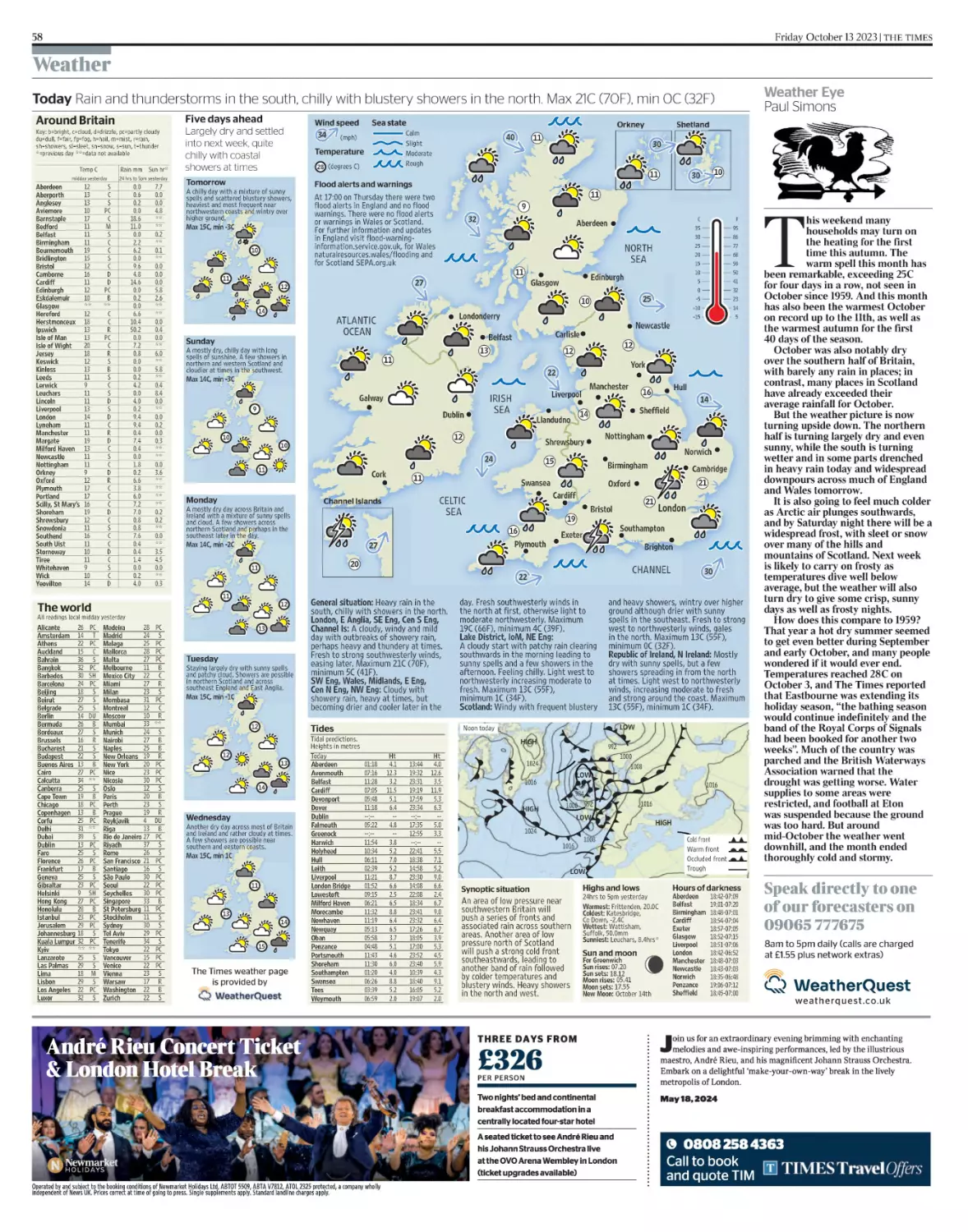
Rain and thunderstorms in the
south, chilly with blustery showers
in the north.
tivity and efficiency improvements”
had failed to happen as bosses are busy
coping with industrial action, Kelly told
colleagues.
NHS England is understood to have
asked the Treasury for “compensation”
for the cost of strikes but has yet to
receive a clear answer.
Jeremy Hunt, the chancellor, is
resisting extra spending demands as he
grapples with a £23 billion increase in
the cost of debt interest and attempts to
find room for tax cuts in the spring.
Conservative MPs are already angry
about rising state spending and are likely to see bailouts for the NHS as limiting the room for tax cuts. Last autumn
the NHS was given a £3.3 billion top-up
for the present financial year.
However, warnings about the most
serious financial crisis for a decade have
been intensifying as the deadlock continues in the industrial action.
Many hospitals are promising savings in the second half of the financial
year, which they fear may prove impossible if strikes continue.
Matthew Taylor, head of the NHS
Confederation, put the cost of strikes at
“£1.5 billion or so”, warning that they
were having a “a huge financial
Care failings add to 15%
rise in maternal deaths
Eleanor Hayward
Health Correspondent
Poor NHS care is contributing to an
increase in the number of women dying
during and after childbirth in Britain,
figures show.
An independent review into maternity deaths found that 241 women died
during pregnancy and within six weeks
of giving birth between 2019 and 2021.
It includes 17 women who bled to death,
23 who died of sepsis and 33 who died
from Covid-19. A further 331 died in the
12 months after giving birth, with suicide the leading cause.
The report said half the deaths were
potentially avoidable had the women
received better care, amid a deterioration in NHS maternity services.
Maternal deaths have increased by
15 per cent since 2009, which means the
government will probably miss its target
of halving maternal mortality by 2025.
The research, by MBRRACE-UK, a
collaboration of academics, exposed
stark and widening inequalities in maternal health. Women in deprived areas
were twice as likely to die than those in
wealthy areas, and black women were
four times more likely to die than white
women. The report’s author, Marian
continued from page 1
Israel shows mutilated babies
11
10
NHS says it can’t start to cut
waiting lists without bailout
for humanitarian relief, saying that
water, electricity and food supplies
would not be allowed into the Palestinian territory until hostages seized by
Hamas were released.
No “electrical switch will be turned
on, no water hydrant will be opened
and no fuel truck will enter” until the
“abductees” were free, Israel Katz, the
energy minister, wrote. It is believed
that Hamas is holding as many as 150
hostages, including British, American
and French citizens.
Other Middle Eastern countries
were also trying to avoid the conflict
spreading. Saudi Arabia’s de facto
leader, Crown Prince Mohammed bin
Knight, a professor of maternal and
child population health at Oxford Population Health, Oxford University, said:
“This report shows persistent inequities impacting the care of pregnant, recently pregnant and breastfeeding
women. Improvements in care may
have been able to change the outcome
for 52 per cent of the women who died
during or up to a year after pregnancy.”
The report issued recommendations,
including speedier recognition of
potentially fatal bleeding and greater
mental health support for vulnerable
women after they have given birth.
Naomi Delap, the director of the
charity Birth Companions, said: “It is
truly shocking that in one of the richest
nations in the world, women in the most
deprived parts of the country are more
than twice as likely to die during pregnancy or the postnatal period as women
in more affluent areas. We’re deeply
concerned by these continued trends.”
She added that women were “falling
through the cracks” of an NHS in crisis.
“Professionals across health and social
care — including GPs, children’s social
care, health visiting, maternity, mental
health and domestic abuse services —
are struggling to provide safe and effective care in the midst of huge pressures.”
Salman, spoke to President Raisi of Iran
in a highly unusual exchange between
the rival regional powers.
Saudi Arabia “was reaching out to all
international and regional sides to end
the current escalation”, according to
the Saudi state news agency.
Tehran issued a statement after the
telephone call, saying that Iran and
Saudi Arabia, “as two key players [in the
region], should defend the Muslim and
oppressed nation of Palestine at this
critical time”.
The US has sent one aircraft carrier,
the USS Gerald R Ford, to the eastern
Mediterranean. A second carrier
group, led by the USS Dwight D Eisenhower, is due in the coming days.
Lloyd Austin, the US defence secretary,
will visit Israel today to meet Binyamin
impact”. He said: “The absolute immediate priority for the health service is
going to be that we get extra money in
the autumn statement. If we don’t, we
are going to be in a profound financial
crisis. And you can forget progress in
relation to things like waiting lists.”
Sir Julian Hartley, head of NHS
Providers, said: “The NHS will need
more support to help offset the financial impact of industrial action. Time
spent on managing strikes is limiting
trust leaders’ capacity to deliver efficiency plans and to prepare for what is
expected to be another tough winter.”
Any bailout is likely to prompt questions about whether money should not
have been spent resolving the doctors’
dispute, which has led to more than a
million appointments being cancelled.
But ministers insist that pay rises would
worsen inflation. Hunt said last week
that “we’ve made our choice” to prioritise inflation reduction over cutting
waiting lists.
Siva Anandaciva, chief analyst at the
King’s Fund, a health charity, said: “It is
increasingly hard to see how the NHS
will be able to maintain the quality of
care for patients without overspending
its current budget.”
Councils earn
nearly £1bn in
parking fees
Ben Clatworthy
Transport Correspondent
Local councils have turned parking
into a “huge cash cow”, according to
new figures.
Councils in England made £962.3
million from parking charges in the last
financial year — £673.1 million from
on-street parking and £289.2 from offstreet parking, the levelling-up department said.
Experts predicted that the amount
for this financial year would probably
pass the £1 billion mark after councils
up and down the country announced
double-digit rises in fees from April.
Southend, York, Rutland, Thanet
and Waltham Forest have increased
parking fees by about 10 per cent. In
Cornwall, the county council has said
parking charges would rise by 29 per
cent at its most popular tourist hotspots, taking an hourly ticket to £2.20.
Jack Cousens, the AA’s head of roads
policy, said: “Once again official statistics show that councils have turned
parking into a huge cash cow, not just a
service to stimulate local trade and
support workers and visitors.”
Netanyahu, the prime minister. Diplomats from Qatar, which has ties to
Hamas, and Egypt have been discussing ways of freeing the hostages and
getting aid to Gazans. Hamas’s former
leader, Khaled Meshaal, who is based in
Doha and heads its diaspora activities,
called for a day of protests
today. In response, the US increased
security at sites across the country.
Meshaal also said that the governments and people of Jordan, Syria, Lebanon and Egypt had a bigger duty to
support the Palestinians.
3
the times | Friday October 13 2023
News
From Taylor with love,
a film that has fans
dancing in their seats
Film Keiran Southern
Taylor Swift: The Eras Tour
AMC The Grove 14,
Los Angeles
HHHHH
There was a debate over the summer
about etiquette inside cinemas, with
claims that audiences watching Barbie
and Oppenheimer had forgotten how
to behave. Let us hope that those
cinephiles complaining about viewers
checking their phones and talking
throughout the movie do not stumble
into screenings of Taylor Swift’s new
concert film.
The audience in Los Angeles
watching the premiere of the pop
superstar’s film screamed, sang and
danced from start to finish, with some
teenage girls barely taking their seats
during its nearly three hours.
Perhaps the screening was not
representative — after all, Swift
herself sat in a middle row, a few seats
away from the actor Adam Sandler
and other celebrity guests — but
knowing her fans’ fervour, it is likely
cinemas around the world will soon
be turned into mini raves.
And this is no ordinary concert
film. The Eras Tour looks likely to
become the highest-grossing tour of
all time and the movie is already
breaking records of its own. It
surpassed $100 million in global ticket
sales a week before release. The film
more than justifies the hype, and
rather than a rushed cash-in, Swift
has given her fans a spectacular,
lovingly crafted movie that somehow
captures everything great about the
live show.
The bridge to Cruel Summer, the
second song of the concert, was sung
with as much enthusiasm in the
cinema as it was in the stadium both
times I saw it live. All Too Well — the
ten-minute ballad beloved by Swift’s
fan base — loses none of its
emotional heft in the transfer from
the arena to the Imax screen.
August, a track from the Folklore
album about a teenage love
triangle, provoked a singalong in the
cinema. One teenage girl appeared
on the verge of tears.
At times it was difficult to work
out whether the cheering was
from the cinema’s sound
system or the audience.
Many appeared to have
memorised Swift’s
choreography and danced
along in near-perfect sync
with the singer. Shake it Off,
from the 2014 album 1989,
had entire rows of the
audience dancing.
Some aspects of the film,
which uses footage from
performances in Los
Angeles in August, even
beat the live experience.
Running for about two
hours and 45 minutes, it
is leaner than the
concert. We no
longer have to wait
for Swift’s costume
changes; in the movie she
appears in a new outfit
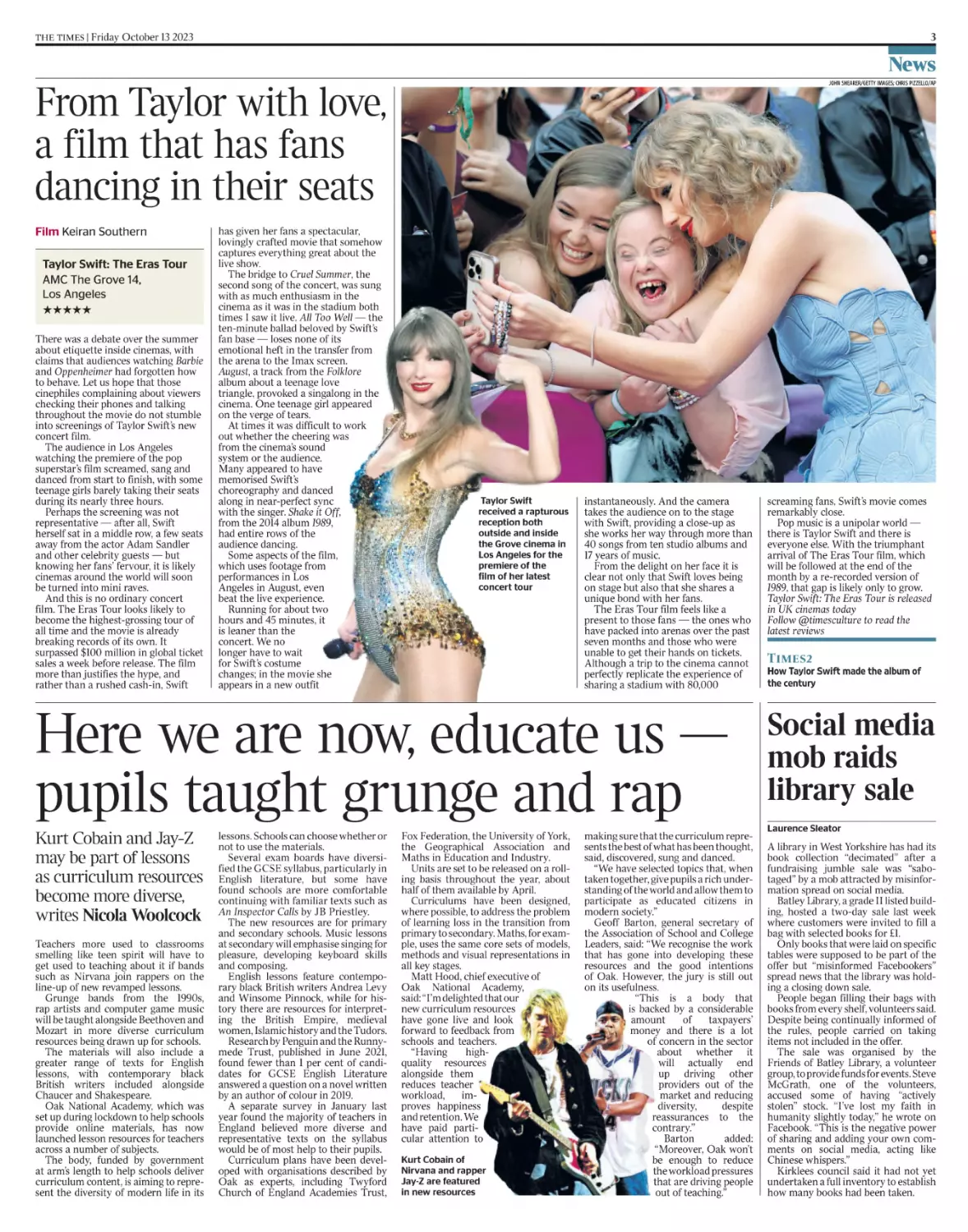
Taylor Swift
received a rapturous
reception both
outside and inside
the Grove cinema in
Los Angeles for the
premiere of the
film of her latest
concert tour
instantaneously. And the camera
takes the audience on to the stage
with Swift, providing a close-up as
she works her way through more than
40 songs from ten studio albums and
17 years of music.
From the delight on her face it is
clear not only that Swift loves being
on stage but also that she shares a
unique bond with her fans.
The Eras Tour film feels like a
present to those fans — the ones who
have packed into arenas over the past
seven months and those who were
unable to get their hands on tickets.
Although a trip to the cinema cannot
perfectly replicate the experience of
sharing a stadium with 80,000
Here we are now, educate us —
pupils taught grunge and rap
Kurt Cobain and Jay-Z
may be part of lessons
as curriculum resources
become more diverse,
writes Nicola Woolcock
Teachers more used to classrooms
smelling like teen spirit will have to
get used to teaching about it if bands
such as Nirvana join rappers on the
line-up of new revamped lessons.
Grunge bands from the 1990s,
rap artists and computer game music
will be taught alongside Beethoven and
Mozart in more diverse curriculum
resources being drawn up for schools.
The materials will also include a
greater range of texts for English
lessons, with contemporary black
British writers included alongside
Chaucer and Shakespeare.
Oak National Academy, which was
set up during lockdown to help schools
provide online materials, has now
launched lesson resources for teachers
across a number of subjects.
The body, funded by government
at arm’s length to help schools deliver
curriculum content, is aiming to represent the diversity of modern life in its
lessons. Schools can choose whether or
not to use the materials.
Several exam boards have diversified the GCSE syllabus, particularly in
English literature, but some have
found schools are more comfortable
continuing with familiar texts such as
An Inspector Calls by JB Priestley.
The new resources are for primary
and secondary schools. Music lessons
at secondary will emphasise singing for
pleasure, developing keyboard skills
and composing.
English lessons feature contemporary black British writers Andrea Levy
and Winsome Pinnock, while for history there are resources for interpreting the British Empire, medieval
women, Islamic history and the Tudors.
Research by Penguin and the Runnymede Trust, published in June 2021,
found fewer than 1 per cent of candidates for GCSE English Literature
answered a question on a novel written
by an author of colour in 2019.
A separate survey in January last
year found the majority of teachers in
England believed more diverse and
representative texts on the syllabus
would be of most help to their pupils.
Curriculum plans have been developed with organisations described by
Oak as experts, including Twyford
Church of England Academies Trust,
Fox Federation, the University of York,
the Geographical Association and
Maths in Education and Industry.
Units are set to be released on a rolling basis throughout the year, about
half of them available by April.
Curriculums have been designed,
where possible, to address the problem
of learning loss in the transition from
primary to secondary. Maths, for example, uses the same core sets of models,
methods and visual representations in
all key stages.
Matt Hood, chief executive of
Oak National Academy,
said: “I’m delighted that our
new curriculum resources
have gone live and look
forward to feedback from
schools and teachers.
“Having
highquality resources
alongside them
reduces teacher
workload,
improves happiness
and retention. We
have paid particular attention to
Kurt Cobain of
Nirvana and rapper
Jay-Z are featured
in new resources
making sure that the curriculum represents the best of what has been thought,
said, discovered, sung and danced.
“We have selected topics that, when
taken together, give pupils a rich understanding of the world and allow them to
participate as educated citizens in
modern society.”
Geoff Barton, general secretary of
the Association of School and College
Leaders, said: “We recognise the work
that has gone into developing these
resources and the good intentions
of Oak. However, the jury is still out
on its usefulness.
“This is a body that
is backed by a considerable
amount
of
taxpayers’
money and there is a lot
of concern in the sector
about whether it
will actually end
up driving other
providers out of the
market and reducing
diversity,
despite
reassurances to the
contrary.”
Barton
added:
“Moreover, Oak won’t
be enough to reduce
the workload pressures
that are driving people
out of teaching.”
screaming fans, Swift’s movie comes
remarkably close.
Pop music is a unipolar world —
there is Taylor Swift and there is
everyone else. With the triumphant
arrival of The Eras Tour film, which
will be followed at the end of the
month by a re-recorded version of
1989, that gap is likely only to grow.
Taylor Swift: The Eras Tour is released
in UK cinemas today
Follow @timesculture to read the
latest reviews
Times2
Social media
mob raids
library sale
Laurence Sleator
A library in West Yorkshire has had its
book collection “decimated” after a
fundraising jumble sale was “sabotaged” by a mob attracted by misinformation spread on social media.
Batley Library, a grade II listed building, hosted a two-day sale last week
where customers were invited to fill a
bag with selected books for £1.
Only books that were laid on specific
tables were supposed to be part of the
offer but “misinformed Facebookers”
spread news that the library was holding a closing down sale.
People began filling their bags with
books from every shelf, volunteers said.
Despite being continually informed of
the rules, people carried on taking
items not included in the offer.
The sale was organised by the
Friends of Batley Library, a volunteer
group, to provide funds for events. Steve
McGrath, one of the volunteers,
accused some of having “actively
stolen” stock. “I’ve lost my faith in
humanity slightly today,” he wrote on
Facebook. “This is the negative power
of sharing and adding your own comments on social media, acting like
Chinese whispers.”
Kirklees council said it had not yet
undertaken a full inventory to establish
how many books had been taken.
4
2GM
Friday October 13 2023 | the times
News
News Israel at war
My hostage mother is victim of
Tom Witherow
The British families of three pensioners
held hostage by Hamas said there had
been a “second Holocaust”.
There are 17 Britons feared dead or
missing after Hamas militants stormed
villages near the Gaza border fence on
Saturday. More than 1,000 Israeli citizens were murdered and Hamas is
holding about 130 hostages.
Ada Sagi, the 75-year-old mother of
Noam Sagi, 53, a London-based psychotherapist, was kidnapped from the
Kibbutz Nir Oz, a village of 400 people
from which dozens of hostages were
taken on Saturday. The elderly parents
of Sharon Lifschitz, 52, were also taken.
Children were among the missing,
including three-year-old Kfir and sixmonth old Ariel.
Also missing are Tamir Adar, 38, and
Yaffa Adar, 85, who was taken hostage
by Hamas on a golf cart without her
medication. A child called Abigail,
whose age has not been given, has also
been identified as missing. Dafna
Elyakim is another missing Briton.
Yesterday Sagi said that the village
where he grew up awoke “to a massacre
and a second Holocaust”. He added:
“Nothing prepares you for this. I don’t
Israel at war
6 Up-to-the-minute news and analysis
on The Times live app and at
thetimes.co.uk
6 Hear from our correspondents on the
ground on our free station Times Radio
DAB radio, online, smart speaker and app
have words for my son to tell him how
this happened. They’ve been gassed,
burnt, butchered, slaughtered, killed
and kidnapped. Mostly young kids and
elderly people. They burnt the place to
the ground, shot the dogs, nothing left.”
He said that his mother, who had
been due to visit London this weekend
to celebrate her birthday, needed medicine including treatments for severe
allergies to dust. “My son has one
grandmother. I want him to be with her
for his next birthday,” Sagi said. “I tell
my son they are a very valuable asset so
people are looking after them. My mum
and dad are incredibly strong people, in
their heart and their will.”
Sitting in front of a table displaying
photographs of some of the missing, including a six-month-old baby and
young children, Sharon Lifschitz, 52, an
artist and academic, said that her peace
activist parents, aged 85 and 83, were also taken hostage from Nir Oz.
Schools close
their doors
Nicola Woolcock, Laurence Sleator
Matt Dathan
Three Jewish schools in north
London have said they will not
open today “in the interests of the
safety of our precious children”.
Two primaries, Torah Vodaas in
Edgware and Ateres Beis Yaakov
in Colindale, and Menorah High
School in Neasden informed
parents yesterday evening. It is
thought that the schools decided
to close after Khaled Mashal, the
former leader of Hamas, called for
worldwide protests in support of
Palestinians.
The principal of Menorah High
School said the “difficult” decision
was taken “because of the risk of
violence on the streets”.
On Monday the Jewish Free
School in Kenton, north London,
cancelled after-school detentions
so pupils could take their normal
bus home and advised some pupils
to remove their school blazers to
avoid being identified as attending
the school.
Gillian Keegan, the education
secretary, and Robert Halfon, the
universities minister, have also
said in a letter to university leaders
that students are having to hide
their Jewish identity to ensure
their safety. They asked
vice-chancellors to act swiftly
against any threats to students
and suggested that they should
tackle inflammatory statements
from student societies that showed
support for Hamas, which is a
proscribed terrorist group. The
ministers wrote: “Not only are
such statements of questionable
legality, they are deeply troubling
and hurtful to Jewish people,
given that so many have friends
and family based in Israel.”
The letter reminded universities
of their responsibilities under the
Prevent counterterrorism
programme to have “due regard”
of the need to prevent people from
being drawn into terrorism and
warned them to pay attention to
invitations issued by students or
staff to ensure they do not “provide
a platform for illegal speech”.
“We have yet to really comprehend
what took place,” Lifschitz said. “I feel
I’ve been hollow for the last few days
but I feel that we are strong, together we
are facing this act of such barbarity,” she
said. “You have to be a special sort of
person to take an 85-year-old person
out of her bed. These are frail people.
It’s something so horrific we can’t contemplate [it]. In the face of all of this,
bring these people back home. There
are mothers waiting for their children.”
Her father was a peace activist who
spent time in his retirement driving sick
Palestinians from Gaza to hospital appointments as a member of Other
Voice, a volunteer group of Israeli citizens living near the border fence.
“We now need to act together to fight
that hatred with love,” Lifschitz added.
“We say no to the massacre and destruction. We must believe that there is
good in the world, and that I don’t
accept butchery. I don’t accept it from
Boko Haram, I don’t accept it from Isis,
and I don’t accept it from our neighbours.”
The families said they had received
no information about their loved ones,
or about efforts to rescue them.
The scale of the hostage crisis is unprecedented in Israel’s history. Yesterday the country’s leaders threatened to
continue the blockade of Gaza until all
the hostages were released.
Hamas has said it will kill a hostage
each time Israel bombs civilian targets
in Gaza without warning.
The vast majority of those being held
are Israelis, but it is thought that other
nationalities include Americans, Germans, Thais, Mexicans, Brazilians,
Nepalis as well as Britons.
“This is the biggest hostage crisis in
the world, that the world has faced in
decades. We must do whatever we can,
and whatever it takes to bring these
hostages home,” Defend Israeli Democracy UK said in a statement.
“They went door to door, snatched
babies from their mothers, and children
from their beds, handcuffed them and
then brutally cold-bloodedly slaughtered them . . . in international law there
is a term for such inhumane acts, it’s
called genocide.”
According to Chatham House, the
foreign affairs think tank, Hamas may
have taken people to use as “bargaining
chips”, on the basis that Israel has a
record of leaving no hostage behind.
Among the Britons who died were
Bernard Cowan, a grandfather,
Nathanel Young, a soldier in the Israeli
army, and Jack Marlowe, 26, who was a
security guard at the music festival
attacked by Hamas.
Ariel
Six months old
Yafar Adar
85
Kfir
Aged three
Tamir Adar
38
Ex-ministers criticise BBC on Hamas Antisemitism
Steven Swinford Political Editor
Mario Ledwith, Alex Farber
Seven former culture secretaries have
told the BBC that its refusal to call
Hamas “terrorists” risks blurring its
impartiality.
Led by Sajid Javid, they called on the
BBC to “urgently reassess” its approach
to describing Hamas as “militants” and
“fighters” in a letter to Tim Davie, the
director-general of the broadcaster.
The group cited the BBC’s guidelines,
which state that impartiality does not
require “absolute neutrality” on every
issue or “detachment from fundamental democratic principles”.
They said: “The BBC’s commitment
is to impartiality, not indifference. This
distinction is now in danger of being
blurred. Worryingly, the imprecise
language of ‘fighters’ and ‘militants’
also serves to conflate terrorists with
the Palestinian people, who suffer more
than anyone from Hamas’s actions. We
add our voices to the mounting concerns about the BBC’s language around
this terror group. It is time to urgently
reassess your approach.”
The six other former culture secretaries are Karen Bradley, Nadine Dorries, Matt Hancock, Maria Miller, Baroness Morgan of Cotes and Sir Jeremy
Wright.
Rishi Sunak has also stated that he
believes it is “incumbent” on the BBC as
the national broadcaster to refer to
members of Hamas as terrorists.
John Simpson, the BBC’s world
affairs editor, has argued that the corporation would be “taking sides” if it did
so. However, the prime minister has
said that Hamas is a terrorist organisation that has been formally proscribed
under British law and he believes it
should be described as such.
A No 10 source said: “As the PM has
said repeatedly, Hamas are not mili-
tants, they are terrorists. It is incumbent
on our national broadcaster to recognise this fact.”
Sunak said on Monday: “There are
not two sides to these events. There is
no question of balance. I stand with
Israel. The people who support Hamas
are fully responsible for this attack.
They are not militants. They are not
freedom fighters. They are terrorists.”
Noah Abrahams, 22, a freelance
sports reporter on BBC Radio Derby,
told TalkTV he would no longer work
with the broadcaster, saying: “I have
morals. The words ‘justified’ and ‘unjustified’ have been thrown around a lot
and the BBC’s refusal to use the correct
terminology is unjustifiable. Terminology and words when neglected have
the power to fuel hate.”
is growing
on the streets
of Oxford
Trevor Stern
Comment
M
y room-mate and I
decided to put a
mezuzah — a rolled
scroll with scriptural
verses in a box — on
our door frame on Wednesday night.
In light of rising antisemitism
around the world, we had agreed
that the best thing to do would be to
publicly display and reaffirm Jewish
identity. Yesterday morning, when I
left my apartment, the mezuzah had
been ripped off and stuck
haphazardly upside down on the
front door of the apartment
building. I checked with property
management and they did not
remove it. It left me feeling quite
shaken. This was a case of
antisemitic harassment by someone
in the building.
I have experienced antisemitism
in Oxford but not usually from
students. I’m a master’s student
from the US and have been in the
city for just over a year.
On arrival, it was a little strange.
At the university where I did my
undergraduate degree, there were
many more Jewish people. But I’ve
been pleased with the Jewish
community in Oxford — the Oxford
Jewish Centre is wonderful; it’s a
space available to use 24/7.
People in Oxford are generally
accepting, although my orientation
session for Oxford was scheduled for
Yom Kippur and I was pretty upset
the times | Friday October 13 2023
5
2GM
News
News
second Holocaust, says Briton
Police told: Use law
against protesters
Abigail
Ada Sagi
75
because I would be at the synagogue
all day and fasting. I emailed the
college to let them know and it
didn’t come back to me until a few
days beforehand to say it accepted
my request not to attend. It seems it
didn’t take me seriously.
Until yesterday, I had never felt
isolated by fellow students for being
a Jew, but the town itself is different
and antisemitism is a lot more
present — it terrifies me. Last year I
was walking past a protest on my
way to a play and I heard someone
shouting into a speaker about global
elites who control the world.
Later on I found that pamphlets
had been slipped under the door of
the Jewish centre. Another time,
when I was walking in the park with
a friend who was wearing a kippa,
someone came up to him and
started spewing antisemitism. He’s
had other negative experiences,
including “Sieg Heil” salutes
directed at him. It makes me
reluctant, when I leave the
synagogue, to wear my kippa.
Dafna Elyakim
15
Sharon Lifschitz’s parents and Noam Sagi’s mother,
left, were abducted, along with the others pictured
It’s sad that anyone thinks
pro-Palestinian celebrations are
an appropriate reaction to the
death and destruction caused by
Hamas. It horrifies me that people
would use rhetoric to justify the
killing of civilians. People are not
sure about their safety; there are
calls for violence against Jews
internationally. I’ve heard people
saying Israel is worse than Hamas
and people saying horrible things on
social media. There’s a real fear that
it will lead to physical danger for
Jewish students.
The university has put out a
statement acknowledging that the
conflict is upsetting and offering
support. But it has not condemned
Hamas’s antisemitism, which we
are concerned will make students
feel comfortable on campus
expressing antisemitism towards
Jewish students.
Trevor Stern is president of Oxford
Jewish Society
Fiona Hamilton Chief Reporter
Charlie Parker, Matt Dathan
Tear gas at Paris rally
Rishi Sunak urged police to use the “full
force of the law” against protesters who
committed hate crimes and supported
Hamas.
Police have been told to use publicorder powers to block protests outside
Jewish monuments and buildings such
as the Israeli embassy, while cracking
down on the use of face coverings to
“purposefully conceal identity”.
The prime minister announced an
extra £3 million for increased security
at Jewish schools, synagogues and
community buildings after a rise in
antisemitic incidents. Sunak said: “The
UK must and will continue to stand in
solidarity with Israel. At moments like
this, when the Jewish people are under
attack in their homeland, Jewish people
everywhere can feel less safe.
“That is why we must do everything
in our power to protect Jewish people
everywhere in our country. If anything
is standing in the way of keeping the
Jewish community safe, we will fix it.”
Foreign students, academics and
other migrants who praise Hamas
or commit antisemitic acts face being
expelled under plans being drawn up
by the Home Office.
Robert Jenrick, the immigration
minister, has ordered officials to draft
proposals on how visas could be revoked. France has introduced similar
rules and has expelled three people
from the country.
Prisons will be on alert for potential
trouble after the former leader of
Hamas called for Muslims to protest
against Israel on a day of jihad. A Prison
Service source said anti-terrorism
teams that monitored known extremists in jails had stepped up their work
amid “heightened tensions”.
The Community Security Trust, a
Jewish
charity,
said
it
had
recorded 139 antisemitic incidents in
the past four days, up 400 per cent compared with the same period last year.
Sunak said police had the government’s backing in ensuring that glorification of terrorism was met with the full
force of the law. Hamas is a proscribed
organisation, meaning anyone who
shows support for it can be arrested.
French police used tear gas and
water cannon against
demonstrators last night after they
flouted a ban on pro-Palestinian
protests (Adam Sage writes).
Hours after Gérald Darmanin, the
interior minister, announced the
ban, hundreds of protesters
gathered in Place de la République
in the centre of Paris, holding up
banners that said “End the siege of
Gaza”. Demonstrators chanted
“Israel murderer” and “Macron
accomplice” as they moved through
the streets. The organisers had
failed in an attempt to secure an
injunction overturning the ban.
When police moved in to disperse
the crowd, violence erupted.
Dame Lynne Owens, deputy commissioner of the Metropolitan Police, said
earlier that officers would take action
against protesters who waved the
Hamas flag, held up placards or directly
expressed support for it.
She said she understood that the Jewish community found demonstrations
since the attack “morally reprehensible, intimidating, and even frightening”.
However, in an open letter she said that
the Met could not interpret broader
support for the Palestinian cause as
automatic backing for Hamas.
Suella Braverman, the home secretary, has urged police to consider arresting people if they displayed Palestinian flags or chanted anti-Israel slogans. She said: “I have been clear with
police chiefs . . . that there can be zero
tolerance for antisemitism and that
they should act immediately to crack
down on any criminality in our streets
and online.”
Six groups are organising the rally in
London in “solidarity with Palestine
and to demand Israel end its occupation of Palestinian land and apartheid
rule over the Palestinian people”. Ismail
Patel, founder of Friends of Al-Aqsa,
one of the groups, has shared inflammatory posts on social media, including
claims that no one was massacred at a
music festival by Hamas gunmen.
Jo Malone’s son in ‘blame Israel’ row
Tom Witherow
The son of the perfume entrepreneur
Jo Malone helps to run a Harvard
Palestinian group that backed a letter
blaming Israel for the Hamas attacks,
according to a university directory of
student groups.
Josh Willcox, 22, was listed as one of
three students leading the “Palestine
solidarity committee”.
Malone, 59, who sold her company
and brand name to Estée Lauder in
1999, said the violence in Israel and
Gaza had left her “heartbroken” and
that Hamas’s attack was “abhorrent”.
She did not respond to questions about
her son but said that “we as a family . . .
strongly condemn all forms of violence”.
On Monday, 30 Harvard student
organisations said that Israel was
“entirely responsible” for the Hamas
assault on hundreds of civilians. A letter
called “Joint statement by Harvard Palestine solidarity groups on the situation
in Palestine”, said the attack “did not
happen in a vacuum”, and that the
Israeli authorities had forced Palestinians to live in an “open-air prison for
over two decades”.
It added: “We, the undersigned
student organisations, hold the Israeli
regime entirely responsible for all
unfolding violence. The apartheid
regime is the only one to blame.”
The letter prompted fierce criticism,
including from the billionaire hedge
fund manager Bill Ackman, who called
for those behind it to be blacklisted by
top Wall Street companies.
Five of the groups, including the
Harvard campus’s Amnesty International affiliate, have since withdrawn
their signatures.
Willcox, a keen fencer who attended
the private Latymer Upper School in
west London, did not respond to a
request for comment.
Another statement, shared on
Wednesday by the committee, appeared to double down on the letter,
saying that the “statement’s purpose
was clear: to address the root cause of
the unfolding violence”.
It called for more condemnation of
Israeli airstrikes, which have killed
more than 1,000 Palestinians in Gaza,
many of whom were civilians, since the
Hamas attack.
Sanaa Kahloon, a committee
member, rejected “the accusation that
our previous statement could be read as
supportive of civilian deaths”, telling
the Harvard Crimson student newspaper the “[committee] staunchly
opposes violence against civilians —
Palestinian, Israeli, or other”.
Willcox is Malone’s only son with
Gary Willcox, a surveyor whom she
met at Bible school in south London
and married in 1985.
6
2GM
Friday October 13 2023 | the times
News
News Israel at war
So close to the Supernova dance
massacre, no one felt like arguing
concrete cloisters. Outside television,
they can surely have never seen
anything like this.
But there was no sign of that on the
ground. Not only the videos but the
evidence left behind revealed a highly
disciplined operation. There was no
out-of-control violence. No sprays of
wild destruction. Only the revellers
were targeted, but they were targeted
closely and accurately. The symbols of
their western decadence were left
untouched.
For those of us who had seen the
films of the party, this was unnerving.
The fluttering blue triangle patches of
the dancefloor’s gazebo still shaded it,
unharmed. The sound-deck platform
had not been shot up.
You could, if you wanted, stand
where Shani Louk danced her last
dance. Here it was that the
22-year-old German-Israeli tattoo
artist whose portrait has become a
defining image from the massacre was
filmed swaying to the music with a
friend and gurning into the camera.
Louk was next seen unconscious in
the back of a pick-up, manhandled by
Kalashikov-toting militants who
cheered and jeered over her body as
they drove her off. She is thought to
be in a hospital in Gaza, critically ill.
It was similarly easy to follow the
route taken by May Hayat, 30, a
festival employee, as she spent hours
trying to avoid death or capture. On
Instagram, the festival’s natural site of
record, she described how she was on
her way to an employees’ trailer —
now overturned and burnt — when
the attackers arrived.
She ran to the police van and
sheltered there until it was
surrounded, when she ran again, to
the car park, with bullets flying. The
car into which she clambered stuck in
the sand, so she and a man she had
never met before ran again and
buried themselves in a cavity in the
ground. But they were discovered and
the man was shot dead in front of her,
while begging for his life.
Somehow, miraculously, she was let
go, and ran again. Back at the party
stage she smeared herself with the
blood of bodies already there, and
played dead for three hours till she
heard Hebrew.
The massacre sites of the Middle
East come in many varieties. There
are the historic battlefields, and the
villages destroyed by rival sects and
races — including Arabs, Turks and,
yes, Jews — as the Ottoman Empire
was torn apart by the British and
French, who first took it over forcibly
then equally capriciously abandoned
it to its fate.
There are the more recent venues
for horror: city streets and refugee
camps, open desert and farmyards,
and all the sorts of places where the
Five miles
Gaza City
Mediterranean
Sea
Supernova
Festival
GAZA
EGYPT
ISRAEL
butchers of Isis slaughtered Shia
Muslims and Alawites, or where
Assad’s militias slit the throats of
Sunni Muslim men, women and
children whose towns dared to rise
against him. And then there are the
many massacres of Palestinians: most
infamously, those by Lebanese
Christian militias at Sabra and Chatila
in south Beirut in 1982.
No one seems to learn from this
endless cycle, a cycle that leads to this
most extraordinary danse macabre: a
rave in a grove of silver birches that
now sag over rows of empty sleeping
mats and tents, abandoned flip-flops,
bags of uneaten party snacks.
Meanwhile a new massacre is
under way, a few miles away. The
occasional swoosh of its shells could
be heard even from the festival site, as
the Israelis bombarded both the
militants and the civilians of Gaza.
Few of the soldiers guarding the
Supernova site gave that shellfire or
hundreds of airstrikes a second
thought yesterday. They did not
regard it as comparable to the
indiscriminate shooting that had
happened here. Along the road to
Kibbutz Re’im, too, were the signposts
to Kfar Aza, Nahal Oz, Be’eri. There
too they are still picking up the
bodies. At the side of the road tanks
and armoured personnel carriers
rolled into the scrub, giant staging
grounds for the offensive that
everyone knows will come next.
Few question it. Laviv Calderon, 22,
who could easily have been at
Supernova but wasn’t, though he has
lost friends who were, was walking
down the road to join his battalion of
reserves. He had been planning to go
backpacking in America but had
called it off. He had no qualms.
Interestingly, he had no politics,
either. He did not care whether
Israel’s present dysfunctional
government had in some ways caused
the security lapses that gave Hamas
space for its incursion.
He had never voted for anybody, he
said, but he would, right now, do
anything his government told him. “I
will support whatever it does,” he said.
At a checkpoint at the end of the
road, beyond which even residents
were not allowed as the troops
prepared for battle, a father hugged
his son in uniform — one of three in
the army, he said. Tsur Dahan, 50,
had only pride, he said, in his sons, in
Israel. He had driven down from their
home in Netanya in the north of the
country and had brought supplies for
the hard weeks to come.
He was not a harsh man, he said,
but he had no doubts about what had
to happen. “Hamas must be
destroyed, after what they did to the
children,” he said. He waved to his
son, and drove off smiling.
So close to the dancefloor
massacre, no one felt like arguing
with him. But when fathers are glad
their sons are heading to battle, what
chance is there of peace?
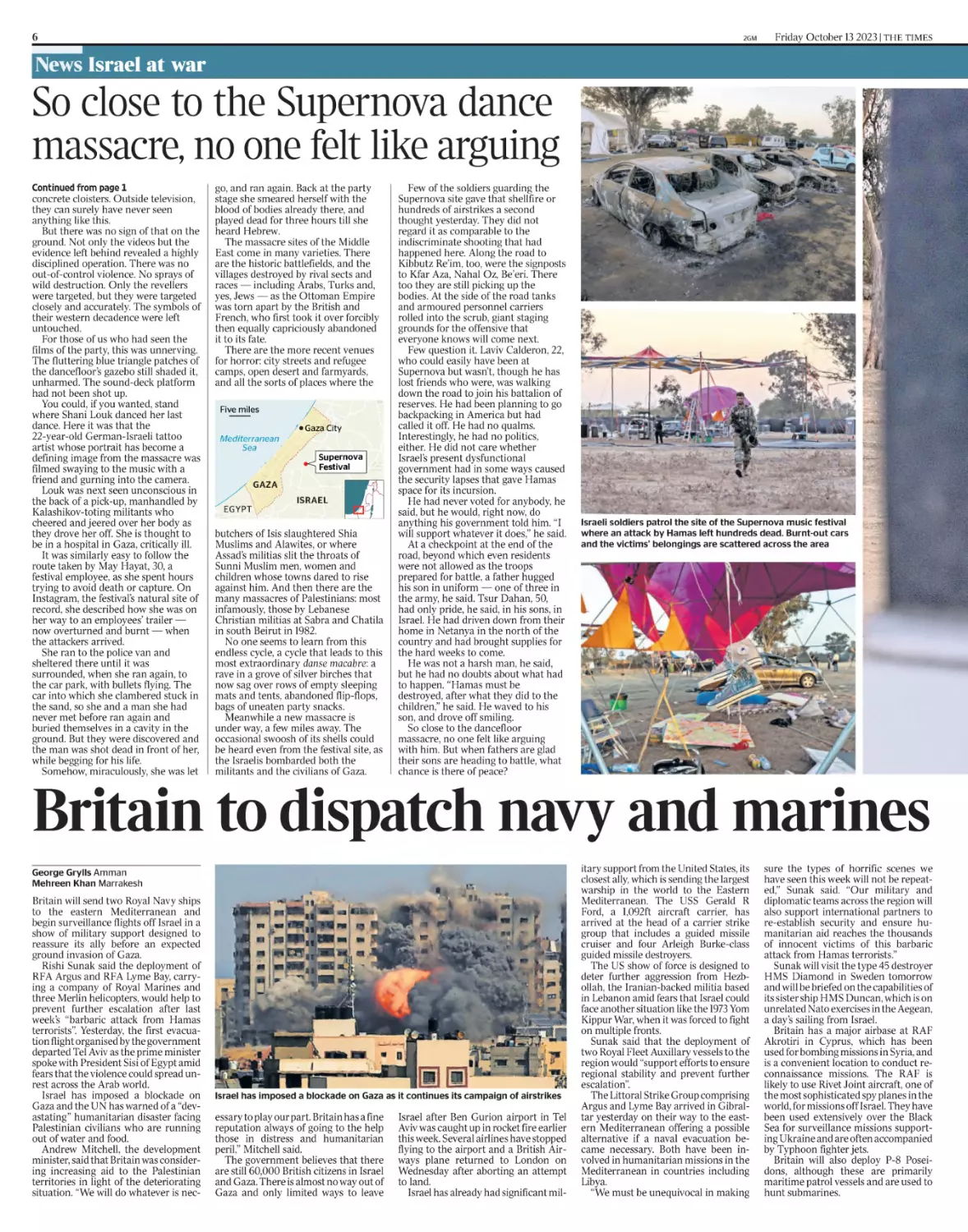
Israeli soldiers patrol the site of the Supernova music festival
where an attack by Hamas left hundreds dead. Burnt-out cars
and the victims’ belongings are scattered across the area
Britain to dispatch navy and marines
George Grylls Amman
Mehreen Khan Marrakesh
Britain will send two Royal Navy ships
to the eastern Mediterranean and
begin surveillance flights off Israel in a
show of military support designed to
reassure its ally before an expected
ground invasion of Gaza.
Rishi Sunak said the deployment of
RFA Argus and RFA Lyme Bay, carrying a company of Royal Marines and
three Merlin helicopters, would help to
prevent further escalation after last
week’s “barbaric attack from Hamas
terrorists”. Yesterday, the first evacuation flight organised by the government
departed Tel Aviv as the prime minister
spoke with President Sisi of Egypt amid
fears that the violence could spread unrest across the Arab world.
Israel has imposed a blockade on
Gaza and the UN has warned of a “devastating” humanitarian disaster facing
Palestinian civilians who are running
out of water and food.
Andrew Mitchell, the development
minister, said that Britain was considering increasing aid to the Palestinian
territories in light of the deteriorating
situation. “We will do whatever is nec-
Israel has imposed a blockade on Gaza as it continues its campaign of airstrikes
essary to play our part. Britain has a fine
reputation always of going to the help
those in distress and humanitarian
peril,” Mitchell said.
The government believes that there
are still 60,000 British citizens in Israel
and Gaza. There is almost no way out of
Gaza and only limited ways to leave
Israel after Ben Gurion airport in Tel
Aviv was caught up in rocket fire earlier
this week. Several airlines have stopped
flying to the airport and a British Airways plane returned to London on
Wednesday after aborting an attempt
to land.
Israel has already had significant mil-
itary support from the United States, its
closest ally, which is sending the largest
warship in the world to the Eastern
Mediterranean. The USS Gerald R
Ford, a 1,092ft aircraft carrier, has
arrived at the head of a carrier strike
group that includes a guided missile
cruiser and four Arleigh Burke-class
guided missile destroyers.
The US show of force is designed to
deter further aggression from Hezbollah, the Iranian-backed militia based
in Lebanon amid fears that Israel could
face another situation like the 1973 Yom
Kippur War, when it was forced to fight
on multiple fronts.
Sunak said that the deployment of
two Royal Fleet Auxillary vessels to the
region would “support efforts to ensure
regional stability and prevent further
escalation”.
The Littoral Strike Group comprising
Argus and Lyme Bay arrived in Gibraltar yesterday on their way to the eastern Mediterranean offering a possible
alternative if a naval evacuation became necessary. Both have been involved in humanitarian missions in the
Mediterranean in countries including
Libya.
“We must be unequivocal in making
sure the types of horrific scenes we
have seen this week will not be repeated,” Sunak said. “Our military and
diplomatic teams across the region will
also support international partners to
re-establish security and ensure humanitarian aid reaches the thousands
of innocent victims of this barbaric
attack from Hamas terrorists.”
Sunak will visit the type 45 destroyer
HMS Diamond in Sweden tomorrow
and will be briefed on the capabilities of
its sister ship HMS Duncan, which is on
unrelated Nato exercises in the Aegean,
a day’s sailing from Israel.
Britain has a major airbase at RAF
Akrotiri in Cyprus, which has been
used for bombing missions in Syria, and
is a convenient location to conduct reconnaissance missions. The RAF is
likely to use Rivet Joint aircraft, one of
the most sophisticated spy planes in the
world, for missions off Israel. They have
been used extensively over the Black
Sea for surveillance missions supporting Ukraine and are often accompanied
by Typhoon fighter jets.
Britain will also deploy P-8 Poseidons, although these are primarily
maritime patrol vessels and are used to
hunt submarines.
7
the times | Friday October 13 2023
News
News
The festival, which took place in a
clearing in a wood, was attacked
in the early hours of Saturday
Photographs by Jack Hill
Isis comparisons may push Invasion is a Former generals doubt
terrorists to free prisoners trap, warns Israel can destroy Hamas
ex-MI6 chief
Anshel Pfeffer
Hamas is trying to find a way to release
some of the prisoners it captured on
Saturday in its terror attack on Israel in
the hope of reducing international
support for a devastating strike on its
military infrastructure in Gaza, Israeli
officials have said.
One senior Israeli official said that
Hamas was “anxious” to show that it
was not similar to Isis, as the Israeli government has been portraying it, using
footage of Israeli children, women and
elderly being hustled into Gaza as prisoners. They said one way of doing this
would be to release a limited number of
prisoners, especially women, children
and those who have non-Israeli citizenship. About a quarter of the captives are
believed to be either dual-nationals or
not Israeli.
In an interview with Al Jazeera,
the Hamas operations chief, Saleh
al-Arouri, who is believed to be one of
the masterminds of the attack, claimed
his men had struck only “military
targets” and that it was “civilians from
Gaza [who] entered and clashed with
the settlers, and civilians fell”.
He added that “Hamas cannot harm
civilians or prisoners” and that its
fighters have orders “not to harm children and women”.
His claims contradict the events of
Saturday morning, when, minutes after
Hamas breached the border fence with
Israel, nearby civilian communities
came under attack, as did the Nova musical festival, where about 260 civilians
were killed. Hamas leaders have tried to
claim that revellers were “mistaken for
soldiers”, though they were all in civilian clothing and dancing to loud music.
Within Israel there are differences
of opinion over whether to prioritise
the release of prisoners before launching a ground attack on Gaza. Bezalel
Smotrich, the country’s finance minister and leader of the far-right Religious
Zionism party, said in a cabinet meeting
that Israel must strike at Gaza “without
considering the prisoners”.
However, former senior military officials said there was no such rush. “Israel
should take the opportunity right now,
before the ground offensive changes
the facts on the ground, to see if some of
the prisoners can be released,” said one
former general. “Even if it means a
limited release of Palestinian prisoners
by Israel as well. Lives can be saved.”
Anshel Pfeffer Jerusalem
Fiona Hamilton Chief Reporter
Hamas is laying a trap for Israel and
would be “well pleased” if it started an
open-ended full-scale ground invasion,
a former head of MI6 has said.
Sir Alex Younger, who headed the
Secret Intelligence Service between
2014 and 2020, said the intensity of
conflict and loss of innocent lives that
would inevitably follow would engender more radicalisation.
He endorsed Israel’s right to defend
itself and said that strikes into Gaza
were necessary, but added: “There is
not fundamentally at the end of this a
military solution to this problem. You
cannot kill all the terrorists without
creating more terrorists, and military
operations of this kind very, very rarely
succeed without some kind of political
strategy. These are hard things to say
. . . this is said with the intention to
support.”
He told the BBC’s Today podcast that
Hamas would be taken aback by its
success: “I don’t believe they thought
they would break through this far.”
Israeli former generals have said they
are sceptical about the government’s
promises to “destroy Hamas”.
While supporting a ground offensive
in Gaza in response to the group’s
terrorist attack on Israel, many said
they believed that more “realistic”
objectives should be set.
In a televised statement on Wednesday night, Binyamin Netanyahu, the
Israeli prime minister, said that every
Hamas member was a dead man. He
repeated comparisons with the Islamic
State terror group to justify his strategy.
“Hamas is Isis, and we will crush and
eliminate it just as the world crushed
and eliminated Isis,” he said.
There is consensus within the Israeli
security establishment that the military must embark on a big campaign in
response to Hamas’s attack, in which
more than 1,200 Israelis, most of them
civilians, were murdered. But there is
also concern that the rhetoric of Netanyahu and some ministers doesn’t match
what can realistically be achieved.
“There isn’t just one monolith of
Hamas,” one former general, who is still
involved in operational planning and
cannot be named, said. “There is the
military and political wings. There’s
Hamas in Gaza, and Hamas in the West
Bank and in other parts of the region. It’s
an ideology. Saying you’re going to destroy all of them isn’t rational. I hope it’s
political grandstanding and not policy.”
He said that a ground offensive in
Gaza should take place and that
armoured columns would be needed to
“seriously degrade Hamas’s military
capabilities, because not all their
targets can be hit from the air”.
Another former general said Israel
could “take over most of the Gaza Strip
within a few weeks of a ground
offensive but that doesn’t mean you will
wipe out Hamas. You can’t wipe out
something people believe in and Israel
needs to set an objective of seriously
weakening Hamas as a military entity
so the Palestinian Authority [ousted in
2007] can return and take control.”
The chief of staff of the Israeli army,
Lieutenant-General Herzi Halevi,
addressed the Israeli public yesterday,
admitting that the defence force under
his command had failed in its duty to
protect Israel and its citizens.
8
Friday October 13 2023 | the times
News
Emergency drive to
jail fewer criminals
Quintagram® No 1758
Solve all five concise clues using
each letter underneath once only
1 Mexican culinary specialities (5)
-----
2 Child of one’s aunt and uncle (6)
Matt Dathan Home Affairs Editor
Jonathan Ames Legal Editor
Catherine Baksi
Ministers are drawing up emergency
measures to reduce the number of
criminals being locked up as prisons in
England and Wales are about to run out
of space within days.
Rishi Sunak is expected to approve a
“programme of reform” to respond to
the prison crisis by Monday before it
can be announced by Alex Chalk, the
justice secretary, in parliament.
The move will come days after The
Times revealed that crown court judges
had been told to delay the jailing of
criminals because prisons are full. It is
understood that judges and probation
officers will be told to limit the number
of criminals sent or recalled to prison.
Also among the short-term proposals being considered is issuing new
guidance to judges that would instruct
them to avoid handing out sentences of
less than 12 months where possible and
instead make greater use of community
sentences to punish low-level criminality. This would lead to criminals convicted of offences such as shoplifting
and other thefts, drug dealing, drink
driving and public disorder avoiding
prison altogether.
Violent and sexual offenders would
not qualify for the effective amnesty in
custodial sentences, which is expected
to last for a limited period of time.
Another interim measure under con-
sideration is raising the threshold for
recalling ex-prisoners to jail for breaches of their probation licence.
Prison recalls could also be scrapped
for criminals who served less than 12
months in jail. They are now only recalled for a maximum of 14 days, and
scrapping recalls for them is seen as a
quick way to free prison space and
resources.
Some prisoners will be released early
and ministers are also looking at proposals to reduce the remand population, which hit a record high of 15,523 in
June, accounting for nearly a fifth of the
prison population, caused by the postCovid backlog in criminal trials and last
year’s barristers’ strike. It is 6,000
higher than before the pandemic.
The move is likely to affect only those
offenders on remand awaiting trial or
sentencing for non-violent crimes such
as drug offences, which make up 22 per
cent of those in prison on remand.
The measures are being considered
as the prison population is set to exceed
the capacity in England and Wales in
days. There are fewer than 600 spaces
left in the prison estate and fewer than
150 in men’s prisons.
The Ministry of Justice said Chalk
would set out a “programme of reform”
in the coming days to “ensure that we
can continue to strengthen public protection by locking up the most dangerous criminals”.
------
3 Unit of roughly 3.26 light years (6)
------
4 Device for hauling in rope (7)
-------
5 Straighten out (a knotted mess) (8)
-------A
A
A
A
A
C
C
C
C
E
E
G
I
L
N
N
N
N
O
O
P
P
R
S
S
S
S
T
T
T
U
U
Solutions see T2 MindGames p15
Cryptic clues T2 MindGames p14
Breakfast:
6am to 10am
Our free radio station has
all the latest headlines,
interviews and debates
every morning
Listen seven
days a week
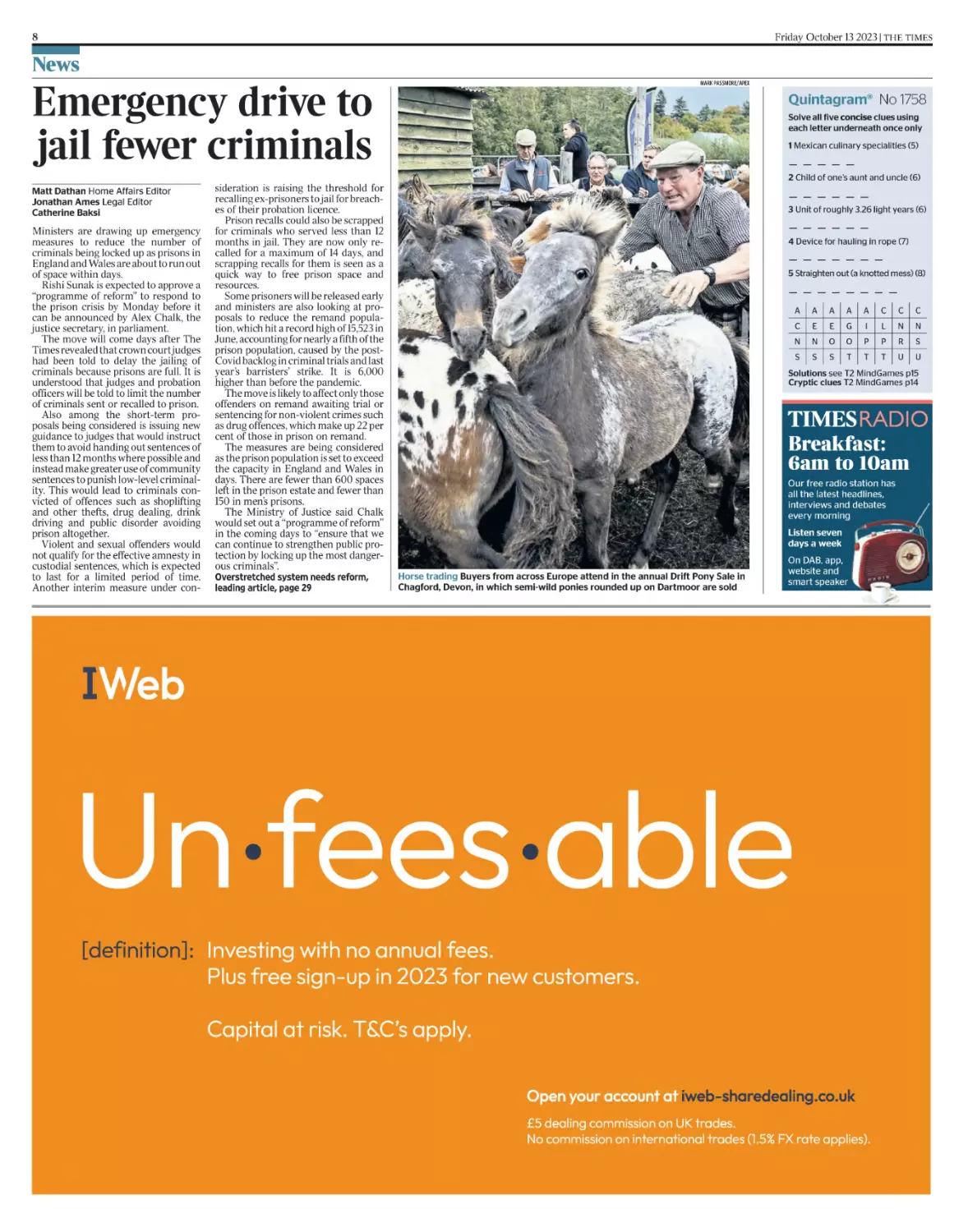
Horse trading Buyers from across Europe attend in the annual Drift Pony Sale in
Chagford, Devon, in which semi-wild ponies rounded up on Dartmoor are sold
On DAB, app,
website and
smart speaker
the times | Friday October 13 2023
9
2GM
News
Blue Peter presenter ‘was bullied and forced to care for dog’
Laurence Sleator
Yvette Fielding, the former Blue Peter
presenter, has claimed that she was
bullied during her time on the children’s
television programme and forced to
look after the show’s dog.
Fielding said that she was left a
“shaking, gibbering wreck” during
her first year in the role after she made
history by becoming the youngest
Blue Peter presenter, aged just 18.
She said that her treatment on the
programme, which at that stage was
attracting eight million viewers an episode, would have “quite a few implications” if it took place today.
Speaking to the Celebrity Catch Up
podcast, Fielding, 55, who co-presented
the BBC programme for five years from
1987, said: “I was told that I was useless,
absolutely useless, again and again and
again and again. I didn’t enjoy the first
year. I found it very traumatic.”
She said that producers on the programme would give her a strict curfew
Yvette Fielding
said she was told
she was useless
“again and again”
of 9pm every night, ringing her to
ensure she had gone to bed.
She moved away from her family in
Stockport to live in London, which she
said she found difficult. “I felt very
lonely because I was the youngest. I was
considered a kid — and a pain-in-thearse of a kid,” she added.
She was also told to look after Bonnie,
the show’s one-year-old golden retriever, who went on to feature in more than
1,000 episodes over 13 years.
“It got to the point where I’d just had
enough. Being made to live with the
dog, I had no say in it. Poor Bonnie was
pining for her owner, scratching at the
door every night. It was too upsetting.”
Fielding, who later presented the
Vaping girl, 12, warns children
after suffering collapsed lung
Steven Swinford Political Editor
Poppy Koronka
A 12-year-old girl who suffered a
collapsed lung and was put into coma
for four days has urged children never
to start vaping.
Sarah Griffin, who was a heavy vaper,
was admitted to hospital a month ago
when she started experiencing breathing problems.
She had been vaping since the age of
nine and was getting through a 4,000puff vape in a few days. A normal vape
usually contains 600 puffs.
A head cold combined with Griffin’s
asthma caused her to deteriorate quickly. An x-ray of her lungs showed that
one had been damaged.
Her mother, Mary, said that when
Sarah was placed in an induced coma to
aid her recovery, she thought her
daughter was going to die.
“It has been a traumatising experience for Sarah,” she said. “It has traumatised me, and it didn’t happen to me.
The day she went to hospital, Sarah
thought she would be admitted, be put
on a nebuliser for a while and then go
home again. For her to end up in ICU
was a terrifying experience and she’s
still trying to make sense of it all.”
She added: “Sarah hadn’t been vaping
heavily but that, coupled with her
asthma was such a dangerous combination. Young people are attracted to the
bright colours and flavours of vapes.
They might smell and taste sweet, but
people need to know about the potential dangers associated with them.”
In her daughter’s case, Mary said,
vaping made her more vulnerable to
infection.
“The doctors explained that if Sarah
hadn’t been vaping, she would have
been in a better position to fight off the
infection,” she said. “Vaping had left her
lungs very weak.”
Sarah is now recovering at home but
the effects of vaping may be long-term.
“Sarah has been left very lethargic,” her
mother said. “She is usually full of
energy, constantly talking and on the
go but she is still recovering and isn’t
back to her usual self yet. The mental
impact has been as big as the physical
impact. She has been through such a
trauma. She still has a long road ahead
of her, but we are just so grateful to have
her back home with us.”
The health secretary has announced
plans to restrict the sale of vapes and to
introduce plain packaging.
Steve Barclay said it was “not right”
that vape companies used cartoon
characters and “bubblegum” flavours to
sell their products.
The government is proposing to
restrict vape flavours and increase their
price. It could also bar companies from
using terms such as “candy floss” and
“muffin”.
Other proposals include prohibiting
paranormal programme Most Haunted,
singled out the “incredibly cruel” Biddy
Baxter, 90, who edited Blue Peter for 26
years until 1988. “She’d just berate me
in front of other people . . . it was just
absolutely soul-destroying,” she said.
Fielding also claimed she almost quit,
and that Baxter forced her to reveal her
skin condition on air against her will.
After Baxter left, she said her time on
the programme was “an absolute blast”.
The BBC and Baxter have been contacted for comment.
Bank to pay
£1.1m over
work from
home firing
Jonathan Ames Legal Editor
One of the UK’s digital “challenger”
banks must pay an asthmatic solicitor
more than £1 million in damages after
she was sacked for not being “a Starling
person”.
Gulnaz Raja won a disability discrimination claim last year against Starling
Bank after she had been criticised by
her boss, who was said to have “valued”
staff who worked late in the office.
An employment tribunal in London
ruled that Raja’s boss, Matthew Newman, became impatient with the 37year-old solicitor when she fell ill and
asked to be allowed to work from home.
Raja, who qualified as a solicitor in
2010, was then sacked from her £76,000
role as deputy company secretary.
At a damages hearing, the judge,
Natasha Joffe, ordered the bank to pay
Raja £540,000 for past and future loss
of earnings and £15,000 for injury to
feelings, plus interest, amounting to a
total of about £658,500.
The tribunal also said that the bank
must make an additional payment,
bringing the total to more than £1.1 million, to account for the tax that Raja
would be required to pay.
Raja started working at the bank in
Gulnaz Raja’s boss
said she ‘was not
a Starling person’
Sarah Griffin, above with her mother
Mary, has been using vapes since she
was nine. Her lung collapsed and she
was put into a coma for four days
the use of cartoons and “child-friendly”
images on vape packaging and on the
device.
Barclay told Times Radio: “I’m a
parent of young children, so I absolutely get your concern. It’s not right that
we’ve got cartoon characters or bubblegum flavours or these things marketed
in the way that sweetshops would
market. Clearly that’s wrong. That’s
why we’re clamping down on it — but
what we don’t want to do is cut across
the fact that for people that smoke,
vaping is better.”
Some experts, including the Royal
College of Paediatrics and Child Health
and Dame Rachel de Souza, the children’s commissioner, have called for a
ban on disposable vapes after data published in May showed a 50 per cent rise
in the past year in the number of children who try vaping.
Figures show that disposable vapes
are the e-cigarette of choice among
youngsters, and that vapes are purchased mostly from corner shops.
The Department of Health and
Social Care said it would consider “restricting the sale of disposable vapes,
which are clearly linked to the rise in
vaping in children”. It added: “These
products are not only attractive to
children but incredibly harmful to the
environment.”
The government has said that it
wants to tackle vaping in a way that
continues to support adult smokers to
switch from smoking to vapes.
The UK-wide consultation will also
examine whether powers could be
brought in for local authorities to issue
fines for those selling vapes to children
and teenagers. It is illegal to sell vapes to
under-18s but posts on social media
show teenagers vaping with coloured
devices using flavours such as pink
lemonade. Many vapes contain nicotine, which is highly addictive.
2019. Newman, who is also a solicitor,
was the chief administrative officer and
company secretary, and was said
to have become dissatisfied with her
performance.
Raja told the tribunal that she developed a cough owing to the air conditioning in the office being very cold.
She asked to be moved to a desk that
was not near a vent.
The tribunal ruled that the bank
had demonstrated a “total failure”
to respond to Raja’s concerns about
her health or to support the solicitor.
It also found that the bank discouraged staff from taking sick leave and
working from home and therefore
backed the lawyer’s claim of unfavourable treatment owing to a disability.
The tribunal ruled that Raja’s “illhealth absences and need to work from
home and her likely requirement
for further time off in particular were
a material reason for her dismissal”.
However, the solicitor’s claims for
unfair dismissal and victimisation were
dismissed.
Since leaving the bank, Raja has
launched her own specialist employment law practice.
10
Friday October 13 2023 | the times
News
News Politics
Gove rounds on Tory right with
Chris Smyth Whitehall Editor
Michael Gove has warned that Britain’s
social and economic model has “run
out of road” as he launched an interventionist Tory fightback against the
party’s libertarian right.
The levelling-up secretary said:
“Conservatism will need to change”,
and called for an “active” state to tackle
inequality, rebalance the economy and
help young people afford children.
A Gove-backed report on the future
of Conservatism by the Onward think
tank dismisses Trussite libertarians as
being out of touch with voters, warning
that only 5 per cent back social and
economic liberalism and urging a move
towards the “real centre ground”.
Calling for “pro-family” tax reforms
to incentivise couples to have more
children, the report says that the state
should not be afraid to encourage
higher birth rates when young people
are being priced out of parenthood.
“The world is changing around us at
breakneck speed and our politics must
follow,” Gove writes in a foreword to the
report. “Structural weaknesses in our
economy and our society need addressing as existing models run out of road.”
Calling for a “state that is active, not
absent”, Gove rejects “the undemocratic dominance of markets” and looks to
set out the “intellectual case for a reformed, modern conservatism” focused
on community rather than economics.
“Individual freedom can only find its
fulfilment in the bonds of community,”
he writes.
After last week’s Conservative Party
conference was dominated by the right,
with ministers positioning themselves
for a post-election leadership contest,
the paper sets out a counter-case made
by self-described Tory “pragmatists”.
Co-authored by Nick Timothy,
Theresa May’s former chief of staff and
now the Tory candidate for West
Suffolk, the report sets out the case for
the socially conservative but economically left-leaning version of the centre
ground that he has long espoused.
While backing Rishi Sunak’s call to
“move on from decades of consensus
politics”, the report sets out a distinctive
vision for the centre-right that would
involve a “muscular state” intervening
in key industries.
“We do not seek to conserve the
economic consensus that has, over the
course of decades, led us to an age of
deindustrialisation, trade deficits, high
debt, low growth and the ever-greater
concentration of wealth in the hands of
a few,” it says. “Nor do we seek to
conserve an ‘anything goes’ liberalism
that has delivered mass immigration,
divided communities, diminished
social trust, a frayed social fabric and
widespread anxiety.”
Along with Gavin Rice, the report’s
co-author, Timothy bemoans an economy in which “wealth is concentrated
in the hands of too few, with younger
people priced out of homeownership”
and rejects Liz Truss’s dismissal of the
problem of inequality, saying: “When
growth has stalled, distributional questions matter more.”
The authors say there is little evidence for the widespread view on the
Conservative right that tax cuts produce growth, arguing instead that cutting back on state capital investment
actually harms the economy. They are
also relaxed about a tax burden that
alarms many Tory backbenchers, saying that the British state is “not especially large relative to comparator economies”. Praising the South Korean
and Taiwanese models of supporting
key industries, they insist that “governments can and do engage in highly productive public-private partnerships all
the time”, adding that “industries with
the most capacity for productivity
growth should be prioritised”.
“National security in supply chains is
essential,” they note.
Citing Conservative thinkers from
Bolingbroke and Burke to Oakeshott
and Scruton, the report’s authors make
“the case for a conservative politics of
community rather than individualism”.
They complain: “British families
have fewer children than they would
like and the UK is unusual in its lack of
recognition for families in the tax and
benefits system.”
As part of a “much more pro-family
policy framework”, they suggest permitting couples to share their tax allowances, encouraging people to form stable families, while praising a German
model whereby couples with two children do not pay any income tax until
they earn €52,000 between them.
“The state should seek to support
family formation, as we all have a direct
interest in the progeneration and wellbeing of the next generation,” Timothy
and Rice argue. While acknowledging
that “the term “natalism” could make
some uncomfortable”, they say this
would increase choice for couples
and call for a “a much higher level of
esteem” to be given to parenting.
Rishi Sunak, in a meeting with Suella Braverman, the home secretary, yesterday, has suffered a five-point drop in his
A debate the party doesn’t want but can’t avoid Sunak called
Analysis
T
he Tory party has
not lost the next
election yet (Chris
Smyth writes).
However, across
the party there is a
pervasive sense that
Conservatism has lost its
way. Rishi Sunak used his
conference speech to attack
a “false consensus” holding
Britain back, and from the
prime minister downwards
there is a desire to do things
differently.
Yet there are profoundly
different views in the party
about what that means.
“The right” is seen to be on
the ascendant, but even
here there are
disagreements that have yet
to be hashed out. Liz Truss’s
libertarians make the
argument for a smaller
state, while the “new
Conservatives” of Miriam
Cates and Danny Kruger
have a much more socially
conservative platform
centred on lower
immigration.
Suella Braverman and
Kemi Badenoch, often
spoken of as the two main
contenders for a post-Sunak
leadership election, are
seen as potential leaders of
the right. However, it is a
function of the lack of
clarity that neither fit
entirely comfortably in to
this ideological split.
Indeed, Badenoch, a selfdescribed “classical liberal”
who has shown a notable
pragmatism in government
on issues such as retained
EU law, may yet end up as
the compromise candidate
of the centre.
The old “left” of
the party,
decimated
during the
Brexit wars,
barely exists
any more
but it is
striking that
factions
beyond the
right lack a
coherent platform
and an obvious
standard-bearer. Tom
Tugendhat, once thought of
as a possible liberal
candidate, is seen to have
done little to advance his
case since entering
government. Nor is there a
“continuity Sunak”
contender, although some
still harbour hopes
for Gillian
Keegan, despite
her struggles
over Raac
concrete in
schools, or
Claire
Coutinho
further in
the future.
Michael
Gove’s
alternative vision,
the Onward future of
Conservatism project, sets
out a communitarian
Gove’s ideas are left on the
economy, right on culture
argument for the state as a
“muscular” participant in
the economy and society:
left on the economy, right
on culture. A dense
argument drawing on the
rich history of Conservative
thought, it will be hugely
unpopular with many MPs.
For all Sunak’s frustration
with anything that looks
like anticipation of defeat,
Gove has done his party a
favour by starting a debate
that will intensify over the
next year.
If the Tories lose, it will
flare into open war. If they
are to win, however, it is all
the more urgent that they
come up with a clear
answer to the question:
What is the point of the
Conservatives?
SNP MP to
help her
cross floor
John Boothman
Rishi Sunak helped to broker the deal in
which an SNP MP resigned from the
party and joined the Conservatives,
making claims of “toxic and bullying”
treatment from colleagues.
The prime minister telephoned Lisa
Cameron personally on the eve of her
defection to finalise the announcement. She would have faced a selection
contest yesterday that could have led to
her being ousted as the SNP candidate
for East Kilbride, Strathaven & Lesmahagow at the general election.
Cameron, 51, had revealed that she
felt insufferable loneliness, endured
11
the times | Friday October 13 2023
News
News
call for ‘active, not absent’ state
Conference speech
fails to stop plunge
in PM’s popularity
Oliver Wright Policy Editor
popularity in a week. The rating of Sir Keir Starmer, with Sue Gray, his chief of staff, was down by two points, the poll found
panic attacks and anxiety, and eventually referred herself for counselling
after she was ostracised by the SNP,
blanked by former colleagues and
attacked online by party members.
In 2019, Cameron voted with her
conscience at the end of an abortion
debate. Three years later she stood
up for the victim of unwanted
sexual advances from Patrick
Grady, a leading SNP figure, and
this year she wrote to the
Scottish secretary, Alister Jack,
passing on constituents’ fears
about the impact on
women’s
spaces
of
Scotland’s
proposed
gender ID reforms.
She said she had
received support from
the prime minister in
recent weeks after
opening up about her
mental wellbeing, but
that there had been no
contact from the SNP
leadership.
Lisa Cameron called the
SNP MPs’ group “toxic”
Sunak said: “I am delighted that Lisa
Cameron has decided to join the
Conservatives. She is a brave and
committed constituency MP.”
Cameron said that the SNP’s pursuit
of independence had caused “division”
for “families like mine” and that she
would now concentrate on policies to
benefit everyone across the four
nations of the UK.
“I do not feel able to continue in
what I have experienced as a toxic
and bullying SNP Westminster
group, which resulted in my
requiring counselling for a
period of 12 months in
parliament and caused
significant deterioration
in my health and wellbeing . . . including the need
for antidepressants,” she
said. “I will never regret
standing up for a victim
of abuse at the hands of
an SNP MP, but I have
no faith remaining in a
party whose leadership
supported the perpetrator’s interests over that
of the victims and who
have shown little to no interest in
acknowledging or addressing the
impact.”
Humza Yousaf, the first minister,
called on Cameron to resign her seat,
adding that her defection was the “least
surprising news I’ve had as [SNP]
leader”. He said: “She should do the
honourable thing by her constituents,
who voted for an SNP MP, did not vote
for a Conservative MP.
“To see somebody who claims to
have supported Scottish independence
cross the floor to the Conservative and
Unionist Party betrays the fact that she
probably never believed in the cause in
the first place.”
Cameron defected as a boundary
review led to some SNP MPs losing
their seats at the next election.
Alison Thewliss, the SNP frontbench
spokeswoman, has lost out in her
attempt to stand in the Glasgow East
constituency, but will stand for the SNP
in the Glasgow North seat after Grady,
the sitting MP who was suspended for
making unwanted sexual advances
towards a teenage party worker, failed
to be vetted as a suitable candidate for
the party.
Rishi Sunak’s popularity has fallen to a
record low since the Conservative
Party conference, according to polling
for The Times.
The YouGov survey found that only
20 per cent of voters believed
Sunak would make the best prime
minister, down five points in a week.
This is his lowest approval rating
since he entered Downing Street last
year and will concern Tory strategists
trying to present him as the candidate
of change at the next election.
Sir Keir Starmer’s rating fell by two
points, to 32 per cent. Highlighting the
uncertainty among voters a year before
the likely date of the next election,
43 per cent of voters said they were not
sure who would make the best leader.
The poll, conducted after Starmer’s
keynote speech at the Labour Party
conference in Liverpool on Tuesday,
suggested that, overall, Labour had
seen a modest bounce in support.
Asked whether they thought
Starmer had a clear plan for the
country, 28 per cent of voters said that
he did — up six points on last week.
This compared with 19 per cent who
said that Sunak had a clear plan, down
two points.
On the question of whether a Labour
government would make a significant
change, 47 per cent agreed that it would
compared with 37 per cent who said it
would not. Only 25 per cent said that
Sunak’s plans would represent a change
— down five points in a week.
Labour has increased its overall poll
lead on the Tories by two points. Just
under half of all voters, 47 per cent, said
that they would vote Labour in a
general election tomorrow, compared
with 24 per cent who they would back
the Tories. This increase in Labour’s
vote share was at the expense of the
Liberal Democrats, who were down
two points to 9 per cent.
The poll will worry senior Tories who
had hoped to use Sunak’s speech last
Last among equals
Which of the following do you
think would make the best
prime minister?
Q
Rishi Sunak
20% (-5)
Keir Starmer
32% (-2)
Not sure
Refused
43% (+5)
4% (-)
Source: YouGov/The Times Survey. 2,067 adults in GB,
Oct 11-12, 2023 (Oct 4-5 in brackets)
week to contrast him favourably with
Starmer.
The prime minister laid out policies
on net zero, education and transport
policy that will form an important part
of the Tory general election campaign.
In contrast, Labour announced only
a few policies and tried to explain
Starmer’s beliefs to the electorate.
Forty per cent backed Labour’s plan
to loosen planning laws to build new
towns, and 43 per cent were opposed.
Forty-seven per cent backed building
more homes in their own areas, against
42 per cent who were opposed.
There was also backing to increase
government borrowing to pay for new
infrastructure — 43 per cent supported
the idea, and 21 per cent said reducing
borrowing should be the priority.
Labour’s most popular policy was a
plan to pay NHS staff a higher rate of
overtime to tackle waiting lists. This
was supported by 81 per cent of voters
and opposed by only 12 per cent.
Asked which party they trusted to
handle the economy, 31 per cent said
Labour, 25 per cent the Conservatives
and 39 per cent said they did not know.
Conservative strategists had hoped
that the conference in Manchester and
Sunak’s focus on easing the transition
to net zero would shift the polls with an
aim of reducing Labour’s lead to ten
points by Christmas. The latest poll
suggests that this has not happened.
Green belt increases to
cover 12.6% of England
Steven Swinford Political Editor
The green belt covers 1.6 million
hectares or 12.6 per cent of land in England, official figures show. That is a
slight increase on the previous figure
after some local authorities added to
the green belt and others reduced it.
Rings of protected countryside surround 16 towns and cities, including
London, Manchester, Birmingham and
Liverpool, in a policy designed to stop
urban sprawl. Some critics say it
favours the affluent in country towns
while preventing housebuilding.
Labour has said it will review the
rules on greenbelt restrictions to allow
more houses to be built. Sir Keir
Starmer has said some “dreary” greenbelt land, such as disused car parks,
should be termed “grey belt”.
He wants to build 1.5 million homes
in the first five years of Labour taking
office and build entirely new towns, just
as Milton Keynes and Stevenage were
built after the Second World War.
Just over 22 per cent of London’s land
area is designated green belt, according
to figures released by the levelling-up
department. That amounts to 34,770
hectares, which makes the capital the
city with the highest proportion of land
designated green belt.
The department said about ten local
authorities make annual changes to the
size of their green belt for various reasons. This year, North Hertfordshire
expanded its green belt by 24 per cent,
with nine other local authorities
decreasing theirs, to give a net 0.1 per
cent increase.
After London, the region with the
largest proportion of greenbelt land is
the West Midlands, followed by the
northwest of England, Yorkshire and
the Humber and the southeast.
13
the times | Friday October 13 2023
News
White actors can’t find work, says former RSC boss
Constance Kampfner
White male actors are finding it harder
to get parts, according to a former
artistic director of the Royal Shakespeare Company.
Gregory Doran, who led the RSC
from 2012 until last year, said that giving more opportunities to previously
under-represented groups meant
those who had traditionally dominated
theatre were now “finding themselves
with very little work”.
During his decade at the helm of
the theatre company, based in
Stratford-upon-Avon, Doran was
renowned for making bold casting
decisions. A 2018 production of Troilus
and Cressida was “gender-balanced”,
with female actors playing several male
characters. Doran cast the first disabled
actor to play Richard III, set Julius
Caesar in sub-Saharan Africa and
introduced the RSC’s first season of
female-only directors. Appearing at
The Times and Sunday Times
Cheltenham Literature Festival, Doran
said that he hoped theatre would now
see “a sort of balancing”.
“I think the importance was to give
those opportunities to . . . black actors,
or actors from the Asian community, or
women who weren’t getting the scale of
roles, or disabled actors like Arthur
Hughes playing Richard III,” he said.
“So I thought it was really important
to champion it, to level the playing field,
and ultimately the pendulum will
swing, but it will also swing back and it
will balance. I know a lot of male, white
actors who are certainly finding themselves with very little work. But in a way,
a lot of those other communities were
in that position for a very long time.”
Doran, who left the RSC in part for
personal reasons, as the health of his
husband, Sir Antony Sher, declined
before his death in December 2021,
said many of his peers were struggling
to respond to both the financial climate
post-Covid and the culture wars.
Since the pandemic, artistic directors
at small and large theatres across the
UK have been quitting in droves. Some
left after many years at the helm, such
as Rufus Norris at the National Theatre
and Vicky Featherstone at the Royal
Court. But others appeared to have cut
TMS
diary@thetimes.co.uk | @timesdiary
Picard’s own
barren planet
As a graduate of the RSC who lost
his hair as a teenager, Sir Patrick
Stewart often faced an existential
dilemma at auditions: toupee or
not toupee? In his new memoir,
Making it So, Stewart writes that
when he went for the lead role in
Star Trek: The Next Generation, his
agent was concerned that
Americans might not go for a
smooth-scalped captain of the
USS Enterprise and told him to
wear a wig. Well, it had worked for
William Shatner. Stewart, below,
got his wife to courier a hairpiece
to Los Angeles and did his scene
under fake hair. It was only when
the executives saw him in the
dressing room later in his natural
state that they decided they were
ready for a captain to baldly go
where no one had gone before.
David Mitchell fancies himself as a
historian these days but he is
disappointed to find out that it’s not
like in the movies. The comedian
told the Cheltenham festival that he
was miffed to learn that Vikings
never had horns on their helmets.
“I think it’s not too late for the
Scandinavian governments to
apologise for letting us all down
aesthetically,” he said.
stratford bond villain
When Dame Judi Dench
appeared in All’s Well That Ends
Well in 2003, it was her first role
in Stratford for 24 years. She had
become an Oscar-winning film
star in the meantime and it
quickly became apparent that
Hollywood had changed her,
just a little. The play’s director
recalled yesterday that he
used to fine the cast £5 if
their phones went off
during rehearsals. The
first one was disturbed
by a loud fanfare. Even
if Dench hadn’t darted
for her handbag, they
all knew who was the culprit. It
was the James Bond theme.
football boss’s sweet fa
Kenneth Tynan’s claim to be the
first person to say the f-word on
British television has been
debunked by Duncan Hamilton. In
his book about England’s World
Cup triumph in 1966, Answered
Prayers, Hamilton reveals that John
Cobbold, the eccentric chairman of
Ipswich Town during Alf Ramsey’s
time as manager, got there three
years before Tynan in an interview
for local television. A reporter
asked what exactly he did at the
club. “F*** all,” Cobbold replied.
Unlike Tynan, whose lapse led to
four parliamentary motions and
Mary Whitehouse writing to the
Queen, Cobbold escaped censure.
Ramsey also had problems with
words. Hamilton lists some of his
best malapropisms, such as “There
is a great harmonium in our
dressing room”, “We were pushing
at an open jar” and “It’s so hot the
compensation is running down the
walls”. That may explain why he
could be terse with journalists. One
asked for a quick word. “Goodbye,”
Ramsey said, “but I suppose that is
not the word you were hoping for.”
wrong kind of filth
The comedian Robin Ince is a
lover of libraries and delighted
when they adapt to changing
times. He tells Clive Anderson’s
My Seven Wonders that a librarian
friend posts audiobooks on CD to
those who can’t venture out. One
elderly lady asked for Fifty Shades
of Grey, despite being warned that
it was rather racy. A few days later,
she rang to complain. “CD 3 is
filthy!” she said. “I did warn
you,” the librarian began, but
there had been a
misunderstanding. It turned
out a previous borrower
had got marmalade on
the disc and it had
interrupted her
enjoyment of the sex.
patrick kidd
their tenure short, including the directors of the Hampstead Theatre and
Brixton House in London, Manchester’s Royal Exchange and Liverpool’s
Everyman and Playhouse.
“I think a lot of people went through
a really tough time in all sorts of ways
enduring the pandemic and . . . what
that did to their organisations, however
big or small,” Doran said. “And then . . .
the various divisions that seem to be
thrown up around them with Brexit or
Me Too, or Black Lives Matter, or the
climate crisis. Suddenly everything
seems to have been heightened, in a
way. I think it takes a different kind of
energy to deal with that.”
Doran’s interim successor at the RSC,
Erica Whyman, recently became
the first theatre boss to speak on
the record about whether
Kevin Spacey, the former artistic director of the Old Vic,
ought to lead a new theatre
following his acquittal on
multiple sexual assault charges. Spacey has always denied
wrongdoing.
“I can’t . . . comment with full
knowledge of what actually
happened but it would seem
Gregory Doran was known
for his bold casting decisions
to me we know enough to prefer artistic
leaders with a different track record,”
she told The Sunday Times.
Asked for his thoughts about
a potential comeback for
the Hollywood actor, Doran
said: “I don’t think I have an
opinion on it. It’s such a difficult situation. Erica has
very strong and very sure
opinions.
“The difficulty is that
often we’re being
asked for a polarity of
black and white when
in fact it’s infinite congruities of grey.”
14
Friday October 13 2023 | the times
News
Bishops halt
decision on
gay blessings
Kaya Burgess
Religious Affairs Correspondent
Portraits of ladies Picasso’s Femme en corset lisant un livre, left, is to be sold at auction in New York next month with his Femme Accroupie and Severini’s Ballerina
Apps with exercises for back pain
aim to ease pressure on the NHS
Eleanor Hayward
Health Correspondent
Millions of Britons with lower-back
pain will be prescribed apps that
provide video exercises and reminders
to do them, under new NHS guidelines.
The treatment watchdog Nice
has recommended seven new online
platforms designed to help with back
pain and told GPs to prescribe them
to as many as 9.1 million patients a year.
Lower-back pain is the biggest cause
of disability and one in four GP
appointments for musculoskeletal
problems are due to back pain.
However, treatment options are
limited, and doctors have been warned
not to prescribe opioid painkillers
because they can cause addiction.
The new apps are designed to help
people treat their symptoms at home,
reducing demand on GP surgeries and
relieving pressure on NHS waiting lists.
Some provide video tutorials and a
plan of stretching or other physiotherapy exercises, while other apps focus on
psychological support including mindfulness to manage pain.
Mark Chapman, interim director of
medical technology and digital evaluation at Nice, said: “More than two million people suffer from low-back pain
each year and there are considerable
pressures on NHS services to provide
the treatment and care to those needing support with this debilitating condition. The digital platforms our committee has recommended could provide
the NHS with extra capacity to get
those affected off waiting lists, which
vary in length across the country, and
into treatment.
“We believe these technologies have
the potential to offer value for money
for the taxpayer, while offering people
with low-back pain quicker access to
get the care they need at a time and
place of their choosing.”
The apps can help people with new
recent back pain, caused by injuries
such as pulled muscles, as well as those
with chronic back pain, meaning it has
lasted for at least three months.
Will Quince, the health minister,
said: “These apps are yet another
example of how technology can be used
to help patients get the care they need,
when they need it.
“They offer a range of services that
will allow patients to manage lowerback pain from the comfort of their
homes by improving access to musculoskeletal services, which will form a
key part of our major conditions strategy. This will help to reduce pressures on
the NHS and can help to cut waiting
lists — one of the government’s top priorities — and will help people to live
happier, healthier lives.”
The seven platforms recommended
for NHS use are Act for Pain, getUBetter, Hinge Health, Kaia, Pathway
through Pain, SelfBack and SupportBack.
Denice Logan Rose, executive director of BackCare, formerly the National
Back Pain Association, said: “Very
many people living with non-specific
low-back pain feel that they have nowhere to turn for help, they are desperate and are at a complete loss about
what they can do to help themselves.
“Apps form a significant part of the
technology-driven world we live in and
if they can be used to help people living
with back pain to lead more pain-free
and active lives, this is a huge step forward.”
One of the recommended apps, Act
for Pain, is a psychological self-management programme for chronic pain,
supported by pain specialists and psychologists who provide email advice
and guidance. Another, SelfBack, provides participants with weekly tailored
plans that include recommendations
on a suitable number of steps per
day and an exercise programme for
strength and flexibility.
Smartphones will detect dementia ‘well before doctors’
Constance Kampfner
Smartphones will be able to detect
dementia “long before humans can”
thanks to artificial intelligence, a leading academic has said.
Michael Wooldridge, a professor of
computer science at the University of
Oxford, explained that the technology
could spot increased hesitancy in the
person using the device, a possible indication of the condition.
At an event at The Times and Sunday
Times Literature Festival discussing
the pros and cons of AI, Wooldridge
said he was “very optimistic” about the
opportunities AI could provide in
healthcare.
He added: “I have colleagues at
Oxford who think that AI is going to
enable us to identify the onset of dementia, just from the way that people
use their mobile phones.
“When you use your mobile phone
and you’re trying to find a contact,
people with early-onset dementia and
the early stages of dementia, they find
that they are much slower and clumsy
at doing that.” AI, he said, “can identify
that potentially long before other
human beings around them would be
able to identify it”.
He emphasised that although the
technology was in its early stages, it
would have “huge consequences, if we
were able to do that. So I am very optimistic about AI and healthcare.”
AI is already being used to spot earlyonset dementia by analysing people’s
speech patterns and eye movements.
Researchers say these tools will play a
significant role in reducing the burden
on dementia-assessment services. The
average waiting time from referral to
diagnosis increased from 13 weeks in
2019 to 17.7 weeks in 2021, a Royal College of Psychiatrists’ survey found.
However, Wooldridge warned that AI
large language models, such as ChatGPT, could be exploited by hackers to
launch cyberattacks on large institutions such as the NHS.
Days after the Church of England said
priests could start offering blessings to
gay couples, 11 bishops have rebelled in
a rare move to “dissent publicly”
against the decision, urging archbishops to change their minds.
The Church of England has spent the
past decade debating whether to accept
and recognise same-sex relationships,
since holding a nationwide consultation
in 2013 and another in 2017. The debate
appeared to have reached a conclusion
in February when bishops said they
would not permit same-sex weddings in
church but would allow priests to bless
gay couples.
However, the debate now looks set to
rumble on for at least another two years
after the group of conservative bishops
sought yesterday to stop the plans from
being implemented. There are now
calls for another series of debates and
votes to be presented to the General
Synod, the church’s assembly, that
would last until at least 2025.
The church’s House of Bishops said
on Monday that they would permit
priests to bless same-sex couples, as
long as they took place only during
“public worship” services. This could
mean couples receiving a blessing during a general Sunday service.
In an open letter, the group of 11 within the House of Bishops , said: “We have
participated in good faith in attempts to
find consensus but were unable to
support the decisions taken on
Monday. There was deep disagreement
within the House. With heavy hearts
we find it necessary to dissent publicly
from the decisions of the House.”
It is understood that the Archbishops
of Canterbury and York will write to the
House of Bishops in response.
New hope of
ending pain
of Raynaud’s
Scientists have identified two genes
linked to a circulatory condition that
affects millions of people.
Raynaud’s phenomenon stops blood
flowing properly to the fingers and toes,
which can cause the skin to turn white
or appear blue. Symptoms of pain,
numbness or pins and needles can last
from a few minutes to a few hours.
Academics from Queen Mary University of London’s Precision Healthcare Research Institute and the Berlin
Institute of Health compared genetic
data from 5,147 people with Raynaud’s
with that from more than 400,000
people without it. They they found that
two genes were linked to Raynaud’s.
The first, known as ADRA2A, is a
“classic stress receptor” that causes the
small blood vessels to contract; the
second, IRX1, may regulate the ability
of blood vessels to dilate.
The study, published in the journal
Nature Communications, said that low
blood sugar levels might also have a
“detrimental effect” on people with
Raynaud’s.
The team said their findings could
help to lead to the first effective treatment for sufferers.
In the paper they suggested that a
widely used antidepressant called mirtazapine could be repurposed and tested as a treatment for Raynaud’s.
the times | Friday October 13 2023
15
2GM
News
Ex-footballer faces US arrest warrant over ‘unpaid reward’ for lost pet
Kieran Southern Los Angeles
Ali Mitib
An arrest warrant has been issued for
the former footballer Daniel Sturridge
after he failed to appear at a American
court hearing over a £24,000 reward
for a missing dog.
The former England and Liverpool
striker, 34, said that his pet Pomeranian,
named Lucci, was stolen from his
Los Angeles house in 2019 and offered
a reward for its safe return.
Foster Washington, a rapper known
as Killa Fame, took credit for helping
to reunite Sturridge with his missing
pet but said that he had not received
a reward.
Washington brought a civil action
and in 2021, the footballer was ordered
to pay him £24,000 following a default
judgment after he did not respond to
the complainant.
Sturridge failed to appear before
a Los Angeles court last month to
answer questions about his finances,
Daniel Sturridge
failed to appear at
a court hearing
resulting in the issuing of an arrest warrant. A subsequent hearing is scheduled for November 30 to attempt to
resolve the issue.
He was announced as a new pundit
by Sky Sports at the start of this season
but viewers have been left wondering
why he has not appeared since the
opening weekend in August.
Following the 2021 judgment,
Sturridge, who also played for Chelsea
and Manchester City, said that he
was “grateful” to have Lucci back
with him and claimed that he had paid
a reward to a “young boy who found
my dog”.
He wrote on Twitter at the time:
“Other people are trying to benefit for
their own personal gain. Thank you to
the young boy once again. This was 2½
years ago and a crazy 24hrs. I’m very
grateful Lucci is back with our family.
Love to all.”
Following the decision, Washington
told The Guardian he felt let down
by Sturridge, adding: “Hopefully he
pays up and doesn’t try to appeal it.
When we found the dog, I thought
my life was going to be better.”
Representatives for Sturridge were
approached for comment.
Ecclestone, 92,
avoids jail after
paying £653m
for tax fraud
David Brown
Bernie Ecclestone has been given a
17-month suspended jail sentence after
admitting fraud in a tax investigation.
It can now be reported that the
former Formula One boss, 92, had
already agreed to pay a £652,634,836
civil settlement over unpaid tax,
including interest and penalties.
He was due to stand trial next month
but changed his plea after a judge dismissed his claim that it was unfair to
prosecute him because he had a greater
chance of dying than surviving the case.
Ecclestone’s lawyers claimed at an
earlier hearing that the former racing
driver was being prosecuted only
Bernie Ecclestone
was given a more
than 50 per cent
chance of dying
during a trial
because he said during a television
interview that he would “take a bullet”
for President Putin of Russia, whom he
described as a “first-class person”.
The tycoon made a fortune by transforming motor racing, having seized
control of F1 in the 1970s. He is 73rd
on The Sunday Times Rich List with
a fortune calculated as £2.5 billion.
A week after making the Putin comment, in August last year, Ecclestone,
of Knightsbridge, central London, was
charged with concealing from tax officials a Singapore-based trust with a
bank account containing £400 million.
He admitted fraud for the year 200708, which led to a loss of tax over a property deal, Southwark crown court heard.
A new HM Revenue & Customs
investigation was opened after allegations were made in Germany in 2011
that he paid a bribe to a banker linked
with F1.
In 2015 he had replied “No” when
asked by HMRC investigators if he
were involved in any trusts of which
they were unaware. He accepted
in court yesterday that he should have
responded: “I don’t know.”
Tax investigators then discovered
the Singapore-based Kinan Trust,
which was used by Ecclestone to trade
foreign currency, making or losing tens
of millions of US dollars a year.
The civil settlement Ecclestone has
agreed to pay includes a £330 million
penalty.
Mr Justice Bryan told Ecclestone:
“The seriousness of your offending
does not mean that appropriate punishment can only be achieved by immediate imprisonment, and weighing all
of the factors in the balance, I am going
to pass a suspended sentence order.”
Professor Charles Knight, a cardiologist, told an earlier hearing that, given
Ecclestone’s age and medical history,
there was a 30 per cent chance he would
die within 12 months. The stress of the
trial could double the risk, Knight
added, meaning “on the balance of
probabilities the chance of death
during the period of the proceedings
is over 50 per cent”.
The judge dismissed the application
to halt the prosecution and said special
provision would be made for Ecclestone, including allowing him to appear
in court via video link.
The Formula One Group said Ecclestone has had no official role within F1
since 2018, the year after he stepped
down as its chief executive.
Mind games The
Princess of Wales
marked World Mental
Health Day yesterday
by taking part with
the Prince of Wales
in a mental fitness
workshop run by
SportsAid at Bisham
Abbey National Sports
Centre, near Marlow,
in Buckinghamshire.
Activities included
playing goalball, a sport
designed for athletes
with vision impairment,
which participants
play blindfolded
Former Barclays chief fined £1.8m over Epstein relationship
Kieran Gair
Jes Staley, the former chief executive of
Barclays, has been fined £1.8 million by
the City watchdog for misleading it
over his relationship with the convicted
sex offender Jeffrey Epstein.
The Financial Conduct Authority
(FCA) also banned Staley from
“holding a senior management or
significant influence function in the
financial services industry”. The
regulator said it had found that Staley
“recklessly approved” a letter sent by
Barclays to the regulator containing
“two misleading statements” about his
relationship with Epstein.
Staley, who stepped down from the
bank in November 2021, would appeal
against the decision, the FCA said. It
emphasised that the findings were
provisional.
The Bank of England’s Prudential
Regulation Authority said: “We
support the FCA’s decision. It is
imperative that senior managers act
with integrity and are open and cooperative with the regulators.”
Therese Chambers, joint executive
director of enforcement and market
oversight at the FCA, said: “A CEO
needs to exercise sound judgment and
set an example to staff. Mr Staley failed
to do this. We consider that he misled
both the FCA and the Barclays Board
about the nature of his relationship
with Mr Epstein. It is right to prevent
him from holding a senior position in
the financial services industry if we
cannot rely on him to act with integrity
by disclosing uncomfortable truths.”
In August 2019, the same month that
Epstein died by suicide in a New York
jail awaiting trial on sex trafficking
charges, the FCA asked Barclays to explain what it had done to satisfy itself
that there was no impropriety in his
relationship with Staley. Barclays’ letter
said Staley did not have a close relationship with Epstein. In emails between
the men, however, Staley had described
Epstein as one of his “deepest” and
“most cherished” friends, the FCA said.
Barclays also said that Staley had
ceased contact with Epstein well before
he joined Barclays. However, the FCA
found that Staley had been in contact
with Epstein in the days before his
appointment in October 2015.
16
V2
Friday October 13 2023 | the times
News
Sunak’s green retreat ‘will
add to energy and car bills’
Adam Vaughan Environment Editor
Rishi Sunak’s weakening of green
policies has made it harder for Britain
to hit targets for net-zero emissions, the
government’s climate advisers say.
The Climate Change Committee
concluded that future energy bills and
motoring costs were likely to be higher
because of the changes. The independent group said that renters faced energy
bills up to £325 a year higher because of
energy efficiency rules for landlords
being scrapped.
In a major speech last month, the
prime minister announced a “pragmatic” rethink of policies to reach net
zero by 2050, delaying a 2026 ban on oil
boilers in off-grid homes and the 2030
ban on new petrol and diesel car sales.
Professor Piers Forster, interim
chairman of the committee, said he was
“mostly concerned” by the signals the
retreat sent to consumers and businesses by undermining confidence in the
switch to greener technologies.
“I would say it has made the 2030
date more challenging,” Forster told
The Times, referring to Britain’s target
of cutting greenhouse gas emissions by
68 per cent by then. Since 1990 they
have fallen 46 per cent.
While much of the focus on Sunak’s
speech was on his postponement of the
ban on sales of new petrol and diesel
cars, the committee thinks that will
have relatively little impact on emissions because the prime minister later
passed into law targets requiring 80 per
cent of new cars to be electric by 2030.
However, Sunak’s decision to make a
fifth of households exempt from a ban
on new gas boiler sales by 2035 had
made meeting the net-zero target by
2050 “considerably harder”, the committee said. It added that Sunak’s
undermining of measures to speed up
the move to electric cars “will ultimately increase costs” because they are
cheaper than petrol and diesel models
over their lifetimes.
The advisers did welcome some positive steps, including a government deal
with Tata Steel that will result in the
electrification of Port Talbot’s steelworks. Overall, the group said it was
“unhelpful” that the government had
offered no evidence to back up Sunak’s
claims that carbon targets would still be
met despite the policy changes.
A government spokesman said: “We
are taking a fairer and more pragmatic
approach to meeting net zero that eases
burdens on families — saving households up to £15,000 on upfront costs to
upgrade their homes.”
Hope of new life as Hadrian’s Wall tree exits
Kieran Gair
The Sycamore Gap tree has been
removed from its spot on Hadrian’s
Wall after it was cut down by vandals
two weeks ago.
The 50ft sycamore was too large to be
moved in one piece and had its limbs removed before a crane lifted it off the
wall. The stump was left in place protected by a temporary fence, the
National Trust, which looks after the
historic Northumberland site, said.
Conservationists are hoping that it will
sprout new shoots.
There will be a public consultation
about plans for the site, which is part of
the Unesco-designated Hadrian’s Wall
and marks a frontier of the Roman
Empire. Seeds have been collected that
could be used to propagate saplings and
the trunk may go on display.
The lone sycamore stood beside the
wall for 300 years. Northumbria police
arrested a boy aged 16 and a man in his
sixties. Both have been released on bail
pending further inquiries.
It’s all over for Varsity
match at Twickenham
T
he Varsity
rugby
matches are
to move from
Twickenham,
which has hosted the
fixtures for more than
100 years, after the
event frequently failed
to fill the 82,000-seat
stadium (Ali Mitib
writes).
Instead, the StoneX
Stadium in Hendon,
northwest London,
home of Saracens
Rugby Club, will host
the matches between
the universities of
Oxford and
Cambridge from next
March.
The games will be
the 142nd between the
men and the 36th for
the women.
The fixture has been
held since 1872 — with
interruptions only for
the two world wars
and the pandemic —
and at Twickenham,
the home of English
rugby, since 1921.
It is watched by
more than 500,000
television viewers
and attended by more
than 25,000
spectators. Demand
for tickets is expected
to be high following
the move, with the
StoneX stadium
holding only 10,500
spectators.
A spokesman for the
Rugby Football Union
(RFU), the governing
body for the sport in
England, said: “We are
proud to have hosted
the VMs at
Twickenham for over
100 years but
recognise that in
the times | Friday October 13 2023
17
V2
News
Cambridge, for whom
Jamie Roberts once
played, won this year.
Far left, the 1981 game
today’s environment,
the event will be more
sustainable at a
smaller venue in
keeping with crowds
attending this historic
fixture.”
In a joint statement,
Jack Glover and
Sophie Shams, the
captains of Oxford
University Rugby
Football Club, and Ben
Gompels and Emilia
Bushrod, their
Cambridge
University Rugby
Union Football Club
counterparts, said:
“It will be a
privilege for
all our
players to play
at StoneX and
the rivalry between
the two clubs will be
as great as it has ever
been.”
Lucy Wray, chief
executive of Saracens,
said: “The Varsity
matches are an
intrinsic part of the
rugby landscape.”
A number of
prominent rugby
players have
featured in the
fixture,
including
Jamie
Roberts,
the
Welsh
centre,
who played
for Cambridge, and
Anton Oliver, the
hooker who
captained the All
Blacks before
studying for a postgraduate degree at
Oxford.
Cambridge men
have 65 wins and
Oxford 62 with 14
draws over the 141
fixtures. For the
women, Oxford has 21
wins, with Cambridge
trailing 13 and one
draw over 35
matches.
Blair helps billionaire
open Oxford institute
Nicola Woolcock Education Editor
One of the world’s richest men is setting
up a research institute in the UK with
the help of Sir Tony Blair to help solve
the challenges faced by humanity.
An Oxford branch of the Ellison
Institute is being established by Larry
Ellison, the US tech billionaire who
founded Oracle in the 1970s, and is due
to open in 2025.
The original institute was created
eight years ago in Los Angeles by Ellison and Dr David Agus, an American
cancer researcher.
Blair said that the site would “be an
enormous boost to the growth of the
UK’s technology sector”. It will also
establish a scholarship programme for
20 students each year.
The American institute initially
focused on cancer and global public
health, but has broadened its mission to
cover four key areas: food security and
sustainable
agriculture;
medical
science and healthcare; clean energy
and climate change; and government
policy and economics.
Ellison, 79, is worth $139.5 billion
(£114.46 billion) according to Forbes.
The Oxford campus will be based
partly at the city’s science park and will
comprise almost 323,000 sq ft of
research laboratory space, an oncology
and wellness patient clinic and education space. It will expand research
collaborations with the university.
The institute will be led by a “faculty
of fellows”, including Blair, who is
chairman of the Tony Blair Institute for
Global Change (TBI). He will work with
Agus and Professor Sir John Bell, regius
professor of medicine at the University
of Oxford. Applications for the Ellison
Scholars programme will open next
year, and the first cohort will start in
2025. The campus is scheduled for
completion in 2026.
The former prime minister said the
institute would “push the boundaries of
invention” and that the scholarship
programme would “find and fund the
best young minds from the UK and
around the world”.
He added: “The Oxford facility will
be an enormous boost to the growth of
the UK’s technology sector and will
further the advancement and ambition
of using science and technology to
improve the lives of citizens globally.”
Professor Irene Tracey, the vicechancellor of Oxford University, said:
“Our university has a longstanding
tradition of bringing together great
minds, fostering innovation, entrepreneurial spirit and harnessing technology to solve global problems.
“The creation of an Ellison Institute
campus in Oxford chimes with that
tradition.”
Bell said: “This is remarkable new
initiative will contribute to solutions to
some of the world’s biggest challenges.
Locating this in Oxford will provide
exceptional opportunities to attract
some of the [world’s] best minds.”
18
Friday October 13 2023 | the times
News
Neanderthal hunters
could take down lion
A
bout 40,000
years ago, a
Neanderthal
crossed
paths with
an old cave lion (Rhys
Blakely writes).
The big cat would
have weighed as much
as a third of a tonne.
Equipped with bonecrushing jaws, it was
the apex predator of its
day. Unsurprisingly,
only one of them
walked away.
Surprisingly, it was the
Neanderthal.
Evidence of the
encounter has been
unearthed in Siegsdorf
in Bavaria, in the form
of a lion skeleton with
one rib showing signs
of damage by a
weapon, probably a
wooden spear,
according to
archaeologists. Other
cut marks suggest the
Neanderthals butchered
and ate the lion found in
Germany after killing it
with a spear like the one
above, evidence from the
bones suggests
hunters not only killed
the big cat but also
butchered and ate it.
The find sheds new
light on Neanderthals,
a type of human
closely related to
Homo sapiens that
vanished about 40,000
years ago. While they
were known to be
intelligent tool-makers
and skilled hunters,
this is said to be the
first good evidence
that they took on lions.
Eurasian cave lions,
bigger than African
lions, were hunted to
extinction about
11,000BC.
The study was led by
Gabriele Russo, of
Tübingen University in
Germany, and
published in Scientific
Reports. Russo said it
was possible the male
lion, which was past its
prime, had been driven
from its pride, making
it more vulnerable.
Until now, the
earliest evidence for
humans interacting
with lions related to
Homo sapiens. It
included a small ivory
figure of a “lion man”,
carved about 40,000
years ago and found in
a cave in Germany’s
Swabian Alps.
Moondust roads
to pave the way
for lunar colony
Kaya Burgess Science Reporter
The lunar surface could one day be
criss-crossed by roads built with paving
slabs made from moondust melted by a
giant lens, scientists have claimed.
In a study that could literally pave the
way for future moon missions, scientists have found there will be no need to
bring construction materials from
Earth to build solid pathways for transporting astronauts and equipment
when humans establish a more permanent presence on the moon.
Using simulated moondust, scientists tested laser beams and found that
they could precisely melt the dust so
that it cooled into hollow-centred slabs
in a triangular, trefoil-shape that could
be interlocked to form paving.
Neil Armstrong described the fine
dust on the surface as “like a powder”
moments after he set foot on the moon
for the first time in 1969. The motion of
rover or buggy wheels throws up the
dust and can damage equipment.
In 2025, 53 years after humans last
walked on the moon, Nasa plans to send
a crew back there as part of its Artemis
mission. There are plans to build a
space station orbiting around the moon
and to establish a base on it by the end
of the decade.
A study in Scientific Reports says:
“One of the first steps towards establishing a lunar base is the creation of infrastructure, such as roads for rovers
and landing pads, as these constructions can help with dust mitigation.”
Scientists from Germany, Austria
and the Netherlands aimed to show
that “molten regolith”, or melted moondust, “could be used during human and
robotic lunar explorations to pave large
areas and help to solve dust attenuation
problems”.
Using dust called EAC-1A, approved
by the European Space Agency as an
accurate substitute for moondust, the
scientists tested different strengths and
How it would work
Sunlight
20cm
Lens
Moon
dust
Interlocking
paving slabs
sizes of laser beam. They found that a
beam 45mm in diameter and 3kW in
power could melt the dust to produce
slabs about 250mm in width.
A release from the journal noted: “To
reproduce this approach on the moon,
the authors calculate that a lens of approximately 2.37 sq m would need to be
transported from Earth to act as a sunlight concentrator in place of the laser.”
This would operate in the same way
that a magnifying glass can concentrate the sun’s rays. “The relatively
small size of equipment needed would
be an advantage in future moon missions,” the scientists noted.
However, they found that the slabs
had a glassy surface, and warned that
“sharp fragments of broken glass could
be generated posing a risk to the space
mission”, noting that this obstacle
would need to be overcome.
The paper concluded: “The results of
this study proved the viability of this
technique for manufacturing large
[slabs] with interlocking capabilities in
situ that can be fabricated directly on
the lunar surface and arranged for paving applications, without the need of
additional manufacturing equipment
like furnaces or moulds.”
The researchers said: “Given the extreme costs of shipping materials from
Earth, a prerequisite for future human
exploration will be the fabrication of
objects on the surface of the moon.”
19
the times | Friday October 13 2023
News
Charles coins are climate change in your pocket
Lucy Bannerman
They are coins for “the climate change
era”. Expect puffins, salmon, red squirrels, capercaillies and dormice soon to
be jangling in the nation’s pockets.
The Royal Mint has revealed the
eight new designs that will appear on
official British coins — and for the first
time, all feature nature and animals.
The new design of the coins, officially
known as “definitives”, marks the final
chapter of Charles III’s transition onto
our currency. Instead of the heraldic
images that have been a traditional
inspiration, the first set of the King’s
reign will celebrate the flora and fauna
of the British Isles.
It is unsurprising, perhaps, given that
the nature-loving monarch has come to
the throne at a time when one in six native species is at risk of extinction. His
kingdom has the unenviable title of one
the most nature-depleted countries in
the world. It is hoped the new coins will
help spark conversations on how best to
preserve these vulnerable species.
“A coin says something about the era
it comes from, and these coins are from
the climate-change era,” said Chris
Barker, information and research manager at the Royal Mint. “These are designs for a modern audience.”
The 1p coin will feature a hazel dormouse, whose population has halved
since 2007. The red squirrel’s coat blends
perfectly with the copper hue of the 2p.
The 5p displays a leaf taken from an oak
tree, signifying its role as a rich habitat
for biodiversity in British woodlands. As
well as supporting more life than any
other native tree species in the UK, the
oak has a historic link, as ancient kings
wore crowns of oak leaves. The 10p
features the capercaillie, hunted
to extinction in the UK, with
many stuffed and on display
in aristocratic homes: there
was a room of them in
Glamis Castle, the childhood home of the King’s
grandmother. The population in the Scottish
Highlands are descendants of birds reintroduced
from Sweden in 1837. There
are feared to be as few as
500 left.
Puffins, classed as a “redlist” threatened species, appear
on the new 20p coin, and a leaping
Atlantic salmon on the 50p. It is a priority conservation species due to
threats from river pollution, habitat loss,
river heating and overfishing. The £1 celebrates the 250 bee species of Britain,
while the £2 shows flowers symbolising
the four nations: rose, daffodil, thistle
and shamrock.
But are the coins themselves not in
danger of going extinct in a cashless
economy? Nicola Howell, chief commercial officer of the Royal Mint, said:
“We recognise that coin use is in
decline, but they are still powerful
symbols and there is still a huge
global following for coin collection,
especially after the coronation.”
Anne Jessopp, the Royal Mint’s chief
executive, said: “A unique pattern of interlocking Cs adorns each design. This
gives a nod to history through the cypher of Charles II while celebrating King
Charles’s commitment to conservation.”
The Royal Mint’s new King Charles coins feature endangered British plants and animals, including salmon, bee and puffin
Last orders
for the
King’s head
Commentary
W
hat’s a
coin,
grandad?
We haven’t
quite
reached the stage when
that question pops out of
infant mouths. But the day
cannot be far off when the
jingle of loose change no
longer causes grief to
washing machines up and
down the realm (Richard
Morrison writes).
So it’s conceivable that
King Charles may be the
last, not just the latest, of
the English, Scottish and
British monarchs to have
donated their heads to our
coinage since the Royal
Mint rolled out its first
pennies for Alfred the
Great. When Prince
William ascends to the
throne he may need to
find another way of
stamping his mug on our
daily transactions. A deal
with Visa?
It’s not surprising, then,
that the King has taken
the design of these new
coins very seriously. If
they are to be the last in a
1,100-year tradition, they
certainly make a
statement about the King’s
favourite topic: saving the
natural world from
destruction.
Seven of the eight
denominations feature a
different (usually
endangered) native
species of animal or plant.
The crowning glory — the
£2 coin — displays the
national flowers of the
United Kingdom’s four
constituent parts.
On the other side of the
coins is Martin Jennings’s
slightly jowly portrait of
Charles. Unlike his
mother (who reigned for
so long that her coin
portrait was updated four
times) Charles doesn’t
wear a crown. Kings don’t
on coins, apparently.
22
Friday October 13 2023 | the times
News
Average household income tops
£100k in not so common Clapham
Poppy Koronka
Trainspotting The Jacobite steam train crosses Glenfinnan Viaduct, as seen in
Harry Potter films, for one of the last times this month before it stops for winter
Clapham Common and the City of
London have become the first areas in
the UK where the average household
income exceeds £100,000, as rising
house prices force young professionals
to live in shared housing.
Clapham Common West in south
London was the area with the highest
average household income, at £108,100
at the end of 2020, according to estimates from the Office for National Sta-
tistics (ONS). This is about three times
the average nationally and nearly five
times that in the poorest neighbourhood in England and Wales, Grimsby
East Marsh & Port, where the average
household earning is £22,200.
One in eight of all adults in Clapham
Common West, as well as in other parts
of south and east London, are young
professionals aged between 25 and 34.
More than two thirds of this age group
in Clapham are renting, often sharing
with others earning high salaries,
which may have pushed the average
household income higher than anywhere else in the country.
The average household income in
the City of London stands at £101,800
according to the ONS.
However, once housing costs, taxes
and different household sizes are
accounted for, Hans Town in Kensington & Chelsea, west London, has the
highest average disposable income per
household.
More than a third of people living in
Clapham Common are employed in
higher managerial positions and professional occupations. The figure is
35.6 per cent, which is 22.4 percentage
points higher than the average for other
London wards, according to census
data. With its professional population,
green spaces and fast connections to
central London and the City, the area
has acted as a magnet for wealthy
young families. According to the Great-
er London Authority, average renting
costs around the common are £2,500,
which far exceeds the city’s average of
£1,800 a month in the private sector.
Even young people renting a bedroom in a house-share are facing
extraordinarily high costs. Londoners
pay an average of £971 a month for a
room in a shared flat, which is more
than £200 more than the national average, according to the flat-sharing website SpareRoom.
As Clapham has become more popular with young professionals, house
prices have also soared, with detached
houses near the common selling for
more than £3 million.
Of the 50 areas with the highest incomes after housing costs were taken
into account, only six were outside the
capital. These neighbourhoods included several in Cheshire, such as Scholar
Green, Rode Heath and Brereton,
which have become popular with footballers from Manchester and Liverpool.
While the figures highlighted extreme income inequalities across the
country, they also revealed inequalities
closer to Clapham. In the south London
borough of Wandsworth there is a
£69,200 gap between the richest and
poorest neighbourhoods, with average
incomes in Roehampton coming in at
nearly a third of those in Clapham
Common West.
GPs back healthy homes plan
Eleanor Hayward
New housing developments must be
used to improve the nation’s health and
tackle chronic illnesses that keep millions out of work, doctors have said.
Campaigners are urging MPs to back
a legislative amendment introducing
health standards for all new houses.
They say better housing is vital to
tackle a rising tide of chronic illnesses
that is putting pressure on the NHS and
contributing to record levels of longterm sickness in the workforce.
Conditions caused by poor housing
cost the NHS £1.4 billion a year, and
GPs report a rise in illnesses caused by
mouldy, cold and cramped houses.
Labour promised this week to build
1.5 million homes if it takes office after
the next general election. Health
leaders have said that regulation will be
essential as present planning regulations do not take health into account.
Lord Crisp, a former NHS chief executive, has tabled amendments to the
Levelling-Up Bill. They will be debated
in the Commons on Tuesday, and cover
11 principles including air pollution
limits, noise and heat insulation, and
access to daylight and green space.
Professor Kamila Hawthorne, chairwoman of the Royal College of GPs,
said: “In deprived areas, a lot of GPs say
that up to 50 per cent of the patients
they’re seeing have got illnesses that
are caused by adverse social conditions,
including poor housing.”
I N T H E T I M E S T O M O R ROW
BUSINESS
DOMINIC
O’CONNELL
Back to the 1970s
MAIN PAPER
SPORT
THE SCRUM
Your guide to a
sensational World
Cup quarter-final
weekend
PULLOUT
MAGAZINE
SIR MICK JAGGER AT 80
Exclusive interview
PULLOUT
the times | Friday October 13 2023
23
2GM
News
Director given
demotion after
refusing boss’s
diamond ring
Jonathan Ames Legal Editor
A finance executive suffered a campaign of harassment as her married
boss bought her a diamond ring and
demoted her when she turned him
down.
Louise Crabtree was swamped with
messages from Marc Bandemer in
which he described her as his “second
wife” and the “belle of the ball”.
An employment tribunal has ruled
that Bandemer, 59, engaged in an
“excessive attempt to engage in a
romantic relationship” with Crabtree,
including buying her a diamond solitaire ring and suggesting that he would
buy a “love nest” in Cyprus for
them.
Crabtree, 49, sued Bandemer, who is chairman of the
UK office of a Luxembourg
investment management company. The tribunal in Southampton has found that she
was the victim of a
“campaign of sexual
harassment”. She
will now be paid
damages.
At the hearing,
the tribunal was
told that Bandemer
often
would refer to
Crabtree
as
“girl”, “honey”
and “naughty”
in suggestive
messages.
Crabtree said
that
Bandemer’s
persistent
harassment had left her
in a helpless position
and she was ultimately punished with a
demotion after failing to reciprocate his
advances.
In his ruling Judge James Dawson
said that Bandemer’s use of the words
“girl” and “naughty” were discriminatory as he would not have used them
in reference to a male member of staff.
Crabtree joined Integer Wealth
Global as executive director in 2021.
She told the tribunal that her relationship with Bandemer was initially
“friendly with banter”, but that in an
online meeting several months after
Crabtree joined Bandemer asked her:
“Why did God make you so naughty?”
The boss went on to quip that he was
“way too arrogant” to care what other
colleagues might have thought
about his remark.
In its ruling, the tribunal noted
that as a single mother to three
children Crabtree “required” an
income and had not wanted to
“damage
her
employment
prospects”, so her failure to
“strenuously object” to
the comments did
not mean that
she “welcomed
them or that
they
were
wanted”.
The tribunal was told
that in 2021
Crabtree received a formal warning
after sending
an allegedly
“flippant” email.
The panel noted
in its finding that she
maintained that it
was “very difficult”
to
communicate
with someone who
Grandson of
PoW wins
fight over
dairy herd
Jonathan Ames
Louise Crabtree, 49, was regularly harassed by her boss, Marc Bandemer, 59,
who engaged in an “excessive attempt to engage in a romantic relationship”
is “one day her boss, another day her
friend”. She told the hearing that she
was called a “very pretty underling”.
Crabtree ultimately emailed Bandemer to make it clear that comments
of a sexual nature were “no longer
welcome”.
About a month later, Bandemer sent
her a message saying that she looked
“absolutely gorgeous”. At one stage,
Bandemer told his colleague that she
had “really gorgeous feet [and] candy
toes”.
The tribunal pointed to Crabtree’s
response, in which she said it had
affected her “deeply” for him to change
from “friend to foe in seconds” and that
she had tried to “tread a cautious line
between not wanting to offend him, but
not wanting to encourage him”.
Bandemer was said to have persisted,
sending another message that asked
why she was working in finance when
she “could be a top-ranking fashion
model”.
The judge said that “the genderspecific language used on a large
number of occasions” by her boss
amounted to sex discrimination and
harassment.
A hearing will be held at a later date
to decide the amount of compensation.
A court row over an award-winning
herd of dairy cows has resulted in
victory for the descendant of a former
prisoner of war who settled in Wales.
Tony Hack is the grandson of
Antonio Vasami, an Italian captured by
the allies during the Second World War
and sent to work on farms in Wales.
Vasami was repatriated after the armistice, but he eventually returned to
Wales to start his own farm.
The High Court in Swansea heard
that Hack, 60, subsequently became involved in a dispute with his uncle, Luigi
Vasami, 76, son of the prisoner of war,
over the business, which grew from a
five-acre rented holding near Llandysul, Ceredigion, with four donated cows,
into a thriving business at several sites.
Antonio died in 1992, and Luigi and
Hack have been battling over the business, including a mixed herd of Holsteins, pedigree Brown Swiss and Ayrshire cattle.
A judge has now ruled that Hack can
keep the 80 award-winning cows and
their offspring because they had been
legitimately transferred to him. But
Milwyn Jarman KC rejected Hack’s
claim that he had worked long hours
from an early age on his uncle’s farm on
the promise that the £1.4 million holding would eventually be handed to him.
Instead the judge said Hack had remained on the farm because he “loved”
the work and he earned substantial
profits over the years. Hack had no
right to expect that the farm would be
transferred to him.
When Antonio retired, the farm
business was carried on by Luigi, with
Hack helping him. As the business expanded Luigi bought the 93-acre farm
in Glasfryn in 1988, transferring the
milking stock there to be looked after
by his nephew.
Hack enjoyed success with the herd
and some of the animals featured in the
national milk records in 2013.
In his ruling, the judge said that the
uncle could throw Hack and his wife,
Arlene, off the farm but that they were
entitled to retain ownership of the
cows.
24
2GM
Friday October 13 2023 | the times
News
Seductive but
not quite
ready for her
close-up
Theatre Clive Davis
Sunset Boulevard
Savoy, WC2
HHHII
If a real-life Norma Desmond were
around today, she might well be
killing time in her mansion by posting
idealised images of herself on
Instagram. So perhaps the idea of
Nicole Scherzinger — Pussycat Doll
veteran and selfie queen — playing
the imperious relic of Hollywood’s
silent era isn’t quite as odd as seems.
You have to salute her courage in
taking on the legacy of Patti LuPone
et al. This audacious production from
the enfant terrible Jamie Lloyd will no
doubt pull in audiences purely on the
strength of Scherzinger’s name. She
looks fantastic, although that isn’t
necessarily an advantage when you
On a stark set bathed in monochrome, Nicole Scherzinger plays Norma Desmond like a hyperactive Morticia Addams
are portraying a star whose best days
are far behind her. But in the end this
is a show that exposes her limitations
as an actress and a singer.
We’ve come to expect the
unexpected from Lloyd, and this
revival of the Andrew Lloyd Webber
musical certainly delivers on that
front. You can quite easily find
yourself spending much of the show
watching the black-and-white video
camera close-ups while ignoring
what’s actually happening on designer
Soutra Gilmour’s starkly furnished
set, a forbidding space in which
everything is bathed in monochrome,
illuminated by Jack Knowles’s
unyielding lighting.
In the end, though, the camera
trickery becomes overbearing. In a
bravura sequence at the start of
Act Two, we see Tom Francis, as the
doomed screenwriter Joe Gillis, make
his way from his dressing room to the
stage, passing through corridors
before he enters the auditorium via a
door in the stalls. It’s clever, yes, but
to what purpose? And all the little
in-jokes, the cardboard cut-out of
Lloyd Webber and the off-duty actors
goofing around, only serve to
undercut the show’s tragic aura. It
doesn’t help, either, that Scherzinger,
who, at 45, cuts a seductive cat-like
figure, plays Norma less as a monarch
in exile and more like a hyperactive
Morticia Addams.
What about her singing voice?
Scherzinger, who studied musical
theatre in her youth, possesses the
lung power, but too often you can
hear her grinding through the gears.
The anthemic As If We Never Said
Goodbye starts promisingly, but soon
lapses into overkill.
Still, there’s plenty to enjoy in
Francis’s performance, and Grace
Hodgett Young wins our sympathy as
Joe’s romantic partner, Betty. A young
ensemble, choreographed by Fabian
Aloise, generates something of the
energy that we saw in Lloyd’s brilliant
Cyrano de Bergerac. Best of all, the
musical director Alan Williams
oversees a lush orchestral backdrop.
Perhaps the best way to enjoy the
evening is to just close your eyes.
Until January 6.
sunsetboulevardwestend.com
Billy Connolly reveals his
Loch Lomond burial wish
Lizzie Roberts
Billy Connolly says he is considering
being buried on an island in Loch
Lomond, with his grave marked by a
table for “fishermen to picnic on”.
The Glaswegian actor and
comedian, who had Parkinson’s
disease diagnosed on the day ten
years ago that he learnt he had
prostate cancer, said he would prefer
a “nice” memorial rather than a
headstone.
In an extract from his new book,
published in The Daily Telegraph,
Connolly, 80, said his life had
changed “radically” in the time
since his diagnosis, revealing
that his wife, the psychologist
and
actress
Pamela
Stephenson, dressed him in the
morning and that he once
forgot the name of one
of his dogs.
Discussing
how
Parkinson’s
had
changed him, he told
BBC Radio 4’s Today:
“I walk with a stick
and at airports I
have to get the
wheelchair. I hate
being dependent to
that degree and I feel
Billy Connolly is determined to have
the last laugh, with a joke inscribed
on his gravestone at Loch Lomond
sorry for other people who
are in wheelchairs and who
have it worse than me. But
it’s a thing I just have to put
up with.
“My wife puts my
clothes on in the
morning. It’s not
very manly. Your
mum puts your
clothes on. I’m
clumsy and I lose
my balance. I’m
out of balance a
lot and I fall.
I’m fed up with
it. I think I
have a good
attitude to it. I
say to the disease, ‘I’ll give you a break
if you give me a break’. We’re nice to
each other.”
Connolly said his memory was
short and he sometimes forgot the
name of one of his dogs, “which is
really awkward when you’re shouting
to it in the street. You have to say ‘Hey,
doggy doggy’, which is terrible. I felt
embarrassed for the dog. You could
tell it knew.”
He said: “I shake a bit. I don’t shake
every day, all the time. But for about
an hour or two I’ll shake and when
I’m drawing it spoils it. Then I
conquered it. I draw with shakes in it
and it works. I think most things can
be conquered and especially the
depression.”
He added: “I am a lucky man with
my sense of humour. I can laugh
myself out of most things.”
In the extract, Connolly wrote that
he had considered what he wanted
written on his gravestone. “I was
thinking I’d like: ‘Jesus Christ, is that
the time already?’ on mine, but
Pamela was shaky about it, so we
settled on ‘You’re standing on my
balls!’ in tiny wee writing.
“I’m thinking that instead of a
headstone, a table on an island in
Loch Lomond for fishermen to picnic
on would be nice.”
Teenager faces far-right terror charges
David Woode Crime Correspondent
A teenager suspected of far-right
terrorism was detained in a supermarket car park after allegedly being
caught with a handgun and 200
rounds of ammunition, according to
court documents.
Alfie Coleman, 19, from Great
Notley in Essex, appeared at Westminster magistrates’ court yesterday,
accused of 13 terror-related offences.
He spoke only to confirm his name,
address and date of birth. He faces
one charge of intending to commit
acts of terrorism on or before
September 29 this year, and is also
accused of possessing a prohibited
firearm and 200 rounds of 9mm ammunition without a firearms certificate. He is also charged with possessing terrorist material including the
White Resistance Manual.
His defence lawyer did not seek
bail. The judge transferred the case to
the Old Bailey.
The Metropolitan Police said that
Coleman was arrested in a planned
operation related to far-right terrorism. Commander Dominic Murphy
said: “While we can’t comment on the
details of the case now legal proceedings are active . . . we do not believe
there is any enduring threat.
“Our officers work around the
clock to identify and disrupt terrorist
activity, but we can only do that with
the public’s support and we would ask
them to continue to remain vigilant.”
25
the times | Friday October 13 2023
Hamas does not deserve
Israeli ‘restraint’
Gerard Baker
Page 27
Comment
Starmer channelled Thatcher for his big day
One of the Tory leader’s lesser-known speeches from 1978 helped shape Labour’s vision for the decade ahead
Patrick
Maguire
@patrickkmaguire
S
ometimes, even as the stars
align, it is still possible to miss
one’s moment. On the corner
of a residential street in
Merseyside, about 40 minutes
from where Sir Keir Starmer gave
the speech of his life this week, is a
bar called Taylor’s. For years it was a
butcher’s shop. Among porcelain cows
and pigs hang old posters advertising
its namesake. Kingsize Taylor was
6ft 5in. He had the most soulful
voice of any Liverpool singer. He
played with the Beatles in Hamburg.
When Britain went mad for
Merseybeat he should have become
an icon. But he hung around in
Germany playing covers for a little
too long and never made it. Instead,
as his obituary in The Daily
Telegraph noted in February, “he
returned to the northwest as
Southport’s tallest butcher”.
There are worse things to be —
like a Labour leader who didn’t win a
general election. They have a knack
for missing the moments made for
them: Hugh Gaitskell in 1959, Neil
Kinnock in 1992, Ed Miliband in
2015. Before this past fortnight it was
still possible to imagine Starmer
bookending that list in 2024. Now? I
don’t think so. Most Tory MPs don’t
think so. Business doesn’t think so.
On Sunday night I asked executives
from big firms whether they thought
Rishi Sunak would be prime minister
after the next election. Not one hand
went up. One can never go far wrong
in following the money.
For Starmer, the point of this
Labour conference was to answer the
question you are probably bored
with reading: if not them, why us?
From their sometimes lukewarm
focus groups in marginal seats, I
gather the Labour leadership this
week heard people who had seen
coverage of the leader’s speech say
things such as, “He actually seems to
want change”, “He is right with what
he’s saying” and “They seem to be
putting together a plan”. YouGov
polling shows the number who feel
they are clear about what he stands
for is up seven percentage points, the
number who aren’t down nine points.
We shall see if that sentiment
endures through the brutal campaign
Labour rightly anticipate. If it does,
Starmer will have answered two
bigger, trickier questions. The first: if
not them, what? His speech was an
almost perfect opposite of the prime
minister’s in its approach to policy.
There was nothing resembling a
It’s a break from the
fatalistic language used
by the shadow cabinet
snappy retail offer. Read it alongside
the one given by his shadow
chancellor, Rachel Reeves, however,
and for the first time we see the
political and economic worldview
that would guide a Starmer
government articulated with a clarity
and self-confidence that might start
to convince Britain’s exhausted
electorate. It is best summarised like
this. Volatile geopolitics and climate
change have made the world an
insecure and scary place. Working
people in Britain are insufficiently
protected from the shocks it has in
store. Conservative politicians don’t
respect them. Political instability has
put a low ceiling on economic
growth. For these ills, the medicine is
a government prepared to wield the
power of the state — and borrowing
capacity of the Treasury — to corral
industry into making the big
investments in critical infrastructure
that could restore some sense of
economic purpose and independence
to this country and its workers.
One close friend of Starmer puts it
more pithily: “It’s an interventionist,
corporatist government. It’s radical.”
Unlike New Labour, it is not about
gaming an existing economic
paradigm but synthesising a new
one. “Butskellism in one party,” is
how a wise Labour MP describes it,
evoking the postwar consensus: a
bold attempt to build a mixed
economy in which state, business
and unions collaborate
constructively in the national
interest. It is a deliberate and decisive
departure from the fatalistic
language in which the shadow
cabinet until recently spoke. That
was a depressing vision of a Labour
Britain in which government could
only be “the onlooker oppressed by
circumstance”, as Ramsay
MacDonald despaired during the
Great Depression, or the victim of “a
permanent victory by bankers over
democrats”, as Bryan Gould
complained six decades later.
Now they have set their sights
higher. When Starmer took to his
lectern on Tuesday he was thinking
of Margaret Thatcher. Her 1978
conference speech is not especially
well remembered but the Labour
leader was making a conscious
attempt to do the same thing in
reverse. She diagnosed the problem
(Labour governments that had lost
control of industrial relations and
thus inflation), identified her enemies
(union leaders, James Callaghan,
Harold Wilson) and offered a radical
the answer to its next question: if not
them, how us? As Starmer has heard
from his focus groups, his speech was
merely “the good prologue to the
start of a book”. Now he has to tell
voters the rest of the story. One of
Sue Gray’s first initiatives as his chief
of staff has been to set up a “star
chamber” for frontbenchers under
the supervision of Jon Ashworth, the
shadow paymaster general and
recovering Man Friday to Gordon
Labour can choose to
reject mean politics or
attack and be meaner
Sir Keir Starmer’s speech appears to
have persuaded people he has a plan
prescription (monetarist, free-market
economics). “Our party offers the
nation nothing less than national
revival — the deeply needed, longawaited and passionately longed-for
recovery of our country,” Thatcher
said. Starmer’s language is strikingly
similar.
Advisers to Reeves were thinking
of Callaghan’s conference speech two
years earlier, in which he warned
that Labour’s instinct to spend their
way out of recession was a dead
letter. “I tell you in all candour that
option no longer exists,” he famously
said. He was demanding discipline
and patience from his party and did
not get it. Judging by the seven
standing ovations she received,
Reeves might fare better.
First, there is the small matter of a
year-long election campaign. To win
it well, Labour needs to be sure of
Brown. They are grilling shadow
ministers to ensure their policies can
be sold to voters and then
implemented.
The promised new towns are to be
given close attention by Miliband,
the shadow climate secretary, and
Jonny Reynolds, the shadow business
secretary: where will they put the
new factories and infrastructure that
will give them a point? And Starmer
will also have to settle an emerging
debate among his advisers on how
best to attack Sunak’s Conservatives.
Some urge him to denounce them
for degrading and cheapening
politics; others call for an aggressive
campaign that discredits them as
weirdos and extremists — a choice
between rejecting mean politics or
being meaner. Britain may well have
decided that this is his moment.
Time to decide how to seize it.
red box
For the best analysis
and commentary on
the political landscape
26
Friday October 13 2023 | the times
Comment
Economic timing means Labour’s in luck
Responsible Tory chancellors have done the dirty work for Starmer and Reeves by raising taxes
Emma
Duncan
I
don’t normally lean heavily on
the wit and wisdom of John
McDonnell, but Jeremy Corbyn’s
shadow chancellor made a good
point at the Labour conference.
Quoting Napoleon, who said that
he would rather have lucky generals
than good ones, he pointed out
that Sir Keir Starmer was a “lucky
general”.
McDonnell was referring to the
choice that voters will face at the
next election. On the one hand,
there’s the Nth prime minister
thrown up by a party that resembles
a bunch of rats in a sack and has
thrown its reputation for fiscal
prudence into the air with the £50
notes it is scattering over the
remnants of the half-built HS2 track.
On the other, there’s a sensiblesounding chap who has got a
normally rebellious party under
control. Among those voters who
have not had “Maggie” tattooed
on their foreheads since adolescence,
the contrast is making Starmer’s
job easier.
But Starmer is lucky in subtler
ways, too. Given the economic
shocks of recent years and the
Horlicks that the government has
made of pretty much everything, the
economy is widely believed to be in
such a dire state that, should the
electorate decide to throw the ratsack overboard, a future Labour
government would have to inflict
considerable pain to bring it back to
health.
Yet the fiscal position Labour will
inherit won’t be as dreadful as all
that. Because although the Tory
party has thrown up a series of
record-breakingly disastrous prime
ministers of late, its chancellors have
not done too badly.
Indeed, the last two (for politeness’
sake, I pass over the Zahawi and
Kwarteng tenures) have been
competent chaps. On the Peter
principle, Rishi Sunak was promoted
to his level of incompetence and will
be remembered mostly as a feeble
prime minister gnawed to death by
vicious colleagues; but if he had
stayed in No 11, his reputation would
Inflation and interest
rates will be falling if
Starmer takes power
have remained high. Jeremy Hunt is
equally impressive.
The debt pile that we have
accumulated as a result of the
financial crisis and Covid, plus the
burden that a sick, ageing population
imposes on the state, means that the
tax take needs to be higher than it
used to be. Normally it’s Labour that
puts up taxes. This time, the
Conservatives have done it for them.
In 2021, Sunak froze tax thresholds
for four years; Hunt then extended
the freeze for a further two. The
result is the largest tax rise since the
Second World War.
By 2028, according to the
Resolution Foundation, the tax take
will be £40 billion higher than it
would have been had Sunak not
frozen thresholds. That’s the
equivalent of nearly 6p on the basic
rate of income tax. Imagine if
Starmer raised income tax by 6p in
the pound: his head would be on a
pike outside No 10 before you could
say “fiscal responsibility”.
Starmer’s other piece of luck is
monetary. When David Cameron
came to power in 2010, the economy
was in a post-financial-crisis mess,
interest rates were near zero and the
Bank of England therefore had no
lever with which to boost growth.
Inflation, which has driven the base
rate up to 5.25 per cent, is now
coming down.
Unless something goes very
wrong, inflation and interest rates
will be falling if and when Starmer
comes to power, which will make
people feel better off. But rates will
still be high enough that, if
something does go wrong, the Bank
of England has a lever to pull.
The flipside of higher interest
rates, though, is higher debt-service
costs. They will, over time, weaken
the government’s fiscal position.
Which is why Starmer needs to be a
clever general as well as a lucky one.
His strategy suggests that he is. In
order to avoid cutting spending or
raising taxes further, he needs to
boost revenues by raising the growth
rate. Leftish governments normally
do so by increasing government
spending. Starmer is instead opting
for a classic “supply-side policy”,
usually favoured by the right,
designed to deliver growth by
removing constraints that were
holding the economy back, without
costing the Treasury a penny. Rather
as Margaret Thatcher freed the
economy from the unions in the
1980s, so Starmer intends to liberate
it from the Nimbys.
His plan to “bulldoze” planning
rules to build more houses is not
only good economics, it is good
social policy too, in that it should
right a generational wrong. By using
the planning system to resist new
development, the old have prevented
the young from getting on the
housing ladder. Starmer’s plan
should give the young the foothold
they need.
It’s good politics, too. Opponents
of the new towns that Starmer plans
will protest but in many
constituencies in the southeast,
where housing is most urgently
needed, the principal competition is
between the Tories and the Lib
Dems. Since Labour has little chance
of victory in such seats, the political
cost of angering Nimbys is likely to
be small.
At a national level, meanwhile, the
benefits could be sizeable. Starmer
doesn’t need to change young
people’s minds — a recent YouGov
poll put Conservative support among
18 to 24-year-olds at 1 per cent — but
he does need to motivate them to
vote. Defining Labour as the party
that will build houses for them might
do exactly that.
It won’t be a quick fix. New towns
take many years to build but Starmer
is calculating that he will have more
than one term in power, and he’s
probably right. History suggests that
defeat will fuel Tory infighting, so it
could be a long time before Starmer
faces an effective opposition. Luck
may be on his side for years to come.
what would have seemed mawkish to
say yesterday face to face: I regret
the harshness of some of the
editorials that I wrote about Major
30 years ago, and respect him for
qualities of which today’s Tories
seem almost bereft.
enthused. Unlike the club to which I
belong in St James’s Street, this one
welcomes open-necked shirts. In my
clothes cupboard I survey a lifetime’s
accumulated neckwear, nowadays
summoned into service only a
handful of times a year. When I am
asked to appear on TV, Penny warns
me against ties and pinstripe suits,
both of which she says brand a man
in viewers’ eyes as belonging in the
same museum as that which exhibits
Jacob Rees-Mogg.
Pallbearers will soon be the only
tie-wearers left.
Max Hastings Notebook
Party could
use Major’s
honesty and
decency
L
unch with Sir John Major. I
invited him by way of
returning his kindness in
having entertained me a
while back. “We had our
differences when I was prime
minister and you were an editor,” he
said. “But now it feels like we’re on
the same side.” Which is true. Robert
Harris says: “The further we get from
David Cameron’s premiership the
worse it looks, but the further we get
from John Major’s the better it
appears.”
This is partly because the latter is
so obviously a decent human being,
who since leaving office in 1997 has
conducted himself with unfailing
grace. Moreover, we can now see
how intractable is the Tory right,
which contrived Major’s humiliation
and much worse things since. In the
1990s many of us viewed the
“bastards”, to use his contemporary
word — such figures as John
Redwood, Bill Cash and Iain Duncan
Smith — as ridiculous rather than
menacing. Yet today their legatees
dominate the party. Duncan Smith is
sometimes billed as a “Tory elder
statesman”.
Major, three decades ago,
attempted to stem a tide that has
proved irresistible, sweeping away
the centre and expelling its
adherents as Thatcher never did.
Michael Heseltine believes that
next year’s almost inevitable
election defeat will oblige Tory
members, in the country as
well as in the Commons, to
rejoin planet Earth, because
only on the centre ground can
the party hope to regain power.
His optimism is impressive,
but I doubt whether Penny
or I will ever see reason to
vote Conservative again.
Fears about
immigration and
hostility to our
European
neighbours will
remain rocks on
which would-be Tory
moderates face shipwreck.
A party that welcomed
Nigel Farage at its
conference, where its
leader was too fearful to
denounce him, seems
far from any prospect
of redemption.
I can write here
Words of warning
S
ir Michael Howard, the historian,
never attended a synagogue but
never forgot the Jewishness of
his German mother. He said
15 years ago: “Israel has made
a choice, whether conscious
or unconscious, that it prefers
to exist in a state of
permanent war rather
than to make such
concessions to the
Palestinians as
might offer a
possibility of
peace. Yet it is
perilous to base
one’s entire polity
upon an
assumption of
indefinite military
superiority.”
Knot for long
P
enny and I
recently joined
a charming
club in Chelsea,
where I took my
son for lunch. He
Law of the jungle
A
solicitor friend whose family
partnership has flourished in
the north of England for two
centuries reports on the difficulty of
recruiting new talent. Young
practitioners, he says, are reluctant
to act for private clients. If they
instead join a partnership that
favours corporate work, they can
charge £600 an hour.
Slumber party
C
hildren are seldom impressed
by their parents’ friends. I
chanced on a remark of the
young Goethe after a dinner party of
his mother’s at which he found the
guests unrewarding: “They were
agreeable enough people, but if they
were books I should not trouble to
read them.”
Hamas shows us
what anti-Zionism
means in practice
Dave Rich
W
ith sobering timing,
given the horrific
events in Israel, an
employment tribunal
next week between
Professor David Miller and his
former employer, the University of
Bristol, gets to the heart of whether
anti-Zionism can ever truly be
detached from antisemitism.
Miller claims he suffered
discrimination when he was fired
two years ago because his antiZionism counts as a philosophical
belief under the Equality Act. This is
no mere critique of Israeli policy.
Miller believes that Israel should
disappear completely. “Our cause is
not to establish a Palestinian state
but to dismantle Israel”, is how he
put it. It feels like an appropriate
moment to be asking whether such a
belief can ever be, as the law states,
“worthy of respect in a democratic
society, compatible with human
dignity and not conflict with the
fundamental rights of others”.
It was Miller’s comments about
Jewish students that got him in
trouble. He said the head of Bristol’s
Jewish Society and the president of
the Union of Jewish Students were
censoring him in “an all-out
onslaught by the Israeli government”.
Jewish students are “political pawns”
for “a violent, racist foreign regime”,
“directed by the state of Israel” to use
“manufactured” complaints of
antisemitism.
Miller says “every single Zionist
organisation, the world over, needs
to be ended”, a demand that, by his
definition, would shut thousands of
synagogues, charities and other
Jewish community groups.
It is impossible to ignore the
antisemitic echoes in his depiction of
ordinary Jewish students as agents of
a global conspiracy directed from
Jerusalem. More recently, Miller’s
mask has slipped completely. “If you
are not Jewish, do not be cowed by
racial supremacists who want to
hector you into political
subservience,” he tweeted earlier this
year. This caused even some of his
supporters to distance themselves.
Miller’s claims about Jewish
students were in a call to arms against
“the enemy we face” — Zionism and
the state of Israel — which must be
“defeat[ed]”. The anti-Zionist theories
he taught in seminars may not have
envisaged this but Hamas has just
demonstrated what trying to defeat
the Zionist enemy entails: mass
murder, rape, kidnapping, babies
slaughtered in unspeakable ways.
Anti-Zionism has a very different
meaning this week from whatever it
may have meant in the past.
Even academic free speech has its
limits. At a time when Jews have been
massacred in Israel and are being held
hostage in Gaza, are these views really
worthy of respect in modern Britain?
27
the times | Friday October 13 2023
Comment
Buy prints or signed copies of Times cartoons from our Print Gallery at timescartoons.co.uk or call 020 7711 7826
Hamas does not deserve Israeli ‘restraint’
Nobody wishes to see innocent lives lost but the Jewish state has the right to respond as aggressively as it sees fit
Gerard
Baker
@gerardtbaker
I
have some questions for those
urging Israel to exercise restraint
as it responds to the worst singleepisode massacre of Jews since
the Holocaust, to those insisting
its reprisals be no more than is
“proportionate”. What exactly is
proportionate to genocide? What
restraint is someone obliged to show
towards an enemy who has as his
stated objective the elimination of
your entire race?
Hamas is institutionally
committed to the eradication of
every last Jew from the Earth. Last
weekend it made a significant down
payment on that commitment by
machinegunning young partygoers
at a peace concert in the desert;
slitting the throats of family
members waking up on a Sabbath
morning; murdering dozens of babies
in a kibbutz; seizing and gleefully
parading Holocaust-survivor
grandmothers for the cameras before
absconding with them to hold them
hostage in some dark pit in Gaza. All
in all, as many as 1,200 Jews were
slaughtered in acts of savagery that
the darkest demons of Isis and alQaeda can only ever have dreamt of.
I had — foolishly — imagined
that, after an atrocity of this scale,
the usual chorus of media and
political figures seated comfortably
far from the killing fields of the
Levant, ready to take up their pens to
issue stern warnings to Israel not to
overreact as it goes about avenging
its losses, might just sit this one out
for a few days.
Evidently, I have an overly vivid
imagination. The calls for Israel’s
military to stay its hand in pursuit of
the malefactors began even as it was
still trying to mop up the remains of
the thousands of Hamas sociopaths
— “militants” is a media euphemism,
“terrorists” (forbidden by the same
media) doesn’t really convey the full
extent of the psychosis — who
invaded, raped and murdered a
people last weekend.
Diplomats in President Biden’s
administration rushed out two
statements at the weekend that called
for an immediate “ceasefire” and
urged “restraint”. Their statements
were both eventually deleted but the
instinctive urge to issue orders to
Israel on how to conduct its own
defence was instructive. Much worse,
of course, are the large numbers of
people and organisations who don’t
believe Israel has the right to
respond at all, “disproportionately”
or otherwise, since — apparently —
the annihilation of its own civilians is
mainly Israel’s fault.
The depths to which putrid
antisemitism has penetrated the
consciousness of the political left in
much of the West has been on vivid
display this last week, including,
perhaps most unexpectedly, here in
the United States. American
university administrations — the
same ones that instantly issued
passionate statements of support for
the Black Lives Matter movement
and denounced so-called white
Now is a time for war,
to tear down before —
some day — rebuilding
supremacist violence in the wake of
the George Floyd murder in 2020 —
fell oddly silent as the campus
radicals they coddle issued
bloodcurdling denunciations of the
Jewish state. One organisation
representing Harvard students said it
held “the Israeli regime entirely
responsible for all unfolding
violence”. The Black Lives Matter
chapter of Chicago was more vivid,
posting a silhouette of a Hamas
terrorist paragliding toward his
target, under a flag bearing the
message: “I stand with Palestine.”
To his credit, Biden gave a clear
indication that he at least gets what’s
at stake for Israel. On Tuesday he
issued one of the most morally
unambiguous declarations any
president has uttered. In remarks
that seemed addressed as much to
some in his own party as to the
world, he described the attacks as
“pure unadulterated evil” and said:
“Let there be no doubt. The United
States has Israel’s back.”
The question is, for how long? We
know from previous Israeli wars
against terrorists that western
support for its struggle — first in
Europe, then in the US — crumbles
quickly. Under relentless barrage
from a credulous media, the West
quickly turns against Israel’s efforts
to defeat its enemies. This is because
Hamas murders twice over: they kill
Jews to prompt a response from
Israel that will kill Palestinians. They
position innocents by military targets
then wave the bloody shrouds in
front of the world’s TV cameras.
The irony is that Israel does, of
course, exercise restraint. If they
could, the Israel Defence Forces
would pursue their military
objectives while avoiding any loss of
noncombatant lives. But last
weekend was a searing reminder of a
truth many of us had almost
forgotten: the Jewish state is
surrounded by people who want it
eliminated. Ah, but the restrainers
say, that will only play into the hands
of Hamas. As William Hague, the
former foreign secretary, wrote in
these pages, Hamas wants to make
Israel lash out in a way that starts a
conflagration. But does this mean
Israel is obliged to play by Hamas’s
rules? Because Hamas deliberately
exploits its own people’s lives — and
deaths — for propaganda purposes,
must Israel back off? No one wants a
single innocent life lost but we know
from our own history that
sometimes, try as we might, when
faced with an existential threat from
psychopaths who want to destroy us,
sadly the innocent do die.
Israel has learnt bitter lessons from
exercising restraint in response to
international demands. As Michael
Oren, former ambassador to the US
and a historian of Israel’s wars, told
me, in 1967 it “tried to gain American
and international favour by not
launching a pre-emptive strike
against Egypt and Syria. And Israel
has regretted that decision every
single day since.” As Israel goes about
its righteous task in the weeks ahead,
as Hamas manipulates the watching
world, all of us — including those
who are not Jews — should heed the
timeless words of Ecclesiastes: “For
everything there is a season.” For
Israel, this last week has been a time
to weep and a time to mourn. What
comes now is a time for war; a time
to tear down before, some day, a time
to build up again. For the rest of us, it
is a time for silence.
28
Friday October 13 2023 | the times
Letters to the Editor should be sent to
letters@thetimes.co.uk or by post to
1 London Bridge Street, London SE1 9GF
Letters to the Editor
Freedom of speech and defending terrorism
White pupils fall
even more behind
Sir, You highlight a report by the
Educational Policy Institute showing
a widening educational attainment
gap of the country’s largest
disadvantaged ethnic group: white
pupils who are eligible for free school
meals (“White pupils slip further
behind”, Oct 12). This worrying trend,
identified in many reports over the
years, has clearly accelerated since
the pandemic. Given these hard data,
urgent efforts must be made in
understanding why this vast untapped
pool of potential talent is now also
the most educationally disadvantaged
group in the country.
This review cannot come soon
enough. My own efforts to try to
identify the same issue in university
admissions have invariably been met
by the claim that the data are hard or
impossible to extract. That, in
complete contrast to data for any
other ethnic groups, which seem to be
readily accessible. Even more
concerning has been a pervading
attitude that the lack of success for
white disadvantaged young people
(notably boys) is simply down to
individual failure, they being cast as
authors of their own misfortune. A
distasteful exemplar of the phrase (first
attributed to George W Bush) about
“the soft bigotry of low expectations”.
Professor Peter Edwards FRS
Oxford University; past member,
Royal Society of Chemistry, inclusion
and diversity committee
revel in this elegant
book showing times
readers at their most
whimsical and droll
Corrections and
clarifications
6 Akshata Murty is now paying UK
taxes on worldwide income because
she no longer claims the “remittance
basis”, but she has not given up her
non-dom status as we wrongly said
(News, Sep 28).
The Times takes
complaints
about editorial
content seriously. We are committed to
abiding by the Independent Press
Standards Organisation (“IPSO”) rules
and regulations and the Editors’ Code of
Practice that IPSO enforces.
Requests for corrections or
clarifications should be sent by email to
feedback@thetimes.co.uk or by post to
Feedback, The Times, 1 London Bridge
Street, London SE1 9GF
Sir, Like Juliet Samuel (“Why is UK
tiptoeing around hate merchants”, Oct
12), I find it alarming and depressing
to see the hostility towards Jews in the
aftermath of the Hamas attack. As for
hoping for some genuine historical
perspective of how things got to this
point, well good luck with that. She
should look no further than the BBC,
an institution that manages publicly to
wring its hands at Fiona Bruce saying
“the black guy” while maintaining its
description of Hamas as militants
rather than terrorists. One hopes that
Israel can somehow take a measured
response to ensure its improved
relationship with other Arab nations is
not compromised, but when faced
with such atrocities it must indeed be
hard to resist the temptation to mete
out an “eye for an eye”.
Christopher Jackson
Harrogate, N Yorks
Sir, Freedom of speech is fundamental
to our universities and while views
expressed by some students and
academics may be considered
abhorrent and profoundly
uncomfortable, if legal, they have the
right to be said (British academics
provoke anger by defending assault”,
Oct 12). University leaders defend this
VAT on school fees
Sir, Your report on Labour’s plan to
impose VAT on private schools
highlights how Labour will penalise
children and their educational needs
while damaging a successful part of
our economy (“ ‘Arrogant’ heads won’t
stop VAT on school fees”, Oct 12). This
ideological attack fails to recognise
why parents send their children to
private schools. Successful schools that
provide a good education are always
oversubscribed and if you are unable
to secure your preferred school for
your child, you face some hard
choices. You can either send your
child to a school with poorer
educational outcomes or you can send
them to a private school. To penalise
parents because of poor leadership
and inadequate teaching is grossly
unfair and will simply drive down
educational standards. The money
raised from this tax will not improve
the quality of teaching in schools. For
the private education sector, the
imposition of VAT will irreparably
harm a successful part of our economy
and our international reputation.
Justin Richards
Hitchin, Herts
USE AND
ABUSE OF THE
ROADS
from the times october 13, 1923
The circular sent by the Ministry of
Transport to the county councils
ought to open a new chapter in the
struggle for the protection of the
roads from ugly advertisements.
The Ministry is a young body, and
the importance of the roads is a new
importance. Both are due to the
arrival of the motor, and the hugely
increased use of the roads as its
result. That increase has brought its
evils as well as its advantages. It has
brought new dangers to life and
limb, and the abominations which
have now produced this circular.
“The Minister of Transport has
right, acutely aware that it is also their
duty, under the Education Act 1986
(section 43) to “take such steps as are
reasonably practicable to ensure that
freedom of speech within the law is
secured for members, students and
employees”, a duty strengthened
significantly, only five months ago, by
the passing of the Higher Education
(Freedom of Speech) Act 2023.
Professor Sir Paul Curran
President, City University of London
2010-21; London N1
Sir, I suggest that Dr Maryam
Aldossari of Royal Holloway
University of London communicates
with her colleague Professor Dan
Stone, director of the Holocaust
Research Institute at that university,
before asking why the attack on the
desert rave was defined as terrorism,
rather than self-defence (“British
academics provoke anger by
defending assault”, Oct 12). In the past
Israel has offered the two-state
solution but Hamas is intent on the
annihilation of one. Having academics
defending Hamas while decrying
Israel is inflammatory, discriminatory
and inciting antisemitism.
Janice Ketley
Englefield Green, Surrey
Sir, The debate thus far has
overlooked the potential plight of
pupils from low-income families who
receive bursaries. At many private
schools these bursaries represent a
significant percentage of their fee
income so as to qualify for charitable
status. In the event that VAT were to
be chargeable on school fees, it would
be foolish not to expect schools to
consider the continuing benefit of
their charitable status and funding a
change through cutting bursaries.
Piers Monckton
Stafford
Tilting at limits
Sir, Further to your report that
Pendolino trains tilt, “enabling them
to move at 125mph” (“Older tilting
trains may outpace HS2”, news, Oct
9), the Alstom Pendolino is actually
designed to operate at up to 140mph.
However, where in-cab signalling has
not been installed the train speed is
limited to 125mph for safety reasons.
That is the case on the west coast
main line (WCML) between London
Euston, Birmingham and Manchester
Piccadilly. The WCML
modernisation programme
noticed with concern the extent to
which the countryside is becoming
disfigured by the erection of unsightly
hoardings and advertisements on
lands and buildings adjacent to public
highways.” This has gone so far, we
are told, that large hoardings are
being erected by the side of some of
the new roads even before the roads
are completed. The Minister thinks it
“lamentable” that “the wayfaring
public should be in this way deprived
of the enjoyment which public
highways should afford,” and invites
the councils to consider whether they
cannot take further action. This is by
far the most important step taken to
deal with this evil. Indeed, it is the
first time that the evil has been
denounced, as an evil, and the rights
of the public, to whom the roads
belong, officially championed. There
is no doubt whatever of the feeling of
the public. The nuisance is intolerable
and must be abated. Everybody,
motorist, bicyclist, or pedestrian, who
Sir, The four eminent lawyers who
have complained to Ofcom that the
BBC has “abandoned impartiality” by
choosing not to call Hamas
“terrorists” are overlooking key points
of both balance and accuracy (“Top
barristers accuse BBC of taking sides
in Hamas terrorist row,” Oct 12).
“Terrorist”, a vague and emotive
word, is inherently partial, one that
the BBC wisely avoids when even
official bodies do otherwise. I would
refer the honourable gentlemen to a
BBC News Online article of August
28 entitled “Palestinian fears grow
amid rising Israeli settler attacks”. It
reports the killing in the occupied
West Bank of an unarmed teenage
Palestinian resident by an armed
Israeli civilian, an act described by the
US officials as “a terror attack” and
one of several which even Israel’s own
security service Shin Bet refers to as
“Jewish terror”. Yet the BBC refrains
from using such inflammatory
terminology, preferring to describe
those responsible as “settlers” and
“radical Israelis”. Have the four KCs
complained to Ofcom about those
descriptions I wonder?
Peter Grimsdale
Ex-BBC executive; former Channel 4
head of religion; London SE21
undertaken between 2000 and 2005
was intended to enable the tilting
Pendolinos to operate at up to
140mph. In-cab signalling was
planned as part of the project but was
removed from the scope later on to
relieve pressure on the £9 billion
budget. This sum seems peanuts
when compared with the figures for
HS2. For the past 19 years, the
operating capabilities of the Alstom
Pendolino has never been fully
utilised on the WCML. What a great
train it has been though.
John Osborne
West Kilbride, North Ayrshire
Women’s rights
Sir, Given that prisons are full and
judges have been told not to jail
rapists (report, Oct 12), Lisa Nandy
need not worry about trans women
rapists not getting the prison of their
choice — they won’t go to prison at
all. JK Rowling is, as usual, absolutely
right: women need all the safe spaces
they can get and all their refuges
protecting (“Rowling takes swipe at
Nandy over trans views”, Oct 12).
Jenny Blount
Cowes, Isle of Wight
has been in the country this
summer has been disgusted by it. All
have come back with the feeling
that they have a right to use their
roads without being bombarded
with ugly puffs of undesired and
perhaps undesirable articles. The
least the Government can do is to
find time in the House of Commons
for the passing of Lord Newton’s
modest Bill now before it, and if the
county councils are too overworked
or too indifferent to take the powers
offered them then the Ministry of
Transport must itself impose a
comprehensive national measure.
By one means or the other an end
must be put to the present abuses.
Meanwhile one county council has
approached the principal advertisers
of motor spirits, probably the worst
offenders, with a view to their
agreeing to abandon these methods.
thetimes.co.uk/archive
Snacks prohibited
Sir, The sub-heading to your editorial
“Snack Attack” (Oct 11), “The state has
a role in helping people to resist the
foods that make them fat”, could not
be more appropriate. Last week I was
at a supermarket checkout and the
young family in front of me paid £139
for a trolley-load of food. In it was
three small tins of tuna and a packet of
pasta; the rest was bars of chocolate,
chocolate biscuits and packets of
crisps. If as you say there needs to be a
limit on consumption there also needs
to be a limit on purchases.
Stephen Hogben
Chelmsford, Essex
Sir With regard to ultra processed
foods (letters, Oct 11 & 12), I
remember advice, given to me at least
two decades ago, not to eat anything
that one’s grandmother would not
recognise. Sadly mine would not have
recognised an avocado.
Environmental issues aside, this rule
is remarkably limiting.
Sue Pheasey
Amberley, W Sussex
Barring shoplifters
Sir, Carol Midgley’s experience with
the shoplifter (“I saw the thief walking
out of Asda. I did nothing and I’ll tell
you why”, Times2, Oct 11) seems to be
a frequent occurrence. Surely part of
the answer, for larger retailers at least,
is some form of access control. In
order to leave the store you would
need a till receipt printed with a
barcode. A scanner at the exit would
read the presented receipt and release
the door. Anyone without a receipt
could either hand the stolen goods
back to a security guard and be
allowed to leave or remain inside and
wait to be arrested.
John Gardner
Romsey, Hants
Play Wisty for me
Sir, How I agree with James Marriott
(“If only Rishi and Keir were easier
on the ear”, Oct 12). It is of course
entirely up to Sir Keir Starmer if he
wants to sound like Peter Cook’s
EL Wisty character. I am sure a
speech therapist could teach him to
speak from his diaphragm and allow
him to project rather than sound like
an adenoidal castrato. It would also
reduce the wear on the mute button
of my television.
Jon Hawkins
Caerphilly
Crusts for curls
Sir, Matthew Parris rightly takes issue
with police officers discarding the
crusts from their sandwiches
(Notebook, Oct 11). My mother never
admonished me with reminders of the
starving but told me that if I ate my
crusts it would make my hair curl
(letter, Oct 12). I am a living
embodiment that it is true.
Penny Braithwaite
Winslow, Bucks
Fiddler on the roof
Sir, Further to the correspondence
(Oct 9-11) about cracking walnuts, last
year we found a number of neat
round holes in our polycarbonate
conservatory roof. The culprit? Local
jackdaws sitting on the chimney,
which dropped walnuts to crack them
for their lunch. Maybe we should
re-roof with plate glass.
Ruth Fearnley
Drayton, Oxon
29
the times | Friday October 13 2023
Leading articles
Daily Universal Register
UK: Statistics on homelessness for 2022-23;
World: The US secretary of state Antony
Blinken is due to visit Jordan; Secondary
Breast Cancer Awareness Day.
Nature notes
No need to go to
New England to
enjoy the colours
of autumn: a
journey on the
Tyne and Wear
Metro will do just as
nicely. Most of the trains run between
tree-lined embankments. The gold of birch
and aspen; the copper of beeches and sweet
chestnut; the scarlet of guelder rose and field
maple. All can be viewed on a few short
stops between Byker and Meadow Well. And
if passengers would like to see a contrast to
all this October splendour, they can look out
of the window as the Metro passes high over
Willington Gut. In one of the trees above
this muddy burn, a bright white little egret is
in residence. jonathan tulloch
Birthdays today
General Sir Nick Parker,
pictured, chairman,
TX-Net and RE:ACT
Disaster Response, Step
Up to Serve (2014-21),
commander, Land
Forces (2010-13), 69;
Stephen Bayley,
founding director, Design Museum
(London), 72; Doug Beattie, leader of the
Ulster Unionist Party, MLA for Upper Bann,
58; Aleksander Ceferin, president of Uefa,
European football’s governing body, 56;
Sacha Baron Cohen, actor and comedian,
Borat (2006), 52; Baroness (Angie) Bray of
Coln, Tory MP for Ealing Central & Acton
(2010-15), 70; Edwina Currie, Tory MP
(1983-97), health minister (1988), 77; Michael
Ellis, Tory MP for Northampton North,
attorney-general (2022), 56; Stephen Flynn,
SNP MP for Aberdeen South, SNP
Westminster leader, 35; Sir Michael Gooley,
founder (1970) and chairman of travel
company Trailfinders, 87; Sir Paul Grice,
clerk and chief executive, Scottish
parliament (1999-2019), now principal and
vice-chancellor, Queen Margaret University,
62; David Haye, boxer, former world
cruiserweight and heavyweight champion,
43; Michael Heath, cartoons editor, The
Spectator, 88; Nigel Huddleston, Tory MP
for Mid Worcestershire, international trade
minister, 53; Dame Beverley Lang, High
Court judge, 68; Nana Mouskouri, singer,
The White Rose of Athens (1969), and former
MEP, 89; Alexandria Ocasio-Cortez,
youngest woman elected to the US House of
Representatives, 34; Sir Ken Olisa, lordlieutenant for Greater London, 72; Marie
Osmond, singer, Paper Roses (1973), 64; Ed
Parker, co-founder and chief executive,
Walking with the Wounded (2010-21), 58;
John Regis, athlete, former British 200m
record-holder, 57; Paul Simon, singersongwriter, The Sound of Silence (1966), Mrs
Robinson (1968), 82; John Snow, cricketer,
England (1965-76), 82; Ian Thorpe,
swimmer, nine-time Olympic medallist
(2000, 2004), 41; Mordechai Vanunu, former
nuclear technician who provided details of
Israel’s nuclear weapons programme to The
Sunday Times in 1986, 71.
On this day
In 1954 Chris Chataway broke the 5,000m
world record by five seconds at the White
City athletics stadium in west London.
The last word
“Propaganda is a monologue that is not
looking for an answer, but an echo.”
WH Auden, Anglo-American poet, A Short
Defense of Poetry (1967)
The T Word
The BBC refuses to use the word “terrorist” to describe Hamas, citing the need for
impartiality. But if the cold-blooded slaughter of a child is not terrorism, what is?
The BBC had one of its periodic bouts of soulsearching recently when during the filming of
Question Time the presenter Fiona Bruce referred
to a member of the audience she was trying to pick
out to ask a question as “the black guy in the
middle, you sir”. Cue much agitation in the corporation’s corridors. Ms Bruce was forced to issue a
statement explaining that the audience member’s
clothing — a useful identifier when guiding the
microphone engineer — was hidden from her. She
had, of course, intended no offence. The BBC
issued its own apology, saying that the version produced for iPlayer had been edited and the remark
expunged. Such sensitivity, such courtesy is not,
however, to be extended by the broadcaster to the
men, women and children slaughtered in Israel at
the weekend by Hamas.
The more than 1,000 people who perished in the
attacks were, by any sane definition, victims of terrorism. The Oxford English Dictionary describes
terrorism thus: “The unofficial or unauthorised
use of violence and intimidation in the pursuit of
political aims.” Slitting throats in a kibbutz is, safe
to say, violence; it is also reasonable to assume that
the young people fleeing from the massacre at the
Supernova pop festival felt intimidated. And
someone who perpetrates terrorism is a terrorist.
The BBC’s coyness in not using terrorism as a
descriptor stems, according to John Simpson, its
world affairs editor, from the desire to be “impartial” and not to take sides. But this is an issue not
about fairness but precision. News organisations
as a rule should be careful in their use of language,
especially in cases of great sensitivity. But that
should not preclude them from designating an act
in terms that its nature merits. The Hamas gunmen spraying bullets into civilians or lobbing grenades into homes were not carrying out a military
operation in any meaningful sense. They were not
trying to erase a threat to the Palestinian people.
Babies are not normally regarded as threats. They
were there purely to inflict mayhem on those
whose nationality and religion marked them out
for destruction, and the purpose was to spread fear
and dismay in Israel. The Hamas terrorists defined
themselves by their own acts.
Eminent lawyers have explained why the corporation’s position, which it clings to fiercely, is
illogical. In a letter to Lord Grade of Yarmouth,
chairman of Ofcom, Jeremy Brier and Lords Grabiner, Pannick, Polak and Wolfson, four of them
KCs, explain that the BBC is being anything but
impartial in excluding terrorism from its news lexicon. They argue, convincingly, that it is a precise
term rooted in statute in this country. The crimes
perpetrated in Israel, while not within the jurisdiction of England and Wales, satisfy the terms of the
Terrorism Act 2000. Hamas, they point out, is a
proscribed organisation under the terms of the
act. Its nature as an organisation is not a subject of
debate in this country; it is a matter of legal fact.
They conclude that by persisting in refusing to
describe Hamas as such, and by using “watered
down” terms as a substitute for terrorism, the corporation is being the opposite of impartial. It is
being sympathetic to Hamas in a way not justified
by its legal status. The BBC is, in effect, cloaking
the evils committed by Hamas in euphemism.
It is not only lawyers who beg to differ with the
broadcaster. The prime minister and leader of the
opposition have called upon it to stop dancing
around the terrible events of the weekend. This
should not be seen as an attempt to intimidate an
organisation that produces some of the finest
news reporting in the world. BBC journalists are
playing a vital role in conveying the issues in a rapidly developing story. The Israel-Palestine conflict
is one that divides opinion like no other. Reporting
from both sides of that divide and maintaining
objectivity is not easy. But a desire for neutrality is
no excuse for imprecision. Terrorism is terrorism.
Give Jail a Break
Thorough reform of Britain’s overstretched prisons system is long overdue
The increasingly dire state of Britain’s prisons has
become a slowly-developing national scandal.
Now the system is at breaking point. Jails are
understaffed, insanitary and overcrowded. Official predictions show the prison population could
exceed operational capacity as soon as next
month. This week, The Times reported that
Crown Court judges have been ordered to pause
sentencing hearings for convicted criminals
because there is no longer space to incarcerate
them. The government is expected to announce
emergency measures designed to keep the prison
estate from being overwhelmed: judges are to be
issued with guidance to give fewer short sentences
and avoid issuing custodial sentences of less than
12 months wherever possible. Such provisions,
though undoubtedly short-term necessities, are
no replacement for the urgent and thorough reform
of Britain’s failing penal system.
Prisons have for too long been a low political
priority. Since 2018, there have been nine prisons
ministers: none has got a grip on the system’s
underlying dysfunction. Swathes of the prison
estate are no longer fit for purpose. Outstanding
maintenance costs were estimated in 2021 to be
about £1 billion. In England, two thirds of prisons
are overcrowded. Stop-gap measures, such as the
use of police cells to house prisoners, are increasingly resorted to, and at this year’s Conservative
Party conference the justice secretary, Alex Chalk,
said the government was even considering changing the law so that inmates could spend their sentences in less crowded prisons overseas.
Worse still, even as the number of prisoners has
increased, staffing levels have fallen. Austerity-era
budget cuts reduced the number of frontline officers by 26 per cent between 2010 and 2017. Today’s
prisons show all the signs of a shortage of experienced personnel. A recent Independent Monitoring Board report into Wandsworth prison found
that available staffing levels rarely exceeded
50 per cent, conditions were “unsafe and inhumane”, and contraband rife — all conditions
representative of “the failures of the prison system
as a whole”.
There is little point in politicians striking tough
poses on sentencing and conviction rates if they
fail to support prisons in meeting their basic duty
to house prisoners. And in the long run, there is no
way to contain a growing prison population without more infrastructure. Here, too, the government’s record is dismal. The Conservative 2019
manifesto commitment to create 20,000 new prison places by the mid-2020s is going unmet, and
proposals for three new prisons have all been obstructed by delays in gaining planning permission.
Politicians must also acknowledge the possibility that Britain overuses its prisons. At 159 per
100,000, the UK’s incarceration rate is the highest
among western European jurisdictions. The number of prisoners being held on remand reached a
two-decade high in June. Many prisoners, especially women, are serving comparatively short
sentences for non-violent crimes: such sentences
are typically disruptive enough to cause a person
to lose their house or livelihood, but too short to
provide any serious rehabilitative function. These
are obvious grounds for reform.
A prison system that does nothing but house
prisoners in inhumane conditions, without
attempting to help them reintegrate into society, is
failing to perform its basic function.
Clapham Uncommon
The south London neighbourhood has the UK’s highest household income
At the end of 2020, according to the Office for
National Statistics, the average annual household
income in Clapham Common West in the London
borough of Wandsworth stood at £108,100, the
highest such figure in the UK, about three times
the national average. Yet, while the young professionals resident in the Georgian and Victorian
streets of SW4 are undoubtedly well-remunerated
compared with most of their peers living elsewhere, their disposable incomes are not as considerable as the figure suggests.
Rather, the six-figure total reflects London
housing costs forcing even high-flyers to share
accommodation: accountant in one bedroom, IT
whizz in the other, budding tax lawyer getting the
short straw on the sofa, their aggregated salaries
looking good on paper but not stretching far in
practice. The average rent for a two-bedroom flat
in Clapham is about £2,500 a month, which is
barely affordable even on two decent pay packets.
The average price of a two-bedroom flat in the
same area, meanwhile, is almost £600,000. Once
designated as a reliable barometer of lower middleclass opinion, it is a long time since a clerk or secretary could afford to buy in Clapham. Nonetheless,
the hypothetical “man on the Clapham omnibus,”
an unremarkable, passably well-educated, ordinary person, remains a concept in English law,
when courts are trying to determine whether certain behaviour is reasonable or not.
The phrase dates from the early 20th century,
when buses were still called omnibuses and Clapham was still the quintessential commuter suburb,
although ironically the mode of transport that bestowed this status was the railway. Canvass the
views of any locals taking the No 35 bus to the City
these days and one opinion is guaranteed: the cost
of their accommodation feels not merely profoundly unreasonable, but borderline bonkers.
30
Friday October 13 2023 | the times
World
Republican squabble
about Speaker leaves
Congress in limbo
United States
David Charter Washington
Rebel Republicans refused to unite
behind their party’s choice for the top
job in Congress as their infighting
paralysed the US House of Representatives for a ninth consecutive day.
Steve Scalise narrowly became the
Republican nominee for Speaker in a
secret ballot of members but more than
a dozen of his colleagues said yesterday
they would not back him in a vote
against Democrats to take up the post.
His predecessor, Kevin McCarthy, was
removed when eight Republicans voted
against him.
Instead of conducting their factional
disputes in public, as they did in January with 15 rounds of voting in the lower
chamber to elect McCarthy, the 221
Republican representatives were called
into a second private meeting in two
days to air their differences.
Frustration at the impasse and the
spectacle of Republican divisions flared
up behind closed doors when members
turned on each other for plunging
Congress into limbo, delaying votes on
government budgets and emergency support for Israel. No business can be conducted without a
Speaker to preside over it.
“Clearly, this does not look good
for the House or for the country,”
Dusty Johnson, a Republican
member
from
South
Dakota, said. “We have
incredibly tight margins,
and frankly, some members who have a hard
time getting to ‘yes’ on
almost anything.”
Michael McCaul, a
Republican
who
chairs the foreign
affairs committee,
said that the squabbling was undermining democracy and
security. “It’s very dan-
gerous what we’re doing, I just wanted
them to know that. We’re playing with
fire,” he added.
Hardline conservatives who back
Jim Jordan — the judiciary committee
chairman, endorsed by the former
president Donald Trump, who lost to
Scalise in the secret ballot — seemed
determined to sink Scalise’s nomination, even though sources close to
Jordan said he would now support his
rival.
“While this process will take more
time, it is essential that we fight to get
this decision right,” Andrew Clyde, a
recalcitrant Jordan backer from
Georgia, said.
Chip Roy, a hardline member from
Texas, told the radio host Glenn Beck
that Scalise was part of “the swamp” —
right-wing shorthand for everything
detestable about Washington — as he
vowed to continue backing Jordan,
adding: “We’re in a game time decision.
Who is going to be the face of the
Republican Party?”
Another adamant opponent of Scalise, Nancy Mace from South Carolina,
who also voted to bring down
McCarthy, said she could not back
Scalise because he spoke at a
forum founded by white supremacists in 2002 while he was a state
representative in Louisiana. Scalise has denied knowing that the
event was affiliated with
neo-Nazis.
Mace told CNN: “I
personally cannot, in
good faith, vote
for someone who
attended a white
supremacist conference and compared himself to
David Duke [a
former
grand
wizard of the Ku Klux
Steve Scalise is now
scrambling for votes
Klan]. I would be doing an enormous
disservice to the voters I represent in
South Carolina if I were to do that.”
Scalise reportedly once called himself
“David Duke without the baggage”.
Carlos Giménez, a Republican
member from Florida, said he would
renominate McCarthy, saying: “I just
choose not to participate in what I
consider to be an injustice.”
Ken Buck, a representative from Colorado, said he could not vote for either
Scalise or Jordan because they refused
to say clearly that President Biden won
the 2020 election, claiming they were
worried about paying a “political penalty” for going against Trump’s false
claims the presidency was stolen. “If we
don’t have the moral clarity to decide
whether President Biden won or not,
we don’t have the moral clarity to rule
in this country, period,” Buck said.
As he went into yesterday’s private
meeting, Scalise said: “Let’s have this
done in full view of everybody. No side
deals. No secret meetings.”
Like McCarthy, Scalise is finding it
impossible to work with a band of refusniks on his own side because of his
party’s narrow majority in the House.
Jake Sherman, of Punchbowl News,
tweeted: “Scalise’s woes are similar to
McCarthy’s — but worse. The stakes
are higher, the time frame is shorter, the
opposition is larger and the House
Republican Conference is angrier.”
Having united to remove McCarthy
last week, Democrats indicated they
were open to discuss a compromise
candidate. “It means partnering to reopen the House and changing the rules
that were enacted in January that
empower extreme members,” Hakeem
Jeffries, the minority leader, said.
Karine Jean-Pierre, Biden’s press secretary, said it was “not for us to fix” but
up to the House Republicans to “figure
this out”. She added: “It is certainly
shambolic chaos. We want to see the
chaos be done with so that we can
deliver for the American people.”
Putin makes rare trip outside Russia
Kyrgyzstan
Tom Parfitt
President Putin arrived in the central
Asian state of Kyrgyzstan yesterday,
vowing to strengthen military ties and
influence in a rare foray outside Russia.
It was the first time this year that
Putin had travelled beyond the country’s border or territories occupied by
Russia in Ukraine. He is trying to shore
up support in central Asia amid global
opprobrium and sanctions over the war
against Ukraine.
“I expect that military and militarytechnical co-operation between Russia
and Kyrgyzstan . . . will continue to
strengthen and expand,” Putin said as
he met President Japarov. He was
speaking at the Kant military airbase,
close to the Kyrgyz capital, Bishkek,
where Russian troops have been
deployed for the past 20 years, giving
Moscow a platform for influence in the
area.
“This military outpost significantly
contributes to boosting Kyrgyzstan’s
defensive power and ensuring security
and stability in the whole region of
central Asia,” he said.
The International Criminal Court
issued an arrest warrant for Putin in
March over the illegal deportation of
children from Ukraine to Russia,
meaning a large part of the world is out
of bounds to him. Kyrgyzstan is not a
signatory to the ICC, and neither is
China, which Putin is expected to visit
next week for a Belt and Road forum.
Today, he will attend a meeting in Bishkek of leaders from the Commonwealth of Independent States, a bloc of
former Soviet countries.
Rich in natural gas and other resources, central Asia is a zone of growing
competition between Russia, China
and the US. According to polls, many
central Asians — particularly in Kyrgyzstan and Kazakhstan — are against
the Ukraine war but the region’s leaders
are cautious of losing trade by criticising Russia and have mostly stayed silent.
The ICC warrant has already obliged
Putin to adapt his foreign travel. He
planned to attend a summit in South
Africa in August, but called off his visit
at the last minute.
Parading
princess
advances
on throne
P
rincess
Leonor, heir
to the Spanish
throne, has
officiated at a
national day ceremony
for the first time,
taking part in the
annual military
parade in Madrid
(Isambard Wilkinson
writes).
The formalities
underscored the
increasing profile of
the crown princess as
she approaches her
18th birthday on
October 31. Cadet
Borbon, as she has
been known since
August when she
embarked on a threeyear military career,
stood alongside her
parents, King Felipe
and Queen Letizia,
wearing dress
uniform.
She also took part in
the besamanos, the
handkissing ceremony,
for the first time. It is
held in the throne
room of the royal
palace in Madrid, in
which the king and
queen receive the
greetings of their
guests — some 2,500
representatives of the
government and civil
society.
According to El
Pais, it was “the
Japan takes the axe to
Japan
Richard Lloyd Parry Tokyo
Japan is to cut down and replant vast
forests in an effort to overcome an
epidemic of hay fever that causes
misery to tens of millions of people
every spring.
The government has announced a
programme that will target forests in
“priority zones” close to the country’s
biggest cities. It will invest in new log-
ging technology and on therapies to
alleviate kafunsho, the malady that
affects two out of five people in Japan.
“In order to ensure the safety and
security of Japanese people, the government intends to take vigorous measures against hay fever in line with the
package,” Fumio Kishida, the prime
minister, said after the cabinet meeting
at which the programme was agreed.
The problem is caused by cedar and
cypress trees, forests of which were
31
the times | Friday October 13 2023
‘Crypto king’ claimed he
could become president
Page 32
Poland’s angry young
rightwingers ready to
become kingmakers
A party whose leaders
once made Nazi salutes
in the EU parliament is
doing well in the polls,
says Paulina Olszanka
symbolic
presentation in
society of [the
princess] who,
starting next
month, will
automatically
become head of
state in the event
of the king’s
absence”.
On her 18th
birthday the princess
is due to swear loyalty
to the constitution.
Her grandfather, the
disgraced former king
Juan Carlos, is
Princess Leonor wore dress uniform
for the ceremony at which she stood
with her parents, the king and queen
expected to
attend a
private party
after the event.
It will be the
first formal
royal family
gathering at
which he will
have been present
since going into exile
amid investigations
into his financial
affairs.
At the military
parade Pedro Sánchez,
the Socialist caretaker
prime minister, faced
abuse for his planned
amnesty deal for
Catalan separatists in
return for their votes
after July’s
inconclusive election.
In preparation for
eventually becoming
commander-in-chief
and head of state,
Leonor will spend a
year in each section of
the armed forces. Five
months ago she
finished her
baccalaureate studies
at Atlantic College in
south Wales.
forests in battle against hay fever
planted after the Second World War for
use in construction. Rising labour costs
soon made it cheaper to import foreign
timber. Every spring pollen billows invisibly from the unharvested trees and
drifts across densely populated cities.
Approximately 40 per cent of the
population — about 50 million people
— suffered from pollen allergies in
2019, up a fifth from 20 years ago.
Traffic pollution makes the situation
worse in cities. Even Japan’s monkeys
have been found to suffer from sneezes
and watering eyes.
Last spring’s pollen count was close
to three times that of 2022. The DaiIchi Life Research Institute estimated
that it suppressed consumer spending
by 0.7 per cent because people stayed
indoors to escape the pollen.
Under the plans, cedar forests in the
priority zones will be felled and replaced with varieties that generate less
pollen. The idea is to cut down 70,000
hectares a year, especially in mountain
areas close to Tokyo and Osaka.
Over the next decade cedar forests
are to be reduced by one fifth, and
90 per cent of those that remain will be
of the low-pollen type. This, it is intended, will halve the amount of pollen
produced in 30 years’ time.
The plan also contains provision for
promoting the use of immunotherapy
medicines to ease the symptoms of
allergy sufferers.
Flames erupted as two men strutted
across a stage, to a backing of rock
music. The overwhelmingly young
male audience were in raptures as they
were showered with fake banknotes.
“I like that they tell it like it is, rather
than how it should be,” said Zygmunt
Zlotopolski, 27, at a rally for Confederation, the upstart far-right party that has
inflamed Poland’s election campaign.
“They know what normal people want.”
He added at the campaign event in
Opole, in southern Poland: “We
shouldn’t be forced to do anything we
don’t want to do. I don’t want to be
forced to drive electric cars. My children shouldn’t be exposed to mandatory LGBT programmes at school. I
don’t mind if someone is gay, just don’t
force it on me.”
The men on stage were the leaders of
Confederation, which threatens to
upset the established political order in
an election that may prove to be the
country’s most divisive since the
collapse of communism in 1989.
The ruling Law and Justice (PiS)
party, which has been in power since
2015, is faced with a concerted opposition campaign stretching from the hard
left to the centre right.
If it is to cling on to power, it will need
the backing of Confederation, catapulting the eccentric fringe group and its
devout fanbase of angry young men
into the role of potential kingmakers.
This reinvention has been remarkably effective: over the summer Confederation peaked in the polls at third
place with as much as 17 per cent of the
vote, although it has since dipped.
Some surveys have found that up to
50 per cent of men under the age of 40
plan to vote for the party, including
46 per cent of those under 21.
Confederation is notorious for the
extreme antics of its politicians, who
have in the past argued that women
should be kept on a chain in the kitchen,
called for a national register of gay
people to keep them away from children and made Nazi salutes in the European parliament. One of its leaders
once issued a five-point plan calling for
a Poland without “Jews, gays, abortion,
tax or the European Union”.
Lately, however, it has made a determined effort to clean up its act and
rebrand itself as a protest party for
voters frustrated with conventional
politics and the economic system.
It now trades on a heady blend of
nationalism, small-government libertarianism and Brussels-bashing Euroscepticism. It has also tried to capitalise
on increasing criticism in Polish society
of the country’s support for Ukraine.
“The pillars of our programme are
traditional values, defence, civic freedom, especially participating in the free
market, less regulation and defence
of the sovereignty of Poland,” Krzysztof
Krzysztof Bosak has become the focus
of attention as his party gains support
Latest polling
Law and Justice
36.7%
Civic Coalition
30.1%
Third Way
10.5%
The Left
10.1%
Confederation
9.7%
Source: Politico, Oct 11
Bosak, the leader of Confederation,
said. “We are not a party that uses
antisemitic rhetoric to draw in voters.”
Kastor Kuzelewski, an analyst at the
Polityka Insight think tank, said
Confederation was profiting from an
intensely individualistic streak among
young people in Poland, although
young women were more left-leaning.
“They don’t want the state to interfere in their finances, but they also don’t
want the state to interfere in their
personal lives,” Kuzelewski said.
“The difference is that the left with its
reproductive rights serves women
more, and the right serves the interests
of men, which are more economic.”
Many supporters of Confederation
said they were overwhelmed by the
burden of taxation and the rising cost of
living, with inflation in Poland still
hovering at about 10 per cent.
“I have three children, a house, a
mortgage. Instead of my life getting
better and better, it’s getting worse and
worse,” said Piotr Jockel, 39, a business
owner from near Opole. “We can talk
about social values, like abortion,
LGBT issues, later. For now, my family,
my existence is more important.”
The party has not entirely shaken off
its chauvinistic past and several skeletons have come tumbling out of its
closet in recent weeks. Janusz KorwinMikke, the party’s 80-year-old founder,
said last month that women should not
vote.
Grzegorz Braun, 56, another member
of Confederation’s old guard, recently
stormed into a meeting featuring a
Holocaust historian and shut it down in
order to defend “the Polish nation”.
Bosak declined to condemn him, saying: “Although these are not the views
of the party, everybody in our party is
free to have their own views.”
At the rally in Opole, Zlotopolski
said: “If I choose to discipline my child,
if I choose to beat my wife, whatever I
choose to do, that is my personal
matter, and not that of the state’s or
anyone else’s.”
32
2GM
Friday October 13 2023 | the times
World
‘Crypto king’
claimed he
could become
US president
United States
Will Pavia New York
Sam Bankman-Fried, the cryptocurrency exchange founder accused
of diverting billions of dollars from
customer accounts, felt that he had a
5 per cent chance of becoming president of the United States, his former
girlfriend has told a court in New York.
He also thought that his voluminous
hair had been “very valuable”, both on
the trading floor where it helped him
get higher bonuses, and later as the face
of FTX, Caroline Ellison said.
Ellison, 28, is the star witness in
the trial of Bankman-Fried, 31, who
is accused of ordering her to divert
billions of dollars from customers’
accounts on the exchange to fund risky
investments and pay off loans to
Alameda Research, the trading
company he founded a few years before
FTX. He has pleaded not guilty to fraud,
Caroline Ellison
is giving evidence
in the trial of
her former boss
and boyfriend
conspiracy and money laundering.
Ellison said she had started working
at Alameda in 2018 and that not long
afterwards she and Bankman-Fried,
her boss, “started sleeping together on
and off” before dating from 2020 to the
summer of 2021, and again from the
autumn of that year until early 2022.
In the summer of 2021 he made
Ellison co-chief executive of Alameda,
she said. He was “very ambitious”, she
said, both for his companies and
politically, spending millions on political donations. “He said at one point he
thought there was a 5 per cent chance
he would become president some day.”
Bankman-Fried “scoffed” at some
of Ellison’s testimony, prosecutors
complained in a conference with Judge
Lewis Kaplan, suggesting that it was
an attempt to intimidate her. “The
defendant has laughed, shaken his head
and scoffed,” Danielle Sassoon said.
“It’s possible it’s having a visible effect
on her, especially given the history of
this relationship, the prior attempts to
intimidate her, the power dynamic
[and] their romantic relationship.”
Bankman-Fried was extradited to
the US from the Bahamas, where his
companies were headquartered, last
December and was put under house
arrest at his parents’ home in Alameda,
California. In August he was jailed after
he acknowledged leaking entries from
his former girlfriend’s private diary to
The New York Times. The judge said
then that there was “probable cause to
believe the defendant tried to tamper
with witnesses at least twice”.
In the conference with the judge this
week, his defence lawyer, Mark Cohen,
referred to Ellison’s apparent struggle
at the start of her testimony to recognise Bankman-Fried in court — he had
had a hair cut and was wearing a suit,
rather than his usual T-shirt and cargo
shorts — and said: “The notion that
someone who she couldn’t even pick
out in the courtroom . . . is trying to
intimidate her is ridiculous.”
Kaplan said he had not seen what the
prosecutor described but asked Cohen
to speak to his client, saying: “If he’s
doing anything it should stop, and if he’s
not then no harm, no foul.”
Cohen has argued that BankmanFried was simply the founder of startup companies that went bankrupt
when the cryptocurrency markets
crashed. He said his client had warned
Ellison to hedge Alameda’s positions
and that she had not done so. “He relied
on her and he trusted her,” he said.
Cross-examined by Cohen yesterday,
Ellison said that Bankman-Fried had
talked to her about hedging. “I was
more sceptical of that idea, we didn’t
end up doing anything,” she said.
She has said that Alameda’s failure
had more to do with the billions Bankman-Fried used on venture capital
investments, but has acknowledged
that she had doubts about her ability to
lead the company. The trial continues.
Twin treasures Giant panda cubs that were born at Everland zoo in South Korea 98 days ago have been named Rui Bao
and Hui Bao, meaning “wise treasure” and “shining treasure”. Their parents were a gift from President Xi of China in 2016
Tunisia rejects EU cash in migrants row
Tunisia
Tom Kington Rome
A plan hatched by Italy and the EU to
pay Tunisia to stop migrants sailing
across the Mediterranean is in tatters
after Tunis angrily sent back €60 million of EU money, accusing Brussels of
treating it like a vassal state.
Claiming that his country’s national
sovereignty was a source of “dignity
and strength”, Nabil Ammar, the Tunisian foreign minister, said the cash had
been wired back on October 9, six days
after it had been received.
In a strong attack on Europe, Ammar
said: “We have not started wars and we
have not plunged humanity into world
wars as you have done.”
His outburst came after a statement
this month by President Saied, the
increasingly autocratic leader of
Tunisia, that “the treasures of the
whole world are not worth a single iota
of our sovereignty”.
The insults aimed at Brussels have
imperilled an initiative launched by
Giorgia Meloni, the Italian prime minister, and backed by Ursula von der
Leyen, president of the European Commission, to pay Tunisia €105 million to
fight migration, €150 million for direct
budgetary support and lend it
€900 million for macroeconomic aid.
A deal struck in July envisaged
money being spent on patrol boats and
vehicles and resettlement programmes
for migrants.
Most of the 139,000 migrants who
have sailed to Italy this year have come
via Tunisia, including 14,700 Tunisians
as well as thousands of sub-Saharans
who use Tunisia as a departure point.
This month Sudanese migrants
arrived in Rome after crossing the
Libyan desert and sailing from Tunisia.
Despite the promises of aid made by
Meloni and von der Leyen, migrant
sailings from Tunisia increased sharply
this summer amid allegations that
Tunisian officials were waiting to see if
and when the cash arrived.
Migrants who were intercepted
before they could set sail were dumped
in the desert on Tunisia’s borders with
Libya and Algeria, and 27 of them died.
A European Commission spokesman
said the return of the money would not
affect the planned collaboration with
Tunisia on combating illegal migration.
Wine connoisseurs ‘in €95,000 con’ Student forces ministers
France
Adam Sage Paris
Three alleged fraudsters have been
arrested after a wine merchant was
duped out of 20 of France’s finest
bottles worth €95,000 when he was
paid with fake bank notes.
A gang, said to be of Serbian origin,
got away with 18 bottles of Petrus,
the claret from the Pomerol area of
Bordeaux that is among the most
expensive wines in France.
Two men and a woman were arrested
this month after a police investigation
but detectives have been unable to lay
their hands on the bottles.
The inquiry comes with police in
France and other EU states warning of
an upsurge in so-called rip deals, which
involve people offering to buy luxury
goods in cash and then using fake notes.
Vendors are often tempted to accept the
cash offers to avoid paying tax, only to
find themselves more out of pocket.
The Petrus scam began in February
when a man contacted a wine
merchant in the Paris region to say that
he was working for a Russian couple
planning to spend a weekend in the
capital, where they wanted to buy
bottles of Petrus made with grapes
harvested in 2000. The vintage is considered to be particularly remarkable
and sells for at least €4,000 a bottle.
The middleman seemed like a connoisseur, according to the merchant,
who was quoted by Le Parisien but did
not give his name. “He talked about a
Petrus 2000,” the merchant said. “It’s
not any old wine.”
The middleman said the “Russians”
initially wanted 12 bottles of Petrus
before increasing the order to 18 along
with two bottles of champagne. The
merchant used his contacts to acquire
the bottles, hoping to sell them for a
profit. “That represented a colossal
investment for me. But I didn’t imagine
for a second that it was a fraud. The guy
was clever. He had real knowledge.”
The merchant met the “Russian”
couple in a chic bistro in Paris, convinced that they were bona fide purchasers. He then exchanged the bottles
in the back of his car for a bag of what
he thought was €95,000. He quickly
realised that the notes were fake but the
bottles had already been wheeled away
around a corner in a trolley.
“I got out of the car and ran like a
donkey in the road to find my bottles,”
the merchant said, but with no luck.
The three alleged gang members
were held eight months later and are
due to go on trial next month.
to stub out cigarette rule
David Chazan Paris
A student has won a legal battle against
the French government for the right
to bring 800 cigarettes into the country
when returning from other EU
member states where they cost less.
Officials had set the limit at 200 but
the Council of State, France’s highest
court for litigation involving the state,
has ruled that it must comply with an
EU regulation allowing 800. The court
has given the government six months
to change the rules.
A packet of 20 cigarettes costs about
€10 in France, compared with about
€8 in Belgium, €6 in Italy and €5 in
Spain. In the UK, the average cost after
the March budget was £14.39, or €16.70.
Sami Gam, 22, who has a law degree
and is taking a postgraduate course in
European studies, said the issue was not
saving money but a question of principle. Before going to court, he wrote to
Élisabeth Borne, the prime minister,
saying the French rule breached EU
regulations and was therefore illegal.
He never received a reply. “If you run a
red light, you can be fined because
you’ve broken the law. In the same way,
the state must obey the law,” said Gam,
who represented himself.
Travellers who return with more
than 200 cigarettes are liable to pay excise duties and a fine of up to €750, and
their cigarettes may be confiscated. In
extreme cases, their car could be seized
and they could be jailed for up to a year.
33
the times | Friday October 13 2023
Business
world markets (Change on the day)
Sep 14 21
28
commodities
Oct 5
12
currencies
Gold
$1,872.18 (-3.11)
Dow Jones
33,631.14 (-173.73)
FTSE 100
7,644.78 (+24.75)
Brent crude (6pm)
$85.88 (-0.76)
$
$
£/$
$1.2211 (-0.089)
£/€
€1.1574 (-0.0015)
$
¤
8,500
37,500
2,200
120
1.400
1.300
8,000
35,000
2,000
100
1.300
1.200
7,500
32,500
1,800
80
1.200
1.100
7,000
30,000
1,600
60
1.100
Sep 14 21
28
Oct 5
12
Sep 14 21
28
Oct 5
12
Sep 14 21
28
Oct 5
12
Sep 14 21
28
Oct 4
12
Sep 14 21
28
Oct 5
12
1.000
Day of shame for the City
Ex-Barclays chief Jes Staley banned for ‘recklessly’ misleading regulators over links to paedophile Jeffrey Epstein
KPMG fined
£21m over
Carillion
audit fiasco
Patrick Hosking, Ben Martin
Jes Staley, the former chief executive of
Barclays, will forfeit £17.8 million after
misleading the bank’s board and
regulators over his relationship with
the sex offender Jeffrey Epstein.
In one of the biggest examples of
potential rewards taken back from a listed company boss, Barclays said Staley
would no longer qualify for a number of
share awards and other bonuses promised to him but not yet paid out.
The announcement came five
minutes after the Financial Conduct
Authority fined Staley £1.8 million and
banned him from future senior roles in
the City for “recklessly” misleading it
and a “lack of integrity”.
Staley, 66, has denied the findings,
which are only provisional, and yesterday said he would appeal against the
conclusions in the Upper Tribunal,
where he plans to present his case.
The FCA’s findings centre on a letter
sent by the Barclays board to the regulator which was approved by Staley but
contained misleading statements about
his relationship with Epstein.
The letter claimed that Staley did not
have a close relationship with Epstein,
while in reality Staley had described
Epstein as one of his “deepest” and
“most cherished” friends in emails
between the two men, the authority
said.
The letter also claimed that Staley
had ceased contact with Epstein “well
before” he joined Barclays in 2015, the
FCA said. In fact, Staley was in frequent
contact with Epstein at the time of his
appointment and gave him a number of
updates on how the recruitment process was going.
“While Mr Staley did not draft the
letter there was no excuse for his failure
to correct the misleading statements
when he was the only person at Barclays who knew the full extent of his
personal relationship with Mr Epstein
and the specific timings of his contact
with him,” the FCA said.
The FCA report quotes from dozens
of emails between Staley and Epstein,
revealing their close relationship and
latterly their need to cover it up. As
Staley confides in Epstein about being
approached for the Barclays job,
Epstein responds, “better if you not
email me. phone only”.
In early October 2015, as Staley
appears hopeful of landing the job, he
writes in an email entitled “Friendship”, “You never wavered in our
friendship these last three years. That
means a lot too [sic] me [. . .] Cross your
toes!!!”
The FCA, which with the Bank of
England’s Prudential Regulation
Authority had already fined Staley
£642,430 for improperly trying to unmask a whistleblower, began an investigation into whether he was fit and
Robert Lea Industrial Editor
Jes Staley with Larry Summers, the former US secretary of the Treasury, Jeffrey Epstein and the Microsoft founder Bill Gates.
The former Barclays chief executive will miss out on millions in share awards and bonuses after a highly critical FCA report
proper to be a senior banker in 2019.
Staley left in November 2021 to fight
the FCA’s provisional findings, which
were not made public until yesterday.
Epstein was found dead in a New
York prison cell in August 2019 while
facing sex-trafficking charges involving
underage girls. He was given an 18month prison sentence in 2008 after
pleading guilty to soliciting prostitution
from a minor.
It is the first significant ban handed
down by the FCA under the senior
managers regime, a set of rules introduced following the 2008 financial
crisis to hold City bosses accountable
for their actions.
The fine, while substantial, is nevertheless dwarfed by the £76 million penalty imposed on Stewart Ford, the
founder of Keydata, by the FCA in
2015.
Therese Chambers, joint executive
director of enforcement and market
oversight at the FCA, said: “A CEO
needs to exercise sound judgment and
set an example to staff at their firm. Mr
Staley failed to do this. We consider that
he misled both the FCA and the
Barclays board about the nature of his
relationship with Mr Epstein. Mr Staley
is an experienced industry professional
inside today
Staley’s deceit exposed
by his own words
and held a prominent position within
financial services. It is right to prevent
him from holding a senior position in
the financial services industry if we
cannot rely on him to act with integrity
by disclosing uncomfortable truths
about his close personal relationship
with Mr Epstein.”
The Prudential Regulation Author-
ity said: “We support the FCA’s decision announced today against Jes
Staley. It is imperative that senior
managers act with integrity and are
open and co-operative with the
regulators.”
Last month Staley settled with JP
Morgan, his former employer which
was suing him over his relationship
with Epstein. The US bank also agreed
to pay the US Virgin Islands, where
Epstein had a home, $75 million.
Staley said yesterday: “I have worked
tirelessly over the last 43 years and have
genuinely supported many people/
social causes, where others might not
have done so. I am very disappointed by
the FCA’s decision and I will continue to
challenge it.”
Barclays said Staley would no longer
receive a bonus award in respect of the
2021 performance year, his unvested
share awards with a face value of
£15.7 million and other unvested bonus
awards with a face value of £2.1 million.
KPMG, the accountancy firm, has
been fined a record £21 million for
“exceptional” failures in audits of
Carillion, whose collapse in 2018 was
the biggest ever in British corporate
history.
It is the ninth time KPMG has been
fined by the Financial Reporting
Council, the accounting regulator, in a
little over two years, with penalties
reaching a total of £47 million. Those
previous failures have included a
£13 million fine for its work on Silentnight and fines of more than £3 million
each relating to Rolls-Royce, Quindell
and Conviviality.
The FRC said KPMG’s failings over
Carillion, the £5 billion construction
and facilities management company
which was a favoured contractor of
multiple government departments,
were “exceptional” and undermined
public trust in the independent auditing
of companies.
KPMG had to pay the £5.3 million
costs of the inquiry. Peter Meehan and
Darren Turner, the firm’s two lead partners on audits of Carillion, were fined
£350,000 and £70,000 respectively.
Meehan had a previous ten-year exclusion, giving up his licence to practise as
a chartered accountant, ratified.
The FRC found in the audits of
Carillion from 2013 to 2017 “an unusually large number of breaches” of
basic audit practice; that Meehan’s
work was “seriously deficient”; that he
and his team “failed to gather sufficient
appropriate audit evidence to enable it
to conclude that the financial statements were true and fair”; that the firm
did not exercise “adequate professional
scepticism”; and failed to challenge or
scrutinise Carillion’s management.
In response, Jon Holt, chief executive
of KPMG, said: “Our audit work on
Carillion was very bad over an extended period. Some of our former partners
and employees simply didn’t do their
job properly. I am upset and angry that
this happened at our firm.”
Elizabeth Barrett, FRC executive
counsel, said: “Many of the breaches
involve failing to adhere to the most
basic audit concepts such as to act with
professional scepticism and to obtain
sufficient appropriate audit evidence.”
34
Friday October 13 2023 | the times
Business
Need to know
1
Jes Staley, the former chief
executive of Barclays, will
forfeit £17.8 million in bonuses
after misleading the bank and
regulators over his relationship
with sex offender Jeffrey Epstein.
The announcement came as the
Financial Conduct Authority fined
Staley £1.8 million and banned
him from senior City roles for
“recklessly” misleading it and a
“lack of integrity”.
2
Rishi Sunak’s weakening of
green policies has made it
harder to hit targets for netzero emissions, the government’s
advisers say. The Climate Change
Committee concluded that future
energy bills and motoring costs
were likely to be higher because of
the changes.
3
A south London district has
become the first in the UK
where average household
incomes exceed £100,000, as rising
house prices force young
professionals to share
accommodation. The average
household income for Clapham
Common West was £108,100,
according to the Office for
National Statistics, three times the
national average.
4
KPMG, the accountancy firm,
has been fined £21 million for
“exceptional” failures in
audits of Carillion, whose collapse
in 2018 was the biggest in British
corporate history. It is the ninth
time KPMG has been fined by the
Financial Reporting Council, the
accounting regulator, in a little
over two years.
5
The UK economy returned to
growth in August after the wet
weather in July hit output,
prompting economists to roll back
the chances of a recession. GDP
rose by 0.2 per cent in August,
according to the Office for
National Statistics.
6
The Restaurant Group, the
operator behind the
Wagamama chain, has agreed
to a £700 million takeover at 65p a
share from the private equity firm
Apollo Global Management after
coming under intense pressure
from activist investors.
7
Television production
companies including the BBC
and ITV face an investigation
over possible cartel-like behaviour
in their hiring of freelancers. The
Competition and Markets
Authority will investigate “in
relation to the purchase of services
from freelance providers, and the
employment of staff”.
8
A record summer for easyJet
has given Britain’s busiest
airline the confidence to
embark on a multibillion-pound
investment in new aircraft, restore
dividend payments and set a target
to more than double annual profits
to £1 billion by 2029.
9
Annual sales at Boots, the
high street chemist, grew
strongly last year, boosted by
demand for skincare products and
its essentials range.
10
Wise, the international
money transfer business,
has lifted its full-year
profit guidance thanks to booming
customer numbers and higher
interest income on customer
balances.
Staley’s deceit exposed
Close relationship with
Jeffrey Epstein was laid
bare in hundreds of
emails, Ben Martin and
Patrick Hosking report
“He is a man of enormous integrity,”
proclaimed John McFarlane, the
chairman of Barclays, as he announced
Jes Staley as the board’s choice of chief
executive in October 2015.
But integrity, according to the Financial Conduct Authority yesterday, was
exactly what Staley lacked as it set out
across 79 pages its decision to fine him
£1.8 million and ban him from any
future senior job in the City for misleading his own board and regulators about
the nature of his relationship with the
convicted paedophile Jeffrey Epstein.
the alleged falsehoods
The crux of the FCA’s case against
Staley lies in two claims made about his
relationship with Epstein in a letter sent
by Barclays to the regulator in October
2019.
While Staley himself did not draft the
letter, he “discussed, on several occasions, the information that Barclays
might require in order to prepare a draft
response” to the watchdog. Staley also
“confirmed that he had reviewed the
letter and was comfortable with it”, the
FCA added.
Yet the FCA found that the letter was
misleading in two respects, “each of
which was material”, and Staley had
“recklessly approved” it. The first was
the statement that Staley “has confirmed to us that he did not have a close
relationship” with Epstein. The second
was the claim that Staley’s last contact
with Epstein “was well before he joined
Barclays in 2015”.
‘i miss you’
Staley first met Epstein in either 1999 or
2000, when he was head of JP Morgan
Chase’s private bank, of which the latter
was a client. Evidence compiled by the
FCA sheds light on the depth of their
subsequent relationship, with “extensive” emails sent between them that
were “written in a notably warm tone”.
In June 2008, Epstein pleaded guilty
to soliciting a minor and soliciting a
prostitute, resulting in him receiving an
18-month jail sentence. Between July
2008 and December 2012, Staley and
Epstein exchanged more than 1,100
emails, and these “suggest that they
spoke often on the telephone, as well as
meeting in person”, the FCA said. They
were followed by almost 600 more
between January 2013 and October
2015, when Staley was hired by Barclays.
In an email sent while Epstein was
serving his sentence in July 2008,
Staley wrote: “I miss you. The world is
in a tough place. Hang in there.” In
another sent in March 2011, Staley
wrote: “You have paid a price for what
has been accused. But we know what u
have done for us. And we count you as
one of our deepest friends.”
There were also numerous visits.
Staley went to an island Epstein owned
in the US Virgin Islands three times,
travelling on one occasion in 2005 or
2006 on Epstein’s private jet along with
members of Staley’s family, the FCA
said. The last visit was in April 2015.
In January 2010 Staley anchored his
boat at a marina near Epstein’s island
and in November 2009 he stayed at the
paedophile’s New Mexico ranch. These
trips “were for no obvious business or
professional purpose”, the FCA said.
Staley also joined a birthday dinner
for Epstein in Florida, and regularly
visited the latter’s home in New York.
appointment to barclays
Between July and October 2015, Staley
discussed with Epstein his recruitment
to the top job at Barclays, the FCA’s
report revealed.
In one email, Epstein told Staley that
it was “better if you not email me. phone
only”. Staley later sent blank emails on
August 21 and September 4 with subject
headings asking Epstein to call him.
On October 4, Staley wrote to
Epstein telling him to “Cross your
toes!!!” and on October 8 he informed
Epstein that the Barclays nominations
committee
had
approved
his
appointment, saying: “I should have the
contract by the weekend. We’re very
close.”
The FCA concluded that these discussions demonstrated that “at the
time, Mr Staley felt able to confide in
Mr Epstein in relation to this very significant matter regarding his career”.
journalistic inquiries
The FCA also found that Staley was
misleading when approached by journalists about his relationship with Epstein shortly after being named chief
executive. Lawyers working for
Barclays drafted a statement to Newspaper A, which is believed to be The
Mail on Sunday, saying Epstein was “at
best an acquaintance”.
While Staley asked for the phrase to
be changed to “they are certainly not
close friends”, the original statement
still went out. Staley, when told, replied
“no worries”. He also failed to correct
an inaccurate statement that “Mr
Staley and
his wife
Debbie. He
had denied
discussing
the Barclays
job with
Epstein
As well as communicating by email, Jes Staley visited Jeffrey Epstein on the
‘I owe you so much’
The extensive email
communications between
Jes Staley and Jeffrey Epstein
(which continued while the latter
was serving his custodial sentence),
written in a notably warm tone,
included the following messages
from Staley to Epstein.
November 1, 2009 “I owe you
much. And I deeply appreciate
our friendship. I have few so
profound.”
January 31, 2015 “The
strength of a Greek
army was that its core
held shoulder to
shoulder, and would
not flee or break, no
matter the threat.
That is us.”
August 13, 2015
“The counsel you
have given [an
individual connected
to Staley] over the
years has been a gift
of great friendship.”
October 4, 2015
“You never wavered
in our friendship
these last three
years. That means
a lot too [sic] me.”
Staley confirms that he has had no contact with Mr Epstein nor discussion of
this matter [his impending appointment] this year”.
academic concerns
The FCA also examined how in
September 2019 Staley dealt with inquiries from an academic institution, of
which he sat on the governing body,
about his links with Epstein.
Talking points prepared by the bank
based on information supplied by
Staley included the untrue statements,
“At no time after his conviction in 2008
did I allow [Epstein] any connection
with any aspect of my professional life”
and “I had limited contact with him
post his conviction”.
The report did not name the academic institution. Staley is an alumnus
of Bowdoin College in Maine and was
on its board of trustees until 2021. Bowdoin was approached yesterday for
comment.
‘very serious failure of
judgment’
The regulator concluded that Staley
had not only failed to correct the letter
that Barclays had sent to the watchdog
in October 2019, but that his handling
of the October 2015 press enquiries
and the presentation he gave to the
academic institution in 2019 were
evidence that he “consistently did not
accurately set out the nature and
extent” of his relationship with Epstein
to Barclays.
This “represented a very serious failure of judgment by Mr Staley and involved a failure to act with integrity”.
35
the times | Friday October 13 2023
Business
Higgins
by his own words Gullible
should pay price
Board under
scrutiny for
believing
chief’s story
Ben Martin
For Barclays directors past and present,
the Financial Conduct Authority’s
report on the way Jes Staley misled
them and the regulator over his
relationship with Jeffrey Epstein will
make for uncomfortable reading.
It may also raise questions over
whether the bank’s board, and other executives, did enough to investigate
what Staley had told them was true.
One of the conclusions made by the
FCA was that Staley “recklessly
approved” a letter sent by Barclays to
the watchdog in October 2019 that
included the misleading claim his last
contact with Epstein had been “well
before” joining Barclays in 2015.
The regulator, which did not criticise
the board in yesterday’s report, noted
that an unidentified Barclays board
member had told it that “at the time
the letter was drafted, they did not
know precisely when Mr Staley and Mr
Epstein had last met”.
A senior executive at the bank, who
again was not identified, also told the
FCA “that they never asked, and did not
recall discussing, whether Mr Staley
and Mr Epstein remained in contact by
telephone or email after April 2015”, the
Nigel Higgins, the
Barclays chairman,
supported Staley
during the FCA’s
investigation
paedophile’s island, and in January 2010 docked his yacht in a marina nearby
A long, steady climb to the
top ends with a sudden fall
Profile
I
t has been a relatively sudden
downfall for James Edward
Staley, affectionately called Jes
from childhood, the son of the
boss of a big chemicals
company and the grandson of the
boss of a chain of variety stores
(Max Kendix writes). Born in
Boston, Massachusetts, in
December 1956, he graduated from
Bowdoin, a small liberal arts college,
with a degree in economics.
Then he spent three decades
rising to the top of what was to
become JP Morgan Chase, including
as a founding member of its equity
business and head of the private
banking division, before becoming
chief executive of the asset
management branch from 2001 to
2009 and heading the investment
bank for the following four years.
Staley was long tipped as a
successor for Jamie Dimon as chief
executive. Rumours also swirled that
Staley would switch to Barclays
when Bob Diamond was forced out
after the Libor-rigging crisis in 2012.
Neither would materialise — Dimon
is still there and Barclays opted for
the safer Antony Jenkins, already
heading its high street operations,
and not tied to a JP Morgan contract
that would be financially and
therefore politically hard to break.
That barrier fell in 2013 when
Staley left JP Morgan after a shakeup to become managing partner at
BlueMountain Capital Management,
starting at Barclays two years later.
He had several run-ins with the
Financial Conduct Authority. In
2018, Staley was fined almost
£650,000 and ordered to repay
£500,000 of his bonus after asking
Barclays’ internal security team to
unmask a whistleblower. In 2017,
Staley caused a rift between
Barclays and KKR, the American
private equity firm, when he backed
his brother-in-law, apparently in a
personal capacity, in a legal dispute.
Staley met his wife Debora Nitzan
Staley while working in South
America. “I was Unitarian Boston
American and she was Jewish
Brazilian Sao Paulo . . . I was her
parents’ worst nightmare,” he said.
They have two daughters.
A Democrat, he would hold
fundraisers in an apartment near
the Guggenheim museum in
Manhattan, when not relaxing in his
Long Island mansion or on his
yacht, the Bequia. Staley perhaps
uncharacteristically played down its
status. He said: “it’s not a big yacht
. . . but it is a big boat.”
regulator said. A Barclays spokeswoman did not comment.
The FCA’s investigation into Staley’s
dealings with Epstein was not his first
brush with regulators, although he retained the board’s backing throughout.
In 2018 he was fined £642,430 by
British regulators and Barclays was
fined $15 million by the New York State
Department of Financial Services over
an attempt to unmask a whistleblower
who made allegations about another
Barclays banker who was a friend of
Staley. In 2017 Staley attracted
controversy
for
backing
his
brother-in-law in a dispute with KKR,
the private equity firm that was also a
Barclays client.
Staley was hired when the Barclays
board was led by John McFarlane, who
was chairman between 2015 and
2019. McFarlane was succeeded by
Nigel Higgins, the former veteran of
Rothschild, the investment bank.
Higgins, who remains chairman,
took charge of the Barclays board in
May 2019, meaning the FCA’s investigation into Staley’s links to Epstein was
one of his first big challenges. One of his
first big decisions was to support Staley.
In February 2020, when the bank
revealed the FCA’s inquiry to the City, it
insisted that Staley had the “full
confidence of the board” and that it
believed its chief executive had been
“sufficiently transparent”.
Other influential figures on the
Barclays board in 2019, when the FCA
started its investigation, included
Crawford Gillies, a City grandee who at
the time was the senior independent
director but has since stepped down.
business commentary Alistair Osborne
S
ome things can’t be expected
of company boards — that
their default position, say, is
that the chief executive is an
inveterate liar. Even so,
people expect a bit of professional
scepticism, not least from the
directors of Barclays bank. So, how
did they fail to apply any over the
grotesque Jes Staley affair?
The bank’s former boss, who the
board credulously backed to the hilt,
has been fined £1.8 million by the
Financial Conduct Authority and
banned from financial services for
allegedly misleading the watchdog
— a decision rubber-stamped by the
Bank of England, even if it didn’t
seem to know who he was, issuing a
statement on “Jes Stanley”.
Still, by now, most people are
familiar with the bloke. Staley, who
plans an appeal to the Upper
Tribunal, is the one who posed the
Barclays board, chaired by Nigel
Higgins, an ethical dilemma odd
even by the bank’s usual standards:
not whether he used to hang out
with a convicted paedophile but
whether he gave directors the full
lowdown on what went on.
Staley never denied that, as the
head of JP Morgan’s private bank,
he’d had a professional relationship
with Jeffrey Epstein, the child sextrafficker found dead in jail. And it
didn’t stop Barclays from hiring him
in October 2015, with Higgins’s
predecessor John McFarlane calling
him “a man of enormous integrity”.
Yet alarm bells should have been
ringing when the FCA and
Prudential Regulation Authority
asked the board in October 2019
“what it had done to satisfy itself
that there was no impropriety” in
the boss’s relations with Epstein.
By then Staley had been fined
£642,400 by regulators for trying to
unmask a whistleblower. The board
had seen a cache of emails between
the pair from Staley’s time at JP
Morgan, one with the line from him:
“That was fun. Say hi to Snow
White”. And the board knew he’d
visited Epstein outside prison in
2008 while he was still serving an
18-month sentence from a Florida
court for “procuring a minor for
prostitution”, and again in April
2015, when Staley and his wife
dropped in, on their yacht, at
Epstein’s Caribbean retreat.
Yet, read the FCA’s 79-page
decision notice, and the best the
“board member A” and “board
member B” seem to have done is ask
Staley a few questions and then sign
off on his version of events. Who
they are, no one is saying: Higgins
and the former senior independent
director Crawford Gillies maybe?
Whatever, take the issue of
whether Staley really did stop seeing
Epstein “well before” he joined
Barclays, as he claimed. Non-exec A
admitted that was accepted without
knowing “precisely” when the pair
“had last met”. Did no one think to
find out? As the FCA notes, the
board then asked Staley to confirm
its letter to the regulator was
accurate. But he “recklessly” failed
to correct “misleading statements”.
Despite the board’s shambles of
an investigation, it went on to
declare in February 2020 that Staley
had been “sufficiently transparent”
and retained their “full confidence”.
It instantly looked a terrible call, as
pointed out here at the time under
the headline “Enough is enough: it’s
time to go”. Worse, Higgins doubled
down on it in November 2021 when
the regulators forced Staley out of
the bank. Barclays said: “The board
is disappointed at this outcome.”
And now the FCA has unearthed
a treasure trove underlining just
how gullible the board was: emails
from Staley to Epstein when he was
in his Florida clink saying “I miss
you”; another likening their
friendship to the “strength of a
Greek army”; another calling him
one of his “most cherished” friends.
Plus more meetings and the news
that he told Epstein he was getting
the Barclays job before it was
announced. The board is docking
£17.8 million of Staley’s deferred pay.
But what about theirs? Five
directors who made 2020’s fateful
decision to back him are still there,
including Higgins. There should be
a price for such obvious failure.
EasyJet’s flyer
B
ack in the day, only one thing
would have greeted the news
that easyJet was buying 157
new Airbus aircraft: an eruption at
Mount Stelios. But nowadays Sir
Stelios Haji-Ioannou speaks for only
15 per cent of the shares, while he is
also too busy with his main venture
easyBully: abusing the courts to pick
on anyone caught using the e-word.
So, the airline’s boss Johan
Lundgren can be confident that
shareholders will approve the fleet
expansion key to his growth plans.
They’ve come on the back of record
summer profits (report, page 39),
reinstating the dividend and what
he called an “ambitious roadmap” to
reach £1 billion profits a year pre-tax
within “three to five years”.
Still, it’s a big step up. This year’s
guidance is only a midpoint
£450 million. And, while cheap on
eight times forecast earnings, the
shares fell 7 per cent to 406¼p: well
below pre-Covid heights of £12.70.
Lundgren will need more than new
planes to reach cruising altitude.
Apollo tucks in
P
ortions are getting smaller at
The Restaurant Group. It was
only in March 2021 that it
tapped investors for £175 million at
100p a share. And now look, it’s
recommending a bid at 65p, worth
£506 million or £701 million
including debts, from Apollo (report,
page 37). Yes, the buyout firm
famous for abortive missions at
Morrisons, Pearson and Wood
Group, which has somehow landed
in a bowl of Wagamama soup.
The timing looks cute, just when
TRG is shipping out Frankie &
Benny’s, Chiquito and Ken Hanna
(the chairman, not another hasbeen brand). Apollo’s tied up the two
troublemakers, Oasis and Irenic,
together with 19.9 per cent, who’ve
pledged to accept unless a rival bids
71½p. But, this is no blow-out meal,
as implied by shares up 36 per cent
to 65¾p. No need to tuck in yet.
alistair.osborne@thetimes.co.uk
36
V2
Friday October 13 2023 | the times
Business
Economy returns to growth in August
Jack Barnett Economics Correspondent
The UK economy returned to growth
in August after the wet weather in July
delivered a blow to output, prompting
economists to roll back the chances of a
recession. GDP expanded by 0.2 per
cent in August, according to the Office
for National Statistics (ONS), in line
with City analysts’ expectations.
Although output has returned to
growth, August’s expansion does not
recoup losses generated in July, when
the economy contracted by a worsethan-feared 0.6 per cent, mainly due to
unusually wet weather in the month
deterring consumer spending and construction activity.
Across the three months to August
growth came in at 0.3 per cent. Experts
tend to focus on the quarterly estimates
as they provide a more accurate snapshot of the strength of the economy.
Thomas Pugh, an economist at RSM
UK, said the return to expansion in
August should “allay fears that the UK
is slipping into a recession”.
Darren Morgan, the ONS’s director
of economic statistics, said: “Our initial
estimate suggests GDP grew a little in
August, led by strong growth in services, which was partially offset by falls
in manufacturing and construction.”
Services businesses, which generate
about £2 in every £3 of Britain’s GDP,
were the main contributors to the economy’s summer turnaround, providing
growth in the sector of 0.4 per cent.
Construction output, plagued by a
reduction in housebuilding in response
to the Bank of England raising interest
rates aggressively, contracted 0.5 per
cent in August. Industrial production
was also weaker.
Britain’s economy has outperformed
analysts’ expectations this year, dodging a much-touted recession, but GDP
is growing at a historically slow rate,
leading to fears that the country is in
the early stages of a prolonged period of
stagnant economic activity.
This week the International Monetary Fund said that the UK would be the
worst-performing economy next year
among the G7, growing only 0.6 per
cent. Germany is poised to be the
laggard this year, contracting 0.5 per
cent. The UK economy has grown faster than Germany and France since the
Covid crisis, with GDP 1.8 per cent
larger compared with the final months
of 2019, revisions to ONS estimates
showed last month. Germany, Europe’s
largest economy, has performed the
worst since the pandemic, with output
just 0.2 per cent higher.
Inflation, which has gripped households and businesses for two years, fell
unexpectedly to 6.7 per cent last month
and is tipped to decline to around 5 per
cent by the end of the year.
Slowing price growth alongside wage
increases of more than 8 per cent have
strengthened families’ living standards,
a trend which economists think will
power an economic recovery.
Samuel Tombs, chief UK economist
at Pantheon Macroeconomics, the
consultancy, said: “Our base case remains that GDP rises gradually in Q4
and into 2024. Prices now are rising
substantially less quickly than wages,
and households’ disposable incomes
will be squeezed only gently by higher
interest rates.”
Others questioned that assessment,
highlighting that a deluge of homeowners had yet to shift on to new mortgages with much more punitive rates.
Unemployment also rose quicker than
expected to 4.3 per cent, according to
the latest data. Ruth Gregory, deputy
UK economist at Capital Economics,
said: “The drag from higher interest
rates will continue to grow.”
Rising prices
give Federal
Reserve a
headache
Decision on
rates finely
balanced, says
Bank chief
Jack Barnett
Mehreen Khan Economics Editor
Marrakesh
Inflation in the United States held
steady last month having risen in
August, complicating the Federal
Reserve’s interest rate decisions over
the coming months.
The rate of price growth in the
world’s largest economy was unchanged at 3.7 per cent annually in
September, above Wall Street expectations of a fall to 3.6 per cent, according
to the latest data from the US Bureau of
Labor Statistics yesterday.
Monthly inflation cooled to 0.4 per
cent from 0.6 per cent, in line with
expectations. Core inflation, which removes volatile food and energy prices
and is seen as a more accurate gauge of
underlying price pressures, dropped to
4.1 per cent from 4.3 per cent on an
annual basis.
The US economy has grown much
more quickly than its peers in the G7
group of wealthy nations since the
pandemic. Hiring is booming and a
336,000 increase in September payroll
numbers smashed forecasts. Unemployment is low and wage growth
strong, boosting consumer spending
and economic growth.
Although strong growth is good for
Americans’ living standards, it complicates the Fed’s task in bringing inflation
back to the 2 per cent target. The
central bank is trying to discourage
consumer spending and business investment in order to squeeze the labour
Hiring is booming with a 336,000 increase in September payroll numbers. Unemployment is low and wage growth strong
market. That, in turn, should put downward pressure on prices and wages.
Today’s inflation overshoot, alongside
the strong payroll figures, may steer the
Fed towards leaving monetary policy in
restrictive territory for longer.
Analysts are convinced that the Fed
has delivered its final interest rate rise
and will adopt a strategy of leaving
borrowing costs at their peak for some
time to quash inflation. Jerome Powell,
chairman of the central bank, and the
rest of the federal open market committee (FOMC) have lifted the federal
funds rate to a range of 5.25 to 5.5 per
cent, the highest point in 22 years.
Andrew Hunter, deputy chief US
economist at the Capital Economics
consultancy, said: “A more rapid
decline in inflation and weaker eco-
nomic growth [will] result in rates being
cut much more aggressively next year
than markets are pricing in.”
Minutes of the FOMC’s last meeting
in September, released on Wednesday,
showed that all participants agreed to
proceed carefully in setting monetary
policy at coming meetings, adding that
incoming data was consistent with
inflation softening.
Lenders fear surge in defaults by end of the year
Jack Barnett
Default rates for mortgages and credit
cards by households are expected to
rise by the end of the year, according to
a Bank of England survey of lenders.
The range of UK banks that have
seen secured loans default over the past
quarter reached its highest level since
2009, during the credit crunch after the
financial crisis, the Bank’s data showed
yesterday.
The net percentage balance of
defaults on secured loans to households jumped from 30.9 per cent to
43.3 per cent over the period, indicating
that defaults had increased sharply
across the banking sector. Defaults on
secured lending are expected to rise
further in the coming quarter, with
banks anticipating an eventual net
balance of 47.4 per cent.
Secured loans are a form of credit
which often entitle banks to the underlying asset in the event of the borrower
defaulting. Mortgages are the most
common form of secured lending, with
the property backing up the loan.
An aggressive campaign of interest
rate rises by the Bank’s monetary policy
committee has tightened financial conditions, with average mortgage rates at
their highest level in 15 years. Rates on
car loans and other forms of credit have
also risen sharply. The Bank’s base rate
stands at 5.25 per cent.
Homeowners on floating rates have
shouldered the bulk of the strain from
the Bank’s tightening cycle as their
contracts are tied to changes to the
UK’s base rate, which has been increased 14 times since December 2021.
So far, fixed-rate mortgage holders
have been broadly shielded, although a
large share of this group will roll on to
new deals with higher rates over the
next 12 months, raising the chances of
more defaults.
Ashley Webb, UK economist at
Capital Economics, the consultancy,
said: “The recent rise in the default rate
is consistent with the economic
weakness we’ve been seeing in the
housing market.”
He added: “Higher interest rates are
not only weighing on house price
affordability for new borrowers, they
are also stretching the budgets of
households with existing mortgages as
their fixed deals end and are forced to
refinance at higher rates.”
Squeezed affordability and signs of
growing defaults are likely to deter
potential buyers from the housing
market. House prices have dropped at
their quickest pace since 2009, according to Nationwide and Halifax.
The Bank’s data showed that demand
for mortgages over the past three
months dropped sharply to a net
balance of minus 54.9 per cent from a
positive balance of 52.7 per cent in the
previous quarter. While moderating,
mortgage demand is forecast to remain
soft at a balance of minus 28.4 per cent
over the next three months.
The Bank of England’s next interest
rate decision will be “finely balanced”
as policymakers need to judge whether
further monetary tightening is needed
to contain inflation, the central bank’s
chief economist has said.
Huw Pill, a member of the rate-setting
monetary policy committee (MPC),
said members were weighing whether
holding rates at 5.25 per cent was
enough to bring down inflation, after
the Bank kept the cost of borrowing
steady last month. He said it would not
be quick to cut rates, even if inflation
came down faster than expected.
“In the UK, inflation has been too
high, it remains too high, and we need
to return it to target. A lot of [the monetary tightening] has yet to come
through, and whether we have done
enough or have more to do is a finely
balanced issue,” Pill told an audience in
Marrakesh, on the sidelines of the
annual meetings of the International
Monetary Fund and the World Bank.
Last month the MPC kept rates on
hold for the first time since November
2021, citing falling inflation and a cooling labour market as reasons to pause
the fastest tightening cycle since the
Bank gained independence in 1997.
Markets still expect one more rate
rise from the Bank this year, with rates
peaking at 5.5 per cent, and staying at
high levels for most of next year.
Pill said it was “premature” for investors to start pricing rate cuts when inflation was above the 2 per cent target.
“The idea that the [monetary] policy
stance will turn on a sixpence seems to
be overdrawn,” he said.
Pill said the Bank was monitoring
three indicators to judge the strength of
inflationary pressures: wage growth,
the state of the labour market, and inflation in the services sector, a proxy for
private sector wages. “They are not necessarily causal drivers . . . but things we
can see in a timely and meaningful
fashion and interpret. They are indicators rather than causes.”
Latest inflation figures for October
will be released next week, and economists expect another drop in headline
annual consumer price inflation from
6.7 per cent to about 4.8 per cent, which
would be the lowest since October 2021.
The MPC will make its next decision
early next month and will provide a new
set of forecasts for growth and prices.
37
the times | Friday October 13 2023
Business
Harry Wallop
Wagamama
owner backs
takeover in
£700m deal
Make do and mend offers a handy
fix to get our cities working again
‘‘
A few weeks ago my
mother asked if I
knew anyone who
could mend her
shopping basket.
This makes it sound like a stylish
Provençale over-the-shoulder
number. It is not. It is a stiff, wicker
basket on wheels with a long handle:
a more rustic version of the devices
that clichéd TV news reports use to
illustrate a piece about pensioners.
“Let’s have a look at it,” I said. It
was completely bust. The metal axle
between the wheels had snapped and
sheared off from the basket itself.
I sucked my teeth like a builder
examining a damp patch and told her
that she needed to bin it and get a
new one. “But it was your
grandmother’s,” she said, explaining
that her mother-in-law had bought it
in the late 1950s from a charity called
the Lord Roberts Memorial
Workshops, set up in 1914 to give
employment to injured servicemen.
“That means this basket has seen
nearly 70 years’ service. You could
buy a lighter, waterproof shopper on
wheels from Argos for £25,” I said
Googling away. My mother looked at
me as if I had spat in her tea. To be
clear, she could well afford a new
Argos one. Money was not her
objection, but her hatred of waste of
any sort (which leads her to freeze
cheese rinds until she has enough to
whip up a soufflé) means she was
determined that this basket would be
rescued.
And when she is determined she is
quite difficult to say no to, so I took
the broken parts home and told her I
would try my best.
There is an increasing awareness of
the environmental impact from our
consumption society and companies
are starting to cash in, be it John
Lewis, which now allows you to rent
(rather than buy) clothes, and
Nothing, a UK technology brand,
which has produced a smartphone
with a battery that it promises can be
easily replaced once it wears out. But
both these examples are online-only.
You send off the dress or gadget to be
given a second life. The economics of
so many services now only make
sense if they are digital and remote
but I needed an analogue solution for
an analogue problem.
I then remembered that while
walking the dog I had passed a sign
pointing to a welder. Which seemed
improbable as my north London
neighbourhood’s level of
gentrification is so advanced that
there are not one but three delis
selling sourdough at £5 a loaf.
Crown Welding, I discovered, is a
portal into another age. It is run by
Leroy Anglin and his brother Michael
as a rare example of light industry in
the city centre. Leroy reckons that
when his father took on the site in
1984 there were five welders within
walking distance. Next door was a
silversmith, who mended jewellery;
along the road was a glazier and
glasscutter and opposite there was a
woodworker, which I remember: it
was turned into (yet another) café
selling flat whites only a couple of
years ago after the rent shot up.
How have you survived, I asked?
The answer is easy: he owns the site,
down an alleyway between two
residential buildings. It is large, about
the size of a tennis court, amid some
of the most expensive property in the
UK. Surely a developer has offered
you a fortune to sell up?
Leroy said: “Yes, the whole time,
but then we’d have to move out to the
middle of nowhere and that’s what all
these other businesses have done and
many of them have failed.” Why?
Because then your profitability is
entirely in the hands of a landlord.
Plus, “We’re a drive-by and a walkby business.” Most of their work is
railings, staircases, structural beams
but they also do small jobs, repairing
coffee tables, bicycles and prams:
work generated from passing traffic.
Environmentalists have embraced
the concept of 15-minute cities,
neighbourhoods where people can
reach all the crucial services within a
quarter of an hour’s walk or cycle: a
GP surgery, schools, parks, food
shops. It is a lovely idea for those
young and fit enough to cycle.
The idea, however, has been
co-opted into our culture wars
because many opponents believe that
15-minute cities are a way to limit our
freedom and imprison us in our
homes. That is clearly nonsense, but
it is true that many proponents of
15-minute cities believe that the only
way to achieve them is to
dramatically reduce cars and vans on
city roads.
Carla Francome, an ecocampaigner, recently told Radio 4: “In
1949 there were less than 30 billion
miles driven on Great Britain’s roads.
By 2021 it was nearly 300 billion . . .
we’ve tried freedom for drivers and it
hasn’t worked.”
If we want to reverse our cities back
to 1950, when a mere 14 per cent of
households had a car, fine but for that
to truly work we have to embrace
another aspect of that era: light
industry sharing the high street with
retailers. Welders, glaziers, furniture
makers and invisible menders need to
be part of the mix as much as a deli or
café but some of these businesses
occasionally need vehicles to make
deliveries or allow their customers to
collect.
Also, for 15-minute cities to really
work, local authorities need the
buy-in of high street landlords, who
will nearly always choose the
certainty of a reliable rent from the
likes of Tesco Express or Greggs over
a craftsman who can breathe life back
into used products.
Leroy mended my mother’s basket
with great skill for £30, more than a
new Argos shopper. I did not resent
the price, though, because, as he said:
“Winning all those brownie points
from your mother will be priceless,
won’t it?”
He was right. If only urban
planners, and landlords, realised that
city centre
workshops like his
were just as
valuable as
another Costa.
’’
Harry Wallop is a consumer
journalist and broadcaster. Follow
him on Twitter @hwallop
Dominic Walsh
The restaurant operator behind the
Wagamama chain has agreed to a
£700 million takeover from the private
equity firm Apollo Global Management after coming under intense
pressure from activist investors.
The 65p-a-share bid for The Restaurant Group (TRG) values the share interests of Andy Hornby, the chief executive, at about £1.5 million to £2 million.
He directly owns shares worth almost
£700,000 and has restricted share plan
awards, not all of which will vest.
Hornby, best known for his spell at
the head of HBOS when it had to be
rescued by Lloyds Banking Group, is
expected to stay on at TRG as chief
executive, potentially earning several
times the amount he has made since he
joined in 2019.
Apollo’s bid values the group at about
£506 million, although after including
debt that rises to £701 million. The price
represents a premium of 67 per cent to
the average price of 39p for the
12 months up until the bid, and a
premium of 34 per cent to Wednesday’s
close of 48p.
News of the bid, which has been recommended by the TRG board, sent the
shares sharply higher, up 17½p, or 36 per
cent, at 65¾p, slightly ahead of the offer,
suggesting that the market had not
given up hope of a higher bid. Some
analysts declared the bid to be too low.
TRG had been under protracted
pressure from a group of activist shareholders, which culminated in last
month’s announcement that it had
agreed to sell what was left of its
loss-making leisure division to a rival.
Big Table Group took the business off
its hands after TRG agreed to pay
£7.5 million.
That sale, due to complete at the end
of this month, will leave TRG with its
successful Wagamama, Brunning &
Price and concessions businesses. TRG
has about 380 restaurants and pubs and
about 60 franchises around the world.
Apollo said that it had “closely
followed TRG over many years and believes that TRG is a high-quality and
leading company in the casual dining
market with an attractive portfolio of
concepts and brands and an experienced management team with a clear
vision and strategy for the future”.
Apollo managed to win over TRG
after raising the initial offer three times.
It assured the board that its intention
was to continue growing the business.
38
Friday October 13 2023 | the times
Business
Business
Email briefing
Inflation may be starting to
come down but the UK
economy is still struggling
to grow. Despite the latest
decision to hold interest
rates, markets remain wary
has never been more
important. Get our latest
economics and business
coverage at 8am and
12.30pm each weekday,
direct by email from the
Business Editor Richard
Fletcher and the Business
News Editor Martin
of further increases and are Strydom.
questioning whether the
cost of borrowing will stay Sign up at
higher for longer. Access to home.thetimes.co.uk/
the latest news and analysis myNews
Watchdog inquiry
into TV companies
T
elevision
production
companies
including the
BBC and ITV
face an investigation
over possible cartellike behaviour in their
work with freelancers
(Max Kendix writes).
The Competition
and Markets
Authority (CMA) said
it would investigate
the companies “in
relation to the
purchase of services
from freelance
providers, and the
employment of staff ”,
saying it had
“reasonable grounds”
to suspect breaches of
competition law.
The CMA named
seven companies,
which mostly
specialised in scripted
content. They include
Hat Trick, which has
produced Derry Girls
and Father Ted;
Hartswood Films,
which co-produced
the Sherlock series;
and Tiger Aspect,
which produced series
of Bad Education and
Peaky Blinders.
The move comes
under section 25 of
the Competition Act
1998, which aims to
Trader can appeal against
conviction for rate-rigging
Alex Ralph
A former Barclays trader found guilty
of rigging a key interest rate benchmark
can appeal against his conviction
following a review by the independent
body that investigates possible miscarriages of justice.
The Criminal Cases Review
Commission (CCRC) has referred the
case of Carlo Palombo to the Court of
Appeal after the referral in July of similar convictions of Tom Hayes, a trader
who became the face of the scandal.
Palombo, 44, was convicted of conspiracy to defraud by rigging the Euribor (Euro Interbank Offered Rate)
benchmark interest rate between January 2005 and December 2009. He was
found guilty in March 2019 at Southwark crown court and sentenced to
four years’ imprisonment.
The commission’s decision to refer
the case comes after a US court last
year overturned the convictions of two
former traders who were found guilty
in similar circumstances.
Helen Pitcher, chairwoman of the
CCRC, said: “We concluded that there
was a real possibility that the Court of
Appeal would overturn the conviction
of Tom Hayes in light of the legal approach to the definition and operation
of the Libor rules taken by the US Court
of Appeal in January 2022. The CCRC
recognised that Mr Palombo’s case was
not dissimilar to Mr Hayes’s case.”
Hayes, 44, who worked at UBS and
Citigroup, was found guilty in 2015 of
multiple charges of conspiracy to defraud by rigging the London interbank
offered rate (Libor). He was sentenced
to 14 years, reduced to 11 on appeal, and
was released in January 2021 having
served about half of his term.
Palombo said he was “delighted that
Tom Hayes and I will both have the
chance to overturn our unjust convictions. The past nine years have had a
devastating impact on my life.”
the times | Friday October 13 2023
39
2GM
Business
High-flying easyJet
targets £1bn profit
after record summer
Robert Lea Industrial Editor
stop the “prevention,
restriction or
distortion of
competition”. The act
gives the CMA the
right to fine
organisations up to
10 per cent of global
turnover.
The informationgathering stage of the
initial inquiry will end
in March, when it will
assess the evidence.
Broadcasters often
rely heavily on
freelancers such as
camera operators and
sound engineers, who
have long complained
of seemingly flat rates
across companies for
skilled jobs.
Sports
programming is
subject to a separate
CMA inquiry,
launched last year.
The BBC said it
noted the
announcement and
would “fully cooperate with the
CMA’s inquiries”. ITV
said: “ITV is
committed to
complying with
competition law and
The seven companies
being investigated by
the competition
watchdog include Hat
Trick, which has
produced Derry Girls
to co-operating with
the CMA’s inquiries.”
Red Planet and
Sister, also named by
the CMA, both said
they were cooperating. Tiger
Aspect and
Hartswood did not
respond to requests
for comment.
Virgin wins royalties claim
against US train operator
Jonathan Ames Legal Editor
A judge has backed Virgin Group’s
claim for unpaid royalty fees from a US
train operator when a 20-year branding
deal was ditched after just 18 months.
But in a ruling at the Royal Courts of
Justice in London, the judge awarded
the British company less than the
amount of damages it was seeking.
Sir Richard Branson’s company sued
Brightline for $250 million of royalties
that Virgin Group claimed it was owed
from a contract signed in 2018. The
hearing at the High Court involved
allegations by Brightline, which is
owned by Fortress, a New York investment management company, about
Branson’s reputation.
Lawyers for the American company
told the court that Branson was known
to be a “tax avoider” who wanted
£500 million in state-funded bailouts
during the pandemic. They argued that
the British tycoon’s image had irrepara-
bly tarnished Virgin’s brand and that
the company’s claim should have been
dismissed because Brightline was justified in terminating the deal on reputation grounds.
But the judge, Mark Pelling KC, rejected Brightline’s defence, saying that
the Americans had “failed to prove that
the [Virgin] brand had ceased to be a
brand of international high repute” at
the time it served its notice to terminate
the deal.
Pelling was particularly critical of the
evidence from Ken Nicholson, a managing director at Fortress. He described
Nicholson’s written evidence as “substantially exaggerated” and that under
cross examination, the executive had
conceded “the true scope of what
occurred and its significance”.
The judge awarded Virgin Group
$115 million in damages — although he
agreed to list a subsequent hearing at
which a further $90 million in damages
could be awarded.
A record summer for easyJet has given
Britain’s busiest airline the confidence
to embark on a multibillion-pound
investment in new aircraft, restore
dividend payments and set a target to
more than double annual profits to
£1 billion by 2029.
The airline’s recovery since the end
of travel restrictions 18 months ago
comes as its latest filings reveal that it is
34 per cent more expensive to fly
easyJet than before the pandemic.
Before the formal publication next
month of its accounts for the financial
year to the end of September, the
carrier said it would report pre-tax
profit of up to £670 million for the past
quarter, making it the most profitable
summer season in the airline’s nearthree decade existence. That takes to
£870 million the pre-tax profits
between April and September, again a
record spring-summer for easyJet.
Those boom times, however, only
offset a heavily lossmaking winter and
pre-tax profits for its financial year will
come in at up to £460 million. While
that is better than the pre-pandemic
year of 2018-19 when it reported
£427 million, it is short of its record year
of 2017-18’s £578 million.
The recovery of easyJet has two
sources: the relaunch of package
holidays, which accounted for more
than a quarter of its annual profits; and
the cranking up of fares and fees
charged to passengers.
During the summer , easyJet passengers were on average paying £105: £75
Share price
£16
14
12
10
8
6
4
2
Source: Factset
2019 20
0
21
22
23
on basic air fare and £30 on add-ons
such as seat selection, priority boarding
and baggage charges. That is nearly
11 per cent more than in the summer of
last year.
The carrier has emerged from the
pandemic as a much more expensive
airline than when it went into it. Over
the past 12 months, average easyJet
revenues per passenger came in at £89.
In 2018-19, before the pandemic, that
figure was £66, an increase in the intervening years of more than 34 per cent.
While its great European short-haul
rival Ryanair is carrying far more
passengers than before the pandemic,
easyJet remains some way behind. The
82.7 million passengers of the past financial year is 14 per cent down on the
record 96.1 million prior to Covid-19.
Johan Lundgren, easyJet’s chief
executive, said: “We have delivered a
record summer with strong demand for
easyJet’s flights and holidays with customers choosing us for our network,
value and service.”
He set a new target of hitting record
annual pre-tax profits of £1 billion within three to five years, with £250 million
of that from its holiday business. To
achieve this he aims to reduce winter
losses by utilising aircraft and staff
more efficiently, and to introduce more
fuel-efficient, larger planes.
A mixture of existing and new orders
with Airbus means the airline expects
to receive 315 new aircraft over the next
ten years, as well as replacing its existing fleet of 318 planes. With many of
those new planes being larger A321 aircraft, the average number of passengers
per plane will rise by 2034 to 200
passengers from the present 170.
The company, which has a market
value of £3.3 billion and is a member of
the FTSE 250, said it would be reinstating dividend payments. Shareholders
can expect a distribution of 10 per cent
of after-tax earnings for the year just
closed, rising to 20 per cent in the
present financial year.
Announcing a 15 per cent increase in
the number of flights this autumn,
Lundgren said: “We are seeing good
booking momentum in the current
quarter as we serve Europe’s most
popular destinations.”
Shares in easyJet, which have been
drifting down from a high of 528p in late
spring and which are trading at just a
third of their value before the pandemic, gave up 7 per cent in trading yesterday, down 30½p at 406¼p.
National Express pulls into the
slow lane as dividend is axed
Simon Freeman
Mobico, the recently rebadged parent
company of National Express, saw
almost a third wiped off its market value
after it lowered its full-year profit outlook and scrapped the final dividend.
Shares dropped by as much as 33 per
cent yesterday, to the lowest level since
the coach and train operator was floated on the London market in 1992,
sharply reversing a gradual recovery in
its share price since the pandemic.
The sell-off came after bosses admitted that rising costs meant the company’s path back to profitability would
take longer than previously expected.
Full-year operating profit for 2023 is
expected to come in up to 15 per cent
lower than a previous forecast of £205
million, at about £180 million.
As a result, it has appointed advisers
to sell off its lucrative American school
bus business next year, and is to shut
two of five depots servicing its private
hire business in the UK. The company
has also identified annual savings
worth £30 million and is targeting
another £20 million of cuts.
Ignacio Garat, chief executive of the
FTSE 250 group, expects these “decisive actions” to accelerate debt reduc-
tion and put the company back on track
to profitability. He said the board was
“keenly aware of the importance of dividends to shareholders and the decision
to suspend the final dividend was not
taken lightly”.
The profit downgrade came despite a
10 per cent rise in group revenue year
on year as passengers returned to work,
school and travel across most of its 11
global markets, which span Europe and
America.
In the UK, revenues from its scheduled coach business were up 26 per cent
in the three months to September 30,
compared with the same period last
year, and were now back to 96 per cent
of pre-Covid levels.
Mobico noted that 12 per cent of
passengers who had switched to coach
services during the summer’s train
strikes had since booked again on nonstrike days.
The private hire and contract
side of the business has reRevenues from
Mobico’s UK
scheduled coach
business are near
pre-Covid levels
bounded less strongly, and is failing to
meet profitability thresholds: as well as
closing two as yet unnamed depots, the
ongoing return potential of the entire
division is under review.
In the US, Mobico expects profits to
take a hit of up to £10 million from
higher-than-expected costs of recruiting and training drivers as it reinstates
the yellow school bus routes suspended
during lockdowns.
It said that selling off this division,
which accounted for about £680 million
of annual revenues, would “accelerate
our deleveraging whilst enhancing the
group’s financial flexibility”.
Analysts at Peel Hunt revoked their
Buy rating “given the latest disappointment”, and said: “We are sceptical that
sufficient value can be realised from
[US] student bus without a significant
improvement.”
Shares in Mobico, which since 2020
have
lost
80 per cent
in value,
fell
23½p,
or
27.5 per
cent, to
61½p.
40
2GM
Friday October 13 2023 | the times
Business
Skincare products give Recruiter encouraged
chemist a healthy glow by demand for temps
Alex Ralph
Annual sales at Boots, Britain’s biggest
high street chemist, grew strongly last
year, boosted by demand for skincare
products and its essentials range, amid
upheaval at its US parent company and
uncertainty over its future ownership.
Retail sales rose 11.7 per cent in the
three months to the end of August, its
fourth quarter, with a tenth consecutive
quarter of market share growth. Sales
were up 12.5 per cent over the year.
Boots said the number of shoppers
was ahead of the wider market and
volumes increased. Its major city centre
stores, shopping centres and travel
stores had the biggest footfall growth,
the retailer said, and sales via its website
rose 28.9 per cent in the final quarter.
Quarterly skincare sales jumped by
almost 25 per cent, while “value remains a key focus for shoppers” with
sales of its “everyday” essentials label
also up by a quarter.
Seb James, managing director of
Boots and the former boss of Dixons
Carphone, said he was “encouraged to
see continued strong performance as
the work that we have done to expand
our ranges, drive value and innovate in
beauty seems to be resonating extremely well with customers”.
The upbeat trading statement comes
as Boots this summer moved to shut
300 shops over the next year as part of
a cost-cutting drive by Walgreens Boots
The positive trading update comes as
the retailer plans to close 300 shops
Alliance (WBA), its New York-listed
parent company and one of the world’s
largest pharmacy operators. Boots,
which has about 52,000 staff, confirmed yesterday that the shop closure
programme “progresses as planned”.
It is reducing its estate from 2,200 to
about 1,900 shops with a focus on
outlets “in close proximity” to others.
The company has already shut more
than 200 shops since 2019.
Boots, founded in Nottingham in
1849 when John Boot opened a shop
selling herbal remedies, has been part
of Walgreens since 2014. Its Illinoisbased owner shelved plans to sell Boots
in June last year, citing a “dramatic
change” in market conditions.
Walgreens announced this week that
it had appointed Tim Wentworth as its
chief executive. He will take over on
October 23, replacing Rosalind Brewer,
who abruptly stepped down last month
after two and a half years, during which
its valuation halved.
In June Walgreens downgraded its
annual profit forecasts, hitting its
shares, and pledged to cut costs and
pursue profits “with a strong sense of
urgency”. It said that trading had been
hit by consumers searching for
discounts amid higher inflation and a
drop in Covid-19 vaccinations and tests,
and warned that the impact was likely
to extend into its 2024 financial year.
In its results yesterday Walgreens
forecast a lower-than-estimated adjusted profit per share for 2024 of $3.20 to
$3.50, compared with analyst forecasts
of $3.72 per share. Its 2023 earnings per
share were down a fifth at $3.98.
Ginger Graham, interim chief executive, said: “Our performance this year
has not reflected WBA’s strong assets,
brand legacy, or our commitment to
our customers and patients. In just six
weeks, we have taken a number of steps
to align our cost structure with our
business
performance,
including
planned cost reductions of at least
$1 billion, and lowered capital expenditures by approximately $600 million.”
Shares in Walgreens closed up
strongly with a gain of 7 per cent, or
$1.59, to $24.19 in New York last night.
Lottie Hayton
A bias towards filling temporary over
permanent positions has shielded the
global recruitment group Hays from
the worst of the slowdown afflicting its
London-listed rivals.
Net fee income at the FTSE 250
employment agency, which specialises
in IT, accountancy and finance roles,
dropped by 7 per cent in the quarter to
September 30 compared with the same
period last year.
A 15 per cent drop in fees from filling
permanent vacancies was blamed on
market conditions and lengthening
recruitment rounds.
The fall was partially offset by a
steady market for temporary and contract hires, which account for 58 per
cent of the group’s business.
Last week, rival recruitment firm
Robert Walters posted a 17 per cent
decline in net fee income for the same
period. On Tuesday PageGroup issued
a profit warning after reporting a
10.5 per cent dip in gross profit in its
third quarter.
Hays was founded more than a
century ago and is headquartered in
London with 12,000 staff operating in
33 countries. Germany generated a
third of net fees, followed by the UK
and Ireland at 21 per cent and Australia
and New Zealand with 13 per cent.
In the UK, fee income for the three
months to the end of September was
down 11 per cent on a like-for-like basis.
A sharp 16 per cent drop-off in the
private sector was driven by a 20 per
cent fall in technology recruitment.
Public sector income, however, was up
by 4 per cent overall, boosted by strong
demand for school staff following the
end of the summer holidays.
Germany had a 7 per cent increase in
fee income overall, while Australia was
down by 17 per cent.
James Hilton, the group’s financial
director, said: “The problem is volumes,
as lower client confidence means those
hiring are more choosy and run more
11%
Fall in UK fee income for the three
months to the end of September
interview rounds. On the candidate
side there is also more hesitation.”
In welcome news to the Bank of
England, which has warned of salary
growth fuelling a second wave of
inflation, he said there had been a
noticeable cooling in pay offers to
attract new starters.
New staff are typically taking an
average pay bump of about 5 per cent,
against the 10-15 per cent premiums
being offered last year, he said.
Shares in Hays, which have fallen by
13.5 per cent this year, were down ¾p, or
0.78 per cent, to close at 102p.
41
the times | Friday October 13 2023
Business
Accounting watchdog reveals full
extent of KPMG ‘textbook failure’
Carillion’s accounts
signed off as ‘true and
fair’ six weeks before
the audit was complete,
Robert Lea reports
Seven years after the collapse of
Carillion with debts of £7 billion and the
loss of 3,000 jobs, the full extent of
KPMG’s audit shortcomings has been
laid bare in what the accountancy regulator called a “textbook failure”.
A report published yesterday on the
failings of KPMG’s work by the
Financial Reporting Council found that
the 2016 accounts of Carillion were
signed off as a true and fair representation by Peter Meehan, the KPMG partner on the audit, fully six weeks before
the firm had finished the audit.
In reality, according to the FRC
report, all the KPMG audit work
through from 2013 to 2017, the year
Carillion imploded, finally winding up
in the hands of the Official Receiver in
early 2018, was a nonsense.
KPMG, which has ended up paying
£26.3 million in fines and settling the
costs of the FRC, is offering no defence,
having settled a £1.3 billion legal claim
by Carillion’s liquidators, though the
details of the settlement have not been
disclosed.
Jon Holt, chief executive of KPMG,
knows what an audit should look like,
as the leader of one of the most important accounting firms in the world,
former head of its audit practice and a
senior player at KPMG all the way
through the Carillion fiasco as head
partner at the firm’s Manchester office.
kpmg reaction
“These findings are damning,” said
Holt of the FRC’s ruling. “I am very
sorry that these failings happened in
our firm.
“It is clear to me that our audit work
on Carillion was very bad, over an
extended period. In many areas, some
of our former partners and employees
simply didn’t do their job properly.
Junior colleagues were badly let down
by those who should have set them a
clear example, and I am upset and
angry that this happened at our firm.
Carillion had a turnover of £5 billion a
year. It failed with £7 billion of
liabilities, costing 3,000 staff their jobs
and affecting 75,000 people in its
supply chain. It is the largest corporate
failure ever dealt with by the Official
Receiver and cost the taxpayer more
than £150 million.
And KPMG’s failings in the oversight
of Carillion’s finance were not just any
old foul-up.
In a litany of damning judgments
across an astonishing array of failures
in its audits of Carillion, the FRC said
the company’s deficiencies were
“exceptional”.
The FRC said it had found “an unusually large number of breaches” of
basic audit practice that ensured “that
this very large public company, which
had multiple large contracts with
public authorities, was not subject to
rigorous, comprehensive and reliable
audits in the three years leading up to
its demise”.
It found that Meehan’s work was
“seriously deficient” and that he “failed
to respond to numerous indicators that
Carillion’s core operations were lossmaking and that it was reliant on shortterm and unsustainable measures to
support its cash flows”.
KPMG has been handed a record fine over “exceptional” failures in accounting work for the collapsed construction group
“As an auditor, I simply cannot defend the work that we did on Carillion.
As the chief executive of KPMG, I am
determined that we face up to this failure, and I am absolutely committed to
continuing to work with my colleagues
across the business to ensure that
nothing like this can happen again.”
Fine words but the question the
accountancy profession’s regulators
must begin to ask is whether they bear
any relation to reality.
kpmg failures
Quindell. Silentnight. Conviviality.
Revolution Bars. Rolls-Royce, Luceco.
The Works. Eddie Stobart Logistics.
These are eight further cases which the
FRC has concluded just over the past
two years in which the regulator has
fined KPMG for accounting failures.
The fines in total topped £26 million —
swollen now to £47 million after the
Carillion case — and including the previous record penalty of £13 million in
what the FRC called the “deeply troubling” conduct of the firm during the sale
of Silentnight.
But this is not just about KPMG. That
this is one of the darkest days for a
profession whose controversies and
failings are legion is evidenced by
comments on the ruling by the FRC’s
executive director, Elizabeth Barrett.
“The credibility of reports and opinions issued by auditors in connection
with financial statements depends
upon beliefs concerning the integrity,
objectivity and independence of auditors and the quality of the audit work
performed,” she said.
“The number, range and seriousness
of the deficiencies in the audits of
Carillion during the period leading up
to its failure was exceptional and undermined that credibility and the
public trust in audit.
“Many of the breaches involve failing
to adhere to the most basic and fundamental audit concepts such as to act
with professional scepticism and to
obtain sufficient appropriate audit
evidence.”
carillion collapse
Carillion was not just any old construction or facilities management
company. It had its tentacles in several
government departments, was in
charge of building three major hospitals when it failed, and was building the
infrastructure in Doha for what would
become the 2022 Qatar World Cup.
frc ruling
Its ruling states KPMG “failed to gather
sufficient appropriate audit evidence to
enable it to conclude that the financial
statements were true and fair” because
it failed to consider “adequately or at
all” whether Carillion’s internal
accounting was correct or reliable.
It said KPMG’s audit work was done
without “adequate professional scepticism” and failed to challenge or
scrutinise Carillion’s management.
Because of the 20-year length of
KPMG’s role as Carillion’s auditor and
its importance to the firm because of
the size of its fees charged, the FRC
questioned whether KPMG as a
supposedly independent auditor had
lost its objectivity. That appeared to be
evidenced by, the FRC indicated,
KPMG’s lack of “a rigorous and robust
approach” to the oversight of Carillion.
Of Meehan, who during a previous
parliamentary inquiry into his conduct
had insisted he and his team had done
the “best job possible”, the FRC
concluded he lacked integrity.
Wise cashes in on rising interest rates Superstitious house buyers
Patrick Hosking Financial Editor
Wise, the international money transfer
business, has lifted its full-year profit
guidance thanks to booming customer
numbers and higher interest income on
customer balances.
Shares in the London-listed fintech
firm closed up 4½p, or 0.6 per cent, to
724½p after the second-quarter update,
valuing it at more than £7.4 billion.
However, there was still no verdict
from the Financial Conduct Authority
which is investigating the co-founder,
chief executive and controlling shareholder Kristo Kaarmann, who was
named as a deliberate tax defaulter by
HM Revenue & Customs in 2021.
Wise said it now expected to grow income in the year to March 31, 2024, by
33-38 per cent from last year’s
£964 million. It had previously guided
to growth of 28-33 per cent.
The number of active customers in
Wise chief Kristo Kaarmann is being
investigated by the City watchdog
the quarter to September 30 grew by
32 per cent to 7.2 million. Revenue was
up by 22 per cent to £258.7 million.
One major boost was the increase in
income earned on customer balances
as market interest rates soared. Wise
earned a gross 3.8 per cent on balances,
now worth £12.3 billion, while lifting in-
terest payments to clients more modestly — from 0.9 per cent to 1 per cent.
Wise specialises in cross-border payments by undercutting the mainstream
banks. Founded in 2011, it was floated
on the London Stock Exchange in 2021.
“Our business performance, progress
against our mission and the investments we’re making give us great confidence, and we’re pleased to signal this
with our upgraded financial guidance
for full-year 2024,” said Harsh Sinha,
chief technology officer, who is interim
chief executive while Kaarmann takes
paternity leave. However, he warned
that transaction volume growth had
slowed to 8 per cent with less activity
from high-value customers.
In the quarter Wise launched a
service for expatriates in China. It also
resumed taking on new business customers in 13 European countries where
it had paused recruiting clients while
upgrading capacity.
drive down prices at No 13
Lara Wildenberg
It is just a superstition that breaking a
mirror or putting new shoes on the
table brings bad luck but homeowners
living at No 13 really are worse off.
Houses numbered 13 have the lowest
average property value compared with
others on the same street, research by
Rightmove shows.
The study by the property portal,
which analysed valuations of more
than ten million houses numbered 1 to
100, suggested that some buyers were
influenced by their superstitions.
Houses with the number 13 had an
average valuation of £354,793 which
was more than £5,000 lower than the
average across the survey of £360,126.
Edward Thomson, director at Strutt
& Parker Sloane Street, the estate
agency, said: “Whilst thankfully it is
only a very small minority of buyers
that are disaffected in this way, there
will always be those who avoid 13.
“If living at No 13 doesn’t faze you it is
possible you could find yourself buying
against a smaller proportion of the
market and therefore do a better deal,
but only if you’re lucky of course.”
According to the study, there are
almost double the number of houses
numbered 14 than 13 across Britain as
many roads skip the number.
Homes with the number 1 typically
had the highest valuation at an average
of £393,690, nearly 11 per cent, or about
£40,000, higher than homes numbered
13. Similarly, homes with the number 7,
often considered lucky, had an average
valuation of £365,590, 3 per cent more
than homes numbered 13.
42
Friday October 13 2023 | the times
Business Markets
news in brief
Dominic Walsh Tempus
Buy, sell or hold: today’s best share tips
Poundland coining it
Something is cooking in hospitality
the restaurant group
Interim revenue
£467.4m
Half-year pre-tax
profit £2.3m
Taste test
Share price
70p
W
sse
Market cap
£17.3 billion
T
Earnings per
share 166p
he weather has not been kind
to SSE so far this financial year.
The Perth-based group’s wind
farms and hydroelectric plants have
generated significantly less power
than expected: 19 per cent below
plan in the six months to the end of
September (Emily Gosden writes).
While SSE still expects to deliver
earnings per share in line with its
guidance of more than 150p this
financial year, this remains “subject
to weather conditions”.
A lack of wind is not the only
+31
60
50
40
30
20
Source: FactSet
hen Fulham Shore
accepted a
£93.4 million
takeover bid from
Tokyo-listed Toridoll
and Capdesia, the private equity firm,
in April, there were some City folk
who thought David Page had sold
the Franco Manca and Real Greek
operation too cheaply.
One investment banker put it
succinctly at the time: “Fulham
Shore have thrown in the towel and
are selling out at less than five times
enterprise value to ebitda [earnings
before interest, taxes, depreciation
and amortisation].”
Seven months on and the same
conversation is taking place, only
with different protagonists. Apollo
Global Management is paying a
multiple of nine times ebitda for The
Restaurant Group (TRG), yet a
number of analysts have played the
“too cheap” card. Even accepting that
like-for-like comparisons are tricky,
the wider market appears to be
sceptical, having sent the shares
sharply higher to 65¾p, above the
65p-a-share offer price.
Tim Barrett, at Numis, the broker,
said that the multiple being paid by
Apollo was “relatively low for assets
of this quality”, particularly
Wagamama. He said the noodle bar
chain stood out for its marketleading consumer satisfaction scores,
Like-for-like sale (%)
(34 weeks to August 27)
+9
+10
10
2023
Jan
Apr
Jul
Oct
0
-1
Wagamama Pubs Leisure Concessions
consistently superior like-for-like
sales, rollout potential both in the
UK and America, and a growing
international franchise business.
Greg Johnson, from Shore Capital,
argued that 65p failed to reflect the
quality of the estate, the freehold
asset backing and the progress the
company had been making in
improving its margins and reducing
its debt. He said that, on a three-year
view, these factors could be worth at
least 100p to 120p (although the
chances of TRG retaining its
independence for three years look
remote).
The company’s exit from the
underperforming leisure division —
mainly Frankie & Benny’s and
Chiquito Mexican restaurants — has
removed a poison pill that would
potentially have prevented suitors
from having a tilt at the company.
Some bankers who specialise in
hospitality are questioning whether
this could be the start of M&A in the
sector after a decidedly fallow period
— with the exception of Fulham
Shore, of course. Sam Fuller,
headwind. The company has
benefited over the past two financial
years from the energy crisis that
inflated gas and electricity prices,
boosting profits for its gas storage
sites and gas-fired power stations.
The crisis has eased, contributing to
the forecast cooling in SSE’s profits,
with its earnings per share guidance
down from the 166p per share it
made last year. The group says that
“the lower price environment and
more stable market conditions are
expected to continue for the
remainder of this financial year”.
While fluctuations in the weather
and other prevailing conditions are
an inevitable variable in the business,
they are of less significance than the
lasting political and policy climate.
SSE plans to invest up to £40 billion
in low-carbon energy infrastructure
by 2032, most of it in Britain:
upgrading its electricity networks,
building new wind farms and a
pumped hydro storage site, and
decarbonising its gas plants. Most of
these proposed investments would be
backed by regulated or inflationlinked support mechanisms. Progress
has generally been slower than
hoped, with planning gridlock and
inadequate financial support on
offer. But there are signs that things
could improve. Despite rowing back
from some of his net-zero
commitments last month, Rishi
Sunak vowed to reform planning
ADVICE Avoid
WHY Although a higher bid
is possible, hospitality
investors might do better
casting their net wider
managing director of Houlihan
Lokey, said that with sector stalwarts
like TRG and Loungers trading near
all-time low multiples, despite strong
numbers, it was “very hard to get a
buyer to pay a multiple of eight for a
business when those two businesses
were trading on nearly half that”.
Fuller added that with Fulham
Shore and now TRG both being bid
for, it was “finally starting to feel like
buyers are calling the bottom in
terms of valuations”, while the
outlook for the sector was also on
the up. “I don’t think it will lead to
the floodgates opening but I do think
2024 will finally see deals in the
sector start to move again.”
The quality of the assets being
targeted and their impressive growth
potential is the key to the awakening
of M&A. Credit to Andy Hornby,
TRG chief executive, for recognising
that he needed to perform some
drastic surgery to cut out the poorquality, loss-making restaurants. By
doing so, he knew he was turning a
mixed bag of a business into a sharply
honed operation that was likely to
attract the attention of suitors.
Barrett, at Numis, joined up the
dots in his note on TRG yesterday,
arguing that the situation
demonstrated that buyers were
finally being attracted to leisure and
hospitality businesses trading on
depressed multiples on the back of
the pandemic. He said TRG provided
read-across to quality multi-site
businesses such as Mitchells &
Butlers, Hollywood Bowl or Ten
Entertainment Group.
rules to speed up delivery of energy
infrastructure. And if next year
heralds a Labour government, as the
polls suggest it will, prospects look
even brighter for the company: Sir
Keir Starmer has vowed to “rewire”
Britain and is sticking by heroically
ambitious plans to decarbonise the
power sector by 2030. Achieving that
is likely to require everything SSE
hopes to build, and more.
ADVICE Buy
WHY Long-term growth
prospects outweigh
short-term headwinds
PRICES
Major indices
London Financial Futures
© 2021 Tradeweb Markets LLC. All rights reserved.
The Tradeweb FTSE Gilt Closing Prices information contained
herein is proprietary to Tradeweb; may not be copied or
re-distributed; is not warranted to be accurate, complete or timely; and does not constitute
investment advice. Tradeweb is not responsible for any loss or damage that might result
from the use of this information.
Commodities
The owner of Poundland says its
annual revenue has grown by
almost a fifth despite a
“challenging market backdrop”.
Pepco Group, which also owns
Pepco and Dealz in Europe,
reported full-year revenues of
€5.6 billion, up 17.7 per cent, with
an 8.4 per cent rise at Poundland
Group. In a trading update, the
group said it had opened a record
343 shops in the fourth quarter,
with 668 opened over the year.
The total number of shops in
Europe is 4,629. Shares in the
Warsaw-listed group closed up
12 per cent at 21.34 zloty.
Clougherty to lead IEA
Tom Clougherty has been
appointed as the new executive
director and Ralph Harris fellow
of the Institute of Economic
Affairs. Clougherty, 38, is
currently research director and
head of tax at the Centre for
Policy Studies. He was executive
director of the Adam Smith
Institute from 2009 to 2012 and
held roles at the Reason
Foundation and Cato Institute in
the US in 2012-18. He replaces
Mark Littlewood, who will
become senior economics fellow.
Scampi merger is off
Britain’s biggest scampi supplier
has scrapped plans for a merger
with a rival after the Competition
and Markets Authority launched
an investigation claiming it could
raise prices and lower quality.
Whitby Seafoods, which has
almost 90 per cent of the UK
breaded scampi market, will not
acquire Kilhorne Bay Seafoods,
based in Northern Ireland. “Sadly
the resources required to engage
in a CMA phase 2 investigation
are out of all proportion” to the
deal’s benefits, the company said.
Ikea assembles savings
Ikea has promised to pass on cost
savings to customers by cutting
prices over the next year as
pressures in its supply chain start
to ease. The Swedish retail
company said that it had a “clear
intention” to reduce prices this
financial year, ending next
August. It came as the UK arm of
the business announced an
11.9 per cent rise in turnover in
the past financial year to
£2.5 billion with 38.5 per cent of
its sales made online, up from
35.8 per cent a year earlier.
the times | Friday October 13 2023
43
2GM
Markets Business
Builders crumble as house
prices continue to fall
Helen Cahill Market report
I
nvestor fears of a slowdown in
the property market were
apparent yesterday amid signs of
house prices falling and a drop in
construction of new homes.
Taylor Wimpey was the biggest
faller on the FTSE 100 index as
investors reacted to news of house
prices falling at the fastest rate since
2009. The Royal Institution of
Chartered Surveyors reported that
“house prices remain on a downward
trajectory”, prompting Taylor
Wimpey’s shares to decline by 5¾p, or
4.9 per cent, to 111p. Barratt
Developments lost 4½p, or 1 per cent,
to close at 425½p, while Persimmon,
which has been relegated to the FTSE
250 index, was down by 27p, or 2.5 per
cent, to £10.35.
Smaller company shareholders
Bad weather
hits sales
at N Brown
T
he online fashion
group N Brown,
which counts
Davina McCall and
Amanda Holden as
brand ambassadors, is
the latest retailer to
blame the fickle
British summer for
slowing sales (Lara
Wildenberg writes).
The London-listed
group, which owns
clothing brands
including JD Williams,
Simply Be and Jacamo,
reported a statutory
loss before tax of
£4.1 million for the 26
weeks to September 2.
Revenue fell by
10.4 per cent to
£297 million due to
“challenging market
conditions including
unseasonal weather
through spring and
July to August” which
meant fewer shoppers
changed their
wardrobes.
Steve Johnson, chief
executive, said: “The
weather has been a
little bit difficult to
predict this year. If you
want to sell transition
stock into autumn you
need the sun to go
away . . . so I could do
with a bit more rain.”
Despite the seasonal
difficulties, Johnson
said N Brown was on
track to meet full-year
expectations and
customer satisfaction
had risen. He said:
“We’re feeling
reasonably positive, as
positive as you can in a
difficult market,
looking forward into
2024.”
The Manchesterbased retailer, founded
in 1859, was one of the
first to post products
directly to customers.
Since Johnson took
over nearly five years
ago, he has moved the
business away from
catalogue orders into
ecommerce, which
benefited trading
during the pandemic.
Shares in N Brown,
down by a quarter this
year, fell another
2.8 per cent to 19½p.
The day’s biggest movers
Gold/Precious
metals
Wall Street report
Indices were lower as bond yields
rose and data showed consumer
prices rose more than expected last
month, clouding the Federal
Reserve’s rate outlook. The Dow
Jones industrial average fell 173.73
points, or 0.5 per cent, to 33,631.14.
were also spooked when SIG, the
building materials merchant, issued a
profit warning. The company said its
maximum underlying profits were on
course to reach just £55 million
compared with previous hopes for up
to £70 million. The group has been
affected by a decline in new home
building across the UK, France and
Germany, prompting its shares to
drop by 3p, or 8.8 per cent, to 31p.
On Aim, Marks Electrical Group
had a difficult day of trading as
investors learnt its high-end home
installation service was running at a
higher cost than expected. The group
has been taking market share, but
analysts warned the run-rate of
installations slowed in August and
September. The shares closed 6p, or
5.5 per cent, lower at 103p.
However, the broader picture was
much more positive as London’s
leading stock market was buoyed by
hopes that the Bank of England’s
actions on interest rates may be
working. The FTSE 100 was up 24.75
Money rates %
energy
Supply fears send gas soaring
G
as prices surged
by 15 per cent
to hit highs not
seen since February
on continued concern
over a potential
squeeze on liquefied
natural gas supplies
globally.
UK benchmark
month-ahead prices
topped 134p per
therm, having ended
last week at less than
100p, mirroring rises
seen in the Dutch
benchmark contract.
Europe has become
increasingly reliant
on LNG since Russia
curtailed pipeline gas
supplies.
On Monday, Israel
shut its Tamar field in
the Mediterranean,
Europe is more
dependent on LNG
since the Ukraine war
fearing it could be
struck by Hamas
rockets. This raised
concerns that Israel
could have to limit its
exports to Egypt and
Jordan, restricting
Egyptian LNG exports
and increasing
Jordanian LNG
points, or 0.32 per cent, to 7,644.78.
The FTSE 250 rose in morning
trading but lost momentum later and
closed 40.55 points, or 0.23 per cent,
lower at 17,835.69.
Banks were knocked by data
showing that more UK households
had been defaulting on secured loans.
The Bank’s credit conditions survey
showed rising defaults and losses on
mortgage lending in the second
quarter. Barclays, which has a
considerable consumer lending
business, lost 5p, or 3.1 per cent, to hit
152¼p, and Virgin Money was down
4p, or 2.56 per cent, to 158p.
BAE Systems’ shares continued
their positive run as the Israel-Gaza
conflict dominated headlines. The
defence group’s share price was up by
14½p, or 1.38 per cent, to £10.69.
On the FTSE 250, Oxford
Instruments management told
investors its full-year earnings would
be at the lower end of its estimates.
Shore Capital analysts have cut their
estimate for earnings before interest
Dollar rates
imports. On Tuesday,
Finland said a subsea
gas pipeline under the
Baltic Sea appeared to
have been sabotaged.
The Balticconnector
had been shut on
Sunday after concerns
over a leak. Finland is
also an LNG importer.
Talks in Australia
are dragging on
between Chevron and
trade unions over pay
and conditions as the
company seeks to
avert more strikes
affecting its LNG
production facilities.
Workers halted weeks
of strike action late
last month, but then
accused Chevron of
reneging on its
commitments.
by 4 per cent to £80 million due to
“general caution over the
macroeconomic environment”, and
gave the stock a target price of £20.45.
The company was one of the top
fallers of the session as its shares lost
163p, or 8 per cent, to close at £18.82.
Norcros shares continued to slide
as its revenues in South Africa
remained under pressure from energy
blackouts. The company, which
supplies bathroom and kitchen
products, reported like-for-like sales
down by 11 per cent in South Africa
and said lower demand for tiles in the
UK would force it to reduce capacity
at Johnson Tiles. Norcros’ shares fell
2p, or 1.4 per cent, to hit 145p.
On Aim, Brooks Macdonald
Group reported its funds under
management stable at £16.9 billion as
outflows were offset by the strong
performance of its investments.
Executives have been focusing on
service quality and acquisitions to
drive growth, with shares rising 60p,
or 3.8 per cent, to close at £16.50.
Exchange rates
Because of a technical issue, the gold fix
prices are from Wednesday.
Sterling spot and forward rates
Other Sterling
European money
deposits %
Data as shown is
for information
purposes only. No offer is made by
Morningstar or this publication
45
the times | Friday October 13 2023
Unit Trusts Business
The Times unit trust information service
Sell
Buy
+/
Yld
%
Sell
Buy
+/
Yld
%
Sell
Buy
+/
Yld
%
Sell
Buy
+/
Yld
%
Sell
Buy
+/
Yld
%
Sell
Buy
+/
Yld
%
British funds
This is a paid for information service. For
further details on a particular fund, readers
should contact their fund manager.
Data as shown is
for information
purposes only. No offer is made by Morningstar
or this publication
46
Friday October 13 2023 | the times
Business Equity prices
Dividend yields Please note that the information in the
dividend yields column has been suspended due to
technical problems at Morningstar, the provider.
12-month high and low High/low prices for UK
equities are based on closing prices. Investment trust
high and low prices are based on intra-day figures.
12 month
High Low Company
Price
(p) +/- Yld% P/E
Price
(p) +/- Yld% P/E
12 month
High Low Company
Price
(p) +/- Yld% P/E
Price
(p) +/- Yld% P/E
12 month
High Low Company
Price
(p) +/- Yld% P/E
v
v
v
v
Price
(p) +/- Yld% P/E
v
v
v
v
v
Automobiles & parts
12 month
High Low Company
v
v
v
12 month
High Low Company
12 month
High Low Company
v
v
v
v
v
v
Banking & finance
v
v
v
v
v
v
v
v
v
v
Consumer goods
v
v
v
v
v
v
v
v
v
v
v
v
v
v
v
v
v
v
v
v
v
v
v
v
v
v
v
v
v
v
v
v
v
v
v
v
Investment companies
12 month
High Low Company
Price
Yld Dis(-)
(p) +/- % or Pm
v
v
12 month
High Low Company
Price
Yld Dis(-)
(p) +/- % or Pm
v
v
v
v
v
v
v
v
v
v
v
v
v
v
v
v
Health
v
v
v
v
v
v
v
v
v
v
v
v
v
v
v
v
v
v
v
v
v
v
v
Engineering
v
v
Construction &
property
v
v
v
v
v
v
v
v
v
v
v
v
v
v
v
v
v
v
v
v
v
47
the times | Friday October 13 2023
Equity prices Business
12 month
High Low Company
Price
(p) +/- Yld% P/E
12 month
High Low Company
Price
(p) +/- Yld% P/E
v
v
12 month
High Low Company
Price
(p) +/- Yld% P/E
12 month
High Low Company
Price
(p) +/- Yld% P/E
v
Price
(p) +/- Yld% P/E
12 month
High Low Company
v
v
v
v
v
v
v
v
v
v
v
Price
(p) +/- Yld% P/E
v
v
v
v
v
12 month
High Low Company
v
v
v
v
v
v
v
v
v
v
v
v
v
v
v
v
v
v
v
v
v
v
v
v
v
v
v
v
v
v
v
v
v
v
v
v
v
v
v
v
v
v
v
v
v
v
v
v
Industrials
v
v
v
v
v
v
v
Professional &
support services
v
v
v
v
v
Real estate
v
v
v
v
v
v
v
v
Retailing
v
v
v
v
v
v
v
v
v
v
v
v
v
v
v
v
v
v
v
v
v
v
v
v
v
v
v
Telecoms
v
v
v
v
v
v
v
v
v
v
v
v
v
Natural resources
v
v
v
v
v
v
v
Leisure
v
v
v
v
v
v
v
v
v
v
v
Transport
v
v
v
v
v
v
v
v
v
v
v
v
v
v
v
v
v
v
v
v
v
v
v
v
v
v
v
Technology
v
v
v
v
v
v
v
v
v
v
v
v
v
v
v
v
v
Utilities
v
v
v
v
v
v
v
v
v
v
v
v
v
v
v
v
v
v
v
v
v
v
v
v
v
v
v
v
v
v
v
Media
v
v
v
v
u
t
v
v
v
v
s
v
v
v
v
v
v
v
v
v
v
v
v
v
v
v
v
v
v
v
v
v
v
v
v
v
v
v
v
Data as shown is
for information
purposes only. No offer is made by
Morningstar or this publication
49
the times | Friday October 13 2023
Prisoner of war who survived
Burma’s Death Railway
Gordon Jamieson
Page 50
Register
Obituaries
Christopher Miles
Precocious film director who was nominated for an Oscar at 23 and worked with many acting greats, including his sister Sarah Miles
Christopher Miles burst upon the film
world in 1963 with a 30-minute short
that he wrote and directed. It was called
Six-Sided Triangle and it brought him, at
the age of 23, an Oscar nomination.
Starring his equally precocious sister,
Sarah Miles, it satirised the cinematic
styles and sexual mores of six different
cultures in their approach to the eternal
triangle of husband, wife and lover.
The film, made for less than £6,000,
was largely financed by the Boulting
Brothers, arguably Britain’s leading film
makers from the 1940s to the
mid-1960s. They had been impressed
by Miles’s earlier short, Vol d’Oiseau,
which had won Best Short at the San
Francisco Film Festival.
Miles was a trim, compact figure who
made up for any lack of physical size
through his energy and force of
personality. His slightly wicked smile
was what most people first noticed
about him, and he had a voice forever
on the verge of a chuckle. Swept up by
the Grade Organisation as a talent of
the future, he was pitched, willingly but
perhaps unwisely, into the job of
exploiting leading pop-star clients. He
made two films in quick succession,
Rhythm ’n’ Greens, with Cliff Richards’s
backing band The Shadows, and Up
Jumped a Swagman with Frank Ifield.
Not high art, but it made him at 25 the
youngest feature film director in Britain. As he reflected in a Guardian interview some years later, “It was a baptism
of fire, but it taught me a lot . . . you can’t
make a celluloid purse out of a sow’s ear.
You’ve got to get the script right first.”
After this he returned to Paris, where
he had been a film school student, and
co-wrote, produced and directed a
short comedy about a young English
Miles with his
sister Sarah in a
shoot at Vogue
studios in 1964
He was the first person
to show 8mm film on TV,
at the BBC’s invitation
tourist (played by his other sister,
Vanessa) getting caught up in a very
French tangle while trying to visit the
cathedral in Montmartre.
Back in Britain, he embarked on a
lifetime’s association with the work of
DH Lawrence that would eventually
lead to his appointment as a vicepresident of the DH Lawrence Society.
The Virgin and the Gypsy, which he
directed in 1969 from Alan Plater’s
adaptation of a Lawrence novella,
starred Honor Blackman. A critical and
commercial success, it played for 18
months in the West End, where it was
voted Best Film by the British Critics’
Circle. In New York it broke box-office
records and won a New York Critics’
award and a Golden Globe nomination.
His reputation firmly established, he
made the faintly eccentric choice of
returning to Paris again to direct a
lightweight romantic comedy, A Time
for Loving, written by the French
playwright Jean Anouilh. Miles had
agreed to the job on condition that he
could meet Anouilh and suggest some
changes to the script, which had been
written some years earlier, that might
bring it more up to date. He would later
regale friends with the story of how he
had met the great writer, a “60-year-old
moustached man with gold-rimmed
spectacles and a twinkle in his eye, who
shook my hand and said, ‘Eh bien, I have
re-read my screenplay, and find it
enchanting’ ”. And that was the end of
the matter. After that there was little
Miles could do except shoot the movie.
Despite a cast led by the great French
actor Philippe Noiret and including Mel
Ferrer, Britt Ekland and Susan
Hampshire, it received lukewarm
reviews and flopped at the box office.
Miles then announced to his agent that
he considered himself not cut out to be
a hired hand on glossy, expensive
productions, but would in future work
only on projects he could have complete
control over.
Making his first foray into television,
he directed Charlotte Rampling in
Zinotchka, an adaptation by Melvyn
Bragg of a Chekhov short story. On
stage in Chicago he directed his sister
Sarah in an acclaimed production of
Thornton Wilder’s The Skin of Our
Teeth. In London, on a poverty-row
budget, he filmed Jean Genet’s The
Maids, based on a stage production with
Glenda Jackson and Susannah York.
He also spent considerable time and
money (his own) in an effort to set up a
film from another DH Lawrence story,
The Plumed Serpent. Despite a script by
his then brother-in-law Robert Bolt, he
did not succeed in raising the finance.
Needing to refill the family coffers, he
accepted an offer to direct Roger
Moore, Susannah York, Shelley Winters and other glitzy names in a romantic comedy, That Lucky Touch. It was a
competent genre piece, but little more.
For his next project he returned to
television and enjoyed success with
Alternative 3. David Ambrose’s script
was written in the form of a hurriedly
assembled documentary exposing a
secret international effort to escape a
doomed Planet Earth (the “greenhouse
effect” — not widely discussed in the
mid-Seventies) and establish a
survivors’ colony on Mars. The
Guinness Book of TV Facts and Feats
(1984) described it as “the biggest hoax
in television drama. In a way reminiscent of the scare caused by Orson
Welles’s radio spoof, War of the Worlds
in 1938.” Many viewers telephoned TV
stations, newspapers and even government offices in alarm. Books have since
been written about the phenomenon.
Miles then returned to his fascination with DH Lawrence, this time raising the finance for a lavish biographical
film, Priest of Love, scripted again by
Plater, charting Lawrence’s life and
tempestuous marriage. Ian McKellen,
in one of his first big-screen roles,
played Lawrence, with Janet Suzman as
his wife Frieda. The supporting cast
included John Gielgud, Ava Gardner
and Penelope Keith. Unusually, after a
successful 1981 opening, Miles decided
to re-cut the film, shortening it by 20
minutes and re-mixing some of the
sound. The new version, released in
1985, drew widespread critical praise.
Dilys Powell of The Sunday Times
wrote: “With astonished delight one
finds, watching a film which when seen
four years ago seemed indeed
reputable, now shows itself a work of
deep understanding and devotion.”
Christopher John Miles was born in
London in 1939, the eldest of four children to Clarice Remnant, a councillor,
and John Miles, a civil engineer and
partner in Stewarts and Lloyds, one of
the largest steelworks in the country. He
and his siblings were encouraged to
explore their artistic sides. His elder
sister Sarah would go on to become a
film star, his brother Martin an artist,
and his younger sister Vanessa, an
actress and writer of children’s books. At
the age of nine Christopher dreamt of
making films and converted one of the
family’s old sheds into a cinema so that
he could show their Essex neighbours
his films, in which his siblings took part
during the holidays. But his father made
it clear that he expected him to join him
at the Corby steelworks and that film
making should remain a hobby.
Christopher was sent to Winchester
College, where at 15 he became the first
person to show 8mm film on television
at the invitation of the BBC’s children’s
programme All Your Own. It involved
him briefly filming his friend’s baby
alligator so as to make it look as
fearsome as possible. The dramatic
impact was slightly lost when his friend
let the little alligator out of its box and
it merely nipped the presenter Huw
Wheldon’s finger, reducing everybody
in the studio to laughter.
On leaving the school, Christopher
was invited to make a film for a
merchant shipping line, and embarked
with a second-hand 16mm camera on a
six-month voyage sailing around the
world. He recorded many adventures,
including being imprisoned by the
Chinese and interrogated for 20 hours
by their security services.
On returning to England, he did his
National Service in the East Anglian
Regiment, but his commission in the
Intelligence Corps was cut short after
an assault course accident. After an
unhappy six months working in the
Corby steelworks, he secretly applied to
study at the prestigious Institut des
Hautes Études Cinématographiques in
Paris and then brazened out to his
father his life-changing decision.
In 1967, he married the painter Suzy
Armstrong in Chelsea, having met her
on a school ski trip. They had a daughter, Sophie, who became a painter and
potter but died in 2018 of cancer.
Throughout the remainder of his
career, Miles continued to work, as he
had promised himself he would, on his
own terms, on works including a docudrama, Lord Elgin and Some Stones of
No Value, based on Elgin’s letters and
starring a young Hugh Grant.
From 1989 until 1993, when he
moved with his wife to Wiltshire, Miles
was professor of film and television at
the Royal College of Art.
In 2010, one of the oldest cinemas in
Paris, Studio 28 in Montmartre, held a
retrospective of four of his films with
French connections. It was called Un
Anglais de Paris, and that was how he
saw himself.
Christopher Miles, film director and
writer, was born on April 19, 1939. He
died of cancer on September 15, 2023,
aged 84
50
Friday October 13 2023 | the times
Register
Gordon Jamieson
Australian prisoner of war who was one of the last survivors of the Death Railway in Burma and campaigned for reparations
Gordon Jamieson had just turned 19
when he chose “to go on an adventure”.
In July 1940 he enlisted in the Australian army, serving with the 2/26th
Australian Infantry Brigade, known as
the Gallopers. “I cheated, you know. I
put my age up,” he said. The minimum
age for signing up was 21.
During training he learnt to use a
bayonet. “We had certain points on a bag
that was like a human, tender points that
you could bayonet anyone without
going too far in,” he said. After 12 months
he was posted to Malaya, seeing action
deep in the rubber plantations.
In January 1942 the 2/26th crossed
into Singapore, which on February 15
fell to the Japanese. “It was quite eerie
when the din of gunfire and high
explosives ceased, to be followed by the
cheering of the enemy soldiers at close
proximity,” he said. “We became slaves
and thus began, unexpectedly, a
42-month phase of my life, a period of
tragic events the memories of which
will remain for all time.”
Jamieson was among thousands of
prisoners held at Changi jail and used as
forced labour. In April 1943, he was
herded into a metal rice van and driven
hundreds of miles north to Songkurai
in Thailand, near the Burmese border,
and put to work on the Siam-Burma
railway. He described 18-hour shifts on
what was known as the Death Railway
in scorching sun, building embankments and bridges and digging cuttings
with picks and shovels. “On the
completion of a strenuous day at work
our boys would commence the walk
back to camp, several kilometres in
pouring rain with little or no footwear,”
he said. “Then someone would start to
sing a tune . . . and others would follow,
and the heads would be lifted proudly.”
Food was minimal, usually a bowl of
rice a day. Jamieson ate maggots for
protein, but avoided flies because they
carried disease. Despite the conditions,
he remembered his comrades’ kindness
and generosity of spirit — as well as
their dark humour. If a soldier lost his
mate, another would “adopt you”, he
said, adding that their numbers were
reduced by “illness and death, mostly
caused from diseases and tropical
ulcers resulting in limb amputations”.
The worst cruelty was from Japanese
officers. The regular soldiers would “sit
with you and have a smoke,” he said.
“Then, if an officer came, they’d jump
up and start yelling at you. When we
had refused to do something, you’d
soon get a few claps around the ear.”
On one occasion he and another
prisoner were digging a pit when a
Japanese aircraft flew low over the
treetops before turning back. “We
heard the bombs drop. One, two, three
and the fourth one straight through our
tree,” he said. “The concussion was
immediate, but the body itself, you lost
consciousness, but it was slowly. All the
time you were sinking and gee, it was a
lovely feeling.” Both men later regained
consciousness, “but I’ve still got the
tinnitus that was set off from it”, he
added.
He returned in December 1943 to
Changi prison, “where we worked on
the wharves and we also built the
groundwork for Changi airport”.
They were liberated in September
By liberation Jamieson
weighed six stone, but he
considered himself lucky
1945. “I can recall a fellow yelling out
‘Shhh, shhh’. He’s coming in from
somewhere telling us not to yell out, but
‘The war is over’. ” Although Jamieson
weighed barely 6st (about 40kg), he
considered himself fortunate: only five
of his 16-strong platoon had survived.
Gordon Leslie Jamieson was born in
1921 in Stanthorpe, southwest of
Brisbane, and raised on an orchard at
Amiens, ten miles away. “As children
we always had to recite our prayers
beside the bed,” he recalled.
He won a scholarship to high school
in Brisbane and found work with the
War Service Homes Commission. His
mother, Lucy (née Rolley), opposed
him enlisting underage, but his father,
George, who fought with the 2/26th in
the First World War, helped. “I joined
up with another young fellow. He got
thrown out, but I managed to stay in by
telling them I was 20 and a half,” he said.
After the war Jamieson returned to
Jamieson and his colleagues worked 18-hour days in the blazing sun in Thailand
Australia, later recalling the crowds
surging to greet his troopship as it
docked in Brisbane. “We saw them all
come through and then they knocked
another fence down further along from
the main entrance and in the lead was
my dad,” he said. “They had cars ready
with my parents, with my mother in it . . .
She was in the front seat and I was in the
back seat with another two blokes,
holding on to my hand all the way. It
was really a memory that you don’t lose,
that day with Mum.”
He resumed the job he had had
before the war, and was introduced by
his sister to Shirley Souwer, whose
Quaker-inspired pacifism he largely
shared. “I couldn’t agree entirely with
them because they would have
definitely been suffering a heck of a lot
under the Japanese,” he said. They were
married in June 1948 and joined the
Queensland Flying Saucer Research
Bureau. As secretary, he was observed
by the intelligence services, who saw
him as a “communist influence” and a
“fanatic pacifist”. During the Vietnam
War the couple were members of the
anti-conscription Save Our Sons
movement. Shirley died in 2011 and he
is survived by their children Chris,
Paula and Jeanette.
Jamieson bought a café, worked in a
chicken slaughterhouse and owned an
engineering business with his father.
He retired in the 1980s when his
wartime injuries re-emerged, the result
of unpleasant dysentery tests undertaken in the camps.
In later years he visited Thailand and
Japan, taking part in ceremonies to
honour PoWs. He was involved in reconciliation work and met Takashi Nagase, the interpreter during the beatings
suffered by Eric Lomax (obituary, October 10, 2012), who wrote about his wartime experiences in The Railway Man
(1995). “This fellow was very aggressive
outwardly,” Jamieson said. “Inwardly,
totally different because he knew that if
he didn’t do it he’d be shot, because he
had the riflemen around him.”
He also campaigned for reparations,
taking his case to the Japanese and
Australian governments. In 1990 he
brought a A$250 million claim to the
UN on behalf of the Queensland
Ex-Prisoners of War Association, offering to drop it if Japan would fund a tropical health and medical research centre
on land donated by James Cook University at Townsville. “This would be a
living tribute to our 22,000 PoWs, civilian internees and slave labourers,” he
told The Age newspaper in Melbourne.
Politics intervened and it was not to be.
In 2013, Jamieson visited the set
during filming of The Railway Man,
starring Nicole Kidman and Colin
Firth. “He was watching his step as he
got out of the car, and when he looked
up he saw one of the cast members —
a really skinny guy in shorts, he was
playing a PoW,” his daughter Paula
recalled. “Dad just grabbed his hand
and said, ‘Are you OK, mate?’. In his
mind, he was back there for a moment,
and that’s how they were. Mates until
the end, looking out for each other.”
Gordon Jamieson, Australian soldier,
was born on June 14, 1921. He died on
September 23, 2023, aged 102
Claus Wisser
German entrepreneur and philanthropist who left school at 14, built a global company and became known as the ‘red capitalist’
It was to become Wisag, a German
services and facilities management
giant employing 50,000 people. Yet
when Claus Wisser created his cleaning
company in 1965, he was the sole
employee, its working capital was
50 deutschmarks, and its equipment
consisted of a brush, a bucket, a bicycle
and a second-hand typewriter.
Its greatest assets, however, were
Wisser’s formidable work ethic and
business guile — riding the wave of
West Germany’s postwar “economic
miracle”, yet also shaped by his
character and personal experiences.
He was born in 1942 in Wiesbaden
and grew up amid the ruins of Nazi
Germany. From the age of ten he helped
in his father’s grocery shop, but saw it
decline as newer forms of retail such as
self-service emerged. When he was 14
the shop closed and his parents told him
they could not afford his schooling.
Wisser’s business ambition, he believed,
stemmed directly from his father’s failure, and his response was remarkably
assured. He worked on building sites to
help pay for the family’s food. Then, aged
16, he left home, rented his own
accommodation and financed that and
his grammar school education with
other jobs. After leaving school he spent
a year in London to learn English,
working at a publisher for a pound a
week, supplemented by evenings
serving in a Soho bar.
When he returned to Frankfurt as a
business student, one of his professors
was concerned at how much time
he was spending working in
the day to earn money
rather than studying,
and suggested that he
clean university offices in the evenings
instead. Wisser realised the potential in
such work and
dropped out to form
his own company.
Competition
for
cleaning contracts was
fierce. He began to apply
what he called his heightened “practical intelligence”. Once
he pretended to be a job applicant for an
insurance company to get past the
doorkeeper and pitch directly to the
office manager. He also persuaded
estate agents to tip him off about who
had leased buildings so he could get
cleaning contracts before anyone else.
As he expanded, finding sufficient
staff was difficult. He could not yet afford a telephone so he communicated
sometimes by telegram, and advertised
for recruits in local newsagents. A tall
man with a ready smile and famously
firm handshake, he quickly won the
trust of many clients. Arriving
one day to clean a sevenstorey building, he found
that most of those due
to work for him had
not turned up. The
building’s owner
insisted it had to be
shut at 10pm,
when only three
floors had been
cleaned, so Wisser
volunteered to be
locked in overnight to
finish all the cleaning.
“You don’t always need
new ideas,” he commented. “It’s
enough when you do something that
already exists with more enthusiasm
than the others.”
His mother, a believer in traditional
male roles and resentful of her family’s
fallen status, was dismayed that after all
his education her son had become what
she considered little more than a
“cleaning lady”. Wisser, already earning
far more than most people he had
studied with, had no doubts. “Working
with the handbrake on,” he once said,
“is not my style.”
Inspired by a visit to the US, Wisser
moved into the new growth industry of
facilities management and became a
specialist supplier of services to the
aviation industry. Once he had a secure
middling income, further wealth, he
insisted, was not his motivation. He
remained a lifelong active member of
and donor to the Social Democratic
Party he had joined as a teenager.
However, the man nicknamed in the
German media the “red capitalist” did
not endear himself to trade unions and
the political left when, after a disastrous
decision to invest in textile production
in the 1980s, he had to sack 2,000
employees. Repaying the DM500 million debt, partly by sharp cost-cutting
within Wisag and, as he put it, “working
like an animal”, took 15 years.
In 2003 he married his long-term
partner, Doris. In 2007 he handed over
formal control of Wisag to his son
Michael, who had been born during a
first marriage that ended in divorce.
Wisser continued to make his opinions
known, sitting on the supervisory board.
There was more time now, though, for
other interests. He had been a talented
pianist until his parents’ poverty ended
his lessons, and in the late 1980s he
helped to establish and fund the Rheingau music festival. He also collected
modern art and invested in historic
properties requiring renovation. At
times he indulged in good red wine and
Cuban cigars, but traces remained of the
frugality that had launched his career.
He travelled second-class on the train,
and refused to go to the hairdresser.
His success, he said, was thanks to a
combination of hard work, resilience,
knowing how to recognise and seize an
opportunity and relentless practical
focus on, say, how to clean a window
properly and efficiently — just with
water, wiped in the right direction, first
the frame, then the window itself. That
was how Claus Wisser, armed with little
more than a brush and a bucket, had
started to create his own German
economic miracle.
Claus Wisser, entrepreneur, was born
on June 30, 1942. He died of cancer
on October 4, 2023, aged 81
51
the times | Friday October 13 2023
Register
Court Circular
Buckingham Palace
12th October, 2023
The King this afternoon held
a Reception at Buckingham
Palace and presented The
Queen Elizabeth Prize for
Engineering.
His Majesty afterwards
received the Chief Rabbi
(Sir Ephraim Mirvis).
Kensington Palace
12th October, 2023
The Prince of Wales and The
Princess of Wales, Patron,
SportsAid, this morning visited
athletes and parents taking
part in a mental fitness
workshop at Bisham Abbey
National Sports Centre,
Marlow Road, Bisham, and
were received by Mrs Felicity
Rutland (Deputy Lieutenant
of the Royal County of
Berkshire).
His Royal Highness,
President, the Earthshot Prize,
this afternoon received
Prince Rahim Aga Khan
(Chairman, Aga Khan
Development Network’s
Environment and Climate
Committee) at Windsor Castle.
The Prince of Wales, Patron,
the Royal Foundation of The
Births, Marriages
and Deaths
Prince and Princess of Wales,
was represented by
Mrs Rebecca Priestley (Extra
Equerry to His Royal
Highness) at the Memorial for
Mr Alan Rind (Trustee, the
Rind Foundation) which was
held at Bushey Old Cemetery,
Little Bushey Lane, Bushey,
Hertfordshire, this morning.
St James’s Palace
12th October, 2023
The Duke of Edinburgh,
Patron, The Duke of
Edinburgh’s International
Award Foundation, today
attended the International
Council at Missenden Abbey,
London Road, Great
Missenden, Buckinghamshire.
The Duchess of Edinburgh,
Global Ambassador,
International Agency for the
Prevention of Blindness, this
morning attended World Sight
Day at Berhanena Selam
Printing Enterprise, Addis
Ababa, Ethiopia.
Her Royal Highness
afterwards called upon
The President of the Federal
Democratic Republic of
Ethiopia at the Presidential
Palace, Addis Ababa, and
remained to Luncheon.
The Duchess of Edinburgh
this evening departed
Addis Ababa Bole
International Airport for
the United Kingdom.
St James’s Palace
12th October, 2023
The Princess Royal, Patron,
the Campaign for
Gordonstoun, this morning
chaired a Cabinet Meeting at
the Lansdowne Club, 9
Fitzmaurice Place, London W1.
Her Royal Highness,
Patron, English Rural Housing
Association, this afternoon
attended a Parish Council
Rural Housing Conference at
Eversholt Hall, Church End,
Eversholt, and was received by
His Majesty’s Lord-Lieutenant
of Bedfordshire (Mrs Susan
Lousada).
The Princess Royal later
visited the Aircraft Research
Association, Manton Lane,
Bedford, and was received by
Mr Christopher SharwoodSmith (Vice Lord-Lieutenant
of Bedfordshire).
Her Royal Highness, Grand
Master, the Royal Victorian
Order, this evening attended
Evensong and a Reception at
The King’s Chapel of the
Savoy, Savoy Hill, London
WC2.
Kensington Palace
12th October, 2023
The Duke of Gloucester today
visited Kelvatek, Camlin
Group, 31 Ferguson Drive,
Lisburn, and was received by
His Majesty’s Lord-Lieutenant
of County Antrim (Mr David
McCorkell).
His Royal Highness, Grand
Prior, the Most Venerable
Order of the Hospital of St
John of Jerusalem, this
afternoon attended the
Investiture and Awards
Ceremony of the Commandery
of Ards at Hillsborough Castle
and was received by His
Majesty’s Lord-Lieutenant of
County Down (Mr Gawn
Rowan Hamilton).
The Duke of Gloucester,
Colonel-in-Chief, this evening
attended a Dinner at the Royal
Army Medical Corps,
Hydebank Army Reserve
Centre, 4 Hospital Road,
Belfast, and was received by
His Majesty’s Lord-Lieutenant
of the County Borough of
Belfast (Dame Fionnuala
Jay-O’Boyle).
The Duchess of Gloucester
this afternoon visited
Action Cancer’s Big Bus at
Hillsborough Castle to mark
the Fiftieth Anniversary of
Action Cancer and was
received by His Majesty’s
Lord-Lieutenant of County
Down.
Her Royal Highness later
visited Mourne Stimulus,
1 Council Road, Kilkeel, and
was received by Dr Robert
Logan (Deputy Lieutenant of
County Down).
The Duchess of Gloucester
afterwards visited Kilkeel
Harbour, Rooney Road,
Kilkeel.
Her Royal Highness
subsequently visited the
Schomberg Society, Reivers
House, 8-12 Newcastle Street,
Kilkeel, to commemorate the
Twenty-Fifth Anniversary.
The perfect wedding gift
newsukadvertising.co.uk
020 7782 7553
DEAR friend, you are faithful in what you
are doing for the brothers and sisters, even
though they are strangers to you. They
have told the church about your love.
Please send them on their way in a manner
that honours God. 3 John 1.5-6 (NIV)
Bible verses are provided by the Bible
Society
Deaths
BLACKLOCK Lt Col. Michael, The Royal
Scots Greys, died peacefully on Monday
9th October, aged 95. Devoted husband of
Patsy, wonderful father of Jonathan and
Lucinda, loving grandfather of Hamish,
Adam and Rory and great-grandfather of
Billie. Thanksgiving service at St James
Episcopal Church, Muthill, PH5 2AR, at noon
on 24th October. Family flowers only.
BONALLACK Sir Michael died peacefully
on 26th September 2023, aged 88. Adored
husband to Angela for 64 years. A father,
grandfather and great-grandfather to his
large, loving family. His funeral will take
place on Friday 27th October at 2pm at St
Andrew’s Episcopal Church, St Andrews.
There will be a memorial service in St
Andrews in the spring. Donations, if
desired, to the charity Gold Geese.
CASEBOW Rev Ronald Philip died on
1st October 2023, aged 92. Funeral
Requiem Mass at St Peter and St Paul
Church, Eye, IP23 7BD, on Friday 3rd
November at noon. All inquiries to Susan
Whymark Funeral Service, 01379 871168,
or www.susanwhymark.co.uk
CHURCHER Mary Pauline (née
Baillie-Reynolds) died peacefully on
30th September 2023. Beloved wife of the
late Bernard George. Dearly loved aunt of
Sarah and David. All inquiries to TH
Sanders funeral directors, 020 8876 5255.
DAVIES-JONES
Martin died peacefully on 6th October
2023, aged 81. Beloved husband of
Hilary, father to Louise and David
(died 9th July 2001) and older brother
of Hugh. A law graduate of Downing
College, Cambridge (’60-’63). Martin
spent his working life as a successful
solicitor, first in London and
subsequently in Bristol. Prominent
in various new enterprise and
charitable works. Martin enjoyed a
tenure as chairman to the board of
trustees at Bristol Zoo. A relentless
squash player and keen aficionado of
horse racing. Martin lived an active
and fulfilling life.
Memorial at Christ Church, Clifton, on
Friday 20th October at 2pm.
JONES
College friends
find a love
to last
ELEANOR EVE AND JAMES
MARTIN WERE MARRIED
ON NOVEMBER 12, 2022, AT
APTON HALL, IN ROCHFORD,
ESSEX. THEY FEATURED
IN THE TIMES
ON FEBRUARY 11, 2023
Sandra passed away peacefully on
Sunday 1st October 2023, aged 84.
Service to be held at Portsmouth
Cathedral on Thursday 19th October
at 3pm.
Tea and light refreshments to follow
the service in the Cathedral Hall.
Family flowers only. If desired
donations to Cancer Research UK.
MACDONALD Maxwell Donald died on
the 23rd September. A private family
cremation has taken place. A service of
thanksgiving will be announced shortly.
STUART Cliff passed away peacefully on
22nd September 2023 at Eastridge Manor,
Haywards Heath, joining Kay in eternal
rest. Much-loved father and grandfather.
Requiem Mass will take place at
St George’s Retreat Chapel, RH15 0SF, on
Friday 20th October 2023 at 11am.
Inquires to RA Brooks & Son, 35
Wivelsfield Road, Haywards Heath,
RH16 4EN, 01444 454391.
www.brooksfunerals.co.uk
ZAHARA Felicia Mary. Died on 1st
October 2023. Very much-loved wife,
mother, grandmother and friend. Memorial
St David’s, Ashprington, on 20th October
2pm. No flowers. Donations to RNLI
Memorial Services
LONGE Nicholas at St Mary’s,
Woodbridge, on 30th October 2023 at
11am. NB this is a change from previous
location, St Andrew’s, Hasketon.
Mark an unforgettable day
with a feature in Readers’ Lives,
a service in contracted tributes
50%
discount for
subscribers
Call 020 7782 5583 or email
readerslives@thetimes.co.uk
LEGAL, PUBLIC, COMPANY &
PARLIAMENTARY NOTICES
To place notices for these
sections please call
020 7481 4000
Notices are subject to
confirmation and should be
received by 11.30am three
days prior to insertion
Legal Notices
52
Legal Notices
Friday October 13 2023 | the times
the times | Friday October 13 2023
Legal Notices
53
58
Friday October 13 2023 | the times
Weather
Weather Eye
Paul Simons
Today Rain and thunderstorms in the south, chilly with blustery showers in the north. Max 21C (70F), min 0C (32F)
Five days ahead
Around Britain
Key: b=bright, c=cloud, d=drizzle, pc=partly cloudy
du=dull, f=fair, fg=fog, h=hail, m=mist, r=rain,
sh=showers, sl=sleet, sn=snow, s=sun, t=thunder
*=previous day **=data not available
Temp C
Rain mm Sun hr*
midday yesterday
24 hrs to 5pm yesterday
Aberdeen
Aberporth
Anglesey
Aviemore
Barnstaple
Bedford
Belfast
Birmingham
Bournemouth
Bridlington
Bristol
Camborne
Cardiff
Edinburgh
Eskdalemuir
Glasgow
Hereford
Herstmonceux
Ipswich
Isle of Man
Isle of Wight
Jersey
Keswick
Kinloss
Leeds
Lerwick
Leuchars
Lincoln
Liverpool
London
Lyneham
Manchester
Margate
Milford Haven
Newcastle
Nottingham
Orkney
Oxford
Plymouth
Portland
Scilly, St Mary’s
Shoreham
Shrewsbury
Snowdonia
Southend
South Uist
Stornoway
Tiree
Whitehaven
Wick
Yeovilton
12
13
13
10
17
11
11
11
19
15
12
16
11
12
10
**
12
18
13
13
20
18
12
13
11
9
11
11
13
14
11
11
19
13
11
11
9
12
17
17
16
19
12
11
16
11
10
11
9
10
14
S
C
S
PC
C
M
S
C
C
S
C
D
D
PC
B
**
C
C
R
PC
C
R
S
B
S
C
S
D
S
D
C
R
D
C
S
C
D
R
C
C
C
D
C
S
C
C
D
C
S
C
D
0.0
0.6
0.2
0.0
18.6
11.0
0.0
2.2
6.2
0.0
9.6
4.8
14.6
0.0
0.2
0.0
6.6
10.4
50.2
0.0
7.2
0.8
0.0
0.0
0.2
4.2
0.0
4.0
0.2
9.4
9.4
0.4
7.4
0.4
0.0
1.8
0.2
6.6
3.8
6.0
7.2
7.0
0.8
0.8
7.6
0.4
0.4
1.4
0.0
0.2
4.0
7.7
0.0
0.0
4.8
**
**
0.2
**
0.1
**
0.0
0.0
0.0
5.8
2.6
**
**
0.0
0.4
0.0
**
6.0
**
5.8
**
0.4
8.4
0.0
**
0.0
0.2
0.0
0.3
**
**
0.0
3.6
**
**
**
**
0.2
0.2
**
0.0
**
3.5
4.5
0.0
**
0.3
Largely dry and settled
into next week, quite
chilly with coastal
showers at times
Tomorrow
A chilly day with a mixture of sunny
spells and scattered blustery showers,
heaviest and most frequent near
northwestern coasts and wintry over
higher ground.
Max 15C, min -3C
10
PC
S
PC
PC
PC
B
C
R
S
PC
C
R
**
S
B
B
R
PC
PC
PC
S
B
S
R
DU
B
PC
S
S
PC
S
PC
PC
PC
B
PC
S
S
PC
S
PC
PC
PC
S
R
B
S
40
Slight
Temperature
30
Moderate
Rough
28 (degrees C)
11
11
At 17:00 on Thursday there were two
flood alerts in England and no flood
warnings. There were no flood alerts
or warnings in Wales or Scotland.
For further information and updates
in England visit flood-warninginformation.service.gov.uk, for Wales
naturalresources.wales/flooding and
for Scotland SEPA.org.uk
9
32
Aberdeen
NORTH
SEA
Edinburgh
Glasgow
27
25
Londonderry
ATLANTIC
OCEAN
Sunday
Galway
Dublin
Cork
A mostly dry day across Britain and
Ireland with a mixture of sunny spells
and cloud. A few showers across
northern Scotland and perhaps in the
southeast later in the day.
Max 14C, min -2C
Bristol
Staying largely dry with sunny spells
and patchy cloud. Showers are possible
in northern Scotland and across
southeast England and East Anglia.
Max 15C, min -1C
12
Tides
eter
Exeter
12
13
14
Wednesday
Another dry day across most of Britain
and Ireland and rather cloudy at times.
A few showers are possible near
southern and eastern coasts.
Max 15C, min 1C
11
13
14
15
The Times weather page
is provided by
Today
Aberdeen
Avonmouth
Belfast
Cardiff
Devonport
Dover
Dublin
Falmouth
Greenock
Harwich
Holyhead
Hull
Leith
Liverpool
London Bridge
Lowestoft
Milford Haven
Morecambe
Newhaven
Newquay
Oban
Penzance
Portsmouth
Shoreham
Southampton
Swansea
Tees
Weymouth
Ht
4.1
12.3
3.2
11.5
5.1
6.4
-4.8
-3.8
5.2
7.0
5.2
8.7
6.6
2.5
6.5
8.8
6.4
6.5
3.7
5.1
4.6
6.0
4.0
8.8
5.2
2.0
13:44
19:32
23:31
19:19
17:59
23:34
--:-17:35
12:55
--:-22:41
18:38
14:58
23:30
14:08
22:08
18:34
23:41
23:32
17:26
18:05
17:00
23:52
23:40
10:39
18:40
16:05
19:07
Ht
4.0
12.6
3.5
11.9
5.3
6.3
-5.0
3.3
-5.5
7.1
5.2
9.0
6.6
2.4
6.7
9.0
6.4
6.7
3.9
5.3
4.5
5.9
4.3
9.1
5.2
2.0
5
London
CHANNEL
day. Fresh southwesterly winds in
the north at first, otherwise light to
moderate northwesterly. Maximum
19C (66F), minimum 4C (39F).
Lake District, IoM, NE Eng:
A cloudy start with patchy rain clearing
southwards in the morning leading to
sunny spells and a few showers in the
afternoon. Feeling chilly. Light west to
northwesterly increasing moderate to
fresh. Maximum 13C (55F),
minimum 1C (34F).
Scotland: Windy with frequent blustery
30
and heavy showers, wintry over higher
ground although drier with sunny
spells in the southeast. Fresh to strong
west to northwesterly winds, gales
in the north. Maximum 13C (55F),
minimum 0C (32F).
Republic of Ireland, N Ireland: Mostly
dry with sunny spells, but a few
showers spreading in from the north
at times. Light west to northwesterly
winds, increasing moderate to fresh
and strong around the coast. Maximum
13C (55F), minimum 1C (34F).
LOW
HIGH
01:18
07:16
11:28
07:05
05:48
11:18
--:-05:22
--:-11:54
10:34
06:11
02:39
11:21
01:52
09:15
06:21
11:32
11:19
05:13
05:58
04:48
11:43
11:30
01:20
06:26
03:39
06:59
14
Brighton
Noon today
Tidal predictions.
Heights in metres
23
-15
Southampton
22
Tuesday
32
21
21
20
13
0
-5
-10
19
Plymouth
General situation: Heavy rain in the
south, chilly with showers in the north.
London, E Anglia, SE Eng, Cen S Eng,
Channel Is: A cloudy, windy and mild
day with outbreaks of showery rain,
perhaps heavy and thundery at times.
Fresh to strong southwesterly winds,
easing later. Maximum 21C (70F),
minimum 5C (41F).
SW Eng, Wales, Midlands, E Eng,
Cen N Eng, NW Eng: Cloudy with
showery rain, heavy at times, but
becoming drier and cooler later in the
41
Cambridge
Oxford
Cardiff
CELTIC
SEA
16
11
50
5
14
Birmingham
Swansea
27
59
10
Nottingham
15
11
Channel Islands
68
15
Norwich
24
11
77
20
Sheffield
Shrewsbury
10
25
Hull
16
14
Llandudno
12
10
Manchester
Liverpoo
Liverpool
IRISH
SEA
86
rk
York
22
9
F
95
30
12
12
11
C
35
Newcastle
Carlisle
Belfast
13
A mostly dry, chilly day with long
spells of sunshine. A few showers in
northern and western Scotland and
cloudier at times in the southwest.
Max 14C, min -3C
10
30
Flood alerts and warnings
14
Monday
Shetland
11
10
12
28
Madeira
24
Madrid
25
Malaga
28
Mallorca
27
Malta
11
Melbourne
Mexico City 22
27
Miami
23
Milan
31
Mombasa
12
Montreal
10
Moscow
33
Mumbai
24
Munich
27
Nairobi
25
Naples
New Orleans 19
20
New York
23
Nice
30
Nicosia
12
Oslo
20
Paris
23
Perth
19
Prague
4
Reykjavik
13
Riga
Rio de Janeiro 27
37
Riyadh
26
Rome
San Francisco 21
16
Santiago
30
São Paulo
22
Seoul
30
Seychelles
33
Singapore
St Petersburg 11
11
Stockholm
30
Sydney
29
Tel Aviv
34
Tenerife
22
Tokyo
15
Vancouver
22
Venice
23
Vienna
17
Warsaw
Washington 22
22
Zurich
Orkney
Calm
12
11
PC
T
PC
C
S
PC
SH
PC
S
S
S
DU
B
S
R
S
S
B
PC
**
S
B
PC
B
PC
**
S
PC
S
PC
B
S
PC
SH
PC
B
PC
PC
S
PC
**
S
S
M
S
PC
S
Sea state
(mph)
11
All readings local midday yesterday
26
14
22
15
36
32
30
24
18
27
25
14
26
27
16
21
22
13
27
34
25
19
18
13
25
31
39
13
25
26
17
25
23
9
27
28
23
29
18
32
**
25
29
18
29
22
32
34
11
The world
Alicante
Amsterdam
Athens
Auckland
Bahrain
Bangkok
Barbados
Barcelona
Beijing
Beirut
Belgrade
Berlin
Bermuda
Bordeaux
Brussels
Bucharest
Budapest
Buenos Aires
Cairo
Calcutta
Canberra
Cape Town
Chicago
Copenhagen
Corfu
Delhi
Dubai
Dublin
Faro
Florence
Frankfurt
Geneva
Gibraltar
Helsinki
Hong Kong
Honolulu
Istanbul
Jerusalem
Johannesburg
Kuala Lumpur
Kyiv
Lanzarote
Las Palmas
Lima
Lisbon
Los Angeles
Luxor
Wind speed
992
1000
1024
1008
LOW
1016
1016
984
HIGH
1000 992
1016
LOW
HIGH
1024
1016
1008
LOW
Synoptic situation
An area of low pressure near
southwestern Britain will
push a series of fronts and
associated rain across southern
areas. Another area of low
pressure north of Scotland
will push a strong cold front
southeastwards, leading to
another band of rain followed
by colder temperatures and
blustery winds. Heavy showers
in the north and west.
Highs and lows
24hrs to 5pm yesterday
Warmest: Frittenden, 20.0C
Coldest: Katesbridge,
Co Down, -2.4C
Wettest: Wattisham,
Suffolk, 50.0mm
Sunniest: Leuchars, 8.4hrs*
Sun and moon
For Greenwich
Sun rises: 07.20
Sun sets: 18.12
Moon rises: 05.41
Moon sets: 17.55
New Moon: October 14th
Cold front
Warm front
Occluded front
Trough
Hours of darkness
Aberdeen
Belfast
Birmingham
Cardiff
Exeter
Glasgow
Liverpool
London
Manchester
Newcastle
Norwich
Penzance
Sheffield
18:42-07:09
19:01-07:20
18:48-07:01
18:54-07:04
18:57-07:05
18:52-07:15
18:51-07:06
18:42-06:52
18:48-07:03
18:43-07:03
18:35-06:48
19:06-07:12
18:45-07:00
T
his weekend many
households may turn on
the heating for the first
time this autumn. The
warm spell this month has
been remarkable, exceeding 25C
for four days in a row, not seen in
October since 1959. And this month
has also been the warmest October
on record up to the 11th, as well as
the warmest autumn for the first
40 days of the season.
October was also notably dry
over the southern half of Britain,
with barely any rain in places; in
contrast, many places in Scotland
have already exceeded their
average rainfall for October.
But the weather picture is now
turning upside down. The northern
half is turning largely dry and even
sunny, while the south is turning
wetter and in some parts drenched
in heavy rain today and widespread
downpours across much of England
and Wales tomorrow.
It is also going to feel much colder
as Arctic air plunges southwards,
and by Saturday night there will be a
widespread frost, with sleet or snow
over many of the hills and
mountains of Scotland. Next week
is likely to carry on frosty as
temperatures dive well below
average, but the weather will also
turn dry to give some crisp, sunny
days as well as frosty nights.
How does this compare to 1959?
That year a hot dry summer seemed
to get even better during September
and early October, and many people
wondered if it would ever end.
Temperatures reached 28C on
October 3, and The Times reported
that Eastbourne was extending its
holiday season, “the bathing season
would continue indefinitely and the
band of the Royal Corps of Signals
had been booked for another two
weeks”. Much of the country was
parched and the British Waterways
Association warned that the
drought was getting worse. Water
supplies to some areas were
restricted, and football at Eton
was suspended because the ground
was too hard. But around
mid-October the weather went
downhill, and the month ended
thoroughly cold and stormy.
Speak directly to one
of our forecasters on
09065 777675
8am to 5pm daily (calls are charged
at £1.55 plus network extras)
weatherquest .co.uk
the times | Friday October 13 2023
59
2GM
Sport
Safe option will lead
to National demise
Brough Scott
Comment
A
re the latest Grand
National changes based on
acceptability or
appeasement? For in their
essence they are as big a
challenge to the Grand National’s
status as they are necessary for the
future of British racing itself.
They have been made with
admirable research and consensus.
The endorsements, especially that
from dual Grand National-winning
rider Ruby Walsh, are impressive. The
logic of their implementation is hard
to refute once racing had to swallow
the chaos of this year’s race, albeit
much of that traceable to the antics of
an obscure group whose stated aim is
to dispatch all horses to sanctuaries.
Widening the walkways in a
crowded paddock and shortening the
parade will certainly lessen nerves,
and if a standing start has its
problems, it’s preferable to what the
present “trot into line” system
produced last year with that swirling
clock hand of revved-up horses and
riders circling ever more rapidly as
the tension torched their brains.
Having the run to the first fence
more than three times as far from the
start — with a field four times as
large — as in the average race never
made much sense, and other
measures, like better padding for the
toe boards of fences, improved runout rails for loose horses and further
veterinary checks for all equine
participants are incontestable in
themselves without need for all the
painstaking trouble that has gone into
the changes’ production.
But — and for someone who rode
Key changes
6 Reducing the risk of incidents by
cutting the maximum number of
runners from 40 to 34
6 Moving the first fence 60 yards
closer to the start so the runners are
not going so fast when reaching it
6 Providing the best possible
ground conditions for the horses by
bringing the start time forward
6 Improving the quality of the
runners — the minimum rating for a
horse running in the National will be
raised to 130 from 125
6 Closer scrutiny of horses that
have made jumping errors in 50 per
cent or more of their last eight races
before allowing them to run
The National remains a unique test
(and fell) in the race in 1965 and has
now reported on it for over 50 years,
it’s a very difficult “but” — there is a
worry as to where we are heading.
For while there is enormous
authority in Ruby Walsh’s conclusion
“that we have to evolve to ensure the
future of our sport” it doesn’t attempt
to answer where that evolution will
take us.
While one of the opening aims of
the announcement is “to preserve the
thrill, characteristics and challenges
of the famous race”, and citation after
citation welcomes the stress racing
now makes on equine welfare, it is all
much less clear as to where risk and
safety should meet. While the support
of the RSPCA’s director of policy,
Emma Slawinski, is a welcome
addition to the press release there is
unfinished business in her sign-off:
“We look forward to seeing this
announcement pave the way for
further changes and remain keen to
work with them.”
It is not credible to pretend that the
hazards and indeed the dangers of the
Grand National are not part of the
attraction of the world’s most
remunerative as well as most-watched
equine event.
The Grand National magic is built
on the unbelievable and, as Chris
Cook pointed out in yesterday’s
Racing Post, numbers cut to 34 would
have meant no Foinavon and no
Rachael Blackmore and Minella
Times. A smaller, higher-quality field
may produce a better race but it will
be dominated by a few juggernaut
stables and only differ from any other
long-distance chase in its prize money
and historic setting.
You don’t have to endorse the
splendidly unrepentant stance of
Walsh’s very own father Ted, himself
a Grand National-winning trainer, to
realise what the future may hold. For
however necessary they may be to
buy us a few more years, I fear that
the mood of these changes searches
for the oxymoronic myth of a “safe”
Grand National. On that route only
extinction awaits.
Results
Ayr
Going: heavy (soft in places)
2.10 (1m 2f) 1, Bashful (William Pyle, 9-2);
2, Ayr Poet (17-2); 3, Stockbridge Tap (20-1).
12 ran. NR: Frankendael. l, 1l. I Jardine.
2.45 (1m) 1, Lava Stream (B A Curtis, 9-4);
2, Peace Walk (6-5 fav); 3, Deimos (17-2). 6 ran.
ns, 9 l. D O’Meara.
3.20 (7f 50yd) 1, Sassoon (Andrew Breslin,
9-4 fav); 2, Darbucks (5-2); 3, The Gay Blade
(6-1). 10 ran. ns, 1 l. B Haslam.
3.55 (6f) 1, Be Proud (P Mulrennan, 14-1);
2, Abduction (9-1); 3, Admiral D (10-3 fav).
12 ran. 1 l, l. J S Goldie.
4.30 (7f 50yd) 1, Kelpie Grey (P Mulrennan,
28-1); 2, Tremendous Times (11-2); 3, Jkr
Cobbler (13-8 fav). 13 ran. Nk, l. J S Goldie.
5.05 (1m) 1, Banner Road (S H James, 4-1);
2, Temper Trap (5-1); 3, Two Rivers (33-1).
14 ran. 2 l, 4 l. J S Goldie.
5.40 (1m 5f 26yd) 1, Ebony Maw (P J
McDonald, 10-1); 2, Tafsir (8-1); 3, Clansman
(2-1 fav). 9 ran. l, 1 l. Ewan Whillans.
Placepot: £20.40.
Quadpot: £12.90.
Chelmsford
Going: standard
4.25 (7f) 1, Pressure’s On (Rossa Ryan, 15-8);
2, Al Shabab (11-10 fav); 3, Pinjarra (11-1). 13 ran.
1 l, 1 l. E A L Dunlop.
5.00 (7f) 1, Blue Flame (Marco Ghiani, 5-2 fav);
2, Done Decision (13-2); 3, Nubough (8-1).
11 ran. l, nk. S C Williams.
5.30 (1m) 1, Fantastic Fox (Oisin Murphy,
13-2); 2, Roman Dynasty (16-1); 3, Urban
Sprawl (6-1). 10 ran. l, l. R Varian.
6.00 (1m) 1, Creme Chantilly (Hector Crouch,
17-2); 2, Lunarscape (11-2); 3, Got No Dollars
(10-1). 11 ran. 3 l, l. M L W Bell.
6.30 (6f) 1, The Waiting Game (David
Probert, 9-4 fav); 2, Cuban Breeze (15-2);
3, Champagne Sarah (18-1). 9 ran. NR:
Kit Gabriel. Sh hd, 1l. Jack Jones.
7.00 (6f) 1, Jumira Bridge (Jonathan Fisher,
5-1); 2, Bluebells Boy (15-8 fav); 3, Sumac (18-1).
9 ran. NR: Kangaroo. 1 l, 2 l. D Shaw.
7.30 (6f) 1, Endless Season (David Probert,
9-2); 2, Q Twenty Boy (10-3); 3, Giddy Aunt
(11-2). 8 ran. NR: Macho Mania. Sh hd, sh hd.
P Charalambous J Clutterbuck.
8.00 (5f) 1, So Sleepy (Callum Shepherd,
11-10 fav); 2, Next Second (7-1); 3, Reckon I’m
Hot (18-5). 7 ran. NR: Big Time Maybe. 1 l, nk.
W Muir C Grassick.
8.30 (1m 2f) 1, Elshaameq (J Mitchell, 5-2 fav);
2, Letaba (17-2); 3, Shalfa (18-1). 13 ran. NR:
Sea Of Elegance. Nk, l. K Frost.
Placepot: £79.60.
Quadpot: £46.60.
Exeter
Going: good to firm (good in places)
1.40 (3m 54yd) 1, Glengeever (Lorcan
Williams, 2-7 fav); 2, Joyful Kit (5-2).
NR: Coconut Splash. 11l, B Lund.
2.15 (2m 2f 111yd) 1, Jeudidee (David Bass,
13-8); 2, Amalfi Bay (5-1); 3, Post No Bills
(5-4 fav). 7 ran. 12l, hd. K C Bailey.
2.50 (2m 3f 48yd) 1, Opening Bid (Bryan
Carver, 11-10 fav); 2, Pink Eyed Pedro (11-4);
3, Romanor (6-1). 4 ran. NR: Quoi De Neuf.
6 l, 4 l. C J Down.
3.25 (2m 161yd) 1, Miss Marette (Bryan
Carver, 11-2); 2, Newmill Getaway (6-4 fav);
3, Breccia (5-1). 8 ran. 1 l, 14l. C J Down.
4.00 (2m 161yd) 1, Cawthorne Cracker (Toby
Wynne, 16-1); 2, Gerard Mentor (9-1); 3,
Group I Andorra 0 Kosovo 3; Belarus 0
Romania 0.
Pittsburg (4-1 jt-fav). 15 ran. NR: Dolly Bird,
Time To Burn. Hd, 9 l. O Greenall J Guerriero.
4.35 (2m 3f 48yd) 1, Red Happy (J Tudor, 8-11
fav); 2, Getthepot (7-1); 3, Dan’s Chosen (16-5). 6
ran. NR: Fanzio, Gallow Ford. 4 l, 1 l. D Pipe.
5.10 (2m 2f 111yd) 1, Thahab Ifraj (Thomosina
Eyston, 22-1); 2, Nibras Gold (11-4); 3, Copshill
Lad (5-2 fav). 8 ran. NR: Byzantine Empire.
2l, 2l. Alexandra Dunn.
Placepot: £40.10.
Quadpot: £12.80.
Football
Worcester
Morata 74, Sancet 86
P
Scotland
6
Spain
5
Norway
6
Georgia
5
Cyprus
6
Going: good to soft (soft in places)
1.55 (2m 4f) 1, Lady Adare (J J Burke, 3-1);
2, Glimpse Of Gala (11-4); 3, Galice Macalo (6-1).
7 ran. 2 l, l. H Fry.
2.30 (2m 7f) 1, Meechlands Magic (Harry
Reed, 11-1); 2, Bolintlea (8-1); 3, Faitque De
L’Isle (13-2). 9 ran. NR: Debden Bank, Galop Du
Bosc, Milanese Rose. 10l, 6 l. Mrs D A Hamer.
3.05 (2m) 1, Wellington Arch (Jonjo O’Neill Jr.
17-2); 2, Rickety Bridge (5-2 fav);
3, Wendigo (3-1). 10 ran. NR: Cool Style,
Elyssia. Sh hd, 2 l. Jonjo O’Neill.
3.40 (2m 4f) 1, Steal My Sunshine (Harry
Skelton, 7-2); 2, Elogio (5-1); 3, Rare Clouds (132). 10 ran. l, 8l. D Skelton.
4.15 (2m 7f) 1, Ikarak (Harry Reed, 11-4);
2, Doughmore Bay (11-8 fav); 3, Kick Up A
Storm (12-1). 7 ran. 1 l, 28l. M F Harris.
4.50 (2m) 1, Kamsinas (P J Brennan, 5-6 fav);
2, R S Ambush (16-1); 3, Speaker Thomas (15-2).
6 ran. NR: New Order. 8 l, 7 l. F O’Brien.
5.20 (2m) 1, Aviewofthestars (Liam Harrison,
15-8 fav); 2, Lady Gwen (10-3); 3, Saddlers
Quest (8-1). 10 ran. NR: Imperial Jade, Noonie.
ns, l. F O’Brien.
Placepot: £36.80.
Quadpot: £3.80.
Euro 2024 qualifying
Group A
Cyprus
(0) 0 Norway
(1) 4
Sorloth 33
Haaland 65, 72
Aursnes 81
Spain
(0) 2
Scotland
W
5
4
3
1
0
D
0
0
1
1
0
(0) 0
L GD Pts
1
9 15
1 15 12
2
3 10
3 -8
4
6 -19 0
Group D Latvia 2 Armenia 0.
Croatia
(0) 0 Turkey
Turkey
Croatia
Armenia
Wales
Latvia
P
6
5
6
5
6
(1) 1
Yilmaz 30
W
D
L
4
1
1
3
1
1
2
1
3
2
1
2
1
0
5
GD Pts
3 13
7 10
-1 7
-1 7
-8 3
Group E Albania 3 Czech Republic 0;
Faroe Islands 0 Poland 2.
Albania
Poland
Czech Rep
Moldova
Faroe Islands
P
6
6
5
5
6
W
4
3
2
2
0
D
1
0
2
2
1
L
1
3
1
1
5
GD Pts
8 13
0 9
2 8
0 8
-10 1
Switzerland
Romania
Israel
Kosovo
Belarus
Andorra
P
6
7
6
7
7
7
W
4
3
3
2
0
0
D
2
4
2
1
5
2
L GD Pts
0 12 14
0 5 13
1 0
11
4 0
7
2 -7
5
5 -10
2
Euro Under-21 qualifying
Group F Azerbaijan 0 Northern Ireland 1;
England 9 Serbia 1.
P
W
D
L GD Pts
England
2
2
0
0
11
6
Ukraine
2
2
0
0
4
6
Luxembourg 3
1
0
2
-5
3
Serbia
2
1
0
1
-6
3
N Ireland
3
1
0
2
-1
3
Azerbaijan
2
0
0
2
-3
0
Prudential Hong Kong Open Hong Kong
Second round S Sorribes Tormo (Sp) bt
(4) Wang Xinyu (China) 6-4, 4-6, 6-1; (6) M
Trevisan (It) bt M Frech (Pol) 6-3, 6-7 (4-7), 6-3;
(3) E Mertens (Bel) bt S Lansere (Russ) 6-3, 7-6
(7-5); A Pavlyuchenkova (Russ) bt (2) B
Haddad Maia (Br) 7-5, 1-6, 6-1; LFruhvirtova
(Cz) bt A Korneeva (Russ) 6-3, 7-5;
L Fernandez (Can) bt M Andreeva (Russ)
3-6, 6-1, 6-3.
Bank of Communications Zhengzhou Open
China
Second round L Siegemund (Ger) bt
(11) L Samsonova (Russ) 3-6, 6-2, 6-1; (4) O
Jabeur (Tun) bt L Bronzetti (It) 6-3. 7-6 (7-5);
(8) D Kasatkina (Russ) bt Z Bai (China) 6-2, 6-4;
(7) B Krejcikova (Cz) bt P Martic (Cro) 7-5, 6-1.
Football fixtures
Golf
DP World Tour: Open de España Madrid
First round scores: 63 M Pavon (Fr). 64 W
Besseling (Neth). 65 P Figueiredo (Por),
E Pepperell (Eng), M Lorenzo-Vera (Fr).
PGA Tour: Shriners Children’s Open Vegas
Early first-round scores: 63 J Poston (US). 64
L Griffin (US). 67 C Davis (Aus); N Echavarria
(Col); S Ryder (US).
Tennis
ATP Tour:
Rolex Shanghai Masters China
Quarter-finals (16) H Hurkacz (Pol) bt F
Marozsan (Hun) 4-6, 6-1, 6-3; (26) S Korda (US)
bt (19) B Shelton (US) 6-7 (10-12), 6-2, 7-6 (8-6).
WTA Tour:
Euro 2024 qualifying (7.45 unless stated)
Group B Holland v France; Ireland v Greece.
Group F Austria v Belgium; Estonia v
Azerbaijan (5.0). Group J Iceland v
Luxembourg; Liechtenstein v Bosnia and
Herzegovina; Portugal v Slovakia.
Friendly international
England v Australia (Wembley, 7.45).
Euro Under-21 qualifying
Group A Latvia v Ireland (1.0). Group B
Scotland v Hungary (7.0). Group I Czech
Republic v Wales (5.0).
Cricket: World Cup Bangladesh v New
Zealand (9.30 UK time; Chennai).
Rugby union: Gallagher Premiership Bristol
Bears v Leicester Tigers (7.45).
60
Friday October 13 2023 | the times
Sport Racing
3.00
Newmarket
Rob Wright
Thoroughbred Industry Employee
Awards Challenge Stakes (Group 2)
ITV4
4.45
Maiden Fillies’ Stakes (2-Y-O: £5,400: 7f) (10)
(£70,888: 7f) (6)
v
v
Mile test ideal
for Shuwari
Rob Wright Racing Editor
1.50
Newmarket Academy Godolphin
ITV4
Beacon Project Cornwallis Stakes (Group 3)
(2-Y-O: £34,026: 5f) (15 runners)
3.35
bet365 Old Rowley Cup Handicap
ITV4
(Heritage Handicap) (3-Y-O: £61,848: 1m 4f) (12)
5.20
Maiden Fillies’ Stakes (2-Y-O: £5,400: 7f) (10)
v
v
v
5.55
2.25
Godolphin Lifetime Care Oh So Sharp ITV4
Stakes (Group 3) (2-Y-O fillies: £34,026: 7f) (7)
4.10
bet365 Fillies’ Mile (Fillies’ Group 1)
ITV4
Stakes (Fillies’ & Mares’ Group 3)
(£45,368: 1m 2f) (12)
(2-Y-O: £283,550: 1m) (8)
v
v
v
York
3.50
Rob Wright
William Hill Autumn Mile ITV4
Handicap (£15,462: 1m) (13)
Shuwari seems sure to relish a step up
in trip and she can land a first group one
success in the Bet365 Fillies’ Mile (4.10)
at Newmarket today.
She was given too much to do when a
second to Carla’s Way over seven furlongs at this track last time and is better
judged on her previous soft-ground
success at Sandown, where she comfortably beat subsequent top-flight
scorer Fallen Angel. Up to a mile for the
first time, she will be tough to beat.
Flora Of Bermuda is another who
will relish the testing ground and she
can take the Newmarket Academy
Godolphin Beacon Project Cornwallis
Stakes (1.50), while Alsakib won easily
when stepped up to 12 furlongs at Ascot
and he can strike again in the Bet365
Old Rowley Cup (3.35).
The best bet of the day is Irish Nectar
(4.25 York). He took a big step forward
when winning at Nottingham last time,
well suited by a change of tactics as he
was held up for a late run and stormed
past his rivals in the closing stages.
There should be more to come.
Chepstow
Rob Wright
4.33
Handicap Hurdle
6.00
Memorial Handicap(£5,129: 1m) (9)
6.30
Novice Stakes (2-Y-O: £3,564: 5f) (9)
7.00
Novice Stakes (2-Y-O: £3,564: 5f) (9)
7.30
Handicap (2-Y-O: £3,873: 6f) (12)
8.00
Handicap (£3,140: 6f) (12)
8.30
Handicap (£3,140: 5f) (8)
(£10,562: 2m) (12)
1.35
2.05
Novice Stakes
Unibet Veterans’ Handicap ITV4
Chase (£15,609: 3m) (10)
(2-Y-O: £10,800: 6f) (17)
4.25
Handicap (2-Y-O: £10,800: 5f) (12)
5.08
2.10
Unibet Persian War
ITV4
Novices’ Hurdle (Grade 2)
Conditional Jockeys’ Handicap
Chase (£6,601: 3m) (10)
(£28,475: 2m 3f 100yd) (9)
2.40
William Hill Finale
ITV4
Handicap (Heritage Handicap)
(3-Y-O: £51,540: 1m 6f) (14)
5.00
Handicap (£10,800: 5f) (14)
2.48
Novices’ Hurdle (£4,901: 2m) (14)
Newcastle
Rob Wright
4.20
5.35
Handicap (£3,140: 2m) (9)
Apprentice Handicap
(£10,468: 7f) (20)
3.15
British EBF £100,000
ITV4
Final (Colts And Geldings)
3.23
(2-Y-O: £50,960: 7f) (18)
3.58
Novices’ Limited Handicap
Chase (£11,882: 3m) (9)
4.52
Maiden Stakes (£4,104: 1m 2f) (8)
5.27
Handicap (£3,140: 1m 4f) (12)
Mares’ ‘NH’ Novices’ Hurdle
(£4,901: 2m 3f 100yd) (13)
61
the times | Friday October 13 2023
Sport
Dettori refuses
to rule out Ascot
return, admitting:
I just cannot stop
Retirement ditched as
celebrated jockey says
he will continue in the
US and maybe beyond,
writes Matt Dickinson
T
he legendary career of
Frankie Dettori will have at
least one more chapter after
the sport’s most celebrated
jockey revealed that he will
continue riding in the United States.
“I just can’t stop,” Dettori told The
Times after amending his plans to
race for the last time in December.
“It could be three months, it could
be three years,” he said of moving to
California to compete in the warm
weather of the US, as well as the
Middle East. Even at 52, Dettori says
that he has unfinished business, such
as trying to win a first Kentucky
Derby. “I just can’t stop because I am
winning, simple as that,” he said. “I
am winning, performing and feeling
good.” The racing industry will
celebrate the extension of Dettori’s
long farewell.
Dettori insists that he will stick to
his pledge to finish riding in Britain
and Europe. Champions Day at Ascot
a week tomorrow will be his tearful
goodbye to the country he arrived in
as a 14-year-old from Italy, barely
speaking a word of English, and
where he made his home and his
name as the best of his generation,
arguably the best of all time.
Having announced in December
that this would be his final year in the
saddle, a statue will be unveiled as
part of his farewell to Ascot, the track
where he pulled off many of his most
famous wins, including the
Magnificent Seven victories in 1996.
“I did say my last goodbyes to
Deauville, to Royal Ascot, to
Longchamp, where I had to sign my
peg,” Dettori said. “I went to the
Curragh thinking I won’t walk in here
again. I will do my last in Milan next
week, where it all started, another sad
day with all my family and school
mates. Ascot on the 21st will be my
last there and I will stick to my word,
but I still have something to get out of
my system. There is a little bit more
in me that I can give.”
Although, pressed on whether he
might do a volte face on his UK
farewell by returning to Royal Ascot
next year, Dettori did not rule it out.
He said it would depend on
commitments in America and
whether he was still riding winners.
“I’m not looking that far ahead,” he
said. “Let’s see how it goes in
America.”
Lester Piggott came out of
retirement at 54, famously winning at
the Breeders’ Cup 12 days later, and
continued for five years. Dettori says
that he might have stuck to his
retirement plans if he had stopped
winning but his triumphs this year
have included the 2,000 Guineas,
Oaks and Gold Cup.
“Turn back ten months ago,
I spoke to my parents,
spoke to my wife:
‘Listen, I am going to
be 53 next year, we
have to start
considering retiring
and doing
something else.
One more year, say
goodbye to
everyone.’ We all
agree on that. Then I
went to California for
the winter and I smashed it;
Everything that he’s won
23 Classic
victories
Derby
Prix de l’Arc de
Triomphe
Oaks
Irish Derby
1,000 Guineas
Dubai World
Cup
2,000 Guineas
Breeder’s Cup
Classic
St Leger
Breeders Cup
Turf
Ascot Gold Cup
Japan Cup
And two he still needs...
Kentucky Derby and Melbourne Cup
Dettori is 53 soon but it seems that the famous dismount, below, will not be lost
second leading rider, loving it. I loved
the lifestyle, the riding, the weather. I
thought, ‘This is nice.’
“I came back to Europe and I won
the Guineas, the Oaks, the Gold Cup.
What didn’t I win? It’s probably one
of the best years I’ve had and
everyone is saying, ‘Why are you
retiring?’ And I am thinking, ‘Maybe
they’ve got a point.’ So I spoke
to my parents and wife
and said, ‘I didn’t expect
this, not a fairytale
year like this.’
There are many
attractions in
setting up home in
California. Dettori
will move with his
wife, Catherine, to
Pasadena, near the
Santa Anita track.
“We race there four
days a week, Thursday to
Sunday. All year round mostly, but no
travel, great weather and a new
challenge. This way I slow down on
my own terms. I don’t think I could
have done another year here [in the
UK]. The travelling is too much.”
While Dettori rides a couple of
kilograms lighter in America, he says
that the climate makes it easier to
stay at 53kg. It also helps that the
youngest of Dettori’s five children has
turned 18, enabling him to sell the
family home in Newmarket.
“The kids have left the house so
there is no school run any more, I’m
not kicking them out,” he said. “It
feels like the natural next step for me.
“Ten years ago if you said, ‘Would
you like to live in California?’ I would
have laughed because everything
shuts at 9pm at night. Once I wanted
to be out all the time but for an old
fart like me that’s perfect.”
While Dettori has always embraced
the fame that came with his success,
he says that he has found it
“suffocating” at times and is looking
forward to a little more anonymity
across the Atlantic. “[David] Beckham
went there, didn’t he? I am not saying
I am Beckham but it suits me and my
wife as well.”
Still spending an hour in the gym
each day, Dettori has no doubts that
he will thrive among the best in
America. “I am representing myself
but also all of Europe,” he said. “And
the biggest ambition is a horse for the
Kentucky Derby.”
Dettori, who turns 53 in December,
had originally planned to finish with a
global tour including the Breeders’
Cup meeting at Santa Anita in
November, the Melbourne Cup in
Australia three days later and then on
to Hong Kong. Only last week Dettori
had dismissed the idea that he might
continue, but he is relieved to have
made his plans and set up a new life.
“It’s been playing on my mind for a
long time,” he said. “My mind is fried.
I’ve had four times the workload
since I said I would retire. I’ll be glad
when it is over on the 21st, I close the
book here, have a breather and then
go to the US. It has been full on
emotionally, some tears, anxiety, the
knot in the stomach and the pressure
of riding in big races.”
Dettori will make the move shortly
before Christmas, with a Boxing Day
meeting the start of his new
adventure. The headline writers may
be a little disappointed — “it would
be nicer to live in West Hollywood
but the traffic is terrible”, he says —
but racing and his many fans will be
delighted that Frankie rides on.
62
V2
Friday October 13 2023 | the times
Sport Cricket World Cup
De Kock and fielding horror show
leave Cummins’ captaincy in crisis
Scoreboard
Mike Atherton
Chief Cricket
Correspondent
South Africa v Australia
Lucknow (Australia won toss): South
Africa (2pts) beat Australia (0) by 134
runs
Some players make the game look
absurdly easy. Quinton de Kock, the
brilliant left-handed opener from
South Africa, is one of those. In an age
where many batsmen stand stiff, rigid
and muscle-bound, De Kock’s rhythm,
flow and touch mark him out. He is a
lovely player to watch and on a steamy
afternoon in Lucknow he took Australia’s bowlers to task and put Pat Cummins’s team firmly into crisis mode.
There was nothing better on the
night than the languid six that De Kock
hit off Cummins, a short ball flicked
effortlessly over square leg, to bring up
his second hundred of the tournament
in as many matches. No one else came
to terms with the two-paced pitch as
well as him and when Australia lost four
wickets in the first dozen overs of their
reply, a second defeat of the tournament was assured. The final margin was
a whopping 134 runs, their heaviest
World Cup loss.
Australia have looked well off the
pace, beaten soundly by India first of all
and now South Africa. They put in a
horrible fielding performance here,
dropping five catches, and their bowlers
and captain were too slow to size up the
conditions, taking too long to mix up
their pace. The top order have struggled
in both matches against pace and spin,
and unless improvement comes
quickly, they will struggle to make the
knockout stage.
South Africa, on the other hand, have
impressed so far. They were the dark
horses of the tournament for many —
including this observer — but their supporters have been burnt so often in ICC
events as to make them scarred.
Could this be their time at last? Early
days, but their batting line-up looks as
De Kock celebrates his
century on a forgettable day
for Australia whose drops
included a bad one by Stoinis
powerful and as dangerous as any, their
spin options are sound and so far the
loss of Anrich Nortje has not hurt them.
If De Kock continues in this rich vein
of form, then all things are possible.
This will be his swansong in ODI cricket as he has already announced his retirement will follow this World Cup and
he won’t be the only one who will turn
his attention exclusively to the franchise circuit thereafter. The 30-yearold looks determined to go out on a
high, although being one of the less demonstrative players, his way is one of
quiet determination. De Kock has not
always looked totally at ease in international cricket, nor ODIs which, this
week, he admitted to finding “tiring.”
Almost two years is a long time to
wait for a hundred in this format for a
player of De Kock’s class, but that’s how
long it had been before he became one
of three South Africans to hit a hundred
in a record World Cup score in the
opening match against Sri Lanka.
So he and the rest of the batting lineup came into this game, unlike Australia, in good form. That much was clear
South Africa
Runs (b)
Q de Kock b Maxwell
109(106)
*T Bavuma c Warner b Maxwell
35 (55)
H E van der Dussen c sub b Zampa 26 (30)
A K Markram c Hazlewood b Cummins 56 (44)
H Klaasen c Inglis b Hazlewood
29 (27)
D A Miller b Starc
17 (13)
M Jansen c Warner b Starc
26 (22)
K S Rabada not out
0 (1)
K A Maharaj not out
0 (2)
Extras (b 4, lb 2, w 7)
13
Total (7 wkts, 50 overs)
311
L T Ngidi and T Shamsi did not bat.
Fall 1-108, 2-158, 3-197, 4-263, 5-267, 6-310, 7-311.
Bowling Starc 9-1-53-2; Hazlewood 9-0-60-1;
Maxwell 10-1-34-2; Cummins 9-0-71-1; Zampa
10-0-70-1; Marsh 1-0-6-0; Stoinis 2-0-11-0.
Australia
Runs (b)
M R Marsh c Bavuma b Jansen
7 (15)
D A Warner c van der Dussen b Ngidi 13 (27)
S P D Smith lbw b Rabada
19 (16)
M Labuschagne c Bavuma b Maharaj 46 (74)
J P Inglis b Rabada
5 (4)
G J Maxwell c and b Maharaj
3 (17)
M P Stoinis c de Kock b Rabada
5 (4)
M A Starc c de Kock b Jansen
27 (51)
*P J Cummins c Miller b Shamsi
22 (21)
A Zampa not out
11 (16)
J R Hazlewood c Rabada b Shamsi
2 (2)
Extras (lb 4, w 11, nb 2)
17
Total (40.5 overs)
177
Fall 1-27, 2-27, 3-50, 4-56, 5-65, 6-70, 7-139,
8-143, 9-175.
Bowling Ngidi 8-2-18-1; Jansen 7-0-54-2;
Rabada 8-1-33-3; Maharaj 10-0-30-2; Shamsi
7.5-0-38-2.
Umpires J Wilson (WI) and R Illingworth (Eng)
P W L
Pts NRR
South Africa
2
2
0 4
+2.36
New Zealand
2
2
0 4
+1.96
Inida
2
2
0 4
+1.50
Pakistan
2
2
0 4
+0.93
England
2
1
1
2
+0.55
Bangladesh
2
1
1
2
-0.65
Sri Lanka
2
0 2
0
-1.16
Holland
2
0 2
0
-1.80
Australia
2
0 2
0
-1.85
Afghanistan
2
0 2
0
-1.91
in the fifth over of the morning when he
flicked Mitchell Starc for his first six
and then cut him to the boundary for
four. The opening partnership with
Temba Bavuma was worth 108 and
South Africa never looked back.
Mind you, what help they got. Two of
the five dropped chances were gifted to
Bavuma; another was given to Aiden
Markram, dropped on one by Cummins off a straightforward return catch.
In his present mood — Markram made
the quickest World Cup hundred
against Sri Lanka — he is not someone
to be generous to, and he made a bruising 56 in 44 balls.
Cummins’ performances are under
the microscope. He was criticised for
his captaincy after the opening game
against India, when he took his threatening quicker bowlers off too soon, and
here his own bowling looked below par,
conceding 71 from his nine overs. Adam
Zampa, the main spinner, was the other
concern as his figures of none for 70
were put into context by Glenn Maxwell, who took two for 34 with his off
spin and did not concede a boundary.
At one stage, South Africa looked like
getting well above 300. Eventually,
though, De Kock tired and was bowled
reverse-sweeping; the loss of Markram
and Heinrich Klaasen within six balls of
each other held them back and David
Miller was starved of the strike for too
long. It could have been worse for Australia, although their fielding did not
improve, with Marcus Stoinis and Starc
dropping catches in the 49th over.
Stoinis’s was an especially bad drop.
When Australia batted, wickets tumbled immediately. The arrival of dew
might have brought some extra movement for South Africa’s new-ball bowlers, but they were smarter, too, with
Lungi Ngidi immediately varying his
pace cleverly. When he gave way, there
was no respite, with Kagiso Rabada
putting in a top-class spell. The ball that
bowled Josh Inglis, which angled in and
darted away off the seam, was special.
There were some comic moments,
too, not least when Steve Smith was
given out on review to Rabada. Smith
was convinced that the ball was missing
leg, as was his partner, Marnus Labuschagne. Both had retreated to their
positions, ready for the next ball, when
the DRS decision came.
Stoinis was dismissed caught down
the leg side off Rabada, and given his
bottom hand looked to be off the bat
handle as the ball flicked his glove,
there was some doubt over it. Still, there
was no questioning the excellence of
the catch. De Kock it was, of course,
making a difficult catch look easy. The
art of making the difficult look easy —
post-retirement, maybe de Kock can
tell us the secret.
63
the times | Friday October 13 2023
Football Sport
No excuses for
Wayne this
time – he must
deliver success
Matt Dickinson
Senior Sports
Writer
J
ohn Eustace had a good job
offer this summer — another
Sky Bet Championship club,
more money — but backed
himself to win over the new
owners of Birmingham City. With the
club sitting sixth after comfortably
beating their rivals West Bromwich
Albion live on television on Friday
night, his mission was going
admirably well.
Except it was mission impossible.
Eustace could have had Birmingham
soaring at the top of the table and it
would not have been enough because
of one big problem. He is not Wayne
Rooney.
Eustace does not have 120 England
caps, multiple honours with
Manchester United and global
renown. He does not have a name
that builds a brand in America. He
will not look recognisable on
Instagram alongside the new
Birmingham shareholder, and NFL
legend, Tom Brady.
He might know how to coach a
football team, motivate players and
win matches, but he is not prime
content. Nor does he have an agent
who happens to be close to Garry
Cook, the Birmingham chief
executive.
So Eustace is unceremoniously
dumped and Rooney comes in, and
you might think a little less of football
as the departed manager licks his
wounds and scours the job market. It
would also seem a fortuitous break
for Rooney, who departed DC United
in Washington less than a week ago
having missed out on the MLS playoffs, except, perhaps, for one thing:
the manner of his arrival has
increased the stakes. Rooney, 37, is
hardly unaccustomed to pressure —
he has lived with its intensity since he
muscled onto the scene as a prodigy
at 16 — but the way this move has
been handled undoubtedly attracts
added scrutiny as he seeks to build a
coaching CV, and to bring the success
that Birmingham expect. That he will
earn more than three times Eustace’s
salary, which was less than £500,000,
is only one reason he will need to
thrive.
The Birmingham owners have had
to justify the sacking of Eustace to
dismayed fans, so they talked about
“philosophy” and “ambition”, as if
Rooney guarantees heaps of the stuff
compared to the previous guy. He will
need to take Eustace’s team — which
could hardly be blamed for a survival
strategy last season, given 17th was as
high as the club had finished in any of
the past seven years amid all sorts of
off-field chaos — and play not only
winning football but attractively too.
Rooney has inherited an
expectation to take Birmingham at
least into the play-offs, and hopefully
the promised land of the Premier
League, and there is not only his
salary to think about but the money
being thrown at players. City signed
13 in the summer and the wage bill is
going up in every department. This is
not a cheap operation.
Among the new arrivals could be
Mike Rigg, who was technical director
at Manchester City when Cook was
there during the early days of the Abu
Dhabi regime, and may be given a
role in recruitment on top of the
public backing for Craig Gardner,
technical director.
The new regime under Tom
Wagner, formerly of Goldman Sachs
and now a hedge fund manager, is
ambitious enough that Rafael Benítez
was another name considered by the
new owners when they were taking
over in the summer.
Wagner might be doing this in part
for the joys of sport — and, heck,
Rooney looks in relaxed mood as he
is presented as Birmingham’s new
manager yesterday, but expectations
will be higher than in his previous jobs
which wealthy American does not
covet an English football club these
days? — but there will be a need for
success to match investment.
It will be intriguing to see how
Rooney — along with Ashley Cole as
one of his assistants — fares as he
seeks to show that he has much more
to offer than a famous name as one of
England’s greatest goalscorers and the
outstanding English footballer of his
generation.
To have the profile can be a mixed
blessing. Frank Lampard was twice
promoted beyond his experience by
Chelsea, to the detriment of his longterm career. Steven Gerrard’s CV is
very much a work in progress,
especially in the light of all that Unai
Emery has achieved at Aston Villa, so
it was surprising that he chose to take
the golden cul-de-sac of Saudi Arabia.
Rooney’s record at Derby County
and DC United is not substantial
enough to be rushing to make
judgment, especially given the mess
he worked under at Pride Park —
including points deductions and an
inexperienced squad — and a
relatively low budget in America.
He is insistent that he is committed
to a serious career in coaching. He
finished his Pro Licence with the
FA while abroad, and was willing to
live away from his family to learn
from a different league and transfer
market.
He claims to have learnt from his
own experiences — including the
binge drinking and anger of some of
his playing days — to not only be able
to handle players but teach them
modern, progressive football.
Rooney insists that his forte is
bringing through a technical team;
indeed, he says that he learnt the
most from Louis van Gaal and his
positional attention to detail among
his United managers rather than the
more basic tactical strategies of Sir
Alex Ferguson.
It sounds promising, but this is the
point where Rooney will have to
bridge the gap between potential and
delivery given that Cook talks of
Birmingham becoming “a football
Rooney: I rejected Saudi move to prove myself at home
Tom Kershaw
Wayne Rooney has revealed that he rejected a move to Saudi Arabia because
he was determined to prove himself as
a manager in English football.
The former Derby County and DC
United head coach was presented as the
new Birmingham City manager yesterday alongside the club’s chief executive,
Garry Cook, who admitted he had attempted to lure Rooney to the Gulf in
his previous position with the Saudi Pro
League. “We discussed Saudi Arabia. It
wasn’t going to happen,” Cook, who also attempted to sign Rooney when at
Nike and Manchester City, said.
“And that’s no disrespect to any of the
managers who have gone out there by
the way,” Rooney interjected. “For me, I
felt my development, my pathway, was
a different way.”
Rooney, 37, wore a glazed look that
told of the jet lag, having only left his
role in Washington on Sunday, but
there was little questioning the former
Manchester United forward’s managerial ambitions, as he stated his goal to
“get this club back to the Premier
League” after signing a 3½-year deal.
“To get back into English football is
great. It’s what I’ve wanted to do,”
Rooney said. “I’ve had opportunities
over the last four to six weeks at other
clubs as well, but since speaking to Birmingham, it was a really easy decision.
I want to be successful, it’s clear this
club wants to be successful.”
After a litany of broken promises
under beleaguered ownership models,
it is a new era for Birmingham under
the American investment firm Knighthead Capital, with Rooney the coveted
star name in the dug-out to mirror the
fame of their minority investor, the
NFL legend Tom Brady.
Having replaced John Eustace, who
was sacked despite leading Birmingham to sixth in the Sky Bet Championship this season, Rooney’s ability as a
coach will come under a different kind
of scrutiny to his experience at Derby,
where a depleted squad and points deductions amounted to an unsparing
baptism of fire. Rooney emerged with
credit, but his tenure at DC United ended a little mutedly after they missed out
on the MLS play-offs this season.
“It will be nice to focus on the training
sessions and game and have a team
above me who I can trust in to make
sure everything is right,” Rooney said.
“Maybe that wasn’t the case at my two
previous clubs.
“This is where I feel I’m meant to be.
I believe my ambitions are going to
elevate the club.”
Having recruited former team-mates
Ashley Cole and John O’Shea as assistant coaches, Rooney said he wouldn’t
hesitate to call on Brady too.
“He’s one of — if not the — greatest
athlete of all time, so I am sure he has a
lot of advice,” Rooney said. “I have had
Kevin Sinfield and Tony Bellew, different athletes from different sports, come
into my team in the past. One of the
things I want to do when Tom Brady is
over next is get him talking to the
players and get him sharing his story.”
powerhouse”, and Wagner has shown
his ruthlessness in backing the
decision to be rid of Eustace. With
coach production remaining a failing
of English football, we should wish
Rooney well — but we should also
say the same for Eustace, a former
Birmingham trainee who battled up
via Kidderminster Harriers and spells
as an assistant to earn his
opportunity.
He thrived at Birmingham despite
one day arriving at the training
ground to find it on fire, a telling
metaphor for a club which has
endured more than its share of
mismanagement. Eustace was
running a team in front of two closed
stands at St Andrew’s, ownership
sagas and the threat of sanctions from
the Football League. Last season he
gave the most number of minutes to
players aged 18 and under of any club
in Europe.
He did well despite all this. Now it
is over to Rooney to do better and, in
the circumstances, there will not be
much room for excuses.
Kenwright discharged six
weeks after cancer surgery
Everton have confirmed that their
chairman, Bill Kenwright, has been
discharged from intensive care and is
recuperating at home after surgery to
remove a cancerous tumour in his
liver. The 78-year-old theatre
impresario, who has been the
chairman of the Merseyside club for
the past 19 years, is expected to make
a full recovery. Kenwright had the
tumour diagnosed at the start of
August and underwent an operation
six weeks ago, but suffered
complications after the procedure.
Craig Shakespeare, the former
Leicester City manager, has had
cancer diagnosed. The 59-year-old
was Claudio Ranieri’s assistant for the
club’s Premier League title win in
2015-16, before taking over from the
Italian the following season.
64
2GM
Friday October 13 2023 | the times
Sport Football
Grealish: I’m over
Arsenal now I’m
back with pal Rice
Henry Winter
Chief Football
Writer
Jack Grealish does not just play for
England — he can talk for England too.
Life, never mind football, needs more
characters like him.
For someone who trends on social
media every time he goes out on the
pitch — or just goes out — the 28-yearold remains remarkably unaffected.
Now a Treble winner with Manchester
City and an England regular, Grealish’s
level of fame has skyrocketed, but he
has stayed as grounded and as much
fun and talkative as ever.
He talked up England’s hopes for
next year’s Euros — “it’s our time” —
then talked down claims about City in
crisis — “no chance” — and also talked
dismissively about claims of a lack of
dedication — “football’s my life”.
Only the fact that the team bus was
about to leave St George’s Park, heading south for Friday’s friendly with Australia at Wembley, stopped him in full
flow. So much talent was about to board
that bus that it was easy to understand
why England are among the favourites,
behind the effervescent French, for Euro 2024.
“We feel now is the perfect time to
succeed together,” Grealish said. “You
look at the talent we have — Harry Kane, Jude Bellingham, [Bukayo] Saka,
[Phil] Foden, [Marcus] Rashford, Declan Rice, all these players, it’s just unbelievable. The defenders as well. Kyle
Walker, he’s what now; 33? I said to him
to the other day, ‘Mate, I think this is the
best I’ve ever seen you.’
“This is one we’re really looking at to
try and win the tournament. Imagine
how amazing it would be for the country? We do feel this is our time. Definitely that swagger and that belief within ourselves, we have that now.”
And then there is the togetherness.
Club cliques hampered the so-called
Golden Generation. England are more
united now, helped by Gareth Southgate’s man-management, fewer egos
and greater familiarity through in- Euro 2020 final shoot-out. “It was horcreased contact in the age-group rible,” Grealish said. “We feel like there’s
teams.
unfinished business.”
Grealish took an example from City’s
There is a serious streak in Grealish
loss at the Emirates on Sunday, when amid the smiles. He bridled at suggesthe winger was seen arguing with Ar- tions of lacking dedication. It annoyed
senal players as he headed to the tun- him. “Yeah, a little bit,” he said. “You’d
nel. “We got beaten by Arsenal and as only have to ask my coaches at England
much as I’m the worst sore loser ever, and clubs I’ve played for how much I
the next day I come here and I’m with love football. I’m not one of these
Declan Rice and he’s one of my best people who loves sport — golf, cricket
friends,” he said. “That’s the beauty of it. and F1, I can’t really get into. I just love
Going back in the day, I heard a few of football. Even if it’s League Two or
them [like Rio Ferdinand] say they League One games on TV, I’d be watchhad such a talented squad but I don’t ing.”
know if they really got on with each
But how do you follow the Treble?
other. When we come here, we proper “I’m not saying it’s hard to get motivatget on.
ed. You can’t say that. But when you’ve
“Back in the day, I don’t know if done it, it’s like, ‘What now?’ It would
people would ‘fake injuries’ but
have been nice to do something
people here, they get injured
we’ve never done — maybe
and want to come here to
win all four but we’re out of
see the guys instead of
the Carabao Cup already.
England v
staying at their club. Last
Then it was trying to do
Australia
month I was injured and
an ‘Invincibles’ season,
I came and met up with
but we got beaten by
Friendly international
the guys, stayed for a
Wolves.”
Tonight, 7.45pm kick-off
night. Saka came and did
Grealish laughed at
Wembley Stadium
it. Luke Shaw did. It’s brilheadlines that City losliant.
ing two on the spin constiTV: Channel 4
“Everyone needs talent in
tuted a crisis. “Come on. No
their team but you also need
chance. It’s nowhere near a crithat togetherness. It sounds cringesis. Rodri’s been a big miss for us.”
worthy but when you’re a group of Grealish himself has played only 175
brothers playing together, a group of minutes since suffering a dead leg in the
friends, that really, really helps. And win away to Sheffield United in August.
we’ve got that here. A lot of it is down to “It was the worst pain,” he said. “You
the manager and the way he’s instilled might laugh at me — it was only a dead
that in us.”
leg — but it was the worst dead leg I’ve
Southgate has such depth to draw on. had in my life.
“The quality we have in the attacking
“I get so many of them over the years
areas, especially on the wing, is maybe and I’m usually good at taking them,
the best in world football,” Grealish taking the hits. And it wasn’t even bad,
said. “It’ll be a tough decision for the the tackle. It was Oli McBurnie. If I
manager because there’s so much tal- showed you the tackle now, you’d
ent in those spaces. There’s Saka, Fo- be like: ‘Get up,’ But when I went to
den, Rashford, myself. Jarrod [Bowen] walk off the coach back into the
has been on fire and now he’s here. training ground at City, I genuinely
There’s people who aren’t here like could not walk, honestly. I was on
Raheem [Sterling, ignored] and [Ebere- crutches for a few days. I could not bend
chi] Eze got injured.”
my leg.
The Australia “friendly” will be com“You have the haematoma, the blood,
petitive because of the sporting rivalry and if you have a bad one, it’s like 6cm.
between the nations while the visit of Mine was 20cm. Our doc at City [Max
Italy on Tuesday in a Euro 2024 qualifi- Sala], who has worked at AC Milan,
er carries an edge beyond qualifying said, ‘That’s the worst dead leg I’ve ever
points. They return to Wembley for the seen by a mile.’ ”But Grealish’s back and
first time since defeating England in the firing, and smiling as usual.
‘I’m disappointed FA won’t back Israel’
continued from back
to stop the matches being used for demonstrations.
Security staff will be briefed to refuse
entry to anyone carrying or wearing a
flag or replica shirt not relating to the
teams in action. The FA took the decision after consulting a number of
groups and believes it has support for
the move across the board.
The FA’s statement read: “On Friday
evening, we will remember the innocent victims of the devastating events in
Israel and Palestine. Our thoughts are
with them and their families and
friends in England and Australia, and
with all the communities who are
affected by this conflict. We stand for
humanity and an end to the death,
violence, fear and suffering.
“England and Australia players will
wear black armbands during their
match at Wembley Stadium and there
will also be a period of silence held
before kick-off.”
The FA will also promote the British
Red Cross emergency appeal to
support the people affected by the
humanitarian crisis in the region. The
EFL will follow a similar approach at its
matches this weekend.
The Labour leader, Sir Keir Starmer,
and the FA’s former chairman, David
Bernstein, had called for the arch to be
lit up in a show of support for Israel. It
has previously been illuminated in the
colours of Ukraine, after the Russian
invasion began last year, and France,
after the Paris terror attacks in 2015.
The England cricketer Moeen Ali,
who in 2014 was banned by the International Cricket Council from wearing
wristbands saying “Save Gaza” and
“Free Palestine” during a Test match —
despite having been given permission
by England — posted a message on
social media quoting the black rights
activist Malcolm X, saying: “If you’re
not careful the newspapers will have
you hating the people who are being
oppressed & loving the people who are
doing the oppressing.”
Aleksander Ceferin, the Uefa president, became the first football leader to
comment publicly, writing a letter to
the Israel FA expressing his sorrow.
Colwill makes his debut as
fringe stars told to deliver
Paul Joyce
Gareth Southgate has warned his
fringe players that they must deliver for
England against Australia or risk
jeopardising their hopes of making the
cut for Euro 2024.
The manager plans to experiment in
the friendly and give some squad
members the chance to represent their
country at Wembley for the first time.
Levi Colwill is set to make his debut
and Jarrod Bowen is also likely to
feature from the start, with Southgate
raising the stakes by saying they must
seize the opportunity. “We want to see
as many of the squad as we can this
week,” he said. “There is a reality with
England that you have to take your
chances when they come.
“As a former player, you knew the
moments when you felt, ‘OK, I have got
to deliver tonight. I am not going to get
six or ten chances’. That is not how it
works. Our job is to try to alleviate pres-
sure from the team, but you cannot hide
that you have to deliver with England
and we have to win matches, so we have
got to be good at handling and coping
with pressure.
“For a number of the guys it will be
their first chance to play for England at
Wembley and that’s an unbelievably
special moment.”
That also raises the prospect of Eddie
Nketiah featuring for his England
debut at some point. The 24-year-old
Arsenal striker was called up for the
previous squad last month but was subsequently overlooked for the draw with
Ukraine and the success over Scotland.
A big concern for Southgate is Kalvin
Phillips’s lack of playing time for Manchester City. The 27-year-old midfielder, a mainstay for Southgate over the
past three years, has played only 167
minutes of club football this season.
Even the suspension of Rodri has not
resulted in an overdue run in Pep
Guardiola’s side. “We’ve got a few situa-
65
the times | Friday October 13 2023
Sport
Grealish and Rice
are close friends,
despite their
clubs’ rivalry
‘Maybe I could have won more
caps, but it’s hard to get one’
Former Everton striker
Francis Jeffers tells
Paul Joyce about his
lone England game in
2003, against Australia
T
he memories of an evening
at the Boleyn Ground two
decades ago will resonate
for Francis Jeffers this week,
although he will not be
tempted to search for footage of the
goal he scored on his one — and only
— England appearance.
Instead, the only football on his
laptop will be the recent games of AlKholood as he begins the forensic
analysis that he hopes will help to
bring another victory for the
ambitious Al-Qadsiah, who play in
Saudi Arabia’s second tier.
Jeffers, who scored England’s
consolation goal in the 3-1 friendly
defeat by Australia in 2003, moved to
the kingdom in the summer, although
his defection did not command the
same attention as others.
The former “fox in the box” is now
42, but a career that began at Everton
before a £12 million transfer to
Arsenal is still throwing up
opportunities. The latest has come as
part of the former Liverpool and
England striker Robbie Fowler’s
coaching team in the Middle East,
with Al-Qadsiah unbeaten in Division
One and looking to gain promotion to
the Saudi Pro League.
Each morning Fowler, Jeffers and
Tony Grant, the former Everton
midfielder who has also been part of
the backroom staff since the start of
the month, meet to plan the training
session that will take place at night
because of the heat.
Aramco, one of the most valuable
companies in the world, recently
bought Al-Qadsiah and has big plans
for the club based in Khobar. The
ambition of the state-owned energy
firm matches that of the Liverpoolborn trio.
“Three teams go up and promotion
is everyone’s ambition,” Jeffers, who
was a coach at the National League
England v Australia
Wembley Stadium, kick-off 7.45pm
England
(possible; 4-2-3-1)
S Johnstone
(C Palace)
L Dunk H Maguire
(Brighton) (Man Utd)
T Alexander
-Arnold
(Liverpool)
L Colwill
(Chelsea)
J Henderson
(Al-Ettifaq)
J Bowen
(West Ham)
C Gallagher
(Chelsea)
J Maddison
(Tottenham)
J Grealish
(Man City)
O Watkins
(A Villa)
Referee: S Frappart (France)
tions like that,” Southgate said. “We’ve
obviously got Aaron Ramsdale as well
[at Arsenal]. In the way we want to play
he [Phillips] can be hugely important
for us. It’s not a good situation for us
that he’s not playing regularly.”
The commitment to look at different
players comes in the lead-up to Tuesday’s Euro 2024 qualifier against Italy at
Wembley, which could seal qualification for next summer’s finals.
Southgate said his squad retained a
“responsibility to keep winning” and he
is also mindful of the sporting rivalry
that exists with Australia. He attended
the third Ashes Test at Headingley this
summer, and recalled how the Socceroos celebrated their last victory over
England in 2003. “We’ve talked about
the rivalry and we know what that
means,” Southgate said. “I played with a
lot of Aussies and when they beat us at
Upton Park [in 2003] they were pretty
quick to come back to Middlesbrough
and [Mark] Schwarzer had a blow-up
kangaroo under his arm.”
6England Under-21 maintained their
winning form in their European Championship qualifying group with a 9-1
victory over Serbia at Nottingham’s
City Ground although they wouldn’t
have banked on finding themselves
behind after 27 minutes. In the end
Chelsea’s Noni Madueke, Jaden
Philogene, of Aston Villa, and
Liverpool’s Harvey Elliott alll helped
themselves to a brace of goals for Lee
Carsley’s European champions.
side Oldham Athletic last season, said.
“The new owners have spoken about
that in meetings and that brings a
little bit of pressure, but if everyone is
all pulling in the same direction, it
will happen.
“I did my League Managers’
Association diploma with Robbie for a
year. I knew him before then,
obviously, but until you go on these
courses with people you don’t really
know someone. When he got the
opportunity to come here, he needed
to put a team together and I must
have come into his thoughts from
whatever he had seen on that course.
I did my Uefa B, A and Pro Licences
and I only know football. It is
something I am passionate about. I
have aspirations to be a manager
myself one day.”
When Fowler and Jeffers arrived in
Saudi Arabia they inherited a bloated
40-man squad, but have whittled
down the numbers and introduced
some familiar names, such as Joel
Robles, the former Everton and Leeds
United goalkeeper, and Max Power,
the former Sunderland and Wigan
Athletic midfielder.
Five wins and two
draws from their
first seven league
matches has been
an encouraging
start, while in the
King’s Cup, AlQadsiah pushed AlTaawoun, who are
second in the Saudi Pro
League, in a 2-0 defeat.
“Robbie is very
meticulous,” Jeffers said.
“He plans everything a
month, six weeks ahead. We
play with three at the back and
we want the ball, but it has
to be possession with a
purpose. We were both
strikers and there is
nothing worse than a team
having a lot of the ball but the
team not supplying the striker.”
Given that, who oversees the
finishing drills? “It would have to be
him,” a chuckling Jeffers said. “I am
not going to get in the way of one of
Jeffers scored against Australia
the greatest strikers of all time in
terms of finishing, but we all do it.
Robbie’s not one of those people who
says, ‘I do this, I do that.’ He trusts his
staff and that is a big thing for me.”
Australia’s game at Wembley this
evening offers a reminder of when
they were previously in the capital for
a friendly. Sven-Goran Eriksson made
11 changes at half-time, with Jeffers
and Wayne Rooney among those to
win their first caps. Jeffers met
Jermaine Jenas’s cross to direct a
header beyond Mark Schwarzer and,
on an otherwise forgettable night,
continued his own rise.
He returned to Arsenal the next
day intent on forcing his way into
becoming part of Arsène Wenger’s
regular plans. Instead, he would go on
to have a nomadic career, with spells
at Charlton Athletic, Blackburn
Rovers, Sheffield Wednesday,
Motherwell and Accrington Stanley,
as well as time in Australia and Malta.
Still, Jeffers, who had been a prolific
scorer for England Under-21, looks
back fondly on that one appearance
under Eriksson. “It is the pinnacle,
isn’t it?” he said. “Even though it was
one cap I managed to get on the
scoresheet. I got in the next squad but
didn’t play. When I was a young lad I
always said I wanted to play for
Everton and England so I managed to
tick them both off.
“People will say, ‘He had unfulfilled
talent, he should have got more
caps.’ But it is quite hard to get an
England cap. To be involved with
Wayne — two lads who went to
the same school in Croxteth [the
De La Salle Academy] — you
very rarely get that at any level.
“I watch all the England games
and for me, England are the best
team in the world now. People will
say, ‘How can you say that? They
haven’t won a tournament.’ But
they are getting closer and with a
little bit of luck that will happen.
“They have an unbelievable
squad. Look at what [Jude]
Bellingham is doing at Real
Madrid, look at the bench,
they have a mix of youth and
experience. The next step is
to win a big tournament.
I think they will.”
Kane brother not on agent list Italy pair sent
back to clubs
Matt Lawton Chief Sports Correspondent
Harry Kane’s brother, Charlie, is
among several family members of England players missing from a new global
list of football agents that has been published by Fifa.
Agents were required to pass a multiple-choice examination before October 1 to secure a licence under new Fifa
rules designed to reduce the number of
intermediaries working in the game.
There were about 15,000 agents
before the test was brought in but there
are only 4,766 on the new Fifa list.
It is unclear whether Charlie Kane
and the family members of a number of
Gareth Southgate’s squad have passed.
It is understood that some agents
who sat the exam last month are yet to
be added. Kane, who negotiated his
brother’s £100 million move from Tottenham Hotspur to Bayern Munich in
August, has not responded to a request
to clarify his position. Mark Bellingham, the father of the Real Madrid and
England midfielder, Jude, did pass the
exam and is on the Fifa list.
The new Fifa regulations, which include a limit on the fees agents can
charge, are the subject of legal challenges in England and Germany by some
of the leading sports management
companies.
The FA publishes its own list of registered agents, which will remain unchanged until this is resolved, with a decision due by November 30. Kane and
other family members of England
players remain on the FA list.
The number of agents in England has
grown from 500 in 2015 to more than
2,000, and Premier League clubs paid a
record £318 million in fees to intermediaries between February 2022 and January this year. Fifa received 6,586 applications from 138 member associations
to take the first exam on April 19.
Entrants have to study a 528-page
book to prepare for the 20-question,
60-minute test, which costs £200 to sit.
Only longer-serving “legacy” agents do
not have to take the exam. More than
half of entrants failed the first exam
with only 1,962 of the 3,800 candidates
achieving the 75 per cent pass mark.
continued from back
statement on Thursday evening to
confirm that both players had left the
Italy training camp for the forthcoming
Euro 2024 qualifying group C games
with Malta on Saturday and against
England at Wembley on Tuesday. The
pair are returning to their clubs.
“The federation announces that, in
the afternoon of [Thursday], the Turin
Public Prosecutor’s Office notified
investigation documents to the players
Sandro Tonali and Nicolò Zaniolo,
currently in training with the national
team at the Federal Technical Center in
Coverciano,” the statement read.
“Regardless of the nature of the acts,
believing that in this situation the
two players are not in the necessary
condition to face the commitments
scheduled in the next few days, the
federation has decided, also to protect
them, to allow them to return to their
respective clubs.”
66
2GM
Friday October 13 2023 | the times
Sport Euro 2024 qualifying
Scotland stars up
in arms as referee
denies McTominay
Spain
Morata 73, Sancet 86
Scotland
2
0
Michael Grant
Scottish Football Correspondent, Seville
Ryan Christie and John McGinn
claimed that the referee gave two different explanations for disallowing a
Scott McTominay goal against Spain
that could have secured Scotland’s
place at Euro 2024.
A point in Seville would have been
enough for Steve Clarke’s side and they
thought they had taken a shock lead
after an hour when McTominay’s free kick whipped past
the goalkeeper Unai
Simón from a tight
angle when Spain
were expecting him
to cross.
Qualification was
in their grasp but as
McTominay
led
Scotland’s celebrations, the VAR, Pol van
Boekel, alerted Serdar
Gozubuyuk to an apparent infringement.
There was confusion in the stadium,
and on the pitch, about the reason for
VAR’s intervention, but after checking
his monitor, Gozubuyuk signalled that
the goal would not stand. The stadium
screen showed that a foul was being
checked — by Jack Hendry on the goalkeeper — but then it emerged the goal
had been ruled out for Hendry being
fractionally offside, for which the referee would not have been called to his
monitor.
Álvaro Morata and Oihan Sancet
then scored late goals to give Spain a
2-0 win which they deserved for a dominant performance against dogged and
organised Scottish defending.
Scotland, who also lost Andy Robertson to a dislocated shoulder,
with the length of his expected absence unclear
so far, will still qualify
for the Euros on Sunday unless Spain lose
to Norway in Oslo.
Failing that, they
have two further
chances
against
Georgia and Norway
next month.
“It’s so frustrating,”
Ryan Christie said. “I’m
off celebrating, Scott’s off
Morata celebrates Spain’s first goal after McTominay, below, thought he had put
Scotland ahead with a superb free kick only for it to be controversially ruled out
celebrating, everybody’s off celebrating. Then the ref’s telling everyone on
the pitch that it’s for a push, then when
we see him afterwards he’s saying it’s
offside. But if it’s offside he doesn’t have
to go to the monitor, does he?
“There’s no clarity. If no one in the
stadium knows what the decision’s been
given for, then it can’t be clear and obvious.
“I’ve seen it back from a few angles.
From the match angle, which I’m
guessing they have on VAR, it looks like
Jack pushes him a little bit. Then you
see an angle from behind the goal and
he hardly touches him. This is what
really gets to us players, it just leads to
more questions and doubt when what
we need is certainty and clarity. All we
know is that at 1-0, we’d have been in a
great position to go on and get the
result.”
John McGinn, the Aston Villa midfielder, was equally baffled by the officials’ intervention. “The referee decides
it’s a foul,” he said. “During the game he
changes his mind to say it’s an offside.
That’s the thing that stings really.
“Is he [Simón ] going to save it? Absolutely no chance, no goalkeeper in the
world is going to save that. It’s frustrating because that goal qualifies us
because they need two goals. It is a bit of
a hammer blow. I feel for big Scott.
Sometimes they go for you but tonight
it was never going to go for us. We can’t
be too disappointed. We wanted to
qualify tonight and we were capable of
qualifying tonight.”
Spain had fired crosses behind Scotland’s back line all night, never quite
finding takers or accurate finishes, but
the captain delivered.
Morata’s 34th international goal was
a deft, downward glancing header to finally put his country ahead with 17 minutes left. After the fine game he had it
was cruel that Aaron Hickey was punished for a slip in the 86th minute, being
dispossessed as Joselu found Oihan
Sancet in the middle to bundle a finish
beyond Angus Gunn.
They could never keep it, their inferior passing highlighted by the science of
Spain’s movement and distribution.
Scotland reached half-time goalless
but having still suffered a serious loss.
Robertson chased a ball into the Spanish penalty area and was caught by
Simón, landing heavily. The captain
could not continue and Nathan Patterson came on at right back with Hickey
going to the left.
Spain (4-3-3): U Simon 6 — D Carvajal 6 (J Navas
67min, 5), R Le Normand 6, A Laporte 6, A Balde
6 (F Garcia 46, 6) — Gavi 7, Rodri 7, M Merino 7
(O Sancet 67, 5)— F Torres 7, A Morata 8
(Joselu 84), M Oyarzabal 5 (B Zaragoza 46, 5).
Booked Merino, Carvajal, Simon, Laporte.
Scotland (5-2-2-1): A Gunn 7 — A Hickey 7,
R Porteous 7 (B Gilmour 87) J Hendry 7,
S McKenna 6, A Robertson 6 (N Patterson 44, 6)
— S McTominay 7, C McGregor 6 (K McLean 87) —
J McGinn 6, R Christie 6 (S Armstrong 79) —
L Dykes 6 (C Adams 79). Booked Dykes,
Patterson, Hendry.
Referee Serdar Gozubuyuk (Neth)
Att 45,623
67
the times | Friday October 13 2023
Sport
Rugby World Cup Sport
‘Be careful what you ask him’ –
Schmidt’s detail lifting All Blacks
Coach has improved
New Zealand and will
have former players and
Farrell second-guessing,
writes John Westerby
Schmidt’s growing influence
Ireland v
New Zealand
Quarter-final
Tomorrow, 8pm (UK time)
Stade de France, Paris
TV: ITV
T
here is always an element of
second-guessing in the way
that modern coaches
prepare for a big match. All
teams want to play their
own game, of course, but they are also
striving to predict what strategies the
opposition coaches expect them to
employ, and to avoid becoming too
predictable. So well do the coaching
set-ups of Ireland and New Zealand
know each other at this World Cup,
before their teams meet at Stade de
France tomorrow, we can expect
third-guessing and fourth-guessing to
be involved in the planning process.
Joe Schmidt is only an assistant to
Ian Foster, the All Blacks’ head coach,
primarily working with the attack, but
his presence looms large over this
quarter-final. He has spent countless
hours working alongside Andy Farrell
and Simon Easterby, close colleagues
from his six-year stint as Ireland head
coach, while Greg Feek is now the
New Zealand scrum coach, having
previously filled a similar role with
Ireland.
Much as Ireland’s players will be
straining to focus on their own game
this weekend, they are acutely aware
that, given Schmidt’s intimate
knowledge of their individual abilities,
and the attention to detail that he
brings to his planning, their weaker
points will have been laid bare for the
All Blacks this week.
The detail. Whenever Schmidt’s
influence on a team is being assessed,
the degree of detail he brings to a
coaching set-up is always part of the
conversation. Here is Rieko Ioane, the
All Blacks centre, when asked this
week about the impact Schmidt had
made since he joined Foster’s
coaching group last year.
“Joe just sees the game in a very
detailed view,” Ioane said. “Especially
with us backs, his work in noticing
trends in other teams’ attack and
defence is what separates him, the
detail he goes into. Trying to find
those one-percenters can be quite
hard, but with Joe, he makes the view
of the game a lot easier by the way he
understands it.”
Aaron Smith, the scrum half,
smiled when sharing how he had
learnt to tailor his requests to
Schmidt for information.
“I’ve really enjoyed connecting with
him,” Smith said. “He always has clips
to show you, if you ask. So you’ve got
to be careful what you ask him,
because it could cost you 20 minutes.”
That is the level of detail Schmidt
brings. And Smith has been playing
for the All Blacks for more than a
decade, winning his 123rd cap this
weekend.
From his time with Ireland, the
comment that most colourfully
described Schmidt’s coaching style
came from Johnny Sexton. “You play
the game with two voices in your
head — your own and Joe’s
commentary,” Sexton said. “Make a
mistake and you know you’re going to
hear about it on Monday morning.”
New Zealand are scoring far more tries
from set pieces since Joe Schmidt took
over as attack coach
Percentage of
tries from set
pieces (2021 to
July 2022)
Percentage of
tries from set
pieces (July
2022 to present)
Australia
Wales
76
South Africa
Ireland
Italy
Argentina
Scotland
France
England
73
70
70
69
68
61
58
New Zealand
54
Wales
53
70
New Zealand
67
Australia
64
South Africa
63
Argentina
62
Italy
60
Scotland
59
Ireland
57
France
54
England
50
Source: Opta
Schmidt’s All
Black backline to
face his former
side has Leicester
Fainga’anuku,
left, on the wing.
Mark Telea has
been dropped for
breaching the
team curfew
How they line up
Ireland
H Keenan
M Hansen
G Ringrose
B Aki
J Lowe
J Sexton (capt)
J Gibson-Park
A Porter
D Sheenan
T Furlong
T Beirne
I Henderson
P O’Mahony
J van der Flier
C Doris
Replacements
R Kelleher
D Kilcoyne
F Bealham
J McCarthy
J Conan
C Murray
J Crowley
J O’Brien
15
14
13
12
11
10
9
1
2
3
4
5
6
7
8
New Zealand
B Barrett
W Jordan
R Ioane
J Barrett
L Fainga’anuku
R Mo’unga
A Smith
E de Groot
C Taylor
T Lomax
B Retallick
S Barrett
S Frizell
S Cane (Capt)
A Savea
Replacements
D Coles
T Williams
F Newell
S Whitelock
D Papali’i
F Christie
D McKenzie
A Lienert-Brown
Kick-off 8pm (UK time). Referee
W Barnes (Eng). Assistant M Carley
(Eng) and C Ridley (both Eng).
TMO T Foley (Eng).
It was the detail and prescriptive
drive for higher standards from their
head coach that helped Ireland to
enjoy the most successful period in
their history. In the six years that
Schmidt was head coach, after his
three trophy-laden seasons with
Leinster, they won the Six Nations
title three times, the grand slam once
and recorded Ireland’s first two
victories over the All Blacks.
When it all went wrong at the 2019
World Cup, the All Blacks exacting
revenge at the quarter-final stage, it
was the weighty volume of detail and
the exacting demands of the head
coach that were to blame. The Irish
Rugby Union, in its post-tournament
debrief, identified “performance
anxiety” among both players and
management as a key failing.
Schmidt, 58, had always intended to
leave after that tournament, and his
next posting was as director of rugby
and high performance with World
Rugby, a wide-ranging brief that
involved working to strengthen
relationships between international
coaches and referees, leading
developments on player welfare and
law amendments around minimising
head injuries. He had moved back to
New Zealand with his family, to
Taupo on the north island, but the
travelling involved in his new job,
particularly with Covid restrictions,
meant that he left after a year in the
role to spend more time at home.
He had always been loath to spend
too long away from his family, not
least because his son, Luke, had
suffered from severe epilepsy since
the age of four, having had a large
brain tumour removed, at times
suffering 15 seizures a day. With his
wife, Kellie, he has four children, and
Luke is now 20. When he was asked,
upon his return to New Zealand,
whether he aspired to coach the All
Blacks one day, he replied: “I aspire to
be a good dad, if I can be. When I
stepped away from coaching, that
was my aspiration.”
He was enticed back into coaching
last year as an assistant with the
Blues, based in Auckland, helping
them to reach the Super Rugby final,
and he then agreed to become an All
Blacks selector. But New Zealand
were about to experience a severe
wobble, suffering a home series defeat
by Ireland, of all teams, and Foster
came close to being sacked. Instead,
there was a reshuffle of his backroom
staff and Schmidt was brought on
board as attack coach in August last
year.
It did not take long for him to make
a difference, as New Zealand went on
to win the Rugby Championship. By
the time they came to face England at
Twickenham in November, opposing
coaches were noting the effect that
Schmidt was having on the All Blacks’
game plan.
“It looks as though the team is a lot
more structured with Joe Schmidt’s
influence on their attack,” Anthony
Seibold, the England defence coach at
the time, said. “He did a super job
with Ireland and you can see some
improvement there since Joe has
been involved.”
Since his early coaching days, with
Bay of Plenty and the Blues, and then
Clermont Auvergne in France, he has
always loved dreaming up set-piece
moves from scrums and lineouts.
Over the past 14 months, since the
end of that series defeat by Ireland,
the All Blacks’ percentage of firstphase scores from set pieces has
increased markedly. Compared with
the 18-month period before the
Ireland series, 67 per cent of their
tries now originate from scrums and
lineouts, up from 54 per cent, and
first-phase scores from those set
pieces are now up to 31 per cent from
27 per cent.
After this World Cup, Schmidt’s
future is unclear. He did not throw his
hat in the ring to become Foster’s
successor, and Scott Robertson, who
was given the job, has assembled his
own team of assistants. But the
chances are his services will soon be
in demand, all the more so if he can
scupper Ireland’s hopes tomorrow.
68
Friday October 13 2023 | the times
Sport
Sport Rugby World Cup
Smith pick is pivotal test for
Owen Slot
Chief Sports
Writer, Paris
In the dying days of England’s Eddie
Jones era, the RFU took confidence
from what it thought were its next options. These came in the form of a presentation made by Nigel Redman, the
former Bath and England lock, who is
now the RFU’s team performance director.
Redman’s work was the culmination
of a huge project — a detailed analysis
of all the English coaches working at a
high level in or outside the country. It
covered their experience, their expertise, their character profile. Those who
saw it were impressed.
Unfortunately, it also became somewhat redundant, because the postJones era started earlier than intended
and when Steve Borthwick was appointed in the Australian’s stead last
The men in charge
Steve Borthwick Head coach
The former England captain, 43, is at
his first World Cup as a head coach,
having been a part of Japan’s
coaching staff in 2015 and England’s
in 2019. He coached Leicester Tigers
to the Gallagher Premiership in
2022.
Kevin Sinfield Defence coach
He had a decorated rugby league
career with Leeds Rhinos, where he
was also director of rugby. The
43-year-old has only been a rugby
union coach since June 2021, when
he joined Leicester.
Richard Wigglesworth Attack coach
He won Premiership titles with Sale
Sharks (one), Saracens (five) and
Leicester Tigers (one). The 40-yearold was the interim head coach at
Leicester after Borthwick departed
for England, and was a part of the
Canada set-up at the 2019 World
Cup.
Tom Harrison Scrum coach
The 32-year-old worked with
Borthwick as a scrum coach for
Leicester after playing for Auch in
France’s second division.
December, he didn’t look to the breadth
of expertise and the varied options in
the coaching world that Redman had
laid out. Instead he insisted on going to
what he knew best and that was where
he came from: Leicester Tigers.
First, Borthwick recruited Kevin Sinfield, who was his assistant at Leicester.
Richard Wigglesworth, Aled Walters
and Tom Harrison then followed.
With England now preparing for a
quarter-final and still lacking clarity in
basic defining elements — selection,
team culture, game plan — it is not unreasonable to ask how smart that was.
The quarter-final against Fiji will
provide something of an answer, and
the likely selection of Marcus Smith at
full back is thus a test not only of the
player but of the coaches too. Will it be
a stroke of inspiration? Or will it prove
that chucking in a player out of position
is not an experiment to be tried in a
high-stakes game?
The idea came from Sinfield, the defence coach. Its implementation will
have been one of the key responsibilities this week of Wigglesworth, the
attack coach. It is for the whole coaching team to make it work.
If they do, it will be a big win for a
coaching unit that hasn’t exactly been
notable for its achievements in its brief
time in the international game. This
shortcoming does not mean that those
men are not good coaches. Nor is it to
suggest that they won’t become outstanding coaches. But they are so green.
There is a neat comparison to be made,
here, between this coaching team and
the one that Stuart Lancaster took to
the 2015 World Cup. Andy Farrell and
Mike Catt were comparatively inexperienced and at their first World Cup as
coaches, and they lost their jobs after it.
But look at what the pair of them are
doing now with Ireland — they haven’t
turned out too badly.
The fortunes of that 2015 coaching
group demonstrate a point that
shouldn’t really be a surprise: that it
takes time to develop expertise. Meanwhile, Sinfield came into rugby union
as a coach only two years ago and he
started as an international coach as recently as January.
Wigglesworth has spent four years
fast-tracking his coaching credentials
and he went to the previous World Cup
with Canada but has been with England
only since the start of the summer. Harrison, likewise, joined for this World
Cup campaign and he is 32. How much
expertise can they possibly have developed in such a short space of time?
Actually, Lancaster’s 2015 coaching
team were more experienced because
they came together in 2012, at the start
of their World Cup cycle, rather than at
the end of it, like this class of 2023.
However, it is the origins of this present
England coaching team that limits
them, as much as their inexperience.
They all learnt their coaching at
Leicester; the Leicester way is what
they know. This means that the group
lack diversity. If everyone has learnt the
same lessons from the same teacher
then the range of ideas can only be
limited.
Thus, if they are heading in the
wrong direction, who is to say: “Stop, we
need to check the map?” Or, for instance, if England are playing a heavy
kicking game, as Leicester did, who is to
say: “Should we rethink the approach?”
That is why the Smith selection is so intriguing. Someone did say: “Stop, we
need to rethink.” And the irony is that
the full back they will drop, Freddie
Steward, is the one that they invariably
picked as the first choice for Leicester.
The experience and diversity of a
coaching team is a significant factor in
successful teams. Look at the All Blacks
and their policy of replenishing from
within. Is this why they have failed to
stay ahead of the rest of the world —
because of group-think? And is that
why they have improved since they
were joined by Joe Schmidt, the attack
coach who arrived with a decade’s
worth of knowledge learnt in Ireland
and France?
When England were most recently a decent side, it was at the
2019 World Cup. Jones’s diverse
coaching team for that tournament included John Mitchell,
the Kiwi who was on his
third World Cup having
been the All Blacks head
coach at one of them, and
Scott Wisemantel, an Aussie on his third tournament with three different
nations.
Thereafter, England’s
coaching staff splintered
and as successive, underqualified coaches came
and went, the team’s good
form departed with them.
England
v Fiji
Quarter-final
Sunday, 4pm UK time
Marseille
TV: ITV
Starting Smith, centre, out of position at full back in the quarter-final could prove a stroke of inspiration by England’s
Likewise, it cannot be a surprise that
the team who have flopped at this
World Cup are Australia, because
Jones’s reputation as a man-manager is
so tarnished that he can no longer recruit a world-class coaching line-up.
The result was that the Wallabies
came to France with a defence coach
(Brett Hodgson) who came with a great
reputation from league, and an attack
coach (Jason Ryles) who was also from
league and was parachuted in having
barely coached attack in union before.
The coaches’ role is to give the
players the best chance to hit the
ceiling of their talents. You
wonder: were that humiliated
Wallabies team ever given a
chance?
The challenge for England’s coaching group
is to prove that they can
elevate their players towards their ceilings, and
to do so with their lack of
experience and diversity
ensuring the odds are
against them. It would be
hard to argue that they
have achieved this.
It is too late, now, for
the Redman analysis. It
would help, therefore, to
get the Smith experiment
to work.
Gatland opts
for two No 7s
in back row
Elgan Alderman Toulon
Warren Gatland has opted for the
short-term solution of twin open-side
flankers for Wales’s World Cup quarterfinal against Argentina tomorrow, with
Tommy Reffell and Jac Morgan joining
Aaron Wainwright in the back row.
Dan Biggar and Liam Williams are fit to
start at fly half and full back, and Ryan
Elias is at hooker in preference to Dewi
Lake, who is on the bench.
After Michael Cheika, the Argentina
head coach, had said that Wales were
favourites, Gatland claimed that such
labels did not concern him, though he
pointed to his team’s standing this year
to suggest they should not be regarded
69
the times | Friday October 13 2023
Sport
Sport
Borthwick’s limited coaches
Fiji must rediscover sevens magic
to win beauty and beast contest
Stuart Barnes
‘T
coaching team, below, or should it fail, could highlight the group’s inexperience
as outright favourites. Wales were
No 10 in the world when the tournament began, then topped their pool
with 19 points from a possible 20.
“I don’t know where Michael got that
from,” Gatland, the Wales head coach,
said. “He’s probably trying to take some
pressure off himself. If you read or
listened to anyone a couple of months
ago, there were people predicting we
wouldn’t get out of the group.”
Taulupe Faletau’s broken arm in the
win over Georgia means Wainwright
moves from No 6 to No 8 and Morgan
from No 7 to No 6, with Reffell completing the trio. Gatland has elected not to
pick a big blind-side flanker — usually
his favoured selection — instead rewarding two men who have put in manof-the-match displays on the open side.
“Long-term, it’s not something we
want to replicate on too many occasions,” he said. “We felt that the way
that Tommy had played, the turnovers
and the breakdown, that was going to
be really competitive on the weekend.
“I spoke to Jac and he was very
comfortable moving to six. I did say I
think it was tough on him. He’s been the
best seven at this tournament so far.
“Jac will take on more of a role that
Taulupe would have had at lineouts.
There’ll be crossover from a defensive
point of view and from scrums. Hopefully not a lot of changes.”
In Pablo Matera’s absence, Cheika
has moved Juan Martín González from
No 8 to No 6 and brought in Facundo
Isa at the back of the pack. Guido Petti
and Tomás Lavanini are the locks and
Marcos Kremer the No 7 in an
Argentina pack notable for its size.
Wales L Williams; L Rees-Zammit, G North,
N Tompkins, J Adams; D Biggar, G Davies;
G Thomas, R Elias, T Francis, W Rowlands,
A Beard, J Morgan (capt), T Reffell, A Wainwright.
Replacements D Lake, C Domachowski, D Lewis,
D Jenkins, C Tshiunza, T Williams, S Costelow,
R Dyer.
Argentina J C Mallia; E Boffelli, L Cinti,
S Chocobares, M Carreras; S Carreras, T Cubelli;
T Gallo, J Montoya (capt), F Gómez Kodela,
G P Pagadizabal, T Lavanini, J M Gonzalez,
M Kremer, F Isa. Replacements A Creevy,
J Sclavi, E Bello, M Alemanno, R Bruni, L Bazan
Velez, N Sanchez, M Moroni.
TV ITV, Tomorrow, 4pm kick-off (UK time)
hey contest the ball on
the floor at virtually every
breakdown so we need to
understand just exactly
how that is going to be
officiated.” The words belong to Steve
Borthwick, “they” are Fiji.
The point of the comment is to
pressurise gently Sunday’s referee, the
delightfully independent French
official Mathieu Raynal, at the
breakdown. Here’s my translation of
Borthwick’s comments.
“Keep an eye out for those Fijians
flying into breakdowns and not
supporting their own body weight to
secure turnovers. Do we understand
each other, Mathieu?” Or something
like that.
Rassie Erasmus has been at it as
well. South Africa’s director of rugby
has helpfully noticed that in the
immediate wake of a “big hit” against
the host nation, France “do simulate
sometimes a little bit which is clever
and obviously works”. Ben O’Keeffe,
the Kiwi referee, don’t be fooled.
What have we got? Fiji off their feet
and not supporting their body weight
beyond the tackle zone and
competition for the ball; France
cynically milking penalties. We must
be getting to the sharp end of the
tournament. Where are you, Eddie
Jones? Borthwick, Jones’s former No 2
with Japan and England, knows the
importance of the breakdown. It’s the
launchpad of England’s kicking game.
Alas, there is little need for them to
be concerned with the speed of ruck
ball.
For much of the match against
Samoa it was measured at six
seconds, a crisis for a team such as
Ireland, but ideal for England. Ideal
because if England were to achieve
the elusive three-second ruck speed,
their utter absence of coherence in
attack would be exposed. Nobody
would be able to find their way to the
position the pre-programmed
England side demand of them.
Now, six seconds . . . that gives
players time to form the caterpillar, to
protect the kicker at the base, and for
all the chasers and their support
runners to ready themselves to rush
in pursuit of the kick. Really, what
would be the point of this excessively
structured game plan if the team
couldn’t slot into position?
Maybe the back line looked so lost
as an attacking force against Samoa
because 60 per cent of breakdown
ball was quicker than the six seconds,
which is perceived as painfully slow
by rugby thinkers and statisticians
alike. The slower the better for
England on Sunday, though, against a
Fiji team who are themselves playing
their way into problems. That’s the
theory. Forget about unleashing the
back line. Borthwick is after
breakdown penalties. Kicks to the
corner and tries like Portugal’s second
against Fiji. It makes the expected
selection of Marcus Smith as the
starting XV look like the last throw of
a gambler.
Perception and reality. Everyone
loves the Pacific Islanders and their
freewheeling style. Remember the
final 20 minutes against Wales? Well
behind on the scoreboard, they threw
caution to the wind and came within
a Semi Radradra score (and
subsequent conversion) of beating
them. The last 20 minutes were
breathless and brilliant in a way rugby
fans recognise and expect from Fiji.
After Wales beat Australia later in
pool C, Warren Gatland said that
people forgot how much his team had
been in control against Fiji until the
memorable mayhem in those final
few minutes. Fiji’s win against
Australia is their one outstanding
performance and, let’s admit it, the
Wallabies were woeful for the
majority of this competition.
Fiji’s head coach, Simon
Raiwalui, bemoaned the first-half
penalty count in their third
game, against Georgia. Here
was a game Fiji could easily
have lost. Portugal went one
better than their fellow
Europeans and won.
Before kick-off Raiwalui
told the watching world
his side must “minimise the
mistakes in contact”.
The magic is in danger of
disappearing beneath the
structure of coach-think. The
allure of seeking 80 minutes of
collision and confrontation will
play into the hands of a limited
but brave and physical England.
Crash-ball runners will not
petrify England half as much as
an offloading game, which
prevents the European side from
settling into a game played in third
gear. Yet Fiji are moving away from
Maqala could break England open
their dazzling pyrotechnics. And this
from a team with one of the worst
lineouts in the tournament. There is a
template for Fiji, but it has nothing to
do with a game based predominantly
on minimal risks.
Samoa dismissed England’s
defensive boasts in a stunning spell of
attacking rugby midway through the
first half. Theo McFarland, the
Saracens forward, wasn’t testing the
physical strength of the tacklers, he
was offloading into space, using his
skills to stretch England. The first try
began with Samoa running backwards
and included a ball bouncing to no
one, but England couldn’t live with
the almost seven-a-side sense of space
Samoa brought to the game.
England should beware the
staggering counterattacking game of
Sireli Maqala, the Fiji full back, every
bit as much as the hefty ball-carrying
forwards. After all, someone has to
put forwards into positions to turn
power into points. During a telling six
minutes in which three tries were
scored in the second half of the Fiji
game with Portugal, Maqala made a
mazy 60-metre run that created a try
for the forwards from close range.
The full back can break England open
if his team embrace their instincts.
On the flip side he runs better than
he jumps. Portugal’s first try came
from a high kick, regained by the fly
half Jerónimo Portela in a great
attacking position, unopposed by the
full back. One diagonal kick behind
the defence and Portugal had
scored. To round off the three-try,
six-minute spell, Portugal drove
over from a catch-and-drive
lineout. He is a threat but the
opportunities are obvious for
all to see.
England neither
want nor need quick
ball against Fiji.
They need firm
foundations to
kick and regain
and kick
again into
winning
positions. To
reiterate: Smith is
a bold selection. Smart? We’ll
have to wait and see. Fiji need
to replay the Samoa match
and rekindle their fading
fluidity — courtesy of a few
turnovers — if they are to reach
a first World Cup semi-final.
If it ends up Beauty v the
Beast, we could have a
thrilling quarter-final on our
hands.
Beating England ‘would be greatest feat’
continued from back
it but things happen on the day. When
we play the Tier One nations, if we get
it right we put them to sleep.
“We’ll go in with humility and
respect our opponents and understand
they’ll come harder as we beat them last
time around. I think Fiji on its day is
capable of shocking the world. We’ve
done it in the past, and if we stick to our
game plan, then we’ll do it again.
“We believe now that we can match
Tier One nations on our day, not just
England and Australia but we also
pushed Wales close. For us now, it is do
or die. We go hard at the weekend or we
are going home early.”
The Pacific Islanders previously
made the last eight in 1987 and 2007,
and have a fine shot at the semi-finals
having beaten Steve Borthwick’s side in
August at Twickenham.
Fiji want to emulate their historymaking sevens team in France. That
team won their country’s first gold
medal at the 2016 Rio Olympics —
beating Great Britain 43-7 — and
backed it up by winning the 2020 tournament in Tokyo, beating New Zealand
27-12.
Dewes said it would be one of the
country’s greatest sporting achievements if they were to beat England. “We
want to have the same feeling that our
players did at the Olympics,” he said.
“We have only got to the quarters
before. Being the only Tier Two team
left, it’s an achievement in itself.”
Friday October 13 2023 | the times
2GM
Sport
Why I’m not quitting
Racing legend Frankie Dettori
talks to Matt Dickinson
Fiji: We’ll put
you to sleep
Are Australia
dropping out
of World Cup?
Will Kelleher
Deputy Rugby Correspondent, Marseille
Mitchell Starc shells a simple
chance, one of five catches put
down by the Australians as they
fell to a 134-run defeat by South
Africa in Lucknow. Report, page 62
Fiji think they can put England’s World
Cup hopes “to sleep” and are ready to
“shock the world” in their quarter-final
in Marseille on Sunday.
The Fijians qualified for the last eight
by the skin of their teeth, taking a losing
bonus point in the 24-23 defeat by
Portugal on Sunday in Toulouse. That
eliminated Eddie Jones’s Australia and
sent the Fijians into the quarter-finals
to face England.
Fiji’s forwards coach, Graham
Dewes, who scored the winning try
against Wales in 2007 to take Fiji to
their last World Cup quarter-final, said
his team believe they can knock
England out. “On our day we can match
anyone,” Dewes said. “Sometimes
when we play Tier Two nations, we
drop our standards. We don’t plan to do
Tonali dropped
after bet claims
Martin Hardy
FA slammed for Israel stance
Stadium arch following last weekend’s
horrific terrorist attacks in Israel, and
have made my views clear to the FA.
“It is especially disappointing in light
of the FA’s bold stance on other terrorist
attacks in the recent past. Words and
actions matter. The government is
clear: we stand with Israel.”
The FA has been wary of taking
action that could be seen as divisive.
Instead it wants to honour “innocent
victims”of the violence.
The sensitivities around tonight’s
match have been heightened by
Australia being scheduled to play
Palestine in a World Cup qualifier on
November 21.
As well as the ban on flags, fans will
not be allowed to wear any national
team replica shirts at Wembley tonight
other than England or Australia ones.
The same rules will apply to the Euro
2024 qualifier against Italy at Wembley
on Tuesday — with only England or
Italy shirts permitted — in an attempt
Sandro Tonali and Nicolò Zaniolo have
been sent back to their Premier League
clubs from Italy’s training camp after
they were interviewed by prosecutors
over illegal betting.
The Newcastle United midfielder
Tonali and Zaniolo, who is on loan at
Aston Villa from Galatasaray, are both
formally under investigation by prosecutors in Turin. The Juventus midfielder Nicolò Fagioli is being investigated
for betting online via unauthorised
websites. The 22-year-old Fagioli is facing a three-year ban from football and a
heavy fine if he is found guilty.
Tonali, 22, and Zaniolo, 24, were
accompanied by Gianluigi Buffon, the
Italian Football Federation’s (FIGF)
head of delegation, while they were
interviewed. The FIGF released a
across
down
Yesterday’s solution 28,732
1 One’s depressed so one will stay in
bed a little longer! (6,6)
8 Not for good, but as regularly,
arriving at island (7)
9 Say nothing about a Book Club day
(7)
11 Single keen on encounter (3,4)
12 Vessel, one making gradual
progress on way back (7)
13 Judgement, substantial, was cut
short (5)
14 Cow’s advance, just losing way by
entrance to field? (9)
16 Attack on PC maybe not originally
viewed without interest (9)
19 Retiring perhaps as exam failed
first time is a shocker! (5)
21 Where documents kept neat after
what’s done initially badly (4,3)
23 School run avoiding centre was
better (7)
24 Some lean back to front, getting in
danger (7)
25 Top goalkeeping feat — recalled
ducking (7)
26 Son experiencing criticism that’s
got dad foaming at the mouth?
(7-5)
1 Protested “alien” material man made (7)
2 With small body, old WWI soldier
needs trimmed dress fabric (7)
3 Awfully lazy soul injecting energy
with passion (9)
4 Established old penny not made of
precious metal? (5)
5 Players frozen here: cricketer
turning blue, we hear? (7)
6 Scrapping a goal — it’s a pain (7)
7 Remedy we find in our best friend’s
coat? (4,2,3,3)
10 Tough negotiations where punches
exchanged? (5,7)
15 Be greedy, after ordering seconds,
but not all at once (2,7)
17 Marcher is hoping demos are
entertaining (7)
18 Arrest and fine upset very old
writer (7)
19 Daughter fleeing as mouse circles
vessel in part of kitchen (7)
20 Small deer to annoy castaway (7)
22 Gas: current, presumably, rising (5)
6 Minister attacks decision not to light up arch 6 Wembley security ordered to ban flags
Martyn Ziegler Chief Sports Reporter
The FA has been criticised by a government minister for its decision not to
light up the Wembley arch in the
colours of the Israel flag for tonight’s
England match against Australia.
Lucy Frazer, the secretary of state for
culture, media and sport, said she was
“extremely disappointed” at the football governing body’s failure to offer a
show of support for Israel.
The FA announced that Israel and
Palestine flags would be not be allowed
to be taken into Wembley for the friendly international. England’s players will
wear black armbands and there will be
a period of silence before kick-off to pay
tribute to all the innocent victims of the
violence in Israel and Gaza.
However, in a post on X, formerly
Twitter, Frazer spoke out against the
FA’s refusal to illuminate the Wembley
arch. The minister wrote: “I am
extremely disappointed by the FA’s
decision not to light up the Wembley
Times Crossword 28,733
1
2
3
4
5
6
7
8
9
11
10
12
13
14
16
17
21
18
19
22
24
15
23
25
26
20
H
A
I
R
C
U
T
A
S
S
I
S
T
I P
A
S S
T
A P
A
HR
T
D I
C
H I
P
A L
E
H I P HOOR
N
A
X
U E WOO D
R
K
N
E T OWN
S
E
I L L E R
P
L
D M
D A S MA S
N
C
ND Y
CH A
U
L
I
A DD A Y S
N
S M
HOR S DOE
A
L
B
A
T
R
O
S
S
P
I
L
A
U
Y
C
L O
V
R E
R
L I
N
AG
L
L E
T
A T
E
V R
S
C K
I
AM
P
C Y
E D
I
T S
M
H I
S
E S
Check today’s answers by ringing 0905 757
0141 by midnight. Calls cost £1 per minute
plus your telephone company’s network
access charge. SP: Spoke 0333 202 3390.
Newspapers
support recycling
The recycled paper content of
UK newspapers in 2020 was 67%
ARTS
How
Taylor
made the
album
of the
century
Plus
Will Hodgkinson
on the other
contenders for
the title
October 13 | 2023
2
Friday October 13 2023 | the times
arts
Caitlin Moran’s
Barney
Celebrity
Watch
6
Celebrity Watch’s Headline of the
Week award goes to “Daniel
Kaluuya’s ‘Barney’ film will ‘not be
odd’, says Mattel boss.” This headline
works as a series of information
bombs seemingly designed
to scramble the mind of
anyone who was not
previously aware that Daniel
Get Out Kaluuya — one of
Britain’s most garlanded actors —
was working on a film about
Barney, as in Barney the purple
dinosaur, the peerlessly goofy/
sinister children’s TV, well, dinosaur.
Sure enough, when I googled it, it
seems that Kaluuya’s Barney film has
been in development since 2019 —
pre-Covid! — but has not as yet gone
into production. One can only
presume this hiatus comes from
whatever lies behind the Mattel
boss’s quote, “will not be odd ”. I
know we live in an age of miracle
and wonder and Barbie explaining
patriarchy to loads of Blue
Harbour dads, but how can a film
about a purple dinosaur not be
odd? It’s an unworkable note. Also,
if I’m going to see a film about a
purple dinosaur, I want it to be odd
— to lean away from the oddness
would be like trying to make a sequel
to Jaws that isn’t too sharky or doing
a Star Wars spin-off that’s set in
Reading. And where does Kaluuya
fit into all this? Is he playing Barney?
It would be weird to see this
generation’s Robert De Niro peering
out from a gigantic purple head.
Still, humans are inventive
creatures, so if we can get a man
on the moon, we can surely de-odd
a purple dinosaur. Good luck,
everyone!
5
Spotify
Liam Gallagher
Good morning, dear Times reader,
and welcome to what is technically
autumn — but an autumn where until
recently people were still wearing
shorts and having to take their jackets
off as they were “a bit sweaty”.
As anyone raised on Old Moore’s
Almanac will know, men’s knees being
visible weeks after the autumn
equinox is a fundamental disruption to
The Way of Things. From October
everything below the thigh of a man
should be safely packed away in
trousers. And yet it is too hot for
slacks. It’s a true dilemma.
And not the only one! For this week
it was announced that Spotify is
introducing a new tier for subscribers
— by which it means, obviously, a new
revenue stream for the musicstreaming platform. The new service
— which at $19.99 a month for
American subscribers will be roughly
twice the standard price — will offer
“lossless audio” (whatever that is),
AI-generated playlists and at least 20
hours of free audiobook access.
Which, to put it in context, is about
one third of the Wolf Hall trilogy.
The big news isn’t the service that’s
being offered but the name it has been
given. For Spotify has dubbed this
service “Supremium”, a truly elevated
piece of wordplay. Let us observe how
a portmanteau of “supreme” and
“premium” transforms the situation,
magically upselling the idea of paying
twice the standard price for a bunch of
things you don’t care about so it seems
to become an act of supremacy: you
are the winner, perhaps even
the god, of Spotify simply
because no one else is paying
more than you. Not only do
you have Supremium, you are
Supremium.
And with this invention,
Spotify has thrown down the
gauntlet to other tiered service
providers to give their most
expensive option a similarly
swaggering name too. As
part of Celebrity Watch’s
part-time activities on our
Naming Things Bureau, I can
obviously offer “UberUber”
for Uber’s most uber service,
and “PrimeMinister” for
Amazon’s prime-best Prime
service.
However, when it comes to
Twitter/X’s “X Premium”
accounts, having coughed up
myself and found no difference
whatsoever — indeed, a notable
decline in functionality, reach and
service — all I can truthfully offer is
“X Premiumly disappointing”.
Last week the north was
devastated by Rishi Sunak’s
cancellation of phase two of
HS2. Latitudes higher than
Watford don’t get transport
funding, it seems — the message to
the barm cake-eating classes was
a firm “put your clogs on and get
your steps in”.
This week the north has tried
to heal this wound with the
only medicine left available to
it: Liam Gallagher. The
Greater Manchester mayor,
Andy Burnham, announced
that the former Oasis
frontman will be taking over
the passenger announcements on
Manchester’s tram network during
the Beyond the Music festival.
As someone who has decades-long
knowledge of Gallagher’s “lively”
interview/onstage technique, I feel
Manchester should brace itself —
in a good way — for some real
out-of-the-box stuff: “Keep clear of
compilations by the Doors”, “The
next stop is NONE OF YOUR
BUSINESS”, “MIND THE GAK!”
4
Kelvin Fletcher
As someone who prides
themselves on being up
to date with celebrity news
and gossip, I was genuinely
shamed this week to learn A
Celebrity Fact that has
been in the public domain
for more than two years.
Namely, the actor Kelvin
Fletcher, who played
the farmer Andy
Sugden in Emmerdale
for more than 20
years, has left
Emmerdale — and
become a farmer!
He runs a 120acre livestock farm
in the Peak District,
which this Christmas
will convert into a
winter wonderland complete
with “giant piano” — nothing
more Christmassy than a giant
piano! — and Santa meeting
“every child in his cosy front
room”. There’s no reason why
that last sentence should sound
slightly menacing, yet it does.
3
I guess this news
has delighted me
because I’ve long
wondered
whether years
of playing a
character with
a specific job
leads to actors
becoming semiqualified in the
career they depict.
I’m pretty sure, after
all that time playing a
doctor in ER, George
Clooney could still reflexively shout,
“Cross two units to the head CT, pulse
is strong, put in a cervical restraint,
let’s intubate!” if he came across
someone who’d fallen off a chair.
What else is careerspecific dialogue in a script
if not rote-learning?
While wearing a hat?
Now that Fletcher has
gone from being a
pretend farmer to a real
farmer, I hope that in
coming years we’ll have
Danny Dyer opening
a pub, Cillian
Murphy making
an atomic bomb
and Meryl
Streep becoming
the prime
minister.
2
Roger Waters
This week social media was full of
reports from disgruntled Pink Floyd
fans who’d gone to see the former
member Roger Waters play The Dark
Side of the Moon Redux at the London
Palladium — only for him to spend
the first half of the show reading aloud
from his autobiography, at present
unpublished, instead.
“Rambling nonsense”, “selfindulgent crap”, “a load of old waffle”
and “shit” were just some of the harshbut-fair reviews posted on Twitter/X
from fans who’d paid up to £500.
Still, you can’t argue with Waters’s
stagecraft: apparently, when
heckled by audience members, he
swore — then tried to lighten the
mood by doing impressions of
Bruce Forsyth and Max Bygraves.
Max Bygraves! What a pity Waters
isn’t still in Pink Floyd — if he
were still able to collaborate
with David Gilmour, they
could have dropped the
music entirely and
workshopped a whole
episode of ChuckleVision
together.
3
the times | Friday October 13 2023
arts
1
Keir Starmer
Last week I was quietly, almost
contentedly sure that the Labour Party
conference would be incredibly dull.
In the lead-up to Keir Starmer’s
speech, I certainly wasn’t shouting,
“KIDS! It’s starting in five minutes!” up
the stairs in the way I was before Rishi
Sunak’s speech at the Tory party
conference. In fact I’d resolved to
watch Starmer later on catch-up so I
could fast-forward through all the
samey bits about “normal, hardworking people”.
Well, more fool me. In the event,
Starmer arrived on stage to the
carefully chosen Lionheart (Fearless)
by Joel Corry and Tom Grennan
(uplifting house piano respectfully
nodding to the Tony Blair anthem,
D:Ream’s Things Can Only Get Better,
but more classy. A big hit across
Europe — the seventh most played
song in Latvia in 2022! — so a
forward-looking choice for reestablishing cross-Channel ties. And if
you’re thinking Starmer himself is a
“lionheart” and/or “fearless”, well,
those are your words, not the
words of the playlist compiler).
There was clapping. Starmer did
some gracious, maybe lionhearted nodding. He even did
that thing where you single out
someone in the audience and
give them a Special,
Happy-Surprised
Look, just like
Barry Gibb did
on the 1998 TV
special An
Audience with
the Bee Gees
when he saw
Lulu.
And then,
of course,
Starmer got
covered in
glitter by a
protester.
“True
democracy is
citizen-led!
Politics needs
an update!”
shouted the 28year-old Yaz
Ashmawi from the
People Demand
Democracy group
before being wrestled
to the ground by a
female security guard
and led off stage —
which was great
feminism optics. Full
Mary Earps vibes.
Of course, by that
point, wrestling
Ashmawi to the
ground didn’t really
matter — a room full of
photographers had
already got the shot of
Starmer receiving a
head full of glitter.
Photo after photo
showed him in the
centre of a Force-like
nimbus of spangled
glow, while looking 20 per cent
perturbed and 80 per cent stoic, like a
dad enduring a toddler putting Olaf
from Frozen stickers on his nose.
Starmer’s jacket came off, his shirt
sleeves were rolled up. “If he thinks
that bothers me, he doesn’t know me!”
he said. The place went bananas. And
so, in a blizzard of triumphant vibes
and sparkles, the speech finally began.
Of course, the world — and, in
particular, Twitter/X — being what it
is right now, this incident was
immediately fed into a series of
conspiracy theory algorithms, and
madness starting falling out of the Hot
Take Chute. The majority view was
that it had all been staged: Labour’s
PR department had planned the
episode to get that rarest of things, an
exciting picture of Keir Starmer —
and in a situation that showed him
taking his jacket off and popping his
cuffs. A bit of alpha wardrobe work.
And, you know, I can entertain that
for 30 seconds. People Demand
Democracy is a “coalition member”
of Just Stop Oil, and that group’s
“throwing substance” of choice is
usually orange-coloured paint dust.
Had Ashmawi top-coated Starmer
tangerine, the vibes would have been
completely different. Saying, “If he
thinks that bothers me, he doesn’t
know me!” while the colour of Joey
Essex just doesn’t land the same way
as making a speech while spattered in
glitter like Marc Bolan, which plays
hard into the 6 Music Dads
vote. Since when have
protesters coalesced around
a glam rock aesthetic?
Ultimately, of course, we
know these conspiracy
theories are balls: there isn’t
some genius, Malcolm
McLaren-like figure at
Labour HQ going,
“What single,
throwable
substance plays
well with Sweet
fans, and gay disco
fans, and Taylor
Swift fans, and
small children,
and anyone who’s
been to
Glastonbury?
FIND IT AND
THROW IT
AT KEIR!”
Primarily
because, as
anyone who
has had glitter
thrown at
them knows, it
poses a huge
choking hazard
— you get a fleck on
your epiglottis and you’ll
be coughing all the way
through your greyfield
building announcements.
However awesome the
photo opportunity, it’s not
worth the risk of a crucial
hour-long speech being
punctuated by repeated
dry hacking and throatclearing: humans are
fundamentally unreasonable
creatures, programmed to
deeply hate anyone who
coughs more than three times
in a minute. In a parallel
world where Starmer had
gargled the glitter, coughing
270 times in the following 90
minutes, Sunak would win by a
landslide in 2024. That’s just
who we are.
The trouble with Hirst’s flowers?
They have never seen the sun
Do judge an artist by his florals, says Laura Freeman
‘S
ay it with
flowers.”
One of the
all-time
great slogans
was invented, so the
story goes, by a
Boston adman for the
Society of American
Florists. In art, as in
floristry, a rose is
never just a rose.
Flowers speak and a
flower painting has
much to say about its
painter, the art
market, and the age
and society in which
it was made. Dismiss
an iris at your peril.
In the 1930s
Stanley Spencer,
intent on painting his mystic visions
of resurrection and ministry, was
reprimanded by his London agent
Dudley Tooth. Couldn’t he paint a
few more of “those little flower
pictures that people have always
liked so much”? (And not, by
implication, so many of those
commercially tricky religious
scenes.) Spencer sulked but
complied. As it turned out, Spencer’s
magnolias, fuchsias and wisterias
were heavenly.
But why do a little flower picture
when you can do a great big flower
picture? At this week’s Frieze art fair,
Damien Hirst has thrown open the
patio doors on a new series of huge
flower paintings exhibited by the
Gagosian gallery. He’s a seasonal
sower, Hirst. It feels like only
yesterday (July) that I was reviewing
another huge show of huge Hirst
paintings. Seascapes in the summer,
flowers today.
We’ll get to Hirst, but first: what
makes a great flower painting? There
used to be a hierarchy of genre. At
the top, noblest and most respected,
was history painting (scenes from the
Bible, myths and the deeds of great
men). Then came portraiture, then
landscape, then still life
(fruit’n’flowers), then “genre”
painting itself — scenes from the
taverns, the lower orders behaving
badly but picturesquely. Flowers
were definitely lowly — but lovely.
Asked to choose between a history
painting recounting an episode from
the life of the Roman commander
Belisarius and a nice picture of some
daffs, I’m for the daffs.
A flower still life should still live
centuries after it was painted. Dutch
tulips, captured just as their outer
petals are beginning to droop and
peel, by the Golden Age painter
Rachel Ruysch. Van Gogh’s irises,
bowing with the weight of their
wonderfully overblown heads.
Renoir’s peonies, hot pink and
parched at the end of a warm
afternoon, their vase in desperate
need of a top-up. Winifred
Nicholson’s small, brave, chilly
snowdrops, looking, as snowdrops
do, defiantly set against the winter
odds. Duncan Grant’s quickly picked,
Vincent van Gogh’s
Irises, from 1890.
Top: one of Damien
Hirst’s flower
paintings at Frieze
They
are too
bright,
too busy.
Asters
with
ADHD
any-old-how arrangements, jammed
into jugs, profuse and easy and very
far from the tortured hothouse
bouquets of the Victorian generation
just gone. Grant’s anything-goes
bunches tell of a new freedom — in
both flowerbeds and bedrooms.
The trouble with Hirst’s flowers —
and I say this having warmed to his
seascapes — is that you don’t believe
they’ve ever seen the sun or felt the
rain or met a bee. They aren’t
particular, in the way that a
Nicholson primula is particular.
Hirst gives you generic geraniums,
daisies by the dozen, poppies on
repeat. Photorealistic, but not
photosynthesising. They are of a
piece with those ghastly Insta-bait
cafés with fake cascades of wisteria
across the shop frontage and plastic
posies round the door.
Do you remember, in the
pandemic spring of 2020, David
Hockney’s iPad portrait of golden
Normandy daffodils with the tagline
“They can’t cancel the spring”?
Hockney’s means might have been
digital, but the observation was
wonderfully alive: the daffodils shot
up and gangling like teenagers on
stems too thin for their heads.
Hirst does the trick the other way
around: he makes his paintings look
like screens. They are too bright, too
busy. Asters with ADHD. Pointillism
is one of his cited inspirations, but it
was pixelation that came to mind.
Onto the compost heap they go.
4
Friday October 13 2023 | the times
the arts column
Why Taylor’s
Richard Morrison
Who should decide
which statues remain?
Not the government
I
t’s kind of symbolic of this
government’s attitude to the
arts, in what will probably
be its last year in power. It
has issued strict guidelines
to local authorities and
other bodies with
responsibility for public
places, instructing them to
preserve old statues in situ for
ever, no matter how unpopular
they are. England’s public
monuments (here, Westminster’s
writ doesn’t run to the rest of
the UK) have, in effect, been
deemed untouchable.
History has been frozen.
The guidelines — issued last
week, but prompted primarily
by the incident in June 2020
when a mob dumped a statue of
the slave trader Edward Colston,
right, into Bristol harbour — put
into effect a policy called “retain
and explain”. As you read them,
however, it becomes glaringly
obvious that the Department
for Culture, Media and Sport
(DCMS) considers the first of
those injunctions far more
important than the second.
How local authorities “explain”
controversial statues is left pretty
vague, whereas it’s made very
clear that “retain” is an order, not
a suggestion.
Relocating a contested
“heritage asset” is “only justifiable
in very few circumstances”, the
DCMS states. What’s more, it
would require going through the
planning system, which (as the
DCMS also points out in a
scarcely subtle warning shot)
“could be a costly process”. In
The soft
power of
British art
Two women,
supporting each other,
watch the flames of a
funeral pyre. Another
woman breastfeeds her
baby. Around them lurk
the faces of evil spirits
that must be appeased.
This is the newly
commissioned artwork
that will shortly be
displayed in British
embassies around
the world. Interpret
it how you will!
To me it doesn’t
exactly radiate joy
and hope. But the
artist, Michael
Armitage, says the
lithograph, right,
other words, don’t waste
taxpayers’ money — especially
since the final say in the planning
process lies with government
ministers anyway. And we know
what they think.
This being the Tories, there is
an exception to the rule. Statues
can be relocated as part of a
“major development or
infrastructure project”. So it’s fine
for the effigy of a slave trader to
be moved if it stands in the way of
a new office block or shopping
mall, but not if (as was the case
with Colston in Bristol) many
members of the public have
campaigned for years against it.
I don’t agree with vandalism or
with local authorities renaming
streets or removing monuments
because of pressure by extremist
factions. But it seems to me that
the DCMS has gone too far in
the other direction. Each
generation should have the
freedom to decide whom it wants
commemorated. And as the
historian David Olusoga pointed
(which he calls
Ngaben after a Hindu
cremation ceremony) is
a homage to an artist
friend in Bali who died,
and that it symbolises
the kinship that should
exist between artists.
As such it seems an
apt addition to what
our diplomats call “soft
power”: persuading
people around the
world that the UK is
still a civilised, caring
and creative nation.
Armitage, 39, is
certainly an excellent
choice to convey that
As Swift’s tour film and a new version
of her 2014 masterpiece come out,
Ed Potton salutes her glorious invention
out last week, it’s not clear that
statues of slave traders were
approved by most people even at
the time they were erected.
Yes, let’s have a good debate
about each individual statue. But
in some cases the overwhelming
conclusion will be that we don’t
want to look at the effigies of
certain horrible historical figures
any more, and in that case their
removal should not be banned by
central government.
The British government isn’t
alone in demanding that
old statues be retained
for ever. The smashing of
a statue to “Iron Felix”
Dzerzhinsky, Stalin’s
secret police chief,
outside the KGB’s
notorious Moscow
headquarters on
Lubyanka Square was
one of the great symbolic
acts during the break-up
of the Soviet Union in
1991. Last month,
however, a replacement
Dzerzhinsky statue, virtually
identical to the original, was
unveiled outside the headquarters
of Russia’s present-day secret
service.
Like Lucy Frazer, our culture
secretary, the people who run
today’s Russia clearly believe
that those who want to remove
statues of evil historical figures
are merely exhibiting (what was
the word she used?) “hysteria”.
Whether she finds it comforting
to be on the same side as
Vladimir Putin on this issue is up
to her.
message (he has also
designed the new £1
coin, incidentally).
Half British, half
Kenyan, he derives not
just his hallucinatory
images from life in
Africa and Indonesia
but also the very fabric
of his craft. He does
his oil paintings on
lubugo cloth, made by
the Baganda people of
Uganda from the
inner bark of the
mutuba tree.
He is the sixth artist
to take part in the
TenTen scheme. A
collaboration
between two
philanthropists
(Sybil Robson Orr
and Matthew Orr)
and the
Government Art
Collection, it
commissions a
work from a
different artist
each year then
produces 30 prints of it
— 15 for distribution to
diplomatic and other
government buildings
(MI6 apparently
displays last year’s
artwork, a suitably
enigmatic image by
Rachel Whiteread),
and the rest sold to
finance GAC
commissions to
young artists. A
virtuous circle indeed.
All this was
announced on Tuesday
morning in none other
than 10 Downing
Street. It was the first
time I had been inside
the place for an
arts-related event since
(perhaps significantly)
early 2010. Naturally I
looked around for the
famous karaoke
machine and the wine
fridge, but mysteriously
they weren’t on display.
W
hen
Beyoncé
comes
to the
premiere
of your
concert
movie it’s
safe to say you’ve made it. She was
among the guests watching Taylor
Swift: The Eras Tour in Los Angeles
on Wednesday night alongside
legions of fans doing all the dance
moves. The film, which opens in UK
cinemas today, had advance sales of
more than $100 million and the tour
it captures is projected to take more
than $1 billion, making it the most
lucrative in history. Swift, in a
dreamy blue Oscar de la Renta
gown, looked understandably stoked
on the red carpet. It hasn’t always
been like this for her — and if you
wanted to pinpoint the event that
transformed her from star to
superstar, it was the release of her
album 1989 in 2014.
“If you chase two rabbits, you lose
them both,” she said at the time,
referring to her decision to abandon
the country music she had sung since
her early teens and make her “very
first documented, official pop album”.
Listening to 1989 it soon became clear
why she had her sights fixed on the
rabbit marked “pop” — 1989 is the best
pop album of the century so far. And
it will soon be back in the charts
because Swift has re-recorded it as her
latest Taylor’s Version, part of a project
to reclaim her back catalogue after her
master tapes were sold. Out this
month, the new version will feature
five previously unreleased tracks.
The original, however, takes some
beating. Some numbers first: 1989 has
sold ten million copies worldwide, is
nine-times platinum in America and
spawned five US Top Ten singles,
putting it level with Madonna’s True
Blue and two hits behind Michael
Jackson’s Thriller. Never mind the
figures, though: feel the quality of a
record that won album of the year
at the Grammys and featured on
Rolling Stone’s best albums of all
time in 2020. Where else can you find
so many perfect hooks allied to so
many killer lyrics? How many other
albums can match the sheer volume
of bangers?
There’s Shake It Off, of course, the
definitive response to online brickbats,
but that’s not even among the five best
songs on the album. Better still are
Wildest Dreams, a lush, fatalistic
swooner foreshadowing the end of an
affair even as it begins; Out of the
Woods, a hurtling ode to reckless love;
How You Get the Girl, which pours a
rom-com’s worth of giddiness and
heartbreak into four hyper-melodic
minutes; and Blank Space, that
playfully ingenious retort to the
media’s portrayal of Swift as obsessed
with writing songs about her exes,
featuring the genius couplet: “Oh my
God, look at that face/ You look like
my next mistake.”
And, best of the lot and one of the
greatest pop songs in history, Style,
which nailed the thrill of mutual
attraction through the fantasy of
fashion and Hollywood. “You got that
James Dean daydream look in your
eye/ And I got that red lip classic thing
that you like,” Swift sang. “And when
we go crashing down, we come back
every time/ ’Cause we never go out of
style, we never go out of style.” Just
writing about the song makes me want
to put it on. And yes, as the name
suggests, it was probably inspired by
her fling with Harry Styles.
Nine years on, Swift, 33, is more
successful than ever but moving on
from country was a massive deal for a
singer-songwriter who had been so
synonymous with the genre that the
Country Music Hall of Fame in
Nashville named its teaching wing
after her. Perhaps the biggest lesson
the Taylor Swift Education Center
could teach is that it pays to reinvent
yourself as a synth-pop artist. It’s
called pop for a reason.
Key players in that synth
reinvention were Max Martin, the
Swedish pop mastermind, and Jack
Antonoff, the American songwriterproducer. And yet as Michael Cragg,
the author of Reach for the Stars, a
book about pop in the Noughties, says,
“she managed to still keep the Taylor
5
the times | Friday October 13 2023
cover story
1989 is a perfect pop album
Elsewhere he used the Roland Juno-6,
a synthesizer favoured by Erasure and
Duran Duran that evokes, as Antonoff
put it, “a sadness and a glory, all at
once”. Which rather sums up the
album. That bittersweet nostalgia is
one reason why middle-aged men
including me love 1989. Def Leppard
and the actor-musician Jared Leto are
fans, and the singer-songwriter Ryan
Adams paid Swift the ultimate tribute
by covering the album in full.
With her new musical palette came
a more playful lyrical response to
those — and it’s a long list — who
have wronged her. Compare the
strident We Are Never Ever Getting
Back Together from Swift’s previous
album, Red, with the far more equable
Shake It Off and Wildest Dreams. Only
5 more great
albums of the
21st century
1 Back to Black by Amy Winehouse
2006
Against a retro soul and Sixties girl
group backing Amy Winehouse bared
her troubled essence so fully on her
second album that it was painful to
hear yet impossible to turn away
from. And the songwriting is off the
scale: the slow removal of every
musical element to mirror a descent
into despair on Back to Black, the
party-in-an-ambulance defiance of
Rehab. Songs about hedonism make it
sound like no fun at all, love is
presented as a recipe for destruction,
and Winehouse became a Billie
Holiday of the 21st century: brilliant,
tragic, massively influential.
1989 is the year
she was born —
and denotes a
musical rebirth
Swift line all the way through it,
which is difficult. It showed people
like the Weeknd and Adele, who
both ended up working with Max
Martin, that you can step up to
another level without — inverted
commas — losing who you are.”
Martin is clearly a genius, having
helped to create hits as huge as
Britney Spears’s . . . Baby One More
Time and Katy Perry’s Teenage
Dream, but his influence can be
overplayed. If you listen to the
demo of Blank Space that Swift
recorded on her own it already
sounds fully formed. “There was
this idea that female pop stars
aren’t hugely involved in the
creative side, which is crazy, especially
in her case,” Cragg says.
Swift named 1989 after the year in
which she was born to denote a
musical rebirth, and also because it
doffed its cap to the electronic pop of
the Eighties. Swift named Annie
Lennox and Peter Gabriel as
important influences, Lennox for her
ability to convey intense emotion,
Taylor Swift and
Beyoncé in Los Angeles
this week. Above left:
playing LA in 2015. Left:
the cover of 1989
Gabriel for creating “an atmosphere
behind what he was singing, rather
than a produced track”.
The album’s Eighties flourishes
continue. On I Wish You Would
Antonoff sampled a snare drum from
Fine Young Cannibals’ She Drives Me
Crazy off their album The Raw & the
Cooked, released, neatly, in 1989.
the Perry-bashing Bad Blood, the sole
duff moment on 1989, deviates from
that tone.
Swift said at the time that she
wanted to have “more of a sense of
humour about people who kind of get
under my skin”. Even witty responses
can have repercussions, though. “Got a
long list of ex-lovers/ They’ll tell you
I’m insane,” Swift sang on Blank Space,
the wittiest of the lot. That can be seen
as “coming for the tabloids a little bit”,
Cragg says, “and gets them involved as
in, ‘She’s coming for us so we can keep
going with this narrative.’ That’s what
1989 did for her, good or bad.”
When one journalist said they were
interested in the incident that inspired
the memorable line “Remember when
you hit the brakes too soon?/ Twenty
stitches in the hospital room” in Out of
the Woods, Swift’s response was
hilarious: “I’ll bet you are.”
Leaving a blank space, so to speak,
only encourages speculation, of
course. Rolling Stone wrote that Swift
said Out of the Woods was inspired by
“a snowmobile ride with an ex who
lost control and wrecked it so badly
that she saw her life flash before her
eyes”. That led some sleuths to the
time that she and Styles went
snowmobiling together in 2012 while
on a trip to Utah with Justin Bieber
and Selena Gomez. You can see why
this stuff is catnip to the press.
The relationship depicted in Out of
the Woods “ended sooner than it
should’ve because there was a lot of
fear involved”, Swift said. “We really
felt the heat of every single person
in the media thinking they could draw
up the narrative of what we were
going through.”
The heat turned up on her next
album, the darker Reputation, whose
big theme was media scrutiny. But
1989 was the sweet spot where vivid
emotion, giant-sized choruses and a
sanguine take on fame converged.
They’ll still be playing it in 2089.
1989 (Taylor’s Version) is out on
October 27 on Republic. Taylor Swift:
The Eras Tour is in cinemas
2 Is This It by the Strokes 2001
Here is one of those rare moments in
which everything was right: the sound,
the look, the time and the place (New
York City, before and after 9/11). Last
Nite, The Modern Age and other threeminute gems stick to a Lou Reed-style
dirty rock template, but the
insouciance the Strokes injected into it
made everyone want to join their gang.
3 To Pimp a Butterfly by Kendrick
Lamar 2015
Hip-hop had been using jazz samples
for years, but the Los Angeles rapper
changed the game by collaborating
with jazz musicians and making the
ebb and flow of improvisation
inherent to the end result. Black
identity in America is the theme,
but there are no easy answers or
trite statements in Lamar’s metaphorladen lyricism.
4 The Fame by Lady Gaga 2008
With her debut album Lady Gaga took
Madonna’s ambition and work ethic,
and injected them with goofiness and
camp superficiality, resulting in a pure
pop delight. Every song sounds like a
hit single, and many were, Poker Face
turning bad taste Eurodisco into high
art. The Fame Monster, a 2009 release
initially intended as a deluxe version,
took the album’s themes and milked
them further, adding the future
standards Telephone and Bad Romance.
5 Queen of Denmark by John Grant
2010
A soft rock classic by a depressed
42-year-old waiter at the Gramercy
Tavern in New York as one of the
greatest pop albums of the century?
Listen to the childhood reminiscence
Marz, the lovelorn ballad TC and
Honeybear and the fantasy Sigourney
Weaver, variously hilarious, beautiful
and heartbreaking, and you’ll agree.
Will Hodgkinson
6
Friday October 13 2023 | the times
THE CRITICS
Jaysus! It’s a cod-Irish calamity
A
The most notable feature of this
gangland parody from Adam Deacon
is its line-up of superfluous cameo
performers, including Jennifer
Saunders as a Met police boss, Jeremy
Corbyn as a berk in a bank (no acting
required) and Ed Sheeran as, ho ho,
a vagrant. Elsewhere, Deacon is back
(this is a semi-sequel to his 2011 film
Friday the 13th (1980)
15, 95min
{{{{(
Maggie Smith and
Kathy Bates play
caricatures in this
clichéd drama,
says Kevin Maher
h, jakers and begorrah and
begob, sure isn’t it that time
again! It has only been two
years since the critically
reviled Wild Mountain
Thyme set a new low bar for screen
Paddywhackery, courtesy of Emily
Blunt and a ginger dye job. Now, break
out the Guinness and the strangulated
accents, as Maggie Smith and Kathy
Bates lead a cast of spectacularly
small-minded, God-fearing, boozeswilling eejits. We’ve had blackface,
Jewface and gayface controversies. It
seems only reasonable to suggest,
based on these cringeworthy
caricatures, that Smith and Bates are
indulging in Paddyface.
It doesn’t help that the screenplay,
credited to three actual writers, feels
as though it has been spewed out by
a malfunctioning AI that was
programmed with the catch-all terms
“Oireland”, “church”, “priests”,
“unwanted pregnancy”, “emigration”
and “the craic”. The result is a
painfully hackneyed tale, initially set
the classic film
Maggie Smith, Agnes
O’Casey and Kathy
Bates
The Miracle
Club
12A, 90min
{{(((
Sumotherhood
15, 97min
{{(((
in small-town Dublin in 1967, about
friends who reunite for a funeral and
open old wounds concerning a
teenage romance that went awry.
Bates plays Eileen Dunne, a gruff
woman with an adoring brood and an
inability to approximate the speech
patterns of any recognisable human
being, let alone a 20th-century
Dubliner. When “joking” about her
attempts to induce miscarriages by
flinging herself down the stairs, she
says: “Oi trew meself dan de stay-ars
more toimes den Oi’ve had hat
dinnas!” Smith isn’t any better as
Anuvahood), starring as the petty
criminal and wannabe roadman
Kane, who with his sidekick Riko
(Jazzie Zonsolo, on right, with
Deacon) becomes embroiled in a
struggle between London mobsters,
Polish drug dealers and an
unhinged copper (Vas Blackwood).
It’s slickly shot, and Deacon has
Lily Fox, who does Dublin by way of
Saskatchewan and Alpha Centauri —
“Look at da bazeelca! Isn’t it
bootifool?” she says of the basilica in
Lourdes. Yes, they go to Lourdes for
a miracle (see title), but they discover
there that true miracles live inside.
Ugh, I can’t go on. Accompanying
them, for no reason, is their
estranged buddy Chrissie, who
emigrated to the US as a teenager and
thus allows the American actress
Laura Linney to dodge the accent trap.
Small mercies.
In cinemas
The best bits of Halloween, Carrie
and Hitchcock’s Psycho were
cheekily repurposed here by the
director Sean S Cunningham for
a slasher movie that remains the
genre standard-bearer. Cunningham
commits fully to POV shooting,
letting the audience “experience” the
perspective of the throat-slashing
killer who murders the doomed and
randy teens of Camp Crystal Lake.
And yes, some of the
performances are admittedly creaky
— especially Betsy Palmer, below, as
the former cook turned psychopath
Pamela Voorhees, but a young
Kevin Bacon is charismatic in his
first significant movie role. He plays
wisecracking and oversexed Jack,
who, when his girlfriend Marcie
(Jeannine Taylor) leaves their latenight love cabin, utters the immortal
lines: “Hurry back, OK? It’s getting
cold in here!” Bye-bye, Bacon.
In cinemas
learnt lessons from Guy
Ritchie, Quentin Tarantino
and Top Boy. But the writing is
horrible, the entire screenplay
is shouted by the cast, and
beneath the larky postmodern
tone is a nasty posturing
machismo that never quite gels.
In cinemas
7
the times | Friday October 13 2023
film reviews
Ben Kingsley as
Salvador Dalí
H
ow do you make a
movie about
Salvador Dalí when
you can’t reproduce
his famous paintings
(protected by
copyright), when you
can’t afford to film in
Spain and when one of the leads is
played by an inexpressive, dead-eyed
novice. The answer? Badly.
These are indeed just some of the
insuperable barriers that bar the way
to a meaningful, even competent,
Dalíland. It stars a buoyant Ben
Kingsley as Dalí, with the curly
moustache and third-person
pronouncements. “Dalí is almost God,”
he says grandly. “If Dalí was God
there’d be no Dalí and that would be
a tragedy!” He holds brushes a lot and
occasionally dabs at canvases. But
since the film was made without the
approval of the Dalí Foundation we
never see a finished masterpiece. We
watch him stare at some melting brie,
which is supposed to represent The
Persistence of Memory, his famous
dreamscape from 1931, and we’re even
given a flashback sequence in which
an observer drools at Dalí’s first
finished canvas and coos: “No one
who sees this painting will ever forget
it!” But do we lay eyes on it? Nope.
This might not have been a problem
without the overwhelming sense that
there’s little else in the discount goodie
bag of the director Mary Harron
(she of American Psycho) that seems
authentically “Dalíesque”. Most of the
film is set in New York in 1974 but was
shot in a poorly disguised Liverpool in
2021. When Dalí, in the second half,
finally returns to his beloved Figueres
in Catalonia he waxes lyrical about the
impact of the exotic sun-drenched
Spanish landscape and the allure of
the Mediterranean vistas before him.
He does so from a grey pebble beach,
on location in Anglesey. In moments
such as this the film acquires a
surreality of its own, as if Kingsley has
been caught playing dress-up during
a loo break on the way to Holyhead.
The Flash’s Ezra Miller was originally
recruited to play the movie’s second
most important role, James Linton, a
fictional creation of the screenwriter
John C Walsh (Harron’s husband).
Linton is an art school dropout and
New York gallery gofer who, because
of his supposedly beguiling beauty,
becomes Dalí’s personal assistant and
a de facto audience guide through the
dizzying and decadent party life of
Seventies art hipsters. These festivities,
possibly due to budgetary constraints,
never seem especially decadent and
rarely evolve beyond a handful of
revellers dancing lethargically in small
underlit rooms.
The attempted elevation of the
Paw Patrol posse from TV twerps to
big-screen icons continues with this
second prestige adaptation, a direct
follow-up to 2021’s Paw Patrol: The
Movie. And why is this one “mighty”?
Because now, thanks to a magical
meteorite, our gang have superpowers!
They actually did this plot before,
in the 2019 home entertainment
feature Paw Patrol: Mighty Pups, but
here the apparent draw is “proper”
voice actors, such as Taraji P Henson
Silver Dollar Road
PG, 101min
{{{{(
Dalí goes to Wales in
a surreally bad biopic
the big film
Even Ben Kingsley’s performance
can’t redeem a budget take on
the artist’s life, says Kevin Maher
Daliland
15, 97min
{{(((
Paw Patrol: The
Mighty Movie
U, 92min
{{(((
Linton is effectively the Eddie
Redmayne role in My Week with
Marilyn, and it requires finesse, and the
suggestion of a complex inner life, to
make it work. Miller might have aced
it, but instead went to shoot Fantastic
Beasts: The Secrets of Dumbledore. The
non-binary actor, who was charged
with burglary and disorderly conduct
among other misdemeanours last year,
did return, however, for a handful of
flashbacks, playing the young Dalí in
sequences that are as pointless and
amateurish (Anglesey again) as they
are distracting. Linton, meanwhile, is
played by the newcomer Christopher
Briney in a mode that can only be
described as terrifyingly vacant. His
line readings are monotonous and
impassive, and are matched by a
as the main villain,
Victoria Vance, and a
slew of starry one-line
cameos, including
Serena Williams as a
yoga instructor and
Kim Kardashian as
a poodle.
The charm of the
original series came
from terrible graphics,
camp line delivery and
cute catchphrases such as
glazed facial expression. When he
discovers that some of Dalí’s staff are
racketeers he announces in a strange
stoned groan: “Dalí. There are bad
things going on around you!”
It’s unfortunate too that, out of an
epic life that encompassed the Spanish
Civil War, encounters with Freud and
Coco Chanel, and a scandalous
admiration of Franco, Walsh could
manufacture only a threadbare plot
about getting some pictures ready
for a New York show in 1974. The
narrative drive is non-existent and
features Linton admiring Dalí, going
to parties and clashing with Dalí’s
fearsome wife, Gala, who’s played by
Barbara Sukowa with all dials set to 11.
On the positive side, there’s
Kingsley. He consistently highlights
the movie’s inadequacies with his
incomparable abilities. There’s a scene,
midway through, where Dalí sits
before the mirror, preparing for a
party. He slowly applies make-up and
moustache dye and assembles himself,
the man and the myth. It’s symbolic
and unexpectedly powerful. More of
this would have helped.
In cinemas
“Chase is on the
case!”. That’s all
gone and we’re left
with sub-Marvel
tedium about
super-fast,
super-strong and
super-annoying
canines who never
feel A-list. They’re
not, alas, ready for
their close-ups.
In cinemas
The film-maker and former Haitian
minister of culture Raoul Peck follows
his award-winning 2016 documentary
I Am Not Your Negro with another
incendiary account of racial injustice
in US society. Specifically he
concentrates on an extended and
resilient black family in North
Carolina who are battling ruthless
property developers for the right to
remain in their beloved and unfussy
beachfront homes. The developers,
representing a largely white
community, have plans to build luxury
McMansions and a golf course.
The film widens its polemic to a
cultural analysis of land ownership in
the US yet never once becomes dry or
academic. It carefully keeps the
family’s dilemma in focus at all times,
especially when two brothers, Melvin
and Licurtis, are sent to prison for
eight years simply for refusing to
vacate their legally owned premises.
It’s provocative material.
And watch out for the closing track,
Wounded Heart by the Nairobi-born
singer Ondara — it’s a guaranteed best
original song Oscar contender.
In cinemas; on Prime Video from
October 21
Smoke Sauna Sisterhood
15, 89min
{{{{(
Marlon Brando’s bald head, popping
in and out of the shadows at the
climax of Apocalypse Now, is oddly
invoked by the visual style of this
mesmerising Estonian documentary.
The subjects couldn’t be more
different, however, as the debut
feature from Anna Hints explores
her country’s traditional practice
of smoke saunas and the lives and
stories of several close-knit woman
practitioners.
The trick in this smartly edited,
engrossing work is that the women
are not clearly delineated, instead
filmed in the darkened sauna as body
parts that, like Brando’s skull, drift in
and out of shadows. It’s their voices
that matter most, and what they
express, in rolling monologues of
revelation and reflection, ranges
from comedic anecdotes to poignant
childhood recollections and one
profoundly upsetting memory of
rape that’s seemingly allowed to
surface only because of the safe and
supportive setting.
In cinemas
8
Friday October 13 2023 | the times
music reviews
You can always get what you want
Warner Music
{{{{(
The band’s new
album is a joy
from start to
finish, says
Will Hodgkinson
For the past ten years, Mike Skinner of
the Streets has been writing, directing,
starring in and, naturally, doing the
music for a murder mystery about a
DJ who enters a casino underworld
after hooking up with a rich girlfriend.
This 15-track soundtrack album
features Skinner’s trademark blend of
deadpan vocal delivery and unusual
samples: Dixieland jazz on the title
track, flamenco guitar on Walk of
Shame, which captures post-party
comedown guilt with “I stay silent so
Sunday doesn’t try to get to know me.”
At 45, Skinner can’t have his finger
on the pulse of club culture as he once
did. But he can still draw on two
decades of memories such as on Good
Old Daze, with its evocative detail on
getting the night bus home: “Painted
nails tap the rhythms on protective
screens.” Skinner remains the poet
laureate of everyday, unglamorous,
British nightlife.
B
ack in 2021, Paul McCartney
claimed the Beatles were
better than the Rolling Stones
because the Stones were
essentially a “blues cover
band”. He paid the Stones a massive
compliment without realising it. They
did indeed start by covering the blues,
and got massive because they did it
better than all the other callow white
kids from provincial Britain. Then
Mick Jagger and Keith Richards took
the blues and applied it to their own
songwriting, leading to the swagger,
looseness and depth of feeling that
makes Jumpin’ Jack Flash, Gimme
Shelter and countless others such high
points of late 20th-century music. The
Stones have retained the essence of
a bluesy bar band ever since, and
therein lies their charm. They have
never taken themselves too seriously.
They have never tried to save the
world. They’re simply here to show us
a good time.
McCartney pops up on Hackney
Diamonds, and the album is something
of a miracle in offering vibrant,
anarchic, poignant, reflective
rock’n’roll from a band who still sound
like their lives depend on it, after 60
years in the game. “If I was a dog, you
would kick me down,” Jagger claims
on the punky, frenetic Bite My Head
Off, before McCartney blasts off with
some extremely distorted bass guitar.
The Beatles and the Stones, coming
together in a moment of punk unity?
It is a surprise to say the least.
Hackney Diamonds is a joy from
beginning to end because it reminds us
of the things we love about the Stones
while still sounding like it belongs to
the modern age. Driving Me Too Hard
opens with Keith Richards playing the
same riff as Tumbling Dice but the
production, courtesy of 32-year-old
The Streets
The Darker the Shadow
Ronnie Wood,
Mick Jagger and
Keith Richards
pop
The Rolling
Stones
Hackney
Diamonds
Polydor
{{{{{
In The Times
Magazine
tomorrow
Mick Jagger
reveals all
Andrew Watt, is crisp and
contemporary. Dreamy Skies is a
country soul strum, with a worldweary quality reminiscent of quieter
moments from the late 1960s/early
1970s golden age like Let It Bleed and
Exile on Main St. Yet the words, about
Jagger dreaming of cutting himself off
from the ubiquitous spectre of digital
communication, belong to the 21st
century. While Mess It Up harks back
to disco, the problem it deals with is a
current one: doxxing. “You nicked my
phone!” Jagger complains, before
revealing that the miscreant has gone
on to share his photos with the world.
He didn’t have to deal with this back
when Street Fighting Man was causing
panic among the British establishment.
There are plenty of moments of
pure Stonesyness too. Angry is a fun
remodelling of Start Me Up while
Whole Wide World is a garage rockstyle memory of living with Richards
and Brian Jones in a flat of legendary
squalor in early 1960s Fulham, with its
smell of “sex and gas”. Sweet Sounds of
Heaven is simply beautiful, a gospel
soul epic with a positive message to
the world (“let no woman or child go
hungry tonight”) featuring Lady Gaga
on backing vocals and Stevie Wonder
on Fender Rhodes. Like You Can’t
Always Get What You Want and Shine
a Light, it finds the Stones getting
spiritual without going anywhere near
a church.
Although Jagger is steering the ship,
Keith Richards leaves his mark
throughout, not least on the guitarweaving with Ronnie Wood in which
rhythm and lead intermingle. Tell Me
Straight is one of Richards’s saddest
songs, a lament on which he asks, “Is
the future all in the past?” Finally
comes Rolling Stone Blues, with Jagger
and Richards going back to where it
all began with a rough, raw version of
Muddy Waters’s Rollin’ Stone featuring
nothing more than Jagger blasting
away on harmonica and Richards
knocking the hell out of an acoustic
guitar. So it turns out Paul McCartney
was right. The Rolling Stones were a
blues cover band all along. The fact
that they have never forgotten that,
even after writing some of the greatest
songs of the rock era, is what makes
them — and this album — still so
exciting, even after all these years.
Agnetha Faltskog
A+
BMG
{{(((
It is wonderful
to have
Faltskog, she
of Abba, back.
As it turns out,
though, this
album is a
reworking of one
she made in 2013
and it isn’t a massive
improvement.
The original A was a nice, if
lightweight, collection of sentimental
pop. Now A+ features a production
makeover from Jorgen Elofsson and a
new song called Where Do We Go
from Here? It’s the best thing about the
album, which also has Gary Barlow
duetting on the disco-tinged easy
listening of I Should’ve Followed You
Home and the pretty ballad Past
Forever reworked into a nasty
synthetic setting. Faltskog’s warm
delivery is as affecting as ever, but this
is sorely lacking in the high pop drama
with which she made her name.
Rattle and his Bavarian band electrify Wagner
I
t’s hard to argue with Simon Rattle
when he says that you wouldn’t
want to go on holiday with any of
the characters in Siegfried with the
exception of the Waldvogel, the
bird that chirrups advice to the hero in
Act II. Indeed, a short bus ride with
the line-up of the penultimate opera in
Wagner’s Ring cycle would be testing
enough. And here we have almost four
hours of them!
The transfiguring grace is the
grandly imaginative music that
surrounds the composer’s mythical
band of gods, humans, dragons and
whatnots, even while the slow-moving
narrative threatens to entomb them.
That, plus the power of the
electrifying performance itself.
It stems from live concert recordings
made in Munich earlier this year,
following previous Ring instalments
with the Bavarian Radio Symphony
Orchestra in a cycle begun in 2015.
Rattle, below right, made his debut as
the orchestra’s chief conductor this
September, but their happy union is
already clear in the confident
ensemble pacing, phrasing and
dynamic control, and the dark lustre
of solo winds and brass as they wrap
themselves around the singers in a
way impossible if the orchestra is
sectioned off in a theatre pit.
And the singers themselves? Mostly
magnificent. Simon O’Neill’s Siegfried
might not suggest the hero’s
headstrong youth, and his German
vowels may be rather broadbrush. But
he still has the force and stamina
needed to conquer the challenges of a
very testing role, and only slips under
the orchestra’s shadow when his
timbre thins at the top of his range.
classical
Simon Rattle
Siegfried
BR Klassik
{{{{(
Jazz album
The East Asian
vibes of Chien Chien
Lu reviewed at
thetimes.co.uk/arts
Meanwhile, you need a microscope
to detect vocal faults in the ebullient
characterisations of Peter Hoare’s
Mime and Georg Nigl’s Alberich;
and if Michael Volle’s Wanderer
goes on a bit at times, that
has everything to do with
the tortuous stanzas this
god in disguise has to
sing, not the penetrating
eloquence of the voice
itself.
In the smaller but
indispensable female camp,
Anja Kampe’s sterling
Brünnhilde is well worth the wait,
while Gerhild Romberger’s Erda is
properly earthy. As for Danae
Kontora’s Waldvogel and her silvery
trills, the holiday is already booked.
The bird and I are going to Bora Bora.
Geoff Brown
Goat
Medicine
Rocket Recordings
{{{{(
This elusive Swedish group have
become a huge live draw over the past
decade for their psychedelic wig-outs
and because, hidden behind ornate
masks, nobody knows who they are.
Now they explore the outer reaches of
pagan mysticism against squealing
guitar solos, pastoral flute moments,
pounding rhythms and a general air of
folk horror malevolence.
It doesn’t all belong to some ancient
agrarian vision — I Became the
Unemployment Office explores a more
modern fear, ie not having a job — but
if you have a fondness for The Wicker
Man and Midsommar, this will provide
endless doomy delights.
9
the times | Friday October 13 2023
first night
affection for the miniature, the cute
(kawaii) and the creaturely that
extends well beyond childhood. The
Hello Kitty keyring or the Pokémon
backpack charm is a direct descendent
of such intricately carved netsuke.
This absorbing exhibition, hung at
child’s height and with lovely captions,
introduces children to the myths and
legends of Japan and the characters,
spirits, monsters and animals they
have inspired. There is plenty to do as
well as see. There are drums to bang
(to summon the sun goddess
Amaterasu out of her cave of
darkness), origami animals to fold,
manga comics to draw and fairytales
to be read on a forest carpet.
It is divided into themes: sky, sun,
classical
Aurora/Delago
Queen Elizabeth Hall
{{{{(
A
t the Edinburgh Fringe 15
years ago, when I first
came across Manu Delago,
he was “merely” the world’s
most virtuosic exponent of
the hang — steel pans struck with the
bare hands. These days the Austrian
is a composer, film-maker, creative
accomplice to the hippest musicians
on the planet and still the world’s most
virtuosic hang player.
All that was evident in this delightful
entertainment, concocted with Aurora
orchestra. The challenge for the players
here, at least in the second half, must
have been keeping their eyes on the
score and their playing perfectly
co-ordinated with what was happening
on the big screen, as lighting changes
flashed around them and Delago’s new
orchestration of his 2021 album Environ
Me unfolded in nine epic segments.
Epic, that is, in their technological
ambition rather than their length or
harmonic complexity. On the screen
Delago (or, often, several Delagos, all
wearing black woolly hats) jogged
around London parks in all seasons, lit
a campfire in the Alps, and led a band
of 20 double-bass players perched on
tree stumps in a forest.
I think we were meant to sense
some deep ecological subtext. Frankly,
though, the main message conveyed
by Environ Us (as this new version is
called) was Delago’s sheer exuberance
at precisely co-ordinating the “found”
sounds — from the plop of pebbles
thrown into water to the screech of a
car-crushing yard and the rip of Velcro
— with live orchestral music,
sometimes lullaby-like, elsewhere
pounding like a rave in a metal factory.
Delago’s music in the concert’s first
half was calmer, at least until the earpopping upward pitch glissando, like a
spaceship taking off, that ended his
Newton’s Rainbow. The pleasure here,
however, was in hearing disparate
pieces merged seamlessly. They
included Anna Thorvaldsdottir’s
drone-based and folk-inflected stringorchestra work Illumine, the
contrapuntal intricacy of the In
Nomine in seven parts by Henry
Purcell, and a raga (embellished by the
string players) from a fine sarod player,
Debasmita Bhattacharya.
Richard Morrison
theatre
I’m Sorry,
Prime Minister,
I Can’t Quite
Remember
Barn, Cirencester
{{{((
I
Bang a drum
to summon the
sun goddess out
of her cave
The sun goddess Amaterasu by Utagawa Kunisada, c 1800s
Gods, heroes
and Hello Kitty
Children will relish taking a journey into
Japanese culture, says Laura Freeman
visual art
Japan: Myths to
Manga
Young V&A, E2
{{{{(
t’s a measure of how febrile British
politics has been in the past few
years that Jim Hacker almost
begins to look statesmanlike. Who
would have thought that the old
bumbler from Yes, Minister and Yes,
Prime Minister would end up as the
master of an Oxford college bearing
his name?
Actually, it soon becomes apparent
in Jonathan Lynn’s gentle “final
chapter” that the former premier’s life
is far from blissful. He may enjoy
making the occasional speech in the
House of Lords, but he is a lonely
widower in imminent danger of being
ejected from his seat of learning (which
turns out to have been founded with a
Russian oligarch’s dosh) because he has
been caught up in the culture wars. His
old adversary, the Whitehall mandarin
Sir Humphrey Appleby, is enjoying a
less than serene retirement too.
Lynn’s valedictory offering is a solo
effort — his co-writer on the sitcoms,
A
n ivory octopus cowers in
a trap, drawing each of its
eight legs defensively close
to its body. The trap, also
ivory, has been stained to
look like rusty metal. Tiny barnacles
encrust its surface. It is slightly less
than 3cm high.
This 19th-century netsuke — a
toggle for the cord that suspends a
pouch from a belt-sash — is just one
of many wonders in Japan: Myths to
Manga, the first temporary exhibition
at the recently reopened Young V&A
in east London. It sheds light on
something in the Japanese psyche: an
Antony Jay, died in 2016. If it
lacks the sparkle of yesteryear,
there’s still an elegiac warmth
to the enterprise.
The play had its problems
in the run-up to press night.
Martin Jarvis was originally
due to play Hacker, but
withdrew, apparently for
personal reasons. Lynn, a
fine actor in his own right,
stepped in but then had to
return to New York, where he
now lives, due to a family
emergency. He’s still credited
as director. So now Christopher
Bianchi, who was originally cast in the
lesser role of the High Court judge Sir
David Knell, has taken over, with his
part going to Andy Hawthorne.
Of course you can’t watch Hacker or
Sir Humphrey without thinking of the
irreplaceable ghosts of Paul Eddington
and Nigel Hawthorne. The Hacker we
see here, doddery and dishevelled, is
stars, sea, moon, forest and city. If your
child is obsessed with the heroes and
hydras of Greek myths, this show will
introduce a new and extraordinary
cast of characters.
The objects and artwork are a mix
of the exquisite and the plastic —
plushie toy recreations of celestial
figures, Transformer toys, a cuddly
Pokémon catfish. It’s tricky to get
away from screens entirely in a show
such as this — how could you not
include scenes from Studio Ghibli
films? — but the clips are short and
then it’s on to Utagawa Hiroshige’s
The Treasure Ship with its piratical
sailors and their plunder or a
Sylvanian Families campsite or an
eruption of yokai — shape-shifting
supernatural demons.
Hiroshige rather steals the show
with print after print teeming with
incident, mischief and elegance. His
Night Festival at Miyajima gives
Canaletto’s regatta a run for its money.
Boisterous gondoliers (or their Edo
equivalent), in short tunics, straw hats
and blue-and-white-striped knee
socks, jostle and jest.
I might have wished for a bit more
for the mums (and indeed the dads)
about making, materials, history and
artists, but this spirited show is just
right for a troupe of half-term yokai.
From tomorrow to Aug 11, 2024
Christopher Bianchi and Clive Francis
a more peevish figure, wandering
around the designer Lee Newby’s
careworn living room filled with
cardboard boxes of old files. The
ever-dependable Clive Francis makes
a suitably suave Sir Humphrey.
The plotting is a little perfunctory, in
all honesty. You never quite believe in
pop
Gilberto Gil
Royal Albert Hall
{{{{{
T
here is no audience like a
Brazilian audience, which
became obvious when a
packed Royal Albert Hall
rose as one to give the
silver-haired 81-year-old Brazilian
Tropicalia legend (and former minister
of culture) Gilberto Gil a standing
ovation — before he started playing.
“It is a pleasure to be back in London,”
Gil responded, adding, “a city I learnt
to love.” Seated with an acoustic
guitar, his four backing musicians
playing various forms of percussion,
Gil opened with Expresso 2222, a
signature tune he wrote in 1971 while
exiled in London alongside his fellow
Tropicalia founder Caetano Veloso.
The exile followed three months in
jail and four months under curfew in
Salvador, his home town, for reasons
never made clear by the military
dictatorship in power at the time. Gil
wrote a handful of songs in jail and
you would imagine they were
mournful laments on his unjust loss of
freedom. The one he played here,
Cerebro Eletronico, was a frantic
psychedelic rock romp. He is clearly
not one for self-pity.
This was billed as Gil’s final London
concert, but it didn’t sound like any
sort of goodbye. His guitar playing,
acoustic for the first half and electric
for the second, was magical, with that
Brazilian touch that makes the ultra
complex seem like the easiest thing in
the world. Upa, Neguinho, a popular
classic from 1966 made famous by the
great Brazilian singer Elis Regina, flew
by in a melodic breeze, while a reggae
touch brought new life to the bossa
nova standard The Girl from Ipanema.
Watching the Albert Hall’s ushers
trying to control an audience of
Brazilians dancing to Back in Bahia,
which Gil wrote to celebrate his return
to Brazil in 1972, before giving up and
joining the party was almost as good
as watching the stage.
Gil’s set consisted of old favourites,
seemingly known by most of the
audience. And when he finished with
Aquele Abraço, a joyful celebration of
Rio he wrote the day after he was
released from one of the city’s jails in
1969, the entire hall was singing along.
It was life-affirming.
Will Hodgkinson
Sophie (Michaela Bennison),
the forthright young black
woman and college alumna
who has taken on the job of
Hacker’s care worker because
she needs the money. He,
meanwhile, is in trouble
because some private
comments about the
British empire and the
Cecil Rhodes statue
controversy have seeped into
the public domain.
There are some tired
bien-pensant reflections on
Brexit too. But the moment
when Francis serves up one of Sir
Humphrey’s trademark exercises
in circumlocution prompted a wellearned wave of applause. A gentle
exercise in nostalgia has its charms.
Clive Davis
To Nov 4, barntheatre.org.uk;
Theatre Royal, Bath, Nov 14-18;
Cambridge Arts Theatre, Nov 21-25
10
Friday October 13 2023 | the times
first night
Sex and the
sacred in one
haunting hour
Pam Tanowitz
and David
Lang’s new
work enthrals
Debra Craine
dance
Song of Songs
Barbican
{{{{(
classical
Isserlis/Shih
Wigmore Hall, W1
{{{{(
O
but instead Tanowitz’s almost
courtly choreography explores the
consummation of love within a tightknit community. What are they all
yearning for? Is it the joy of physical
intimacy or is it something more
spiritual perhaps? The sensuality in the
dance feels like an intellectual concept
rather than a corporeal reality, while
the need for belonging is overarching.
There are eight barefoot dancers on
a stage that looks a bit like an airport
departures lounge, with two low-lying
benches and a round table set against
walls suggested by hanging strips of
fabric. Tanowitz’s choreography, which
has a feminine sensibility despite the
presence of men in her company, is
restrained emotionally but alert with
detail. The jittery footwork,
semaphoring arms and springy, popup jumps are interspersed with
moments of sculptural stillness and
graceful, statuesque poses. Her
language uses the sophistication of
classical ballet but gives it an entirely
new context, while her group setting
occasionally recalls the simplicity of
folk dances (Tanowitz researched
forms of Jewish dance for the making
of this piece).
While aware of each other on stage,
Tanowitz’s fine dancers internalise
their experience instead of selling it to
the audience. Even when they touch,
it’s a formality, not a plunge into
desire. Yes, it might be considered too
dry for some, but the choreographer’s
decision to avoid the obvious works
on its own terms.
Lang’s repetitive minimalist music is
scored for three female voices (the
wonderfully clear Sarah Brailey,
Martha Cluver and Katie Geissinger)
and cello, viola and percussion. The
score offers pristine harmonies and a
haunting meditation on the poem’s
words of love and longing.
The show’s ending, with the lights
down low and the atmosphere even
more elusive than before, feels like a
secret, communal rendezvous, a
consummation of sorts.
Ends tomorrow, barbican.org.uk
ne word kept springing to
mind as I listened to
Steven Isserlis and Connie
Shih: delight. It was visible
in the cellist’s smile as he
played Bach, in his open-armed
gestures of joy at the end of a phrase.
It could be heard too in the way this
dynamic duo revelled in the music’s
myriad moods, drawing out a delicious
melody or excitedly building to a
flamboyant finish. Throughout this
superb recital they shared their sheer
pleasure in the invention of the music.
The programme was inspired by
Pablo Casals, the Catalan cellist who
died 50 years ago in Puerto Rico. He
was the musician who brought Bach’s
solo Cello Suites back into the light,
but here Isserlis and Shih chose the
composer’s Viola da Gamba Sonata
No 1 to open the concert, playing it
with sprightly energy and elegance.
Theirs is a wonderful partnership.
If the Bach showed off their dancing
nimbleness, two cello sonatas from the
romantic era called for brooding
lyricism. Lalo’s Cello Sonata of 1856
made a strong impression in this
impassioned performance. In spirit it’s
not a million miles from Chopin’s Cello
Sonata, full of tempestuous drama.
True, it was still outshone by Brahms’s
Cello Sonata in F, which gleamed like
polished mahogany.
In between came a selection of
little-known short pieces, which built
up a picture of Casals, one of Isserlis’s
heroes. He spun the sombre line of
Emanuel Moor’s Largo Op 105 like a
wordless song, a real contrast to the
airiness he brought to Casals’s
wistfully lilting Pastoral. Gaspar
Cassado was one of Casals’s many
pupils and saw the teacher as his
“spiritual father”. Cassado’s
arrangement of the Intermezzo from
Granados’s Goyescas — played with
larger-than-life glee — and his
Requiebros added a Spanish flavour to
the mix. And for a recital in honour of
Casals, there could only really be one
possible encore, The Song of the Birds,
his haunting signature piece.
Rebecca Franks
On wigmore-hall.org.uk and YouTube
theatre
a florist and a West Indian takeaway.
With the fourth episode we find
ourselves in the aftermath of failure.
The venture has closed down and
Delroy’s mother, Denise, and his other
half, Carly, Michael’s sister, are sifting
through the wreckage.
In an ideal world Dyer and Williams
would have an opportunity to weave
the four narratives into a slimmer
single piece. If you haven’t seen the
previous instalments you may find
yourself groping at some of the
references in the final showdown.
There’s no mistaking, though, the
intensity of the relationship between
Jo Martin’s cynical Denise and the
younger Carly, spikily played by
Hayley Squires.
With James Graham’s portrait of
Gareth Southgate, Dear England,
having just opened in the West End
after its run in the Olivier, this twohander is a grittier exercise in state-ofthe-nation drama. In the latest
encounter — again directed by Dyer
— we return to the hugely evocative,
catwalk setting created by the
designers Sadeysa Greenaway-Bailey
and Ultz for the original drama. Once
again the Dorfman feels like a football
stadium’s theatre of dreams.
The writing, though, isn’t quite as
taut; over the course of more than two
and a half hours the evening drifts.
Yet the moments when the two
women alternate between suspicion
and hard-won friendship make it
worthwhile. Sometimes casually
sitting among audience members,
Carly and Denise circle each other
like tigresses.
As in the first monologue, the script
sounds a false note when it tries to
inject a political agenda. But the scene
in which Carly’s drunken utterances at
a girls’ night out sow the seeds of a rift
is brilliantly conveyed, thanks in part
to Benjamin Grant and Pete Malkin’s
fevered sound design.
Clive Davis
Jo Martin has been indisposed since
Clive Davis reviewed this production.
The role of Denise is now performed
by Sharon Duncan-Brewster
To Nov 11, nationaltheatre.org.uk
T
he inspiration for this
American collaboration
between the choreographer
Pam Tanowitz and the
composer David Lang is a
Hebrew biblical poem — more than
2,000 years old — that celebrates
sexual love. What’s fascinating about
their hour-long Song of Songs,
however, is that dance and music take
a more cerebral and less visceral
approach to something so obviously
born out of physical desire.
Given the erotic source material,
the temptation would be to focus
on the passion between a single
couple, or even a number of couples,
Zachary Gonder and Maile Okamura were among the eight barefoot dancers
Death of England:
Closing Time
Dorfman, National Theatre
{{{((
T
hey’re not quite the bluecollar equivalent of The
Forsyte Saga, but Clint Dyer
and Roy Williams’s sketches
of plain-talking Londoners,
white and black, are a kind of
chronicle for our times. The story
began, in the long-ago days before
lockdown, with Rafe Spall’s volcanic
performance in a monologue about a
flower seller, Michael, mourning his
father, an old-school racist.
That study — the best of the series
— was followed by another solo piece,
starring Michael Balogun as Michael’s
old friend Delroy. Next up was a
filmed two-hander, shot during
lockdown, in which the two men
(this time played by Neil Maskell and
Giles Terera) hatched plans to open
11
the times | Friday October 13 2023
television & radio
This revamp has plenty to sink your teeth into
Carol
Midgley
TV review
Interview with the Vampire
BBC2
{{{((
I
t’s a brave TV series that parks its
tanks on the lawn of Brad Pitt,
Tom Cruise, Christian Slater and
Kirsten Dunst. Interview with the
Vampire, based on Anne Rice’s
novel, was a hit as a film in 1994, so a
TV series had better have something
new to say or it’s all a bit embarrassing.
Well. It certainly does. And it is not
shy about violence and sex either.
Lordy, no. The homoerotic undertones
of the film have become full, in-yourface sex, including an early threesome,
as Louis de Pointe du Lac (Jacob
Anderson) and Lestat de Lioncourt (a
charismatic Sam Reid) become an
openly gay couple who climb into each
Radio choice
Ben Dowell
Add to Playlist
Radio 4, 7.15pm
A fresh eight-part series has
Cerys Matthews and Jeffrey
Boakye back compiling a
new playlist with the help
of various music specialists.
As always, they choose and
discuss five tracks, each
picked for its musical
connections with the
previous one, to highlight
a web of connections
across the breadth of all
musical styles. In this
opening episode, the pianist
Isata Kanneh-Mason,
above, and the writer and
musician Neil Brand take
in a journey that includes
a live performance from
a 12-year-old Stevie
Wonder and Gustav
Mahler’s sole surviving
piece of instrumental
chamber music.
our tv newsletter
other’s coffins for a bit of how’s your
father. “It’s OK, you can be on top,”
Lestat says on their first night when
they share one casket.
Vampires are always a bit camp and
sensual, penetrating fangs an obvious
metaphor, but sex runs through this
series like the blood through a
swooning maiden’s veins. And not
always poetically. In a brothel an
outraged prostitute walloped a punter
after he did something unsavoury.
Subtlety may not be its forte. Indeed,
the violence in this fang-dango is
gleefully unrestrained. At one point
Louis pulls a victim’s jaw off and holds
it aloft; at another Lestat punches his
fist through a priest’s skull, gore and
brain matter spurting forth.
But is it good entertainment? Well,
it’s melodramatic and sometimes
cheesy, but in the main it is
rollickingly well done. And it is droll.
Such as when they take their adopted
vampire child, Claudia (Bailey Bass), to
buy a coffin, spinning the shop’s owner
the line that she has a heart condition
and is terminally ill. The “dying” teen
happily lies down in one saying, “It’s
so soft!” while the salesman stares.
Quite funny.
The big strength of the series is in
refashioning the story and making it
its own. The setting and timeline of
the main action has moved to New
Orleans in 1910, and this Louis is a
black man who suffers racism but
Times Radio
Digital, web, smart speaker, app
5.00am Rosie Wright with Early Breakfast
6.00 Chloe Tilley and Calum Macdonald with
Times Radio Breakfast 10.00 Matt Chorley.
An insider’s take on politics 1.00pm Ruth
Davidson. Covering the big political stories of
the week, and looking ahead to the weekend
in sport and entertainment, plus headlines
and discussions 4.00 Cathy Newman with
Times Radio Drive. Friday’s headlines and
discussions 7.00 Ed Vaizey. The Conservative
peer and former MP sits in bringing his take
on the day’s news 10.00 Henry Bonsu
1.00am Stories of Our Times 1.30 Red Box
2.00 Highlights from Times Radio
Radio 2
FM: 88-90.2 MHz
6.30am The Zoe Ball Breakfast Show 9.30
Vernon Kay. Michelle Visage chooses her
final Tracks of My Years 12.00 Jeremy Vine
2.00pm Scott Mills 3.30 Scott Mills’
Wonder Years 4.00 Sara Cox. The host takes
listeners’ calls for All Request Friday 7.00
Michelle Visage. A selection of hits from
across the pop music genre 8.30 Michelle
Visage’s Handbag Hits. Feelgood party
classics handpicked by Michelle. Her mood
this week is “Do It Again!” 9.00 The Good
Groove with DJ Spoony. A mix of soulful
house and lyrical garage tunes 11.00 The
Rock Show with Johnnie Walker. The host
introduces a selection of rock tracks 12.00
Romesh Ranganathan: For the Love of
Hip-Hop (r) 1.00am Moby: 20 Years of Play
(r) 2.00 Moby: 20 Years of Play (r) 3.00
Radio 2 Unwinds with Angela Griffin (r)
4.00 Sophie Ellis-Bextor’s Kitchen Disco
Radio 3
FM: 90.2-92.4 MHz
6.30am Breakfast
Petroc Trelawny presents Radio 3’s classical
breakfast show, including the Friday poem
9.00 Essential Classics
Georgia Mann plays the best in classical
music, featuring new discoveries, some
musical surprises and familiar favourites
12.00 Composer of the Week:
Fauré (1845-1924)
Fauré brings reform and consternation to
France’s leading music school. Presented by
Donald Macleod. Fauré (Cantique de Jean
Racine, Op 11; Le Chanson d’Ève, Op 96 No’s
1-5; Pénélope — Prelude; Violin Sonata No 2
in E minor, Op 108 — Andante and Masques
et bergamasques, Op 112) (r)
Jacob Anderson and Sam Reid as vampires Louis and Lestat
1.00pm Radio 3 Lunchtime Concert
Georgia Mann presents a performance by the
harpsichordist Justin Taylor and the Consone
Quartet, recorded at LSO St Luke’s, London,
on 24 January. Bach (Harpsichord Concerto in
D minor, BWV1052; Toccata in D for solo
harpsichord, BWV912 and Harpsichord
Concerto in G minor, BWV1058) (r)
2.00 Afternoon Concert
Simone Menezes conducts the BBC Scottish
Symphony Orchestra in a performance.
Ian Skelly presents. Wagner (Siegfried Idyll);
Coleridge-Taylor (Piano Trio); Brahms (Tragic
Overture); Mendelssohn (Symphony no.3 —
Scottish); George Walker (Stars, Praise ye
the Lord); Glazunov (Chopiniana) and
Chopin (Cello Sonata — Finale) (r)
4.30 The Listening Service
Tom Service explores the ability of music to
evoke a sense of the ethereal, examining
how composers create the affect (r)
5.00 In Tune
The pianist Beatrice Berrut plus members of
the Academy of Ancient Music and their
music director Laurence Cummings perform
live in the studio and chat to Sean Rafferty
7.00 Classical Mixtape
A selection of classical favourites mixed with
jazz, folk and music from around the world
7.30 Radio 3 in Concert
Kazuki Yamada conducts the City of
Birmingham Symphony Orchestra in the
opening night of a season celebrating the
50th anniversary of the CBSO Chorus.
Presented by Miriam Skinner. Verdi
(Requiem). Evalina Dobraceva (soprano),
Karen Cargill (mezzo), Jose Simerilla Romero
(tenor), Ashley Riches (bass). CBSO Chorus
City of Birmingham Symphony Orchestra,
10.00 The Verb
Ian McMillan presents an extended interview
with Zadie Smith, author of White Teeth.
In her latest novel The Fraud, set in her
native North West London, Smith moves
into historical fiction with a story inspired
by an extraordinary real life court case
10.45 The Essay: The Lost Hours
The glamour of the early evening cocktail
hour and the later evening supper party come
under Martin’s forensic gaze in the last of his
talks about rituals that punctuate our day (r)
11.00 Late Junction
Verity Sharp shares a mixtape from Reverend
Kristin Michael Hayter, the artist formerly
known as Lingua Ignota, featuring Bach,
bluegrass, gospel and Gesualdo
1.00am Ultimate Calm (r)
2.00 Happy Harmonies with Laufey (r)
3.00 Through the Night (r)
Radio 4
FM: 92.4-94.6 MHz LW: 198kHz MW: 720 kHz
5.30am News Briefing
5.43 Prayer for the Day
5.45 Farming Today
5.58 Tweet of the Day (r)
6.00 Today
With Mishal Husain and Justin Webb
9.00 Desert Island Discs
With entrepreneur Greg Jackson (4/15) (r)
9.45 (LW) Daily Service
9.45 Book of the Week: Going Infinite
By Michael Lewis (5/5)
10.00 Woman’s Hour
Presented by Anita Rani
11.00 The Briefing Room
With David Aaronovitch (r)
11.30 Tom Allen Is Actually
Not Very Nice
The comedian works out how best to
navigate tricky social situations (1/4) (r)
12.01pm (LW) Shipping Forecast
12.04 Archive on 4:
The Cult of Lebowski
Helen O’Hara celebrates 25 years of the
Coen brothers’ comedy The Big Lebowski
1.00 The World at One
1.45 An Almanac of Anxiety:
In Search of a Calmer Mind
The benefits of gardening for people with
mental illness. Last in the series (r)
2.00 The Archers (r)
2.15 Drama: The System
Thriller, by Ben Lewis (5/5)
2.45 Close Encounters
A portait of the suffragette Christabel
Pankhurst (5/10) (r)
3.00 Gardeners’ Question Time
The experts are in the Isle of Wight
3.45 Short Works
Something Borrowed, by Karen Campbell
4.00 Last Word
The lives of famous and less well-known
people who have recently died
4.30 Feedback
With Andrea Catherwood (1/11)
5.00 PM
5.54 (LW) Shipping Forecast
6.00 Six O’Clock News
6.30 The News Quiz
Topical comedy panel game (6/8)
7.00 The Archers
Alan makes a shocking discovery
7.15 Add to Playlist
The pianist Isata Kanneh-Mason and
musician and silent movie score composer
Neil Brand launch a new playlist. Presented
by Cerys Matthews and Jeffrey Boakye.
See Radio Choice (1/9)
makes a good living from running bars
and brothels (the Louis played by Brad
Pitt was a plantation owner).
In the present, Daniel Molloy
(Succession’s Eric Bogosian), the
journalist tape-recording Louis’s story,
is in the vampire’s Dubai penthouse
for the titular interview. Dubai seems
a strange location for an undead
creature terrified of sunlight, but hey
ho. Maybe he likes tacky hotels.
Louis declares that he hasn’t
snacked on a human since 2000 and
instead feasts on unfortunate animals
served to him live on plates. There’s
much talk of Covid, which feels a bit
overdone, but signifies “an unravelling
of geopolitical foundations”, which is
the “opening the vampires have been
waiting for’’. OK, if you say so.
Then there’s Claudia, played by
Dunst in the film but here allowed to
reach age 18 so the series can explore
her desire for a lover. Bass brings
brattish energy to the role, springing
off New Orleans balconies to eat some
passing pedestrian and accidentally
killing a chap she fancies, causing her
to sulk. “I’m not sure how I feel about
that pleated skirt,” Lestat says,
observing their protégée. “It’s chiffon,
it has movement,” Louis replies. As
you can see, it’s not afraid of camp.
Neck-biting has its limits, plot-wise,
and seven episodes may be too many,
but be assured there’s plenty here to
sink your teeth into.
8.00 Any Questions?
Topical discussion, chaired by Alex Forsyth
8.50 A Point of View
A reflection on a topical issue
9.00 Archive on 4: Kissinger’s Century
US statesman Henry Kissinger reflects
on his life and experiences (r)
10.00 The World Tonight
10.45 Book at Bedtime: Open Throat
By Henry Hoke (5/5)
11.00 Americast
Cultural and social stories breaking in the US
11.30 Lusus
Ale of Goibhniu, by Samantha Newton (8/8)
12.00 News and Weather
12.30am Book of the Week:
Going Infinite (r)
12.48 Shipping Forecast
1.00 As BBC World Service
9.00 Nicky Campbell 11.00 Chiles on Friday
1.00pm Defoe & Deeney Football Firsts
1.30 Fantasy 606 2.00 Elis James and John
Robins 4.00 5 Live Drive 7.00 5 Live Sport
7.45 5 Live Sport: England v Australia
(Kick-off 7.45). Match commentary 10.00
Stephen Nolan 1.00am Greg Mckenzie
Radio 4 Extra
TalkRadio
Digital only
8.00am Marriage Lines 8.30 Kathmandu or
Bust 9.00 Whispers 9.30 Barbara Nice
10.00 A Man Alone 11.00 Ordeal by
Innocence 11.30 High Table, Lower Orders
12.00 The Camomile Lawn 12.15pm Ground
Control 12.30 Ed Reardon’s Week 1.00
Marriage Lines 1.30 Kathmandu or Bust
2.00 Whispers 2.30 Barbara Nice 3.00
A Man Alone 4.00 Ordeal by Innocence
4.30 High Table, Lower Orders 5.00 The
Camomile Lawn 5.15 Ground Control 5.30
Ed Reardon’s Week 6.00 Marriage Lines
6.30 Kathmandu or Bust 7.00 Whispers.
Panel game, chaired by Gyles Brandreth. First
aired in 2003. Last in the series 7.30 Barbara
Nice. Barbara protests against the closure of
a local public toilet 8.00 Three-Sided
Football. The story of a baffling game with
three sides and only three rules 8.30 Soul
Music. The emotional power of the Edith Piaf
song Non, je ne regrette rien 9.00 Monsters
of Music with Tom Allen. The dark and
twisted story of Anton Bruckner 9.30
Journey into Space: The Red Planet. The Red
Planet. Sci-fi adventure, by Charles Chilton
10.00 Comedy Club: Desolation Jests. Sketch
show starring David Jason 10.30 4 Stands
Up. With Sarah Millican, James Sherwood
and Jeff Green. Originally broadcast in 2009
11.00 Nick Mohammed in Quarters.
Sketches and monologues 11.15 Bunk Bed
11.30 The Mark Steel Lecture
Radio 5 Live
MW: 693, 909
5.00am Wake Up to Money 6.00 5 Live
Breakfast. Unique stories from across the UK
talkSPORT
MW: 1053, 1089 kHz
5.00am Early Breakfast 6.00 talkSPORT
Breakfast with Alan Brazil 10.00 Jim White
and Simon Jordan 1.00pm Hawksbee and
Jacobs 4.00 talkSPORT Drive with Andy
Goldstein and Darren Bent 7.00 Live Kick
Off: England v Australia (Kick-off 7.45).
Match commentary 10.00 Sports Bar
1.00am Extra Time with Martin Kelner
Digital only
5.00am Cristo Foufas 6.00 Talk Today with
David Bull & Sarah Hewson 9.30 Mike and
Kev 10.00 The Independent Republic of Mike
Graham 1.00pm Julia Hartley Brewer 3.00
Kevin O’Sullivan 5.00 Vanessa Feltz 7.00
Plank of the Week 8.00 Friday Night with
Nadine 9.00 The Talk 10.00 What Just
Happened? with Kevin O’Sullivan 10.30 The
World According to Mike Graham 11.00
Andre Walker 1.00am Martin Kelner
6 Music
Digital only
5.00am The Remix 5.30 Emily Pilbeam
7.30 Lauren Laverne 10.30 Huw Stephens
1.00pm Chris Hawkins 4.00 Steve Lamacq
7.00 The People’s Party with Afrodeutsche
9.00 Indie Forever 11.00 The Ravers Hour
12.00 Rave Forever 1.00am Emo Forever
2.00 Focus Beats 4.00 Ambient Focus
Virgin Radio
Digital only
6.30am Chris Evans 10.00 Eddy
Temple-Morris 1.00pm Jayne Middlemiss
4.00 Ricky Wilson 7.00 Ben Jones 10.00
Rich Williams 1.00am Olivia Jones
Classic FM
FM: 100-102 MHz
6.00am More Music Breakfast 9.00
Alexander Armstrong 12.00 Anne-Marie
Minhall 4.00pm Margherita Taylor 7.00
Smooth Classics at Seven. Presented by
Zeb Soanes 10.00 Calm Classics 1.00am
Katie Breathwick 4.00 Lloyd Griffith
12
Friday October 13 2023 | the times
television & radio
Viewing Guide
James Jackson
Frasier
Paramount+
And so Dr
Frasier Crane
gets a third
act. After
nine years in Boston for
the beloved Cheers,
then 11 years in Seattle
for the impeccably
witty Frasier, the
who likes an afterwork
drink or three. Suffice
to say, Frasier is a hit
with the students, and
now that he’s in town
he is also keen to
reconnect with his son,
Freddy (Jack CutmoreScott), a firefighter.
Also in the mix is
Frasier’s nephew David
(Anders Keith) — that’s
Niles and Daphne’s
son, who was born in
the last episode of the
old Frasier in 2004.
Suffice to say,
complications ensue.
There are farcical
situations in
apartments and no
shortage of heart. Two
episodes are released
today, then they’re
weekly — and how
good it is to have that
cool-jazz thrum of
“tossed salads and
scrambled eggs” back
again for Friday nights.
Lessons in
Chemistry
Apple TV+
In the sexist 1950s the
world of science was a
swamp of misogyny, or
so it’s portrayed in this
eight-part drama.
Elizabeth Zott (Brie
Larson) dreams of
being a chemist but
is told by her boss:
“This institution has a
reputation based on the
world-class scientists
not the theories of a
pretty lab tech.” The
stone-faced Zott is
unafraid of ruffling
feathers, however, not
least when she becomes
the host of a TV
cooking show. Now
she’s teaching a nation
of housewives — and
the men listening —
more than just recipes.
This isn’t subtle, but
done with polish.
BBC2
ITV1
Channel 4
Channel 5
6.00am Breakfast 9.15 Rip Off Britain. The spat
between big names in the holiday industry that has left
customers out of pocket 10.00 Crimewatch Live. A dog
offering support for those suffering from PTSD 10.45
Caught Red Handed. An armed robber regrets picking a
bicycle as a getaway vehicle 11.15 Homes Under the
Hammer. The progress of lots in Co Durham, Derby and
East Sussex (r) (AD) 12.15pm Bargain Hunt. A special
show all about tea and the history of tea-drinking (AD)
1.00 BBC News at One; Weather 1.30 BBC Regional
News; Weather 1.45 Five Bedrooms. Liz bears the brunt
of Harry’s anger and grief 2.30 Money for Nothing. Items
include a sideboard with matching chairs 3.00 Escape to
the Country. Alistair Appleton helps a couple look for a
property on Anglesey (r) (AD) 3.45 The Repair Shop.
A kitchen curiosity intrigues wood conservator Will Kirk,
and a treasured wedding ring is restored (AD) 4.30 The
Vintage French Farmhouse. Items including a wooden
figure and pair of smaller puppets are bought by antiques
experts in L’Isle-sur-la-Sorgue 5.15 Pointless. Quiz
hosted by Alexander Armstrong (r) 6.00 BBC News
at Six; Weather 6.30 BBC Regional News; Weather
6.30am Escape to the Country (r) 7.15 The Vintage
French Farmhouse (r) 8.00 Sign Zone: Gardeners’ World
(r) (AD, SL) 9.00 Nicky Campbell 10.00 BBC News
12.15pm Politics UK. The week’s political proceedings
around the UK 1.00 Impossible. Quiz hosted by Rick
Edwards (r) 1.45 Make Me a Dealer. Paul Martin is in
Clevedon, where two locals face off in the antiquesbuying challenge (r) 2.30 Wanted Down Under. A family
sees what Auckland has to offer (r) 3.00 Murder, Mystery
and My Family. A case from 1882 in which a farmer and
landowner was shot dead. Last in the series (r) (AD) 3.45
This Wild Life. Saba Douglas-Hamilton runs into problems
when the safari camp reopens (r) 4.15 Cornwall: This
Fishing Life. Competition is fierce as the ring-netters
of Newlyn go on the hunt for sardines. Also known
as pilchards, they were once a staple of the Cornish
fishing industry (r) (AD) 5.15 Flog It! The team values
antiques at Blackpool Tower Circus (r) 6.00 Richard
Osman’s House of Games. James Buckley, Amy Gledhill,
Romilly Weeks and Gary Wilmot take part 6.30 Strictly:
It Takes Two. Fleur East and the showbiz panel discuss
tomorrow’s show. Plus, more couples pop in for a chat
6.00am Good Morning Britain 9.00 Lorraine.
Entertainment, current affairs and fashion news, as
well as showbiz stories and interviews. Presented by
Lorraine Kelly 10.00 This Morning. Daily magazine,
featuring a mix of interviews, showbusiness news,
lifestyle features, topical discussion, health and beauty
advice and more. Including Local Weather 12.30pm Loose
Women. Interviews and topical debate from a female
perspective 1.30 ITV News; Weather 1.55 Regional
News; Weather 2.00 James Martin’s Great British
Adventure. James is in London, where he visits Clare
Smyth’s restaurant Core and spends time at a knife forge.
He also meets up with old friends Michel Roux Sr and his
son Alain (r) (AD) 3.00 Tenable. Five family members
from Ipswich take part in the quiz hosted by Warwick
Davis 4.00 Tipping Point. Ben Shephard hosts the
arcade-themed quiz in which contestants drop tokens
down a choice of four chutes in the hope of winning a
£10,000 jackpot 5.00 The Chase. Bradley Walsh presents
as four more contestants work as a team to take on one
of the ruthless Chasers and secure a cash prize 6.00
Regional News; Weather 6.30 ITV News; Weather
6.05am Countdown. Colin Murray and Rachel Riley host
the long-running words-and-numbers game with Susie
Dent in Dictionary Corner (r) 6.45 Cheers (r) 7.35
Everybody Loves Raymond (r) (AD) 8.25 Frasier (r) (AD)
9.55 Château DIY. New château owners start work on a
guest suite (r) (AD) 10.55 George Clarke’s Amazing
Spaces. The architect meets a couple crafting a magical
den for their toddler (r) (AD) 11.55 Channel 4 News
Summary 12.00 Steph’s Packed Lunch. Weekday
magazine show hosted by Steph McGovern 2.10pm
Countdown. Levi Roots guests in Dictionary Corner 3.00
A Place in the Sun. Lee Juggurnauth helps a womant to
find a holiday home in the popular resort of Villamartin
on Spain’s Costa Blanca (r) 4.00 The Great House
Giveaway. In Royton, Lancashire, two women transform a
property with bags of potential. Untouched since the
1960s, they hope to turn this tired terrace into some
desirable digs 5.00 A New Life in the Sun. The season
nears its end and in France a family’s gîte springs several
leaks. Meanwhile in Spain, back-to-back B&B bookings
and a busy bar leave an Essex couple run off their feet (r)
6.00 Channel 4 News. Including sport and weather
6.00am Milkshake! 9.15 Jeremy Vine. The broadcaster
and guests discuss the issues of the day with co-host
Storm Huntley 11.15 Storm Huntley. Debate on the day’s
talking points continues with Storm Huntley, who takes
viewers calls on the biggest stories 12.40pm Alexis
Conran. The actor, writer and broadcaster examines the
important stories of the day 1.40 5 News at Lunchtime
1.45 Home and Away. Mackenzie is suspicious when she
finds Xander at work when he is not rostered, doubt is
cast on Alf’s great mood, and Felicity and Cash disagree
about the video evidence (r) (AD) 2.15 FILM: Finding
Emma (PG, TVM, 2021) A woman who was kidnapped
for seven years must face her captor yet again when he
offers to help her find her own abducted daughter. Thriller
starring Jessica Morris 4.00 Bargain-Loving Brits in the
Sun. A married couple gear up for the opening of their
new bar on the Costa del Sol, while a musician sets up for
a gig for a good cause 5.00 5 News at 5 6.00 Dogs
Behaving (Very) Badly. Graeme Hall meets a couple who
are struggling to walk their dogs on and off the lead, and
are worried their pets may end up in danger after chasing
livestock in farmers’ fields (r) 6.55 5 News Update
7.00 The One Show Live magazine show
hosted by Alex Jones and Roman Kemp
7.00 Your Garden Made Perfect
Angela Scanlon hosts the garden
makeover show, beginning with a
resident of St Anne’s near Blackpool,
who wants to transform her
dilapidated space into a garden where
she can practice her yoga (1/6) (r)
7.00 Emmerdale Cain and Caleb struggle
to gain control, while Suni’s worst
fears are confirmed (AD)
8.00 Would I Lie to You? Raj Bisram,
Deborah Frances-White, Stephen
Mulhern and Jenny Ryan guest on
the comedy panel show (8/12) (r)
8.30 Ghosts Alison and Mike’s plan to raise
some much-needed funds by selling
some land leaves Lady Button appalled.
See Viewing Guide (2/6) (AD)
8.00 Gardeners’ World Frances Tophill
assesses the tomatoes in her upcycled
greenhouse, before heading to a
nursery to buy plants for her revamped
pond. Elsewhere, Rekha Mistry shares
her successes and failures in her new
vegetable garden in the Peak District
8.00 Coronation Street As the residents
realise that they have a murderer in
their midst, the hunt is on to find
Stephen before he can add to his death
toll — but they may be too late (AD)
9.00 Have I Got News for You
Alexander Armstrong hosts with
Jon Richardson and Olivia Utley joining
Ian Hislop and Paul Merton (2/10)
9.30 Mrs Brown’s Boys Agnes worries her
family is too secretive (2/6) (r) (AD)
9.00 Uncanny New series. Adaptation of
the Radio 4 series, featuring real-life
accounts of supernatural encounters,
expert analysis, and investigations.
See Viewing Guide (1/3)
9.00 Barbara Knox at 90 Coronation
Street star Barbara Knox celebrates
her 90th birthday with Bradley Walsh,
who has a host of surprises for her,
including a reunion with long-time
on-screen partner Thelma Barlow (AD)
7PM
Early
BBC1
8PM
Frasier — played with
all the immaculate
timing we expect of
Kelsey Grammer in his
signature role — has
returned to Boston. He
is there to deliver a
class at Harvard,
arranged by his old
mucker from his
Oxford days, Alan
Cornwall (Nicholas
Lyndhurst), who is
now a rather dusty
professor, albeit one
9PM
Top
pick
psychiatrist is back in
Boston and back on our
screens. Rumours of
the revival began in
2016, and by now the
question on everyone’s
lips is: can it possibly
live up to its forebears?
The early signs are that
it’s better than anyone
might have anticipated
even if there is no Niles
(alas), Daphne or
Martin (John Mahoney
died in 2018). Instead,
11PM
10PM
7.30 Make It at Market A stone carver
tries overcome a confidence problem,
and a woman has given up a career in
advertising to try to become a potter
10.00 BBC News at Ten
10.30 BBC Regional News and Weather
10.40 The Graham Norton Show
Graham chats to Ozark star Laura
Linney, comedy star and writer
Dawn French and stand-up London
Hughes. Plus, Sugababes perform their
new single, When the Rain Comes
Late
11.30 RuPaul’s Drag Race UK The queens
take on a ’90s rave banger for the girl
group challenge. With guest judge
while Sophie Ellis-Bextor (3/10) (r)
12.40am-6.00 BBC News
10.00 Red Dwarf The crew members answer
a distress call from a trio of attractive
women and their robot servant on a
marooned craft the Nova 5 (1/6) (r)
10.30 Newsnight With Victoria Derbyshire
11.05 Woman in Gold (12, 2015) A
woman takes the Austrian government
to court to reclaim art treasures
stolen from her family by the Nazis.
Fact-based drama with Helen Mirren,
Ryan Reynolds and Daniel Bruhl
12.45am DNA Family Secrets A woman left wrapped
in a plastic bag as a newborn wants to find her birth
parents (r) (AD) 1.45 Sign Zone: The Big Mortgage
Squeeze — Panorama. Colletta Smith meets homeowners
adjusting to higher mortgage bills 2.15-3.15 Saving
Lives at Sea. The RNLI crew help young man (r) (AD, SL)
10.00 ITV News at Ten
10.30 Regional News
10.45 Pride of Britain Awards 2023
Carol Vorderman and Ashley Banjo host
the annual award ceremony which
honours and celebrates the nation’s
unsung heroes, featuring awe-inspiring
stories of bravery, selflessness,
phenomenal fundraising feats and
plenty of emotional moments (r) (AD)
12.30am The NFL Show Host Craig Doyle is joined by
Osi Umenyiora and Jason Bell to look ahead to the final
London game of 2023, Baltimore Ravens v Tennessee
Titans 1.25 All Elite Wrestling: Collision. Grappling
action (r) 3.05 In the Shadow of Mary Seacole (r) (AD,
SL) 3.50 Unwind with ITV 5.05-6.00 Tenable (r) (SL)
7.00 Live England International
Football: England v Australia
(Kick-off 7.45). Jules Breach presents
all the action from the friendly at
Wembley Stadium. Gareth Southgate is
likely to use this match to assess
members of his squad ahead of
Tuesday UEFA Euro 2024 qualifier
here at home to Italy, but his side
impressed in their previous friendly
last month, defeating Scotland 3-1 at
Hampden Park. The sides last met at
the Stadium of Light in 2016, when
goals by Marcus Rashford and Wayne
Rooney helped England claim a 2-1
victory. With analysis from Joe Cole,
Jill Scott and Harry Kewell
7.00 Shop Smart, Save Money
Angellica Bell and Ortis Deley help a
football coach who is looking for a
new pair of boots, while Jon Bentley
hunts for new binoculars and Georgie
Barrat uncovers what we should be
doing with our electronic waste
7.55 5 News Update
8.00 Susan Calman’s Grand Day Out
Susan is in Hampshire, where she
explores HMS Victory in Portsmouth,
visits the former home of Jane Austen
and learns about a curious eating
competition in New Alresford
9.00 The Good Ship Murder New series.
A former detective working as a
cabaret singer on a Mediterranean
cruise ship is asked to help when a
passenger is found dead. Crime drama
starring Shayne Ward and Catherine
Tyldesley. See Viewing Guide (1/8)
10.00 Gogglebox The armchair critics share
their opinions on what they have been
watching during the week, with
cameras capturing their reactions (AD)
10.00 World’s Most Expensive Cruise
The company’s food tsar checks
standards are being maintained, a new
entertainment team takes to the
stage, and there are tears as the
captain hands over control (3/4)
11.05 Big Fat Quiz of the Decade
Super-sized edition of the quiz from
2020, with Claudia Winkleman,
Nish Kumar, Joe Lycett, Alan Carr,
Stacey Solomon and Jonathan Ross
answering questions on the past 10
years. Hosted by Jimmy Carr (r)
11.05 Inside HMP Frankland: Evil Behind
Bars Documentary exploring life inside
HMP Frankland, the men’s maximum
security prison in County Durham,
which has housed some of the
country’s most notorious criminals (r)
12.55am England International Football Highlights
of England v Australia 1.50 FILM: Rocks (12, 2019)
A 15-year-old hides the truth from social services and her
best friend when her mother disappears. Drama, starring
Bukky Bakray, Kosar Ali and D’angelou Osei Kissied 3.25
Come Dine with Me (r) (AD) 5.40-5.55 Beat the Chef (r)
12.35am ICC Cricket World Cup 2023 Highlights of
New Zealand v Bangladesh in Chennai, India 1.25
Entertainment News on 5 1.35 PlayOJO Live Casino Show
3.40 Friends (r) 4.30 The Railways That Built Britain
with Chris Tarrant (r) (SL) 5.15 House Busters (r) (SL)
5.40 Entertainment News on 5 5.45-6.00 Paw Patrol (r)
13
the times | Friday October 13 2023
television & radio
Ghosts
BBC1, 8.30pm
A conversation on the
theme of home prompts
a dispute between two
of the ghosts over north
v south. To the undead
scoutmaster Pat (Jim
Howick), Yorkshire is
“rolling dales, puddings
and pies . . . and the
people! Best folk on
Earth!” The trouserless
Tory MP scoffs: “Yeah,
it’s fine . . . if you don’t
mind walking to the
local post office.” Pat:
“You would say that
with your London
shoes, and your London
hair . . .” “Beats your
Carlisle combover.”
And so on. Also in this
episode the poet
Thomas nearly unravels
with writer’s block and
Kitty thinks she’s
pregnant. Can ghosts
get pregnant?
Uncanny
BBC2, 9pm
In his hit podcast The
Battersea Poltergeist,
the presenter Danny
Robins explored the
story of a notorious
“haunting”. In Radio
4’s Uncanny he
investigated other
paranormal claims, and
this has now become a
TV series in which he
interviews people who
discuss their eerie
experiences. “Are you
team believer or team
sceptic,” Robins asks as
we hear from a woman
about a ghost called
Miss Howard in her
childhood home. How
creepy you find all this
might depend on how
you find Robins, a lively
presence throughout,
but really this is a
rationalist inquiry into
the supernatural.
The Good Ship
Murder
Channel 5, 9pm
Based on an idea from
Ben Frow, Channel 5’s
director of
programming, this new
crime drama does at
least come from the
captain’s table. Clearly
the man who keeps a
firm eye on the ratings
knows the appeal of a
detective turned cruise
singer (Shayne Ward’s
Jack Grayling) teaming
up with a sexy woman
officer (Catherine
Tyldesley’s Grace
Woods) to investigate
murders. It’s filmed on
an actual cruise ship,
occasionally lending it
the feel of a corporate
video, and some of the
acting is steerage class.
But it’s visually pretty
and has a certain
escapist charm.
Film The
Fabelmans
Sky Cinema Premiere, 8pm
In Steven Spielberg’s
latest effort,
autobiography is
everywhere. Yet the
director’s life story, with
him fictionalised as the
child of a pianist
(Michelle Williams) and
an electrical engineer
(Paul Dano), is oddly
humdrum. (12, 2022)
Sky Max
Sky Atlantic
Sky Documentaries Sky Arts
Sky Main Event
Variations
6.00am Supergirl (r) 7.00 DC’s Legends of
Tomorrow (r) (AD) 8.00 Air Ambulance ER (r)
(AD) 9.00 Stargate SG-1 (r) 11.00 Supergirl (r)
12.00 Road Wars (r) 1.00pm NCIS: Los Angeles
(r) 3.00 Hawaii Five-0 (r) 4.00 S.W.A.T (r) (AD)
5.00 DC’s Legends of Tomorrow (r) (AD)
6.00 Stargate SG-1. A black hole threatens the
team and also puts the Earth at risk (r)
7.00 Stargate SG-1. O’Neill has the contents of
an alien library downloaded into his brain (r)
8.00 Strike Back: Silent War. A Russian nuclear
bomber vanishes in the South China Sea (r) (AD)
9.00 The Lazarus Project. George puts his plan
into motion, unaware that a Lazarus agent
is hot on his heels intent to stop him (r) (AD)
10.00 Warrior. Ah Sahm grapples with
revelations from Yan Mi and Mai Ling
11.00 FILM: Game of Death II (18, 1980)
Thriller starring Bruce Lee and Tae-jeong Kim
1.00am The Blacklist. Drama series (r) 2.00
Stop, Search, Seize (r) 3.00 Hawaii Five-0 (r)
4.00 S.W.A.T (r) (AD) 5.00 Highway Patrol (r)
6.10am Urban Secrets (r) 7.55 Six Feet Under
(r) 10.05 Ray Donovan (r) (AD) 12.15pm Game
of Thrones (r) (AD) 1.20 The Knick (r) (AD)
3.30 Six Feet Under (r) 5.40 Ray Donovan.
Double bill of the drama series (r) (AD)
7.50 Game of Thrones. As Jaime weighs up all
of his options, Cersei answers a request, and
Tyrion’s plans begin to bear fruit (r) (AD)
9.00 Billions. Prince makes changes in the wake
of betrayal, while Chuck forges unlikely alliances
in his bid to take him down and Wendy finds
herself in an impossible position (10/12) (r)
10.10 Das Boot. Buchner is confronted with a
mole aboard U-949, while Wilhelm and Klaus try
to find a way to alter the course of the war (r)
11.10 Das Boot. Klaus procures information for
Admiral Kenton, while Schulz reports to Koch to
be sure of Klaus’s implication in the coup (r)
12.10am Chernobyl. Legasov draws up a plan,
but it comes with risks (r) (AD) 1.20 Angels
in America (r) 2.50 Game of Thrones (r) (AD)
4.00 Richard E Grant’s Hotel Secrets (r) (AD)
6.00am The Last Movie Stars (r) (AD) 7.10
Discovering: Brad Pitt (r) 8.05 The Directors
(r) (AD) 9.00 Veleno: The Town of Lost Children
(r) 10.00 Once Upon a Time in Londongrad (r)
(AD) 11.00 McMillion$ (r) (AD) 12.00 Queen
of Speed (r) (AD) 1.50pm My Icon: Pam Cookey
(r) (AD) 2.00 Superswede (r) 3.50 My Icon:
Shaun Gayle (r) (AD) 4.00 The Directors (r)
(AD) 5.00 Discovering: Brad Pitt (r)
6.00 Veleno: The Town of Lost Children (r)
7.00 Once Upon a Time in Londongrad (r) (AD)
8.00 McMillion$. The FBI are able to intercept
a call with “Uncle Jerry” (5/6) (r) (AD)
9.00 House of Kardashian. Exploring one of the
world’s most powerful families (1/3) (r)
10.00 Bright Lights: Starring Carrie Fisher and
Debbie Reynolds. The mother and daughter
relationship of the Hollywood stars (r) (AD)
11.50 Pantani: The Accidental Death of a Cyclist.
The rise and fall of cyclist Marco Pantani (r)
1.50am Right to Fight (r) 3.40 Stirling (r) (AD)
5.00 Discovering: Brad Pitt (r)
6.00am Sky Sports News 7.00 Good Morning
Sports Fans 8.00 Good Morning Sports Fans
9.00 Live ICC Cricket World Cup: New Zealand v
Bangladesh. Coverage of the group match from
MA Chidambaram Stadium in Chennai, India. The
Black Caps will be considered favourites for this
match given they have not lost to Bangladesh in
this format of the game since 2017, and they
secured a 2-0 victory in a three-match series
last month with one of those matches being
abandoned due to bad weather 5.30pm
Sky Sports News at 5. Headlines and updates
6.00 Live PGA Tour Golf: The Shriners Children’s
Open. Coverage of day two of the tournament at
TPC Summerlin in Las Vegas, as the featured
groups make their way across the course
10.00 Live PGA Tour Golf: The Shriners
Children’s Open. Coverage of day two of the
tournament at TPC Summerlin in Las Vegas,
which was won by Tom Kim last year
1.00am Sky Sports News. The latest headlines
and analysis over the course of the night
BBC1 N Ireland
As BBC1 except: 7.30pm The Fast and the
Farmer-ish. The teams need to be tactical in
some extreme challenges 8.00-8.30 Scarlett’s
Driving School. A self-confessed perfectionist
wants to pass her test before her wedding
6.00am HMS Pinafore with ENO 8.00 The Joy
of Painting 9.00 Tales of the Unexpected (AD)
10.00 Alfred Hitchcock Presents 11.00
Discovering: Harvey Keitel 12.00 The Joy of
Painting 1.00pm Tales of the Unexpected (AD)
1.35 FILM: Pursuit to Algiers (PG, 1945)
Sherlock Holmes mystery starring Basil
Rathbone (b/w) 3.00 Robert Burns: No Holds
Bard 4.00 Discovering: Sally Field 5.00
Tales of the Unexpected. Double bill (AD)
6.00 Alfred Hitchcock Presents
7.00 The Joy of Painting. Double bill
8.00 Discovering: Roy Scheider. A look at the
life and career of the acclaimed actor
9.00 Queen: Hungarian Rhapsody — Live in
Budapest. A 1986 performance by the rock band
that was recorded during their Magic Tour
11.00 Bee Gees: In Our Own Time
12.15am Pink Floyd: The Story of Wish You
Were Here 1.30 The Who: Live at Kilburn 1977
2.55 Greatest Albums Live 3.55 Live from the
Artists Den 5.05 The South Bank Show
BBC1 Scotland
As BBC1 except: 6.55pm-7.00 Party Political
Broadcast (r) 7.30-8.00 Landward. The role
dogs play in Scotland’s countryside (r)
12.30am A View from the Terrace. A sideways
look at Scottish football (r) 1.30 Weather for
the Week Ahead 1.35-6.00 BBC News
BBC1 Wales
As BBC1 except: 7.30pm-8.00 Kiri’s TV
Flashback. Kiri Pritchard-McLean finds funny
clips revealing stereotypes around Welsh
women (r) 11.30 Blankety Blank. With Ricky
Wilson, Sam Quek, Kerry Godliman, Shane
Richie, Remi Burgz and Owen Warner (r)
12.05am RuPaul’s Drag Race UK. The queens
take on a ’90s rave banger for the girl group
challenge (r) 1.15-6.00 BBC News
STV
As ITV1 except: 6.25pm-6.30 Party Political
Broadcast. By the Scottish Green Party
10.30-10.45 STV News 3.50am-5.05 Night
Vision. News, sport and weather
UTV
As ITV1 except: 10.45pm UTV in France. Sara
O’Kane and guests assess Ireland’s chances in
the 2023 Rugby World Cup 11.15 A Dog Called
Laura. Martin Clunes explores the lives of
Britain’s guide dogs (r) 12.00-12.30am Rare
Breed — A Farming Year. Series following the
working lives of farming families (r)
TalkTV
BBC4
Talking Pictures
Film4
More4
6.00am Talk Today with David Bull & Sarah
Hewson 9.30 Mike and Kev. Mike Graham and
Kevin O’Sullivan give their unique take on the
front pages and the latest news 10.00 The
Independent Republic of Mike Graham 1.00pm
Julia Hartley-Brewer. Stories from the world of
politics, current affairs and showbiz 3.00 Kevin
O’Sullivan. The host tackles the big stories of
the day 5.00 Vanessa Feltz. Interviews, and
viewers’ thoughts on the latest events
7.00 Plank of the Week. With Mike Graham
8.00 Friday Night with Nadine. Nadine Dorries
presents her take on the week guests from the
world of politics, culture and sport
9.00 The Talk. A panel debates the day’s stories
10.00 Plank of the Week
11.00 What Just Happened? With Kevin
O’Sullivan. The week in the world of news
11.30 The World According to Mike Graham
12.00 Friday Night with Nadine 1.00am Piers
Morgan Uncensored Best Of 2.00 Plank of the
Week 3.00 What Just Happened? With Kevin
O’Sullivan 3.30 The World According to Mike
Graham 4.00 Friday Night with Nadine
5.00 Vanessa Feltz. Fiery political debates
7.00pm Top of the Pops. Sean Maguire, Duran
Duran, Wet Wet Wet, East 17 and Simple Minds
perform on an edition from March 1995
7.30 Top of the Pops. Ant and Dec present music
by Bruce Springsteen, Hole and the Outhere
Brothers. First broadcast on March 30, 1995
8.00 Top of the Pops. An edition first broadcast
in October 1987, featuring UB40, Five Star,
Billy Idol, the Alarm and Terence Trent D’Arby
8.30 Top of the Pops. An edition from October
11 1984, featuring Kim Wilde, Sade, Wham!,
Stephanie Mills, Paul Young and Alison Moyet
9.00 Jazz Divas Gold. Archive performances by
acclaimed female jazz artists, including Ella
Fitzgerald, Peggy Lee, Nina Simone, Cleo Laine,
Sarah Vaughan and Amy Winehouse
10.00 Joan Armatrading: Me Myself I. The
singer tells her life story, both as a songwriter
and performer. Featuring key performances by
Joan and the musicians she has influenced
11.00 Joan Armatrading in Concert.
A performance by the singer-songwriter,
recorded at the Hammersmith Odeon in 1977
12.00 Joan Armatrading at Asylum Chapel
1.55am-3.55 Top of the Pops. Music show
6.00am Ensign O’Toole (b/w) 6.35 FILM:
Radio Cab Murder (PG, 1954) (b/w) 8.05
FILM: Final Appointment (PG, 1954) (b/w)
9.25 FILM: The Treasure of San Teresa
(PG, 1959) (b/w) 11.10 FILM: Holiday
Camp (U, 1947) (b/w) 1.10pm FILM: Out of
the Fog (PG, 1962) (b/w) 2.30 Crown Court
3.00 In Suspicious Circumstances 4.05 FILM:
Dangerous Voyage (U, 1954) (b/w) 5.35
FILM: Night Mail (U, 1936) Following the
mail train to Scotland from London (b/w)
6.00 Time to Remember. Archive newsreels
6.30 FILM: Battle of the Rails (1946)
Wartime drama starring Marcel Barnault
8.10 Norman Wisdom: A Life
9.00 Cellar Club with Caroline Munro
9.05 FILM: Christine (18, 1983) Horror
starring Keith Gordon and John Stockwell
11.20 Cellar Club with Caroline Munro
11.25 FILM: Pin (1989) Horror starring David
Hewlett, Cynthia Preston and Terry O’Quinn
1.30am Cellar Club with Caroline Munro 1.35
FILM: Eyewitness (15, 1981) Thriller
starring William Hurt 3.35 FILM: Kiss of
Death (PG, 1947) (b/w) 5.30 Turn of Fate
11.00am The Black Shield of Falworth (U,
1954) Swashbuckling adventure starring Tony
Curtis (AD) 1.05pm Santa Fe Passage (U,
1955) Western adventure starring John Payne
(AD) 2.55 The Cockleshell Heroes (U, 1955)
Fact-based Second World War drama with Jose
Ferrer (AD) 5.00 Oppenheimer Interview Special
5.05 The Land That Time Forgot (PG,
1975) Fantasy adventure (AD)
6.55 The Nanny Diaries (12, 2007)
A childminder struggles to cope with her spoiled
charge as she falls for a handsome neighbour.
Comedy starring Scarlett Johansson, Laura
Linney, Paul Giamatti and Alicia Keys (AD)
9.00 Anna (15, 2019) Action thriller following
a KGB assassin who becomes one of the world’s
most feared killers. Starring Sasha Luss,
Helen Mirren, Luke Evans and Cillian Murphy
11.20 The Girl in the Spider’s Web (15,
2018) Hacker Lisbeth Salander embarks on a
frantic hunt for a stolen computer programme
that could spark a global disaster. Thriller
starring Claire Foy and Sylvia Hoeks (AD)
1.35am-3.45 Heatwave (15, 2022) Thriller
starring Kat Graham and Merritt Patterson
8.55am Kirstie’s Vintage Gems 9.15 A Place in
the Sun 10.05 A New Life in the Sun 11.05 Find
It, Fix It, Flog It 1.10pm Heir Hunters 3.10 Four
in a Bed 5.50 The Secret Life of the Zoo (AD)
6.55 The Dog House Australia. A couple want a
pet to join them on their caravan adventures,
and a mum and daughter meet a Border collie
7.55 Grand Designs. A couple transforming a
half-acre site in Gloucestershire, with 27
protected trees on the plot, their solution is to
build a modern treehouse (1/8) (AD)
9.00 For Life. Victoria and her team are under
pressure and need answers to the question of
who is doing the killing, and why. In Norwegian
10.00 24 Hours in A&E. A 43-year-old cyclist is
brought to A&E after crashing into a car, while a
68-year-old woman awaits the results of an
X-ray after injuring her leg on holiday (AD)
11.05 24 Hours in A&E. A 68-year-old is rushed
in after falling down stairs and breaking her
ankle, while a man arrives after an accident at
work involving an electric saw (7/11) (AD)
12.10am Emergency Helicopter Medics.
Documentary series (AD) 1.15 24 Hours in A&E
(AD) 3.20-3.50 Food Unwrapped (AD)
ITV2
ITV3
ITV4
Drama
Yesterday
6.00am CITV 9.00 One Tree Hill 10.00
Dawson’s Creek 11.00 Dress to Impress 12.00
Dinner Date (AD) 1.00pm Alan Carr’s Epic
Gameshow (AD) 2.00 Chuck 3.05 One Tree Hill
4.00 Dawson’s Creek 5.00 Dinner Date (AD)
6.00 Celebrity Catchphrase (AD)
7.00 Alan Carr’s Epic Gameshow (AD)
8.00 Bob’s Burgers. Bob and Linda cannot
agree on their final resting place (AD)
8.30 Bob’s Burgers. Bob and Linda spend
Valentine’s Day at a fancy restaurant (AD)
9.00 Big Brother: Live Eviction. The first
housemate is booted out and talks about their
all-too-short experience in the house
10.00 Big Brother: Late & Live. A companion
show to this year’s series of the reality show
11.05 Family Guy. Stewie’s view of Meg changes
when she saves him from choking (AD)
11.35 Family Guy. Brian falls in love with and
marries a woman who has cancer (AD)
12.05am American Dad! Stan and Steve become
sushi chefs (AD) 1.00 Bob’s Burgers (AD)
2.00 Iain Stirling’s CelebAbility 2.40 Unwind
with ITV 3.00 Teleshopping 5.00 CITV
6.00am Classic Emmerdale 7.05 Classic
Coronation Street (AD) 8.10 Bless This House
9.15 Where the Heart Is (AD) 11.35 Heartbeat
(AD) 1.40pm Classic Emmerdale 3.15 Classic
Coronation Street (AD) 3.50 Agatha Christie’s
Marple (AD) 5.55 Heartbeat (AD)
6.55 Heartbeat. Carol is shocked to meet a
woman who claims to be her mother (AD)
8.00 Doc Martin. Penhale, Louisa and James are
all interested in Janice’s new pedicure fish, and
Martin’s former girlfriend invites him to speak
as keynote speaker at Imperial College (4/9)
9.00 Doc Martin. Louisa is shocked by the
unannounced return of her father, while an
unexpected caravan squatter thwarts Bert’s
dreams of making a quick buck (5/9) (AD)
10.00 Cracker. Part three of three. David Harvey
maintains his innocence leading Fitz to think
that his wife Maggie is the killer (3/7) (AD)
11.10 Cracker. Part one of two. A lonely
bachelor befriends a wayward teenager, and they
embark on a deadly relationship (4/7) (AD)
12.20am Where the Heart Is. Double bill of the
drama series (AD, SL) 2.30 Teleshopping
6.00am Minder (AD, SL) 7.00 The Professionals
(AD, SL) 8.05 The Saint 9.05 The Casebook of
Sherlock Holmes (AD) 10.15 Magnum, PI (AD)
11.15 BattleBots 12.15pm The Saint 1.25
Live ITV Racing. The opening day of the Future
Champions Festival at Newmarket, including the
Fillies’ Mile, plus races from York and Chepstow
4.30 World of Sport 4.55 Minder (AD)
6.00 BattleBots. US robot combat series
7.00 River Monsters. Jeremy Wade searches for
the Iliamna Lake monster in Alaska (AD)
7.30 River Monsters. Extreme anglers Jeremy
Wade tracks down a snakehead fish (AD)
8.00 The Chase Celebrity Special. Jeff Banks,
Michelle Ackerley, Andy Crane and Brian Conley
attempt to secure a charity cash prize
9.00 The 1% Club. Quiz hosted by Lee Mack (AD)
10.00 FILM: Death Wish (15, 2018)
A surgeon embarks on a mission for justice
following an attack on his wife and daughter.
Thriller remake starring Bruce Willis (AD)
12.10am River Monsters (AD) 1.10 Extreme
Salvage Squad 2.15 The Protectors (SL)
2.45 Unwind with ITV 3.00 Teleshopping
6.00am Teleshopping 7.10 All Creatures Great
and Small 8.05 Doctors 9.20 Classic Holby City
10.40 Casualty 11.50 The Bill 12.50pm Classic
EastEnders 2.10 Pie in the Sky 3.10 Bergerac
4.20 All Creatures Great and Small 5.35
The Upper Hand. Caroline expects a proposal
6.05 ’Allo ’Allo! Rene gets rid of the money and
attempts to dispose of the microfilm
6.40 Last of the Summer Wine. Howard asks his
pals to deliver an unusual gift to Marina
7.20 Last of the Summer Wine. Foggy, Clegg
and Compo hatch a plot to save Smiler
8.00 Father Brown. The priest investigates
when a body is found inside a bank vault (AD)
9.00 Father Brown. The priest is told about an
assassination plot during a confession (AD)
10.00 New Tricks. Sandra and her seasoned
colleagues reopen the 16-year-old case
of a political aide’s murder (7/10) (AD)
11.20 Dalziel & Pascoe. The mismatched
detectives go on the trail of a serial killer
known as the Wetherton Choker (2/4) (AD)
1.25am Dancing on the Edge (AD) 2.40
Classic Holby City (SL) 4.00 Teleshopping
6.10am Secrets of the Transport Museum (AD)
8.00 Abandoned Engineering (AD) 10.00
Narrow Escapes of World War II (AD) 11.00
World War Weird 12.00 Great American
Railroad Journeys 1.00pm Antiques Roadshow
2.00 Bangers & Cash 4.00 World War Weird
5.00 Narrow Escapes of World War II (AD)
6.00 Great British Railway Journeys Goes to
Ireland. Double bill of the documentary series
7.00 Antiques Roadshow. Fiona Bruce presents
from Newcastle’s Civic Centre
8.00 Secrets of the London Underground.
Tim Dunn and Siddy Holloway explore stations
on the District Line, Whitechapel (5/6) (AD)
9.00 Bangers & Cash: Restoring Classics.
A rare Reliant Scimitar GTC and a Honda CBR
superbike from the 1980s are restored (AD)
10.00 Bangers & Cash. Dave goes to Wales to
bag a sought-after Sierra Cosworth (5/8)
11.00 Abandoned Engineering. A fuel plant built
to make Nazi Germany self-sufficient (1/8) (AD)
12.00 Great British Railway Journeys Goes to
Ireland 1.00am Secrets of the Transport
Museum (AD) 3.00 Teleshopping
BBC Scotland
7.00pm The Seven 8.00 Highland Cops (r)
(AD) 9.00 Scotland’s Big Night Out (r) 10.00
Still Game (r) (AD) 10.30 A View from the
Terrace. A sideways look at events in Scottish
football 11.30-12.00 Limmy’s Show (r)
BBC Alba
6.00am Alba Today 5.00pm Treubh an
Tuathanais (Big Barn Farm) (r) 5.10 Na
Clangers (r) 5.25 Sionnach agus Maigheach
(Fox & Hare) (r) 5.35 AH-AH/No-No (r) 5.45
Peicein/Petit 5.50 Stòiridh (r) 6.00 Aithne air
Ainmhidhean (All About Animals) (r) 6.25
@12 (r) 6.30 Stri (r) 6.35 Ronia, Nighean a’
Mheirlich/Ronja, the Robber’s Daughter (r)
7.00 An Là (News) 7.25 Dàn (r) 7.30 Live
Rugby Union 9.25 Fraochy Bay (r) 9.30 An Clò
Mòr (r) 10.00 Peat & Diesel: From the Barrow
to the Barrowlands (r) 11.00 Florence
Nightingale A’ Chiad Nurs (r) 11.45 Binneas
— Na Trads (r) 12.00-6.00am Alba Today
S4C
6.00am Cyw: Blociau Rhif (r) 6.05 Jen a Jim
Pob Dim (r) 6.20 Octonots (r) 6.35
Shwshaswyn (r) 6.45 Y Diwrnod Mawr (r) 7.00
Timpo (r) 7.10 Tomos a’i Ffrindiau (r) 7.20 Oli
Wyn (r) 7.30 Crawc a’i Ffrindiau 7.45
Cacamwnci (r) 8.00 Bing (r) 8.10 Digbi Draig
(r) 8.20 Dathlu ’Da Dona (r) 8.35 Twt (r) 8.45
Asra (r) 9.00 Anifeiliaid Bach y Byd (r) 9.10
Cymylaubychain (r) 9.20 Ein Byd Bach Ni (r)
9.30 Patrol Pawennau (r) 9.45 Deian a Loli (r)
10.00 Blociau Rhif (r) 10.05 Jen a Jim Pob
Dim (r) 10.20 Octonots (r) 10.35 Shwshaswyn
(r) 10.45 Y Diwrnod Mawr (r) 11.00 Timpo (r)
11.10 Tomos a’i Ffrindiau (r) 11.20 Oli Wyn
(r) 11.30 Crawc a’i Ffrindiau (r) 11.45
Cacamwnci (r) 12.00 News; Weather 12.05pm
Richard Holt: Yr Academi Felys (r) 12.30 Heno
(r) 1.00 Dan Do (r) 1.30 Trysorau Cymru: Tir,
Tai a Chyfrinachau (r) (AD) 2.00 News;
Weather 2.05 Prynhawn Da 3.00 News;
Weather 3.05 Noson Lawen (r) 4.00 Awr Fawr:
Timpo (r) 4.10 Tomos a’i Ffrindiau (r) 4.20 Oli
Wyn (r) 4.30 Patrol Pawennau (r) 4.45 Deian a
Loli (r) 5.00 Stwnsh: Byd Rwtsh Dai Potsh (r)
5.15 Potsh (r) 5.35 Rygbi Pawb Stwnsh 5.50
News Ni 6.00 Lowri Morgan: Her 333 (r) 6.25
Darllediad Gwleidyddol gan Llafur Cymru 6.30
Ffasiwn Drefn (r) (AD) 6.57 News 7.00 Heno
7.30 News; Weather 8.00 Cwpan Rygbi’r Byd
2023. A live preview from Stade de Marseille
8.55 News; Weather 9.00 Cyfres Triathlon
Cymru 2023: Llandudno 10.00 Y Gêm
10.30-11.35 Jonathan: Cwpan y Byd 2023 (r)
14
Friday October 13 2023 | the times
MindGames
Backgammon
Codeword
Chris Bray
UK v USA reprise
Fifty years ago this month a landmark event took place at London’s
Clermont Club. It was a match
between the UK and USA. Phillip
Martyn and Joe Dwek represented
the UK, and the father and son
team of Barclay and Walter Cooke
played for the USA.
It was the first time (and probably
the last) that duplicate backgammon was tried, with one person
rolling the dice and calling out the
rolls to both tables. There were 32
games played, with the players
changing opponents at the halfway mark. It was also one of the
first times that closed-circuit TV
was used to broadcast the match to
a small audience. Finally, and most
importantly, all the moves were recorded and thus match recording
was born.
All this was long before the advent of computers, and the quality
of play was reflected in the Performance Ratings of all four
players. The best of the four was
Barclay Cooke with a PR of 7.7.
Looked at in 2023 with the benefit
of computer analysis, the thing that
Train Tracks
No 5031
stands out is that basic strategies
and tactics were poorly understood
back in the 1970s, and yet these
were some of the best players of
that era.
This week’s position demonstrates this very clearly. Early in the
very first game of the match, Joe
Dwek (Black) had a 32 to play
against Barclay Cooke. A modern
player would know not to split his
rear checkers into White’s blitzing
structure and would calmly play
13/10, 11/9, seeking to build a prime.
Dwek did not have the benefit of a
modern backgammon education
and so moved 24/21, 11/9, a move
that is a very bad error but not quite
a blunder.
This weekend, in a reprise of the
original match, the UK will once
again take on the USA. The match
will be played online between
teams of 12, using a variety of formats: singles, doubles and speedgammon. If you go to YouTube and
search for “UK v USA Backgammon”, you will be able to watch the
live stream. Play starts at 5pm (UK)
on both days. The USA won the
original match 73-64. Let us hope
for a UK win this time.
No 2064
Lay tracks to enable the train to travel from village A to village
B. The numbers indicate how many sections of track go in
each row and column. There are only straight sections and
curved sections. The track cannot cross itself.
Quintagram®
Solve all five cryptic clues using each
Solveunderneath
all five cryptic
letter
onceclues
only using
each letter underneath once only
1 Second whiskey: the writer is
getting to crawl? (4)
Every letter in this crossword-style grid is represented by a number from 1 to 26.
Each letter of the alphabet appears in the grid at least once. Use the letters already
provided to work out the identity of further letters. Enter letters in the main grid
and the smaller reference grid until all 26 letters of the alphabet have been
accounted for. Proper nouns are excluded. Yesterday’s solution, right
-2 Beat- music
- -ultimately identifies
Cluelines Stuck on Codeword? To receive 4 random clues call 0901 293 6262 or
text TIMECODE to 64343. Calls cost £1 plus your telephone company’s network
access charge. Texts cost £1 plus your standard network charge. For the full solution
call 0905 757 0142. Calls cost £1 per minute plus your telephone company’s network
access charge. SP: Spoke, 0333 202 3390 (Mon-Fri, 9am-5.30pm).
-3 After
- church
- - Basil’s
- drunk wine (7)
-4 Sensation
- - -making
- -one-unfit for
Challenge
your mind
with puzzle
books from
The Times
Stones (5)
high office? (7)
Lexica
I
Winning Move
White to play.
This position is from So-Aronian,
Speed Chess, chess.com 2023.
There are three main time
controls for chess. Classical
games take about 3-4 hours,
rapidplay about an hour and
blitz a few minutes. Most players
are better at one form but
Wesley So seems consistent
across all formats, with a world
ranking of 10th, 8th and 12th
respectively. How did he finish
off in this blitz encounter?
KenKen
Difficult No 6023
No 7089
I
D
A
L
C
A
C
U
H
O
I
S
L
C
E
K
E
C
G
N
-5 Son-has-sleep
- -disturbed:
- - it’s
No 7090
I
T
O
D
G
E
E
irregular (9)
L
A
A
B
C
C
E
E
E
G
H
H
I
I
I
K
L
V
L
M
O
O
P
R
R
S
A
E
S
S
S
S
S
T
V
W
F
I
T
P
E
V
T
R
I
T
U
V
Slide the letters either horizontally or vertically back into the grid to produce a
completed crossword. Letters are allowed to slide over other letters
Futoshiki
---------
No 4585
Kakuro
thetimes.co.uk/
bookshop
What are your favourite
puzzles in MindGames?
Email: puzzles@thetimes.co.uk
No 3544
Fill the grid
using the
numbers 1 to 9
only. The
numbers in each
horizontal or
vertical run of
white squares
add up to the
total in the
triangle to its left
or above it. The
same number
may occur more
than once in a
row or column,
but not within
the same run of
white squares.
All the digits 1 to 6 must appear in every row and column. In
each thick-line “block”, the target number in the top left-hand
corner is calculated from the digits in all the cells in the block,
using the operation indicated by the symbol.
Fill the blank squares so that every row and column contains
each of the numbers 1 to 5 once only. The symbols between
the squares indicate whether a number is larger (>) or smaller
(<) than the number next to it.
15
the times | Friday October 13 2023
MindGames
times2 Crossword
Brain Trainer
No 9347
Cell Blocks
No 4914
Just follow the instructions from left to right, starting with the number given to reach an answer at the end.
2
3
4
5
6
7
8
9
EASY
8
x7
DOUBLE
IT
MEDIUM
45
+ 56
TRIPLE
IT
÷ 4 + 66
– 117 ÷ 6
TRIPLE HALF OF
IT
IT
– 37 + 1/4 HALFIT OF
OF IT
10
11
DOUBLE DOUBLE + 1/4
IT
IT
OF IT
÷ 5 + 93
12
13
14
16
15
17
18
19
HARDER
789 – 427 DOUBLE
IT
÷ 4 + 63 HALFIT OF x 6
23
25
Across
1 Affluent (4)
3 Like it would be if (2,6)
9 Small wood (5)
10 Jotter (7)
11 Arctic marine mammal (7)
12 Part of the foot; rogue (4)
14 Deadlock, blockage (6)
16 Clothing (6)
Solution to Crossword 9346
G
L EG
T
EAR
W
GAS
Y
W
AUD
R R
MYO
E S
RES
F L I P F LOP
T E
R A O
E VESSE L
I
H L Y L S
G
I RONS
H
RONOME
O M V M
I DGER I DOO
L E L
N
F B E OW U L F
I
P I A T E
R
T AR I F F
EMB L E
Y
A
P
T
I
T
U
D
E
Set Square
18 Mix with a circular
motion (4)
19 Provoked (a riot, eg) (7)
22 Reprimand, censure (7)
23 Staid, solemn (5)
24 Render impossible (8)
25 Unit of computer data (4)
Down
1 Of late (8)
2 Eligible for legal protection
as an original work (13)
4 Individual, sole (6)
5 Small axe (7)
6 In an erratic manner (13)
7 Conceal (4)
8 Netting (4)
13 French police officer (8)
15 Post conveyed by plane (7)
17 Was concerned or
bothered (about) (6)
20 Astrological division (4)
21 Witty observation (4)
Enter each of
the numbers
from 1 to 9 in
the grid, so that
the six sums
work. We’ve
placed two
numbers to get
you started.
Each sum
should be
calculated left
to right or top
to bottom.
Yesterday’s answers
account, atop, auto, canto, capo, capon,
capot, coat, coca, count, coup, occupant,
panto, pont, pout, taco, toucan, unco,
unto, upon
Please note, BODMAS does not apply
Killer
Moderate No 9114
Solutions
Quick Cryptic 2503
Tetonor 404
63
28
42
96
368
♥9 8 7 3
♦AQ 7 6 2
♣Q 2
Step One is to count up your losing tricks. Assume the ace takes the
first round of each suit, the king the
second and the queen the third; ask
how many of those you not have
(up to the cards held). Here, you
have two losing tricks in spades
(♠ AK), three in hearts (♥ AKQ),
one in diamonds (♦K) and two in
clubs (♣AK). That’s eight.
Step Two is to presume partner
for a number of losing tricks according to her role. Put an opener with
seven, a Two-over-One responder
with eight and a One-over-One
responder with nine. Here, partner
is an opener — seven losing tricks.
Step Three is to add your losing
tricks to partner’s presumed losing
tricks, and subtract the total from
18 — hence the Rule of 18. Here,
you are adding eight and seven
and subtracting from 18: three.
The answer is probably what
you should bid — here 3♥ .
I say “probably’ with good reason. LTC is not a silver bullet and
often not as clever as you. The
LTC overvalues queens and
undervalues aces. It doesn’t know
♠ A 10 8
♥J 9 2
♦Q J 10 8
♣KJ6
S
24
Sudoku 14,387
24
440
290
x 92 19 + 5 5
23
Dealer N
16
x 40 3 + 13
22 + 20 92 + 4 23 + 1 20 x 22
4
that the king in partner’s suit is
worth more, while the king in lefthand opponent’s suit is worth less.
Use the LTC to assist your judgement — but don’t be a slave to it.
320
5 + 58 7 + 21 8
Andrew Robson
The Rules of One to Twenty
Rule of 18
The Losing Trick Count (LTC) is a
seemingly magical way of assessing the worth of a hand when you
have support for partner. It is best
restricting its use to four or more
cards and unbalanced hands. You
can use the LTC instead of adding
points for shortage.
Say partner opens 1♥ and you
hold:
♠ 72
Kakuro 3543
Codeword 5030
Train Tracks 2063
Sudoku 14,386
Need help with today’s puzzle? Call 0905 757 0143 to check the
answers. Calls cost £1 per minute plus your telephone company’s
network access charge. SP: Spoke, 0333 202 3390 (Mon-Fri 9am-5.30pm).
Bridge
No 3547
From these letters, make words of
four or more letters, always including
the central letter. Answers must be in
the Concise Oxford Dictionary, excluding
capitalised words, plurals, conjugated
verbs (past tense etc), adverbs ending
in LY, comparatives and superlatives.
How you rate 15 words, average;
21, good; 25, very good; 30, excellent
21
24
÷ 4 – 123
Polygon
20
22
DOUBLE
IT
Divide the grid
into square or
rectangular
blocks, each
containing one
digit only. Every
block must
contain the
number of cells
indicated by the
digit inside it.
ANSWER ANSWER ANSWER
1
23 x
147
1 7
x 58 3
48
39
x 13
95
x 21 8 + 40 5
x 19
Set22Square
3546
1 3 Cell
4 5Blocks
5 7 4913
8 13 19 20 21
23 40 58
92
Lexica 7087
I
Killer
Deadly No 9115
T
C
E
L
♠ KJ76
♥A K 7 5 4
♦K 5 4
♣4
A
H
A
W
Y
C
H
♠9
♥ Q 10 8 3
W E
♦9 7 6
S
♠ Q 5 4 3 2 ♣AQ 9 5 2
♥6
♦A 3 2
♣10 8 7 3
U
T
N
R
C
H
H
N
W
E
A
Sudoku 14,388
Futoshiki 4584
KenKen 6022
Lexica 7088
S
T
I
H
K
M
O
O
F
P
O
S
Pass
1♥
Pass
3♠ (1) Pass
1♠
4♠ (2) End
(1) Time to use the LTC (four-card support,
unbalanced). North has six losing tricks
(♠ AQ, ♥ Q, ♦AQ, ♣A); she presumes
South for nine (One-over-One responder).
Nine + six = 15, subtracted from 18 = 3♠ .
(2) South can also use the LTC. She has an
eight-loser hand, which is one better than
partner is presuming; ergo, she goes up one
level. This is especially clear given her fifth
trump — remember the Rule of Nine and
the invaluable ninth trump?
Declarer won ♦Q lead with ♦A
and crossed to ♥ AK, shedding ♦2.
She ruffed ♥ 4 and led ♠ 3 to ♠ J
(winning). She now ruffed ♥ 5 with
♠ Q, West discarding (overruffing
no better). At trick seven, declarer
crossed to ♦K and ruffed ♦5. She
then led up ♠ 5. West won ♠ A
and the defence cashed a club but
dummy could ruff the second club,
cash ♠ K drawing West’s ♠ 10 and
enjoy ♥ 7. Eleven tricks made —
the LTC had underestimated by a
trick. andrew.robson@thetimes.co.uk
C
T
G
E
U
S
T
N
E
E
D
Today’s solutions
Killer 9112
As with standard Sudoku, fill the grid so that every column,
every row and every 3x3 box contains the digits 1 to 9. Each set
of cells joined by dotted lines must add up to the target number
in its top-left corner. Within each set of cells joined by dotted
lines, a digit cannot be repeated.
Cluelines Stuck on Sudoku, Killer or KenKen? Call 0901 293
6263 before midnight to receive four clues for any of today’s
puzzles. Calls cost £1 plus your telephone company’s network
access charge. SP: Spoke, 0333 202 3390 (Mon-Fri 9am-5.30pm).
Killer 9113
Concise
Quintagram
1 Tacos
2 Cousin
3 Parsec
4 Capstan
5 Untangle
Cryptic
Quintagram
1 Swim
2 Rocks
3 Chablis
4 Vertigo
5 Shapeless
Suko 3932
Brain
Trainer
Easy 65
Medium 124
Harder 243
Word watch
Quiz
Badderlocks (b) A type of
seaweed (Collins)
Epedaphic (a) Of
atmospheric conditions
(Chambers)
Pot-wrestler (a) A person
employed to wash dishes
(OED)
1 Gin 2 Eyes 3 Shilling
4 McDonald’s 5 Wednesday
6 Jordan 7 Peter Cushing
8 Damien Hirst 9 Lake Erie
10 John Hannah, who was
replaced by Ken Stott 11 To
Have and Have Not 12 Belize
13 Mica 14 Wellington
15 Norman Foster or Baron
Foster of Thames Bank
Chess — Winning Move
1 Qxg6+! wins as 1 ... Kxg6 2
Bc2+ leads to mate
13.10.23
Word watch
Sudoku
Mild No 14,389
Difficult No 14,390
Fiendish No 14,391
David Parfitt
Badderlocks
a A tightly plaited
hairstyle
b A type of seaweed
c Brackets in which oars
are rested
Epedaphic
a Of atmospheric
conditions
b Pertaining to an oracle
c Widespread
Pot-wrestler
a A person employed to
wash dishes
b A maker of
earthenware vessels
c One who drinks beer
at a rapid pace
Answers on page 15
Fill the grid so that every column, every row and every 3x3 box contains the digits 1 to 9.
The Times Daily Quiz
Suko
Olav Bjortomt
the ITV series Rebus
(2000-2007)?
1 “Mother’s ruin” is a
rhyming nickname
for which alcoholic
spirit?
11 Set in Key West,
which 1937 Ernest
Hemingway novel is
about the fishing boat
captain Harry Morgan?
2 An ophthalmoscope is
used to examine which
sense organs?
3 Which old coin was
known as a “bob”?
12 Ambergris Caye is
which Central
American country’s
largest island?
4 In 1986, which US
fast food chain’s first
UK “drive-thru”
opened on Wilmslow
Road in Manchester?
13 Muscovite is the
most common type of
which silicate mineral?
15
5 In the nursery rhyme
Monday’s Child, which
day’s child is “full of
woe”?
7 Who played Dr Van
Helsing in the 1958
Hammer film Dracula?
6 In 1967, Israel
captured the West
Bank from the
Hashemite Kingdom
of where?
8 Which British artist’s
Visual Candy paintings
include Happiness
(1993-94) and MerryGo-Round (1995)?
The Times Quick Cryptic
1
2
3
9 The Niagara River
is a connecting
channel between Lake
Ontario and which
other Great Lake?
10 Who was the first
actor to play the titular
Scottish detective in
4
9
5
6
7
10
11
12
14
15
16
17
18
19
21
20
22
23
14 Which Florida
village is known as the
“Winter Equestrian
Capital of the World”?
15 Which British
architect is this?
Place the numbers 1 to 9 in the spaces so
that the number in each circle is equal to
the sum of the four surrounding spaces,
and each colour total is correct
Answers on page 15
For interactive puzzles visit
thetimes.co.uk
No 2504 by Teazel
8
13
No 3932
Across
1 Superficial need to sort inside
refuse container (4-4)
5 Keen to put name forward for
bender (4)
9 Judge information technology
leads to renovation (5)
10 Times covering Antrim town
in flattering speech (7)
11 Extra tea that’s earned by
sinking a red? (3,3,3,3)
13 Rugby dropped, not having
enough time (6)
15 A chap with daughter, a girl (6)
17 A piece of paper worth keeping
(5,7)
20 Old conspiracy includes one
daring feat (7)
21 This Highlander may give a
toss (5)
22 This garden ridiculously short?
(4)
23 Jokiness of orderly convulsed
with laughter at first (8)
Down
1 The sea on the shore slave
listened to (4)
2
3
4
6
7
8
12
14
16
18
19
Four regularly visiting pub for
a laugh (2,3)
Retail outlet where staff have
nothing to do? (4-4,4)
Bring me up part of tree to
make board (6)
Square leg, that bowler may
aim at? (7)
Pharaoh for one training tiny
page (8)
Very precise mail that came to
be translated (12)
Support His Excellency?
Extremely silly to predict (8)
Spy ring (7)
A fat book put into words (6)
Generous founder of prize
putting English last (5)
I’d to abandon Crusoe’s man in
brawl (4)
Yesterday’s solution on page 15
FRIDAY OCTOBER 13 2023
Model
ABBEY CLANCY
VISITS THE
HOUSES OF THE
RICH AND FAMOUS
pages 6-7
homes
2 Bricks & Mortar
2
Bricks
& Mortar
Friday October 13 2023 | the times
Friday October 13 2023
the times
£1.35 million
Live beside the seaside in a grand villa
once owned by Benjamin Disraeli
‘M
rs Disraeli is
After being run as the Mount Braddon
very anxious
Hotel through a chunk of the 20th
to have the
century, reputedly hosting Morecambe
pleasure
and Wise, the building fell into disrepair
of being
before being rescued from probable
presented to
demolition by the awarding of grade II
you, and we
listed status at the end of the decade.
propose to
Today’s owners are Keith Damen, 67,
take your mountain fortress by assault
a retired aerospace executive, and his
— and early,” Benjamin Disraeli joked
wife, Sharon, who bought it in 2021 for
before he was prime minister, in a letter
£1.1 million. They have renovated it
to Sarah Brydges Willyams, an elderly
extensively, and the seven-bedroom
woman from Torquay.
house looks once again like a classic
The letter in question, written in
seaside home for the well-to-do, having
August 1853, was one of about 250 that
been restored to a condition close to its
Disraeli and his wife, Mary Anne, were
Victorian prime. Stretching over 5,400
to exchange with Brydges Willyams
sq ft, it is filled with light thanks
during the unlikely decade-long
to a collection of rare and valuable
friendship that followed. The “mountain
3m Venetian sash windows scattered
fortress” he referred to was Mount
throughout. Its entrance hall is
Braddon, an 1827
particularly elegant, and it
whitewashed hilltop
leads to two majestic southSign up to our
Georgian villa owned by
facing reception rooms.
property newsletter These rooms overlook the
Brydges Willyams, which
for
the
latest
analysis,
the Disraelis visited every
garden, which contains
gossip, tips and tricks classic 19th-century uppersummer for the next ten
every
Monday
at
years until she died.
class oddities such as two
thetimes.co.uk/
Initially Disraeli, who was
large imported Australian
newsletters
then one of Britain’s most
palm trees.
When they move out of
Mount Braddon, the Damens, who are
history enthusiasts and have an
encyclopaedic knowledge of the
heritage of the house, promise to leave
behind some artefacts they have
accumulated. These include an original
portrait of Disraeli, which was believed
to have hung in the reception room
during Brydges Willyams’s time, a copy
of the will in which she bequeathed
the house to him, and a book of
extraordinary letters between her and
the Disraelis; all lasting reminders for
any buyer that Mount Braddon is no
regular seaside home.
David Byers
£1.35 million; savills.com
TQ1 The postcode in numbers
In this part of Devon, 35%
of properties for sale are
under offer, falling to 27%
for those at more than £1m
In Melton, less than two miles from
Woodbridge town centre, this
three-bedroom semi-detached house
was built in a period style (props for the
new sash windows) but dates from 2000.
It has a bright double-aspect
kitchen/dining room with french doors
leading to a well-maintained landscaped
garden. The living room is double-aspect
too. Upstairs there are three bedrooms,
including one en suite, as well as a family
bathroom. The property has a separate
garage and an off-road parking space in
front of it. If you can’t stretch to a listed
property in Woodbridge centre this
could be a good alternative.
EPC C (potential B)
Upside Easier to maintain than a
genuine period property.
Downside The second and third
bedrooms are small.
Contact fineandcountry.co.uk
£495,000
32%
The hotter the
market, the quicker
and easier it should
be to sell a home
Cornwall
A new-build that looks much older, this
four-bedroom detached house has a
cobblestone façade and stone walls in
the front garden, as well as a gravel
drive. Three miles from Redruth, it’s in
Carharrack, midway between the
Cornish coasts. The ground floor
comprises a large kitchen/dining room,
a lounge and a small bedroom. Upstairs
there are three bedrooms, one en suite,
and a family bathroom. In all it has
1,550 sq ft of space. There is off-road
parking for four cars and planning
permission for a detached garage, plus
a courtyard garden to the rear.
EPC B (potential A)
Upside No onward chain — and
you’re a 20-minute drive from the north
and the south Cornish coasts.
Downside The fourth bedroom is on
the ground floor.
Contact lillicrapchilcott.com
£495,000
BUYE
RS’
MA
R
TAKING THE TEMPERATURE
SELLERS’ MARKET
T
KE
SE
LL
35°
Source: Propcast and Rightmove
£286,834 is the average house price
What £500,000 buys you in . . .
Suffolk
Decrease
in buyer
demand
in the
past year
RKET
MA
S’
ER
senior political figures and
soon to become chancellor of the
exchequer, feared that Brydges Willyams
— the wealthy childless widow of a
colonel — was an extortionist and
reportedly sought legal advice. However,
eventually the Disraelis and Brydges
Willyams became firm friends and met
up annually.
When Brydges Willyams died in 1863
she was buried at Hughenden Manor
near High Wycombe, the Disraelis’
home, and in her will she left him about
£30,000 (about £4.7 million in today’s
money) and Mount Braddon — which
he sold two years later for £1,850 (about
£290,000 in 2023 terms), having never
lived there.
Bricks & Mortar 3
the times | Friday October 13 2023
3
Brief encounter
Ask the expert
We are thinking of remortgaging
our flat and taking out a sharia
mortgage. It seems complicated.
What exactly is it?
Islamic finance is
based on the belief
that money should
not have any value
in and of itself. This means
avoiding financial products like
conventional mortgages, which
involve paying interest to a
bank or building society on the
money lent to buy property. But
as it is usually permissible to
pay rent for a property, most
so-called sharia mortgages
involve devices where
borrowers, in effect, pay rent
to lenders instead.
Although there are other
kinds of sharia mortgage, the
most common ones in the UK
are known as “diminishing
musharakah” schemes. Under
such an arrangement, often
branded as a home purchase
plan or a co-ownership scheme,
the bank effectively buys the
property from the customer.
(In the case of leasehold flats,
this means the bank takes an
assignment of the lease for
no payment.)
Ownership of the lease gives
the bank security for its
investment. At the same time
the bank grants the
customer their own sub,
which provides for payment
of a substantial ground rent
to the bank. Since the
customer pays rent to the
bank instead of interest, the
arrangement does not offend
the moral principles of Islam.
The customer’s share steadily
increases as they pay rent to
the bank, and rental payments
adjust accordingly throughout
the term of the scheme.
Diminishing musharakah
home finance plan leases are
excluded from the ban on
ground rents per section
2(8) of the Leasehold Reform
(Ground Rent) Act 2022.
Sharia mortgages sometimes
create problems with flat leases.
For example, banks will often
need permission from a
freeholder to sublet. It can also
be difficult to extend a lease
under diminishing musharakah
arrangements because the
customer has already
transferred their lease to the
bank. A sharia mortgage of
your flat will therefore
effectively involve a transfer
and leaseback arrangement,
with you paying rent to the
bank instead of interest.
Mark Loveday is a barrister
with Tanfield Chambers.
Email questions to
brief.encounter@thetimes.co.uk
View the UK’s most luxurious residential properties
mansionglobal.com/london
London SE15
Rub shoulders with the cool Camberwell
set: this one-bedroom ground-floor
apartment, set on a residential street,
is a two-minute stroll from Burgess Park.
Almost 600 sq ft of living space includes
a hallway, a compact kitchen with smart
green cabinetry, a shower room and a
reception room. You will need to pay
approximately £650 in annual service
charges for the leasehold flat, although
on the plus side it is within easy reach
of many hip cafés, eateries and delis,
such as the Daily Goods coffee shop,
Theo’s pizzeria, the uber-popular
Toad Bakery and the highly rated
Camberwell Arms pub.
EPC TBC
Upside A good-sized south-facing
garden, plus storage space.
Downside It’s a 25-minute walk to the
nearest railway station, Denmark Hill.
Contact themodernhouse.com
£485,000
Portugal
A Portuguese seaside getaway on a quiet
street in the village of Santa Luzia,
40km from Faro. Santa Luzia is the
Algarve’s octopus culinary capital,
possessing some of the best and most
advanced cooking and preparation
techniques in Europe. This 99 sq m
two-bedroom house, built in 1975, has
a rooftop terrace with a built-in barbecue
and a front patio, and is filled with
trendy open-plan living spaces that were
refurbished this year. There is a small
office if you need to work from home.
The property has solar panels that
supply hot water.
EPC E
Upside Newly renovated (including
plumbing and electrics) — perfect
for a holiday let.
Downside Somewhat lacking in
greenery.
Contact fineandcountry.co.uk
€560,000
4 Bricks & Mortar
4
Bricks
& Mortar
Friday October 13 2023 | the times
Friday October 13 2023
the times
Moving stories
Your tales from up and down the property ladder
‘I lived on a houseboat
for over 25 years’
I
was renting a place in Notting
Hill, and an acquaintance of mine
had a houseboat in Richmond,
southwest London. She let me
stay there for a couple of weeks,
as a kind of holiday, and I just fell
in love with it. It was so beautiful
being on the river, and I was just
entranced seeing all the ducks and
the geese swimming by [says Jennifer
Menten, 74].
It was also less expensive than buying
a house and so in the spring of 1992 I
bought a houseboat on Tagg’s Island,
which is in Hampton, also in southwest
London. I think I paid £85,000 for it,
which is a lot less than buying a house in
the area would have been. It measured
about 30ft by 15ft, it had two bedrooms
and it was on the side of the island that
faced a cricket club and Hurst Meadows,
which was lovely because there was no
traffic around. A couple of years later
my now-husband, Les, moved in, and we
got married in 2003.
When I first moved onto the boat I
didn’t have much money and I had to
roll a Calor Gas heater from room to
room — it was really cold. Then we had
gas central heating and a wood-burning
stove installed and it was much better.
The great thing about Tagg’s Island
is that it has a water supply and a
sewage system, so that is all
taken care of.
Most of the other residents were
older than me. I was working as a
freelance advertising copywriter
and was very busy so I didn’t
spend a lot of time with them.
Over the years, though, a lot more
families and young professionals
moved in, which was nice — they
would swim together, there was an
island party, a fireworks party and more
of a sense of community.
You also get people coming by on
their boats, waving at you, and that gives
a very nice feeling. There were also the
eccentrics. There was one guy who
would come past in a rowing boat
wearing a fur coat, with a plastic
telephone in front of him. We never
figured that out.
It was around 2017 when we started
thinking that we should sell. The boat
needed quite a lot of repairs — finding
someone who can do that work isn’t
easy, and also we didn’t want to use up
all of our savings. Plus the lease was
Jennifer Menten, 74,
lived on the water in
southwest London
Have your say
Would you like to share
your moving story?
Email carol.lewis@
thetimes.co.uk
running down. At some point it was
going to start to affect the boat’s value.
Our neighbours ended up buying
the boat, while we bought a threebedroom semi-detached house in Ely,
Cambridgeshire, in 2021. I have always
liked cathedral cities and we felt
that the thing to do was to make a
complete change, not try to replace
like for like, because that would have
been impossible.
The house was built in the late
1970s or early 1980s and had been lived
in by the same family. It cost a lot less
than the boat had sold for, and that
allowed us to do all the decorating we
wanted to do and to landscape the
very small garden.
There are things that I still miss about
Tagg’s Island. I miss going over the
bridge because it was like entering a
different world. I miss all the wonderful
wildlife paddling past, and the sound of
geese landing on our flat roof in the
spring. I miss sitting up in bed and
looking out at the river.
But now we do have much more
space, a new part of the country to
enjoy, and we are freed from worry.
I would worry about the hull, and
when there was a big storm I lived
in fear of a 100-year-old poplar tree,
which was on the bank by our boat,
falling over. It is nice to feel stable
and secure.
Interview by Ruth Bloomfield
6 Bricks & Mortar
6
Friday October 13 2023 | the times
Bricks
& Mortar
Friday October 13 2023
the times
‘Our doors at
home have to be
over 8ft high’
Abbey Clancy on presenting a new property
series and why she doesn’t let her husband,
Peter Crouch, near antiques dealers
C O V E R S T O RY
A
bbey Clancy is in her
interiors era. “I don’t
know if it means I’m
getting old,” the 37year-old model and
TV personality says,
“but nothing excites
me more than looking
through Rightmove, Knight Frank or
Savills. Pete [her husband, the former
footballer Peter Crouch] and I love
that — we’re sending each other
houses on a daily basis.”
Now, in a new six-part TV series, the
home-obsessed Clancy will be snooping
around celebrity properties, dropping in
on the fashion designer Alice Temperley,
the models Jo Wood and Jodie Kidd, the
socialite Emma Thynn, Marchioness of
Bath, and the fashion blogger Lorna
Andrews, aka @lornaluxe.
“Pete says to me, ‘You doing this house
show is going to cost me money!’” she
says. “I’ve been to so many incredible
houses and got so many ideas —
dressing rooms and pantries and dog
spas. Which is actually a very practical
thing. Basically you come in from a walk
and there’s a dog bath with a shower.”
Nine years ago Clancy and her
improbably lanky spouse, Crouch,
42, designed and built their dream home,
tailored to Peter’s 6ft 7in frame. Having
rented properties where he was
constantly banging his head, Clancy
remembers: “We said if we build our own
place we want a huge front door, so
there’s no more ducking around.” So the
doors in their Surrey house are 8½ft
high, and chairs have been chosen to
accommodate Crouch’s 38 inside legs.
“Our children are tall and leggy as well.
[The artist] David Yarrow gave us a
photo called Keeping up with the
Crouches — of six giraffes,” she says.
The couple presents The Therapy
Crouch, their chart-topping podcast,
from the house. Fans of the pod will be
familiar with Clancy’s passion for
interior design — and her exasperation
with her home’s structural issues. “We’ve
had scaffolding up for about five months
now because we had a problem with the
roof. We had floods where the whole
ceiling came through three floors above
and the ground floor was like a
swimming pool. The house is covered in
dust, there’s banging and drilling and a
million people here every day fixing
it.” Despite the infuriating roof, she
describes her home as her sanctuary.
“It has to be laid-back, because I have
four young kids [Sophia, 12, Liberty, 8,
Johnny, 5, and Jack, 4] and I want them
to be happy. I don’t want it to be too
precious. When people walk in I want
them to feel instantly welcome and at
ease.” Her decorating style is accordingly
low-key. “I think a lot of people think it’s
going to be a blingy WAG palace, but it’s
very homely,” she says. “There’s Swedish
painted furniture, and my cashmere
throws [from a collection she did for
Andrew Martin], vintage rugs and
antique rocking horses. Classic, eclectic,
elegant but most of all a family home. I
describe my house as full of love.”
Clancy’s long-term plan is to amass
more animals, to add to the family’s two
dogs, two cats and pony. “The pony’s not
in the house,” she explains. “I went to
Alice Temperley’s house and she had
donkeys roaming round the dining
room and a shire horse in the kitchen. It
was the dream.”
Clancy probably isn’t cut out for
indoor donkeys, being something of a
neatnik. “If I walk into my house and it
doesn’t smell like bleach I’m not happy. I
love things to be perfect and beautiful,”
she admits. “The kids spill Ribena on my
cream rug and the cats scratch the sofa
that’s just been reupholstered, and every
time it’s like a little knife to the heart.”
She is the only family member allowed
to take food upstairs, finishing each day
with a cup of tea and biscuit in bed.
“Nothing makes me happier than a clean
home, ironed clothes and an organised
wardrobe. My husband drives me insane
saying, ‘Abbey, I can’t find any hoodies’.
They are clean, folded, and colourcoordinated, in the drawer with a sticker
saying ‘Hoodies’ on!”
Bricks & Mortar 7
the times | Friday October 13 2023
Friday October 13 2023
the times
Bricks
& Mortar
7
Testing times
The best budget air fryers
Daewoo 2L single pot
air fryer
£29.99, robertdyas.co.uk
{{{((
Quality Plastic with a stainless-steel
basket,
it’sThree
lightweight
but feels
Heat up?
minutes.
substantial.
How big? Recipes for two at most.
Comfort
of thetimer,
handles
and
FeaturesThe
0 tocurve
30-minute
80-200C
the
size and shape
temperature
dial. fit my hand exactly.
Style
Attractive
matt
finish.
Easy to
use? The
temperature
dial and
Performance
Dishwasher-safe,
but easy
timer could not
be clearer.
to
hand-wash.
The two
arms
swing
Results
The chicken
was
moist
andopen
had a
for
cleaning
and
the
grater
hinges
out.
nice bubbly skin. Potatoes were browned
Nitpick
Nit
free.
at the edges, the chorizo was a little dry.
Verdict
all-rounder,
amazing value.
Verdict Best
An attractive,
cupboard-worthy
runner-up. The price is delicious.
Compiled by
@Kat_Burroughs
Clockwise from left: Abbey Clancy;
Jodie Kidd; Heidi Range’s Ferrari;
Clancy with Peter Crouch and family
Her approach to Celebrity Homes was to
pass no judgment on the homeowners’
style choices but to delve into the stories
behind each of the houses. “When it
comes to interior design there’s no right
or wrong,” she says. “It’s all personal. It’s
how people want to express themselves.”
She won’t name a favourite, but my
money is on Kidd (the subject of the first
episode) or Temperley. “In Alice
Temperley’s house it was like no f***s
given. Every single thing in the house
was because they loved it and it
represented them and their lives.
Jodie’s was just so cosy and gorgeous, I
just wanted to get in my pyjamas and get
in front of the fire. She described her
home as a hug in a house.
“Longleat was incredible too —
Emma Thynn made a house that had
been in the family for generations into
her own home. She put her stamp on it.
Living in Longleat, you’d expect
everything to cost millions, but she said
she goes to Homesense and Zara Home
and finds bargains.”
That was music to Clancy’s ears. A
vintage Ferrari in the living room of the
Sugababes singer Heidi Range’s
home leaves her unimpressed (“I was
looking at her wedding photos and
completely missed it”), but a high street
steal . . . that gets Clancy’s full attention.
“I love a bargain. It’s in my DNA, being
Scouse. We like to barter and we like a
rummage. I love my antiques fairs. I
bring Pete with me to carry things. We’ll
get there at six in the morning.”
And her advice for readers who fancy
a trip to Ardingly or Kempton market?
“You just have to be cheeky. If they smell
weakness they are not going to come
down on the price. You have to go in
confident. Peter Crouch is not a good
bargaining tool. If they see him they
think let’s add a zero on rather than take
a zero off. I send him away to get a
coffee so I can get a better price.”
Interview by Katrina Burroughs
Abbey Clancy: Celebrity Homes airs on
Thursdays at 9pm on ITVBe and ITVX
The air
fryer is the
favourite
cooking
appliance
for 35 to
44-year-olds
T
here could only be one
gadget for the season
finale of Testing Times.
The nation has gone
barmy for air fryers.
At least, a certain
demographic has.
According to research
by Lakeland, air fryers are the favourite
cooking appliance for 35 to 44-year-olds,
having overtaken ovens and microwaves.
The gadget is a success story for
manufacturers and retailers — an iPad
moment for kitchen kit. The ascendancy
of the air fryer, however, tells a rather
different tale about consumers: these
days people have limited space at home,
they are leading increasingly nomadic
lives and they need an energy-saving
hack to mitigate the cost of living crisis.
Kathleen Mitchell, John Lewis’s
commercial director, named a Ninja air
fryer (£149.99 but sold out online) as one
of its products of the decade. It may be
John Lewis’s bestseller, but the Ninja
sounds pretty pricey. What if you want
one without shelling out a three-figure
sum? I found five savvy substitutes, from
£29.99 to £64.99.
Choosing what to cook was
difficult. The air fryer recipes online,
despite its branding as a healthy eating
aide, are riffs on fast food. You’ll
find #FoodTok aficionados (foodies on
TikTok) claiming they can bake cakes
and muffins too. I didn’t fancy any of
those, so I cooked roast potatoes,
chicken and chorizo.
I bought five free-range chicken
thighs, five chunky Maris Piper potatoes
and a packet of 12 mini chorizo picante,
tossed the poultry and potatoes in olive
oil, salt and pepper and preheated all the
fryers to 180 degrees. I added parboiled
potato to the baskets first, the thighs 10
minutes later and chorizo 10 minutes
after that. The cooking time was half an
hour, which is 10-15 minutes less
than it takes to cook the same
recipe in the conventional oven.
It’s not all good news, though.
The ticking of the timers is loud
and the noise of the fryer not
unlike a fan oven. It isn’t
restful to share a small
kitchen with one. And to feed
a family, you will need an
extra-large model that will
take up a substantial chunk
of kitchen counter. But an
air fryer saves 59 per cent of
energy versus a standard
1.8kW oven. Throw in the fact
that the non-stick inner trays
wipe clean with water and a dab
of detergent, and air fryers do feel
like a modern way to cook. Read on
to find the budget option to suit
your taste.
Tower T17023
compact air fryer
£50, argos.co.uk
{{{{{
Heat up? Zero minutes —
no preheating needed.
How big? A couple of
portions, just about.
Features Mechanical timer
goes up to 30 minutes.
Easy to use? The dials
are not simple to read.
I needed my specs.
Results The best for moist chicken.
Verdict Best-tasting food.
Best
buy
George Home
matte white
Scandi 4L
manual air fryer
£49, direct.asda.com
{{{{(
Heat up? Ten minutes.
How big? Cooks for four.
Features 60-minute timer.
Easy to use? The black-on-white
markings around the temperature and
timer dials are easy to read.
Results The chicken was moist, the
chorizo juicy and the potatoes fairly crisp.
Verdict Best for family cooking.
Lakeland digital
compact air
fryer 2L
£64.99, lakeland.co.uk
{{{{{
Heat up? Three minutes.
How big? Cooks for two
at a push.
Features The timer goes up to
60 minutes in one-minute increments.
Easy to use? The LED touchscreen control
panel is super simple and intuitive.
Results The crispiest potatoes. The chicken
was moist but the skin wasn’t the crispiest.
Verdict Conveniently small.
Salter compact
air fryer
£37.99, amazon.co.uk
{{{{(
Heat up? Five minutes.
How big? Recipes for
two at most.
Features Temperature
dial goes up to 200C, timer
to 30 minutes.
Easy to use? Simple. On the aluminium
top is a handy cooking guide.
Results Moist chicken. The potatoes were
nicely browned, the chorizo wasn’t dry.
Verdict Pretty foolproof.
8 Bricks & Mortar
8
Bricks
& Mortar
Friday October 13 2023 | the times
Friday October 13 2023
the times
S
hane Gibson is biding his
time. The project manager,
55, sold his four-bedroom
semi-detached home in
Southgate, north London,
in June 2022 for £1.5 million
and moved into a rental
house with his wife and two
children. He’s looking for another fixerupper in the area, but doesn’t want to
pay more than £1 million. His chances
look good.
House prices in the UK fell for the
sixth month in a row in September,
according to Halifax, down to an average
£292,000 — 4.7 per cent lower than this
time last year. So Gibson is in no hurry
to buy. “Last June it was kind of clear the
only way with interest rates was up and
that now was the moment to sell and
clear some debt,” he says. “I mentioned
to my estate agent, Matt Turner at Rash
& Rash, that I was thinking about selling.
He had a keen buyer who made me a
good offer, so I sold off-market. There
was nothing to buy that made sense —
everything was overpriced, so I decided
to rent and wait and see what happens.”
Gibson has a two-year lease and his
rent is £4,500 a month, which is
cushioned by income from a buy-to-let
property. “I know that trying to pick the
bottom and top of markets is a fool’s
errand. If you find something at a decent
price in an area you like and you feel the
market has gone down enough, it doesn’t
matter if it goes down another 10 per
cent, because you’ll enjoy your house for
the next 20 years.”
Nevertheless, if the right house came
up tomorrow, he would think twice
about buying. “It would have to be
perfect for me to sort out the finance.
The cost of owning and renting is pretty
much the same for me right now, and
that’s given me the luxury of taking my
time. The asking prices are a bit lower,
but they haven’t come down massively.
The wild card is landlords. [If they start
losing money] and a glut of rental
property comes onto the market, that
could be when it gets interesting.”
He is not the only one playing a
waiting game. Michael Zolotas, 44, is in
the process of selling his three-bedroom
mews house in Kensington, west
London, because it’s too small for his
family (four children have 1,250 sq ft to
play with). He’s signed a 12-month lease
with Draker Lettings to rent a fourbedroom house in the same area.
“The market has already softened
considerably, and I believe there’s a lot
of pain to come,” Zolotas, who works in
finance, says. “I can’t see how interest
rates are going to come down. We’ve
been spoilt for so long.”
A lot of people are watching and
waiting. Transactions are 14 per cent
below the pre-pandemic norm,
according to Savills, using TwentyCi
data. Lucian Cook, director of residential
research at Savills, has called the bottom
of the market for the middle of 2024,
with a drop of 10 per cent from peak
(August 2022) to trough.
Jonathan Bramwell, head of the
Buying Solution, a buying agent in the
Cotswolds, is advising clients to be
patient and proceed with caution.
“You can’t afford to buy a turkey in this
market because the reality is that if you
buy something today, it’s highly likely
that in 12 months’ time it will be worth
less than what you paid for it.
“It is a confusing market. A lot of
housing has been overpriced by 30 per
cent and has been reduced by 15 per
cent. The problem is the market — it
thinks it’s still 5-10 per cent overpriced.
When the price comes down to the right
level, it’s suddenly competitive again.
There are buyers out there.”
Selling and moving into a rental
property could pay off for market
Stick or twist?
With house prices still falling, timing the
market is everything. By Hugh Graham
Houses prices vs transactions
Annual transactions
Annual house price movements
million
3
40%
Introduction of mortgage
interest relief at source
30
2.5
Brexit referendum
2
20
10
1.5
0
1
Financial
crisis
0.5
Intro of
Help to Buy
Black Wednesday/
Exit from ERM
0
1980
1990
Covid
lockdown
2000
2010
-10
-20
2020
Source: Savills using Twenty Ci data
watchers, but it’s tricky right now:
Bramwell warns that rental properties
are extremely hard to come by in the
Cotswolds, Wiltshire and West Sussex;
he is advising clients who are selling in
London to find a rental in the capital
while they are looking for a place to buy
in the countryside.
Henry Sherwood, founder of the
Buying Agents, which operates in
London and the home counties, says
many of his clients are sitting on the
sidelines. This could be a mistake, he
warns: “In my experience, the people
that make money by timing the market
have bought in a downward market,
when the outlook is pessimistic, and
they’ve been able to negotiate a margin
that would cover them if there are
further price falls.
“Because as soon as the bottom of the
market hits, it will be in the news, people
suddenly come back, demand increases
and the prices rise quickly. The only
unknown is whether the trough will be
longer than normal, but there’s still a lot
of pent-up demand.”
He warns first-time buyers against
waiting for that magical day when
interest rates below 3 per cent will
return. “A lot of [young] people are
holding out for that, so they can borrow
what they need to buy at the level
they looked at prior to [Liz Truss’s]
Top: a seven-bedroom
home in Cuckfield, West
Sussex, is on sale for
£2.5 million with
Jackson-Stops. Above: a
seven-bedroom house
in St Margarets,
southwest London, is
on sale for £4.65 million
with Knight Frank
mini-budget. That’s never going to return.
So they’re either going to have to buy
further out, or buy something smaller.”
Jade Vanriel, 30, sold her two-bedroom
flat in Harlow, Essex, in June because
she is intent on buying her first house, a
three-bedroom semi, with her partner.
The lifestyle and property content
creator bought the ex-local authority flat
in 2016 for £175,000, sold it for £215,000
and now rents a one-bedroom flat in Get
Living’s Portlands Place, a rental scheme
in Stratford, east London. She pays
£2,400 a month in rent and is renewing
her lease every three months.
“I think we’re going to stay put until
the new year and then see how the
Bricks & Mortar 9
the times | Friday October 13 2023
Friday October 13 2023
the times
Bricks
& Mortar
9
Why we should
be building on
the green belt
It’s the only way to create more
homes that will satisfy voters
of all colours, says Toby Lloyd
E
Rock bottom
Predictions of when the housing market will hit its lowest point,
and how far it will fall
Company
Bottom of the market
Peak to trough
Hamptons
-6.9%
Savills
Mid-2024
-10%
EY Item Club
July-September 2024
-10%
Capital Economics
September 2024
Oxford Economics
January-June 2025
Left: Jade Vanriel in her
rented flat in Stratford,
east London — she is
waiting for the right
time to buy. Above: a
four-bedroom house in
Feock, near Truro in
Cornwall, is on sale for
£1.5 million with
Lillicrap Chilcott
market is looking,” Vanriel says. “The
longest we’d wait would be July. It would
be nice if prices are still falling and we
could get more for our money. If prices
continue to fall after we buy,
hopefully it won’t affect us too
much, because we will be
staying more than ten years.”
Henry Pryor, a buying agent,
thinks it’s smart for first-time buyers
to take their time. “Why buy something
today you think might be cheaper
tomorrow? But those who are
downsizing should get on with it. They
may get more for their property today
than next year. You’re swapping bricks
and mortar for pound sterling.”
-2.5%
October-December 2023
Centre for Economics January-March 2024
and Business
Research (CEBR)
It would be nice
if prices are still
falling next year —
we could get more
for our money
-10.5%
-10%
Darren Hall, 55, is downsizing. Despite
the market uncertainty, he is ploughing
ahead with the sale of his five-bedroom,
6,000 sq ft converted barn outside
Saffron Walden, Essex, which is on the
market with Cheffins for £2.25 million.
He and his wife, Kari, will soon be
empty-nesters and they want to live
closer to their elderly parents in the
northeast of England.
Hall is not convinced by the argument
that if you sell in a falling market, it
doesn’t matter because the house you
buy will be cheaper. “Mathematically, if
all houses go down in value by 20 per
cent, then ours will have lost more cash
than the house we buy, because that one
will be cheaper,” he says.
Aneisha Beveridge, head of research
at Hamptons estate agents, thinks the
bottom of the market could arrive by the
end of this year. “It’s going to be dictated
by mortgage rates, and it looks
increasingly likely that they peaked in
July and are gradually coming down.
That’s good news for affordability.
Inflation is coming down a bit. People’s
incomes are rising faster than inflation
for the first time in quite a while. So
households may be feeling a bit more
positive going forward.”
The problem with waiting for
the bottom of the market is
that most people miss it, Cook
says. “Catching the bottom is
often achieved more by luck than by
judgment. What we know is that while
people look to buy within 5 per cent of
bottom, they tend to buy once the
markets are on their way back up,
because they’re not brave enough to do
it when you’ve still got price adjustments
in the market.”
veryone talks about the
need for more housing,
but no one does anything
about it. The one thing
nearly everyone can
agree on is that we need
to build more homes. But
even this simple goal has
proved impossible: there is not a hope in
hell that the government will meet its
target of 300,000 new homes each year
in England, as housebuilders down tools
in the face of falling prices.
For the Conservatives the politics of
housebuilding is an impossible
conundrum. If they don’t build enough
homes for future generations to join
the homeowning middle class that is
the bedrock of their vote, they face
long-term electoral annihilation. They
certainly don’t want to return to an era
of state-led development, but if they rely
on the market and let the
housebuilders build lowdensity sprawl on green
fields they face a
backlash from their
current voters in
affluent parts of
the country.
The only real
market-led
alternative, building
more high-rise
development in inner
cities, is slow, difficult
and just creates more of
the metropolitan liberal
voters Conservative ministers
are actively vilifying.
What’s more, neither of these
dominant models of housebuilding will
satisfy demands for more beautiful, more
walkable, more sustainable
neighbourhoods coming from the likes
of Create Streets, an organisation which
advocates low-desnity neighbourhoods.
Having painted themselves into this
corner, it’s little wonder that Rishi Sunak
avoided mentioning housing in his
conference speech.
For Labour, the dilemma is different
but no less acute. They face the same
nimby pressures in key suburban
battleground seats as the Tories, and
building more in their urban heartlands,
especially more of the social housing
their core voters want, will require a lot
of the spending that the shadow
chancellor, Rachel Reeves, has explicitly
ruled out. Keir Starmer’s solution, it
seems, is to combine two old-fashioned
ideas: the traditionalist approach to
design, and the interventionist delivery
mechanisms of the postwar New
Towns project.
On the face of it this looks smart. The
New Towns successfully built homes for
two million people in short order, and
even returned a profit to the state. But
to do so they had to override the
complaints of people living in quiet rural
areas. Lewis Silkin, the minister in
charge, famously told an angry crowd in
what was to become the new town of
Stevenage, “It’s no good you jeering, it’s
going to be done.” It’s hard to imagine a
minister of either party doing this now.
Which is where the other half of
Starmer’s prescription comes in. Building
attractive homes in walkable
neighbourhoods of up to five or six
storeys is wildly more popular than the
suburban sprawl or high-rise towers
favoured by the development industry,
for good and obvious reasons. It also
costs far less in land than the former and
far less in money than the latter.
The problem is that the development
system is not currently capable of
building these neighbourhoods,
except in the rarest of circumstances
where a philanthropic landowner is
prepared to forgo the allure of easy
money and spend 20 years painstakingly
building out to a master plan. A new
generation of new towns is going
to need public-spirited
landowners, bringing
sufficiently large
bits of land in the right
places under unified
control. Doing this
at scale will require
the state to
assemble land and
invest in it for the
long term. This is no
small task. But we do
know it is possible, as
it’s exactly what the
New Towns development
corporations did in the Fifties
and Sixties.
Politically the hardest part will be
deciding where these developments
should go. The original new towns were
built beyond the green belt, often in deep
countryside. But the economics of
agglomeration and the demands of
sustainability rule this option out today.
England has lots of towns and cities that
need to grow outwards as well as
upwards. And that means tackling the
most hallowed part of the planning
system: the green belt.
This is where Starmer was boldest. In
puncturing the sanctity of the green belt
he risks a ferocious backlash, but he is
quite right that much of the green belt is
not particularly green or attractive or
accessible to people. It includes lots of
brownfield sites, car parks and the like
— what Starmer labelled the “grey
belt”. And with the green belt covering
13 per cent of England’s land area,
releasing even a tiny percentage of it
could be a game-changer.
A new generation of medium-density
sustainable neighbourhoods, built
largely on “grey belt” sites near transport
links, sounds pretty appealing — if
they can pull it off. As John Prescott is
rumoured to have said: “The green belt
is a Labour achievement — and we
intend to build on it!”
Toby Lloyd is a policy fellow at Onward,
a centre-right think tank
10 Bricks & Mortar
10
Bricks
& Mortar
Friday October 13 2023 | the times
Friday October 13 2023
the times
All hands on:
how to make your
deck stand out
Sustainable, easy to care for and longlasting: why decking has got your
garden needs covered. By Jayne Dowle
D
ecking is the garden
trend that refuses to
die. Decades after
garden makeover TV
programmes laid acres
over lawns, decking
is now hailed as a
sustainable, easy-care
extension of our living space.
Whether leading out from indoors or
as a stand-alone feature, decking can
be the solution to garden challenges,
covering spots where grass refuses to
grow, for example.
“It’s the adaptability of decking that
makes it still so popular,” says the garden
designer Marlene Lento. “Decking will
cover uneven terrain without having to
build up ground, quickly and without
moving soil or hardcore. Also, with
unpredictable weather, drainage is not
a problem — unlike with paving.” Here’s
everything you need to know.
Timber decking
There are three main types of
timber decking.
Softwood is the most economical,
but it needs annual treatment with
protective non-slip decking stain to
avoid splintering and rot. Untreated, the
average lifespan of softwood deck boards
is about five years.
Hardwood, typically tropical varieties
— buy from verified sustainable
FSC-certified sources — is denser
and more resilient than softwood,
lasting a couple of decades if looked
after. Untreated, hardwood will weather
with a silvery patina, or maintain its
colour with regular application of
decking oil.
Thermally modified timber —
softwood or hardwood that has
undergone a chemical-free process,
creating very durable and stable decking
board — has a maintenance-free
lifespan of up to 60 years, says Lento.
Tom Murphy, the director of Compass
Garden and Landscape Design, favours
timber because it’s a “neutral element”
in a garden.
“While we try to keep the quantity
of other materials such as paving and
walling to a minimum, timber
transcends this rule as it is a natural
product and by definition feels natural
in any environment.”
Jamie Jones, a landscaper and the
founder of the outdoor living specialist
company Open Space Concepts, likes
timber because it’s versatile: “You can
stain it any colour or colour combination
you like.”
Composite decking
Longer-lasting, durable and lowmaintenance, composite decking is often
made of recycled plastics.
Above: Joe Perkins’s
gold medal-winning
garden at the RHS
Chelsea Flower
Show 2022
Bricks & Mortar 11
the times | Friday October 13 2023
Friday October 13 2023
the times
Consider the size of the furniture and
how many people you want to
accommodate. Do you want to eat
outside? How big is your table?
Do you want to sit on a comfy sofa and
watch the sun go down?”
Off the straight and narrow
Deck boards are usually laid at right
angles to the subframe (the structure
of supporting joists) but there are
attractive alternatives. Possible
configurations include diagonal,
chevron (zigzag like parquet flooring)
or picture frame (edging boards
laid in a different orientation to
frame the decking).
In a smaller space, cleverly laid deck
tiles (rather than boards) are a good
way to bring in pattern.
The garden designer Joanna Archer says
she prefers to use composite decking:
“Real timber is prone to warping when
exposed to the elements, whereas a
composite deck board will retain its solid
structure and not rot or warp.”
The downside? In high summer
temperatures, composite decking
can become very hot underfoot.
“Composite does generally come
with a higher price tag, and although
it requires less maintenance than
timber, you will still need to clean
it to avoid mould in shadier,
low-traffic spots,” says the garden
designer Eliza Gray.
Size it right
Look indoors to decide the size of your
deck, says the garden designer Helen
Elks-Smith. “Assessing your living and
dining room sizes is a good start.
Above: Joe Perkins’s
2019 RHS Chelsea
Flower Show gold
winner, made from
reclaimed marine
timber
Planning points
Did you know decking can’t be built
higher than 30cm, or cover (together
with other extensions, outbuildings
etc), more than 50 per cent of a garden
without planning permission? If
your project falls within these rules,
it should be possible under permitted
development rights. However, other
regulations may apply, for instance
if your home is listed, or you live in
a national park or area of outstanding
natural beauty. You will also need to
meet safety-first building regulations.
See the Planning Portal for further
information.
Keep it curvy
Incorporating curves into a deck can
give the appearance of a completely
relandscaped garden without the cost
and upheaval of a total revamp.
Bricks
& Mortar
11
“I like curved decking because it
introduces movement into a design,”
says the garden designer and RHS
Chelsea Flower Show gold medal-winner
Joe Perkins. “There’s something about
a well-shaped curve that feels really
organic in a garden.”
You will end up with some wastage
from offcuts, but these can be
repurposed or used as trim.
Accessible decking
Decking makes a garden more
accessible for people with mobility
issues, says Mark Lane, a gardening
expert at the mobility company
Stannah and BBC Gardener’s
World presenter.
As well as an anti-slip finish and
sturdy handrails, there are several
considerations: “You need wide, level
pathways providing easy navigation
for wheelchairs, walkers or other
mobility aids.
“In gardens with changes in elevation,
build in gently sloping ramps. For
wheelchair users, remember to plan in
a turning circle within the deck.”
Can you do a deck yourself?
Anyone experienced in DIY with a
decent set of power tools should be
able to lay their own deck according
to the home improvement chain B&Q,
but Lento disagrees: “Unless you are a
seasoned builder, it is recommended
deck installation be left to the
professionals, who understand about
the structure and waterproofing of the
subframe, how to fix decking posts,
and what fixings to use to ensure you
get the maximum lifespan out of
your deck.”