/















Теги: weapons military affairs military equipment army
Год: 1991


Текст
                    FMFRP 3-201
Spetsnaz
U.S. Marine Corps
PNl 140 055ZU1 00
DEPARTMENT OF THE NAVY
Headquarters United States Marine Corps
Washington, DC 20380-0001
18 January 1991
FOREWORD
1.	PURPOSE
Fleet Marine Force Reference Publication (FMFRP) 3-201, SPETSNAZ, is published to ensure the dissem-
ination of useful information which is not intended to become doctrine or to be published in Fleet Marine
Force manuals. FMFRPs in the 3-200 series are a special category of publications: Material about contem-
porary military organizations and operations.
2.	SCOPE
This publication was written from a number of unclassified sources dealing with one Soviet organization
known as SPETSNAZ. The information deals with this organization’s mission, organization, tactics, equip-
ment, and chain of command. The information presented is pertinent in hostilities with forces employing
Soviet-style organizations, doctrine, tactics, or techniques. Marine leaders at all levels are encouraged to
review this material and to apply the knowledge to Marine operations in the future.
3.	CERTIFICATION
Reviewed and approved this date.
BY DIRECTION OF THE COMMANDANT OF THE MARINE CORPS
2//. it W
M. P. CAULIUELD
Major General, U.S. Marine Corps
Deputy Commander for Warfighting
Marine Corps Combat Development Command
Quantico, Virginia
DISTRIBUTION: 10U055ZU1UU
SPETSNAZ
TABLE OF CONTENTS
Page
1001.	Introduction	1
1002.	Roles and Missions	3
1003.	Historical Background	5
1004.	Tactics	8
Before War	8
After War’s Outbreak	9
Mode of Attack	11
1005.	Operations in Afghanistan	13
Long-Range Patrolling	14
Joint Operations with Militia	14
Convoy Protection	15
1006.	Operations via Minisubmarines	15
1007.	Operations in the Far East	17
1008.	SPETSNAZ Agents	18
1009.	SPETSNAZ Cover	20
1010.	Organization	23
1011.	Personnel	28
1012.	Training	32
1013.	Weapons	36
1014.	Coordination	37
Deep Reconnaissance Companies	37
Front Air Assault Brigades	38
Airborne Divisions	38
1015.	Results Justify Cost	38
1016.	Chain of Command	39
1017.	Western Countermeasures	41
1018.	Conclusions	42
iii
SPETSNAZ
Soviet special purpose forces have many
names—revdoviki (raiders), diversionary
troops, and reconnaissance-sabotage
troops—but they are most popularly known
as SPETSNAZ. The acronym is derived from
the Russian "spetsialnove naznachenie,"
meaning "special designation" or "special
purpose." Several articles about
SPETSNAZ have concentrated on their
sensational and glamorous aspects, such
as being sent on assassination missions
and masquerading in the West as athletes.
This sensationalism with its focus on
issues of relatively minor importance
impedes the efforts of those who seek a
balanced understanding of SPETSNAZ
capabilities and limitations.
The Soviet Union maintains several
kinds of forces that are either
specifically structured for special
operations missions or may be designated
for them by the Soviet Supreme High
Command. Committee for State Security
(KGB) Border Guard troops, Ministry of
1001. Introduction
1
Internal Affairs (MVD) Internal Security
troops, and airborne troops are all
sometimes called SPETSNAZ. The current
and former Warsaw Pact allies of the
Soviets have similar forces. In this
publication, however, ’’SPETSNAZ” refers
only to those select Soviet military men
and women who are directly subordinate to
the Main Intelligence Directorate
(Glavnoe Razvedwatelnoe Upravlenie or
GRU) of the Soviet General Staff and who
can conduct sensitive operations in enemy
rear areas.
Stealth, surprise, and cold-blooded
surgical strike are the tools of
SPETSNAZ. An even more ominous asset may
be our inability to see the threat in our
own background. The following short
account gives an excellent example.
On the evening of 27 December 1979,
during the preliminary stages of the
Soviet invasion of Afghanistan, a team of
killers besieged the palace of the
president of Afghanistan, Hafizullah
Amin, outside Kabul. The team was led by
KGB Colonel Byeronov (head of the KGB's
terrorist-training school) and supported
by a company of SPETSNAZ troops.
Moscow's orders were specific: "The
secret of our action must be rigorously
protected. Do not let any person leave
the palace alive."* The palace guard
fought with such ferocity that Colonel
Byeronov had to call in a second SPETSNAZ
company for reinforcement. By daybreak,
the president had been assassinated.
Almost all those inside the palace had
been killed.
One survivor, an Afghan captain
trained in the Soviet Union, succeeded in
escaping the massacre. He reported that
"the SPETZNAZ used weapons equipped with
silencers and shot down their adversaries
like professional killers."*
*Sources unavailable for attribution.
2
This action, others like it, and the
potential for similar attacks on other
targets concern Western military
planners. The quality and numbers of the
Soviet Union's special purpose forces
represent a serious threat to Western,
particularly NATO's, rear area security
and forward operation lifelines.
The very existence of GRU SPETSNAZ forces
is shrouded in secrecy and deception.
Secrecy achieves two desired results.
First, it minimizes the information
available not only to the Soviet people,
excepting only the highest-ranking
military officers, but also to the West.
This is a definite advantage for units
whose success in wartime clandestine
operations is based upon surprise.
Second, under the truism that "a little
learning is a dangerous thing," small
bits of information released or published
by Soviet defectors or Western writers
are prone to exaggeration. Exaggeration
benefits Soviet propaganda and
disinformation efforts. Secrecy has been
so successful that, to date, much Western
knowledge of Soviet SPETSNAZ
participation in exercises and employment
in military interventions has been based
on conjecture after the fact. Articles
about sabotage, combat swimmer
operations, and minisubmarines have
appeared in Soviet military journals, but
they are all written about "Western
capabilities."
SPETSNAZ forces conduct what the
Soviets call "special reconnaissance"
(spetsialnava razvedka). The Soviet
Military Encyclopedia defines special
reconnaissance as: "Reconnaissance
carried out to subvert the political,
economic, and military potential and
morale of a probable or actual enemy.
The primary missions of special
reconnaissance are acquiring intelli-
gence on major economic and military
3
1002. Roles and Missions
installations and either destroying them
or putting them out of action; organizing
sabotage and acts of subversion; carrying
out punitive operations against rebels;
conducting propaganda; forming and
training insurgent detachments, etc.
Special reconnaissance is . . . conducted
by the forces of covert intelligence and
special purpose troops.”
Within this broad definition, the
main tasks of SPETSNAZ in war would be to
operate as small groups in the enemy rear
to—
1.	Sabotage or disrupt key military
facilities and/or neutralize (through
assassination or kidnapping) political or
military personnel. This task is also
carried out by the KGB.
2.	Gather and report intelligence
on vital targets, including fixed and
mobile missiles, air defenses, airfields,
port facilities, command and control
facilities and lines of communication, as
well as on the means to deliver nuclear
weapons. Primary target emphasis would
be placed on enemy nuclear platforms.
SPETSNAZ units would either locate them
for attack by other forces, or, if
necessary, attack these targets
themselves. The purpose would be to
prevent the war from escalating to the
nuclear level in the initial stages of
Western retaliation to Soviet
conventional attack.
3.	Prepare aircraft landing areas
behind enemy lines.
4.	Prepare for possible use of
chemical, biological, or nuclear weapons.
5.	Disrupt the enemy’s power
system, the most important targets being
power stations, oil and gas storage
centers, pipelines, electric power lines,
and transformer stations.
SPETSNAZ units are not tasked,
however, to engage in guerrilla warfare.
4
SPETSNAZ probably grew from World War II
special purpose groups. Their primary
mission was to parachute into an area and
form the nucleus of a partisan group to
be fleshed out with area residents.
SPETSNAZ as we know them today were
probably not formed until the midsixties,
perhaps as a response to increased U.S.
emphasis on unconventional warfare,
exemplified by President Kennedy’s
support for the U.S. Army Special Forces.
SPETSNAZ troops have been deployed
in several ’’peacetime roles” which
indicate their capabilities for wartime
employment. Before the May 1968 invasion
of Czechoslovakia, for example, a
reconnaissance-sabotage group attached to
the 103d Guards Airborne Division seized
Prague airport to enable the division to
land. Previously the SPETSNAZ officers
and men had been familiarized with the
airport and its defenses. They embarked
on a plane that claimed engine trouble
and received permission to land at
Prague. As the aircraft touched down and
slowed, SPETSNAZ forces jumped out,
seized guard posts, and helped a control
team bring in the airborne division.
They not only secured vital points until
relieved by ground forces, but they also
arrested Communist Party leader Aleksandr
Dubcek and dispatched him, as a prisoner,
to Moscow.
1003. Historical Background
The success of the December 1979
Afghan operation also hinged on tactical
deception. Prior to the invasion,
SPETSNAZ forces disguised as Soviet
military advisors had probably entered
Afghanistan. The presidential palace
assault force wore Afghan military
uniforms; their vehicles had Afghan
markings. Soviet military advisors
neutralized Afghan Army units whose
loyalty to the USSR was questionable
through controlling the fuel supply and
through deceptions. Examples are having
5
these units turn over their ammunition
for inventory or having them turn in
vehicle batteries for winterizing. Thus,
in only a few hours, two SPETSNAZ
companies not only secured the airport,
opening the runways to cargo planes and
parachute assault brigades, but also
killed the president of the Afghan
Republic, permitting his replacement,
Babrak Karmal, a Soviet-backed Afghan
leader, to assume control.
In the late 1960s and early 1970s,
four-man SPETSNAZ teams entered Vietnam
clandestinely to test the then-new
Dragunov SVD sniper rifle in combat.
Midget submarines which were within
territorial waters of Sweden in October
1982 and in Japan in August 1983 probably
belonged to naval SPETSNAZ. They may
have been delivered to the target area by
specially equipped India-class
submarines. Discovery of tracks from the
submarines also coincided with reports of
unknown divers appearing on shore,
leading to speculation that SPETSNAZ were
conducting penetration exercises in
foreign countries. The true reasons for
these actions may never be known, but
their boldness undeniably enhanced the
reputation of SPETSNAZ.
Approximately 20,000 Soviet military
personnel are stationed abroad, outside
the Soviet bloc. Most of these are
military aid personnel centrally
controlled by the General Staff's Main
Directorate for Foreign Military
Assistance, but also complemented by GRU
and KGB cadres. SPETSNAZ could be among
these Soviet military advisors present in
such nations as Cuba, Vietnam, Libya,
Peru, Ethiopia, South Yemen, Nicaragua,
and Angola. It is believed that SPETSNAZ
are currently advising and training
insurgents in Africa and possibly Cuba.
Any connection between SPETSNAZ and
the training of foreign terrorist groups
is murky. However, SPETSNAZ forces, by
6
virtue of their specialized training and
political reliability, could be logical
choices as instructors of terrorist
cadres. Conjecture about SPETSNAZ links
to foreign terrorism is prevalent in the
free press. The New Year’s Eve 1983
demolition of the Cuscatlan Bridge in El
Salvador is alleged to have been
conducted by freelance Italian
mercenaries possibly trained by SPETSNAZ
personnel. Another source claims that in
Managua at least 60 SPETSNAZ troops
worked closely with the Cuban General
Directorate of Intelligence and the
Sandinista Interior Ministry. Sources
say this SPETSNAZ unit has held joint
training exercises with members of Puerto
Rican terrorist groups flown into Managua
from Cuba. Some intelligence experts
speculate that the increase in
sophisticated, apparently coordinated,
and unsolved terrorist attacks against
U.S. installations in Europe indicates
SPETSNAZ involvement or training.
However, any conclusions should be
tempered with caution and judgment.
These assertions stem from free press
sources and not from verified
intelligence.
SPETSNAZ forces will probably
spearhead Moscow’s future military
operations in local or global conflicts.
In both Czechoslovakia and Afghanistan,
SPETSNAZ forces operated under KGB
supervision, probably because the KGB was
already operating in these areas and
could provide some specialized
assistance. Experience suggests that the
KGB is oriented toward peacetime
political-military and political-economic
objectives, while the GRU is directed
more specifically against an enemy’s
warfighting capabilities. In wartime, as
in the case of the SPETSNAZ forces which
operated in Afghanistan, the GRU will
control and supervise special purpose
forces. Particularly important acts of
terrorism, in peacetime as well as war,
would be carried out by specially trained
groups of foreigners—mainly of Asian
7
origin—who are under the direct control
of the GRU Central Apparatus.
1004. Tactics SPETZNAZ missions depend on up-to-date
intelligence. This intelligence comes
from the GRU which has a separate
department just for SPETSNAZ. During
peacetime, this department collects
information on targets and recruits
’’sleeper” sabotage agents. In addition,
it commands SPETSNAZ units.
The Second Chief Directorate of each
front-level staff (a front is equal to
three or four armies) is responsible for
providing intelligence to its own forces.
The Chief Directorate includes separate
departments for reconnaissance, agent-
derived intelligence, SPETSNAZ units,
information processing, and signals
intelligence. Under the SPETSNAZ
department are organized the SPETSNAZ
brigade and a dedicated SPETSNAZ
intelligence unit.
Before War SPETSNAZ ’’sleeper” sabotage agents are
not ordinary intelligence agents. They
might have no other mission than to wait
for the order to commit acts of sabotage
in preparation for war. They might also
acquire safe houses or transportation to
support the eventual deployment of
SPETSNAZ teams. Besides sleepers, the
SPETSNAZ intelligence unit also controls
’’legal" and "illegal” agents for
information collection. Legal agents are
accredited representatives of their
respective countries (for example,
military attaches or Aeroflot
representatives) who use their official
roles as covers to conduct intelligence
activities. Illegal agents operate under
deep cover with no apparent connection to
8
the country to which they are sending
information.
Potential SPETSNAZ agents include
sailors on board merchant ships on trips
to the West or truck drivers crossing
international borders. A European
customs agreement allows trucks marked
"TIR" (Transport Internationaux Routiers)
to cross borders with minimal customs
formalities. These vehicles can, and do,
travel near sensitive installations and
through areas that are off limits to
accredited Soviet military personnel.
Before the outbreak of war, highly
skilled SPETSNAZ may penetrate enemy
territory. They may, for example, enter
a country in the guise of tourist groups,
delegations, or sports teams or as crews
and passengers on merchant ships, civil
aircraft, or commercial trucks.
Furthermore, a certain number of SPETSNAZ
officers and warrant officers may be
posted to Soviet embassies and consulates
in the guise of technical personnel,
guards, gardeners, drivers, etc. On the
eve of war, there may be a concentration
of SPETSNAZ units (on various pretexts
and under various covers) in neutral
states to infiltrate into enemy territory
once fighting has begun. The
infiltration of SPETSNAZ personnel into
enemy territory is a very risky but
necessary operation especially if nuclear
weapons are not being used. The purpose
would be to prevent their use.
Massive clandestine infiltration of
SPETSNAZ personnel into enemy territory
before the outbreak of hostilities would
risk possibly alerting enemy forces to
Soviet mobilization. Therefore, most
SPETSNAZ teams would probably arrive
afterward by fixed-wing Aeroflot aircraft
or Mi-б or Mi-26 helicopters, using
Soviet offensive air operations as cover.
After War’s Outbreak
9
The main SPETSNAZ will be dropped
simultaneously on all fighting fronts.
Army independent companies will be
dropped 100-500 kilometers, and front
brigades 500-1,000 kilometers, in the
enemy's rear. The professional "athlete"
regiments will operate within range of
capital cities, regardless of how far
these are from the front line. The
absence of heavy weapons and equipment
makes it possible to use ordinary
Aeroflot aircraft to deploy the SPETSNAZ.
This in turn makes it possible to
concentrate all the efforts of military
transport aircraft on backing up
operations by airborne forces.
On landing, the SPETSNAZ units will
bury their parachutes before leaving the
drop zone. Their most dangerous threat
at this moment is considered to be the
helicopter. After leaving the drop zone,
several groups meet and organize a
defended base in a safer area where all
the heavier equipment is left. They will
mine the area around the base and set
trip flares.
The groups then set about their
tasks, ranging over several tens of
kilometers from the base, leaving several
men to watch the base from a distance.
They will normally relocate the base
every night. Equipment will be moved from
one hiding place to another. If the base
is discovered, its guards will be alerted
by exploding mines and trip flares. They
will then make their way to a rendezvous
point to warn the returning groups of
danger. If enemy transport is captured,
no base will be set up.
Naval SPETSNAZ paratroops would
infiltrate by air drop in the same manner
as ground troops or on naval variants of
the Mi-24 helicopter. Others wearing
scuba gear would most likely be inserted
from small boats, fishing or merchant
vessels, or minisubmarines launched from
an India-class "mother ship" submarine.
Their efforts will concentrate on naval
10
bases with priority on nuclear submarines
in port.
Most SPETSNAZ teams will use
camouflage and avoid contact with enemy
patrols. They will attack if ordered or
without orders if a nuclear missile is
readied for firing. In that case, the
team will try to destroy the missile by
small arms fire, and, if not successful,
will mount an all-out assault. Since
SPETSNAZ commanders operate
independently, front headquarters keeps
contact and interference to a minimum and
relies on the initiative and skill of the
team leaders. HQ maintains sufficient
coordination to keep teams out of the way
of other Soviet attacks.
It is considered that SPETSNAZ
operations can be successful only if
massive numbers of them take place
simultaneously and if others—airborne
troops, naval infantry, air assault
brigades, divisional deep reconnaissance
units, KGB teams, and similar groups from
the Warsaw Pact allies—are also
operating in the enemy’s rear areas.
The most complicated task of SPETSNAZ
units is probably the search for targets
of special importance. Those targets
whose location is accurately known will
be destroyed by missiles or aircraft.
SPETSNAZ units will have to deal with
those targets whose location is only
roughly known. In the search for these
targets, units will use electronic
equipment or will deploy to the limit of
visual contact before conducting a sweep
on foot. During such a sweep, SPETSNAZ
will move slowly and make use of
camouflage. Should they meet the enemy,
they will not usually engage in combat.
They will disperse and meet again at
prearranged spots. Once the target is
found, they will establish communication
with the army or front HQ and pass on the
Mode of Attack
11
coordinates of the target for attack by
missiles or aircraft. Then the groups
leave the area rapidly in order not to be
caught in the attack.
SPETSNAZ will destroy some targets
independently. These are usually
instances when it is impossible to
establish communications with the command
base, when the mission is expressly the
elimination of a target or person or the
seizure of documents, or when an enemy
missile is ready for firing. In the
latter case, an attack will be made in
the face of any odds, even if the group
commander is certain that his whole group
will perish without doing any damage.
The Soviets believe that a sudden attack
(even if unsuccessful) may cause the U.S.
to cancel the launch or to postpone it in
order to recheck all systems and
equipment.
Having spotted a missile being
readied on the launcher, the sabotage
group (or groups) will usually try to
destroy it from a distance, using fire
from sniper rifles or grenade-launchers.
If this is unsuccessful, suicide attacks
will be made from different directions.
Sometimes a small group will open fire
from one direction, thereby attracting
attention to itself, while other groups
approach the target silently.
More than once during training,
SPETSNAZ units have attacked important
targets in stolen cars, armored vehicles,
and even tanks. It is difficult to say
how saboteurs will behave in a real
situation, but the experience of World
War II showed that the spirit needed for
suicide missions was constant and
infectious.
Some professional soldiers in
SPETSNAZ units, unlike ordinary SPETSNAZ
soldiers, will wear civilian clothes.
They will make contact with SPETSNAZ
agents in place for information,
transport, or shelter. Professional
SPETSNAZ units will operate in towns,
12
especially in capital cities, and also in
areas where our command centers are
likely to be located.
The search for our government and
military leaders may be carried out in
various ways. In this task, accurate
intelligence from agents is regarded as
one of the most important elements of
success.
Soviet special operations in Afghanistan
foretell something of how they may
operate in a major war in Europe or Asia.
SPETSNAZ tactics now emerging complement
the standard Soviet approach of using
massive firepower, applied by large-scale
mechanized ground offensives, bombing, or
helicopter assaults, to depopulate areas
of the countryside.
The Soviet Union undoubtedly gained
valuable combat experience at all levels
in Afghanistan, but it did not win the
war by any stretch of the imagination.
The Soviets were in a low-intensity
conflict to support a revolutionary
client against counter-revolutionary
reactionary forces. The Soviets suffered
from their inexperience and from a
doctrinal emphasis on centralized
command. A counterguerrilla war is a
platoon and company commanders’ war, but
the only Soviet officers encouraged to
think in terms of independent operations
are in airborne, airmobile, and SPETSNAZ
units. As the most flexible, versatile,
and independent of Soviet forces,
SPETSNAZ units are important in the
Soviet search for a counterinsurgency
doctrine that does not rely on "cookbook”
warfare.
1005. Operations in
Afghanistan
Called "the black soldiers” by the
Mujahiden because their faces were
darkened for night operations, SPETSNAZ
commandoes were highly respected and
feared. They followed their own doctrine
13
in carrying out reconnaissance-oriented
operations in the enemy rear to subvert
the enemy’s ability to resist. The
following were among SPETSNAZ missions in
Afghanistan.
Long-Range Patrolling
Joint Operations with Militia
Extended dismounted independent
operations interdicted Afghan supply
routes and night movements. SPETSNAZ
commandoes were not roadbound like most
Soviet units and often were inserted by
helicopter. Their "search and destroy"
missions identified Mujahiden resistance
groups which controlled 85 per cent of
Afghanistan. They could call in Soviet
artillery fire or airborne/airmobile
troop landings to drive the rebels into
more open areas. There helicopter
gunship and tactical aircraft could then
fire on them.
SPETSNAZ troops were well-suited for
independent dismounted operations because
of their training. The Democratic
Republic of Afghanistan (DRA) militia
were well-suited because they provided
intelligence, knew the terrain, and were
armed and equipped like the Mujahiden.
The counterrevolutionary guerrillas
frequently made local nonaggression pacts
with DRA forces, and SPETSNAZ took
advantage of this vulnerability. Afghan
sources reported that Soviet troops
dressed as shepherds drove herds of sheep
up to Afghan positions and then attacked.
To discredit the Mujahiden in areas not
under Soviet control, SPETSNAZ troops
dressed as counterrevolutionary
guerrillas burned mosques and food
supplies. SPETSNAZ teams similarly
disguised assassinated Ahmed Shah
Massoud, one of the more successful
Afghan rebel leaders.
14
Lightly armed, physically fit SPETSNAZ
troops often established outposts on
hills ahead of Soviet vehicle convoys to
prevent ambush. They landed and departed
by helicopter.
Extensive minisubmarine activity began in
Swedish and Norwegian territorial waters
in October 1982 and in Japanese
territorial waters in August of 1983.
Delivered to target areas by a specially
equipped India-class submarine or fishing
trawler, minisubmarines are reportedly 20
to 50 feet long and carry three to seven
persons. They are propelled by screws
but crawl about freely on the sea bottom
on two caterpillar treads. Sea-bottom
tracks discovered in the Japanese Soya
and Tsugaru straits in August 1984 were
the same as minisubmarine tread tracks
identified by Sweden in 1982 and 1983.
Sweden's discovery also coincided with
reports of unknown divers on their
shores. These reports led to speculation
that these penetrations were SPETSNAZ
exercises.
The Soviets appeared to be
reconnoitering prospective opponents:
cataloguing the strength and disposition
of their forces, assessing their
strengths and weaknesses, and identifying
promising avenues of approach for future
offensives. The many theories about
Soviet purposes include the following:
-	to collect intelligence on
defensive installations and
navigational conditions near naval bases.
-	to conduct new weapon systems
trials.
-	to observe foreign military
exercises.
-	to insert or extract SPETSNAZ teams
or agents.
Convoy Protection
1006. Operations via
Minisubmarines
15
-	to test adversary military
capabilities, detection systems, and
crisis management techniques.
-	to lay passive navigation devices
such as underwater route markers to safe
havens in Swedish and Norwegian fjords.
Soviet nuclear-powered fleet ballistic
submarines could use them in war.
-	to lay mines.
-	to remove mines or other underwater
devices.
-	to locate and tap NATO underwater
communication cables. Then they could
collect intelligence or feed in false
data.
All of these theories are plausible
and possibly correct. All are in keeping
with the SPETSNAZ doctrinal mission of
special reconnaissance. In the event of
war, such intrusions will probably occur
near the Soviets' key military
objectives. These objectives are the
strategic Soya and Tsugaru straits on
which the Soviet Pacific fleet depends;
the strategic Skagerrak and Kattegat
straits in the Baltic which are gateways
to the North Atlantic; and naval bases,
airfields, and defense installations
along the Baltic littoral. These
minisubmarine operations could have been
peacetime rehearsals of plans for wartime
deployment of SPETSNAZ commandoes against
key political and military targets.
The encroachments against Sweden
have an additional advantage. They may
support a psychological campaign to
intimidate the Swedish government and
condition it to accept a status of
virtual impotence toward Soviet military
predominance. The Soviets may hope that
repeated encroachments will wear down the
Swedish will to resist. Thus they might
crumble the NATO northern flank and
extort concessions—such as a tacit
license to operate in Swedish territory.
To continue these submarine intrusions—
even after a Whiskey-class submarine ran
aground near the Karlskronal Naval Base
on 28 October 1981--increases
intimidation.
16
At the outset of any conflict in
Europe, the Soviet Navy must neutralize
the Swedish Navy quickly to gain
strategic supremacy in the Baltic Sea.
This would be achieved best by sabotaging
as much as possible of the Swedish Navy
in port. Deploying SPETSNAZ teams to
neutralize Swedish minefields, early
warning sites, command and control
facilities, and coastal defenses could
also provide access for Soviet landing
parties bent on sabotage. Minisubmarines
could covertly mine entrances and access
routes to naval bases, while combat
swimmers attach limpet mines to the hulls
of ships in port. The outcome of such an
operation would depend on the
effectiveness of Soviet reconnaissance
efforts and the thoroughness of Swedish
countermeasures.
Given the Soviet penchant for
planning, the logic behind minisubmarine
incursions in Scandanavia would probably
apply to other areas of wartime strategic
importance. The effectiveness of the
Soviet Navy’s SPETSNAZ operations in the
northern theater immediately raises
concern about bases in the United Kingdom
and particularly in Scotland which could
easily become similar targets. The
possibility of such operations occurring
in a harbor such as Holy Loch is
disquieting.
SPETSNAZ targets in the Far East and
Pacific regions might include U.S.
military facilities and command and
control headquarters at Subic Bay, the
Philippines; Yokosuka, Japan; Guam; or
Pearl Harbor, Hawaii. The Soviet Union
currently maintains the world’s largest
fishing fleet and the third largest
merchant fleet (measured in ship
numbers). These ubiquitous state-owned
civilian vessels could provide
unobtrusive clandestine insertion and
support platforms for SPETSNAZ teams or
1007. Operations in the Far East
17
minisubmarines during the critical early
phases of a war.
Many U.S. and Japanese strategic
planners believe that the Soviets
probably have detailed plans to gain
control of the Soya Strait in wartime.
With the Soviet fortification of the
northern territories happening at the
same time, the minisubmarine intrusions
within Japanese territorial waters are
evidence that an invasion of Hokkaido
from the north could be a Soviet
priority. Japan's self-defense forces are
aware of this possibility and have
dedicated their best airplanes, best
ground equipment, and most seasoned
troops to the defense of Hokkaido.
SPETSNAZ forces could be crucial to
the success of such an invasion. They
could neutralize airfields and air
defense sites and sabotage logistic and
transportation networks in the Hokkaido
rear area to create confusion and disrupt
reinforcement. Additionally, naval
SPETSNAZ teams, using minisubmarines,
could mine the strategic straits or
conduct countermining operations. The
multiplicity of Asian ethnic
nationalities within the Soviet Union
from which to draw SPETSNAZ personnel,
the alleged effective Soviet intelligence
agent network within Japan, and the
omnipresence of the Soviet merchant and
fishing fleet would certainly contribute
to the success of such plans.
1008. SPETSNAZ Agents
In the USSR, the word "agent” refers only
to a foreigner recruited by the Soviet
Union's intelligence services. Unlike
agents recruited by the GRU, who are
sometimes like the spies depicted in
thriller novels, SPETSNAZ intelligence
agents carry out more prosaic tasks.
Their recruitment is often undertaken
from within the Soviet Union or from
countries friendly to the USSR (including
18
Finland). There are no restrictions on
who can be recruited, but the most valued
are not involved with classified matters
and are of mature age. An agent
recruited while visiting the Soviet Union
returns to his or her own country and
recruits several assistants. In no case
do the clandestine intelligence agents of
armies and fronts attempt to penetrate
into restricted areas. Instead, using
GRU-supplied money, they buy houses close
to important targets (airfields, bridges,
missile emplacements, naval bases, etc).
The information they provide is often
fragmentary and laconic, but, in the case
of important targets, it is verified by
other agents who quite separately cover
the same target. The resulting
intelligence will be used by SPETSNAZ
sabotage units to deliver sudden and
accurate strikes.
Compared to ordinary intelligence
agents, SPETSNAZ sabotage agents are
rare. A SPETSNAZ sleeper might have no
other mission than to wait for the order
to commit sabotage in preparation for
war. Sabotage agents generally find jobs
or live close to transport and power
installations. Their task, when ordered
by the GRU, is to lay explosive charges
and put the installation out of action.
Meanwhile, they may or may not collect
information. Often such an agent may do
nothing else that is criminal during his
or her whole life while awaiting this
order.
Another important task for SPETSNAZ
sabotage agents is the acquisition in
peacetime of houses and plots of land
where sabotage groups can find refuge in
time of war. These houses and plots are
usually in the country, not far from the
sea or from a forest or in the mountains.
They will usually have an ordinary
nuclear bomb shelter which is stocked
with food and water. In addition,
SPETSNAZ sabotage agents may provide
sabotage groups with motor transport,
fuel, and supplies. They may also guide
them to their objectives.
19
Both intelligence and sabotage
agents come under the command of senior
front intelligence officers. They can be
transferred from one category to the
other at any time or, indeed, can be
ordered to fulfill both roles. In
principle, SPETSNAZ agents in peacetime
have little or no contact with Soviet
citizens outside the Soviet Union. This
preserves their credibility as members of
the community in which they are living.
Their SPETSNAZ handlers have reliable
means of checking on them so that they
can be reasonably certain that in wartime
foreign recruits will either carry out
their allotted tasks or at least try to
do so.
1009. SPETSNAZ Cover
Because SPETSNAZ are part of the GRU, the
ordinary citizen in the Soviet union
knows practically nothing about them.
Many precautions are taken to cover up
their strength, organization, function,
deployment, and even the very fact of
their existence.
All candidates for SPETSNAZ forces
undergo a preliminary loyalty check and,
on entry, have to sign a statement
promising to protect official secrets.
Breaking this promise is punished as
espionage—by death.
Most SPETSNAZ units wear the uniform
of the airborne forces (VDV) although
they have no connection with them. Air
assault troops also wear the same
uniform. Distinguishing between these
three types of troops is, thus, very
difficult. There is a distinction between
airborne troops and the others, which
were created after World War II. During
the war, all eight airborne divisions
distinguished themselves in battle and
were awarded the titles of ’'Guard”
divisions. Thus, a soldier wearing the
uniform of airborne forces without the
guard’s badge belongs to either the air
20
assault or SPETSNAZ forces. The sole
noticeable difference between SPETSNAZ
and air assault forces is that the
SPETSNAZ are usually deployed by
parachute and very seldom use
helicopters, whereas air assault troops
use nothing but helicopters and have no
parachutes. These differences are minor
but can help analysts studying
photographs and film.
SPETSNAZ forces deployed in Eastern
Europe are stationed close to large
headquarters with communications troops
and wear the same uniform, making
identification almost impossible.
SPETSNAZ midget submarine crews wear
standard submariners' uniforms. All
other officers and men in the SPETSNAZ
naval brigades wear naval infantry
uniform.
SPETSNAZ intelligence units are
deployed where there are particularly
sensitive targets such as missile and
rocket bases, penal battalions, and
nuclear-weapon storage facilities. No
SPETSNAZ unit is based independently. A
SPETSNAZ unit normally shares barracks
with airborne or air assault troops.
Naval SPETSNAZ units are collocated with
naval infantry units. Where SPETSNAZ
troops are stationed near other types of
troops, they adopt the latter’s uniform.
When units share barracks with other
forces, all contact between SPETSNAZ
personnel and those of other units is
forbidden. The SPETSNAZ unit has its own
enclosed and well-guarded compound.
In the different military districts
and groups of forces, units have
different titles. In Ground Security
Forces Germany (GSFG), for instance, they
were called reydoviki (raiders), whereas
in the Siberian Military District they
are called okhotniki (huntsmen). As a
result, when SPETSNAZ troops from
different areas meet each other by
21
chance, each thinks that the other
belongs to a different organization. The
generic term SPETSNAZ is used only by
officers when talking amongst themselves.
SPETSNAZ do not have their own
schools and academies. Officers are
trained at the Reconnaissance Faculty of
the Kiev Higher Combined-Arms School and
at the Special Faculty of the Ryazan
Higher Airborne School. While at these
schools, SPETSNAZ personnel are almost
indistinguishable from their fellow
students. Higher command personnel and
officers involved in secret service work
are trained at the Third Faculty of the
GRU Academy.
To limit the circle of those aware
of the GRU and the SPETSNAZ in peacetime,
SPETSNAZ companies are detached from
their army-level commands to become
directly subordinate to the staffs of
military districts and groups of forces.
The independent companies are grouped to
form a battalion in the SPETSNAZ brigade
found at the military district and group
level. In the event of war, this
battalion is broken up. The independent
companies go back under the command of
their respective armies.
To conceal the professional nucleus
of the SPETSNAZ, anti-VIP (anti-very-
important-person or special target)
headquarters companies are detached from
their parent brigades to become military
district, group of forces, or fleet
athletic teams. SPETSNAZ regiments,
which are manned entirely by professional
soldiers, are disguised as sporting teams
belonging to the Central Army Sporting
Club (ZSKA). The same deceit is used by
professional KGB saboteurs who belong to
the Dynamo Sporting Club. The Soviet
Union’s combined Olympic team is, for the
most part, made up of professional
SPETSNAZ from these two very wealthy and
highly successful clubs.
22
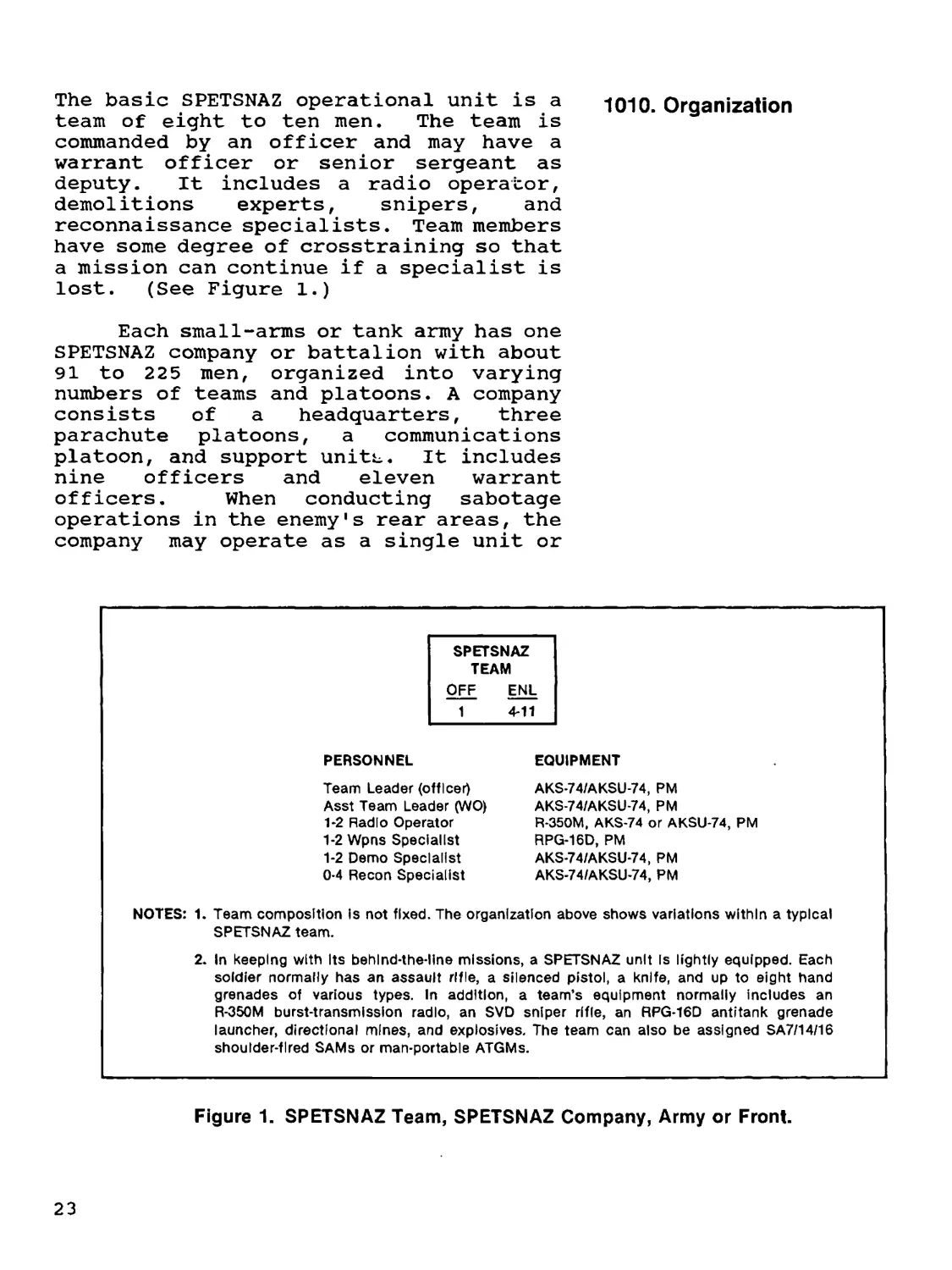
The basic SPETSNAZ operational unit is a
team of eight to ten men. The team is
commanded by an officer and may have a
warrant officer or senior sergeant as
deputy. It includes a radio operator,
demolitions experts, snipers, and
reconnaissance specialists. Team members
have some degree of crosstraining so that
a mission can continue if a specialist is
lost. (See Figure 1.)
Each small-arms or tank army has one
SPETSNAZ company or battalion with about
91 to 225 men, organized into varying
numbers of teams and platoons. A company
consists of a headquarters, three
parachute platoons, a communications
platoon, and support unitu. It includes
nine officers and eleven warrant
officers. When conducting sabotage
operations in the enemy's rear areas, the
company may operate as a single unit or
1010. Organization
SPETSNAZ
TEAM
OFF ENL
1	4-11
PERSONNEL	EQUIPMENT
Team Leader (officer) Asst Team Leader (WO) 1-2 Radio Operator 1-2 Wpns Specialist 1-2 Demo Specialist 0-4 Recon Specialist	AKS-74/AKSU-74, PM AKS-74/AKSU-74, PM R-350M, AKS-74 or AKSU-74, PM RPG-16D, PM AKS-74/AKSU-74, PM AKS-74/AKSU-74, PM
NOTES: 1. Team composition is not fixed. The organization above shows variations within a typical
SPETSNAZ team.
2. In keeping with Its behlnd-the-line missions, a SPETSNAZ unit Is lightly equipped. Each
soldier normally has an assault rifle, a silenced pistol, a knife, and up to eight hand
grenades of various types. In addition, a team’s equipment normally includes an
R-350M burst-transmission radio, an SVD sniper rifle, an RPG-16D antitank grenade
launcher, directional mines, and explosives. The team can also be assigned SA7/14/16
shoulder-fired SAMs or man-portable ATGMs.
Figure 1. SPETSNAZ Team, SPETSNAZ Company, Army or Front.
23
be divided into smaller groups. The
maximum number of groups is 15.
Subdivision of a company is not rigid,
however, and the formation can change
while an operation is in progress. If
necessary, each group can operate
independently. The communications platoon
can set up and maintain communications
with all groups over a range of 1,000
kilometers. (See Figure 2.)
Each wartime front has generally
three or four armies and one tank army.
In support of the armies, but independent
of them, SPETSNAZ companies would operate
in small groups at depths of 100 to 500
kilometers in the enemy rear. In
addition, three SPETSNAZ long-range
reconnaissance regiments (700-800 men)
directly subordinate to the GRU would be
allocated to the commander in chief of
* The structure of army-level SPETSNAZ units is not fixed. Some armies may have a SPETSNAZ battalion,
while others may have only a company. The chart above represents a provisional assessment of army-level
SPETSNAZ strength and organization, based on fragmentary information from several sources.
* * The total number of teams which an army-level SPETSNAZ organization can deploy varies from 10 to 15.
Figure 2. SPETSNAZ Company or Battalion, Army.
24
each strategic directorate (which
consists of three or more fronts and a
fleet).
The most identifiable SPETSNAZ
formations belong to the GRU. SPETSNAZ
diversionary brigades (with a wartime
strength ranging from 900 to 1,300) are
supposedly assigned to each Soviet
military district (or front, in wartime)
and to each of the Soviet's European
allies. Each brigade consists of a
headquarters company, three or four
parachute battalions, a signals company,
and support units. These brigades,
operating in small groups 500 to 1,000
kilometers behind enemy lines, pave the
way for frontal forces that will attack
through areas cleared by nuclear action,
air attacks, and sabotage. (See Figure
3.)
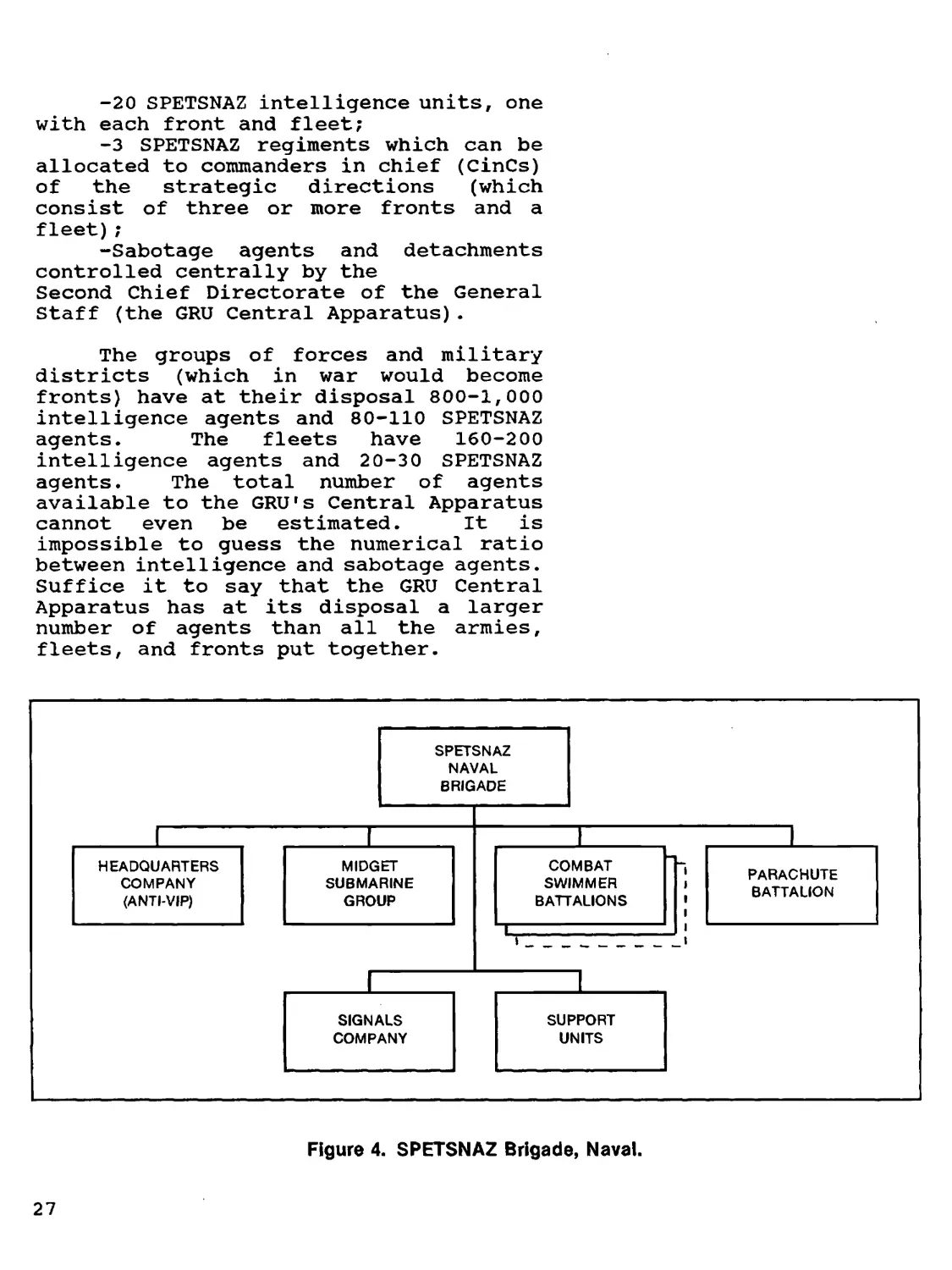
Each of the four naval fleets also
is assigned a naval SPETSNAZ brigade.
These brigades reflect an emphasis on sea
infiltration. Each has a headquarters
company, a parachute battalion, a
minisubmarine group, and two to three
frogmen/combat swimmer battalions, as
well as a signals company and support
elements. (See Figure 4.)
SPETSNAZ peacetime strength has been
estimated at 15,000 to 30,000 although
the lower range seems more realistic. An
accurate figure is difficult to ascertain
for several reasons. First, the less
critical military districts (especially
the interior ones) that are not oriented
toward NATO or China may not deploy a
full brigade. Second, all SPETSNAZ
brigades may not be maintained at full
strength in peacetime. Third, the
Soviets strive to conceal their true
strength. Soviet defector Viktor Suvorov
states that during wartime mobilization
the number of SPETSNAZ forces could be
increased four- to fivefold by recalling
reservists who previously served in
SPETSNAZ detachments.
25
The Soviet Union’s aim is to ha^
the following SPETSNAZ units available <
the outbreak of war:
-16 SPETSNAZ brigades, one per fror
organization;
-4 SPETSNAZ naval brigades, one pe
fleet;
9-10 TEAMS PER COMPANY
* Brigade structure Is not fixed. This chart represents a provisional assessment of what Is believed to
be a typical SPETSNAZ brigade strength and organization, based on fragmentary information from sev-
eral sources.
* * A brigade can be expected to deploy about 80 to 100 SPETSNAZ teams.
------Variable
NOTE: In peacetime, the Independent companies are formed Into a battalion of a SPETSNAZ brigade. The
peacetime establishment is therefore 4 to 5 battalions and not 3 to 4 as depicted here.
Figure 3. SPETSNAZ Brigade, Front.
26
-20 SPETSNAZ intelligence units, one
with each front and fleet;
-3 SPETSNAZ regiments which can be
allocated to commanders in chief (CinCs)
of the strategic directions (which
consist of three or more fronts and a
fleet);
-Sabotage agents and detachments
controlled centrally by the
Second Chief Directorate of the General
Staff (the GRU Central Apparatus).
The groups of forces and military
districts (which in war would become
fronts) have at their disposal 800-1,000
intelligence agents and 80-110 SPETSNAZ
agents. The fleets have 160-200
intelligence agents and 20-30 SPETSNAZ
agents. The total number of agents
available to the GRU's Central Apparatus
cannot even be estimated. It is
impossible to guess the numerical ratio
between intelligence and sabotage agents.
Suffice it to say that the GRU Central
Apparatus has at its disposal a larger
number of agents than all the armies,
fleets, and fronts put together.
Figure 4. SPETSNAZ Brigade, Naval.
27
1011. Personnel Stringent standards are required of all
conscripts assigned to SPETSNAZ.
Potential reydoviki must be secondary
school graduates, intelligent, physically
fit, and, perhaps most important,
politically reliable. Parachute training
with a paramilitary youth organization is
naturally a plus. Upon induction,
SPETSNAZ conscripts will be asked to sign
a loyalty oath in which they acknowledge
that death will be their punishment for
divulging details about their service.
Most SPETSNAZ units are manned by
ordinary, but strong, hardy, and quick-
witted conscript soldiers. The selection
procedure begins long before recruits are
called up to reception centers to start
their military service. Before that,
every Soviet recruit is categorized
according to loyalty to the regime and
physical and intellectual development.
Those recruits in the highest category go
to the Kremlin Guard, KGB government
communications troops, SPETSNAZ, and KGB
frontier troops. Thus SPETSNAZ can
select the best men even to the detriment
of other elite forces such as airborne
forces, strategic rocket troops, and
nuclear submarine units.
Once they arrive in their SPETSNAZ
units, the soldiers undergo a short, but
highly intensive course of military
training during which natural leaders
emerge. These leaders are then sent on
to SPETSNAZ training battalions to become
sergeants. Each company usually sends
more soldiers to become sergeants than it
needs. This is an expensive practice,
unusual in the Soviet Union. In training
battalions, competition is so fierce that
only the best will be awarded the rank of
sergeant. The course is extremely tough;
some of the candidates ultimately return
to their units as private soldiers. Even
some of those who become sergeants return
to their parent companies to be employed
as private soldiers. Thus, only the very
28
best achieve command. This practice
makes it possible to have a permanent
reserve of sergeants who can quickly
replace any other sergeant who is not
maintaining high standards. Knowing
this, men strive at all costs to retain
their authority. This is possible only
through ruthless control of subordinates.
More than one third of all SPETSNAZ
soldiers pass through the sergeant
training courses with the result that
heavy losses in war would not seriously
weaken lower command echelons.
The reserve of warrant officers and
officers is also very high in SPETSNAZ
units. Compared to a normal Soviet Army
company’s 5 officers and 1 warrant
officer, a SPETSNAZ company has 9
officers and 11 warrant officers.
Most soldiers in a SPETSNAZ brigade
are two-year conscripts. Individual
SPETSNAZ teams of these elite conscripts
are led by professional officers. The
headquarters company assigned to each
brigade, on the other hand, is manned
entirely by full-time professionals. They
are fluent in one or more languages of
their areas of potential operations.
They are trained and equipped to operate
there not in camouflage uniform but in
civilian clothing or in the enemy’s
military or police uniforms. These
headquarters companies are also the only
SPETSNAZ units that may establish contact
and act together with SPETSNAZ agents in
a military operation. Headquarters
companies are maintained in the highest
state of readiness. Cloaked in secrecy,
they are supposedly detached from their
parent brigades, posing as parachutists,
boxers, wrestlers, martial arts experts,
marksmen, and sports teams of the
military districts, groups of forces, and
fleets. Allegedly, many officers and
sergeants do not even suspect the
existence of such companies within their
brigades. The SPETSNAZ regiments of the
strategic directorates are similarly
composed of full-time professionals.
29
According to unconfirmed reports,
the Soviet Union replaces members of its
sports teams with SPETSNAZ personnel.
Senior Lieutenant Valentin Yerikalin, who
won a silver medal for rowing at the 1968
Olympic games, was an officer of the
Black Sea Fleet naval SPETSNAZ brigade.
Several years later, he was arrested by
Turkish authorities while trying to
recruit agents in Istanbul.
The number of athletes in SPETSNAZ
is not coincidental. The Soviet Union
needs prestige. One way of providing
this is by winning Olympic medals. The
country needs an organization with
draconian discipline to squeeze the
maximum effort out of the athletes. At
the same time, SPETSNAZ needs athletes of
the highest caliber who have the
opportunity to visit areas where they may
operate in time of war. The athletes,
for their part, need opportunities for
training. They benefit from belonging to
an organization that can reward them
lavishly for athletic achievement—give
them apartments and cars, award
promotions, and arrange trips outside the
Soviet Union. SPETSNAZ thus provides a
focal point for the interests of state
prestige, military intelligence, and
individuals who have dedicated themselves
to sport.
The ZSKA sends its athletes all over
the world without hiding their military
ranks. The KGB, which also has the role
of assassinating enemy VIPs, has its own
similar organization, the Dinamo.
Between ZSKA (Army) and Dynamo (KGB), a
bitter struggle continues to "poach” the
best athletes from other sports clubs and
societies. It is of note that the number
of women athletes in SPETSNAZ is
unusually high.
Very little documentary evidence of
the activities of these professional
assassins has been published. However,
there is one old, but convincing example
from the Great Patriotic War (World War
II), before the creation of SPETSNAZ.
30
During the war, the NKVD (now the KGB)
had a unit called the MOSBON NKVD USSR,
or NKVD independent special service
motor-rifle brigade. This brigade trained
and launched behind enemy lines 212
detachments and groups totaling 7,316
men. Their basic task was to kill
political and military leaders. In
addition, the brigade wiped out known and
potential enemies in the nations
"liberated” by the Red Army. According
to official figures (quoted in "Home
Forces in the Great Patriotic War" —
Moscow, Yuridat 1975, Document No. 278),
this one brigade alone annihilated
140,000 people. The brigade was made up
of "NKVD and state security workers,
units of frontier and home troops,
distinguished athletes, including many
famous top-flight names, and antifascists
of various national groups recommended by
the Comintern." In this sentence, we
find all the components which also exist
in SPETSNAZ today, i.e., ordinary, but
carefully selected and trained soldiers;
top-grade athletes; foreigners; and, at
the head of all of these, professional
intelligence men.
SPETSNAZ does not have its own
officer training schools and academies.
To maintain secrecy and ambiguity,
officers are recruited from the best in
other service branch schools. The high
reserve of officers and warrant officers
in SPETSNAZ companies is necessary since
SPETSNAZ commanders operate independently
behind enemy lines. Team leaders are
both required and authorized to exercise
more initiative than the average Soviet
officer.
SPETSNAZ careerists (officers and
warrant officers) are well-compensated.
Each year of service with a SPETSNAZ unit
counts as 1 1/2 years for pension
purposes. Incentive pay is 50 per cent
of salary. As in other airborne units,
all SPETSNAZ members also receive
parachute jump pay which varies with the
number of jumps. Jump pay can exceed a
conscript's regular salary.
31
Despite the seeming isolation of
SPETSNAZ soldiers from other military
elements for operational security
reasons, SPETSNAZ facilities often appear
to be positioned with other military
units, albeit in enclosed and well-
guarded compounds. As cover, SPETSNAZ
ground forces usually adopt airborne or
signal troop uniforms. Naval SPETSNAZ
wear naval infantry or submariner
uniforms. Their ethnic composition is
not distinctive. To some degree, it
matches the ethnic characteristics of the
intended target areas. For example,
SPETSNAZ units in the Soviet Far East are
alleged to include North Koreans and
Japanese from Manchuria and the Kurile
Islands.
1012. Training
The GRU Central Apparatus is responsible
for SPETSNAZ training battalions,
training centers, and communications
courses. In peacetime, the three elements
of SPETSNAZ—combat units, units of
professional athletes, and foreign
agents—do not have the opportunity to
meet each other and often do not suspect
each other’s existence. Because of
differences in their combat roles, they
are also trained separately.
Foreign agents are trained one by
one in special training centers mainly on
Soviet territory. One such center is in
Odessa. The main subjects of the
training course are security,
communications, demolition (theory and
practice), and collaboration with
professional groups.
Professional athletes are trained in
small groups and sections. Their main
subjects are physical training (in some
cases to Olympic level), foreign
languages, study of the territories in
32
which they are likely to fight (during
sports trips abroad), communications, and
demolition.
Basic military training for
conscripts is conducted within the units.
In addition, SPETSNAZ soldiers learn
parachuting; hand-to-hand combat and
silent killing techniques; sabotage using
explosives, incendiaries, acids, and
abrasives; infiltration techniques which
include defeating locks and security
systems; foreign languages and culture;
survival; reconnaissance and map reading;
and rappelling. Some naval SPETSNAZ
soldiers also train in diving and
minisubmarine activities. Parachute
training begins with static line jumps
and for many goes on to high altitude,
low-opening and high altitude, high-
opening jumps to prepare for covert
insertion. Jumps are made day and night
over all types of terrain regardless of
weather.
A SPETSNAZ unit’s wartime target
area determines its foreign language and
culture training. The team leader is
expected to be nearly fluent in one of
the languages of a target country.
Enlisted team members are expected to
know the alphabet and basic phrases.
This training is intended not only to
facilitate operations but also to enable
teams to conduct missions while wearing
enemy uniforms or civilian clothing.
The technical training schedule
allows time for rigorous physical
training. It includes obstacle courses
and forced marches, often conducted
wearing gas masks. Some units are also
trained in mountain climbing and skiing.
Up to half the training year is spent out
of garrison. Once or twice a year,
selected teams engage in realistic
unannounced exercises conducted under
harsh combat conditions. Exercise
objectives are often operational
33
installations guarded by regular troops
or soldiers of the Ministry of Internal
Affairs.
SPETSNAZ combat training is made to
resemble actual battle as closely as
possible. The role of the enemy in
exercises is played by the home forces of
the MVD, KGB government communications
troops, local KGB units, and the police.
The main task of all these forces is the
security of particularly important
targets and therefore combating
subversion. For this reason, the
leaderships of the GRU, KGB, and MVD are
equally interested in carrying out
combined exercises and in the painstaking
study and analysis of the experience
accumulated.
In an exercise, a SPETSNAZ unit
could be dropped anywhere in the Soviet
Union. It could then be required to
patrol or ski hundreds of kilometers to
neutralize the guards of an actual Soviet
military installation and to assault it
in a manner approaching actual combat.
At the same time, regular Soviet troops
are dispatched on the trail of the
SPETSNAZ forces, tracking them throughout
the region. Casualties often mark such
exercises, but realism serves a dual
purpose. SPETSNAZ teams practice their
own tactics (confronting their
vulnerabilities to helicopters and guard
dogs during movement) while they raise
the combat readiness of the home security
forces tasked to repel raids.
Once a year, the best SPETSNAZ units
from all over the Soviet Union assemble
at the main training center in the region
of Kirovograd. For three months, they
undergo an intensive period of training
and competition. Coincidentally, this
center is adjacent to the Sheltye Vody
group of uranium mines and concentration
camps.
34
Elaborate brigade training areas
contain full-scale mock-ups of enemy
weapon systems and enemy facilities from
likely theaters. They further indicate
the serious intent of SPETSNAZ training.
Brigades assigned against NATO forces
typically have models of Lance, Pershing,
and ground-launched cruise missiles, as
well as mock-ups of airfields, nuclear
storage sites, air defense sites, and
communications facilities. These mock-
ups are used for both equipment
familiarization and demolition training.
As an example of a training
exercise, the SPETSNAZ brigade of the
Fifth Army in the Far Eastern Military
District (whose headquarters is
Ussuriysk) attacked headquarters and
missile units. On the whole, the
brigade's operations were successful
except for an attack on a nuclear weapons
store. The SPETSNAZ groups fell into a
trap. The store commanders had arranged
their vehicles in such a way that, when
the alarm was sounded, all vehicle
headlights switched on at the same time.
Thus, they formed a blazing field of
light around the store and blinded the
saboteurs. The defenders then loosened
guard dogs. The defense was so
successful that now most Soviet
headquarters, signal units, and missile
units form a circle of vehicles at night
with a system of signals. On command,
the surrounding area can be lit up.
During combat training, KGB and MVD
units and also Soviet Army headquarters
use countermeasures against saboteurs
that range from a system of total control
of radio traffic to the use of
helicopters and aircraft. Experience has
also shown that dogs are still the
simplest and most effective way of
combating saboteurs. This opinion is
held by both the KGB and SPETSNAZ.
In addition to mock operations
against real Soviet military objectives,
35
SPETSNAZ units also train in centers
where likely theaters of action are
realistically reproduced in great detail.
In the Carpathians, in the region of
Yavorov, the terrain is reminiscent of
the French Alps. The Baltic coast is
like northern Germany. Inflatable models
of Lance, Pershing and Pluton missiles,
howitzers, aircraft, etc. are used.
Despite the effort to replicate equipment
and uniforms, it is considered much more
important to recreate the enemy’s tactics
and methods of interrogation. Saboteurs
will be subjected to these methods,
should they be caught. These lessons are
very instructive and long-remembered.
1013. Weapons
In keeping with their behind-the-lines
missions, SPETSNAZ teams are lightly
equipped, though armed with the best
weapons available. Each soldier will be
issued one of the various Kalashnikov
rifle models, designed for
airborne/airmobile units—the AKM, AK-74,
or the new short-barrelled AKR carbine.
In addition, he will carry a silenced 9-
mm pistol, ammunition, a knife, up to
eight hand grenades of various types, and
rations, along with a portion of the
team's gear. This might normally include
an RPG-16D grenade launcher and rounds,
a Dragunov SVD sniper rifle, an R-350M
burst transmission radio with a range of
more than 1,000 kilometers, directional
mines, and plastic explosives. If the
mission demands it, the team might also
be assigned special weapons such as the
SA-7, -14, or -16 surface-to-air
missiles. The SPETSNAZ has no heavy
weapons. When operating in the enemy's
rear, saboteurs may seize enemy tanks,
armored personnel carriers, or other
vehicles. While doing this, they may
even wear enemy uniforms.
In a series of experimental
exercises, SPETSNAZ units have used light
motorcycles and specially constructed,
36
small crosscountry vehicles. It is
difficult to say, however, whether these
will become standard equipment.
SPETSNAZ units are remarkable for their
considerable independence of action. The
commander of a sabotage unit usually has
very great power behind the enemy lines.
A SPETSNAZ unit dropped into an area of
particularly important targets operates
independently from then on. Army, front,
and even higher headquarters interfere in
the operations of saboteurs only if more
important targets are discovered or if
saboteurs must be brought out of the area
(e.g., before launching a nuclear
strike). Higher headquarters try not to
interfere in the belief that the
commander behind enemy lines can see the
situation more clearly. Coordination
between active SPETSNAZ units subordinate
to different headquarters is organized
merely by the allocation of boundaries
and the timing of strikes.
In war, Soviet units other than
SPETSNAZ will be operating in enemy
territory. Among these are the
following:
Reconnaissance battalions of motor-rifle
and tank divisions contain deep
reconnaissance companies which hardly
differ from SPETSNAZ in their role and
tactics. The only difference is that
these companies are transported behind
the enemy lines in helicopters, jeeps,
and light armored vehicles and are not
dropped by parachute. Deep
reconnaissance companies have far fewer
men than SPETSNAZ companies. Each may
deploy only 5, not 15 sabotage teams.
There are, however, considerably more
companies. Deep reconnaissance units do
37
1014. Coordination
Deep Reconnaissance Companies
Front Air Assault Brigades
Airborne Divisions
1015. Results Justify Cost
not usually work with SPETSNAZ. Deep
reconnaissance operations range to a
maximum of 100 kilometers behind enemy
lines. This limit allows SPETSNAZ units
to concentrate their activities farther
in the enemy' s rear without being
distracted by operations close behind
them.
Sometimes SPETSNAZ units may guide the
combat helicopters of front air assault
brigades to their targets, although they
most often operate independently.
Occasionally combined operations between
heliborne air assault forces and SPETSNAZ
saboteurs are possible. So is the use of
air assault brigade helicopters to
evacuate prisoners and wounded SPETSNAZ.
The High Command's plans dictate the
operation of airborne divisions. In the
event of supply difficulties, they switch
to purely guerrilla tactics. Although
the operations of powerful airborne
groups behind enemy's lines create a
situation favorable to the operation of
SPETSNAZ, it is not usual to combine
them. In two situations, a superior
headquarters will organize direct
cooperation between units operating in
the enemy's rear: One is when a combined
attack is the only way to destroy or
capture the target. The second is when
Soviet units in the enemy's rear have
incurred very heavy losses. The Soviet
command then improvises groups from the
remnants of other units.
The Soviet command is fully aware that
SPETSNAZ operations will involve enormous
38
sacrifices. Experience in training and
in war shows that losses may be enormous
during an airborne assault. At the same
time, Soviet commanders remember the
consequences of two partisan operations
during World War II. Operation RAILWAY
WAR began on August 3, 1943, at the
height of the battle for Kursk, when
Soviet forces went into an offensive.
About 100,000 civilians-turned-guerrillas
took part, derailing 836 special trains
and blowing up 556 road bridges and 184
railway bridges. The enemy's rear area
was paralyzed over large areas. In one
operation, 215,000 lengths of railway
track were blown up.
On an even greater scale was
Operation CONCERTO, in which 120,000
guerrillas took part. CONCERTO was
mounted while the Red Army was attacking
and forcing the crossing of the river
Dnieper. In the opinion of Marshal of
the Soviet Union A. Yeremenko, "without
CONCERTO, the forcing of the Dnieper
would have been impossible."
The GRU, also known as the Second Chief
Directorate of the General Staff, is
responsible for reconnaissance
(voiskovaya razedka); agent-derived
intelligence (agenturnaya ra zvedka);
SPETSNAZ training and operations;
processing and dissemination of
information on the enemy; and radio-
intercept, or signals intelligence. The
GRU coordinates operations of all
subordinate levels of Soviet military
intelligence. In addition, it has its
own very high-powered organization of
clandestine foreign agents, some of whom
are recruited for assassination and
terrorist activities.
1016. Chain of Command
The division of responsibilities at
the GRU level is replicated at levels
below it. The second directorate of the
staff at each of the levels where
39
SPETSNAZ units are deployed (from army
level upwards) consists of five groups,
numbered as follows:
I. Reconnaissance
II. Agent-derived intelligence
III. SPETSNAZ
IV. Information processing
V. Signals intelligence
SPETSNAZ is thus subordinated
neither to reconnaissance nor to
intelligence.
To coordinate the activities of
several fronts and fleets in time of war,
high commands are set up in at least
three strategic directions (Western,
Southwestern, and Far Eastern Strategic
Directions). The commander in chief of
each strategic direction may have one
SPETSNAZ regiment placed under his direct
command. In peacetime, these SPETSNAZ
regiments are commanded directly by the
GRU Central Apparatus (the Second Chief
Directorate of the General Staff).
In wartime, at front level
headquarters (in peacetime at the
headquarters of groups of forces and
military districts), the same five
activities are under the second
directorate, divided into groups with the
same titles and numbers. The SPETSNAZ
department of the second directorate has
under its command a SPETSNAZ brigade plus
a SPETSNAZ intelligence center, which is
responsible for recruiting its own
clandestine foreign agents. Front
staff's second directorate thus controls
two independent networks of foreign
agents, one run by the intelligence
department and one by the SPETSNAZ
department.
The headquarters of every Soviet
fleet also has a second directorate
similar to that in the front
headquarters. It has the same functions
and departments as its land-based
counterpart. It includes a group of
intelligence agents, a group of SPETSNAZ
40
agents and, in this case, a SPETZNAZ
naval brigade.
At army level, the SPETSNAZ group of
the staff's second directorate has under
it an independent SPETSNAZ company. The
second directorate commander may give
information from the intelligence group’s
clandestine agents to the SPETSNAZ
company in order to direct it toward its
targets.
The size and quality of the spetsnaz 1017. Western Countermeasures
establishment point out the need for
effective security of key Western
installations. Awareness of the threat
is crucial and demands—
-	Continued education of the military
audience, NATO in particular;
-	Realistic integration of SPETSNAZ
play into Western military exercises;
-	Continued research into SPETSNAZ
capabilities, facilitated by better
cooperation among Western intelligence
services;
-Identification of likely SPETSNAZ
targets and the development of
appropriate security for them (possibly
mobilizing reserve personnel as rear area
security forces); and
-Greater international cooperation
among intelligence services to monitor
Soviet SPETSNAZ activity—including its
fishing and merchant fleet—worldwide.
Although it would be impossible to keep
sufficient forces to track and target all
of the vessels in the Soviet Union's
fishing and merchant fleet, a priority
system might be established to monitor
the larger and more important vessels.
41
At the very least, local security forces
should be on guard when Soviet ships
linger nearby.
The Soviet Union has made an
enormous investment in special purpose
forces. The West must also improve its
own special operations forces in order to
respond rapidly, flexibly, and
appropriately to all levels and types of
aggression, from low-intensity conflict
to global confrontation. Improvement is
essential, not just because the Soviet
Union is doing it, but because the
effectiveness of such forces has been
proven.
1018. Conclusions
The average SPETSNAZ commando is not ten
feet tall. Despite their qualifications,
rigorous training, and demonstrated
value, SPETSNAZ forces have several
weaknesses. Since most SPETSNAZ
personnel are conscripts on two-year
tours of duty, opportunity for cross-
training in specialties and languages is
limited. Some may lack the degree of
motivation and professionalism that
characterize Western unconventional
warfare forces.
Much of the success of SPETSNAZ
infiltrations depends upon how quickly
the West learns of Soviet mobilization.
Although SPETSNAZ forces may be composed
of hundreds of teams, they cannot all be
simultaneously inserted much before D-
Day. The chance of compromise is too
great. In addition, once tensions
increase or the West receives advance
warning of impending hostilities, many of
the clandestine means of insertion and
support will be terminated. Legal agents
will probably be expelled from Western
countries. Aeroflot landing rights and
Soviet merchant vessel port visits will
be terminated. TIR truck passage
privileges will be curtailed.
42
In comparison to Western
unconventional warfare forces, SPETSNAZ
units lack specialized infiltration
aircraft like the U.S. Air Force MC-130E
Combat Talon. This lack severely limits
SPETSNAZ capabilities for clandestine
insertion, particularly just prior to the
start of hostilities. As a result,
SPETSNAZ units must rely upon the brute
force of a Soviet air campaign to cover
most infiltration. If Soviet fighter-
bombers and other means do not inflict
the necessary damage to enemy air
defenses, unarmed transports would be
attacked before the teams even arrive on
target.
Nonetheless, SPETSNAZ forces pose a
formidable wartime threat to Western and
particularly NATO’s rear areas. From the
Soviet perspective, the investment in a
force of several thousand highly trained
men is small compared to a potential
payoff: neutralizing ene;ay nuclear
delivery capabilities, degrading air
defense and communication systems, and,
indirectly, increasing the effectiveness
of Soviet aircraft, missiles, and ground
forces through SPETSNAZ-assisted
targeting. SPETSNAZ teams are an
effective force multiplier. By
neutralizing enemy nuclear systems, they
increase the surprise of the main attack,
allowing Soviet forces to exploit
superior margins of conventional military
power. By creating panic and disruption
in rear areas, they cause forces to be
withdrawn from the front lines to meet
the rear area threat and thus weaken
enemy resistance.
The Afghanistan experience gave
Soviet leadership a greater degree of
operational confidence to assert itself
especially in situations it may have
previously avoided. It should no longer
be assumed that the Soviet Union will
project power in all instances with the
same conservatism. The strength and
varied capabilities of SPETZNAZ forces
can effectively advance Moscow’s
strategic interests in the Third World.
43
This can be done through direct political
action against unstable regimes or
through more indirect means. These could
include training and support of anti-
Western insurgencies, wars of national
liberation, or terrorism. In many Third
World conflicts, even a modest military
interposition could influence the
outcome. An on-ground Soviet SPETSNAZ
presence can quickly supplement
indigenous revolutionaries before the
arrival of U.S. or allied rapid
deployment forces. Such an action could
present the West with a fait accompli.
Since surprise is the Soviet trademark,
the West's lacks in information and
readiness can be SPETSNAZ's greatest
weapons.
44