/


















































Текст
                    CONTENTS

Issue 41 2024
Create! Magazine

Interviews
10

D I S T O R T E D R E A L I T Y:
F I G U R AT I V E O P A R T B Y A L E X
GARANT
by Alicia Puig

16

S E L F I E C U LT U R E , M A G I C , &
M Y T H O L O GY: I N T E R V I E W W I T H
ALISON BLICKLE
by Christina Nafziger

22

ON THE EDGE OF THE MYSTICAL :
I N T E R V I E W W I T H C I N DY B E R N H A R D
by Christina Nafziger

26

C R Y S TA L S F I L L E D W I T H
P O S S I B I L I T I E S & P O R TA L S T O
ANOTHER WORLD:
INTERVIEW WITH REBECCA
CHAPERON
by Christina Nafziger

32

THE MYSTICAL WORLD OF SARAH
POT TER
By Ekaterina Popova
Rebecca Chaperon
Self Care In Dark Times

38

THE MYSTERIOUS WORLD OF
M I C H E L L E AV E R Y KO N C Z Y K :
N AV I G AT I N G S U R R E A L I S M A N D
SY M B O L I S M
T H R O U G H PA I N T I N G S
By Ekaterina Popova

2 | C R E AT E ! M A G A Z I N E I SS U E 4 1

CONTENTS

Curated Section
50

Subscribe

Alexis Herman

SUBSCRIBE ISSUES / Please visit our online

Shweta Bist

store at www.createmagazine.com/subscribe

Loren Eiferman

to subscribe to our digital or print publication.

Rachel Bensimon
Brandi Hofer
Robin Adler
Alycia Earhart
Tafy LaPlanche
Anvi Stevens
Mary Lacy
Jennifer Small
Gina Ariko Marioni
Melanie Brock
Ryan Horton
Sandra Curitore
Geraldina Khatchikian
Amy J. Dyck
Jacquelyn Strycker
Marion Griese
Sarah Verardo

Newsletter
SIGN UP TO NEWSLETTER / Get a weekly
dose of inspiration when you join
our newsletter.
www.createmagazine.com/newsletter

Instagram
INSTAGRAM / Follow us on Instagram for
artist features, inspiring content and more!
@createmagazine

Jen Bootwala
Karen Christie Fisher
Jessica Libor
Mariell Guzman
Tiffany Heng-Hui Lee
Yahel Yan
Marie-José Robinson Kafri
Ellen Starr Lyon

Call for Art
CALL FOR ART / Visit www.createmagazine.
com/call-for-art to learn how to submit to one
of our open calls.

Maddie Stratton
Kirk Gower
Asia Hanon
Petra Schott
Jennifer Agricola Mojica
Olivia Pestova
Paula E Borsetti
Rachael Zur
Sarah E. Boyle
Amy J. Dyck
Yana Beylinson

Shop at PXP
PXP Contemporary / Shop art you
can afford to love at our online gallery
of affordable contemporary art www.
pxpcontemporary.com
ISSN 2475-9198

3 | C R E AT E ! M A G A Z I N E I SS U E 4 1

Connect online
@createmagazine
createmagazine.com

F R O M T H E ED I TO R

a letter from
the editor
connect on Instagram
@createmagazine

Following the Mystery
Dear Reader,
Mystery and magic have always drawn us creatives in.
Whether it is the strange ways ideas come to us in the
studio or the hidden elements in our work, there is always
room to explore the unknown and be in awe of life, art, and
creativity.
For this issue, we invited artists to share their work and
stories that invite us to dive deeper into the sometimes
witchy, sometimes truly magical elements of art. Explore
interviews with Alex Garant, Alison Blickle, Cindy
Bernhard, Rebecca Chaperon, Sarah Potter, and Michelle
Avery Konczyk.
For our curated section, we invited artist and founder of
Visionary Art Collective, Victoria Fry, to handpick artists
from all around the world. Grab your favorite cozy drink
and discover your next favorite artist in this special issue.
With love,
Kat and Team

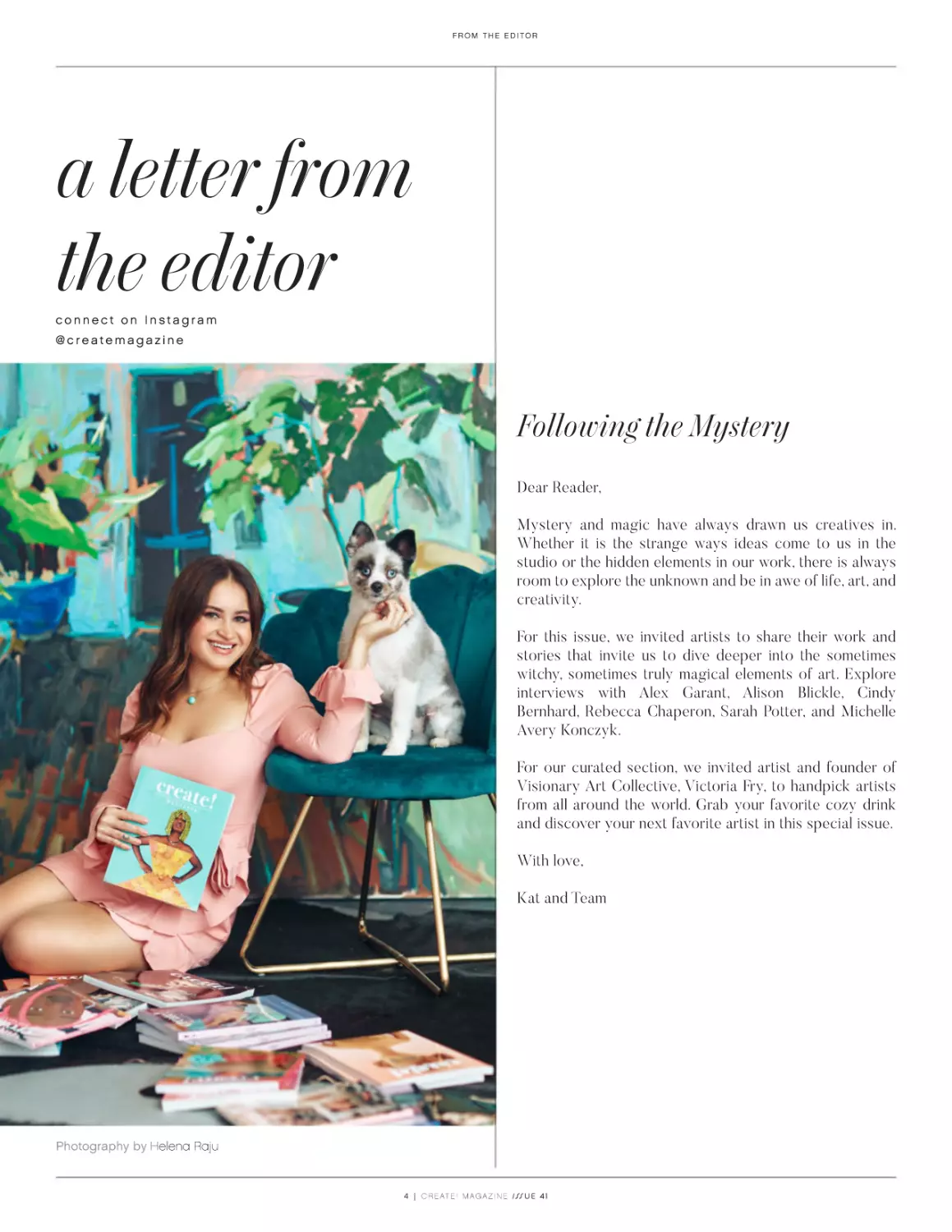
Photography by Helena Raju

4 | C R E AT E ! M A G A Z I N E I SS U E 4 1

MEET THE TEAM

01

02

03

04

05

06

Our Team
Issue #41

07

01

Renan Calara

02

Alicia Puig

03

Victoria Kukla

04

Christina Nafziger

05

Zoë Goetzmann

Artist and Designer

Director of Business Operations

Creative Director & Designer

Associate Editor & Writer

Writer & Podcaster

5 | C R E AT E ! M A G A Z I N E I SS U E 4 1

06

Sarah Mills

07

Shelby McFadden

08

Ekaterina Popova

Writer & Assistant

Lead Designer

Founder & Editor in Chief

A podcast where artists, creatives, dreamers, and
artpreneurs gather to share their journeys and their art
over their favorite drinks.
www.createmagazine.com/podcast

Magic is having an
intention, putting yourself
into an altered state of
reverence and focus, and
doing something physical
that releases your intention
out into the world.
Alison Blickle

Articles
Interviews
and

In our interview section, we take you on a journey through the minds of
some truly exceptional artists and creators. Join us as our writers chat with
Alex Garant, engage in a thought-provoking discussion with Alison Blickle
about Selfie Culture, Magic, & Mythology, and explore the enigmatic
depths with Cindy Bernhard. Discover the captivating world of Rebecca
Chaperon's artwork, filled with crystals, magic, and more. Psychic medium
Sarah Potter shares her unique perspective, and explore the darker side
through the evocative paintings of Michelle Avery Konczyk.

9 | C R E AT E ! M A G A Z I N E I SS U E 4 1

ARTIST INTERVIEWS

1 0 | C R E AT E ! M A G A Z I N E I SS U E 4 1

Distorted Reality:
Figurative Op Art by Alex Garant
By Alicia Puig

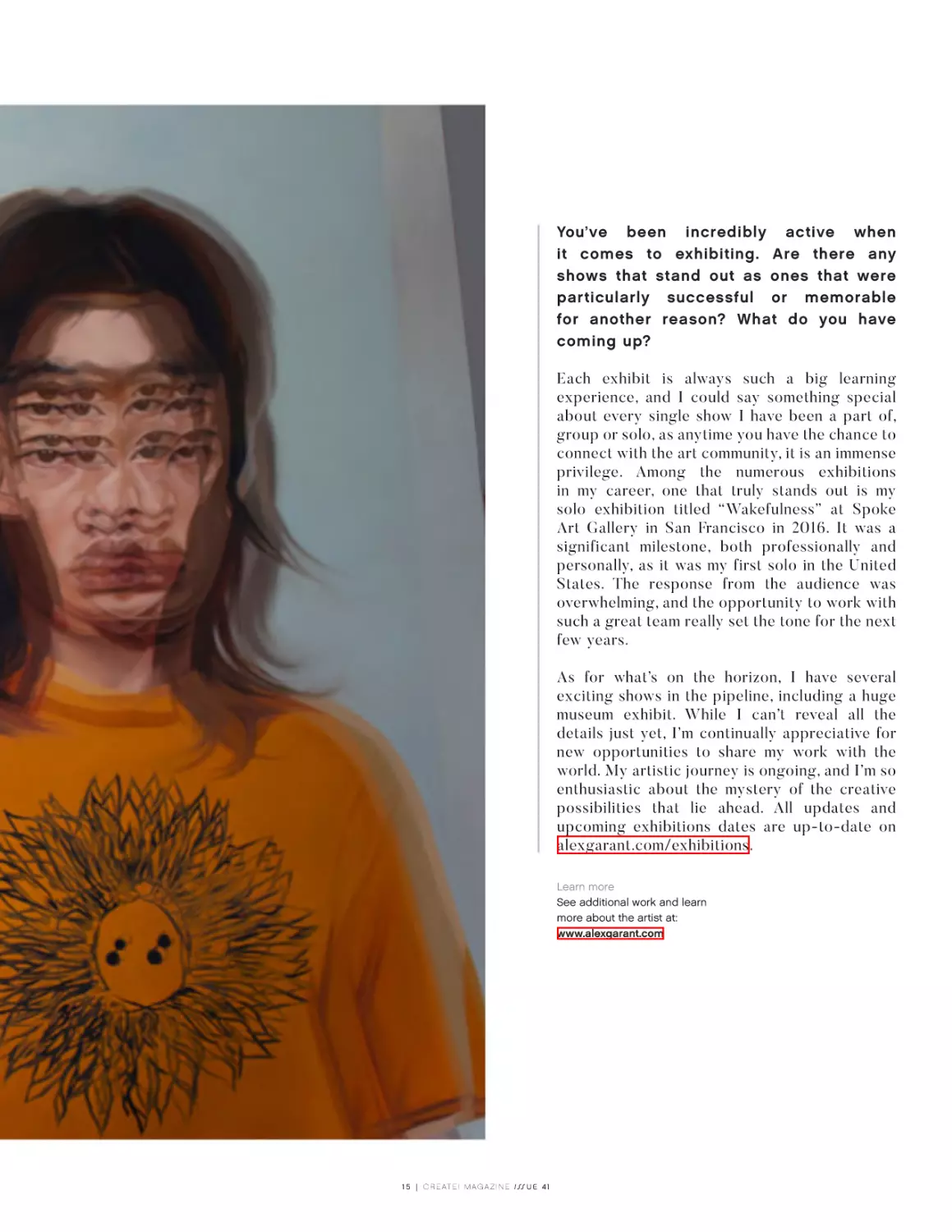
In this interview, you’ll meet Canadian artist Alex Garant, aka the Queen of
Double Eyes. She earned this moniker for her distinct style of oil paintings that
combine a graphic sensibility with traditional portrait techniques. Over the years,
Garant has established herself as one of the leaders of analogue Glitch Art by
using patterns, duplication of elements, symmetry and image superposition as key
elements in her work. Her paintings are a reflection on human duality, the battle for
self-definition between one’s inner self and outer persona. Our conversation with
the accomplished artist touches on the layers of meaning in her works, embracing
that idea that creativity ebbs and flows, and finding balance between mess and
order in both the art-making process and administrative tasks.

You’re known widely as a key figure in the contemporary figurative
op art genre. While there’s certainly a heavy emphasis on technical
skills in your work, the heavy distortions ultimately create a dizzying,
unsettling effect. Are there also elements of the supernatural and
surreal at play in your paintings?
Absolutely, my work in the contemporary figurative op art genre places a strong
emphasis on technical skills, as I find it fundamental to achieving the effects I desire.
So always learning, and pushing technique, is a big obsession of mine. The heavy
distortions and intricate patterns serve to—
hopefully—create a memorable experience
... I aim to create a bridge between
for viewers, drawing them into the artwork’s
reality and the ethereal, but also
narrative. In addition to these elements, there
to push the multi-persona analysis
are indeed surreal aspects at play in my
paintings. I’ve always been captivated by the
concept, allowing viewers to explore
mysterious and the power of the human mind,
the realms of their own conduct within
either with its imagination or social behaviors.
the framework of a distorted reality.
This fascination often finds expression in my
art, where I aim to create a bridge between
reality and the ethereal, but also to push the multi-persona analysis concept,
allowing viewers to explore the realms of their own conduct within the framework
of a distorted reality.

“

1 1 | C R E AT E ! M A G A Z I N E I SS U E 4 1

We love hearing about artists’ creative
process. Can you walk us through how
you work and what your creative space
is like?

exhibitions. These interactions often remind me
how magical the creative world is and help me
grow as an artist. Creatively, I draw inspiration
from various sources, such as nature walks,
dreams and even everyday experiences.

Certainly! My creative process is a dynamic
journey that involves multiple stages. I typically
begin with a traditional portrait sketch as my
focal point and work in layers to develop depth
and movement. Each layer adds complexity to
the piece, transforming it into a visual puzzle.
Once I am happy with the drawing, I transfer it
onto canvas and begin the painting stage which
is realized with a wet-on-wet technique. One
layer done in connecting sections.

When I need a reset, I step back from my work
and take time to recharge. This might involve
exploring new places, or simply taking a break
from painting. A change of scenery and a mental
break can work wonders for rejuvenating my
creative spirit. Inspiration is like the ocean—it
comes in waves; sometimes, the water needs to
retreat in order to form more wonderful waves
of fresh ideas.

As for my creative space, it is both a peaceful
sanctuary and sometimes a torturous playground.
I currently have a home studio that allows me

“

Inspiration is like the ocean—it comes in
waves; sometimes, the water needs to retreat
in order to form more wonderful waves of
fresh ideas.
to go in whenever I am inspired, as inspiration
can strike at any moment. The semi-controlled
chaos fuels my creativity: you’ll find stacks of
vintage magazines, palettes, brushes and way
too many art supplies, all contributing somehow
to fueling my creativity. It’s a safe space where
I can immerse myself entirely in the process and
allow myself to push my visual voice deeper and
deeper.
As an artist who has been in the industry
for many years, how do you stay motivated
both professionally and creatively? What
do you do when you need a reset?

There’s a high degree of finesse and
detail in your work. I’m sure that takes
patience and organization (especially
in your large-scale works!). Do you find
that these methodical characteristics
translate to how you approach the
business and administrative side of your
art practice as well?
If I am being candid, I feel like my creative
process is way messier than my administrative
skills. Even if I meticulously plan and execute
each brushstroke, that part of the artist’s life is
based on emotions and instincts. But I approach
the management of exhibitions, collaborations
and the business aspects of being a professional
artist with a heightened level of organization
and discipline. I found a way to “train” myself
to be organized and disciplined when it comes
to business tasks. So I believe a combination of
letting loose with art and being more strict with
the business side of things helps me navigate the
complex art world and ensures that my artistic
vision reaches its intended audience effectively.

Staying motivated as an artist, both
professionally and creatively, is an ongoing
challenge. Professionally, I seek motivation in
the connections I build within the art community,
coaching emerging artists and participating in

1 3 | C R E AT E ! M A G A Z I N E I SS U E 4 1

ARTIST INTERVIEWS

1 4 | C R E AT E ! M A G A Z I N E I SS U E 4 1

You’ve been incredibly active when
it comes to exhibiting. Are there any
shows that stand out as ones that were
particularly successful or memorable
for another reason? What do you have
coming up?
Each exhibit is always such a big learning
experience, and I could say something special
about every single show I have been a part of,
group or solo, as anytime you have the chance to
connect with the art community, it is an immense
privilege. Among the numerous exhibitions
in my career, one that truly stands out is my
solo exhibition titled “Wakefulness” at Spoke
Art Gallery in San Francisco in 2016. It was a
significant milestone, both professionally and
personally, as it was my first solo in the United
States. The response from the audience was
overwhelming, and the opportunity to work with
such a great team really set the tone for the next
few years.
As for what’s on the horizon, I have several
exciting shows in the pipeline, including a huge
museum exhibit. While I can’t reveal all the
details just yet, I’m continually appreciative for
new opportunities to share my work with the
world. My artistic journey is ongoing, and I’m so
enthusiastic about the mystery of the creative
possibilities that lie ahead. All updates and
upcoming exhibitions dates are up-to-date on
alexgarant.com/exhibitions.
Learn more
See additional work and learn
more about the artist at:
www.alexgarant.com

1 5 | C R E AT E ! M A G A Z I N E I SS U E 4 1

ARTIST INTERVIEWS

1 6 | C R E AT E ! M A G A Z I N E I SS U E 4 1

Selfie Culture, Magic,
& Mythology:
Interview with Alison Blickle
By Christina Nafziger

For LA-based artist Alison Blickle, making art is a type of magic, and I could not
agree more. To mix and blend the concepts you’re interested in, what influences
you in daily life, the imagery that lives inside your head, and often the imagery that
exists in real life together to create something that has never existed before is truly
nothing short of magical. For Blickle, her wand is her paintbrush, painting vibrant
and complex scenes of women posing for the camera. Dressed up for the camera,
the artist paints figures that are in the middle of taking selfies—arms extended and
phones in hand. Each scene is like a modern-day dramatic Renaissance painting, or
more accurately, a Rococo painting, an art movement that influences Blickle’s work
as her paintings are filled with lush excess and luxury. Each carefully constructed
scene is a contemporary tableau that teeters between feminine power and selfabsorption. The artist’s irresistible scenes are enticing and opulent, mirroring the
seductive power of selfie-culture. Blickle’s work is both a critique and exploration,
diving into our current state of social media indulgence.
Join us in conversation as we take a deep dive into Blickle’s complex process
involving physical tableaux, photoshop collage, and AI, her use of ritual and
intentional practices, and the Greek mythology that inspires her subjects.

When did you begin creating art? Did you always consider yourself
an artist?
I studied singing and dance as a kid, and knew I wanted to do something artistic
with my life. I started making visual art in high school. My parents were very
practical-minded, and didn’t encourage me to pursue it as a career. So I went to
“regular” college, and have a BA in Political Economy from UC Berkeley. Once I
started working after college, I realized I needed to pursue my passion, and I went
back to school for a BFA in painting, and then an MFA from Hunter College in New
York. Looking back, I really started to consider myself an artist when I decided
to go to art school. At that point, I was dedicated to making it my career and
way of life.

1 7 | C R E AT E ! M A G A Z I N E I SS U E 4 1

ARTIST INTERVIEWS

Where and how did you develop your
incredible skill in painting?
Just the desire to learn how to do it, and years
of practice! In art school, none of my painting
teachers had a high level of skill in realistic figure
painting. It’s just not considered important, so if
you want to learn it you have to find ways to
teach yourself. I actually had the first cell phone
with a camera on it (!) — it was a Nokia. I was
obsessed with it and took tons of pictures of
my friends, and selfies, and made paintings from
those grainy photos. Over time my technique got
more and more refined until I could paint with a
high level of realism.
Your paintings often depict women
posing for photos and/or taking photos
themselves with their phones. Can you
talk a bit about selfie culture and how
Instagram and social media influence
your work?
Social media and the internet have been the
biggest change to humanity in my lifetime. I was
a fully-formed adult by the time it really took
hold culturally, so I remember my mind and our
collective experience of life “before”. Its impact

I try to strike a balance between using them
descriptively in my work—as in, depicting how
they are such an integrated part of our lives
that they show up in almost every setting, and
then partially exploring/critiquing how they
have impacted us psychologically, specifically
women.
I recently did two shows based on the Maenads
of Greek mythology. The Maenads roamed
the forests performing wild dances that put
them into trance states. This was their spiritual
practice, how they communed with the divine.
When the men in power came to stop their
rituals, the Maenads banded together in their
magical trance, tore them limb from limb.
In the world of my paintings, the Maenads live
in modern day Hollywood, and are part of the
Time’s Up and Me Too movements. Women
banding together, using the power of the
internet and social media to take down men who
did them harm. The narrative in the show is made
complicated, and in some ways problematic,
by the influence of selfie culture, the inherent
performative aspect of social media, and the
ability of the internet to destroy people based
on accusations alone.

“

I hold the vision that our coming generations
learn from our mistakes and find a way of
using these technologies that leads to better
mental and spiritual health.
is so profound. I think social media can be a
powerful tool for connecting and supporting
each other. But we have to be more guided
by our awareness of the negative impacts of
overusing it.
I consider myself a modern-day history painter—
painting large-scale narrative scenes with
groups of people in dynamic, theatrical poses. I
love classical painting, and want to continue that
tradition while tackling contemporary issues
and stories and culture. There’s no way I could
do that authentically without including selfies
and phones in my work.

1 8 | C R E AT E ! M A G A Z I N E I SS U E 4 1

What are your thoughts on our culture’s
relationship to our self-image and selfdocumentation?
Personally, I’m deeply disturbed by the direction
our culture is going in regard to these things.
Too much focus on self-image encourages
narcissism and superficiality, not to mention
anxiety and depression. Too much focus on selfdocumentation keeps us from fully living in the
moment and being present with what is actually
around us. My values are having empathy,
being focused on our inner selves, how we are
serving something larger than ourselves, how
we are putting love out into the world, how we

are helping people or nature, how we are taking
care of ourselves and the people in our lives, and
being present. I hold the vision that our coming
generations learn from our mistakes and find a
way of using these technologies that leads to
better mental and spiritual health.
Tell us about your process. Do you create
these scenes and tableaux in real life?
Yes! I start by choosing an ancient myth with
a powerful female archetypal character and use
it as the inspiration for making a body of work.
It’s my way of inviting these divine feminine
energies back into the consciousness of our

1 9 | C R E AT E ! M A G A Z I N E I SS U E 4 1

ARTIST INTERVIEWS

contemporary culture. I’m a witch, and believe
that making art is a type of magic. Magic is
having an intention, putting yourself into an
altered state of reverence and focus, and doing
something physical that releases your intention
out into the world. This is basically the process
I follow when I’m making a painting. So, when I
start a new body of work, I make sure to choose
a subject that I want to amplify and put out into
the world. Witches also believe that whatever
you put out into the world comes back to you
times three. So, I like to work with goddesses or
myths whose energy I need more of in my life at
the time.
I sketch out a list of scenes I’d like to paint. Then
I do big photoshoots to get the source imagery
I need for the scenes. I either ask friends to pose
for me or hire models, find locations, build sets,
use colored lights, and work through my shot list.
Then I take my photos into Photoshop, and spend
a few months making collages. At this point, I
bring in other imagery to add to the collages.
For my most recent show (about Medusa), I
used bits and pieces of Rococo paintings in my
collages. The paintings I was making were very
maximalist, and full of the over-the-top beauty
that is so popular in our culture nowadays
thanks to selfies and filters, and makeup/nail/
injectables trends being so extreme. I wanted to
draw a parallel between our current obsession
with and indulgence in artificial beauty, and the
aesthetic excesses of the Rococo period.
In my current body of work, I’m using imagery
that I generate in AI as my added collage
elements. The collages are where I do the
majority of my failing, experimenting, and
working through options and ideas. For each
large painting, I have made hundreds of versions
of it in collage before deciding on one. Once I
decide, I use the collage as a reference to paint
from. I draw it on the canvas, and then paint it
in oils.

most dramatic and cinematic, and I want my
paintings to feel like choreographed rituals or
performances.
How would you describe your paintings
around 10 years ago?
What year is it? Jk. Covid and quarantine really
messed up my sense of time. Ten years ago, I
had just started working with mythology in my
work—something I do to this day.
In 2013 I was in the middle of my History of
Magic trilogy. I had written my own folktale type
story—a reclaimed version of the Pandora’s Box
myth. My story followed the three-act structure
of a Hero’s Journey narrative as described by
Joseph Campbell. Each act of my story became
its own exhibition, so the entire story took three
years to create and show. At that time, the figures
and environments of my paintings looked like
they were from an earlier time and place. Today
my work is clearly set in the modern world.
What is your favorite genre of art and/
or art history? Who is one artist that has
continued to inspire you throughout your
life and why?
My favorite movement in art history is probably
post-impressionism. Matisse has always been a
favorite who continues to inspire me to explore
color and flatness vs. space.
What has been the most surprising
challenge of your career as an artist thus
far?

Have you always painted in this style on
a larger scale?

Social media. When I went to art school, art
was for weird introverts who wanted to be
alone in the studio all the time. Now we have
to constantly promote ourselves and present
ourselves online as a brand. It goes against my
introverted nature, but it’s what I have to do in
order to keep having the opportunity to make
art for a living, so I do my best!

I started painting large-scale paintings in grad
school. I wanted the work to have life-sized
figures, and to feel like the viewer can “go
into” the world of the painting. It's just the

Learn more
See additional work and learn
more about the artist at:
www.alisonblickle.com

2 0 | C R E AT E ! M A G A Z I N E I SS U E 4 1

On the Edge of the
Mystical:
Interview with Cindy Bernhard
By Christina Nafziger

Cindy Bernhard’s paintings are filled with mystery, darkness, intrigue, and a dash
of humor. She describes her paintings as dreamlike with transcendent-like qualities.
Each scene appears to on the cusp of something mystical, with dramatic magenta
lighting and indigo shadows as if on the edge of dusk, on the brink of something
supernatural. The artist beautifully and skillfully creates haunting interior scenes
with an air of the gothic, with candles burning and smoke sifting through the night
air. And in the air, it feels like anything is possible, like that moment just after
midnight where suddenly the mood shifts to the unexpected and almost magical.
Bernhard’s stunning interiors often showcase wide-eyed cats (or dogs)—what she
explains are stand-ins for people. Each object and animal are carefully placed,
pulling the viewer in to another world. In this interview, the artist tells us about
the inspiration behind her imagery, her routine in her studio, and the existential
questions that inform her gorgeous work.

“

I remember making my first cat
painting and things really clicked; it
was the first painting I made that felt
truly 'me'.

You have such a distinct style—
was this formed during your
time studying art? How did
that experience affect your
approach to art making?

During grad school I did a lot of experimenting to find what suited me best, I even
tried becoming a non-objective painter for a little bit! My style didn't really develop
until 2020. I remember making my first cat painting and things really clicked; it was
the first painting I made that felt truly 'me'. Once I made that piece, I started to get
a lot of eyes on my work and I remember my core group of painting friends saying,
'wow this new body of work is so YOU'. But this took years of consistent painting
and trying lots of different things. I think to hone one's own voice it takes years of
painting and dedication.
Left Image
Joints and Jesus
Oil on Canvas
72in x 60in | 2021

2 3 | C R E AT E ! M A G A Z I N E I SS U E 4 1

ARTIST INTERVIEWS

What about domestic interiors inspires
you as a subject?
I use domestic interiors as a setting for the
dramas of human existence. I spend a lot of time
at home, and minimally decorated interiors have
been a way for me to contemplate and explore
the idea of ritual space and meditation.
There are a few objects that tend to show
up repeatedly in your paintings, such as
cats, candles, and smoke. Can you talk
about these elements and what continues
to draw you to them?
Cats (and recently dogs) are a stand in for
humans in my work. I used to paint the human
figure, but I found that when I switched to
animals it became easier for myself and viewers
to empathize and relate to the subject matter.
Painting animals also adds an element of humor
and creates a stage for comedic relief. The
candles and smoke are important imagery from
my childhood. As a kid I spent a lot of time in
the Catholic church with my family and I have
always been mesmerized by the abundance of
candles, smoke, and incense that surrounded me
as a kid. I think this imagery has been ingrained
in my mind and has found its way into my work.
It is also a formal play between solid shapes and
transparency.

Do you have a routine in your studio?
What do you do to get you in the mood
and mindset to create your art?
I keep a disciplined studio schedule. Most days
I wake up at 5 am and try to get in the studio by
7 am. I work Monday - Friday, 7 am to at least 5
pm. I don't believe in waiting to get in the mood
to create work, I think one must be creating
consistently in order to see results and further
their practice. Like Jerry Saltz always says, "Get
to work!!!"
Who or what are some of your biggest
influences?
I am influenced by everything: films, poetry, and
my day-to-day life. My two favorite painters are
Morandi and Lisa Yuskavage. Two filmmakers
that inspire my work most are Andrei Tarkovsky
and Terrence Malick.

The hues and lighting in your painting
create such a specific atmosphere and
vibe. How would you describe the mood
of your paintings?
The moods that I try to convey in my work are
dreamlike, otherworldly, mystical, and possibly
transcendence. I have always been interested in
mystics and I often dwell on questions regarding
existence. What happens after this life? Is there
a way to find peace and transcendence in this
world? What is the purpose of human existence?
The big questions!
Above Image
Stairway
Oil and Acrylic on Canvas
60in x 48in | 2023

24 | C R E AT E ! M A G A Z I N E I SS U E 4 1

I first saw your paintings in person at
an incredible show in Chicago at the
Ukrainian Museum of Modern Art. Are
you from Chicago originally? If not, what
brought you here and what keeps you
here?
I grew up on a pig farm an hour south of Chicago.
I moved to California in my 20s to go to graduate
school, but I am close with my family and knew
I would always come back to Illinois. If I were
to move anywhere else it would be New York,
but right now I am content in Chicago. I am a
midwest girl at heart!
I have to ask—is the cat in your paintings
your own cat?
Haha! I am actually very allergic to cats! I find
them to be mysterious and sneaky...and because
of this they were the perfect vehicle for my work.
I am currently doing a series with dogs, and I am
excited to share them when the time comes.
Do you have anything coming up that
you’d like to tell us about?
I have group shows and fairs that I will be
participating in for the remainder of 2023. I will
be showing some new works with Richard Heller
in Miami at UNTITLED art fair, and my next
solo exhibition will be in May 2024 with Richard
Heller Gallery in LA.
Learn more
See additional work and learn more
about the artist at:
www.cindybernhardart.com

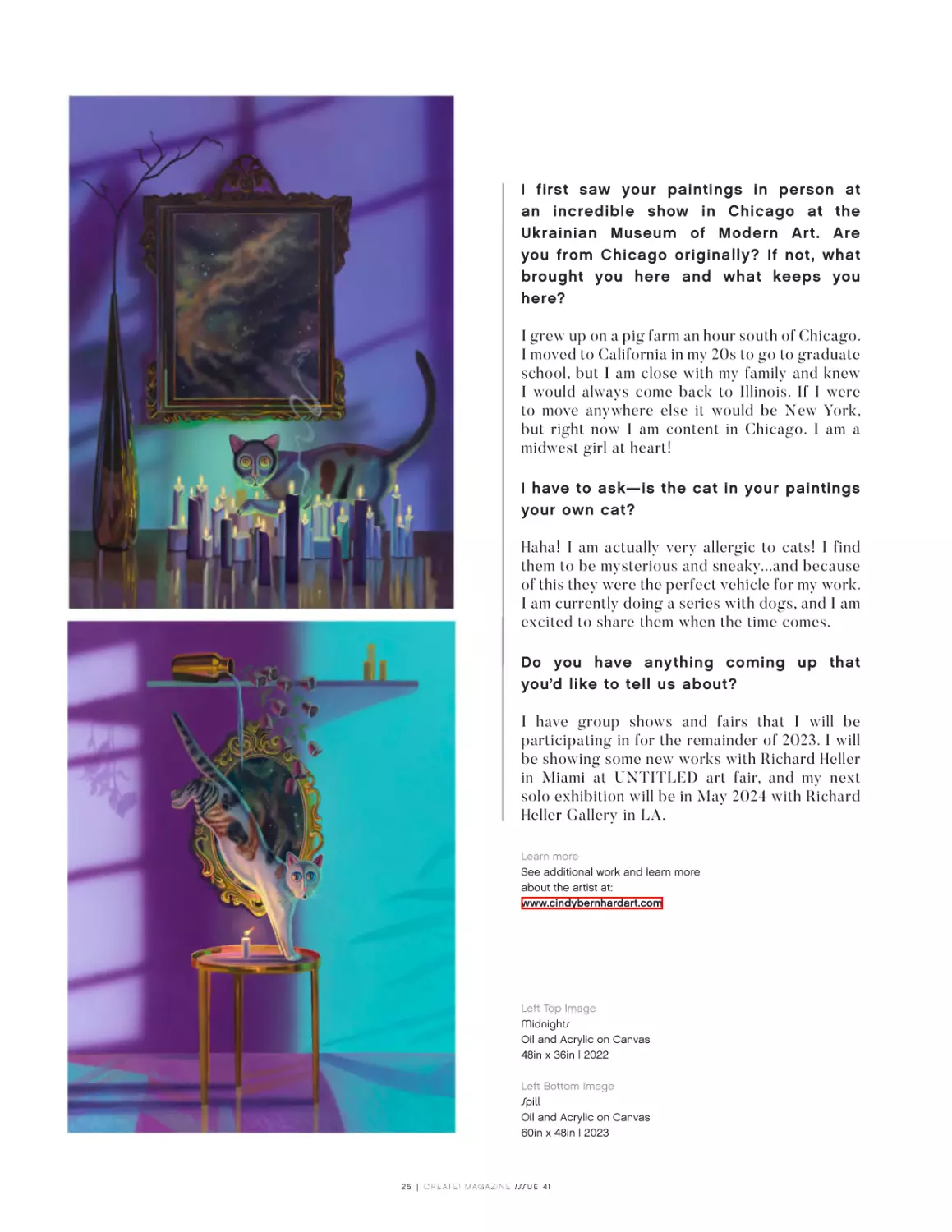
Left Top Image
Midnights
Oil and Acrylic on Canvas
48in x 36in | 2022
Left Bottom Image
Spill
Oil and Acrylic on Canvas
60in x 48in | 2023

2 5 | C R E AT E ! M A G A Z I N E I SS U E 4 1

ARTIST INTERVIEWS

Photographer
Lindsay Elliott

2 6 | C R E AT E ! M A G A Z I N E I SS U E 4 1

Crystals Filled With
Possibilities & Portals
to Another World:
Interview with Rebecca Chaperon
By Christina Nafziger
When the moment calls for it, I love getting to share a little backstory on my
own personal connection to an artist and their work. When I first decided to try
my hand at arts journalism, I realized that, in order to write for publications, you
had to show them what you can do. In order to prove my skill and convince an
editor to publish my writing, I first had to send links to my own published writing
(a bit of a conundrum, right?). So, I started my own (now defunct) art blog. I admit,
it wasn’t very good, but it did the trick. It allowed me to showcase my writing to
publications I wanted to write for, and (perhaps more importantly) gave me the
motivation and opportunity to write about any artist I admired. And one of the first
artists I wrote about was none other than Rebecca Chaperon.
There’s a long list of reasons I’m drawn to Rebecca’s paintings. They’re a bit dark,
a bit surreal, a bit witchy, and they transport you to a mystical realm. Through her
work, the artist constructs compositions full of blooming gardens with winding vines
and otherworldly plants. Objects like vessels, candles and crystals are peppered
throughout Rebecca’s paintings, like relics from an apothecary. Her femme figures
are inviting yet eerie, with hands that seem to hold untethered power.
Join Rebecca and I in conversation as we discuss the magical portals she paints,
the mystical parts of her life, her relationship to land and the incredible narratives
behind her work.
When do you feel that your painting practice truly began?
My painting practice must have begun just after graduating from art school,
stumbling awkwardly into the art world. I found that making art free from the
assignments and obligatory engagements of a school environment both required
and allowed for some deeper and more personal introspection to evolve. My
deeper relationship to my work and practice began there ... at this particular
place in time where I wasn’t expected to explain myself on a regular basis or
to work within parameters determined by school assignments. I could create
my work unobserved. All of this freedom allowed me to grow closer to my own
vision, and, as I painted, I could let my concepts build in the dark—internally—
before sharing with others.

2 7 | C R E AT E ! M A G A Z I N E I SS U E 4 1

ARTIST INTERVIEWS

What inspired you to stick with painting
specifically?
I don’t think there was a moment when I chose
painting as a specific medium; it was always
the one medium I loved the most and felt the
most possibility with. There was a clear moment
when I chose to be an artist though. I had just
completed a semester of general studies at
college and had to decide which courses to take
next. I ended up making a literal “pros and cons”
list, where I found myself heavily weighing all
the *pros* of a life of painting over going into
a career with a more direct/clear path (e.g.,
design). Honestly, I would have been a horrible
designer to work with, as I find feedback tedious
and it puts me in a discordant mood.
One thing that initially drew me into your
work is your ability to truly create your
own unique world. Can you tell us about
the world you’ve created?
If you were to imagine my artwork as one entire
world, as you travel through it, the landscapes
would change dramatically and you would
encounter all kinds of strange entities. Some
places are bright and brimming with life, full
of warm shadows that are stretched out by a
dramatic slant of late afternoon sunlight, and
populated by objects that glow and flow in the
landscape. After passing through that place
you might travel into a night world, where you
are met by an airy flock of ghostly hands, who
are trying to help you in every area of life and
support you in your secret areas of sadness
and fear. Their language will prove to be more

Do you feel that this world is continuously
being
developed
and
transformed
throughout your practice?
Absolutely! Until I perish!
To me, your paintings appear as a
narrative. Do each of your series have a
different story behind them?
Yes, I agree; my work is very narrative. Each
series will have an overarching narrative and
sometimes the individual painting will also have
its own more specific narrative. Storytelling
is integrated into my practice in many ways
but creating each part of the painting is how
the narrative is really “composed.”
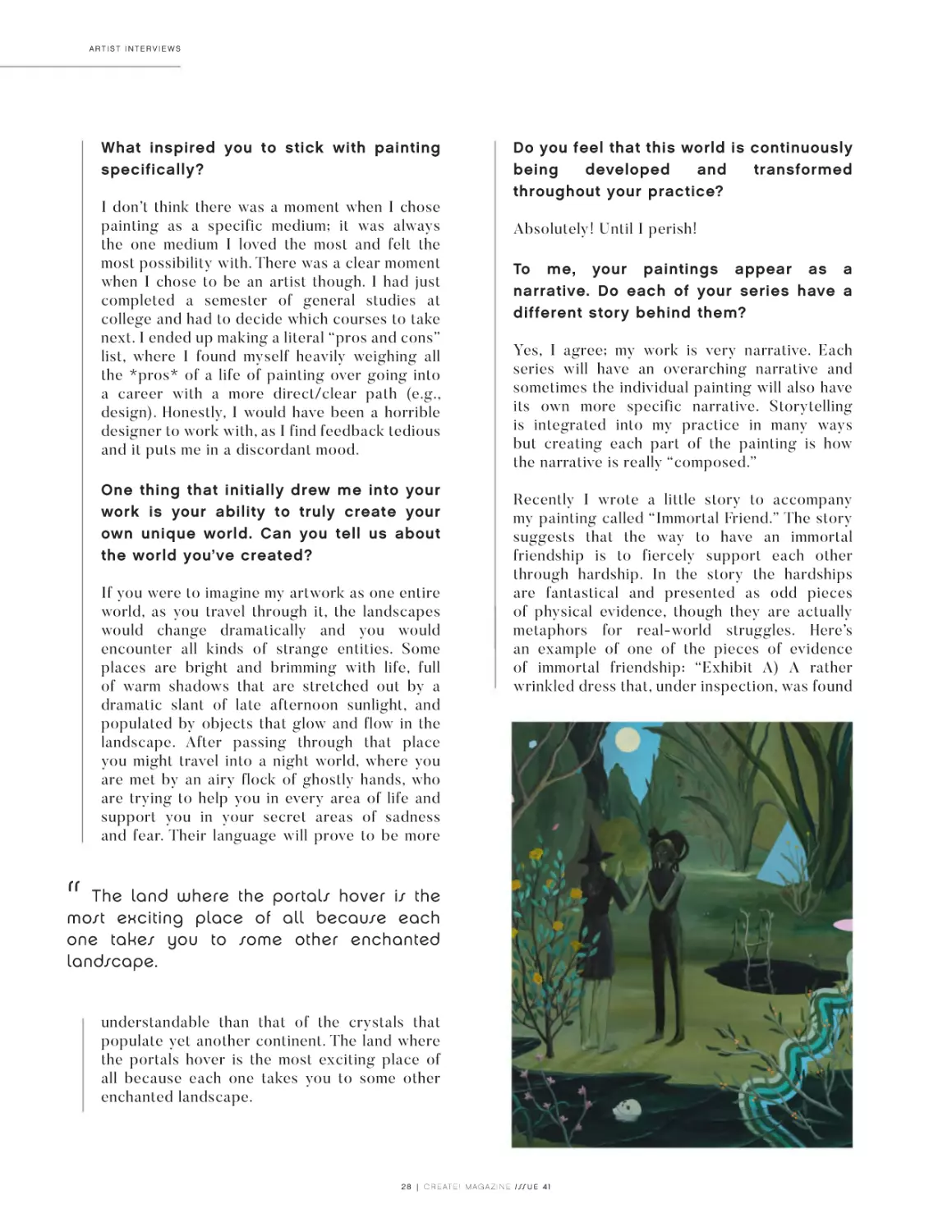
Recently I wrote a little story to accompany
my painting called “Immortal Friend.” The story
suggests that the way to have an immortal
friendship is to fiercely support each other
through hardship. In the story the hardships
are fantastical and presented as odd pieces
of physical evidence, though they are actually
metaphors for real-world struggles. Here’s
an example of one of the pieces of evidence
of immortal friendship: “Exhibit A) A rather
wrinkled dress that, under inspection, was found

“

The land where the portals hover is the
most exciting place of all because each
one takes you to some other enchanted
landscape.
understandable than that of the crystals that
populate yet another continent. The land where
the portals hover is the most exciting place of
all because each one takes you to some other
enchanted landscape.

2 8 | C R E AT E ! M A G A Z I N E I SS U E 4 1

to be coated in human tears, long-dried from the
time you cried on my shoulder, quickly drenching
the fabric of my dress but eventually causing a
body of water to grow to the size of an ocean,
so sad were you.”
Your work is often bright and playful, but
can also be dark and eerie. Can you talk
about these contrasting elements in your
work?
I think that my work shows how—similar to a
writer—a particular visual vocabulary can imbue
us with certain combinations of feelings, allowing
us to luxuriate in a delicious dichotomy. For
example, if we read about a wind whistling
across a bleak moor, it might give us a feeling of
both emptiness and coziness as we turn the page
from the comfort of our bed. I always want to
do that with my art: hold more than one feeling
there. I also hope I can leave the door open
enough, by letting the subject matter in my work

be a little more mysterious, so that other people
feel their own narrative take shape when they
look at my work.
The crystal shape shows up throughout
much of your work. What is it about this
form that draws you to it?
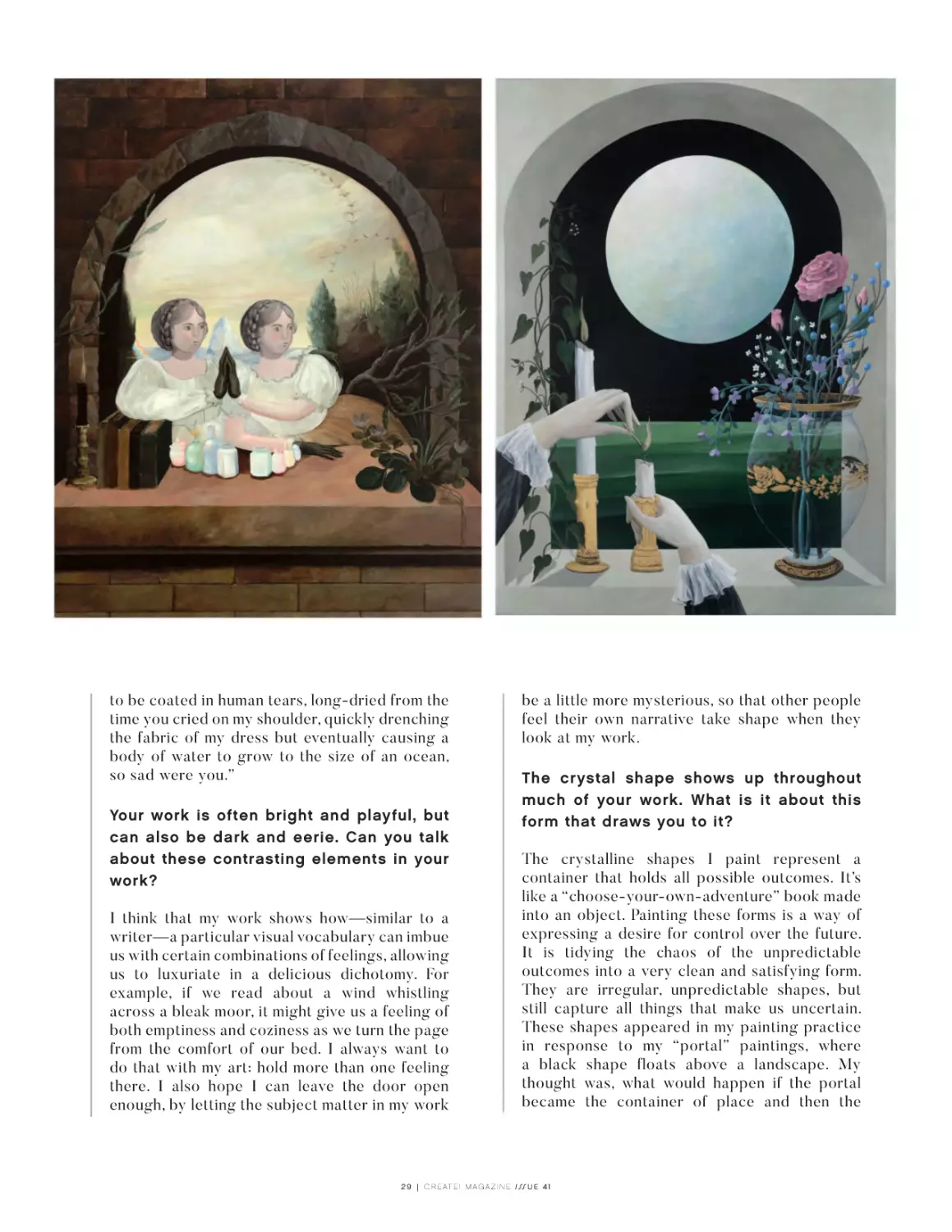
The crystalline shapes I paint represent a
container that holds all possible outcomes. It’s
like a “choose-your-own-adventure” book made
into an object. Painting these forms is a way of
expressing a desire for control over the future.
It is tidying the chaos of the unpredictable
outcomes into a very clean and satisfying form.
They are irregular, unpredictable shapes, but
still capture all things that make us uncertain.
These shapes appeared in my painting practice
in response to my “portal” paintings, where
a black shape floats above a landscape. My
thought was, what would happen if the portal
became the container of place and then the

2 9 | C R E AT E ! M A G A Z I N E I SS U E 4 1

ARTIST INTERVIEWS

background would have the muted flatness
instead? From there the crystals also migrated
into landscapes and created a cross-pollination
with my ”Eccentric Garden” series. The original
crystal series is called “Tesseract,” named
after a time travel device from the young adult
science fiction book “A Wrinkle in Time.” I love
science fiction, and this was one of the first that
resonated with me when I was young.
What is your relationship to the land?

what part of your life contains the most
magic?
I love to evoke a sense of mystery by using
symbols and visual metaphors in my work. I
want to express something about the mystifying
aspects of the human experience that connects
us. I’ve always found the following two things
to be the deepest and most mystical of life’s
mysteries: 1. The infinite expanse of space, and
2. Existing/dying. Recently, I’ve been developing
paintings related to death, inspired by historical
“memento mori” artwork, and bringing my own
meaning and creative twist to them. Realities,
like death, go beyond our knowing, which is both
uncomfortable and strangely magical. I like to
embrace these sensations in my work.

I love to visit strange landscapes whenever
possible, natural or man-made! They give me
such an intense feeling of delight, inspiration and
mystery. I once visited a famous dog cemetery
in Western Australia. A humble site, with not
much around but a large statue of a dog, and
then all the little gravestones, some with odd
This year I made a painting called “Self-Care
objects on top ... some even inscribed. That small
In Dark Times,” where a woman sits at a vanity
graveyard, out there baking in the Australian
and touches both hands to her reflection in
sun, was overflowing
the
mirror. This
with stories. One
work has an intense
gravestone was even
dark-and-light
I love to visit strange landscapes whenever
inscribed “Here Lies
relationship, which
possible, natural or man-made! They give me
Molly, Defiant til the
helps
show
the
such an intense feeling of delight, inspiration
end.” That kind of got
double-image of the
and mystery.
trapped inside me. It’s
skull, and is based
so funny, [yet] at the
on a monochromatic
same time sad and
drawing,
“All
is
mysterious.
Vanity,” by Charles Allan Gilbert. In my work, I
lay out a desire for a deeper connection to the
Some of my work has treated landscapes as
self as a way to protect against the surrounding
our interior psychological landscapes, and
darkness. The figure in the reflection is
that’s an idea I would like to explore further. I
surrounded by bright, prismatic clouds and
think sometimes our relationship to places gets
light. I like to imagine the seated figure as a
bonded to the people we go there with, and then
protagonist trying different rituals to connect
the two things can never be torn asunder. Not
with her “bright-reflection doppelgänger,” with
long ago, I was visiting a friend on Vancouver
the aim of climbing through the looking glass
Island and we decided to go for a walk in the
into the other world.
woods. We walked/waded through deep snow
until we got to a raging waterfall where we took
Besides art making, the most magic in my
turns screaming into the sound of it. There was
life lately has come from connecting with
no one around and the waterfall was so loud we
friends. I worked on a special creative writing
could barely hear ourselves scream. But I can’t
collaboration called “Witch Post: Coast to
look at my friend’s face and not think of the
Coast” with writer Kate Horowitz, where we
waterfall. Or think of the waterfall in the snow
wrote a story together in a series of letters
and not immediately see my friend’s flushed face
we mailed to each other. Each letter built the
and laughing eyes.
next part of the story. It was an incredible
way to connect creatively with Kate, and the
letters became a way to express things we were
How do the mystical parts of life influence
experiencing/feeling through our characters. It
your work? Besides the act of creation,

“

3 0 | C R E AT E ! M A G A Z I N E I SS U E 4 1

was such an amazing and transformative project
that has really helped me to rediscover what
creativity gives us when we use it: connection,
acknowledgement, vulnerability and so much
more. Plus, I got to write from the perspective
of a witch using magic spells!
What are you currently reading and/or
listening to in the studio?
The truth is, I am a *little bit* addicted to
podcasts—I think it’s because I spend so much
time alone in the studio. It’s just nice to hear
people chatter about mysterious things while I
work. When I need to really concentrate, and
especially at the beginning of the day, I like to
put on some ambient music. And because metal
and gesso just go hand-in-hand, if I’m preparing
canvases, I’ll listen to my brother’s band Eaten By

Sharks, which is nautical-themed. We both love
ocean imagery. I guess it’s probably because our
dad was a ship’s captain.
What are you excited to leave behind this
year and what are you looking forward to?
Oh, good question! This year I am in the early
stages of a new series for a show in 2026. I am
excited to have time to plan it all out as I’ve
never had this much time in advance of a show.
I’ve been applying for grants and developing
the concept. So I’m feeling really excited to be
leaving behind some of the faster/high-stress
work to make room for long-term planning and
concept development.
Learn more
See additional work and learn
more about the artist at:
www.rebeccachaperon.com

3 1 | C R E AT E ! M A G A Z I N E I SS U E 4 1

ARTIST INTERVIEWS

3 2 | C R E AT E ! M A G A Z I N E I SS U E 4 1

The Mystical World of
Sarah Potter
By Ekaterina Popova

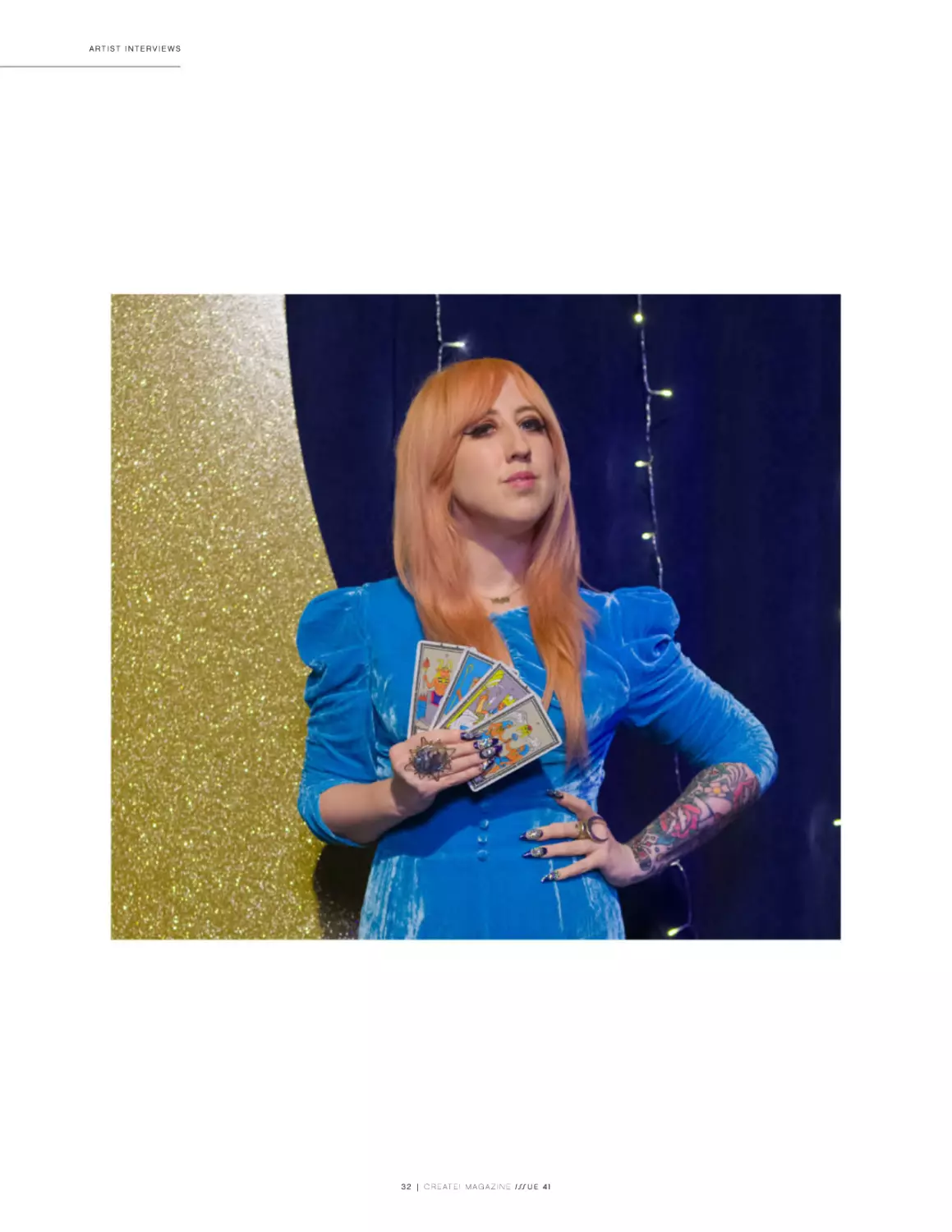
Sarah Potter known as a celebrity psychic medium, Tarot reader, and professional
witch, stands at the forefront of the mystical and spiritual world. Her unique blend
of cosmic wisdom and decades of experience in the occult has made her assault
after leader for those seeking guidance. In this interview we chat with Sarah about
her transition from curator to psychic, how artists can use magic and more!

Can you share the story of your transition from the world of art and
curating to fully embracing your mystic side? What inspired this
significant shift in your life and career?
I love art, and I always will. Art is what initially showed me the power and
existence of the Divine. I strongly believe that artists are the ultimate
manifestors as they make the intangible visible for all of us to witness. Artists
create a transcendent experience akin to any spiritual practice or holy ritual,
and working as a curator in the liminal space between art and magic was an
incredible time in my life. This time also taught me about the power of change. We
are allowed to change, we are allowed to change our minds, and we are allowed
to change our dreams. It’s so good to dream up new dreams! After a series of
personal hardships, I found myself questioning
a lot of things, including how I show up in the
Love and kindness are the
world and how I wanted to invest my time and
energy. This showed me how I can change and
most powerful magic of all.
that I wanted to change. The art world is always
changing, and I began to question how I fit into
those changes, and how did I want to change to fit in, or not fit in, because
the art world is inherently disruptive. Ultimately, my intention with curation
was to provide magical experiences for all involved, and as I changed and
transformed, the way I wanted to bring this intention to fruition changed and
transformed. Like I said, I will always love art, and art will always be a part of
my life, but I no longer want to make my living from it. And who knows, maybe
I will change my mind again and come back to it, but right now, my greatest joy
in life is working as a spiritual advisor, and the ways I do that encompass most
of my energy reserve.

“

3 3 | C R E AT E ! M A G A Z I N E I SS U E 4 1

You have a belief in the magical power
of rainbows and kindness. Could you
elaborate on your insights regarding the
connection between rainbows, kindness,
and the mystical world? How has this
belief influenced your spiritual journey?
Isn’t it just so enchanting when you see a rainbow
appear? I have been chasing rainbows since I
was a child, and their surprise appearance after
the rain when the light is just right still delights
me to this day. Love and kindness are the most
powerful magic of all. Rainbows carry that
reminder with a spark of hope. I try to always
lead with kindness and compassion for others as
well as myself. You never know what someone
else is facing or what they are going through,
and I try to keep that in mind as I move through
each day. My goal when I wake up every morning
is to make the world a little better by the time I
go to bed at night. Whether it’s being present
and listening to someone who needs to be heard,
sending surprise dinner to a friend who is really
going through it, or maybe it’s something bigger.
Good energy and kindness have a ripple effect,
but so do negativity and cruelty. I would rather
add to the inherent goodness in the world.
Anything else feels like a waste of time and
energy.
I believe enchantment is for everyone, and I want
anyone who wishes to attend my spiritual events
to feel welcome and included. Trying something
new can feel intimidating or scary, but it also
leads to incredible rewards. If you are taking the
leap to try out one of my rituals or workshops
or a one-on-one reading, there’s a space for you
there. We all deserve to feel magical every day.
In Tarot, the Ten of Cups is something I call “the
rainbow card.” Pamela Coleman Smith illustrated
this one with a couple embracing and gazing up
at a large rainbow eclipsed by ten cups. This
card represents happiness, contentment, and
love. The time of love that is stable, comfortable,
and supportive, not that thrill ride of ups and
downs and unbridled wildness. That can be fun
sometimes, but it’s usually not long-lasting or
sustainable and often ends in a world of pain.
There is something so sweet about the Ten of
Cups and its sustainability. Tens are the end of
the story in Tarot before the cycle begins again.
Rainbows are the promise of a new chapter or a
new beginning, and I think it’s always lovely to
hold the hope of what awaits.

Many people are curious about psychic
abilities. Can you describe how you tap
into your psychic gifts, and what specific
services or guidance do you offer to your
clients through these abilities?
I always joke that I do it all with my clients! I
think I have heard it all, too. I’m always open
to being surprised, but I do think I have heard
nearly everything. I offer one-on-one readings, I
do ritual work for specific requests or intentions,
I do energy clearing and balancing in homes,
studios, event spaces, corporate environments,
anywhere that needs an energetic refresh. I
work with a lot of performers, so I will meet them
backstage or on set and help them get ready for a
performance. I work with music festivals to bless
the grounds, the performers, the workers, as well
as the guests to ensure a beautiful experience.
In my one-on-one readings, we can do anything.
Sometimes we just need a space to be heard, to
reflect, and to consider the possibilities from
different perspectives. My intention is always to
provide clarity.
My psychic abilities have always been a part
of me and who I am, but it’s taken some time
and quite a journey to accept that. I’m always
somewhat tapped in, even in my off time. I don’t
mean to be, but I have come to realize that that
is just how it is because I do SO much psychic
work. I think everyone has access to psychic
abilities; it’s just knowing how to use them and
trust what you’re picking up. I liken it to going to
the gym. It’s like I have been working out at the
gym every day for my entire life, so my muscles
are well developed. I have an intense spiritual
regime I hold myself to with rituals to open and
close my day, every day. I meditate every day,
and beyond that, I just try to take really good
care of myself in order to keep myself sharp. I
don’t overload my schedule, I value rest, and I
love to get a good night’s sleep! I’m vegan, and
I don’t drink alcohol or do drugs. I make sure
to spend time not working and being with the
people I love. All of this adds up to keeping my
abilities sharp so I can be the best I can be at
my job.
I am always sharpening my skills. I have little
“psychic games” I am always playing outside of
my professional time. When I was a teenager,
my best friend and I would go to the race track,
and I would pick the winners over and over

3 5 | C R E AT E ! M A G A Z I N E I SS U E 4 1

ARTIST INTERVIEWS

again. It got me very comfortable in trusting the
messages I received. I still do little things like
that, choosing the winner of reality competition
shows, stuff like that. It’s really very silly, but
it works! I accurately predicted the winner of
the Super Bowl as well as the Academy Awards
for the Today Show earlier this year. It’s a fun
departure from the intensity of my day-to-day
work. It’s good to have some fun, and I always
aim to seek the joy and the light in everything.
As a Professional Witch, could you provide
some insights into the types of magical
practices and rituals you engage in to
harness positive energy and manifest
intentions? Are there any specific
rituals you find particularly effective or
meaningful?
As a witch, I work with the energy of the cycles
of nature. By becoming in tune with the natural
ways of the seasons and the phases of the moon,
you can work with what is inherently already
there and boost it in the ways you wish it to
go. It’s important to me to do work not just for
myself and my clients, but also the greater good
of all beings, so I do put my intentions towards
peace and justice and causes that I care about
deeply.

effort and do the work!
Kindness is a core aspect of your
philosophy. How do you incorporate
kindness into your work as a Psychic
Medium and Professional Witch, and how
does it benefit both you and your clients
in the mystical realm?
Kindness is a choice; it’s a practice. Kindness
is something we should show ourselves so we
can radiate it outward to others. Kindness is not
just saying yes no matter what, doing everything
for everyone, and burning yourself out. That just
leads to resentment. I have taken a personal vow
to be honest, to speak up for myself, and to ask
for what I need, even when it’s difficult, and to
never hold resentments. I also developed good
boundaries and uphold them. Part of that means
I don’t agree to something I don’t want to, and I
try not to overextend myself. Because of this, I
can show up fully for myself and my clients. I can
give them my best, which is incredibly important
to me. I show myself kindness and, in turn, I
encourage others to do the same for themselves
as well. I feel so supported by everyone I work
with. Everything is energy, and we are all
connected. It’s reflected in the work we do on
the physical as well as the Astral realm.

Rainbows are often seen as symbols of
If you are considering upping your magical
hope and transformation. Can you share
practice or even just starting, I suggest aligning
a personal or professional story where
with the cycles of the moon. Create time and
rainbows played a significant role in your
space for yourself on the new moon and the full
spiritual or magical journey? How did they
moon each month to check in on how you’re
impact your experiences or beliefs?
feeling, what your goals are, and your progress.
Each lunation holds specific energies, but you
I always see a rainbow when I need an
can start simply by setting new intentions on
affirmative blessing to move forward, to invoke
the new moon and releasing anything weighing
a change, and to feel a little boost of confidence
you down on the full moon.
to transform. They
Put on some music, light
always appear when
a candle, and write down
I need them the most,
those intentions or what
Everything is energy, and we are
providing a reminder
you are letting go of, do a
all connected.
that the Universe is
meditation with some deep
co-conspiring
with
breathing, and then light
me.
The
Universe
that list on fire! Express
always has our backs, and it’s so good to see the
your gratitude, and be sure that whatever you
reminder of that connection!
put out into the Astral realm, you mirror in the
physical world as well. Don’t be intimidated to
Iris, the goddess of the rainbow, is a messenger
create a magical practice; it doesn’t have to
between realms. Her mode of travel is a rainbow
be a lot of pomp and circumstance for it to be
bridge that transcends the liminal space
powerful and impactful. But you must put in the

“

3 6 | C R E AT E ! M A G A Z I N E I SS U E 4 1

“challenge” me to pull out something wild about
them in order to display my prowess. I would fall
into that trap, but I’m not doing that anymore. I
am open to skepticism and questions, of course!
But it can be done with curiosity, kindness, and
respect, not malice or as a way to embarrass.
I am ALWAYS happy to answer questions or
provide insight into what I do. I have proven
myself and my abilities, but I am also at a point
where it doesn’t actually bother me if people
don’t believe in psychics and magic. It’s not my
job to change their minds! My job is to be the
best I can be at MY job. And I think a life where
you believe in magic, where you see magic
come to fruition in both small winks from the
Universe as well as monumental transformations,
and knowing there is something so much more
beyond what we experience in this lifetime here
on Earth, makes life feel so much more thrilling!
Why deprive yourself of that?

between. I love to think of the appearance of
rainbows as a wink from a loved one who has
passed—a message from beyond to whoever
needs to receive it. If you see a rainbow and it
makes you think of someone you love, trust that
feeling.
In a world where skepticism often
surrounds psychic abilities and magic,
how do you navigate misconceptions
and promote a greater understanding
of your practices among those who may
be less familiar with them? Are there
common misconceptions you frequently
encounter?
I think a big misconception is that we are
all charlatans who scam and sell snake oil.
Unfortunately, there are some bad eggs, but
every industry has them. Integrity is important
to me, and I never promise something I cannot
deliver. Respect is also important. I respect
other people and their time and would love to
receive the same in return. Earlier in my career,
I often felt like I had to prove my legitimacy,
especially at events when someone would

Lastly, what advice do you have for artists
who wish to incorporate magic and
intuition into their creative process? How
can they use these elements to manifest
their artistic goals and connect with
collectors who resonate with their work?
rust yourself and your intuition. Have fun with it
and play. I think play is an essential part of the
creative process. Try not to take yourself and
your work too seriously by being too hard on
yourself. That will only rob you of joy. Let your
inner guide be your compass and see where it
takes you, because you could learn a lot and the
results could be far better than what you had
initially envisioned. Be intentional in the studio,
learn about the energetic frequency of color and
apply it to your work. Hold the intention that you
will connect with the right collectors for you
and your work, and then do everything you can
to ensure that this happens. Don’t stop trying
or creating or putting yourself out there. Trust
the process and know that your story isn’t over
because you can always change, and everything
unfolds just as it should in divine time.
Learn more
See additional work and learn more:
www.iamsarahpotter.com

3 7 | C R E AT E ! M A G A Z I N E I SS U E 4 1

ARTIST INTERVIEWS

3 8 | C R E AT E ! M A G A Z I N E I SS U E 4 1

The Mysterious World
of Michelle Avery
Konczyk:
Navigating Surrealism and Symbolism
Through Paintings
By Ekaterina Popova

Michelle Avery Konczyk, a self-taught painter, delves into the macabre with her
intricate yet unconventional artworks. Her approach to watercolors is distinctive,
as she explores themes of dirt, decay, hands and ghosts, all masterfully intertwined
with rich symbolism.
In this exclusive interview, we embark on a journey through the enigmatic mind
behind the paintbrush. We delve into Konczyk’s career, exploring the captivating
narratives she weaves through her hauntingly beautiful creations. Join us as we
unveil the secrets concealed within her artwork, where each brushstroke reveals a
world that is hauntingly familiar yet uniquely her own.

What inspired you to start exploring the macabre themes in your
artwork?
I never set out with the intention to work in macabre themes. What’s really
funny is I didn’t even realize my work was creepy until people started telling
me it was.
I was always drawn to spooky and darker undertones of things. As a child, I was
obsessed with ghosts, vampires and witches. I would find skulls in the cornfields
around my house and beg my mom to let me keep them in my bedroom. I would
insist on having to rent a scary movie every time we were at the movie store,
and I lived for Halloween TV specials. These themes have always sparked my
interest, so it makes sense that they just naturally come out in my work.

3 9 | C R E AT E ! M A G A Z I N E I SS U E 4 1

Being self-taught, how did you develop
your unique style and approach to
watercolor? What was the learning curve
like?
I always feel weird defining how I learned my
art. My technical skill, as well as the skill of
expressing myself through my work, was learned
in my public high school art class. My teacher,
Mrs. Weitknecht, truly believed art was a skill that
can be taught, and she was able to teach drawing
like no teacher I have ever witnessed. On top of
it, she gave the most thought-provoking projects
where we were encouraged to experiment and
think of art in a problem-solving, out-of-thebox way vs. “draw this apple.” Adding our own
motifs and our own personal meaning wasn’t
only encouraged, it was part of the assignment
and part of the grade. One time she walked

“

It’s really challenging to take the path
less followed and to listen to this seemingly
imaginary but very real gut feeling that’s
pulling you in a direction that even you
can’t see.
around the class and “accidentally” spilled tea
on all of our individual projects. The project
then became, “Well, there’s tea on the page now.
What are you doing with it? How are you going
to work with it in the piece?”
On a day of school I almost skipped, Andrew M
Kish III came in to do an artist talk. I was always
drawn to watercolor, and it was my favorite
medium at the time, but seeing his level of detail
in his paintings fully captivated me—I never
knew watercolor could be used “realistically.” I
took two classes with him my junior year and
then proceeded to practice this watercolor
technique over and over.
After I dropped out of community college, my
plan was to build a portfolio and hopefully get
a good enough scholarship that I could go to

art school. I remember never feeling so lost
or misguided in my life and all I knew was I
couldn’t give up on my art. So, I lived at home
with my parents, painting in the basement, and
babysitting once a week, making $400 a month,
which was just enough for my expenses at the
time. I started with one goal: make 30 paintings.
And after two years of not working in watercolor
because of college art, I knew exactly where I
wanted to pick up.
Making the art, having the ideas and knowing
what direction I want to take my work in has
always been the easy part. The hardest part of
this, for me personally, has been getting to a
place mentally where I’m not listening to outside
voices and opinions of what I’m doing or how
I’m living my life. Going against the grain of what
society expects you to do comes with a lot of
negative feedback and opinions from just about
everyone. It’s really challenging to take the path
less followed and to listen to this seemingly
imaginary but very real gut feeling that’s pulling
you in a direction that even you can’t see.
How do you think your upbringing or
surroundings in Philadelphia influenced
your art?
I actually grew up an hour and a half north of
the city, in Nazareth, surrounded by cornfields.
My dad is a carpenter and my mom is a crafter,
sewer and baker. We lived in a house built by
my dad, grandfather and all five of my mom’s
brothers. My entire childhood was spent helping
my dad with some sort of project around the
house or trying to join all of my mother’s crafts.
As soon as I was old enough to drive I started
going to the city. It was really stressful for my
parents—they had never driven in a city and were
convinced it was something that neither they nor
I could do. One of my friends ended up going
to Tyler School of Art, and from there, I started
going to the city most weekends. I’ll never forget
how amazing it felt when I discovered that Philly
had a whole network of people who like to work
with macabre themes similar to how I do. And

4 1 | C R E AT E ! M A G A Z I N E I SS U E 4 1

ARTIST INTERVIEWS

because of this, I started showing in galleries
and making new artist friends. It was the first
time in my entire life that I felt like I fit in. It was
because of the Philly art scene that I realized
I didn’t need to get an art degree. I started to
feel confident in my work and started to grow
a community of people who were supportive of
me and my vision.
Can you describe the emotions or
messages you aim to convey through
your paintings?
For a good majority of my life, I was afraid to be
myself. I had a horrible stutter as a child, so bad
that I couldn’t speak a full sentence. This brought
upon a lot of bullying and being outcasted, which
made me feel like I had to change who I was in
an attempt to blend in. Art was something that I
could do to not only cope with this, but it was
something I could do secretly. It was this special
thing that I did, that I loved, that no one would
make fun of me for and that was huge.
In all of my work, I like to assign my own
symbolism and motifs—think of it like talking in
code words with your best friends. I make up my
symbols, and then I put them into my paintings.
So they’re like these little messages of the things
I need to say, want to say, can’t say, am feeling,
thinking, or trying to figure out. When I need to
get something out or don’t want to feel a certain
way I use this code system to say it and express
myself. It’s become a really great outlet, which
at first I felt weird and hesitant fully diving into,
but currently I’m making it be the only creative
goal I have.
What challenges have you faced in
your journey, especially considering the
unconventional nature of your work?
Starting out an hour-ish north of Philly, I would
be asked to show in coffee shops and restaurants.
One time I took a friend to see my work in the
basement of a restaurant only to find one of my
paintings on the floor, in a corner, tucked behind
a fake plant. When I asked what happened, they
told me that a group of older women strongly
felt that it had to do with the Devil, so they took
it down. I went out that day excited to see my
work hanging and left carrying it home.

4 2 | C R E AT E ! M A G A Z I N E I SS U E 4 1

By now, I’ve reached a point in my career where
I know where I fit. I know where I don’t fit. I
don’t care or take it personally if my art isn’t
liked or wanted. I’m going to just keep making
my work and telling my story for me. If people
like it, awesome!
How do you respond to varying reactions
from the audience, especially those who
might find your work unsettling?
Honestly, sometimes I can’t help but laugh, but
then I’ll say something like “Sorry, my work is
not for everyone,” or I’ll make a joke about it
never being too early to get ready for Halloween.
I feel like I can tell a lot about a person by how
they react to my art, and when people hate it,
then I use it as my cue that they aren’t my people.
Looking ahead, are there any new
themes or techniques you’re interested in
exploring in your future works?
I’m interested in seeing my work take life in new
forms. I have two books in the works (which feel
like they may never get finished), I want to make
wallpaper and fabric, I want to further explore
adding depth and pockets into my custom-cut
panels and I plan on making a lot of fake medical
diagrams (of the magical nonsensical kind).
Learn more
See additional work and learn
more about the artist at:
www.velvetmush.com

4 3 | C R E AT E ! M A G A Z I N E I SS U E 4 1

I create art to connect
to my own spirit and to
transcribe experience in
a way that can not only
be understood, but felt, by
others.
Robin Adler

Curated
Section
Victoria J. Fry is a New York City-based painter, educator, curator, and
the founder of Visionary Art Collective and New Visionary Magazine. Born
in England, Fry lived in Singapore as a child before moving to the United
States. The formative years spent in the English countryside continue to
impact the paintings she creates today, as they’re rooted in landscape,
memory, perception, and experience. Fry’s work has been featured in
numerous publications, including Create! Magazine, Vanity Fair UK, Art
Reveal Magazine, and Pif Magazine amongst others.
Since launching Visionary Art Collective in 2020, Fry has worked with
over 200+ artists to help them advance their art careers. As part of her
mission to increase visibility for artists, she partners up with top curators
and gallerists to facilitate group exhibitions, publishes a contemporary art
magazine, and hosts a podcast centered on art and entrepreneurship.
Additionally, Fry has been a guest speaker for the Women’s Caucus of
Art in Washington D.C, Photo Trouvée Magazine, The Art Queens Society,
and Huron River Art Collective. She has curated exhibitions for Create!
Magazine, Arts to Hearts Project, The Artful Collective, and recently served
as a juror for Women’s United Art Prize.
Fry obtained her BFA from the School of Visual Arts in 2012 and her
MAT from Maine College of Art in 2014. Upon graduating, she moved to
California for five years to continue her career as a painter and educator.
After living in the Bay Area of San Francisco and Los Angeles, she is now
thrilled to be living back in New York City.

C U R AT E D S E C T I O N

Alexis Herman
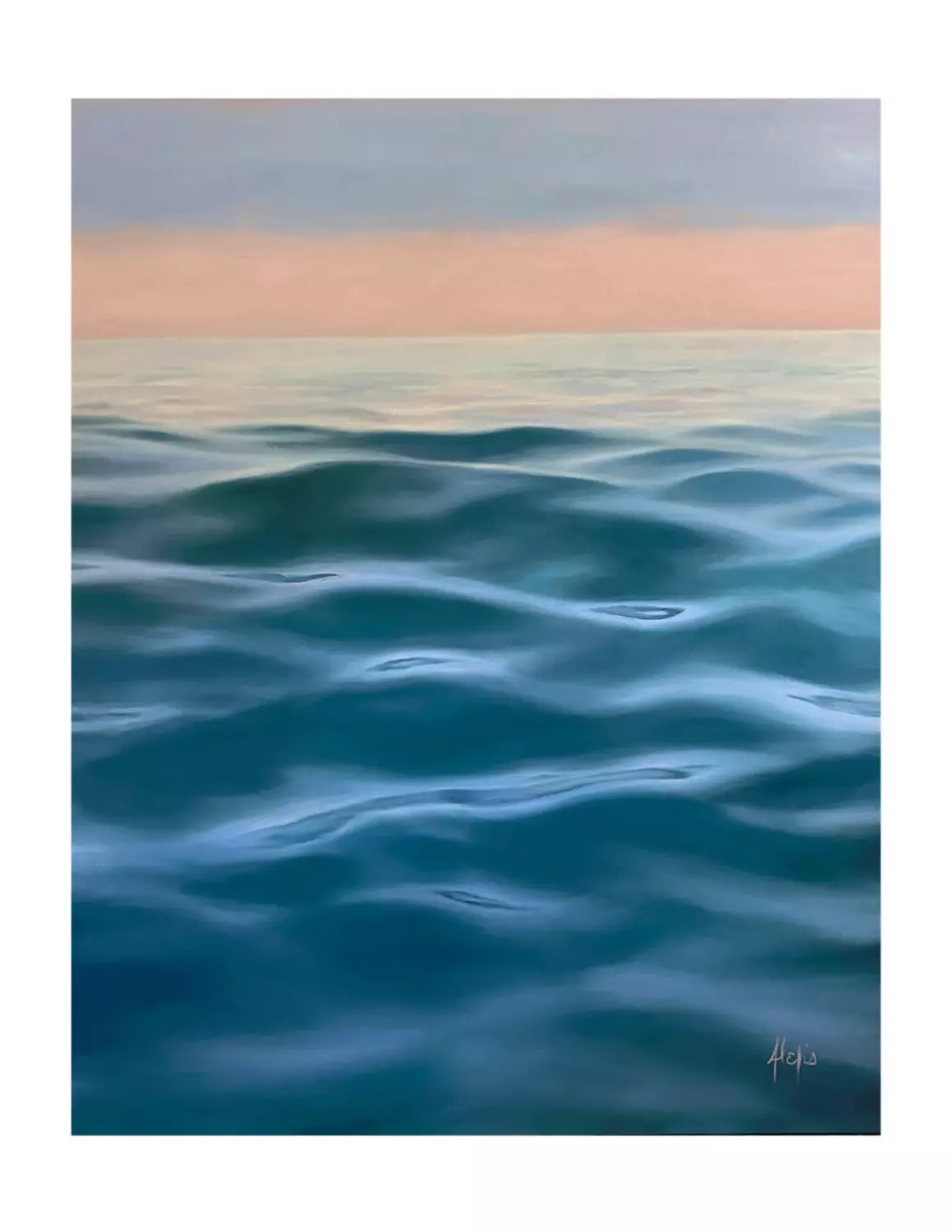
Alexis Herman (b. 1962) is a contemporary representational painter who
explores the regulating and meditative qualities of water. Her paintings are
characterized by simple organizing compositions and richly saturated colors
capturing water’s transfixing moments.
Herman has been exhibited along the east coast including showcase artist
at ArtFair 14C and featured at Kelly-McKenna Gallery. Her work has been
featured in several publications including New Visionary Magazine and To
the Shore Once More. Her work is held in private collections throughout the
United States and Europe. She received her BFA from Rochester Institute of
Technology and her MBA from NYU’s Stern School of Business.
Herman resides in Little Silver, New Jersey.

Website: www.alexishermanstudio.com
Instagram: @alexishermanstudio

4 6 | C R E AT E ! M A G A Z I N E I SS U E 4 1

C U R AT E D S E C T I O N

Water has always been a grounding force in my life. My art explores the
ocean’s calming influence and its regulating effect on my family; myself and
my neurodiverse son. Water forces me into the present moment, blocking out
other thoughts, and painting this solidifies the essential feelings of peace and
place.
In my current work, I portray water in a serene state, offering a sensual
quietude while inviting curiosity. The use of simple organizing compositions
and richly saturated colors invite us in. Focal points aside water’s reflections
hint at the vastness and timelessness of nature. Through observation, I create
a mental synthesis of how water works and transform this understanding to
capture water’s allure.
Water is our family’s solace. In my art, I seek to communicate the hopeful
respite that I find in the ocean, offering a common ground for all.

4 8 | C R E AT E ! M A G A Z I N E I SS U E 4 1

What initially sparked your interest in art?
Less like a spark and more like an innate internal
fire to create. As a young child, I was creating
objects out of clay from the creek, forts in the
woods, and doll accessories from garbage. I even
had a plan to convert the bathroom into a NYC
apartment. I still have some things that I created
as a child.
What connects your work together and what
keeps you creating?
The ocean and its regulatory and its grounding
qualities. When it’s been too long, I need to
either be in the ocean or painting and studying it.
Preferably both.
Describe your work using three words.
Meditative, enveloping, and resonating
What are you most proud of as an artist,
whether it's a specific moment or who you
are as an artist?
It’s not so much about being proud of my work,
painting is a gift that I received when I was born.
I cherish this gift and try to use it wisely. I’m
proud of all the hard work I’ve done to help my
neurodiverse son be in a good place in life. All
of that effort has opened up a space for me to
be able to paint. It’s been a very long road and
our patience and perseverance has brought us to
where we should be. Huge gratitude for my tribe
who helped us along the way.
If you could be in a two-person exhibition
with any artist from history, who would it be
and why?
I'm not sure about my pairing, but I'd love to be
exhibiting with Hilma af Klint. Her work has such
a rich part of history!

4 9 | C R E AT E ! M A G A Z I N E I SS U E 4 1

Shweta Bist
Shweta Bist (b. 1980) is a South Asian American lens-based artist born in
New Delhi, India and currently working and living in New York. Inspired by
personal narratives, her photographic compositions are an exploration of
maternal subjectivity. Shweta's professional
career began in the financial sector but
assumed a creative direction after she
became a mother to her two daughters. She
earned her master’s degree in commerce
from Delhi University and is an alumna
of the School of Visual Arts Continuing
Education in New York.
Recent exhibitions include Labor, Spoke the
Hub, Brooklyn, NY; Naissance, curated by
Hettie Judah, Unit London, UK; Oh, Mother,
curated by Nadiah Rivera Fella, Hera Gallery,
RI; Maternal Interior, curated by Lee NowellWilson, Ann Arbor Arts Center, MI and
Procreate Project Archive, with Buildhollywood, London, UK (all 2023).
Bist has presented her work at Academic and Art Conferences on Mother
Studies in the US and the UK. She is an artist mentor with Spilt Milk Gallery,
Edinburgh, and the co-founder of Mother Creatrix Collective, a local
collective that supports the work of artist-mothers by creating exhibition
opportunities for its members.

Website: www.shwetabist.com

5 1 | C R E AT E ! M A G A Z I N E I SS U E 4 1

C U R AT E D S E C T I O N

In ‘The Fragility of Time’, I examine the impact

daughter, wife, and mother, I felt compelled to

of motherhood on the sense of self, desire, and

search for myself anew.

mental health in a society that undervalues care
work. As a mother of daughters and someone

These staged pictures are glimpses of my inner

who has experienced disempowerment as a

landscape. I am influenced by the ever-evolving

young girl and woman, I explore recognizing this

dynamic between my daughters and me, and

loss in midlife and feeling an urgency to reclaim

how stories of my past and the social milieu of

selfhood.

our present impact us. Drawing inspiration from
poetry, metaphors of color, and symbolisms

I moved to New York as a stay-at-home mother

from nature and art history, I explore memories,

of a newborn and toddler. With my spouse

dreams, perception, and suppressed emotions as I

consumed by his demanding corporate job, my

seek to repair a fragmented self.

daughters were often my only companions and
primary source of love and affection.
An unsettling anxiety began to creep in when my
younger daughter turned eight. Amidst the girls'
growing independence, I struggled to recalibrate
from being their world to becoming a part of it.
Despite having more freedom, I experienced a
sense of being adrift.
Coincidentally, during this time, a friend my
age passed away from cancer, and a newfound
awareness of mortality washed over me. In my
forties, time became precious like never before.
Having lived thus far within the framework of a

5 2 | C R E AT E ! M A G A Z I N E I SS U E 4 1

C U R AT E D S E C T I O N

Loren Eiferman
My unique process begins with a drawing. Daily I gather sticks from the forest
and debark the branch to reveal the shapes found within each branch. I then
cut and joint small naturally formed shapes together. Next, all the open joints
get filled with a putty, which once dried is then sanded till it’s smooth. This
putty and sanding process is repeated at least three times. I want the work
to appear as if it grew in nature, when in fact each sculpture is composed of
hundreds of small pieces of wood that are meticulously crafted together. My
work can be called the ultimate recycling: taking the detritus of nature and
giving it a new life.
My current work is inspired by the illustrations found in the mysterious 15th
century Voynich Manuscript. This manuscript was written in an unknown
language, by an unknown author and filled with illustrations of plants and
flowers that don’t exist in nature. These aren’t just pretty images of flowers—
they also contain the wacky root systems and seemingly out of proportion
leaves, petals, and rhizomes.
I was born in Brooklyn, NY and received my BFA from SUNY Purchase. My work
has been exhibited extensively including gallery and museum exhibitions
in NYC, the Hudson Valley and Connecticut, and is currently included in
numerous corporate and private art collections. In 2014 I was awarded a NYC
MTA Arts & Design commission for a Metro North train station. I currently
maintain a studio in the Hudson Valley.

Website: www.loreneifermanart.com
Instagram: @loreneiferman

5 4 | C R E AT E ! M A G A Z I N E I SS U E 4 1

C U R AT E D S E C T I O N

What initially sparked your interest in art?
I have always been interested in making things,
even as a young child. I played for countless hours
creating whole worlds with the simplest of found
materials, but at the tender age of five I never
thought of this play as “art”. During high school I
discovered “art” and started taking classes at the
Brooklyn Museum Art School. From that point on,
art has been a constant means of expression and
creating for me. I ended up getting my university
degree in studio art and art history. After I
graduated, I continued to create and have never
stopped.
What connects your work together and what
keeps you creating?
Every night right before I fall asleep, I have what
best can be described as a Rolodex of images flash
before my eyes. These are images and ideas of
work that have yet to be made. The next morning,
I go into my studio and start translating these
“visions” that appeared to me the night before.
I am in constant dialogue with these images and
create almost daily. For me art is another language
which I can express and visually transmit the
questions that we all have.
Describe your work using three words.
Sculptural, organic, connections.
What are you most proud of as an artist,
whether it’s a specific moment or who you
are as an artist?
I have been working in wood for many decades.
During that time much of my work has changed
and evolved but has always remained woodbased. I have a favorite sculpture that I created

5 6 | C R E AT E ! M A G A Z I N E I SS U E 4 1

many years ago that I have often thought about
casting in bronze but never took any action, in
part because the process would destroy the wood
sculpture. However, this summer, I finally took the
initiative and set about casting it in bronze at a
local foundry. To me, I’ve always wanted to have
my work live back in nature, where it originally
came from, and casting it in bronze allows it to
live outside. This was a big step for me that felt
like I jumped out of a metaphorical window. In
2014, I designed a public art project of eight steel
railings for a NYC MTA train station. That was
the one work that has been seen by the greatest
number of people, and one of the highlights of my
life. But now casting my work seems to be an even
bigger leap of faith and investment in myself that
I am proud to have finally taken.
If you could be in a two-person exhibition
with any artist from history, who would it be
and why?
For the past eight years, I have been obsessively
translating illustrations from a mysterious
15th century manuscript called the “Voynich
Manuscript” into wood sculptures. This
manuscript currently housed at Yale’s Beinicke
Library was written in an unknown language, by
an unknown author and filled with illustrations
of plants that don’t quite exist in nature. I would
actually love to exhibit my sculptural woodwork
next to these strange yet beautiful illustrations.
No one actually knows who the artist is that
created this manuscript. And, for all of these
centuries between the creation of the manuscript
until today, no one has been able to decipher
its meaning or purpose. So there isn’t exactly
an artist that can be named that I would like to
exhibit with, just the extraordinary and powerful
artwork from this enigmatic manuscript.

5 7 | C R E AT E ! M A G A Z I N E I SS U E 4 1

C U R AT E D S E C T I O N

Rachel Bensimon
My art is a journey of exploring and expressing the vibrant inner worlds of
girls and young women. I seek to capture the delicate balance between
innocence and maturity, vulnerability and strength. By exploring the duality
of childhood, embracing both the moments of joy infused with fantasy,
elements of the natural world and surrealism and sometimes darker themes,
my portraits reflect on the profound impact that our childhood experiences
have on shaping our identities.
Autobiographical in nature, the visual vocabulary
I utilize expresses an inner dialogue between the
eyes of my unique childhood experiences and
the universal nature of innocence and purity
associated with childhood in general. A portal is
presented to the viewer through which they may
experience their own childhood memories and
emotions. By expressing the musings of my inner
child, I invite viewers to connect, reminisce,
and to rediscover the resilience and beauty
within us all.

Instagram: @rachelbensimon_art

5 8 | C R E AT E ! M A G A Z I N E I SS U E 4 1

C U R AT E D S E C T I O N

Brandi Hofer
Brandi Hofer wears many creative
hats. She is an artist, muralist, author,
podcaster, and educator, driven by
a passion for fostering meaningful
connections

through

art.

Brandi

takes pride in being a collected
Canadian
work

Artist,

showcasing

internationally

and

her

across

North America. Recently, she had the
privilege of exhibiting her pieces in the vibrant art scene of NYC.
A significant highlight of Brandi's career is the completion of her largest project
to date – a monumental 3082 sq/ft mural titled "Choose Love and Join Hands in
Truth and Reconciliation." This collaboration with her community holds deep
personal significance.
In 2021, Brandi furthered her commitment to creative education by founding an
Art Academy in partnership with the local public school district. Additionally, she
established the Colour Me Happy online Community, Book, and Podcast, aiming
to spread creative joy far and wide. Looking ahead, Brandi is excited to elevate
her educational workshops by building an eco-friendly artist residency and Art
Centre in Canada.
Brandi's artwork has garnered attention on national television, featured in
international publications, and graced the prestigious Saatchi Gallery. Grateful
for the support of collectors like Jillian Harris, Sarah Baeumler, Andrew Salgado,
Jann Arden, and Sarah Nicole Landry (thebbirdspapaya).
Her studio, nestled in the tranquil Canadian prairies, is more than just a space;
it's a sanctuary for artistic expression and shared moments of creativity, where
Brandi and her children bring their creations to life.

6 0 | C R E AT E ! M A G A Z I N E I SS U E 4 1

“her”
This collection is rooted from the organic
collaboration between Hofer and the womxn
creatives of her community. From the inception
and concept of the photoshoot, to each womxn’s
individual

struggles

and

triumphs:

singing

together in a symphony of statement and power.
I no longer care what you have to say
you never heard me in the first place
I’ve been screaming so long my voice hurts
I’ve been running so long I can’t remember stillness
I‘ve been working so long I forget what it is to play
please
TELL me how you really feel
where can I find myself again?
I came into this world after all…
the main character in my own story
- brandi

Website: www.brandihofer.ca

6 1 | C R E AT E ! M A G A Z I N E I SS U E 4 1

C U R AT E D S E C T I O N

Robin Adler
Robin Adler is a contemporary artist,
born in Norfolk, Virginia and living
in New York’s Hudson Valley. Adler
transcribes emotional experience into
visual form while expressing boundless
enthusiasm for abstraction. Using line,
shape, markings, color and movement,
she works intuitively, pushing past
limitations

toward

freedom

and

possibility. Adler explores her inner landscape and the natural environment
to foster dialogue and human connection.
Adler uses various media including oil, acrylic, wax, and print. Her work has
been in group exhibitions in galleries throughout the East Coast. Adler is a
member of two art collectives, Spliced Connector and The Drawing Galaxy. Her
work can be seen online at artsy.net. Adler’s work is held in private collections
across the United States.
Website: robinadlerart.com
Instagram: @robinadlerart

Photographer
Kayleigh Ann Archbold

6 2 | C R E AT E ! M A G A Z I N E I SS U E 4 1

I create art to connect to my own spirit and to
transcribe experience in a way that can not only be
understood, but felt, by others. My work articulates
movement, kinetic growth, conversations between
shapes. A thriving metamorphosis that continually
changes with layer upon layer of paint or ink.
I work intuitively. My brush strokes are rapid and
gestural. I scratch into paint, employ squiggles and
energetic lines to encourage tempo and rhythm.
Vibrant color excites me, I combine hues that
sing together or possibly provide an interesting
contrast. The canvas is a living, breathing form for
me that is emerging, changing, always growing.
My intention is to create a space for interaction
and reaction between the viewer and the artwork,
to find commonality that extends both beneath
and beyond language.

6 3 | C R E AT E ! M A G A Z I N E I SS U E 4 1

C U R AT E D S E C T I O N

What initially sparked your interest in art?
My grandmother was an artist. Her beautiful oil
painting, a still life, hung over my grandparent's
fireplace. I would stare at it and wonder how
she got the folds in the fabric to look so lifelike. That painting is in my home now. She also
painted a series of watercolors that were abstract
landscapes. I loved how these pieces looked like
sketches made with paint.
My grandmother bought my first set of paints,
pencils, and brushes for me. I also remember the
first time she took me to the National Gallery
in Washington, D.C. She always encouraged my
artistic expression. I remember she had a piece of
mine, a surreal colored pencil drawing that I did
in high school, framed and displayed proudly in
their home.
What connects your work together and what
keeps you creating?
I start each piece, whether I am painting,
printmaking, making a collage, or working in
encaustic, in the same way. I start putting down
shapes and colors until I can discern a greater
relationship forming between these elements. I
then work to enhance that relationship by adding
color, shape, line, or markings. It’s an intuitive
process. I don’t have an outcome in mind when I
begin. The canvas is a living, breathing form for
me that is emerging, changing, always growing.
And the surprise, the unfolding of the work, I find
that incredibly exciting.
I connect to my own spirit when I create. It helps
me transcribe my internal experience for myself
and others. I find the creative process invaluable
Photographer
Helena Palazzi

6 4 | C R E AT E ! M A G A Z I N E I SS U E 4 1

for making-meaning of my life experiences and
better understanding myself.
Describe your work using three words?
Contemporary, abstract, expressionism.
What are you most proud of as an artist,
whether it’s a specific moment or who you
are as an artist?
I have been very fortunate to have been warmly
welcomed into a vibrant arts community in the
Hudson Valley of New York. I never could have
imagined that I would one day be showing my work
in exhibitions. And, to be exhibiting alongside
artists I have looked up to and respected for years
is the icing on the cake. I am proud to be a part of
this thriving artists community and I can’t wait to
see where the road takes me.
If you could be in a two-person exhibition
with any artist from history, who would it be
and why?
It’s a difficult choice between Lee Krasner and
Joan Mitchell for me. They were both in the early
abstract expressionist movement which I find
inspirational. They both beat the odds that were
against them to become frontrunners in the field
of abstract painting. If I had to choose only one, I
would pick Lee Krasner because she was the first
woman to break into the abstract expressionist
movement. I also identify with her in that she
withdrew from her art practice for years to put
her energy elsewhere and then she came back to
herself again, she returned to her art practice with
a vengeance. That definitely resonates for me.

6 5 | C R E AT E ! M A G A Z I N E I SS U E 4 1

C U R AT E D S E C T I O N

Alycia Earhart
Alycia Earhart is a multi-disciplinary artist based in Lawrence, KS, USA. Her
work embraces the wonky, the whimsical, and the wonderful imperfections
that come to life during the creation process. Her approach to painting is
simple: she paints what makes her happy.

These paintings celebrate the deliciousness of idleness. The conversations
around a plate of seasonal food, a vase of freshly picked flowers, a favorite
chair. The small, everyday moments in between the big ones where we are
simply existing and then finding joy in that simplicity.

Website: www.alyciaearhart.com

6 6 | C R E AT E ! M A G A Z I N E I SS U E 4 1

Tafy LaPlanche
Born and raised in NYC, Tafy was always surrounded by diversity. It made
her curious about other cultures and heritages. That upbringing prompted
her to travel and meet all kinds of people. And made her passionate about
showcasing that in her art.
Being both Puerto Rican and Haitian,
throughout her life people always tried
to place Tafy in a box of one or the other.
With her portraits, she showcases unique
individuals who embrace both their culture
and who they are. Using a range of mediums
including charcoal, graphite, oil, and acrylic
paint. Placing her portraits against graphic
vibrant patterns inspired by murals she grew
up around in Spanish Harlem.
Through her art, Tafy celebrates the beauty
of dual identity and how it can be an asset
instead of a burden. She hopes to inspire others to embrace their full identity
and be proud of who they are.

Website: www.lepouf-art.com

6 9 | C R E AT E ! M A G A Z I N E I SS U E 4 1

What initially sparked your interest in art?
I was stuck in the hospital when I was diagnosed
at thirteen with type 1 diabetes. Being the oldest
patient in the unit, the younger kids had priority
over the gaming systems and movies. I didn’t have
many forms of entertainment to pass the time. I
was given paper and pens to journal but didn’t
take to writing. I ended up sketching the nurses
that would come by at all hours of the night and
started taping them to my hospital rooms walls.
You could say that was my first solo show! I
enjoyed documenting the faces that pass by in my
life and really took to continuing that.
What connects your work together and what
keeps you creating?

emerging artist, I was able to exhibit at a museum.
The works themselves had a very strong message
and I felt very proud in creating them but also
being able to talk about them and share them.
To see others connect to their message made me
extremely proud.
If you could be in a two-person exhibition
with any artist from history, who would it be
and why?
Jean-Micheal Basquiat. Both being Puerto-Rican/
Haitian American artists from New York with
different perspectives of dichotomies, our styles
are different but equally vibrant and would be
a lovely compliment to each other. I just think it
would be a meaningful one heck of a show.

The overall message of my work is celebrating
the bold and unique you. I love pairing realistic
portraits with graphic patterns that relates to
the soul of the subject. Connecting with people
from all walks of life and being able to share that
through art so that we can all connect on a human
experience level keeps me creating.
Describe your work using three words.
Bold. Vibrant. Fresh.
What are you most proud of as an artist,
whether it's a specific moment or who you
are as an artist?
Within my first two years of considering myself an

7 1 | C R E AT E ! M A G A Z I N E I SS U E 4 1

C U R AT E D S E C T I O N

Anvi Stevens
Anvi Stevens is a visual artist who works in painting,
drawing, and fabric art. She grew up in Gujarat, India,
and currently lives in Wakefield, Massachusetts, where
she works with collections and archives at local historical
societies. She received a Bachelor of Visual Arts from
Maharaja Sayajiroa University of Vadodara, India and a
Master of Fine Arts from Boston University. Anvi's work
has been exhibited in two-person and group shows at
galleries including Tiger Strikes Asteroid in Brooklyn,
Commonwealth Gallery, and Multicultural Arts Center in Boston, as well as L.
& P. Hutheesing Center and Kanoria Gallery in Ahmedabad, India. She is the
recipient of several awards, including the Writer/Artist Book Project at B.U.
and a 'notable recognition' by The Arts Society of India.
Her paintings range from small handheld works on paper to large-scale fabric
tapestries. She often acquires fabric from her mother’s collection, which she
uses as her ‘canvas’ to dye and paint on and then through hand and machine
stitching techniques transforms them into actualized wall hangings. For her
most recent undertaking, ‘Remnants of the Everyday’, Anvi marks each day of
this year with an individual piece within the framework of a 3”x3” canvas.
Anvi’s paintings are experiences created as landscapes through which to
navigate. The practice involves the collection of found papers/objects/fabrics
to record her daily life, as a way of preserving memories. Her work questions
the concepts of beauty and attractiveness, origin and function, and the known
and the unknown.

Instagram: @aunvi20

7 2 | C R E AT E ! M A G A Z I N E I SS U E 4 1

I dug a hole in the ground to plant some seeds. I
found some broken pieces of glass, a flat stone, a
shirt button, and a few other things to keep.
Active transitions often call for reflexes that fail to
register emotions in the conscious mind. The body
adapts to the constant movement of submitting
itself to a routine. The repetitive and slow process of
meticulous mark-making or stitching fabric by hand
helps me to step back and reminisce. I reciprocate
to the organic evolution of the substantial world
relative to the displacement of the body. It is a
practice of acknowledging each step on a walk. It is
a practice of accounting for each new day in life.
When varied shapes are put together they form a
landscape - a metaphor for walking through a space
and becoming lost in the details. A conscious effort
is made to register these impalpable behavioral
patterns. Tactility of the materials, density of the
lines, and their arrangements on the surface evoke a
sensorial interpretation. The rhythm and flow serve
as a visual navigation. The moments of absurdity are
frozen for contemplation and discovery.
Can a discarded piece of cloth be beautiful? Who
wrote this note? What would have happened if…?
These wall-hanging fabric pieces are storehouses
of memories and lived experiences. They are made
with commonplace materials - appropriated to form
personified decorative objects with a ‘showcase-life’
for us to revisit memories or reveal something new
about themselves.

7 3 | C R E AT E ! M A G A Z I N E I SS U E 4 1

C U R AT E D S E C T I O N

Mary Lacy
Mary Lacy is an emerging artist based primarily in New England and originally
from Jericho, Vermont. She began her career as a muralist and in 2017 she
did a nine-city mural tour, sponsored by Benjamin Moore, in her bucket
truck, that took her everywhere from NYC to the Mississippi Delta and
Gallup, New Mexico. Much of her mural work juxtaposes the natural with
the man made, bringing a sense of imagination and wonder back into our
concrete and physical surroundings. She has
organized countless community art projects
and has overtime expanded her art practice to
incorporate ceramics, tiles, wood, and other
mixed media materials. Recently, she has been
spending more time in her studio where she
explores more personal subject matter, looking
inward at the beauty, strength, and fragility of the
human body. Her work can be viewed in galleries,
public spaces, private collections, and corporate
offices.

Website: www.marylacyart.com
Instagram: @mary_lacy

74 | C R E AT E ! M A G A Z I N E I SS U E 4 1

Digging deep into the fertile thematic ground of
anatomy and somatic memory, Mary Lacy’s most
recent mixed media mosaics are an intimate
exploration of a universal lived experience: the
dichotomous wonders and limitations of the
human body.
Lacy breaks down, traces, and realigns the
networks of muscle groups, bones, organs, and
connective tissues that make up the physical
body across a series of exploratory drawings and
ceramic and cement mosaics. Probing the liminal
spaces where the emotional and the corporeal
collide, she reaches for beauty. Superimposing
memory, pleasure, possibility, and pain on these
anatomical structures, the works in this exhibition
signal a personal shift in the artist’s relationship
to her own body and its seemingly inexplicable
peculiarities. Surrendering to the physicality of
her chosen medium, ‘Anatomy Of ’ is where art and
health converged over a pelvis.
“Beauty beckons freedom, approaches it, tastes
and remembers it, reaching for freedom with
tendrils asymmetric an awake.” -Bahar Orang,
‘Where Things Touch: A Meditation on Beauty.’

7 5 | C R E AT E ! M A G A Z I N E I SS U E 4 1

C U R AT E D S E C T I O N

Jennifer Small
I am a Pennsylvania native who received bachelor’s degrees in Painting and
Art Education from Millersville University and MFA in Painting from Savannah
College of Art and Design. I have exhibited my paintings in galleries and fairs
in Philadelphia, Washington, DC, New York,
San Francisco, Richmond, Savannah, Raleigh,
Columbus, and Chicago. Media features
have included Artist Talk Magazine, Art Seen
Magazine, New American Paintings, Studio Visit
Magazine, Studio Break Podcast, and Shockoe
Artspeak Podcast. Formerly an art educator in
the Washington DC and Chicago areas, I now
live and work as a painter and visual designer
in Wilmington, Delaware.

Website: www.jensmallart.com

7 6 | C R E AT E ! M A G A Z I N E I SS U E 4 1

C U R AT E D S E C T I O N

My art, initially abstract in appearance, records a journey of a day in the
life—a practice that starts with documentation through the lens of a camera.
I see my experiences through special goggles with the ability to transform
banal spaces and objects into engaging formal elements that are pulled out
of their environment and placed into my painting compositions strictly for
their aesthetic significance. The process of cataloging my everyday leads to
the solidification of my memories in a specific time and place and constant
access to a breadth of inspiration for my paintings. New inspiration comes
out of each new environment I experience whether as a resident or a visitor
allowing the work to be an ever-evolving documentation of my days.
The observations I collect are combined into compositions through a
process of drawing and collage where I am
selecting and joining bits of each sighting to
build abstract structures in imagined worlds
displaying a combination of shallow and deep
space. The work demonstrates loose, painterly
applications juxtaposed with more rigid, hardedge areas of the acrylic paint and spray paint
that I use. While the palette is imagined, each
painting is an archive of a time and place
connected to a personal experience.
I want to challenge the viewer to see the work
as personal yet universal. A compilation of my
experiences, but also as a way to connect with
abstract painting in a tangible way. I want to
elevate the humble from unnoticed and small
to colorful and grand by putting a spotlight on
the unrecognized poetry of daily routine.

7 8 | C R E AT E ! M A G A Z I N E I SS U E 4 1

What initially sparked your interest in art?
The process of making initially sparked my
interest in art from a very young age. I grew up
in a creative household where making was highly
encouraged, whether it was making art, a meal,
a Halloween costume, or a snow fort. It's the
process that drew me in back then and has kept
me excited so many years later.

If you could be in a two-person exhibition
with any artist from history, who would it be
and why? are as an artist?
I would want to exhibit with Thomas Nozkowski
because he also used abstraction as a method of
seeing and interpreting the places and experiences
that made up his journey through life.

What connects your work together and what
keeps you creating?
My work is about how I experience my
surroundings so the connection is my personal
journey; the what, when, where, and how I see the
world. The process of using abstraction to create
personal narratives through the exploration
of the everyday has been a framework that is
always evolving as I move through life, leading
to a constant surplus of inspiration that keeps me
creating.
Describe your work using three words.
Autobiographical, observational, process-driven.
What are you most proud of as an artist,
whether it's a specific moment or who you
are as an artist?
I am most proud that I have continued to push
myself to create in new ways while still exploring
abstraction through the lens of my personal
experience with place and time.

7 9 | C R E AT E ! M A G A Z I N E I SS U E 4 1

C U R AT E D S E C T I O N

Gina Ariko
Gina Ariko is a Japanese-American figurative painter based in Seattle, WA.
Growing up, she spent every other summer visiting family in Kitakyushu,
Japan, where her ojichan and obaachan first taught her to paint. Despite the
language and distance barriers between them,
they learned to communicate through a shared
love of painting. Her interest in art and storytelling
overlapped at Santa Clara University, where she
earned a bachelor's degree in both English and
studio art. After graduation, Gina worked in
marketing, events, and community development
for mission-driven museums and educational
organizations. She began pursuing her art fulltime in 2020.

Website: www.ginaariko.com

8 0 | C R E AT E ! M A G A Z I N E I SS U E 4 1

C U R AT E D S E C T I O N

I owe my lifelong love of painting to my ojichan and obaachan, who were both
professional artists. Growing up biracial and second-generation American, I
often felt caught in the in-between, sometimes feeling “too American to be
Japanese” and other times “too Japanese to be American.” This push-and-pull
shows up in my work: nostalgia, a search for belonging, and the comfort of
retuning home are recurring themes in my paintings. My paintings also reflect
my love for traditional Japanese crafts, and the mindfulness they evoke. I love
capturing the quiet intimacy of everyday moments and holding on to the soft
expressions in an old family photo.

8 2 | C R E AT E ! M A G A Z I N E I SS U E 4 1

C U R AT E D S E C T I O N

Melanie Brock
Melanie is a Brooklyn, NY based artist who works primarily in abstract oil
painting. Born and raised in Columbus, IN, she holds a Master's degree
in Architecture from Indiana University. Throughout this program, she
participated in duel architectural and visual
art studios. Melanie has shown her work in
Indiana, Pennsylvania, and New York. Currently,
her work explores the relationships between
the built environment and people. The city
plays an integral role in how her works develop,
reflecting her personal experiences through the
lens of the urban fabric of Brooklyn.

Website: www.melanie-brock.com

8 4 | C R E AT E ! M A G A Z I N E I SS U E 4 1

My work explores the effects of the built
environment within Brooklyn on human
experience and behavior; specifically, within
the transitional zones between public and
private spaces. These zones often manifest
in my painting through energetic fluidity and
compositional layering. They explore the edges
of urban development, including the ground
plane, architecture, nature, objects, and human
contact. Some of the threads that I often explore
are tension, density, and physical interaction
within these transitional spaces. I consider
individual access, shifts in boundaries, and
visual and auditory privacy as a result of a vastly
evolutionary environment. These paintings with
their unexpected color palettes, various scales
and compositions are built up from experiential
observation. My immersion within the city,
manifested via painting, directly expresses my
appreciation of the city’s ever-changing qualities.

8 5 | C R E AT E ! M A G A Z I N E I SS U E 4 1

What initially sparked your interest in art?
I went to Indiana University for my master’s in
architecture, where I was part of the inaugural
cohort of students. This program is unique in that it
combines architecture with visual art throughout
the duration. I came from a background in
business and project management so a degree
that was so rooted in creative endeavors was
both exciting and intimidating. I found that about
halfway through the program something in me was
unlocked and I began to dig deeper and deeper
into the visual art side of the program – pursuing
art related research, new mediums, and multiple
art focused independent study courses. Once I
began oil painting, I just never stopped.
What connects your work together and what
keeps you creating?

been an incredible experience. It has definitely
had its challenges, but I am grateful to my friends,
family, and to myself for taking the leap to begin
in the first place.
If you could be in a two-person exhibition
with any artist from history, who would it be
and why?
Richard Diebenkorn. Specifically, the paintings
from his Berkeley series. Since I began to develop
my passion for abstract art, Diebenkorn has been
at the top of my list, often finding inspiration in
his work and his writings. The site-specific nature
of the Berkeley paintings, his wonderful colors
and the semi-organic feel of his pieces feel as if
they are in conversation with the work that I’m
currently pursuing.

Living in the city is the thread that ties my pieces
together. I am inspired so often by the constantly
changing urban environment, human interactions
and contact as well as the endless supply
of architectural context that is found across
the various neighborhoods of New York. My
experiences from day to day are always evolving
bringing about a vast array of inspiration and new
lines of questioning along the way.
Describe your work using three words.
Energetic – Colorful – Urban
What are you most proud of as an artist,
whether it's a specific moment or who you
are as an artist?
I think for me it was the moment that I decided to
pursue being an artist full time. Once I decided
that painting was what I needed to do the rest
came relatively easy. Moving to New York and
diving into the art world and community here has

8 7 | C R E AT E ! M A G A Z I N E I SS U E 4 1

C U R AT E D S E C T I O N

Ryan Horton
Ryan Horton is an artist from Atlanta, GA based in Boston, MA driven by
curiosity of expression. As a Black man living in America, Ryan has always
been taught to conform to survive in environments that were never meant for
him. Because of this, throughout Ryan’s professional career he strives to push
the boundaries of acceptance and expectations.
With

his

Master's

in

Architecture

from

Northeastern University, a Bachelor's of Fine
Arts from Savannah College of Art & Design, and
professional experiences in graphic design, Ryan
has been exposed to a number of creative methods
and mediums that have pushed his passion to not
only create but breathe purpose into his works.
Utilizing his structured architectural foundation
and the raw understanding of aesthetic purity,
he is continuously evolving his unique artistic
integrity. Ryan uses digital mixed media and bold
expressive single lines to further his exploration
of self through the freedom of artistic expression.

Website: www.hortoniconicdesigns.com

8 8 | C R E AT E ! M A G A Z I N E I SS U E 4 1

The complexities of life can be simplified through
the use of design elements such as squares and
circles layered with images and line drawings.
These minimalistic elements allow me to present
the intricacies of my life experiences of being
categorized in a world in which I was never meant
to fit in nor choose to conform.
In this world where I have to adapt my image
and expression to fit within my environment, my
identity continues to fragment. My collage work
uses selected features while others remain hidden
or obscured. Although the portraits are not whole,
they still highlight the beauty of Black features
and the strength in their expression. With time,
I have grown to appreciate myself and my Black
expression. The use of elongated Black figures
in the pieces represents my Black presence in
spaces while also highlighting the exaggerated
overthinking that I experience throughout my
artistic process. The single line faces are used to
show the internal complexities I encounter and
carry daily.

8 9 | C R E AT E ! M A G A Z I N E I SS U E 4 1

C U R AT E D S E C T I O N

What initially sparked your interest in art?
I just love drawing. I drew all the time throughout
school and when I got the opportunity to attend
Savannah College of Art and Design, I jumped at
it. Art school opened the doors to allow myself
to explore and create freely. It’s been an exciting
journey to see just how far my love for doodling
has taken me.
What connects your work together and what
keeps you creating?
My work is an extension of me. I’m able to pour
raw emotions into my pieces allowing me to
breathe and release my worries. Some of the
pieces featured are from a series called “Ego
and Insecurities” and it’s focused on the internal
balancing act of being confident as an artist while
being formed by past and current insecurities.
Throughout my pieces my single line work has
become a signature for me. While it is a simple
element, its presence gives viewers a complete
moment of my artistic expression from start to
finish. These lines connect all my pieces to one
another and can be bread crumbs to the order I
completed them.
Describe your work using three words.

that looked like me so I never knew that it could
be a path of fulfillment for me. I did however enjoy
being curious about everything, which opened the
opportunity to ask “Why?” and “Why not?” After
exploring the corporate worlds of architecture,
experiential design, and graphic design, I decided
to use all my knowledge from my past experiences
and bet on myself, and become a full-time
artist. It’s been a stressful journey pushing and
expanding the world I was accustomed to, but
now after seeing my pieces in multiple galleries,
a museum, and starting to plan an upcoming solo
exhibition, I’ve allowed myself to believe my truth
as an artist.
If you could be in a two-person exhibition
with any artist from history, who would it be
and why?
Oh, this is a tough one. I think if I had the honor
to share a two-person exhibition with any artist in
history, I would exhibit with Ernie Barnes. Barnes
pieces have been around me from a young age.
His piece titled “The Sugar Shack” has been in
my head since I could remember. What makes me
want to share a gallery with Barnes is his ability
to showcase liveliness and expression through
dynamic poses found throughout his works. With
my similar focus on posture in my pieces, I think
we could create a vibrant exhibit together.

Three words to describe my work are bold,
introspective, and cathartic.
What are you most proud of as an artist,
whether it's a specific moment or who you
are as an artist?
I’m proud that I believe in myself enough to live
out a dream. Being an artist was never a thought
if I’m being honest. I was never exposed to artists

9 0 | C R E AT E ! M A G A Z I N E I SS U E 4 1

C U R AT E D S E C T I O N

Sandra Curitore
Sandra (Cho) Curitore, Korean American Artist/Art director, breast cancer
survivor, Wife and Mother living in Los Angeles and is alumni to Otis College
of Art and Design. She majored in Communication Arts - Graphic design
and continued a professional career of 20+ years within the beauty industry
reaching the level of Creative Director.
In 2022, her role as CD came to an end. The lay off
was a surprise, but it didn’t consume her because
a year prior to Covid she battled stage 3 breast
cancer and survived. With her new perspective on
life, she chose to pivot and dedicate most of her
time to acrylic painting and collaborating with
other artists. She’s inspired by her family, nature’s
beauty, anything colorful, and applying the design
skills from her previous professional life to her
next chapter in fine art.
Website: www.xoscuritore.com

9 2 | C R E AT E ! M A G A Z I N E I SS U E 4 1

This 10”x10” acrylic series, When Life Gives You Lemons, represents my breast
cancer journey and ongoing survivorship. While going through treatment I
remained positive and focused on getting to the finish line of beating cancer.
Having my husband, Tom and son, Owen by my side supporting me throughout
gave me more will power and fight. Painting this lemon series gave me the
opportunity to heal, reflect and process what I physically and emotionally
experienced. I hope these paintings can encourage and show that healing
can happen in any form or medium. I’m so grateful for life.

9 3 | C R E AT E ! M A G A Z I N E I SS U E 4 1

C U R AT E D S E C T I O N

What initially sparked your interest in art?
Art has always been something I connected with
as a child. My parents noticed my interest and I
started taking art lessons to develop my technical
skills. I was fortunate that my high school’s art
program was incredible and there were reps from
art colleges that would come and visit. This was
when I realized what possibilities were out there
for creatives professionally. Which led me to
Otis College of Art and Design and I majored in
Communications, Graphic design.
What connects your work together and what
keeps you creating?
My work is inspired from my every day. Who,
what, where, when, and how I experience my
daily life with my health, family, and community.
These are my constants that keep me living and
creating. I’m also fascinated with nature’s beauty
and intricate details. The colors that you see from
flowers and insects… this brings me joy and makes
me want to keep creating.

I wanted to do next in my career/chapter of life.
This lemon series is my breast cancer story, a
visual journal. An ongoing series as I continue to
live and navigate through survivorship.
If you could be in a two-person exhibition
with any artist from history, who would it be
and why?
Henri Matisse. My introduction to his work was in
Modern Art History class in college. He’s known
for his use of intense color and wild brush work,
which I find connection to and I can also relate
with facing an illness. It’s inspiring to learn that
he didn’t give up and just embraced other ways to
create and express when dealing with side effects
from his sickness. I’ve been such an admirer of his
work for so long, so showcasing my paintings next
to his would be a dream come true.

Describe your work using three words:
Vibrant, emotional, hopeful.
What are you most proud of as an artist,
whether it's a specific moment or who you
are as an artist?
This series, When Life Gives You Lemons, has
been my proudest moment yet professionally. As
I novice stepping into the world of fine art, my
first in-depth series reflects a vulnerable moment
in my life. This changed my perspective on what

9 4 | C R E AT E ! M A G A Z I N E I SS U E 4 1

C U R AT E D S E C T I O N

Geraldina
Khatchikian
Geraldina Khatchikian is an Italian abstract painter and jewelry designer,
whose artistic journey has been a fusion of painting and goldsmithing.
Based in Milan, Italy, Khatchikian honed her craft at the IED (European
Institute of Design), where she delved into the intricate worlds of goldsmithing
and metal coloring techniques. Following her passion
for painting at the same time, she transformed her skill
into a professional career while further enriching her
artistic knowledge at the prestigious Sotheby's Institute
of Art in New York, laying a strong foundation for her
career.
Having been surrounded by goldsmiths throughout
her life, she also continued to refine her jewelry design
skills. Today, Khatchikian's work graces international
platforms, prestigious magazines, and various global exhibitions. She's earned
recognition from international collectors who cherish her artistic vision.
Currently, her work is featured in numerous publications, including various
issues of "The World of Interiors.”

Website: www.geraldinakhatchikian.com

9 6 | C R E AT E ! M A G A Z I N E I SS U E 4 1

Geraldina Khatchikian’s artistic process revolves
around abstract expressions, where colors serve as
a powerful conduit for emotions, thoughts, feelings,
and ideas.
She intricately waves metal wires into her work,
adding depth and dimension to her paintings. She
often applies engraved metal pieces as well, which
symbolize personal stories, highlighting the richness
of inner worlds.
Influenced by diverse sources, her intuitive approach
embraces vulnerability, encouraging introspection.
Drawing inspirations from her own experiences and
healing journey, Geraldina’s art creates a space for
connection, contemplation, and the transformative
power of self-expression.
Through the interplay of colors, wires and engravings,
she invite viewers to explore the complexity and
beauty of human existence.

9 7 | C R E AT E ! M A G A Z I N E I SS U E 4 1

C U R AT E D S E C T I O N

What initially sparked your interest in art?
What initially sparked my interest in art was a
significant moment during a challenging period in
my life. A dear friend gifted me a large coloring
poster featuring my favorite city, London. This
gift came at a time when I needed an escape
and a source of solace. As I filled in the intricate
drawings with a multitude of colors, I found myself
immersed in the creative process, recalling my
innate creativity since childhood. This experience
planted the seed of using art as a therapeutic
outlet and a means of self-expression.
As a result, I delved deeper into the world of
art, attending exhibitions and exploring various
artistic avenues. It wasn't until 2018, after
completing an intensive jewelry design course in
Milan, exploring painting courses, and building
my portfolio, that I decided to further my artistic
journey by enrolling in a course at Sotheby's
Institute of Art in New York. It was during this
period that I finally felt a deep sense of peace
and realized that I had discovered my true and
authentic calling as an artist.
What connects your work together and what
keeps you creating?
What connects my work as an abstract artist and
jewelry designer is drawing inspiration from life
experiences, understanding human emotions,
and the endeavor to bring them to life through
the powerful use of color, metalwork, wires, and
by weaving meaningful stories into my jewelry
pieces. What keeps me creating is the need to set
my emotions free, the urge to give voice to my
inner world, and the reminder that vulnerability

and sensitivity are among the most precious
things we are gifted with.
Describe your work using three words.
Intricate, profound, authentic.
What are you most proud of as an artist,
whether it's a specific moment or who you
are as an artist?
I feel a sense of pride every time I gaze at my
paintings, witnessing the evolution of my work
over the years. Each time I contemplate my art, I
can pinpoint the year and recall what I was going
through during that specific period. I cherish
how these pieces serve as invaluable traces of
the healing journey I've undertaken over all these
years, representing significant memories and
personal growth. It brings me a great deal of joy
to see my evolution, not only as an artist but also
as an individual who found the courage to delve
deeper, uncover her true self, and achieve things
that once seemed impossible.
If you could be in a two-person exhibition
with any artist from history, who would it be
and why?
If I could be in a two-person exhibition with
any artist from history, I would choose Vincent
van Gogh. It's disheartening how he was often
misunderstood during his lifetime, yet each of
his works never fails to stir wonderful emotions
within me. I deeply admire his strong connection
with nature and his emotional sensitivity.
In the park I visit regularly, there's a street named

9 8 | C R E AT E ! M A G A Z I N E I SS U E 4 1

after him. Whenever I walk down that street, I
take a moment to sit on a bench, meditate, and
immerse myself in the beauty of the natural
surroundings. As I leave and catch a glimpse of
his name on the street sign, I can't help but feel
grateful for the incredible art he created and the
lasting inspiration he's provided to generations of

artists. In an exhibition alongside him, I believe
our combined works could evoke a profound
emotional response in viewers and further
highlight the enduring power of art to connect
with people on a deep and personal level.

9 9 | C R E AT E ! M A G A Z I N E I SS U E 4 1

C U R AT E D S E C T I O N

Amy J. Dyck
Amy J. Dyck’s work is a unique mix of representational and playful expressionism
and strives to express something deeper in the human experience than can be
observed by the eye. It references her struggles with a body that does not do
as it should, and her journey toward acceptance, resistance, and resilience in
the midst of suffering.
Amy holds a certificate in design studies from KPU, has spent a decade
practicing human anatomy and the techniques of the Old Masters and is
always pushing her practice into new directions.
Interviewed by CBC Arts Minute, she has also had her work featured in
a handful of art magazines and has won awards and cash prizes in several
international art exhibitions and competitions. Her work is in collections
around North America and the world.

Website: www.amyjdyck.com

1 0 0 | C R E AT E ! M A G A Z I N E I SS U E 4 1

C U R AT E D S E C T I O N

In the mysterious internal landscape, where our experiences are not solid,
knowable objects, where our feelings come and go, and where our deeper
selves reside, my work explores what it feels like to be human, alive, limited,
with all the vulnerability, yearning, resilience, and complexity inherent inside
us.
My recent work is a collection of collages, paintings and sculptural works
of women, referencing aspects of their depth, complexity, vulnerability, and
strength. Pulling from lived experience with disability and difficulty, the
creatures in the work are nuanced and strange, broken and fierce, and filled
with conflicting parts as they figure out how to move forward and fight back
in a world that can be rife with
problems.
Usually, I start my creative process
by sitting down with photographs,
paint, paper and mixed media
supplies. I cut, connect, disconnect,
smear and experiment until a figure
with a sense of honest complexity
and embodied presence emerges.
These small works on paper are
finished

works

themselves

but

are also often the inspiration for
larger paintings and sculptures as I
continue to explore.

1 0 2 | C R E AT E ! M A G A Z I N E I SS U E 4 1

What initially sparked your interest in art?

Describe your work using three words.

When we are young, it can be intoxicating to
discover that we are able to make our pencil
lines look like (or remind us of) real things
and real people. This power excited me and it
opened the door to exploring the telling of visual
stories, imagining alternative realities on paper,
expressing my emotions and desires, and making
people smile. I've been building on this ever since.

Whimsical, dynamic, multifaceted.

What connects your work together and what
keeps you creating?
Over the past six years, since ending up in a
wheelchair and enduring years of treatments
due to a complex chronic health condition and
PTSD, my work has been focused around trying
to understand who we become and how we evolve
as people when we are faced with hard things.
The collages, paintings, and sculptures I create
reflect the phycological complexity many of us
experience when we have spent years being at
war with ourselves or our bodies, as well as the
resources we now have to pull from as we evolve
and adapt and uncover our resilience.
Also, I am fascinated by the parts of us we reject,
what we may consider gross or bad (often called
"our shadow") and how these parts of us can
also be supportive and important when they are
understood and integrated into the whole of us, so
you will see monsters or ghosts or strange things
consistently show up in my work.

What are you most proud of as an artist,
whether it's a specific moment or who you
are as an artist?
I'm most proud of the times my work has been a
mirror for others to see themselves more clearly,
re-discovering their own complexity and beauty
and resilience. When people have spoken to me at
my exhibits or over email, and tell me about what
my work has meant to them, the times it reflects
their own experiences, the ways it expresses
feelings they didn't have words for, I feel so proud
and deeply grateful to get to do this thing.
If you could be in a two-person exhibition
with any artist from history, who would it be
and why?
Kathe Kollwitz -- she could express so much
emotion through the way she selected and moved
her marks around the page, prioritizing her
feelings about the subject over the most accurate
and photographic way to draw something. She
dug into difficult themes to create such a moving
collection of work. Showing my work beside
hers would be humbling, but there is nothing like
placing your work directly beside that of your
heroes to show you where you could improve.

I keep creating because art is the modality I use to
help me understand myself and others, to imagine
what else could be true, to play and laugh when
life gets so serious, and to move towards healing.
The cycle is completed for me when I can share
my work with others and they can glean the same
things from my work, too.

1 0 5 | C R E AT E ! M A G A Z I N E I SS U E 4 1

C U R AT E D S E C T I O N

Jacquelyn Strycker
Jacquelyn Strycker is a Brooklyn/Queens-based artist working primarily
in printmaking, collage and fibers-based media. She is concerned with the
relationship between decoration and function, and invested in material
exploration and handicraft. Drawing from the languages of quiltmaking,
geometric abstraction, and the 1970’s Pattern and Decoration movement,
she makes works that are an unrestrained layering of pattern on pattern. She
uses mechanical processes like risograph to translate handmade processes,
making prints from her drawings that she tiles, cuts up, reconfigures, collages
and sews into larger pieces. The unabashedly maximalist, fluorescent works
embody the pleasures of color, pattern, and craft.
Strycker has a BA from Columbia University and an MFA from Tyler School of
Art. She is presently a faculty member at Pratt Institute and a faculty member
and the Director of Operations and Online Curriculum of the MFA Art Practice
department at the School of Visual Arts. Her work has recently been exhibited
at Print Center New York; Weatherpoon Museum, Greensboro, NC; Kunstraum
Gallery, Brooklyn; Annmarie Sculpture Garden & Arts Center, Solomons, MD;
Peep Space, Tarrytown, NY; Collar Works, Troy, NY; and Piano Craft Gallery,
Boston; She has participated in residencies at Institute for Electronic Arts,
Alfred, ArtPod Berlin, Gaia Studio, The Women’s Studio Workshop and the
Vermont Studio Center, and is a member of the inaugural cohort of the Print
Center New York’s New Voices program. She is a 2023 Queens Art Fund grant
recipient, and is a daily artist-in-residence at the Museum of Arts and Design.

Website: thestrycker.com

1 0 6 | C R E AT E ! M A G A Z I N E I SS U E 4 1

What initially sparked your interest in art?
I think, like most artists, or maybe really most
people, I loved making art as a kid. Coloring,
drawing, painting, constructing consumes from
paper and cardboard. Simple sewing projects
with my grandmother. There isn’t one thing that
sparked my interest. It’s more that I never lost
interest. And also, that I had both the naïveté and
hubris to pursue art.

If you could be in a two-person exhibition
with any artist from history, who would it be
and why?
Polly Apfelbaum. I love everything about her
work—her use of color, the way she plays with
material and a sense of high/ low. Paint, fabric,
ceramic, Sculpey. It’s rooted in process and
formalism, but there are also pop culture and
political references, a sense of humor, and joy. It’s
what I strive for.

What connects your work together and what
keeps you creating?
I'm always working on multiple things
simultaneously. Work generates new work.
Creating patterns based on vintage textiles and
quilts that I would print on paper eventually led
me to want to use the same patterns on fabric.
Piecing together and sewing the fabric works and
playing with the space of negative shapes led to
sewing and cut outs in new paper works. Leftover
materials from those are used to create different
sorts of collages. The forms I find from making
those then enter into new fabric works, and so
on. I create to remember, to figure things out, to
connect with others. I create because I can't not
create.
Describe your work using three words.
Patterned, neon, abstraction.
What are you most proud of as an artist,
whether it's a specific moment or who you
are as an artist?
I’m proud that I’ve stuck with it, that I’m still
making art, and putting it out in the world. I’m 42,
and it’s only in the past couple of years that I’ve
found some (small amount of) success. Making art
is amazing, but putting it out there means dealing
with a lot of rejection, and that's hard.

1 0 9 | C R E AT E ! M A G A Z I N E I SS U E 4 1

C U R AT E D S E C T I O N

Marion Griese
Marion Griese completed a degree in Fine Arts from the University of Toronto
in 1992. After travelling and working in Europe, she studied jewellery art and
design for two years at Vancouver Community College. These two art forms
have allowed her to explore ideas and
concepts from different angles. A found
object may inspire a painting, which
consequently may inspire a piece of
jewellery. Other times, the jewellery may
spark ideas for a painting.
She has a deep appreciation for balance,
proportion and colour and looks to both
natural and urban forms for inspiration.
She is currently focusing her time on a
new series of abstract paintings. Marion
Griese resides in the Niagara area of
Southern Ontario with her family, where
she teaches art to young children.

Website: www.mariongriese.com

1 1 0 | C R E AT E ! M A G A Z I N E I SS U E 4 1

My work is orchestrated with a collection of colours,
shapes and lines that have caught my eyes as I move
through daily life. These elements over time have
slowly become the vocabulary I use to tell my stories
and give shape to my personal impressions of the
world around me. My hope is that my art becomes
a space for the viewer to transcend the moment and
to experience a sense of relief and inspiration, as a
favourite piece of music might. I like to think of this
as a small gesture: my way of repairing the world in
a complicated time.

1 1 1 | C R E AT E ! M A G A Z I N E I SS U E 4 1

What initially sparked your interest in art?
I was lucky to grow up in a home with parents
who fostered creativity and curiosity in their
children and where many forms of craft were
practiced and explored. It was there that I learned
that creativity - giving voice to our experiences
through creativity - is an essential part of being
human and connecting with others.

If you could be in a two-person exhibition
with any artist from history, who would it be
and why?
I have long been intrigued and drawn in by the
colorful, poetic paintings of Paul Klee. His views on
abstract art and the analogies he makes between
music, nature, and art have resonated with me. I
have often wished I could have attended one of
his lectures!

What connects your work together and what
keeps you creating?
The act of painting is always a journey. It is my love
of arranging shapes of color and orchestrating a
composition that sings, that propels the journey
forward and what I find most satisfying about
the work I do. The hope is that what I create will
breathe life into a space, in the same way that
music can color a room. Although the results are
different with each painting, my work is always
rooted in my deep appreciation for the natural
world around me.
Describe your work using three words.
Bold, colorful, and modern.
What are you most proud of as an artist,
whether it's a specific moment or who you
are as an artist?
I’m proud that I am able to share my knowledge
and love of art through the paintings I create, as
well as through the work I do as a teacher and a
parent.

1 1 3 | C R E AT E ! M A G A Z I N E I SS U E 4 1

C U R AT E D S E C T I O N

Sarah Verardo
Sarah Verardo is a contemporary oil painter based in Providence, Rhode
Island. Having grown up in coastal New England, the ocean has always been
a familiar representation of home. After
living in New York City for 14 years, Sarah
returned to Rhode Island, connecting with
the seaside New England environment in a
different way as an adult. The idea of home,
and in particular proximity to the ocean,
changed from a pacifying comfort to
become more of a spiritual and reflective
touchstone. Through her work, Sarah pays
homage to the role her environment has
had in her personal evolution through
both trying and celebratory times in her
life.
Sarah

graduated

from

Georgetown

University with a BA in Government
and, when not painting, works in digital
marketing. She is represented by Portland
Art Gallery, is an Exhibiting Artist at the
Providence Art Club, and an Elected Artist
at the Art League of Rhode Island. Her work has been featured at The Other
Art Fair, as well as in exhibitions with Jessie Edwards Gallery, the Art League of
Rhode Island, and the California Art League. Sarah’s work belongs to private
collections within the United States and internationally. Her paintings have
been featured in World of Interiors, Arts to Hearts Project, Rhode Island
Monthly, and Humana Obscura.

Website: www.sarahverardoart.com
1 1 4 | C R E AT E ! M A G A Z I N E I SS U E 4 1

As a native of New England, I find myself deeply
inspired by the natural elements that surround me.
My artwork is a heartfelt expression of gratitude
for my roots and a reflection of the person I've
become today. Through the challenges of grief, selfawareness, and spiritual growth, I've evolved into a
thoughtful observer of the world around me.
Each brushstroke on my canvas is a tribute to the
ordinary moments in time and space that often go
unnoticed. From patient surfers awaiting the perfect
wave to the intricacies of seemingly unremarkable
stones, I celebrate the organic beauty of life's
complexities and layers.
My creative process is a journey of discovery. As I
paint, I uncover hidden intricacies in my subjects,
revealing the profound essence of each moment.
The act of painting becomes a meditative practice,
allowing me to reflect on both my subject and my
own presence in my environment.
Through my art, I aspire to awaken mindfulness
in others. I hope that when someone views my
work, they are inspired to pause, embrace their
surroundings, and step outside of themselves. By
contemplating the subtlety of nature, we can find a
deeper connection to the world we inhabit.

1 1 5 | C R E AT E ! M A G A Z I N E I SS U E 4 1

C U R AT E D S E C T I O N

Jen Bootwala
Jen Bootwala is a graphic designer, fiber artist, and educator whose work
explores the connection between fiber as a paper medium and fiber as a
textile medium. Through research and
process-based making, she uses handknitting and spinning to visually represent
gendered labor. Her current work is
concerned with contributions that are not
equally rewarded or acknowledged due
to differences in identity, background,
and the systemic metrics for which work
is valued. Through her own labor, she
seeks to make visible the work of others.
Centering an interdisciplinary approach
in her practice, she looks to move beyond
categorical boundaries and focus on
moments of intersection and creative
convergence.

Website: www.thesoftgrid.net

1 1 6 | C R E AT E ! M A G A Z I N E I SS U E 4 1

C U R AT E D S E C T I O N

What initially sparked your interest in art?
A love of reading and writing activated my
interest in art and I was always interested in
personal documentation and the passage of time.
In high school I took up traditional photography
and found I could manipulate images in the same
way I could craft stories. I began to experiment
with poetry and recognize that text can function
as image. Design helped me integrate my writing
and photography into a more expansive practice.

If you could be in a two-person exhibition
with any artist from history, who would it be
and why?
Hilma af Klint. Her work has mesmerized me
since the first time I encountered her paintings
at the New Museum in New York. Her intuitive
methodology and mastery of color and form still
feel completely singular and visionary. There's a
softness to her work that I'd like to explore with
fiber.

What connects your work together and what
keeps you creating?
Curiosity and a deep interest in materials and
research. What can it do, how is it made, what
does it mean, and where does it come from are all
questions that excite me.
Describe your work using three words.
Labor-intensive, accessible, interdisciplinary.
What are you most proud of as an artist,
whether it's a specific moment or who you
are as an artist?
I'm finally learning how to tune out some of the
noise in my life and work at my own pace. This is
easier said than done so I'm proud to see myself
taking my own advice. I don't think art is always
born from a moment of urgency; it can also come
from intention that is slow to build.

1 1 8 | C R E AT E ! M A G A Z I N E I SS U E 4 1

C U R AT E D S E C T I O N

Karen Christie
Fisher
Karen Christie Fisher is an abstract painter and designer using the language
of color and texture to explore the landscape of emotion. She is currently
working in acrylic paint on wood panel, utilizing a variety of acrylic mediums
and conventional and unconventional tools to explore texture and mark.
Color is her favorite tool.
Karen is influenced and inspired by her love of modern design which began
while growing up in New York City, and further developed during her four years
studying at Oregon College of Art and Craft in Portland. She continues to rely
on the skills learned while receiving her first degree, a B.A. in Anthropology
from the State University of New York at Oswego to facilitate her research of the
human condition. This curiosity is often the starting point for her paintings.
Karen now lives and works in her studio in the foothills of Mt. Hood, Oregon.
Prior to committing to painting full time, she spent 14 years as the designer and
fabricator of nine display units in the main lobby of the Portland International
Airport. Interior design continues to excite her and she is often reflecting on
the spaces her paintings will inhabit while creating them. Her work can be
found in private collections throughout the U.S.

Website: www.karenchristiefisher.com
Instagram: @karenchristiefisher

1 2 0 | C R E AT E ! M A G A Z I N E I SS U E 4 1

C U R AT E D S E C T I O N

Have you ever felt the thick, heavy, opacity of grief? What about a bright, shiny
layer of joy? Painting is the language I use to process and understand the raw
physical and emotional experiences I feel and observe.
Color and texture have always impacted me in a physical way. Through my
work, I seek to connect with my viewer on this visceral level.
Exploration and manipulation of materials challenges my instincts for control
of my inner landscape. My process begins with building the panels I paint on.
My background in fine craft - ceramics, metalsmithing, and woodworking,
continues to influence me. The materiality of building objects is satisfied in
this step.
The painting involves a lot of time on my palette with colors and mediums.
I continue by responding to and tempering the colors and textures as they
build. I use a variety of tools to apply paint and often paint with my hands. This
tactile exploration appeals to my senses and is often cathartic.
I have a fascination with the residue of my painting practice. I collect jars of
palette scrapings and boxes of paint-stained rags. This is the record of my time
in the studio and I hoard the remains like treasure. It is the messy evidence
of what really happens in the studio, counter to the cleaned-up version, the
paintings, I present to the world.

1 2 2 | C R E AT E ! M A G A Z I N E I SS U E 4 1

C U R AT E D S E C T I O N

Jessica Libor
Jessica Libor is an American artist who recieved her Master of Fine Arts from the
Pennsylvania Academy of the Fine Arts in 2014. She creates her art on the Main
Line of Philadelphia, and works with ideas found in fairy tales and folk tales.

Website: www.jessicalibor.com

Photography by Kerasan R. Lamar

1 24 | C R E AT E ! M A G A Z I N E I SS U E 4 1

My work is about the feminine protagonist creating her own personal
mythology and meaning. In life, our choices help us discover who we are and
who we are going to be. It is through
this process of self discovery that we
begin to know ourselves. Through
using the symbology and tropes
found within fairytales, I explore
the concept of the virgin’s promise:
the process of self discovery that
the heroine faces that forces her to
turn inwards and to find her own
identity; making choices all her own
against prevailing odds. It is through
strengthening her own sense of self
and ownership of her destiny that
the protagonist creates the ability
to improve her own life and the lives
of those within her kingdom. Other
concepts that relate to my work are
the reflection of nature mirroring the
feminine biology and spirit, the use
of costuming and fashion to create
identity, and animal symbology.
My mediums include oils, mixed media, precious metals, dry mediums such
as pastel and charcoal, and sometimes film and installation. I love the idea
of making a precious object, such was created historically with the use of
precious materials. When I use gold and silver leaf, I am conscious of this
alchemical and sacred history as I create my own precious object imbued with
ideas and meaning.

C U R AT E D S E C T I O N

What initially sparked your interest in art?
I fell in love with Beatrix Potter's illustrations
as a child! As a young adult, I loved Maxfield
Parrish and N.C. Wyeth's work, it was endlessly
fascinating and magical to me!
What connects your work together and what
keeps you creating?
What connects my work together is a sense of the
heroine's journey throughout all of time.
Describe your work using three words.
Enchanting, mysterious, grounded.
What are you most proud of as an artist,
whether it's a specific moment or who you
are as an artist?
I am proud of how I follow my intuition and follow
through on most of the projects that I begin!
If you could be in a two-person exhibition
with any artist from history, who would it be
and why?
Living: Brad Kunkle--his work is so masterful
and delicate, and has inspired me for years. From
another time: John Waterhouse, his luscious paint
applications and romantic depictions of myths
have always been close to my heart.

1 2 6 | C R E AT E ! M A G A Z I N E I SS U E 4 1

C U R AT E D S E C T I O N

Mariell Guzman
Mariell Guzman is a Mexican multidisciplinary artist based in Dallas, Texas,
with a background in mixed media painting, mural art, and sculpture. Drawing
inspiration from nature and her bi-cultural upbringing, she creates vibrant and
surrealistic playgrounds that reflect her
exploration of identity and the challenge
of adaptation. Her artwork captures the
essence of imagined ecosystems, driven
by chaos and spontaneity, mirroring her
experiences as an immigrant. Guzman's
bold and colorful murals can be found
throughout the United States and Mexico,
and she has collaborated with renowned
clients such as Dickies, Pepsi, and IBM.
Instagram: @mariellguzman

1 2 8 | C R E AT E ! M A G A Z I N E I SS U E 4 1

C U R AT E D S E C T I O N

Tiffany Heng-Hui
Lee
Tiffany Heng Hui Lee is a visual artist specializing in abstract, mixed media
collages and paintings. At the impressionable age of eighteen, she immigrated
to the United States from Taipei, Taiwan. As a student at the University of
Houston she was mentored by her painting professor Richard Stout who
pushed her to except nothing less than
excellence in her work. As a graduate
student she was a teaching assistant which
allowed her to inspire and encourage
others to incorporate her requirement for
intimate detail into their work.
Tiffany’s art expresses movement and
energy, reflecting the changing unstable
characteristics of nature, as well as the
fragmentation and uncertainty of life.
Abstract creations allow the viewer
to interpret each work based on their
personal experiences and preferences.
Layers mimic the order found in nature
that must be present for balance and
harmony to exist. Layering materials
provides depth to each object. Tiffany’s
architectural background allows her to
use repetitive lines to create abstract compositions. Use of intimate detail
enhances the work by luring the viewer ever closer to discover things not
visible from afar.

1 3 0 | C R E AT E ! M A G A Z I N E I SS U E 4 1

Tiffany’s paper collages have been selected for numerous juried exhibitions.
Most recently, her work was selected by Alison de Lima Greene, the Isabel
Brown Curator of Modern Contemporary Art at the Museum of Fine Arts,
Houston, Texas, for the VAA Exhibition “Other Stories About Who We Are”. She
has exhibited in the Art Museum TX, the Beeville Art Museum, Beeville, TX,
the K Space Contemporary, Corpus Christi, Texas, the Jung Center Houston,
Texas, Lee College in Baytown, Texas, Women Made Gallery in Chicago, Illinois,
curated by Kathryn Markel, and Galerie Biesenback in Cologne, Germany.
Current solo exhibition at Dougherty Arts Center, Austin, TX. Future solo
exhibitions at Heidi Vaughan Fine Art, in Houston, TX 2023 and Beeville Art
Museum, Beeville, TX 2024.

Website: www.tinyurl.com/tiffanylee944
Instagram: @tiffanylee944

1 3 1 | C R E AT E ! M A G A Z I N E I SS U E 4 1

What initially sparked your interest in art?
I have always been interested in art. As a young
girl raised by my grandmother in Taiwan, we lived
near rice fields and I was constantly exposed to the
beauty of nature surrounding me. My father made
beautiful garments in a textile factory which gave
me an opportunity to learn about fabrics, colors,
and design at an early age. As a young Asian
woman attending college in the USA my interests
naturally drifted towards art and architecture. My
parents encouraged me to study engineering or
computer science but it was too late, my heart and
soul was already focused on design and making
the world beautiful through my art.
What connects your work together and what
keeps you creating?
My work is based on the five elements, similar to
the beauty found in nature. For beauty to exist the
five elements (fire, earth, metal, water, and wood)
must be in a specific sequence, in just the right
quantity. This order is found in natural landscapes
and other scenic wonders in our environment.
My work strives to capture the beauty found in
nature by using the five elements to generate
abstract mixed media collages that capture
segments of the natural landscape. They express
movement and energy, reflecting the changing,
unstable characteristics of nature, as well as the
fragmentation and uncertainty of life.

the viewer ever closer to discover things not
visible from afar.
When I see viewers approach my artwork to have
a closer look it brings happiness to my heart since
I know that they will discover the intimate lines in
the collage and appreciate the detail in the work
as well the architectural element.
If you could be in a two-person exhibition
with any artist from history, who would it be
and why?
Agnes Martin’s work has always inspired me to
use repetition in my work. The simplistic beauty
of the lines and shapes that she uses captures
my heart and encourages me to focus on intimate
details in my own work. Using lines, shapes, and
colors to generate abstract landscapes is my way
to encourage viewers to become more aware
of nature and strive to protect our precious
environment, much like Agnes Martin’s work
inspires me to treasure nature as well.

Describe your work using three words.
Lines, shapes, and color.
What are you most proud of as an artist,
whether it's a specific moment or who you
are as an artist?
My architectural background allows me to use
repetitive lines to create abstract compositions.
Use of intimate detail enhances my work by luring

1 3 3 | C R E AT E ! M A G A Z I N E I SS U E 4 1

Yahel Yan
Yahel Yan is a San Diego-based Mexican painter exploring the relationship
between color and emotion. Frequently attending museums and galleries,
Yan was exposed to art from an early age
and always knew that she wanted to become
a visual artist. She jokes she was born with
a crayon in her hand. These childhood
experiences of being immersed in the
rich, vibrant culture of Mexico continue to
impact Yan’s work today. In her abstract
and representational work, she explores the
relationship between color, imagination,
emotion, and memory.
Yan received her undergraduate degree in
graphic design from Universidad Del Nuevo
Mundo. With a love for both painting and
printmaking, she began her career as a
professional artist in 2019. Yan has since been selected for solo and group
exhibitions throughout California, including From the Masters at Ashton
Gallery, Artist Alliance Biennial at Oceanside Museum of Art, and Not an
Art Fair (National Show) at ShockBoxx, amongst others. Additionally, she
received an award of third place of excellence from the San Diego Museum of
Art’s 2022 online International Spring Exhibition and was selected to be part
of Jen Tough’s Collective in 2023. Yan paints from her home as well as her
studio space located at F1VE ART in Liberty Station.

Website: www.yahelyan.com

1 3 5 | C R E AT E ! M A G A Z I N E I SS U E 4 1

C U R AT E D S E C T I O N

My work is an exploration of the depths of imagination and reality. Through
abstract and representational painting, I allow personal narratives to
unfold and leave room for the viewer to find their own stories within
each piece. Although I paint in vastly different styles and mediums––
abstraction, realism, acrylic, and oil––I rely on my intuition to be my guide in
communicating emotion.
Growing up in Mexico City, I was surrounded by a vibrancy of colors and
the pulse of a big metropolis. These
childhood memories play into my art
in palette, energy, and movement. I
approach the creative process with
a willingness to explore an array of
mediums and techniques that guide my
studio practice in exciting new directions.
Through each painting, underlying
emotions, sensations, and desires emerge
to the surface–from joy and romance
to grief and healing. Depth is created
through layers upon layers of paint,
evoking a lifetime of hidden memories.
My artistry is enhanced by my pure
passion for creating. Whether I’m
painting a chair, a whimsical landscape,
or an abstract composition, each
collection reflects my optimistic nature
and purpose: to bring joy to the viewer.

1 3 6 | C R E AT E ! M A G A Z I N E I SS U E 4 1

C U R AT E D S E C T I O N

Marie-José
Robinson Kafri
Marie-José is a multidisciplinary artist and creator. For her, art is a necessity,
part of every moment in life.
Marie-José's artistic journey started with a career as a professional dancer.
She studied at Maurice Béjart's École Mudra in Belgium, at the Martha
Graham School, and the Alvin Ailey Repertory Ensemble in New York, and
performed with Les Grands Ballets Canadiens and Ballets-Jazz de Montréal.
She toured internationally and further pursued roles as an educator and dance
teacher in various universities around the world, guiding other educators and
professionals on how to use movement and creativity in their work.
Navigating a challenging health journey, Marie-José's unique experiences
infused a renewed urgency and depth into her expression, this time as a painter
and visual artist.
Marie-José's art has gained recognition through prestigious platforms
such as the renowned Kips Bay Decorator Show House, where her art was
commissioned in Spring 2023. Her work has also been featured in Architectural
Digest PRO, 1stDIBS, and Downtown. Additionally, she is a resident artist at
the World Trade Center in New York and has hosted showings and private art
events. Marie-José's art has been purchased and sought out by established art
collectors.
Marie-José considers her creative process a journey. Guided by curiosity
and refusing to limit herself to a single art form or style, she embraces the
multiplicity of identities and creative selves and creates outside of traditional
definitions or boundaries.
Website: www.jojiart.com
Instagram: @byjojiart

1 3 8 | C R E AT E ! M A G A Z I N E I SS U E 4 1

I consider my creative process a journey that took me on many different
paths. My work subjects are inspired by my love of nature, exploration
of roots, connections, belonging, and more. I believe art is healing and
revealing.
Following curiosity and intuition, I experiment with different mediums,
including oil, acrylic, ink, natural objects, and repurposed items from around
the world. My work also brings together traditional techniques alongside
unexpected methods and experimentation. I create to express myself,
to create connection, and to portray the beauty that is all around us, not
withholding on the pain and sadness that is also present at times.
In this series of paintings, I interpret scenes of nature in an abstract fashion.
By intentionally using a limited palette and specific mark-making, I seek to
reflect in the final result the lightness, flow, and movement that are also part
of the process.
Across my interdisciplinary work, I am continuously guided by a quest for
expression, authenticity, intuition, curiosity.

1 3 9 | C R E AT E ! M A G A Z I N E I SS U E 4 1

What initially sparked your interest in art?
I have always been interested in art and artmaking. It fascinates me to see how magical and
powerful the world is with art—one could create a
magical world or a refuge that feels both personal
and communal at the same time. This extends
beyond visual art to other forms like storytelling,
music, and dance.
Professionally speaking, I started my artistic
journey and training as a professional dancer.
It allowed me to witness early on the profound
impact that the arts had on audiences and on me as
the artist. I got to perform and tour the world and
express myself through movement, later sharing
it as a choreographer and educator, too. With life
presenting me with various health challenges, I've
turned more and more to visual arts, and have
since fully immersed myself in it.
Whether I channel it through dance, painting,
sculpting, or other forms of art, I am always
seeking to express myself creatively. Nonetheless,
movement remains very special to me, and it
continues to emerge as a theme even in my visual
artwork.
What connects your work together and what
keeps you creating?
Common threads unite my work through the
process in which it is created, the reasons for
creating it, and the themes I explore. First,
intuition as my main way of working links all of
my works. Another link through my work is born
from the drive behind it—curiosity, my love for
exploration, and a deep desire to show the beauty
that is around us, all while creating connections
with the natural world and fellow humans.
While I work in many different styles and
techniques (and often create outside of traditional
definitions), my work has underlying themes

of movement, freedom, beauty, mysticism, and
spirituality embedded in them. Another thread
that connects my creative endeavors and leads
my process is this never-ending quest for identity,
understanding the many facets of my identity, and
how to live and experience them.
What keeps me creating is the wish to get more
precise and more refined in my expressions. I
consider the creative process a journey and art
making a basic need in my life.
Describe your work using three words.
Intuitive, transformative, healing.
What are you most proud of as an artist,
whether it's a specific moment or who you
are as an artist
Authenticity; in the creative process, as much
as in everyday life, I take most pride in staying
authentic and true to myself.
If you could be in a two-person exhibition
with any artist from history, who would it be
and why?
Choosing from inspiring artists, I'd start with
Gustav Klimt, whose work profoundly marked
my teenage years. Additionally, Monet's romantic
gardens and Gerhard Richter's contemporary,
liberating abstracts resonate with me. Imagining
my paintings in the same space with another
artist, I think of Gerhard Richter's immersive
works aligning seamlessly with my artistic vision.
There’s something very special about the idea that
worlds created by other artists could intersect
with those of my work, and with our materials,
textures, and dimensions engaging with one
another.

1 4 1 | C R E AT E ! M A G A Z I N E I SS U E 4 1

C U R AT E D S E C T I O N

Ellen Starr Lyon
Ellen Starr Lyon, b. 1974 in Columbus, Indiana. Lyon is a figurative painter
focusing on modern portraiture that revolves around feminism, motherhood,
and coming of age. Her naturalist painting style incorporates a colorful palette
and multiple thin, luminous layers capturing her models in natural light.
Lyon uses her own photography to catch unguarded
moments that are translated into oil paintings showing
glimpses of emotion on the faces of those around
her. Lyon champions vulnerability as strength while
showing it as our common language. Her Red Glove
Series depicts her teenage daughter wearing bright red
rubber gloves and a defiant expression to talk about
the next generations’ fight for reproductive rights. She
has work in the permanent collection of the Evansville
Museum and Indiana University and has been invited to the Pouch Cove Artist
Residency in July of 2024.

Website: www.ellenstarrlyon.com
Instagram: @ellenstarrlyon

1 4 2 | C R E AT E ! M A G A Z I N E I SS U E 4 1

We are hardwired to read and interpret the human
face. We are driven to look at faces and easily ascribe
emotion to expressions, including those of complete
strangers. Because of this, painting faces can show
the subtlety of emotion with nuance that other
subjects cannot. I focus on my friends and family,
people whose faces I know how to read. I have been
especially fascinated by painting my teens. It is a way
for me to process the experience of motherhood
and document these emotionally charged but
fleeting years. With that comes the need to explore
and portray my experience of being woman/wife/
mother. My roles are ever-changing, and I use selfportraiture to reflect that. I also make work about
issues that are important to me using the mirror of
other women. An issue that continually comes to the
surface for me is vulnerability. It is important to me
as an artist and in my relationships, to be vulnerable.
I want to show that in others and want to champion
the idea that vulnerability is strength. My goal is to
weave these topics into compelling, timely paintings
depicting their relevance in quiet, domestic imagery.

1 4 3 | C R E AT E ! M A G A Z I N E I SS U E 4 1

What initially sparked your interest in art?
My earliest memories are of making things. I grew
up in rural towns and don’t remember visiting an
art museum until I was in college. My parents did
take us to historic sites, and I remember being so
impressed by what past generations were able
to make with their own hands. I was exposed to
a variety of crafts and raised in a family culture
of respect for handmade items. My father had
trained as an architect and was my first drawing
teacher. I drew constantly through elementary
and high school. It felt like my world expanded
exponentially when I learned to paint with oils in
college.
What connects your work together and what
keeps you creating?
When I am asked this question (what keeps you
creating?), I always say, “to become better”.
I don’t often know what better looks like, but I
follow what interests me and what I can learn.
Looking back at my work, whether it be still lives
or portraits, one strong connection is the use of
natural light. It never fails to fascinate me with
its beauty and abstraction while being a part of
everyday life. My work is also connected by a
sense of intimacy and vulnerability. I am drawn
to paint myself and those close to me to depict
moments of deep emotion. Through them, I want
to champion vulnerability as strength.

I find a way to keep making art and to keep
improving. I honor that drive and work in the
studio every evening. There are ways to build in
balance; time for friends, family, and rest while
working and being a professional artist, but it
is far from easy and takes strong commitment. I
doubt myself as much or more than any artist but
am proud of my effort.
If you could be in a two-person exhibition
with any artist from history, who would it be
and why?
Such a tough question and I have a long list but
to choose one, I would have to go with Paula
Rego. She has been such an inspiration to me for
decades; the honesty, rawness, and bold stance of
her work is so powerful. Plus, I would have loved
to meet her and dream of having been a quiet
observer in her studio.

Describe your work using three words.
Illumination, vulnerability, and vibrant.
What are you most proud of as an artist,
whether it's a specific moment or who you
are as an artist?
I am most proud that I carry on. I have raised a
family and continue to work a full-time job but

1 4 5 | C R E AT E ! M A G A Z I N E I SS U E 4 1

C U R AT E D S E C T I O N

Maddie Stratton
Maddie's obsession with color and light comes mostly from growing up in the
lush city of New Orleans. After receiving her BFA from Pratt Institute (2013),
she moved back to her hometown in 2014 to pursue a deeper interest in
painting. Maddie is a member of the Aquarium Gallery and Studios collective.
She has shown work in the Louisiana Contemporary Juried Exhibition at
the Ogden Museum of Contemporary Art, Sibyl Gallery, and Good Children
among many other group shows. She also participated in the Azule and Jx
Farms residencies. She recently installed a solo Exhibition, "Interloper" at the
Java Project in Brooklyn, New York. Maddie lives and works in New Orleans
also works as a scenic painter for a Mardi Gras House floats company, but she
spends most of her time working on her own paintings in her studio at the
Aquarium Gallery in the Bywater neighborhood of New Orleans.
Instagram: @maddiestrattonstudio
Website: www.maddiestratton.com

1 4 6 | C R E AT E ! M A G A Z I N E I SS U E 4 1

I am constantly thinking about my place in this world as a human being.
My work explores the relationships and experiences between humans and
animals, blurring the lines between encroaching presence and symbiotic
existence.
Using a surreal atmosphere and bright, unnatural colors, these paintings take
inspiration from the whimsy and satire often found in children’s stories. These
scenes create an idyllic but surreal landscape of figures and animals existing
in harmony, while suggesting a more complicated perspective of intrusion,
asking the question, “who is encroaching upon whom?”

1 4 7 | C R E AT E ! M A G A Z I N E I SS U E 4 1

C U R AT E D S E C T I O N

What initially sparked your interest in art?
I've pretty much known I wanted to be an artist
from the beginning. As a child, I always had a
pad of paper and colored pencils or crayons with
me wherever I went and I would sit and draw for
hours. My mom, who is an artist, would sometimes
sit and draw with me. My parents would bring me
with them when they went to museums, gallery
openings, etc. As I got older, I helped my mom at
her craft shows and markets with set up, inventory,
sales, etc. In high school, I attended NOCCA,
the Arts conservatory in New Orleans, where I
learned a deeper appreciation for art and was
encouraged to go to art school. I can't remember
a time when I didn't want to be an artist and my
mom's profession always made being an artist a
real option: almost more real than normal jobs like
doctor or lawyer.
What connects your work together and what
keeps you creating?

What are you most proud of as an artist,
whether it's a specific moment or who you
are as an artist?
I guess I'm just proud that I've kept going with
it: being an artist can be punishing. My work is
inherently personal and so it's hard not to take
any achievement or rejection personally. It has
been a hard year (I broke my foot and was out
of work for months right at the beginning of the
year) and when I look at my finances, imposter
syndrome rears its head and I start thinking
maybe I'm not cut out for this, maybe this is the
time when I decide to get a 'real job'. But I won't,
I don't think I would be as happy doing anything
else. I love that I am able to commit so much time
to something that brings me joy, and I am proud
that I can keep it going.
If you could be in a two-person exhibition
with any artist from history, who would it be
and why?

I think what connects my paintings is their sense of
color and texture. I love vibrant colors juxtaposed
with earthy tones in an unexpected way. I also
usually depict some kind of natural element and
I am apparently obsessed with painting sunsets
and pink skies. I feel a kind of electricity when I
see a painting I like or see something in the world
that inspires me. The need to create is compulsive;
when I get in a state of flow in the studio I could
paint for hours. It just makes me happy!

I don't know if I can choose one! My top three
are:

Describe your work using three words.

David Hockney: also a forever inspiration. I love
his portraits and his sense of color.

Colorful, surreal, sunkissed.

Alice Neel: her portraits have inspired me so much
throughout high school and beyond. I love her use
of color in the faces and that she can describe
people's personality with the paintbrush strokes.
Matisse: I am obsessed with the red studio painting
and many of his portraits' use of seemingly random
colors on faces.

1 4 8 | C R E AT E ! M A G A Z I N E I SS U E 4 1

C U R AT E D S E C T I O N

Kirk Gower
A graduate of Emily Carr University of Art and Design, Kirk Gower (1988)
is a Vancouver based artist whose work explores themes of masculinity,
gender constructs and queer identity in contemporary painting. Gower has
participated in numerous shows across Canada. His work has been recently
shown at the Seymour Art Gallery: New & Emerging, Kariton Art Gallery:
Figures in Motion, and the Vancouver Mural Festival. Kirk’s work has been
featured in Suboart Magazine, Visionary Magazine, SAD Magazine, The Globe
and Mail, Daily Hive, and Vancouver Sun, among others.
In his practice, Kirk explores queer identity. The paintings he creates often
begin as sumptuous, highly rendered portraits. He then adds decorative
elements such as flowers to imply meanings and emotions he associates with
the figure.
After the base painting is completed, Kirk adds graffiti-like content
in thick paint. By introducing this content, which is often child-like
shapes, colours, and symbols, he defaces the image and encourages
new readings of his work.
Kirk’s work explores how different artistic techniques create different
responses from the viewer. He is interested in the way oil paint has the ability
to both seduce and repulse the viewer. He is fascinated in this push and pull
and the teetering of this invisible line. He likes to simultaneously elevate
the portraits he creates and subvert them using the same material. At the
core of Kirk’s practice is a reminder to the viewer that what they are seeing
is fabricated and that images all around us are manipulated.
Website: www.kirkgower.com
Instagram: @kirk.f.gower

1 5 0 | C R E AT E ! M A G A Z I N E I SS U E 4 1

C U R AT E D S E C T I O N

What initially sparked your interest in art?
I grew up surrounded by a family of creative
individuals, though not necessarily “artists”. My
father was an automotive painter, my mother
went to fashion school, and my grandmother was
an avid gardener. It came naturally for me to
create, and it started with drawing. As a child I
carried a sketchbook around and would fill it with
figures and portraits. This followed me through
adolescence and into adulthood, although at one
point I traded my pencil for a paintbrush.
What connects your work together and what
keeps you creating?
My work is very personal, and I use my paintings
to communicate what I find difficult to otherwise
say. Working through complex feelings often
results in dreamlike or surrealist imagery. Despite
painting in a realistic style, the compositions I
create are highly contrived, and many images
are mashed together. Although it’s not always
obvious, I’ll often insert clues alluding to this,
such as a shadow cast in the wrong direction or
grouping together flowers that couldn't possibly
be in bloom at the same time.
I also like to explore the materiality of paint in
my work and find it intriguing how various artistic
techniques can elicit diverse responses from
viewers. Oil paint has the power to push and pull
the viewer and sometimes I try to do both at times,
creating a tension in the work.

What are you most proud of as an artist,
whether it’s a specific moment or who you
are as an artist?
I painted my first mural for the Vancouver Mural
Festival in 2022. This was out of my comfort zone
as I usually paint in the privacy of my home studio.
The experience of interacting with the community
and working with other people was a great
experience. I am also very proud of the piece that
I produced. My mural was made to honor the work
of Dr. Peter Jepson-Young. In his CBC series, the
“Dr. Peter Diaries”, Dr. Peter documented his
battle with AIDS and humanized the epidemic
for many Canadians. Before his death in 1992, he
founded the Dr. Peter AIDS Foundation, creating
a place where people with AIDS could receive
compassionate care right through to the end of
their lives.
If you could be in a two-person exhibition
with any artist from history, who would it be
and why?
Felix Gonzalez-Torres. First and foremost, I am a
huge fan and it would be an incredible honor. I
am awestruck by how he is able to communicate
emotion and connect with the viewer through
the deeply personal nature of his work. While
the subject matter and medium of our work are
very different, he has influenced my work in many
ways.

Describe your work using three words?
Fanciful, sumptuous, queer.

1 5 2 | C R E AT E ! M A G A Z I N E I SS U E 4 1

C U R AT E D S E C T I O N

Asia Hanon
Asia Hanon is a Graphite artist based in Georgia and works primarily in
portraiture. Asia's first experience as an artist was when she had won the
Adam's Billboard award in the Scholastics Art & Writing awards her senior
year of high school. At the time, Asia was very much influenced by the realism
movement, in which she realized her ability to capture human expression/
emotion. It was here that Asia realized that she wanted to pursue her career
in this field. Asia went on to study Painting at the University of North Carolina
At Charlotte, where she earned a bachelor's in fine arts. It was here that Asia
further expanded her knowledge in painting and drawing, where she won the
Lucy Brown Winfree purchase award in the 35th Annual McNeese National
Works on Paper Exhibition. Her work has also been exhibited at Core New Art
Space in their exhibition Surface in/Sight: Printmaking Today. Her drawings
are also being featured at the Museum of Science and Industry in their 2023
Black Creativity Juried Art Exhibition.

Website: www.asiahanonartworks.com
Instagram: @asia_hanon_art

1 5 4 | C R E AT E ! M A G A Z I N E I SS U E 4 1

C U R AT E D S E C T I O N

My work uses drawing processes to explore ideas of black identity, selfidentity, and African spirituality. My work consists mostly of figurative style
portraits sometimes combining abstraction. I am very inspired and interested
in Spirituality and the idea that in some way, shape, and form, we all have a
connection to the spiritual realm, more importantly our ancestors, as I believe
that our connection to our ancestors play an important role in how we identify
ourselves. Through the idea of the circle is how I allow myself to explore my
identity and my connection with my ancestors. The circle symbolizes inner
power, personal freedom, and strength. It is an homage to me recognizing my
inner power but most importantly the ability to recognize that power through
the help of my ancestors. The circle is not only used as a reconnecting point
between me and my ancestors
but it is also the part of myself
that is awakened when I am in full
knowledge of who I am and from
whom I come from. It is the internal
power that is awakened when the
thirst for ancestral knowledge and
healing is quenched inside one’s
being, allowing that person to walk
with purpose, sense of identity, and
authenticity.

1 5 6 | C R E AT E ! M A G A Z I N E I SS U E 4 1

C U R AT E D S E C T I O N

Petra Schott
Petra Schott is an abstract painter whose art revolves around states of mind,
longings, and memories.
She studied Fine Art at the Art Academy in Kassel in 1982 and has, since then,
attracted the attention of national and international galleries, art critics, and
collectors.
Highly influenced by the works of Cy Twombly, Leiko Ikemura, Joan Mitchell,
Marlène Dumas, Elisabeth Cummings,
and Henri Matisse, the artist’s work
is emotionally charged and in direct
dialogue with the viewer who is invited
into an open space for expression.
Whilst in her works Schott delicately
creates

colourful

representations

of nostalgia, freedom and human
relationships, she also explores nature
and an intangible realm in which human
figures with abstract facial expressions
are loosely outlined.
In her work, she weaves personal and collective memories into shapes, marks
and lines found in her everyday life, creating an abstract language of painting
that oscillates between lyrical abstraction and figurative references. The art
curator Nell Cardozo wrote about her works: “There is a generous intimacy in
Schott’s use of colour that coaxes out a subtle interplay between comfort and
longing. Looking into them is like looking into a dream that belongs to some
common consciousness.”
Petra Schott regularly exhibits nationally and internationally.

1 5 8 | C R E AT E ! M A G A Z I N E I SS U E 4 1

My paintings border between abstract and figurative art. They are associative
and inspired by inner images and visions, entering into a deep conversation
with the viewer. For a long time in my life working as a judge and lawyer, I was
heavily challenging my left hemisphere. As a painter, I want to find balance and
also bring all the wealth of my right hemisphere into my paintings. I scribble
into my paintings, transferring my thoughts, associations and memories on
the surface, thus creating a meta-level different from my paintings' visible
shapes and colours. I start with colours, forms and associations, a poem in
mind or a situation, the season, music or my mental state. Then a magical
moment occurs, and the painting reveals itself to me: the shapes and colours
become more explicit and I take it up from there, however more in a state of
‚listening’ than ‚doing‘.
Instagram: @petra.schott.art

1 5 9 | C R E AT E ! M A G A Z I N E I SS U E 4 1

C U R AT E D S E C T I O N

What initially sparked your interest in art?
My journey with art began as a passive interest,
lacking the fervor of true passion. It wasn't until
the crucible of my law studies, amid stress, that the
transformation occurred. Accustomed to rational
problem-solving, I yearned for an outlet detached
from analysis and words. The revelation came
when I found a forgotten gift, a watercolor set,
and immersed myself in the world of color, shapes,
and texture—an unadulterated pleasure devoid
of the need for explanations or justifications. This
newfound tactile and visual language became my
solace. I inscribed myself for a Fine Arts degree
and since then continue to explore the boundless
realms of painting.
What connects your work together and what
keeps you creating?
My appetite for painting knows no bounds.
Upon completing one artwork, a desire emerges
to embark on a fresh creation—distinct in form,
color, and canvas. Continuously navigating
uncharted territories, my work is bound by
the delicate balance between abstract and
figurative expressions. Constantly inquisitive, I
strive to unveil new avenues for articulating my
associations, emotions, and ideas, ensuring that
each piece becomes a unique exploration of
creative possibilities.

I embrace the unfolding, allowing my paintings to
be less a testimonial of personal achievement and
more a reflection of my openness to receive the
artistic essence that comes my way; my paintings
serve as my means of processing and digesting
the nuances of life that envelop me.
If you could be in a two-person exhibition
with any artist from history, who would it be
and why?
I would love to partake in a two-person exhibition
alongside Tracey Emin. Her unabashed honesty,
expressive painterly style, and the way she
infuses her emotions and life into her works
resonate deeply with me. Imagining our paintings
engaged in a dialogue, sharing the narratives
woven through our distinct yet interconnected
artistic expressions, would be an enriching and
captivating experience.

Describe your work using three words.
Freedom - Intuition - Intensity
What are you most proud of as an artist,
whether it's a specific moment or who you
are as an artist?
Gratitude outweighs pride in my artistic journey.
Though I work a lot, I realize that much flows
effortlessly to me, if I let my intuition guide me.

1 6 0 | C R E AT E ! M A G A Z I N E I SS U E 4 1

C U R AT E D S E C T I O N

Jennifer Agricola
Mojica
Jennifer Agricola Mojica is a contemporary painter, educator, and mother based
in San Antonio, Texas. She has exhibited across the U.S. and internationally.
Her paintings can be found in private
collections and has been featured in
multiple publications. Today she splits
her time between her studio practice and
teaching at St Philip’s College.
Website: www.jenniferagricolamojica.com
Instagram: @jenniferagricolamojica

1 6 2 | C R E AT E ! M A G A Z I N E I SS U E 4 1

In my process, a painting begins with a disruptive start and ends with a
harmonious stillness. Planes shift and shapes repeat, forms are portrayed at
different vantage points, and figures
become fragmented. The chaos then
becomes a calm meditative process
as I weave concepts and elements
together.
As an inevitable part of my process,
disorderly perceptions of time and
space reflect my lived experiences.
I revisit childhood memories and
moments of disruption in my work,
revealing an underlying personal
narrative. Additionally, my role as a
mother influences the content and
composition of my paintings. As I
navigate my life and the lives of two
children, I find myself in a place of
constant learning permeated with
challenges. These uncomfortable
but beautiful experiences punctuate
my compositional space. Houses,
birds, and figures are frequent motifs that straddle the line between realism
and abstraction.
I build up and tear down images. This process provides a dialogue between
the creator, the artwork, and the viewer. The interconnected distortions
and repetition of shapes draw the viewer into the imagery, contributing to
the overall reflective mood of my paintings and ultimately challenging the
viewer to pause, think, and contemplate the work.

1 6 3 | C R E AT E ! M A G A Z I N E I SS U E 4 1

C U R AT E D S E C T I O N

What initially sparked your interest in art?
My childhood was filled with creative opportunities.
My earliest childhood memory is of my mother’s
sewing corner filled with textiles, buttons, and
patterns by her sewing machine. She sewed our
clothes and quilts. She was a self-taught interior
designer, shopping at antique stores, putting up
wallpaper in the rooms, ripping up carpets, and
adorning the walls with her art constructions. She
would guide us through art projects like papier
mâché puppets, and she sent us to art camps at
the local art museum. The creativity, exploration,
and discovery really ignited my curiosity and
wonder. In high school, that sense of discovery
and play was nurtured in art classes. I had a
very encouraging art teacher, Shelly Brauer, who
taught me–among other things–photography and
the dark room. She gave me so much freedom to
experiment, and as I watched the images appear
on the film, I knew I wanted to go to art school.
What connects your work together and what
keeps you creating?
I build a painting based upon revealing and
concealing. The paintings I have been making
recently are a visual representation of how I
think. I begin in one area and progressively build
out. Then, forms and spaces are covered and
buried. As the surface is constructed, shapes are
concealed and then revealed. The composition
becomes an architectural dig. Pre-existing layers
are sometimes visible when one sees the process;
other areas are obliterated.
Unabated layering helps me to move through,
find, and explore ideas that could never happen
if I worked linearly. It is like going out for a drive
in the country without a road map. I get lost but I
discover so much more.
Describe your work using three words.

Palimpsest, fragmenting, and layering space and
time–it is the way I process information.
What are you most proud of as an artist,
whether it's a specific moment or who you
are as an artist?
Since 2020, I have gained strong insight into my
painting practice. I have learned so much about
myself as an artist and mother; and how those
roles influence my work.
The most recent body of work is a visual diagram of
how I think and process information. Experiencing
time and space is full of interruptions, chaotic
shifts, and disorderly or awkward moments. As a
mother raising two kids, I have learned to pivot,
be flexible, and be alright with not always having
the answers. My paintings reflect these moments.
Nothing goes as planned. In my paintings, the
surfaces are never planned but rather constructed
with shapes, figures, or forms. I start with a section
of an artwork from history that triggers a feeling;
other times, I see a mundane object, a dying
plant, or a photograph that sparks a memory or
references time.
Recently, I worked on a series called Feathers.
It was shortly after the Robb Elementary School
shooting in Uvalde, Texas, that I dropped my
fourth-grade daughter off at school, holding back
a lot of emotions. Later that day, on the college
campus where I teach, I deconstructed my
students' Vanitas still-life, pulling aside one of the
props – a black crow. I used it for a small painting
demo and then, became fixated on the crow for
several paintings. The crow became a powerful
image for me.
In all my paintings, forms, figures, and objects
are covered, buried, or obliterated. The crow
gets lost under layers or fragmented by other

1 6 4 | C R E AT E ! M A G A Z I N E I SS U E 4 1

planes. Figures are added and then taken away,
landscapes are added in and then covered up.
Dissolving spaces, and stacking shapes, objects,
and planes helps me to move through, find, and
explore ideas that could never happen if I worked
linearly.
If you could be in a two-person exhibition
with any artist from history, who would it be
and why?
There are so many artists that come to mind. But,
today, I would love to have a show with Nathan
Oliveira. I deeply admire him for his evocative
gestural marks; his strong conviction of paint,
observation, and reflection; and the slow read
of his composition. I could pour over Oliveira's
paintings for hours. They provide me with a space
to meditate, breathe, pause, reflect, and discover.

1 6 5 | C R E AT E ! M A G A Z I N E I SS U E 4 1

C U R AT E D S E C T I O N

Olivia Pestova
Olivia Pestova is a New York City-based photographer drawn to photographing
what she sees as soft and poetic on the streets of her city and beyond.

Website: www.oliviapestova.co

1 6 6 | C R E AT E ! M A G A Z I N E I SS U E 4 1

For me, photography is a deeply personal and introspective process. It is also
a tool to share the beauty and poetry in what I see with others and to make
an impact by telling stories that make the world a better place. I photograph
in early mornings when the light is especially gentle and it is quiet. Noticing
softness in seemingly ordinary or harsh environments touches me in a
profound way. Sentimental photographs that evolve are more a mirror rather
than a window, exposing a personal sensibility.
I learn about myself and the world around me with each photograph I take.
My practice is daily. Learning doesn’t stop. It inspires.
When I have an opportunity to travel, my focus is documenting moments in
the hidden corners of contemporary life. The photographs included here are
part of a body of work I call Italia and are a glimpse into the island of Burano
and its beauty. Burano island is a precious place in the Veneto region of
Northern Italy, known for colorful homes and lace making. Burano residents
describe their town as tranquil but life on the island is not easy.
The colors of Burano houses are subject to a specific color system
established by the local government. By complementing their home
colors with exterior accessories, residents add a breathtaking touch to the
atmosphere of this beautifully colorful town. One of accessories is “Tenda”
which means door covering in Italian. It is used to protect the privacy of a
home when the door is left open during the day or at night time. Tenda has a
cultural and emotional significance in Burano — it is cherished.

1 6 7 | C R E AT E ! M A G A Z I N E I SS U E 4 1

C U R AT E D S E C T I O N

What initially sparked your interest in art?

to a daily practice and creating meaningful work.

I was born into a creative family. My uncle, one
of my primary caretakers, was a black and white
photographer, my father was an architect, and my
grandmother worked in a museum of fine arts. And
so my formative years were spent with exposure
to photography, art, and the process of creating.
I am surprised by the skills I picked up from my
uncle as a child. Spending time with him in the
dark room was fascinating.

If you could be in a two-person exhibition
with any artist from history, who would it be
and why?
Saul Leiter. It is said that Leiter did his best
work walking around his downtown New York
neighborhood. I relate. My practice started and
evolved during my walks in New York. Leiter’s
work touches and invites the viewer to see. I think
we would understand each other.

I started photographing later in life. At first, it was
a personal meditative and introspective practice.
It still is and has evolved into much more.
What connects your work together and what
keeps you creating?
My focus is making visible the poetic softness
of the world with the hope of touching souls and
telling stories that make the world a better place.
Describe your work using three words.
Sentimental. Soft. Poetic.
What are you most proud of as an artist,
whether it's a specific moment or who you
are as an artist?
I am grateful to have found so much joy in
photography and I am proud of being dedicated

1 6 8 | C R E AT E ! M A G A Z I N E I SS U E 4 1

C U R AT E D S E C T I O N

Paula E Borsetti
Paula Borsetti creates abstract paintings that reflect her love of family, friends
and the natural environment of New England. Working primarily in acrylic she
creates layered paintings meant to evoke
personal moments and narrative. She
loves the act of painting, how movement
and materials become formal elements,
how thoughts and feelings weave in and
out and the dance between it all.
Her PALS series is an ongoing body of
work inspired by the battle her friend's
son recently lost against ALS. Diagnosed
at 25 he fought valiantly for 9 ½ years.
Creating this series is a way for the artist
to process witnessing what this disease
does to people, those who are living with
it as well as their family, friends, caregivers
and community. For this series she states
“ I am currently using words describing
Bobby’s experience with ALS as layers submerged in the paintings. I am
rolling these thoughts and words around in paint and letting them lead the
way to paintings that resonate with a sense of strength, hope, perseverance,
awareness, support and life.” Even though Bobby has lost his battle with ALS,
Paula will continue to use her art to advocate for awareness and a cure.
While being an art educator for almost 3 decades fed her creativity and her
desire to nurture, Paula is now painting full time. Paula’s work is exhibited
locally, virtually and is in several private collections. You can see her work at
the Salted Cod Arthouse and the North Shore Arts Association.
Website: www.paulaborsetti.com

1 7 0 | C R E AT E ! M A G A Z I N E I SS U E 4 1

For as long as I can remember I have been creating, my hands busy at work.
To create is like breathing. In and out, a part of you that you can harness to
ground, to elevate, to soothe, to heal.
And like breathing, to not do it is not
an option.
I go to the sunrise, to the same
beach. Tides come in, then out,
leaving behind a different trace.
The same place, yet never the same.
That is my act of painting. I come to
the studio, put out paint, begin the
process, start the ebb and flow. At the
end of the day, the tide has receded
and nothing is the same. Each mark,
color and stroke is a new discovery.
Working with acrylic paint allows me
to layer traces of what is becoming. Charcoal, graphite, crayon, stencils all lend
themselves to the story. A mark, a response, a color, a response, a movement, a
response, a sound, a response, a feeling, a response, a pain, a response, a smell,
a response. Wild crazy marks, frenetic energy slashes followed by a slow mark
tracing a path. I am the tortoise and the hare dancing together all at once.
I paint because it brings me joy and like breathing sustains my life. I paint to
understand myself and the world around me. I paint to bring me closer to who
I am and who I am meant to be. I paint to heal, to see, to be.

1 7 1 | C R E AT E ! M A G A Z I N E I SS U E 4 1

C U R AT E D S E C T I O N

What initially sparked your interest in art?
I grew up in a creative household. My father was a
patent draftsman by trade, but he was a craftsman
at heart. He was always drawing to learn, to figure
things out, always creating. I loved the tools of
his trade, the pencils, rulers, erasers, copy paper,
anything from the hardware store, carving tools,
anything was fair game to create with. My mom
taught us to sew, to bake, and to love learning. My
sister Jane was also always creating. I remember
she made me a full size Snoopy Sopwith Camel
Doghouse for a doll carriage parade. Snoopy had
his debut in 1965 and we were in love. She went
on to become an art and elementary teacher and
also an artist. My other sisters found their creative
voice in words, song, and craft.
For as long as I can remember I have been creating,
my hands busy at work. I would paint any surface
I could get my hands on, even going so far as to
color our boring white railings on the porch with
crayon. We drew on the walls as we were waiting
for my father to finish wallpapering them. There
might be several years worth of drawings under
that wallpaper. If we were home sick, we had a
drawing board to entertain us. I feel fortunate
that we weren’t distracted by technology. Our
television got three stations and if we were lucky
a few UHF channels.
When I was in high school, I had the opportunity
with my best friend to study art with Sr. Vincent de
Paul. We went to lessons for close to three years,
mostly in the landscape and it was her guidance
that led us to art school in Boston. Sister wanted
us to have a strong foundation drawing year and
sent us to the school she felt had that.
I have always thought of her guidance as a divine
intervention. She sent me on a path that has been
my life’s journey. I have had the opportunity to

1 7 2 | C R E AT E ! M A G A Z I N E I SS U E 4 1

sustain my studio practice, to learn and teach and
now to be working in my studio full time. For me,
creating is like breathing. A part of me that I can
harness to ground, to elevate, to heal, to teach, to
learn, to share. Like breathing, to not do it is not
an option.

others. I keep creating because it is what I do in
my life and who I am.

What connects your work together and what
keeps you creating?

What are you most proud of as an artist,
whether it's a specific moment or who you
are as an artist?

My work is directly related to what is happening
in my life and always has been. There is a narrative
thread to my work. My work is abstract but there
are moments in the work that are deeply personal
and yet also universal. I work intuitively, actively
listening to the work, responding to the marks and
letting the image come forth. In this process I am
able to process what is going on in my life and in
the world. Marks, shapes, color, and images that
appear add meaning to my work and help to tell
my story.
Color palettes and compositions reflect my deep
roots in New England. Dividing my time between
Massachusetts and Maine, coast and lake,
influences my marks, shapes, and spaces, as did
attending art school in the late 1970’s. My current
work is informed by formal elements, the picture
plane, movement, and mark-making combined
with a love of experimenting with materials,
the unique qualities of paint, and balancing
differences. Incorporating lace and lace patterns
speaks to nurturing and the relationship between
conceal and reveal. These components are my
parts of speech, my language in the materials.
I left teaching for a full-time studio practice. I am
so fortunate to be able to do the work that I love
full time. I love learning from those who are ahead
of me on this journey and I am able to push myself
to grow as an artist and to share that journey with

Describe your work using three words.
Contemplative, Narrative, Vibrant.

I am proud of the fact that I have continued to
follow my passion and stay true to who I am as
an artist all the while continuing to grow. I loved
my time teaching and learning from some amazing
students. However, most importantly I am proud
of the fact that I can use my voice to advocate for
others. For the past 9 1/2 years I have used my art
to advocate for and raise funds for ALS. My dear
friend's son was diagnosed at age 25 and lost his
battle this past June at 34. I was able to use my
work and my voice to take action and give voice to
words he could no longer speak. I felt I was rolling
his thoughts and words around in paint and letting
them lead the way to paintings that resonate with
a sense of strength, hope, perseverance, and life.
From fundraisers to large scale paintings and
custom Birkenstocks, I have worked tirelessly
to spread the word about Bobby’s story and the
beast of a disease ALS is. Even though Bobby has
been freed from this beast I will continue to use
my art to make a difference and help those that
can, find a cure.
If you could be in a two-person exhibition
with any artist from history, who would it be
and why?
It would be an incredible dream to be in a two
person show with Maud Morgan.

C U R AT E D S E C T I O N

I happened to go to an opening of her exhibit in
Duxbury, Maud in the 90’s. I had no idea who she
was at the time. As a matter of fact, I happened to
be there for an opening of a group show that my
dear friend and mentor Barbara Donnelly was in.
I can remember walking into Maud's show
and being mesmerized by the work, the color,
the shapes, and the strength of the work. I was
particularly taken by a self-portrait, showing
her putting on a sweater. I believe it was called
“The Sweater is Finished”. She saw me looking
at the painting, caught my eye, and made her
way over to me and introduced herself. I asked
her about the painting. I learned that she started
that sweater when expecting her daughter. The
moment she finished it and put it on she knew she
had to celebrate that act in a painting because by
the time she finished it her daughter was in her
40’s! At the time I was also a young mother, a fulltime student, a full-time teacher, a bookkeeper,
juggling all the hats trying to keep up with my
family, work, and studio practice. I could relate
to that story in so many ways. Her joy in painting
that poignant moment showed me how painting
can be so personal yet universal and powerful.

that for the first time, when she walked into a show
of her work, she didn’t want to take everything
down and re-do it. She made me ginger tea and
scones, she spoke candidly with me and looked at
my work. She showed me that a full life that takes
chances, stays true, and continuously grows. A
moment so special I will never forget.
How could I possibly imagine showing my work
alongside hers? I would stay true to those
moments I am most proud of. Continue to do work
that expresses my authentic self, celebrating the
moments in life that are epic and ordinary and
show continued growth.

Not long after, I was asked to write a paper
pretending I had interviewed a famous artist. I
took the opportunity to contact Maud. I wrote
her a letter asking for an interview. Imagine my
surprise when my phone rang and it was Maud!
She had read my letter and even though she was
very protective of her time she was moved by my
letter and told me I could visit her at her home/
studio in Cambridge.
She was living on the first floor and the workers
were adding a ramp to her studio so she could get
out there with her walker to work. She had just
finished collages for her latest show. She told me

1 74 | C R E AT E ! M A G A Z I N E I SS U E 4 1

C U R AT E D S E C T I O N

Rachael Zur
Rachael Zur’s expanded paintings blend sculptural physicality with
traditional painting techniques to depict objects found in living rooms. Her
work has been twice published in New
American Paintings, as well as Friend of
the Artist, Under The Bridge Magazine,
and Stay Home by Stay Home Gallery
and Residency. After 12 years as a stay-athome mom, Zur resumed her education
and completed her MFA in 2019 from the
School of the Art Institute of Chicago. Since
then, she has exhibited her work locally
and nationally is places such as Museum
of Museums, Seattle, WA; CHART Gallery,
New York, NY; SOIL Galley, Seattle, WA;
Artworks Northwest Biennial at Umpqua
Valley Arts Association, Roseburg, OR;
Stone House Art Gallery, Charlotte, NC;
and Young Space. Zur has worked as a
Program Mentor in the Low Residency MFA Program at the School of the Art
Institute of Chicago. In 2021, she drove her family of five across the country in
an RV to complete a residency at Stay Home Gallery while homeschooling her
children en route. In 2022, she was a finalist for the Hopper Prize. Zur currently
resides in the greater Portland, OR Metropolitan area where she is an active
member of artist collective Carnation Contemporary.

Website: www.rachaelzur.com

1 7 6 | C R E AT E ! M A G A Z I N E I SS U E 4 1

C U R AT E D S E C T I O N

Sarah E. Boyle
Sarah E. Boyle is a Chicago-based painter who studied fashion, theatrical
design, and illustration at Syracuse University and Ringling School of Art
and Design before receiving her BFA
in Painting and Drawing at The School
of the Art Institute of Chicago. Boyle
uses oil on canvas and panel to convey
place formally through landscape and
introspectively through location, symbol,
void and scale. Her work has been
featured in Hyperallergic, Artnet News,
My Modern Met, Office Space, Create!
Magazine, Studio Visit Magazine, Vanity
Fair UK, The Third Coast Review, and
New Visionary Magazine. She has shown
at galleries and spaces in Tribeca, NYC,
Chicago, IL, Indianapolis and Carmel, IN.
Boyle has been a resident of the Cornelia
Arts Building (Chicago, IL) since 2015 and
a directory artist with Visionary Art Collective since 2020.

Website: www.saraheboyle.com

1 7 8 | C R E AT E ! M A G A Z I N E I SS U E 4 1

Place is priority in my work, the detangling of random memories and
influence on what connects current events to a shared human experience.
Through

my

paintings

and

drawings, I explore deeper themes
via

narrative,

symbolism,

and

abstraction. It starts with my own
collection of photographs, sketches,
and

experiences,

repeatedly

flipping through an archive of
inconsequential

moments

and

hyper aware that each location
is influenced by subtle familiar
signals. From there I explore color,
texture, and detail to reimagine
sights that are ingrained in my
memory or others. Working within
these guidelines, I have developed
collections around Night Windows,
wildfires,

gardens,

mountainous

landscapes, and escapist vistas. The
body of work Los Angels, September
2021 and the additional Night
Windows replicate a place and time
from the past remembered by an a
mid century home in the Hollywood
Hills, sunlight and shadows, and a smile from a friend. The Night Windows in
this collection signal the intuitive repetition of the everyday that releases the
unfolding of the revere, such as a hypnotist uses their watch to induce a trance.

1 7 9 | C R E AT E ! M A G A Z I N E I SS U E 4 1

C U R AT E D S E C T I O N

What initially sparked your interest in art?
I always loved drawing and creating, and I’ve been
encouraged by my family and peers throughout
my life to continue. I identified as an artist early
on and always had a variety of projects in the
works. I took many types of art classes when I
was a kid and throughout high school, and some
of my favorite trips were to Chicago to The School
of the Art Institute where I eventually earned my
BFA.

If you could be in a two-person exhibition
with any artist from history, who would it be
and why?
Edward Hopper and Felix Vallotton.

What connects your work together and what
keeps you creating?
My experiences are the foundation for my work-places I've been and people I've spent time with.
I keep creating because I love challenging myself
to get better at my craft and because when I start
working on something, I usually discover what I'm
trying to say in the process. It's never crystal clear
upfront. I love the spark and magic that happens
when making art.
Describe your work using three words.
Longing, intuitive, sublime.
What are you most proud of as an artist,
whether it's a specific moment or who you
are as an artist?
I had a great opportunity for my first group show
in Tribecca this past year. It meant pushing past
my biggest fears and self-constraints to make
it possible, but it was extremely rewarding and
worth the experience. It's helped me look at
what's possible for my career in a completely new
light.

1 8 0 | C R E AT E ! M A G A Z I N E I SS U E 4 1

Yana Beylinson
Investigating themes of spirituality and the nature of light, painter Yana
Beylinson dives deep into the complexities of floral composition and still
lives, employing the immediacy of live subjects as a catalyst for purposeful
and focused action without the interference of daily distractions. Beylinson
is particularly interested in the study of light and its interaction with surfaces
both opaque and translucent. From this perspective, colors and shapes become
independent entities, equal to the physical subject matter she represents.
A professional artist with an international following, Beylinson has developed
a signature style which she applies to all aspects of her practice. Born in
Tashkent, Uzbekistan, Yana began a rigorous education in painting at the age
of 10. She came to the United States as a refugee in 1995. Beylinson earned
her BBA at Baruch College in New York City in 1999. From 2000 to 2002 she
attended the School of Visual Arts. Beylinson took continuing education
courses in fine arts at the New York Academy of art and continues to further
her education through ongoing studies.
Beylinson’s work has won a number of awards, and belongs to private collections
internationally, as well as a public collection at Richmond University Medical
Center, Staten Island, NY. As a part of her extensive practice, she has created
large-scale installations in Hong Kong and China.

Website: www.yanabeylinsonartist.com
Instagram: @yanabeylinson

1 8 3 | C R E AT E ! M A G A Z I N E I SS U E 4 1

C U R AT E D S E C T I O N

The creative process for me coincides with my spiritual journey, complete
with a deep meditation practice. Each painting is a documentation of my
transformation and liberation.
Brushwork is at the core of my practice. Every stroke that I make is unique
and it carries an energy of its own, all of them fusing in a visual symphony.
I constantly experiment with stroke applications. Having studied traditional
Chinese brush painting, I combine the methodology with Western painting
principles. I let the movement be what it is, keeping the energy alive.
Currently, I am working on two bodies of work simultaneously. I find both
equally important in my creative exploration. In one of them, titled The Dutch,
I create transcriptions of master paintings in a decidedly contemporary way,
with bold abstract brush strokes and chromatic pigments.
The other, titled Goddesses, explores the complexities of the human spirit
seen through an archetypal lens. Female figures exist within the flowers and
imagined fields of vision, blurring into abstraction and evoking the archetypes
of the divine feminine.
Whether painting still lives or imaginary figures, my work centers around the
liberation of the spirit, from a female but also a universal perspective.

1 8 4 | C R E AT E ! M A G A Z I N E I SS U E 4 1

C U R AT E D S E C T I O N

What initially sparked your interest in art?
Visual art, and specifically painting and drawing,
has been my passion and my vocation for as long
as I can remember. It feels like a natural part of
my psyche that I was born with, and I have always
been captivated by the process.

If you could be in a two-person exhibition
with any artist from history, who would it be
and why?
It would be wonderful to exhibit with Georgia
O'Keefe, with Rachel Ruysch, or with Frida Kahlo.

What connects your work together and what
keeps you creating?
Oil painting is my favorite thing in the world. I
love everything about the texture and the feel of
the paint, about the process of modulating the
chroma and the temperature. It is like composing
a complex symphony with various instruments
together forming a cohesive whole. This is the
process of intense search and not always finding
the ineffable. The magic is in the process.
Describe your work using three words.
Channeling – Magic - Connection
What are you most proud of as an artist,
whether it's a specific moment or who you
are as an artist?
I am proud of being able to identify art-making
as a sacred vocation and as a spiritual endeavor.
Fully accepting this assignment has elevated my
work to a higher level that I never thought was
possible.

1 8 6 | C R E AT E ! M A G A Z I N E I SS U E 4 1