/






Текст
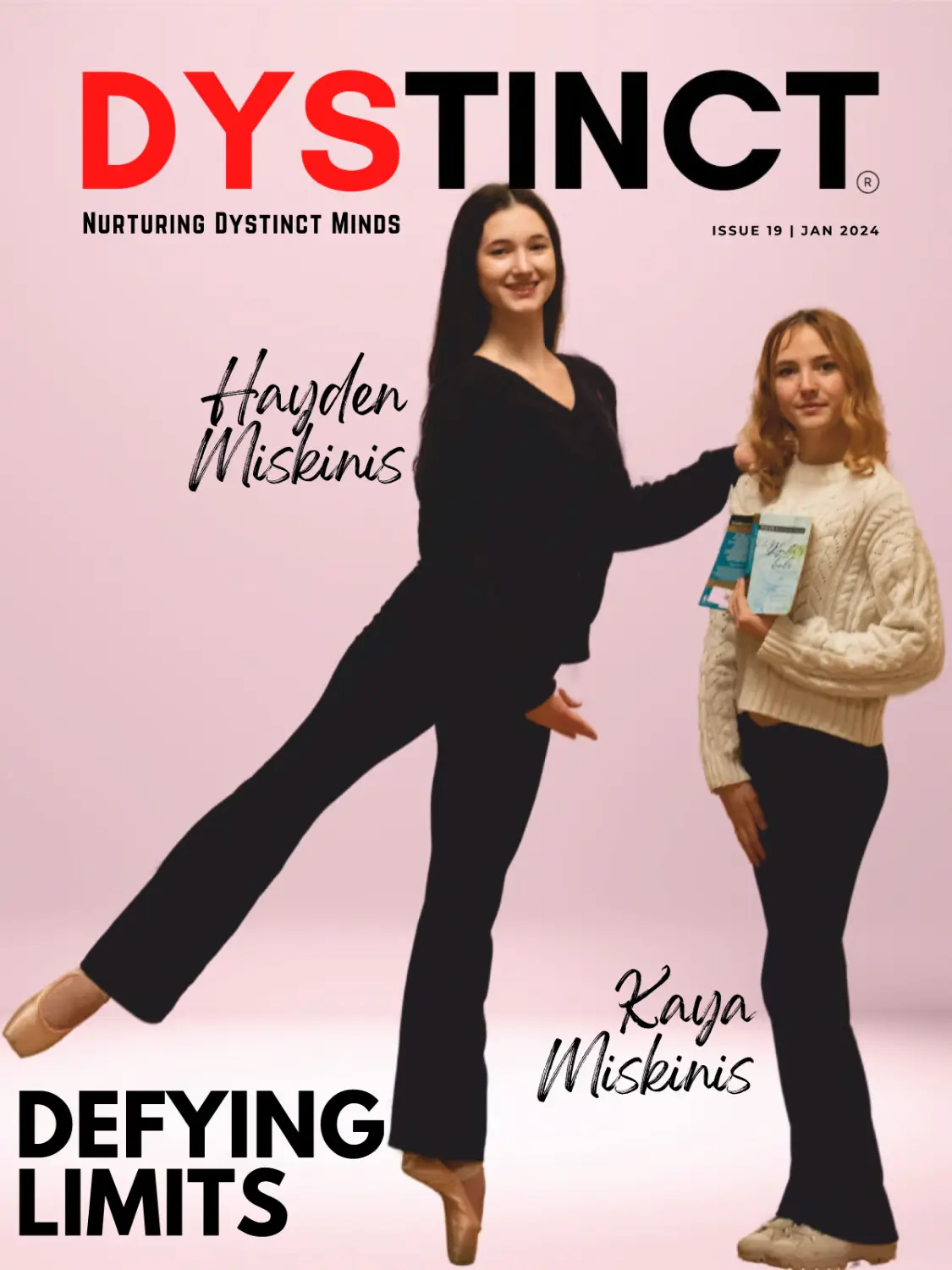
Nurturing Dystinct Minds
ISSUE 19 | JAN 2024
Hayden
Miskinis
DEFYING
LIMITS
Kaya
Miskinis
TAP AND HOLD THE SCREEN TO SHOW THE TOP BAR
Tap to see the contents of this magazine
HOW
TO
USE
T H IS
APP
SWIPE HORIZONTALLY TO
GO TO THE NEXT PAGE
TAP AND HOLD THE SCREEN TO SHOW THE BOTTOM BAR
Swipe horizontally to quickly navigate pages
Tap selected page to view
EDITOR'S NOTE
“Do not be intimidated by the professionals at the table.”
This quote by Melissa Robison serves as a powerful reminder that we parents
have a seat at the table, too. Don't let the professionals in the room intimidate
you. Ask all the questions you need to make sure your child is getting the
education they deserve. If something doesn't quite click or feels off, don't be
shy about reaching out for help. You're your child's biggest champion, and your
voice matters!
As we celebrate the third anniversary of Dystinct Magazine, it has been a
privilege to collaborate with Dr Pamela Snow and her remarkable team at La
Trobe University's SOLAR Lab in Australia. In this special anniversary issue, we
delve into the vital work they are undertaking to revolutionise how schools
teach children to read using well-established scientific methods. Dr Pamela
Snow, Dr Tanya Serry, Dr Nathaniel Swain, Dr Tessa Weadman, and Eamon
Charles provide an insightful article that serves as both an educational
explainer and a guide for parents and teachers. They decode complex terms
and offer valuable advice on their relevance in contemporary education. We
hope you find their insights as enlightening and empowering as I have. Here's
to three years of knowledge sharing and growth!
I hope you enjoy reading this issue.
Please get in touch with me if you have any feedback, ideas, or stories to share
to change the narrative surrounding learning disabilities.
Get in touch with me at Zahra@Dystinct.org
Zahra Nawaz
Founder and Editor at Dystinct Magazine
DYSTINCT
3
JAN 2024
CONTENTS
10
TE R MINO LOG Y I N TH E EDU CAT ION L ANDSCA P E: SOM E KEY
TE R MS E X PL AIN ED
T h i s art i cl e, a u th ore d b y P ame l a S n ow , Tan y a Se rry , Nat h an i e l S wa in , T e s sa We ad man , a n d
Eam on C h arl e s , acad e mi c s t af f at t h e L a T rob e Un i v e rs i ty ' s Sci e n c e o f Lan g u ag e an d
Re ad i n g ( S OL A R) L ab , e x p l ore s so me ke y t e rmi n ol og y i n e d uca ti on . It of f ers d et ai l e d
e x p l an at i on s an d i n s i g h ts in t o v ari ou s e d u c at i on al t e rms , h i gh l i g h t i n g t h e i mp ort an ce of
e v i d e n c e- b as e d ap p ro ach es an d ad v oc at i n g f or a cri t i cal e v al u at i on of e d u cat i on al
p rac t i ce s an d t re n d s .
23
F O C US O N S O LA R LA B: AN INT ERVI EW WI TH EAM ON
C H A R LE S
32
D YS T INC T RE PO RT – FL YNN AND AVA EL DRID GE’ S
I N T E RVIE W WITH D R PA MEL A SNOW
46
C H A N GI NG L IVES - HO W A FA T HER ON A MI SSI ON
C H A N GE D TH E O H IO E D UCA TI ON SY ST EM
A n i n t e rv i e w w i t h Eam on C h arl e s , acad e mi c s t af f at L a T rob e Un i v e rs i ty ’ s S OL A R L ab ,
w h i c h i s re v ol u t i on i zi n g e d u cat i on i n A u st ral i a an d ov e rs e as b y h e l p i n g e d u cato rs
ad op t we l l - e st ab l i s h e d , sci e n t i fi c ap p roach e s t o i m p rov e h ow t h ey t eac h c h i l d re n t o
re ad . D i ve i n to t h e t ran sf orm ati v e w ork sh a p in g th e fu t u re of re ad i n g i n s t ru ct i on .
Yo u n g j ou rn al i s ts F l y nn an d A v a E l dr id g e h a ve a ch at w i t h D r P am el a Sn ow , P rof es s or
of C og n i t i v e P sy ch ol o gy i n t h e Sch oo l of Ed u cat i on at L a T rob e Un i v e rs i ty , A u s tra l ia ,
ab ou t h er wo rk at t h e S O LA R Lab an d h e r l i f e .
Eri c a Kau f man n e l ab or ate s on t h e p rof ou n d i mp ac t of "C on n or 's
O d y s se y : Th e Ri g h t t o Rea d L aw" an d t h e O h i o D y s le x i a
G u i d e b ook on O h i o' s e d u cati o n s y st e m, d e t ai l i n g t h e d e d ica te d
e f fort s of f at h e r an d ad v ocat e Mi ke McG ov e rn i n e x p l ai n i n g t h e
t ran s fo rmat i v e ch an g e t h es e i n i t i at i v es h av e b rou g h t ab ou t .
ON T HE COVER
HA Y DEN A ND K A YA
MISKINIS
DYSTINCT
4
JAN 2024
79
W O R K ING WITH TE ACHIN G A SSIST AN T S TO SUPP ORT
CH IL DR EN WITH SP ECI AL ED UCA TI ONAL NEEDS
87
T OP 10 IMPO R TAN T REASONS BEH IND KEEPI N G PR OPER
D OC UME N TA T IO N OF SC HO OL R EC ORD S
100
113
Sara A l st on em p h as iz e s t h e i mp ort an ce o f trai n i n g a n d col l ab orat i on b et w e en t each e rs
an d T e ach i n g A ss i s ta nt s ( T As ) to s u pp o rt c h i l d re n w it h Sp e ci al Ed u ca ti on al Ne e d s an d
D i sab i l i t i e s ( SE ND ) e f fe ct i v el y , p rom ot i n g th e i r i n cl u si on an d l e arn i n g s u c ce ss .
Me l i s sa Rob i s on h i g h l i g h ts t h e cru c i al i mp ort an ce of p ro p er d ocu me n t at i on of a ch i l d 's
e d u cati o n al j ou rn e y , e mp h as i zi n g h ow i t can p l ay a p i v ot al rol e i n ad v oc at i n g for
s tu d e n t s w it h d i ve rs e n e e d s , en s u ri n g t h e i r ri g h t s are u p h e l d , an d ad d re s s i n g v ari ou s
e d u cati o n al ch al l e n g es t h rou g h a s y st e mat i c a pp r oach .
D Y STIN CT RE PO R T – F LYNN AND BLA KE EL D RI DGE’ S
I N T ER VIE W W IT H D R BROCK EI DE
D y st i n ct j ou rn al i s t s Fl y n n an d Bl ake El d ri d g e h av e a ch at wi t h D r Brock Ei d e , an
i n t ern at i on al au t h ori ty on d y s l e xi a an d l e arn i n g d i f fe re n ce s an d c o- au th or of t h e
ac cl ai me d b o oks " Th e D y s l e xi c Ad v an t ag e " an d " Th e Mi s l ab el e d Ch i l d " a bo u t h i s wo rk
an d l i f e .
A TAL E OF T WO D AUGH TERS
El ai n e M i ski n i s s h are s a p oi gn a n t accou n t of h e r t w o d au g h t e rs, K ay a an d Hay d e n , an d th e i r
u n i q u e j ou rn e y s wi t h d ys l e x i a. T h e s to ry e mp h as i ze s t h e cri t i cal ro l e of e arl y i n t e rv en t i on an d
ad v oc acy i n ov er comi n g t h e ch al l e n g es o f d ys l e x i a an d h i gh l i g h t s t h e g ir ls ' d e t e rmi n at i on t o
t h ri ve acad e mi c al l y d e s p i te ob st ac l e s .
127
T H E G IF T OF LE AR NI NG HOW TO L EA RN
127
EM BR AC IN G THE MA G IC OF SHA KESPEARE
H ay d en Mi s ki n i s s h are s h e r j ou rn e y as a d y sl e x i c l e arn e r a n d b al l e t d an ce r, h i g h li g h t i n g h ow
t h e s tru ct u re d ap p ro ach t o ov e rc om i n g d y sl e x i a h as i n f orme d h er t ea ch i n g of d an ce t o y ou n g
c h i l d re n an d l e d h er t o ad v ocat e f or ef f ect i v e l e arn i n g me t h od s w h i l e f i n d in g sol a ce i n t h e art
of b al l e t .
Kay a M i s ki n i s re fl e ct s on h e r j ou rn e y, f rom fa ci n g ch al l en g e s i n e arl y e du ca ti on t o d e v e l op i n g
a l ov e for re ad i n g an d a p as si on for Sh ak es p e are , s h owc as i n g h e r d e t e rmi n at i on a n d g rowt h
as a l earn e r.
Cor a
K aufma nn
DYSTINCT
5
JAN 2024
© C op yr ig h t 2 024 +
E DIT OR
Za hr a Naw a z
PU BL IS H ER
S h af A za m
I LL US TR AT OR S
C e l i n a H a md an i
Co ra K a uf m an n
Ra c he l Cy r
Website:
Email:
Facebook:
Twitter:
Instagram:
LinkedIn:
Pinterest:
YouTube:
DySTINCT Magazine
IS S N 2 65 3- 03 5X
J OU R NA LIS TS
Dystinct Magazine is published by
Av a E l dr id g e
B l a ke El d ri dg e
F l ynn E ld r id ge
SIMEFF Pty Ltd
ABN 31 161 999 186
PO Box 2443
Templestowe Lower, Melbourne,
VIC - 3107,
Australia
CO N T R IBUT OR S
Br ock E ide
Ea mo n Ch ar le s
E l a i ne Mis kin is
E r i ca K au fma n n
H a y d en Mi s kini s
K a y a Mis kin is
M e l is s a R ob i so n
Na t h a ni el Swai n
Pa mel a Sn o w
Sa ra Al s t on
T a nya Se r r y
T e s sa Wea d m an
www.dystinct.org
hello@dystinct.org
facebook.com/DystinctMag
twitter.com/DystinctMag
instagram.com/dystinctmag
linkedin.com/company/dystinctmag
pinterest.com/dystinctmag
youtube.com/@dystinctmag
DYSTINCT is a registered
trademark of SIMEFF
We acknowledge we are on the traditional lands
of the Wurundjeri people and pay our respect to
their Elders past, present and emerging. We
extend that respect to all Aboriginal and Torres
Strait Islander peoples. We acknowledge their
living connection to Country, relationship with
the land and all living things.
Both person first and diagnosis first language has been used throughout this magazine to be sensitive to
people who feel passionately about either way of addressing individuals.
DYSTINCT
6
JAN 2024
DYSTINCT CONTRIBUTORS
Journalist
Ava Eldridge
Age 10
Dyslexia
NSW, Australia
Ava loves art, animals, cooking, her family,
playing the piano and she really enjoys
reading! Her newfound love of aerial
acrobatics keeps her busy.
Illustrator
Celina Hamdani
Age 19
Social anxiety disorder & ASD
London, UK
Celina is a self-taught digital artist. She
studies art media and design at John Ruskin
College, Croydon and is enrolled in an
animation course with Danimation
Entertainment, Burbank, USA. Her hobbies
include listening to music and creating short
animation videos. Her goal is to pursue a
career in animation that will allow her to
merge her love for art, storytelling, and
technology.
DYSTINCT
7
JAN 2024
DYSTINCT CONTRIBUTORS
Illustrator
Cora Kaufmann
Age 9
Dyslexia
Northeast Ohio, USA
Cora is a fourth-grade student in Northern
Ohio. Cora enjoys camping, playing with
friends, and all things Taylor Swift. When
she grows up, Cora wants to be a science
teacher because she loves science and
wants to teach it to kids. Cora wants other
kids with dyslexia to know that it is okay to
have dyslexia because everyone is different.
Journalist
Flynn Eldridge
Age 11
Dyslexia & Dysgraphia
NSW, Australia
Flynn finds reporting fun, sometimes
scary, and ultra exciting. Flynn likes to
dress up as an old-time reporter and ask a
range of questions, as that is his style.
Flynn builds loads of different lego
creations such as the rainbow, spinningtop microphone he uses in the interview.
DYSTINCT
8
JAN 2024
DYSTINCT CONTRIBUTORS
Illustrator
Rachel Cyr
Age 17
DCD, Dyscalculia & ADD
Maine, USA
Rachel Cyr is a 17-year-old artist with
DCD Dyscalculia and ADD. A unique,
outside-the-box thinker, she devotes her
free time to her bedroom studio,
passionately crafting drawings, paintings,
stickers, and pottery to life through
relentless creativity and a vivid
imagination. Her determination fuels her
ambition to study the arts in college while
running her own Etsy shop.
DYSTINCT
9
JAN 2024
Come be part of our tribe!
NURTURE DYSTINCT MINDS
#Dyslexia #Dyscalculia #Dysgraphia #Dyspraxia
@DystinctMag
IN
THE
L A N D S C A P E
E D U C A T I O N
T E R M I N O L O G Y
| /’evɪdəns/ Matters
SOME KEY TERMS EXPLAINED
Pamela Snow
Tanya Serry
Tessa Weadman
Nathaniel Swain
Eamon Charles
SCIENCE OF LANGUAGE AND READING (SOLAR) LAB
SCHOOL OF EDUCATION
DYSTINCT
12
JAN 2024
The Science of Language and Reading (SOLAR) Lab was
established in the School of Education at La Trobe
University in 2020 to improve two-way knowledge
sharing between researchers and practitioners regarding:
Optimal ways of teaching reading, writing,
and spelling to all students, regardless of
socioeconomic, cultural, and/or geographic
circumstances.
Optimal ways of monitoring student progress
to ensure high levels of ongoing success,
academically and psychosocially, and
Optimal ways of supporting students who are
identified as falling behind expected levels of
proficiency in language and literacy domains.
Our work includes the design and delivery of three
online short courses open to teachers, allied health
professionals, school leaders and parents regarding
the science of language and reading in both primary
and secondary contexts. These short courses are
positioned in a broader framework of the science of
learning, which refers to a broad body of scientific
research over many decades, teasing out an
understanding of how human brains take in and learn
new information and skills.
DYSTINCT
13
JAN 2024
We also do research on how to promote best practice in schools,
and provide consultancies to a number of education jurisdictions,
both government and Catholic, about optimal ways of supporting
system-level improvements. We have re-designed the reading
instruction components of La Trobe’s initial teacher education to
bring these into line with contemporary scientific evidence and have
also commenced (in 2022) a Language and Literacy specialisation in
the La Trobe Master of Education. This is undertaken mainly by
practising teachers but also by allied health professionals who are
eager to upskill in these domains to support their work in schools.
Working under the broad umbrella of the science of
learning means that we keep up with advances in
human learning and ways to ensure that classrooms
are places where all children can succeed because
they are being taught by highly knowledgeable and
skilled teachers.
DYSTINCT
14
JAN 2024
Illustration by
Rachel Cyr
Human brains are sometimes likened to computers or to
mental muscles, but in reality, they are neither. The brain
is a highly evolved and complex organ, and we must
grapple with the fact that there are many similarities
between individuals in terms of brain structure and
function, with room for individual differences as well.
Unfortunately, the workings of the human brain have not
been a strong focus in initial teacher education programs
in recent years, so this means that teachers have had to
source their own professional learning and must
sometimes sieve through a complex range of classroom
practices and therapies in the intervention marketplace.
Some of these and their associated language are aligned
with current scientific evidence, and others are not. It’s
pleasing, however, to see that in recent times, some wellregarded key learning science terms are turning up in
articles directed at teachers and parents, but some more
dated and tired options are still turning up as well. We will
use this article as a bit of an explainer for some of these
terms and offer our advice as to whether they are
contemporary and helpful for parents and teachers.
DYSTINCT
15
JAN 2024
DISCOVERY LEARNING,
ENQUIRY-BASED LEARNING,
PROBLEM-BASED LEARNING
The concept of learning through a
project or an inquiry process has
been around in education for nearly
100 years. US education
philosopher John Dewey (1859 –
1951) spearheaded the idea that
children learn best in “authentic”
and natural situations and rejected
the idea of a teacher telling
students answers they could find
out for themselves. In the early
20th century, there was a push to
bring Dewey’s vision of education
into classrooms despite a lack of
good evidence that this was an
optimal way of learning. Much
debate has followed and continues
between supporters of the “Dewey”
view of education and those who
support teacher-led instruction.
Student- and teacher-led
instruction are described below.
DYSTINCT
17
Student-led approaches
take many forms,
including “discovery
learning”, “inquiry-based
learning”, and “problembased learning”. Some
educators argue that
these all have very
distinct differences, but
precise and agreed
definitions do not exist.
JAN 2024
The bottom line is many
students find it difficult to
teach themselves key
academic concepts when
there is not enough explicit
teaching before they are
expected to inquire or
explore these ideas
independently.
DYSTINCT
Although many education
leaders will push for student-led
learning of various forms, there
are flaws with this practice,
particularly in the context of
teaching novel information from
the perspective of how the
human brain copes with new
learning. We argue that studentled approaches are best used as
ways to reinforce and apply
knowledge and skills that
teachers teach first. Many
teachers will find this idea
controversial and out of step
with what they were taught as
preservice teachers since
student-led learning is still
popular despite the lack of
rigorous scientific evidence to
support it.
18
JAN 2024
EXPLICIT TEACHING:
Explicit Teaching
Explicit Instruction
Direct Instruction
(EI, EDI, DI)
According to Greg Ashman (2017), explicit teaching implies
a teacher-led approach whereby the teacher explains and
models the instructional target before asking students to
put anything into practice themselves. This is the antithesis
of all student-led approaches. Using the “I do, we do, you do”
model, the teacher imparts clear and explicit instructions to
their students (I do) before moving students to supported
practice (we do). In this second phase, the teacher gives
carefully considered scaffolds (supports) to help students
successfully complete the required task. Finally, once the
teacher has evidence that their students are close to
mastering the instructional target, the you do phase begins.
In this phase, as noted in 2023 by Killian, “students do the
procedure or show their understanding on their own.”
Explicit teaching is suitable for students who are novice in
relation to the instructional target. Therefore, explicit
teaching is suitable for all students, not just those
experiencing difficulties with learning. Not only does a
teacher-led approach align with how the human brain
prefers to process and learn new information, but this
method also provides a clear and predictable structure that
allows students to work towards mastery with scaffolded
support from the teacher.
DYSTINCT
20
JAN 2024
There are three main sub-types of explicit teaching known as
“Explicit Direct Instruction (EDI), “Direct Instruction” (DI),
and “direct instruction” (di). While these are all privilege a
teacher-led, explicit teaching approach, differences lie in the
design and delivery of lessons. In particular, teachers using
Direct Instruction would follow a scripted, manualised
program and students are grouped by ability. Choral
responding is a key characteristic of DI lessons. In contrast,
EDI lessons are not scripted. Instead, lessons are framed
according to a set of design principles to inform and
explicitly teach students about the instructional target
before providing scaffolded, supported practice. Teachers
use various techniques on a regular basis to check for
students’ understanding and adapt their instructional
prompts accordingly. Both DI and EDI methods are derived
from evidence-informed principles about human learning,
and both place great value on the role of high levels of
student engagement and activity during lessons. Rosenshine
(2008) defined direct instruction (di) as “... instruction led by
the teacher, as in “the teacher provided direct instruction in
solving these problems.”, although he cautioned that the
term can be used in overlapping and even contradictory
ways. As a leading scholar in teacher-led instruction,
Rosenshine’s definition arguably draws on both DI and EDI
and emphasises the importance of providing scaffolds,
immediate and corrective feedback, checking regularly for
students’ understanding, active participation by all students
in all lessons and teaching to mastery.
DYSTINCT
21
JAN 2024
Zone of Proximal Development
Vygotsky’s (1978) Zone of Proximal Development (ZPD) theory
was developed in relation to the assessment of a child’s
intellectual functioning, but we have applied it here to explicit
teaching. Vygotsky defined the ZPD as “the distance between
the actual developmental level as determined by independent
problem solving and the level of potential development as
determined under adult guidance or in collaboration with more
capable peers’ (p. 86). Figure 1 displays the standard model put
forward by Vygotsky.
What the student
is unable to do.
Zone of Proximal
Development:
What the student can
do with guidance.
What the student
knows already.
Figure 1: Vygotsky’s Zone of Proximal Development.
DYSTINCT
23
JAN 2024
However, viewing this model through the lens of explicit teaching,
regardless of subtype, the I do, we do, you do framework can be
applied and extended beyond “What the student is unable to do” to
“Mastery”.
Mastery: Student
is working at the
You Do phase.
Zone of Proximal
Development:
Explicit teaching (I
Do, We Do)
Student’s prior
knowledge
Figure 2: Vygotsky’s Zone of Proximal Development applied to explicit teaching.
DYSTINCT
24
JAN 2024
Illustration by
Rachel Cyr
Multi-Tiered Systems of
Support (MTSS)
Response To Intervention (RTI)
MTSS and RTI are closely related terms, but there are some
important differences between them. Historically speaking, RTI
came first. It draws on thinking in the domain of public health and is
concerned with (a) prevention of academic difficulties before they
occur through high-quality teaching and progress monitoring (b)
early identification of students who are starting to fall behind
expected levels of achievement, and (c) appropriate intervention for
such students. RTI is usually depicted as a three-tiered triangle, with
Tier 1 at the bottom, which refers to whole-class teaching and
should meet the needs of around 80-85% of students. Tier 2, which
is small group intervention for 5-10% of students and is usually
provided by a member of the school teaching team. Tier 3 support is
typically provided 1:1 and often involves support from a specialist,
such as a speech-language pathologist or qualified tutor. An
important feature of RTI is that students moving up through the
tiers should not receive different instruction. Instead, they should
receive higher “doses” of instruction in terms of the duration,
frequency and intensity. Being exposed, for example, to Balanced
Literacy teaching in the classroom and then to systematic synthetic
phonics instruction for “pull-out” intervention is not RTI.
MTSS represents a broadening of thinking beyond the classroom so
that whole school policies promote and support best practice. MTSS
includes staff professional learning, positive behaviour support,
wellbeing policies and practices, curriculum, and school-community
connections.
Both MTSS and RTI are ways of thinking about teaching, student
support, staff development, and whole-school policies. They are not
programs.
DYSTINCT
26
JAN 2024
Multiple Intelligences
This is an idea that was introduced by US
developmental psychologist and Harvard University
researcher, Professor Howard Gardner in the 1980s
in an effort (probably quite fairly) to challenge what
he saw as narrow definitions of intelligence. He did
this by describing a range of other “intelligences”,
such as musical and artistic abilities and encouraged
schools to foster and acknowledge these alongside
academic success. We have no argument with that
broad philosophy, but unfortunately, many schools
seemed to use the idea of multiple intelligences as a
way of taking their foot off the throttle on core
academic skills such as reading, writing, spelling, and
numeracy success for all. We need education systems
that foster academic achievement and achievement
across a range of other domains, not one or the other.
Howard Gardner himself has since distanced himself
from the way that his multiple intelligences work has
been applied in schools.
DYSTINCT
28
JAN 2024
Pedagogy
Pedagogy is just a fancy academic term for what is essentially
teaching and learning. It is like a teacher’s working
understanding of how the process of teaching and learning
should occur, and will answer questions like:
Is the knowledge predetermined by the teacher, or
yet to be discovered via input from the student?
Is the role of the teacher to facilitate children’s selfdirected (inquiry-based) learning or to explicitly
instruct the class?
Sometimes, pedagogy is at the heart of debates about different
teaching approaches, like the ones described in this article, and
you may hear teachers say, “This kind of pedagogy is better than
that kind of pedagogy”. For example, inquiry-based pedagogies
are often pitted against explicit instruction. The term is also
used when teachers talk about their personal teaching
approaches or philosophies, and they might say, “In my personal
pedagogy, I do X”.
DYSTINCT
30
JAN 2024
Push-in and Pull-out
Models for Reading
Intervention.
Push-in intervention methods, like many approaches in
education, are not clearly defined, so they may vary greatly in
practice. A teacher working alongside a student in an attempt
to support access to whole class teaching and a teacher
providing small group instruction as a modified alternative to
the whole class lesson, are both examples of push-in
intervention. Pull-out models of intervention may happen in a
small group or one-on-one (depending on the level of need) and
will likely happen outside of the classroom, ideally in a
dedicated, quiet teaching space in the school. Both approaches
are most effective when they are an extension of high-quality
evidence-informed whole class teaching, rather than offering
students something different from what is happening in the
classroom. In pull-out models of intervention, students should
still receive the same type of evidence informed instruction as
the whole class, but other components of the session can be
individualised depending on student needs. This may include
creating more opportunities for review of previous learning,
modelling, guided practice or teacher feedback. Both
approaches should be goal-oriented, and student responses
should be continuously monitored to track progress towards
goals.
DYSTINCT
32
JAN 2024
Reciprocal Teaching
Reciprocal teaching is a classroom instructional approach
designed to improve students’ reading comprehension ability
and promote metacognitive skills (encouraging students to
increase their awareness of their own thinking while reading).
During reciprocal teaching, students apply “comprehension
strategies” to gain meaning from text. The four key
comprehension strategies include:
Predicting involves hypothesising what will happen in the text
or the next part of the story.
Clarifying includes identifying any unknown words (vocabulary),
vague concepts or events that remain unclear within the text.
Questioning involves generating questions about the text to
encourage analysis of the text.
Summarising provides a more succinct outline of the key points
of the overall text or smaller components.
The classroom teacher models the four strategies when
reciprocal teaching is initially introduced to students. There is a
shift in the amount of teacher input, modelling and feedback as
students practise each strategy and become more independent.
Responsibility for generating discussion and dialogue gradually
transfers from the teacher to the students. Students may work
in small groups independently as their familiarity with the
reciprocal teaching components develop, therefore making this
a more suitable approach for older students.
DYSTINCT
34
JAN 2024
Relationship-Based
Practice
Relationship-based practice is another term that is not consistently
defined, although it is usually used in the broader context of “Trauma
Informed Practice”. Positive relationships between students and staff
do not automatically mean effective learning will occur, as learning is
dependent on a wide range of factors. We do know, however, that all
students benefit from consistent instructional routines and teaching
practices that are based on strong research evidence. These practices
are likely to foster positive relationships and create environments that
establish a sense of safety and predictability for all learners while also
creating the best conditions for learning. Positive relationships in
classrooms should be a given, but are not, on their own, enough for
effective learning to occur.
DYSTINCT
36
JAN 2024
Illustration by
Celina Hamdani
RETRIEVAL PRACTICE
Spaced Practice
Interleaved Practice
Retrieval Practice
Retrieval practice refers to the act of attempting to recall or “retrieve”
previously learnt information as a way of monitoring how well we
know something. In the educational context, retrieval practice is a
technique that teachers can use to build students’ retention and recall
of information rather than assuming that students can simply recall
what they have previously been taught. While retrieval practice is
considered a key to successful learning, the timing (spacing) and
scheduling (interleaving) are more important than the volume of
retrieval practice.
Spaced Practice
In contrast to “cramming” before a test or exam, spaced practice
involves reviewing information at multiple time points so that the
material is consolidated and well-embedded in long-term memory.
Teachers can provide opportunities for spaced practice by doing “daily
reviews” of previously learned content using low-stakes classroom
questioning or quizzes. Older students can be taught how to use spaced
practice as a method of self-study. In contrast to cramming for a highstakes test or exam, long-term retention is far more likely if teaching is
supported by spaced practice.
Interleaved Practice
Interleaved practice is a form of retrieval practice that involves
reviewing a number of topics during a retrieval practice session rather
than focusing on just one topic. Rather than reviewing one topic
exclusively in a practice or self-study session, interleaved practice
sessions alternate between related topics. Interleaved practice involves
alternating between tasks. It gives students the same amount of time on
each task but is more challenging than spaced practice as students must
actively call on different processes and skills to retrieve knowledge.
However, when interleaved practice is done well, the greater effort in
recall and retrieval of knowledge leads to better long-term retention
than when using blocked practice only.
DYSTINCT
38
JAN 2024
Spiral Curriculum
The concept of a spiral curriculum is an old one, and many credit
US psychologist Jerome Bruner (1915 – 2016) with this idea.
Bruner believed that any area of study could be mastered by
children if it is broken down into accessible introductory
concepts and steps. He argued that the best way for students to
move through the curriculum was in a spiral-like fashion, being
first exposed to a basic introduction to an area or concept, and
then spiralling back to that same area of study in later terms or
years, with greater levels of complexity and detail added.
The basic idea behind the spiral curriculum does hold up when
we look at evidence from cognitive science. For example, it
crosses over with the idea of retrieval practice, and spaced
learning (see above). When using retrieval practice and spaced
learning, students have a much better chance of understanding
and retention. By returning to concepts previously taught, we
also build upon students’ growing schema (mental frameworks)
for that topic and build further knowledge and skills upon
previously mastered areas.
What is most important is that students are supported in
building solid and increasingly elaborate understandings of
concepts and connecting these together into a broader
understanding as they revisit the big ideas in any academic
subject.
DYSTINCT
40
JAN 2024
Standardised Testing
Teachers and allied health professionals, such as speechlanguage pathologists and psychologists, use a range of ways to
monitor student progress. In their classrooms every day,
teachers are informally observing student responses and
looking over examples of their written work. This kind of
monitoring is important and alerts knowledgeable teachers to
early warning signs that more assessment and/or support might
be needed. Teachers sometimes also administer more formal
assessment tools, such as a Phonics Screening Check, the
Dynamic Indicators of Basic Early Literacy (DIBELS) suite of
monitoring tools, and other measures, such as the York
Assessment of Reading Comprehension. These latter tools are
referred to as “standardised assessments” because test
developers have administered them to large samples of male
and female students across the relevant year levels, so teachers
have accurate information about what “standard” performance
looks like across “average”, “below average” and “above
average” levels of achievement. Some tools (such as the Phonics
Screening Check) are criterion-referenced, which means there is
a pre-set score that is a “pass” (criterion), and students are only
followed up if they score below this level. IQ tests are also
standardised, meaning that once we know a child’s IQ score, we
have a good idea about where a child sits relative to her peers.
IQ tests have a mean (average) of 100, so 50% of the population
will have a score above 100, and the other 50% will have a score
below. Hence, if we assess a Year 3 student, Abbi and find she
has a full-scale IQ (made up of both the verbal and visuo-spatial
elements of the test) of 105, she is performing slightly above
average.
On the subject of IQ tests, it should be remembered that IQ is
only one factor that contributes to reading ability. There are
people with high IQs who are relatively weak readers and
people with low IQs who are relatively strong readers. The best
predictor of reading success is the quality of the reading
instruction a child receives.
DYSTINCT
42
JAN 2024
Whole Brain Teaching
This term is a little odd to us in the sense that it is not
possible to teach in a way in which the “whole brain” is
not involved. As a commercial entity, it is an approach
developed in the US by Chris Biffle. It involves many
classroom practices that we endorse, such as choral
responding, students doing “pair-share” activities, and
teacher-led instruction. We are not aware of any
research that endorses this approach over other
explicit teaching methods and dislike the poppsychology reference to the “whole brain”. Teachers,
parents, and students cannot turn off or on selected
parts of the brain. It is a complex organ, and all of it is
involved in learning, to a greater or less extent, every
day.
DYSTINCT
44
JAN 2024
Education has an unfortunate tradition of
adopting fads and fashions and of not
stopping to look at the research behind
approaches before they are adopted. This is
changing in the third decade of the twentyfirst century, but many practices are still in
use that do not have strong evidence to
support them, and new practices are “sold”
to schools that are not evidence-based.
If you would like to know more about interventions
for children with developmental disorders in
particular, this 2017 text may be of interest:
Making Sense of Interventions for Children’s
Developmental Disorders. A Guide for Parents and
Professionals.
DYSTINCT
45
JAN 2024
REFERENCES
Ashman, G. (2017). What is explicit instruction? Filling the pail.
Evidence-Based Teaching. (2023, February 21). The 'I Do, We Do, You Do'
Model Explained.
Ybarra, S. E. (2014). DI vs. di vs. EDI.
Rosenshine, B. (2008). Five meanings of direct instruction. Center on
Innovation & Improvement, Lincoln, 1-10.
Vygotsky, L. (1978). Zone of proximal development: A new approach. Mind
in society: The development of higher psychological processes, 84-91.
Bertilsson, F., Stenlund, T., Wiklund-Hörnqvist, C., & Jonsson, B. (2021).
Retrieval Practice: Beneficial for All Students or Moderated by Individual
Differences? Psychology Learning & Teaching, 20(1), 21-39.
Morkunas, D. (2020). Spaced, interleaved and retrieval practice: The
principles underlying the Daily Review. LDA Bulletin, 52 (December), 20-22.
Whole Brain Teaching. (n.d.).
DYSTINCT
46
JAN 2024
Pamela Snow is a Professor of Cognitive Psychology in the School of
Education at the La Trobe University, Victoria, Australia. She is a registered
psychologist, having originally qualified in speech-language pathology, and is
a Life Member of Speech Pathology Australia.
While her research continues to span various aspects of risk in childhood and
adolescence, Pamela has maintained a core focus on the role of oral language
competence as an academic and mental health protective factor throughout
childhood and adolescence. She is also strongly interested in applying
evidence in the language-to-literacy transition in the early years of school.
Pamela has research links with the education, welfare and justice sectors, and
has over 200 publications in a wide range of international journals, book
chapters, monographs and research reports. She is frequently called upon to
address education, health, welfare, and forensic audiences, and in 2017,
Pamela was a member of the National Year 1 Literacy and Numeracy Panel,
convened by the then Federal Minister for Education, the Hon. Simon
Birmingham.
b
In 2024, we have the
knowledge needed to
teach all children to
read. Now we need to
ensure that every child
has access to
instruction that is
informed by this
knowledge.
Pamela Snow
DYSTINCT
47
JAN 2024
Tanya Serry is a Professor (Literacy and Reading) in the School of Education
at the La Trobe University, Melbourne, Australia.
Her research interests centre on the policy and practices of evidence-based
reading instruction and intervention practices for students across the
educational lifespan. She is particularly interested in addressing the social
gradient that exists for students’ reading capacity as well as the experiences
of parents, educators and allied professionals who engage with the Science of
Reading.
After initially qualifying in speech-language pathology, Tanya went on to
complete a Masters in Applied Linguistics and a subsequent PhD. She is the
recent past editor-in-chief of the Australian Journal of Learning Difficulties
and currently serves on the editorial board. She is also an elected board
member of the Ethics Board for Speech Pathology Australia. She is an active
researcher and a member of a number of interdisciplinary research teams
both within and external to La Trobe University.
We have a collective
responsibility to ensure
that all children,
regardless of their
circumstances, are
afforded the right to
be a proficient reader.
b
DYSTINCT
48
Tanya Serry
JAN 2024
Dr Nathaniel Swain is a Teacher, Instructional Coach, and Writer. He works
as a Senior Lecturer in Learning Sciences and Director of Undergraduate
Academic Programs at La Trobe University School of Education and SOLAR
LAB. Nathaniel has taught a range of learners in schools and Universities, and
founded a community of teachers committed to the Science of Learning:
THINK FORWARD EDUCATORS, now 23,000 members and growing
ThinkForwardEducators.org
NathanielSwain.com
b
All students will find it
difficult to teach themselves
when there is insufficient
initial instruction. Teachers
should teach well and
explicitly so that students
can later critique, inquire,
explore and independently
go beyond the content.
DYSTINCT
49
Nathaniel Swain
JAN 2024
Dr Tessa Weadman is a Lecturer in English, Literacy and Pedagogy in the
School of Education at La Trobe University.
Tessa’s research interests span across preschool and school-age language
and literacy development. Her PhD research focused on preschool oral
language and emergent literacy development in early childhood settings, and
the role of adult-child shared book reading and dialogic book reading. She
developed the “Emergent Literacy and Language Early Childhood Checklist
for Teachers” (ELLECCT) – a shared book reading observational tool that can
be used to support teachers’ oral language and emergent literacy strategies.
With a background in speech-language pathology, Tessa continues to work
clinically to support preschool and school age students with language,
literacy and communication difficulties.
Reciprocal teaching is a
classroom instructional
approach designed for
improving students’ reading
comprehension ability and
promoting metacognitive skills.
During reciprocal teaching,
students apply
“comprehension strategies to
gain meaning from text. The
four key comprehension
strategies include predicting,
clarifying, questioning, and
summarising.
b
Tessa Weadman
DYSTINCT
50
JAN 2024
Eamon Charles, the Academic Intern in the SOLAR Lab, supports key
research projects across the team. Eamon also teaches a range of subjects
across the School of Education, with a focus on language development and
reading instruction.
He has completed a Bachelor of Speech Pathology (Honours) and has worked
as a paediatric speech-language pathologist and team leader across early
childhood, primary and secondary education settings in regional Victoria.
As a result of his background in schools, Eamon has a keen interest in how
evidence-informed practices in education can reduce inequities for young
learners, particularly those in rural and regional areas and/or experiencing
childhood adversity.
b
As a society, we know a
lot about how to best
support students to become
readers and writers, and
how these skills act as a
protective factor across the
lifespan. It’s vital that our
systems work together to
ensure we are opening those
doors for all children.
Working within the SOLAR
Lab is a unique opportunity
to contribute to this goal.
DYSTINCT
51
Eamon Charles
JAN 2024
#Dyslexia #Dyscalculia #Dysgraphia #Dyspraxia
We share evidence
based knowledge
in an easily
understandable
format to equip
parents to
advocate for
their children.
Love our
mission
Please
support us!
SUBSCRIBE
Get 1 Month FREE Trial
DYSTINCT BOOK III
THE THIRD EDITION OF OUR ANNUAL COFFEE TABLE BOOK
Informative and
compelling, the 288page hard-bound
Coffee Table Book
book is designed to
be a visual delight,
sure to inspire and
uplift readers.
BUY
OOK
GET B
ON
NCT.
DYSTI
ORG
THE DYSTINCT BOOK III WILL MAKE A FABULOUS ADDITION
TO ANY LIBRARY, THERAPY PRACTICE OR HOME DISPLAY.
| In the Spotlight
LA TROBE’S SCIENCE OF
LANGUAGE AND READING
(SOLAR) LAB IS HELPING
SCHOOLS TO ADOPT WELLESTABLISHED, SCIENTIFIC
APPROACHES TO IMPROVE
HOW THEY TEACH CHILDREN
TO READ.
THE SCIENCE OF LANGUAGE
AND READING (SOLAR) LAB
FOU NDED 2 020
FOCUS ON SOLAR LAB
AN INTERVIEW WITH EAMON CHARLES
DYSTINCT
54
JAN 2024
Background
How did the idea for setting up SOLAR Lab come to be? What
were Professor Pamela Snow and Professor Tanya Serry
aiming to achieve when they founded the SOLAR Lab in 2020?
Professor Snow and Professor Serry's Science of Language and
Reading (SOLAR) Lab, founded in 2020, was established with
multiple purposes in mind:
•to advance research related to evidence-informed
approaches to teaching reading.
•to align La Trobe's relevant undergraduate and
postgraduate curriculum with the research.
•And to help schools adopt well-established
scientific approaches and improve how they teach
children to read.
The idea came about after Snow and Serry spent multiple decades
developing their clinical, research and teaching interests, focusing
on the most effective approaches to support all learners to develop
the oral and written language skills required for academic,
economic, and social success across the lifespan. It was made
possible by their appointments in the School of Education, which
commenced in early 2020.
DYSTINCT
55
JAN 2024
How has the SOLAR Lab evolved since its establishment, and what
key milestones or achievements stand out during its journey?
Since its inception in 2020, the SOLAR Lab has established itself
as a highly trusted source of information concerning the effective
teaching of reading, writing, and spelling across the primary and
secondary years. This has occurred through the development and
delivery of highly successful online short courses and the
establishment of a Language and Literacy specialisation in the
La Trobe Master of Education program. The SOLAR Lab has also
grown, with Dr Nathaniel Swain (Senior Lecturer Learning
Science and Learning Engagement), Dr Tessa Weadman
(Lecturer English Literacy and Pedagogy), and Mr Eamon
Charles (SOLAR Lab Academic Intern) joining the team across
the last 12 months. Dr Tesa Daffern has also joined as an
Honorary Adjunct Associate Professor. The SOLAR Lab has been
instrumental in the La Trobe University School of Education
becoming a system leader by shifting its curriculum away from
Balanced Literacy to one firmly focused on supporting preservice teachers to build the knowledge and skills necessary to
implement evidence informed approaches to teaching reading.
Members of the SOLAR lab team have given invited keynote
presentations and have conducted seminars/workshops at
multiple local, interstate and international events since the
inception of the Lab in 2020. We have also engaged in a large
number of podcast interviews, and there has been considerable
media interest in our work. Links to podcast interviews are
available on the SOLAR Lab website.
DYSTINCT
56
JAN 2024
Impact and Significance
What are some of the significant changes that SOLAR Lab has
brought about in the field of education in Victoria and other
states of Australia?
We regularly receive feedback from school leaders and teachers
about how excited they are that pre-service teachers at La Trobe
are now receiving evidence-informed content concerning the
teaching of reading. Given the high variance in how reading is
taught in Australia, from school to school (and within schools),
region to region, sector to sector and state to state, we see the
reform of initial teacher education as a critical step to improving
student outcomes over the long term. We are proud that La Trobe
University and the SOLAR Lab are being recognised nationally and
internationally for the leadership we are providing in this space.
DYSTINCT
57
JAN 2024
Initiatives and Programs
SOLAR Lab has been offering online short courses and
collaborates with various stakeholders. Could you elaborate on
the nature and goals of these initiatives?
The short courses are designed to "retrofit" foundational knowledge
about the science of teaching reading for participants whose ITE
lacked this content. Our short courses focus on content that we believe
should have been included in participants' initial teacher education
and/ or should be available within systems. We are also highly
conscious of the research-to-practice gap, which has long existed in
education. While we have long known about the most effective ways to
teach children to read, the teaching of reading has unfortunately been
a contested space for ideological reasons. Scientific knowledge about
reading and reading instruction will continue to evolve over time, but
we have enough research and knowledge to act now, which is what we
are doing at La Trobe. We are committed to establishing purposeful
and long-term partnerships with relevant stakeholders to support
schools and systems to apply research evidence at a practical level in
the classroom. This focus on sustainable implementation is what will
have the biggest impact on student outcomes over time.
Could you provide specific examples of how the SOLAR Lab
fosters interdisciplinary collaboration to efficiently translate
new knowledge into classroom practice and encourages the
de-implementation of practices lacking empirical evidence
within the education and allied health sectors?
We have some highly experienced postgraduate students connected to
the SOLAR Lab who come from a range of professional backgrounds,
including primary teaching, secondary teaching, school leadership,
speech-language pathology, and educational psychology. This helps
ensure our research outputs have an interdisciplinary focus. Our
DYSTINCT
58
JAN 2024
wonderful postgraduate students all combine their expertise as
practitioners with their research skills to focus on work that can
inform schools as they transition away from Balanced Literacy to a
more structured, explicit and systematic approach to teaching
children to read.
Can you share any specific success stories or case studies
that exemplify the positive outcomes of SOLAR Lab's initiatives
on students, teachers, and/or schools?
We are in the process of writing up a research paper about the impact
of our SOLAR Lab short courses and hope that it will be available in
2024. We hear from classroom teachers and school leaders almost
every week, feeding back to us on ways they have employed new
learnings from SOLAR Lab's short courses and/or the Language and
Literacy Masters specialisation to transform instruction in their
schools.
SOLAR Lab has engaged in partnerships and collaborations with
schools and organisations. Could you highlight some of these
partnerships and the mutual benefits they have yielded?
We have just established a major research collaboration with the
Australian Education Research Organisation (AERO). Our
collaboration with AERO examines the impact of providing schoolbased coaching alongside online professional learning courses and
high-quality resources on teaching practice and student outcomes.
Through this study we will examine the overall benefits of coaching,
as well as identify which aspects of coaching are most effective. The
evidence-informed coaching and online professional learning are
targeted at Foundation to Year 2 teachers, education support staff and
educational leaders. It will focus on supporting the implementation of
structured and explicit early reading instruction in schools moving
away from Balanced literacy. We anticipate that the study findings
DYSTINCT
59
JAN 2024
will inform the delivery of resource-intensive professional
learning (specifically coaching) at scale. These findings could be
used by teachers and leaders, professional learning providers and
policymakers to make informed decisions about participating in,
organising, and funding professional learning for sustained
practice change.
The La Trobe University School of Education are also grateful to
have recently received a $2.5 million donation from the Bertalli
Foundation, which will fund:
•The creation of 1-on-1 tutoring program in schools for
students who are struggling with reading and writing,
delivered by pre-service teachers.
•The expansion of the Think Forward Educators
Network – a network run by educators for educators
committed to evidence-based reading practice.
•The creation of the Science of Learning Schools (SoLS)
network, empowering exemplary schools to act as
regional hubs, enabling in-practise professional
learning, and developing best practice. SoLS will also be
research sites from which pre-service teachers will
examine best practice in the Science of Learning.
•The establishment of Rural Roads to Reading – a
major research platform to gain a detailed
understanding of rural and regional classroom
practices and instructional approaches employed in the
first three years of formal instruction.
DYSTINCT
60
JAN 2024
Can you provide the most recent statistics on the number of
teachers who have enrolled in the short courses at La Trobe
University to learn about the science of language and
reading?
Since 2021, over 10,000 participants have completed the
SOLAR Lab short courses, including (but not limited to) primary
and secondary teachers, education support staff, school leaders,
policymakers, regional education staff from across all sectors,
allied health professionals and parents and caregivers.
Research and Innovation
SOLAR Lab is involved in various research projects. Could you
provide insights into some current projects and their
expected outcomes?
The SOLAR Lab is collaborating with researchers from the
Diocese of Ballarat Catholic Education Limited (DOBCEL) to
broadly evaluate the implementation of a Structured Literacy
model across schools within the diocese. This project arose out
of an action research partnership between two Catholic primary
schools in Sunraysia, Northern Victoria (St Joseph's, Red Cliff
and St Paul's, Mildura) and Catholic Education, Ballarat; this
was known as the "SunLit Project". The SunLit Project was
implemented across the two schools to improve Literacy
outcomes through an intentional, scaffolded transition from
Balanced to Structured Literacy instruction from Foundation to
Year Six. We expect this project to provide us with information
on how systems can best support schools to implement
instructional change at scale.
DYSTINCT
61
JAN 2024
Does SOLAR Lab provide any support to parents of children with
learning difficulties? If so, what specific services are offered,
and how can parents get in touch to book appointments?
No, this is not currently a support or service we can provide.
However, parents and caregivers can complete our online short
courses. Many parents and caregivers have commented that this
has helped them develop the knowledge they need to advocate for
their child, particularly if their child is experiencing difficulties
learning to read and they feel the support and services being
offered at school or in the community are inadequate.
Is there anything specific you would like to emphasise or share
regarding the importance of the work carried out by SOLAR Lab?
This is the first platform of its kind in an Australian School of
Education, and we are delighted with the impact we've been able to
have in a brief period of time. We expect this impact to increase in
the next 3-5 years, with more of our PhD students completing their
candidature and our large externally funded research projects
coming to fruition so that results can be shared with stakeholders.
We work closely with education sectors and school clusters across
Australia and deeply value the partnerships we have forged with
classroom teachers and school leaders.
DYSTINCT
62
JAN 2024
The SOLAR Lab Team: (L-R) Tessa Weadman, Pamela Snow, Eamon Charles, Nathaniel Swain, Tanya Serry
SOLAR Lab Website
Online Short Courses
DYSTINCT
63
JAN 2024
#Dyslexia #Dyscalculia #Dysgraphia #Dyspraxia
WE ARE A FAMILY OF FOUR WHO STARTED DYSTINCT
TO BOOST THE SELF-ESTEEM OF OUR SONS.
WE'VE LOVED CONNECTING WITH
PEOPLE ACROSS THE GLOBE AND
HELPING FAMILIES JUST LIKE OURS.
SUBSCRIBE
WE'D LOVE YOUR SUPPORT
TO CONTINUE DOING
WHAT WE LOVE
Get 1 Month FREE Trial
Callout
for young illustrators/
artists with learning
difficulties
Want to join the Dystinct
Magazine team as a Dystinct
Illustrator?
Exciting Opportunity to
contribute illustrations to
go with articles written by
specialists!
Illustrations chosen to be
published will be duly
credited. Your child's bio
and photograph will be
published in the magazine.
CONTACT
hello@dystinct.org
| Dystinct Report
A Professor of Cognitive Psychology in the
School of Education at the La Trobe
University, Australia, Pamela Snow is a
registered psychologist, having originally
qualified in speech-language pathology,
and is a Life Member of Speech Pathology
Australia.
Flynn & Ava
Eldridge
DYSTINCT
Report
DYSTINCT
66
JAN 2024
Dr Pamela Snow has authored or co-authored over 200
publications, comprising refereed papers, book chapters,
monographs and research reports. In 2017, she was a member of
the National Year 1 Literacy and Numeracy Panel, convened by the
then Federal Minister for Education, the Hon. Simon Birmingham.
In 2020, she established the Science of Language and Reading
(SOLAR) Lab in the School of Education at La Trobe University
with her colleague, Professor Tanya Serry. The SOLAR Lab is a
platform for research, teaching, advocacy and postgraduate
supervision on a wide range of topics pertaining to developmental
language and the transition to reading, writing and spelling in the
school years.
Dystinct reporters Flynn and Ava Eldridge have a
chat with Pamela about her work at the SOLAR
Lab and her life.
Ava Eldridge
Flynn Eldridge
DYSTINCT
67
JAN 2024
What is the SOLAR lab, and where is it based?
SOLAR is an acronym. It stands for Science Of
Language And Reading. We study the scientific
research around human language systems - how we
talk and understand language, words, and sentences.
We also study how humans learn to read. It might
surprise you to learn that we think of oral language as
being something that is quite innate for humans. But
it's something that humans have evolved to do over
probably a couple of hundred thousand years that
we've had language as a form of communication; Our
brains have really specialised for that. Human brains
are very specialised for language, more so than even
our chimpanzee relatives. We're genetically quite
similar to chimpanzees, but we're very different in
terms of how we live our lives, and language is a big
part of that. But reading, writing, and spelling are not
things that our brains have evolved to do on their own.
We call those biologically unnatural things for humans
to do - things that we have to be taught how to do.
The Solar Lab is not a physical place. It's a virtual
platform, a part of the School of Education at La Trobe
University. I live and work in Bendigo. Professor
Tanya Serry, who is the other director of the SOLAR
Lab, lives in Melbourne, and we have other colleagues
as well at the SOLAR Lab.
DYSTINCT
68
JAN 2024
What is your position in the
Solar Lab?
I'm one of the directors with
Professor Tanya Serry. We
established the SOLAR Lab
back in 2020. I also have
another title, Professor of
Cognitive Psychology, which
means that I study how
humans think and how they
learn.
Is the SOLAR Lab funded by
anyone? If so, which
companies support you?
We earn some of our income
by running online short
courses for teachers,
psychologists, and speech
pathologists. In that sense, we
fund ourselves to some
extent. We also do some work
for different Departments of
Education. They employ us to
do projects for them that
bring in money. We also have
been very fortunate to
receive a large philanthropic
gift of money, 2. 5 million from
the Bertelli Foundation. The
foundation saw us as a good
cause, and we've also had
some government money for
research. We don't have any
commercial businesses that
fund us. But we do bring in
quite a lot of money to the
university.
DYSTINCT
What are you currently researching
at the SOLAR Lab?
We're researching ways to get good
knowledge about reading and reading
instruction into the hands of teachers
and how to improve the knowledge
that teachers have about this thing
that we sort of take for granted a bit.
Reading is such an everyday part of
our life that it's easy to think that it's
easy for everybody. But as you know,
it's not. So, a lot of our research is
about how to help teachers become
more knowledgeable about the
reading process, helping them to use
teaching approaches in their
classrooms that make it easier for
most, if not all children to be
successful with reading, writing and
spelling. We are researching ways that
teachers can spot the kids in the
classroom who are struggling a bit,
and we like those kids to be spotted
early and given extra help early. Then
we're looking at the kind of help kids
get when teachers realise that they're
struggling and falling a bit behind
where they should be. We've also got
somewhere around eight or ten
graduate research students whom we
supervise. But most of our work is
about strengthening and improving
what's going on in schools and also
helping schools that want to change
the way they teach reading.
69
JAN 2024
We noticed you have researched low literacy rates in youth
offenders. What are you finding about schooling and kids in prison?
I've done quite a lot of research over the last 20 years or so on young
people who are in the youth justice system. Most of the young people
who get in trouble with the law are sort of around the 14, 15, 16 age
range. Some of them commit crimes that are so serious that they
have to spend some time in a detention centre. And some of them
commit crimes for which they have to be supervised in the
community. They might have to meet with a parole officer once a
week, and they're often given extra support as well. Often, these kids
have really tricky stuff going on at home. The kids who get involved in
breaking the law often come from families that are struggling a bit
financially or families that are not very tight or emotionally bonded
together, where there's a lot of stress.
When kids are breaking the law, that's usually a sign that things are
not going well in their families. The research that I've done on that
group of young people tells us that they often have difficulties with
their language skills. They're not very good at sitting and listening
and taking information in. And they're not very good at putting words
together in sentences to get across their ideas and thoughts. This
creates all kinds of problems for them in lots of ways, for example,
when being interviewed by police.
I've also been very interested in their reading, writing, and spelling
skills because the more time you're spending breaking the law, not
being at school, and being suspended or expelled, the less time you're
learning. And these are kids who are often very weak when it comes
to reading and writing. One of my passions in this space is that we
should be making sure that all children are learning, reading, writing,
and spelling to a very high level of ability right from the start so that
we're protecting the ones whose home lives are tricky and
disorganised where they might be more likely to leave school early.
We want everybody to have the chance to have good academic
experiences at school. And as you know, it's hard to succeed with the
academic side of school if you can't read, write and spell pretty well.
DYSTINCT
70
JAN 2024
We have an international audience. Is this a
unique Australian issue, or is it worldwide?
It's worldwide. A lot of research on the
language and literacy skills of young people in
the youth justice system has come out of
Australia. Australia has contributed quite a lot
of the research relative to our population and
how many people are researching in this area.
There's also been a lot of research coming out
of England on young people in the justice
system and their language skills but less
research out of America, which is interesting. I
say that it's interesting because America locks
up a remarkable number of young people.
They take a much more hard-line approach to
young people who break the law and commit
crimes, and they're more likely to send them
to detention centres and lock them up than we
are here. We tend to take what we call a more
therapeutic approach to young people who
break the law. We try to remember that just
punishing these young people might not be
the best thing in terms of producing a good
outcome. The research evidence tells us that
just locking these kids up and punishing them
doesn't actually turn them into good kids.
Unfortunately, countries like America have
taken a more punitive punishing approach,
and they haven't done much research on the
complex stuff that's going on in kids' lives in
the way that we have in Australia.
DYSTINCT
71
JAN 2024
We have noticed you have a blog. What is your blog called? Is it
popular?
My blog is called The Snow Report. That was an easy decision for
me to make, given my surname. But I do tell people if they go
looking for it, that they need to put my name and Snow report into
a Google search because if they just search for the snow report,
they're going to find out where it's snowing in Australia. My blog is
a place where I sometimes write opinion pieces about things that
are going on in education. I sometimes write about issues that
people are talking about a lot. Sometimes, I write about something
that I think is pretty complex, where I know teachers are not going
to be able to get access to scientific journals. What I like to do is to
pull together some recent research and write about it for teachers
so that they do not have to be disadvantaged by the fact that they
can't go to those journal websites and, download the journal
articles and read the research for themselves. There is also a
comment section down the bottom where people can disagree or
agree with me or have a bit of a debate with each other. It's really
just a communication platform, I suppose. I just like to see it as an
information source for teachers, in particular, parents,
psychologists, and speech pathologists.
DYSTINCT
72
JAN 2024
Why do you do what you do?
There's a lot of hot debate in this space. How we go
about teaching children to read is something that
researchers from a number of different fields have very
big, sometimes not very polite arguments about. I
suppose why I do what I do is because I believe in the
importance of good scientific evidence. I believe in every
child's right to learn how to read, write and spell and not
have to struggle with that. I believe in the right of
parents to be able to trust their schools to teach their
children to read, write, and spell. But I know that it's a
bit of a lucky dip at the moment for kids when they go to
school. Some kids go to schools where there's really
good reading, writing, spelling, and maths instruction on
offer. And other kids go to schools where it's wellintentioned, but the way that those things are being
taught is not really up to date with the best scientific
evidence. So why I do what I do, I guess, is because I care
about children. I care about having a strong, healthy,
literate community. I want to live in a literate
community where people can read information for
themselves, think critically about information, and
participate fully in all aspects of life as adults, get jobs,
buy houses, have choices, and live healthy lives. We
know that adult literacy levels are very strongly
connected to levels of health. So, adults who don't have
strong literacy levels are more likely to have poor
physical health and poor mental health. They're more
likely to have substance abuse problems and unstable
housing. So, literacy, for me, is a public health issue. I
want to see all children from all communities, regardless
of what kind of family they come from and what kind of
community they live in, benefiting from strong literacy
instruction.
DYSTINCT
73
JAN 2024
What is something fun about your job?
Most of it's really enjoyable. I really do
love almost everything about what I do. I
get to interact with fantastic colleagues
inside and outside the university:
teachers, psychologists, and speech
pathologists. I get to interact with other
researchers in Australia and all around the
world. Sometimes, I get to travel to
conferences in interesting places around
the world. I do get to do some really fun
and enjoyable things. I get a bit busy
sometimes and I work quite long hours,
but I'm happy to do that because I believe
in what we're doing in the SOLAR Lab, and
I really am incredibly fortunate to work
with a great team.
What is your favourite place in Australia?
I live in Bendigo in central Victoria, and I
really love living here. I love the town. I
love the surrounding countryside. But
probably most of all, I love the fact that
my two adult daughters live nearby. They
both have two children. So I have four
grandchildren who range in age from eight
down to nearly six months. Because we all
live close together, my husband and I get
to spend a lot of time with our daughters
and their husbands and their children.
Now, there are lots and lots of other
places in Australia that I love visiting, but
I'm very happy in my home in Bendigo. I
am a bit of a homebody.
DYSTINCT
74
JAN 2024
What is your favourite place on Earth?
Favourite place on Earth, that's a tough one. I've been fortunate
to travel to some beautiful places in the world. I would still say
Bendigo because it's home. But in terms of other places, there
are beautiful places that I've visited, like Florence and Venice in
Italy. They were both beautiful. I've been fortunate to visit the
Great Pyramids in Egypt. I have lots of places that I've been to
that are very memorable, so naming a favourite would be really
hard, but Florence and Venice would be up there, I think, as
favourites because they're very special, beautiful cities.
What's a fact fun fact about you?
I don't know whether there are too many fun facts about me. I'm
a bit of an open book, I think. Something that people might not
know about me is that when I was in secondary school, I was
trying to decide for many years whether I was going to study
music or law. My decision to study speech pathology was quite a
late one that I made about halfway through year 11. Until then,
I'd been tossing up between music and law and music was a very
big part of my life at that time. I played the flute, and I did music
as a year 12 subject. I used to play in something called the
Melbourne Youth Symphonic Wind Band, which is like an
orchestra, but instead of string instruments, it just has more
woodwind instruments, and that's how I met my husband. He
played in the Melbourne Youth Symphonic Wind Band as well.
Neither of us, unfortunately, plays music anymore. But we met
when we did a concert tour of Japan when we were in year 12,
and we've been together ever since. So, I keep saying when I
retire, I'm going to start playing music again. We'll see.
DYSTINCT
75
JAN 2024
Dr Pamela Snow
pamelasnow.blogspot.com
INTERVIEW
Requires Internet connection and access to
YouTube to play this video.
Interview of Dr Pamela Snow by Flynn and Ava Eldridge
DYSTINCT
76
JAN 2024
Flynn Eldridge
Dystinct Journalist
Age 11
Dyslexia, Dysgraphia,
and ADHD inattentive
Regional NSW, Australia
DYSTINCT
He started homeschooling in 2020
as the result of the COVID-19
lockdown. Flynn homeschools
because of school bullying,
claustrophobia from the small space
in the classroom, and anxiety from
his dyslexia and dysgraphia. Flynn
finds reporting fun, sometimes
scary, and ultra exciting. Flynn likes
to dress up as an old-time reporter
and ask a range of questions, as that
is his style. Flynn builds loads of
different lego creations, such as the
rainbow spinning-top microphone
he uses in the interview. Flynn loves
homeschooling because he can be
finished by 2 pm and have more
playtime. He learns more, his work is
better quality, and Flynn is doing
better than his dad at math!
77
JAN 2024
Ava Eldridge
Dystinct Journalist
Age 10
Dyslexia
Regional NSW, Australia
DYSTINCT
Ava Eldridge is from NSW, Australia.
Ava loves art, animals, cooking, her
family, playing the piano and she
really enjoys reading! Her newfound
love of aerial acrobatics keeps her
busy.
Ava had early intervention for her
dyslexia. This intervention helped
her be one of the best readers and
writers in her class when she was in
the early years of school.
Ava decided to homeschool with her
siblings when the pressure of 'tests'
(everyday 'tests'/national testing)
started to make her incredibly
anxious.
Ava embraces her dyslexia strengths
such as her amazing long term
memory and the empathy she has
towards others.
78
JAN 2024
#Dyslexia #Dyscalculia #Dysgraphia #Dyspraxia
CHILDREN WITH SLDS NEED TO BE
APPRECIATED FOR SKILLS THAT DON'T
GET RECOGNISED AT SCHOOL.
WE PROVIDE A PLATFORM TO
SHOWCASE CHILDREN'S UNIQUE
SKILLS AND PASSIONS
Please
support us!
Love our
mission
SUBSCRIBE
Get 1 Month FREE Trial
| /’evɪdəns/ Matters
H O W
A
F A T H E R
O N
A
M I S S I O N
C H A N G E D
T H E
O H I O
E D U C A T I O N
S Y S T E M
ERICA KAUFMANN
DYSTINCT
80
JAN 2024
he school bells rang, and kids filled the halls. It
seemed like every other start to the school year in
Ohio, but this fall, an important shift had begun. A
shift that would have changed my dyslexic child's life
if it had happened four years ago. For the first time
ever, schools were required to screen all students
from kindergarten through grade three for risk of
dyslexia due to the passage of Connor's Odyssey:
The Right to Read Law (Ohio House Bill 436). This
legislation also provided districts with guidance for
the screening process and instructional best
practices with a formal "Ohio Dyslexia Guidebook".
For many Ohio schools, this has been the first of
several major shifts they will be undertaking within
their school districts to align with the Science of
Reading.
DYSTINCT
81
JAN 2024
For decades, Ohio has been a hotbed for balanced literacy and
whole language instruction that does not align with the science of
reading. Several widely used companies that produced literary
curriculums that were rooted in this type of instruction were born
in Ohio. These companies spread their way across the state after
their birth, infiltrating teacher college preparatory programs and
classrooms like an educational wildfire.
WHAT IT FEELS LIKE TO HAVE DYSLEXIA
Illustration by
Cora Kaufmann
DYSTINCT
82
JAN 2024
While this educational flame had been spreading, families across
the state of Ohio were battling school districts to get support and
appropriate services for their children with dyslexia. The science
of reading resources were out there but not made accessible to all
educators, only those that sought them out. Out of the blood,
sweat, and tears of these families advocating for their children
with dyslexia, the Ohio Dyslexia Guidebook and Connor's
Odyssey: The Right to Read Law (Ohio House Bill 436) were born.
While advocating for his son's
education, McGovern learned
that his son could have been
screened for dyslexia back
when he was in kindergarten.
McGovern's son could have
avoided years of anxiety and
depression induced by dyslexia.
After discovering this,
McGovern was on a mission to
change the educational system.
It has been roughly a seven-year
journey to get the Ohio Dyslexia
Guidebook, also referred to as the
Guidebook, from workgroup
planning stages into law. This school
year, it has finally reached the
classroom. The Guidebook is rooted
in evidence-based instruction that
aligns with the science of reading.
It all started with a father on a
mission, Ohio resident Mike
McGovern. McGovern's son was
diagnosed with dyslexia while in the
sixth grade. At the time, McGovern
did not know anything about
dyslexia, or the education world for
that matter; he worked in the
business industry as a software
engineer.
DYSTINCT
84
This journey was not a simple
one. It took years of thoughtful
planning and research.
McGovern did not want this to
be something that was
implemented quickly and then
doomed for failure. McGovern
used his background in business
to spearhead the legislative
change, ensuring the
educational transformation was
done strategically and
intentionally with the children's
best interests in mind.
McGovern formed a work
group that supported his vision
coming to life. The law became
known as Connor's Odyssey:
The Right to Read Law after
McGovern's son. The
individuals in McGovern's work
group came up with the name
as a surprise for McGovern and
his dedication.
JAN 2024
After the passage of
Connor's Odyssey: The
Right to Read Law (Ohio
House Bill 436) and the
publication of the
Guidebook, there were
many little obstacles to
overcome, mostly
stemming from Ohio
being a hotbed for
balanced literacy and
whole language.
McGovern described it as
"We won the war, but
they won little battles".
McGovern
described it as
"We won the
war, but they
won little
battles".
DYSTINCT
The legislation required that a
public body consisting of eleven
members were to be in charge of
writing the Guidebook and
stated that some seats on this
committee required dyslexia
certification credentials. This
team was then called the Ohio
Dyslexia Committee, and they
were tasked with putting
together the Ohio Dyslexia
Guidebook. McGovern was
elected to be the Chair at the
first meeting of the Ohio
Dyslexia Committee. Connor's
Odyssey: The Right to Read Law
(Ohio House Bill 436) and
Guidebook focus on four main
components: screening and
progress monitoring,
communication with parents,
guardians, and custodians,
structured literacy certification
process, and teacher
professional development.
85
JAN 2024
In the planning stages, the Ohio
Dyslexia Committee stayed grounded
in focusing on evidence-based
practices and the need for certified
dyslexia specialists in school districts,
one of the major components of the
Guidebook. Currently, in Ohio,
certified dyslexia specialists are few
and far between; the Guidebook is
focused on changing that. Dr Rebecca
Tolson, literacy/dyslexia consultant
and adjunct professor at Walsh
University was one of the people who
first started in the workgroup with
McGovern and is a member of the
Ohio Dyslexia Committee. Dr Tolson
states, "The more knowledge and
experience you have, the more
refined and better you are at your
craft. When a teacher goes through a
certification process it is an
internship underneath a mentor." A
goal of the Guidebook is for the most
qualified educators to work with the
most at-risk students. Another
benefit of having certified educators
on staff is to provide mentoring for
staff that might not yet have gone
through a certification process. Dr
Tolson shares, "Because they have
gone through the most rigorous
training and practicum, they are a goto resource for teachers for
questions, mentoring, and to analyze
data for the students in need."
DYSTINCT
86
The more
knowledge and
experience you
have, the more
refined and better
you are at your
craft.
JAN 2024
Dr Rebecca Tolson
The benefits of the Guidebook do not stop there. The Guidebook
supports all students through the screening and progress
monitoring process. "The Ohio Dyslexia Guidebook is a resource
for educators in Ohio to support the understanding of dyslexia,
the screening of risk for dyslexia, intervention, and ongoing
support of individuals at risk for or with dyslexia. It elaborates on
best practices to meet the needs of all learners." as stated by
Olivia Weisman, Literacy Specialist at the Educational Service
Center of Lorain County in Northern Ohio and member of the
Ohio Dyslexia Committee.
BACK TO SCHOOL
Illustration by
Cora Kaufmann
DYSTINCT
87
JAN 2024
While the
Guidebook has
reached the
classrooms this
year, the work is
not complete. It is
only beginning.
DYSTINCT
While the Guidebook has reached the
classrooms this year, the work is not
complete. It is only beginning. The state
of Ohio has released a free 18-hour
professional development training course
for teachers called the Ohio Dyslexia
Modules. These online video training
modules were created by Middle
Tennessee State University. Literacy
Specialist Jennifer Martinez of the
Educational Service Center of Lorain
County is one of the people with boots on
the ground helping districts implement
the learning. Martinez has been providing
school districts with in-person facilitation
of the modules that provide teachers
with the opportunities to ask questions
and discuss the information presented to
them as they view the training videos.
Martinez states, "We have seen the
biggest impact with the modules when
they have been facilitated by a literacy
expert to guide understanding and
further assistance in the implementation
of best practices, support within
teacher's current practices, and use of
curriculum." Shifting to the science of
reading is a big adjustment for many Ohio
educators. By providing a facilitator for
the learning, teachers are able to
understand and process the importance
of aligning their instruction to the science
of reading to support all students,
especially those with dyslexia.
88
JAN 2024
Another bonus of the
Guidebook is that it
provides communication
and support for families. If
McGovern had this
resource or had been
notified when his son was
in kindergarten that he
had been displaying
characteristics of dyslexia,
his son's entire
educational experience
would have been different.
According to Weisman,
"Another goal of the
Guidebook was to support
families in understanding
how their schools can
better support their child
and provide them with a
tool to substantiate their
requests of instruction for
their children."
DYSTINCT
In the end, McGovern
accomplished what he set
out to do: he changed the
educational system.
Because of his dedication
and vision, students across
the state of Ohio are seen
like they have never been
seen before because of the
dyslexia screening process.
Teachers, parents, and
educators have information
easily accessible and at
their fingertips because of
the Ohio Dyslexia
Guidebook. As a parent of a
child with dyslexia, I could
not be more grateful for all
of the dedicated people
who put time and energy
into this process; you are
truly changing lives.
89
JAN 2024
IN
ON
GOING
ABOUT
MORE
OHIO:
WHAT
LEARN
IS
OUR DYSLEXIC CHILDREN DOCUMENTARY
A documentary that captures lessons learned and
inspires families to fight to secure educational
services for their children with dyslexia. Based on
a school district and family in Ohio.
THE OHIO DYSLEXIA GUIDEBOOK
OHIO'S PLAN TO RAISE LITERACY ACHIEVEMENT
DYSTINCT
90
JAN 2024
WORK:
REBECCA
DR.
LEARN MORE ABOUT
TOLSON'S
DYSLEXIA: UNDERSTANDING THE SCIENCE AND
EVIDENCE-ALIGNED INSTRUCTIONAL APPROACHES:
UNLOCKING THE POTENTIAL OF STUDENTS WITH
DYSLEXIA WITH DR. REBECCA TOLSON (EPISODE
25):
THE LEARNING ALLY PODCAST - LITERACY CHANGEMAKERS: DEVELOPING EDUCATOR KNOWLEDGE
DYSTINCT
91
JAN 2024
ERICA’S DAUGHTER
CORA KAUFMANN
DYSTINCT
92
JAN 2024
Students across the state of Ohio are now seen like they have never been
seen before because of the dyslexia screening process outlined in the Ohio
Dyslexia Guidebook. Teachers, parents, and educators have information
easily accessible and at their fingertips because of the Ohio Dyslexia
Guidebook.
Erica Kaufmann
DYSTINCT
93
JAN 2024
Erica Kaufmann
literacy specialist
Erica is a literacy specialist at the Educational Service
Center of Lorain County in Northeastern Ohio. She is a
CERI Certified Structured Literacy Dyslexia
Interventionist. Erica graduated from Bowling Green
State University, earning her B.A. as a Mild/Moderate
Intervention Specialist. She earned her M.A.T. in
Elementary Reading and Literacy from Marygrove
College. Erica is a proud parent of four children. One of
Erica's daughters has dyslexia, the ultimate 'why' behind
her work. Erica began her Science of Reading journey
because she was on a mission to help her child and learn
all that she could to find ways to support her daughter.
Erica is dedicated to helping educators learn more about
the Science of Reading and evidence-based instruction to
help all students, especially those with dyslexia.
DYSTINCT
94
JAN 2024
#Dyslexia #Dyscalculia #Dysgraphia #Dyspraxia
Leonardo da Vinci, Thomas
Edison, Henry Ford...
are some of the most widely
celebrated dyslexic role
models
but
sometimes their successes
may seem unreachable to
young minds!
WE SHARE THE JOURNEYS OF
RELATABLE ROLE MODELS
Love our
mission
Please
support us!
SUBSCRIBE
Get 1 Month FREE Trial
| /’evɪdəns/ Matters
WORKING
WITH
TEACHING
ASSISTANTS
TO SUPPORT CHILDREN WITH
SPECIAL EDUCATIONAL NEEDS
SARA ALSTON
In many schools, when a child has SEND (Special Educational
Needs and Disabilities) and needs support to access learning or
make progress, the default response is support from an additional
adult. This additional adult is almost always a TA (teaching
assistant)- a paraprofessional. While many TAs are excellent and
experienced practitioners, they are rarely qualified teachers.
There is a real danger in this approach leading to the education of
our most vulnerable children being, to a greater or lesser extent,
‘outsourced’ to a less qualified adult. It is often a TA who
implements interventions, provides differentiation, and adapts
learning tasks, supporting the child to access learning within the
classroom.
DYSTINCT
96
JAN 2024
n
fo
nfortunately,
few TAs
re
ec
receive
any training
b
ey
beyond
experience ‘on the
jjob’.
ob They are often poorly
p
ai leading to
paid,
recruitment and retention
problems. Further, their
hours are often little more
than the time when the
children they are
supporting are in school, so
they have limited time to
liaise with their teaching
colleagues. Few of us do
our best work when we do
not fully understand what
we are doing, yet this is the
situation many TAs find
themselves in on a daily
basis.
DYSTINCT
Further, there is little
training and few resources
for classroom teachers on
how to manage and work
effectively with the
additional adults in their
classrooms. My book,
Working Effectively with
your Teaching Assistant
(Bloomsbury, 2023),
considers how to support
effective communication
between teachers and TAs
so that they are able to
work as a team to support
children.
97
JAN 2024
DEVELOPING A
SHARED
UNDERSTANDING OF
THE ROLES OF THE
TEACHER AND TA
THROUGHOUT THE
LESSON
In our book, The Inclusive Classroom (Bloomsbury,
2021), Daniel Sobel and I focus on the importance of
using small tweaks and adaptions to support
inclusion throughout the five phases of the lesson.
This is key to the effective deployment of TAs. Many
strategies can be used throughout the lesson, others
are focused within a particular phase of the lesson.
he effective
e
use of visuals is fundamental to supporting
the understanding of language, focus on learning and
pro
promoting access to instructions throughout the lesson.
A TA
T using symbols and/ or pre-printed pictures for
reg
regular instructions (e.g. writing the date) and/ or a quick
ske
sketch on a whiteboard for less regular instruction makes
the
them easier for children to understand, recall and follow.
DYSTINCT
98
JAN 2024
Equally, visuals are critical
to support vocabulary
development,
comprehension and
processing, particularly for
any child with language or
communication
difficulties. While some
children can access visuals
independently, many need
an adult to direct them
towards the prompt
and/or explain it to them,
particularly when it is first
introduced.
DYSTINCT
Supporting children’s
sensory needs is another
area where TAs should
promote learning throughout
the lesson. Many children
struggle to sit still. Fidgeting
and fiddling may support
their engagement and
learning. While the use of
‘wobble cushions’, ‘kick
bands’ and fidget objects may
improve some children’s
focus, many still need regular
movement breaks. In an ideal
world, children would
manage and organise these
independently. However,
many, particularly younger
children, need to be
supervised when they leave
the classroom and supported
to engage in the exercises,
they need to help calm and
self-regulate.
99
JAN 2024
Throughout the lesson, a
proactive TA can act as an
‘extra pair of eyes’ and
identify who is or is not
accessing the learning.
This may be through
formal observations with
an agreed focus, e.g. the
use of a particular strategy
or ongoing informal
observations. However, to
be valuable, this needs to
be shared with the class
teacher.
DYSTINCT
Visual timetables are
extensively used to support
children throughout the day,
but many benefit from a
visual or written plan of what
to expect in a lesson. TA
support to create a timetable
or written list that can be
ticked off or, crossed off or
rubbed out when the activity
is finished is often key to
supporting children through
a lesson as it reduces the
unexpected and enables
them to plan.
100
JAN 2024
PHASE ONE OF THE
LESSON:
TRANSITION,
ENTERING THE
CLASSROOM AND
PREPARING TO LEARN.
nfortunately,
n
fo
many TAs will arrive with the children,
m
a
making
it difficult for them to support the transition into
th
he room proactively. However, they can model explicitly
the
th
he process of preparing to learn. Where possible, the TA
the
ccan
an support the meet and greet for children. The process
o
s
off saying
‘hello’ and making eye contact supports building
e
ffe
effective
relationships within the classroom and enables
the adult to make a quick assessment of where children
are and their readiness to learn. Some individuals need a
personalised ‘meet and greet’, such as spending a few
minutes with an adult, coming in earlier or later than
their peers or completing a set activity, to feel safe in the
classroom.
DYSTINCT
101
JAN 2024
PHASE TWO:
DELIVERING AND
RECEIVING
INSTRUCTIONS AND
WHOLE CLASS
ENGAGEMENT.
oo often, when TAs are going to provide additional or
diff
different support for children, they take them out of the
deli
delivery of instructions. This means that the child misses
the instructions and modelling, so they start their
inde
independent work at a disadvantage.
Alte
Alternatively, a lack of preparedness means that the TA
needs to listen to the teacher’s input to understand the
new material that they will shortly be expected to teach
and differentiate. Even in this situation, TAs can explicitly
model learning, record ideas and information to support
the children’s learning later. Supporting children to access
instructions is vital if they are to be able to work
independently at a later point in the lesson.
Equally, TAs have a key role in supporting children to
respond to questioning. Oral rehearsal allows a child to
‘rehearse’ their response with an adult before sharing. By
‘rehearsing’ their ideas, we reduce children’s anxiety about
making responses so that they are more able to focus and
listen.
DYSTINCT
102
JAN 2024
PHASE THREE:
INDIVIDUALS
WORKING AS A
CLASS.
t this
thi point, many TAs ‘take ownership’ of a group- often
tthe
he less able or those with SEND and lead their learning.
H
ow
However,
this can become a model of segregation where
tthe
he most vulnerable learners are separated from their
tteacher.
eac
There are alternative methods of TA deployment to
replace the one-to-one TA who is Velcroed to the child’s
side. For example, ‘helicopter’ support, where the TA
provides a child with a prompted start, they then work
independently before the TA returns and provides
further support in a repeated cycle. This promotes the
child’s independence and enables the TA to work with
others.
DYSTINCT
103
JAN 2024
Where a child
struggles to start
learning tasks, they
may benefit from
someone to revisit
and clarify the
instructions or an
opportunity to share
their understanding
of the task. The adult
can then model what
the child needs to do,
possibly completing
the first calculation
or planning
sentences together
so they don’t face a
blank sheet. The child
can then work
independently.
DYSTINCT
Alternatively, support can be
‘flipped’ so the TA undertakes
the roving role in the class while
the teacher sits with an
individual or group, scaffolding
and breaking the task into short
segments. Visual checklists,
now and next cards and task
management boards support
children to identify and plot
their way through tasks. Selftalk is an essential part of
metacognition and is key to
enabling children to identify the
stages and structure of their
learning. The provision of
concrete resources and
apparatus can prompt
children’s learning. By
scaffolding the task, asking
what they need to do next and
what they already know, an
adult can move the child
towards greater independence.
104
JAN 2024
The key to children accessing learning
is enabling them to focus on it. There is
usually a considerable amount of
admin involved, e.g. writing the date
and title or sticking in worksheets
before a child can start recording their
learning. For many children, this admin
can become overwhelming, so that
they never access the learning. TAs can
complete this so that children can
focus on the learning.
Difficulties with reading and recording often
inhibit children’s learning. Working towards
children recording independently is a slow
process, yet difficulties with recording should
not be a barrier to children demonstrating
their learning and understanding. Staff need
to develop a mindset where they are willing
and able to identify learning when it is not
recorded in the child’s handwriting. The
default is often for an adult to scribe and then
the child to copy. This is not good preparation
for adulthood and deprives children of
opportunities to develop their
communication skills. We need to be more
willing and imaginative to engage with the
many alternatives for recording learning.
DYSTINCT
105
JAN 2024
Often, IT can provide a realistic
alternative to TA scribing.
However, IT is not a magic
wand. We should not
underestimate the skills and
dexterity a child needs to
develop before they are able to
make effective use of IT. Or the
additional challenges of the
time required for children and
adults to develop the skills and
understanding to use software
effectively. This requires a
change of focus where we look
beyond a single lesson to
developing inclusion and
independence in the future.
Some children find
motivation,
concentration and
recognising they are
making progress
difficult, so they
benefit from shortterm rewards.
DYSTINCT
106
JAN 2024
PHASE FOUR:
INDIVIDUALS
FITTING INTO A
GROUP OF
LEARNERS.
t can be easy for adults to take a back seat during group
work, but for many children, working with their peers
adds a layer of anxiety and difficulty to the task. For
those who struggle to understand and/or manage social
interactions and communication, asking them to work
with others means demanding that they manage
academic and social learning simultaneously, making
both more difficult. Further, being part of a group makes
a child’s difficulties more visible to their peers.
Many children need support to understand that they are
part of a group and need adult prompts to join their
group and fulfil their role in it. TAs can facilitate
interactions and roles in groups or during partner work.
It is important that adults promote interaction between
children and don’t replace it - taking the role of the child’s
partner and becoming a barrier to their inclusion. The use
of learnt scripts, sentence stems and supports for turntaking can all support this.
DYSTINCT
107
JAN 2024
PHASE FIVE:
THE LAST FIVE
MINUTES
t the end of the lesson, the TA can become involved in
ttidying
idyi up, preparing resources for the next lesson, or
m
ov
moving
on to the next lesson. This means that their
iinteractions
nte
with children are often fleeting and focused
o
no
on
organisational issues. But this loses vital learning, and
a lack
lac of support at this point can undermine a child’s
d
readiness
for the next lesson.
Some children benefit from individual time checks and
clarification about the expectations for work to be
completed. This hinges on clear agreements between
staff about the individual expectations so that neither
the teacher nor TA pushes for different expectations,
confusing the children and undermining each other.
DYSTINCT
108
JAN 2024
To engage in the
evaluation of
learning, TAs need
to repeat the
strategies of
modelling,
supporting focus
and rehearsal of
ideas. Many
children struggle to
identify when they
have done well.
They often benefit
from an individual
check-in to
establish this. For
some children with
low self-esteem,
this work needs to
be noted so that it
can be shared with
home or others in
school.
DYSTINCT
The key roles
supporting learning
throughout the lesson
need to be adapted to
meet the needs of
individuals or groups
of children. While the
teacher should remain
in charge of the whole
throughout the lesson,
the TA and teacher
should work as a team,
being able to swap
roles to ensure that all
children receive
focused support and
quality teacher time.
For this to work well, it
depends on effective
communication and
the TA being in the
room and actively
engaged in the support
of learning.
109
JAN 2024
The key roles supporting learning throughout the lesson need to be
adapted to meet the needs of individuals or groups of children. The TA
and teacher should work as a team, being able to swap roles to ensure
that all children receive focused support and quality teacher time. This
depends on effective communication.
Sara Alston
DYSTINCT
110
JAN 2024
Sara Alston
seainclusion.co.uk
Sara Alston is a practicing Special Educational
Needs Co-Ordinator in a UK primary school and
an independent SEND and Safeguarding
Consultant and Trainer with over 35 years of
teaching experience. She provides support and
training to schools for special needs and
safeguarding throughout the UK and beyond.
Despite being significantly dyslexic, Sara writes
regular articles for Teach Primary, SecEd and
Headteacher Update, as well as blogs about SEND
and Safeguarding issues. She is the co-author of
The Inclusive Classroom: A New Approach to
Differentiation (Bloomsbury, 2021). Her latest
book, Working Effectively with Your TA, was
published in February 2023. Both are available on
Amazon.
DYSTINCT
111
JAN 2024
Working Effectively With Your Teaching
Assistant supports early career teachers in
maintaining classroom relationships, including
working with the expert or inexperienced TA.
In The Inclusive Classroom: A new approach to
differentiation, an innovative guide to supporting
the most vulnerable students, experts Sara Alston
and Daniel Sobel help primary and secondary
teachers understand the barriers to children's
learning. Emphasising the importance of meeting
needs rather than focusing on diagnosis, they
provide proven differentiation methods that
maximise learning for the whole class, while
reducing stress and saving time for the teacher.
DYSTINCT
112
JAN 2024
Come be a part of the
Dystinct Magazine Team!
Dystinct Magazine is a platform for children with learning
difficulties to showcase their amazing strengths.
Does your
child have a
a flair for art and illustration?
creativity in graphic design?
an eye for photography?
curiosity and imagination for storytelling and journalism?
Get in touch with us to help
your child follow their
passions while building their
portfolio for the future.
CONTACT
Zahra@dystinct.org
Get it on your local
library's Libby App.
| /’evɪdəns/ Matters
)(
EASONS
Behind
Keeping
Proper
Documentation
of School
Records
DYSTINCT
114
JAN 2024
Melissa
Robison
Documentation of our educational
journey from pre-school to college
is not always something parents
think about maintaining. But for
some, educational documentation
can be the key to helping the
educational team understand their
child’s needs. Proper
documentation of your child’s
educational journey should be
gathered to ensure your child’s
needs are being met within the
current classroom or school setting.
As a parent, and especially as a
parent of a student with diverse
needs, it is incredibly important to
maintain annual education records
and to know your rights.
In order to obtain a full set of
records, phone your child’s school
and ask to whom a written request
for records should be sent and if
there is a specific form that can be
sent to make the request. Keep in
mind the school has 45 days to fulfill
a record request.
You might be asking, do I really need to request ALL of my
child’s educational records? Below are 10 great reasons to
consider a record request sooner rather than later.
DYSTINCT
115
JAN 2024
)
Child Find
Child Find requires that parents, daycare providers, therapists
or doctors who are aware of a child with diverse needs, or
possible diverse needs, bring it to the school’s attention.
Documentation from any of these people can be shared with
the school district or early childhood intervention center as a
way to discuss whether the child is encountering any
developmental delays. The earlier a delay is identified, the
faster a child may remediate that skill. If you have concerns,
provide your documentation of the concerns to the county for
early learners or the public school district if the child is already
enrolled.
*
Requesting an
Evaluation
Documentation of your child’s educational journey is very
important in this process. To request an educational
evaluation, start by generating an email requesting your child
be evaluated and requesting to meet with the educational
team to discuss your concerns further. For this meeting, it is
advantageous to bring documentation with you that
demonstrates your area of concern and to show how your
child is being impacted at school due to a suspected disability.
Do not leave this meeting without a written response to your
request. This documentation is important!
DYSTINCT
116
JAN 2024
+
Least Restrictive
Environment (LRE)-
All students have a right to be educated in the LRE. LRE
ensures a student is educated closest to home, based on the
student’s Individual Education Plan (IEP), decided by the teamminimally once a year and the potential harmful effects are
considered. Documentation to consider when determining LRE
is: student report cards, IEP progress updates, benchmarking
data, intervention data, behavior intervention plan, and
progress monitoring regarding academics/social-emotional
concepts/behavior. If professionals on the team have observed
your child, that documentation should be considered as well.
,
Student
Discipline
Student discipline should be factually documented. Too often,
feelings get intertwined with the facts; this can have serious
implications for any student. If the parent or school team starts
to see a pattern of behaviors affecting your student
(academically, socially, emotionally or behaviorally) you can
request a Behavior Intervention Plan (BIP). This plan uses
documentation and data to help the child grow towards
gaining the skills necessary to access his/her education. It is
important to know that any student may have a behavior plan,
not just diverse learners.
DYSTINCT
117
JAN 2024
-
Special Education
Eligibility
Special education eligibility is different from having a medical
diagnosis of a disease or condition. While a student may have
a medical condition, in order to qualify for special education
services at school, there must be documentation that the
disability is impacting the student to the degree that he/she is
not able to meet the same expectations as grade/age level
peers. If a parent shares outside medical information with the
team, it must be reviewed and considered, but this does not
mean an IEP will be granted. If you share outside information
with the team and want your child evaluated, do not forget to
put this request in writing and do not leave the meeting
without a formal written response to your request.
When things are not going in the right direction, before
reaching out to an outside partner, like an advocate or lawyer,
try climbing the internal ladder first. Start by requesting a
meeting with the education team if you are concerned with a
school issue. This shows you’ve done your due diligence within
the system that is set up, and you are trying to collaborate
with everyone at the table. Should you be met with resistance,
your written requests to meet document how you have tried
to resolve the issue prior to considering the alternatives below.
DYSTINCT
118
JAN 2024
.
Request an IEP
Meeting
Always request a meeting in writing and address it to the
whole team. When a parent requests a meeting, federal
guidelines require a response to be provided in a reasonable
amount of time. However, some states have specific
expectations. For example, in Illinois, the team will need to
respond formally within 10 days by establishing a meeting date
or providing the parent with a reason they are declining to
hold a meeting. Either way, you should have a documented
response to your request so that you can consider how to
proceed.
/
Request a
Meeting with
Administration
If you’ve already met with the team and are still dissatisfied,
continue to climb the ladder and request to speak with the
Principal or the Director of Special Education. If you do not
receive a response or resolution, it might be time to consider a
more formal measure to reach a resolution. Working through a
difference with your child’s team can be trying, but it is
important to know that parents have options that do not
require an advocate or lawyer!
DYSTINCT
119
JAN 2024
0
Request a StateAppointed Mediator
If you and the school’s education team cannot reach a
resolution when it comes to an IEP issue, you can then request
a state-appointed mediator attend your child’s meeting. This
comes at no cost to the parent, and the end result is a legally
enforceable IEP document. A parent must request this service
from the State Department of Education by filling out a form
and submitting the request. This is a voluntary process, and the
school district can decline to participate. Just remember, in the
rare case they decline, this is additional documentation for the
following options.
Written State
Complaint
In the case the school district declines to participate in
mediation, you can file an official Written State Complaint. A
state complaint form or requirements can be located on your
state board of education’s website. Make sure to pay attention
to the required components of the complaint. This is where
educational records and documentation come into play!
Provide a letter stating the complaint and provide
documentation of the claim. Frequently, a requirement of the
complaint will be to suggest an acceptable outcome. The
Complaint Investigator from the State has 60 days to complete
an investigation of the complaint.
DYSTINCT
120
JAN 2024
)(
Due Process
Another option that does not require a lawyer or advocate is
Due Process. While you are not required to be represented by
someone, it is important to become very familiar with all the
steps of due process and how you will be expected to prepare
for it. This is not a simple one-step process and also takes time.
The appointed Complaint Investigator is required to answer
procedural questions to help ensure you are appropriately
prepared for each meeting or session held on your journey
towards resolution. Many parents feel it is best to work with
an Educational Advocate or Lawyer when filing Due Process.
While it is something to seriously consider, just know it is not
required, and many are not able to endure this expense to
make sure their child’s needs are met.
The outcome in each situation above could hinge on the
documentation you have to reference. Professionals such as
doctors and lawyers can often be heard saying, if you didn’t
document it, then it never happened! This is no different when
it comes to documenting a child’s educational journey.
Documentation can be detrimental to ensuring a child has
access to a Free Appropriate Public Education (FAPE) in the
United States. Consider requesting your child’s educational
record and adding it to the file as they continue through
school. You never know when you will need important historic
information.
DYSTINCT
121
JAN 2024
eferences
Cadre Works. (2015). Quick guide to special education dispute
resolution processes for parents of children & youth (Ages 3-21).
IDEA. (2017). Sec. 300.111 child find.
IDEA. (2017). Sec. 300.301 initial evaluations.
IDEA. (2017). Sec. 300.306 determination of eligibility.
IDEA. (2017). Sec. 300.116 placements.
U.S. Department of Education. (2021). A Parent Guide to the Family
Educational Rights and Privacy Act (FERPA).
U.S. Department of Education Office of Special Education and
Rehabilitative Services. (2022). Questions and answers: addressing the
needs of children with disabilities and IDEA’s discipline provisions.
Witted Takif. (2018). IEP-CSE checklist.
DYSTINCT
122
JAN 2024
Link Advocacy encourages parents to get involved and be a
partner with their child's school. Do not be intimidated by the
professionals at the table. Ask as many questions as you need
in order to make sure your child is receiving an education that
meets their needs. And if something still does not feel right,
reach out to someone who can help you better understand.
Melissa Robison
DYSTINCT
123
JAN 2024
Melissa Robison
linkadvocacy.com
Melissa Robison is a co-founder of Link Advocacy and has
over 17 years of experience in the field of Special
Education. Melissa has worked with students in
kindergarten through post-high school and in public and
non-public school settings. Melissa’s teaching career in
special education began in the same district she attended
as a student. She later became an administrator in that
same school district. As an administrator, Melissa worked
with some of the most complex cases, such as students
placed in therapeutic day schools or residential treatment
centers. Melissa stepped away from the public school
setting on a new adventure 7 years ago to oversee
operations and compliance for a private therapeutic day
school group in the Chicagoland area. Collaborating with
professionals in the public school system to help students
and parents find success is a priority for her.
DYSTINCT
124
JAN 2024
#Dyslexia #Dyscalculia #Dysgraphia #Dyspraxia
"YOU HAVE SUPPORT UNTIL
YOU'RE A CHILD, BUT PEOPLE SEEM
TO FORGET YOU EXIST ONCE
YOU'RE AN ADULT!"
T
N
E
M
I
T
N
E
S
N
O
M
M
O
AC
WITH
S
T
L
U
D
A
Y
B
D
E
S
S
E
EXPR
ES.
I
T
L
U
C
I
F
F
I
D
G
N
I
N
LEAR
WE PROMOTE THE
ACHIEVEMENTS
AND SUPPORT THE
VENTURES OF
ADULTS.
Love our
mission
Please
support us!
SUBSCRIBE
Get 1 Month FREE Trial
| Dystinct Report
DR BROCK EIDE
DYSTINCT
REPORT
FLYNN &
BLAKE
ELDRIDGE
Dr Brock Eide is an international
authority on dyslexia and learning
differences and co-author of the
acclaimed books "The Dyslexic
Advantage" and "The Mislabeled Child".
DYSTINCT
126
JAN 2024
Dr. Brock Eide, co-founder of Dyslexic Advantage, a non-profit
dedicated to reframing dyslexia in terms of its strengths, is a prominent
figure in the field. Dyslexic Advantage, under his leadership, plays a
leading role in educating parents, teachers, professionals, and the public
about dyslexia, emphasizing its advantages in fostering innovation and
creative problem-solving. A Phi Beta Kappa graduate of the University
of Washington and the University of Washington Medical School, Dr.
Eide brings a wealth of expertise. He has served as a consultant to the
President's Council of Bioethics and as a visiting lecturer at the Stanford
Graduate School of Education. Concurrently, Dr. Eide serves as the
CEO of Neurolearning.com, a social purpose corporation dedicated to
providing accurate, affordable, and informative dyslexia identification for
both children and adults.
Dystinct reporters Flynn and Blake Eldridge
have a chat with Brock about his work and life.
Flynn Eldridge
Blake Eldridge
DYSTINCT
127
JAN 2024
What do you do for a living? Currently, I'm mostly
focused on Neuro Learning, which creates dyslexia
screening tests. We're hoping to move that into a
regular diagnostic test soon. It also provides people
with tests that they can use to discover their
dyslexia-related strengths. One of the big problems
for people with dyslexia is that most of them don't
really know that they are dyslexic. So having cheap
and available tests that can help them find out is
really important. And then, most people who know
that they're dyslexic don't understand that there
are strengths that are connected with being
dyslexic. So, we really want to help people who find
out about their dyslexia understand the good parts
about it, which we think is really important.
DYSTINCT
128
JAN 2024
Why did you write the book The Dyslexic Advantage? My
wife and I were working in our clinic to examine and help
people who had learning issues of all different kinds. If they
were having difficulty in school or if they were having
problems at work that dealt with their reading, writing, or
ability to communicate, they would come to our clinic and
ask us if we could figure out why and help them. We started
seeing people with all sorts of learning differences. We saw
people with dyslexia, language issues, autism spectrum
issues, and attention issues; just anything that impacted
learning. Over the first 10 years or so, we became especially
interested that when we saw people with dyslexia, we
weren't just seeing the same problems again and again. We
saw people who were saying things like, "I have trouble
sounding out words," "I have trouble figuring out what all
those words are," "I'm not a very good speller," and "I read
really slowly." - All common problems, but we also noticed
that dyslexic people and their families had an unusually high
number of things in common that we would call strengths;
Certain kinds of creativity and certain kinds of spatial ability.
We saw lots of families that were in engineering or
architecture or certain kinds of mechanics or building trades
that involved spatial talents. We saw people who were
involved in activities that required them to be able to think
ahead and make predictions about what was going to happen
soon because things were changing or required them to
make predictions to keep ahead of potential problems that
could occur. And we saw people who were really good at
telling stories; People that might be involved in, for example,
sales or in counselling or other kinds of things where you had
to tell stories to people that would help them make sense of
the world.
DYSTINCT
129
JAN 2024
So, when we saw these patterns of talents, we went back to
all of the literature that was available from scientists who
had studied people with dyslexia. We tried to figure out if
there was some basis for the strengths that we were seeing
or if other people had noticed similar kinds of things. We
found that there were very good reasons to think that the
kinds of differences that scientists found in the brains of
people with dyslexia would create these kinds of strengths as
well as the kind of reading challenges with decoding or
problems with spelling and reading speed that people with
dyslexia had. And so we felt that dyslexia was like a coin that
had two sides. On one side, you have these challenges:
problems with reading and spelling and that sort of thing.
Then, on the other side were these strengths. They were all
coming from the same places in the brain, the same way of
organisation in the brain. It seemed pretty obvious to us that
if you have 10/15 or 20 per cent of all the people in the
world that have a brain that's like this, there are probably so
many of them because it does something good, not because
it's a broken brain. And so, we thought that this bigger
picture was emerging that dyslexia was really a good thing,
but that people had just gotten a hold of the wrong end of it
and were focused on the things that people with dyslexia
struggled with instead of paying attention and noticing the
fact that these people were better at other important things
than people without dyslexia. And so, we really wanted to try
to improve the understanding of dyslexia, the way that
teachers thought about their students with dyslexia and the
way that people with dyslexia thought about themselves or
about their children with dyslexia. So that's the reason we
wrote the book.
DYSTINCT
130
JAN 2024
What are some advantages of having dyslexia? In our book, we talked
about four things that were patterns of abilities, and we called it MIND.
Material Reasoning
Interconnected
Reasoning
Narrative Reasoning
Dynamic Reasoning
DYSTINCT
131
JAN 2024
Reasoning about the spatial characteristics of things, or threedimensional spatial reasoning; how things exist in space, what their
shapes are, what they look like if you rotate them, move them around,
how they move through space trajectories, etc. The ability to reason
spatially in three dimensions is something that characterises a lot of
people with dyslexia.
It involves the ability to think about systems and relationships and
how things could be connected together. Certain kinds of creativity
are dependent upon the fact that you can see distant relationships
between things that connect them together that other people can't
see so well. Dyslexic people have been found to be more creative in
that way than non-dyslexic people. There are many tests now that
have shown that people with dyslexia are better at making distant
connections between things than other people.
Narrative is another word for story. It relates to the ability to think
about things in terms of examples or stories rather than as definitions
or abstract things that are separate from specific things that happened
or your experiences in life. It denotes the fact that people with
dyslexia learn through experience better than they learn through
thinking about things in an abstract manner, and they learn through
words and talking
Dynamic reasoning represents predictive ability. If you see a process
taking place — be it the gradual erosion of soil from a mountain over
the years, the formation of a canyon, the way a machine works, or a
political process — you are engaging in dynamic reasoning. When you
see changes in society, it involves forward thinking: thinking about
how things are going to be like in a year or two or when you think
about the operational aspects of your business: What are people
buying now? What do I need to order more? Where do I need to be
three months from now? That ability to think ahead and see how
processes evolve over time and then plan for that.
DYSTINCT
132
JAN 2024
Those were special abilities that we
saw in people with dyslexia. Other
people have noticed a few other
strengths. One is empathy. There are
some researchers in San Francisco who
have done two studies where they
looked at people with dyslexia,
especially kids, and they found that if
you show groups of children movies
with strong emotional content (for
example, movies with spiders or
movies with sad scenes), people with
dyslexia react more to the emotional
content in the movies than other
people. They're more sensitive to
things happening around other people.
Other people have documented
strengths in something called
Incidental Learning. Incidental learning
means you are good at learning stuff
that nobody told you should try to
learn. It's about picking up more
random stuff going on around you than
other people. It's like the flip side of
being tightly focused. If you're really
tightly focused on something because
the teacher tells you, 'Okay, I want you
to pay attention to this,' you can put all
of your attention there, and nothing
will disturb you. Well, there are some
good things about being able to do
that. But there are some bad things
about being able to do that, too.
DYSTINCT
133
You don't learn all the
other stuff going on around
you that nobody told you
might be important later.
People with very tightly
focused attention have
weak learning from their
environment - weak
incidental learning. People
with dyslexia and ADHD
tend to have attention that
is a little bit leakier, and
they pick up more stuff
around them that they
don't know at the time is
going to be important to
know. But then later on,
they can use that
information for other
things. Because of that,
they're much better at
learning from experience
than other people are.
That's why so many
inventors and so many
creative people are
dyslexic. It's because they
pick up on all this stuff that
nobody knows is important
yet. It only becomes
important later on when
people suddenly start
making connections
between things. Those are
dyslexic strengths too.
JAN 2024
Are you or anyone in your family dyslexic? My dad is super
dyslexic. I saw his report cards from when he was in college. He
was good at math, but he was really bad at reading and writing.
He had straight A's in all of his classes that had to do with math
and accounting, which is what he was; he became an accountant.
He had straight Ds in everything else, which is just right next to
failing. He just couldn't read. My dad was classically dyslexic. I'm
not super dyslexic. I have dyslexic eye problems. It's really hard
for me to read fast. In college, that was a problem. I'd always go
and check out the books that we would have to read for classes.
And if there were more than just a little stack of books, I would
not take that class because I couldn't read that fast. But other
than reading speed, I didn't really have too many problems. I was
not a good speller, but I was not super bad. I could read at the
same rate that I talked, so I didn't have too many problems in
school until they really started giving us a lot of reading. Our
daughter was more like my dad. She had more significant dyslexic
problems. She could actually read pretty fast, but the way that
she read was she would get more of a general impression of what
was going on and then make pictures in her mind about it. And
the pictures were often better than the books that she was
reading. They were often things that she was making up. So, it
took her a while to learn how to read what was really on the page
and not just get the general impressions out of it. She had all of
the strengths of a dyslexic person. She had a tremendous
imagination. When she was 15, she was getting paid money by
companies in Asia to write scripts for video games. She had a few
hundred thousand people following the stories that she would
write on the internet. She was a very interesting speller, and she
had some other dyslexia-related challenges, too. In my family, the
people who were dyslexic were super duper creative and were
super successful at what they did. They focused on the things
that they were good at, and they got help with the things that
they weren't so good at. That was the key to their being
successful.
DYSTINCT
134
JAN 2024
Why did you choose to
develop an online dyslexia
scanner? There were two
reasons. There were so many
people who didn't know that
they were dyslexic, and there
were many people who
thought of dyslexia in the
wrong way. When our book,
The Dyslexic Advantage, came
out in 2011, we were
contacted by people who
wanted to help us set up a nonprofit organisation. Through
our non-profit, we set up
conferences, put out
magazines and did other
things. Then we thought about
what the most important thing
for people with dyslexia that's
not being addressed is, and we
said, "It's really the fact that so
many people with dyslexia
don't know that they're
dyslexic. So, what can we do
about that?" We thought we
could make a test to help them
find out, and so that was how
we got started. It was first a
part of our non-profit
organisation, but eventually,
we moved it out to make it a
separate thing.
DYSTINCT
Our goals from the start were, number
one, to help more people find out early
about their dyslexia so that they could
learn to understand it and do well with
it. Secondly, to help make the dominant
vision of what it means to be dyslexic.
One that's centred around those
strengths we talked about instead of
around the weaknesses. When people
think about dyslexia, too many focus on
problems with spelling or reading.
However, we really think that's only a
minor inconvenience with dyslexia. The
important aspect is the things that you
can do, the things that it makes you
better at. If people really understood
the different way that people with
dyslexia and people with ADHD think
and how to teach those kinds of
thinkers better, how to help them learn
better, and how to help them at work
so that they can be more successful,
then people would start to recognise
that dyslexia is really a tremendous
asset or a tremendous gift to our
society. It creates the creative people
that keep us from just doing things the
same way over and over again every
single time. It's all that innovation and
that push to do things in a new way and
to do things in a way nobody's done
before that people with dyslexia and
ADHD give the rest of us.
135
JAN 2024
Who helps you with what you
do? I've had a lot of help. In our
screener test business, the
person who helped us the most
was actually a man with both
dyslexia and ADHD himself, a
tremendous technology
person and creator. As a
matter of fact, he created
about half of the algorithms
that allow us to talk over
Zoom. He was one of the real
pioneers of streaming video
over the internet. Back in the
early 2000s, 80 per cent of all
the information that streamed
over the internet came over
his programs, and still, a lot of
stuff goes over it. He was a big
helper. He provided the
technological know-how for
the testing business, and then
we contributed the knowledge
about dyslexia and learning.
DYSTINCT
To help with our work on the Dyslexic
Advantage non-profit organisation,
we've had some big foundations and
groups of people donate money to
our non-profit to help others. Also,
many individuals worldwide have
sent in money so that we can create
information that helps people learn
more about dyslexia. When we wrote
our book, we had publishers that
bought and published the book and
sold it all around the world so that
people could buy it and learn about it.
Without the people that were
involved in that process, that
wouldn't have happened. And right
now, we're making a movie about The
Dyslexic Advantage, and a very good
man in Florida gave us some money to
do that. A very talented filmmaker
from New Zealand is the director and
helping us with that. Some very
amazing people with dyslexia
volunteered to let us film them, talk
to them, and be a part of that. Then, in
our books, all the people who talked
to us and told us about their stories
and all the people who came through
our clinic and let us talk to them,
examine them, and learn from them.
All those people were just amazingly
important to us. So, we've had a lot of
help.
136
JAN 2024
We have people listening
from all across the world.
Where is home for you?
Just out of Seattle,
Washington. We're on the
west coast of the United
States, very far up on the
north, almost to Canada.
We're right off the water that
goes into what's called Puget
Sound in Washington, which is
salt water, but it's like a big
bay. And if we were a little bit
further out, we'd be right in
the Pacific Ocean.
DYSTINCT
What part of the country do
you like the most? I like our
part of the country the most in
the summer for sure because
it's really beautiful here when
the weather is warm, and the
sky is clear. But to be honest, it
rains a lot here during the
winter. And that gets a little bit
old at times. During the
wintertime, it's very nice to be
in California, where it's sunny
and warm, or in the southern
parts of the United States. I
think we would like to visit
them a little bit more during
the wintertime. There are a lot
of nice places in the United
States because it's a big
enough country that it's
different in different places at
different times of the year.
137
JAN 2024
We are a family that loves
dogs. Do you have any pets?
We have a dog who's almost
16 years old. She is half
Pomeranian, half Chihuahua
mix, so she's not very big, and
she's very sweet. She thinks
she's still a puppy, so she's very
playful, but she's getting to an
age where she's starting to get
a little bit sick. So, it's a little
sad, but she's been with us for
almost 16 years. She was so
small when, when we got her,
the dog breeder that sold her
to us had her in his little shirt
pocket when he came to visit
us and pulled her out. She was
tiny, tiny, tiny, but she has a big
heart. We have lots of little
animals that come visit us, too,
that we don't own. We have
lots of squirrels that come, and
we feed them. We have some
crows that become friends of
ours now and then. Until they
pass away, they'll come and sit
with us and eat with us.
DYSTINCT
What's a fun fact about you?
My Norwegian heritage is
something that's very
important, and I like it a lot. I
started to learn to speak
Norwegian when I was 55
years old, which is something
that is a little bit difficult
because when you get older,
your brain gets more and more
stupid, and you don't learn as
well anymore. If you want to
learn another language, try it
early, guys. I recommend it
heartily. But I've managed to
learn so I can speak what I call
fluent nonsense in Norwegian
now. I really like learning about
my family's historical culture in
Norway.
138
JAN 2024
The Dyslexic Advantage (Revised and Updated): Unlocking the Hidden Potential of
the Dyslexic Brain
An updated edition of Drs. Brock and Fernette Eide's popular dyslexia
book with a wealth of new material and improved dyslexic-friendly
font.
The Mislabeled Child: Looking Beyond Behavior to Find the True Sources and
Solutions for Children's Learning Challenges
An incredibly reassuring approach by two physicians who specialize in
helping children overcome their difficulties in learning and succeeding
in school.
DYSTINCT
139
JAN 2024
Dr Brock Eide
neurolearning.com
INTERVIEW
Requires Internet connection and access to
YouTube to play this video.
Interview of Dr Brock Eide by Flynn and Blake Eldridge
DYSTINCT
140
JAN 2024
Flynn Eldridge
Dystinct Journalist
Age 11
Dyslexia, Dysgraphia,
and ADHD inattentive
Regional NSW, Australia
DYSTINCT
He started homeschooling in 2020
as the result of the COVID-19
lockdown. Flynn homeschools
because of school bullying,
claustrophobia from the small
space in the classroom, and anxiety
from his dyslexia and dysgraphia.
Flynn finds reporting fun,
sometimes scary, and ultra exciting.
Flynn likes to dress up as an oldtime reporter and ask a range of
questions, as that is his style. Flynn
builds loads of different lego
creations, such as the rainbow
spinning-top microphone he uses in
the interview. Flynn loves
homeschooling because he can be
finished by 2 pm and have more
playtime. He learns more, his work
is better quality, and Flynn is doing
better than his dad at math!
141
JAN 2024
#Dyslexia #Dyscalculia #Dysgraphia #Dyspraxia
THERE IS MUCH KNOWLEDGE AND
PRACTICAL WISDOM THAT CAN BE GAINED
FROM THE EXPERIENCES OF OTHERS.
WE SHARE THE JOURNEYS
OF FAMILIES AND
SUCCESSFUL ADULTS WHO
HAVE TRAVERSED THE SAME
PATH AS YOURS BEFORE.
Love our
mission
SUBSCRIBE
Get 1 Month FREE Trial
| First Person
A TALE OF
TWO
DAUGHTERS
Elaine Miskinis
DYSTINCT
143
JAN 2024
t is Saturday, and I am with my daughters at Water Street
Bookstore, one of our favorite places to spend a lazy
afternoon. My fourteen-year-old daughter, Kaya, is flying
through the store, gathering books in her arms as she jets
from young adult to fiction to classics and back again.
Within minutes, she has a dozen books piled in her arms.
"I know I'm going to need to narrow these down a bit,
but…" she cocks her head to the side, a silent plea for me
to buy her all of the books. She will read them all, and
within a few weeks, we'll be back for more. Kaya saves
every book she reads because, as she tells me, "Every
book is a trophy". The books she has read, an everincreasing number, fill a set of shelves high on her wall.
Like an athlete who has trained for years, Kaya has put in
hours upon hours of effort learning how to read, and
every completed book represents a hard-fought victory.
Hayden, my sixteen-year-old daughter, stands in an aisle
of the same bookstore, holding a book in each hand. One
is a book of photos by dance photographer Jordan Matter,
and the other is a novel for her best friend, Maria. Maria is
a voracious reader, and she retells the plots of many of
the books to Hayden. If one catches Hayden's attention,
she might listen to it as an audiobook, but most of the
time, she will just enjoy it vicariously through her friend.
Hayden can read, but the effort that it takes and the time
required are enormous. On top of that, she trains around
twenty hours a week as a pre-professional ballet dancer,
and while she is a dedicated student, reading for pleasure
is not her first choice when she has a moment to relax.
DYSTINCT
144
JAN 2024
Unfortunately, many schools,
including ours, haven't always
relied on science-based
reading programs to help their
struggling readers, and as a
result, valuable time has been
lost.
There are many reasons why each of
my daughters has a different
relationship with books, but
ultimately, Hayden didn't start
receiving services for dyslexia until
she was in fourth grade, whereas
Kaya was in second grade. Donald J.
Hernandez, a professor of sociology
at Hunter College, calls third grade
a "pivot point". If students don't
learn to read by the end of third
grade, the gap will continue to grow
(Hernandez, 2012). Since the brains
of dyslexic readers are wired
differently than their neurotypical
counterparts, the earlier effective
interventions are put in place, the
more likely the gap will be bridged
(Ray, 2020). Unfortunately, many
schools, including ours, haven't
always relied on science-based
reading programs to help their
struggling readers, and as a result,
valuable time has been lost.
DYSTINCT
145
I suspected that Hayden was
dyslexic when she was in
kindergarten, and my
husband, Brian, and I went to
Open House. Every word
Hayden wrote was backward,
but that alone isn't always an
indicator of dyslexia. What
struck me was that when she
grabbed a book and proudly
began to read, she couldn't
navigate a single word, and
she relied on pictures to make
up the story. We have a
strong history of dyslexia in
our family (myself included),
and when I mentioned my
concerns to her teacher, she
said that she would "keep an
eye on it".
JAN 2024
By the end of the year, Hayden
hadn't made any progress, and
the school placed her in their
Reading Recovery program for
the following year. The woman
who worked with Hayden was
kind, and Hayden loved spending
time with her. Every morning,
they would sit down with an Ivy
and Bean novel, and they would
alternate page by page "reading"
together. In reality, the teacher
would read, and when it was
Hayden's turn, she would guess
and stumble. Eventually, the
teacher would take over, and
Hayden would relax and listen to
the story.
Hayden was using pictures to
guess at words, and when that
didn't work, she would use
other "clues" to guess some
more.
DYSTINCT
146
Midway through first grade,
Brian and I were invited to
observe Hayden as she worked
with her Reading Recovery
teacher. We sat behind one-way
glass and watched Hayden in
action. What we saw was
concerning. Hayden was using
pictures to guess at words, and
when that didn't work, she would
use other "clues" to guess some
more. Most of her guesses were
wrong, and there was no way
what she was doing could be
considered reading. At the end of
the session, the teacher eagerly
came up to us for feedback. We
tried to be supportive, but we
left feeling defeated. The school
seemed to be doing everything in
its power to help our daughter,
and yet she wasn't making any
progress.
JAN 2024
In spite of a continued lack of progress, the school kept Hayden in the
Reading Recovery program until the end of second grade. At the end
of the year, her teacher called me in for a meeting. "We think that
given the challenges Hayden is facing with reading, it would be in her
best interest to hold her back and have her repeat second grade," the
teacher told me.
At that moment, something in me snapped. I saw a glimpse into the
future: Hayden repeating second grade while her best friend, Maria,
moved on, leaving her behind. Hayden, sitting in that same classroom
for another year, still unable to read and not getting any services to
help her.
Hayden had already begun to lose confidence in herself. Words like
"Stupid" and "Dumb" were creeping into her vocabulary, and I knew
with absolute certainty that holding her back would make those words
true in Hayden's mind.
"No," I said.
The teacher tried to argue that I was doing a disservice to Hayden by
moving her on to the next grade when she was so far behind.
"No," I said again.
That first "no" represented the start of a long journey. It was the first of
many "no's".
No, you may not keep my daughter in Reading Recovery; you need to
find her a specialist trained in the science of reading.
No, you may not exclude my daughter from activities as "punishment"
for the fact that it takes her longer to complete her work.
No, you may not tell my daughter that she can't take honors classes
because you don't believe that students with learning disabilities belong
in high-level courses.
No. No. No.
DYSTINCT
147
JAN 2024
That first "no" led to many
meetings where I was told that
my instincts as a parent were
wrong. I was told that Hayden
would feel more confident if
she were held back a year. I
knew they were wrong. Later,
when she started high school, I
would be told that Hayden
would feel more confident if
she repeated algebra, a course
she struggled with due to the
Covid shutdown. They were
wrong. Later still, I would be
told that Hayden would feel
more confident if she took an
easier course rather than
honors pre-calculus. Again,
they were wrong.
I was told that my instincts as
a parent were wrong. I was
told that Hayden would feel
more confident if she were
held back a year. I knew they
were wrong.
DYSTINCT
148
At the start of fourth grade,
after a prolonged battle, the
school hired a Wilson trained
reading specialist to work
with Hayden. The same
specialist took on Kaya, as
well as other students who
had been identified with
dyslexia. In addition to their
services at school, both girls
were accepted into the
Seacoast Learning Center.
The Center matches up
trained Orton Gillingham
specialists with students to
work one-on-one in a strictly
regimented program of
structured literacy. This
intensive intervention is
provided free of charge to
families; as such, there is a
waitlist of over a year and
once admitted, students can
only miss two sessions in a
calendar year before being
removed from the program.
Absolute commitment is
required on the part of the
families. Hayden and Kaya
attended the Center twice a
week, every week, yearround, for two years.
JAN 2024
The girls never pushed back. There were nights when they
were tired, but they never asked to skip tutoring. Because,
unlike everything else we had tried, this was working.
A typical evening would involve me leaving work as soon as my
school day ended so that I could pick up the girls from after-school
care at 3:30. From there, we would drive forty-five minutes to the
Center to make it on time for their 4:30 sessions with their
specialists. The minute we were done, we would jump back in the
car in an attempt to make it "not that late" to our next destination
(we were always late). For Kaya, it was often theater rehearsal or
Girl Scout meetings; for Hayden, it was usually ballet. Sometimes,
it was a school event, band concert or community engagement
that the girls were looking forward to. We tried to arrange it so
that the girls didn't miss out on the things they wanted to do, but
everyone, the girls included, knew that the time with their reading
specialists was the utmost priority.
Family members told us the girls were "overscheduled". They were.
But, we knew that if we made them give up the activities they loved to
focus on reading, they would become resentful, so we made it work.
We ate in the car; I asked the school to cut back on homework on the
nights they went to the Center, and on the rare occasions when time
allowed, we stopped for ice cream on the way home.
The girls never pushed back. There were nights when they were tired,
but they never asked to skip tutoring. Because, unlike everything else
we had tried, this was working. The girls were learning to read. They
weren't learning to mask their inability to read, they were actually
learning to read. One night, Kaya got into the car, excited to tell me all
about the "schwa". I had no idea what a "schwa" was, but I loved the
fact that she was learning the nuances of phonics and the foundations
of reading.
DYSTINCT
149
JAN 2024
During their time at the Center, the
girls also learned about the nature of
dyslexia. Once they found out that
dyslexia is a neurological condition
that has no correlation with
intelligence, their confidence began
to improve. Hayden presented
several school projects on dyslexia,
and both girls began to talk openly
about their challenges without
embarrassment.
Hayden and Kaya each made steady
improvements, but because Kaya
received intervention at a younger
age, she made gains more quickly
than her sister. Within a year, Kaya
had become a strong reader, and
once she discovered that, unlike
some parents, I would never censor
what she read, she began to devour
every book she could find. A friend
once asked me if I was "okay" with
the content of a book Kaya was
reading. I quietly nodded my head
while holding back the kind of tears
only the parent of a dyslexic reader
can shed. My child was reading.
DYSTINCT
150
Because of Kaya's gains,
the school suggested
removing her IEP
(Individualized Education
Plan) when she was in 5th
grade. I agreed. She didn't
need reading support any
more, and I was excited to
close the door on that part
of her journey
Unfortunately, it hasn't
been quite that simple.
Kaya's reading has
remained strong, but as
she has gotten older and
the concepts of
mathematics have become
more complex, Kaya has
begun to struggle. Now, we
are faced with a new set of
challenges.
Once they found out that
dyslexia is a neurological
condition that has no
correlation with intelligence,
their confidence began to
improve.
JAN 2024
The school is pushing for Kaya, as a "struggling
learner", to repeat algebra because she
struggles to retain some of the concepts. This
is the same argument they made regarding her
sister two years ago. Kaya is confident that she
can be successful.
No, I tell them.
The school also wants Kaya to drop out of her
honors geometry class because they think it
will make her feel more confident to be in a
lower-level class. Again, the same argument
they made regarding her sister. Kaya feels
confident where she is.
No, I say again.
As I sit in meetings listening to educators
attempt to tell me what will make my girls feel
more confident, I hold back most of what I am
thinking because I know that for anyone who
has not been in the shoes of a dyslexic learner,
there is no way that they could ever fully
understand. What makes our children feel
confident is being supported as they take on
challenges. As Kaya is quick to point out,
"When you're dyslexic, everything is a
challenge. So you might as well make the
challenges count".
And they do.
DYSTINCT
151
JAN 2024
Hayden is now an advocate for students like her. She now speaks at
conferences, in front of school boards and individually with students who
can use a mentor to help them understand that they are not alone.
Hayden has parlayed her challenges
into advocacy. When she was in 7th
grade, she wrote an essay titled
"Switching Letters, Skipping Lines,
Troubled and Dyslexic Minds" that
won the New York Times essay writing
contest. The resulting letters and
emails that Hayden received from
around the country spurred her to
become an advocate for students like
her. She now speaks at conferences, in
front of school boards and individually
with students who can use a mentor to
help them understand that they are
not alone.
When Hayden was in elementary
school, she was denied admission into
the National Elementary Honor
Society because her grades were "too
low" due to her inability to read. Last
year, Hayden was one of only three
sophomores in her school to be
inducted into her high school's branch
of the National Honor Society. She
takes a full course of honors classes,
and she is in the top ten in her class.
DYSTINCT
152
In spite of this, every year,
Hayden has had to
override some of her
teachers'
recommendations that she
be placed in lower classes
so that "it won't be so hard
for her". Hayden spends
double the time (at least)
completing her homework
every night, and every
year, when course
selection comes out, I ask
her what she wants to
take. Every year she looks
at me with the kind of sideeye only a teenager can
manage as she clicks
"honors level" next to
every class.
JAN 2024
Kaya, too is fiercely determined
to prove that she can succeed.
Right now, she has top grades in
honors English, honors history,
honors biology and acting. The
only class she is not succeeding
in is math. In spite of completing
all of her homework and
attending every extra help
session, she is failing geometry.
She is sure that once the school
begins to implement her
accommodations, she will be
fine. In her mind, this is one more
competition that she intends to
win. Kaya plans to become an
attorney and work in the juvenile
court system someday. She has a
strong sense of justice, and she
can argue a case more adeptly
than most attorneys I know.
DYSTINCT
153
Kaya loves a challenge and
she will rise to meet every
obstacle put in front of her.
The reality is that much of
Kaya's practice with arguing
cases comes from meeting
with administrators at her
school. Like her older sister,
Kaya is often told that she
should make things easier for
herself academically. But,
Kaya loves a challenge and
she will rise to meet every
obstacle put in front of her. It
isn't easy, but as Kaya points
out at every turn, not much is
easy for her. She believes that
if she continues to put in the
effort, that effort will pay off.
And as a parent, it is my role
to stand back and support
her.
JAN 2024
At times, the fight feels neverending, and constantly being told
by the school that they are only
looking out for my children's best
interests is exhausting. Like most,
probably all, parents of dyslexic
children, I wish the path weren't so
challenging for my daughters. I
know that the obstacles they face
will only make them stronger and
that they will take this grit and
tenacity with them into all aspects
of their lives. But still, my heart
aches every time my honors
student needs to hit "override" to
take an honors class, or my
younger daughter is told that she
would be more successful in school
if she would make things easier for
herself.
I can't imagine what my daughters'
lives would look like if they opted for
"the easy" path, and honestly, I don't
think that path exists for dyslexic kids.
I can only see the path ahead of them,
and it's one that, while filled with
challenges and hard work, is
leading them on an incredible
journey that I am proud to be
a part of.
DYSTINCT
154
JAN 2024
eferences
Hernandez, D. (2012). Double Jeopardy: How Third-Grade
Reading Skills and Poverty Influence High School
Graduation.
Miskinis, H. (2020, June 17). Switching Letters, Skipping
Lines: Troubled and Dyslexic Minds. The New York Times.
Ray, J. (2020). Texas Association for Literacy Education
Yearbook, Volume 7: Leaping into Literacy: Structured
Literacy Supports All Learners: Students At-Risk of Literacy
Acquisition - Dyslexia and English Learners. Texas
Association for Literacy Education
DYSTINCT
155
JAN 2024
Elaine Miskinis is an English teacher, a writer and a mother of
two dyslexic children. She has a dual master's degree
(MA/MAT English) from Salem State University and has
taught high school English for over 20 years. Elaine is a
published author who has written articles for Educational
Leadership, The Inspired Classroom and other publications.
She is also the author of Leena and the Gerbils, an early
chapter book that is the first in a series and published in
Dyslexie Font, a font style designed to assist dyslexic readers.
Elaine and her daughter are working together on the sequel,
Leena and the Thinking Tree. Elaine's TEDx Talk, "Three
Lies We Tell Children," was selected as a TED Talk of the
Week by TED.com. She is the proud mother of two dyslexic
daughters, and being dyslexic herself, Elaine is committed to
being a voice for parents and students who struggle to
navigate the complex world of finding resources to help
dyslexic learners.
Advocating for
our kids can be
exhausting but
the end result
is worth the
struggle.
DYSTINCT
156
JAN 2024
DYSTINCT BOOK III
THE THIRD EDITION OF OUR ANNUAL COFFEE TABLE BOOK
Informative and
compelling, the 288page hard-bound
Coffee Table Book
book is designed to
be a visual delight,
sure to inspire and
uplift readers.
BUY
OOK
GET B
ON
NCT.
DYSTI
ORG
THE DYSTINCT BOOK III WILL MAKE A FABULOUS ADDITION
TO ANY LIBRARY, THERAPY PRACTICE OR HOME DISPLAY.
THE GIFT
OF LEARNING
HOW TO
LEARN
| First Person
Hayden Miskinis
DYSTINCT
158
JAN 2024
t is 10 am on Sunday morning. I walk into the sun-lit ballet
studio, and soon the only thoughts in my head are,
Are my feet pointed?
Are my arms in the right place?
Am I dancing like I really care?
The repetition of plies and tendus calms my anxious mind.
I cancel out all of the other thoughts of worry, stress, and
anxiety. I am here to dance.
Dance has been my refuge for as long as I can remember. I
started dancing when I was two. Five years later, when I
was in third grade, I found out I was dyslexic. As a third
grader, I did not know what it meant. All I knew was that
now I had to be pulled out of my class at random times
and write “cat” 100 times. Now, I had to go from school to
another program to teach me how to read for two extra
hours twice a week every week for two years. I did not
know what my diagnosis of dyslexia meant at the time,
but later on, I would learn that it made me a strong and
hardworking learner. This characteristic not only helped
me throughout school but also in ballet.
DYSTINCT
159
JAN 2024
The process of teaching a
dyslexic learner to read is
extensive and uses
repetition. I worked with a
specialist trained in OrtonGillingham, and each of my
reading sections was
structured the same. I
would go through sound
flashcards, write words on
the whiteboard, read
words on the whiteboard,
and learn new strategies
and words. Two days
every week, I would go
through this process over
and over again until I was
able to retain all of the
information.
DYSTINCT
The process of teaching a
person ballet is very similar. A
ballet class is also always
structured the same way. We
start with barre exercises,
then adagio, petite allegro
and last grande allegro.
Students will repeat this
process every class until it is
muscle memory. Learning the
process that best teaches my
brain how to read also helped
teach me how I most
effectively learn how to
dance. Learning to read as
someone with dyslexia has
not only taught me how to
read but also how to learn
and, over time, how to teach.
160
JAN 2024
I now understand how children’s
minds learn because, in recent
years, I have started teaching
dance to little kids. I now know
that having a child memorize
choreography without knowing
the details of each step will not
help them to learn and will most
likely turn the dance into a hot
mess. And yet, this is how my
school, and many other schools
are teaching children how to read.
They are having students
memorize words without knowing
and understanding how each of
the letters make up the word. As
soon as I realized this philosophy, I
knew that I had to start to speak
up and be a voice for other
dyslexic learners.
Starting as young as nine years
old, I began to speak in my
community about the
importance of understanding
dyslexic youth. I have spoken
at school boards and
conferences, and I have met
with young students who have
just found out that they are
dyslexic. When I was
struggling in school, I never
heard anyone speak about
dyslexia, especially not
another student; this is why I
knew what I was doing was so
important. Keeping up with
school and advocating takes
time, but throughout my
reading and advocacy journey,
I never stopped dancing.
Because when I am dancing, I
am at peace.
When I was struggling in school, I never heard anyone speak
about dyslexia, especially not another student; this is why I
knew what I was doing was so important.
DYSTINCT
161
JAN 2024
The biggest gift dyslexia has given me is a strong work ethic
and the ability to know how to learn.
Ballet allows me to distract myself from my chaotic world. Ballet
makes it so that I do not have to talk, read, or write but instead feel my
emotions through the movements that I create. Over the fourteen
years that I have danced, I have, at times, felt frustrated and stressed.
But, when my life gets overwhelming, I know that the studio is my safe
space. I now know that ballet is one of the only things that can silence
my mind.
“Why do you dance?” I am often asked. I dance when I do not know
what else to do. I dance when the world feels heavy. I dance because it
is where I can process every emotion, big or small. And for this, I will
be forever grateful for the gift of ballet.
People talk about the “gift of dyslexia”, and while dyslexia has brought
challenges, the biggest gift it has given me is a strong work ethic and
the ability to know how to learn. I have not only learned how to read
and how to dance, I have learned the gift of knowledge. I am excited to
pass that gift on to the next generation of dancers and learners.
DYSTINCT
162
JAN 2024
Hayden Miskinis is an 11th grader who began getting
interventions in 4th grade. Up to that point, she could not
read, but after two years of interventions, she went on to
become a strong reader and a skilled writer. When she was in
7th grade, Hayden wrote an essay about her challenges with
dyslexia that was published in The New York Times. She is
now an advocate for students with dyslexia and an honors
student. Hayden is currently illustrating a book, Leena and
The Thinking Tree, about a young girl who is struggling with
the challenges of dyslexia. When she's not drawing or
advocating, Hayden is training in a pre-professional ballet
program where she trains in the Vaganova technique.
Everybody has
the right to
read, and we
need to make
sure that
nobody is left
behind.
DYSTINCT
163
JAN 2024
| First Person
Kaya Miskinis
DYSTINCT
165
JAN 2024
The Globe Theater
looms in the distance. The sun is going down, and there is
a chill in the air. There is a long bridge, and we can see the
theater from far off. As we get closer, we start walking
faster and faster. Standing in the place where
Shakespeare's plays were originally performed is a dream
come true for me.
I never thought that I would like or even be able to read
Shakespeare. I was diagnosed with dyslexia when I was in
the first grade, and for the next few years, I worked hard
to try to catch up to the level of my classmates. This felt
nearly impossible. By the time I was able to read picture
books, they were reading chapter books. When I finally
read my first chapter book, my classmates were reading a
whole series.
DYSTINCT
166
JAN 2024
In second grade, my class had a
system where students could
sign up to read books from a
series, and they would be paired
up with a reading buddy who
would also read the same series.
The teacher had a number of
choices, including The Boxcar
Children and The Goosebumps
Series. I have always loved scary
stories, and I really, really
wanted to read The Goosebumps
series. So, when it was time to
sign up, I excitedly chose
Goosebumps. But my teacher told
me I couldn't choose those books
because they were too hard for
me. Instead, I had to read the
Pete The Cat series, which are
picture books designed for
beginning readers. Since
everyone else could already
read, I had to read Pete the Cat
alone in the corner of the room
every day during reading group
time. It was embarrassing, and I
hated that I had to read alone
when everyone else had a
partner. I especially hated that I
couldn't choose to read the
books that I was interested in.
DYSTINCT
167
Experiences like this made me
want to work harder so that I
would fit in with my
classmates and not be left out.
I started reading The Bailey
School Series because my
mom had most of them from
her classroom, and while they
weren't The Goosebumps
books, they were mysteries,
and they kept me motivated
to keep on reading.
4
$$j%#
%# $$
%#
4
j$&º
j%$
$#$
%$
i~
%#
4
#
%& $$ $$
%&¢
JAN 2024
When I was in seventh grade, I
changed schools. My new school
was a small, private school and my
teacher was a Folger's Fellow,
which basically makes her an
expert on Shakespeare. I was
nervous at first when we
approached our first Shakespeare
play. I was worried because we
had to read out loud, and I was
afraid that the other kids would
make fun of me. But my
classmates were really supportive,
and I ended up loving Shakespeare
and finding my element.
Over the next two years, I read
close to a dozen plays. Some of my
favorites were Macbeth, A
Midsummer Night's Dream, Henry V
and A Winter's Tale, which I was
able to see performed live at the
Globe Theater in London.
This year, when I came back to
my local public high school, we
had to choose a book to read
independently for our honors
English class. When I chose
King Lear, my teacher wasn't
confident that I could tackle
Shakespeare on my own. She
thought it would be too
difficult for me. Unlike the
days when I was forced to read
picture books alone in the
corner, I now have the
confidence to know that I can
take on any challenge. I
finished King Lear, marking my
twelfth Shakespeare play. (It
has also moved up in the ranks
to become my favorite.)
Q&%~$
%$
$#
%$&
4
#
uj$$
$#$
%j$
i~
#&$
%&
%$
j&$
4
&
%#$
%$
j&u%$$&j$
~&
%#
4
j#&
#~$
&
#&
j%#$&v$
£
¢
DYSTINCT
168
JAN 2024
!%$
u#j
%#
4
#&
#i$
¹$$¹
#
#
%$&
4
$#$
%
&$%%&v
%#
4
#$j%#$
i$j#$
4
~&
%#º
&
%$
#
%
%
u
&#&
$$%j
$#$$¢
When my teacher challenged my ability to understand Shakespeare, I
explained that learning to read Shakespeare is like learning a new
language or, in my case, like learning to read at all. As a dyslexic
reader, I had to work hard to learn to read, so when it came time to
take on Shakespeare, I was ready for the challenge. The more you
read, the easier it becomes, and the more you read Shakespeare, the
more the language begins to feel natural.
At some point, I would like to direct a Shakespeare play because when
I read his plays, I have a certain vision of how I see them. When I see
Shakespeare's performances live, I'm always comparing them to what
I see in my mind when I read. Sometimes, it's cool to see plays
produced differently than what I imagined. The fact that I am able to
"see" at all when I read is something that I appreciate because I know
that's not the way it is for many dyslexic readers.
Standing in front of The Globe Theater on that cool spring night, I felt
excited and shocked that I made it to the point where I was about to
watch a Shakespeare play live in London. To me, Shakespeare
represents how far I have come and the fact that I can take on any
challenge that's put in front of me.
DYSTINCT
169
JAN 2024
Kaya Miskinis is a 9th grader who began her journey with
dyslexia interventions when she was in second grade. As a
result of early interventions, Kaya is now an avid reader who is
especially fond of Shakespeare. Dyslexia still has an impact,
though, particularly when it comes to spelling, and Kaya also
struggles with dyscalculia, which impacts her ability to retain
math facts. Overall, though, Kaya is a testament to the power
of early interventions, and she enjoys challenging herself with
a full course load of honors classes. When she's not at school,
Kaya can be found working at a retirement home where she
helps care for elderly residents or curled up with a good book.
$%&v
$ $ %j
% &
$#
i
4
#$j%# $
%%&v
%#
%$
~%$
#~$
u
v#& $$
º
¢
DYSTINCT
170
JAN 2024
Want your child to be featured on
Dystinct Magazine?
Dystinct Magazine is a platform for children with learning
difficulties to showcase their amazing strengths.
Get it on your local
library's Libby App.
SUBMISSION
CATEOGORIES
SUBMIT YOUR CHILD'S STORY FOR A CHANCE TO BE
FEATURED ON THE DYSTINCT MAGAZINE
Business/Entrepreneurship:
Does your child run their own business venture?
Motivation/Inspiration:
Do you have a story about your child that showcases
success or overcoming struggles/challenges?
Exceptional Skills/Talents:
Is your child excelling in a specific field or skill set?
E.g. art, sport, dance, public speaking, wood working,
gardening, metal work, etc
DYSTINCT.ORG
SUBMIT YOUR STORY
App Store Reviews of the
DYSTINCT MAGAZINE
Amazing app!
This app is really wonderful
because it spreads awareness to
the Dyslexia, Dyscalculia,
Dyspraxia and Dysgraphia
community. They share personal
stories and artwork. By sharing
those, it really helps people feel
less alone and find similarities with
others. Definitely check out
Dystinct mag!
So Informative and
Uplifting
Dystinct is a brilliant
publication. It provides
practical articles from
specialists that inform and
gives really positive insights
into SLDs. The fact that it
includes the artwork and
stories of people with
learning differences is so
lovely. Great advocacy at
work here.
Dyslexia
Informative, celebratory
and up to date. A
magazine worth reading
for those living with
dyslexia, for family
members supporting
and advocating, for
educators and for those
pushing for change.
Fabulous platform inspiring content
Neurodiversity is every bit
as important as cultural and
racial diversity - and this
magazine provides the
perfect platform for children
and adults to share their
incredible stories, along with
family friendly expert
advice, and community
support. Truly outstanding
and completely essential.
This magazine is
very detailed
I'm so impressed!
This magazine has a lot
of detail and very helpful
information. It is easy to
read and will be a
valuable tool for anyone
dealing with dyslexia.
As a dyslexic mom with
children who are dyslexic this
is an awesome resource! I
love that it has YouTube
videos along with the articles
because most dyslexic s
wouldn't read it all
Just read this cover to cover!!!!!!
As a Dyslexic Therapist, dyslexic (myself) and mother of a
dyslexic teenage girl- I absolutely the knowledge and
personal journeys though Dyslexia! I can't wait to share
this with my 50+ families I serve at the elementary level. I
already shared it with my therapist colleagues
ľ
Ǚ
REVIEWS ARE HELPFUL FOR NEW
READERS WHO COME ACROSS OUR APP
ON THE APP STORE.
THANK YOU.
RATE
Enjoying
Dystinct
Magazine?
Write us a review!
Reviews are helpful for
new readers who come
across our app on the
App Store.
Thank you.
RATE