/

















Текст
                    INTERNATIONAL
MARITIME
ORGANIZATION
NAVTEXMANUAL
2005 edition
INTERNATIONAL
MARITIME
ORGANIZATION
London, 2005
First published in 1988 by the
INTERNATIONAL MARITIME ORGANIZATION
4 Albert Embankment, London SEI 7SR
Second edition 1996
Third edition 2001
Fourth edition 2005
Printed by the International Maritime Organization, London
2468 10 97531
ISBN 92-801-4202-X
IMO PUBLICATION
Sales number: IC951E
Copyright © International Maritime Organization 2005
All rights reserved.
No part of this publication may be
reproduced, stored in a retrieval system
or transmitted in any form or by any means
without prior permission in writing from
the International Maritime Organization
Foreword
NAVTEX is an international automated direct-printing service for
promulgation of navigational and meteorological warnings and
urgent information to ships. It has been developed to provide a
low-cost, simple and automated means of receiving maritime
safety information on board ships at sea in coastal waters. The
information transmitted may be relevant to all sizes and types of
vessel and the selective message-rejection feature ensures that
every mariner can receive a safety information broadcast which is
tailored to his particular needs.
NAVTEX fulfils an integral role in the Global Maritime Distress and
Safety System (GMDSS) which has been developed by the
International Maritime Organization (IMO) and contributes to
safety at sea.
The NAVTEX system is commended to Administrations having
responsibility for maritime affairs and to mariners who require an
effective maritime safety information service.
This manual is intended, primarily, for use by maritime
Administrations and others concerned with the preparation and
broadcasting of safety information. It will also be of interest to
seafarers, shipowners and others who need to receive such
information in order to safely go about their business at sea. It
should be used in conjunction with the IHO/IMO World-Wide
Navigational Warning Service Guidance Document, Special
Publication No. 53 (WWNWS), and the Joint IMO/IHO/WMO
Manual on Maritime Safety Information (MSIf, Special Publication
S-53, Appendix 1. These latter publications are available from IHO.
Maritime Administrations may obtain them free of charge through
the IHO website (www.iho.shom.fr).
This is also available from IMO. Sales number 1910.
iii

Contents
Page
NAVTEX MANUAL
1	Introduction.............................................. 1
2	Definitions............................................... 1
3	Planning a NAVTEX service................................. 2
4	Principal features of NAVTEX services..................... 4
5	The transmitter identification character (Bq)............. 5
6	Allocation of transmission times.......................... 5
7	Subject indicator characters (B2) ........................ 7
8	Message format............................................ 8
9	Message numbering........................................ 10
10	Information control..................................... 10
11	Message content......................................... 11
12	Message priorities and broadcast procedures............. 13
13	Best practice for those using the service............... 15
14	Management of the service............................... 15
15	Information for mariners and publicity.................. 17
ANNEXES
Annex 1 - IMO Sub-Committee on Radiocommunications
and Search and Rescue - Co-ordinating Panel
on NAVTEX services......................................... 19
Annex 2 - Recommendation ITU-R M.540-2 - Operational
and Technical Characteristics for an Automated
Direct-Printing Telegraph System for Promulgation
of Navigational and Meteorological Warnings
and Urgent Information to Ships............................ 21
Annex 3 - IMO resolution MSC. 148(77) - Adoption of the
Revised Performance Standards for
Narrow-Band Direct-Printing Telegraph
Equipment for the Reception of Navigational
and Meteorological Warnings and
Urgent Information to Ships (NAVTEX)............. 26
v
Page
Annex 4 - IMO resolution A.706(17), as amended -
World-Wide Navigational Warning Service.....................	30
Annex 5 - IMO resolution A.801(19), annex 4: Criteria
for use when providing a NAVTEX service.....................	43
Annex 6 - Procedure for amending the NAVTEX Manual ...	44
Annex 7 - COMSAR Circ.28 - International NAVTEX
service: Interference between stations
and the use of 490 kHz......................................... 45
vi
REGISTERED INFORMATION PROVIDERS
(Eg. Hydrographic Office, RCC, Meteorological Office)
NAVIGATIONAL WARNING CO-ORDINATOR		SEARCH AND RESCUE (SAR) CO-ORDINATOR		METEOROLOGICAL MESSAGE CO-ORDINATOR
NAVTEX CO-ORDINATOR
NAVTEX BROADCAST STATION
OPERATOR
SELECTION
RECEIVER
518 kHz
AUTOMATIC
FUNCTIONS
SELECT
geographical area
SUPPRESS
unwanted optional
information
MICROPROCESSOR
DECODER
PRINTER
ASSESS signal quality
COMPARE with memory
REJECT
inadequate/unwanted
messages
Figure 1 - The NAVTEX concept
vii

NAVTEX Manual
1	 Introduction
This fourth edition of the manual includes all amendments up to and
including those adopted at the seventy-eighth session of the Maritime
Safety Committee (May 2004) and describes the structure, control and
operation of the NAVTEX service. It is intended primarily for national
Administrations, but may also be useful to the mariner who requires
more details than are found in the operational handbooks.
NAVTEX provides shipping with navigational and meteorological warn-
ings and urgent information as listed in paragraph 7.3, by automatic
display or print-out from a dedicated receiver. It is suitable for use in all
sizes and types of ships. Figure 1 illustrates the way the service is
typically structured.
NAVTEX is a component of the IMO/IHO World-Wide Navigational
Warning Service (WWNWS) defined by IMO Assembly resolution
A.706(17), as amended, and the WMO Manual on Marine Meteorological
Services, Part ibis, Provision of warnings and weather and sea bulletins
(GMDSS application). It has also been included as an element of the
global maritime distress and safety system (GMDSS).
In the GMDSS, a NAVTEX receiving capability is part of the mandatory
equipment which is required to be carried in certain vessels under the
provisions of the International Convention for the Safety of Life at Sea
(SOLAS), 1974, as amended in 1988.
Authority for co-ordinating the use of the frequencies 490 kHz, 518 kHz
and 4209.5 kHz for NAVTEX services world-wide was effectively
delegated by ITU to IMO at WRC-95 through Resolution 339. This was
re-affirmed at WRC-97. IMO has vested responsibility for the overall
management and co-ordination of the global NAVTEX services in its
NAVTEX Co-ordinating Panel. The terms of reference for this panel are
attached at annex 1.
Details of operational and planned NAVTEX services are published
periodically in the various national lists of radio signals, in an annex to
the International Telecommunication Union’s (ITU) list VI - List of
Radiodetermination and Special Service Stations - and in the GMDSS
Master Plan published by IMO (GMDSS/Circ.8 and Corrigenda).
2	 Definitions
2.1	NAVTEX means the system for the broadcast and automatic
reception of maritime safety information by means of narrow-band
direct-printing telegraphy.
2.2	International NAVTEX service means the co-ordinated broadcast
and automatic reception on the frequency 518 kHz of maritime safety
NAVTEX Manual
information by means of narrow-band direct-printing telegraphy using
the English language/ It is important for the benefit of service users that
the content format and criteria for including warnings and other
messages on this frequency are as consistent as possible world-wide.
2.3	National NAVTEX services means the broadcast and automatic
reception of maritime safety information by means of narrow-band
direct-printing telegraphy using frequencies other than 518 kHz and
languages as decided by the Administrations concerned. These services
may simply repeat the messages broadcast over the International
NAVTEX service but in the national language, or they may be tailored to
meet particular national requirements, for example by providing
different or additional information to that broadcast on the Interna-
tional NAVTEX service targeted at recreational vessels or fishing fleets.
These National NAVTEX services may be broadcast on 490 kHz or
4209.5 kHz (frequencies co-ordinated by IMO through the NAVTEX Co-
ordinating Panel) or on nationally assigned frequencies.
3	* Planning a NAVTEX service
3.1 When planning to set up a NAVTEX service’' it is essential that
Administrations appreciate the high level of local and international co-
ordination required by this single-frequency service. The central
principles which should be borne in mind are as follows:
.1 all NAVTEX stations, when operational, are part of the strategic
infrastructure of both the GMDSS and WWNWS;
.2 it is essential for the efficiency and effectiveness of the service
that only a minimum number of stations are used to cover a
sea area. This may require neighbouring States to either share
facilities or be prepared to promulgate information provided
by another State;
.3 each station should contribute to the overall service of the
particular region in a co-ordinated way, bearing in mind the
geographical area logically covered by each station and the
effective co-ordination and control of information to be
transmitted. The information to be transmitted by NAVTEX
should be routed between countries using the established
communications channels;
.4 each station will usually provide all the information for a
unique and precisely defined sea area which takes full account
of the character and volume of information and maritime
traffic patterns in the region;
.5 Member States, seeking to establish NAVTEX services, should
undertake preliminary discussions with the NAVAREA Co-
ordinator, METAREA Co-ordinator and neighbouring Admin-
* See also paragraph 7.5.
'r The criteria for use when providing a NAVTEX service and the definitions of coverage
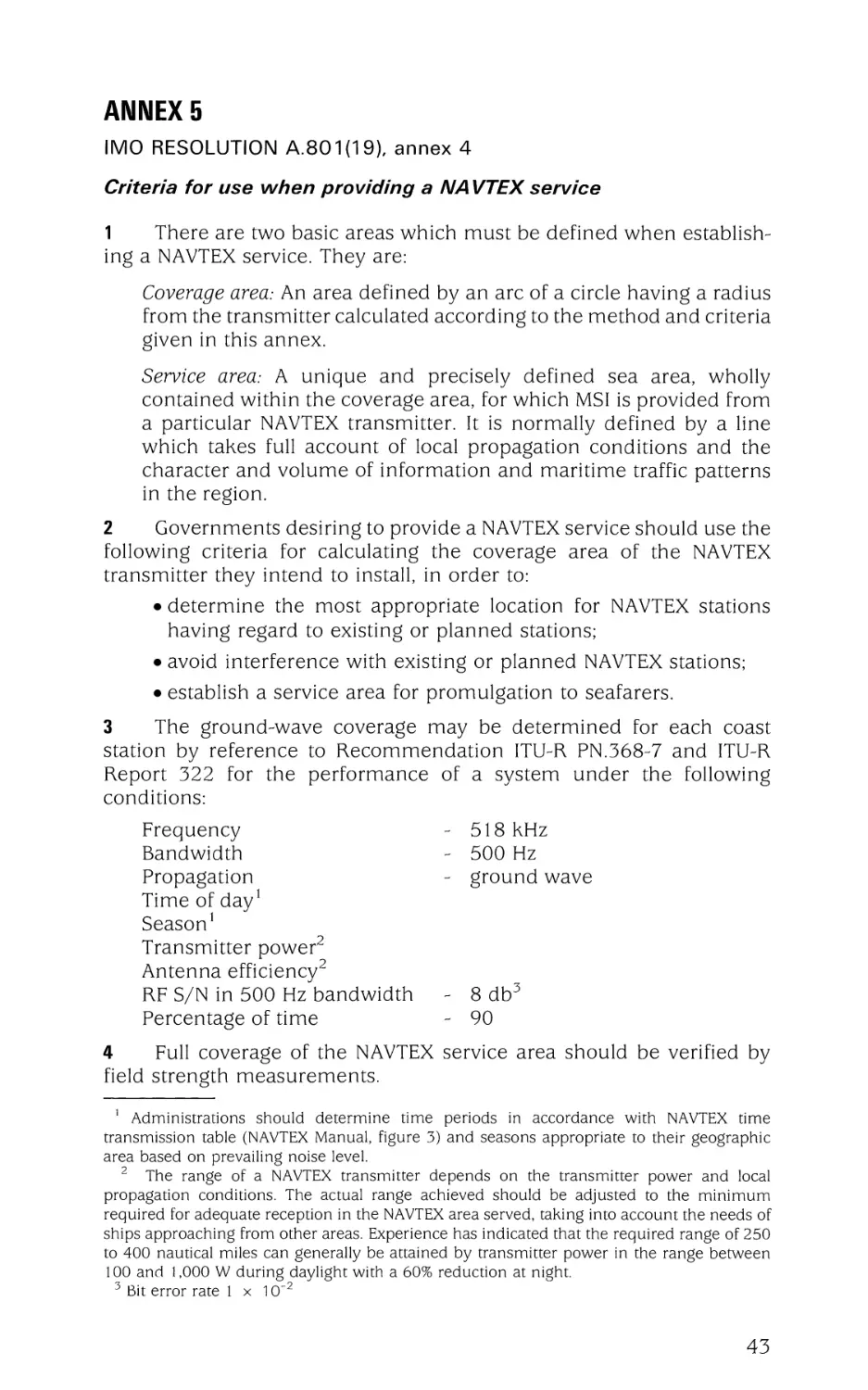
area and service area are given in annex 5 (annex 4 to resolution A.801(19), Provision of
radio services for the global maritime distress and safety system (GMDSS)).
2
NAVTEX Manual
istrations prior to formal application to IMO through the IMO
NAVTEX Co-ordinating Panel. These discussions should con-
sider the possible geographical locations for sites to ensure
optimal coverage, service area boundaries and links with data
providers. These initial discussions are particularly important
when proposing to establish a new station as part of the
International NAVTEX service. Should a Member State wish to
move an existing site, once it is operational, or extend its
range, then the whole co-ordination process outlined above,
must be repeated, keeping the NAVTEX Co-ordinating Panel
informed at all times;
.6 Member States seeking to set up an International NAVTEX
service will not receive approval from the NAVTEX Co-
ordinating Panel unless the planned service includes all the
MANDATORY elements, i.e. Navigational Warnings, Meteoro-
logical Warnings and Search and Rescue information and
pirate attack warnings;
.7 when limitations on resources affect the rate of establishment
of NAVTEX, every effort should be made to implement the
NAVTEX service first in the areas of highest shipping density. If
NAVTEX services are not established within 18 months of а Вт
character and time slot being issued by the NAVTEX Co-
ordinating Panel, the Panel may, after suitable notification,
withdraw the allocation. The Member State would then need to
submit a new application when ready to establish the service;
.8 the range of a NAVTEX transmitter depends on the transmitted
power and local propagational conditions. The actual range
achieved should be adjusted to the minimum required for
adequate reception in the specified service area,* taking into
account the needs of ships approaching from other areas.
Experience indicates that the required range of 250 to 400
nautical miles will normally be attained by transmitted power
of no more than 1 kW during daylight with a 60% reduction
during night-time;
.9 after the choice of transmitter sites, the main need for co-
ordination lies in the assignment of Вт characters, time
schedules and the agreement of proposed service areas (if
appropriate). The IMO NAVTEX Co-ordinating Panel allocates
Вт characters and time schedules and will arbitrate on the
service area limits if these cannot be agreed locally; and
.10 the national NAVTEX Co-ordinator should make arrangements
for a quality-control organization in its area which should
include both the message-originating offices and the NAVTEX
Co-ordinator/transmitting stations. This organization should
aim at confirming, on a continuing basis, that:
~ The criteria for use when providing a NAVTEX service and the definitions of coverage
area and service area are given in annex 5 (annex 4 to resolution A.801(19), Provision of
radio services for the global maritime distress and safety system (GMDSS)).
3
NAVTEX Manual
•	MINIMUM power is used to achieve satisfactory range
performance;
•	time schedules are not exceeded; and
•	the co-ordinated service is operating satisfactorily.
3.2 Guidance on these and the many other factors to be considered
when planning NAVTEX services should be obtained at an early stage
from IMO, through its NAVTEX Co-ordinating Panel. Details of how to
contact the Panel may be found at annex 1.
4	 Principal features of NAVTEX services
4.1	The operational and technical characteristics of the NAVTEX
system are contained in Recommendation ITU-R M.540-2, reproduced
in annex 2. Performance standards for shipborne narrow-band direct-
printing equipment, if installed before 1 July 2005, are laid down in
IMO Assembly resolution A.525(13). If installed on or after 1 July 2005,
they should conform to IMO resolution MSC. 148(77), reproduced in
annex 3.
4.2	The principal features are:
.1 the International NAVTEX service uses a single frequency, with
transmissions from nominated stations within each NAVAREA/
METAREA being arranged on a time-sharing basis to reduce the
risk of mutual interference. All necessary information is con-
tained in each transmission. Similarly, broadcasts on other IMO
co-ordinated frequencies are operated on a time-sharing basis;
.2 the power of each transmitter is regulated so as to reduce the
risk of interference between transmitters with the same Вт
character in different parts of the world;
.3 a dedicated NAVTEX receiver which has the ability to select
messages to be printed, according to:
.3.1 a technical code (ВтВ2ВзВ4), which appears in the
preamble of each message; and
.3.2 whether or not the particular message has already been
printed.
Certain essential classes of safety information, such as
navigational and meteorological warnings and search and
rescue information, are non-rejectable to ensure that ships
using NAVTEX always receive the most vital information.
.4 NAVTEX Co-ordinators exercise control of messages transmit-
ted by each station according to the information contained in
each message and the geographical coverage required. Thus a
user may choose to accept messages, as appropriate, either
from the single transmitter which serves the sea area around
his position or from a number of transmitters. Ideally, the user
should select the station within whose coverage his vessel is
currently operating and the station into whose coverage area
his vessel will transit next.
4
NAVTEX Manual
5	* The transmitter identification character (BJ
5.1	The transmitter identification character Вт is a single letter which
is allocated to each transmitter. It is used to identify the broadcasts
which are to be accepted by the receiver and those to be rejected, and
also the time slot for the transmission.
5.2	In order to avoid erroneous reception of transmissions from two
stations having the same Вт character, it is necessary to ensure that
such stations have a large geographical separation. Originally, this was
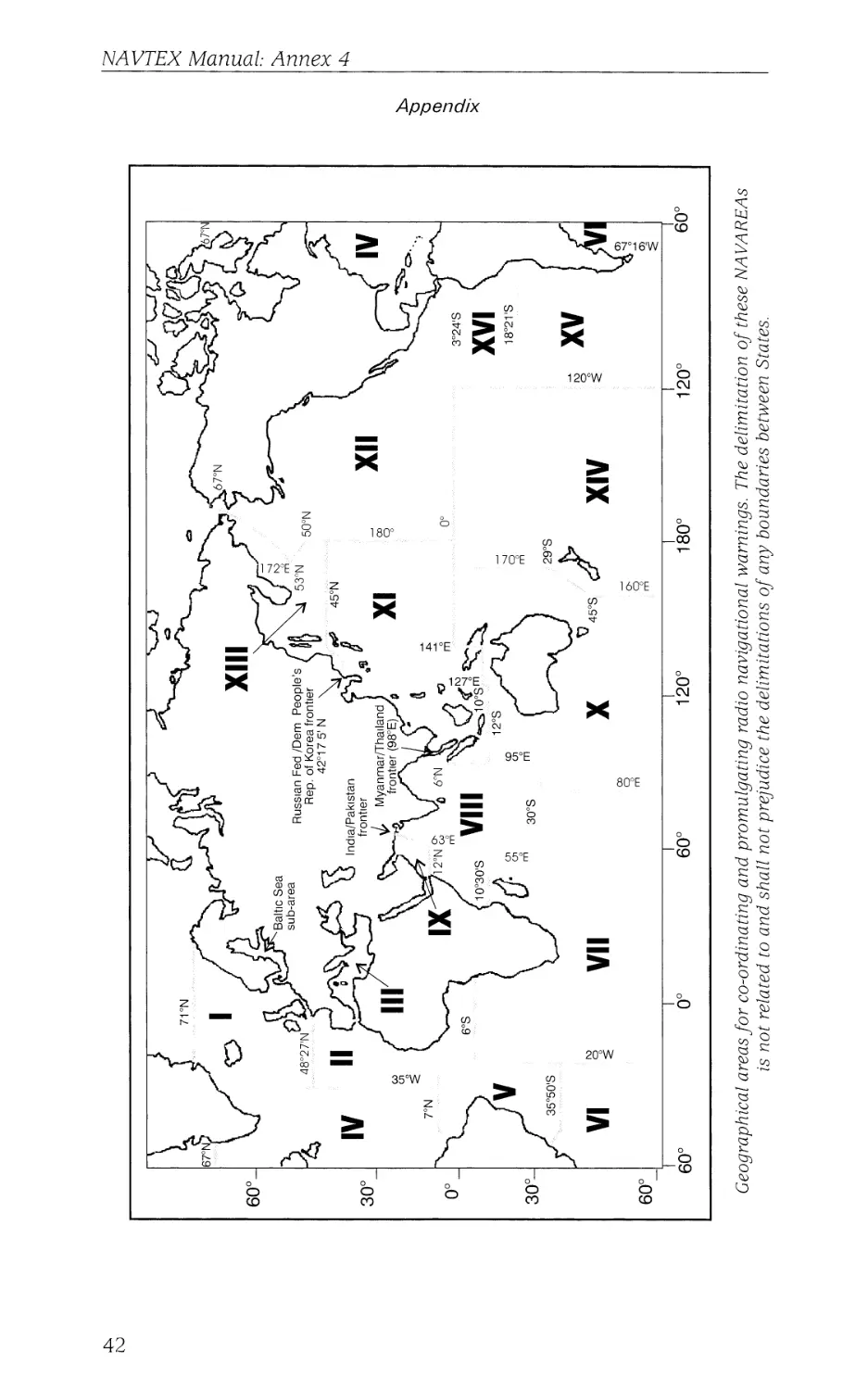
achieved by allocating Bi characters in line with the general global
scheme given in figure 2, which shows the initial IMO-adopted strategy
for allocating Bi characters by alphabetical sequence through each
NAVAREA/METAREA of the World-Wide Navigational Warning Service.
Subsequent experience has shown that when traffic levels increase
significantly, some NAVTEX Co-ordinators are unable to control the data
volumes broadcast from their stations and transmissions may overrun
their allocated timeslots. The impact of this is that if adjacent stations
have adjacent Bi characters, and the first station overruns, its signal
masks the phasing signal of the second station. To the receiver, this
seems as if the second station is off the air and vital safety information
can be missed. Hence Bi characters are now allocated in a more
random manner with consecutive letters not allocated to adjacent
stations, but still achieving the required separation between stations
having the same Bi character (see paragraph 5.3 below).
5.3	NAVTEX transmissions have a designed maximum range of about
400 nautical miles. The minimum distance between two transmitters
with the same Вт identifier must, therefore, be sufficient to ensure that
a receiver cannot be within range of both at the same time.
5.4	Close co-ordination between transmitting stations in adjacent
NAVAREAs/METAREAs is necessary to achieve this separation. For this
reason, national Administrations should request the advice of the IMO
NAVTEX Co-ordinating Panel at an early stage in the planning of a new
NAVTEX service. The Panel will allocate Bi characters in such a way as
to minimize the risk of interference occurring.
6	* Allocation of transmission times
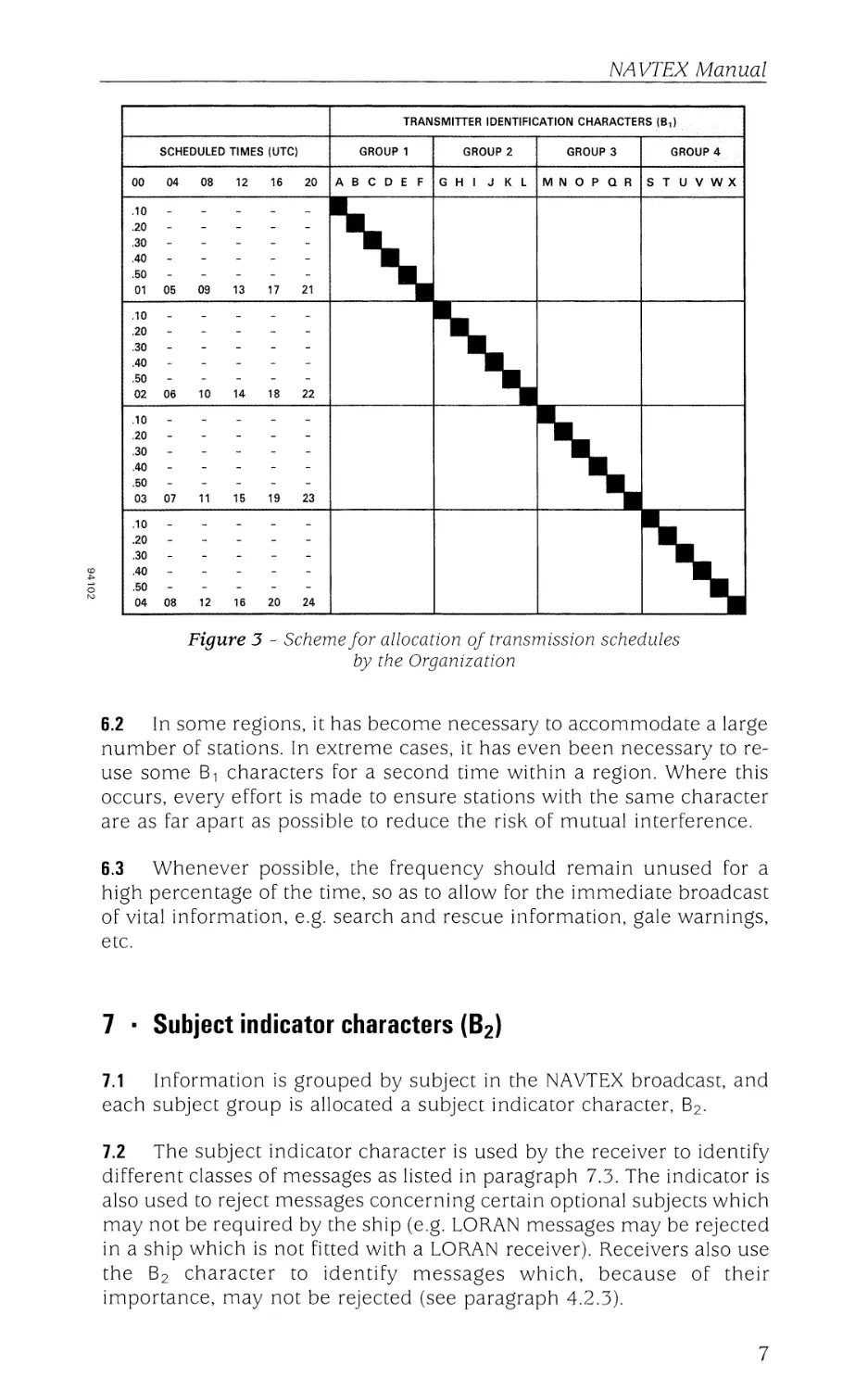
6.1	Figure 3 illustrates the basic organizational matrix which is used
by the IMO NAVTEX Co-ordinating Panel to evaluate and allocate time
schedules for each transmitter of a proposed new service. The table
shows the breakdown of a representative NAVAREA/METAREA into
four groups of transmitters. Each group has a potential capacity of
six transmitters, each with a 10 minute allocated transmission time
every 4 hours.
5
Figure 2 ~ NAVAREAs/METAREAs of the World-Wide Navigational Warning Service, showing the original scheme
for allocation of transmitter identification (Bf) characters by the Organization. The delimitation of these NAVAREAs is not related
and shall not prejudice the delimitations of any boundary between States.
NAVTEX Manual
NAVTEX Manual
Figure 3 - Scheme for allocation of transmission schedules
by the Organization
6.2	In some regions, it has become necessary to accommodate a large
number of stations. In extreme cases, it has even been necessary to re-
use some Вт characters for a second time within a region. Where this
occurs, every effort is made to ensure stations with the same character
are as far apart as possible to reduce the risk of mutual interference.
6.3	Whenever possible, the frequency should remain unused for a
high percentage of the time, so as to allow for the immediate broadcast
of vital information, e.g. search and rescue information, gale warnings,
etc.
7	* Subject indicator characters (B2)
7.1	Information is grouped by subject in the NAVTEX broadcast, and
each subject group is allocated a subject indicator character, B2.
7.2	The subject indicator character is used by the receiver to identify
different classes of messages as listed in paragraph 7.3. The indicator is
also used to reject messages concerning certain optional subjects which
may not be required by the ship (e.g. LORAN messages may be rejected
in a ship which is not fitted with a LORAN receiver). Receivers also use
the B2 character to identify messages which, because of their
importance, may not be rejected (see paragraph 4.2.3).
7
NAVTEX Manual
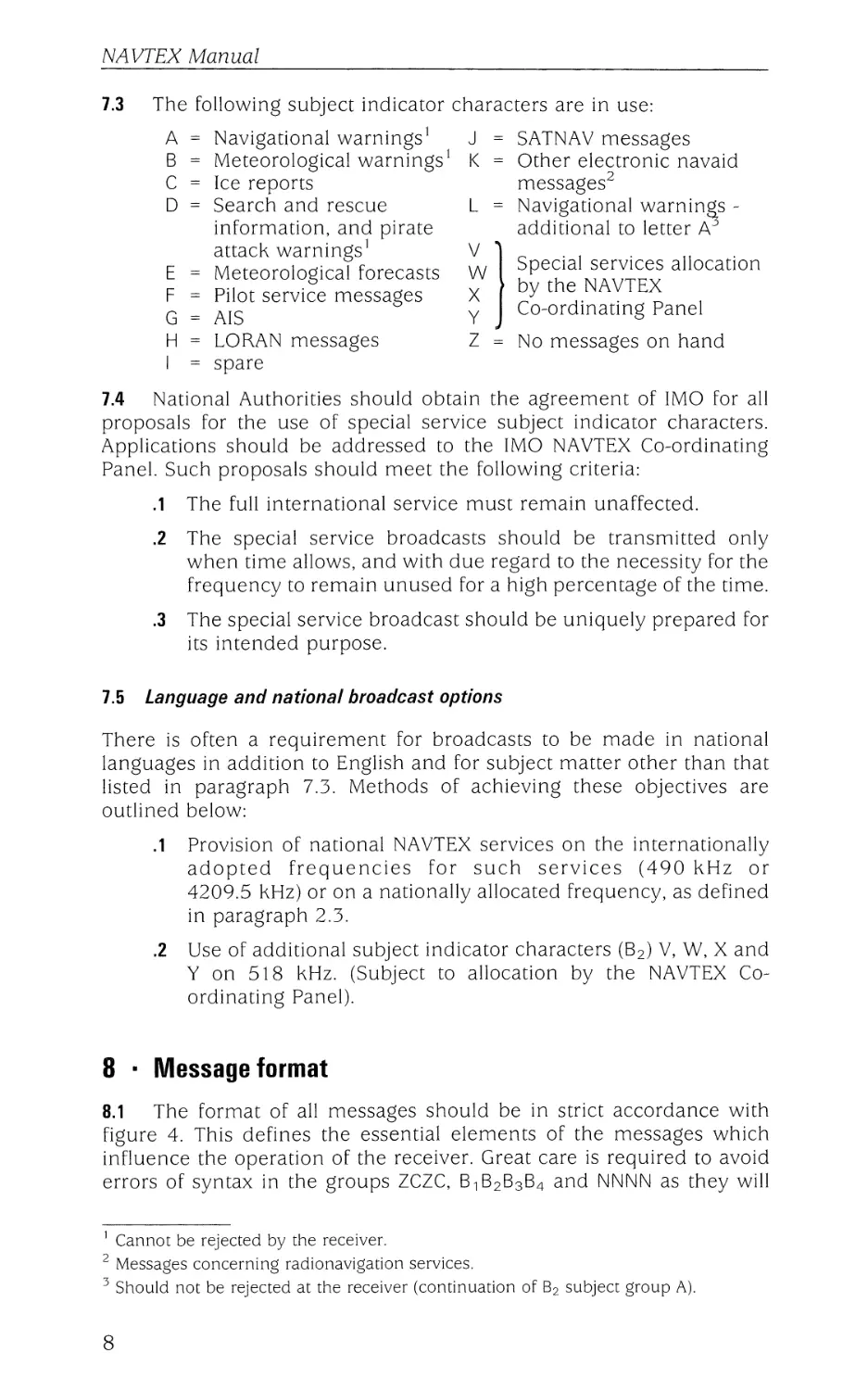
7.3	The following subject indicator characters are in use:
A = Navigational warnings1
В = Meteorological warnings1
C = Ice reports
D = Search and rescue
information, and pirate
attack warnings1
E = Meteorological forecasts
F = Pilot service messages
G - AIS
H = LORAN messages
I = spare
J = SATNAV messages
К = Other electronic navaid
messages2 3
L = Navigational warnings -
additional to letter /М
Special services allocation
by the NAVTEX
Co-ordinating Panel
Z = No messages on hand
7.4	National Authorities should obtain the agreement of IMO for all
proposals for the use of special service subject indicator characters.
Applications should be addressed to the IMO NAVTEX Co-ordinating
Panel. Such proposals should meet the following criteria:
.1 The full international service must remain unaffected.
.2 The special service broadcasts should be transmitted only
when time allows, and with due regard to the necessity for the
frequency to remain unused for a high percentage of the time.
.3 The special service broadcast should be uniquely prepared for
its intended purpose.
7.5	Language and national broadcast options
There is often a requirement for broadcasts to be made in national
languages in addition to English and for subject matter other than that
listed in paragraph 7.3. Methods of achieving these objectives are
outlined below:
.1 Provision of national NAVTEX services on the internationally
adopted frequencies for such services (490 kHz or
4209.5 kHz) or on a nationally allocated frequency, as defined
in paragraph 2.3.
.2 Use of additional subject indicator characters (B2) V, W, X and
Y on 518 kHz. (Subject to allocation by the NAVTEX Co-
ordinating Panel).
8	 Message format
8.1	The format of all messages should be in strict accordance with
figure 4. This defines the essential elements of the messages which
influence the operation of the receiver. Great care is required to avoid
errors of syntax in the groups ZCZC, B1B2B3B4 and NNNN as they will
1 Cannot be rejected by the receiver.
2 Messages concerning radionavigation services.
3 Should not be rejected at the receiver (continuation of B2 subject group A).
8
NAVTEX Manual
cause receivers to operate incorrectly, and may well result in the loss of
a vital message. Transmitting stations should be particularly aware of
this when monitoring their own broadcasts.
8.2	The phasing signal, which appears at the top of figure 4, is critical
to the effective operation of the system. It is this signal which enables a
receiver to lock on to a particular station’s transmission. If another
station within transmitting range and with a timeslot prior to the station
selected overruns its slot, its transmission will blank the phasing signal
of the subsequent transmitter. It will then seem to the receiver as if the
second station is off the air and its broadcast will not be received,
possibly denying the user significant safety information. Similarly if the
phasing signal for a particular station is too short, some receivers will be
unable to lock on to the transmission.
8.3	The following example illustrates the standard format for NAVTEX
messages:
Phasing signals > 10 sec
Start of message group
Transmitter identity
B2: Subject indicator
B3B4: Consecutive number
Optional
End of message
Idle Signals aa...a > 2 sec
End of emission
Figure 4 ~ Standard format for NAVTEX messages
8.4	Certain practices have been adopted for the textual content of
NAVTEX messages. These contribute to the clarity and uniformity of the
messages, and are recognized for use in all cases. They include:
.1 the date, time (UTC) and month of origin may be given at the
start of the message text, where this contributes to the value of
the message, as follows:
151416
UTC MAR 02
Date Time
Month Year (optional)
9
NAVTEX Manual
The date, time and month of origin should always be followed
immediately by a carriage return/line feed, so that it appears
as a separate line at the start of the message text;
.2 the first words of the text should invariably be the message
series identity and consecutive number. Note that this
consecutive number is not the same as the NAVTEX serial
number B3B4, but instead identifies the source of the report
(e.g. NAVAREA IX 274 or OOSTENDE Radio NAV WNG 767);
.3 the clarity of a series of messages is improved by ensuring that
the end of message group NNNN appears on a separate line at
the end of each message; and
.4 the text of the message must be in accordance with the Joint
IMO/IHO/WMO Manual on Maritime Safety Information (MSI)
IHO Special Publication S-53 - Appendix 1 (IMO publication
ISBN 92-801-5135-5).
9	* Message numbering
9.1	Each message within a subject group is allocated a serial number,
B3B4, between 01 and 99. On reaching 99, numbering should
recommence at 01 but avoid the use of message numbers still in force.
9.2	A shortage of numbers should, where possible, be alleviated by
the allocation of messages to other relevant subject groups. It has been
found that 99 messages are not always enough for some subject groups.
B2 = L may be used for additional navigational warnings to receive the
overflow from B2 = A, when necessary.
9.3	Numbers should be allocated by the relevant NAVTEX Co-
ordinator, the authority responsible for the selection of information to
be broadcast by each transmitter within each subject group. Each Co-
ordinator may have one or more transmitters under its control.
9.4	Certain messages are allocated B3B4 = 00. Use of this number
should be strictly controlled since messages carrying it will always be
printed and may set off the alarm in the receiver, if the broadcast
containing such messages is identified to be accepted by the receiver
(see Recommendation ITU-R M.540-2, annex 2). Therefore, the number
00 must only be used for Initial Distress Messages. Other more routine
messages and service messages should not be allocated the number 00.
The fact that receivers are, in any case, unable to reject certain classes of
vital safety information should be borne in mind when considering the
exceptional use of B3B4 = 00.
10	 Information control
10.1 The time-shared nature of NAVTEX services imposes the need for
strict discipline in controlling the information flow of the broadcast. To
achieve this, it is necessary to co-ordinate the messages in each B2
category at each transmitter. In general, all messages should be brief
and clear and avoid duplication. Strict adherence to relevant guidelines
10
NAVTEX Manual
such as those in IMO Assembly resolution A.706(17), as amended, the
WMO Manual on Marine Meteorological Services, Part 1 bis, Provision of
warnings and weather and sea bulletins (GMDSS application) and the
Joint IMO/IHO/WMO Manual on Maritime Safety Information is
recommended, but certain additional operating procedures have also
been found necessary:
.1 Messages in each category should be broadcast in reverse
order of receipt, with the latest being broadcast first.
.2 Cancellation messages should be broadcast once only. The
cancelled message should be removed from the broadcast in
which the corresponding cancellation message appears and
the cancellation message should then be removed from the
broadcast.
11 • Message content
11.1	It is important that Administrations operating a NAVTEX service
and those intending to establish new services are quite clear what sort
of information may be included in the messages for broadcast and what
should not.
11.2	The International NAVTEX service should NOT be used as a
medium for providing Notices to Mariners. Similarly, Local Warnings
(see paragraph 11.2.1.2) should not be broadcast on the International
NAVTEX service. They should be transmitted locally on VHF R/T
channels or perhaps through local AIS services. NAVTEX is essentially a
medium for broadcasting information that is needed by vessels to
safely navigate through the service area of the appropriate station,
particularly those vessels engaged in coastal passages. More detailed
guidance in respect to different classes of messages is given below.
Examples of the content and layout of NAVTEX messages are shown in
the Joint IMO/IHO/WMO Manual on Maritime Safety Information. This
publication should be available to all personnel responsible for the
drafting of messages to be broadcast by NAVTEX stations.
11.2.1 Navigational warnings
.1 Coastal warnings and NAVAREA warnings (B2 = A or L) issued
under the guidance of IMO Assembly resolution A.706(17), as
amended, which would be of concern to ships in the service
area allocated to the transmitter should be included in the
broadcast (see annex 4). Relevant Coastal warnings should
normally be repeated at every scheduled transmission for as
long as they remain in force or until permanent changes are
promulgated as Notices to Mariners. NAVTEX Co-ordinators
should arrange to receive NAVAREA warnings appropriate to
their area for inclusion in their broadcasts. These should be
broadcast at least twice each day - to avoid overloading the
broadcast time slot, they should normally be scheduled for
transmission during slots that do not include weather forecasts
(see also paragraph 11.2.2.2).
11
NAVTEX Manual
.2 Local warnings, as defined by IMO Assembly resolution
A.706(17), as amended, i.e. information relating to the sea
area inshore of the fairway buoy/pilot station, should not be
broadcast on NAVTEX (see annex 4).
.3 Negative tidal surge and tsunami warnings will normally be
the subject of navigational warnings. They should be broad-
cast immediately on receipt and at subsequent scheduled
transmissions.
.4 A summary of navigational warnings remaining in force
should normally be broadcast each week.
11.2.2 Meteorological messages
.1 Meteorological warnings (B2 = B), e.g. gale warnings, are raised
by nominated Meteorological authorities. They should be
placed on the broadcast immediately on receipt by the
NAVTEX Co-ordinator and at the next routine scheduled
transmission only. These messages should contain only the
appropriate warnings and should be separate from the sea
area weather forecasts.
.2 NAVTEX sea area weather forecasts (B2 = E) should be
broadcast at least twice each day. This service should be
carefully co-ordinated where transmitters are geographically
close together. It is important that such forecasts only
appertain to the appropriate NAVTEX service area.
.3 Routine ice reports should normally be broadcast on NAVTEX
once a day.
.4 Ice accretion warnings should normally be included in the
routine ice report but, when separately issued, they are to be
treated as a meteorological warning using B2 = В and
transmitted immediately on receipt and at the next routine
scheduled transmission.
11.2.3 Search and rescue information and pirate attack warnings
.1 The NAVTEX broadcast is not suitable for distress traffic.
Therefore, the initial distress message only should be retrans-
mitted on NAVTEX, using B2 = D, in order to alert mariners to a
distress situation, by setting off an audio alarm. The use of
B3B4 = 00 is only to be used for distress messages.
.2 A single authority, which will normally be a maritime rescue
co-ordination centre (MRCC), should be designated BAR Co-
ordinator to input information to NAVTEX. Coast radio
stations, where still extant, are deemed to have discharged
their responsibility for retransmitting initial distress messages
on NAVTEX by passing the message to the designated BAR Co-
ordinator for broadcast on NAVTEX. This does not affect a
coast radio station’s responsibility for retransmitting initial
distress messages on other frequencies.
12
NAVTEX Manual
.3 Pirate attack warnings, given by an appropriate authority,
should be transmitted under B2 = D immediately after a pirate
attack happens.
11.2.4 Pilotage service messages
Category B2 = F is to be used only for broadcasting temporary alterations
to the pilot service. This can include messages which notify the temporary
movement or suspension of a pilot service due to stress of weather, etc.
This category is for the information of all ships approaching a port and is
not to be used for specific instructions to individual ships or pilots.
11.2.5 Electronic navaid messages
B2 categories are provided for the principal electronic navaids which are
suitable for use in the NAVTEX region. They should be used to advise
mariners of significant degradation of the particular service. Short
periods of transmission failure are seldom appropriate since they do not
affect prudent navigation. The following thresholds have been found to
be appropriate for the majority of users:
.1 LORAN - off air > 1 hour; and
.2 SATNAV - off air >4 hours.
11.2.6 No messages on hand
This facility may be used by transmitting stations to confirm the correct
operation of receivers and transmitters at scheduled times when no
messages are on hand for transmitting. In accordance with the simple
philosophy of NAVTEX services, the plain language text “NO MESSAGES
ON HAND” should be used.
11.2.7 Use of abbreviations
Use of abbreviations should be strictly in accordance with internation-
ally accepted usage.
11.3 On national NAVTEX services it is important to keep to the same
basic message format as that required for the International NAVTEX
service, i.e. that shown in figure 4 and in paragraphs 7, 8 and 9 of this
publication. It is also important to ensure that the complete broadcast
does not overrun the allocated time slot, particularly when using 490 kHz
or 4209.5 kHz. However, in order to meet national requirements,
message content may deviate from the guidelines provided for the
International Service (paragraphs 10 and 11.1 — 11.2 above) if required.
12  Message priorities and broadcast procedures
12.1 Message priorities
12.1.1 The message originator i.e. the navigational warning Co-
ordinator, the search and rescue Co-ordinator or the meteorological
13
NAVTEX Manual
message Co-ordinator, is responsible for assessing the urgency of the
information and inserting the appropriate priority marking. One of
three message priorities is used to dictate the timing of the first
broadcast of a new warning in the NAVTEX service. In descending order
of urgency, they are:
.1 VITAL - for immediate broadcast;
.2 IMPORTANT - for broadcast at the next available period when
the frequency is unused; and
.3 ROUTINE - for broadcast at the next scheduled transmission.
12.1.2 Both VITAL and IMPORTANT warnings are to be repeated, at the
minimum, at the next scheduled transmission.
12.1.3 The priority marking is a procedural instruction to the
transmitting station which consists of the word VITAL, IMPORTANT or
ROUTINE added as a prefix to the NAVTEX message. It should form a
separate line immediately before the groups ZCZC B1B2B3B4 and should
not normally be broadcast.
12.1.4 In order to avoid unnecessary disruption to the service, the
priority marking VITAL is to be used only in cases of extreme urgency,
i.e. initial distress alerts. In addition, VITAL messages are to be kept as
brief as possible. The message originator is responsible for ensuring
that the NAVTEX Co-ordinator has its attention drawn to VITAL
messages, either by use of the telex alarm or by other means.
12.2 Broadcast procedures
.1 VITAL warnings. On receipt of a VITAL warning, the NAVTEX
Co-ordinator will immediately commence monitoring the
NAVTEX frequency. If the frequency is clear, the VITAL
message is to be transmitted at once. If the frequency is in
use, the Co-ordinator is to determine which other station is
transmitting. He should then contact that station by any other
means at his disposal with a request that they break their
transmission to allow the sending of a VITAL warning. As soon
as the frequency is clear, the VITAL warning is to be
transmitted. Once the VITAL warning has been transmitted,
the former station is free to resume scheduled transmissions;
.2 IMPORTANT warnings. Messages bearing the priority marking
IMPORTANT are to be broadcast during the next available
period when the NAVTEX frequency is unused. This is to be
identified by monitoring the frequency. It is expected that this
level of priority will be sufficient for the majority of urgent
information; and
.3 ROUTINE warnings. ROUTINE messages are to be broadcast at
the next scheduled transmission after receipt at the NAVTEX
transmitting station. This level of priority will be appropriate
for almost all messages broadcast on NAVTEX and is always to
be used unless special circumstances dictate the use of a
higher priority.
14
NAVTEX Manual
13	 Best practice for those using the service
13.1	Setting watch
It is recommended that, in order to ensure that all necessary maritime
safety information has been received, the NAVTEX receiver should be
switched on at least 8 hours before sailing, or left on at all times. To avoid
excessive use of printer paper, the user should programme his receiver
to print out only those classes of messages required and from only the
stations selected.
13.2	Logging
The reception of weather forecasts or navigational warnings on NAVTEX
is not required to be noted in the radio log. The NAVTEX printout
replaces the log entries required by chapter IV of the 1974 SOLAS
Convention, as amended in 1988. Where a printer is not provided, a log
should be maintained electronically.
14	 Management of the service
14.1	Data priority and formatting
.1 Most information broadcast on NAVTEX services relates to
either Navigational Warnings or Meteorological Information.
These types of information often originate from different
organizations within a country and it is not until they arrive
with the NAVTEX Co-ordinator that an assessment can be
made whether there is too much information for the relevant
broadcast time slot. Each data provider may consider their
data to be more important and therefore for transmission in
full. However, the NAVTEX Co-ordinator needs to control the
overall volume of data broadcast and may need to refer back
to data providers to prioritize their information and reduce the
amount of data to be broadcast. Some NAVTEX Co-ordinators
utilize digital systems which include software that provides a
readout of predicted transmission times for data held ready for
broadcast. This enables the Co-ordinator to anticipate any
problems and take action before the scheduled broadcast.
.2 Transmission times should be kept to a minimum by strictly
formatting messages and avoiding the use of free text
whenever possible.
.3 Data to meet purely national requirements should not be
broadcast on the International NAVTEX service, but should be
migrated to a national NAVTEX service (see annex 7 -
COMSAR/Circ.28).
14.2	Mutual interference between NAVTEX stations
.1 Principal causes of interference are: transmission overruns
and excessive power output. Transmission overruns lead to
15
NAVTEX Manual
interference with adjacent stations with sequential Bq char-
acters/time slots. Excessive power output causes interference
with remote stations with the same Bq character time slot.
Transmission overruns should be either eliminated by con-
trolling the volume of data broadcast (see paragraph 13.1) or
managed by liaison with adjacent stations. This can work in
areas where there is both good co-operation and good
communications. Where data volumes exceed the 10 minute
time slot, broadcasts may be started early when there is no
other traffic on the frequency or allowed to overrun with the
agreement of the next station in sequence, who will delay the
start of their broadcast until the earlier station has finished.
.2 When interference is detected, particularly when it affects the
service to system users, the matter should be addressed
immediately. When the interference is with adjacent stations,
attempts should be made to resolve the problem locally.
Advice may also be sought from the NAVAREA Co-ordinator. If
this is unsuccessful, the IMO NAVTEX Co-ordinating Panel
should be alerted to the problem and their advice sought.
Occasionally it may be necessary to change the Bq character/
time slot of one of the stations to introduce more time
separation between the broadcasts. However, this should be
viewed as a last resort as this may have a significant impact on
data providers, particularly providers of meteorological infor-
mation, as they may have to reschedule their services. When
the interference is from a station with the same Bq character in
a different area, the NAVTEX Co-ordinating Panel should be
contacted and they will initiate any necessary investigation/
action.
14.3	Balancing the volume of data to be broadcast throughout the daily
transmission cycle
.1 Each NAVTEX transmitter is allocated a 10 minute transmis-
sion slot every 4 hours; 6 slots each day. Within these slots
there is a requirement to transmit the following information
relevant for the service area of the transmitter:
.1 coastal navigation warnings - in every slot;
.2 NAVAREA warnings appropriate to the area of the
NAVTEX transmitter - at least twice/day;
.3 summary of navigation warnings in force - weekly;
.4 meteorological warnings - on receipt and at next slot;
.5 sea area weather forecasts - at least twice/day;
.6 ice reports - at least once/day;
.7 SAR and pirate attack warnings - on receipt; and
.8 pilot service and electronic navaid messages - next
routine slot.
.2 For many of these categories of message there is no option
about when they should be transmitted. However, in order to
16
NAVTEX Manual
minimize the risk of over-running the allocated 10 minute
time slot, it is possible to balance the overall length of
transmissions by broadcasting NAVAREA warnings at different
times to sea area weather forecasts and the weekly summary
of navigation warnings in force. An example of how this may
be managed is given below for a station with a character
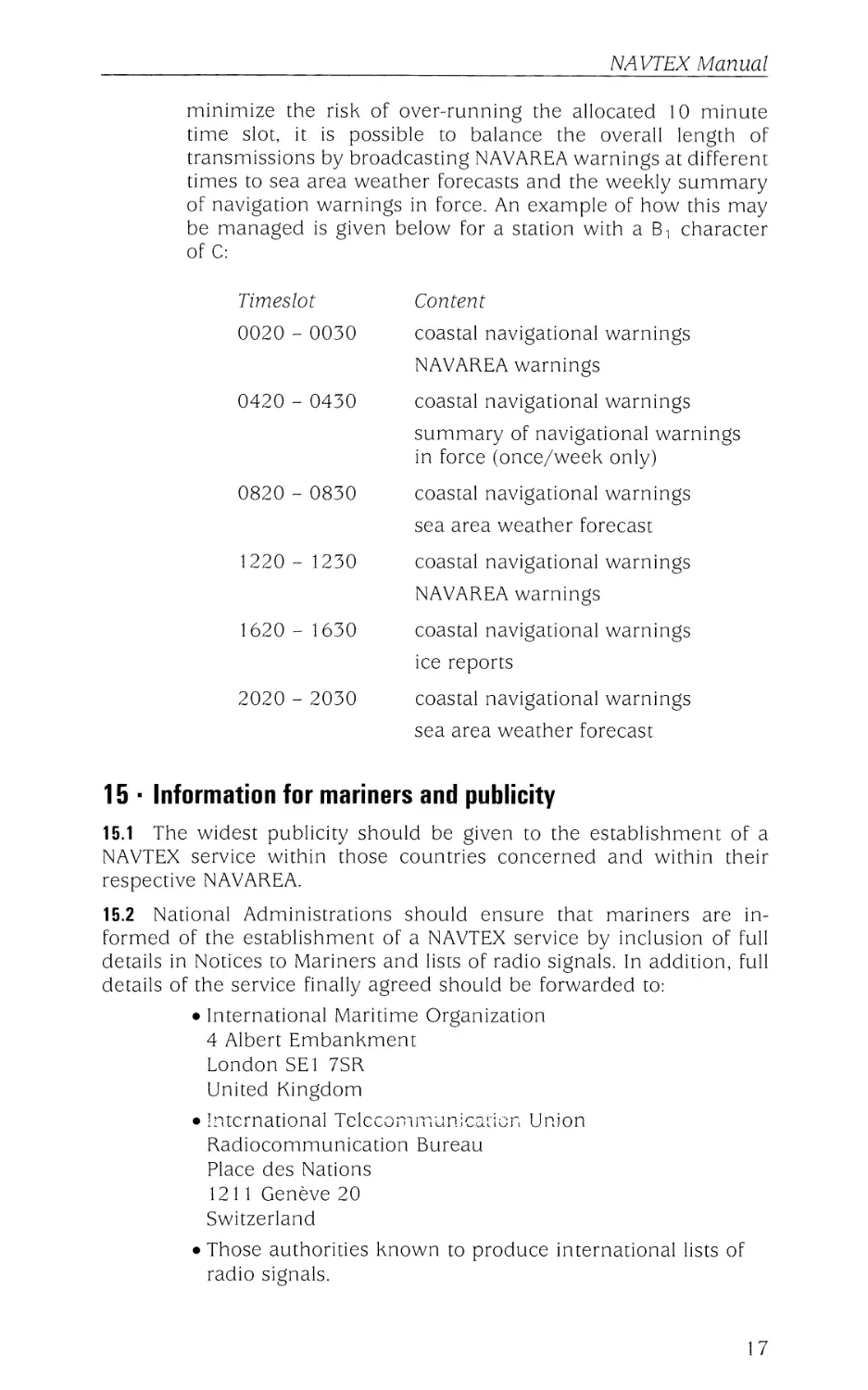
of C:
Timeslot	Content
0020 - 0030	coastal navigational warnings NAVAREA warnings
0420 - 0430	coastal navigational warnings summary of navigational warnings in force (once/week only)
0820 - 0830	coastal navigational warnings sea area weather forecast
1220 - 1230	coastal navigational warnings NAVAREA warnings
1620 - 1630	coastal navigational warnings ice reports
2020 - 2030	coastal navigational warnings sea area weather forecast
15  Information for mariners and publicity
15.1	The widest publicity should be given to the establishment of a
NAVTEX service within those countries concerned and within their
respective NAVAREA.
15.2	National Administrations should ensure that mariners are in-
formed of the establishment of a NAVTEX service by inclusion of full
details in Notices to Mariners and lists of radio signals. In addition, full
details of the service finally agreed should be forwarded to:
• International Maritime Organization
4 Albert Embankment
London SEI 7SR
United Kingdom
•	International Telecommunication Union
Radiocommunication Bureau
Place des Nations
1211 Geneve 20
Switzerland
•	Those authorities known to produce international lists of
radio signals.
17

ANNEX 1
IMO SUB-COMMITTEE ON RADIOCOMMUNICATIONS
AND SEARCH AND RESCUE (COMSAR)
Co-ordinating Panel on NAVTEX services
1 Terms of reference
.1 Advise Government Administrations planning to implement a
NAVTEX service on the frequencies 518 kHz, 490 kHz or
4209.5 kHz, on the operational aspects of the system. In
particular, advise on the optimum number of stations, the
allocation of identifying characters (Bq), broadcast times and
broadcast message criteria.
.2 Co-ordinate the operational aspects of NAVTEX in the planning
stages to minimize the risk of mutual interference between
States or regions owing to the number of stations, transmitter
power, time of broadcasts, or Bq character assignment.
.3 Remain aware of system problems which arise, through
reports from sea and correspondence with operational NAV-
TEX Co-ordinators. When problems are identified, liaise with
appropriate national Administrations involved, NAVAREA/
METAREA Co-ordinators, the Sub-Committee, IHO or WMO,
as appropriate, recommend solutions or mitigating measures
and, when agreed, co-ordinate their implementation.
.4 Prepare documentation supporting the system for the Sub-
committee, including both that needed by the broadcasting
Authority to guide its operations, and that needed to inform
the user of the service (mariner, shipowner and operator).
2 Contact addresses
The NAVTEX Co-ordinating Panel can be contacted at the following
address:
The Chairman
IMO NAVTEX Co-ordinating Panel
International Maritime Organization
4 Albert Embankment
London SEI 7SR
United Kingdom
Telephone:	(+)44 (0)20 7735	7611
Telefax:	(+)44 (0)20 7587	3210
E-mail:	info@imo.org
Any correspondence will then be forwarded to the Panel by the IMO
Secretariat. Alternatively, correspondence may be sent directly to the
present Chairman, who is also the NAVAREA I Co-ordinator and United
Kingdom National Co-ordinator for Radio Navigational Warnings, at the
following address:
19
NAVTEX Manual: Annex 1
The Chairman
IMO NAVTEX Co-ordinating Panel
United Kingdom Hydrographic Office
Admiralty Way
Taunton
TAI 2DN
United Kingdom
3 Panel membership and participation
3.1	The membership of the NAVTEX Co-ordinating Panel should
include experts designated by Administrations willing to participate in
the Panel and representatives of concerned international organizations.
Anyone with the necessary qualifications and experience who is
interested in becoming a member of the Panel should contact the
Chairman.
3.2	The work of the Panel is conducted mainly by correspondence,
but it has been found useful to hold occasional meetings to discuss
current issues. These meetings are usually scheduled to be held in the
margins of IMO, WMO or IHO meetings when Panel members are in
attendance. This also allows attendance by other experts in order to
provide advice on specific matters.
20
ANNEX 2
RECOMMENDATION ITU-R M.540-2*
Operational and Technical Characteristics for an
Automated Direct-Printing Telegraph System for
Promulgation of Navigational and Meteorological
Warnings and Urgent Information to Ships
(Question 5/8)
The CCIRJ	(1978-1982-1990)
CONSIDERING
(a)	that the availability of navigational and meteorological warnings
and urgent information on board ships is of great importance for safety;
(b)	that the existing radiocommunication system for promulgation of
navigational and meteorological warnings and urgent information to
ships can be improved by use of modern techniques;
(c)	that the IMO has established the following definitions on the
promulgation of maritime safety information:
•	NAVTEX means the system for the broadcast and automatic
reception of maritime safety information by means of narrow-
band direct-printing telegraphy;
•	international NAVTEX service means the coordinated broadcast
and automatic reception on 518 kHz of maritime safety informa-
tion by means of narrow-band direct-printing telegraphy using
the English language, as set out in the NAVTEX manual,
published by the IMO;
•	national NAVTEX service means the broadcast and automatic
reception of maritime safety information by means of narrow-
band direct-printing telegraphy using frequencies and languages
as decided by the administrations concerned;
(d)	that the 1988 Amendments to the International Convention for
the Safety of Life at Sea, 1974, require that every ship to which the
Convention applies shall be provided with a receiver capable of
receiving international NAVTEX service broadcasts;
(e)	that several countries are operating a coordinated international
NAVTEX service, based on narrow-band direct printing in accordance
with Article 14A of the Radio Regulations;
* The Director, CCIR, is requested to bring this Recommendation to the attention of the
International Maritime Organization (IMO), the International Hydrographic Organization
(IHO), the World Meteorological Organization (WMO) and to the International
Association of Lighthouse Authorities (IALA).
f The name “CCIR” was changed to “Radiocommunication Bureau” by the reorganiza-
tion of the International Telecommunication Union on 1 March 1993.
21
NAVTEX Manual: Annex 2
(f)	that the system should be applicable to the maritime mobile
service (both international and national);
(g)	that it is desirable that the service fulfils the requirements of all
types of ships desiring to use it;
(h)	that although each area may need specific guidance, the use of
standard technical and operational characteristics would facilitate the
extension of the service,
UNANIMOUSLY RECOMMENDS
1. that the operational characteristics for the promulgation of
navigational and meteorological warnings and urgent information
using NBDP should be in accordance with Annex I;
2. that the technical characteristics for the promulgation of
navigational and meteorological warnings and urgent information
using NBDP should be in accordance with Annex II.
ANNEX I
OPERATIONAL CHARACTERISTICS
1.	Narrow-band direct-printing techniques should be used for an
automated telegraph system for promulgation of navigational and
meteorological warnings and urgent information to ships. Common
frequencies for such transmissions should be internationally agreed
upon and the frequency 518 kHz has been designated for world-wide
use in the international NAVTEX service (see Radio Regulations Nos.
474, 2971B and N2971B).
1.1 For national NAVTEX services administrations should also utilize the
format of this Recommendation on the appropriate frequencies as
defined in the Radio Regulations.
2.	The radiated power from the coast station transmitter should only
be that sufficient to cover the intended service area of that coast station.
The range extension occurring during night hours should also be
considered.
3.	The information transmitted should primarily be of the type used
for coastal waters preferably using a single frequency (Resolution No.
324 (Mob-87)).
4.	The transmission time allocated to each station should be
restricted to that which is adequate for the anticipated messages to be
broadcast to the area concerned.
5.	Scheduled broadcasts should take place at intervals not exceeding
eight hours and be coordinated, to avoid interference with broadcasts
from other stations.
22
NAVTEX Manual: Annex 2
6.	Message priorities
6.1	Three message priorities are used to dictate the timing of the first
broadcast of a new warning in the NAVTEX service. In descending
order of urgency they are:
VITAL:	for immediate broadcast, subject to avoid- ing interference to ongoing transmissions;
IMPORTANT:	for broadcast at the next available period when the frequency is unused; and
ROUTINE:	for broadcast at the next scheduled trans- mission period.
Note: Both VITAL and IMPORTANT warnings will normally need to be
repeated, if still valid, at the next scheduled transmission period.
6.2	In order to avoid unnecessary disruption to the service, the priority
marking VITAL is to be used only in cases of extreme urgency, such
as some distress alerts. In addition, VITAL messages are to be kept as
brief as possible.
6.3	Periods should be scheduled between the regular transmission
periods permitting immediate/early transmission of VITAL mes-
sages.
6.4	By use of the message serial number 00 in the preamble of a
message (see also Annex II § 6) it is possible to override any
exclusion of coast stations or of message types which might have
been made in the receiving equipment.
7.	Initial shore-to-ship distress-related messages should first be
broadcast on the appropriate distress frequency by coast stations in
whose SAR area distress cases are handled.
8.	Participating transmitting stations should be provided with
monitoring facilities to enable them to:
•	monitor their own transmissions as to signal quality
and transmission format;
•	confirm that the channel is not occupied.
9.	In case a message is repeated by more than one transmitting
station within the same NAVTEX region (e.g. for better coverage) the
original preamble Bq-B4 (see Annex II) should be used.
10.	In order to avoid overloading of the channel it is desirable to use a
single language and where a single language is used it shall be English.
11.	Dedicated on-board equipment is recommended.
12.	Other operational characteristics and detailed guidance are given
in the NAVTEX Manual developed by the International Maritime
Organization.
23
NAVTEX Manual: Annex 2
ANNEX II
TECHNICAL CHARACTERISTICS
1.	The signals transmitted should be in conformity with the
collective В-mode of the direct-printing system specified in Recom-
mendations 476 and 625.
2.	The technical format of the transmission should be as follows:
in which
ZCZC defines the end of the phasing period,
the Bi character is a letter (A-Z) identifying the transmitter
coverage area,
the B2 character is a letter (A-Z) for each type of message.
2.1 Both the Bq characters identifying the different transmitter coverage
areas and the B2 characters identifying the different types of
messages are defined by IMO and chosen from Table I of Recom-
mendations 476 and 625, combination numbers 1-26.
2.1.1 Ship equipment should be capable of automatically rejecting
unwanted information using character Bv
2.1.2 Ship equipment should be capable of disabling print-out of
selected types of messages using character B2 with the
exception of messages with B2 characters A, В and D (see also
§ 2.1).
2.1.3 If any facility is rejected or disabled in § 2.1.1 and 2.1.2 above,
the extent of any such limitation must be clearly indicated to
the user.
2.2 B3B4 is a two-character serial number for each B2, starting with 01
except in special cases where the serial number 00 is used (see § 6
below).
2.3 The characters ZCZC BqB2B3B4 need not be printed.
3.	The printer should only be activated if the preamble Bq-B4 is
received without errors.
24
NAVTEX Manual: Annex 2
4.	Facilities should be provided to avoid printing of the same
message several times on the same ship, when such a message has
already been satisfactorily received.
5.	The necessary information for the measures under § 4 above
should be deduced from the sequence B1B2B3B4 and from the message.
6.	A message should always be printed if B3B4 = 00.
7.	Extra (redundant) letter and figure shifts should be used in the
message to reduce garbling.
8.	In case a message is repeated by another transmitting station (e.g.
for better coverage) the original preamble Bq-B4 should be used.
9.	The equipment on board ships should be neither unduly complex
nor expensive.
10.	The transmitter frequency tolerance for the mark and the space
signals should be better than + 10 Hz.
25
ANNEX 3
IMO RESOLUTION MSC.148(77)
(adopted on 3 June 2003)
Adoption of the revised performance standards
for narrow-band direct-printing telegraph equipment
for the reception of navigational and meteorological warnings
and urgent information to ships (NAVTEX)
THE MARITIME SAFETY COMMITTEE,
RECALLING Article 28(b) of the Convention on the International Maritime
Organization concerning the functions of the Committee,
RECALLING ALSO resolution A.886(21), by which the Assembly resolved that
the functions of adopting performance standards for radio and navigational
equipment, as well as amendments thereto, shall be performed by the
Maritime Safety Committee on behalf of the Organization,
NOTING the carriage requirement in SOLAS chapter IV/7.1.4 for a
receiver capable of receiving International NAVTEX narrow-band direct-
printing (NBDP) broadcasts for the promulgation of navigational and
meteorological warnings to shipping,
NOTING FURTHER the success of the International NAVTEX service in the
promulgation of Maritime Safety Information (MSI),
NOTING ALSO with regard to the enhanced storage, processing and
display possibilities offered by recent technical advances,
CONSIDERING that further growth in information promulgated to ships
will be constrained by the capacity of the International NAVTEX service
and the increasing importance of National NAVTEX services,
HAVING CONSIDERED the recommendations on the revision of resolution
A.525(13) made by the Sub-Committee on Radiocommunications and
Search and Rescue at its seventh session,
1.	ADOPTS the revised Recommendation on performance standards for
narrow-band direct-printing telegraph equipment for the reception of
navigational and meteorological warnings and urgent information to
ships (NAVTEX), set out in the annex to the present resolution;
2.	RECOMMENDS Governments to ensure that NAVTEX receiver
equipment:
(a)	if installed on or after 1 July 2005, conforms to performance
standards not inferior to those specified in the annex to the
present resolution;
(b)	if installed before 1 July 2005, conforms to performance
standards not inferior to those specified in the annex to
resolution A.525(13).
26
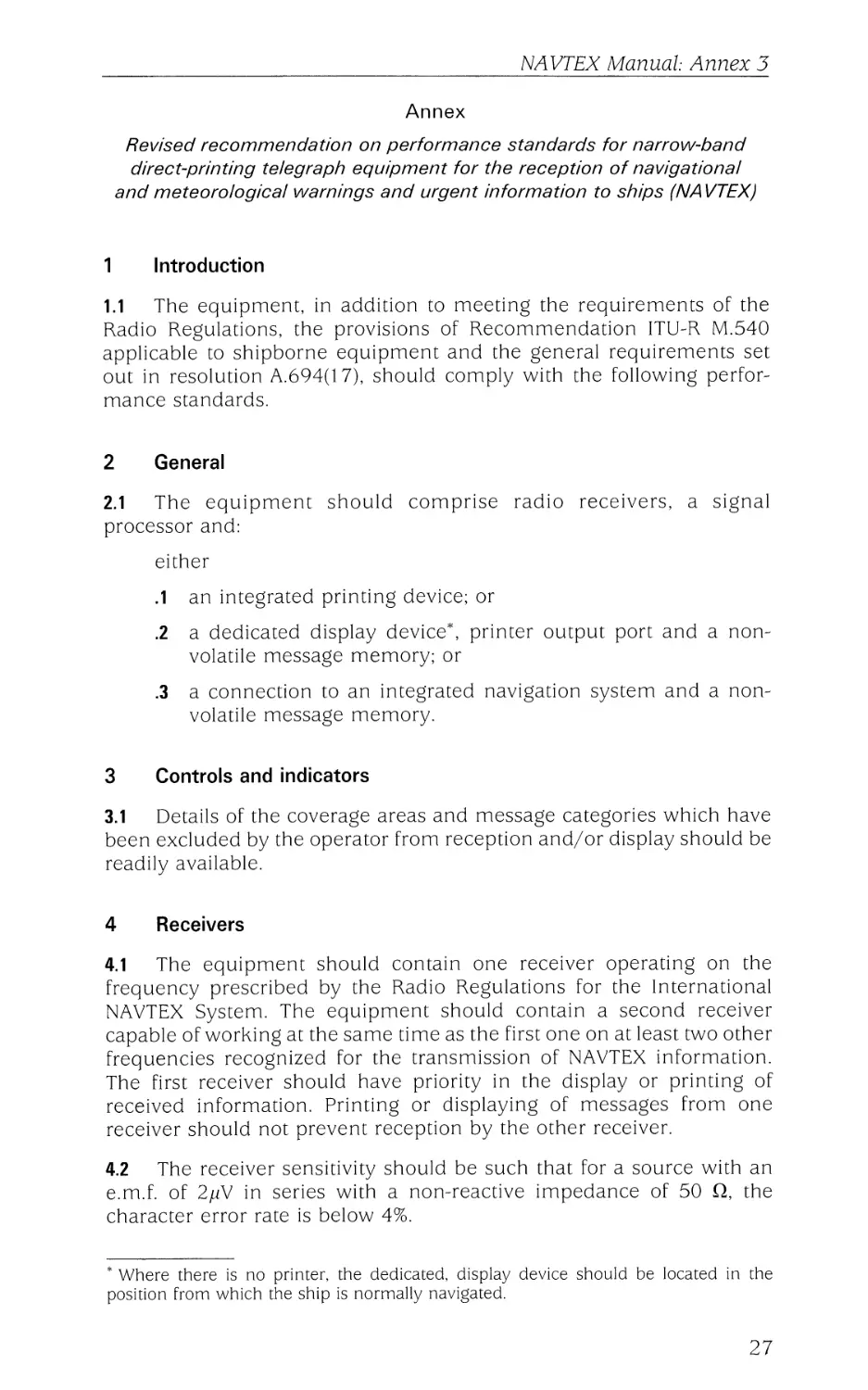
NAVTEX Manual: Annex 3
Annex
Revised recommendation on performance standards for narrow-band
direct-printing telegraph equipment for the reception of navigational
and meteorological warnings and urgent information to ships (NAVTEX)
1	Introduction
1.1 The equipment, in addition to meeting the requirements of the
Radio Regulations, the provisions of Recommendation ITU-R M.540
applicable to shipborne equipment and the general requirements set
out in resolution A.694(17), should comply with the following perfor-
mance standards.
2	General
2.1 The equipment should comprise radio receivers, a signal
processor and:
either
.1 an integrated printing device; or
.2 a dedicated display device*, printer output port and a non-
volatile message memory; or
.3 a connection to an integrated navigation system and a non-
volatile message memory.
3	Controls and indicators
3.1 Details of the coverage areas and message categories which have
been excluded by the operator from reception and/or display should be
readily available.
4	Receivers
4.1	The equipment should contain one receiver operating on the
frequency prescribed by the Radio Regulations for the International
NAVTEX System. The equipment should contain a second receiver
capable of working at the same time as the first one on at least two other
frequencies recognized for the transmission of NAVTEX information.
The first receiver should have priority in the display or printing of
received information. Printing or displaying of messages from one
receiver should not prevent reception by the other receiver.
4.2	The receiver sensitivity should be such that for a source with an
e.m.f. of 2/zV in series with a non-reactive impedance of 50 fl, the
character error rate is below 4%.
* Where there is no printer, the dedicated, display device should be located in the
position from which the ship is normally navigated.
27
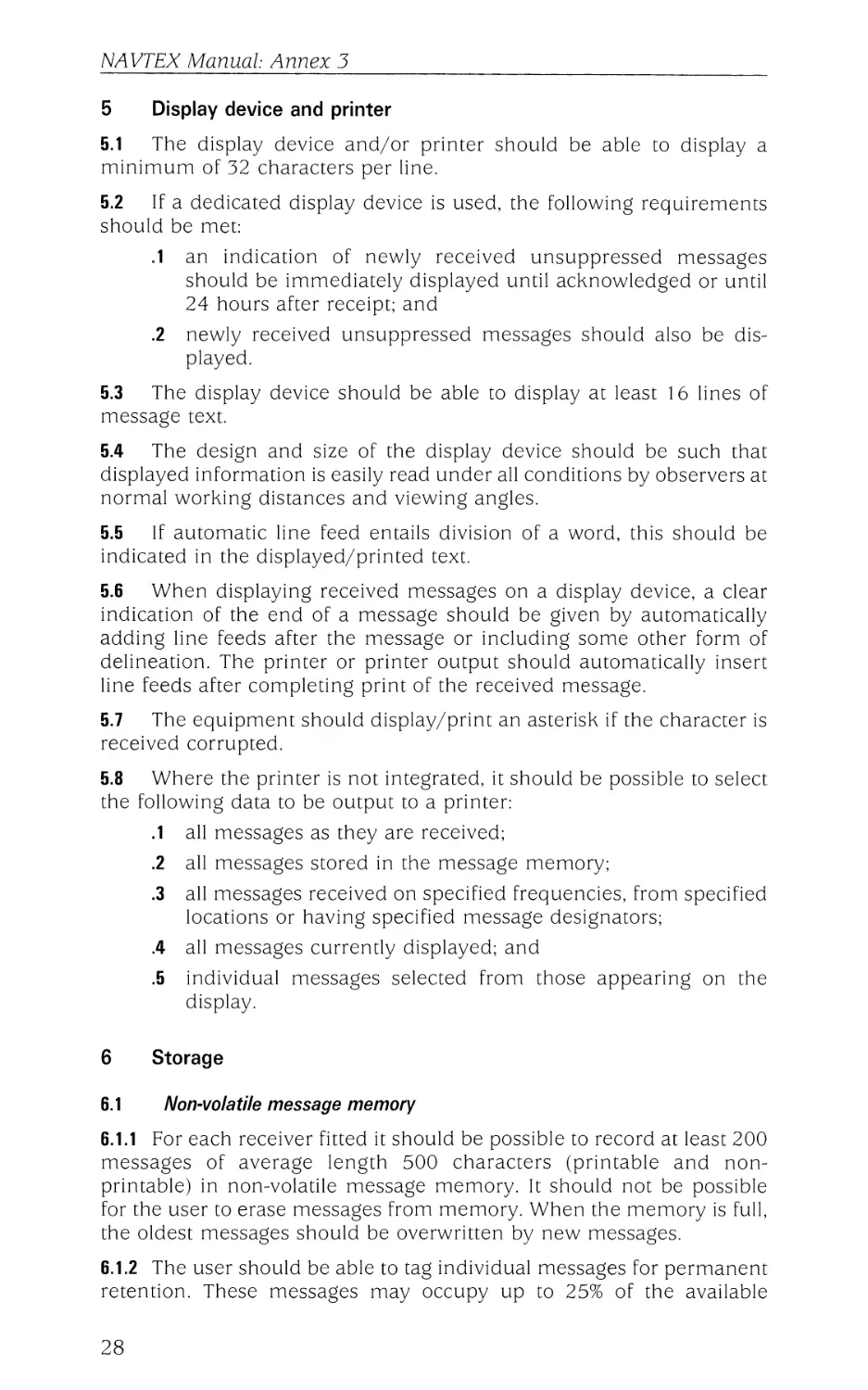
NAVTEX Manual: Annex 5
5	Display device and printer
5.1	The display device and/or printer should be able to display a
minimum of 32 characters per line.
5.2	If a dedicated display device is used, the following requirements
should be met:
.1 an indication of newly received unsuppressed messages
should be immediately displayed until acknowledged or until
24 hours after receipt; and
.2 newly received unsuppressed messages should also be dis-
played.
5.3	The display device should be able to display at least 16 lines of
message text.
5.4	The design and size of the display device should be such that
displayed information is easily read under all conditions by observers at
normal working distances and viewing angles.
5.5	If automatic line feed entails division of a word, this should be
indicated in the displayed/printed text.
5.6	When displaying received messages on a display device, a clear
indication of the end of a message should be given by automatically
adding line feeds after the message or including some other form of
delineation. The printer or printer output should automatically insert
line feeds after completing print of the received message.
5.7	The equipment should display/print an asterisk if the character is
received corrupted.
5.8	Where the printer is not integrated, it should be possible to select
the following data to be output to a printer:
.1 all messages as they are received;
.2 all messages stored in the message memory;
.3 all messages received on specified frequencies, from specified
locations or having specified message designators;
.4 all messages currently displayed; and
.5 individual messages selected from those appearing on the
display.
6	Storage
6.1	Non-volatile message memory
6.1.1 For each receiver fitted it should be possible to record at least 200
messages of average length 500 characters (printable and non-
printable) in non-volatile message memory. It should not be possible
for the user to erase messages from memory. When the memory is full,
the oldest messages should be overwritten by new messages.
6.1.2 The user should be able to tag individual messages for permanent
retention. These messages may occupy up to 25% of the available
28
NAVTEX Manual: Annex 3
memory and should not be overwritten by new messages. When no
longer required, the user should be able to remove the tag on these
messages which may then be overwritten in normal course.
6.2	Message identifications
6.2.1 The equipment should be capable of internally storing at least 200
message identifications for each receiver provided.
6.2.2 After between 60 h and 72 h, a message identification should
automatically be erased from the store. If the number of received
message identifications exceeds the capacity of the store, the oldest
message identification should be erased.
6.2.3 Only message identifications which have been satisfactorily
received should be stored; a message is satisfactorily received if the
error rate is below 4%.
6.3	Programmable control memories
6.3.1 Information for location (BJ* and message (B2)* designators in
programmable memories should not be erased by interruptions in the
power supply of less than 6 h.
7	Alarms
7.1 The receipt of search and rescue information (B2 = D) should give
an alarm at the position from which the ship is normally navigated. It
should only be possible to reset this alarm manually.
8	Test facilities
8.1 The equipment should be provided with a facility to test that the
radio receiver, the display device/printer and non-volatile message
memory are functioning correctly.
9	Interfaces
9.1	The equipment should include at least one interface for the
transfer of received data to other navigation or communication
equipment.
9.2	All interfaces provided for communication with other navigation
or communication equipment should comply with the relevant
international standards?
9.3	If there is no integrated printer, the equipment should include a
standard printer interface.
' Refer to Recommendation ITU-R M.540-2.
+ Refer to publication IEC 61162.
29
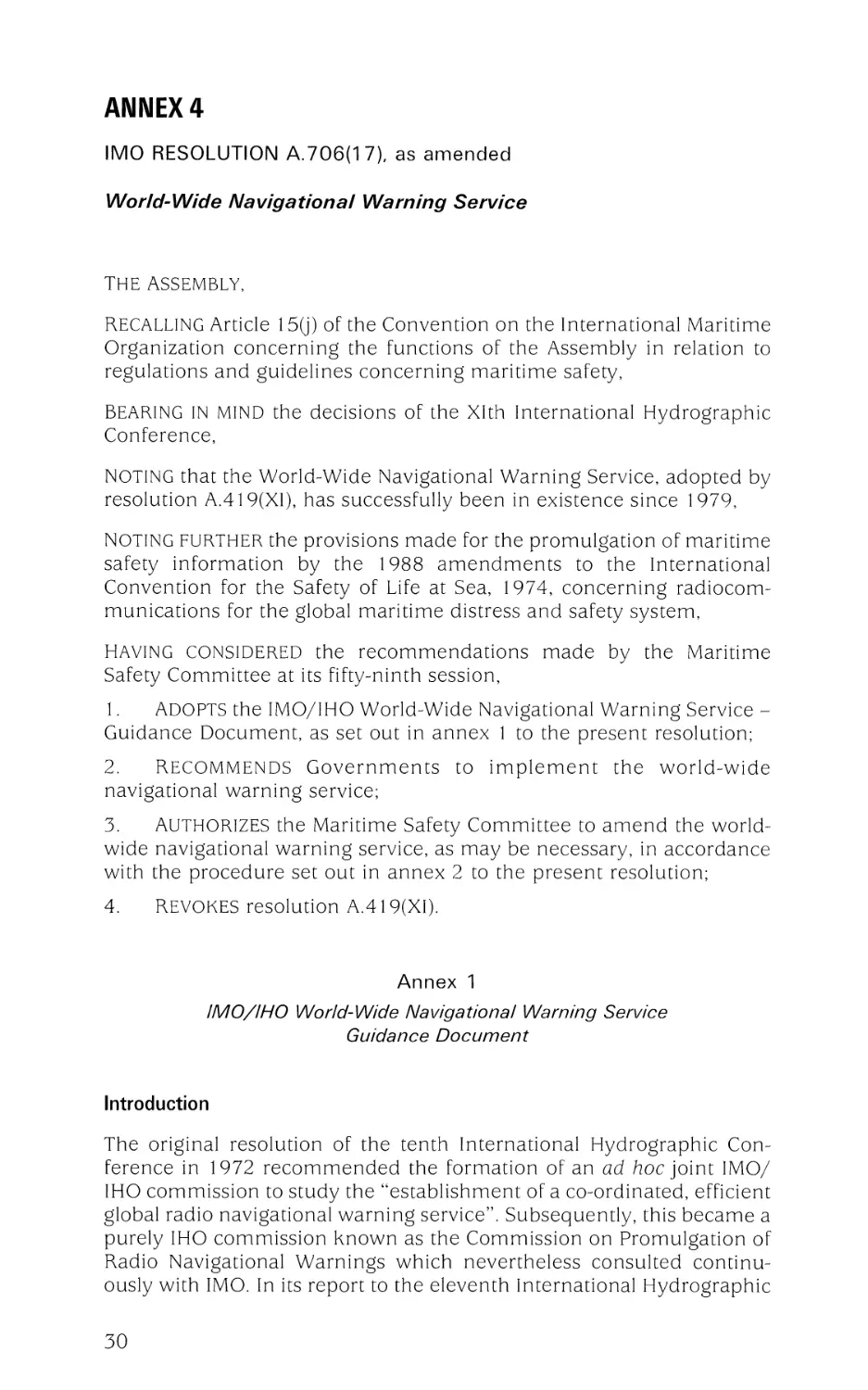
ANNEX 4
IMO RESOLUTION A.706(17), as amended
World-Wide Navigational Warning Service
THE ASSEMBLY,
RECALLING Article 15(j) of the Convention on the International Maritime
Organization concerning the functions of the Assembly in relation to
regulations and guidelines concerning maritime safety,
BEARING IN MIND the decisions of the Xlth International Hydrographic
Conference,
NOTING that the World-Wide Navigational Warning Service, adopted by
resolution A.419(XI), has successfully been in existence since 1979,
NOTING FURTHER the provisions made for the promulgation of maritime
safety information by the 1988 amendments to the International
Convention for the Safety of Life at Sea, 1974, concerning radiocom-
munications for the global maritime distress and safety system,
HAVING CONSIDERED the recommendations made by the Maritime
Safety Committee at its fifty-ninth session,
1.	ADOPTS the IMO/IHO World-Wide Navigational Warning Service -
Guidance Document, as set out in annex 1 to the present resolution;
2.	RECOMMENDS Governments to implement the world-wide
navigational warning service;
3.	AUTHORIZES the Maritime Safety Committee to amend the world-
wide navigational warning service, as may be necessary, in accordance
with the procedure set out in annex 2 to the present resolution;
4.	REVOKES resolution A.419(XI).
Annex 1
IMO/IHO World-Wide Navigational Warning Service
Guidance Document
Introduction
The original resolution of the tenth International Hydrographic Con-
ference in 1972 recommended the formation of an ad hoc joint IMO/
IHO commission to study the “establishment of a co-ordinated, efficient
global radio navigational warning service”. Subsequently, this became a
purely IHO commission known as the Commission on Promulgation of
Radio Navigational Warnings which nevertheless consulted continu-
ously with IMO. In its report to the eleventh International Hydrographic
30
NAVTEX Manual: Annex 4
Conference in 1977, the Commission submitted a Draft Plan for the
Establishment of a World-Wide Navigational Warning System, also
referred to as Plan for the Establishment of a Co-ordinated Radio
Navigational Warning Service. The title World-Wide Navigational Warn-
ing Service or WWNWS used for this revised edition of the document
reflects the evolution of the system from a proposed action to an
effective co-ordinated service which now has all of its 16 NAVAREAs in
operation. This revised edition contains changes necessitated by the
advent of the global maritime distress and safety system (GMDSS), as
adopted by the Conference of Contracting Governments to the Interna-
tional Convention for the Safety of Life at Sea, 1974, on the Global
Maritime Distress and Safety System in November 1988, effective on 1
February 1992.
Future amendments to the guidance document will be considered
formally and approved by IHO normally through the use of circular
letters and by IMO through its Maritime Safety Committee in accordance
with the procedures set out in annex 2 to this document. Proposed
amendments will normally be evaluated by the IHO Commission on
Promulgation of Radio Navigational Warnings, which includes as an ex
officio member a representative of the IMO Secretariat, prior to any
extensive IHO or IMO consideration.
World-Wide Navigational Warning Service (WWNWS)
1	Introduction
This document provides specific guidance for the promulgation of
internationally co-ordinated NAVAREA and coastal warnings via
NAVTEX and International SafetyNET services. It includes the situation
where International SafetyNET is used in lieu of NAVTEX as the primary
means of transmitting coastal warnings. Its guidance does not apply to
purely national warnings services which supplement those internation-
ally co-ordinated services.
2	Definitions
2.1 For the purposes of this service, the following definitions apply:
2.1.1 Navigational warning.- A broadcast message containing urgent
information relevant to safe navigation. Types of information suitable
for transmission as navigational warnings are described in 4.2.1.3.
2.1.2 Maritime safety information (MSI): Navigational and meteorologi-
cal warnings, meteorological forecasts and other urgent safety-related
messages.
31
NAVTEX Manual: Annex 4
2.1.3 NAVAREA: A geographical sea area, as shown in the appendix,
established for the purpose of co-ordinating the transmission of radio
navigational warnings. Where appropriate, the term NAVAREA followed
by an identifying roman numeral may be used as a short title. The
delimitation of such areas is not related to and shall not prejudice the
delimitation of any boundaries between States.
2.1.4 Sub-area: A subdivision of a NAVAREA in which a number of
countries have established a co-ordinated system for the promulgation
of coastal warnings. The delimitation of such areas is not related to and
shall not prejudice the delimitation of any boundaries between States.
2.1.5 Region: The part of a NAVAREA or sub-area established for the
purpose of co-ordinating the transmission of coastal warnings by
NAVTEX or international SafetyNET broadcast.
2.1.6 NAVAREA Co-ordinator: The authority charged with co-ordinating,
collating and issuing long-range navigational warnings and NAVAREA
warnings bulletins to cover the whole of the NAVAREA.
2.1.7 Sub-area Co-ordinator: The authority charged with the co-ordina-
tion of navigational warnings information within a designated sub-area.
2.1.8 National Co-ordinator: The national authority charged with
collating and issuing coastal warnings in a region.
2.1.9 NAVAREA warning: A navigational warning issued by the
NAVAREA Co-ordinator for the NAVAREA.
2.1.10 NAVAREA warnings bulletin: A list of serial numbers of those
NAVAREA warnings in force issued and broadcast by the NAVAREA Co-
ordinator during at least the previous six weeks.
2.1.11 Coastal warning: A navigational warning promulgated by a
national co-ordinator to cover a region. (Coastal warnings may also be
broadcast by means other than those of the WWNWS as a national
option.)
2.1.12 Local warning: A navigational warning which covers inshore
waters, often within the limits of jurisdiction of a harbour or port
authority.
3	Broadcast systems
3.1	Broadcast systems
3.1.1 The radio systems to be used internationally for the promulgation
of maritime safety information are laid down in the International
Convention for the Safety of Life at Sea, 1974 (SOLAS), as amended.
These include:
.1 NAVTEX: Single-frequency time-shared broadcast system with
automated reception and message-rejection/-selection facil-
ities. Use of NAVTEX is regulated by the IMO NAVTEX Manual
(IMO publication no. 951).
32
NAVTEX Manual: Annex 4
.2 International (enhanced group call) SafetyNET service: Dedi-
cated satellite broadcast system with automated reception and
message-rejection/-selection facilities. Use of this service is
regulated by the International SafetyNET Manual (IMO pub-
lication no. 908).
3.2	Broadcast scheduling
3.2.1 Automated systems (SafetyNET/NAVTEX)
3.2.1.1 Navigational warnings should be transmitted as soon as possible
or as dictated by the nature and timing of the event. Normally, the
initial broadcast should be made as follows:
.1 for SafetyNET, within 30 minutes of receipt of original
information;
.2 for NAVTEX, at the next scheduled broadcast, unless circum-
stances indicate the use of procedures for VITAL or IMPOR-
TANT warnings.
3.2.1.2 Navigational warnings should be repeated in scheduled broad-
casts in accordance with the guidelines promulgated in the following
documents, as appropriate:
.1 International SafetyNET Manual (IMO publication no. 908).
.2 NAVTEX Manual (IMO publication no. 951).
3.2.1.3 At least two daily transmission times are necessary to provide
adequate promulgation of NAVAREA warnings. When NAVAREAs may
extend across more than six time zones, more than two broadcasts
should be especially considered to ensure that warnings can be
received.
3.2.2 Schedule changes
3.2.2.1 NAVAREA co-ordinators should ensure that the times of HF
broadcasting do not coincide with those in adjacent NAVAREAs. Times
of scheduled broadcasts under the international SafetyNET service
should be co-ordinated through the International SafetyNET Co-ordi-
nating Panel.
3.2.2.2 Changes to broadcast schedules should be implemented only
after the International Telecommunication Union (ITU) has been given
at least three months’ notice by the appropriate national authority,
unless urgent operational considerations dictate more immediate
action.
3.2.2.3 IMO and IHO should be informed of intended changes at the
same time as they are communicated to ITU.
3.2.2.4 Arrangements should be made for informing mariners in good
time of all changes.
33
NAVTEX Manual: Annex 4
4	Navigational warnings
4.1	General
4.1.1 There are three types of navigational warnings: NAVAREA
warnings, coastal warnings and local warnings. The WWNWS guidance
and co-ordination are involved with only two of them: NAVAREA
warnings and coastal warnings; of the latter, only with those coastal
warnings which are broadcast under the internationally co-ordinated
services using NAVTEX or, in lieu of NAVTEX, international SafetyNET
service as their primary means of transmission.
4.1.2 Navigational warnings should normally refer only to the area
concerned.
4.1.3 Navigational warnings should be broadcast for as long as the
information is valid or until it is made available by other means.
4.1.4 Navigational warnings should remain in force until cancelled by
the originating co-ordinator.
4.1.5 The duration of a navigational warning should be given in the text,
if known.
4.2	The three types of navigational warnings are:
4.2.1 NAVAREA warnings
4.2.1.1 Generally speaking, NAVAREA warnings are concerned with the
information detailed below which ocean-going mariners require for
their safe navigation. This includes, in particular, failures of important
aids to navigation, as well as information which may require changes to
planned navigational routes.
4.2.1.2 Warnings for coastal areas may be provided by NAVTEX or the
international SafetyNET service, when implemented in lieu of NAVTEX.
From the date a NAVTEX receiver is mandatory on all ships sailing in
areas of NAVTEX service (1 August 1993), it is intended that such
information not be re-broadcast as a NAVAREA warning unless it is
deemed of such significance that the mariner should be aware of it
before entering the area of NAVTEX coverage. The national co-ordinator
will evaluate the significance of the information for consideration as a
NAVAREA warning while the NAVAREA co-ordinator will make the final
determination (see 6.6.7 and 6.2.3 respectively).
4.2.1.3 The following subject areas are considered suitable for transmis-
sion as NAVAREA warnings. This list is not exhaustive and should be
regarded only as a guideline. Furthermore, it presupposes that suffi-
ciently precise information about the item has not previously been
disseminated in a Notice to Mariners:
.1 casualties to lights, fog signals and buoys affecting main
shipping lanes;
.2 the presence of dangerous wrecks in or near main shipping
lanes and, if relevant, their marking;
34
NAVTEX Manual: Annex 4
.3 establishment of major new aids to navigation or significant
changes to existing ones when such establishment or change
might be misleading to shipping;
.4 the presence of large unwieldy tows in congested waters;
.5 drifting mines;
.6 areas where search and rescue (SAR) and anti-pollution
operations are being carried out (for avoidance of such areas);
.7 the presence of newly discovered rocks, shoals, reefs and
wrecks likely to constitute a danger to shipping, and, if
relevant, their marking;
.8 unexpected alteration or suspension of established routes;
.9 cable- or pipe-laying activities, the towing of large submerged
objects for research or exploration purposes, the employment
of manned or unmanned submersibles, or other underwater
operations constituting potential dangers in or near shipping
lanes;
.10 establishment of offshore structures in or near shipping lanes;
.11 significant malfunctioning of radionavigation services and
shore-based maritime safety information radio or satellite
service;
.12 information concerning special operations which might affect
the safety of shipping, sometimes over wide areas, e.g. naval
exercises, missile firings, space missions, nuclear tests, etc. It is
important that, where the degree of hazard is known, this
information is included in the relevant warning. Whenever
possible, such warnings should be originated not less than five
days in advance of the scheduled event. The warning should
remain in force until the event is completed;*
.13 acts of piracy and armed robbery against ships.
4.2.1.4 NAVAREA warnings bulletins should be transmitted not less than
once per week at a regularly scheduled time.
4.2.1.5 Arrangements should be made for the text of NAVAREA
warnings in force to be available at port offices and, where appropriate,
for their eventual inclusion in a generally available printed form.
4.2.2 Coastal warnings
4.2.2.1 Coastal warnings promulgate information which is necessary for
safe navigation within a given region. Coastal warnings should normally
provide sufficient information for safe navigation to seaward of the
fairway buoy or pilot station and should not be restricted to main
shipping lanes. Where the region is served by NAVTEX, it should
~ The Maritime Safety Committee is authorized to review the provisions of this
paragraph and, if appropriate, to provide for exemptions from this requirement, under
special circumstances.
35
NAVTEX Manual: Annex 4
provide navigational warnings for the entire IMO-approved service area
of the NAVTEX transmitter. Where the region is not served by NAVTEX,
it is necessary to include all warnings relevant to the coastal waters up
to 250 miles from the coast in the International SafetyNET service
transmission.
4.2.2.2 Coastal warnings should include, at a minimum, the types of
information required for NAVAREA warnings in 4.2.1.3.
4.2.3 Local warnings
4.2.3.1 Local warnings supplement coastal warnings by giving detailed
information within inshore waters, including the limits of a harbour or
port authority, on aspects which the ocean-going ship normally does
not require.
5	Information control
5.1	Message numbering
5.1.1 Navigational warnings in each series should be consecutively
numbered throughout the calendar year, commencing with 0001 at
0000 UTC on 01 January.
5.1.2 Navigational warnings should, as a general rule, be transmitted in
reverse numerical order on scheduled broadcasts.
5.1.3 At the beginning of every navigational warning scheduled broad-
cast for which there are no warnings to be disseminated, a brief
message should be transmitted to identify the broadcast and advise the
mariner that there is no navigational warning message traffic on hand.
5.2	Priority message handling
5.2.1 The guidelines for the handling of navigational warnings are
promulgated, as appropriate, in the following documents:
.1 International SafetyNET Manual (IMO publication no. 908);
and
.2 NAVTEX Manual (IMO publication no. 951).
5.3	Language
5.3.1 All NAVAREA and coastal warnings must be transmitted in English
in the internationally co-ordinated services.
5.3.2 In addition, NAVAREA warnings may be broadcast in one or more
of the official languages of the United Nations.
5.3.3 Coastal warnings may also be broadcast in the national language,
and local warnings may be issued only in the national language as a
national service.
36
NAVTEX Manual: Annex 4
6	Co-ordinator resources and responsibilities
6.1	NAVAREA co-ordinator resources
6.1.1 The NAVAREA co-ordinator must have:
.1 the expertise and information sources of a well established
national hydrographic service;
.2 effective communication links, e.g. telex, facsimile, e-mail,
etc., with sub-area and national co-ordinators in the NAVAREA
and with other NAVAREA co-ordinators; and
.3 access to effective facilities for transmission to the entire
NAVAREA. Reception normally should be possible 700 miles
beyond the limit of the NAVAREA (24 hours’ sailing by a fast
ship).
6.2	NAVAREA co-ordinator responsibilities
6.2.1 The NAVAREA co-ordinator must:
.1 endeavour to be informed of all events that could significantly
affect the safety of navigation within the NAVAREA;
.2 immediately upon receipt, assess all information in the light of
expert knowledge for relevance to navigation in the NAVAREA;
.3 select information for broadcast in accordance with the
guidance given in 4.2.1 above;
.4 draft NAVAREA warning messages in accordance with the
Joint IMO/IHO/WMO Manual on Maritime Safety Information
(MSI) for the standardization of texts and message drafting;
.5 direct and control the broadcast of NAVAREA warning mes-
sages, making full and efficient use of national broadcast
facilities in keeping with the provisions of the International
Convention for the Safety of Life at Sea, 1974, as amended;
.6 pass NAVAREA warnings which warrant further promulgation
in adjacent areas directly to the appropriate NAVAREA co-
ordinators, using the quickest possible means;
.7 ensure that written copies of NAVAREA warnings likely to
remain in force for more than six weeks are made available to
those NAVAREA co-ordinators or national authorities request-
ing them. Immediate transmission by telex, facsimile, or by
high-speed communications is recommended in the absence
of an alternative appropriate delivery arrangement, subject to
agreement between the co-ordinators concerned;
.8 as soon as possible after the receipt of information concerning
scheduled underwater operations as described in 4.2.1.3.9, or
other scheduled operations such as in 4.2.1.3.3 and 4.2.1.3.10,
pass such information to those national co-ordinators in its
own NAVAREA and other NAVAREA co-ordinators who main-
37
NAVTEX Manual: Annex 4
tain a Notices to Mariners service covering the affected area
and who have requested such information;
.9 transmit periodical NAVAREA warnings bulletins;
.10 promulgate the cancellation of NAVAREA warnings which
contain information which is no longer valid;
.11 arrange for the text of NAVAREA warnings in force to be
available at port offices and, where appropriate, for their
eventual inclusion in a generally available printed form;
.12 act as the central point of contact on matters relating to
navigational warnings within the NAVAREA;
.13 promote the use of established international standards and
practices in the promulgation of navigational warnings within
the NAVAREA;
.14 when notified by the authority designated to act on reports of
piracy and armed robbery against ships, arrange for the
broadcast of a suitable NAVAREA warning. Additionally, keep
the national or regional piracy control centre informed of long-
term broadcast action(s);
.15 monitor the broadcasts which they originate to ensure that the
messages have been correctly broadcast; and
.16 co-ordinate preliminary discussions between Member States
seeking to establish NAVTEX services and neighbouring
administrations, prior to formal application.
Note: Although arrangements made by the NAVAREA co-ordinator
should enable all ships to receive messages in force for an area either
before reaching or on entering an area, nevertheless it should be
possible, in exceptional cases, for ships to obtain, on request, texts of
messages in force but not included in the current scheduled broadcasts.
6.3	Sub-агеа co-ordinator resources
6.3.1 The sub-area co-ordinator must have, or have access to:
.1 expertise and information resources of a well established
national hydrographic service;
.2 effective communication links with national co-ordinators in
the sub-area; and
.3 effective communication links with the NAVAREA co-ordina-
tor.
Note: Normally a sub-area co-ordinator will serve also as a national co-
ordinator.
38
NAVTEX Manual: Annex 4
6.4	Sub-агеа co-ordinator responsibilities
6.4.1 The sub-area co-ordinator must:
.1 endeavour to be informed of all events that could significantly
affect the safety of navigation within the sub-area;
.2 inform the NAVAREA co-ordinator of any events in the sub-
area which warrant the promulgation of a NAVAREA warning;
.3 co-ordinate and promote the exchange of information
between national co-ordinators in the sub-area and the
NAVAREA co-ordinator;
.4 act as the central point of contact on matters relating to
navigational warnings within the sub-area;
.5 promote the use of established international standards and
practices in the promulgation of navigational warnings within
the sub-area; and
.6 monitor the broadcasts which they originated to ensure that
the messages have been correctly transmitted.
6.5	National co-ordinator resources
6.5.1 The national co-ordinator must have:
.1 established sources of information relevant to the safety of
navigation within national waters;
.2 effective communication links with the sub-area/NAVAREA
co-ordinator and adjacent national co-ordinators; and
.3 access to effective facilities for the transmission of navigational
warnings to the region.
6.6	National co-ordinator responsibilities
6.6.1 The national co-ordinator must:
.1 endeavour to be informed of all events that could significantly
affect the safety of navigation within his region or national
area of responsibility;
.2 immediately upon receipt, assess all information in the light of
expert local knowledge for relevance to safety of navigation in
his area of responsibility;
.3 select information for broadcast in accordance with the
guidance given in 4.2.1.3 above;
.4 draft coastal warnings in accordance with established inter-
national standards;
.5 direct and control the broadcast of coastal warnings by a
broadcast system adopted for the WWNWS;
39
NAVTEX Manual: Annex 4
.6 arrange to receive NAVAREA warnings broadcast for his area
of responsibility and, where appropriate, coastal warnings
from other national co-ordinators;
.7 include relevant warnings in NAVTEX/SafetyNET broadcasts
and, if appropriate, in Notices to Mariners;
.8 arrange for the texts of NAVAREA warnings and relevant
coastal warnings to be available at port offices and, where
appropriate, for their eventual inclusion in a generally printed
form and/or Notice to Mariners;
.9 inform the NAVAREA co-ordinator or, where established, the
sub-area co-ordinator of any events in his area of responsibility
which warrant the promulgation of a NAVAREA warning;
.10 act as the central point of contact on matters relating to
navigational warnings within his area of responsibility;
.11 pass coastal warnings which warrant further promulgation in
adjacent regions to the appropriate national co-ordinators;
.12 when notified by the authority designated to act on reports of
piracy and armed robbery against ships, arrange for the
broadcast of a suitable NAVTEX/SafetyNET navigational warn-
ing. Additionally, keep the national or regional piracy control
centre informed of long-term broadcast action(s); and
.13 monitor broadcasts which they originate to ensure that the
messages have been correctly broadcast.
Annex 2
IMO Procedure for amending the World-Wide
Navigational Warning Service
1	Proposed amendments to the World-Wide Navigational Warning
Service should be submitted to the Maritime Safety Committee for
evaluation.
2	Amendments to the service should normally come into force at
intervals of approximately two years or at such longer periods as
determined by the Maritime Safety Committee at the time of adoption.
Amendments adopted by the Maritime Safety Committee will be
notified to all concerned, will provide at least 12 months notification
and will come into force on 1 January of the following year.
3	The agreement of the International Hydrographic Organization
and the active participation of other bodies should be sought according
to the nature of the proposed amendments.
4	When the proposals for amendment have been examined in
substance, the Maritime Safety Committee will entrust the Sub-
committee on Radiocommunications and Search and Rescue with
the ensuing editorial tasks.
40
NAVTEX Manual: Annex 4
5	The NAVAREA schedule of broadcast times and frequencies, not
being an integral part of the service and being subject to frequent
changes, will not be subject to the amendment procedures.
41
IAVTEX Manual: Annex 4
Geographical areas for co-ordinating and promulgating radio navigational warnings. The delimitation of these NAVAREAs
is not related to and shall not prejudice the delimitations of any boundaries between States.
ANNEX 5
IMO RESOLUTION A.801(19), annex 4
Criteria for use when providing a NAVTEX service
1	There are two basic areas which must be defined when establish-
ing a NAVTEX service. They are:
Coverage area: An area defined by an arc of a circle having a radius
from the transmitter calculated according to the method and criteria
given in this annex.
Service area: A unique and precisely defined sea area, wholly
contained within the coverage area, for which MSI is provided from
a particular NAVTEX transmitter. It is normally defined by a line
which takes full account of local propagation conditions and the
character and volume of information and maritime traffic patterns
in the region.
2	Governments desiring to provide a NAVTEX service should use the
following criteria for calculating the coverage area of the NAVTEX
transmitter they intend to install, in order to:
•	determine the most appropriate location for NAVTEX stations
having regard to existing or planned stations;
•	avoid interference with existing or planned NAVTEX stations;
•	establish a service area for promulgation to seafarers.
3	The ground-wave coverage may be determined for each coast
station by reference to Recommendation ITU-R PN.368-7 and ITU-R
Report 322 for the performance of a system under the following
conditions:
Frequency	-	518 kHz
Bandwidth	-	500 Hz
Propagation	-	ground wave
Time of day1
Season1
Transmitter power2
Antenna efficiency2
RF S/N in 500 Hz bandwidth - 8 db3
Percentage of time	- 90
4	Full coverage of the NAVTEX service area should be verified by
field strength measurements.
1 Administrations should determine time periods in accordance with NAVTEX time
transmission table (NAVTEX Manual, figure 3) and seasons appropriate to their geographic
area based on prevailing noise level.
2 The range of a NAVTEX transmitter depends on the transmitter power and local
propagation conditions. The actual range achieved should be adjusted to the minimum
required for adequate reception in the NAVTEX area served, taking into account the needs of
ships approaching from other areas. Experience has indicated that the required range of 250
to 400 nautical miles can generally be attained by transmitter power in the range between
100 and 1,000 W during daylight with a 60% reduction at night.
3 Bit error rate 1 x 10⁻²
43
ANNEX 6
PROCEDURE FOR AMENDING THE NAVTEX MANUAL
1	Proposals for amendments to the NAVTEX Manual should be
examined in substance by the Sub-Committee on Radiocommunica-
tions and Search and Rescue (COMSAR). Amendments will only be
adopted after the approval of the Maritime Safety Committee.
2	Amendments to the Manual should normally be adopted at
intervals of approximately two years or at such longer periods as may
be determined by the Maritime Safety Committee. Amendments
adopted by the Maritime Safety Committee will be notified to all
concerned, will provide at least 12 months’ notification and will come
into force on 1 January of the following year.
3	The agreement of the International Hydrographic Organization
and World Meteorological Organization, and the active participation of
other bodies, should be sought according to the nature of the proposed
amendments.
44
ANNEX 7
COMSAR/Circ.28 of 12 June 2001
International NAVTEX Service
1	The Sub-Committee on Radiocommunications and Search and
Rescue (COMSAR), at its fifth session (11 to 15 December 2000), agreed
to a number of recommendations (reproduced at annex) aimed at
reducing interference and volume of information in the International
NAVTEX Service.
2	In addition, COMSAR 5 agreed that it was important to encourage
Administrations to migrate non-English language broadcasts and
broadcasts of information provided specifically for non-SOLAS vessels
from 518 kHz to 490 kHz or 4209.5 kHz, as appropriate.
3	The Maritime Safety Committee, at its seventy fourth session
(30 May to 8 June 2001), approved the recommendations made by
COMSAR 5 and urged Administrations to complete this migration by 1
January 2005.
4	Member Governments are invited to bring this circular to the
attention of all Maritime Safety Information (MSI) providers and
National Telecommunication Administrations for consideration and
action as appropriate.
Annex
Interference between stations and the use of 490 kHz
1 Although NAVTEX continues to be generally reliable and an
effective medium for the promulgation of Maritime Safety Information,
the world-wide infrastructure continues to expand and the volume of
information that each Administration disseminates through a NAVTEX
service on 518 kHz continues to increase. There is now a real danger
that in some geographical areas, without firm management, both the
system and system users may become overloaded with information on
this frequency.
2 Many stations are filling their allotted 10 minute time slots and an
increasing number are over-running. Instances of interference with
neighbouring stations, as a result of over-running the time allocation, are
also increasing. Where adjacent stations have Bt characters which follow
alphabetically (i.e. time slots abut), if the first station over-runs, it may
mask the phasing signal of the second station such that, to the user, it
seems as if the second station is off the air. Safety-critical information
from the second station, although broadcast, may not be received by the
system users. Over-run is usually caused by one or more of the following:
.1 a significant increase in safety-critical activity such as cable
laying. Navigational warnings promulgating such activity often
include numerous waypoints which are listed by latitude and
longitude;
45
NAVTEX Manual: Annex 7
.2 meteorological information provided in a manner which is not
concise and easily assimilated by the system user or for a
much wider area than is covered by the NAVTEX station;
.3 additional information provided for non-SOLAS system users,
e.g. longer-range weather forecasts for fishing and recreational
vessels (see paragraph 3 below); and
.4 information to meet specific national requirements. This
includes national language broadcasts and other information
which is sometimes required to be broadcast by national
statute rather than IMO resolutions.
3	As the GMDSS spreads to non-SOLAS mariners, their requirements
for information are often different from the SOLAS ships and may be
determined at a national level. SOLAS ships trading internationally
usually pass through the area of coverage of a NAVTEX transmitter in a
day; for them a 24-hour weather forecast usually suffices. However,
fishing vessels and recreational vessels often remain in the same
vicinity for several days and may require much longer range forecasts
which take up more transmission time.
4	In order to keep the quantity of information that is broadcast on
518 kHz to manageable levels and to reduce avoidable interference on
this frequency, it is recommended that:
.1 Administrations monitor the volume of data broadcast and,
together with adjacent Administrations, actively manage the
system to ensure that interference caused by over-running
allocated time slots is minimized; and
.2 Administrations migrate non-English language broadcasts,
and broadcasts of information provided specifically for non-
SOLAS vessels from 518 kHz to a national broadcast on
490 kHz or 4209.5 kHz as required. B, characters for these
frequencies will be allocated by the International NAVTEX Co-
ordinating Panel, on request.
5	Interference between stations with the same B] character/time
slot, but located in different regions, is also increasing, particularly at
night, as the number of operational NAVTEX stations increases. This is
occasionally caused by atmospheric conditions, but is generally caused
by excessive power output from one of the stations. It is recommended
that Administrations restrict the power output from their transmitters to
that required to cover the designated area, particularly at night, in order
to avoid interference. As a general rule, transmitter power should never
exceed 1 kW by day and 300 W by night; use of as much as 7 kW has
been noted in extreme cases of reported interference.
46
NAVTEX NAVTEX NAVTEX NAVTEX NAVTEX
NAVTEX
Sales number: IC951E