/
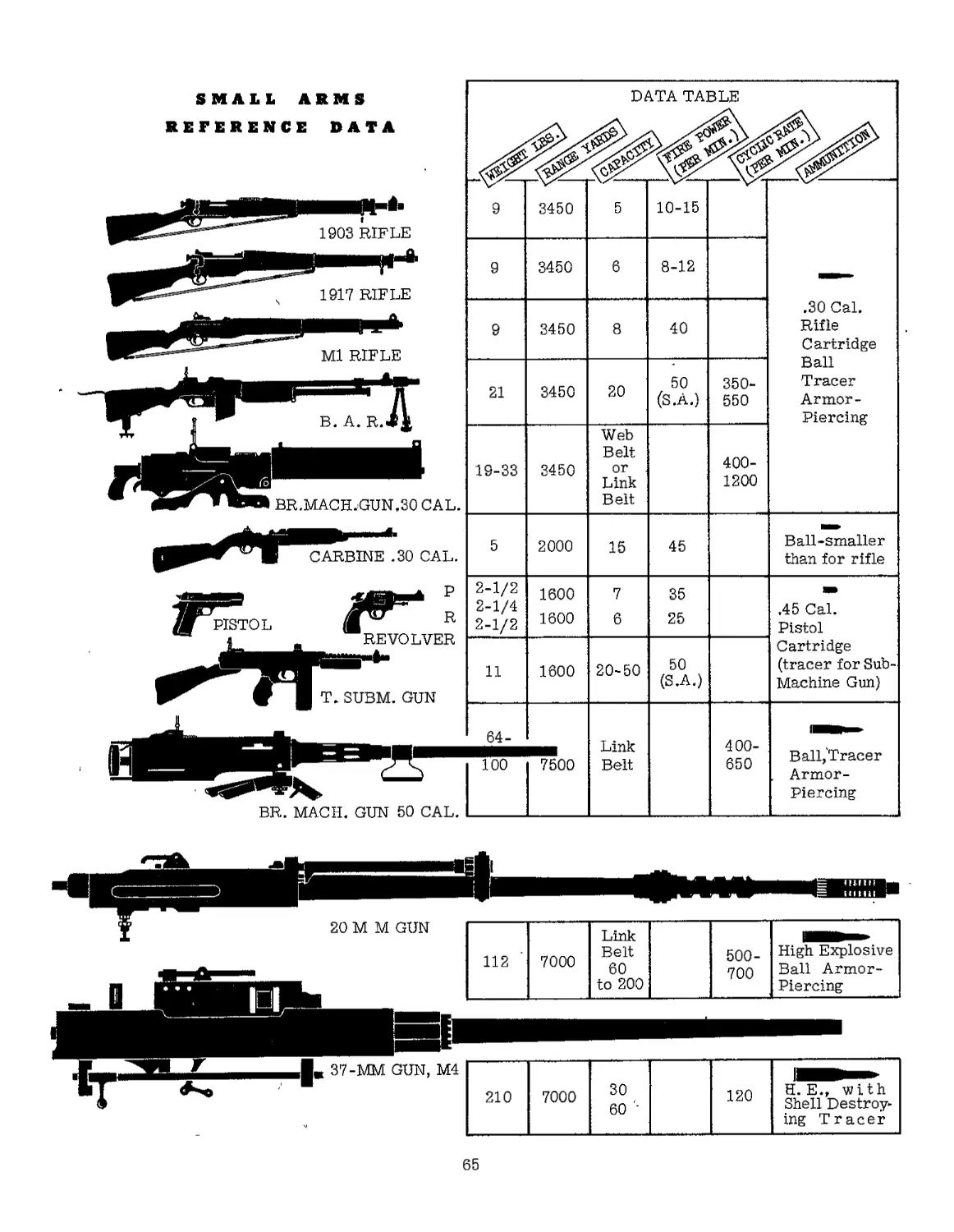
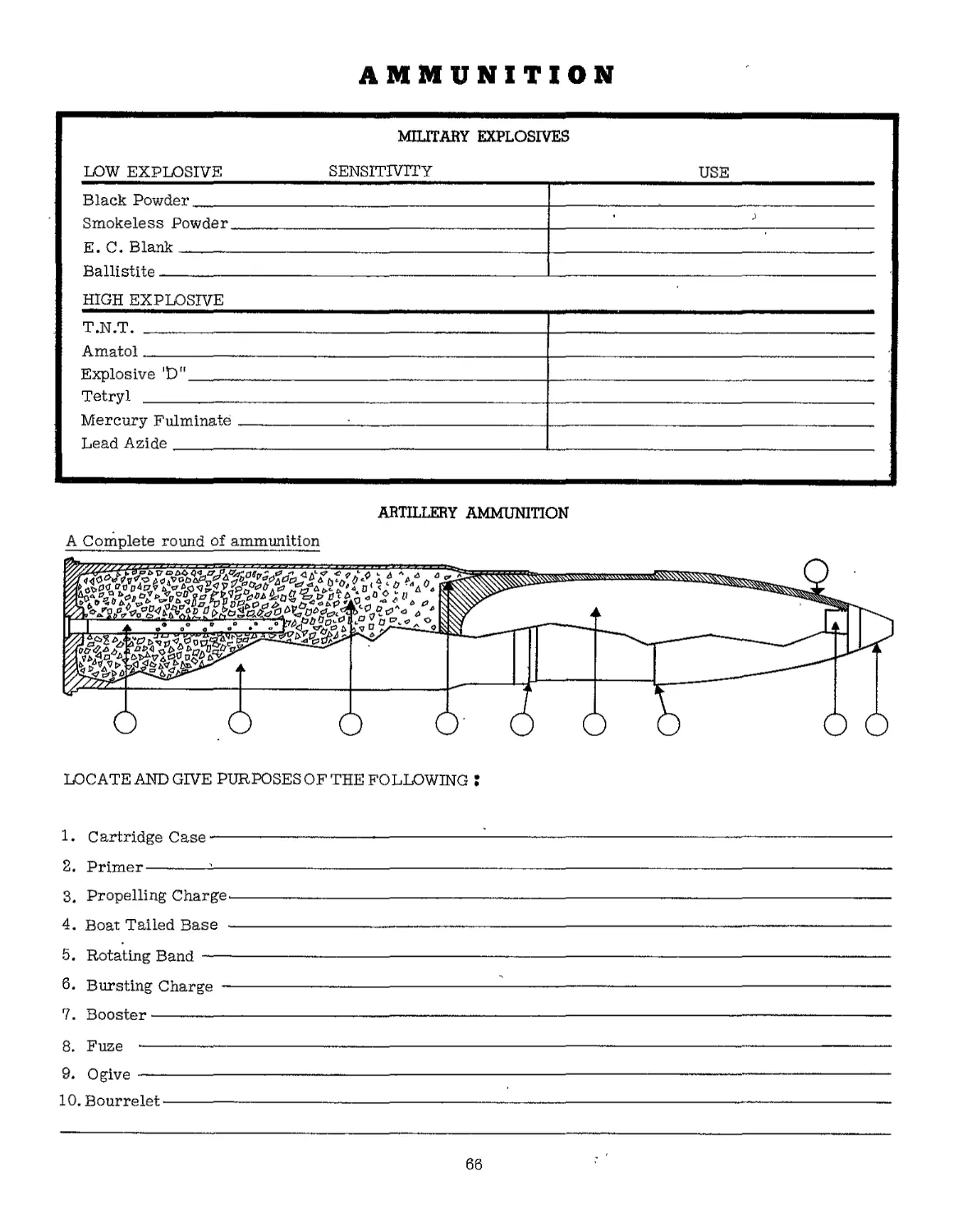
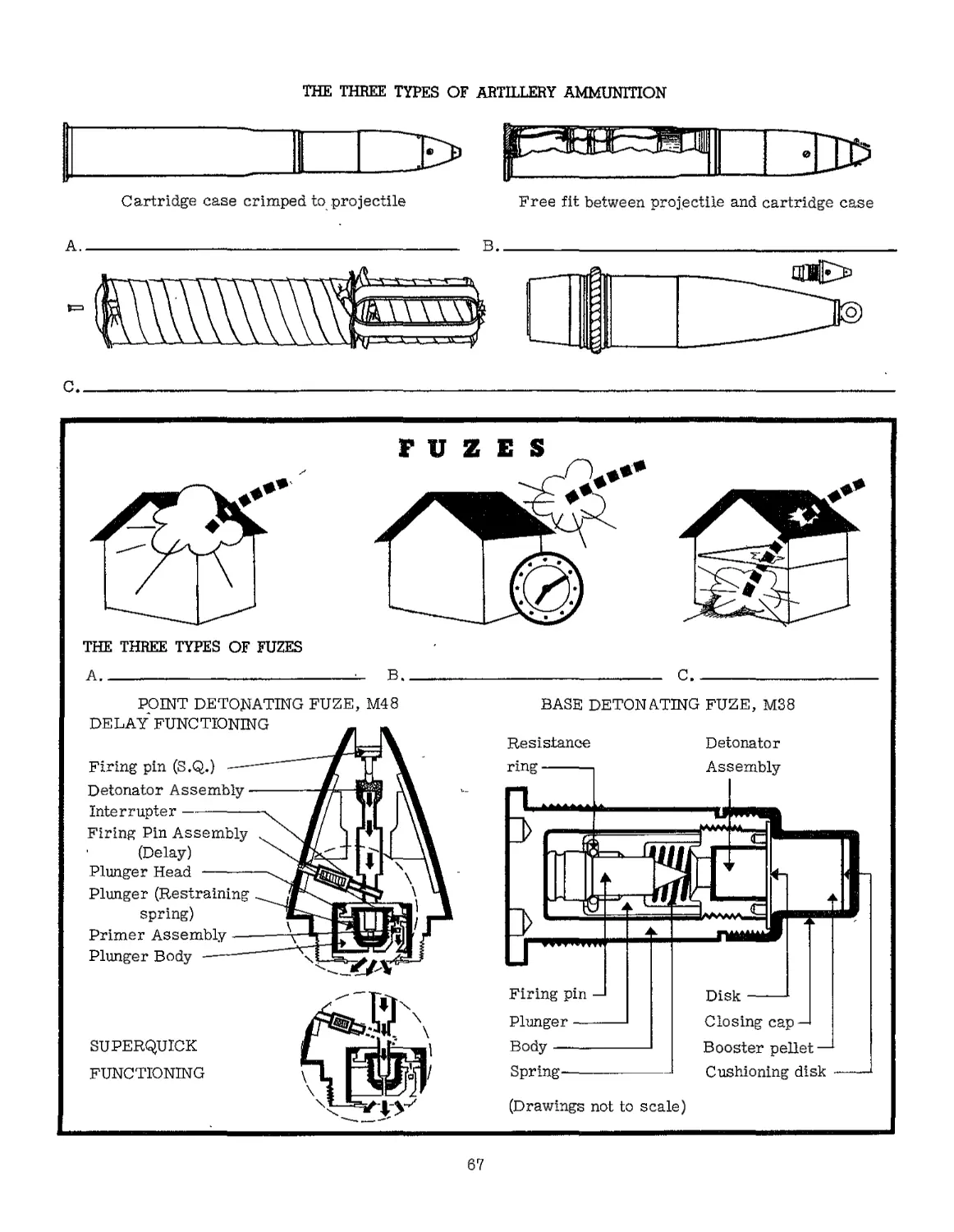
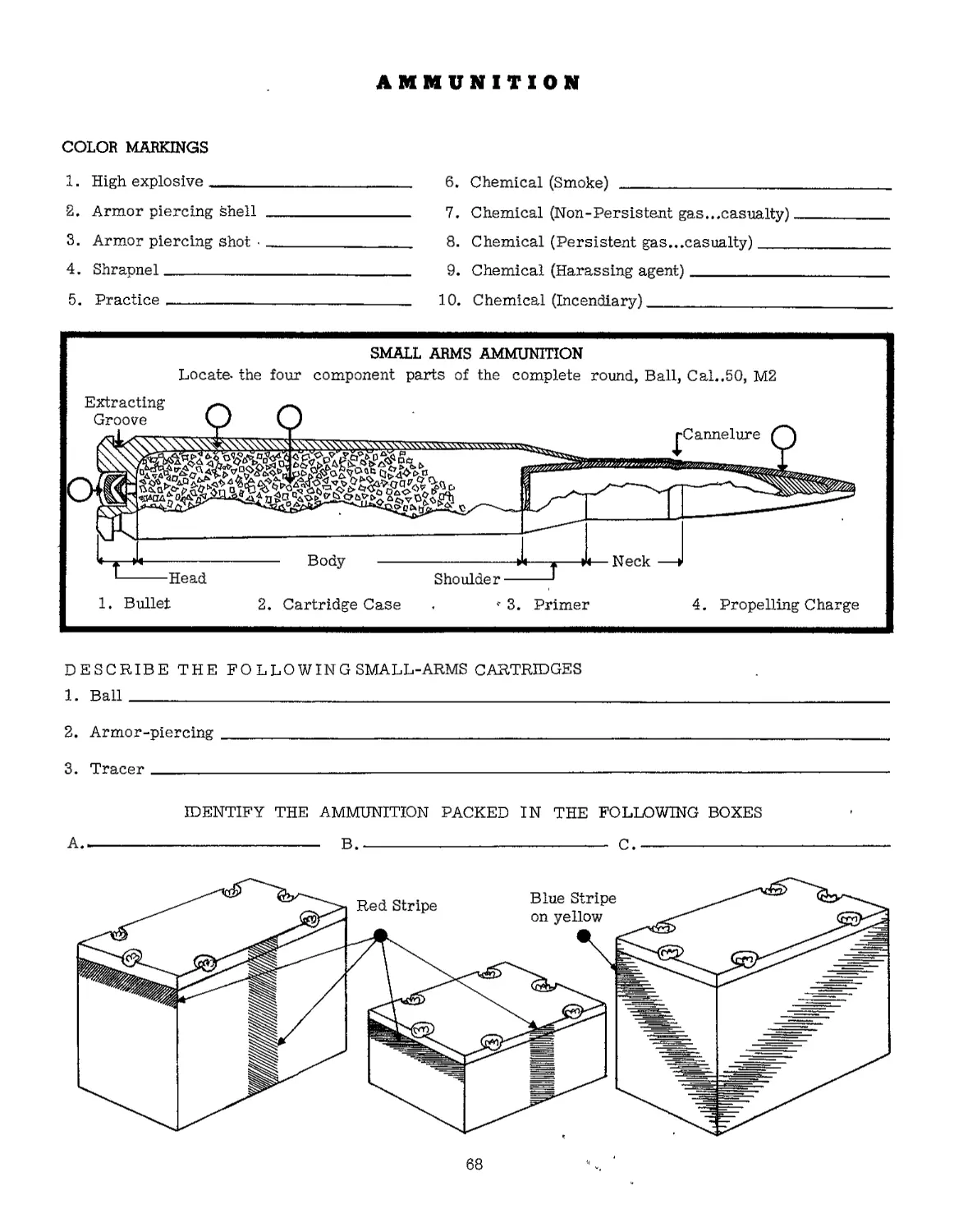
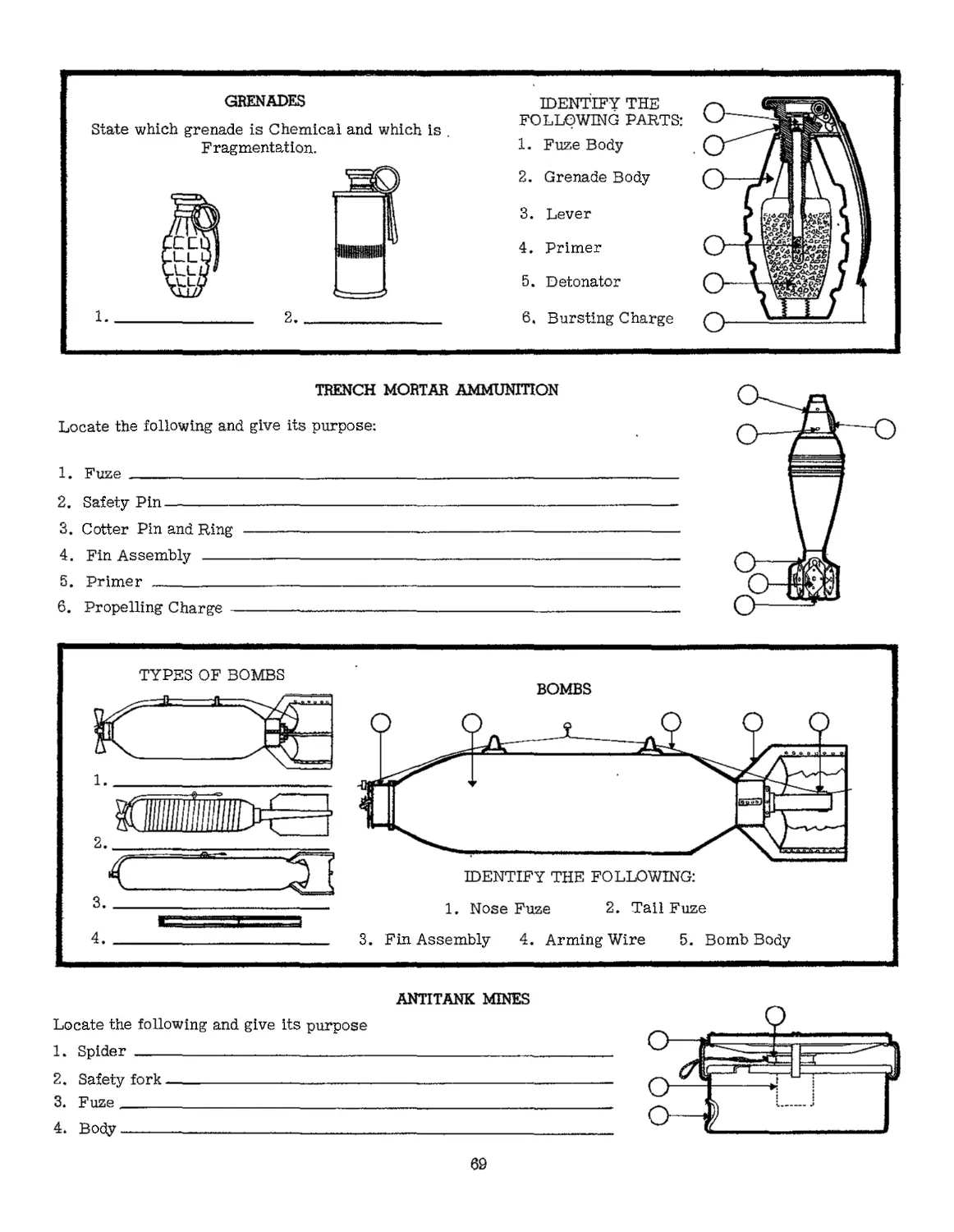
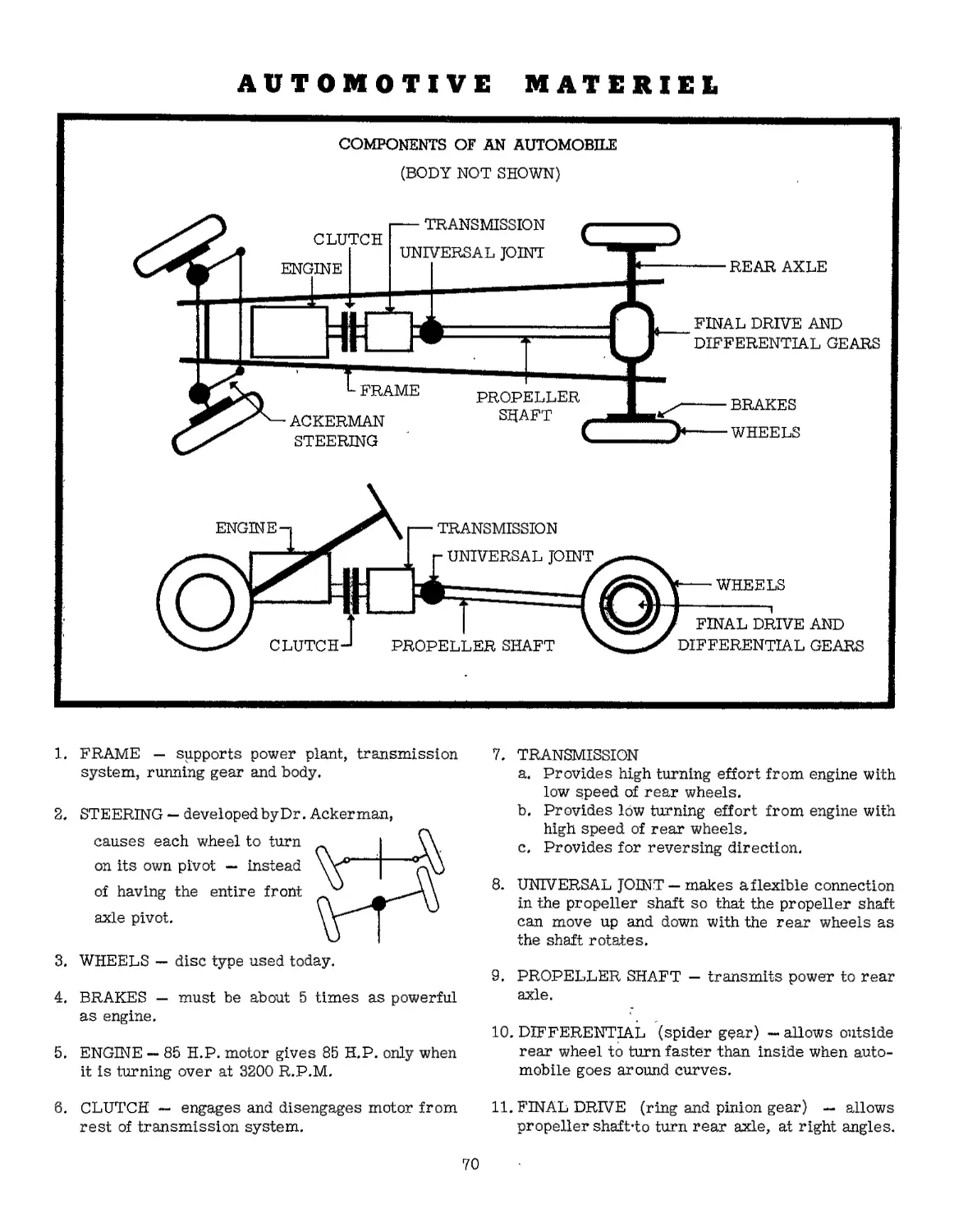
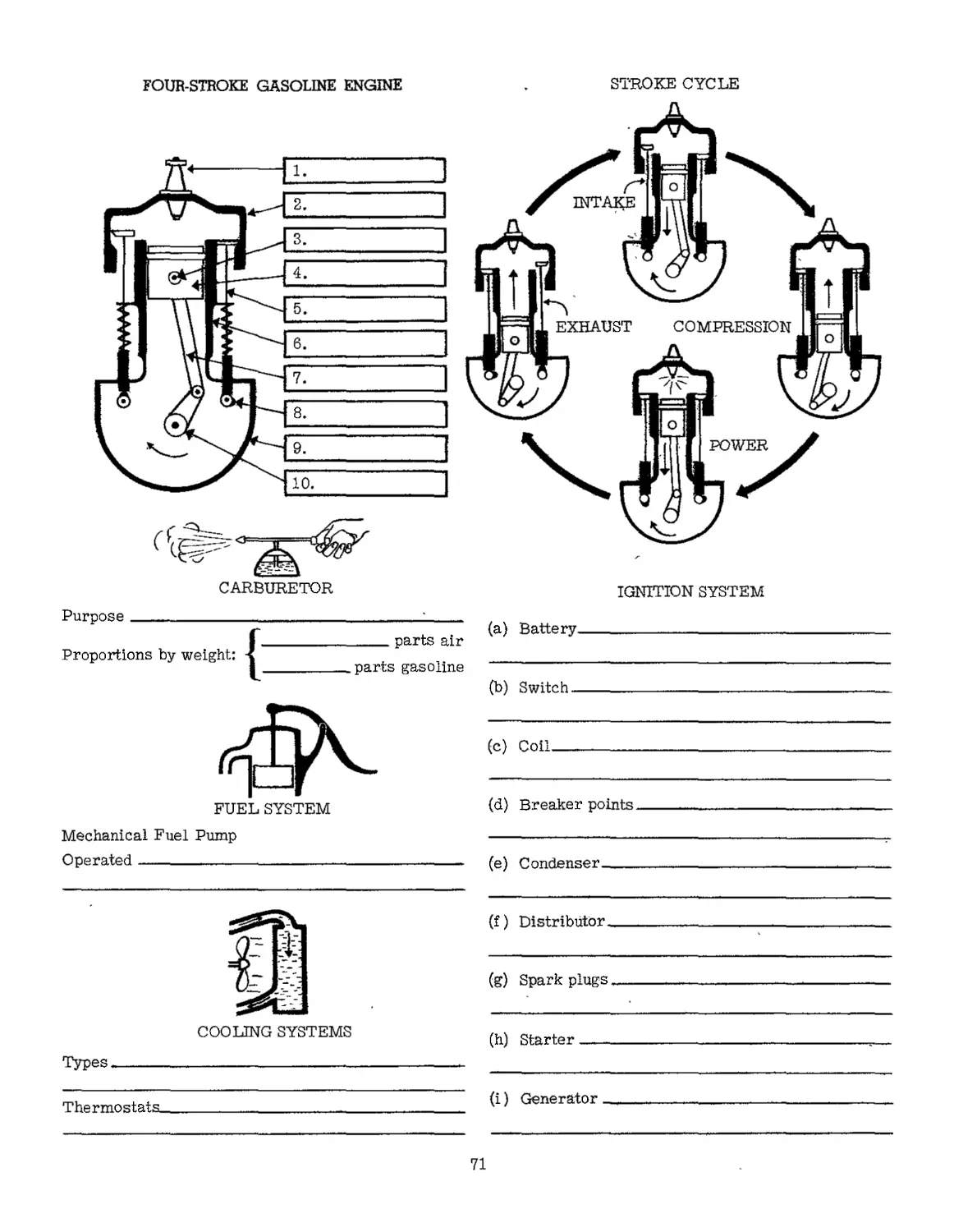
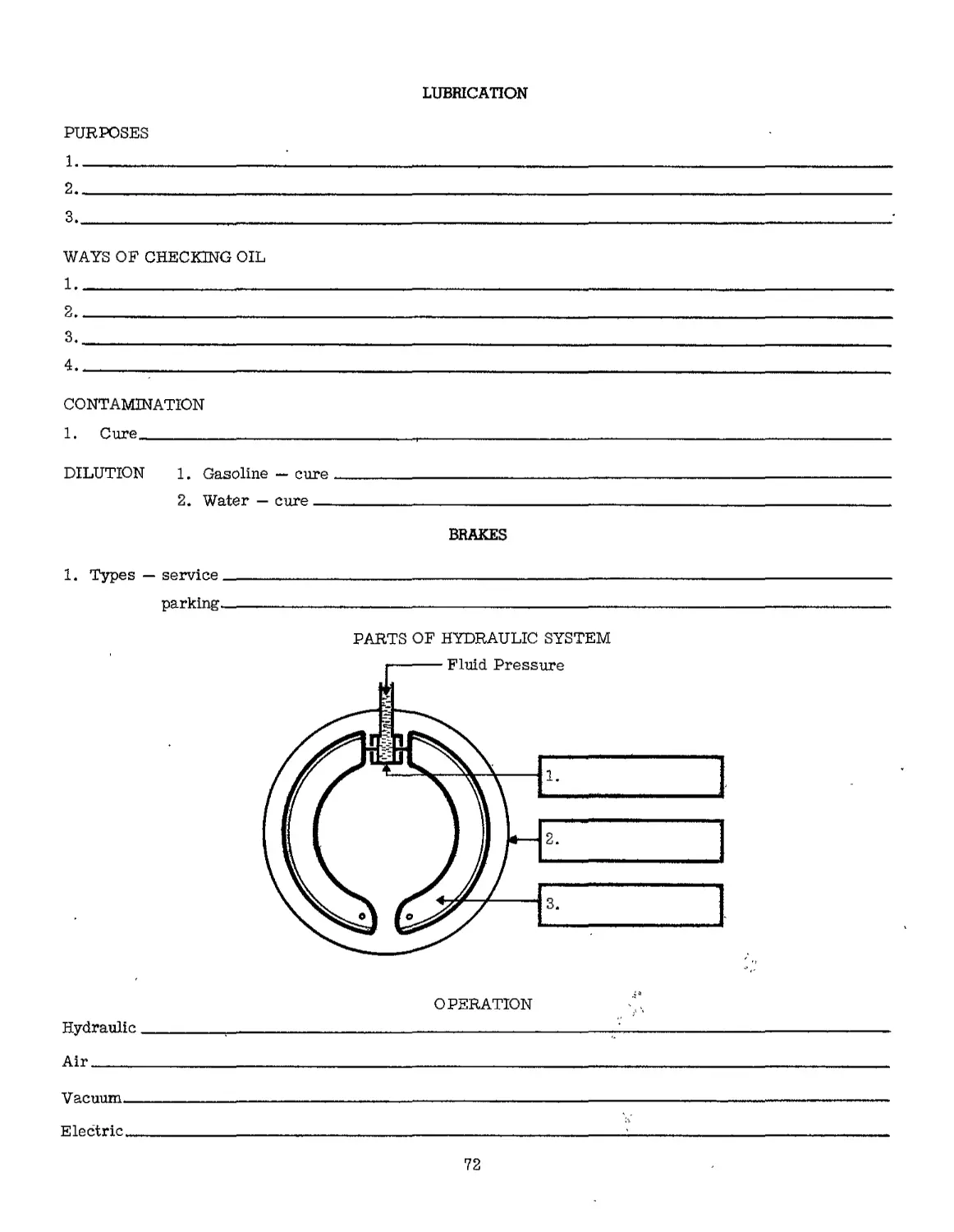
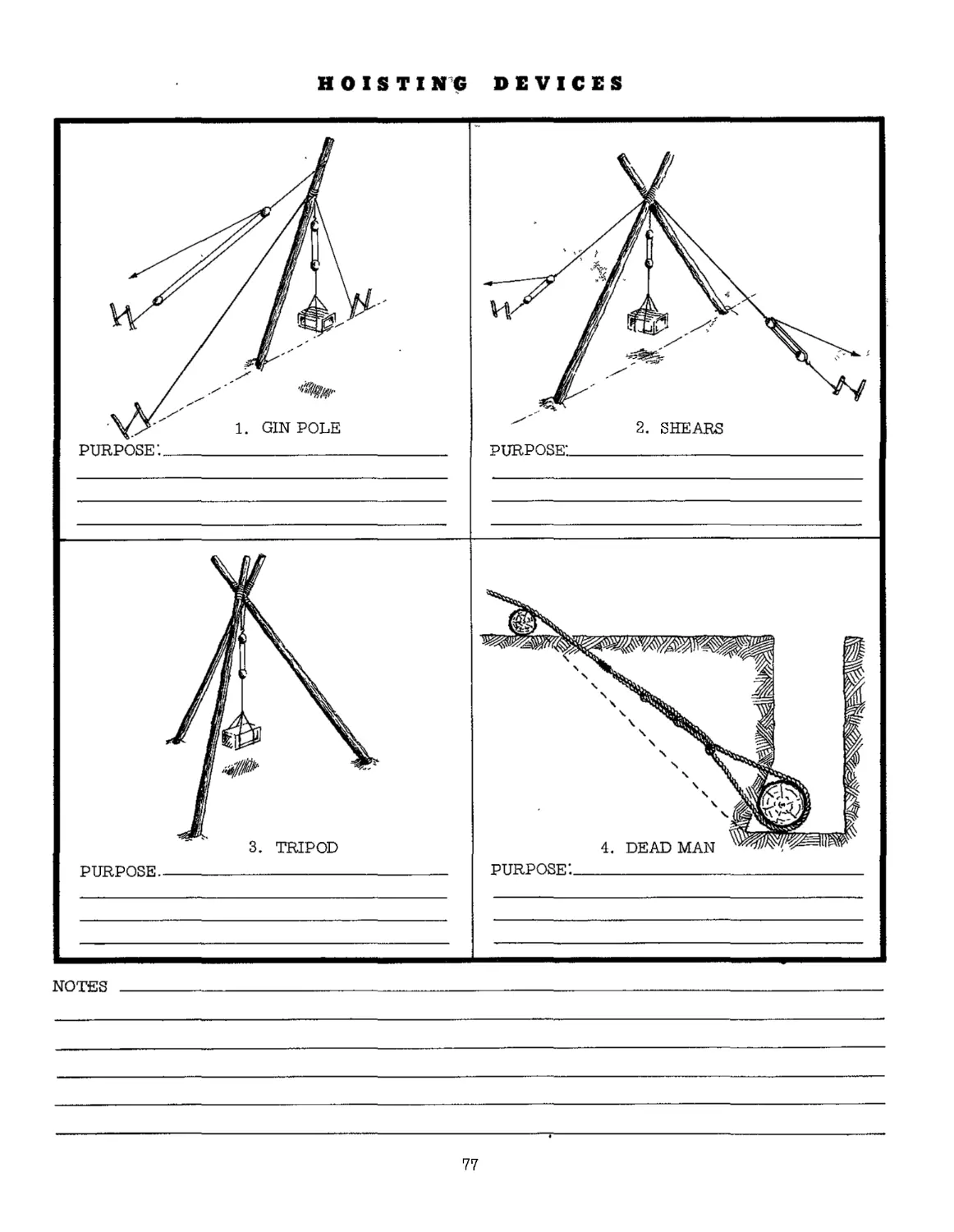
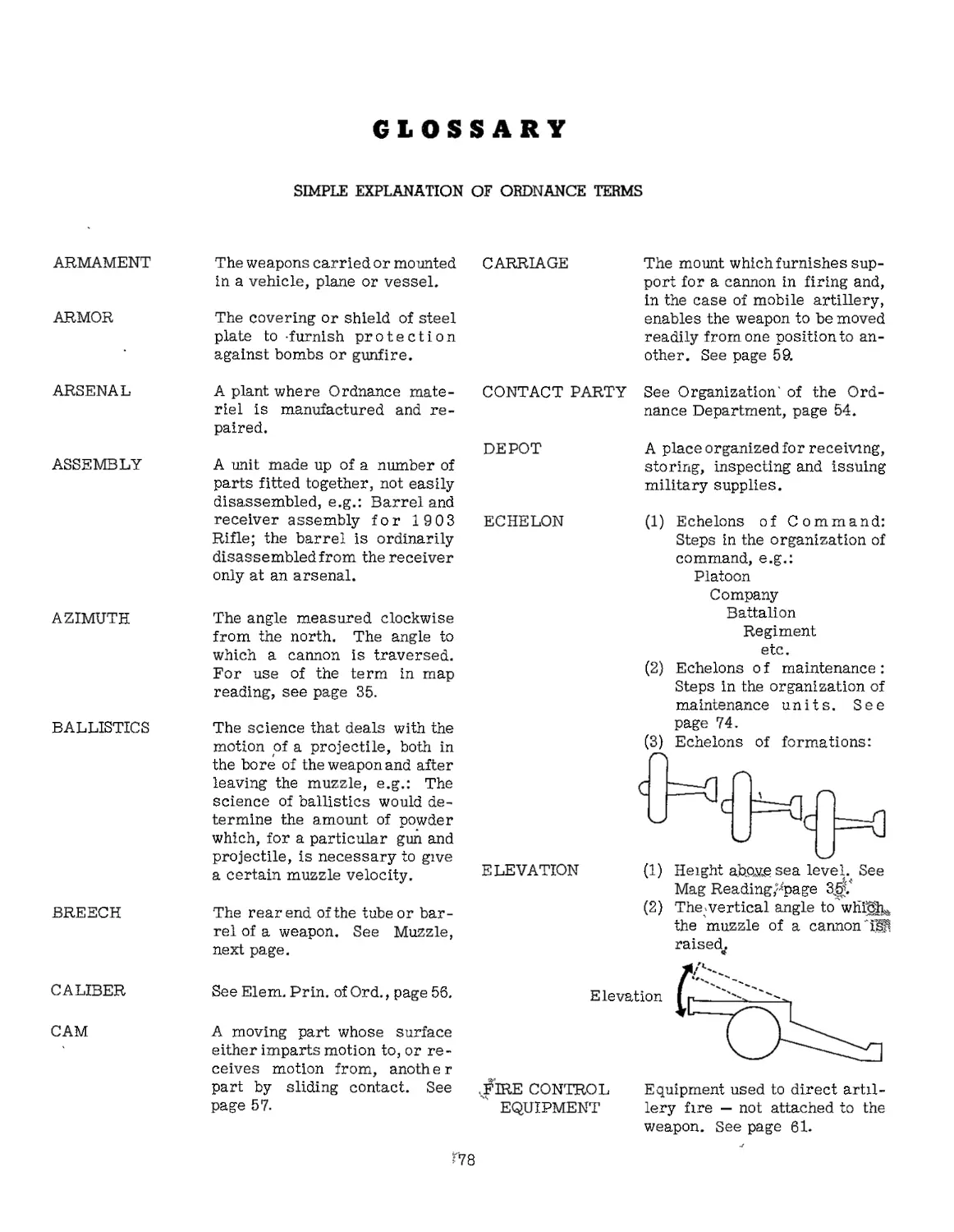
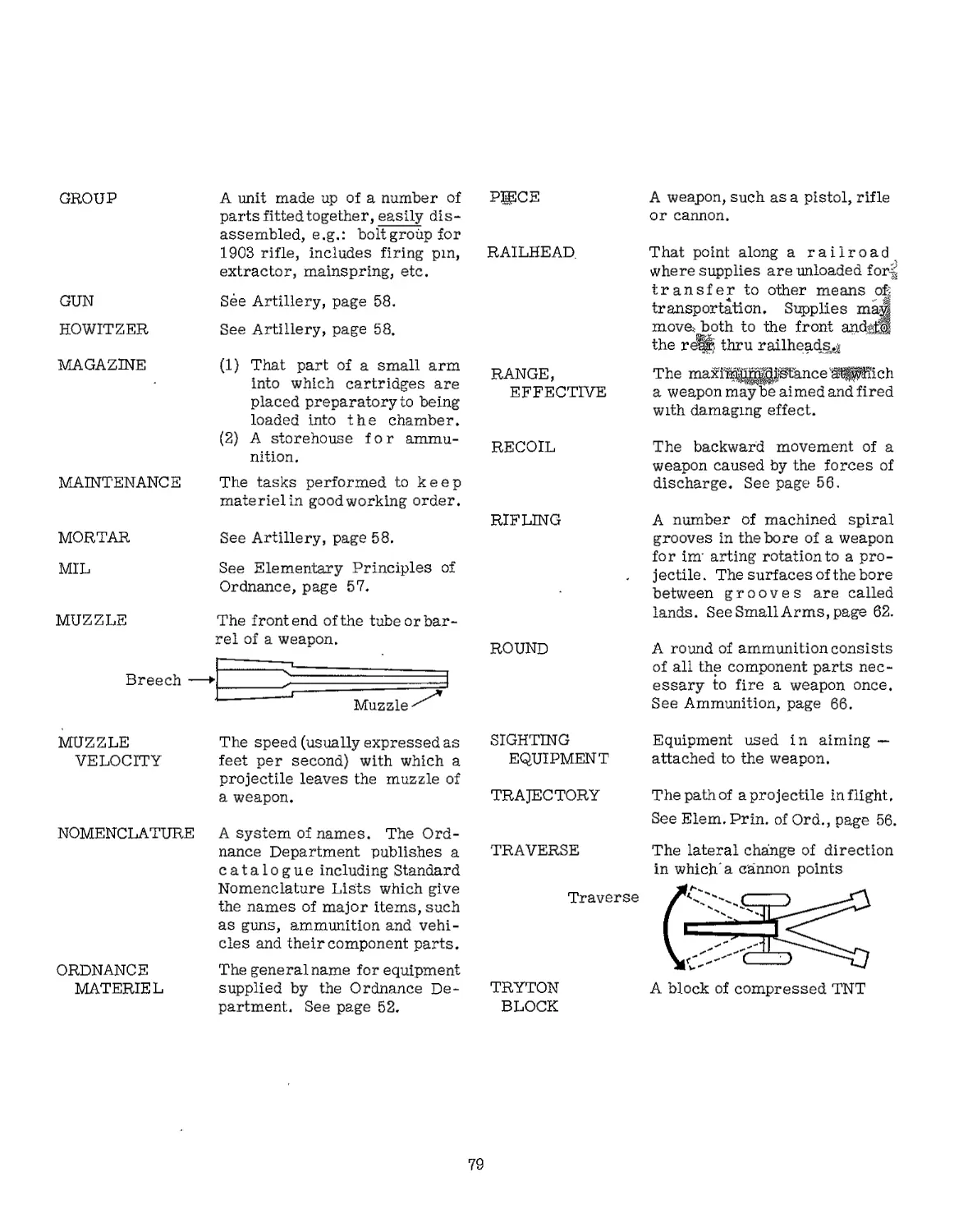
Теги: weapons
Текст
TO THE NEW ORDNANCE SOLDIER
An American soldier can; if necessary, fight without
food or shelter or medical care - -but an army with-
out weaporis is lost. The supply and maintenance of
fighting tools’for the U. S. Army is your responsi-
bility, as an Ordnance Soldier — and that makes
yours a most important mission in the military
service.
Learning howto fulfill this mission isamever-ending
process. It is to help you learn your job that the
ORDNANCE SOLDIER’S GUIDE has been prepared.
It contains practical tips drawn from actual battle^
experience and technical data from the latest Army
publications.
This copy is yours. Take it to all your training
periods. Take notes in it and study them in your
spare time,
INSTRUCTORS NOTE: THE ORDNANCE SOLDIER'S GUIDE is a note taking
aid interided for use by Ordnance Soldiers during their basic training period.
The content of the GUIDE is extracted from pertinent military publications.
Consult FM 21-6 .and current Training Circulars for the latest available in-
formation. In any case where information in the GUIDE is superseded, advise
the Soldier to enter the correction.
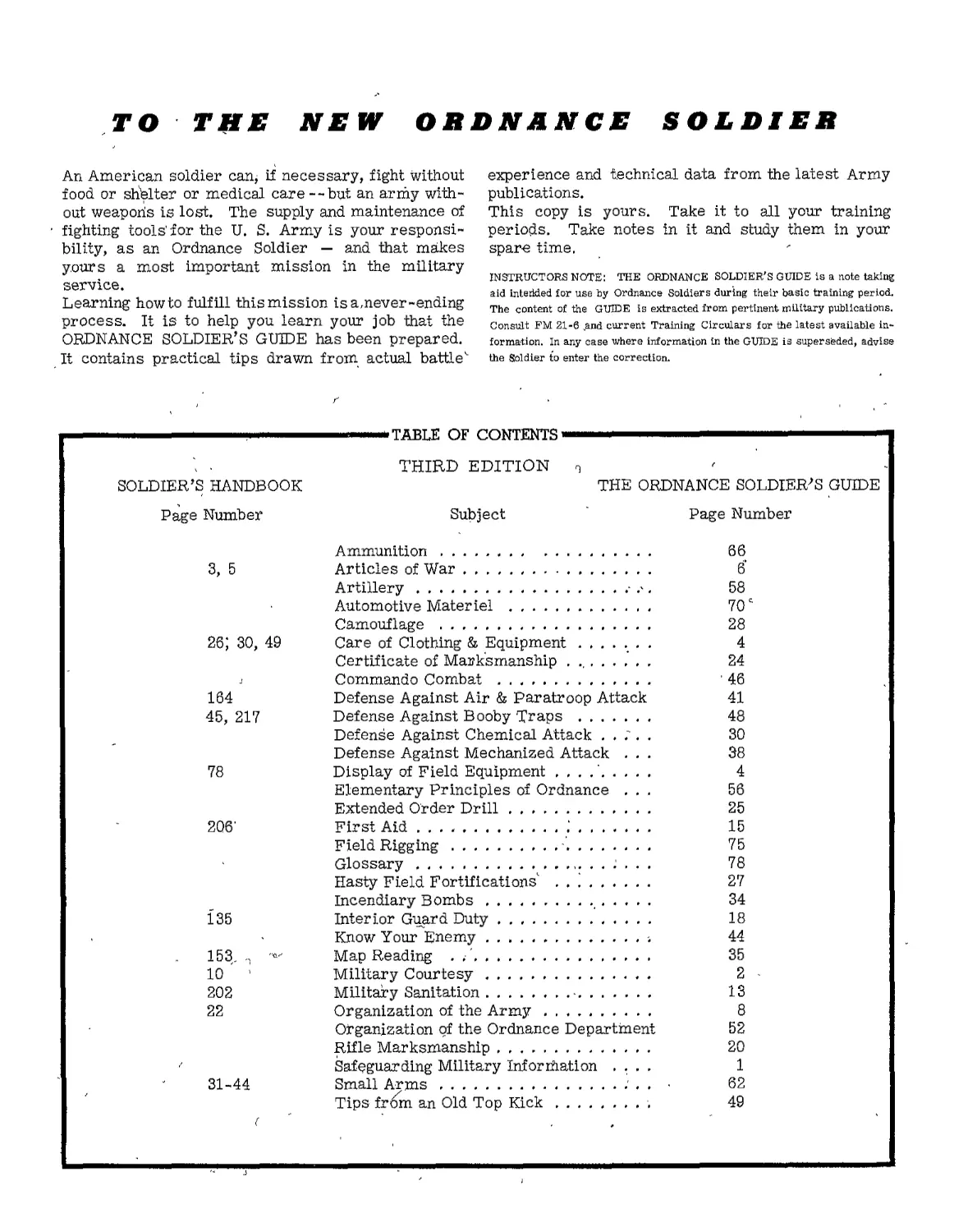
TABLE OF CONTENTS
THIRD EDITION n
THE ORDNANCE SOLDIER'S GUIDE
SOLDIER’S HANDBOOK
Page Number
3, 5
26; 30, 49
164
45, 217
78
206’
135
153. ..
10	'
202
22
31-44
Subject	'	Page Number
Ammunition................................... 66
Articles of War..............................  6
Artillery......................... .	58
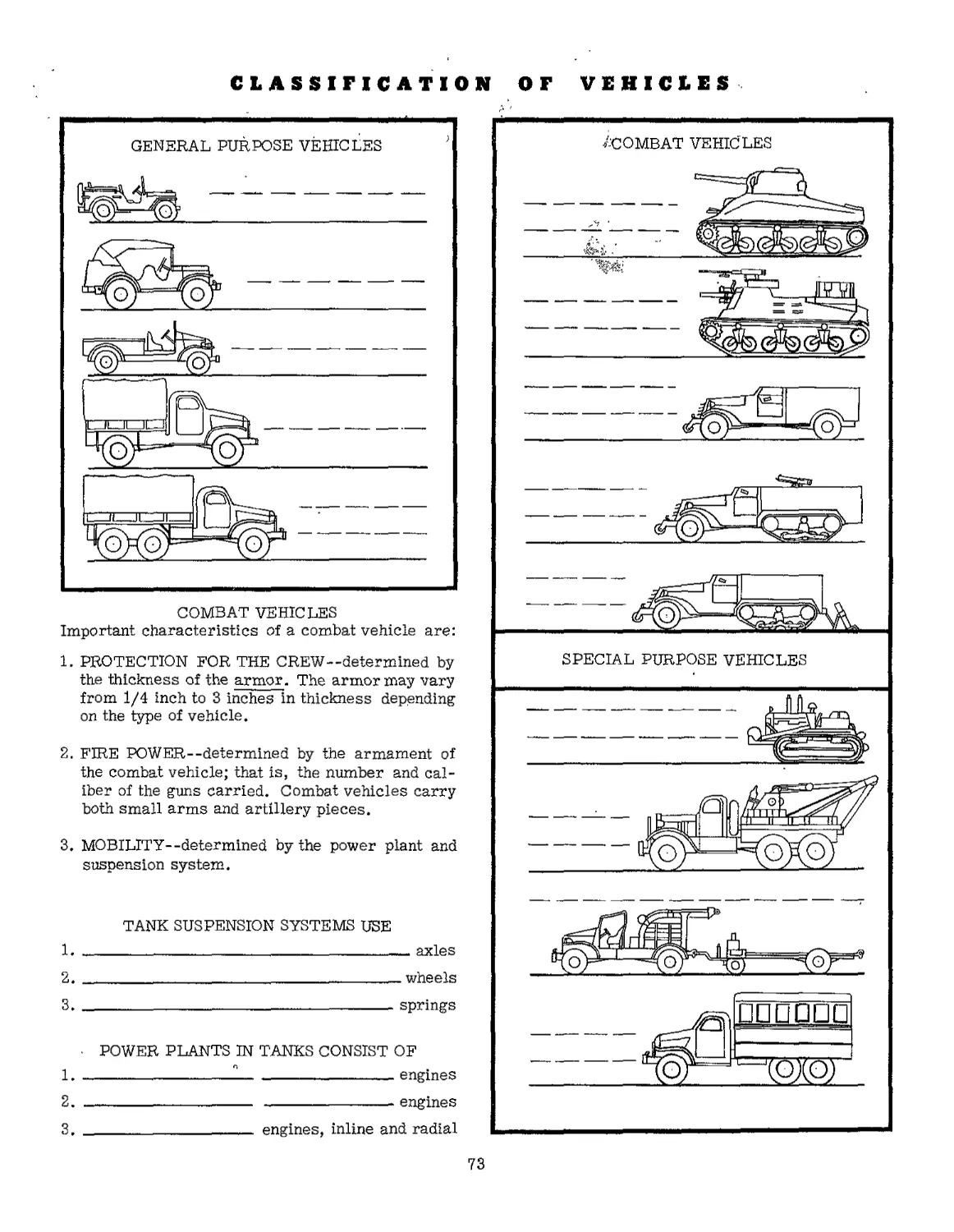
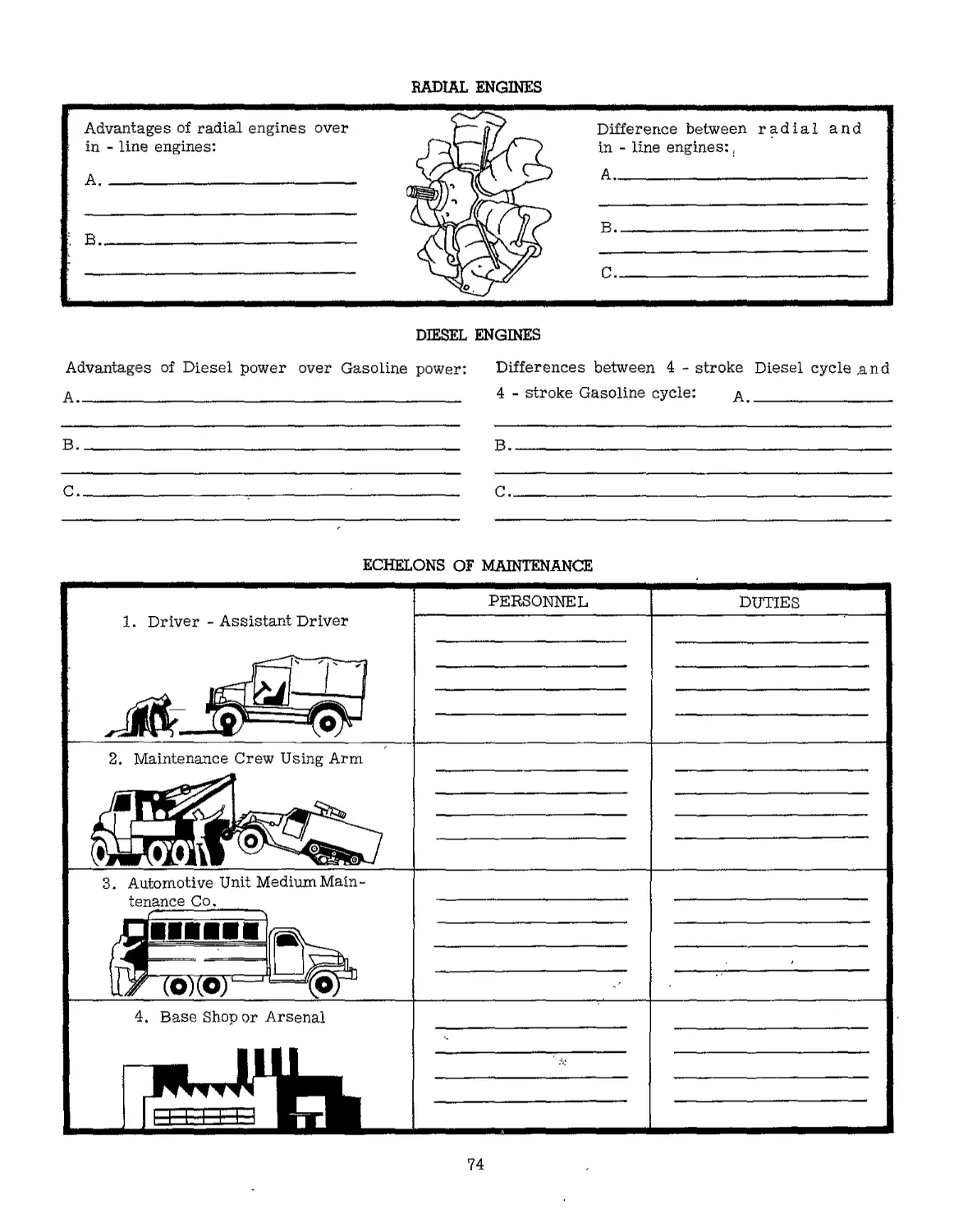
Automotive Materiel ......................... 70c
Camouflage ................................. 28
Care of Clothing & Equipment....... 4
Certificate of Marksmanship , .............. 24
Commando Combat ........................... ’46
Defense Against Air & Paratroop Attack	41
Defense Against Booby Traps ................ 48
Defense Against Chemical Attack	30
Defense Against Mechanized Attack	...	38
Display of Field Equipment . , . . ‘......... 4
Elementary Principles of Ordnance	...	56
Extended Order Drill.............. 25
First Aid .................................  15
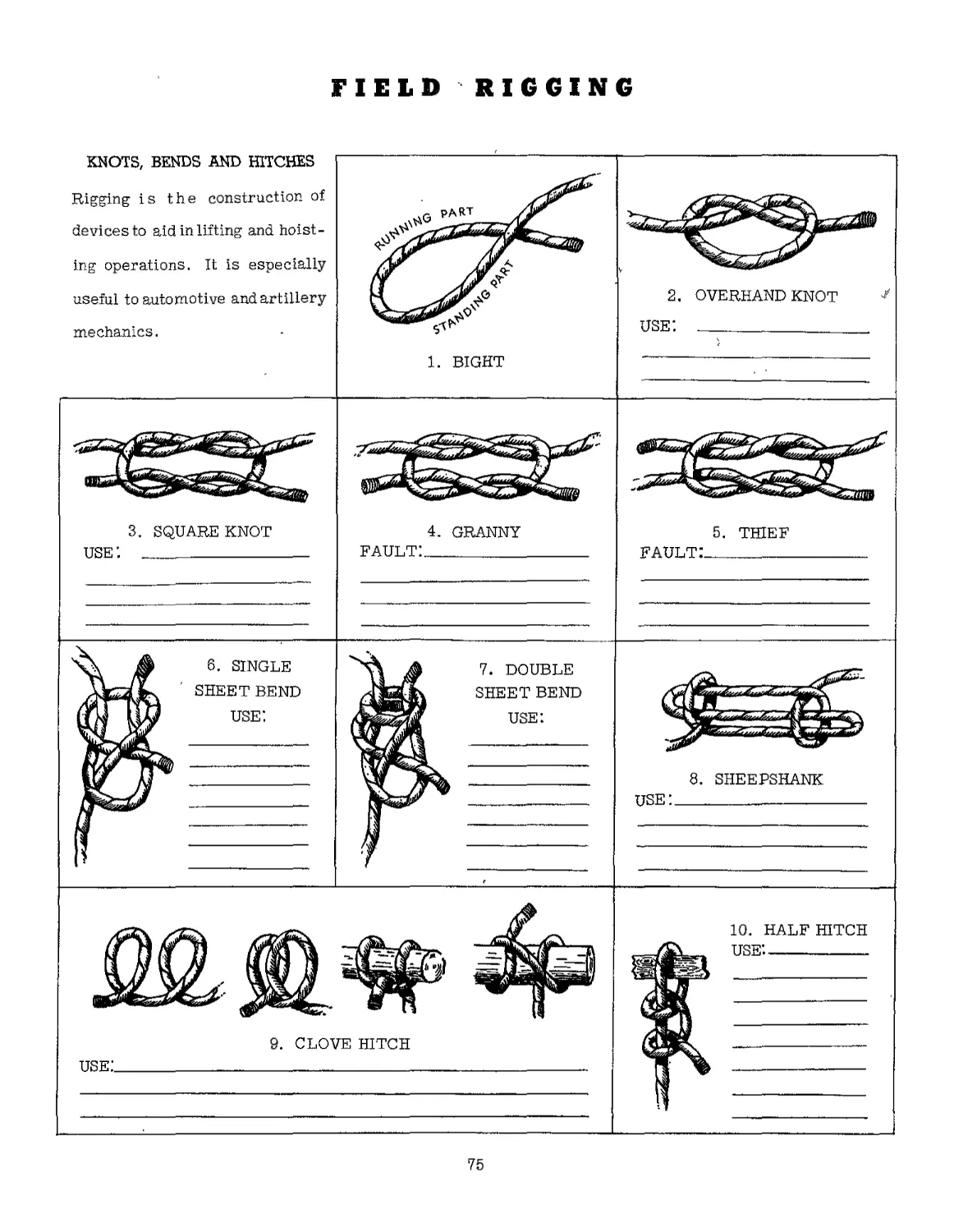
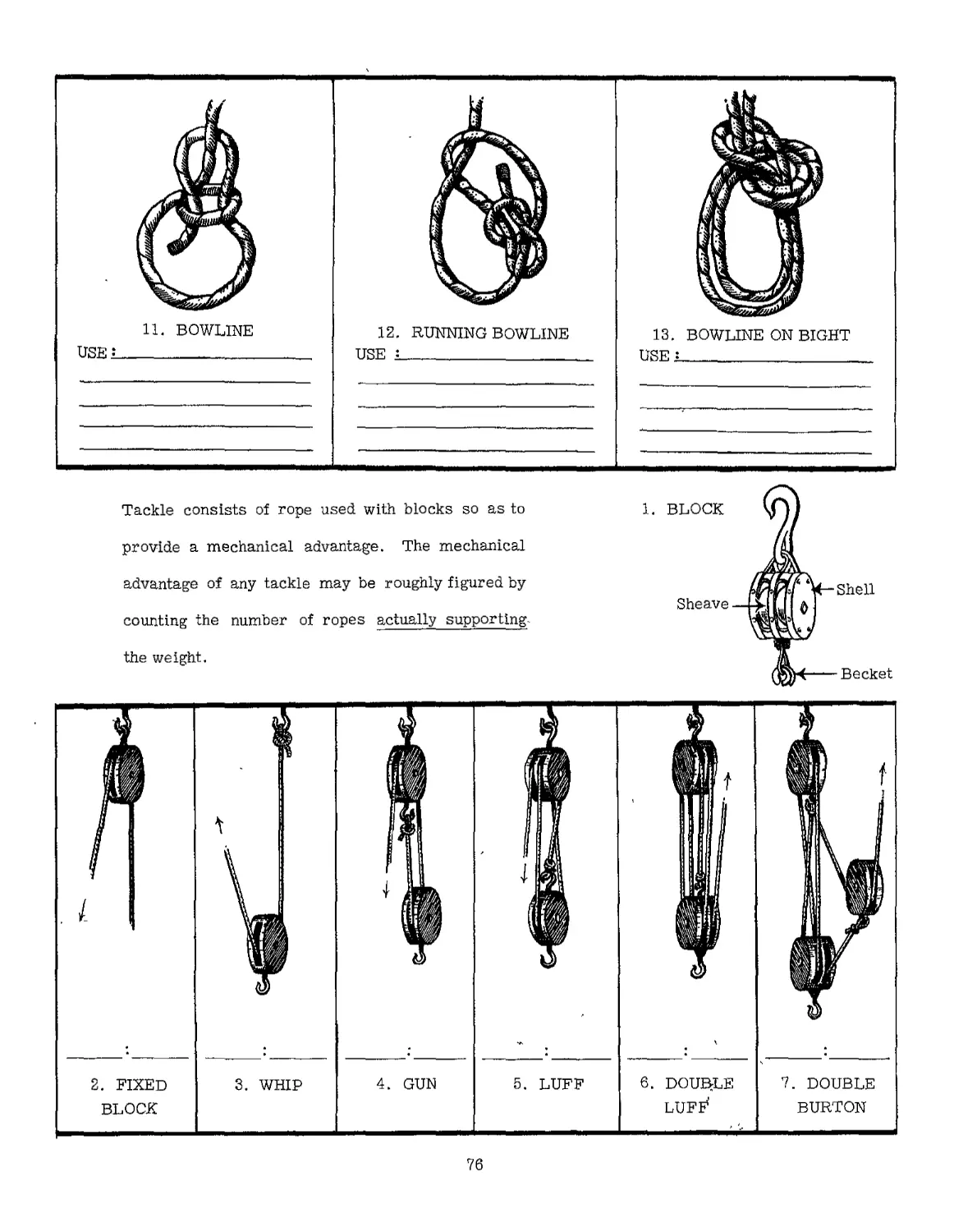
Field Rigging.............-................. 75
Glossary......................: . . .	78
Hasty Field Fortifications ................. 27
Incendiary Bombs...........................  34
Interior Guard Duty......................... 18
Know Your Enemy......................	44
Map Reading . .............. . .	35
Military Courtesy.................. 2	-
Military Sanitation.......•................. 13
Organization of the Army........... 8
Organization of the Ordnance Department	52
Rifle Marksmanship................ 20
Safeguarding Military Information	....	1
Small Arms..........................  	62
Tips from an Old Top Kick............. 49
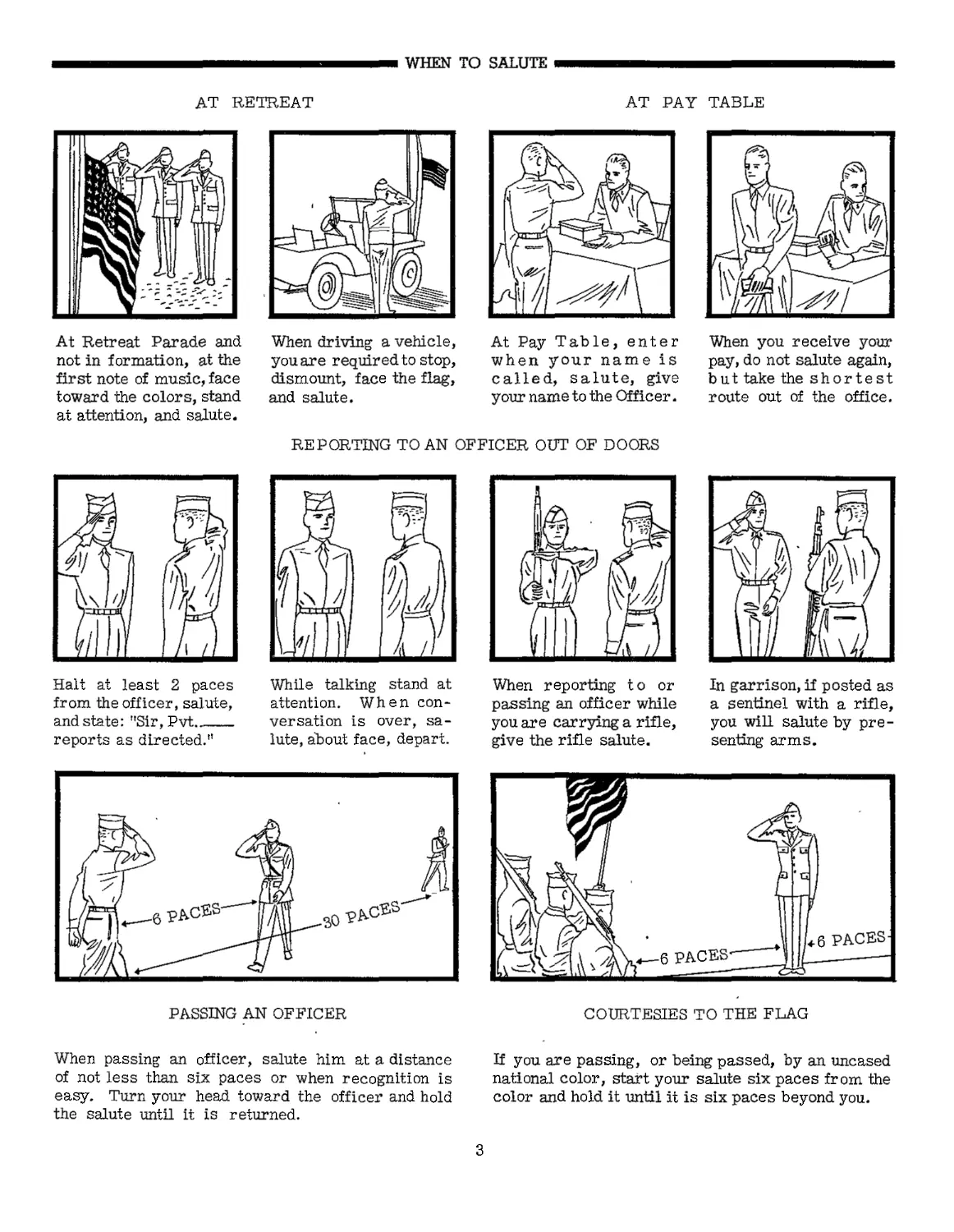
WHEN TO SALUTE
AT RETREAT
AT PAY TABLE
At Retreat Parade and
not in formation, at the
first note of music, face
toward the colors, stand
at attention, and salute.
When driving a vehicle,
you are required to stop,
dismount, face the flag,
and salute.
At Pay Table, enter
when your name is
called, salute, give
your name to the Officer.
When you receive your
pay, do not salute again,
but take the shortest
route out of the office.
REPORTING TO AN OFFICER OUT OF DOORS
Halt at least 2 paces
from the officer, salute,
and state: "Sir, Pvt_____
reports as directed."
While talking stand at
attention. When con-
versation is over, sa-
lute, about face, depart.
When reporting to or
passing an officer while
you are carrying a rifle,
give the rifle salute.
In garrison, if posted as
a sentinel with a rifle,
you will salute by pre-
senting arms.
PASSING AN OFFICER
COURTESIES TO THE FLAG
When passing an officer, salute him at a distance
of not less than six paces or when recognition is
easy. Turn your head toward the officer and hold
the salute until it is returned.
If you are passing, or being passed, by an uncased
national color, start your salute six paces from the
color and hold it until it is six paces beyond you.
3
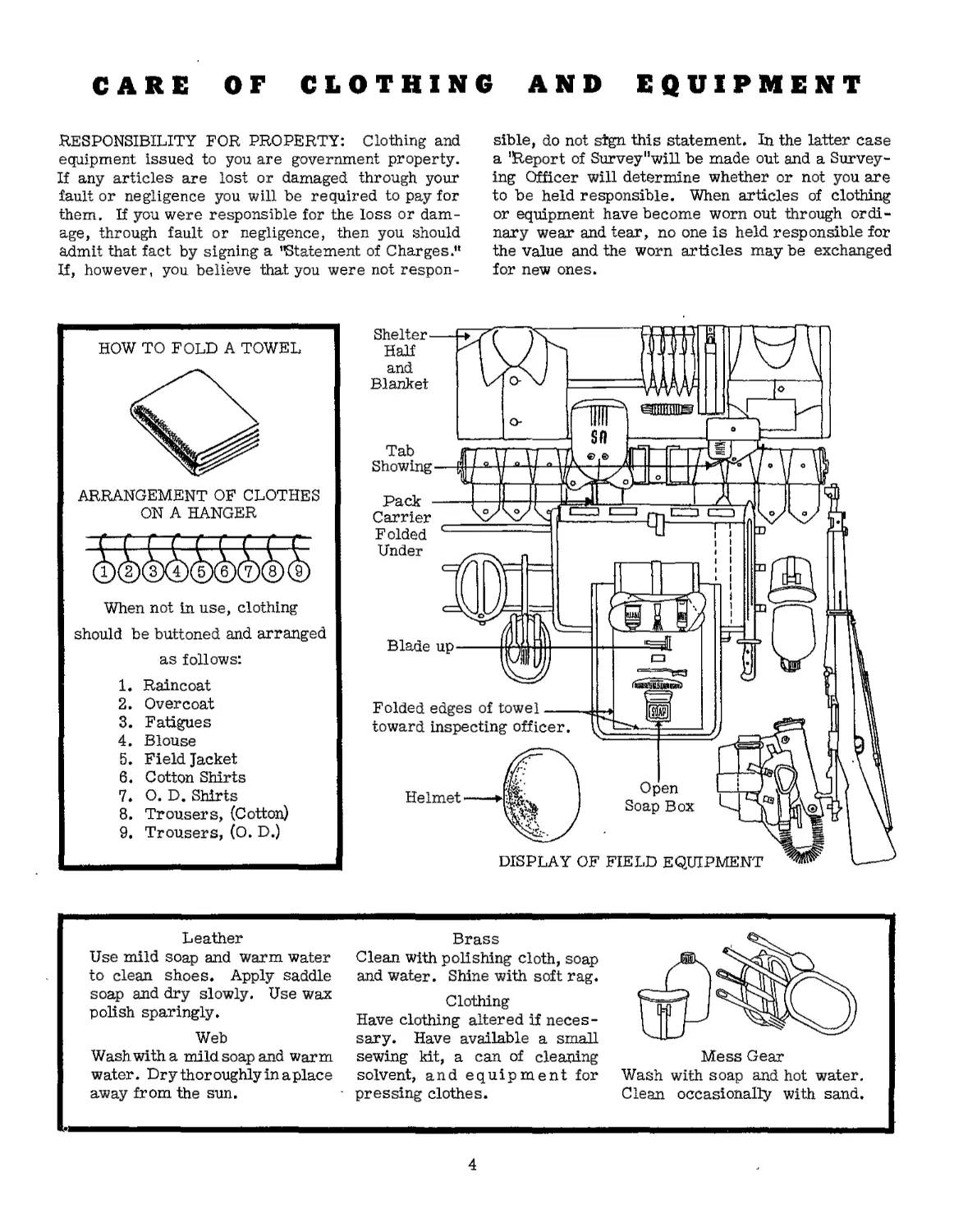
CARE OF CLOTHING AND EQUIPMENT
RESPONSIBILITY FOR PROPERTY: Clothing and
equipment issued to you are government property.
If any articles are lost or damaged through your
fault or negligence you will be required to pay for
them. If you were responsible for the loss or dam-
age, through fault or negligence, then you should
admit that fact by signing a 'Statement of Charges."
If, however, you believe that you were not respon-
sible, do not sign this statement. In the latter case
a 'Report of Survey"will be made out and a Survey-
ing Officer will determine whether or not you are
to be held responsible. When articles of clothing
or equipment have become worn out through ordi-
nary wear and tear, no one is held responsible for
the value and the worn articles may be exchanged
for new ones.
HOW TO FOLD A TOWEL
When not in use, clothing
should be buttoned and arranged
as follows:
1.	Raincoat
2.	Overcoat
3.	Fatigues
4.	Blouse
5.	Field Jacket
6.	Cotton Shirts
7.	O. D. Shirts
8.	Trousers, (Cotton)
9.	Trousers, (O. D.)
Blade up
Helmet
Pack
Carrier
Folded
Under
Tab
Showing
Shelter.
Half
and
Blanket
DISPLAY OF FIELD EQUIPMENT
Open
Soap Box
Folded edges of towel----
toward inspecting officer.
Leather
Use mild soap and warm water
to clean shoes. Apply saddle
soap and dry slowly. Use wax
polish sparingly.
Web
Wash with a mild soap and warm
water. Dry thoroughly in aplace
away from the sun.
Brass
Clean with polishing cloth, soap
and water. Shine with soft rag.
Clothing
Have clothing altered if neces-
sary. Have available a small
sewing kit, a can of cleaning
solvent, and equipment for
pressing clothes.
Mess Gear
Wash with soap and hot water.
Clean occasionally with sand.
4
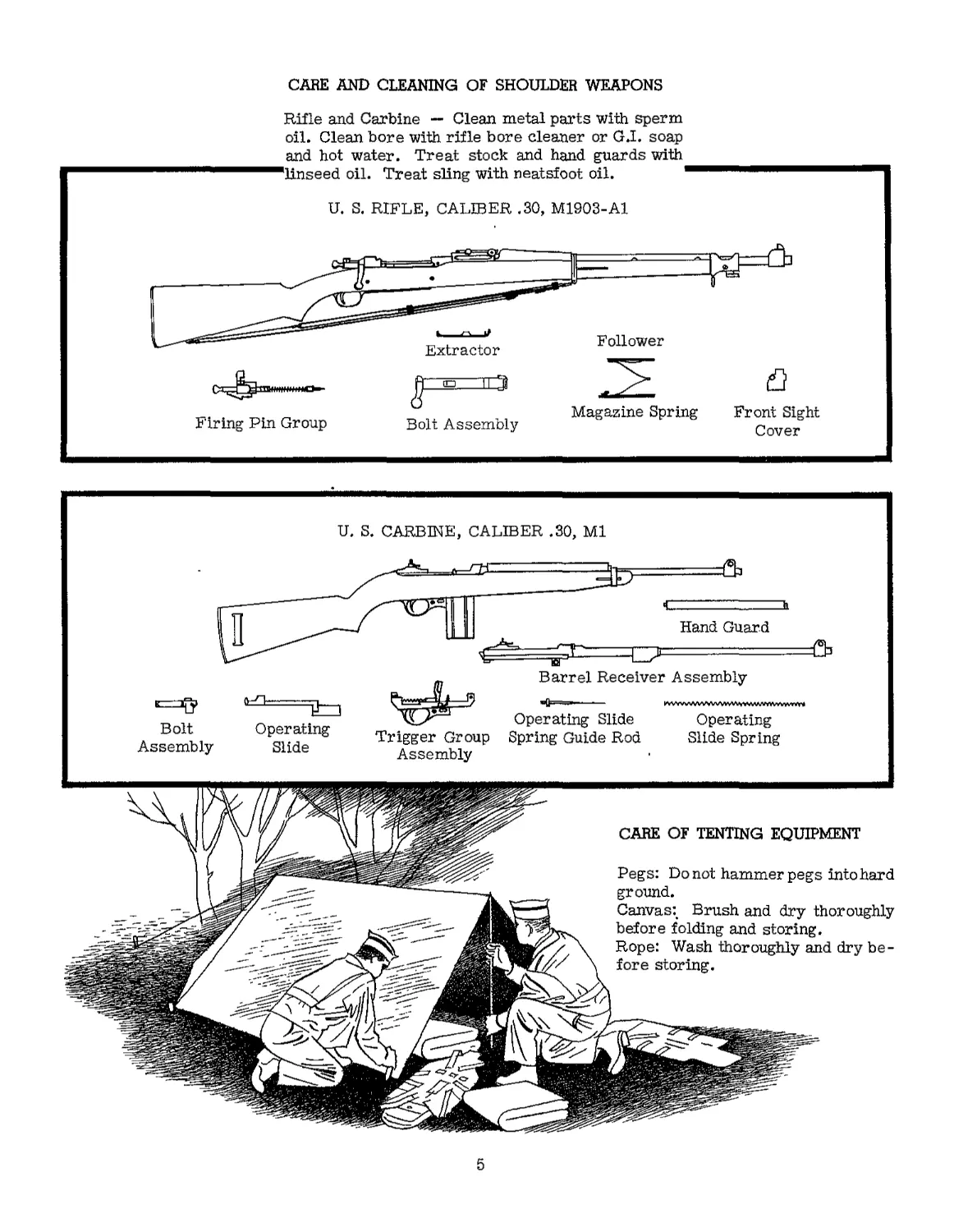
CARE AND CLEANING OF SHOULDER WEAPONS
Rifle and Carbine — Clean metal parts with sperm
oil. Clean bore with rifle bore cleaner or G.I. soap
U. S. CARBINE, CALIBER .30, Ml
Hand Guard
Barrel Receiver Assembly
Bolt
Assembly
Operating
Slide
Trigger Group
Assembly
Operating Slide
Spring Guide Rod
Operating
Slide Spring
CARE OF TENTING EQUIPMENT
Pegs: Do not hammer pegs intohard
ground.
Canvas; Brush and dry thoroughly
before folding and storing.
Rope: Wash thoroughly and dry be-
fore storing.
5
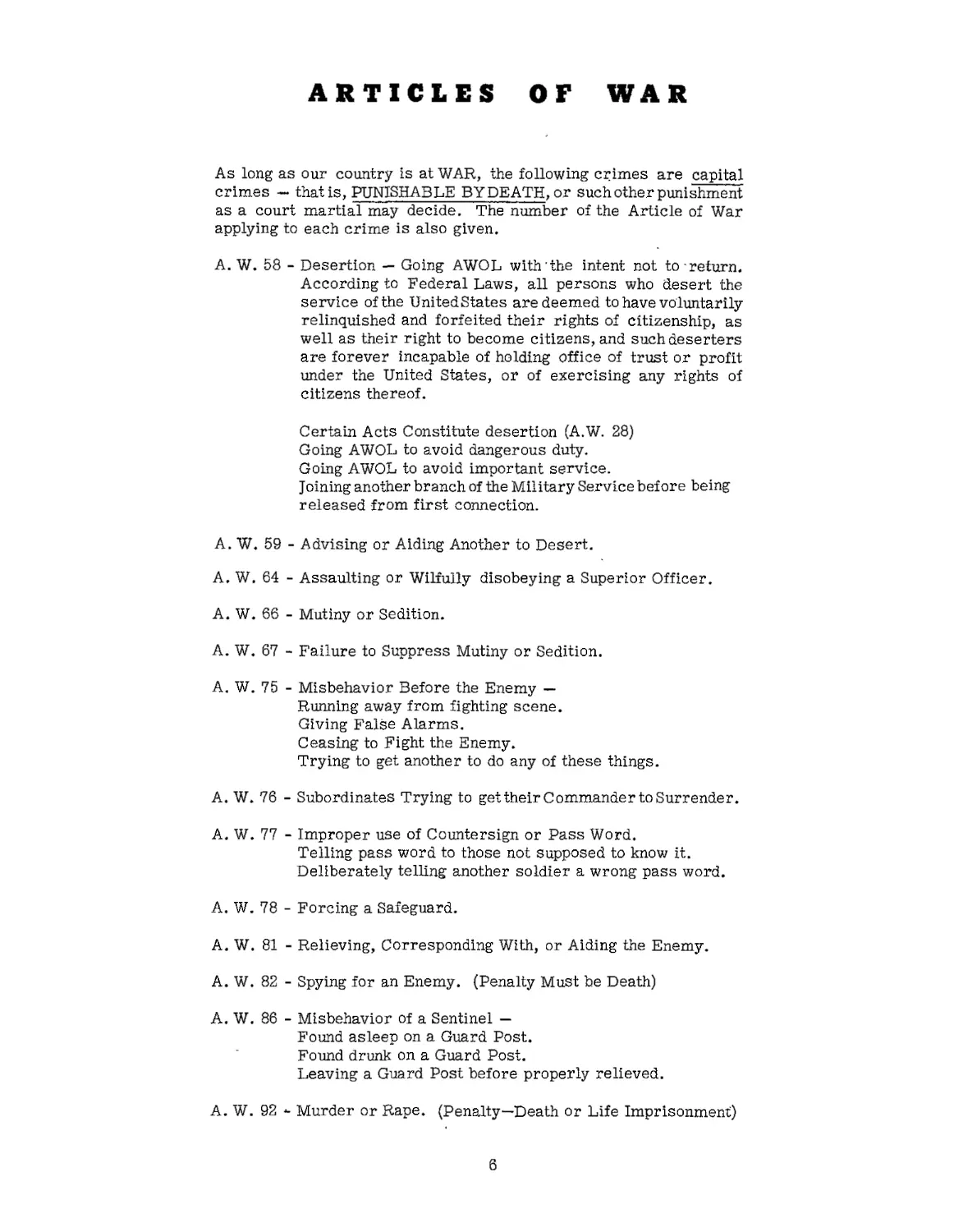
ARTICLES OF WAR
As long as our country is at WAR, the following crimes are capital
crimes — that is, PUNISHABLE BY DEATH, or such other punishment
as a court martial may decide. The number of the Article of War
applying to each crime is also given.
A. W. 58 - Desertion — Going AWOL with’the intent not to'return.
According to Federal Laws, all persons who desert the
service of the UnitedStates are deemed to have voluntarily
relinquished and forfeited their rights of citizenship, as
well as their right to become citizens, and such deserters
are forever incapable of holding office of trust or profit
under the United States, or of exercising any rights of
citizens thereof.
Certain Acts Constitute desertion (A.W. 28)
Going AWOL to avoid dangerous duty.
Going AWOL to avoid important service.
Joining another branch of the Military Service before being
released from first connection.
A. W. 59 - Advising or Aiding Another to Desert.
A. W. 64 - Assaulting or Wilfully disobeying a Superior Officer.
A. W. 66 - Mutiny or Sedition.
A. W. 67 - Failure to Suppress Mutiny or Sedition.
A. W. 75 - Misbehavior Before the Enemy —
Running away from fighting scene.
Giving False Alarms.
Ceasing to Fight the Enemy.
Trying to get another to do any of these things.
A. W. 76 - Subordinates Trying to get their Commander to Surrender.
A. W. 77 - Improper use of Countersign or Pass Word.
Telling pass word to those not supposed to know it.
Deliberately telling another soldier a wrong pass word.
A. W. 78 - Forcing a Safeguard.
A. W. 81 - Relieving, Corresponding With, or Aiding the Enemy.
A. W. 82 - Spying for an Enemy. (Penalty Must be Death)
A. W. 86 - Misbehavior of a Sentinel —
Found asleep on a Guard Post.
Found drunk on a Guard Post.
Leaving a Guard Post before properly relieved.
A. W. 92 * Murder or Rape. (Penalty—Death or Life Imprisonment)
6
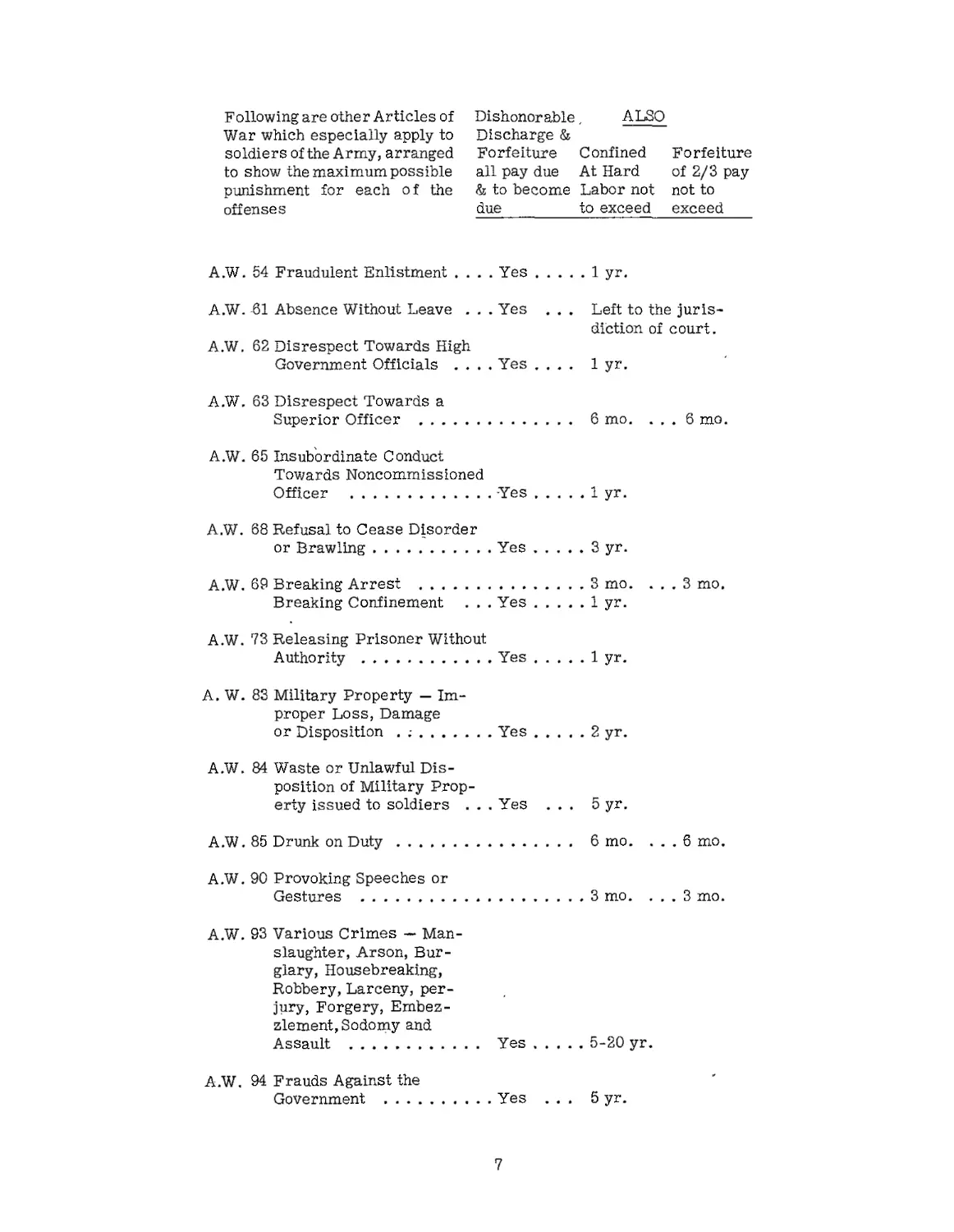
Following are other Articles of
War which especially apply to
soldiers of the Army, arranged
to show the maximum possible
punishment for each of the
offenses
Dishonorable, ALSO
Discharge &
Forfeiture Confined Forfeiture
all pay due At Hard of 2/3 pay
& to become Labor not not to
due to exceed exceed
A.W. 54 Fraudulent Enlistment .... Yes.......1 yr.
A.W. -61 Absence Without Leave . . . Yes . . .
A.W, 62 Disrespect Towards High
Government Officials .... Yes . . . .
Left to the juris-
diction of court.
1 yr.
A.W. 63 Disrespect Towards a
Superior Officer ............................ 6	mo. ... 6 mo.
A.W. 65 Insubordinate Conduct
Towards Noncommissioned
Officer ................  Yes.......1 yr.
A.W. 68 Refusal to Cease Disorder
or Brawling...............Yes.......3 yr.
A.W. 69 Breaking Arrest ....................3	mo. ... 3 mo.
Breaking Confinement . . . Yes......1 yr.
A.W. 73 Releasing Prisoner Without
Authority . ........................Yes.......1 yr.
A. W. 83 Military Property — Im-
proper Loss, Damage
or Disposition . ; ....... Yes.................2 yr.
A.W. 84 Waste or Unlawful Dis-
position of Military Prop-
erty issued to soldiers . . . Yes ... 5 yr.
A.W. 85 Drunk on Duty..................   6	mo. ... 6 mo.
A.W. 90 Provoking Speeches or
Gestures .............................3	mo. ... 3 mo.
A.W. 93 Various Crimes — Man-
slaughter, Arson, Bur-
glary, Housebreaking,
Robbery, Larceny, per-
jury, Forgery, Embez-
zlement, Sodomy and
Assault ......................... Yes......5-20 yr.
A.W. 94 Frauds Against the
Government ......................Yes ... 5 yr.
7
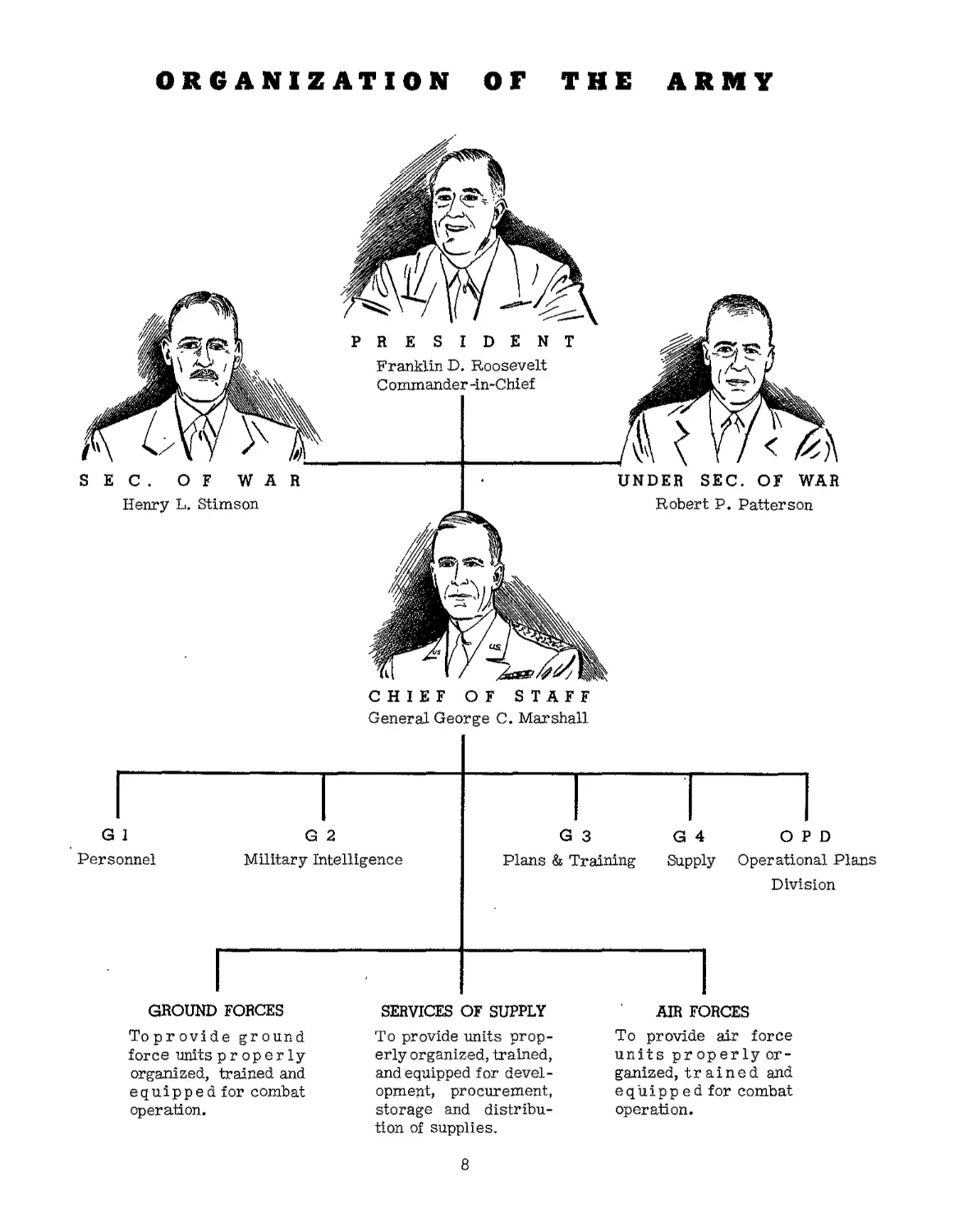
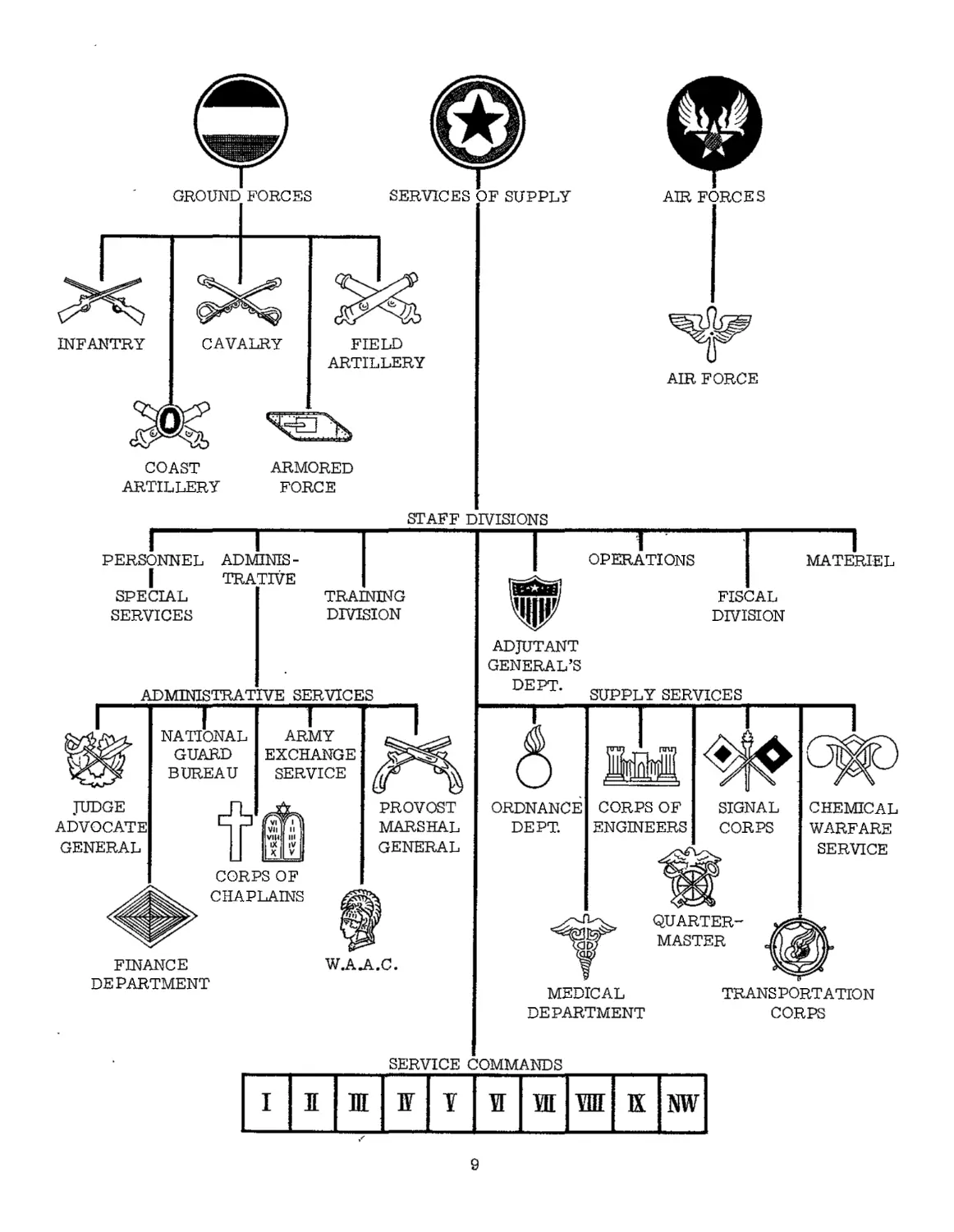
ORGANIZATION OF THE ARMY
CHIEF OF STAFF
Toprovide ground
force units properly
organized, trained and
equipped for combat
operation.
To provide units prop-
erly organized, trained,
and equipped for devel-
opment, procurement,
storage and distribu-
tion of supplies.
To provide air force
units properlyor-
ganized, trained and
equipped for combat
operation.
8
INFANTRY
AIR FORCES
FIELD
ARTILLERY
COAST
ARTILLERY
ARMORED
FORCE
STAFF DIVISIONS
PERSONNEL ADMINIS-
| TRATIVE
SPECIAL	TRAINING
SERVICES	DIVISION
—1—
OPERATIONS
MATERIEL
FISCAL
DIVISION
ADMINISTRATIVE SERVICES
FINANCE	W.A.A.C.
DEPARTMENT
ADJUTANT
GENERAL’S
DEPT. supply SERVICES
MEDICAL	TRANSPORTATION
DEPARTMENT
CORPS
SERVICE COMMANDS
I	1	Ш	IF	I	я	VII	Ш	IX	w
9
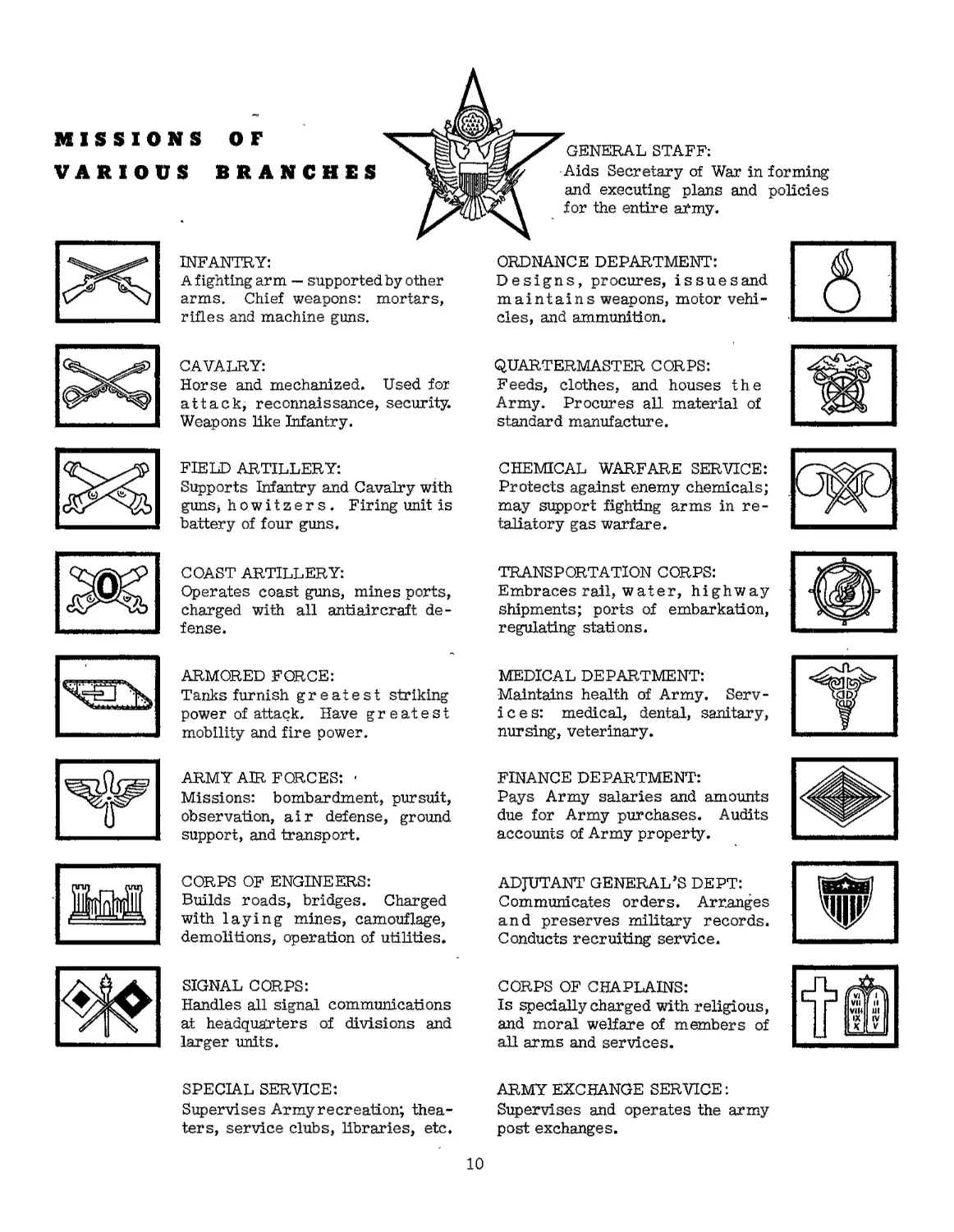
MISSIONS OF
VARIOUS BRANCHES
GENERAL STAFF:
Aids Secretary of War in forming
and executing plans and policies
for the entire army.
INFANTRY:
A fighting arm — supported by other
arms. Chief weapons: mortars,
rifles and machine guns.
ORDNANCE DEPARTMENT:
Designs, procures, is sue sand
maintains weapons, motor vehi-
cles, and ammunition.
CAVALRY:
Horse and mechanized. Used for
attack, reconnaissance, security.
Weapons like Infantry.
QUARTERMASTER CORPS:
Feeds, clothes, and houses the
Army. Procures all material of
standard manufacture.
FIELD ARTILLERY:
Supports Infantry and Cavalry with
gunSj h owitz er s . Firing unit is
battery of four guns.
CHEMICAL WARFARE SERVICE:
Protects against enemy chemicals;
may support fighting arms in re-
taliatory gas warfare.
COAST ARTILLERY:
Operates coast guns, mines ports,
charged with all antiaircraft de-
fense.
TRANSPORTATION CORPS:
Embraces rail, w at er, highway
shipments; ports of embarkation,
regulating stations.
ARMORED FORCE:
Tanks furnish greatest striking
power of attack. Have greatest
mobility and fire power.
MEDICAL DEPARTMENT:
Maintains health of Army. Serv-
ices: medical, dental, sanitary,
nursing, veterinary.
SIGNAL CORPS:
Handles all signal communications
at headquarters of divisions and
larger units.
ARMY AIR FORCES: >
Missions: bombardment, pursuit,
observation, air defense, ground
support, and transport.
CORPS OF ENGINEERS:
Builds roads, bridges. Charged
with laying mines, camouflage,
demolitions, operation of utilities.
FINANCE DEPARTMENT:
Pays Army salaries and amounts
due for Army purchases. Audits
accounts of Army property.
ADJUTANT GENERAL’S DEPT:
Communicates orders. Arranges
and preserves military records.
Conducts recruiting service.
CORPS OF CHAPLAINS:
Is specially charged with religious,
and moral welfare of members of
all arms and services.
SPECIAL SERVICE:
Supervises Ar my re creation; thea-
ters, service clubs, libraries, etc.
ARMY EXCHANGE SERVICE:
Supervises and operates the army
post exchanges.
10
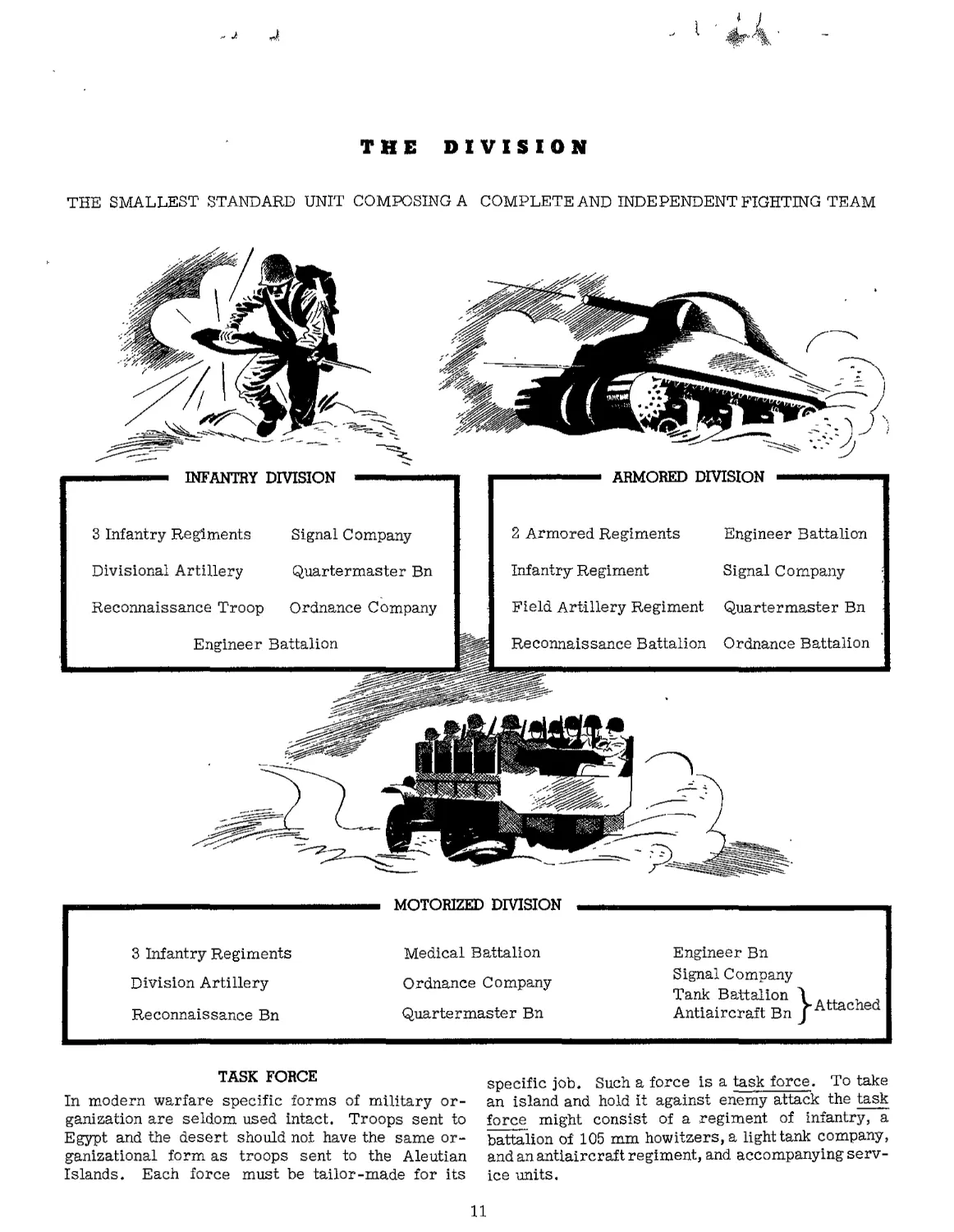
THE DIVISION
THE SMALLEST STANDARD UNIT COMPOSING A COMPLETE AND INDEPENDENT FIGHTING TEAM
ARMORED DIVISION
INFANTRY
DIVISION
3 Infantry Regiments
Signal Company
2 Armored Regiments
Engineer Battalion
Divisional Artillery
Quartermaster Bn
Infantry Regiment
Signal Company
Reconnaissance Troop
Quartermaster Bn
Field Artillery Regiment
Ordnance Company
Engineer Battalion
Reconnaissance Battalion
MOTORIZED DIVISION
Ordnance Battalion
3 Infantry Regiments	Medical Battalion	Engineer Bn
Division Artillery	Ordnance Company	Slgnal с''"‘аапУ Tank Battalion Y
Reconnaissance Bn	Quartermaster Bn	Antiaircraft Bn J A ac e
TASK FORCE
In modern warfare specific forms of military or-
ganization are seldom used intact. Troops sent to
Egypt and the desert should not have the same or-
ganizational form as troops sent to the Aleutian
Islands. Each force must be tailor-made for its
specific job. Such a force is a task force. To take
an island and hold it against enemy attack the task
force might consist of a regiment of infantry, a
battalion of 105 mm howitzers, a light tank company,
and an antiaircraft regiment, and accompanying serv-
ice units.
11
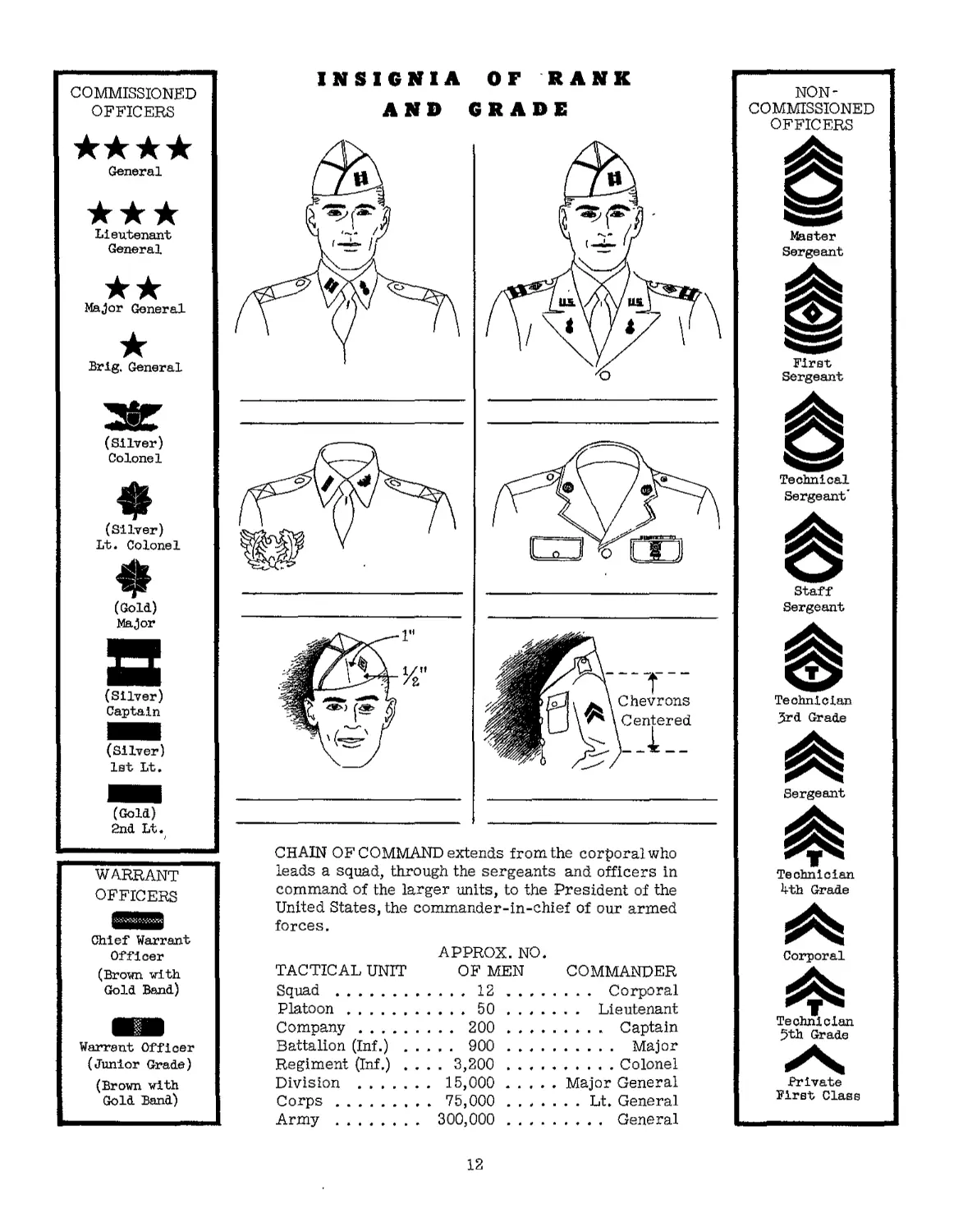
COMMISSIONED
OFFICERS
General
Lieutenant
General
Major General
Brig. General
(Silver)
Colonel
(Silver)
Lt. Colonel
(Gold)
Major
(Silver)
1st Lt.
(Silver)
Captain
(Gold)
2nd Lt.
WARRANT
OFFICERS
Chief Warrant
Officer
(Brown with
Gold Band)
Warrant Officer
(Junior Grade)
(Brown with
Gold Band)
INSIGNIA OF RANK
AND GRADE
CHAIN OF COMMAND extends from the corporal who
leads a squad, through the sergeants and officers in
command of the larger units, to the President of the
United States, the commander-in-chief of our armed
forces.
TACTICAL UNIT
Squad ..........
Platoon.........
Company ......
Battalion (Inf.) . .
Regiment (Inf.) . .
Division .......
Corps...........
Army ...........
APPROX. NO.
OF MEN
. . . . 12.....
. . . . 50.....
. . . 200 .....
. . . 900 .....
. . 3,200 .....
. 15,000 ......
. 75,000 ......
300,000 ......
COMMANDER
. . . Corporal
. . Lieutenant
. . . . Captain
. . . . . Major
......Colonel
Major General
. . Lt. General
. . . . General
NON-
COMMISSIONED
OFFICERS
Master
Sergeant
First
Sergeant
Technical
Sergeant'
Staff
Sergeant
Technician
3rd Grade
Sergeant
Technician
4th Grade
Corporal
Technician
5th Grade
Private
First Class
12
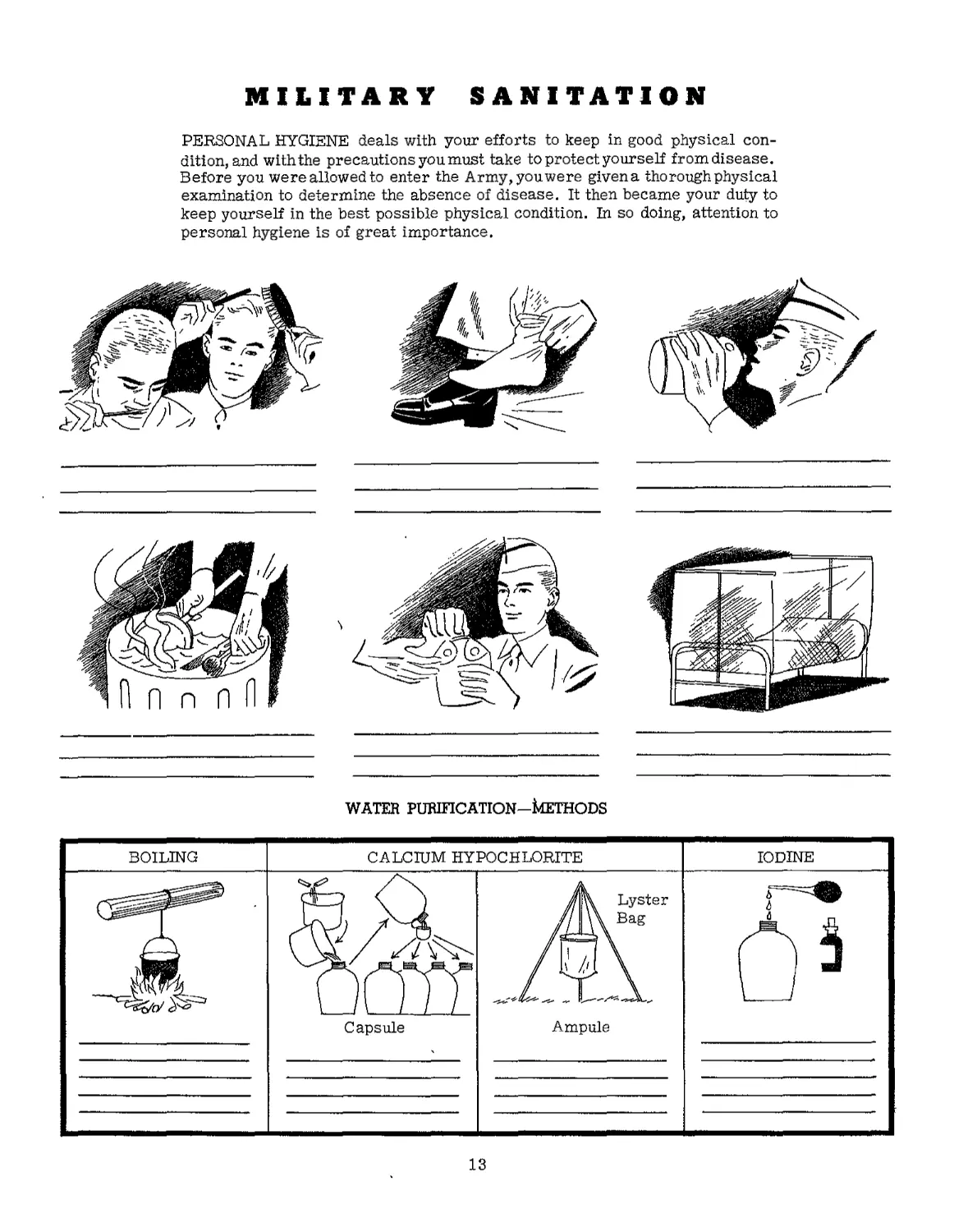
MILITARY SANITATION
PERSONAL HYGIENE deals with your efforts to keep in good physical con-
dition, and with the precautions you must take to protect yourself from disease.
Before you were allowed to enter the Army,youwere givena thorough physical
examination to determine the absence of disease. It then became your duty to
keep yourself in the best possible physical condition. In so doing, attention to
personal hygiene is of great importance.
WATER PURIFICATION—METHODS
13
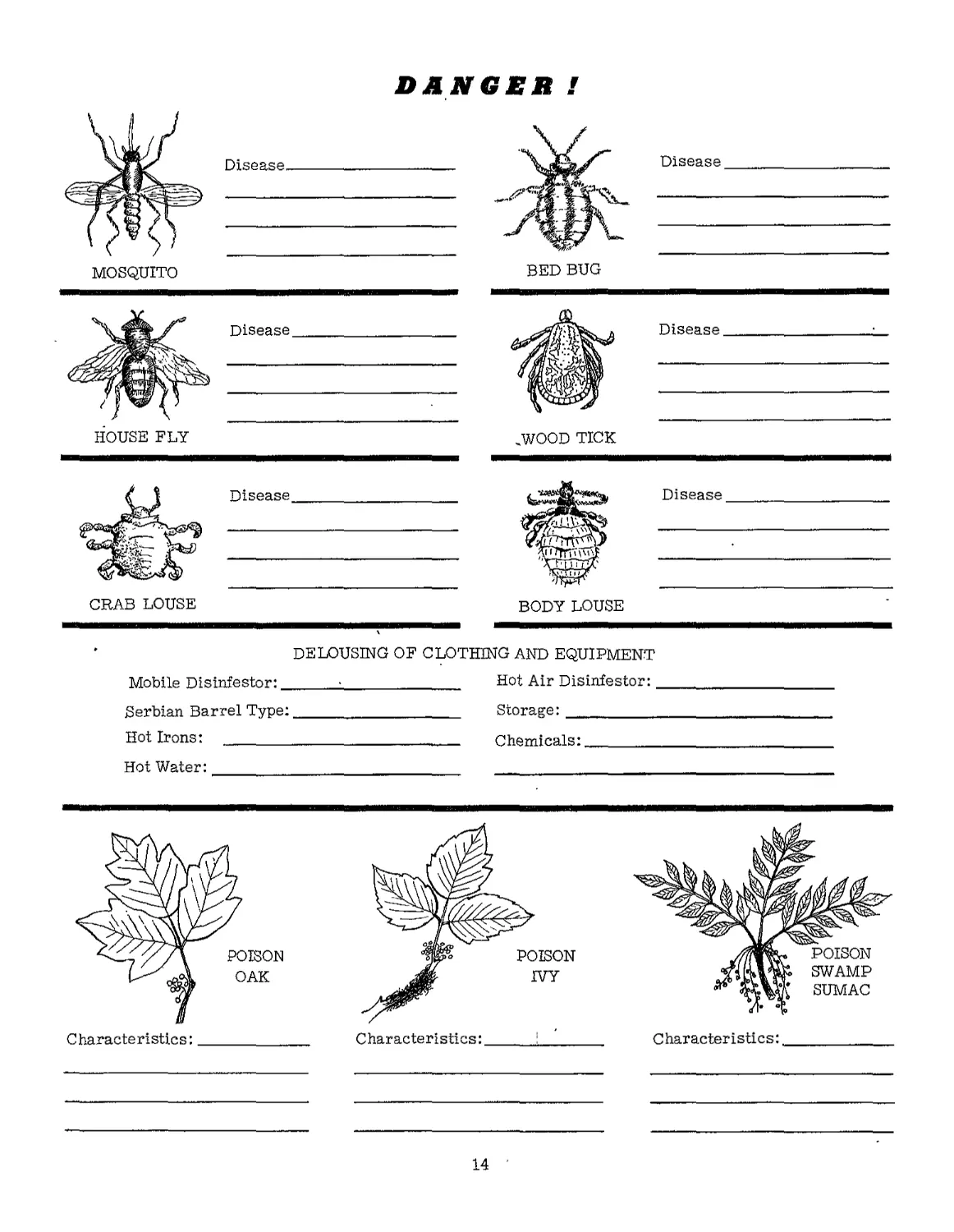
DANGER !
BED BUG
.WOOD TICK
Disease____________________
Disease__________________
Disease____________________
Disease____________________
BODY LOUSE
DE LOUSING OF CLOTHING AND EQUIPMENT
Mobile Disinfestor::
Serbian Barrel Type:
Hot Irons: ______________________
Hot Water:_________________________
Hot Air Disinfestor:_______________________
Storage:___________________________
Chemicals:_________________________________
Characteristics:i
14
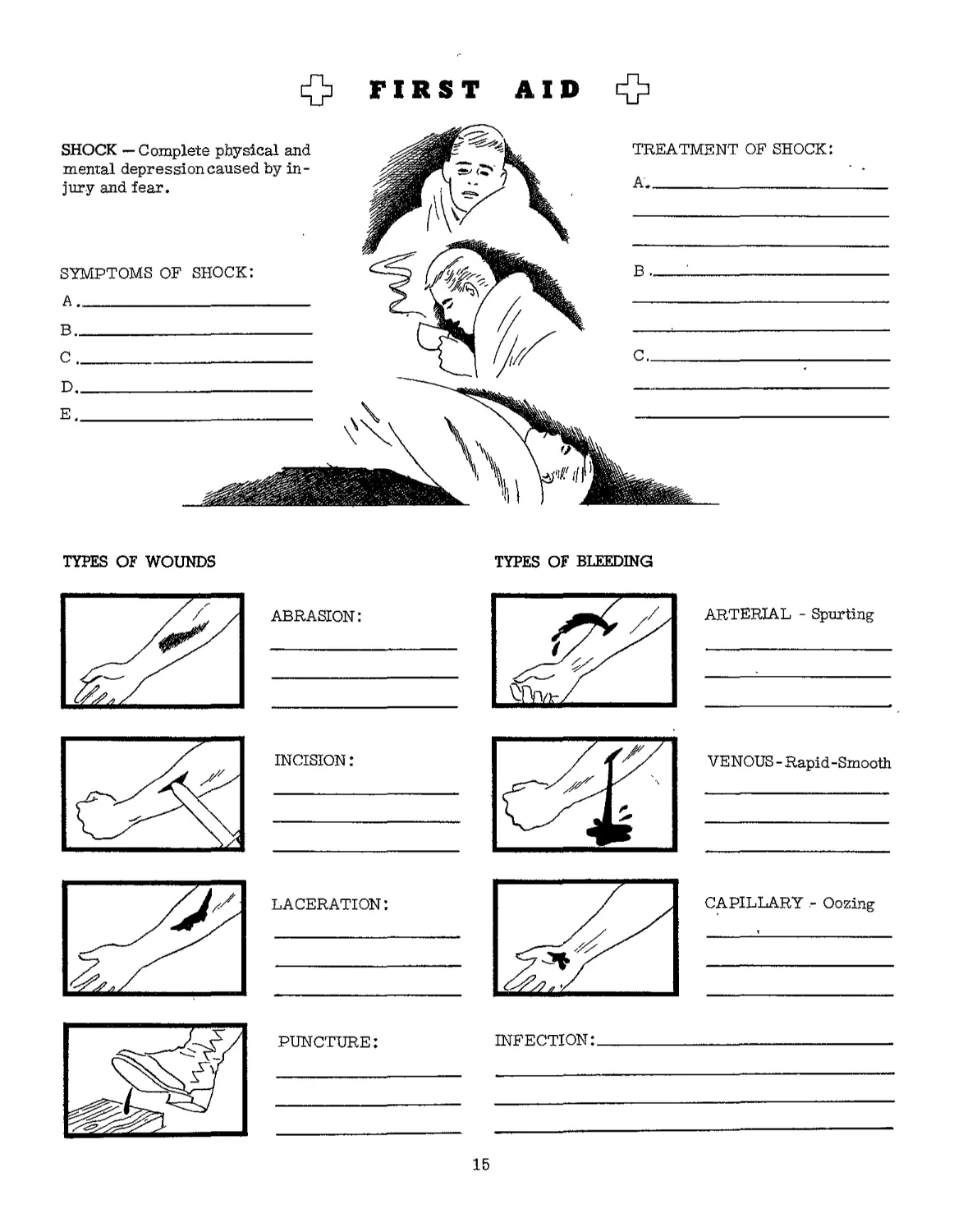
ф FIRST AID ru:
15
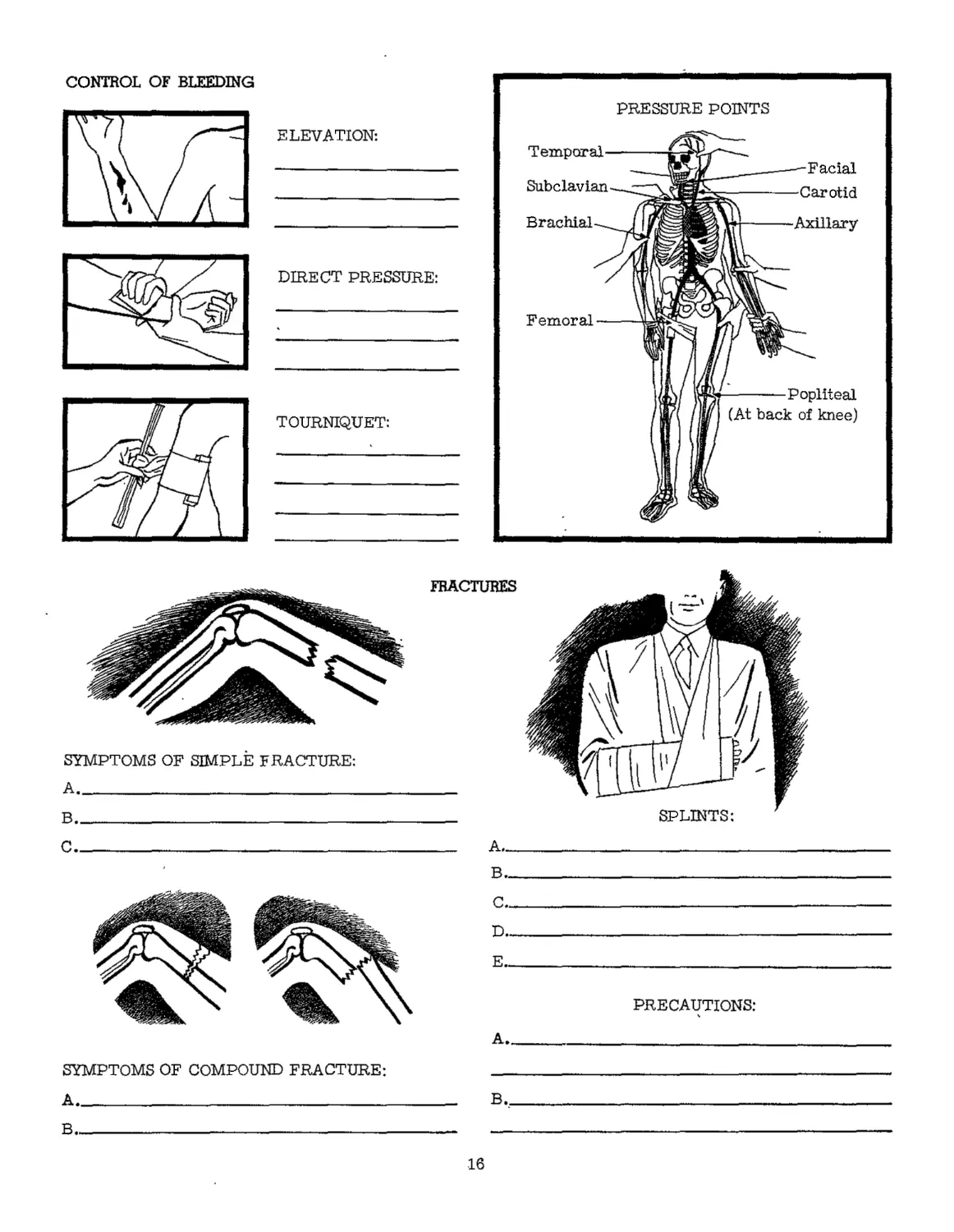
CONTROL OF BLEEDING
ELEVATION:
DIRECT PRESSURE:
TOURNIQUET:
PRESSURE POINTS
A_________________________________
SYMPTOMS OF COMPOUND FRACTURE:	_____________________________________
A В________________________________________
В____________________________________________________________________________
16
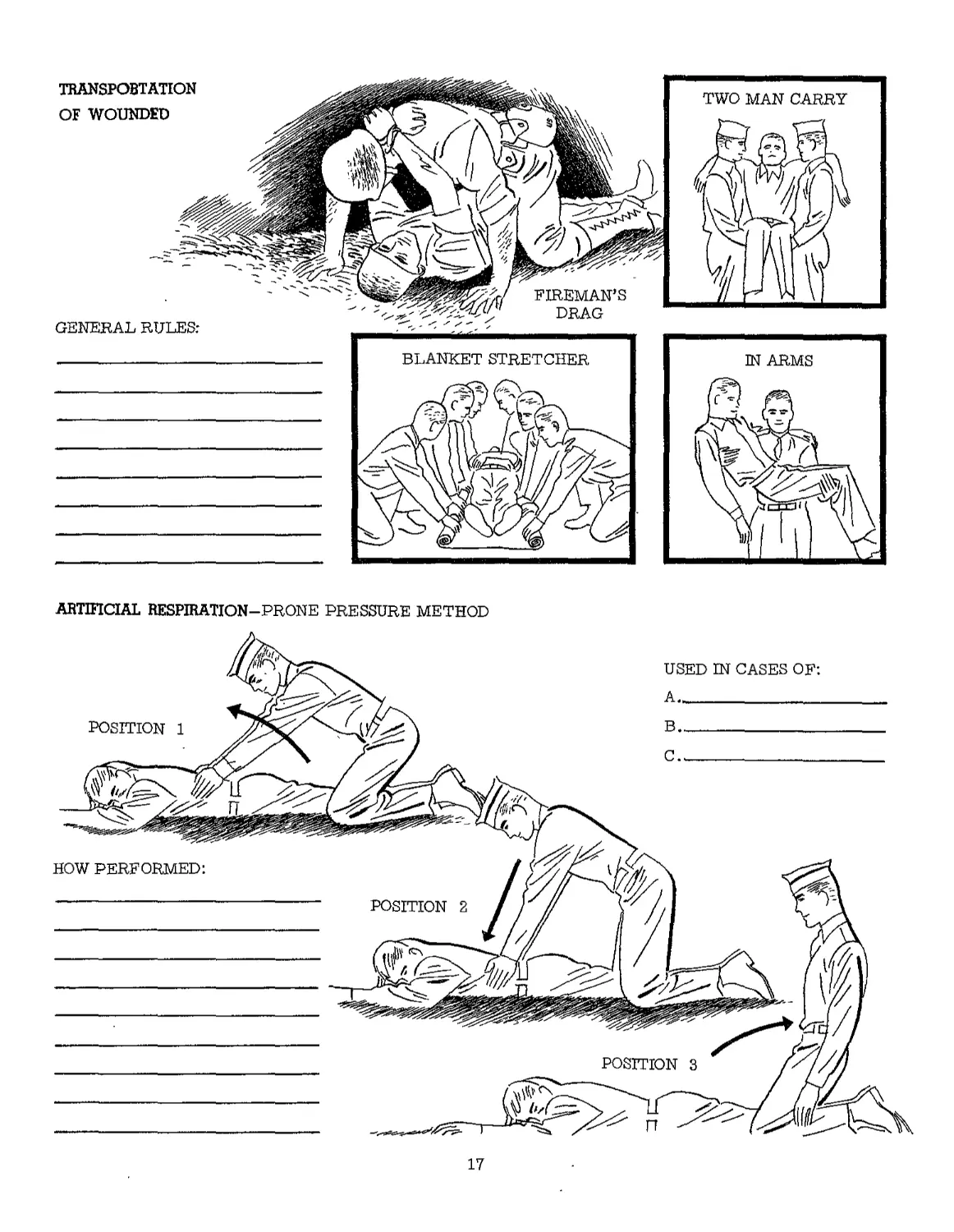
ARTIFICIAL RESPIRATION-PRONE PRESSURE METHOD
17
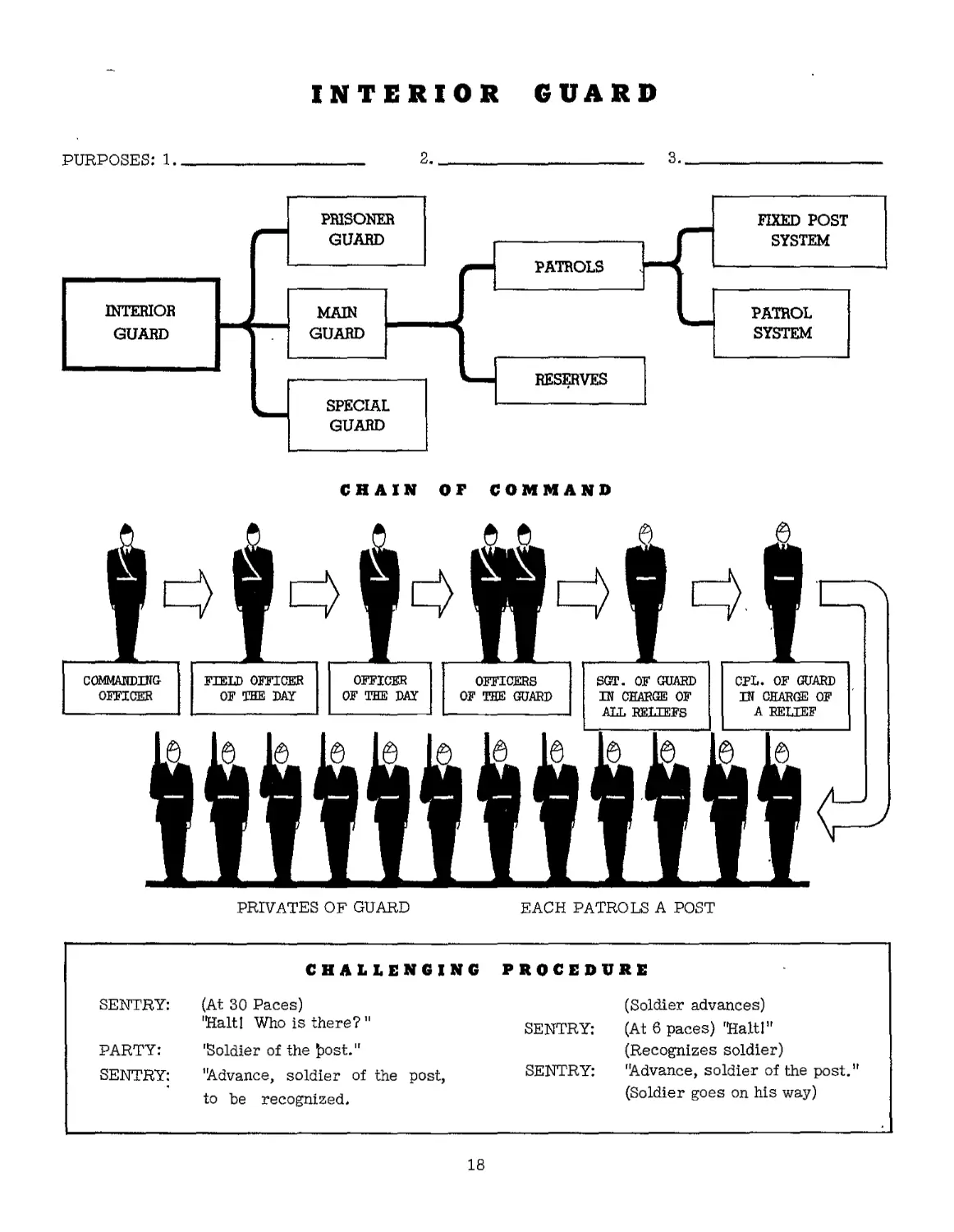
INTERIOR GUARD
PURPOSES: 1 2--------------------------------------------3----------------------
CHAIN OF COMMAND
PRIVATES OF GUARD
EACH PATROLS A POST
	CHALLENGING	PROCEDURE
SENTRY:	(At 30 Paces)	(Soldier advances)
	'Halt! Who is there? "	SENTRY: (At 6 paces) 'Haiti"
PARTY:	'Soldier of the Joost.Ir	(Recognizes soldier)
SENTRY:	'Advance, soldier of the post,	SENTRY:	'Advance, soldier of the post."
	to be recognized*	(Soldier goes on his way)
18
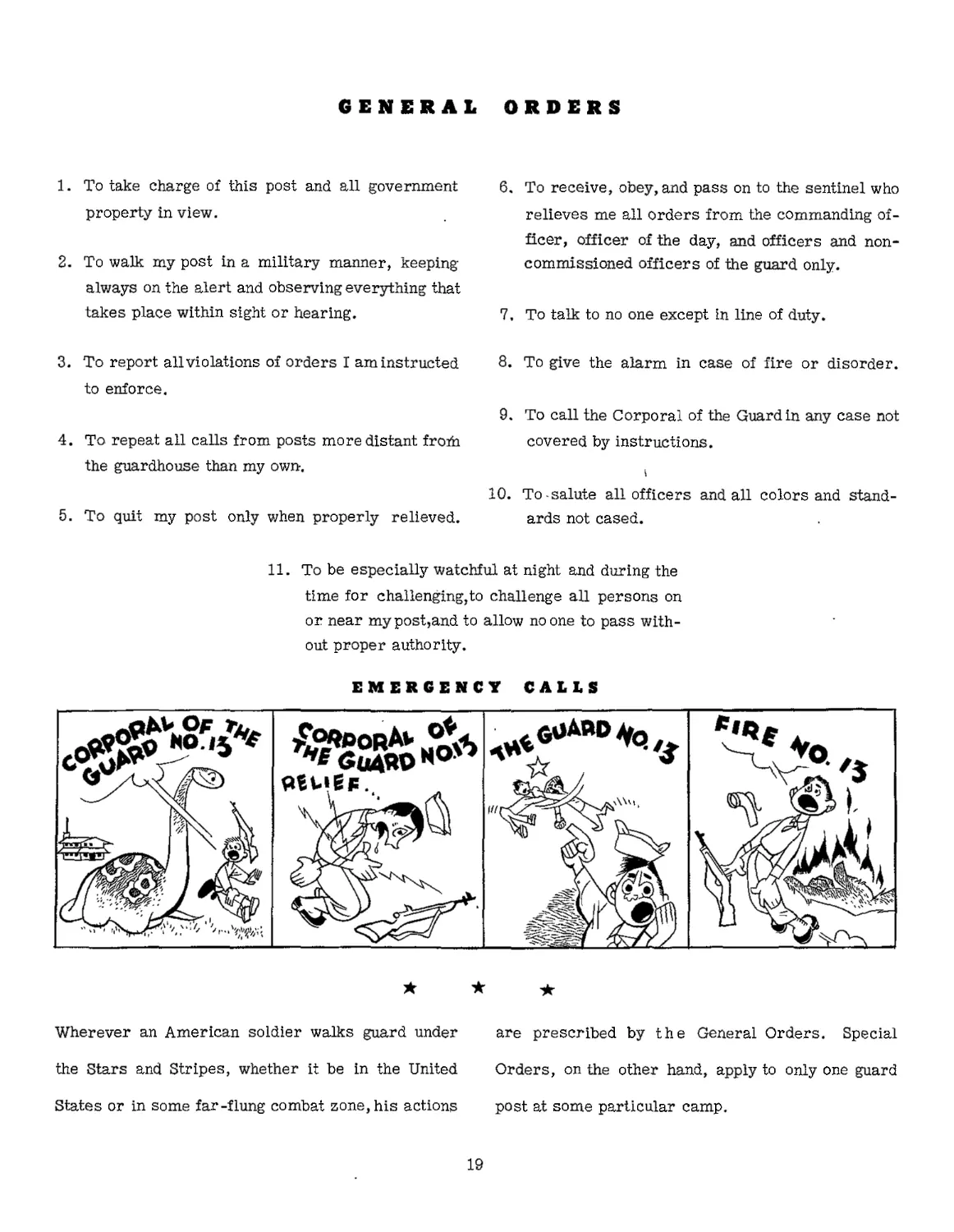
GENERAL ORDERS
1.	To take charge of this post and all government
property in view.
2.	To walk my post in a military manner, keeping
always on the alert and observing everything that
takes place within sight or hearing.
3.	To report all violations of orders I am instructed
to enforce.
4.	To repeat all calls from posts more distant froria
the guardhouse than my own.
5.	To quit my post only when properly relieved.
6.	To receive, obey, and pass on to the sentinel who
relieves me all orders from the commanding of-
ficer, officer of the day, and officers and non-
commissioned officers of the guard only.
7,	To talk to no one except in line of duty.
8.	To give the alarm in case of fire or disorder.
9.	To call the Corporal of the Guardin any case not
covered by instructions.
i
10.	To-salute all officers and all colorsand stand-
ards not cased.
11.	To be especially watchful at night and during the
time for challenging,to challenge all persons on
or near my post,and to allow no one to pass with-
out proper authority.
EMERGENCY CALLS
Wherever an American soldier walks guard under
the Stars and Stripes, whether it be in the United
States or in some far-flung combat zone, his actions
are prescribed by the General Orders. Special
Orders, on the other hand, apply to only one guard
post at some particular camp.
19
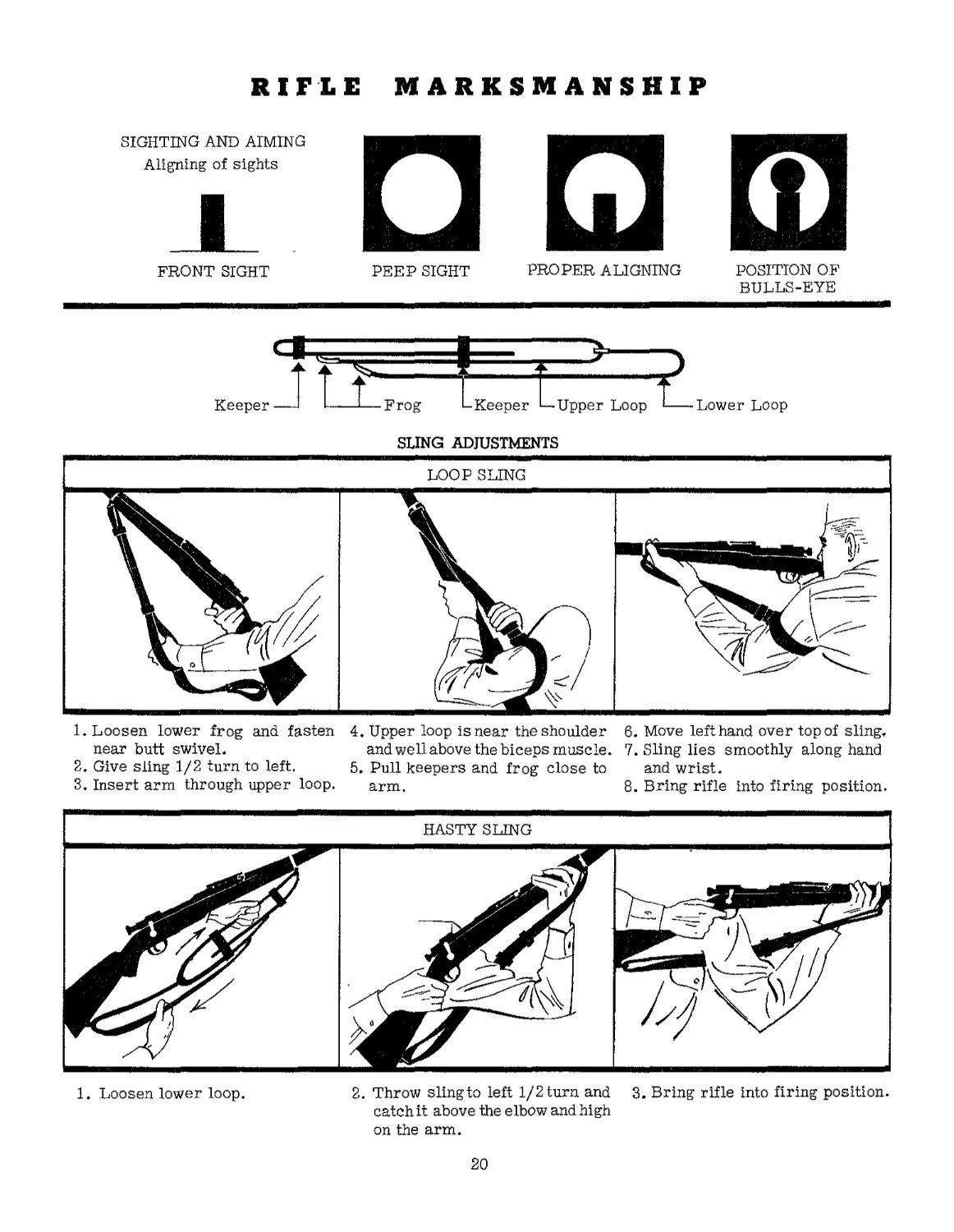
RIFLE MARKSMANSHIP
SIGHTING AND AIMING
Aligning of sights
О
0
FRONT SIGHT
PEEP SIGHT
PROPER ALIGNING
POSITION OF
BULLS-EYE
Keeper —
LKeeper —Upper Loop '---Lower Loop
SLING ADJUSTMENTS
4. Upper loop is near the shoulder
and well above the biceps muscle.
5. Pull keepers and frog close to
arm.
1. Loosen lower frog and fasten
near butt swivel.
2. Give sling 1/2 turn to left,
3. Insert arm through upper loop.
6. Move lefthand over top of sling.
7. Sling lies smoothly along hand
and wrist.
8. Bring rifle into firing position.
1. Loosen lower loop.
2.	Throw slingto left 1/2turn and 3. Bring rifle into firing position,
catch it above the elbow and high
on the arm.
20
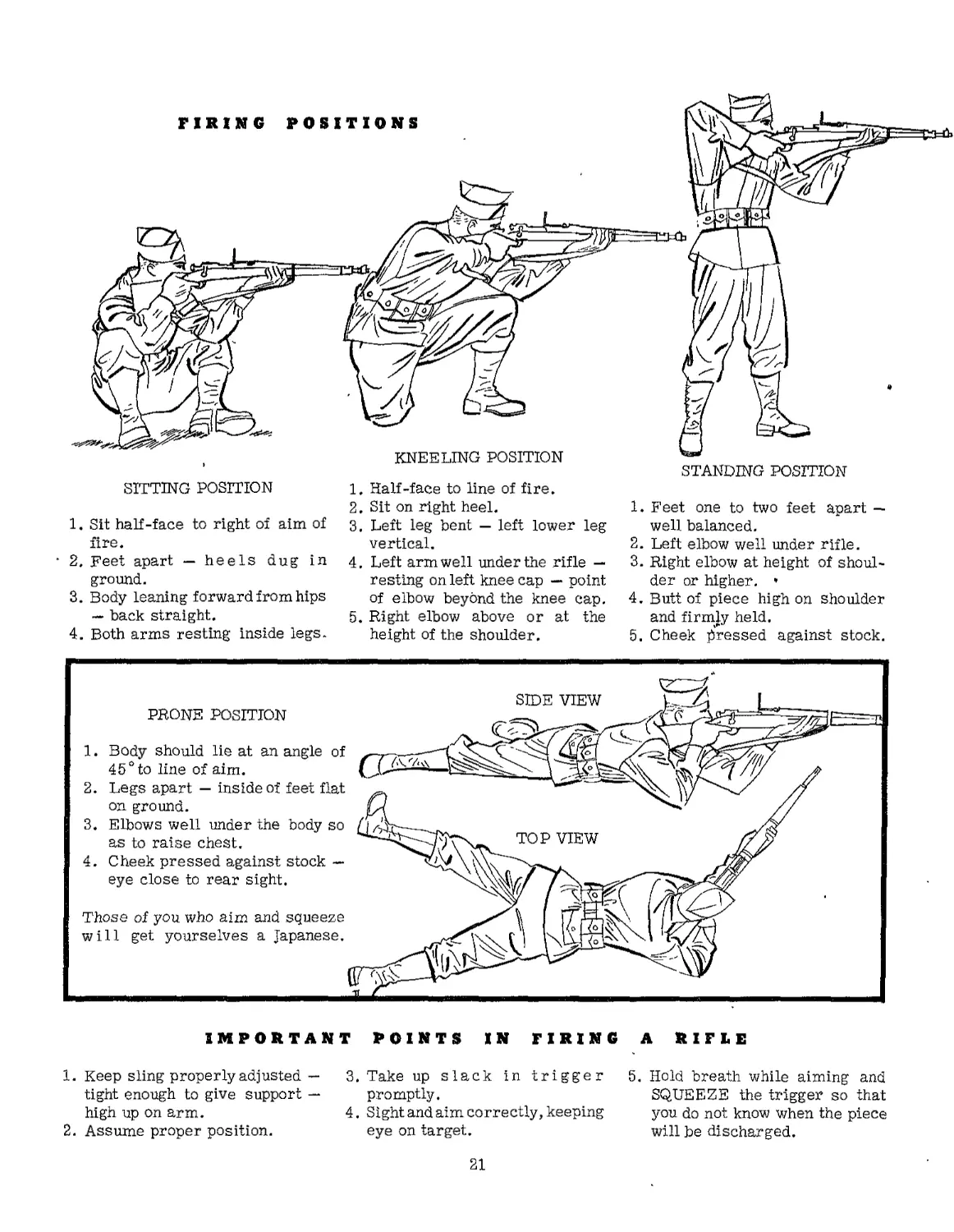
FIRING POSITIONS
KNEELING POSITION
STANDING POSITION
SITTING POSITION
1. Sit half-face to right of aim of
fire.
’ 2. Feet apart — heels dug in
ground.
3.	Body leaning forward from hips
— back straight.
4.	Both arms resting inside legs.
1.	Half-face to line of fire.
2.	Sit on right heel.
3.	Left leg bent — left lower leg
vertical.
4.	Left arm well under the rifle —
resting on left knee cap — point
of elbow beyond the knee cap.
5.	Right elbow above or at the
height of the shoulder.
1.	Feet one to two feet apart —
well balanced.
2.	Left elbow well under rifle.
3.	Right elbow at height of shoul-
der or higher. *
4.	Butt of piece high on shoulder
and firmly held.
5.	Cheek pressed against stock.
PRONE POSITION
1.	Body should lie at an angle of
45 ° to line of aim.
2.	Legs apart — inside of feet flat
on ground.
3.	Elbows well under the body so
as to raise chest.
4.	Cheek pressed against stock —
eye close to rear sight.
Those of you who aim and squeeze
will get yourselves a Japanese.
IMPORTANT POINTS IN FIRING A RIFLE
1.	Keep sling properly adjusted —
tight enough to give support —
high up on arm.
2.	Assume proper position.
3.	Take up slack in trigger
promptly.
4.	Sight and aim correctly, keeping
eye on target.
5.	Hold breath while aiming and
SQUEEZE the trigger so that
you do not know when the piece
will be discharged.
21
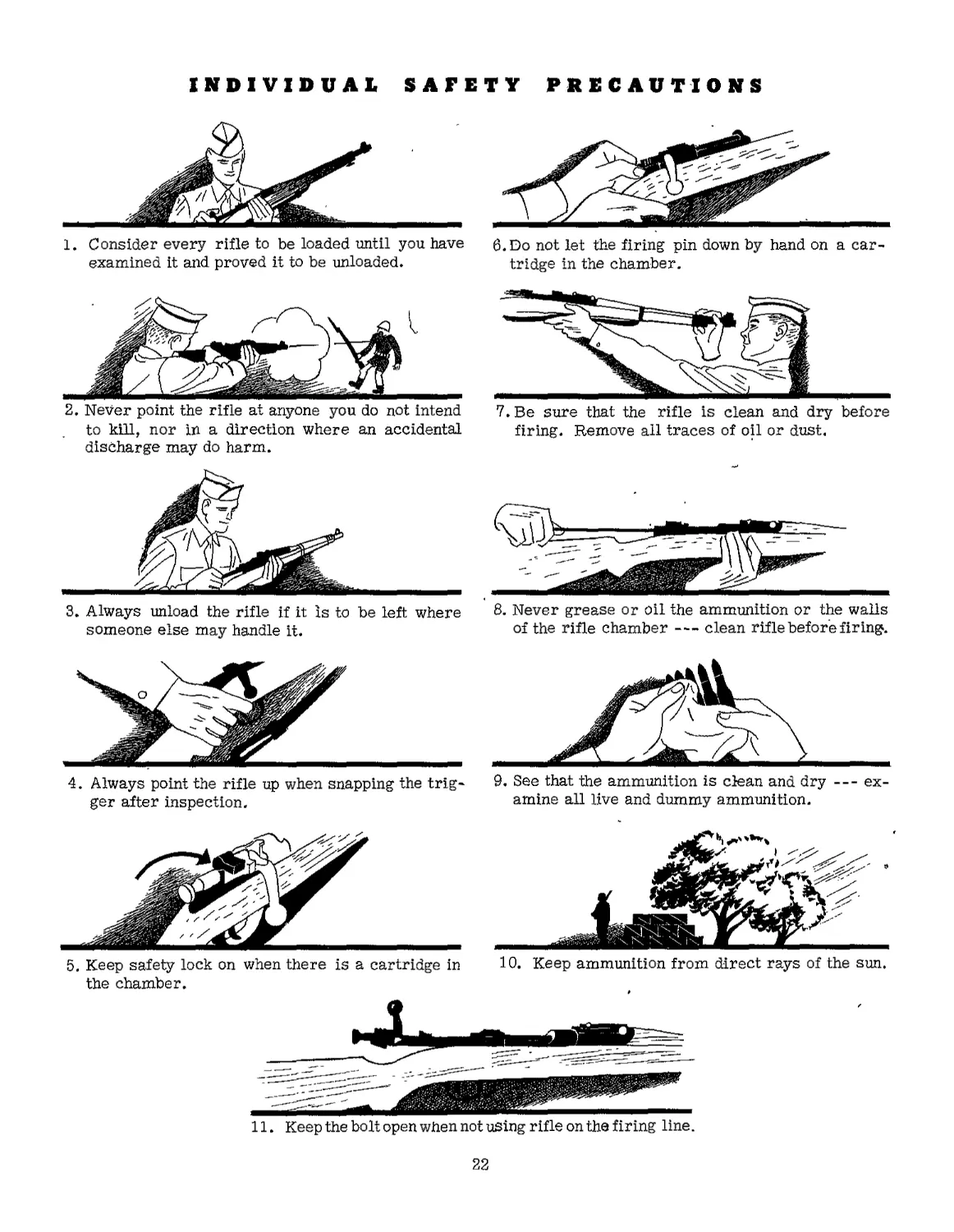
INDIVIDUAL SAFETY PRECAUTIONS
1. Consider every rifle to be loaded until you have
examined it and proved it to be unloaded.
6.	Do not let the firing pin down by hand on a car-
tridge in the chamber.
2. Never point the rifle at anyone you do not intend
to kill, nor in a direction where an accidental
discharge may do harm.
7. Be sure that the rifle is clean and dry before
firing. Remove all traces of oil or dust.
8. Never grease or oil the ammunition or the walls
of the rifle chamber — clean rifle before firing.
9. See that the ammunition is clean and dry — ex-
amine all live and dummy ammunition.
4. Always point the rifle up when snapping the trig-
ger after inspection.
5. Keep safety lock on when there is a cartridge in 10. Keep ammunition from direct rays of the sun.
the chamber.
11. Keep the bolt open when not using rifle on the firing line.
22
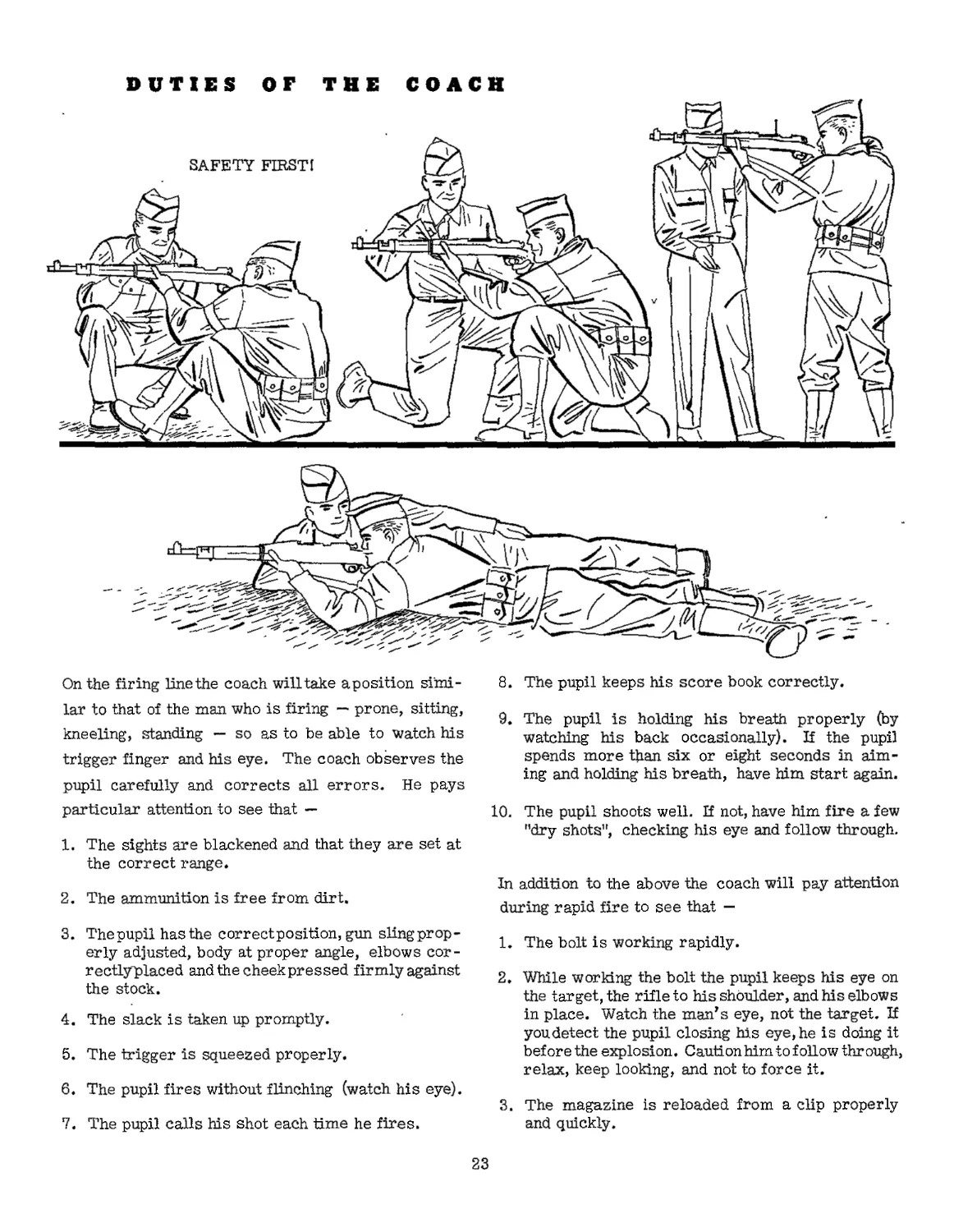
DUTIES OF THE COACH
On the firing line the coach will take aposition simi-
lar to that of the man who is firing — prone, sitting,
kneeling, standing — so as to be able to watch his
trigger finger and his eye. The coach observes the
pupil carefully and corrects all errors. He pays
particular attention to see that —
1.	The sights are blackened and that they are set at
the correct range.
2.	The ammunition is free from dirt,
3.	The pupil has the correctposition, gun sling prop-
er ly adjusted, body at proper angle, elbows cor-
rectlyplaced and the cheek pressed firmly against
the stock.
4.	The slack is taken up promptly.
5.	The trigger is squeezed properly.
6.	The pupil fires without flinching (watch his eye).
7.	The pupil calls his shot each time he fires.
8.	The pupil keeps his score book correctly.
9.	The pupil is holding his breath properly (by
watching his back occasionally). If the pupil
spends more than six or eight seconds in aim-
ing and holding his breath, have him start again.
10.	The pupil shoots well. If not, have him fire a few
"dry shots", checking his eye and follow through.
In addition to the above the coach will pay attention
during rapid fire to see that —
1.	The bolt is working rapidly.
2.	While working the bolt the pupil keeps his eye on
the target, the rifle to his shoulder, and his elbows
in place. Watch the man’s eye, not the target. If
you detect the pupil closing his eye, he is doing it
before the explosion. Caution him to follow through,
relax, keep looking, and not to force it.
3.	The magazine is reloaded from a clip properly
and quickly.
23
'0(1^
775-70.

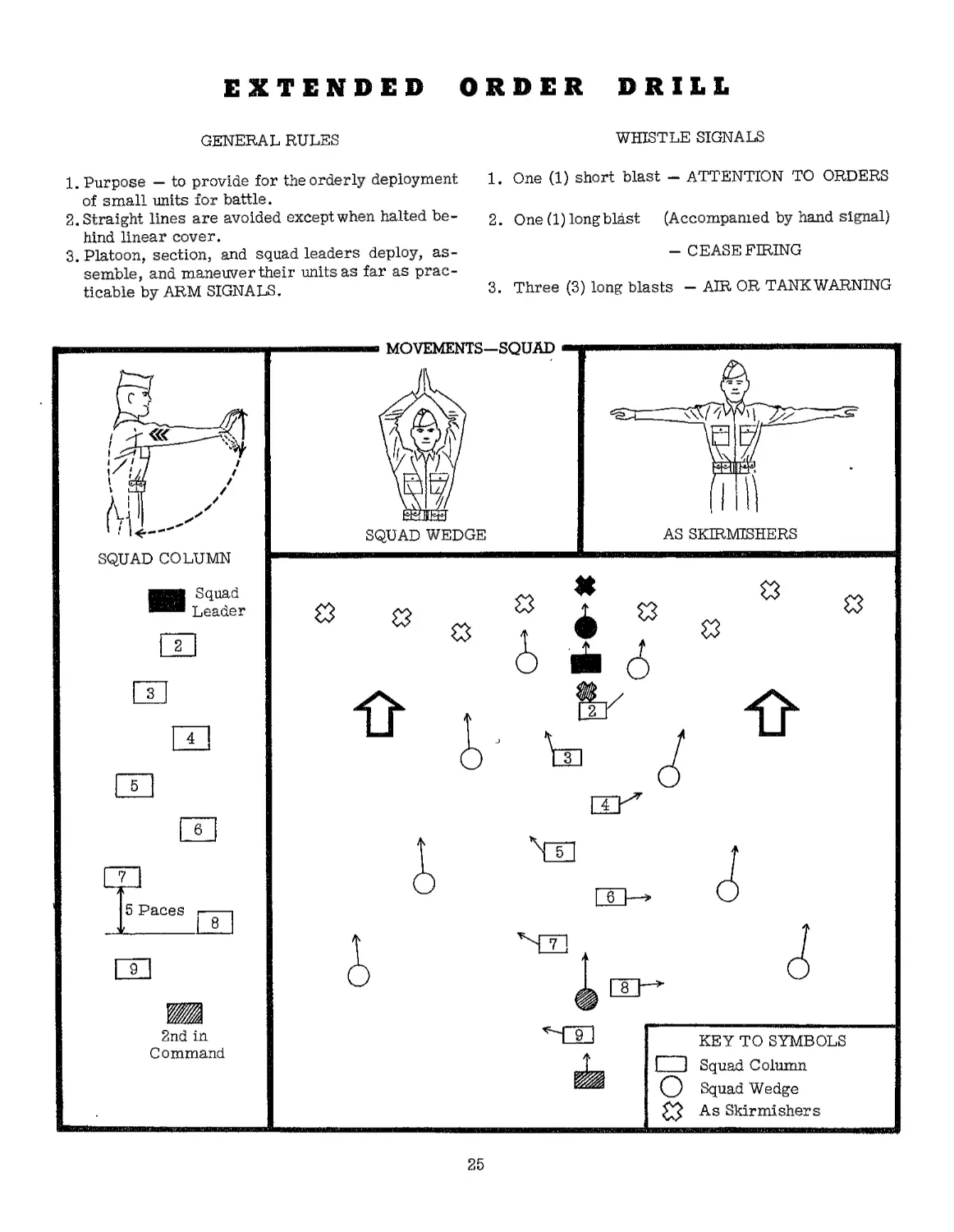
EXTENDED ORDER DRILL
GENERAL RULES
WHISTLE SIGNALS
1.	Purpose — to provide for the orderly deployment
of small units for battle.
2.	Straight lines are avoided exceptwhen halted be-
hind linear cover.
3.	Platoon, section, and squad leaders deploy, as-
semble, and maneuvertheir units as far as prac-
ticable by ARM SIGNALS.
1.	One (1) short blast - ATTENTION TO ORDERS
2.	One (1) long blast (Accompanied by hand signal)
- CEASE FIRING
3.	Three (3) long blasts — AIR OR TANK WARNING
6
2nd in
Command
25
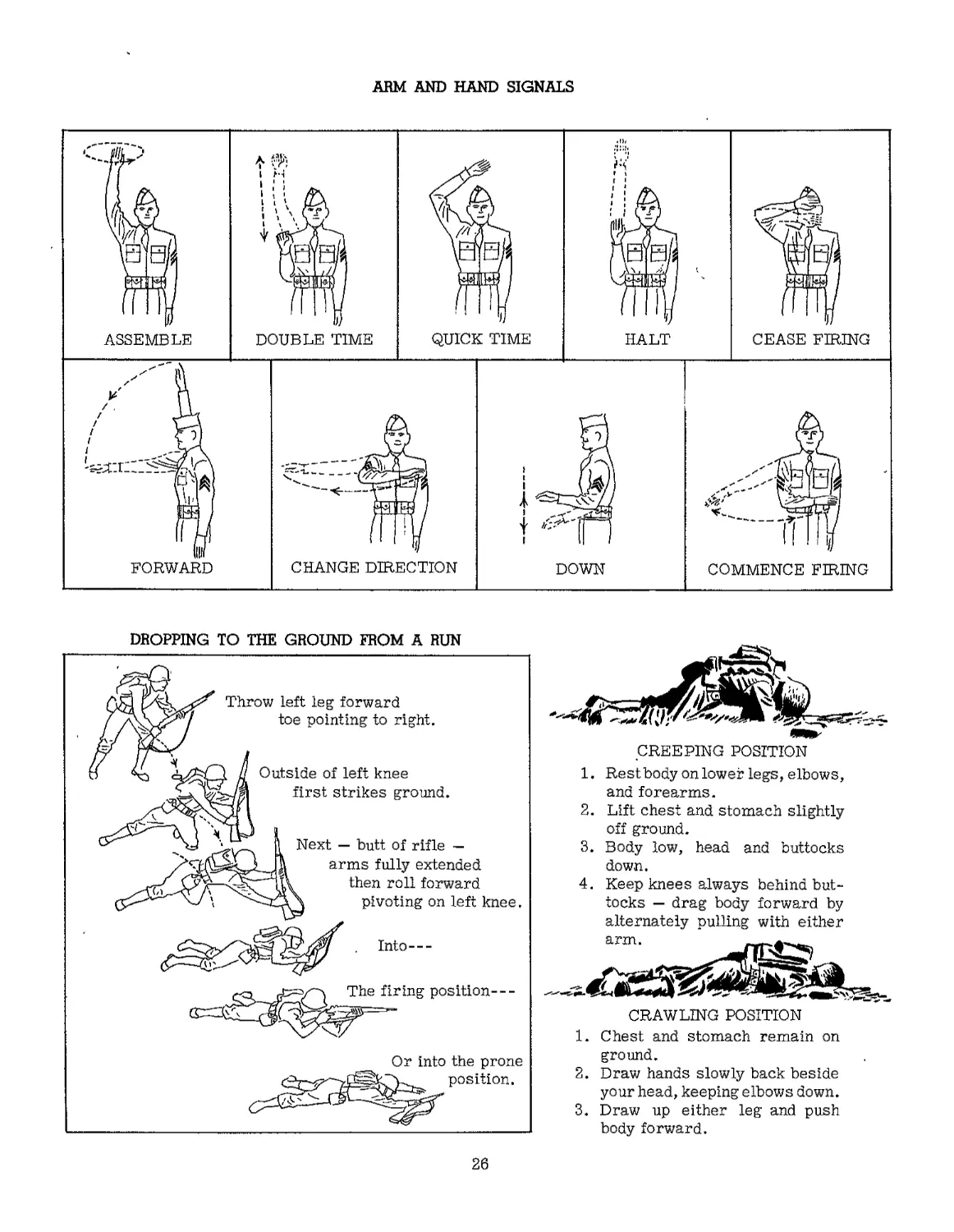
ARM AND HAND SIGNALS
DROPPING TO THE GROUND FROM A RUN
CREEPING POSITION
1.	Restbody on lower legs, elbows,
and forearms.
2.	Lift chest and stomach slightly
off ground.
3.	Body low, head and buttocks
down.
4.	Keep knees always behind but-
tocks — drag body forward by
alternately pulling with either
CRAWLING POSITION
1. Chest and stomach remain on
ground.
2. Draw hands slowly back beside
your head, keeping elbows down.
3. Draw up either leg and push
body forward.
26
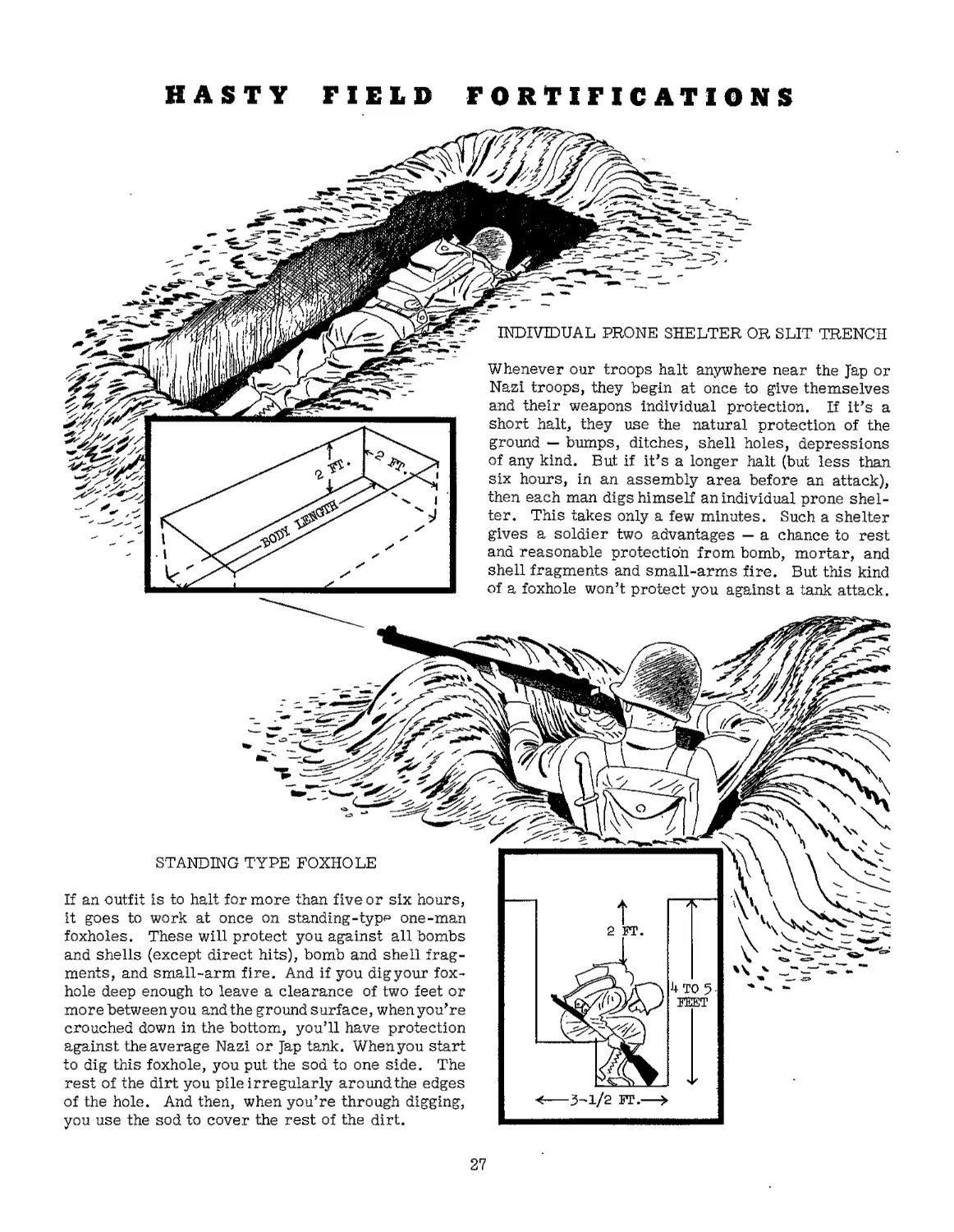
HASTY FIELD FORTIFICATIONS
INDIVIDUAL PRONE SHELTER OR SLIT TRENCH
STANDING TYPE FOXHOLE
If an outfit is to halt for more than five or six hours,
it goes to work at once on standing-type one-man
foxholes. These will protect you against all bombs
and shells (except direct hits), bomb and shell frag-
ments, and small-arm fire. And if you digyour fox-
hole deep enough to leave a clearance of two feet or
more between you and the ground surface, when you’re
crouched down in the bottom, you’ll have protection
against the average Nazi or Jap tank. When you start
to dig this foxhole, you put the sod to one side. The
rest of the dirt you pile irregularly around the edges
of the hole. And then, when you’re through digging,
you use the sod to cover the rest of the dirt.
Whenever our troops halt anywhere near the Jap or
Nazi troops, they begin at once to give themselves
and their weapons individual protection. If it’s a
short halt, they use the natural protection of the
ground — bumps, ditches, shell holes, depressions
of any kind. But if it’s a longer halt (but less than
six hours, in an assembly area before an attack),
then each man digshimself an individual prone shel-
ter. This takes only a few minutes. Such a shelter
gives a soldier two advantages — a chance to rest
and reasonable protection from bomb, mortar, and
shell fragments and small-arms fire. But this kind
of a foxhole won’t protect you against a tank attack.
27
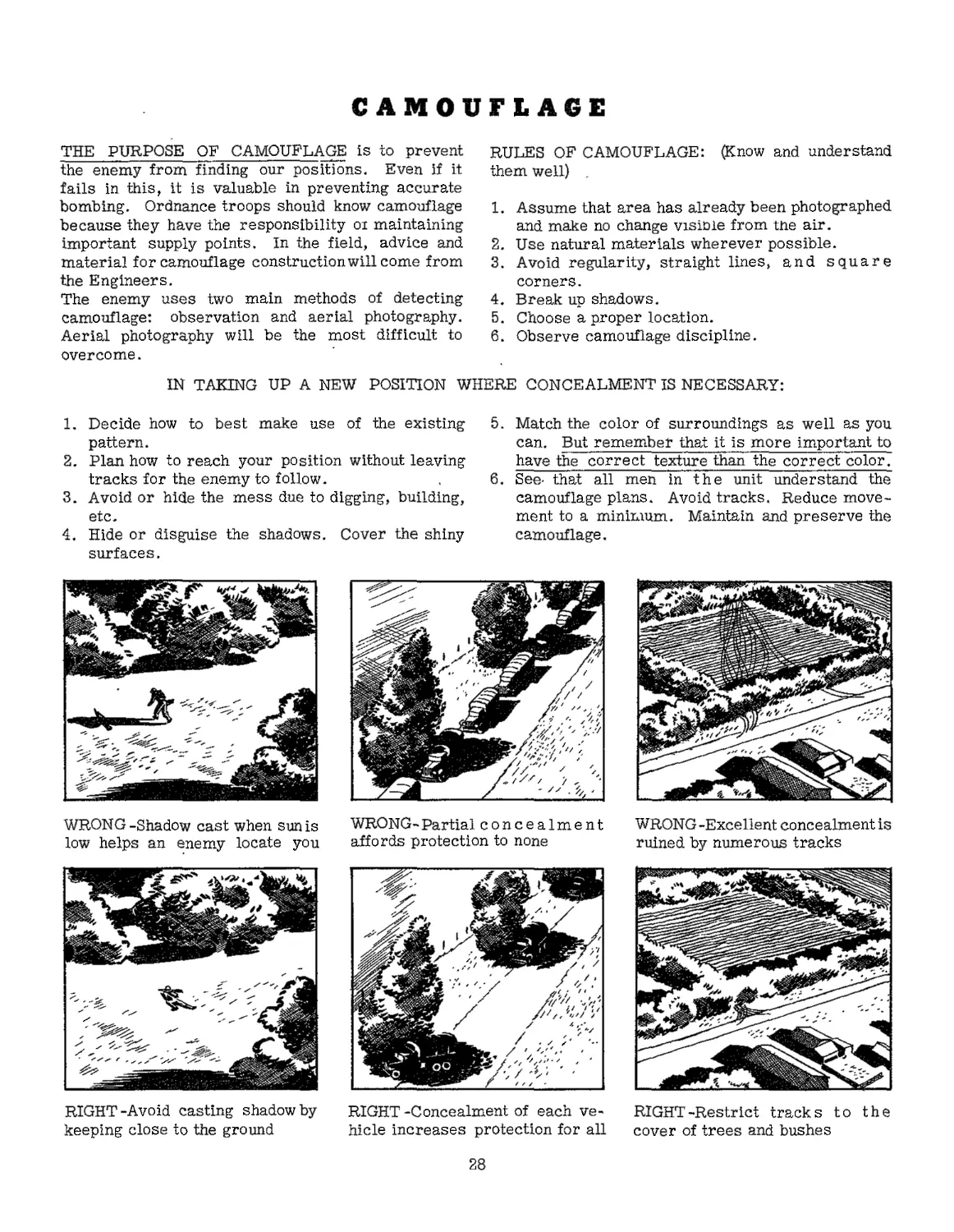
CAMOUFLAGE
THE PURPOSE OF CAMOUFLAGE is to prevent
the enemy from finding our positions. Even if it
fails in this, it is valuable in preventing accurate
bombing. Ordnance troops should know camouflage
because they have the responsibility oi maintaining
important supply points. In the field, advice and
material for camouflage construction will come from
the Engineers.
The enemy uses two main methods of detecting
camouflage: observation and aerial photography.
Aerial photography will be the most difficult to
overcome.
RULES OF CAMOUFLAGE: (Know and understand
them well) .
1.	Assume that area has already been photographed
and make no change visioie from tne air.
2.	Use natural materials wherever possible.
3.	Avoid regularity, straight lines, and square
corners.
4.	Break up shadows.
5.	Choose a proper location.
6.	Observe camouflage discipline.
IN TAKING UP A NEW POSITION WHERE CONCEALMENT IS NECESSARY:
1.	Decide how to best make use of the existing
pattern.
2.	Plan how to reach your position without leaving
tracks for the enemy to follow.
3.	Avoid or hide the mess due to digging, building,
etc.
4.	Hide or disguise the shadows. Cover the shiny
surfaces.
5.	Match the color of surroundings as well as you
can. But remember that it is more important to
have the correct texture than the correct color.
6.	See- that all men in the unit understand the
camouflage plans. Avoid tracks. Reduce move-
ment to a minimum. Maintain and preserve the
camouflage.
WRONG -Shadow cast when sun is
low helps an enemy locate you
WRONG-Partial concealment
affords protection to none
WRONG -Excellent concealment is
ruined by numerous tracks
RIGHT-Avoid casting shadow by
keeping close to the ground
RIGHT -Concealment of each ve-
hicle increases protection for all
RIGHT-Restrict tracks to the
cover of trees and bushes
28
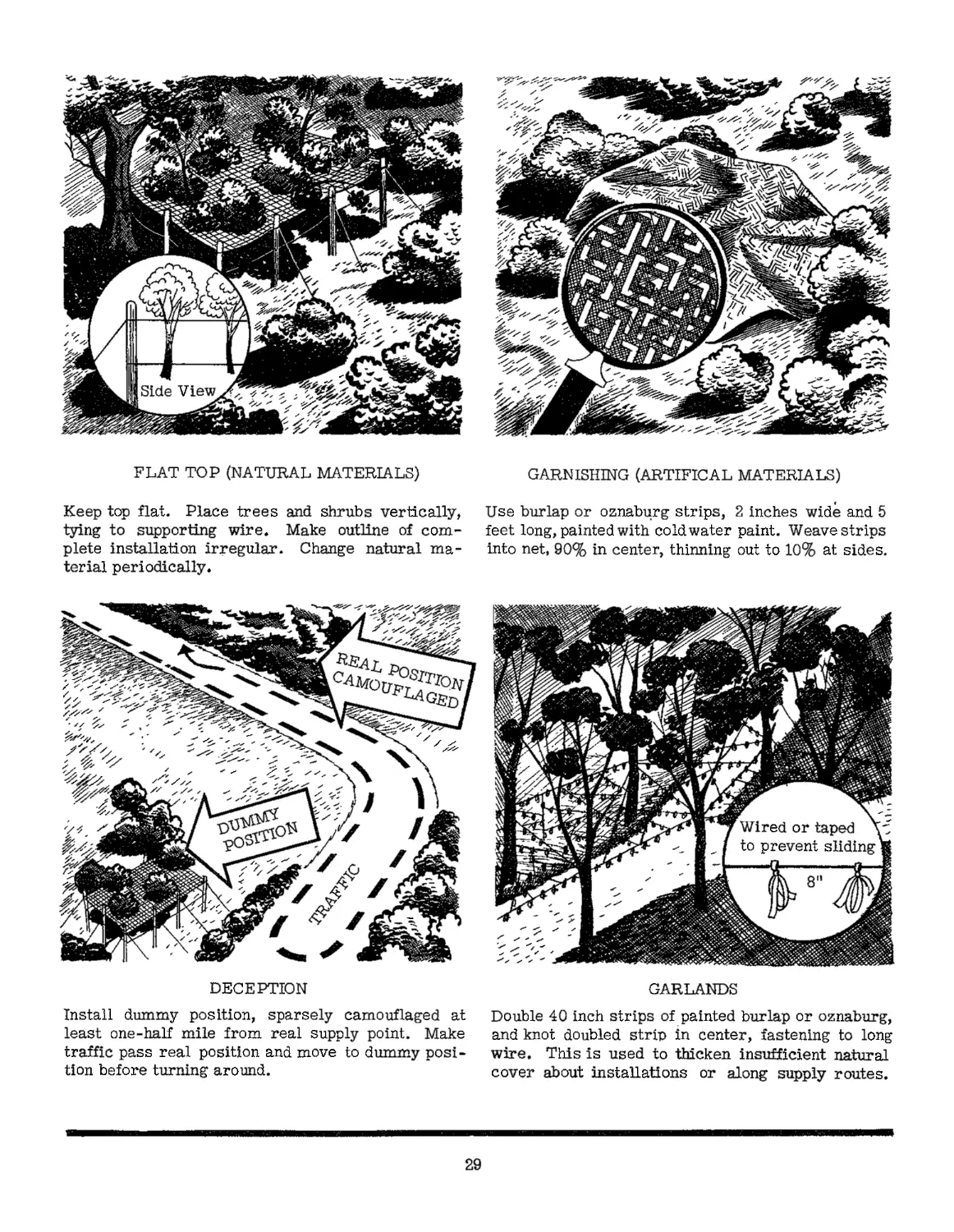
FLAT TOP (NATURAL MATERIALS)
GARNISHING (ARTIFICAL MATERIALS)
Keep top flat. Place trees and shrubs vertically,
tying to supporting wire. Make outline of com-
plete installation irregular. Change natural ma-
terial periodically.
Use burlap or oznaburg strips, 2 inches wide and 5
feet long, painted with cold water paint. Weave strips
into net, 90% in center, thinning out to 10% at sides.
DECEPTION
GARLANDS
Install dummy position, sparsely camouflaged at
least one-half mile from real supply point. Make
traffic pass real position and move to dummy posi-
tion before turning around.
Double 40 inch strips of painted burlap or oznaburg,
and knot doubled strip in center, fastening to long
wire. This is used to thicken insufficient natural
cover about installations or along supply routes.
29
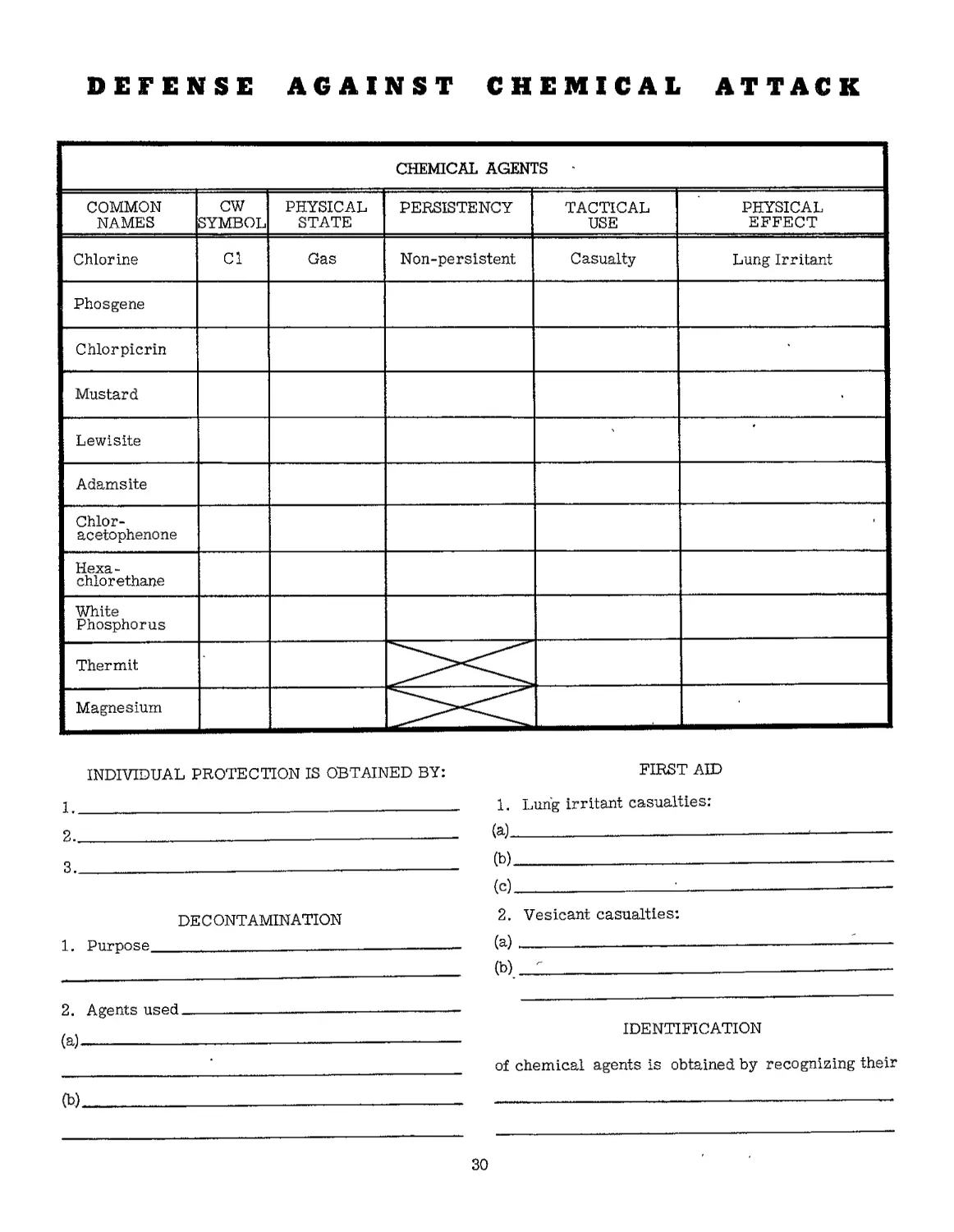
DEFENSE AGAINST CHEMICAL ATTACK
CHEMICAL AGENTS -
COMMON NAMES	CW SYMBOL	PHYSICAL STATE	PERSISTENCY	TACTICAL USE	PHYSICAL EFFECT
Chlorine	Cl	Gas	Non-persistent	Casualty	Lung Irritant
Phosgene
Chlorpicrin
Mustard
Lewisite					*
Adamsite
Chlor- acetophenone
Hexa- chlor ethane
White Phosphorus
Thermit
Magnesium
INDIVIDUAL PROTECTION IS OBTAINED BY:
1	_________
2_________________________________
3_____________.________________,
DE C ONT AMINATION
1. Purpose__________________ _______________
2. Agents used-------------------------------
(a)-----------------------------------------
FIRST AID
1.	Lung irritant casualties:
(a)____________________________	—
(b)-------------------------------	---
(c):------------------------------—
2.	Vesicant casualties:
(a)------------------------------------
(b\_:__________________________________
IDENTIFICATION
of chemical agents is obtained by recognizing their
(b)
30
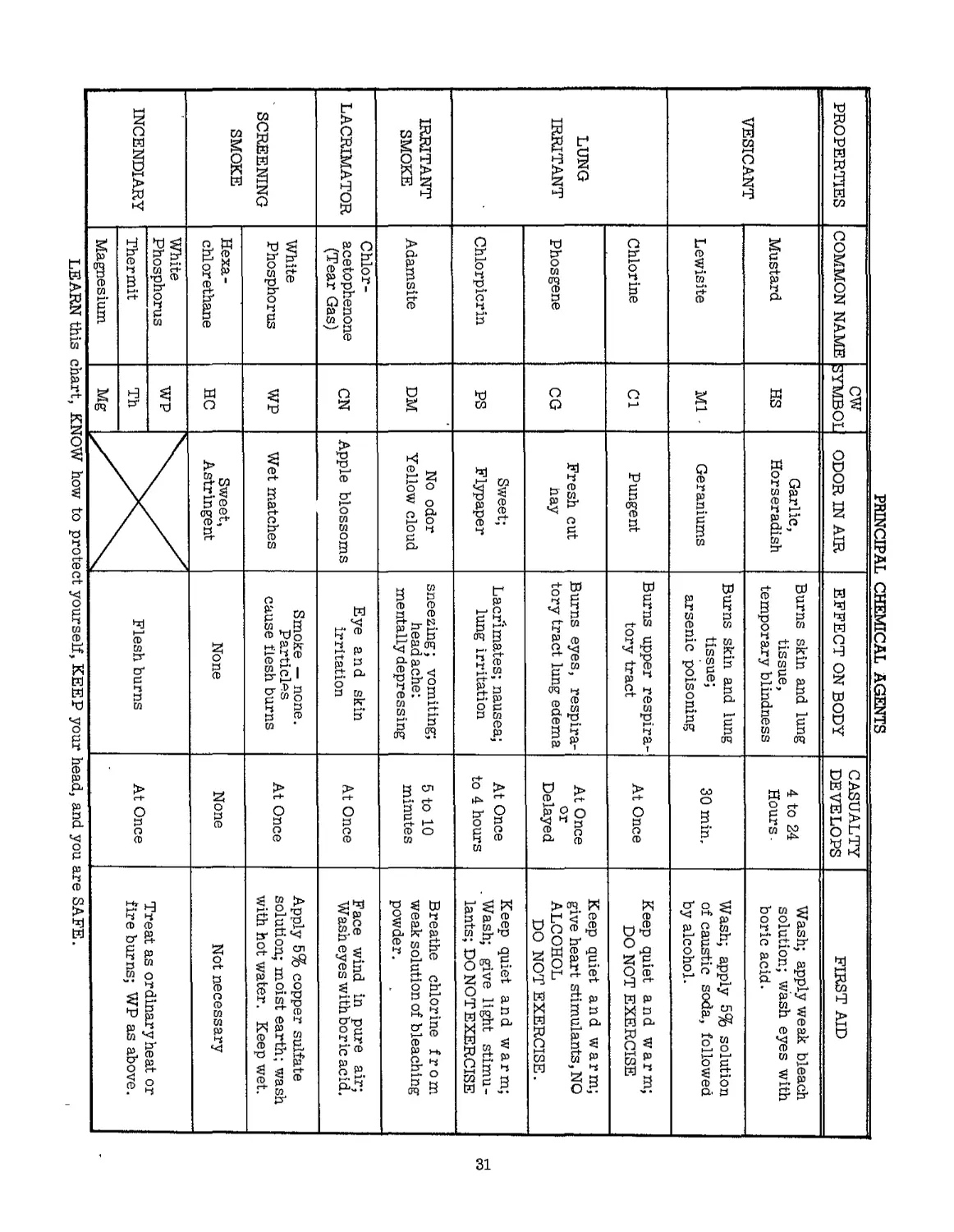
PRINCIPAL CHEMICAL AGENTS
PROPERTIES	COMMON NAME	CW SYMBOL	ODOR IN AIR	EFFECT ON BODY	CASUALTY DEVELOPS	FIRST AID
VESICANT	Mustard	HS	Garlic, Horseradish	Burns skin and lung tissue, temporary blindness	4 to 24 Hours•	Wash; apply weak bleach solution; wash eyes with boric acid.
	Lewisite	Ml -	Geraniums	Burns skin and lung tissue; arsenic poisoning	30 min.	Wash; apply 5% solution of caustic soda, followed by alcohol.
LUNG IRRITANT	Chlorine	Cl	Pungent	Burns upper respira- tory tract	At Once	Keep quiet and warm; DO NOT EXERCISE
	Phosgene	CG	Fresh cut hay	Burns eyes, respira- tory tract lung edema	At Once or Delayed	Keep quiet and warm; give heart stimulants, NO ALCOHOL DO NOT EXERCISE.
	Chlorpicrin	PS	Sweet; Flypaper	Lacrlmates; nausea; lung irritation	At Once to 4 hours	Keep quiet and warm; . Wash; give light stimu- lants; DO NOT EXERCISE
IRRITANT SMOKE	Adamsite	DM	No odor Yellow cloud	sneezing; vomiting; headache: mentally depressing	5 to 10 minutes	Breathe chlorine from weak solution of bleaching powder.
LACRIMATOR	Chlor- acetophenone (Tear Gas)	CN	Apple blossoms	Eye and skin irritation	At Once	Face wind in pure air; Wash eyes with boric acid.
SCREENING SMOKE	White Phosphorus	WP	Wet matches	Smoke — none. Particles cause flesh burns	At Once	Apply 5% copper sulfate solution; moist earth; wash with hot water. Keep wet.
	Hexa- chlor ethane	HC	Sweet, Astringent	None	None	Not necessary
INCENDIARY	White Phosphorus	WP		Flesh burns	At Once	Treat as ordinary heat or fire burns; WP as above.
	Thermit	Th
	Magnesium.	Mg
LEARN this chart, KNOW how to protect yourself, KEEP your head, and you are SAFE.
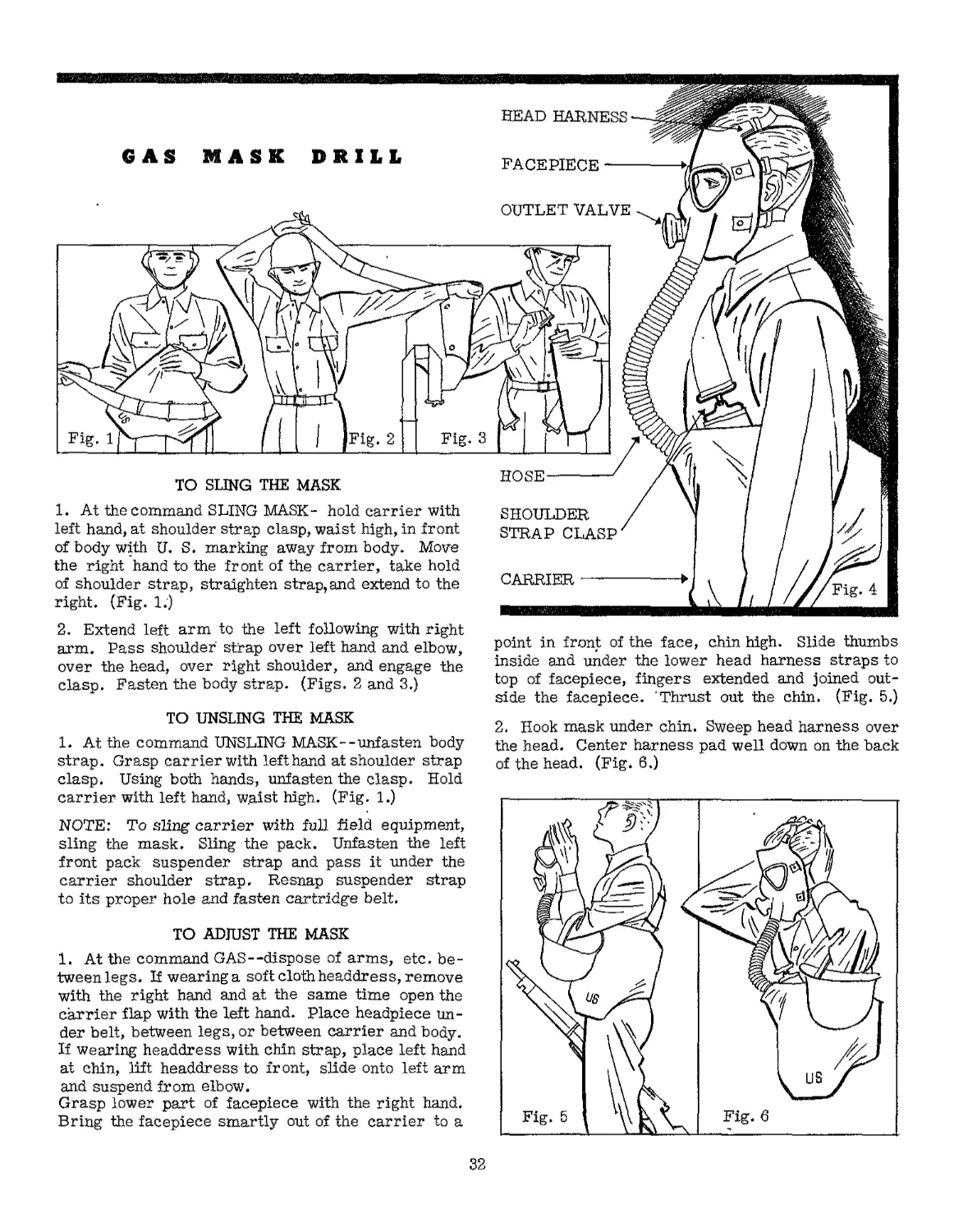
HEAD HARNESS
FACEPIECE
OUTLET VALVE
GAS MASK DRILL
HOSE
CARRIER
SHOULDER
STRAP CLASP
TO SLING THE MASK
1. At the command SLING MASK- hold carrier with
left hand, at shoulder strap clasp, waist high, in front
of body with U. S. marking away from body. Move
the right hand to the front of the carrier, take hold
of shoulder strap, straighten strap,and extend to the
right. (Fig. 1.)
2. Extend left arm to the left following with right
arm. Pass shoulder strap over left hand and elbow,
over the head, over right shoulder, and engage the
clasp. Fasten the body strap. (Figs. 2 and 3.)
TO UNSLING THE MASK
1.	At the command UNSLING MASK--unfasten body
strap. Grasp carrier with lefthand at shoulder strap
clasp. Using both hands, unfasten the clasp. Hold
carrier with left hand, w,aist high. (Fig. 1.)
NOTE: To sling carrier with full field equipment,
sling the mask. Sling the pack. Unfasten the left
front pack suspender strap and pass it under the
carrier shoulder strap. Resnap suspender strap
to its proper hole and fasten cartridge belt.
TO ADJUST THE MASK
1.	At the command GAS—dispose of arms, etc. be-
tweenlegs. If wearinga soft cloth headdress, remove
with the right hand and at the same time open the
carrier flap with the left hand. Place headpiece un-
der belt, between legs, or between carrier and body.
If wearing headdress with chin strap, place left hand
at chin, lift headdress to front, slide onto left arm
and suspend from elbow.
Grasp lower part of facepiece with the right hand.
Bring the facepiece smartly out of the carrier to a
point in front of the face, chin high. Slide thumbs
inside and under the lower head harness straps to
top of facepiece, fingers extended and joined out-
side the facepiece. 'Thrust out the chin. (Fig. 5.)
2.	Hook mask under chin. Sweep head harness over
the head. Center harness pad well down on the back
of the head. (Fig. 6.)
32
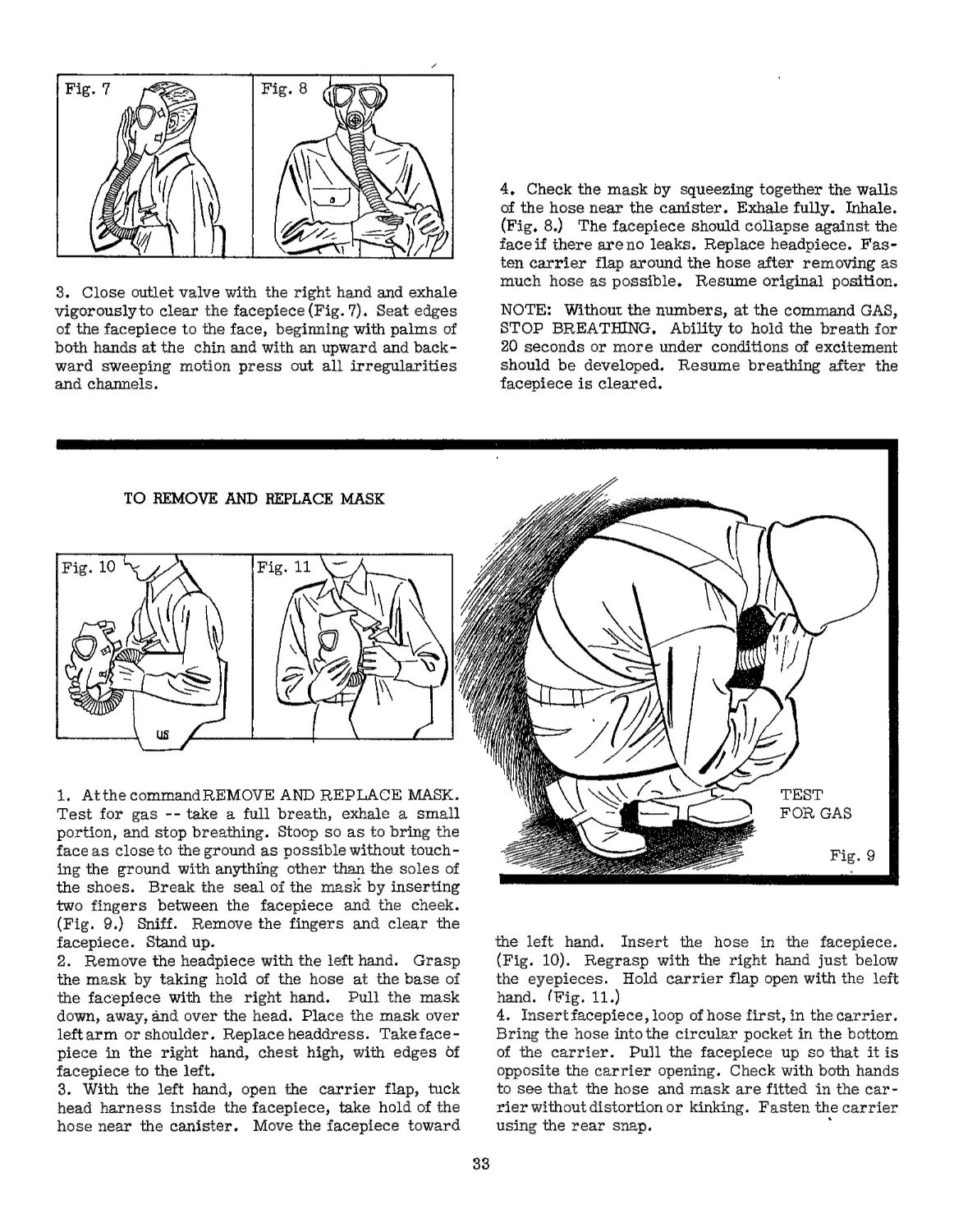
3.	Close outlet valve with the right hand and exhale
vigorouslyto clear the facepiece (Fig. 7). Seat edges
of the facepiece to the face, beginning with palms of
both hands at the chin and with an upward and back-
ward sweeping motion press out all irregularities
and channels.
4.	Check the mask by squeezing together the walls
of the hose near the canister. Exhale fully. Inhale.
(Fig. 8.) The facepiece should collapse against the
face if there are no leaks. Replace headpiece. Fas-
ten carrier flap around the hose after removing as
much hose as possible. Resume original position.
NOTE: Without the numbers, at the command GAS,
STOP BREATHING. Ability to hold the breath for
20 seconds or more under conditions of excitement
should be developed. Resume breathing after the
facepiece is cleared.
TO REMOVE AND REPLACE MASK
Fig. 9
TEST
FOR GAS
1. At the command REMOVE AND REPLACE MASK.
Test for gas -- take a full breath, exhale a small
portion, and stop breathing. Stoop so as to bring the
face as close to the ground as possible without touch-
ing the ground with anything other than the soles of
the shoes. Break the seal of the mask by inserting
two fingers between the facepiece and the cheek.
(Fig. 9.) Sniff. Remove the fingers and clear the
facepiece. Standup.
2.	Remove the headpiece with the left hand. Grasp
the mask by taking hold of the hose at the base of
the facepiece with the right hand. Pull the mask
down, away, and over the head. Place the mask over
left arm or shoulder. Replace headdress. Takeface-
piece in the right hand, chest high, with edges of
facepiece to the left.
3.	With the left hand, open the carrier flap, tuck
head harness inside the facepiece, take hold of the
hose near the canister. Move the facepiece toward
the left hand. Insert the hose in the facepiece.
(Fig. 10). Regrasp with the right hand just below
the eyepieces. Hold carrier flap open with the left
hand. (Fig. 11.)
4.	Insert facepiece, loop of hose first, in the carrier.
Bring the hose into the circular pocket in the bottom
of the carrier. Pull the facepiece up so that it is
opposite the carrier opening. Check with both hands
to see that the hose and mask are fitted in the car-
rier without distortion or kinking. Fasten the carrier
using the rear snap.
33
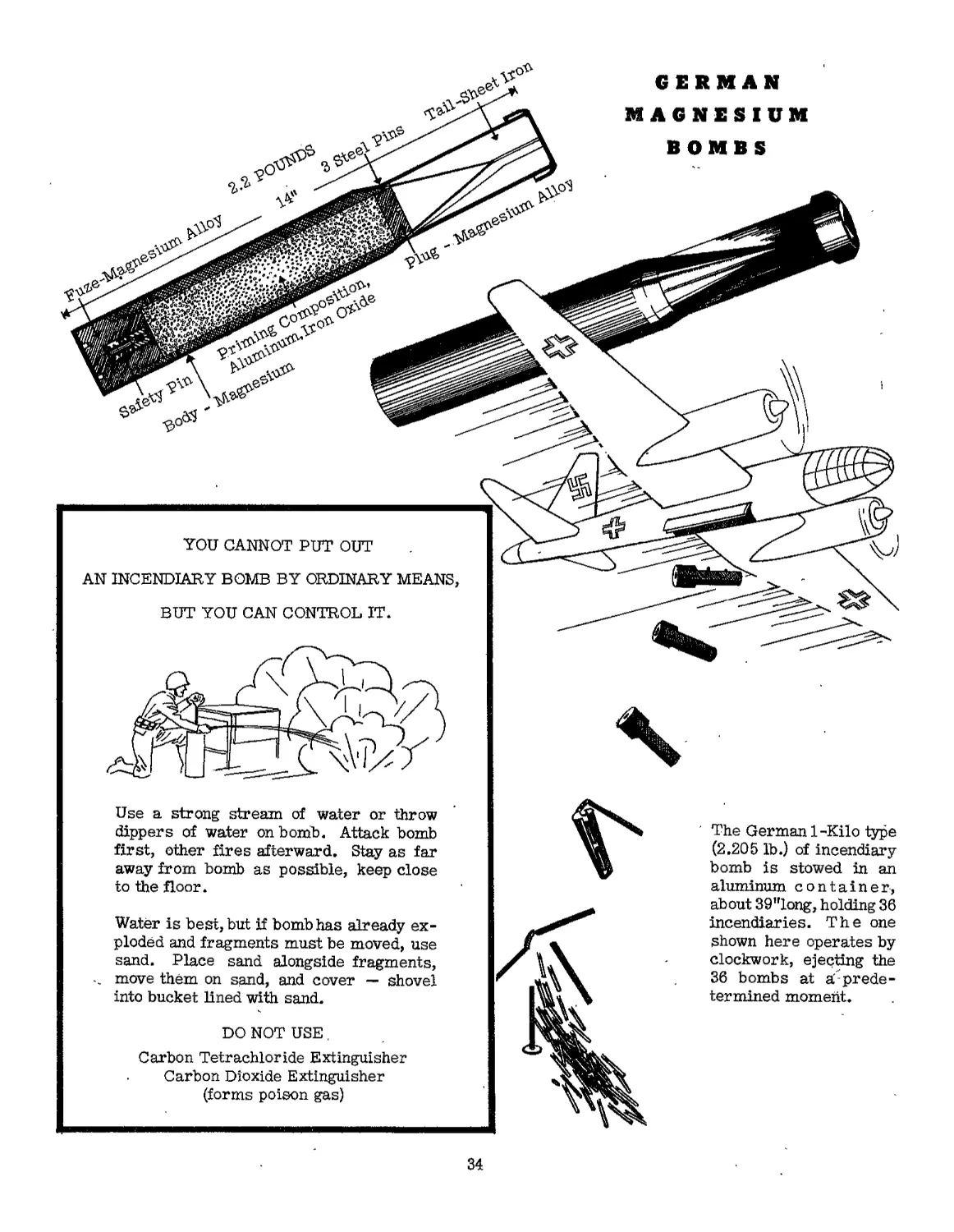
GERMAN
MAGNESIUM
BOMBS
V°
YOU CANNOT PUT OUT
Use a strong stream of water or throw
dippers of water on bomb. Attack bomb
first, other fires afterward. Stay as far
away from bomb as possible, keep close
to the floor.
Water is best, but if bomb has already ex-
ploded and fragments must be moved, use
sand. Place sand alongside fragments,
move them on sand, and cover — shovel
into bucket lined with sand.


6^	O&3


-AP^’

AN INCENDIARY BOMB BY ORDINARY MEANS,
BUT YOU CAN CONTROL IT.
' The German 1-Kilo type
(2.205 lb.) of incendiary
bomb is stowed in an
aluminum container,
about 39"long, holding 36
incendiaries. The one
shown here operates by
clockwork, ejecting the
36 bombs at a"prede-
termined moment.
DO NOT USE.
Carbon Tetrachloride Extinguisher
Carbon Dioxide Extinguisher
(forms poison gas)
34
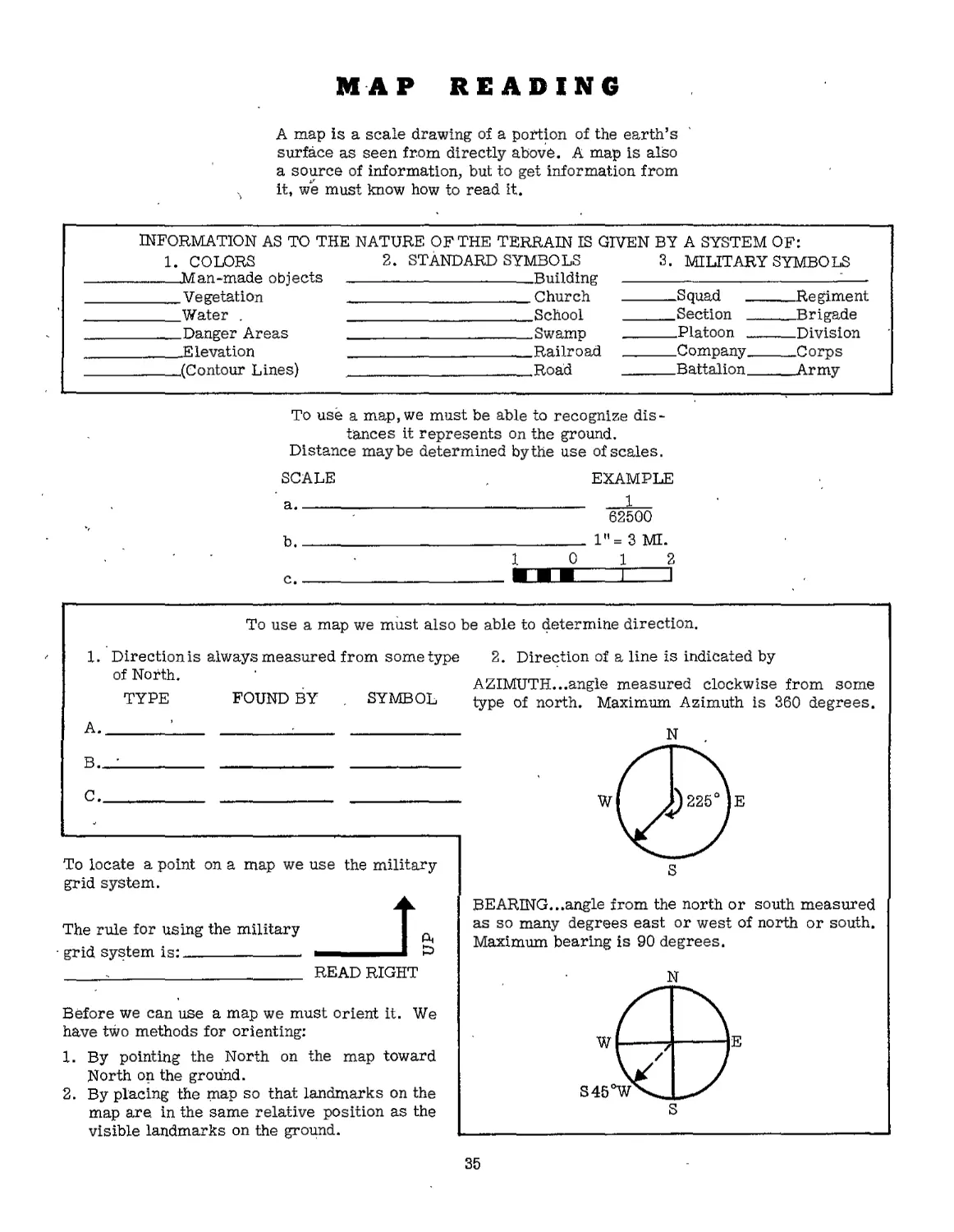
MAP READING
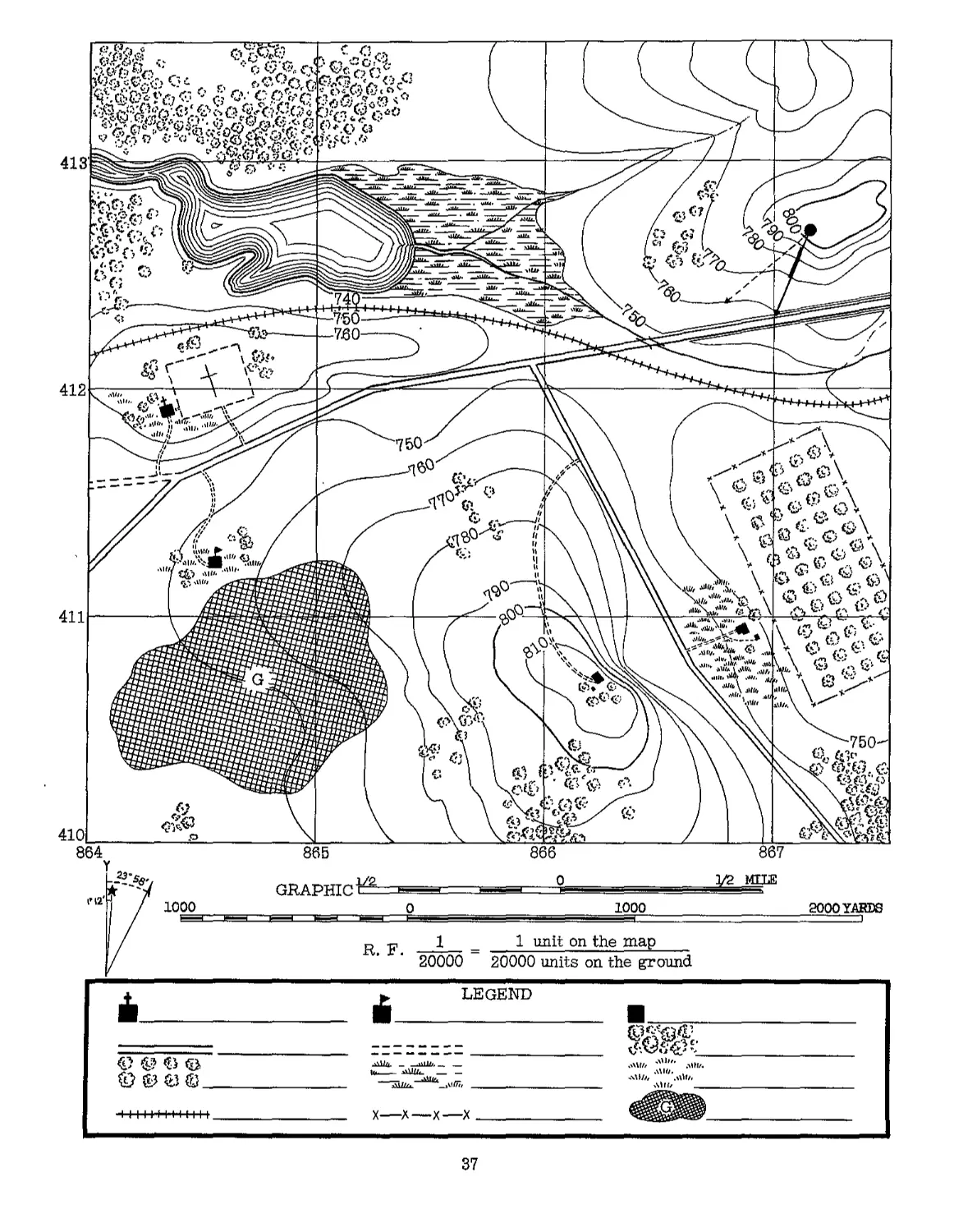
A map is a scale drawing of a portion of the earth’s
surface as seen from directly above. A map is also
a source of information, but to get information from
it, we must know how to read it.
INFORMATION AS TO THE NATURE OF THE TERRAIN IS GIVEN BY A SYSTEM OF:
1. COLORS 	Man-made objects _	2. STANDARD SYMBOLS Building	3. MILITARY SYMBOLS
	Ve getation		Church _		Squad 		.Regiment
	Water .		School	_		Section 		.Brigade
	Danger Areas		Swamp		Platoon 		.Division
Elevation			Railroad		Company		.Corps
	(Contour Lines)		Road	_		В attalion		-Army
To use a map, we must be able to recognize dis-
tances it represents on the ground.
Distance maybe determined by the use of scales.
SCALE	.	EXAMPLE
1
62500
To use a map we must also be able to determine direction.
1. Direction is always measured from some type
of North.
TYPE
FOUND BY
SYMBOL
2. Direction of a line is indicated by
AZIMUTH...angle measured clockwise from some
type of north. Maximum Azimuth is 360 degrees.
A.
c.
To locate a point on a map we use the military
grid system.
The rule for using the military	I _
I
grid system is:-------------- I &
, READ RIGHT
BEARING...angle from the north or south measured
as so many degrees east or west of north or south.
Maximum bearing is 90 degrees.
Before we can use a map we must orient it. We
have two methods for orienting:
1. By pointing the North on the map toward
North on the ground.
2. By placing the map so that landmarks on the
map are in the same relative position as the
visible landmarks on the ground.
В__1
35
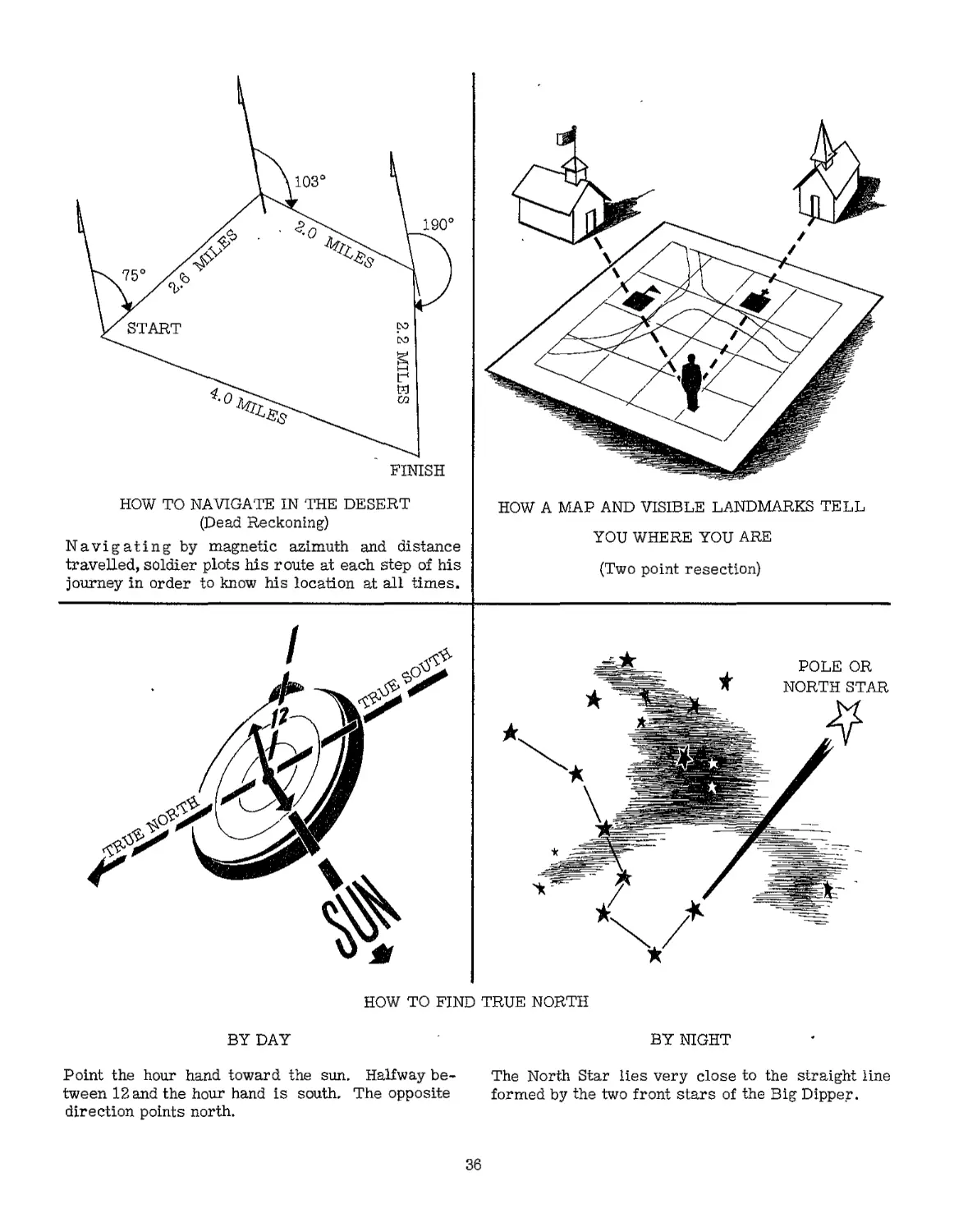
HOW TO NAVIGATE IN THE DESERT
(Dead Reckoning)
Navigating by magnetic azimuth and distance
travelled, soldier plots his route at each step of his
journey in order to know his location at all times.
HOW A MAP AND VISIBLE LANDMARKS TELL
YOU WHERE YOU ARE
(Two point resection)
HOW TO FIND TRUE NORTH
BY DAY
BY NIGHT
Point the hour hand toward the sun. Halfway be-	The North Star lies very close to the straight line
tween 12 and the hour hand is south. The opposite	formed by the two front stars of the Big Dipper,
direction points north.
36
37
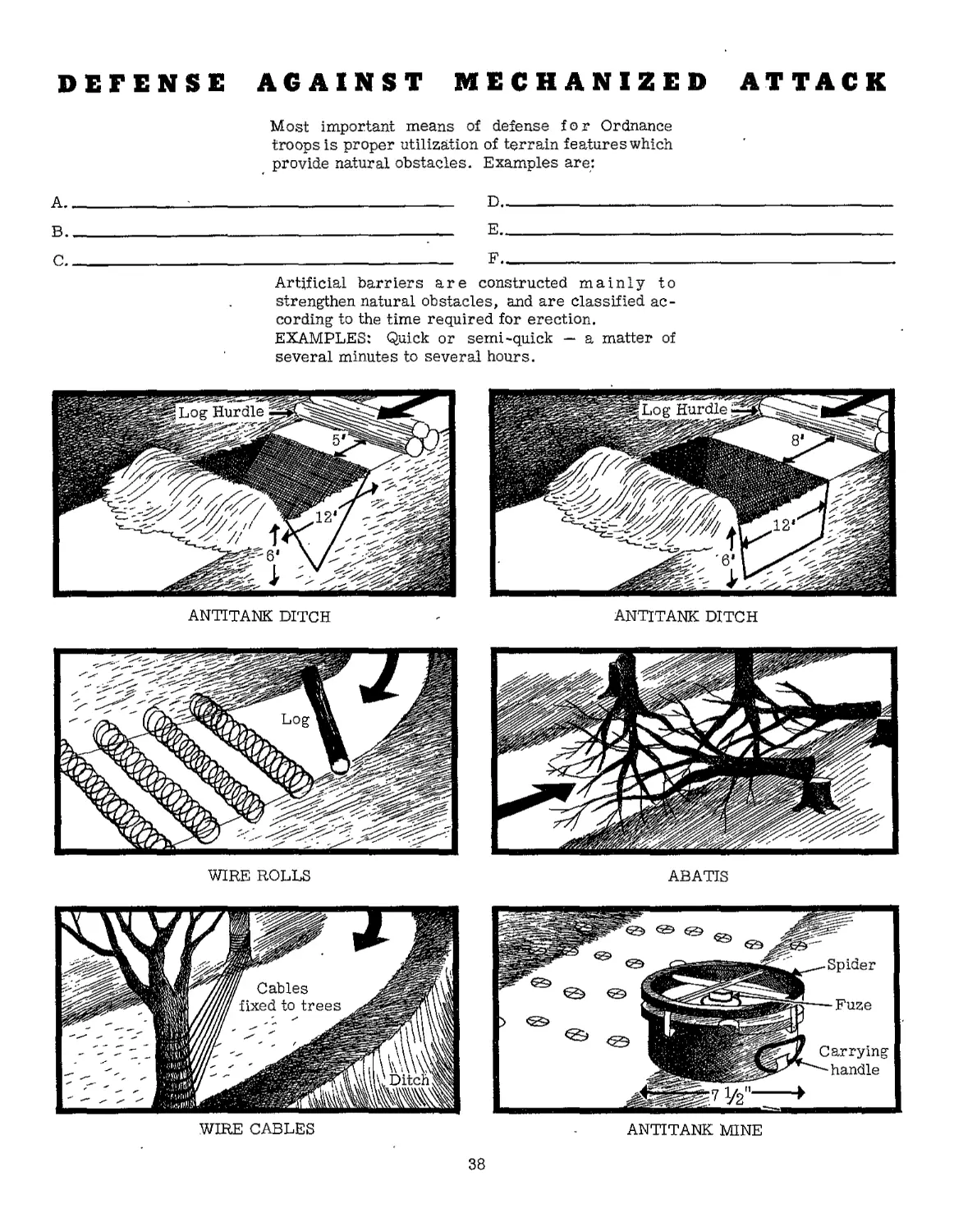
DEFENSE AGAINST MECHANIZED ATTACK
Most important means of defense for Ordnance
troops is proper utilization of terrain features which
provide natural obstacles. Examples are:
A________________:________________________________ D
В_____________________,_____________________________ E--------------------------------------------------
C F-----------------------------------------------------------------------------------------------------
Artificial barriers are constructed mainly to
strengthen natural obstacles, and are classified ac-
cording to the time required for erection.
EXAMPLES: Quick or semi-quick — a matter of
several minutes to several hours.
ANTITANK DITCH
ANTITANK DITCH
WIRE ROLLS
ABATIS
WIRE CABLES
ANTITANK MINE
38
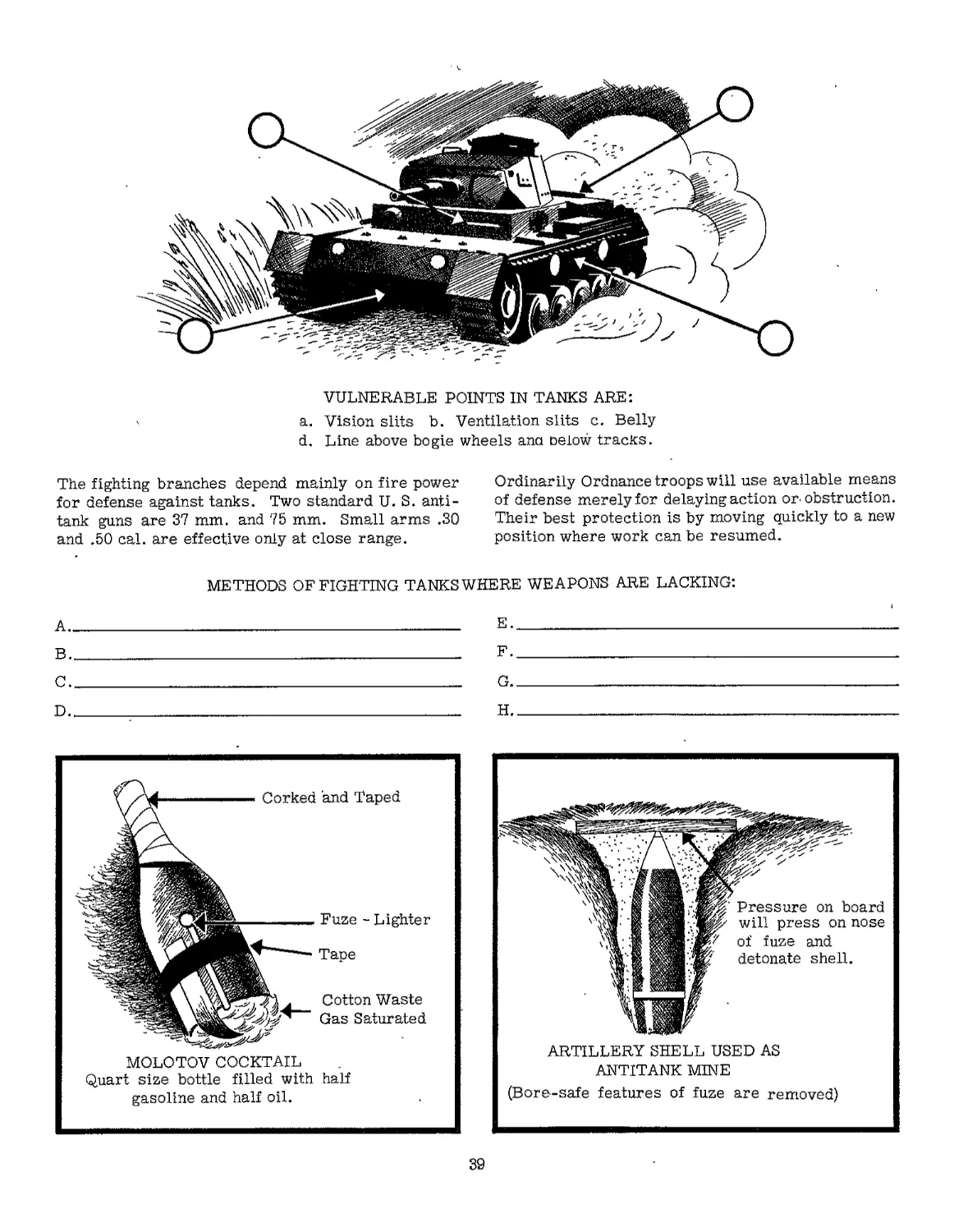
VULNERABLE POINTS IN TANKS ARE:
a. Vision slits b. Ventilation slits c. Belly
d. Line above bogie wheels ano below tracks.
The fighting branches depend mainly on fire power
for defense against tanks. Two standard U. S. anti-
tank guns are 37 mm. and 75 mm. Small arms .30
and .50 cal. are effective only at close range.
Ordinarily Ordnance troops will use available means
of defense merely for delaying action or obstruction.
Their best protection is by moving quickly to a new
position where work can be resumed.
METHODS OF FIGHTING TANKS WHERE WEAPONS ARE LACKING:
A______________________________________________
В______________________________________________
C_____________,________________________________
D.,____________________________________________
ARTILLERY SHELL USED AS
ANTITANK MINE
(Bore-safe features of fuze are removed)
39
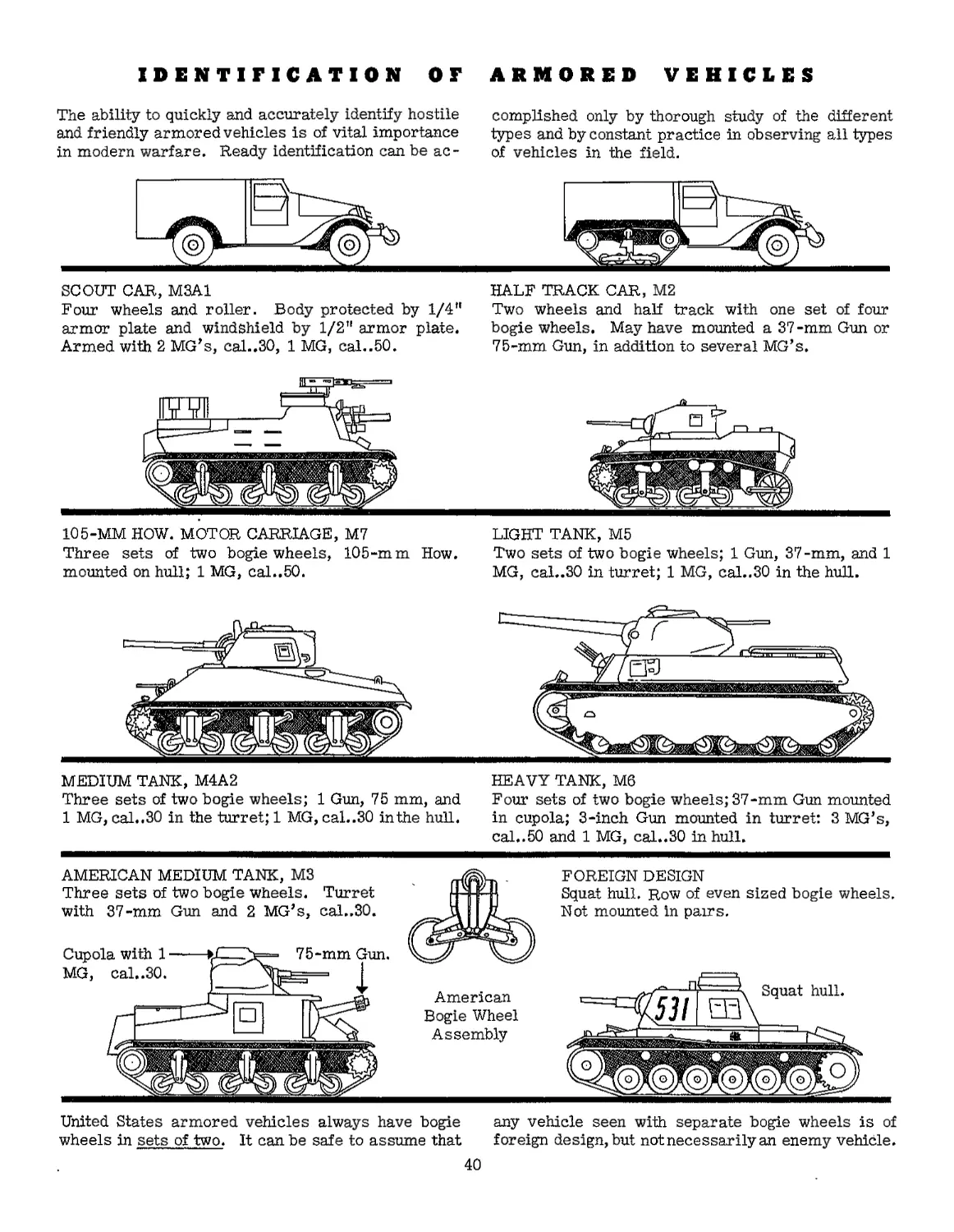
IDENTIFICATION OF
The ability to quickly and accurately identify hostile
and friendly armored vehicles is of vital importance
in modern warfare. Ready identification can be ac-
ARMORED VEHICLES
complished only by thorough study of the different
types and by constant practice in observing all types
of vehicles in the field.
SCOUT CAR, M3A1
Four wheels and roller. Body protected by 1/4”
armor plate and windshield by 1/2" armor plate.
Armed with 2 MG’s, cal..30, 1 MG, cal..50.
HALF TRACK CAR, М2
Two wheels and half track with one set of four
bogie wheels. May have mounted a 37-mm Gun or
75-mm Gun, in addition to several MG’s.
105-MM HOW. MOTOR CARRIAGE, M7
Three sets of two bogie wheels, 105-mm How.
mounted on hull; 1 MG, cal..50.
LIGHT TANK, M5
Two sets of two bogie wheels; 1 Gun, 37-mm, and 1
MG, cal..30 in turret; 1 MG, cal..30 in the hull.
MEDIUM TANK, M4A2
Three sets of two bogie wheels; 1 Gun, 75 mm, and
1 MG, cal.. 30 in the turret; 1 MG, cal..30 in the hull.
HEAVY TANK, M6
Four sets of two bogie wheels; 37-mm Gun mounted
in cupola; 3-inch Gun mounted in turret: 3 MG’s,
cal..50 and 1 MG, cal..30 in hull.
AMERICAN MEDIUM TANK, М3
Three sets of two bogie wheels. Turret
with 37-mm Gun and 2 MG’s, cal..30.
American
Bogie Wheel
Assembly
FOREIGN DESIGN
Squat hull. Row of even sized bogie wheels.
Not mounted in pairs.
United States armored vehicles always have bogie any vehicle seen with separate bogie wheels is of
wheels in sets of two. It can be safe to assume that foreign design, but not necessarily an enemy vehicle.
40
DEFENSE AGAINST AIR AND PARATROOP ATTACK
ON THE MARCH, you may get only a few seconds
warning. Don’t make for distant cover (more than
10-15 yards away) or you’ll give yourself and
your buddies away. Flop down just off the road and
don’t look up. You are safest in a depression, but
remember that ditches are systematically strafed.
IN A VEHICLE drive truck to side of road, set
brakesand run for cover. Don’t get under the vehi-
cle, the principal target. Take cover as on march.
IN BIVOUAC dig a slit trench at the first oppor-
tunity. When attacked, get in it and remain motion-
less. (See Hasty Field Fortifications, page 27.)
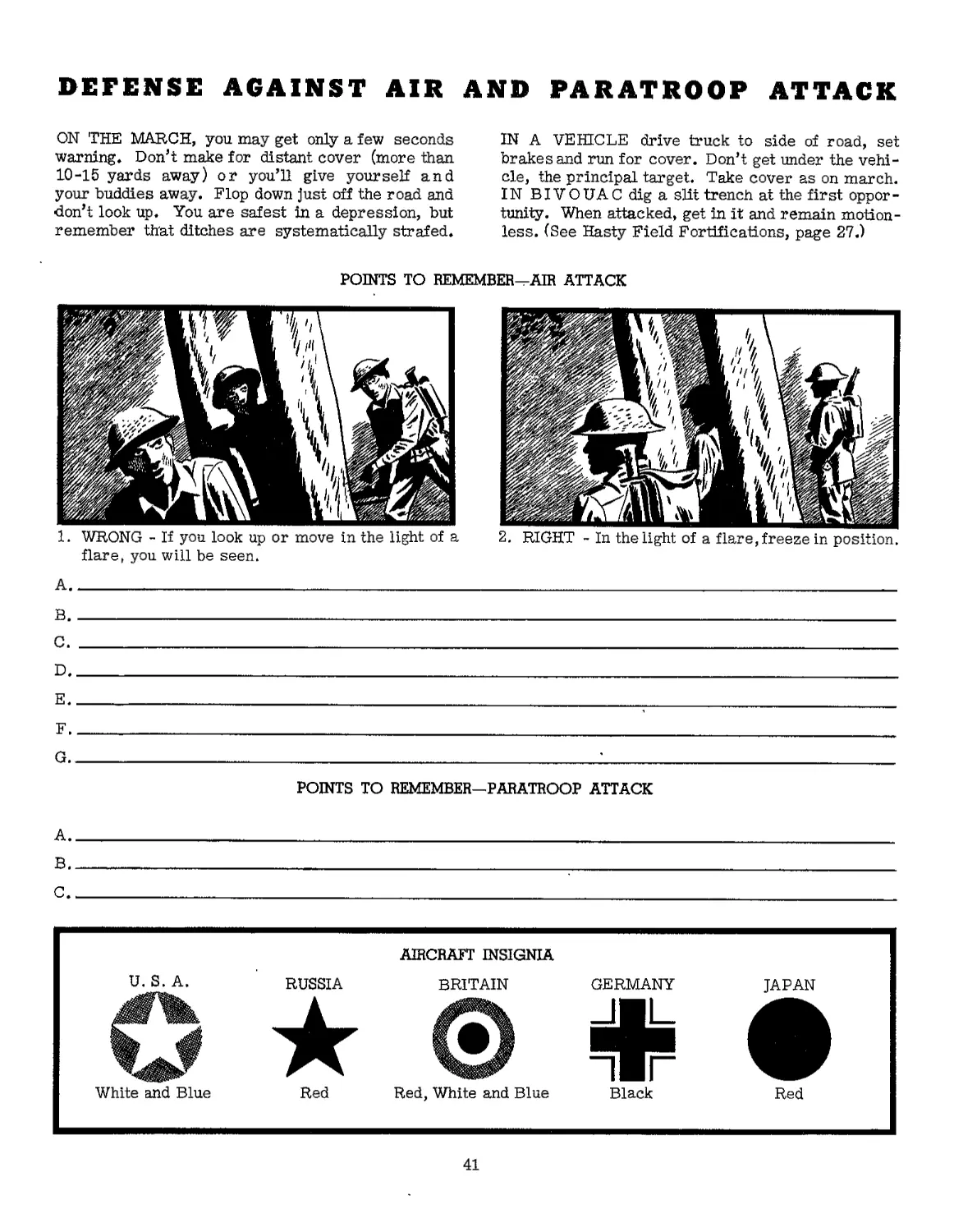
POINTS TO REMEMBER—AIR ATTACK
1. WRONG - If you look up or move in the light of a
flare, you will be seen.
2. RIGHT - In the light of a flare, freeze in position.
A_______________________________________________________________________
В_________________________________________________________________________________
C. _______________________________________________________________________________
D_________________________________________________________________________________
E________________________________________________________.________________________
F_________________________________________________________________________________
G____________________________________________________:____________________________
POINTS TO REMEMBER—PARATROOP ATTACK
A______________________________________________________________________________
В______________________________________________________________________________
C______________________________________________________________________________
AIRCRAFT INSIGNIA
U. S. A.	RUSSIA	BRITAIN	GERMANY	JAPAN
White and Blue	Red Red, White and Blue Black	Red
41
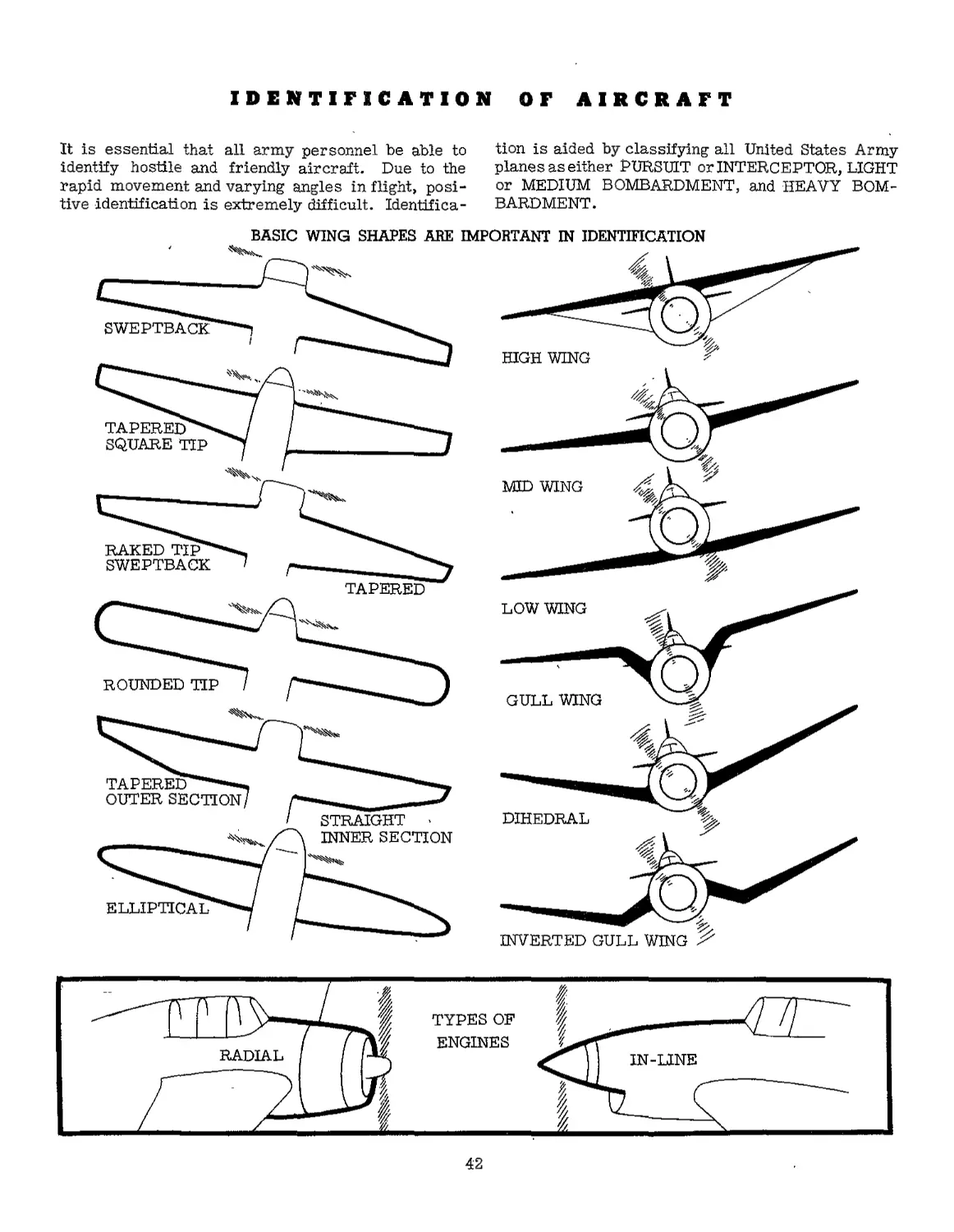
IDENTIFICATION OF AIRCRAFT
It is essential that all army personnel be able to
identify hostile and friendly aircraft. Due to the
rapid movement and varying angles in flight, posi-
tive identification is extremely difficult. Identifica-
tion is aided by classifying all United States Army
planes as either PURSUIT or INTERCEPTOR, LIGHT
or MEDIUM BOMBARDMENT, and HEAVY BOM-
BARDMENT.
BASIC WING SHAPES ABE IMPORTANT IN IDENTIFICATION
42
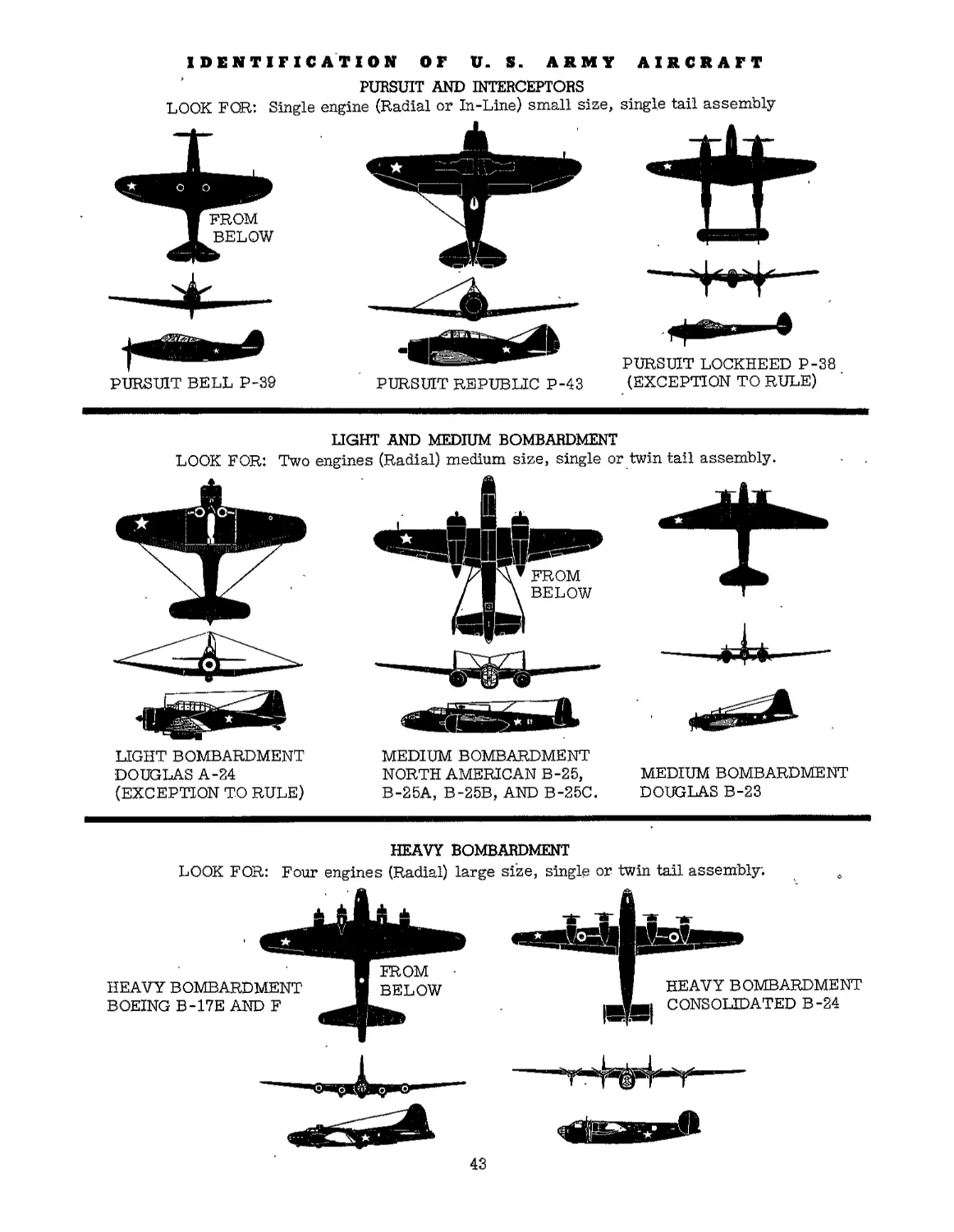
IDENTIFICATION OF U. 5. ARMY AIRCRAFT
PURSUIT AND INTERCEPTORS
LOOK FOR: Single engine (Radial or In-Line) small size, single tail assembly
PURSUIT BELL P-39	' PURSUIT REPUBLIC P-43 (EXCEPTION TO RULE)
LIGHT AND MEDIUM BOMBARDMENT
LOOK FOR: Two engines (Radial) medium size, single or twin tail assembly.
LIGHT BOMBARDMENT
DOUGLAS A-24
(EXCEPTION TO RULE)
MEDIUM BOMBARDMENT
NORTH AMERICAN В-25,
B-25A, B-25B, AND B-25C.
MEDIUM BOMBARDMENT
DOUGLAS B-23
HEAVY BOMBARDMENT
LOOK FOR: Four engines (Radial) large size, single or twin tail assembly.
43
KNOW
YOUR
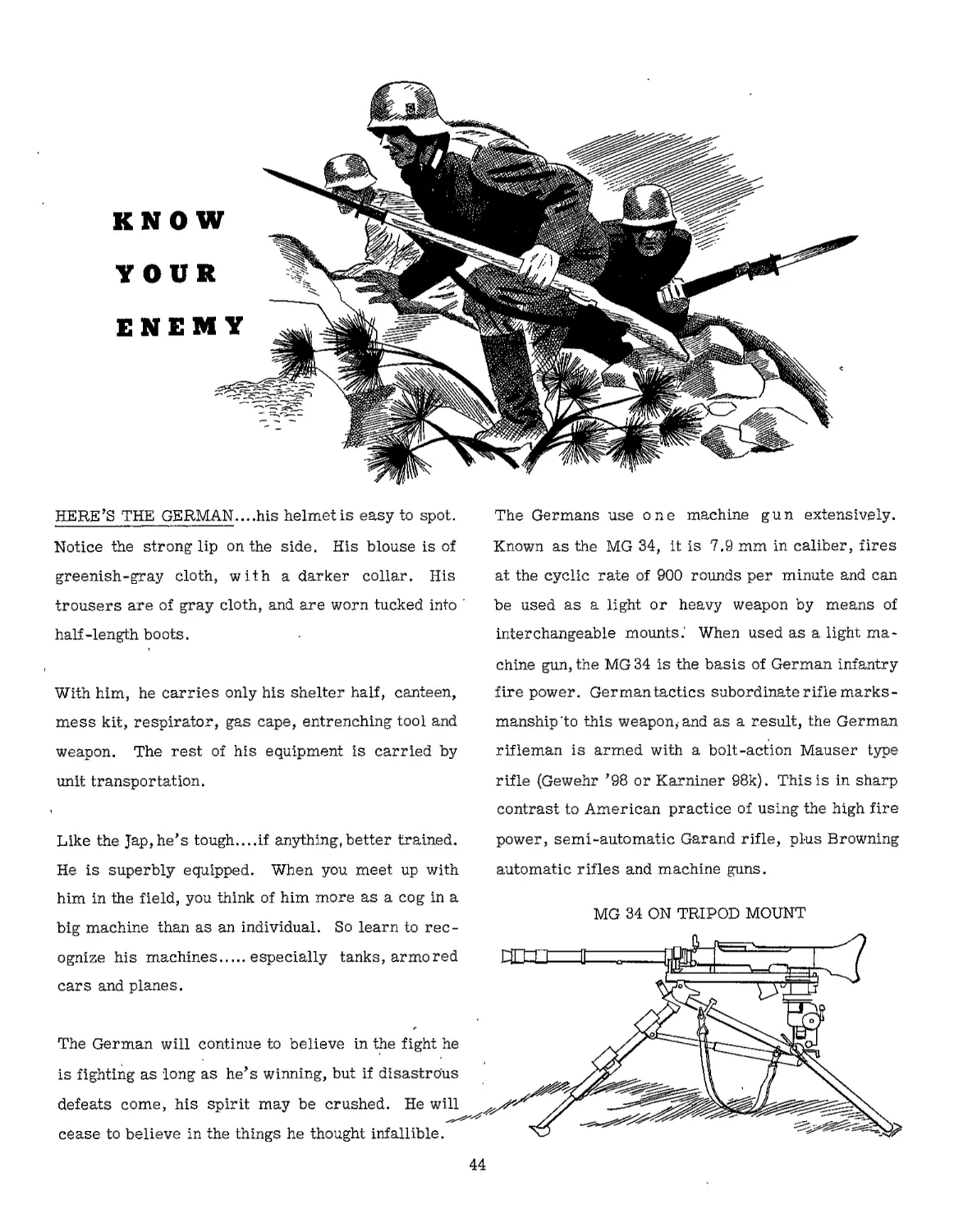
HERE’S THE GE RM AN....his helmet is easy to spot.
Notice the strong lip on the side. His blouse is of
greenish-gray cloth, with a darker collar. His
trousers are of gray cloth, and are worn tucked into
half-length boots.
With him, he carries only his shelter half, canteen,
mess kit, respirator, gas cape, entrenching tool and
weapon. The rest of his equipment is carried by
unit transportation.
Like the Jap,he’s tough....if anything,better trained.
He is superbly equipped. When you meet up with
him in the field, you think of him more as a cog in a
big machine than as an individual. So learn to rec-
ognize his machines......especially tanks, armored
cars and planes.
The German will continue to believe in the fight he
is fighting as long as he’s winning, but if disastrous
defeats come, his spirit may be crushed. He will
cease to believe in the things he thought infallible.
The Germans use one machine gun extensively.
Known as the MG 34, it is 7.9 mm in caliber, fires
at the cyclic rate of 900 rounds per minute and can
be used as a light or heavy weapon by means of
interchangeable mounts.' When used as a light ma-
chine gun, the MG 34 is the basis of German infantry
fire power. German tactics subordinate rifle marks-
manship‘to this weapon, and as a result, the German
rifleman is armed with a bolt-action Mauser type
rifle (Gewehr ’98 or Karniner 98k). This is in sharp
contrast to American practice of using the high fire
power, semi-automatic Garand rifle, plus Browning
automatic rifles and machine guns.
MG 34 ON TRIPOD MOUNT
44
KNOW
ENEMY
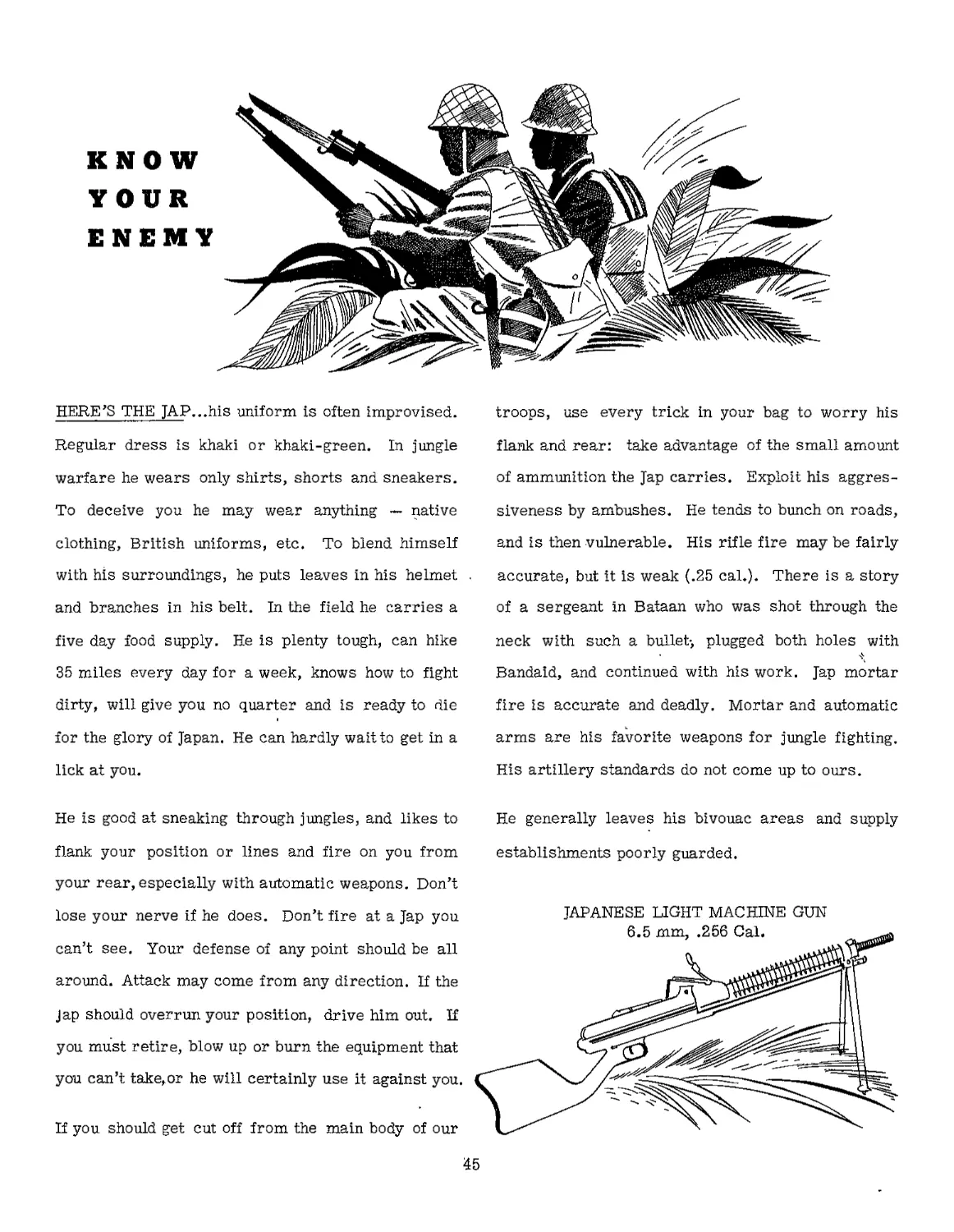
HERE'S THE JAP...his uniform is often improvised.
Regular dress is khaki or khaki-green. In jungle
warfare he wears only shirts, shorts and sneakers.
To deceive you he may wear anything — native
clothing, British uniforms, etc. To blend himself
with his surroundings, he puts leaves in his helmet
and branches in his belt. In the field he carries a
five day food supply. He is plenty tough, can hike
35 miles every day for a week, knows how to fight
dirty, will give you no quarter and is ready to die
for the glory of Japan. He can hardly wait to get in a
lick at you.
He is good at sneaking through jungles, and likes to
flank your position or lines and fire on you from
your rear, especially with automatic weapons. Don’t
lose your nerve if he does. Don’t fire at a Jap you
can’t see. Your defense of any point should be all
around. Attack may come from any direction. If the
Jap should overrun your position, drive him out. If
you must retire, blow up or burn the equipment that
you can’t take,or he will certainly use it against you.
If you should get cut off from the main body of our
troops, use every trick in your bag to worry his
flank and rear: take advantage of the small amount
of ammunition the Jap carries. Exploit his aggres-
siveness by ambushes. He tends to bunch on roads,
and is then vulnerable. His rifle fire may be fairly
accurate, but it is weak (.25 cal.). There is a story
of a sergeant in Bataan who was shot through the
neck with such a bullet-, plugged both holes with
Bandaid, and continued with his work. Jap mortar
fire is accurate and deadly. Mortar and automatic
arms are his favorite weapons for jungle fighting.
His artillery standards do not come up to ours.
He generally leaves his bivouac areas and supply
establishments poorly guarded.
JAPANESE LIGHT MACHINE GUN
45
COMBAT
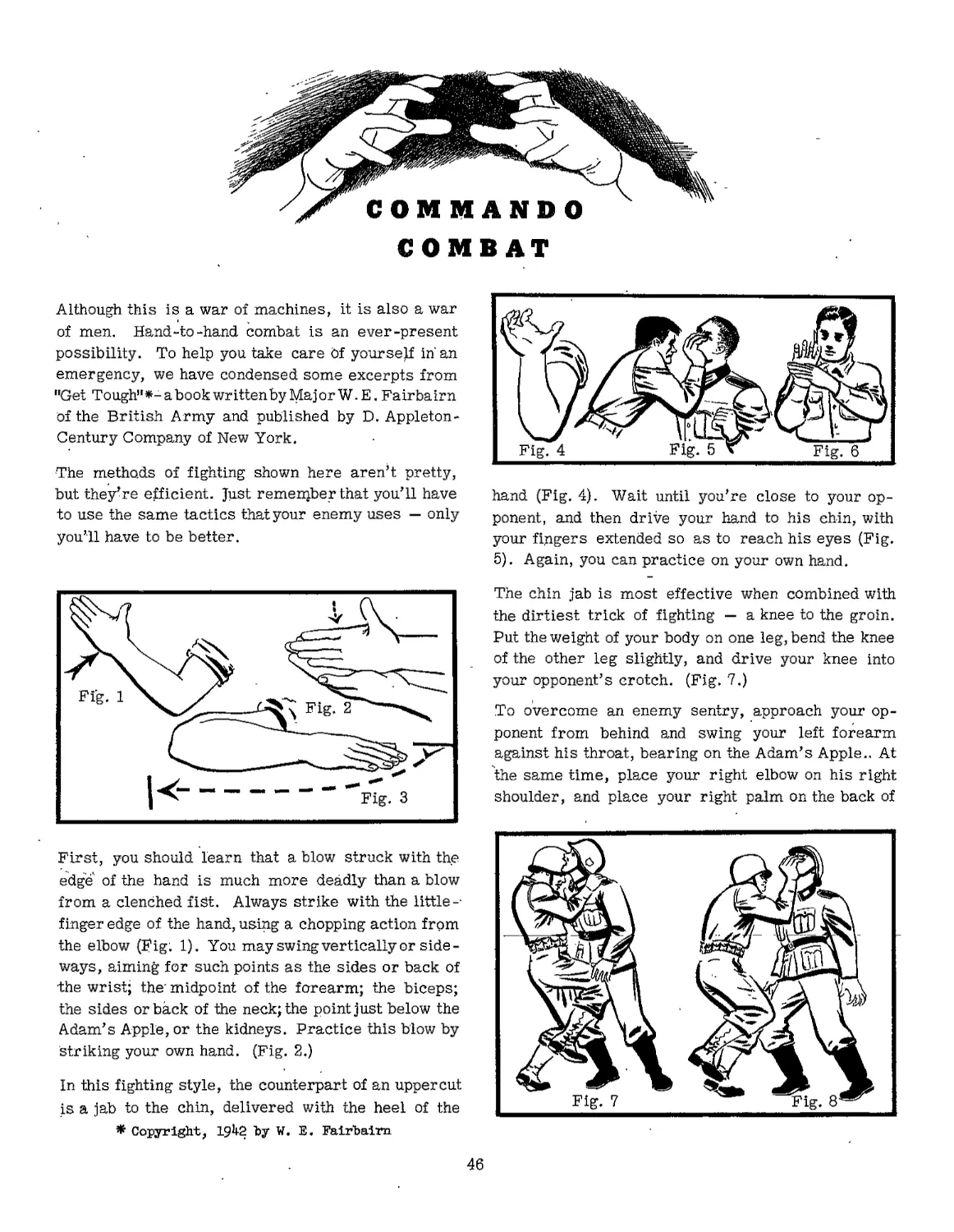
Although this is a war of machines, it is also a war
of men. Hand-to-hand, combat is an ever-present
possibility. To help you take care of yourself in' an
emergency, we have condensed some excerpts from
"Get Tough"*-abookwrittenby MajorW.E. Fairbairn
of the British Army and published by D. Appleton-
Century Company of New York.
The methods of fighting shown here aren’t pretty,
but they’re efficient. Just remember that you’ll have
to use the same tactics that your enemy uses — only
you’ll have to be better.
hand (Fig. 4). Wait until you’re close to your op-
ponent, and then drive your hand to his chin, with
your fingers extended so as to reach his eyes (Fig.
5). Again, you can practice on your own hand.
The chin jab is most effective when combined with
the dirtiest trick of fighting — a knee to the groin.
Put the weight of your body on one leg, bend the knee
of the other leg slightly, and drive your knee into
your opponent’s crotch. (Fig. 7.)
To overcome an enemy sentry, approach your op-
ponent from behind and swing your left forearm
against his throat, bearing on the Adam’s Apple.. At
the same time, place your right elbow on his right
shoulder, and place your right palm on the back of
First, you should learn that a blow struck with the
edge of the hand is much more deadly than a blow
from a clenched fist. Always strike with the little--
finger edge of the hand, using a chopping action from
the elbow (Big. 1). You may swing vertically or side-
ways, aiming for such points as the sides or back of
the wrist; the'midpoint of the forearm; the biceps;
the sides orback of the neck; the point just below the
Adam’s Apple, or the kidneys. Practice this blow by
striking your own hand. (Fig. 2.)
In this fighting style, the counterpart of an upper cut
is a jab to the chin, delivered with the heel of the
* Copyright, 191|-2 by W. E. Fairbairn
46
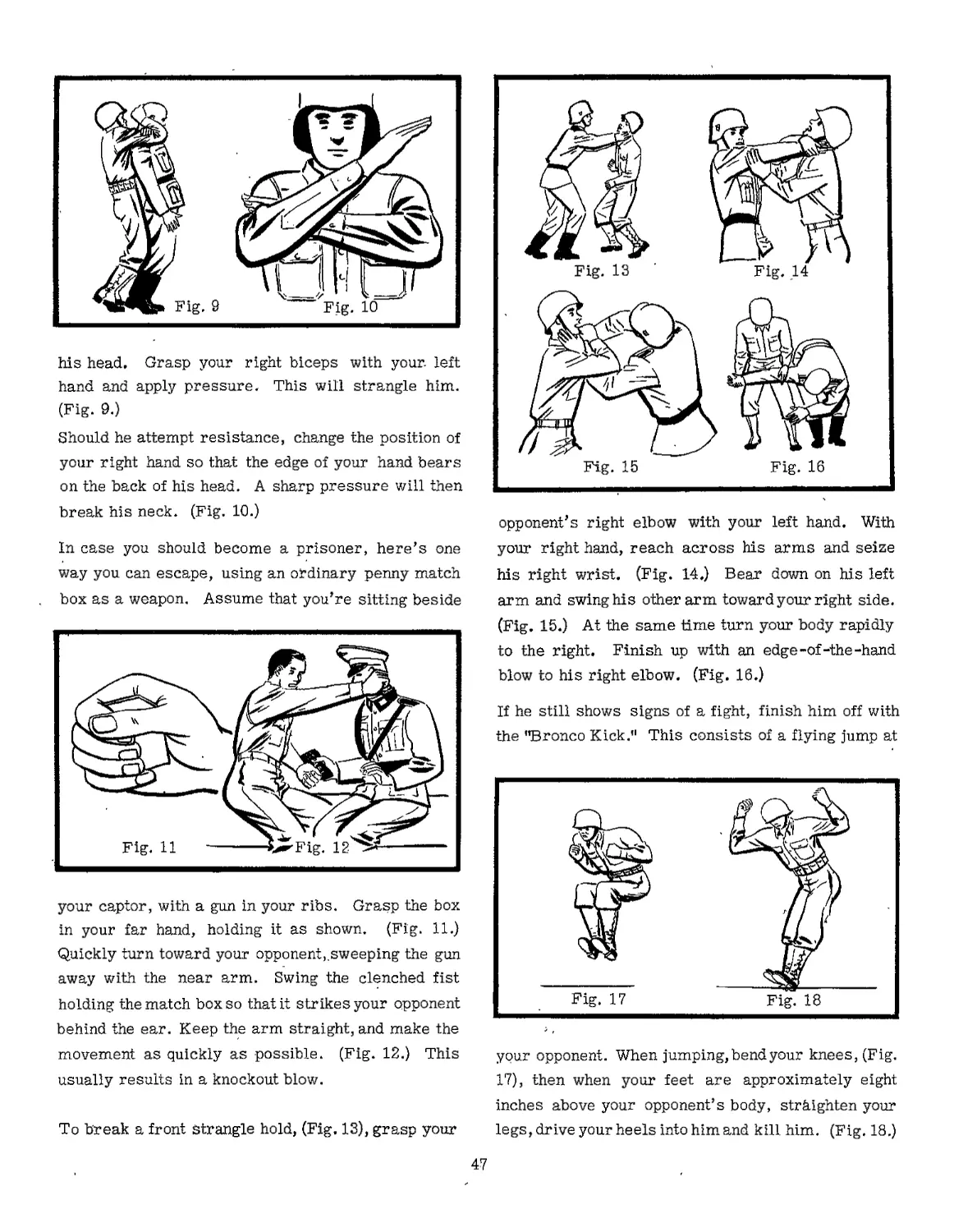
his head. Grasp your right biceps with your, left
hand and apply pressure. This will strangle him.
(Fig. 9.)
Should he attempt resistance, change the position of
your right hand so that the edge of your hand bears
on the back of his head. A sharp pressure will then
break his neck. (Fig. 10.)
In case you should become a prisoner, here’s one
way you can escape, using an ordinary penny match
box as a weapon. Assume that you’re sitting beside
your captor, with a gun in your ribs. Grasp the box
in your far hand, holding it as shown. (Fig. 11.)
Quickly turn toward your opponent,.sweeping the gun
away with the near arm. Swing the clenched fist
holding the match box so that it strikes your opponent
behind the ear. Keep the arm straight, and make the
movement as quickly as possible. (Fig. 12.) This
usually results in a knockout blow.
To break a front strangle hold, (Fig. 13), grasp your
opponent’s right elbow with your left hand. With
your right hand, reach across his arms and seize
his right wrist. (Fig. 14.) Bear down on his left
arm and swing his other arm toward your right side.
(Fig. 15.) At the same time turn your body rapidly
to the right. Finish up with an edge-of-the-hand
blow to his right elbow. (Fig. 16.)
If he still shows signs of a fight, finish him off with
the "Bronco Kick." This consists of a flying jump at
your opponent. When jumping, bend your knees, (Fig.
17), then when your feet are approximately eight
inches above your opponent’s body, straighten your
legs, drive your he els into him and kill him. (Fig. 18.)
47
WATCH YOUR STEP-BOOBY TRAPS
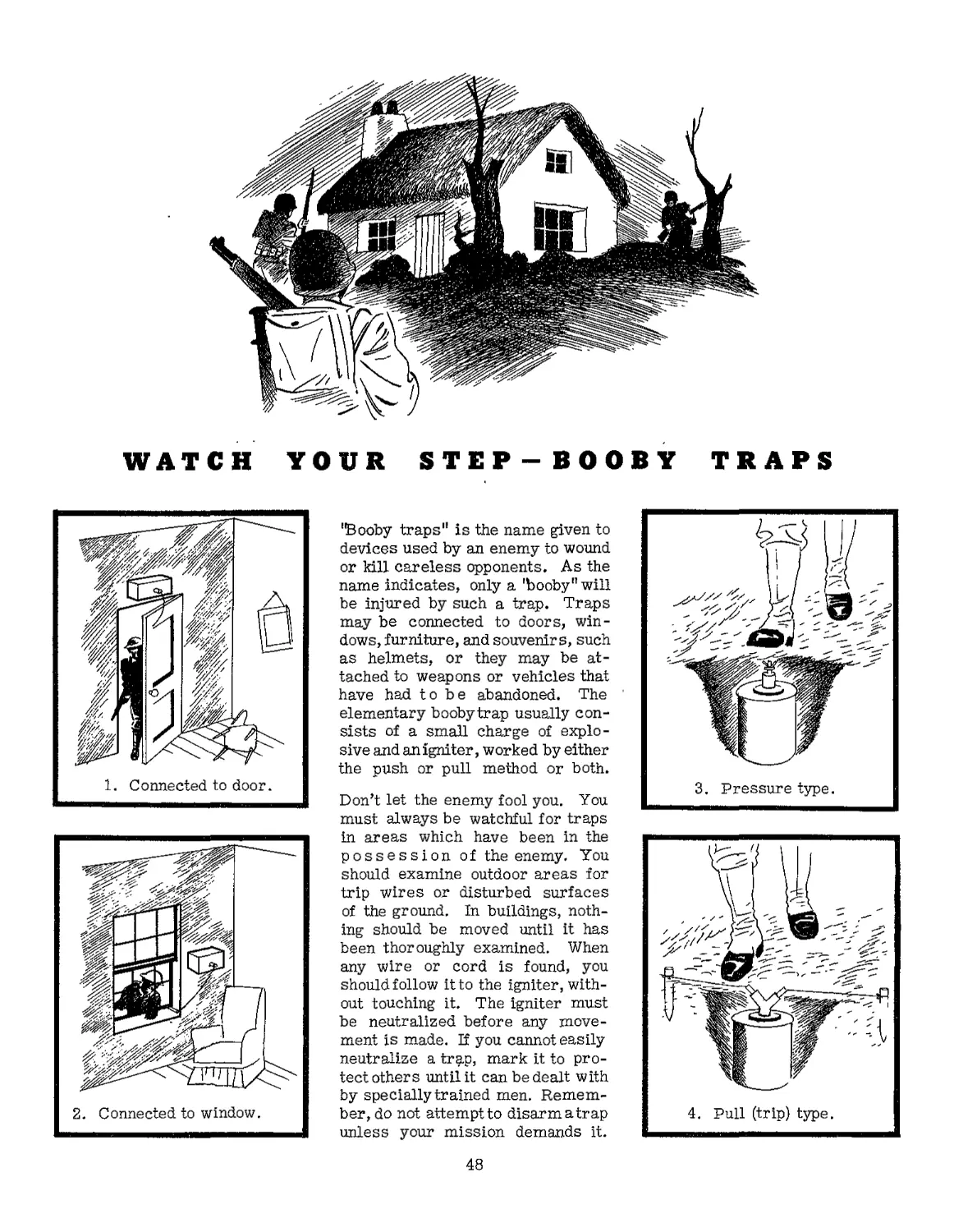
1. Connected to door.
2. Connected to window.
'Booby traps" is the name given to
devices used by an enemy to wound
or kill careless opponents. As the
name indicates, only a 'booby" will
be injured by such a trap. Traps
may be connected to doors, win-
dows, furniture, and souvenirs, such
as helmets, or they may be at-
tached to weapons or vehicles that
have had to be abandoned. The
elementary booby trap usually con-
sists of a small charge of explo-
sive and an igniter, worked by either
the push or pull method or both.
Don’t let the enemy fool you. You
must always be watchful for traps
in areas which have been in the
possession of the enemy. You
should examine outdoor areas for
trip wires or disturbed surfaces
of the ground. In buildings, noth-
ing should be moved until it has
been thoroughly examined. When
any wire or cord is found, you
should follow it to the igniter, with-
out touching it. The igniter must
be neutralized before any move-
ment is made. If you cannot easily
neutralize a trap, mark it to pro-
tect others until it can be dealt with
by specially trained men. Remem-
ber, do not attempt to disarm a trap
unless your mission demands it.
48
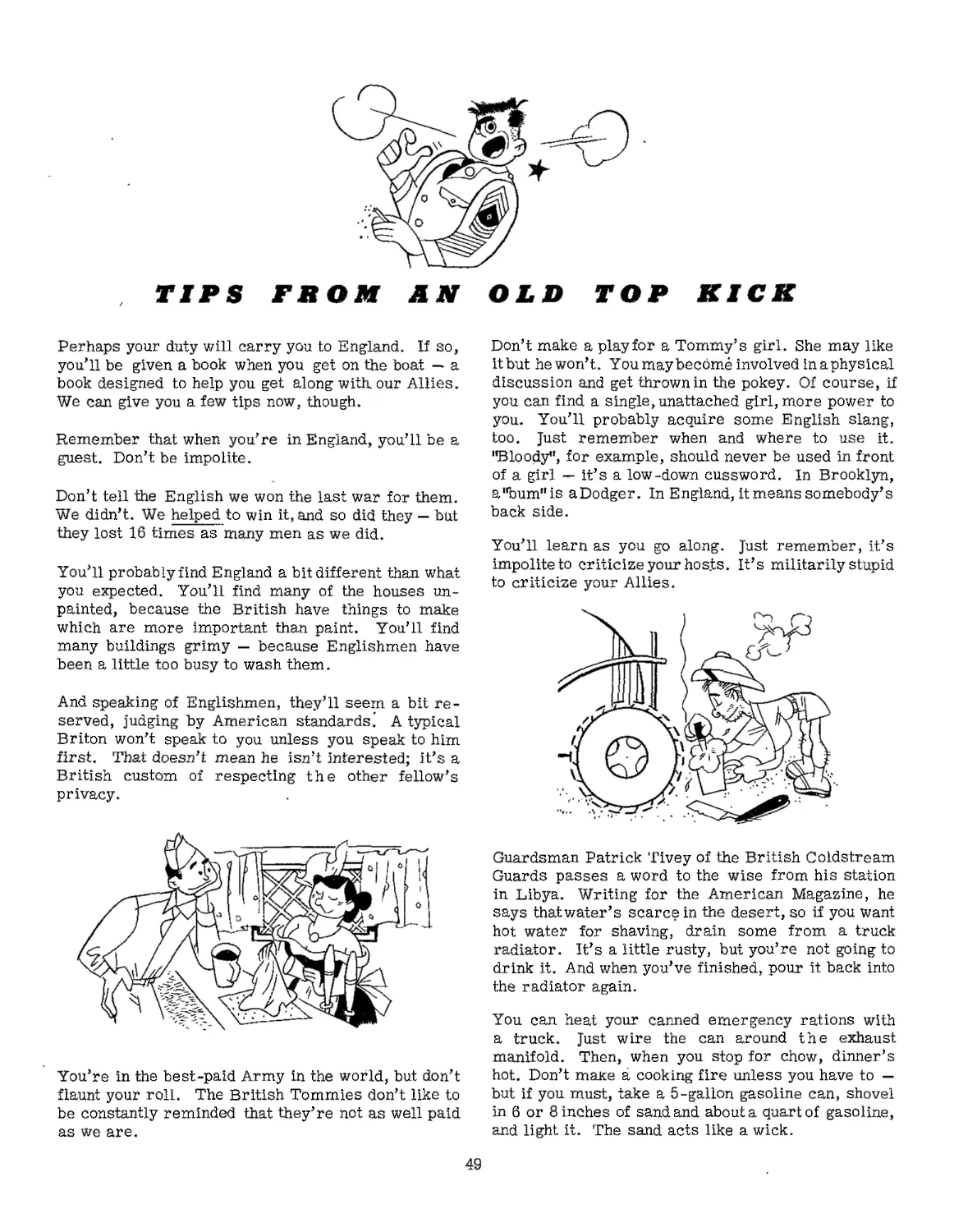
TIPS FROM AN OLD TOP KICK
Perhaps your duty will carry you to England. If so,
you’ll be given a book when you get on the boat — a
book designed to help you get along with, our Allies.
We can give you a few tips now, though.
Remember that when you’re in England, you’ll be a
guest. Don’t be impolite.
Don’t tell the English we won the last war for them.
We didn’t. We helped to win it, and so did they — but
they lost 16 times as many men as we did.
You’ll probably find England a bit different than wha.t
you expected. You’ll find many of the houses un-
painted, because the British have things to make
which are more important than paint. You’ll find
many buildings grimy — because Englishmen have
been a little too busy to wash them.
And speaking of Englishmen, they’ll seem a bit re-
served, judging by American standards. A typical
Briton won’t speak to you unless you speak to him
first. That doesn’t mean he isn’t interested; it’s a
British custom of respecting the other fellow’s
privacy.
You’re in the best-paid Army in the world, but don’t
flaunt your roll. The British Tommies don’t like to
be constantly reminded that they’re not as well paid
as we are.
Don’t make a play for a Tommy’s girl. She may like
it but he won’t. You may become involved in a physical
discussion and get thrown in the pokey. Of course, if
you can find a single, unattached girl, more power to
you. You’ll probably acquire some English slang,
too. Just remember when and where to use it.
"Blood/', for example, should never be used in front
of a girl — it’s a low-down cussword. In Brooklyn,
a"bum"is aDodger. In England, it means somebody’s
back side.
You’ll learn as you go along. Just remember, it’s
impoliteto criticize your hosts. It’s militarily stupid
to criticize your Allies.
Guardsman Patrick Tivey of the British Coldstream
Guards passes a word to the wise from his station
in Libya. Writing for the American Magazine, he
says thatwater’s scarce in the desert, so if you want
hot water for shaving, drain some from a truck
radiator. It’s a little rusty, but you’re not going to
drink it. And when you’ve finished, pour it back into
the radiator again.
You can heat your canned emergency rations with
a truck. Just wire the can around the exhaust
manifold. Then, when you stop for chow, dinner’s
hot. Don’t make a cooking fire unless you have to —
but if you must, take a 5-gallon gasoline can, shovel
in 6 or 8 inches of sand and about a quart of gasoline,
and light it. The sand acts like a wick.
49
Plenty of men in Libya died because they were too
lazy to dig a slit trench. Look at page 27 to see
how it’s done. Remember, not too deep; or it might
cave in. Just get below ground level.
In addition to what Guardsman Tivey says, here are
a few extra tips. In the desert, you must discipline
yourself in the use of water. Get the habit of drinking
very little during the day. It’s especially tough to do
this if you smoke a great deal, so you’d better cut
down on cigarettes, too.
At all times you should wear a woolen 'belly band"
to prevent stomach chills. This is necessary even-
on the hottest days. If your girl likes to knit sweaters,
there’s your answer. -
* ★ *
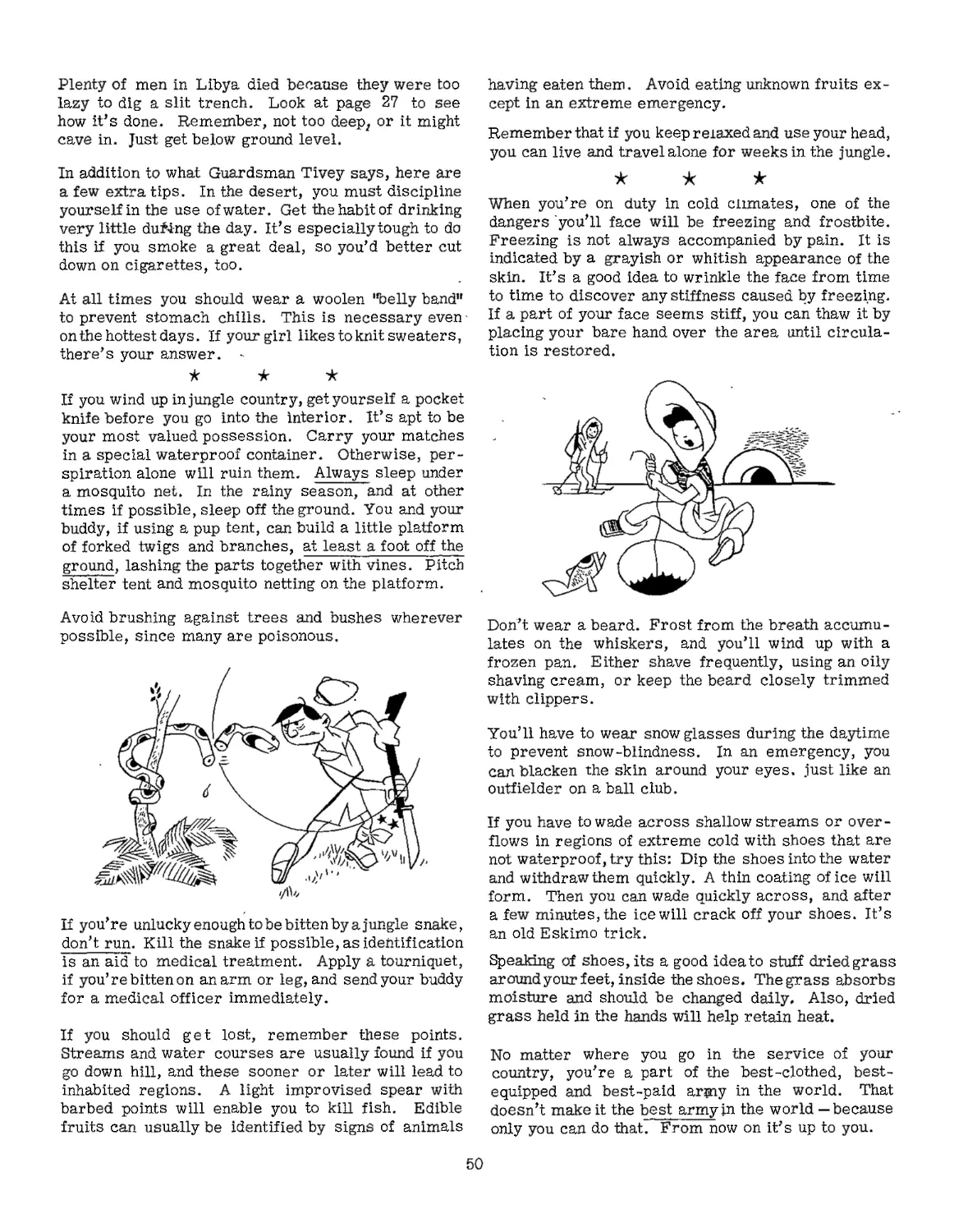
If you wind up in jungle country, get yourself a pocket
knife before you go into the interior. It’s apt to be
your most valued possession. Carry your matches
in a special waterproof container. Otherwise, per-
spiration alone will ruin them. Always sleep under
a mosquito net. In the rainy season, and at other
times if possible, sleep off the ground. You and your
buddy, if using a pup tent, can build a little platform
of forked twigs and branches, at least a foot off the
ground, lashing the parts together with vines. Pitch
shelter tent and mosquito netting on the platform.
Avoid brushing against trees and bushes wherever
possible, since many are poisonous.
If you’re unlucky enough to be bitten by a jungle snake,
don’t run. Kill the snake if possible, as identification
is an aid to medical treatment. Apply a tourniquet,
if you’re bitten on an arm or leg, and send your buddy
for a medical officer immediately.
If you should get lost, remember these points.
Streams and water courses are usually found if you
go down hill, and these sooner or later will lead to
inhabited regions. A light improvised spear with
barbed points will enable you to kill fish. Edible
fruits can usually be identified by signs of animals
having eaten them. Avoid eating unknown fruits ex-
cept in an extreme emergency.
Remember that if you keep relaxed and use your head,
you can live and travel alone for weeks in the jungle.
★	★ ir
When you’re on duty in cold climates, one of the
dangers 'you’ll face will be freezing and frostbite.
Freezing is not always accompanied by pain. It is
indicated by a grayish or whitish appearance of the
skin. It’s a good idea to wrinkle the face from time
to time to discover any stiffness caused by freezing.
If a part of your face seems stiff, you can thaw it by
placing your bare hand over the area until circula-
tion is restored.
Don’t wear a beard. Frost from the breath accumu-
lates on the whiskers, and you’ll wind up with a
frozen pan. Either shave frequently, using an oily
shaving cream, or keep the beard closely trimmed
with clippers.
You’ll have to wear snow glasses during the daytime
to prevent snow-blindness. In an emergency, you
can blacken the skin around your eyes, just like an
outfielder on a ball club.
If you have to wade across shallow streams or over-
flows in regions of extreme cold with shoes that are
not waterproof, try this: Dip the shoes into the water
and withdraw them quickly. A thin coating of ice will
form. Then you can wade quickly across, and after
a few minutes, the ice will crack off your shoes. It’s
an old Eskimo trick.
Speaking of shoes, its a good idea to stuff dried grass
around your feet, inside the shoes. The grass absorbs
moisture and should be changed daily. Also, dried
grass held in the hands will help retain heat.
No matter where you go in the service of your
country, you’re a part of the best-clothed, best-
equipped and best-paid army in the world. That
doesn’t make it the best army in the world — because
only you can do that. From now on it’s up to you.
50
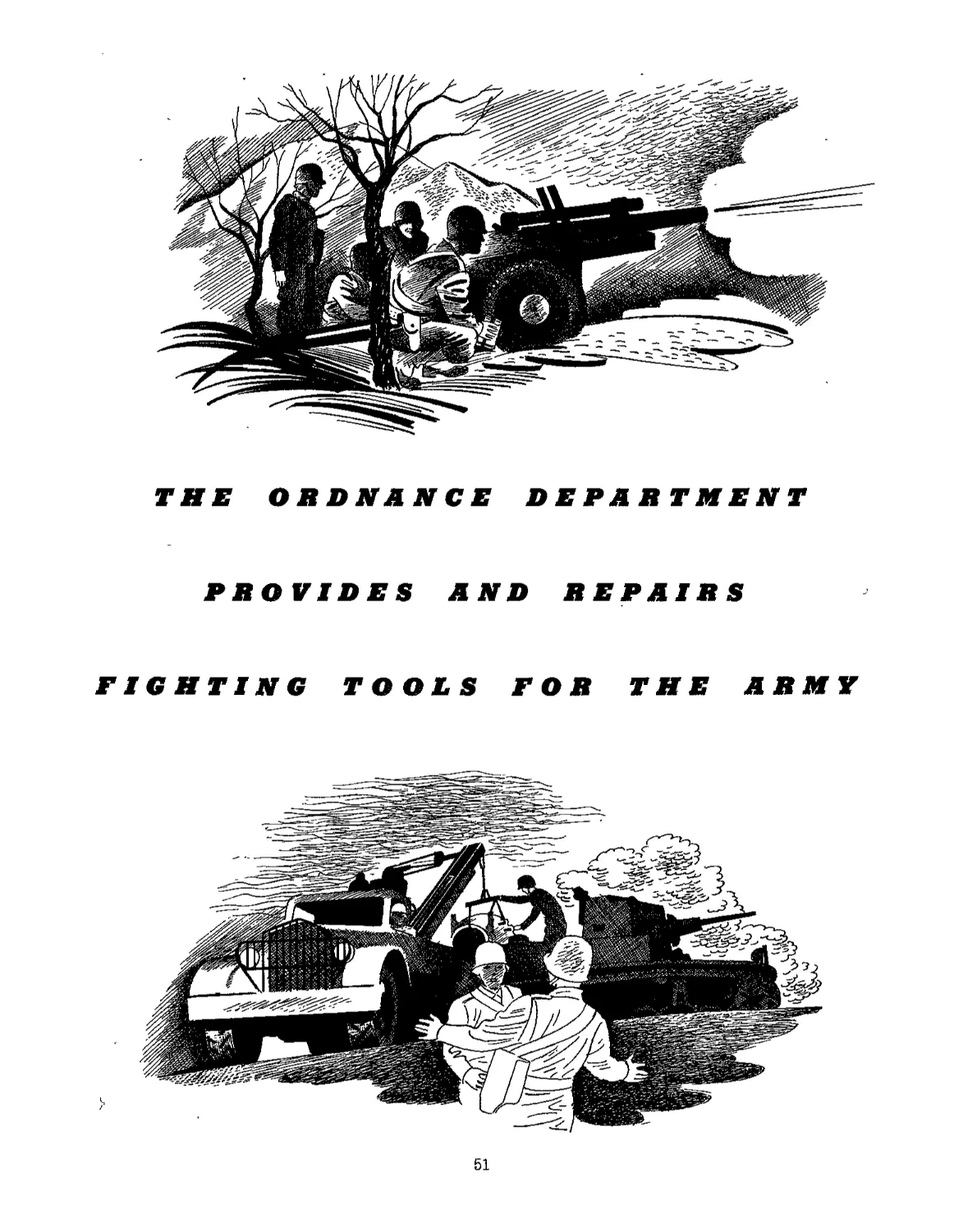
THE OBDNANCE DEPARTMENT
PROVIDES AND REPAIRS
FIGHTING TOOLS FOB THE AREI
51
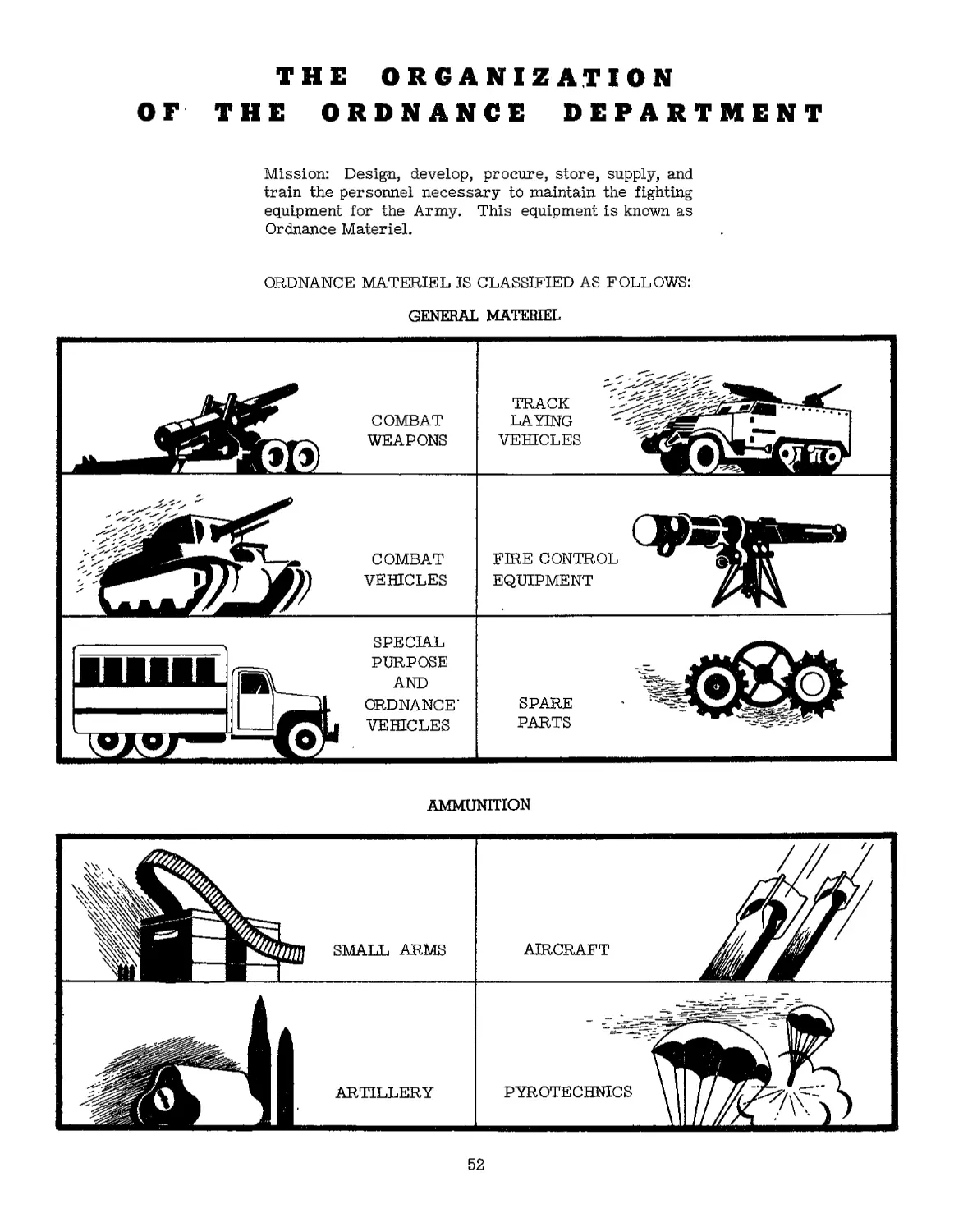
THE ORGANIZATION
OF THE ORDNANCE DEPARTMENT
Mission: Design, develop, procure, store, supply, and
train the personnel necessary to maintain the fighting
equipment for the Army. This equipment is known as
Ordnance Materiel.
ORDNANCE MATERIEL IS CLASSIFIED AS FOLLOWS:
GENERAL MATERIEL
AMMUNITION
52
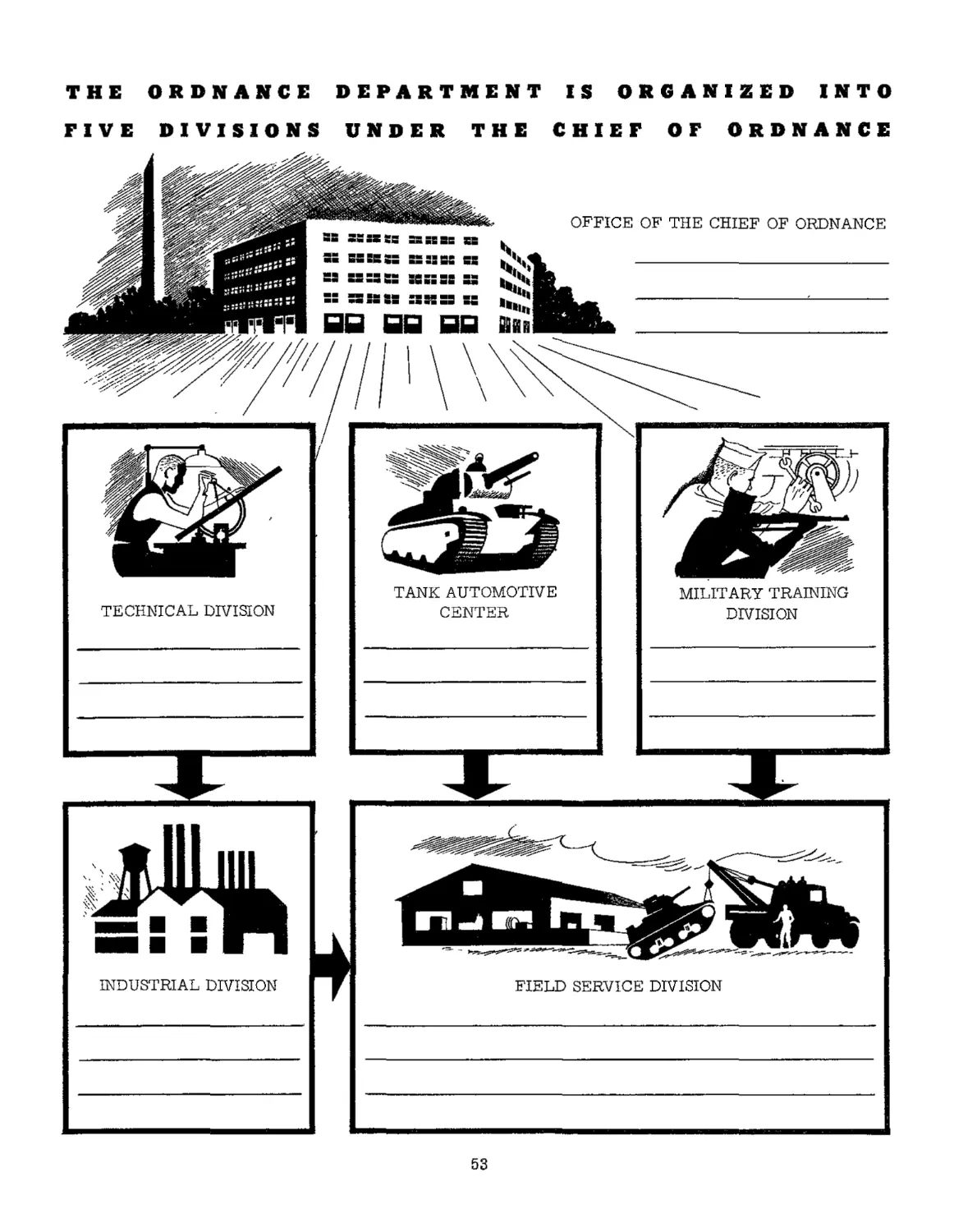
THE ORDNANCE DEPARTMENT IS ORGANIZED INTO
FIVE DIVISIONS UNDER THE CHIEF OF ORDNANCE
53
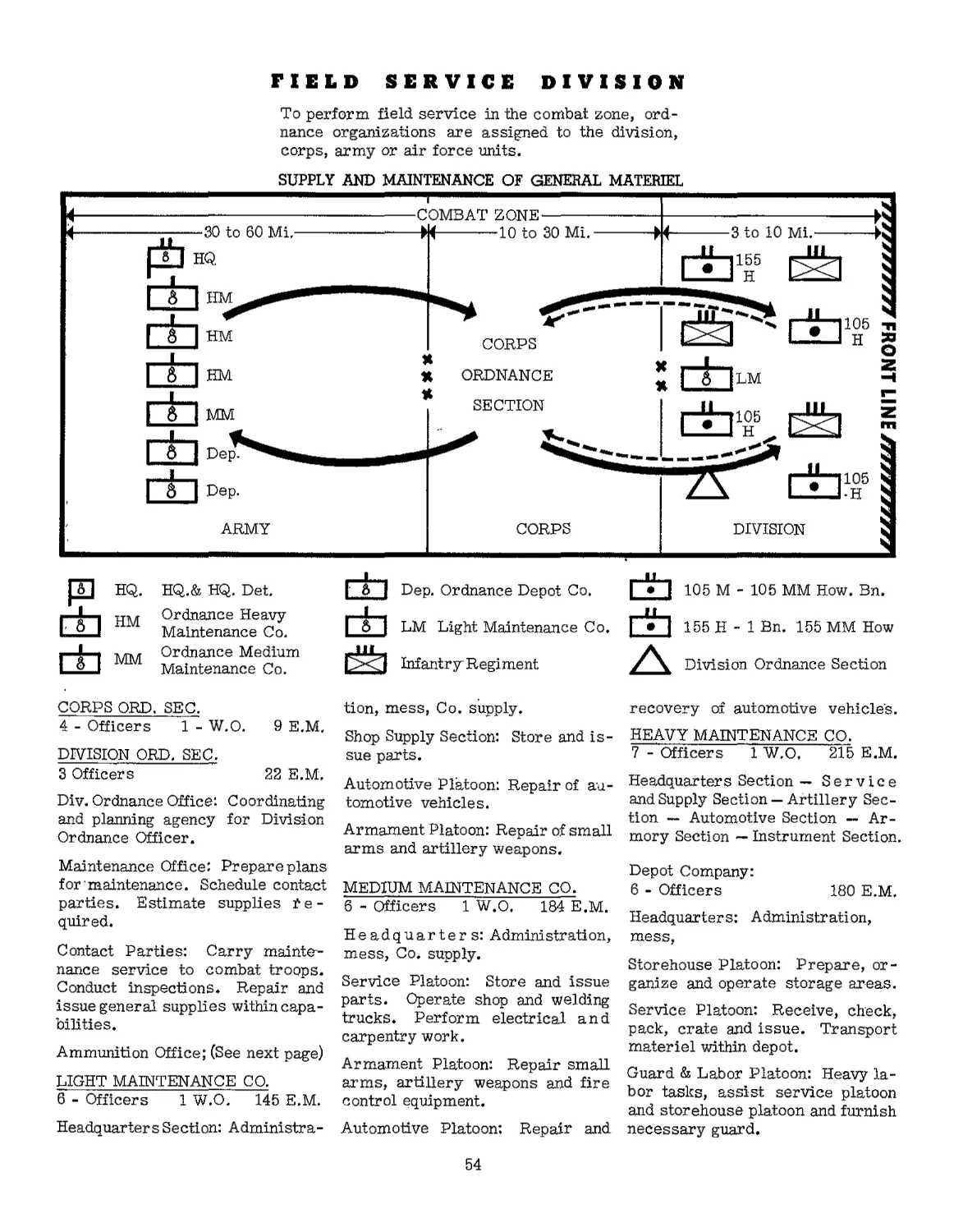
FIELD SERVICE DIVISION
To perform field service in the combat zone, ord-
nance organizations are assigned to the division,
corps, army or air force units.
HQ.
HM
HQ.& HQ. Det.
Ordnance Heavy
Maintenance Co.
Ordnance Medium
Maintenance Co.
Dep. Ordnance Depot Co.
LM Light Maintenance Co.
Infantry Regiment
105 M - 105 MM How. Bn.
155 H - 1 Bn. 155 MM How
Division Ordnance Section
22 E.M.
Coordinating
for Division
CORPS ORD. SEC.
4 - Officers 1 - W.O. 9 E.M.
DIVISION ORD. SEC.
3 Officers
Div. Ordnance Office:
and planning agency
Ordnance Officer.
Maintenance Office: Prepare plans
for'maintenance. Schedule contact
parties. Estimate supplies re-
quired.
Contact Parties: Carry mainte-
nance service to combat troops.
Conduct inspections. Repair and
issue general supplies within capa-
bilities.
Ammunition Office; (See next page)
LIGHT MAINTENANCE CO.
6 - Officers 1 W.O. 145 E.M.
Headquarters Section: Administra-
tion, mess, Co. supply.
Shop Supply Section: Store and is-
sue parts.
Automotive Platoon: Repair of au-
tomotive vehicles.
Armament Platoon: Repair of small
arms and artillery weapons.
MEDIUM MAINTENANCE CO.
6 - Officers 1 W.O. 184 E.M.
Headquarters: Administration,
mess, Co. supply.
Service Platoon: Store and issue
parts. Operate shop and welding
trucks. Perform electrical and
carpentry work.
Armament Platoon: Repair small
arms, artillery weapons and fire
control equipment.
Automotive Platoon: Repair and
recovery of automotive vehicles.
HEAVY MAINTENANCE CO.
7 - Officers 1 W.O. 215 E.M.
Headquarters Section — Service
and Supply Section — Artillery Sec-
tion — Automotive Section — Ar-
mory Section — Instrument Section.
Depot Company:
6 - Officers	180 E.M.
Headquarters: Administration,
mess,
Storehouse Platoon: Prepare, or-
ganize and operate storage areas.
Service Platoon: Receive, check,
pack, crate and issue. Transport
materiel within depot.
Guard & Labor Platoon: Heavy la-
bor tasks, assist service platoon
and storehouse platoon and furnish
necessary guard.
54
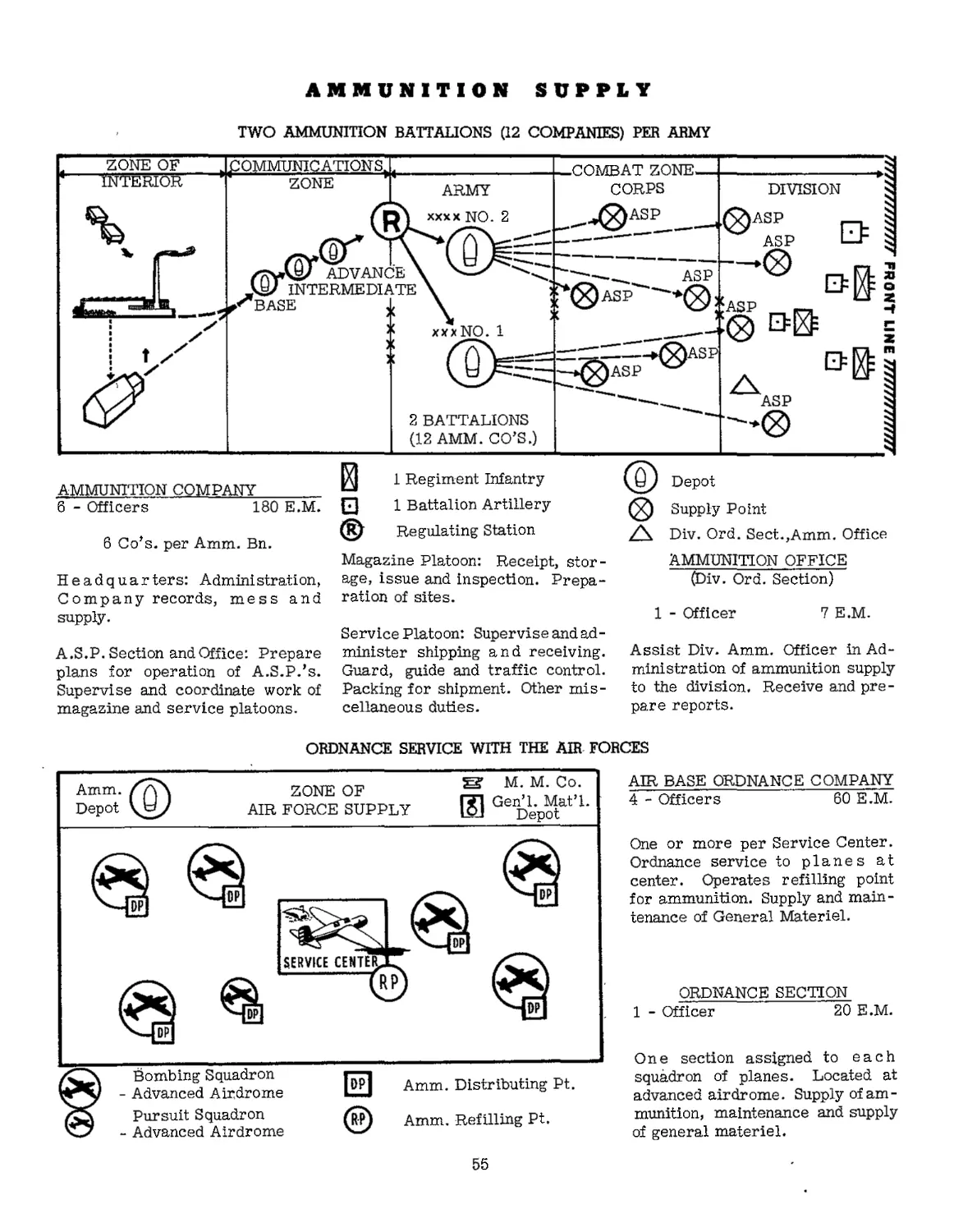
AMMUNITION SUFFLY
TWO AMMUNITION BATTALIONS (12 COMPANIES) PER ARMY
AMMUNITION COMPANY_____________
6 - Officers	180 E.M.
6 Go’s, per Amm. Bn.
Headquarters: Administration,
Company records, mess and
supply.
A.S.P. Section and Office: Prepare
plans for operation of A.S.P.’s.
Supervise and coordinate work of
magazine and service platoons.
1 Regiment Infantry
1 Battalion Artillery
Regulating Station
Magazine Platoon: Receipt, stor-
age, issue and inspection. Prepa-
ration of sites.
Service Platoon: Supervise and ad-
minister shipping and receiving.
Guard, guide and traffic control.
Packing for shipment. Other mis-
cellaneous duties.
Supply Point
/\ Div. Ord. Sect.,Amm. Office
AMMUNITION OFFICE
(Div. Ord. Section)
1 - Officer	7 E.M.
Assist Div. Amm. Officer in Ad-
ministration of ammunition supply
to the division, Receive and pre-
pare reports.
ORDNANCE SERVICE WITH THE AIR FORCES
Amm. Distributing Pt.
Bombing Squadron
- Advanced Airdrome
Pursuit Squadron
- Advanced Airdrome
(Rf) Amm. Refilling Pt.
AIR BASE ORDNANCE COMPANY
4 - Officers	60 E.M.
One or more per Service Center.
Ordnance service to planes at
center. Operates refilling point
for ammunition. Supply and main-
tenance of General Materiel.
ORDNANCE SECTION
1 - Officer	20 E.M.
One section assigned to each
squadron of planes. Located at
advanced airdrome. Supply of am-
munition, maintenance and supply
of general materiel.
55
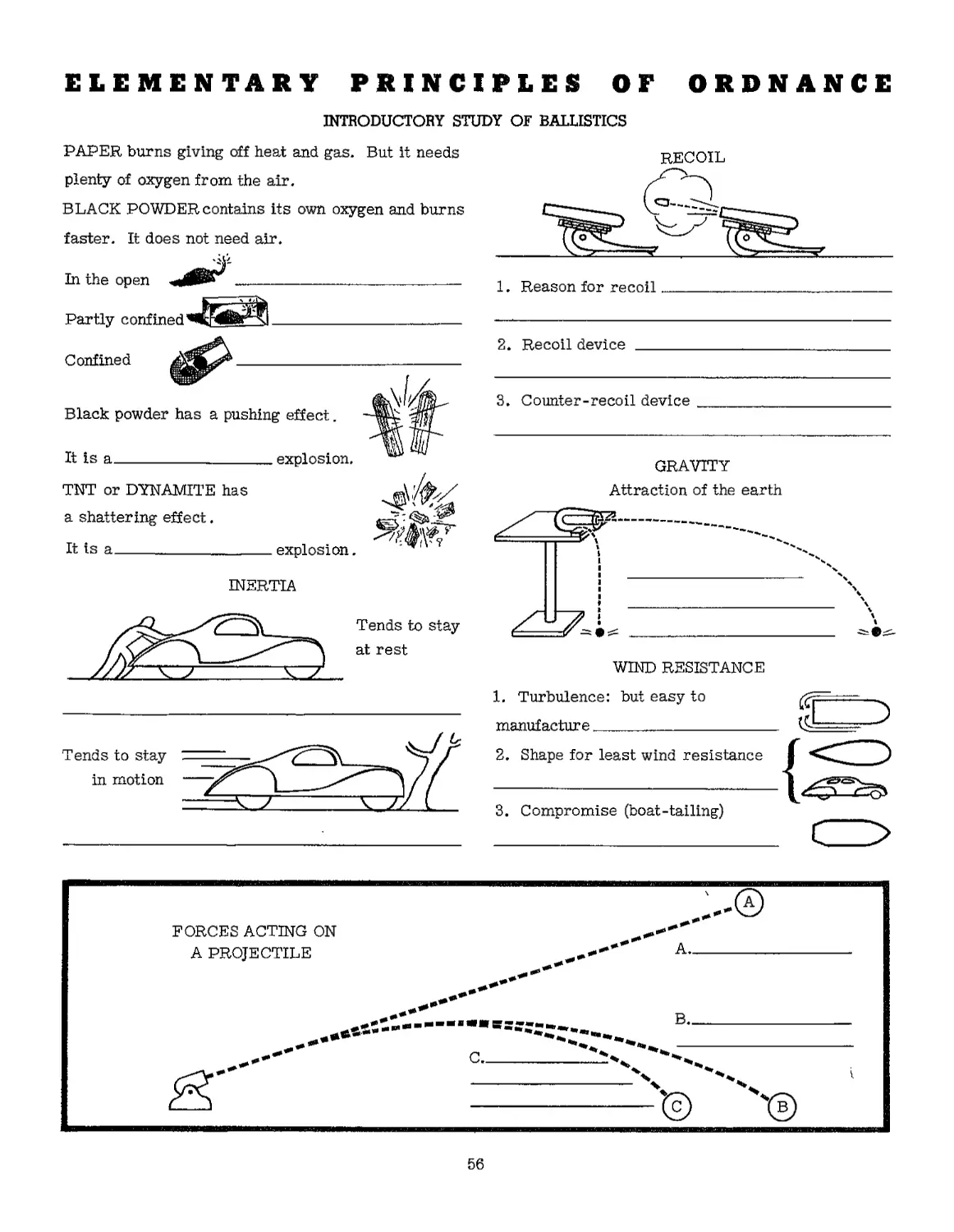
ELEMENTARY PRINCIPLES OF ORDNANCE
INTRODUCTORY STUDY OF BALLISTICS
PAPER burns giving off heat and gas. But it needs
plenty of oxygen from the air.
BLACK POWDER contains its own oxygen and burns
faster. It does not need air.
In the open
1. Reason for recoil_______________________
Partly confined
Confined
2. Recoil device _______________________________
It is a explosion.
Black powder has a pushing effect.
3. Counter-recoil device
TNT or DYNAMITE has
a shattering effect.
It is a explosion.
INERTIA
Tends to stay
at rest
GRAVITY
WIND RESISTANCE
1. Turbulence: but easy to
Tends to stay
in motion
manufacture______________________
3. Compromise (boat-tailing)
2. Shape for least wind resistance
56
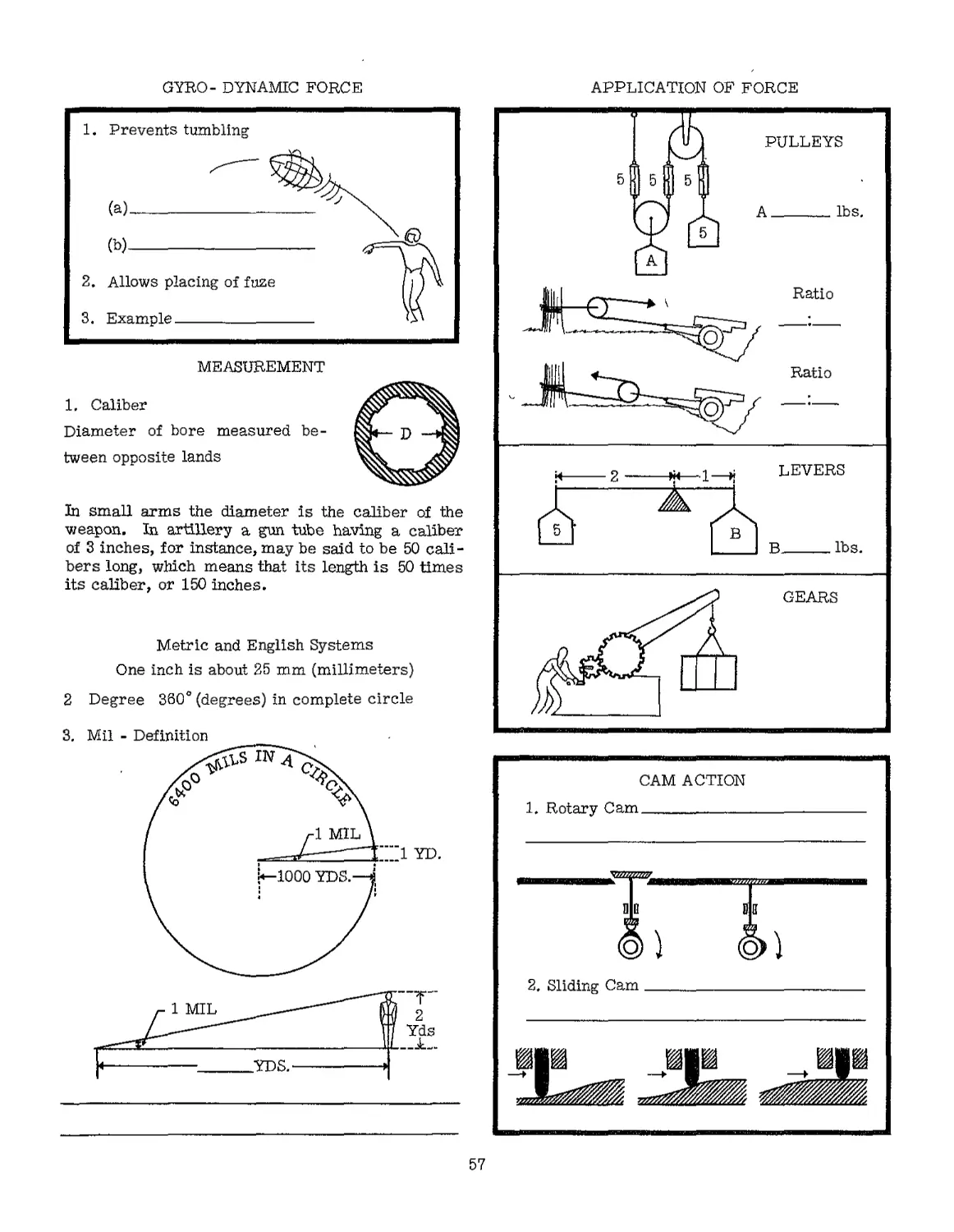
GYRO- DYNAMIC FORCE
1, Caliber
Diameter of bore measured be-
tween opposite lands
In small arms the diameter is the caliber of the
weapon. In artillery a gun tube having a caliber
of 3 inches, for instance, may be said to be 50 cali-
bers long, which means that its length is 50 times
its caliber, or 150 inches.
Metric and English Systems
One inch is about 25 mm (millimeters)
2 Degree 360° (degrees) in complete circle
APPLICATION OF FORCE
CAM ACTION
1. Rotary Cam______________________
57
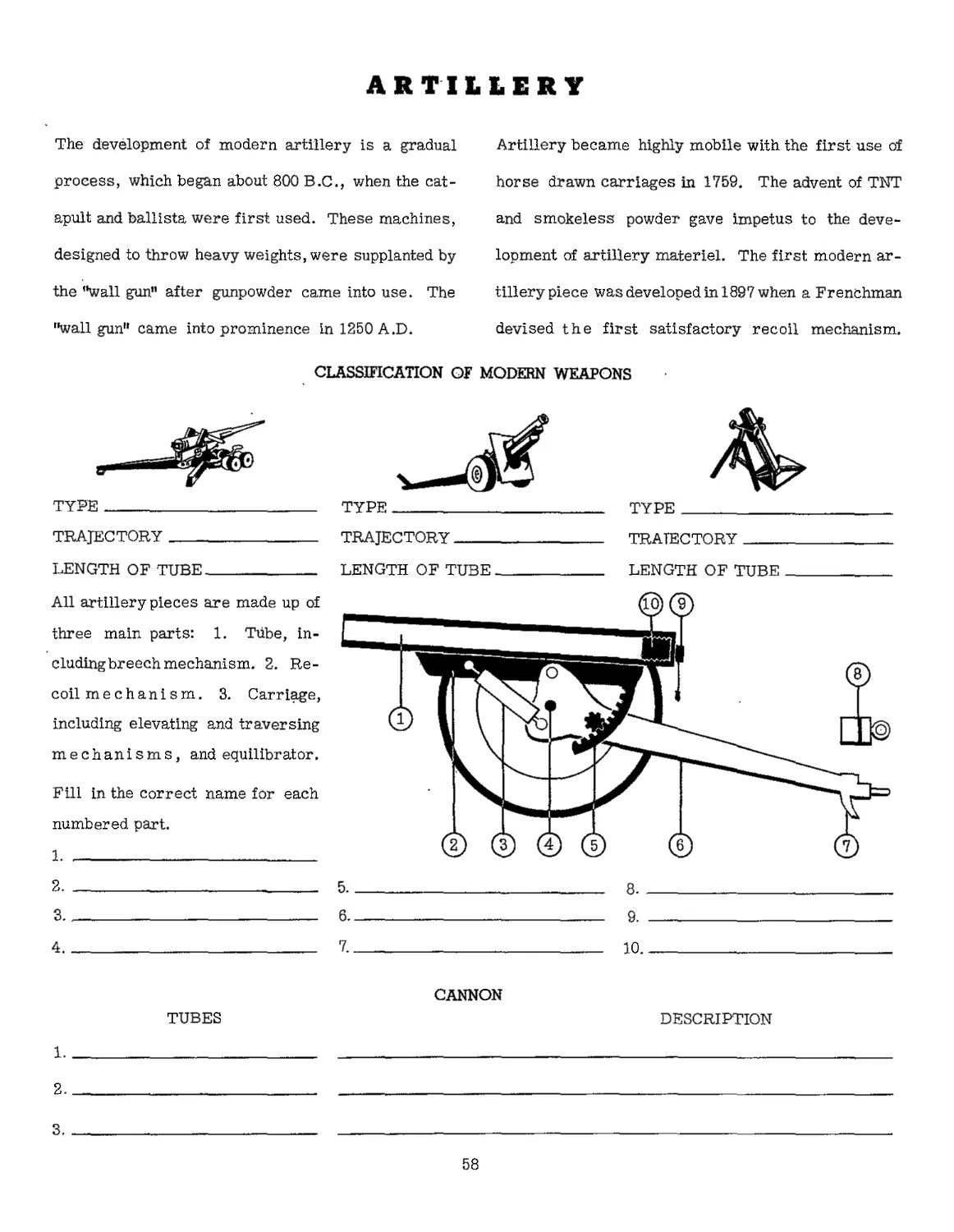
The development of modern artillery is a gradual
process, which began about 800 B.C., when the cat-
apult and ballista were first used. These machines,
designed to throw heavy weights, were supplanted by
the "wall gun" after gunpowder came into use. The
"wall gun" came into prominence in 1250 A.D.
Artillery became highly mobile with the first use of
horse drawn carriages in 1759. The advent of TNT
and smokeless powder gave impetus to the deve-
lopment of artillery materiel. The first modern ar-
tillery piece was developed in 1897 when a Frenchman
devised the first satisfactory recoil mechanism.
TRAJECTORY______________
CLASSIFICATION OF MODERN WEAPONS
TRAJECTORY______________
TRAJECTORY______________
LENGTH OF TUBE LENGTH OF TUBE LENGTH OF TUBE
All artillery pieces are made up of
three main parts: 1. Tribe, in-
cluding breech mechanism. 2. Re-
coilmechanism. 3. Carriage,
including elevating and traversing
mechanisms, and equilibrator.
Fill in the correct name for each
numbered part.
1. __________________________
2. ____________________-
3..__________________________
4 7, 10
CANNON
TUBES
DESCRIPTION
1-----------------------------------
2-----------------------------------
3____________________________________
58
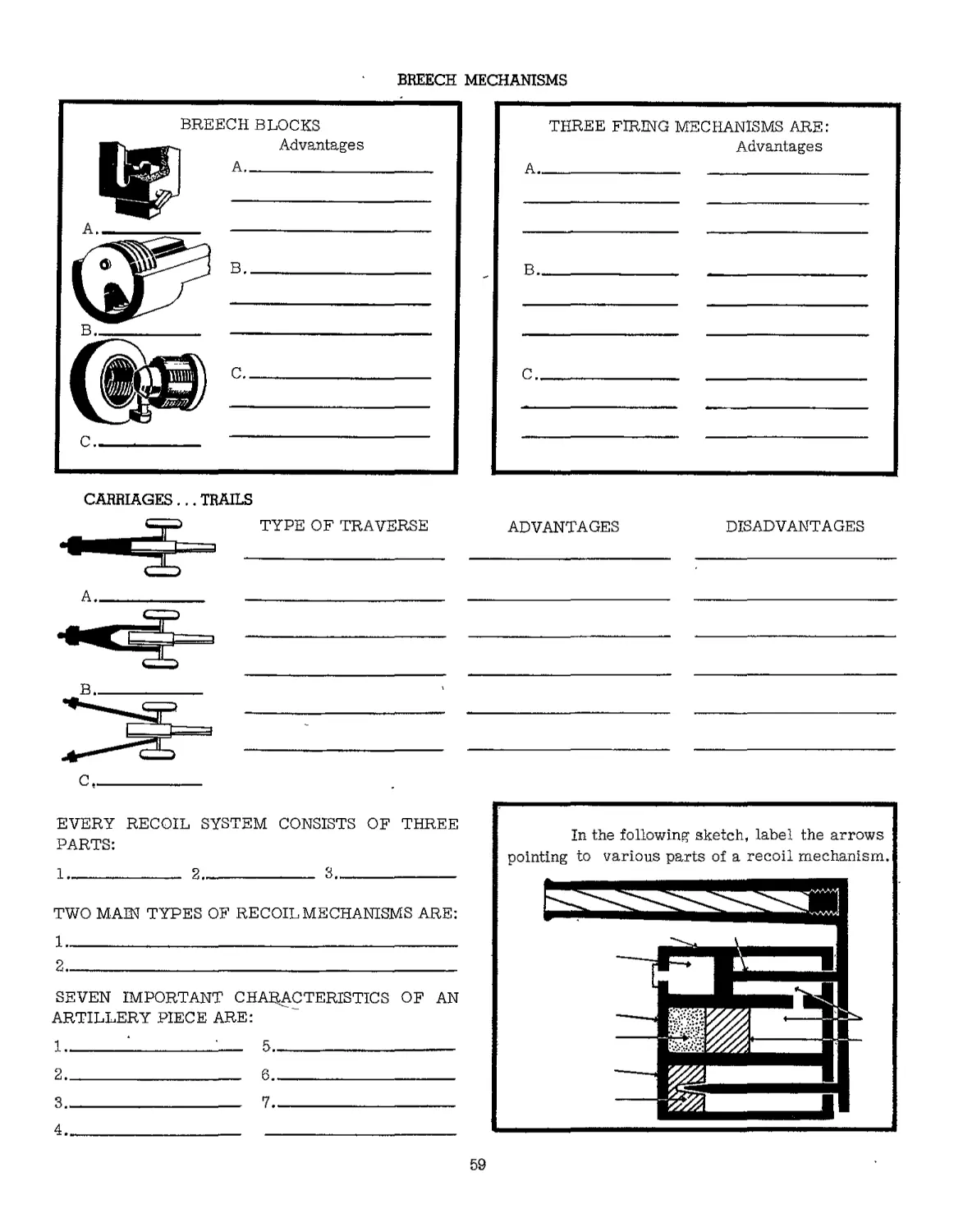
BREECH MECHANISMS
THREE FIRING MECHANISMS ARE:
Advantages
A____________________________
В____________________________
C____________________________
ADVANTAGES
DISADVANTAGES
EVERY RECOIL SYSTEM CONSISTS OF THREE
PARTS:
1	2 3
TWO MAIN TYPES OF RECOIL MECHANISMS ARE:
1_________________________________________
2
SEVEN IMPORTANT CHARACTERISTICS OF AN
ARTILLERY PIECE ARE:
i_______’________:___ 5
2	6
3	7
4_________________________________________
In the following sketch, label the arrows
pointing to various parts of a recoil mechanism.
59
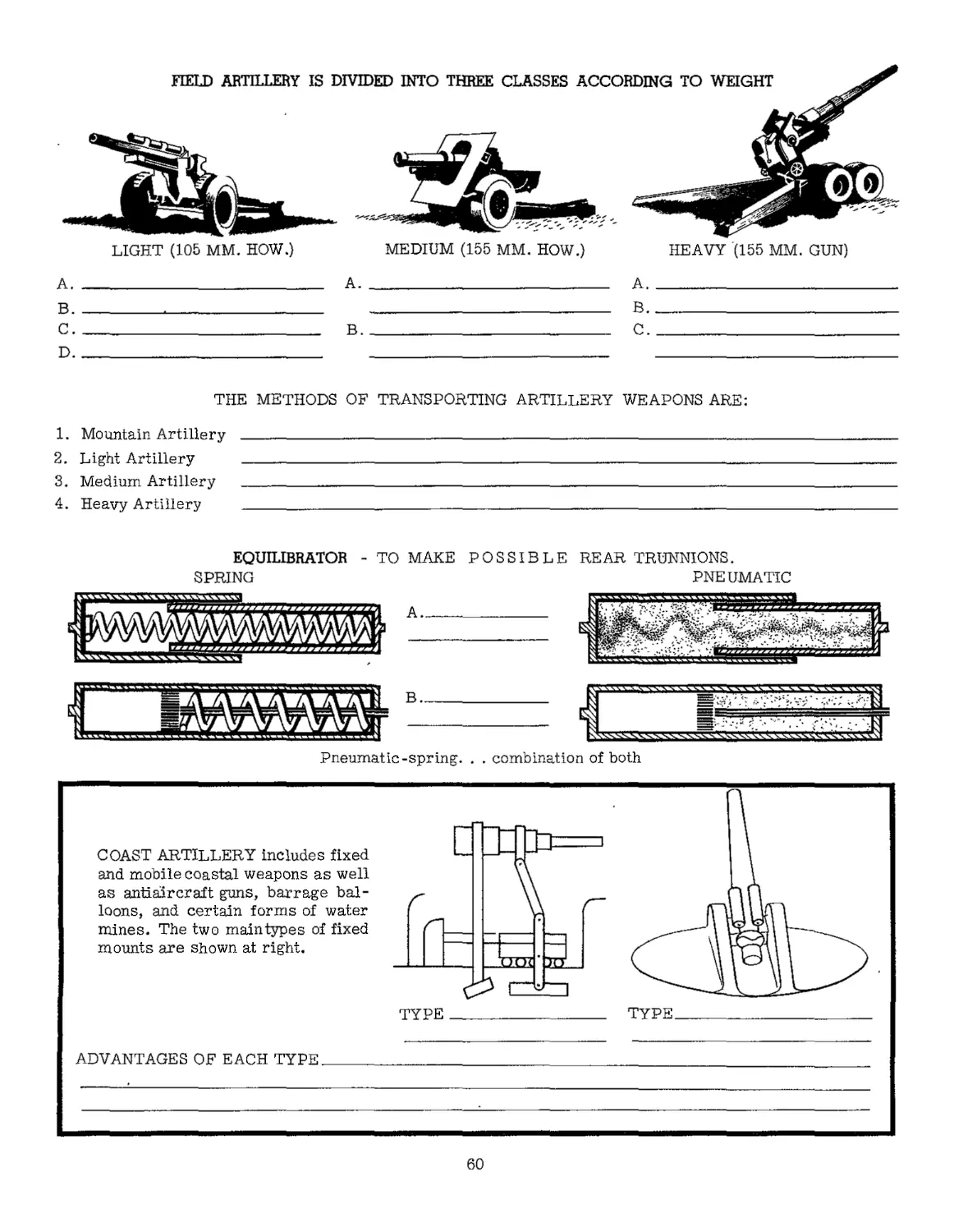
FIELD ARTILLERY IS DIVIDED INTO THREE CLASSES ACCORDING TO WEIGHT
LIGHT (105 MM. HOW.)
MEDIUM (155 MM. HOW.)
HEAVY (155 MM. GUN)
A.  A.  A
В  В--------------------------------------------------------------------------------------
С---------------------------В С
D__________________________________________________________ ______________________________
THE METHODS OF TRANSPORTING ARTILLERY WEAPONS ARE:
1.	Mountain Artillery ________________________________________________________________________________________
2.	Light Artillery ___________________________________________________________________________________________
3.	Medium Artillery __________________________________________________________________________________________
4.	Heavy Artillery ___________________________________________________________________________________________
EQUILIBRATOR - TO MAKE POSSIBLE REAR TRUNNIONS.
SPRING
PNEUMATIC
Pneumatic-spring. . . combination of both
COAST ARTILLERY includes fixed
and mobile coastal weapons as well
as antiaircraft guns, barrage bal-
loons, and certain forms of water
mines. The two maintypes of fixed
mounts are shown at right.
ADVANTAGES OF EACH TYPE.____
60
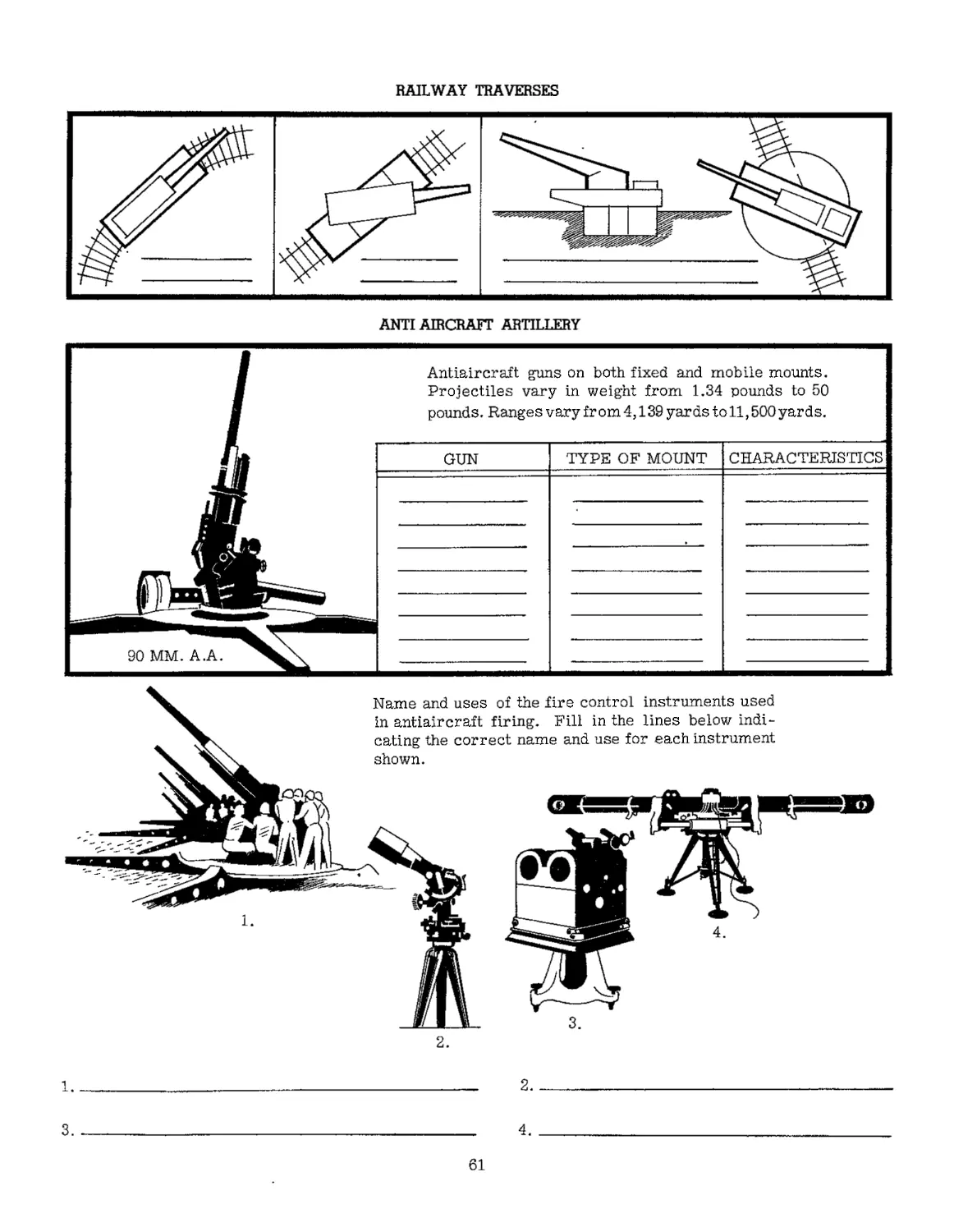
RAILWAY TRAVERSES
ANTI AIRCRAFT ARTILLERY
Name and uses of the fire control instruments used
in antiaircraft firing. Fill in the lines below indi-
cating the correct name and use for each instrument
shown.
2.
61
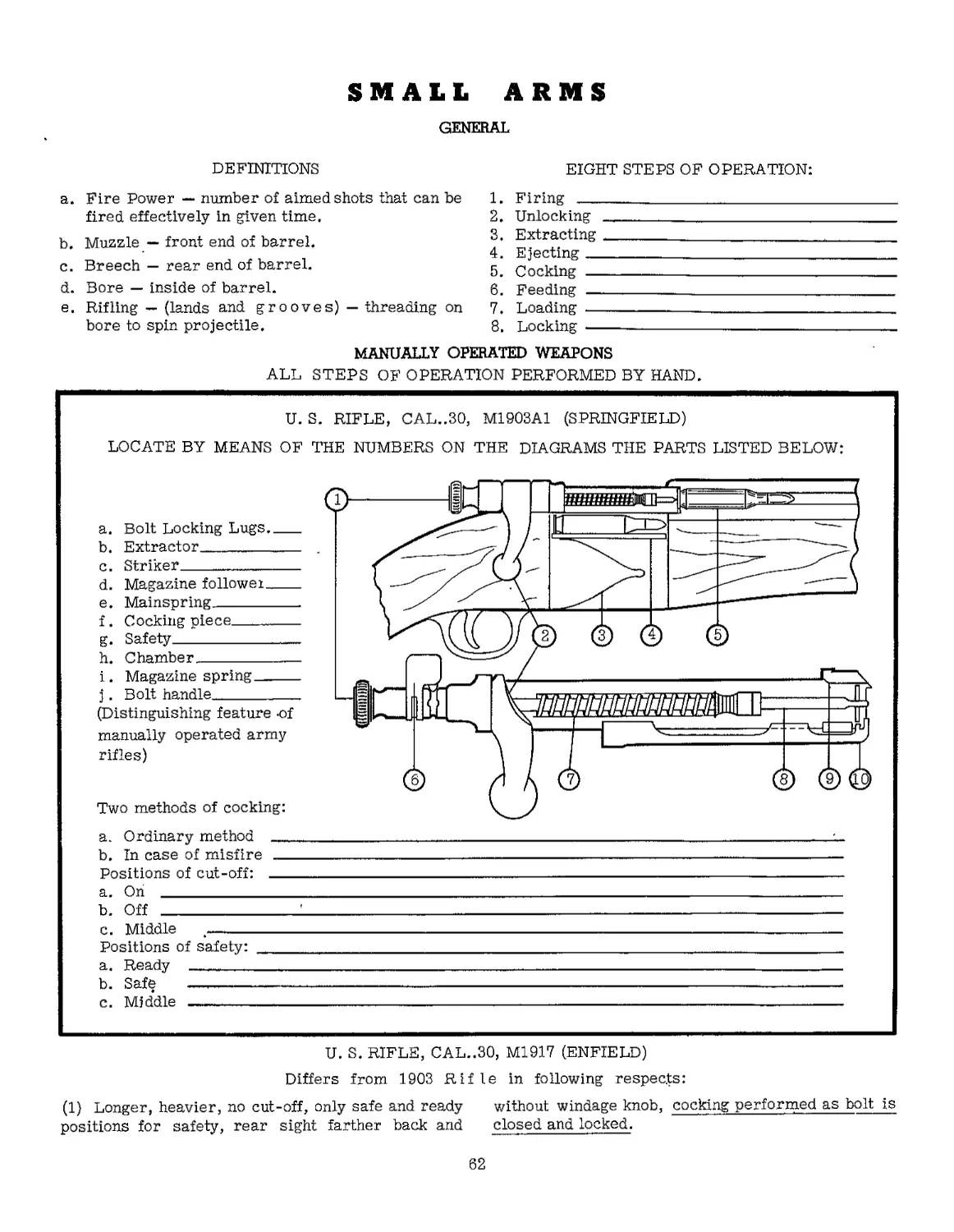
SMALL ARMS
GENERAL
DEFINITIONS
EIGHT STEPS OF OPERATION:
a.	Fire Power — number of aimed shots that can be
fired effectively in given time.
b.	Muzzle —• front end of barrel.
c.	Breech — rear end of barrel.
d.	Bore — inside of barrel.
e.	Rifling — (lands and grooves) — threading on
bore to spin projectile.
1.	Firing _______________________________________
2.	Unlocking _____ ._____________________________
3.	Extracting____________________________________
4.	Ejecting______________________________________
5.	Cocking .—_----—______________________________
6.	Feeding --------------------------------------
7.	Loading --------------------------------------
8.	Locking---------------------------------------
MANUALLY OPERATED WEAPONS
ALL STEPS OF OPERATION PERFORMED BY HAND.
U. S. RIFLE, CAL..30, M1903A1 (SPRINGFIELD)
LOCATE BY MEANS OF THE NUMBERS ON THE DIAGRAMS THE PARTS LISTED BELOW:
a.	Bolt Locking Lugs.___
b.	Extractor
c.	Striker______________
d.	Magazine followei
e.	Mainspring
f.	Cocking piece-------
g.	Safety---------------
h.	Chamber-------------
i.	Magazine spring
j.	Bolt handle
(Distinguishing feature -of
manually operated army
rifles)
Two methods of cocking:
a.	Ordinary method ___________________________________________________________________________
b.	In case of misfire ----------------------------------------------------------------------
Positions of cut-off: -------------------------------------------------------------------------
a.	On _______________________________________________________________________________________
b.	Off _________________:___________________________________________________________________
c.	Middle ж----------------------------------------------------------------------------------
Positions of safety: ________________________________________________________________________
a.	Ready ____________________________________________________________________________________
b.	Safe —------------------------------------------------------------------------------------
c.	Mi ddle ----------------------------------------------------------------------------------
U. S. RIFLE, CAL..30, M1917 (ENFIELD)
Differs from 1903 Rifle in following respects:
(1) Longer, heavier, no cut-off, only safe and ready
positions for safety, rear sight farther back and
without windage knob, cocking performed as bolt is
closed and locked.
62
GAS AND BLOWBACK OPERATED WEAPONS
Automatic, semiautomatic.
U. S. Rifle, cal..30, Ml (Garand):
Gas ope rated,'semiautomatic. Lo-
cate the following parts on the
diagram:
a. Hammer__________________
b.	Bolt____________________
c.	Operating Rod spring____
d.	P is ton________________
e.	Gas cylinder
(Distinguishing feature
of gas weapons)

Two methods of cocking:
a. Ordinary method
b. In case of misfire
U.S. CARBINE, CAL..30, Ml: GAS OPERATED,
SEMIAUTOMATIC .
A carbine is a short, light rifle. The -Ml Carbine
resembles the Ml Rifle in its functioning, but differs
from it in the following respects:
a.	Gas cylinder farther back and hidden by stock;
b.	Detachable box magazine; c. shorter range;
d. Lighter; e. shorter.
The cartridge for the carbine has a lighter bullet and
smaller powder charge than the rifle cartridge.
BROWNING AUTOMATIC RIFLE, CAL..30, M1918A2:
GAS OPERATED, AUTOMATIC.
a.	Like Ml rifle in ammunition used and type of oper-
ation.
b.	Like Thompson Submachine Gun in that it fires
from open bolt.
c.	Flash hider: Attachment on muzzle to hide flash
of burning powder.
THOMPSON SUBMACHINE GUN,CAL..45, M1928A1:
BLOWBACK, AUTOMATIC AND SEMIAUTOMATIC.
Principle of blow-back operation------------
The compensator on the muzzle helps hold the muzzle
down in automatic fire.
Reasons why the weapon fires from an open bolt:
a___________________________________________
b___________________________________________
20-MM AUTOMATIC GUN, М2:
GAS AND BLOWBACK, AUTOMATIC,
MOUNTED ON	AIRCRAFT.
Locate on the	Gas	cylinder	sleeve___
diagram the	Gas	cylinder	pushrod —
parts listed:	Buffer.________________
Recoil Spring
Gas cylinder
Breechblock slide
The gun fires from an open bolt.
Breechblock lock
Sear__________________
Muzzle brake
Recoil is absorbed by:
a__________________
b._________________
63
RECOIL OPERATED WEAPONS
Automatic, semiautomatic.
AUTOMATIC PISTOL, cal..45, M1911A1:-
S emi-automatic.
SAFETIES (Numbers in parentheses after the names
of parts refer to numbers on the diagram in The
Soldier’s Handbook, FM 21-100, page 41).
HALF COCK NOTCH - The first notch oh the hammer
(23) is so deepthesear (30) cannot be withdrawn from
it by squeeze of the trigger (34).
SAFETY LOCK - With the hammer (23) cocked, the
safety lock holds the sear (30) in the second sear
notch on the hammer.
GRIP SAFETY — The arm on the grip safety (35)
blocks the trigger (34) until the grip safety is de-
pressed, when the arm rises above the trigger.
BROWNING MACHINE GUNS:
-BROWNING MACHINE GUN, CAL..30, M1917A1
Locate the following parts on the diagram:
a. Cocking lever
b. Extractor
c. Water jacket
d. Breech lock
e. Bolt
f. Firing pin
g. Barrel extension
(Barrel Moves)
DISCONNECTOR (33) — Makes connection between
the trigger (34) and sear (30) only when the slide (3)
is closed and locked to the barrel (2), allowing the
disconnector to be pushed up by the sear spring (31)
into the notch in the bottom of the slide. Reason for
pistol not firing automatically:
Reason for automatic operation of slide stop when
* magazine is empty:-------------------------------
The Colt Revolver, cal..45, Ml917, and the Smith and
Wesson Revolver, cal..45, Ml917, are substitute
weapons for the pistol. They are manually operated,
have a revolving cylinder with six chambers, and
may be fired either:
a.	Single action________________________________
b.	Double action_______________________________—
AUTOMATIC. '(WATERCOOLED)
All standard machine guns now used by the Army are
Brownings. Although there are various models,
grouped generally as water-cooled, heavy barreled
air-cooled, and aircraft guns, they work substantially
The extractor on machine gun ex-
tracts new cartridge from belt.
CLASSIFICATION OF MACHINE GUNS
	TYPE	USE
Caliber	.30
	.50
Cooling	Water
	Air
Barrel	Heavy
	Light
Belt	Web
	Metallic link
Mounting	Fixed
	Flexible
37-MM AUTOMATIC GUN, M4
In functioning, it resembles a Browning Machine
Gun. Like an artillery piece, it has a breechblock
(sliding wedge) and a recoil mechanism (hydro-
spring) to absorb the shock of recoil. It and the 20-
mm gun are studied in small arms because there are
no artillery repairmen in an Aviation Ordnance
Company to maintain them.
64
SMALL ARMS
REFERENCE DATA
BR. MACH. GUN 50 CAL.
DATA TABLE
9	3450	5	10-15		.30 Cal. Rifle Cartridge Ball Tracer Armor- Piercing
9	3450	6	8-12
9	3450	8	40
21	3450	20	50 (S.A.)	350- 550
19-33	3450	Web Belt or Link Belt		400- 1200
5	2000	15	45		Ball-smaller than for rifle
2-1/2 2-1/4 2-1/2	1600 1600	7 6	35 25		* 45 Cal. Pistol Cartridge (tracer for Sub- Machine Gun)
11	1600	20-50	50 (S.A.)
64-		Link Belt		400- 650	Ball,'Tracer Armor- Piercing
100	7500
20 M M GUN
|K 37-MM GUN, M4
112	7000	Link Belt 60 to 200		500- 700	High Explosive Ball Armor- Piercing

210	7000	30 60		120	H. E., with Shell Destroy- ing Tracer
65
AMMUNITION
MILITARY EXPLOSIVES LOW EXPLOSIVE	SENSITIVITY	USE
Black Powder
Smokeless Powder		’	J
E. C. Blank
Ballistite
HIGH EXPLOSIVE
T.N.T.
Amatol
Explosive 'D"
Tetryl
Mercury Fulminate
Lead Azide

ARTILLERY AMMUNITION
A Complete round of ammunition
LOCATE AND GIVE PURPOSES OF THE FOLLOWING S
1.	Cartridge Case---------------------------------------------------------------------------------
2.	Primer------------------------------------------------------------------------------------------
3.	Propelling Charge.------------------------------------------------------------------------------
4.	Boat Tailed Base ----------------------------------------------------------------------————
5.	Rotating Band----------------------------------------------------------------------------------
6.	Bursting Charge -----------------------------------------------------------------------------—
7.	Booster----------------------------------------------------------------------------------------
8.	Fuze -------------------------------------------------------------------------------------------
9.	Ogive ------------------------------------------------------------------------——--------------—
10.	Bourrelet-------------------------------------------------------------------------------------
66
THE THREE TYPES OF ARTILLERY AMMUNITION
Cartridge case crimped to projectile
Free fit between projectile and cartridge case
THE THREE TYPES OF FUZES
C.
A B.
BASE DETONATING FUZE, M38
Firing pin (S.Q.)
Detonator Assembly -
Interrupter--------
Firing Pin Assembly
(Delay)
Plunger Head ------
Plunger (Restraining
spring)
Primer Assembly------
Plunger Body
POINT DETONATING FUZE, M48
DELAY FUNCTIONING
Resistance
ring-------
Detonator
Assembly
SUPERQUICK
FUNCTIONING
Firing pin —
Plunger-----
Body--------
Spring------
(Drawings not to scale)
Disk------
Closing cap—I
Booster pellet —
Cushioning disk -
67
AMMUNITION
COLOR MARKINGS
1.	High explosive 6.
2.	Armor piercing	shell 	7.
3.	Armor piercing	shot 	8.
4.	Shrapnel 9.
5.	Practice 	10.
Chemical (Smoke) ____________________________________
Chemical (Non-Persistent gas...casualty)
Chemical (Persistent gas...casualty)
Chemical (Harassing agent)
Chemical (Incendiary)________________________________
SMALL ARMS AMMUNITION
Locate- the four component parts of the complete round., Ball, Cal..50, М2
1. Bullet	2. Cartridge Case .	* 3. Primer	4. Propelling Charge
DESCRIBE THE EC BLOWING SMALL-ARMS CARTRIDGES
1.	Ball________________________________________________________________________________________
2.	Armor-piercing________________________________________________________________________________
3.	Tracer _____________________________________________________________________________________
IDENTIFY THE AMMUNITION PACKED IN THE FOLLOWING BOXES
A______________________
68
TRENCH MORTAR AMMUNITION
Locate the following and give its purpose;
1.	Fuze ___________________________________________________________________
2.	Safety Pin--------------------------------------------------------------
3.	Cotter Pin and Ring ----------------------------------------------------
4.	Fin Assembly -----------------------------------------------------------
5.	Primer _______________________________________________________________
6.	Propelling Charge -------------------------------------------------------
TYPES OF BOMBS
BOMBS
1. Nose Fuze 2. Tail Fuze
3. Fin Assembly 4. Arming Wire 5. Bomb Body
ANTITANK MINES
Locate the following and give its purpose
1.	Spider---------------------------------------------------------
2.	S af ety fork -------------------------------------------------
3.	Fuze ._________________________________________________________.
4.	Body---------------- ._________________________________________
69
AUTOMOTIVE MATERIEL
COMPONENTS OF AN AUTOMOBILE
(BODY NOT SHOWN)
1.	FRAME — supports power plant, transmission
system, running gear and. body.
2.	STEERING — developed by Dr. Ackerman,
causes each wheel to turn
on its own pivot — instead
of having the entire front
axle pivot.
3.	WHEELS — disc type used today.
4.	BRAKES — must be about 5 times as powerful
as engine.
5.	ENGINE — 85 H.P. motor gives 85 H.P. only when
it is turning over at 3200 R.P.M.
6.	CLUTCH — engages and disengages motor from
rest of transmission system.
7.	TRANSMISSION
a.	Provides high turning effort from engine with
low speed of rear wheels.
b.	Provides lbw turning effort from engine with
high speed of rear wheels.
c.	Provides for reversing direction.
8.	UNIVERSAL JOINT — makes a flexible connection
in the propeller shaft so that the propeller shaft
can move up and down with the rear wheels as
the shaft rotates.
9.	PROPELLER SHAFT — transmits power to rear
axle.
10.	DIFFERENTIAL (spider gear) — allows outside
rear wheel to turn faster than inside when auto-
mobile goes around curves.
11.	FINAL DRIVE (ring and pinion gear) — allows
propeller shafbto turn rear axle, at right angles.
70
FOUR-STROKE GASOLINE ENGINE
STROKE CYCLE
CARBURETOR	IGNITION SYSTEM
Purpose
Proportions by weight:
_____parts air
parts gasoline
FUEL SYSTEM
Mechanical Fuel Pump
Operated_______________________________________
(a)	Battery____________________________________
(b)	Switch_____________________________________
(c)	Coil_________________________________	„
(d)	Breaker points_____________________________
(e)	Condenser _________________________________
Types
Thermostats
COOLING SYSTEMS
(f)	Distributor___________________________________
(g)	Spark plugs-----------------------------------
(h)	Starter---------------------------------------
(i)	Generator ____________________________________
71
LUBRICATION
PURPOSES
1______________________*______________________________________________________________
2
3
WAYS OF CHECKING OIL
1_____________________________________________________________________________________
2_____________________________________________________________________________________
3	.___________________________________________________________________________________
4»,___________________________________________________________________________________
CONTAMINATION
1. C ur e_____________________________________________________________________________
DILUTION 1. Gasoline •— cure__________________________________________________________
2. Water — cure___________________________________________________________
BRAKES
1. Types — service
parking.
PARTS OF HYDRAULIC SYSTEM
OPERATION
Hydraulic
Air
Vacuum
Electric
72
CLASSIFICATION OF VEHICLES
GENERAL PURPOSE VEHICLES
COMBAT VEHICLES
Important characteristics of a combat vehicle are:
1.	PROTECTION FOR THE CREW--determined by
the thickness of the armor. The armor may vary
from 1/4 inch to 3 inches in thickness depending
on the type of vehicle.
2.	FIRE POWER--determined by the armament of
the combat vehicle; that is, the number and cal-
iber of the guns carried. Combat vehicles carry
both small arms and artillery pieces.
3.	MOBILITY—determined by the power plant and
suspension system.
TANK SUSPENSION SYSTEMS USE
1.	axles
2.__________________________________________________________.wheels
3.__________________________________________________________- springs
 POWER PLANTS IN TANKS CONSIST OF
1.		2-----------------------------------------------------engines
2.	------------------ --------------------------------------- engines
3.	 engines, inline and radial
73
RADIAL ENGINES
Advantages of Diesel power over Gasoline power:
A_____________________________________________
Differences between 4 - stroke Diesel cycle .and
4 - stroke Gasoline cycle:	д
В______________________________________
С___________________________:__________
В__________,____________________________
С_______________________________________
ECHELONS OF MAINTENANCE
PERSONNEL
DUTIES
1. Driver - Assistant Driver
□
2. Maintenance Crew Using Arm
3. Automotive Unit Medium Main-
tenance Co.
4. Base Shop or Arsenal
74
FIELD RIGGING
KNOTS, BENDS AND HITCHES
Rigging is the construction of
devices to aid in lifting and hoist-
ing operations. It is especially
useful to automotive and artillery
mechanics.
75
Tackle consists of rope used with blocks so as to
provide a mechanical advantage. The mechanical
advantage of any tackle may be roughly figured by
counting the number of ropes actually supporting-
the weight.
J 		1 1		lilt
2. FIXED BLOCK	3. WHIP	4. GUM	5. LUFF	6. DOUBLE LUFF*	7. DOUBLE BURTON
76
HOISTING DEVICES
NOTES ______________________________________________________________________
77
GLOSSARY
SIMPLE EXPLANATION OF ORDNANCE TERMS
ARMAMENT
ARMOR
ARSENAL
ASSEMBLY
AZIMUTH
BALLISTICS
BREECH
CALIBER
CAM
The weapons carried or mounted
in a vehicle, plane or vessel.
The covering or shield of steel
plate to -furnish protection
against bombs or gunfire.
A plant where Ordnance mate-
riel is manufactured and re-
paired.
A unit made up of a number of
parts fitted together, not easily
disassembled, e.g.: Barrel and
receiver assembly for 19 03
Rifle; the barrel is ordinarily
disassembled from the receiver
only at an arsenal.
The angle measured clockwise
from the north. The angle to
which a cannon is traversed.
For use of the term in map
reading, see page 35.
The science that deals with the
motion of a projectile, both in
the bore of the weapon and after
leaving the muzzle, e.g.: The
science of ballistics would de-
termine the amount of powder
which, for a particular gun and
projectile, is necessary to give
a certain muzzle velocity.
The rear end of the tube or bar-
rel of a weapon. See Muzzle,
next page.
See Elem. Prin. of Ord., page 56.
A moving part whose surface
either imparts motion to, or re-
ceives motion from, another
part by sliding contact. See
page 57.
CARRIAGE
The mount which furnishes sup-
port for a cannon in firing and,
in the case of mobile artillery,
enables the weapon to be moved
readily from one position to an-
other. See page 59.
CONTACT PARTY See Organization' of the Ord-
nance Department, page 54.
DEPOT	A place organized for receiving,
storing, inspecting and issuing
military supplies.
ECHELON
(1)	Echelons of Command:
Steps in the organization of
command, e.g.:
Platoon
Company
Battalion
Regiment
etc.
(2)	Echelons о f maintenance :
Steps in the organization of
maintenance units. See
page 74.
(3)	Echelons of formations:
ELEVATION (1)
(2)
Elevation
Height abpxe sea level. See
Mag Reading,"-page 3„6t
The. vertical angle to whOi^
the muzzle of a cannon HSR
/iRE CONTROL
EQUIPMENT
Equipment used to direct artil-
lery fire — not attached to the
weapon. See page 61.
Г78
GROUP
GUN
HOWITZER
MAGAZINE
MAINTENANCE
MORTAR
MIL
MUZZLE
Breech -
MUZZLE
VELOCITY
NOMENCLATURE
ORDNANCE
MATERIEL
A unit made up of a number of
parts fitted together, easily dis-
assembled, e.g.: boltgroupfor
1903 rifle, includes firing pm,
extractor, mainspring, etc.
See Artillery, page 58.
See Artillery, page 58.
(1) That part of a small arm
into which cartridges are
placed preparatory to being
loaded into the chamber.
(2) A storehouse for ammu-
nition.
The tasks performed to keep
materiel in good working order.
See Artillery, page 58.
See Elementary Principles of
Ordnance, page 57.
The front end of the tube or bar-
rel of a weapon.
Muzzle
The speed (usually expressed as
feet per second) with which a
projectile leaves the muzzle of
a weapon.
A system of names. The Ord-
nance Department publishes a
catalogue including Standard
Nomenclature Lists which give
the names of major items, such
as guns, ammunition and vehi-
cles and their component parts.
The general name for equipment
supplied by the Ordnance De-
partment. See page 52.
PgCE
RAILHEAD
A weapon, such as a pistol, rifle
or cannon.
RANGE,
EFFECTIVE
RECOIL
RIFLING
That point along a railroad^
where supplies are unloaded for|
transfer to other means og
transportation. Supplies ma|
move> both to the front and<fl
the ге1Ц thru railheads^
The maxiWjj^g^tance Wirhich
a weapon maybe aimed and fired
with damaging effect.
The backward movement of a
weapon caused by the forces of
discharge. See page 56.
A number of machined spiral
grooves in the bore of a weapon
for im' arting rotation to a pro-
jectile. The surfaces of the bore
between grooves are called
lands. See Small Arms, page 62.
ROUND
A round of ammunition consists
of all the component parts nec-
essary to fire a weapon once.
See Ammunition, page 66.
SIGHTING
EQUIPMENT
Equipment used in aiming —
attached to the weapon.
TRAJECTORY The path of a projectile inflight.
See Elem.Prin. of Ord., page 56.
TRAVERSE
Traverse
The lateral change of direction
in which’a cannon points
A block of compressed TNT
TRYTON
BLOCK
79
NAME J'gT.	A "ГА Л" A h/J	AA
ORGANIZATION /<£/J 7,	0Д, J) Л/AftfCZ:	A. S. N.
NOTES