/
Теги: weapons
Год: 1961


Текст
                    FM 21-13
DEPARTMENT OF THE ARMY FIELD MANUAL
THE
SOLDIER’S
GUIDE
HEADQUARTERS, DEPARTMENT OF THE ARMY
AUGUST 1961
NOTICE:
Users of this manual are encouraged to submit rec-
ommended changes or comments to improve the man-
ual. Comments should be keyed to the specific page,
chapter or section, and line of the text in which the
change is recommended. Reasons should be provided
for each comment to insure understanding and com-
plete evaluation. Comments should be forwarded
direct to Commandant, U.S. Army Artillery and Mis-
sile School, ATTN: AKPSITL, Fort Sill, Okla.
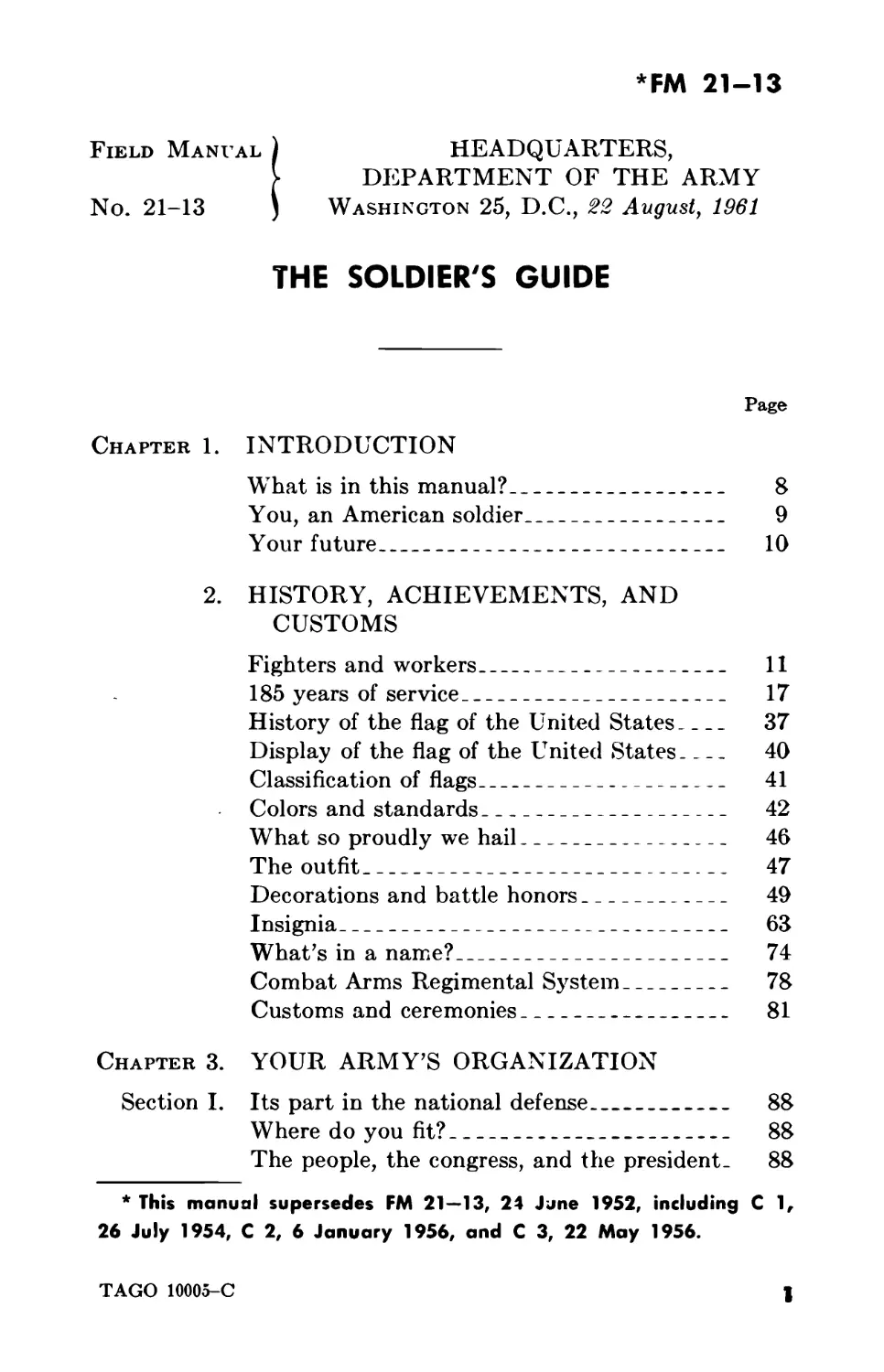
*FM 21-13
Field Manual
No. 21-13
HEADQUARTERS,
DEPARTMENT OF THE ARMY
Washington 25, D.C., 22 August, 1961
THE SOLDIER'S GUIDE
Page
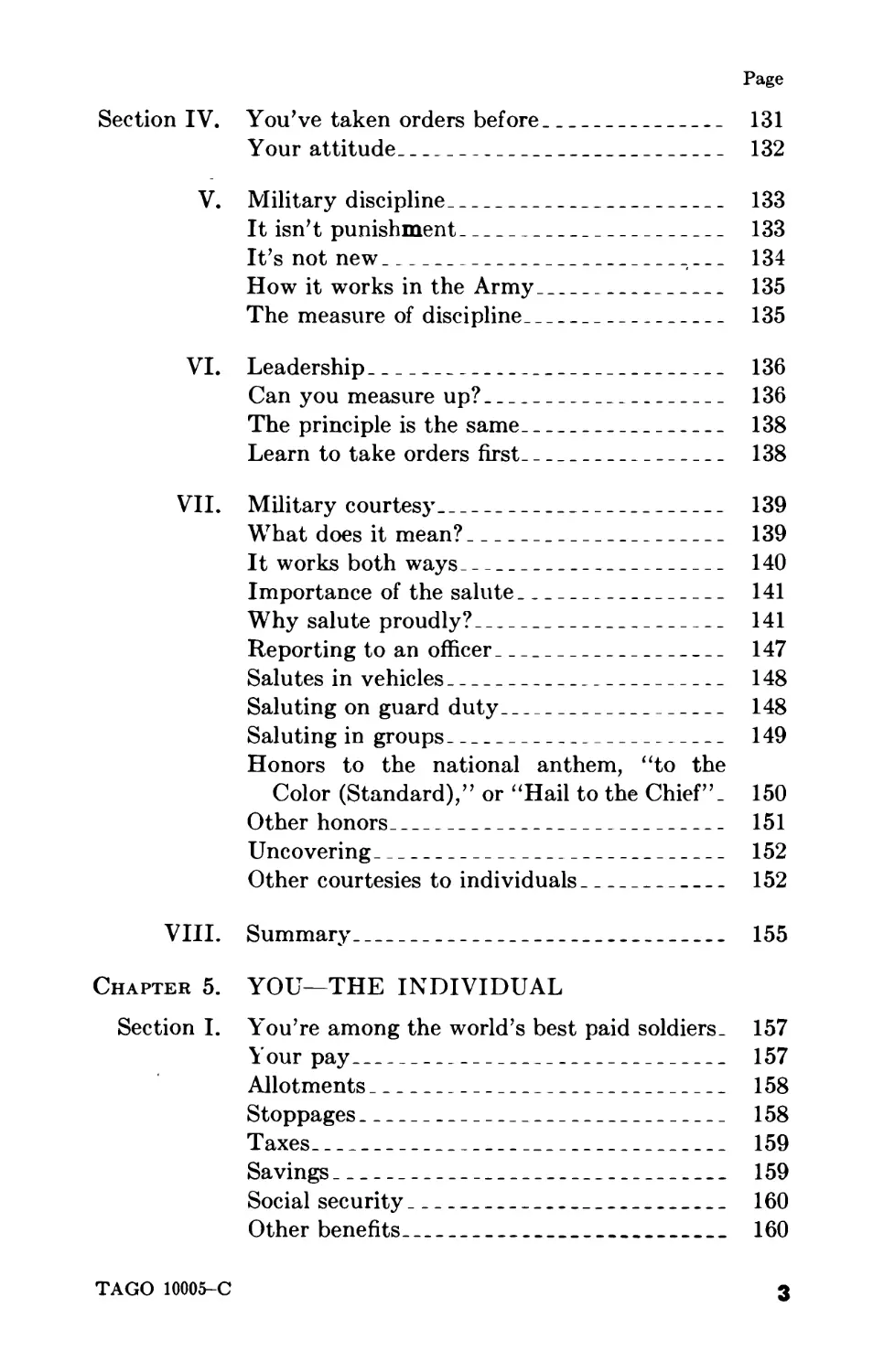
Chapter 1. INTRODUCTION
What is in this manual?_________________ 8
You, an American soldier________________ 9
Your future____________________________ 10
2. HISTORY, ACHIEVEMENTS, AND
CUSTOMS
Fighters and workers_____________________ 11
185 years of service___________________ 17
History of the flag of the United States_	37
Display of the flag of the United States_	40
Classification of flags__________________ 41
Colors and standards___________________ 42
What so proudly we hail________________ 46
The outfit_____________________________ 47
Decorations and battle honors__________ 49
Insignia_______________________________ 63
What’s in a name?______________________ 74
Combat Arms Regimental System__________ 78
Customs and ceremonies_________________ 81
Chapter 3.	YOUR ARMY’S ORGANIZATION
Section I. Its part in the national defense______ 88
Where do you fit?______________________ 88
The people, the congress, and the president- 88
* This manual supersedes FM 21—13, 24 June 1952, including С 1,
26 July 1954, C 2, 6 January 1956, and C 3, 22 May 1956.
TAGO 10005-C
1
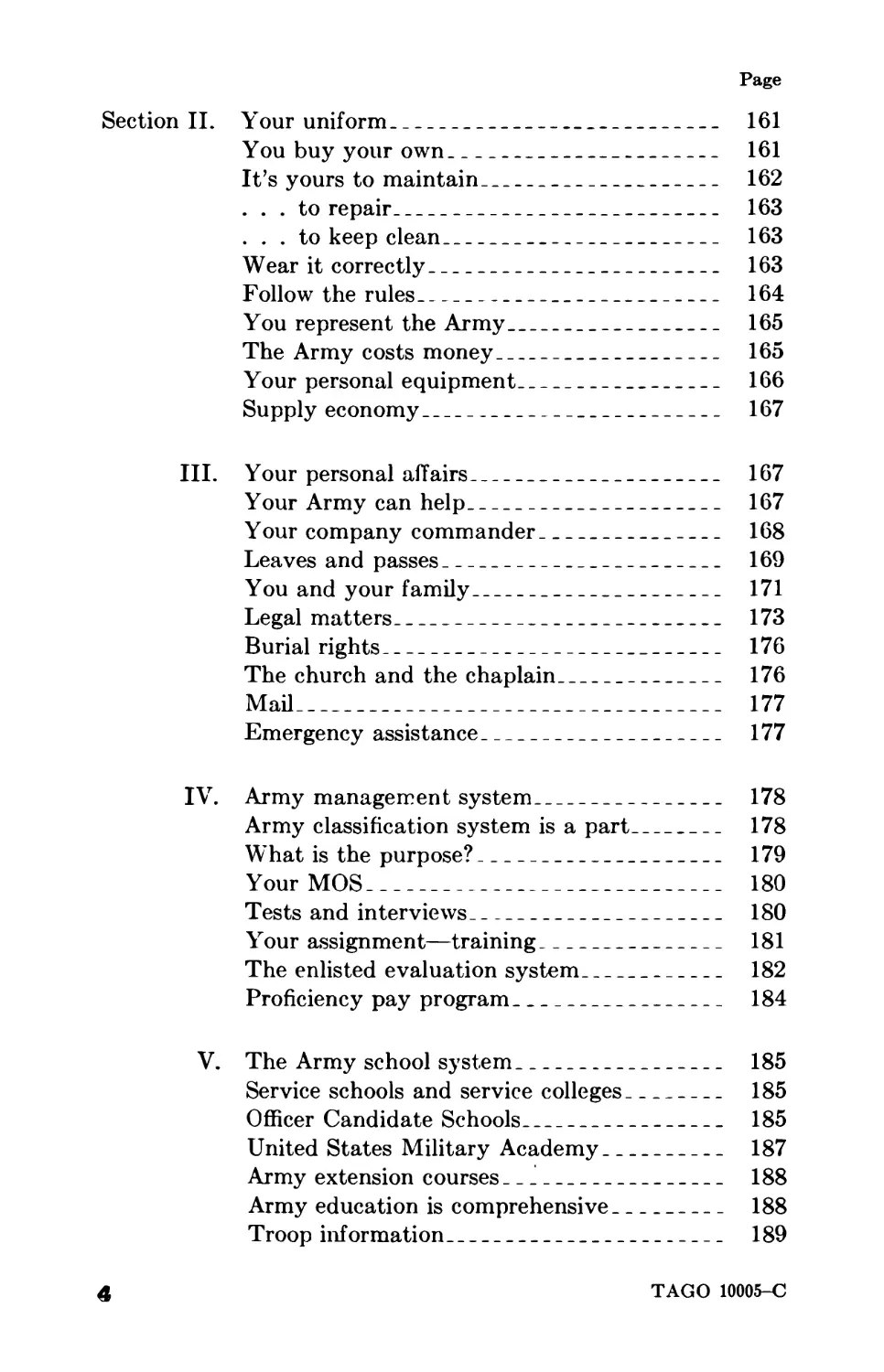
Page
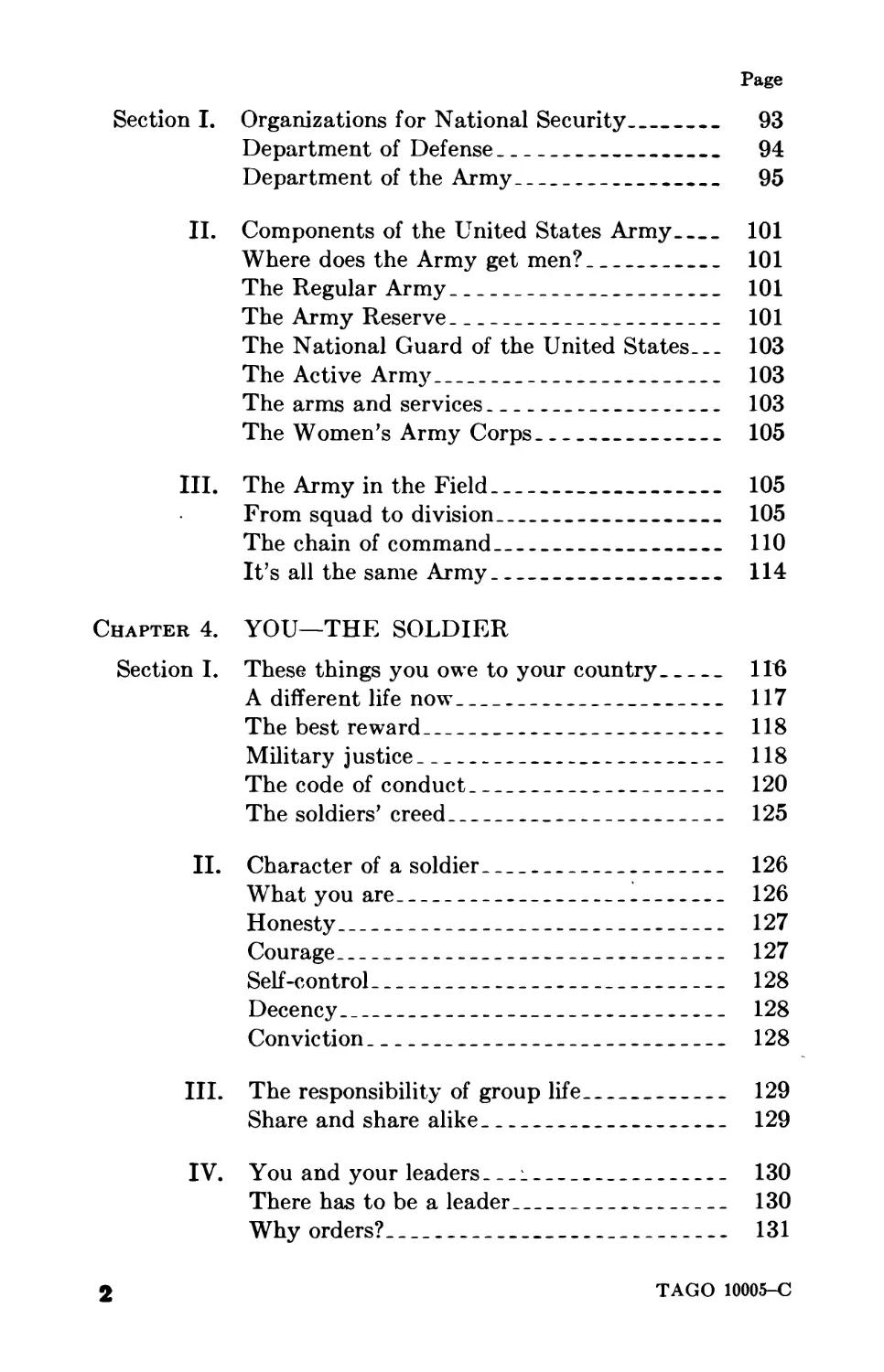
Section I. Organizations for National Security_______	93
Department of Defense___________________ 94
Department of the Army__________________ 95
II.	Components of the United States Army____ 101
Where does the Army get men?____________ 101
The Regular Army__________________________ 101
The Army Reserve__________________________ 101
The National Guard of the United States__ 103
The Active Army___________________________ 103
The arms and services_____________________ 103
The Women’s Army Corps____________________ 105
III.	The Army in the Field--------------------- 105
From squad to division____________________ 105
The chain of command______________________ 110
It’s all the same Army____________________ 114
Chapter 4.	YOU—THE SOLDIER
Se	ction I. These things you owe to your country---- 1Г6
A different life now______________________ 117
The best reward___________________________ 118
Military justice__________________________ 118
The code of conduct_______________________ 120
The soldiers’ creed_______________________ 125
II.	Character of a soldier____________________ 126
What you are______________________________ 126
Honesty___________________________________ 127
Courage__________________________________ 127
Self-control_____________________________ 128
Decency__________________________________ 128
Conviction_______________________________ 128
III.	The responsibility of group life--------- 129
Share and share alike____________________ 129
IV.	You and your leaders___i__________________ 130
There has to be a leader_________________ 130
Why orders?______________________________ 131
2
TAGO 10005-C
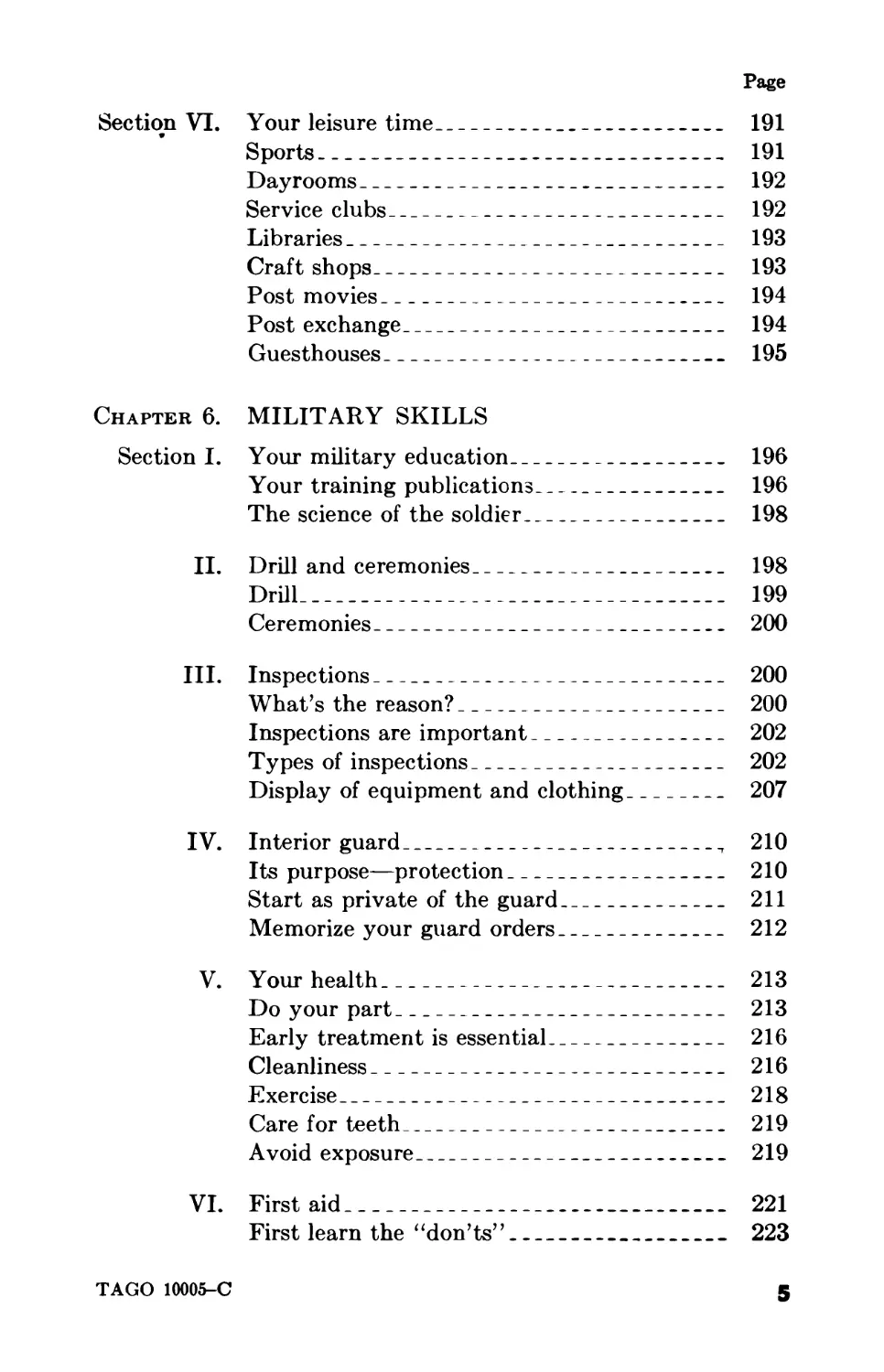
Page
Section IV.	You’ve taken orders before_______________ 131
Your attitude_____________________________ 132
V.	Military discipline______________________ 133
It isn’t punishment_______________________ 133
It’s not new____________________________— 134
How it works in the Army__________________ 135
The measure of discipline_________________ 135
VI.	Leadership_______________________________ 136
Can you measure up?_______________________ 136
The principle is the same_________________ 138
Learn to take orders first________________ 138
VII.	Military courtesy________________________ 139
What does it mean?________________________ 139
It works both ways________________________ 140
Importance of the salute__________________ 141
Why salute proudly?_______________________ 141
Reporting to an officer___________________ 147
Salutes in vehicles_______________________ 148
Saluting on guard duty____________________ 148
Saluting in groups------------------------ 149
Honors to the national anthem, “to the
Color (Standard),” or “Hail to the Chief”. 150
Other honors______________________________ 151
Uncovering________________________________ 152
Other courtesies to individuals___________ 152
VIII.	Summary___________________________________ 155
Chapter 5.	YOU—THE INDIVIDUAL
Section I.	You’re among the world’s best paid soldiers. 157
Your pay__________________________________ 157
Allotments________________________________ 158
Stoppages_________________________________ 158
Taxes_____________________________________ 159
Savings___________________________________ 159
Social security___________________________ 160
Other benefits____________________________ 160
TAGO 10005-C
3
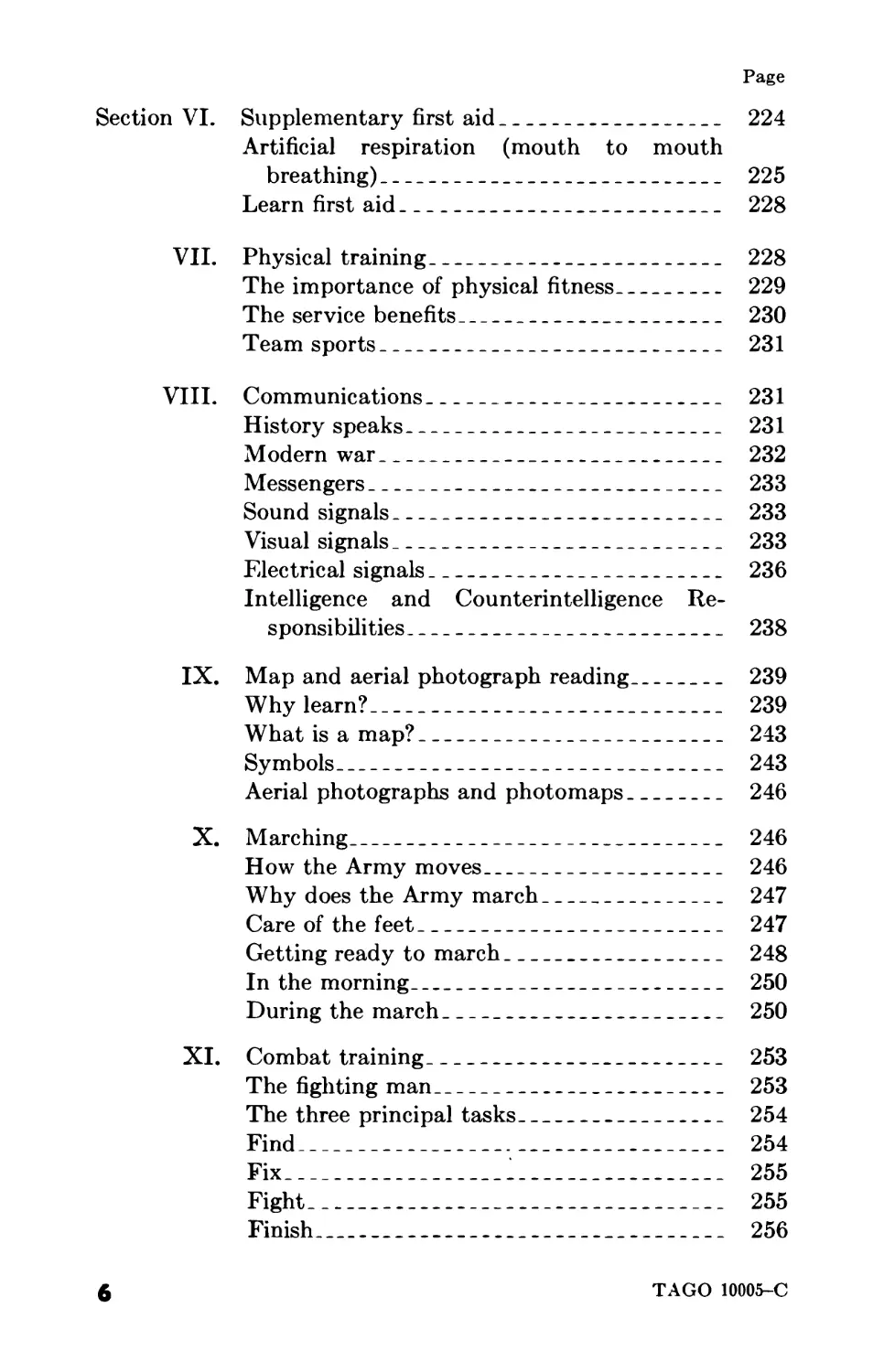
Page
Section II.	Your uniform______________________________ 161
You buy your own___________________________ 161
It’s yours to maintain_____________________ 162
... to repair______________________________ 163
... to keep clean__________________________ 163
Wear it correctly__________________________ 163
Follow the rules___________________________ 164
You represent the Army_____________________ 165
The Army costs money_______________________ 165
Your personal equipment____________________ 166
Supply economy____________________________ 167
III.	Your personal affairs_____________________ 167
Your Army can help_________________________ 167
Your company commander____________________  168
Leaves and passes__________________________ 169
You and your family_______________________ 171
Legal matters______________________________ 173
Burial rights______________________________ 176
The church and the chaplain________________ 176
Mail_______________________________________ 177
Emergency assistance_______________________ 177
IV.	Army management system____________________ 178
Army classification system is a part______ 178
What is the purpose?_______________________ 179
Your MOS___________________________________ 180
Tests and interviews_______________________ 180
Your assignment—training___________________ 181
The enlisted evaluation system_____________ 182
Proficiency pay program____________________ 184
V. The Army school system_____________________ 185
Service schools and service colleges_______ 185
Officer Candidate Schools__________________ 185
United States Military Academy_____________ 187
Army extension courses_____________________ 188
Army education is comprehensive____________ 188
Troop information__________________________ 189
4
TAGO 10005-C
Page
Section VI.	Your leisure time________________________ 191
Sports___________________________________ 191
Dayrooms__________________________________ 192
Service clubs_____________________________ 192
Libraries_________________________________ 193
Craft shops_______________________________ 193
Post movies_______________________________ 194
Post exchange_____________________________ 194
Guesthouses_______________________________ 195
Chapter 6.	MILITARY SKILLS
Section I.	Your military education__________________ 196
Your training publications________________ 196
The science of the soldier________________ 198
II.	Drill and ceremonies_____________________ 198
Drill_____________________________________ 199
Ceremonies________________________________ 200
III.	Inspections________________________________ 200
What’s the reason?________________________ 200
Inspections are important_________________ 202
Types of inspections______________________ 202
Display of equipment and clothing_________ 207
IV.	Interior guard___________________________л 210
Its purpose—protection____________________ 210
Start as private of the guard_____________ 211
Memorize your guard orders________________ 212
V.	Your health_______________________________ 213
Do your part______________________________ 213
Early treatment is essential______________ 216
Cleanliness_______________________________ 216
Exercise__________________________________ 218
Care for teeth____________________________ 219
Avoid exposure____________________________ 219
VI.	First aid_________________________________ 221
First learn the “don’ts”__________________ 223
TAGO 10005-C
5
Page
Section VL	Supplementary first aid___________________ 224
Artificial respiration (mouth to mouth
breathing)_______________________________ 225
Learn first aid___________________________ 228
VII.	Physical training_________________________ 228
The importance of physical fitness________ 229
The service benefits______________________ 230
Team sports_______________________________ 231
VIII.	Communications___________________________ 231
History speaks--------------------------- 231
Modern war________________________________ 232
Messengers________________________________ 233
Sound signals_____________________________ 233
Visual signals____________________________ 233
Electrical signals________________________ 236
Intelligence and Counterintelligence Re-
sponsibilities______________________ 238
IX.	Map and aerial photograph reading________ 239
Why learn?________________________________ 239
What is a map?____________________________ 243
Symbols___________________________________ 243
Aerial photographs and photomaps__________ 246
X.	Marching__________________________________ 246
How the Army moves________________________ 246
Why does the Army march___________________ 247
Care of the feet__________________________ 247
Getting ready to march-------------------- 248
In the morning____________________________ 250
During the march__________________________ 250
XI.	Combat training___________________________ 253
The fighting man__________________________ 253
The three principal tasks----------------- 254
Find______________________________________ 254
Fix___________________1__________________ 255
Fight_____________________________________ 255
Finish____________________________________ 256
6
TAGO 10005-C
Page
Section XII.	Protection against chemical,	biological, and
radiological (nuclear) attack__________ 257
What is CBR?___________________________ 257
Chemical_______________________________ 257
Biological_____________________________ 258
Radiological (nuclear)_________________ 261
XIII.	Your equipment and weapons______________ 262
Issue__________________________________ 262
Care___________________________________ 263
Supply economy_________________________ 264
Weapons________________________________ 264
Your weapons are the best______________ 264
You are responsible____________________ 265
Handle with care_______________________ 265
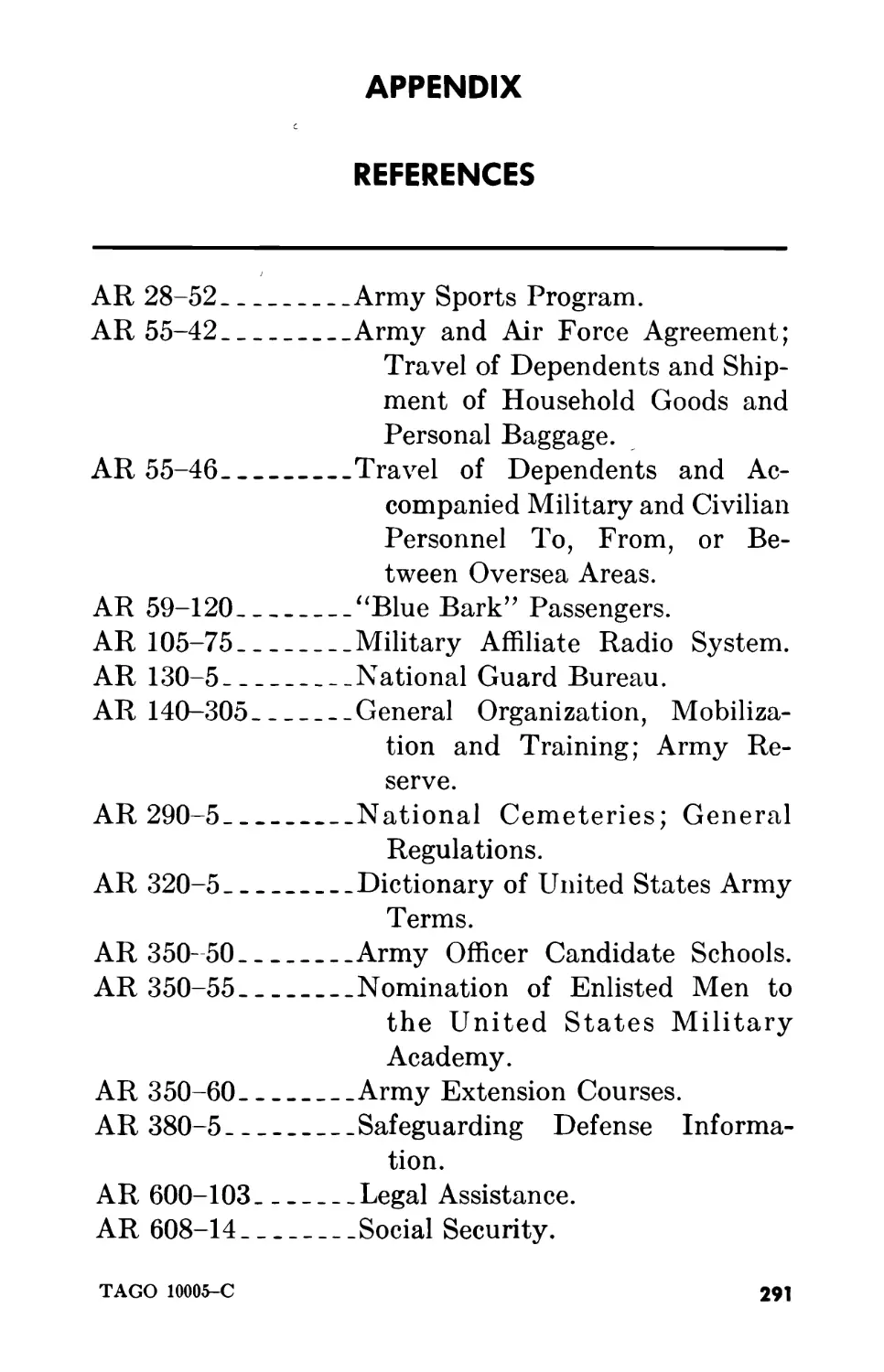
Appendix.	REFERENCES______________________________ 291
TAGO 10005-C
7
CHAPTER 1
INTRODUCTION
What Is in This Manual?
This manual contains information which will assist
you to understand Army life. Just as in civilian life,
the better you understand your surroundings and your
work, the more rapidly you will progress.
Chapter 2 contains some of the history, achieve-
ments, and customs of the United States Army. Chap-
ter 3 presents information of the organization of the
United States Government and the Army’s place in
the National Defense.
Other chapters give detailed information on various
subjects which concern your military education, your
personal life, and most important—you, the soldier.
During basic training you will learn a great deal
more about the many things mentioned in this guide.
After your basic training, you will find your Soldier’s
Guide a handy reference to refresh your memory on
subjects of special interest or importance to you. To
get the whole story of a particular Army subject, you
will have to study other Army publications. But on
almost every subject of interest to you as a soldier,
the Soldier’s Guide is a good place to look first. Form
the habit of using it whenever a question about the
Army comes up in your mind or in discussion with
your fellow soldiers.
Many portions of this manual apply to both male
and female members of the Army. For ease in writing,
however, the female pronoun is often omitted.
8
TAG О 10005-C
You, an American Soldier
A great change has taken place in your life. You
are away from your home and friends. Whether you
find new friends and are comfortable in your new
“home” depends entirely on you.
As you look around, you will not find a “typical
American soldier” in height, weight, color of eyes and
hair, family origin, education, wealth, intelligence, or
similar characteristics. The soldiers you have met
are from all walks of life and all parts of our country.
But all of you have two things in common. First, you
are all serving the United States of America and be-
lieve in the principles that make it a free country.
This not only gives you a common bond with your
fellow soldiers but also guarantees you the same
chances as the next man, to get ahead. This Ameri-
can tradition is cherished in your Army, as it is in all
phases of American life.
Second, the resourcefulness of all Americans is out-
standing in the world today. The spirit of teamwork
instilled in you at home, school, and church, at work
and play, aids in the cooperation needed for you to
meet any and all tasks.
Your freedom and resourcefulness give you the op-
portunity to fill the thousands of important leadership
jobs in our Army.
To be a good leader and a good soldier, you must be
loyal. Stand by your organization and the officers,
noncommissioned officers, and fellow soldiers in it.
The habits of obedience you learned while growing
into maturity are a necessary part of Army life. Obey
promptly and cheerfully the orders given to you.
Obedience and teamwork will make your performance
better and your fellow soldier’s tasks easier.
TAGO 10005-C
9
Your Future
Whether or not you intend to make a career of the
Army, it is to your advantage to perform to the best
of your ability. This is true because of the self-
satisfaction which will result from your service; be-
cause the reputation you make in the Army will follow
you into civilian life; because you will be better pre-
pared to participate in the Army Reserve or National
Guard program; and, finally, because you might—after
all—decide to remain in the Army. If you have de-
cided to stay in the Army, the reasons for doing your
best are more apparent; promotion and assignments
depend in great measure on your performance in every
phase of Army life.
Service in the Army is a duty and a privilege. Each
individual in this nation has the duty to contribute
as much as he can to the well-being of the nation and
its people. Military service is one form of such a
contribution. From the oldest times, it has been con-
sidered a privilege to be permitted to bear arms in the
defense of one’s nation or people. This privilege is
afforded only to those who are individuals of good
standing and of good reputation.
10
TAGO 10005-C
CHAPTER 2
HISTORY, ACHIEVEMENTS, AND CUSTOMS
Be proud of your Army and its history. Through
the efforts and sacrifices of men and women before
you, the Army made possible the creation of this
Nation and has always protected it from its enemies.
Without the Continental Army under General Wash-
ington, there would not have been a United States;
and, if there had been no Army in later years, our
Nation would not have survived.
Today our military might and that of Allied Forces
are the major deterrent to worldwide Communist
aggression.
Fighters and Workers
The United States Army is made up of soldiers
who are both fighters and workers. Many accom-
plishments which history credits to the United States
were performed by the Army. Most of the navigable
rivers and harbors of our Nation were developed and
all are maintained by the Corps of Engineers of the
Army. Explorations, such as those of Pike, Kearney,
and Fremont, opened the West and Northwest. These
were expeditions of Army men doing an Army job.
The Panama Canal was finally built by a U.S. Army
engineer, General Goethals. This Canal project could
not have been constructed without great medical ad-
vances in tropical operations. This aspect was per-
formed in Panama by General Gorgas of the Army
Medical Corps.
The many outstanding achievements reflected in our
TAGO 10005-C
11
Army’s long history are justifiable grounds for the
soldier to feel proud of his military heritage.
Pride in the Army is expressed, among other ways,
in traditions. These are kept as a reminder to you,
of the millions of other loyal Americans who have
served faithfully in the Army for nearly two centuries.
Our Army has a proud and successful past, but do
not get the idea that American soldiers have won every
battle. The Army, often with the odds against it,
has fought some of the best soldiers in the world. So
it isn’t surprising that at times our outfits have been
thrown back. The real glory is that they have always
come up fighting.
One of the brightest examples of our ability to “rise
and fight again” occurred on Christmas Day, 1776.
That December was one of the darkest, most discourag-
ing periods for the little army under Washington. After
defeats around New York, the Army retreated across
New Jersey, only a jump ahead of the British. Reach-
ing the Delaware River, General Washington had all
the boats picked up for miles along the banks and
managed to cross in them and prevented the enemy
from doing the same. Ragged, cold, and short of
everything, the Continentals went into camp a few
miles beyond the river. Most of the men had almost
finished their “hitches,” and Washington knew that
something had to be done or the American cause was
lost. The British had left a force of hired foreign
soldiers, Hessians, to garrison Trenton, and General
Washington guessed that they would be celebrating
Christmas night. He decided to try a surprise attack
on them in the night, one of the most difficult of mili-
tary movements, in order to catch them off guard.
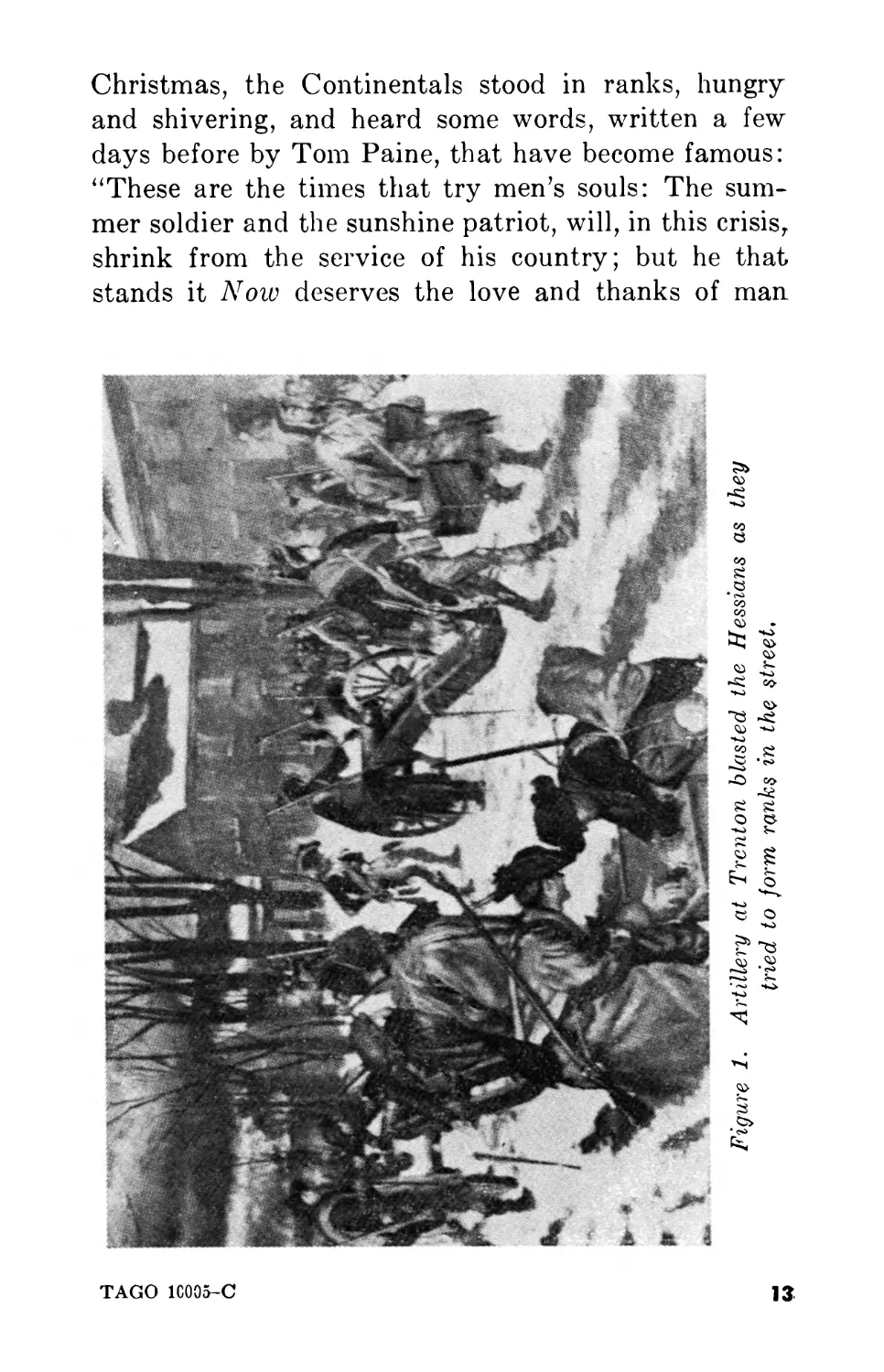
While the Hessians drank and sang that rainy
12
TAGO 10005-C
Christmas, the Continentals stood in ranks, hungry
and shivering, and heard some words, written a few
days before by Tom Paine, that have become famous:
“These are the times that try men’s souls: The sum-
mer soldier and the sunshine patriot, will, in this crisis,,
shrink from the service of his country; but he that
stands it Now deserves the love and thanks of man
TAGO 1C005-C
13
and woman.” The men who listened were in no way
summer soldiers, and the march to Trenton began.
When night came, the wind blew cold and snow fell.
Silently the tiny army of 2,400 men was ferried through
the cakes of ice by Glover’s Regiment from Marble-
head, sailors turned soldier. By the time they reached
the other side, snow was falling thickly, but they
marched through it for 9 miles, and, at the first light,
charged into Trenton. The Hessians, groggy and
barely able to line up in the street, had no chance;
they gave up in less than an hour. The tide of the
war was turned, and the American cause was saved.
Training pays off, and the history of the United
States Army contains proof of this statement. One of
the best early proofs is the Legion, a composite or-
ganization of all combat arms under one command,
formed by General Anthony Wayne in 1792. The In-
dians, in which is now the State of Ohio, had twice
before whipped the entire Army, so Wayne insisted
that the troops he led had to be trained before they
fought. The General was a hard man, and the dis-
cipline he enforced would make the toughest soldier
turn pale. He insisted on absolute perfection in drill
and in firing. The men of the Legion complained,
but, at the same time, they polished their cartridge
boxes and patched up their uniforms to keep them
neat. Cleanliness helped to keep the Army healthy,
and those who didn’t know it soon found it out.
Finally, after 2 years of preparation, Wayne’s Legion
was turned loose on the Indians. On 20 August 1794,
Little Turtle and other chiefs who had beaten the
white man before took up a strong position where they
thought the odds were in their favor, to fight what
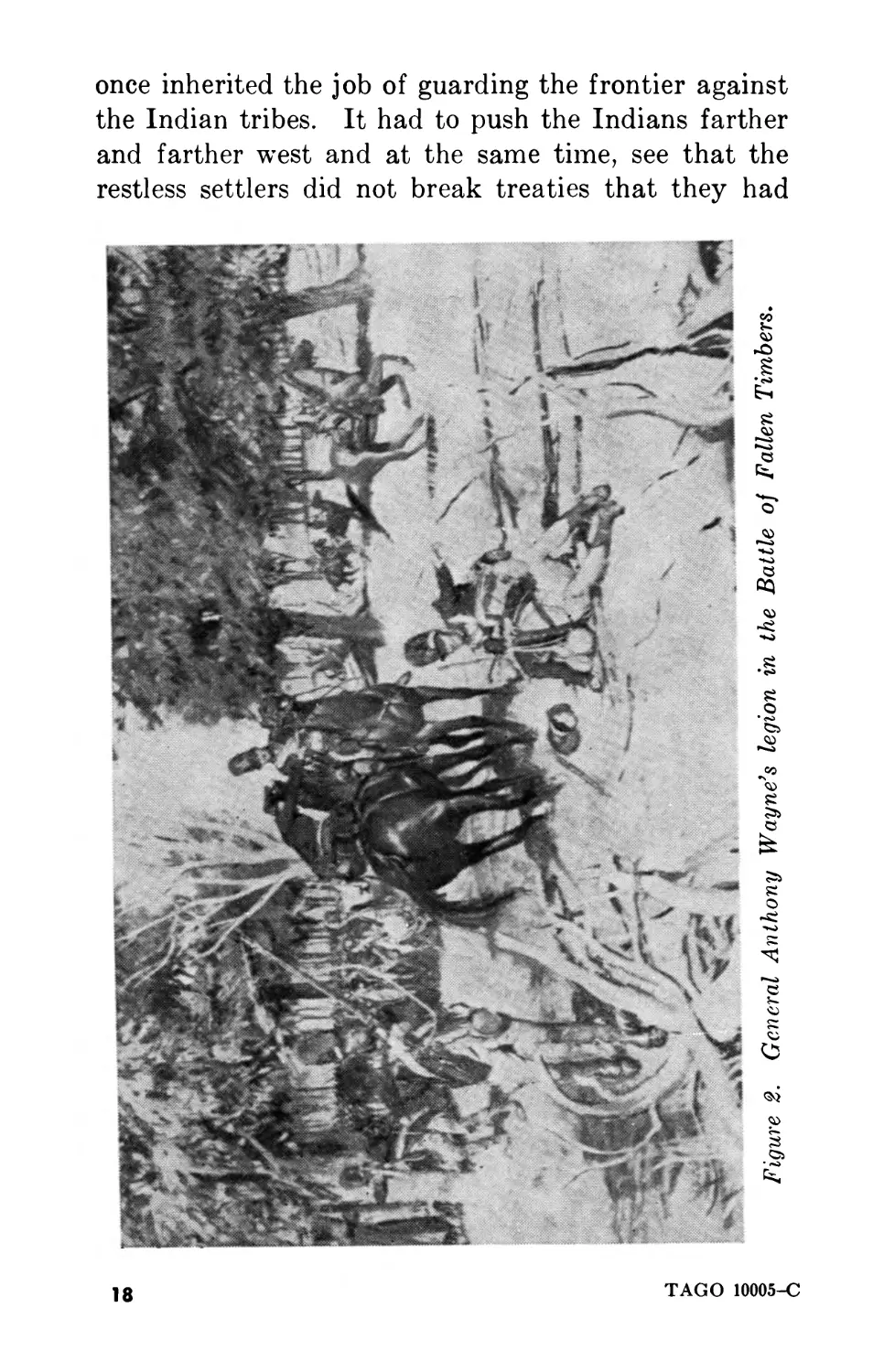
became known as the Battle of Fallen Timbers. The
14
TAGO 10005-C
location was called this because, many years before,
a tornado had left a wide path of tangled fallen trees
through the woods, and the tangle was good cover for
the red men. The thing the Indians had overlooked
was that Wayne had trained his men to fight under all
possible conditions. When the General had sized up
the battleground, he told the soldiers to “. . . rouse the
Indians from their coverts at the point of the bayonets.
. . У The idea was not to waste a lot of bullets shoot-
ing at an enemy you could not see. The men, true to
their training, charged in spite of the bullets of the
Indians and came to close quarters. The savages
could not stand against the “sharp ends of guns,” and
they quickly withdrew. Once they were up where they
made good targets, the soldiers mowed them down.
Twice as many warriors as soldiers were killed or
wounded, and the Indians were forced to keep the
peace for a long time.
We have been talking about how training, or the
lack of it, has affected American history, and now the
time has come to mention supply. During World War
II, the United States Army was the best supplied force
in history. The people of other nations marvelled at
the masses of weapons, clothes, and other equipment
that we could deliver to any point on the globe. We
ourselves took for granted that our Army would al-
ways have every item it needed, wherever it fought.
But you need to be reminded that American soldiers,
many times in the past, have lacked the bare necessi-
ties.
Valley Forge is the best example. There, in Penn-
sylvania, during the severe winter of 1777 and 1778,
the Continental Army was short of everything and
those supplies it had weren’t getting to the troops. In
TAGO 10005-C
15
February, around 4,000 men were unfit for duty be-
cause they had no clothes and shoes to cover them.
Soldiers, called for guard, wrapped sacks around their
feet, and pinned up rags to make pants and shirts.
Some had to huddle in ragged blankets so that others
could- be dressed. Food was scarce, too, and dinner
was often just stale bread and "bleary,” which was
simply flour and boiled water. Children sometimes
use it now to paste paper together, but the soldiers of
1777 tried to live on it. There were no fires nor beds
for the sick; they lay on the cold ground in whatever
rags could be spared for them.
Yet in these dark days at Valley Forge the Army
learned to fight. It was here that Baron von Steuben,
the Prussian drillmaster, worked with officers and men
to build them into self-confident soldiers. When he
found no drill regulations, he wrote them. He organ-
ized squads and companies and drilled them in his
broken English so that they could teach others. He
taught the men to keep strict camp discipline, and also
taught them the meaning of sanitation. When spring
came the Continental Army was no longer a dismayed
crowd but a tough, skillful outfit that could stand up
against the British on any battlefield.
There was more rough going before the enemy was
finally licked at Yorktown, yet it seems as if the
rougher it got the better we did in the end. For ex-
ample, in the Battle of New Orleans, Major General
Andrew Jackson, who was in command in January
1815, had several thousand more men than guns, so
he scoured New Orleans for some more weapons. Ev-
erything from rusty blunderbusses to dueling pistols
came in and Jackson had them issued. They were bet-
ter than nothing, but they were not the equal of British
16
TAGO 10005-C
muskets. The General had to give his men some other
advantage to equalize matters. His solution was not
welcomed, for everyone, soldier and civilian, had to
dig like prairie dogs. As a result, there were many
blisters on hands and all varieties of aching backs; but
when the battle occurred, the English soldiers were
out in the open, while the Americans had a secure bank
of dirt or cottonbales in front of them. For the Ameri-
cans, it was like target practice; even the shotguns and
dueling pistols were of some use. When the smoke
cleared away, 2,036 English soldiers were down, but
only 71 Americans. Necessity is the mother of inven-
tion, and the United States Army has done some of its
finest fighting when equipment was scarce.
185 Years of Service
To write a full history of the United States Army
would not be appropriate for this guide. However,
here are some historical highlights that may interest
you.
1775-1783, Birth Through Revolution. The United
States Army has its origin in the colonial militia. On
14 June 1775, the Continental Congress voted to adopt
the militia and volunteers, fighting the British around
Boston, as the Colonial Army. These were Infantry-
men ; so the Army is the senior of the three services and
the Infantry, the senior branch of the Army. This
Army, aided by citizen soldiers from the colonies, and
with much help from the French, defeated the British.
Cornwallis’ surrender at Yorktown on 19 October
1781 ended the last major battle of the Revolution.
The formal treaty of peace was signed on 3 September
1783.
1783-1861, The Indian Wars. The new Army at
TAGO 10005-C
17
once inherited the job of guarding the frontier against
the Indian tribes. It had to push the Indians farther
and farther west and at the same time, see that the
restless settlers did not break treaties that they had
18
TAGO 10005-C
made with the red men. The Army continued to do
this job for a century, a job which called for great
endurance, skill, bravery, and patience.
Since the one regiment that was the Army during
much of the time prior to 1792 was not strong enough
to protect the frontier against the Indians in Ohio, the
Army was reorganized into a legion, commanded by
General Anthony Wayne. We saw earlier that Wayne
led the legion against the Indians and, on 20 August
1794, defeated them in the Battle of Fallen Timbers.
We will return to the story of the Indians after 1861,
when the frontier had reached the great plains west of
the Mississippi River.
1812-1815, The War of 1812. Again our Army fought
the British on American soil. The enemy was well
trained by several years’ combat in Europe. Of the
new regiments raised to fight the British, almost all,
regulars and volunteers, were green at the start.
You may have heard about the conduct of our troops
at the Battle of Bladensburg, Maryland. In 1814, the
British breached our lines with little effort and cap-
tured and burned the city of Washington.
Because our troops turned and ran from the front-
lines, the battle became known as the “Bladensburg
Races.” The disgrace lay in the fact that the men
lacked training and preparation.
During the spring of 1814, Winfield Scott, a newly
appointed general, began training a brigade. In July,
a force which included Scott’s brigade moved north and
confronted a British force across the Chippewa River.
On 5 July, Scott formed his brigade on the level plain
to parade in celebration of Independence Day. When
the brigade moved forward, they found that the Brit-
ish had crossed the river and were moving toward them.
TAGO 10005-C
19
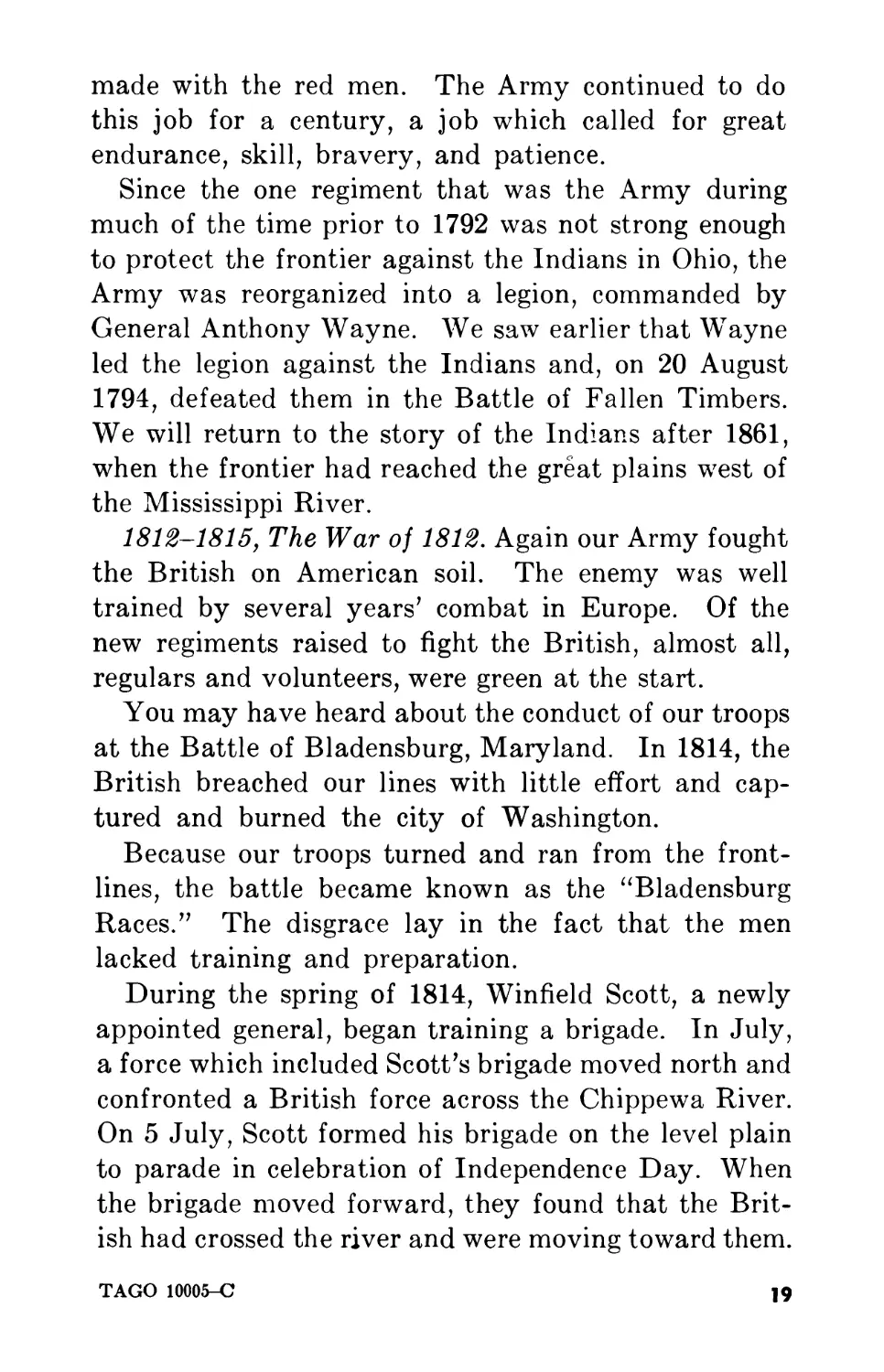
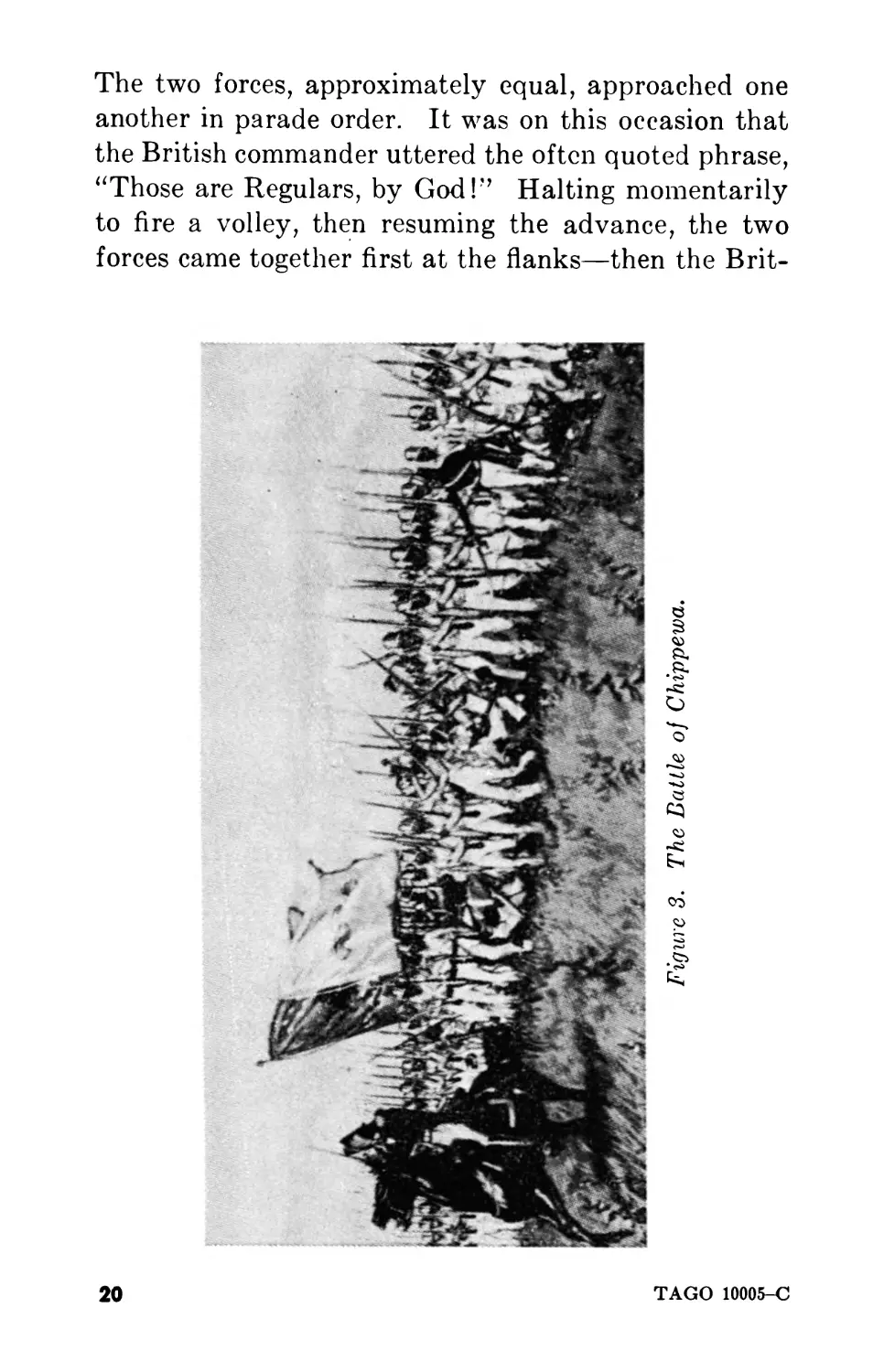
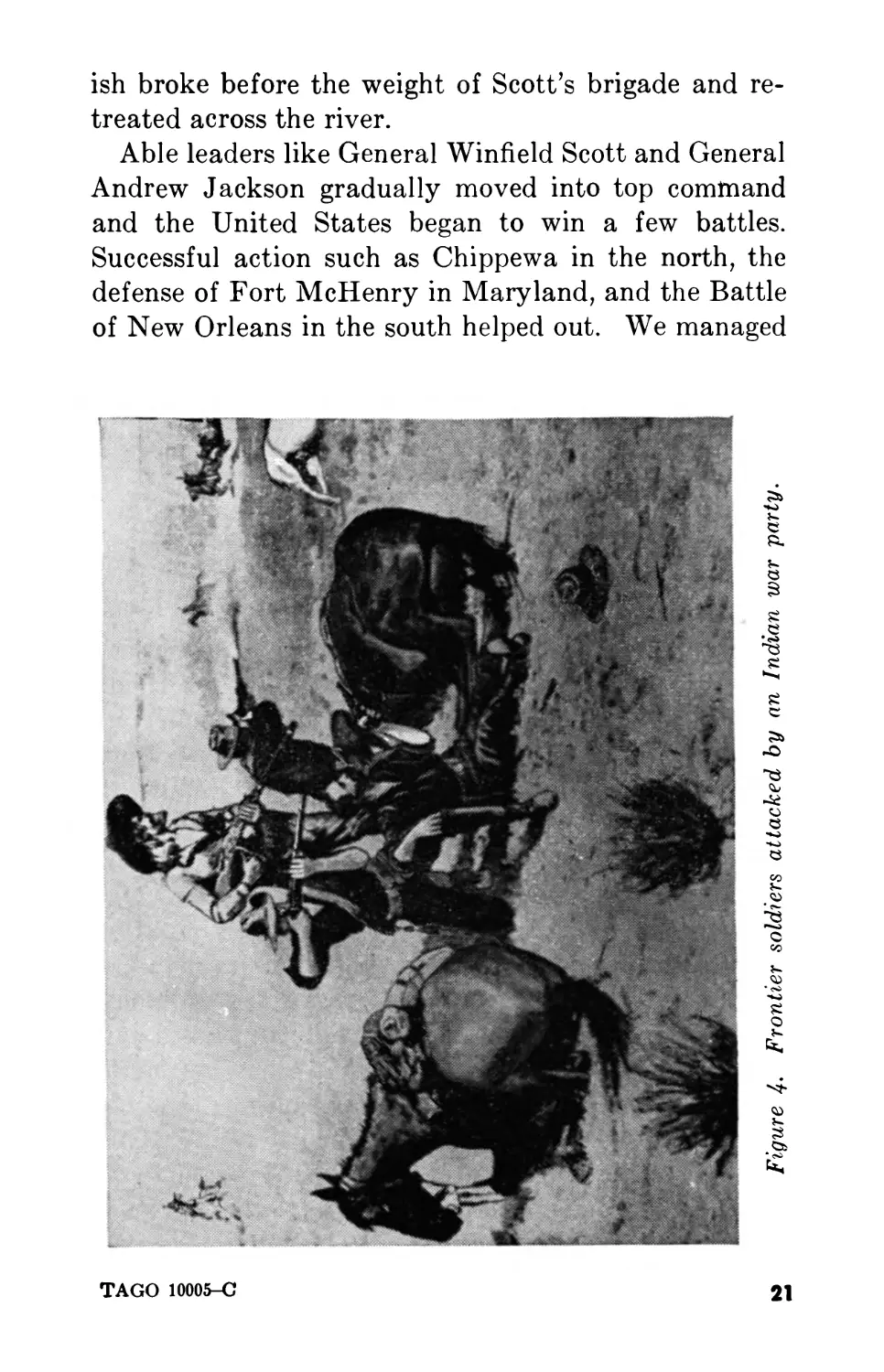
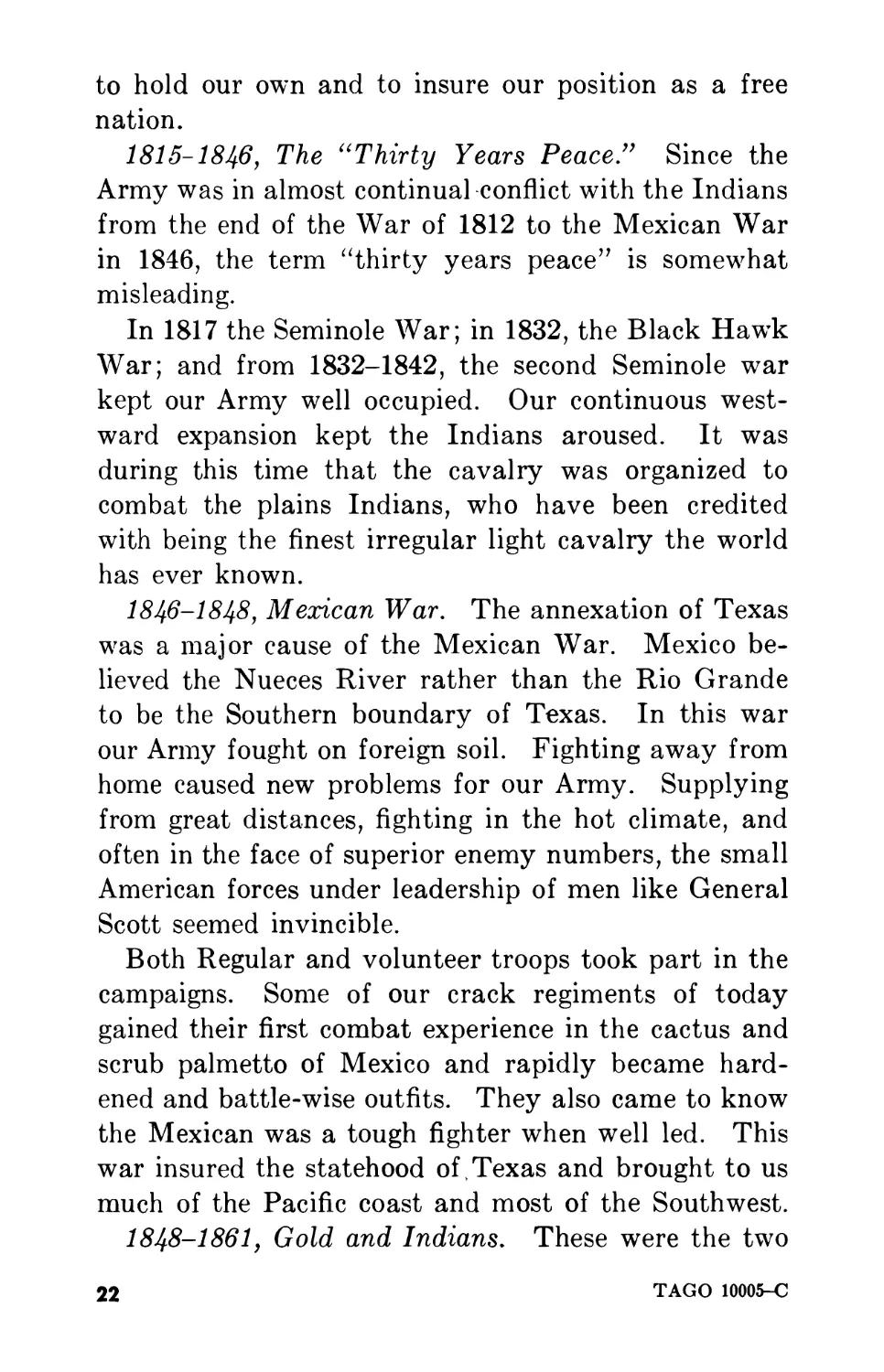
The two forces, approximately equal, approached one
another in parade order. It was on this occasion that
the British commander uttered the often quoted phrase,
“Those are Regulars, by God!’’ Halting momentarily
to fire a volley, then resuming the advance, the two
forces came together first at the flanks—then the Brit-
20
TAGO 10005-C
ish broke before the weight of Scott’s brigade and re-
treated across the river.
Able leaders like General Winfield Scott and General
Andrew Jackson gradually moved into top command
and the United States began to win a few battles.
Successful action such as Chippewa in the north, the
defense of Fort McHenry in Maryland, and the Battle
of New Orleans in the south helped out. We managed
TAGO 10005-C
21
to hold our own and to insure our position as a free
nation.
1815-1846, The “Thirty Years Peace.” Since the
Army was in almost continual conflict with the Indians
from the end of the War of 1812 to the Mexican War
in 1846, the term “thirty years peace” is somewhat
misleading.
In 1817 the Seminole War; in 1832, the Black HawTk
War; and from 1832-1842, the second Seminole war
kept our Army well occupied. Our continuous west-
ward expansion kept the Indians aroused. It was
during this time that the cavalry was organized to
combat the plains Indians, who have been credited
with being the finest irregular light cavalry the world
has ever known.
1846-1848, Mexican War. The annexation of Texas
was a major cause of the Mexican War. Mexico be-
lieved the Nueces River rather than the Rio Grande
to be the Southern boundary of Texas. In this war
our Army fought on foreign soil. Fighting away from
home caused new problems for our Army. Supplying
from great distances, fighting in the hot climate, and
often in the face of superior enemy numbers, the small
American forces under leadership of men like General
Scott seemed invincible.
Both Regular and volunteer troops took part in the
campaigns. Some of our crack regiments of today
gained their first combat experience in the cactus and
scrub palmetto of Mexico and rapidly became hard-
ened and battle-wise outfits. They also came to know
the Mexican was a tough fighter when well led. This
war insured the statehood of Texas and brought to us
much of the Pacific coast and most of the Southwest.
1848-1861, Gold and Indians. These were the two
22
TAGO 10005-C
main problem areas for the Army in this 13-year
period. With the farmers, prospectors, and miners
who streamed to California at the cry of “Gold,” came
all the riffraff of the nation, attracted by the easy
money and lawless life.
The need for transportation across our nation caused
TAGO 10005-C
23
the Army to expand its exploring, surveying, and map-
ping of possible routes for the railroad. The Indians,
ever hostile towards this expansion, caused the Army
to fight over 200 separate actions during this “routine”
13 years.
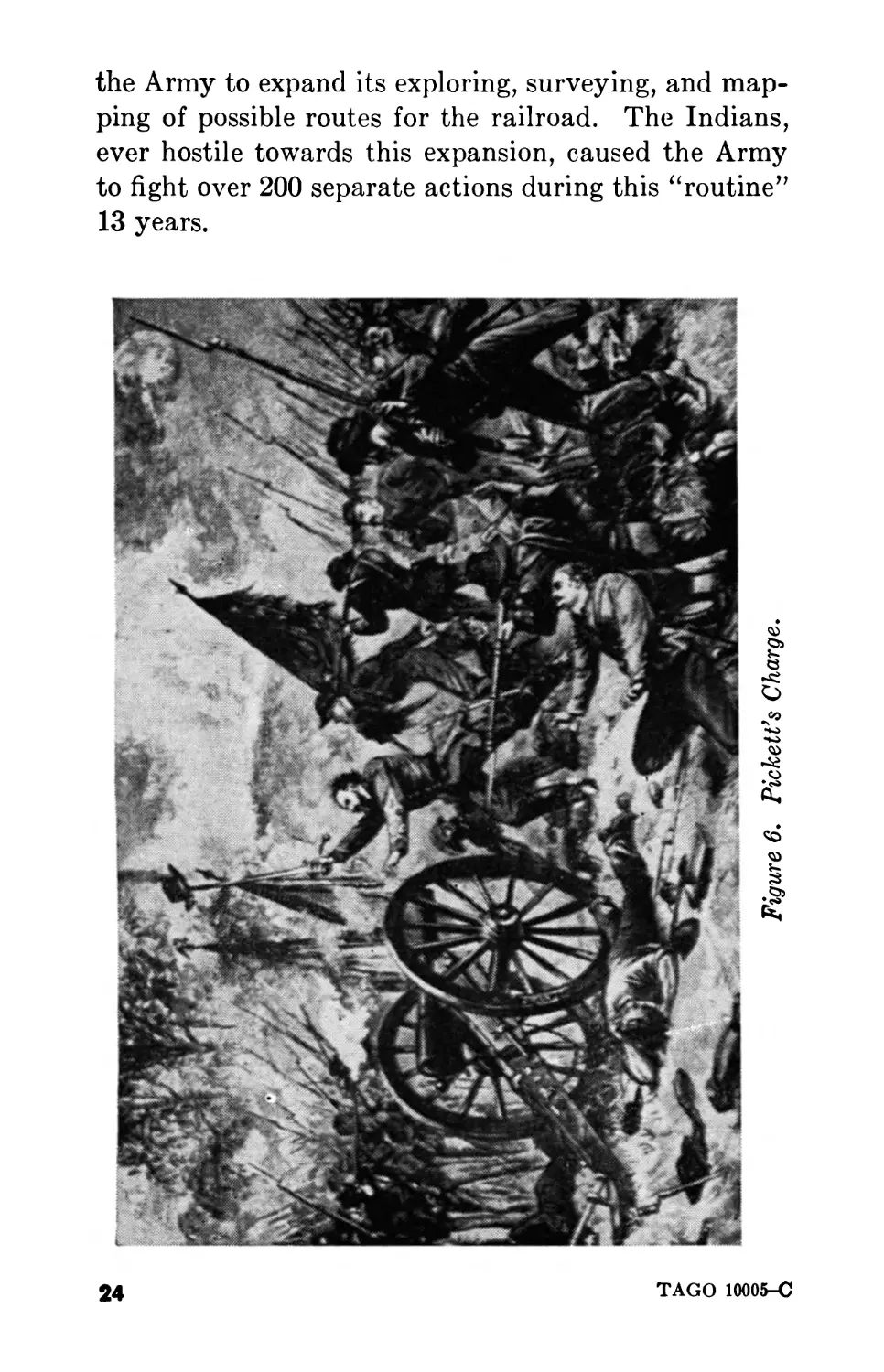
Figure 6. Pickett’s Charge.
24
TAGO 10005-C
1861-1865, Civil War. The War Between the States,
as it is sometimes known, was a tragic and bitter con-
flict. At the start both sides were untrained and un-
ready, although the South had a slight edge. Within
a year both armies were veterans, fighting with a skill
rarely surpassed by any country at any time. Man-
power and industrial might tipped the scales in favor
of the North and the United States continued as a
single nation. If one incident were picked as out-
standing in gallantry and sacrifice, it would probably
be Pickett’s Charge on the third day of the Battle of
Gettysburg.
Here’s some background on the battle. After sev-
eral victories in Virginia, General Robert E. Lee pushed
on in an “all-out” attempt to win the war by an in-
vasion of the North. In June 1863, he led his veteran
Army of Northern Virginia, 80,000 strong, across the
Potomac into Pennsylvania. He was near Gettysburg
on the 30th when his advance brigades ran into some
scattered opposition. Lee ordered his men to keep
going. He thought the Federals were only a force of
untrained troops. As the Confederates reached the
edge of a woods, intense firing broke out and a line of
men with fixed bayonets appeared. There was a sur-
prised outcry from the Southern ranks when they saw
the outfit. “Look at them black hats! That’s the
Army of the Potomac!” Veteran was now pitted
against veteran.
The Federal Army of the Potomac, under General
George G. Meade, was first forced back into a huddled
position and dug in around Cemetery Ridge. Lee
attempted to surround the whole position with a frontal
attack and a double envelopment. The bluecoats held
on the right, but on the left they fell back. Across a
TAGO 10005-C
25
wheatfield and through a peach orchard, Longstreet’s
Confederates drove them through the “Valley of
Death.” By now, Federal reinforcements were com-
ing up. Darkness closed on the second day of the
battle, and both sides braced for the final decision.
The Northern forces now outnumbered Lee and
should have forced him into defense, but Lee knew he
could win only by attacking.
So, attack he did, twice against the flanks with little
or no success. Then on 3 July with his forces regrouped
he made an all-out attack on the Federal center on
Cemetery Ridge. Pickett’s Virginia Division led the
charge made by 15,000 men under General Longstreet.
The assault column was a mile wide; it had to cross
nearly 2,000 yards of open ground to get to the
Federals.
At 1 o’clock, 159 Confederate guns along Seminary
Ridge opened fire on the clump of trees on Cemetery
Ridge. Precise gray lines moved across the fields.
Cannon and muskets opened fire on them in deadly
fury. The ranks thinned but kept coming, right into
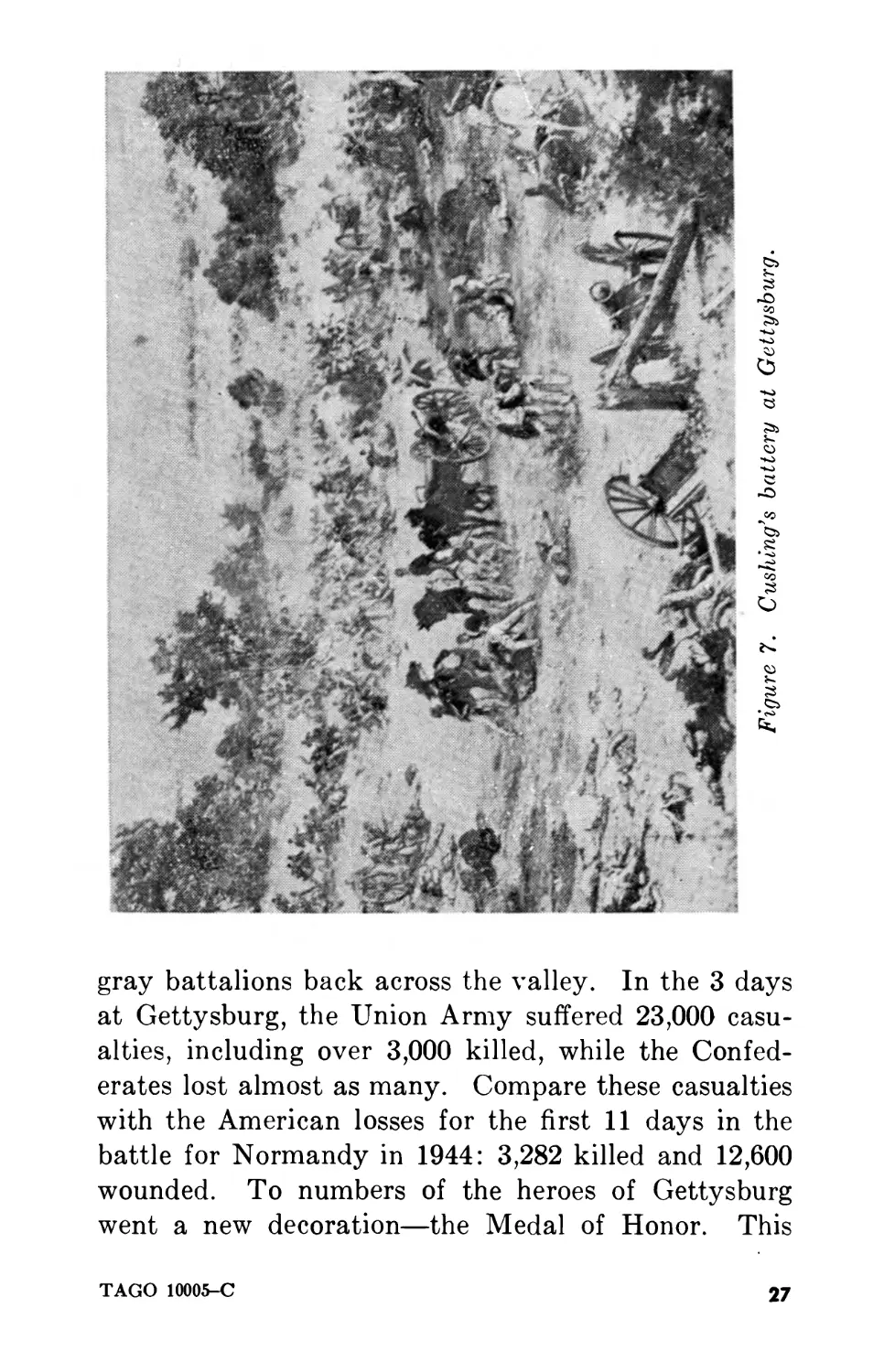
the Federal gun positions. There lay Cushing’s Bat-
tery A, 4th U.S. Artillery. The gallant battery stood
fast, firing canister (an early form of scatter-shot) at
10 yards.
Captain Cushing was killed as he pushed his last
cannon forward, but Sergeant Frederick Fuger took
over and kept it firing. The Confederates grabbed one
of the Union cannon and turned it around; Fuger’s
artillerymen fought back with revolvers, shovels, hand-
spikes, and stones. A Southern commander broke
through the Union positions there on the hill, only to
fall mortally wounded. Pennsylvania and New Eng-
land regiments counterattacked and drove the broken
26
TAGO 10005-C
gray battalions back across the valley. In the 3 days
at Gettysburg, the Union Army suffered 23,000 casu-
alties, including over 3,000 killed, while the Confed-
erates lost almost as many. Compare these casualties
with the American losses for the first 11 days in the
battle for Normandy in 1944: 3,282 killed and 12,600
wounded. To numbers of the heroes of Gettysburg
went a new decoration—the Medal of Honor. This
TAGO 10005-C
27
award had been established for the Army in 1862; in
1863, it was made permanent and extended to all who
should “most distinguish themselves.” It remains the
country’s highest military award.
1861-1891, More Indian Wars. The Army never
ceased its guard along the Indian frontier, even when
it was busy with other fighting. Much of the work
during the Civil War was done by volunteer regiments,
but after 1865 the Regulars were back on the prairies.
The West was a big place and there was rarely enough
men or equipment to do the job properly. Frontier
duty meant ruthless fighting and rough riding and
called for strong men. Regiments brought up in this
sort of duty grew very proud of their campaigns in the
mountains and deserts and boasted of the hardships.
They felt their regimental insignia to be a symbol of
valor and saw to it that no other outfit claimed to have
won more fights or marched more miles than they.
Each generation of soldiers talks about the “Old
Army” of yesterday. None of the old armies had more
color and stirring memories than the one which pacified
the West. A typical Western post in the seventies and
eighties had a regiment of cavalry and four infantry
companies. Reveille was at 5:45 a.m.; a polished 12-
pounder gun boomed its salute to a new day, the bugler
sounded first call, and the Stars and Stripes was raised.
During the morning, the troopers rode horses at drill
or led them out to graze in the shadows of the hills.
Guard mount was usually formal with keen competi-
tion among the new guard to become an orderly to the
commanding officer, and the traditional reward was a
pass. Dress parade was held at 5:25 p.m. It was a
colorful ceremony of flashing sabers, fluttering flags,
28
TAGO 10005-C
and precise marching—each outfit to the tune of its
own battle march.
Often without warning a courier would gallop in to
tell of an Indian party on the war path, and soon
troops would be on the trail. They would ride in
again—when the Indians had been herded back to a
reservation—usually weeks later and often after con-
siderable fighting. The battle of the Little Big Horn,
when the remnants of the 7th Cavalry returned with-
out their commanding officer and xvith only one
wounded horse to show for the mounts of five troops
led into battle by General Custer, was one of the most
famous. These fighting men of the frontier had not
heard of the word “morale,” but theirs was high, hav-
ing been developed in the courageous sharing of hard-
ships and adversity.
1898-1913, Spanish-American War and Philippine
Insurrection. On the night of February 15, 1898, the
USS Maine, rocked by an explosion, sank in Havana
Harbor, killing 266 of the crew. The American people
clamored for revenge with the now famous slogan
“Remember the Maine.”
Once more the Army was called upon to fight far
from its homeland. The battles were minor but color-
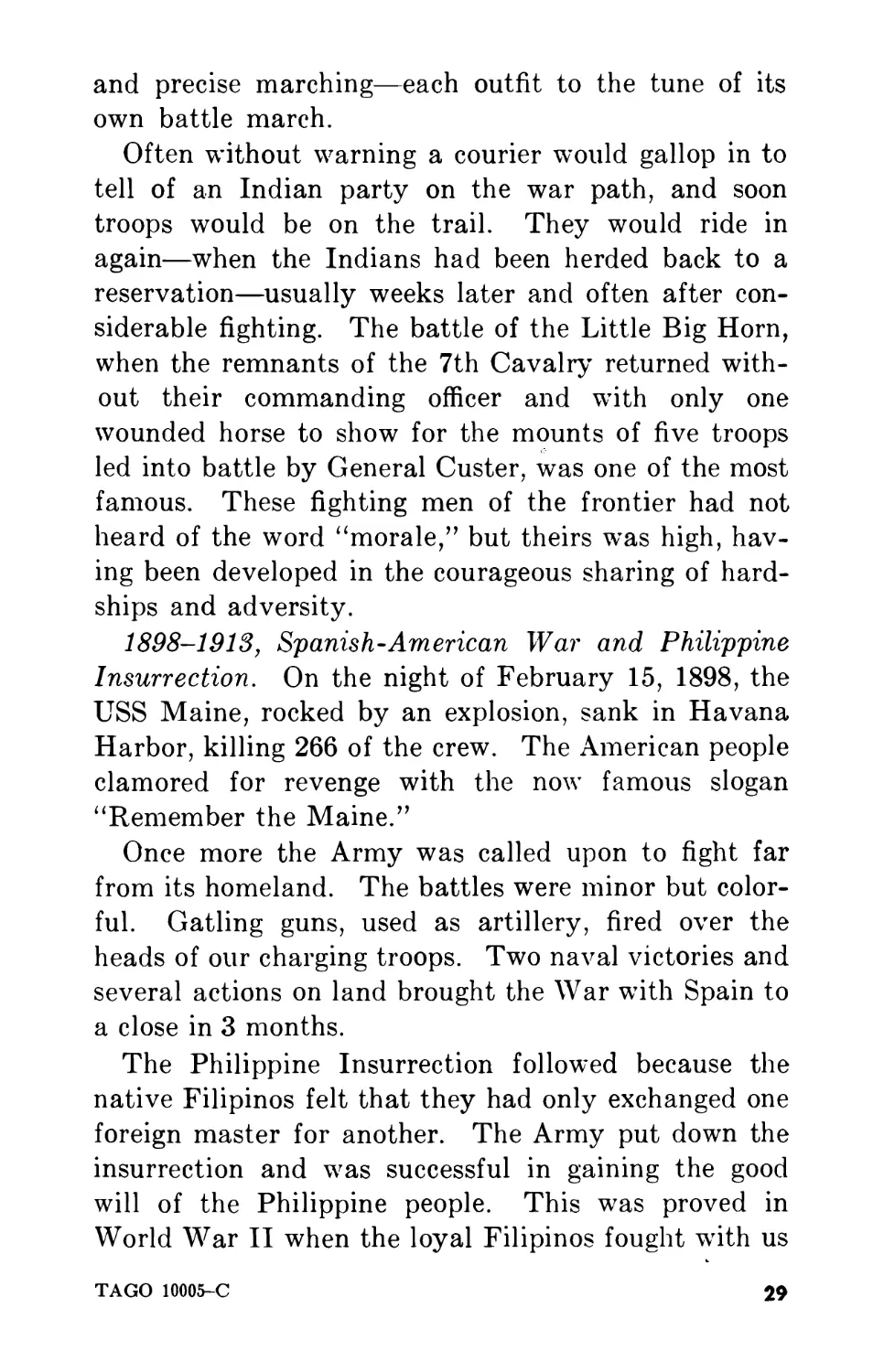
ful. Gatling guns, used as artillery, fired over the
heads of our charging troops. Two naval victories and
several actions on land brought the War with Spain to
a close in 3 months.
The Philippine Insurrection followed because the
native Filipinos felt that they had only exchanged one
foreign master for another. The Army put down the
insurrection and was successful in gaining the good
will of the Philippine people. This was proved in
World War II when the loyal Filipinos fought writh us
TAGO 10005-C
29
through thick and thin. No other example in our
history shows so well what the American soldier can
do in the way of making friends and getting along
with people if he wants to.
1914-1918, World War I. We entered the conflict
in 1917 after the nations of Europe had been fighting
30
TAGO 10005-C
for 3 years. France, England and their allies, with
whom we sided, were worn down by bitter trench war-
fare, and the Germans launched a last great drive to
break them before American soldiers could arrive in
decisive numbers. The enemy began the first of five
successive attacks in March 1918 and pushed a great
bulge into the Allied line. American troops had ar-
rived faster than expected, and they were thrown in
to the bulge at the Marne River. Three American
divisions stood their ground against wave after wave
of attackers and helped to halt the great drive.
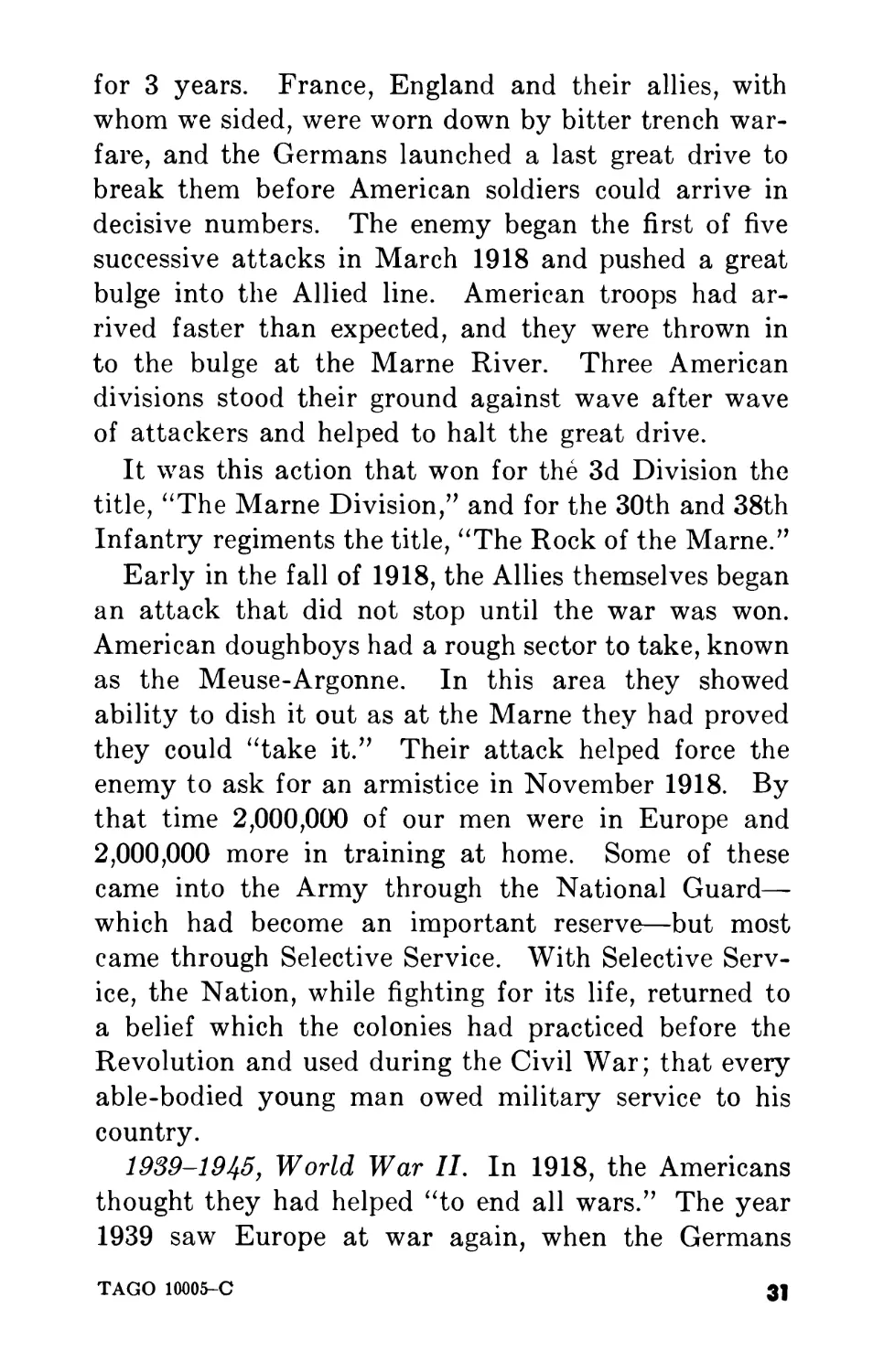
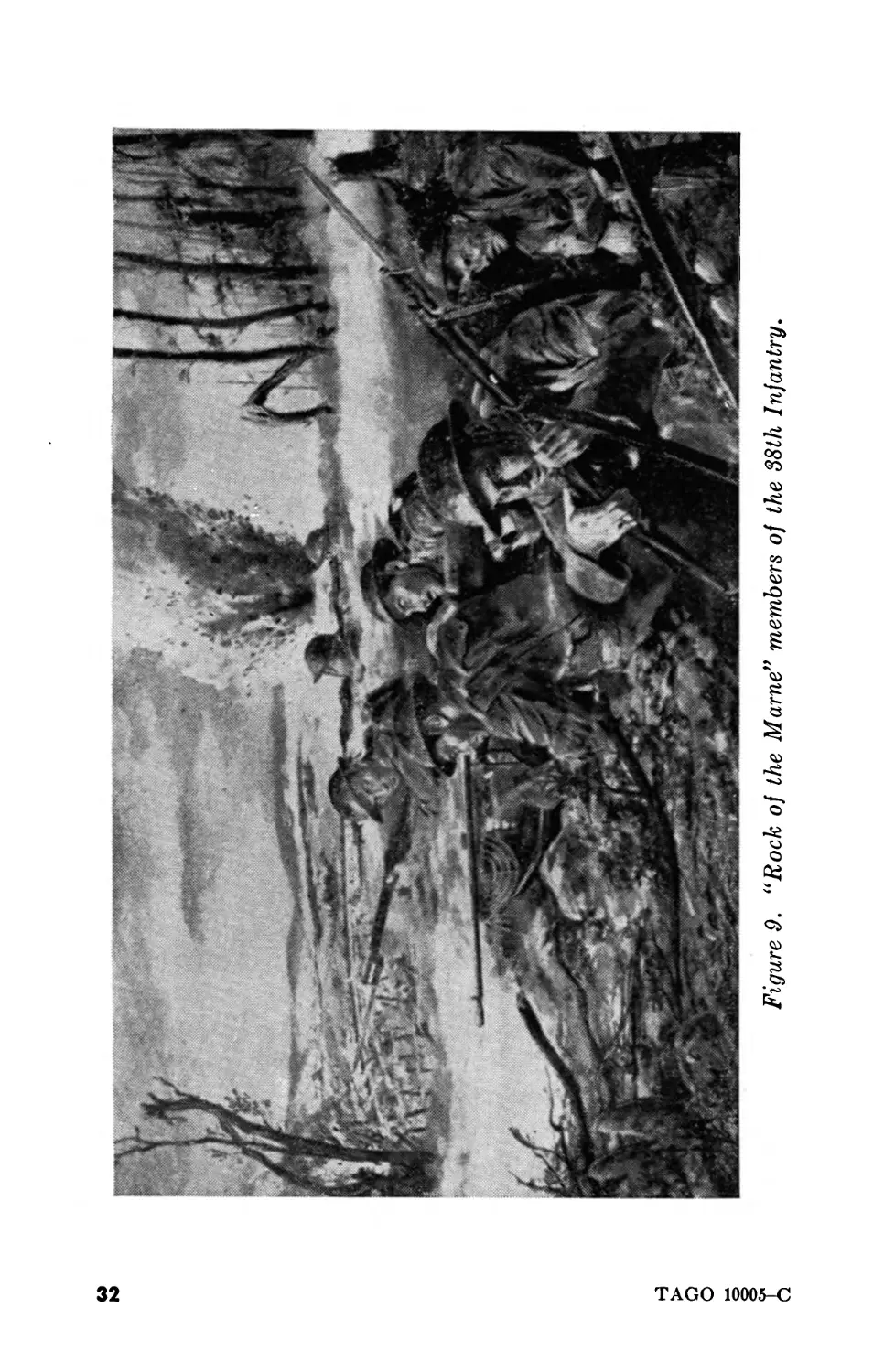
It was this action that won for the 3d Division the
title, “The Marne Division,” and for the 30th and 38th
Infantry regiments the title, “The Rock of the Marne.”
Early in the fall of 1918, the Allies themselves began
an attack that did not stop until the war was won.
American doughboys had a rough sector to take, known
as the Meuse-Argonne. In this area they showed
ability to dish it out as at the Marne they had proved
they could “take it.” Their attack helped force the
enemy to ask for an armistice in November 1918. By
that time 2,000,000 of our men were in Europe and
2,000,000 more in training at home. Some of these
came into the Army through the National Guard—
which had become an important reserve—but most
came through Selective Service. With Selective Serv-
ice, the Nation, while fighting for its life, returned to
a belief which the colonies had practiced before the
Revolution and used during the Civil War; that every
able-bodied young man owed military service to his
country.
1939-1945, World War II, In 1918, the Americans
thought they had helped “to end all wars.” The year
1939 saw Europe at war again, when the Germans
TAGO 10005-C
31
TAGO 10005-C
Figure 9. “Rock of the Marne” members of the 38th Infantry.
lunged across the Polish border in a furious blitzkrieg.
It took only 4 weeks to annihilate the Polish Army.
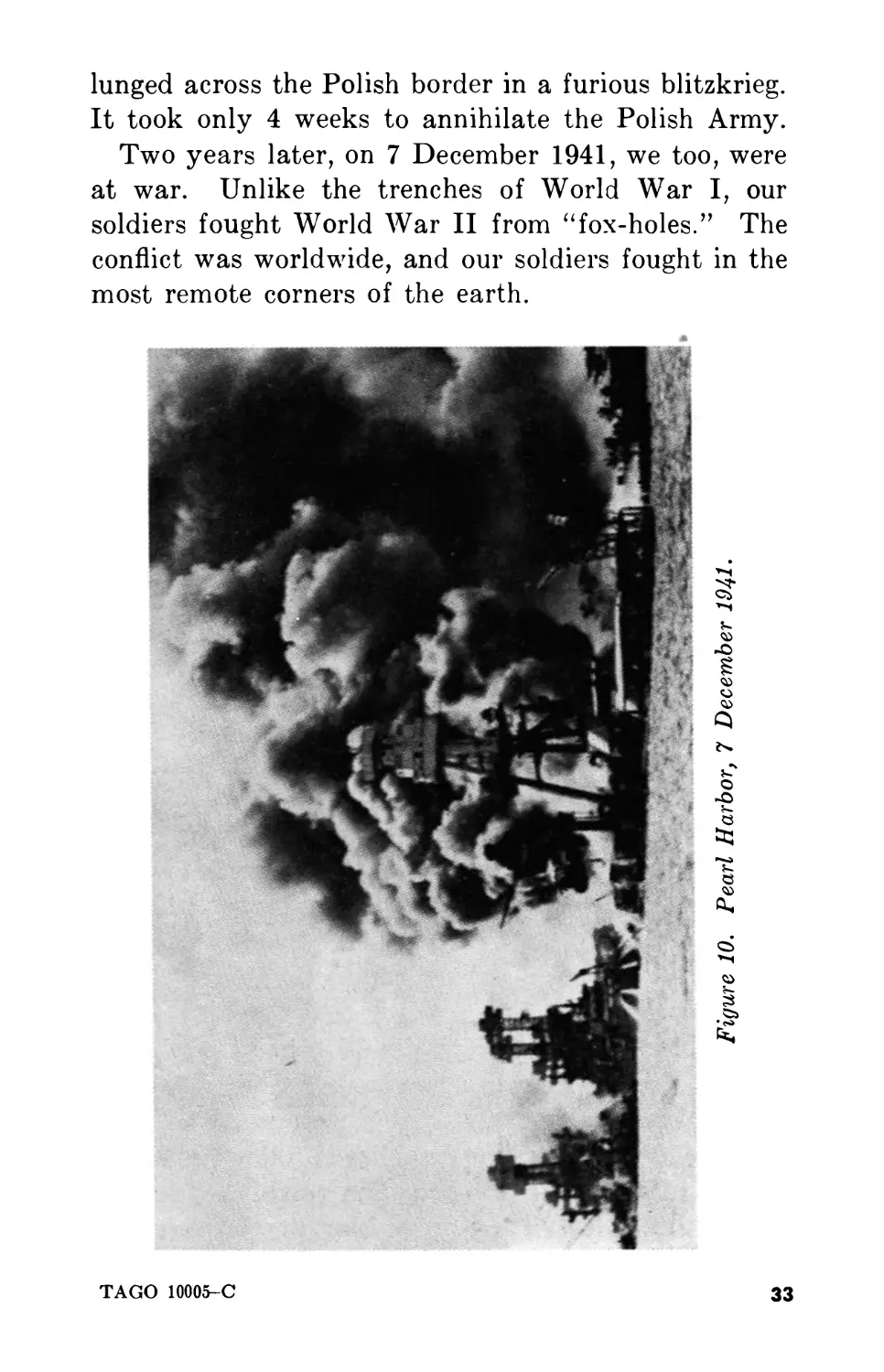
Two years later, on 7 December 1941, we too, were
at war. Unlike the trenches of World War I, our
soldiers fought World War II from “fox-holes.” The
conflict was worldwide, and our soldiers fought in the
most remote corners of the earth.
TAGO 10005-C
33
The British, French, and Belgian troops were over-
run and pushed to the sea at Dunkirk in 1940. Our
soldiers joined the war in North Africa in 1942 and in
1943 they moved back into Italy. Finally, D-day,
the supreme assault, came on 6 June 1944 and our
soldiers began the bitter advance eastward into the
heart of Germany. Eleven months after D-day the
Allied forces, coming from opposite directions, met
Russian forces in the middle of Germany and the fight
in Europe was over. VE Day was celebrated on 7
May 1945.
While the war went on in Europe, Japan struck in
the Pacific Ocean. The Allied problem here, as in
Europe, was to push back the enemy, but it was more
a matter of taking “one damned island after another.”
By 1942, the Allies were prepared to start their island-
hopping. American soldiers, marines, and sailors co-
operated with one another, and with Allied forces, in
savage fighting on beaches and in jungles to break
Japan’s power, until, on 14 August 1945, the war with
Japan ended.
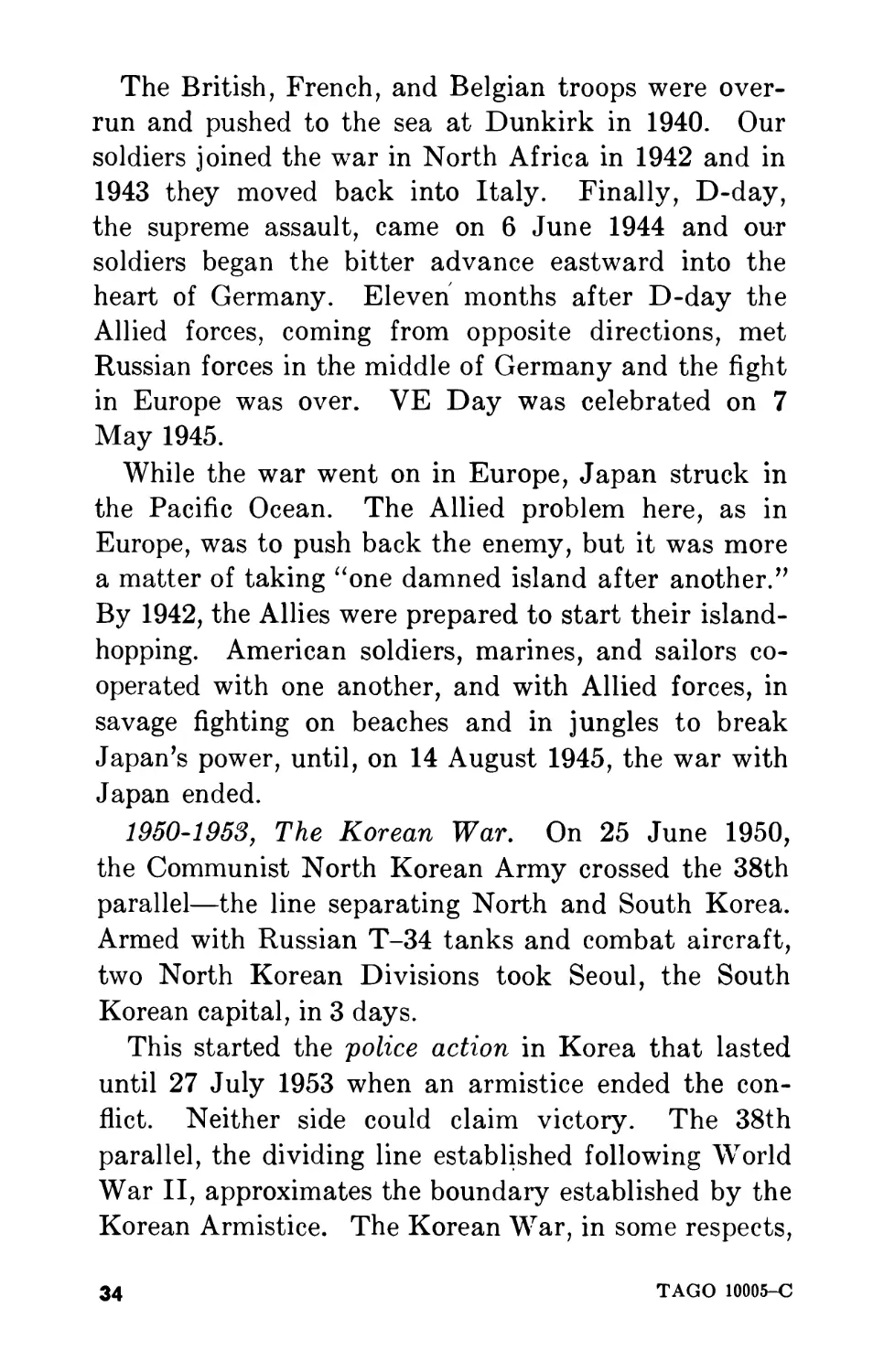
1950-1953, The Korean War. On 25 June 1950,
the Communist North Korean Army crossed the 38th
parallel—the line separating North and South Korea.
Armed with Russian T-34 tanks and combat aircraft,
two North Korean Divisions took Seoul, the South
Korean capital, in 3 days.
This started the police action in Korea that lasted
until 27 July 1953 when an armistice ended the con-
flict. Neither side could claim victory. The 38th
parallel, the dividing line established following World
War II, approximates the boundary established by the
Korean Armistice. The Korean War, in some respects,
34
TAGO 10005-C
TAGO 10005-C
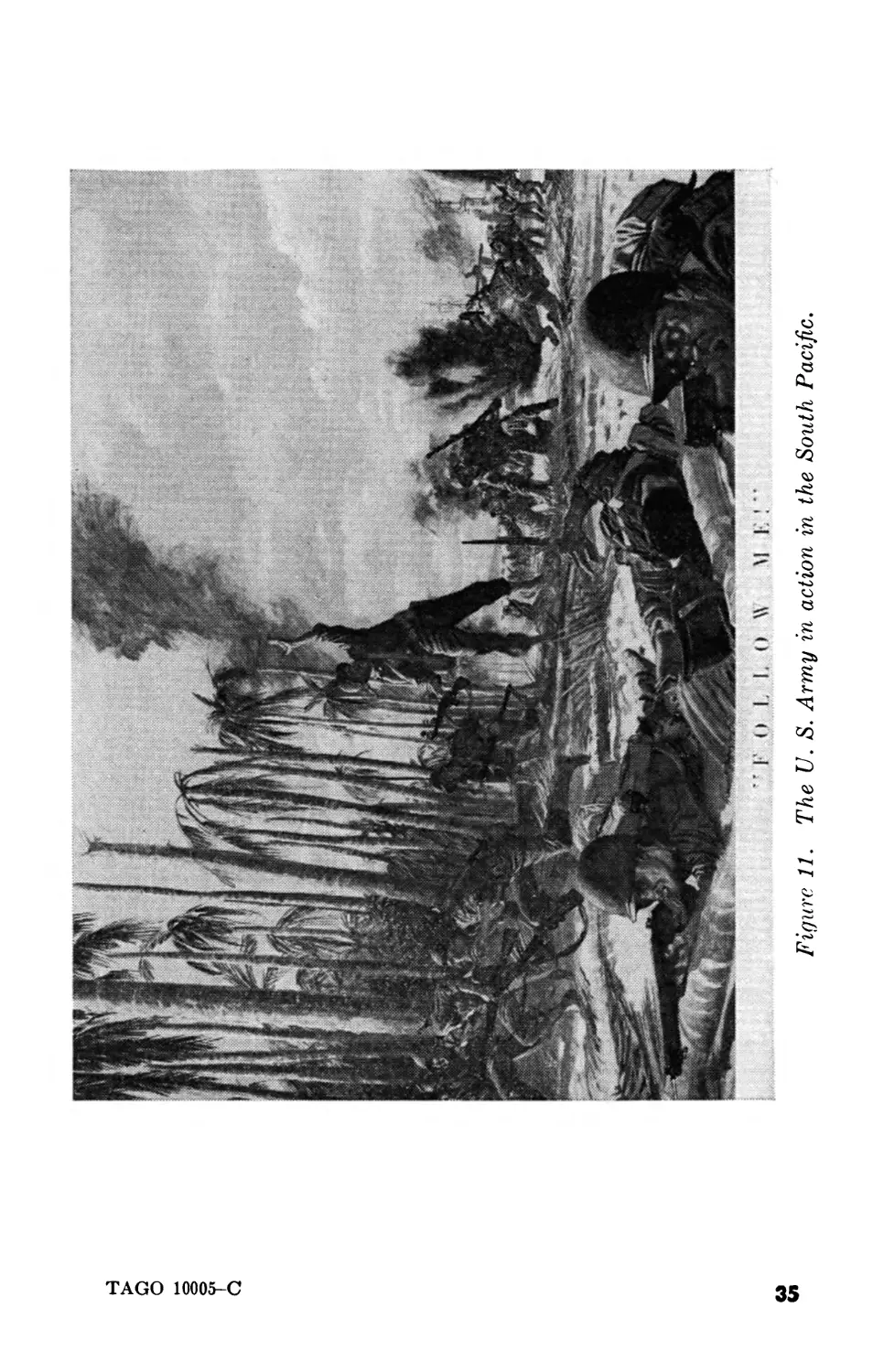
Figure 11. The U. Army in action in the South Pacific.
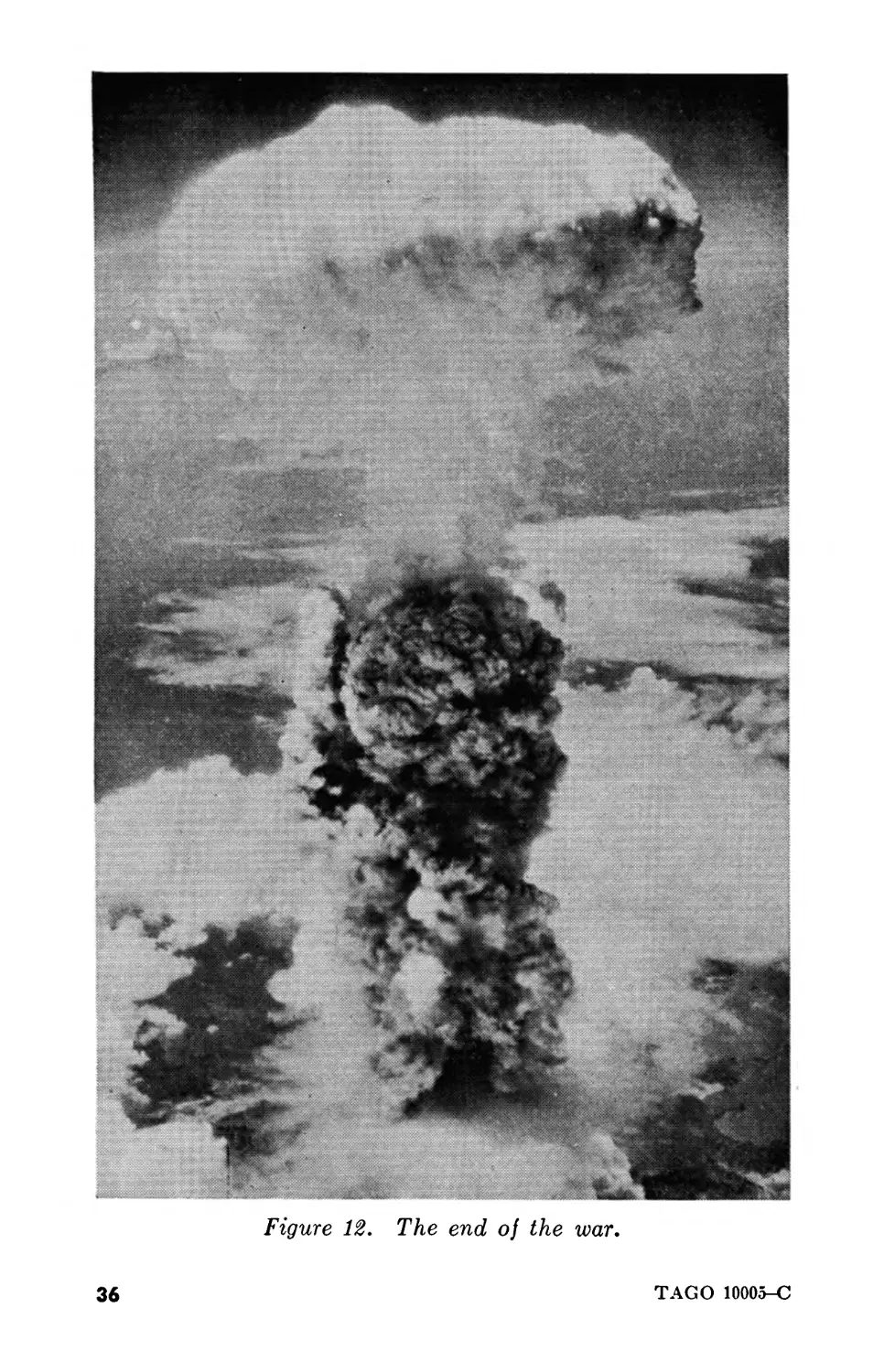
Figure 12, The end of the war.
36
TAGO 10005-C
was the most difficult and most bitter war in which we
have been engaged. The problems which caused the
Korean War still persist today.
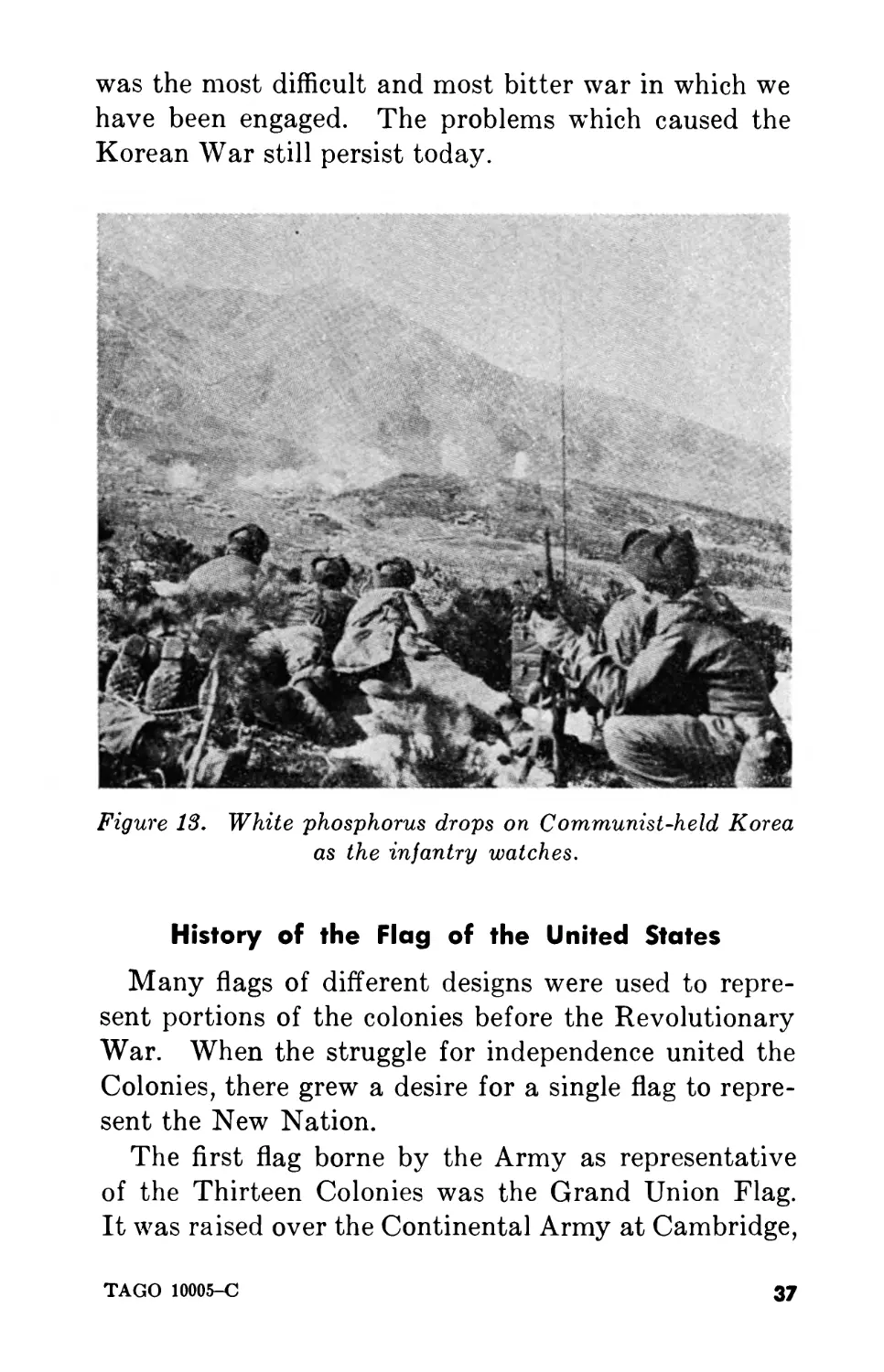
Figure 13. White phosphorus drops on Communist-held Korea
as the infantry watches.
History of the Flag of the United States
Many flags of different designs were used to repre-
sent portions of the colonies before the Revolutionary
War. When the struggle for independence united the
Colonies, there grew a desire for a single flag to repre-
sent the New Nation.
The first flag borne by the Army as representative
of the Thirteen Colonies was the Grand Union Flag.
It was raised over the Continental Army at Cambridge,
TAGO 10005-C
37
TAGO 10005-C
biu, \ktiiicосе;и \r < iiihou-ni
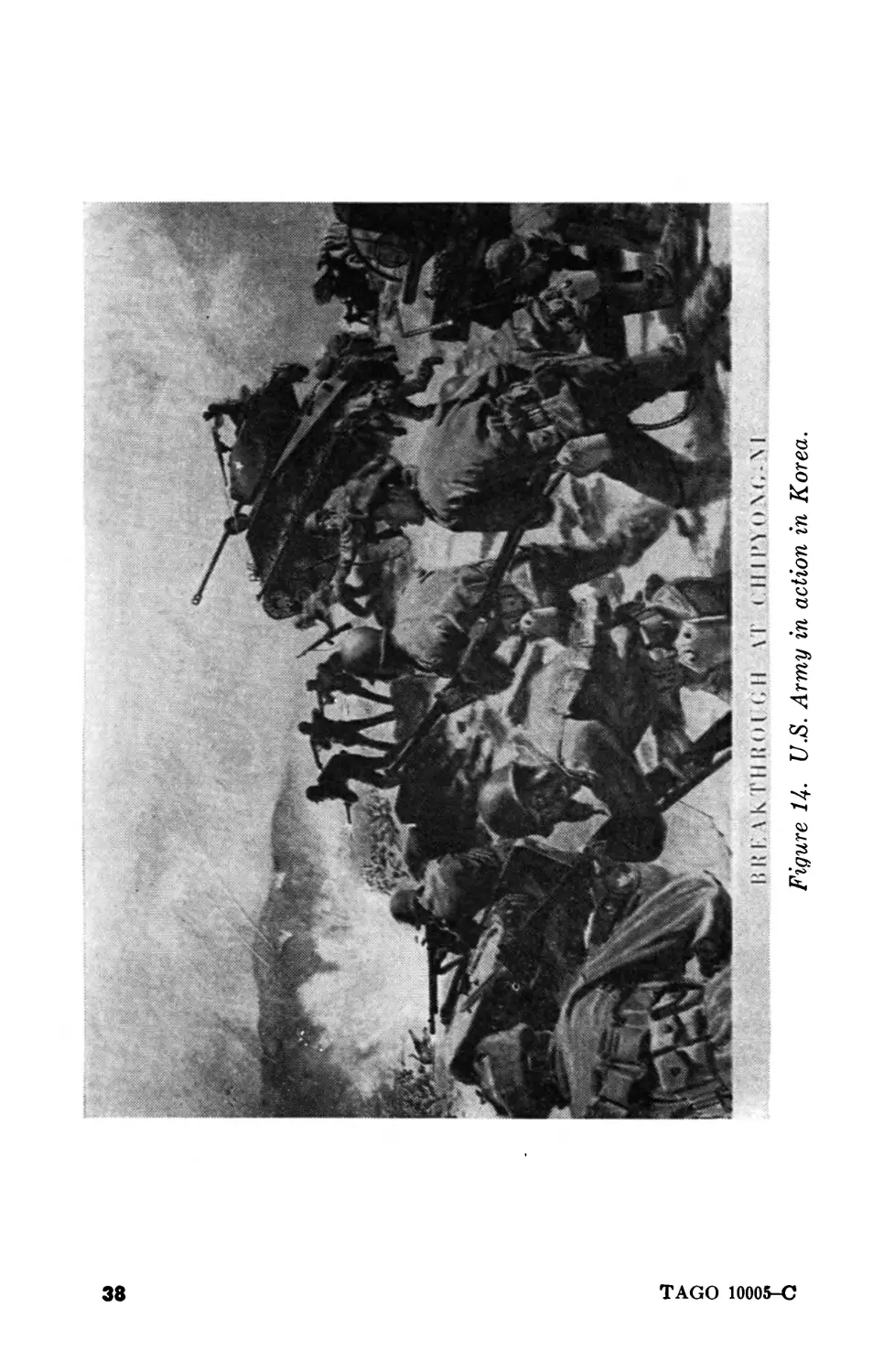
Figure 14- U.S. Army in action in Korea.
Massachusetts, on 2 January 1776. This flag had the
familiar 13 red and white stripes of the present flag,
but the blue square contained the crosses of St. George
and St. Andrew, from the British flag.
The Stars and Stripes was born on 14 June 1777, 2
years to the day after the birth of the Army. On that
date, Congress resolved, “That the flag of the thirteen
United States be thirteen stripes, alternate red and
white; that the union be thirteen stars, white in a blue
field, representing a new constellation.” The forma-
tion of the stars in the blue field was not specified.
One of the first times the Stars and Stripes was raised
by the Army was over Fort Stanwix, New York, on 3
August 1777. This Army version had the stars ar-
ranged in a circle, but for some time the Navy used
a version which had the stars arranged to form the
crosses of the British flag.
When Vermont and Kentucky joined the Union, the
Stars and Stripes was modified so that there were 15
stars and 15 stripes. It was this flag which flew tri-
umphantly over Fort McHenry, Maryland, on 13 and
14 September 1814, inspiring Francis Scott Key to
compose the verses of “The Star Spangled Banner.”
This flag was our national banner from 1795 until
1818. Thus, wrhen it was raised over Tripoli by the
Marines in 1805, it was the first United States flag
to be hoisted over a conquered fortress of the Old
World. Later it was flown by General Andrew Jackson
at the Battle of New Orleans.
Realizing that adding a stripe for each new state
would soon spoil the appearance of the flag, Congress
passed a law in 1818 fixing the number of stripes at
13 and providing for the addition of a star in the blue
square for each new state. This star is to be added
TAGO 10005-C
39
and the new flag to become official on the Fourth of
July following the admission of the new state to the
Union.
Department of the Army Pamphlet 355-116 con-
tains a more detailed history and discussion of cus-
toms associated with the flag of the United States.
Display of the Flag of the United States
Rules concerning the display and honor of the
United States flag are largely taken from custom and
are enumerated in the United States Flag Code
adopted by Congress in 1942. The flag of the United
States represents the living country and is considered
a living thing. It is treated with all the respect and
care which would be accorded the highest public offi-
cial.
The union, the field of blue with the grouping of
stars representing the individual States, is the honor
point and is the flag’s right. When the flag is displayed,
the union is always to the top and to the flag’s own
right (the left of the observer).
When carried, the flag is always free, never stretched
flat or carried horizontally. In the company of other
flags, the United States flag is always on the marching
right or ahead of the line of other flags.
When a number of flags of States or Localities or
Pennants of Societies are grouped and displayed from
staffs, the United States flag is in the center and at
the highest point of the group. When flags of two or
more nations are displayed they are flown from sepa-
rate staffs of the same height, and the flags should be
of approximately equal size.
The flag of the United States will never be used as
drapery. It is displayed hung flat against a wall or
40
TAGO 10005-C
flown free from a staff. It will not be festooned over
doorways or arches, tied in a bow, or fashioned into
a rosette. It will not be used to cover a speaker’s desk
or draped over the front of a platform. For these
purposes, bunting may be used, giving the blue of the
bunting the place of honor at the top of the arrange-
ment or in the center of a rosette.
Traditionally, there is one permissible departure
from the rules for display of the flag of the United
States. Under conditions of dire emergency, the flag
may be flown upside-down as a distress signal.
For a detailed explanation of the regulations con-
cerning the Flag of the United States and other flags,
colors, etc., see AR 840-10.
Classification of Flags
Flag is a general term referring to all types of cloth
devices used to convey information. Flags generally
used by the Army are classified as—
THE FLAG OF THE UNITED STATES (or
United States flag)—the national flag. See above.
Garrison flag—size 20 feet by 38 feet. Displayed
on holidays and important occasions.
Post flag—size 10 feet by 19 feet. For general
display.
Storm flag—size 5 feet by 9% feet. Flown during
story or windy weather.
COLORS—flags of organizations and certain civilian
and military officials (page 42).
STANDARDS—name formerly used for flags of
mounted units (page 45).
ENSIGN—a square or rectangular flag flown from
aircraft, ships, and boats.
TAGO 10005-C
41
GUIDON—a swallow-tailed flag carried by com-
panies, batteries, troops, and certain detachments.
PENNANT—a triangular flag used for various util-
ity purposes.
Colors and Standards
The most important symbol of your outfit is its
color or standard. Colors have symbolized military
units for thousands of years.
A color is a specific flag indicative of the spirit and
tradition of either the United States or the office, posi-
tion, or organization represented. The term “color,”
when used alone, implies the national color; that is a
United States flag. The term “colors” implies both
the national and the organizational or individual color.
Regiments and separate battalions are authorized
colors and are known as “color-bearing organizations.”
Under the Combat Arms Regimental System, the regi-
ment will be authorized colors and each member ele-
ment of color-bearing size will be authorized a dupli-
cate of the regimental color with the unit number
added in the upper corner at the fly end of the flag.
Some of the most interesting episodes in the history
of our country have to do with flags. One of these
tells how a small group of Union soldiers, held prison-
ers by the Confederates, made a flag from their own
clothing, flew it for a few minutes from the rafters of
the old warehouse in which they were imprisoned, and
then tore it into 22 pieces, one for each man who helped
make it. Each man then hid the piece of flag in his
clothing and took it with him when released from
prison. In the years following the war, the pieces were
finally recovered and sewed together again to form
the flag, which is still in existence. A small group of
42
TAGO 10005-C
American sailors, while prisoners of the Filipinos in
1899, did about the same thing. They made their flag
of clothing and guarded it with their lives. It was not
in pieces, so each man took his turn wearing it wrapped
around his body under his few ragged clothes. When
these men were reasonably sure they would not be
seen, they took their flag from its hiding place and
talked about it.
Our earliest soldiers were rarely dressed according
to regulation, and the regiment’s colors were the only
way you could tell who was friend or foe. Wherever
the commander went, the colors went with him, and,
as long as the colors were held in the air, the soldiers
could see that the regiment was still in the fight.
Thousands of men have died simply to keep the colors
flying. You can understand how pieces of cloth, so
dearly saved, could become sacred symbols. On the
commencement of the battle at Fort Moultrie, South
Carolina, in June 1776, a cannon ball cut the staff
holding the fort flag and the flag fell outside the walls.
Sergeant William Jasper, a member of a South Caro-
lina regiment, leaped over the wall and recovered it.
Later at Fort Sullivan, he gave his life in a similar act
of courage.
You will remember the words of our National An-
them in which Francis Scott Key tells his feeling at
seeing that “the flag was still there.” This showed
him that Fort McHenry had not surrendered even
after an all-night bombardment.
You may have heard the song “Rally ’Round the
Flag, Boys.” This song had real meaning in the Civil
War because the regimental color was the rallying
point of the regiment when it had become disorganized
under heavy fire. In one regiment, 12 men were shot
TAGO 10005-C
43
down within a half hour to keep the flag flying so that
the soldiers would hold their ground. The Nation’s
highest award, the Medal of Honor, went to many
Union soldiers for brave deeds connected with saving
the colors. Lieutenant John G. Adams, of the 19th
Massachusetts Infantry, for example, seized the colors
from two wounded bearers and with one flag in each
hand advanced across the field to a point where the
regiment could see the colors and re-form. The Medal
of Honor was also given for capturing enemy colors.
Sergeant George W. Roosevelt, of Company F, 6th
New Jersey Regiment, was awarded it for recapturing
a color at the Battle of Bull Run and later for captur-
ing a Confederate bearer and his colors at Gettysburg.
Even after colors had been captured, they lost none
of their sacred quality. Many years after the South-
ern states had reentered the Union, the colors of the
Confederate regiments, often so torn by shot and shell
that they were little more than shreds, were returned
to the proper states. Old Union soldiers who had
helped capture them were bitter to see them returned,
but the Southern outfits who got them back, proudly
placed them on permanent display. Even as recently
as 1950, in an important gesture of friendship, the
United States returned to Mexico all of the flags it
had captured in 1846-1848.
Speaking of Mexico, there is a story about the Mexi-
can War that shows what an outfit and its colors
meant to men in battle. To capture a strongpoint
called Molino del Rey, the American commander or-
ganized a special storming party, under a Major
Wright, made up of detachments from different regi-
ments. A historian of the war tells what happened
this way:
44
TAGO 10005-C
. But the American spearhead—Wright’s party
—was merely glued fragments of steel, not a forged
blade. A large part of the men were separated from
the comrades and officers whom they knew and relied
upon, and all from the colors they adored. Mason,
Foster, Wright and 8 officers out of 14 went down. The
column broke. Nearly a third of the men, whose com-
rades fought later in the engagement, under their
proper colors and officers, like heroes, absolutely
bolted.”
Many of the earliest regimental colors were made
by the wives, daughters, and mothers of the men in
the regiments and were carried just as a knight in
olden days wore the glove of his lady on his helmet.
Today, our colors are designed and embroidered by
the Government, of uniform design with the basic
color being the color of the branch or as otherwise
designated. The design consists of an American eagle
bearing on his breast the coat-of-arms of the unit and
holding in his beak a ribbon on which appears the
motto of the unit. The crest of the unit coat-of-arms
appears above the eagle’s head. The unit designa-
tion appears on a scroll below the eagle.
The terms “color” and “standard,” so far as organ-
izations are concerned, are interchangeable. Dis-
mounted organizations traditionally used the term
“color,” while mounted (mechanized and motorized)
organizations traditionally used the term “standard.”
Formerly, colors were larger than standards. Under
present regulations both are called colors and are the
same size, 3 feet by 4 feet. Individual colors are 4
feet 4 inches by 5 feet 6 inches.
The organizational color is dipped in salute during
the playing of the national anthem or “To The Color,”
TAGO 10005-C
45
it is dipped in salute when rendering honors to the
organization’s commander or to a person of higher
grade, but at no other time. The National Color is
never dipped in salute.
Until 1813 the colors of an infantry regiment were
carried by Ensigns, who were the lowest ranking offi-
cers of the regiment. In that year the regulations were
changed and the work was entrusted to color ser-
geants. Noncommissioned officers carry them today.
Before the Civil War, the infantry regiments did not
carry the Stars and Stripes, but instead a blue silk
color on which was embroidered the arms of the United
States, an American eagle bearing on his breast the
shield and in his talons the olive branch and the ar-
rows signifying either peace or war. Just before the
Civil War, the color with the American eagle on it
was made the organizational color, and the regiments
were given the Stars and Stripes to carry as the second
flag. This system has been followed to the present day.
What So Proudly We Hail
The first 185 years of our Army’s history have been
barely brushed in the last few paragraphs. There are
many books to read if you want to learn more about
the Army, but there is another way if you just keep
your eyes open. All around you now are things we
call symbols, and they can tell you a great deal.
The Cross is a revered symbol for Christians; the
Star of David, for people of Jewish faith. The Ameri-
can flag is a symbol of the United States. That’s why
we don’t let it touch the ground, why it is never dipped,
and why we salute when it passes. It is not just a
piece of cloth—it is the spirit of the Nation. You can
46
TAGO 10005-C
never see a spirit itself, and so you need a symbol lest
you forget that the spirit is always present.
Our National Anthem is another symbol, and an
American rises when it is played, not for the tune, but
because he respects the country for which it stands.
There are different kinds of military symbols which
you will see as a soldier and come to respect. In time,
you will not look on them as pieces of colored cloth,
or official names, or peculiar ways of doing things, but
as living reminders of the soldiers who have served
before you and of their actions. One such symbol can
be packed with as much history as a book if you only
know how to read it. We are going to use these sym-
bols to tell you a little more about the Old Army, a
story packed with man-sized fighting and adventure;
a story the Army is proud of and one you can well be
proud of, too.
Soldiers wore bright uniforms on the battlefield in
the time of the American Revolution because the
range of guns in use then was short, and you could
easily see a man, no matter what color he wore, long
before you could hit him with a bullet. Now, no one
plans to send men into battle in bright colored uni-
forms with flintlock muskets; but, if wearing a bright
uniform at ceremonies or showing a flintlock musket
on an insignia makes us better soldiers, it’s all to the
good. The idea was well put by General Leonard
Wood who said soldiers could enjoy military pomp
and ceremony and profit by it “when it does not get
in the way of more important things.”
The Outfit
In World War II, when thousands of infantrymen
were asked what helped most to keep them going when
TAGO 10005-C
47
things were rough, the majority answered that they
“couldn’t let the other men down.” It has been said
that on the football field the factor that gives a man
“heart” is the team. An American general of World
War I fame put this idea into Army terms; he said
that a man will do more for his company than he will
for any general.
During most of your Army career, you will find
yourself part of a team, and you will be expected to
play your part in it. This is not all give and no take,
for while you are giving strength to your outfit, it will
be giving strength right back to you. The more you
put in, the more you get out. This is one of the most
important facts of Army life, and one of the hardest to
put into words. More and more you will see that your
outfit is not just a bunch of men, and that it is a sort
of person in its own right. This is most true of regi-
ments, battalions, and divisions.
In most cases, your outfit is much older than you
and went “through the mill,” more than likely, before
you were born. An outfit gets to be a veteran just as
a soldier, only much more so. For instance, in 1950 the
newspapers were telling about the 2d Infantry Divi-
sion in Korea. They called it a battle-hardened or-
ganization and told how it has served gallantly in
World War I, and in World War II, struck the enemy
at Omaha Beach and kept striking him until he was
licked. The newspaper writers didn’t mean that the
men in the division in 1950 were veterans of World
War II; they knew that few old timers were left in
it. What they meant was that the 2d Division of
1950 had won a reputation for courage, and that the
new soldiers had heard of the reputation and weren’t
48
TAGO 10005-C
going to see it lost. That’s how the division gave its
men something to fight for.
We are talking about outfits because they are what
you generally read about in Army history. Now and
then, it is true, the names of some men stand out.
These may be famous commanders such as General
Anthony Wayne or General Winfield Scott, or they
may be enlisted men such as Sergeant Fuger at Gettys-
burg or Sergeant York in the Argonne. As a rule,
though, wars have been won by men just like you,
working side by side with other men as part of an out-
fit, and their work is only to be found in the record of
its achievements. Let’s look at some of these records
and at the symbols we use to keep them alive in the
hearts of all our soldiers.
Decorations and Battle Honors
The older units of the Regular Army and the Na-
tional Guard have many symbols and outward signs
of the parts they have played in American history. As
the experienced soldier is known by the decorations
and service ribbons he wears on his uniform, so the
well-tried regiment or battalion may be recognized by
the unit-decorations and campaign streamers displayed
with its colors.
Regiments were authorized to have battle honors
embroidered on the stripes of their national color in
1863, and this practice continued until 1890. It was
then ordered that the honors be inscribed on silver
bands fastened around the staff of the organizational
color or standard. In 1920, orders directed that names
of battles and engagements be embroidered on stream-
ers attached to the staff, but companies, operating
apart from their regiments or battalions, are still
TAGO 10005-C
49
awarded the old silver bands. The World War I
streamer for service in France is in the colors of the
rainbow. World War II streamers are the same colors
as the theater ribbons. Streamers of the American
Theater bear no embroidered inscription, except for the
units that took part in the campaign against enemy
submarines. The Asiatic-Pacific campaigns are em-
broidered in blue, and those of the European-African-
Middle Eastern Theater in golden yellow. Streamers
of the Korean War are blue and white. If a unit
has taken part in an assault landing, whether by sea
or by air, it carries an arrowhead on the campaign
streamer beside the name of the campaign.
Let’s take two or three examples of units whose
campaign streamers reflect much of the history of our
country. We can start with the 7th Infantry Regi-
ment. It took part in 4 campaigns of the War of 1812;
9 of the Indian Wars; 8 of the Mexican War; 14 of the
Civil War; the War with Spain and the Philippine
Insurrection; 7 campaigns of World War I; 10 of
World War II; and during the Korean War it added
8 more. Then there is the 1st Rocket Howitzer Bat-
talion 5th Artillery, the descendant of Alexander Ham-
ilton’s battery. The colors of this unit carry honors
showing it was in nine campaigns of the Revolutionary
War; the War of 1812; and several others. The or-
ganizational standards of the 1st Tank Battalion (1st
Cavalry) of the 2d and 3d Cavalry, and of many other
outfits are so heavy with campaign streamers that it
takes a strong man to carry them.
These streamers are more than just ribbons, and
every man should know the story behind them. Since
we’ve started with the 7th Infantry, we’ll stick with
it to make the point. One of its streamers carries the
50
TAGO 10005-C
inscription CERRO GORDO, the name of a battle
in the War with Mexico. The Mexicans were dug in
on top of two steep hills in the path of the United
States Army. They outnumbered our men by nearly
4,000, and old soldiers said the hills could not be taken
by assault. Robert E. Lee, a young Captain of Engi-
neers, went out to look for a way to bypass the hills;
he came so close to capture that he had to lie still be-
hind a log all day while the Mexicans used -a spring
on the other side. Lee found a way around, and Gen-
eral Scott prepared to send the army along the route
to attack the enemy from behind.
Through an error, General David Twiggs ordered
his division to take the hills head-on before Scott’s
end run was ready. The 7th was part of the assault
force, and the men in it prepared for what looked like
sure death. When the zero hour came, the soldiers
charged yelling, and their yells drowned out the roar
of the cannon. Captain Roberts, who was there, de-
scribed their spirit: “When dangers thickened and
death talked more familiarly face to face, the men
seemed to rise above every terror.” As'^oon as the
Mexicans saw that the attackers “seemed to despise
death,” they ran for their lives, and the 7th, with
other outfits, went on to do the impossible. That is
the story the streamer CERRO GORDO tells soldiers
who want to know.
More highly prized than campaign streamers are
those given units for conduct “above and beyond the
call of duty.” In the beginning, there was no sharp
distinction between honors given for campaigns and
those given for outstanding performance. In 1863,
for example, the 13th Infantry was authorized to have
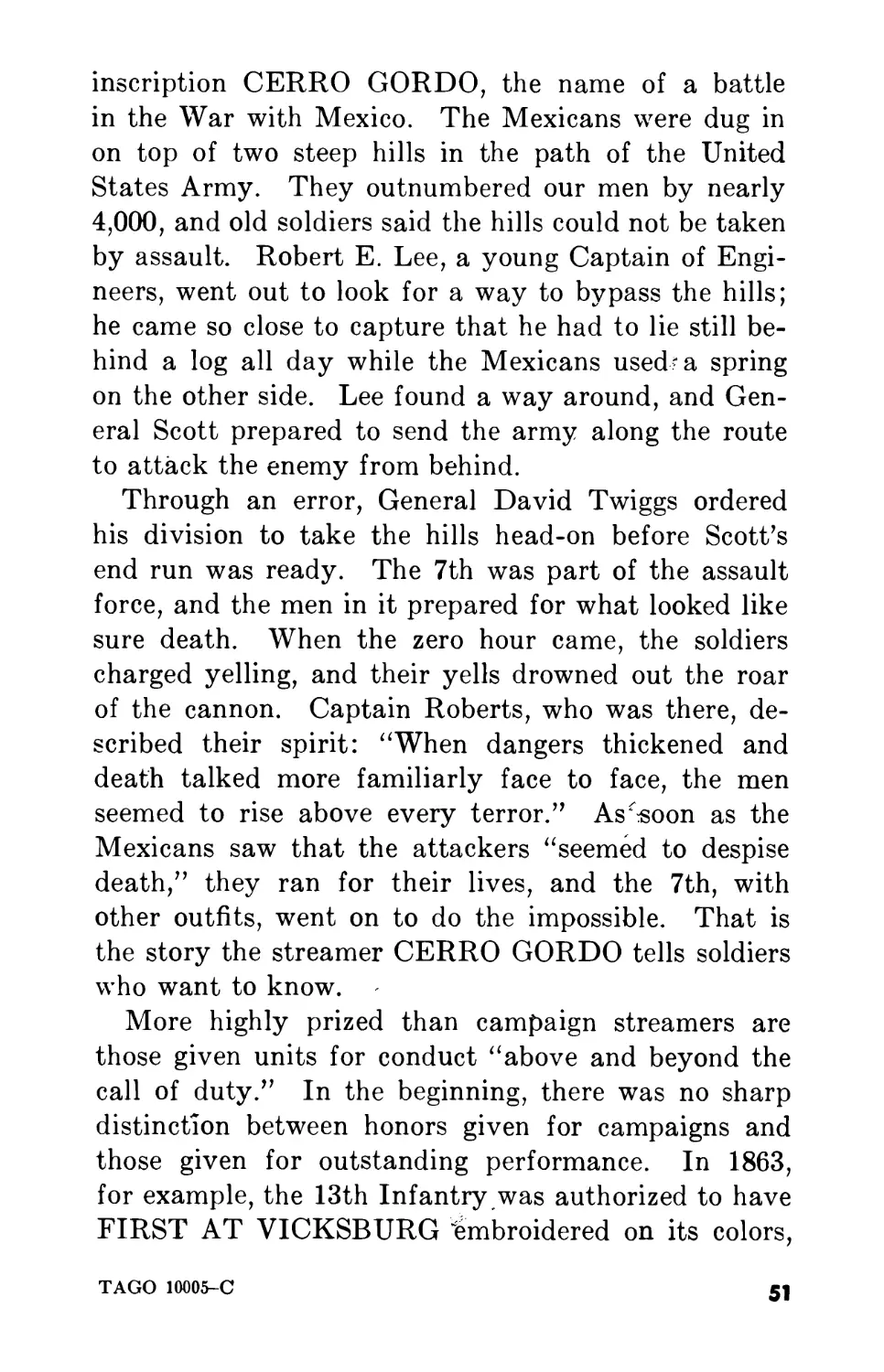
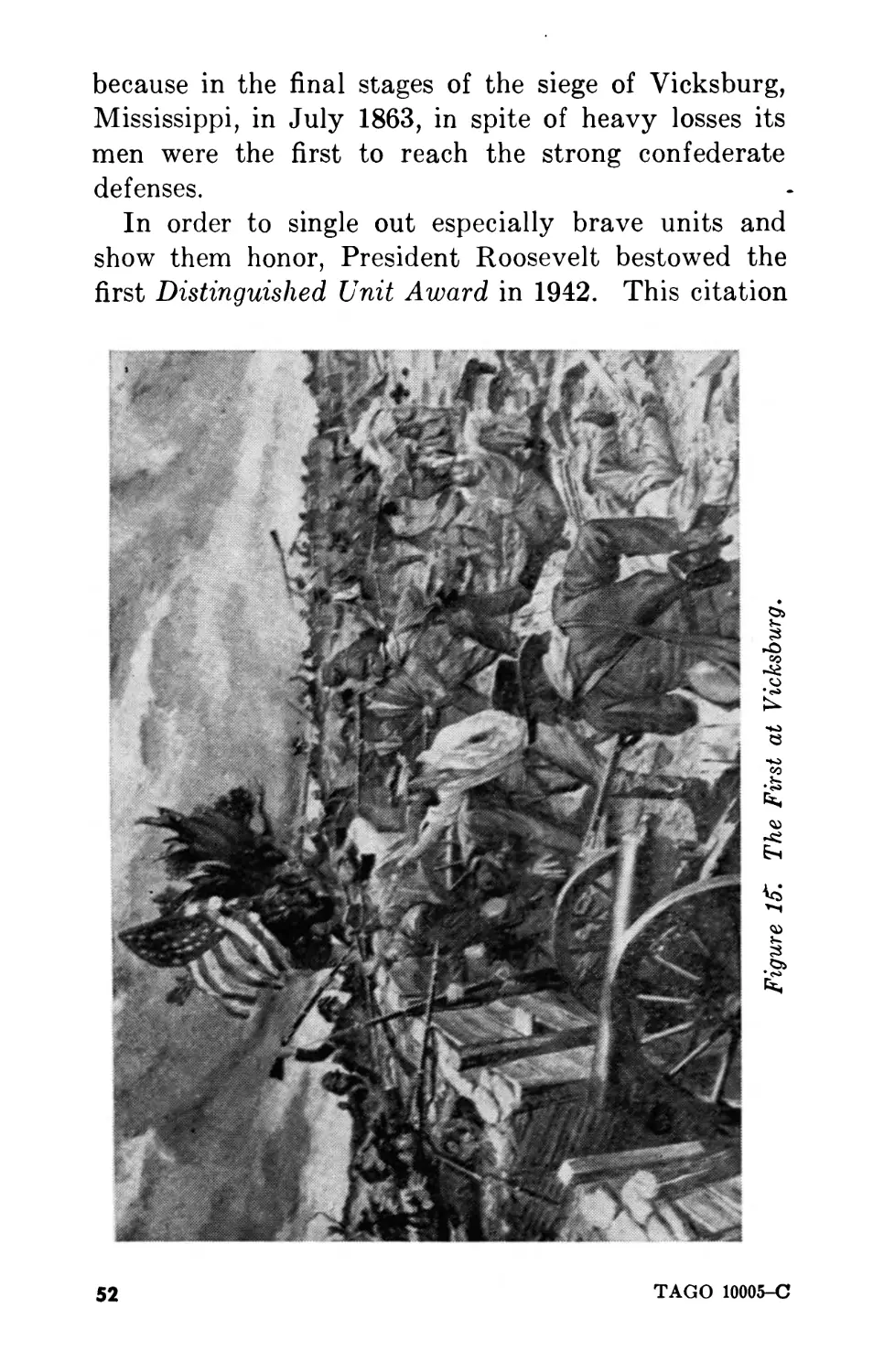
FIRST AT VICKSBURG 'embroidered on its colors,
TAGO 10005-C
51
because in the final stages of the siege of Vicksburg,
Mississippi, in July 1863, in spite of heavy losses its
men were the first to reach the strong confederate
defenses.
In order to single out especially brave units and
show them honor, President Roosevelt bestowed the
first Distinguished Unit Award in 1942. This citation
Figure Ifr. The First at Vicksburg,
52
TAGO 10005-C
is issued in the name of the President to outfits that
accomplish their missions under truly difficult and
hazardous conditions. The symbol of the honor is
a blue streamer with the name of the action embroi-
dered on it in white. Men who were with the unit
during the action cited may permanently wear the
Distinguished Unit Emblem (a blue ribbon in a gold
metal frame). Mostly, the award has gone to bat-
talion-size units, but the 142d Infantry is one case of
a regiment that was cited as a whole for its action
against the Siegfried Line. The 101st Airborne Divi-
sion for its gallant stand at Bastogne and the 2d In-
fantry Division for actions against the Chinese Com-
munists in Korea are two examples in our military
history where entire divisions were cited.
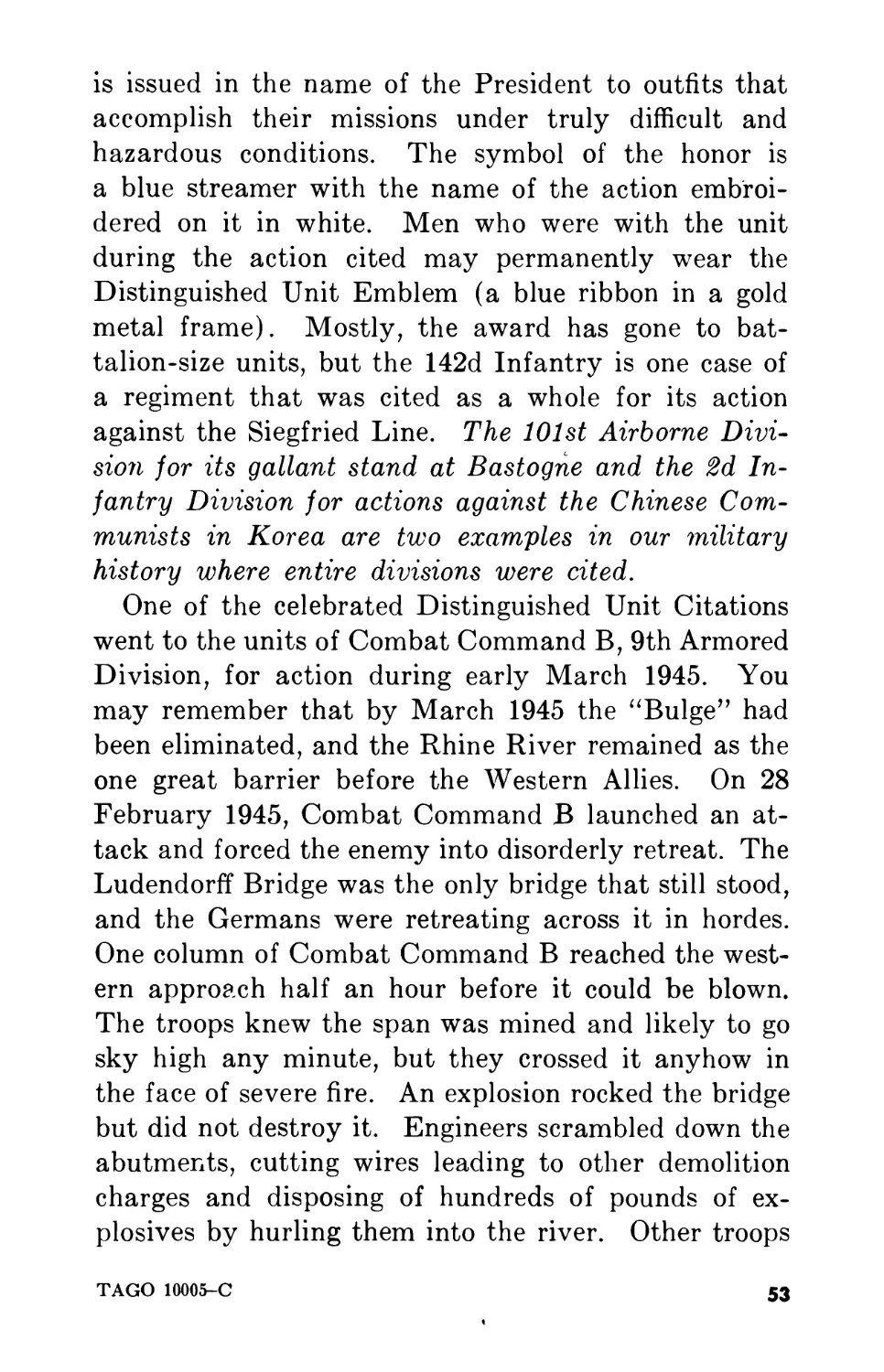
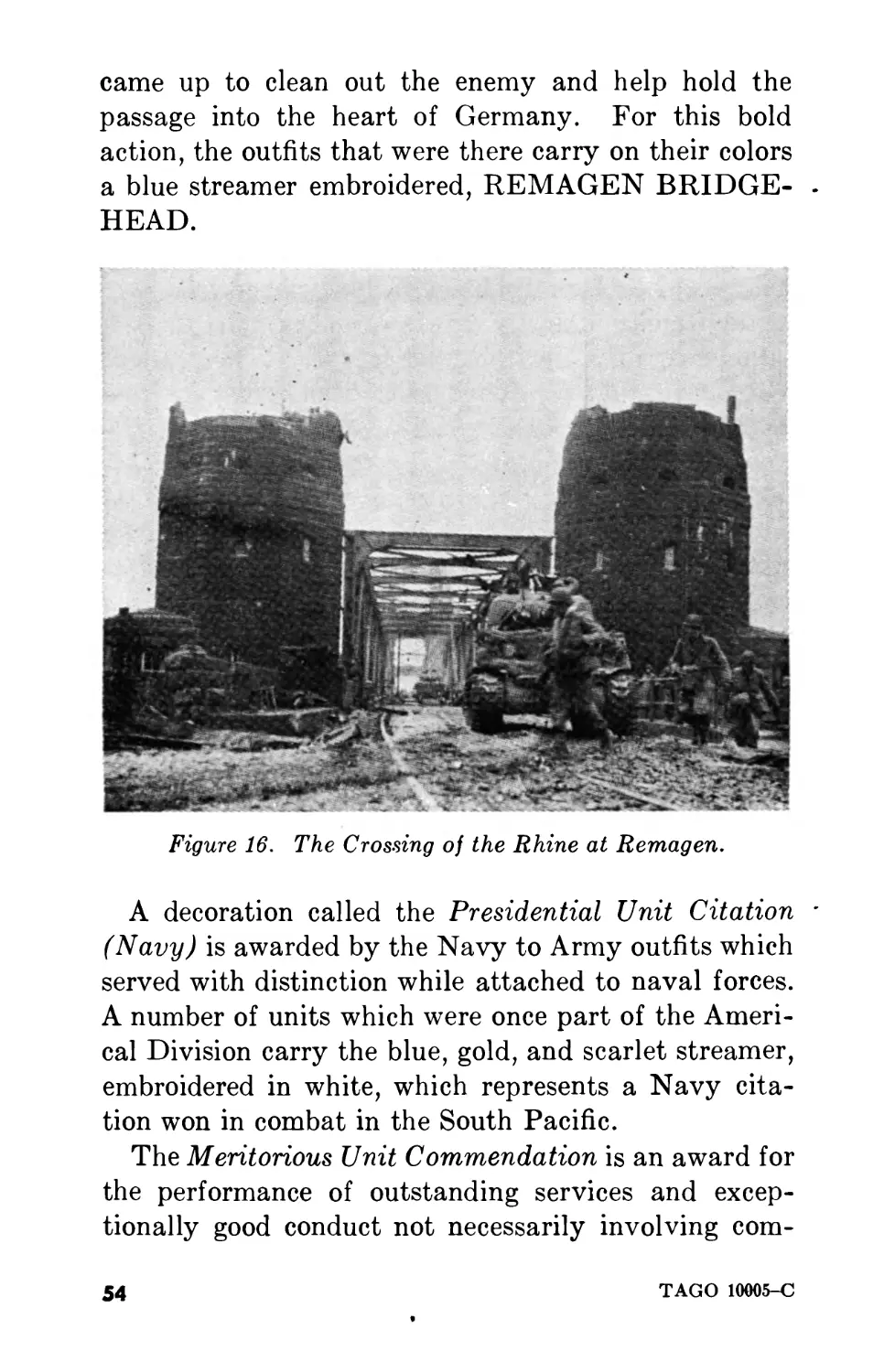
One of the celebrated Distinguished Unit Citations
went to the units of Combat Command B, 9th Armored
Division, for action during early March 1945. You
may remember that by March 1945 the “Bulge” had
been eliminated, and the Rhine River remained as the
one great barrier before the Western Allies. On 28
February 1945, Combat Command В launched an at-
tack and forced the enemy into disorderly retreat. The
Ludendorff Bridge was the only bridge that still stood,
and the Germans were retreating across it in hordes.
One column of Combat Command В reached the west-
ern approach half an hour before it could be blown.
The troops knew the span was mined and likely to go
sky high any minute, but they crossed it anyhow in
the face of severe fire. An explosion rocked the bridge
but did not destroy it. Engineers scrambled down the
abutments, cutting wires leading to other demolition
charges and disposing of hundreds of pounds of ex-
plosives by hurling them into the river. Other troops
TAGO 10005-C
53
came up to clean out the enemy and help hold the
passage into the heart of Germany. For this bold
action, the outfits that were there carry on their colors
a blue streamer embroidered, REMAGEN BRIDGE-
HEAD.
Figure 16. The Crossing of the Rhine at Remagen.
A decoration called the Presidential Unit Citation '
(Navy) is awarded by the Navy to Army outfits which
served with distinction while attached to naval forces.
A number of units which were once part of the Ameri-
cal Division carry the blue, gold, and scarlet streamer,
embroidered in white, which represents a Navy cita-
tion won in combat in the South Pacific.
The Meritorious Unit Commendation is an award for
the performance of outstanding services and excep-
tionally good conduct not necessarily involving com-
54
TAGO 10005-C
bat. It has been awarded to many service battalions,
and service elements of combat units, and to a few
combat outfits as a whole. The streamer is scarlet,
with the name of the theater of operations embroidered
in white. Individuals present for duty with the outfit
during the period for which the commendation was
awarded may wear as a permanent part of their uni-
form the Meritorious Unit Emblem—a golden laurel
wreath on a square of olive-drab cloth sewed on the
lower right sleeve.
Units of our Army are permitted to accept foreign
decorations if they come from nations that have fought
in a common cause with us and such award is approved
by Congress. The best known of these foreign honors
is the French Croix de Guerre awarded for heroism
in action or exceptionally meritorious service in direct
support of combat operations. The symbol of the
Croix de Guerre is a green and red streamer, embroi-
dered with the name of the action, but no emblem is
authorized for wear by individuals unless they have
been individually cited by name. When a unit has
been twice awarded the Croix de Guerre, however, the
French Government often confers upon it, in addi-
tion, the French fourragere, a braided cord in green
and red which the men of the unit may wear on the
left shoulder. Units which are cited four times may
be authorized to wear the Medaille Militaire, a yellow
and green fourragere.
The Belgian Government has given a red and green
fourragere to units which have been twice cited in
the Orders of the Day. Decorations bestowed by the
governments of Italy, Portugal, and the Netherlands
are symbolized by streamers carried on the colors. An
exception is the Orange Lanyard of the Netherlands.
TAGO 10005-C
55
This decoration is an orange cord which may be worn
on the left shoulder by men who were with the unit
during the action.
There are some regiments and battalions that have
been awarded a surprising number of foreign decora-
tions. Take, for example, several of our distinguished
combat commands. Colors of Battle Groups of the
16th, 18th, and 26th Infantry, Battalions of the 5th
and 7th Artillery, the 1st Engineer Battalion, and the
121st Signal Battalion carry both the Medaille Mili-
taire and Belgian Fourrageres. Units of the 82d Air-
borne Division are not far behind. For example the
1st Airborne Battle Group, 325th Infantry, Batteries
A and B, 319th Artillery, and the 82d Signal Battalion
have been awarded two French Croix de Guerre and
a Fourragere, the Netherlands Orange Lanyard, a
streamer of the Netherlands Military Order of Wil-
liam, embroidered NIJMEGEN 1944, and a Belgian
Fourragere. A unique honor, Freedom of the City,
was given one American outfit (14th Major Port) at
Southampton, England, for its operation of the Port
of Southampton during World War II. In a colorful
ceremony held 14 March 1946, the Mayor of South-
ampton presented the commander with a parchment
scroll giving the American unit a privilege not even
the local regiment had: “The privilege, honour, and
distinction of marching through the streets ... of
Southampton with bayonets fixed, drums beating, and
colours flying.”
We have been talking about honors awarded to or-
ganizations, and now it is time to say a little about
the history of decorations given to individuals. You
have already read a short account of the beginning of
the Army Medal of Honor during the Civil War. Most
56
TAGO 10005-C
of the modern decorations started since that war, but
one goes back to the Revolution. One of the old ones
is the Purple Heart which General Washington estab-
lished in 1782: 11. . . ever desirous to cherish virtuous
ambition in his soldiers . . .” the General directed that
for “. . . singularly meritorious action” a soldier could
wear over his left breast the figure of a heart in purple
cloth edged with narrow silver lace. This badge, for
enlisted men only, was called the Badge of Military
Merit and the wearer was “suffered to pass all guards
and sentinels which officers are permitted to do.” The
Purple Heart was allowed to lapse after the Revolution
but was revived in 1932. Its purpose has changed, and
it is now awarded to any soldier who is wounded in
action against the enemy.
Next in rank below the Army Medal of Honor is
the Distinguished Service Cross. When this was es-
tablished in 1918, it canceled the Certificate of Merit
that was established in 1847 during the Mexican War.
The first Certificate of Merit was awarded to a dragoon
private, John R. Scott, for pursuing five Mexican cav-
alrymen by himself and capturing one of them. Scott’s
performance set the standard which has been followed
since for giving the Distinguished Service Cross. There
are other decorations, such as the Distinguished-Serv-
ice Medal and the Silver Star, that deserve more space
than we can give them. Most of them have a proud,
but short history, for they are products of the two
World Wars.
The following table lists the Army decorations in
order of precedence and shows whether the decoration
is for valor, for recognition of meritorious service, or
for either valor or service.
TAGO 10005-C
57
Decoration	Valor	Service	Either
Medal of Honor	X
Distinguished Service Cross	X	—
Distinguished Service Medal	—	X
Silver Star	X
Distinguished Flying Cross					X
Legion of Merit	—	X
Soldier’s Medal	X
Bronze Star Medal W/V Device	X
Bronze Star Medal			X
Air Medal			X
Army Commendation Medal		X
Purple Heart (awarded to individuals who are wounded in action)
Hill MB I Bin I ВШИВ
дим & «мп :acit«uitf > «istikhsw» fjiw c«$s
1
Figure 17. Decorations.
58
TAGO 10005-C
WMrt STM MHl
Alt xtll
tMi то* tftir
Itwr CMMflO»’ 31 RUM,
2
Figure 17—Continued.
Service medals are awarded for service in a certain
area or during a certain period of time or for the ac-
complishment of some particular act which merits
recognition. Example of service medals are the many
campaign medals, which show participation in specific
campaigns; occupation medals, for participation in the
occupation of specific areas; service medals, for serv-
ice during specific periods of time; and the Good Con-
duct Medal, for completion of 3 years of honorable
active Federal service. In addition, certain devices
are worn on the ribbon of the medals. These are the
TAGO 10005-0
59
small bronze stars, worn on campaign ribbons to indi-
cate participation in certain engagements or cam-
paigns, and the bronze arrowheads, indicating partici-
pation in an assault landing, parachute jump, or glider
landing in enemy territory. A silver star is equivalent
to five bronze service stars.
i
60
Figure 18. Service medals.
TAGO 10005-C
*wt rants ttsfivt «mi
UtfM 5fIVICt «WL
2
Figure 18—Continued.
VHCUf 1ЕТИ1 V H*I€E
an «•«<< to t»to * ee*»b«t
um W Ulf СПИН
<Arn,-Aw Fwc«>
€q»«»i t»« bf»M«	<!«»»• и
««MU Ш-ШГ CttfSTF»
1А<П *<- h«»l
l»w«< to ««»	•»«*< •'
tH IH« lK«f«h«
MCWf lUHUfU
(Ane, -Air f ar:«l
A»srt«d tar aarhctfatv » aa «•••*«
«tee'.i
JL, Mwn SMnce Stu
Ж H« AtufuitA Hllm. cwei»ii. «
•4«<h«aat к«мп
КПП Ж1Я ftVICt,
far 90	dajt мг»*« ’»
<-»tl Х>рр<и1 И 1M
?S Jot I9U-W S.|H»«b«< »9<9
Badges are awarded for the attainment of varying
degrees of skill, proficiency, and excellence in tests and
competition as well as in the performance of duties.
Perhaps the proudest of these is the Combat Injantry-
man Badge, which is awarded for satisfactory per-
formance of duty, engaged in active ground combat,
as a member of an infantry unit. Other badges in-
clude medical badge; expert infantryman badge; para-
chutist badges, with its three degrees—parachutist,
senior parachutist, and master parachutist; aviator
badges, which include master army aviator badge,
senior army aviator badge, army aviator badge, and
army aviation medical officer badge; the glider badge
and the divers badge.
TAGO 10005-C
61
Combat
Infantryman
Expert
Infantryman
Master
Parachutist
Senior
Parachutist
Parachutist
Senior Army Aviator
Army Aviator
Glider Troops
Expert
Marksman
Sharpshooter
QUALIFICATION BADGES
QUALIFICATION BARS
Officer	Warrant Officer Enlisted
U. S. ARMY CAP INSIGNIA
Figure 19. Qualification badges and other insignia.
62
TAGO 10005-C
Qualification badges include the marksmanship
badges; the drivers and mechanics badge. Senior and
master degrees of badges are indicated by the addition
of a star and a star encircled by a wreath, respectively.
Insignia
As long as you are in the Army, you will be looking
at INSIGNIA. Every soldier wears them to show his
grade, branch, length of service, the outfit he belongs
to, and many other things. Even the buttons on your
uniform and the device on your service cap are forms
of insignia. All types of uniform decorations are
symbols. We will discuss several of them, and will
begin with the insignia of grade.
During the Revolutionary War, General Washing-
ton ordered sergeants to sew a stripe of bright red
cloth on their shoulders, and corporals a green stripe.
Field grade officers wore red cockades in their hats,
captains, yellow; and lieutenants, green. Beginning in
1780, the generals displayed stars on shoulderpieces
known as epaulets. The colonel’s eagles date back to
1832 and the oak leaves that lieutenant colonels and
majors wear were first used in 1836. Insignia of grade
for officers as used today are shown in figure 20.
Enlisted grades are shown by chevrons. The chevron
is a very old and honorable device which was often
painted on the shields of knights in ancient days. In
the beginning, it was probably drawn to represent the
rafters of a house, and so it points upward. In a sense
it meant “the top of the house.” We have used the
chevron since the Revolution, but its present spot
above the elbow dates from 1833. However, it has not
always signified a non-commissioned officer; at times
commissioned officers below field grade have worn
TAGO 1C005-C
63
General of the Army
Lieutenant General
1
Figure 20. Officers’ insignia of grade.
64
TAGO 10005-C
First Lieutenant
(Silver)
Second Lieutenant
(Gold)
2
Figure 20—Continued.
chevrons to indicate rank. Insignia of grade is some-
times taken off in battle because they make too good
a target for the enemy.
Branch insignia was started later than grade insignia
because in the old days the Infantry, Cavalry, Artil-
lery, and other branches wore different kinds of uni-
forms. The oldest branch insignia in the Army is the
“shell and flame” of Ordnance which came into ex-
istence in 1832. The present insignia for Infantry dates
back to 1875; before that its insignia was a horn or
TAGO 10005-C
65
SP90AUST 1
SERGEANT

Figure 21. Enlisted personnel’s chevrons oj grade.
bugle, which represented the horn used by light infan-
trymen for signaling, as the whistle is used today. For
a while after 1875, the miniature rifles worn were the
model in use at the time; but models kept changing
and, in 1924, the Army adopted for the Infantry in-
signia the flintlock musket first issued to American
troops. The crossed cannon of the Artillery was
adopted in 1836, and the crossed sabers, insignia of

SOCIALIST $

66
TAGO 10005-C
the old Cavalry, in 1851. Armor has recently been
authorized to use an M26 tank on the Cavalry sabers
to show the merger of tanks and cavalry into one
branch. In 1942 tank outfits used a Mark VIII tank,
which was the first successful tank used in World War
I. The same tank was formerly shown on crossed
muskets when tanks were a part of the Infantry. The
Artillery has also recently added an upright missile
in the center of the crossed cannon.
Until the Civil War, men of the different regiments
of the Army could be identified easily because they
wore different kinds of uniforms, or at least their
buttons and metal hat plates bore the numbers of their
regiments. During the Civil War special uniforms
were given up. Most soldiers in the Union Army wore
the same blue clothes; so a new way to tell one outfit
from another came into use—colored patches of cloth.
Probably the first use of the patch was when General
Philip Kearney had his men wear a red diamond on
their hats to designate the 3d Division, Army of the
Potomac.
There is an interesting story how the 15th Corps
gained its badge during the Civil War. One of its
men was marching along a muddy road when he met
a party of soldiers of the 12th Corps at a campfire,
and all of them wore a star on their hats. He had
never seen a corps badge before, and asked if they
were all generals. They laughed, remarked how ignor-
ant he was, and proudly told him the star was their
corps insignia. Then they asked him what his badge
was. Not to be outdone, he slapped his cartridge box
and said, uForty rounds in the cartridge box and
twenty in the pocket.” When the corps commander
heard the story, he saw how catchy it was and adopted
TAGO 10005-C
67
the cartridge box with the words “forty rounds” as his
outfit’s badge. Today, the 13th Infantry uses this
same device as part of its insignia because the regi-
ment was once a part of the 15th Corps.
After the Civil War, patches were discontinued, but
they appeared again during World War I. One of the
big problems facing commanders at that time was how
Veterinary Corps	Army Nurse
Corps
1
Figure 22. Collar insignia.
Army Medical
Specialist Corps
68
TAGO 10005-C
Artillery
Jewish Chaplain
Corps of Engineers
Finance Corps
General Staff
Judge Advocate
General's Corps
Infantry
Inspector General
2
Figure 22—Continued.
to reassemble their men after a battle. The British hit
upon the idea of sewing a piece of colored cloth on the
back of the jacket, just below the neck. The idea was
for all men wearing the same colored cloth to assemble
under the nearest officer who wore a like piece. It was
the American doughboy, however, who first wore a
shoulder patch. This happened more or less by acci-
dent. In the summer of 1918 the 81st (Wildcat) Divi-
sion sewed a picture of a wildcat on their shoulder
TAGO 10005-0
69
Quartermaster
Corps
TAGO 10005-C
Warrant Officers
Signal Corps
Transportation
Corps
Women's Army Corps
з
Figure 22—Continued.
sleeves when going through Hoboken on their way to
France. In France, General Pershing heard of this
and ordered the patches taken off. He later changed
his mind and not only allowed the Wildcats to keep
their shoulder patches but required everybody to wear
something similar.
The shoulder sleeve insignia of today have an inter-
esting story behind them. For instance, the 1st In-
fantry Division adopted a red T” in 1918 because
they found out they were first to do lots of things such
as first to arrive in France, first to attack the enemy,
and first to be cited. National Guard divisions often
use symbols which show their native state. The 27th
Infantry Division shows stars of the Constellation of
Orion, a play on the name of its first commander,
General O’Ryan. The 29th Division uses a “Taequk”
the Korean good luck symbol of blue and gray to show
that the men of that division come from both the North
and South.
When American troops landed in Africa in 1942 they
wore a small American flag upon their arms or helmets.
This identification helped a great deal to cut down
casualties. Such devices can appear in places other
than on the uniform, too. General George S. Patton,
Jr., in World War II, had every vehicle in his 3d Army
display a different color panel every day. In this way
our own forces could be spotted and identified quickly
from the air. Modern warfare, of course, limits the use
of insignia in actual battle. We don’t want to advertise
what outfits are in what places, or make brightly
colored targets for enemy riflemen.
Membership in regiments and separate battalions
is shown by distinctive unit insignia, usually made of
metal and worn on the shoulder loop of the uniform
TAGO 10005-C
71
coat. These distinctive insignia are closely related to
the outfit’s official coat of arms. You remember, we
said the coat of arms was embroidered on the organi-
zational color or standard. It is the official symbol of
the regiment and is designed by experts in heraldry
after a close study of the unit’s history. Coats of
arms or distinctive insignia are often used on regi-
mental stationery or painted on the walls of recreation
rooms, post libraries, and other places where the men
of a regiment or battalion gather. Many soldiers have
made fine collections of the insignia of the different
outfits.
Heraldry is an ancient art of picture writing. It is
a system of using symbols and colors to describe tra-
ditions, ideals, and accomplishments of individuals
and groups. The distinctive Indian Head of the 2d
Infantry is a good example of the use of symbols to
show the history of a unit. The 7th Infantry uses an
insignia showing a bale of cotton and crossed rifles to
commemorate the important part it played in the
Battle of New Orleans in 1815. The 121st Infantry
Regiment of Georgia adopted “The Old Gray Bonnet”
as its official song, and its insignia is a gray bonnet.
Certain battles have produced slogans or emblems
for two or three regiments. This was true of the Battle
of Buena Vista in 1847. General Zachary Taylor had
placed his troops in northern Mexico in such a way that
the Mexican Army was able to threaten them from
both front and rear. The commander sent Taylor a
note telling him he was surrounded and suggesting
surrender. “Old Rough and Ready” turned him down
flat, and both sides prepared for a fight. The enemy
struck twice and the Americans gave ground slightly,
but at this point the superiority of American artillery
72
TAGO 10005-C
began to show. Captain Braxton Bragg’s battery—
later E Battery, 1st Field Artillery, and now the 4th
Missile Battalion, 1st Artillery, took a position at the
point of greatest danger and blasted the enemy foot
soldiers with scatter shot. Taylor saw the chance and
rode to the position waving his battered old straw hat.
He rarely showed excitement, but in this case he did.
“Double shot those guns and give ’em hell 1” he yelled,
and this has been refined through years into the famil-
iar form “Give me a little more grape, Captain Bragg.”
Anyhow, the grapeshot won the battle and gave the
1st Field Artillery an emblem which appears to this
day in the insignia of its descendant, the 1st Artillery.
In another part of the battleground the Mississippi
Rifles were pitted against Mexican cavalry who were
armed with long lances. Their chances seemed slim,
but the commanding officer. Colonel Jefferson Davis,
gave the order “STAND FAST.” The ranks held
and fired so accurately that the enemy horsemen were
put out of action. His firm behavior is preserved in the
motto on the insignia of the 155th Infantry Regiment
which says “Stand Fast.”
We can’t leave mottoes without saying a little more
about them. They always appear on the colors and on
the coat of arms and, more than half the time, on the
insignia. Some mottoes come from orders that have be-
come famous, such as “Stand Fast”; others from com-
mendations such as “Take the right of the line” of the
14th Infantry. General George G. Meade gave the
14th the post of honor in a review in Richmond be-
cause, he said, “(It) has always been to the front in
battle.” Even songs have contributed; for example
“Garry Owen” of the 7th Cavalry. When the 7th
went into its first big fight in 1868, General George
TAGO 10005-C
73
Custer ordered the band to play an old drinking song,
uGarry Owen” so the name became a motto and the
tune became the regiment’s special march. Other mot-
toes express ideals or sentiments and are often in Latin
or French.
The 3d Infantry has one of the most unusual in-
signia of any organization in the Army, a black leather
strap one-half inch wide with a buff leather strap
woven in the middle, worn on the left shoulder of the
service coat. Many years ago the men of the regiment,
proud of its age, wove broad strips of rawhide (of a
buff color) in with the black leather shoulder straps of
their knapsacks to symbolize the special markings on
the regimental uniform when the regiment was under
the command of General Anthony Wayne. This buff
and black knapsack strap is perpetuated as the unit’s
distinctive insignia.
Many regimental and battalion insignia have what is
called a crest. As you might guess from the word, the
crest tops off the insignia, and it usually appears on the
coat of arms. Regular Army units may have a crest
which is distinctive to the organization, but National
Guard outfits always use the crest of their home state.
You can recognize an Organized Reserve regiment or
battalion by its crest because it always carries the
famous statue of the Minute Man of Lexington.
We have hardly been able to scratch the surface but
we have, perhaps, in talking about insignia, given you
some clues. By being observant and curious, you can
learn a great deal more about these important symbols.
What's in a Name?
Your outfit has an official name or designation that
is very important to it. This name, like your own last
74
TAGO 10005-C
one, gets on to the records and is used for official pur-
poses. An organization may also have a traditional
designation, that is as important to it as the official
name. For instance, the 176th Infantry got its number
in 1917, but it is still allowed to call itself the 1st
Virginia because it was the original regiment formed in
Virginia 300 years ago, and because it lived and fought
as the 1st Virginia for 265 years. The traditional desig-
nation is always written in parentheses, 176th Infantry
Regiment (1st Virginia). That name sticks too! Look
at the 116th Infantry, called the Stonewall Brigade
because it is descended from the famous brigade com-
manded by General “Stonewall” Jackson during the
Civil War. Another example is the former 623d Field
Artillery Battalion (now the 4th Howitzer Battalion,
138th Artillery), known as Morgan’s Men, because it
descends from the corps of raiders commanded by the
Confederate General John Hunt Morgan.
Like people, some outfits are better known by nick-
names than by their official designations. Nicknames
come from many sources, but we can mention only a
few to give you a sampling. The 28th Division from
Pennsylvania is called the “Keystone Division” be-
cause the symbol for Pennsylvania is a keystone. The
70th Infantry Division has an axe head and a pine
tree on its shoulder sleeve insignia and is nicknamed
“The Trailblazers”; the 65th Division displays a bat-
tle axe on its design and is called the “Battle-Axers.”
As to regiments, the 3d Infantry has carried the nick-
name “Old Guard” from Mexican War days when Gen-
eral Scott named it that for its bravery. The 31st
Infantry is called the “American Foreign Legion” be-
cause all its combat service has been outside the United
States, and the 27th Infantry was named the “Wolf-
TAGO 10005-C
75
hounds” for its speed when stationed in Siberia during
and just after World War I.
Let’s see how our Army got some of the designations
it uses. To begin with, in the early days an outfit often,
went by the name of its commander since he recruited,
selected the officers, and in every other way kept the
organization going. As a result, there were outfits like
John Glover’s Marblehead Regiment in the Revolution,
A. W. Doniphan’s Missourians in the War with Mexico,
Morgan’s Men in the Civil War; and, even as late as
the War with Spain, Theodore Roosevelt’s Rough Rid-
ers. These commands had numerical designations that
are little known today. At the same time, the Army
began to assign numbers. If an outfit was labeled, say,
the 1st New York, this meant that it was the first of its
kind to be organized in New York, so you could judge
its age by the size of its number. You can’t do so any
longer, because the numbers have been changed too
many times. For instance, you might expect the 3d
Infantry to be the third oldest in the Regular Army.
Actually it is the oldest, but in a big shuffle of all the
numbers after the War of 1812, it slipped tw’o numbers.
Yes, today a unit’s number doesn’t tell much about
its age; the two oldest outfits in the Army are the 101st
Engineers and the 182d Infantry, and both of them
were set up in Massachusetts in 1636. Numbers, how-
ever, can tell you a good deal. Most of our older units
were organized during World War I or in the early ’20’s
when Regular Army commands were numbered below
100; Army National Guard units below 300, and Na-
tional Army or Reserve commands from 300 on. If
you see them in the 100-200-series, you can be pretty
sure they belong to the Army National Guard. The
300 series marks units of the Army Reserves, and the
76
TAGO 10005-C
500’s, are many airborne outfits. Most of our fine
tank battalions have numbers in the 700’s, but none
of the series of numbers are free of exceptions.
Even the big branches in the Army have stories be-
hind their names. The name “Infantry” comes from
the word infant because, in ancient times, the foot
soldiers were so close to the rulers that they were
referred to as their children. Artillery is very old and
is related to the word art. The earliest cannoneers
were civilians, who hired themselves out, and were
careful to keep the know-how of their craft to them-
selves. Cavalry has a simpler origin than the other
old branches, for it stems from the French word cheval
which simply means horse. Now, as the horse has
gradually lost its place in warfare, the term cavalry
has been retained to represent the proud histories of
units that have grown up as horse-outfits. In many
instances, their mission, as the arm of speed and
violence remains unchanged, with present day armor
continuing to carry out the old cavalry functions of
reconnaissance and security, pursuit, and shock action.
During World War II, and later when it fought in
Korea, the 1st Cavalry Division served as an infantry
division. Many units have cavalry in their titles, for
example, the 3d Armored Cavalry Regiment.
Speaking of the 3d Cavalry brings up again the sub-
ject of nicknames. In the beginning it was called The
Regiment of Mounted Riflemen because its soldiers
served on horse as riflemen. People who know the regi-
ment well call it “Brave Rifles,” a name General Scott
gave it after the capture of Mexico City in 1848. This
is not by any means the only other name, besides 3d
Cavalry, that it has had. During World War II, it
was given several more new names; but the point to
TAGO 10005-C
77
remember is that, whatever the name in use at any
time, the outfit does not change. The stories behind
the names of outfits, and the outfits themselves, run
into the thousands, but we can only stop to mention a
few. We have told you already about the battery or-
ganized during the Revolution by Alexander Hamil-
ton. It was allowed to keep the name UD Battery”
even though during the period field artillery battalions
usually had no more than three batteries, A, B, and C.
Then, there is the 295th Infantry which was formed in
Puerto Rico by a Spanish grandee with the Irish name
of O’Reilly. The 107th Infantry was the first American
outfit to call itself National Guard, and it began to use
the name 80 years before the rest of the nation. The
100th Infantry Battalion, made up of Japanese-Ameri-
can soldiers, fought so well in Italy in World War II
that it was allowed to retain its battalion number w’hen
it became part of the 442d Infantry Regiment. Instead
of becoming the 1st, 2d, or 3d Battalion, the 100th
stayed the 100th. When the 442d Infantry was re-
organized as a parent regiment under the Combat Arms
Regimental System, the 100th Battalion became the
100th Battle Group, 442d Infantry. You can see from
what little we have said that Army names and numbers
have their share of romance, and, like colors and in-
signia, symbolize the good of the past.
Combat Arms Regimental System
In the early days of our Army, units were extremely
stable. Men joined a regiment and usually remained
with that same regiment during the majority of their
service. Our policy of reducing the Army between
wars and the resulting necessity for organizing new
78
TAGO 10005-C
units when expanding in the face of an emergency
clouded the histories of units and made it impossible
for the former stability to exist. Still, even though a
soldier did not remain with the same regiment, his
“home outfit” was a regiment and his unit pride was
based on whichever regiment he was assigned to at
the time. During the enormous reorganization and ex-
pansion of the Army in World War II, the regimental
organization was abandoned except for the infantry of
infantry divisions, and a few armored, cavalry, and
engineer regiments.
Recognizing the need of the soldier to feel a part of
something in which he could feel pride and to feel that
there was a continuity in his military service, the
Army began, several years after the close of World
War II, to study the problem. Allied with these rea-
sons were others, such as the criticism of the individual
replacement system. Other nations replaced by unit,
pulling a unit weak from battle casualties or fatigue
after a long period in combat and replacing it with a
like unit. The United States Army replaced casualties
in a unit by sending individuals to fill the vacancies
and rotated individuals back to rest areas after long
periods in the line. Further, it was felt that the train-
ing of new soldiers could be done better if they were
trained and assigned as a group rather than as in-
dividuals.
After further consideration, the Army brought out
the proposal for a regimental system in June 1957.
Titled the Combat Arms Regimental System (CARS)
in DA Pamp No. 220-1, its purpose is to maintain
continuity of the Army’s most distinguished regiments,
regardless of changes in tactical organization, in peace
and war and to provide the opportunity for the indi-
TAGO 10005-C
79
vidual soldier to be a member of a distinguished regi-
ment. As planned, the system provides a means for—
Increasing esprit de corps of Army combat units.
Vitalizing the Reserve forces.
Facilitating full or partial mobilization.
Developing an improved combat replacement
system.
Bringing the Army closer to the public.
A specified number of traditional regiments will be
continuously active as “parent regiments” of all in-
fantry, artillery, and armor (cavalry) soldiers and
units in the Army.
Regular Army and Army Reserve soldiers and units
will be members of the U.S. regiments.
Individuals and units of the National Guard Combat
Arms will be members of National Guard regiments
established in the respective states and territories.
The Regiments maintained will be those which have
the greatest traditional significance in the U.S. Army’s
history.
Each regiment will have a variable number of active
member units, organized under the applicable TOE
depending on the size and troop basis of the Army.
Member units of the regiment will be assigned to a
division or other tactical command. Within a division
each assigned unit will be a member of a different regi-
ment, and each may be replaced by a like unit from the
same regiment or from any other regiment, as required
in connection with unit rotation in peacetime or unit
replacement in combat.
The regiment itself will not be a tactical unit, but
will be a family of units bearing the regimental name.
Regimental units will comprise the combat forces of
the Army.
80
TAGO 10005-C
Customs and Ceremonies
You will frequently run across customs in the Army
that originated long ago. We can talk about the origins
of just a few of them and may as well start with the
hand salute, which is so old that its beginnings have
to be guessed at. Some students say it began in late
Roman times (1 A.D. to 500 A.D.) when assassina-
tions were very common. People who wanted to see
public men had to come before them with right hands
raised to show that they did not hold a dagger. This
practice gradually became a way of showing respect
and in early American history sometimes involved re-
moving the hat. By 1820 this was modified into touch-
ing the hat, and since then it has become the crisp hand
salute which you use.
You learn, as part of military courtesy, always to
walk or sit to the left of your superiors, and this is
another custom with a long past. Men fought for
centuries with swords, and, because most men were’
right handed, the heaviest fighting occurred on the
right. The shield was carried on the left arm, and the
left side became defensive. Men and units, who pre-
ferred to fight rather than to “let George do it,” and
who were proud of their fighting ability, considered
the right of a battle line to be a post of honor. When
an officer walks on your right, he is symbolically filling
the post of honor.
When you drill on foot you are doing what soldiers
have done for more than 2,400 years. The way you are
taught to get around as a group doesn’t much resemble
the way it was done 1,000, or even 100 years ago, but
the purpose is the same, to teach you to move together.
Drill commands are about the same as at the time of
TAGO 10005-C
81
the War of 1812, but 140 years ago the officer or non-
com giving them began by saying, “Take care to face
to the right. Right FACE!” Another thing, if you had
drilled at the time of the American Revolution you
would have marched at a cadence of 76 steps a minute
instead of the 120 that you use. The slower rate was
not because the soldiers were weaker in 1776, but be-
cause battle conditions required it. Groups of men
performed precise movements on battlefields, and the
Army that could perform them best was often able to
get behind the enemy, or on his flank, and thus beat
him. Speed spoiled the winning exactness. Also, fire-
arms were not able to shoot as far and as accurately in
1776, so a body of soldiers could take more time to
approach the enemy.
American soldiers have always liked mascots, and
several animals have come to symbolize the spirit of
their outfits. We can talk about only two of the most
famous, Old Abe and Comanche. Someone in the 8th
Wisconsin Infantry Regiment bought an eaglet from
a Chippewa Indian in 1861 and took him on a leash
to fight the Confederacy. The eaglet became Old Abe,
and a sergeant carried him on a staff between the two
colors of the regiment. During battle he flew to the
end of his tether, hovered over the fight, and screamed.
He was in 36 battles, wounded in two, and a Confed-
erate general offered a reward for him, dead or alive.
His likeness now forms a part of the shoulder-sleeve
insignia of the 101st Airborne Division, which also
came from Wisconsin.
A horse, Comanche, was the only “white” survivor
of Custer’s last stand on the Little Big Horn in 1876.
Scarred as he was, the animal became a symbol to the
7th Cavalry of the fighting heart of their outfit. The
82
TAGO 10005-C
commanding officer published a general order relieving
him of all work for the rest of his life and directing that
. on all occasions of ceremony . . . Comanche
bridled, saddled, and draped in mourning, and led by
a mounted trooper of Company I will be paraded with
the regiment.”
You may find yourself in a regiment or a battalion
where some custom with a long past is still in use. We
can mention only three examples, and will begin with
the 19th Infantry Regiment. The 1st Battalion of the
regiment held its ground for two days during the Battle
of Chickamauga in September 1863 and took such ter-
rible punishment that at the end of the second day
only half the battalion were still standing. A second
lieutenant was in command, and ever since then a
second lieutenant commands during the ceremonies of
the 19th on its anniversary day.
The 2d and 3d Cavalry regiments turn out their
color guards at some ceremonies in uniforms of the
period of the Mexican War (1846 to 1848). This, of
course, commemorates the hard service of those regi-
ments against Mexico and against the Indians 100
years ago.
The third example is Troop A, 1st Reconnaissance
Company, 103d Armor, which has existed since 1774.
This company retains a “cornet” as one of its officers,
because the junior officer of cavalry troops at the time
of its organization in 1774, and until 1799, was so called
in the American service. In addition to these examples,
others are encouraged by the Department of Defense.
Army Regulations direct that regiments, battalions,
and companies pick the anniversary of an important
event in their past and celebrate it each year as a
Unit or Organization Day. That day is a holiday, and
TAGO 10005-C
83
the traditions of the outfit are kept in the spotlight
all day.
It is well, in a world becoming smaller because of
rapid communication, to remember that we are related
to the people of Western Europe, and that some of the
ceremonies of the Army are much older than the United
States itself. We will look over a few of these and
some younger ones too while we are at it. To begin
with, the right of a line, for reasons already explained,
has been traditionally a post of honor. The same is
true of the front of a body of men, and for the same
reasons. Units formerly lined up for ceremonies ac-
cording to the rank of their commanding officers, with
the highest rank on the right. Squabbles arose in the
Continental Army during the American Ptevolution
over the posts of honor at ceremonies, so Washington
used geography to settle them. He put the troops from
the colony farthest south, Georgia, on the right and
lined the others up in their geographical order from
south to north. The modern method of avoiding quar-
rels over positions is as ingenious as Washington’s; the
slowest moving arm occupies the right at ceremonies
and the others take place on the left according to their
speed.
When you march in a parade, a review, or a guard
mount, you will be in formations that are similar to
those of Revolutionary times, but there are a few
changes. Formations for ceremonies at the time of the
Revolution were influenced by battle far more than
the ones you stand in; for battle lines were more like
parades than they are now. Accurate and long-ranged
guns have made those parade formations impossible on
battlefields. During and before the Civil War, the field
officers (colonels, lieutenant colonels, and majors) werev
84
TAGO 10005-C
posted behind the line in battle to keep the soldiers
from retreating, and they began all ceremonies in their
battle positions. Now they stand in front of the ranks
throughout the ceremonies.
The parades of your battalion and regiment are
opened by Adjutant’s Call sounded on the trumpet,
and this same call has opened parades of the American
forces for 150 years. After some preliminaries, the
adjutant orders the band to SOUND OFF and it at
once plays three chords. The source of these chords is
lost in the past, it is so old, but the use of three has the
same roots as three strikes in baseball and three as a
lucky number. We will see the number three used
again in another ceremony. It is an interesting little
point that, as late as 1867, the command the adjutant
gave the band was BEAT OFF instead of SOUND
OFF because the music was usually furnished by drum
corps. Having sounded off, the band marches in front
of the troops and then countermarches to its original
position. This march across the front of the line is
said to have originated with the Crusades (1095 to
1260 A.D.). The troops offering themselves for holy
service were drawn up in a long formation and the
band countermarched only before those chosen to serve.
After the band has sounded off, the commanding
officer may, if he wishes, give the troops some facings
or movements of the manual of arms. This is the
traditional way in which he establishes control over
his command, and it has been practiced in the United
States since the Revolution. The last parade custom
that we will discuss here is the march of the officers
up to the commanding officer and back. This is now
purely a matter of tradition, but it once had a use.
The officers were called forward at the end of parades
TAGO 10005-C
85
125 years ago when the troops were already marching
off the field. They were then given any secret instruc-
tions the commanding officer had for them and required
to explain absences from the parade.
We will not comment on the ceremony of Guard
Mount other than to say that it is older than the
United States and has been more elaborate in the past
than it is now. We have not, even when our Guard
Mounts were at their most elaborate, retained the old
uniforms, weapons, and movements in them as much
as the British.
There are two more ceremonies we will mention.
You will take part in one of them often, but the other
one is less familiar. The one you are familiar with is
Retreat, and its name may surprise you because it
seems to refer to a defeat, but the term is taken from
the French word retraite, referring to the evening
ceremony. Other French words have come into use
in the American Army without any change whatever
and have only one meaning. The best examples are
reveille and lieutenant. Even the bugle call sounded
at retreat was first used in the French Army and
dates back to the Crusades. When you hear it, you
are listening to a beautiful melody that has come to
symbolize the finest qualities of the soldiers of nearly
900 years. Retreat has always been at sunset and its
purpose is to notify the sentries to start challenging
until sunrise, and to tell the rank and file to go to
their quarters and stay there. In our times, since we
have turned night into day with electricity and other
products of science, the original purpose of retreat is
gone. The ceremony remains as a noble tradition.
The funerals of soldiers, more than any other cere-
mony, follow an old pattern, for mankind has always
86
TAGO 10005-C
wished to honor its brave dead. A caisson carries the
casket in the procession although caissons are no longer
used for any other purpose. They were used during
the 1800’s because they were available on battlefields
when other vehicles were not. Horses are no longer
used in warfare any more than caissons, but if a man
has been a member of one of the mounted branches
(for example, cavalry that has become armor), a
horse, draped in black, with empty boots reversed in
the stirrups, may follow his casket. This symbolizes
the fact that the former rider is now taking his first
spiritual ride.
This is all the American history we have time to
discuss here. It is very little but you may have learned
that the Army is hundreds of years older than you
and proud of its experience. It draws strength from
the past and offers some of that strength to you
through symbols.
TAGO 10005-C
87
CHAPTER 3
YOUR ARMY'S ORGANIZATION
Section I. ITS PART IN THE NATIONAL DEFENSE
Where Do You Fit?
What is the Army? Perhaps you have asked your-
self that question. Perhaps you would like to know
what your position is in the Army—where you fit?
This chapter will answer some of your questions.
It will tell you how the Army is made up, starting
with you—the individual soldier—up to the largest
unit.
First, let us find out a bit about the government as
a whole.
The People, the Congress, and the President
Our Government is of the people, by the people, and
for the people. The people elect their representatives
and the president, who then govern for the people. It
is because of this that you should vote. No individual
vote is unimportant. The vote is one of the primary
features of free, democratic government, and is the
major means of expressing the will of the people.
Our Government is divided, according to function,
into three branches—the executive branch, the Presi-
dent, and legislative branch, the Congress, and the
judicial branch, the Supreme Court. The functions
of the three branches are closely related and each acts
as a check and balance of the others.
“Mister President.” The executive branch is headed
by the President, who is also the Commander in Chief
88
TAGO 10005-C
TAGO 10005-C
Figure 23. Government by the people.
co
*o
of the Armed Forces. The President administers the
government and sees to the proper execution of the
laws of the United States. The President appoints
judges to the Supreme Court and advises Congress of
needed legislation. This legislation becomes law when
signed by the President. He can also use the veto.
The President originates both foreign and internal
policies. In these fields he is usually guided by recom-
mendations of Congress. The President is assisted by
the appointed members of his cabinet.
The Congress Controls for the People. The legisla-
tive branch is divided into two parts—the House of
Representatives and the Senate. Their main function
is to enact the necessary legislation to govern the na-
90
TAGO 10005-C
TAGO 10005-C
JL
THE PRESIDENT
OFFICE OF CIVIL COUNCIL OF ECONOMIC PRESIDENT'S ADVISORY
AND DEFENSE MOBILIZATION ADVISERS COMMITTEE ON GOVERNMENT
ORGANIZATION
Figure 25. The executive office of the President.
tion. They appropriate all moneys spent and originate
all federal taxes. Laws vetoed by the President may
be passed into law, if two-thirds of each house vote in
favor of the legislation after the veto.
The Congress controls the Armed Forces for the
people. These are some of the ways it does this: Only
Congress can declare war. Congress passes laws that
control the Army, Navy, and Air Force and it says
how each service will be organized. It sets the num-
ber of men each service can have and, through ap-
propriation, how many ships, planes, tanks, guns,
missiles, and other equipment each will get. No officer
can be appointed to the Regular Army, Navy, or Air
Force, nor can he get a permanent promotion without
Senate approval. Although the President appoints
the Secretary of Defense, and the Secretaries of the
Army, Navy, and Air Force, the Senate has final
approval on these appointments.
The High Court. The judicial branch is headed by
the United States Supreme Court, which sees that the
laws of the nation are properly interpreted and are
in keeping with the provisions of the Constitution.
This is the highest court in the land and has the last
word in any legal dispute. The Court consists of nine
judges, one, the Chief Justice. They are appointed
for life with the advice and consent of the Senate.
So you see, your government was organized by the
founders of the United States so that the three
branches of government balance one another. This
results in a sound government in which no portion of
the government can achieve a supreme position and
begin to indulge in tyranny and oppression.
92
TAGO 10005-C
Organizations for National Security
There are many agencies and departments which
contribute directly or indirectly to the national secu-
rity. These are set up either as advisers to the Presi-
dent, in his role as Commander in Chief of the Armed
Forces, or as administrators of specific programs relat-
ing to national security.
The National Security Council advises the President
in the integration of domestic, foreign, and military
policies relating to national security. This council
enables the military services and other departments
and agencies of the Government to cooperate in mat-
ters of national security.
The Central Intelligence Agency (CIA) coordinates
the intelligence activities of the several Government
departments and agencies in the interest of national
security. The CIA advises governmental agencies,
interprets and distributes intelligence, and performs
functions directed by the National Security Council.
The National Space Council coordinates the space
research of the National Aeronautic and Space Ad-
ministration (below) and the Department of Defense
and keeps the President informed of such activities.
The Office of Civil and Defense Mobilization
directs and coordinates the preparedness activities
of Federal departments and agencies and provides
guidance and assistance to state and local Govern-
ments in this field.
The Atomic Energy Commission controls the devel-
opment and use of atomic energy so that the general
welfare and standard of living are benefited.
The National Aeronautic and Space Administration
coordinates and directs the development and employ-
TAGO 10005-C
93
ment of aerial vehicles, especially for flights outside
the earth’s atmosphere.
The United States Information Agency informs
the people of other nations of the objectives and
policies of the United States and explains the motives
and actual results of activities of other powers.
The Selective Service System registers, examines,
classifies, selects, and delivers for induction into the
Armed Forces men required for service under the
Universal Military Training and Service Act, 50
USC App 451.
Department of Defense
All of these agencies are important but the one that
will probably interest you the most is the Department
of Defense. This Department sees that the Army,
Navy, and Air Force work together to make the
United States safe from attack. The Department of
Defense was created under the National Security
Act of 1947.
Heading this department is the Secretary of Defense.
Since he is a civilian appointed by the President, he
is assisted in military matters by staffs of professional
soldiers, sailors, and airmen.
Army, Navy, and Air Force. In the department of
defense are the Departments of the Army, Navy, and
Air Force, each headed by a civilian secretary.
Also in the Department of Defense are the follow-
ing agencies that help and advise the Secretary of
Defense.
In the Armed Forces Policy Council are the Secre-
taries of Defense, Army, Navy, and Air Force; the
Deputy Secretary of Defense; the Director of Defense
Research and Engineering; the Chairman of the Joint
94
TAGO 10005-C
Chiefs of Staff; and the Chiefs of Staff of the Army
and Air Force and the Chief of Naval Operations.
When Marine Corps matters are being discussed,
the council also includes the Commandant of the
Marine Corps. The Council advises the Secretary of
Defense on policy concerning the Armed Forces and
considers and reports on other matters as directed
by the Secretary of Defense.
The Joint Chiefs of Staff are the principal military
advisers to the President and to the Secretary of
Defense. Their job is to help coordinate the plans
and operations of the Army, Navy, and Air Force.
In this group is the Chairman, the Chief of Staff of
the Army, the Chief of Staff of the Air Force, and
the Chief of Naval Operations. When Marine Corps
matters are being discussed, the Commandant of the
Marine Corps is also a member.
The National Security Agency, subject to the direc-
tion and control of the Secretary of Defense, performs
highly specialized technical and coordinating func-
tions relating to the national security.
The Advanced Research Projects Agency provides
direction and coordination for various research and
development programs relating to military applica-
tions. These programs are usually of a highly theo-
retical nature.
Now that we have given you a bird’s-eye view of
the levels of government that control our Army, let’s
see what levels in the Army we have to go through
to get to you, the soldier.
Department of the Army
Headquarters, Department of the Army is housed
in the Pentagon in Washington, D.C. The Secretary
TAGO 10005-C
95
of the Army, a civilian, is the head of this agency. He
is appointed by the President and is responsible for
all matters connected with the Army to include—
Supervision of all Army spending.
Development of new weapons and equipment.
Training for all Army men.
Discipline and morale.
Since we again have a civilian at the head of a de-
partment, he also needs his military experts to help
him. His immediate staff consists of the Under Secre-
tary, the assistant secretaries for specific fields, the
Director of Research and Development, the Adminis-
trative Assistant, the General Counsel, the Chief of
Public Information, and the Chief of Legislative
Liaison. Professional assistance to the secretary is
provided by the Army Staff (the Secretary’s military
staff).
The Army Staff consists of the Chief of Staff, vice
Chief of Staff, immediate assistants, the General Staff,
and the technical staffs. The duty of the Army Staff
is to prepare plans for national security, both sepa-
rately and in conjunction with the comparable staffs
of the Navy and Air Force, and to plan the use of
the Army in providing for national security.
The Chief of Staff is an Army officer and is a four-
star general. He is the chief adviser to the Secretary
of the Army, and the Secretary holds him responsible
for the condition, training, performance, and future
planning for the Army. He is appointed by the Presi-
dent, but the Senate has the final approval for this
appointment. He is to supervise and carry out the
orders of the Secretary.
The officers and enlisted men and women on the
96
TAGO 10005-C
General and Special Staffs work under the direction
of the Chief of Staff. The term “General Staff” does
not mean that the staff is made up of generals. The
Secretary of the Army needs a staff of officers and
enlisted persons who have broad knowledge of all
Army activities. This is the meaning of the word
“general” in General Staff.
Directly subordinate to the Department of the
Army is the United States Continental Army Com-
mand. The United States Continental Army Com-
mand includes the six Zone of Interior armies and the
Military District of Washington.
The geographic areas of responsibility and location
of the headquarters of each of the Zone of Interior
Armies and the Military District of Washington are
shown in figure 26.
In peacetime, areas outside the United States are
called commands. There are, for instance, the Euro-
pean Command, the Pacific Command, and so on. In
wartime, those areas outside the United States which
are involved in war are lumped together under the
term, “theater of war.” In World War II, almost the
entire world was included in the theater of war.
In World War II, we broke down the theater of
war into theaters of operations. A theater of opera-
tions is an area in which battles are conducted, in-
cluding that space necessary for reserves and supply
dumps. You have no doubt heard of the European
and Southwest Pacific Theaters during World War II.
Within the theater of operation, the area is further
divided into the combat zone and the communications
zone. The combat zone is occupied by the field armies.
The communications zone is occupied by those ele-
ments through which we maintain communications, in
TAGO 10005-C
97
TAGO 10005-C
CO
Figure 26. The continental Army areas.
TAGO 10005-C
Figure 27. Zone of Interior and European Theater of Operations, World War II.

Figure 28. The theater of operations.
the form of administrative support, with the Zone of
Interior.
Section II. COMPONENTS OF THE UNITED STATES
ARMY
Where Does the Army Get Men?
Every able-bodied man in the Nation is a potential
soldier. That has been the American way since colo-
nial times. Most of these men need considerable train-
ing before they can become soldiers. To meet the need
for trained soldiers, the Federal Government has set
up three parts or components in the United States
Army. They are the Regular Army, the Army Reserve,
and the Army National Guard of the United States.
The Regular Army
The Regular Army is manned by officers and en-
listed personnel, both men and women, who make the
Army their profession. They are controlled by the
Federal Government and are maintained in peace as
well as war. The Regular Army forms the nucleus for
expansion of the Army in time of emergency.
The Army Reserve
The Army Reserve (USAR) is a Federal force, or-
ganized and controlled by the Federal Government.
Units of the Army Reserve are of types and numbers
which will, together with the Regular Army and units
of the National Guard of the United States, give bal-
anced forces for the mobilization of the United States
Army. Members of the Army Reserve may be on full-
time duty with the Active Army, or they may be mem-
bers of the ready Reserve, standby Reserve, or the re-
TAGO 10005-C
101
tired Reserve. These latter three terms are merely
broad categories that indicate relative readiness within
both of the reserve components. Members of the Army
Reserve, not on active duty, participate in periodic
training to maintain their military proficiency or they
may be listed as subject to call for training when nec-
essary. Active membership in a reserve component
affords retirement benefits and opportunity for promo-
tion in that component.
102
TAGO 10005-C
The National Guard of the United States
Members of the Army National Guard are generally
members of the reserve component, the Army Na-
tional Guard of the United States. In this status, they
may be ordered to active duty as any other members
of a reserve component. When not in the active mili-
tary service of the United States, units and members
of the National Guard are administered and trained
in their status as State National Guard troops and are
subject to the orders of the State or Territorial Gov-
ernor or the Commanding General of the District of
Columbia National Guard. In the event of a local
emergency, such as a flood, tornado, hurricane, earth-
quake, or riot, a Governor can order to duty all or any
part of the National Guard of his State.
The Active Army
The Active Army, those units in the United States
and overseas which are on full-time military duty, is
composed of men who are members of any of the three
components of the Army, or of the Army of the United
States (AUS) without component. This latter term
covers soldiers who enter the Army through selective
service and who have not yet joined one of the three
components. In the Active Army, there is no distinc-
tion made between the various members on the basis
of component.
The Arms and Services
The different duties in the Army result in the dif-
ferent branches. Individuals usually stay in one
branch during the major portion of their career, per-
forming duties relating to the primary activity of that
TAGO 10005-C
103
branch. The branches fall into one or the other of two
classifications—arms and services.
Arms, sometimes called combat arms, are those
branches whose primary activity is directly concerned
with combat or combat support. The branches which
are classified as arms are the Infantry, the Artillery,
and the Armor. The Engineers and the Signal Corps
have a dual classification as both arms and services,
since some of their units are primarily concerned with
CORPS OF ENGINEERS
SIGNAL CORPS
ARMY MEDICAL SERVICE		ORDNANCE CORPS
CHEMICAL CORPS		QUARTERMASTER CORPS
TRANSPORTATION CORPS		JUDGE ADVOCATE GENERAL'S CORPS
ADJUTANT GENERAL'S CORPS		MILITARY POLICE CORPS
CHAPLAINS		FINANCE CORPS
Figure 30. Arms and services.
104
TAGO 10005-C
combat support while others are service organizations.
Services are those branches whose primary activity
is service to the combat units through technical, ad-
ministrative, and logistical functions. The services
include the Army Medical Service, the Ordnance
Corps, the Chemical Corps, the Quartermaster Corps,
the Transportation Corps, the Judge Advocate Gen-
eral Corps, the Adjutant General Corps, the Mili-
tary Police Corps, the Chaplains and the Finance
Corps, as well as the already discussed Corps of Engi-
neers and Signal Corps.
The Women's Army Corps
The Women’s Army Corps is an integral part of the
Regular Army and the Army Reserve. Its members,
who are volunteers, are assigned in the United States
and overseas where they perform noncombat type mil-
itary duties with the various elements of the Army.
Section. III. THE ARMY IN THE FIELD
From Squad to Division
You have learned about the main sources of the
Army’s manpower. Now you will learn how these
soldiers are organized into units once they are on active
duty in the Army. The structure of the Army is flex-
ible but along standard lines. While specific organi-
zations differ from others, the general structure of the
overall force remains the same. The “building blocks”
of the units are put together to form a pyramidal de-
sign.
At the base of the pyramid is you in the smallest
“units,” section, and squads. These form platoons
TAGO 10005-C
105
• • • • IN YOUR RIFLE SQUAD.
• • •• IN YOUR RIFLE PLATOON.
		о ooooo ooooo ooooo HEADQUARTERS
oo •oooooo ooooooo ooooooo ooooooo ooooooo ooooooo RIFLE PLATOON	О О ooooooo ooooooo ooooooo ooooooo ooooooo ooooooo RIFLE PLATOON	О О OOOOOOO ooooooo ooooooo ooooooo ooooooo ooooooo RIFLE PLATOON	ООО ooooooooooo ooooooooooo ooooooooooo WEAPON PLATOON
• • • • IN YOUR	rifle company.
Figure 31. Where you fit.
106
TAGO 10005-C
which make up companies, troops, or artillery batter-
ies. Companies, troops, or batteries combine to form
battalions, squadrons, or infantry battle groups.
Infantry battle groups, in combination with battal-
ion and some separate companies, form the divisions,
the smallest organization which is independent and
self-supporting in combat.
Squad to Battle Group. Let’s have a closer look at
your place in the Army. There you are at the top of
the picture (fig 31). The smallest unit of which you
can be a member is the squad. The size of your squad
will range according to the unit to which you are as-
signed. The rifle squad of an infantry company is used
in this example. You are the dark figure at the left
end of the squad. Your squad includes you and 10
other men. In some branches of the service, such as
the Artillery, the smallest unit is called a section.
Your squad is part of a platoon that includes three
rifle squads, a weapons squad, and platoon headquar-
ters. The platoon, in turn, is part of a company that
has three rifle platoons, a weapons platoon, and a com-
pany headquarters.
Keep looking at the drawing. Your company is also
a part of the next larger unit called a battle group.
The battle group has five rifle companies, a combat
support company, and a headquarters and headquar-
ters company.
Battle Group to Division. All parts of the Army,
whether it is Armor, Artillery, Quartermaster, or any
other branch, are made up in a similar manner.
Remember we said that a division is the smallest or-
ganization which is independent and self-supporting
in combat? Let’s see just where the battle group fits
into this division.
TAGO 10005-C
107
108	TAGO 10005-C
Figure 32, The Injantry division.
TAGO 10005-C	109
Figure 33. A field army.
Figure 32 shows that there are five battle groups in
the infantry division combined with all of the other
elements that make up this self-sustaining organiza-
tion. Remember, this is an infantry division, but
there are other units as well. There is a division ar-
tillery, an armor battalion, signal battalion, and many
other units needed by the division in battle. From
the squad to the division and higher, each unit is
made up of a number of smaller units that are alike.
It’s like building a wall of bricks.
This building block system is applicable even above
division level. Several divisions make up a corps. The
type corps consists of three infantry divisions and one
armored division, with some smaller units to balance
support and administration.
Two or more corps form a field army. The type
field army has three corps.
A look at figure 34 .will show you that two or more
field armies are under the control of an Army group.
Finally, an Army group operates directly under the
commander of the theater of operations.
The Chain of Command
A question which might easily be in your mind now
is: How do orders and information get from the top
of the pyramid down to me?
The chain of command as shown in figure 35 is the
method the Army uses. The very use of the term
“chain” indicates the linking of one unit to another.
This intangible path parallels the structure of the
Army itself. Each link represents a commander.
Suppose your battle group commander orders your
company commander to send out a patrol to capture
no
TAGO 10005-C
Figure 34- From division to theater oj operations.
TAGO 10005-0
111
THE PRESIDENT OF THE UNITED STATES
THE SECRETARY OF DEFENSE
THE SECRETARY OF THE ARMY
THE CHIEF OF STAFF OF THE ARMY
ARMY COMMANDER
CORPS COMMANDER
DIVISION COMMANDER
BATTLE GROUP COMMANDER
COMPANY COMMANDER
PLATOON LEADER
SQUAD LEADER
YOU THE SOLDIER
Figure 35. The chain oj command.
112
TAGO 10005-C
a prisoner. The company commander decides that the
first platoon has a squad to do the job. He calls the
first platoon leader and tells him the mission. The
platoon leader then gives the orders to the sergeant
leading your squad, and the sergeant, in turn, tells
you and each man in your squad what you are ex-
pected to do.
The orders, in other words, are passed from the bat-
tle group commander to the company commander, to
the platoon leader, to your squad sergeant, to you.
That’s chain of command—and it makes sense. But
if the battle group commander went directly to the
sergeant to give the order, the platoon leader and the
company commander wouldn’t know what was going
on and they might have another job planned for your
squad. This shows the importance of the chain of
command.
Beginning with the individual soldier, the next link
in the chain is the section or squad leader. Then the
platoon leader. The next link is the company, troop,
or battery commander. Above the company, troop, or
battery commander is the battle group, battalion, or
squadron commander. The next links are the division,
corps, and the army commanders. As previously dis-
cussed, there may be an army group and theater com-
mander, but these depend on the situation and are not
shown in figure 35. The top links of the chain are
the Chief of Staff of the Army, the Secretary of the
Army, the Secretary of Defense, and the President of
the United States.
Now that you know what the various units in the
Army are, from the squad to the army group, let’s see
who commands what. Here is a list of the various
ranks and the units they command:
TAGO 10005-C	ПЗ
Unit
Commander
Squad or section___________________________Sergeant.
Platoon____________________________________Lieutenant;
Company (battery, troop)___________________Captain.
Battalion__________________________________Lieutenant Colonel.
Battle group, field artillery group, or
combat command______________________________Colonel.
Brigade, division, or corps artillery______Brigadier general.
Division___________________________________Major general.
Corps______________________________________Lieutenant general.
Army and army group________________________General.
Emphasis is placed on “using” the chain of com-
mand. This means that information, requests, or other
such actions should go from lower to higher through
each link in the chain of command. Similarly, orders
and directives, information, and other such actions
should go from higher to lower through each link in
the chain of command. This strict compliance with
command channels is vital to the proper functioning
of any unit, regardless of mission, size, or type.
It's All the Same Army
Do you think that you have been reading about
three Armies? You have learned (1) that the Army
has three main components—Regular Army, National
Guard of the United States, and the Arrtiy Reserve;
(2) that the Army is divided into units, with the squad
as the smallest unit; and (3) that there are also arms
and services. But it’s still all the same Army. Per-
haps an example will make this clear:
Sergeant Ralph Woods enlisted in the Regular Army
in 1937 and stayed in during World War II. He was
discharged in 1946 and returned to his home town to
run a small construction company. In his spare time,
he decided to put his civilian and military experience
114
TAGO 10005-C
to good use, so he joined a local Army Reserve unit—
an Engineer construction battalion.
When the Korean fighting started, his unit was or-
dered to active military service and later he was as-
signed to a National Guard division that had been
ordered to active service.
So Sergeant Woods, a former Regular Army man,
came back into the Army from the Army Reserve.
From the Reserve, he became a member of a National
Guard division, Furthermore, since it was an engineer
battalion, he was a member of both an arm and a serv-
ice.
It is easy to see that it’s possible for a soldier to be
in nearly every kind of Army organization at some
time in his career, but it’s the same Army, no matter
where he is assigned.
TAGO 10005-C
115
CHAPTER 4
YOU-THE SOLDIER
Section I. THESE THINGS YOU OWE TO YOUR
COUNTRY
When you entered the Army, you took an oath as
a soldier. Among other things, you agreed that you
would “Bear true faith and allegiance to the United
States of America”; that you would “serve her faith-
fully against all her enemies”; and that you would
“obey the orders of the President of the United States
and the officers appointed over you.” Having taken
the oath, your legal status changed from that of a ci-
vilian to that of a soldier. When we say, “serve her
faithfully against all enemies,” we are speaking not
only of combat, but also of the peacetime effort to
maintain security against those forces which, through
illegal means, seek to undermine our institutions of
government.
Yes, you agreed to do all those things. Yet, when
you took that oath, you did not agree to do anything
that was not already expected of you as a citizen.
What you were doing was putting into words your
fundamental belief in the United States and our demo-
cratic form of government. You were making a for-
mal statement that you believe in our freedoms and
that you will, if necessary, fight any enemy who tries
to take those freedoms from us. It was like a public
declaration of your faith in our democratic system and
your vow to uphold it.
Now you have become subject to military law as
116
TAGO 10005-C
well as to civilian law. In short, you have become a
soldier, and because you are a soldier, you will bear
arms in the defense of your country until you are re-
leased by lawful authority.
So now, at the beginning of your Army career, it’s
important that you understand your duty as a soldier.
Because, if you understand that duty and have the
determination to live up to it, you will find it much
easier to become a good soldier.
A Different Life Now
First, you must understand that your way of life
has changed. As a civilian, you could quit your job
and seek other employment whenever you wished. As
a soldier you do not have that privilege. During your
spare time as a civilian, you could go almost any place
you chose at any time. As a soldier, you don’t have
that liberty.
The reasons for these differences are important and
easy to understand. The Army is a team that must
be trained and constantly ready for duty in any emer-
gency. If you and the other soldiers on this team were
allowed to come and go as you chose, there would be
no assurance that the Army would be trained and
ready when needed. If that happened, the whole Na-
tion might be in danger—you, your family, your
neighbors, everybody.
As a soldier, the basic thing that you must remem-
ber about your duty is that you must obey the orders
of your leaders. You must obey these orders because
your leaders are responsible for all your military ac-
tions.
This does not mean that you are a slave or that you
TAGO 10005-C
117
can’t stand up for your rights. It does mean that you
are a member of a military team and, like any success-
ful team, it has no place for the temperamental “star”
who wants to play the game according to his own rules.
Your duty as a soldier means that you will give up
some of your personal freedoms for the good of the
whole team—and for the greater freedom of your coun-
try.
The Best Reward
If you will keep these things in mind as you go
through your Army life, you will find that the service
can be a pleasant and rewarding period. This does
not mean that it will be easy. Army life is not easy
because wars are not easy. But if you do your duty
to the best of your ability, you can someday leave the
Service as a veteran with an honorable record. When
that day comes, you can take with you the inner
knowledge that you have done a good job for your
country. That is the best reward of all.
Military Justice
As you probably learned in school, the foundation
of all our laws is the Constitution of the United
States. The Constitution describes what types of law
can be made; who makes, enforces, and interprets
the laws. Various provisions of the Constitution apply
to laws that concern members of our Armed Forces.
For example, the Constitution states that the Presi-
dent is Commander in Chief of the military forces.
The Constitution gives Congress the power to pass
laws for governing the Armed Forces. Among the laws
governing the Armed Forces is one known as the “Uni-
form Code of Military Justice.” You will find this
118
TAGO 10005-C
law in the Manual for Courts Martial, United States,
1951.
The Uniform Code of Military Justice governs our
activities as soldiers. At the same time, we continue
to be governed by the same laws that apply to all
Americans. This is a point to remember—being a
soldier does not exempt us from all civil laws. In
some cases, civil law enforcement agencies will choose
to turn an offending soldier over to military authority
for trial but they are not required to do so. Remember
also, that after being tried by a civilian court, a soldier
can later be tried by court martial for a military
offense, such as absence without leave. The fact that
he was absent from duty because of being in jail does
not excuse him from standing trial.
In the civilian community, civilian police agencies
are provided to enforce laws and regulations enacted
for the safety and welfare of the public. In the mili-
tary establishment, Military Police assist your com-
mander, your officers and noncommissioned officers
in the enforcement of laws and regulations and will
assist you in time of need when you are away from
your organization. The Military Police are more
concerned with helping you to avoid situations which
might lead to a breach of regulations than with ap-
prehending you after a violation has occurred. Heed
the advice given by them when you are on pass or
leave.
Portions of the Uniform Code of Military Justice—
those which directly affect your conduct as a soldier—
will be read and explained to you several times during
your Army service. The Army wants you to know
your rights and duties under these laws. You may
want to study the Uniform Code of Military Justice—
TAGO 10005-C
119
in which case you can borrow a Manual for Courts
Martial, United States, 1951, from your orderly room.
But it’s worth remembering that you don’t have to
know all the details of the law in order to be a law-
abiding soldier. Your common sense and good living
habits are more important than knowing the “ins and
outs” of military law. You don’t have to be a legal
expert, for example, to know that murder, robbery,
larceny, forgery, or assault are serious crimes both
under civil and military law. Your commander will
explain the parts of the law covering offenses that
are entirely military, such as desertion, leaving your
post of duty without permission, and disobeying a law-
ful command.
As a civilian, you probably didn’t worry much about
whether you might be breaking some law without
knowing it because good sense told you what you
should or should not do. Now that you are a soldier
there is just as little reason to worry on that score.
The laws will be explained to you; the rest depends
on your determination to be a good soldier, because
you rarely find a good soldier in trouble with either
military or civil law.
You have heard, or will soon hear, about the Code
of Conduct for Members of the United States Armed
Forces. Instruction in the Code of Conduct, as it is
usually known, is required for every member of the
Armed Forces. Let’s have a look at this code.
The Code of Conduct
In Executive Order 10631, 17 August 1955, the
President of the United States published the follow-
ing Code of Conduct. It is a code for a fighting man;
adopt it as your own and live by it. It will give you
120
TAGO 10005-C
strength if you fall into the hands of the enemy, it
will guide your conduct, and it may save your life.
Code of Conduct for Members of the United States
Armed Forces
I
I am an American fighting man. I serve in
the forces which guard my country and our way
of life. I am prepared to give my life in their
defense.
Explanation. As a soldier, you are always a
fighting man. In combat, you are prepared to give
your life in defense of your country. This is the
basis for the fighting man’s code of conduct.
II
I will never surrender of my own free will. If
in command, I will never surrender my men while
they still have the means to resist.
Explanation. As an individual, you never have
a right to surrender voluntarily. If you are cut off
and cannot fight, you must try to avoid capture
and join the nearest friendly forces. A commander
never has the authority to surrender his unit if
it can still fight or evade capture. If a unit is cut
off, it must continue to fight until it is relieved or
reaches friendly forces. In modern warfare, isola-
tion of units on the battlefied will not be uncom-
mon.
Ill
If I am captured I will continue to resist by
all means available. I will make every effort to
escape and aid others to escape. I will accept
neither parole nor special favors from the enemy.
Explanation. If you are captured, it is your
duty as a soldier to continue resistance by all
means at your disposal. Escape if you can and
help others to escape. Your chances of escape
are better while still in the frontline area. You will
TAGO 10005-C
121
have a shorter distance to travel to rejoin friendly
forces. Never sign or enter into a parole agree-
ment in return for special privileges.
Geneva Conventions. The Geneva Conventions
recognize that prisoners will resort to escape.
Prisoners who have made good their escape and
who are recaptured are not liable to any punish-
ment for having effected their escape. Prisoners
of war who are recaptured before making good
their escape are liable only to disciplinary punish-
ment. Prisoners of war who commit offenses with
the sole intention of making their escape less dif-
ficult are liable to disciplinary punishment only,
provided that such offenses do not involve any
violence against life or limb. In like manner,
prisoners of war who aid, assist, encourage, or in-
stigate an escape are liable to disciplinary punish-
ment only, provided that the offenses committed in
the giving of such assistance do not involve any
violence against life or limb.
IV
If I become a prisoner of war, I will keep faith
with my fellow prisoners. I will give no informa-
tion or take part in any action which might be
harmful to my comrades. If I am senior, I will
take command. If not, I will obey the lawful
orders of those appointed over me and will back
them up in every way.
Explanation. Do not help the enemy to identify
and mistreat fellow prisoners who may have val-
uable military information. Your group must
have strong leadership and discipline in order to
organize, resist, or even survive. Personal hygiene,
camp sanitation, and care of the sick and wounded
must be kept up. Officers and noncommissioned
officers still carry out their responsibilities and
exercise their authority. The senior line officer or
ranking noncommissioned officer must assume
command, regardless of his branch of service.
If he cannot, the next senior will take command.
122
TAGO 10005-
If prisoners cannot organize openly, they should
do so secretly or work through prisoners’ repre-
sentatives, or both. The enemy will resort to
all kinds of deception to spread distrust and make
you distrust your seniors and fellow prisoners.
Geneva Conventions, In the event you and your
fellow prisoners of war cannot effect an organiza-
tion as described above, an organization, of elec-
ted representatives, as provided for in Articles 78
to 81, Geneva Conventions Relative to the Treat-
ment of Prisoners of War, will be formed. When
only officer prisoners are confined in a camp, the
senior officer will be the prisoners’ representative.
He will be assisted by one or more advisors chosen
by the officers. When the camp includes both of-
ficers and other categories of prisoners of war, the
senior officer will be assisted in his duties as the
prisoners’ representative by one or more additional
advisors. These additional advisors will not be
officers and will be elected by the prisoners of the
camp who are not officers. In camps where no
officer prisoners are present, the prisoners shall
freely elect representatives by secret ballot every
six months or, in the case of vacancies, as they
occur. Prisoners’ representatives will represent the
prisoners before the military authorities of the
Detaining Power, the International Committee of
Red Cross, representatives of the Protecting
Power and any other organization which may
assist them. Prisoners’ representatives must be
approved by the Detaining Power before they
have a right to commence their duties. If the
Detaining Power disapproves any of the repre-
sentatives, it must so inform the neutral country
in charge of protecting the interests of the pris-
oners. Representatives must have the same na-
tionality, language, and customs as the prisoners
whom they represent. It is the duty of the rep-
resentatives to further the physical, spiritual and
intellectual well-being of the prisoners. The De-
TAGO 10005-C
123
taining Power will not require the representatives
to perform tasks which will interfere with their
accomplishment of this duty. Representatives will
not be punished for offenses committed by other
prisoners merely because they are representatives.
V
When questioned, should I become a prisoner of
war, I am bound to give only name, rank, service
number, and date of birth. I will evade answer-
ing further questions to the utmost of my ability.
I will make no oral or written statements disloyal
to my country and its allies or harmful to their
cause.
Explanation. A prisoner of war is required
under the Geneva Conventions and permitted by
this Code to tell his name, rank, service number,
and date of birth. If you need to, you may also
speak of your health or welfare as a prisoner of
war and of routine matters of camp administra-
tion. However, you must realize the enemy will
use such topics as your health, routine administra-
tion, and your family to induce you to enter into
a conversation so that he may gain military in-
formation or have you participate in enemy prop-
aganda. Article 17 of the Geneva Conventions
Relative to the Treatment of Prisoners of War
forbids using physical or mental torture, threats,
insults, or unpleasant treatment to get informa-
tion of any kind whatever. If the enemy tries to
force information out of you, you must avoid
saying or doing anything that harms the United
States or helps the enemy. Even under pressure,
you must not give in to demands for oral or writ-
ten confessions, whether true or false, answers to
questionnaires, personal history statements, prop-
aganda recordings and broadcasts, appeals to other
prisoners of war, signatures to peace or surrender
appeals, self-criticisms, or any other oral or writ-
ten statements that may help the enemy or harm
124
TAGO 10005-C
the United States, its Armed Forces, its allies, or
other prisoners, for such is forbidden. Obeying
this rule helps to protect you, your fellow pris-
oners, and your country. Article 85 of the Geneva
Conventions provides that prisoners of war pros-
ecuted under the laws of the Detaining Power for
acts committed prior to capture shall retain, even
if convicted, the benefits of the Conventions.
However, some countries refuse this protection to
one who is convicted of an alleged war crime.
Therefore, the signing of a confession or the mak-
ing of a statement by you as a prisoner of war,
may be used to convict you as a “war criminal”
and thus deny you any protection, including free-
dom, until your sentence is served.
VI
I will never forget that I am an American fight-
ing man, responsible for my actions, and dedicated
to the principles which made my country free. I
will trust in my God and in the United States of
America.
Explanation. Even as a prisoner of war, you are
still subject to the Uniform Code of Military
Justice. When you return, your conduct will be
investigated to see whether you surrendered un-
lawfully or were guilty of misconduct during your
captivity. The life of a prisoner of war is hard,
but do not give in to pressure or propaganda. You
must remain loyal and never give up hope. If
prisoners of war stick together and help one
another, they have a better chance of surviving.
The Soldier's Creed, the origin of which is not avail-
able is an unofficial statement which somewhat par-
allels the thought contained in the Code of Conduct.
The Soldier's Creed
I am an American soldier. I am a man of the
United States Army—a protector of the greatest
TAGO 10005-C
125
nation on earth. Because I am proud of the uni-
form I wear, I will always act in ways credit-
able to the military service and the nation it is
sworn to guard.
I am proud of my own organization. I will do
all I can to make it the finest unit of the Army.
I will be loyal to those under whom I serve. I
will do my full part to carry out orders and in-
structions given me or my unit.
As a soldier, I realize that I am a member of a
time-honored profession—that I am doing my
share to perpetuate the principles of freedom for
which my country stands. No matter what sit-
uation I am in, I will never do anything, for
pleasure, profit, or personal safety, which will
disgrace my uniform, my unit, or my country. I
will use every means I have, even beyond the line
of duty, to restrain my Army comrades from
actions disgraceful to themselves and the uniform.
I am proud of my country and its flag. I will
try to make the people of this nation proud of the
service I represent, for I am an American soldier.
Section II.	CHARACTER OF A SOLDIER
What You Are
When we say that a man has a good character, we
mean that he has strong qualities and virtues that,
added together, make him a man whom we like, re-
spect, and trust. One definition of character, therefore,
is this: It is the sum of qualities that make a person
what he is.
It is difficult to state exactly what qualities are
necessary to make a good soldier; however, some
qualities which most good soldiers exhibit are honesty,
courage, self-control, decency, and conviction of pur-
pose.
126
TAGO 10005-C
Honesty
You must be honest because there is absolutely no
room in the military world for dishonesty or half-
truth. Living as soldiers do, with many men to-
gether, a dishonest person can damage the esprit de
corps of a unit and the morale of the members of that
unit. Soldiers depend on one another, both in their
official duties and in their personal activities, and
honesty is essential to such a relationship. When the
outcome of a battle could rest upon your report, your
word must be respected as the truth.
Courage
As a soldier, you may be called upon to be coura-
geous in many ways. In battle, you will have to per-
form your duties no matter what hazards arise. Lives
of other men will depend on this kind of courage. You
will need another kind of courage to ask your fellow
soldiers to perform under fire or to keep going when
they have reached the limit of their endurance.
In discussing courage, it is important to distinguish
between courage and foolhardiness. Taking unneces-
sary risks is stupid and often will endanger the lives
of others.
Being courageous does not mean that you won’t be
afraid at the same time. The true mark of courage is
to overcome fear. Fear in battle is natural and most
soldiers have been afraid, but they went ahead, even
with shaking hands and pounding hearts. Actually,
a little fear is helpful. Medical experts tell us that
fear and anger sharpen the reflexes and lend strength,
preparing you for extra efforts.
TAGO 10005-C
127
Self-Control
Self-discipline is the basis of self-control. You were
not born with it, but all good soldiers have acquired
it through their training and by maturely checking
their emotions and desires—“counting to 10” before
acting.
You lead a highly disciplined life in the Army. Self-
control will make this discipline easier to accept and
to endure. It will also help you to avoid temptations
which may plague you—temptations to dodge your
duty, to indulge in immorality, or to use your power
unfairly. Sometimes you may be the law itself and
only your self-discipline and sense of right will stand
between you and the barbaric abuse of your power.
Decency
The term “decency” represents a quality of giving
others the same consideration you would like them
to give you. This means, in part, respecting their
property and views, keeping yourself clean in body
and in mind, and accepting others for what they are,
not for the color of their skins or for their religious
or political beliefs. Remember, a man who is really
mature lives under the rules of his society and thinks
before he acts.
Conviction
The most elusive quality is that of conviction of
purpose. In difficult situations, it is often hard to
make yourself believe that you are convinced of the
purpose in what you are doing. Many combat veterans
will tell you that they were never quite sure of why
they were fighting. Some say that they fought to
128
TAGO 10005-C
save themselves. Others say that they fought for the
men around them, or because they hated the enemy.
No matter how they phrased it, most of our truly
great soldiers fought because they believed in our
way of life and felt that its preservation was worth
any sacrifice.
Section III.	THE RESPONSIBILITY OF GROUP LIFE
Share and Share Alike
Before you joined the Army you probably were a
member of a family group that had many things in
common. The members of your family shared the
same living room, used the same furniture, rode in
the same car, and joined in the same amusements. You
probably worked together, played together, and were
dependent on each other for a living.
You learned that to get along well with the rest
of your family, you had to have consideration for
them. You had to do your part of the work and share
things with the rest of the household. All these things
were so obvious that you probably took them for
granted.
Now you are part of a large group of soldiers. You
may have to live in one small area with hundreds
of other men. You will eat in the same mess hall, sleep
in the same barracks, work together, and play together.
The privacy that you jknew as a member of your small
family group will be no more.
Your bedding, your uniform, your equipment, and
your personal possessions will be concentrated in one
small part of your barracks. Living under these con-
ditions, you can see that you must do your part in
respecting the rights and property of others.
TAGO 10005-C
129
Just as you shared things with your family in your
own home, so must you share things with the members
of the Army family around you. In some ways, it is
even more important to do this in the Army than it
was in your own home because you will be living in
close contact with men from all walks of life. They
won’t understand everything about you at first, and
it will take time for you to know them.
You will find that you will get along much better
if you do your share of the work and take credit only
for what you have accomplished. You are going to
find that the Army will be a real test of your ability
to get along with other people. You’ll pass the test,
however, if you will just remember that the rules that
apply in your family life also apply to the men around
you.
Section IV.	YOU AND YOUR LEADERS
There Has To Be a Leader
In every organization in civilian life there is a leader,
a “boss,” an executive, or someone at the top to direct.
In the Army, these leaders are the officers and the
noncommissioned officers (sergeants and corporals).
In your own company, you have a commander who
is responsible for everything your company does or
fails to do. He must see that you are properly trained,
that you are fed, clothed, and sheltered. He must
look after your health and comfort.
Obviously, he cannot possibly attend to all these
details alone, so he has other officers and noncommis-
sioned officers in the company to help him. The
company commander assigns certain jobs to these men
and then supervises them to see that the jobs are done.
130
TAGO 10005-C
So, if you compare your company to a civilian
business, you can see that the officers and the non-
commissioned officers are like the executives and fore-
men. It is their responsibility to see that the job is
accomplished.
Why Orders?
All through your Army career, you will be taking
orders from these officers and “noncoms.” Sometimes
you may not like the orders you receive. They may
seem silly to you, and you may not be able to under-
stand why the order should be carried out.
But remember this, the man who gives you an
order is in authority because he has shown by his past
performance that he can make sound decisions. In
other words, he will be telling you what to do because
he has the experience and background on which to
properly base such decisions.
Remember this too, even though the order may make
no sense to you, there is good reason why it was given
and you’ll be much better off if you accept the order
and cany it out to the best of your ability.
This does not mean that you shouldn’t ask questions.
On the contrary, you should ask many questions if
you don’t understand an order. And don’t be afraid
to ask. It’s your duty to know what you are expected
to do, and it is the duty of your leader to make sure
that you understand his orders.
You've Taken Orders Before
Taking orders in the Army is really no different
from accepting orders in civilian life. If you worked
for a company before you entered the Service, you
took orders from your boss because you knew that he
TAGO 10005-C
131
wanted his business run in a certain way. Sometimes
you had ideas on how the business could be improved,
or how your job could be done more efficiently. If
your suggestions were sound, your boss probably tried
to use your ideas.
It’s the same in the Army. Your leaders will wel-
come any good ideas from you on how the job can
be done more quickly or easily. And if your ideas
won’t work, they’ll tell you why. But don’t try to be
a know-it-all.
Your Attitude
Obviously, your attitude will determine whether you
will accept orders in good spirit or will try to dodge
your duty as a soldier. If you make up your mind at
the beginning that you are going to carry out con-
scientiously the orders of your leaders, you will get
along well in the Army. On the other hand, if you
grumble and quibble when you are told to do some-
thing, you will cause trouble for yourself and make
your leader’s job more difficult.
Some new soldiers think that officers and noncom-
missioned officers live in a different world, or that they
are deliberately trying to make life unpleasant for
the private. That is not true. The relationship among
military men is one of comradeship and helpfulness.
Your leaders are in the Army to help you become a
good soldier.
Look at it this way: Some day your officers and
noncoms might have to lead you in combat. If that
day comes, they will have a right to demand the best
from you, because your life may depend on it.
If your leaders are stern with you at times, if they
make you work hard and “toe the line,” it is for the
132
TAGO 10005-C
same reasons that your parents and teachers were
stern when you were growing up. They are trying
to teach you to do things the right way, and some-
times the right way seems to be the hard way, until
you know better.
Perhaps the things that you will have to learn
about your leaders—and yourself—in the Army can
be summed up by something Mark Twain said:
“When I was a boy of 14, my father was so ignorant
I could hardly stand to have the 'Old Man’ around.
But when I got to be 21, I was astonished at how
much he had learned in 7 years.”
Section V.	MILITARY DISCIPLINE
It Isn't Punishment
As a soldier, your basic duty is to obey the orders
of your leaders. The important thing is, however,
that the good soldier develops a sense of duty which
helps him to figure out what he should be doing. The
Army cannot function if it has to depend on each
soldier doing only what he is told. A sense of duty
will direct soldiers to do what they know has to be
done, in the way that it should be done.
“You can’t have an Army without discipline.” You
probably heard that before you entered the Army
and you’ll hear it as long as you are in the Service.
It’s an old phrase, but it’s still true. It’s true be-
cause an Army without discipline isn’t an Army, but
a mob.
What is discipline? Some new soldiers think it
means punishment or a slave-like obedience, but it is
neither. “Discipline” comes from a Latin word that
means learning. The dictionary says it is “training
TAGO 10005-C
133
which corrects, molds, strengthens, or perfects.” Mil-
itary discipline, therefore, is “the state of order and
obedience among military personnel resulting from
training.”
It's Not New
Actually, discipline is not something new, for you
have been disciplined in various ways all your life.
When you were growing up, you learned to obey your
parents and teachers and they taught you respect for
the rights of others and the laws of your country.
That was discipline.
Later on, after you left school, you probably got a
job. In that job, no matter what you were doing, there
were certain rules that you had to obey. There were
certain ways of doing your work and standards that
you had to keep.
The things that you did in your civilian job, the
rules you obeyed—that was professional discipline,
and no business could exist without it. Looking at
your civilian life, therefore, you see that there was
much discipline in it. Now you are in the Army and
you must live up to another kind of order—military
discipline.
The purpose of all Army training in discipline is to
get you accustomed to taking orders and carrying out
those orders quickly. That’s why the army insists on
perfection, even in the little things. If a soldier will
do the little things quickly and well, the chances are
that he will do the same with the big things, when he
gets into battle. In battle, soldiers must follow the
orders of the leader and they must follow them quickly.
There isn’t time to argue, because seconds wasted
mean lives lost.
134
TAGO 10005-C
How It Works in the Army
Military discipline has many forms, but the purpose
of it is the same, to make you so well trained as a
soldier that you will carry out your orders quickly and
intelligently even under the most difficult conditions.
In your training, you will find that your officers will
insist on perfection in what seem to be minor details.
You will have to keep in line and march in cadence.
You will have to carry your rifle at just the right
angle. You will have to make your bed in a certain
way. You will wear a uniform according to rules.
You will have to salute with snap and precision. All
these are part of military discipline.
Accepting discipline means that you are learning
to place the task of your unit—your team—above
your personal desires. It means that you are learning
to obey promptly the orders of your leaders, so that,
even when they are not present, you will carry out
their orders to the best of your ability. When you
have learned these things, then you will have military
discipline—the kind that saves lives and wins battles.
The Measure of Discipline
Military discipline can’t be measured by civilian
standards, even though the two are alike in some ways.
Lack of discipline in civilian life can cause unhappi-
ness, but it usually is not a matter of life and death.
In the Army, poor discipline can be the direct cause
of death in combat. Some day the lives of your
friends and the destiny of your country may depend
on your actions. Success or failure of a campaign
could be determined by one sentry, patrol leader, radio
operator or gunner—and you might be any one of
these persons.
TAGO 10005-C
135
Good military discipline is a habit that you must
start forming the day you enter the Army. When
you obey orders on the drill field, when you snap to
attention at a command, and when you carry out
your routine assignments, you are creating the habit
of discipline that will carry you through when the
real test comes.
General Pershing once said “Send me soldiers who
can shoot and salute.” The General meant that he
wanted men who were good with their weapons and
well disciplined—men who would keep going when the
battle got tough because they would take orders and
carry them out quickly.
Section VI.	LEADERSHIP
Can You Measure Up?
Although you may not realize it, the Army is con-
stantly analyzing you and every other soldier for
leadership potential.
It’s a good idea to do what you can to be ready
for any leadership opportunity that may lie ahead.
And the chance will probably come sooner than you
think. Many thousands of soldiers, in combat and out,
have become leaders during emergencies. Most have
been equal to the job; some who failed probably did
so because they weren’t mentally ready—the op-
portunity caught them unprepared. Don’t let this
happen to you. Keep yourself prepared.
What is this thing, leadership? Military leader-
ship is the art of influencing and directing men in such
a way as to obtain their willing obedience, confidence,
respect, and loyal cooperation in order to accomplish
the mission.
136
TAGO 10005-C
You don’t have to be the commander of a unit to
exercise leadership. Suppose, for example, you are
ordered to do a certain task and another soldier is
assigned to help you. You’re not this soldier’s com-
mander, but you are his leader on this particular job.
You are a leader because it’s your responsibility to
get the job done, and to get it done, you need the
other soldier’s help. Maybe the actual work involved
in the job is easy for you. But to get the best efforts
from the other man takes leadership, something dif-
ferent from your own ability to do your part of the
work. How do you go about leading this other man?
First, remember that this man is an individual, just
as you are. He has feelings and personal pride, too.
You can’t adopt a superior attitude and expect him
to do his best work for you. That is not leadership.
Instead, you probably would start by showing him
that you respect him as a person. Calling him by
name is one way to demonstrate this respect. It shows
that you consider him an individual, not just another
man in uniform. Next, if time permits, you will find
it helpful to explain why the job is to be done. Most
people work better when they understand the purpose
of what they are ordered to do.
Then make sure he knows how to do his part of the
job. If he doesn’t, you will have to show him how,
which means that you have to know how also. Know-
ing your job is one of the most important of all qual-
ities of leadership. The more you know about the
job of being a soldier, the more likely it is that you
will be ready to assume leadership responsibilities in
the future.
The last step on this two-man job is doing it. If you
do everything yourself, you’re not leading the other
TAGO 10005-C
137
man. If you leave everything to him, you’re neglect-
ing your responsibility. To be a leader in this situa-
tion means making a decision about the method that
will be used and then explaining to the other man
what each of you will do to get the job done.
The Principle is the Same
Leading one man is not quite the same as leading a
squad or platoon, or commanding a company or larger
unit. But there is less difference than you might think.
A company commander, for example, leads about 200
soldiers, but he applies the same principles of leader-
ship that were involved in the example above. He has
greater responsibilities for the health, training, and
general welfare of the company than you would have
in directing one soldier on a particular job, but it is
the same kind of responsibility. By learning how to
lead one or two men, you are preparing yourself to
lead larger groups.
Learn to Take Orders First
One of the most important things a leader needs is
the ability to lead himself. That’s why all our truly
great commanders have been outstanding in self-
discipline. It takes strong self-discipline to be a good
follower; if you aren’t a good follower, you probably
will not be a good leader. TO GIVE ORDERS, YOU
FIRST MUST KNOW HOW TO TAKE THEM.
Here are some things men expect from their leaders:
Honesty, justice, and fair treatment.
Consideration due them as mature soldiers.
Personal interest in them as individuals.
Loyalty.
138
TAGO 10005-C
Anticipation of needs.
Information on the mission.
A balance of training, work, and recreation.
Clear and positive decisions and orders.
Demands commensurate with capabilities.
Recognition for work well done.
For a detailed discussion of leadership, see FM
22-100.
Section VII.	MILITARY COURTESY
What Does It Mean?
Courtesy is good manners and politeness in dealing
with other people. You will learn much about military
courtesy as you go through your training. First, it’s
important that you understand two things:
Military courtesy is basically no different from
courtesy in civilian life.
Military courtesy works both ways—for the of-
ficer as well as the soldier.
Let’s consider that first point. The only distinction
between the two kinds of courtesy—military and
civilian—is that, in the Army, the forms of courtesy
are different because they have developed in a mil-
itary atmosphere and have become customs and tra-
ditions of the Service.
Some of these forms will seem strange to you at
first but, as you go further in your training, you will
see that they make sense. In fact, most of the forms
of military courtesy have some counterpart in civilian
life.
For example, you are required to say “sir” as a
mark of respect when you talk to an officer. Perhaps
TAGO 10005-C
139
that seems undemocratic to you. Yet, in the early
days of your country, all young men and women were
taught to say “sir” to their fathers. Even today,
some sons carry on this tradition, and it is considered
good manners for a younger man to say “sir” when
speaking to an older man. Even more common is the
use of “sir” in the business world. Chances are that,
if you go into a restaurant, store, or bank, the people
running that business will call you “sir.”
Now that you are in the Army, you will be called to
attention when an officer enters your barracks or
classroom, or approaches your group outdoors. There
is a good reason for this, of course. When an officer
approaches your group, usually he wants to give you
an order and he needs your complete attention so you
will understand that order. Yet, this is really no
different than the attention you gave your teachers
in school when they entered a classroom.
It Works Both Ways
Many new soldiers think that military courtesy is
a “one-way street.” They think that they have to be
courteous to officers, but that the officers don’t have to
return the courtesy. This is not true. Officers are
required to respect their men as individuals, just as
you should respect officers. Without this basis of
mutual respect, there can be no military courtesy.
In the final analysis, military courtesy is the respect
shown to each other by members of the same profes-
sion. Whether a soldier is an officer or an enlisted
man, he is still part of the same Army. That is why
there is such a thing as military courtesy. It is not
only a form of respect for the Nation; it is an exchange
140
TAGO 10005-C
of respect and good-will by members of the team whose
job it is to defend the Nation. Soldiers show military
courtesy to their officers because they respect the re-
sponsibility the officer has in leading his men. Officers,
on the other hand, respect their men because they know
the responsibility the men have in carrying out their
orders.
Importance of the Salute
There isn’t room in this book to outline all the
different forms of military courtesy. But you should
know something about the hand salute because it is
the most important of the military courtesies and it is
the one you will use most often.
The salute is a greeting between military men. It’s
a military way of saying “Hello, how are you?” In
fact, it’s customary to say “good morning, sir,” or
“good afternoon, sir,” or “good evening, sir” when you
salute an officer. And he will answer you, when he
returns the salute.
Usually, it’s proper for officers of the same rank to
salute each other when they meet, because it’s the
military way of saying “hello.” Sometimes, of course,
you will use the hand salute to honor the flag when it is
passing in parade. Then the salute is used as a mark
of respect for your country.
Why Salute Proudly?
The way you salute is important because it tells
a lot about you as a soldier. If you salute proudly
and smartly, it shows that you have pride in your-
self and pride in your outfit. It shows that you have
confidence in your abilities as a soldier. A sloppy
TAGO 10005-C
141
salute, on the other hand, shows that you lack con-
fidence, or that you don’t understand the meaning
of the salute, or that you are ashamed of your outfit
and yourself.
The salute had its origin in ancient times. When one
man approached another he would raise his hand with
palm open to show that he had no weapon and meant
no harm. Later, when men wore armor, it was the
custom to open the visor to reveal the identity. Grad-
ually, the military salute was developed and has been
retained in this form.
The proper salute is rendered by raising the right
hand smartly until the tip of the forefinger touches
the headgear just above and slightly to the right of the
right eye. The fingers are lined tightly together and
the thumb lies snugly along the side of the hand. The
hand and wrist are straight so that they form a straight
line from the fingertips to the elbow. The upper arm
(elbow to shoulder) should be horizontal.
In rendering the salute, turn your head and eyes
toward the person or flag you are saluting. Bring the
hand to the correct position in one motion, without
any preparatory movement. In order for the upper
arm to be horizontal while the forearm and hand form
a straight line, the elbow will have to be slightly for-
ward of the body, a distance which will vary ac-
cording to the build of each individual. Hold the
salute until the person being saluted drops his hand,
then bring the hand directly down to its natural
position at your side.
In returning your hand to your side, do not slap
your leg or move your hand out to your side. Any
flourish in the salute is improper.
It is improper to salute with any object in your right
142
TAGO 10005-C
1
Figure 36. Salutes,
TAGO 10005-C
143
2
Figure 36—Continued.
144
TAGO 10005-C
hand or with a cigarette, cigar, or pipe in your mouth.
It is also improper to salute while running.
When to salute. All Army personnel in uniform
are required to salute at all times when they meet
and recognize persons entitled to the salute except in
public conveyances such as trains and buses or in
public places such as theaters, or when a salute would
be obviously inappropriate. Additionally, Army per-
sonnel exchange salutes upon recognition, even when
one or both parties are in civilian clothes. Salutes in
vehicles are covered later. The rendering of the
salute is also required—
When the national anthem, “To the Color,” or
“Hail to the Chief” is played.
When the national color or standard passes by.
On ceremonial occasions.
In all official greetings.
At reveille, when within sight of the flag or sound
of the music.
During the rendering of honors.
When passing by uncased colors outdoors.
Whom to salute. You are required to salute all
commissioned officers and warrant officers, both male
and female, of the Armed Forces. It is customary to
salute the officers of Allied nations when you recognize
them as such. Do not salute noncommissioned officers
or petty officers. However, you will learn that there
are exceptions to this rule, such as when you act as a
squad leader and salute your platoon sergeant when
making reports information.
Other things to know. The salute is rendered but
once if the senior remains in the immediate vicinity
and no conversation takes place. If a conversation
TAGO 10005-C
145
takes place, the junior again salutes the senior on
departing or when the senior leaves.
Exceptions to the general rule prescribing the salute
are indicated in specific rules given in subsequent
paragraphs. In general, one does not salute when—
At work.
Indoors, except when reporting to a senior or when
on duty as a sentinel or guard.
A prisoner.
The rendition of the salute is obviously inappro-
priate.
Example: A person carrying articles with both
hands or being otherwise so occupied as to make sa-
luting impracticable is not required to salute a senior
person or to return the salute of a junior.
In any case not covered by specific instructions, or
in case of reasonable doubt, the salute will be ren-
dered.
The term “outdoors” includes such building as drill
halls, gymnasiums, and other roofed inclosures used
for drill or exercise of troops. Theater marquees,
covered walks, and other shelters open on the sides
to the weather and where a hat may be worn are
also considered outdoors.
The term “indoors” includes offices, hallways, kitch-
ens, orderly rooms, recreation rooms, washrooms, and
squad rooms.
The salute is always rendered by a junior on re-
porting to a senior. He will also salute at the end
of the interview or upon leaving. The above two
rules are usually modified within offices where certain
146
TAGO 10005-C
juniors are required to report frequently to their
seniors.
Reporting to an Officer
When a soldier has requested and obtained permis-
sion to speak to an officer officially, or when the soldier
has been notified that an officer wishes to speak with
him, the soldier reports to the officer. The form of the
report may vary according to the local policy, but the
recommended form is “Sir, Private Smith reports.”
When reporting to an officer in his office, the soldier
removes his headgear, knocks, and enters when told
to do so. He approaches within two steps of the
officer’s desk, halts, and salutes. The salute is held
until the report is completed and the salute has been
returned by the officer. When the business is com-
pleted, the soldier salutes, holds the salute until it has
been returned, executes about face, and departs.
When reporting indoors under arms, the procedure is
the same except that the headgear is not removed and
the soldier renders the salute prescribed for the weapon
with which he is armed. If the soldier is armed with
the rifle, he carries it at trail arms.
The expression “under arms” means carrying the
arms, or having them attached to the person by sling,
holster, or other means. In the absence of the actual
arms, it refers to the equipment pertaining directly to
the arm, such as cartridge belt, pistol holster, or auto-
matic rifle belt. A full description of procedures to be
followed when “under arms” is given in FM 22-5,
Drill and Ceremonies.
When reporting outdoors, the soldier will move to
the vicinity of the officer at double time, halt at a
distance of approximately two paces from the officer,
TAGO 10005-C
147
salute, and report as described above. If under arms,
the weapon may be carried in any manner for which
a salute is prescribed.
When reporting for pay, the soldier answers when
his name is called, salutes the officer making payment
(in this instance, the officer does not return the salute),
reports “Sir, Pvt-------------reports for pay,” counts
his money as it is handed to him, signs the pay voucher,
and leaves the room without again saluting.
Salutes in Vehicles
The general rule that All Army personnel in uni-
form are required to salute at all times when they meet
and recognize persons entitled to the salute applies
generally to salutes in vehicles. Some exceptions fol-
low: In case a detail is riding in a vehicle, the in-
dividual in charge (normally seated next to the driver)
renders the hand salute for the entire detail. Drivers
of vehicles, military or civilian, are not required to
salute at any time they feel it would create a safety
hazard. Thus, in most cases, a driver will be able to
render a salute. All personnel will be especially alert
to distinguish, and salute vehicles bearing General
Officer automobile plates. Salutes are not rendered
by, or to, persons riding in public conveyances.
Saluting on Guard Duty
In garrison, sentinels posted with a rifle salute by
presenting arms after first halting and facing the
music, person, or colors. During hours for challeng-
ing, the salute is rendered as soon as the officer has
been duly recognized and has advanced.
A sentinel armed with a pistol or carbine salutes
with the hand salute except during challenging hours.
148
TAGO 10005-C
When challenging, he does not salute, but executes
raise pistol (port arms) and retains that position until
the challenged party has departed.
A sentinel in conversation with an officer does not
interrupt the conversation to salute another officer,
but if the officer with whom the sentinel is conversing
salutes a senior, the sentinel also salutes.
A prisoner guard armed with a rifle executes the
rifle salute.
A sentinel on post or a guard on duty salutes
whether outdoors or indoors.
No salute is rendered by a guard when saluting
wduld interfere with the proper performance of his
duty.
Saluting in Groups
In formation. Individuals in formation do not
salute or return salutes except at the command PRE-
SENT ARMS or HAND SALUTE. The individual in
charge salutes and acknowledges salutes for the whole
formation. Commanders of organizations or detach-
ments which are not a part of a larger formation
salute officers of higher grades by bringing the organ-
ization or detachment to attention before saluting.
When in the field under campaign or simulated cam-
paign conditions, the organization or detachment is
not brought to attention. An individual in formation
at ease or at rest comes to attention when addressed
by a person senior to him.
Not in formation. On the approach of an officer
superior in rank, a group of individuals not in forma-
tion is called to attention by the first person noticing
him, and all come smartly to attention and salute. In-
dividuals participating in games and members of de-
TAGO 10005-C
149
tails at work do not salute. The individual in charge
of a work detail, if not actively engaged, salutes or
acknowledges salutes for the whole detail. A unit
resting alongside of a road does not come to attention
upon the approach of an officer. However, if the
officer addresses an individual or group, all come to
attention and remain at attention (unless otherwise
ordered) until the termination of the conversation, at
which time they salute the officer.
Honors to the National Anthem, "To the Color
(Standard)," or "Hail to the Chief"
Outdoors. Whenever and wherever the national
anthem, “To the Color/’ or “Hail to the Chief” is
played—
At the first note, all dismounted personnel in uni-
form and not in formation face the music, stand at
attention, and render the prescribed salute, except
that at the “Escort of the Color” or at “Retreat” they
face toward the color or flag. The position of salute
is retained until the last note of the music is sounded.
Men not in uniform should remove their headdress
with the right hand and hold it at the left shoulder
with the hand over the heart. Men not in uniform
and without headdress should stand at attention. Men
in athletic uniform should stand at attention, removing
headdress if any. Women not in uniform should
salute by placing the right hand over the heart.
Vehicles in motion will be brought to a halt. Persons
riding in a passenger car or on a motorcycle will dis-
mount and salute. Occupants of other types of mil-
itary vehicles and buses remain seated at attention
in the vehicle, the individual in charge of each vehicle
150
TAGO 10005-C
dismounting and rendering the hand salute. Tank
and armored car commanders salute from the vehicle.
The above marks of respect are shown the national
anthem of any friendly country when it is played at
official occasions.
Indoors. When the national anthem is played in-
doors, officers and enlisted personnel stand at atten-
tion and face the music, or the flag if one is present.
They do not salute unless under arms.
Other Honors
Salutes To Colors. National and organizational
flags (as described below) which are mounted on short
flagstaffs (pikes) equipped with spearheads are called
colors. These are made of silk and measure 3 feet on
the pike by 4 feet on the fly. They are trimmed on
three edges with a knotted fringe of yellow silk 21/?
inches wide. Attached below the spearhead of a na-
tional color only is a red, white, and blue silk cord,
8 feet 6 inches in length, with a tassel at each end.
Military personnel passing an uncased national
color salute at six paces distance and hold the salute
until they have passed six paces beyond it. Sim-
ilarly, when an uncased color passes by, they salute
when it is six paces away and hold the salute until it
has passed six paces beyond them. Small flags carried
by individuals, such as those carried by civilian
spectators at a parade, are not saluted.
Personal honors. When personal honors are rendered,
officers and enlisted personnel not in formation salute
at the first note of the music and hold the salute until
the completion of the ruffles, flourishes, and march.
When the cannon salute is rendered, military person-
TAGO 10005-C
151
nel being saluted and other persons in the ceremonial
party render the hand salute during the firing of the
salute. Civilians stand at attention while being hon-
ored. Other persons in the vicinity of the ceremonial
party also stand at attention. A cannon salute to the
Nation requires no individual action. For the number
of guns to which distinguished military and civil offi-
cials are entitled, see AR 600-25.
Military funerals. Military personnel salute during
the passing of a caisson or hearse bearing the remains
in a funeral procession. Those attending a military
funeral in their individual capacity or as honorary
pallbearers uncover or salute as prescribed in FM 22-5.
Uncovering
Officers and enlisted men under arms uncover only
when—
Seated as a member of or in attendance on a
court or board. (Sentinels guarding prisoners
do not uncover.)
Entering places of divine worship.
Indoors when not at a place of duty.
In attendance at an official reception.
Other Courtesies to Individuals
All military personnel are customarily addressed, in
official correspondence, by their full titles. In con-
versation and unofficial correspondence, Army, Air
Force, and Marine personnel, male or female, are ad-
dressed as follows:
All general officers—‘‘General”
Colonels and lieutenant colonels—“Colonel”
Majors—“Major”
152
TAGO 10005-C
Captains—“Captain”
All lieutenants—“Lieutenant”
All chaplains—“Chaplain”
Cadets—“Mister”
Warrant officers—“Mister”
All sergeants—“Sergeant”
Corporals—“Corporal”
All specialists—“Specialist”
Privates and privates first class—“Private”
When the name is not known, a private may be ad-
dressed as “Soldier.”
In conversation and in unofficial correspondence,
Navy and Coast Guard officers, male or female, are
addressed as follows:
All admirals—“Admiral”
Commodores—“Commodore”
Captains—“Captain”
Commanders, lieutenant commanders—“Com-
mander”
Lieutenants, ensigns, and midshipmen—“Mister
(Miss)”
All chaplains—“Chaplain”
All medical officers—by their rank
In referring to or introducing captains in the Navy
or Coast Guard, it is customary to add, after the name,
“of the Navy,” or “of the Coast Guard,” since the
grade of captain in the Navy and in the Coast Guard
corresponds to the grade of colonel in the Army, Air
Force, and Marines.
Any officer in command of a ship, regardless of the
size or class of the ship, is addressed as “Captain”
while actually exercising such command.
TAGO 10005-C
153
Enlisted men of the Navy or Coast Guard are ad-
dressed either by their speciality or by their last name.
A chief petty officer is usually addressed as “Chief.”
When his name or specialty is not known, a seaman
may be addressed as “Sailor.”
The term of respect “Sir” is used when speaking to
officers and civilian officials, especially in answering
questions—“Yes, sir” and “No, sir.” Avoid using the
term too often; it should not ordinarily be appropriate
more than once during a statement. When speaking
with a female officer, the term “Ma’am” is used.
Conversation carried on in the presence of troops
should be formal, and proper titles should be used.
When not in the presence of troops, senior may address
juniors by their last name, but this does not give the
junior the privilege of addressing the senior in any
way other than by his proper title. Individuals of the
same grade generally address one another by their
last name.
The cap of male personnel is removed indoors (the
Post Exchange, Commissary, and similar places are
not indoors in this sense) and in elevators when ladies
are present. When out of doors, the cap is never re-
moved or raised as a form of salutation in presence
of ladies. When appropriate, ladies and civilians may
be saluted in lieu of removing the cap. For rules on
uncovering while under Arms see page 152.
Female military personnel will remain covered at
all times when it would be appropriate for civilian
women at a similar function to wear a hat. They must
wear headgear when in uniform outdoors.
When an officer enters a room, enlisted men uncover
(if unarmed) and stand at attention until the officer
154
TAGO 10005-C
directs otherwise or until he leaves. When more than
one person is present, the first to see the officer com-
mands, ATTENTION.
When an officer enters a place used as an office,
workshop, or place of recreation, personnel engaged
in an activity there do not come to attention unless
the officer speaks to them. A junior comes to atten-
tion when addressed by a senior, except in the trans-
action of routine business between individuals at work.
When an officer enters a mess, unless custom or that
officer directs otherwise, the mess will be called to at
ease by the first person who sees the officer. The per-
son in charge reports to the officer. The men remain
seated at ease and continue eating unless the officer
directs otherwise. An individual directly addressed
should rise to attention unless seated on a bench in-
stead of a chair, in which case he stops eating and sits
at attention until the conversation is ended.
When accompanying a senior, the junior walks or
rides on his left, except during an inspection of troops
in formation.
In entering a vehicle, the junior enters first and
others follow in inverse order of rank. In leaving a
vehicle, the senior leaves first and others follow in
order of rank.
Section VIII.	SUMMARY
You’ve read in this chapter about the many things
that make up the soldier. You’ve read about duty,
responsibility, the necessity for taking orders, disci-
pline, and all the other factors that are a part of the
soldier’s life.
Don’t be discouraged or afraid of what’s ahead of
you. You can take heart in this fact: millions of
TAGO 10005-C
155
Americans just like you went through this experience
in World War II and made good soldiers. Your future
in the Army is ahead of you and you too can make a
good soldier if you will try. It’s up to you.
156
TAGO 10005-C
CHAPTER 5
YOU—THE INDIVIDUAL
Section I. YOU'RE AMONG THE WORLD'S BEST PAID
SOLDIERS
Your Pay
There’s an old song that says “You’ll never get rich
in the Army.” The reason you’re in the Army is for
service to your country and not just pay. The truth
of the matter is, if you go into combat, no one can
afford to pay you enough money for the things you
will endure. But you are among the world’s best-paid
soldiers when your overall benefits are included. There
may be times when you won’t believe this, but it’s true.
You receive the best living quarters available, good
clothing and excellent food, survivors benefits, social
security benefits, retirement rights, medical and dental
care, certain tax free allowances for you and your de-
pendents, and free entertainment and recreation. These
are items for which you would spend a considerable
part of your pay if you were employed outside the
Army. Thus they are a real part of your pay.
You are paid at the end of each month. In addition
to your basic pay, you may receive allowance and
special pay for overseas duty and proficiency pay when
designated as possessing special proficiency in a mili-
tary skill. You may also receive extra pay when quali-
fied for parachute duty, demolition duty, aerial flight
duty, thermal stress duty, or diving duty. From this
will be deducted any allotments which you have made
TAGO 10005-C
157
and any stoppages which have been charged against
your pay. Normally, you will be paid in currency.
Allotments
These allotments we mentioned are a convenient
means of making sure that regular monthly payments
will go to certain persons or agencies you name. Once
you have made an allotment, it will be paid for you
each month until you ask that it be discontinued.
Normally, you may allot all but $10 of your pay.
In some cases, your commanding officer may feel $10
is not enough for you to get along on and set a higher
limit.
The Army allows you to make allotments only to
certain persons or agencies. For example to your
family, for Government savings bonds, to a bank for
a savings account, to a commercial life insurance com-
pany, to a building and loan association, or to Army
Emergency Relief or American Red Cross to repay
a personal loan. If you want to make an allotment,
your unit clerk will help you prepare the necessary
forms.
Stoppages
Stoppages are legal deductions from your Army pay
and do not have to be authorized by you as in the
case of allotments. Such a stoppage might be deduc-
tions for the value of Government property lost or
destroyed through your abuse or negligence for which
you had been found liable. Forfeiture of pay through
action by courts martial is another example of stop-
page.
158
TAGO 10005-C
Taxes
Most military pay is subject to Federal income tax.
Consult your pay voucher to find out how much tax
you pay. Payment of income tax is made by the
finance office withholding a portion of your pay each
month. At the end of the year you must complete
the required tax form, attach to it the withholding
statement, and mail the form and statement to the
District Director of Internal Revenue.
The Soldier’s and Sailor’s Relief Act, as amended,
provides the serviceman on active duty with protec-
tion from taxation, under certain circumstances, by
the state in which he is temporarily stationed under
military orders. Department of the Army Pamphlet
355-8, dated July 1957, entitled TROOP TOPICS—
YOUR PERSONAL TAXES contains a good discus-
sion of the Act as it pertains to a serviceman’s liability
for state and local taxes. Your legal assistance officer
should be consulted if questions arise as to your state
and local tax status.
Savings
Other than taxes, allotments, and necessary ex-
penses, you need spend very little cash for ordinary
living expenses in the Army. You will probably have
something left out of each month’s pay. It is only
common sense that you save as much of that balance
as you can. It doesn’t take long to save a nice “nest
egg.” The Army makes it as easy as possible for you
to save money. A handy service for this purpose is
called Soldier’s Deposits. It is very much like an
ordinary savings bank account. You can have your
savings deducted from your monthly pay or make
TAGO 10005-C
159
cash deposits in sums not less than $5. Amounts left
on deposit for 6 months draw interest of 4 percent
from the day following the date of deposit until date
of withdrawal or until you are separated. The Gov-
ernment is responsible for your money. It cannot be
used to satisfy legal judgments which may be made
against you.
Savings can also be accomplished through a Class
В allotment. This sets aside part of your pay each
month for the purchase of United States Savings
Bonds. These bonds pay approximately 3%-percent
interest on the money invested.
Social Security
Members of the Armed Forces are included in the
social security program. If you have not registered
and received a social security number before entering
the Army, this will be accomplished during your
processing at the reception center. Your coverage
varies with the amount of your pay, and the payments
are automatically withheld from your pay under the
heading FICA tax withheld. Be sure your social se-
curity number appears on each military pay voucher
so you will get proper credit.
Other Benefits
In addition to whatever insurance you might have,
your family will be paid a sum equal to 6 months’ pay
in the event of your death while on active duty. It
will not be less than $800 nor more than $3,000.
If you should die as a result of service or as a result
of a disability suffered in line of duty while in the
service, your dependents may qualify for indemnity
160
TAGO 10005-C
compensation. The widow is the primary beneficiary;
the amount is computed on $112.00 plus 12 percent of
the basic pay, with a minimum of $122.00. Other
dependents may receive compensation under certain
conditions. Department of the Army Pamphlet 608-2
gives the details.
If you are a war veteran and die of causes not
connected with that service, your widow and children
may, in certain cases, be entitled to a pension. The
main qualification is that a veteran, at the time of
his death, must be receiving or be entitled to receive
compensation or retirement pay for a war-service con-
nected disability.
Social security payments may be made to widows
and minor children and to children in schools.
One of the best benefits that you may receive is
retirement pay. Soldiers may be retired for age, dis-
ability, or years of service. Upon completion of 20 or
more years of active duty, you may, upon request,
be placed on the retired list. In addition to retirement
pay, you are entitled to commissary and post exchange
privileges and medical care.
Upon reaching the required age, you will begin re-
ceiving social security pension payments based on the
social security payments you made while working.
These add a substantial amount to your income in old
age.
Section II.	YOUR UNIFORM
You Buy Your Own
Through years of experience, the Army has deter-
mined the amount of clothing (uniforms) you will
require during a period of service. You must have at
TAGO 10005-C
161
least the prescribed amount at all times. This may
vary from time to time as new clothing is developed
and issued, but AR 670-5 (AR 670-30 for female per-
sonnel) will tell you what, and how much, you must
have.
As soon as you enlist, you receive an initial issue
without charge. Your uniforms will be properly fitted
at the time of issue. Alterations required because of
your growth or development during the first 6 months
of your enlistment will be made at Government ex-
pense.
It's Yours to Maintain
Your uniform then is your personal clothing and it
becomes your responsibility to care for it properly.
You must keep it cleaned, pressed, and repaired. You
must keep it up to the standards required. When it
wears out, you must buy replacements.
To enable you to maintain your clothing and to
replace articles as they wear out, you will receive
a cash allowance. The basic maintenance allowance,
as it is called, will be paid along with your regular
pay beginning the seventh month of your first enlist-
ment. When you begin the fourth year of continuous
service the cash allowance will be increased. The in-
creased allowance is called the standard maintenance.
It will be paid from then on until you retire, unless
you are out of the service for more than 3 consecutive
months.
The clothing allowance is more than enough to keep
you well dressed if you take care of your uniforms.
You can see that it will pay you in the long run to
take good care of your clothing. Remember your re-
sponsibilities in regard to the appearance of your uni-
162
TAGO 10005-C
forms. Be thrifty, but don’t allow your desire to save
money cause you to appear in shabby uniforms.
... To Repair
As a soldier, you are expected to keep your clothing
in good repair. The services of the post tailor are
always available to you for mending or alteration of
your uniforms; of course, you must pay him for his
work. A damaged garment should be repaired im-
mediately, for delay may increase the damage or make
repair impossible.
... To Keep Clean
You must keep your clothing clean. A uniform that
gets dirty and stays dirty wears out quickly; the dirt
cuts the fibers of the cloth and collects and holds
moisture. It is impossible to keep your uniform from
getting dirty, but it need not stay dirty. Brush and
clean it, or have it cleaned, regularly. Remove all
spots immediately. The longer spots remain, the
harder they are to get out. Do not have uniforms
pressed until all spots have been removed.
Wear It Correctly
It is an honor to wear the uniform of the United
States Army. It is an honor because those who have
worn the uniform have brought honor to it. The Amer-
icans who have worn the uniform before you have
done their part. As a soldier, you are obligated to
maintain the traditions of smartness and gallantry
which they have established throughout the world.
If you are a good soldier, you will take great pride in
the way you wear your uniform. The neat, well-
groomed soldier attracts favorable attention. As the
TAGO 10005-C
163
name implies, the uniform must be worn in a standard
(uniform) manner as established in published regula-
tions. Some of the rules for wearing the uniform are
stated in Army regulations, and apply to all Ameri-
can soldiers everywhere; others are determined by local
commanders. It is your responsibility to familiarize
yourself with the regulations which apply to you. The
local uniform regulations will be posted on your bul-
letin board.
Follow the Rules
The rules which you must observe in all situations
are given below:
Don’t leave your barracks or your area unless you
are in the prescribed uniform, and it is clean and well
pressed.
Be sure that your uniform is in good repair.
Keep your brass bright and your leather clean and
polished.
Keep all your buttons buttoned; when neckties are
not required, the collar of the shirt may be left un-
buttoned.
Wear regulation socks.
Do not mix your uniforms.
Do not alter the general appearance of your uniform.
(This rule is not meant to forbid alteration of uni-
forms to provide for better military fitting.)
Do not decorate the uniform with unauthorized
emblems. (Civilian accessories such as watch chains
or fraternity, school, or organization pins must not be
worn on the uniform.)
Do not wear unauthorized clothing. Shirts, caps,
ties, and belts or shades or materials different from
the issued ones are not authorized. Do not feel that
164
TAGO 10005-C
these regulations end when you step outside the limits
of the post.
Keep your uniform neat. When laundering, clean-
ing, and pressing facilities are available, it is your own
fault if you fail to use them.
Wear the service cap (with visor) or the garrison cap
(overseas) as directed by your commanding officer.
The service cap is worn squarely on your head (visor
level). The garrison cap is worn tipped slightly to
the right.
Regulations regarding the wearing of the uniform
apply at all times both on and off the post. When
you are wearing the uniform, you must wear it cor-
rectly. During off duty hours you may wear civilian
clothing in the United States. Outside the United
States, the wearing of civilian clothing will be reg-
ulated by your commanding officer.
You Represent the Army
When in uniform, you are quickly and easily identi-
fied as a member of the Army. Sloppily dressed soldiers
are certain to bring discredit upon the Army, because
the American people expect the best of the Army. It
is up to you to help maintain this high standard.
The Army Costs Money
When you look around at an Army post you see
many things—buildings, houses, vehicles, streets, fire
stations, hospitals, messes, squad rooms, beds, shower
rooms, and thousands of other items.
Stop. Consider that all these things were either
directly or indirectly designed and built to serve one
primary purpose—the betterment of the soldier. All
these things cost a lot of money—billions of dollars.
TAGO 10005-C
165
Where does the money come from? It comes from
public taxes appropriated by the Congress of the
United States for the upkeep of the Army.
Now, supply economy comes into the picture. The
budgetary allowance for the Army is limited and is
appropriated on a year-to-year basis. Property that is
lost or damaged through carelessness is a loss to you
and your fellow citizens. This being the case, you can
see that it is an absolute duty of every individual in
the Army to learn and practice the principles of con-
servation, maintenance, safeguarding, recovery, repair,
and salvage of food, fuel, weapons, transport, and all
other materiel. This is necessary to insure that the
supplies and equipment furnished us will last as long
as possible.
Your Personal Equipment
You are responsible for the equipment issued to you.
This responsibility includes proper care and mainte-
nance. If through carelessness or neglect you lose or
damage equipment issued to you, the cost of replacing
or repairing the articles is charged to you. The state-
ment of charges is used for this purpose; your sig-
nature on the statement of charges provides the proper
basis for a deduction from your pay. It is your duty to
conserve equipment. All equipment issued to you is
loaned to you by the Government—it belongs to the
Government. In the combat zone, equipment is of
primary importance to every fighting man. A rifle
that has been neglected may not shoot. A torn sleep-
ing bag will not keep you warm on cold nights. The
record shows that the Army suffers needless casualties
if each soldier’s individual equipment is not at hand
and in good operating condition when it is needed.
166
TAGO 10005-C
Supply Economy
You are also requred to assist in all other forms of
conservation. Here are some ways you can help—
Don’t take more food on your plate than you can
eat.
Turn off the electric current when it is not needed.
Turn off water outlets completely when you are
through using the water.
Avoid spilling gasoline and lubricants.
Don’t use Government vehicles for unauthorized
trips.
Don’t use gasoline for any unauthorized purpose—
heating, drycleaning, etc.
Don’t throw gasoline containers away when they
are empty.
Don’t put gasoline in the water cans or water in
the gasoline cans.
Use your personal stationery—not the Govern-
ment stationery in the orderly room—for your
personal letters.
Turn in items that you don’t need; don’t throw
them away.
Don’t replace an item if it can be repaired.
Remember it’s your equipment. Take care of it.
Section III.	YOUR PERSONAL AFFAIRS
Your Army Can Help
You didn’t leave your personal life behind when you
entered the Service. The Army recognizes this fact
and has many ways to help you when personal prob-
lems arise that you cannot solve alone. The Army
does this because it is interested in your welfare and
TAGO 10005-C
167
you cannot do your best work as a soldier if you
are worrying about your personal difficulties.
Some of the personal problems that may cause you
difficulty while you are in the Army are family or
religious matters, legal affairs, the need for regular or
emergency leave, or the need for money. This section
of your Soldier’s Guide will explain how you can call
on the Army for help and whom to see when you have
a problem.
You may find that some problem arises which is too
big for you. If necessary, you are encouraged to seek
assistance immediately. The Army knows that a
man who is worried about a personal problem is not
as effective a soldier as he could be. The first step in
seeking assistance is to decide, if you can, what type
of problem you have. Is it something that could best
be handled by your commanding officer, by your
legal assistance officer, by the chaplain, by the In-
spector General, or by the doctor? If you can decide,
you should notify the noncommissioned officer re-
sponsible for you that you desire to see the person
you have decided might be able to help you. The
method for obtaining an interview varies from place
to place, but is usually simple and fairly informal. It
is necessary only so that the officer concerned may
schedule interviews. Your own chain-of-command
will want to know because they may be able to help
you or, at least, so that they are aware of your per-
sonal situation.
Your Company Commander
If you have a personal problem, your company
commander very often will be the first person to whom
you should talk. He is very much interested in your
168
TAGO 10005-C
well-being and he wants to help you do your best job
as a soldier. Sometimes your first sergeant or platoon
leader will be able to give you the advice and help
you need, and if they cannot help you, then they will
consult your company commander about your prob-
lem. In any event, don’t be afraid to bring your
problem to your leaders if you can’t solve it alone.
They will be glad to help you and they will treat
your problem as a private matter.
Leaves and Passes
Leaves of absence and passes may be granted when
you can be spared from your duty. You are expected
to work hard as a soldier and, therefore, you need
periods of rest and relaxation to help you do a better
job when you are on duty. You must remember, how-
ever, that your duty comes first, and you may not be
able to get a leave of absence or a pass for a long
period if getting the job done is more important. Here
are some of the different kinds of authorized ab-
sences that you may receive:
Passes. While you are in basic training your com-
manding officer may give you a pass that will author-
ize you to visit nearby areas. Passes may be granted
for a few hours or they may be authorized for a max-
imum of 3 days. Usually, you will be told how far
you can go from your station, or this information will
be written on the pass. Don’t go any farther than the
pass allows, even though you know you will be able
to get back to your station in time. If you are found
beyond the pass limit, you will be in serious trouble
and your pass privileges may be suspended.
At first, you probably will have to obtain a pass each
time you leave your post. Later, after you have be-
TAGO 10005-C
169
come a better trained soldier, you may be issued a
permanent pass that will authorize you to leave your
post when you are off duty. Passes do not count
against your leave time. Remember, a pass is not an
inherent right; it is a privilege that must be earned.
Leaves. You are entitled to leaves of absence in
addition to passes. A leave of absence is a vacation,
and while you are away you will continue to be paid.
You are credited with 2Ц days of leave time for each
calendar month of active duty. If you entered the
Army on 1 February, for example, you would be
eligible for 15 days’ leave on 1 August. At the end
of a full calendar year of active duty, you would be
eligible for 30 days’ leave. This does not mean that
you can take leave whenever you are eligible. Your
job comes first, and you can take leave only when
you can be spared by your unit.
It’s a good idea to take your accrued leave at reg-
ular intervals if you can. You may accrue a max-
imum of 90 days, but only 60 days can be carried over
from one fiscal year to the next. Thus, in June you
might have 90 days accrued, but after 1 July, you
would have only 60 days. If you are honorably dis-
charged from the Army and you have not taken all
the leave that you have accrued, you will be paid
for the part that you have not taken. If you put in
more than 2 years of active duty without a leave, you
still are eligible for only 60 days.
Leave for an emergency. While you are in the
Army, you may need time off to attend to personal
affairs in an emergency, such as death or illness in your
family. If the situation is serious enough, your com-
manding officer can grant you the leave. If you are
170
TAGO 10005-C
on leave at the time an emergency arises, your com-
manding officer can grant you an extension of time.
You can get leave, in this case, even though you do not
have any leave credit accumulated. All the leave that
you take will be deducted from your future leave
credit.
For example, suppose you have just returned to
your station from a regular leave. You have used all
your leave credit and will not have any more leave
time accrued until at least 6 days have passed. Then
you receive a telegram telling you that there is an
emergency at home. You apply to your commanding
officer for 5 days’ leave, and he grants it. That 5 days
will be subtracted from any regular leave credit that
you accrue in the future. You merely borrow this
leave time.
You and Your Family
The Army will help you and certain members of
your family in several ways while you are in the
Service. There are some of the facilities:
Medical care for your family is provided in two
ways. First, when facilities and personnel are avail-
able, treatment is provided at treatment facilities of
the Armed Forces. You may find that the care pro-
vided for families and the ease with which appoint-
ments can be obtained will vary from time to time and
station to station. This is because the situation varies
according to the number of doctors and other personnel
assigned, the funds available, and the number of
patients being treated there. Periodic announcements
are usually made stating the current policy at the
treatment facility. Emergency treatment is always
available.
TAGO 10005-C
171
To avoid severe hardship for many, dependents
should have the DD Form 1173 (Uniformed Services
Identification and Privilege Card) in their possession
when requesting medical services. On entering the serv-
ice, members should make prompt application for
this card.
Second, the Army provides medical care for your
family by the Medicare program. Under this program,
your wife and your dependent children may use civil-
ian hospitals and civilian doctors. You pay a very
small portion of the cost; the rest of the bill is paid
by the Army. The option of care by civilian doctors
and hospitals is limited by regulations. You must
determine what the current regulations authorize since
these are subject to change, according to availability
of funds. More detailed information on the Medicare
program is available in Department of the Army
Circular 40-31, Department of the Army Pamphlet
603-2, and AR’s 40-21, 40-101, 40-121, and 40-122.
Family Allowances. As long as you are in the Serv-
ice, under present regulations, you will be paid an
extra sum of money each month if you have depen-
dents, provided you are not furnished government
quarters. This money is called a basic allowance for
quarters and is credited on your military pay voucher.
As long as you receive this allowance you are required
to have a class Q allotment in effect to your depen-
dents. The class Q allotment is paid directly to your
dependents by the Government every month, and is in
the amount of your basic allowance for quarters plus
a prescribed amount contributed by you, depending
on your grade. The total amount of the allotment is
deducted from your pay each month.
172
TAGO 10005-C
Quarters. The assignment of family quarters is an
extra benefit that you will receive as you advance
up the Army’s career ladder. Enlisted grades (E-5
or higher, or E—4 with 7 years’ service) who have de-
pendents are assigned family quarters if available.
If quarters are not available, a monthly money allow-
ance is paid instead. After the needs of this group are
filled, the local commanding officer may assign any
remaining quarters.
Transportation of Dependents and Household
Goods. If you are an E-5 or higher, or an E-4 with 4
years’ service, you may have your dependents and
household goods moved at government expense, pro-
vided you make a permanent change of station. When
you receive your permanent change of station orders,
notify the transportation officer at your post and he
will make the necessary arrangements to move your
family and furniture.
Legal Matters
You may sometime need legal advice or assistance.
If that happens, see the legal assistance officer at your
post. His function is to advise military personnel
and their dependents on their personal legal problems.
Documents such as wills, affidavits, and powers of at-
torney will be prepared as part of the service. The
services of a notary public are usually available at the
legal assistance office without charge. Regulations
prohibit a legal assistance officer from representing
you in court proceedings or being your personal at-
torney in dealing with your legal adversaries. If after
you discuss your legal problem with a legal assistance
officer you decide a civilian attorney is needed to make
a court appearance, etc., you must retain him at your
TAGO 10005-C
173
own expense. Civilian attorneys will frequently ad-
just their fees to fit the serviceman’s financial condi-
tion. If you or your dependents are completely with-
out funds, legal aid or free civilian legal service may
be obtained. Free civilian legal aid is generally avail-
able only in cases in which a real need exists and there
is an absolute inability to pay. Civilian attorneys will
not give free legal aid in securing a divorce because a
divorce is regarded as a luxury and not a necessity.
You will receive the most benefit from the legal as-
sistance program if—
You consult the legal assistance officer before you
take doubtful action. If you delay seeking
advice until after you have taken the action,
the advice may, of necessity, be limited to
sympathy.
Visit the office in person. Telephone conversa-
tions are generally unsatisfactory to both
parties, particularly when your question is
one which cannot be answered immediately
over the phone. Appointments are not nec-
essary.
When visiting the legal assistance office, you
bring all letters, documents, and other papers
concerning your problem.
You are prepared to tell the attorney all of your
story, unfavorable as well as favorable. One
fact concealed may change the entire picture
and the effectiveness of the advice you re-
ceive. Any disclosures made to the attorney
are protected by the attorney-client privilege.
Wills. A will is a formal written statement that tells
what you want done with your money and property
174
TAGO 10005-C
after you die. You will have to decide if you need a
will. As a general rule, if you own property and die
without a will, the State where you are a legal resi-
dent will distribute your property according to its
laws. It’s a good idea to make out a will, even though
you own only a little property or have only a small
bank account. If you do not, your dependents may
have a hard time claiming your property or money if
you die. A will will decrease any delays in settling
your estate. Your legal assistance officer will help
you if you wish to make out a will. If you already
have one, he will examine it with you to make sure
that it expresses your current wishes. Keep your will
in a safe place. If you wish, you can mail it to The
Adjutant General, Washington 25, D.C., for safe-
keeping.
Power of attorney. While you are in the Army, it
may be necessary to have someone represent you in
regard to your property and affairs if you cannot be
present. You can grant this authority to another
person through a legal paper known as a “power of
attorney.” The person you designate can then sign
papers for you and carry on your personal affairs
even though you are not present. Give this authority
only to someone in whom you have complete trust and
confidence. Although a power of attorney may be
necessary in certain cases, one should never be exe-
cuted except on the advice of competent legal counsel
because the laws of the various states differ regard-
ing the use of a power of attorney and because of the
possible harm that may result from the indiscriminate
use of a power of attorney.
TAGO 10005-C
175
Burial Rights
Members of the Army who die while on active duty,
retired Regular Army soldiers, and former members
of the Army who were honorably discharged are en-
titled to be buried in a national cemetery. If the
next of kin wishes, a soldier may be buried in a pri-
vate cemetery at Government expense, but the amount
that the Government will pay is limited by regulations.
The Church and the Chaplain
The Army recognizes the importance of religion in
the American way of life and in your training as a
soldier. For that reason, a complete program of re-
ligious training is provided for soldiers of the three
general faiths—Catholic, Jewish, and Protestant. This
program for the spiritual and moral welfare of the
soldier is the responsibility of the commanding officer
and is carried out through the chaplain assigned to the
unit. Chaplains advise commanders in religious mat-
ters and work directly with soldiers in helping them
solve their problems. The chaplains have volunteered
for this duty, and it is their desire to be of the greatest
possible service to soldiers and their dependents. Sep-
arate religious services are usually conducted for mem-
bers of the three faiths, but it is sometimes impossible
to conduct a separate service for each group. When
this is the case, a general religious worship service is
held. Attendance at these services is, of course, en-
tirely a personal matter; but if you participate, you
will find them a source of inner strength and your job
as a soldier will be made easier.
If your church requires that you attend services of
your denomination, see your unit chaplain and he may
be able to direct you to a chaplain of your faith in
176
TAGO 10005-C
the area, or to a church of your faith in a nearby
community.
Remember that the chaplain is always available to
help you as a personal counselor. He will be happy
to talk to you about any personal problem and will
try to help you find a solution. Anything you tell
him is confidential and privileged. This means that
he cannot be required to repeat anything you have
told him. The chaplain will visit soldiers in the guard-
house or hospital, and you may call upon him to con-
duct religious services such as baptisms and weddings
provided his denominational requirements permit him
to do so.
Mail
While you are in the Army, especially during your
early training, your contact with your family, loved
ones, and friends will be maintained primarily by
letters. Your failure to write regularly will result in
needless anxiety on their part. A cheerful, “newsy”
letter will mean very much to a mother or father who
have been separated from you, perhaps for the first
time in your life.
Your unit address will be posted on the bulletin
board. Use it as specified and delivery of incoming
mail will be easier and faster. Your unit mail clerk
is responsible for the delivery of mail. If post office
facilities are not readily available, he can also assist
you in procuring stamps and money orders, and in
mailing letters.
Emergency Assistance
If an emergency arises at your home, see your com-
manding officer first. He will be able to assist you
TAGO 10005-C
177
in obtaining financial assistance and in arranging for
leave.
The American Red Cross is a civilian agency with
international members. Among the numerous interests
of this organization is the well-being of the soldier
and his family. Red Cross field directors, stationed
on most large military installations, can be consulted
about family problems. It may be possible for you to
obtain emergency financial assistance through this
agency. In addition, the Red Cross notifies the soldier,
especially when he is stationed overseas, of family
emergencies. Upon application by the soldier for an
emergency leave, the Red Cross, at the request of the
soldier’s organization, confirms the emergency.
The primary source of emergency financial assistance
for soldiers is Army Emergency Relief. It has been
set up for that purpose. It obtains funds through con-
tributions from soldiers during an annual fund raising
campaign. Your commanding officer can refer you to
the representative of Army Emergency Relief, who will
determine what assistance can be offered to you. The
financial assistance is usually in the form of a loan
which can be repaid by an allotment.
Section IV.	ARMY MANAGEMENT SYSTEM
Army Classification System is a Part
Each year the Congress of the United States deter-
mines the overall strength of the U. S. Army and pro-
vides the necessary funds for the operation of this
force. During peacetime, the number of men who
make up our Army is vastly less than those for a full
mobilization. At present, however, the demands which
178
TAGO 10005-C
are made, or which might be imposed, upon this smaller
force are varied and complex. Weapons, transporta-
tion, material, and, foremost, manpower, must be com-
bined in a manner to give the Army the flexibility and
capacity for maneuver which will provide almost
instant reaction to worldwide danger.
When the Army has only a limited supply of this
vital element—manpower—and there is an increasing
demand for its use in more complex tasks, the Army
must procure, train, and retain the best talent possible.
The method through which effective identification and
classification of this talent is accomplished is called
the Army Management System. This system has as
one of its primary parts, the Army Classification Sys-
tem.
What is the Purpose?
The goal of the Army Classification System is to in-
sure that you, the individual soldier, are placed in a
job in the Army that is well suited to your abilities
and, at the same time, to meet the manpower require-
ments of the Army. The specific aims of the program
are as follows—
To provide you with opportunities for advance-
ment.
To permit progressive training within related oc-
cupational specialties.
To enable soldiers to plan Regular Army careers.
To make promotions on the basis of merit and
competition.
To provide a well-trained Army for mobilization.
To provide skills that will benefit soldiers when
they retire.
TAGO 10005-C
179
Your MOS
To understand the Army Classification System, you
must first understand some of the terms that are used
in describing the various jobs. There is, for example,
the Military Occupational Specialty (MOS).
Your “MOS” is the name and written description
of your Army job. For instance, “Light and Medium
Field Artillery Crewman.” Another way of identify-
ing the same job is by MOS code number. This is a
number that is assigned to your particular military
occupational specialty. As an example, if Corporal
John Doe is a light and medium field artillery crew-
man, his MOS and MOS code number are listed as fol-
lows:
Corporal John J. Doe, RA 1662704
MOS—Light and Medium Field Artillery Crew-
man
MOS Code—141
Your MOS code number is followed by a specific
identification of the skills and knowledges within a
given MOS; for example, MOS 141.1 (Light and Me-
dium Field Artillery Crewman—Artillery Mechanic).
The number of skill levels in each MOS varies, but
each skill level generally identifies a different duty
position.
Tests and Interviews
Before you entered the Army, you passed certain
tests that measured your general ability to learn. You
were also given a physical examination and either at
that time or during your processing at the Reception
Station you were given some additional tests to meas-
ure your aptitudes for various types of training.
After Reception Station testing has been completed,
180
TAGO 10005-C
you will be given an extensive interview. This in-
terview will determine what you have done prior to
your entry into the Army, and what you want to do
during your Army service. This interview will help
Army assignment officers to find out what kind of jobs
you will be able to do best. Army needs for personnel
in various jobs will be the final factor which determines
your assignment. However, your preferences will be
followed when permitted by Army needs.
Some soldiers stay in the same job area throughout
their Army career. Others may serve in several dif-
ferent military occupational specialties. Your career
will begin with a job at a moderate level of skill. Your
progress on the job will be reviewed frequently. As
you improve your job skills or learn new skills you will
become eligible for reclassification to indicate this
change in ability. You may also be selected for spe-
cial training in the Army school system which will be
described in another part of this chapter.
Your Assignment—Training
The tests and interviews conducted before your en-
try into the Army and in the first few days of your
Army service determine your mental and physical fit-
ness to be a soldier. They also help you to enter an
Army career field in which you can do the best job—
both for yourself and the Army.
Upon arriving at your training center, you will first
undergo an 8-week period of training called Basic
Combat Training, commonly referred to as the change
from Civilian to Soldier, Following completion of
your first phase of training, based on aptitude area
scores and needs of the service, you will be assigned
to a school or a training center for training necessary
TAGO 10005-C
181
to develop a particular skill. After completing this
phase of training, you will then be either assigned to
a unit or additional schooling. The individual as-
signed directly to the unit following Advanced Indi-
vidual Training will train with his unit to develop
TEAM training, thus, learning the elements necessary
for his unit to successfully carry out their mission both
in peacetime and in combat. The individual who was
sent for further schooling will also be assigned to a
unit upon completion of schooling. There he will be
identified as a technician or a specialist in the area of
which he was schooled.
Further advancement in both grade and proficiency
is dependent on the individual’s ambition and ability
to learn and the performance of his assigned duties.
Certain skills require additional schooling throughout
the soldier’s career. These schools may provide the
individual with a change of MOS to be more specific
with his job area and/or his skill level within the
MOS.
Once a soldier is assigned a primary MOS, and rises
to the pay grade E-4 and above, his primary MOS is
verified under the Enlisted Evaluation System, de-
scribed later in this chapter. These soldiers who are
determined through this evaluation to be MOS quali-
fied will be awarded a verified primary MOS and will
have progressed a long way toward pursuing a career
occupation.
The Enlisted Evaluation System
This system is a basic part of Army personnel man-
agement. The system is used to determine how much
each soldier knows about his job, how well he can be
182
TAGO 10005-C
expected to perform in his job, and how well he ac-
tually performs.
The task of a unit commander to sort out the soldiers
who are best qualified in each of the MOS represented
in his unit is an enormous one. To assist the unit com-
mander in applying his judgment, the Army developed
the enlisted evaluation system.
Evaluation is accomplished by means of a written
MOS evaluation test and a commander’s evaluation
report. Every soldier throughout the Army who is
classified in the same 4-digit MOS takes the same test
during 1 month of the year. These tests determine
how much the soldier knows about his job. The com-
mander’s evaluation report, which supplements the
MOS evaluation test, is completed by the individual’s
supervisors to indicate how well the individual ac-
tually performs his job.
Emphasis in the EES (Enlisted Evaluation System)
is placed to a large extent on the individual effort of
the soldier. Each soldier must learn as much as pos-
sible about his job and those jobs higher up in his MOS
in order to get ahead. To assist the soldier in his in-
dividual preparation for testing as well as to learn
more about his job, the Army provides a test aid which
contains a list of references which may be studied by
the soldier, and gives guidance about taking the eval-
uation test. Test aids are distributed to all soldiers
in pay grade E-4 and above about 60 to 90 days before
the testing date. The unit commander, the educa-
tional advisor, and others on the installation will assist
the soldier in preparing himself for the testing.
Both the MOS evaluation test and the commander’s
evaluation report are administered in the field and
TAGO 10005-C
183
scored at the U. S. Army Enlisted Evaluation Center,
Fort Benjamin Harrison, Ind. Scores attained on the
test and the evaluation report are combined into a
score called the “evaluation score.” When it is de-
termined that a personnel action, such as award of pro-
ficiency pay, may be given in a particular MOS, a
score is established at a point on the scale which will
yield the desired number of personnel to be awarded
the personnel action. Those individuals who do not
attain an evaluation score equal to or above the an-
nounced score are then not eligible for the particular
personnel action, and can become eligible only as a
result of the next yearly evaluation of their MOS.
Proficiency Pay Program
Recently the Congress of the United States estab-
lished legislative authority for award of proficiency
pay. This pay is in addition to any other pay, allow-
ances, special or incentive pay to which the soldier
may be entitled. Designation of soldiers who possess
special proficiency is accomplished under the enlisted
evaluation system. Each individual in pay grade E-4
and above is evaluated in competition with all other
soldiers classified in the same primary 4-digit MOS.
The number of awards of proficiency pay that may
be given in any MOS is based on the Army-wide re-
quirements for the MOS. Some MOS (particularly
the electronics area) are more critical than other MOS
(for example, the supply area). A greater number of
proficiency payments, therefore, are given to the more
critical MOS.
The Law provides for three levels of proficiency pay.
These are Pl, P2, and P3. At the time this manual
184
TAGO 10005-C
was prepared, the Army was paying Pl payments of
$30 a month and P2 payments of $60 a month.
Section V.	THE ARMY SCHOOL SYSTEM
The United States Army has the most advanced and
all-inclusive school system of any Army in the world.
The Army service schools prepare, through resident
and nonresident instruction, selected individuals of all
components of the Army to perform their duties in
peace and in war. Included in the Army school sys-
tem are—
Service Schools and Service Colleges
Service schools are administered by each arm and
service to give branch instruction to their members.
Courses at these schools are generally designed to pro-
duce specialists who require more intensive and ad-
vanced training than can be accomplished in the unit.
The objectives of such training are to provide the
skilled personnel required for operations of the Army
in time of peace, and to assure a sound and adequate
base for expansion in event of an emergency or war.
Emphasis in school courses of instruction for actual
or potential noncommissioned officers is placed on prin-
ciples and aspects of leadership as wrell as insuring that
adequate technical or tactical instruction is included.
Courses conducted at service colleges are designed
for commissioned officers.
Officer Candidate Schools
The Army conducts officer candidate schools for
both men and women. These schools train enlisted
personnel for duty as commissioned officers. Gradu-
TAGO 10005-C
185
Figure 37. Headquarters of typical Army schools.
186
TAGO 10005-C
ates are normally commissioned in the Army Reserve,
but some distinguished graduates receive Regular
Army commissions. Any enlisted person can attend
one of these schools provided he or she meets certain
requirements. From time to time the Department of
the Army publishes these requirements and the pro-
cedure for applying. If you are interested, ask your
first sergeant or your unit personnel officer to obtain
the necessary information for you.
United States Military Academy
From the United States Military Academy—more
popularly known as West Point because it is located
at West Point, New York—have come many of the
Nation’s greatest military leaders. The requirements
Figure 38. An aerial view of West Point.
TAGO 10005-C
187
are strict, but, if you can meet them, you are eligible
for an appointment.
The course at West Point is a regular 4-year college
course. Upon graduation, the cadet is awarded a de-
gree of Bachelor of Science in Military Engineering
and the commission of second lieutenant in the Regu-
lar Army.
To assist you in preparing for the entrance examina-
tions, a preparatory school has been established at
Fort Belvoir, Va. Army regulations and annual cir-
culars explain the requirements for attending the Mili-
tary Academy, and for assignment to its preparatory
school. Ask your unit personnel officer to obtain these
regulations for you if you are interested.
Army Extension Courses
The Army extension course program provides cor-
respondence courses of military instruction for per-
sonnel of all components of the United States Army.
Extension instruction parallels as closely as practicable
the resident courses of the Army school system.
This program enables personnel to apply their spare
time in profitable study of military subjects and also
affords an opportunity to members of the reserve com-
ponents to keep abreast of developments. The suc-
cessful completion of the precommission course in your
branch will help you to qualify for a commission as
a second lieutenant in the Army Reserve.
Army Education is Comprehensive
In addition to the formal Army school system de-
scribed above, there are other important avenues of
education stretching in front of you. Included in mili-
tary training are—
188
TAGO 10005-C
The General Educational Development Program—
organized to encourage and assist the soldier in fur-
thering his education. Education centers have been
established on each Army post for this purpose. Gen-
eral Educational Development services include class-
room instruction (in technical, vocational, elemen-
tary, high school, and college subjects; educational
advisement; testing; study in civilian high schools;
and colleges and correspondence work through the
United States Armed Forces Institute). (The United
States Armed Forces Institute also offers courses from
the elementary level through the second year of col-
lege.) This program offers a priceless opportunity
to those who wish to continue their education. Hun-
dreds of thousands of soldiers have used the General
Educational Development services to obtain a high
school diploma, to qualify for promotion, or to prepare
themselves for advanced technical instruction in any
service school, thus increasing their value to the Army
and themselves.
Troop schools are informally established by vari-
ous Army units, such as battalions, battle groups, di-
visions, and posts, to train their own personnel. Us-
ually, these schools are conducted during unit training
periods and are used to train small groups of special-
ists, such as communications personnel or motor ve-
hicle drivers. This type of school also includes the
noncommissioned officer academy which is often es-
tablished by larger commands to train junior non-
commissioned officers.
Troop Information
The Army makes an earnest effort to keep its sol-
diers informed on matters that concern them as citi-
TAGO 1C005-C
189
zens and soldiers. There is a good military reason for
doing so. All people like to know what’s going on in
the world and how their own jobs contribute to their
community and Nation. Like other Americans, sol-
diers usually perform their duties more intelligently
when they know the direct and indirect purposes of
those duties. You will find that most of your military
training is designed to teach you what to do and how
to do it. You have to know these things in order to
do your job properly. But the Army believes also in
telling you why, and it makes an effort to do so in that
part of your training called troop information.
The formal, or duty-time, part of troop information
is called the troop information instruction. In your
unit’s formal troop information instruction, you re-
ceive information on national and international sub-
jects, on broad military problems and developments,
and on important local matters that your commander
wants to be sure you understand. You will also find
that your commander will frequently assemble your
unit to talk informally about various matters that
need to be explained. His purpose is to give you the
facts that will help you and your unit to do a better
job on the Army team.
Your unit may publish its own newspaper contain-
ing useful information that you don’t often find in the
commercial newspapers. In oversea commands, which
cannot be readily served by the newspaper and radio
facilities we are accustomed to in the United States,
the Army publishes daily newspapers and operates ex-
tensive radio networks in an effort to provide you
with up-to-the-minute news and general information.
Television is also available in many oversea com-
190
TAGO 10005-C
mands. Daily news bulletins even reach frontline
soldiers during combat.
At home and overseas, your post or unit maintains
a troop information center where you will find news
exhibits, maps, news magazines, newspapers, and
books. The center is maintained to help you keep
up with world, national, and local affairs that are of
interest and importance to you.
Section VI.	YOUR LEISURE TIME
Through its training program, the Army prescribes
generally what you’ll do during each day. But it still
leaves you a certain amount of time for your own.
This it does because your body and mind need the re-
laxing effect of sports and other leisure activities to
keep you “on your toes” during training hours.
Both on and off post, the Army conducts a number
of different leisure time activities. You don’t have
to attend any of these. You’re free to seek other out-
lets for your free time, in town or on the post. The
Army simply wants you to do something with your
time that you’ll enjoy doing. Its various facilities
and programs have been developed primarily with you
in mind. They are the result of years of experience
in arranging activities that soldiers like, and you’ll do
better to investigate these programs before looking
farther afield.
Sports
The Army offers four types of sports programs: in-
structional, intramural, interorganizational, and self-
organized. The chief aim of these programs is to pro-
vide opportunities for full participation by all men,
regardless of their individual skill. If you have never
TAGO 10005-C
191
played basketball, for instance, you will find a pro-
gram arranged to teach you. Then as you acquire
more skill you’ll find other programs that will enable
you to pit your skill against others in the same class
as yourself. Should your interest continue to develop,
you can join regimental, divisional, post, and off-post
teams. You can even participate in Army-wide tour-
naments.
Army sports include badminton, baseball, basket-
ball, boxing, bowling, football, golf, horseshoes, soft-
ball, tennis, track, and wrestling. Excellent facilities
for each sport are maintained at your post. If you
wish to train by yourself, you’ll find the post gymna-
sium convenient and well fitted with all kinds of equip-
ment—horizontal and parallel bars, bar bells, wall
weights, punching bags, basketball courts, as well as
boxing gloves, baseball, tennis, and other equipment.
Make good use of your gymnasium. Physical exercise
will make you feel better and it will help you in your
training.
Dayrooms
The dayroom is your clubroom. In it you’ll usually
find ping-pong tables, pool tables, writing desks, read-
ing lamps, and lounge chairs. It is usually well stocked
with the latest magazines, newspapers, and books. The
money your unit receives from post exchange profits
maintains it. Look upon your dayroom as you would
your living room at home, a place for you to relax—a
place for you to read, write letters, listen to the radio,
watch television, or just “take it easy.”
Service Clubs
Most of the Army’s organized program of social ac-
tivities takes place at or in connection with its local
192
TAGO 10005-C
service clubs. These service clubs are located both on
post and in town. They are larger and more com-
pletely furnished than dayrooms and designed pri-
marily to give you an attractive place to eat, dance,
entertain your civilian friends, and participate in a
large number of different social-type activities, such
as ping-pong and pool tournaments, card games, spe-
cial shows, concerts, and group singing. Some special
service clubs also have organized regular study groups,
and some even have special classes in dancing.
Libraries
Wherever you may be stationed, you’ll find Army
library facilities available for your use. These libra-
ries are operated by trained librarians, who will help
you find whatever you need in the way of reading ma-
terial. They are stocked with books and magazines
of all types, those that are light and entertaining, and
others that can be useful in furthering your education
or helpful in working Army extension courses. Many
post libraries also have record collections available.
Outposts in isolated areas are serviced by bookmobiles
and traveling libraries. You’ll find most post libraries
have comfortable, well-lighted reading rooms, excellent
places to spend many leisure hours.
Craft Shops
For men already interested in crafts, or for those
who would like to learn, Army posts usually have one
or more craft shops. Normally, these are equipped
with darkrooms, printers, and tanks for photography;
power tools for working with wood, plastics, and cer-
tain types of metals; and sets of handtools for other
handicraft work. Automobile hobby shops are often
TAGO 10005-C
193
available. Trained personnel are usually on hand to
get you started in the craft of your choice or to help
you with special problems. Developing a craft will
add a great deal of interest to your Army career, and
it may pay you sizable dividends in later life.
Post Movies
Post movies are a popular leisure-time activity.
They are operated by the Army and Air Force Motion
Picture Service to enable soldiers to see the very latest
commercial films at about half the price of seeing them
in town. Usually, at least one post theater is located
within walking distance of your barracks. If there
is more than one, you’ll usually find different pictures
at each. Theater schedules and a list of the pictures
being shown are posted on your bulletin board.
Post Exchange
The post exchange is your local general store. Here
you can buy candy, tobacco, toilet articles, and other
necessities you can’t get from your supply room. The
exchange—more popularly known as the PX—is op-
erated by the Army and Air Force Exchange Service
to provide you with commercial-type items you might
otherwise have to go to town to buy. Also, since the
exchange is operated on a very small profit margin,
its prices are usually lower than in town. Profits are
used to buy athletic equipment, furniture, and other
materials for dayrooms and other items for your use.
Most post exchanges have branches located conven-
iently throughout the post. Many also offer such ad-
ditional services as barber shops, beauty shops, tailor
shops, shoe repair shops, gift shops, photography stu-
194
TAGO 10005-C
dios, watch repair shops, radio and TV repair shops,
restaurants, and soda fountains.
Guesthouses
On most posts, the Army operates one or more guest-
houses to provide sleeping accommodations for mem-
bers of your family or friends who may be visiting you.
Rooms are clean, comfortable, and are available for
a small billeting fee. Professional managers have
charge of these guesthouses, and they do everything
possible to make visitors comfortable. They usually
ask, however, that you make reservations a week or
so in advance to enable them to plan their work and
give better service.
TAGO 10005-C
195
CHAPTER 6
MILITARY SKILLS
Section I. YOUR MILITARY EDUCATION
Let us now consider those things that you must learn
to know your job as a soldier in the United States
Army. We pride ourselves in being the best equipped
soldiers in the World.
This fine equipment requires a high degree of tech-
nical skill and each soldier receives training in the
use of several items of equipment. However, there are
other things which are basic knowledge for the soldier.
Your Training Publications
To help you learn your job and to provide you with
reference material for use in your duties, the Army has
prepared a large number of training publications. The
most widely used of these publications are the field
manuals (FM), which are the basic texts for military
education, and the technical manuals (TM), which
usually are narrow in scope and give detailed informa-
tion about a single subject.
Individual TM’s and FM’s are identified by a num-
ber and a title. The number consists of two parts, the
series number and the specific number. The series
number identifies the general topic covered in the man-
ual and the specific number identifies that particular
manual in the series. Look at this manual, FM 21-13,
for example; the series number is 21 and the specific
number is 13. Some of the series of most interest to
you are—
196
TAGO 10005-C
Series No.	General topic
1_____________________________Aviation.
3_____________________________Chemical.
5	Engineers.
6	Artillery.
7	Infantry.
8	Medical.
9	Ordnance.
10	Quartermaster.
11	Signal.
12	Adjutant general.
14	Finance.
17	Armor.
19	Military police.
20	General.
21	Individual soldier.
22	Leadership, courtesy, and	drill.
23	Basic weapons.
24	Communication techniques.
25	Transportation (animal).
26	Interior guard duty.
30	Military intelligence.
31	Special operations.
35	Women’s Army Corps.
44____________________________Air defense artillery.
55____________________________T ransportation.
57____________________________Airborne.
You will find some manuals in the series of your
branch of service and some of the 21- and 23-series
in your dayroom or orderly room. A wide selection
is available at the post library. A complete listing of
all field manuals and technical manuals is to be found
in two Department of the Army Pamphlets—DA Pam
310-3 and DA Pam 310-4. These pamphlets are
normally found in your orderly room.
TAGO 10005-C
197
The Science of the Soldier
In your basic training you will receive instruction
in a wide variety of subjects. Each subject is impor-
tant. You cannot say, for example, that a thorough
knowledge of your personal weapon is more important
than map reading. Or that map reading is more im-
portant than to know how to properly construct a fox-
hole. To use a phrase you will often hear in the Army,
“it all depends upon the situation?’
Since there’s no telling just what you may come up
against, your military training is designed to teach
you to do the right thing instinctively. You will find
that instruction in the different phases of military sci-
ence is constant; and that the same subjects are given
over and over again. This is done for two reasons.
One is so that you can do your job as part of a team;
the other is to save your life.
Section II.	DRILL AND CEREMONIES
During the first days of basic training the question
is frequently asked, “Why do we need drill and cere-
monies?” The answer is that there can be no orderly
movement of men or units without a precise and united
effort. We have ample evidence of this truth in ci-
vilian life. For example, let us take the drill of a
high school or college football team. Remember how
the coach worked out the plays—on a diagram first
and later in practice. The men practiced them in
every detail by running each play over and over. Each
man had a certain part to play. When the quarter-
back called the signals, each man did exactly what he
had been told to do. If one man failed, the play went
to pieces.
198
TAGO 10005-C
So it is with a soldier. He is part of a team that
works smoothly when every man does his part. The
same situation existed when the quarterback called
the signals in football. In the Army a man knows
what to do in response to a command. He knows what
his friends are going to do as he plays his part. His
confidence in them grows until, in the end, he feels as
sure of them as he does of himself. The final result
is teamwork.
In the Army, we help attain this teamwork through
drills and ceremonies.
Drill
Drill consists of certain movements by which the
squad, platoon, or company is moved in an orderly
manner from one formation to another or from one
place to another. These movements must be executed
with order and precision. You must do your part
exactly as you have been instructed, or confusion will
result. You will be trained to stand, step off, march,
halt, and handle the rifle smoothly and together with
the rest of the squad.
Drill training starts the day you enter the Army.
In the beginning you will be taught the movements of
your feet and arms in marching, halting, and handling
your rifle. You will be trained in all these exercises
until you can do them smartly and automatically in
response to a command. Then you will be placed in a
squad and trained to do all these movements together
with other men. Next your squad will be placed with
other squads into the platoon, where you will learn
other movements. Finally, companies, battalions, and
regiments are drilling smartly and with precision. The
result is unified action—teamwork.
TAGO 10005-C
199
Ceremonies
Ceremonies consist of formations and movements in
which large numbers of troops take part. They exe-
cute movements together at the word of a command,
very much as in the drill we have considered. The
colors and standards and the martial music of cere-
monies add a touch of color to military life. A soldier
may ask the question, “How does all this contribute
to my training?” To begin with, it involves unified
action—teamwork—whether it be standing at atten-
tion in ranks, making your rifle click as one with 1,000
others, or marching as one part of a well-regulated
machine. All of you are at your best. Your organi-
zation wants to make a showing for itself. In many
respects, it is like the signal to start the homecoming
football game. The whole setting—the music, the
colors, the movements—all these inspire the men to
take part in the ceremony with pride in themselves
and their organization. This pride finds expression
in perfect response to command.
We all get a certain amount of pleasure from doing
anything in a joint effort with others. A military
ceremony provides the same reaction. When our com-
pany goes through a successful parade or review, we
go back to the barracks feeling proud of ourselves and
our company.
For more information on the details of drill and
the different ceremonies of the Army, see FM 22-5.
Section III.	INSPECTIONS
Whafs the Reason?
From long experience, the Army has found that
some soldiers, if allowed to, will become careless and
200
TAGO 10005-C
lax in the performance of minor housekeeping duties
in their unit. They become accustomed to conditions
in their immediate surroundings and overlook minor
deficiencies. They may fall below the Army standard
of performance. Someone else will notice these de-
ficiencies immediately.
Your commanding officer will order inspections to
see that you have all the equipment and clothing is-
sued to you, and that these items are in proper condi-
tion. Inspections serve this practical purpose; they
are not intended to harass you. If you fail to main-
tain your equipment as it should be, you may be
“gigged” or receive extra training in those areas. You
will agree, if you are honest with yourself, that in-
spections are the only way the Army has to insure
that all the men observe the small matters which be-
come important in a large group.
What do inspections accomplish? By means of reg-
ular inspections, your commanding officer can deter-
mine whether—
Individual and organizational equipment is being
properly maintained.
Uniformity of appearance and performance is be-
ing carried out in your unit.
The functioning of your unit comes up to the high
standards of the Army.
All individual and organizational equipment is on
hand.
The individuals and teams within the unit are
capable of performing their duties so that the
organization as a whole can be depended upon
to do its job.
TAGO 10005-C
201
Inspections are Important
Smart appearance, efficient performance, and excel-
lent maintenance are important considerations that
affect you directly. They are the earmarks of a good
organization. It is a pleasure to be a member of such
a unit. You and your comrades will take pride in
your accomplishments and continuously strive to im-
prove. Your commanding officer knows this and will
do everything he can to help by giving instructions
and advice during and after his inspections.
Types of Inspections
For an inspection in ranks and quarters, the unit is
formed near the barracks and ranks are opened. The
i
Figure 39. Inspection in ranks.
202
TAGO 10005-C
TAGO 10005-C
2
Figure 39—Continued.
inspecting officer examines each soldier individually
noticing his general appearance and the condition of
his clothing and equipment. He will especially notice
men who need haircuts, shaves, and shoeshines (fig.
39). After the inspection in ranks, the unit will usually
be dismissed and instructed to stand by their bunks for
inspection of quarters. The inspecting officer examines
each soldier’s bed, wall locker, foot locker, extra cloth-
ing, and equipment (fig. 40).
For a full field inspection, the unit is usually formed
at open ranks in or near an area large enough to ac-
i
Figure 40. Inspection in quarters.
204
TAGO 10005-C
2
Figure 40—Continued.
commodate it for pitching shelter tents. Each soldier
will have his pack and other field equipment on his
person. The inspecting officer examines each soldier,
noticing his general appearance and the condition of
his clothing and equipment. After inspection in ranks,
the unit is formed for pitching shelter tents. Equip-
ment is displayed by the individual soldier; each man
stands by his tent, ready to answer any questions of
TAGO 10005-C
205
the inspecting officer. The inspecting officer will check
especially to see if the equipment is complete and in
good condition.
A showdown inspection is unannounced and requires
no preparation. It is usually held in quarters. It is
often used to determine the condition in which indi-
viduals are keeping their equipment without special
preparation as well as how much and what equipment
each has in his possession.
Training inspection. If your commanding officer or
higher headquarters wants to determine the state of
training of your unit, a training inspection may be
held. This inspection is designed primarily to test the
performance of the organization and its parts. The
sections of your organization may be required to con-
duct tactical exercises in the field. The inspecting
officer observes the procedures and notices errors, omis-
sions, and variations from approved practice in the
performance of your organization. He will give in-
structions and advice intended to improve the per-
formance of your outfit in future exercises or in com-
bat.
Technical inspection. A technical inspection is
made by technically qualified personnel to determine
the condition of individual equipment, such as rifles,
and of organizational equipment, such as motor ve-
hicles, guns, and ammunition. The inspector’s make
complicated mechanical and performance tests. These
tests are usually beyond the capabilities or authority
of unit personnel and are designed to detect obscure
faults in your equipment. The inspector recommends
necessary corrective action to insure against the pos-
sible failure of equipment when it is critically needed.
206
TAGO 10005-C
TAGO 10005-C
сь
Я/// field inspection Layout Guide
TO BE
USED AS A GUIDE ONLY —
USE THIS AS A GUIDE TO A COMMON SENSE
SOLUTION OF MINOR POINTS WHICH ARE NOT
SPECIFICALLY COVERED. STRESS CLEANLINESS,
PROPER MARKING OF CLOTHING AND EQUIPMENT,
AND UNIFORM DISPLAY.
©DRAWERS
® BOOT LACES
© HANDKERCHIEF
® RIFLE
@ CANTEEN ft CUP
© BAYONET 8
SCABBARD
® FIELD SUSPENDERS
© PROTECTIVE MASK
©PONCHO
©BLANKET
©FIRST AID PACKET
©CANTEEN COVER
® PISTOL BELT
©AMMO POUCH
® MESS KIT
® ENTRENCHING TOOL
© HELMET
© CARRIER SLEEPING BAG
® FIELD PACK
©T-SHIRT
Figure 41 • Display of equipment.
Foot Locker. When preparing for inspection in
quarters, arrange your foot locker according to your
unit SOP; an example is shown in figure 42. Only
clean clothing should be kept in your foot locker, since
dirty clothing will soil your clean clothing. The lower
part of the foot locker is used for underwear, towels,
trousers, shirts, and similar items. The tray is for
smaller articles, such as shaving equipment, handker-
chiefs, socks, and personal items. The contents of the
foot locker are kept neatly arranged.
Clothing. Your clothing should be hung on clothes
hangers. This allows the clothes to air and helps to
eliminate wrinkles. To promote uniformity for in-
Figure 1$. A foot locker arranged for inspection.
208
TAGO 10005-C
spections, similar items are grouped. The longer arti-
cles, such as your poncho and overcoat, are hung at one
end; shorter items are placed next in order of their
length (fig. 43).
Figure Wall locker arranged for inspection.
TAGO 10005-C
209
Figure 44- Ready for inspection.
Section IV.	INTERIOR GUARD
Its Purpose—Protection
In garrison and in the field, Government property
must be protected. Order must be preserved. Regu-
lations must be enforced. Internal security must be
210
TAGO 10005-C
provided. To carry out these duties is the responsi-
bility of the interior guard.
The size of the guard, the areas it is to tour, and
its special orders are determined by the commanding
officer of your camp or unit. He also prescribes the
uniform, equipment, and tours of duty. The guard
itself is under the supervision of the officer of the day.
The personnel of an interior guard usually consists
of an officer of the guard, a sergeant of the guard,
three commanders of the relief, and privates of the
guard (as many as prescribed).
Start as Private of the Guard
When you have made sufficient progress in your
military training, you will be detailed as a private of
the guard. Each time you serve a tour you will be
given credit on the roster, and not have to do guard
duty again*until all the other men on your roster have
taken their tours of duty.
A tour of duty lasts 24 hours. (In some organiza-
tions the guards are relieved from active guard duty
during daylight hours so that they can continue their
training or serve at other duties.) At the end of the
tour a new guard relieves the old.
The guard is composed of three reliefs. A relief
consists of a noncommissioned officer, designated as
commander of the relief, and enough sentinels to man
all posts of the guard at one time. The posts are
numbered, and a sentinel is placed in charge of each
post. Each relief serves for 2 hours and then rests for
4 hours while the other two reliefs are serving.
While you are on guard but not on post, do not re-
move your clothing or equipment or leave the im-
mediate vicinity of the guardhouse without permission
TACO 10005-C
211
of the sergeant, who is commander of the guard. An
emergency might arise which would require your pres-
ence at once.
When you are posted as a sentinel of the guard, you
represent your commanding officer. You are required
to enforce his orders on and in the vicinity of your
post. Military law and order and the security of
persons and property under your charge rest upon you.
Your responsibility as a sentinel of the guard is a
grave one, for the safety of your organization depends
on the way you watch while others rest. That is why
sleeping on post and other improper actions by a
sentinel are considered serious offenses and are punish-
able by court-martial.
Before you report for guard duty, be sure that your
uniform and equipment are clean and in first-class
condition. “Clean up and shine up” prior to going on
guard.
Memorize Your Guard Orders
There are two types of guard orders—general and
special orders. Before you are detailed for guard, you
will be instructed in procedure. You may familiarize
yourself with the many prescribed details of this duty
by reading FM 26-5. Special orders apply to par-
ticular posts and duties. Special orders are posted
in the guardhouse or guard tent for you to learn. Be
familiar with the special orders pertaining to the post
to which you are assigned before you go on duty.
You are required to memorize the general orders, as
follows:
1.	To take charge of this post and all Government
property in view.
2.	To walk my post in a military manner, keeping
212
TAGO 10005-C
always on the alert and observing everything
that takes place within sight or hearing.
3.	To report all violations of orders I am in-
structed to enforce.
4.	To repeat all calls from posts more distant from
the guardhouse than my own.
5.	To quit my post only when properly relieved.
6.	To receive, obey, and pass on to the sentinel
who relieves me all orders from the com-
manding officer, officer of the day, and offi-
cers and noncommissioned officers of the
guard only.
7.	To talk to no one except in line of duty.
8.	To give the alarm in case of fire or disorder.
9.	To call the commander of the relief in any
case not covered by instructions.
10.	To salute all officers and all colors and stand-
ards not cased.
11.	To be especially watchful at night and, during
the time for challenging, to challenge all per-
sons on or near my post and to allow no one
to pass without proper authority.
Section V.	YOUR HEALTH
Your body is one of your country’s most valued
military assets. Your physical self will receive more
interest and care than will any weapbii. You belong
to a group whose physical condition is most carefully
guarded.
Do Your Port
Remember—this is group protection. The Army
can go just so far. Your personal health and welfare
still depend upon your own good care and good sense.
TAGO 10005-C
213
The Army gives you periodic medical and dental ex-
aminations—but if you have a sore throat or a tooth-
ache, you must take the first step in correcting it by
reporting it. The Army provides showers in your
latrine—but it has to depend upon you to wash be-
hind your own ears and to protect yourself against
disease. The Army provides sound advice and effi-
cient preventive medicine to keep you from contract-
ing disease. It expects your own care and character
to make the preventive medicine work.
Your body has certain defensive mechanisms for
fighting disease. These mechanisms work best when
you get plenty of rest, eat proper food, and avoid
chilling and exposure to rain. Do not lower your re-
sistance by needlessly abusing your body. Your natu-
ral resistance to certain diseases has been increased
by the “shots” you have already received. Inocula-
tions against various other diseases are available for
use if needed. Remember that compliance with field
sanitation measures reduces favorable germ-breeding
conditions. Water purification units, bath units, and
laundry units, as well as effective insecticides, are
some of the many Army means provided for disease
prevention.
Keeping physically fit is considered a duty in the
Army. To this end, you must train yourself in regular
and sensible habits of eating, exercising, eliminating,
and resting. Combine a few simple habits of personal
hygiene with your regular required Army routine, and
almost certainly you will be healthier than you were
as a civilian.
Sick call comes every day. Sick call is a formation
held daily to enable you to receive medical examina-
tion and treatment quickly and conveniently when you
214
TAGO 10005-C
need it. You do not have to wait to be told to report
for this formation. When you feel that you should see
a doctor, report at the appointed time to your first
sergeant, who will give you a sick slip. Then, you
and the others on sick call will be sent to the dispen-
sary for examination and minor treatments. Those
needing further treatment will be admitted to the hos-
pital ; the rest will be returned to duty. In some cases,
those who are not sufficiently ill to be sent to the
hospital may be confined to their quarters for rest.
In an emergency you can get medical treatment
without waiting for sick call. Have the first sergeant
enter your name on the sick slip, and you will be sent
directly to the dispensary without delay. If necessary,
medical personnel will be called for you.
If you believe that you need eyeglasses, false teeth,
arch supports for your shoes, etc., the first step is to
report to sick call and consult with a medical officer.
Figure 45. If you feel ill, report for sick call.
TAGO 10005-0
215
Early Treatment is Essential
Any time you do not feel perfectly well, or believe
that you have a disease of any kind, you should report
on sick call. Don’t wait to see whether the symptoms
will get worse. Diseases are most readily spread in
their early stages. Often before you feel really sick
you may be a source of infection to your friends. Don’t
try to treat yourself. Nearly all medicines may be
harmful in unskilled hands.
If you have a cold, headache, diarrhea (loose
bowels), sore eyes, a body rash, or feel feverish, re-
port on sick call immediately.
Cleanliness
No other single habit of hygiene is so important as
keeping yourself clean. An unclean body is offensive
to others. It also may be a source of disease to you
as well as to your friends. Be considerate of your
barracks mates as well as of yourself by observing
these rules:
Keep your body clean. Take at least one shower a
day when facilities permit. If bathing facilities are
not available, scrub your body frequently with a wet
cloth. When bathing, pay particular attention to
your armpits, the parts between your legs, and your
feet. Dry yourself carefully, particularly under your
arms, between your toes, and in your crotch.
Hair should be short. Long hair is often unsanitary
and a source of infestation. It can also get in the way
at the wrong time, so the Army asks you to cut it
short and keep it short.
Keep fingernails clean. Short fingernails are less
likely to break and are easier to keep clean than are
long ones.
216
TAGO 10005-C
Report irritations. If you should get athlete’s foot,
lice, or have a continued itching on your body or
head, report on sick call. These things can be cured
quickly and easily by your Army doctor. If you have
VENTILATE YOUR BARRACKS
KEEP BARRACKS CLEAN*
OOrT BORROW PERSONAL ITEMS
Figure ^6. Good health habits.
TAGO 10005-C
217
done your best to keep yourself clean, they will not be
considered as a discredit to you.
Change clothing often. Change your underwear,
socks, and shirts at least twice a week—more often
when possible. When laundry facilities are limited,
wash your own clothes. If water is not available,
shake your clothing well and hang it in the sunlight
for at least 2 hours.
Exercise
Most soldiers lead a physically rigorous life. Others,
however, in administrative jobs or specialized crafts,
find that they are subjected to more nerve strain than
physical exertion. These men and women must remem-
ber that physical fitness can only be achieved through
participation in physical exercise, supplemented, of
course, by sufficient rest, recreation, good food, and by
other sensible health practices.
The benefits of physical exercise under conditions of
reasonable living habits are self-evident. You find
that you not only can do more work, but you enjoy
doing it. This enjoyment results from the lack of
fatigue, and this, in turn, results from the large re-
serve of energy, which exceeds the demands of the
work. An unpleasant task becomes less so to an indi-
vidual who is physically fit.
The specific individual requirements are to—
Eliminate physical defects. Use the medical and
dental facilities.
Get plenty of sleep. You should sleep at least 8
hours each night. If your job is particularly rigorous,
you may require more sleep.
Rest and relax. Mental and emotional tensions use
up a great deal of energy. Simply “let loose” of
218
TAGO 10005-C
yourself for a few minutes each day. Even a few
minutes of complete relaxation, both physical and
mental, will restore that energy.
Avoid overindulgence. Moderation in consumption
of food and drink is essential to avoid becoming fat
and easily fatigued.
Care for Teeth
Brush your teeth at least twice a day. One brush-
ing should always be before going to bed. Brush the
teeth on both the inside and outside, away from the
gums and toward the cutting surfaces/ Remove any
particles that remain between the teeth with thread or
floss that will not injure the gums. If your teeth ache
or you discover a cavity, report on sick call.
Avoid Exposure
Stay away from any person who you know has a
disease, or who you think might have a disease, unless
it is your assigned duty to take care of him or her.
Ask your friends to stay away from you wThen you
think you are becoming ill.
These are some good rules to remember in maintain-
ing the physical condition which is essential to a
fighting man:
Eat properly and for the habit of having the
bowels move regularly.
Drink plenty of water at intervals.
Change wet clothes and shoes for dry ones as
quickly as possible.
Never borrow cups, pipes, or windblown musical
instruments.
Don’t borrow handkerchiefs, towels, shaving
brushes, razors, combs.
TAGO 10005-C
219
Keep insects away from food and don’t handle
pets before eating.
When on KP, keep screens shut and garbage cans
tightly closed.
Keep your barracks clean and report any vermin
as soon as discovered.
Keep your living quarters ventilated, particularly
at night.
Take salt as directed to avoid fatigue and heat
prostration.
Get your regular sleep whenever possible.
The development of an adequate state of physical
fitness is an individual and personal problem. No
program can help you unless you want to be fit. For
further details on personal hygiene and for instruc-
tions on health measures in the field, consult FM
21—10.
Eating for health. Physically, man is the product of
what he eats. The Army exercises great care in mak-
ing sure that the soldier is furnished adequate and
nourishing food and that balanced menus are pro-
vided to keep him in good health. It is your responsi-
bility to eat enough of the various food items to main-
tain your health and vigor. Proper variety in food
is essential to your health. Every soldier should know
the variety of foods necessary for his physical well-
being. From the standpoint of nutrition, all foods
can be divided into seven basic groups; the human
body requires nutrition from each of these seven food
groups:
Milk and milk products.
Leafy, green, and yellow vegetables.
Butter or fortified margarine.
220
TAGO 10005-C
Bread and other cereal products.
Meat, fish, poultry, and eggs.
Oranges, tomatoes, grapefruits, raw cabbages, and
salad greens.
Potatoes and other vegetables and fruits.
When possible, you should eat foods from each of
these seven food groups daily, to keep alert, healthy,
and vigorous.
Section VI.	FIRST AID
First aid in the temporary emergency measure which
a soldier can carry out for himself or a companion in
STOP BLEEDING
PROTECT WOUND
FROM INFECTION
PREVENT OR
TREAT SHOCK
Figure 47. The three lije-saving steps in first aid.
TAGO 10005-C
221
a case of sudden illness or accident before the serv-
ices of medical personnel can be secured. Very often
the only first aid necessary is to prevent further in-
jury to the patient by well-meaning meddlers.
Care for an injured person to the best of your
ability and send for medical personnel as soon as
possible.
The three important steps in first aid are—
STOP BLEEDING.
PROTECT THE WOUND FROM INFECTION.
PREVENT OR TREAT SHOCK.
To be effective, first aid must be in time. Accom-
plish the three steps above as quickly as possible, but
remember that you must not panic or work so fast
that you make mistakes or upset the person you are
trying to help.
Figure 48, How to prevent or treat shock.
222
TAGO 10005-C
First Learn the "Don'ts"
People who want to be helpful can harm an injured
person if they become excited and start doing things
just to be doing something. Before you do anything
at all for a patient, recall the following “don’ts”:
Don’t get excited. Your excitement may frighten
the patient and it can easily lead you to do the
wrong thing.
Don’t move the patient until the extent of the
injury is determined. If there are broken bones
or internal injuries, moving the patient may
cause complications.
Don’t let the patient move. Keep him comforta-
bly warm and lying comfortably, with his head
level with his body. He may be suffering from
shock, and shock can be fatal.
Figure Jfi. Rough handling can change a closed jracture into
an open jracture.
TAGO 10005-C
223
Don’t give liquids to an unconscious patient.
Liquids may enter the windpipe and strangle
a person who cannot control his own reflexes.
Don’t give stimulants until directed to do so. In
some cases, they may be exactly the wrong
thing.
Don’t revive an unconscious patient. Trying to
bring him back to consciousness may aggravate
shock.
Don’t wash a wound. Let the medical aidman
care for the wound when he arrives.
Don’t attempt to “explore” a wound or remove
blood clots or foreign matter; leave this for
the medical officer.
Don’t use iodine in or around the eyes or in a
body cavity.
Don’t do too much. When you have done every-
thing you know to be right for the situation,
don’t do anything more. It’s not fair to the
patient to work off your own excitement by
constantly annoying him with help which may
be wrong. If the injury appears to be serious,
don’t take the patient to a hospital or dispen-
sary; bring medical assistance to the patient.
Supplementary First Aid
The prime object of first aid is to accomplish the
three steps discussed above. However, in doing so,
keep in mind that other things will help the injured
person.
Keep the Patient Comfortably Warm. Cover the
patient well and be sure that he has something under
him to prevent chilling by contact with the ground.
Warmth is most important in preventing shock.
224
TAGO 10005-C
Loosen the Patient’s Clothing. Remove or loosen
clothing and straps or belts which might interfere
with the patient’s breathing or restrict his circulation.
Artificial Respiration Mouth-to-Mouth Breathing
When a person cannot breathe for himself because
of electric shock, asphyxiation, or drowning, you may
preserve a life if you do the following at once.
Remove the patient from the dangerous area first.
If air passage is blocked, clear at once by striking
victim sharply on back, by dislodging the ob-
struction with your fingers, or by drawing it
out by suction.
О GEAR MOUTH AND THROAT OF MUCUS,
FOOD, OR FOREIGN MAHER.
Figure 50. The three steps of mouth-to-mouth artificial
respiration.
TAGO 10005-C
225
Start insufflation immediately—The first several
seconds are vitally important. Do not delay re-
suscitation to summon doctor or aid, transport
victim, or give secondary aid.
Place victim on his back with neck fully extended
(head back). A coat or pillow placed beneath
his shoulders will help maintain this position.
Elevate victim’s jaw by inserting your thumb
between his teeth, grasping the lower jaw, and
lifting it forcefully upward until the lower
teeth are higher than the upper teeth.
0 TILT HEAD BACK, GRASP LOWER JAW
AND LIFT.
Figure 50—Continued
226
TAGO 10005-C
Close victim’s nose by pinching the nose between
the finger and thumb (3, fig. 50).
Cover victim’s mouth by placing your mouth
completely over his with airtight contact (3,
fig. 50).
Blow air into the victim’s lungs until you see the
chest rise; remove your mouth and let him
exhale. If chest does not rise, check position
® PINCH NOSTRILS, OPEN YOUR MOUTH
WIDE, AND BLOW UNTIL CHEST RISES.
LISTEN AND LOOK FOR SIGNS OF
THROAT OBSTRUCTION OR CLOGGED
AIR PASSAGE. REPEAT 10 TO 20 TIMES
A MINUTE.
Figure 50—Continued
TAGO 10005-C
227
of his head and jaw (third and fourth steps);
check for air passage obstructions.
Learn First Aid
You may be able at some time to save your own or
another’s life because of a knowledge of first aid.
Time invested in reading manuals on the subject is
well spent. Army publications on first aid are FM
8-50 and FM 21-11.
You will be given instruction in first aid during
your training. Pay attention and learn everything
that you can. Later on, there may be first aid courses
available on a volunteer basis. You may never have
to use your knowledge, but, if the time comes when
you do need to know first aid, it may be a matter of
life or death. It is excellent insurance to be prepared.
Section VII.	PHYSICAL TRAINING
Military leaders have always recognized that soldiers
do a much better job if they are in good physical
condition. This applies to a soldier pounding a type-
writer in the communications zone as well as to the
rifleman fighting in the frontlines. Warfare is a
grueling ordeal and makes many severe physical de-
mands on individuals in all types of jobs. You may
have to march long distances through rugged country
with a full pack, weapons, and ammunition. You may
be expected to fight upon arriving in the combat area
at the conclusion of such a march. You may have to
drive fast-moving tanks over rough terrain, to run and
crawl long distances, to jump into and out of foxholes
or trenches (some of which you may have dug), and
to keep going for many hours without sleep or rest.
228
TAGO 10005-C
All these activities and many others require superbly
conditioned troops.
The Importance of Physical Fitness
The importance of physical fitness has not decreased
with the rise of mechanized warfare. Soldiers must
still perform most of the arduous tasks that fighting
men for thousands of years have had to do. The ma-
chines are no better than the men who operate them,
and every improvement in our machines must be
matched by an improvement in the quality and fitness
of their operators. A close relationship exists between
physical fitness and mental and emotional fitness. The
rugged, tough, well-conditioned soldier has a feeling of
fitness and self-confidence. He’s a hard man to beat.
You can become or remain physically fit only
through physical training. Long experience has shown
that few men enter the Army physically fit for the
arduous duties ahead of them. The softening influ-
ences of our modern civilization make the problem
of conditioning men more difficult than ever. For
these reasons, a good plan of physical training is a
part of the Army’s training program. It is the only
way to prepare you for your strenuous duty in the
Army and may actually be responsible some day for
saving your life or the lives of your friends.
The old saying about “a sound mind in a sound
body” is as true today as it ever was. Your mind
works best if your body is healthy. As the condition
of your body improves under physical training, you
will find that you can work longer and still remain
mentally alert. You will feel more like doing things
that require both mental and physical activity. You
won’t mind the hard jobs because you won’t tire as
TAGO 10005-C
229
easily. Your waistline will look trimmer; your chest
expansion will be greater; and you will seldom be “out
of wind.” Small problems will be easier to solve, and
the big ones won’t look so big. Your self-confidence
will increase, and you’ll feel ready to tackle anything
or anybody.
The Service Benefits
The service benefits through having the maximum
number of men ready and willing to do their jobs
every day. Fewer and fewer men report for sick call
as the health of the outfit improves. The efficient use
of manpower is improved. The overall strength and
fighting ability of the Army increases as each indi-
vidual’s physical condition improves. Such an army
is able to fight harder and to keep it up longer than a
poorly conditioned enemy. Such an army has high
morale, is vigorous, takes pride in its accomplishments,
and wins.
The Army has developed exercises to improve your
physical fitness. Some of these are strenuous, but
their value has been proved through use. Athletics
also are excellent for improving your physical condi-
tion. Detailed information on physical training can
be found in FM 21-20 and TM 21-200.
You’ve heard the old saying that “a chain is no
stronger than its weakest link.” This is especially
true in a military organization. In the offense the
weakest section of an attacking company is stopped
first. In the defense, the enemy probes your position
until he finds the weakest section; then he hits your
weak spot with everything he has. The only answer
is to strengthen your whole outfit until it has no weak
spots. Physical training is a means of strengthening
230
TAGO 10005-C
and conditioning your body so that it will have no
weak spots.
When you have strengthened your weak spots, the
next step is to get everyone working together. Every-
one on the team must help his teammates toward the
common goal. The combination of a group of well-
conditioned men working with each other will pro-
duce victory whether on the playing field, in the office,
or in battle.
Team Sports
Athletics, besides being fun, help you to become a
better soldier and to develop many military skills
and characteristics. One of the most important of
these is the ability to think and act quickly and effec-
tively under pressure. Participation in team sports in
your outfit is one of the best and quickest ways to
makes friends.
In team play, you and your comrades will develop
a team spirit that will carry over into your military
duties. In the Army you will have the chance to par-
ticipate in nearly every sport. Play in as many as you
can and learn the fine points of each of the games.
You will enjoy the games more, and you will be a
better player—and a better soldier—for it.
Section VIII.	COMMUNICATIONS
History Speaks
In the Waterloo campaign, where Napoleon was
finally beaten, Napoleon defeated the Prussians under
Blucher at Ligny; he then threw his main force against
the English under Wellington, leaving Grouchy to keep
Blucher from joining Wellington. Grouchy was un-
TAGO 10005-C
231
able to hold Blucher, who slipped away to join Well-
ington at Waterloo. At 1 o’clock on the afternoon of
the battle, Napoleon sent Grouchy an order to rejoin
the main Army immediately and to crush Bulow on the
way. Bulow’s corps was attacking the French right
flank.
Napoleon’s important order failed to reach Grouchy
until 6 o’clock in the evening and by then it was too
late; Napoleon had lost the battle. The failure of
rapid communications between Napoleon and Grouchy
at the critical moment in the battle played an im-
portant part in the French defeat.
At Gettysburg, in the Civil War, Lee’s loss of com-
munications with Stuart’s cavalry left Lee without
the “eyes” of his army. As a result, Lee did not know
what the Federal forces were doing until the eve of
the battle. History is full of such examples which
prove the extreme importance of communications.
Modern War
In battle today, the use of machineguns, high ex-
plosive projectiles, and nuclear weapons has forced the
infantry and artillery to spread out in dispersed for-
mations. Even the infantry platoon and company
commanders can seldom see all of their men, let alone
talk or shout to them. The use of motor vehicles and
airplanes has increased the distances at which soldi-
ers can operate from their commanders. These ve-
hicles have also increased the speed of modern war-
fare and decreased the time required for jobs to be
done.
The commander must keep himself fully informed of
the progress of the battle, make his wishes known to
his men, and direct their attacks toward the enemy’s
232
TAGO 10005-C
weak points. He can take advantage of unforeseen
successes or reinforce the line if some of his men are
unable to advance. But he can do these things only
if he knows what is happening, and he can know only
if he has a good system of communications.
Messengers
The basic means of communications in the smaller
units of the ground forces is still the messenger. He
may travel on foot and be relatively slow, but he is
reliable and the enemy’s chances of intercepting the
message are poor. Using motor vehicles, airplanes,
and even boats, messengers can increase their speed
and distances covered. Carrier pigeons and war dogs
served the Army well during the past. The services of
these animals were invaluable when other means of
communications were not available.
Sound Signals
Sound is used as a means of communications when
the distance is not too great and when immediate com-
munications with large numbers of personnel is neces-
sary. The bugle is probably the most familiar means
of sound communications used in the Army. The bugle
was important on the battlefield in earlier days, but
it is now used chiefly in ceremonies. The whistle is
often used to control troops who are out of voice range.
The bell, horn, and siren are widely used as alarms for
such emergencies as air raids and CBR (see page 257)
attacks.
Visual Signals
Colored lights, flags, smoke, flares, and panels are
widely used in modern warfare for signaling. Colored
TAGO 10005-C
233
lights are used on all military aircraft and in con-
trolling traffic on landing fields. The artillery fires
colored smoke and white phosphorus shells to point
out enemy locations. Panels are used widely for the
Figure 51, A hand-held radio.
234
TAGO 10005-C
Figure 52. A man-packed radio.
TAGO 10005-C
235
identification of ground forces by air forces; vehicles
operating with advanced columns generally carry col-
ored panels to identify them to friendly aircraft.
Electrical Signals
The “work horses” of Army communications are the
radio, telephone, and teletypewriter. The telegraph
was first used in the Civil War. The field telephone
was extensively used for the first time during World
War I. Today telephones and teletypewriters can be
connected through switchboards which make possible
battlefield communications comparable to that pro-
vided in our civilian communities.
Radio was tried during World War I but was only
moderately successful. During World War II, radio
came into its own. Failure of radio communications
Figure 53. A vehicular mounted radio.
236
TAGO 10005-C
became the exception rather than the rule. Voice-
transmission radios outnumbered all other types.
Planes in flight were in communication with ships on
the surface of the sea and also with armored vehicles
on land. In the Pacific, island bases could keep in
close touch with other bases and w’ith higher head-
quarters over thousands of miles of ocean. Many
Figure 54- An Army switchboard.
TAGO 10005-C
237
types of radios have been produced to meet the needs
of the various branches of the Army.
Every soldier should avoid damaging or breaking
wire lines of friendly forces. If you break a wire line,
mark the area of the break and notify your immediate
superior. Only qualified personnel should repair wire
lines.
Signal communication is treated in detail in field
and technical manuals of the 11- and 24-series.
Intelligence and Counterintelligence Responsibilities
From the day a man dons the uniform of the United
States Army, his intelligence and counterintelligence
responsibilities begin and become inseparable from his
everyday life, both on and off duty. Intelligence is
defined basically as information about the enemy or
potential enemy.
You must always be on the alert for any information
or activity which might be of interest to your unit or
the Army intelligence agencies. This requires that
you train yourself to see and to remember who, what,
where, when, and how many. Information such as this
should be reported to your immediate superior. As an
individual soldier, you are the eyes and the ears of the
Army. You and the other soldiers like you, make up
the military establishment’s largest intelligence col-
lecting agency. For more specific guidance on this
subject, see DA Pamphlet 21-81.
Your basic counterintelligence responsibility is to
keep information about yourself, your unit, and any
other military information you might have, from fall-
ing into unauthorized hands. The enemy may have
intelligence agents posing as friendly civilians in any
area. IL is your duty to discuss military information
238
TAGO 10005-C
only with persons whom you have properly identified
and then only on a need-to-know basis.
Military information should not be discussed in
clubs, bars, and other public places, or over non-
military telephones, even with authorized persons.
You will learn later in your training that certain mili-
tary information may not be discussed even over mili-
tary telephones. Do not decide for yourself that cer-
tain information can be discussed with unauthorized
persons. Bits of information, however unimportant
they might seem to you, might be the missing link
the enemy needs to complete their intelligence. More
information on counterintelligence can be found in DA
Pamphlet 355—15, Enemy Agents and You.
Section IX.	MAP AND AERIAL PHOTOGRAPH
READING
Why Learn?
In civilian life, it is possible for a stranger to find
his way around a large city or town merely by asking
directions. Any policemen or friendly native of the
town can supply enough information so that the
stranger can locate the street or building he wants.
He may have to overcome a few wrong directions
thrown in with the right one, but he can easily find
his way.
In war an army often finds itself in strange country,
but often it does not find friendly people everywhere,
ready and able to help it find its way. As a soldier in
the Army, you will have to ask directions like any
other stranger, but you will ask your map. Your map
has all the answers if you are able to read it, and, if
you can read it, it is one of your best “friends.”
TAGO 10005-C
239
TAGO 10005-C
Figure 55. View from ground level.
TAGO 10C05-C
Figure 56. View from directly overhead.
242	TAGO 10005-C
Figure 57. A map.
When you are on patrol, you and your detail are on
your own. At times, you may be entirely alone, and a
map will be your most valuable guide. Reports from
men in combat show that every man must know how to
read and use a map if he wants to stay alive and keep
his outfit safe. The language of a map is simple and
clear. You will use it often in the Army, sometimes
when you are in a tight spot. You must learn to use
it correctly.
What is a Map?
A map pictures a section of the earth’s surface and
the things men have built upon it. Instead of show-
ing the landscape from ground level (fig. 55) as you
ordinarily see things, the map gives a view from di-
rectly overhead (fig. 56). Remember that the map
is a picture, but it is not a photograph. It is a draw-
ing in ink on paper and makes use of symbols instead
of photographs of objects. Figure 57 is a map of the
foreground shown in figures 55 and 56.
Symbols
On a map there are symbols which stand for things
on the ground. To read a map you must learn what
these symbols mean. The symbols on the maps that
you will use can be divided into two main groups:
military symbols and topographic symbols. In general,
military symbols designate military units, activities,
and installations, while topographic symbols show
natural and manmade, nonmilitary objects. Some of
the more common symbols are shown in figure 58.
Detailed instructions on the use and construction of
map symbols are to be found in FM 21-30, Military
Symbols, and FM 21-31, Topographic Symbols. You
TAGO 10005-C
243
1
Figure 58. Map symbols.
244
TAGO 10005-C
2
Figure 58. Map symbols—Continued.
TAGO 1000^-0
245
will find these manuals in your dayroom or orderly
room.
Aerial Photographs and Photomaps
A topographic map is a line drawing of the land,
showing objects and features by exaggerated conven-
tional symbols. An aerial photograph or photomap is
an actual picture of the earth’s surface which shows
it as it appears from the air. While aerial photos are
inferior to topographic maps in that important military
features emphasized on a map may be obscured by
other detail and relative relief is not apparent, they
do have a wealth of detail which no map can equal
and—most important, they are up to date.
The present day art of making accurate maps is a
complicated one. In your training you probably won’t
be taught the complicated techniques which are used,
but you will learn the meaning and use of grids, scales,
contour lines, overlays, register marks, and azimuths.
In addition to the manuals on symbols which are men-
tioned above, the basic Army manual on map and
aerial photograph reading is FM 21—26.
Section X.	MARCHING
How the Army Moves
As a soldier, you can expect to travel. The Army
makes use of the same facilities for travel that civilian
agencies do. For tactical moves, the Army usually
uses motor vehicles in convoy or marches by foot.
For long moves overland, troops are ordinarily moved
by rail or air. You will normally go overseas by ship,
but airplanes may be used if speed is essential. Any
or all of these means of travel may be used to transport
246
TAGO 10005-C
you into combat. It all depends on when and where
you are needed.
Why Does the Army March?
Marches are engaged in because the necessary trans-
port is more urgently needed in other tasks than for
moving troops, because the terrain prevents the use
of motor transport, or because marching promotes
physical conditioning.
To win a battle, troops must arrive on the battle-
field at a certain time, in good physical condition, and
ready to fight. Men who have fought in wars will
tell you that there is nothing they would have traded
for the physical conditioning and hardening they re-
ceived in training. Being able to march all night and
fight all day is sometimes the margin between victory
and defeat—between life and death. You will find,
therefore, that training in foot marches is emphasized
during your basic training.
The manual on this subject is FM 21—18. As it will
teach you, there is much more to marching than strid-
ing across a parade ground. While all foot marching
follows the same basic principles, there are differences
in the application of these principles caused by terrain
and weather. The Army has worked out special tech-
niques, for example, to cover desert marches, as op-
posed to the types of marching that you may do in
tropical or arctic regions.
Care of the Feet
Proper care of the feet is a “must.” Here are three
things you should remember:
Make sure your shoes fit properly. Break in new
247
TAGO 10005-C
shoes or boots before wearing them on long
marches.
Keep your feet clean, dry, powdered, and take
care of any injuries promptly.
Make sure your socks fit. Change socks daily,
or more often if they get wet.
Getting Ready to March
If your outfit is to make a march the next day, there
are several things that you should do the evening
before:
Fill your canteen with fresh water, since you may
not have time for this in the morning.
Check your personal equipment to see that you
have all the articles necessary for personal
cleanliness and for keeping your clothing in
repair. These should include towel, soap, pocket
comb, small mirror, needles, thread, safety pins,
and spare buttons and may include toothbrush
and shaving equipment.
See that you have at least two pairs of woolen
socks without holes or mends. Choose shoes
or boots that fit comfortably, are in good re-
pair, and are well broken in.
If you are in the field, dispose of any trash or
debris that may have collected in or around
your tent area before dark. This will save
time and effort in the morning, especially if
the plan is to break camp before daylight. In
the Army, each unit takes pride in always
leaving a camp site in better condition than it
was when the unit moved in.
Prepare and assemble your pack or bag.
248
TAGO 10005-C
TAGO 10005-C
a WASH THE BLISTER WITH SOAP ANO WATER.
b. STERILIZE A NEEDLE BY HEATING IT IN A FLAME.
Figure 59. Care oj blisters.
d. COVER WITH BAND AID OR ADHESIVE PLASTER.
In the Morning
On the morning of the march, turn out promptly at
the first call for reveille. Perform your toilet and
assemble your pack. Eat your breakfast, and wash
and pack your mess kit. After breakfast you will be
allowed 10 or 15 minutes to relieve yourself and com-
plete your pack and roll. You may be detailed to
help in packing the kitchen, filling the sump and
latrines, or cleaning the camp area. Know your duties
and do them promptly and quietly without confusion
or noise.
At assembly, fall in fully equipped for marching.
One of the indications of a well-trained organization
is the absence of noise and confusion when starting a
march. When you are close to the enemy, it will be
necessary to maintain quiet for your own protection.
A practice march in peacetime should include main-
taining quiet as one part of the training.
During the March
Water requirements will vary. On long marches
during hot, humid weather, as much as 5 gallons of
water per man may be needed for drinking and cook-
ing. Drink small amounts of water at frequent in-
tervals whether you are thirsty or not, but drink only
enough to quench your thirst. Drinking too much
water too fast can result in cramps and nausea, even
though the body needs the water at that time. It is
better to drink small amounts frequently than to
drink a large amount at one time. Drink only water
that has been approved by your commanding officer.
For a few days after changing from temperate to
tropical or subtropical climates, perspiration leads to
250
TAGO 10005-C
a loss of considerable amounts of salt in addition to
water. After one’s body becomes conditioned to trop-
ical heat, this excess loss of salt through sweating is
overcome. After sudden change to a hot climate, an
increase in water intake by mouth requires an increase
of salt intake also. When the amount of salt in the
diet is not adequate to replace the loss of salt by
sweating, one may safely increase salt intake by add-
ing one-fourth teaspoonful of table salt, or two stand-
ard (10 grain) salt tablets, to a canteen of water. Do
not take either additional salt tablets or table salt
unless you have sufficient water in which to dissolve
that salt. After the first few days of exceedingly hot
weather, the requirement for extra salt in the diet
usually ceases to exist.
Avoid eating sweets because they will increase your
desire for water. When you have been issued a meal
to carry with you, do not eat it until the proper time.
Halts are usually made at regular intervals. A halt
of 15 minutes is usually made at the end of the first 45
-minutes of marching. After the first halt, the column
will usually halt for 10 minutes each hour. Halts are
for the purpose of permitting you to relieve yourself,
adjust your equipment, inspect your feet and foot
gear, and to rest. Attend to these things promptly.
Do not wait until your outfit is ready to march again.
Move quickly to the side of the road on which you
have been marching, unless you are told to do other-
wise. After you have adjusted your equipment, rest
as much as possible during the remainder of the halt.
Do not stand or wander about. If the ground is dry,
remove your pack and stretch out at full length in as
comfortable a position as possible, preferably with
your feet higher than your hips.
TAGO 10005-C
251
The next best way is to sit down using a tree, fence,
or embankment as a back rest. Never sit or lie on wet
ground. If you find it necessary to relieve yourself,
dig a small pit and fill it immediately after use.
If you become sick or unable to continue the march,
do not fall out until you receive permission from an
officer. After receiving permission, wait beside the
road for the medical aidman, who marches at the rear
of the column. Your outfit will take great pride in the
fact that no one has had to fall out.
If you have made the proper preparations with re-
spect to your shoes and socks, and do not eat or drink
too much, you will have no difficulties with the average
march.
Remember the civilians will judge your outfit and
the whole Army by the conduct and appearance of
you and your fellow soldiers. This is especially true
when you are on the march. Avoid using profane or
obscene language or making remarks to civilians.
When you do this, you are not only proving that you
are lacking in military discipline, but you are causing
your organization to be considered poorly trained. This
is unfair to the other men in your outfit. Do not enter
private property without permission; do not take fruit
or vegetables from orchards and gardens. These are
serious offenses.
Military police are stationed at critical places to
assist in troop movements. They wear a blue arm
band with the letters “MP” in white. They know
which roads are safe for you to march on and at what
hours you may use the roads. They are there to help
and protect you, and their instructions and orders
must be obeyed. Foot troops usually keep to the right
of the road, leaving the left free for other traffic. For
252
TAGO 10005-C
better concealment from aerial observation, or for
other reasons, you may be ordered to march on the
left of the road, keeping the right free for traffic.
On certain occasions, your unit may march on both
sides of the road, leaving the middle clear.
Section XI.	COMBAT TRAINING
The Fighting Man
Your job in the Army is to be ready to do your duty
when your country needs you. You may be a rifle-
man, truck driver, or clerk; you may be in any branch
of the Service. Regardless of your assignment, you as
a soldier must be prepared to fight. You will proba-
bly not be sent out to fight by yourself, but rather
you will be cooperating with other soldiers under
your unit leader. Experience has shown that men
working together as a team have increased confidence
and efficiency because each protects and assists the
others. However, you must be able to withstand suc-
cessfully without assistance the excessive pressure im-
posed on you by enemy infiltration tactics and guer-
rilla warfare if an emergency condition develops.
You must learn to move quickly and quietly over
various types of terrain by day and by night. In
combat you may frequently be required to move close
to or within the enemy’s position. To do this, you must
be highly skilled in moving silently and in taking ad-
vantage of cover and concealment. You must be able
to find your way across strange terrain by using a map
and compass. Your eyes must be trained to see in day-
light and at night. You must develop patience. You
must know what to look for and how to report it
promptly and accurately. You must learn how to cap-
TAGO 10005-C
253
ture, how to kill, and how to stay alive. Learn your
combat lesson so well that doing the right thing be-
comes habitual; then when you go into combat you
will perform automatically and correctly.
In this phase of your training, you will learn active
and passive measures to take for your own protection;
you will learn how to go out on patrol and collect
information; and you will gain confidence in yourself
as a soldier who has learned to take care of himself
under any circumstance.
The Three Principal Tasks
You will find that there are three principal tasks
that are performed in all types of offensive combat
and these are followed whether performed by a squad
or by several armies working together. They are—
locating and holding the enemy in position; maneuver-
ing against him to gain an advantage over him; and at
the decisive time, delivering an overwhelming attack
which destroys him. These basic combat principles
are sometimes called “the Four F’s of Fighting”:
Find’em, Fix’em, Fight’em, and Finish’em.
Find
You can’t fight an enemy if you don’t know where
he is. When you are sent on reconnaissance, you will
be expected to find out all you can about the enemy,
where he is, what weapons he has, his strength in men
and equipment, and where the strongest and weakest
parts of his defenses are. You want to know whether
he is in woods, gullies, trenches, or in the open;
whether he is on top of hills, astride roads, or behind
streams; and what concealment your unit might use
in attacking him. Your unit commander may already
254
TAGO 10005-C
have part or even all of this information. He still
needs reconnaissance to fill in or verify any informa-
tion he has, so he can plan the attack more efficiently
and effectively. The better your reconnaissance, the
fewer lives and less time will be lost in taking your
unit's objective.
Fix
After you have found the enemy you have to fix’em.
You must keep him pinned down by your firepower so
he can't fire well-aimed shots at you. You fix’em by
blasting him with all available weapons; then, while
part of your unit advances against the enemy's posi-
tion, the rest of your unit keeps the enemy fixed by use
of all available or necessary firepower.
If your job is to fire supporting fires, instead of to
fight the enemy directly, you may not even get to
see the enemy. Most of the time he is too well hidden
or too far away. You may be aiming at a puff of
smoke, a building, a tree, or a hilltop. Your unit
leader may sometimes tell you your target, as well as
when and how fast you should fire. Even though you
may not see the enemy, your supporting fire pins the
enemy down and enables your team to advance.
Fight
When you have the enemy fixed, keep them fixed;
it makes it easier to fight’em. The enemy is kept
pinned down by supporting fires while your platoon
crosses the line of departure, or “jumping-off place,"
and moves toward the assault line from which it will
close with the enemy. When you are under fire or
near the enemy, your unit moves in small groups, or
by individuals, and tries as much as possible to keep
TAGO 10005-C
255
all movements hidden from the enemy. You do this
by taking advantage of hidden routes, ravines, clumps
of trees, shaded places, and other aids to concealment
and by moving rapidly across open spaces. While
moving up, you must be constantly on the alert against
enemy resistance that must be wiped out as soon as
possible to avoid delay in reaching your goal. Your
unit’s firepower, if massed quickly enough, can often
beat down groups of enemy attackers. If it doesn’t,
you must use fire and maneuver—part of your unit
fixes the enemy by firepower while the rest of your
unit maneuvers towards the objective. If your leader
wants supporting fire, he knows what weapons are
supporting him, what their capabilities are, and how
to get their fires on the target as soon as possible.
When you have moved in close to the objective,
your leader has the supporting fire shifted so it will
not endanger your own unit.
Finish
There is no use in taking your objective unless you
put all enemy soldiers out of action, either by killing
or capturing them, so that you will never have to fight
these same enemy soldiers again. To finish’em you use
the shock action of an assault. This is the final blow
to knock out the enemy and have him choose between
surrender or destruction. To capture an objective,
your riflemen use their own firepower to help keep the
enemy fixed during the assault. Then you move on
to your goal, deployed in line delivering assault fire.
After the objective has been taken and the enemy
put out of action, your unit prepares to defend the new
position against enemy counterattack and your unit
leader reorganizes his team so you will be ready to act
256
TAGO 10005-C
immediately on any further orders which you may
receive.
Don’t forget these four steps:
Find’em with reconnaissance.
Fix’em with firepower.
Fight’em with firepower plus maneuver.
Finish’em by putting them out of the fight for
good.
Your basic manual is FM 21-75, “Combat Training
of the Individual Soldier and Patrolling.”
Section XII.	PROTECTION AGAINST CHEMICAL,
BIOLOGICAL, AND RADIOLOGICAL (NUCLEAR)
ATTACK
What is CBR?
Chemical, biological, and radiological (CBR) opera-
tions is not a separate form of warfare. It is an ad-
ditional factor to be considered along with the other
methods of waging war. To personnel who are unin-
formed, CBR operations may seem a fearsome means
of waging w’ar because its use can cause a large num-
ber of casualties to unprotected troops. You will be
taught not only how to protect yourself against the
various forms of CBR operations but also how to con-
tinue to accomplish your assigned mission during the
employment of CBR operations.
Chemical
Very practical defenses against toxic chemical agent
attack have been developed by the United States Army.
These defense measures are easily learned by the in-
dividual soldier. Your training in this subject will
TAGO 1CC05-C
257
make you familiar with this type of attack; at the
same time, you will gain self-assurance in your ability
to defend yourself. You need not fear toxic chemical
agents once you have learned how to use the protec-
tive mask and other equipment furnished you by the
Army.
You will be taught self-protective measures during
a series of situations in which actual gases or simulated
agents are used. You will be taught to perform your
assigned combat missions even though you are being
subjected to toxic chemical attack. Every unit has
officers and noncommissioned officers specially trained
in CBR defense. It is their duty to see that you are
properly trained and that your protective equipment
is in good working condition. They will hold drills
from time to time to refresh your memory.
Biological
An alert military organization and you, as an alert
soldier, must be prepared for the possibility that the
enemy might use biological agents against man, ani-
mals, or crops. A biological agent attack might be
made on the fighting front or against the home front;
it might occur as a sneak attack before hostilities or
after the start of a war. The biological agents might
be spread by military weapons or by sabotage. The
Army is ready with plans and a trained organization
to detect any such enemy move and to protect military
and civilian personnel against its consequences.
The appearance of certain clues may warn you or
cause you to suspect a biological agent attack. You
can assist in the detection of an attack by reporting
to your immediate superior the location of any of the
following suspicious items or circumstances:
258
TAGO 10005-C
New and unusual types of shells or bombs, par-
ticularly those which burst with little or no
blast.
Enemy aircraft dropping unidentified material or
spraying unknown substances.
Smoke or mist of unknown source or nature.
Unusual substances on the ground or on vegetation
and any unexplained breakable containers lying
around.
An increase in the number of dead animals in
the area, especially if the cause of death is not
apparent.
An unusual or unexplained increase in the number
of insects, such as mosquitoes, fleas, or ticks.
The use of any weapon not seeming to have any
immediate casualty effect.
Figure 60. Nuclear underwater burst.
TAGO 10005-C
259
Collection of samples for investigation will be left
to specially trained personnel. Actual confirma-
tion that a biological agent attack has been
launched will be made by the commander after
the Army Medical Service has made an investi-
gation.
EFFECTS NUCLEAR BURST
NUCLEAR RADIATION	HEAT	BLAST
SUDDEN SHOCK	Shock pressure from burst is not enough to kill. Flying objects and falling debris cause almost all injuries. Keep down, close to shelter.
1 FLASH HEAT	Bare skin can be burned at great distances from explosion. Your clothes or any other material which will cast a shadow gives protection. Keep minimum amount of skin area exposed.
2 FIRES	Flash heat starts forest and brush fires. Fuel and short-circuits start others. Fight these fires in the normal manner.
1 INITIAL NUCLEAR RADIATION	Most radiation occurs in the first minute after explosion. By the time objects have stopped falling, there is no danger from initial nuclear radiation. In most cases, if you are not wounded or burned, you need not worry about initial nuclear radiation.
2 FALLOUT	From an air burst* it is not dangerous. If fallout follows another kind of burst* you will be told what to do.
Figure 61. Nuclear burst effects.
260
TAGO 10005 C
Radiological (Nuclear)
You will receive training in both the offensive and
defensive aspects of nuclear warfare. The three major
effects of nuclear explosion are blast, heat, and nuclear
radiation. Defensive measures that you take to pro-
INDIVIDUAL to fruteet
ACTION a NUCLEAR BURST
LU r _ rv h-	If ALERT is	sounded, follow unit SOR If warned be-
o£	fore explosion, pick strongest you can find in a
ш=>	hurry. Underground shelters, basements, deep foxholes,
CQ CO	and tanks give good protection.
	1	If you see BRILLIANT LIGHT brighter than sunlight, DIVE FAST to put something (dirt, tree, wall) between you and explosion. FALL FLAT on ground, face down, if you
	TAKE
1— in		cannot reach shelter in 1 step. CLOSE
a	COVER	EYES. Keep head covered. Protect FACE
-J co		and HANDS. Stay until blast effect is over
a Ш		or until heavy material has stopped falling.
h- LL.	2	Be ready for orders and instructions. Help
Q	STAY	your leaders to re-form your unit. Your
z		life and your unit depend on your doing the
< e z	CALM	right thing at the right time.
	3	The nuclear burst is only one part of the
s		enemy's plan. Be ready for more to come.
D Q	CONTINUE MISSION	Expect an enemy attack after an explosion near your position. Be prepared to attack following an explosion on enemy positions.
*Air burst: weapon explodes in air. Surface (at ground level)
or subsurface (below ground level) bursts reduce! blast and
heat effects but increase fallout.
Figure 62. Individual action.
TAGO 10005-C
261
tect yourself from blast and heat effects usually will
go a long way toward protecting you from nuclear
radiation. Figure 61 shows the effects of nuclear burst.
By testing and research, we have learned the effects
of nuclear explosions. By taking the necessary pre-
cautions, we can not only live through nuclear ex-
plosion, but can fully exploit its use. Figure 62 shows
the individual action to be taken in the event of nu-
clear burst.
You have been or will be issued a pocket-size card
titled “Things To Do Under Atomic, Biological, or
Chemical Attack.” Learn the information contained
in this card so well that it becomes second nature for
you to perform the actions outlined therein. In the
event of any attack stay calm and act quickly. By
doing so you will have the best chance of surviving.
Your basic manual on CBR warfare is FM 21-41,
“Soldier’s Handbook for Nuclear, Biological, and
Chemical Warfare.”
Section XIII. YOUR EQUIPMENT AND WEAPONS
Issue
You will be doing business with the supply sergeant
as long as you are in the Army. One of the first things
you did after becoming a soldier was to draw your
personal clothing and equipment. Items of equipment
are issued by several methods. Those things which you
are expected to need permanently are issued to you
and a record of issue is entered on a form which
records your clothing and a number of items of basic
equipment. After you initial this form, you are re-
sponsible for the items entered thereon.
When you have a temporary need for an item, it
262
TAGO 10005-C
may be issued to you on a hand receipt. This is similar
to an IOU and after it is signed by you, you are
responsible for that item of equipment. 'Other methods
of issue are used, but the two already mentioned are
used the most.
Responsibility for property means that you must
have the item and that you must keep it in good con-
dition. Therefore, you must make sure that you do not
lose any item or allow it to become damaged in any
way. If the item is lost or damaged, you may have
to pay for its replacement or repair.
Care
No item of equipment which you are issued belongs
to you. Even if you have paid for the replacement
of an item and later find the lost item, it is not yours.
All equipment is loaned to you by the Government.
Therefore, you must take care of it just as you would
take care of something you borrowed from a neighbor.
More important, if you let some item become dam-
aged, it may fail when you need it. A rifle which has
not been cleaned properly may fail to fire when an
enemy is attacking you. An improperly cleaned rifle
may even blow up and injure you. A dirty or torn
sleeping bag will not keep you warm while sleeping
out in the cold.
Each major item of equipment has a technical man-
ual (TM) written especially to describe, among other
things, the proper care and maintenance of that item.
The care and maintenance of other items are covered
in various manuals, the most important of which is
FM 21-15.
One method of preventing the loss of your equipment
is to mark that equipment. Do not, however, get out
TAGO 10005-C
263
a paint brush and start putting your name all over
everything you have. There are very strict rules
about the marking of your equipment. There is prob-
ably an information sheet on your unit bulletin board
explaining how to mark each item which is to be
marked. Marking of equipment is covered in detail
in AR 746-10.
Supply Economy
Supply economy is the conservation of material by
every person in the Armed Forces. Maintaining the
Armed Forces costs money. When several million per-
sons are involved, small savings count. Remember we
talked about supply economy earlier in chapter 5,
section II?
Weapons
The United States Army has placed the emphasis
in military preparedness on quality rather than quan-
tity. Research and development programs are con-
tinually in the process of improving your weapons.
Each weapon which you use is the best that can be
manufactured. In order to get the most out of these
weapons, you must know how to operate and take care
of them. A field manual is written about each weapon,
explaining how to use and care for that weapon. Make
it your business to obtain the appropriate manual and
study it thoroughly.
Your Weapons are the Best
You are the best armed soldier in the world. Com-
parison of your arms with those of other countries
proves that the manufacturing capacity of the United
States has produced, and will continue to produce,
264
TAGO 10005-C
weapons and machines that are better in almost all
cases than those of any other country.
You are Responsible
The weapons that are issued to you are the property
of the United States. They are entrusted to your care
for your use during your service in the Army. Your
officers and noncommissioned officers will show you
how to handle and care for your arms, but you are
responsible that they are cared for properly. This is
an important military duty, and proper performance
of this duty may save your life.
From time to time your company commander will
hold inspections and carefully check your weapons
to see that you are taking proper care of them. He
will see whether they are clean and in condition for
immediate service. A little attention each day to the
care and cleaning of your equipment will save you time
and effort in preparing for inspections. If you lose,
damage, or destroy your weapons through your own
carelessness, the Government will require you to pay
for them.
Handle With Care
Each soldier must handle weapons even though he
may never have handled them before entering the
Army. Whether you are an old hand or a novice—
handle them with care. These weapons are made to
kill.
Never point a weapon (even a toy) at someone un-
less you intend to kill.
Consider every weapon to be loaded until you have
examined it and proven it to be unloaded.
TAGO 10005-C
265
Never keep ammunition among your personal
effects. Turn it in to the supply sergeant.
Never leave a patch, plug, or other obstruction in
the bore.
Remember that one moment of carelessness may
cost your life or the life of a friend.
266
TAGO 10005-C
Some weapons are classified for security reasons, so
we cannot discuss them here. However, so that you
will get some idea of the variety of weapons the Army
uses, here are pictures of some of the weapons.
TAGO 10005-C
267
Figure 65, The automatic pistol, caliber Jfi,
26*
TAGO 10005-C
TAGO 10005-C
Figure 66. The Browning automatic rifle, caliber .30, M1918A2.
Figure 67. The fragmentation hand grenade M26A1.
270
TAGO 10005-C
Figure 68. The high explosive antitank rifle grenade M31.
TAGO 10005-C
271
Figure 69. The 3.5-inch rocket launcher M20A1B1.
272
TAGO 10005-C
Figure 70. The portable flame thrower M2A1-7.
Figure 71. The Browning machine gun, caliber AO.
TAGO 10005-C
273
274	TAGO 10005-C
Figure 72. The U. S. rifle, caliber 7.62-mm, M14-
Figure 73. The 42-inch mortar M30, with mount M2^A1.
TAGO 10005-C
275
Figure 7 4. The SS-10 guided missile.
Figure 75. The 106-mm rifle mounted on V^-ton truck.
276
TAGO 10005-C
Figure 76. The 90-mm full-tracked, self-propelled gun M66.
Figure 77. The self-propelled twin 40-mm gun MJfl, duster.
TAGO 10005-C
277
Figure 78. REDEYE, a man-transportable, shoulder-launched
guided missile.
278
TAGO 10005 C
Figure 79. The HAWK (Homing All the Way Killer) system
is designed to cope with high-speed, low-altitude targets.
TAGO 10005-C
279
Figure 80. The NIKE-AJAX, first of the Army's family of
NIKE air defense missiles. AJAX can destroy any known
operational aircraft.
280
TAGO 10005-C
< о
Figure 81. The NIKE-HERCULES.
TAGO 10005-C
281
Figure 82, The NIKE-ZEUS, the Army’s antimissile missile.
282
TAGO 10005-C
Figure 83. The 105-mm howitzer M2A2 (towed).
Figure 84» 105-mm howitzer, self-propelled M52A1.
TAGO 10005-C
283
Figure 85. The 155-mm howitzer M1A2.
Figure 86. The 155-mm howitzer self-propelled, MJ^Al.
284
TAGO 10005-C
Figure 87. The 8-inch howitzer М2 Al.
Figure 88. The 8-inch howitzer, self-propelled, M55.
TAGO 10005-C
285
Figure 89. The 280-mm gun.
Figure 90. Family of missiles—left to right: LACROSSE,
REDSTONE, CORPORAL, and HONEST JOHN.
286
TAGO 10005-C
Figure 91. The LITTLE JOHN rocket.
Figure 92. The SERGEANT missile.
TAGO 10005-C
287
Figure 93. The PERSHING missile.
288
TAGO 10005-C
Figure 94- Light tank М41АЗ. Weight, 26 tons; primary
armament 76-mm gun.
Figure 95. Main battle tank M60. Weight, 52 tons; primary
armament, 105-mm gun.
TAGO 10005-C
289
Figure 96. Armored personnel carrier M113. Weight, 11 tons;
armament—caliber .50 machine gun.
290
TAGO 10005-C
APPENDIX
REFERENCES
AR 28-52___________Army Sports Program.
AR 55-42___________Army and Air Force Agreement;
Travel of Dependents and Ship-
ment of Household Goods and
Personal Baggage.
AR 55-46___________Travel of Dependents and Ac-
companied Military and Civilian
Personnel To, From, or Be-
tween Oversea Areas.
AR 59-120__________“Blue Bark” Passengers.
AR 105-75__________Military Affiliate Radio	System.
AR 130-5___________National Guard Bureau.
AR 140-305_________General Organization, Mobiliza-
tion and Training; Army Re-
serve.
AR 290-5___________National Cemeteries; General
Regulations.
AR 320-5___________Dictionary of United States Army
Terms.
AR 350- 50_________Army Officer Candidate Schools.
AR 350-55__________Nomination of Enlisted Men to
the United States Military
Academy.
AR 350-60__________Army Extension Courses.
AR 380-5___________Safeguarding Defense	Informa-
tion.
AR 600-103_________Legal Assistance.
AR 608-14__________Social Security.
TAGO 10005-C
291
AR 608-20_________Voting by Personnel of the Armed
Forces of the United States.
AR 611-7__________Selection and Processing of Volun-
teers for Airborne Training.
AR 630-5__________Leave.
AR 630-20_________Passes.
AR 670-5__________Uniform	and	Insignia;	Male	Per-
sonnel.
AR 670-30_________Uniform	and Insignia; Female	Per-
sonnel.
AR 910-10_________Army Emergency Relief; Authori-
zation, Organization, Opera-
tions, and Procedures.
DA Pam 20-18______Take Command; Apply for OCS.
DA Pam 21-47______Class Q Allotment for Dependents
of Enlisted Members of the
Army.
DA Pam 21-52______Cold Facts for Keeping Warm.
DA Pam 21-81______Individual Training in Collecting
and Reporting Military Infor-
mation.
DA Pam 23-2_______Hits Count.
DA Pam 135-2______Briefing on Reemployment Rights
of Members of the Army Re-
serve and National Guard.
DA Pam 355-15_____Enemy Agents and You.
DA Pam 355-116___ Our Flag.
DA Pam 600-5______Retired Army Personnel Hand-
book.
DA Pam 608-1______Dependent Travel.
DA Pam 608-2______Personal Affairs of Military Per-
sonnel and Their Dependents.
DA Pam 690-1______Overseas with the Army.
FM 5-15___________Field Fortifications.
292
TAGO 10005-C
FM 5-20_____________Camouflage, Basic Principles, and
c Field Camouflage.
FM 5-31_____________Use and Installation of Booby-
traps.
FM 6-135____________Adjustment of Artillery Fire by
the Combat Soldier.
FM 20-15____________Tents and Tent Pitching.
FM 21-5_____________Military Training.
FM 21-10____________Military Sanitation.
FM 21-11____________First Aid for Soldiers.
FM 21-15____________Care and Use of Individual Cloth-
ing and Equipment.
FM 21-18____________Foot Marches.
FM 21-20____________Physical Training.
FM 21-26____________Map Reading.
FM 21-41____________Soldier’s Handbook for Nuclear,
Biological, and Chemical War-
fare.
FM 21-60____________Visual Signals.
FM 21-75____________Combat Training of the Individual
Soldier and Patrolling.
FM 21-76____________Survival.
FM 21-77____________Evasion and Escape.
FM 21-150___________Hand-to-Hand Combat.
FM 22-5_____________Drill and Ceremonies.
FM 22-100___________Military Leadership.
IM 26-5_____________Interior Guard.
FM 35-20____________Physical Training; Women’s Army
Corps.
TAGO 10005-C
293
By Order of the Secretary of the Army:
Official:
R. V. LEE,
G. H. DECKER,
General, United States Army,
Chief of Staff.
Major General, United States Army,
The Adjutant General.
Distribution:
Active Army:
Tech Stf, DA (1)
USCONARC (25)
ARADCOM (20)
OS Maj Comd (10)
Log Comd (5)
Armies (20)
Corps (15)
Div (10) except
Armor Div (25)
Bde (5)
Regt/Gp/Bg (5)
Bn (5)
Co/Btry (5)
TJAGSA (100)
USAAMS (50)
USAARMS (10)
USAAVNS (18)
USACHS (500)
USACMLCSCH (8)
USAINTS (2)
USAIS (30)
USAOGMS (1200)
US ARADSCH (35)
USASCS (5)
USATSCH (20)
USWACS (825)
MFSS (200)
PMGS (600)
US АТС, Sig (100)
Ord Tng Comd (500)
PMS Sr Div Units (5)
PMS Jr Div Units (5)
PMS Mil Sch Div Units (5)
RTC (500)
AG; State AG (3); units—same as Active Army except allowance is three
copies to each unit.
US AR: Same as Active Army except allowance is one copy to each unit.
For explanation of abbreviations used, see AR 320-50.
☆ U. S. GOVERNMENT PRINTING OFFICE: 1961
294
TAGO 10005-C
HEADQUARTERS
US ARMY TRAINING CENTER, INFANTRY
Fort Dix, Nev Jersey
The following listed safety rules establish a code of conduct which
is an Invaluable aid in eliminating the foolish acts that are the causes
of many accidents. Infractions of the following rules nay result in
disciplinary action taken against the violator.
1.	Any soldier suffering an injury during working hours will report
the Incident to his supervising officer or NCO immediately.
2.	Any soldier suffering an injury while off-duty will report the
Incident to the CQ or First Sergeant immediately upon return to the
organization.
3>	Horseplay involving bodily contact is prohibited.
U.	Smoking in bed is prohibited.
5-	Fist fighting is prohibited.
6.	Running inside buildings is prohibited.
7-	When walking within the company area, personnel will use walks
provided for that purpose.
8.	Pent-eaves are "off-limits" unless special permission to use then
has been granted by the CO.
9.	Furnace rooms are "off-limits" to all except specifically
authorized personnel.
10.	Only personnel «peri fl rally authorized by the CO will be per-
mitted to operate power tools, immersion heaters and gas ranges.
11.	Fire-escape ladders will not be used except in case of
emergency. Ihey will be periodically tested by the unit CO.
12.	Fire extinguishers will be used only for fighting fires.
13.	Inflamable liquids and asnnmition will not be stored in barracks
or other buildings, except that small sealed cans of cleaning or lighter
fluid not larger than one pint capacity may be kept in foot lockers or
other secure receptacles.
1U.	Trash and ashes will be placed in covered receptacles provided
for that purpose.
15.	ян я Ing to base is prohibited in softball and pick-up baseball
games.
16.	Tackling in touch fobtball games is prohibited.
17.	When walking on roadway, walk on left side facing traffic.
13.	Hitchhiking is prohibited.
19.	Lift with your legs, not your back and веек assistance when
handling heavy, large and cunbersone objects.
20.	Bie use of gasoline for cleaning purposes, as paint thinner and
for starting fires is strictly prohibited.
21.	AMunition duds will not be handled but will be reported to
superiors for proper disposal.
22.	Open fires are prohibited on the reservation without pernisslon
of the Post Fire Marshal.
23.	Trainees are not permitted to register or operate a non-Army
motor vehicle at this installation.
24.	Boots that do not fit properly will be promptly reported to a
superior officer or SCO.
25.	.bMp^ng co or off a vehicle in notion is strictly prohibited.
26.	SwiMing In unauthorized areas is prohibited. Always use the
"Buddy Systm."
"ОТПТ 8АПТГ KUUS"
1.	Scotch light paddles and flashlights will be carried and used
properly during periods of reduced visibility.
2.	The unit being transported by bus or truck will designate an
Individual responsible for the safe operation of each vehicle.
3.	Unit г л—rndfre will insure the safety of all bleachers before
persitting use by their units.