/


Автор: Empson R.M.
Теги: history economy mongolia history of mongolia
ISBN: 978-1-78735-148-6
Год: 2020


Текст
Subjective Lives and Economic
Transformations in Mongolia
ECONOMIC EXPOSURES IN ASIA
Series Editor:
Rebecca M. Empson, Department of Anthropology, UCL
Economic change in Asia often exceeds received models and expectations, leading to unexpected outcomes and experiences of rapid growth
and sudden decline. This series seeks to capture this diversity. It places an
emphasis on how people engage with volatility and flux as an omnipresent characteristic of life, and not necessarily as a passing phase. Shedding
light on economic and political futures in the making, it also draws attention to the diverse ethical projects and strategies that flourish in such
spaces of change.
The series publishes monographs and edited volumes that engage from
a theoretical perspective with this new era of economic flux, exploring
how current transformations come to shape and are being shaped by
people in particular ways.
Subjective Lives
and Economic
Transformations
in Mongolia
Life in the Gap
Rebecca M. Empson
First published in 2020 by
UCL Press
University College London
Gower Street
London WC1E 6BT
Available to download free: www.uclpress.co.uk
Text © Rebecca M. Empson, 2020
Images © Copyright owner named in captions, 2020
Rebecca M. Empson has asserted her rights under the Copyright, Designs and Patents
Act 1988 to be identified as the author of this work.
A CIP catalogue record for this book is available from The British Library.
This book is published under a Creative Commons 4.0 International licence (CC BY
4.0). This licence allows you to share, copy, distribute and transmit the work; to adapt
the work and to make commercial use of the work, provided that attribution is made to
the authors (but not in any way that suggests that they endorse you or your use of the
work). Attribution should include the following information:
Empson R.M. 2020. Subjective Lives and Economic Transformations in Mongolia: Life in
the Gap. London: UCL Press. DOI: https://doi.org/10.14324/111.9781787351462
Further details about Creative Commons licences are available at
http://creativecommons.org/licenses/
Any third-party material in this book is published under the book’s Creative Commons
licence unless indicated otherwise in the credit line of the material. If you would like to
re-use any third-party material not covered by the book’s Creative Commons licence,
you will need to obtain permission directly from the copyright holder.
ISBN: 978-1-78735-148-6 (Hbk)
ISBN: 978-1-78735-147-9 (Pbk)
ISBN: 978-1-78735-146-2 (PDF)
ISBN: 978-1-78735-149-3 (epub)
ISBN: 978-1-78735-150-9 (mobi)
DOI: https://doi.org/10.14324/111.9781787351462
Contents
List of figures
Preface
Acknowledgements
Note on transliteration
Introduction
vi
vii
xiv
xvii
1
1. When the party was cancelled
35
Interlude I
52
2. Democracy and its discontent
57
Interlude II
75
3. Loans for care
79
Interlude III
96
4. Freedom and movement
102
Interlude IV
118
5. Networks of exchange
122
Interlude V
143
Conclusion
Bibliography
Index
147
151
157
v
List of figures
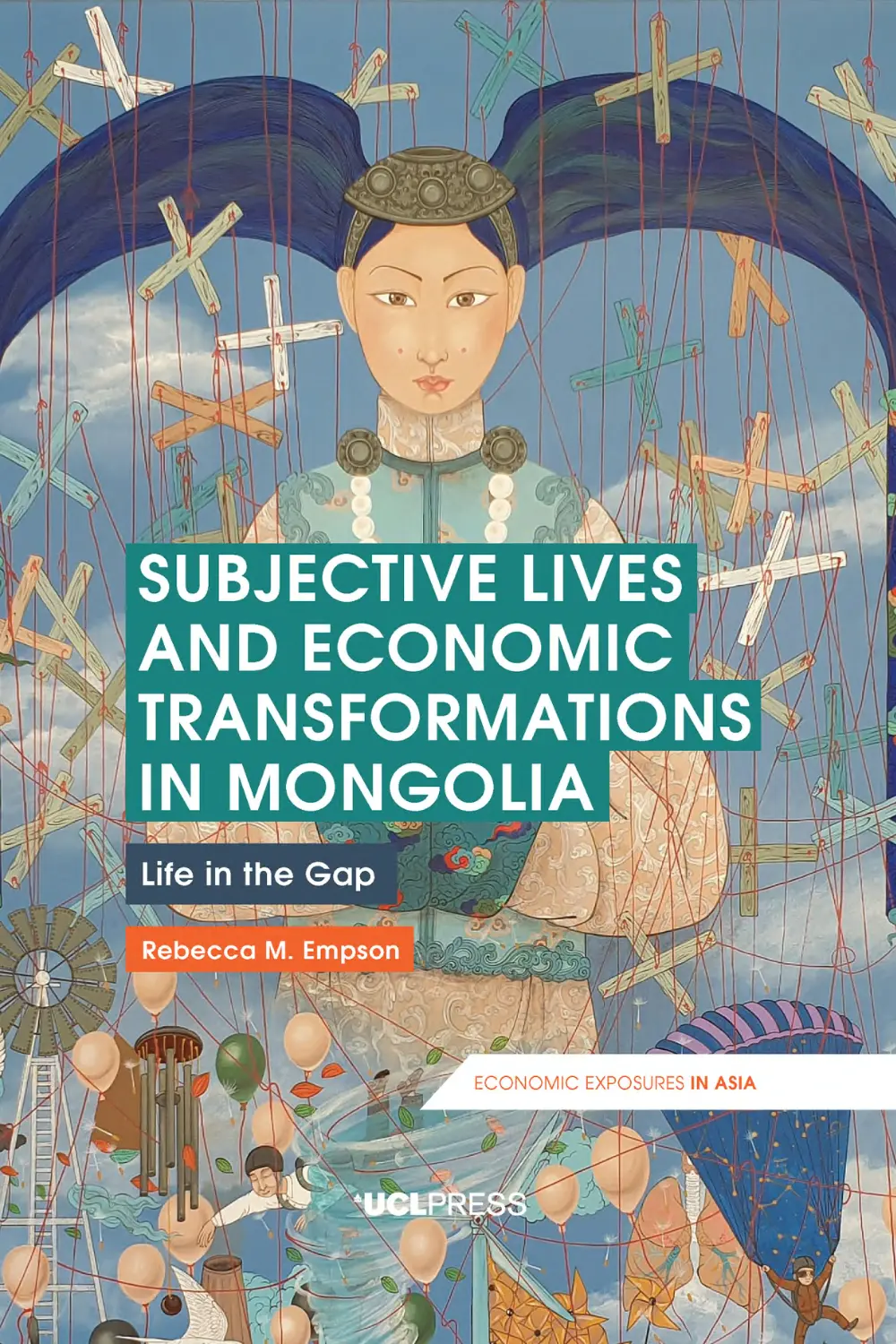
Each of the chapters is prefaced with an image from Nomin Bold’s series,
depicting five Mongolian women as the guardians of the five elements
(one of which is reproduced on the cover). The figures surrounding the
women are dependent on them as their marionettist. All images are ©
Nomin Bold and are used with kind permission.
Figure 1 ‘Earth (soil)’ Shoroo, by Nomin Bold, 2016. Acrylic, canvas
245 × 145 cm.
Figure 2 ‘Air’ Agaar, by Nomin Bold, 2019. Acrylic, canvas 245 × 145 cm.
Figure 3 ‘Fire’ Gal, by Nomin Bold, 2016. Acrylic, canvas 245 × 145 cm.
Figure 4 ‘Water’ Us, by Nomin Bold, 2016. Acrylic, canvas 245 × 145 cm.
Figure 5 ‘Wood’ Mod, by Nomin Bold, 2016. Acrylic, canvas 245 ×
145 cm.
vi
Preface
It had been three years since I was last in Mongolia, and things felt unfamiliar. The skyline was crowded by new buildings. Fashion styles had
diversified. Shops and restaurants proliferated. There was also a new
kind of dirty, rugged and raw side to the gloss and glamour that Mongolians are so good at upholding. As on previous visits, but perhaps more
intensely simply because of the great contrasts, in 2015 I felt that I was
being confronted in a somewhat dystopian way with what a capitalism of
the future might look like.
Brushing up against this underside – the ruthless contrast between
rich and poor, the seeming absence of the state, the horrendous air pollution in the city and the ravaging of natural resources, the unequal access
to medical care and the way in which people were trying to make a living
on the edges of things – provided a glimpse of the reverberating effects of
late capitalism being felt in numerous places. Deeply destructive, uneven
and desperate, it also appeared thrilling and full of potential. Cutting
across this landscape of raw inequalities were individual people forging
their own ethical projects that sometimes, somewhat surprisingly, seemed
to flourish and grow in the cracks. Rather than a simple before and after
(boom and bust, utopian and dystopian) narrative, I hope that through
our attention to the lives of individuals will bring out a more complex and
nuanced understanding of this time will emerge.
In retrospect, it feels easy to write about these kinds of experiences as
the outcome of neoliberal policy and forms of austerity, about the discontent and short-sightedness of extractive capitalism with its focus on growth
and greed. It is hard to make variegated and local stories count. One way
in which I have been able to anchor my reflections in the changes I have
observed in Mongolia is to focus on the different kinds of personal interventions into what seems so pervasive and predetermined. Elevating the
stories of people that seem to go against the grain of what we may assume
to be prevalent and dominant also becomes a political act of writing those
worlds into being. In the following chapters I amplify the diversity that
vii
exists in spite of the shared sense that we are hurtling towards something
anticipated and known. This is to deliberately side-step pervasive narratives of anthropogenic and economic crisis and focus instead on how we
live in spite of such chaos.
*
In subsequent visits I became privy to the way in which my close female
friends were reflecting and interpreting the economic, moral and political challenges they were facing. In contrast to the political rhetoric of
men and the businesspeople I had worked with, many women seemed to
work hard to create a space in which life could be tended to in another
way. Alongside the violently fluctuating economy of the past few years,
which had left some with nothing and others with more than they would
ever need, these women were steering their way along a different path,
which allowed them to reconsider moral, political and ethical choices
about the kind of world they wanted to inhabit and the future this would
mean for Mongolia as a nation.
The five women who are core to this book are all from different
socio-economic backgrounds. I explore the kinds of lives they have been
forging in the wake of recent economic growth and its rapid decline and
the increasing questioning of belief in democracy. What this has opened up
for many is perhaps not surprise at the fact that promises have not materialised (they do not bank on the fleeting promises of politicians), but a space
in which to question past dreams and reconsider new ways of imagining
the future. Innovative, creative and highly reflective, their views should be
amplified above the dominant voices of squabbling politicians who rotate
business and political alliances, trading in accusations of corruption.
To highlight this kind of heterogeneity is to draw attention to the
ways in which wider shifts and processes are being experienced and made.
Global shifts – such as neoliberal strategies of managing finance and changing forms of sovereignty and governance – do not simply create homogeneity the world over. They are shaped through individual and local projects
that come to critique them, creating forms of experimentation and change.
It is clear that to understand these features we need a richer characterisation of capitalist markets and the businesses within them (see Jacobs and
Mazzucato 2016, 18) to look at what the economy is, beyond ideas about
exchange and formal neoclassical ideas of maximising individuals.
For me, this diversity has become an important point to highlight
because it is all too easy to resort to simple explanations for the way things
are. That one political, economic and legal system can encompass all diversity. That democracy, as promised to Mongolia by the many international
viii
PREFACE
development agencies and banks, would provide a better system of governance than what was before. That developing an extractive mineral-based
economy would be the way to catapult Mongolia out of debt and poverty.
Such frameworks often become the descriptive explanations for activities
taking place in diverse settings, both within anthropological descriptions
and elsewhere. They are what Englund and Leach (2000) have referred to
as an overarching ‘meta-narrative’ that comes to dominate much anthropology. Thus, poverty and marginalisation are explained as an outcome
of neoliberal austerity practices; the rise in sovereign and personal debt
is attributed to fluctuations in global commodity super-cycles; environmental and economic precarity owes to the structural inequalities of capitalism; ‘subjects’, it seems, can be understood to ‘suffer’ in the same way
everywhere (Robbins 2013). Homogeneous explanations are brought to
bear on diverse ethnographic settings.
The danger of explaining ethnographic diversity in homogeneous
terms is what Gibson-Graham (2014), using Geertz’s term, has called
the danger of using ‘thin description’. They argue instead that a commitment to ‘thick description’ may resist the gravitational pull towards
forms of explanation that assume overarching, unidirectional theories
of global change. Paying attention to ethnographic heterogeneity within
wider global shifts becomes a way to challenge the idea that we know
what these shifts are. Indeed, one might wish here to show how this very
diversity comes to work recursively, determining the global shifts that we
thought were familiar in the first place.
A case in point might be the way in which the mortgage market in
Mongolia is being determined. Rebekah Plueckhahn (2020) asks whether
forms of financialisation – such as private mortgages – create homogeneous outcomes, or whether in fact they open up different responses and
experiences. Unlike in the UK and the US, Mongolian mortgages cannot
attract investment from multinational foreign companies and are part of
a closed network of financial institutions within Mongolia that buy debt
back and forth between each other. One of the only ways this system is
sustainable is through mobilising the interest earned on the mortgages
being issued to the public. Strategies among banks, construction companies and apartment buyers also help support the system in diverse and
incremental ways, giving rise to new strategies and economic imaginaries that proliferate out of these fluctuating, nascent networks.
Here we have a clear example where things may at first look similar
(there is a rise in mortgage markets globally), but if we pay attention to
the management of lending and mortgage debt we see that it is being sustained very differently in this particular context. To highlight this kind of
PREFACE
ix
heterogeneity is to draw attention to the ways in which economic models
(or forms of financialisation) don’t manifest in the same way on the
ground. They are being implemented and sustained differently, owing to
the local or national conditions that shape them.
Bringing ethnographic diversity to bear on wider global shifts
or trends raises questions about scale and the measurement of social
change more generally. Specifically, I want to draw attention here to the
fact that the measurement by which one might assume global shifts are
occurring might not adhere to national boundaries or use gross domestic
product (GDP) figures as the unit of analysis. With massive changes in
forms of sovereign power, it is clear that the boundaries of what holds
things in place, or equally allows their fluidity and movement, are now
increasingly determined by relationships and forms of power other than
the old idea of ‘the nation’. International trade networks, debt relations,
even forms of pollution, viruses and waste, all cut across physical and
political sovereign boundaries to determine global flows of knowledge,
ideas and information.
These flows are often highly unregulated but come to determine
the world we live in. They are also extremely unequal, persistently creating winners and losers and maintaining forms of environmental and
economic inequality around the world. Trying to trace such flows across
territories and scales is often disorientating, leaving us with a sense that
things cannot be fully known or anticipated. This lack of clarity leads to
speculation as to how things are, in fact, connected or determined – a
kind of political second-guessing at motives and drives. In attending to
these forms of speculation as they are made by our interlocutors, we may
attend to the decisions and ethical projects that are undertaken within
such rhetoric and to the types of explanations and connections that these
give rise to. Put simply, economic and social shifts and changes may not
always consist of the things we think of. They may, in fact, resist exact
specification. Through attending to the ways in which our interlocutors
engage with and come to know them, we may reveal connections and
possibilities that we have yet to notice.
Recognising such connections presents a challenge. How should
anthropologists navigate these scales and forms of explanation? Is the
role of anthropology to document and show connections across scales of
analysis? When doing so, whose narrative becomes dominant and when
should they be amplified? In thinking through such questions, it seems to
me that how we choose to pitch our explanations and the connections we
choose to make is always an inherently political act that brings certain
worlds into focus over others.
x
PREFACE
*
Almost 20 years ago, when I carried out fieldwork with a nomadic herding family on the Mongolian–Russian border for my PhD, Mongolia had
a fascination with the idea of democracy and was shedding its socialist
past. Today, the idea of democracy has lost its shiny newness. Shaped by
an international interest in extracting minerals to fuel China’s economic
growth, International Monetary Fund (IMF) loans and World Bank
restructuring, the last 10–15 years have seen dramatic changes in economic and political life, some of which I’ve tried to trace in the five-year
European Research Council (ERC)-funded project, ‘Emerging Subjects of
the New Economy in Mongolia (2014–19)’, of which this book is a part.
The project’s title, ‘Emerging Subjects’, has focused our research
in two senses. Firstly, we used this term to explore the broader themes,
or subjects, that are emerging in the current economic climate and their
articulation through different kinds of activities, from forms of political protest and stalled infrastructure projects to ways of transacting
and accessing goods and cash, such as through pawnshops and barter.
Secondly, we used the term ‘Emerging Subjects’ to refer to actual people,
or to distinct forms of subjectivity that are being articulated as an outcome
of particular kinds of economic and political experiences. These include
forms of political protest, such as hunger strikes and self-immolation,
and ways of sustaining life while constantly being in debt.
The group comprised 10 researchers, five of whom were based at
University College London (UCL) and five at the National University
of Mongolia (NUM). We were also fortunate to have a very active and
diverse advisory board based in Mongolia, ranging from herders to female
activists, independent economists and environmental lawyers, with
whom we consulted and collaborated. While each of the 10 researchers
carried out fieldwork in their own distinct areas – focusing on the property market and forms of ownership; the development of certain kinds
of infrastructure; environmental and civil society movements; mining
and the monetary sector; and small-scale trade in free-trade zones and
in local markets – we all explored ways in which the economy was being
shaped by and shaped its subjects in particular ways. We even carried out
fieldwork with our paired researchers on specific topics (see, for example, Plueckhahn and Dulam 2018) and all together – when we travelled
to the Southern Gobi, to Mongolia’s largest copper and coal mines and
to the Chinese border – along two different roads – to meet with those
who transport the resources outside the country. Mongolian artists were
sent our findings – in an innovative art–anthropology exchange – and
responded in an exhibition in London and in our book (Spriggs 2018).
PREFACE
xi
The balance between leading this project and carrying out my own
research was initially alleviated by the fact that I decided to base my
research on friends – the five different women central to the chapters of
this book. But a more persistent problem was that the rapid change that
we were all experiencing felt incredibly difficult to document. Every time
we tried to do so, things shifted and we needed to revise our assumptions.
At the ERC interview in Brussels when I was applying for the grant,
at the other end of the table was a woman who nodded and smiled as
I spoke. Her presence emboldened me to speak up to those who posed
impossible questions, and it felt like she was willing me along. A few years
later I looked up her name and met Professor Hanne Petersen, Professor
of Legal Cultures at the University of Copenhagen. I invited her to visit our
research group, and one grey January morning Hanne sat down with us
at UCL for over two hours, listening and offering suggestions and insights.
We had all done some fieldwork by then and felt intensely the experience
of being in a Mongolia that felt like a place we had never experienced
before. What did this mean for our project? What could we contribute
through our insights? Hanne embraced everything and showed us how
our experiences were part of wider social and political change happening
globally. When we asked her how we could write about this sense of fragmentation and change, she replied, ‘Like Montesquieu; through small
vignettes and essays that mimic the experiences you describe.’1 Listening
to her response, I again felt emboldened and decided to experiment with
her suggestion, this time in my writing style.
Methodologically, the structure of this book has tried to mimic
some of these experiences. In my writing I want to draw the reader into
a particular tension that comes from living in a world where one is constantly being pulled in two directions: on the one hand, being exposed
to disjointed and fragmented information about the world through titbits of information shared between friends and through social media:
on the other hand, the embedded and close experience of the daily
unfurling of the political and economic environment in which one
lives. This tension, not unlike the space between boom and bust that
I come to explore in this book, requires a zooming in and out of focus
and scales of analysis.
One of the ways in which I have attempted to do this is to interdigi
tate each conventional chapter with what I refer to as an ‘ethnographic
interlude’ – a snapshot or image of a particular event as it was experienced or understood, without further explanation. Looking back, I found
my field notes were full of such anecdotes and exposure to unresolved
events. They are experiments in taking note of things that happen at the
xii
PREFACE
margins of our perception (see Tsing [2015, 206] on unexpected concurrences), disrupting orderly narratives and explanations.
In contrast, the chapters themselves begin as portraits of individuals based on long-term friendship. They are ethnographically dense
and replete with specifics, but while you’re reading them I want you to
imagine a world where nothing can be taken for granted. Progress is not
to be relied upon, nor is it desired. In documenting this tension and flux
I hope to show that this is not something to be feared. All kinds of creativity and innovation can be found in these spaces. From these portraits,
each chapter expands outwards to explore broader structural themes
that are approached and shaped by individuals.
Contrasting these two modes of writing is a deliberate act of trying to mimic the situation I am describing, where things zoom in and
out of focus momentarily and then disappear from view. I hope that by
amplifying this in my writing I give you a sense of what it is like to live in
a world where things around you change, sometimes incredibly rapidly
and without explanation, while at other times they appear, sometimes
disappointingly and sometimes reassuringly, to always remain the same.
In this tension we may glimpse what it means to live a life in precarity, but
also how individual subjects forge a sense of community and ethical care2
for each other as they facilitate their lives in change.
Notes
1. I took her comment to refer to Montesquieu’s The Spirit of Laws (first published in 1748), which
argues that each human society differs from every other and must be considered from all points
of view. Despite being an empiricist, he ‘principally stressed the fruit of observation [and] his
scattered notes on a wide variety of topics, are detailed, vivid and penetrating’ (Berlin 2013,
137). Furthermore, ‘his vignettes of characters and situations are not stylised, neither caricatures nor idealisations’, and he believed that there is no single set of values suitable for all people
everywhere, no single solution to social or political problems in all countries (Berlin 2013, 143).
2. I am aware that there is a large body of literature on ethics (for example, Laidlaw 2002) and selfcare in anthropology, with which I have not fully engaged. In the following chapters, I draw my
main theoretical inspiration from Robbins (2013) and Zigon (2014), each of whom may be seen
as part of and critiquing that wider body of work.
PREFACE
xiii
Acknowledgements
This book spans the ‘Emerging Subjects’ research project (ERC-2013CoG, 615785, Emerging Subjects) based at UCL and NUM, from 2014
to 2019. I am very grateful to these institutions for hosting us and to the
ERC for their generous funding, through which we were able to build a
research community that has become an extended family over the past
five years. This project began at a time when I was experiencing my own
crisis of sorts as my personal life took an unexpected turn and I was forced
to re-imagine the future in light of the present, just as my interlocutors
were doing but on a different scale. Working on this topic with the people
mentioned below has been a wonderful gift and hugely transformational
in many different ways.
My heartfelt thanks and gratitude to our wonderful group at
UCL – Lauren Bonilla, Joseph Bristley, Bumochir Dulam, Baasanjav
Dune, Liz Fox, Rebekah Plueckhahn, Hermione Spriggs and Hedwig
Waters. Together, we developed and discussed many of the ideas presented here, in reading groups, on shared fieldwork with Chiara Goia,
at writing retreats and Lunar New Year parties and through our exhibitions, workshops and public talks. At NUM, I thank Sarantsetseg
Dugersuren, Officer of the International Relations Department, and
Boldgiv Bazartseren, Taylor Family Chaired Professor of Ecology at the
Department of Biology of the School of Arts and Sciences, for facilitating our partnership, and offer my sincere thanks to our brilliant
paired researchers – Tsetsegjargal Tseden, Byambabaatar Ichinkhorloo,
Bayartsetseg Terbish, Munkh-Erdene Gantulga, Tuya Shagdar and
Narantuya Chuluunbat – with whom we collaborated in fieldwork and
research and from whom we learnt enormously. Thank you also to our
fantastic research assistants, transcribers and translators – Erdenezaya
Batbayar, Batdelger Doljinsuren, Batdavaa Bachaa, Setsen Altan-Ochir,
Nomindari Shagdarsuren, Navchaa Tumurbaatar and Khishigsuren
Yadamsuren – who skilfully assisted with recorded interviews, at conferences and workshops, in navigating formal meetings and in our writing.
Our two exhibitions, conceived and developed by the immensely creative
Hermione Spriggs, brought me into contact with some extraordinary
xiv
Mongolian artists and scholars, among whom I personally thank Tuguldur
Yondonjamts, Nomin Bold, Baatarzorig Batjargal, Dolgor Ser Od and
Marc Schmitz, Yuri Pattison, Deborah Tchoudjinoff, Uranchimeg Tsultem
and Unurmaa Janchiv. I thank Nomin Bold for granting permission to
reproduce her images in this book. Having a Mongolian female artist
depict five Mongolian women as the custodians of the five elements of
Mongolia is a fortuitous gift. I also thank our visiting (and later permanent) scholars – Marissa Smith, Sanchir Jargalsaikhan and Badruun
Gardi – and our generous advisory board members – Haltar Batsuuri,
Dashdemberel Ganbold, Jargalsaikhan Dambadarjaa, Badruun Gardi,
Shurkhuu Dorj, Delgermaa Tsend and Manduul Nyamandeleg – for sharing their expansive knowledge and unique perspectives, as well as our
Mongolian language teacher, Uranchimeg Ujeed, and affiliated member,
Dalaibuyan Byambajav. Administrative assistance at UCL was generously given by Paul Carter-Bowman, Suzanne Pertou and Pascale Searle.
Collaborating in research with this group of people has been a unique
gift, both personally and intellectually.
In Mongolia I thank my friends for warmly welcoming me back
into their lives and for all their support and critical engagement, including Lkhamsuren guai, Mandukhai egch, Bataa akh, Tserendondog hai,
Dagmidmaa egch, Buyant egch, Burmaa egch, Duyaa egch, Delgermaa
egch, Boloroo and their families. It is with great sadness that I record
that Elbegdorjiin Eldev-Ochir, my Mongolian father, passed away during
this work. I am forever grateful to him for gracefully gifting me a position
as his daughter and thereby placing me in a wonderful extended family.
I am grateful too for ongoing intellectual engagement from Caroline
Humphrey, David Sneath, Manduhai Buyandelgeryn, Morten Pedersen,
Andrei Marin, Christopher Atwood, Daniel Murphey, Gisa Weszkalnys,
Laura Bear, Madeleine Reeves, Kimberly Chong, Haidy Geismar and
all the scholars at the ‘Rethinking Usufruct’ workshop at UCL and the
‘Mongolian-Made Capitalism’ conference at NUM. They have provided
intellectual critique at crucial stages, and our two publications from
these events (with Central Asian Survey and Current Anthropology)
opened up theoretical avenues explored in this book. At UCL, I thank
our head of department, Susanne Kuechler, and the Social Anthropology
subsection for facilitating my research project, and the undergraduate
and master’s students of the ‘Anthropology of Capitalisms’ course (2018
and 2019) for their review of several ideas presented here. An early draft
of Chapter 1 was presented at the Department of Anthropology at the
University of Copenhagen, whose members I thank for their comments
and suggestions, particularly Henrik Erdman Vigh. Versions of Chapters
1, 2 and 5 were presented at the Laboratoire d’Anthropologie des Mondes
ACKNOWLEDGEMENTS
xv
Contemporains, Université Libre de Bruxelles, where I thank, among
others, Olivia Angé. Hedwig Waters read Chapter 5, Bumochir Dulam
read Chapter 4, Liz Fox read Chapter 3, and Rebekah Plueckhahn and
Sanchir Jargalsaikhan kindly commented on the Introduction. Nomindari
Shagdarsuren and Sanchir Jargalsaikhan, two exemplary scholars, did a
careful job checking the Mongolian transcription. I thank them all for
their insights and suggestions. The two initial reviewers and the final
reviewer offered extremely thoughtful and sage advice at a time when
I needed a fresh perspective. I thank them for their intellectually generous reviews. The production of this book has been blessed with several
sharp eyes and editors. I thank Denise Cowle for her initial proofreading
and Anthony Nanson for his thorough and astute copy-editing, as well
as Jaimee Biggins, Managing Editor at UCL Press, and Robert Davies for
his proofreading. Chris Penfold, Commissioning Editor at UCL Press, has
seen the whole project through from its early inception. I thank him for
his patience and foresight.
In London the Village Women’s Co-working Group at the South
Kilburn Granville Centre provided a unique space for me to write during the final stretch of this book. I am deeply grateful to My Kieri, Tom
Sessink and Helena Reeves for looking after my children during research
and writing. Freya and Otto came to Mongolia with me and made our
research together so much fun. My has been with us during the writing of
this book and has become a good friend. My immense love and heartfelt
thanks to Brett Dee for gifting his steadfast support, important critique
and golden stretches of time to think and write during weekends and
afternoons, as well as for his photographic collaboration on Five Heads.
I dedicate this book to my maternal grandmother, Ebba Ekman
Mannerfelt, who passed away at the age of 101 years while I was in the
final stages of writing and who followed my life in Mongolia with great
interest. Your absence is a gap that motivates us anew.
xvi
ACKNOWLEDGEMENTS
Note on transliteration
In this book I use the following transliteration system for Mongolian
Cyrillic, as outlined in Empson (2011, xiii):
О as O
Ө as Ö
У as U
Y as Ü
Ё as Yo
Э as E
E as Ye
Ы as Y
Я as Ya
X as H
И and Й as I
Ь and Ъ as ’
Ю as Yu/ Yü (depending on conjunction with front/back vowel)
For the plural of some Mongolian words used frequently, I use the Roman
‘s’, rather than the Mongolian plural, e.g. ‘lombards’. Use of ‘kh’ rather
than ‘h’ has been preserved in personal names and well-known terms,
such as Khaan and Saikhanbileg. Most personal and place names have
been changed, except those in quotations and those of the country and
its capital city. My main interlocutors all chose their own pseudonyms.
xvii
Introduction
This book explores the lives of people who have lived through a tumultuous period of economic flux. A few years ago they were promised a
particular reality if they followed certain kinds of behaviour during an
economic ‘boom’ but, in spite of their conforming, this reality failed to
materialise. Instead, the boom was followed by a period described as a
‘crisis’. Rather than this leading to dissolution and disappointment, in
the space between an anticipated future and the unfolding present we can
discern innovative adaptations and creative openings, leading to entirely
different subjects than those imagined.
Attending to this space, I mobilise a term used by one of the women
who features in this book. She referred to this space as a ‘gap’. Seeing this
space as a gap requires a certain theoretical commitment that allows us
to apprehend things from a different angle. Rather than viewing people
as subjected to policies and forms of financialisation that are replicated
the world over, I want to attend to the way that such encounters also
allow different and variegated responses and openings; how the gap
between predicted outcomes and those realised provides a space for revelation and clarity in a world that sometimes moves too quickly for us to
fully comprehend.
In order to do this, I draw on many years of fieldwork in Mongolia,
but specifically that between 2014 and 2019. This was a time when
Mongolia revelled in being the fastest-growing economy of the world
and foreigners flocked to the country to ‘reveal’ vast fields of minerals
that ‘blessed’ the country with concealed rivers of gold, copper, coal and
oil. Firmly embraced by a liberal democracy that allowed the sale of mining licences to explore these resources and promised its people rewards,
forms of finance proliferated that encouraged national and individual
spending and consumption.
By 2015, however, these promises were beginning to crack. At
the time of writing, in 2019, the country and most of its people are
heavily in debt. An IMF bailout is in place, aiming to implement an
1
‘ambitious structural reform agenda, which will help to sustain growth
over the medium term, promote diversification and competitiveness, and
mitigate the boom–bust cycle’ (Yan 2017).1 Although the economy is in a
stronger position overall than in 2015, the benefits of this recovery have
not been widely felt.2 The past few years have been both dramatic and
disorientating. People have felt the fits and starts of living in response to
a changing economy. Untethered from the normal order of things, the
physical, social and economic environment in which people live has been
destabilised and redrawn, stalled and left behind in various ways. But in
this space people can also now begin to see the contours of a different terrain. This is a landscape that has begun to give rise to the articulation of
nuanced critique and a desire for something different. The environment
has also begun to ‘act back’ in the form of climate change and its effects.
Attending here, we find new values and worlds being brought into being.
*
Returning to a place that I thought I knew, I felt somewhat paralysed
when I visited Mongolia in 2014, because so much looked unfamiliar.
New buildings, skyscrapers, businesses and outlooks shaped the skylines
of people’s ambitions and projects, while grievances and discontent bubbled under the surface. Things appeared to change so quickly that it was
difficult to know what, if anything, remained the same. In those early
days of my fieldwork for this book there was some solace, some sense of
‘putting on familiar clothing’, when I began to speak Mongolian again
and was able to connect directly with close friends from before. Juggling
the different demands of managing a larger project and my own fieldwork, I resorted to support from these old friends and their families.
What allowed me to ‘break in’, to find that kernel of familiarity within
the new, was reconnecting with them, some of whom I had known for
more than 20 years. The idea of making them the centre of this book,
therefore, came to me as an outcome of particular fieldwork constraints
and conditions. It was through being with them, seeing the changes in
their lives and talking with them about their experiences over the last
few years, that I was able to gain a better picture of the ups and downs I
had heard and read so much about in the international media. Through
them I also learnt how people come to live through economic predictions
and adapt them to present realities; how dreams of the future come to be
transformed as different futures surface in their wake.
While making these individuals the centre of this book arose, in
part, out of the structural conditions of fieldwork, it has also become
an analytical choice. As I reconnected with them I found that the five
2
SUBJECTIVE LIVES AND ECONOMIC TRANSFORMATIONS IN MONGOLIA
women who feature in this book had shaped themselves and had been
shaped as subjects in very particular ways. They come from different
socio-economic backgrounds and have been held in place by wider structural inequalities and historical precedents. They have been exposed to
and sought out specific events that have shaped who they are. Attending
to these differences allows unique ethnographic insight into experiences
of economic change. They are, among many other things, a herder, an
environmental activist, a mineworker, a kindergarten teacher and a
real-estate agent. It is my hope that, through focus on these individuals,
different kinds of subjecthood come to the fore, providing an analytical
window upon the way in which people both shape and are shaped by
the economy and the historical and political circumstances in which they
live.3 I am incredibly honoured that they agreed to be part of my writing
and I want to put them at the centre of this book; but first I need to give
an overview of the environment in which they have found themselves
over the past 10 years.
The ‘bubbling economy’
Mongolians have a wonderful phrase to describe the economic conditions they have lived through. They refer to it as the ‘bubbling economy’
(ediin zasgiin höösrölt) – an economy that rises up and down very quickly
and is not stable. Although they use the English term ‘booming’ (büümiin
üyed) to refer to the period of economic acceleration, they don’t have the
equivalent term for ‘bust’, instead using the Mongolian term for ‘crisis’
(hyamral) to talk about its aftermath (i.e. ‘economic crisis’ – ediin zasgiin
hyamral).
In the following I give a brief overview of this period and highlight
some of the bigger changes that took place (more details are given in
individual chapters). I then explain why seeing things in terms of these
larger political and economic changes and noticing the rise and fall of
GDP doesn’t actually give us a very good picture of the way this period
was experienced, perceived and lived through.
In the past 10 years Mongolia has felt the dramatic fits and starts of
sitting at the edge of China’s booming steel and technology industries,
which rely on coal and copper, respectively. In 2011 it was heralded the
world’s fastest-growing economy, with an impressive 17.5 per cent GDP
growth, owing to the discovery of vast mineral reserves, including coal,
copper and gold, which fuelled the engine of its resource-hungry neighbour. With over 10 years of post-socialist shock therapy, widespread
Introduction
3
economic liberalisation and privatisation of land, property and services,
the Mongolian government opened its doors to foreign investors, took out
sovereign debt bonds and deregulated land laws. Its economy seemed to
be skyrocketing.4
So enthralled was the government by the promise of economic
growth that it ‘blessed’ its people with several rounds of lavish cash
handouts based on sovereign debts that were guaranteed against future
growth (see Bonilla 2014; Yeung and Howes 2015).5 The number of
banks and non-bank financial institutions, as well as pawnshops and loan
companies, grew until they were prevalent on every street corner and in
every countryside district centre.
Hummers became just one of several new kinds of four-by-fours that
dominated the roads. Malls and high-end fashion and cosmetic shops
appeared throughout the capital. Soft loans for individuals, businesses and
the nation itself were easy to come by. There was a flourishing mining and
construction sector, as well as the start of many small and medium-sized
businesses and secondary industries. From 2009 to 2014 the economy
grew by 70 per cent. In 2012 alone Mongolia attracted foreign-capital
inflows equivalent to 54 per cent of its GDP (The Economist 2012).
In this climate, foreign mining specialists flocked to the country to
purchase easily available exploration licences and ‘discovered’ underground fields of gold, copper, coal and oil. Spirits were high among
Mongolians, the global mining community and investment speculators
alike. At this ‘boom time’ (böömiin üyed), Mongolia, or ‘Minegolia’ as it
has been called, felt like the centre of the world. Forms of financialisation developed elsewhere were quickly introduced. Mortgage schemes
allowed people to buy into the growing real-estate market, relaxed
licensing laws allowed people to purchase small-scale licences for mines,
and different kinds of trade blossomed as new border posts to China were
opened. Many Mongolians who had been studying or working abroad
returned to their homeland (nutag) to ‘look for luck’ (azaa üz’ye) in the
so-called ‘Wolf Economy’.
The Mongolian government, then led by a young and dynamic
Democratic Party spearheaded by two long-term friends, Saikhanbileg
and Bayartsogt, implemented rapid neoliberal reforms. These played
with novel models of public–private ownership and allowed new kinds
of deals to be made.6 Assets of the largest copper and gold mine in the
country, Oyu Tolgoi, were split between Rio Tinto and the Mongolian
government in what was thought to be a landmark deal, highlighting a
novel assemblage of territory, sovereignty and rights to access.7 In 2009 a
law was passed to protect the headwaters of rivers and sacred mountains
4
SUBJECTIVE LIVES AND ECONOMIC TRANSFORMATIONS IN MONGOLIA
from mineral extraction; a Strategic Entities law (2007) ensured the state
retained a large proportion of mineral wealth for itself. Foreign economic
advisers and legal experts were not simply describing this context but
were actively participating in producing it (Mitchell 2005, 298).
By 2014 the wider global commodity cycle had begun to slow down.
Critique from those outside the country began to mount: Mongolians
were not acting ‘fast enough’ on mining deals; they were exhibiting signs
of being ‘resource nationalists’; questioning what was happening was
‘slowing things down’; and laws to protect the environment from pollution associated with mining, especially sacred mountains and the headwaters of rivers, was ‘stalling development’.8 The laws implemented to
facilitate growth have become a point of critique, of policy that banked
on future growth rather than stable investment.9 Plans to build a railway to transport minerals, especially coal from Mongolia to China, were
budgeted for, but the railway line was never laid. In their place, more
sovereign debt bonds had to be floated on international stock exchanges
to raise yet more funds to allow more deals and development. By questioning things, it was perceived – and often propagated in international
media – that Mongolia would ‘miss the boat’. It was just to be accepted
that, in the short term, foreign companies could grab resources and
land and expel local people, businesses and animals from their habitats
(Sassen 2014). The success of this period was measured by its GDP, and
the curve of that was starting to fall.
As inflation began to skyrocket, loans became harder to come by
and businesses began to slow down. Investors began to withdraw and
many disappeared altogether. Truckloads of coal were being stockpiled
at the Chinese border. By 2015 most of the foreign miners had gone elsewhere (apart from a handful of men who had married Mongolian women
and decided to wait things out). In their wake was a pockmarked and polluted landscape and a national economy and local population in severe
debt, chained to forms of finance that had encouraged risk-taking and
the promise of future growth. Outstanding loan repayments, defaulting
bonds, bankrupt businesses and deserted mines (with well-paid guards
to make sure they weren’t pillaged by artisanal miners) littered the country, while GDP fell to 2 per cent.
Meanwhile new skyscrapers stood outwardly poised and shining,
but many were, in fact, empty and deserted. Construction work slowed
down, with much of it carried out through barter, so that, rather than
cash, concrete was given in exchange for other materials required for
building apartment blocks, materials and apartments were exchanged
for Jeeps, and so on (Plueckhahn 2020). Banks were not as willing to
Introduction
5
issue loans to individuals, state salaries were not regular and funds
within banks to issue loans were decreased. Many people used informal
networks or the thousands of pawnshops (lombard) to access ‘ready cash’
(belen möngö). With interest rates of up to 8 or 9 per cent, the currency
was suffering huge inflation.10
As global prices for coal and copper continued to decline, the
Mongolian government was left standing without any security and scrabbling for ways to repay its massive public debts, apparently required by
2017.11 Exploited by the Chinese debt market (with a 15 billion yuan
swap agreement when banks were about to crash in 2015) and with fleeing foreign investors, Mongolia was testament to the fact that predicted
economic growth based on high GDP does not mean very much.
By 2016 the Democrats who had brought in many of the rapid
reforms were ousted and the Mongolian People’s Party was elected.12
Many of the politicians from the ‘boom time’ were found to have offshore
bank accounts with millions of dollars hidden away for their own use and
were under investigation for corruption. Disillusioned with narratives of
progress, politics itself became entirely disconnected from policy and was
dominated by factions of politicians who held office and sold their positions in return for payouts. Mongolians began to reflect that from the Gobi
Desert, on the country’s southern border with China, up to Ulaanbaatar,
its capital, the country had become an empty container, pillaged of its
wealth. Once again relegated to the periphery – and cast as just another
story of what could have been, had they actually taken the risks the
investors wanted them to, rather than retaining some sense of national
authority – Mongolians were tasked with trying to put themselves and
their country back together. This, quite literally, was a period they came
to describe as a ‘crisis’. As the economist Batsuuri has commented:
Given falling GDP, an increasing budget deficit, decreasing foreign
reserves and other negative macroeconomic indicators, experts
agree that Mongolia is in economic recession, if not in crisis.
…
The combination of high public debt and rapid private-debt growth
means that an imminent economic crisis in Mongolia is now fast
approaching. (Batsuuri 2015, 3, 10)13
While public debt was a large shadow looming over the government, private debt was also ubiquitous. People speculated that over 80 per cent
of retirees were in debt, their pensions being a major source of collateral
6
SUBJECTIVE LIVES AND ECONOMIC TRANSFORMATIONS IN MONGOLIA
against which to take out loans for family members. Taking loans from
those who had already taken out loans was also prolific across the private
and business sector, leading to multiple chains of indebtedness.14
In this context of flux and change, people were caught between accumulating debt and engaging in illegal activities to pay it off. The government
sought the support of the IMF for a bailout package to avoid defaulting on
its bond obligations, which was agreed in 2017.15 This set in place austerity measures that would see some stabilising of the economy.16 At the same
time, Battulga, one of Mongolia’s more renowned and wealthy businessmen
and a wrestling champion, was elected as president. Appealing to many as
a more down-to-earth ‘populist’ leader, he has implemented some more
authoritarian changes during his leadership. In April 2019, for example, he
fired the country’s top judges and the head of the anti-corruption agency. In
August of the same year he met President Trump in America.
Discontent with democracy and the rise of populist
nationalism
On a graph documenting GDP per capita the period of fieldwork on which
this book is based would appear as a jagged line. In summarising events
I feel the need to give dates, at least years, so that one can get a sense of
the rapidity of change. On reflection, however, I realise that this kind of
summary tells us very little about what it was like to live through these
shifts. It doesn’t tell us about the way people felt about, engaged with and
understood the economy, both as a practical day-to-day experience and
as a way of understanding wider political and economic changes. Instead
we might ask: what does living under such conditions make people think
of the idea of democracy, of capitalism as an economic system, and its
commitment to progress?
One immediate outcome of living through these fluctuations is
that many Mongolians have become increasingly critical of the idea
that democracy, as a system of governance, can bring about progress,
as propagated by the international donor and financial agencies that
have flooded the country for more than 20 years. Since the 1990s, when
Mongolia first committed to the idea of democracy, many felt it was just
a matter of time before Mongolians ‘caught up’ with the foreign countries whose political system they had now joined, allowing them to follow a linear step-by-step path towards development. Given the dramatic
stops and starts over the last few years, however, many now reflect that
progress through democracy is not a straight line. Instead they see that
Introduction
7
the path winds, drops away and falls out of view, only to re-emerge
again in an instant, then to be lost for something else. Many still want
‘development’ (högjil), but not through democracy, which is considered
a corrupt, broken, chaotic and extractive system with sharp climbs and
sudden falls, riddled with inequality and competition. In many ways
neoliberal policies have been conflated in people’s perception with ideas
about democracy, to its wider detriment, as merely part of capitalism
and productive of widespread corruption among elites. Many lament
that perhaps democracy is not the right path for Mongolia at all (see
Chapters 2 and 5). And it’s no wonder – the last few years have been full
of contradictions, indeterminacy and precarity.
It is out of such concerns that many question the wisdom of having ‘followed the yellow heads’ (i.e. Euro-Americans), generating what
some have labelled more ‘populist nationalist’ forms of critique. Along
with such discontent, protests against the government and its decisions
have increased. People are bored of hearing politicians talk about ‘foreign direct investment’, ‘freedom’ and ‘the market’ – terms that have
dominated political speeches for some time. They are also disillusioned
with the promise of economic growth associated with large-scale mining
and foreign investment. There is a growing sense of disconnect between
people and the business and political elites who do not appear to listen
to concerns that are being raised. Many of the more critical voices, for
example, have been silenced, with the imprisonment of environmental
activists and the dismissal of a labour unionist who set himself on fire
during a press conference to highlight the plight of mine workers losing
their jobs to a Chinese company takeover. Such views are often associated
with ways of seeing and imagining the future which threaten the power
of the ruling elites, and they are dismissed as ‘nationalist’ or ‘populist’.17
For example, Ganbaatar, an independent MP labelled ‘populist’ by
the ruling elites but voted the top politician nationwide by the public in
2015, gave an interview on the TV chat show Talk with Me in October
2015, voicing such concerns:
Multinational companies [are] stealing and digging our wealth,
without benefiting my people. International institutions – IMF/
World Bank, Jeffrey Sachs [sic], are always feeding this, asking for
privatisation. Only 13 families have benefited from this … there
must be something wrong with neoliberalism.18
He went on to explain how Mongolians are only able to survive in such
uncertain times because ‘Mongolian nomadic life and tradition teaches
8
SUBJECTIVE LIVES AND ECONOMIC TRANSFORMATIONS IN MONGOLIA
you the ability to respond and adapt’ (Nüüdelchin am’dral bolon Mongolyn
ulamjlal n’ hümüüst olon züiliig surgaj baidag). While many complain about
wealth accumulating among the few, they also elaborate how Mongolians
are good at adapting to experiences of rapid change precisely because
of their nomadic heritage, a somewhat essentialising perspective that,
nonetheless, generates a feeling of pride in the ability to survive even the
most difficult of conditions, such as ‘wild capitalism’ (zerleg kapitalizm).
Many feel that the elites have kept what wealth there was for themselves and have ‘mixed business with politics’ (colloquially referred to as
‘to layer your coat’ – davhar deel) to such an extent that this is what politics
is these days. Levels of corruption and deceit fuel the view that the people
in power cannot ‘carry’ (barih) the nation. Bribery (heel hahuul’), corruption (avliga) and factions (frakts) characterise politics, which has come
to be determined by what some refer to as the ‘invisible side of the economy’. In this world, no one is simply a herder, a businessman or a trader.
Everyone, my friend explained, is at least two or more things. Learning
how to juggle and manage this multiplicity is how people survive.19
*
Below I explore the way that the term ‘crisis’ both opened up a space
for reflection and shaped the imaginative potential in the gap. For now,
let me say that, although critique of Mongolian politicians is widespread
and considered acceptable, in general there is a very intense performative imperative that presses hard on people on a day-to-day basis to speak
their worlds into being – to literally act out the world they want; something that scales outwards from the individual, the family, the district or
homeland one comes from, to the way people talk about the nation itself.
This is both a cultural belief (that critique can be damaging) and a politically performative strategy to keep others at bay. It is a way to resist possible encroachment of one’s national borders (by China or Russia), given
the very real fear of being eclipsed by such encroachment. The imperative
is felt so keenly that even in the now ubiquitous situation where everyone
is somehow dependent on economic activity of some sort with China, one
has to uphold the idea that Mongolia is a nation functioning almost completely independently, albeit with some third-neighbour relations, such
as America, Japan or Germany.
National pride plays an important part. It often influenced how people wanted to present things to me as a researcher. Sometimes it would
come to my attention that people were acutely aware of not talking too
badly about the context Mongolia had found itself in, not least because,
they reflected, my writings could influence future foreign investors and
Introduction
9
business leaders. In this vein, critique of politicians and their policies is
often blamed on non-Mongolians and becomes a rejection of democracy
as a colonial project that enables corruption and wealth accumulation
among the few, most of whom are not considered ‘pure’ Mongolians.
In many ways, the theoretical concepts of ‘performativity’ and the
individual practice of ‘prefiguration’ – terms that will become important
in the following chapters when I illuminate a gap between an ideal or
hoped-for future and its current manifestation – are but iterations of
the same idea of ‘bringing worlds into being’. One emphasises technical restructuring and abstract prediction and can involve non-human
algorithms and metrics. The other is born out of a political idea that it
is the personal choice of individuals to act the world they want to into
being. Both draw on speech act or performative theory (see Austin 1975;
Butler 1988) and are based on a commitment that change – through
language, individual action or non-human technical networks – is possible. However, they differ radically in the way they understand that this
change can occur.
For example, in his study of economic financiers, Holmes (2009),
following a more actor–network theory approach, argues that economic
markets are the artefacts of language and the technical means to control
them. Following Callon (2008) and MacKenzie and colleagues (2008),
such an approach takes the view that economists do not simply ‘observe’
markets but affect them by saying what they are doing, should do and
will do. A case in point is the way in which foreign direct investors, as well
as financial speculators, attempted to determine the pace of economic
change in Mongolia, through recourse to language that threatened a
‘resource curse’, ‘resource nationalism’ and the impending ‘slowing down
of the economy’.
Prefigurative politics, on the other hand, points to a more individualorientated modus for transformation (rather than a systematic one determined by algorithms). Graeber states:
prefigurative politics means making one’s means as far as p
ossible
identical with one’s ends, creating social relations and
decisionmaking processes that at least approximate those that might exist in
the kind of society we’d like to bring about. … [it is] the defiant insistence on acting as if one is already free. (Graeber 2014, 85)
Both projects attempt to shape the future according to present imaginings of what is right or desired, and in that sense they mimic the power
10
SUBJECTIVE LIVES AND ECONOMIC TRANSFORMATIONS IN MONGOLIA
of prophecy, signalling that narratives about the future very often tell us
more about what is valued and desired in the present than they do about
how that future will unfold (see Empson 2006).
As mentioned above, Mongolian language etiquette almost
always contains an element of prefiguration and performativity.
‘Talking the world into being’ is a widespread vernacular Buddhist
belief. The performative nature of language is well recognised through
the idea of ‘black and white speech’ (har/tsagaan hel am),20 where a
kind of defiant utopianism is adhered to in order that it will affect the
world around one. A well-structured exchange is almost always followed when greeting someone one hasn’t met for some time. A predictable set of responses is almost always given when asking about
the state of someone’s family or herds, and a question about health is
almost always followed by an immediate response that the responder
is fine. This happens across scales – as much among financiers and
businesspeople as among national politicians, individuals and friends.
It is not that people are confined to an always-positive view of the
world, even when things are unequal, insecure or unjust, but that on
the surface, at least, a way of describing the world that one is living
in is important because it is held to define it. After polite exchange,
and if relations of intimacy and trust are deemed appropriate, more
details may be divulged and a fuller description is revealed, but even
then, to dwell on negative aspects is to invite them to determine the
future. This is why ‘black speech’ (har hel am), or talking badly about
someone/something, is viewed as a potential curse that can bring the
world spoken about into being.
Sometimes this narrative exchange and the outcomes it is hoped to
engender falter and a gap begins to take shape between the two. During
the period I am describing, people commented that things were happening so quickly that they often ‘seemed unimaginable just four years ago’.
The gap, as one of my friends put it, between the future that was imagined
in 2011, when GDP was so high, and the one that was currently being
realised was one where dreams and wishes had to be revised and new
futures imagined. In the following I use this ethnographically derived
concept of ‘the gap’ to think through what happens when futures –
through economic prediction, government policies or, simply, individual dreams and aspirations (the kind of prefigurative politics described
above) – are lived and realised as something completely different from
how they were initially imagined. I ask what kind of opening is created in
this space and how it is accommodated into future imaginings, for both
individuals and the nation.
Introduction
11
The gap
In her conversations with me my friend Oyunaa often reflected on the
past few years as a time of becoming accustomed to living in ‘the gap’.
This was a space located in between a binary: between an anticipated
future and the reality of that future as it has now materialised. In the
course of my fieldwork this gap was only just becoming perceptible as
a specific period of time and no single moment had been allocated to it
(in spite of Mongolians liking to divide up time into periods with specific
names). To take this term as a starting point is to isolate and define a
space of expectation-now-thwarted and an attempt to describe what is in
its place. It is to marshal an ethnographic concept as a theoretical tool to
open up a space that might otherwise pass our attention.
However, I am keen to stress that this was not simply a place of
thwarted dreams and disenchantment, a narrative all too familiar among
ideas about neoliberalism (or dark anthropology, à la Ortner [2016]).
Instead, inspired by my interlocutors, I have chosen to focus on the way in
which people forge new paths in this space – a practice that also allows them
to revaluate past beliefs and ideas. Taking this approach is both an ethnographic fact and a deliberately political act. Attending to the way the five
women who are core to this book forge a life in spite of thwarted predictions
allows me to highlight the creative ways in which people make a life through
exposure to forms of financialisation that leave them in debt and networks
of corruption that seem to work against them at every turn. It is to show how
people work hard to ‘prefigure’ a future they want (i.e. deliberately try to live
a life they would like to come into being), as part of individual ethical projects. This is to suggest not that people are free to simply choose the futures
they want, but that ‘optimism’, as Lauren Berlant has commented, is ‘a scene
of negotiated sustenance that makes life bearable [even] as it presents itself
ambivalently, unevenly, [and] incoherently’ (Berlant 2011, 14).
Amplifying optimism in a context that could be viewed as exploitative and desperate is important because, as Robbins (2013) has highlighted, we need to pay attention to the fact that people who appear to be
suffering in different ways must also imagine better ways to live, and we
need to hear them. The better worlds they imagine and their ways of trying to get to them surely differ in significant ways, and it is important for
us to learn from these differences so that we may let their efforts inform
our own (Robbins 2013, 459). This is a provocation to push us out of easy
homogenising forms of explanation that see people subjected in similar
ways to forms of inequality the world over. It is to heed Tsing’s call to
attend to the ‘acts of noticing’ (Tsing 2015, 37).
12
SUBJECTIVE LIVES AND ECONOMIC TRANSFORMATIONS IN MONGOLIA
In attending to these acts of noticing we can begin to see how
the gap can act as both an ethnographic and a theoretical marker. As a
conceptual space it is somewhat familiar to other spheres. In economic
anthropology, for instance, substantivist anthropologists noted a ‘gap’
between formal economic models and their substantive realisation on
the ground, in markets, industry and finance. Anthropologists continue
to draw attention to this kind of slippage when they focus, for example,
on the way in which financial institutions are upheld, enacted and realised through particular social interactions that are not in themselves
part of the models the financial institutions seek to sustain. Of course,
not all economic behaviour is structured by existing cultural norms, nor
does self-interest drive all economic behaviour, but this does not detract
from the very real work that goes into people’s ongoing work in making economic life liveable. We know that ‘[c]apitalist economies are
not theoretical abstracts but complex and dynamic systems embedded
in specific societies’ (Jacobs and Mazzucato 2016, 17), that ‘orthodox
economic theory which underpins most current policy-making does
not provide a proper understanding of how modern capitalism works,
and therefore how to make it work better’ (Jacobs and Mazzucato 2016,
12) and that, ‘[c]ontrary to the claims of orthodox economists that “the
laws of economics are like the laws of engineering: one set of laws works
everywhere”, there are in fact many different kinds of market behavior,
and several varieties of capitalism’ (Jacobs and Mazzucato 2016, 19).
In political anthropology, this slippage, or gap, is sometimes referred to
as ‘vernacularisation’. Here, vernacularisation occurs between political
(sometimes state) visions and their local articulations and realisations.
In the anthropology of the subject, the inter-subjective moment is
often highlighted as a slippage, fallacy or ‘gap’. So ‘recognition is the misrecognition you can bear, a transaction that affirms you without, again,
necessarily feeling good or being accurate’ (Berlant 2011, 26). Here the
gap points to a misrecognition or sense of paradox that you notice but
hold in place in your relationship with another (not unlike the underlying sense of misrecognition felt from basing policies on future economic
predictions). For example, even though 20 years have passed since I
first met many of the people who feature in this book, I am still humbled, surprised and bewildered in my relations with them and recognise
that any account I give contains a gap that is very much my own. In the
anthropology of kinship, like the substantivists, anthropologists questioned the use of Western models to study other societies. A little more
than simply cultural relativism, they asked if there was in fact a gap, or
slippage, between the conceptual terms they were using to understand
Introduction
13
the phenomena they were observing (the term ‘sister’, for instance, did
not always refer to the same set of relations everywhere – i.e. biological ones). Attending to these gaps, not simply as aberrations, we can see
how – if we suspend our own conceptual categories – the world can be
made and remade differently.
Ethnographically, in Mongolia this gap opened when belief in economic growth began to change from hopeful anticipation to mistrust and
doubt as people began to challenge a vision of the future propagated
by international investors and shotgun policies (see Borup et al. 2006;
Graeber 2012). To use Graeber’s (2012) phrase, the ‘paradox of performativity’ exposed the gap between the future imagined and the future
as it was being experienced, as a retroactive logic began to erase past
visions and the present seemed like the only logical outcome. At the same
time that people began to discern the cracks between the ‘vision’ and the
‘reality’, a new kind of subject was beginning to emerge and shape the
economy from the ground up. Attention to the kinds of subjects emerging
in the gap is, therefore, a way to attend to the slippage between the future
imagined and the future realised; between a new way of seeing oneself
in the world and that which was propagated before. Here the Mongolian
term zai – meaning space, gap, interval or distance between two points –
may not be entirely fitting. The term zöröö – meaning discord, variance,
disagreement or difference, such as a difference between a dream and
reality – may be better suited.
Theoretically, it is important to think through this ethnographic
instance of discord, variance, disagreement and difference. By elevating it
we can open up a space that allows us to think back on what the economy
is and what kinds of subjects it has engendered. It allows us to question the
limits of the use of our term ‘the economy’ and what it obfuscates as a theoretical category in our analysis. This is what Wagner (2018) has referred
to as the ‘reciprocity of perspectives’, whereby a particular moment allows
a simultaneous looking back and forward at the same time. Here the gap
is a space that is neither the past (the ground) nor the future (the figure, exemplar), but the line in between the two. In the following chapters
we will see this space in between two things: between a model of economic growth based on mineral extraction and the consumption of fossil
fuels, and the lived reality of implementing that projection (Chapter 1);
between democratic revolutionary ideals and the lived reality of corruption, crony capitalism and sovereign debt bonds that that system allows
(Chapter 2); between the idea that microfinance and small-scale loans
alleviate poverty, and the networks that have to be cultivated and cared
for in order that people are not drowned by debt (Chapter 3); between
14
SUBJECTIVE LIVES AND ECONOMIC TRANSFORMATIONS IN MONGOLIA
policies that engender forms of ownership and practices of temporary
possession (Chapter 5); and between individual agency and freedom and
the collectivities that hold one in place (Chapter 4).
Attending to this space – to the line that joins the past and future
together (or an anticipated future and a felt reality) – allows a degree of
reflection, a shift of perspectives, of movement and speculation. Indeed
it was under just such circumstances that the past few years have been
thrown into relief, becoming perceptible for people in a way they hadn’t
quite been able to grasp before. This is what Wagner calls
[c]hiasmatic time, [a time that] makes use of the self-contradiction
inherent in the double proportional comparison to coordinate two
contravening and antipathetic ‘kinds of time’: the recollective past
in its own future, and the anticipatory future in its own past. The
former makes sense of a past event from the perspective of its own
consequences in the present day, whereas the latter means we can
only predict or forecast future events on the basis of evidence available in the here and now. (Wagner 2018, 508)
While I see the gap as a space straddling binaries, it is not an endless
deferral as in a Deleuzian type of void: things crystallise and take hold
here. While the gap allows a kind of folding of the past into the present, it is a revised and updated version of that past, owing to current
experiences. In Mongolian, people refer to this revision and adaptability of one model or vision into another as a basic feature of modern
life. To mongolchloh – to ‘make Mongolian’ – means to adapt to things
as they appear and are given (often from ‘outside’), and to revise
one’s plans and activities according to those changes, so that within a
knowable yearly cycle difference is incorporated and accommodated.
Within formal narratives of performativity and prefiguration or ‘the
white speech of everyday life’, the world unfolds unevenly and at a
different pace. Attending to these kinds of values, which are articulated and practised by my interlocutors, I follow Robbins’s (2013) call
to move away from a focus on the so-called ‘suffering subject’ – as well
as other focuses that stress ‘resilience’ in late industrial capitalism –
and explore instead what futures people themselves imagine and what
lives or, to use Jarrett Zigon’s (2014) phrase, worlds are being lived.
We need to think recursively – through the reciprocity of perspectives
that anthropology allows – about how those lives may come to inform
our own.
Introduction
15
Crisis and the gap: openings and possibilities
In this context it is important to ask why the term ‘crisis’ (hyamral) was
used to describe what was going on and what work it came to play in
shaping ideas about what was happening. In her book Anti-Crisis, Roitman highlights that though ‘crisis is an omnipresent sign in almost all
forms of narrative today’ we need to explore what work the term ‘crisis’
plays ‘in the construction of narrative forms’ (Roitman 2014, 3). Labelling something as a ‘crisis’, she shows, draws attention to it as a specific
event and highlights it as an irregularity or rupture. Often, moments of
crisis are defined as events ‘when normativity is laid bare’, when partial
knowledge claims are disputed, critiqued or disclosed (Roitman 2014,
3–4). Here, use of the term ‘crisis’ creates an opening that allows one to
rethink what counts as the norm.
In many ways, in Mongolia the term ‘crisis’ was deployed to signal an
opening or rupture like that described by Roitman (2014). For many, this
was a ‘bursting moment’ (höös hagaralt) that showed that the economy
was going too fast: things could not keep up with the models as they were
being implemented. It allowed people to recalibrate, to take stock and to
re-establish things. Many spoke about the crisis as ‘good for Mongolia
because it would mean more realistic goals for the future’. Like Oyunaa’s
idea of the gap, ‘crisis [was] a blind spot that enable[d] the production
of knowledge’ (Roitman 2014, 39). For Oyunaa and Zedlen (Chapters 1
and 4, respectively), for example, rapid economic change punctuated by
‘crisis’ allowed them to re-evaluate what and who they wanted to be and
how they might be able to live in this environment.
Roitman further highlights that ‘crisis is not [always] a condition
to be observed … it is an observation that produces meaning’ (Roitman
2014, 39). Here we see the performative aspect of crisis as a point of
observation, giving a reading of a situation in its own image, so to speak.
Trapped within its own conceptual parameters we can only have crisis
or anti-crisis (Roitman 2014, 92). Similarly, the term ‘economic crisis’
was used by the media and foreign observers in this performative sense
to signal failure. It was a way of punctuating time, opening up a necessary space for wider commentary and critique, most notably of the state
and of politicians, and for a discussion of what proper sociality and transactions should be like. Instead of taking capitalism for granted – as an
already determining structure, logic and trajectory – through such narratives a continually questioning atmosphere has become the norm. This
echoes Povinelli’s idea (2011), developed in Economies of Abandonment,
16
SUBJECTIVE LIVES AND ECONOMIC TRANSFORMATIONS IN MONGOLIA
of a space ‘between potential and actual alternative social projects’. It
points to the spaces and communities that exist in a precarious world of
potential existence without ever actually changing completely. Here the
idea of ‘crisis’ aligns much more with the idea of the ‘gap’, where a space
opens up providing conditions for new forms of sociality.
To attend to this idea of crisis as a productive space is to move away
from the idea of epochal or event-like thinking (à la Roitman 2014),
and instead to enquire into what is taking place here and now, reminiscently perhaps of Tsing’s description of ‘living in capitalist ruins’. In the
following chapters we see that these ‘heterogeneous spaces provide the
conditions for new forms of sociality and for new kinds of markets and
market instruments (or “products”)’ to be employed (Povinelli 2011,
17). To highlight the birth of new forms of sociality born through such
spaces, making them the focus rather than the deviation, is to provide
‘a much better understanding of how modern capitalism works’ (Jacobs
and Mazzucato 2016, 2). In this light it is important to note that the term
‘crisis’ was almost always paired with the term ‘economy’ (ediin zasag),
loosely meaning the governance of property, highlighting the interconnection of politics and the economy.21 This broader interconnectedness
was reflected in the way people commented that ‘the economic crisis is
happening all over the world isn’t it, not just in Mongolia’. Here we see a
sense that, while local politicians were to blame, the economy was also
something outside the nation’s control: it fluctuated globally, regardless
of state intervention.22
In its ubiquitousness, recourse to ‘crisis’ can indeed become durational. Vigh (2008) argues that we need to see crisis as a new kind of ‘context’ – a terrain of action and meaning rather than an aberration. Here,
uncertainty, precarity and indeed recall to ‘crisis’ are ongoing features of
late capitalism that evacuates the ‘near future’ (à la Guyer 2007). A sense
of things hanging on a fine thread has in many spheres become the ‘new
ordinary’ (see Berlant 2011). There is, it sometimes seems, no not-crisis.
When crisis becomes a terrain of meaning rather than a moment or
aberration, then it holds a certain ‘cruel optimism’, to use Berlant’s (2011)
phrase. Here crisis becomes the regular and ordinary. In many ways it
signals the way that we have become normalised to forms of disorder.
Berlant argues that the term ‘cruel optimism’ refers to a ‘condition of
maintaining an attachment to a significantly problematic object’ (Berlant
2011, 24) such as a fantasy or future life that can never be reached, in
this case the idea of economic growth, continued consumption or a world
outside financial and environmental crisis. Berlant (2011) explores how
this fantasy has less and less relation to how people actually live, or can
Introduction
17
ever live. How do people adjust between life and fantasy and the spreading anxiety about what is happening, has happened and will potentially
happen next? They do so, she argues, by continually maintaining a kernel
of optimism – something that makes life bearable, even as it presents itself
ambivalently, unevenly and incoherently.23 Optimism is a way for people
to adjust to the loss of a fantasy of the good life, to crisis as the ordinary.
There is a sense in which the gap and the adjustment (or reciprocity
of perspectives) that takes place there are exactly those which Berlant’s
subjects engage in through holding on to a sense of optimism. Within
this kind of ‘new ordinary’, others have also highlighted the flourishing
of optimism, hope and difference in such spaces (see Miyazaki 2006;
Pedersen 2012, Zigon 2014). A sense of hope, we will see, becomes a
pervasive way to control the uncertain, often through an attention to
managing the personal. Saruul, my ‘Ulaanbaatar grandmother’, with
whom I always stayed while in the city, maintained this sense of control
and optimism by memorising all the code endings of food items that were
made in Mongolia versus those that had been imported from Korea or
China. She kept these numbers at the forefront of her mind every time
she went shopping and urged me to do the same. Managing what she ate
and knowing where it came from gave her a sense of control. It was an
optimistic way of making life bearable, and when I was in that world it
felt completely coherent. Crisis could be kept at bay. We need to articulate ethnographically the way people manage the emotional contours of
life during such precarious times.
Economic diversity and hope
Roelvink, St Martin and Gibson-Graham (2015) have argued that to
focus only on what has become hegemonic – such as shared forms of
subordination, inequality and corruption – would be to simply reproduce
knowledge about the way the economy performs and makes itself into
being, leaving us impoverished of the diverse economic imagination and
performances outside this. In a similar vein the work of Tsing (2015) and
Bear and colleagues (2015) also emphasises that we should not take the
idea of capitalism for granted. Although neoliberal economic policies
were implemented to create capitalist realities maybe the same the world
over (loans, mortgages, etc.), these forms of financialisation are taken
up and experienced differently, being based on contingent networks that
are constantly changing. Importantly, the ‘diverse economies’ approach
calls out the sin of ‘capitalocentrism’ (a hegemonic view of capitalism)
18
SUBJECTIVE LIVES AND ECONOMIC TRANSFORMATIONS IN MONGOLIA
and argues that to talk of ‘alternatives to’ capitalism is to represent the
economy as essentially singular, rendering invisible the non-capitalist
economies that exist in the shadow of capitalist relations.
To take this approach is to acknowledge that capitalism is not
simply experienced differently in different places (a kind of substantive relativism), but that it is also made differently by subjects who are
determined by the historical experiences they are exposed to. Following
these calls to attend to diversity within, Tsing argues that ‘[i]t is time to
reimbue our understanding of the economy with arts of noticing’ (Tsing
2015, 132). It is important to take time to notice the diversity that exists
within known structural frameworks, because it is often such diverse
non-capitalist elements (those things without capitalist value) that exist
on the edges on which capitalism depends (Tsing 2015, 66). This is marshalled in Tsing’s idea of ‘salvage economies’, where she looks at the role
of natural resources as the drivers of monetary economies (see Chapter
5). To attend to the formation of these natural, as well as emotional and
spiritual, ‘resources’ is to notice ‘the divergent, layered and conjoined
projects that make up worlds’ (Tsing 2015, 22). Rather than focus on
the figure (the known monolith that is capitalism), one can focus on the
ground from which it emerges. Rather than explore the model, one can
see where it is located, how it is shaped and handled, who shapes it and
under what circumstances. Rather than survey supermarket stock lists to
see what people are purchasing, one may attend to the purchase of food
types through code endings enacted by someone like Lhamsuren to control her fear of degenerate consumption and its deregulation.
This is to claim not that economic models do not exist and act upon
the world, but that there is always slippage between the model and the
reality (see Mitchell [2005] on the work of economics). It is very much
this slippage between (1) an economic model and its reality, (2) political
theory and its realisation in practised democracy, and (3) an essentialised idea of Mongolia as a nation, and the reality of what its people are
doing, that focusing on the gap illuminates. If we take seriously the idea
of attending to this space, not as a momentary or liminal phenomenon,
but as something that may be the ground on which we have to dwell
for some time, then we must acknowledge that economic activities do
not always unfurl in a progressive way: that what takes shape here may
become the norm; that, ultimately, it may become the background for its
own figure that shifts the foundations of what we think of as the economy. Paying attention to and recognising this is, then, a political act of
amplification; of attending to those things that often go unnoticed and
Introduction
19
are unrecorded. It is to draw attention to the space between that which
has been promised and hoped for and that which actually materialises. It
is to make visible a new version of what is.
The point to stress here is that there is not only ruination (NavaroYashin 2009) when structural models (both physical and analytical) fail to
materialise. Productive and positive outcomes are also born out of such failure. Certainly, many have concluded that mining does not lead to the progressive developmental stepping stones promised by international donors
and investors. Banking on a single economy has generated more precarious
livelihoods and less security. Instead of relegating this to the periphery, as
something that does not fit a neat timeline of progress, or to a reality that
has failed to live up to a model, we can bring this ‘loss of traction’ in from the
edges of our observation and allow it to rest in the centre.24 This makes the
gap the foreground rather than a line that joins two time periods together
(before, boom / after, bust). It recognises new conceptual ground and highlights alternative routes that shape people’s lives.25
This investment in documenting divergent life projects sidesteps an
analysis that takes a totalising (and often predetermined) framework,
something that ends up reproducing itself across the world (see Bear et
al. 2015). In the following chapters we see how women like Sara, Tuyaa
and Delgermaa (Chapters 2, 3, and 5) are committed to forging ahead in
spite of various structural obstacles that hinder economic profit. Their
innovative approaches are driven by a kind of ethical commitment that
life continues in spite of uncertainty. This is an attempt not to dwell on
iterations of ‘individual micro-freedoms’ (Petrović-Šteger 2019) at the
expense of broader structural injustices, but to highlight a ‘vernacular
timescape’ that attempts to ‘wedge’ (Nielsen 2014) itself in a landscape
of ‘crisis ordinary’ (Berlant 2011) and co-create new kinds of present
(see Petrović-Šteger 2019).26 The term ‘vernacular timescape’ helps us to
shift our focus from the (re)production of broader structural inequalities
and the reproduction of crisis and precarity, and attend to some of the
individual ethical projects of world-building that are taking place in this
space (see Zigon 2014).
Through attention to the intimate ethnographic lives of the following five women we see how life in the gap opens up new ways of thinking
about the future, sometimes subverting senses of anxiety into clarity and
hope, giving vigour and energy to everyday life projects. Here the gap has
worked productively to open up a temporal framework in which people
are increasingly critical of ideas of democracy, giving rise to a revaluation
of what counts as moral and ethical leadership (see Chapter 2). This prefigures, as Sara does, a future that one wants to come into being through
20
SUBJECTIVE LIVES AND ECONOMIC TRANSFORMATIONS IN MONGOLIA
one’s religious practices. Instead of being pulled down by conditions of
precarity and uncertainty, Tuyaa (Chapter 3) constantly calculates new
ways to secure the care and welfare of those around her, through a process I have come to describe as a kind of ‘ethical calculus’. Her choice to
move away from familiar networks into a world that is insecure does not
just mean an unhinging from things. It provides new opportunities and
relations for her and her family. In Chapter 4 we learn of Zedlen, who
is a state worker for the Department for the Environment, posted to the
north-easternmost countryside province to manage water reserves – a job
no one really wants – but who nevertheless embraces the challenges and
difficulties of her position with energy and ingenuity. Zedlen describes
herself as a singularity, a hangover from a previous generation, amid a
society that has radically changed its values and priorities. However, it
is precisely this new society that has allowed her to exercise this way
of being – giving her the space to advocate and fight for the values she
believes in. Her ability to sustain this position in a broader world of flux
owes as much to her own individual work as to the world that allows her
to execute that work. She is, in many ways, an exemplar of the context she
critiques; it frees her from the chains and networks of remaining in place.
Highlighting the very distinctive ways my five interlocutors engage
with time to allow new openings and possibilities makes visible the varied perceptions of what is. This looks beyond the idea that the last 10
years were a fleeting liminal phase that existed ‘out of the ordinary’ (as
boom/bust, before/after, crisis/non-crisis). It focuses instead on the way
in which this period has become an enduring present and one that is
increasingly bearable and even optimistic; a place where lives are lived
and made, and different futures are imagined, even for the same person,
so that new alternatives can be carved out within the existing present. It
makes the gap the foreground, rather than relegating it to a temporary
(or liminal) line that joins two time periods together, and recognises that
it is a space for the emergence of new kinds of subjects.
Subjects-in-the-making
I hope that you have begun to get a sense of the diversity of subjects that
flourish in this space. Here I deliberately want to use the term ‘subjects’ in
a double sense. On the one hand, I want to draw attention to the kinds of
topics – themes and concerns – that arose in the gap. On the other hand,
and this is what I want to turn to now, I also want to highlight the kinds of
subjectivity or actual subjects that are made in and through such processes.
Introduction
21
In doing so it is useful to remind ourselves of what Foucault referred
to as the ‘three modes of objectification which transform human beings
into subjects’ (Foucault 1982, 777). One of these modes is the way
human beings turn themselves into a subject, and the other two are what
he refers to as objectifications through language, or through the pursuit
of wealth and in economies, or through dividing practices (such as existing institutions). Through these modes, Foucault elaborates,
There are two meanings of the word ‘subject’: subject to someone
else by control and dependence; and tied to his own identity by a
conscious self-knowledge. Both meanings suggest a form of power
which subjugates and makes subject to. (Foucault 1982, 781)
It is important to draw attention to the duality of the term ‘subject’ (i.e.
subjugating and making subject to). Through this we can see how people
both are the authors of their own subjectivity (open to create and choose
who they want to be) and are subjected to wider forms of power, as well
as cultural norms and historical trends and expectations that shape them
(Faucault 1982). Ethnographic and philosophical insights have shown
that these can be processes that are folded in time and history, with a
subject that is in a continual process of becoming and emerging (à la
Deleuze 2006), or they can be distinctly singular and defined by events
that shape people in individual ways (Humphrey 2008). Out of such singularity, people can also be isolated as types or figures who come to dominate the cultural landscape as modes or ways of being (see Humphrey
1997), standing for general types of people (Lindquist 2015). Like exemplars (Humphrey 1997), they emerge in processes of rapid economic flux
and political dissolution and transform into figures whom people aspire
to be like or revere.
In thinking about these processes, I have found it helpful to draw
on the work of three scholars who address very different ideas about
subject formation. The first explores the impact of historical/biographical determinism (Garcia 2010). The second attends to singular events
(or decision-events) as shaping subjects (Humphrey 2008). The third
explores ideas about figures and types as exemplary for future forms of
subjectivity and comparison (Lindquist 2015; Humphrey 1997). These
three different theoretical positions of subjectivity are necessary because,
on the one hand, people living in Mongolia have been subjected to forms
of political and economic transformation and exploitation for millennia,
more recently during the Manchu and Socialist periods and, since the
1990s, with neoliberal democracy. My subjects are deeply entrenched
22
SUBJECTIVE LIVES AND ECONOMIC TRANSFORMATIONS IN MONGOLIA
in different kinds of historical determinism that shape who they could
and can become. However, although I aim to analyse how individual lives
have been affected by these larger historical and political processes, I also
recognise their unique singularity as they confront and shape the processes to which they are exposed.
This is perhaps why I think that debates about the structural legacy
of post-socialism actually serve to limit rather than to deepen the analytical work we can do here. Academics of post-socialism often argue that
current economic and social forms in Mongolia are but iterations of those
found in other post-socialist countries. Their similarity can be accounted
for because of pre-existing socialist ways of doing things – through networks, favours and factions – that existed before the 1990s but are now
inflected with new pressures, demands and forms of uncertainty (see
Ledeneva 1998). Although certain kinds of relationships and ways of
doing things may continue, I would argue that this kind of analysis paints
over a complexity with a kind of historical determinism. In part this is
because the term ‘post-socialism’ is often used in a catch-all sense to refer
to a series of ‘socialist ways of doing things’ whereas there was in fact a
‘proliferation of various kinds of socialisms and alternative futures generated from socialist experiences around the world’ (Channell-Justice
2019). Moreover, as forms of financialisation have proliferated since the
collapse of the Soviet Union, debt has become a major feature of individual lives and of Mongolia as a nation. People are indebted to banks and
institutions (as well as to each other). The Mongolian nation is indebted
to its neighbours, through monetary swap agreements, or to companies
through abstract bonds, meaning that the idea of the sovereign is not
held in place in the way it was before. Not only is money loaned on a
national level, but other kinds of resources including minerals are given
on loan to leverage payments and future securities (consider ‘The Chalco
Affair’). All this means that the workings of ‘the economy’ and ‘the state’
are not simply defined by ‘post-socialist logics and experiences’; they are
inherently modern, current and fluid. As Thelen (2011) has pointed out,
the idea that there was a simple transfer of economic concepts from one
era to another impedes nuanced analysis, reducing it to a branch of area
studies. In contrast, she argues, ‘despite the embeddedness of socialism
in global processes, new theoretical horizons will emerge only if we take
Otherness seriously and move beyond normative analysis derived from
economic perspectives’ (Thelen 2011, 54), particularly those which
deemed socialist economies to be inferior to Western ones. Mongolia is,
in many ways, unique in the post-socialist world in that, although it sits
between two socialist monoliths, it has managed to mobilise democratic
Introduction
23
capitalist reforms in quite rapid and new ways. What we see in the following chapters is not so much the remains of socialist ways of thinking in relation to global processes but a familiarity, as well as difference,
that is structured by the specifics of current conditions and experiences,
something that both opens up and forecloses certain kinds of activity and
forms of subjectivity.
Angela Garcia (2010) has similarly straddled this analytical balance
between the influence of the past and the newness of the present (but
on a different scale) in her study of dispossession and addiction in New
Mexico. She explores how personal history is interwoven with cultural
and political history. Though foregrounding the inseparability of personal experiences from history and the broader world, she stresses, to
a degree, the singularity of the subject (Garcia 2010, 2).27 In many ways
this is a classical Deleuzian view of the subject as endlessly coming into
being, or becoming (Deleuze 2006). It pays attention to the way in which
a subject both is made through the historical and structural conditions in
which they live and also flourishes independently.
Anthropology has often prioritised approaches to personhood that
stress the way individuals are relational subjects situated within wider
historical networks. Here the subject is always defined by and through its
relation with others.28 Several of the women I focus on can be said to exist
in the midst of their relations with others, being situated in networks and
historical conditions that hold them in place.
In contrast, Humphrey (2008), following Badiou, has highlighted
the way in which individual subjects are shaped through very particular
events (which happen to them or which they choose). This is a way to
conceptualise singular analytical subjects that burst away from the past
(and historical determinism) and are constituted in particular circumstances, bringing about a rupture of previous knowledge. This intentional subject is very much in contrast to the idea of the subject shaped
in historical time and in relation to others. It is shaped by particular
‘decision-events’ when multiple strands of personhood achieve a kind of
unity and singularity (see Chapters 2 and 4). Humphrey (2008) enquires
how we can account for intentional individuals when so much of anthropology highlights the interconnected nature of social relations and subjects, and proposes that ‘individuality as an actable-on capacity may be
attained through decision: the “plumping for” a specific way of being a
person, if only temporarily, and by prioritising the keeping at hand of
divergent multiplicities in an emotionally cogent, internally shuffle-able
array of possibilities’ (Humphrey 2008, 363). Decision-events, then, may
be seen as occasions when the multiple strands of personhood achieve a
24
SUBJECTIVE LIVES AND ECONOMIC TRANSFORMATIONS IN MONGOLIA
certain unity and singularity. Finally, and taking my lead from Lindquist
(2015), I am also interested in the way in which kinds of subjectivity,
either processual or singular, become a template for a kind of exemplar,
embodying particular ideals that people choose to live by (see Chapters
2 and 3). Here a study of the subject becomes an anthropological entry
point that illuminates broader contexts and processes from particular
positions, allowing a comparative ethnography of capitalism to emerge.
As contrasting theories of subjectivity, these three approaches can
help us to understand the processes that shape people. Rather than each
subject being defined by a singular process or mode, I find that processes
that we might define as ones of individuality and commensality are evident in each subject.29 One way to think through this coexistence of past
and present is to apply Deleuze’s concept of subjectification created by
the ‘fold’; of the exteriority folding into one’s interiority and back again
(O’Sullivan 2010). In this layering and folding, the subject (both the person and the wider topic illuminated) is made in different ways, reciprocally, both determining outwards and being determined by and drawing
from the outside. People as much as the economy, we will see, both shape
and are shaped by the conditions in which they exist.
Thus it is important to note that the women whose portraits are
drawn in this book may not recognise themselves in the chapters about
them. I have interpreted their narratives and experiences against the
wider ‘vistas of history and the scale of global patterns’ (Bear 2015, ix),
building creatively from their experiences to think in broader terms
beyond the individual to trends and changes, in a reciprocity of perspectives. Their stories are starting points, or triggers, that allow us into lives
and to ‘notice the divergent, layered and conjoined projects that make
up worlds’ (Tsing 2015, 22). Like the women studied by Pelkmans and
Umetbaeva (2018) I have ‘selected, organised, connected and evaluated’ biographical elements (Riessman 2005, quoted in Pelkmans and
Umetbaeva 2018, 1055) to draw attention to broader subjects as they
arise from the individual narratives.30 Each of the women also has a very
different way of narrating and understanding the changes she has experienced. It is in attending to these that different understandings of subject
formation arise.
Part of the reason for organising my chapters by subjects, or people, rather than by themes, is that in the course of my fieldwork I found
that my friends each had very different narratives about how they had
come to understand what had happened to them. Since they were situ
ated in unique positions to observe this change, I also felt that their perspectives provided interesting openings and perspectives on to wider
Introduction
25
themes, providing insight into the way people are shaped by economic
experiences and forms of financialisation and how forms of financialisation and economy are shaped by people. This recognises the dialectic
between the way in which individual people shape the economy and the
way they are shaped by economic policy and change. Povinelli (2011)
has argued somewhat similarly that ‘conceptualising neoliberalism as a
series of struggles across an uneven social terrain allows us to see how
these heterogeneous spaces provide the conditions for new forms of sociality’ (Povinelli 2011, 17).
Amid these heterogeneous spaces there was also a constant: the
gendered nature of our dialogue. In the course of my travels to and from
Mongolia I have developed close friendships with these five women,
whom I consider in Mongolian kinship terms as my ‘older sisters’. My earlier research in Mongolia, which began in my early twenties (when there
was no mobile phone coverage, or any opportunity to call ‘home’ except by
pre-ordered calls at the central postal office in Ulaanbaatar), was foundational to these friendships. These women cared for me over long periods
as a ‘daughter’ or ‘little sister’ when I was distinctly ‘out of place’. Over the
course of our now more than 20 years of friendship I have reciprocated that
care in various ways, looking after their daughters or helping when things
were hard. We have witnessed many of each other’s transformations and
changes. They are almost all slightly older than me in age, grew up during
the socialist period and experienced the dawn of democracy unfurling in
their country. They have had to remake themselves in several ways over
the years and have often resorted to working collaboratively and in innovative ways with their partners or other family members for subsistence.
In many ways the post-socialist and democratic context has granted
Mongolian women a broader repertoire of possible subject positions than
it has done men, who often (perhaps from a female perspective) seem constrained by ideas about what counts as masculinity, having to reproduce
national ideals and templates.31 Finding the time to talk privately, to catch
up on events that had been happening in each other’s lives and learning
about the changes, was a normal part of our friendship. Such exchange
signalled, perhaps, a gendered form of Mongolian intimacy between
women, allowing an affinity and closeness I don’t always allow to flourish
in the same way in my friendships at home (see Stadlen [2018, 16] on the
reluctance of women to speak in general terms and on gendered speech).
During the course of my fieldwork, there was also an element of
them wanting to help me, to assist any way they could as they saw me
juggling the demands of the wider research project and personal commitments, often with one or more of our children at our sides. The
26
SUBJECTIVE LIVES AND ECONOMIC TRANSFORMATIONS IN MONGOLIA
recounting of stories about our lives, as we stole moments of privacy in
otherwise busy lives, was shaped by stylistic convention and exchange as
well as the traces of individual hands (see Walter Benjamin, in Jackson
2013, 227). Sharing stories about our lives takes us both into and out of
ourselves. These moments often belong to spaces of inter-subjectivity (a
reciprocity of perspectives) as we journey back to where we began, but
with a transformed understanding of the past from the perspective of the
present (Jackson 2013, 246). The act of undergoing such inter-subjective
transformation through our exchanges brought our friendships alive,
turning life experiences into stories that fuelled reflections on wider
things that were happening in Mongolia. Through sharing information
about our individual lives, we reflected on broader themes and changes.
Opening ourselves up to each other as people who faced difficult choices
and deliberated over decisions, we came to reflect on things in general.
Although I have started this Introduction with a discussion of the
political and economic developments in Mongolia over the last few years,
this book can be read very much as a book about Mongolian women. I place
them at the centre as both a stylistic and an analytical choice. Although
their lives are brought into juxtaposition here as an outcome of my own
movements (they do not all know each other – although some do – and it
is unlikely their lives would become interwoven in the real world), placing them side by side facilitates insight across scales, economic, social and
political, in a way that adherence to the idea of a ‘single’ fieldsite would
not. In fact, there are many ways in which the singularity of place as
marker for ‘site’ is a false concept in Mongolia. People are highly mobile (in
terms of physicality of place), something facilitated through networks and
extended kin, meaning that whom they live with, and where, changes frequently. Change and heterogeneity do not mean randomness or chaos. The
women in the following five chapters will understand my description and
recognise each other’s descriptions of what is going on in Mongolia today.
Summary of chapters
To end, I give a brief overview of the core chapters. Chapter 1 introduces
Oyunaa, a woman who worked with her husband who had returned from
abroad with savings to try their luck at a handful of different business
ventures in the emerging Wolf Economy, only to be thwarted at different
turns. Oyunaa’s chapter highlights how individuals deal with moments
of crisis, concealing aspects of life from some while sharing their problems with others. It illustrates the temporal fluctuations in economic life
Introduction
27
as people try to steer a course through choppy waters. In this chapter
Oyunaa coins the term ‘gap’ and reflects on the period of rapid economic
growth and decline that her people have lived through. Now employed
by Mongolia’s largest gold and copper mine, she finds her place first as an
environmental compliance officer and then as a procurement officer in
the capital, remaining the main breadwinner of her family.
Interlude I. What happened to the Tuul river? This interlude introduces
the way in which politics is currently discussed in Mongolia, as rumour
about the motives of politicians rather than discussion about policy. It
sets the scene for why snippets of information such as this interlude are
important examples of the way that information emerges and is shared.
It takes the example of the drying up of the Tuul and the rumours that
surrounded that, as well as the lack of interest when the actual reason
for it was revealed. The interludes provide breaks in the chronology and
invite the reader to notice things that unfurl on the edges, which may
otherwise be obscured from view. A written manifestation of the world I
am describing, they cut into the humdrum of daily life with snapshots of
events as they reveal themselves. More like impressions than full descriptions, they provide a background hum of partial comprehension.
Chapter 2 draws on the life of Sara to explore emerging forms of political
critique. It highlights important points about national identity, who can
be trusted to ‘carry the state’ and what role historical exemplars play in
the search for a new kind of governance. Following her interest in historically informed religious movements, we learn about a practice in which
people turn inwards, attending to their souls, to gain knowledge for a
new kind of subject. This is a processual kind of subject who folds the past
into the present and, in so doing, works with others to prefigure a new
kind of idealised future. Politically astute and part of an educated elite,
Sara sits at the forefront of a new kind of political consciousness.
Interlude II. This interlude juxtaposes the description of a young man
working in a sewing factory that makes bags to transport copper concentrate from Mongolia to China with an image of the men who work at the
copper concentrate plant loading the bags on to trucks, along with the
trucks driving along the dusty roads to the border with China.
Chapter 3 focuses on Tuyaa, who lives in the peri-urban settlements of
Ulaanbaatar’s ger district. She works full-time at a state nursery, where
people leave their children in the morning and sometimes don’t return
until 10 p.m. She is a single mother and the sole carer of her blind
mother. Having just got the job, she doesn’t miss a day of work because
28
SUBJECTIVE LIVES AND ECONOMIC TRANSFORMATIONS IN MONGOLIA
she is collecting state stamps to be able to claim her pension in a few
years’ time. Recently she was diagnosed with a cancerous tumour and
had her womb removed. She has to travel by bus to the hospital and pawn
her jewellery to raise the funds for her medication. Following Tuyaa, we
learn of the pressures of intergenerational care, the movement of people from the countryside to the city, the lack of state provision and the
importance of family networks. Unhinged from her natal networks, she
is dependent on the state, constantly trading in favours in order to keep
going. Her life jumps from one kind of event and decision to another,
rather than accumulating over time.
Interlude III. Chains of debt: accessing ‘ready cash’ through ‘material
loans’. This interlude provides insight into the way people access cash
from pawnshops. It documents the practice from the perspective of both
the pawnshop worker and the person taking the loan and highlights the
chains of ownership involved in such transactions.
Chapter 4 follows Zedlen, a state worker in the Department for the
Environment, posted to the north-easternmost province to manage water
reserves – a job no one really wants. On the one hand, Zedlen describes
her singularity and difference as a product of her generation amid a
society that has radically changed its values and priorities. On the other
hand, it is precisely this new society that allows her to live this way – giving her the space to advocate and fight for the values she believes in. The
world she inhabits is changing rapidly, yet she holds on to certain things
that she believes in and wants to remain the same. Women of this generation, like Tuyaa, appear to live in a world where the ground is shifting
underneath them, without a solid place for them to dwell. But, unlike
Tuyaa, Zedlen seems to thrive in such transition; it frees her from the
chains and networks of remaining in place.
Interlude IV. This interlude documents the life of Baysaa, who works for
an international bank during the day but channels the spirit of Attila the
Hun at night, writing books as guides for new ways of living. The seamless way in which she talks about moving between these worlds highlights, among other things, the way in which capitalism is never a single
entity but contains extreme diversity within it. In a similar way, in one
subject we also see the multiple people she juggles to be.
In Chapter 5 we learn of Delgermaa’s various countryside businesses,
funded with the help of loans from the local bank and from individuals.
Through their different projects I examine the ways in which people use
and convert resources in the local environment so they can enter into
Introduction
29
wider commodity supply chains to make a small profit. These businesses
are sustainable only because they rely on networks in which people lend
to each other through informal means.
Interlude V. This interlude documents the business ventures of an
urban businessman and traces his attempts to secure wealth in property
through a tale of three different projects – one hoped for, one realised
and one stalled.
In each chapter the gap that emerges is something slightly different:
between a vision of a future successful business and the reality that unfolds
(Oyunaa); between a previous version of oneself and current political
action (Sara); between migratory dreams and current realities (Tuyaa);
between a learnt morality and current politics (Zedlen); and between
economic models of microfinance and salvage economies (Delgermaa).
Rather than stopping people from living, this dissonance facilitates a
range of ways in which people have been able to remake themselves as
subjects. In doing so they are critiquing ideas about democracy and the
economic processes it supports – as certain things become visible that previously appeared opaque. The gap is not so much a fixed condition as an
opening or rupture, out of which new ways of seeing the world are born.
People all the time work hard to create alternative worlds for themselves and their families amid the forces that try to hold them in particular ways, drawing on the ‘cruel optimism’ (Berlant 2011) that flourishes
in spite of people’s realisation of their compromised attachment to a
world that attempts to hold them in a particular place. It prefigures, as
Sara does, a future that they want to come into being, while they work
hard to maintain relations between networks of individuals, as Tuyaa
does, so that life can move forward in spite of the near total retreat of
the state. Rather than see Mongolia simply as a place of thwarted dreams
and disenchantment – a narrative all too familiar with ideas about neoliberalism – I have chosen, like my informants, to focus on the ways in
which people forge new lives and subjectivities in spite of futures that
have failed to materialise. We owe it to our interlocutors to observe, to
document and to amplify this.
Notes
1. For further information see: www.imf.org/en/News/Articles/2017/10/30/pr17411-imfreaches-staff-level agreement-on-the-first-and-second-reviews-of-mongolia-eff.
2. Gan-Ochir Doojav (Chief Economist of Mongolia), while arguing for a more ‘sustainable
growth model’, claimed that, ‘[s]ince 2016, the poverty rate has fallen by only 1.2 percentage
points and is still high at 27.4 %. … very few residents are benefiting from the mining sector
30
SUBJECTIVE LIVES AND ECONOMIC TRANSFORMATIONS IN MONGOLIA
3.
4.
5.
6.
7.
8.
9.
10.
11.
12.
13.
14.
and a significant amount of the revenues generated from the country’s high GDP growth are
paid back to non-residents’ (Doojav 2019).
This is not to detract from their sharp individuality and singularity, also present in each of
their cases.
In 2012 The Economist ran an article titled ‘Booming Mongolia: Mine, All Mine’, but in 2014 it
published an article with the title ‘Mongolia: The Pits’.
These handouts served to placate the population at a time when people were beginning to
be nervous about the extractive economy. As a symbolic sharing of wealth they attempted to
manage increasing instability and critique (see Yang 2013).
Mongolia tends to focus on implementing new legislation rather than resort to jurisdiction or
common law to challenge things. For example, Resolution No. 27 of parliament (adopted in
2007) designated 15 mineral deposits across the country as ‘Strategic Deposits’ and 39 mineral
deposits as potential Strategic Deposits. According to the Mineral Law (2019), the state may
hold up to 50 per cent equity interest in an entity that holds a mining licence for a Strategic
Deposit. (If this deposit reserve has been determined using private funds the state may hold
up to 34 per cent.) Furthermore, parliament has the right to designate a mineral deposit as
a Strategic Deposit (see the Mongolian Mining Law 2019 for further details). Other influential legislation includes the 1997 New Minerals Law (whereby 60 per cent of the country was
ceded to mineral exploration). The 2009 law with the long name (see Chapter 4) created no-go
zones for mining through the designation of sacred mountains and the headwaters of rivers.
The Oyu Tolgoi deposit is a Strategic Deposit jointly owned by the Mongolian government
(34 per cent) and Turquoise Hill Resources (66 per cent), which is listed on the Toronto stock
exchange. Rio Tinto owns 51 per cent of Turquoise Hill Resources. More than 16,000 people
are employed at Oyu Tolgoi, of whom 93 per cent are Mongolian nationals. Although this is
a very large project, Mongolia can’t expect to see any revenues from it for at least another 15
years. Development at this mine has not only been under geopolitical stress; it is also under
geological stress. Attempts to expand underground have led to collapsed tunnels, rendering
sections inaccessible. Furthermore, the Mongolian government has ruled that the mine must
be powered by a domestic rather than Chinese energy source, from Tavain Tolgoi powerfields,
150 km away (see Ker 2019).
Similarly, Appel notes, ‘Resource-curse theory in Equatorial Guinea not only helped create the
world it posited, but also helped create a politically consequential distance between something
called the national economy, on the one hand, and local experiences of state violence and
corporate power on the other’ (Appel 2017, 296).
The largest coal mine owned by a Mongolian company stockpiles coal at the Chinese border
which is continuously sold at cut prices.
The need to repay bank loans, especially in the construction sector, meant that people could
not demand such high prices for their buildings as previously, but had to accept lower prices –
or even forms of barter – to meet payments.
The Mongolian parliament amended certain articles of the Minerals Law of 2006 in October
2017. The amendments changed the mechanism for obtaining new exploration licences, moving to an open tendering system. These amendments also modified the procedures for applying for and granting a licence.
Sanchir Jargalsaikhan kindly drew my attention to the fact that, despite signing the so-called
Dubai Agreement in May 2015 on the Oyu Tolgoi mine’s underground expansion (http://
ot.mn/media/ot/content/Agreements/2015–05-18_OTUMDAFP.pdf), which promised huge
benefits, the Democratic Party was unceremoniously ousted from power. Around this time
the Democratic Party had also given away exploitation rights to Tavan Tolgoi mine (from the
state-owned Erdenes Tavan Tolgoi) to a consortium consisting of the Mongolian Mining Corp,
China’s Shenhua Energy and Japan’s Sumitomo Corp (US$4 billion worth of investment in the
project), a step widely critiqued as going too far and halted at the parliamentary level by their
own party member and Speaker of Parliament Z. Enkhbold and future president Kh. Battulga
(https://af.reuters.com/article/commoditiesNews/idAFL3N0X42IB20150407?sp=true).
‘Mongolia certainly meets the criteria for a crisis’ (Batsuuri 2015, 12). ‘This crisis may materialise at the start of 2017, if not earlier, as the government has to repay its accumulated debts in
the first quarter of that year’ (Batsuuri 2015, 13).
Most of the private debt, Bastsuuri continues, was ‘incurred during the so-called “mining
boom” years of 2008–12’ (Batsuuri 2015, 12).
Introduction
31
15. In 2017 the IMF in-country representative Neil Saker commented, ‘Loans issued at a low interest rate will improve the debt burden … The loans will improve confidence in the market. Policies to strengthen the banks will lead to lower interest rates, job creation and more inclusive
growth. Reduced banking risk will also stabilise the currency’ (Kohn 2017). Meanwhile Khashchuluun Chuluundorj, an economist at the National University of Mongolia, also commented
in 2017, ‘This is a break from the past when the government was only doing populist things,
like distributing money or stocks and lowering taxes.’ He highlighted further that people are
demanding better governance: ‘As Mongolia’s foreign policy and economic apparatus expand,
there seems to be a growing gap between the government and its people’ (Lkhaajav 2017).
16. See: https://uk.reuters.com/article/uk-mongolia-imf-idUKKBN18L0AC.
17. One member of our advisory board pithily summarised with a Mongolian phrase the way
resource-extracted wealth accumulates among those in power: ‘The caravan is moving, the
dogs are barking, but no one is doing anything’ (jinger nohoi hutsaj l baidag, jingiin tsuvaa yavj
l baidag); elaborating further that ‘the government is like a young man spending his father’s
credit card without any thought for the consequences. We need to cancel this credit card and
look at the internal situation.’
18. www.youtube.com/watch?v=dsFCwkUK4xU.
19. The twists and turns of wider political and economic change are important for many people
because, even if they do not affect their lives directly, these events do have traction in people’s
imaginaries; they use them like markers on a chart to plot routes during uncertain times (pers.
comm. Sanchir Jargalsaikhan).
20. HØjer notes, ‘Literally speaking, hel can mean “tongue”, “language” or “news/message”,
whereas am can mean “mouth”, “words” or “speech”’ (HØjer 2004, 50).
21. Plueckhahn and Dulam (2018) note that the Mongolian term for economy (ediin zasag) consists of two words: ed meaning ‘article’, ‘item’, ‘thing’, ‘property’, ‘possession’ or ‘wealth’ and
zasag meaning ‘governance’, ‘rule’ or ‘authority’. Together they mean the ‘governance of property’ or ‘possession authority’ at the individual, household and state levels. This combination
means that, as Sneath has argued, ‘the very definition of the economic sphere depends upon
the notion of political authority’ (2002, 201), highlighting a cultural interconnection between
politics and the economy.
22. Many people in their forties commented that, although uncertain and tempestuous, the conditions were not comparable to the early post-socialist period, when many went without adequate food and clothes. They often used the availability of foodstuffs in shops as a point of
comparison.
23. Her work ‘turns toward thinking about the ordinary as an impasse shaped by crisis in which
people find themselves developing skills for adjusting to newly proliferating pressures to
scramble for modes of living’ (Berlant 2011, 8).
24. ‘Indeed, as many progress narratives lose traction … it becomes possible to look differently’,
allowing us to attend to ‘what has been ignored because it never fit the time line of progress’
(Tsing 2015, 21–2).
25. Bear and colleagues (2015) argue along similar lines: ‘[i]nstead of taking capitalism a priori,
as an already determined structure, logic and trajectory’, they ask ‘how its social relations are
generated out of divergent life projects’.
26. Commenting on people’s relationship to past war in Serbia, and engaging with critique by
Ivan Rajković (2018), Petrović-Šteger (2019) comments, ‘One of Ivan Rajković’s conclusions
(2018), in an excellent article describing the demoralization of Serbian factory workers, is
that anthropologists are too ready to romanticize an idea of the “inner freedom” of discarded
workers, rather than engaging in an analysis of the socio-political conditions that have seen
them cast aside. Of course, we should beware of praising ethnographic micro-freedoms – of
studying only the micro-worlds in which systemic victims or ‘losers’ are free to express a local
resistance to power. Yet my ethnographic experiences of the last four years suggest that it can
be equally wilful – equally a sop to academic populism – to be nothing but ironic about people’s
orientations to the future and to their expressions of hope. Many in Serbia remain possessed
by the war – a typical motif of academic literature and popular culture; but equally some, as I
have seen, are going to great lengths trying to co-create people’s collective understanding of
the present, their sense of a vernacular timescape’ (Petrović-Šteger 2019, 1).
27. As an anthropologist, Garcia (2010, 2) notes, it is often hard to think and write about such
singular, personal experiences.
32
SUBJECTIVE LIVES AND ECONOMIC TRANSFORMATIONS IN MONGOLIA
28. Deleuze elaborates on the process of subjectification created by the ‘fold; [as the process] of
the exteriority into interiority’ (Deleuze 1993, 77–8).
29. Maintaining this tension is what Jackson has referred to as ‘one of the most difficult and urgent
problems we face whenever we attempt to account for the course of any human life[.] [The
problem] is how to project a sense of its singularity while also doing justice to the historical,
biogenetic, genealogical and social forces that shape it’ (Jackson 2013, 225).
30. This selection extends recursively to their telling of themselves to me, which could equally be
seen as a form of ‘ethical discourse’, a way of self-curating themselves, describing the kind of
subject they would like to be seen as (Jackson 2013, 29).
31. This is further reflected in the fact that women often have a wider range of employment options than men (including in the caring and administrative professions). If not involved in
‘business’, men often resort to temporary hard labour, illegal, semi-formal or herding activities
(pers. comm., Liz Fox).
Introduction
33
Figure 1 ‘Earth (soil)’ Shoroo, by Nomin Bold, 2016. Acrylic, canvas
245 × 145 cm.
34
1
When the party was cancelled
What happens when you have more than 300 guests booked to attend a
party and prohibition is suddenly enforced across the country? This is the
situation I will explore in this chapter, when my long-term friends Oyunaa and Tüvshin decided to become Mongolia’s biggest party organisers.
With a team of employees they converted an old socialist warehouse into
the most desirable party venue in the country. News spread and, miraculously, a few weeks before opening they had reservations for 300 guests,
twice a day, for the next three months.
Two weeks into their business, however, they received an early-
morning knock on the door of their apartment. Oyunaa opened the door
to find several policemen standing there. The night before, there had been
a serious alcohol-related car accident resulting in ten deaths. From that
day on, the police explained, alcohol would be prohibited indefinitely
across the country and they would have to shut down their business.
Oyunaa closed the door and sat down on the floor. All of their capital had gone into this investment. They had taken out several loans and
employed a large team of people. Their apartment was filled with boxes of
food and alcohol that reached the ceiling. After the initial shock began to
dissipate, it dawned on her that from this day on their lives would inevitably have to take a very different course from what they had imagined. This
chapter examines what they made out of this seemingly desperate situation.
It highlights how people live through failure of economic predictions
on a national scale; how a change in policy, based on an accident, is experienced by individuals and enables them to revaluate multiple factors in
their lives. In doing so it explores how forms of financialisation that have
been developed elsewhere – in this case different kinds of bank loans
for business ventures – are imported into Mongolia (see also Chapter 5
for a similar case). Often actively promoted by development agencies
and foreign advisers, these systems do not simply flourish in the way
35
intended. A major factor in this gap between the model and its actual use
is the extent and stability of the wider market in which it is used. If the
market is unable to sustain the level of continuous business needed to
reproduce and bolster the system, gaps appear where things do not flow
in the way intended.
As the anthropologist Bumochir Dulam (pers. comm.) has highlighted, there exists, for many, the counter-intuitive situation that one
‘has to [engage in alternative activities, which may appear from the outside as “corrupt”] in order to appear to follow the rules’. Auditing, for
example, can be carried out through the purchase of a stamp rather than
through the scrutiny of accounts; 70 per cent of state pensions are used
as collateral to access loans to pay off debts; and goods and services are
retained within networks and groups that share and distribute financial
burdens and apply for funding as one company rather than as conglomerates (see Chuluunbat and Empson 2018). Through such practices, and
many more, the surface appears to function in the way intended, but
underneath things are different.
This difference is mainly one of maintaining a complex web of
prospective future outcomes in the face of their proposed singularity.
Although political and economic rhetoric may promote singular visions
to embolden people to take risks and contribute to wider state projects,
a commitment to networks and their multiplicity are a major feature of
Mongolian social life (Sneath 2006). Multiple projects are maintained,
not so much as a result of uncertainty and marginalisation but in order to
keep several futures open as possibilities. This is something that Oyunaa
had to relearn after she had become disconnected from life in Mongolia
through spending some years abroad.
The party organisers
I first met Oyunaa in 1998 when she was visiting a friend’s flat in Ulaanbaatar. At the time she was living in the countryside with her parents. I
met her again at various times in Mongolia, and then in England when
she and her husband Tüvshin were working illegally at a pheasant farm,
sleeping in a cold caravan in a muddy field in the Leicestershire countryside. When I came to Mongolia in 2008 I stayed in their flat. Tüvshin had
just been on a trip to China to purchase cleaning equipment to sell and
their apartment was full of different kinds of mops and buckets. It was
36
SUBJECTIVE LIVES AND ECONOMIC TRANSFORMATIONS IN MONGOLIA
a disconnected place with people pursuing multiple independent projects. The TV was constantly on, drowning out any attempts at lengthy
conversation.
In 2015 we met again, this time over dinner and on trips to the
countryside. Our sons played, and we began to reconnect and to learn
about what had been happening in each other’s life. Oyunaa told me
how the flat I had stayed in had been repossessed only a year later and
they had lost everything because they couldn’t repay their mounting
loans.1 One Saturday morning, we found ourselves in a coffee shop on
the outskirts of Ulaanbaatar with a few hours to talk. I don’t have the
space to recount the whole of Oyunaa’s story here, but the following is
a summary.
*
‘At the time I thought my marriage was finished,’ explained Oyunaa,
somewhat out of the blue, before describing how life for her and her husband had been very strained in the UK. She had wanted to return to Mongolia. He had not. Sometimes she would walk along streets with tears
streaming down her face and he would not know what to say. After almost
two years in the UK they separated and she returned to Mongolia, only
to find him unexpectedly waiting for her in the arrivals lounge. Reunited
with their daughter, they set about building a new life for themselves.
Having made savings while in the UK, Oyunaa and Tüvshin were
wealthy when they returned. Tüvshin had managed to save £8000
(16 million tögrög [MNT]) working in the hotel and catering business, while Oyunaa had saved £5500 (MNT11 million) working at the
pheasant farm and in retail. They bought a car and a flat and invested
their savings in the party-organising business.2 This was to be a very
innovative economic endeavour: it was the first independent party-
organising company in Mongolia, with a 500-person-capacity party
hall. They invested all their money in the business and got several
loans from the bank.
We had tables, aprons, plates, all sort of things. Just like in England
when we worked for a catering firm. So we set up a proper comfortable luxury party hall. And we invested 60 million tögrög for that.
We rented a location. We paid for it and renovated the socialist factory into a party hall. When people came to see it, they were just
so excited and said, ‘Let me in. I can’t wait to see it.’ … All the days
were booked. Everybody wanted to have a space here.
WHEN THE PARTY WA S CANCELLED
37
From 1 December to 1 January, they had a minimum of 300 people
booked twice a day.
We worked for one month solid with no sleep, in order to clean and
decorate and set everything up, and then we started our party, on 1
December. And then … on 6 December, in the morning, somebody
knocked on our door very early. There were two policemen there.
They said, ‘You are the biggest party organisers in Khan Uul district,
and last night in Baganuur there was a serious incident related to
alcohol. Ten people died so we will now prohibit all organised parties and the sale of any alcoholic drinks. We don’t know how long
this will continue for.’
Can you imagine! How we were dreaming … You can calculate – 300 people, two times a day means 600 people and each
person has to pay MNT25,000 tax. So how many tögrög we could
have earned in a day? For 31 days? So we were going to earn
more than MNT100 million per month. What we had left on that
day was MNT6 million in cash and MNT8 million in alcoholic
drinks in our flat, and an MNT48 million loan in the bank. So
this idea, you can imagine, it completely bankrupted us and
there was no party.
Prohibition continued in Mongolia until the early spring of 2010, but at
the time they had no idea how long it would last.
We owed so many different people money – to those we had
employed, to the bank, to different suppliers, to the guests. We
gave all the beers and vodka back to the company (APU), but we
still had lots of hard liquor which we had bought from the market,
and that was about three million tögrög just in alcohol. So, what
we did is – actually one of our employees initiated this and asked,
‘Can you give me this vodka for my salary?’ So we gave one million, no, two million tögrög’s worth of vodka to our employees as
their salary. That left us with one million tögrög’s worth of vodka
in our hands. Our kitchen was stacked so high with boxes of vodka,
whisky, scotch, gin, liquor and things … including a party set for
30–40 million tögrög.
When Oyunaa was describing this catastrophe to me it seemed unreal,
but what she went on to say was equally so:
38
SUBJECTIVE LIVES AND ECONOMIC TRANSFORMATIONS IN MONGOLIA
When all of this happened I was just so down – I was in shock and
stayed at home, sleeping maybe 12–14 hours a day. Slowly, however, Tüvshin began to put together a plan. He went out every
evening and began to sell the alcohol from his backpack. In this
way, we got enough for our daily food. But I just hated to see people
because it was the biggest loss in my entire life. They began knocking at our door asking to buy alcohol and I would just look at them
with a shocked expression and say, ‘No, what are you talking about?
We don’t sell alcohol here.’
Oyunaa went on to explain how she came to understand what had happened.
She had imagined a future, she said, and in that future they had already
reached their destination, but suddenly these dreams were shattered.
By April, they had sold off all their alcohol reserves and her husband had begun work on a simple website for tourists. They involved
their family members and drew on extended networks in the countryside. Some people paid upfront for tours, and that summer the couple
cooked and drove them around while their parents looked after their
daughter. In December they had a son. Just when things seemed to have
started to pick up, in 2011 they were unable to keep up their mortgage
repayments and their flat was repossessed. Too ashamed to tell their rela
tives, they spent the next year living in a friend’s small wooden house
without winter insulation or heating, on the outskirts of Ulaanbaatar:
bankrupt, unable to ever take out a bank loan again, and with the shame
of their collapsed business.
The gap: is a party a reality that can be sustained?
Following this dramatic narrative (which has been considerably
abridged) Oyunaa reflected on their experience in two ways. Firstly,
she highlighted what she called a ‘gap’ between the vision of what they
thought they could achieve and the reality of what had happened:
At the time, we didn’t see the gap. The party business was something we wanted to copy from what we had seen in England. But
we aimed too high; we didn’t assess properly the legal, social and
cultural factors that would determine what we could do. If we had
been in Mongolia for some time, we would have been more in tune
with what was realistic and possible. We aimed too high, taking out
WHEN THE PARTY WA S CANCELLED
39
all these massive loans. It was bound to fail. Even though we are
Mongolian, and had been away for less than two years, in our minds
we were really far away.
The gap between a vision and the reality of putting that vision into
practice is something that was described to me by many of the young and
middle-aged Mongolians I met who returned from living abroad once
the mining boom began. With the promise of future economic growth,
many sacrificed savings and investments and put their dreams into action
through innovative projects.
After two years at home, on an off-chance and prompted by her husband, who tore out a job advert from a newspaper, Oyunaa applied for a
job as an environmental officer for a large mining company. Because of
her background in biology (she has conducted extensive research on the
Mongolian pheasant) and previous work experience in Mongolia she was
offered the job and worked at the mine site for several years, spending
months at a time away from her family on a fly-in/fly-out basis. Tüvshin
continued to run his small business and looked after their two children.
During this time they slowly got their lives on track, working and developing new projects simultaneously with relatives and extended family.
They have now managed to buy a new apartment and their daughter is
able to study at university. Oyunaa works at the mine’s office in the capital city and dreams of one day running a small café. At last, she reflected,
their expectations were in tune with their surroundings. They have transcended the gap that brought them back in the first place.
Nomadism and the wild path of capitalism
As outlined in Oyunaa’s concept of the gap, when people bring innovative
models from elsewhere and apply them to different contexts, the vision
inherent in the models often fails to meet the reality in which it is placed.
Experiencing this mismatch, Oyunaa and her husband began to wonder
how their friends were able to maintain a steady pace, moving from one
short-term loan to the next, not earning very much but finding – I use her
term – ‘a sustainable way to live’. This final point reminded me of many of
the people I knew who were trying their luck at multiple business ventures, surviving from one loan to another and never saving any money
in their bank accounts, in what some call a manifestation of Mongolia’s
‘wild capitalism’ (zerleg capitalism). In these activities a lack of permanence permeates almost every sphere as people juggle different projects,
40
SUBJECTIVE LIVES AND ECONOMIC TRANSFORMATIONS IN MONGOLIA
jobs and opportunities, all the time moving from one thing to the next
while maintaining multiple chains of indebtedness.
Although most people did seem to be surviving from one small loan to
the next (whether from banks, non-bank financial institutions, pawnshops
or friends), they were rarely able to pay off these loans through the business
the loan funded. For a start, the repayment period is often too short and
the interest rates too high for any business to begin to reap profits. Instead,
people often resorted to some secondary business to pay off the initial loan,
or relied on friends and family to bridge repayments. Somehow, juggling
these different economic commitments, people do seem to maintain some
level of equilibrium: children continue to go to school, fees for universities
are found, new clothes are bought and cars and homes are maintained.
Substantive differences exist in the ways economic models, such
as microfinance loans, are appropriated and experienced. Indeed, in the
ways that such models are adapted on the ground we can see again the
gap between the model of how banks or financial institutions may perceive that their services can support the growth of local businesses and
the reality of how these services are actually experienced. Earlier in the
autumn of 2015 the head of the United Nations Development Programme
in Mongolia vividly described to me how such ‘a life in debt’ (to use Clara
Han’s 2011 phrase) must mean that the general population lives on a
day-to-day basis with incredible levels of stress and anxiety. Recalling his
insight, I asked Oyunaa if the endless movement between different projects and endeavours, so prevalent among most adults in Mongolia, was
something she perceived as stressful.
‘No,’ she replied with a smile on her face. ‘Actually, we find it enjoyable … I think Mongolians have historically got used to it.’
Oyunaa proceeded to explain why managing different tasks at the
same time is something that she perceived that people enjoy:
Rebecca, think of a single Mongolian herding family living in the
middle of nowhere. Each family member has their own tasks that
they are in charge of. These are all very different jobs. The wife may
cook, clean, take care of children, collect dung and herd small animals and milk them. For one single person there are so many tasks
to tend to.3 And while people are used to being in charge of many
different tasks, they are also used to the idea that these change seasonally. People are constantly planning at least one season ahead.
For example, when at the summer pasture we have to think, if the
summer goes well, then this will be the case, but if the summer does
not go so well, then we need to make these changes to our plans.
WHEN THE PARTY WA S CANCELLED
41
Planning one step ahead, while accommodating uncertainty and change,
is, according to Oyunaa, a feature of the way nomadic herding households manage their seasonal tasks. They are constantly in a process of
approximating a model, or a predicted cycle, while adapting to that cycle
as the seasons unfold.
Although this comparison sounded logical, I was somewhat surprised by Oyunaa’s analogy. The ‘vagaries of neoliberal capitalism’ and
nomadic herding practices are, in many ways, not at all similar. The focus
on adapting to change, however, brought to mind the now widespread
development term ‘resilience’, and what Evans and Reid (2014) have
called the inherent ‘bounce-back-ability’ needed when the state has withdrawn its services. The term ‘resilience’ was first used to talk about the
ability of an ecosystem to respond to a shock or disturbance by resisting damage and recovering quickly, something probably familiar among
pastoral nomads, and began to gain popularity in international development after the 2008 food, fuel and financial crises left people searching
for new approaches to tackling poverty.
The comparison also sounded familiar in another sense. One
civil society leader, for example, explained in detail to me the likeness
between surviving economic precariousness and nomadic herding:
[One] of the core skills that any nomadic herder must possess is
the ability to adjust quickly to the given environment. Since their
entire life depends on the health of their livestock, herders must
possess the ability to adjust quickly to Mongolia’s sudden shifts in
temperature, conditions of the pastureland, and vastly different
environment/topography.
He reflected further,
I think there are both great benefits and detrimental aspects associated with the ability to assimilate into any context, the biggest
downside in my opinion being that Mongolians are quick to adjust
to living in a bad environment – such as Ulaanbaatar, where corruption is rampant, air pollution is alarming and congestion is almost
unbearable – and become content with their current situation
rather than trying to change their surroundings and environment
for the better.
It seemed that people from many different walks of life were comparing
the skills and practices of nomadic herding to the way people in Mongolia
42
SUBJECTIVE LIVES AND ECONOMIC TRANSFORMATIONS IN MONGOLIA
were adapting to economic uncertainty. They used this analogy as a form
of self-description. It allowed them to reflect on their current activities
while also coming to terms with the disappointment of previous predictions having failed to materialise.
In many ways this analogy presents a parody of what nomadic
life is like; I have to admit that I did not hear my friends in the countryside using this comparison (see Chapters 4 and 5). The reference
by many in the city to ‘adaptive nomadism’ as a way of weathering
change does, however, play into certain widespread nationalist overtones about what makes Mongolians distinct, strong and able to
counter any storm. Many consider themselves to have an innate, or
essential, characteristic of being able to withstand harsh environmental and economic climates (see the example from Ganbaatar in the
Introduction, pp. 8–9).
Through these examples we can see that what we might assume
from the outside to be incredibly stressful, precarious and uncertain ways
of living are not always thought of in these terms. Attending to the idea
that adaptation is valued as a national trait does not, of course, validate
the deep structural inequality that exists in Mongolia across many different strata of society. However, by focusing on adaptability as a positive
trait, many Mongolians seem to be illuminating how people can reflect
on and valorise their ability to adapt and survive, making a life for themselves and their families within this environment. Oyunaa and Tüvshin’s
recovery, albeit gradual, from the collapse of the party business is to be
celebrated. They never wanted to dwell for too long on a negative outcome. Their recovery provides an allegorical lesson – almost in the form
of a classical epic – of how to adjust and find one’s feet again in a place
that one must come to understand anew.
Adaptation and resilience
Oyunaa’s party business highlights a situation where one assumes the
future is something clear and defined. A singular entity. Something
that one can strive towards. This view is a linear and progressive idea
of how people orient themselves towards the future. The failure of certain dreams to materialise along this defined path is attributed to the gap
that exists between the ‘dream’ and the ‘present condition’ that makes it
impossible for that dream to be realised. This failure is attributed by Oyunaa and others to the brute transplantation of models from elsewhere
that don’t fit the conditions in which they find themselves.
WHEN THE PARTY WA S CANCELLED
43
In contrast, futures perceived within the framework of ‘nomadic
adaptation’ emerge as people revise previous visions of the future according to new ones. Here the future is constantly shifting and changing
as the present unfurls. It becomes clearer the closer we get to it and,
even then, multiple futures are often held in view at the same time as
people hedge their bets on different outcomes. This is similar to what
Pedersen has described as a ‘multi-temporal attitude’, where, ‘[r]ather
than demonstrating a lack of interest in the future, living for the moment
involves an exalted awareness of the virtual potentials in the present –
the tiny but innumerable cracks through which the promise of another
world shines’ (Pedersen 2012, 10). It is important to point out that these
cracks may be viewed simultaneously, and at other times they may also
flicker in and out of view, some cancelling out others. This oscillation
of different futures mirrors the oscillation in juggling various economic
activities which permeates so many people’s lives. In attending to these
two temporalities we may say that there are
those who imagine the future as a road ahead of them, stretching
into the distance, and those for whom the future already hides in
their surroundings, jumping out to everyone’s surprise, where you
never know what is going to appear or who is going to walk through
the door next. (Strathern 2015, 124)
In 2016 the government was preoccupied with impending elections and
how it would repay its massive public debts: it was looking squarely at the
future as a road ahead. This led many to feel that the state was neglecting
the economic and political concerns of its populace, the future hiding in
the midst of the here and now. Being subject to such neglect, and often
without legal protection and support when things went wrong, people
were forced to adapt to and work around the hurdles in their paths.
In spite of this, many did not feel that the need to juggle several different things at once had simply been imposed on them by the state. It was
obvious that many ordinary people had a sense of opportunity. Juggling
several different business ventures and projects allowed a hedging of bets
and provided a kind of insurance against failure (see Chuluunbat and
Empson 2018).
Recall that Oyunaa was very keen to refute the idea that her existence should be seen as stressful. We are invited thereby to attend to the
kinds of lives that are being forged in this context. A focus on the ‘suffering
of subjects’, to use Robbins’s term (2013), united through a ‘shared sense
of catastrophe’, often obscures the ways in which people imagine and act
44
SUBJECTIVE LIVES AND ECONOMIC TRANSFORMATIONS IN MONGOLIA
in the world to open up new possibilities. It often ignores the attempts people do make, on a daily basis, to prefigure new futures and move within
the political and economic environments they find themselves in. In this
sense Oyunaa’s concept of ‘adaptive nomadism’ is very different from the
idea of resilience outlined by Evans and Reid (2014). It is not necessarily
about insecurity and vulnerability, but also about opportunity, chance
and luck and the ability to spread one’s assets across a range of different
activities while hedging one’s bets on multiple outcomes – or futures – at
the same time.
The economy of favours and the hedging of bets
Despite widespread political and economic uncertainty, people seemed
to voice recurring hope about the present. They continued to act as if
‘tomorrow will be a better day by stubbornly making new debts and
entering into new trading ventures’ (Pedersen 2012, 2) with seemingly
irrational optimism. One reason for this may be that, although many of
the different businesses that people are balancing may not bring financial
rewards, such activities do allow them to gain in other ways. Instead of
seeing this ‘constant search for luck and its failure to materialise’ as a feature of the predatory power of capitalism, we can discern a different kind
of explanation, one that the people themselves may offer.
In short, to class these activities as failures – and relegating their
outcomes to the vagaries of predatory capitalism – is probably to miss
an ethnographic insight into what exactly these activities do generate in
terms of the economy and the people involved. Humphrey (2012) has
focused on the term ‘economy of favours’, prominent in sociological
writings that discuss cronyism, social capital and corruption (Ledeneva
2006). What exactly the personal connections in this economy consist
of, she argues, is, never really studied. ‘Favours’, she argues – using the
term to refer to a range of different phenomena – are not just indicative of
economic shortages or practical problems, such as disorder in legal and
political situations. Economies of favour are, in fact, often outside the economic logic of profit-driven exchange and persist beyond times of scarcity
and disorder (Henig and Makovicky 2017).
As highlighted by Zelizer (2010) and others, sentiments of various
kinds are attached to transactions and activities. To understand exactly
what sentiments these are, we need to focus on the structures that channel and control economic flows. Doing this, Humphrey argues, ‘enables
us to conceptualise actions that have economic effect without themselves
WHEN THE PARTY WA S CANCELLED
45
having to be seen in terms of exchange’ (Humphrey 2012, 26). Granting
informal credit, barter, gift-giving and hospitality can all be viewed as
structures that channel economic flows in Mongolia, because they are
often ways to embed oneself in networks (Humphrey and Sneath 1999).
In many of these activities people may not actually aspire to economic
transactions void of social relations. They may instead be ‘used to, prefer
and value highly acting in this way’ (Humphrey 2012, 24), where social
relations are as much a part of the exchange as money and objects. In
this context one might note that the reason for granting a favour is not
simply for the immediate return it may bring. Rather, and here I follow
Humphrey (2012), it allows the giver to maintain a moral supremacy,
leaving the actor a creditor, should the occasion ever arise, but with no
direct obligation to return the favour. Here we can see how favours are
not transactional in an economic sense, but are based on the ad hoc activities of everyday life.4
Value placed on social relations maintained through the economy
of favours points to a particular kind of shared morality. This, Humphrey
argues, is an aesthetic of action that endows actors with social standing
and a sense of self-worth (i.e. they are incalculable). These kinds of social
interactions are what David Sneath (2006) has termed ‘enactments’, a
major feature of which is their ability to materialise social relations in
particular ways. An example from Mongolia might be the great attention
given to the setting up of shareholders in a business. Attention to the
distribution of shares among a group of people (like a kind of collective
ownership) seems, in many instances, to override attention as to whether
the activity will actually reap profitable rewards. The pervasive idea
of collective entitlement to a shared portion (or shareholdership) in
Mongolia is exemplified in business, the distribution of national profit,
and usufructuary land ownership, whereby people hold relations, networks and alliances in place through such exchanges. Local understandings about the efficacy of such activities, therefore, disrupt normative
views of economic models with other visions of what counts as a positive
or successful outcome.
In this context people constantly implicate themselves in different
chains of exchange for different kinds of goods and services. What they
may be doing in juggling these different transactions, then, may not just
be about profit – although that is, of course, a major drive. They are also
expanding their sphere of contacts, diversifying their social as well as
material assets. This is similar to what Pedersen has referred to as the
‘work of hope’ in the creation of social trust, ‘necessary for the reproduction of socio-economic networks in Mongolia’ (Pedersen 2012, 12).
46
SUBJECTIVE LIVES AND ECONOMIC TRANSFORMATIONS IN MONGOLIA
It is essential to maintain such networks, not least because they allow one
to believe that one may, one day, benefit from them. The failure of some
of these activities to work out in the way they have been imagined, not
least in their economic outcomes, does not seem to dissuade people from
trying again, reconfiguring their goals so that the ‘afterlife of hope’ (to
use Miyazaki’s 2006 term) is transfigured into something else. This making of ‘worlds within worlds’ is perhaps similar to what Zigon (2014) has
described in his work on communities in Vancouver as ‘worlds of becoming’. That is, the exchange of services or favours within existing networks
provides entry points into a whole range of other things. The temporary –
or maybe suspended – nature of these ‘worlds’ or entry points, he says,
is something that is inbuilt in them. Grounded in openness, they always
become otherwise.
One might think of loan and barter arrangements based on different
chains of indebtedness in Mongolia in exactly this way – that is, as worlds
not closed unto themselves or directed towards a fixed and known future
but opening up possible entry points to other things. For many, engaging
in these activities generates effects beyond the immediate world they
inhabit.5 Whereas there is an apathy towards the performative rhetoric of
the state inviting people to spend and to establish businesses, people have
instead turned inwards to prefigure their own futures through these kinds
of multiple transactions within various networks. Here political life is visible not through forms of state power but through forms of exchange and
the enacting of favours, maintaining chains of indebtedness and repayment, any one of which may open up a path towards something different.
In many ways Oyunaa and Tüvshin’s party business failed to recognise this
important point. It was built out of their savings and didn’t rely on others.
To focus on these kinds of practices as opening up connections rather
than holding people in endless chains of debt is also to suspend moral
judgement about what is good or considered a successful outcome (see
Robbins 2013). By attending to the way that chances people take in their
daily lives have positive outcomes we challenge our own versions of the
real and give the aspirational and idealising aspects of the lives of others
a place in our accounts, allowing us to hear how people on the margins of
the state imagine better ways to live (see Robbins 2013, 459).
Past futures and their presences
I have focused on the way in which people create different futures for
themselves through an economy of favours. One reason Oyunaa defends
WHEN THE PARTY WA S CANCELLED
47
her positive attitude towards what may, at first, appear to be an uncertain existence can be encapsulated in the Mongolian saying ‘if your attitude is good, then so too is your fate’ (sanaa zöv bol zayaa zöv). From
this perspective, life is always determined by a range of different factors
that lie outside your control, but it is also what you make it. The idea
that one needs to act as if one lives in the society one desires in order
to bring that world into being resonates with the idea of prefigurative
politics and the practice of prefiguring one’s future as if it already exists
(Graeber 2014). As mentioned in the Introduction, prefigurative speech
acts are extremely prevalent in Mongolia, where the way one articulates
the future in language is held to have an effect on the ‘real’ world outside
linguistic utterance.
The irony of this kind of prefigurative language, as Graeber has
astutely highlighted, is that there is always a gap between the future
imagined and the future that is experienced. In this slippage a retroactive
logic tends to erase past visions so that the present seems like the only
logical outcome. A similar kind of perspective is prevalent where people see the present economic downturn as something they have to work
within in order to forge their own future. Graeber refers to this inevitable
future as the ‘paradox of performativity’, where one may hope for one
kind of future outcome but something else happens, and in the time it
takes for this outcome to happen it ceases to matter anymore. This slippage between a future imagined and the future realised calls to mind
Nielsen’s captivating phrase ‘collapsed futures’. Whereas for Graeber the
paradox is that no one remembers past futures, for Nielsen ‘collapsed
futures’ refers to the way in which past futures ‘manifest themselves as
figurations of something that can never be but that, nevertheless, seem
to structure the temporal orientation of the present as a retrograde and
mobile moment of origin’ (Nielsen 2014, 217).
For people like Oyunaa and Tüvshin, past futures have mostly been
erased in favour of new ones, even if these, like the concept of nomadic
adaptability, reach back further in time to a past that jumps, or maybe
leaps from a distant time, into the present.6 What vision or value is
retained from the past and what is new and transplanted are difficult to
disentangle in current articulations, which are themselves born from the
ability to step outside one’s current life and reflect on it through such
analogies. We have seen how people juggle different futures through various economic endeavours. Rather than see these as somehow outside, or
counter to, mainstream economic practices (based on the accumulation
of profit), I suggest they are shaping the current form of the economy in
Mongolia. By following the way that Oyunaa and her husband managed
48
SUBJECTIVE LIVES AND ECONOMIC TRANSFORMATIONS IN MONGOLIA
to make a life for themselves after their business collapsed and were able
to find a more ‘sustainable way of life’, as Oyunaa put it, I suggest that
we may also find ways to let people’s own efforts and practices inform
anthropological understanding of these worlds.
Reflection
In examining how people live through the failure of economic predictions
on a national scale, I have focused on two areas of concern. Firstly, I have
looked at the way in which some dreams are often quite divorced from
the context in which they can be realised, be this wider economic policies
based on models developed elsewhere or individual business ventures
transplanted from other places. This divorce is highlighted in the concept
of the gap, which exists between people’s visions of the future and the
reality that would enable those visions to materialise. Focusing on the
idea of the gap has allowed me to explore the paradox of performativity and the way in which people erase past futures once they have failed
to materialise. In exploring this paradox, we see that running a large
party business in Mongolia was a reality that, for many reasons, could
not be sustained. A mismatch existed between the vision and the reality,
between the figure or exemplar imagined and the ground on which it
could flourish.
I hope that it has become apparent that my ethnographic focus
alludes to a similar mismatch that exists for Mongolia as a country, with
the mining boom and its subsequent collapse. When GDP was soaring,
the government took out huge loans, banking on their ability to repay
them within a few years. Dreams were speculated and risks were taken,
driven by advice based on models from elsewhere. Nowadays inactivity
has taken hold as commodity prices have dropped and foreign investors
have left. Just as the apartment was left full of party supplies, so does
Mongolia’s territory contain untapped resources that are slowly being
syphoned off at cut-price rates to China, to repay looming debts. Each
description could be read as an analogy for the other, even if it remains to
be seen how Mongolia as a nation will adapt to this gap.
Secondly, I have focused on the way in which the gap allows people
to reflect on their ability to juggle different futures, revising and changing them according to the way things turn out, all the while coping with
the multiple chains of indebtedness that allow these suspended futures
to exist. Their ability to do this, some argue, is down to an ability to adapt
to situations as they emerge. Although some may argue that this is no
WHEN THE PARTY WA S CANCELLED
49
more than a nationalist-essentialist caricature that romanticises nomadic
herding, one gets the sense that in such self-reflection – however essentialist it may be – Mongolians are at once celebrating their resourcefulness
as well as explaining to themselves how they have come to internalise a
future that did not approximate what was predicted.
These two areas of focus have illuminated two distinct temporalities: one, goal-oriented and singular, but never occurring in the way it
is imagined (the party business based on formal loans); the other, fluid
and changing, and often used as a way to critique the first. Here innovation emerges from working within existing structural logics, based
on personal loans and counter-loans through individuals held in a network, and sharing portions out among a group of people who hold each
other in place through facilitating each other’s projects (see Chuluunbat
and Empson 2018). Although defenders (of performativity) might say
that these visions do structure action, recent critiques of performative
economics have shown that these are never seamless processes; there is
always a slippage, or gap, between the future imagined and the experience of that future. Not only is there often a slippage or gap, but people may hold multiple visions of the future in mind simultaneously. As
Nielsen notes for Mozambique, ‘the financial “success story” covers only a
few sectors and benefits only a small elite minority while leaving behind
the large and impoverished majority’ (Nielsen 2014, 220).
Certainly, a renewed belief in the present helped Oyunaa and
Tüvshin to reorient past dreams. In the way they did this we can see
the ‘lived futures that emerge in the “gap” in the temporal doxa’ (Guyer
2007, 411) between past and future. These ‘lived futures’ are not ‘outside’ the dominant economy. Rather, people are continually oscillating in
and out of different kinds of economic activities and in doing so they productively engage with and perform the different futures they seek. In this
dialectic, between visions of the future that determine activities and the
activities themselves determining people’s futures, we can begin to see
the complex ways in which future dreams are always folded into present
activities as one vision replaces another, never completely materialising
before another begins to takes shape.
The argument that economic and political temporal imaginaries are
often framed in terms of unilinear progression is always an imposition: a
model or vision that papers over a multitude with a notion of singularity;
a straw man that anthropologists have long sought to expose and could be
argued to be the basis of substantivist critique. However, renewed hope
in progress is often what drives political and economic reform, even if
we know that futures are multiple and embedded in dense temporalities.
50
SUBJECTIVE LIVES AND ECONOMIC TRANSFORMATIONS IN MONGOLIA
This return to singularity undoubtedly creates an underlying element of
doubt in people’s lives, leading to a hedging of bets, whereby different
possible future outcomes are kept alive as possibilities, just in case one or
other drops by the wayside. In a sense, maintaining this element of doubt
is a form of political critique. It allows people to suspend their judgement
about the way things will turn out and spread their losses over a range
of different projects and ideas as they adapt to events in the unfurling
of time. Holding different horizons in place so that a singular, idealised
vision of the future is deferred, allowing multiple possible outcomes in its
place, is both a form of resistance and a way to bring things into being.
Notes
1. This was one of the only people I met in person who had defaulted on a loan and actually had
collateral seized, rather than have the repayment schedule extended, although people did
frequently recount that this had happened to others (see Chapter 5).
2. It is common for many people in their forties and fifties to have worked for some time as a
husband-and-wife team.
3. Oyunaa elaborated that ‘Mongolian children take care of toddlers, collect water, firewood, and
keep their eyes on small animals. You know, for a Mongolian woman going to the outhouse
involves checking everything on her way there and back – is the family secure? is everything
the way it should be? – all the while tidying up, cleaning, collecting animal dung, looking after
animals and things. Mongolians are used to managing multiple tasks at the same time.’
4. Humphrey notes, ‘At some moments favors initiate and open out new ties, while at others, particularly when these favors are illegal or seen formally as somehow corrupt, they tend to restrict
networks and turn them into closed circles’ (Humphrey 2012, 25).
5. For example, when a man pawns his car to take out a loan so that his brother may invest in a new
business, this money may, in fact, be used for a range of other things, like paying off previous
debts or lending to those who have previously been a source of cash. All the while repayments
are required on the loan in order to pay back your brother so that he may have his car back.
Here social relations are being maintained so that access to future wealth may be kept open as a
possibility, even if that possibility may never be realised.
6. They are in a sense ‘pre-existing’ what has not yet happened (and will probably never happen)
and cannot form a clear image or map of the future (see Pedersen 2012, 9).
WHEN THE PARTY WA S CANCELLED
51
Interlude I
Ulaanbaatar is dusty, bleak and windy. Waiting for the bus, I am forced to
seek momentary refuge in a KFC doorway, when, out of nowhere, the sky
turns an ominous brownish yellow. High-speed wind torpedoes through the
city and lashes my body, filling my nose and mouth with dust. I haven’t yet
learnt the art of always wearing a scarf around my neck to protect against
such moments. The climate is unpredictable and so is the political atmosphere. Like political life itself, the storm appears to come out of nowhere.
It is early May 2016 and there is still some ice on the main river that
runs through the city (the Tuul). Snow can be seen on the mountains to the
south. Workmen are starting to put down new pavements and are planting
trees along the roadsides. The news reports that the police are undergoing
crash courses in English. Everything must be in place for ASEM (the eleventh Asia–Europe Meeting). In contrast, deserted construction projects lie in
wait for new investment and small shops are getting rid of stock before they
close down, with sales offering 30–40 per cent discounts. Rumours spread
that a measles epidemic has erupted and infant mortality is spiralling out of
control across the city. No doubt the government will hide all of this from its
foreign visitors when they arrive later in the summer.
With the so-called ‘economic crisis’ two things have become a
pparent:
while the rich are stuck with unfinished property and dormant mining
licences they cannot act on, the poor have lots of cheap goods – now mostly
broken and used for something else – that they bought on credit and still
have to pay for. Everyone talks about debt and its vast accumulation. It is
certain that the Democratic Party will not be re-elected, but who will take
their place? Will it be a coalition? Will any of the independent candidates
be elected? What of the new and emerging parties? Why do they seem to
implode through internal factions?
In the afternoon of 4 May I receive an SMS message from a friend that
a Mercedes-Benz has just driven past a bus stop in the centre of town and
52
thrown hundreds of thousands of tögrög out of the window at people waiting for the bus. Could this be a political move related to the elections? Is it
just the tip of the iceberg of many more such events? If so, who is the man in
the car? Through what connections has he got hold of such large amounts of
cash? By the end of the day, and on (apparent) police investigation, it is confirmed that this was simply the action of a man who had been arguing with
his wife. The speculations die out and the event is soon forgotten.
On 11 April a prominent politician and businessman’s offices are
raided, an event presumed to have to do with the ongoing ‘railway scandal’,
in which miles and miles of purchased tracks have been left to rust on the
steppe. A large group of people, including the national judo team and various politicians, come out to support him. Special forces police officers can
be seen live on TV, seizing boxes and taking them away, but the man is never
arrested himself. ‘We’re just really living in a society where the law is no
longer the law,’ his daughter laments. Speculation about internal factions
aside, in this gesture we are reminded that the state holds ultimate power.
After the event, rumours circulate about future arrests and a list that has
been drawn up with the names of those who might be targeted next. At night,
people have been seen trying to sell their Tavan Tolgoi (the world’s third-biggest
coking coal deposit) government-allocated shares to eager Chinese buyers
(shares the government later agreed to buy back). During the day the flow of life
is intermittently halted by the stopping of traffic to allow blacked-out cars with
sirens to dart past carrying ASEM-related visitors at speed through the city.1
The façades of buildings along the main roads are being painted and motorway
shoulders are being raised to hide unsightly slums. The political atmosphere is
characterised by a sense of fits and starts: things suddenly emerge as if from
nowhere and are followed by a period of intense speculation and a search for
connections and comprehension. Then, just as quickly, they dissipate into the
background again and things return to some sense of normalcy.
As the weather warms, the Tuul begins to thaw. In the mornings men
and women, sometimes with children in tow, come to gather plastic bottles
along its banks, carrying them home in woven plastic bags on their backs.
Sometimes these people travel by bus, sitting awkwardly with their enormous
luggage slipping across the floor into the elites who use the route to travel from
their exclusive villas into the city centre. As it gets warmer I walk across the
river and up into the mountains beyond. A small trickle of water appears but,
instead of this leading to a large torrent, a few days later the water disappears
completely. People speculate that the government has syphoned off part of the
river to provide water for the new ASEM buildings being built for the foreign
visitors. Two days later, however, the river begins to flow as the ice thaws further up in the mountains, and just as suddenly the speculation disappears.
INTERLUDE I
53
These events hint at the way in which politics is discussed in Mongolia –
as rumours about the motives of politicians and businessmen, rather than
discussion about policy. The drying up of the Tuul and the rumours that
surrounded it, as well as the lack of interest when the actual reason was
revealed, is just one example. In the lead-up to the parliamentary elections
of 2016, people were constantly searching for meaning – connections and
explanations – in actions they found difficult to read and understand. In
fact, this searching for meaning and speculation is what politics is. It is the
speculation about connections and motivations beyond the visible and tangible. To understand politics – or to think politics – is to understand the
underside of things, beyond the way things appear to the ordinary eye, to
uncover the workings of a kind of magic or religion.
‘Nothing can be understood’, one friend recounted, ‘if the networks
underneath are not known and understood.’ He elaborated further, ‘If you
don’t understand the motivations of individuals then politics in Mongolia is
impossible to understand.’
Searching for the motivation behind actions that seem strange is sometimes the only way people are able to process the wayward atmosphere that
seems to characterise so much of political life here. And though the new,
younger politicians are seen as potentially hopeful (they don’t have, as yet,
such a trail of speculated exchange of favours attached to them), they are all
locked within the dominant parties and have little room to make a mark.
It is as if, with the politicians tightly held within alliances of debt and obligation, there is no room for new political visions to emerge. Everything is
understood as driven by personal gains that bind people to each other, constraining as well as determining actions.
In this atmosphere, politics appears a kind of empty shell. People feel
they are living in an economic system (capitalism) rather than a political
one (democracy now appears jaded and opaque). Because the economic
system persists regardless of who is in charge, politics as an intervention
appears defunct, a point that makes attaching the term ‘crisis’ to the word
‘economic’ a kind of political parody (see Roitman 2014). In this light, we
might ask what work the term ‘crisis’ does in narratives about the economy in
Mongolia. From one perspective it appears to be a political move to try to contain the moment in a specific temporal framework; the idea that crisis is an
event is of course exposed as a fallacy when it is realised to be the norm. Here
the norm, the ordinary, is the speculation and incoherence of political life.
The economic crisis is not an exception. There is, in many ways, a sense of a
‘crisis ordinary’, of ‘a process embedded in the ordinary that unfolds in stories
about navigating what is overwhelming’ (Berlant 2011, 10). Perhaps politics
is not such an empty shell after all. In these ways of navigating sometimes
54
SUBJECTIVE LIVES AND ECONOMIC TRANSFORMATIONS IN MONGOLIA
overwhelming relations of debt, both monetary and social, and the complex
entangled relations of obligation and favour that flow in their wake, life is
always intensely political. It is just being played out in a different sphere from
that which any election promises would have us believe it is.
Note
1. In what some might say was an aggressive electioneering policy, or a way to placate increasing
unrest and critique, handouts of 20 per cent of shares in Tavan Tolgoi – the world’s t hird-biggest
coking coal deposit – were distributed among citizens. In May 2012, ahead of parliamentary
elections, people were able to sell their stake back to the state for MNT1 million or keep the
shares (Hook 2012). In 2016, when the economy was in crisis, they again tried to sell them (see
Yeung and Howes [2015, 13–15] for more details).
INTERLUDE I
55
Figure 2 ‘Air’ Agaar, by Nomin Bold, 2019. Acrylic, canvas 245 × 145 cm.
56
2
Democracy and its discontent
In the autumn of 2015 I find myself at a hotel in Ulaanbaatar, at an exclusive
birthday party for a friend. She has hired two rooms on the ground floor.
The first has a long table, at which we gather – couples and friends who
have known each other for a lifetime – to be served a lavish three-course
meal. In the second, a live band set up and begin to play. As the evening
progresses, the lights are dimmed and the wine from the meal continues as
we move next door. We sit, as has become familiar at such events, on chairs
along the walls and wait to dance in pairs. Only, by now we are all women
and we dance with each other, in different styles to different kinds of music,
and then there is a competition as to which pair dances best to which style
of music. I am in a cashmere dress I bought from a factory outlet store, with
woollen tights and long boots. Inappropriately warm attire for dancing with
Sara, an old friend of the woman whose birthday we are celebrating.
As the evening turns into early morning, I catch a lift in a blackedout four-by-four with one of the women whose private driver has been
waiting outside. She’s in her early fifties, works at a bank, is immaculately dressed and clutches a Chanel handbag. I get out at my building,
where my son is asleep inside. I feel fortunate to have been included
in this celebration as part of the inner circle of an old friend whom I
have known for years and whose birthday has happened to coincide
with my visit.
This chapter explores the way in which people in Mongolia articulate their discontent with the current political and economic climate. In
particular, they are looking for alternatives to the system of politics that
was adopted in the democratic revolution of the early 1990s. Through
the example of one woman we see how the rapid economic changes
of the past few years have opened up a space for her and her friends
to reflect on the current state of politics. They look inwards and to the
past for exemplary models of subjectivity. Whereas Mongolia as a nation
57
often looks to the thirteenth century, to the period of Chinggis Khaan and
the empire, for examples of successful ways of organising political life
(see Dulam 2020; Kaplonski 2004), the ethnography explored here illuminates how people may do so on an individual basis, cultivating their
thirteenth-century souls as exemplars for who they may become. This is
a way of prefiguring oneself as a citizen for the nation.
Through this ethnography I argue that what may be dismissed as
‘populist rhetoric’ should actually be attended to and explored as a nuanced
critique of the way neoliberal policies have been adopted in Mongolia and
encouraged by foreign donors and investors. I draw on a range of works
that, following Laclau (2005), show how populist critique can revitalise
democratic processes, ‘recalibrating’ them to the needs of ‘the people’
they serve rather than simply challenge them. I suggest that we need to
reflect more critically on the ideological baggage of the term ‘populist’ and
its relationship with conflicting understandings of democracy.
*
My dance partner that evening was Sara, a tall, striking 50-year-old
woman whom I have known for almost two decades. She is married
to Ochir and together they have two daughters. Currently Sara runs a
real estate company that has, since the late 2000s, benefited from the
many foreign investors who came to the country needing apartments in
the city. Since 2013, however, sales have been slow, if not non-existent.
Whereas she used to employ six people, she now has only one part-time
employee. In fact, as I came to realise over the course of 2014–16, their
office is mostly a front for holding meetings with a group of people and
their spiritual leader, and their reading and discussion groups.
Graduating from university in Novosibirsk in 1991 with a degree
in geology and engineering, Sara went straight into a job at the Ministry
of Geology. But life was tough, and in the early 1990s she began to run
a small grocery shop on the side, importing non-perishable food items
wholesale from Russia and making a small profit from their resale.
Not wanting to spend her life as a trader, she did a master’s in public
administration at the Management Institute in Ulaanbaatar. One of her
teachers there offered her work as an assistant to a member of the Social
Democratic Party, and from 1996 she worked in parliament, as an assistant to an MP and then as secretary of the Standing Committee. ‘At that
time politicians were normal people, not like the monsters they are now,’
she comments.
58
SUBJECTIVE LIVES AND ECONOMIC TRANSFORMATIONS IN MONGOLIA
Imagining a future life in politics, in 1999 she studied for two
years for a master’s in diplomacy at Westminster University, London,
while her daughter went to school and her husband worked in various
restaurants and as a cleaner. On her return to Mongolia, in 2002, she
worked for the United Nations Development Programme (UNDP) and
the Ministry of Foreign Affairs, overseeing the organisation of a large
conference with more than 600 foreign participants. In the autumn of
2003 she started work at the Ministry of Roads, Transport and Tourism,
where she stayed until 2008.
Given her background – her experience in government and her
exposure to other countries – in 2008 Sara took a chance and decided to
run as an MP in the parliamentary elections. Like many MPs, she ran her
real estate business in the evenings and worked at the Ministry during
the day (at the time, she comments, all politicians had two or three businesses alongside their civil jobs). In the end she wasn’t elected, but it was
during this period in her life that she began to question what politics was:
[I] saw increasingly that unqualified people were working in the
Ministry and [I] began to think about what [I] could do for Mongolia.
The reason I ran for politics is that I wanted to contribute to my country, but I now realise that no one can make a change; it is the system
which is wrong.
From 2008 to 2013, as the economy heated up, it was perhaps a blessing
that, instead of a life in parliament, she was able to focus on considerably
expanding her real estate business. She comments that during this time
investors in the property market were mostly politicians, who had the
advantage of being able to claim land to build on illegally. But when we
talked in April 2016 she had only made one sale since December 2015.
All the construction companies are now heavily in debt and need
to pay back their bank loans. People are forced to buy unfinished
buildings and they don’t exchange sales with money. Instead they
barter one kind of building for another.
Between 2010 and 2012 business was different, she explains. They
were selling two properties a month and renting to foreign mining companies. By mid-2013 things had slowed down and sales were mostly
between Mongolians. Sara’s experience of working in politics and her
real estate business has allowed her a unique insight into economic and
political life.
DEMOCRACY AND ITS DISCONTENT
59
A few months after the birthday party described at the start of this
chapter, I met Sara in a bar in the centre of town. It was 2016 and I noticed
she had become increasingly political, some might even say nationalistic. While we sat together at a table, her friend handed me her mobile
phone to type something into the search engine. Having recently taken
a long-haul flight from Moscow, on which such phones were banned, I
looked at it and asked, ‘Wow, is this the kind of Samsung that blows up?’1
Sara smiled and immediately replied, ‘No, it’s only in America that it does
that.’ Her response put her political allegiance squarely in Asia, where the
US and its idea of democracy were considered to be consolidating against
Asians. Belonging to a generation of people in Mongolia who are tired of
the promises and language of democracy, Sara commented flatly (while
her friend grinned nervously), ‘Perhaps now that Trump has been elected
America will begin to manage its own business, rather than bomb the hell
out of other places and colonise others with its neoliberal ideology.’
Somewhat shocked, I also felt excited by her frankness and her lack
of formal etiquette that characterises so much of Mongolian social life.
These women are educated, smart and proud to be Mongolian. They
had travelled widely and had seen different places. But their politics had
changed rapidly. Only a few years before they had boasted about making
a shopping trip to Italy. Their current political outlook sat oddly with this
consumerist past. Something had changed, or an aspect of them previously suppressed had now come to the fore.
Instead of to Italy, when I met her in 2016 Sara had just been on a
research trip to the easternmost provinces of Mongolia. She showed me
a video she had taken of huge hay fields covered in black bags of hay,
gathered and sold to Chinese traders. She was furious. ‘How are they
allowed to come and buy our hay?’ she stormed. When the state does
not seem able to stop the actions of neighbouring nations to access local
resources, this lack of ability to act leads to deep-felt frustrations (see
Waters 2019).
Sara’s previous work had allowed her insight into the way politics had come to be dominated by male business groups and patronage
factions. The pervasiveness of such political groups leads Radchenko
and Jargalsaikhan (2017) to ask why democracy persists in Mongolia,
against the odds. They argue that although a strong parliament constrains the power of the presidency, this is not the only thing that upholds
the democratic process. Instead ‘the key feature that helps explain the
Mongolian “aberration” is the existence of multiple interlinked patronage networks and rife factionalism, which causes dispersal of political
power’ (Radchenko and Jargalsaikhan 2017, 1035). These, they argue,
60
SUBJECTIVE LIVES AND ECONOMIC TRANSFORMATIONS IN MONGOLIA
serve as a constraint upon claims to power from an individual leader, so
that factionalism prevents the build-up of power by one political party,
thereby inadvertently helping to uphold democracy. Such factions also
channel resources and business opportunities: ‘Political parties are seen
as a gateway for entrepreneurs to tap the state resources through tenders
and loans’ (Radchenko and Jargalsaikhan 2017, 1040). Business groups
cut across party alliances so that ‘[r]ight, left, center – all of that hardly
matters. The one thing that does matter is one’s patronage network’
(Radchenko and Jargalsaikhan 2017, 1053). Sara’s insight into these
networks and factions led her to comment angrily,
Democracy is nothing; it is just bullshit. It is [a] new word that is
completely empty. We chose it in the 1990s without knowing what
it was, and as a consequence we’ve lost our land, our environment
and our economic independence.
She went on to reflect on the deeply ingrained corruption prevalent
among the political elite as a kind of ‘black hole’ (har nüh):
Rebecca, you should see that it is only the banking system that is
getting rich now, and behind the banks that are pocketing all our
money are foreign investors. This is our ‘black hole’. Mongolians are
fighting away with each other while foreigners eat all our money.
This sense of Mongolia losing its resources to outsiders frequently triggers nationalist retort, defending innocent Mongolians from foreigners
who want to pillage the country’s resources.
Importantly, however, this critique was not just marshalled in ‘us/
them’ terms, but also led to internal critique, of elite Mongolian politicians who were perceived to be self-serving rather than looking after the
nation (see Introduction). Sara may possibly have been privy to some
of these deals, since her work in the real estate market would have put
her in contact with people who had purchased land for development in
and around the restricted Bogd Haan National Park area, a practice that
was critiqued later as serving only the wealthiest elites. In this light, Sara
went on, there is the need for a new kind of political leader: ‘While every
Mongolian person wants to rise up and improve their lives, we also want
a change. We don’t want a dictator we have to follow and admire, but we
do want a strong leader.’
The search for a new kind of political leader was partially answered
in the 2017 presidential election. Battulga was elected as Mongolia’s fifth
DEMOCRACY AND ITS DISCONTENT
61
president and is seen by many as a populist choice: he is extremely wealthy
and a judo champion, with little experience in politics. He is outwardly
critical of Mongolia’s resources being controlled by a few politically connected businessmen and of the increasing income gap between the rich
and the poor. This critique resonates with people, and his appointment
was received by many as a breath of fresh air.
Although his ‘public grievances against accumulation and dispossession have been discounted as populist cries’ (Myadar and Jackson
2018, 1) by some, particularly from the Democratic Party, labelling
someone ‘populist’ often serves to silence critique and flattens the possibility of examining its content. Indeed, Myadar and Jackson (2018)
argue that Battulga’s victory should be seen as an expression of a broader
discontent driven by neoliberal reforms that began in Mongolia in the
early 1990s with the feeling that outsiders were taking unfair advantage of Mongolia. This discontent, as we shall see, has a nationalist focus
and is critical of the rapid economic change associated with the mining
economy, democracy and the Democratic Party.
Neoliberal policies have allowed the accumulation of wealth and
power into the hands of a few – both domestic and foreign – whereas
the majority have not benefited from Mongolia’s mining riches but
have had to bear more negative externalities. (Myadar and Jackson
2018, 1)
To counter these grievances, opponents, especially foreign investors,
frame these critiques as ‘resource nationalist’ or ‘populist’ – both of which
silence the range of objections to structural dispossession ( Myadar and
Jackson 2018).
Ancient wisdom and alternative exemplars
Later that month I met Sara again, but this time at her empty office,
where our conversation took a somewhat different turn. Instead of critiquing politicians for giving Mongolia’s resources away to foreigners, she
talked in more detail about the alternative exemplars she had begun to
look towards for a better future for the country.
To ease our lives, we have realised that we have to learn from
Mongolian ancient wisdom to make our lives better. We have forgotten
a lot of this knowledge because of socialism and Western influences.
62
SUBJECTIVE LIVES AND ECONOMIC TRANSFORMATIONS IN MONGOLIA
We were cheap and short-sighted allowing them to dig here and
destroy our ecosystem. Our individual human values have been lost
during democracy, while our traditions were lost during socialism.
…
The parliament, the multi-party system, democracy is all rubbish.
It disadvantages Mongolian people again and again. The politicians just care about themselves and are short-sighted, signing off
the country to foreign mining companies. We have tried to live in
the four-year cycle of parliamentary elections but the cycle is too
short, and policy is hard to implement. Now people realise that
democracy is a bad experiment and doesn’t really exist perfectly
anywhere. When I came back from the UK I realised democracy
was just an experiment and its results were not good. At first people thought I was crazy, but now they have begun to see it for
themselves. Everyone is just concerned with earning money. We
have been forced under economic pressure to think solely about
our bank loans and mortgages, leaving no space for any other
thoughts.
I was struck by the way Sara articulated so succinctly current political
discontent, not just here in Mongolia, but globally. Her theorising of
politics and her search for an ‘alternative route’ highlighted that things
needed to change, that late capitalism had come to an end: that we had
reached a tipping point and new social forms were desired. ‘During [the]
socialist period we had over 800 industries here, now we have maybe
five, the rest are in ruins,’ she lamented.
At the moment we have lost several kinds of independence: economic
independence, national independence, territorial independence,
state independence, and independence of mind. … This democratic
system is wrong. It disadvantages Mongolian people and politicians
and makes them believe that the only purpose in life is to get rich.
A few months later I met Sara at her house with her daughters. It is an
intimate occasion. I know the evening will be a long one and will involve
sharing about personal things while making food together. The day
before, I attended her private reading group, where I met one of its members, a woman who works at the Asia Development Bank during the day
and channels Attila the Hun at night, along with the nine white spirits and
the four seasons (see Interlude 4). The group is composed of 15–20 people
DEMOCRACY AND ITS DISCONTENT
63
who are all followers of a woman called Gerel, who reveals your ancient
‘soul’ from the thirteenth century. She has ‘woken the souls of 1181 people’, or ‘kings and queens’, in order to ‘awaken Mongolia’ again and influence the whole world. ‘Together, if we follow the path outlined by this
woman’, Sara almost whispers, ‘things will change’.
The reading group was first formed in 2012 and may be viewed as
a sub-group of this larger group of followers of Gerel. At the moment,
they gather weekly to discuss a text produced by Gerel while in trance,
which they refer to as the ‘Secret History of the Mongols Before It Was
Translated into Chinese’. The text is almost incomprehensible to readers
of standard Mongolian and is understood to be in some ancient dialect of
Mongolian that requires a lot of deciphering. Discussing and analysing
the meaning of the text is performative. Doing so enacts a way of being –
gathering, talking, evaluating, discussing – things the group members
would like to dominate their lives outside this context. It is a kind of communal translation activity and an uncovering of knowledge for a new universe, a coming into being of prophecy and metaphysical speculation.2 It
is a means by which they question the existing order of things and try to
bring into view a different kind of world.
They also use this text to discuss a broad range of issues: how to act
morally, what allegorical lessons may be learnt from the stories, but also
how things should be managed politically and collectively. The group
members see themselves as part of a movement to ‘awaken’ people to the
true way of being Mongolian subjects.
As the evening progresses, I learn that within this group Sara
has been granted a high title. In the historical past, she was, according
to their belief, a high-ranking queen in an area of western Mongolia.
She explains that in the granting of such titles the members are being
invited to setgel sereh – to ‘raise their spirit/feeling/psychological outlook’ in a world that seems broken and corrupt. She shows me the
costume she wears during meetings, which includes elaborate hats.
Through coming to learn about her past self, she explains, she is learning how to be an exemplary mother, wife, daughter-in-law and leader –
skills that have been lost because of the corrupt morality of socialism
and democracy.
Her work is very busy, since she has lots she needs to learn and
study, both for herself and for others; she is trying to master the skill of
reading people’s souls. This is one of the reasons she needs 800 sheep
ankle bones, of which I’ve contributed 20 as my visiting gift. Unsurprised
at the convergence of her husband’s interest in history with her own
64
SUBJECTIVE LIVES AND ECONOMIC TRANSFORMATIONS IN MONGOLIA
interest in politics, I leave her house that evening feeling like I’ve become
privy to the early articulations of a new form of prefigurative politics and
critique. Coming to know one’s ancient soul person entails coming to
know who one can be, while also being given a ‘role’, a ‘costume’ and a
position among a wider group of people, literally allowing one to bring
that person into being in the present.
Later that week I have the great fortune to meet Gerel at Sara’s
office. Before she arrives, there is a very excitable and slightly anxious
atmosphere. I pop out to improve my outfit and to purchase a formal gift
and a ceremonial silk scarf in which to give it. Sara’s husband is pacing
the room and there are a few other colleagues and relatives also eager to
meet Gerel. Suddenly she arrives: a small, neatly dressed lady in a silk
suit with her hair up, flanked by two bulky men talking on mobile phones.
I greet her with respect and hand her a ceremonial silk scarf and chocolates. The others in the room refer to her as ‘Honourable Enlightened
Teacher’ Gegeenten Bagsh or ‘Brain with the Key to the Heavenly Mandate’
(Mönh tengeriin on’s).
We sit down at a large table, me and her on one side, the o
thers
opposite us. Three years ago, she explains, she was a kindergarten
teacher in the countryside, but now her mission is to locate the souls of
1181 kings and queens of Mongolia in order to awaken Mongolia and
influence the whole world. The decree granted to her will continue for
nine years. So far she has worked for four years, the first three of which
she was quiet.
But now, for over a year, she has been interacting with the public
because ‘it is the right time to do so’. She goes on to explain how she came
to be able to read people’s souls and explains her mission to build up a
new state for Mongolia, ‘closing the three doors to hell’ with the ‘help of
1181 people’ whose ‘souls have all been traced’. ‘The three doors to hell
(one in India, one in Egypt and one in Mongolia) need to be closed’, to
‘cleanse the universe’, a task that can only be completed by her followers.
Only when everyone comes together will Mongolia prosper and rise. Her
job is to inform people of their past lives, to ‘awaken people’s belief in
themselves and to give their lives purpose’.
The second part of our meeting begins, almost without my noticing,
as she tunes in like a radio switching channels and talks about my past soul.
She elaborates on this in great detail without stopping and provides countless bits of information that cause the people in the room to smile and nod
at me with approval. I am drawn in by the complex details of the character
she describes and begin to take notes. Just as suddenly as she began she
DEMOCRACY AND ITS DISCONTENT
65
stops, taking only a moment to adjust her hair clips slightly before commencing readings for two other people. Exchanging some formalities with
Sara and her husband about events taking place in the coming days, she
leaves, flanked by her bodyguards.
An excitable atmosphere fills the room in her absence. We remain
in our places and recall the information she gave to each of us, reflecting
on the overall cosmology she subscribes to. Sara and her husband go over
the details with me before they discuss arrangements for a large meeting
they are hosting in a stadium tomorrow, involving more than a thousand
people. We are lucky to witness this organising, since it is all highly secret
and Gerel will not answer any questions about the event and neither will
any of the others. Sara completes her work organising the meeting and
then dashes out to tend to some other tasks for tomorrow. There is no
sense that they should be working on their real estate business. This is
their real work and what seems to preoccupy them.
I have deliberately detailed the way in which my time with Sara
moved from her talking about her outward politics to her inner ideas and
work. This was not inevitable but emerged as an outcome of the time we
spent together. To some, Sara and her group may seem to be New Age
spiritualists, searching for meaning in a world that is moving too quickly
and appears to reward unevenly. Such a turn to religion and spirituality in times of upheaval does not seem to be unique (see Comaroff
and Comaroff 1999). Anthropologists have argued that shamanism in
Mongolia grew in the post-socialist period in ‘reaction to’ or as a way to
‘comprehend’ post-socialist ‘shock therapy’ (Buyandelger 2013; Pedersen
2011). Personally, I would see this not as expressing a wider discontent
with democracy, but rather as something born out of a wider rejection of
the way things currently are. Furthermore, and this is important to highlight, for people like Sara and those in her group, the work they are doing
should not necessarily be considered ‘religious’. What we may think of as
spiritual is in fact deeply political and a guide for how to act in the world
today.
Given her general interest in politics, history and society, Sara has
begun to appear to me more as a modern kind of nationalist intellectual.
What may seem inward and parochial appears to her and her peers as
expansive and worldly, recognising their place in a wider cosmos. With
their organised research trips, their weekly reading groups and the group
meetings to discuss and enact their place in a new kind of Mongolia, Sara
and her friends see themselves as politically engaged and forward-thinking.
Their shared cosmology is a vehicle by which they can interpret the world
around them and prefigure the kind of future they want to live in.3
66
SUBJECTIVE LIVES AND ECONOMIC TRANSFORMATIONS IN MONGOLIA
Conflicting political visions
Others, particularly those who oversaw many of the rapid reforms of the
mining boom, might label Sara’s outlook ‘populist’, a term that in Mongolia originated during the Soviet period and was used to dismiss those who
voiced anti-party views. Today the term ‘populism’ (populizm) is often
used divisively by the government to silence critique of policies that seem
to only benefit the few. They would claim that Sara’s critique propagates
ideology that goes against international relations and ideas of ‘development’, arguing that populists appeal to the lowest possible denominator
and are out of touch with the wider demands of global capitalism.
Pitting local needs and concerns against wider sacrifices makes such
voices small and insignificant. In relation to this, Giménez Aliaga calls
‘for a more thorough reflection on the ideological load of the term populism [and] its relationship with conflicting understandings of democracy’ (Giménez Aliaga 2017, 1). Cast as the enemy of liberal democracy
and freedom, ‘populism’ often conflates disparate political projects under
one conceptual category. When used by the Mongolian state against
those who critique it, for example, it fosters an image of ‘the people’ as
ignorant and uneducated, framing voices of political discontent as opponents of progress. It also points to a technocratic idea of power in which
only the experts can decide on things.
When a term is used to silence heterogeneous forms of critique it
masks more than it reveals. Anthropologists would do well to attend to
the content of this critique, to how it came about and to what alternative futures such voices call for. Frequently, in Mongolia, these critiques
are the only voices against the extraction of Mongolia’s environmental
resources for the fuelling of Chinese production of the cheap goods that
people so rely on in the West. They are the only voices that articulate
discontent with what they feel is the unfurling of an economic system
that they have not chosen to take part in but is being forced upon them
and does not recognise their needs in the system of change. As mentioned earlier, the election of Battulga in 2017 can be seen as the start of
some kind of institutional change. His appointment was swiftly followed
by the arrest and imprisonment of the previous democratic leaders,
Saikhanbileg and Bayartsogt. In December 2018 critique of the political
faction that seemed to have benefited most from the resource boom was
further evident in a large public protest that called for the resignation of
the Speaker of Parliament, who was held to have sold government positions for profit and channelled wealth to members of their faction. Mobile
felt tents were pitched on the State Square. Hunger protests began and
DEMOCRACY AND ITS DISCONTENT
67
continued into 2019. However, this period coincided with IMF restrictions on the economy and austerity policies that reduced the power of
the nation state.
It is in this context that critique of democracy as a colonial import
was often voiced by people like Sara. However, what was being critiqued
and who this critique was aimed at was not always obvious. Although
insecurity and rapid economic change often gave rise to critique of foreigners and the political elites who could be unresponsive to the concerns
of other citizens, leading to people who voiced such kinds of concerns
being deemed ‘populist’.
Perceptions of widespread corruption among elites also plays into
critique that is labelled populist in Northern and Southern Europe, as
well as in North America. Katsambekis (2017) defines ‘populism’ as
something composed of two particular elements. On the one hand, populism is a discursive construction and interpretation of who constitutes
‘the people’ as a collective subject of social change. ‘The people’ are called
upon as the only ones who can legitimise democratic decision-making.
On the other hand, he argues, populist ideas are characterised by sharp
antagonistic worldviews, creating divisions between the people and the
establishment, the underdog and the elite, or the marginalised many and
the privileged few. Here populists are held to serve the people and reinforce popular sovereignty, accountability and participation.
Through focusing on someone like Sara we may begin to reflect
more critically on the ideological baggage of the term ‘populist’ and its
relationship with conflicting understandings of democracy. Giménez
Aliaga (2017) describes how, after years of economic crisis, austerity
policies, lack of jobs and corruption scandals in Spain, the anti-austerity
party Podemos rallied political discontent in 2014, drawing a host of different interest groups into politics. This form of populism was unrelated
to the racism, xenophobia, misogyny and nationalism often associated
with populist movements elsewhere. Instead, Aliaga argues, it is the kind
of populism that Laclau, the Argentinian political theorist who pioneered
the Essex School of discourse analysis, refers to as ‘an empty signifier’,
able to gather different ideas and causes into it.
In On Populist Reason (2005) Laclau considers the nature of populism in political discourse, the creation of a popular hegemonic bloc
such as ‘the people’ and the importance of affect in politics. He argues that
the basis of populism lies in the creation of empty signifiers: words and
ideas that express a universal idea of justice and symbolically s tructure
68
SUBJECTIVE LIVES AND ECONOMIC TRANSFORMATIONS IN MONGOLIA
the political environment. Laclau understands populism as a specific type
of political discourse, a logic he attributes to the term ‘the people’, a protagonist position used to challenge a given power structure. Concepts
such as ‘the people’, ‘the establishment’ and ‘the elites’ are empty signifiers that can take on different meanings depending on the speaker and
the context in which they’re articulated; they can be mobilised against
an elite that is perceived to oppose one’s well-being. Importantly, Laclau
argues that populism is not a threat to democracy. Instead, he argues, it is
an essential component of it and a way to revitalise politics.
In many ways Sara is testament to the way in which the rapid stops
and starts of the economy over the last few years have opened up the
space for new groups of people to enter the political arena and call into
question the motives of those who have held power, rethinking what
political structure would work in place of the previous one. This gap
has, in fact, opened up the space for a new kind of subject that attends
to the ethics of the self. Populism here is a concept that can be reactionary or progressive, democratic or anti-democratic, depending on the
actor that incarnates it and the context in which it manifests.4 We need
to explore not just what populist rhetoric does (à la Laclau) but also
explore the content of populism and examine how such worldviews
have arisen in the first place.
Although populism is often viewed as born out of a critique of
democracy (sometimes it may be seen as a danger to democracy and
be against many of its fundamental principles), at other times it may
be seen as a necessary rupture of the usual politics, when they have
reached a tipping point or cease to speak for the whole people. Here
populism emerges on the cusp, heralding a new way of doing politics
to revitalise democratic processes and recalibrate them to the needs of
the citizens they serve. This rupture emerges most prominently under
conditions of economic and political crisis and especially as an outcome
of austerity measures.
While forms of populism may be similar in different places, the content of populism differs widely from left to right and points between. In
Mongolia populist rhetoric cuts across mainstream left and right parties
and can be understood as a reaction to rapid economic policies including the hyper-financialisation of the economy with the increasing political and economic power of the banking sector and the intensification of
foreign-fuelled resource extraction at the cost of growth and the well-
being of local communities. Sara has seen first-hand the way that business and politics merge to benefit the few, leading to what she sees as
corrupt morality.
DEMOCRACY AND ITS DISCONTENT
69
Outward change sought through inner knowledge
In searching for a new kind of political framework that does not simply flip between one extreme and another, Sara appears to be looking
outwards for possible exemplars to follow and on which to model herself (see Humphrey’s [1997] work on the prevalence of exemplars as
teachers in Mongolian ideas of subjectivity). At the same time, she is
also practising an inward search, attending to her ‘soul’ as an exemplar
for whom to be in the present. This kind of internal self-definition is
reminiscent of what Humphrey (2008) has pointed out: ‘In Mongolia
everyone can assume different relationally defined kinship positions,
they can also see themselves as constituted by a singular “soul” (süns)’
(Humphrey 2008, 369).
Choosing to focus on her (ancient) soul as an exemplar for who she
is in the present, Sara fixes on a new identity – an archetype and figure
that grants a break with her previous (capitalist/splintered materialist) self, focusing instead on an essential singularity. This is a version of
herself that she chooses to cultivate and give prominence to. When she
marshals knowledge from the past as a template for how to live in the
present, echoes of previous people act as templates for future forms of
subjectivity, prefiguring a world she would like to live in. It is fitting that
her soul is a thirteenth-century queen, since this recalls previous times of
change, such as the 1990s, when Mongolians also sought exemplars from
their ‘deep’ historical past (Humphrey 1992).
On the one hand, dressing up in costumes from the thirteenth century shows a respect for the state that emerged at that time. On the other
hand, this is a time period that Mongolians often refer to when they want
to seek a new model or exemplar. For example, Kaplonski (2004) notes
that in the early 1990s it was common for people to re-evaluate aspects
of Mongolian history previously relegated to the periphery or banned
during the socialist period. This was a time when Mongolians were
interested in constructing a past that established Mongolia as a distinct
nation, separate from China and Russia. He explores the way in which
Chinggis Khaan was a moral exemplar for the nation and for the creation (reassertion) of the Mongolian state and Mongolian independence
and identity (Kaplonski 2004, 121). Kaplonski delineates three different
ways in which Chinggis Khaan was venerated as exemplar in Mongolia
in the 1990s; in the third strand we learn how Chinggis Khaan was seen
as the progenitor of the Mongolian nation, rather than as an individual per se: ‘There are a number of variations within this trend, such as
the emphasis on Chinggis as administrator, law-giver or humanitarian’
70
SUBJECTIVE LIVES AND ECONOMIC TRANSFORMATIONS IN MONGOLIA
(Kaplonski 2004, 131). The image of Chinggis Khaan as a skilled and
innovative lawmaker and administrator is often venerated in the public
imagination and marshalled as a critique of current politicians, who are
criticised for not being able to ‘carry’ the state in the same way.
Chinggis Khaan and the apparent success of his nation-building
project have become a recurring exemplar for many different articulations of Mongolian identity and nationalism. Lhamsüren states,
The Mongols’ origin and descent myth is deeply interwoven with the
history of Mongolian statehood and its foundation and the then still
intact ruling lineage, the Chinggisid lineage, as the Mongol chronicles of the seventeenth and later centuries testify. (Lhamsüren
2006, 67)
According to seventeenth-century chronicles, Chinggis Khaan’s ancestors
were the ancestors of ‘the Mongols’, turning a single descent group into
a nation by combining a common bloodline with a mobile descent group
that ruled over Mongolia. ‘Furthermore, the Chinggisid lineage and
nobility was the provider and constructor of the Mongolian collective
identity for they inculcated and educated the Mongols with the idea of
a separate Mongolia’ (Lhamsüren 2006, 74). In spite of this constructed
idea of unity across generations, Lhamsüren (2006) is quick to point out
that what distinguishes modern nationalism from these pre-modern sentiments and loyalties is the introduction of democracy, with its idea of citizens and a community of equals. It is exactly this aspect that people like
Sara and her group see as corrosive of current political life – something
they would rather was eliminated.
A similar kind of logic was articulated by one of the members of our
advisory board. During one of our meetings an environmental lawyer,
who had represented clients that opposed mining projects, spoke of the
need to find new ways of imagining state power. He reported on discussions about reviving and reinventing the ancient Mongolian system of
Aravt, the empire-era Decimal System of Tens, as a new way to structure
political life. It is reputed that Chinggis Khaan instituted the System of
Tens as a military system – whereby one person in a group of ten reports
back and leads the group, scaling out to 100, 1,000, 10,000, etc., building up units through a system of tens. In this way the ruling of a country
is distributed into nested hierarchies without a single leader, but with
multiple leaders or heads who meet through the Ikh Huraltai and the
Baga Huraltai, giving rise to parliamentary meetings of aristocrats (see
also Kaplonski 2004, 135).
DEMOCRACY AND ITS DISCONTENT
71
Forms of organisation drawn from the historical past are thus taken
up and promoted, by a range of different interest groups, as alternatives
to the current parliamentary system. Drawn from a period of Mongolian
history when the nation flourished and expanded, for people like Sara,
who are in a sense part of the elite, these forms of social organisation
appear to be home-grown alternatives to a colonising democracy.
Amplifying ideas from Mongolia’s ancient past, people like Sara mobilise them in different contexts, allowing them to cultivate themselves as
subjects in the present. (On ideas about the ethical subject, see Laidlaw
[2002] and Robbins [2012].)
Concluding reflections
At the risk of sounding totally functionalist, we may conclude that
attending to her thirteenth-century soul-self provides Sara with a focus,
a template for a new form of subjectivity that has arisen out of her current
dissatisfaction with politics, her experience of being at the coalface of the
property market, and in discussion with her friends, many of whom are
in politics. Born out of a kind of political awakening, recourse to the thirteenth century has resonances with other more ‘nationalistic’ groups who
marshal political critique of current politicians and foreign investors in
Mongolia. Such groups look back in history for exemplary ways of being
as a nation and as individuals (see Kaplonski 2004). From cultivating this
version of herself, Sara’s religious and metaphysical life mirrors her political reawakening, promoting a move towards forms of self-governance
and care both for Mongolia as a nation and for people themselves.
This kind of vision stands in stark contrast to Tuyaa’s life, which I
turn to in the next chapter. Here we will see an existence that is held in
place across a distributed network of friends and institutions who broker
favours with each other. As objects are held in pawnshops, loans remain
outstanding and care is shared across a range of people, spreading risk
and resources. This form of networked subjectivity is not unlike the wider
economic practices we find prevalent in Mongolia, where businesses
exchange favours and resources in groups that bid for wider tenders
and share accounts. It is not unlike the way in which many Mongolians
live from loan to loan as finances are spread across multiple spheres and
never contained in one place for long (Waters 2018). It is the opposite of
Sara’s search for a more centred politics and focus on the cultivation of
self-care. It is a way of life that involves a splintering – both physically and
emotionally – and the trading of care for money.
72
SUBJECTIVE LIVES AND ECONOMIC TRANSFORMATIONS IN MONGOLIA
What do these two forms of subjectivity – one singular and determined internally, the other multiple and processual, distributed across
a network of people – tell us about the forms of capitalism prevalent in
the gap? On a general level they point to modes of relating that appear
to be diametrically opposed. One is defined by helping, holding and
sharing, while the other is determined by accumulating, gathering and
containing. Such a tension also points to the internal contradictions of
government policy in Mongolia over the past 10 years or so. On the one
hand, the government has opened up to new forms of foreign investment and debt. In fact, it was only with the mining boom that the government was emboldened to take out various forms of sovereign debt,
thereby making small-scale loans available through banks, non-bank
financial institutions and pawnshops. This trickle-down effect shows
how the accumulation of sovereign or national debt becomes linked to
personal debt – so that a nation’s indebtedness to others affects its citizens. As Bear (2015; 2016) has noted for India, the rise in microfinance
and small-scale loans is linked to the issuing of financialised forms of
sovereign debt that boost the levels of credit within the banking system
in order to extend personal debt.
At the same time, the Mongolian government has also acted in the
opposite direction. Deals have been renegotiated and shares of ownership recast, prompting foreign investors to label Mongolian politicians
‘nationalist’, intent on initiating a ‘resource curse’ as the government
seeks to retain the nation’s wealth for future generations. Such a perspective (for both individuals and the nation) depends not on inter-
subjective exchange but on an intra-subjective exchange, whereby one
recognises the future as it might manifest internally. To call this simply
‘nationalist’ or ‘populist’ is to miss the complex range of things that are
being kept inside and how they may be held in place. (I am being deliberately vague here in order to draw an analogy between boundaries of
the nation and its subjects.) When hope is found in a version of oneself
that is within the boundaries of what already exists, it is perhaps more
accurate to say that it calls into being a new way of understanding what
exchange might be. It also highlights a different range of assets that may
be considered resources for a nation and its people and values a different
understanding of profit, benefit and growth. As many look to resources
from the ‘deep past’, both historical and ecological, they shift fundamental u
nderstandings of value and of what politics is. We need to look
at the selves being cultivated through such practices and at the worlds
being brought into being through such cultivation.
DEMOCRACY AND ITS DISCONTENT
73
Notes
1. The Samsung Galaxy Note 7 was banned from flights because it allegedly posed a fire hazard.
See: https://eu.usatoday.com/story/news/2016/10/14/dot-bans-samsung-galaxy-note-7flights/92066322/.
2. This, it appears, is ‘not how people classify [and arrange the world], but how they speculate
about the universe and their place in it’ (Skafish and Viveiros de Castro 2016, 397).
3. This way of articulating new political ideals is reminiscent of how politics unfolds in Mongolia.
Although there is a head who leads (an ezen), democratic politics continues because of the existence of ‘interlinked patronage networks’ that disperse political power (Radchenko and Jargalsaikhan 2017, 1035). In a similar way, Sara and her husband move between different groups,
creating connections, developing new theories and ideas and formulating ideas of how they
would like the future to unfurl.
4. In a symposium on populism in Economic Anthropology, Ho examines the content of populist
critique in the US. She argues that populism here ‘deploys the rhetoric of reverse discrimination
and scapegoating to galvanise political energy in the name of the “common man” [mainly white,
male and heterosexual], within a context of intensifying socio-economic inequality’ (Ho 2018,
148). Those who have benefited most from such changes are the financial elite who frame this
inequality as an outcome of ‘cosmopolitanism, meritocracy and multiculturalism’. Reactionary
populism, such as that which led to the election of President Trump, arose, Ho argues, out of
real grievances against these neoliberal forms of financialisation. However, it is unsound to conflate policies and practices that benefit the financial elite with the demands of marginalised and
minoritised groups. Given the way in which narratives have been interpreted and reinterpreted
and forms of explanation appear multiple and contradictory, Ho calls for ‘a critical form of economic anthropology’ (Ho 2018, 149). Such an anthropology would explore the social construction of particular markets that have created particular worldviews, sensibilities and prospects
for many Americans. It would work to uncover and d
estabilise certain financial myths that have
held the economy in place in a very particular way, mostly for the benefit of institutionally privileged white men. What she calls the burden and continual challenge of economic anthropology
is to unpack these resentments and illuminate their relation to the financialisation of the US and
global social economy in general.
74
SUBJECTIVE LIVES AND ECONOMIC TRANSFORMATIONS IN MONGOLIA
Interlude II
Zorig is a 32-year-old father of two. He met his wife while they were university students, his university fees having been funded by the hard work of his
parents. They live in a small flat near the main outdoor market in Ulaanbaatar. As a youth of 14, Zorig grew up in the countryside and learnt to
gather pine nuts with his brothers in the forests that surround his parents’
winter encampment. They would set off in the autumn on horseback with
their dogs, heading into the mountains bordering Russia for several weeks at
a time. Before this he had spent his summer holidays looking after the cattle
and fishing in local rivers. His school days in the district centre – living with
his eldest brother and sister-in-law – started and ended with collecting water
from the neighbour’s well and preparing firewood for the day, chores I used
to witness and help with when I lived with him over 20 years ago.
After finishing university Zorig worked at a construction company, and
then for some time he helped his older brother build wooden cabins that they
sold to people in the city. One of these large jobs remains outstanding and they
still haven’t been paid for over a year. In 2011 he worked for a company in the
Gobi Desert, helping to erect the electrical power station for the Energy Resources
coal mine. As contracted workers, he and his colleagues lived in a ger camp and
were fed all meals on site. Every 11 days they were paid MNT800,000, but
some were paid even more. This was a time of plenty, both in the visions that
flourished for the future of the country and economically. Despite the salary
and stable work, Zorig hated the location. As he came from the Hangai forests
of northern Mongolia, the Gobi was unbearably hot and dusty. There was little
water, and that which was available from wells tasted bad.
When the construction company he was working for relocated to the
other side of the city, he was unable to make the long commute each day
and lost his job. After searching for some time, he was finally able to secure
work in a nearby sewing factory. Lit by strip lighting, the factory has no
windows and the air is dusty. To counteract the noise from the machines,
75
workers wear small plastic earplugs, but the sound is still deafening. Unable
to sew the bags himself, Zorig was allocated the manual task of working at a
machine that bound the sacks into large piles of 50 or so each. The machinery he worked at shook vigorously. After only a few months he began to feel
the impact of this monotonous work on his body and developed acute backache. The impact on his back was so painful that he was unable to get up for
several weeks.
Returning to work, he was allocated a new job sewing large sacks at a
sewing machine. At first his output was very meagre. He had to learn to sew
through his mistakes and was paid according to the number of sacks he could
sew within an hour. He hopes that in time he will increase his speed and be
able to earn more money. The bags made in his factory are large white hessian sacks with black writing printed on the front announcing boldly,
PRODUCT OF MONGOLIA
In the autumn of 2016 I am able to visit the southern Gobi Desert for a second time. It is here that I notice Zorig’s work being put to use. These bags are
used to transport raw materials directly from the mines in Mongolia to China.
When you see them here, there is a sense of pride in their proclamation ‘PRODUCT OF MONGOLIA’. But seeing them transported immediately from the mine
to the border adds a sense of desperation. This national d
isplay of ownership is
a hugely important but short-lived spectacle with very few observers.
At Mongolia’s largest gold and copper mine, Oyu Tolgoi, Mongolian
workers work long shifts to extract minerals that are 34 per cent owned by
the Mongolian state. This hard-won portion of ownership does not generate any revenue (it only pays back loans) and the nation will not receive an
income from this mine for another 20 or more years. Entering the site, one
gets the sense that it is its own country with its own rules, separate from the
landscape in which it sits. This atmosphere is only slightly splintered when
one goes into the mine’s canteen – a large social space full of people sitting
at long tables eating their lunch. On closer inspection one notices slight differences among the people sitting there. On the backs of their coats are the
company names identifying different contractual teams working on different areas in the mine. Not completely one unified corporation, then, but a
conglomerate; a collection of contracted companies working in one place.
There are further paradoxes. Witnessing how copper concentrate is
being mined, produced and bagged in Mongolia (as a ‘product of Mongolia’,
no less), it is strange to see how this product is then driven straight out of
the country to China, only a few kilometres away. In fact, the whole mine is
76
SUBJECTIVE LIVES AND ECONOMIC TRANSFORMATIONS IN MONGOLIA
powered by electricity bought from China and the only one to gain any profit
from this raw extraction is the foreign shareholder of the mine.
Just before these trucks reach the border, the road merges with another
one – smaller and narrower and much more dangerous – that provides the
route for thousands of 100-ton coal trucks from coal mines slightly further
west. This road forms a large loop on which truck drivers may spend as long
as three months at a time, making the journey from the mines to the border
and into China to dispose of the coal at large stockpiles, in return for payments in Chinese yuan. Mongolian drivers are driving Chinese trucks owned
by Chinese companies containing Mongolian coal along roads that have not
been turned into railways, in order to bring coal to the border to pay off
debts owed by Mongolian coal companies to Chinese ones, to which they are
locked into contract prices below market value.
Following the copper concentrate and coal down to the Chinese border,
you pass by the world of truck drivers, displaced herders and disgruntled
community leaders, small-scale illegal rice and scrap metal traders, yuan
money changers, border police and prostitutes, in what some optimistically
call ‘Mongolian Korea’, where cash seems to fall into the hands of some in
return for hard labour. My mind casts back to Zorig working in the sewing
factory with his aching back, struggling to make enough money to feed his
family, but proud too of his contribution to a Mongolian industry. The mining industry brings a strange collection of people together, opening opportunities across a range of different spheres, and closing others.
Here the world feels locked into a kind of castrated sovereignty, where
some seem to be benefiting while others are locked out from profit. Perhaps
this is the raw frontier of the contradictions of capitalism, where multiple stakes and claims to ownership cast people’s lives in seemingly absurd
ways. The mine brings together splintered groups of people that enable it
to exist. Locked securely into global trade agreements and loans, the larger
corporations that own this place seem exempt from any kind of greater
accountability. Instead, a temporary opening is forged, in the landscape and
in time, where they momentarily benefit from the extraction of these natural
resources for an unknown period.
INTERLUDE II
77
Figure 3 ‘Fire’ Gal, by Nomin Bold, 2016. Acrylic, canvas 245 × 145 cm.
78
3
Loans for care
This chapter outlines some of the individual ethical projects of those living at the urban margins of Ulaanbaatar, Mongolia’s capital. It focuses on
intergenerational forms of care that take hold when state care is increasingly absent, withdrawn or inaccessible, and highlights the economic
component of this care. It also looks at issues of debt, secrecy and shame
as residents harbour mistrust and fear of each other and of the state. In
focusing on these issues, I will explore three generations of one family.
Through them we see the way in which care becomes synonymous with
money as people are entangled in different levels of debt. A mother grants
care to her only son by financing his education. In turn she receives money
as a form of care from her co-workers, who grant her informal loans for
her medical treatments. Her mother, in turn, gives up her state-awarded
pension in return for the care her children grant her in old age. In each of
these cases elements of economic strategising, decision-making and calculation within kinship and friendship networks come into play as people
are co-dependent on each other for survival. While facilitating certain
livelihoods, these elements also come to hold people in particular ways,
creating temporalities of flows, stoppages and constraints.
*
In many ways it is easy to characterise the lives of the people in this chapter
as occupying the ‘suffering slot’ (Robbins 2013),1 that is, as subjects who,
in the context of deregulation and the retreat of the state, are left to fend
for themselves. Living in ‘zones of abandonment’, these ‘suffering subjects’,
to use Robbins’s (2013) term, experience the universality of trauma,
thereby promoting widely accepted models of the good. Robbins argues
that anthropologists need to resist such assumptions and descriptions and
‘document the different ways people live for the good and find ways to let
their efforts inform our own’ (Robbins 2013).
79
In working closely through the ethnography underpinning this
chapter, I have come to recognise that much of the economic and emotional work that people engage in is not just an outcome of things imposed
from above or outside, but can be viewed as a kind of ‘ethical calculus’
that is taken up as a strategy by individuals themselves.2 This involves
taking economic risks while hedging one’s bets – sometimes with people
one knows and has long-term relationships with, and sometimes taking
a risk as events present themselves. The impetus for such work, which
is emotionally and financially taxing, is that, ultimately, it amounts to
a form of care for those who come under the umbrella of your household and for whom you are responsible. An ‘ethical calculus’ amounts to
a technique or strategy by which people strive to achieve a better world
for themselves and those they love. Different from the philosophical term
with the same name that uses mathematics to compute ethical problems,
the term here is used more in line with the feminist concept of ‘mental
load’. It is motivated not by profit in a monetary sense, but by the impetus
to care for the needs of others and oneself.
Thus, I see the lives of the people I shall describe in this chapter
as driven not so much by what they are subjected to, which may be similar to the experience of marginal urban populations elsewhere (see Han
2012), as by the subjectivities they carve out for themselves in a world of
very particular kinds of constraints. This follows Zigon’s (2014) critique
of the ‘ordinary ethics approach’ – namely, that the study of ethics is not
really about the judgements we arrive at when we stand apart from our
ordinary practices. Instead of assuming we know what the language of
morality and ethics consists of, I focus on the way people act ‘ethically’ in
worlds that seem to have forgotten them. Following Zigon (2014, 759),
we see how people create an ‘ethics of dwelling’, ‘of being’, and in so
doing are engaged in a ‘politics of world-building’. This involves creating
relationships that recognise their needs and carve out a space for care.
This is not a world that necessarily pre-exists within language, but one
that has had to be made anew by the people I describe.
In this back and forth between hopeful opportunity and constrained present, the people’s lives resonate very much with that form of
subjectivity defined by Evans and Reid (2014) which I touched on briefly
in Chapter 1 as characteristic of late capitalism and determined by the
state increasingly calling on its citizens to be ‘resilient’ (see Chapter 1).
Reid (2012) argues that whereas liberal democracies around the world
used to focus on offering their subjects security (health, welfare, business, environmental, political and economic) – something that has been
changing with the realisation of climate change, ecological collapse and
80
SUBJECTIVE LIVES AND ECONOMIC TRANSFORMATIONS IN MONGOLIA
wider shifts in the global economy – they are now demanding that s ubjects
learn to be resilient. He states, ‘Building a neoliberal subject involves the
deliberate disabling of the aspirations to security that peoples otherwise
nurture and replacing them with a belief in the need to become resilient’
(Reid 2012, 149).
When the very idea of security is disabled, danger is not always
something to be avoided. Instead it is something we must learn to ‘live in
exposure to’. Reid argues that we are increasingly required to ‘live out a life
of permanent exposure to dangers that are not only beyond [our] abilities
to overcome but necessary for the prosperity of [our] life and well-being’
(Reid 2012, 145). In this sense, capacities for resilience involve at once
securing yourself from danger (biological,
environmental, financial)
while at the same time exposing yourself to forms of danger and risk that
allow you to benefit. This capacity is what Reid refers to as ‘bounce-backability’ from an ordeal or event: turning fragility into wealth, weakness
into strength. Resilience, he argues, is characteristic of neoliberal forms
of subjectivity and ‘is the human art of living dangerously’.
This focus on the way in which communities are required to be resilient echoes similar studies of those who live on the margins of the state
in late industrial capitalism (see, for example, Han 2012; Fortun 2014;
Biehl 2005). These works often highlight that, though everyone is called
on to become more resilient during times of austerity and cutbacks, the
people who are the main targets are those populations most vulnerable
to global and economic change (i.e. they are different people from those
responsible for creating the conditions that produce their vulnerability).
Given this broader definition, one may ask what happens to communities of people when they are required to be resilient. Do they retreat into
their own families and collectives, or do they reach out and form broader
communities of care that take the place of state support? Ethnography
elsewhere has confirmed the way in which networks of care do not just
internalise but reach out and take the place of that once offered by the
state (Garcia 2010; Han 2012; Yang 2013). Such forms of care are also
a feature of current forms of neoliberal capitalism in Mongolia’s ger districts. Here the retreat of state support (or its continual delay) has led
to informal lending and individual debt. As short-term individual debts
accumulate, ways of life are constantly rendered precarious and temporary, requiring subjects to be resilient and to bounce back from adversity
in diverse ways while caring for those who facilitate their existence. In
this context, I will argue, paying attention to an ‘ethical calculus’ allows
you to leverage yourself and bring the needs of those you care for along
with you.
LOANS FOR CARE
81
As we saw in Chapter 1, Oyunaa had to relearn how to live in a context where multiple outcomes have to be accepted as possible, since a
singular path that one can bank on is not always possible. In this chapter,
we see security further destabilsed, to maximise possible outcomes for
those in your care, but a secure dwelling is also sought. The following will
reveal the way in which people navigate the state’s demand for people
to be resilient and bounce back from exposure to insecurity (especially
through the encouragement of debt as a necessary danger in the pursuit
of prosperity), and the intimate practices of care and place-making (or
dwelling) that people work hard at for their households.
Tuyaa and her family
Tuyaa is a 49-year-old unmarried woman with a 16-year-old son. They
live together with her almost completely blind mother in the far eastern
part of Ulaanbaatar’s sprawling ger district. She has to be a mother, a
daughter and the head of their household. She works full-time at a state
nursery in the outskirts of Ulaanbaatar, in an area known as the ger districts, where people live on plots of fenced land in Mongolian felt tents
or wooden structures that are mostly made up of one room.3 Working
parents leave their children at her nursery in the morning around 7.30
or 8.00 a.m. and sometimes don’t return until 10.00 p.m. In the winter
there is no outside space and the children, aged between four and six, are
forced to play indoors in groups of up to 45. Strict nap times and toilet
visits are enforced, and food is cooked on site. After this very arduous job,
Tuyaa walks home and cooks, cleans and catches up with her mother,
who never leaves the yard they live in.4
In the spring and autumn of 2016, I spent several weekends with
Tuyaa and her family. Taking the bus to the outskirts of the city (it only
goes as far as a residential area known as offitsyer), I waited for enough
people to gather to take a shared informal taxi to her area and then
walked off the main road up various smaller roads to her yard. That car
ride cost MNT1000 in addition to the MNT500 for the bus. Although the
family were located fairly near to the city centre, they visited it rarely.
I often bought gifts and basic food at the small shop on the roadside.
Visiting Tuyaa, I came to realise that her life existed on a tight shoestring,
something she balanced with great care and attention.
Recently, however, this balance had almost fallen apart, for she was
diagnosed with a cancerous tumour and had to have her womb removed.
The operation was carried out in a hospital in a provincial centre (because
82
SUBJECTIVE LIVES AND ECONOMIC TRANSFORMATIONS IN MONGOLIA
it was cheaper than in the city) and she only stayed for the minimum
number of days in order to save money. Resilient to the point of causing potential harm to herself, she was desperately trying to keep things
together. However, in spite of her health, and the death of her sister a
few months earlier, she planned to return to work, which she had only
recently started, in a few weeks’ time to resume her duties. This would
allow her to make sure that she had the necessary sequence of state
stamps in her social insurance book to qualify for a national pension and
that she had the funds necessary for her son to graduate that summer.5
Following Tuyaa, we learn about the pressures of intergenerational
forms of care that take hold when state care is absent or inaccessible. We
learn of the movement of people from the countryside to the city and the
importance of family and extended networks. We shall also see the individual ethical projects of those living at the urban margins of Mongolia’s
capital, where issues of secrecy and shame prevail as residents harbour
mistrust and fear of each other and the state.
In and out of place
‘Hey! Hello! What’s your name?’ shouts Dulam across the fence that
divides her yard from her neighbour’s.
‘Bold,’ a man’s voice calls out flatly. ‘My name is Bold,’ he adds,
before slamming the door to the outhouse and walking away.
This is the extent to which Dulam, Tuyaa’s elderly blind mother,
knows her neighbours. Tuyaa knows some of the local children through
her work at the nursery, but apart from the people living in their yard
(hashaa) that’s all.
Now almost completely blind, Dulam spends her days confined in
this fenced enclosure. She lives, sleeps and eats here and hasn’t ventured
out of it since the truck delivered her two years ago from her home in
the countryside. She had arrived against her will, after the death of her
husband, pressured by her family to stay with her youngest daughter in
the city. She suffered from car sickness and had to be carried from the car
after 18 hours of non-stop vomiting.
In Ulaanbaatar it is currently –22°C. Dulam cannot light the fire
by herself, so her daughter stokes it up in the morning and hopes her
mother can add a few pieces of coal or wood throughout the day. One
time, Dulam recalls, she heard a rattling at the fence and went out to
see who it was. Whoever it was did not answer her calls. All she heard
was the slamming of a door and a truck speeding off. Possibly someone
LOANS FOR CARE
83
chancing their luck to see if the enclosure was empty, she thinks. It is
lonely, she concedes, and during the day she craves visitors.
Tuyaa works to fund her son’s impending university education and
pay off her multiple debts. She is also collecting state stamps in her social
security book (niigmiin daatgalyn devter) in order to qualify for a pension
in a few years.6 Her mother’s pension is now completely non-existent,
having been collateralised so that bank loans can be taken out against
it for several years to fund her grandchildren’s education and the medical care that allowed her now deceased daughter to be taken abroad for
treatment. A past financial resource, she is now mostly a financial burden.
Even though she has lived here for several years, Tuyaa does not own
this plot of land. It belongs to her sister’s husband, who lives in a larger
house on the plot with his family. For three years Tuyaa lived in a leaking
and cold felt tent with her mother and son. Last spring she pawned all
her jewellery, including her earrings and a necklace, to a local pawnshop
for an 8 per cent cash advance for six months to hire a truck and pay men
to take down her small one-room wooden house and transport it from
the countryside to be erected here (for a similar example see Fox [2019,
110]). They arrived at night and put it together quickly. This is something
she laments as I enter with her for the first time: she complains that it was
not done properly.
Tuyaa and I first got to know each other 20 years ago in the small
village where I carried out my PhD fieldwork. (I use the terms ‘village’
and ‘district centre’ interchangeably, although the later is a more direct
translation of the Mongolian term sumyn tövd.) As the postal lady who
managed the only telephone line, she knew everyone’s news and was the
absolute centre of people’s lives. She brokered favours, passed on information and packages and sent on messages scrawled in neatly folded
little handmade paper envelopes. She was upbeat and fun and always
had a joke to share. She was only 18 when she started work at the postal
office, and she held the position for longer than anyone else. People from
all over the province recognised her voice; recently, while she was in hospital in the provincial capital, two people across from her bed recognised
her voice and asked if she was the postal lady from the village. She talks
very warmly about this time, mimicking the voice she used to put on and
joking that she knew everyone’s business. She left the post office, which
is a government institution with government-appointed employees,
because of the party change when the Democratic Party came into power
in 2003; she had been a staunch Revolutionary Party supporter all her
life. I had spent many afternoons sitting with her in the office listening to
her stories and watching as she interacted with people. It was the perfect
84
SUBJECTIVE LIVES AND ECONOMIC TRANSFORMATIONS IN MONGOLIA
place for a young, female anthropologist too shy to go and visit people
and ask questions about predetermined topics and the wrong gender to
sit about with men drinking.
Tuyaa’s parents were well-respected Buriad elders who worked
hard in the cooperative during the socialist period. She was their youngest child. When she was 34 she had a son with an unknown (or known
unknown) man and she remained in her parents house with her son.
Her mother and I had a long-standing joke that framed our relationship.
When I first arrived in the village the local community leader tried to
broker with her parents that I stay in the small wooden summer house
located in their yard. Although welcoming, she had been very flustered
at the thought of hosting a foreign person for such an indefinite period of
time and had tried to dissuade me. In the end I did go elsewhere, but she
always took the opportunity afterward to poke fun and suggest that I was
still annoyed with her about her decision.
When I visited the village in the autumn of 2015, her neighbour
Natsag told me, while forcing a torn bit of paper with their mobile number into my hand, that it was really important for me to visit her and her
family in Ulaanbaatar. Later I came to realise that this was, in itself, an
important act of care. It was a way to look out for them, even though
Natsag could not do so physically herself – creating and maintaining
connections not for any specific return, but because she was worried
about them.
When Tuyaa moved to Ulaanbaatar seven years ago she first took
an accountancy course, but she could not find a job because, she commented, she was ‘too old, too short and too fat’. She retrained as a kindergarten teacher and got a job, first at another kindergarten, and then at a
newly built state-run kindergarten close to her house. She has to work for
another seven years before she can get a pension. Her son wants to live in
an apartment: he is aspirational and constantly dissatisfied with what his
mother provides. She wants her son to ‘go to a good school, to graduate
well and go to university’.
It was clear that they had moved away from a society very much
based on the economy of favours (in the countryside) and were now reliant on state institutions – pensions and formal forms of credit. Care, here,
equalled money as it trickled from a mother to her daughter and from a
daughter to her son. In recognising this each of them seemed to invest in
reciprocal forms of care for the future: Tuyaa looked after her mother,
and in return her son would look after her in a chain of dependence that
anticipated future care/money. (Interestingly, the Mongolian term for
‘son’, hüü, also means ‘interest’ and ‘investment’.)7
LOANS FOR CARE
85
But people in the village where I did my PhD fieldwork were worried about them. When they handed me Tuyaa’s number on a scrap of
paper, I felt the concern of people from the countryside about those who
have migrated to the city, something highlighted by Fox (2019, 31–33,
116), who argues that it is hard to define the ger district from within
because it is made by people and things moving through it.
An ethical calculus of world-building
Whereas an informal economy of the exchange of favours colours life in
the countryside, in the city Tuyaa’s life was facilitated through the negotiation of complex payments and repayments and the extraction of monetary debt. Often, when I visited, there was a tension between the need
to entertain and talk with her mother and more private intimate chats
with Tuyaa about her financial situation and ambitions for the future. It
quickly became clear that certain topics were not to be discussed in front
of others. I found, for example, that Tuyaa was not able to speak about
her complex debt relations in front of her mother. Instead, she would
lower her voice, or only talk when she was certain that Dulam was asleep
on the sofa in the corner, a reflection perhaps of not wanting to worry her
mother about her complex financial arrangements.
Then, as her eyes surveyed the items inside their one-room building, she would talk about them as if to remind herself of their existence:
I borrowed money from someone at the kindergarten for this
bed. I paid her back, or I have almost done so, but then I needed
money to pay for the surgery. The payment is in two instalments.
This TV I got through a repayment scheme. I will pay it by borrowing the money from someone else, as usual. Now there are
tuition fees to pay for my son, and also his graduation ceremony.
We used to have some livestock, but we left it with a family to
look after and now it’s all gone. If only we had sold them we
would have made some money and would be living in an apartment by now.
Going on to explain that they were thinking of selling her plot of land in
the district centre, Tuyaa would then quickly ruminate that they would
not, in fact, be able to sell it for money; no one has any cash in the countryside, and they don’t want to be paid with animals because they have
no way of transporting them to the city.
86
SUBJECTIVE LIVES AND ECONOMIC TRANSFORMATIONS IN MONGOLIA
Articulating financial situations like this is an important way in
which household calculations are made and remade (i.e. the economy
is made through the language in which it is spoken and re-spoken).
They factor in different aspects of the current economy that statistics
and reports often leave out. As Fox’s work in the ger districts has shown,
ways of assessing household wealth for state support do not recognise
the temporary ownership of many household items, but just list them
as present or not (Fox 2019, 162). Such accounting fails to consider (1)
that many items are owned only temporarily through different rental
schemes (such as those mentioned above) and (2) that many items may
well be broken or out of use. Access to state welfare is thus determined
by complex algorithms that approximate who is entitled to what, but do
not actually reflect real need. A notable exception is perhaps ‘Children’s
Money’ (hüühdiin möngö), which is fairly easy to claim and a reminder of
the state’s presence even though most welfare is absent or impossible to
access. In many ways this handout attempts to ‘redress the eroded state–
society relation by privatization [and] … smooth out political and economic “wounds” … construct[ing] an image of a benevolent, responsible
government’ (Yang 2013, 106–7). Momentary ‘warmth’ (such as this
and earlier cash handouts) from the state is fleeting and often delayed or
uncertain but is a reminder of the state’s presence and power.
Tuyaa’s commitment to keeping up her state stamps is a reflection
of the trust she holds out for future reward, but the rest of her financial
arrangements are based on her own informal initiatives. She recently
got a loan from a friend at work in order to buy the clothes cupboard for
her house. She purchased their television through a monthly repayment
scheme, which requires her to pay interest. The washing machine, also
purchased on a loan, which is not paid back yet, is now not working and
her mother uses it as a chest for her clothes. The presence of these items in
their home, rather than being an indicator of wealth, is an index that they
are locked in chains of debt that they will probably never get out of, for
the sake of things that are now broken or useless and can never be fixed.8
Such short-term loans provide forms of microfinance that, according to Hickel (2015), often end up making poverty worse. He argues that
this is because most microfinance, including loans taken out through
pawnshops, is used to fund consumption: ‘borrowers don’t generate new
income that they can use to repay their loans so they end up taking out
new loans to repay the old ones, wrapping themselves in layers of debt’
(Hickel 2015). The only winners in this game are the lenders, most of
whom charge high interest rates. Pelkmans and Umetbaeva (2018, 1051)
note that microcredit schemes are ‘now increasingly and negatively
LOANS FOR CARE
87
referred to as micro debt schemes’, since they reproduce the inequalities
they’re supposed to overcome.
Women like Tuyaa and her mother are uprooted from previous
networks of support and forced to endlessly take on debts that then have
to be repaid through recourse to different favours, ‘folding the financial
back into the family’, as Laura Bear (2015) has put it. For example, Tuyaa’s
mother has, in a sense, sacrificed her future life (her pension) for the present lives of her children. Now unable to offer more, she is totally dependent on them. They, in turn, are indebted to her for the money she was able
to provide, but they are unable to repay this in cash. From this perspective
the future is, in effect, held on pause as people live to survive the present.
In this space there is a contradiction between the high dependency
people have on each other and the intense isolation they feel as they try
to manage these multiple relations of indebtedness, staving off expectations and demands. A major feature of this networked debt is that it
constantly raises suspicion and mistrust among people, who want to keep
up good relations in order to stretch loan repayments or potentially to
access future loans to pay off others. This sense of disconnect is further
highlighted by the way in which people who live in the ger districts are
not connected as a community; they do not know their neighbours, let
alone the people down the road (see Fox 2019, 25–9, 33, 114–16). Being
physically disconnected from the place where they live, but materially
and financially bound to people and institutions in complex ways, creates
subjects who are constantly caught across multiple relations, owing
obligations, trading in favours and issuing debts.
People like Tuyaa are also, in a very important way, cultivating a
means by which care is given and received among people who count each
other as kin. They are ethically motivated through hard work and planning to create a better world for themselves and their loved ones. To be
included in such household calculus is to know that one is being cared
for and counted as part of a household. This is what Zigon (2014) calls
an example of an ethics that may not have roots in Western philosophically defined ideas of ethics but is a deliberate activity of dwelling and
world-building. It is the work of care. The ruminations Tuyaa shared with
me about her financial arrangements were divulged at a time when she
had been unable to attend to them because of her physical health and
was trying to reignite momentum so that things could move forward.
As time went by things did move forward: they rambled on. Tuyaa
was fastidious about everyone washing their hands as they came inside
the house, so that her wound would heal without any risk of infection.
88
SUBJECTIVE LIVES AND ECONOMIC TRANSFORMATIONS IN MONGOLIA
For two years, she explained, she had been bleeding, but she did not
know what it was. When she finally went for a test it revealed a large
cancerous growth.9 As if to confirm this for herself, she showed me a
photograph she kept on her phone of a large jar containing the growth,
which the doctors had shown her after the operation – a massive yellow
mound. Proof perhaps that the sacrifice was worth it. After the operation
she spent a month recuperating, whereupon they took out her stitches
and discharged her.
Once home, she went to a hospital in Ulaanbaatar every day to have
the wound cleaned and redressed. On one of the days that I was visiting,
the hospital had announced that the wound needed to be re-stitched.
The daily trip to the hospital was expensive and exhausting. It involved a
walk, a taxi and a bus ride, taking about 30 minutes. That day Tuyaa had
asked a young boy who was sitting down in the bus if she could have his
seat, but he was sleeping and she had to stand for the whole journey. To
raise funds for her ongoing medication she had to pawn her jewellery.
She was anxious to get better so she could start working to pay off her
loans and raise the funds for her son’s graduation. ‘Now I need to sort
out the pawnshop loans and send my son to university and get him a
laptop,’ she said, as if her internal thoughts were being externalised into
thin air.
What can you say to someone who is so single-minded and who
seems to be dying, but who is pushing ahead as if everything can be put
right, even though she is walking crouched over, with an open wound
and a massive empty space inside her body? There was a sense of tightened emotions, of Tuyaa trying to hold things together. The household
was saturated in non-linguistic affects, moods, atmospheres and feelings: the emotional contours of life that characterise precarious times.
She appeared caught indefinitely in a structural bind created by shortterm loans.10 The circle of debt that she found herself in held her. It
consumed her, binding her to random people and businesses. In contrast, those within her household needed her attention and care. They
needed her to make the household a place in which they could reside
and grow.
Uncanny ruminations
There is a sense in which people like Tuyaa are living across a fragile
surface that only precariously sustains them. Looking through old photos strewn across the bed, from a box kept inside the chest, we chat and
LOANS FOR CARE
89
reflect on life while intermittently going to check on the soup we’re
making for the evening’s meal. As we sit here in her wooden house, and
the sun sets on the horizon and shafts of light come through her windows, exposing the slow fall of dust, there is sense of timelessness, a
sense of women living together for what seems like for ever. It is warm
and caring, but it is also temporary, and it doesn’t take much for emotions to be unleashed.
Tears are not far from the surface of things. Dulam keeps bursting into tears about her daughter’s recent death, and about her father
being killed during the period of political repression. She is also worried
about Tuyaa’s health. On one visit she talks in great detail to my research
assistant Zayaa about Buriad clans on her mother’s and father’s side: the
Sharaid and Khashgai. This focus on the past is only bound to the present
through an anxious flitting of attention: a sense of being on the edge of
things, perhaps, or a feeling that things are coming to a head.
As well as needing to work to pay off loans and fund her son’s graduation and further studies, Tuyaa needs cash for her ongoing medical
treatment. She needs to be well enough to return to work on 20 May, she
reflects, in order to start getting the money she so desperately needs. She
received a one-off payment of MNT80,000 for a month’s sick leave, but
this hardly covers the total cost of various small items, such as a box of
painkillers, the dressing needed for her wound, or the MNT4500 for one
big bag of wood and the MNT1500 for a small bag of coal. The numbers
don’t add up and there are always outstanding payments. Ways have to
be found and money sourced out of nowhere.
Out of her window I can make out some newly built houses on
the mountains in the distance. They were built for ASEM delegates near
the ski resort built from government money, and they will be sold privately to make money for individuals (see Fox 2019, 181–3). Once we
had eaten, and her mother had retired to bed, I knew that we would
be able to talk freely about the things that kept her awake at night. So
many different costs were impending, she lamented: ‘we have to pay for
water – it is 25 tögrög for 25 litres. Electricity is two or three hundred
tögrög a month, but I share this cost with the others in the yard.’ She
muttered almost to herself, her eyes blank. It is as if this is the first time
she’s had chance to speak out loud about all she has been thinking while
in hospital. Even if her mother is too old to understand much and her
hearing is bad, Tuyaa needs to verbalise her thoughts, to put her calculations in order.
Listening to these mutterings and reflections, I realise that Tuyaa
is perhaps expecting a financial contribution from me, but is mostly
90
SUBJECTIVE LIVES AND ECONOMIC TRANSFORMATIONS IN MONGOLIA
e nacting her duty to perform care through such financial strategising.11
A few minutes later she speaks again, looking into the distance:
The wrong thing maybe that we did was that we left our animals
with a relative to look after, but they claim they all died in the winter. If we had actually sold them we would have cash now, and it
would have been a safety net when we needed it. Now we don’t even
have our own animals.
It feels like things are either in the wrong place or not in the right
place – animals, wombs, money, stitches. She is trying to create a
space to dwell and ruminate, but even the shelter of home is fragile
and contingent. Things have to keep moving forward, payments have
to be recalculated, or you get left behind. But not everything can be
accounted for. As we tuck ourselves into bed on the floor one night,
Tuyaa goes on to explain in a whisper that here at Hujirt Ulaan, where
they live, there are two military bases nearby. ‘You know, Rebecca, this
used to be Sukhbaatar’s practice battlefield, so it has been a military
base for a long time,’ she explains. ‘Sometimes, at night,’ she warns as
she turns over and switches off the light, ‘you can hear strange noises,
not unlike a tank rattling past underground.’ With nothing visible on
the surface, she has come to believe there must be a secret underground tunnel that runs below their house. I find her comment about
secret tunnels unnerving. I cannot sleep for most of the night, thinking
of the underground tanks, of her cancer, of her operation and the networks of debt that tie her to others. I can hear her twisting and turning,
unable to sleep either, probably because she is in so much pain. We get
up at 6.00 a.m. and take photos and eat dumplings together before I
leave. I am left with an uncanny sense that this family is, in many ways,
extremely ‘out of place’, or rather in a place that is not their own, where
tunnels and networks cut across and underneath them, leaving them
disconnected and unable to live in the flow of favours that colour their
life in the district centre.12 These flows (gained through the economy of
favours as discussed in Chapter 1), although also debts and referred to
as such (i.e. zeel; see Chapter 5), are not dislocating but emplacing. They
bind and harness people to each other in particular ways that may not
always demand economic returns. Nevertheless, Tuyaa works hard in
attempt to dwell in a world that seems to be dominated by unregulated
flows and ruptures. Against the odds, she manages to find a place – for
herself and her family – in a world that is moving in spite of her.
LOANS FOR CARE
91
Financialisation of the family
Almost everyone I knew in Mongolia had some kind of informal loan.
Pawnshops, banks and non-bank financial service centres (NBFS) are
extremely prevalent and, despite people being easily able to access cash,
everyone is in debt (see Interlude III). Stretching oneself between shortterm loans is not always sustainable. The only winners in this game are the
lenders, most of whom charge high interest rates, and even they are usually dependent on banks that lend them the money for premises and cash
advances. Keeping people in debt through loans, ‘politically docile and
consumption hungry’, is what Hickel (2015) terms ‘the neoliberal develop
ment strategy par excellence’. Loans like this will never work, he argues,
unless we address the conditions that produce poverty in the first place.
Laura Bear (2015; 2016) has made a similar argument. Repaying
debt can be very difficult, both at the level of new forms of microfinance
(which are often touted as a solution for poverty in countries such as
India) and at a national level, in terms of sovereign debt. In her book
Navigating Austerity she shows how forms of debt accumulated through
microfinance mean that relationships within families are ‘financialised’
as people try to reclaim debts from people in their neighbourhoods and
from within their kinship networks. In Mongolia, women increasingly
take on debts from pawnshops and through networks of friends and colleagues, which then have to be repaid through family networks, ‘folding
the financial back into the family’ (see Chapter 5).
With the mining boom in Mongolia the government was emboldened to take out various forms of sovereign debt, thereby making smallscale loans available through banks, non-bank financial institutions and
pawnshops. This trickle-down effect links sovereign or national debt to
personal debt: the financial decisions of a nation affect its citizens and
their ability to pay back personal debts (see Bear 2015).
Conclusion
A major feature of the economic landscape in Mongolia is that the pace
of economic change has often raised expectations, leading to unexpected outcomes of rapid growth and sudden decline. Ethnographic
description of such phenomena, and how people are experiencing them,
is often difficult to capture and analyse. Life in many places is increasingly characterised by the requirement of individuals to be resilient,
enduring conditions of volatility or flux. What were once thought to be
92
SUBJECTIVE LIVES AND ECONOMIC TRANSFORMATIONS IN MONGOLIA
givens – such as notions of environmental and economic stability and
progressive development – have been suspended and are shifting into
something different.
As we’ve seen in this chapter, processes of financialisation, commercialisation, privatisation and global incorporation have radically
transformed economic life, reconfiguring relations that define and
govern ownership regimes. At both the personal and national scale,
people are negotiating new financial entanglements (with banks,
transnational mining companies, foreign sovereign bond holders, etc.).
A prominent theme emerging at this interface is that experiences and
expectations of ownership are shifting, with a turn towards more temporary forms of possession.
It is often those populations and groups who can best ‘possess the
temporary’ – that is, be adaptable, flexible, opportunistic and resilient
amidst constant change – who thrive, not just survive, in this new epoch
(Empson and Bonilla 2019). Attention to the ways in which people do
this raises questions of agency, inequality and difference. The brokering
of access to assets is fundamental to how life is lived in late capitalist
environments. Tuyaa’s world is characterised by the constant tending of
access to different kinds of assets. Without her work, both physical and
ethical, the web of possibilities that holds her family in place, albeit precariously, would fall apart.
In her book Life in Debt, Clara Han (2012) explores how care and
obligation are enacted as an outcome of the retreat of the state in Chile,
requiring people to be resilient. She focuses on institutional credit as a
pervasive form of finance that provides temporal and material resources
for the care of kin in La Pincoya, a poor urban neighbourhood on the
northern periphery of Santiago. She discusses how practices of ‘selfcare’ and ‘self-responsibility’ – terms that echo themes of resilience –
are advanced in health and social policy. At the same time, people are
increasingly entangled in webs of debt that bind them to others through
the expansion of consumer credit and an exposure to a range of consumer goods. She explores in detail how state institutions and economic
precariousness are folded into people’s intimate relations, commitments
and aspirations.
At first glance, Han’s book appears to fit neatly into what Ortner
(2016) terms ‘dark anthropology’. She explores ‘how and when state
violence is experienced as a past continuous that inhabits present life’
(Han 2012, 4). In paying attention to the way people maintain connections in such conditions of economic uncertainty, Han shows ‘how the
dynamics of economic reforms, as well as state violence, were lived in
LOANS FOR CARE
93
intimate ways’ (Han 2012, 17). As in other parts of the world, with the
retreat of state services, and particularly state medical facilities, much
care has moved from state institutions back into the home. These conditions have ‘created a time for waiting’, manifested in the way people’s
illnesses, violence and wider networks of dependence have come to shape
the temporality of relations in the home. Han’s work shows how life structured through debt has given rise to a host of ‘immanent dependencies’
among kin and neighbours. Borrowing credit cards, resources and time
from neighbours and extended kin makes for distributed forms of community care, where debts are extended and delayed. Complex exchanges of
debt and care create both a lived sense of indeterminacy and a kind of
hope for a different future. They embed people in networks that maintain
relations of debt, and also facilitate the appearance of a different life. In
many ways Han’s interlocutors appear to fit Guyer’s (2007) description
of an ‘evacuation of the near future’ as people live their lives in a kind of
‘cruel optimism’ (Berlant 2011) for a future yet to come.
Following the unfolding of Tuyaa’s domestic relations over time,
we see how the temporality of debt creates worry and insecurity. It also
sparks desire and creates a striving for a new life to materialise. This tension is important because, as I’ve argued in the Introduction and Preface,
it is all too easy to emphasise the shared precarious and uncertain aspects
of life. In contrast, we may also want to ‘focus on the attempts of real
actors to grapple with moral dilemmas and to make ethical choices [that]
can be seen as offering a positive and humane counterweight to the darkness of the work of neoliberal oppression and governmental constraint’
(Ortner 2016, 60).
I feel that it is important to emphasise this tension. That is, we need
to ‘make room [in ethnographic descriptions] for a much wider and
more diverse range of social and political projects’ (Ortner 2016, 63); to
acknowledge the prevalence of structural inequalities that determine people’s lives, but also to attend to the world-building projects that take root
within and in spite of them; to recognise that diverse visions and possibilities do flourish within the structures that make life precarious. The ‘ethical
calculus of care’ that Tuyaa performs on a daily basis for her mother and
her son, in spite of intense physical, social and economic constraints that
pile up against her, is just one of the many ways that individual ethical projects continue to flourish in milieux that limit them. Here the intimate and
affective worlds of people’s homes act back on the places in which they are
situated. In the absence of perceptible structural stability, there remains
the possibility of being together in the impasse, allowing a space for rest
and care as they wait.
94
SUBJECTIVE LIVES AND ECONOMIC TRANSFORMATIONS IN MONGOLIA
Notes
1. In a similar way Ortner (2016) has argued that much anthropological literature on the effects
of neoliberal policies has emphasised what she terms a ‘dark anthropology’, which privileges
struggles and disadvantages in place of the ‘anthropology of the good’, or a focus on hopeful
attempts of real actors to grapple with moral dilemmas and to make ethical choices.
2. The data that underpin this chapter comprise not only written notes but also recordings and
photographs and an ongoing relationship through social media, as well as my own memories
and impressions of that time.
3. It is important to note that this kind of formation is replicated all over Mongolia at province
and district centres and was a feature of settlements before socialism. It is, therefore, not a
new form, although its vast expansion in Ulaanbaatar and towns like Baganuur attests to new
migration from the countryside to the cities.
4. My reference to it being an ‘arduous job’ is based on my experience of working in a kindergarten as a teaching assistant in the Mongolian countryside from 1999 to 2000.
5. This may sound jarring in relation to my description of the state’s absence but is the one form
of state security (along with children’s money) that persists.
6. Another reason people are motivated to work without salaries is that after six months they can
claim bank loans against salary stamps.
7. I thank Liz Fox (pers. comm.) for this articulation.
8. In part because they don’t come with spare parts or instructions that anyone can read, since
they have been made in China.
9. She explained that she had four operations on her stomach – appendix, kidney, womb and a
caesarean birth – and one on her breast. When her breast was operated on, it developed a cyst
and she had to rest in hospital for three months. She was 34 when she gave birth and has never
been married. Her son was born as a twin but the other child died when it was born. I asked her
if it was a boy or a girl and she said, ‘I think it was a boy but they never told me.’ Her elder sister
had a child out of wedlock and then married another man. That boy was brought up by her
mother as her own son. Her mother, on the other hand, gave birth to 10 children and delivered
two others for their next-door neighbour.
10. This contradiction extends to the nation as a whole, chronically in debt to multiple lenders: the
IMF, China, the World Bank, etc. It has no simple friends or foes.
11. I did, at a later time, give her the money for the medication she needed.
12. Here I am reminded of the call by Navaro to attend to what resonates as affect in the geographies that anthropologists study, ‘breaking apart scholarly genealogies of affect that have
become rather entrenched’ (Navaro 2017, 210).
LOANS FOR CARE
95
Interlude III
Pawnshops, banks and NBFS are prevalent all over Mongolia. You can hardly
turn a corner in Ulaanbaatar without seeing signs advertising low-interest
loans. Paradoxically, however, the idea that people can easily access cash
obscures the fact that everyone, it seems, is in debt. Most people’s pockets are
predominantly filled with the anxious pressure of how to make their next
repayment, and defaulting on loans is giving rise to a growing market for
repossessed goods.1
While private debt is a shadow that looms over individuals, public
debt is equally ubiquitous. In many ways the debt of individuals and that
of the nation mirror each other. From 2008 to 2012 people took out large
loans, banking on future growth (see Batsuuri 2015, 12). This growth has
not transpired, leaving people negotiating with their debtors to restructure
agreements or taking out smaller loans in order to survive.
People speculate that over 80 per cent of retirees are in debt, their pensions being a major source of collateral against which to take out loans for
family members. Borrowing from those who have taken out loans, especially
those with salaries, is prolific across all sectors, leading to multiple chains of
indebtedness. Although Mongolian tradition values being debt free – as in
the proverb ‘Being rich is being debt free; being happy is being free of illness’
(Batsuuri 2015, 5) – debt is now so common that it has been reconceptualised, as illustrated in the new proverb ‘Money owed to lenders is not debt; it’s
just a loan. Debt is when we fail to pay the loan’ (Batsuuri 2015, 5).
Ankara Street
Ankara Street is home to at least seven different lombards (the Mongolian
Russian-derived term for ‘pawnshops’).2 The people who work here are
mainly women, who brush off questions by pointing to signs pasted on walls.
Their shops often nestle in the same room as hairdressers, beauty salons,
96
restaurants and manicurists. The relationship between hairdressers and
pawnshops was explained to me as being especially fruitful: as people visit
the hairdressers every month or so, they are reminded to make a payment on
their loan. The pawnbroker sits in a booth cut off from the rest of the room.
Several cameras point at the client as they peer in to communicate, to fill out
the contract or to hand over their treasured possessions in order to obtain
cash. Lombard loans are easier to obtain than bank and NBFS loans, involving less paperwork and collateral, but their interest rates are the highest of all.
Although lombards offer cash without many questions or forms, they
hold on to your collateral, offset against the money given, and ask for a long
list of telephone numbers of you and your family members. Pawnshop loans
are not simply granted to individuals on a whim; they are a way of holding
in place a relationship to a whole group of people who are all accountable
for the repayment. The telephone list you hand over implicates people in a
chain of debt, which is mirrored by the way the lombard owners themselves
take out different kinds of loans to establish their businesses and raise the
initial cash. Lombards, as one person summarised, are ‘a way to get ready
cash quickly’, but doing so leaves a chain of people in your wake who become
entangled in the circulation of cash for goods.
The shops along Ankara Street lend cash against mobile telephones,
laptops, money and jewellery.3 Interest rates and repayment policies differ
slightly between the shops (between 7 and 9 per cent per month in 2015 and
between 5 and 7 per cent per month in 2019), as does the amount of money
they lend. They may provide different services, such as selling mobile phone
units, and in others if customers take back-to-back contracts the interest
rates decrease. Some lombards specialise in high-interest, quick-turnaround
loans that have to be paid back in two weeks. Others, like Hiimor’ Lombard,
offer contracts for up to two years.
Men and women between 20 and 50 years old come here when they
urgently need cash to pay bank loans, school fees, mortgages, rent or other
deposits. As several people put it to me, ‘young people often put in their computer
to get money for a night of drinking and partying’. Reasons for accessing cash
vary, but several customers explained that they preferred to be in debt to the lombard than to friends and family. ‘Most lombards offer loans for up to one month
for 8 per cent,’ the woman who worked at Hiimor’ Lombard explained. She evaluates the item to be pawned, issues a contract and receives monthly payments.
Lombard workers can also be selective in whom they decide to issue a loan to:
If I don’t like the people, I won’t take their items and issue a loan.
Sometimes drunk people are just sneaking around asking for money
for prostitutes and drink and crime and they just bring their bad
smells into here.4
INTERLUDE III
97
Unlike in European pawnshops, repossessed items are not displayed for sale
in the shop. The owner sells them on to middlemen who sell them elsewhere.
‘If people are not able to repay their loans,’ the broker at Hiimor’ Lombard
explained, ‘the owner sells the items to the chyenjüüd; the owner has a relationship with these people.’ This fact is one of the only signs of the tarnished
nature of such goods (see Højer 2012).
Observing people repaying their loans, I was struck by the stern silence
of their exchanges. When I mentioned to friends that I was working on the
way people access cash, some lamented that the only people doing well in
the current economy must be the lombard owners. It seems to me, however,
that small lombards, such as those on Ankara Street, are only just ticking
over, as the chains of debt that sustain them require complex payments that
bind people to each other in precarious ways. It may be because of this very
precariousness – both economic and social – that the exchanges I witnessed
were so formal.
Stopping and non-stop loans
Outside the city centre we find lombards specialising in the exchange of
cars, garages, apartments, car parks and even plots of land for cash. As one
taxi driver lamented, ‘They take anything.’ In the thirteenth micro-district
I focused my research at a large car lombard. This consists of two sites – a
large open car park with a temporary Portakabin office and a formal office
where people come to make their payments.
Behind a desk in a car park sits Ganbaatar. At his side is a small safe
containing car keys and behind him hangs a large oil painting of a car, on
which some banknotes have been placed. People assess the value of cars with
different clients outside, while one woman manages the gate.
This lombard is a conglomerate, part of the Bichil Globus Group, which
includes a bank where they get their money and where all the interest rates
and loans are decided. The group was established six years ago and is said
to operate in many of the provincial capitals of Mongolia. It turns on a distinction between ‘stopping loans’ (zogsooltoi zeel, or avtomashinaa il ba
dulaan zogsoold bairshuulah bolomjtoi) and ‘non-stop loans’ (zogsoolgüi
zeel, or avtomashinaa unaad yavah bolomjtoi): between leaving your car
in the pawn pound and taking out a loan, and taking out a loan and driving
your car at the same time. Loans here are issued for six months at a time; any
longer than this is considered too risky.
Ganbaatar is sitting in the Portakabin when a man comes in to request
a one-day loan to buy a ticket to Korea. He hasn’t received his salary for a
few months and needs the cash today. Ganbaatar takes his car keys and ID
98
SUBJECTIVE LIVES AND ECONOMIC TRANSFORMATIONS IN MONGOLIA
and places them in the safe. There’s an MNT22,000 admin charge for the
contract, which they both sign, and Ganbaatar collects a list of telephone
numbers and addresses. Some leave their cars in the pound for just one day,
others for a week or even months, depending how long it takes to repay the
loan. Ganbaatar says,
It is mostly middle-aged people who come, and they are usually men.
They take out loans for different kinds of reasons. If you have a car
registered in Ulaanbaatar, you can access different services – so countryside people take out a non-stop loan to get cash to have their car
registered here while driving it as a taxi in the city.
At the offices of the Bichil Globus Group a poster greets you, proclaiming,
‘We are your Financial Wing’ (Tan Sanhüügiin Jigüür), while four men in
suits sit at separate desks with files and computers. One man, fiddling with a
stapler while speaking on the phone, proclaims softly, ‘I’m ringing you to let
you know that today your loan is due. You need to make the next payment.
Today you owe us 43,200 tögrög. If you come in today, we can process it.’
In this room there is a strange juxtaposition between the stillness of the
office and the movement outside. While the staff phone people all day while
reading spreadsheets on their computers, the company’s strapline in the car
park outside reads, ‘Drive Your Car while Getting a Loan!’ (Mashinaa Unaad
Zeelee Av). A youngish man named Bold comes in to pay off MNT120,000.
He goes to the till, staffed by a woman, makes his payment and is handed an
invoice. The whole transaction is carried out in silence and with minimal
interaction; I am not sure if this owes to a sense of shame that pervades these
activities, or is simply because such transactions have become so mundane
for both client and broker that there is no need for any niceties.
Bold is 22 years old and owns a Toyota IST. He recently graduated from
the National University of Mongolia, where he trained as a software engineer.
He put his car in the lombard five months ago and took out a six-month loan
for MNT1 million. He pays MNT120,000 twice a month (i.e. MNT240,000
each month). He needed the money, he explains, for his graduation ceremony –
for the clothes and so on. His father gave him the car four years ago, imagining
he could make some money as a taxi driver while he was studying. He explains,
All students with cars take out loans against them. It’s a good way to
get money, and my parents agreed to it. Every Mongolian has placed
some of their things in a lombard to get cash. I’ve placed all kinds of
things; a two-week loan for my phone, a one-month loan for a gold
ring. The value is different according to the item. A car gets you 1 million tögrög. Now I work and am able to pay back the loan.
INTERLUDE III
99
As it turns out, his older brother, with whom he lives, is giving him most
of the money to pay back the loan. Again we see that there are no singular
transactions. These kinds of exchange are always part of wider chains and
obligations that reach back to implicate many different people in networks
of debt. The items people use to access loans from pawnshops are not necessarily owned by singular individuals. Many of these items – phones, laptops, cars – are, in fact, held in common with others – families, siblings or
friends – and are themselves ‘loaned’ to people in order that they themselves
may access cash and take out further loans. This is a situation where very
little is owned by individuals. Assets and commodities are held in a kind of
temporary or collective possession and used as collateral in order to access
things beyond the items themselves. Raising funds becomes a collective act,
in which the extended family participates.
The stillness of the office masks the movement that the loans themselves
engender, enabling different projects to be born and put into action. Behind
the simple transaction of a personal possession for cash, a complex network
of relations is triggered that ties people together in webs of debt, facilitating
new endeavours while prohibiting others. In this domino of exchanges one
thing is constant: a loan that is taken out can never be paid back without
recourse to yet further loans, allowing freedom, or an opening, in one sense,
while simultaneously initiating future constraints elsewhere.
Notes
1.
2.
3.
4.
100
The rate of nonperforming loans rose to 7.3 per cent in 2015. See National Statistics Office of
Mongolia: http://www.nso.mn/index.php.
The term ‘lombard’ comes from a type of banking that originated in the Middle Ages in the
northern Italian region of Lombardy and probably came to Mongolia during the Soviet period,
when lombards were also common. Pawnshops were also prevalent during the Qing period. By
the late eighteenth century, Rawski notes, pawnshops and other revenue-bearing assets had
replaced grants of livestock and estates as dowry for Manchu princesses who married Outer
Mongolian princes (Rawski 1998, 148–9). They were also common during the 1990s, when
‘Pawning valuables became a common strategy for people thrust suddenly into the margins of
poverty. The use of the lombard tended to become cyclical; people would surrender items as
security for a loan, later, when they found the money they would pay off the debt and interest
and reclaim their property, only to find that they were forced to pawn valuables again when
their money ran out’ (Sneath 2012, 460).
There is a distinction between ‘material loans’ (bar’tsaat zeel: bar’tsaa means ‘collateral’ or
‘guarantee’ so bar’tsaat zeel are loans that require collateral and bar’tsaagüi zeel are loans that
don’t require collateral) and ‘immaterial loans’ (bar’tsaagüi zeel), which may include mobile
phone numbers.
All the lombards have CCTV cameras for protection and often hang a sheet or cloth over the
safe in the back which contains the collateral, while larger items are stored off-site. The risk
was based on who they decided to issue loans to. They needed to be vigilant, one woman explained, assessing correctly who is capable of repaying their loan. CCTV cameras point in multiple directions, at the hands of both the broker and the client; gathering regular repayments
correctly is how the broker maintains their job.
SUBJECTIVE LIVES AND ECONOMIC TRANSFORMATIONS IN MONGOLIA
Figure 4 ‘Water’ Us, by Nomin Bold, 2016. Acrylic, canvas 245 × 145 cm.
101
4
Freedom and movement
On 16 July 2009 the Mongolian parliament adopted an impressive environmental law to control and limit the sites for which mining licences could be
granted. ‘The law with the long name’, as it was colloquially known (officially, the Law on the Prohibition of Exploration and Mining in Headwaters
of Rivers, Protected Water Basins Zones and Forested Areas), was intended
to protect the water systems of Mongolia, on which so many depend. It
allowed the government to revoke mining licences where areas were
located within the boundaries of headwaters of rivers, protected water
basins and forested areas.1 Prompted by the work of civil society environmental groups, which came to be known as the ‘River Movements’, this law
marked an unanticipated policy shift in the midst of the booming ‘mineral
economy’ (Byambajav 2015; Dulam 2020) and provided a much-needed
pause for thought at a time when everything was moving very quickly. It
was seen by some as a progressive response to the ‘wild’ roller coaster of
the Wolf Economy. While for others, especially critical foreign investors, it
was an instantiation of Mongolia’s ever-deepening ‘resource nationalism’.
In the years that followed, however, concern grew over implementation and the government’s reticence to enforce the law. Sometimes mining
in areas theoretically protected by the law continued in secret, resulting
in conflicts between miners and local residents, further pollution and
mass protest. On 18 February 2015 (at the height of Saikhanbileg’s time
as prime minister) the parliament of Mongolia chose, against protest and
public critique, to amend the law, which was blamed for holding back
national economic growth. Amidst talk of increasing economic crisis and
the halting of progress, the law with the long name was seen as having
hindered Mongolia’s investment environment.
This amendment allowed the government to approve the procedures for the revocation of licences granted in the headwaters of
rivers,2 and for undertaking certain measures, including the restoration
102
of the environment in licensed areas located in the protected zones of
water basins where mining operations had already commenced.3 The
Mongolian government believed that this amendment might rebuild
trust between Mongolia and international mining companies, which
were slowly leaving the country, and thereby boost the economy. They
had no thought that what they were experiencing was the crashing wave
of another global economic super-cycle; austerity and cuts – promoted by
an IMF bailout – were to follow. Caught in the complex fallout of these
legal amendments was Zedlen, a 55-year-old woman from Mongolia’s
north-eastern countryside whose work means that she sits, quite literally,
at the headwater of these changes.
*
I first came to know Zedlen as the head of the local primary school in
the small district where I conducted my PhD fieldwork. She had publicly
chastised me for not giving free language classes at her school (instead
I had offered them for free to the whole district on Saturday mornings).
I thought at the time that she had been short-sighted and was surprised
because she conducted social relations in a very different way from what
I had learnt was acceptable in the small community where I was living.
I brushed it off at the time, knowing she had suffered great personal
misfortune, including domestic violence and the arson of her home.
When we put together the advisory board for our ERC-funded project
on changes in the Mongolian economy, however, I felt the need to diversify the group with female voices from the countryside. I knew Zedlen
would be a perfect fit. When I approached her and she accepted, I was
thrilled to get to know her better and find that we were more similar
than I had realised.
Born in 1961, Zedlen has seen her life transformed many times.
Most recently she had been working for the Ministry of Nature and
Environment and Tourism as the head of the Onon River Water Basin
Protected Area. When I met her in a café in Ulaanbaatar in April 2016
she was full of information about her changing work conditions. She had
been through what seemed an overwhelming series of events, but, when
I look back at that meeting now, certain themes emerge that make her
experience familiar in the light of others I encountered. Many people
were juggling job insecurity, lack of payments, insistence on continuity of
stamps in their social insurance books, recourse to the law and to administrative procedures and bureaucracy, and an almost sacred attachment
to documents in the face of contested claims.
FREEDOM AND MOVEMENT
103
In this chapter I focus on the particular instantiation of these themes
in Zedlen’s life. Her example is illuminating, not least because through
her we learn about the precarious existence of government workers, of
women and of those who dedicate their lives to protecting the environment. Her position as a state worker defending the environment is also
unique in that academic work on environmental movements in Mongolia
has focused on non-state-sponsored NGOs and activist organisations
spearheaded by men (see Byambajav 2015; Dulam 2020). Zedlen also
offers a unique insight into what she believes is the gap that her generation suffers. Through this insight we can begin to turn full circle to the
gap described by Oyunaa at the start of this book.
The pressure (daramt): insecure jobs and shifting licences
Prompted by international environment agencies (such as WWF and the
UN), in the early 2000s the Ministry of Environment and Tourism created
10 Water Basin Authorities in Mongolia to protect areas with outstanding water resources. However, by 2016 employment in these authorities
had become incredibly insecure and the number of areas was reduced to
five. The Onon River Water Basin Authority, of which Zedlen had been
in charge, was merged with the Ulz River Water Basin Authority, which
was located 330 km away. Before this change Zedlen had suffered nine
months of unexpected unemployment when the government cancelled
all River Water Basin Authority job contracts. During these nine months
Zedlen was one of only two people (of the 17 involved) who took part in
a court hearing to contest their dismissal and demand their jobs back.4
Not long after she got her job back the protected areas were reduced and
many were decommissioned. A week before I met her, Zedlen had been
appointed the head of the newly merged Water Basin Authority located
630 km from the capital, in Mongolia’s easternmost province. Although
she was pleased to have her job back, her post had no budget apart from
her own state salary, so there was very little she could actually do; she
didn’t even have the money to travel to the 22 districts the area covered.5
Many speculated that the decommissioning of this post was linked
to the reissuing of mining licences and revocation of the law with the
long name. During the period when the law was amended, the budget
for the environmental sector was drastically reduced. For example, on
13 August 2015, during the time when the decommissioning was taking
place and Zedlen lost her job, a licence was secretly granted from the
Ministry of Mining and the Ministry of the Environment for mining to
104
SUBJECTIVE LIVES AND ECONOMIC TRANSFORMATIONS IN MONGOLIA
start at a major gold mine at the headwaters of the Onon – a project
Zedlen had spent many years resisting. Corrupt and undercover dealings made the administrative structure that held things in place redundant; although she had secured a ‘protected zone status’ for the land
extending 200 m from the riverbanks (granted by the representatives of
the provincial civil office), mining could now commence. When we met,
she showed me several documents and official letters that traced this
process. Emboldened by her reappointment, she took a fearless stance,
one that stood outside and directly challenged the networks most people
worked within:
When I next go to this mine site I will say that, since we established
a protected area here, you cannot get to the river. I am intending to
stand holding this document in my hand. Once the map is approved,
I can hold that and say you cannot touch this – you can dig and get
things out of here, but you cannot touch the river and the water.
At this point I need to highlight that the situation is complex and not
simply one of corrupt national versus disenfranchised local political
interests. The local government also tried to persuade Zedlen to agree to
granting the licence because they were fearful that, without the company
there, artisanal miners would flood the area and cause unregulated pollution, crime and disorder. The mining company has assured local people
that they will only extract gold and will then transport it to a local town
to be washed and processed. Some local residents have been given lavish
presents and, along with local officials, have been taken to the city for
dinners and offered treats by the mining company, which claims to be
working in their best interests. Zedlen herself has been offered money by
the company, to make up for the lack of funds in the state budget to carry
out assessment work.
Crucially, however, once the licence was agreed upon, the mining company did not begin mining, but, perhaps owing to the economic
downturn, they deployed a security team to protect the area from smallscale artisanal miners.6 The situation is thus one of deadlock, of activity
in lieu of other activity, and of holding things in place. This indefinite
pause generates the space for speculation about motives and alliances
and is characteristic of the opaque nature of politics in Mongolia (see
Interlude II).
The week before our meeting Zedlen had travelled to the district
of her new headquarters, where the local governor had greeted her with
complete disregard: ‘I have heard that the new head of this authority is
FREEDOM AND MOVEMENT
105
very contentious and always making arguments. For how long do you
intend to work here?’ As I came to learn, her work encountered difficulties at every turn, with people in the Ministry, with local administrators
and herders and with the people she employed, who, an audit revealed,
channelled some resources to themselves.
Therefore, because of all these pressures, I feel like I want to leave and
quit my job … I am like a baby otter squeezed between rocks [hadand
havchuulagdsan haliuny zulzaga]. I have so much pressure [daramt]
but I need to be patient and stick with it, at least until November when
I can claim my retirement. People say I should just take the money,
grant the full permission to the mine and take a share. Instead I endure
all these pressures, but it is hard because I am no one to the state, like
a little mouse trying her best [Töriin tölöö ogotno booj üheh, literally ‘A
mouse hangs herself for the sake of the state’].7
Zedlen’s work sits between the state and local forms of direct action.
She also stands perpendicular to a local activist and NGO group that is
trying to mobilise resistance against mining on specific terms, especially
since the change to the law with the long name which means mining
can now take place 200 m away from water sources and rivers, rather
than 500 m. A group of local people from the subsection (the smallest
Mongolian administrative unit) of the district closest to the river formed
a political organisation several years ago and registered as an NGO to
protect the area (Goloo Hamgaalah Hödölgöön).8 They are not necessarily anti-mining, but they want to make sure local people receive benefits
from any company profits and that the surrounding environment is not
damaged, so they can continue to live there. Dolgor, a local activist and
part of this group, works with local shamans to protest against mining in
the area. They are extremely active both locally and in the capital, where
they have linked up with the local Homeland Association and NGOs protesting against mining elsewhere in Mongolia (see Dulam [2018b] for
historical detail of such movements in Mongolia). The shamans regularly hold rituals in the local mountains, ensuring the area is known as a
‘sacred landscape’ (see Byambajav 2015).
Dolgor and Zedlen were emphatic rivals, coveting each other’s
jobs. In many respects they sounded extremely similar – self-driven,
outspoken and active in their wish to see the landscape they grew up
in protected. It happened that some of my closest friends in the district
were great supporters of Dolgor and had extremely positive things to
say about her; one woman commented that she was ‘an excellent lively
106
SUBJECTIVE LIVES AND ECONOMIC TRANSFORMATIONS IN MONGOLIA
woman who was extremely contentious’ (sergelen mundag hüühen,
ayuultai hel am yostoi saitai). ‘When things happen,’ she said, ‘she will
not just sit quietly – she even lay down in front of one of the miners’
trucks, refusing them access to the mine site.’ Local people commented
that Dolgor was better than Zedlen, that ‘she could do more’. Along with
a well-regarded and highly trained local blind shaman and his daughter, Dolgor and her allies have carried out direct action against the mine
company at various times.9 When I met the head of the NGO, based in
Ulaanbaatar, he was angry with Zedlen for allowing her department
to sign the mining contract, even though this took place when she was
redundant and she was now trying her best to restrict the licence agreement. Rumours circulated that she worked for the artisanal miners and
had ‘sold’ the licence to the mine and got a share of the profit, along
with the local district governor who now drives a smart four-by-four.
Speculation about the different putative alliances was overwhelming
and prevented any form of action.
Activism in action
I meet Zedlen in the countryside as she returned from the headquarters
of her new office to her previous base in the countryside. It’s late and
she’s tired, but she holds a meeting with her team, updating them and
laying out duties for the month to come. I am struck by the sense that she
is an excellent leader and they feel energised by her presence.10 The situation in the eastern province is dire, she reports; there are three working
mines there, but none of them employs local people and one has been
overtaken by artisanal, or ‘ninja’, miners, so called in Mongolian because
of the green plastic pans they carry on their backs to mine gold. There are
hardly any trees left in the surrounding woods, and forest fires are almost
permanent. The district is awash with drunk men and women who cast
curses (hel am or haraal). Zedlen’s main task is to make sure that the mining companies sign a contract to say they will pay taxes for the amount of
water they use, but it is difficult to enforce.11
Leaving her office, we go to find the governor of a local sub-district
to confirm a meeting about water and mining tomorrow. I am surprised
by the way she gets things done. While it might not seem out of place in
an urban office, it is unlike the normal way of interacting in the district,
especially with officials.
The sub-district governor says, ‘Why didn’t you tell me you were
coming?’
FREEDOM AND MOVEMENT
107
Zedlen responds, ‘I called you several times and even tried to visit
your house, but you have a scary dog. When can we meet with the people
in the sub-district over the weekend?’
The governor looks shocked and replies, ‘I don’t know.’
To which she responds, ‘What does “I don’t know” mean? Does it
mean you will let us know later? Like when? This afternoon? Let’s try
calling her now.’
Whereupon the man has no choice but to call someone from his
mobile. With a slightly trembling voice he says, ‘I’ve got these people
right next to me now who asked me to call you to find out if they can
come tomorrow at 12 noon.’
The next morning we set off in an old Russian van that Zedlen has
travelled in from eastern Mongolia. The driver is anxious. He tells us that
his vehicle cannot travel up hills; it is used to the flat steppe of eastern
Mongolia and may not make it to the mine site, which is at the peak of
a mountain range. We drive out of the district and northwards, over the
large river (via a bridge funded by the mining company), only stopping to
collect a Nature Protection ranger before turning east across the pastureland to the foothills of the Gutain Davaa mountain range.
The atmosphere in the car is one of excitement. As the landscape
dashes past we glance at a sheet of paper being passed around in the car.
The Ministry of Environment has listed four companies allowed to carry
out mining in the protected area.12 Zedlen assures us that she has spoken
to the current minister, who has said that they can’t all dig here, so there
is contradictory information and suspected corruption; the minister who
granted the licences must have received a bribe and is no longer in his post.
We stop briefly to observe the damage to the river running down
from the mountain pass, where the mine has syphoned off water to create
reservoirs for washing and cleaning.13 Soon we are back in the Russian
van, crossing our fingers that it will make it up the very narrow mountain
track that leads to the base at the top. At one point the car stalls, black
smoke billowing from the back. The driver pulls the handbrake, places
rocks underneath the back tyres and tries again. We jolt upwards, climbing beyond the treeline where a man in camouflage can be seen crouching down holding a dog on a chain and beckoning us to move forward.
Gutain Davaa Haruulyn post
Our car comes to a halt at a small plateau. My eyes cast around to see a
ger, a wooden storehouse and four ferocious dogs without ears or tails,
108
SUBJECTIVE LIVES AND ECONOMIC TRANSFORMATIONS IN MONGOLIA
chained up and barking. Just below, on a narrow terrace, lies a large pig
with piglets. Some chickens scuttle around. There is a faint singing noise
as the wind bends the tall trees. We are ushered towards the ger as a
man covers the eyes of the dogs on the chains. We sit down in the back of
the ger and are served hot black tea and homemade biscuits. There are
maybe six men and their boss, all in camouflage fatigues, watching us
from the beds on either side. The boss takes out a red notebook with the
words ‘Gutai Raport’ (sic) on it and notes down in detail who we are, our
affiliation and our time of arrival. There is the low hum of a wind generator driving a television and radio.
This is the security/protection company (hamgalach lr hamgaalaltiin
alba) employed by the mining company to guard the area while they
await permission to begin mining. Their main job is to prevent ‘ninjas’, a
Mongolian term for unregulated individuals who mine for their own benefit, extracting what they perceive as ‘their’ gold. The security/protection
company first came to this area in 2003, and then again in 2013 when
another security company took over. The leader has only been here for
one year and they have little to tell us. In fact, their work seems quiet and
I later learn from local herders that they hunt wild animals most days.
Zedlen hands them a copy of the new resolution that they can’t use any
river water. They are keen to show us three large holes in the ground near
to the camp, each 50 m in diameter, which they have filled with concrete.
These are the ninjas’ old mines, where people discovered seams of gold
the width of at least four fingers.
When there was a gap in the mining licences, and in the security firms
paid to guard the place, people flooded the area. One local man went up the
mountain by himself and was greatly rewarded, but another family travelling
up in a car suffered an accident: the car turned over, causing their son’s death
and their daughter to lose a leg. Gold, everyone reflected, breeds greed; no
one could hold back when they learnt what existed in these mountains (see
High’s [2017] description of altny hüch – ‘the power of gold’).
Sub-district herder’s meeting
Descending the mountain to the pastureland below, we stop at a small
wooden hut where the local herders have gathered for the meeting.
Zedlen knows them as her school students and friends. She gives a brief
overview of the history of the river basin area, and the recent changes
in administration, and then invites me to speak briefly about our project. The generator starts and Zedlen begins her PowerPoint presentation
FREEDOM AND MOVEMENT
109
about clean water: how important it is to drink fresh water and how
underground toilets pollute water sources. ‘Always dig your well up-land
from your toilet,’ she exhorts, and then draws on several examples relating to the lives of the people she is addressing. As the talk develops into
a more technical one about mining and river pollution, the driver from
eastern Mongolia is invited to talk about the environmental impact of
mining in his district. The floor is then opened for questions and several
people raise their hands at once. There is an intense atmosphere; people
want to know what is happening with the mine.
One woman explains, ‘We were pressurised into signing the current
agreement. They said, “Do you want ninja miners or us? You choose, but
you have to choose now.” And then they said, “We won’t wash the gold
here; we will wash it in Baganuur,” and so we all signed the letter granting permission, but now everyone is worried and other people are furious
with us and we want information. What is happening?’
Zedlen looks concerned but all she can say is, ‘Yes, the letter of
permission to resume mining was signed by many people in this sub-
district and was countersigned by the Ministry. This all happened when
I was out of a job, and now I am looking into how to revoke it. I will go to
Ulaanbaatar and meet with the new minister and with other River Water
Basin Authority people to discuss it.
I have a feeling that the only reason people have gathered today
is that they hoped they would be greeted with better news. Frustrated,
a man asks, ‘Why do you have so many misunderstandings in your
Ministry? Why, if your Ministry gave permission, are you against it? Is
there a state or not? We suffer a real lack of information here and don’t
know who to trust.’
People go on to discuss the benefits and drawbacks of allowing the
mining licence to be issued. One woman explains, ‘To be frank, we were
made to choose between ninjas or the mining company, and we chose
the company. Everyone says we were given gifts, etc. to vote for them.
The mining company passed a list around our sub-district asking us to
support them. Most of us signed it. But we now realise that this makes us
responsible for the consequences, and people have even spread through
Facebook that we did this, but actually we didn’t have a choice. They
came early in the morning, at dawn, and they brainwashed us, saying if
ninjas come it will be terrible; you need to sign this now.’
During their discussion a sense of unresolved confusion haunts the
room. Zedlen has not been able to give them further information. They
are still in the dark about what will happen and who will be blamed for
the outcome.
110
SUBJECTIVE LIVES AND ECONOMIC TRANSFORMATIONS IN MONGOLIA
On environmental injustice
Witnessing this local community trying to gather information and navigate the snippets they glean is humbling. I feel their helplessness in the
face of an incredibly complex situation. It seems a terrible injustice that
some outsiders – perhaps foreign investors – would refer to this hesitancy to allow mining to take place in their region as a form of resource
nationalism. The point of concern is not how to keep the resources – the
gold – for themselves and it is not driven by greed or envy. These people’s
concern is how to carry on living in a place in the way they are used to,
without it being obliterated by extraction activities. I am reminded of Dina
Gilio-Whitaker (2019) saying that in situations like this mining acts as ‘an
environmental form of injustice’,14 robbing people of a way of inhabiting a
place which recognises the interrelationship of people and the ecological
environment in which they live. A herder in the area, who I interviewed
some 15 years earlier, reflected, somewhat prophetically, ‘We don’t have
fences here. Our cows and herd animals don’t have computers in their
heads. They may wander and feed anywhere – what is to stop them drinking from the polluted waterways and streams created by the mine?’
As has been noted by other anthropologists of the region, what constitutes the ‘environment’ (baigal’ orchin, from baih – ‘to be’) is broader,
ontologically, than a simple biological definition of ecology and includes
the varied ways humans and non-humans inhabit a place and how these
relationships come to constitute the human (see Humphrey and Sneath
1996; 1999, Humphrey and Onon 1996). Of course, forms of extraction
take place all the time (see Chapter 5). People take resources from the
environment and turn them into profit: antlers, berries, nuts, stones and
even gold are taken and traded. But local people know how to take their
share without damaging the environment where they live (both biologically and spiritually; according to Mongolian concepts of the environment
those two things are entwined) and how to give thanks for the returns.
In contrast, stories of excess, of taking too much, of losing one’s
mind and being driven by greed, stand out as exceptions (although who
knows what the promise of gold does).15 It seems, then, that ownership,
or perhaps proper custodianship, is what is at issue. When unregulated
artisanal miners pillage gold they act quickly, escaping as soon as possible to avoid the local administration, which may try to hold them
accountable, and from reprimands by the human and non-human agents
of the local environment. When local people help themselves to a small
share (be that of antlers, berries, nuts or even, in some cases, gold), they
are, it is hoped, doing so in the same way that they help themselves to
FREEDOM AND MOVEMENT
111
other resources in the right ‘usufructuary proportion’ – as custodians to
‘masters’ (ezen) rather than as ‘thieves / swindlers’ (luivar). The prevalence of this relationship across multiple scales has been explored in my
previous work (Empson 2014), and I believe this sense of proportionality
(of a share to a whole) can also be seen to underpin many present-day
Mongolian economic transactions and relations (cf. also Chuluunbat and
Empson 2018).
Many are, of course, supportive of granting a licence to a large, recognised mining company. This, they argue, is ‘development’ (högjil); it is
the only way that people may be held to account. Others feel gold is a kind
of curse that they would rather get rid of so that they can be left in peace.
But when a large, unknown mining company comes and places seven
guards and ferocious dogs on top of a mountain to keep you and others
out, without any information about when things will change, resentment
builds and contradictions escalate. As long as the local administration
and the provincial and national government remain opaque about their
purposes, local people are left to feel that their current way of life is
hanging on a knife-edge. An anonymous sign has been hung at the gate
to the mine site which states, quite simply, ‘You can’t eat money.’
Adjusting to the era of society (tsag üyeee dagah)
It is late when we return to the district centre. We grab something to eat
at the local shop and light the fire in the Nature Protection building. The
men retire next door.16 Zedlen reflects on the life events that have brought
her to this work. Born in Ulaanbaatar, she graduated from school in 1978.
After this she studied for her BA in Mongolian language and literature at
the National University of Mongolia. Winning straight As, she got several
stipends and went straight on to a master’s, graduating with a high mark.
In 1993 she came to the village where her parents lived and where she’d
spent all her summers. She married a local man and had three children.
He was an economist by training but never worked in this profession. She
worked for 16 years as a teacher at the local school, and after 12 years
became the headteacher.
Her husband was an alcoholic and didn’t have a job, he became
more and more violent. In 2000, with the financial help of her parents,
she joined her children who were studying in the capital. Offering private
classes at night and working at different schools during the day, she tried
to keep her children safe and in education for three or four years. After a
few years, she recalls with pride, they were able to save a little money and
112
SUBJECTIVE LIVES AND ECONOMIC TRANSFORMATIONS IN MONGOLIA
visited a restaurant together for the first time. A few years later her parents died, and in 2010 she moved back to the countryside with the idea
that she would help her sister with her parents’ animals and work at the
local school; but they wouldn’t reappoint her. That autumn a local man
ran for the provincial elections as a representative of the Green Party,
and Zedlen offered to help him with his campaign. It was this man who
later came to tell her about the job to run the local river protection area
and encouraged her to apply. She sat five different tests before she was
appointed, to the great disappointment of a local woman who had held
the position before her. Now 55 years old, she will be able to retire in 10
months’ time. However vaguely, the state does intervene in certain ways,
regulating people’s life course and determining their futures.
Although conflict, jealousy, curses and feelings of mistrust surround
her, Zedlen works hard to focus on her wider sense of duty and commitment to her homeland’s water. Thinking back over the different jobs she
has held, I have an impression that her current position, although demanding, gives her a certain kind of freedom to move between different groups
of people which she has not experienced before. As she sees it, this is a freedom born out of her passion and conviction: a sense of responsibility that
hard work can make things better; something, she says, that was fostered
during the socialist period and is sorely missing from younger generations.
This freedom to flourish at the margins, rather than being driven by
the need to be resilient, is something that Tsing (2015) has referred to as
an outcome of capitalism. On the margins of mainstream economic and
political life there are openings for individuals to flourish in a way they
might not in more formal positions. Moving from one countryside headquarters to another – to provincial centres, the capital and back again –
Zedlen has been able to move between several registers, translating ideas
and issues across scales. This is not necessarily productive in a quantifiable sense (i.e. in terms of money, or the outcomes produced), but it does
allow her to sustain a kind of life that she craves. In such a way she is
able to straddle the tension between holding down a job at the Ministry,
which believes she is a troublemaker, and reporting back to local people,
who don’t believe she is fully representing them either.
At the same time, it is perhaps not entirely an outcome of current capitalist logic that she is able to flourish in this space of tensions.
Mongolian women, traditionally subjected to forms of virilocal residence, are masters at finding their place outside fixed networks, in the
transience of movement (Humphrey 1993; Empson 2011). No wonder,
they were the main breadwinners of the early 1990s, trading between
Mongolia, Russia and China (see Chapter 2). This movement gives them
FREEDOM AND MOVEMENT
113
a mobility that amounts to a different kind of power than the networks
based on place (cf. Chapter 3). As I saw several times in Zedlen’s dealings
with – especially male – forms of authority, unable to work within them,
she refused to bow down to them. This made her unpredictable and scary
to some, and an outcast to others. Perhaps there is a greater place for this
kind of subject in the gap than there ever was before.
Zedlen elaborated to me her own idea of this gap:
I attended school during socialism, but when the market economy
came in the 1990s I had to adjust in a huge way. For people who were
born in the 60s – we were brought up not to lie, without taking sides
and so on, but this does not serve us well in today’s society. Now I
have no car, no accommodation – nothing, except my salary. In fact,
I am rewarded with very little money. In many ways I am conflicted
between the way we were educated and the unjust society we have to
live in today. … People like me end up becoming the victims of today’s
society, not the victors … living in an honest way, all I have is these
burdens or outcomes. I have no emotion because there is so much
pressure on me … since there are many difficulties for people they are
just eager to make money. They don’t place value on protecting the
environment and volunteering to do so, but I work for my passion, for
what I believe in, not for the money, not to get rich. Most young people
I meet have misunderstood what freedom and democracy means.
Reflecting on her self-description, I am confronted with a paradox. On
the one hand, Zedlen describes her singularity and difference as a product of her generation, living with one set of values in a society that has
radically changed its priorities. On the other hand, it is precisely this new
society that gives her the space to advocate and fight for the values she
believes in. The world she inhabits is changing rapidly; laws and alliances
all seem to be on the move, yet she holds on to certain things she believes
in and wants to remain the same. Women of this generation, like a Tuyaa,
appear to live in a world where the ground is shifting beneath them, with
no solid place for them to dwell.
Singular subjects
I am reminded of Humphrey’s work on the making of individual subjects
in times of rapid change or rupture. She states, ‘Certain kinds of anthropological experience seem to require the conceptualisation of singular
114
SUBJECTIVE LIVES AND ECONOMIC TRANSFORMATIONS IN MONGOLIA
analytical subjects: individual actors who are constituted as subjects in
particular circumstances’ (Humphrey 2008, 357). In many ways Zedlen
seems to be just such a singular person. She is beyond the known categories and moulds available to her, and yet she has become who she is in
very specific times and circumstances. She has a sharpened and pervading sense of who she is.
Humphrey explores the way such singular subjects emerge through
the idea of the ‘decision-event’: something that propels the individual
into becoming who they are ‘such that this idea dominates other possible ways of being and orients subsequent action’ (Humphrey 2008, 374).
Zedlen’s rupture or shift amounts to several cumulative decision-events
that mark the contours of her lifeline, as she described them in our conversations, but it also coincides with the event of the collapse of state
socialism and the experience of being propelled forwards into a world
that recomposed the future. This event was a creative switch, a gap, that
marked and ‘separate[d] off times, the time of Before and the time After’
(Humphrey 2008, 374). Zedlen appears to consciously live out the contradictions and the meetings of these times in her own way of inhabiting
the present. Singular, yet multiple and fractured, in her continual movement and reinvention she is the gap, bridging perspectives from the past
with ways of being in the present.
This movement brings to mind Deleuze’s concept of the ‘fold’. As a
process of subjectification, the idea of the fold allows him to think about
the production of subjectivity beyond accounts that presume a simple
internality and externality. For the fold, the inside is nothing more than
a fold of the outside (a fractal or self-scaling reciprocity of perspectives)
which replicates across scales. It is a kind of mastery of oneself to oneself (see Chapter 2) and can be seen as a question of ownership. It can
also be extended outwards – opening the subject to that which is beyond,
which is then folded back into the subject to produce new modalities of
being (O’Sullivan 2012). Life is here made in between the infinite and the
finite, allowing
access to something, the void, the ‘ground’, from which these
worlds, these subjects have emerged. An unfolding then as that
which always accompanies the fold, producing new folds but also
opening us out to that which is yet to be folded. (O’Sullivan 2010)
The fold appears like a decision-event or the gap. It is a space that productively draws in from outside to open us out to that which is yet to
be. Although it is able to accommodate the past in the present and make
FREEDOM AND MOVEMENT
115
it its own (a kind of vernacular historicisation of the subject), there are
differences between these concepts, which don’t all signify the same phenomena. The decision-event marks a moment as rupture and event. It is
the starting point, or origin, from which a new kind of subject is born.
Not unlike the idea of crisis explored in the Introduction, it puts a jolt
into an otherwise linear idea of time and throws into relief what counts
as the ordinary. Although the gap, as a concept marshalled by Oyunaa,
seems in some ways to do the same, I am not sure that it contains the
same idea of rupture. Durational to some degree, but also swinging back
and forth in its temporal perspective, it allows the subject to look back
at a series of events and revaluate them in relation to present conditions
so that, in place of failure to live up to anticipated outcomes, the subject
comes to recognise a new world. Perhaps this is what Zedlen has also
come to recognise. Though acknowledging the dissonance between her
own morality and that which seems to underpin those around her, she
has also benefited from the way in which the gap opens up a space for
her to advocate and fight for the values she believes in, to exercise the
freedom she seeks.
Notes
1. This law is regarded as a keystone in the struggle to prevent more than 300 mining licences
being granted in Mongolia’s most delicate ecosystems. It has been credited with helping to
reduce pollution in water systems, especially from gold mining, and resolving conflicts where
communities faced displacement by mining projects. As an international precedent for making
key ecological regions no-go areas for extractive industries, this legislation also meaningfully boosted Mongolia’s environmental credentials. The law affected more than 1330 licences
(mainly alluvial gold deposits) belonging to some 830 legal entities (see: www.lexology.com/
library/detail.aspx?g=924fef95-7ef5-4e1a-81f2-dcc5f8387112).
2. Crucially, it reduced the protected zone of water reservoirs to 200 m from rivers and lakes, whereas before it had been set at 500–5000 m (pers. comm., Byambabaatar Ichinkhorloloo, 2016).
3. For further details see: www.lexology.com/library/detail.aspx?g=924fef95-7ef5-4e1a-81f2dcc5f8387112.
4. She was, she claimed, the only one who could use a computer and travelled to and from the city
frequently; therefore she acted on their behalf and even appeared on TV to campaign for them.
5. I thank Bumochir Dulam for his comment that in many ways ‘her post is symbolic’, i.e. the
government maintains the post in order to defend themselves against critique, but central and
local government do little to support it.
6. It was explained to me that inviting artisanal miners to a mine site is a pressure tactic many
mining companies have used to secure formal agreements with local governments. When I
met with the head of the local NGO, based in Ulaanbaatar, he explained to me how in 2009
one of the old mine directors had been sacked for doing something illegal and in revenge had
sent 500 illegal artisanal miners to the site from a south-western province. The current mining
company, he claimed, had used the same threat, saying, ‘If you don’t grant us the licence, unregulated artisanal miners will arrive.’
7. It appears that her position does carry some power, specifically to grant legal authority to the
mine, but the situation was far from clear. Even if she did have this authority, it was uncertain
whether permission would ever be granted.
116
SUBJECTIVE LIVES AND ECONOMIC TRANSFORMATIONS IN MONGOLIA
8. Dulam has warned, ‘it is important to not mistake the nationalist environmental protestors for
the Western advocacy civil society NGOs. Although there is no clear boundary or difference
between the two, they are certainly not the same’ (Dulam 2018b, 105).
9. In a social media post, the younger female shaman can be seen following a large mining truck, instructing the drivers to repair the road damaged by their vehicle. See: www.
facebook.com/100009183161419/videos/vb.100009183161419/1600207770295313/
?type=2&video_source=user_video_tab.
10. Despite having no resources they are all getting stamps in their social security books so at least
their pensions can be assured when they retire.
11. It is not clear if it is the tax authority’s or Zedlen’s responsibility to make sure water taxes due
from mining companies are enforced.
12. All we have are their names: Shoroo urt (UNB) Kompani, Avian Tes, Baihan Altan Hangai and
Gutain Chuluu Kompani.
13. When I first came to the district in 1999, local rumours had it that the previous governor had
signed a private deal with Ochirbat, then president of Mongolia, who owned the mining company at Gutain Davaa and would fly in regularly by private helicopter to oversee it. Over the
last 20 years I have many times visited this site and some of the disused mine buildings nearby.
When I first visited the mine site 20 years ago the outward physical marking on the landscape
was practically the same as it is now.
14. http://culturesofenergy.com/173-dina-gilio-whitaker/.
15. My mind flits back to the story of the family who made the journey up the mountain in a Jeep
and were struck by misfortune on the way down. In 2005 I recorded a similar account of misfortune at the mine site from one of the nurses at the local hospital who was caring for a small
group of people who had been tasked with assessing the extent of gold in the region. They had
experienced hauntings and accidents. One woman admitted herself to the hospital to escape
the terrifying visions that followed her.
16. Zedlen reflects that she doesn’t sit and drink with men and do politics in the way that they do.
FREEDOM AND MOVEMENT
117
Interlude IV
I first met Bolormaa (alternative names Michid Gyalbaa, Nomt Hatan) while
we were squashed next to each other in the back seat of Sara’s car on our way
to a ‘reading group’. Also attending for the first time, she was a small woman
with sensitive, darting eyes and was rather quiet and withdrawn during
the meeting. Sara kept mentioning that Bolormaa was a shaman who had
written many books, but I just smiled at her. They knew each other through
Gerel, who has more than 300 followers (or büleg) and is believed to be the
reincarnation of Zanabazar. She reveals people’s thirteenth-century souls
(see Chapter 2).
At the end of the evening we exchanged numbers, but I wasn’t sure
that I’d ever see Bolormaa again. A few weeks later she called to say that
we should meet up. I found her in the corner of a stylish café in the centre
of Ulaanbaatar. She had been at work at the Asian Development Bank
and wore a navy suit and shawl. Her appearance seemed incongruous
with what she spoke about and she didn’t really stop talking for over an
hour. Bolormaa trained as an engineer in Leningrad and then in finance
as an economist. She also studied for two years in the US for a PhD in
traffic management at Colorado University, but such studies were not to
be her fate. In 2008 she returned to Mongolia because her son was sick. At
that time someone took her money and she went to a shaman to ‘call her
money back’ (möngö duudah). In doing so she entered the path to become
a shaman. Now she works during the day and writes her shamanic books
by night. I call them shamanic books, but they are, in fact, an outcome
of a trance-like state that takes her through nights of automatic writing
which she claims originate from the Khaan of the Skies to Attila the Hun.
Being from the ‘Golden Lineage’, with shamans on both her mother’s and
father’s side, she has been able to reach the highest levels of the Heavenly
Sky (Tenger).
118
Through these books, I show to others about past history, allowing
people to realise that our current lifestyle is wrong. Everyone has a
unique gift (bilig uhaan) and we need to make this rise in people …
The apocalypse is very close and the spirits are coming to tell us how
to change things. There is a moral crisis, an environmental crisis and
an economic crisis – this is a sign of this wider crisis. … Now a new era
is emerging, and everything is awakening. The person who will lead
us has already been born. For us the changes may be shocking, but for
spirits they don’t see it as lasting for a long time and they see a new
awakening coming.
Listening to her talk, I wondered how she balanced the different universes she inhabited. ‘I need the money so I work at the bank, but I also
need to tend to the other side,’ she explained. ‘Sometimes I am up until 3
or 4 a.m.’ And then she was off again, describing how ‘everything is fractal’ (büh yum fractal), repetitive and cyclical: ‘We need this knowledge
to build a new world. The time has come. By 2050 the centre of the world
will be in Mongolia.’
The next morning at 8.30 a.m. I attend my ‘aura cleansing ritual’,
again directed by a woman, but this time located on the sixth floor of an
office block with mostly empty offices. After my initial reading, using electronic nodes on my fingertips, I am put on a strict two-week cleansing ritual
to restore my aura to its original, rounded ‘egg-like’ shape. Lying down on my
mat, encircled by candles and ready to read my mantras, I am surrounded
by men and women performing the same ritual. Posters on the walls depict
Russian women and men engaged in similar activities. On a table in the corner our wallets lie in a circle next to the appropriate shiny electronic boxes
containing soundscapes from outer space or Siberian birch forests – recalibrating them to beckon fortune.
This is the personal care needed to survive the precarious stops and
starts of life that have become the ordinary. It is a snapshot of the silent rituals people have created for themselves to anchor some sense of stability, tying
themselves to their masts as they navigate stormy waters. But it is also a
glimpse of the heterogeneous subjects that flourish in the gap, the singular
experiences that have given rise to people who have found a space for themselves in among the flux and transition and the paths they have been able to
carve out for themselves, even when futures have not been realised as they
were imagined. It is to notice the daily rituals and routines, not unlike those
attended to by Saruul (see p. 18), that allow people to navigate the unexpected and emerge grounded in the present, creating a space for themselves
within it.
INTERLUDE IV
119
Many of these practices appeared like fads, things that would last for
a few years and then disappear again. I had to relearn what preoccupied my
friends every few years or so as things changed. What was important was
not so much to question the content of these things and their efficacy, but
to take part; to engage in shared forms of self-care with others. In doing so,
one set oneself out as part of a group of people who shared in a single vision.
In this way, and here I draw inspiration from insights in Melanesian ethnography (see Leach 2002), the social relations produced out of these activities, the kind of person or subject you were making yourself into by doing
them, were more important than the physical outcome of the thing you
produced or performed. Furthermore, this could be a singular subject who
stood out in particular ways from the other people engaged in the activity,
or it could be a subject who was part of a group, network or household. The
participants both showed a collective commitment to making changes and
provided exemplary behaviour for others to follow suit.
120
SUBJECTIVE LIVES AND ECONOMIC TRANSFORMATIONS IN MONGOLIA
Figure 5 ‘Wood’ Mod, by Nomin Bold, 2016. Acrylic, canvas 245 × 145 cm.
121
5
Networks of exchange
This chapter opens with Delgermaa, a woman who lives as a herder with
her extended family in the countryside. They have been herders for several
years but have always supplemented their subsistence with other activities,
many of which have been initiated by Delgermaa and for which she has
received various medals and awards.1 One of the reasons she has been so
good at initiating these projects, apart from being extremely hard-working,
is her ability to draw people into them. Although the profits are small and
the economy in which they exist is extremely fragile and uncertain, the
social relations that bind the various exchanges together are strong.
It feels important to present Delgermaa’s story, for many reasons.
First, it is common for city residents in Mongolia, particularly of the
younger generation, to uphold a somewhat romantic view of countryside
herders as self-sufficient and the carriers of ‘tradition’. Countryside residents who migrate to the city, in their view, are unused to varied economic
activities and at the mercy of capitalist imperatives. The reality, however,
is that many countryside herders (a) started herding as a form of subsistence in the 1990s when they lost their previous jobs, and (b) have family
members who supplement their livelihood with other forms of subsistence, be that trading in cashmere, informal gold mining or other kinds
of ‘salvage accumulation’ (Tsing 2015) that bring in cash to enable the
payment of university fees or the purchase of apartments, plots of land,
televisions, washing machines, cars and so on. These diverse economic
activities draw attention to the variegated economic landscape beyond
cities. They are ‘the economy’ – their activities are not peripheral. They
create worlds and shape how ‘capitalism’ and ‘development’ in Mongolia
are experienced and made.
Since the 2000s the Mongolian banking sector has been liberalised
and small branches of different banks have sprung up all over the country. In an attempt to inject cash into the countryside and diversify the
122
economy, loans were made available from 2000 and herd animals were
allowed as collateral. We shall see how Delgermaa’s economic activities
have been facilitated by such loans, but also how the economic context in
which her activities can flourish – ‘the market’– doesn’t really exist. Debt
has increased in the countryside, as in the rest of the country, through the
widespread availability of bank loans. A recent change in this trajectory is
that, although many people became herders because they lost their jobs
during socialism, many young country people are now becoming herders
as a way to pay off debts. Delgermaa’s two eldest sons have returned to
herding other people’s animals to do just this. Rather than incentivising
people to take out loans, banks are inadvertently encouraging people to
become herders to pay off their debts. As Delgermaa’s husband put it to
me, the ‘main point of herding now is to pay off bank loans’.2
This chapter follows a subsistence-based activity that dominated
Delgermaa’s household during my fieldwork, and reflects on the seasonally intense translation of common resources into commodities for sale. It
looks at the subjects and relations these activities depend on and engender, including those that rely on informal or formal lending of cash or
in-kind barter. We see that countryside people’s experience of individual
debt leads many to reflect on Mongolian political and economic life more
generally, which reveals huge contrasts in wealth and outlook.
Delgermaa
Born in 1956 to ethnically Buriad parents who had moved to the area
from Russia and eastern Mongolia, Delgermaa was the first in her family
to graduate from tenth grade. She was then tasked with looking after her
father, who had had a stroke, while her brother was in the army and her
mother needed to work. On 4 August 1974, however, with four or five
other people from her class, she got a job at the local sawmill. They began
by helping to spread out wooden planks. Later they were allowed to work
with the saw. Later still they moved on to processing.
When she was 20, in 1976, Delgermaa married her husband, EldevOchir, and a year later their first son was born, followed by two more sons
and then a daughter. Having three sons made her a darhan ber, a particularly honoured daughter-in-law, but despite this she always felt that her
mother-in-law judged her as inadequate. From 1980 to 1985 the family
experienced some independence and moved to a neighbouring district,
where Delgermaa worked in the sewing department in a Home Services
Cooperative, which included shoemakers, hairdressers and photographers,
NETWORKS OF EXCHANGE
123
and her husband worked as a woodwork teacher at the local secondary
school. On returning to their homeland she worked as a cashier, a secretary
and then an accountant for the local Strong Year Cooperative, calculating
the salaries of drivers and others. Her husband worked as the head of the
cooperative’s construction and carpentry brigade. When the cooperative
was dissolved in 1990 they received about 20 cattle and a pack of sacks.
‘I didn’t know at the time that I could have claimed more because of my
position as an accountant,’ Delgermaa laments.
At that moment several certainties disintegrated and they had to
radically reassess their lives. They moved quickly to claim a winter pasture, where they built a small, one-room wooden house and became
herders. For the first few years Eldev-Ochir herded the cattle on his own
while Delgermaa stayed in the district centre so their children could attend
school. After a year or so, their two elder sons joined him. When her daughter was sent to school in the capital and her youngest son could stay in
the district centre with family, Delgermaa joined them in the countryside.
From 1992 to 2007 they were animal herders, migrating between autumn,
winter, spring and summer pasture. Working hard, they established a
healthy stock of milking cattle and young bullocks, horses and mares. In
1999 I lived with them for over a year and observed how different family
members come together at different pastures, according to the need for
help with various seasonal activities. Their household was always a bustling hub of activity, with visitors and neighbours stopping by. Friends from
the cooperative also became herders in the same area, and so, though the
political landscape had changed, friendships remained.
Alongside herding animals, they were always engaged in other
activities to supplement their household income. In the year 1999–
2000, for example, Delgermaa sewed hundreds of winter gloves and
several pairs of Buriad boots to sell in the district centre. The men of the
household would disappear for weeks at a time to hunt wild animals,
which they sold to city traders. In the summer months they collected
berries and in the autumn they collected nuts to sell in the district
centre. In 2004 Delgermaa also began to benefit from different loan
schemes available from the newly relaunched and liberalised Khaan
Bank in the district centre. With these loans she established a ‘milk-
collecting’ place (süünii tasag) at their summer pasture, collecting milk
from more than 20 households. With the help of her husband and children the milk was turned into cream and dried curds, which they sold
throughout the year (see Empson 2014), and later she baked bread for
sale. These activities grew until, finally, herding itself was not profitable
and simply became a distraction.
124
SUBJECTIVE LIVES AND ECONOMIC TRANSFORMATIONS IN MONGOLIA
In 2007 they took the unusual and drastic decision to sell their winter pasture and some of their animals and returned to the district centre, in part because her husband had become bedridden after a stroke
and their sons were living elsewhere. They claimed a larger plot of land
near the river and extended a one-room wooden house to accommodate
their different projects, keeping several milking cattle. During this time
Delgermaa worked hard (with the seasonal help of her children) to carry
on collecting milk (now brought in by people from the countryside on
motorbikes after the evening and morning milking) and making cream
and curds to sell throughout the year, and after a year or so she established a bread-making group. She purchased a large oven and set up several different workstations, the details of which I shall go into later. These
activities won her several awards and medals at both local and p
rovincial
level. It was not that she made a significant profit (her margins were
tiny); it was, rather, her energy and drive that was rewarded – the way
she managed to involve a large group of people in her endeavours. She
was, in many ways, an exemplary entrepreneur.
Unlike Zedlen (see Chapter 4), Delgermaa has always been firmly
placed in the centre of different networks. She thrives on cultivating and
maintaining them. Not only have they allowed her to expand her various
activities; they have also provided care and support when needed. In this
she is very different from Tuyaa (see Chapter 3), who, being physically
displaced, relies on state support, her salary and her mother’s pension to
tide her over. Delgermaa is embedded in several units of people – friends,
classmates, people who shared the same pastureland, neighbours and
her family – who live in relation to each other all the time, responding
to each other’s changing needs. From this perspective, although things
change seasonally, they are also always inherently the same. Living permanently in response to others means adapting to other people’s needs
as a way of surviving, because it enables the others’ support in return.3
Perhaps it is born out of a deeper sentiment that, while places and people
shift, core things remain – a kind of nomadic disposition towards social
relations which implies a way of inhabiting the present in a temporary
sense. This is a form of subjectivity that is continually evolving, but steadfast in its alliances and networks.4
The seasonal nature of various economic activities required Del
germaa to be extremely flexible, taking a chance when she could and
revising decisions when necessary, as well as always working with a
group of people as she continued to be located in a matrix of relations.
As Pelkmans and Umetbaeva (2018) highlight for Kyrgyzstan, people like
Delgermaa have to take risks all the time and can be seen as pioneers
NETWORKS OF EXCHANGE
125
and innovators on the new capitalist frontier (for a contrasting view, see
Tsing [2005] on the exploitation of nature on the frontier). After explaining her present work, I then go into detail about her previous projects and
reflect on their debt and loan arrangements. This leads to a general discussion about changes in political and economic life and forms of morality, as seen from the perspective of the countryside.
Antler collection
Walking into Delgermaa’s house, I lowered my head allowing my eyes to
gradually adjust to the light but I was surprised to see that the floor was
littered with antlers. They were contorted in different directions, with
raised tines that appeared to lie uneasily on the wooden floor. I learnt
later that large stag and elk antlers were also piled in the cellar outside,
balanced in the beams of the attic above (where we slept), strewn across
the floor in the kitchen in unruly piles, stored under the floorboards and
stuffed awkwardly in plastic woven sacks by the door. There seemed to
be no end to them, and more kept arriving as people returned from the
surrounding forests.
In the spring of 2016 people in the district centre lamented that the
economy was bad (muu) and that people had no money (möngö baihgüi).
After quite a few years of small-scale loans being made available to try to
diversify the economy and encourage people to start businesses, most of
the projects in question had now failed and people were burdened with
debt. Many resorted to herding to pay off bank loans through the rearing
and sale of animals and their produce, but when the chance arose to generate money another way, usually through gathering natural resources
from the surrounding forests, people seized it, because no one knew how
long the opportunity would last.
It is important at this point to stress that, from the perspective of
the people who live here, such ‘gathering’ or ‘gleaning’ – like the smallscale gathering of gold from the mountains (see Chapter 4) – does not
necessarily contravene Mongolian notions of the protection of the environment (see Chapter 4), precisely because the people doing it are careful not to take more than their due share. If they transgress, they know
they will become the victims of misfortune, something that is often discussed with local diviners and shamans (see the example in Chapter 4 of
the family who suffered a car accident when driving up the mountain to
gather gold) and the subject of local gossip and critique.
126
SUBJECTIVE LIVES AND ECONOMIC TRANSFORMATIONS IN MONGOLIA
At Delgermaa’s house, I was thrown into the centre of such an
activity, which seemed to perfectly reflect the kind of capitalism that
was prevalent all over Mongolia. The money to purchase the antlers collected at their house was being sent directly to Delgermaa’s local bank
account from a middleman in Ulaanbaatar, who also periodically sent
cars to collect them. The activity was very intense, and more funds kept
being transferred. Although the easy availability of antlers was a reflection of a previous three-year ban on their collection, it was suspected
(tsuurhal, literally ‘a rumour’) that the flow of money from the city was
a consequence of money-laundering (möngö ugaalga, literally ‘washing
money’). Delgermaa’s family spoke about the possibility of there being a
high-ranking person behind the scenes who needed to quickly get rid of
‘dirty money’ (bohir möngö), washing his accounts of traces of fraud or
corruption, especially before the national elections. This ‘cleaning’ had
a ripple effect outwards to the countryside, reaching the thresholds of
three households in the district.5
The general opinion was that the city buyer (someone to whom,
for 10 years or so, they had sold parts of hunted animals) was selling the
antlers to someone else who would then race to the border and sell them
to traders from China, where they would be ground down for medicinal consumption, and a much larger profit than the local people could
ever hope for. The three local families tasked with collecting antlers were
actually making a very small profit: the dirty money and the antlers were
mostly just passing through them.
Although questions circulated about the morality of the men
whose money they were the custodians of, people reasoned that being
part of the process of ‘washing’ wasn’t, in itself, morally bad, because
it enabled the redistribution of funds that tended to accumulate in
the city to local herding families who needed it. In total, 17 tonnes
of antlers were to be bought from the district. Delgermaa’s daughter
explained that for every 150 kg collected they would be able to keep
approximately MNT500,000 for their work. At this time, in the spring
of 2016, one US dollar was worth MNT1990. A schoolteacher earned
a salary of approximately MNT650,000–800,000 per month and so
the yield was substantial. The middleman transferred money to their
accounts to buy the antlers wholesale from local people. Delgermaa
then took a share that they retained for themselves as their payment
for the work. Calculations were further complicated by different prices
for different antlers – elk, stag, white, wet, with marks (lines from a
parasite or worm) or unmarked – and these were ranked according to
different prices. For example:
NETWORKS OF EXCHANGE
127
• first-rate stag antler: buy MNT32,000 per kg / sell MNT34,000 per kg
• second-rate stag antler: buy MNT22,000 per kg / sell MNT24,000
per kg
• third-rate stag antler (with cracks and parasite marks): buy
MNT9000 per kg / sell MNT12,000 per kg
One day, news came that a large car full of antlers was arriving that
evening from the forests, so an advance was sought from the city buyer.
The car arrived when darkness fell. The bags of antlers were weighed
and assessed by candlelight in the kitchen area of the house. Delgermaa’s
son gave the sellers MNT7000 for 1 kg of elk antlers and MNT24,000 for
1 kg of stag antlers. It appeared to be a very large haul, one that would
stand the family in some profit. In the morning, however, they found
that several of the antlers were of bad quality, with lines and ridges from
parasites; it was concluded that seven of the antlers that had been bought
as first-rate antlers were actually third-rate. Going by weight rather than
quality had put the family in serious debt, and they were worried how to
make up the difference.
That afternoon, a buyer from one of the other families came
round. He complained that Delgermaa’s family were buying too many
antlers at the highest price. All the buyers needed to be offering the
same price. He quickly showed them how to fix the scales so they could
make up the loss.6 One of their sons agreed to do this, but Delgermaa
and her husband commented that they didn’t like tricking people.
Later, they explained that they suspected the visitor might have been
trying to get them to lower their buying prices so he could retain the
higher buying price and be more attractive to sellers and thereby making more money.
At the same time, rumours began to spread that the main buyer
from the city no longer wanted antlers. One person exclaimed that the
market was flooded, but Delgermaa and her husband wondered if this
was just gossip to put their family off buying more. They messaged the
city buyer to ask when he would come, but all he said was that he couldn’t
find a car at the moment. They resolved to keep going until they had at
least 250 kg more antlers. The prices decreased, but the money continued to circulate.
*
In this somewhat truncated example, I have tried to show how a seasonally dependent economic activity is prone to unpredictable stops and
starts, which alter the pace of things and generate rumour and s uspicion.
128
SUBJECTIVE LIVES AND ECONOMIC TRANSFORMATIONS IN MONGOLIA
Chance and risk have to be weighed against future monetary debt; nothing is predictable or transparent, since prices, alliances and activities
seem to fluctuate daily. ‘Washing money’ in one place, had the effect of
creating a stockpile somewhere else – a cellar and house full of elk and
stag antlers – the circulation (but not accumulation) of large amounts of
cash, telephone calls to the city to try to get the buyer to collect the antlers, and mistrust among local buyers and sellers with divided loyalties
and motives.
Divided loyalties, mistrust and flows of favours within networks are
not so different from the corruption that local people think has fuelled
the availability of money in the first place. Ruminating on political activities in the capital shed light on their own understanding of how things
functioned and the way that profit was made. This activity, it is important
to keep in mind, was taking place at a time when the general economy
was considered to be ‘in crisis’. Little or no money was circulating in the
district, salaried workers hadn’t been paid for some time and most commodities were bought through barter or were taken ‘on loan’ (chit payment). Nevertheless, seasonally intense but short-lived antler collection
allowed people in the district access to cash to pay for flour, alcohol and
sugar from the local shops, to buy cars and televisions, to pay university
fees, to start businesses, to purchase clothes and festival foods and to pay
off debts. The seasonal collection of pine nuts and berries, illegal logging,
hunting for animal parts for medicinal sales, making cream and curds,
collecting stones and even gold (see Chapter 4) were all ways of gleaning
natural resources from the landscape and converting them into commodities and cash.
People often told me how lucky they felt to be from a place that
allowed them such riches. Rather than depleting natural resources,
given appropriate custodianship of the land, people felt they were
entitled to usufructuary portions (see Chapter 4). Collecting antlers
that had dropped off naturally didn’t affect the balance of things and
they resented externally imposed tariffs and restrictions. Local people
were more aware than others of annual changes and paid close attention to any fluctuations in seasonal quantity or quality, being able to
‘read’ the environment in various ways (see below on milk and overgrazing, for example).7
Antler collection, however, defied normal economic conditions and
emerged, almost as if by magic, out of nowhere. It involved an abundance
in a time of scarcity as individuals searched of their own volition, in their
own groups, motivated by chance rather than contract or certainty.
As Tsing (2015) has noted for Matsutake mushroom-pickers, antler
NETWORKS OF EXCHANGE
129
collection involves ‘looking for your fortune, not doing your job’ (Tsing
2015, 77). It was a kind of flight from salaried work (albeit such work is
very rare in the countryside), and yet, ironically, local people speculated
that the money for this activity was born out of central state authority –
an outcome, a surplus perhaps, or accursed share, of a politician’s need
to clean money in time for the national election.
Gathering resources from the commons and turning them into commodities (what Tsing [2015] terms ‘salvage accumulation’) more often
than not generate marginal, unpredictable and seasonal profits. More
organised projects involve formal and informal loans and generate local
forms of indebtedness as people work through known networks to facilitate their own and each other’s lives.
Bread and milk businesses
The antler collection was uniquely intense. Delgermaa and her family
were often preoccupied with other activities, facilitated through loans
rather than funded by the finances of a single individual, but they also
tended to be seasonally dependent, and so ran several projects throughout the year in order to be able to pay off different debts. Mostly, profit
was born out of the conversion of existing things into commodities that
could be bought and sold; the family were at the beginning of a supply
chain of conversion.
In other writings I have focused on the success of Delgermaa’s business endeavours (Empson 2011). A list at the end of this chapter details
the different awards and medals she has received for her industry and
entrepreneurship. I witnessed this when I spent the summers helping her
receive milk from neighbouring families, weigh it, note the amount and
pay for the milk. We then churned the milk through the milk machine,
separating off the cream. The cream was saved in large containers underground, then sold for a profit in the city. The skimmed milk was used
to make dried curds, which could be stored for longer periods and sold
throughout the year (with inflated prices during New Year celebrations). I
witnessed how Delgermaa managed to keep people involved in the chain,
honouring debts and offering things in return. The milk-collecting business gradually expanded over 10 years and a bread-making business that
involved less heavy work was added, enabling her husband to take part
more. At one point she had two industrial electric ovens and employed
several people. They would prepare the dough first thing in the morning,
sell bread in the afternoon and have a new batch ready by the evening.
130
SUBJECTIVE LIVES AND ECONOMIC TRANSFORMATIONS IN MONGOLIA
All this activity was successful in the sense that many people were
involved, but it did not really accumulate much profit. I would look over
Delgermaa’s account books and note the quantity of ‘in kind’ exchanges
that were waiting to be repaid. Unless they were crossed out, they hung
there as a reminder of her swift generosity. In 2015 she lamented,
I have been baking and selling bread for over three years in the
district centre, but I have lost over MNT300,000 simply by giving
[loaning] bread to people who have said they would pay me back
later. I can’t go running around asking for money for just one loaf of
bread. I have to recognise that this is now lost and find the money
some other way.
‘Delayed barter’, as Humphrey has pointed out, ‘can only work in a relationship of knowledge and trust’ (Humphrey 1985, 67). And yet, despite
people knowing each other, in-kind payments continue as a form of
exchange outside monetary transactions. Another way they tried to find
the money to pay off these loans involved selling eggs and vegetables,
and making cakes and special breads for New Year celebrations, as well
as looking after four other people’s cattle during the winter. The milk,
the bread and the cattle-herding activities all demanded different inputs
at different times of the year, but they sometimes complemented each
other: in the winter she sold curds and bread and in the summer she concentrated on milk and cream.
Bank loans
Looking over my conversations with Delgermaa, I noted that in 2015 she
still had three outstanding loans. Delgermaa explained,
I have a ‘household loan’ [örhiin zeeltei] to make some things from
flour products, like bread. It’s for MNT4,500,000 and lasts for two
years. The annual interest is 21.6 per cent. I pay MNT246,000
per month. We still have MNT1,980,000 outstanding on that. It is
from Khaan Bank and, because we don’t have much capital to put
up as collateral, this is the only kind of loan that we can get [ter
nögöö bar’tsaa höröngö muu bolohoor]. I also have a ‘vegetable loan’
[nogoon’ zeel]. We got MNT1 million for the purchase of a greenhouse. This loan is for one year. I pay MNT153,000 per month
for this one. We only have MNT300,000 left on that. I also have a
NETWORKS OF EXCHANGE
131
‘pension loan’. It’s for two or three years and the interest is 18 per
cent, but this loan is from the State Bank. Everyone has a pension
loan here [bügd tetgevriin zeeltei].
If loans are not paid back in the allotted time, banks threaten their customers with the requisition of their collateral, taking anything from milk
and sewing machines to animals and houses. Delgermaa could only recall
one such case, many years ago, although she had herself benefited from
buying requisitioned property from the bank.8 Loans were more easily
accessible a few years ago, she lamented: ‘The banks are granting fewer
loans and it is rarer that people will get them. I guess it’s to do with the
economic crisis [hyamraltai l holbootoi baih daa].’
With banks granting fewer loans, people also had less collateral,
lending more informally to each other (huv’ hünees avna). These loans
were considered tougher, Delgermaa explained, because their interest
rates were very high, at 10 per cent per month (sard arvan huviin hüütei).9
Now everyone has loans [büh hün zeeltei], everyone has debts and
there is no money [Bügd örtei. Möngö baihgü]. Sometimes it feels
OK, as everyone is in debt, but, of course, I do worry about my
loans, as they are debts. Sometimes I can’t sleep at night because I
am anxious, thinking, what if I won’t be able to pay them back.
It is both frustrating and disheartening to be invited to take out loans
and at the same time to know that the market is so small that it is often
impossible to sell enough to make a profit to even pay back the loan. This
situation leads to complicated arrangements where one loan is taken to
pay off another and so on, leading to entanglements of debt repayment
that only a very skilled accountant can keep track of (see Waters 2016).10
In-kind barter transactions bridge but also destabilise accounts. Another
factor that plagued people at this time was the high cost of basic commodities, meaning that the elderly, for example, could not live off their
pensions alone.11 Delgermaa explained,
People can’t make savings because pensions are too low, leading
people to take out loans against their pensions in order to pay for
basic foodstuffs. There are many small entrepreneurs here, but
due to the small market it’s hard to sell things. The purchasing
power is very bad, people always ask for things on loan and never
repay you.
132
SUBJECTIVE LIVES AND ECONOMIC TRANSFORMATIONS IN MONGOLIA
With only a small sector of society able to buy things, because of a lack
of cash, the model of microfinance promoted by the banks just wasn’t
translating into anything like they imagined.
Insiders and outsiders of trade
When I talked with Delgermaa and her daughter, it became apparent that
by 2015–16 the heyday of small business loans was over; with the larger
economic downturn people were simply chasing ways to pay off debts.
I pay one loan with the other one, and I don’t have any profit. Due to
my debts, I am not able to progress. When I produce things and want
to sell them there aren’t many people to buy, because there is no cash.
People take bread and meat without paying directly, because they
don’t have money. So we just note it down. They don’t return to pay
me. I get flour from the shop as a loan, so my debt increases. When
I get milk from someone, I pay for that, but when someone borrows
cream from me and doesn’t pay for that, my debts just increase.
Delgermaa’s description of ‘giving’ and ‘loaning’ seemed complex and at
times confusing. I asked her daughter to clarify what the Mongolian term
was for giving someone something in exchange – what we might refer to
as ‘barter’. She replied, ‘We call that “the exchange of goods [baraa soliltsoo], or barter [baraa soliltsoh barter]”.’
From Delgermaa’s and several of the local shop owners’ account
books it seemed that a huge proportion of transactions were exchanges
that didn’t directly involve money. Even if they did involve money there
was often delayed payment. The exchange of commodities for foraged or
locally produced goods was also common.12 Delgermaa explained, ‘We
only do this kind of practice here, among each other [tiimerhüü yum ene
dotroo l baigaa]. We don’t do these kind of exchanges [soliltsohgüi] with
strangers in Ulaanbaatar.’13
Clarifying the boundaries of who counts as insiders and outsiders
for different kinds of exchange, Delgermaa set the limits of barter. This
chimes with Humphrey’s argument that barter is normally conducted
between known people, who trust each other, and may emerge out of
economic instability and the scarcity of money (Humphrey 1985, 65).
Such limits constrained the trade they could do with outsiders, which
was dependent on monetary transactions. However, barter did allow a
greater circulation of things within the community, in which establishing
NETWORKS OF EXCHANGE
133
the equivalence of things could be maintained and respected, even over
long time periods. As in accounts of rural female entrepreneurs elsewhere, Delgermaa was always lending to some people and borrowing
from others. The close-knit rural setting made lending more flexible and
diverse than that experienced by Tuyaa, for example, who was located in
the city (see Pelkmans and Umetbaeva 2018, 1060).
This situation was not simply born out of scarcity or a lack of money.
Delgermaa explained that barter could also, at times, become the general
economy: ‘Some people are simply too lazy to make cream themselves, so
they give me milk and I give them some cream in exchange. This works
for us because from the milk we can make dried curds, so we both gain.’
As the economy slowed down and less money circulated, exchanges
like this extended outwards. Traders in the city and provincial capital
were now dependent on sales, rather than giving money upfront, to pay
for things (a practice common at the beginning of the democratic period).
Now when I put my products in the shops in Ulaanbaatar, I have to
wait a long time until I get the money, sometimes several months
later. Often the money is received little by little, like MNT30,000
today, MNT20,000 tomorrow, then MNT15,000 the day after, and
so on. When I put some dairy products in the shops in Baganuur, for
example, I only receive the money maybe a month later. Two years
ago, we would bring the products and receive the money directly.
Now there is a delay. Nobody has cash and everybody is in crisis
[büh hün möngögüi hyamrald orj baina sh dee].
Although Delgermaa had succeeded in creating a thriving business selling bread, cream and curds, by 2016 it involved gathering raw materials
from only three or four households, and most of the technical machinery
they had purchased had been sold. This period coincided with Delgermaa’s husband’s physical decline and their increasing need to look after
grandchildren; thus it was not just the threat of increasing debt and lack
of money that meant they stopped. They managed to keep them going
on a sufficient scale to be able to pay off their outstanding debts; but outstanding business loans meant that others in the district had to become
herders to make repayments and get cash. Which brings us back to the
point Delgermaa’s husband made at the start of this chapter: herding has
for many become a loan repayment scheme. In fact, much pasture degradation could directly result from the liberalisation of banks in countryside districts.
134
SUBJECTIVE LIVES AND ECONOMIC TRANSFORMATIONS IN MONGOLIA
Chains of debt
One of the reasons Delgermaa was able to carry on for so long was that
she had some steadfast friendships. They helped tide things over when
life got tough and the margins were too small. Although interest rates
among individual lenders were high – Delgermaa referred to almost
being ‘smashed’ by repayments to one individual – one of her good
friends, Altaa, often granted informal loans.
During the socialist period Altaa was one of two workers at the
local agricultural bank distributing salaries and managing savings. In
the 1990s she became a small-scale trader and sold goods – such as toilet paper, soap, white sugared nuts, waffles and clothes soap – from a
small hut in her yard. In 2000 she opened the first big shop in the district.
‘People used to come in when it first opened and say, “It even smells like
a city shop!”,’ she commented proudly. At the same time as Altaa established her shop she also began to buy commodities like nuts and berries
from local people. Her husband sold these for a profit in Ulaanbaatar and
used the money to buy things to sell in the district shop.
After some years they were able to secure a permit to sell alcohol
and cigarettes and this became a major source of their income. ‘It went
fine for about 10 years,’ she comments, ‘but now the pace of trade is bad
[odoo güilgee muu].’ Having purchased a flat in the city through a large
bank loan, they plan to sell their shop in three or four years and move on.
Delgermaa benefited from borrowing flour from Altaa’s shop, which
she paid back once she had sold her bread. She was always reliable; if she
couldn’t make the money from her bread sales she’d find another way
to raise the funds. Altaa managed many such debt arrangements in her
shop. She had a drawer full of social security and pension books that she
took as collateral against monetary loans, and her account books were
full of notes detailing who owed what.14
When in the district, I always spent a few days sitting behind the
counter with Altaa to observe these loan transactions and ‘the ethical work
carried out by the lenders and borrowers’ (see Pelkmans and Umetbaeva
2018, 1050). In just one day her notebook recorded individual loans of
MNT29,900, MNT88,710, MNT5000, MNT1810 and MNT800. Altaa
explained, ‘It’s very hard just to ignore people when they come in and ask
to have things. That woman is just standing there; I can’t ignore her.’
She explained how people often seek loans in the early autumn to
raise funds to send their children to school or university. In the spring she
often grants pension loans. In the summer, when children return from
school and university and many relatives are visiting, the sales in her
NETWORKS OF EXCHANGE
135
shop are at their highest. In contrast the winter is slow and no one visits
very often. I noticed how selective she was about whom she gave loans to.
At first it seemed arbitrary, but I came to realise that it was always based
on her assessment of their wider lives and economic situations. She knew
whom she could count on to pay back later and whom she couldn’t. When
a young couple from the countryside came to get some essentials but
couldn’t pay her for a month, she let them take the things on chit. Such
gestures appeared kind and generous and not at all exploitative.15
Temporary accumulation and dispersal
Rather than see the economic activities I have been describing as alternatives to, on the periphery of, or outside capitalism, we need to recognise
that they are, in fact, the base, the norm, the ordinary and mainstream
upon which much of the general economy in Mongolia flourishes. Of
course, Mongolia is dependent on foreign direct investment, IMF loans
and bailouts and the success of its mega-mines to generate royalties,
but small business activities and exchanges, such as those explored in
this chapter, drive the general pace of the economy for many. Attending
to their creation – how items come into being as commodities, through
what processes and via which relations they are exchanged – we can illuminate the particular form that capitalism is taking here and attend to
the kinds of relations and subjects such forms generate. This point about
co-constitution is important. Through it we see how people are shaped
by wider economic processes, as well as shape them, as they act from
particular situated perspectives, sometimes considered ‘the periphery’.
In this and many district centres the gap between being a herder
and a local entrepreneur is virtually non-existent; everyone juggles
multiple ways of getting by. We must recognise the thoroughly modern
activity that nomadic herding is, rather than relegating it to some kind
of ‘alternative’ non-capitalist other (à la Gibson-Graham 2006, 1996).
Their diverse activities criss-cross between the making of commodities
and using resources from the commons to create variegated economic
landscapes, such as those I have described, where money is used in certain exchanges and not in others. Tsing (2015, 66) argues that, instead
of seeing these as alternatives to capitalism, we need to pay attention to
the non-capitalist elements on which capitalism depends – that is, to the
diversity that exists within capitalism itself.
This is an innovative suggestion because it requires us to attend to
the way that capitalism is always dependent on turning natural resources,
136
SUBJECTIVE LIVES AND ECONOMIC TRANSFORMATIONS IN MONGOLIA
which were once commons available to everyone, into commodities that
can be traded in a market. What Tsing terms ‘salvage accumulation’ is the
process that makes the accumulation of things as commodities possible.
The antlers required for money laundering, or the animal parts required
for medicinal sales, or even the milk from cattle turned into curds and
cream for sale in the city – through these things’ accumulation and conversion they are given monetary value (Tsing 2015, 128). Salvage is
thus a feature of how capitalism works, whether it be mineral resources
extracted from the ground or pine nuts gathered in the forest. The sites
from which they are gathered are simultaneously inside and outside, in
what Tsing calls ‘peri-capitalist locales’ (Tsing 2015, 63). Making things
into assets is a form of creativity and innovation, a bringing of things into
being (see Tsing 2015, 271).
As we’ve seen, local people in this district perceive themselves as
lucky (az hishightei) to be able to access resources from the landscape
around them and turn these into desirable assets for others. They
believe not that they have this opportunity through outright ownership
(although herd animals are the property – ömch – of the herder), but that
they are able to accumulate riches because they live in a place where they
honour and respect their environment, gleaning resources (or appropriating their share) and converting them into items of value for wider
commodity chains.16 Not unlike the way items are granted on loan, in
kind and on chit, within the district the logic of temporary possession, of
access to a certain portion (through usufruct), scales from the intimacy
of homes and shops into the vast landscape in which they are located (see
Empson 2014).
One of the reasons these types of activities are so important for people living like this is that so much of their life is constantly changing. By
‘change’ I mean not just that seasonal activities and plans change, but
also that things are perceived to be in flux economically and politically.
Although people aspire to wider ideas of progress and development, particularly in the way their district is perceived by outsiders (such as having electricity, neatly marked roads, little or nearly no cow dung on the
streets, clean schoolchildren, etc.), they live in anticipation that things
may alter radically overnight and so they work together as wider family
units and networks to support each other through such shifts.17
In this context we see, as Ledeneva (2006, 1) has described for
post-Soviet Russia, that the ‘reorientation of the use of personal networks
toward a new type of shortage – the shortage of money’ – generates a new
range of practices and exchanges (Ledeneva in Pelkmans and Umetbaeva
2018, 1053). The constant reinvention of the uses of existing alliances
NETWORKS OF EXCHANGE
137
and networks means that life is lived in response to change. This kind
of ‘precarity … stimulates noticing, as one works with what is available’
(Tsing 2015, 278). As we have seen, it also means knowing when to take
risks – when to allow debt to accumulate, when to repay it and when to
hedge one’s bets and make changes – while at other times sticking things
out and waiting.
Delgermaa and her family have survived by herding animals, by
building houses and selling them to people in the city and by gathering
nuts, antlers and other animal parts, supporting such activities with bank
and personal loans that enable them to set up supply chains for bread,
cream and curds and make a profit. It is important to recognise all this
as a kind of work and a way of making a life. With a lack of cash in the
general economy, however, more people are resorting to herding, particularly other people’s animals, as a way to pay off the damage resulting
from the liberalisation of the banking sector.18 Through such arrangements people who are not registered in the district are able to rear their
animals on the pastures, such as those now tended by Delgermaa’s eldest
sons, and the number of animals grazing in the district has increased.
Overgrazing means less grass, and this, in turn, has an impact on the
amount of milk produced by animals, thereby depleting resources overall. Herding has become, for many, nothing more than a loan repayment
scheme.19 Delgermaa lamented,
Last year the milk was very strange. From August or even the end of
July you can usually get one litre of cream out of 10 litres of milk;
however, last summer it took 13, sometimes 15, litres of milk to get
one litre of heavy cream. Cow milk has become very liquid [ühriin
süü tiim shingen bolchihson baina shüü dee]. This is the condition we
live in [tiim bolzoltoi].
Reflecting on these arrangements, Delgermaa and her husband sometimes regretted selling their herds. ‘We don’t have goats or animals of
our own now, so we got caught in between these two things [tiim tegeed
dund n’ ingeed hayagdchihaj baigaa baihgüi yu].’ This being caught in
between is, again, reminiscent of the idea of the gap (as described in
Chapter 1). It is exactly in such a space, I have argued, that we need to
attend to what emerges. Delgermaa’s resilience, her ability to survive
precarity by being innovative and flexible, allowed new kinds of subjectivity to come into being, even if they have emerged within and among
known networks and friends.
138
SUBJECTIVE LIVES AND ECONOMIC TRANSFORMATIONS IN MONGOLIA
Reflections on the state of democracy
Being caught in between two things, living in response to flux and change,
may be something one becomes used to and skilled at, but they also raise
wider moral questions about the world one is being asked to live in. In
my discussions with Delgermaa and her family and friends about the
activities described above, our conversations often expanded to wider
reflections about the state of the country. At the time, it had just been
revealed that several MPs held personal offshore bank accounts containing millions of dollars, presumed to have been syphoned off from public resources.20 From the ordinary people’s perspective, politics and the
economic situation they were experiencing were intimately intertwined,
and this amounted to general disillusion with democracy as a way of
organising society. Even Delgermaa’s husband, a staunch democrat, now
criticised the democrats: ‘the democrats can’t carry the state … it was
actually better under socialism when we all had jobs … our country is
becoming smaller and smaller as the Chinese are approaching’.
The general impression was that politicians did exactly what they
wanted for their own gain (using the Mongolian phrase ‘to pick the bone
clean of any meat’ [möljih]: taking all the wealth from the nation and
people for themselves).21 The concept of an offshore account was new to
many Mongolians, and the revelations came as a shock as well as confirmation of the deep-seated lack of morality among the rich. ‘And here,
here, there is a big director at the top [the former minister of finance]
with an offshore account, with one million dollars in it!’ my friend Bold
exclaimed. ‘And he claims he simply forgot about it! Can you believe that?
A Mongolian person forgot they had one million dollars! Just going about
like that and forgetting. Do you understand? He had one million dollars
and simply forgot about it!’ With news like this, sparsely stocked shops, little cash circulating in the economy and elections soon approaching, people felt the need to think over what was happening and deliberate about
what was to come next.
Events like the frantic antler collection become breaking points and
openings – not quite ‘decision-events’ but moments when they speculated
and gossiped about politics as they searched for meaning and connections
in a world that they felt disconnected from. There was a sense that the work
of trying to understand and make connections was necessary just to prove
to oneself that one wasn’t totally excluded. Nothing was known for certain,
but speculation circulated about the reasons why certain decisions were
made at the national level. Delgermaa’s daughter, Baigal, reflected on this
gap between official information and the world they found themselves
NETWORKS OF EXCHANGE
139
in: ‘State information is always false and doesn’t reflect reality. The state
statistical information from Ulaanbaatar, for example, is completely false.
They claim that the average salary is MNT700,000 to MNT800,000, but
everyone knows this is absolutely wrong; it’s MNT430,000.’
In such a context most people distrusted the state in its current form.
They distrusted the idea that more debt was a means to leverage oneself
and the nation out of crisis. They lamented that the people ‘at the top’ (the
politicians) had only followed the ‘yellow heads’ (shar tolgoiton), that is, the
advice of Western investors and bankers, and ‘could not find their seats’;
they could not pull their act together. How were the people ‘at the bottom’
meant to follow such an example? There was only one way, Delgermaa’s husband explained. What was necessary was to come together in your extended
family and networks, to pool your resources and support each other.
*
This chapter has explored the edges of what we might think of as the
economy to trace the way in which non-capitalist forms of value are constantly being converted into commodities that can be sold for money or
traded for other things. The twists and turns of such activities are often
beyond the control of the people doing the accumulating and so wider
speculation arises as to why the market is the way it is and who are the
people driving and shaping things. To attend to this speculation and critique is to listen to a politics that is just emerging and is formative of the
affective atmosphere of everyday life (see Tsing 2015, 254). This opacity of knowledge, or ‘fog’ (manan, to use a metaphor commonly used in
Mongolian political circles), leads Delgermaa and her friends to turn
inwards to networks of local support, which connect and sustain like a
web, holding people in place as the world moves – or jolts forwards at an
unpredictable tempo.
Rather than relegate their experience to the periphery, I want to
highlight that, for most, this is the ordinary. For the majority of people,
not part of the tiny percentage of those who constitute the elite, their
ways of strategising, speculating and ‘reading’ the economy are the
norm. Their seeing and sensing what they can offer to existing commodity chains and knowing how to intervene in various kinds of markets is
endlessly creative and inventive, but it also involves risks and chances
that challenge ideas about ‘stability’ which some observers may take for
granted. Rather than being stuck, or left out, in their constant adaptability they set the pace for wider forms of change enabling the emergence of
new resilient subjectivities.
140
SUBJECTIVE LIVES AND ECONOMIC TRANSFORMATIONS IN MONGOLIA
Notes
1. Delgermaa’s medals and awards for the production of dairy and bakery products include: (1)
Hödöö aj ahui Hünsnii Uildveriin tergüün (2012); (2) Niitiin aj ahui üilchilgeenii tergüün
(2012); (3) Onon goliin sav gazriin shildeg üildverlegch emegtei (2012); (4) Mongol ulsiin üildverchnii evleliin hündet temdeg (2012); (5) MAKH Namiin Hündet temdeg (nomerinh n’ namin
gishüün); (6) Ahmadyn aldar hündet temdeg (2013); (7) Batshireet Sumiin hödölmörch eej
(2013); (8) Batshiretiin namar hündet temdeg (2016); (9) Ahmadiin aldar (2013).
2. He used two phrases to refer to the practice of paying back bank loans through herding: ‘the
meaning of life for herders is to pay back bank loans’ (bank tejeegch malchid, literally ‘herders
feeding the banks’) and ‘Herders for the Banks’ (Banknii Malchid). The result is many more
animals on the pastureland.
3. Waters (2019, 216) talks about how the ‘generalised rotation of debt’ is also circulated out of
social support in informal networks in the Mongolian countryside.
4. I thank Liz Fox for conversations about the way the Mongolian language allows just this difference and repetition – a kind of formal structure that can be applied to any set of relations.
5. Later, when I returned to Ulaanbaatar, I had the chance to speak about this activity with someone from the Ministry of Finance, who had a different interpretation. She wondered if it could
have been driven by someone who had connections to people at customs, and they had worried this situation could change once the elections had taken place, so they felt the need to
conduct the business while their networks were still active and the people they knew still held
powerful positions.
6. This involves putting something under the scale sheet to give it extra weight. ‘When we look at
the history of Chinese trade and money lending in Khalkh Mongolia, there are many examples
of such fraudulent activities as short-counting and short-measuring’ (Sanjdorj 1980, 92). For
example, Sanjdorj explains that Chinese traders during this period had at least three different
weights: a heavier one for buying, a lighter one for selling and a third correct one for when
they were unable to cheat. Among these Chinese traders ‘it was not considered cheating to take
advantage of buyers ignorant of the true value and quality of goods’ (Sanjdorj 1980, 92).
7. Resource-based extraction is also socially undergirded by concepts of fair prices on account of
resource sacredness (see Waters 2019, 121, 172).
8. ‘One year I bought a milk machine from them,’ she said, ‘but they never tell you the origin of
where they’ve come from.’
9. ‘Now everyone is in debt because they can’t pick the pine nuts, the season is closed and they
have no money,’ Delgermaa explained, ‘[s]o there is no other way than to take out more loans.’
Furthermore, illegal activities fuel loan repayments: ‘People get rich, not depending on the
livestock, you know. There must be a secret business. Yes, there might be a business of illegal
tree logging, tree stealing. That’s how there are houses built and sold secretly. People are felling trees illegally without a permit [goojin] and selling the wood or wooden houses to the city
to make money.’
10. Delgermaa’s daughter told me, ‘the thing you need to understand, Rebecca, is that the items
sold and the money never adds up. There is always a loss, or some money missing, as people
always take things on loan.’
11. In September 2015 1 kg of rice cost MNT2500, 1 kg of sugar cost MNT1800 and 25 kg of flour
cost MNT29,000. Herders sold her their milk for MNT300 per litre, but in autumn the payment
could increase to MNT1000. Cream cost MNT5000 per litre and butter MNT8000 per kg. Meat
ranged from MNT4500 to MNT7500 for 1 kg. Pensions are usually around MNT200,000 a
month (hers is MNT247,000 and her husband’s was MNT227,000 per month).
12. This practice had existed during the socialist period, when skins of animals were sometimes
exchanged for items available in the state shop (sklad). However, at that time exchanges were
limited to those one knew well; to people within the local community. They were based on
trust and an intimate knowledge of each other, where the shame of avoiding repayment mattered socially.
13. Delgermaa’s daughter explained, ‘You know, Rebecca, you can go to the shop and procure
goods (such as bread, cigarettes and flour) by giving some fruits and berries that you have
collected. You don’t have to give money.’
14. Social security books are valuable because you cannot claim monthly child allowance without them.
NETWORKS OF EXCHANGE
141
15. Her son manages the shop, wiping money over the items to invite fortune and future sales,
but even this does not distract from the fact that social connections underlie all the shop’s
transactions, which are not void of morally driven lending and debt (see Waters [2018, 411]
on ‘collateralising the social’).
16. ‘Even as entrepreneurs concentrate their private wealth through building alienation into commodities, they continue to draw from unrecognised entanglements. The thrill of private ownership is the fruit of an underground common’ (Lowenhaupt Tsing 2015, 274).
17. Following Lowenhaupt Tsing (2015, 83), the idea of ‘assemblage’ might be better here than
‘culture’ to describe the open-ended and transformative entanglements of ways of being as
new goal posts are created and aspired to in the light of wider changes.
18. A lot of pasture degradation in Mongolia is a direct result of the liberalisation of the banking
sector in the 2000s, when bank loans became widely available. With the economic crisis from
2014, cash became less available and people were burdened with bank debts. This led to more
people resorting to herding (very often other people’s animals) to pay off bank loans.
19. This is a simplification of a situation that remains complex. First, the assumption that degradation results from increasing herd numbers is very difficult to disentangle from other drivers
like climate change. Secondly, Daniel Murphy (2018) discusses how loans impact on herd size
over time and we can see that loans are simply part of a whole host of factors that affect that
linkage between financial liberalisation and pasture degradation.
20. This is an opinion further captured in the Buriad proverb recounted by Delgermaa’s sisterin-law: ‘A hard person carries the state [hatuu hün tör bar’dag] / A stingy person stores their
wealth [haruu haramch hün zoor’ bar’dag]’.
21. See: www.ft.com/content/9224cd16-3703-11e8-8eee-e06bde01c544.
22. For example, the Rostov developmental model, the socialist idea of progress and the Buddhist
idea of Shambhala emerging out of the time of great calamities.
142
SUBJECTIVE LIVES AND ECONOMIC TRANSFORMATIONS IN MONGOLIA
Interlude V
Batbold is 48 years old and lives in Ulaanbaatar. He is constantly moving
between business projects as new visions of the future arise. He went on to
study English and Russian at university in Odessa. Here he met a Mongolian woman, from a family of academics, who was studying economics. They
married, and when they returned to Mongolia he needed to get out and
make the world his own.
Property project 1: collapsed future
Batbold’s career as an entrepreneur began by selling wool with a friend on the
Mongolian–Chinese border. Later, his brother, who held a high position at the
national copper mine, managed to get him a job with the Japanese company
Samsung, which bought copper from the mine for their computers. After
studying for an MBA, Batbold got a job selling their products in Mongolia. His
office overlooked a small plot with a one-storey building and a few garages
that seemed to be mostly unused. The plot next to it was also mostly empty.
Batbold and his friend combined their assets to buy this land in the
early 2000s. Now, in 2014, they have erected five large buildings there,
one of them with an impressive 16 storeys. The erection of these buildings
involved imagining different kinds of visions of what their future use might
be, and of the funds and means to create them. Batbold paid for architectural plans to be drawn up for the buildings and then sought funds to finance
the developments. He secured various foreign investors and together they
formed a company, which also included some relatives. The main building,
envisaged as a hotel, was built by Chinese construction workers who worked
under an Inner Mongolian foreman. Now the main building is finished, and
a smaller four-storey building sits by its side.
143
When the economy sped up, the hotel was redesigned according
to different imagined uses. With the economic downturn, however, the
building was redesigned yet again, this time for office space. The foreign
investors withdrew and refused to grant more money, so a new buyer was
found in the form of a Mongolian bank. Through the sale Batbold can
finish the construction of the building and pay the funders their different
shares. It is envisaged that the bank will then sell or rent part of the building to a management consultancy company that will have its offices there.
Property project 2: future hoped for
A related project involves his textile factory, which has a different temporal
trajectory. During the socialist period this factory was owned by the state.
With the collapse of socialism, shares in the factory were assigned to its
workers, but it remained unused for many years. Over several years Batbold
acquired shares through personal connections, but also by purchasing them
on the stock market. He now owns 80 per cent of the factory but still needs
to buy out the remaining shareholders with money gained from the sale of
the building mentioned above; this may take several years. In the meantime,
and with his experience of selling and buying wool, the factory is being run
by a relative of his and producing textiles, which they sell to Russian and
European companies which then put their own logos on them.
The factory building has become smaller and they use less of the space,
but lots of the old machines are still working. The land owned as part of the
factory site is large, and it is becoming increasingly obvious that this location,
once considered to be on the outskirts of the city, will soon become a highly
desirable residential area inside the city. Batbold hopes not only to continue
with the textile business, but in the future to develop this land in various ways,
such as selling it to developers to build houses or shopping malls.
Property project 3: futures realised
Another vision for the future is materialised in the properties that Batbold and
his family have lived in for the last 20 or so years. As a young family, they
inherited a flat from his wife’s parents, who had been allocated an apartment
according to their work during the socialist period. Selling this to Batbold’s
sister, they bought a newly built two-storey house in the centre of town within
a partially gated area. This modern complex was highly desirable and populated by elites, but when pollution began to increase Batbold and his friends
144
SUBJECTIVE LIVES AND ECONOMIC TRANSFORMATIONS IN MONGOLIA
sought a new place for their families to live. They invested again in (unbuilt)
properties in an exclusive area to the south, by the mountains, selling their
old house to a relative. After they had lived there for several years the traffic
became increasingly tricky and the area overpopulated, so they invested in a
new architectural vision by the main river that runs through the city. They
now live here and enjoy the peace and quiet and the clean air, but no public
transport and little other infrastructure has been developed in this area.
Folded temporalities and the coexistence
of economic times
As I mentioned in the Introduction, one might say that prophecy, or any
kind of vision of the future, tells us more about what is desired in the present
than it does about how that future will unfold. Although some may say that
it does structure action, recent critiques of performative economic models
have shown that these are never seamless; there is always a slippage or gap
between the future imagined and the experience that actually comes into
being. In fact, multiple models of the future may be held in mind simultaneously.22 How people move between these and act on them in the present
is not always easy to trace, especially if these futures are not seen as desired
endpoints by one’s interlocutors.
Though economic reforms within the model of a free market may be
an ideal template for many Euro-American ideas of progress, it is one that
many Mongolians are increasingly coming to perceive as problematic. As
highlighted by Miyazaki’s informant Tada (Miyazaki 2006), a sense of hope
in the global financial markets has been dampened, and doubt about predictions has given rise to critique. While Batbold is trying to sell his half-
finished hotel to pay off his foreign investors and complete the building work,
the bank he hopes to sell it to is also planning to sell it on to someone else.
Multiple dreams within dreams! Extracting oneself from these webs of debt
and the futures they imply is a tricky business with many potential pitfalls.
Maurer (2012) points out that anthropologists have an important lesson to learn from local critiques of contemporary capitalism:
… there is much more to ‘economy’ than the tip of the iceberg that
we see at the mode: wage labour and surplus accumulation. There is
also slavery, gifting, barter, non-monetised labour, and so on … The
point is not naively to celebrate this plurality or diversity in economy or finance. It is instead to ask how participants make alternatives and how those alternatives, once specified and rendered
INTERLUDE V
145
objects of reflexive knowledge, oscillate in and out of phase with
the central tendency, and what aspects of them continue to produce dissonant vibrations even in phase with that mode. People do
not ‘do’ one mode of finance or another mode of finance; they productively engage in and perform a plurality, thus blurring the line
between alternative and dominant, formal and informal, embedded and disembedded, or any of the familiar dichotomies that have
animated so much critical scholarship on economy and finance.
(Maurer 2012, 415)
Such modes – which reverberate simultaneously – may be conceived as parallel economic temporalities that come to orient action. In architectural contexts
we see how future visions are manifested in physical form. The future becomes
something brought into the present, made visible physically in present time.
Here we can begin to think about the idea that the future is always a way of
speaking about the present, a wish-fulfilment articulated in the now, a kind of
fractal ontology or skyline (O’Sullivan 2010). Batbold jumps between these
modes in his parallel projects. In doing so they manifest a varigated skyline
of temporal, economic, or physical forms that provide the infrastructure for
future manifestations and articulations (Maurer 2013).
146
SUBJECTIVE LIVES AND ECONOMIC TRANSFORMATIONS IN MONGOLIA
Conclusion
As an anthropologist, I came to economic anthropology somewhat illegitimately, through research on prophecy (Empson 2006), kinship and
ownership regimes (Empson 2011; 2012). Performative economic theory
gave me a way in to explore forms of financialisation that were impacting on the lives of people in my long-term field site (Empson 2014). This
led to broader interests in issues of temporary possession (Empson and
Bonilla 2019). During the course of my research for this book my theoretical interest was again pushed to look beyond ideas of performativity
to feminist scholars who were calling into question the very idea of what
counts as the economic, by extending these concepts to examine broader
issues of care, hope, debt and freedom. They called attention to the way
in which the economy is made at the margins of what we may think of as
its reach.
This broadening of focus has been liberating in that it has opened
up what counts as a ‘proper subject’ in the study of economic anthropology. It has shifted the focus from pure representation (a sort of thick
description) and relativism (a deep substantivist approach: ‘the economy can be anything’) to look at the way diversity actually underpins the
foundations of what we think of as capitalism.
This commitment to highlighting diversity within is, in itself, a
practice of prefiguration, both for anthropologists and for their subjects,
bringing the political into anthropological writing, so that choosing what
to highlight and describe works to amplify and make that world come
into being. Terms like ‘capitalism’ and ‘the economy’ carry theoretical
baggage, which I have tried to break apart through ethnographic insight
that brings new subjects to bear on these themes. Foremost of these is
the concept of the gap, a term that was used ethnographically but which
I have found useful when mobilised across the chapters to think conceptually about the different issues that arise for each of the women. Not
unlike the idea of ‘the void’, the gap is as much a space as a temporal concept that allows an exchange of perspectives, a looking back and revising
147
past ideas in light of the present; a revision based on how things have
turned out. Rather than (re)creating accounts of homogeneous neoliberal conditions, I have chosen to focus on the way in which this perspective opens us up to a diversity of lives.
We have seen how this diversity is realised through each of the
chapters: as Oyunaa revised her past ideas about how to carry out a
business in the present; as Sara reviewed her political ideas through
an awareness of the need for radical change; through the way Tuyaa
prefigures the future in her ethical calculus; in the way Zedlen, caught
in socialist morals, is nevertheless able to exercise a freedom in her
present work; and, finally, with Delgermaa, who resorts to networks
of support when models from elsewhere fail to materialise the worlds
they imagine. The world in which they act, which gives them, or limits,
their agency, allows them to prefigure a trajectory over which they have
some command. In these spaces the binaries on which the gap depends
dissolve in the very act of reflecting back. Recognising that ‘this space’
has come to resemble something completely different, we generate a
new third perspective or space. This final section is my own attempt at
exactly that process.
The kind of world we have been looking at is one where people have
questioned the legitimacy of the people who are leading their country. It
is one where people resort to exchange in groups, and among networks
or factions, when economic scarcity has brought a halt to the flow of
things. Where democracy is seen as a system that facilitates corruption
and greed, but people still strive for change, although they recognise
that the path is not linear. Where trade with foreign investors, increasing reliance on sovereign debt, and the influence of the internet and the
media have had an impact on the range of cosmological thought, allowing people to draw on practices and ideas from elsewhere to rethink
things, including ideas about the nation. Alongside this looking outwards there is also a drawing inwards, not least because the geological
and environmental landscape of Mongolia as it is exposed to new forms
of extraction increasingly ‘acts back’ on those who live there, to expose
polluted rivers, overgrazed pastureland, insurmountable waste and collapsing underground tunnels. A kind of geological and environmental
retaliation intervenes in the progressive expansion of capitalism everywhere, but it is perhaps felt acutely in a country like Mongolia, where
people live embedded in their environment in ways we may not quite do
in the West (see Lee et al. 2019).
It is possible that what counts as a ‘strategic resource’ will shift away
from the familiar mines and mineral reserves enshrined in laws as people
148
SUBJECTIVE LIVES AND ECONOMIC TRANSFORMATIONS IN MONGOLIA
around the world look to other ways to produce energy; that the pursuit
of economic growth through extraction will not be the only model worth
chasing. What will Mongolia’s resources be then, and who will have access
to them, and on what terms? A major cultural resource that has allowed
people to manage the temporary and shifting, so prevalent over the past
few years, is recourse to the master/custodian relationship (Empson
2014), which is not one of coloniser/colonised, but a form of access to
resources based on nested hierarchies of usufruct, allowing people to
navigate complex ownership relations, including ones based on debt and
loans (see Chapters 4 and 5). By attending to the way in which such ideas
are revised and reset, to the gap as a productive space of creativity and
openness, we have been able to see how ideas about access and ownership
may be mobilised as resources to rethink things for the future.
What does recognition of this say about the nature of global capitalism more generally? Throughout the wider project on which this book was
based, I was often called upon to reflect on my findings to the Mongolian
government, its banks and its business investors, as well as other governments. Sometimes I highlighted that what people were experiencing in
Mongolia provided a kind of blueprint for what was beginning to happen
elsewhere as economic policies in one place reverberated across borders,
between East and West. At other times I emphasised that life for people
in Mongolia has been shaped in very particular ways. This difference tells
us something about how different forms of financialisation are received
and shaped, and how developing economies are forced to accept certain
structural policies but cannot always act on them in the same way as
more developed countries, because the structures of power and finance
that might buttress them do not exist. It is important to note the kinds of
critique that emerge in such spaces and to document the ‘non-scalable
economic diversity’ they engender. Not just to demonstrate ethnographic
diversity but also to uncover the structural reasons why policies based on
developmental economics do not translate in the way that may have been
intended. It is to politically ‘talk back’ to those policies with the voices
and experiences of the subjects who have had to live them.
In some ways the strategies my subjects have mobilised in ‘the gap’
will be familiar to anthropologists of Mongolia. They include, but are not
confined to, reliance on networks, the economy of favours, drawing on the
‘deep past’ for religious, spiritual and nationalist ideas in times of uncertainty, expressions of ethical care and self-cultivation, and the sharing of
ownership, assets and debt. I hope that these strategies, and others I’ve
discussed, can also ‘talk back’ and be mobilised as critiques by anthropologists in their descriptions (and in answer to questions about their findings),
CONCLUSION
149
so that a transfer of ideas occurs across perspectives. Documenting all this
in writing is therefore a political act that broadcasts how people engage
with economic volatility as a major characteristic of life, and not necessarily as a deviant or passing phase. The strategies mobilised by one’s
interlocutors can become a form of critique outside the sphere in which it
is generated, speaking to different outcomes and audiences and working
back on our own ideas of what are considered acceptable means of accumulating, owning and transacting (cf. Miyazaki 2006).
Finally – and I may not have been able to show the extent of this in
this book – I want to stress that what we see materialising in the gap, in
the space between an economic and a political vision and its slow unfurling into something else, is particular to Mongolia, but it also starkly holds
up a mirror up to what is also materialising elsewhere. It may seem to
some that I have been documenting the experiences of people exploited
on the peripheries of world power, but their experiences demonstrate
inequalities that are occurring in many places. With the flow of resources
like coal and copper to China we can see the traces of larger migratory
flows of global commodities, mineral wealth, political forms and social
imaginaries. The goods we have come to rely on in the West carry more
than their simple parts. They bind and implicate us in a chain of relations
that stem back to the worlds I have been describing. In a parallel to the
way in which Mongolian minerals continue to fuel China’s steel industry,
which satisfies the consumption of goods in the West, Mongolia’s current
economic experience and the subjects that emerge therewith should provide a basis for reflecting on our own need for change. Far from being
something only undergone by those on the periphery, what is happening
in Mongolia may, in fact, prefigure a future that we have yet to fully realise. Here we can begin to perceive final a reciprocity of perspectives. The
West as a figure or exemplar of how politics and the economy ‘should’ run
has finally become the ground as emerging Eastern economic subjects
and their critiques begin to prefigure what we may come to experience in
the West. That I learnt this from the five women who feature in this book
makes me feel both extremely grateful and humbled.
It is with this insight that I want to end by saying that the gap that
continues to hold our lives partially connected across different places
reciprocates in multiple ways, allowing each of us to see a different world
from that in which we are located and to prefigure our own futures in its
image.
150
SUBJECTIVE LIVES AND ECONOMIC TRANSFORMATIONS IN MONGOLIA
Bibliography
Appel, Hannah. 2017. ‘Toward an Ethnography of the National Economy’, Cultural Anthropology
32 (2): 294–322.
Austin, J.L. 1975. How to Do Things with Words. 2nd ed. Oxford: Clarendon Press.
Batsuuri, H. 2015. ‘Original Sin: Is Mongolia Facing an External Debt Crisis?’, Northeast Asian Economic Review 3 (2): 3–15.
Bear, Laura. 2015. Navigating Austerity: Currents of Debt along a South Asian River. Stanford, CA:
Stanford University Press.
Bear, Laura. 2016. ‘The LSE Platform: Communicating Inequalities’, panel at Hay Festival, 29 May.
https://www.hayfestival.com/p-10744-mike-savage-john-hills-laura-bear.aspx.
Bear, Laura, Karen Ho, Anna Lowenhaupt Tsing and Sylvia Yanagisako. 2015. ‘Gens: A Feminist
Manifesto for the Study of Capitalism’, Fieldsights, 30 March. https://culanth.org/fieldsights/
gens-a-feminist-manifesto-for-the-study-of-capitalism.
Berlant, Lauren. 2011. Cruel Optimism. Durham, NC: Duke University Press.
Berlin, Isaiah. 2013. ‘Montesquieu’. In Against the Current: Essays in the History of Ideas, edited by
Henry Hardy, 164–203. 2nd ed. Princeton, NJ: Princeton University Press.
Biehl, João. 2005. Vita: Life in a Zone of Social Abandonment. Berkeley: University of California Press.
Bonilla, Lauren. 2014. ‘ Extractive Infrastructures: Social, Territorial, and Institutional Transformations in Mongolia’s Emerging Mining Economy’. PhD thesis, Clark University.
Borup, Mads, Nik Brown, Kornelia Konrad and Harro Van Lente. 2006. ‘The Sociology of Expectations
in Science and Technology’, Technology Analysis and Strategic Management 18 (3–4): 285–98.
Butler, Judith. 1988. ‘Performative Acts and Gender Constitution: An Essay in Phenomenology and
Feminist Theory’, Theatre Journal 40 (4): 519–31.
Buyandelger, Manduhai. 2013. Tragic Spirits: Shamanism, Memory, and Gender in Contemporary
Mongolia. Chicago: University of Chicago Press.
Byambajav, Dalaibuyan. 2015. ‘The River Movements’ Struggle in Mongolia’, Social Movement
Studies 14 (1): 92–7.
Callon, Michel. 2008. ‘What Does It Mean to Say that Economics Is Performative?’ In Do Economists
Make Markets? On the Performativity of Economics, edited by Donald MacKenzie, Fabian Muniesa and Lucia Siu, 311–57. Princeton, NJ: Princeton University Press.
Channell-Justice, Emily. 2019. ‘Beyond the Soviet Slot’, Anthropology News, 28 August. DOI:
10.1111/AN.1250.
Chuluunbat, Narantuya and Rebecca Empson. 2018. ‘Networks and the Negotiation of Risk: Making Business Deals and People among Mongolian Small and Medium Businesses’, Central Asian
Survey 37 (3): 419–37.
Comaroff, Jean and John L. Comaroff. 1999. ‘Occult Economies and the Violence of Abstraction:
Notes from the South African Postcolony’, American Ethnologist 26 (2): 279–303.
Deleuze, Gilles. 2006. The Fold: Leibniz and the Baroque, translated by Tom Conley. London: Continuum.
Doojav, Gan-Ochir. 2019. ‘Mongolia’s Growth Challenges’, East Asia Forum, 6 July. www.eastasiaforum.
org/2019/07/06/mongolias-growth-challenges/.
Dulam, Bumochir. 2018a. ‘Generating Capitalism for Independence in Mongolia’, Central Asian
Survey 37 (3): 357–71.
Dulam, Bumochir. 2018b. ‘Mongolia’. In Routledge Handbook of Civil Society in Asia, edited by
Akihiro Ogawa, 95–109. London: Routledge.
151
Dulam, Bumochir. 2020. The State, Popular Mobilisation and Gold Mining in Mongolia: Shaping
‘Neo-Liberal’ Policies. London: UCL Press.
Economist, The. 2012. ‘Booming Mongolia: Mine, All Mine’, 21 January. www.economist.com/
briefing/2012/01/21/mine-all-mine?zid=306&ah=1b164dbd43b0cb27ba0d4c3b12a5e227.
Empson, Rebecca, ed. 2006. Time, Causality and Prophecy in the Mongolian Cultural Region: Visions
of the Future. Folkestone: Global Oriental.
Empson, Rebecca M. 2011. Harnessing Fortune: Personhood, Memory, and Place in Mongolia.
Oxford: Oxford University Press.
Empson, Rebecca. 2012. ‘The Dangers of Excess: Accumulating and Dispersing Fortune in Mongolia’, Social Analysis 56 (1): 117–32.
Empson, Rebecca. 2014. ‘An Economy of Temporary Possession’. Malinowski Memorial Lecture,
London School of Economics, 22 May.
Empson, R. A. (2014). ‘Portioning loans: cosmologies of wealth and power in Mongolia’. In Framing
Cosmologies The Anthropology of Worlds. Manchester University Press, edited by Allen Abramson and Martin Holbraad.
Empson, Rebecca and Lauren Bonilla. 2019. ‘Temporary Possession’, Fieldsights, 29 March. https://
culanth.org/fieldsights/series/temporary-possession.
Englund, Harri and James Leach. 2000. ‘Ethnography and the Meta-narratives of Modernity’,
Current Anthropology 41 (2): 225–48.
Evans, Brad and Julian Reid. 2014. Resilient Life: The Art of Living Dangerously. Cambridge: Polity Press.
Fortun, Kim. 2014. ‘From Latour to Late Industrialism’, HAU: Journal of Ethnographic Theory 4 (1):
309–29.
Foucault, Michel. 1982. ‘The Subject and Power’, Critical Inquiry 8 (4): 777–95.
Fox, Elizabeth. 2019. ‘Between Iron and Coal: Enacting Kinship, Bureaucracy and Infrastructure in
the Ger Districts of Ulaanbaatar’. PhD thesis, University College London.
Garcia, Angela. 2010. The Pastoral Clinic: Addiction and Dispossession along the Rio Grande.
Berkeley: University of California Press.
Gibson-Graham, J.K. 1996. The End of Capitalism (As We Knew It): A Feminist Critique of Political
Economy. Oxford: Blackwell.
Gibson-Graham, J.K. 2006. A Postcapitalist Politics. Minneapolis: University of Minnesota Press.
Gibson-Graham, J.K. 2014. ‘Rethinking the Economy with Thick Description and Weak Theory’,
Current Anthropology 55 (Supplement 9): S147–53.
Gilbert, Paul. 2015. ‘Book Review – Making Other Worlds Possible: Performing Diverse Economies,
edited by Gerda Roelvink, Kevin St Martin and J.K. Gibson-Graham’, LSE Review of Books, 12
November. https://blogs.lse.ac.uk/lsereviewofbooks/2015/11/12/book-review-making-otherworlds-possible-performing-diverse-economies-edited-by-gerda-roelvink-kevin-st-martin-and-jk-gibson-graham/.
Gilio-Whitaker, Dina. 2019. ‘173 – Dina Gilio-Whitaker’, Cultures of Energy, 18 April. https://
luminarypodcasts.com/listen/cenhs-at-rice-256/cultures-of-energy/173-dina-gilio-
whitaker/39b79d02-e17a-4c44-80ca-84b8fa07f264.
Giménez Aliaga, Victor. 2017. ‘Whose Populism? Which Democracy?’, Anthropology News 58 (3):
e79–85.
Graeber, David. 2012. ‘The Sword, the Sponge, and the Paradox of Performativity: Some Observations on Fate, Luck, Financial Chicanery, and the Limits of Human Knowledge’, Social Analysis
56 (1): 25–42.
Graeber, David. 2014. ‘Anthropology and the Rise of the Professional-Managerial Class’, HAU:
Journal of Ethnographic Theory 4 (3): 73–88.
Guyer, Jane I. 2007. ‘Prophecy and the Near Future: Thoughts on Macroeconomic, Evangelical, and
Punctuated Time’, American Ethnologist 34 (3): 409–21.
Han, Clara. 2011. ‘Symptoms of Another Life: Time, Possibility, and Domestic Relations in Chile’s
Credit Economy’, Cultural Anthropology 26 (1): 7–32.
Han, Clara. 2012. Life in Debt: Times of Care and Violence in Neoliberal Chile. Berkeley: University
of California Press.
Henig, David and Nicolette Makovicky, eds. 2017. Economies of Favour after Socialism. Oxford:
Oxford University Press.
Hickel, Jason. 2015. ‘The Microfinance Delusion: Who Really Wins?’, Guardian, 10 June.
www.t heguardian.com/global-development-professionals-network/2015/jun/10/the-
microfinance-delusion-who-really-wins.
152
SUBJECTIVE LIVES AND ECONOMIC TRANSFORMATIONS IN MONGOLIA
High, Mette M. 2017. Fear and Fortune: Spirit Worlds and Emerging Economies in the Mongolian Gold
Rush. Ithaca, NY: Cornell University Press.
Ho, Karen. 2018. ‘Markets, Myths, and Misrecognitions: Economic Populism in the Age of Financialization and Hyperinequality’, Economic Anthropology 5 (1): 148–50.
Højer, Lars. 2004. ‘The Anti-social Contract: Enmity and Suspicion in Northern Mongolia’, C
ambridge
Journal of Anthropology 24 (3): 41–63.
Højer, Lars. 2012. ‘The Spirit of Business: Pawnshops in Ulaanbaatar’, Social Anthropology 20 (1):
34–49.
Holmes, Douglas, R. 2009. ‘Economy of Words’, Cultural Anthropology 24 (3): 381–419.
Hook, Leslie. 2012. ‘Mongolia Flooded with Millionaires’, Financial Times, 19 June. www.ft.com/
content/d20bfd5e-b866-11e1-a2d6-00144feabdc0.
Hsu, Hua. 2019. ‘Affect Theory and the New Age of Anxiety: How Lauren Berlant’s Cultural
Criticism Predicted the Trumping of Politics’, New Yorker, 25 March. www.newyorker.com/
magazine/2019/03/25/affect-theory-and-the-new-age-of-anxiety.
Humphrey, Caroline. 1983. ‘Book Review – Manchu Chinese Colonial Rule in Northern Mongolia,
by M. Sanjdorj, translated from Mongolian by Urgunge Onon’, Modern Asian Studies 17 (1):
165–7.
Humphrey, Caroline. 1985. ‘Barter and Economic Disintegration’, Man 20 (1): 48–72.
Humphrey, Caroline. 1992. ‘The Moral Authority of the Past in Post-socialist Mongolia’, Religion,
State and Society 20 (3–4): 375–89.
Humphrey, Caroline. 1993. ‘Women, Taboo and the Suppression of Attention’. In Defining Females:
The Nature of Women in Society, edited by Shirley Ardener, 73–92. Oxford: Berg.
Humphrey, Caroline. 1997. ‘Exemplars and Rules: Aspects of the Discourse of Moralities in Mongolia’. In The Ethnography of Moralities, edited by Signe Howell, 25–47. London: Routledge.
Humphrey, Caroline. 2008. ‘Reassembling Individual Subjects: Events and Decisions in Troubled
Times’, Anthropological Theory 8 (4): 357–80.
Humphrey, Caroline. 2012. ‘Favors and “Normal Heroes”: The Case of Postsocialist Higher Education’, HAU: Journal of Ethnographic Theory 2 (2): 22–41.
Humphrey, Caroline and Urgunge Onon. 1996. Shamans and Elders: Experience, Knowledge, and
Power among the Daur Mongols. Oxford: Clarendon Press.
Humphrey, Caroline and David Sneath, eds. 1996. Culture and Environment in Inner Asia, Volume 1:
The Pastoral Economy and the Environment. Cambridge: White Horse Press.
Humphrey, Caroline and David Sneath. 1999. The End of Nomadism? Society, State and the Environment in Inner Asia. Durham, NC: Duke University Press.
Jackson, Michael. 2013. The Politics of Storytelling: Variations on a Theme by Hannah Arendt. 2nd
ed. Copenhagen: Museum Tusculanum Press.
Jacobs, Michael and Mariana Mazzucato. 2016. ‘Rethinking Capitalism: An Introduction’. In
Rethinking Capitalism: Economics and Policy for Sustainable and Inclusive Growth, edited by
Michael Jacobs and Mariana Mazzucato, 1–27. Chichester: Wiley-Blackwell.
Kaplonski, Christopher. 2004. Truth, History and Politics in Mongolia: The Memory of Heroes.
London: RoutledgeCurzon.
Katsambekis, Giorgos. 2017. ‘The Populist Surge in Post-democratic Times: Theoretical and Political Challenges’, Political Quarterly 88 (2): 202–10.
Ker, Peter. 2019. ‘How Rio Tinto Dug Itself a Hole in Mongolia’, Financial Review, 8 July. www.
afr.com/companies/mining/how-rio-tinto-dug-itself-a-hole-in-mongolia-20190702-p523gk.
Kohn, Michael. 2017. ‘Mongolia Clears Hurdles Needed for $5.5 Billion IMF-Led Bailout’, Bloom
berg News, 20 April. www.bloomberg.com/news/articles/2017–04-19/mongolia-clears-
hurdles-needed-for-5-5-billion-imf-led-bailout.
Laclau, Ernesto. 2005. On Populist Reason. London: Verso.
Laidlaw, James. 2002. ‘For an Anthropology of Ethics and Freedom’, Journal of the Royal Anthropological Institute 8 (2): 311–32.
Leach, James. 2002. ‘Drum and Voice: Aesthetics and Social Process on the Rai Coast of Papua New
Guinea’, Journal of the Royal Anthropological Institute 8 (4): 713–34.
Ledeneva, Alena V. 1998. Russia’s Economy of Favours: Blat, Networking and Informal Exchange.
Cambridge: Cambridge University Press.
Ledeneva, Alena V. 2006. How Russia Really Works: The Informal Practices that Shaped Post-Soviet
Politics and Business. Ithaca, NY: Cornell University Press.
Lee, Eun Jung, Dongfan Piao, Cholho Song, Jiwon Kim, Chul-Hee Lim, Eunji Kim, Jooyeon Moon,
Menas Kafatos, Munkhnsan Lamchin, Seong Woo Jeon and Woo-Kyun Lee. 2019. ‘Assessing
Environmentally Sensitive Land to Desertification Using MEDALUS Method in Mongolia’,
Forest Science and Technology 15 (4): 210–20.
BIBLIOGRAPHY
153
Lhamsuren, Munkh-Erdene. 2006. ‘The Mongolian Nationality Lexicon: From the Chinggisid Lineage to Mongolian Nationality (from the Seventeenth to the Early Twentieth Century)’, Inner
Asia 8 (1): 51–98.
Lindquist, Johan. 2015. ‘Of Figures and Types: Brokering Knowledge and Migration in Indonesia
and Beyond’, Journal of the Royal Anthropological Institute 21 (S1): 162–77.
Lkhaajav, Bolor. 2017. ‘Mongolia’s Democracy under Stress’, Diplomat, 14 April. https://thediplomat.com/2017/04/mongolias-democracy-under-stress/.
Lowenhaupt Tsing, Anna. 2015. The Mushroom at the End of the World: On the Possibility of Life in
Capitalist Ruins. Princeton, NJ: Princeton University Press.
MacKenzie, Donald, Fabian Muniesa and Lucia Siu. 2008. ‘Introduction’. In Do Economists Make
Markets? On the Performativity of Economics, edited by Donald MacKenzie, Fabian Muniesa
and Lucia Siu, 1–19. Princeton, NJ: Princeton University Press.
Maurer, Bill. 2012. ‘The Disunity of Finance: Alternative Practices to Western Finance’. In The
Oxford Handbook of the Sociology of Finance, edited by Karin Knorr Cetina and Alex Preda,
413–30. Oxford: Oxford University Press.
Maurer, Bill. 2013. ‘Transacting Ontologies: Kockelman’s Sieves and a Bayesian Anthropology’,
HAU: Journal of Ethnographic Theory 3 (3): 63–75.
Mitchell, Timothy. 2005. ‘The Work of Economics: How a Discipline Makes Its World’, European
Journal of Sociology 46 (2): 297–320.
Miyazaki, Hirokazu. 2006. ‘Economy of Dreams: Hope in Global Capitalism and Its Critiques’, Cultural Anthropology 21 (2): 147–72.
Murphy, Daniel J. 2018. ‘“We’re Living from Loan-to-Loan”: Pastoral Vulnerability and the
Cashmere-Debt Cycle in Mongolia’. In Individual and Social Adaptations to Human Vulnerability, edited by Donald C. Wood, 7–30. Bingley: Emerald.
Myadar, Orhon and Sara Jackson. 2018. ‘Contradictions of Populism and Resource Extraction:
Examining the Intersection of Resource Nationalism and Accumulation by Dispossession in
Mongolia’, Annals of the American Association of Geographers 109 (2): 361–70.
Navaro, Yael. 2017. ‘Diversifying Affect’, Cultural Anthropology 32 (2): 209–14.
Navaro-Yashin, Yael. 2009. ‘Affective Spaces, Melancholic Objects: Ruination and the Production of
Anthropological Knowledge’, Journal of the Royal Anthropological Institute 15 (1): 1–18.
Nielsen, Morten. 2014. ‘The Negativity of Times: Collapsed Futures in Maputo, Mozambique’,
Social Anthropology 22 (2): 213–26.
Ortner, Sherry B. 2016. ‘Dark Anthropology and Its Others: Theory since the Eighties’, HAU: Journal of Ethnographic Theory 6 (1): 47–73.
O’Sullivan, Simon. 2010. ‘Fold’. In The Deleuze Dictionary, edited by Adrian Parr, 107–8. Rev. ed.
Edinburgh: Edinburgh University Press.
O’Sullivan, Simon. 2012. On the Production of Subjectivity: Five Diagrams of the Finite–Infinite Relation. Basingstoke: Palgrave Macmillan.
Pedersen, Morten Axel. 2011. Not Quite Shamans: Spirit Worlds and Political Lives in Northern Mongolia. Ithaca, NY: Cornell University Press.
Pedersen, Morten Axel. 2012. ‘A Day in the Cadillac: The Work of Hope in Urban Mongolia’, Social
Analysis 56 (2): 136–51.
Pelkmans, Mathijs and Damira Umetbaeva. 2018. ‘Moneylending and Moral Reasoning on the Capitalist Frontier in Kyrgyzstan’, Anthropological Quarterly 91 (3): 1049–74.
Petrović-Šteger, Maja. 2019. ‘Stepping out of Duration: Timescripting and Practices of Resourcing
in Serbia’. Paper presented at What Futures Belong to Our Present? Anthropology on the Configurations of Imagination, Ljubljana, 12 September.
Plueckhahn, Rebekah. 2020. Shaping Urban Futures in Mongolia: Ulaanbaatar, Dynamic Ownership
and Economic Flux. London: UCL Press.
Plueckhahn, Rebekah and Bumochir Dulam. 2018. ‘Capitalism in Mongolia: Ideology, Practice and
Ambiguity’, Central Asian Survey 37 (3): 341–56.
Povinelli, Elizabeth A. 2011. ‘Introduction: The Child in the Broom Closet’. In Economies of Abandonment: Social Belonging and Endurance in Late Liberalism, by Elizabeth A. Povinelli, 1–46.
Durham, NC: Duke University Press.
Radchenko, Sergey and Mendee Jargalsaikhan. 2017. ‘Mongolia in the 2016–17 Electoral Cycle:
The Blessings of Patronage’, Asian Survey 57 (6): 1032–57.
Rajković, Ivan. 2018. ‘For an Anthropology of the Demoralized: State Pay, Mock-Labour, and Unfreedom in a Serbian Firm’, Journal of the Royal Anthropological Institute 24 (1): 47–70.
154
SUBJECTIVE LIVES AND ECONOMIC TRANSFORMATIONS IN MONGOLIA
Rawski, Evelyn S. 1998. The Last Emperors: A Social History of Qing Imperial Institutions. Berkeley:
University of California Press.
Reid, Julian. 2012. ‘The Neoliberal Subject: Resilience and the Art of Living Dangerously’, Revista
Pléyade 10: 143–65.
Riessman, Catherine Kohler. 2005. ‘Narrative Analysis’. In Narrative, Memory, and Everyday Life,
edited by Nancy Kelly, Christine Horrocks, Kate Milnes, Brian Roberts and David Robinson,
1–7. Huddersfield: University of Huddersfield.
Robbins, Joel. 2012. ‘On Becoming Ethical Subjects: Freedom, Constraint, and the Anthropology
of Morality’, Anthropology of this Century 5. http://aotcpress.com/articles/ethical-subjects-
freedom-constraint-anthropology-morality/.
Robbins, Joel. 2013. ‘Beyond the Suffering Subject: Toward an Anthropology of the Good’, Journal
of the Royal Anthropological Institute 19 (3): 447–62.
Roelvink, Gerda, Kevin St Martin and J.K. Gibson-Graham, eds. 2015. Making Other Worlds Possible: Performing Diverse Economies. Minneapolis: University of Minnesota Press.
Roitman, Janet. 2014. Anti-Crisis. Durham, NC: Duke University Press.
Sanjdorj, M. 1980. Manchu Chinese Colonial Rule in Northern Mongolia, translated by Urgunge
Onon. London: C. Hurst.
Sassen, Saskia. 2014. Expulsions: Brutality and Complexity in the Global Economy. Cambridge, MA:
Harvard University Press.
Skafish, Peter and Eduardo Viveiros de Castro. 2016. ‘The Metaphysics of Extra-moderns: On the
Decolonization of Thought: A Conversation with Eduardo Viveiros de Castro’, Common Knowledge 22 (3): 393–414.
Sneath, David. 2002. ‘Mongolia in the “Age of the Market”: Pastoral Land-Use and the Development
Discourse’. In Markets and Moralities: Ethnographies of Postsocialism, edited by Ruth Mandel
and Caroline Humphrey, 191–210. Oxford: Berg.
Sneath, David. 2006. ‘Transacting and Enacting: Corruption, Obligation and the Use of Monies in
Mongolia’, Ethnos 71 (1): 89–112.
Sneath, David. 2012. ‘The “Age of the Market” and the Regime of Debt: The Role of Credit in the
Transformation of Pastoral Mongolia’, Social Anthropology 20 (4): 458–73.
Spriggs, Hermione, ed. 2018. Five Heads (Tavan Tolgoi): Art, Anthropology and Mongol Futurism.
Berlin: Sternberg Press.
Stadlen, Alexandra. 2018. ‘Weaving Lives from Violence: Possibility and Change for Muslim
Women in Rural West Bengal’. PhD thesis, London School of Economic and Political Sciences.
Strathern, Marilyn. 2015. ‘Being One, Being Multiple: A Future for Anthropological Relations’,
NatureCulture 3: 122–57.
Thelen, Tatjana. 2011. ‘Shortage, Fuzzy Property and Other Dead Ends in the Anthropological
Analysis of (Post)Socialism’, Critique of Anthropology 31 (1): 43–61.
Tsing, Anna. 2005. Friction: An Ethnography of Global Connection. Princeton, NJ: Princeton University Press.
Vigh, Henrik. 2008. ‘Crisis and Chronicity: Anthropological Perspectives on Continuous Conflict
and Decline’, Ethnos 73 (1): 5–24.
Wagner, Roy. 2018. ‘The Reciprocity of Perspectives’, Social Anthropology 26 (4): 502–10.
Waters, Hedwig A. 2016. ‘Living on Loans’, Emerging Subjects Blog, 22 January. https://blogs.ucl.
ac.uk/mongolian-economy/2016/01/22/living-on-loans/.
Waters, Hedwig Amelia. 2018. ‘The Financialization of Help: Moneylenders as Economic Translators in the Debt-Based Economy’, Central Asian Survey 37 (3): 403–18.
Waters, Hedwig Amelia. 2019. ‘“Living from Loan to Loan”: Tracing Networks of Gifts, Debt and
Trade in the Mongolian Borderlands’. PhD thesis, University College London.
Yan, Ting. 2017. ‘IMF Reaches Staff Level Agreement on the First and Second Reviews of Mongolia’s Extended Fund Facility’. Press Release No. 17/411, IMF, 30 October.
Yang, Jie. 2013. ‘Song Wennuan, “Sending Warmth”: Unemployment, New Urban Poverty, and the
Affective State in China’, Ethnography 14 (1): 104–25.
Yeung, Ying and Stephen Howes. 2015. ‘Resources-to-Cash: A Cautionary Tale from Mongolia’.
IM4DC Action Research Report, International Mining for Development Centre.
Zelizer, Viviana A. 2010. Economic Lives: How Culture Shapes the Economy. Princeton, NJ: Princeton
University Press.
Zigon, Jarrett. 2014. ‘An Ethics of Dwelling and a Politics of World-Building: A Critical Response to
Ordinary Ethics’, Journal of the Royal Anthropological Institute 20 (4): 746–64.
BIBLIOGRAPHY
155
Index
adaptability 49
Aliaga, Giménez 67–8
Altaa 135
alternative worlds 30, 47
Ankara Street 96–8
anthropology 24–5, 67, 79, 149;
economic 147
antlers, collection of 126–30, 139
Aravt system 71
austerity measures 7, 68–9
bailouts 7
banking system 5–6, 41, 61, 69, 122–3, 133
barter 131–4
Batbold 143–5
Batsuuri, Haltar 6, 96
Baysaa 29
Bear, Laura 18, 25, 73, 88, 92
Berlant, Lauren 12–13, 17–18, 30, 94
Bichil Globus Group 98–9
‘black’ speech 11
Bogd Haan National Park 61
Bold, Nomin 34, 78, 99, 101, 121
Bolormaa 118
‘boom and bust’ cycle 1–2, 4, 49
‘bounce-back ability’ (Evans and Reid) 42
‘bubbling economy’ 3
businesses sustained by informal means 29–30
Callon, Michel 10
capital inflows 4
capitalism 16–19, 23–4, 73, 77, 127, 136–7,
147–9; see also ‘wild capitalism’
care work 79–80
China 3, 9, 49, 67, 127, 139, 143, 150
Chinggis Khaan 58, 70–1
‘collapsed futures’ (Nielsen) 48
consumerism 60
corruption 6, 9–10, 61, 68–9, 127
crisis situations and crisis moments 6, 16–18, 27
critiques of Mongolian politics 5, 9–10
custodianship 149
debt 81, 92, 97–8, 123–6, 131–6, 140;
chains of 6–7, 41, 47–50, 96–100,
135–6; extended or delayed 94; public
5, 44, 73
decision-events 115–16
Deleuze, Gilles 25, 115
Delgermaa 20, 29–30, 122–35, 138–40, 148
democracy and democratic processes 7–8, 10,
58–69, 72, 139, 148
Democratic Party (US) 62
Dolgor 106–7
Dulam, Bumochir 36, 83, 88, 90
economic models 41
economic systems 67
‘economy of favours’ (Humphrey) 45–7
ecosystems 42, 63
elite politicians 61–2
Empson, Rebecca (author) 147
‘enactments’ (Sneath) 46
environmental adjustment 42–3
environmental justice 111–12
‘ethical calculus’ 80–1
ethnography 49, 58, 80–1, 94, 120
Evans, Brad 42, 45, 80
factionalism 60–1
feminist scholarship 147
financialisation 4, 35–6, 69, 147
‘fold’ concept 115
Foucault, Michel 22
Fox, Elizabeth 86–7
future, imagined and realised 11, 14
Ganbaatar 98–9
‘gap’ between anticipation and reality 11–21,
28–30, 39–40, 43, 49–50, 114, 116, 119,
145–50
Garcia, Angela 22, 24
‘gathering’ 126
Gerel 64–6, 118
Gibson-Graham, J.K. 18
Gilio-Whitaker, Dina 111
global financial crisis (2008) 42
Graeber, David 10, 14, 48
growth, economic 4, 14, 149
Guyer, Jane I. 94
Han, Clara 41, 93–4
hedging bets 45, 51
herding 122–6, 136–8
Hickel, Jason 87, 92
Hiimor’ Lombard 97–8
history of Mongolia 72
Holmes, Douglas R. 10
Humphrey, Caroline 22, 24, 45–6, 70, 114–15,
131, 133
157
imprisonment 8
interest rates 6
International Monetary Fund (IMF) 1, 7,
68, 136
inter-subjectivity 27
Jackson, Sara 62
Jacobs, Michael 13, 17
Jargalsaikhan, Mendee 60–1
Kaplonski, Christopher 70–1
Katsambekis, Giorgos 68
Laclau, Ernesto 58, 68–9
language, Mongolian 11
‘law with the long name’ 102–6
‘layering one’s coat’ 9
Ledeneva, Alena V. 137
Lhamsüren, Munkh-Erdene 71
liberal democracy 1
liberalisation, economic 3–4
Lindquist, Johan 25
loans see debt
looking outwards 148
MacKenzie, Donald 10
Maurer, Bill 145–6
Mazzucato, Mariana 13, 17
mining licenses 102–7, 110–12
Miyazaki, Hirokazu 47
money, use of 136
money laundering 127–8
Mongolian People’s Party 6
Mozambique 50
multinational companies 8
‘multi-temporal attitude’ (Pederesen) 44
Myadar, Orhon 62
national pride 9
nationalism 61–2, 71–3
neoliberalism 4, 8, 58–62, 81
networked subjectivity 72
networks 36, 46–7
Nielsen, Morten 48, 50
nomadism 8–9, 42–3, 125, 136; adaptive
43–5; romanticisation of 49–50
optimism 12, 17–18; irrational 45
Ortner, Sherry B. 93–4
O’Sullivan, Simon 115
overgrazing 138
Oyu Tolgoi 4, 76
Oyunaa 16, 27–30, 35–50, 82, 104, 116, 148
party-organising business 37, 39
patronage 60
pawnshops 29, 96–8, 101
Pederesen, Morten Axel 44–6
Pelkmans, Mathijs 25, 87–8, 125–6
performativity 10–11, 15; paradox of 48–9
planning, seasonal 41–2
Podemos 68
policy change 35
political consciousness 28
political system 57, 59, 63
politicians, critique of 9–10
158
INDEX
populism 8, 58, 62, 67–9
post-socialism 23
potential existence 17
Povinelli, Elizabeth A. 16–17, 26
precariousness and precarity 42–3, 138
prefiguration 10–12, 15, 45–8, 150
privatisation 4, 8
public–private ownership 4
Radchenko, Sergey 60–1
railway from Mongolia to China 5
reflection 49–51
Reid, Julian 42, 45, 80–1
resilience 42, 45, 80–2
‘resource curse’ 10, 73
resource nationalism 5, 102
River Movements 102
Robbins, Joel 12, 15, 44, 79
Roelvink, Gerda 18
Roitman, Janet 16
Russia 9
Sachs, Jeffrey 8
St Martin, Kevin 18
‘salvage economies’ (Tsing) 19
Sara 20–1, 28, 30, 58–72, 118, 148
Saruul 18
seasonal activities 41–2, 124–5, 137
shamanism 66
shareholdership 46
Sneath, David 46
social relations 46, 120
socialism 24, 62–4
sociality, new forms of 17
spirituality 66
spreading of assets 45
apreading of losses 51
Strathern, Marilyn 44
structural inequality 43
structural reform 1–2
‘subject’, meanings of the word 22
‘subjectification’ concept (Deleuze) 25
subjectivity, two forms of 73; see also
networked subjectivity
sustainable way of life 49
Thelen, Tatjana 23
time, unfurling of 51
trickle-down effects 73
Trump, Donald 7, 60
Tsing, Anna 12, 17–19, 113, 126, 129–30, 137
Tüvshin 35–40, 43, 47–50
Tuyaa 20, 28–30, 72, 82–94, 125, 148
Ulaanbaatar 42, 57, 96, 99, 133–4
Umetbaeva, Damira 25, 87–8, 125–6
United States 60
‘vernacular timescape’ 20
‘vernacularisation’ 13
Vigh, Henrik 17
Wagner, Roy 14–15
water basins and water basin authorities 102,
104, 110
Western influences 62
Westminster University 59
‘white’ speech 11, 15
‘wild capitalism’ 40
‘Wolf Economy’ 4
women, Mongolian 26
Yang, Jie 87
‘yellow heads’ 8, 140
zai 14
Zedlen 16, 21, 29–30, 103–15, 148
Zelizer, Viviana A. 45
Zigon, Jarrett 15, 47, 80, 88
Zorig 75–7
zöröö 14
INDEX
159