/












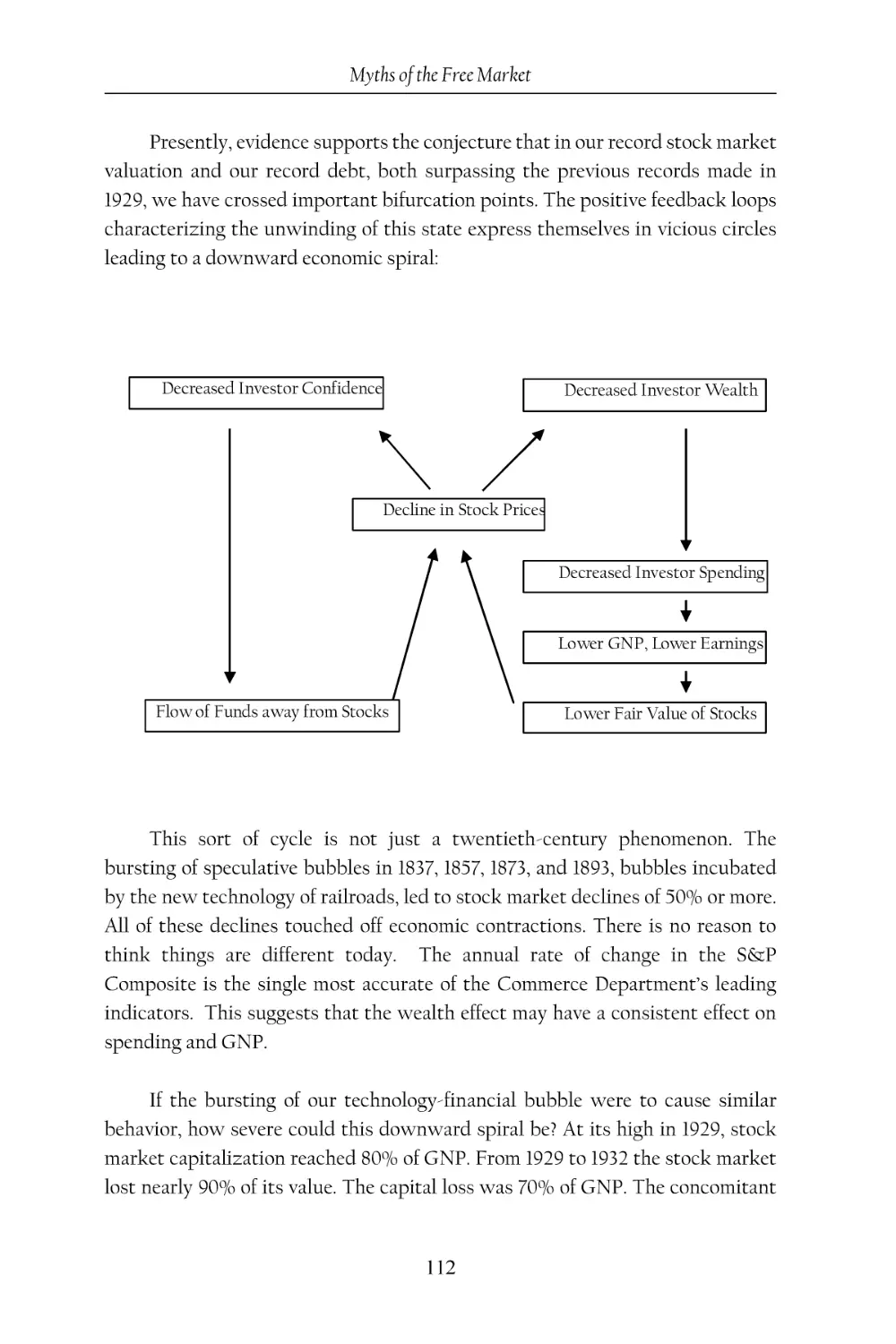















Текст
                    MYTHS OF THE FREE MARKET

MYTHS OF THE FREE MARKET
Kenneth S. Friedman

Algora Publishing
New York

© 2003 by Algora Publishing.
All Rights Reserved.
www.algora.com
No portion of this book (beyond what is permitted by
Sections 107 or 108 of the United States Copyright Act of 1976)
may be reproduced by any process, stored in a retrieval system,
or transmitted in any form, or by any means, without the
express written permission of the publisher.
ISBN: 0-87586-223-3 (softcover)
ISBN: 0-87586-224-1 (hardcover)
Library of Congress Cataloging-in-Publication Data
Friedman, Kenneth S.
Myths of the free market / Kenneth Friedman.
p. cm.
Includes bibliographical references and index.
ISBN 0-87586-223-3 (softcover) — ISBN 0-87586-224-1 (hardcover)
1. Free enterprise—Social aspects. I. Title.
HB95.F738 2003
330.12'2—dc21
2003003573

Printed in the United States

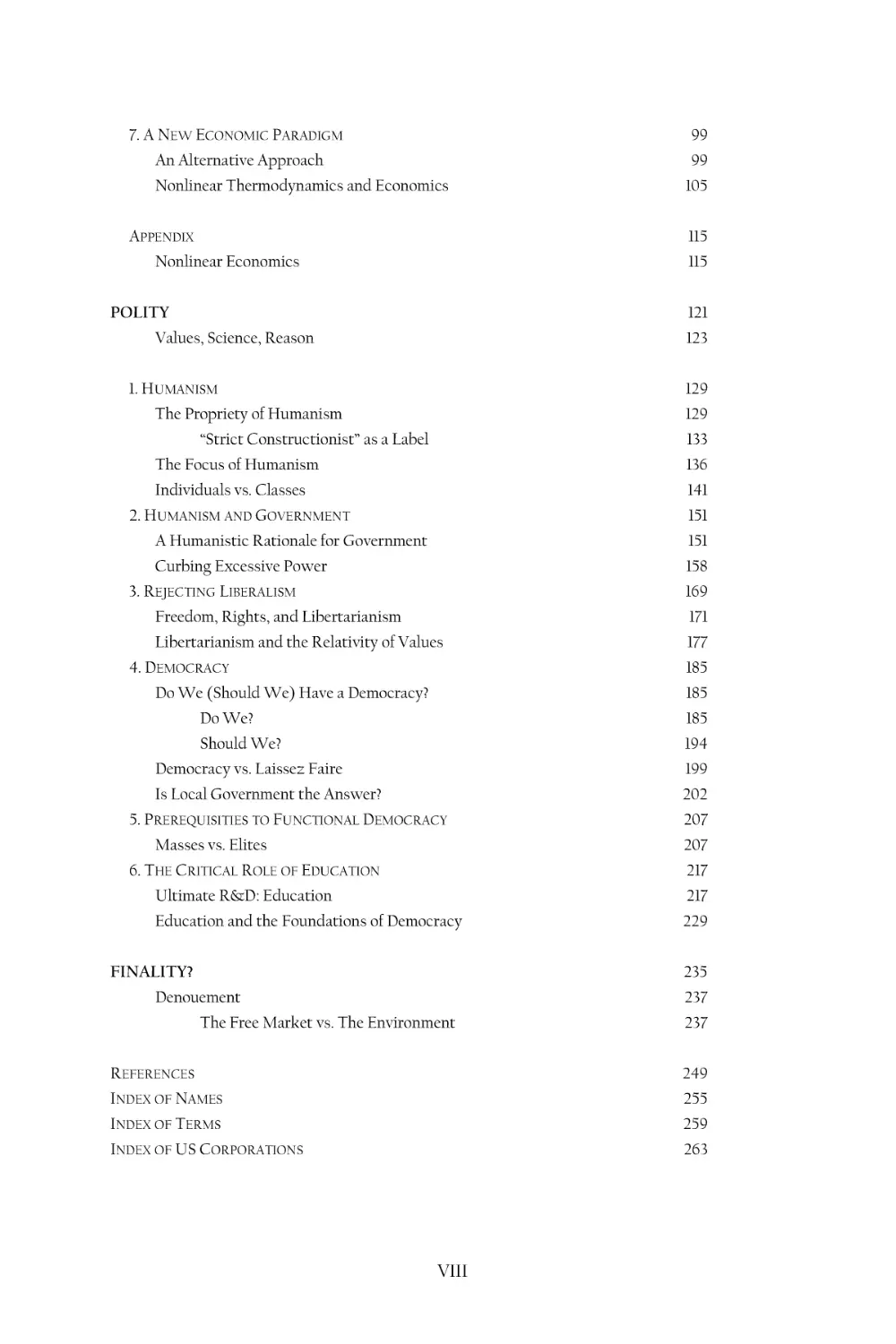
TABLE OF CONTENTS

Preface

1

Blind Faith

1
9

I. ECONOMY
1. THE POVERTY OF LAISSEZ FAIRE — THE EVIDENCE
Laissez Faire Has Not Worked

11
11

Early Symptoms of Economic Decline

17

2. LAISSEZ FAIRE — I T CAN’T POSSIBLY WORK

25

Laissez Faire Cannot Maximize Wealth

25

Do We Want What Laissez Faire Promises?

29

3. DECLINE AND DISASTER

37

History: The Effects of Economic Inequality

37

Decline

37

Disaster

40

Wealth and Taxes

48

4. THE SPAWN OF “LAISSEZ FAIRE”

53

Institutional Incubi

53

Short-Term vs. Long-Term Investment Horizons
Credit Overload

54
56

Mutual Funds and Corporate Management

58

Trade

64

Free Trade vs. Mercantilism

66

5. WHY WE FALL FOR LAISSEZ FAIRE

69

Mythology of Early Laissez Faire

69

Laissez Faire and Our Present Interests

75

6. THE VIRTUAL REALITY OF CLASSICAL ECONOMICS

79

Economics: Theory vs. Reality

79

Ebullient Markets — Dangerous Economy

93

VII

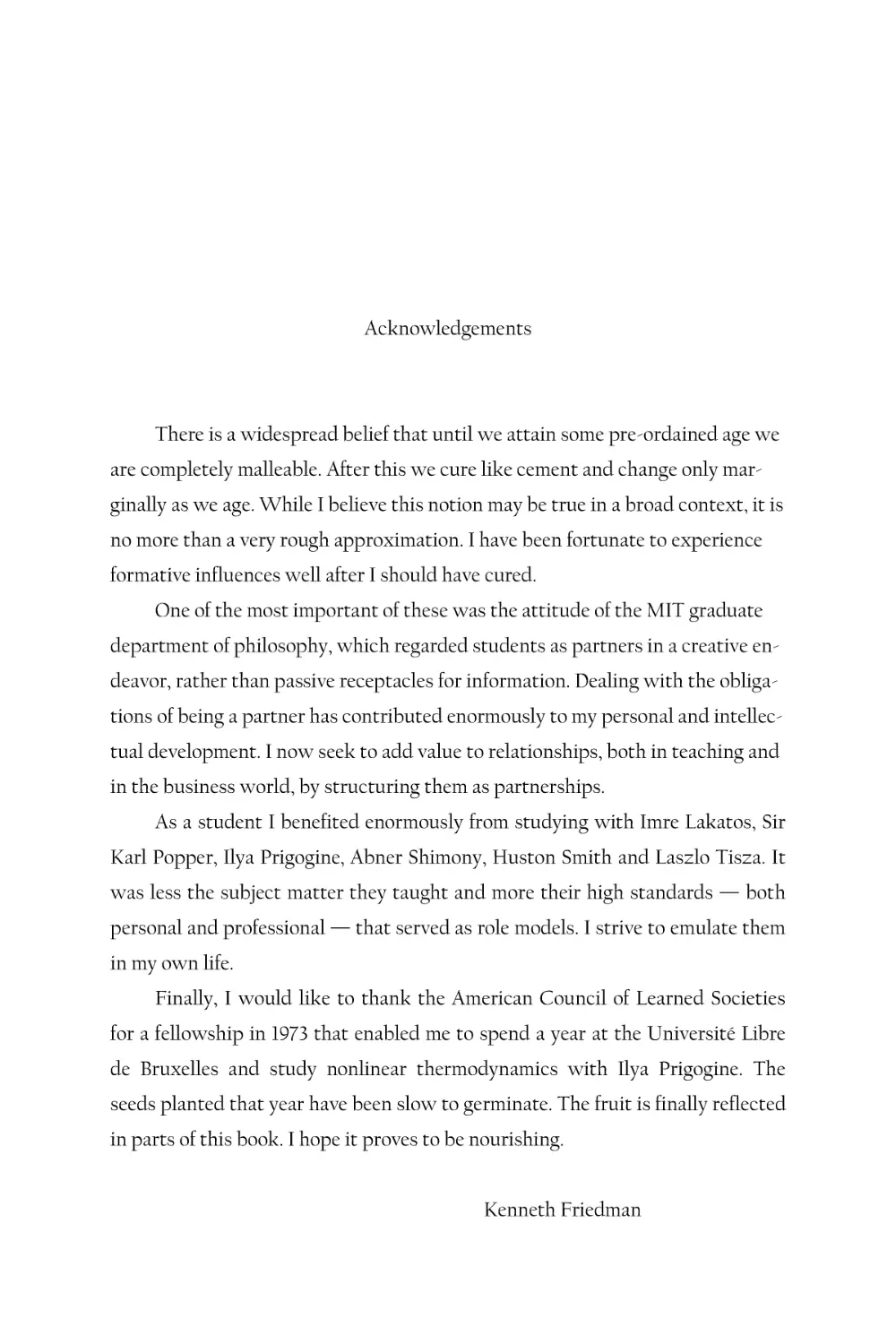
7. A NEW ECONOMIC PARADIGM

99

An Alternative Approach

99

Nonlinear Thermodynamics and Economics

105
115

APPENDIX
Nonlinear Economics

115
121

POLITY
Values, Science, Reason

123
129

1. HUMANISM
The Propriety of Humanism

129

“Strict Constructionist” as a Label

133

The Focus of Humanism

136

Individuals vs. Classes

141

2. HUMANISM AND GOVERNMENT

151

A Humanistic Rationale for Government

151

Curbing Excessive Power

158

3. REJECTING LIBERALISM

169

Freedom, Rights, and Libertarianism

171

Libertarianism and the Relativity of Values

177
185

4. DEMOCRACY
Do We (Should We) Have a Democracy?

185

Do We?

185

Should We?

194

Democracy vs. Laissez Faire

199

Is Local Government the Answer?

202

5. PREREQUISITIES TO FUNCTIONAL DEMOCRACY
Masses vs. Elites

207
207

6. THE CRITICAL ROLE OF EDUCATION

217

Ultimate R&D: Education

217

Education and the Foundations of Democracy

229
235

FINALITY?
Denouement

237

The Free Market vs. The Environment

237
249

REFERENCES
INDEX OF NAMES

255

INDEX OF TERMS

259

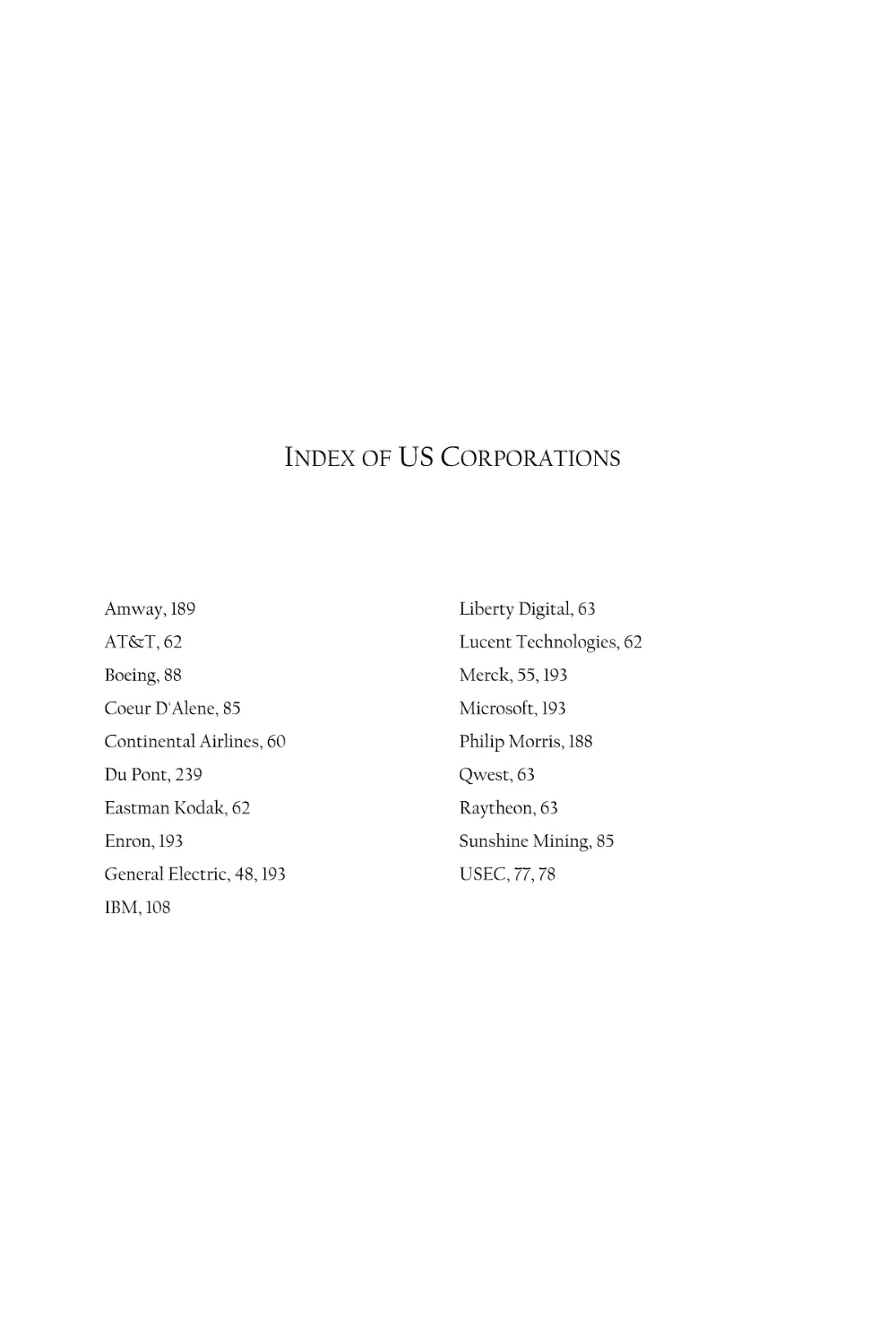
INDEX OF US CORPORATIONS

263

VIII

To my wife, Janet.
Courage to never give up.
What a role model!

Refutable self-serving lies
Cause misery untold.
Dire poverty destroys the lives
Of millions in your fold!
America! America!
Your dream has gone astray.
It serves the rich and powerful
But casts the rest away!

Acknowledgements

There is a widespread belief that until we attain some pre-ordained age we
are completely malleable. After this we cure like cement and change only marginally as we age. While I believe this notion may be true in a broad context, it is
no more than a very rough approximation. I have been fortunate to experience
formative influences well after I should have cured.
One of the most important of these was the attitude of the MIT graduate
department of philosophy, which regarded students as partners in a creative endeavor, rather than passive receptacles for information. Dealing with the obligations of being a partner has contributed enormously to my personal and intellectual development. I now seek to add value to relationships, both in teaching and
in the business world, by structuring them as partnerships.
As a student I benefited enormously from studying with Imre Lakatos, Sir
Karl Popper, Ilya Prigogine, Abner Shimony, Huston Smith and Laszlo Tisza. It
was less the subject matter they taught and more their high standards — both
personal and professional — that served as role models. I strive to emulate them
in my own life.
Finally, I would like to thank the American Council of Learned Societies
for a fellowship in 1973 that enabled me to spend a year at the Université Libre
de Bruxelles and study nonlinear thermodynamics with Ilya Prigogine. The
seeds planted that year have been slow to germinate. The fruit is finally reflected
in parts of this book. I hope it proves to be nourishing.
Kenneth Friedman

PREFACE
BLIND FAITH
The gap between rich and poor is now the widest in US history. This is
disturbing, for if history is any guide we have unwittingly placed ourselves in
grave danger.
Over the last millennium Europe has witnessed long cycles of widening and
narrowing economic disparity. In each cycle, once the gap between the rich and
the rest widened beyond a certain point, it presaged decline and disaster for all
of society, the rich as well as the poor. Could we be seeing the first tremors of a
new cycle, the outliers of the next menacing storm? In recent decades, many US
citizens have come under increasing financial pressure. Since the 1970s, our
number of working poor has increased sharply. Nearly all of our much-vaunted
newly-created wealth has gone to the richest.
Law enforcement has been unable to cope with burgeoning drug use at all
levels of society. Television and radio casually air sexually explicit programs that
would have been rejected in disgust by previous generations. Sexually
transmitted diseases have become pandemic. (The number of people in the U.S.
infected with genital herpes now stands at 45 million and is increasing at the
rate of 1 million per year.) These developments have fed a widespread perception
of irresponsibility and increasing licentiousness.
Children today spend more time than ever in front of television sets or
video games. They spend less with books, peers or parents. Where are they
learning their values? What are the values they are learning?

1

Myths of the Free Market
The alienation of large groups of people has led to private militias and to an
increase in violence that has become pervasive. With 60,000 incidents of
workplace violence per year, “going postal” is part of our vocabulary. “Road rage”
is another new expression and a measure of increasing violence by “normal”
people. Since 1980 our prison population has increased five-fold.
These developments have exacerbated a polarization between a new
evangelical Christian revival and those who are distrustful of religious
dogmatism but have no solutions to the very real problems the evangelicals are
addressing. Could these trends be harbingers of something more ominous, a
more violent fracturing of society?
For a country that has prided itself on its resourcefulness, the inability to
address such problems suggests something deeper at work. There is something,
powerful but insidious, that blinds us to the causes of these problems and
undermines our ability to respond. That something is a set of beliefs, comparable
to religious beliefs in earlier ages, about the nature of economies and societies.
These beliefs imply the impropriety of government intervention either in social
contexts (libertarianism) or in economic affairs (laissez faire).
The faithful unquestioningly embrace the credo that the doctrine of nonintervention has generated our most venerated institutions: our democracy, the
best possible political system; and our free market economy, the best possible
economic system. But despite our devotion to the dogmas that libertarianism
and free market economics are the foundation of all that we cherish most deeply,
they have failed us and are responsible for our present malaise.
The pieties of libertarianism and free markets sound pretty, but they
cannot withstand even a cursory inspection. Libertarianism does not support
democracy; taken to an extreme, it entails the law of the jungle. If government
never interferes, we could all get away with murder. Alternatively, if the
libertarian position is not to be taken to an extreme, where should it stop? What
is the difference between no government and minimal government? Attempts to
justify libertarianism, even a less than extreme position, have failed.
Laissez faire, or free market economics, characterized by minimal or no
government intervention, has a history that is long but undistinguished. Just as
the negative effects of a high fever do not certify the health benefits of the
opposite extreme, hypothermia, the dismal failure of communism, seeking
complete government control of the economy, does not certify the economic
benefits of the opposite extreme, total economic non-intervention.

2

Preface
It may seem odd, given the parabolic arc of our financial markets and the
swelling chorus of paeans to free market economics, but despite the important
role of the market, purer free market economies have consistently
underperformed well-focused mixed economies. In the latter part of the
nineteenth century the mixed economies of Meiji Japan and Bismarck’s Germany
clearly outperformed the free market economies of Britain and France. Our own
economy grew faster when we abandoned the laissez faire of the 1920s and early
1930s for the proto-socialist policies of Franklin D. Roosevelt. It has become
increasingly sluggish as we have moved back to a purer free market. Data of the
past few decades show that our GNP and productivity growth have lagged those
of our trading partners, who have mixed economies characterized by moderate
government intervention.
The persistently mediocre track record of laissez faire casts doubt on the
claim that an economy free from government interference invariably maximizes
the wealth of society. In fact, there are sound reasons the pure free market must
underperform well-focused mixed economies.
But despite laissez faire’s mediocre track record and despite powerful
arguments that it cannot possibly provide what it promises, the notion of the
unqualified benefit of the free market has become deeply embedded in our
mythology. Apologists have exulted in claims that glorify free market mythology
at the expense of reality, and also at the expense of society. Free market
principles, even though they have failed in economics, have been eagerly applied
to sectors ranging from politics to education, where they have contributed to
societal dysfunction.
One politically popular myth, that free market economics and government
non-intervention provide the basis for true democracy, flies in the face of history.
The first democrats, the classical Athenians, had a word for the ideal free
marketer, the homo economicus, working for his own economic gain but
unconcerned with the community. It was not particularly complimentary, the
ancestor of our word “idiot.” Pericles expressed the sentiment underlying this:
“We regard the citizen who takes no part in these [public] duties not as
unambitious but as useless…”
We have ignored the ramifications of this as we remodeled our pantheon.
We have replaced the notion of public-spirited citizens interested in the
common weal, a vital part of democratic thought from ancient Athens to our
founding fathers, by the invisible hand of the free market. This promises to
maximize benefit for society, if only we will be idiots.

3

Myths of the Free Market
In so far as it fails to value disinterested public spirit, free market doctrine
only pretends to cherish democracy. Let the people concentrate on their
economic gain while their leaders rule in any manner they choose. The Peoples’
Republic of China instituted free market reforms to sustain its autocratic
political regime. Augusto Pinochet brutally repressed even mild political dissent
while pursuing free market economic policies in Chile.
The reality of our own political power structure is that despite the primacy
of our financial markets and our contemporary rituals of democracy, powerful
corporations, unions and special interest groups fund political campaigns and
exact repayment in the form of enormous influence on legislation. Our
government is responsive primarily to these organizations, rather than to
citizens. This resembles the corporatism of Mussolini’s Italy more closely than
any historic democracy. We are blind to the connection between corporatism
and the lack of public interest in politics and in the common good.
In our enthusiasm for the dogma that any government interference is
necessarily bad, we forget it was government action that ended child labor. It
was government action that outlawed slavery, despite its profitability. It was
government action that ended the Great Depression, after years of failure of nonintervention. It was government action that curbed the most virulent
expressions of racism, that provided an education for the great majority, that
created a large stable middle class. The free market did not achieve any of these
goods, and there is no indication that it ever would have done so.
This is not meant to imply that everything government does is beneficial.
But to start from the faith that everything government does is necessarily
harmful not only disregards history; it sacrifices the ability, and even the
interest, to distinguish between the beneficial and the harmful.
Just as the value of government needs to be assessed independent of dogma,
the value of the free market has to be gauged in the real world. Free markets
provide incentives for innovation. They enforce pragmatism at the expense of
ideology. They fit production to needs and desires of consumers and they lower
the price of goods. But free markets can also cause problems. Some of these stem
from the pre-eminence of the short term. This endangers long-term prosperity.
Independently, free markets encourage an extreme concentration of wealth
that has historically destroyed the fabric of society and led to a lower standard of
living for everyone. Government intervention may be our only defense against
the natural economic forces that lead to such a concentration of wealth. But the
prevailing libertarian/laissez faire credo, even though it may be held by intelligent

4

Preface
and well-meaning individuals, blinds us to both the danger and the potential for
any response that is not generated by the free market itself. Our beliefs, despite
the sincerity with which we hold them, lead us astray.
One reason we remain so tightly bound to laissez faire is that we lack a
better economic theory. Historically, no widely accepted theory, no matter how
badly it has failed, has been replaced until a better theory was found. This book
suggests an alternative — nonlinear thermodynamics, the most general physical
theory that applies to complex open systems. Simply, economies are complex
open systems. Nonlinear thermodynamics applies to such systems. Classical
physics, the model for classical economics, does not.
Nonlinear thermodynamics, for which Ilya Prigogine won the Nobel Prize
in chemistry, explains phenomena in complex open systems of thermodynamics,
chemistry and biology. Economies are complex open systems whose
mathematical description and behavior resemble the nonlinear description and
behavior of thermodynamic, chemical and biological systems. This suggests that
economics may be understood from a nonlinear perspective. Such an
understanding would support a very different economic paradigm.
The most important difference between laissez faire and nonlinear
economics is that laissez faire assures us of a stable and benign economic
equilibrium. Should an economy be temporarily displaced from equilibrium,
natural economic forces will restore that wealth-maximizing equilibrium. By
contrast, nonlinear economics shows that the equilibrium may be unstable. If a
system is displaced sufficiently far from equilibrium, natural forces may take it
even further. This process is not necessarily benign. Historically, it has led to
disaster.
The instability of local equilibrium is common, and not only in chemistry
and biology. In economics differences in wealth, once they reach a certain point,
naturally tend to increase. In the struggle for additional wealth, pre-existing
wealth has an advantage that is often decisive. The wealthy can outbid the nonwealthy for valuable information, for political influence, for the skills and
technologies necessary to acquire additional wealth, dominating the most
favorable technologies, products, and markets.
The rich grow richer while the poor grow poorer. This can be a dangerous
destabilizing process. Throughout history it has repeatedly led to increasing
violence and a decline in security and standards of living for all. Intervention may
be necessary to maintain proximity to equilibrium and to prevent natural forces
from destabilizing the economy.

5

Myths of the Free Market
This has ramifications for government. Laissez faire is prone to systematic
malfunction. It has not maximized wealth. In principle it is incapable of
maximizing wealth. It increases economic differences to the point that these
jeopardize the stability of society and the welfare and security of everyone. There
are circumstances in which government intervention may be appropriate, even
vital. For this reason the doctrine of absolute non-interference, so glibly
dispensed by free marketers, is pernicious. It leaves us vulnerable to the
destabilization that can be wreaked by natural economic forces. Nonlinear
economics would be an improvement.
In addition to incorporating a more appropriate physical model and
supporting a more flexible approach to the role of government, such an
alternative would fit the personal and social values that have characterized
civilized societies since ancient Athens and Confucius. For there are conditions
in which the components of nonlinear systems are mutually interdependent.
A nonlinear model with mutually interdependent components, while it is
compatible with free markets, would support a traditional democratic view of
citizens concerned with the common good. It would explain interactions among
citizens with a focus on community and responsibility. It would counterbalance
the centrifugal notions of libertine freedom and mutual independence that foster
an each-person-out-for-himself mentality that dominates modern thought. It
would provide a more viable foundation for society.
In the spirit of such a foundation, humanism provides a promising platform
from which to address societal problems. Although humanism does not pretend
to present an alternative to religion, it does address spiritual values and it is
compatible with religious teachings while avoiding dogmatism and narrow
sectarianism. It stresses the value and dignity of human life and is sensitive to
quality of life. It calls attention to our relationship to each other and emphasizes
our responsibility to take action not only to improve our own lives, but to enable
others to do the same. It takes seriously our role as stewards of the environment.
While humanism is compatible with most religions, it is not compatible
with laissez faire. This is because laissez faire implies that commitment to others, to
society and to the environment is unnecessary, even pointless. So long as each
person works to maximize his own immediate economic advantage, free market
forces will insure the greatest benefit for society. Integrity, discipline, far-sighted
action to achieve meaningful long-term goals add nothing. No wonder the
popularity of laissez faire has corroded our traditional values.

6

Preface
While the consequences of this corrosion are long term, that does not make
them less noxious. If we fail to stem the corrosion we face an unpleasant period
of economic stagnation, social decay, and increasing violence.
To those who would regard this book as alarmist, I would respond that it is
irresponsible to shout: “Stay the course!” when you see breakers on the coral
reefs dead ahead. Our country has shown great resourcefulness in times of crisis.
The surest way to cause grievous damage is to anaesthetize the public so that it
does not notice a developing crisis until it is too late. Yet we are now blithely
meandering down a path fraught with peril, heedless of the warning signs.
Evolutionary pressures have selected for a propensity to react to sudden
changes in our environment. But we ignore gradual changes, including those
produced by flaws in our political and economic institutions. Because of the time
lag before effects become manifest, we misinterpret weaknesses as strengths.
We are like a man who walks with a cane — where every day a prankster shaves
one millimeter off the bottom of his cane — and so we are convinced we are
growing taller. We are not growing taller, and the sooner we confront reality the
less painful will be the consequences.
While this book focuses on the U.S., we have become subjects of
worldwide emulation. The implications of this book do not stop at our borders,
but extend to a large and growing portion of the world.
Because we are comfortable materially, it is easy to avoid examining our
fundamental beliefs. This is perilous. As Goethe claimed (Wilhelm Meister): “We
fear nothing more than reason; we ought to fear stupidity if we understood what
is really frightful; but reason is too uncomfortable, it must be brushed aside;
whereas stupidity is merely fatal, and that can be tolerated.”
A similar sentiment is echoed by W. H. Auden:
Those who will not reason
Perish in the act;
Those who will not act
Perish for that reason.

7

ECONOMY

THE POVERTY OF LAISSEZ FAIRE — THE EVIDENCE
LAISSEZ FAIRE HAS NOT WORKED
“The Emperor’s New Clothes” is a marvelous story. Of course, no one takes
it seriously. It may be one thing, perhaps the downside of inbreeding, for a stark
naked emperor to be convinced he is wearing a magnificent suit of clothes. It is
quite another for the populace to go along with the fantasy. We know that
people are not that gullible.
In fact, people are gullible, more than we realize. It is difficult to question
widely held beliefs, particularly in uncontroversial matters where we are often
blind to obvious flaws. As Nietzsche cynically observed, “Men believe in the
truth of anything so long as they see that others strongly believe it is true.”
For decades the most uncontroversial of disciplines, physics, accepted the
Rutherford solar system model as the correct model of the atom. This envisages a
central sun-like nucleus, composed of positively charged protons and electrically
neutral neutrons, orbited by negatively charged planetary electrons.
Even high school physics students should be aware of the problems. For
one thing, like charges repel. This electric repulsion is far more powerful than
gravitational attraction. So why don’t the protons fly apart? How can the
nucleus be stable? Independently, a positively charged nucleus generates a radial
electric field. As the negatively charged electrons orbit the nucleus and intersect
this field they should continuously emit electromagnetic radiation and their
orbits should gradually decay into the nucleus. How can any atom be stable?

11

Myths of the Free Market
These questions were eventually answered by a new theory, quantum
mechanics. But until the advent of quantum theory the inconsistencies were
hardly noticed, even by physicists.
The failure to see past widely accepted beliefs is not just a modern
phenomenon. Nearly a millennium ago the great supernova of 1054 went
unrecorded in Europe, though Chinese observers claimed it was brighter than
Venus for weeks. The Western belief that the heavens are perfect and
unchangeable blinded us to visible reality.
We have a parallel in economics. Laissez faire is the object of a faith that is
widely accepted and uncontroversial. According to this faith a pure free market
system, unencumbered by government interference, must provide the best
economy. But despite our unquestioning belief and despite the appearance of
prosperity so confidently exuded by soaring financial markets, there is a wide
range of data (that we ignore) that calls this faith into question. It is remarkable
that even economists are blind to this.
Of course, no country has a pure free market economy. Everyone knows
that in all developed countries governments tax their citizens and spend 20% of
GNP or more on items ranging from social programs to highways, from libraries
and schools to courts and prisons, from parks to national defense. Such taxation
and spending necessarily distort the pure free market.
While this observation may be valid as far as it goes, and while it may be
boringly trivial to even casual students of economics, it understates how far
removed we are from pure laissez faire and just how strange a truly pure free
market economy would be.
Every country has laws that limit child labor, that protect patent rights,
that prohibit profitable industries such as counterfeiting, enslavement,
kidnapping, selling unethical drugs. Because such laws open the door to
government interference with individuals or institutions seeking to maximize
profits, they necessarily conflict with a pure free market. True believers in laissez
faire must find them abhorrent.
Such a view — that laws against anything from slavery to drug trafficking
are bad because they necessarily diminish the wealth of society — seems bizarre
indeed. (Though Ludwig von Mises, a true believer consistent in his defense of
pure laissez faire, argued against government interference with drug trafficking.)
Still, free market apologists might contend that except for such extremes,
the closer we come to pure laissez faire, the better. But there is little evidence for
even this fallback position. The U.S. has come closer to laissez faire than most

12

The Poverty of Laissez Faire — The Evidence
other countries, especially since the Reagan Administration. If free market
policies are the best economic policies then we should have experienced the
most robust growth in the world during this period. But this has not happened.
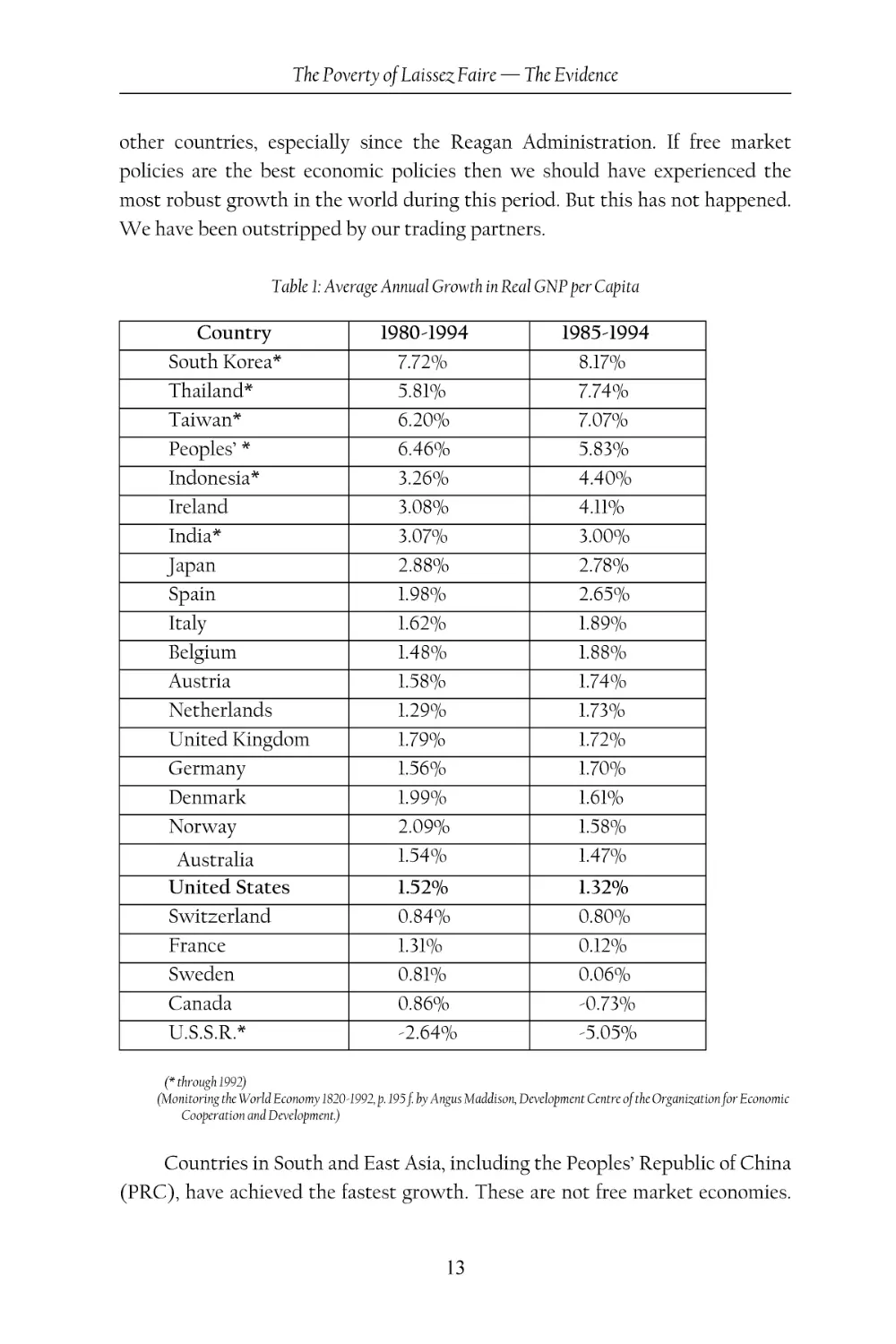
We have been outstripped by our trading partners.
Table 1: Average Annual Growth in Real GNP per Capita

Country
South Korea*
Thailand*
Taiwan*
Peoples’ *
Indonesia*
Ireland
India*
Japan
Spain
Italy
Belgium
Austria
Netherlands
United Kingdom
Germany
Denmark
Norway
Australia
United States
Switzerland
France
Sweden
Canada
U.S.S.R.*

1980-1994
7.72%
5.81%
6.20%
6.46%
3.26%
3.08%
3.07%
2.88%
1.98%
1.62%
1.48%
1.58%
1.29%
1.79%
1.56%
1.99%
2.09%
1.54%

1985-1994
8.17%
7.74%
7.07%
5.83%
4.40%
4.11%
3.00%
2.78%
2.65%
1.89%
1.88%
1.74%
1.73%
1.72%
1.70%
1.61%
1.58%
1.47%

1.52%
0.84%
1.31%
0.81%
0.86%
-2.64%

1.32%
0.80%
0.12%
0.06%
-0.73%
-5.05%

(* through 1992)
(Monitoring the World Economy 1820-1992, p. 195 f. by Angus Maddison, Development Centre of the Organization for Economic
Cooperation and Development.)

Countries in South and East Asia, including the Peoples’ Republic of China
(PRC), have achieved the fastest growth. These are not free market economies.

13

Myths of the Free Market
They are mixed economies characterized by massive and focused government
intervention. They discourage private consumption and encourage savings. They
single out strategic industries for protection and investment. (Governmentlinked corporations generate more than half of Singapore’s GNP.)
Although the PRC has recently moved in the direction of a free market
economy, in part to sustain its totalitarian political system, its dramatic economic
growth began in 1949, well before free market elements were tolerated. Despite
retaining a far greater measure of central economic planning and control than the
U.S., the Chinese rate of growth has continued to outpace ours.
It is true that the developing economies of South and East Asia have
benefited from strong regional growth from a low base, in contrast to the more
mature economy of the U.S. But it is difficult to make this argument about Japan
or Europe. Yet these mature economies have matched or exceeded our growth,
despite their tolerance of higher tax rates and greater government interference in
economic affairs.
Contrast our track record to that of the longest-lived socialist democracy.
From 1946 to 1969, when Sweden was governed by the Social Democrats under
Tage Erlander, its real GNP growth averaged nearly 3.8% (better than ours),
without a down year. “Sweden’s prosperity was as high as its taxation and its
standards of state-sponsored health, education, and social security.” (Davies,
Europe: A History, p. 941.)
Even our own internal comparisons fail to flatter laissez faire. Over the past
half-century we have seen lower tax rates and less government interference. We
have come a long way toward free enterprise from the proto-socialist policies of
Franklin D. Roosevelt. Since the Kennedy Administration we have reduced the
marginal tax rate on our highest incomes from the 91% that remained in effect
from the 1940s into the mid-1960s (and a brief peak of 94% during World War
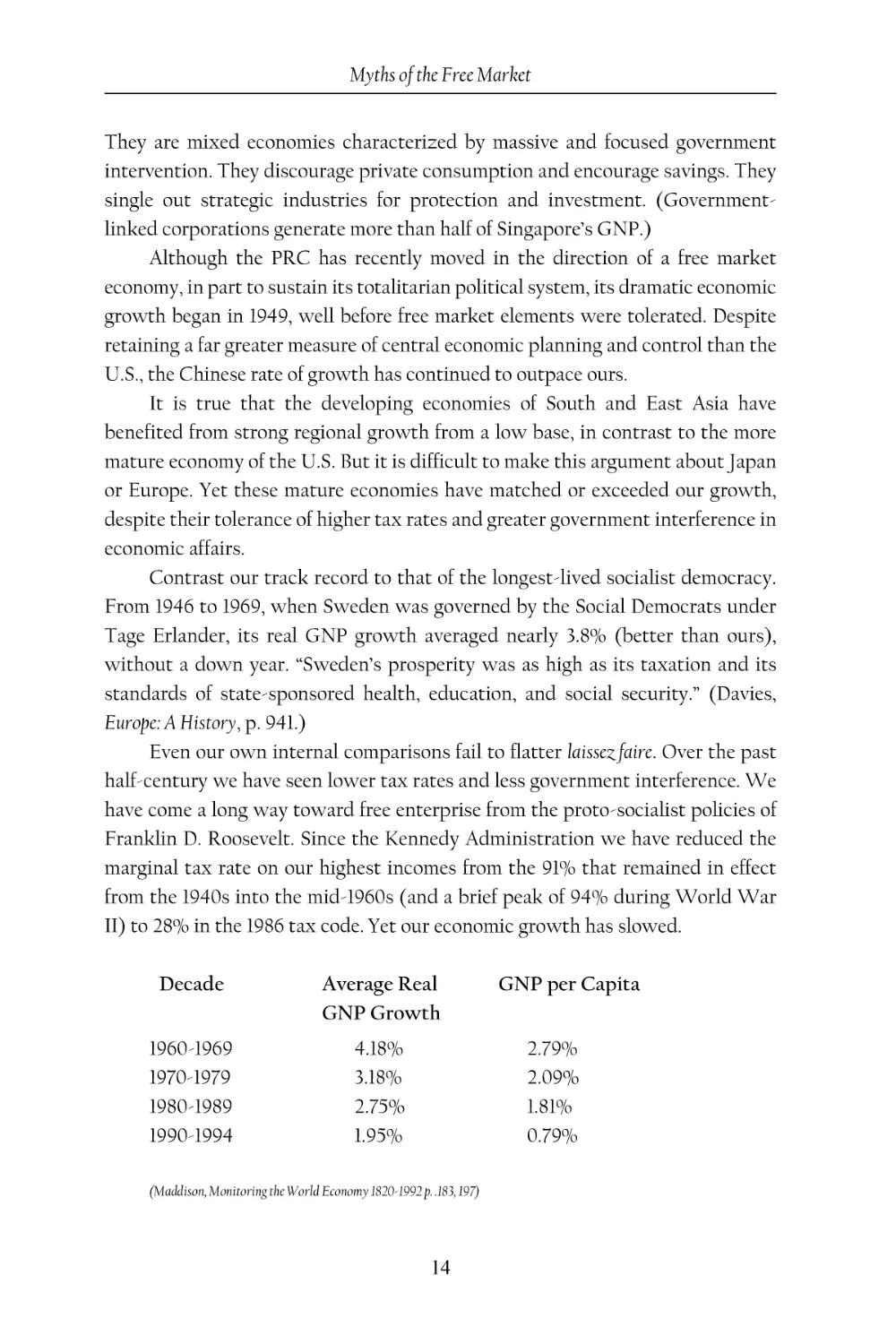
II) to 28% in the 1986 tax code. Yet our economic growth has slowed.
Decade

Average Real
GNP Growth

1960-1969
1970-1979
1980-1989
1990-1994

4.18%
3.18%
2.75%
1.95%

GNP per Capita
2.79%
2.09%
1.81%
0.79%

(Maddison, Monitoring the World Economy 1820-1992 p. .183, 197)

14

The Poverty of Laissez Faire — The Evidence

Despite our adoption of the most enlightened free market policies, our
performance resembles that of a declining Great Britain in the late nineteenth
century. “Britain soon lost what early lead it possessed. Industrial production,
which had grown at an annual rate of 4 percent in the period 1820 to 1840 and
about 3 percent between 1840 and 1870 became more sluggish; between 1875 and
1890 it grew at just over 1.5 percent annually, far less than that of the country’s
chief rivals… finally, British industry found itself weakened by an ever rising tide
of imported foreign manufactures into the unprotected home market — the
clearest sign that the country was becoming uncompetitive.” (Kennedy, The Rise
and Fall of the Great Powers, p. 228.)
Although our government policies have been increasingly laissez faire and
increasingly friendly to corporate America, our investment, productivity and
economic growth have all lagged. Similarly, as the world has moved toward
purer capitalism, worldwide economic growth has slowed. From 5.5% in the
1960s, world GNP growth declined to 3.4% in the 1970s, 3.2% in the 1980s, and
further in the 1990s. (Maddison, Monitoring the World’s Economy 1820-1992, p. 227.)
It is likely to decline still further in this first decade of the new millennium.
How can we look at this evidence and still maintain that laissez faire is the
best possible economic system? Clearly it is not. Nor has it been. The “European
economic miracle” of the late nineteenth century was achieved by Germany
under The Iron Chancellor, Otto von Bismarck. Unlike the laissez faire policies
pursued by England and France during that period, Bismarck’s Germany
adopted interventionist economic policies, guiding the development of vital
industries such as steel and coal and nationalizing the railroads. Germany also
provided insurance and social security for workers and free compulsory
education for youth.
Whatever you might think of Bismarck’s authoritarianism (whose effects
were less pervasive than many suppose; while he was chancellor Germany
became the first European country to institute universal male suffrage, and its
universities, suffused with a measure of internal academic freedom, gained a
place among the greatest in the world), the fact remains that German economic
progress eclipsed that of France and England, its two major rivals. From being
the weakest of the three countries, economically, technologically and militarily,
it surpassed France and challenged the industrial and military might of England.
Similarly, the dramatic spurt in Japanese economic growth associated with the
Meiji Restoration was achieved under government regulation.

15

Myths of the Free Market
Contrast these economic performances to that of present-day Mexico,
which has faithfully followed the guidance of the most sophisticated proponents
of laissez faire. Mexico has vigorously pursued free market policies from
privatizing state-owned industries to eliminating tariffs in the name of free
trade. But it has not been a leader in economic vitality, stability of currency, or
improvement in standards of living.
Mexico’s privatization of state industries created new billionaires but real
wages declined, the average family losing 30% of its purchasing power. The $21
billion brought into state coffers by privatization failed to prevent a currency
collapse that led to the country’s inability to pay interest on its debt. The forced
devaluation of the peso contributed to the impoverishment of the middle class
and the overthrow of a political party that had ruled for nearly a century.
(Argentina, which also faithfully adhered to the commandments of orthodox free
enterprise, even pegging its currency to the U.S. dollar, has experienced a similar
economic and financial collapse.)
Similarly, despite aid and investment from other industrialized countries,
the rapid Russian transition from communism to free market capitalism was a
disaster. It more deeply impoverished the majority of its people. It reduced most
of the country outside the major cities to a meager subsistence exacerbated by
the collapse of communications, health care and law enforcement. This led to a
decline in life expectancy. It strengthened a powerful underworld that has little
allegiance to the country itself or to the quality of life of its citizens.
These examples provide a reality check that raises critical questions for
laissez faire. If laissez faire is the best of all economic policies, why has it performed
so poorly?
Why is our economic growth slower than that of mixed economies?
Why has our economic growth declined as we increasingly pursued purer
free market policies?
Why did real per capita weekly earnings in the private non-agricultural
sector fall 13% since the early 1970s, with much of our middle class able to stay
afloat only as a result of a large increase in the number of two-income families?
(By contrast, real wages in the mixed economies of Europe have doubled since
the early 1970s.)
Why, despite an increase in the number of two-income families and also in
the average workweek, has our standard of living increased more slowly than
those of our major trading partners with more mixed economies?
Why have we been surpassed in real GNP per capita by a number of
European countries plus Japan and Singapore (all mixed economies)?
16

The Poverty of Laissez Faire — The Evidence
EARLY SYMPTOMS OF ECONOMIC DECLINE
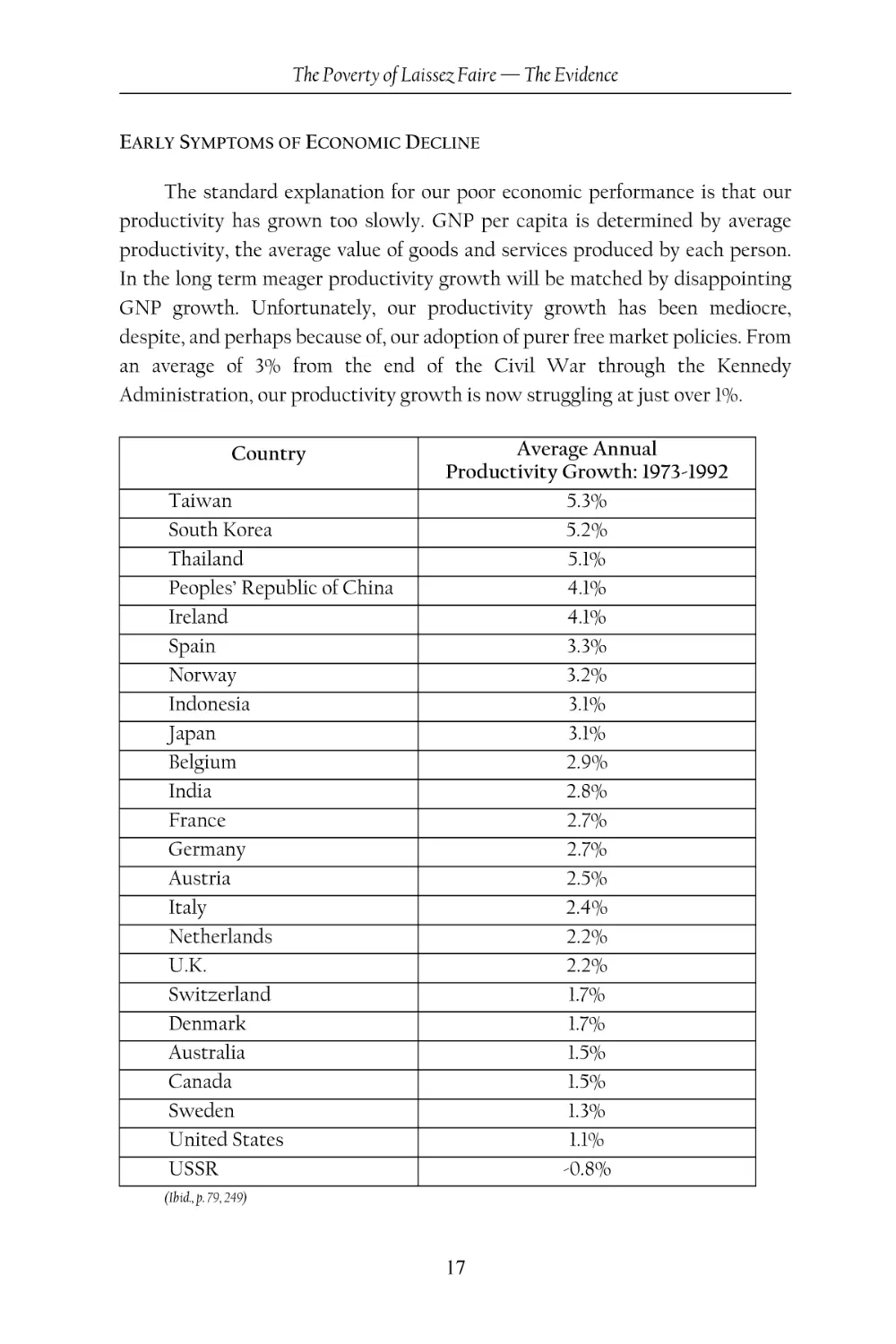
The standard explanation for our poor economic performance is that our
productivity has grown too slowly. GNP per capita is determined by average
productivity, the average value of goods and services produced by each person.
In the long term meager productivity growth will be matched by disappointing
GNP growth. Unfortunately, our productivity growth has been mediocre,
despite, and perhaps because of, our adoption of purer free market policies. From
an average of 3% from the end of the Civil War through the Kennedy
Administration, our productivity growth is now struggling at just over 1%.
Country
Taiwan
South Korea
Thailand
Peoples’ Republic of China
Ireland
Spain
Norway
Indonesia
Japan
Belgium
India
France
Germany
Austria
Italy
Netherlands
U.K.
Switzerland
Denmark
Australia
Canada
Sweden
United States
USSR

Average Annual
Productivity Growth: 1973-1992
5.3%
5.2%
5.1%
4.1%
4.1%
3.3%
3.2%
3.1%
3.1%
2.9%
2.8%
2.7%
2.7%
2.5%
2.4%
2.2%
2.2%
1.7%
1.7%
1.5%
1.5%
1.3%
1.1%
-0.8%

(Ibid., p. 79, 249)

17

Myths of the Free Market

There are economists who insist that our productivity growth is better
than the official numbers. But careful research has not borne out such hopeful
claims. Professor Robert Gordon, a consultant for the Federal Reserve, recently
completed a comprehensive study on productivity. His results show that over
the past five years there has been no productivity improvement in the
manufacture of non-durable goods. For durable goods (except computers), there
has actually been a decline in productivity. Our entire increase in manufacturing
productivity has come from the computer-manufacturing sector, which
accounts for just over 1% of GNP.
But if we have adopted the most enlightened economic policies and if
productivity is so important, why is our productivity growth so low?
Economists have told us productivity growth depends on net business and
infrastructure investment, which in turn depends on savings. So our GNP
growth has been lagging because our productivity growth has been lagging. And
our productivity growth has been lagging because our investment has been
lagging. And our investment has been lagging because our savings rate has been
lagging.
This still fails to explain our mediocre productivity growth; it just redirects
the question upstream. If savings and investment are so important, why are our
savings and investment rates so low? In particular, what have we done to
increase our savings, investment and productivity?
Since 1980 we have tried two different approaches. The former approach,
adopted by the Reagan Administration, was a return to the strict orthodoxy of
laissez faire. Reagan’s team lamented that we had been deceived by the liberals
to worship the idol of big government. It claimed we were suffering the
consequences of our idolatry in lower savings and productivity and in slower
economic growth. If we wished to reap the full-flowing benefits of our economic
system, we would have to return to a pure faith in the free market.
One of the tenets of this faith is that it is the wealthy who generate savings.
Our lower and middle classes must spend all their income on the necessities of
life and have little left over to save. Only the wealthy have the capacity to save
and invest. But our oversized government has placed undue burdens on the
wealthy. Government has redistributed wealth, taking from the rich and giving
to the poor, who cannot save. It has also taken from the rich and given to

18

The Poverty of Laissez Faire — The Evidence
government bureaucrats to spend on their pet projects, unencumbered by the
market.
The Reagan program was designed to remedy these evils. If we were to take
after-tax dollars from those who need them and so are likely to spend them, and
give them to those who do not need them and so are likely to save them, we
would redirect consumption into increased savings, a higher level of investment,
greater productivity, and a better economy for all.
In addition, if we were to take money from government bureaucrats and
return it to the wealthy, they would save it and invest it in accord with free
market principles. These investments would now be regulated by the invisible
hand of market prices and no longer by the perceptions of bureaucrats. Because
the invisible hand automatically maximizes total wealth, at least in theory, this
transfer of capital must have a positive effect on the economy as a whole. Giving
more money to the wealthy would trickle down to everyone’s benefit.
In keeping with this picture painted by his economic advisors, the Reagan
tax cuts were geared entirely toward the rich. According to the Congressional
Budget Office, Reagan’s tax policies reduced the total federal tax rate (including
Social Security) for the top 1% while increasing it for the bottom 90%. A 1992
study by H & R Block showed that from 1977 to 1990 the total federal tax bill for
a person earning $50,000 a year increased 8%, while the tax bill for someone
earning $200,000 a year decreased 28%.
Many of those supporting the Reagan tax cuts pointed to the Kennedy tax
cut that reduced the top marginal rate from 91% to 70%. They claimed that this
was responsible for the halcyon economy of the 1960s. Wrong! Kennedy was
unable to get his proposals through Congress. The passage of his program had to
wait for Lyndon Johnson, and the tax reductions did not take effect until 1964
and 1965. So what happened?
These tax cuts did mark a major watershed. But — contrary to the claims of
apologists for laissez faire — it was a negative one. Real GNP growth declined
from over 5% in the first half of the 1960s to 3.3% in the second half of the 1960s
and 2.6% in the first half of the 1970s. The decades after these tax cuts have been
marked by slower growth, higher inflation, higher unemployment, higher
interest rates, and greater debt than the previous decades. After the tax cuts our
productivity growth, the most important determinant of long-term economic
growth, began to plummet. Long-term productivity growth declined 60% from
its levels prior to the Kennedy tax cut. (The other major pre-Reagan tax cut,

19

Myths of the Free Market
which reduced capital gains taxes by 30% in 1978, also marked a steep economic
decline.)
Despite this history, Reagan’s economic advisors, blandly confident,
assured us the Reagan tax cut would stimulate the economy and bolster savings.
They also assured us — at least until tax receipts plummeted — that the
economic growth produced by this tax rate cut would increase federal tax
receipts.
Contrary to these assurances, the Reagan tax cuts did not increase
economic growth, savings, investment or tax receipts. In light of the failure of
the Kennedy-Johnson tax cut, it should not be surprising that the effect of the
Reagan tax cuts was just the opposite of what his economic advisors had
forecast. Our savings rate, guaranteed to rise, did not even hold steady.
While our net savings had only rarely and briefly dropped below 6% of
GNP from 1950 to 1980, it has been declining steadily since the early 1980s,
decisively penetrating the 6% level. It has gone negative for the first time in 70
years. Even corporate investment, consistently our most positive investment
sector, has failed to improve. Despite heavy borrowing and large reductions in
corporate tax rates in the 1980s, corporate investment is little changed from its
levels of 50 years ago when the highest corporate income tax rate exceeded 50%.
In short, the bill of goods we were sold is worthless. The Reagan
Administration proclaimed that if our tax policies were tilted to favor the rich
then savings and investment would rise and everyone would prosper. But
contrary to the glowing promises of progress and prosperity for all, our
economic growth slowed, our savings rate declined, our debt rose sharply, and
all but the richest lagged.
Had we considered the effect of the Kennedy-Johnson tax cut, we might
have hesitated to swallow whole hog the laissez faire revivalist message of
Reagan’s economic advisors. Had we looked at Western Europe, where the ratio
of tax revenues to GNP is 30% higher than ours, but where savings exceed ours
and productivity and standards of living are rising faster, we might have
reconsidered. Had we even examined our own historical correlation between
reducing marginal tax rates on the highest incomes and slower economic
growth, we might have had second thoughts about sharply cutting the top
marginal tax rates.
Why did we not look at the historical evidence and decide — at the very
least — on a more gradual approach? Why did the attraction of free market
ideology overwhelm the lessons of history? For an administration that described

20

The Poverty of Laissez Faire — The Evidence
itself as conservative, this is astonishing, for central (if not defining) themes of
conservative thought have been the precedence of history over ideology and a
worry about what could go wrong with radically new policies.
From a truly conservative perspective, considering the previous failure of
similar policies, the failure of Reagan’s policies was no surprise. Surprising or
not, that failure left us with declining savings, stagnant investment, mediocre
productivity improvement, and slowing economic growth.
Our more recent attempt to deal with low productivity growth stems from
the Clinton Administration of the 1990s. It reflected a different philosophy: if
you can’t hit the target, move the target. In the spirit of this philosophy, we
introduced a new variable to the measurement of productivity and economic
growth. This is the hedonic deflator, which is applied to the computer industry
and adjusts the price of an item for improvements in quality.
No other major economy uses the hedonic deflator, which has been
challenged as inappropriate by European economists. Our use of this measure for
the past several years renders meaningless comparisons of our economic growth,
productivity growth and inflation with those of other countries or our own past.
Yet the hedonic deflator is a superficially plausible measure. If the quality
of an item improves, then a commensurate price increase provides the same
value. What appears to be inflation — a higher price — really is not. Why, then,
do other countries reject this measure?
They can make a powerful case. Suppose the hedonic deflator had been
introduced in 1980. Since then, three years after the Apple II was marketed as the
first personal computer, the amount of memory in personal computers has
increased several million-fold. The power of microprocessors has grown ten
thousand-fold. Software that comes with the computer makes it far more user
friendly. Modems and the Internet dramatically widen the range of tasks
computers can perform.
Today’s computer is at least 500 times more valuable than the 1980
computer. The 1980 computer sold for $2,000. So our modern computer has a
real value of $1 million ($2,000*500). Presently, 15 million computers are sold
annually. The real value of those computers is $15 trillion ($1 million * 15
million).
Thanks to this contribution, our annual real GNP growth since 1980 would
approach 10% even if the rest of the economy had not grown at all. How
remarkable, when no developed country has ever managed to sustain real GNP

21

Myths of the Free Market
growth of more than 5% per year and when our Federal Reserve warns that
prolonged growth above 3% would stimulate inflation.
Even better, we have had 20 years of deflation. Our real GNP, including $15
trillion just from computer sales, exceeds $15 trillion. Our nominal GNP is only
$10 trillion. If real GNP grows faster than nominal GNP, that must be because of
deflation.
Note how misleading a picture this is of our, or any, economy. That is why
other countries reasonably reject such a measure. We adopted it primarily
because it makes us look better without having to take action to improve our
savings rate, investment or productivity. While this may make us feel better in
the short term, sub-par productivity growth in the long term has always been
debilitating.
Productivity growth, investment and savings are not merely academic
issues. While our economy did grow in the 1980s and 1990s, much of this growth
— meager as it was — was financed by trillions of dollars obtained from
borrowing and from the sale of assets. By recycling capital from our trade
deficits, foreign interests have come to own an enormous amount of not only our
debt (a record 44% of liquid Treasuries plus 20% of corporate debt), but also our
corporate assets (10% of our total corporate stock) and our commercial real
estate (one half of the commercial real estate in downtown Los Angeles, onethird in Houston and Minneapolis).
Because our trade deficits have been financed by the purchase of our bonds,
real estate and capital stock, they have had little adverse short-term impact. It is
the long term that is worrisome. Throughout history, and not only in the West,
persistent trade deficits have been destructive. “Even when the situation was not
so dramatic, if deficit became a permanent feature it spelled structural
deterioration of the economy sooner or later. And this is precisely what
happened in India after 1760 and in China after about 1820-1840.” (Braudel, The
Wheels of Commerce, p. 219.)
Our policies derived from our free market theology, though painless in the
short run, have compromised our long-term health. As Warren Buffet put it:
“We are much like a wealthy family that annually sells acreage so that it can
sustain a lifestyle unwarranted by its current output. Until the plantation is
gone, it’s all pleasure and no pain. In the end, however, the family will have
traded the life of an owner for the life of a tenant farmer.” (Fortune, May 1988) In
the same spirit, “In Trading Places, former Commerce Department official Clyde

22

The Poverty of Laissez Faire — The Evidence
Prestowitz referred to the U.S. as ‘a colony in the making.’” (Philip Mattera,
Prosperity Lost, p. 170.)
The irony is the extent to which we have positioned ourselves to be the
principal agent in our downfall. In the immortal paraphrase of John Paul Jones
by Walt Kelly (Pogo): “We have met the enemy and he is us.”

23

LAISSEZ FAIRE — IT CAN’T POSSIBLY WORK
LAISSEZ FAIRE CANNOT MAXIMIZE WEALTH
GNP and productivity data show laissez faire has not maximized wealth. It
is worse. Laissez faire cannot maximize wealth. Laissez faire must fail. For there are
institutions that add economic value. But laissez faire is incompatible with these
institutions. Just as classical economists are blind to the historical
underperformance of laissez faire, they are oblivious to the demonstrable
inadequacy of pure free market economics.
Consider patent protection, which functions to support successful
research and development (R&D). It assures those who develop new products of
an interval in which they will be free from competition and will be entitled to
exact monopolistic prices. Government will intervene to prevent others from
copying those products. Such an institution violates the conditions of a free
market. It creates an artificial monopoly and raises the prices of those goods.
Abolishing patent protection would be an economic positive in the near term,
resulting in lower prices and greater consumption.
But the near-term positive of abolishing patent protection would be
outweighed by a longer-term negative. Without patent protection there would
be little incentive to develop new products. Others would copy those products
and compete in the market, driving down prices and margins to the point that
R&D could not be justified. In such an environment, no one would fund R&D
and the flow of new products would soon dry up. We would be poorer in the
long term. Paradoxically, despite each instance of patent protection being an

25

Myths of the Free Market
economic negative, patent law itself is a positive, increasing the long-term
wealth of society.
This paradox in economics parallels one in a theory of ethics, utilitarianism,
that came into vogue in England at the time of Adam Smith. Utilitarianism
claims that the morality of an act should be judged solely in terms of the utility of
its consequences, where utility is defined as pleasure minus pain. In judging an
act, one would total the pleasure it creates for each person and subtract from
that total the pain it creates for each person. The act that maximizes total
pleasure minus total pain is the morally appropriate act.
Utilitarianism and laissez faire both claim to maximize value: utility, or
moral value, for the utilitarian; wealth for the free market economist. And both
theories face similar questions about their notions of value. For the moral
philosopher, are certain kinds of pleasure more valuable than others? For the
economist, does money exhaust the notion of value?
More important to economics is a distinction within utilitarianism,
between act utilitarianism and rule utilitarianism. This distinction is necessary
because of a paradox, parallel to that of the value of patent protection, within act
utilitarianism. Just as the repeal of patent protection would add to immediate
economic value but subtract from long-term economic value, act utilitarianism
maximizes the utility of every single act but cannot maximize total utility.
Suppose that by lying to your grandmother, who is about to die and so will
never learn the truth, you can avoid being embarrassed. Then it is your moral
duty to lie to her. For lying to her would have a positive impact on your pleasurepain balance and no impact on that of your grandmother. Lying to her would
increase total utility.
Were such a morality taken seriously, the institution of truthfulness could
not develop. Whether a moral person were telling the truth or lying would
depend solely on his calculation of the utilities created by the truth and by
various lies.
This is an example of a self-defeating element in act utilitarianism. Honesty
creates utility. But if we did not determine to tell the truth — independent of the
utilities involved — there would be no moral institution of honesty. Because
honesty creates utility and because it is incompatible with act utilitarianism, act
utilitarianism cannot maximize utility.
This self-defeating element is avoided by a related theory, rule
utilitarianism. Utility can be created by moral rules — “Be truthful.” Instead of
judging the moral value of each act by its own utility, we could estimate the

26

Laissez Faire — It Can’t Possibly Work
utility created by various moral rules and retain those rules that maximize
utility. We would then judge individual actions by whether they conform to the
appropriate rules. This characterizes rule utilitarianism, which analyzes the
value of rules as opposed to the acts themselves.
We often act on what we believe to be the best set of rules. Legal rules of
evidence are occasionally responsible for the wrong verdict, finding a guilty
person innocent because the court must suppress evidence. Yet we abide by
these rules and do not override them, for the systematic protection of our rights
is more important than any tendency of rules of evidence to cause an occasional
miscarriage of justice. Similarly, we do not cheat, even when nobody is looking
and the cheating would not harm anyone. We act as rule utilitarians rather than
act utilitarians. From a utilitarian perspective, we do this because utility is
maximized by rule utilitarianism, not by act utilitarianism.
The considerations that apply to moral theory apply equally to economics.
Just as we benefit from moral rules that maximize total utility even if they
diminish utility in particular cases, we benefit from institutions that maximize
total wealth even if they diminish wealth in particular cases. This suggests a rule
laissez faire that would parallel rule utilitarianism. We would adopt those
economic and legal institutions that maximize wealth.
Just as act utilitarianism is self-defeating because it is incompatible with
moral rules that maximize utility, act laissez faire is self-defeating because it is
incompatible with institutions that maximize wealth. Just as rule utilitarianism
remedies critical deficiencies in act utilitarianism, rule laissez faire would remedy
critical deficiencies in act laissez faire.
In short, the rationale for act laissez faire — that it maximizes wealth — is
invalid. Rule laissez faire (including patent protection) would generate more
wealth than could act laissez faire. A laissez-faire economist truly committed to the
maximization of wealth would be forced to adopt rule laissez faire, rather than act
laissez faire. He would have to consider the propensity of various economic
institutions to generate wealth.
But the substitution of rule laissez faire for act laissez faire — necessary for the
maximization of wealth — is impossible; for “rule laissez faire” is an oxymoron.
The enforcement of any rule is incompatible with laissez faire.
According to act laissez faire, each person naturally acts in his own best
short-term economic interest. Because this is natural it does not require
government enforcement. By contrast, in rule laissez faire each person must abide
by certain rules whether or not they are in his best interest. A person must not

27

Myths of the Free Market
violate copyright laws and reprint published material without paying a royalty,
even if the royalty increases his cost of material or deprives him of the
opportunity to sell such material profitably. Abiding by such rules is less
appealing, as we know from the thriving industry of pirating intellectual
material; so government would have to insure adherence to the rules. It would no
longer be laissez faire.
Laws protecting patent and intellectual property rights are not unique.
Laws against the production and sale of unethical drugs have the same effect.
Without such laws entrepreneurs could establish a thriving new industry, one
that would add substantially to GNP and create new wealth. It might even
stimulate other industries (prison construction). Yet, in the longer term,
addiction would impoverish society. Similarly, repealing those laws that insist
you must have certain qualifications before you can call yourself a doctor would
have the immediate effect of increasing the supply of doctors and lowering one
component of medical costs. But this benefit would come at the expense of
lowering the overall quality of medical care. It would be a detriment to society.
More generally, certain legal institutions may be necessary to facilitate the
transition from private property to capitalism. Hernando de Soto (The Mystery of
Capital) contends that the primary reason Third World and ex-communist
countries lag the West economically is that they lack a simple coherent uniform
code of law that governs property rights — how to attain them, how to transfer
them, what can be done with them. Soto argues that such an institution is
necessary to capitalize property, to leverage ownership into productive capital.
If he is correct, and he makes a strong case, then government intervention is
necessary to capitalism.
Even at the most practical level, act laissez faire, if practiced consistently,
would negatively impact the functioning of an economy. Citing a specific
example of the dysfunction of laissez faire’s focus on immediate gain, Robert
Kuttner notes: “In Law and Economics School theory, there is even a doctrine of
“efficient breach”: If it is cost-effective for one party to a contract to breach it,
that party should ignore the contract and pay the price. However, society pays a
heavier price if norms of commitment and trust are casually breached.”
(Everything for Sale, p.64)
Clearly, a society with legal and economic institutions conducive to the
development of a strong economy would create more wealth than one without
such institutions. Laissez faire economies, because they are incompatible with
wealth-creating institutions from patent protection to laws against drug

28

Laissez Faire — It Can’t Possibly Work
trafficking, cannot create as much wealth as economies that incorporate such
institutions. These institutions require the ability of government to intervene.
Thus, if an economy is to maximize wealth it cannot be laissez faire. If our
justification for laissez faire is that it maximizes the wealth of society, then our
faith in laissez faire is misplaced.

DO WE WANT WHAT LAISSEZ FAIRE PROMISES?
Laissez faire has not maximized wealth. It is worse: Even in principle laissez
faire cannot maximize wealth. It is still worse: As if these problems were not
enough, there is another one. Is the maximization of wealth what we really
want? This question may seem silly. Of course, we would rather be richer than
poorer. But, that society has a greater total wealth doesn’t mean it is we who are
richer. All the wealth might belong to a single individual with the rest of us
living in abject poverty. Saudi Arabia is a rich country, but half its population is
illiterate and the average life expectancy there is shorter than that in Albania,
China, or Turkey.
Most economists are trained to not even consider such a point. After all,
they remind us, economics is a science and should be value neutral. The values of
a broader dispersion of wealth and a greater average life expectancy are not part
of economics. Nor should they be. (It is ironic that this sentiment represents a
serious misinterpretation of Adam Smith. The patron saint of laissez faire was
hardly value neutral. Smith, a utilitarian, wrote in The Wealth of Nations: “All for
ourselves and nothing for other people, seems, in every age of the world, to have
been the vile maxim of the masters of mankind….No society can surely be
flourishing and happy, of which the far greater part of the members are poor and
miserable. It is but equity, besides.…”)
Still, the free market system appears to fit the value neutrality espoused by
contemporary economists. Any industry can be compared with any other in
terms of objective arithmetic ratios: profit margin, return on investment, growth
rate, economic value added. It is appropriate to invest in and develop industries
with the highest ratios. This is a simple consequence of the arithmetic. In the
financial community, quantitative analysts use these parameters to recommend
portfolio overweighting or underweighting of various market sectors. There is
no need to speculate on the moral value of the product — medical technology
versus beer.

29

Myths of the Free Market
While the virtue of such an approach may seem obvious, increasing GNP
and standards of living, the appearance of virtue is misleading. More is involved
in the real world than just these arithmetic ratios. According to these ratios the
most impressive industry — and by a wide margin — is the drug industry. Not
Viagra and Keflex and the quinolones; not Advil and Pepto-Bismol and the overthe-counter antihistamines; but cocaine and heroin and the hallucinogens.
Although I am not privy to the details, the financial parameters of the
unethical drug industry dwarf those of the nearest competitor. The CEOs of the
best known of these companies, the late Pablo Escobar in Medellin and a
syndicate in Cali, amassed fortunes in the billions of dollars. They must rank
among the great entrepreneurs of classical economics.
In a truly free market system, unethical drugs should be the industry of
choice. It is clearly the highest value-added industry. The U.N. estimates it
accounts for 8% of world trade. Just the domestic market is estimated at a
rapidly growing and highly profitable $150 billion per year. What a great
investment! (This was also a great investment in the nineteenth century. In midcentury the defense of free enterprise in unethical drugs expressed itself in the
Opium Wars. The English, stalwart defenders of free markets, free trade and
maximizing profits, used military force to compel the Chinese government to
acquiesce to the sale of opium to its citizens.)
Our attitudes toward this industry are inconsistent, for despite our
attachment to the free market system, we have taken just the opposite tack.
Even free market economists agree such drugs should be outlawed, claiming
they cost the economy hundreds of billions of dollars a year. That may well be
true, but such an argument seems out of place for a school of thought that has
maintained, stridently, that it is not the job of government to optimize the
economy. That should be left to the invisible hand of the free market.
The cigarette and tobacco industry (the number one cause of premature
death, according to the American Medical Association) is a pale shadow of the
unethical drug industry. Its financial characteristics are impressive — not
surprising, considering the addictive nature of the product — though not so
remarkable as those of the drug industry. There are certainly powerful
arguments as to the negative effects of tobacco, comparable to those of unethical
drugs, on the economy, as well as on quality and expectancy of life.
Tobacco industry executives have long known about both the addictive
and the carcinogenic properties of tobacco. Despite their knowledge, they chose
to not market a safer cigarette lest it damage their credibility. They deliberately

30

Laissez Faire — It Can’t Possibly Work
misled Congress about attempts to make cigarettes even more addictive. And
they targeted younger audiences. Philip Hilts quotes the assistant chief of R&D
for R. J. Reynolds:
Young people will continue to become smokers at or above the present
rates during the projection period. The brands which these beginning smokers
accept and use will become the dominant brands in future years. Evidence is
now available to indicate that the 14- to 18-year-old group is an increasing
segment of the smoking population. R J Reynolds must soon establish a new
brand in this market if our position in the industry is to be maintained in the
long term… (Smokescreen, p. 75.) [Hilts goes on to add:] Eventually, they did,
with a style and ferocity unmatched in tobacco marketing history. It was Joe
Camel.

Indeed, there is sound economic reason for tobacco companies to pursue
such a course of action, whether openly or surreptitiously.
This addiction, fundamental to the trade, does not develop among adults.
Among those over the age of 21 who take up smoking for the first time, more
than 90 percent soon drop it completely. It takes more than a year, and
sometimes up to three years, to establish a nicotine addiction; adults simply
don’t stick with it. If it were true that the companies steer clear of children, as
they say, the entire industry would collapse within a single generation. Put in
market terms, the most important datum of the tobacco trade is that, among
those who will be their customers for life, 89 percent have already become their
customers by age 19. In fact, three-quarters had already joined the ranks of
users by age 17. (Ibid., p. 65.)

So it is not surprising that the tobacco companies have been disingenuous
in their public pronouncements, from their pretense to a commitment to
discourage young people from smoking to their misleading public response to
EPA findings about dangers from second-hand smoke. Economically, they are
behaving rationally. From the standpoint of free market theory, such action must
be a benefit to society. Clearly it is not, despite the economic theory, and the
behavior of the executives of these companies has been reprehensible. In some
societies, less dominated by corporations purchasing political influence, it
would be criminal.
In our own society, despite the damage done to both lives and the economy
by tobacco, industry officials have been able to use part of their profits to
purchase considerable clout in Congress, which time and again has enacted

31

Myths of the Free Market
legislation favorable to the industry. Hilts notes that every item of health
legislation since the 1960s has specified an exemption for cigarettes. Even after
the perfidious tactics and strategies of the tobacco industry had been exposed,
Congressional leaders introduced a $50 billion tax credit for the cigarette
industry in the 1997 budget bill.
From the perspective of laissez faire, what is the difference between tobacco
and unethical drugs that we should encourage and even subsidize the former but
criminalize the latter? For, if the sole good is wealth, it should not matter what is
the source of that wealth.
There are parallels within the ethical drug industry. Suppose a company
were to discover a cure for cancer and also a drug that modestly extends the lives
of patients and relieves some symptoms, provided they keep taking it. There
would be powerful economic incentive to suppress the cure but to aggressively
market the symptom-relieving drug. Along these lines, it is only rational —
economically — that modern medicine should do most to keep chronically sick
people alive. This is the most lucrative area of medical care.
The very structure of the medical industry insures the priority of
profitability, even at the expense of safety and efficacy. Pharmaceutical
companies have an economic incentive to minimize the money and time spent in
the approval process for new drugs; so they seek to compress clinical trials into
as short as possible a period, despite risks of missing longer-term effects. They
apply pressure to get drugs approved for the widest range of indications,
independent of efficacy.
Professor David Reeves, chairman of the working party on antibiotic use of
the British Society for Antimicrobial Chemotherapy, said that industry “has
pushed quinolones very hard… Many quinolones are marginal antibiotics for
treating respiratory infections. Yet the drug companies were keen to get
respiratory infections as an indication, because if they were confined to urinary
tract infections, you would be looking at a far smaller market.” (Cannon,
Superbug: Nature’s Revenge, p. 71.)

The pressure to maximize profits also accounts for the widespread use of
antibiotics at a sub-therapeutic level in livestock, the end market for nearly half
our pharmaceuticals. Small doses, well below levels useful to combat infection,
increase the growth of these animals and their profitability, since they are valued
by the pound. But this is done at the cost of breeding drug-resistant strains of

32

Laissez Faire — It Can’t Possibly Work
bacteria. Multiple drug resistance, unheard of decades ago, is now widespread in
cattle.
Economic considerations also persuade companies to ignore products that
— no matter how efficacious — have little profit potential. It has long been
known that silver has broad-spectrum anti-microbial properties. The saying
“Born with a silver spoon in his mouth” comes from the Middle Ages, when
wealthy parents would give their children silver spoons to suck on. Of course,
they knew nothing of microbes. But had they not somehow suspected that
sucking on a silver spoon might have health benefits, it is unlikely that the silver
spoon tradition would have developed.
Before refrigeration, some farmers used silver milk pails to prevent bacteria
growth from spoiling the milk. Early settlers threw silver dollars into their water
wells. Before the First World War, silver was used as an oral and injectable
antibiotic. Even now, lines of Foley catheters are silver plated to reduce the risk
of urinary tract infections, and silver sulphadiazine is used to prevent and treat
burn-wound infections.
A colloidal silver product was recently tested at the Department of
Microbiology at Brigham Young University and compared with representative
antibiotics from five classes (tetracyclines, fluorinated quinolones, penicillins,
cephalosporins, and macrolides) against a range of pathogens (S. gordonii, S.
mutans, S. faecalis, S. pneumoniae, S. pyogenes, S. aureus, K. oxytoca, K.
pneumoniae, E. coli, S. typhimurium, S. Arizona, E. cloacae, E. aerogenes, S.
boydii, P. aeruginosa). The silver killed all the bacteria in vitro at 10 parts per
million or less. Not one of the antibiotics achieved this result.
The study concluded:
The most interesting observation was the broad spectrum that the…
solution possesses…. The data suggests that…solution exhibits an equal or
broader spectrum of activity than any one antibiotic tested… solution is equally
effective against both gram positive and gram negative organisms….The data
suggests that with the low toxicity associated with colloidal silver, in general,
and the broad spectrum of antimicrobial activity of this colloidal silver
preparation, this preparation may be effectively used as an alternative to
antibiotics. (Revelli, Wall, Leavitt, “Antimicrobial Activity of American Silver’s
ASAP Solution”.)

Additional testing on this solution has extended its scope as a potent
antimicrobial agent. Studies at the University of California at Davis have

33

Myths of the Free Market
demonstrated its ability to kill pathogenic yeasts. Tests at the Illinois Institute of
Technology have shown it to kill anthrax spores (which are extremely difficult
to kill, even with toxic agents). Tests in hospitals in Ghana have shown its
ability to kill the plasmodia that cause malaria.
Most important, colloidal silver may provide a critical weapon against
microbes that are resistant to antibiotics. This has become an acute medical
problem.
In the 1950s, nearly all staphylococcus strains succumbed to penicillin.
Presently, more than 95% of staphylococcus strains are resistant to penicillin.
Fortunately, a new drug, methicillin, was found to kill staphylococcus, and in
the late 1960s methicillin replaced penicillin as the treatment of choice for
staphylococcus infections. But by the early 1990s, nearly 40% of staphylococcus
strains isolated in large hospitals were resistant to methicillin. Vancomycin
remains as a treatment of last resort for methicillin-resistant infections, but
some physicians have reported staphylococcus strains that are resistant to
vancomycin.
Streptococcus has evinced similarly increasing drug resistance. In the early
1970s, penicillin and erythromycin could successfully treat nearly all
streptococcus infections, but we are now beset by strains that are more virulent
than most older strains and also resistant to antibiotics. Recently, particularly
virulent strains of streptococcus A, known as flesh-eating bacteria, have been
found that are resistant to nearly all antibiotics. An antibiotic-resistant strain of
streptococcus was responsible for the death of Jim Henson, creator of the
Muppets.
A strain of tuberculosis, tuberculosis B, is resistant to every antibiotic in
our arsenal. This is a dangerous contagious disease for which there is no effective
treatment. Its spread raises the grim prospect of a deadly incurable epidemic.
The effect is like a bad dream. No matter how fast we run, developing new
antibiotics, the microbes are gaining on us. The threat is real that we could again
find ourselves in a pre-antibiotic age. “Those who believe a plague could not
happen in this century have already seen the beginning of one in the AIDS crisis,
but the drug-resistant strains, which can be transmitted by casual contact in
movie theaters, hospitals, and shopping-centers, are likely to be even more
terrifying.” (Science, August 1992.)
The spread of microbial resistance to antibiotics should not be surprising.
Since the beginnings of life on this planet, bacteria, yeasts and fungi have been
competing for turf. They have had more than a billion years both to develop their

34

Laissez Faire — It Can’t Possibly Work
own biological weapons and also to adapt to each other’s arsenals by developing
resistance to their biological weapons.
These biological weapons are the basis for antibiotics, so it is natural that
some bacteria are resistant to antibiotics. With the widespread use of antibiotics
selecting for resistant bacteria, it is to be expected that resistant strains should
become dominant. The matter is made worse by the ability of bacteria to
exchange plasmids, bits of extra-chromosomal genetic material that occur
naturally in bacteria and may contain genes for antibiotic resistance. In this way
a virulent non-resistant bacterium can pick up genes for antibiotic resistance
from an otherwise harmless bacterium.
Microbes do not have a similar historical relationship with silver.
Moreover, silver appears to act differently from any of the antibiotics. So it is
plausible that bacteria would not develop resistance to silver. And tests at
Brigham Young University in a “smart tank” containing bacteria that mutate
rapidly have so far confirmed the inability of bacteria to develop resistance to
silver. In light of this, it may seem surprising that the medical community has
forgotten what it once regarded as a promising treatment for infectious diseases.
This is related to the economics of the industry rather than the efficacy of
the product. Simply, colloidal silver is too inexpensive. It could not generate
billions of dollars for drug companies. Worse, it might compete with highly
profitable antibiotics in a $40 billion per year market.
This makes for strange contrasts. On one hand, there is no economic
incentive for any drug company to pursue a potentially efficacious broadspectrum anti-microbial agent that has fewer side effects than any antibiotic. On
the other, there is economic incentive to spend $10,000 per physician per year on
gifts and entertainment. This has influenced many doctors to prescribe new
expensive drugs where older cheaper drugs would do as well. Good for the drug
manufacturers, or they would have stopped the practice. But not so good for the
patient. What is the difference between a gift for which there is a reasonably
expected, if unspecified, payback and a bribe? How does this free market
institution benefit society?
The subordination of life and health to economics is not confined to the
drug producers. It characterizes our health care delivery system as well.
Consider the priority of economics in health maintenance organizations
(HMOs), apparently so named because they are okay only if you maintain your
health. They select only the lowest risk prospects, leaving many in need of care
without any medical coverage. Protocols treat laboratory results rather than

35

Myths of the Free Market
patients. (It is more efficient that way, and it reduces legal liability.) Individuals
with little medical training or experience commonly override doctors’
recommendations on economic grounds. Doctors complain about pressure to
minimize expenditures, to avoid specialists and expensive tests, even at the risk
of patients’ lives. Perverting the Hippocratic Oath, they are rewarded for
lowering costs of care and penalized if costs exceed pre-established thresholds,
independent of the needs of the patients.
One might think that the decline in quality of medical care is a necessary
consequence of improving the efficiency of the system and lowering costs. But it
does not appear that “…HMOs reduce the rate of increase in medical costs after
an initial savings substantially based on risk selection.” (Kuttner, Everything for
Sale, p. 123)
As one would expect of a system in which the bottom line is the ultimate
measure, the conflict of interest between profits and health is routinely decided
in favor of profits. Profits outweigh even lives. But despite our concern about our
own health and the health of those we love, HMOs have metastasized
throughout the country.
Despite our spending more than any other country on health care, a recent
World Health Organization (WHO) evaluation ranked the U.S. 37th in overall
quality of health care. We may have different priorities from WHO, but this is
hardly an impressive credential for our free market approach. Reflecting this, our
life expectancy is lower than that in Australia, Austria, Belgium, Canada,
Finland, France, Germany Greece, Italy, Japan, Netherlands, New Zealand,
Norway, Spain, Sweden, Switzerland, and the U.K. (U.S. Census Bureau’s
International Data Base.) (Our life expectancy is low despite the facts that we
smoke about as much as residents of other countries and that we have a lower
than average consumption of alcohol and animal fats.)
What makes sense — at least on the traditional economic model — is bad
for our health.

36

DECLINE AND DISASTER
HISTORY: THE EFFECTS OF ECONOMIC INEQUALITY
The previous sections show that pure free markets have underperformed
well-focused mixed economies, that they must underperform, and that what
they offer is not what we want. It is worse yet. Laissez faire is leading us down a
well-trodden path to decline and even disaster.
Decline
Western history has witnessed a sequence of transitions of economic (and
most of the time, military and political) hegemony: in the ancient
Mediterranean, from Assyria to Egypt to Persia to Greece to Rome; centuries
later, from Italy to Spain to Holland and France to England to the U.S. In most of
these cases, at least in the last millennium, the dominant country was
supplanted not by a mortal enemy but by a country that had previously been
allied or neutral, or even by a former colony. The transfer of power occurred, not
as a result of an invasion or series of battles, but as a result of economic
exhaustion.
Even the greatest empire, Rome, did not escape the consequences of
economic exhaustion.
But the Empire, alas, was ruined. Its exhausted finances no longer enabled
it to maintain on its frontiers the compact armies which might have contained
at any point the thrust of the Germans driven back by Attila, whose hordes

37

Myths of the Free Market
were still triumphantly advancing towards the West, overthrowing, as they
came, people after people. Stilicho saved Italy only by leaving undefended all
the Transalpine provinces. The result could not be long delayed. (Pirenne, A
History of Europe, p. 27.)

In light of this history (and in light of the fact that hegemonic powers have
always had the arrogance to believe their hegemony would last forever) we may
wonder who will supplant us and what will be the cause of our decline to a
second- or third-rate power? Historical precedent suggests that the cause of our
decline is more likely to be our economic lassitude than the aggression of other
countries. So what is it that determines whether a country’s economy will be
vibrant or stagnant, whether the country will thrive or falter? What are the early
warning signs of secular economic decline?
It is characteristic of European history that the prosperity and even
dominance of a country can be linked to a large middle class, reflecting a broad
dispersion of wealth. One can point to seventeenth century Holland or
nineteenth century England or the U.S. in the middle of the twentieth century.
During the golden age of Amsterdam, it was “‘commonly said that this city
is very much like Venice. For my part I believe Amsterdam to be very much
superior in riches.’ At the upper levels of society, this observation of a
seventeenth-century English traveller could not be verified: patricians of
Amsterdam, at the end of the century, had, on average, little more than half the
assets of their Venetian counterparts. The Englishman, however, was more
impressed by the diffused prosperity which put peasants with £10,000 in his
way.” (Fernandez-Armesto, Millennium, p. 309.)
As a burgher complained: “‘Our peasants are obliged to pay such high
wages to their workers and farmhands that [the latter] carry off a large share of
the profits and live more comfortably than their masters.’” (Braudel, The
Perspective of the World, p. 179-80.)
Two hundred years later, the second half of the nineteenth century was
characterized by the economic, political and military hegemony of England,
which enjoyed a broad dissemination of wealth. “[A]s a French correspondent
writes, for ‘the poor man’s fortune [in the mass] in England is greater than the
rich man’s fortune in more than one kingdom.’” (Ibid., p. 607.) In addition to —
and perhaps because of — its broad dispersion of wealth, England had the
highest GNP per capita in the world, and by a wide margin.

38

Decline and Disaster
Inversely, “By the end of the (twentieth) century Britain was probably the
least egalitarian of the core states — the bottom half of the population owned
less than 7 per cent of all the wealth.” (Ponting, The Twentieth Century, p. 151.)
Corresponding to this, by 1994 the U.K. had a lower GNP per capita than
Austria, Belgium, Denmark, France, Germany, Holland, Italy, Norway, Sweden,
or Switzerland. (Maddison, Monitoring the World’s Economy 1820-1992, p. 195, 197.)
A large and prosperous middle class has characterized our own era of
world economic dominance. Even in the nineteenth century our robust
economic growth was accompanied by a chronic shortage of labor. That led to a
wage scale higher than Europe’s and insured an increase in real wages every
decade. High wages moderated our wealth disparity and contributed to the
development of a middle class. (They also increased the incentive for industry to
invest in productivity-improving capital equipment.)
But our middle class is now under increasing pressure. Gains in the 1980s
and 1990s were limited to the wealthiest. To the extent that our middle class has
been able to maintain itself, it is because of a large increase in the number of twoincome households. This is unlikely to continue, as 60% of married women are
employed.
Some of the pressure on our middle class is due to a development that
characterized European powers in early stages of their declines: the Italian citystates of the late Renaissance, late sixteenth century Spain, eighteenth century
Holland, and late nineteenth century England. These all witnessed the growth of
multi-national banking and investment as a service sector producing enormous
profits for those with ready access to capital. Funding foreign enterprises that
would successfully compete with domestic industry resulted in an increasing
concentration of wealth in the hands of a few rich investors at the expense of the
working middle class.
“If one seeks the causes or the motives for Amsterdam’s decline, in the last
analysis one is likely to fall back on those general truths which hold for Genoa at
the beginning of the seventeenth century as much as for Amsterdam in the
eighteenth, and perhaps for the United States today, which is also handling
paper money and credit to a dangerous degree.” (Braudel, The Perspective of the
World, p. 267) A similar, contemporary, moral is drawn by Arrighi and Silver in
Chaos and Governance in the Modern World.
Carried in the wrong direction by our prevailing economic theory, we
appear to be sailing the same course. Could it be that our misguided insistence
that laissez faire is the only acceptable economic theory will contribute to our

39

Myths of the Free Market
secular decline? George Santayana (The Life of Reason) observed: “Those who
cannot remember the past are condemned to repeat it.”
As a culture, we seem to better reflect the wisdom of Henry Ford: “History
is bunk.”
Disaster
If, in contrast to Henry Ford, we take history seriously, there is cause for
concern: one that goes beyond our mediocre performance of recent decades. It
threatens more than just our relative economic performance. Throughout the
past millennium, at least in the West, a broad dispersion of wealth has been
accompanied by benign periods of stability and progress. By contrast, a large and
increasing disparity in wealth has been a precursor of increasing violence and
instability that threatened the very foundations of society. Although it may seem
odd, it is not the absolute level of wealth that mattered but rather how broadly
the wealth was disseminated.
Despite differences between the economic, political and military settings of
the ancient world and those of modern countries, this regularity also appeared in
the days of classical Greece and Rome. When Solon ruled Athens, he acted to
reduce inequality between rich and poor. He abolished certain debts, refused to
allow enslavement as a penalty for the inability to pay debts, changed the tax
system to benefit the middle class, and modified the electoral process to give the
lower economic classes an audible political voice. This political action helped
create a broad-based prosperity that fostered the Golden Age of Athens. Several
generations later, Aristotle, a most careful observer, wrote in his Politics (Book
IV): “Thus, it is manifest that the best political community is formed by citizens
of the middle class, and that those states are likely to be well-administered in
which the middle class is larger…”
In contrast to this, it was a wide disparity in wealth that destabilized the
Roman republic. “The widening of the gap between rich and poor in central Italy
as peasant farming gave way to large estates bought (and stocked with slaves)
with the spoils of empire…proved fatal to the republic in the end.” (Roberts, The
Penguin History of the World, p. 231.)
Centuries later, the economic gap between the rich and the rest played a
role in the decline of the Roman Empire. In the days of Diocletian and
Constantine, provincial army revolts and the need to secure army loyalty led to a
restructuring of provincial governments, a sharp increase in the size of the

40

Decline and Disaster
bureaucracy, and a concomitant increase in the tax burden, especially the tax on
cultivated land. This tax affected the peasants and contributed to a widening
income gap between the wealthy landowners and the rest of the populace, who
increasingly felt they had no vested interest in Rome.
Most of this burden had to be borne by the peasantry. But the peasants had
already been paying all they could….The rich were able, through bribery and
influence, to have the assessments on their holdings minimized and to avoid
paying even the minimum. Therefore the period, especially in the West, saw a
growth of great estates…[and] increased taxation led many of the peasants to
make over their properties to the rich landlord of the neighborhood in
exchange for protection from the city council’s tax collectors and a guarantee of
the right to live on and work the land. Thus the peasants were gradually
transformed into serfs…
The government thus reverted to the Oriental pattern — a despotism
resting on control of an army and acting through a royal council composed of
executives arbitrarily appointed by the king. The Greek experiment was
abandoned…The Roman Empire in the west fell only because most of its
subjects would not fight to preserve it. (Garraty and Gay (eds.) The Columbia
History of the World, p. 236-240.)

Such a relationship has continued to characterize the West. As economic
historians have subjected Europe of the Middle Ages to increasing economic
scrutiny, they have discovered that a broad dispersion of wealth has consistently
been associated with periods of tranquility and progress. Inversely, a large and
increasing disparity of wealth has presaged violence and instability, and
ultimately a collapse of the economy and society.
In the centuries following the disintegration of the Roman Empire
technological innovations — the horse collar and heavy wheeled plows, as well
as new crops, triennial rotation and the increasing use of water mills —
improved agricultural productivity by as much as 50%. Peasants were direct
beneficiaries of this greater productivity. In some regions they were able to lease
lands from their lords and become, to a degree, their own masters.
As a result, the tenth through twelfth centuries was a period of relative
income equality. A climate of economic and cultural vigor pervaded Europe. This
period witnessed the founding of the first European universities; the
development of Gothic architecture; the establishment of the outstanding school
at Chartres that reintroduced ancient Greek thought (via the Arab
philosophers) into Europe, and even influenced Islamic thought; the spread of

41

Myths of the Free Market
the Cluny reform through the Roman Catholic Church; a revival of literature in
the romans courtois, chansons de geste, romans d’amor and Arthurian tales; and the
rebirth of historical thought and writing.
Demography saw the growth of towns, some of which had charters
granting freedom to their inhabitants. One can even find traces of sotto voce
egalitarianism in these towns. “In the tenth and eleventh centuries, when towns
began their rise, they usually contained elements ranging from the martial
aristocracy to simple artisans and peasants. Thereafter, the need for community
solidarity when fighting a prince or lord normally stimulated ideas of common
citizenship and equality before the law.” (Garraty and Gay (eds.) The Columbia
Encyclopedia of World History, p. 394.)
In economics, as well, “…the eleventh century saw the beginning of what
was effectively a period of ‘sustained growth’ on the modern pattern, one which
would not recur before the English industrial revolution.” (Braudel, The
Perspective of the World, p. 546.)
This period was progressive and open, a high tide of civilization that would
recede from Europe in the ensuing centuries:
In this expanding Europe of the twelfth century there was much curiosity
and so great a thirst for knowledge that the intellectual and cultural treasure
Islam had to offer... [L]earning was liberal, popular piety took many forms, the
Church itself stood open. Learning was becoming more broadly based…. An
open aristocracy; and an open clergy, too. Most twelfth century clerics were
outward looking, accessible to their people and to their own kindred, at all
levels of society...
In Italy and southern France in the sixteenth century men were burned for
thinking much less dangerous thoughts than a Bernard Sylvestris or William of
Conches or an Alain de Lille, all members of the twelfth century circle at
Chartres… The fact that toleration can be discussed at all in connection with
the Middle Ages is striking enough; it underlines the magnitude of the
metamorphosis which transformed the ‘open’ Middle Ages of the expansive
twelfth century into the increasingly narrow and constricted later Middle
Ages.” (Friedrich Heer, The Medieval World, p. 3-6, 113.).

The thirteenth and fourteenth centuries, reversing the pattern of economic
equality, were characterized by an accelerating disparity of income. This
presaged a decline in the health and stability of society, most visible in religion.
During the course of the thirteenth century it became increasingly doctrinaire,
severely restricting the range of permissible thought and endangering some

42

Decline and Disaster
whose orthodoxy is now unquestioned. Even St. Francis of Assisi was fortunate
to escape the Inquisition. Several of his closest followers were less fortunate.
Despite the institution of the Inquisition, the papacy declined in stature.
Effects ranged from a papal legate who was forced to take refuge in the Castel
Sant’Angelo (where he was bombarded with excrement) to the exile of the
papacy to Avignon, from the election of three competing popes at the same time
to a succession of anti-popes.
By the fourteenth century,
Western Christendom, Byzantium and Islam, were now drawing further
and further apart… to revert to what is usually considered a typically ‘medieval’
condition — they became closed societies, withdrawn into their separate
worlds….The two most powerful estates, the nobility and clergy, cut
themselves off from the masses… so did the intelligentsia…
The anti-Semitism of the later Middle Ages was part of the same trend…
Higher education was becoming narrower and more specialized, and the
bureaucratic Church, entrenched behind the Inquisition and Canon Law and
intent on theological refinement, was becoming increasingly remote from the
laity and the ‘people’… (Ibid., p. 7-8, 89.)

This is not to deny the brilliance of thinkers of the late Middle Ages:
Thomas Aquinas, Meister Eckhart, Duns Scotus, William of Ockham, Roger
Bacon. But society had become closed and hostile. Aquinas’s teachings were
condemned by both the Church and the University of Paris. Meister Eckhart
was tried, his teachings were condemned by the pope as heretical, and his
writings were officially burned. William of Ockham was excommunicated.
Roger Bacon died in prison.
Economies were slower to decline. Even after wealth discrepancies began
widening, there was time before economies would falter. The rich continued to
prosper for a century. But the economic condition of the masses deteriorated,
leading to widespread malnutrition and starvation. This in turn led to violence
and unrest: regicide (Edward II), protracted wars (The Hundred Years War),
and rebellions (in England, the Peasants’ Rebellion; in rural France, the Jacquerie
and the Tuchins). It culminated in the devastation and social disintegration
caused by the Black Death. The bubonic plague deeply scarred all levels of
society, the rich as well as the poor.
Ironically, the succession of pandemics in the fourteenth and early fifteenth
centuries was responsible for an improvement in the status of workers and a

43

Myths of the Free Market
more even income distribution. These plagues decimated the working classes,
with their poorer diet and sanitation, even more than the better to do. With
workers in scant supply, their real wages improved. In the late fourteenth
century wages began to rise, while rents and interest rates fell. Graphs in H.O.
Meredith’s Economic History of England show that the real wages of the fifteenth
century were not surpassed for 400 years.
Similarly, “...a study of the purchasing power of builders’ wages by
Phelps Brown and Hopkins shows that the prosperity such workers enjoyed
between 1400 and 1500 as a result of the redistribution of economic power by
the Black Plague was not achieved again until 1870.” (Douthwaite, The Growth
Illusion, p. 47.)
The development of an incipient middle class, with moderating income
inequality between the rich nobles and the workers, set the stage for the
Renaissance. This marked a widespread resurgence of art, literature and music,
the beginnings of modern science, a modest revival of individualism, and the
birth of modern Europe. These developments benefited from a stable and
peaceful society.
It may seem surprising, but this was not a particularly wealthy period.
Trade and industrial production remained well below their peaks of the previous
century. Historians have even talked about the depression of the Renaissance.
But the Renaissance was a period of relative equality of wealth.
A new cycle of increasing income inequality began in the early sixteenth
century. Imports of gold and silver from the New World contributed to an
accelerating inflation that affected primarily the lower and middle classes. Due
to rising costs of firewood and rents, real wages fell 50%.
As in the thirteenth and fourteenth centuries, this led to escalating
violence: increased crime, pogroms, regicide (Charles I) and assassination (the
French Henry IV), civil unrest (The Fronde, Huguenot rebellions, Germany’s
Peasants’ War), and protracted wars (The Thirty Years’ War, The Italian Wars,
the wars of the Reformation). In the Thirty Years’ War (1618-1648), Germany
lost nearly one-third its population. The first half of the seventeenth century
saw the first protracted decline in European population since the Black Death.
The rich grew richer, while increasing numbers of the poor were driven
very near the edge of starvation... Food riots broke out in many parts of
Europe…The great dearth fell cruelly upon the poor, while the rich remained
secure in their plenty… The effect of scarcity was to…contribute to growing
social instability.

44

Decline and Disaster
Famine, pestilence, and economic depression were accompanied by war.
During the entire century from 1551 to 1650, peace prevailed throughout the
continent only in a single year (1610) — a record unmatched since the
fourteenth century. These conflicts were remarkable not only for their
frequency but also their ferocity…. During the early seventeenth century, the
armies of Europe reached their largest size since the Roman era…. The result
was an age of revolutions in virtually all European states. (Fischer, The Great
Wave, p. 92-7.)

The second half of the seventeenth century began a new respite for labor
that was to last nearly 100 years. Between 1670 and 1730 the fraction of wealth
owned by the richest 1% of households in England decreased from 49% to 39%.
Similar trends, beginning soon after the midpoint of the century, appeared
throughout Europe.
Once again this led to an increase in social and political stability, a decline
in crime, a revival of commerce, and a flourishing of culture. The late seventeenth
century well into the eighteenth was a period of exceptional creativity in areas
ranging from science to music, philosophy to economics, architecture to finance.
The Enlightenment provided justification for the rights of all people, not just the
ruling classes. It laid the philosophical foundations for and saw the birth of
modern democracy.
Yet a new cycle of widening economic disparity began in the 1730s.
Between 1770 and 1812, the nominal per capita income in England fell 25% while
prices doubled. In most of Europe the nobility was able to use its political
influence to procure exemptions from increasingly onerous taxation, which
impacted the middle class. (Things are similar today. Prior to the Kennedy tax
cuts, when we had a strong economy, the average family’s effective tax rate was
just over 10%, while the average millionaire paid more than 80% of his income in
taxes. Since then the rich have been able to reduce their tax rate by two thirds
while the average family has seen its tax rate more than double. Presently the
average family pays as high an effective tax rate as the richest families. Could
there be a causal connection between a tax burden that falls on the middle class,
increasing economic disparity, and a weakening economy?)
The pattern was similar to that which had occurred in the great waves of
the thirteenth and sixteenth centuries. Instabilities of many sorts developed.
One of the most dangerous was the growth of inequality. This trend appeared
in both Europe and America, where wealth became more concentrated in a few
hands during the period from 1750 to 1790. (Fischer, The Great Wave, p. 135.)

45

Myths of the Free Market

Armed bands roamed the English countryside. The Cossack Pugachev led a
bloody rebellion in Russia. There were revolts in Geneva, Belgium, Holland,
Poland, Ireland, and the American colonies. Assassins claimed the lives of the
Swedish King Gustavus III, the Russian Czar Paul I, and the English Prime
Minister Spencer Perceval. A succession of disastrous harvests in the early 1780s
increased the desperation of the poor and amplified the violence, leading to the
most important series of convulsions, the French Revolution. This had
repercussions throughout Europe for decades.
The disparity between rich and poor peaked in the early nineteenth
century. While the Napoleonic Wars were ravaging continental Europe, half of
England was on poor relief.
This was followed by yet another round of sustained increases in real
wages, aided by government intervention (motivated, in part, by fear of
revolution). Greater economic equality again gave rise to a more stable society,
the Victorian era in England and the prolonged peace on the Continent that had
been negotiated at the Congress of Vienna. Despite the intentions of Metternich
and Castlereagh and despite the failure of popular revolutions, the Congress of
Vienna ushered in a period of persistent, if gradual, growth in civil liberties and
democratic institutions.
We are now well into the most recent cycle of increasing economic
disparity, which began tentatively during the Civil War, re-ignited with
increased momentum during the First World War, and powered to new records
in the last few decades. Our present wealth disparity — as measured by the
GINI ratio, a standard measure of economic disparity — is the largest in our
history (Fischer, The Great Wave, p. 222f.) and is continuing to increase. Our
richest 1% now own more than 40% of our wealth, surpassing the previous
record of 36% set in 1929. As reported in 1999 by The New York Times: “The gap
between rich and poor has grown into an economic chasm so wide that this year
the richest 2.7 million Americans, top 1 percent, will have as many after-tax
dollars to spend as the bottom 100 million.”
The wealth disparity cycle has been repeated often enough to generate a
clear pattern. Over the past millennium a broad dispersion of wealth has been
accompanied by benign periods of peace, stability and progress. Inversely, an
increasingly narrow concentration of wealth has led to decline that ultimately
affected all levels of society. The critical factor was not the total amount of
wealth, but rather the degree to which the wealth was spread.

46

Decline and Disaster
This pattern may explain the retarded development of Eastern Europe and
Russia. In Western Europe the struggles between monarchy and nobility and
the conflicts between church and state often resulted in a balance of power,
neither side able to impose its will on the other. Peasants benefited from this
balance. At times they were able to obtain royal or ecclesiastic guarantees of
their rights. By contrast, in Eastern Europe monarchs were unable (or
disinclined) to resist attacks on peasant rights by the nobility, attacks that led to
the creation of a hereditary serfdom. In Russia, the tsar overpowered the nobility
and the serf became property of the state. The extreme disparity between the
haves and have-nots stifled progress for all.
This raises a question for a world economy. The cumulative wealth of the
poorest 50% of the world’s population is less than that of a handful of the richest
individuals. Would sufficient economic inequalities within the world as a whole
play the same role that inequalities have played within national economies?
The growing marginalization of people and countries in an apparently
affluent world could provide ample grist for violence and terrorism, leading to
the destabilization of even the wealthiest societies. While there has always been
severe poverty, not only have economic differences grown during the course of
the twentieth century, but it is now easier to be aware how badly off one is in
contrast to others. With nearly a billion people chronically undernourished and
with tens of millions dying each year from starvation and malnutrition-related
diseases in a world that advertises conspicuous consumption, righteous
indignation could catalyze violence. It is easier and cheaper to ignite such
violence and incite terrorism than to prevent it. (And chemical and biological
weapons are disturbingly cheap, as is human life for the desperate with deep
faith in their own righteousness.) “If government does not protect the assets of
the poor, it surrenders this function to the terrorists, who can then use it to win
the allegiance of the excluded.” (Soto, The Other Path, p. xxiv.)
Despite the devastating effects historically associated with too great a
concentration of wealth and despite the present potential for excessive wealth
disparity to wreak havoc, the tendency for wealth to concentrate is not
surprising. In a struggle for additional wealth, the rich have an advantage that
can rarely be overcome. Because it is natural for wealth to concentrate, problems
generated by its concentration are not likely to resolve themselves. Nor are free
market mechanisms likely to resolve them.

47

Myths of the Free Market
WEALTH AND TAXES
The evidence provided by wealth dispersion cycles is troubling, for in
recent decades powerful forces have increased economic inequality.
Technological innovations have displaced blue-collar workers. Outsourcing to
low wage countries has impoverished employees who lack proprietary skills.
Downsizing, one reason corporate earnings have grown faster than revenues in
recent years, has bolstered profits at the expense of the middle class.
Since 1980, General Electric cut its domestic work force 40% while tripling
revenue. General Electric is a representative example. In the last two decades of
the millennium the 500 largest U.S. corporations saw assets and profits triple
while cutting 5 million jobs. Only one of ten workers laid off by downsizing
subsequently found a job paying more than 80% of his previous salary. We have
compounded matters by adopting our least progressive tax code since the 1930s
and by cutting government programs designed to benefit the middle class.
Due to the confluence of these economic and political forces, the top
quintile of Americans has grown richer while the bottom four quintiles have
become poorer. Between 1977 and 1989 the top 1% saw their incomes double. In
contrast to enormous gains made at the top of the economic ladder, workers in
private industry suffered a decline in average real weekly earnings.
Despite the huge increase in wealth at the upper end of the economic
spectrum since the mid-1970s, the real after-tax income of our bottom 60 percent
has declined, their real wealth has declined more sharply, and our poverty rate
has risen. It took less than two decades to double from levels of the early 1970s.
We gave back gains made in the Truman-Johnson days, and despite modest
improvement in the latter half of the 1990s, one-fifth of our children are buried
below the poverty level. The U.S. has a higher poverty rate than other
industrialized countries, and our ratio of income of the richest quintile to the
poorest quintile is far above the average of the other industrialized countries.
“Over 50 million people living in the United States in the mid-1990s had an
income the same as the world average and lower than a large proportion of the
population of states such as Sri Lanka, Morocco and Egypt.” (Ponting, The
Twentieth Century, p. 155.) This is partly responsible for our crime rate, with the
highest level of incarceration of any industrialized state.
In such circumstances it would be prudent, as well as decent, to adopt
policies to narrow the gap between the rich and the rest. A highly progressive
tax code tends to enlarge the middle class while slowing the increase in affluence

48

Decline and Disaster
of the wealthy. When our top marginal tax rate was 91%, outrageous to free
market sensibilities, our middle class grew and prospered, as did the country as a
whole, even the rich. As our highest tax rates have been reduced, primarily on
the grounds that a lower tax rate would provide incentive to be more productive,
not only has our productivity lagged, but the disparity between our rich and the
rest has grown.
This pattern occurred before. In the 1920s, government repeatedly reduced
the progressivity of our tax code, also in the name of free enterprise. In four steps
it cut the top tax bracket from 77% to 25%. Then, as now, the rich grew richer
while the bottom four quintiles grew poorer. Despite the roaring stock market of
the 1920s and the increased affluence of our wealthy bankers at the expense of
the middle class, that era did little to establish a sound economy or a healthy
society.
The history of the 1920s holds lessons that may be relevant if we wish to
avoid a repetition. When natural economic forces threaten the middle class,
widening the gap between the rich and the rest to dangerous levels, it may be
appropriate to adopt a more progressive tax policy to protect middle America.
Such a policy might counter the tendency, caused in part by natural economic
forces, for income disparity to increase.
Of course, this is sacrilege. Anyone who can read lips knows taxes are bad
and more taxes are worse. Wrong! There is more than just the failure of the
Kennedy and Reagan tax cuts. Historically, the necessary perversity of taxation
is not at all evident.
Holland, the most prosperous country in the seventeenth and early
eighteenth centuries, had the highest taxes. “Observers all agree that no other
state, in the seventeenth or eighteenth century, laboured under such a weight of
taxation.” (Braudel, The Perspective of the World, p. 200.) At the end of the
eighteenth century, when England was becoming the dominant world economic
power, its average tax rate was double that of France.
Even in the U.S., the Kennedy tax cuts marked a major decline in long-term
economic growth and productivity. The 1978 capital gains tax rate cut saw a
transition from strong economic growth to a recession. The 1981 capital gains
rate cut also marked an economic slowdown. Inversely, the 1976 and 1986 Tax
Reform Acts, which increased taxes at the top, saw the economy accelerate. Are
we missing something?
That is not the only point. If we are not going to eliminate taxes altogether,
any change in tax policy changes relative after-tax incomes. The more

49

Myths of the Free Market
progressive the tax policy, the more it equalizes incomes. The more regressive
the system (sales taxes, for which the median rate has doubled in the past 25
years; social security taxes, which have increased even more sharply), the more it
increases income differences. A truly progressive tax system could mitigate the
effects of natural economic forces and increase the dispersion of wealth.
But what about the conventional wisdom that lowering the top tax rates
encourages our most productive people to work harder because they keep more
of what they earn? What about the argument that increasing the tax bite on our
wealthiest citizens decreases the capital they have to save and invest, causing a
reduction in investment, lower productivity, slower economic growth, and a
lower standard of living for all? What about the claim that greater economic
disparity benefits everyone by generating an incentive to work harder?
The conventional wisdom sounds nice, but just the opposite may be true.
Higher tax rates may increase the incentive to work harder because we would
have to work harder just to maintain our after-tax income. Lester Thurow’s The
Zero Sum Economy maintains that people will work harder in the political sphere
to preserve what they already have than to gain something new. Perhaps this is
also true in the economic sphere.
Independently, increasing the after-tax income of those likely to spend,
rather than save, increases the demand for goods. This demand generates
investment opportunities, which in turn stimulate savings. The fact that
investment opportunities providing a good return on investment are more
important than the amount of capital that is theoretically available to invest may
explain the positive correlation between a more progressive tax structure and
faster economic growth.
Finally, contrary to the “incentive” argument of economic radicals of the
right (including Stakhanov, Stalin’s supply-side economist), history suggests
excessive wealth disparity is bad for economies. Even now our trading partners
have smaller disparities in wealth and income but their growth exceeds ours.
This is not intended to oppose tax simplification, though much of the
complexity of our tax code has come from rich and powerful interests
“purchasing” their own tax breaks. The bad will generated by, as well as the
costs of, tax collection are separate issues. Still, there are ways of simplifying the
tax code that provide a progressive system.
Consider a national sales tax coupled with a steeply graduated rebate,
refunding much to middle and lower income families, but little or none to upper
income families. Point-of-sale tax collection could be less painful and also reduce

50

Decline and Disaster
tax avoidance. It would dovetail with advice provided three centuries ago by
Colbert, the finance minister of Louis XIV. Likening collecting taxes to plucking
a goose, he described its aim as getting the most feathers for the least hissing.
In addition, if we aim to use tax policy to increase savings, point-of-sale
collection would be effective. Because sales taxes do not tax funds that are saved
and invested, this mode of taxation would encourage investment. Paying the
sales tax refunds as lump sums would further encourage savings and investment.
Independently, it is reasonable to increase inheritance taxes on the
wealthiest. The argument that fairness requires that individuals be allowed to
keep all they earn from their hard work and talent is already questionable.
Earnings capacity depends on the educational, financial and cultural
infrastructure of society. Without that infrastructure, the talent and hard work
might not be worth so much. Contrast Michael Jordan’s earnings to Bill
Russell’s, Leon Russell’s to Wolfgang Amadeus Mozart’s, Bill Gates’ to
Alexander Graham Bell’s.
The argument that we are solely entitled to the fruits of our labor and
talent is even more tenuous if we include the hard work and talent required to be
born into extreme wealth. Furthermore, a large inheritance has the same
drawbacks as welfare. It has been argued, often with more validity than candor,
that welfare is debilitating to its recipients. But isn’t it just as debilitating to
receive a large entitlement check from a trust department as a small entitlement
check from the government?
Even in the case of raw talent, which we may regard as our own, to be used
for personal gain, is it through some virtue of ours that we have obtained such
talent? Gandhi suggested we regard our talent as a trusteeship to be used for the
benefit of others as well as ourselves.
It is understandable that the wealthy should wish to retain their wealth
and pass it on to their children. But it is also understandable that society should
exercise its right to limit the amount of wealth to be retained or passed on.
Taxation does not violate the right to private property; to the contrary. If
government did not have the ability to collect revenue, it could not fund police
forces and court systems. If it could not fund police forces and court systems, no
one could enjoy a right to private property — for anyone could seize the
property and its “owner” would have no recourse.
If government is to collect revenue, it is reasonable and moral that
legislators consider the impact of different forms of revenue collection on society
as a whole. It is natural that the rich would oppose anything that threatens to

51

Myths of the Free Market
disproportionately reduce their wealth, that they would argue that a steeply
graduated income tax or inheritance tax is unfair, or even that any inheritance
tax is unfair because it is taxing money that has already been subject to income
tax. But such arguments are hardly convincing. They apply equally to the much
larger category of sales tax. But sales tax is regressive; so it generates no
complaints about double taxation.
An alternative approach, following the tack of Reagan’s economic advisors,
might claim that a less progressive or more regressive tax code stimulates
investment and economic growth and is better for all of society. The problem
with this claim is that there is so much evidence against it — from the
correlation of a more progressive tax code with faster economic growth to a
millennium of evidence that excessive economic inequality is a menace to the
security and standard of living of all.
Note, too, that the notion of inheritance runs counter to the spirit of free
market capitalism. That spirit insists on a level playing field where the spoils go
to the most productive. Such a system, according to classical economic theory,
maximizes the incentive to be productive and so leads to the most efficient
economy. But such a system is incompatible with inheritance, which tilts the
playing field by rewarding the descendants of the rich, even if they are not
productive. (Isn’t it interesting that we espouse the laissez faire orthodoxy of flat
playing fields, which serves the rich at the expense of the rest, and that where we
deviate from pure orthodoxy, it is also to serve the rich at the expense of the
rest?)
In light of this evidence, why would anyone wish to preclude an effectively
progressive tax code? Devotees of laissez faire may be unaware of the historical
precedents. Even more important may be their depth of faith in the principle of
government non-interference. This faith, no matter how pure and well
intentioned, has been a source of misdirected policies.

52

THE SPAWN OF “LAISSEZ FAIRE”
INSTITUTIONAL INCUBI
Our institutions shape our beliefs and are also shaped by them. It is only
natural that false beliefs should spawn unhealthy institutions and that those
institutions should reinforce our illusions. It should come as no surprise that
institutions reflecting the spirit of laissez faire have contributed to our decline.
We neglect the painstaking development of strong foundations in favor of the
quick fix. We sacrifice our future to boost immediate satisfaction. Even where
we diagnose serious problems, we show an unhealthy attraction to cosmetic
repair.
This corresponds to the essence of laissez faire — that individuals working
for their own immediate gain produce the greatest economic good for society as a
whole. The institutions generated by this philosophy have their own raison d’être
— short-term profitability. In suggesting that this is the ultimate standard for all
endeavors, they subvert our understanding of value.
We are caught in a vicious circle. We have become increasingly focused on
the short term in all aspects of life, reflected in statistics ranging from our debt to
our divorce rate to our drug dependence. In turn, our institutions have become
dedicated to the short term, eschewing the building of solid foundations in
education, industry or personal lives. These institutions, in their turn, fix our
attention even more exclusively on the short term. Unfortunately, our
indulgences now will impoverish us later. The less we are able to change our
priorities, the greater will be our ultimate impoverishment.

53

Myths of the Free Market
Short-Term vs. Long-Term Investment Horizons
It is within the financial markets that we have become most narrowly
fixated on the short term. The aphorism often repeated by Robert Farrell, Merrill
Lynch’s eminent stock market technician, “Get rich slowly,” contrasts to the
expectations mirrored in the proliferation of derivative instruments geared to
the short-term speculator. These instruments, which can be destabilizing to the
broad market, focus the attention of the financial community on the immediate
and away from the long term. The same can be said for the minute-to-minute
coverage of networks such as CNBC. This suggests, mistakenly, that markets are
driven by short-term news and that the essence of successful investing is rapid
and appropriate reaction to changing news.
As if to underline the pointlessness of the race to be first to capitalize on
each piece of news as it breaks, there is an approach to investing that lies at the
opposite end of the spectrum. It provides a simple and reliable discipline —
ignored by investors — that enables one to consistently outperform the market.
The key to this approach is that specific sectors tend to outperform or
underperform the broad market for long periods, often more than 10 years at a
time. If one gets in a “right” sector early and stays there, one will do well.
The following table contrasts the long-term performance of the
Pharmaceutical and Oil Service sectors. It eliminates stock selection as a
performance factor by taking all the stocks listed in these sectors by Value Line. It
eliminates market timing by calculating the appreciation of each stock from its
average 1981 price to its average 1991 price:

Company

Appreciation

Company

Appreciation

Mylan

+6080%

Dresser Industries

-3%

Amgen

+3888%

Schlumberger

-5%

Alza

+3064%

-16%

Marion Merrell-Dow

+2129%

Forest Labs

+1356%

Daniel Industries
McDermott
Industries
Helmerich & Payne

-46%

Syntex

+915%

Baker Hughes

51%

Merck

+871%

Halliburton

-57%

Rhone Poulenc - Rorer

+714%

Enterra

-64%

54

-39%

The Spawn of “Laissez Faire”

Schering Plough

+602%

Rowan Drilling

-66%

Warner Lambert

+555%

Tidewater

-66%

Pfizer

+535%

Varco

-79%

Chiron

+495%

Parker Drilling

-80%

IVAX

+476%

Kaneb Services

-83%

Bristol Myers - Squibb

+473%

Smith International

-84%

Eli Lilly

+400%

Western Co.

-84%

Genentech

+374%

Global Marine

-93%

American Home Prods

+349%

Reading and Bates

-99%

Upjohn

+291%

Biogen

+ 86%

Every pharmaceutical manufacturer appreciated. Every oil service stock
depreciated. The worst of the pharmaceuticals nearly doubled the best of the oil
service. By 1991, a 1981-dollar invested in the average pharmaceutical stock
would have been worth 20 times a 1981-dollar invested in the average oil service
stock.
Even though the best sectors are often contrarian, at least initially,
fundamental and technical analysis and the identification of newly developing
economic themes can reveal the ideal investment sectors.
Along these lines, the precious metals producers at the turn of the
millennium resemble the pharmaceuticals of the early 1980s. This may seem
surprising. It is surely contrarian. Investors see no similarity between the
present and the 1970s, which they regard as the perfect investment climate for
gold. That decade was characterized by accelerating inflation, which increased
demand for gold and led to higher prices. Presently, with low inflation and with
the chairman of the Federal Reserve (dutifully echoed by the gurus of Wall
Street) assuring investors that inflation will remain subdued for the foreseeable
future, there appears to be no reason to buy gold.
This misses the point; it is fighting the last war. It may seem trivial, but
gold is a commodity whose price is determined solely by supply and demand.
While inflation increases demand for gold, it is not the only factor that can do so.
The primary mechanism driving gold demand today is not inflation but

55

Myths of the Free Market
increased disposable income, primarily in South and East Asia. As a result of
purchases of gold by investors from this region, supply and demand are not close
to equilibrium. Unlike the supply-demand equilibrium of the early 1970s,
worldwide off-take exceeds supply by more than 40 million ounces per year,
more than half of global production.
To date, the supply shortfall has been made up by sales and loans of
government gold, enabling banks, bullion banks and hedge funds to acquire a
short position in excess of 300 million ounces — four years of mine supply. At
some point within the next five years these sales and loans will have to be
curtailed, if only because central banks will run out of gold. At that point or
earlier, the imbalance will become apparent, market forces will prevail, and the
excess demand will be rationed by a sharp increase in the gold price.
Of course, inflation would further increase the demand for and price of
gold. But it is not necessary to have any inflation-driven demand to support
higher prices. As Frank Veneroso has convincingly shown, the present supplydemand imbalance is sufficient to support a sustainable gold price in excess of
$600 per ounce, even without inflation or short covering.
It is typical for financial markets to misdirect attention. Many investors
will miss the appreciation in gold because they are waiting for inflation to
accelerate.

CREDIT OVERLOAD
In a culture that values the near term and an economy in which credit is
profitable for the financial sector, it is to be expected that credit should
proliferate. But excessive credit can be a danger, not only to individuals, but to
entire economies. Western economic history suggests that long-term economic
cycles are coincident with, and perhaps driven by, long-term credit creation/
credit liquidation cycles.
These cycles have had an average, but highly variable, periodicity of 60
years, the last credit liquidation phase beginning in 1929. The previous one began
in the early 1870s, triggered by the overbuilding of railroads and the collapse of
Jay Cooke & Co., the country’s largest bank. (It was even more severe in
England, and English economists have called the 20 years following 1873 “The
Great Depression.”)

56

The Spawn of “Laissez Faire”
Massive credit liquidation phases have been triggered when total debt
grew to the point that it overloaded the economy, causing a deflationary
implosion in which debt was liquidated by a chain reaction of bankruptcies. The
trauma of the resulting depression would restrain credit growth for decades
until generations that had not lived through the depression repeated the
excesses of their great grandparents.
A number of financial measures suggest we are once again nearing a major
credit peak. Before the Great Depression ushered in by the stock market crash of
1929, the ratio of total credit to GNP peaked at a little under 2-to-1. We have
now comfortably surpassed that ratio. Non-financial credit, including government debt, reached $18.3 trillion at the end of 2000, with the financial sector
adding another $8.2 trillion. Our ratio of debt to GNP is approaching 3-to-1.
All areas of the economy, not just the financial sector, have participated in
this orgy. In just the few years since 1995, non-financial corporations increased
their debt by two thirds, to $4.5 trillion (The Wall Street Journal, July 5, 2000).
Household borrowing increased 60%, to $6.5 trillion. The average household
now has 13 credit cards. Margin debt has quadrupled in the past decade. (And
there is an additional $100 trillion of financial leverage in derivatives
instruments. While this is not strictly debt, it represents extreme financial
leverage and can have the same impact.)
Despite the clear parallels with 1929, few economists have expressed
concern about our increasing debt and the severity of the liquidity crisis it might
cause. It would appear to be simple common sense that we cannot borrow
indefinitely to increase our standard of living. At some point it will be necessary
to start paying back. But paying back requires less spending and a decline in our
standard of living. The only difference between an individual and a country is
that a country with a fractional reserve banking system and most of its debt
denominated in its own currency can print money and so deflect some of the
deflationary impact to an inflationary one.
Because economists and politicians are not historians, they have paid little
attention to these problems. Debt and derivatives have worried Congress only
when they have threatened to produce immediate dislocations. The free market
economist, playing Dr. Pangloss, has assured us this is and will remain the best of
all possible economic worlds — at least provided government doesn’t interfere.
This does not reflect an awareness of the important similarities between the
current cycle and previous ones. If anything, it sounds like Alfred E. Neuman:
“What, me worry?”

57

Myths of the Free Market
Laissez faire has rendered a disservice by suggesting there is no need to
address such issues, for the invisible hand of the free market will resolve them.
These problems have been caused or exacerbated by free market policies. It is
hardly likely that the policies that caused them will also resolve them.

Mutual Funds and Corporate Management
It has been widely argued that the rash of corporate takeovers and
leveraged buyouts over the past two decades is bad for our economy. Because
these acquisitions and buyouts have been financed with debt, they increase our
total debt, already dangerously high. Also, because the debt associated with such
financial leverage is often classified as “junk” and bears high interest rates, the
interest burden on the company can be onerous, pressuring management to
eliminate any unnecessary expenses in order to pay down debt. This typically
means laying off employees who do not contribute to immediate cash flow. It
means cutting R&D, which, after all, negatively impacts the bottom line — in
the short term.
The problem lies in the long term. The function of R&D is to insure the
long-term prosperity, or even survival, of a company by developing new
products, new manufacturing processes, or new markets. Studies note that
reducing R&D to preserve cash flow — mortgaging the future to pay for the
present — are often early warning signs of impending decline.
Perversely, the very structure of our financial community makes it difficult
for managements to maintain a healthy long-term view. Institutions manage
most of our financial assets: mutual funds and trust funds for individuals,
pension and profit sharing plans for corporations. Consulting firms that
specialize in the selection of financial managers choose many of these money
managers, especially at the corporate level. Whether or not it is admitted, one of
the most important factors in this selection is historical performance. Moreover,
the time frame defining such performance has been shrinking, and in some cases
managed accounts are in jeopardy if they underperform benchmark indices for as
little as one year.
The narrow focus on the short term is exacerbated by the tendency to link
the pay of top management of mutual funds to performance. It doesn’t matter
why the stock goes up, whether its appreciation is a product of questionable
accounting, massaging earnings to guarantee positive quarter-over-quarter

58

The Spawn of “Laissez Faire”
results, or a product of externalizing costs, dumping toxic wastes into the public
domain rather than paying the costs of treating them. It is only the bottom line,
the appreciation of the portfolio, that counts.
Now suppose a fund manager has purchased a stock and a corporate raider
surfaces, offering to purchase the company at a 30% premium to its current
price. While the company may have outstanding long-term prospects, the
compensation, and even the job, of the financial manager depends on short-term
performance. He could enhance that performance by taking the 30% profit in
hand and reinvesting the funds in another stock with similar long-term
potential.
When it is so easy to improve one’s short-term performance in hand, it is
imprudent to bet one’s job on long-term potential in the bush. Moreover, it has
been argued that financial managers have a fiduciary responsibility to accept any
offer substantially above the market. So it is no surprise that most fund
managers sell out in such circumstances.
Some investment managers go further, attempting to recruit the interest of
corporate raiders in companies in which they have invested. It is not that fund
managers are particularly greedy. Many are salaried and do not share in profits
they make for clients. But they have the same mindset that measures everything
in terms of return on investment. Even the most secure and enlightened
managers reinforce this mindset. CalPERS, the largest fund manager and one of
the most socially conscious, in its Domestic Proxy Voting Guidelines and in meetings
with corporate managements, pays lip service to social concerns but makes clear
that it does not recognize corporate responsibility to any group other than
shareholders.
It is this mindset that leads to corporate restructuring, the assumption of
heavy debt, the reduction of R&D, the sale of divisions whose selling price
exceeds a threshold multiple of cash flow, the termination of “redundant”
employees, the adoption of golden parachutes for top management (which
heightens any sense of unfairness).
More can be said. The highest-paid people in the country are the experts in
corporate restructuring. These experts purchase public companies at a premium
to the market with funds borrowed from broker-dealers or banks. They play the
role of corporate surgeons (butchers?) and do everything possible to reduce
overhead, buttress short-term profitability and cash flow, and pay down some of
the debt to enhance the attractiveness of the repackaged company to investors.
Once the restructuring has been completed, a new IPO (initial public offering)

59

Myths of the Free Market
offers the eviscerated remains back to the public, proceeds going to pay down
additional debt and reward those who structured the deal, to the tune of as
much as hundreds of millions of dollars.
It is not coincidence that an MBA is worth far more than any other Masters
(or Doctorate) degree, or that a short-term arbitrage mentality has diffused
through the corporate psyche. Because investors “own” the company and
because the jobs of the most important investors, the fund managers, depend on
short-term results, the priorities of corporations increasingly reflect the
priorities of their owners and the preeminence of the short term.
Aware of the potential danger to their own jobs, should their stock price
decline to the point that their company becomes an acquisition target, corporate
managers are sensitized to their stock price. Even in the absence of any
immediate threat, they take steps to enhance short-term profitability. Because
“lean and mean” sounds impressive and also encourages cutting expenses to spur
immediate profitability, many upper level executives aspire to such a
management style.
Despite the catchy slogan, making a company leaner and meaner doesn’t
necessarily make it more efficient. The Wall Street Journal (July 7, 1995), in a survey
of large corporations that had downsized between 1989 and 1994, reported that
only half of them had achieved an increase in operating profits and only onethird had experienced improved productivity (despite a general increase in both
corporate profitability and productivity), but that 86% had suffered a decline in
employee morale. They may have been leaner and they may have been meaner,
but they were hardly more productive. For one thing, morale can affect
productivity. In addition, revenues often decline in tandem with expenses.
Contrast this to the strategy of Continental Airlines. Facing the danger of
their third bankruptcy in three decades, they did not follow the standard
formula. They chose a pilot, not an accountant, to be CEO. Instead of reducing
expenses by cutting employment, they instituted incentive pay, which raised
compensation 25% over four years. Better employee morale reduced turnover
45%. On-the-job injuries and workers’ compensation dropped more than 50%.
Lost baggage claims and on-time service improved from near the worst in the
industry to near the best. Having lost money for 10 consecutive years, the
company became profitable.
Despite such evidence, announcements of layoffs are greeted with
enthusiasm by the market, which quickly calculates the expected increase in
profitability that should follow from reduced employee compensation. The

60

The Spawn of “Laissez Faire”
popularity of these easy, but often ineffective, restructuring measures with
corporate management stems from the widely accepted view that the market is
always right. Top management’s owning stock options and being rewarded by
higher prices also encourages playing to the market. The perception of the
market, whether or not it is accurate, drives many business decisions of
corporate America.
The exaggerated significance of short-term market perception contributes
to the proclivity of our corporations to select financial engineers as top
managers. Companies founded by real engineers, inventors, entrepreneurs have
seen control pass to a different breed. Two thirds of America’s CEOs are lawyers,
accountants, or advertising executives.
By contrast, two thirds of Japan’s CEOs are scientists or engineers.
Japanese companies are often willing to sustain losses for years to enter new
sectors or gain long-term advantages in their present markets. Toyota
introduced robotics into its automobile assembly plants long before such an
introduction could be justified in terms of return on investment. Nissan
announced that it did not expect to make a profit for five years on its Infiniti. It
would be difficult for such a company to survive intact in this country, to resist
pressure to maximize short-term profits. It would be an inviting target for
corporate raiders seeking to sell the unprofitable parts of the business and milk
the profit centers.
This is not to deny the propriety — in select cases — of corporate raiding
and restructuring. In the 1980s Hanson Industries compiled an impressive track
record by targeting companies that were undervalued because they were poorly
managed. Hanson engineered unfriendly takeovers, buying these companies at a
premium to the market. It then sold parts of these companies for as much as or
more than it paid for the entire company — and made record profits with what
was left. Such situations, however, are rare. Most takeover targets had not been
badly managed, but had generated returns on equity above the corporate average
before being acquired. On average, they did not perform as well under their
post-acquisition management.
Were the Hansen experience common, that would question the
competence of American top management, which is very highly compensated.
The average American CEO makes more than 400 times the compensation of the
average worker, up more than ten-fold since the early 1980s. By contrast, in
Japan and Europe top management typically makes from 10 to 25 times the
compensation of the average worker. We justify our generosity in compensating

61

Myths of the Free Market
top management on the free market grounds that such incentive produces the
highest quality management.
Again, the free market paradigm is misleading. We have talked ourselves
into the dubious view that without limits, the higher the compensation, the
greater the incentive, the better the quality. To the contrary, there is little to
suggest that American managers, whose rewards are attached to the job title,
rather than performance, are more capable than their European or Asian
counterparts.
An article in The Wall Street Journal (March 17, 1995) reported that the CEO
of Eastman Kodak received $1.7 million in bonuses, despite Kodak’s profits
falling short of their target. Remarkably, such treatment, lavish reward —
incomprehensible to mortal sensibilities — for disappointing performance is not
exceptional but has become commonplace.
In the final installment of a series of articles looking at the downsizing of
U.S. corporations, The New York Times (March 9, 1996) wrote:
Often cited is Robert E. Allen, chief executive officer of AT&T. Since 1986,
AT&T has cut its work force by 125,000 people, but Mr. Allen’s salary and
bonus have increased fourfold, to $3.3 million. His salary and bonus was
trimmed by $200,000 last year, but he was also awarded options worth $9.7
million.… AT&T’s board says Mr. Allen is the best man to lead AT&T in the
new era of deregulated telecommunication. But his critics point out that he also
headed AT&T in 1990, when it bought the big computer company NCR for
$7.5 billion. The NCR acquisition, AT&T eventually conceded, was all but a
complete failure.

This generosity was not an aberration. In 2000 the shares of AT&T fell
70%, largely due to its mis-investment in cable. The company built up AT&T
Broadband by spending $100 billion, much of it to acquire MediaOne Group and
Tele-Communications Inc. But AT&T was unable to generate satisfactory
returns and is now looking to sell AT&T Broadband. It may lose tens of billions
of dollars. Whether its failure was with strategy or implementation,
responsibility rests with the chairman of the board. Yet in 2000 his
compensation was increased sharply, to $27 million.
AT&T’s spin-off, Lucent Technologies, fared even worse. It made the
disastrous mistake of granting credit to marginal companies so they could
purchase Lucent products. In the short term, this made Lucent look good,
bolstering revenues and profits. But when the marginal companies defaulted,

62

The Spawn of “Laissez Faire”
Lucent was left with staggering losses. The company cut 70% of its employees.
It even had to sell its Hamilton Farm Golf Club, on which it had spent $45
million to provide a private golf course for its top officers. Its share value
declined 99%. For his work in engineering this disaster, its CEO received a
severance package of $12.5 million plus an annual pension of $870,000.
Even this is small potatoes compared with Qwest. “Qwest CEO Joe
Nacchio took BellSouth to task for reportedly selling its Qwest stock. Nacchio
warned BellSouth that if it continues to dump, he’ll move into BellSouth’s region
with telecommunications services. Isn’t this a little like Gary Condit chiding Bill
Clinton for fondling the interns? Didn’t Joe bag close to $100 million last year for
dumping his Qwest shares? And isn’t he scoring a similarly decadent sum this
year, despite the plummeting value of Qwest?” (Al Lewis, Denver Post, August 12,
2001.) Qwest stock lost 60% of its value in the 18 months prior to this article
(and an additional 90% since).
Then there is Liberty Digital. In the first half of 2001 the company lost $89
million. Its stock declined 95%, yet it rewarded its CEO with $140 million in
stock and cash. And even this pales in comparison with the $1 billion in stock
options Computer Associates had attempted to provide to its top three
executives. While the bonus recently given to the CEO of Raytheon was a
miserly $900,000, it came after a quarter in which the company lost $181 million
and a year in which its stock price plummeted more than 70%. One could go on
and on.
These examples illustrate the irrelevance of the performance of our top
executives to their compensation. They are supported by surveys showing that
most large corporations do not recognize, or even try to assess, differences
between excellence and mediocrity in their top-level managers. This makes it is
clear that the astronomic compensation offered to American CEOs is not a
function of objective measures of their actual performance.
It is not even a function of their track record. A front page Wall Street Journal
article (March 31, 1995) entitled “Failure Doesn’t Always Damage the Careers of
Top Executives,” focused on individuals who became CEOs of major
corporations despite previous failures in that, or a similar, position. A more
biting article in Financial World (March 28, 1995) began, “Are you indecisive,
stubborn? Do you have lots of friends in high places to shield you from your
blunders? Then you could be the next CEO of ...”
We claim to pay CEOs so much more than our trading partners do because
this pay scale attracts the best talent. But our rewarding top management

63

Myths of the Free Market
independent of objective measures of their previous track record or their present
performance belies this claim.
Given that extraordinary benefits are attached to the position of CEO,
rather than to performance in that position, and given the overly collegial means
of choosing and rewarding CEOs, there is little wonder that American
corporations have failed to blow away the competition. It may be valuable to
reflect how such a critical aspect of industry has evaded the discipline of the free
market. It epitomizes a slogan coined by John Kenneth Galbraith: “Socialism for
the rich; free enterprise for the poor.”
Trade
Trade issues present an important, if controversial, interface between
economics and politics. While economists agree that trade is beneficial,
increasing the quantity and variety of goods available, the devil is in the details.
How much trade is ideal? Here, too, laissez faire gets it wrong.
At the extreme of zero trade, everyone would produce everything he
consumes. But it makes little sense for Alaskans to grow citrus fruits and coffee
when they could buy such products in exchange for their oil, fish and minerals.
No serious economists have recommended autarky.
At the other extreme, laissez faire recommends that the division of labor be
extended to countries: each country should restrict its output to only those
items it produces with the greatest relative efficiency and should trade for
everything else. Economists argue: (i) because of economies of scale, each
country’s specializing in a narrow range of products and trading those for other
products will provide the greatest quantity of goods, and/or (ii) one can
maximize total production if each country will concentrate on those products it
can produce with the greatest relative efficiency.
These arguments sound impressive — until you consider the real world. On
one hand, modern technology has done much to reduce economies of scale, and
the business community is reveling in its discovery of the value of smaller size
and greater flexibility. On the other, it is doubtful that there are substantial
inherent long-term differences in relative efficiencies.
Nor do actual patterns of trade fit this picture of specialization. Most trade
takes place among developed countries, and between any two countries much
occurs in items they both produce. Electric machinery and parts, vehicles, and
office and data processing machines are three of our four largest categories of

64

The Spawn of “Laissez Faire”
merchandise exports. They are also three of our four largest categories of
merchandise imports.
More important, arguments for specialization, flawed as they may be,
appear best against a static and sheltered background. These arguments are even
less attractive in a dynamic environment, one in which industries come into
existence, thrive, mature, and are made obsolete and replaced by newer
technologies or tastes.
For one thing, specialization increases risk, and not just from technological
obsolescence. As developing countries have discovered, painfully, specializing in
any single agricultural commodity subjects one’s economy to enormous and
unpredictable boom-bust cycles. A more diversified economic base makes a
country less susceptible to such shocks. In addition, there is often synergy
among different industries. Advances in robotics have improved productivity in
the auto industry. Complementing this, the auto industry has stimulated and
funded advances in robotics. The relegation of industries to different countries
on the basis of initial efficiency would abort cross-fertilization.
Problems with free trade would not surprise a historian. Free trade has
never been universally beneficial, but has always had its winners and losers.
Certain products have been profitable while others have been marginal. In
Ricardo’s day, England sold finished textiles and industrial goods to Portugal in
return for low-margined wine. This was clearly good for England, but hardly of
mutual benefit.
This explains the popularity of mercantilism. For centuries, powerful
countries struggled to dominate the most profitable sectors. They even fought
wars to establish and maintain their dominance. If free trade were good for
everyone, it would not have been necessary to fight. The mercantilists were not
stupid. This also explains why it was Ricardo, the Englishman, rather than a
Portuguese, who extolled the benefit of free trade.
The one-sidedness of free trade was well appreciated by William Pitt the
Younger in his remarks to Parliament about the Eden Treaty. This treaty, signed
by England and France in 1786, reduced tariffs and other obstacles to trade. It
was a major step in the direction of free trade between the two countries. After
its signing, Pitt proclaimed the treaty was “…true revenge for the peace treaty of
Versailles” that had been signed three years earlier to end the American
Revolutionary War. (The French renounced the Eden Treaty in 1793.)
It is not just that free trade has historically benefited strong countries at
the expense of weaker ones. Even now, free trade increases economic disparity.

65

Myths of the Free Market
It prevents less advanced countries from developing high-margined modern
industry. Without protection, domestic industries that need to progress along
the learning curve cannot survive competition with foreign imports.
Independently, free trade encourages corporations to reduce expenses by
locating facilities in low-wage, low-tax, low-regulation countries. This
redistributes income upwards from the working middle class to the rich large
shareholders. In our present economic environment, characterized by excessive
disparity between the rich and the rest, this may be the most dangerous aspect of
free trade.

FREE TRADE VS. MERCANTILISM
A laissez faire system would be hard pressed to compete with an economy
run according to mercantilist principles. By holding selling prices at a point such
that other countries could not justify capital investment in a sector, a predatory
country could eventually dominate that sector. Our strict adherence to the free
market and the constraints imposed by short-term profitability have
contributed to the erosion of our technological leadership and market share in
industries targeted by our competitors. Many examples fit a common pattern,
sketched in Adam Smith’s The Roaring 80s:
Japan has a network of networks. There is not only MITI, there is the
Industrial Structure Council, the Telecommunications Council, and similar
councils, all of which study key industries. The councils have leaders not just
from business and government but from consumer groups, labor unions, the
press, and universities.… The result is to socialize the risk, to take it from the
individual firm and spread it, which makes it easier to have long-term goals.
The long-term goal can be to have a dominant position in an industry. One
example cited frequently is supercomputers.
The American side of the story is a familiar one, the genius inventor and the
better mousetrap. In this case the genius inventor is Seymour Cray, who left
Control Data to start his own firm in the 1970s. No one else could come close to
the Cray machines for speed and price, and with no Japanese supercomputers
on the market, Cray sold two machines to the Japanese. But in 1981, MITI
announced a program to develop a supercomputer. Cray’s prospective
customers in Japan seemed to disappear instantly.…Two years later the
Japanese had their supercomputers ready and the makers of supercomputers
began an export drive by cutting prices dramatically. (p. 140-1.)

66

The Spawn of “Laissez Faire”
Free market economists would argue that this is perfectly acceptable. If
competing countries wish to subsidize their exports to us, that is to our benefit.
The more they subsidize their exports, the less we have to pay for our imports.
That is good for us, not for them.
Such a response misses the point. Predatory pricing is hardly the result of a
charitable desire to subsidize consumers. Rather, its aim is to price competitors
out of the market, at which point the survivor can exact monopolistic prices.
Monopolistic profits will outweigh the losses suffered during predatory pricing.
Ultimately the consumer will pay more.
The standard reply has been that any attempt to raise prices to excessive
levels would create a price umbrella, allowing new competition to enter the
market. But this, too, misses the point, for it assumes an ease of entry that fails to
reflect reality. CEOs of semiconductor producers have estimated it would cost at
least $1 billion for a new company to enter the semiconductor industry.
Even that may understate the cost of entry into a technology intensive
sector. For technology is a moving target, and by the time one has paid the entry
price to develop staff, supply networks, production facilities, and marketing, the
state of the art may have advanced. If one is not already at the cutting edge of
technology, it is difficult to discern the direction of its movement. This increases
the risk of focusing one’s investment in the wrong area, targeting yesterday’s
most profitable sectors rather than tomorrow’s.
In short, a significant technological lead — and most targeted industries
are technology intensive — may be insurmountable. So even if we were to
acquiesce to the assumption that free trade is the best possible system —
provided everyone would adhere to it — a laissez faire country may be at a
disadvantage if others adopt predatory policies. And others might well adopt
such policies. Even if mercantilism were to lower global output, enlightened selfinterest might drive a country to seek a larger share at the expense of others.
Alternatively, in a world of uncertain political and economic alliances, a country
may decide to retain production capability in vital sectors, even if that requires
violating free market precepts.

67

WHY WE FALL FOR LAISSEZ FAIRE

MYTHOLOGY OF EARLY LAISSEZ FAIRE
If laissez faire has performed so poorly and constitutes such a threat, why are
we so enthralled by it? For we have not always been captivated by this
philosophy. It was not that long ago, during Franklin Roosevelt’s presidency,
that we abandoned laissez faire in favor of Keynesian interventionism. We did this
not because of ideology but because laissez faire had failed so miserably.
According to free market orthodoxy, Roosevelt’s abandonment of the
ultimate economic truth had to be a mistake. Yet this period, characterized by
aggressive government intervention, was marked by an economic resurgence.
Also contrary to free market orthodoxy, as we have moved back toward a purer
free market, our economic growth and productivity growth have slowed.
Why did we return so eagerly to a philosophy we had rejected because it
had failed? Why have we persisted with it despite its failure?
One reason for our revival of laissez faire stems from our confrontation with
global communism and our attempt to prove, to ourselves as well as others, the
superiority of our economic system. The success of our struggle, the spontaneous
collapse of the U.S.S.R., was widely advertised as proof of the invincibility of the
free market.
Given the invincibility of laissez faire and also the perception that it has been
the economic system of Western countries since the Industrial Revolution, it
was but a short step to argue that free market policies have been the ultimate

69

Myths of the Free Market
source of our progress of the past two centuries. (This makes for good
mythology, but it is not borne out by the facts.)
Independently, the superiority claimed for laissez faire dovetails with
personal interests. The taxes collected by government hit close to home. We can
easily figure out how much more disposable income we would have if we didn’t
have to pay taxes. By contrast, the benefits provided by government are often
indirect and we cannot measure how much they affect us. It is too easy to argue
that we are net losers, we don’t get fair share for our taxes, and we would be
better off without government.
Professional economists have their own incentive to support laissez faire.
Most work for large financial corporations. These corporations employ
economists to increase their profitability. A laissez faire environment, free of
government regulation, is conducive to maximizing profits. So it is to be
expected that most economists should argue for laissez faire.
Finally, the mathematics of pure free markets is simpler than the
mathematics of complex systems of constraints. Reflecting this, academicians
tend to pursue models based on pure laissez faire. Economics departments at top
universities have become pulpits for preachers of laissez faire and breeders of free
market disciples.
There is a stale joke about the University of Chicago, one of the bestknown disseminators of free market orthodoxy.
Q: How many University of Chicago economists does it take to change a
light bulb?
A: None. They all sit in the dark and wait for an invisible hand to change it.
Whether or not this provides a fair caricature of the Chicago School, it is
only reasonable to consider a rejoinder by the laissez faire economist: “It may be
frustrating to sit in the dark. But if you talk to people who have tried to change
the bulb, there is a consistent pattern. They have caused a short circuit and then
called the electrician. Not only has he charged an arm and a leg, but in the
process of fixing the short circuit he has broken the main water line. The
plumber, in fixing the water line, has left huge holes in the walls. The mason, in
repairing the walls, has shorted the electrical system. Sitting in the dark may be
inconvenient, but trying to fix things only makes them worse. Waiting for the
invisible hand of the free market to fix economic problems may be frustrating,
but government interference is worse.”
Such a response has become an article of faith for many who have forgotten
the Great Depression and the utter impotence of free market policies to

70

Why We Fall for Laissez Faire
stimulate growth or employment. By the time Franklin D. Roosevelt took office,
real GNP had declined 30%. Industrial production had fallen more than 50%.
Iron and steel output had dropped nearly 80%. Investment had plummeted 95%.
Measured unemployment had risen past 20%. And there was no sign of
imminent stabilization, much less improvement.
Our faith in the beneficence of the pure free market has not been examined,
nor would it stand up to scrutiny. Rather, it has gained popularity as
government has grown, as the arrogance, unresponsiveness and sheer stupidity
of government agencies have spawned frustration and bitterness, and as shrewd
politicians have exploited this alienation. As a result of often justified emotions,
many long to return to the days when government was smaller and private
enterprise was able to be both private and enterprising. Since the 1980s America
has been gripped by nostalgia for small government and “true” free market
economics.
There may be reason to address this nostalgia in historic, as well as
economic, terms. Especially in periods of change and uncertainty it is common
for individuals to romanticize and long to return to the good old days — no
matter how bad they were.
There are still those who yearn for the days of mediaeval chivalry, for the
rustic simplicity and closeness to nature of peasant farmers. No wonder many in
today’s society want to see a return to the good old days of unconstrained
capitalism, with government off the backs of entrepreneurs so free enterprise
can “do its thing.”
The problem with this longing for the past is that it has always been
selective to the point of blindness. Mediaeval chivalry may have been tolerable
for the extreme upper crust. The rest were reduced to lives of animals, lives
blighted by chronic malnutrition and punctured by disasters, both natural
(recurrent famine, the Black Death and a host of epidemics) and man-made
(large and small wars, banditry and civil unrest).
Any national calculation shows a sad story. France, by any standards a
privileged country, is reckoned to have experienced 10 general famines during
the tenth century; 26 in the eleventh, 2 in the twelfth, 4 in the fourteenth, 7 in
the fifteenth, 13 in the sixteenth, 11 in the seventeenth and 16 in the eighteenth.
While one cannot guarantee the accuracy of this eighteenth-century
calculation, the only risk it runs is of over-optimism, because it omits the
hundreds and hundreds of local famines...

71

Myths of the Free Market
The peasants lived in a state of dependence on merchants, towns and
nobles, and had scarcely any reserves of their own. They had no solution in case
of famine except to turn to the town where they crowded together, begging in
the streets and often dying in public squares, as in Venice and Amiens in the
sixteenth century.” (Fernand Braudel, The Structures of Everyday Life, p. 74-5.)

Ignoring history, we romanticize this period just as we idealize the life of
the cowboy, not realistically portrayed in Hollywood movies.
With respect to our vision of the good old days, when free market
enterprise was able to “do its thing,” it is necessary to retain a critical faculty and
avoid romanticizing, lest we be seduced by popular mythology. For one thing,
there were no such days. In our enterprising colonial days government had the
power to fund public projects, regulate prices and wages, set standards, and
grant monopolies. Nor did the American Revolution diminish government
power. It was New York State, not private industry, that underwrote the Erie
Canal. It was Alexander Hamilton who enunciated our first industrial policy.
Jefferson, too, supported the public construction of roads and canals and
government subdivision of new lands for small tenant farmers.
Even the good old days of the Industrial Revolution fall short of the
imaginations of free marketers seeking our lost paradise. For one thing, the
picture of capitalism driven by small entrepreneurs and inventors vigorously
competing against each other on a flat playing field is badly distorted. It is more
fiction than exaggeration. “[E]ighteenth-century manufacturers only launched
their large-scale enterprises with subsidies, interest-free loans, and previously
guaranteed monopolies. They were not really entrepreneurs at all...” (Braudel,
The Wheels of Commerce, p. 193)
In addition, the golden age of capitalism was hardly a boon to most people.
The Industrial Revolution achieved a dramatic acceleration of measurable
economic growth, and the political system, having disenfranchised the lower
and middle classes, posed little threat to the autonomy — and tyranny — of the
free market. Despite such an ideal laissez faire environment, historians note the
terrible poverty as well as the environmental degradation. Great novelists of that
era, Dickens and Zola, took pains to depict the squalor and the breadth and
depth of suffering.
Of course, there were some who saw only good in the new economic
paradigm, but their views seem more suffused with the radiant glow of fantasy
than connected to the often grim details of reality. Take, for example,

72

Why We Fall for Laissez Faire
...Dr. Ure, who immortalized himself by an account of the “lively elves” who
found so much sport in being useful in factories, those “magnificent edifices”
that were so much more ingenious and profitable than the boasted monuments
of ancient despotism. The elves had to keep lively, since they were commonly
beaten when they slowed up because of fatigue. They worked harder in mines,
though nobody could pretend that these were magnificent establishments; here
boys and girls were chained and harnessed to coal trucks like horses, except
that they were not indulged with horse collars. On their day of rest they might
build up their character in Sunday schools by contributing a penny a week
toward their funerals, arranged by burial clubs.” (Muller, Freedom in the Modern
World, p. 54.)

Until the mid-nineteenth century and government action to restrain the
unbridled free market, most were no better off than they had been 400 years
earlier. The claim: “The affluence of the rich supposes the indigence of the many,”
is due not to Karl Marx, but to Adam Smith (The Theory of Moral Sentiments).
It was the extent and depth of the misery generated by unbridled laissez
faire that inspired the more radical social and economic proposals of the
nineteenth century. This is sketched in Sir Karl Popper’s critical discussion of
Marx:
...his views on liberalism and democracy, more particularly, which he
considered to be nothing but veils for the dictatorship of the bourgeoisie,
furnished an interpretation of his time which appeared to fit only too well,
corroborated as it was by sad experience… this shameless exploitation was
cynically defended by hypocritical apologists who appealed to the principle of
human freedom, to the right of man to determine his own fate, and to enter
freely into any contract he considers favorable to his interests.
Using the slogan “equal and free competition for all”, the unrestrained
capitalism of this period resisted successfully all labour legislation until the
year 1833, and its practical execution for many years more. The consequence
was a life of desolation and misery which can hardly be imagined in our day.
Especially the exploitation of women and children led to incredible suffering...
Such were the conditions of the working class even in 1863, when Marx was
writing Capital; his burning protest against these crimes, which were then
tolerated, and sometimes even defended, not only by professional economists
but also by churchmen... (The Open Society and Its Enemies, vol. 2, p. 121-2.)

Considering this picture of the free market doing its own thing,
unconstrained by government interference, is this really the environment to
which we long to return?

73

Myths of the Free Market
It is not that the Industrial Revolution was an unmitigated disaster. It did
not invent grinding poverty, child labor, or environmental degradation, scourges
that had been known for centuries. At the very least, it — and related
revolutions in agriculture and science — provided the foundation for a dramatic
improvement in material well-being that has benefited much of the world. It
may have been necessary for this improvement. But the notion that laissez faire
was the uniquely beneficial source of this improvement is fantasy.
We forget that the present economic status of the vast majority was
attained only with the help of government interference specifically designed to
restrain free enterprise. Legislation limiting or ending child labor, enforcing
minimum standards in the workplace, and setting up a primitive social safety
net ameliorated the worst excesses of the industrial revolution. Programs geared
to broad sectors of society enabled the development of a middle class and
benefited even the rich. While the most visible of these were public education,
public health, and social security, other programs, vigorously opposed by free
market forces, are now taken for granted as the most basic services.
It was the gradual creation of an effective bureaucracy which brought an
end to all this filth and disease, and the public servants did so against the
desires of the mass of the middle and upper classes. The free market opposed
sanitation. The rich opposed it. The civilized opposed it. Most of the educated
opposed it. That is why it took a century to finish what could have been done in
ten years. Put in contemporary terms, the market economy angrily and persistently opposed clean public water, sanitation, garbage collection and improved
public health because they appeared to be unprofitable enterprises which, in
addition, put limits on the individual’s freedom. These are simple historic
truths which have been forgotten today… (Saul, Voltaire’s Bastards, p. 239.)

Our mythology that our economic progress of the past two centuries is due
to laissez faire is just that — mythology. From the beginning, government tilted
the playing field in favor of a chosen few. Decent standards of living associated
with today’s industrial societies were achieved only as a result of government
interference with the free market. Until that interference, most were no better
off than they had been in the fifteenth century. Yet the mythology remains intact
— to the extent that we fail to recognize it as mythology.
How has this mythology survived?

74

Why We Fall for Laissez Faire
LAISSEZ FAIRE AND OUR PRESENT INTERESTS
At first sight, the spectacular collapse of the centrally planned economy of
the U.S.S.R. appeared to decisively validate laissez faire. Marxist economic theory
occupied the opposite end of the interference spectrum, micro-management of
the economy by the central government. Marx had argued that laissez faire
capitalism is inherently unstable and must eventually generate conditions that
insure its collapse. So there was delicious irony for the free market economist in
the implosion of the primary Marxist system under the weight of its own
egregious economic mismanagement.
Conveniently, this apparent validation of laissez faire justified our selfinterest. It dovetailed with two concerns, pointing in different directions. One
was to maintain our dominance. The other was to encourage the rapid economic
growth of our allies to serve as a bulwark against the spread of communism.
The former interest was best served by a flat playing field on which the
consistent winner should be the player with the best technology and the
greatest economic strength. Our trading partners would have a chance only if
their governments tilted the playing field: imposing tariffs, controlling the
export of capital, subsidizing fledgling manufacturers.
Such conflicting interest between dominant and secondary economic
powers is not new. For centuries the dominant economic and financial power
would advocate a level playing field while developing countries would impose
tariffs to protect their start-up industries. “Except perhaps for Holland any
European state would serve as an example, including England, where industry
originally developed behind a wall of highly protective tariffs.” (Braudel, The
Wheels of Commerce, p. 332.)
We now preach laissez faire and flat playing fields and complain that the
Japanese ignore our wisdom. Yet throughout the 1800s we ourselves adopted
protectionist policies, initially to enable our domestic industries to grow
without being crushed by the superior technology and financial resources of the
British.
Our relationship to Britain in the nineteenth century resembled Japan’s
relationship to us at the end of World War II. In the 1800s, the British enjoyed an
economic and technological hegemony similar to our own at the end of the
Second World War. They were the ones who had everything to gain from
government non-interference. It was they who preached the virtues of a flat
playing field, just as we do today. We ignored them, sheltering our domestic

75

Myths of the Free Market
manufacturers from British competition. We became enamored of free trade only
after we achieved economic dominance.
In the seventeenth and early eighteenth centuries the Dutch were the
dominant commercial power. They were the ones who had everything to gain
from government non-interference. It was they who advocated a flat economic
playing field. In the 1690s it was the English who ignored them, imposing heavy
duties on Dutch textiles. The English became enamored of free trade only after
they achieved economic dominance.
Just as the English rejected the laissez faire wisdom of the Dutch in the late
seventeenth century and just as we rejected the same laissez faire wisdom of the
English in the nineteenth century, it is not surprising that our trading partners
should reject our identical wisdom. Nor have we been fazed by such rejection.
Our muted reaction to the protectionist policies of our allies was motivated
by our latter interest, the desire to protect them — and ultimately ourselves —
from the spread of communism. It was to our advantage to have our allies
develop sound and growing economies, even if it was partly at our expense.
Increasing prosperity would enable them to resist the lure of communism.
This self-interest encouraged us to act as though our international
economic policy were a passive extension of the Marshall Plan. We turned a
blind eye to the protectionist policies and government subsidies of our trading
partners and a deaf ear to the complaints of our own industries that suffered as a
result.
It is not that our policies were necessarily misguided. Rather, we deceived
ourselves by failing to understand our own motivation. We ignored historical
precedents and pretended that laissez faire is the only realistic alternative to
communism. We assumed that our trading partners, left to their own devices,
would eventually see the light and level the playing field. We elevated the claim
that there are no realistic alternatives to laissez faire to the status of dogma.
Reality differs markedly from this dogma. There are other economic
paradigms. Keynes produced a real alternative to classical economics, not just
minor adjustments. He argued that the propensity to save increases as income
rises. Because not all savings are reinvested, the economy can become starved for
cash. This leads to a decline in demand that feeds on itself.
As industries cut production and lay off workers in response to slower
sales, those workers, and others who feel threatened, curtail spending. Demand
decreases further and companies, faced with growing inventories, cut

76

Why We Fall for Laissez Faire
production again and lay off more workers. Those workers now reduce their
spending. The economy spirals downward.
Keynes argued if the economy is performing poorly it is up to government,
through monetary and fiscal stimulus, to increase total demand. His
recommendations appeared to be validated by our economic performance from
The New Deal until the inflationary 1970s.
A very different departure from laissez faire was suggested by nineteenth
century Austrian economist Friedrich List. Influenced by Hegel, he regarded the
state as the supreme entity and one that by its very nature must be engaged in
Darwinian competition with other states.
List was unimpressed with the laissez faire goal of maximizing total
consumption. Rather, he argued, the economic strength of a country — what it
can produce — must be its most important consideration. Given the overriding
importance of strategic production, it would be imprudent to relinquish
economic independence, even if one had to support industries that are
uneconomic. Economic independence, and even dominance, could be best
secured by protectionism plus heavy government investment in infrastructure
and education.
Even though they have received little attention from our economists, List’s
views are taken seriously by our trading partners, especially those of South and
East Asia. Historians, too, have been struck by their propriety. “The world was
the City of London’s oyster, which was all very well in peacetime, but what
would be the situation if it ever came to another Great Power war?... In such
circumstances, ironically, the advanced British economy might be more severely
hurt than a state which was less ‘mature’ but also less dependent on
international trade and finance.” (Kennedy, The Rise and Decline of the Great Powers,
p. 157-8.)
List would have understood Kennedy’s remarks. He faulted elevating
consumption and short-term profitability above other considerations because it
sacrifices long-term health and security. Even today, laissez faire has no regard for
security. Consider our privatization of U.S. Enrichment Corporation (USEC),
the agency responsible for enriching the U-235 content of uranium from 0.7% in
natural uranium to 4% in nuclear reactor fuel — or 95% in nuclear weapons. As
a public corporation, USEC’s primary mandate is to maximize profits. Suppose a
terrorist organization were to offer to pay USEC a premium for weapons-grade
uranium. Would a refusal by USEC be a violation of its primary mandate and its
fiduciary duty to shareholders?

77

Myths of the Free Market
This question is not far fetched.
There is a serious risk of fissionable material leaking out from Russia to
rogue states or terrorist groups. With fraying central control in Russia, the
more of this lethal material that remains there, the higher the chance of leakage.
USEC was made the sole agent for the uranium deal and given the exclusive
right to import the material from Russia. The reason this unusual monopoly
power was granted was that this government-owned firm, acting in the
interests of national security, would ensure the most rapid import of the
material. Instead, it has systematically dragged its feet, especially as it prepared
for privatization. It was not in USEC’s financial interest to import the Russian
uranium as quickly as possible, because buying Russian fuel is more expensive
than producing it in the U.S.
I learned, in the summer of 1996, that my concerns were well-founded.
Russia had offered to increase its pace of delivery by 50%, only to be turned
down by USEC. Instead, the organization paid Moscow a large sum not to
make the additional deliveries. It also insisted the Russians keep the agreement
secret — even from those of us on the decision-making committee in the White
House…” (J. Stiglitz, The Wall Street Journal, June 2, 1996.)

The reason for this behavior is that enriching natural uranium is more
profitable than de-enriching weapons-grade uranium. From the perspective of
laissez faire, USEC’s actions were appropriate. It would have been economically
irrational for them to do otherwise. Yet it takes dangerously naïve faith to believe
that such action, which may contribute to nuclear proliferation, is good for our
country, much less the world.

78

THE VIRTUAL REALITY OF CLASSICAL ECONOMICS
ECONOMICS: THEORY VS. REALITY
The history of Western philosophy can be read as brilliant individuals,
starting from premises that are plausible and arguing meticulously to
conclusions that are preposterous: motion is impossible; absolute beauty is real
but my desk is not; the most perfect being imaginable must exist; the indubitable
fact that I think guarantees both the existence of God and the veracity of my
perceptions; it is impossible to have empirical knowledge; it is not even possible
to have evidence; nothing can exist unless it is perceived; all truth is ultimately
subjective; it is logically impossible to dream.
It is easy, if not entirely fair, to poke fun at philosophy. Yet this shows how
readily we can be misled by plausible assumptions and cogent argument. Where
the conclusions are absurd, it is easy to realize something must have gone wrong
and return to consider the assumptions and argument more carefully. This is
part of the value of philosophy. But where the conclusions are politically correct,
critical analysis is more difficult and we can end up embracing ridiculous views.
Where the conclusions have practical consequences, there is risk of traumatic
effect.
Economic thought often fits this pattern. For example, it is reasonable that
labor and leisure are mutual tradeoffs. The higher the price of labor, the greater is
the incentive to work rather than to enjoy leisure. And the ensuing argument,
including the observation that it is always possible to offer to work for so little
that one will be hired, is cogent, if not entirely convincing. But the conclusion

79

Myths of the Free Market
that all unemployment is voluntary, accepted by some economists, turns on an
extraordinary extension of the normal meaning of “voluntary” and is as ludicrous
as any conclusion reached by philosophers. Its implication that unemployment
insurance is unnecessary, if taken seriously, risks trauma.
Economists commonly pay more attention to the structure of an economic
argument than to the accuracy, or even common sense, of its conclusion. You
need assumptions with certain features to take advantage of the mathematical
tools of modern economics, so you tailor your assumptions to the mathematics.
The problem lies with the distance between those assumptions and reality.
You would think that classical economists look under streetlights to find their
keys, no matter where they drop them — for you need light, to find your keys. So
you tailor your field of vision to take advantage of the light just as you tailor your
assumptions to take advantage of the mathematics. Not surprisingly, there are
many examples of failing to find the keys under the streetlight.
Too often, economists are so taken in by the beauty of their theoretical
models that they pay insufficient attention to reality. In the spirit of diligently
searching the ground under the streetlight, sophisticated models with
superficially plausible assumptions may appear attractive. But it can be
foolhardy to take them too seriously. The management team of Long Term
Capital Management included two Nobel laureates, famous for their pioneering
work in the pricing of options and derivative instruments. Still, that hedge fund
lost so much money that its bailout had to be orchestrated by the Federal
Reserve with the help of 14 banks and investment firms. Could there have been
discrepancies between the theoretical models and the real world?
This is not an isolated example. Where economists’ models conflict with
historical experience, they ignore history. How different is this self-assured
confidence in the efficacy of mathematical models from the caution of Alfred
Marshall, the founder of mathematical economics. “I go more and more on the
rules 1) Use mathematics as a shorthand language rather than as an engine of
inquiry. 2) Keep to them until you have done. 3) Translate into English. 4) Then
illustrate by examples that are important in real life. 5) Burn the mathematics. 6)
If you can’t succeed in 4, burn 3. This last I do often” (quoted in Ormerod,
Butterfly Economics, p. 60).
The methodological poverty of modern economic modeling stems from the
ability of computer models to prove virtually anything. It is often possible to
work backwards from the desired results to obtain the computer models that
will generate them. So there is minimal significance in the fact that there is a

80

The Virtual Reality of Classical Economics
computer model that generates a particular set of results. Benjamin Disraeli,
living today, might have remarked: “There are three kinds of lies: lies, damn lies,
and computer models.”
Contemporary economists, mesmerized by their theoretical models, argue
for flat taxes. They do so despite the fact that in the past, lowering tax rates on
the highest incomes has had negative economic consequences. In the same spirit
they flaunt computer models that demonstrate the benefit of free trade to all
parties, even though these models contradict common experience. These models
“prove” that tariffs cause inflation and stunt economic growth. While this
follows from reasonable assumptions and may be true in some virtual world, it
has not been true in our history. Our low inflation industrial boom of the
nineteenth century began with protectionist legislation that decimated foreign
trade. Throughout the century we protected domestic industry with high tariffs.
Similarly, Japanese protectionism did not cause inflation (lower than ours) or
stunt their economic growth (higher than ours).
Economists systematically ignore data that fail to fit their preconceptions,
especially when the data are politically incorrect. Presently it is politically
correct to maintain that government regulation destroys the incentive to be
efficient. Inversely, deregulation increases competition. Increased competition,
in turn, must increase the incentive to innovate and provide better service at
lower costs. So efficiency and service must improve and costs must fall when
industries are deregulated.
The theory sounds so very impressive. But consider two of the largest
industries deregulated in the past 30 years, airlines and long-distance telephone
service. Airlines appeared an ideal industry to deregulate. The business is not a
natural monopoly and the ease of entry is above average, insuring vigorous
competition. Yet “The Bureau of Labor Statistics calculates that inflationadjusted average fares were basically flat between 1967 and 1979 — despite
sharply rising fuel prices — but rose some 50 percent in the subsequent decade.”
(Kuttner, Everything for Sale, p. 259) While fares went up under deregulation,
quality of service, from legroom to food to percentage of direct flights, declined.
In telecommunications long-distance rates did continue to decline after
deregulation, but at a slower rate than prior to deregulation. The practical
results of deregulation fell far short of the theory.
Economists’ models defending free trade have fared no better. The greater
the ratio of our trade to our GNP, the higher has been our unemployment. But
these facts do not fit the accepted orthodoxy and the political correctness of free

81

Myths of the Free Market
trade, so economists pay them no attention. It is worse. Economists’ glorification
of jobs created by exports is specious. It disregards the obvious fact that we lose
many more jobs to imports than we create by exports. The persistent deficit in
our balance of trade is an economic drag, slowing economic growth and
increasing unemployment. At a time that our trade deficit was half its current
level, Stone and Sandhill (Labor Market Implications of the Growing Internationalization
of the U.S. Economy), and Duchin and Lange (Trading Away Jobs: The Effect of the U.S.
Merchandise Trade Deficit on Employment), estimated the number of net jobs lost
because of trade at between 1 and 5 million. When domestic unemployment is a
serious problem, this is hardly a benefit.
(Those who blame the Smoot-Hawley Act of 1929 for restricting trade and
thereby causing the Great Depression forget that the $600 million decline in our
net exports accounted for only 1% of our $50 billion decline in nominal GNP,
that the previous Fordney-McCumber Act [1922] increased tariffs as much as
Smoot-Hawley with no negative economic effect, and that Smoot-Hawley was
passed only after the stock market had begun its precipitous decline. They also
forget that a change in the balance of trade for one country generates an equal
and opposite change in the balance of trade for its trading partners. But our
trading partners went through depressions just like ours.)
Economists “prove” if there is equal access to technology, then free trade
will ultimately equalize wages of the trading partners. This has been an
important component of arguments for free trade. But it leaves out critical
considerations. Not only is its conclusion implausible, but we are all familiar
with data that contradict it.
Our own history shows the invalidity of this free trade argument. Within
the U.S. we have had free trade, equal access to technology, and more. For
centuries we have had similar language and customs as well as freedom of
movement from any state to any other. In spite of this, the average resident of the
richest states still earns nearly twice as much as the average resident of the
poorest states. For centuries the per capita income in Paris has been twice that
in Brittany, despite free trade and equal access to technology.
Even if richer countries allow unrestricted access to technology, only they
can provide the capital investment necessary to its profitable application. Only
they can afford to build infrastructures necessary for the creation of additional
wealth. So even if there is equal access to technology, free trade benefits only the
rich countries. This explains why it is the rich countries that have advocated,
and even insisted on, free trade, but it does not equalize wages.

82

The Virtual Reality of Classical Economics
You would think, and hope, that this history would make classical
economists reflect on their assumptions. But in the face of a formidable array of
practical counterexamples to theoretical claims supporting free trade, laissez faire
economists have maintained faith in their theoretical models. They have argued
passionately on behalf of NAFTA. They have cavalierly dismissed the worry that
free trade could pose any threat to domestic labor. (Yet now that we see the
effects of a worldwide labor market, even Robert Reich has acknowledged the
threat posed by global pricing of labor.)
Consider, too, the impact of opening a Walmart in a Mexican community.
How many mom and pop retailers and suppliers are displaced? What is the
effect on them and their families? What happens to the community as a result of
their inability to support themselves? Are the profits worth the dislocation and
suffering, the potential destabilization of the community?
(One omission of NAFTA may provide insight into the motivation
underlying that agreement. U.S. drug companies manufacture many of the same
pharmaceuticals in Mexico that they make in the U.S. These pharmaceuticals
sell in Mexico for a small fraction of their U.S. prices. But it is illegal, even for
pharmacists, to import these cheaper but identical drugs.
This suggests that the prime purpose of NAFTA is to bolster profits by
providing our corporations access to a large pool of cheap labor. The purpose has
been justified by the claim that it makes us more competitive. But who is this
“us”? Just who benefits from “our” greater competitiveness? In the same spirit,
was our 1995 bailout of Mexican debt designed to benefit that country and its
citizens, or was it designed to benefit the investors who had imprudently
purchased Mexican government bonds — whose price had earlier reflected the
high degree of risk?)
Simply, globalization favors the rich, as it always has. And polls show it is
the rich, and only the rich, who favor globalization.
Why haven’t these obvious flaws in free trade arguments and policies
shaken our faith? Our continued faith in laissez faire, its policies and its
predictions, is testimony to the power of widely accepted beliefs to withstand
the clearest counterexamples.
There are yet other counterexamples to this faith. Since Alfred Marshall
(and the notion, in non-mathematical form, can be traced back to Malthus and
Ricardo) it has been a mainstay of classical economics that prices are stable at
the marginal costs of production. Commodities should fit this picture ideally, for
there are many independent producers and consumers and little opportunity to

83

Myths of the Free Market
distort the price structure of an auction market. At least in theory, a price
advance should encourage new production and reduce demand, forcing prices
back down. A price decline should cause production cuts and stimulate new
demand, forcing prices back up.
Perversely resistant to classical economic theory, most commodity prices
vary regularly from below the marginal costs of production to several times those
costs. Commodity (and stock and bond) prices oscillate in regular cycles with
considerable amplitude and without damping. That these cycles are ubiquitous
and persistent suggests they may be natural. They appear even before the
Industrial Revolution. “Europe in the fifteenth, sixteenth and seventeenth
centuries, although far from presenting a unified picture, was already clearly
obeying a general series of rhythms, an overall order.” (Braudel, The Perspective of
the World, p. 75.)
Despite its incompatibility with fundamental principles of classical
economics, the natural cyclicality of a metals market with constant demand can
be simply explained (and without requiring the series of random exogenous
shocks assumed by modern business cycle theorists). Suppose initial prices are
“too high.” High prices → (lead to) high profit projections → more investment in
new projects → more new projects → increased production → greater supply →
lower prices → lower profits (or losses) → production cutbacks and reduced
exploration and development → decreased production → less supply → higher
prices.
Because of time lags, prices can rise or decline far from their equilibrium
level. New ore bodies must be discovered, reserves proven, metallurgical testing
carried out and problems with refractory metallurgy solved, projects permitted,
and a mine plan designed. Capital must be raised. Machinery must be ordered,
built, delivered, installed and tested. An infrastructure must be developed.
These steps can take years, during which the shortage of metal drives
prices far above equilibrium, encouraging the financing of many new mines. By
the time the new mines begin production, so many have been financed and
developed that the flood of new production depresses prices below the marginal
cost of production for years. Because it is expensive to close a mine, many of
these mines remain in production in spite of ongoing losses.
Silver prices peaked in 1980 at $50 per ounce. But despite a price decline of
more than 90% over the next 10 years, production, much of which had been
planned and financed near the peak of the cycle, increased in each of those years
(except 1986), by a total of 40%. By 1990 all the new silver mines were losing

84

The Virtual Reality of Classical Economics
money. Even the older ones did poorly. Coeur D’Alene and Sunshine Mining
(which recently declared bankruptcy) were in the red every year of the 1990s,
and Hecla lost money in nine of the ten years.
Silver prices have finally turned. But silver companies have been conserving
cash for more than a decade by cutting back on exploration. Few new large
deposits have been discovered, few new mines have been placed in production,
and inventories have continued to decline, with COMEX inventories less than
10% of their peak levels of 1980.
Given the long lead-time between capital investment and increased
production and also the multi-decade price cycles, it would make sense for
companies to concentrate their expansion plans near the troughs of those cycles.
But the financial markets are too shortsighted and financiers extrapolate trends
linearly. They assume prices will remain stable or continue in the direction of the
past few years. Laissez faire gives them no reason to do otherwise; so most plans to
increase capacity are made at cycle peaks, at the worst possible time.
This is part of a broader pattern. In the late 1970s, when energy prices were
high and rising, unlimited capital was available for even marginal energy
projects. When energy prices declined in the 1980s, principals folded and funds
invested in this sector were lost.
Now we have come half circle. It is no longer energy that excites investors.
Instead, it is the technology sector that has been soaring. As a result, money has
been thrown at technology stocks, from Internet companies with little prospect
of ever earning a dime to semiconductor manufacturers who decided to add to
capacity at the worst possible time. It is likely that most funds invested in this
sector will be lost.
Yet we are told that the free market provides the most efficient allocation
of capital that is possible. How can that be? How can we look at our past 25
years of badly misallocated capital investment and conclude this represents the
most efficient possible use of capital? Of course, there are models that “prove”
free markets allocate capital with the greatest possible efficiency. But how can
we take them seriously after even a brief glimpse of our recent past?
It is easy to see why the free market is so inefficient in capital allocation.
The psychology associated with cyclic performance guarantees that investors
will be out of step. Investor optimism and enthusiasm are consistently the
greatest at peaks of long-term cycles. Lack of interest, or even fear, is greatest at
troughs. So people invest at the highest prices and disinvest at the lowest prices.
(Market technicians commonly use measures of investor sentiment as a

85

Myths of the Free Market
contrarian indicator, predicting market advances when investors are overly
bearish and declines when investors are overly bullish.) This does not make for
efficient use of capital.
Paralleling this, corporations have the greatest return on investment —
both actual and projected — and the greatest ability to raise additional funds at
peaks of long-term cycles. They also have the greatest incentive to build new
capacity at those times, at the peak of their projected returns. So corporations,
which often bear an unsettling resemblance to lemmings, also invest in the
wrong sectors at the wrong times — despite assurances of the maximal
efficiency of free markets.
In the late 1990s, telecommunications companies borrowed nearly half a
trillion dollars to bury 39 million miles of fiber-optic cable across the U.S. In
their manic phase, they built enormous excess capacity. When the mania wore
off in early 2000, these companies laid off more than 100,000 workers. Several
were unable to pay interest on their debt. They buried more than just fiber-optic
cable.
Undaunted, unfazed by such disasters, we still sanctify the free market and
accept any argument that would minimize the role of government. And so we
embrace monetarism, the theory that the sole cause of inflation is a too rapidly
increasing money supply. Monetarism claims that merely by regulating money
supply one can maintain economic growth while holding inflation in check. The
use of a simple directive — maintain money supply growth at 2-3% per year —
would diminish the power of the Federal Reserve and end government’s
monetary meddling. For this reason monetarism has been especially popular
with devotees of laissez faire.
But historically the connection between money supply and inflation is
tenuous. Between 1820 and 1860, U.S. money supply rose five-fold, but price
levels declined. Other examples go back centuries: “These episodes have been
closely examined in one of the most controlled historical tests of a monistic
monetarist model. The results of that test are conceded to constitute a
‘contradiction of the basic hypothesis’ even by a monetarist as convinced as
Anna Schwartz…. Similar difficulties also appear in other attempts to
correlate the movement of prices with the stock of money.” (Fischer, The
Great Wave, p. 337.)
The factors underlying the historic irrelevance of money supply to inflation
are equally present today. For one thing, the velocity of money (how quickly it
gets spent) is an important factor independent of the quantity of money. Its

86

The Virtual Reality of Classical Economics
increase can cause increases in both inflation and economic growth, even if there
is no change in money supply.
Independently, there are different measures of money supply growing at
different rates, but few theoretical grounds to choose among them. From 1990 to
1992, annual M1 growth increased from 4% to 12% while growth in the broader
measure M2 declined from 5% to 2%. Should the Federal Reserve have obeyed
M1’s call for monetary restraint or M2’s call for monetary accommodation? From
1995 to 1998, M1 declined. M2 grew at more than 6% per year. M3 grew at more
than 9% per year. Should the Fed have targeted M1, M2 or M3? Goodhart’s Law,
tongue in cheek, claims that no matter what measure of money supply is
targeted by the Federal Reserve, that measure will prove useless as a predictor of
economic growth and inflation.
In addition to this, as Lester Thurow pointed out (Dangerous Currents), there
is irony in monetarists’ insistence that we use monetary policy to control
inflation. For monetarism regards money as no more than an intermediary
among goods. All that counts is the relative values of different goods. Changing
the value of money, the intermediary, does not change those relative values.
Inflation must be innocuous, so it should not be necessary to control it.
These problems underlie the persistent failures of monetarism. Monetarists
looked for a recession in 1984, double-digit inflation in 1986-7, and a recession in
1992-3. They were far off the mark in each case. Nor has monetarist policy
worked. The Federal Reserve’s targeting of money supply in 1979-1982 produced
severe economic dislocations.
The congenital failures of monetarist predictions should not be dismissed
lightly. Because it is easy to explain results that you already know, “successful”
explanations of historical data are less significant than successful predictions of
new events. The inability of monetarists to get the right answers when they did
not know those answers beforehand is a serious flaw. In contrast to the poor
predictive record of monetary aggregates, a simple, if elegant, algorithm
developed by David Ranson, based solely on changes in short-term interest rates,
has been remarkably accurate in predicting real GNP growth. On most accounts
of causality, causal and predictive efficacy go hand in hand. That interest rates
have had greater predictive power than money supply suggests a closer causal
link between interest rates and economic growth than between money supply
and economic growth.

87

Myths of the Free Market
But economists bury their mistakes quietly and quickly forget about them.
Many observers of the economic scene, even those who are well informed, are
unaware of the extent to which free market predictions and policies have failed.
These failures are only part of the problem. The most basic notions of free
market economics, while they work well enough in theoretical models, hardly
make sense in the real world.
Free market economists insist on a flat playing field in foreign trade. This
sounds good, at least in theory. But how in the world do you measure distortions
caused by culture, for example, by the proclivity of the Japanese to distinguish
between foreigners and fellow Japanese, the latter often regarded as almost
extended family? This ethnocentrism is responsible for a variety of features: for
$3 trillion in postal savings accounts that pay less than 1% per year, enabling
Japanese industry to be more competitive by borrowing at low interest rates; for
the tendency to prefer domestic to foreign goods; for the pre-occupation with
market share as opposed to profits; for high levels of job security provided to
direct employees, independent of performance. These distort any playing field.
How do you treat the bumps caused by our own tilting of the playing field?
Boeing achieved its dominance in commercial aviation thanks to a decades-old
government subsidy. An Air Force order for 29 KC-135 jet tankers to provide airto-air refueling for its fleet of B-47s and B-52s provided critical support to
Boeing’s venture into commercial jet aviation. (The Boeing 707 is nearly the same
as the KC-135.) The excellence of American agriculture is due to the
development of agricultural colleges and experimental farms, the construction of
dams, government crop insurance, the Rural Electrification Association, and the
Farmers’ Home Administration, all funded by federal or state government.
It does not matter that we have discontinued many of these supports.
Dominance, once established, tends to perpetuate itself. Inferiority, once
established, also tends to perpetuate itself. “A poor country is poor because it is
poor.” (Ragnal Norske, Problems of Capital Formation in Underdeveloped Countries, p. 4.)
It is impossible to measure, much less correct, the effects of historical distortions of
the playing field.
As yet another example of the virtual reality of classical economics,
academic economists love to talk about the efficiency of financial markets. By
this they mean that the price of any financial instrument at any time
appropriately reflects all the information publicly available at that time. On their
assumptions that investors are fully informed and completely rational, if

88

The Virtual Reality of Classical Economics
information that could change the price were public, the price would have
changed already.
The most remarkable feature of this theory is that, if it were true, then all
investing should be illegal. For if the market price reflects all publicly available
information, the only way one could hope to outperform the long and broad
trends would be through information that is not public. But it is illegal to trade
on the basis of inside information. (Alternatively, one might regard investing as
gambling, with the cagnotte going to brokers. But gambling is illegal in most
states.)
There are other problems with the efficient market hypothesis. For one
thing, closed end mutual funds often trade at a significant discount or premium
to their underlying asset values. In an efficient market investors should arbitrage
the difference. For example, if a fund were undervalued, one could buy the fund
and sell the underlying stocks to the point that the fund would be appropriately
priced. But this has not happened. The discounts or premiums in such funds
have continued for months at a time.
In addition, there are investors who have decisively outpaced the broad
market averages for decades. Warren Buffet, Peter Lynch and George Soros are
three of the best known, but there are others. Is this merely a matter of chance,
with consistent superior performance explained entirely by luck, as opposed to
careful research and insight into developing trends?
To the contrary, the performance of these investors has been so consistent
and so significant that the null hypothesis, that it is due to chance, is extremely
unlikely. Yet Rational Expectations economists claim it is impossible to
consistently outperform the market. Faced with the conflict between the
theoretical notion of market efficiency and the reality that certain investors
consistently do well, they discard reality.
Warren Buffet has expressed his opinion about the efficient market
hypothesis, noting that it is easier to excel when your competitors believe there
can be no advantage gained from hard work and careful research. In an interview
published by Fortune, he quipped: “I’d be a bum on the street with a tin cup if the
market were efficient.” Peter Lynch, in the same vein, remarked: “Efficient
market? That’s a bunch of junk, crazy stuff.”
In addition to the efficacy of sound fundamental research, there are
technical algorithms that have worked well over decades. (While academic
economists have had a difficult time generating successful trading rules,
professional traders have done rather better.) Norman Fosback notes a simple

89

Myths of the Free Market
regularity in Stock Market Logic. He contrasts a seasonal investor, who owns stock
(the market average) for only the two days preceding each holiday market
closing, to the non-seasonal investor who owns stock the rest of the time:
To summarize, if two hypothetical investors, the Seasonal and the NonSeasonal, each started with an initial capital of $10,000, they would have
realized the following results (assuming no commissions) by using alternative
strategies:
Strategy
Seasonal Investor
Non-Seasonal Investor

Years Held
3 1/3
44 2/3

$10,000 Became
$87,787
$ 5,855

If we combine this seasonality with favorable price tendencies over the
last five trading days of every month, the results become even more dramatic:
“The results of the various strategies are startlingly different. A seasonal strategy
saw $10,000 grow to over $1.4 million while a $10,000 initial investment in the
non-seasonal strategy shrank to a minuscule $357.... The seasonal strategy also
provided a percentage return superior to the non-seasonal strategy’s portfolio in
40 of the 48 years despite the fact that the seasonal strategy was only invested in
the generally uptrending market about one-fourth of each year.” (p. 159-163.) The
probability that this is due to mere chance is vanishingly small. Random walks
with small steps almost never lead to so great a divergence.
A study of point-and-figure charts by Earl Davis at Purdue University
showed that trading off standard patterns was profitable from 70% to 90% of the
time, depending on the patterns. (An advantage of point-and-figure charts is
that they leave no room for subjective interpretation. Buy and sell signals are
objectively generated.) Even in Value Line, which appears to use simple
momentum measures to rank stocks, the higher-ranked quintiles have
consistently and significantly outperformed the lower-ranked quintiles.
There are also technical algorithms that often fail but are so accurate when
they do succeed that they preclude the null hypothesis that their success was
just a matter of luck. The precision with which Fibonacci ratios (½(±1+√5) [1.618
or 0.618]) call turning points in both time and price cannot be reasonably
explained as pure chance.
Finally, there are examples of violent moves in the financial markets that
cannot be explained, even in retrospect, in terms of efficient markets. Consider
the 1987 stock market crash in which major averages lost one-third of their value

90

The Virtual Reality of Classical Economics
in just a few hours. What was the additional information that instantly made
everything worth one-third less? What information came public on Black
Monday in October 1929 that precipitated the sharp market decline that wiped
out 90% of market value?
It is remarkable that a theoretical construct such as the efficient market
hypothesis has survived this. True believers in a widely accepted theory, be it
physics or economics, maintain their beliefs no matter how overwhelming the
contrary evidence.
The very justification of laissez faire is problematic. The standard claim is
that in the competition engendered by free markets consumers will shop to
maximize the value they receive. Wares that don’t provide good value will not
sell and their producers will soon be out of business. Producers making what the
public wants and providing it at the lowest cost will be the survivors. The most
efficient producers (even if that efficiency comes from using slave labor) will
have the greatest profits and will be able to expand at the expense of less
efficient producers. Consumers will receive the greatest value.
It does not take a rocket scientist to find flaws. It may seem trivial, but
consumers shop to maximize perceived value. There may be a wide gap between
value and perceived value. One can add perceived value in ways that have
nothing to do with real value. One can produce a product that is addictive. To an
addict his favorite substance may have such perceived value that he will go
without food and clothing to purchase it. That is why the unethical drug and
cigarette industries are so profitable.
Alternatively, one can advertise the product, adding perceived value to a
product that may have little intrinsic value. It is often the effectiveness of the
advertising, rather than the quality of the product, that determines competitive
destiny. “But, there are many examples of products which are technologically
inferior not just surviving, but driving out of existence competitors with
distinctly superior qualities. The free market chooses not the best, but the
worst.” (Ormerod, Butterfly Economics, p. 20.)
The very success of advertising poses a difficulty for the classical
economist. For if consumers are completely rational then advertising, which
intentionally and unabashedly targets the non-rational, should make no
difference at all. Yet by appealing to sub-rational needs and associations the
effectiveness of the advertising can be more important than the quality of the
product. How can this be?
How does this maximize the wealth of society?

91

Myths of the Free Market
Independently, the laissez faire picture of many competing entrepreneurs,
none large enough to dominate a market, has never been even a good
approximation. It has always been advantageous to be large. There may be
economies of scale, as well as greater ability to influence costs of raw materials
and labor and selling prices of finished goods. Larger companies can also amass
political influence and use that influence to enhance their economic status. A
larger company can overpower a similar, but smaller, competitor. So even if one
starts out with an economy of small entrepreneurs, that economy would
naturally evolve into an oligopoly. The incentives motivating oligopolies differ
from those envisioned by laissez faire.
In a technology oligopoly maximizing profits may be incompatible with
progress. New technology can be risky. A breakthrough can change the nature of
the game. Companies dominant in the old game might lose their dominance in
the new game. So their incentive is to make incremental improvements to their
already dominant technology, but not to change the technology itself. It is also to
prevent the marketing of new technology, or to copy it and use their financial
and marketing muscle to dominate that technology.
Consider economic rationality for a large drug company with successful
antibiotics on the market. How should it handle the threat posed by colloidal
silver? The simplest rational response would be to buy the silver company and/
or its patents and to insure that the colloidal silver never reaches the market.
The more efficacious the silver solution, the greater is the incentive to keep it off
the market. Perversely, the better the product, the more lives it could save, the
less likely it would ever get to market.
In the energy oligopoly, the incentive is to maximize selling prices, holding
them just below the point that alternative energy sources would be developed. It
is also to oppose alternative energy and conservation technologies or to acquire
them and prevent them from reaching the market. If the energy oligopoly had a
stake in the world economy its incentive might be different. But it does not, so
its incentive is to drain as much as possible from the rest of the economy.
How does this benefit society?
These issues do not involve subtle or technical features of economic theory.
Anyone looking at the data can see that the relationship between our trade and
our unemployment is just the opposite of the dictates of free market theory. The
failure of wages to equilibrate, after generations of free trade and equal access to
technology, should be obvious even to non-economists who look at the numbers.

92

The Virtual Reality of Classical Economics
Novices can recognize the persistent cyclic patterns in both stock prices
and investor sentiment, which have enabled astute stock market technical
analysts to compile impressive track records. The consistency with which
investment dollars have flowed into the wrong sectors at the wrong times is well
known. Financial markets are palpably inefficient. Even most economists now
accept the failure of monetarism. Most industries — accounting, advertising,
aircraft, airlines, aluminum, autos, banks, broker-dealers, cereals, chemicals,
coal, computers, consumer electronics, copper, defense, entertainment, food
retailing, forest products, insurance, Internet, homebuilding, meatpacking,
newspapers, oil production, oil service, pharmaceuticals, photography,
restaurant chains, semiconductors, software, telecommunications, tobacco —
are oligopolies, dominated by four or fewer companies.
The multiple failures of laissez faire are not just theoretical. The suffering
caused by misguided economic policies is painfully real. We accept the suffering
as a necessary consequence of the ideal economic system, primarily because
laissez faire is so widely accepted and so uncontroversial. In this behavior we
deserve Nietzsche’s cynicism: “Men believe in the truth of anything so long as
they see that others strongly believe it is true.”
Ebullient Markets — Dangerous Economy
Mythology, taken seriously, becomes theology. It obscures reality. Our
mythology of the free market has little to do with performance. Laissez faire,
despite its reputation and despite the abject failure of the opposite extreme of
communism, has performed poorly.
This conclusion may seem absurd, given the universal agreement — at least
within the U.S. — on the wonders of the free market. But reality speaks for itself.
Our economic and productivity growth have slowed as we have moved to a purer
laissez faire. We have lagged our trading partners with more mixed economies.
We have amassed record levels of debt and become dependent on our trading
partners for capital. We have seen increasing pressure on our middle class and a
growing and dangerous disparity in wealth between the richest and the rest.
We have been deluded by bullish stock and bond markets to believe that
everything must be all right — for otherwise our problems would be revealed in
the financial markets. This is naïve, and dangerously so. History provides an
excellent example, the 1920s, which closely paralleled our last two decades.

93

Myths of the Free Market
What occurred in both periods was a decline in interest rates coupled with
tax cuts for the wealthy. This produced a torrent of funds flowing into the stock
market and a surge in debt. The rapid rise in stock prices led to irrational levels
of investor buoyancy, to the widespread beliefs in 1929 — which we hold again
today — that the market can decline only mildly and briefly and that in the long
term stocks necessarily appreciate. Then, as now, this exuberance drove stocks
to all-time record valuations.
Our parallel to the 1920s extends beyond our financial markets. Pervasive
acquisitive materialism characterized the 1920s as well as today, as did the
decline of unions. This reflected a social Calvinism that regarded wealth as a sign
of grace and poverty, at the very least, as a sign of a lack of ambition and drive.
The veneration of the businessman in the last two decades, even the notion of
Jesus as an entrepreneur, was expressed in terms that hark back to the 1920s
(Barton, The Man Nobody Knows). And, aided by tax cuts for the wealthy, the
economic difference between rich and poor attained record levels in the late
1920s, levels only recently surpassed. Even at the top of the political ladder,
President Reagan was a great admirer of President Coolidge. One of his first
housekeeping actions as president was to replace a portrait of Jefferson in the
East Wing of the White House with one of Coolidge.
Still, it is our excesses in the financial markets that are likely to cause the
most damage, just as they did in 1929. It was widely agreed in 1929, when stock
market capitalization nearly equaled GNP, that the health of our financial
markets proved the strength of our economy. Economists justified the inflated
stock prices and valuations of those years by claiming that we had entered a new
era of technology-driven growth. Those assurances, though widely accepted,
proved to be false. At its 2000 peak, stock market capitalization nearly doubled
GNP. Similar assurances, offered by contemporary economists, that a new era of
technology-driven growth would justify even higher valuations are no more
credible.
Our previous record in stock valuations occurred in 1929, along with record
enthusiasm for stocks and record financial leverage. We have now surpassed
those records. Even technically, the Dow Jones Industrial Average is more
overbought than at any other time in its history, trading at 250% of its 10-year
moving average. (The only previous time the Dow came close to being this
overbought was 1929. The NASDAQ and S&P are even more overbought.)
With respect to valuation:

94

The Virtual Reality of Classical Economics
(i) Using a 10-year moving average of earnings, as recommended by Graham
and Dodd to smooth out short-term fluctuations, the price-earnings ratio for the
S&P 500 was recently 40% above its previous record, achieved in 1929.
(ii) In the past 130 years, the S&P never sold at three times the net present
value of its dividends, and only twice (1929 and the mid-1960s) did it sell at
twice that net present value. Both of those times the S&P subsequently declined
by more than 50% to trade at less than the net present value of its dividends. At
its 2000 peak, the S&P sold at nearly five times the net present value of its
dividends.
(iii) The price-to-book-value ratio for the S&P Composite is 4.7 times its
average over the past 50 years. The price-to-sales ratio is 2.5 times its average
over the past 50 years.
(iv) The q ratio (designed by Nobel laureate James Tobin as a measure of
equilibrium in stock prices based on historical valuation) is the most overvalued
in history.
To make matters worse, interest rates appear to be bottoming and may
soon embark on a new secular advance. Rising interest rates would turn an
important component of equity valuation negative. Record valuations within a
rising interest rate environment bode ill for equity prices for the next decade.
With respect to investor enthusiasm, the number of investment clubs has
risen from 7,500 to 40,000 in just the last decade. Half of our population, an alltime high, own stock. This widespread enthusiasm is reflected in the ratio of the
dollar value of stocks traded to GNP. The previous peak in that ratio was 130%
in 1929. It subsequently declined to 6% in 1940, and as recently as 1974 it was
only 10%. Now it is over 300%.
Despite record investor enthusiasm, the market acts tired. Even though
equity mutual funds had net inflows of $20 billion per month from April 2000
through September 2000, the S&P Composite declined by nearly 5%. How much
money would have to flow into mutual funds to produce significant gains? What
would happen if investor confidence were to wane and the flow of money into
mutual funds were to decline, or even turn negative? How sharply might the
market decline?
Of course, investors today believe it is different now. After all, as financial
analysts are fond of reminding us: “We are richer than ever before; with more
surplus cash for investment purposes than ever before.”
Similarly, one of the most respected mathematical economists has written:
“Stock prices are not too high…. We are living in an age of increasing prosperity

95

Myths of the Free Market
and consequent increasing earning power of corporations and individuals. This
is due in large measure to...inventions such as the world has never before
witnessed. The rapidity with which worthwhile inventions are brought out is
the result of the tremendous research laboratories of our great technology
companies. Applications of these inventions to business means greatly enhanced
earning power. This is a new and tremendously powerful factor… which never
before existed.”
This sounds impressive. The surplus cash could be the source of a new
advance in the market, and new technologies could drive earnings growth at a
faster rate, justifying higher price-earnings multiples and lower dividend yields.
But there are no guarantees. Indeed, this is not the first time such arguments
have been made.
Investors in 1929 held similar beliefs. The quote: “We are richer…,” taken
from The Wall Street Journal, was published on October 4, 1929. The passage
glorifying our technological advances was written not by Alan Greenspan, but
by Irving Fisher in The New York Times of September 5, 1929. Perhaps we should
consider the wisdom of Robert Farrell: “The four most dangerous words in
investing are ‘It’s different this time.’”
The speculative bubble in the financial markets obscures the reality that
we achieved faster economic growth, greater productivity growth, higher rates
of savings and investment, and a more broadly based prosperity during the
mixed economy of the New Deal and the subsequent extension of those policies
by Truman and Kennedy.
Despite our roaring stock market, the reality remains that our trading
partners who have more mixed economies are growing faster than we. They have
higher rates of savings and investment, greater productivity growth, lower levels
of poverty, and greater improvement in standards of living. They have made
inroads into our technological leadership.
The reality remains that more than a century ago, countries with wellfocused mixed economies, Bismarck’s Germany and Meiji Japan, grew faster
than did the purer free enterprise economies of Britain and France. Inversely,
recent transitions toward laissez faire by Russia and Mexico have impoverished
the great majority of their citizens.
Nor is this unique. The relatively pure free market economy of the
Industrial Revolution in eighteenth and early nineteenth century England did
little for the quality of life of the vast majority of people. Laissez faire “doing its
thing” produced environmental degradation and grinding poverty. For many, it

96

The Virtual Reality of Classical Economics
was only with government intervention in the mid-to-late nineteenth century
that quality of life improved beyond that of the fifteenth century.
Laissez faire has not provided a service to this country or to any other. The
fact that state-planned communism is disastrous does not support the opposite
extreme, pure free market economics. Neither does the fact that free market
economics is amenable to strict mathematical modeling, given that the models
bear so little resemblance to reality.
Free market economics has been appealing to us — just as it was
previously appealing to the Dutch and the English — because it provides an
advantage to the economically dominant player. This is true not only in
international trade, but also in the domestic arena. Capital has inherent
advantages and naturally wishes to protect and extend those advantages.
But those advantages bear the seeds of their own destruction. Without
intervention to protect the middle and lower classes, a free market economy can
drain money from those classes to create an extreme concentration of wealth.
Historically, such a concentration of wealth has destabilized societies and
adversely impacted the security and standard of living of even the wealthy. This
has happened again and again. Unless we remove the blinders of classical
economic theory and open our eyes to this historic pattern, it will happen yet
again.

97

A NEW ECONOMIC PARADIGM
AN ALTERNATIVE APPROACH
Free markets have played an important role. They have provided incentives
for innovation and for low-cost production of desirable products. They have
enforced pragmatism at the expense of ideology. They have facilitated exchange
and provided a working definition of fair price. Attempts made to replace them,
typically by government management, have come to naught.
But there is a wide gap between the practical efficacy of free markets and
the claims that laissez faire necessarily maximizes the wealth of society and that
interference is never warranted. It is these more ambitious claims that support
the doctrine of government non-intervention. It is these claims that embody
what John Kenneth Galbraith calls “theological laissez faire.”
While classical economists may summarily dismiss “theological laissez faire”
as a grotesque caricature, theologians have a better handle on the issue. Harvey
Cox, a professor of divinity at Harvard, has fleshed out theological laissez faire in
some detail:
The lexicon of The Wall Street Journal and the business sections of Time
and Newsweek turned out to bear a striking resemblance to Genesis, the
Epistle to the Romans, and Saint Augustine’s City of God.… There were even
sacraments to convey salvific power to the lost, a calendar of entrepreneurial
saints, and what theologians call an “eschatology”…
I saw that in fact there lies embedded in the business pages an entire
theology, which is comparable in scope if not in profundity to that of Thomas
Aquinas or Karl Barth... As I tried to follow the arguments and explanation of

99

Myths of the Free Market
the economist-theologians who justify The Market’s ways to men, I spotted the
same dialectics I have grown fond of in the many years I have pondered the
Thomists, the Calvinists, and the various schools of modern religious thought.
(“The Market as God,” The Atlantic Monthly, March 1999, p. 18f)

In the spirit of ecumenism, it has become fashionable to cite the relevance
of Zen to investing. One author claims, seriously, that day trading requires “… a
certain wisdom, a Zen-like sense of … insignificance in the face of the Market.”
(Millman, The Day Trader, p. 25.)
The diversity of failures of the free market should suffice to reject
theological laissez faire. Flaws are plentiful. Economists without blindfolds have
ably addressed its preoccupation with the short term. “[I]n an era of man-made
brainpower industries, capitalism is going to need some very long-run
communal investments in research and development, education, and
infrastructure. Yet when capitalism’s normal decision-making processes are
used, capitalism never looks more than eight to ten years into the future and
usually looks only three to four years ahead. The problem is simply put.
Capitalism desperately needs what its own internal logic says it does not have to
do.” (Lester Thurow, The Future of Capitalism, p. 16.)
Although it has received the most attention, laissez faire’s propensity to
imperil long-term prospects in order to satisfy the short term is not its only
failing. The very structure of laissez faire is incompatible with wealth-maximizing
institutions like patent protection. This structure renders laissez faire incapable
in principle of achieving its own wealth-maximizing ends.
Independently, the picture of economies and financial markets painted by
laissez faire is far removed from any school of realism. Contrary to that picture,
economies are not comprised of entrepreneurs competing against each other on a
flat playing field. They are oligopolies in which powerful economic interests
purchase and wield significant political power. Also contrary to that picture,
prices do not tend to a stable unchanging equilibrium. And economic differences
do not disappear. Once they reach a certain size, feed on themselves.
The tendency of differences to feed on themselves is common and is not
limited to economies. If neighboring countries have comparable military
strengths there is little incentive for one to attack another. The cost of a war is
too great, as is the risk of losing. But as military differences increase beyond a
certain threshold the risk-reward ratio changes. It may now make sense for a
stronger country to invade a weaker neighbor. By assimilating the resources of

100

A New Economic Paradigm
the weaker state the stronger can increase its own strength and can gobble up its
neighbors one by one.
This underlies the notion of balance of power. Military equilibrium is not
stable. It requires deliberate action by governments to build alliances that
maintain a military balance sufficiently close to equilibrium to deter aggression.
Just as it may be appropriate to intervene to maintain a balance of military
power, there may be reason to intervene to maintain a balance of economic
power. Without the moderation of extreme economic disparity society has
repeatedly inclined to increasing violence that triggered instability and led to a
lower standard of living for all. Historically, such moderation has been achieved
by massive disaster that decimated the non-wealthy and so increased their
economic power. Government intervention to maintain a balance of economic
power would be less painful. It would increase the long-term wealth of nations.
Laissez faire misses all of this. No wonder it has underperformed. Yet despite
its palpable flaws laissez faire is flourishing as if there were no conceivable
alternative. Why?
Widely accepted theories are truly the undead. Not even the most powerful
contrary evidence can kill them. Even in physics the Rutherford model of the
atom was universally accepted, despite its obvious flaws, until quantum theory.
Only a better theory can dispatch an accepted theory. This is so in all sciences,
including economics. To be effective, a criticism of laissez faire must present a
realistic alternative. The ideal would be a theory that has already been
successfully applied to structures as complex as economies.
Enter nonlinear thermodynamics. This theory, a recent branch of physics, is
the most general theory dealing with complex systems open to exchange matter
and/or energy with their environment. It explains a variety of chemical and
biological behaviors.
Its significance has been enhanced by the awareness that ordinary
dynamics is limited in the range of phenomena it can predict. In order to predict
behavior in any science, it is necessary that the evolution of systems be
insensitive to sufficiently small differences in initial conditions. Otherwise,
apparently identical systems can evolve along different paths and we cannot
predict how a system will evolve.
Classical dynamics fails this test. Even simple systems that are virtually
identical can quickly diverge in their behavior. “Richter kept clamped to his
windowsill a well-oiled double pendulum.… From time to time he would set it
spinning in chaotic nonrhythms that he could emulate on a computer as well.

101

Myths of the Free Market
The dependence on initial conditions was so sensitive that the gravitational pull
of a single raindrop a mile away mixed up the motion within fifty or sixty
revolutions, about two minutes.” (James Gleick, Chaos, p. 230.)
As systems become more complex, dynamic predictability, based on the
positions and momenta of their component particles, breaks down completely.
Near-infinite sensitivity to dynamic initial conditions precludes their use as a
predictive tool.
Because of this sensitivity, dynamics cannot directly predict the behavior of
complex systems. But for certain kinds of systems this extreme sensitivity to
dynamic variables is balanced by decreasing sensitivity to thermodynamic
variables: temperature, pressure, chemical potential. This allows for successful
prediction in terms of thermodynamic variables. That is the rationale for the
autonomous science of thermodynamics.
But there are limitations to even thermodynamic description. Life appears
to transcend the laws of thermodynamics. The development of organisms and
the evolution of species are characterized by increasing order. This cannot be
explained within classical thermodynamics, for it appears to violate the second
law of thermodynamics. That law identifies thermodynamic equilibrium as a
state of maximum entropy (disorder). As a system approaches equilibrium its
entropy increases, its internal disorder increases, its internal order dissipates. (A
bathtub may start with hot water on one side and cold water on the other. After
time the water will mix and it will all be lukewarm. The spatial hot-cold order
will dissipate.)
Increasing internal order, apparently forbidden by the second law, has long
been a source of conflict between biology and physics. Biologists, especially
embryologists, faced with the palpable reality of the development of finely-tuned
organs, skeletons, and nervous systems in living organisms, saw a need to
circumvent the second law of thermodynamics.
This led to vitalism, theories that living systems are characterized by some
unique quality, Driesch’s entelechy (a mysterious whole-making factor that
drives biological organisms toward some predetermined end) or Bergson’s élan
original de la vie. This enables them to evolve contrary to the second law of
thermodynamics, to generate and sustain a natural internal order.
In fact, mysterious qualities like entelechy are not necessary. Nonlinear
thermodynamics can explain the development of order without the need to
postulate anything new. Indeed, the ability to develop and sustain a natural
order is not limited to living organisms. Even though they have not generated the

102

A New Economic Paradigm
attention associated with order-creating biological processes, a number of
chemical and thermodynamic processes are characterized by the spontaneous
generation and sustenance of macroscopic order.
These processes occur in systems that are open to exchange energy with
their environment, that are far from internal equilibrium, and whose evolution
can be described by nonlinear differential equations with positive feedback.
Simply, they occur in systems with characteristics similar to living organisms —
and economies.
While such systems produce entropy in accord with the second law of
thermodynamics, they can export more entropy across their open boundaries
than they produce. As their remaining entropy decreases, their internal order
increases. At the microscopic level, these systems are characterized by the
mutual interdependence of their components and, under certain conditions, by a
high degree of sensitivity to internal fluctuations and to small changes in their
environment. The order that evolves is typically cyclic.
The simplest example is Bénard instability, in which a thin layer of liquid is
heated from below. Up to a critical temperature gradient, the heat is dissipated
by conduction. But at steeper temperature gradients, sufficiently far from the
internal equilibrium of uniform temperature, a new phenomenon appears. The
heat is dissipated more efficiently in hexagonal convection cells (boiling) in
which large numbers of neighboring molecules no longer act independently but
move in the same direction over macroscopic distances.
Nonlinear thermodynamics explains not only Bénard instability, but also
the generation of structures and cycles in a variety of chemical and biological
processes. It shows that these processes are compatible with the laws of physics,
indeed, that they can be explained by physics.
Economies bear striking similarities to these systems. Economies, like
chemical and biological structures, are open systems, often far from internal
equilibrium. Their evolution can be described by nonlinear differential
equations. Economies also have well-recognized positive feedback mechanisms.
Not only is their underlying mathematical description similar to that of
nonlinear chemical and biological systems, but their behavior is similar.
Economies, like living organisms, are characterized by stable cycles and by
occasional hypersensitivity to the smallest changes in their environment.
Even though nonlinear thermodynamics has not yet been applied to
economics, it could plausibly provide insight into economic structures and
processes. In any case, its success in explaining the behavior of complex systems

103

Myths of the Free Market
in other sciences dispels the Newtonian notion that it is always natural for the
components of a system to be mutually independent. At least in
thermodynamics, chemistry and biology there is a range of conditions under
which a system’s components naturally exhibit mutual interdependence.
In transcending the Newtonian paradigm of independent billiard balls, the
success of nonlinear explanations undermines the starting point of Adam Smith,
that economic behavior can be best understood in terms of individuals acting
independently to secure their own immediate economic advantage. It reinforces
elements of modern psychology and sociology, as well as common observation,
that contradict the classical view.
In fairness to Adam Smith, survival has always been an important
motivator. In the early days of the Industrial Revolution when there was no
social safety net, when many died of starvation and many more from
malnutrition-related illness, economic success was a critical component of
survival itself. The role of economic success was understood by everyone and
naturally became central to people’s psyche. It is understandable that
individuals engaged in such a battle for survival should focus on their immediate
economic welfare.
In the days since Adam Smith, however, modern industrialized countries
have woven social safety nets — in defiance of the spirit of laissez faire. These have
distanced economic performance from survival. Consequently, the role of
economic success as a motivator has declined. Concerns with other matters have
come to play a greater role.
The desire to create value has led otherwise rational individuals to accept
jobs that may not be in their best short-term economic interest (Médecins sans
frontières). A sense of family has induced wives and mothers to accept less income
in order to stay home and bring up their children. People have refused higherpaying jobs rather than relocating and leaving community and friends.
Employees have chosen early retirement because they value leisure more than
the economic benefit of continuing to work. Surveys show that a substantial
majority of families would happily relinquish some income for more family time.
These behaviors illustrate the unreality of the laissez faire picture of
independent individuals working solely for their immediate economic gain. Of
course, much of this would not have been true in the days of Adam Smith. But
the world has changed since then. It is only our economic paradigm that has not
changed.

104

A New Economic Paradigm
Ironically, devotees of laissez faire fail to realize how marginal is the role
played by the theory’s premises. The assumptions:
• individuals naturally work only for their own immediate economic gain;
and
• under these conditions the invisible hand of the free market maximizes
total wealth;
rarely, if ever, enter into economic calculations. They could be dropped and
few but ideologues would notice. Their replacement by nonlinear
thermodynamics would be a boon, freeing us from the doctrinal orthodoxy of
theological laissez faire.
For while the nonlinear paradigm is compatible with free markets, it does
not pretend that a pure free market economy will necessarily produce the best
possible results. Also, because nonlinearity involves the mutual interdependence
of a system’s micro-components, it is open to considerations of social
responsibility that have been characteristic of democratic thought since ancient
Greece. (This is not meant to attribute consciousness or responsibility to a
system’s micro-components. It merely shows mutual independence is not
necessarily natural, even in the world of physics.)

NONLINEAR THERMODYNAMICS AND ECONOMICS
Nonlinear thermodynamics was developed by Ilya Prigogine, for which he
was awarded the Nobel Prize in chemistry in 1974. This theory, an extension of
classical thermodynamics beyond its traditional limits, has important
ramifications for physics, chemistry and biology — and, perhaps, economics.
The subject matter of classical thermodynamics is the quiescent behavior
of systems near thermodynamic equilibrium. Thermodynamic equilibrium is
characterized by homogeneity: uniform temperature, pressure and chemical
potentials. Near-equilibrium states are characterized by small differences in
these parameters. For many thermodynamic and chemical systems, it is possible
to calculate the conditions for equilibrium and their behavior near equilibrium.
The equations describing such systems are a standard part of physics curricula.
But some of the most interesting thermodynamic behavior occurs in open
systems far from equilibrium. This cannot be understood in terms of classical
thermodynamics. Turbulence and convection are common examples of far-fromequilibrium behavior that lie beyond classical thermodynamics. To be alive an
organism, an organ, or even a cell, must be far from internal equilibrium, from

105

Myths of the Free Market
homogeneity. Common processes in chemistry and biology that are
characterized by stable cycles take place in open systems far from equilibrium.
These systems and the behaviors peculiar to them are the subject matter of
nonlinear thermodynamics. They are characterized by a principle of selforganization. As they evolve they generate new and stable internal orders that
can sustain themselves even in the face of changes in their environments.
The simplest and purely thermodynamic example is Bénard instability, in
which neighboring molecules “cooperate,” moving in the same direction at the
same time over considerable distances to dissipate heat in macroscopic
hexagonal convection cells. At a greater level of complexity nonlinear
thermodynamics explains oxidation and reduction cycles in chemistry. At still
greater levels of complexity, large molecules form templates for their own
reproduction. Manfred Eigen and Peter Schuster incorporated this into an
explanation of the evolution of life, an explanation far more plausible than small
molecules coming together in random interactions to form macro-molecules. In
Eigen and Schuster’s view, there is a positive feedback reaction in which
molecules form templates for the production of other molecules. Nucleotides
produce proteins, which in turn produce more nucleotides. (Naturwissenschaften,
1978, p. 341f.)
A system will generate nonlinear behavior only if:
(i) It is open, able to exchange matter and/or energy with its environment.
(ii) Its evolution can be described by non-linear differential equations.
(iii) The equations describing its evolution allow for positive feedback.
(iv) It is sufficiently far from internal equilibrium.
Under these conditions microscopic fluctuations within the system may
not be suppressed, but may be amplified to the point that they bring a new
macroscopic order to the system, an order that is typically cyclic.
Economies satisfy these conditions:
(i) They are open and exchange matter and energy with their environment
(e.g. trade).
(ii) Their evolution can be described by nonlinear differential equations.
(iii) They commonly exhibit positive feedback. Higher inflation → higher
inflation expectations → a propensity to spend faster, before prices rise further
→ a higher velocity of money → still higher inflation…
(iv) They are often removed from internal equilibrium. With respect to the
distribution of wealth, the more wealth concentrates in fewer hands, the further
removed is the economy from internal equilibrium.

106

A New Economic Paradigm
The same sorts of equations that describe the evolution of chemical and
biological systems can also describe the evolution of economic systems. But the
nonlinear characteristics of economies do not stop there. Even though economies
are vastly different entities from chemical systems or biological organisms, their
behaviors draw attention to similarities between economics and chemistry or
biology.
These behaviors cannot be explained in classical economics, but they
correspond to common patterns of nonlinear thermodynamics. One
characteristic of these patterns is their cyclicality. As early as 1947, Dewey and
Dakin (Cycles: The Science of Prediction) called attention to the predictive value of
the regularity of business and financial cycles. (Also see W. Mitchell, Business
Cycles [1927.]) Several prestigious groups and journals study these cycles, whose
periods range from the controversial 60-year Kondratieff cycle to Kitchin cycles
of 3-4 years.
The outstanding technical work of Ian Notley (Yelton Fiscal) is based on
the superposition of price-generated cycles of different periods, ranging from
more than 30 years to approximately two months. Ravi Batra (The Great
Depression of 1990) has applied the historical cycle theory of Prabhat Sarkar to
economics and has argued for coincident 30-year cycles in inflation, money
supply and government regulation.
Cycles figure prominently in the work of Joseph Schumpeter.
(Unfortunately, it appears that few economists, even among disciples of
Schumpeter, are familiar with nonlinear mechanisms that generate cyclic
behavior or with the thermodynamic, chemical or biological counterparts to
economic cycles.) There are also longer-term cycles. European history has been
characterized by an inflation cycle of between two and three centuries (Fischer,
The Great Wave).
In addition to cyclicality, the occasional extreme sensitivity of nonlinear
systems to minute changes in their environment, overreacting by orders of
magnitude to insignificant stimuli, is characteristic of financial markets, despite
conflicting with classical economic theory. There are many examples of sharp
price moves in response to minor events, or to no apparent event at all.
Through most of 1985 and 1986, inventories of non-ferrous metals were
declining. Even as they fell to historic lows, prices remained low, suggesting to
industry that there was no need to add to in-house inventory. When prices
finally began to rise, even in the absence of significant news, managers who had
been sedated by stable prices to the point of letting internal inventories run

107

Myths of the Free Market
down desperately tried to rebuild stocks. Prices soared, nickel up five-fold in less
than a year and other non-ferrous metals more than doubling in that same
period. The stock market crash of 1987, in which broad averages lost one third of
their value in hours, despite the absence of significant news, is another example
in which a large change, rather than being self-limiting, fed on itself.
This sensitivity is an effect of a positive feedback loop between prices and
perception. Rising commodity prices cause a perception of scarcity, which leads
to more buying and still higher prices. Falling stock prices cause a perception
that something must be wrong, scaring away buyers and prompting the cautious
to sell. Concentrated buying leads to more buying. Concentrated selling leads to
panic. Just as the crossing of a critical threshold leads to qualitatively different
behavior on the part of thermodynamic, chemical or biological systems, it can
lead to qualitatively different financial or economic behavior.
Contrast the nonlinear approach to that of classical economics. On the
standard equilibrium account such sensitivity is impossible. Any price change
must be self-limiting. In the absence of new information any rise in prices must
bring in at least as much selling (those who would sell at the higher price but not
the lower one) and no additional buying (as people who refuse to buy at a lower
price surely won’t buy at a higher price). This can exert a downward, but not an
upward, force on prices. A decline in price must produce just the opposite effect.
Natural economic forces tend to restore any equilibrium.
According to most texts, this is a necessary truth. The necessarily nonnegative slope and continuity of the supply curve and the necessarily nonpositive slope and continuity of the demand curve entail prices must be stable
around their equilibrium. Wrong!
Classical equilibrium theory is not true by necessity. It is not true at all.
The problem lies with the seemingly innocuous extension of local stability to
global stability. Given that IBM closed at $100, an investor, liking the company’s
prospects, might be willing to buy the stock at $99. He might or might not be
willing to buy the stock below $99.
If IBM opens the next day at $98, he may buy it. If, however, it opens at $50,
he may be spooked into reconsidering his “buy” decision. He may believe
something must be seriously wrong, even though he has no idea what it is. If
everything were all right, he may reason, there wouldn’t have been so much
selling and so little buying from other investors to drive the price so low. Thus,
that this investor may have been willing to buy at $99 does not entail he would
be willing to buy below $99. (This is the rationale for “buy-stop” and “sell-stop”

108

A New Economic Paradigm
orders, to buy a stock once it advances beyond a given price or to sell a stock
once it declines below a given price.)
This is what happened in the oil price crash of 1985 and the stock market
crash of 1987. Potential buyers disappeared when — and because — prices
plunged. These may seem to be isolated occurrences. In fact, this type of
behavior is more common than many suppose, and it plays an important role in
financial markets.
The rapidity of the rise in stock prices can cause investor mania and
become a primary motivation for new buying. These new investors, previously
afraid to buy at lower prices, are now afraid of being left behind, of missing easy
and automatic appreciation. (How many individuals who would not touch a
stock or mutual fund in the early 1980s invested heavily in the late 1990s, after
stocks, mutual funds, and market averages had appreciated more than ten-fold?)
In market panics, the severity of the price decline scares investors — who would
not sell earlier at higher prices — into dumping their positions. Margin debt
introduces a feedback mechanism that amplifies the decline: the lower stock
prices go, the more margin calls go out, the more margin debt must be liquidated,
the more stock must be sold, the lower stock prices go.
The same feedback mechanisms that cause euphoria and crashes
contribute to normal market cyclicality. Momentum investing is common even
in normal times, and from investors who are unaware that they are momentum
investors. The longer a stock performs well, the greater is the confidence of
investors that it will continue to perform well. The price advance itself generates
new buying as investors, concerned about risk at a lower price, become
increasingly comfortable as, and because, the price moves up. Momentum
buying, feeding on itself, carries the price beyond a reasonable level and sets up
the next decline. The decline is a mirror image of the previous advance, in which
momentum investors sell the stock primarily because it is declining. In their
haste to get out, they sell it at a price below a reasonable level, setting up the
next advance.
There is also long-term positive feedback between financial markets and
the economy. In a secular bull market, investors’ wealth increases as their stocks
appreciate. Their additional wealth increases their comfort in spending more.
The wealth effect stimulates the economy and leads to higher corporate profits.
Higher profits support higher stock valuations, which further increase investors’
wealth, leading to even more spending. In a secular bear market just the opposite

109

Myths of the Free Market
occurs. This feedback increases the amplitude of long-term economic and
financial cycles. So much for a self-correcting market!
There are similar feedback mechanisms within industry. The ethical drug
sector has consistently provided an above-average return on equity and aboveaverage growth combined with below-average risk. According to classical
economics, such an industry should attract sufficient capital to foster enough
competition to reduce its return on equity to the average. Yet these superior
returns have persisted for more than half a century, the result of another positive
feedback cycle. Researchers, marketers, etc. are attracted to the top industry,
which can choose the best of them. Their contributions allow this industry to
continue to outpace others.
These examples illustrate a major difference between a nonlinear
worldview and that of classical economics. In nonlinear systems cycles and nonuniformities are natural, requiring no special explanation. By contrast, classical
economics regards a uniform unchanging steady state as natural. Cycles and
non-uniformities are deviant and require special explanation. It is a weakness of
the classical view that even ingenious attempts to explain standard nonlinear
behavior appear forced.
Traditional economic theory has been handicapped by the need for
assumptions that are mathematically tractable within its paradigm. The
nonlinear paradigm has an important advantage in this respect. The conditions
necessary to nonlinearity — open systems, far from internal equilibrium, whose
evolution can be described by nonlinear differential equations in which there is
positive feedback — are more realistic than those necessary to classical
economics.
What are the ramifications of an economic theory based on nonlinear
thermodynamics, as opposed to one based on laissez faire? An immediate effect is
to free us from the laissez faire conception of people as interested only in their
own immediate economic welfare. This conception conflicts not only with our
own experience, but also with traditional views. Aristotle regarded people as by
nature political animals who understand that they do not live in a vacuum, but
that their own well-being and security depend on the well-being of their
community. In contrast to laissez faire, in a world characterized by nonlinearity
independent action will be natural under certain conditions while mutual
cooperation will be natural under other conditions. This lies closer to the view of
the classical Greeks, and also to common sense.

110

A New Economic Paradigm
At a more practical level, laissez faire sees natural economic forces as purely
benign, leading to and maintaining a stable wealth-maximizing equilibrium. Any
interference with those forces can only diminish total wealth. By contrast,
nonlinear steady states may be unstable and natural forces may lead systems
away from equilibrium. There is no assurance that this process is benign. To the
contrary, there is historical evidence that it can lead to disaster. It may be
appropriate to intervene to mitigate the effects of these forces.
This is not intended to imply that a nonlinear approach is incompatible
with free markets. It is incompatible with theological laissez faire, with the
doctrine that any interference whatsoever with the free market must diminish
economic performance. But it fits with the unfettered operation of the market
within a broad range.
(It may be reasonable to extend a nonlinear approach beyond economics.
The flow of history resembles nonlinear systems in its cyclicality. Historians
from Arthur Schlesinger to Jose Ortega y Gassett, from Arnold Toynbee to
George Modelski, have argued for the importance of cycles in history. William
Strauss and Neil Howe (Generations, The Fourth Turning) claim that generations at
similar phases of different historical cycles have the same worldviews and the
same collective personalities.
Independently, there are times that the direction of history can be highly
sensitive to minor events, a typical feature of nonlinear systems. How would the
world be different if the field of battle at Waterloo had been dry? What if Marx
had had the money to leave England for the U.S.?
Perhaps there are similar sensitivities in individual lives. “There is a tide in
the lives of men, which, taken at the flood, leads on to fortune; omitted, all the
voyage of their life is bound in shallows…” (Shakespeare, Julius Caesar). While
history cannot be described in terms of differential equations, nonlinear
thermodynamics at least suggests analogous mechanisms for historical patterns
of structure and change.)
The most important implications of nonlinearity for the present U.S.
economy are based on the feature that once a nonlinear system crosses a critical
level, called a bifurcation point, there are new solutions to the differential
equations describing its evolution. These solutions entail new and different
behavior. Rules that had previously predicted behavior no longer apply. Forces
that had previously been applied with success to change the behavior of the
system no longer work. A system that had been controlled by these forces may
spiral out of control.

111

Myths of the Free Market
Presently, evidence supports the conjecture that in our record stock market
valuation and our record debt, both surpassing the previous records made in
1929, we have crossed important bifurcation points. The positive feedback loops
characterizing the unwinding of this state express themselves in vicious circles
leading to a downward economic spiral:

Decreased Investor Confidence

Decreased Investor Wealth

Decline in Stock Prices
Decreased Investor Spending

Lower GNP, Lower Earnings

Flow of Funds away from Stocks

Lower Fair Value of Stocks

This sort of cycle is not just a twentieth-century phenomenon. The
bursting of speculative bubbles in 1837, 1857, 1873, and 1893, bubbles incubated
by the new technology of railroads, led to stock market declines of 50% or more.
All of these declines touched off economic contractions. There is no reason to
think things are different today. The annual rate of change in the S&P
Composite is the single most accurate of the Commerce Department’s leading
indicators. This suggests that the wealth effect may have a consistent effect on
spending and GNP.
If the bursting of our technology-financial bubble were to cause similar
behavior, how severe could this downward spiral be? At its high in 1929, stock
market capitalization reached 80% of GNP. From 1929 to 1932 the stock market
lost nearly 90% of its value. The capital loss was 70% of GNP. The concomitant

112

A New Economic Paradigm
contraction in real GNP was 30%. At its 2000 peak, stock market capitalization
was 180% of GNP. A 60% decline in market value would correspond to a capital
loss of 108% of GNP, almost 50% higher than the loss following the 1929 peak. If
the ratios remain the same, this would suggest a nearly 50% decline in our real
GNP.
Is a 60% stock market decline likely? Unfortunately, it could easily be
greater. The only historical parallel with a stock market as overvalued as our
current market was 1929, which resulted in a 90% decline. Even our 1973 bear
market, in which stocks were not so overvalued and in which the financial
bubble was far smaller, saw a decline of 60%. Independently, a drop in the
average price-to-sales ratio or the price-to-dividend ratio to their average values
over the past 50 years would result in at least a 60% market decline.
Is it likely that we will have the same ratio between the loss of financial
wealth and the loss of GNP? Some measures suggest the ratio could be larger. In
1929, only the wealthiest owned stocks. Many of these individuals did not
change their spending habits as a result of the stock losses. Now, half of us own
stocks. It is plausible that a sharp market decline would affect more people and
result in a more widespread curtailment of spending. In addition, our personal
financial leverage is greater than it was in 1929, suggesting that a financial loss
would have a greater impact.
There are some positives as well; though it is not likely that they could save
the day. The Federal Reserve has the ability to increase money supply and lower
short-term interest rates, which should stimulate the economy. In 2001, the
Federal Reserve eased aggressively, lowering short-term interest rates 11 times,
to a multi-decade low. Ominously, that is the first time since the Great
Depression that repeatedly lowering the discount rate did not give the economy
an immediate boost, and also the first time that such action left the stock market
lower than it was when the Fed began easing.
This suggests that something is different now. If, in fact, we have crossed a
bifurcation point as we had in 1929, if the economy is sufficiently out of balance,
then one might expect Federal Reserve actions to be ineffective. And with the
discount rate below 2%, the Fed is dangerously low on ammunition. (In
addition, excessive monetary stimulus could endanger our currency. Worries
about a collapse of the dollar could restrain monetary stimulus.)
A factor more likely to cushion our economy may be that in an economic
contraction we would import less. Our balance of trade would improve, slowing

113

Myths of the Free Market
our economic decline, albeit at the expense of our trading partners. But this
would be a relatively small effect.
All in all, it would be foolish to assume that some ineffable and infallible
invisible hand will protect our economy from a severe contraction. It would be
imprudent to neglect the very real possibility of economic catastrophe.
Unfortunately, the effects of such a catastrophe could extend beyond the
economy. It is possible that we have crossed yet another bifurcation point, a
transition that could make matters even worse. For we now have a record
economic inequality between the rich and the rest. Historically, extreme levels of
economic inequality have uniformly led to an unraveling of the social fabric.
For the first time in history we may be aware of this pattern. Hopefully, we
will act wisely on the basis of such awareness. If we fail to do so, I fear it is likely
that we shall experience yet another round of increasing violence, widespread
decline in the quality of life for all, and a potential breakdown of our political
and social systems.

114

APPENDIX
NONLINEAR ECONOMICS
Nonlinear processes can be described by sets of differential equations. The
solutions to these equations describe behavior that is typically cyclic. The
purpose of this appendix is to illustrate the nature of these equations and their
solutions. The discussion is simplified in that quantitative assumptions have been
chosen to make the mathematics easier. Despite the simplification, the examples
illustrate nonlinear themes and their relevance to economics. (The mathematics
underlying these examples and the physical chemistry paralleling them are
lucidly discussed in Ilya Prigogine’s From Being to Becoming, chapters 4-6.)
In the first example, consider the evolution of two variables: inflation (I)
and unemployment (U). If there is no unemployment, workers will have leverage
with respect to their wages. Wages and inflation will chase each other, causing
inflation to accelerate. Assume, as suggested by scale invariance, the rate of
increase of inflation is proportional to the rate of inflation.
(1) dI/dt = k1I (k1 > 0)
If there is unemployment, there will be less upward pressure on wages and
also less demand, so there will be less inflation pressure. The higher the
unemployment, the smaller the acceleration in inflation, and for sufficiently high
unemployment, inflation will decelerate. Assume the relation is linear.
(2) dI/dt = k1I(1 – k2U) = k1I – k1 k2IU

115

Myths of the Free Market
Now, consider unemployment. If there is no inflation, fiscal and monetary
stimulus should reduce unemployment. Assume the decrease in unemployment
is proportional to the level of unemployment.
(3) dU/dt = – k3U (k3 > 0)
If there is inflation economic stimulus will be restrained by the fear of
accelerating inflation. The higher the inflation, the more restrained will be the
monetary and fiscal policy and the less will be the reduction in unemployment.
Again assume the relationship is linear.
(4) dU/dt = – k3U(1 – k4I) = – k3U + k3 k4IU
To simplify the mathematics, assume k1k2 = k3k4 = k5.
(2’)
dI/dt = k1I – k5IU
(4’)
dU/dt = k5UI – k3U
Equations (2’) and (4’) are the equations generated by the Lotka-Volterra
model, used in ecological modeling. The most common use of this model is the
predator/prey relationship, in which I represents the number of prey and U
represents the number of predators.
Left to itself, the prey population increases at a given rate, k1 (equation 1).
But the prey population also decreases by some fraction, k1k2, of the number of
predator-prey encounters (equation 2). Predators, left to themselves, lack
adequate nutrition and their population declines at the rate k3 (equation 3).
Thanks, however, to the nutrition provided by the prey, the predator population
increases by some fraction, k3k4, of the number of predator-prey encounters
(equation 4).
The steady-state solution to equations (2’) and (4’), in which both inflation
and unemployment are permanently fixed at their initial values, is
(5) I0 = k3/k5; U0 = k1/k5
Greater insight comes from considering what happens if inflation and
unemployment are displaced from their steady state values. Set
(6) I(t) = I0 + Ieωt; U(t) = U0 + Ueωt
where (6a)
|I/I0| « 1; |U/U0| « 1
Insert equation (6) into equations (2’) and (4’), neglecting higher order
terms in I and U. This generates the dispersion equation:
(7) ω2 + k1k3 = 0
In the inflation-unemployment example both k1 and k3 are positive,
yielding stable orbits that describe ellipses around the steady state point (I0,U0).
(8) I(t) = I0 + Iei( k1k3 )t; U(t) = U0 + Uei( k1k3 )t

116

Appendix
Higher inflation (I↑) → monetary and fiscal restraint → slower growth →
higher unemployment (U↑) → less demand → lower inflation (I↓) → monetary
and fiscal stimulus → faster growth → lower unemployment (U↓) → greater
demand → higher inflation (I↑)…
Despite the failure of this example to capture the full range of nonlinear
behavior and despite its oversimplified assumptions, it captures the rotational,
cyclic, aspect of the Phillips curve, an aspect that often goes unnoticed. (Where
each year represents a point on the I–U curve, the line connecting consecutive
points is characterized by a persistent clockwise rotation.) This provides a
glimpse of one mechanism that generates economic cyclicality.
Slightly more complex assumptions yield a broader range of nonlinear
behavior.
In a second example, consider the velocity of money (V) and the rate of
inflation (I). If there is no inflation, assume the velocity of money will
asymptotically approach some limit, V0. Assume the rate of change in V is
proportional to the difference between the actual velocity of money and its
ultimate zero-inflation limit, V0.
(9) dV/dt = k(V0 – V)
If there is inflation, then inflationary psychology (Ψ) will lead people to
spend more quickly and to borrow more and save less. The velocity of money will
increase. This provides a positive feedback mechanism. Higher inflation →
greater inflationary psychology → a higher velocity of money → still higher
inflation. Choose a measure of inflationary psychology such that the relationship
between inflation and inflationary psychology is linear (Ψ ∝ I). Assume the
relationship between this measure of inflationary psychology and the velocity of
money is quadratic (Ψ ∝ V2).
(10) dV/dt = k(V0 – V) + k1Ψ = k(V0 – V) + k1V2I = k1 (A +V2I – BV – V/k1)
where A = kV0/k1 and B = (k – 1)/k1.
Now consider the change in inflation. If there is minimal inflation initially,
monetary accommodation will cause inflation to increase. Assume the higher the
velocity of money, the greater the sensitivity of the system and the greater the
change in inflation. Assume the relationship is linear.
(11) dI/dt = k2V
To the extent that there is noticeable inflation, restrictive monetary
policies will increase interest rates and dampen the rate of inflation. Assume the
degree of tightening (T) is proportional to both the rate of inflation and the

117

Myths of the Free Market
velocity of money (T = k5VI). Also assume that the (negative) change in
inflation is proportional both to the degree of tightening and the velocity of money:
(dI/dt = –k6TV = – k5k6V2I).
(12) dI/dt = k2V – k3V2I = k3 (CV – V2I)
where k3 = k5 k6 and C = k2/k3.
To simplify the mathematics, assume k1 = k3 = 1, and B = C.
(10’) dV/dt = A +V2I – BV – V
(12’) dI/dt = BV – V2I
Equations (10’) and (12’) embody a model developed by Prigogine and
Nicolis, called the Brusselator. This model has been successful in explaining a
wide range of cyclic behaviors in chemistry and biology.
From equations (10’) and (12’) the steady state is
(13) V0 = A; I0 = B/A
We get the time-dependent solutions for V(t) and I(t) by treating these
equations like the Lotka-Volterra equations, (2’) and (4’). The dispersion
equation is:
(14) ω2 + (A2 – B + 1)ω + A2 = 0
Provided B › 1 + A2, the real parts of ω are positive. This generates true
instability and a limit cycle. The steady state is not stable. If the system is
displaced even the smallest distance from the steady state, it moves further away
from that steady state. It eventually rotates around it in a closed curve at an
angle to the Cartesian coordinates that — significantly — is independent of its
initial displacement. A system that has been barely displaced from its steady
state will, in time, behave exactly like a system that started far from the steady
state.
Qualitatively, increasing inflation leads to greater monetary restraint. This
raises interest rates enough to reduce spending and lower the velocity of money.
But it takes time for inflation to subside. Inflation has its own momentum, and
prices continue to rise even in the face of a slowing economy and increasing
inventories. When inventories rise past a certain level, they exert downward
pressure on prices. Inflation eventually subsides. Then, after inflation and the
velocity of money have been declining for some time, with inflationary
psychology drained from the system, a new round of monetary accommodation
lowers interest rates. Economic growth and the velocity of money increase. But
with an overhang of inventory still to be worked off, sellers are in no hurry to
raise prices. So there is a time lag before this increased velocity of money
translates into higher price levels. Eventually, a new inflation cycle begins.

118

Appendix
This explains why inflation is a lagging indicator. It also shows that
exogenous shocks to the economy are not necessary to generate business cycles.
The smallest internal fluctuation, which need not be generated by any external
event, gives rise to the same cycles as if one had started with the random
exogenous shocks postulated by modern business cycle theorists.
Adding just one more element of complexity opens the door to a wider
variety of nonlinear phenomena. Suppose we include a diffusion term
(corresponding to the trickle-down effect in economics) in the Brusselator.
(15) dV/dt = A + V2I – BV – V + DV∂2V/∂r2
(16) dI/dt = BV – V2I + DI∂2I/∂r2
where DV and DI are constants for the rates of diffusion of V and I.
Now the system can act in new ways. As the value of B increases beyond
particular constants, called bifurcation points, new solutions appear to
equations (15) and (16), triggering a variety of new behaviors. Among the
solutions to these equations one can find (i) non-uniform steady states, spatially
periodic, in which different points have different, but unchanging, values of V
and I; (ii) limit cycles, discussed in the previous example (obtained whenever
DV = DI = 0); and (iii) economic waves propagating across the system without
damping. In none of these cases does the system tend to any uniform stable state.
Note how radically different is this picture of the behavior of nonlinear
systems from the classical picture of quiescent uniform steady states. Even in
thermodynamics, chemistry and biology non-uniformity and cyclic change are
natural behaviors underlying persistent structures. A quiescent uniform steady
state is unstable at the micro-level and cannot persist. Any fluctuation away
from that steady state will be amplified and will lead the system further away.
And the system will not return to that steady state. Even for simple systems in
the natural sciences it is impossible to remain in an unchanging steady state.
Consider how different is this picture of natural behavior from the
standard picture of stable quiescent equilibrium that prevailed in the days of
Adam Smith. Imagine how economic theory might have developed had the
nonlinear paradigm been available in those days. Given the progress we have
made in understanding open systems in the natural sciences — and economies
are open systems — would it not be appropriate to re-examine economic theory
in the light of this progress?
For it is plausible that there are aspects of economies whose evolution can
be described by differential equations similar to those above. This makes it
plausible that there is economic behavior that parallels the nonlinear chemical

119

Myths of the Free Market
and biological behavior investigated by Prigogine and his colleagues. It calls
attention to the possibility that successful endeavors to explain the economic
counterparts to this chemical behavior will draw attention to “new” economic
phenomena, phenomena that have hitherto gone unnoticed because they do not
fit the traditional paradigm.

120

POLITY

VALUES, SCIENCE, REASON
“Nothing is more dangerous than an idea, when it is the only one we have”
(Émile A. Chartier). Despite its manifest shortcomings even within economics,
the non-interference philosophy of the free market has done much to shape our
attitudes in areas ranging from politics to education. If we are not blinded by the
false mystique of laissez faire, we may be open to alternative perspectives.
Acknowledging the possibility of valuable worldviews and priorities beyond
those of the free market, we may look at society through the eyes of other
disciplines. For we have made significant progress in the social sciences as well
as the natural sciences.
Even in value theory, regarded by many as the academic discipline least
likely to break new ground, we have advanced. This progress can serve as a
general guide to addressing difficult open-ended issues.
Consider the right to life case, which has rested on the following argument:
(i)
Every person has the right to life.
(ii) The fetus is a person.
(iii) Therefore, the fetus has the right to life.
(iv) The fetus requires the mother’s womb to exercise that right to life.
(v) Therefore, the fetus has the right to the mother’s womb.
(vi) Although the mother may have the right to her own body, the right
to life outweighs the right to decide what happens to one’s body.
(vii) It is always wrong to invert these moral priorities, to take the
mother’s right to decide what happens to her body as more important than the
fetus’s right to life.

123

Myths of the Free Market
(viii) Therefore, abortion is always wrong, independent of circumstances.
This argument is widely accepted as logically valid. If the premises [(i), (ii),
(iv), (vi), (vii)] are true, then the conclusion must be true. The debate has
focused on the truth of the second premise. Is (or at what point is) the fetus a
human being, a person morally entitled to be treated on the basis of his own
interests? At one end of the spectrum it has been argued that the egg is a person
as soon as it is fertilized. At the other end it has been claimed that whatever it is,
it is not human until it leaves for medical school.
Contrary to claims of the religious right, it is not at all obvious that the
zygote, the fertilized egg, is a person. The zygote does not have a brain. It never
did. It does not have a heart. It never did. It is not sentient. It never was. Even
under a microscope, we would not recognize it as human. It is so different from
anything we have ever regarded as a person that it is surely reasonable to
question whether it is a person with moral rights.
This is not to deny the close relationship between a zygote and a person.
Biology texts routinely tell us that under favorable conditions the zygote will
develop into a person. But this in itself implies the zygote is not yet a person. A
child, not yet an adult, develops into an adult. A bunch of raw recruits, not yet a
well-trained military force, develops into a military force. The caterpillar, not yet
a butterfly, develops into a butterfly. A fertile egg, not yet a chicken, develops
into a chicken.
If the zygote is not yet a person but the just-born baby is, at what point
does the fetus become a person? Science does not answer this question. The
development of the fetus is a continuum from the fertilization of the egg to birth.
This continuum is punctuated by discrete changes: the first electrical discharge
from the brain, the first heartbeat, quickening. No one of these events is so much
more important than the others that it defines the point of personhood.
A religious approach may appear simpler, turning on the question: “When
does the soul enter the body?” But scripture does not discuss when this occurs,
or even whether ensoulment is instantaneous or gradual.
Independent of scripture, when the fetus becomes a human being has a
moral component. Where does the major moral difference lie among:
(a) entering a fertility clinic and spilling unfertilized egg cells on the
floor;
(b) entering the same clinic and spilling fertilized egg cells on the floor;
and

124

Values, Science, Reason
(c) entering a nursery and killing babies?
Were the egg a person as soon as it is fertilized, the important difference
would lie between (a) and (b). Were it to become a person at a later point, the
difference would lie between (b) and (c). That the major moral difference lies
between (b) and (c) suggests, at least from a moral perspective, that personhood
is not simultaneous with conception. Our laws reflect this view.
Note that it is not just a question of life. We show no compunction about
using antibiotics to kill bacteria, insecticides to kill mosquitoes or cockroaches,
radiation or chemotherapy to kill cancer cells. Most of us eat meat. We kill a
flower by plucking it. Imagine the carnage that goes on in a perfume factory.
None of this strikes us as morally wrong.
The claim that all life has value, simply in virtue of being alive, is
unconvincing. Persons, or at the very least, sentient beings, are the source of
moral value. Even then it does not follow from strictures against unnecessary
killing that a greater quantity of sentient life is automatically good. Those who
would not kill a mosquito may spay or neuter cats and dogs. Contraception is
not necessarily immoral.
People have struggled fruitlessly over abortion issues for decades. But
recent work by philosophers, Judith J. Thomson in particular, has cast the antiabortion argument in a new light. Thomson argues that a person may have a
right to an abortion even if the fetus is a human being from the time of
conception.
She suggests you imagine yourself involuntarily plugged into the kidney
machine of a violinist who needs the use of your kidneys to survive. To unplug
yourself would kill the violinist. Do you have the moral right to unplug yourself,
independent of how you came to be plugged in, and also independent of any
inconvenience, pain or risk associated with remaining plugged in? Surely, the
violinist has the right to life, even if he plays badly. And his right to life
supersedes your right to decide what happens to your body. Surely, it would be
kind, perhaps beyond the call of duty, to remain plugged in. But what about the
claim that you do not have the moral right to unplug yourself? “I imagine you
would regard this as outrageous, which suggests that something really is wrong
with that plausible sounding argument I mentioned a moment ago.” (“A Defense
of Abortion,” Philosophy and Public Affairs, v. 1, n. 1 [1971].)

125

Myths of the Free Market
The facts that a person has the right to something (life) and requires
something else (the use of your kidneys or his mother’s womb) to secure that
right do not guarantee his right to that something else. You surely have the right
to your car. But suppose someone has stolen it and the only way you can get it
back is by overtaking and apprehending the thief. And suppose my car is the
only available car. Your right to your car plus the fact that you need my car to
secure that right does not automatically give you the right to my car. In the same
manner, that the fetus has the right to life but requires its mother’s womb to
secure that right does not automatically give the fetus the right to its mother’s
womb — so the mother may have the moral right to unplug herself from the
fetus, even if the fetus is a human being. For, even though the fetus has the right
to life, that does not guarantee him the right to his mother’s womb.
This important (and surprising), albeit negative, contribution has not
resolved the abortion issue. But it has brought a new level of understanding to
the issue. The standard argument against abortion does not work. Abortion may
still be morally wrong, but it must be shown to be wrong for other reasons, and
the circumstances and intentions underlying an abortion may play a role in its
morality.
This reflects progress in an issue far from the realm of science. It has
advanced our understanding of an important moral question and shown that
more is involved than we had previously thought. At the same time, our
theoretical understanding of the moral considerations involved in abortion is
not the only issue, or even the primary one. Nor is it just a religious issue.
The sanctity of human life is not confined to the Bible, nor is it confined to
religious thought. It occupies a central place in secular foundations of morality,
from utilitarianism to Kant’s deontology. It is morally wrong, on all accounts, to
treat human life lightly. Yet the prevalence of abortions is only one symptom of a
broader failure to value persons. Ironically, many pro-life positions, in their
aggressive insensitivity to the plight of the mother, fail to come to terms with the
basic moral issues and exacerbate the problem.
The abortion debate itself, which encourages self-righteous anger on both
sides of the issue, is not well focused. How do we teach the dignity of life? How
do we encourage people to take responsibility for their lives so that they will
avoid unwanted pregnancies in the first place? These are practical problems
whose solution requires compassion for individuals. Without that compassion,
we lack the very moral sensitivity we find wanting in others.

126

Values, Science, Reason
Still, our moral understanding can inform our moral sensitivity, and we can
progress in moral understanding in the same way we advance scientific
understanding. Science can serve as a model for other fields, including values.
We have scientific beliefs and we act on them. We even teach them to our
children. At the same time, we know our beliefs have changed dramatically over
the centuries, and they may change again. We are fallible, and the possibility
that we are wrong even now mandates openness on our part and a willingness to
change should the evidence dictate. Hopefully, we also teach that openness.
But — hopefully — we teach more than mere openness and tolerance.
Clearly, science has made considerable progress. Moreover, this progress is not
random, but has been generated by the interplay of creativity and rational
criticism. We have standards, even though we may not be able to state them
explicitly. Although almost anything may be tried, not just anything goes.
To be acceptable, a newly proposed theory must explain the evidence
explained by the extant theory. It must be expressible in a simple and elegant
form that is compatible with other accepted theories. It must add to our
understanding, ideally by explaining new phenomena.
Nor is science a special discipline with its own rules. Scientific reasoning
conforms to general standards of evidence and rationality. The mechanism by
which evidence supports a theory, independent of its subject matter, is just the
low probability there would be such evidence if the theory were not true. The
discovery of that evidence increases the likelihood the theory is true, whether or
not it is a theory of science.
Within science, the geological theory of continental drift receives some
confirmation from the fact that the east coast of the Americas fits (roughly) into
the west coast of Europe and Africa. If the continents were once part of the same
land mass and had drifted apart, one would expect such a fit. But the fit would
be unlikely to occur by mere chance. As detail of the fit increases, it becomes
increasingly less likely that it would have occurred by chance, and the
confirmation of the continental drift hypothesis increases. So the discovery of
additional features — the fit of the (Permian) Cape Mountains of South Africa
with the (Permian) Sierras of Buenos Aires, the (Precambrian) Hebrides with
the (Precambrian) Labrador formation, the gneiss plateau in Africa with the
similar Brazilian pampas — adds to the confirmation of the theory. The
discovery of close genetic similarities between flora and fauna on both sides of
the Atlantic adds still further confirmation.

127

Myths of the Free Market
In the same way, the nineteenth century discovery of Akkadian tablets in
Brazil — “Barzil” is the Ugaritic word for iron — supports the non-scientific
historical theory that Phoenicians landed in South America at least two
thousand years ago. These tablets contained idiomatic expressions unfamiliar to
nineteenth century scholars, and so were pronounced fraudulent by Ernest
Renan, an eminent Biblical scholar of the time. Given that nineteenth century
scholars were unaware of Ugaritic idiom, it is virtually impossible that such
tablets had been forged. They would not have contained idiomatic expressions
unless they had been inscribed by the Phoenicians.
There are differences between the sciences and non-scientific disciplines,
mostly related to the well-developed structural characteristics of scientific
theories, especially in the natural sciences. But good reasoning is good reasoning
in all disciplines. It is not the case that there is one standard for science and a
different one for other intellectual disciplines. It is appropriate to apply the same
standards of reasoning to questions of values as those accepted in science and
history, law and mathematics.
These standards, while they imply toleration for new scientific, historical
or moral theories, also make it clear that there are objective criteria by which all
understanding is to be judged. Not all scientific theories are equal or mutually
incommensurable. Not all historical explanations are equal or mutually
incommensurable. Not all value judgments are equal or mutually
incommensurable. In all disciplines there are widely accepted standards of
rationality that can be applied to argue for the superiority of certain theories or
explanations or values.
In light of these standards, what are appropriate values in today’s world?

128

HUMANISM
THE PROPRIETY OF HUMANISM
Although controversial, humanism is an appropriate guide to values.
Admittedly, humanism has a questionable reputation — as atheistic, antireligious, anti-individualist, and even amoral. For many, the term “humanist” is
an insult. But humanism has been unfairly maligned and careful consideration
will show its value. Indeed, the tactics used to besmirch humanism have been
used in other contexts as well. It is wise to be aware of these tactics and to reject
them.
It is common to play a game with labels, for they can have emotive power
even if they have been drained of their cognitive value. Politicians, in particular,
find such tactics useful, for labeling can be effective with an audience that
desires to reduce a difficult world to simple terms. The desire is understandable.
But reality is too complex, and the process leaves the audience open to
manipulation.
Even familiar categories such as liberal and conservative cannot be applied
across the board. For there are many dimensions — defense, economics,
education, the environment, equal opportunity, morality, the prison system… It
is rare that a person is liberal (or conservative) on all issues. And these notions
change over time. In the days of Adam Smith, laissez faire represented a liberal
economic position. Today it is a highly conservative position.
Even more difficult for a simplistic position, it is impossible to consistently
be a liberal (or conservative) on all issues. There is a valuable conservative

129

Myths of the Free Market
tradition that regards the appreciation of great literature as an essential part of
education and would recommend the formal study of “Great Books.” Yet these
wreak havoc on conservative morality.
The silliest way to defend the Western Canon is to insist that it incarnates
all of the seven deadly virtues that make up our supposed range of normative
values and democratic principles. That is palpably untrue. The Iliad teaches the
surpassing glory of armed victory, while Dante rejoices in the eternal torments
he visits upon his very personal enemies. Tolstoy’s private version of
Christianity throws aside nearly everything that anyone among us retains, and
Dostoevsky preaches anti-Semitism, obscurantism, and the necessity of human
bondage. Shakespeare’s politics, insofar as we can pin them down, do not
appear to be very different from those of his Coriolanus, and Milton’s ideas of
free speech and free press do not preclude the imposition of all manner of
societal restraints. Spenser rejoices in the massacre of Irish rebels, while the
egomania of Wordsworth exalts his own poetic mind over any other source of
splendor. The West’s greatest writers are subversive of all values, both ours
and their own…” (Bloom, The Western Canon, p. 29.)

Given the different dimensions in which one can be conservative or liberal,
and given that one can be both liberal and conservative on the same issues at the
same time (despite the ranting of some politicians, the two concepts are not
mutually exclusive), the reduction of “liberal” to a blanket term of scandal may
appear surprising. This is especially so given that our country fared better under
the liberal economic policies of the New Deal and its successors than under the
more right-wing economic policies of the past two decades (or those of the
1920s). Throughout the entire spectrum of society, not just its upper crust,
people increased their wealth and led better lives. We have forgotten this track
record of economic liberalism. In our new use of “liberal” as a pejorative, the
most derogatory epithet in either political party, we have also forgotten the
positive things previous thinkers had to say about liberalism.
Liberalism — it is well to recall this today — is the supreme form of
generosity; it is the right which the majority concedes to minorities and hence
it is the noblest cry that has ever resounded in this planet. It announces the
determination to share existence with the enemy; more than that, with an
enemy which is weak. It was incredible that the human species should have
arrived at so noble an attitude, so paradoxical, so refined, so acrobatic, so antinatural. Hence it is not to be wondered at that this same humanity should soon
appear anxious to get rid of it. (Ortega y Gassett, The Revolt of the Masses).

130

Humanism
(This is not to deny that some liberal thinkers have advocated stupid and
pernicious policies. So have some conservative thinkers. It is instead to deny the
propriety of treating their positions as expressing the core of liberalism – or
conservatism. It would be more intellectually honest, and more accurate, to
simply describe, as Spiro Agnew had done, those liberal patronizing
academicians who saw themselves as the new elite as “effete pointy-headed
intellectual snobs.”)
Even though our redefinition of “liberal” has failed to improve the quality of
government, it has simplified political discussion. Rather than having to analyze
a candidate or political platform, we have only to decide whether he, she or it can
be labeled “liberal.” This game has zero content. It is a dangerous game because it
appears to have content.
Merely calling one’s government a “Peoples’ Republic” does not give
citizens a greater voice in government; nor does it lessen its exploitation of
citizens. Yet, it would appear that, if a republic is responsive to the needs of its
people, then a Peoples’ Republic must be even more responsive. It is not.
Arbitrary definitions or labels cannot change reality. They just delude people as
to the nature of reality. (Lincoln once asked how many legs a horse would have
if you called its tail a leg. He reminded his audience that “four” is the correct
answer. Calling a tail a leg doesn’t make it a leg.)
Playing with words distracts from substantive issues. Is government
responsive to the needs of all citizens, as opposed to just those of big business or
big labor or special interest groups? What modifications to its institutions (or
personnel) would make it more responsive to citizens? Do government policies
sacrifice the long-term health of the polity to the short term? All governments
redistribute income by collecting taxes and providing services. Is our income
redistribution fair? Does it achieve an appropriate purpose? By focusing on labels
we avoid the real issues.
Humanism is endangered by these word games, threatened with being
redefined by the religious right and reduced to a label of opprobrium. This would
be a shame, for it is one of the finest traditions of Western civilization.
Before characterizing humanism, consider the alternatives. Deism? But
which Deus? Is Allah the same as Adonai the same as Jesus Christ the same as the
Holy Spirit? Within Christianity, is the Unitarian God the same as the Greek
Orthodox God the same as the Roman Catholic God the same as the God of the
Church of the Latter Day Saints? Within Islam is the God of the Sunnis the same

131

Myths of the Free Market
as the God of the Shi’ites the same as the God of the Sufis? What about the
Baha’i? Is the Buddhist notion of dharma the same?
Is this important? Unfortunately, it is. The exclusive nature of Western
religions has long fostered contentious animosity. Time and again the violent
fruits of this animosity have stained Western history. Violent religious strife has
an unpleasant history that extends back to the Old Testament narrative of the
Israelites’ conflict with the tribes of Canaan. The religious zeal of the fourth
crusade expressed itself in sacking Christian Constantinople and enthroning a
harlot on the patriarch’s seat of St. Sophia’s church. The Reformation and
Counter-Reformation spawned some of the bloodiest wars on record. Within
Islam Sunnis and Shi’ites have been persecuting each other for centuries. Both
have persecuted the Baha’i (whom they regard as non-Muslim, despite the fact
that the religious matrix of Baha’i is clearly Islam).
Many of the early European settlers in the New World were Christians
fleeing religious persecution by other Christians. The Common Protestantism
that developed in the early nineteenth century was both anti-Catholic and antiSemitic. Anti-Catholic societies, the Know Nothings, fomented riots and burned
Catholic churches and convents. In 1838, Lilburn Boggs, the Governor of
Missouri, issued the order: “The Mormons must be treated as enemies, and must
be exterminated or driven from the State if necessary, for the public peace.” As
late as 1893 the mayor of Toledo, Ohio called out the National Guard to protect
local Protestants from a rumored Catholic murder plot.
Despite our supposed progress toward a more civilized world, religious
intolerance has not yet been eliminated, as painfully witnessed by the conflicts
in Northern Ireland, the Middle East, and the former Yugoslavia. Even in the U.S.
deep animosities still lie close to the surface, especially among fundamentalists,
for whom denomination is important. In 1983 the leadership of the World
Congress of Fundamentalists expressed its feelings toward ecumenism by
describing the Roman Catholic Church as “the mother of harlots and
abominations of the earth.” One of the few elements Louis Farrakhan and Pat
Robertson have in common is their anti-Semitism.
Our long history of bitter religious strife shows how easily denominational
orthodoxy can lead to conflict and violence, for people have proffered different
and conflicting notions of God and God’s laws. How do we decide which of
these to accept? Through divine revelation? But few have experienced divine
revelation, and those who claim revelation provide accounts that often differ
from one another. (Also, how does one prove a revelation was divine?)

132

Humanism
Should we decide which notion of God and God’s laws to accept through
the literal interpretation of scripture? But which scripture? The Old Testament,
the New Testament, the Book of Mormon, the Qur’an, the Vedic Scriptures, the
sutras of Shakyamuni? Suppose there were agreement on a particular scripture,
say, the Bible. But which version of the Bible should it be? In the early nineteenth
century public schools required the Protestant King James Bible, rather than the
Douay Bible, a translation of the Latin Vulgate. Roman Catholics protested in
vain.
Suppose, further, there were agreement on a particular version of a
particular scripture. But how should that scripture be interpreted? The claim
that the King James Version of the Bible is literally true still fails to fix a
particular interpretation. Does Joshua commanding the sun to stand still imply a
geocentric universe? Does the passage in Genesis: “And the Lord God formed
man of the dust of the ground, and breathed into his nostrils the breath of life,
and man became a living soul,” imply that a fetus becomes a living person when
it first breathes? Does Abraham having had two wives and Jacob having had four
support polygamy? Does the institution of slavery in the Bible mean we should
likewise condone slavery? (Martin Luther appeared to suggest this in his
Admonition to Peace: A Reply to the Twelve Articles of the Peasants in Swabia. “Did not
Abraham and other patriarchs and prophets have slaves?… For a slave can be a
Christian, and have Christian liberty, in the same way that a prisoner or a sick
man is a Christian, and yet not free.”)
Thus, substituting Deism for humanism would fail to solve the problem.
We would still have to specify which Deus, which scripture, which version, and
which interpretation. At each step the same sort of disagreement would recur.
And at each step an answer would vindicate an ever-decreasing minority of “true
believers” at everyone else’s expense.

“STRICT CONSTRUCTIONIST” AS A LABEL
The problem with labels, positive or negative, is that they are used to
obscure or distort reality, to sell a position based on an emotionally appealing
misrepresentation. A striking contemporary example, “strict constructionist,” is
a pleasant-sounding euphemism that has been used to disguise views many find
unpalatable.

133

Myths of the Free Market
Initially a term of conservative reaction against the liberal civil rights
activism of the Earl Warren (President Eisenhower) Supreme Court and
implying that a strict interpretation of the U.S. Constitution is incompatible
with judicial activism, ”strict constructionist” justices and courts have been far
more activist than the Warren Court. It is just that theirs has been a right-wing
judicial activism. It has not been how judges interpret the Constitutional
propriety of judicial activism. Rather, it has been how right wing they are. But
“strict constructionist” sounds better.
Contrary to the picture of an excessively liberal Supreme Court painted by
the far right, the Supreme Court was designed to be a conservative institution
and has generally filled that role. The appointment of long-time judges tends to
select wealthy conservative individuals. Lifetime appointment insulates justices
from political controversy and may make them unsympathetic to new social and
political trends.
The Supreme Court ruled that slavery was protected by the Constitution
and that the Missouri Compromise was invalid because Congress did not have
the right to prohibit slavery. It struck down the federal income tax; it repeatedly
applied the Sherman Antitrust Act to unions but refused to apply it to
corporations; it struck down child labor laws and state laws limiting the work
week, as well as minimum wage laws; it struck down laws that prohibited racial
discrimination by private individuals and upheld state laws requiring
segregation; it upheld state laws permitting the forced sterilization of the
“congenitally unfit”; and until Roosevelt threatened to expand the court with his
own nominees it struck down all the major New Deal programs. Hardly liberal!
Despite this history and the often deeply conservative tenor of our highest
court, our far right insists a major problem with our government has been our
excessively liberal, coddling, Supreme Court. They have fought to replace liberal
activism with “strict constructionism,” which appears to imply fidelity to the
principles of our founding fathers. The appearance is misleading. The rulings of
our present Supreme Court, with a majority of “strict constructionist” justices,
belie any such fidelity.
Since the days of our independence both conservatives and liberals have
accepted the principle of “a wall of separation between church and state” (a
phrase coined by Thomas Jefferson). The present Court, ruling in favor of a law
granting tax exemptions to individuals who send their children to parochial
schools, has compromised that principle.

134

Humanism
At the same time, by overturning earlier rulings and withholding the
protection of religious freedom from an Indian using peyote in a religious rite of
the non-Christian Native American Church, it has undermined the Bill of Rights.
In his opinion for the majority Justice Scalia wrote: “It may fairly be said that
leaving accommodation to the political process will place at a relative
disadvantage those religious practices that are not widely engaged in; but that
[is an] unavoidable consequence of democratic government…”
But isn’t that just the point of a Constitutional guarantee of freedom of
religion? In a democracy there is no need to protect religious practices widely
engaged in and regarded as politically correct. The purpose of the First
Amendment is to provide protection for “religious practices that are not widely
engaged in.” This is just the protection Scalia withholds.
How different is Scalia’s vision from James Madison’s observation: “Who
does not see that the same authority which can establish Christianity, in
exclusion of all other Religions, may establish with the same ease any particular
sect of Christianity, in exclusion of other sects?”
It is difficult to see how Scalia’s view reflects the intent of our founding
fathers. “A leading conservative scholar…called Scalia’s opinion a ‘paradigmatic
example of judicial overreaching…[in which] use of precedent borders on
fiction.’” (Kairys, With Liberty and Justice for Some, p. 106.)
“Strict constructionists” introduced a new notion, intent, into
deliberations. Government is exonerated in violating a person’s civil liberties
unless malicious intent can be proved. Not only is this notion absent from the
Constitution. It is destructive to the spirit of the Bill of Rights. That spirit
maintains government must follow certain rules. Those rules are inviolable,
independent of intent. The burden of proving malicious intent would effectively
nullify the protection that is the purpose of the Bill of Rights.
Due process is one of the most important subjects addressed in the Bill of
Rights. Five of the ten amendments speak to this issue. One of the heinous
practices the Bill was designed to prevent was using torture or coercion to
extract a confession from a defendant and using that confession to convict him.
Yet in Arizona vs. Fulminante, the Supreme Court ruled a conviction could stand
despite a coerced confession being part of the evidence. The “strict
constructionists” ruled this was a “harmless error.”
In other areas the Court ruled that “socially inappropriate” speech in
schools may be censored. (Where is this in the Constitution?) At the same time,
in overturning a Minnesota conviction of teenagers who had burned a cross in

135

Myths of the Free Market
the yard of an African-American family, the Court made its decision in terms of a
new set of standards, not found in the Constitution or the writings of our
founding fathers. It rejected decades of tradition and precedent.
It is easy to understand why people would want to use the expression
“strict constructionist.” It paints a more pleasant political picture than “radically
right wing,” and it is easier for one who is labeled a strict constructionist than
one who is labeled radically right wing to get confirmed as a justice. Still, it is
one thing to question whether there are circumstances in which judicial
activism, from either the left or the right, is appropriate. It is quite another to
misrepresent right wing judicial activism as “strict constructionism.”

THE FOCUS OF HUMANISM
During the Renaissance the term “humanist” referred to teachers of what
Cicero had called “studia humanitatis”: grammar, rhetoric, and poetry. These
teachers, having started from this base, proceeded to concerns about a civilized
way of life, taking up moral and political philosophy. This provides the link to
the broader notion of humanism, to the concern for the dignity of man (an
expression coined by Pico della Mirandola, a fifteenth-century Italian humanist).
Augustin Renaudet provides a concise sketch of this broader notion: “The
name of humanism can be applied to an ethic based on human nobility… What is
essential remains the individual’s efforts to develop in himself or herself, through
strict and methodical discipline, all human faculties, so as to lose nothing of
what enlarges and enhances the human being.” (Braudel, The History of
Civilizations, p. 340)
Braudel goes on to add: “In a certain sense, too, humanism is always against
something: against exclusive submission to God; against a wholly materialist
conception of the world; against any doctrine neglecting or seeming to neglect
humanity; against any system that would reduce human responsibility….
Humanism is…an embattled march towards the progressive emancipation of
humanity, with constant attention to the ways in which it can modify and
improve human destiny.” (p. 340-1) This doesn’t seem so terrible. Responsibility
and discipline are desirable goals, as is the emancipation of humanity.
More can be said about humanism in terms of its etymology: “It comes from
humanitas: which since the time of Varro and Cicero at least, possessed a nobler
and severer sense in addition to its early vulgar sense of humane behavior... It

136

Humanism
meant the process of educating man into his true form, the real and genuine
human nature... Above man as a member of the horde, and man as a supposedly
independent personality, stands man as an ideal: and that ideal was the pattern
towards which Greek educators as well as Greek poets, artists, and philosophers
always looked. (Jaeger, Paideia, v. 1 p.xxiii-xxiv.)
Perhaps the most succinct characterization of humanism comes from
Buddhism, in which many sects regard Shakyamuni Buddha as God. Nichiren, a
perceptive thirteenth-century student of Buddhist teachings, saw a different
significance: “The real meaning of the Lord Shakyamuni’s appearance in this
world lay in his behavior as a human being.” (The Major Writings of Nichiren
Daishonin, v. 3) Walt Whitman expressed a similar sentiment, most directly in
his notebook draft (section 49):
Mostly this we have of God;
we have man.
Humanism encompasses an optimism that people are capable of improving
their lives, even without help from the supernatural. But it does not deny the
beauty and value in religious sentiment, and it is compatible with most religions.
Contrary to claims of those who routinely denigrate humanism, the bestknown humanists were deeply religious. Erasmus was unquestionably a devout
Catholic priest, despite his criticism of abuses of the Church. He edited the
works of St. Jerome, and he included a theme of humanism — and the
Reformation — in the forward to his translation of the New Testament into
Greek: “Would that these [the Gospels and the Epistles of St. Paul] were
translated into every language…and understood not only by Scots and Irishmen
but by Turks and Saracens.” His illustrious twelfth-century predecessor, John of
Salisbury, had been exiled from England by Henry II because of his support of
Thomas á Becket.
The Italian humanists of the Renaissance argued for freedom and tolerance,
for the study of morals, politics and economics as opposed to metaphysics and
theology, for the value of social utility rather than monasticism and asceticism.
They valued a simple Biblical piety as opposed to the scholasticism of the late
Middle Ages. Yet none had an anti-religious or anti-Christian bias.
Religion has enriched our lives. In the East, as well as the West, it has
inspired great literature, architecture, art, and music. The belief that people have
souls has had a civilizing effect and has mitigated harsh and inhumane

137

Myths of the Free Market
treatment. In the sixteenth century the Spanish Church sharply criticized the
brutal enslavement of the Amerindians by the entrepreneurial Conquistadors.
In modern society religion is a valuable counterweight to the sterility of
materialism. It has enabled people to understand their lives in a more profound
context and to relate to others in more meaningful ways. It has reminded them of
their spirituality, that they are more than animals. It has encouraged many to
develop compassion and empathy and to muster the courage to act on those
sentiments. The profound compassion illuminating the life of Mother Teresa
presents an ideal that moves us all.
But while religious sentiment has led many to act out of concern for others,
it is not necessary to subscribe to any set of religious beliefs to cherish such
ideals and act accordingly. To act on such ideals is part of the humanist tradition
and may have prompted John Dewey’s claim that humanism is the highest
expression of religious faith.
In addition, religion has a darker side, which humanism seeks to avoid.
Western religions have claimed to be the sole repository of the most important
and unquestionable truths. In defending orthodoxy, correct belief, they have
denigrated intellectual integrity because it can corrupt faith and open a door to
heresy. In Western religious traditions doubt, the antithesis of faith, is
anathema. But without a capacity and willingness to entertain doubt and
meaningful self-reflection, religious belief can degenerate into dogmatism. For
this reason religious orthodoxy can be an impediment to tolerance and
understanding. This impediment is reinforced by a transcendent source of
beliefs, which generates appeals to authority and is unable to resolve differences
among different authorities.
Religiously, we live in gated communities. Rather than encouraging people
to widen their embrace of others, religions have introduced yet another
dimension of insider versus outsider. This incubates collective egoism and
xenophobia and has been one of the most fertile breeding grounds in history for
prejudice, discrimination, and ultimately, violence.
Some religions, in their characterization of God’s omnipotence, have denied
free will and encouraged people to seek the source of and solution to their
sufferings outside themselves. This can be an obstacle to self-improvement, for it
discourages people from taking responsibility for their lives. The very notion of a
transcendent God has fostered a hierarchical class of priests as intermediaries,
demeaning the status of ordinary people.

138

Humanism
In the extreme, the judgmental nature of Western religions denies any
value in people. It is not just that we are imperfect. It is how we stack up against
God, the embodiment of perfection. Our shortcomings generate a revulsion,
most harshly vented by Jonathan Edwards: “The God that holds you over the pit
of hell, much as one holds a spider, or some loathsome insect, over the fire,
abhors you, and is dreadfully provoked, his wrath towards you burns like fire, he
looks upon you as worthy of nothing else, but to be cast into the fire; he is of
purer eyes than to bear to have you in his sight; you are ten thousand times so
abominable in his eyes, as the most hateful and venomous serpent in ours...”
Jonathan Edwards was not unique. This has been a recurrent theme in
Christianity. It permeates the writings of St. Augustine and St. Jerome and plays
a role in Protestant traditions. Martin Luther wrote: “Further, there is in man a
positive inclination to evil, a disgust for the good, a hatred of light and wisdom, a
delight in error and darkness, a flight from and abomination of good works, a
race toward evil.” The denigration of even the well-meaning individual, the focus
on imperfections glaringly revealed in the harsh light of contrast to God, also
characterizes the writings of John Calvin. “No work of a pious man ever existed
which, if it were examined before the strict judgment of God, did not prove to be
damnable.”
In contrast to this sentiment, humanism focuses on the value in persons. It
seeks to enable people to overcome their weaknesses and realize their potential,
rather than instructing them in the Truth. Issues of right versus wrong get
replaced by issues of win — challenging and overcoming problems, extending
horizons, nurturing wisdom, developing appreciation and compassion — versus
lose. This encourages a virtue-based, as opposed to a rule-based, morality.
A framework for such a focus is provided by the notion of
interconnectedness. We are not monads. Our actions affect everything around
us, and we in turn are affected by our surroundings. While individualism may be
a strand in our values, so, too, is responsibility. We forge our own destinies, but
not in a vacuum. We are all part of the same interactive network.
This notion has found expression in venues as diverse as the poetry of John
Donne, post-Jungian depth psychology, and the Gaia environmental movement.
It is implicit in Buckminster Fuller’s notion of spaceship earth and in David
Bohm’s holomovement theory. It plays a metaphysical role in the Buddhist
doctrine of dependent origination, and also in the Hindu and Jain traditions. It
lies at the heart of ahimsa, the doctrine of not causing pain to any living being
because we are all interrelated.

139

Myths of the Free Market
Einstein captured the essence of this view: “[The human being] experiences
himself, his thoughts and feelings as something separated from the rest — a kind
of optical delusion of our consciousness. This delusion is a kind of prison for us,
restricting us to our personal desires and to affection for a few persons nearest
us. Our task must be to free ourselves from this prison by widening our circle of
compassion to embrace all living creatures and the whole of nature in its beauty.”
On a more fashionable note, this is a theme of learning organizations. “At
the heart of a learning organization is a shift of mind — from seeing ourselves as
separate from the world to connected to the world.” (Senge, The Fifth Discipline, p.
12.)
Perhaps this notion of a web of mutually dependent life was expressed
most eloquently in the moving speech attributed to Dwamish Chief Seathl
(Seattle), responding to the government’s proposal to relocate Northwest Indian
tribes onto reservations:
How can you buy or sell the sky, the warmth of the land? This idea is
strange to us. If we do not own the freshness of the air and the sparkle of the
water; how can you buy them?… This we know: All things are connected.
Whatever befalls the earth befalls the sons of the earth. Man did not weave the
web of life; he is merely a strand in it. Whatever he does to the web, he does to
himself… One thing we know. Our God is the same God. This earth is precious
to Him. Even the white man cannot be exempt from the common destiny. We
may be brothers, after all.

This calls us to understand our actions from a broader perspective, rather
than restricting ourselves to immediate consequences. In just the last half
century we have destroyed a significant portion (with some estimates as high as
50%) of our planet’s tropical rainforest. These forests enrich soil, reduce erosion,
and provide habitats for many species of animals. They also regenerate our
atmosphere by absorbing carbon dioxide and producing oxygen. (Boreal forests,
which are also under attack, are even more efficient, absorbing nearly two tons
of carbon dioxide per acre per year.) The destruction of forest to provide timber
or beef to mature economies or cropland to developing countries has negative
consequences for the entire ecosystem, even if they are not immediate economic
consequences.
How can we deal reasonably with such issues that affect all life on the
planet, that are inherently multi-national, but that also provide profits for the
few who immediately benefit from the byproducts of forest destruction? Closer

140

Humanism
to home, how can we deal with similar considerations related to greenhouse gas
emissions and global warming?
The spirit of humanism is to resist the temptation to narrow focus, but to
act with broader vision. In explaining why we should care about such questions,
why we should value a broad perspective, diverse traditions have suggested an
independent moral component of the universe.
For Plato, immutable moral truths are more real than the physical world.
For Kant, synthetic a priori moral truths rank with truths of mathematics and
causality in their universality and necessity. The notion of karma (Sanskrit for
“action”) stresses the power of moral causality across lifetimes. It may be
appropriate to understand the great prophets of the Old Testament as advocates
of moral causality, rather than canny analysts of geopolitical developments.
Is it possible that a society that permits such a gap in wealth that fur coats for rich
children are sold in the same neighborhoods where other children are sleeping in the street is
morally impaired?
Such a view of a moral, even spiritual, universe is not an expression of softheaded musing. Einstein, hardly fuzzy-minded, observed: “Everyone who is
seriously involved in the pursuit of science becomes convinced that a spirit is
manifest in the laws of the universe — a spirit vastly superior to that of man, and
one in the face of which we with our modest powers must feel humble.”
Humanism, inherently ecumenical, embodies the substance of a moral and
spiritual universe without religious dogma. Theoretical truths about the nature
of God, the relation between God and man, or even what language(s) God
speaks are unimportant.
It is easy to look back at the classic heresies and wonder what all the fuss
— and bloodshed — was about. It is also easy to wonder whether an image of
God so concerned about the specific beliefs of individuals and so willing to
punish people for having the wrong beliefs is not demeaning of God. By contrast,
what matters is the actions we take to fulfill our own potential as people, to help
others fulfill their potential, to exercise our responsibilities to the environment,
our community, family, friends and neighbors.

INDIVIDUALS VS. CLASSES
Humanism has been accused of representing collectivist morality, denying
the importance of the individual. Contrary to these allegations, humanist

141

Myths of the Free Market
authors have not elevated any collective body to a source of value, but have
focused on persons. How can people lead more meaningful, more spiritual, more
responsible lives?
Humanism is a philosophy of individualism, seeing the source of value in
persons (Kant, Mill, Jefferson). It differs sharply from collectivism, which
maintains that individuals have value only as citizens of a special nation,
representatives of a favored class or race, or participants in predetermined
movements of history (Plato, Hegel, Marx).
It is easy to take for granted the humanist view that value resides in
persons, rather than collectives. We value ourselves, our families, and our friends
as individuals, as who we are. But as people are removed from our immediacy, we
tend to think of them as members of a collective — what they do or what class
they belong to. These two opposing views, the individual valued as a person in
his own right and the individual valued for his function in society, have both
played roles in history. Both shape society today.
The roots of individualism lie deep. Pericles’ classic account of democracy
dates from the golden age of Greece. He commented approvingly that while not
just anyone could propose national policy, anyone could judge such policy.
Participation in the political life of the city-state was a duty of all citizens, not
just the rich and powerful. Thucydides, the historian of the Peloponnesian War,
believed that actions of individuals are instrumental in determining the course of
history.
In religion the doctrine that everyone has a God-given soul values each
person as an individual. As early as the twelfth century, artistic depictions of
judgment day showed individuals being judged on the basis of their acts. The
radical views of the Reformation, that everyone should interpret Scripture for
himself and that a person’s salvation depends only on his faith, add impetus to
the importance of the individual. Biography and realistic portraits depict actual
persons as opposed to class-based stereotypes. The classical ideal of education,
as opposed to training, values the individual as an end, not just a means to
collective accomplishments.
Today we casually assume individualism is the only tenable view. Yet
opposing views have been dominant in most of Western civilization. As old as
Pericles is Plato’s proposal for a rigid, hierarchical society and his view of justice
as a state in which people perform only their class-based roles. For a thousand
years after the fall of the Roman Empire the notion of individuality was
suppressed.

142

Humanism
Even the Enlightenment, which we celebrate for its egalitarian sentiments,
was but a step in the right direction. Its spirit was far removed from today’s
ideals of democracy and individualism. Rousseau’s general will of the people,
while appearing to endorse personal freedom, substitutes “general will” for
“wills” and “the people” for “people.” It leaves little room for civil liberties. His
advocacy of faith in and obedience to a civil religion, under pain of death, lies
closer to a dictatorship of the proletariat than to democracy. Nor did
individualism and democracy fare better at the hands of the social science
spawned by the Enlightenment. Saint Simon and Comte advocated autocratic
government run by elite experts.
The victory of the Enlightenment, modest as it was, was short lived. The
Romantic movement of the nineteenth century, while it produced outstanding
literature, art and music, was largely a negative reaction to the failure of the
Enlightenment to meet the overly optimistic expectations of Reason. There was
an unbridgeable gap between the ideals of Voltaire and Condorcet and the
realities of Robespierre and Napoleon.
Widespread suppression in the wake of the Napoleonic conquests ignited
an anti-French nationalism that rallied around hereditary nobility and
traditional religion. It provoked a wave of reactionary philosophy in diametric
opposition to the philosophy of the Enlightenment with its glorification of
reason and the individual and its notion of the brotherhood of all people. The
Romantics stressed the ascendancy of Culture at the expense of Civilization.
This had many dimensions: the priority of community over individuality, of the
pastoral and rustic over the urban and cosmopolitan, of custom over contract,
and of sentiment over reason. At its extreme, the glorification of the community
at the expense of the individual found expression in the adulation of an atavistic,
tribal religiosity and in the state worship of Hegel. Very much a collectivist, he
argued for the absolute primacy of the state over the individual:
“One must worship the state as a terrestrial divinity…”
“All the worth that the human being possesses — all spiritual reality — he
possesses only through the state.”
In keeping with this he characterized true freedom as the complete
subjugation of one’s will and conscience to the state. In his view of history, the
world spirit makes deterministic progress by itself, immune to influence by
individuals. This metaphysical determinism — in which individuals have no role
to play — was later transferred to an economic matrix by Marx.

143

Myths of the Free Market
This philosophy, in which the value of an individual is extrinsic, rather
than intrinsic, exhausted by class, function or nationality, reflects history.
European countries, with roots in the Middle Ages, were ruled by monarchs and
nobility, independent of character or competence. Simply as a function of birth,
nobles were more valuable than commoners and deserved a social perch from
which to look down on the masses.
“In some districts, where they built walled villages to separate themselves
from the peasantry, the zaścianki, or ‘nobles-behind-the-wall’ constituted the
whole population. They preserved their way of life with fierce determination,
addressing each other as Pan or Pani, ‘Lord and Lady’, and the peasants as Ty,
‘Thou.’ They regarded all nobles as brothers, and everyone else as inferiors… They
always rode into town, if only on a nag; and they wore carmine capes and
weapons, if only symbolic wooden swords. Their houses may have been hovels;
but they had to have a porch on which to display the family shield… As late as the
1950s, sociologists found collective farmers in Mazovia who shunned their
‘peasant’ neighbours, dressed differently, spoke differently, and observed
complex betrothal customs to prevent intermarriage.” (Davies, Europe: A History,
p. 585-6.)
American democratic sensibilities, untarnished by the medieval
experience, have found such attitudes alternately amusing and offensive. Mark
Twain’s A Connecticut Yankee in King Arthur’s Court mocks class-bound societies
with savage wit. Such barbed humor is justified. For class-bound consciousness
is damaging to both individuals and societies.
For one thing, the exaggerated importance of class dulls the incentive to
excel. If one’s destiny is predetermined by anything — by God’s will, according
to early Protestant theologians, or by karma in some interpretations of Hindu or
Buddhist doctrine, or by disabilities or class or sex or race — there is little point
in struggling to change. Any effort to improve must be wasted.
Even well-meaning attempts to compensate for prior discrimination (as
opposed to leveling the playing field) by lowering standards for selected classes
have caused damage. Performance tends to reflect expectations and match
standards. Lowering standards for selected groups has diminished their
performance. It has also generated the view that the “beneficiaries” of lower
standards are inherently less capable — for otherwise, they would not need a
separate set of standards. It has led some to question the credentials of those
who have excelled by the most stringent measures. Were they just beneficiaries
of reverse discrimination?

144

Humanism
An attitude of realistic individualism may be preferable, even for the
historically disadvantaged. “It is not necessarily a conspiracy of silence that the
historical record is so thin in detailing women painters and writers of the early
Renaissance or black nuclear physicists and Hispanic political leaders of the
early twentieth century. Sometimes the record is thin because the
accomplishments were too. I expect many people will reflexively find these
observations racist. But I am not asserting that, say, people of African descent
cannot compete equally — only that their ancestral culture did not give them the
tools and opportunity to do so. To me the real racism lies in the condescending
assumption that we must equate all cultures to assuage African Americans, or
any other minorities, instead of challenging them to compete with, and equal,
the best in the culture where they live now.” (William Henry III, In Defense of
Elitism, p. 14.)
As Shelby Steele observed (“The New Sovereignty,” Harper’s Magazine, 1992):
“In a liberal democracy, collective entitlements based upon race, gender,
ethnicity, or some other group grievance are always undemocratic expedients.
Integration, on the other hand, is the most difficult and inexpedient expansion of
the democratic ideal; for, in opting for integration, a citizen denies his or her
impulse to use our most arbitrary characteristics — race, ethnicity, gender,
sexual preference — as a basis for identity, as a key to status, or for claims to
entitlement.”
While even well-meaning attempts to impose class-related standards have
foundered, benign motivation itself has been rare. Most attempts to base action
on class distinctions have reflected a darker visage. Genocide is the
extermination of large numbers of people just because they belong to a particular
class. Even though purported differences among classes have been exaggerated
or totally fabricated, they have been used to justify the creation of under-classes,
to deprive individuals of basic rights, and to treat people as though they were
subhuman.
The Nazis called the theories of relativity “Jewish physics.” They claimed to
readily identify “Jewish music,” clearly inferior to “Aryan music.” Is there really
such a thing as Jewish music? Is there a greater similarity among Bernstein,
Bloch, Castelnuovo-Tedesco, Copland, Dukas, Gershwin, Glass, Mahler,
Mendelssohn, Milhaud, Offenbach, Schoenberg, Johann Strauss (whose father
was Jewish) and Weill than among Berlioz, Bruckner, Chopin, Field, Grieg,
Nielsen, Paganini, Schumann, Sibelius, Smetana, and Tchaikowsky — each of
whom is a different nationality? Is Robert Duncanson, a distinguished member

145

Myths of the Free Market
of the Hudson River School of painting and the first African-American artist to
gain international fame, an oreo? Or is there something subtly African-American
in his work that persistently eludes art historians and critics?
This is not to deny that styles can be associated with nationalities: the
German Heldentenor, French Impressionism, African-American blues, Neapolitan
love songs, Jamaican reggae. But these are generalities, not constraints. George
Gershwin composed exquisite blues. Jose Greco, the most famous Spanish
dancer, had an Italian father and grew up in New York City. Even in the easy
cases, class-based generalizations have been unreliable.
Despite this and despite the disasters caused by social policies based on
class considerations, they still appeal. Many are always eager to jump on the
next proof of the inferiority of a class of people, typically people who had been
previously looked down upon and oppressed by the society.
Now that racism is regarded with abhorrence, we forget how deceptively
easy it has been for such benighted doctrine to become mainstream wisdom,
especially when we can cite “science.” In the mid-1800s the eminent zoologist,
Louis Agassiz, claimed that the brain casings of blacks were smaller than those
of whites. He argued that too much education for blacks would cause their
brains to expand beyond cranial capacity and that the resulting pressure would
cause serious brain damage. (Paul Broca made similar claims with respect to
women — their smaller brains necessarily restricted their intellectual capacity.)
In the late 1800s, “In London, the Royal Historical Society sponsored a series of
experiments on its Fellows showing that the brain-pans of those with Celtic
names were inferior to those of Anglo-Saxon origin.” (Davies, Europe A History p.
817.)
The Anthropological Society of London rejected Darwin’s theories, refusing
to believe that blacks are the same species as whites. They insisted that blacks
must be the result of a separate and inferior creation. In the same spirit, “…the
1903 edition of the Encyclopedia Britannica contained the following entry under
‘Negro’: ‘weight of brain, as indicating cranial capacity, 25 ounces (highest
gorilla 20, average European 45); …thick epidermis…emitting a peculiar rancid odor,
compared…to that of a buck sheep.’” (Clive Ponting, The Twentieth Century, p. 23-4.)
Even today it takes little to revive such views, but with increased
sophistication and more modern “science.” The IQ controversy that has raged in
recent decades provides an example. Popular scholarly books note that AfricanAmericans have lower IQs than whites, with average scores lagging by 15 points.
They claim this proves African-Americans are genetically less intelligent than

146

Humanism
whites — so remedial programs aimed at the African-American community are
doomed to fail.
Several authors have implicitly suggested eugenics to maintain the
intelligence of the community. In some cases this recommendation is explicit.
Roger Pearson, an ex-editor of The Mankind Quarterly, often cited in Murray and
Herrnstein’s The Bell Curve, has written: “If a nation with a more advanced, more
specialized, or in any way superior set of genes mingles with, instead of
exterminating, an inferior tribe, then it commits racial suicide.” (Miller,
“Professors of Hate,” Rolling Stone, October 1994.)
Pointed, yet reasoned, rebuttals might have been enough to dismiss this
theory of genetic inferiority, had it not said what so many wanted to hear. It has
been noted that several generations ago IQ tests validated popular beliefs of the
time by proving that Jews are less intelligent than northern Europeans. The same
tests now validate currently popular beliefs by showing that Jews are more
intelligent. Somehow, proponents of IQ have not seen anything odd in this. Nor
have they seen anything odd in tests showing 15-point differences in IQ between
Catholics and Protestants in Northern Ireland and between Sephardim and
Ashkenazim in Israel.
Questions have been raised, not only about the statistical weakness of the
results (with R2 for data in The Bell Curve typically less than 0.1), but with IQ
itself. For one thing, it is questionable whether intelligence is one-dimensional
and can be represented by a single number. Language, mathematics, art, music,
spatial relations, athletics, humor, abilities to remember verbal or visual detail,
to “read” people, to mimic, to improvise, to discern subtle differences or
similarities, or to see deeper significance involve skills that may be mutually
independent. Individuals may have different aptitude profiles. Multidimensional profiles cannot be captured in single numbers.
With the idea that measures of mutually independent dimensions of
intelligence may contain more information than a single number, Robert
Sternberg at Yale University has designed multi-dimensional intelligence tests.
These have greater predictive reliability than IQ in job performance — and show
no race-based differences.
Perhaps the weakest link in arguments that IQ tests measure differences in
native intelligence is our lack of an adequate theory as to what intelligence is. IQ
did not grow out of any attempt to understand intelligence. Rather, it developed
from the pragmatic approach of Alfred Binet in the early 1900s. Binet, a
psychologist who had noted that children’s mental abilities develop at different

147

Myths of the Free Market
rates, was asked by the French government to design a test to predict how
different students would perform in the French education system. He, and many
successors, tried a variety of questions, keeping those that correlated most
highly with predictive success.
Psychometricians are too happy to look at the correlation between
academic performance and results on IQ tests — which is there by design, as
questions that did not correlate were dropped — and to conclude it is
intelligence that accounts for both high IQ scores and academic success. This is
unsound methodology. The correlation between IQ and academic success, no
matter how strong, cannot support the claim that both can be explained by some
unidentified third factor, intelligence, whatever that may be.
Consider the difficulties, both in school and on standardized tests, of
people who are dyslexic or have attention deficit disorder. Many of these
individuals are brilliant. Because we have independently decided that their
difficulties are not related to intelligence, we have designed alternative tests that
are not biased by these problems. Is it possible that there are other, subtler,
factors that adversely affect large numbers of people? Such a question is not
intelligible to many psychometricians, for intelligence is defined as the result of
the IQ test, and as long as these results correlate with academic success there is
no need to change the test.
Aside from problems related to the understanding of intelligence, the view
that the underperformance by blacks on IQ tests can be explained genetically is
implausible and is widely rejected by geneticists. The human race has
presumably descended from the same ancestors, and it is doubtful that there
have been enough generations to produce a genetic divergence sufficient to yield
significantly different intelligence among races. In fact, different races are
remarkably similar genetically. There is far less genetic variation within our
entire species than within a single population of East African chimpanzees.
Even more difficult for proponents of race-based intelligence, different
phenotypic characteristics (for example, pigmentation and serology [blood
types]) generate different racial classifications. So, which phenotypes should we
use to define and categorize races? If we believe that underlying genetic
structures are the most important factors, using phenotypic morphology to infer
underlying genetic structure can lead to the wrong results. For these reasons,
geneticists as well as anthropologists have argued that race is not a useful
biological classification.

148

Humanism
(In general, the argument that if we cannot readily find an environmental
explanation to account for a difference in test scores, then that difference must
be genetic — is problematic. Nevertheless, it remains popular and was recently
used to suggest that differences between mathematics scores of males and
females on the Scholastic Aptitude Tests could be due to a sex-linked “math
gene.”)
It is not just the broad genetic and evolutionary evidence that militates
against large race-based differences in intelligence. There is convincing, if nontechnical, evidence supporting the claim that there are important non-genetic
components of IQ. The fact that measured IQ scores throughout the world
increased by 15 points during the course of the twentieth century can hardly be
taken as validating a dramatic genetic improvement. Independently, it has been
claimed that listening to Mozart’s Sonata in D for two pianos, K.448, improves
IQ test scores. For children, it has been claimed that the study of music resulted
in an average IQ improvement of 34 points. It is utterly implausible that auditory
stimulus should have so immediate a genetic impact. That such modest changes
in environment can produce so large an improvement on IQ tests belies the
claims of Herrnstein and Murray (The Bell Curve), that 60% of IQ — or of Arthur
Jensen, that 75% of IQ — is hard wired.
This is not to deny the persistent outperformance, or underperformance, of
different groups. It is rather to claim that on the basis of our present knowledge
of biology, genetics accounts for none of this. The burden of explaining this rests
entirely on institutional structures and cultural values. This may have positive
ramifications. For we can seek to identify healthy institutions and positive
cultural values and foster their development.
Despite these considerations, claims of racial inferiority remain popular. It
may be that people, especially those who have been demeaned and downtrodden
themselves, need someone even lower to look down at. Feelings of superiority
may fill some deep-seated psychological need. Even if this were the case, it is
unlikely that such fulfillment would compensate for the damage threatened by
this sort of belief. Humanism, centered on respect for the individual, provides a
framework for the moral irrelevance of class-based distinctions.

149

HUMANISM AND GOVERNMENT
A HUMANISTIC RATIONALE FOR GOVERNMENT
Despite its primary concern with the individual, humanism differs from
laissez faire and libertarianism in that it is not implacably opposed to government.
Rather than regarding government regulations as necessarily counterproductive,
an unhealthy intrusion of incompetent politically motivated micromanagement,
a humanist view encompasses the awareness that many of these regulations
were adopted to protect individuals from the law of the jungle, from flagrant
exploitation by unscrupulous profit maximizers. Rather than regarding
government as essentially depraved, a humanist appraisal of government follows
from its fundamental respect for the individual.
The Kantian dictum of treating persons as ends in themselves does not
extend to institutions. Whereas persons are always to be treated as ends rather
than merely means, institutions are no more than a means to enable people to
improve their quality of life. To the extent that an institution has the opposite
effect, it should be changed or eliminated. This applies to government; and the
imperative to change or eliminate institutions which no longer served the
desired end was regarded as a sacred civic duty by our founding fathers.
Seeing the primary source of value as the individual and seeking to change
governments that suppress that value does not make humanism opposed to
government, not even to interventionist government. But from a humanist
perspective government has no intrinsic value. Its value lies in what it can add to
the lives of its citizens. The ideal is a synergy between society and individuals,

151

Myths of the Free Market
society providing an environment conducive to individuals’ developing their
potential, individuals appreciating that environment and helping to sustain and
improve it. In the spirit of this symbiosis, and unlike laissez faire and
libertarianism, humanism is willing to entertain a positive role for government.
The notion that government can play a positive role is accepted in much of
the world. But it is controversial at best in the U.S. Here the suggestion that
government can add value borders on heresy. The term “bureaucrat,” positive
Europe and Asia, is a demeaning slur in the U.S.
Our cynicism with respect to government is understandable. Its egregious
waste is undeniable. Consider, “Waste and Mismanagement - the $436 hammer.
Bought by the U.S. Navy, this ordinary hardware-store hammer cost $7 plus: $41
to order; $93 to determine that it worked; $102 for something called
manufacturing overhead; $37 to insure the availability of spare parts; $90 to pay
a contractor’s general administrative costs; $56 to pay a finder’s fee; and $7 for
the capital cost of money. The total: $436.” (Figgie and Swanson, Bankruptcy 1995,
p. 47.)
The sinister side of the misuse of power, spying on citizens or using
government agencies to harass politically unpopular groups, has received its
own publicity. Injudicious use of political power has inspired bumper stickers
that read: “I love my country, but fear my government.”
Some of this is culture. We are predisposed to fixate on the negatives of
government. There are similar instances of waste and misuse of power in Europe
and Japan. But revelations of such misconduct do not create the furor that would
rage here. Many Europeans reacted to Watergate with bemused cynicism,
acknowledging that this sort of thing goes on all the time and wondering why
we were making such a fuss. Reciprocally, Americans marvel that European and
Japanese pedestrians will wait at an intersection for a “walk” sign, even when
there is no traffic.
These attitudes run deep. Most histories are political histories of elites. The
cultural artifacts of civilizations in the East as well as the West were built by
ruling aristocracies, the primary patrons of the arts. The association of culture
with aristocracy and government typifies these civilizations. “Culture is simply
the aristocratic ideal of a nation, increasingly intellectualized.” (Jaeger, Paideia,
v. 1, p.4.)
By contrast, we are more congenial to plutocracy than aristocracy, like the
Texan at the art gallery who, when asked by a gushing connoisseur, “What could
be more wonderful than the ability to create magnificent works of art?” growled:

152

Humanism and Government
“The ability to buy them.” Our collective attitude toward aristocracy is best
distilled in the pointed jibe of Theodosius Dobzhansky: “I for one do not lament
the passing of social organizations that used the many as a manured soil in
which to grow a few graceful flowers of refined culture.” (Mankind Evolving, p.
325.) Even our most accomplished aristocrat, Jefferson, endorsed antiaristocratic sentiments.
Despite our antipathy to aristocratic culture, our country has produced
outstanding artists, authors and composers, acceptable to even aristocratic
sensibilities. Whitman, Poe and Dickinson are among the great poets of the past
two centuries. Melville, James, and Faulkner are among the major novelists.
In music and philosophy, moreover, we have achieved a uniquely American
contribution, one of the common people. Blues and country western have their
roots in the lives and music of ordinary people, often living at the margins of
society. In philosophy, self-reliance and the value of the common person and
common labor characterize our homebred religions and are central themes in the
writings of the Transcendentalists. These themes stress the irrelevance, at best,
of social status. The poetry of Whitman delights in the ordinary, in both its form
and its substance:
If you want me again, look for me under your soles.
You will hardly know who I am or what I mean,
But I shall be good health to you nevertheless
And filter and fibre your blood… (“Song of Myself”)
Just as our suspicion of aristocracy is compatible with outstanding cultural
achievements, our wariness of political power is compatible with effective
democratic institutions. The U.S. Constitution and Bill of Rights is a remarkable
essay in limiting the power of our own elected government. As such, it
represents an important legacy and tool for the protection of civil liberties. It
reflects a feature that pervades American political history: our values maximize
the scope of individual freedom, even at the expense of constraining our elected
representatives.
Within the context of our historic suspicion of government, consider the
sentiment voiced by Sir Karl Popper in The Open Society and Its Enemies: “I am
inclined to think that rulers have rarely been above the average, either morally or
intellectually, and often below it. And I think that it is reasonable to adopt, in
politics, the principle of preparing for the worst, as well as we can.… How can we

153

Myths of the Free Market
so organize political institutions that bad or incompetent rulers can be
prevented from doing too much damage?... Democracy... provides the
institutional framework for the reform of political institutions. It makes possible
the reform of institutions without using violence, and thereby the use of reason
in the designing of new institutions and the adjusting of old ones.” (v. 1, p. 121-2.)
Based on this view, even a deep-seated skepticism about the quality of
politicians need not emasculate democratic government. Our proclivity to
protect individuals against untrustworthy governors has not paralyzed our
polity. Our government functions despite the common knowledge that while
some laws and programs have been well conceived, others have been dismal
failures.
For the most part we have been realists, recognizing that government has
achieved both good and bad and refusing to throw out the baby with the
bathwater. Part of that realism is the understanding that whether laws will have
lasting effect is determined less by how they are instituted and more by how
successfully they address real needs.
Even major changes forcibly imposed on people have had little lasting
influence. The French Revolution shattered the old aristocracy and changed who
became the exploiters and who the exploited. But it did little to change the
exploitation itself, and it was to be generations before the structural changes
imposed in 1789 by the Estates General/National Assembly had an effect on the
lives of the common people. “Plus ça change, plus c’est la même chose” was a theme of
Tocqueville’s The Old Regime and the French Revolution. The same has been said about
the Russian Revolution, comparing Stalin with the tsars.
Yet government intervention, even before the French Revolution, when it
addressed needs felt by ordinary people, had lasting and positive effect. In the
fourteenth century Venice built cargo vessels with state funds in her Arsenal and
made them available to private enterprise. The Venetian government also strictly
regulated the guilds, insisting on high standards of quality that contributed to
the long-term reputation — and prices — of Venetian goods.
In the same vein, despite the failure of the French Revolution to achieve the
ideal society of the philosophes, legislation of that period produced lasting
benefits. The Napoleonic Code of Law, still the basis of legal systems in
continental Europe and Latin America, simplified legal structure and made it
possible for any citizen to know what were his (theoretical) rights, even against
his own government. Similarly, the replacement of archaic currencies and

154

Humanism and Government
weights and measures by new decimal-based standards had practical value and
was retained throughout continental Europe after the defeat of Napoleon.
Modern governments support infrastructures in which individuals benefit
indirectly from a sound and healthy community. They develop programs to
foster a middle class, including social security and state-funded education. They
even support basic research — fortunately, for it is often of dubious value for the
private sector to spend on basic research. Not only is there uncertainty as to
whether that research will generate value, but even if it does, there is no
assurance that the company itself will benefit. Yet rates of return on basic
research have been calculated as high as 50%. It was government, the
Department of Defense, not the free market, that developed the technology
underlying the Internet (originally called the “Arpanet,” after DARPA).
Generations earlier, during World War II, it was government, again the
Department of Defense, that developed the foundational technology for
computers.
Despite our faith in the free market, it is our government that fostered
many of the most important technology breakthroughs of the last century. Even
now, government accounts for nearly half our R&D spending.
Other areas of beneficial government intervention include legal protection
against flagrant misuse of physical or economic power, protection for the
environment and for workers, minimum safety standards in food, drugs and
other sensitive consumables, and a social safety net that upon occasion has
mitigated large-scale disaster. They also include the protection of rights we have
long taken for granted.
Unfortunately, laissez faire has so exacerbated our mistrust of government
that we are barely able to acknowledge even these accomplishments. Worse, this
paradigm has undermined government’s ability to perform its legitimate roles.
For, it entails that public spirit is not part of rationality, which begins and ends
with individual economic goals. We may complain that politicians are corrupt.
Yet corruption is only rational, according to laissez faire, for we are all trying to
maximize our immediate economic benefit. And that, we are told, is best for
society as a whole.
It is in reaction to this perceived rationality of acting only in our immediate
economic self-interest that we have tried to make our laws maximally specific,
eliminating flexibility in order to minimize opportunity for corruption. It may
seem odd, but this is a cause of mediocrity in government. Placing the tightest
constraints on government employees makes such positions less attractive to

155

Myths of the Free Market
capable persons who want to exercise responsible judgment. Even for
competent bureaucrats, the personal risk-reward ratio is so skewed to inflexibly
following standard procedure that their most prudent course of action may be
incompatible with what is best for the community.
Sometimes government cannot act even in the face of immediate peril. In
the early morning hours of April 13, 1992, in the heart of Chicago’s downtown
Loop, the Chicago River broke through the masonry of an old railroad tunnel
built in the last century. Several hundred million gallons of water from the river
were diverted from Lake Michigan into the basements of downtown office
buildings, knocking out boilers, short-circuiting countless electrical switches,
ruining computers, and turning files into wet pulp. Total losses were over $1
billion. Several weeks before the accident, the leak in the tunnel had come to
the attention of John LaPlante, Chicago’s transportation commissioner, a
public servant with thirty years of exemplary service. He knew that the river
was immediately overhead and that a break could be disastrous. He ordered his
engineers to shore it up. As a provident administrator, he also asked how much
it would cost. The initial guess was about $10,000. His subordinates then went
to a reputable contractor, who quoted $75,000. Although the amount was a
drop in the bucket of his huge budget, the discrepancy, seven times the original
estimate, gave Commissioner LaPlante pause. He knew exactly what to do. He
put it out for competitive bids. Two weeks later, before the process had even
begun, the ceiling collapsed. (Howard, The Death of Common Sense, p. 59-60.)

This approach to public service runs counter to democratic tradition,
which regards individuals as competent and honest, even public spirited, at least
until proven otherwise. Our early codifications of law were brief by modern
standards. They did not try to spell out the appropriate action for every
eventuality, but rather indicated the spirit of the law. It was assumed, as a
matter of course, that the public servant understood this. He could be trusted to
go to the store to buy a hammer, and he would be held accountable for his
performance.
Perversely, in seeking to insure good government by eliminating all
flexibility, we have compromised government’s ability to deal with unforeseen
circumstances and to grapple with issues that threaten the spirit, if not the
letter, of the law. We have also raised the cost of government enormously. Philip
Howard notes that several years ago the Department of Defense spent $2.1
billion on travel and an additional $2.2 billion on paperwork to insure
compliance with written policies.

156

Humanism and Government
All of this reflects the spirit of laissez faire. Unfortunately, this spirit —
which regards public servants as officious and bumbling and politicians as
rogues looking out for only themselves — can too easily generate self-fulfilling
prophecies. Our previous laissez faire-fest, in the 1920s, elected Coolidge and
Harding, among our least capable presidents.
A broader horizon suggests that laissez faire and rogue politicians may be
anomalous. For most of our history the free market was not the universal
standard and we had a better opinion of our political leaders. Is this only
appearance? Were we just more naïve then? Or might there be some relationship
between expectations and performance, even in public service?
It is hard to believe it has been just a perceptual change from idealistic
naïveté to realistic cynicism. We were not that naïve in the days of Washington,
Jefferson, Lincoln, or Roosevelt. People often perform to expectations, even in
government. As national needs increase and as political leaders rise to the
challenge of meeting them, the reputation of politics improves and government
attracts individuals of greater capability and higher personal standards. This
increases respect for and expectations of government, which leads to further
improvement. It is plausible that such expectations are partly responsible for
the higher standard of public service in much of Europe than in the U.S.
Presently, with expectations that politicians lack minimal standards of
integrity and that civil servants lack minimal standards of competence, we
assume capable people with high personal standards do not enter politics or
government. Government is then left to the mediocre and to those for whom
personal or sectarian religious agendas are a higher priority than civic duty.
Attempting to improve government by narrowly circumscribing the range
of action of government employees preserves a situation in which the desire for a
low-responsibility sinecure outweighs civic responsibility. This is ironic. Our
actions, based on our disparagement of government, have created that which we
disparage. Simple common sense — regarding public servants as public-spirited
and capable, empowering them to uphold the intent of laws, and holding them
responsible for their actions — would be more viable.
Common sense would also be aware of the accomplishments of
government. It would not be bound by the dogmas that government is
necessarily evil and that less government is automatically better. It would be
open to the possibility that only an interventionist government could resolve
some of our most serious problems.

157

Myths of the Free Market
CURBING EXCESSIVE POWER
Unfortunately, common sense runs afoul of deep-seated faith. In our
current frame of mind the very notion that interventionist government could
play a positive role is unworthy of serious consideration. It runs counter to
received wisdom about politics and economics — that government is bad and
the free market is good. This wisdom supposedly reflects the spirit of Jefferson
and is the American tradition. To question it is to slander freedom, liberty and
rights.
How far off the mark is this received wisdom! Government can be and has
been beneficial. The free market, left to its own devices, can inflict grievous
injury. Advocates of strong central government can find broad support in our
history. Our founding fathers who framed the Constitution rejected the Articles
of Confederation because it provided for a weak and ineffective central
government. The philosophical struggle of the Civil War pitted Abraham
Lincoln’s vision of a strong central government against Jefferson Davis’s ideal of a
loose confederation of independent states. The suggestions that the Articles of
Confederation, as opposed to the Constitution, and that Jefferson Davis, as
opposed to Abraham Lincoln, represent the American political ideal are
outrageous. They should not be accepted uncritically.
It may seem strange, given how much we idolize Thomas Jefferson as the
champion of small government, but it is plausible that even Jefferson would
support a larger role for government in today’s society. Jefferson was motivated
by his vision of a country of independent farmers — not wage earners — who
were economically self-sufficient (and so immune to economic coercion) and
who were committed to the common good. In the absence of other sources of
coercion he regarded a strong central government as the primary threat to the
independence of those citizens. Jefferson was concerned to limit that power. In
his writings and in legislation he opposed efforts to strengthen central
government. Yet the spirit of Jefferson’s animus was directed not just against
government, but against any power that threatened citizens’ independence.
Jefferson’s concern is appropriate today. It is natural for power —
economic, political, military — to concentrate. Having more power than your
opponent enables you to overwhelm him and appropriate his power base,
increasing your own strength. Because it is natural for power to concentrate, it
requires a focused effort to insure an ongoing moderation of power.

158

Humanism and Government
Although the nature of power has not changed, today’s economic and
political landscapes bear little resemblance to those of Jefferson’s day. Few
independent farmers are left. We have become a technology and service society
in which economic and political power are concentrated in multi-national megacorporations. Unlike the community of self-sufficient farmers Jefferson had
envisioned, most citizens are wage earners and are subject to economic
intimidation, primarily from private industry. As a result, the locus of his
concern, excessive power, now lies outside government.
For the very reasons we worry about government acquiring too much
power, we should be equally concerned about non-governmental institutions —
corporations, unions, special interest groups — acquiring too much power.
Perhaps we should be even more concerned. Differences between government
and non-governmental institutions in both structure and responsibility suggest
corporate power may pose a greater threat than government.
Our government was structured by individuals acutely sensitive to the
danger of unbridled power. It is divided into independent legislative, executive
and judicial branches so that each might restrain overweening ambition and
excessive power in either of the other two branches. “Ambition must be made to
counteract ambition.” (Madison, Hamilton, Jay, The Federalist, no. 47.) It is legally
bound to honor a wide range of individual rights.
By contrast, corporations are controlled by a tiny fraction of society and
lack significant structural restraints. If a corporation should go so far as to
commit a felony, its owners and management are normally shielded from
prosecution. It is remarkable that the same people who are so concerned about
the power of government stoutly defend the autonomy of corporations. This
shows the extent to which deeply held beliefs can blind the faithful. The content
of our beliefs may have changed since the Middle Ages. The depth of our faith
has not.
Jefferson, himself, despite his persistent concern to guard against the
erosion of civil liberties, was not one of the faithful. He had no patience with the
encroachments of organized capital, despite its having far less power than it
does today. “I hope we shall take warning from the example of England and
crush in its birth the aristocracy of our moneyed corporations which dare
already challenge our government to a trial of strength, and bid defiance to the
laws of our country.”
Jefferson even argued for an amendment to the Constitution that would
strictly limit the power of corporations. More than a century later Abraham

159

Myths of the Free Market
Lincoln wrote: “Corporations have been enthroned and an era of corruption in
high places will follow, and the money power of the country will endeavor to
prolong its reign by working upon the prejudices of the people until all wealth is
aggregated in a few hands and the Republic is destroyed. I feel at this moment
more anxiety than ever before, even in the midst of war.”
A Jeffersonian sensitivity to the danger of excessive power, whether in the
hands of government or private entities, suggests an extension of the balance of
powers beyond government. It would endeavor to insure that no institution,
government or private, could acquire enough power to dominate society.
Government could play a role in maintaining this balance of powers.
Consider the conflict between capital and labor. Their mutual opposition is
healthy — provided there is a reasonable balance of power between them. The
tendency of capital to concentrate is a major premise of Marx’s argument as to
the inevitability of class revolution. But capital concentration can be beneficial.
As a result of a small manufacturer being acquired by a larger company, its
product may become better marketed and more widely available. A larger
company can devote more capital to improving technology, which can lead to
higher quality, lower prices, safer working conditions and less pollution. It can
devote more resources to anticipating changes in technology, tastes and the
economic environment.
Some concentration of capital is necessary for commerce. Indeed, modern
society could not exist without concentrated capital. The problem lies in too
great a concentration of capital and too great a concentration of power in the
hands of capital — or labor.
It is the political arena that must mediate the balance of power. Within
this arena labor has sought restraints on employer flexibility, a high level of job
security and benefits, and a secure social safety net. It has sought to moderate
the power of capital by a steeply progressive tax code so that income differences
at the pre-tax level are reduced at the after-tax level.
Capital, by contrast, has sought a free hand to reduce costs by eliminating
unions, by exporting jobs to low-wage regions, by replacing labor with
technology. It has sought to minimize the social safety net because the weaker
and less reliable the safety net, the greater the incentive to work, the greater the
supply of labor, the less the cost of labor, and the greater the profits. And it has
sought to maximize its economic advantage by a flat or regressive tax code, in
which a pre-tax income difference is translated into at least as great an after-tax
advantage.

160

Humanism and Government
By and large, labor requires the intervention of government to achieve its
ends, while capital requires its abstention. Not that this consideration should
decide the issue. Contrary to accepted political wisdom, government
intervention is not automatically good or bad in itself. It can be either a blessing
or a curse, depending on its aims, scale, flexibility, and means of implementation.
The appropriate role of government is not well decided by ideological reflex. It
may depend on the state of the local and global economies as well as local
culture.
Presently, natural economic forces have placed labor at a severe
disadvantage to capital. The globalization of industry facilitates the transfer of
jobs to low-wage economies. While global trade is not new, the ability to hire a
global workforce has made available a vast supply of labor. The displacement of
workers by lower cost foreign labor (or technology) translates increased
domestic unemployment and lower wages into higher profits for large
international corporations. The widespread elimination of middle management
also increases corporate profits at the expense of the middle class. It may be
impossible to resolve the problems caused by this wage displacement without
government intervention.
Is it possible to resolve them at all? Is government capable of cushioning
the dislocation and impoverishment caused by such powerful global economic
forces? Probably. Our trading partners are exposed to the same macro-economic
forces that impoverish our working middle class. Yet they have less poverty and
a smaller disparity of income. Their productivity and standards of living are
rising faster than ours. Their progress suggests it is irresponsible to blame the
decline of our middle class solely on irresistible economic trends.
Our political actions can make a difference. They have made a difference.
Roosevelt’s New Deal and the extension of those policies by Truman and
Kennedy fostered increasing economic equality from the 1930s into the 1970s.
(There were one-third as many people below the poverty line in 1980 as there
were in 1950.) But subsequent policies have led to a sharply increasing disparity
of income.
Perversely, recent actions of our government, rather than redressing the
excessive imbalance between the rich and the rest, have aggravated it.
Dismantling programs designed to assist the working middle class while
changing the tax structure to benefit the wealthy has further tilted the scales
against the middle class. In general, the unbundling of government services,
from social security to medical insurance to education, eliminates cross

161

Myths of the Free Market
subsidies. Ostensibly a means to increase efficiency by making each program
self-funding, it is in reality a means to enable the wealthy to avoid subsidizing
the lower classes. This increases economic disparity, but does so under the guise
of making government more fiscally responsible.
(Ironically, many middle class workers have voted for candidates who
would eliminate programs that benefit them. It is a tribute to the power — and
danger — of sophisticated political advertising that many, intending to vote
against government handouts to others who are undeserving, have in effect
voted for their own impoverishment.)
We have acted in other ways to aid capital to the detriment of those who
work for a living. The Federal Reserve is a private corporation, owned by major
banks. It sets monetary policy for the country and has consistently set policies
that favor the banking industry and entrenched capital. Its high real interest
rates have transferred wealth from generally poor borrowers to rich lenders.
By creating an economic environment in which inflation-adjusted interest
rates have been stubbornly high, central bankers in the developed world have
presided over a huge transfer of income from both households and ordinary
businesses to banks and other financial institutions. They have turned the
world of industrial capitalism into a world of finance capitalism. And the
financially shortchanged workers have been transformed into a strange new
twenty-first century class of indentured capitalists — rooting for the interests
of capital because work itself no longer pays the bills.…
The Federal Reserve’s anti-inflation hysteria is, pure and simple, special
interest politics, practiced by an institution almost totally free of effective
oversight. As a class, bankers are creditors who have a strong interest making
sure that the money that they lend out…is paid back in money that does not
lose value through time. The central bank is most concerned to limit inflation
because inflation depreciates the value of the assets held by the commercial
banks. (Wolman and Colamosca, The Judas Economy, p. 142-3, 149.)

In contrast to its recent behavior, it would be appropriate for government
to make the tax code effectively progressive, to invest in human capital through
programs that provide middle-class training and increase employment, and to
moderate the flow of employment to low wage countries. It may be impossible to
reverse the direction of major worldwide economic forces. But it may be possible
to soften their impact. Moreover, if imbalances are minor, they may be corrected
by small doses of intervention, but if they become excessive, more dramatic
intervention will be needed.

162

Humanism and Government
The most intractable obstacle to achieving such reforms is that the
interests of our country are not the same as the interests of powerful
corporations, which have the political muscle to block reform. Given their
enormous power, it is virtually impossible to pass legislation contrary to their
interests. It is easy — and dangerous — to underestimate the effect of economic
power purchasing political influence to enhance that economic power. This may
be the most dysfunctional aspect of our economic/political system. The positive
feedback mechanism: (economic power → political influence → more economic
power → more political influence) can lead to an intolerable concentration of
political and economic power.
The doctrine of the perfection of the free market supports this vicious
circle. This doctrine serves as a justification for policies that support the rich at
the expense of the rest. It has been furthered by large corporations and by rightwing foundations seeking an alternative philosophy to Social Darwinism – the
claim that to hinder the rich, the fittest in the struggle for economic survival, is
to violate the laws of natural selection. Social Darwinism has been discredited as
unsupported (and unsupportable) by scientific evidence, and these groups have
sought an alternative philosophy that supports the rich.
The extension of laissez faire as the ultimate paradigm applicable not only to
the economy, but to all areas of society, seeks to apply free market
considerations to judicial and political as well as economic thought. The policies
it recommends, which model everything on market transactions, play into the
hands of those seeking to increase their already excessive concentration of
wealth and political power. These policies undermine the spirit of our founding
fathers, who sought to establish a republic, not a plutocracy.
It is unfortunate that our founding fathers, so keenly aware of the need for a
balance of powers, lacked the prescience to extend this notion from the political
arena to economics. For the same considerations that militate against an
excessive concentration of political power militate equally against an excessive
concentration of economic power. This concentration of power endangers our
democracy as well as our economy.
In the face of this, it is appropriate and in the spirit of our founding fathers
that we take responsibility for our economic and political system. Being
enthralled by laissez faire makes it more difficult to do this. We are unperturbed
by the increasing concentration of economic and political power because of our
faith that the invisible hand of the free market will maintain a stable and most
comfortable equilibrium. So long as we don’t interfere, this will remain the best

163

Myths of the Free Market
of all possible worlds. Isn’t it pretty to think so? But given the multiple failures of
laissez faire it would be foolhardy to think so too seriously.
Unless we act to maintain the independence of our political system, natural
forces will lead us away from equilibrium, to an increasing concentration of
political and economic power in the hands of a few rich oligarchs, and ultimately
to the disaster historically associated with excessive economic inequality.
Unfortunately, our bias against any intervention plays into the hands of the rich
and powerful who seek to increase their wealth at the expense of society. In this
context laissez faire and libertarianism are a disservice.
While true believers in laissez faire may casually dismiss the need for an
independent activist government and may claim that government intervention
— at least at the domestic level — is never necessary, such a claim is implausible.
Free market economists may believe natural economic forces would have
eventually created a middle class or that they would have ended the Great
Depression. But there is little evidence to support such faith.
Moreover, an environment of widespread and intense economic suffering is
unlikely to give free market and democratic forces an unlimited period of time to
alleviate massive suffering. The New Deal programs were passed, not so much
out of charitable sentiment, but out of fear that social unrest wrought of
economic despair might imperil society. While we do not presently face this
danger, we do face increasing economic imbalances that our system is incapable
of correcting.
Independently, the notion that free market forces might somehow induce
corporations to curb pollution is as believable as “The Emperor’s New Clothes.”
Thanks to generations of grandfathered exemptions and lax enforcement, Texas
oil refineries spew out five times the pollutants of the average California refinery,
where environmental standards are universal and enforced. The Texas refiners
have little incentive to reduce pollution. Rather than purchasing pollutionreducing capital equipment or paying a premium for cleaner feedstock, it is a
better investment to finance political campaigns and use political influence to
gut threatening environmental legislation.
Given the choice between profits and the health of society, industry has
consistently acted to maximize profits. In the early 1980s the oil industry bitterly
fought efforts to phase out leaded gasoline. They relied, in part, on a study
showing such a phase-out would cost $100 million. But other studies showed
that just the medical costs of continuing to use leaded gasoline would be far
greater. Despite these studies, regarded by most as balanced and accurate, the oil

164

Humanism and Government
industry continued to oppose a phase-out. The refiners would have to spend the
$100 million, but they would get no credit for the saved $1 billion per year or for
the saved lives. Economically, their priorities were rational, notwithstanding the
adverse health effects.
In spite of increasing public concern about environmental degradation,
these priorities have not changed. We are presently seeing a re-run of the leaded
gasoline battle in industry’s attempt to block tougher standards for fine particle
pollution, estimated to kill tens of thousands of people each year. In the choice
between profits and lives, the priority is still profits.
This priority has not changed because it is built into the system. It is
characteristic of the competition inherent in laissez faire that every company
seeks economic advantage over its competitors. As a rule, no company willingly
places itself at a potential disadvantage, no matter what the consequences for
society at large.
Unfortunately, what is good for profits may be bad for many people.
Houston recently displaced Los Angeles as the smog capital of the country. Its
pollution produced in the course of violating environmental standards kills
hundreds of people per year. It aggravates the illnesses of thousands of others. It
sullies the quality of life for millions.
A humanist view of government might assess the damage done to those
living in Houston as too high a price to pay for the additional profits obtained
from disregarding environmental standards. It might be less inclined to value
profits over lives. It might be more inclined to enact and enforce ground rules
that protect citizens.
It might be less attentive to industry lobbyists anxious to protect profits.
These lobbyists typically argue that government regulations hamstring industry,
placing us at a disadvantage to our trading partners. This political imposition of
environmental costs, they insist, endangers our economy.
Their claim is doubtful. Most of our trading partners have environmental
regulations similar to our own. They cannot externalize their environmental
costs any more than we can. The playing field is reasonably level. Moreover, the
very threat of strict government regulations, of standards requiring anything
from alternative, cleaner, fuels to more fuel-efficient cars, has spurred advances
in technology. These have ranged from reformulated gasoline – which refiners
had claimed was technologically impossible – to more efficient and less polluting
automobiles, which Detroit had claimed was possible only at the cost of
dramatic reductions in the weight and safety of the vehicles.

165

Myths of the Free Market
Detroit’s self-serving pessimism was as excessive as that of the refiners.
Modern cars not only get double the gas mileage, but they emit less than 10% of
the pollution of pre-1970 cars. They are, on average, 20% lighter. But they are
also safer, with fatalities per passenger mile down by nearly 50%.
It is revealing that these results showing the benefit of government
regulation are so detrimental to the spirit of the pure free market that some
laissez faire apologists have argued that government environmental, safety and
mileage regulations have actually made cars les safe. Such arguments, which
adjust the number of fatalities – they must, because the actual number has
declined sharply since the regulations – border on travesty. They show the
extent to which deep faith in the efficacy of the free markets and the dysfunction
of any government regulation can lead true believers to the most awkward
contortions to save the theory.
In the same spirit, that mandated standards are at best unwieldy and at
worst disastrous, the chemical industry lamented that OSHA standards limiting
exposure to vinyl chloride, a hazardous carcinogenic gas used in the production
of polyvinyl chloride (PVC) would cause the demise of the domestic PVC
industry. Yet the cost of compliance was only 7% of industry estimates, and the
industry is healthy today.
Industries have often issued dire predictions that tough mandated
pollution standards would cause massive bankruptcies. These predictions, just
as far-fetched as those of the opposite extreme – environmentalists’ forecasts of
impending Armageddon – are partly attempts to blackmail government into
leaving industry alone, into leaving everything to the free market. On the
lobbyists’ account, standard free market forces, in which every good is subject to
an auction, would provide the most efficient means of remediating any
environmental problems.
Their claim would benefit the industries they serve, but it is implausible.
Leaving environmental decisions to the highest bidder may aid industrial
polluters by lowering the cost of environmental “compliance.” This would aid
the bottom lines of the polluters and the bidders. But it would serve neither the
general public nor the environment.
Of course, the very notion of bidding to pollute (as opposed to mandating
environmental standards and allowing the market to meet those standards in the
most cost-effective way) seems absurd. It is easy to dismiss such an idea of
auctioning the environment as ludicrous and unrealistic. But it is palpably real.

166

Humanism and Government
It is widely documented that the best-funded candidates usually win. It is
also clear that getting elected is the highest priority of candidates. So industry
lobbies, which play an important role in the funding of political campaigns, are
treated with special care. Our form of government, in which well-targeted
campaign contributions, directed by lobbies, often result in legislative or
executive dispensations, is tantamount to such an auction. Money buys
influence, and sometimes much more.
This is plutocracy, not democracy. Most of us know this, but we are unable
to do much about it. What would it take to restore real democracy, a
government in which people vote and money does not? Simple answers have
been offered, but most do not work.

167

REJECTING LIBERALISM
FREEDOM, RIGHTS, AND LIBERTARIANISM
Humanism is a valuable tradition. It has spoken with eloquence for liberty,
tolerance and human rights. It provides an attractive foundation for government,
a foundation that stems from fundamental respect for the individual. This
foundation supports a reasonable and flexible view of government, one that fits
with democratic traditions.
Libertarianism is different. It denies the humanist view that the purpose of
government is to enable citizens to improve their lives, but instead claims
government should do as little as possible, period. Despite its incompatibility
with humanism, libertarianism is popular today.
This is understandable. Libertarianism is just a generalization of laissez faire,
from the doctrine that government should not interfere in the economy to the
claim that government should not interfere in anything. Given the popularity of
laissez faire, it is understandable that libertarianism should be politically correct.
Still, given the flaws inherent in laissez faire, we may wonder if libertarianism
might be similarly flawed.
In light of the contributions governments have made, we may also wonder
why libertarians are so eager to summarily rule out any government interference.
Given these contributions, we might think that libertarians must have powerful
arguments to justify their desire to eliminate, or at least minimize, government.
But the proposed justifications of libertarianism do not work. Laissez faire cannot
support libertarianism, given how poorly it performs in its own field. Even the

169

Myths of the Free Market
standard libertarian appeal to liberties, rights and freedoms raises more
questions than it answers.
Libertarians typically justify their beliefs in terms of civil liberties and
human rights. They claim government interference is wrong because it
jeopardizes these. Of course, liberty and human rights are unobjectionable. Since
the Enlightenment the notion that each person has inalienable rights to life,
liberty, conscience, and the pursuit of happiness has become a tenet of nearly all
societies. We fought our Revolutionary War to defend our liberties and rights.
Surely, no one would find fault with these institutions.
Still, it is possible to be a champion of civil liberties and human rights and
also a staunch opponent of libertarianism. Despite the roles liberty and rights
play in our political system, we have given them little thought. Libertarians
assume that the nature of these concepts is self-evident. Wrong! Careful analysis
is needed if liberty and rights are going to be the basis of a political doctrine. For
despite our knowledge that they are good, even the simplest questions about
them do not have easy answers.
What are rights? Our founding fathers talked about civil liberties, but also
about inalienable rights. Are these the same? The Bill of Rights addresses civil
liberties, rather than rights, in that its primary concern is to limit government
action, not to facilitate intervention to provide rights. Is this a meaningful
distinction?
What is the source of rights? (People have argued about this for centuries.)
Do all living beings have rights? Do living beings that have feelings have
additional rights? Do sentient beings that are intelligent have yet additional
rights? Do governments have rights? If so, what bestows rights on a government?
Is it possible to give away rights or barter rights? Are certain rights inalienable
while others are negotiable? What makes a right inalienable?
What is it to violate a right? Presumably, a civilian retains his right to life
even after being drafted. Suppose an enemy sniper shoots and kills him. Has that
sniper violated his right to life? Does it matter whether the shooting takes place
on the battlefield or in a hospital? Consider a person confined to a wheelchair.
Does the lack of a ramp to a public building violate his right to enter that
building? Or does he still have that right — nobody may eject him — even
though he may be physically incapable of exercising it? Similarly, does a person’s
right to see imply an obligation of society to provide him with glasses?
If you drive while intoxicated, is it wrong to violate your right to drive on
public roads? Or have you relinquished that right? What is it to involuntarily

170

Rejecting Liberalism
relinquish a right? In the same spirit, what happens to the inalienable right to
liberty of a convicted felon?
People speak of infringing on rights. Is that the same as violating rights? If
you have the right to drive on public roads, is requiring you to take tests
evaluating your eyesight, driving ability, and knowledge of the rules of the road
infringing on that right? Is collecting a toll or requiring a license infringing on
that right? If you have a right to bear arms, is requiring a license infringing on
that right?
Not only is the nature of rights far from evident, but rights commonly
conflict with one another. These conflicts pose practical, as well as theoretical,
problems.
It is widely agreed that all people have the right to the benefits afforded by
new medical technologies. But it is also claimed (in the 1948 U.N. Declaration of
Human Rights) that individuals have the right to profit from scientific devices
they invent. Where resources are limited, these rights may be mutually
incompatible. Do you have the right to consume mass quantities, if doing so
condemns others to starvation?
Some religious communities bar women from education. Yet women, as
much as men, have a right to an education. At the same time, communities have a
right to practice religions of their choice. What determines the rights of a
religious community? Rights of individuals, religious groups, and the state have
often come into sharp conflict. How do you adjudicate such conflict? (Did the
Indian government have the right to ban the Hindu practice of suttee?)
Libertarians claim that government necessarily endangers our rights. To
the contrary! Without a code of law and a government capable of enforcing that
law, there can be no meaningful rights. (What is the significance of the right to
anything if you have no recourse against someone bigger and stronger taking it
away?) Even contractual rights presuppose government and a legal framework
within which contracts are defined and enforced. Given that rights require at
least the potential for government intervention, the libertarian notion that
government is bad because it interferes with our rights is strange, indeed.
Rights to receive material benefits illustrate independent problems. Long
before the welfare state, Article 21 of the French Declaration of Rights of Man
and the Citizen (1793) stated: “Public assistance is a sacred duty. Society owes
subsistence to unfortunate citizens, whether in finding work for them, or in
assuring the means of survival of those incapable of working.” More recently,
Article 25 of the Universal Declaration of Human Rights claims each person has

171

Myths of the Free Market
a right to “a standard of living adequate for the health and well being of himself
and of his family, including food, clothing, housing, medical care, and necessary
social services.”
But rights entail obligations. It is common that rights are to do something
(to believe or speak as one wishes, to own property, to vote, to bear arms), so
that the corresponding obligation, applicable to everyone, is an obligation to not
interfere. Rights against unlawful seizure or arrest entail an obligation of the
police to refrain from certain actions. Rights to equal treatment under the law
entail the obligation of judges and juries to be impartial. For a broad class of
rights, it is clear what the obligation is and to whom it applies.
Rights to receive something (except for contractual rights, which specify
who is obliged to provide the benefit) are more problematic. Who is obliged to
provide the entitlement? If rights to receive entail societal obligations, are these
obligations of every society? If we are talking about rights to economic goods,
this is unreasonable, for there are impoverished societies incapable of providing
material benefits. What distinguishes societies that are obliged to supply
entitlements from those that are not? If a society is too poor to provide
entitlements, does the obligation to provide them fall on the international
community?
These considerations extend to other rights. Just as a government may be
too poor to provide entitlements, it may be too poor to pay a police or firefighting force to protect private property.
Libertarians often argue that while it is appropriate for government to
protect private property and insure the integrity of the free market, it is
inappropriate to redistribute wealth by providing material entitlements. But the
protection of private property is an entitlement that can cost as much money
and redistribute as much wealth as entitlements to food or medical care. If the
tax system is not steeply progressive — and ours is not — then government
protection of private property redistributes wealth, but redistributes it
upwards, from the middle class to the wealthiest, who benefit most from this
protection. What is the difference between the entitlement to the protection of
private property and entitlements to adequate shelter, medical care, and
nutrition such that it is appropriate for government to provide the former, but
not the latter?
If these questions about rights are difficult, this is because, contrary to the
implicit libertarian message, the nature of rights is complex and subtle. It
requires careful analysis.

172

Rejecting Liberalism
Freedom, too, is a subtle notion. Most who have written about freedom —
even committed anti-libertarians — mistakenly equate freedom with license. In
Slouching Towards Gomorrah, Robert Bork criticizes the liberal tradition for seeking
to maximize freedom, to remove all constraints on action. Kant, by contrast, saw
that freedom requires self-discipline. An addict is a slave to his addiction and is
hardly free, even if he has no external constraints. Similarly, a person who is
manipulated into beliefs and actions is not free, even if he has no external
constraints. Replacing external constraint by understanding and commitment to
internal restraint, encouraging the autonomous obedience of moral laws just
because they are moral, is a worthy program, necessary to freedom. (To the
extent this is part of the liberal tradition, so much the better for liberalism.)
Basing a theory of government on the goodness of rights, freedom and
liberty may sound appealing; but without careful analysis it is just empty
sloganeering. Significantly, careful analysis does not support the libertarian
position. “[R]ights should be associated not with a hands-off but with a liberal,
as opposed to authoritarian, regulatory style.” (Holmes and Sunstein, The Cost of
Rights, p. 154.)
Rather than reflecting an understanding of the nature of liberty, freedom
and rights, the libertarian position reflects a visceral reaction to the tension
between liberties and rights, to the conflict caused by the fact that every right
entails an obligation and so restricts liberty. Libertarianism values liberties, as
opposed to rights. In the extreme, we would be in Hobbes’s state of nature. If
less government is automatically better, the government that governs best does
not govern at all. We would have complete liberty do anything we wish, but no
rights — since others would have the liberty to violate any such rights.
Despite, and because of, unconstrained liberty, a world of this sort would
be an unpleasant and dangerous place. As Isaiah Berlin noted, freedom for the
wolves means death for the sheep. Hobbes depicted the pre-government state of
nature, characterized by unlimited liberty, as “ ...that condition which is called
war, and such a war, as is of every man against every man... [takes] no account of
time; no arts; no letters; no society; and which is worst of all, continual fear, and
danger of violent death; and the life of man, solitary, poor, nasty, brutish, and
short.” (Leviathan, chapter 13.)
That condition is so miserable that any government, even a despotic one,
would be an improvement. For this reason, Hobbes concluded, “No Law can be
Unjust.” What a remarkable consequence of pure libertarianism!

173

Myths of the Free Market
Some libertarians admit that their position, taken to an extreme, is
unacceptable. They concede there could be no society without the ability of
government to deter violence and fraud, to force citizens to obey laws. They
claim the principle of non-intervention is not intended to be taken to an
extreme. There are necessary rights that government must protect, but
government interference should be restricted to the protection of just those
necessary rights.
This raises further questions. Are certain rights more important than
others, so that government should protect only those essential rights? What
makes those rights so important? Why, in general, should liberties be preferred
to rights? In the face of such questions, it is doubtful an acceptable libertarian
position could be articulated, much less justified.
Libertarians tend to be particularly sensitive to economic liberties. They
agree that we have the rights to our own bodies and to the product of our labors,
but insist that nothing should constrain our liberty to exchange our labor for
various goods. Presumably, if we were sufficiently desperate, we could sell
ourselves into slavery in a futures market for labor. This in itself raises
questions. The most urgent of these has implications for the role of government.
Having greater physical power does not give anyone the right to injure, or even
threaten, others. It is appropriate for government to interfere to protect our right
to be free from physical intimidation. Do similar considerations govern economic
power?
Suppose Mr. Sluggo is in a position to fire Mr. Bill from a job he desperately
needs. Is he entitled to extract anything at all from Mr. Bill in return for not
firing him? After all, Mr. Bill does have the freedom to refuse the offer. And
libertarians insist that economic interactions within the scope of the free market
involve decisions made of one’s own free will and are therefore unobjectionable.
But if Mr. Sluggo had pointed a gun at Mr. Bill’s head, offering to not pull
the trigger in return for anything at all, Mr. Bill would have the very same
freedom to refuse the offer. In both cases, refusal may mean death. But there is
still the “freedom” to refuse. Is there a relevant difference between the two
situations, based just on the difference between economic and physical
extortion?
If there is no relevant difference then it should be just as legitimate for
government to protect Mr. Bill from economic extortion as from physical
extortion. Yet many libertarians, even those who admit we have physical rights
and that it is a legitimate function of government to protect us from physical

174

Rejecting Liberalism
extortion, adamantly deny there are corresponding economic rights. They deny
it is a legitimate function of government to protect us from economic extortion.
(There is irony in this denial. Marx’s most important error may have been
his failure to appreciate the extent to which government intervention to limit
economic extortion would increase standards of living for the proletariat, and
even the capitalists. Intervention by European governments to implement
radical suggestions Marx himself had made in The Communist Manifesto — to end
child labor, to provide free education, to institute a progressive income tax —
may be the primary reason Marx’s prediction of necessarily increasing misery of
the working class failed to materialize. This may explain why communist
revolutions did not take place in advanced states, as Marx had predicted, but
rather in peripheral peasant economies in which governments did not intervene
on behalf of their citizens. So it is ironic that while Marx denied the possibility
of independent political action, libertarians deny its propriety.)
Extortion is extortion. Why should it matter whether it is physical or
economic? Libertarians insist that government must protect against physical
extortion, but that it may not protect against economic extortion. Yet they fail to
find a relevant difference between the two. As a result, libertarianism lacks
coherence. Why, then, is this doctrine popular with many of our brightest
minds? To answer this, it is necessary to address the tacit presuppositions
underlying the characteristic non- or minimal-interference principle of
libertarianism.

LIBERTARIANISM AND THE RELATIVITY OF VALUES
For most libertarians, the principle of non-interference is not just a matter
of the incompetence of government. If it were, libertarianism could be countered
by proposals designed to improve the quality of government. But even if such
proposals were effective, they would not address the most important libertarian
concerns. These concerns imply the absolute impropriety of unnecessary
interference, even from the most enlightened government. They stem from basic
libertarian values.
One precept held by many libertarians is the propriety of selfdetermination, that each person should arrive at his own values and that it is
morally objectionable to impose values on others. A second is the Protagoran
principle that man is the measure of all things, at least in the realm of values.

175

Myths of the Free Market
Values are ultimately subjective, matters of taste rather than fact. There is no
objective right or wrong. It is just a matter of how we feel.
These two precepts are often run together, the subjectivity, or relativity, of
values cited as the reason it is wrong to impose values on anyone. Libertarians
then argue that government interference must be inappropriate because it
represents the imposition of its own values.
Libertarians fail to appreciate that these two basic principles, rather than
reinforcing each other, are mutually incompatible. That it is wrong to impose
one’s values on others is itself a value. If all values are matters of subjective taste
rather than objective fact, then the impropriety of imposing values must also be a
matter of subjective taste. There cannot be anything objectively wrong with
imposing values on anyone. It can only be a matter of how we feel.
The view that all values are subjective is unreasonable. Despite this, it has
become fashionable, partly in reaction to generations of religious leaders
claiming a monopoly on “absolute” moral truth. But religious leaders had earlier
claimed a monopoly on “absolute” scientific truth, and their monopoly on moral
truth was a fallback position. (The doctrine of papal infallibility when speaking
ex cathedra on moral issues became Catholic dogma only in 1870, well after the
church had lost the battle over science.) Despite claims of religious authorities to
possess ultimate scientific authority and despite the fact that different people
and different societies have held conflicting scientific beliefs, we don’t claim that
science is relative, just a matter of taste.
Scientific theories are true or false. That is the impetus driving scientific
progress. Astronomers rejected the Ptolemaic geocentric picture of the solar
system and replaced it with a heliocentric model and Kepler’s laws, despite the
unintuitive nature of the heliocentric model. (After all, the earth does not appear
to be moving.) For Kepler’s laws were simpler. These laws also provided new
predictions, beyond the scope of Ptolemaic geometry, simply relating the periods
of planetary orbits to their distances from the sun.
Kepler’s laws in turn were replaced by Newton’s theory of gravitation, of
which Kepler’s laws are a limiting case (in the limit that the ratio of the mass of
the sun to that of the planets is infinite). Kepler was close but Newton was more
accurate, and Newton explained both terrestrial and celestial motion within the
same theory. Newton’s theory of gravitation in turn was replaced by Einstein’s
theory of general relativity, of which Newton’s theory is a limiting case (in the
limit that the curvature of space is zero).

176

Rejecting Liberalism
Each of these theories is an improvement, in a well-defined sense, over its
predecessor. (Laszlo Tisza elegantly discusses this in Generalized Thermodynamics.
In effect, the replacing theory contains new parameters — the speed of light,
mass [or the ratio of masses], wavelength [or the change in wavelength over the
distance of a wavelength], the number of degrees of freedom — such that for
limiting values of those parameters, usually 0 or ∞ , the equations of the
replacing theory reduce to those of the replaced theory.)
Were science just a matter of taste, there could be no such thing as
scientific progress. We would flit from one theory to another for no objective
reason. This conception of science is absurd. Scientists emphatically and justly
reject the notion that science reflects taste, rather than fact.
We have no problem acknowledging that scientists are justified in
insisting on the objectivity of their disciplines, despite the facts that religious
authorities have claimed absolute knowledge of scientific truth, that different
people and different societies have held competing scientific beliefs, and that
individual scientists may have their own subjective axes to grind. Why should
values be different?
The most common response is that scientific theories, unlike moral beliefs,
can be proved. This misunderstands science. Kepler’s laws claim to hold for all
planets and all time. Even if all measurements to date confirmed these laws, they
could not prove them. It would always be possible that more accurate
measurements might show planets to obey different laws, of which Kepler’s are
but an approximation. It is also possible that in the future planetary orbits will
not follow Kepler’s laws. No conceivable experimental evidence could prove
Kepler’s laws.
What about disproof? It has been claimed (notably by Popper in The Logic of
Scientific Discovery) that purported scientific laws can be proved false by
experiment or observation. Not so. Despite a logical structure that appears to
allow for falsification, scientific theories have a deep structure that can deflect
potential falsifications.
Examples go back centuries. The correspondence at the end of the
seventeenth century between Isaac Newton and Flamsteed, the Royal
Astronomer, shows that Newton was able to use theoretical considerations to
correct the very observations Flamsteed had cited to falsify Newtonian theory.
When Niels Bohr was developing his quantum model of the hydrogen
atom, combining the quantization of momentum and energy with the
Rutherford solar system model of the atom, he was confronted by apparent

177

Myths of the Free Market
experimental falsifications. He dealt with these by continuing to develop his
solar system model. He considered elliptical, rather than circular, orbits, took
into account the mass and finite dimensions of electrons, and showed that as the
model became a more accurate model of the solar system, it increasingly
conformed to experimental results.
When Einstein was asked about discrepancies between relativistic
predictions of the gravitational deflection of light by the sun and experimental
measurements, he replied: “For the expert, this thing is not particularly
important, because the main significance of the theory does not lie in the
verification of little effects, but rather in the great simplification of the
theoretical basis of physics as a whole.” (C. Seelig, Albert Einstein, p. 195.) (The
ability of scientific theories to withstand apparent falsification is carefully
discussed in the writings of Imre Lakatos — especially in “Criticism and the
Methodology of Scientific Research Programmes” — in the context of an
attractive account of the nature of scientific theories and scientific progress.)
Taking experimental falsification too seriously has led even great scientists
in the wrong direction:
I might tell you the story I heard from Schrödinger of how, when he first got
the ideas for this (Schrödinger) equation, he immediately applied it to the
behavior of the electron in the hydrogen atom, and then he got results that did
not agree with experiment. The disagreement arose because at that time it was
not known that the electron has a spin. That, of course, was a great
disappointment to Schrödinger, and it caused him to abandon the work for
some months. Then he noticed that if he applied the theory in a more
approximate way, not taking into account the refinements required by
relativity, to this rough approximation his work was in agreement with
observation. He published his first paper with only this rough approximation,
and in this Schrödinger’s wave equation was presented to the world.
Afterward, of course, when people found out how to take into account
correctly the spin of the electron, this discrepancy between the results of
applying Schrödinger’s equation and the experiment was completely cleared
up.
I think there is a moral to this story, that it is more important to have
beauty in one’s equations than to have them fit experiment. If Schrödinger had
been more confident of his work, he could have produced it some months
earlier, and he could have published a more accurate equation. The equation is
now known as the Klein-Gordon equation, although it was really discovered by
Schrödinger before he discovered his nonrelativistic treatment of the hydrogen
atom. (P.A.M. Dirac, “The Evolution of the Physicist’s Picture of Nature,”
Scientific American (208) 1963, p.467.)

178

Rejecting Liberalism

So scientific theories are not falsifiable by experimental facts. Theories have
been rejected and replaced, but it has required a more successful competing
theory, and not just recalcitrant experimental results, to discard an accepted
theory.
This is why a number of historians of science have followed Thomas Kuhn
(The Structure of Scientific Revolutions) in talking about scientific paradigms or
worldviews rather than theories, and about anomalies rather than falsifications.
Kuhn assimilates paradigm changes to gestalt shifts and likens the acceptance of
a new paradigm to a religious conversion. Radical philosophers have taken this
theme further and argued that there are no objective standards by which to
choose among scientific theories. But few scientists take this seriously. Natural
scientists, in particular, regard such analysis as bad comedy.
There are rational standards for scientific acceptability. These are subtle
and involve considerations of not only experimental evidence but also
theoretical simplicity and relation to other accepted scientific theories. (I tried
to elucidate these in Predictive Simplicity.) Still, there is no question but that
science itself is objective. Yet it remains fashionable to claim moral standards are
subjective, just a matter of taste.
Perhaps a different tack might be tried to justify the view that value
judgments, unlike scientific theories, are subjective. After all, scientific beliefs
are functional or dysfunctional. If you build a bridge without taking into account
the mechanics governing stresses and strains, it will collapse. If you treat a
person for disease on the basis of medieval medicine, he probably will die.
But values, too, can be functional or dysfunctional. The cargo cults of South
Pacific islanders, dissuading people from sustaining themselves, encouraging
them instead to wait for the return of cargo planes laden with all their needs,
were dysfunctional. It is arguable that religions teaching that the causes of
sufferings and salvation lie outside ourselves are dysfunctional for just the same
reason: they dissuade people from assuming responsibility for their lives. The
Soviet system, based on state planning, the discouragement of individual
enterprise and responsibility, the elimination of meaningful feedback, and the
intolerance of substantive criticism, was dysfunctional. The abrogation of
individual moral responsibility associated with religious cults, exemplified by
Jim Jones in Guyana and David Koresh in Waco, Texas, is dysfunctional.
Considerations of this sort are not limited to fringe groups or the social and
political systems of other countries, but penetrate deep into the fabric of our

179

Myths of the Free Market
own society. We celebrate rock stars. Many of these culture heroes use drugs
and sing about them. Naturally, this leads to greater drug use. Mass media target
adolescents with visceral pleasures and pervert the development of youth.
Advertising routinely degrades women as sex objects, leading society to become
more accepting of such stereotypes. The entertainment industry portrays casual
sex and violence as normal, helping us overcome inhibitions.
These cultural artifacts lie close to home and they are dysfunctional. Our
society overwhelmingly acknowledges such dysfunction but is unable to do
anything about it. That, too, is dysfunctional.
Many believe their happiness depends on their external environment. If
only they had a better job, more money, a more understanding spouse, less
rebellious children, better health… This neglects our ability — rarely exercised
— to develop an internal state of profound happiness that is more than a mere
effect of external circumstance. (The importance of one’s internal state of life
may extend to physiology. Pathogens live in even healthy bodies. So why do
some individuals remain healthy while others get sick? How do we explain the
relation between a person’s spiritual health and positive outlook on life and his
resistance to disease?)
Such an internal state, which can exert a powerful influence on one’s
environment, lies at the heart of Buddhist thought and practice. A lesson to be
learned from Buddhism, which is less a religion in the Western sense and more a
practice aimed at leading a fulfilling life, is that we misplace the fulcrum of our
lives, locating it outside, rather than inside, ourselves. The evanescence of
externally-based happiness, the brevity of life, and the importance of focus on
lasting value are issues central to Buddhism.
How long does a lifetime last? If one stops to consider, it is like a single
night’s lodging at a wayside inn. Should one forget that fact and seek some
measure of worldly fame and profit? Though you may gain them, they will be
mere prosperity in a dream, a delight scarcely to be prized. You would do better
simply to leave such matters to the karma formed in your previous existences.
Once you awaken to the uncertainty and transience of this world, you will
find endless examples confronting your eyes and filling your ears. Vanished like
clouds or rain, the people of past ages have left nothing but their names. Fading
away like dew, drifting far off like smoke, our friends of today too disappear
from sight.… The spring blossoms depart with the wind; the maple leaves turn
red in the autumn showers. All are proof that no living being can stay for long
in this world. (The Major Writings of Nichiren Daishonin, v. 5.]

180

Rejecting Liberalism
In opposition to this insight, contemporary “developed” societies
encourage an addiction to external fulfillment. For many, even if they achieve
their immediate desires, new unfulfilled desires surface, leaving a new hunger in
place of the old. The fulfillment of their desires does not change either the nature
or the long-term intensity of their hunger. Meaningful and sustainable change
for both individuals and society requires that people address their internal lives.
In neglecting such a dimension, views deeply embedded in modern society are
dysfunctional.
Similarly, the belief that if each person works for just his own immediate
economic ends, then the invisible hand of the free market will guarantee
maximum benefit to society, is patently dysfunctional. For it implies there is no
value in long-term planning, integrity, social concern, or democratic
responsibility. This is partly responsible for our decline in government,
education and values.
Value beliefs matter, and matter as deeply as scientific beliefs. Just as false
scientific beliefs can be dysfunctional, misguided value beliefs can be
dysfunctional. There is no valid reason to believe there is so great a difference
between scientific judgments and value judgments that the former are true or
false, but the latter are only matters of subjective belief.
Still, it is inappropriate to impose values on others, and for just the same
reasons that it is inappropriate to impose scientific beliefs. It is not just that
autonomy and tolerance are objective moral virtues. Freedom of inquiry,
intellectual integrity, and the willingness to tolerate different views are
necessary to discover the truth — but are hardly necessary if there is no truth to
discover. If values or scientific theories were merely matters of taste, there would
be no truth to discover and nothing to be gained from tolerance. So a belief in the
subjectivity of either values or science actually impedes the spirit of tolerance.
It is worse. The doctrine that all values are subjective is not only false, but
dangerous. If there are no objective values, it cannot be a matter of discovering
what values are appropriate. It can only be a matter of positing values, arbitrarily
selecting certain values and committing yourself to them. It is not reason that
counts, but commitment.
In fact, this marks a classic line of demarcation, one of the most important
in the history of philosophy. There is a powerful tradition that lauds positing
values and commitment, independent of reason. This tradition characterizes a
broad and, at times, dominant current of European thought, from Rousseau to
Nietzsche to Weber to Heidegger. It has influenced disciplines ranging from

181

Myths of the Free Market
philosophy to politics, from psychology to literary criticism
(deconstructionism).
The popularity of such a tradition is understandable. A world of pure
reason leaves no room for creativity, for the will, for the heroic. The sterility of a
life of pure reason is the basis of Nietzsche’s criticism of Socrates. There may be
value in this Nietzschean theme: the autonomy presupposed in positing values
and in acting on the basis of those values. One does not reason and discover. One
chooses. One acts. One is authentic. No wonder this philosophy was so closely
associated with the Romantic Movement.
Despite its popularity, this tradition has a dark side of terrible potency,
which has been associated with the worst atrocities in history. It may seem odd,
but the problem with this dark side stems from its value relativism. If there are
no objective values, it cannot matter what values are posited, those of Hitler or
those of Gandhi. All that matters is the charisma of the value-positor. Perversely,
the most charismatic figure of the twentieth century was Hitler. And leading
advocates of positing — as opposed to discovering — values, true to their
tradition, were enthusiastic supporters of the Third Reich.
Even today, relativism underlies the fashionable claim that social scientists,
historians, literary critics and others necessarily bring their own biases to their
research, biases that make objectivity impossible. At a deeper level, according to
this line of reasoning, any observation must be filtered through language,
experience and beliefs. All data we process must pass through the filter of our
consciousness. So all we can ever have is different interpretations of different
perceptions. There can be no independently accessible objective reality against
which to measure their accuracy.
Because there can be no independently accessible objective reality, there
can be no objective legitimacy. We can never say one view or theory is better, a
more accurate representation of reality, than any other. As a result, we cannot
argue against those who claim slavery was a beneficial institution or those who
deny the holocaust. For these are just different interpretations of different
perceptions.
The intellectual poverty of such an approach can be highlighted by
extending it to the natural sciences. Natural scientists are humans. They, too,
filter everything through their language, experience and beliefs. They have their
own biases, which — presumably — distort their research, just as biases distort
the research of social scientists, historians, etc.

182

Rejecting Liberalism
So consider the flat earth hypothesis. There is a Flat Earth Society whose
members either ignore or explain away the evidence that our planet is spherical.
The same arguments used to claim that a historian’s version of an event is just his
interpretation of his perception can be applied equally to the Flat Earth Society.
Only their interpretation of their perception — including their perception of the
scientific evidence — is that the earth is flat.
Despite these arguments, we refuse to take their “science” seriously, even
though they have no ulterior motives — it is just that there is so much physical
evidence against their claims. Yet even where there is overwhelming sociological
or historical evidence, many still treat crackpot — and often racist and neofascist — sociological and historical claims as just different interpretations of
different perceptions, to be automatically accorded their own legitimacy. (Even
in science, ulterior religious agendas have led some to insist that Creationism has
the same status as evolution theories.)
To the extent that libertarianism is based on the relativity of values, its
foundation is dangerously flawed. It has no ability to distinguish between
tolerating potentially valuable new insights and tolerating anything, even
intolerance. This provides no sustenance to either tolerance or other traditional
values.

183

DEMOCRACY
DO WE (SHOULD WE) HAVE A DEMOCRACY?
Do We?
Libertarians find fault with interventionist government. Contrary to their
views, interventionism is not the problem. Our real problem lies deeper, in the
very nature of our government. Its consistent failure to be responsive to the
needs of citizens, but to be solicitous, instead, of special interest groups, is
symptomatic of a structural flaw. Politics has been reduced to an arena in which
rich and powerful interests vie for greater riches and power.
This is due to a loss of individual influence in the political process, a loss
that stems from size. The public feels no sense of participation in or
responsibility for legislative decisions. This encourages governments to adopt
short-term palliatives rather than deep-seated solutions that might cause
temporary pain. For the public will turn on politicians only if it is suffering.
Special interests, called “factions” by our founding fathers, breed in the
widening gap between representative and voter. Elected officials cater to these
special interests and disregard their constituents with impunity, for if people are
economically sated, they care little about the political arena and will passively
re-elect incumbents running smooth well-funded campaigns.
This problem must be faced by any large democracy, and it calls into
question the viability of this form of government for large heterogeneous
countries. The prototypes of successful democracies, classical Athens, Germanic

185

Myths of the Free Market
tribes in the days of the Roman Empire, the early U.S., and even the short-lived
eighteenth century democracies in Corsica and Haiti, had small, homogeneous,
self-sufficient populations. Citizens could identify with each other. It was easier
to preserve a sense of community and an interest in the common good.
Early nineteenth century New England town meetings, paragons of
democracy, were held in small communities in which citizens had similar
backgrounds, outlooks and interests. Broad political participation was common.
The lack of socio-economic status did not discourage anyone from having
political opinions and expressing them. “American mechanics, it was said, ‘are
not untaught operatives, but an enlightened, reflective people, who not only
know how to use their hands, but are familiar with principles.’” (Lasch, The
Revolt of the Elites and the Betrayal of Democracy, p. 60.)
But as our society has grown larger and more heterogeneous, it has become
more difficult to conduct meaningful dialogue, to obtain informed consensus on
issues, and to deal with the conflicting interests. People have become less
inclined to transcend their private interests in favor of needs of the community.
Attitudes have increasingly diverged from those regarded by the classical
Athenians as integral and necessary to democracy. This calls attention to one of
Tocqueville’s chief concerns: Can participatory democracy be viable on a large
scale?
That remains a critical question today, more than 150 years later. Of course,
the politically correct answer is that the U.S. is even now a perfect example of a
viable democracy.
But do we really have a democracy? In the wake of the growth of megacorporations, which have replaced small proprietorships and farms over the last
century and a half, participatory democracy has declined. Our practice of
democracy, broad-based public participation in the political process, has been
subtly transformed. While we have retained the forms of democracy, we have
auctioned off its substance and its spirit.
We are not unique in this. “Romans liked to congratulate themselves for
following what they called mos maiorum — ‘the ways of our ancestors’. They were
fond of old traditions and liked to keep alive old ways of doing things… Even
when doing something new, the Romans liked to wrap it up in antique
packaging. The names and forms of many republican institutions — and the
delusion that the state was a republic and not a monarchy — endured long after
they ceased to be appropriate.” (Roberts, A History of Europe, p. 50.)

186

Democracy
A millennium later, in a different culture: “When a ruler assumed the
throne, there was a ceremony of investiture (bay’a), a vestige of the early Islamic
convention that the ruler was chosen by the people.” (Hourani, A History of the
Arab Peoples, p.136.)
Public faith in the sanctity of our own mos maiorum has led us to close our
eyes to developments that subvert the spirit of democracy, for we are
uncomfortable with the politically incorrect. Yet inexorable forces have
gradually pushed us in this direction.
Nearly 200 years ago Nicholas Biddle, a staunch adversary of Andrew
Jackson, counseled William Henry Harrison’s campaign: “Let him say not one
single word about his principles, or his creed — let him say nothing — promise
nothing. Let no committee, no convention — no town meeting ever extract from
him a single word about what he thinks now, or what he will do hereafter...”
(Muller, Freedom in the Modern World, p. 87.)
Biddle’s advice was ahead of its time. As our country has grown and
prospered, the increased sophistication of marketing, the tools and techniques
available to well-funded campaigns, and the size of political spoils have changed
the very nature of the political process. Stakes have grown too high to leave
politics to chance. Market research, product selection and advertising now drive
the process. Not only the tools of advertising and marketing, but also the
vehicles, the mass media, have come to play a dominant role. Politics has become
an industry driven by free market principles and in free market vehicles.
The cost of these vehicles has imposed a new structure on politics.
Politicians at all levels understand it is the best packaging and most effective
marketing that win elections. Marketing the candidate, reaching people with a
short simple message that provides name recognition and a warm feeling,
requires expensive media ads and drives up the cost of running for office. The
high cost of campaigns, which must be borne by the candidate and his
supporters, reduces the electoral process to an auction and perverts the spirit of
democracy.
In the spirit of this perversion, special interest groups are delighted to serve
as underwriters. They contribute to candidates and parties in return for
influence on legislation. These groups spend billions of dollars in the political
arena to increase their income by tens of billions through tax benefits, trade
legislation, or the structure of government programs. They profit handsomely
from the privatization of government.

187

Myths of the Free Market
Little pretense is made that the aim is to benefit the American people. If it
were, special interests would not have to spend billions of dollars on lobbying.
We would not need 100,000 registered lobbyists. Nor does anyone pretend
campaign contributions are an expression of political ideology or confidence in a
candidate — for large organizations contribute heavily to both political parties
at the same time, and to anyone likely to win.
These contributions are investments, money spent to exact favors from
whoever wins. They are good investments. If they were not, if they failed to
generate significant incremental contributions to bottom lines (at our expense,
for they create no new wealth), organizations would have stopped making such
contributions long ago.
It is only natural that these investors, the campaign donors who are
responsible for who gets elected, ultimately wield the power. “Decision making
in the city [Washington D.C.] has increasingly come to be a polling of affected
campaign donors and interest groups, rather than of the people…” (Kevin Philips,
Arrogant Capital, p. 36.) These donors use their economic power to purchase
political influence to protect and increase their economic power.
Philip Morris is one of the largest investors in the lobbying industry. Its
contributions have been directed to maximizing political leverage to advance its
economic interests. The Economist (August 31 — September 6, 1996) reports that
in California it contributed $125,000 to a Republican candidate who barely won
against an anti-tobacco candidate and became the majority whip. This
contribution and others, to the Democratic ex-speaker of the house and the
Republican attorney general, insured California’s refusal to join other states in
suing the tobacco companies.
Some states could be bought more cheaply.
Gov. Bill Owens appoints a tobacco lobbyist to head a Colorado health care
agency. She helps him craft a plan to aid uninsured breast and cervical cancer
patients. The governor puts the plan on this week’s special session agenda —
but says lawmakers must pay for cancer treatments solely from programs
designed to reduce tobacco use. Some public health advocates say that adds up
to a deliberate raid on programs proven to save lives. “It’s difficult to conclude
anything but he’s going after tobacco prevention,” said Bob Doyle of the
American Lung Association.…
State election records show Owens received a $5,000 campaign contribution from cigarette maker Philip Morris three weeks before announcing his
plan. They also show that Karen Reinertson, a state official who helped
developed the plan, lobbied for tobacco interests for seven years before Owens

188

Democracy
appointed her to head his Department of Health Care Policy and Financing.
(The Denver Post, September 19, 2001, p. B1.)

This is only the tip of the iceberg. Spending at the state level is small
potatoes. Given the enormous spoils at the national level, huge amounts have
been invested to sway public opinion and lawmakers’ votes. “In 1993-1994,
during the height of a national debate over health care reform, interest spending
on outside lobbying alone totaled an estimated $790 million.” (Schier, By
Invitation Only: The Rise of Exclusive Politics in the United States, p. 171.)
In a similar vein, “The telecommunications fight pitted competing
economic interests…as they fought over the spoils. The interest that was hardly
heard in the struggle was the public’s.” (Drew, The Corruption of American Politics,
p. 80.)
In some cases the quid pro quo is blatant. “When Amway founder Richard M.
DeVos and his wife Helen each gave $500,000 to the GOP in April 1997, the
payback came from the two most powerful people in Congress. In July, Senate
Majority Leader Trent Lott and House Speaker Newt Gingrich slipped a lastminute provision into the hotly contested compromise tax bill that granted the
DeVos family’s company, Amway, a tax break on the Asian branches, saving it
$19 million…. ‘I know a little something about soft money, as my family is the
largest single contributor of soft money to the national Republican Party,’ Betsy
DeVos wrote in an op-ed for the Capitol Hill newspaper Roll Call. ‘I have
decided, however, to stop taking offense at the suggestion that we are buying
influence. Now I simply concede the point. They are right. We do expect some
things in return.’” (Mother Jones, November-December 1998, p. 56.)
This sort of investment may skirt the legal definition of “bribery.” But it
fully captures the essence of the term. It explains why people resort to bribery,
and why we have made it a crime. Isn’t it ironic that bribery is a felony while
pseudo-bribery in the context of political campaigns is the effective basis of our
political power? Is this compatible with democracy? And people wonder why we
have lost confidence in the system!
Even initiatives, long hoped by reformers to restore a measure of direct
democracy, have become a tool of narrow moneyed interests. It requires capital
to hire consultants to couch the initiative in the most appealing terms. It costs
up to $5 per signature to get the initiative onto the ballot. It is expensive to air
the necessary advertising. “The single most important finding in this study
concerns the crucial role of money in campaigns on ballot questions… Time after

189

Myths of the Free Market
time I have noted the initially favorable attitudes of voters shift to negativism, in
large part as a result of advertising that is at best simplistic…and at its worst
deceptive.” (Zisk, Money Media and the Grass Roots: State Ballot Issues and the Electoral
Process, p. 245, 264.)
The practice of investing in the political process to maximize influence, in
addition to forging an alliance among capital, issues and candidates, has changed
our notion of the ideal campaign and the ideal candidate. In campaigns it has
replaced the focus on broad themes geared to the general electorate with niche
marketing, for this is the most efficient use of capital.
In recent decades, parties, interests, and campaigns have discovered what
has become the most efficient way to succeed in elections and policy making.…
The cost and risk of reaching out to all citizens is increasingly irrational for
these elites. Providing exclusive invitations is the rational way to political
success.… It is now possible for candidates, parties, and interests to rule
without serious regard to majority preferences.… These strategies don’t aim at
the improvement of the commons as a primary goal…but instead serve to
further narrow group or campaign goals. (Schier, By Invitation Only, p. 1-22.)

Candidates have been similarly transformed. It is less their understanding
of the issues, their commitment to a well-conceived platform, or even their
character and record in public service. It is more their ability to play the role
designed by the professional political team.
Perversely, this has made the selection procedure for the best candidates
incompatible with a selection procedure for the best elected officials. “The new
technology has fundamentally altered the way in which the modern political
candidate perceives his role. The great statesmen of the past saw themselves as
heroes who took on the burden of their societies’ painful journey from the
familiar to the as yet unknown. The modern politician is less interested in being
a hero than a superstar. Heroes walk alone; stars derive their status from
approbation. Heroes are defined by inner values, stars by consensus. When a
candidate’s views are forged in focus groups and ratified by television anchorpersons, insecurity and superficiality become congenital…. Glibness rather than
profundity, adeptness rather than analytical skill constitute their dominant
traits.” (Kissinger, Years of Renewal, p. 29, 1066.)
Our government sounds disturbingly like Plato’s cynical caricature of
democracy in The Republic. “[W]ith a magnificent indifference to the sort of life a
man has led before he enters politics, it would promote to honor anyone who

190

Democracy
merely calls himself the people’s friend.... Accordingly, we can now go back to
describe how the democratic type develops from the oligarchical. I imagine it
usually happens in this way. When a young man, bred, as we were saying, in a
stingy and uncultivated home, has once tasted the honey of the drones and keeps
company with these dangerous and cunning creatures, who know how to
purvey pleasures in all their multitudinous variety, then the oligarchical
constitution of his soul begins to turn into a democracy.”
Plato’s insights notwithstanding, we have evolved in just the opposite
direction. As our government has become less responsive to citizens and more
solicitous of groups that fund campaigns, we have moved away from democracy
and toward oligarchy or plutocracy.
Reflecting the distance between the reality of our political power structure
and democracy, John Ralston Saul (Voltaire’s Bastards) characterizes our
government as corporatist, rather than democratic. Corporatism deals with
organizations — corporations, unions, lobbies — rather than individuals. It was
preached by nineteenth century political philosophers and reached its zenith in
the fascist regime of Mussolini. Our present alignment of government with such
interests constitutes the central element of corporatism. Even the trappings,
including the use of symbolism as a substitute for substantive political debate,
are characteristic of corporatism.
(It might be objected that the comparison with Mussolini’s fascism is
overly harsh; for in fascist Italy, the government controlled the corporations and
told them what to do. By contrast, in our political-economic structure,
corporations are autonomous. Such an objection is overstated. In Mussolini’s
Italy the largest and most powerful corporations had Il Duce’s ear and were able
to influence government policy. Many made their own decisions as much as
contemporary corporations do. And Mussolini effectively guaranteed huge
profits to cooperative corporations. What more could one want?)
Many political and social scientists defend a clone of corporatism. They are
faced with the politically uncomfortable reality that all important public
decisions are made by a privileged elite, the top echelon of powerful
organizations. So they have argued — unconvincingly — that our elitism is
pluralist and that this pluralism makes it compatible with traditional
democratic ideals. Even if our elitism were pluralist, it would still be
incompatible with traditional democratic values. A pluralist elite would only
broaden the oligarchy.

191

Myths of the Free Market
This attempt to justify pluralist corporatism blurs the distinction between
democracy and corporatism. It is already too easy to slide from the former to the
latter. This makes it even easier. It exacerbates a most worrisome aspect of our
drift toward corporatism — that it has occurred so gradually and so naturally
that we are unaware of the extent to which the nature of our government has
changed. It is not that large corporations stealthily executed a coup d’état. This
change did not require subversion or anything sinister. Our government, under
subtle but constant pressure, has gradually metamorphosed. One can trace this
development, in an oversimplified way, through remarks from past presidents:
“There was a time when corporations played a very minor part in our
business affairs, but now they play the chief part, and most men are the servants
of corporations.” (Woodrow Wilson)
“The chief business of the American people is business.” (Warren Harding)
“This administration is not sympathetic to corporations, it is indentured to
corporations.” (Richard Nixon)
This transition illustrates the enormous power exerted over time by
corporations acting rationally in their economic self-interest. It is in their
economic interest to have a favorable public image, independent of their actual
business practices. Thanks to the power of mass media, the image they have been
able to fabricate is totally benign. Whatever the reality, we are unable to
penetrate this self-serving facade.
As but one measure of the power of corporate advertising to confound our
perception, The Bureau of National Affairs estimates that the monetary value of
corporate crime is 10 times greater than that of individual crime. “One study of
seventy of the nation’s largest manufacturing, mining, and mercantile
corporations revealed that 60 percent had been convicted of criminal charges on
an average of four times each.” (Spence, With Justice for None, p.284.) But despite
our concern with crime, we are blind to this. For large corporations, through
their advertising muscle, control the media and determine how we view them.
They influence even news reporting and blur the difference between objective
news and self-serving infomercials.
Just as it is in the interest of corporations to shape a benign image, it is in
their interest to bend government policies to their favor. The exercise of such
influence has increased gradually over decades, and at all levels of government.
Corporate officers can now argue that since other corporations and special
interest groups are procuring government policies favorable to them, it would be
irresponsible to their shareholders if they neglected to do the same. It is hardly

192

Democracy
surprising that it has become common and accepted corporate practice to
influence government policies in areas of concern.
As one result of this practice, in the 1980s interest deductions — not
granted to individuals — enabled corporations to significantly reduce their tax
bill. The ability to purchase net operating losses to generate tax deductions
further reduced corporate income taxes. In 1950, corporate taxes produced four
times as much revenue as payroll taxes. Now, reflecting the political clout of
corporations and the lack of political clout of payroll workers, payroll taxes
generate three times the revenue of corporate taxes. In the past two decades the
corporate share of federal income taxes has declined from one-third to onetenth. In 1998, more than half of our 250 largest corporations paid effective
federal income tax rates of less than 10%.
Enron, one of the largest contributors to political campaigns, and cited by
some authors as the model modern energy corporation, paid no federal taxes at
all from 1996 through 1999, despite financial statements showing a net income of
$2.3 billion. “Enron documents suggest General Electric, Microsoft, Merck and
other giants were involved in similar dealings. Additionally — as illustrated by
the recent debacle at Sprint Corp. — corporate executives have been using
complex shelters to avoid paying income taxes on their massive stock options
profits.” (Al Lewis, The Denver Post, February 16, 2003.)
As corporations have become more successful in these efforts, our political
system has moved further from its origins as a democracy. What remains of our
democracy is its symbolism. We have our mos maiorum in quadrennial
presidential election dramas, presented by the media as a political Super Bowl.
Even biennial congressional elections are presented with all the drama and
passion of a televised high school football game. But if you consider where the
political power really lies, it is with large corporations, unions and special
interest groups.
It is not that corporatism is necessarily a bad form of government, despite
representing a concentration of political and economic power antithetic to the
vision of our founding fathers. South and East Asian countries have practiced it
and have generated high levels of economic growth, much of it benefiting
ordinary citizens. (One reason we have done poorly is that we are mediocre
corporatists, preoccupied with the short term.)
Our problem is that we have failed to examine the merits and pitfalls of
corporatism, much less the culture necessary to make corporatism effective.
Rather, we have pursued corporatist policies blindly, unaware of our self-

193

Myths of the Free Market
deception. We have pretended to have a democracy, while autonomous
economic interests wield the real power.
Should We?
We have deceived ourselves by reducing “democracy” to a label. We
“know” we have a democracy. Most of us find offensive any suggestion that our
government is not a democracy. And we “know” democracy is good, the best
possible form of government. But we are careful not to look too closely. We
deliberately avoid those aspects that suggest dysfunction, and many bridle at the
unpatriotic notion that democracy might be less than perfect. But despite our
faith in this form of government, democracy can give rise to serious problems.
Democracies are prone to corruption. In an absolute monarchy, the wealth
of the state belongs to the monarch, to whom the ministers must answer. In a
democracy, the wealth of the state belongs to that amorphous entity, the people.
One does not have to answer to anyone in particular, especially if one controls
the government. The risk in siphoning off wealth is diminished, and the
temptation to divert some into one’s own pocket increases.
Democracies are also prone to jingoism and ultra-nationalism. If an
absolute monarch decides to go to war, he can conscript his citizens and order
them to fight. In a democracy, by contrast, it is necessary to “persuade” citizens
that their opponents are evil and that the war is good and just. This requires a
campaign to generate animosity toward some group designated as the “enemy.”
Jingoism can be an attractive platform for gaining political power.
Even internally, democracy maximizes both the incentive and the
opportunity to incite hatred and pander to prejudice. In an absolute monarchy, a
demagogue has little to gain from fanning flames of prejudice. If he does, the
monarch can warn him against endangering his subjects and can also take more
emphatic, punitive, action should he choose. There is no counterpart to this in a
democracy.
It is generally easy to incite people, and democracies have provided many
examples of parlaying prejudice into political power. The Nazis, playing on the
harsh terms imposed by the Allied powers at the end of World War I and on
widespread anti-Semitism, won power in free democratic elections. The
governments of those Balkan states that carried out “ethnic cleansing” were
democratically elected. Our own democratic institutions did nothing to mitigate
our shameful treatment of African-Americans and Native Americans. In our

194

Democracy
recent history, consider both the intent of the Willie Horton campaign ad and its
effect on the 1988 presidential election.
In countries in which there is no strong commitment to the whole,
democracy begets factionalism. If one faction gains power, it often represses
others. Minority factions with little chance to share power may resort to
violence. The exclusivity of religious factionalism caused electoral and economic
discrimination against Catholics in Northern Ireland and spawned violence
throughout the United Kingdom. Algeria has been plagued by violence ever since
it became a democracy. Tribal allegiances in African democracies led to civil
wars and to genocide.
Modern democracies are particularly susceptible to an insidious form of
factionalism. Mancur Olson (The Logic of Collective Action, The Rise and Decline of
Nations) has called attention to a critical asymmetry. It is easy (and can be highly
profitable) to form a special interest group seeking to redistribute national
wealth in its own favor. By contrast, it is nearly impossible to dissolve such a
group once it has been formed. As a result of this asymmetry, special interest
groups, seeking to gain at the expense of others, proliferate. These groups
employ lobbyists and spend heavily to influence legislation and, if necessary,
public opinion to their advantage. Such spending often produces greater profits
for these groups than any other investment, even though it produces no new
wealth for the economy as a whole.
(Such an alliance between the political and the economic is not limited to
democracy. It characterized European mercantilism well into the Industrial
Revolution and was partly responsible for the inefficiency of that political/
economic system. Mercantilism, characterized by government regulations
designed to protect politically powerful groups or industries, is presently the
political system of most Third World countries. It impedes their economic
development, just as it had impeded the economic development of Europe
centuries ago. But despite its well-known drawbacks, the ability of large
economic institutions to purchase political power and use that power to
enhance their economic interests creates dangerous pressure to introduce
mercantilism to the U.S. by the back door.)
It is estimated that more than 5% of our GNP is invested in lobbying.
Beneficiaries of government programs fight fiercely to retain what they have.
Programs and subsidies live on and on, no matter how useless they may be to
society as a whole. By competing for capital and reducing investment in
instruments that would create additional wealth, competition for government

195

Myths of the Free Market
largesse diverts wealth creation into wealth distribution without producing
collateral benefit.
As a result, public resources become increasingly devoted to the
obsolescent with established lobbies, placing innovation at a disadvantage. The
country’s competitive position deteriorates. This politically-engineered diversion
of capital also creates rifts between the few who benefit from the redistribution
and others who find such collusion unfair.
It may sound odd, perhaps unpleasant, but unless certain preconditions are
satisfied, democracy may not be the best form of government, even for the
ordinary citizen.
Singapore provides an instructive example. When it gained independence
from Malaysia in 1965, there was little assurance that it would survive. It is a
small island, less than 250 square miles, with little arable land. It has a multiethnic (Chinese, Malay, Indian), multi-racial, multi-religious (Buddhist,
Muslim, Christian, Hindu, Sikh, Taoist, Confucian), multi-lingual (Chinese,
Malay, Tamil, English) population. It had a history of civil strife and labor
disputes. To make matters worse, on gaining its independence the country had
to face rising barriers to trade with neighboring Malaysia.
Lee Kuan Yew, the country’s prime minister, established a one-party state,
not a democracy. The state controlled the media and suppressed political
dissent. Even today, Singapore has only one real party, the People’s Action Party,
holding 80 of the 83 seats in the legislature.
Despite its autocratic form of government, the country’s achievements have
been admirable: a mixing of ethnic groups by integrating schools and building
multi-ethnic public housing, high-quality public education that has achieved a
90+% literacy rate and helped establish a sense of national identity, the
development of industrial estates to attract foreign investment, effective
government investment in private enterprise (government-linked corporations,
which account for 60% of Singapore’s GNP). These measures have led to
impressive growth benefiting all strata of society. Singapore has surpassed the
U.S. in GNP per capita and also in average life expectancy.
It is unlikely that this could have been achieved under a democratic regime.
It may seem paradoxical, but it is plausible that Singapore is nearer to functional
democracy than it would have been had its government of the past 35 years been
democratic.
Had Singapore been a democracy from the start, groups opposed to
government policy would have formed coalitions to maintain their influence at

196

Democracy
the expense of the whole. Unions would have insisted on their prerogatives to
control workflow and would have killed the legislation that increased working
hours. Threats of labor unrest would have diminished the attractiveness of
Singapore to potential investors. Landowners would have blocked the
establishment of industrial estates. The rich would have objected to the heavy
social spending on the middle and lower classes. Ethnic groups would have
resisted the forced integration. Many from all walks of life would have fought the
mandatory savings imposed by the government.
The integration, the high levels of educational proficiency, and the sense of
nationhood would have come grudgingly, if at all. The notions would not have
arisen that primary allegiance is due to the country as a whole and that the
whole country could prosper if special interest groups would take a back seat —
or if government would force them to do so. These are preconditions to
functional democratic government anywhere, even in the U.S. (Still, a severe
global economic contraction would provide a sharp test of Singapore’s young
society, as it would for all democracies.)
It is deceptively easy to overstate the significance of these problems for
democracy. These problems do not show democracy to be an inferior form of
government. They do not justify replacing democratic institutions with nondemocratic ones. They only show that certain conditions involving the attitudes,
priorities and understanding of citizens are necessary for democracy to function
effectively.
Ironically, the major challenge to democracy in the U.S. does not come as a
frontal assault by some foreign totalitarian state. Rather, it comes by stealth
from an emanation of our own economic philosophy. Our political and economic
infrastructure has incubated Public Choice Theory, the political correlate to
laissez faire. This theory is a potent deterrent to democratic action. It claims that
ideally, politics should be modeled after the free market, in which people’s
spending reveals their true preferences. Unfortunately, the political arena bears
little resemblance to the financial arena of the free market. Unlike the financial
markets, in which fully informed people vote freely with their dollars to
maximize their expected benefit, the world of politics distorts information and
is inherently opaque, inefficient and biased. Individuals may vote for their own
interests, but the very structure of politics thwarts the desires of voters — who
rationally should not expend the effort to vote at all.
The acceptance of such a theory would leave the free market secure in its
revealed preferences. It would guarantee the victory of large voting blocs of

197

Myths of the Free Market
money: “one dollar, one vote,” over the public “one person, one vote.” Because
these large blocs of money consistently vote for their own interest, to become
even larger blocs, the immediate effect would be to transfer wealth from the
lower and middle classes, which have few dollars of influence, to the wealthy. In
the longer term it would increase economic disparity and would destabilize
society to everyone’s detriment.
Appropriately, it was political action taken after laissez faire last discredited
itself, in 1932, that remedied the most egregious excesses of the free market. This
provided an example of democracy in action, an example fittingly contrary to the
central assumptions of Public Choice Theory.
This example, in its very success, calls into question the assumptions of
Public Choice Theory. These assumptions, particularly about the financial
markets, are implausible — if not ludicrous. It is painfully clear that investors
and purchasers are hardly ever fully, or even adequately, informed. Who would
have bought or driven a Ford Pinto, secure in the knowledge that its gas tank
might explode? Who would have bought stocks on the basis of
recommendations by Merrill Lynch analysts, knowing that these analysts
privately referred to their recommended stocks as garbage? What investor
would have bought stock on the basis of any broker-dealer recommendations,
knowing that the tenor of such recommendations was often dictated by
prospects of lucrative investment banking contracts rather than the prospects of
the company itself?
Not only are investors and purchasers inadequately informed, but many
studies show that their decisions are often not rational. Efficient pricing exists
only in the minds of some economists. Economic playing fields are hardly ever
level, and players with the most money often tilt the field in their own favor.
The very fact that politics has taken over the tools, techniques and
personnel of the advertising industry shows that the alleged contrast between
the pristine economic and the corrupt political is grossly exaggerated by Public
Choice Theory. Indeed, it is unlikely that this theory would ever have been taken
seriously if we had not so shamelessly enslaved ourselves to theological laissez
faire.
This should call attention to the disingenuousness of much of the criticism
of government intervention, intervention often geared to protect the public,
workers, and the environment from the rapacity of corporations. It is not easy
being a shepherd when you are constantly told that your dogs are too expensive,
that in their arrogance they keep the sheep from the best pasture, and that even

198

Democracy
in principle the sheep would be better off without dogs or shepherds. But it is a
bit easier when you learn that it is wolves who are telling you this.

DEMOCRACY VS. LAISSEZ FAIRE
It is not democracy, but corporatism, that dovetails with laissez faire and
libertarianism. Where enormous power is concentrated in the hands of a few
mega-corporations, government is the only counterweight that can provide
protection from economic aggression. Where government will not intervene,
because it has been “bought” by powerful economic interests and because an
influential group is philosophically opposed to government interference under
any circumstances, the power of the free market — including the power of
economic intimidation — is complete.
It is here that the difference between the democratic agenda and the laissez
faire-libertarian agenda is critical. It is here that the libertarian approach is most
dysfunctional.
Consider the insistence by our founding fathers on the importance of
vigilance in the defense of democracy. For democracy, “That which your fathers
have bequeathed to you, earn it anew if you would possess it.” (Goethe, Faust.)
Since Pericles, democratic thought has appreciated the need for citizens to
transcend personal interest in favor of the common good. This stands in stark
contrast to an economic theory that tells us the common good is best served if
everyone pursues only his own personal interests.
The vast difference between the democratic conception of man and the
laissez faire conception of man as an apolitical animal exclusively concerned with
his own immediate economic gain is reflected in etymology. Our word “idiot”
derives from a Greek word that referred, not to persons of limited intellectual
capacity, but to individuals unconcerned with the state and needs of the
community.
Such an idiot fits perfectly into laissez faire, where the invisible hand of the
free market maximizes benefit for the entire society if each person just looks out
for his own ends. The doctrine of the invisible hand, omnipotent and beneficent,
implies there is nothing to be gained by fostering a community of disinterested
public-spirited citizens. (Adam Smith himself held a jaundiced view of idiocy.
“Some men turn every quality or art into a means of making money; this they

199

Myths of the Free Market
conceive to be the end, and to the promotion of the end all things must
contribute.” [The Wealth of Nations, Book I.])
Like laissez faire, corporatism both encourages and feeds off a lack of public
interest — a citizenry of idiots. So it is not coincidence that the increasingly
corporatist nature of our government since the Civil War has paralleled our
irregularly increasing proclivity to accept a radical free market approach to
politics and economics. It is only natural that this has been accompanied by a
decrease in citizens’ commitment to the common good.
This illustrates the extent to which the self-serving claim of free market
apologists, that laissez faire and democracy go hand in hand, is profoundly
misleading. It is not just the ease of combining free market capitalism with
totalitarian government. Nor is it the absence of financial markets in early
democracies. It is not even the lack of traces of democracy in mediaeval empires
that had flourishing financial markets and large banking establishments. It is
primarily that the ideal democrat is so vastly different from the free market homo
economicus. This explains why the growth of democracy has been unrelated to the
growth of free markets.
It is true that democracies are found in economically advanced states,
which are capitalist. But this does not entail that capitalism is the magic
ingredient that creates democracy. It is far more plausible that a broad
dispersion of wealth is necessary for democratic society. If many are desperately
trying to survive amidst the conspicuous affluence of a privileged few, they have
little reason to place the common good ahead of their own needs. A most
important prerequisite to democracy is missing.
This fits the pre-capitalist democracy of ancient Athens and democracies in
“primitive” societies in which poverty was not institutionalized. It explains the
rejection of democracy by capitalist economies during periods of severe
economic stress and extreme poverty (Weimar Germany), and also the failure of
democracies in ex-colonies, even ones with capitalist economic structures.
(India, a rare democratic success, has always been skeptical of the pure free
market.)
It is also true that those states at the economic and political hub of
European civilization — Venice in the fifteenth century, Holland in the
seventeenth, England in the nineteenth — were driven by commercial interests
and also were less despotic than the peripheral states. But the explanation for
this, too, has little to do with democracy. Despotism discourages wealth
building. Why build wealth if the ruler can arbitrarily confiscate it? The

200

Democracy
incentive to engage in industry or commerce requires the stability and
lawfulness to guarantee you will be able to reap the fruits of your labor.
But such stability does not require anything like democracy. Even in the
fifteenth century, the doge and the Medici understood that respect for law and
freedom from caprice were necessary to the continued success of their
commercial empires. They equally understood that civil liberties and broad
participation in the political process were not necessary.
This pattern — free markets plus a measure of freedom, even privilege, for
the wealthy scions of commerce, juxtaposed with authoritarian political power
— is common throughout history.
Free markets with sophisticated financial instruments facilitating the
building of personal fortunes flourished in ancient civilizations in which there
were no traces of democracy. “[A]s witness ancient Babylon, which had bankers,
merchants engaged in distant trade, and all the instruments of credit, such as
bills of exchange, promissory notes, cheques…” (Braudel, The History of
Civilizations, p. 386.)
Two millennia later, free market institutions thrived in Middle Eastern
empires — absolute autocracies. “Chance has preserved letters from the Jewish
merchants in Cairo at the time of the First Crusade (1095-9). They show
knowledge of every method of credit and payment, and every form of trade
association…. Huge fortunes were made under a capitalistic trading system, well
ahead of its time, that extended as far as China and India, the Persian Gulf,
Ethiopia, the Red Sea, Ifriqya and Andalusia. ‘Capitalist’ is not too anachronistic
a word. From one end of Islam’s world connection to the other, speculators
unstintingly gambled on trade.… In Basra, settlements between merchants were
made by what we should now call a clearing system.…” (Ibid., p. 63-4, 71.) In
mediaeval Russia the gosti, the top echelon of merchants, were granted farreaching privileges and accumulated massive wealth. But they remained
absolute vassals of the tsar.
Even in European history free markets flourished long before the philosophes
of the Enlightenment constructed the philosophical foundations of modern
democracy. The notion, proffered by laissez faire apologists, that free markets first
emerged in nineteenth century Europe, at the same time as modern democracy, is
simply false.
The Amsterdam stock exchange dates back to 1530. And Amsterdam was a
relatively new financial center. Money-changers, merchants and notaries
conducted business near St. Martin’s Church in Lucca in 1111. As early as the

201

Myths of the Free Market
twelfth century, fairs throughout Europe had a sophisticated financial
component as well as a commodity component. Private merchant banks,
founded in the twelfth century to finance trading establishments, flourished in
the thirteenth century, loaning money to kings and financing military
campaigns. State-owned banks were established in the thirteenth century.
Checks and holding companies as well as double-entry bookkeeping were
common in thirteenth century Florence. The Bourse in Bruges, the center of a
flourishing money market, was built in 1309. Stocks were traded in the Leipziger
Messe in the 1300s. The Lonja in Barcelona was completed in 1393. Similar
financial exchanges appeared in Antwerp in 1460 and Lyons in 1462. The central
bank of Venice, a lender of last resort, was established in 1585.
This early capitalism was not limited to the financial markets. Fourteenth
century Genoa and Venice were colonial powers — and colonialism is
supposedly a hallmark of advanced capitalism. Marx maintained that the
mediaeval Italian city-states were the first to engage in capitalist means of
production. In the sixteenth century the Fuggers were involved in both
commercial and industrial capitalism. What has this got to do with democracy?
Even today, the institutional agents of the market, as typified by the
Federal Reserve and the World Trade Organization, are not elected by any
democratic constituency. They are, in effect, agents of the large banks and
financial establishments. These agents act to advance the interests of their
constituents, independent of democratic will and independent of the effects of
their actions on ordinary people.
Laissez faire capitalism is not a straightforward counterpart to democracy.
While it may be compatible with the forms and rituals of democracy, it can
easily become incompatible with the substance of democracy. Where a
concentration of economic power can purchase political power and thereby
eliminate the only counterweight to the unbridled exercise of that economic
power, where that generates a government that may be of the people but is
certainly not for the people, a laissez faire-libertarian approach only makes
matters worse. It supports the natural affiliation of a free market economy with
corporatism.

202

Democracy
IS LOCAL GOVERNMENT THE ANSWER?
Because corporatism is a natural correspondent to laissez faire, efforts to
restore substantive democracy face a formidable challenge. Due to the
impossibility of countering big money at the national level, many have given up
on national politics. Where political interest remains, it is at the local level,
reflecting the hope that citizens still retain a measure of input in their
communities. This supports the call to decentralize government.
Politicians have exploited this in their drive to allocate government policies
and services to increasingly local levels. They have told us that the advantages of
relegating policy making to state and local communities would include greater
public influence on decisions as well as a more effective guarantee of individual
rights. Wrong!
Contrary to the notion of community government as a panacea, the
community has not been a reliable guardian of either civil liberties or democracy.
Ironically, it was federal intervention in the South to protect the civil liberties of
African-Americans from flagrant violations by states and communities that
rekindled interest in States’ Rights and the move to smaller government. For
many, the appeal of the move to smaller government had little to do with any
desire to protect civil liberties.
There is no reason to expect the move to smaller government to enhance
civil liberties. Prejudice tends to be more uniform and more intense at local levels
where the population is often homogeneous. The lack of meaningful political
competition in many communities diminishes respect for civil liberties, an effect
often associated with one-party rule. Discrimination is easier.
The push to smaller government has not even aided citizens’ efforts to
secure greater control over their own communities. At state and local levels it is
easier for corporations to “purchase” opportunities to prey directly on citizens.
Consumer Reports (July 1998) reports: “A lobbyist and former speaker in the
Florida House reportedly helped draft that state’s 1995 title-lending law, which
allows annual interest rates of 264 per cent. Since then, the industry, mainly
Title Loans of America, has given more than $94,000 to Florida legislators in
both parties. For two years, lawmakers have refused to pass reform legislation,
even after their own task force recommended repealing the 1995 law.”
The smaller the community, the less leverage it has in bargaining with large
corporations seeking profit-maximizing concessions. Nike, having claimed an
interest in building a facility in Golden, Colorado, withdrew because Colorado’s

203

Myths of the Free Market
offers were not in the ballpark with offers from other states — a 10-year waiver
of corporate income tax and a $10 million interest-free forgivable loan. Kentucky
had earlier provided $325 million in incentives to induce Toyota to build an
assembly plant in that state. For the country as a whole, the corporate share of
property taxes has declined from 45% to 16% in the last 40 years. But there is no
free lunch. The decreased tax burden borne by corporations has necessitated an
increase in property taxes on private individuals.
Consider, too, the ability of a company that emits toxic pollution to hold an
auction, offering to locate in the community that treats polluters most favorably.
It would provide jobs and tax revenues in return for the license to pollute.
Communities would compete with each other to offer the most attractive
packages, minimizing taxes and maximizing allowable pollution. The company
would choose the package that maximizes profits.
Such an auction — states or local communities bidding to attract industry
by providing an environment most favorable to maximizing profits, even at the
expense of residents — is not fantasy. A similar phenomenon has occurred with
states that have passed right-to-work laws. These laws reduce economic
pressure to belong to a union by giving non-union members the same major
benefits without their having to pay union dues. As one would expect, right-towork laws reduce union membership.
Having to deal with unions lessens management control and often
decreases profitability. By discouraging unions, right-to-work laws provide an
incentive for corporations to locate in right-to-work states. In keeping with this
incentive, corporations have pressured states to adopt such legislation, arguing
that a pro-business anti-union attitude leads to increased corporate investment,
higher employment and greater wealth. But while there is clear evidence that
such auctions — in effect, volunteering labor at lower cost — have lured
corporations to right-to-work states, it is less clear that they have benefited the
residents of those states.
None of the 10 richest states are right-to-work states. But 15 of the 20
poorest states have been right-to-work states for generations. The great majority
of right-to-work states have a lower output per resident and a lower per capita
income than the average for union states. (New York Times 2000 Almanac, p. 336.)
The correlation coefficient between per capita income and being a right-to-work
state is -.45. So decentralizing by having states adopt their own labor laws has
not benefited citizens. Instead, it has further increased the power of large
corporations.

204

Democracy
There are a number of reasons why right-to-work laws have not benefited
states or communities, but have instead padded the bottom lines of large
corporations. One is that unions can have a positive impact, fostering increases
in productivity. Unions have also forced companies to compete based on
innovation, productivity and service, rather than cutting labor costs.
Independently it is primarily the poorer states that passed right-to-work
legislation. These states were unable to fund critical aspects of their
infrastructures, from education to transportation to medical care. As a result,
they were unable to attract capital or profitable industries. Poverty breeds
poverty even at the state level.
Still, it does not appear that right-to-work legislation has helped these
states raise their standards of living. Decentralizing by having states adopt their
own labor laws has not benefited citizens. Instead, it has further increased the
profitability and power of large corporations.
(This is not to deny advantages to community control, or at least
community input. But there is also the need to protect the individual against the
community and the community against institutions that have greater economic
power. Such protection cannot be secured at the local level.)
The response that most corporations are publicly owned is disingenuous.
Half of all stocks and bonds are owned by the wealthiest 1% of the population,
whose economic interests are served by corporatism. Many of these individuals
comprise America’s elite aristocracy. They belong to the same clubs. They send
their children to the same private schools. They have the same doubts about
democracy, parallel to doubts of many of our founding fathers. Can the masses be
entrusted with the responsibility of government?
Historically, this issue has marked a primary fault line in American politics.
The delegates to the 1787 Constitutional Convention had serious misgivings
about broad-based political participation. They supported property
qualifications not only for holding office, but even for voting. The Constitution
does not contain such anti-democratic measures only because the committee
responsible for proposing specific guidelines was unable to resolve differences
between landowners and merchants over what sort of property should count —
so the delegates left the matter to the individual states, which were equally wary
of democratic populism, as was reflected in their own property requirements for
voting.
These requirements excluded not only minorities and women, but even
most white men, from voting. John Jay, the first Chief Justice of the Supreme

205

Myths of the Free Market
Court, defended this plank of the Federalist platform: “Those who own the
country ought to govern it.” While Federalism was opposed by Jefferson and
ultimately succumbed to Jackson’s populism, this sentiment resurfaced in the
Whig tradition. We have always had powerful factions for whom this is a core
belief, though it is now couched in more politically acceptable language.

206

PREREQUISITIES TO FUNCTIONAL DEMOCRACY
MASSES VS. ELITES
Many who have written skeptically about democracy have sought to link
its appeal to a utopian belief in the perfectability of mankind. Skeptics have
contended that a more realistic appraisal of our species would facilitate a more
realistic view of government. As Plato insisted, the great unwashed masses are
inherently incapable of governing, and there is little reason to be so optimistic as
to believe that education would enlighten them to the point that they could be
entrusted with political power. Even they would be better off if qualified experts
ran society. Our founding fathers echoed this sentiment.
But the rationale for democracy does not depend on universal
enlightenment. Neither does the notion of government of, by and for the people
imply that each person should be capable of running a government. The notion
of the wisdom of ordinary people is not simple-minded. It is a belief in character,
more than education or cleverness. Typified by Lincoln’s remark, “But you can’t
fool all of the people all of the time,” it is reflected in our language, “common
sense” and “common decency.”
It may sound strange, but democratic sentiment reflects grounding in
practical reality, as opposed to abstract theory. In the last 2,500 years no one has
surpassed the characterization of democracy given by Pericles.
Our constitution…favors the many instead of the few; this is why it is called
a democracy. If we look to the laws, they afford equal justice to all in their
private differences; if to social standing, advancement in public life falls to

207

Myths of the Free Market
reputation for capacity, class considerations not being allowed to interfere
with merit; nor again does poverty bar the way, if a man is able to serve the
state, he is not hindered by the obscurity of his condition. The freedom which
we enjoy in our government extends also to our ordinary life…. But all this ease
in our private relations does not make us lawless as citizens. Against this fear is
our chief safeguard, teaching us to obey the magistrates and the laws…
Our public men have, besides politics, their private affairs to attend to, and
our ordinary citizens, though occupied with the pursuits of industry, are still
fair judges of public matters; for…we regard the citizen who takes no part in
these duties not as unambitious but as useless, and we are able to judge
proposals even if we cannot originate them; instead of looking on discussion as
a stumbling block in the way of action, we think it an indispensable
preliminary to any wise action at all. (The Landmark Thucydides, p. 112-3.)

Pericles was not an academic theoretician, but governed Athens when it
was engaged in the Persian War, and later the Peloponnesian War, multidecades life and death struggles that engulfed the entire Greek world. He was a
tough practitioner of Realpolitik. He knew from experience the value of expertise
and recommended that meritorious individuals be recognized for their
contributions. An astute strategist, diplomat and political leader, he was not
deceived about the enlightened wisdom of ordinary people. He understood that
not just anyone could formulate satisfactory policy, especially in complex and
dangerous times. Yet he remained a democrat, keenly aware of the advantages of
an open society in which ordinary citizens could discuss, debate and vote on
policy proposals.
It may seem odd that Pericles was so staunch a democrat, for elitist theory
sounds impressive. After all, shouldn’t those who have the requisite capacity and
who are specially trained be the ones who would best govern? Not necessarily.
What sounds impressive often fails. Reality often differs from high-sounding
theory. As an antidote to dwelling excessively on the lack of capability of
ordinary people, it may be useful to consider the track records of elites. The best
and the brightest have regularly produced not just disappointments, but
disasters.
History is replete with elitist policies characterized by two dangerously
misguided themes. One is that the ends justify the means, that even massive
suffering in the near term is a small price to pay for the better world that is sure
to be attained by the policies in question. Too often have elites caused
horrendous suffering in the name of wonderful ends, sacrificing common

208

Prerequisities to Functional Democracy
decency as though it were an inferior standard that the powerful and
enlightened could transcend on behalf of their cause.
Chateaubriand expressed this with sardonic elegance:
The members of the Convention prided themselves on being the most
benevolent of men. Good fathers, good sons, good husbands, they took their
children out walking; they acted as nannies, they wept with tenderness at the
sight of their children’s simple games; they would lift those little lambs gently
in their arms, to show them the horses pulling the tumbrels that were taking
the victims to execution. They sang of nature, peace, piety, charity, innocence,
the domestic virtues. These bigots of philanthropy had their neighbors’ heads
cut off with extreme sensitivity, so that the happiness of the human race might
be ever greater. (Mémoirs d’outre-tombe, v. 1, p. 292.)

How similar this is to the “Long Telegram” of George F. Kennan, which did
much to influence our view of the U.S.S.R. “In this dogma, with its basic altruism
of purpose, they found justification for their instinctive fear of the outside world,
for the dictatorship without which they did not know how to rule, for cruelties
they did not dare not to inflict, for sacrifices they felt bound to demand.”
Even the Grand Inquisitor was there to save souls.
The other theme, also focused narrowly on ends, is the disregard of
practical ramifications, of what could go wrong. Some of our own most
foolhardy policies illustrate this pattern. “These dilemmas deepened when, in
1962, Secretary of Defense Robert McNamara adopted the strategy of “assured
destruction,” which based deterrence on the calculation of civilian devastation
that would be theoretically unacceptable to the Soviet Union. This essentially
academic concept presupposed unlimited willingness to threaten civilian
casualties; minimum estimates involved tens of millions. This professorial
strategy calculated everything except the willingness to resort to it. Inevitably it
created a huge gap between our awesome military capacity and the moral
convictions of almost any foreseeable American leader.” (Kissinger, Years of
Renewal, p. 116-7.)
More recently, the diversion of water from the two rivers that feed the Aral
Sea in Kazakhstan, while it reflected the benign intent to irrigate 18 million acres
of land and increase agricultural production, failed to consider environmental
consequences. “Predictably this major diversion of water caused the Aral Sea to
shrink rapidly. By the late 1980s two thirds of it had dried up, exposing the
seabed across an area of over 12,000 square miles. Major climatic changes

209

Myths of the Free Market
resulted — temperatures rose and rainfall fell. The effects locally were
devastating. Nearly all the species of fish in the sea became extinct, the fishing
industry collapsed and large numbers of villages were abandoned. The salinity of
the Aral tripled; salt-dust storms swept the area; the water table fell, causing the
sewerage system to collapse, with the result that typhoid rates rose thirty-fold,
and nine out of ten children were diagnosed as being permanently ill.” (Ponting,
The Twentieth Century, p. 73.)
Good intentions are not sufficient, even for the morality of an act. It is not
enough to mean well. One must also try to anticipate consequences. When it is
known that some people have an allergy, potentially fatal, to penicillin, it may be
immoral for even a well-meaning doctor to treat a patient with penicillin before
checking to see if he is allergic to it.
Despite many avoidable disasters, one might still try to construct a
favorable case for elites where society has attempted to institutionalize a
meritocracy: Confucian China, with its rigorous examinations for those wishing
to enter government service; and nineteenth century England, with Eton and
Harrow grooming a select portion of the upper class for Oxford and Cambridge,
which then prepared them for government or the foreign service. Did these elites
have better track records? Even though elitism does not by itself guarantee
competence, it is plausible that providing a carefully selected elite with rigorous
training might insure sensible far-sighted decisions.
However, as if to fly in the face of such theoretical plausibility, carefully
selected and well trained elites have displayed egregious incompetence for
generations, without affecting their elite status. Despite the rigorous training of
the Chinese mandarins, their inflexibility at critical times was damaging to
China.
At the beginning of the fifteenth century, the Chinese were poised to
become the dominant civilization on our planet. They had a large population
base and an impressively ordered central government. They were the technology
leader in shipping, having invented the compass and astrolabe and having built
ships of a size that dwarfed European efforts. Cheng Ho had led naval
expeditions as far as Africa.
The carefully selected and diligently trained mandarins squandered this
impressive head start. “By the mid 1430s, the Confucians had not definitively
won the factional struggles. But their values were well on the way to a nearconclusive triumph. The abrogation of overseas expansion, the demotion of
commercial values and the renunciation of shipbuilding became such important

210

Prerequisities to Functional Democracy
badges for the scholar-elite that bureaucrats destroyed all Cheng Ho’s records in
an attempt to obliterate his memory. The examination system and the gradual
attenuation of other forms of recruitment for public service meant that China
would increasingly be governed by a code of scholars, with their contempt for
barbarism, and of gentlemen, with their indifference to trade.” (F. FernandezArmesto, Millennium, p. 133.)
Nearly five centuries later this scholarly elite sided with the Dowager
Empress in opposing the reform and modernization of Chinese society. Serious
reform would have changed the future of China. It might have prevented, or at
least changed the character of, Mao’s revolution.
We have our own elite mandarins. For more than two centuries, elite
military staff officers have been specially trained to run armies in much the same
way MBAs are now trained to run corporations. They have a horrid track record,
typically mounting unimaginative strategies based on little more than amassing
an overwhelming advantage in firepower (Saul, Voltaire’s Bastards). These
strategies, including the bombing of population centers, have maximized civilian
casualties and economic devastation while minimizing strategic military gain.
In addition, military elites have resolutely resisted nearly every imaginative
— and ultimately successful — effort to change the existing paradigm: from air
power (Billy Mitchell, Claire Chenault) to tank strategy (Percy Hobart, Heinz
Guderian); from small, highly mobile, specially trained units (Charles de Gaulle,
Erich von Manstein) to nuclear submarines (Hyman Rickover) to guerrilla
tactics (Orde Wingate).
That the proponents of such unconventional — at the time — approaches
to warfare were individualists who did not fit into an established old-boy
network may have buttressed the stubborn resolve of General Staffs to sabotage
any recommended changes. But such a picture of an elite General Staff hardly fits
with competence, much less the ingenuity to lead armies.
It is important to understand why elitist policies have failed so often. These
failures are not coincidence but stem from endemic defects of institutionalized
expertise. Sapin and Snyder’s description of the military mind-set: “Rigidity in
thought and problem analysis — the rejection of new ideas and reliance on
tradition rather than the lessons learned from recent experience…” (“The Role of
Military Institutions and Agencies in American Foreign Policy” in Snyder and
Furniss [eds.] American Foreign Policy), applies to other elites as well.
General Staffs, like mandarins and other elites, resemble scientific
communities in their preoccupation with applying existing paradigms to a

211

Myths of the Free Market
delimited range of well-defined problems. Comfortable with their traditional
understanding of the world, they resist paradigm changes, radical original
thought, just as scientific communities resist major theoretical change.
This may explain why radical progress often occurs in areas far from
cultural or economic centers. The development of nation states in the fifteenth
and sixteenth centuries occurred in England, France, Spain, Eastern Europe and
Scandinavia. These were backward areas in contrast to northern Italy, Germany
of the Danube and the Rhine, and Holland. The more economically advanced
areas, dominated by city-states, were slow to develop national identities. They
were comfortable with their political paradigm and reluctant to change. They
were surpassed by the newer states.
Centuries later, the industrial revolution started in Manchester, Liverpool,
Sheffield, Birmingham and Leeds, far from London, England’s center of nearly
everything. Even now, a disproportionate number of major advances in
technology are made by smaller companies with a fraction of the research
budgets of the giants. In the spiritual realm as well, each of the three major
Western religions was born on the fringes of civilization, far from centers of
culture and power. Shakyamuni, the founder of Buddhism, was born to a minor
clan far from the mainstream of Indian civilization.
A common theme underlies these examples. Where a conservative elite,
resistant to paradigm change, is in a position of power, understanding ossifies
along lines of pre-established doctrine and the potential for progress atrophies.
Given the propensity of elites to insist on their established paradigms and
to summarily reject radically new perspectives, given their chronic insensitivity
to consequences of their actions, and given their track records, it may be
appropriate to insist on reality checks on their recommendations.
In government the notion of widespread competence and interest
characteristic of participatory democracy may provide proper restraint. It is
reasonable that while the conception and proposal of major new policies be
relegated to elites, those policies should not be implemented until the common
people have been legitimately convinced of their propriety. There may be
wisdom in taking this Periclean principle seriously. “At the root of this
[Athenian] constitution lay distrust of expertise and entrenched authority and
confidence in collective common sense.” (J. Roberts, The Penguin History of the
World, p. 189.)
Despite this, we have seen a gradual devolution of power away from
ordinary citizens to a variety of specialized elites. This is most evident in our

212

Prerequisities to Functional Democracy
judicial system. The power of juries has eroded, and judges have inordinate
influence on court decisions. Even in the face of unanimous juries, judges can
overturn the verdict or call for a new trial.
Judges, an elite group of elite lawyers, are different in education, income,
race and political inclinations from the average citizen. Until 1953, the American
Bar Association did not admit African-Americans. Until 1967, the American Bar
Association’s Standing Committee on the Federal Judiciary was all white, all
male. Despite minor (token?) changes in the composition of this committee,
little else has changed. The Judicature Society, assessing this committee’s
evaluation of candidates for federal judge, concluded: “[T]he strongest possible
relationship which emerged in our analysis was that between the American Bar
Association rating and the candidates’ white male status.” (Elliott E. Slotnick,
“The American Bar Association’s Standing Committee on Federal Judiciary, A
Contemporary Assessment,” Judicature, 66, p. 383.)
Does this produce a higher caliber of justice? It has been argued forcefully
that it does not, that juries of peers are fairer than elite judges, who tend to
systematic bias. “More often than not, our cases on appeal are decided by a jury
of judges composed of persons most lawyers would have challenged summarily
from any jury panel. An attorney for a party injured in an automobile collision
might be guilty of malpractice were he to accept a juror who had spent his life
working for a liability insurance company. But, on appeal, his case will often be
decided by judges who, before they rose to the bench, spent their lives and
amassed modest fortunes defending insurance companies in similar cases.”
(Spence, With Justice for None, p. 93.)
This reinforces an old judicial pattern:
Through tattered clothes small vices do appear;
Robes and furred gowns hide all. Plate sin with gold,
And the strong lance of justice hurtless breaks;
Arm it in rags, a pygmy’s straw does pierce it. (Shakespear, King Lear.)
Despite compromising our ideal of equal justice, judicial power, like
political power, serves large corporations. This, too, fits corporatism rather than
democracy. As in the political arena, corporate influence in the judicial arena
does not reflect a premeditated power grab. Aided by our tendency to associate
(confuse) wealth with respectability, the corporatist transfer of judicial power

213

Myths of the Free Market
has been inexorable, but gradual, imperceptible. We have failed to notice the
change.
The ease of transition from democracy to corporatism in both the political
and judicial arenas underlines the importance — and difficulty — of vigilance in
defense of democracy. But because most of us are leading comfortable lives, we
barely notice what has happened to our government. Our corporatist system has
not been working, but its failure has been covered by a rising economic tide. The
relative decline in the economic status of the middle class has produced only
stagnation in its absolute purchasing power. We are comfortably numb.
Social mores exacerbate the situation by stressing that we have earned our
leisure and richly deserve it. Modern culture has all but deified the freedom to do
what we want while creating a bevy of diversions that our grandparents would
neither understand nor value. We have become addicted to these diversions, to
the honey of Plato’s drones. Even aside from the problems created by the laissez
faire mindset, commitment to democracy and the effort it requires is
overshadowed by personal agendas. We just don’t have the time. So why change?
It may take a protracted economic decline — which is likely, given our
record levels of debt, the potential for massive losses in the equity market, and
the adverse economic impact of the negative wealth effect — to cut through our
complacency and sharpen our perception of the unfairness of the system. But
such a catalyst would be fraught with danger.
In so far as poverty and a decline in standards of living breed fear and
violence, an extended economic downturn could revive latent xenophobic
tendencies, known to surface even in good times. Because we have a tradition in
which fomenting hatred directed at powerless minorities has been used to
political advantage, there is precedent to redirect economic frustration and pain
into sociopathy. To the extent that populism generated by widespread economic
hardship panders to scapegoating, it would endanger the fabric of society.
The most viable alternative to seeing our problems as the work of “bad
guys” may be seeing them as reflecting systemic flaws. For generations we have
been tweaking our institutions in response to perceived short-term
inadequacies. Only in the last decade have advances in computer modeling
enabled us to gain insight into the longer-term behavior of systems.
Sophisticated models show that systems — even economies — designed for
optimal short-term performance often perform poorly in the long run. Sprinters
don’t win marathons. It will be important to consider a number of our
institutions in this light.

214

Prerequisities to Functional Democracy
Our democracy may be the most important of these. Short-term pain
jeopardizes incumbents, even if that pain is necessary to avoid more serious
consequences later. That makes the primary political rationale — to get elected
or re-elected — incompatible with a long-term approach. By the time a problem
grows to the point that band-aids no longer work, it will be someone else’s
problem. So there is little incentive to pursue anything more than short-term
palliatives, even at the expense of the long-term health of society.
At least in today’s world, natural selection does not favor democracy. The
success and even the survival of this form of government requires a conscious
effort to develop a citizenry that is both aware of and committed to its
obligations as citizens. Otherwise, citizens may abrogate those obligations and
the democracy may quietly slip into an oligarchy with democratic trappings, as
it has done in the U.S.
The need for a citizenry that understands long-term societal needs and is
willing to place those ahead of private desires is why a realistic commitment to
democracy requires a commitment to a broad education based on the traditional,
classical view. It underscores the wisdom in H.G. Wells’ remark (The Outline of
History) that history is a race between education and catastrophe. For it is
doubtful that a democracy of idiots can survive in the modern world.

215

THE CRITICAL ROLE OF EDUCATION
ULTIMATE R&D: EDUCATION
If we are to avoid a citizenry of idiots, education will have to play a decisive
role. But we seem confused as to what that role should be. At one end of the
spectrum, the focus of education can be the individual’s development of those
foundational skills and attitudes that will enable him to realize his potential
(Rousseau, Pestalozzi, Dewey, Piaget). At the other end, it can be the specific
skills that are currently prized by society and can best contribute to the
collective (Plato, Locke, Fichte).
Not only are we unclear as to what is the role of education, but at times we
seem unsure whether it has any value at all. On the positive side of the ledger,
formal education has made important contributions. It has provided the
foundation in culture, skills and values that enables individuals to live within
and contribute to society. In addition, “The ability to learn faster than your
competitors may be the only sustainable competitive advantage.” (Arie De Geus,
in Senge, The Fifth Discipline.)
But on the negative side, the short-term economic contribution of
education to the individual is negative, and the long-term contribution can be
measured only indirectly, as in the expected incremental earnings associated
with a high school diploma or an advanced degree. Moreover, even on such a
measure the net present value of education is minimal (The New York Times
Almanac 2000, p. 352). So it is not surprising that education, our most important
R&D, should be shortchanged by laissez faire.

217

Myths of the Free Market
Cultural factors exacerbate our tendency to undervalue education. Since
our colonial days, from Ichabod Crane on, we have held teachers in low esteem,
unlike the near reverence in which they are held in Europe and democratic Asia.
The saying “Those who can, do. Those who cannot, teach,” reflects a uniquely
American attitude that while honoring the practical, rejects the philosophical
associated with our European forebears. This is a far cry from Benjamin Franklin
and Thomas Jefferson, who understood the need for the theoretical, even the
philosophical, and who sought to marry theory and practicality.
A marriage of the philosophical and the practical lies at the heart of
classical education. In the golden age of Greece, education was viewed as the
development of the complete person, mentally, physically, spiritually. It
addressed character as well as knowledge. Paideia, the classical Greek notion of
education, encompassed art, poetry, philosophy, science, and civic
responsibility. Its aim was the development of the ideal person (humanitas):
spiritual, cultured, capable, with a broad foundation of skills and interests.
For Socrates, education was primarily moral in scope and was designed to
start by awakening people to how little they really know. The ends of education
were the stimulation of the desire to learn, the nurturing of courage to question
and examine, and the development of an open, yet critical, mind.
Cicero, influenced by Greek thought, claimed that all creatures other than
humans have a final cause, a pre-ordained end or essential nature, into which
they naturally develop. In humans the final cause is left incomplete. It is up to
education to provide direction.
Contemporary scientists express the same idea in different language.
“Virtually no serious natural scientist speaks about genes and environment any
longer as if they were opposed. Indeed, every serious investigator accepts the
importance of both biological and cultural factors and the need to understand
their interactions. Genes regulate all human behavior, but no form of behavior
will emerge without the appropriate environmental triggers or supports.
Learning alters the way in which genes are expressed.” (Howard Gardner,
“Cracking Open the IQ Box,” The American Prospect, Winter, 1994.)
Widely different cultures have prized education for its role in providing
direction. The Chinese ideograph for “education” combines “question” and
“study.” Respected Chinese scholars, like the classical Greeks, saw education as
an ongoing process of questioning and studying, continually refining one’s
direction. This differs from the prevailing contemporary view of education as
formal training that in itself transforms one into an educated person, an end.

218

The Critical Role of Education
The traditional view sees education as integral to human development,
enabling people to change themselves in important ways, as opposed to an
adjunct focused on marketable skills. It embraces the Socratic dictum:
“Education is the kindling of a flame, not the filling of a vessel.” This contrasts to
our present focus, stuffing information into the crevices of a mind.
There is a thread of the classical view in our own tradition. John Dewey
saw education as an ongoing process, a means to enable people to realize their
latent potential. But it is rare to see such a view put into practice because a
conflicting view developed at the same time as Dewey’s, one more preoccupied
with the bottom line.
In the early twentieth century a new vision of education became
fashionable, influenced by the success of assembly line manufacturing. Its
methods were to be the newly discovered methods of industry that had
dramatically increased efficiency. The extension of assembly line concepts to
education embodied a view of education as training to be accomplished at
minimal cost. Teachers were the assembly line workers in the education factory,
and students were the product to be turned out as rapidly, cheaply and
efficiently as possible. (The application to education of the dubious wisdom of
Frederick Taylor — those areas to which his methodology best applies are just
those areas in which people could be most easily replaced by machines — is
critically discussed in Raymond Callahan’s Education and the Cult of Efficiency.)
A contemporary variation on this theme is on-line education (e-ducation),
presently focused on higher education, but readily extended to lower grades. Led
by the “buzz” words “technology,” “efficiency” and “profitability,” the driving
force behind this movement is the prospect of leveraging eminent professors’
lecture material, offering it over the Internet to students who could download it
at their leisure.
In this manner a single professor could reach many thousands of students.
Assignments would be graded by low-paid instructors, and the enterprise,
saving on bricks and mortar and on salaries, could be highly profitable. A 1998
Coopers and Lybrand report claims technology can replace not only college
campuses, but faculty. This mass production paradigm could change the very
nature of education.
On-line education resembles the correspondence courses that proliferated
more than a century ago. These courses fostered profitable correspondence
schools, and in the late 1800s they were thought to be the future of education.

219

Myths of the Free Market
But contrary to expectations, they did little to either improve quality of
education or extend education to a significantly wider audience.
The purported advantages of e-ducation are just the same as those of
correspondence education: the convenience of the students, the ability to
leverage lectures of a few super-star professors, the freedom from expensive
college campuses and tenured faculty, and the resulting profits.
So are the disadvantages. A University of Illinois study noted that the time
needed to respond to queries by e-mail would make e-ducation — if it were to be
handled responsibly — more labor intensive than conventional education. More
important, the lack of interaction with faculty and other students would deprive
e-students of the environment and practice necessary to build a foundation in
essential skills of dialogue and critical thinking. (It is possible, but far from
certain, that forums, chat rooms and teleconferences could remedy this.)
If we are not overawed by the technology, we can see that e-ducation is
virtually identical to the old correspondence courses. The only difference
between them is that the material is delivered via the Internet as opposed to the
postal system. The factors that had discredited correspondence education
should equally discredit e-ducation; but because of our infatuation with
technology and the potential for profits, we have ignored them.
One of the issues implicit in e-ducation is the distinction between teaching
and training. Advocates of on-line education typically envision courses designed
to prepare students for careers by training them in requisite skills and certifying
that they have mastered those skills. (Note that a well-crafted text
supplemented with paradigmatic problems carefully worked out could train as
effectively. All the on-line program could add would be the certification. And
how much should we pay for that, when we could certify delimited technical
competence by standardized tests?)
To the extent that our sole interest is technical competence, an on-line
approach might suffice. But historically, at least, the role of education has been
broader and deeper. To put it bluntly, in The Odyssey Circe, the sorceress, changed
Odysseus’s crew into pigs. Suppose those pigs were happy. Suppose they
possessed important “professional” skills, perhaps truffle hunting, that insured
they would be well treated and even pampered. Is that all there is to life?
Not even the most sophisticated career training deals with this. Nor is it
plausible, despite the attention philosophers, novelists and poets have given to
this and related matters, that it could be handled effectively without the
personal interaction characteristic of the traditional college environment. These

220

The Critical Role of Education
issues, an important part of education, if not training, require a more traditional
approach.
Classical education sought to encourage students to wrestle with
questions designed to force them to examine their lives and their values. In this
way it aspired to enable students to recognize and adopt positive values, to
develop wisdom, and to live more meaningful lives. Unfortunately, the bottom
line profit center approach to education is incompatible with these traditional
ideals.
Allan Bloom (The Closing of the American Mind) argues passionately that even
the traditional colleges have turned their backs on these ideals. They have lost
sight of the purposes and priorities of higher education. They value information
more than knowledge. They value knowledge more than wisdom. Without a
rudder, they have drifted toward a simple accommodation of career goals,
training students to master skills presently prized by future employers.
In doing so they have set themselves up for on-line education. Elevating the
efficiency of vocational training over the more painstaking exploration of values
has left universities open to the promise of an even more efficient training — in
this case one that bypasses the university.
Despite its purported efficiency, this paradigm falls short. It is not just that
the factory floor view of education as the efficient training of a workforce is far
removed from classical ideals. This approach to maximizing efficiency can be
short sighted in providing adequate vocational training; for even good training
may require a sound foundation.
A mid-century incident bears this out. In the 1950s, the MIT approach to
electrical engineering was regarded by industry with a jaundiced eye. Rather
than providing hands-on experience with vacuum tubes, MIT concentrated on
theoretical issues concerning the generation of wave patterns. Graduates were
relatively unfamiliar with the electronic devices of the day and could not
contribute immediately to the top or bottom lines of their employers. In the
short term, they were an economic drag.
It was the transistor revolution that turned things upside down. Within a
few years vacuum tubes nearly disappeared, transistors taking their place. It was
soon apparent that the traditional curriculum did little to help graduates
understand transistors. Even conventional industrial-training advocates realized
there might be some point in approaching technology education from a more
generalized, foundational perspective. Within a few years, most electrical

221

Myths of the Free Market
engineering programs in the country were patterning themselves on the MIT
approach.
This lesson favors a classical approach to education. So does the
development of modern information technology. As it becomes easier and
cheaper to access information through computer databases, understanding and
creativity become more important than mere factual knowledge.
In cultivating competent individuals, it is less important to fill them full of
information. It is more important to refine their skills in locating and defining
problems, posing penetrating questions, expressing ideas clearly. In teaching
them to address real problems it is valuable to hone their abilities to consider
less obvious paradigms and perceive interrelationships among apparently
disparate phenomena. In helping them fulfill their potential, it is necessary to
kindle a flame, to inspire them to find what they love and to be creative. In
building a foundation for them to function as citizens, it is essential to develop a
commitment to society and the quality of life of those even beyond immediate
family and friends.
These are mutually interrelated skills, propensities and attitudes, rather
than bits of information. As such, they are difficult to measure and more difficult
to teach. They require a more patient assessment and a greater investment of
time and effort. Yet we have barely moved in this direction. At all levels our
education is focused on training. Even after an undergraduate education plus a
graduate degree, few Americans are literate in both arts and sciences. Rarely
does understanding extend past one art or one science. We miss a lot.
Much of graduate education focuses on applying the tools of one’s field to
those types of problems that can be readily solved. A doctoral dissertation is
typically an attempt to utilize a range of standard techniques and problemsolving skills in defining and solving a delimited problem. Nor is this confined to
the sciences. In Biblical studies one may apply archaeology, regional history,
comparative linguistics, and the decay of radioactive isotopes to date and
interpret an ancient text.
The development of sophisticated problem-solving skills is valuable, not
only in the context of the discipline in which they are learned but also because
these skills can be transferred across disciplines. This is important because it is
often difficult to be creative in one’s original field of study. Training involves
learning what sorts of problems can be solved as well as how to set them up and
solve them in terms of the traditional paradigms. This makes it difficult to
consider problems from alternative perspectives and develop new paradigms.

222

The Critical Role of Education
Transferring problem-solving skills into a new discipline, in which one has to
figure out what are the problems and to which one may be able to transfer
paradigms from a previous discipline, encourages greater originality.
It is no coincidence that many contributors to intellectual progress initially
specialized in fields different from the ones in which they made their major
contributions. Nor is it coincidence that the most vibrant fields of study lie at
the interstices of previously well-defined disciplines: art and music therapy,
artificial intelligence, biochemistry, biophysics, forensic pathology,
geochemistry, geophysics, genetic engineering, information technology,
molecular biology, psychopharmacology, social network analysis.
By sacrificing breadth to training, we have retarded the growth of
interstitial disciplines and the development of new insight they provide. Have
we been compensated for such a sacrifice by the development of a cadre of
competent technicians, be they in art, history or engineering? Have we at least
built a foundation that will enable students to grow into capable musicians,
scientists or teachers? Not at the primary or secondary level.
Despite the importance of technology, we have lagged even in this arena.
For many it was Sputnik and the fear of being leapfrogged in critical military
applications that first illuminated the flaws in the training provided by our
system. But despite a brief well-publicized flurry to improve the quality of
science and mathematics in our primary and secondary schools, progress has
been minimal. The echoes of the Sputnik reveille faded quickly.
While our educational achievement was stagnating, other countries
perceived the vital importance of this basic R&D, despite its failure to
contribute immediately to the bottom line. They invested heavily in this sector
and set high standards. As a result of their progress, they have surpassed us. We
have declined relatively, if not absolutely.
Our decline in educational standards may be only relative, but it has
disturbing implications. We have been surpassed not only by our trading
partners but also by our societal needs. Our technology-based economy requires
higher levels of linguistic and mathematical literacy than those of just a few
generations ago, when the work force was predominantly blue collar. Recently,
New York Telephone had to test 57,000 applicants to find just 2,100 people
qualified to fill entry-level jobs.
We cannot afford this. In a trans-national economy, where multinational
corporations can purchase skilled labor anywhere in the world at the lowest
costs, our educational institutions may be the most important long-term

223

Myths of the Free Market
investment we can make. But because there is no immediate economic impact
and because it is difficult to measure the longer-term economic benefit, our
commitment to this area has been neither massive nor focused.
Consider the competition. Those countries that have surpassed us in
education have all adopted policies of strict central control, high national
standards, and relatively high pay and prestige for teachers. Decision-making
rests with the central government and teachers, as opposed to parents and
communities. Such an approach is typical for important crash programs in any
society. It is how we structured our space program.
But we have not done this in education. Having been surpassed by our
trading partners, we have sought to catch up by running in the opposite
direction. How odd! Imagine the efficacy of our space program had we designed
it along comparable lines — belittling scientists and calling for community
control. Yet this is what we have done in education.
Influenced by laissez faire, politicians and some business leaders have argued
that alternatives based on the discipline imposed by the free market must be an
improvement over our faltering public schools. They claim that a network of
competing private schools, partly supported by government vouchers but
chosen by independent “consumers” of education, would provide a better
education for our children. Competition would force the poorer schools out of
business, for no one would send their children to those schools. The most
successful schools would be those that provide the best education. Quality
would be reflected in the bottom line.
Such a conclusion is strange. For one thing, it is generally easier to compete
on the basis of price than on the basis of quality. Especially in service industries,
from day care to HMOs, from nursing homes to airline transportation to
municipal water management, competition has done little to improve quality.
Rather, it has fostered cost cutting even at the expense of quality. What reason
is there to believe education would be different? Why not minimize expenses in
the name of maximizing efficiency and profitability?
Independently, perceptions of quality, which can be influenced by
advertising, are more important than actual quality. It is often less expensive and
more effective to mount an advertising campaign than to improve quality.
Quality itself does not serve the bottom line. So why should we expect the
primacy of the bottom line to serve quality?

224

The Critical Role of Education
In addition, there is no reason to expect education to be immune to the
trend of other industries toward oligopoly. In other sectors oligopolies restrain
competition and limit innovation. Why should education be different?
Finally, television programming makes clear the priority of anything that
sells — often sex or violence — over quality, taste, or propriety. This priority
provides for better economic returns. Why should education be different? Why
should substantive quality prevail over the lowest common denominator?
In fact, the conclusion that education should be privatized may be
unrelated to considerations of quality of education. Michael Lind [Up From
Conservativism, p. 161 f.] argues that advocates of privatization are driven by an
ulterior motive — the avoidance of court-ordered integration. Aside from Lind’s
contention, the annual tuition in most non-religious private schools exceeds
$10,000. Even with the small stipend ($2,500 or less) proposed in privatization
programs, these schools would remain out of the economic reach of most middle
class families, especially those with more than one child. Disproportionately, it
would be the wealthy families, many of whom are already sending their children
to private schools, who would use the vouchers to defray the cost of such
schools. It is the wealthy who would benefit from the vouchers provided in the
context of privatization. Privatizing education would redistribute income from
the poor and middle class to the rich.
Contrary to the free market agenda, there is little reason to believe that
concentration on the bottom line is the answer to mediocrity in education. Nor
has modeling education on free market principles improved quality of education.
Rather, our economic paradigm has led to the replacement of traditional
curricula by alternatives based on student appeal. In the spirit of laissez faire, we
regard students as consumers of education. We market education to provide
them with the product they want. Unfortunately, we give less thought to what
they need.
What is the “take” on student preferences? That students want courses
that lead to high-paying employment — hence the proliferation of business
administration programs. That students do not want to work too hard at their
courses but want a feeling of accomplishment — hence the dumbing-down of
courses and grade inflation. That students want to celebrate the importance of
their own sub-culture — hence the proliferation of degree programs in popular
sub-cultures. That alumni as well as students want to be proud of their school in
terms easily understandable to others — hence the significance attached to
sports, especially football.

225

Myths of the Free Market
This is most serious at the college level, where there are many electives and
an often-undisguised economic competition among academic departments, and
also colleges, for students. A department’s funding is determined by the number
of students in its courses. If its courses are too hard or its grades too low, fewer
students take those courses. The department then loses funding and faculty
positions; so the courses are made easier and the grades higher.
None of this improves quality of education. Yet critics motivated by the
free market paradigm still insist that our problem with education is a lack of
attention to the bottom line. How would we test this claim? Profitability is easy
to measure. But how can we measure quality of education, taking into account
the diversity of students’ backgrounds and aptitudes and also the limitations of
machine-graded tests? Especially at the primary and secondary levels, it is
implausible that the bottom line would reflect quality of education, as opposed
to the socio-economic status of the community.
In fact, standardized tests show a strong correlation between scholastic
performance and socio-economic status. Even students from poor families
perform better in schools that are predominantly upper-middle class. Moreover,
excessive reliance on such tests can compromise quality of education. Attaching
economic incentives to performance on such tests encourages “teaching to the
test” at the expense of more important educational objectives.
There are other problems with education driven by bottom line
considerations. Consider the hypothetical Ayatollah Khomeini School, teaching
that authors like Salman Rushdie should be exterminated, or the Klan School,
teaching that African-Americans are a genetically inferior race whose breeding
should be strictly controlled and limited.
Such schools are likely to find devoted clients, independent of academic
standards. They could become the most profitable schools in the country despite
— and because of — their promulgation of doctrines that are offensive and
dangerous. Do free market considerations apply to such schools? Why not?
(One area in which the bottom line has entered public education is the
propensity of even wealthy school districts to solicit funds from industry. These
funds typically come at a price. There is no free lunch, not even free Coke. “A top
official in District 11 [Colorado Springs] has sent administrators a letter urging
them to boost Coca Cola sales in their schools.… Bushey’s letter instructed
principals to allow students virtually unlimited access to Coke machines and to
move them to ‘where they are accessible to the students all day’.… Bushey also
recommended that teachers consider allowing students to drink Coke products

226

The Critical Role of Education
while in the classrooms.…” (The Denver Post, November 22, 1998.) All across the
country, in-school television bombards impressionable students with
sophisticated advertising for junk. It is amazing what one can buy for 30 pieces
of silver.)
In view of these considerations it is unlikely that privatizing education will
provide an acceptable solution to our chronic mediocrity, that it will enable us to
gain ground against those education systems — all public — that have surpassed us.
Independently, our education system has been charged with helping
maintain the social mobility associated with the meritocracy we claim to have.
Bright and motivated, if poor, students who do well in secondary school can gain
scholarships to colleges and can then find good jobs. This has been an important
function of public education.
Even our most right-wing spokesmen profess an allegiance to equality of
opportunity, in part because it justifies any degree of economic inequality. If you
haven’t made it to the top, you have only yourself to blame, because you had the
same opportunity as anyone else.
Equality of opportunity sounds pretty. But what does it mean? If it means
only that we all have the same opportunity to be born into rich and powerful
families, even the most rigid class-bound society provides equality of
opportunity. Equality of opportunity, to be meaningful, must insure that those
born into poor uneducated families have opportunity to succeed comparable to
the opportunity of those born into rich families. Public education has played a
vital role in this.
Privatized education could too easily magnify inequalities, restricting
social mobility. Excessive differences between the quality of education received
in well-funded primary and secondary schools and that received in poorlyfunded schools would overwhelm motivation and native intelligence. With our
economic, political and judicial systems increasingly reflecting the views and
priorities of an elite minority, our society has a natural tendency to create a large
hereditary underclass. An education system that affords roughly the same
opportunity to all is one of our most important defenses against such a danger.
Privatization would undermine this defense.
This is not intended to minimize the endemic flaws in our present system
of education. Some of these stem from our low regard for the field. Our teachers
are undereducated, underpaid and undervalued. After all, they teach because
they cannot do. As a result, there is little incentive to go into teaching. Too many
potentially gifted teachers choose other occupations, leaving teaching mostly to

227

Myths of the Free Market
those who are less likely to succeed in other areas and who are willing to settle
for low pay and prestige. We exacerbate the problem by treating teachers as civil
servants, demanding hours of meaningless paperwork to assure compliance with
specific techniques and substance and to minimize creativity and flexibility.
Mediocrity intensifies beyond the classroom. It is remarkable how often
students planning to enter education administration have achieved the very
lowest scores on the Graduate Record Examinations. Coupling marginal
competence with a desire to wield power has hardly been a boon to the
education establishment.
Unfortunately, we are ill equipped to deal with such problems. Our
propensity to focus on the short term conditions us to look for the quick fix. It is
unlikely, however, after generations of mediocrity, that a quick fix of our chronic
debility in education is possible. It will require greater investment to attract
outstanding teachers necessary to upgrade the perceived quality of public
education. But in order to make such an investment, we will need to convince
the public that improving public education is important and also feasible. Yet
without highly competent and motivated teachers, it will be hard to satisfy a
skeptical public. We are caught in a vicious circle.
Even if we do succeed in attracting outstanding talent, our present system
has developed both the hierarchical seniority structure and the “by the book”
mentality of civil service. It has amassed a numbing inertia over decades.
Powerful vested interests, ranging from unions to teachers’ colleges, are well
positioned to thwart reform. It will be difficult to effect meaningful change
without the support of entrenched faculties and administrations, who are likely
to feel threatened — justifiably — by such change.
As critics of public education justly complain, public schools have long
been a protected monopoly prone to the defects characteristic of monopolies:
inefficiency, rigidity, mediocrity, lack of concern. Our challenge is to break the
monopoly and encourage meaningful competition and experimentation while
retaining broad control over substance and standards and limiting inequality
between education for the rich and education for the poor.
However difficult this challenge, it will be necessary to try different
approaches to break our present educational stalemate if we hope to thrive
economically and survive as a democracy. There is no guarantee that functional
democracy can survive in the modern world — or, for that matter, that it has
survived.

228

The Critical Role of Education
EDUCATION AND THE FOUNDATIONS OF DEMOCRACY
The most serious shortcoming of our education system may be its failure to
develop a foundation for democratic values. It does not address the attitudes,
understandings or skills that are essential to democracy, especially in the
contemporary world.
We live in a consumer society. The purpose of the advertising industry is to
arouse a desire for the advertised products and manipulate potential consumers
into purchasing particular brand names. The sophistication, subtlety and
success of this industry are impressive. (We spend more on advertising than we
do on education.)
Politics has adopted the mindset and techniques of this industry, cunningly
manipulating voters to support particular candidates and platforms. Without
the skills and habits of critical thinking, which can be developed in the course of
education, we are vulnerable to subtle indoctrination.
In societies of previous centuries, the opposition of competing interests,
church versus state, monarch versus noble versus commoner, resulted in a
balance of powers. It was often possible to find an interest both inclined and
able to provide refuge for advocates of unpopular views. The elimination of these
independent power centers has not been entirely positive. For where there is
only one power, even if it is democratic, there is little protection for advocates of
the politically incorrect. As Tocqueville warned, democracy threatens to impose
a tyranny of public opinion.
While tyranny of public opinion occasionally drove the Athenian
democracy to violent excess and was responsible for the death of Socrates, both
the nature and the problems of modern democracy are more complex. On the
positive side, modern societies are heterogeneous. At least in theory, this offers
refuge to advocates of unpopular views, provided some segment of the
population finds those views attractive. But on the negative side, contemporary
society provides the opportunity for subliminal indoctrination. We may fail to
notice that we have been manipulated into our views, surreptitiously
conscripted to fight the battle against the politically incorrect.
Our preoccupation with private affairs and our lack of interest in society,
which increase our vulnerability to such manipulation, would have been
surprising to the classical Athenians. They assumed that citizens are naturally
concerned with the health of their city-state and that they regard the vitality of

229

Myths of the Free Market
their community as essential to their own well-being. There is reason to take this
classical view seriously as a foundation for modern democracy.
Yet our present understanding of democracy differs sharply from the
classical view. In contrast to the ancient Greeks, modern democracy does not
assume that citizens will, should, or need be interested in the common good. The
British Empiricist foundation of democracy regards the matter from a different
perspective.
Locke started from a utilitarian view, assuming that people naturally seek
to maximize pleasure and minimize pain. But a pre-government state of nature,
free from constraints except for the moral obligation to preserve the peace and
refrain from injuring others, is ill suited to a utilitarian enterprise. That is
because some individuals may seek personal gain by violating the natural rights
of others. A social contract in which people in the state of nature voluntarily
transfer their natural rights to a government, able to prevent violations of rights,
provides an environment more conducive to maximizing utility. This social
contract does not require any commitment of citizens to the whole. Rather,
these individuals seek only to increase their own utility. Still, according to
Locke, this social contract is the basis of government. Because this social
contract is among equally free people, ultimate sovereignty must lie with the
people.
Even though we regard this philosophy as the foundation for our own
democracy, it is a fragile foundation, equally compatible with monarchy. Locke
himself regarded a constitutional monarchy as the ideal form of government,
with the executive and judicial powers in the hands of the monarch and the
legislative power in the hands of an elected assembly.
In general, justifying any form of government in terms of a state of nature
and intrinsic human nature is suspect. How would Locke respond to Hobbes,
who sees the state of nature as the universal war of every person against every
other person? How would Hobbes or Locke respond to Rousseau? Rousseau
paints a more benign picture of the state of nature and a more complex portrait
of human nature. He maintains that our suffering and our artifice are caused by
our alienation from the state of nature, supposedly the very state of nature from
which Hobbes and Locke are trying to escape.
How would Hobbes, Locke or Rousseau respond to Freud? Freud’s vision
of a libidinous id rebelling against a repressive superego is equally incompatible
with all their views. From a different culture, the Chinese ideograph for “person”
shows two persons leaning on and supporting each other. This calls attention to

230

The Critical Role of Education
yet a different aspect of ourselves, one more akin to the Greek perception of
human nature than to those of Hobbes, Locke, Rousseau or Freud.
Such radically different portraits of human nature suggest it may depend
on our environment. A laissez faire environment in which resources are scarce
might fit a Hobbesian view of the state of nature as universal war. Any
government, no matter how tyrannical, would be an improvement. But in an
environment in which the economic survival of the individual is not constantly
challenged, Aristotle’s view that man is essentially a political animal might
provide a more viable foundation for political systems.
Because modern industrial democracies provide social safety nets, our
obsession with economic survival has diminished; so the Greek understanding of
democracy may be more appropriate to modern society than either Hobbes’s
view that any alternative is preferable to chaos or Locke’s more calculating social
contract.
Unfortunately, something has got in the way. Our obsession with survival
has been replaced, not by an Aristotelian interest in the good of the community,
but by the frenetic pursuit of small pleasures. This self-indulgence is the product
of a culture that values — and teaches the value of — consumption over
anything else. Is this an advance over classical Greece?
The Greeks would not have thought so. They characterized a slave as a
person concerned only with filling his belly. Our values have reduced us to the
status of slaves — rich slaves, perhaps, but slaves nonetheless. It is not just food
that is the item of concern, but our material possessions that increasingly define
our lives. (They may define our lives, but they do not make us happier. Studies
have shown that beyond a minimum threshold, wealth is irrelevant to happiness.
Perversely, the pursuit of wealth often detracts from enterprises that would add
more value and happiness to our lives.)
In contrast to modern democracy, classical Athens was characterized by a
culture that valued community and instilled a sense of responsibility to others.
Citizens understood that public service creates value, even if it does not pay
well. It is both an obligation and an honor. They also understood, to paraphrase
Pericles, that a person unconcerned with the state of society around him is
useless — no matter how much wealth he may amass.
Such a culture reflected a view of community as extended family. It was
easy to identify your own interest — and fate — with the community, and not
just your family, clan or faction. That is why the early democracies were found in
relatively small homogeneous communities.

231

Myths of the Free Market
This sentiment may be necessary for the long-term survival of democracy,
even — and especially — in the contemporary world. In its absence a democracy
can too easily degenerate into a plutocracy or a corporatist state.
But this sentiment is hardly to be found today. In modern industrial
democracies there is a failure to value even immediate community. This failure
that may be symptomatic of a deeper insularity, a spiritual malaise wrought,
ironically, by the benefits of modern society. “The civilized being of the immense
cities returns to the wild state — that is, to a state of isolation — because the
social mechanism allows him to forget the need for community and to lose his
feelings of connection to other people, which were once kept alive by his wants.
Every improvement in the social mechanism renders useless certain acts, certain
ways of feeling, certain attitudes toward communal life.” (Max Stirner, quoted in
Roberto Calasso, The Ruin of Kasch, p. 263.)
When our ties to family, friends and community had survival value, they
were stronger. They also had spiritual value. Now that their survival value has
disappeared, the ties themselves have weakened. While we have mastered
techniques of socialization, these are superficial. We have become spiritually
solitary beings. This isolation has impoverished us, even if our poverty is not
reflected in monetary measures.
While these issues have been addressed by religion, they are too often
addressed within a narrow context. Religious communities are comprised solely
of co-religionists and encourage the view that those outside the community are
less deserving. This creates competing sub-communities and weakens the
whole. The resulting factionalism can destroy democracies. That is why
diversity, in religion or in other areas, presents such a challenge to democracy. It
is why Rousseau advocated a single unifying civil religion to which all citizens
must belong.
How can we teach the value of heterogeneous community? How can we
teach this without creating an opposition between those inside and those
outside the community? How can we create a culture that prizes democratic
values but is sensitive to the potential shortcomings of democracy? How can we
create it without the indoctrination recommended by Plato (The Laws) and
without the imposition of artificial homogeneities? This is not to belittle the
warmth of the nuclear or extended family. It is rather to encourage extending
these sentiments more widely, as Einstein had recommended.
The notion that we are all mutually interrelated suggests an attitude that
takes a step beyond Kant’s categorical imperative. At a societal level this
attitude embodies the concept underlying Gandhi’s satyagraha, Reinhold

232

The Critical Role of Education
Niebuhr’s nonviolent coercion, Martin Luther King’s militant nonviolence, and
Daisaku Ikeda’s soft power. This attitude can generate a reasonable foundation
for the resolution of intra- and international conflict, as well as a basis for
peaceful, but concerted, opposition to real or perceived injustice. It can also
deepen our commitment, presently a shallow one, to democracy.
Because we are the oldest modern democracy and because we are a
powerful country, it is easy to flatter ourselves. We pretend to have a vibrant
democracy in which our citizens both understand and are committed to
democratic values. It may be pretty to think so. But we do not merit such
flattery. Studies show that most of our citizens, while they may pay lip service to
democratic ideals, have little tolerance for the politically incorrect.
It is here that education can play a vital role. Even though our present
curriculum gives minimal attention to democratic values, work by social
scientists (Lipset’s Political Man, among others) have identified a person’s level of
education as the variable having the greatest positive impact on his commitment
to democratic values. Imagine what could be accomplished with a betterfocused higher-quality education.
This underlines the importance of education in the classical sense, and not
mere training. We need more than mere lip service to democracy and democratic
ideals. We need, in addition to a citizenry that truly values democratic
government, an overriding morality that values all people, including future
generations, as ends in themselves. We also need the skills and attitudes
necessary to independent thought, the acceptance of diversity, the appreciation
of community, and the autonomous commitment to value.
These skills and attitudes are best taught within public education.
Privatization driven by free market considerations would not satisfactorily
address issues related to democracy, for these have no immediate economic
impact. According to our economic paradigm, those values necessary to
democracy are not values at all.
If we aspire to bring up individuals concerned with more than feeding their
bellies, we will have to transcend the laissez faire paradigm. If we are to transcend
this paradigm, the quality and priorities of our education will be critical issues.
It is not training that speaks to these issues, for training may be conducive to a
slave mentality. Rather, it is those aspects that go beyond training, that teach
critical reasoning, the value inherent in all people, the ability to make a
difference.
It is unfortunate, perilous, that we have given these matters so little
attention.

233

FINALITY?

DENOUEMENT
THE FREE MARKET VS. THE ENVIRONMENT
The inadequacies of the laissez faire—libertarian paradigm are not just
theoretical. Bad theory can lead to devastating consequences. It may be that the
environment, where effects are typically long term and potentially severe, will
produce the most serious ones.
We can defile the environment for a long time before we see the results.
We may even become convinced that no matter how much pollution we
discharge, the environment is large enough to absorb it and remain unaffected.
Removing just one rivet at a time, we may be surprised, and pleased, at how well
the structure appears to be holding together. Perhaps it doesn’t need rivets at all.
By the time we see and recognize the first effects of our pollution, the damage we
have caused may be irreversible. The structure may fall apart.
Nonlinear processes play a role in this. Our pollution gradually and
imperceptibly takes some environmental system away from a locally stable
equilibrium. Nothing seems out of the ordinary and the process is reversible.
Everything appears fine — until we cross some bifurcation point to an area of
instability. Then, without any additional pollution, positive feedback takes over
and carries the system further from equilibrium. The process, now irreversible,
can lead to environmental disaster. The minor, barely noticeable, cause of
crossing the bifurcation point translates into a major unpleasant effect.
Unfortunately, it is not natural for an economy driven by laissez faire to
sacrifice immediate profits to the cause of preserving the environment. The only

237

Myths of the Free Market
institution with the consistent concern for and power to protect the
environment is government. While government has been aided in this effort by
groups of scientists and environmental activists, industry has generally chafed at
environmental regulation and has been able to use its political power to blunt
regulatory efforts. Attempts to forestall even serious environmental damage have
faced uphill battles, and even the small successes have been hard-won.
Still, some successes have had important long-term ramifications,
justifying the environmentalists’ persistence. One of the most meaningful
contributions of an alliance between science and environmental concerns is a
ban on the use of chlorofluorocarbons (CFCs). The significance of this issue
stretches well beyond CFCs. It has led to the realization that human pollution
can affect the entire planet, a realization that has since been extended to other
pollutants. It has also provided an object lesson in the economically motivated
reaction of industry to such concerns.
CFCs are the primary cause of the destruction of stratospheric ozone,
which plays a vital role in absorbing harmful ultra-violet radiation. Scientists
had suspected such destruction before 1960, and as early as 1970 it was
suggested that some uncommon chemical in the stratosphere might act as a
catalyst, facilitating the decomposition of tri-atomic ozone into di-atomic
oxygen without being consumed in the reaction. In this way a single molecule
might account for the destruction of many ozone molecules. In 1974, Mario
Molina and F. Sherwood Rowland published a paper in Nature, theorizing that
CFCs, used primarily as refrigerants, industrial solvents, and aerosol sprays
might be the culprit and suggesting the mechanism by which the ozone
destruction occurs.
Many scientists reacted by advocating a ban on CFCs. They stressed that
the damage caused by the destruction of the ozone layer was not worth the
modest benefits provided by CFCs. A higher incidence of skin cancer due to the
increase in ultraviolet radiation, previously absorbed by the ozone, was not their
only worry. More important was the possibility that this radiation might fry
both the phytoplankton that lie at the base of the marine food chain and the
microorganisms that lie at the base of the land food chain. The ultimate risk,
according to the pessimists, was the destruction of all life on this planet.
Industry reacted sharply, calling environmentalists’ concerns premature
and arguing that it was inappropriate to take concrete measures until the
connection between CFCs and ozone depletion had been proved. (This was a

238

Denouement
remarkable argument, considering the relative magnitudes of risk and reward in
continuing to use CFCs.)
At first, Du Pont, the largest producer of CFCs, claimed there was no
experimental evidence supporting the Molina-Rowland hypothesis and noted
that some studies had even shown an increase in stratospheric ozone. “One CEO
told an industry trade magazine that their [Molina’s and Rowland’s] notions, so
disruptive to capitalism, only made sense if the pair were KGB agents.” (Horton,
“Strong Weather,” Rolling Stone, March 20, 1997.) Even when evidence of
Antarctic ozone depletion became undeniable, Du Pont insisted that it did not
matter since it was evident only in the Antarctic and only during the Antarctic
spring, ozone levels returning to normal within a few months.
Fortunately, in the 1970s large industrial interests had less influence on
Federal regulatory agencies. These agencies banned the non-essential use of
CFCs as a propellant in aerosol sprays, an action followed by other countries
over the next five years. As a result of work by the U.N. Environmental Program,
the Vienna Convention for the Protection of the Ozone Layer persuaded 20
countries to sign an agreement proposing the phase-out of CFCs. But little of
additional substance was accomplished for a decade.
Then, in the Antarctic spring of 1985, a British Antarctic survey team
noticed a sharp 40% reduction in the ozone layer, much larger than anyone had
expected. (Ironically, satellite surveys had collected comparable data for years,
but scientists rejected the data as spurious because the ozone losses recorded
were so much larger than expectations.) At that time, however, there was little
domestic political support for environmental issues. Also, since the 1977
domestic ban, the European Community had taken the lead in CFC manufacture
and export. England and France were intransigently opposed to any ban on
CFCs.
It was the rotation of the EEC presidency from England to Belgium, a
country less pressured by industrial lobbies, that enabled the passage in 1987 of
the Montreal Protocol, calling for a reduction in the manufacture and use of
CFCs. (It also helped that the major CFC producers had developed HFCs,
hydrofluorocarbons, environmentally friendlier replacements for CFCs.) Still, as
late as March 1988, Du Pont argued there was no need to reduce CFC emissions.
Now there is widespread agreement, even within the chemical industry,
that a ban on CFCs is appropriate. Can we really trust the invisible hand and
considerations of short-term profitability to make wise judgments affecting the
survival of the species?

239

Myths of the Free Market
Neither can we abrogate our responsibility to the professional
environmentalists, who have become politicized, specializing in dramatic
slogans and doomsday predictions to raise money for their organizations. These
have become large, rich and powerful. They have economic, as well as
environmental, agendas. The annual budgets of the largest environmental
organizations add up to more than $500 million and call attention to the extent
that environmentalism itself is an industry. Senior executives of these
corporations, many of them accomplished spin-doctors who are paid handsome
salaries, are motivated by economic considerations. Environmental
organizations, despite the importance of their concerns, are like other large
special interest groups.
If environmentalism were no more than a response to environmental needs,
if it were not an industry requiring a healthy economy, a solid upper-middle
class, and government tolerance, Russia and China would be swarming with
environmentalists. They are not. Even in the U.S., economic declines have
periodically elevated worries about jobs above environmental concerns.
It may seem distasteful to pure-minded worshippers of Gaia, the Greek
goddess of the earth, but environmentalism has much in common with laissez
faire. Darwin, whose work did so much to make us aware of the role of nature in
determining the forms of life, was clearly influenced by Adam Smith. “The theory
of natural selection lifts this entire explanatory structure [of Adam Smith’s
laissez faire] virgo intacta, and then applies the same causal scheme to nature…”
(Gould, The Structure of Evolutionary Theory, p. 123.)
Both environmentalism, at least in its radical forms, and laissez faire imply it
is wrong to interfere in any way with nature. Just as mining perturbs the natural
functioning of the environment and so is wrong according to many
environmentalists, government intervention perturbs the natural functioning of
an economic system and so is wrong according to free market economists.
Such a view, which forgets that humans and their activities are themselves
a part of nature, is based on the appeal of “natural.” Just as “liberal” evokes
negative emotions, “natural” evokes a favorable emotional response. Even bottled
water advertises itself as “natural.” (What is “non-natural” water?)
Such a philosophy — don’t mess with Mother Nature — may sound good,
but it does not stand up. Forces of nature are not necessarily benign. Droughts,
major climatic changes, earthquakes, plagues, some of the most potent toxins
and carcinogens, are natural. Nearly all animals die prematurely, neither
peacefully nor painlessly. The “J” curve, in which a population grows

240

Denouement
geometrically and then collapses to near zero, does not describe a benign
process. (Unless we stem the exponential growth of our own population
growth, there is little reason to believe homo sapiens will escape this fate.)
Within Western history, the harshest and most inhumane prescriptions as
to how we should treat our fellow humans stem from Social Darwinism. This
philosophy seeks to model our behavior after the natural, in which the less fit do
not, and so presumably should not, survive. This dovetails with laissez faire. If
government does not interfere to protect the poor, then it will be the fittest — at
least within the economic environment we have created — who survive. Natural
selection (within our artificial environment) will prevail. That is why Social
Darwinists like Herbert Spencer were stout defenders of laissez faire and
government non-intervention. Millennia before Social Darwinism, Aristotle had
used similar arguments to defend slavery as natural, and therefore appropriate.
The sanctification of raw nature, though it may have a superficial appeal,
leaves much to be desired: culture, scientific understanding, morality, even the
leisure to be concerned about the environment. Only by advancing beyond raw
nature do we become more than just another animal. Neither Gaia nor Mammon
should be worshipped blindly.
Yet neither the occasional misbehavior of environmentalists nor their
misplaced faith in nature should obscure the significance of environmental
issues. We presently face a problem similar to the destruction of stratospheric
ozone in the greenhouse effect and global warming.
Venus is the hottest planet in the solar system, some 100oC hotter than
Mercury, despite Mercury being much nearer the sun. This is due entirely to the
greenhouse effect. We see the greenhouse effect in the temperature of a car that
has had its windows closed on a sunny day. Glass is transparent to sunlight,
which enters the car and is absorbed by the interior fabric. The fabric re-radiates
longer-wavelength infrared radiation. Glass is opaque to this infrared radiation
and reflects much of it back to the interior of the car. So, initially, less energy is
radiated from the car than is absorbed by it. The amount of energy inside the car
increases. This raises the temperature to the point that the amount of energy reradiated by the car equals the amount of energy that is absorbed.
The greenhouse effect is useful for passive solar heating, and it raises the
temperature of the Earth by 30°C over what it would be if we had no
atmosphere. The planet Venus appears to carry it a bit far. The dense Venusian
atmosphere is 97% carbon dioxide, which like the windows of a closed car, is

241

Myths of the Free Market
transparent to sunlight but opaque to the longer-wavelength radiation reradiated by the ground.
Our atmosphere, by contrast, is composed primarily of nitrogen and
oxygen, neither of which is a greenhouse gas. They are transparent to the reradiated infrared energy and allow it to pass through to space without heating
up the atmosphere. But our burning of fossil fuels: coal, oil and natural gas, gives
off carbon dioxide, 7 billion tons per year. An additional 2 billion tons of carbon
dioxide are produced from forest clearing. Our level of atmospheric carbon
dioxide has reached 0.036%, still minuscule in contrast to Venus, but 25% above
our highest levels of the past 400,000 years. Methane, an even more powerful
greenhouse gas, has risen to twice its highest levels of the past 400,000 years.
Most scientists agree that our climate has warmed by 1°C over the past
century. Many believe this warming has been caused by the greenhouse effect.
Several believe we face a serious danger of a runaway greenhouse, elevating
ambient temperatures to a point that human life could not be sustained.
The debate over the greenhouse effect highlights a peculiarity
characteristic of environmental issues, one that makes rational argument
difficult. The most important environmental matters are characterized by three
cross currents: (i) We are rolling dice. (ii) They are heavily weighted in our
favor. (iii) The consequences of losing are terrible.
First, we are rolling dice. Our long-range predictive powers are minimal, in
part because so many mutually interacting mechanisms are involved. Our
pollutants include CFCs, carbon dioxide, dioxins, herbicides, methane, nitrogen
and sulfur oxides, PCBs, particulates, pesticides, volatile organic compounds,
and many others. Even traces of antibiotics have been found in many of our
streams and rivers. We have no idea how these pollutants interact with each
other and how their combinations react with our climate or with living
organisms (particularly microbes). We have no clue as to where the fine lines lie
between processes that are reversible and those that are irreversible, or as to the
damage that could be inflicted by positive feedback in irreversible processes.
Second, the dice are loaded in our favor. The likelihood of our causing a
global environmental disaster that would wipe out all life is remote. Our planet
has already been through many cataclysms. Intense vulcanism and strikes by
comets or asteroids have generated acid rain on a scale we could not possibly
match. They have caused sudden and prolonged ice ages. Intense bombardment
by cosmic ray storms has imperiled the micro-organisms that lie at the base of
food chains. Such catastrophes have occurred — and are likely to recur —

242

Denouement
during the lifetime of species that are still around. These species have survived
conditions worse than anything we might produce.
In addition, nature has recovered from environmental disasters, ranging
from oil spill of the Exxon Valdez in Prudhoe Bay to the eruption of Mount Saint
Helens. It has recovered more quickly than even optimists had hoped. So we
might be making a climactic mountain out of a climatic molehill. The George C.
Marshall Institute insists that the greenhouse effect — if it exists at all — is
greatly exaggerated by scientists who argue for public policy to reduce
greenhouse gas emissions.
Third, even though it may be unlikely, it is nevertheless possible that the
consequences of crossing a bifurcation point from an area of stability to one of
instability could be dire. Positive feedback could trigger the extinction of many
species, including our own. They could enact the prophecy of Chief Seathl:
“Continue to contaminate your bed, and you will one night suffocate in your
own waste.” While the probability of this may be low, the magnitude of a
potential disaster is enormous, so that the risk may be unacceptably high.
Such disparate considerations provide ample material for both pessimists
and optimists. Pessimists grimly fixate on the last of these considerations, the
potential for catastrophe. Optimists point to the second, the low probability of
disaster, and note that so far, at least, environmentalist prophecies of doom have
failed to materialize.
The issue of global warming provides an arena for both sides. On the
pessimistic side, computer models predict an acceleration of global warming,
with the average temperature of the earth rising by an additional 1.5oC to 6oC
over the next century. Some glaciologists have warned that such a rise in
temperature could melt the Antarctic ice sheet and raise sea levels by as much as
75 meters. This claim is controversial, but there is little controversy in the claim
that even small increases in average temperatures would cause large changes in
precipitation patterns. Computer models agree with geological evidence in
predicting a decline in precipitation in the breadbasket of the Great Plains,
which could endanger our food supply.
Lower precipitation in the Midwest would be balanced by more
precipitation in the North Atlantic. Surprisingly, this effect of global warming
could cause a new ice age. A theory of the Younger Dryas, our most recent ice age
that occurred only 12,000 years ago, claims it was caused by a decrease in salinity
in the surface waters of the North Atlantic. Relatively fresh water, less dense and
with a higher freezing point, remained near the surface. This caused the North

243

Myths of the Free Market
Atlantic to ice over in winters, blocking the escape of heat from the ocean and
increasing the albedo, the amount of solar energy reflected by the Earth. (Ice
reflects more light than water.) Some climatologists have suggested the
transition from a “normal” climate to an ice age took as little as 20 years. Our
generation of greenhouse gases could bring about a sudden return of an ice age
that would be disastrous to humanity.
Even more worrisome to the pessimists than a new ice age would be the
potential for a runaway greenhouse effect. There are positive feedback
mechanisms that could magnify the effect of global warming. There are
meteorologists who claim that a warmer climate would be accompanied by
reduced cloud cover. That would decrease the albedo of the earth, leading to
even warmer temperatures. These warmer temperatures would melt the polar
ice caps, further decreasing the albedo and leading to still warmer temperatures.
Other feedback mechanisms could further increase global warming. More
carbon is stored in dead organic matter than is contained in the atmosphere.
This carbon is gradually converted into carbon dioxide and methane by soil
micro-organisms. An increase of only a few degrees in soil temperature would
increase the rate at which conversion occurs and would also change the relative
amounts of carbon dioxide and methane (which is more than 20 times as
powerful a greenhouse gas as carbon dioxide). We have little knowledge about
feedback mechanisms governing this process and no way to estimate the
potential for a positive feedback loop (higher methane levels → increased global
warming and higher temperatures → still higher methane levels → even higher
temperatures) and a runaway greenhouse effect.
Finally, water vapor is a greenhouse gas and presently accounts for most of
our global warming. At higher temperatures the atmosphere can hold more
water vapor, which would further increase temperatures, which would further
increase the amount of water vapor in the atmosphere… Positive feedback could
trigger a truly vicious circle, for we do not need to get as hot as Venus to feel
uncomfortable. We boil near 100oC.
These arguments have fed an environmental panic, propagated and
amplified, if not created, by the media (as news of impending disaster is always
more exciting and produces higher ratings than news that things are not so bad).
But this is only one side of the greenhouse gas debate. Optimists, even those who
admit the reality of warmer temperatures over the past century, have their own
story to tell, one that calls attention to the improbability of environmental
disaster.

244

Denouement
First, they point to the fact that there have been times (100 million years
ago) when our planet was 20oC warmer than it is now. Those times did not
trigger a runaway greenhouse effect. Why should our present round of moderate
global warming trigger a runaway greenhouse effect?
Optimists also call attention to the sensitivity of pessimists’ computer
models to parameters whose values can only be vaguely estimated. How
important are CFCs, sulfur dioxide, and other pollutants in global warming? To
what extent does the ocean, which contains far more heat than the atmosphere,
moderate warming? To what extent does solar activity affect the temperature of
the Earth? They emphasize the fact that tiny changes in answers to these
questions lead to large changes in predictions. They argue, with reason, that
computer models are too unreliable to serve as the basis for sensible policy.
They also point to natural buffering effects. Each year plankton remove 100
billion tons of carbon dioxide from the atmosphere. It is plausible that global
warming would lead to higher ocean temperatures, increasing the plankton
population and increasing their uptake of carbon dioxide. Trees and other landbased plants, which also remove 100 billion tons of carbon dioxide from the
atmosphere, should also thrive in a warmer environment, taking in more carbon
dioxide. So the global warming caused by our production of carbon dioxide
would set in motion natural forces to absorb the carbon dioxide we produce.
Finally, they suggest that long-term temperature cycles suggest that our
planet should now be cooling toward a new ice age. They argue that global
warming, in balancing this natural cooling, could be a positive, averting or at
least postponing a new ice age.
Despite the potential for devastating effects, the scientific debate
surrounding it has been plagued by research sponsors making it understood, at
least implicitly, that ongoing funding is contingent on getting the “right” results
to support some pre-existing position. This calls into question the disinterest of
the science. Because intelligent and resourceful scientists can develop or
interpret data to support any conclusion, a lack of objectivity taints the results
of any scientific inquiry.
As Einstein glumly noted: “1. Almost all scientists are economically
completely dependent. 2. The number of scientists who possess a sense of social
responsibility is so small…” (Nathan and Norden, Einstein on Peace, p. 456.)
Norbert Wiener put it more caustically, saying that “The degradation of the
position of the scientist as independent worker and thinker to that of a morally

245

Myths of the Free Market
irresponsible stooge in a science factory has proceeded even more rapidly and
devastatingly than I had expected.” (Bulletin of the Atomic Scientists.)
The environment, because of the diversity of mutually interacting
mechanisms and the difficulty of long-range prediction, provides a fertile field
for scientific prostitution. This is dangerous. The reduction of scientific inquiry
to an auction for the most immediately profitable — or politically correct —
answers can be disastrous when the ultimate truth dwarfs the immediate
economic impact.
While the potential for an environmental calamity should not paralyze us,
it should at the very least suggest the propriety of values other than immediate
profits. Looking at the environment from a broader perspective, as long-term
residents of the planet, may help us evaluate the alternative solutions that will be
proposed to assess and, if appropriate, remediate the greenhouse effect. It may
facilitate dismissing the solution, eagerly proffered by true believers in laissez
faire, of simply relegating the matter to the invisible hand of the free market. The
invisible hand cannot get even economic matters right. One could hardly expect
it to do better in matters related to the long-term survival of the species.
Unfortunately, despite the failure of laissez faire even in its own field, the
combination of libertarianism and free market economics has become a near
religious item for a powerful contingent within the American political
establishment. In October 1997, the House of Representatives, in a politically
charged atmosphere, voted to eliminate EPA funding for global warming
research. Arguments were more appropriate to a mediaeval religious council
than a scientific colloquium, and the vote was strongly influenced by industry
lobbying, especially the coal lobby, which stands to lose heavily if permitted
levels of greenhouse emissions are reduced.
In the same spirit, the Rocky Mountain News reported: “Conservative groups
are demanding the White House withdraw a recent report to the United
Nations detailing the likely impact of global warming on the United States. The
Competitive Enterprise Institute, an industry-oriented think tank, is circulating
a letter directed to President Bush among conservative activists criticizing the
document produced by the Environmental Protection Agency. The letter urges
that federal employees involved with the report’s preparation be punished…”
(June 6, 2002, p. 42.)
It is common that even intelligent and well-meaning true believers are
uncritical when it comes to assessing fundamental aspects of their faith. People
who were otherwise rational, even brilliant, and who gained fame in the arts as

246

Denouement
well as the sciences, were orthodox Marxists, even Stalinists. We all
compartmentalize, so that in certain fields we may be extraordinarily perceptive
while in others we cannot see the obvious. Just as orthodox communists were
blind to the flaws of Stalinism, orthodox free marketers are blind to the flaws of
laissez faire.
Unfortunately, while there are times that selective blindness can do little
damage, the present is not one of them. We face a critical period for the
development of our country, for the quality of life of our children and
grandchildren, and, perhaps, for the survival of our species.
Fate succumbs
many a species: one alone
jeopardizes itself.
(W.H. Auden)
In this context, our environment may provide the most important
illustrations of the failure of the free market, for this is the arena in which
maximizing short-term profits can produce the most devastating long-term
consequences.
In our single-minded haste to score, we have forgotten something: Nature
bats last.
La commedia è finita.

247

REFERENCES
Aristotle (1957) Aristoteles Politica. (W. David Ross, editor) Oxford University Press, New
York
Arrighi, Giovanni and Silver, Beverly (1999) Chaos and Governance in the Modern World System.
University of Minnesota, Minneapolis
Barton, Bruce (1999) The Man Nobody Knows. Buccaneer Books, Cutchogue, N.Y.
Batra, Ravi (1987) The Great Depression of 1990. Simon & Schuster, New York
Bloom, Allan (1987) The Closing of the American Mind. Simon & Schuster, New York
Bloom, Harold (1995) The Western Canon: The Books and Schools of the Ages. Riverhead Books,
New York
Bork, Robert (1996) Slouching Towards Gomorrah: Modern Liberalism and American Decline.
Regan, New York
Braudel, Fernand (1981) The Structure of Everyday Life: The Limits of the Possible. Harper &
Row, New York
Braudel, Fernand (1992) The Wheels of Commerce. University of California, Berkeley
Braudel, Fernand (1992) The Perspective of the World. University of California, Berkeley
Braudel, Fernand 1995) A History of Civilizations. Penguin U.S.A., New York
Callahan, Raymond (1964) Education and the Cult of Efficiency. University of Chicago,
Chicago
Cannon, Geoffrey (1995) Superbug: Nature’s Revenge. Virgin Publishing, London
Chateaubriand, (1989) Memoirs d’Outre Tombe. Livres de Poche, Paris
Davies, Norman (1998) Europe: A History. Harper, New York

249

Myths of the Free Market
Dewey, Edward and Dakin (1964) Cycles: The Science of Prediction. Foundation for the Study
of Cycles, Wayne, Pennsylvania
Dobzhansky, Theodosius (1962) Mankind Evolving: The Evolution of the Human Species. Yale
University Press, New Haven
Douthwaite, Richard (1999) The Growth Illusion. New Society Publishers, Gabriola Island,
B.C., Canada
Drew, Elizabeth (2000) The Corruption of American Politics. The Overlook Press, New York
Duchin, Faye and Lange, Glenn-Marie (1990) Trading Away Jobs: The Effect of the U.S.
Merchandise Trade Deficit on Employment. M.E. Sharpe, Armonk, N.Y.
Einstein, Albert and Seelig, Carl (1988) Ideas and Opinions. Bonanza Books, New York
Fernandez-Armesto, Felipe (1996) Millennium: A History of Our Last Thousand Years.
Doubleday Canada, Toronto
Figgie, Harry and Swanson, Gerald (1993) Bankruptcy 1995: The Coming Collapse of America and
How to Stop It. Little Brown, New York
Fischer, David H. (1996) The Great Wave: Price Revolutions and the Rhythm of History. Oxford
University Press, New York
Fosback, Norman (1983) Stock Market Logic. The Institute for Econometric Research, Fort
Lauderdale, Florida
Friedman, Kenneth (1990) Predictive Simplicity: Induction Exhum’d. Pergamon, Oxford
Garraty, John and Gay, Peter (eds.) (1972) The Columbia History of the World. Harper & Row,
New York
Gassett, Jose Ortega y (1994) The Revolt of the Masses. W.W. Norton, New York
Gleick, James (1998) Chaos: Making a New Science. Penguin U.S.A., New York
Gould, Stephen Jay (2002) The Structure of Evolutionary Theory. Harvard University Press,
Cambridge, Massachusetts
Hamilton, Alexander, Madison, James and Jay, John (eds.) (1961) The Federalist Papers. New
American Library, New York
Heer, Friedrich (1998) The Medieval World: Europe 1100-1350. Welcome Rain, New York
Henry, William III (1995) In Defense of Elitism. Anchor, New York
Herrnstein, Richard and Murray, Charles (1999) The Bell Curve: Intelligence and Class Structure
in American Life. Free Press, New York
Hilts, Philip (1996) Smoke Screen: The Truth Behind the Tobacco Industry Cover-Up. Addison
Wesley, Boston
Hobbes (1982) Leviathan. Viking Press, New York
Holmes, Stephen and Sunstein, Cass (2000) The Cost of Rights: Why Liberty Depends on Taxes.
W.W. Norton, New York

250

References
Homer (1998) The Odyssey. Noonday Press, New York
Hourani, Albert (1991) A History of the Arab Peoples. MJF Books, New York
Howard, Philip (1996) The Death of Common Sense. Warner Books, New York
Jaeger, Werner (1962) Paideia: The Ideals of Greek Culture. Oxford University Press, New
York
Kairys, David (1993) With Liberty and Justice for Some: A Critique of the Conservative Supreme
Court. The New Press, New York
Kennedy, Paul (1992) The Rise and Fall of the Great Powers. Random House, New York
Kissinger, Henry (1999) Years of Renewal. Simon & Schuster, New York
Kuhn, Thomas (1996) The Structure of Scientific Revolutions. University of Chicago, Chicago
Kuttner, Robert (1997) Everything for Sale: The Virtues and Limits of Markets. Knopf, New York
Lakatos, Imre and Musgrave, Alan (1970) Inductive Logic. North Holland, Amsterdam
Lasch, Christopher (1996) The Revolt of the Elites and the Betrayal of Democracy. W.W. Norton,
New York
Lind, Michael (1998) Up From Conservativism: Why the Right is Wrong for America. Free Press,
New York
Lipset, Seymour (1960) Political Man: The Social Basis of Politics. Doubleday, New York
Marx, Karl and Engels, Friedrich (1998) The Communist Manifesto. Verso, New York
Mattera, Philip (1990) Prosperity Lost. Addison Wesley, Boston
Meredith, Hugh Owen (1958) The Economic History of England. Pitman, London
Millman, Gregory (1999) The Day Traders: The Untold Story of the Extreme Investors and How They
Changed Wall Street Forever. Times Books, New York
Mitchell, W.C. (1972) Business Cycles and Their Causes. University of California Press,
Berkeley
Muller, Herbert (1965) Freedom in the Modern World. University of Chicago, Chicago
Nathan, Otto and Norden, Heinz (eds.) (1981) Einstein on Peace. Avenel, New York
Nichiren (1984) The Major Writings of Nichiren Daishonin. NSIC Press, Tokyo
Norske, Ragnar (1962) Problems of Capital Formation in Underdeveloped Countries. Oxford
University Press, Oxford
Olson, Mancur (1971) The Logic of Collective Action: Public Goods and the Theory of Groups.
Harvard University Press, Cambridge, Massachusetts
Olson, Mancur (1984) The Rise and Decline of Nations: Economic Growth, Stagflation, and Social
Rigidities. Yale University Press, New Haven
Ormond, Paul (2001) Butterfly Economics: A New General Theory of Social and Economic Behavior.
Basic Books, New York

251

Myths of the Free Market
Philips, Kevin (1995) Arrogant Capital: Washington, Wall Street, and the Frustration of American
Politics. Little Brown (1995)
Pirenne, Henri (1958) A History of Europe. Anchor, New York
Plato (1991) The Republic of Plato. (Allan Bloom, editor) Basic Books, New York
Plato (1988) The Laws. (Thomas L. Pangle, translator) University of Chicago Press, Chicago
Ponting, Clive (1999) The Twentieth Century. Henry Holt, New York
Popper, Karl R. (1959) The Logic of Scientific Discovery. Hutchison, London
Popper, Karl R. (1966) The Open Society and Its Enemies. Princeton University, Princeton
Prigogine, Ilya (1981) From Being to Becoming: Time and Complexity in the Physical Sciences.
W.H.Freeman, New York
Roberts, J.M. (1995) The Penguin History of the World. Penguin U.S.A., New York
Roberts, J.M. (1997) A History of Europe. Allen Lane, New York
Santayana, George (1981) The Life of Reason. Macmillan, New York
Saul, John Ralston (1992) Voltaire’s Bastards: The Dictatorship of Reason in the World. Free Press,
New York
Schier, Steven (2000) By Invitation Only: The Rise of Exclusive Politics in the U.S. University of
Pittsburgh Press, Pittsburgh
Senge, Peter M. (1994) The Fifth Discipline. Doubleday, New York
Smith, Adam (2000) The Theory of Moral Sentiments. Prometheus, Amherst, N.Y.
Smith, Adam (1994) The Wealth of Nations: An Inquiry into the Nature and Causes. Modern
Library, New York
Smith, Adam (1988) The Roaring ‘80s. Summit Books, New York
Snyder, Jack and Furniss, Edgar (eds.) (1954) American Foreign Policy. Rinehart & Co., New
York
Soto, Hernando de (1989) The Other Path. Harper Collins, New York
Soto, Hernando de (1992) The Mystery of Capital: Why Capitalism Works in the West and Fails
Everywhere Else. Basic Books, New York
Stone, Charles and Sawhill, Isabel (1986) Labor Market Implications of the Growing
Internationalization of the U.S. Economy. National Commission for Employment Policy,
Washington, D.C.
Spence, Gerry (1990) With Justice for None: Destroying an American Myth. Penguin U.S.A., New
York
Strauss, William and Howe, Neil (1998) The Fourth Turning. Broadway Books, New York
Thucydides (1998) The Landmark Thucydides. Touchstone, New York

252

References
Thurow, Lester (1980) The Zero Sum Society: Distribution and the Possibilities for Economic
Change. Basic Books, New York
Thurow, Lester (1983) Dangerous Currents: The State of the Economy. Random House, New
York
Thurow, Lester (1997) The Future of Capitalism: How Today’s Economic Forces Shape Tomorrow’s
World. Penguin U.S.A., New York
Tisza, Laszlo (1966) Generalized Thermodynamics. M.I.T. Press, Cambridge, Massachusetts
Tocqueville, Alexis de (1998) The Old Regime and the French Revolution. University of Chicago
Press, Chicago
Twain, Mark (1990) A Connecticut Yankee in King Arthur’s Court. New American Library, New
York
Wells, H.G. (1920) Outline of History. Reprint Services Corp., St. Paul, Minnesota
Wolman, William and Colamosca, Anne (1997) The Judas Economy: The Triumph of Capital and
the Betrayal of Work. Perseus, Cambridge, Massachusetts
Wright, John W. (ed.) (1999) The New York Times 2000 Almanac. Penguin Putnam, New York
Zisk, Betty (1988) Money, Media and the Grass Roots: State Ballot Issues and the Electoral Process.
SAGE Publications, Thousand Oaks, California

253

INDEX OF NAMES
Agassiz, Louis, 146

Colbert, Jean Baptistte, 51

Agnew, Spiro, 131

Condorcet, Marquis de, 143

Aristotle, 40, 110, 241

Confucius, 6

Ayatollah Khomeni, 226

Constantine, 40

Bacon, Roger, 43

Coolidge, Calvin, 94, 157

Batra, Ravi, 107

Copland, Aaron, 145

Bell, Alexander Graham, 51

Darwin, Charles, 240

Berlin, Isaiah, 173

Davis, Earl, 90

Berlioz, Hector, 145

Davis, Jefferson, 158

Bernstein, Leonard, 145

Dewey, John, 107, 217, 219

Biddle, Nicholas, 187

Dickens, Charles, 72

Binet, Alfred, 147

Dickinson, Emily, 153

Bismarck, Otto von, 15

Diocletian, 40

Bloch, Ernest, 145

Disraeli, Benjamin, 81

Bohr, Niels, 177

Donne, John, 139

Broca, Paul, 146

Dukas, Paul, 145

Bush, George W., 246

Duncanson, Robert, 145

Calvin, Jean, 139

Edward II, 43

Castelnuovo-Tedesco, Mario, 145

Edwards, Jonathan, 139

Castlereagh, Robert Stewart, 46

Eigen, Manfred, 106

Charles I, 44

Einstein, Albert, 140, 141, 178, 232, 245

Chopin, Frederick, 145

Eisenhower, Dwight David, 134

Cicero, 136, 218

Erasmus Rotterdamus, 137

Clinton, William, 21, 63

Erlander, Tage, 14

255

Myths of the Free Market
Escobar, Pablo, 30

Kennedy, Paul, 15, 77

Farrakhan, Louis, 132

Kepler, Johannes, 176

Farrell, Robert, 54, 96

Keynes, John Maynard, 76, 77

Fibonacci, Leonardo, 90

Koresh, David, 179

Fisher, Irving, 96

Kuhn, Thomas, 179

Flamsteed, John, 177

Lakatos, Imre, 178

Ford, Henry, 40

Lincoln, Abraham, 131, 157, 158

Franklin, Benjamin, 3, 14, 69, 71, 218

Lind, Michael, 225

Freud, Sigmund, 230

List, Friedrich, 77

Galbraith, John Kenneth, 64, 99

Locke, John, 217, 230

Gandhi, Mohandas, 51, 182

Louis XIV, 51

Gassett, Jose Ortega y, 111, 130

Luther, Martin, 133, 139, 233

Gershwin, George, 145, 146

Lynch, Peter, 89

Glass, Philip, 145, 241

Madison, James, 135

Gordon, Robert, 18, 178

Mahler, Gustav, 145

Greco, Jose, 146

Malthus, Thomas, 83

Greenspan, Alan, 96

Marshall, Alfred, 76, 80, 83, 243

Grieg, Edward, 145

Marx, Karl, 73, 75, 111, 142, 143, 175, 202

Gustavus III, 46

Meister Eckhart, 43

Hamilton, Alexander, 72

Melville, Herman, 153

Harrison, William Henry, 187

Mendelssohn, Felix, 145

Hegel, George Friedrich, 77, 142, 143

Metternich, Furst von, 46

Heidegger, Martin, 181

Milhaud, Darius, 145

Hitler, Adolf, 182

Mises, Ludwig von, 12

Hobbes, Thomas, 173, 230

Modelski, George, 111

Jackson, Andrew, 187

Mother Teresa, 138

Jay, John, 205

Mussolini, Benito, 191

Jefferson, Thomas, 134, 158, 218

Napoleon Bonaparte, 143, 155

Johnson, Lyndon, 19, 20

Newton, Isaac, 177

Jones, Jim, 179

Nichiren, 137, 180

Jordan, Michael, 51

Nielsen, Karl, 145

Kant, Immanuel, 141, 142, 173

Nietzsche, Friedrich, 11, 181

Kennan, George F., 209

Notley, Ian, 107

Kennedy, John Fitzgerald, 14, 17, 19, 20,
45, 49, 96, 161

Offenbach, Jacques, 145

256

Index of Names
Paganini, Nicolo, 145
Paul I (Czar), 46

Smith, Adam, 26, 29, 66, 73, 104, 119, 129,
199, 240

Pearson, Roger, 147

Socrates, 182, 218, 229

Pericles, 3, 142, 199, 207, 208, 231

Solon, 40

Pinochet, Augusto, 4

Soros, George, 89

Plato, 141, 142, 207, 217, 232

Soto, Hernando de, 28, 47

Poe, Edgar Allen, 153

Spencer, Herbert, 46, 241

Popper, Karl, 153, 177

St. Francis of Assisi, 43

Prigogine, Ilya, 5, 105, 118, 120

St. Jerome, 137, 139

Pugachev, Emelian, 46

Stakhanov, Alexei, 50

Ranson, David, 87

Stalin, Joseph, 154

Reagan, Ronald, 13, 18, 19, 20

Sternberg, Robert, 147

Renan, Ernest, 128

Strauss, Johann, 111, 145

Renaudet, Augustin, 136

Taylor, Frederick, 219

Ricardo, David, 65, 83

Tchaikowsky, Peter Ilyich, 145

Robertson, Pat, 132

Thucydides, 142, 208

Robespierre, 143

Thurow, Lester, 87, 100

Roosevelt, Franklin, 3, 14, 71, 134, 157

Tisza, Laszlo, 177

Rousseau, Jean-Jacques, 181, 217, 230, 232

Tobin, James, 95

Rushdie, Salman, 226

Toynbee, Arnold, 111

Russell, Leon, 51

Truman, Harold, 48, 96, 161

Santayana, George, 40

Varro, 136

Scalia, Antony, 135

Veneroso, Frank, 56

Schlesinger, Arthur, 111

Voltaire, Francois-Marie, 143

Schoenberg, Arnold, 145

Warren, Earl, 22, 89, 134, 192

Schumann, Robert, 145

Washington, George, 157, 188

Schumpeter, Joseph, 107

Weber, Max, 181

Schuster, Peter, 106

Whitman, Walt, 137, 153

Scotus, Duns, 43

William of Ockham, 43

Seathl (Chief), 140, 243

Yew, Lee Kuan, 196

Shakespeare, William, 111

Zola, Emile, 72

Shakyamuni, 133, 137, 212
Sibelius, Jean, 145
Smetana, Friedrich, 145

257

INDEX OF TERMS
abortion, 124, 125, 126

computer models, 80, 81, 243, 245

advertising, 61, 91, 93, 162, 187, 189, 192,
198, 224, 227, 229

conservative, 21, 129-131, 134, 135, 212, 246

aristocracy, 42, 152, 153, 154, 159, 205

continental drift hypothesis, 127

Athens, 3, 6, 40, 185, 200, 208, 231
bifurcation point, 111-114, 119, 237, 243

corporatism, 4, 191-193, 199, 200, 202, 203,
205, 213, 214

Black Death/bubonic plague, 43, 44, 71

Creationism, 183

Buddhism, 137, 180, 212

credit, 32, 39, 56, 57, 62, 164, 201

business cycles, 84, 119
capital allocation, 85

cycles, 1, 48, 56, 65, 84, 85, 86, 103, 106, 107,
110, 111, 119, 245

capitalism, 15, 16, 28, 52, 71-75, 100, 162,
200, 202, 239

debt, 16, 19, 20, 22, 53, 57-59, 83, 86, 93, 94,
109, 112, 214

CEOs, 60-64, 239

Deflation (see inflation), 22

CFCs, 238, 239, 242, 245

deregulation, 81

chemistry, 5, 104-107, 115, 118, 119

discrimination, 134, 138, 144, 195

Christianity, 130, 131, 135, 139

dogma, 4, 76, 141, 176, 209

cigarettes/tobacco, 30, 31, 32, 93, 188

drugs, 30, 32, 35, 83, 155, 180

Constitution, 134, 135, 153, 158, 205

civil liberties, 46, 135, 143, 153, 159, 170,
201, 203

antibiotics/pharmaceuticals, 32-35, 55,
83, 92, 93, 125, 242

Cluny reform, 42

unethical drugs, 12, 28, 30, 32
economies, 2, 3, 5, 13, 14, 28, 43, 47, 50, 56,
64, 76, 92, 96, 100-103, 107, 119, 140,
161, 175, 200, 214

communism, 2, 16, 69, 75, 76, 93, 97
community, 3, 6, 29, 35, 40, 42, 54, 58, 64,
83, 104, 110, 141, 143, 147, 155, 156, 159,
171, 172, 186, 199, 203-205, 224, 226,
230-233

economies of scale, 64, 92
mixed economies, 3, 14, 16, 37, 93, 96

complexity, 50, 106, 119

259

Myths of the Free Market
economic (wealth) disparity, 1, 39, 40, 45,
46, 47, 50, 65, 93, 101, 161, 198

free markets, 2, 4, 6, 30, 37, 70, 85, 86, 91,
99, 105, 111, 166, 200, 201

education, 3, 4, 14, 15, 43, 53, 74, 77, 100,
123, 129, 130, 142, 146, 148, 155, 161,
171, 175, 181, 196, 205, 207, 213-233

free trade, 16, 30, 65, 66, 67, 76, 81, 82, 83,
92
freedom, 6, 15, 42, 73, 74, 82, 135, 137, 143,
153, 158, 173, 174, 177, 201, 208, 214,
220

efficient market hypothesis, 89, 91
elites, 152, 190, 208, 210, 211, 212
energy, 85, 92, 101, 103, 106, 177, 193, 241,
242, 244

French Revolution, 46, 154

Enlightenment, 45, 143, 170, 201

globalization, 83, 161

entitlements, 145, 172

GNP, 3, 12, 13, 14, 15, 16, 17, 18, 19, 20, 21,
22, 25, 28, 30, 38, 39, 57, 71, 81, 82, 87,
94, 95, 112, 113, 195, 196

GINI ratio, 46

entrepreneurs, 28, 30, 61, 71, 72, 92, 100
environment, 6, 7, 25, 65, 66, 70-73, 95, 101107, 129, 141, 149, 152, 155, 160, 162,
164, 166, 180, 198, 204, 218, 220, 230,
231, 237, 240-247

gold, 44, 55, 56, 213
Great Depression, 4, 56, 57, 70, 82, 107, 113,
164

forests, 140

Greece, 36, 37, 40, 105, 142, 218, 231

global warming, 141, 241, 243, 244,
245, 246

greenhouse effect, 241, 242, 243, 244, 245,
246

ozone depletion, 238, 239

hedonic deflator, 21

pollution, 160, 164-166, 204, 237, 238

HMOs, 35, 36, 224

equilibrium, 5, 56, 84, 95, 100-106, 108, 110,
111, 119, 163, 237

humanism, 6, 129, 131, 133, 136, 137, 138,
139, 141, 151, 169

Europe, 1, 12, 14, 16, 38, 41-47, 61, 84, 127,
144, 146, 152, 154, 157, 186, 195, 201,
202, 218

ideology, 4, 20, 69, 99, 188
income, 16, 18, 20, 39, 41, 42, 44, 45, 48, 49,
50, 52, 56, 66, 70, 76, 82, 104, 131, 134,
160, 161, 162, 175, 187, 193, 204, 213,
225

Eastern Europe, 47, 212
Western Europe, 20, 47

Industrial Revolution, 69, 72, 74, 84, 96,
104, 195

extortion, 174, 175
factions, 185, 195, 206

inheritance, 51, 52

Federal Reserve, 18, 22, 55, 80, 86, 87, 113,
162, 202

Internet, 21, 85, 93, 155, 219, 220
investment, 14, 15, 16, 18, 19, 20, 21, 22, 29,
30, 39, 50, 51, 52, 55, 59, 61, 62, 66, 67,
77, 80, 82, 84, 85, 86, 90, 93, 95, 96,
164, 189, 195, 196, 198, 204, 222, 224,
228

feedback, 103, 106, 108, 109, 110, 112, 117,
163, 179, 237, 242, 243, 244
financial (investment) managers, 58, 59
financial markets, 3, 4, 12, 54, 56, 85, 88,
90, 93, 94, 96, 100, 107, 109, 197, 198,
200, 202

IQ, 146, 147, 148, 149, 218
Islam, 42, 43, 131, 132

260

Index of Terms
labels, 129, 131, 133

protectionism, 77, 81

liberal, 42, 129, 130, 131, 134, 145, 173, 240

Public Choice Theory, 197, 198

libertarianism, 2, 151, 152, 164, 169, 170, 173,
175, 183, 199, 246

racism, 4, 145, 146

lobbyists, 165, 188, 195

religion, 6, 42, 135, 138, 142, 143, 180, 232

mandarins, 210, 211

Renaissance, 39, 44, 136, 137, 145

mercantilism, 65, 67, 195

research and development (R&D), 25

microbes, 33, 34, 242
Middle Ages, 33, 41-43, 137, 144, 159

rights, 12, 27, 28, 45, 47, 124, 134, 145, 154,
155-159, 169-174, 203, 230

monetarism, 86, 87, 93

right-to-work, 204, 205

monopoly, 25, 78, 81, 176, 228

Romantic Movement, 182

mythology, 3, 70, 72, 74, 93

S&P, 94, 95, 112

NAFTA, 83

savings, 14, 18-22, 36, 50, 51, 76, 88, 96, 197

Newton (see also dynamics, Newtonian),
104

science, 29, 44, 45, 74, 101, 102, 126, 127,
128, 141, 143, 146, 176, 177, 179, 181, 183,
218, 222, 223, 238, 245, 246

relativity of values, 183

nonlinear economics, 5

Science

nonlinear thermodynamics, 5, 101-107, 110,
111

and values, 181, 217

nonlinearity, 105, 110, 111

objectivity of, 177

oligopolies, 92, 93, 100, 225

progress of, 70, 74, 212

Opium Wars, 30

scriptures, 133

patents, 92

sectarianism, 6

philosophy, 21, 45, 53, 69, 79, 123, 136, 142,
143, 144, 153, 163, 181, 182, 197, 218,
230, 240, 241

silver, 33-35, 44, 84, 85, 92, 227
silver solution, 92
Singapore, 16, 196

politics, 3, 4, 64, 123, 130, 137, 153, 157, 158,
162, 182, 187, 190, 197, 198, 200, 203,
205, 208

social contract, 230, 231
Social Darwinism, 163, 241

poverty, 29, 47, 48, 72, 74, 80, 94, 96, 161,
182, 200, 205, 208, 214, 232

strict constructionism, 134, 136
Supreme Court, 134, 135

Power

tariffs, 16, 65, 75, 81, 82

balance of, 47, 82, 101, 113, 159, 160, 163,
229

taxes, 20, 45, 49, 51, 70, 81, 131, 193, 204
technology, 29, 64, 67, 75, 82, 85, 92, 94,
96, 112, 155, 159-161, 165, 190, 210, 212,
219-223

soft, 141, 189, 233
productivity, 3, 15, 17-25, 39, 41, 49, 50, 60,
65, 69, 93, 96, 161, 205

telecommunications, 63, 81, 86, 93, 189

property, private, 28, 51, 172

thermodynamics, 5, 102-104, 105, 119

261

Myths of the Free Market
trade, 22, 30, 31, 64-66, 77, 81, 82, 83, 88,
89, 92, 95, 97, 106, 113, 161, 187, 196,
201, 211, 239

177-183, 190, 191, 210, 221, 229, 231233, 245, 246
relativity of , 183

unemployment, 19, 71, 80, 81, 92, 115-117,
161

velocity of money, 86, 106, 117, 118

utilitarianism, 26, 27, 126

violence, 2, 5, 7, 40-46, 47, 101, 114, 132, 138,
154, 174, 180, 195, 214, 225

valuation, 94, 95, 112

vitalism, 102

values, 1, 6, 29, 56, 87, 89, 113, 116, 119, 127130, 139, 142, 149, 153, 173, 175, 176,

wages, 16, 38, 39, 44, 46, 72, 82, 92, 115, 161
zygote, 124

262

INDEX OF US CORPORATIONS

Amway, 189

Liberty Digital, 63

AT&T, 62

Lucent Technologies, 62

Boeing, 88

Merck, 55, 193

Coeur D'Alene, 85

Microsoft, 193

Continental Airlines, 60

Philip Morris, 188

Du Pont, 239

Qwest, 63

Eastman Kodak, 62

Raytheon, 63

Enron, 193

Sunshine Mining, 85

General Electric, 48, 193

USEC, 77, 78

IBM, 108