/





Текст
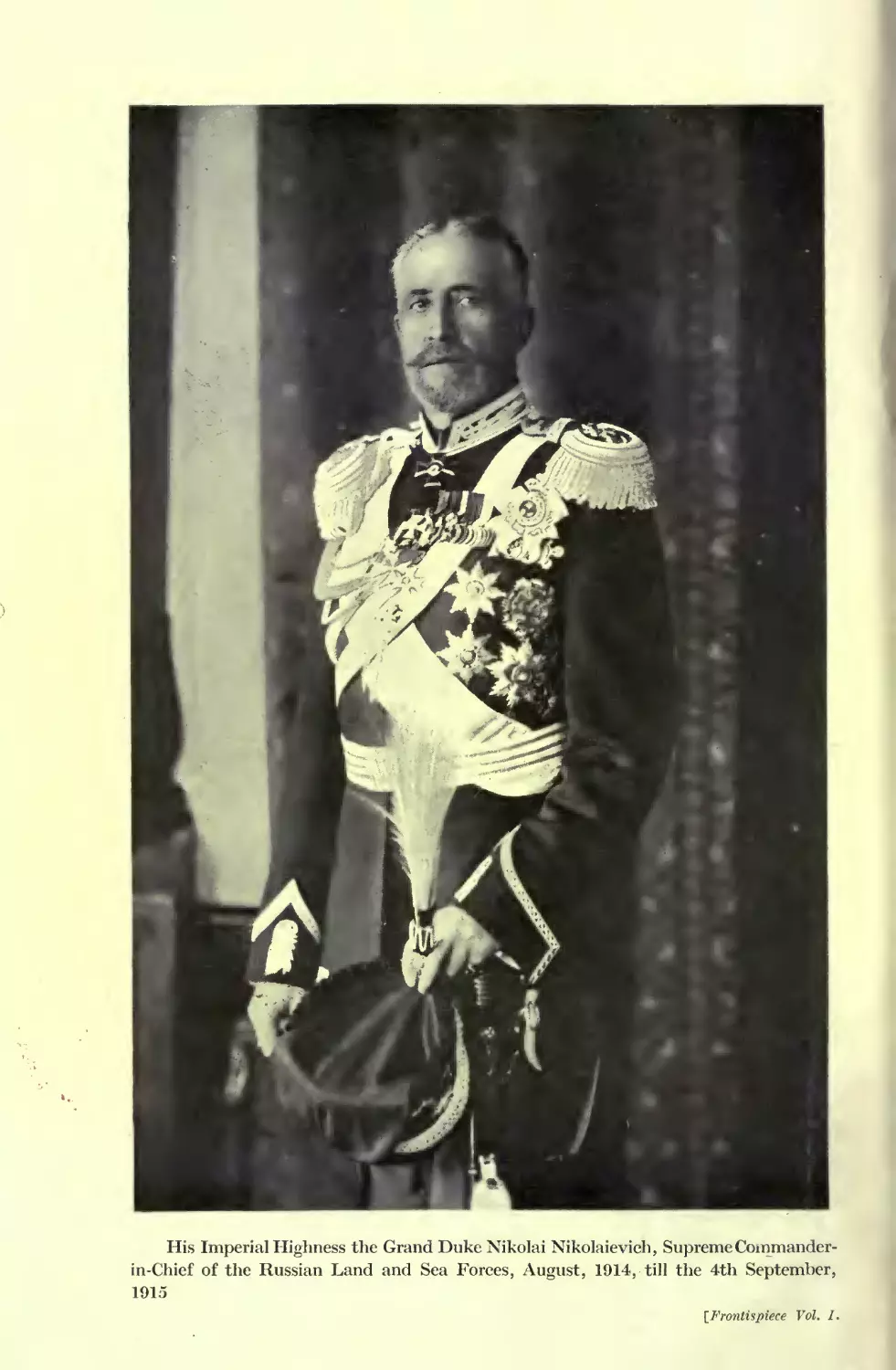
His Imperial Highness the Grand Duke Nikolai Nikolaievich Supreme Coinmanderin-Chief of the Russian Land and Sea Forces, August, 1914, till the 4th September,
,
1915
[Frontispiece Vol. I.
WITH THE RUSSIAN ARMY
1914-1917
48673
BEI$(G CHIEFLT EXTRACT'S
FROM THE T)IART OF
A
MILITARY
ATTACHE
ONTARIO
BY
MAJOR-GENERAL SIR ALFRED KNOX,
K.C.B.,
C.M.G.
WITH 58 ILLUSTRATIONS, CHIEFLY FROM PHOTOGRAPHS TAKEN BY THE AUTHOR, AND 19 MAPS
48673
VOL. I
LONDON: HUTCHINSON &
PATERNOSTER ROW
1921
CO.
MAY
25
I98J
J>
4
1 f
PREFACE
OF
the multitude of war books, few have dealt with the struggle in
the Eastern theatre. Yet it is certainly the second theatre in
importance, and probably the most interesting of all to the military
reader. The German General Staff, it is true, has produced
valuable studies of certain episodes of the fighting in Russia, but from
the point of view of our Ally there has been little or nothing.
Until the day, which all lovers of Russia hope is not far distant
when the Russian General Staff will be able to publish to the world an
official account of the work of the Russian Army in the Great War,
thought that these extracts from the Diary of a British officer may
prove of interest. The writer can at any rate claim to have enjoyed
it is
greater opportunities for observation of the Russian army than any
other foreign observer, both previous to the war as Military Attache*
to the British Embassy at Petrograd, and during the war as liaison
officer at
the front.
Russian friends find his comments occasionally overfrank, he asks their forgiveness. He wrote things down as they
If
some
of his
seemed to him
at the time.
These twenty-five chapters give the writer's experiences during
three and a half years of war and revolution. Passing through Germany on the eve of the declaration of war, he spent a few days at the
Headquarters of the Grand Duke Nikolas.
Army
Army
He
then visited the 3rd
just before its invasion of Galicia (Chapter I.), and the 2nd
during the battle of Tannenberg (Chapter II.). In September
he accompanied a cavalry division in a raid in South-West Poland, and
retired with it before Hindenburg's first offensive against Warsaw
(Chapter III.). In the following months he was with the Guard
Corps at the battle of Ivangorod, and in the subsequent Russian
counter-offensive towards Krakau (Chapter IV.). Some account
derived from eye-witnesses is given of the operation of Lodz (Chapter
V.), of the disaster to the Russian loth Army in February, 1915, and
on the Narev in the winter of that year (Chapter VI.)
In the great Russian retreat from Poland in 1915, due to lack of
of the operations
.
Preface
vi
armament, the writer was attached
to the Staff of the ist
German cavalry
Army
first
to the
(Chapter VIII.).
Guard Corps and
Chapter IX.
later
tells of
the
Svyentsyani in September, 1915, and
Chapter X. of the adventures of a Russian Delegation despatched to
England and France to obtain munitions.
raid
on
Chapters XII.-XVI. describe the fighting in 1916, with many hitherto unpublished details of Brusilov's offensive and the subsequent operations.
Chapter XVII. deals with the political unrest preceding the
Chapters XIX.-XXV. give an eye-witness's account of
the Revolution of March I2th, 1917, and of the rapid decline of the
Russian army, culminating in the Bolshevik coup d'etat of November 7th
Revolution.
and the negotiations
for the separate peace.
ALFRED KNOX.
CONTENTS OF VOLUME
I
INTRODUCTION
THE RUSSIAN ARMY
IN 1914
PAGE
Military Law of 1914 Recruitment
Expansion in war Number of men available
Conditions of service
in peace
Armament
Training
officers
war
Rifles
Machine-guns
Guns
Aircraft
Organisation
Depot units
Transport
The officers General Staff Regimental and
The non-commissioned officers The rank and file
necessarily fatal to
Russia
.
.
CHAPTER
.
.
.
reserve
A
.
long
.
.
xvii
I
THE OUTBREAK OF
WAR. GENERAL HEADQUARTERS AND THE
SOUTH-WEST FRONT IN AUGUST, 1914
Return from leave through Germany at the end of July The mobilisation
General Laguiche Forecast of the enemy's probable distribution of
strength Departure from Petrograd in the Grand Duke Nikolas's
train The Grand Duke's Staff
The journey to Baranovichi Conversation with the Grand Duke General Jilinski, Commander-inChief of the North- West Front Boredom of life at Baranovichi The
Russian plan of campaign and strategical deployment Composition of
the front-line armies Visit to the South- West Front Dinner with
General Ivanov The 3rd Army on the eve of crossing the frontier
Visit to the 33rd Division
Russian patience and good temper De.
.
. .
parture from Baranovichi
.
.
CHAPTER
.
.
.
.
II
THE DISASTER TO THE 2ND ARMY, AUGUST, 1914
General situation on the North- West Front Interview with General
Lunch with General Samsonov
Jilinski on the evening of August 23rd
at Ostrolenka on August 24th Situation of the 2nd Army Chief of
Staff's pessimism
Arrival at Neidenburg Visits to General Martos
of the XVth Corps and to General Torklus of the 6th Division
Battle of Orlau-Frankenau Lack of businesslike method Position
of the Russian forces on the evening of the 25th
Arrival of General
Samsonov at Neidenburg on August 26th German attack on the ist
Corps Situation on the night of the 26th Position on the morning
of August 2 yth Russian estimate of German strength
Signs of
nerves Conversation with General Samsonov on the morning of the
28th Drive to Ostrolenka Situation in Warsaw The battle in the
Yii
37
Contents
viii
MM
south undecided Back to Ostrolenka The disaster to the 2nd Army
from accounts of eye-witnesses Relation of the Russian Staff.
AFTERNOTE. At Byelostok Recapture and re-abandonment of
Neidenburg A German account of events in the and Army Inexperience of Russian commanders Defective services of intelligence
and communications Orders and counter-orders Adventures of
Samsonov's Chief of Intelligence Work of the ist Army Relation of
a member of Rennenkampf's Staff Wanderings of the Ilnd Corps
Relation of a member of the Staff of the Ilnd Corps The invasion of
East Prussia gained its object, but the price paid was unnecessarily
great Wonderful success of the German Command Removal of
Russian commanders-r-Reconstitution of the XVth and Xlllth Corps
CHAPTER
WITH A CAVALRY DIVISION
IN
56
III
SOUTH-WEST POLAND, SEPTEMBER-
OCTOBER, 1914
Success of the Russian offensive on the South-West Front Rumoured
enemy transfers from the French theatre Visit to the fitape Commandant at Warsaw Pessimistic Englishmen Journey to join the Staff of
the 9th Army in Galicia Difficulties at Lyublin Bibikov's death
Guard Co-operative Society Anecdotes of the recent fighting The
wounded Supply and transport Preparations for the defence of the
Vistula Keen subalterns Sandomir The Cossacks Headquarters
of the gth Army at Zolbnev
General Gulevich Situation in Galicia
on
Austrian
raid
communications The start of the
Proposed cavalry
raid
Division
Generals
Novikov and Erdeli Staff
i4th Cavalry
of the 1 4th Cavalry Division
Polish mistrust of Russian promises
Adisturbed night The situation Staff routine Cavalry armament
"
"
Skirmish with
Sokols
Remounts A month's casualties in
a cavalry division Burning of a country house Orders Terrible
"
situation of the Poles
The Bloodthirsty Cornet " The division
recalled to the north owing to the German offensive
Skirmish with a
German cavalry patrol Examination of prisoners Through Pinchov
with a sentimental officer The enemy strength estimated at one
corps only Maxim's "gallantry" Position of opposing forces
Delaying action at Yasenn A Jewish spy Continuation of retreat
Adventures of a Cossack squadron commander on reconnaissance
Situation on October ist Machine-guns Strength of cavalry
regiment Reconnaissance Futility of attempts to delay the advance of the enemy infantry Confidence regarding the speedy end
of the war Horse-rations in peace and war Intelligence
Re"
"
connaissance and
Battle patrols Orderly parties
flying posts
A night alarm and subsequent march A German prisoner Russian
infantry west of the Vistula Staff of the Cavalry Corps loses control
owing to rapidity of enemy advance
Supply Narrow
escape at
"
"
Ostrovets on October 3rd Last delaying position
on October 6th
Retirement across the Vistula at Novo Alexandriya Good-bye to
the 1 4th Cavalry Division Journey to Warsaw.
AFTERNOTE. The average daily march of the 1 4th Cavalry Division
The Russian cavalry Subsequent services of the I4th Cavalry Division Of General Erdeli Of General Sencha Of Captain Sapojnikov Fine death of Colonel Westphalen Death of Captain
Plotnikov, his presentiment Subsequent services of General Novikov
and of Colonel Dreyer
. .
.
.
.
. .
. .
.
95
Contents
CHAPTER
ix
IV
WITH THE QTH ARMY AND THE GUARD CORPS
SOUTH WEST
POLAND. HINDENBURG'S FIRST OFFENSIVE AGAINST WARSAW AND
THE RUSSIAN COUNTER-OFFENSIVE. OCTOBER-DECEMBER, 1914
IN
PAGE
Line held by the Russians in Galicia on September 2ist, 1914 Difficulties
First news received of Hindenof supply Transfer to the north
burg's advance on September 23rd Question whether the enemy
should be met west of or in rear of the Vistula The disaster at Opatov
Location of units of 4th, gth and 5th Armies on October 6th
Failure of
Difficulties in carrying out the Russian change of front
the enemy's plans Warsaw crowded with fugitives on October
1 2th
The Russians resume the offensive Journey to Lyublin
Weather Railway transport Office of Commandant of the Lines
of Communication at Lyublin
Story of the Jew at Ivangorod
The road from Lyublin to Krasnik The distribution of armies The
General Lechitski Russian success at
ride back from Krasnik
Warsaw General Gulevich regrets the lack of bridgeheads on the
Vistula The fieldpost Orders issued to the Qth Army for the
offensive^ Drive from Lyublin to Ivangorod to join the Guard Corps
Russian infantry on the march Second -line transport The battle
of Ivangorod Visit to the XXVth Corps in advance of Novo Alexandriya Retirement of the enemy The church at Zvolen A
subaltern of the Preobrajenski Regiment A drummer boy's funeral
Russian distribution on October 28th The Staff of the Guard Corps
A priest's story Touch with the enemy lost Stories of the enemy's
doings Visit to Warsaw Russian plans Sufferings of the Poles
Return to the Guard Corps Second-line troops Destruction of
railways Situation in South-West Poland on November 8th
Advance of the Guard Corps towards Krakau Waiting for the 3rd
Army Nervousness regarding ammunition supply Composition of
the 3rd and 8th Armies Tired infantry A Frenchman The tunnel
at Myekhov The system of replacing casualties in the Guard
Corps Objectives of Russian armies A Guard regiment in action
Russian information of enemy dispositions on November iyth
A prisoner's reply The 2nd Guard Infantry Division held up The
first news of the offensive from Thorn received at i a.m. on the i8th
General anxiety regarding shortage of ammunition Failure of
Russian counter-offensive becomes probable The 45th Division in
action Points about winter warfare Views in South-West Poland
regarding offensive from Thorn Shortage of shell not local but
general Depression Visit to the Finlandski Regiment at Yangrot
and to the Preobrajenski Regiment at Poremba Gorna Abandonment of the attempted offensive Losses in the Guard Corps Men in
the trenches frozen at night Strength opposite the 4th and 9th
Armies gth Army averages only 7,000 men per division Another
visit to the Preobrajenski Regiment
Slackness of counter-espionage
Weakness of our strategy Grand Duke's enquiries regarding
equipment Lack of officers The tunnel at Myekhov Retirement
becomes probable Inefficient railway management Inefficiency oa
the Lines of Communication Visit to Headquarters of the 2nd
Guard Infantry Division Progress of the 3rd Army south of Krakau
Desertions Drive to Warsaw Drafts on the march Warsaw
rumours Large reinforcements for the front Arrival at Petrograd.
AFTERNOTE. Failure of Hindenburg's first offensive in Poland
Failure of the Russian counter-offensive The latter in reality a
gigantic bluff
.
.
. .
. .
.
.
.
.
. .
139
Contents
x
CHAPTER V
HINDENBURG'S
SECOND OFFENSIVE IN POLAND, NOVEMBER AND
DECEMBER, 1914
PACE
Hindenburg appointed Commander-in-Chief of the German Forces in the
East Ludendorff suggests the offensive from Thorn The German
counter-measures
Mackenzen 's
concentration
Tardy Russian
rapid advance Defeat of the ist and 2nd Armies in detail Arrangements for the rescue of the 2nd Army Generals Rennenkampf and
Plehve Plehve and the orderly officer Move north of the 5th Army
Enterprise of the German penetrating force Launch of the relieving
forces from the ist Army The advance of the Lovich Force
Change
of commander Lack of information and of proper equipment
Second change of commander Modification of orders The German
penetrating force receives orders to retire, 7 p.m. on the 22nd
Further change of orders in the Lovich Force The 6th Siberian
Division asks for help Indecision Russians in the dark Staff of
Lovich Force loses touch with all its columns Destruction of the
6th Siberian Division Escape of the German penetrating force Its
remarkable work Disappointment of the Russians Russian forces
much intermingled Arrival of German reinforcements Loss of Lodz
and Lovich Retirement of the Russian armies to the " river line"
The operation of Lodz probably the most interesting of the war
from a military psychological standpoint The fog of war Value of
co-operation Wonderful German organisation Mackenzen's initial
success His failure owing to the delay and weakness of the German
offensive further south
Question whether the German Supreme
Command might
not with advantage have delayed its offensive till
the arrival of reinforcements from France and have then launched it
from Mlava instead of from Thorn The Russian Intelligence on this
occasion at fault Brilliant work of the Russian 5th Army Rennenkampf's failure Question whether the Russian Supreme Command
.
should not have detached troops to the north
.
.
CHAPTER
WAR
.
.
.
202
VI
WEST
OF THE VISTULA.
THE GERMAN
ATTACK ON THE RUSSIAN IOTH ARMY. OPERATIONS OF THE IOTH,
I2TH AND IST ARMIES IN ADVANCE OF THE NAREV, JANUARY TO
MARCH, 1915
OF
POSITION
Shortage of rifles The cause Shortage of shell Reduction of the number
of guns in the infantry division from forty-eight to thirty-six The
"
"
retirement to the
river line
caused by loss of men and deficiency
of armament Question whether the Grand Duke knew in October of
the deficiency of rifles and of shell Secretiveness of Russian officials
General Sukhomlinov amply warned by the Staffs of the Fronts
and by the Artillery Department His career and character The
Assistant Minister of War Interview with General Sukhomlinov on
December i6th Optimism of the Times Visit to G.H.Q. The
Emperor at G.H.Q. Warsaw in January, 1915 Distribution of
armies west of Warsaw Fighting against Austrians Opinions of
General Erdeli and of Count Prjetski on the role and tactics of cavalry
The Staff of the 5th Army at Mogilnitsa Christmas-trees Difficulty of obtaining information General Plehve An enemy airman
Plehve and Miller Visit to the XlXth Corps The Poles as fighters
Contents
xi
PAGB
The Poles and the Russians two points of view Clumsy German
propaganda The ijth Division and the 68th Borodino Regiment
Poor trenches Distribution of strength in the IVth Corp
Formation of the 1 2th Army Appointment of General Gulevich as Chief
of Staff of the North-West Front His reception of the news
Russian
armies on the South-West Front Anecdote from the 4th Army
Enemy offensive against the nth Army Comparison of strength on
the South- West Front Enemy attack on the Bzura at the end of
January The Guard Corps ordered to Lomja Billets at Lomja The
disaster to the loth Army
Situation on the Narev in the middle of
February Task of the I2th Army Tactical instructions Concentration of the 1 2th Army A cavalry "raid"
East Prussian versus
Galician line of advance Regroupment on February i6th Indecision
regarding point of concentration of reinforcements Count Nostitz
Orders and counter-orders Sufferings of the wounded Playing at war
in the Staff
Futile march of the 2nd Guard Infantry Division and the
Guard Rifle Brigade The troops between the Bobr and the Pissa
:
placed under the orders of General Bezobrazov Orders for the
attack on February 2oth Failure of the 2nd Division at Yedvabno
and consequent collapse of the attack General discouragement
Continued transfer of Russian and enemy forces to the Narev front
Visit to the 2nd Guard Infantry Division
Shell
Superiority of
the Germans in manoeuvre Arrival of General Plehve at Lomja
Poor impression made by the Vth and 1st Corps disagreement
between Generals Plehve and Bezobrazov regarding the plan of
attack The question of Osovets Futile attacks on March 2nd, 3rd
and 4th Adventure of Austin armoured cars The operation of
Prasnish News of the attack on the Dardanelles Lack of shell
Pessimism Losses Failure of the second German offensive on
Prasnish Visit to the 2nd Guard Infantry Division with General
Bezobrazov The power of religion Dinner to the Commander of
the Hlrd Caucasian Corps Colonel Engelhardt's views on strategy,
on Russian generals, on the peace training of officers and on the issue
of impossible orders Orders issued on March i6th for a general
standfast on the North- West Front Russian units in the Eastern
theatre outnumber enemy units, but the enemy superior in communications, supply of shell, number of machine-guns and in organisation
Recalled to Petrograd
..
..
..
..
..216
CHAPTER
VII
REAR SERVICES AND THE INTERNAL SITUATION
SUMMER OF 1915
IN
THE SPRING AND
Losses in five months of war Number of men called up The Opolchenie
Depot units Infantry Cavalry artillery Number of divisions
mobilised Lack of rifles Other desiderata Lack_of guns_arid of
shell
Attitude of the Artillery Department The~GTand Duke Serge
Suggestions put forward by the French Technical Mission Lord
Kitchener's policy Russian attitude towards the firm of Vickers
Colonel Ellershaw's mission to the Grand Duke Nikolas General
Manikovski Russia's effort in shell production in the first nine
months of war compared with England's Lord Kitchener's message
and the reply of the Russian Ministry of Foreign Affairs Gas
masks Riots in Moscow in June Three unpopular ministers The
Minister of War, General Sukhomlinov, dismissed on June 25th and
succeeded by General Polivanov Colonel Myasoyedov hung as a
. .
.
. .
. .
spy War weariness of all classes
267
Contents
xii
V
CHAPTER
VIII
THE GERMAN OFFENSIVE ON THE DUNAJEC AND THE RETREAT FROM
POLAND, APRIL-AUGUST, 1915
The
"
PAGE
"
stand-fast
on the North- West Front Capture of Przemysl
Offensive by the 3rd and 8th Armies in the Carpathians in April The
Mackenzen stroke on the Dunajec Retreat of the 3rd Army
Retreat of the 4th, 8th and nth Armies Exhaustion of the 3rd
Army Despatch of reinforcements Przemysl abandoned Failure
of the counter-offensive west of the San Lack of heavy artillery
Confusion of units in the 3rd and 8th Armies The capture of Memel
by the Russians leads to the German invasion of Kurland The importance of the new offensive at first underrated Formation of the
1 3th
Army The Russians outnumbered The transfer of three
from
the north to the 4th and 3rd Armies Optimism at Warcorps
sawVisit to the Staff of the North- West Front at Syedlets
Opinions regarding Generals Ruzski and Alexyeev Composition of
the Russian armies at the beginning of July The Supreme Command
opposed to a counter-offensive owing to lack of rifles and shell
Disagreement of General Bezobrazov with General Lesh First
meeting of the Russian Guard with the Prussian Guard General
Bezobrazov replaced in command of the Guard Corps by General
Olukhov The flank of the Guard turned owing to the retreat of
the Ilnd Siberian Corps Incompetence of General Antipov Retreat
of the 3rd Army Lyublin and Kholm abandoned Lunch with the
Staff of the 4th Army
At the Staff of the ist Army Retreat of the
ist Army in July
Retreat of the I2th Army The retirement from
the Vistula Situation on August 7th Novogeorgievsk Visit to
the XXVIIth Corps on August i2th Effect of lack of armament
on morale Feeling regarding the " inaction " of the Allies Fine
conduct of the regimental officers under the strain of the retreat
The tragedy of the lack of shell The staff of the I2th Army moved to
Petrograd Staff of the I3th Army moved to Riga The fall of
Kovna and of Novogeorgievsk Visit to Osovets and its abandon. .
ment on August 22nd Polish fugitives
. .
.
.
280
CHAPTER IX
EVENTS ON THE NORTHERN AND WESTERN FRONTS FROM THE MIDDLE
OF AUGUST TILL THE MIDDLE OF OCTOBER, 1915
Lack
of transverse railways
The stcry
of the fall of
Kovna
Trial of
Commandant
Formation of the Northern Front under General
Ruzski Events on the Dvina in late August and early September
Assumption of the Supreme Command by the Emperor with General
Alexyeev as Chief of Staff Opinions regarding General Alexyeev
Opinions regarding the change in the Supreme Command Unpopularity of the Empress Mistrust of authority Corruption on
the railways The German cavalry raid on Svyentsyani Retreat
of the loth Army Distribution of the Russian armies in October,
1915 Shortage of rifles Shaken morale of the army Deserters
A young officer's letter to General Alexyeev Opinions of Generals
Odishelidze and Novitski regarding the Russian soldier General
Ruzski General Ewarth Supper with General Lebedev . .
, .
the
v
324
Contents
xiii
CHAPTER X
WITH A RUSSIAN DELEGATION TO ENGLAND AND FRANCE
Composition of the Delegation Situation in Arkhangel Mined in the
White Sea Three weeks in a bay in Lapland Work in London
Appeal to Lord Kitchener and interview with Sir William Robertson
in Paris
Visit to the French Front
Interview with General Foch
Short visit to the British Front St. Omer Impressions of the
Russians regarding Lord Kitchener and Mr. Lloyd George Fate of
Admiral Russin Adventures of Commander Romanov
. .
ONTARIO
.
.
MM
354
LIST OF MAPS
MAP
I.
II.
The
Strategical Deployment in the Eastern Theatre.
Situation on August 20th, 1914. Scale 1/3,000,000
26th, 1914.
III:
Situation on August
The Disaster to the 2nd Army.
Scale 1/1,000,000
Poland and Galicia, showing the
occupied by the Russian armies on September
South- West
line
2ist,
1914, previous to the first German offensive against
Warsaw. Scale 1/2,000,000
IV.
IV.
V.
VII.
illustrate
Chapters
III.
and
Scale 1/1,000,000
Approximate position of Russian Armies on October
2ist, 1914, and the supposed position of enemy
Scale 1/3,000,000
forces.
VI.
To
South-West Poland.
Position of the Opposing Forces on
1914. Scale 1/3,000,000
German
Offensive
in East
Prussia,
November nth,
loth Russian
Army
February 7th-22nd, 1915.
Scale
against
the
1/1,000,000
VIII.
IX.
The Prasnish Operation.
ruary 25th, 1915.
Operations on the
1915.
X.
Situation evening of
Scale 1/500,000
Narev
in
February and
Feb-
March,
Scale 1/1,000,000
Operations in the Russian theatre,
t ember, 1915.
Scale 1/2,000,000
May, 1915-Sep-
SKETCH A. The Lodz Operation. Movements of the 2nd
Army, November I4th-I7th, 1914. Scale 1/2,000,000
SKETCH B. Lodz. Situation November I7th-22nd, 1914. Scale
1/500,000
SKETCH
The Storming
C.
Scale
of
Kovna, August i6th-i8th, 1915.
1/500,000
xi
LIST OF ILLUSTRATIONS
.
is
Imperial Highness the Grand
Duke
Nikolai Nikolaievich
Frontis.
Facing page
74
Operations Department of the General Staff, G.H.Q., 1914-15
General Marquis de Laguiche and General Ivanov
74
Russians collecting German wounded, Orlau-Frankenau, 1914
75
Sandomir, September, 1914
75
S.W.
Poland, 1914
140
Cooking-carts, Lagov,
140
Railway bridge, N. of Kyeltsi, destroyed by Germans, 1914
141
Railway demolished near Myekhov, 1914
Western end of tunnel, N. of Myekhov, demolished by
Germans, 1914
141
Officers of the 5th Battery, 2nd Guard Artillery Brigade
204
"
"
Rodzianko and telephone
204
sentry
205
Headquarters 5th Army, Mogilnitsa, 1915
205
Operations Section of the Staff of 5th Army, 1915
Second line defences, N. of Lomja, 1915
254
Peasant women at work on a position N.E. of Lbmja, 1915
254
under
difficulties, Novogrod, N. Poland, 1915
255
Bridging
255
Headquarters of 2nd Division of the Guard, 1915
Lieutenant Gershelman and Grand Duke Konstantin Konstantinovich
300
Duke of Mecklenburg, Inspector of Artillery of the Guard
300
Staff of the Guard Corps, July 18-31, 1915
301
General Bezobrazov thanking 3rd and 4th Guard Rifle Regiments
for their services, 1915
301
Jewish fugitives escaping from Reiovets, 1915
310
Colonel L
a Baltic baron
310
II
Siberian
311
Typical faces,
Corps
General Balanin, Commander XXVIIth Corps
311
Count Ignatiev, Commander of Preobrajenski Regiment of the
.
.
.
.
.
.
.
.
.
.
.
.
.
.
.
,
.
.
.
.
.
.
.
.
.
.
.
.
.
.
.
.
.
.
.
.
.
.
.
.
.
.
.
.
.
.
.
.
.
.
.
.
.
.
.
.
.
.
.
.
.
.
.
.
.
.
.
.
.
.
.
.
.
.
.
.
.
.
.
.
.
.
.
.
.
.
.
.
.
. .
.
.
.
.
.
.
.
.
.
.
.
.
.
.
.
Guard
Baron Budberg, and hole made by German
.
.
. .
.
.
.
.
.
.
.
.
.
.
.
.
shell
.
.
.
.
General Brjozovski, defender of Osovets
General Brjozovski and specimens of shell fired into fortress
Grand Duke Dimitri Pavlovich distributing crosses, 1915
Packing up to fly before German advance, 1915
.
Group of Kharkov Opolchenie
Tired-out men of the 5th Rifle Brigade
.
XV
.
.
.
/
. .
.
.
.
.
.
.
.
.
318
318
319
319
330
330
331
331
INTRODUCTION
THE RUSSIAN ARMY
IN 1914
the law in force at the outbreak of war the whole of
UNDER
the population
Russian Empire, amounting to some
one hundred and eighty millions, with the exception of certain
races such as the inhabitants of the Grand Duchy of Finland,
the
Mohammedan
of the
tribes of the Caucasus
and the native popula-
was liable to personal military service
to the end of the forty-third year of age.
tion of Russia in Asia,
from the twenty-first
The Cossacks and
served under special regulations.
The serving period of twenty-three years was divided as
follows
fleet
:
COLOUR
SERVICE,
Years.
ist
RESERVE.
OPOLCHENIE.
2nd Ban.
Ban.
Years.
Years.
Years.
Infantry arid Artillery
(except
476
Horse Artillery)
Other arms and
3
services
7
8
5
6
.
The number
estimated at over one and a half millions of
that completed the age of twenty each year was more
than the resources of the Empire could train, so the incidence of
males
the military law was lightened by a liberal grant of exemptions
for family and educational reasons.
Among the men so exempted
those physically fit for military service were at once enrolled in
the Opolchenie or national militia, and some of them were called
up occasionally from
civil life for six
xvii
weeks' elementary training,
B
Introduction
xviii
An
important law to increase the strength of the army was
passed by the legislature in secret session in the spring of 1914.
This law, together with the French law raising the period of
service from two to three years, constituted the reply of the Dual
Alliance to the recent increase of the
German Army.
The new law provided through
additions
to the
annual
contingent for an increase of 468,000 in the peace strength by
the year 1917. The following table shows the actual figures up
to 1914 and the proposed figures from 1915 to 1917
:
Estimated Total Peace
Strength on April I4th.
Annual Contingent of
Previous Autumn.
Year.
1911
436,283
About 1,300,000
1912
4355i3
1,300,000
1913
43I.97 1
1914
455>ooo
1915
585.000
1,460,000
1916
585,000
1,610,000
1917
585>ooo
1,768,000
The
,
:
1,300,000
.,
1,320,000
further arranged, in order to cover the dangerous
period, while the last-joined contingent was undergoing preliminary training, to retain with the colours for an additional
three
bill
months the men about to pass to the
reserve.
This pro-
vision in effect lengthened the colour service of the infantry and
field artillery from three to three and a quarter years, and of the
mounted and technical troops from four to four and a quarter years.
additional peace strength was to be used to raise a new
corps for the Western frontier, a new corps for Siberia, a new
It
division for the Caucasus and a 4th Rifle Brigade for Finland.
The
also to provide the personnel of twenty-six new six-squadron
cavalry regiments and a large increase in the artillery. The
was
men
not required for these new formations was to be allotted to strengthen the peace establishment of
balance of the additional
and so to help to counteract the disadvantages the Russians suffered from the comparative slowness
units near the frontier,
of their mobilisation.
Introduction
xix
The programme was drawn up mainly with the idea
of perfect-
Its extent was caling the defences of the Western frontier.
culated on the increase in the German army, and it is significant
that
it
was to reach
its full effect
in 1917, the year
when the
extortionate commercial treaty forced by Germany on a defenceless Russia the year after the Japanese war was due for revision.
All these facts were of course
no manner
of
doubt that the passing of
of the potent factors,
the
known in Germany, and
if
there can be
law was one
which decided
this bill into
not the all-potent factor,
German Government to declare war in August, 1914.
When the Germans struck, only one of the new formations
was ready
For
the 4th Finland Rifle Brigade.
political reasons the territorial
never introduced in Russia.
composed
of
system
The peace strength
two-thirds Russians
was
units was
of recruitment
and one-third
of
'
of
subject
races," such as Poles, Letts, Esthonians, Georgians, Armenians,
as a rule
etc.
Neither the Russians nor the
subject races
'
'
were permitted to serve near their homes, but were drafted to
On mobilisation, to save time, units comunits at a distance.
pleted to
war strength by incorporating trained men from the
local populations.
From 1905
to 1909 the Emperor seems to have hesitated as to
whether the Chief of the General Staff should be independent of
the Minister of
War
as in
subordinate to him as in
Germany and Austro-Hungary, or
France. The party favouring the
concentration of the supreme power in the hands of the Minister
of War definitely won, and from December, 1909, the Minister
had the sole right to report to the Emperor on all military matters.
Under the Minister of War were the various departments and
The Supreme Directorate of the General Staff
contained the Department of the General Quartermaster, which
directorates.
corresponded to our Military Operations Directorate, and other
branches dealing with Military Communications, Topography,
Organisation and Training, and Mobilisation.
The Head-Quarter Staff did the work of our Adjutant-General's
xx
Introduction
and Pensions Branches.
transport and pay. The
armament and training
The Intendance
dealt with supply,
Artillery Department attended to the
of
artillery.
The
Military Technical
Directorate dealt with the technical troops.
The
territory of the empire
was
in peace divided into twelve
military districts, each under a Commander-in-Ohief
Petrograd,
Vilna, Warsaw, Kiev, Odessa, Moscow, Kazan, Caucasus, Turkistan, Omsk, Irkutsk and the Pri-Amur.
:
the Guard, the Grenadier, Ist-XXVth Line, Ist-IIIrd Caucasian, 1st and Ilnd Turkistan
and Ist-Vth Siberian.
There were thirty-seven army corps
The number
of infantry divisions
:
was seventy
three Guard,
:
four Grenadier, fifty- two Line and eleven Siberian Rifle.
one Guard,
There were in addition eighteen Rifle Brigades
:
European, four Finland, two Caucasian and six Turkistan.
There were twenty-four cavalry and Cossack divisions, and in
addition eleven independent cavalry and Cossack cavalry brigades.
five
The normal composition
of
an army corps was two infantry
one division (two six-gun batteries) of light howitzers
with howitzer park and a battalion of sappers (three sapper and
divisions
:
two telegraph companies).
The infantry division consisted normally
of four four-battalion
regiments, a field artillery brigade of six eight-gun batteries and
an
artillery
The
a
rifle
park brigade.
brigade contained four two-battalion rifle regiments,
artillery division of three eight-gun field batteries and a
rifle
rifle artillery
park.
The
regular cavalry division contained four regiments each of
six squadrons.
These were grouped in two brigades, of which the
first contained the Dragoon and the Lancer regiments and the
second the Hussar and the Cossack regiments.
On
mobilisation thirty-five infantry reserve divisions were
formed styled 53rd-84th and I2th-i4th Siberian. The establishment of these reserve divisions was identical with that of the
Introduction
xxi
Each of the four infantry regiments of the
was formed by the addition of officers and
men from the reserve to a cadre of twenty-two officers and four
hundred rank and file, who were detached on mobilisation from
regular divisions.
reserve division
a parent
first-line
regiment.
A number of additional Gossack cavalry divisions were formed
on mobilisation and other Cossack divisions were added later.
Russia therefore commenced the war with the equivalent of
114 infantry and about 36 cavalry divisions.
Of course, 114 divisions represented a poor effort compared
with that of Germany and France, for the male population of
Russia on January 1st, 1910, was 81,980,600, out of
74,262,600 were liable to military service.
The following
is
an estimate
classified for mobilisation
1.
of the
number
of
men who were
:
Regular army, including reserve; fully-trained
men from twenty-one to thirty-nine years of
2.
age
Cossacks
3.
Opolchenie,
5,000,000
;
fully-trained
ist
Ban
;
men
fully-trained
200,000
men from
thirty-nine to forty-three years
4.
5.
whom
350,000
Opolchenie, ist Ban partially-trained men from
twenty-one to forty-three years, about
3,500,000
Opolchenie, 2nd Ban untrained men from twentyone to forty-three years, about
6,000,000
;
;
15,050,000
On
mobilisation the whole of the active army, reserve and the
Cossacks were called out, and the ist Ban of the Opolchenie was
Of this total of some five millions there
partially mobilised.
was place for only about three millions in the fighting formations.
The remainder were allotted to line-of-communication formations,
hospitals,
battalions.
ordnance depots,
transport
columns and to depot
Introduction
xxii
The number
depot battalions formed on mobilisation was
Of these, sixteen were affiliated to and fed directly the
192.
infantry regiments of the Guards. The remainder were unaffiliated
of
and sent
recruits to replace
wastage in any units at the
from the Mobilisation Department
front on requisition
of the
Supreme Directorate of the General Staff.
The cadres of the depot battalions were furnished by certain
previously-designated first-line units. Thus some regiments
provided ten officers a battalion commander, an adjutant and
The cadre companies preeight cadre company commanders.
pared drafts, 250 strong, for despatch to the front as required.
The rate of wastage far exceeded the calculations of the General
was found necessary to send drafts to the
Difficulties of climate and in the
front only partially trained.
provision of accommodation most of the barracks lying in the
Staff,
and
in 1915
it
centre of large towns together with the inefficiency of the
training personnel, interfered with the proper preparation of
drafts,
and the lack
of spare billeting
accommodation near the
with the poor carrying capacity of the Russian
railways, interfered throughout the war with the systematic
front, together
replacement of casualties.
The Russian infantry and cavalry were armed with the
line rifle of 1891.
"
bayonet), was
the outbreak of
three-
This weapon, though heavy (9! Ibs., including
"
and stood the test of war well. At
fool-proof
war
it
was being resighted to
suit the
new pointed
bullet.
The infantry regiment
of four battalions, the rifle regiment
two battalions and the cavalry division of twenty-four squadrons had each a machine-gun section of eight Maxims.
The proportion of artillery was inadequate. The normal
infantry division had an artillery brigade of six eight-gun batteries
armed with 3" Q.F. field guns. Most of these were of
the 1902 model with steel shield and panoramic sight, but some
units had still the 1900 gun.
Each cavalry division had a horse
artillery division of two six-gun batteries armed with the same
Both field and horse batteries had two
3* gun of 1902.
of
xxm
Introduction
wagons per gun. The gun was not a real quick-firer and was
much too heavy for work with cavalry.
The mountain batteries, which took the place of field batteries
in certain units in Finland, the Kiev, Caucasian, Turkistan
and
Siberian Military Districts, were armed, partly with the 2-95" Q.F.
gun (Model 1909)
of Schneider-Danglis pattern,
the older 3" Q.F. mountain gun of 1904.
for transport by draught or by pack.
Each army corps had a
and partly with
Both guns were
fitted
light howitzer division containing
six-gun batteries of 4-8" Q.F.
field
two
howitzers (Model 1909) of
Krupp pattern.
The Russian army was only known to possess seven divisions
of heavy field artillery.
Each division contained two four-gun
batteries
of
battery of 4-2
menced
to
batteries.
6"
1910) and one four-gun
mobilisation these seven divisions com-
howitzers
"
guns.
On
(Model
expand threefold, i.e., into a total of sixty-three heavy
However, many of them were of inferior armament.
To sum
rifles
had
up, the 114 Russian infantry divisions of 14,000
only forty-eight field guns each, with a backing for the
whole army of seventy-five batteries (450 guns) of light howitzers
as corps artillery and of twenty-one batteries (84 guns) of modern
heavy guns as army artillery. In other words, there were per
1,000
rifles
heavy
only 3-4
field
field
guns, -28 light howitzers and -05 so-called
guns.
had been decided in the spring of 1914 to commence the reorganisation and increase of the artillery, The following table
shows the existing and the proposed organisation of the arm
in the normal army corps
It
:
PROPOSED.
EXISTING.
Field guns, 12 eight-gun
batteries
Heavy guns
Total per corps
108
4 six-gun batteries
24
3 four-gun batteries
12
96
Light howitzers, 2 six-gun
batteries
six-gun batteries
18
12
o
108
144
Introduction
xxiv
gun. As in France
and England, large stocks were not kept because they could not
have been used in the annual peace practice in time to avoid
The supply
of shell
was 1,000 per
The crime
field
Russia was greater
owing to the small output of the Russian factories, which could
not be depended on in an emergency to provide large quantities
deterioration.
of shell rapidly ;
for her revenues
of
economy
in
but Russia's excuse for her economy was greater,
were more needed for internal development. As
in other countries, the General Staff did not expect a long war.
Russia had no dirigibles of power equal to the German
She had at the outbreak of war five up-to-date
machines of the second class and ten yet smaller machines, none
of which was of any military value.
Nothing was heard of the
Zeppelins.
work of any Russian dirigible during the war.
The number of aeroplanes that were in the country was 320,
and there were about the same number of trained pilots. A
large aeroplane with four engines, invented by a M. Sikorski and
"
called after a national Siberian hero,
Ilya Muromets," had been
boomed by the Press. Its trials had not given very satisfactory
results, but an order had been given in the spring of 1914 for the
delivery of ten of the type by autumn. The smaller machines
were of various types, the preference of the authorities having
been given in 1912 to Nieuports, and in 1913, in succession to
Farmans, Morane-Saulniers and Duperdussins. It was decided
in 1913 to order 1,000 aeroplanes for delivery in the three years
1914-1916 ; 400 of these were ordered from various works in
Russia for delivery by the autumn of 1914.
In spite of Imperial and Press encouragement, aeronautics
in Russia had made no progress as a sport. The membership of
the All-Russia Aero Club declined from 874 in 1910 to 360 in 1912.
The Vilna, Caucasus, Nijni-Novgorod, Orenburg and Riga Clubs
ceased to exist in 1913. In January, 1914, there were only
eleven aero clubs in Russia compared with one hundred in
Germany, and these were all maintained by the keenness of some
single local individual.
The Government had done
its
best to encourage the
home
manufacture of flying material, but with only moderate success.
xxv
Introduction
There were only two engine factories, the Gnome at Moscow,
with a capacity of perhaps twenty engines a month, and Kalep's
"
at Riga, with an output of two or three.
Motor Works
'
war left
the Russian industry still further behind. The Western Allies
supplied large numbers of machines, but there was a general lack
of skilled mechanics to put them together and keep them in order,
and the enemy's command of the air in the Eastern theatre was
The rapid development
of air material during the
" Kerenski's
offensive in July, 1917, when
never challenged till
the Russian pilots were assisted by French and British.
'
In transport the army of our Allies was far behind its opponents. There were at the outbreak of war only 679 Government automobiles 259 passenger, 418 transport and 2 ambulance
and the number
;
of civilian-owned transport cars suitable
was possible to requisition in Russia in
the first thirteen months of war was only an additional 475. The
army in advance of railhead had to depend mainly on horse
This absorbed an enormous number of men and
transport.
it blocked the
horses, whose feeding further complicated matters
roads and by its cumbrousness decreased the mobility of the
for military use that it
;
fighting troops.
A
Armee Zeitung in November, 1909,
compared the Russian army of that day to a heavy-weight,
muscle-bound prize-fighter, who, because of his enormous bulk,
lacked activity and quickness, and would therefore be at the
mercy of a lighter but more wiry and intelligent opponent.
The comparison was extraordinarily true, but the ineffectiveness and lack of mobility of the army arose more from the want
of modern equipment and from inherent national characteristics
than from merely bad leading and insufficient training.
writer in Danzer's
Generally speaking, the teaching of the General Staff in the
peace period from 1905 to 1914 had been devoted to the inculcation of the spirit of the offensive.
and
all
manders
the
memoranda
breathed
couraged, at
all
this
issued
spirit.
events on paper.
All the instructional manuals
by the twelve
Personal
District
initiative
was
Comen-
Meddling with their juniors by
xxvi
Introduction
and commanders of all
grades at manoeuvres were ordered to remain in the positions
they would occupy in war.
The combination of the arms had improved, since in 1910 the
divisional artillery had been placed under the divisional commander for tactical training, and since, later, the engineer units
had been permanently allotted to mixed commands of all arms
senior
commanders was
strictly forbidden,
instead of being trained as before in watertight compartments.
It was obvious, for
Still, these reforms had been too recent.
instance, that there
had not been time to weld the
artillery
and
infantry of the division into one indivisible whole. Only a few
weeks before the war writers in the military Press tried to prove
that the change had been positively harmful in that
creased the volume of correspondence.
it
had
in-
In infantry training stress had been laid on instruction in work
in extended order and in the use of cover.
The Musketry Regulations of 1909 represented a striking advance on those of 1899,
the allowance of practice ammunition was increased.
and
The cavalry on the whole seemed to have made less progress.
Dismounted action was still preferred and little attempt was made
to combine mobility with fire tactics.
Scouting was poor. Still,
the horses and men were of splendid material.
It was difficult to judge of the quality of artillery training from
manoeuvres. The guns showed a marked preference for concealed
positions
and
The war
little
mobility.
Manchuria had revealed many shortcomings in the
officer class, both educational and moral, and the task of raising
the general level was rendered doubly difficult after the war by
the large
in
number
of resignations
among
the better educated.
January, 1910, there was a shortage of no
The military administration did what
evil
by a
series of
less
it
than 5,123
In
officers.
could to combat the
measures for improving the position of the
and increasing his professional qualifications. The pay
of all officers up to and
including the rank of lieutenant-colonel
was raised by amounts varying from 25 per cent, to 35 per
cent.
Their pensions were raised. The flow of promotion was
officer
Introduction
accelerated
by the
retirement.
In
a
an age limit for compulsory
over one year 341 generals and 400
fixing
little
xxvii
of
colonels were retired as inefficient.
Schools for the training of officers were formerly of two
"
"
"
and yunker," entrance to the latter being
classes,
military
With
possible to youths of an inferior educational standard.
the idea of levelling up the social class of officers, all the yunker
The accommodation
schools were changed to military schools.
in all military schools
artillery
was increased.
and a new school
A
for fortress
third school for field
artillery
were started.
The gunnery courses were extended and a splendid training-ground
was acquired at Luga. Musketry courses for officers were
established in
many
of the military districts.
These reforms required time to produce their full effect. Meanwhile the bulk of the regimental officers of the Russian army
suffered
from the national
inclined to neglect
their
faults.
If
not actually lazy, they were
duties unless constantly supervised.
They hated the irksome round of everyday training. Unlike our
officers, they had no taste for outdoor amusements, and they were
too prone to spend a holiday in eating rather more and in sleeping
much more. In the new distribution an attempt had been made
to avoid the waste of time in the strategical concentration consequent on the lack of railways by quartering in peace a larger
proportion of the
various frontiers.
army in the immediate neighbourhood of
The monotony of life in these frontier stations
without the relaxation of out-of-door amusements can be imagined.
In Termez, for instance, on the frontier of Afghanistan,
there
was not a
though the garrison numbered
small wonder that there were
single tennis-court,
from 150 to 200
officers.
It is
the officers of this garrison every year.
The great majority of vacancies for regimental commander in
the infantry and cavalry of the line were filled by officers of the
suicides
among
by those who had been detached
The natural result was that the
General Staff or Guard Corps, or
on extra-regimental duty.
men with a tendency to laziness consoled themselves with the
excuse that it was no use working, and such men, though passed
over repeatedly, were allowed to remain
till
they qualified for
Introduction
xxviii
pension, meanwhile blocking promotion for their
more capable
and energetic juniors.
Work was badly distributed between the links of the chain of
command. The corps, brigade and battalion commanders had
little to do, while the commanders of the division, regiment and
company were overwhelmed by administrative detail. Letter"
that vice," as one writer put it,
writing and report scribbling
that in the Russian army drowns every promising reform in a
"
sea of ink
occupied far too much of the combatant officer's
time, and left him wearied and listless a sucked orange when
he came to his real work, the preparation of his command for
'
war.
In 1913 a battery commander in Central Asia stated that
despatched from his battery in the year was
"
should not be more than 3,500, but the
4,500, adding that there
"
Another battery
Intendance Officer was very conscientious
the
number
of letters
!
commander from the Kazan
Military District stated that his
battery sent out 8,000 each year.
The
best educated officers passed into the Nikolas Academy
or Staff College very young, before they had time to learn their
regimental work,
much
less
the
management
of
men.
Once
they had passed the test of the three years' study there, their
careers were made if they refrained from quarrelling with some
influential superior, and they had little further incentive to work.
An
Russian military paper, the Russki Invalid, in
1912, described the life of the average General Staff officer. They
left the Academy usually with six to eight years' service.
They
article in the
were then supposed to command a company or squadron for two
The next four years were spent in a
years, but seldom did.
subordinate position on the staff of a division or corps or fortress,
and the young officer was out of touch with troops except at
"
Six years after leaving the Academy, i.e., when
he has twelve to fourteen years' service, the General Staff officer
manoeuvres.
becomes a lieutenant-colonel.
He
then generally transferred
to the Staff of his district or to army headquarters, but his work
remains the same. He never decides anything and never expresses an opinion of his own, but spends his time in collating the
opinions of others.
The only
is
qualities of his character that
have
Introduction
xxix
a chance of development are those of self-control and a highly
disciplined respect for those superiors on whom he knows that his
Before appointment to the comfuture promotion depends."
mand of a regiment usually when he had twenty-three to twentythe General Staff officer was only in more or
four
direct contact with the men for one further period
six years' service
less
months
command
in
of a battalion or as administrative officer
In spite of the pessimism of this
article, it is fair to add that the General Staff officer proved himself in the war to be the cream of the army.
in a regiment of cavalry.
The regimental
represented a weaker element not so
much the regular regimental officers, who, as in other countries,
were mostly killed during the first years of war but the officers
officers
who were
on mobilisation and
who reflected all the faults from a national point of view of the
"
These were men who on account of
Russian
Intelligentsya."
exceptional educational qualifications had been excused the full
"
short-term volunperiod of conscript service and had served as
Previous to 1912 they were divided into two classes
teers."
the first class with superior educational qualifications served one
the second class served two years, but both classes
year only
served as privates or N.O.O.'s only, while on mobilisation they
of reserve
called
up from
civil life
;
;
the position of officer. By the new Law of
Military Service of 1912 all short-term volunteers were compelled to serve for two years, which might be reduced to one and
were required to
fill
a half or one and two-third years on their passing an examination
Some of these men
qualifying them for the position of officer.
proved splendid material, but very many hated the military life
and were far too lazy to enforce discipline or look after the comfort
of their
men.
The
large
numbers
young officers that the military schools
passed out during the war proved better material, but their
keenness often disappeared at the front since they found no one
of
to teach them.
In the matter of non-commissioned
was
still
more hopelessly behind
its
officers
enemies.
the Russian
army
xxx
Introduction
necessary to induce a number of
N.C.O.'s to re-engage for extended service in order to provide men
of the same class as the conscripts, but of greater experience and
In short-service armies
it is
authority, to assist officers in training, administration
and
tactical
leading.
The number of such men in the Russian army had long been
At the commencement of the year 1904 only about
insufficient.
one-seventh of the N.C.O.'s were re-engaged men, the remainder
being serving conscripts. In 1905 substantial inducements were
men
to re-engage
their pay was trebled, they
were given a bounty of 106 on the completion of ten years' reengaged service and promised a pension of 10 on the completion
offered to induce
;
In 1908 and subsequent years arrangements
of thirteen years.
were made for the reservation of a large number of Government
posts to provide for their comfortable livelihood on return to
civil life.
In 1911 a
"
second class of N.C.O.'s of extended service
"
was
inaugurated. The idea was to provide eventually six re-engaged
N.C.O.'s, three of each class, for each company, squadron and
It was hoped to attain an establishment of 24,000 of
battery.
the second class by the year 1915.
The number of N.C.O.'s of the first class serving in 1911 was
estimated by the Austrian General Staff at 28,500 (Streffleur,
1911, p. 1752), but this estimate was certainly an exaggeration.
Of the second class there were 18,535 N.C.O.'s and 2,035 lance-
corporals and bombardiers serving at the beginning of 1914.
The Ministry
War had
accomplished much, but not enough.
Press articles in 1913 pointed out that while the Russian company
had only five N.C.O.'s of extended service, three of the first class
of
and two of the second, all the N.C.O.'s of the German and Japanese
company and 75 per cent, of those of the French company were re-engaged men.
The conscript N.C.O.'s had, of course, the same faults as the
men, whom, moreover, they lacked the authority to lead. The
Russian soldier requires leading more than any soldier in the
world, and the lack of officers and N.C.O.'s of quality was
throughout the war.
felt
Introduction
xxxi
Previous to the war friendly observers had reason to hope
that the rank and file of the Russian army might possess certain
valuable qualities non-existent in other armies.
of town-bred men was less than elsewhere.
The proportion
Many
of the re-
had had experience of modern war. Owing to the rigour
of the climate and the lower general civilisation, the Russian
soldier was more fitted to stand privation and should have been
more fitted to stand nerve strain than the men of Central Europe.
The relations between officers and men were far better than in
Germany. The simple faith of the Russian soldier in God and
the Emperor seemed to provide an overwhelmnig asset to the
servists
leader with sufficient imagination to realise its value.
Frenchmen have freely acknowledged that the Russian
administration had
army
made more
progress during the eight years
1906-1914 than their countrymen accomplished in a similar
period following the disasters of 1870-71, but more time was
required to recreate an army that reflected
as the qualities of the nation.
all
the faults as well
The raw material of the army still suffered from want of
The proportion of literates
education and of individuality.
among the reservists was said to be increasing. Of the 1903
contingent, only 39 per cent, could read and write, but
before the war the percentage was said to have risen to 50.
It
believed that both these figures were grossly exaggerated, but
in any case such smattering of education as the recruit possessed
had not in any way expanded his mind or made of him a civilised,
is
thinking being.
was impossible to hope for individuality in recruits, 75 per
cent, of whom were drawn from the peasant class.
The Tartar
domination and serfdom seem to have robbed them of all natural
It
initiative,
durance.
leaving only a wonderful capacity for patient enInitiative might have been fostered by individual
but the company
were handicapped by the
large number of official holidays, ceremonial parades and guards,
which it was calculated left only one year out of the three years'
training,
officers
colour service for the actual training of the infantry soldier.
The men had the faults of their race. They were lazy
and
xxxii
Introduction
happy-go-lucky, doing nothing thoroughly unless driven to it.
The bulk of them went willingly to the war in the first instance,
chiefly because they
had
little
idea what war meant.
They
lacked the intelligent knowledge of the objects they were fighting
for and the thinking patriotism to make their morale proof against
the effects of heavy loss
and heavy loss resulted from un;
intelligent leading
and lack
of proper
equipment.
must have been evident to the more foreseeing members of
the Russian General Staff that even at the first clash of arms the
Russian forces, where numerically only equal to the German,
would be at a disadvantage. They calculated, however, on their
own weight of numbers in combination with the dash of the French
to overcome the enemy. As for the possibility of a long war, the
Russian General Staff, no more than the Austrian, French or
It
German
Staffs,
ever thought of
it.
A
long war spelt for Russia inevitable disaster, for it tested
every fibre and muscle of the national frame. The shortcomings
of the army might have passed unnoticed if the Allies had gained
a decisive victory in the West in the first six months of war. Such
a victory was not gained because Germany's preparation for war
was more thorough than France's, and because the politicians of
Great Britain of all parties had been deaf to the soldiers' warnings
and had refused to organise the national defence. The Russian
army worked with rare self-sacrifice and accomplished as much as
we had any right to expect. No one with any knowledge of
Russia ever imagined that the decision could come in the Eastern
theatre.
The false hopes which our censorship allowed the man
"
"
in the street to place on the Russian
were mere
steam-roller
self-deception and were never shared by the well-informed.
The strain of a long war, and essentially a war of machinery,
was immeasurably greater for Russia than for England, France
communications, the backwardness of her industry, the incompetence of her Government and
the absence of real self-sacrificing patriotism in the masses of the
or
Germany, owing to her lack
of
population.
Russia possessed only about half a mile of railway to one
Introduction
xxxiii
hundred square miles as compared with about twenty miles of
She had practically no coastline to the same area in England.
wise traffic and her magnificent inland waterways, which should
have relieved much of the pressure, were undeveloped and mismanaged. Out of the many Russian ports which normally
served her import and export trade, there remained at the outbreak of war only two Arkhangel and Vladivostok andArkhangel was closed for half the year. Arkhangel was immediately
narrow-gauge line and was some 2,000
Vladivostok was 8,000 miles. During
miles from the battle-line.
the first three years of war the average arrivals of ships in Russian
served
by only a
single
numbered 1,250 annually, while the arrivals in ports of the
United Kingdom numbered on an average 2,200 weekly.
Russia's main trade in peace had passed in and out through
the now closed Baltic and Black Seas. With every desire to help
ports
were handicapped by the inadequacy
of equipment of the ports that remained open and the poorness
of the land communications that led from them to the front.
their ally, Russia's friends
Great Britain had
now
in the
weakening of Russia's effort
for the policy that had denied her an outlet on the open sea.
It
is true that Russia could not have fought on for more than twelve
months if the command of the sea had been in the enemy's hands,
to
pay
but she received less benefit from our possession of that
than any of her allies.
A
very few weeks of war proved to
all
command
the combatants that
war generally were
insufficien to ensure a decision.
Germany, France and England
diverted their thousands of factories to war-work. But Russia,
with her 180 millions inhabitants, had roughly only one factory
to Great Britain's 150.
She had not the machinery or the tools
or the trained personnel.
Machinery and tools could only be
obtained from America, where the Allies had already swamped
the market.
Even if shipped from America there remained the
their initial stocks of shell
and materials
of
:
difficulty of their delivery at industrial centres in Russia.
The Government was hide-bound and did not rise to the
emergency. It was jealous alike of the advice of the Allies and
of
Russian patriots outside the
circle of
the bureaucracy.
C
It
xxxiv
Introduction
persistently refused to introduce industrial conscription,
which
had been early adopted by Germany and France.
The division of classes, the system of a bureaucracy on the
German model, but without German honesty and efficiency,
imposed on a people without education and patriotism had
produced a state edifice too rotten to resist any prolonged strain.
The Russian peasant population is essentially pacific and the
least Imperialistic in the world.
fought.
It
fought well on
many
It
never understood
occasions
would have continued to
when the
why
it
leading was
had had
some measure of success, but it soon lost trust in the Government
and the leading. A higher type of human animal was required
to persevere to victory through the monotony of disaster. That
the Russian type was so low, the Russian Government was largely
to blame, for it had discouraged education and had allowed the
brandy monopoly for many years to sap the character and grit
The Government of the French Republic would
of the people.
have been wiser from a purely selfish point of view to have
pressed the Emperor to introduce some simple form of universal
primary education on patriotic lines, and to develop the home
moderate.
It
fight well
factories for the production of material of war.
No
if it
one, however,
believed in a long war, and the one idea was to speed up the
Russian mobilisation by the construction of new railways and to
increase the
number
of
new
cadres to enable Russia to bring her
weight to bear as soon as possible. No doubt, too, any suggestion
"
regarding education would have been regarded as
unjustifiable
interference in the internal affairs of
an
allied
and friendly
nation."
had to pay dearly for the low mental development of the mass of the Russian population. From the very
commencement of the war the Russians surrendered in thousands,
and Russian prisoners freed hundreds of thousands of Germans
from agriculture and industry to man the trenches in the West.
For a long war Russia was outclassed in every factor of success
except in the number of her fighting men and in their molluscRussia's allies
like quality of recovery after severe defeat.
Many Russians were fully aware of their national shortcomings.
Introduction
xxxv
was known that Great Britain
had entered the war as Russia's ally Great Britain, who was
There was universal joy when
it
"
Anglichanka," or the Englishalways called by the peasants
woman, in reminiscence of the long reign of Queen Victoria. Soon
"
"
soldier deputy
told the
after the revolution of March, 1917, a
writer that at the beginning of the war a fellow peasant from the
Urals had said to
him that
"
he was glad that the
'
Anglichanka
she was clever and would help
'
was with Russia, because first
secondly, if things went badly with Russia, she was good and she
would help thirdly, if it came to making peace, she was determined and would not give way."
;
;
With the Russian Army
1914-1917
VOL.
I
CHAPTER
OUTBREAK OF WAR.
I
G.H.Q.
AND THE
SOUTH-WEST FRONT, AUGUST,
REFERENCE MAP No.
1914
I
thing about the appointment of Military
that he can take his annual leave when he likes,
delightful
ONEAttache
is
provided his private plans fit in with the ideas of the Ambassador
and the War Office. Since 1911, when I was appointed to
Petrograd, I had always gone home in June and returned at the
end of July in time for the annual manoeuvres of the Petrograd
Military District.
To these manoeuvres accredited foreign officers were always
invited as the guests of the Emperor
we lunched and dined at
:
used his motor-cars, rode his horses, and attended with
him nightly performances at the local theatre
we saw much
his table,
;
martial spectacle but very little serious training for modern war
In June, 1914, the Ambassador made me postpone my leave
the end of the
month
to be present during the official visit of
our battle-cruiser squadron to Russian waters. I got away at
till
the end of June, but the Ambassador had to remain without a
day's leave till January, 1918.
37
With the Russian Army, 1914-1917
38
On my way home
German paper I bought in Berlin told of
the murder of the Grand Duke Franz Ferdinand and his wife.
This, however, did not seem necessarily to mean war. The news
the
ultimatum to Serbia was more threatening, but
in Ulster, where we were all too deeply engrossed in
of the Austrian
I
read this
thoughts for our political future to consider possible European
complications. It was recognised, of course, that the situation
was critical, but it had been critical in 1908 and 1912 and nothing
had come of it. Like nine out of every ten officers, I had believed
for eighteen years in the reality of the German
fears had been treated with such consistent
menace, but one's
contempt by the
great and wise that we had begun to hope that we might after
all prove to be the lunatics we were represented to be, and that
Germany might forbear from pushing matters to extremes.
At breakfast on Monday, July 27th, I received telegraphic
orders from the War Office that the Ambassador wished me at
once to return to my post. I played a round of golf that had
been previously arranged and crossed that night from Belfast.
On the boat was a submarine officer who had also been recalled.
He was a fellow Ulsterman, and we talked till late, and more of
Ulster than of the European situation. Next day I said good-bye
at Euston to poor Johnnie Gough.
He put me a question or two
about the Russian army, but in his mind, too, Ulster was uppermost.
At the War
Office I could get
to Russia, but I
no advice as to how to return
made up my mind
to risk the journey across
Germany and
cancelled the passage taken provisionally from
Hull to Helsingfors. Next morning at Victoria the booking-clerk
had already booked several passengers to Petrograd.
The journey indeed was most comfortable. At Berlin we read
in the German papers of Russia's partial mobilisation, and then
knew that war was inevitable. Still, a polite German porter
said he
helped to telegraph to the frontier to retain a coupe in the Russian
express.
From
the train no
men
could be seen at work in the
fields, yet,
on the other hand, no troop trains were passed. The big bridges
at Dirshau and Marienburg were strongly guarded by infantry,
August, 1914
most
new
of
"
whom
39
were in the old uniform along with a few in the
field
grey."
In East Prussia generally there were more signs of excitement.
Prussian officers chatted nervously, and one of them left his
pocket-book behind when he alighted from the train.
Once safe across the Russian frontier the many Russian
passengers, who had hitherto been
pains to conceal their sentiments.
remarkably
One
of
silent,
took no
them lamented that
He drew
to drop on Dirshau bridge
consolation from the fact that the bridge guards were not all in
he had not had a
bomb
!
'
'
'
'
at
pigs of Germans
proving that those
any rate were not ready to the last gaiter-button.
At Kovna at midnight we heard of the general Russian
field service
uniform
mobilisation.
arrived in Petrograd on the morning of Friday, July 3ist.
Germany declared war on Russia at 6 p.m. the following day
I
Saturday, August ist.
The mobilisation went smoothly and the number of men called
up in comparison with the partial mobilisation of 1904 caused
general astonishment.
The spirit of the people appeared excellent. All the wineshops were closed and there was no drunkenness a striking
contrast to the scenes witnessed in 1904. Wives and mothers
with children accompanied the reservists from point to point,
deferring the hour of parting, and one saw cruel scenes, but the
women
and there were no hysterics. The men
generally were quiet and grave, but parties cheered one another
as they met in the street.
The war was undoubtedly popular with the middle classes,
and even the strikers, who Russians believed had been subsidised
with German money, at once on mobilisation returned to work.
The Warsaw Press summoned the Poles to rally to the defence of
Slavdom. A mass of a quarter of a million people uncovered in
cried silently
the Palace Square before the sacred eikons while the Emperor
swore in the words of Alexander I. that he would never make
peace as long as an enemy remained on Russian soil. Patriotic
crowds cheered nightly in front of the British and French
With the Russian Army, 1914-1917
40
Embassies and the Serbian Legation. The mass of the people had
"
taken it for granted that the English would
come in," and
remarks in the streets and in tramcars on August 2nd and 3rd
about the delay of our Government were unpleasant to hear.
There can be little doubt that if Great Britain had declared for
neutrality the Embassy would have been stormed by the rabble,
as was the German Embassy.
Some of us were to live in
Russia to see the day, three and a half years later, when our
Embassy was once more in danger from the fickle crowd because,
having taken up Russia's quarrel, we were determined to see the
matter through.
But in those wonderful August days of 1914 our popularity
was unbounded once the news came that the Government had
taken up the challenge and joined in the great adventure. The
morning the telegram arrived the Ambassador called for me with
Grenf ell, the Naval Attache, and took us to a service at the French
church, where there were representatives of all the Allies, and
where the cure in a moving address called upon God to take to
Himself the souls of those who were even now giving up their lives
for their country and to protect all civilisation from Germany,
'
who always sought
to humiliate those
whom
she conquered/'
I handed over my office
The next few days passed quickly.
in Petrograd to Captain James Blair, of the Gordon Highlanders,
and prepared to leave Petrograd on the train of the Grand Duke
Nikolas Nikolaievich, who had been appointed Commander-inGhief.
Blair
war.
helps.
ability
was to be
He
assistant as long as Russia remained at
proved the best of fellows and the most loyal of
my
was a lucky chance that found an officer of his
and energy on language leave in Russia at the outbreak
It
of war.
Information soon came that Sir John Hanbury Williams was
being sent out from England to be attached to the Russian armies.
As he was much senior to me, I had naturally to give him my place
at G.H.Q., but the Ambassador decided that pending his arrival
I must leave Petrograd as British representative in the Grand
Duke's train with the French and Serbian Military Attaches,
August, 1914
41
General Marquis de Laguiche and Colonel Leonkevich,
not been superseded by their Governments.
who had
had been longer in Russia, Laguiche had a stronger
position before the war as the representative of Russia's ally.
He had an excellent knowledge of the German and Austrian
armies, as he had served in both countries as Military Attache
before coming to Petrograd. He was a good colleague and a
big gentleman, and we always worked together and helped one
Though
another
The
all
I
we
could.
the Russian General Staff regarding the
enemy's course of action was fairly accurate. It was thought that
the Germans with five first-line corps and some reserve divisions
forecast
of
would confine themselves to the defensive in the Eastern theatre
pending the arrival of reinforcements after the decision in the
West. It was calculated that the Austrians would use ten corps
form three armies against Russia, that their
main concentration would be completed about August 2ist,
probably on the line Tarnopol-Lemberg-Jaroslau, and that they
would strike north-east from that line.
The trans-frontier raids of the first few days were of little
importance. Russian cavalry penetrated a short distance into
East Prussia, west from Eydkuhnen and north from Bialla it
cut the railways between Soldau and Neidenburg. German
infantry occupied Vrotslavsk, Kalish and Bendin in South-west
of first-line troops to
;
Poland.
We
were told to join the Grand Duke's train at Peterhof by
midnight on the I3th, so had to leave Petrograd by the 9.10
train.
me my
"
Maxim," who had been
with me for over three years and had served my two predecessors
in the post of Military Attache.
At the station I was joined by
an orderly detailed by the General Staff one Ivan Gribkov
who had been a ladies' tailor in civil life, and who remained with
me till I left Russia, proving himself an excellent servant and
I
took with
civilian servant
friend in every way.
Laguiche and Leonkevich travelled with
me and we
old friends in Colonels Skalon, the chief of the
German
joined
section,
With the Russian Army, 1914-1917
42
and Samoilo, the
chief
of
Skalon was of
intimate friends before the war.
tion
They were
German extrac-
the Austrian section.
He was
from the Baltic Provinces.
a
man
of
few words.
He
shot himself at Brest Litovsk in 1917 rather than take part
in the Bolshevik betrayal.
Samoilo was a little Russian with
a loud voice and a keen sense of humour.
He now
holds an im-
command.
In politics before the war Samoilo
was thought to be the most reactionary member of the General
portant Bolshevik
Staff.
-
.>
At Peterhof the Grand Duke Nikolas's Staff was assembling.
We met General Yanushkevich, the Chief of the Staff, and General
Danilov, the General Quartermaster.
Yanushkevich had seen no service in the
field.
He had
early
returned to
joined the secretariat of the Ministry of War, and
employment there after passing the Academy. He had commanded a company for a short time but never a battalion. He
said to have attracted the Emperor's attention when on guard
as a young captain at the Palace, and his selection to be Com-
is
mandant
of the
Academy
of the General Staff
on
in 1913
Jilinski's
and
promotion to the Chief
appointment to be Governor of
his
in the spring of 1914 excited general surprise.
He gave
the impression rather of a courtier than of a soldier. As Chief of
Warsaw
the General Staff in peace, he became, in accordance with the plan
of mobilisation, Chief of the Staff of the army in the field.
"
"
to distinguish him from a
the Black
Danilov, nicknamed
host of other Danilovs, was the hardest worker and the strongest
brain in the staff.
In many years' service in the Supreme
Directorate of the General Staff he had made a study of the strategy
of the
western frontier.
He was
man, a great
Throughout the war I was to
a stern,
silent
and exacting chief.
"
hear many complaints from Russian officers of his
hide-bound
strategy/' but no one ever suggested the name of an officer who
could have done better.
Many wives had come to see us off. Madame Danilov had
journeyed from Vinnitsa twenty-four hours in peace, but now
a five days' pilgrimage. Madame Samoilo was saying good-bye
to her husband.
Countess Mengden was helping her husband,
disciplinarian
August, 1914
43
one of the Grand Duke's A.D.C.'s, into his Sam Browne belt.
General Gulevich, the Chief of the Staff of the Petrograd Military
District, was there, and General Van der Fliet, a grand old soldier
who had assisted at the capture of Tashkent in 1868, and who had
now succeeded to the command of the district which the Grand
Duke had held before mobilisation. We were presented to the
Grand Duke Peter, who accompanied the brother to whom he is
devoted. The train started at midnight.
DIARY
:
GRAND DUKE'S TRAIN.
Friday, August 14^, 1914.
Awoke to find myself on the Vitebsk line north of Dno.
moving very slowly and we only passed one
train during the day that containing the personnel of
the General Staff for G.H.Q. which left St. Petersburg
yesterday some hours before we did.
At lunch the Grand Duke Peter sat at a small table
with Laguiche on his right hand and the Serbian Military
Attache and me opposite. At the other side of the wagon
the Grand Duke Nikolas spoke across to our table a good
deal.
To me he spoke of sport, and said he was determined
The
train
is
England for shooting after the war. He told me
how fond he was of Sir Montague Gerard and Sir Ian
Hamilton. After lunch he took Laguiche, Yanushkevich
and Danilov with him to discuss military matters.
At 7 p.m. Prince Kotsube, one of the aides, came to
fetch me to the Grand Duke.
He brought a message that
I v/as to bring my pipe with me, for we would go in straight
to dinner after our talk, and he specially hoped I would
smoke my pipe after dinner.
He told me how he hated the Germans because one
could never trust them
that this war had been forced
upon us and that we must crush Germany once and for
to go to
;
to enable the nations to live in peace ; the German
Empire must cease to exist and be divided up into a group
all
of states, each of
court.
which would be happy with
its
own
little
With the Russian Army, 1914-1917
44
He
spoke of the credulity of the Germans and of their
A Russian lady had gone to see the German
stupidity.
Ambassador's
wife, the Countess Portales, the
day before
Germany's declaration of war and had found her packing.
Countess Portales had said that she knew for a certainty
that the day after the declaration of war both the Winter
Palace and the Hermitage would be blown up. On the
contrary, reports from all parts of Russia proved the
popularity of the war such a contrast to conditions prior
to the war against Japan.
The Grand Duke said he was not a diplomat but always
He hoped we would be
said straight out what he thought.
good friends. When he spoke of the alleged barbarities
committed by the Germans at Chenstokhov and Kalish,
he became excited and gesticulated vehemently. He is
honest and shrewd and has evidently force of character.
I mustered up courage as we were leaving to go out to
dinner, and told him how frightened I was that when
General Hanbury- Williams came I might be sent back to
St. Petersburg.
He said that he quite understood that I
"
did not want to sit, as the Russians say,
with folded
arms/' but that
it
was impossible
for
him
to have two-
British officers at Headquarters.
I said I wanted, on the
contrary, to go forward, and he told me, when the time
came, to ask him, and he promised I should go where
wished. This was delightful and just what I wanted.
I
He
he was keen on going to the front.
there was danger, he, for his part, did not wish
asked
said
if
Maxim
I
if
to be killed and would rather return to St. Petersburg.
hear from Prince Golitzin, one of the aides, that our
We
present destination
is
Baranovichi.
GRAND DUKE'S TRAIN.
Saturday, August i$th, 1914.
The train, by the Grand Duke's special order, is running
in accordance with the ordinary troop-train programme in
order to avoid interference with the concentration.
sequence
is
that
we take
Con-
fifty-seven hours to cover a
August, 1914
45
distance that the usual express would cover in twenty-five.
This is in striking contrast to the system in 1904, when the
frequent
Imperial
specials
much
interfered
with
the
transport of troops to the Far East. We changed on to
the Bologoe-Syedlets line in the night. Large numbers
of
empty
trains passed during the day, going east, all of
one hundred axles, running irregularly, but sometimes with
intervals of only twenty minutes.
We passed five trains
running west, chiefly loaded with transport. One train
contained a battalion of Opolchenie in civilian clothes with
the cross on the front of their caps. Our train moves at
only about eighteen versts an hour exclusive of stoppages,
which are long and frequent
(five
hours at Lida, for
instance).
The meals on the
We
lunch at 12.30
train are well cooked but simple.
three courses and dine at 7.30
:
soup, joint, and sweet, a glass of vodka, claret or Madeira,
and a glass of cognac with our coffee. The Grand Duke
sat on till 10 p.m., talking to Yanushkevich, but he told
those who had work to do not to wait, and General Danilov,
Skalon and Samoilo at once went out.
We arrived at
Baranovichi at 9 a.m. on Sunday, the i6th, and
were received on the platform by General Jilinski, who had been
appointed Commander-in-Chief of the Armies of the North- West
Front, by the Grand Duke Kiril, who with other naval officers
formed part of the headquarters staff, and by a few representatives
of the Ministry of Foreign Affairs.
One of the latter, Muraviev,
whom I afterwards got to know well, remarked to Kotsube
:
You
soldiers
ought to be very pleased that we have arranged
such a nice war for you." Kotsube said
see whether it will be such a nice war after
:
"
We
must wait and
all."
General Jilinski, like the Minister of War, General Sukhomlinov, commenced his service in the Chevalier Guard Regiment.
He served on the staff of the Viceroy Alexyeev at the commence-
ment
of the
Japanese war.
He
later
commanded a
cavalry
With the Russian Army, 1914-1917
46
and was appointed Chief of the General Staff
In this position he had a share in the working out of the
in 1910.
most recent army reforms. In the spring of 1914 he had succeeded General Skalon as Governor of Warsaw. He was an
official of the cut-and-dried type and was generally unpopular.
Baranovichi was in peace-time the headquarters of three
railway battalions, and our train was shunted on to a siding which
had been specially prepared in the midst of the fir-woods. The
staff all lived and fed in the trains, but the house of the Commander of the Railway Brigade was fitted up as an office for the
division in Poland,
use of the General-Quartermaster's Department. This Depart"
ment, which comprised the Operations, Intelligence and General
'
was manned by about twenty General Staff officers.
The Major-General in charge of Military Communications had
His staff was much smaller
his office at some little distance.
perhaps one or two officers.
Little news arrived and we had not much to do.
Laguiche
Pensez que moi au bout de 38 ans
was in despair. He said
Sections,
'
:
de service, apres avoir tant reve a la revanche dois rester ici
quand 1'heure a sonne." In fact, anything less warlike than our
surroundings it would be difficult to imagine. We were in the
midst of a charming fir-wood and everything was quiet and
We were both astonished at the practical sense of the
peaceful.
Russians
who had chosen such a quiet
place for their headquarters,
and who went to work with complete calmness and an
absence of
entire
fuss.
However, two days of walks and rides in the fir-woods was
enough, and we were glad to leave in the Grand Duke's train at
midnight on the i8th to visit the Headquarters of the Southwestern Front at Rovno.
It
may be convenient to give here some account of the Russian
though such details were neither at this time nor
later communicated officially, but were gathered laboriously from
various friends at odd times.
The original Russian plan of campaign was to act on the
defensive towards Germany and to assume the offensive against
dispositions,
August, 1914
Austria.
To hold back Germany,
the ist
47
Army
under Ren-
nenkampf was to be formed in the Vilna Military District, while
the 4th, 5th, 3rd and 8th Armies were to operate against
The 2nd Army was to assemble opposite Warsaw as a
Austria.
reserve to the southern armies and the gth Army was to be held
in
readiness
at
Petrograd
for
the
defence
of
the
capital
against possible landings.
This plan was changed after mobilisation with the sole object
The 2nd Army was sent north,
of helping the Allies in the West.
and was replaced on the middle Vistula by the Qth Army from
Petrograd.
In the first instance, therefore, six armies were formed on the
western frontier. The North- Western Group consisted of the ist
General Rennenkampf, which was deployed in the
Vilna Military District to operate west into East Prussia, and the
Army under
2nd Army, which deployed on the Narev under General Samsonov, late Governor-General of Turkistan, to advance north
into East Prussia and in co-operation with the ist Army to turn
the Masurian Lakes. These two armies were controlled from
Byelostok by General Jilinski, who had General Oranovski as his
Chief of Staff.
The South-Western Group contained four armies and was
directed from Rovno by General Ivanov, with General Alexyeev
The two armies on the right had at first a
as his Chief of Staff.
passive task. They deployed facing south along the KholmLyublin-Novo Alexandriya railway. These were the 4th under
Baron Salza, the Commander of the Kazan Military District, and
the 5th under General Plehve, the Commander of the Moscow
Military District. Further south-east the 3rd Army under General Ruzski, late
second in
command
to General Ivanov in the
Kiev Military District, formed about Dubno, and the 8th Army
under General Brusilov, late commander of the Xllth Corps,
gathered round Proskurov. The 3rd and 8th Armies were to
take the offensive at once against the communications of the
Austrian armies, which were known to be preparing to advance
into Southern Poland.
As the gth Army under General Lechitski,
late
Commander
of
With the Russian Army, 1914-1917
48
the Pri-Amur Military District, moved forward from Petrograd,
it was replaced by the so-called 6th Army, consisting of the few
troops that remained in or near the capital.
The troops left at Odessa were called the 7th
supposed to watch the Black Sea coast.
The composition of the
frontier was as follows
Army and
were
on the western
six front-line armies
:
NORTH-WESTERN FRONT
ARMY
IST
Commander,
:
Staff,
ist
:
General Rennenkampf.
Chief of
General Miliant.
and 2nd Guard Cavalry Divisions
;
ist,
2nd and 3rd
Divisions of the Cavalry of the Line.
'
Illrd, XXth and IVth Corps.
2ND ARMY Commander, General
:
:
Samsonov.
Chief of Staff,
General Postovski.
and I5th Cavalry Divisions.
Ilnd, Vlth, Xlllth, XVth and XXIIIrd Corps.
4th, 6th
SOUTH-WEST FRONT
4TH
ARMY
:
Commander, Baron Salza.
:
I3th and I4th Cavalry Divisions.
XVIth, XlVth, Illrd Caucasian and Grenadier Corps.
Commander, General Plehve. Chief of Staff,
STH ARMY
:
General Miller.
7th Cavalry Division
,
;
ist
Don Cossack
Cavalry Division.
XXVth, XlXth, Vth and XVIIth
3RD
ARMY
:
Corps.
Commander, General Ruzski. Chief of Staff,
General Dragomirov.
9th, loth and nth Cavalry Divisions.
,
;
XXIst, Xlth, Xth and IXth Corps.
STH ARMY Commander, General Brusilov.
2nd Combined Cossack Cavalry Division
:
;
I2th Cavalry
Division.
Vllth, Vlllth, Xllth and
These six armies took
all
XXIVth
the
Corps.
first-line
corps of European
Russia except the Guard, Ist and XVIIIth from Petrograd,
August, 1914
49
which were earmarked for the gth Army and the
had been held back for a few days in Finland.
From
XXI Ind,
which
Trans-Caucasia, Turkistan and Siberia the Ilnd Cau-
casian, 1st Turkistan
and
1st,
Ilnd and Illrd Siberian Corps were
already en route, to be followed later by the Vth and IVth Siberian.
The 1st Caucasian Corps remained in the Caucasus and was joined
there
by the Ilnd Turkistan Corps.
To continue the Diary
:
TRAIN AT ROVNO.
Tuesday, August i8th, 1914.
We left Baranovichi soon after midnight and ran south
to Rovno, where the train arrived at 9 a.m.
General
Ivanov, in command of the armies of the South- West Front,
and his Chief of Staff, General Alexyeev, met the Grand
Duke and were
closeted with
him
for
two and a
half hours.
time we walked up and down or stood about
the platform. The Grand Duke's train started back for
Baranovichi at 11.30, and Laguiche, Leonkevich and I
During
this
remained with Colonel Assanovich,
bear-leader.
of the General Staff as
The Grand Duke Peter gave me a large
flask
brandy just before the train started and told me to
bring it back empty. It was an especially kind thought,
and I did not really appreciate its meaning till we lunched
with Ivanov at the station at i p.m.
I had met Ivanov in Kiev one and a half years before.
of
He
a Russian type of General beloved by his men, with
whom he continually converses. He is simple and unis
pretentious in his
manner
a contrast to General
Jilinski.
Alexyeev I had not previously met. He had worked his
way up from humble beginnings by sheer merit. He had
been Professor at the Staff College, and has a great reputation as a student of scientific war.
We had
kasha, etc.
a thoroughly Russian type of meal, with shchi,
Ivanov allows no wine at his table till the
war is over. It was interesting to see Princes Dolgorouki
and Karakin, who sat opposite me, imbibing lemonade of a
With the Russian Army, 1914-1917
50
Prince Bariatinski, who served
particularly sweet type.
ten years in the 4th Regiment of the Guard, Rifle Brigade,
now
attached to Ivanov, sat on my left. I talked
Russian with Ivanov, but he spoke French to Laguiche,
who sat on his other side. He proposed our healths
and
is
.
amidst cheers and then kissed us
lunch we returned to the
all
first-class
three in turn.
wagon
After
to which our
had been transferred, and almost at once the General
came over to call on us. He sat down on my bed and
from the General
wrote out three copies of a greeting
in Command of the South- West Front to the Armies of the
He kissed us all once more before
Allied Countries."
leaving, and I took a snapshot of him as he got out of our
wagon. Ivanov has got an acute intellect and a good
memory. He told us all that had happened so far on his
"
front," and detailed the section of the frontier occupied
at present by each of the Austrian cavalry divisions. The
Russians have so far been successful in all their encounters
with the Austrians. As Ivanov says, these may be only
Landwehr troops, but this initial success is having an
exhilarating effect on the Russian morale. His headquarters
were for four days at Berdichev, and he expects to spend
ten days at Rovno.
kit
'
We
spoke to a fine fellow, over six feet high, belonging
to the 4th Heavy Artillery Division, a recruit from Kiev
He was down on his luck and told us
of the 1907 class.
that he had
left
a wife and five children.
head and said
a wide road that leads to the war and only
would come back
"
They say
it is
We told him he
all right,
but he shook
his
:
a narrow path that leads home again."
Rovno is a typical Russian frontier town, dirty and
dusty, the streets swarming with Jews who stare and gape
at strangers.
Ivanov seems to have a large staff one officer said
but his personal staff only accounts for
fifty-six officers
eight of them.
We saw a supply convoy with grain and hay for the
August, 1914
XXIst Corps on country
carts
with tiny ponies.
stood for hours waiting the order to
tainly the patience of the Russian
The troop
stations,
51
move
is
They
forward.
Cer-
a valuable asset
seem to stop unnecessarily long
but there is no piling up of trains.
trains
!
in the
There are seven to eight Austrian Cavalry Divisions on
the frontier from Volochisk by Sokal to Rawa Ruska backed
by the Xth and XXth Corps
Lemberg-
These cover the concentration of the
Tarnopol-Brodi.
main enemy army
Wednesday, August
in the triangle
in rear.
iqth,
1914
TRAIN AT DUBNO.
Rovno. Left at 8 a.m.
Slept comfortably in train at
in carriage attached to General Ruzski's train.
Arrived
Dubno at 10 a.m. Introduced to General Babikov, till
lately commander of infantry brigade, but now G.Q.M. of
Army and
acting as Chief of Staff during the absence
through illness of General Dragomirov. Started off in a
motor to get lunch at Dubno town, about five miles
distant.
We passed
Dubno.
The
the I27th Infantry Regiment on the way to
weather was dreadful, rain in torrents. The
Colonel rode at the head of the regiment, followed by a
The expression of most
flag with the regimental number.
men was one of dull, unreasoning misery. Some of
younger men were singing and looked cheery enough,
of the
the
but these were a very small minority. The pace was such
as to kill any troops they were practically marking time.
The machine-gun detachment was well trained and manned
by men who had evidently been picked. The regiment
generally did not look like victory.
On our way back from the town to the station
we
passed the 32nd Field Artillery Brigade a far better
class of men than in the
infantry, but the horses were, as
The drivers carried slung rifles, but men
usual, too light.
on guns and limbers did not.
We found the 7th Railway Battalion hard at work at
52
With the Russian Army, 1914-1917
railway (narrow gauge) extension from Kremenets to the
frontier.
The Colonel told me that he will later be em-
ployed in broadening the Austrian railways.
We got ready to dine with General Ruzski, as invited,
at 8.
Were told he would dine at 8.30 instead. At 8.30
he did not turn up at
all.
TRAIN AT DUBNO.
We started from Dubno at 9 a.m. and ran in a motor
to within five miles of the frontier via Mlinov and Demidovka. A beautiful sunny day. From Mlinov on we
passed an infantry regiment (the I29th). The transport
seemed good, the horses remarkably so. Just now they
are fresh and difficult to manage, but the men work
On
well, and it will all shake down in a week or ten days.
our way back we ran into the corps transport, which had
been overtaken by ambulance transport and which was
marching on a double front, blocking the chaussee. However, everyone remains good-humoured and quiet throughout.
There is an extraordinary calmness and absence of
shouting, and also of the abuse which we sometimes see in
the management of our transport. The Russian has no
Thursday, August 20th, 1914.
very high ideal of efficiency to strive after, so he is content
with a little, and takes it for granted that everyone is doing
his best, as indeed he probably is.
At Ostrov we were received with open arms by General
Zegelov, the G.O.G. of the 33rd Division
by Colonel
Chernov, O.C. I32nd Regiment, and by Colonel Bredov,
G.S.O. of the division. The General invited us into his
house, the priest's, to rest. This was scrupulously clean
and very comfortable. The priest and his family had
moved to another room and brought us in tea. We then
walked out to the bivouac, where we saw two batteries of
;
the guns outside, the horses tethered by headropes to both sides of ropes tied taut between the ammunition wagons. We were introduced to the commander
artillery,
of the
R.A. Division, who had
won
the St. George's Cross
August, 1914
53
and had distinguished himself more
recently by fasting for thirty days, in which time he only
"
took distilled water. This latter diversion was to
give
He said that he would have gone on
his inside a rest."
fasting longer if the mobilisation had not intervened.
at
Port Arthur,
We
every man
was under cover, most of them in barns with a plentiful
supply of straw. Their foot-rags, which were filthy, were
visited one of the infantry bivouacs
;
spread out to dry. The march to-day was only eleven
versts, seven and a third miles, and the men looked fresh
and happy. They are a good lot in the I32nd, mostly
coming from the Government
of
Kursk.
5.
We
No
drink,
The General invited us to dine at
5.45 and had a good meal of chicken
and stewed apples, followed by
the officers smoked.
tea.
sat down at
"
"
cutlets
bouillon,
and few
of
General Zegelov is quiet and knowledgeable. His
Chief of Staff, Colonel Bredov, seems an excellent officer.
Though the enemy was only a march
whole time and attention to us during
hours we were at Berestechko. They are cer-
seemed to give
the six
distant, the staff
its
and devoid of worry. One wonders whether
the result of trust based on training, that all must
tainly confident
this is
be well, or simply slackness in allowing things to
rip.
The XXIst Corps is advancing on the right of the 3rd
Army, with its three divisions from right to left as follows
6gth, 44th, 33rd. As many roads as possible are made
:
use
of.
When
a chaussee
is
available all the transport
regiment of the division
is
marched along it. Each
is
covered by its own outposts at night.
The Division had a half-section of the Frontier Guard
as divisional cavalry pending the arrival of the 2nd
Category Cossacks, two to three squadrons of which will
be allotted to each infantry division. The advanced
1
guard was commanded by the brigade commander.
The Russian infantry division had in war-time only a single " brigade com"
"
of the division,
mander." This officer was really
second in command
1
54
With the Russian Army, 1914-1917
We
sheltered during a shower in a small
the farmhouses, and found
sixteen of
them
all
side,
The IXth and Xth
in one of
the officers of a battalion
including the priest,
spread out side by
room
had
their beds
almost touching.
Corps, like the XXIst, have each
The Xlth Corps (Rovno) has not,
as it is quartered almost on the frontier.
The reserve
divisions with these three corps are moving forward with
got a reserve division.
regular divisions. General Zegelov said that he
thought the reserve divisions were only slightly inferior to
the
the regular ones.
The Opolchenie has been
so far simply used to keep
It is clothed in whatlocal order and for local defence.
ever uniforms the local regular regiment happens to have
available for issue.
Assanovich told us at 11.30 p.m. that the 3rd Army
would not advance to-morrow (2ist), as time had to be
allowed to General Brusilov to move forward from Pros-
kurov into
To-morrow we return to Rovno en
line.
route
for Baranovichi.
i
BARANOVICHI.
by the delay of the French
There are always so many people
Friday, August 2ist, 1914.
Laguiche is much worried
offensive in the West.
devoted to the principle of the offensive in peace who
hesitate to risk
it
in war.
We
arrived at Baranovichi at 8 p.m., dined at the
station, and then drove to the Grand Duke's train with
Colonel Kotsub6, who had just arrived from carrying
despatches to Rennenkampf.
has had considerable losses.
It
appears that the latter
BARANOVICHI.
Saturday, August 22nd, 1914.
Laguiche received despatches yesterday to the effect
that several Austrian corps are on the left of the Germans
Puke
He
represented to the Grand
the importance of rapidity in the Russian offensive
on the Alsatian
frontier.
August, 1914
55
in order to relieve pressure on the Allies in the Western
theatre.
The Grand Duke said that he had sent orders to
Brusilov to advance as rapidly as possible, which he is doing.
Rennenkampf has taken Lyck and, it is reported, Tilsit,
but these places have no great importance. Only his
advance on the line Stalluponen-Insterburg in combination
with Samsonov's movement to the north can clear Eastern
Prussia as a preparatory movement to the vital advance.
Laguiche and I on return from a ride found General
Ewarth, the Gommander of the Irkutsk Military District,
at lunch at the Grand Duke's table.
After lunch General
Danilov told us that we might go to-morrow to visit
Samsonov's Army. The question is, how much shall we
see
?
left of
The place to be
Rennenkampf.
at present
is
right of
Samsonov
or
Orders have been given to push the offensive enerBrusilov is two marches within Austrian
getically.
Ruzski crosses the frontier to-day, Plehve and
Salza are only slightly in rear. The Ilnd Corps on Samterritory,
sonov's right has reached Arys.
Rennenkampf has won an important action at
binnen.
Russians think three
Gum-
German Corps were
en-
The enemy asked for leave to bury his dead and
this was refused.
I was reading the notice when the
Grand Duke called me to come and talk to him. He
asked me where I wanted to go, and said I might go to
Samsonov now, and if I wished to change later to send
him a telegram direct and he would arrange it. He was
quite cheery again when I went to say good-bye to him
gaged.
after
Hanbury- Williams
camp and all the good fellows there
meeting Sir
We left
J.
at the station.
at i a.m.
CHAPTER
II
THE DISASTER TO THE
I-
'
/
AUGUST,
1914
REFERENCE MAPS Nos.
has been shown in Chapter
AS campaign
was changed
I.
AND
II
the original Russian plan of
during mobilisation with the
I.,
object of helping the Allies in the West.
General
2ND ARMY,
On
the Russian right
Commander-in-Chief of the North- West Front,
and 2nd Armies into the East Prussian salient
Jilinski,
launched the ist
with the task of concentrating in the neighbourhood of Allenstein
and so turning the defences of the difficult lake and forest country
of Masuria.
The
ist
Army
crossed the eastern frontier of East Prussia on
August I7th and drove back the Germans at Stalluponen. On
the 20th it defeated them at Gumbinnen. Meanwhile the Commander of the 8th German Army, von Prittwitz, became aware of
the advance of the 2nd Russian Army, which crossed the southern
frontier of East Prussia on the 2 ist and occupied Willenberg,
Ortelsburg and Neidenburg on the following day. Alarmed for
the safety of his communications, after a first panicky decision to
abandon all East Prussia and to retire to the lower Vistula, he
ordered the withdrawal to the line of the River Passarge. He
was superseded in command by General Hindenburg, who arrived
with his Chief of
The
The
Gumbinnen, was
General Ludendorff, on August 23rd.
Command at once changed the situation.
Staff,
energy of the new
German 8th Army, which had been defeated at
withdrawn by road and rail to envelop and annihilate the
Russian 2nd Army in one of the most striking victories of
history.
The Disaster
to the
2nd
Army
Sunday, August z^rd, 1914.
Our train left Baranovichi at 8 a.m.
Leonkevich and
Laguiche,
I
are bear-led
57
TRAIN.
We
three
by Captain
Anders, of the General Staff, a very fat fellow, but a very
good
fellow.
gathered from various sources that the situation
on the North- Western Front is now something as follows
It is
:
The
under General Rennenkampf on the
right, consisting mainly of troops from the Vilna Military
District, was ready before the 2nd Army and crossed the
East Prussian frontier about the I7th. The ist and 2nd
ist
Army
Guard Cavalry Divisions and the 2nd Cavalry Division
are operating on
Khan
right as one corps under General
Nakhichevanski, the commander of the 2nd Division,
its
and the ist and 3rd Cavalry Divisions are working on its
left under General Gurko, the commander of the ist
Division.
This
has been continuously engaged in the
neighbourhood of Stalluponen and Gumbinnen, but the
Army
Germans, whose strength
is
reported to have equalled
three corps, are stated to-day to be in full retreat.
The 2nd Army, under General Samsonov, was pushed
forward before its concentration was completed. On its
right the Ilnd Corps from Grodna occupied the town of
Lyck. The Vlth Corps from Byelostok and Lomja crossed
the frontier about Mishinets. The XHIth Corps, which
had detrained at Ostrolenka, crossed the frontier at
Khorjele and occupied Willenberg and Ortelsburg on the
22nd. The XVth Corps from Ostrov and Warsaw crossed
the frontier at Yanov, south-east of Neidenburg, on the
2 ist, and occupied the latter town on the afternoon of the
22nd.
As the Cossack
patrols were fired
upon by
civilians
from houses, General Martos bombarded the town, reducing
most of the houses in the centre square to ruins. The
advance was apparently unexpected by the enemy, and
the baggage of
the hotel
officers,
including staff maps, was found in
With the Russian Army, 1914-1917
58
We
arrived at Byelostok at 3 p.m. and called at once
on General Jilinski. He asked us to remain to dinner,
but we had decided to go on by a train at 7 p.m. to Samsonov's headquarters at Ostrolenka.
spoke of Rennenkampf's large losses and said
that Samsonov was moving too slowly. He told us that
he had taken the Ilnd Corps from Samsonov to fill the
Jilinski
interval
and to act
as a sort of connection
between the
two armies by masking the fortress of Lotzen. It is true
that Samsonov has occupied Johannisburg, Ortelsburg and
Neidenburg, but Jilinski thinks he should be by now at
He repeated that he was dissatisfied with
Allenstein.
Samsonov for moving too slowly. 1
The Commander-in-Ghief went on to point out the
difficulty of his task compared with that set Ivanov on the
South- West Front. The Austrians surrender willingly,
many of them having Slav sympathies. It is a different
matter with the Prussians. A woman in East Prussia
the other day, when asked by General Tolpigo, the com-
mander of the 4th Cavalry Division, if there were any
Germans in a village, drew a revolver and fired at him.
Luckily she missed, and was at once cut down. On
another occasion a Cossack asking a woman for milk was
shot dead.
Jilinski 's quarters are as peaceful as the
Grand Duke's.
He
occupies a bungalow belonging to one of the officers
now at the front.
We were
the centre of an admiring crowd, generally of
Hindenburg and Ludendorff arrived at Marienburg at 2 p.m. on August
23rd. That
evening Hindenburg communicated to Supreme Headquarters his
"
plan to deploy the army on the XXth Corps by August 26th for an enveloping
1
attack."
His plan was for the XXth Corps, reinforced by the 3rd Reserve Division
(railed from Angerburg to Allenstein) to delay the enemy's centre, while the
1st Corps (railed from Insterburg to Deutsch-Eylau) arrived on the enemy's
left, and the XVIIth and 1st Reserve Corps approached his right by road.
Article by Hermann Giehrl in Wissen und Wehr, p. 64, Mittler und Sohn.
J3erlin,
1920.
The
Disaster to the 2nd
several hundreds,
if
we stood
still
for
Army
59
even a few minutes
at Byelostok.
Monday, August
MLAVA.
z^th, 1914.
We
arrived at Ostrolenka early in the morning.
It is
a typical Polish, or rather, Jewish, town, for three-fourths of
the population at least are Jews.
houses are on the centre square.
strike a
All the fairly decent
The only things that
and the swarms of
had visited Ostrolenka and
Westerner are the general
filth
squalid Jewish children. I
gathered a rough knowledge of the neighbouring country
when I rode on a bicycle in the autumn of 1911 from
Warsaw
then followed Benigsen's route
of 1806-7, ascending the Narev from Pultusk through
Rojan to Ostrolenka and Lomja, crossing the frontier at
to Konigsberg.
I
Lyck and turning west through Johannisburg, Ortelsburg,
and Willenberg to Neidenburg, whence, after a contretemps with the German officials, I rode north through
Allenstein and Gutstadt to Konigsberg.
At ii a.m. we called on General Samsonov. I had
met him last year at the Turkistan manoeuvres. I
It was late and
distinctly remember the night he arrived.
the men were standing round camp fires. As the General
first
reached each group he exchanged greetings with the men
in the ordinary Russian manner, and then caught hold of
the soldier standing nearest, or sometimes dived into the
middle of a group, and commenced a running fire of
"
chaffing questions, such as
"
"
"
'
Where do you come from ?
Well, your wife won't know you
:
Are you married ?
when you get back. Look at the beard you have grown
"
Have you any children ? When I went to the war in
1904 I left a daughter one and a half years old, and when I
came back she ran away from me."
At that time opinion in Russia was divided as to
whether Samsonov or Rennenkampf was the more capable
soldier.
Many people thought that Rennenkampf was
the more daring and that Samsonov had got out of touch
'
!
With the Russian Army, 1914-1917
60
with military ideas in the four years he had spent in
administration.
grew to like him in the four days we spent together
He was, as
in the mountains south-east of Samarkand.
so many Russians are, of a simple, kindly nature, and his
At the time he was much
staff were all devoted to him.
I
engrossed by problems for the development of the rich
provinces committed to his charge. Neither Samsonov
nor Rennenkampf
commanded much more than
a division
of cavalry against the Japanese, and Samsonov's work
since then has been but a poor preparation for the command
of
a large army in modern war.
Samsonov
is
now
fifty-five.
He
arrived at Ostrolenka
on the i6th, having been summoned from the Caucasus,
where he was on leave with his wife. We lunched with
him
in the infantry barracks near the town at i p.m.,
before leaving at 3.30 to drive by car via Rojan and
He
Prasnish to Mlava.
ing
how
different
it
received us most kindly, remarkwas to meet foreign attaches under
present conditions. In the Russo-Japanese war the
British attaches were always looked upon with a certain
amount
of distrust,
thing of thsamee
and he confessed there was some-
feeling
towards
me
in Turkistan last
autumn.
The
following troops are advancing north from right
4th Cavalry Division, Vlth, XHIth, XVth Corps
and (2nd Division) XXIIIrd Corps, 6th and I5th Cavalry
to left
:
Divisions.
The
1st
Corps
is
in readiness as a general
reserve near Soldau.
Just before lunch a telegram arrived
from Martos, the commander of the XVth Corps, to report
that he had captured two guns and two machine-guns and
was bivouacking to-night at Orlau and Frankenau, north of
Neidenburg. The general line occupied to-night will
stretch from north of Ortelsburg to north of Neidenburg.
hoped to occupy Allenstein to-morrow.
Samsonov's Chief of the Staff, General Postovski,
characterises the^ advance of the 2nd Army as
It is
The Disaster
adventure."
to the
Sufficient
2nd
Army
61
time has not been allowed for the
mobilisation and the transport is not up. The advance
should have commenced on the 2oth instead of the i6th.
charge of the rear services is much worried
regarding the difficulty of evacuating the wounded. General
Postovski has spent nearly all his service in the Warsaw
The
officer in
Military District and has acted as G.Q.M. of the District
for over four years.
He complains of the difficulty of
assuming the offensive in a region which has been purleft
posely
German
roadless
offensive.
in
order
It will
to
delay
the
expected
be the same in the Lyublin
Government.
Rennenkampf
The first
night.
expected to occupy Insterberg toreserve divisions to arrive on the front
is
be directed to Rennenkampf and the next lot to
Samsonov. Samsonov's reserve divisions are now garwill
risoning fortresses, but will soon
active army.
move forward
to join the
At Mlava we put up for the night in an hotel kept by a
pretty Polish woman. Our hostess told us that her husband had gone to serve. The German troops had robbed
her of Rs.i,ooo during their occupation of the town, and
they paid for what they took by paper receipts which were
now of no value. The population of the town was delighted when the Russian advance caused the Germans to
retire.
It is said that as
we advance
in Masuria the Ger-
man
population retires and the Poles remain. In fact,
since the Grand Duke's proclamation, the attitude of the
Poles is all that could be desired.
occupied a room with the Serb, who gave me a great
"
imitation of the
Orchestra of Battle," the result of his
I
experiences in the Balkan Campaign.
The Russians are adding a third rail to the
Mlava
line in order to bring
Warsaw-
up the Warsaw- Vienna
rolling-
stock for use in East Prussia.
Each army corps forms its own line of communications.
The first post on the line of communications of the XHIth
With the Russian Army, 1914-1917
62
Corps was seen at Ostrolenka. On the road to Mlava were
few Government carts, but large parks of requisitioned
transport, and at Prasnish twenty to thirty automobiles.
Martos in his telegram to-day reported that the
XXth
German Corps, in strength three divisions, was facing
him. Samsonov had arranged to move from Ostrolenka
to Ortelsburg to-day, but
was kept back by Jilinski pending
the opening of a direct wire to Ortelsburg.
NEIDENBURG.
Tuesday, August 2$th, 1914.
We left Mlava at 9 a.m. and drove by a grand chaussee
to Neidenburg. The corps transport of the ist Corps
Mlava in the night, after a march of thirty-five
and started forward to Soldau at the same time as
arrived at
versts,
we
did.
As we passed the
said to Anders that I
at
the
frontier
half-way to Neidenburg, I
wanted to photograph our group
frontier,
barrier.
He
said
:
"At
the former
frontier."
Neidenburg looks very
different
from
its
appearance
nearly three years ago, when I was arrested by a gendarme
on a charge of espionage. Most of the houses in the main
square have been shot about and burned down.
We drove on to see General Martos, the commander of
the
XVth
Corps, a small
man
with a grey beard and a
great reputation as a disciplinarian.
He
said that as his
cavalry had been fired on by civilians on entering Neidenburg, he had given orders to bombard the town. According to one of the waitresses at the hotel, the Cossacks were
fired upon by a military patrol of thirty men and not by
This happened on the afternoon of Saturday,
22nd. Martos, however, seems as kind-hearted as most
Russians are, and described how uncomfortable he felt
civilians.
had left without taking
time to pack their little belongings and photographs. He
had himself carried back in his motor little children that he
found near the battlefield. Soon after we left we heard an
living in a house that the owners
The Disaster
to the
2nd
Army
63
outburst of firing at a German aeroplane which floated
over us at a height of about 1,000 metres, quite unharmed.
We then drove on to Lahna, occupied by the 3ist
Regiment,
who had taken
it
two days
before.
We
found
We
ourselves the centre of a throng of cheering men.
lunched at a wayside cottage, and, escorted by Cossacks
to prevent mistakes as to our identity, we drove to
Frankenau to visit General Torklus, the G.O.G. 6th Division.
He
Torklus,
who
is
a Lett, spoke
German
willingly.
sent his A.D.G. and an officer of the Intendance to
right flank of the German position.
It appears that after occupying Neidenburg on the
22nd, the XVth Corps, moving north in three columns, on
show us over the
the 23rd
came upon the enemy
an extended position
This position faced south and stretched from
in
about 5 p.m.
Frankenau on the right or western flank by Lahna to Orlau.
It was held by a line of riflemen supported by artillery and,
it is
said,
Prisoners state that they had
the last as they were to gain time
without reserves.
been told to hold on
till
for the concentration
troops in rear.
estimated at three divisions of the
strength is
but all the dead
I
of
saw on the
hills
The German
XXth
Corps,
south of Frankenau
belonged to the I5oth Regiment. The Russians had two
divisions.
Probably the whole Russian force did not
on the other hand, I much doubt
whether the Germans had more than a division.
come
into action
;
The centre of the German position at the village of
Lahna was weak, as the trenches had only a field of fire
some three hundred yards on the left front. The village
was carried by the 3ist Regiment with the bayonet at
8.30 p.m. on the 23rd.
The left flank at Orlau
proved more
difficult.
and the right at Frankenau
Both were, however, carried on
the morning of the 24th, the German left by the ist Brigade
of the 8th Division and the trenches south of Frankenau
by the 6th Division.
The attack of the 2nd Brigade
of the 6th Division
which
With the Russian Army, 1914-1917
64
carried the
German
was supported by two
right
field
from a covered position at a range of about 5,500
yards from the left rear of the attack, and by one battery
from a position, also concealed, 3,400 yards directly south
of the defenders' line.
The latter battery did remarkable
execution, and the greater number of the German corpses
seen were killed by shrapnel. The Russian attack was also
batteries
supported by howitzer
fire.
The
attackers advanced to within about 700 yards
before they were stopped by darkness. They lay all night
in their position and managed to creep forward another
hundred yards before dawn, when they were ordered to
carry the trenches at all costs. The last 600 yards were
carried in three rushes.
Few
of the defenders
waited for
the bayonet. Two Russian companies detailed to turn
the enemy's right did valuable work, and the enemy in his
retirement had not time to occupy a second trench just
south of Frankenau, which was covered by a barbed wire
entanglement.
The Russians used the spade freely in the attack. I
saw rifle trenches scooped out within 130 yards of the
defenders'
The German machine-guns were
trenches.
deadly, mowing down rows of Russians immediately they
raised themselves in the potato-fields to fire or to ad-
vance.
The Russian
artillery quickly silenced the
German
guns.
General Martos complained that he received no help
from the XHIth Corps on his right, that the front of
fourteen versts allotted to his corps was too wide to fight
on, and that there was delay in getting through messages
to
and receiving
replies
from
The Russians estimate
23rd-24th at 4,000
Army
Headquarters.
their loss in this action of the
men and
that of the Germans
but
mere guesswork at 6,000. One Russian regiment
had nine company commanders killed out of sixteen, and
one company which went into action 190 strong lost all
its officers and 120 men killed.
this is
The Disaster
to the
2nd Army
65
was awful. We saw German
and Russian wounded being carried from a field on which
they must have lain at least thirty-six hours.
The Russians seem to have treated the wounded
humanely. We were told of a German officer who was
being carried wounded from the field and who drew his
revolver and shot one of the stretcher-bearers. All the
German inhabitants have fled. The war on the German
The
sight of the corpses
side will be a bitter one.
General Martos received to-day the 2nd Division of the
XXIIIrd Corps, and is to have the rest of the other division
(the 3rd
it
Guard) of that corps placed under his orders as
arrives.
The country
and unfortunately there seems
to be a lack of proper co-operation between the Russian
corps commanders, who, if they worked properly together,
should be able to advance rapidly by at once turning the
flanks
of
is difficult,
the inferior
enemy
forces.
The enemy are
The XVth Corps
reported to be fortifying Hohenstein.
was halting to-day, though firing ceased at 9 a.m. yesterday.
Nothing is known of the position of the XHIth and Vlth
Corps to-night. Things will have to move more quickly
for the Russians to do any good in the preliminary campaign in East Prussia, the object of which should be to
annihilate the two or three German corps here together
with their reserve divisions before they can be reinforced.
Poor Neidenburg
is
in darkness
and without water
owing to the bombardment, but we are made comfortable
enough at the hotel.
There was an instance to-day of the want of businesslike method in the Russian character.
While we were
was rummaging
through the German post-bag, which had been captured
in Frahkenau thirty-six hours before, when the Germans
were driven back. This youth was simply satisfying his
curiosity by prying into private letters to parents and
visiting
General
sweethearts that,
Torklus,
his
A.D.C.
considering the
circumstances under
E
66
With the Russian Army, 1914-1917
which they were written, should have been sacred from all
examination except in the interests of the public service.
We
suggested that this correspondence might contain
information of value, and the General said to his
"
A.D.G.
Yes, I forgot to tell you to write a note to the
Regiment to send over an officer to go through it.
:
You had
young
officer
German
do
better
this at once."
came up and
saluted,
As we went out, a
and said that the
was on outpost duty, but
"
a little
that he knew a little German. The General said
German was not sufficient and that he would apply to
another regiment. Heaven knows how much longer the
reading of the correspondence was deferred, and yet it
might have contained very vital information. It is
scholar of the regiment
'
extraordinary to think that a division should go forward
without its Intelligence Officer earmarked. There seems
to have been a great deal of sleeping after the position
was carried yet the staff officer should never sleep
!
Dear old Torklus seemed more interested in the
psychology of his men and in the effect on them of their
baptism of fire than in any preparations for a continuation
of the advance.
He told us how delighted he was with their
spirit, for he had spent much time watching them from
the window of the little cottage where his headquarters
were, and he could detect no trace of nerve-strain.
The position of the 2nd Army to-night is approximately
4th Cavalry Division and Vlth Corps
north of Ortelsburg.
:
XHIth Corps
XVth Corps
:
:
:
North-west and
Gimmendorf-Kurken.
Orlau-Frankenau.
2nd Division and Keksgolmski Regiment (of the 3rd
Guard Infantry Division)
Lippau.
6th and I5th Cavalry Divisions and ist Corps Northwest and west of Usdau.
:
:
Three regiments of
3rd Guard, Infantry
Detraining at Ilovo.
Division
:
The Disaster
to the
2nd
Army
67
reported that the enemy is preparing to offer
battle on the line Miihlen-Nadrau-Lansk. J
It is
NEIDENBURG.
Wednesday, August 26th, 1914.
The G.O.G. XVth Corps has ordered the advance of
his three divisions direct to the north in five columns of
strength from right to left of twelve battalions, eight
battalions, twelve battalions, eight battalions and eight
The Vlth and XHIth Corps
battalions.
their
advance to the north.
also continue
2
Anders, the G.S. Officer, who accompanies us, refused
to move out alone, as we had been nearly fired upon
twice yesterday owing to Laguiche's red kepi. We went
out with an automobile column.
We drove out to Grosz Nattaisch (north-east of Neidenburg),
where we were met by the divisional transport
of
(XHIth Army Corps). The automobile
company took back twenty wounded nine Germans and
the ist Division
an advance guard skirmish
of the XHIth Corps on the 24th.
One of the men had had
an extraordinary escape, a bullet entering on the right of
his nose and traversing the head, going out behind the
left ear.
The man was sitting up in the cart, but confessed
eleven Russians
he did not
casualties in
feel quite well
There was bad
staff
!
work
in starting.
The Automobile
was quite unable
a delightful fellow to talk to
to read a map, so we went three miles on the wrong road,
and the heavy cars had to turn to the right about on a
Colonel
sandy track.
It
did not occur to
him that he should have
reconnoitred the road in his light car while the transport
Yet the
cars were taking in petrol at Neidenburg.
Russians seem to muddle through in a happy-go-lucky way.
1
On
the evening of the 25th the German Ist Reserve Corps reached Seeburg,
after a 5O-kilometre march, reached Bischofstein.
and the XVIIth Corps,
Wissen und Wehr.
The Russian orders for the advance on the 26th were picked up by the
German wireless on the 25th. Wissen und Wehr, p. 186.
3
With the Russian Army, 1914-1917
68
We
were stopped in our attempt to get to the headquarters of the XHIth Corps at Kurken by the sand on
the road, so drove back to Neidenburg. We reached
Neidenburg at 5 p.m., and met General Samsonov, who had
He told me that
just arrived by car from Ostrolenka.
he thought of sending me to the 1st Corps on his left
"
as
things promised to be lively there/
He asked us all to dinner, and as we started sent back
1
Postovski to get his sword, remarking that he was
an enemy's country and must go armed.
We dined
with the
Town Commandant,
now
in
a colonel of the
30th Regiment, in the Governor's office, where I had been
searched nearly three years ago. The Chief of Staff said
that the whole of the 2nd
Army was making a wheel to the
on the XVth Corps. He spoke of general com-
left
pivoted
It is curious
plaints of the enemy's use of hand-grenades.
that we heard nothing of them in Frankenau yesterday.
Samsonov worried because he had not yet received a
from his wife.
There was a dramatic incident in the middle
letter
meal.
An
officer
Staff.
He
said he
of the
brought in a telegram for the G. of S.
and said that the G.O.C. 1st Corps wished to speak on the
telephone with the Army Commander or the. Chief of
was hotly engaged.
General Postovski
put on his pince-nez, read the telegram, and he and General
Samsonov buckled on their swords, said good-bye to the
Commandant, and
left at
once.
on the
Corps was not
at Usdau, and was known to be
It appears that this attack
1st
unexpected. This corps is
faced by a German corps which was reinforced to-day.
I tried to induce Anders to start off for the 1st
Corps, but
without effect.
A few of the local German inhabitants
went into a house
are
coming back.
German
paper. The man told me that the Cossacks had robbed him
of everything.
When I asked him where his wife was, he
I
began to cry.
at Nattaisch to ask for a
The Disaster
One
2nd
Army
69
women who is helping the Red Gross
wounded asked me to-day what was the use of
of the local
with the
war.
to the
A
difficult
question
the fault of the Kaiser.
!
was
I said that it
She said that none
entirely
of the local
Germans wanted war, that they cried when they went
away and said they hoped there would soon be peace.
She complained of the Cossacks, but acknowledged that
the Russians were now behaving well. She confessed
that some young firebrand had fired on the Russian troops,
was owing to that solely that a large
part of Neidenburg had been destroyed. She said Willenberg had been similarly treated. (This was untrue.)
Anders came back from the Army Staff at 9 p.m. and
and
I told
her that
it
told us something of the situation
:
General Artamonov with the H.Q. of the 1st Corps at
Usdau is in occupation of a line west-north-west of that
He
telephoned to Samsonov that he expected
to be attacked by two to three divisions advancing from
the north-west, and aerial reconnaissance had revealed
village.
another division advancing against him from Lautenburg.
He asked for the 2nd Division. Samsonov told him that
the brigade of the 3rd Guard Division at Soldau would be
under his orders, and sent an officer in an automobile to
turn back the 2nd Division from Martos'
left
to cover
Artamonov's right flank. He told Artamonov to hold on
till the last man.
Martos reports that his Cossacks entered Hohenstein
but were driven out, and he is preparing to attack it with
infantry.
Klyuev, with the
XHIth
Corps,
has passed
the defile of Lansk (south-east of Hohenstein), which was
only slightly defended.
touch with the enemy, but has
advanced considerably to the west of Insterburg and his
left has occupied Angerburg (south of Insterburg).
General Postovski is nervous he is generally nervous,
Rennenkampf has
lost
;
"
and goes by the name of the mad Mullah." Samsonov
I
is content and satisfied.
hope Artamonov is entrenched.
With the Russian Army, 1914-1917
70
Samsonov has ordered
destroyed
all
beer in Neidenburg to be
l
!
MLAVA.
Thursday, Aitgust 2jth, 1914.
Things have developed rapidly. Anders, after visiting
Army Headquarters, brought back news at 10 a.m. to-day
2nd Division is near Jankowitz, facing the
German main body at Gilgenburg. Germans are also
advancing from Lautenburg, but the chief fighting is near
that
the
Jankowitz.
Samsonov has moved the
left of
the
XVth Corps
south-
west to Miihlen from Hohenstein, but has instructed the
Vlth and XHIth Corps to continue their move north on
He
Allenstein.
sticks to his plan,
and
I
only hope he has
not under-estimated the strength of the German advance
from the west and north-west. All depends on that.
French airman, who has been doing yeoman
work, told me to-night that he thought there must be
three corps from the strength of their artillery.
He was
reconnoitring north-west from Neidenburg this morning,
Poiret, the
when
He
his observer
says the
was wounded by shrapnel
in the leg.
It looks as if they
German guns
are in pits.
were holding the Russians' centre and right and perhaps
pushing round their left to cut the line of communication
Prasnish-Mlava-Neidenburg.
At Headquarters
it
was thought that two to three
divisions were opposed to the 1st Corps, which
is
now on
a line west-north-west of Soldau, and that part of the
XVIIth Corps and some Landwehr is opposed to the 2nd
Division.
Allenstein.
The XXth Corps
In general
it is
is
supposed to be south of
imagined that the German
Hindenburg had ordered the 1st German Corps to storm Usdau by 10 a.m.
on August 26th. A Russian cavalry division penetrating to the rear of the
German Corps caused some confusion in its transport, and the attempt on Usdau
1
failed.
The 4th Division
"
"
of the Russian Vlth Corps was attacked in a
cleverly
entrenched position
at Bossau by the XVIIth German Corps in front and by
the 1st Reserve Corps in flank and rear, and was driven back at nightfall on the
Wissen und Wehr, pp. 188-190.
26th.
The Disaster
to the
2nd Army
strength does not exceed two regular corps
XVIIth) and one reserve corps.
The troops
offensive are
71
(XXth and
German
actually in action against the
:
Under General Martos, G.O.C. XVth Corps
XVth
Corps, regiment of the 3rd Guard Infantry Division and
the 2nd Infantry Division. Under General Artamonov,
:
G.O.G. 1st Corps
:
1st Corps.
The dangerous point
at 10 a.m.
was thought to be the
line Miihlen-Jankowitz.
Samsonov said I was to go to Mlava with Laguiche,
Leonkevich and Anders, and then get my servant, horses
and kit and return to him.
We
(improvised from a school
building) at Neidenburg before starting and enquired
after the wounded airman.
We found very little sign of
visited the hospital
forethought and organisation.
No beds had been collected.
The wounded were lying anywhere, on the straw or on the
floor, many of them with the sun streaming in on their heads.
As we were leaving Neidenburg a man rushed up
shouting that the German cavalry was on us. There are
signs of nerves.
We
drove to the station on arrival at Mlava, to find
that our train with Army Headquarters had not arrived
and no one knew where
stopped
it
was.
General Artamonov had
to allow of the ist Rifle Brigade getting
Of this brigade three regiments had arrived, or
all traffic
through.
rather had gone through to the frontier station at Ilovo.
While we were at Mlava station part of the Keksgolmski
Regiment of the Guard was going through.
Anders decided to drive down the line to find the train,
and I went too, as I could not go anywhere without the
motor. At Tysekhanov we dined at 3 p.m., and learned
that the train was twenty-eight kilometres further down
the line. I said good-bye to Laguiche, Leonkevich and
Anders, who climbed on to a train for Warsaw. I drove
back to Mlava, where I arrived at 7 p.m,
With the Russian Army, 1914-1917
72
An
officer told
me
that just before
I
had
arrived there
been a panic in the town, someone having said that the
Germans were coming. The Chief of Police told me that
the same thing had happened at Ilovo, some Cossacks
being responsible in this case.
I have decided to remain in Mlava for the night. Poiret,
whom I met again, told me that German shell was bursting
from Neidenburg when he left the town at
p.m., so it seems very doubtful if I could get through.
put up at the Victoria, with the idea of starting early in
five kilometres
I
I
the morning.
At
8.30 p.m. the corps transport of the 1st
Corps passed through the town in retreat.
long convoy of wounded has entered the town from
A
the
2nd
Division.
Losses,
have been dreadful, and
number
of
according to
chiefly
from
German guns exceeding the
all
accounts,
the
artillery fire,
Russian.
A
plucky sister arrived from Soldau with a cartload
of wounded.
She said there had been a panic among the
transport and the drivers had run away, leaving the
She stuck to her cart and load, and the Chief
of Police sent someone with her to guide her to the temporary hospital in the Commercial School. She said that
wounded.
the artillery
fire of
the Germans was awful. 1
OSTROLENKA.
Friday, August zSth, 1914.
Spent an uncomfortable night at Mlava, disturbed by
long convoys of wounded passing over the cobblestones
below the hotel.
Got up at 5 a.m. and drove down to the station.
with Baron Stackleberg, enquiring about Samsonov's
1
The
Was
train,
German Corps captured Usdau
at noon on the 27th, the 1st Russian
Soldau.
Corps retiring through
In the centre the XVth Russian Corps attacked and met with strong reThe XI Ilth Russian Corps reached Allenstein with little opposition.
sistance.
On the eastern flank the XVIIth and 1st Reserve Corps pursuing the Russian
1st
Vlth Corps reached Passenheim.
Rennenkampf's continued inactivity assured freedom
German right wing, but Hindenburg had as yet no cause
evening of the 27th,
of action
for
for
the
triumph on the
The Disaster
when
rifle-firing
out, to see
to the
started
all
2nd Army
round the
73
station.
We
ran
an enormous Zeppelin hovering at a height
about 900 to 1,000 metres in the sun.
It
of
looked so extra-
ordinarily peaceful
Suddenly it threw
one after the other, in quick succession.
four
bombs,
The loss was
might have been
!
and fourteen wounded, but it
far greater, for the station was crowded.
I picked up a
piece of one of the bombs. The Zeppelin hovered round
and finally sailed away. Infantry firing, proving useless,
soon stopped, and a battery came into action, doing good
work at once. One was filled with impotent rage against
the machine, and it was with genuine delight that I heard
it had been brought down and its crew captured.
The drive to Neidenburg was uneventful, though the
line of bursting shells and burning villages had come
much nearer than on the day before. I passed one or two
small detachments moving forward with advanced guards
and flanking patrols thrown out.
I arrived at Neidenburg at 8.30 and found Samsonov
had gone on. I followed with a colonel of the General
six killed
Staff along the route running north-east to
Jedwabno.
Every few hundred yards we stopped to question stragglers,
who always had the same story that they had lost their
way through no fault of their own. Samsonov said two
days ago that Jewish soldiers skulked in the woods and
so avoided fighting, but many of the men we saw to-day
were certainly not Jews. We found Samsonov sitting on
the ground poring over maps and surrounded with his
staff.
I stood aside.
Suddenly he stood up and ordered
eight of the men of the sotnia of Cossacks that was with
us to dismount and give up their animals. I prepared to
go off too, but he beckoned to me and took me aside. He
said that he considered
position
was very
it
critical.
duty to tell me that the
His place and duty was with
to return while there was time,
his
the army, but he advised me
"
as my duty was to send in
valuable
Government.
He
'
reports to my
said that the 1st Corps, the 2nd Division
With the Russian Army, 1914-1917
74
and the XVth Corps had been forced back on his left.
He had just heard that the Vlth Corps had been driven
back yesterday afternoon * in disorder on his right. He
was sending back all his automobiles via Willenberg to
Ostrolenka, as Neidenburg and the Neidenburg-Mlava
route were no longer safe.
He concluded that he did not know what was going
to happen, but even if the worst happened, it would not
affect the ultimate result of the war.
was my duty to keep in touch with my Government,
and I knew enough of the Russian character to underIt
stand that the presence of a foreigner at a time so
would increase the nerve-strain of the staff, so
critical
I
said
good-bye, and Samsonov, with his seven staff officers,
mounted the Cossack horses and rode north-west, followed
by the remainder of the squadron. Both he and his staff
"
The enemy has
were as calm as possible
they said
luck one day, we will have luck another." They told me
:
;
he was going to the XVth Corps, which was suffering from
hunger as well as from heavy loss in a four-days' battle,
and that he was going to
drive the Germans back.
collect
what he could to
The eight or ten officers left then consulted, and found
that it was impossible to carry out the General's orders and
drive straight to Willenberg, as a bridge on that road had
been destroyed.
Neidenburg.
My
car
We therefore decided to go back through
was sixth
in the long row,
and
it
was a curious
According to German accounts, the disaster to the Vlth Corps took place
on the evening of the 26th, and not of the 27th. Samsonov only learned of it
1
at 9.30 a.m. on the 28th.
Nearly three years afterwards I met an officer who had served on the staff
He said that it had marched thirteen days without a halt,
of the Vlth Corps.
without proper transport and most of the time without bread. The 4th Division
"
wavered." The
was attacked by a German corps and the i6th Division
an
order
to
march
on
received
Allenstein
but
retreated
through
corps commander
Ortelsburg when he should have fought. Though in the fighting only one regiment suffered severely, the corps was cut off from direct communication with the
The
Staff of the Army and had no idea what enemy forces were on its flanks.
"
"
German heavy artillery made a bad impression on the Russian rank and file.
House at Baranovichi
which the Operations Department of the
General Staff, G.H.Q., worked in 1914-1915.
in
[See page 46
Rovno.
18th August, 1914.
Left to right
General Marquis de Laguiche,
French Military Representative, General Ivanov, Commander-in-Chief of the Russian
Armies of the South-West Front.
To face page
74J
:
[See page 50
25th August, 1914.
Russians collecting German wounded on battlefield
of Orlau-Frankenau.
[See page
18th September, 1911.
6">
Sandomir;
[See page 103
The Disaster
sensation
whether
to
it
fallen into
drive
was
still
German
to the
2nd Army
slowly into
75
Neidenburg wondering
occupied by our own people or had
hands. We found everything quiet
though a heavy cannonade was in progress, and we
could see the shells bursting two or three miles to the
north-west. Wounded men, stragglers and transport
there,
drivers were wandering aimlessly about.
A
was being flogged by Cossacks outside the
Commandant's house. He was shrieking. He had been
caught pillaging a house. A shot was fired just as we
soldier
the town.
left
From Neidenburg
to Willenberg the civilian population
was evidently in a state of great excitement. Several
peasants were seen mounted. Men bolted round corners
our cars appeared.
as
The
chaussee
No
was splendid
Russian patrols were seen.
as far as
Khorjele
on the
Russian frontier, but there we had to get horses to drag
the heavy cars through the first three versts south of the
frontier.
We dined at 6 p.m.
at Khorjele with the Catholic
Driving via Prasnish, Makov, Rojan, we reached
Ostrolenka station at midnight. I had been motoring
priest.
eighteen hours.
Every few miles along the road from the frontier there
were groups of Polish girls singing their religious chants
round the roadside shrines. I had forgotten it was Friday, and connected for the moment their
prayers with the world-drama being played out a few miles
as they knelt
further north.
An
overtook us at Khorjele who left Neidenburg
at 3 p.m., and told us that shells were then falling on the
town. He said that Samsonov's train had been ordered
officer
back to Ostrolenka.
WARSAW.
Saturday, August 2gth, 1914.
Left Ostrolenka at 6.17 a.m. and changed half-way into
a military train which was carrying two companies of the
235th Regiment
a second-line regiment formed at Orel
With the Russian Army, 1914-1917
76
that had been five days in garrison at Osovets.
company commanders and
fifteen
men
The two
company were
per
the remainder of the officers and
first-line troops,
men
were from the reserve.
have put up at the Bristol Hotel. I got our Consul,
Grove, to lunch. We met General Bezobrazov and his
"
A.D.G., Rodzianko. Bezobrazov said that his
young
I
men
of the
Guard
are simply thirsting to fight/'
I drove to the Kovel and the Praga stations to try to
find out the whereabouts of
servant and horses. No
my
success so far.
Common
report is that the Germans were pushed back
yesterday by a flank attack and that they suffered enormous loss. I hope that this is true
!
WARSAW.
Sunday, August ^oth, 1914.
Things are going badly.
the Qth
formed.
Lechitski and the staff of
are here, though the army is not yet
I went to see General Gulevich, the Chief of the
Army
morning, and found him preparing to start for
Ivangorod. He told me that the great battle raging on a
Staff, this
wide front south of Lyublin was as yet undecided. Some
of the Russian divisions had retired as much as several
kilometres, while, on the other hand,
had
of the Austrians
The Guard Corps is leaving Warsaw
an attempt to roll up the Austrian left. I pray
also retired.
to-day in
it
some
may
be successful.
attack of 30,000
men
the impetus of the
of the calibre of the Guard Corps,
If it is in time,
'
'
'
to fight,
Bezobrazov said yesterday,
clamouring
should be irresistible. Gulevich was interested to
hear
account of Samsonov's position.
fresh, and, as
my
Germans had drawn all
Graudenz to carry out the
the
communications
It
appears that
from Thorn and
flank attack on Samsonov's
their forces
.
Gulevich said he would be glad to see me when the time
came for the 9th Army to advance. He thought the Guard
would be back from the southern expedition
in eight days.
The Disaster
to the
2nd
Army
77
The 28th and 2Qth Siberian Regiments from the
Irkutsk Military District are here already. They took
twenty-three days from the day they entrained in Siberia
till their arrival at Warsaw.
preparations were
Warsaw if necessary in the
All
made
for
the evacuation of
week of the mobilisation.
The 3rd Guard Infantry Division went north-east to guard
first
Warsaw
bridges were
prepared for demolition, all traffic being stopped for three
days on the new bridge while the preparations were in
the neck of Poland at Suvalki
Government
;
the
and their wives packed
up ready for departure at a moment's notice. When the
ist and 2nd Guard Infantry Divisions arrived from St.
Petersburg and moved across the river there was general
progress.
officials
relief.
Our Consul, Grove, and
were arrested by a policeman
whom we asked where the Staff of the 3rd Guard Division
was. I was in uniform, and he drove with us to the police
offices.
There we refused to alight, and told him to fetch
an officer. He said that we must come in and see the
officer,
and
I
he would not come out to us, but another
had more sense fetched out a junior officer,
tha,t
policeman who
who was at once profuse in apologies.
Guchkov, the Octobrist member
here with the
were
of the
Duma, who
is
Red
Cross, said last night that the Russians
prepared to lose 300,000 men in forcing the passage
of the
Lower
Monday, August
Vistula.
WARSAW.
^ist, 1914.
A
telephone message came at 8.30 a.m. to say that the
train of the G.O.G. 2nd Army was at the St. P. station.
I
went down and retrieved
that the best thing
I
my servant Maxim.
I
was
told
could do would be to return to Ostro-
would find out everything there. No one had
any idea where Samsonov was. (He had been dead over
lenka and
I
thirty hours.)
Maxim
has been three days at Naselsk on the Warsaw-
With the Russian Army, 1914-1917
78
Mlava
badly-equipped line, and its
working at high pressure to take troops forward
line.
maximum
This
a
is
and bring wounded back
is
twenty pairs
twenty-four hours.
The Russian Press states that a
German
of
trains in
corps in 160
trains left the Belgian theatre for the Russian frontier on
the night of August 28th. Russians seem convinced that
corps from the Western theatre took part in the attack on
Samsonov.
The Warsaw-Mlava line is still being adapted for Central
European gauge. The ist Rifle Brigade is stated to
have been in action yesterday in the neighbourhood
of
Neidenburg.
I
was told that the
train for Ostrolenka
down
7 p.m., so drove
at six to find I
would
had
start at
to wait
till
twelve.
An
eccentric youth travelled with me, the son of a
chocolate manufacturer of Warsaw, who is on the Staff of
the 2nd
He
Army
colours
simply because he can draw caricatures.
maps
Tuesday, September
!
ist,
OSTROV.
1914.
Ostrolenka at 9.30 a.m., to find the staff
train had gone to Ostrov.
I asked the railway transport
officer if he could direct me to Samsonov.
He shook his
I arrived at
head, and as I pressed for a reply, he drew his hand sigSamsonov has been routed
nificantly across his throat.
and has shot himself.
The Vlth Corps is at Mishinets.
The Ist Corps is between Mlava and Soldau. No one
knows where the ist Rifle Brigade is. Most of the 59th
Division, which was pushed up from Warsaw in support,
must be near Mlava now. Not a unit of the 2nd Army
has been in Germany since Sunday evening.
It appears that the German attack from the west and
north-west penetrated between the left of the XVth
Corps and the right of the
Ist
Corps on Friday afternoon,
The Disaster
the 28th.
the
XVth
to the
2nd Army
79
A
captain of the 2ist Muromski Regiment of
Corps whom I met at Ostrolenka told me that
he was so far the only
officer of his
He was
to have escaped.
at
corps
who was known
Nadrau on Friday
in action,
facing south-west, against German troops facing northWhile the Germans passed through to Neidenburg,
east.
a detachment turned the flank of his division, and at
2 a.m. on Saturday it retreated to Orlau. On Saturday
morning the division
tried to fight its
to the
way through
found this impossible. It
retreated east through the woods towards Willenberg.
Fighting all the way, this officer said, he at length reached
but
south by Neidenburg,
the frontier and crossed at Zarembi, east of Khorjele, at
8 a.m. on Sunday, the 30th.
General Postovski and the
greater part of the seven officers of the Army Staff and
seventeen men of his company crossed with him, all on
foot.
The main German attack from Gilgenburg on Neidenburg and Willenberg seems to have completely cut off the
Xlllth as well as the XVth Corps. Only odd men of both
corps are now coming into Ostrolenka. All the guns and
transport have been lost. General Martos was wounded
by a shell which fell in his motor. He was accompanied
at the time
'
by
Alexandra Alexandrovna," the wife
command
the second in
had a good knowledge
Muromski Regiment, who
German and was disguised as a
She jumped out of the car and
of the
of
man
of
to act as interpreter.
hid in the woods, but eventually disappeared during the
She has probably been killed. The Army Staff
retreat.
went sixty versts on
foot,
and General Postovski arrived
at
Ostrolenka last night.
This is a disaster. Rennenkampf has been ordered to
retire.
It appears that Samsonov had been cut off from
communication with
everything.
no
Jilinski for three days.
Russian
officers
maintain that
difference in the ultimate result.
will
make
the
men
lose confidence.
It will
it will
The danger
is
They speak
delay
make
that
it
of there
With the Russian Army, 1914-1917
8o
being something they cannot understand, of disagreements
between Samsonov and the corps commanders, of the
Command
thinking there are so
does not matter
how many
of
many
them
soldiers that it
are thrown to their
death.
evidently indecision at Headquarters. The
5th Railway Battalion, which arrived at Ostrolenka a
month ago, had started laying a line by Mishinets to
There
is
On August
2Qth they were sent to Lyublin. On
"
arrival there they were sent back as there was
nothing
This they are now doing at Ostrolenka
for them to do."
Rosog.
is
the colonel reading a novel.
Rennenkampf will be in a very exposed position.
hoped that the German losses were large.
A
train passed through Ostrolenka with eight
officers
XVth
It
German
and 370 men who had been taken prisoners by the
Corps at various times.
This fine fighting corps has
been sacrificed through bad organisation and generalship.
It was starving for the later days of the fight.
It looks as
if the Russians were too simple and good-natured to wage
modern war.
Left Ostrolenka at 7 p.m. and arrived at Ostrov at
9.30; dined and slept in the Staff train Grand Duke's
magic
letter
!
OSTROV.
Wednesday, September 2nd, 1914.
I walked the one and a half versts to the Army Staff to
visit General Postovski and General Philomonov, the
General-Quartermaster of the 2nd Army.
On Thursday, the 27th, the day I had been sent south
with Laguiche and Leonkevich, the Russian
left
had been
along the line. The XVth Corps with the
2nd Division and the Guards Regiment were retired to
an extended position facing west from Waplitz by Wittforced back
all
mansdorf to Frankenau.
still
further
back,
Soldau to Ilovo.
Artamonov moved the
Corps
headquarters from
was superseded in the command
transferring
He
1st
his
The Disaster
to the
2nd Army
81
Three regiments of rifles arrived at Ilovo from the
south by the evening of the 27th.
The Xlllth Corps continued its advance to the north
and arrived without opposition south of Allenstein.
On the morning of the 28th the seriousness of the
realised.
Samsonov left Neidenburg at
position was
8 a.m. and motored in the direction of Nadrau to see
for himself
what
it
might be possible to do to save the
situation.
At 9.30 he received information
VI th Corps.
of the disaster to the
n a.m.
Samsonov and his
seven staff officers on the Cossack horses, and escorted by
the Cossack squadron, rode to a point south of Nadrau and
This corps, whose strength
in rear of the XVth Corps.
had been seriously reduced by the actions of the 23rd,
24th and 27th, not only held its own all day, but took
After I
left
him
at about
1,300 prisoners in a vigorous counter-attack.
The Xlllth
"
Corps, which
had been
recalled south,
arrived late and attacked without energy." The Vlth
Corps continued its retreat through Ortelsburg.
There was already a considerable interval between the
right of the 1st Corps and the left of the 2nd Division.
The 2nd Division and the Guards Regiment with
it
was
overwhelmed, and the enemy's cavalry, several batteries
and machine-guns on motor-cars, poured
through the gap to reoccupy Neidenburg and so sever the
most important line of communication.
After a council of war the remains of the XVth Corps
abandoned its position at 2 a.m. on Saturday, the 2Qth,
and moved south. An attempt was made to force a way
south through Neidenburg, but this was abandoned when
the heights north of the town were found to be occupied
by the enemy's infantry, which had come up in the night.
of
artillery
The enemy continually extended
his
right,
occupying
eventually Willenberg.
The Xlllth Corps probably surrendered.
Most
of the
F
82
With the Russian Army, 1914-1917
remaining men of the XVth Corps, with their commander,
were killed or captured in the woods north-east of Neidenburg.
The
Staff of the
Army
followed the remnants of the
XVth
Corps in the retreat of the 29th, having been cut off
from all communication with the 1st Corps since the
morning of the 28th, and with the Vlth and XHIth Corps
same day.
since the evening of the
isolated,
Samsonov having
told
They soon became
the Cossack escort, who
had
suffered severely in charging a machine-gun party,
to shift for themselves. All the night of the 29th-3Oth they
stumbled through the woods that fringe the north of the
railway from Neidenburg to Willenberg, moving hand in
hand to avoid losing one another in the darkness. Samsonov said repeatedly that the disgrace of such a defeat
"
The Emperor trusted
was more than he could bear.
"
me. How can I face him after such a disaster ?
He went
aside and his staff heard a shot. They searched for his
body without success, but all are convinced that he shot
The Chief of Staff and the other officers managed
himself.
to reach Russian territory, having covered forty miles
on
foot.
complained that the 1st Corps made no attempt
to break through to the north from Mlava on the 28th,
or on the morning of the 29th, when a strong movement
It is
might have saved the
XVth
XHIth.
Corps and possibly the
.-../,',
was
madness to advance without properly organising and
fortifying the lines of communication.
Neidenburg had
only a garrison of half a company of the Line of ComRussian General Staff
officers
munication Battalion of the
point out that
it
XVth
Corps.
The German Intelligence Service was, as Postovski
I asked him if he
says, far superior to the Russian.
thought any troops had been moved from the Western
theatre, and he confessed
Unfortunately we have taken
r
:
no note
of the units
opposed to us."
The
Disaster to the 2nd
I arrived at
Army
83
Byelostok at 12 midnight and went to
the Palace Hotel.
AFTERNOTE
At Byelostok
resolved to take
of sending
I
it
despatch for the
my
myself to Petrograd, as
I telegraphed to
it.
transfer to the Qth
a
wrote
Army,
as the
I
War
had no
and
means
Office
safe
G.H.Q. to ask permission to
2nd Army obviously required
rest.
was told that he was ill.
His Chief of Staff, General Oranovski, saw me for a few moments,
and I told him that I was going to Petrograd. A few hours
later an A.D.G. of the Commander-in-Chief 's came to tell me that
I must ask the Grand Duke's permission before returning to the
I was the only foreign officer with any knowledge of
capital.
the disaster, and General Jilinski evidently thought that Russia's
honour demanded that I should be prevented from informing
I was kept three and a
the Western Allies of the true position.
half days at Byelostok, but at length received permission from
the Grand Duke to go to Petrograd and subsequently transfer
I left Byelostok at 9 a.m. on September 6th.
to the Qth Army.
The XXIInd Corps was passing through Byelostok en route
I tried
to see General Jilinski, but
for Graevo.
A column consisting of the 1st Corps,
the 1st Rifle Brigade and
the remains of the 3rd Guard Infantry Division under the command of General Sirelius, the commander of the 3rd Guard Infantry Division, reoccupied Neidenburg at 9 p.m. on August 3oth,
the Germans having entrained for the east immediately after
Samsonov's defeat. The Russian troops, however, were nervous,
"
and General Sirelius, having
heard that the Germans were
returning in force/' abandoned the town seven hours later
4 a.m. on the 3ist. He was removed from his command.
A German
the disaster
is
account of the events in the 2nd
worth quoting
Even
Army
at
preceding
:
in the period of the strategical advance things
had gone wrong.
Whole army corps advanced from
84
With the Russian Army, 1914-1917
Byelostok without bread or oats, and had to have recourse
to their reserve rations. Even before the Narev the march
was bad, and from that river to the Prussian
the Russian columns had to wade through sand.
discipline
frontier
Nerves were so shaky that the troops fired at every airman,
occasionally even at their own automobiles. The Higher
Gommand was ignorant of the enemy's movements. Corps
commanders were only informed of the immediate objectives of the neighbouring corps
for instance,
;
they were told nothing,
of the task of
Rennenkampf's army.
Owing to shortcomings in the communications service,
Army Orders reached commanders much too late, some.
.
.
times only at 10 a.m., so that troops could only march at
The army was practically without telephones
noon.
.
.
.
owing to lack of wire. Communication between corps had
to be maintained by wireless. As many staffs could not
decipher, messages were sent in clear, and the German
obtained in this manner copies of important
Russian dispositions. The Russian Army Staff remained
stations
for long ignorant of the disaster to the
August 26th, and three times asked the
When
wireless for information.
Vlth Corps on
XHIth
Corps by
the scouts of the XHIth
Corps reported on the 27th that there were columns of
troops in movement near Wartenburg, these were imagined
to belong to the Vlth Russian Corps, which in reality had
The troops seen
fled long before through Ortelsburg.
were those of Mackenzen's XVIIth Corps. It was an
unlucky chance for the Russians that on this day one of
the few airmen who had flown over Wartenburg was shot
down
there.
On
the 27th the Russian
XHIth
Corps reached Allen-
which many Russian soldiers characteristically
believed to be Berlin. A grandiloquent proclamation
stein,
was posted
in the
town
:
"To you
Prussians, we, the
representatives of Russia, turn as the forecomers of united
Slavdom," etc., etc., but in reality spirits were low, and
soon news was received of the defeat of the 1st Russian
The Disaster
to the
2nd
Army
85
Corps at Usdau. Success was no longer believed in, and
the bulk of the Xlllth Corps remained outside and
south of the town, which was only occupied by a weak
advanced guard. The Russians were thankful that the
town gave them bread and oats. The XVth Corps asked
for help, and the Army Staff ordered the immediate march
of the Xlllth Corps from Allenstein on Hohenstein, but a
council of war decided, in view of the extreme fatigue of the
troops, to postpone the march till the early morning of the
28th. 1
Rennenkampf and Samsonov had made their reputation as
commanders of cavalry divisions in the war against Japan. Their
experience, however, as cavalry leaders in the Far East was of no
value as a preparation for the control of large armies in an essentially different theatre under totally dissimilar conditions.
They
had to contend with men who had made a lifelong study of war
in this theatre and under the existing conditions.
Samsonov's all-prevailing idea was to try to see the battle
with his own eyes. He was probably worried, too, by instructions
from Byelostok. Hence the mad decision, taken in the early
hours of the 28th, to cut himself off, not only from his base, but
also from half his command, to send all such paraphernalia as
wireless apparatus back to Russia, and to get on a Cossack saddle
and ride forward to take his fortune in his hand under conditions resembling those to which he had been accustomed in
Manchuria.
Many Russian
who took
part in these operations have
"
since admitted that the Russian army of those days
did not
officers
know how to wage modern war."
Diary show the inefficiency of the
Instances quoted in the
The
Intelligence Service.
airmen did their best, but were handicapped by want of petrol.
The
communications was hopeless. Telephones were
constantly cut, and the men sent to repair them were murdered
service of
by the
Finally the Army Staff sent out the detail
of the distribution of the army to the corps staffs in clear
inhabitants.
!
1
Wissen und Wehr,
p. 193.
With the Russian Army, 1914-1917
86
The whole machine was inferior to the German machine.
There was no proper co-operation between corps commanders.
The men were worried by orders and counter-orders. The
commander of a regiment of the ist Rifle Brigade has since told
how his men, who had spent the night digging a trench facing
north, were towards daylight ordered to retire a short distance
and to prepare at once another trench facing west. The morale
was much affected by the number of the enemy's
heavy guns, by his H.E. shell, his machine-guns on motor-cars
and in trees, and his hand-grenades. On the other hand, many
of all ranks
of the Russians fought
with determination
till
the end.
"
On
the
The enemy is
evening of the 30th, Hindenburg reported
Martos, of the XVth Corps,
fighting with immense obstinacy."
and Klyuev, of the XHIth Corps, surrendered with their staffs
:
on the 30th, but parties of Russians still fought on till the 3ist.
The Russians were just great big-hearted children who had
thought out nothing and had stumbled half-asleep into a wasp's
nest.
Nearly three years later one of Samsonov's staff, the Chief of
his Intelligence, dining with me in Petrograd, described how the
Army Staff became finally isolated in the woods near Neidenburg,
Samsonov having
told his Cossack escort to shift for them-
This staff of an army must have been a pathetic sight.
They had a compass but no maps. At last the matches they
struck to consult the compass gave out. Not long after Samselves.
sonov's disappearance,
training, felt tired out.
When
informant, being a fat man in poor
He sat down to rest and fell fast asleep.
my
was broad daylight and he was hungry. He
stumbled on through the wood till he came to a cottage. He
approached cautiously, and while hesitating whether to declare
himself or not, he overheard some scraps of conversation through
the open door. The inmates were Poles and evidently smugglers,
of
he woke
it
whom there are many along the frontier. They were discussing
them was angry because a Russian patrol had
300 marks and had then outraged his daughter.
the war, and one of
robbed him of
He said
that though the Russians were many they could not win,
for people who did such things could never win.
My friend went
The Disaster
to the
2nd
Army
87
"
and gave them all the money he had, saying
For the rest,
The Poles played the
I can only apologise for my comrades."
game. They gave him milk and bread, and a few hours later led
in
:
him across the frontier to a Russian cavalry patrol.
The same officer told me that it was General Postovski that
suggested that I should be sent back when I arrived on the 28th.
The position is very serious, and it is not right that a
He argued
'
:
foreigner should see the state we are in."
According to this
evidence, it was also Postovski's idea to go north on the morning
of the 28th to direct the fighting personally
;
the junior officers
had suggested the withdrawal of Army Headquarters
from Neidenburg to Yanov, but their advice was overruled.
of the staff
XIHth
Corps found drink in
Allenstein on the 27th, and this was partly the reason that it only
turned out at 10 a.m. on the 28th instead of two hours earlier, as
This
officer
stated that the
ordered, in order to carry out Samsonov's instructions to strike
south-west. When it did come partly into action, one of its regi-
ments ran away in front of the Commander of the Army, who
promptly superseded its commanding officer, replacing him by a
young lieutenant-colonel of Engineers. The latter led the regiment back, but it once more gave way, and he was seen after
fruitless attempts to rally the men to take his revolver and shoot
himself.
Samsonov held a council of war on the evening of the 28th,
and decided after consultation with Martos to withdraw that
night to fight his way through Neidenburg. The idea was that
the 2nd Division should move slightly south from Frankenau and
the XVth and XHIth Corps moving south in its rear should come
into action on its left. The Russian Command altogether underestimated the German quickness of movement and initiative.
Samsonov was
There were rumours current for
a long time that he had escaped, but M. Guchkov, in his capacity
as Plenipotentiary of the Russian Red Cross, visited the enemy's
lines and satisfied himself that he was dead.
Many Russian
officers afterwards blamed Samsonov's staff for abandoning him.
They said that Samsonov, who suffered from asthma, could not
really dead.
With the Russian Army, 1914-1917
walk and had to be helped along. They said that his staff at
first helped him, but finally abandoned him.
In November, 1914, I met in Warsaw B
an officer of
Rennenkampf s staff, who was a fervent admirer of his chief,
though he acknowledged that he showed a tendency to go too far
forward and did not remain behind working by maps, as the
,
commander
of a large force necessarily should.
Rennenkampf received orders early in August to cross the
frontier of
East Prussia on August lyth and to carry out an
energetic offensive in the direction of Insterburg.
stated that the 2nd Army would cross the frontier
The orders
on the line
Khorjele-Mlava on August igth. Rennenkampf showed the
"
and said
telegram to B
Nothing will come of it. In the
first place, the 2nd Army will not be ready to cross on the igth,
and, in the second place, the Germans will throw their forces first
against me and then against Samsonov." This was prophetic,
for though Rennenkampf himself crossed the frontier on the lyth,
Samsonov's army only crossed on the 2ist, and, as we know,
:
,
without waiting to complete
The
battle of
its
mobilisation.
Gumbinnen was fought on August 20th. It was
by the Russian ist Army, for three regiments of
very nearly lost
the 28th Division on the right gave way, but Rennenkampf,
though urged by all his staff to retire in order to save an over-
and advancing with his centre and
drove the Germans back. There was the usual half-panic in
whelming
left,
disaster, held on,
the Russian transport.
B
asked the General if he might go
to bed, and was told he might, but that he should not undress.
He
lay down for an hour and was awakened by Rennenkampf,
who stood beside his bed, smiling, and said " You can take off
your clothes now ; the Germans are retiring/'
:
Rennenkampf and
had had any proper understanding of their task they would have recognised that the time
when the Germans were retiring was precisely the time to exert
every effort to keep in touch, and certainly not the time to undress
and go to bed
If
his
staff
!
The
staff of the ist
Army
estimated the
binnen at 40,000, but they completely
German
lost
loss at
Gum-
touch on the 2ist.
The Disaster
to the
2nd Army
89
The Russian cavalry on the right flank had suffered severely on
the 20th and marched 25 versts to the north to rest
!
During these operations the Ilnd Corps wandered about
between the two Russian wings, helping neither. In the autumn
of 1916 1 met an officer who had served on the corps staff.
Though
General Jilinski certainly said on August 23rd that he had
"
from Samsonov's army," this officer was
taken the Ilnd Corps
under the impression that the corps was originally under the
ist
Army.
He
communications
acknowledged, however, that the service of
was defective and the corps received few
orders.
The Ilnd Corps completed its mobilisation at Grodna and
moved forward to occupy an extended defensive position on the
Avgustov marshes, the Vlth Corps occupying a similar position
on
its left.
The corps advanced to the north-west and the staff entered
Lyck on August igth. Johannisburg and Arys were occupied,
and Lotzen was summoned to surrender, but refused. The staff
entered Angerburg on the 24th.
On the 26th, when the staff was between Nordenburg and
Angerburg, an officer arrived in a car with instructions for the
Lyck preparatory to joining the Qth
Army. It turned and moved south. On the 27th orders arrived
for it to move in conjunction with the IVth Corps (ist Army)
corps to retrace
its
steps to
It turned again
south-west, via Rastenburg, to assist Samsonov.
On the 2Qth the staff arrived at Korschen, and that evening
received orders to retire east owing to the disaster to the 2nd
Army.
It retired leisurely.
The Germans attacked on September 8th.
After severe fighting the 76th Division gave way, and the corps
was ordered to retire to Darkehmen. The order arrived late, and
movement was rendered extremely
owing to the
boldness and rapidity of the enemy's advance, and since roads
had not been assigned to corps to confusion with the transport
of the IVth and XXth
Corps.
On the I2th the corps was ordered to retire to Mariampol, and
the
difficult
With the Russian Army, 1914-1917
go
the staff arrived there on the I4th. By the igth the corps was
withdrawn to rest east of the Nyeman.
On September
27th the offensive was resumed in conjunction
with the newly-formed loth Army (General Pflug, later General
and the Germans, who had despatched considerable
to take part in the offensive in south-west Poland, were
Sievers),
forces
defeated at Avgustov.
Samsonov's army crossed the East Prussian frontier on
August 2 ist. By the morning of the 30th it had been comThe ten days' offensive
pletely defeated and he had shot himself.
cost the Russians practically the whole of the
Corps, the
2nd Infantry
Division,
Xlllth and
and one regiment
XVth
of the 3rd
Guard Infantry Division with their artillery and transport.
The Germans claim to have killed, wounded and captured
170,000 men, the whole Russian artillery and transport at a cost
of 15,000 casualties.
Then came the turn
Rennenkampf, whose slowness to
advance after the battle of Gumbinnen had been largely to blame
for Samsonov's disaster.
He retired a short distance and took up
an extended position from Wehlau through Allenburg, Gerdauen
and Angerburg and waited. Hindenburg received reinforcements
from the Western theatre, including the Xlth Corps, the Guard
Reserve Corps and the 8th Cavalry Division, increasing his
of
strength to about 175,000.
He
attacked the Russian ist
Army
on both flanks on September gth and rolled up its left. Rennenkampf evacuated East Prussia with a loss, according to
German accounts, of 60,000 men killed, wounded and taken
prisoner, and of 150 guns.
Russians claim that the invasion of East Prussia in August,
1914, was a raid altruistically undertaken with the sole object
of relieving pressure
on Russia's Allies in the West. When the
to the 2nd Army arrived at G.H.Q., and the
news of the disaster
French representative, General Laguiche, expressed his sympathy,
"
the Grand Duke replied
Nous sommes heureux de faire de
:
pour nos
the other hand,
tels sacrifices
On
alliees."
of course, the
Russian
Command
did not
The Disaster
to the
2nd
Army
91
deliberately send to the sacrifice some nine corps and eight
cavalry divisions more than a quarter of the whole ^irmy.
The two armies were launched with the primary idea
of
a
but the Russians, with their sanguine temperament, underrated the difficulties and hoped for a permanent local success.
raid,
They forgot the miserable capacity of the Warsaw-Mlava railway
and the alternate marsh and sand of Northern Poland, which had
been purposely left without railways and roads to delay an enemy's
advance.
They
forgot
wonderful capacity of the East
They sent the 2nd Army forward
the
Prussian railway system.
without field bakeries, imagining,
they thought of the soldiers'
stomachs at all, that a large army could be fed in a region devoid
of surplus supplies.
They probably imagined that during the
if
campaign in Western Europe the enemy's opposition
would be less serious than it actually proved. They took no
count of the inferiority of the Russian machine to the German in
command and armament and in power of manoeuvre.
It is evident from German accounts that the raid effected its
strain of the
The
object.
fugitives crowding into Berlin as they fled before
the Russian threat
Higher
Command
made the German Government and
nervous.
the
The General Quartermaster, von
Ludendorff of his appointment as
Chief of Staff to the German 8th Army, wrote on August 2ist
You may yet be able to save the situation in the East. ... Of
Stein, in notifying General
:
made
what has already
happened, but with your energy you can prevent the worst from
happening." The 8th Army Command had proposed first to
course you will not be
responsible for
evacuate the whole country east of the Vistula, but by the 23rd
the date of the arrival of Hindenburg and Ludendorff had
decided to defend the line of the River Passarge.
At the commencement of the battle, which the Germans
have
named Tannenburg, the German Supreme Command
telegraphed, offering to transfer three corps from the Western
theatre.
The reinforcements actually sent the Xlth Corps, the
Guard Reserve Corps and the 8th Cavalry Division were drawn
from the German right in the Western theatre. They arrived
too late to take part in the battle of Tannenburg, but it was
With the Russian Army, 1914-1917
92
owing to the Russian raid that they were absent from the
battle of the Marne.
The Germans are naturally proud of their work in this campaign. Hindenburg and Ludendorff took full advantage of the
lack of communication between the two Russian armies. They
withdrew the German forces from before the Russian ist Army,
leaving its whole nine infantry and five cavalry divisions masked
from the 27th onwards by only two brigades of cavalry. They
forced back the Ist Corps from the left of the 2nd Army and
solely
frightened it into passivity while they enveloped and destroyed
the greater part of the three and a half remaining corps.
In about three weeks they cleared East Prussia of the enemy.
With an army that averaged
over 150,000 in strength, they
inflicted losses of upwards of a quarter of a million men.
They
dealt a severe blow to Russian morale, and deprived the Russian
army of a vast quantity
They took enormous
of
little
very necessary material.
risks, for
they had no right to count
on the supineness and lack of initiative of Rennenkampf and his
numerous cavalry. They, however, knew their own machine and
properly assessed the value of that of the enemy. They knew they
could count on the co-operation with one another of the corps
and subordinate leaders, who had all been trained in one school
of military doctrine,
and that they could
rely on the educated
were defending their homes.
patriotism of the men who
Possibly the detachment from the Western theatre that the
Russian raid wrung from the German Supreme Command saved
the Allies in the West and so turned the whole course of the war.
No price could have been too great to pay for this relief in the
West, but the price actually paid the crippling of the Russian
army was greater than it need have been, and for this crippling
the Allies generally, and Russia most of
all,
were eventually to
suffer.
General Postovski remained Chief of Staff under General
Scheidemann, who succeeded to command of the 2nd Army, till
He then commanded a division on the
after the battle of Lodz.
South- West Front.
Eventually he returned to Petrograd suffering
The Disaster
to the
2nd
Army
93
from nervous breakdown, and was employed in the General
I last saw him in the bad days of December, 1917, when
Staff.
"
This
the Bolsheviks were arranging their betrayal. I said
He could not reply, but simply pressed my
is a sad ending."
:
hand and passed on.
General Philomonov was
for
the Fortress of Brest Litovsk.
some time Chief
Later he
of the Staff in
commanded a
division.
have not met him since, though I was very near him during the
offensive at Lake Naroch in March, 1916.
I
General Jilinski was replaced in command of the NorthWest Front by General Ruzski from the 3rd Army. At the end
of 1915
army.
the
he was appointed Russian representative with the French
Till then I used sometimes to see him wandering idly in
Summer Garden
at Petrograd.
The
Chief of the Staff of the
North-West Front, General Oranovski, held his post for two
more months and then, being succeeded by General Gulevich,
took command of the 1st Cavalry Corps. He was foully murdered by the mutinous troops at Viborg in September, 1917.
Three corps commanders Generals Blagovyeshchenski of
the Vlth, Kondratovich of the XXIIIrd and Artamonov of the 1st
were relieved of their commands. The subsequent court of
enquiry acquitted Artamonov and also Sirelius, the commander
of the 3rd Guard Infantry Division.
It dismissed from the
service Blagovyeshchenski and Kondratovich, and also Komarov,
the commander of the 4th Infantry Division. Artamonov was
frequently employed, but never again in the command of troops
in the field.
The career of General Sirelius continued to be
varied, and he was at least twice later suspended from command.
The
feeling against General
Klyuev
of the
XHIth
Corps for sur-
rendering without proper resistance is still bitter
Steps were taken to reconstitute the XVth Corps at once.
It
Grodna in March,
It was commanded by General Torklus, late commander
1915.
of the 6th Division.
I spent a day with him when his corps was
on the line of the ist Army south of Dvinsk in the autumn of
1916, and was surprised to hear that some 4,000 men of the corps
had escaped from the debacle in 1914. The General told me
reappeared in the
field in
the loth
Army
at
94
With the Russian Army, 1914-1917
that on August 26th the day after I had visited him the 6th
Division advanced to Miihlen and was engaged continually with
superior enemy forces
was received to retire.
till
p.m. on the 28th, when the order
He blamed Samsonov
to issue this order earlier.
came
n
I last
for having failed
saw General Torklus when he
in Petrograd in 1917 to try to arrange a
transfer for his son to the British army.
to the
Embassy
The XHIth Corps was considered to have fought less well
than the XVth. Probably for this reason it was not reconstituted till later, when its former commander, General Alexyeev,
became Chief of Staff to the Emperor in 1915. I visited the
corps on the Dvina west of Jacobstadt in 1916.
CHAPTER
III
WITH A CAVALRY DIVISION IN SOUTH-WEST
POLAND, SEPTEMBER OCTOBER, 1914
'
REFERENCE MAPS Nos.
ON
the South- West Front
I.,
III.
AND IV>
by the beginning
Russian armies had wrested the initiative
September the
from the Austrian
of
Command.
The Austrians had in the
divisions to assist the
first
instance
some thirty-six infantry
German seventeen
divisions to hold
back
Russia pending the decision in the Western theatre. They
resolved to strike north at the Russian 4th (Ewarth vice Salza)
and 5th (Plehve) Armies between the Bug and Vistula. For this
purpose they detailed a Northern Group, consisting of, from right
to
the 4th Army (Auffenberg), ist Army (Dankl), and on the
bank of the Vistula a mixed detachment containing a German
left,
left
Landwehr Corps under General Woyrsch. The strength of this
offensive wing was about 350 battalions, 150 squadrons and 150
To guard its
from the attack of the Russian
8th (Brusilov) and 3rd (Ruzski) Armies through Eastern Galicia,
they formed a right defensive wing, about 200 battalions, 170
squadrons and 130 batteries strong. This right wing was subdivided into the 2nd Army, which assembled between Stanislau
and Stryj under General Kovess, and the 3rd Army (Von Brudermann), which was intended to cover the approaches to Lemberg
from the east.
batteries.
right flank
The Russian 4th and 5th Armies completed
on the
their
deployment
Novo-Alex-
and moved south from the general line
andriya-Vladimir-Volinsk on August iQth.
The Austrian orders for the advance of the Northern Group
1 8th
95
With the Russian Army, 1914-1917
96
were issued on August 22nd, before the completion of the conThe advance was at first successful. The battle of
centration.
Krasnik ended on the 25th with the retreat of the Russian 4th
Auffenberg captured Zamostie on the 27th.
Army.
By
the
evening of September ist, Dankl had penetrated upwards of 100
kilometres into Russian territory, and was within a march of
Lyublin, the third city in the kingdom of Poland. Auffenberg's
Army had made less progress, and was held up for several days
by Plehve's 5th Army on the general line Krilov-Dashov-KomarovGrabovets. At length, on September ist, Komarov was occupied,
Plehve having received orders to
retire.
campaign worked out by Alexyeev,
Ivanov's Chief of Staff, commenced to take effect, and the threat
to the Austrian communications in Galicia became a very real one.
Brusilov, with the Russian 8th Army, had crossed the frontier
on a wide front west of Proskurov on August igth. Two days
Meanwhile the plan
of
with the 3rd Army, crossed astride the BrodyLemberg railway. The progress of both armies was rapid. From
August lyth till September 3rd Brusilov covered 220 versts. On
the latter date the 3rd Army took Lemberg and the 8th Army
later Ruzski,
Halicz.
The Austrian Command wavered. The main body of Auffenberg's 4th Army was recalled, and on September 5th it faced south,
with its right north of Nemierow and its left east of Rawa Ruska.
From this position its right moved still further south to unite
the defeated Austrian right wing in an attempt to
withstand the enemy's continued pressure west of Lemberg.
with the
left of
Meanwhile the arrival
of the
Guard and the XVIIIth Corps
Lyublin-Kholm had enabled the Russians to take the
On September 5th he was forced to
offensive against Dankl.
withdraw his right, and Woyrsch's German Landwehr Corps was
transferred east to strengthen that flank.
Dankl held on for
some days, but on the gth pressure on both flanks forced him to
on the
line
retire.
The counter-attacks
and 4th Armies availed
the Austrians nothing against the determined and continued
At midday on
pressure of Plehve, Ruzski and Brusilov.
of the 2nd, 3rd
September -October, 1914
September
its
nth
armies to
the Austrian
refit
Command
97
resolved to withdraw
behind the San.
The Russian campaign on the South-West Front had opened
The officer who was
brilliantly, but the success was not decisive.
Front at this time stated
months later that the original Russian plan had been by a simultaneous advance to the south up both banks of the Vistula and
in charge of operations in the Staff of the
in a westerly direction south of
Lemberg to cut
off
the Austrian
army from both Krakau and the Carpathians.
the gth Russian Army
Ivangorod, instead of
In his opinion
should have been sent due south from
its
strength being employed in frontal
attacks between Lyublin and Kholm.
During the five days I spent
in
Petrograd
from the
the Russian
evening of the 7th till the morning of September 13th
General Staff professed to be perturbed by reports of transfers
from the Western Theatre. On September 8th it was stated that
four corps, said to have been brought from France, were deon the loth that
training on the line Krakau-Chenstokhov
the Russian Military Attache* had telegraphed from Holland
that he calculated only ten to twelve regular German corps
remained in the Western Theatre. On the same day information
was received that the Germans were detraining a corps at Sambor,
;
These reports were
south-west of Lemberg.
all
inaccurate.
WARSAW.
Tuesday, September i$th, 1914.
I arrived at
Bristol,
Warsaw
Drove to the Hotel
8.30 a.m.
and spent the day arranging
At the
office of
the
Commandant
for further journey.
of the Lines of Com-
munication there were, as usual, armed sentries everywhere, annoying everyone and exercising no discrimination
The
as to who should be allowed to go in and who not.
whole place was in an indescribable state of filth everyone
appeared to be waiting and little progress seemed to be
made with work. However, by making a row I attracted
sufficient attention to induce a clerk who could read to go
through my letter. I was sent to the stable with an
;
ensign, a nice fellow,
who spoke a
little
English, to see
G
my
With the Russian Army, 1914-1917
98
horses.
The mare has
rheumatism.
The veterinary
surgeon says she will be able to march in a week, but
doubt it.
There
is
a
little of
everything at the
"
Base
I
tape."
comprises a remount depot I saw a collection of
also poor Samsonov's horses, indreadful scarecrows
cluding the black that I remember walked so fast in
It
;
Turkistan last year. There were people selling hay. A
non-commissioned officer had come from Lyublin direct to
get horses for his battery, and refused I perfectly agreed
with him to take any of those he saw. There were
numbers of deserters and of convalescents waiting to be
I
sent on to their units. All seemed content to wait.
heard there were one hundred German female prisoners
who had been captured armed in East Prussia and many
One wagon-load of thirty-five
that arrived on Saturday from Mlava was to go to Minsk
to be shot. They had been brought with only two Russian
German
other
prisoners.
guards in the wagon. They murdered one by ripping up
his stomach with a penknife and beat and threw the other
out of the train.
Luckily the
man thrown
out was not
and was able to creep to a station and warn the
authorities.
Altogether, I would prefer other jobs to that
of Commandant
tapes at Warsaw. Apparently the
unfortunate individual deals with the lines of communica-
killed,
tion in every direction.
I
more
saw two
pessimistic Englishmen, both of
or less convinced that Warsaw is in
danger because
it is
are being put up.
being fortified
whom
were
immediate
being fortified and wire entanglements
I told them that St. Petersburg is also
!
LYUBLIN.
Wednesday, September i6th, 1914.
The Russian army is crossing the lower San unopposed.
Ruzski, having reached Moseiska, is within a march east
of
Przemysl,
September -October, 1914
99
N.
I
met an English tutor who had seen something
of
operations in the Lyublin Government. He is full of
that one corps bolted for
tales of misconduct of troops
miles from Krasnik and
who used
was only stopped by Cossacks,
whips freely that officers immediately
they arrive at the bivouac look about for women and leave
horses
their
and men to
shift for themselves.
The XVIIIth
Corps has gone up the Vistula.
Warsaw by
train at 4 p.m. without
horses, and
arrived at Lyublin at
p.m., to find that the staff of the
9th Army had left at 4 p.m. for Ivangorod and Ostrovets.
I left
It
my
n
would be much better to drive
Commandant,
there,
after telephoning to the
but the Station
Commandant Town,
me
to go back to Ivangorod to-morrow to apply
to the Commandant fitapes, who would send me by the
advised
'
'
route probably up the Vistula. Meanorganised
while it was necessary to sleep somewhere, so after waiting
an hour for a cab, and none coming, we started to walk
We
the two miles to the town.
picked up a cab halfway,
and drove in succession to seven hotels, starting at a palace
like the Ritz and ending with a Jewish hovel.
None of
them had a corner to spare, and most of the rooms had three
to six occupants. We drove back to the station and the
Commandant
Station most kindly turned out of his railway
compartment to let me sleep there. I felt a brute, and
wished I had put up in the refreshment room. It is the
getting
up in the morning one dreads, with no chance
of
a
wash.
Heavy
rain.
Thursday, September ijth, 1914.
I waited at Lyublin till
IVANGOROD.
n a.m. for a train to carry me
The captain in command of the station
at Lyublin, with his two assistants, a staff captain and an
were kindness itself.
ensign,
They do their work
back to Ivangorod.
efficiently.
I
noticed while in the office at the station
TOO
With the Russian Army, 1914-1917
how everyone who came
was attended to sympathetically and rapidly without red tape, and yet the general
accompaniments of the office showed no signs of order.
Good temper and unbounded patience seemed to make
in
everything work.
I was given a coupe to myself to return to Ivangorod,
and gave seats to two ladies who were dressed in black,
and a lieutenant in the horse artillery battery of the Guard
from Warsaw. The elder lady had lost her son in the
Preobrajenskis in the
recent
battle
at
Krasnik.
The
younger one, who was very pretty and who spoke English
well, had come down to Lyublin to nurse her husband
through an attack of typhoid. They told me of the death
of young Bibikov, who belonged to the Lancers of Warsaw
and was
killed in a charge
by
the Independent
Guard
Cavalry Brigade against infantry in a wood. Mannerheim,
his General, kissed the dead boy and said he would like to be
in his place.
Mannerheim
blamed
is
for squandering lives.
Poor Bibikov won all the prizes at the Concours Hippique at
Vienna three years ago. I remember I saw his father and
mother dining with the boy at a restaurant the night he
returned to Warsaw. The little lady told me to-day that
the funeral service had been held in a huge stable, part of
which was occupied with horses, and she found this fitting
in the case of a
boy like Bibikov, who was so devoted to the
animals.
The horse gunner told me of a remarkable piece of
work by the i6th Narva Hussars. The Guard Rifle
Brigade, which had three regiments in occupation of a
The i6th charged the
position, was badly in need of help.
enemy's trenches at 10 p.m.
!
had some conversation with the colonel in charge of
the advanced depot which the Guard Co-operative Society
maintains for the convenience of the officers and men of
The society has seven wagons on a
the Guard Corps.
I
September -October, 1914
101
We
took
siding at Lyublin, three or four at Ivangorod.
four on with us by the train in which we left for Ostrovets.
The wagons are given at half-freight by Government.
One can buy almost anything boots, Sam Browne belts,
chocolate, etc.
They also sell brandy to officers, but there
"
as officers say
is absolutely no drinking to excess
The
war is too serious for that."
The Russians lost many men at Krasnik, where the
Austrians had semi-perm anently fortified a position. The
enemy fired through loopholes and the Russians were
forced to attack without fire preparation. The Russian
artillery fire is wonderfully accurate, and as the enemy
:
;
:
never has time to get the range to Russian covered positions, the Russian losses in gunners have been extraThe cavalry on this front has not
ordinarily small.
suffered
much and
the infantry has borne the brunt.
Probably as many as 40,000 wounded, including Austrians, were brought into Lyublin.
They were carried
many miles over bad roads in country carts. Three bad
cases were carried in a cart, and more often than not only
two men were still alive when they arrived. I gather
that the advanced hospital is the regimental hospital,
then the field hospital. Then at the railhead, as a rule,
is the collecting-point (Sborni-Punkt), whence cases are
sent to local hospitals (Myestnie) in school-houses, etc., or
sent to the interior in trains if judged fit to travel.
The gth Army
south of Sandomir on the right bank
of the Vistula, with its chief supply base in Ivangorod.
Each corps has a separate line of communications and
is
organisation.
Yesterday 40,000 puds were sent by train
to Ostrovets, 6,000 on a steamer up the Vistula, and 16,000
by road up the
right
bank
of the river.
have four steamers, each with a capacity
The Russians
of 6,000 puds.
The ordinary military train takes 45,000 puds, just enough
for an army corps for a day, including forage, etc,, etc.
With the Russian Army, 1914-1917
saw the 56th Supply Transport Battalion
(country carts), which had just arrived from Bobruisk, and
was met by an order to detrain and carry bread seventy-
At Lyublin
I
four versts, as the
men
at the front
were said to be starving.
On
leaving Warsaw I noticed that one of the arches
of the northern footbridge had been prepared for demolition,
and on the
right
bank
of the Vistula there
were
emplacements ready prepared for a field battery, and
pointed towards Warsaw. Similarly at Ivangorod there
were recently-constructed trenches.
While we were dining at the hotel at Ivangorod,
twenty young, recently-appointed subalterns came in.
They had been two years at artillery schools and had got
their commissions early on account of the war.
They were
going to the gth Army to be appointed to batteries. The
poor boys were all as keen as mustard, and told me that
their one fear was lest they might be employed till the end
of the war against the Austrians and never have a dash at
the Prussians.
will all
I said to
the Colonel
be field-marshals."
He
said
"
:
They think they
"
No,
:
it's
the St.
George's Cross that they dream of, but war thirsts for the
young. In the Pavlovski regiment, out of eleven recently
have been
and seven wounded."
boys were soon scribbling letters home.
joined, four
We
left
killed
The
Ivangorod by train at 10 p.m.
SANDOMIR.
Friday, September iSfh, 1914.
I arrived at Ostrovets at 9 a.m. in a downpour, and
drove in a motor, starting at midday, via Ojarov and
Zavikhost to Sandomir, where we arrived at five. My
servant Maxim, the orderly Ivan, and my one remaining
horse did not reach Sandomir
is
10 p.m.
The
police-
a nice, clean room in this very dirty
crowded with troops.
inspector found
town, which
me
till
September -October, 1914
The Russians have a mass
front.
A
Cossack
officer told
of cavalry
me
four second- and third-category
and
103
on the Austrian
that they had thirty-
Don
Cossack regiments,
Orenburg Cossack regiments alone, to say
nothing of Kuban, Terek, Ural, etc. I saw a squadron of
Ural Cossacks in Sandomir big, red-bearded, wild-looking
fifteen
with a waterproof coat over their military
don't wonder that the Austrians are fright-
men, nearly
all
great-coat.
I
ened by them.
The men
generally that I have seen here are not so
worn-looking as those with poor Samsonov were.
Sandomir was taken on Monday, the I4th, the Tula
regiment losing heavily. The town had been occupied
for two and a half weeks by the Austrians.
My hostess,
French, told me that she had had
Hungarians and Cossacks and every kind of person in the
house.
who
talked a
little
There was fighting going on near by to-day and the
sky was lit up to the south-west by burning villages at
night.
SANDOMIR.
Saturday, September igth, 1914.
I had a good sleep in a comfortable bed, and Madame
P. gave us tea before we started to motor to Army
Headquarters at Zolbnev, twelve versts south-east
Sandomir.
She told
me
of
that her husband had insisted on her
leaving for her sister's house when Sandomir was occupied
by the Austrians. On the day the Russians re-took the
town the Germans seized seventeen of the oldest men and
carried them off.
Her husband, an apothecary of fiftysix, was one of them, the excuse being that a shot had been
fired
from a group
of
now in despair, for she can hear nothing of him,
is
She
houses in which his stood.
unlikely to do for months to come.
We found the staff of the Qth
Army
is
and, indeed,
in
a
villa
104
With
Russian Army, 1914-1917
tlie
surrounded by pretty gardens. The house was oldish, perhaps dating from the seventeenth century. The furniture
was a lot
Staff,
of it
good Empire.
took me into a
General Gulevich, the Chief of
room apart to talk, and sat down
which collapsed with him and deposited him on
on a chair
little
the floor with his feet in the
air.
It
may have been
a good
armchair a hundred years ago, but was not a weightI showed my credentials.
Gulevich explained
carrier.
that General Lechitski dreaded having me, as he could
not speak either English or French. He came in to see
me and actually understood my Russian
!
The
general situation was explained to me.
and Brusilov are still pressing the Austrians west.
Ruzski
Plehve
and Ewarth are pushing them south, and will probably take
Lechitski is making ground to the south and
Jaroslau.
south-west. It appears that the Austrians have retreated
west from Baranow, which was occupied by the Russians
yesterday, and are preparing to defend seriously the line
of the River Wist oka.
A
be attempted
under General Novikov with the idea of cutting the Austrian
raid
by
five cavalry divisions is to
communications with Krakau and forcing them to retire.
I asked and obtained permission to go with this force.
spoke for some time with the Polish lady, and she
tried to find out what I thought of the Russian army,
remarking that it had evidently made wonderful progress
I
She showed me the place where
from the Russian guns had burst, one
since the Japanese war.
two howitzer shells
of them making a hole five feet deep within ten yards of
her house. She and her husband had spent two nights and
a day in the cellar. Her two sons are fighting in the
Austrian army and she has not had any news from them
since the war commenced.
What an unhappy people the
I hope one result of the war will be to produce
Poles are
a united people under Russia's protection. The idea of
!
the possibility of such shell-craters in our garden in Ulster
September -October, 1914
makes one
willing to
105
pay any income tax
for
an over-
whelming army.
We
drove further south to
Rozwadow
to see large
quantities of supplies that had been captured from the
I had an excellent meal of shchi l and black
Austrians.
bread
or so
probably
all
the stuff
I will
have to eat
for a
week
!
Little
Durnovo, on
his
way from General Headquarters
to join Lechitski's gth Army, brought
the Grand Duke and the news that
has landed at Ostend and
Army
is
me
'
greetings from
a second British
moving
in conjunction
with the Belgians against the German lines of communication."
Colonel
with
the Administrative Staff of the gth Army,
I have spent the last few days, is a glorious
S., of
whom
Each snore ends with a regular ring. I lay
awake imagining how his nostrils must shake and tingle.
You could hear him at Vladivostok
He tries to work
snorer.
!
hard in the day, but gives me the impression of talking
too much. However, he is a kind-hearted soul. He was
astonished that I shaved every day, and still more so
when
I told
him that many people
in
England shaved
twice a day.
KLIMONTOV.
Sunday, September 20th, 1914.
A pouring wet day and not a pleasant start for the
raid.
General Erdeli, who is in command of the I4th
Division,
me
and
his A.D.G., Prince Gantacuzene, called for
at 9.30 a.m.
We
drove through a sea of
mud
to
Klimontov, the Headquarters of the I4th Cavalry Division,
for the night.
The division arrived about 3 p.m., having
marched from Tarnobzeg, south of the Vistula, at 8 a.m.
The 8th Division passed through Sandomir moving northwest last night.
1
Cabbage soup.
With the Russian Army, 1914-1917
io6
General Novikov's corps will be 140 squadrons strong,
comprising the 5th, 8th, i4th and two Don Cossack divi-
a Turkistan Cossack brigade and four sotnias of
Frontier Guard.
sions,
"
is
It
There seems some doubt regarding our
task."
said that the heavy rain has flooded the Vistula and the
The possipossible crossing-places are carefully guarded.
bility of a turning movement west instead of east of
Krakau
is
canvassed.
We
got almost a comfortable dinner, including tea,
The population of the town
for forty kopeks (tenpence)
!
almost entirely Jewish. I found a Jew who had been
"
"
He liked
at Toronto and talked broad
American."
is
the country and liked the people
"
!
saw Novikov yesterday for the
walking up and down a long room
I
first
in the
Zolbnev discussing plans with his Chief
A
time.
He was
Chateau at
of Staff, Colonel
pointed him out as the foremost cavalry leader of the Russian army. Outwardly he
appeared merely a tall, handsome man of the type of
Dreyer.
young
officer
British cavalry officer.
Erdeli I had met before at St. Petersburg. He is of a
more brainy and subtle type. He commenced his service in
the Hussars of the Guard, in which he served with the
Emperor. He commanded the Dragoons of the Guard,
at the beginning of the war was General Quartermaster of the St. Petersburg Military District, in which
capacity he was appointed to the gth Army. He is only
and
forty-four.
The division has
had a rough time since mobilisation.
It has had many skirmishes with Germans and Austrians
The doctor says it is
between Radom and Ivangorod.
"
tired," but horses and men look fit and hard.
STOPNITSA.
Monday, September 2ist, 1914.
Rode forty-three versts (thirty miles) with the division,
from Klimontov via Bogoriya to Stopnitsa.
September -October, 1914
On
107
march we had two squadrons in front, one
furnishing patrols and the other an advance party. The
the
four remaining squadrons of the leading regiment, with a
battery, followed us.
The
officers of
the staff of the division are
:
Chief of
Colonel Westphalen, who is aged forty-nine and
looks more, as he has just recovered from a serious illness.
Staff,
Captain of General Staff, Sapojnikov, a very capable
officer with plenty of initiative.
Two
officers
these was at the
An
A
"
the
attached to the General
Staff.
Academy when war broke
out.
One
of
charge of administration.
Commandant of the Staff, who is also in charge of
officer in
flying post."
An
officer interpreter.
Liaison officers from neighbouring divisions.
An officer and five men from each of the four regiments
"
"
of the division.
These battle patrols
are sent out im-
mediately before an action when the enemy is only five
versts off, with the special task of bringing exact informa-
and strength.
and two men from each regiment and the
tion regarding his distribution
An
officer
artillery of
the division as orderlies.
Important messages are sent by the
ordinary ones by the men.
officers
and
We
The
arrived at 6 p.m. at a Polish landowner's house.
hostess, a nice old lady with a comforting admiration
England, was anxious to see me. She doubts the
fulfilment of Russia's promises to Poland. She told me
for
that the Russian Government had seized
in the municipal funds
and
all
the balances
in the private banks,
most
of
which had been sent by Polish emigrants from America.
The officials are getting no salaries and the pensioners
receive no pensions
I occupied a room with Cantacuzene last night, and
!
had a very disturbed time.
The General
Staff Captain
io8
With the Russian Army, 1914-1917
only brought orders from the Corps Staff at 2 a.m. then
there was much consultation while the divisional orders
;
were being written in the General's room next door. Then
the telephone which connects the divisional staff with the
four regiments went continuously the whole night in the
room on the other side. Heaven only knows what they
had to talk about
!
To-night the 5th Division is on our left on the Vistula
and the 8th on our right. Our patrols are going as far
as the Vistula. The enemy has a bridgehead south-east
by south
at a distance of
about twenty-five versts from
Stopnitsa.
^
STOPNITSA.
Tuesday, September 22nd, 1914.
The
Divisional
Commander and
Officers returned at i a.m.
Corps Commander.
and
patrols
his
two General
Staff
from a conference with the
They left again
at 10 a.m.
with battle
orderlies to carry out a short reconnaissance
towards the Vistula.
The Austrians beyond the river are thought to be only
Landwehr. A cannonade was audible all morning from a
south-easterly direction.
The
position of our forces
I4th Cavalry Division.
Stopnitsa.
now (morning
of 22nd) is
:
neighbourhood of
Korchin-Brjesko (on
Billets in
Patrols to line
Vistula).
5th Cavalry Division. Billets, Korchin. To move
23rd, north-west to Myekhov.
8th Cavalry Division. Billets, Solets, north-east of
Stopnitsa.
Turkistan Cossack Brigade. Billets, Busk. Moving
23rd, north-west to Naglovitse.
The
for
and 8th Divisions have been detailed
the southern raid. The 4th and 5th Don Cossacks will
I4th, 5th
protect their right rear.
Till the 4th and 5th Don Cossack Divisions have
up, the task of reconnoitring west will
fall
come
to the Turkistan
September -October, 1914
Brigade and the 5th Division.
109
The former
have
Andreev) and
will
headquarters at Naglovitse (north-west of
the
will reconnoitre towards the line Lansberg-Sosnitse
latter will continue the reconnaissance line from Sosnitse
;
by Bendin
to Krakau, a front of
upwards
of three
hundred
miles for thirty-six squadrons.
The Austrians have burnt the wooden bridge tempora
arily erected north of Szczucin, and fired to-day on our
patrols from the southern bank of the Vistula.
On
nikov
receipt of corps or
calls
up
army
orders, Captain Shapojthe orderly officers and dictates the divi-
which are then carried by the officers to units.
The hour of start only is communicated to units or brigades by telephone. Orders are never written before an
sional orders,
engagement against cavalry.
Officers in charge of patrols receive detailed instructions
on the area to be reconnoitred and the subjects on which a
report is required. It is also laid down where and when
they shall send in periodical reports. The three squadrons
of the i4th Division sent out yesterday morning were to
deploy on the front Korchin-Pinchov and wheel to the
left
to the Vistula on the line Korchin-Brjesko.
unwillingness of the Austrian
cavalry to meet the Russian cavalry to the absence in the
former of the lance. Every trooper in the Russian cavalry
Officers
ascribe
the
would now carry a lance if he were allowed. The German
lance is a few inches shorter, a discovery which much
pleased the Russians. The Russian cavalry practically
follows the same tactics in reconnaissance as the German
it rides to kill any hostile patrol
cavalry is supposed to
it
meets. German Uhlans carried pennons in West
;
Poland at the beginning
of the war,
but these were soon
The Austrian carbine is poor. The I4th
Division say they have not yet had a man wounded by it.
discarded.
no
With the Russian Army, 1914-1917
The divisional medical officer tells me he has two sons
and a daughter. He and his children are Lutherans.
One son is married to an Orthodox girl and the other to a
Catholic
the girl is married to a Mohammedan.
;
ZLOTA.
Wednesday, September 2$rd, 1914.
We
got up at 6.30 a.m. and left at 8 a.m., after saying
good-bye to and thanking our hosts of the last two days.
We rode in a cold wind over the most dreadful roads I have
ever seen, even in Russia, to Vislitza, and then wheeled left
(south) in two columns and came into action against some
"
200
sokols,"
affair
or Polish partisans
not a very exciting
!
We
got to a comfortable house at Zlota at 9.45. We
had been practically fourteen hours out. Luckily Maxim
had made
me some
thankful.
lost
our
had had
sandwiches, for which I was heartily
The Russians are far too kind-hearted. We
several times on our return journey, and if I
anything to do with it, I should certainly have
way
seized one of the local inhabitants
come with me
to
show me the way.
Officers carry their
maps
maps
are never mounted.
not on
sale,
and have made him
seems good.
generally in their hats. The
The two-verst map, which is
The
ten-verst
is
inaccurate and
indistinct.
The supply of the two-verst map was not always
a poor
sufficient, and some officers used the three- versts
map
with hashured
Officers in
hill features.
command
of
"
'
battle patrols
were found
in which their
repeatedly to be without maps of the district
task lay. The excuse was, of course, that such
been
left in
maps had
the second-line transport.
Each regiment
of the I4th Division has received
203
riding remounts since the war began. These were furnished by the reserve squadron. About ninety of them
in
September -October, 1914
were the annual batch of remounts due a few months later.
Others had been prepared for the six new cavalry regi-
was proposed to raise this year. Most of
these animals have been little trained, and they are so
soft that many of them have fallen out of the ranks already.
Apart from this, sick horses are every day replaced during
the march by changing them for fit ones requisitioned on
receipts from the civilian owners.
The divisional doctor showed me the return of killed
and wounded for the last month August I3th to September I3th in which the division had been continuously
employed on essentially legitimate cavalry duties. Officers
Rank and file killed 32, wounded
killed o, wounded 7.
ments which
it
:
:
130.
This out of a total of 5,200.
"
Two Jews
side will
were discussing the war. One said
Our
win," and the other agreed. Someone asked
:
which side was
"
ours,"
and both said
"
:
Why,
the side
that will win."
In our skirmish with the Sokols this evening we burned
the Charkov Manor House, a fine old chateau. Its owner,
young Count Palovski, and his agent were brought in a
country cart to where we stood. I was sorry for the boy,
who looked a cultured gentleman and rather a contrast to
some of those crowding round him, but it was clear that
he had harboured the Sokols till our arrival, and local
evidence marked him out as their chief organiser. His
elder brother is an Austrian subject and an officer in an
Austrian cavalry regiment. Another brother served as a
short-time volunteer in the very regiment that he was
captured by to-day. They have estates in Lithuania and
a palace at Krakau. The youth bore himself well and
without bombast, looking round every now and again at
his burning home.
He was driven off under escort to
Busk. He had doubtless remained in his home in the
hope that
it
might be spared.
ii2
With the Russian Army, 1914-1917
The
saw to-day did
not impress me. A squadron simply advanced in open
order and when fired upon retired. It roughly located
the enemy's trenches and had no casualties because it was
opposed to irregulars. The tactics of the day seemed
As we had previous information that we would
feeble.
only be opposed by 200 Sokols, we might have allowed one
brigade to march straight to bivouac. If the other
brigade had sent forward one regiment in lava formation,
it would have quickly found the enemy's flanks and forced
him to retire from his trenches and cut him up when
application of the lava formation I
retiring.
The
orders for the
march which were issued on the
previous evening indicated the rayon of the bivouac.
Verbal orders issued at midday allotted the brigades to
The orders for the outposts were written rapidly
villages.
"
battle
was in
by Captain Shapojnikov while the
'
progress.
had a very comfortable night at Count Veselovski's,
an excellent supper and actually a bath in the morning.
I
ZLOTA.
Thursday, September 24th, 1914
Captain Shapojnikov
and an
left at
3 p.m.
with a squadron
the Pontoon Brigade to reconnoitre at
It was reported that an Austrian battalion is
officer of
Brjesko.
there and
either destroying or building a bridge.
In the
latter case we may expect a hostile offensive here, but this,
is
hope we will cross, so as to
weaken resistance to the gth Army and hasten its advance
on Krakau.
We heard to-day that Plehve has taken Jaroslau and
so Przemysl is cut off from direct railway communication
with Krakau.
I think, is unlikely.
am
I still
very sorry for the Poles. These poor people
don't know whether to stay or to try to get away. If
armed Sokols come they say they are powerless to resist
them and the Russian troops hold them responsible. At
I
September -October, 1914
113
tea to-day the old lady of the house asked me who a very
young officer at the table was, and shuddered when I told
her he was a Cossack.
She said that ten days ago at his
estate in the neighbourhood her brother had fallen down
dead from heart disease while giving a shawl to a Cossack
who asked for a disguise. In 1863 her grandfather and
father had taken part in the Partisan movement. Their
house was surrounded and both men wounded. Her
grandmother, an old lady of eighty, was shot dead by a
Cossack. I hope the settlement will bring this much-tried
nation relief. Our hostess told me that she only heard at
"
invaded." It
5 p.m. yesterday that her house was to be
but this cannot be helped.
is
hard
is
horrified at the
lines,
but, after
all,
mud the
there
is
The poor woman
on their boots,
no mat to clean them on
orderlies carry in
!
She complained to-day bitterly of the theft of apples
by the men from a Jew who had bought the contents of
her orchards. She told the Commandant of the Staff, but
fancy nothing will come of it. The officers do not seem
to understand that this spoils discipline.
I
WOODMAN'S HUT
Friday, September 2$lh, 1914.
FIVE KILOMETRES SOUTH OF PINCHOV.
We
started at 9 a.m., after saying good-bye.
Rode
"
south to Dobyeslavitse. Glorious day.
The Blood(as we had christened a young officer,
thirsty Cornet
who was always thirsting for the blood of the Boche)
"
rode on an Irish horse, a
hunter," that he had bought
'
from our host
for Rs.75o.
for Rs.40o
He
and was
at once willing to sell
got no offers over Rs.300, as the horse
"
was evidently a confirmed
We
puller."
lunched in the house of a Polish
landowner who had
At lunch the General received
information from the Corps that the Germans are advancing
in two large groups based on Chenstokhov and Bendin,
and that further north they have occupied Novoradomsk.
some
We
fine old engravings.
are ordered to
move north
in the direction of Pinchov,
H
H4
With the Russian Army, 1914-1917
and have to abandon the idea of crossing the Vistula,
which was to have been carried out to-night. Our task
will be now to delay the German advance on Warsaw till
an army in rear concentrates. We had marched twentyfive versts in the morning, and started at 3.30 p.m.
to march thirty-five more in exactly the opposite
direction.
The
moved in
three parallel columns, a brigade
rode
on either flank and the transport in the centre.
division
We
in advance of the left brigade.
by men
of a
German
advanced guard.
We
At 8 p.m. shots were
fired
patrol on a connecting file of our
were all halted in a hollow at the
The General ordered a squadron forward, and
time.
it
streamed out in lava formation. Soon the Bloodthirsty
Cornet returned to tell us that a German trooper had been
wounded and captured.
carried his sword
and helmet
He
said he could not speak very well, as he
been wounded by a lance in the mouth
in triumph.
had
He
!
An
was
officer's patrol
came
in to say that the 8th Division
in action against infantry near
Myekhov.
We
will
move north to-morrow with
right
and north
of
it,
the Turkistan Brigade on the
the Caucasian Cavalry Division under
General Charpentier.
We reached a farmhouse at
n p.m., but there
is little
chance of seeing our transport to-night.
Rotmeister Nikolaev, who was marching by the centre
road with the pack transport, stumbled on to the top of
the German patrol to-day. He did not hesitate, but
galloped straight at
for nine Germans.
pack-horses and all. He accounted
It was fine evidence of the cavalry
it,
he had hesitated for a moment the patrol
would probably have turned the tables on him, or at any
rate would have got away. All the wounded and killed
spirit, for if
in the skirmish were
mand
got a horrid
teeth out.
of the
He
lay
by the
wound
all
lance.
The Captain
in the
mouth, knocking
in
comhis
night on a sofa of the dining-room
house we occupied and glared at
us.
The second
September -October, 1914
officer
was
killed,
and we altogether
twenty-three
men
march south
in the morning.
115
killed or captured
out of twenty-six in the patrol.
The Commander's diary showed that he had seen us
He
did not reckon on us
returning so quickly. The roads here are sunken and
conceal troop movements.
The young
lieutenant
who
acts
as interpreter
was
quite efficient in extracting information from a captured
German N.G.O. His method is to tell the man that if he
we
are in a position to disprove them, and that he
will be at once shot ;
otherwise he will be sent back as a
tells lies
prisoner of war to Central Russia and will have a good
time.
He then asks if the man has a wife and children,
when
his eyes
are
bound
to
fill
with
tears,
'
brought to the proper frame of mind."
unforgettable scene, the room crowded with
single flickering candle,
and the
and he is
It was an
officers,
a
prisoners.
Only N.C.O.'s and a few of the men are questioned
Officers
separately and their answers are compared.
are not questioned, the Russian theory being that the
officer is a man of honour and must not be insulted
by being pressed
to give information
against his
own
country.
The wounded N.C.O. stated that the patrol had been
despatched two days previously from one hour west of
Myekhov. It belonged to the Guard Dragoon Regiment.
The collecting-point for reports was a village fifteen versts
south-west of our present billet, and this point was occupied
by
infantry.
YASENN, Six VERSTS
SOUTH-EAST OF ANDREEV.
the workman's hut with the transport
Saturday, September 26th, 1914.
Maxim
arrived at
about 3 a.m. I slept about three hours.
and rode through Pinchov.
Left at 9 a.m.
the peace station of the I4th Uhlans, one of
the regiments of the Division.
I rode into the town with
Pinchov
is
n6
With the Russian Army, 1914-1917
Staff Rotmeister Plotnikov, the
Commander
of the battle
patrol furnished by that regiment, and he was delighted to
be once more in familiar surroundings. He said it made a
curious impression to ride in war through a wood where
he had so often gathered mushrooms with his wife. He
got me cigarettes through a friendly Jew and a meal in the
town.
We rode on, crossing the Nida at Motkovitse to Yasenn,
we stopped in a small country
south-east of Andreev, where
house inhabited by a bevy of women. Their drawing-room
is full of flowers
it will look different to-morrow morning.
They can only give us four rooms, and we are eighteen
;
officers.
A German patrol was sighted by one of our flank patrols
as
we
squadrons after
it
a pity, for this
pression of yesterday.
The Corps Staff estimates the
may
German
we
sent
two
spoil the
im-
crossed the Nida, but got away, though
strength on the
army corps only, comthe Guard and the IVth Corps.
front Ghenstokhov-Bendin at an
posed of reserve units of
"
If we can destroy their cavalry and so
blind them," as
Shapojnikov says, we should have some fun.
Yesterday
Loginov,
with
the
Turkistan
Cossack
Brigade reconnoitring on too wide a front, was pushed
back from Konetspol, and later, it is believed, from Vlosh-
The 8th Division
chova.
is
believed to be near Vodzislav
and the 5th near Myekhov, but
commanders
are
energy. One of the Don Cossack divisions
forced marches to-morrow at Kyeltsi to assist
much
without
arrives
their
by
the other will probably go on to the extreme
Our role is to delay. The Nida, with its marshy valley,
Loginov
left.
;
seems the natural
line.
Maxim, my civilian servant, asked me to recommend
him for a St. George's Cross on account of the skirmish
yesterday. As he was on a cart with the centre column,
and was unarmed, I asked him what he had done. He
"
"
I yelled
said
Hurrah
'
:
'
!
September -October, 1914
Fine morning, but cloudy afternoon.
Sunday, September 2jth, 1914.
117
Frost last night.
YASENN, SOUTH-EAST OF
ANDREEV.
generally on a radius of thirty-
The enemy's infantry is
five versts from Andreev from
right to left west of Vlosh-
A column
chova-Shchekotsini-Jarnovets-Myekhov.
of his
cavalry which was trying to get through to Andreev was
thrown back by two of our squadrons last night.
The Turkistan Brigade has re-taken Vloshchova. The
5th Don Cossack Division arrives at Kyeltsi to-day. The
the 8th Division to
I4th Division is to go to Andreev
;
4th Don
Cossack Division may arrive at Busk to-day, but it is
doubtful. Agent's information received at 10 a.m.
Vodzislav
the
;
5th
to
Skalbmyer]
;
the
that two infantry regiments are advancing on
the bulk of the Germans seem to be moving
Naglovitse
states
;
south-east towards Myekhov, i.e., probably against the
flank of the gth Army. They have this year's recruits in
The 4th Army is retiring to Ivangorod.
the ranks.
while
we have only a brigade
Mean-
of the 79th Division at
Ivangorod and another brigade of the same division is
The Staff of the Cavalry
retiring north along the Vistula.
Corps moves to Motkovitse on the river Nida south-east of
Andreev to-day. Three railway bridges north-east and
west and south-west of Andreev were destroyed this
morning.
was writing the above a cannonade started
north-west of Andreev, accompanied by machine-gun fire.
We said good-bye to our hostess and her six daughters,
who looked quite terrified. They had no idea till they
While
heard the
I
I
firing that the Prussians
were anywhere near.
hope their nice garden and place escapes in the fighting
that will probably take place to-morrow. I am parthe only male of
ticularly sorry for them, as the father
the establishment is practically an imbecile. The old
lady said she would like to leave, but she could not get
u8
With the Russian Army, 1914-1917
money from
her
the bank, so had to cling to her
little place,
where she could be always certain of a livelihood by selling
the apples from her orchards. There is a long score to
pay against Germany.
We
rode about a mile towards Andreev and remained
there for the day. The German guns fired deliberately at
the Catholic church in Andreev and set it on fire. Then
one and then the other of our batteries came into
action and the Germans ceased fire. An officer of Hussars
first
told
me that
the fighting had started with an attack
by a
and two squadrons of cavalry on his
piquet (a troop strong), and he had been forced to retire.
We got bread and cheese at a farmhouse at 2 p.m., then
rode back to our hosts of the night before to dine at 6 p.m.
Then we rode on to Motkovitse, the estate of M. Gurski,
who has migrated to Warsaw while the war lasts. The
General, Cantacuzene and I put up in the drawing-room
I on a glorious sofa.
The Corps Staff is here as well,
company
of cyclists
a splendid one, with room for all of
To-morrow should be an interesting day. It was
but the house
us.
interesting
is
to-day,
but fog prevented us from seeing
properly.
Monday, September
KHMYELNIK.
28th, 1914.
A comfortable night on the sofa in M. Gurski 's house at
Motkovitse. A good breakfast and start at 6 a.m. We
rode north-west towards Andreev through the outpost line
of the night before, which was five versts from the Staff
Headquarters and covered an arc of twelve versts. We
"
"
bite
the enemy, as the C.R.A. expressed
advanced to
it.
In general the arrangement was
of the chaussee
and 2nd Brigade
:
left,
1st Brigade right
with the Frontier
Guard in the centre.
I had my first experience of the moral effect of gunThe enemy gunners were evidently attracted by the
fire.
target offered by the Staff with orderlies and horses on the
We had a hot
see, and opened fire with shrapnel.
September-October, 1914
time for
five
This was our surprise
minutes.
one ready for the enemy.
119
;
we had
He was
withdrawing north-east
by the chaussee to Kyeltsi, when one of our batteries opened
We could see
fire from a covered position on our right.
through our glasses the disorder in his column. Presently
his guns came into action against our battery, and it seemed
nothing could live under his fire. However, it
eventually withdrew with a loss of only three wounded
Our other battery came into action on the right of the road
as
if
!
without
much
effect.
enemy no doubt
There was a short pause while the
detailed a
column to move against
us, for
he obviously could not continue his processional march
along the chaussee to Kyeltsi and Radom with an enemy
force of
unknown
we heard
Andreev.
rifle-fire
It
strength on his right flank. Suddenly
on the chaussee from the direction of
developed with extraordinary rapidity
all
along our short front. A Frontier Guard orderly galloped
up to ask for leave to retire as his squadron was in a
dangerous position. Erdeli told him not to be excited but
We went back to the main
to go back and hold on.
position of the day, where the eight guns were brought
into position north-west of the edge of a thick wood,
covered by a scattered line of dismounted cavalrymen
about two hundred yards in advance. The calmness of
the Russians
is
wonderful.
asleep behind their shields
saw the gunners
two minutes before
I
actually
was
the enemy's guns had
fire
opened. When, ten minutes later,
"
unhealthy." Few shells
got the range, the place became
reached us two hundred yards further at the other side of
the wood, but the din was appalling. When the battery
retired a captain of the Frontier Guard galloped up to say
He took
that one of the gun teams had been destroyed.
men back
and presently a gun came slowly down
the road drawn by two horses, one of which was badly
wounded. A group of men carried a dead comrade. The
batteries had remained in action till the enemy's guns were
to help,
within 1,500 yards.
Casualties were again trifling.
The
120
With the Russian Army, 1914-1917
eight guns lost one man killed and six
horses killed and twelve wounded.
wounded, and
six
This was the second and the main position of the day.
We then trotted back four versts through Motkovitse and
over the Nida, where two bridges were prepared with straw
and explosives for destruction. A line of men had been
told to hold on to the approach to Motkovitse till all that
were in front had gone through.
Opposite to the entrance to the house we slept in last
night at Motkovitse a Jew was hanging from a tree by the
His cap was on his head, and as we trotted
rapidly past in the drifting rain I did not see the rope, and
was astonished to see a Jew who did not salute. As I
roadside.
looked again I saw that his feet were some inches from the
ground. He had been slung up by the Corps Staff for
espionage.
The enemy's
cyclists arrived too late to prevent the
We
had prepared long lines of
destruction of the bridge.
dismounted men to dispute the passage of the river, but the
enemy had probably had enough, and a few gun and
rifle-
shots ended the day.
We stopped at Kai to write orders for the halt, and then
rode the twelve versts to Khmyelnik at a walk. Our
outpost line is on the edge of a wood about five versts
west of Khmyelnik.
The net
*
result of our action to-day is that the
whose strength
is
enemy,
estimated at one brigade of infantry,
one regiment of cavalry and two six-gun batteries of
artillery, was prevented from marching to Kyeltsi, as he
evidently wished, and was drawn into a combat with us in
which he covered only twelve versts from Andreev to
Motkovitse instead of the normal twenty versts' march.
He will have to repair the bridges at Motkovitse or else
return to Andreev, as a preliminary to a move north-east or
south-east to find another crossing for his guns.
We
missing.
about sixty men killed, wounded and
The bulk of them are Frontier Guard,
have
lost
September-October, 1914
was
sotnia of which
the
German
left
behind in the
infantry advance.
first
121
position after
It is said that
they were
destroyed by machine-gun fire. At any rate, their horseholders came back without them. The German losses
must be
as great, for our guns got into their advancing
On
hand, our rifle-fire can have
caused him little damage, for our lines had to commence
retirement when his firing-line was over 1,000 yards off.
columns.
the other
The terrain was
woods were too
particularly difficult for cavalry, for the
thick to ride through comfortably with
the lance.
Erdeli was coolness
itself,
receiving reports and direct-
ing the action with the utmost calm. The German infantry
advanced resolutely and the artillery shooting was good.
General situation
:
The 8th Cavalry Division
be east of Pinchov and the 5th at Busk.
The Corps
is
said to
No news from
Our task
is "to delay the enemy's advance till October ist, when
the 4th Army will be ready," but on what line, it is not
Kyeltsi.
Staff
is
here at Khmyelnik.
known.
We
Khmyelnik and slept comThe weather throughout the day was awful
fortably.
strong wind and many showers.
got a good dinner at
PRIEST'S HOUSE,
Tuesday, September 29^, 1914.
OTSYESENKI.
We started at nine and rode north-west to Petrokovitse,
where we awaited result of reconnaisance. We had
heard that the enemy had moved his outposts and five
companies of infantry over the Nida late last night, and
he had repaired the bridges by morning.
must have been very slackly blown up
that
They
!
Three reports received between 12.30 and i p.m.
confirmed the fact that the enemy was continuing his
advance on Khmyelnik, We rode east in two columns
to Otsyesenki, completing a
march
of forty versts in all
on
'
122
With the Russian Army, 1914-1917
We
arrived at Otsyesenki at 8.30 p.m., and
it was a pleasant surprise to find our baggage arrived and
won't,
things ready for us at the priest's house.
however, get dinner till
p.m.
awful roads.
We
n
No news from
seems probable that the
Turkistan Brigade and the 5th Don Gossack Division have
retired from there.
The 8th Division had left three squadrons, two guns
Kyeltsi, but
it
and two machine-guns to hold the passage at Pinchov, but
this was forced by the enemy's infantry at 11.30 last
The 8th
Division
is
Khmyelnik, and the 5th
is
night.
Stopnitsa.
It looks as
if
Gnoino, south-east of
in the neighbourhood of
at
we would come out between Ostrovets
and Opatov.
Last night while
we were
at dinner a Cossack officer
brought in three prisoners. His patrol of eleven men
had killed two and taken three. He announced the fact
by saying that he had had a slight unpleasantness. This
was said quite naturally, without the slightest straining for
A piquet to-day took two prisoners and killed
effect.
one other man in a German patrol. The Russians are
extraordinarily good to their prisoners, giving
and bread that they are in want of themselves.
away
Khmyelnik is now occupied by the outposts
German column from Andreev
tea
of the
PRIEST'S HOUSE,
Wednesday, September ^oth, 1914.
LAGOV.
We
rested this morning
and only resumed our
at 3 p.m., the priest blessing us as we left.
rode through beautiful scenery to Lagov,
We
retreat
due east
(nine versts only).
The 8th Division has moved north
to
5th Division is at and east of Stopnitsa.
I understood that we are to continue to
in a north-easterly direction.
The Corps
Rakov and
move
the
generally
Staff is at Stashoy.
September- October, 1914
123
A Cossack squadron commander returned to-night from
a two-days'
reconnaissance,
which he had carried out
columns. He ran
advancing
very great risk, but has returned through a miracle,
with the loss of two men only. He looks like a benevolent
professor instead of a wild Cossack, and he has a stomach
two
between
and wears
of
the
spectacles.
On
one occasion, in a village at
midnight, he stumbled through the German outposts and
came on a house in which a number of them were fast
He
'
did not know his way
did nothing, as he
back." The information he brought amounts to nothing,
This class of officer spoils
for he saw no shoulder-straps.
"
good men. Erdeli spoke some winged words."
asleep.
Thursday, October
ist,
1914.
FARMHOUSE, ZVOLYA-SARNYA.
Slept comfortably at the priest's house at Lagov. His
sanitary arrangements are respectable, which is wonderful
in Poland.
The Germans
are in three groups
the northern at
Kyeltsi, the centre at Khmyelnik, the right about Busk.
The 4th Don Cossack Division is north-east of Kyeltsi, the
:
Turkistan Brigade with the 5th Don Cossack Division is
east of Kyeltsi, the I4th Cavalry Division is at Lagov^
the 8th is at Rakov, the 5th at Stashov
the Corps Staff
;
moving to-day north-east to Ivaniska.
The Germans have the Xlth and XXth active Corps
and the Guard Reserve Corps.
We started at 2 p.m. and rode fifteen versts north-east
to Zvolya-Sarnya by a pretty mountain road. The
General examined the ground, selecting a position to
delay a column that is reported to be advancing from
is
Kyeltsi in this direction.
house.
The
division
(lighter) type.
is
We
put up at a small farm-
eight Maxims of the
are used in pairs, e.g.,
armed with
They
new
go with the advanced guard or rearguard,
ONTARIO
124
With the Russian Army, 1914-1917
The strength
996
men
;
of the cavalry
regiment
of the squadron, 147
is
44
officers
and
men.
Generally three reconnoitring squadrons are out at a
Each is given a strip of country, say eight to ten
time.
The squadron moves, say
versts wide.
thirty versts,
and sends out three patrols, one of which is generally
commanded by an officer and the other two by N.C.O.'s.
The patrols may move another ten versts, so the whole
squadron searches to a distance
of forty versts
if
not held
Special officers' patrols are sent out to search sections
"
Close reconbetween the reconnoitring squadrons.
"
is carried out at the direction of the brigade
naissance
up.
commanders
to a distance of fifteen versts.
PRIEST'S HOUSE, VASNEV.
Friday, October 2nd, 1914.
We started at 6.15 on a dreadful morning cold wind
and torrents of rain to ride west to Novaya Slunya, where
corps commander to delay the
The ist Brigade
as he debouched from the hills.
we had been ordered by the
enemy
took up a position in readiness on the right of the OpatovNovaya Slunya road facing west, and the 2nd Brigade a
on the left. Both batteries deployed in a
field on the ground on the right of the road, some four
hundred yards apart.
Erdeli and his staff rode to a hut on the left flank some
400 yards in advance of the batteries. A farmhouse on
the extreme left was occupied by a dismounted squadron
of Cossacks, who were told to hold on "as long as they
could." I asked an officer what this meant in the case of
dismounted cavalry as opposed to infantry, and he said
that it meant that they should go before the horse-holders
were in danger, and that was generally before the enemy's
similar position
infantry reached 1,000 yards' range.
The ground,
as
we occupied
it
in the early morning,
purposes. With artillery that
cannot fire at a much shorter range than 3,000 yards no
ground was visible to more than 1,000 yards, owing to the
was hopeless
for
our
September -October, 1914
There
fog.
is
a feeling
among
officers
125
that their attempts
to delay infantry advances are futile.
The dismounted
cavalry hardly waits to exchange shots and the action
resolves itself into an artillery duel, in which our eight guns
are opposed to superior strength. The position we would
have had to occupy to-day was bad, for all the ground over
which the enemy was expected to advance commanded
that by which we should eventually have had to
retreat.
It cleared at
twelve and
we waited
till
at length a
came through that the column whose coming we
awaited had turned off south towards Opatov. At 4.15
report
we
received a message (with no time noted on
it)
that a
column of all arms was entering Khibitse, due north of
where we were, and with a road to Vasnev, where we had
arranged to sleep. We moved off at once and took up a
flanking position to oppose the advance of this column,
sending out battle patrols to ascertain whether the enemy
had stopped for the night at Khibitse, or was moving on.
Two
officers in
command
of reconnoitring parties reported
enemy had entered Khibitse, but were cursed by
the General because they had not waited to see whether he
moved on, and if so by what roads.
Finally it was decided that we should spend the night
that the
from the enemy's infantry, and the
We
transport, which had been sent east, was called back.
put up at the house of the priest, who entertained us with
the best he had, and we had a scratch meal of ham, bread,
butter and wine. The kindness of the Russians is wonderful.
They are always anxious that I should have all I can
at Vasnev, six miles
possibly require before they think of themselves.
The cottage we spent the day in belonged to an old man
of eighty-five, who had forgotten how many children he had
had
seven or eight.
He was
a good type of the sturdy,
sober Polish peasant.
To-morrow we should get behind our infantry.
they are ready to wake up the Germans.
I
hope
With the Russian Army, 1914-1917
126
COUNTRY HOUSE AT YANOV
Saturday, October $rd, 1914.
The
retreat
is
(NORTH-EAST OF OSTROVETS).
continued, the 8th Division is ordered
back from Rudniki, where it spent last night, to Syenno,
but probably will not reach it
the 5th Division from
Midlov to Ostrovets, but will probably spend the night
south-east of that. The three Cossack Divisions, 4th and
5th Don and the Ural (Kaufmann) have moved north and
;
flank of the enemy's Kyeltsi group, there
being a wide interval between the left of the Kyeltsi group
and the right of the German group further north.
west to the
We slept
left
quietly,
though our outposts must have been
outposts at Khibitse. We
started at 8.30 a.m. and occupied a strong position east of
in touch with the
German
Vasnev.
The Germans soon appeared and moved in thick
columns down the opposite slope to occupy Vasnev. They
Our left battery fired
fired a single shot, which fell short.
for a considerable time,
the
Germans did not
but
the shots were short, and
It is as well that they did
all
reply.
not, for the whole east side of the long village in which
we were was crowded with horses and men in which the
would have created a panic.
No men were actually extended in the firing-line. We
moved off at twelve, when Vasnev had been already occupied
by the enemy, and an hour after we had received a message
(despatched 10.20) that Kunov was occupied by infantry,
cavalry and cyclists and that the latter were moving
first shell
towards Ostrovets, our
line of retreat.
We
rode rapidly
through Ostrovets, for the enemy's cyclists had been
sighted very near the town. Clear of the town, we
stopped while the general dictated orders for the bivouac
Yanov, twenty- three versts north-east of Ostrovets.
The road lay through woods for the most part of the way.
It was pleasant riding, but the depth of the sand made our
at
C.R.A.'s heart bleed for his horses.
At Yanov we put up
at a pleasant country house that
September-October, 1914
127
was well known to the I4th Division in its wanderings last
month.
The two Don Cossack divisions have been taken from
the corps, and the corps (5th, 8th, I4th Cavalry Divisions)
is to move north-east to Ivangorod and then to Warsaw,
where it will take part in the operations towards the west.
It was rather a blow to hear that the 4th Army is only
crossing at Nova Alexandriya and Yuzefov. The 9th
Army's crossing has been delayed by the destruction of
bridges, one at Sandomir by fire-ships sent down by the
Austrians and the others at Zavikhost and Annopol by
flood.
Still, it is said that the 4th and 9th Armies will
both be across by the 6th. It will be a very near thing if
they are in time. In any case, if they do not cross they
will certainly be able to stop the enemy on the Vistula.
The Guard Rifle Brigade and the Independent Guard
Cavalry Brigade are at Opatov.
Everyone is very confident that the war will be over
in two months.
Erdeli said as we rode along to-day, that
we would see the New Year in in Petrograd.
We heard to-day that the Commander-m-Ghief sent his
thanks for the action near Andreev, and the battery
commander, who was wounded, has been awarded the
gold sword.
The Russian
Peace
War
io|
-
Barley
horse-rations are as follows
Ibs. oats,
14!
is
Ibs.
io|
4
Ibs.
straw
4
15
only given
hay,
:
when no
oats are available.
had some conversation with Shapojnikov about
The District Staff is in peace mainly
Intelligence.
I
responsible
for
the collection
of
intelligence,
but the
General Staff of each cavalry division in peace also works
at it.
The I4th Cavalry Division with headquarters at
With the Russian Army, 1914-1917
128
Chenstokhov had an agent
for Austrian.
One
agent,
for
who
German work and another
is still
working, is a Polish
He received Rs.ioo
and drives about in a cart.
for his first task and now gets Rs.40 to Rs.5o for each
He was most valuable against the Austrians, but
trip.
finds work more difficult against the Germans.
Before
the attack on Sandomir he brought exact information of
the units and number of guns in the garrison. He changes
Yet S
his disguise continually.
never trusts him
entirely and only tells him approximately where the
division may be on a certain date.
reservist
Poor Colonel Westphalen, the Chief
feels his position, as his junior,
continually
of Staff, naturally
Shapojnikov,
by the General and he
is
consulted
never.
We
picked up to-day a band of 200 Don Cossacks who
had been trying for nine days to join the 4th Don Cossack
Division.
They
are chiefly
young men who had been
excused service previously on account of family reasons.
There are at present four reconnoitring squadrons out.
Two
of
them have been out
Generally three
for five days.
reconnoitring squadrons have a single collecting pivot for
"
information and this is connected by
Flying Post," laid
with divisional headquarters (a distance of
about twenty versts). The headquarters of each squadron
"
with the collecting
connects by its own
Flying Post
by the
division,
'
Headquarters of squadrons are at about ten to
twelve versts from the collecting pivot. The squadron in
pivot.
turn sends out two reconnoitring patrols. Each squadron
remains out " till further orders," and these orders are sent
"
Flying Post." There has been no possibility of
communicating with two of the squadrons mentioned
by
above for three days, and they are now
well in the enemy's rear.
The method
patrols
is
this.
"
on their own
'
of sending out the battle reconnoitring
The
divisional
commander
calls
out
:
September-October, 1914
"
Next
129
battle R.P. of 1st (or 2nd) Brigade for
duty/*
explains the task verbally and the officer gallops off
Follow me the Uhlan (or Hussar or Dragoon
calling out
There are two battle R.P/s
or Cossack) Battle R.P."
'
:
for each brigade (one for each regiment)
two orderly
parties (one officer
brigade (one for each regiment).
and
and two men)
similarly
for each
FARMHOUSE > SITSINA.
Sunday, October ^th, 1914.
Last night was the second night that I was too tired to
wait for supper. It was not ready till
and I turned in
u
at 10.30.
At
i a.m.
we were turned out and had
in a torrent of rain to Soleika
top of the thirty-five
was hurting me and
march east
sixteen versts on the
to
Volya
we had done in the day.
My
throat
pretty rotten.
We were disturbed owing to the ambitions of a young
This youth, who has been acting for the past year
cornet.
I felt
as regimental paymaster, burned, as his friend told me, to
gain some special war honour. He heard from local
inhabitants that there was a picquet or reconnoitring party
of the enemy two versts outside our outpost line and got
leave to take a party to attack them. He started with
twenty-four men sixteen troopers and eight Cossacks.
He surprised the enemy's picquet of thirty-two men and
killed or
burned
(for
he
set fire to the enclosure
where they
twenty-eight and took one prisoner*
As information came in at the same time that the
slept)
enemy's infantry had come close to
to retire.
that
We tumbled out of bed,
we would remember
us, the
General decided
Cantacuzene remarking
this against the
Germans
in the
peace negotiations. While we were waiting for our baggage to get ahead, the prisoner, a boy of seventeen, a
native of East Prussia, was brought in. He was trembling
and, as he said, tired to death. He had only joined five
days before and it can be easily imagined the hell he must
have lived through in this skirmish,
I
130
With the Russian Army, 1914-1917
The scene
in the dining-room was striking this
standing facing his enemies, a lot of good-natured
boy
and
sleepy Russians, our host, a handsome, bearded Pole, his
son and daughter listening with intense interest to all that
was
said
the half-light of a flickering lamp, the heavy
downpour and rough gusts of wind outside.
At Soleika Volya we lay down for some hours, but it
was hard to sleep. I had our host's bed, but there were
sixteen officers in his drawing-room on sofas, chairs, matWe had a scratch
tresses, camp beds and on the floor.
meal at 12 noon and started at 2 p.m. marching sixteen
versts over the crossing of a tributary of the Vistula
by
The
crossing had not been occupied
and we arrived at 7.30 p.m. at a large farmhouse at Sitsina,
which the I4th Divisional Staff proceeded to occupy for the
Tseplev to Sitsina.
sixth time since the
and
I believe does
war started.
know
The I4th Division should
the ground.
There are apparently only two groups of Russian
infantry west of the upper Vistula the 75th Division at
Radom, which is in touch with the 4th and 5th Don Cossacks,
the Ural Cossack Divisions and the Turkistan
Cossack Brigade, and the Guard Rifle Brigade which was
at Opatov.
Yesterday at Skarishev, south-east of Radom, the 5th
Don Cossack Division fought a successful action, and it is
said that the 75th Division threw
versts.
back the enemy ten
To-night again our outpost line will be in touch
with his infantry outposts. Each day it is a different
column, as we carry through our flank march to the north.
The Germans burnt all the village this morning where their
piquet was cut up last night, and as
we rode to our quarters
to-night there was an enormous fire burning on the bank
of the Vistula.
It therefore looks as if the northern line
of retreat of the 5th
and 8th Divisions
can, however, always retreat
is
cut
off.
They
by Sandomir.
The 8th Cavalry Division, which spent last night near
Opatov, was told by the Corps Staff to move to Syenno
September-October, 1914
131
to-day, and the 5th Division from Midlov (south of Opatov)
was told to move to Marushev, south-east of Syenno. It
would be interesting to know how
The Corps
we spent
was
were
on in Ossent orders to us to-day to hold Yanov, where
carried out.
trovets.
far these orders
It
Staff itself
fired
part of last night, to the last. The
situation has changed so rapidly owing to the rapid
advance of the Germans that the corps has lost all power
the
first
movement, and the safety of each division
ultimately depend on the skill of its commander.
of co-ordinating
will
Bread
as a rule supplied
is
by Government
bakeries,
each army corps having its own. In the latter part of
September a civilian bakery was organised at Opatov to
supply the Qth Army. Black bread from this bakery was
sent to the cavalry operating in south-west Poland, On
two occasions when it did not turn up, the I4th Divisional
Intendant purchased from local Jewish bakers and
dis-
For five
regiments of the division.
consecutive days the men of the etape company at Sandomir were without bread. On these occasions fifty
tributed
the
to
kopeks are given to each
he can I
When Government
man and
he purchases bread
if
cattle are not available, each squad-
ron or battalion purchases meat locally. Similarly with
cabbages. When the regimental supply of tea, sugar and
salt is exhausted it is replenished by the Intendance.
The men
were well fed throughout,
though they received the meals often at unnecessarily
of the I4th Division
irregular times.
wherever possible purchased by squadron
commanders and paid for in cash.
Forage
is
Monday, October
tfh, 1914.
FARMHOUSE,
LAGOV
(EAST OF ZVOLEN).
It was a lucky chance which prompted Erdeli to send a
squadron and two machine-guns to Ostrovets from Vasnev
With the Russian Army, 1914-1917
132
*
on the morning of the 3rd. I heard him give the
order when Shapojnikov came in with the reports that
had been received in the night, one of which told us that
Kunov was occupied by the enemy's cyclists. The order
was a remarkable one, for we had been informed by the
Corps Staff the night before that the 2nd Rifle Brigade
would be in Ostrovets. As things turned out, Ostrovets
was unoccupied and the cavalry only arrived a few
minutes before the German cyclists and so were able to
early
ensure our passage six hours later.
We
remained where we were
guard the
it
left of
very possible
"
day at Sitsina to
the 75th Division at Radom." I thought
that Zvolen might be occupied and our
all
confined uncomfortably to the dreadful roads
north-east from Sitsina. I went out for a walk at six, and
retreat
found everyone starting on my return.
was falling back from Radom, the 5th
sion was falling back north of Zvolen.
my
hostess
and her
little
The 75th Division
Don
Cossacks Divi-
I said
good-bye to
three-year-old daughter,
and we
was fine with almost a full moon,
and for a wonder no wind. Zvolen was not yet occupied.
It was a relief to get on the good Radom-Novo Alexandriya
started on our ride.
We
stopped for the night at Lagov, about
versts from the river, turning the poor landlord out
chaussee.
fifteen
of his
It
bed and generally upsetting
We
his house.
heard to-day that the Corps Staff had arrived at
Novo- Alexandriya,
Tuesday, October
6th, 1914.
OSINI,
NEAR Novo
ALEXANDRIYA.
We
and moved west to
five and a half versts east of Zvolen, where we took up a
"
to delay the German advance." The 2nd Briposition
gade was on the right of the chaitssee. Some of the
Frontier Guard were thrown forward in the centre and the
The two batteries, one on the
ist Brigade was on the left.
left
Lagov soon
after daylight
September -October, 1914
133
and the other on the left, had a
a wooden windmill on the left centre, near
right of the chaussge
single O.P.
which we took up our position. It rained incessantly all
day a steady downpour but there was less wind than
usual.
Presently a patrol commander west of Zvolen reported
that a company of cyclists with two squadrons of cavalry
and some infantry were advancing and that he was
There was some excitement
retiring to the east of Zvolen.
caused by a glimpse of two squadrons on the edge of a wood
three and a half versts off. The artillery did not fire, as
we could not be
sure that they were not our own people.
A report that a column of the enemy had turned north-east
from Zvolen caused Erdeli to retire his right brigade three
versts to another position.
From about twelve on, we
could hear rifle-shots in the village in front and on our
was
clearly evident to everyone that the
enemy was trying to work round our flanks ; with a
crossing like the Vistula in rear this was a real danger. Once
left flank.
It
established on our flanks, the
enemy might have pierced our
front with his machine-guns
pushed forward heavy guns to
order which
on automobiles and have
bombard the
bridge.
The
we
got from the Corps Staff in the morning
was to delay the enemy without allowing ourselves to
become seriously engaged and to retire over the river into
bivouac east of Novo Alexandriya. Erdeli was urged by
his staff and by Colonel Sencha, as strongly as discipline
would allow, to retire. He, however, wanted to fire his
guns and remained on in the hope of a target. At length,
at 1.45, he fired some shots, at the edge of a wood where
there was thought to be infantry. We went off immediately
afterwards. The brigade retired extraordinarily quickly
and in perfect order. When we reached the bridge at
Novo Alexandriya at 5 p.m. the whole of the ist Brigade
was already there. The 2nd was close at hand. The
had covered was eighteen to twenty-one
The enemy made no attempt to follow us
distance they
versts.
134
With the Russian Army, 1914-1917
probably because he was waiting for troops to come up
from the rear.
The
morning when we took up our
position east of Zvolenwas explained to me by Shapojnikov.
General Stegelman, with the 75th Division, accompanied by the 4th Don and the Ural Cossack Divisions,
had continued the retirement commenced on the morning
of the 5th and had reached a line west and south-west of
situation in the
The Turkistan Cossack Brigade was
Kozenitse.
east along the railway
from
The 5th Don Cossack
Radom
retiring
to Ivangorod.
Division, which
had spent the
night at Polichna, north of Zvolen, was also retiring slowly
Our division was on the extreme left.
north-east.
The 4th Army has headquarters
at Lyublin, and has
forward the Grenadier Corps to Novo Alexandriya
thrown
and the XVIth Corps to Ivangorod. The Grenadier
Corps has one brigade in strong entrenchments west of the
The corps is said to have arrived only three days
river.
ago.
The gth Army headquarters moved three days ago from
Zolbnev to Krasnik. The Guard Corps is said to be at
Yuzefov.
the Russians were going to confine
themselves for the present to the passive defensive on the
It looks
line of the
almost as
if
upper Vistula.
Will, in that case, the
German
strength suffice to carry the offensive across the river, and
touch anything vital ? It is thought
that the enemy has the Guard Reserve Corps, the XXth and
Xlth Corps, and there is at all events one Austrian corps
on his right. If the blow has been struck with only four
even
if it
does, will
it
corps it has fallen in the air and has failed. The Russians
will hold the enemy in front with the 4th and gth Armies
and
will turn his left
with a mass of cavalry thrown out on
their right.
If
the
German advance has
failed strategically,
it
has
September-October, 1914
caused a lot of suffering.
cartloads of families
It
moving
135
was heartbreaking to
east as
we
retired.
see the
Parents
with their whole families, including tiny babies, huddled
together with all their belongings in the long Polish carts
and shivering in the cold and rain. The people did not
fly
before the Austrian advance.
We
dined at the same restaurant in
Novo Alexandriya
where I had dined two and a half years ago. General
Novikov was there with the requisite amount of cavalry
swagger and moustache-pulling. We had a barbaric meal
with long delays and hardly anything to drink but brandy,
then rode eight versts through still pouring rain to the
country house where we put up for the night.
The I4th Division had three reconnoitring squadrons
still out when it crossed the river.
Nothing had been
heard of them for a week, but it is hoped that some of
them may make their way back over other bridges,
Thursday, October
WARSAW.
8th, 1914.
4th and Qth Armies are deployed
The headquarters of the 4th Army
It appears that the
along the Vistula.
are at Lyublin and of the Qth Army at Krasnik.
General Erdeli told me that the 2nd Army is in advance
Warsaw.
All cavalry has been ordered to rest four days
at Novo-Alexandriya and then to move by short marches
of
What
north to Warsaw.
I
think will be the decisive battle
begin in a week's time.
I said good-bye to the I4th Division at
a.m. yesterday and rode from our billets to the station at NovoAlexandriya. I really believe these fellows were sorry that
in this theatre
may
n
any rate, was very sorry, for I had made
friends with them and felt at ease.
I had to wait five hours at the station at Novo-Alexandriya for a train. At length I got a lift to Ivangorod and
was lucky in getting on from there by a train which brought
I left.
I,
at
.
me
within three miles of
Warsaw by
6.30 a.m. to-day,
With the Russian Army, 1914-1917
136
AFTERNOTE
Of the fifteen days I had spent with the I4th Cavalry Division,
we marched thirteen days and halted two. In our marches we
covered 424 versts, or 280 miles an average of nearly twenty-two
miles for each marching day. This is what the staff rode, but the
troops, of course, covered far more.
I would like to have remained longer with the division or to
have gone to an infantry
division, for, as in all armies, the nearer
one gets to the front the better fellows one
finds,
but
I realised
was my duty to go to some larger staff further in the rear
whence I could get a wider view and obtain more accurate in-
that
it
formation of the operations. I therefore remained a couple of
days in Warsaw to write a despatch and then returned to the
staff of the
Qth Army.
The short time I spent with the I4th Cavalry Division left me
with a whole-hearted admiration for the Russian cavalry soldier
a
man
mounted.
the Russian cavalry did not attain
in the war the results that were hoped from its vast numerical
fine
well
If
superiority over the enemy cavalry, it was not the fault of the
trooper or of his officers up to the rank of squadron leader.
no doubt that the higher cavalry command lacked in
many cases initiative and dash, and the determination to push
There
is
through an enterprise to its logical conclusion regardless of loss,
and from this lack the Russian cause in general suffered. This
was, however, not the case in the I4th Division, for Erdeli was a
fine divisional leader and Sencha a dashing brigadier.
never met the I4th Division again, though I frequently came
across officers that I had ridden with in South- West Poland in the
I
autumn
of 1914.
after the retreat
The
division continued to
from Poland ten months
do
fine service
later.
It
till
was then
allotted with other cavalry divisions to a passive sector of the
Dvina between Dvinsk and Jacobstadt, and remained there for
nearly two years.
remained loyal long after many infantry
divisions had succumbed, and formed part of the column that was
It
sent to Petrograd in July> 1917, to quell the Bolshevik revolt.
Erdeli was promoted to command the 2nd Guard Cavalry
September -October, 1914
Division and passed
many months
with
it
137
in the Pinsk marshes.
Then, tiring of inaction, he transferred to the command of an
In the spring of 1917 he
infantry division in the Carpathians.
was promoted to command the
XXXth Corps,
and
just before the
Russian offensive in July, 1917, he was given command of
the right offensive army, the nth, in Galicia. I often saw him
last
Though an
then.
worked
aristocrat
and an A.D.G. to the Emperor, he
Russian army, accepting against his
better judgment the crazy committee system.
He was arrested
in September, 1917, and confined with the patriot Kornilov. With
his best to save the
him he escaped and he has since fought in Southern Russia with
Alexyeev, Deniken and Wr angel.
I never saw Sencha again, but will always remember his fine,
"
martial figure, rolled in a trailing
burkha." He became chief
of staff of a cavalry corps.
Poor Westphalen was appointed to the command of a regiment in the division, and was killed at the head of his men in a
grand charge on the Narev in August, 1915. He was a simple,
modest gentleman. The Bolsheviks have now got the big German
me
to keep for him till the end of the war.
Shapojnikov served for long in the Intelligence staff of the
Western Front, and there I frequently saw him. He became
pistol
he gave
later chief of staff of a
his reputation
Cossack cavalry division.
everywhere as an especially able
He
maintained
officer.
Poor Plotnikov, the dashing patrol-leader and fine horseman,
who had ridden through Pinchov with me and had grown sentimental as we passed through the woods where he had gathered
mushrooms with his wife, was shot through the heart a few months
on reconnaissance. He had a strange presentiment
of his approaching death and had that morning ordered his kit
to be packed and addressed to his wife.
General Novikov was appointed later to command the
XLIIIrd Corps in the Riga bridgehead, and I saw him there in
February, 1916. He was the same big handsome man, but was
commencing to put on flesh. Talking over the days of 1914, he
later while
me that
he calculated that his Cavalry Corps had delayed the
German advance on Warsaw no less than five days. I disagreed
told
138
With the Russian Army, 1914-1917
with him, for the enemy opposed to the i/jth Cavalry Division at
all events marched fifteen versts a day regularly.
Novikov told me that he had telegraphed to General Lechitski
duty to warn him that the Guard Rifle
Brigade was in a very dangerous position at Opatov. Lechitski
issued orders for the brigade to retire, but these were received
too late, for it was already in action. 1
that he considered
it
his
Colonel Dreyer, General Novikov's Chief of Staff,
grief,
and
came to
some weeks of unemployment was appointed
to an infantry division.
His division was an-
after
Chief of Staff
nihilated in the disaster to the loth
Army in
February, 1915, but
he escaped, carrying with him copies of the operation orders.
1
See Chapter IV.
CHAPTER
WITH THE
gin
IV
ARMY AND THE GUARD CORPS
IN SOUTH-WEST
POLAND
HINDENBURG'S FIRST OFFENSIVE AGAINST
WARSAW. OCTOBER DECEMBER, 1914
REFERENCE MAPS Nos.
III.,
IV.
AND V.
September 2ist the Russian armies in Galicia lay as
follows from right to left 1
gth Army (Lechitski), on the line of the river Wistoka
Guard Rifle Brigade, XVIIIth, XlVth Corps with XVIth Corps
in reserve on the left.
4th Army (Ewarth), on line Kreshov-Lezajsk-Sieniawa
ON
:
;
;
Guard, Grenadier, Illrd Caucasian.
5th Army (Plehve), on line Sieniawa-Jaroslau
XXVth,
;
XlXth, Vth and XVIIth.
The line was continued to the south-east by the 3rd Army
(Radko Dimitriev) and the 8th Army (Brusilov).
After reaching the San the Russians did not press the retreating Austrians with any vigour. They had had heavy losses and
awaited reinforcements. They had out-marched their radius of
supply, and men and horses were on short rations. The Russian
armies were now suffering from the policy of the Russian Govern"
on strategical grounds
ment, which had consistently vetoed
the construction of railways in the Government of Lyublin. The
Grodnapolicy had aimed at the formation of a Polish bastion
'
:
Osovets-Lomj a-Ostrolenka-Novo Georgievsk-I vangorod-LyublinKholm, developing railway and road communications within
this bastion to the utmost, and leaving the frontier beyond a
1
See
Map No.
139
III.
With the Russian Army, 1914-1917
140
roadless glacis, regardless of all peace economic considerations.
The theatre had been prepared in peace for a defensive war ; it
ill
suited the
Grand Duke's chivalrous wish
to
possible to the aid of his Allies in the west.
From the point of view of supply, far too
come
many
as rapidly as
Russians had
been thrown into Galicia. One or two of the five armies should
have been withdrawn either north or else thrown across the
Vistula into south-west Poland to rest and refit on the railways.
the Supreme Command wished to withdraw a part
of the forces to the north, but was opposed by General Ivanov on
It is said that
the ground that his Intelligence showed the bulk of the Austrians
to be concentrating south of PrzemysL The Russians had not
yet learnt that the exact location of the Austrian concentration
was only a minor matter and that the supreme factor in the
Eastern theatre was the German railway system and the power
gave Hindenburg to concentrate superior German force suddenly and unexpectedly in any direction.
On September 22nd, owing to the crowded front, the Grena-
it
dier,
to
the Illrd Caucasian and the
move
north.
XVIth Corps
received orders
The Guard was handed over by the 4th Army
to
the gth Army.
On September
23rd the
first
information was received of the
enemy advance in trans-Vistula-Poland.
When it became evident to the Russian Command
that the
bulk of the enemy's forces were advancing from the line KrakauBendin-Chenstokhov and that a rapid change of front to the west
had become necessary, the question arose whether it would be
possible to effect this change in time to meet the German advance
on the left bank of the Vistula and at a sufficient distance from
make
safe to accept battle.
Lechitski, the G.O.G.
wished to take his army across at Sandomir and
that river to
it
Qth Army,
Zavikhost and to offer battle somewhere on the line
Radom-
Ivanov, the Commander-in-Chief of the South-West
Front, insisted on the whole wheel taking place in rear of the
This was undoubtedly the safer course, for it is very
Vistula.
Opatov.
doubtful whether the Russians would have had time after the
signalling of the
German
offensive to
throw
sufficient force across
30th September, 1914.
Lagov, S.W. Poland.
Cooking
carts.
[See page 122
?th November, 1014.
T:>fce pnge 140]
Railway bridge N. of Kyeltsi destroyed by the Germans.
[See page 170
14th November, 1914.
Railway demolished near Myekhov.
[Seepage 176
14th November, 1914. Western end of tunnel N. of Myekhov,
demolished by the Germans.
[See page 176
October-December, 1914
141
the river to meet the enemy's advance at a safe distance. The
course adopted, however, had grave disadvantages. It necessitated the abandonment of all trans-Vistula Poland to the
enemy, it brought great hardship on the troops who had to retire
over the few roads of the Lyublin Government, where supply
arrangements were quite inadequate, and it entailed eventual
heavy loss in forcing the passage of the Vistula in face of the
enemy.
Though Lechitski was not allowed to carry out his idea in its
entirety, he sent the
Guard
Rifle Brigade across the Vistula
on
September 30th to join the 2nd Rifle Brigade, with the idea
apparently of delaying the enemy's advance.
On the morning of October 3rd the Guard Rifle Brigade was
facing south-west at Opatov. On its left was the 2nd Rifle
Brigade, and further south was the 8oth Division, which, however,
during the day retired to Sandomir. It is said that General Delsalle,
the
commander
Guard
of the
Rifle Brigade, expected his
the I4th Cavalry Division in the direction
be covered by
So far from the I4th Division having been told
of Ostrovets.
right to
to cover the right flank of the Rifles, we expected, in that division,
as it turned out, wrongly, that our retirement that day through
Ostrovets would be secured
by the 2nd
Rifle Brigade.
General
Mannerheim, with the Independent Cavalry Brigade of the
Guard, moved from Delsalle's left to his right when he heard that
that flank was uncovered. The Guard blamed the staff of the
9th Army for the subsequent disaster. There was undoubtedly
bad staff work, but there is also no doubt that Delsalle held on to
his position dangerously long.
The
Rifles
retreat.
Two
were attacked by overwhelming forces at 9 a.m.
on October 4th. They retired at 3.30 p.m. on Sandomir and their
large losses, amounting to 100 officers, 8,000 rank and file, 9 guns
and 21 machine-guns, were chiefly from gun-fire during the
regiments of the Guard Rifles lost about 80
per cent.
On September
25th the order was issued for the 9th and 5th
Armies to follow the 4th in a general movement to the north.
On
that date, the gth
Army
occupied the same position as on the
142
With the Russian Army, 1914-1917
but the Guard had come up on its left flank. The 5th
had advanced to the line Sokolow-Lancut-Jawornik.
2ist,
Army
5th Army moved north on September 25th,
and also the Guard. On the 28th the remainder of the gth
The whole
Army,
viz.,
of the
the XVIIIth and the
XlVth
Corps,
commenced
their
down
the right bank of the Vistula.
By October 6th units of the three armies were aligned along
the Vistula from north to south as follows
retirement
:
V
Illrd Caucasian Corps
. .
XVIth Corps and 75th
Division
Grenadier Corps
.
.
,
.
.
.
.
.
.
.
XlVth
.
.
.
.
XXVth
..
Guard Corps
XVIIIth Corps
.
.
The remaining corps
of the 5th
.
.
North
of Ivangorod.
Ivangorod.
.
.
..
Novo
Alexandriya.
Centre at Yuzefov.
Centre at Annopol.
South of Zavikhost.
On
the San.
Army, the Vth, XlXth and
XVIIth, were in reserve in rear of the XXVth Corps.
The Illrd Caucasian and the Grenadier Corps had moved via
Krasnik and Lyublin.
On October 7th the 5th Army commenced its further retirement by the same road to Lyublin and thence by rail to the
neighbourhood of Gura Kalvarya, south of Warsaw. It had
mostly cleared Lyublin by October I5th. The XXVth Corps
was handed over to the gth Army.
As the troops of the three armies moved north, the line of the
River San was taken over by Radko Dimitriev's 3rd Army.
The Russians are justifiably proud of the great change of front
they made to meet the German advance. The distance was not
great, but the move was made at the cost of extreme privation to
the troops, as the miserable roads had been rendered, according
to Western ideas, impassable by the incessant rain and did not
admit of adequate and regular supply.
The 4th Army in its retreat was able to draw a certain quantity
The 5th Army, following by the
of supplies from the Vistula.
same route, was in worse case, for the roads had been broken up.
It is said to have been six days without bread, and the men were
October-December, 1914
exhausted.
The Qth Army
in its
143
move north drew supplies from
depots previously established at Sandomir and Krasnik.
Meanwhile the enemy occupied all south-west Poland, the
Russian line in Galicia was retired to the San and the siege of
its
Przemysl was raised. This, however, was the sum of the enemy's
His attempts to cross the San and the Vistula failed,
success.
and the Russians prepared to check his offensive by a counter
movement
directed in a southerly direction against his
left flank from the line Novo-Georgievsk- Warsaw. According to
offensive
a German authority 1 the enemy Command then decided to move
the point of his offensive north against Warsaw to meet the
Russian attack.
The idea was a bold
contempt
his
own
for the
Russian fighting
Intelligence.
showed at once the enemy's
power and the defectiveness of
one, but
The enemy forces were unequal to the task.
They, indeed, on October nth reached aline eleven versts from
the capital, but the Russians had now for once the best of the
communications and their strength was gathering
fast.
The 2nd
already at Warsaw, the ist Army was concentrating
in the neighbourhood from the north-east, leaving its place on
Army was
the borders of East Prussia to the loth Army. The splendid
Siberian troops were pouring in by rail, the Bologoe-Syedlets
strategical railway that
had only run three
pairs of trains in
peace working up to fifty-two pairs. All attempts by the
Austrians to drive Radko Dimitriev back from the San proved
unavailing.
The enemy was compelled
to retreat from the Polish
salient.
LYUBLIN.
Monday, October I2th, 1914.
Warsaw was in something of a panic, caused chiefly by
It
villagers crowding in from the area of operations.
appears that the Russians are on a defensive line
previously prepared and running from Sokhachev by
Skernevitsi to Groitsi.
proves nothing
1
;
All Russians are confident, but that
they are such optimists.
Baron von Ardenne, Der Feldzug in Polen, Georg Huller, Munchen, 1915.
144
With the Russian Army, 1914-1917
saw Poiret, the French flying man, in the evening. He
was pessimistic and said that if the Russians allowed
Warsaw to be taken it would show that they were " jolly
well beaten." He said that the Russians had six to seven
corps west of Warsaw. His pessimism may have been
partly because he had been fired on during the day
by Russians, and one Russian pilot had eleven bullets
I
through the wings of his machine.
I left Warsaw by the 7 a.m. train for Lukov en route
to Lyublin on Sunday the nth. The crowd at the station
was awful, and I had to fight my way to my compartment.
I had a Polish doctor in with me.
He said that the
sanitary state of the hospitals left much to be desired.
They are often in empty barracks, which are saturated with
dirt
;
doctors have too
much
to do
;
his ten doctors
have
to attend to 600 wounded.
I gather
follows
from various sources that the situation
is
as
:
The Russians have assumed the offensive. The 4th
Army commenced to cross the Vistula from Ivangorod and
Novo Alexandriya at 3 a.m. on the gth. They were
turned back by the enemy's heavy artillery. The stronglyfortified bridgehead at Novo Alexandriya was abandoned
the enemy's shell fell on the pontoon bridge, which was
destroyed and many buildings in Novo Alexandriya were
;
on
On
fire.
the evening of the
nth
the enemy's shell
injured the railway between Ivangorod and Novo Alexandriya. On the afternoon of the I2th communication
set
was re-established. This was not a very auspicious
commencement to the Russian offensive, but Russians
"
a local success for the enemy."
I had a comfortable journey on the nth as far as Lukov,
where I changed. I then went on in a filthy second-class
talked of
it
as merely
carriage with six officers returning from
travelled fairly comfortably till i a.m.,
We
wound leave.
when we were
turned out twelve versts from Lyublin and put in an unheated goods wagon with my horses.
We reached a
October-December, 1914
145
station seven versts from Lyublin and then waited four
hours, finally getting into an ambulance train. The hotels
were
got into an
I
all full.
which was
bitterly cold,
rained all day as it did
empty private apartment,
but had a roof at all events. It
most
of yesterday.
Many
of the
men
is
here look tired out, but Russian officers say the rain
a good thing, as the Russians can stand hardship better
than the town-bred Germans.
The
and
Some
units.
days.
crowded with men of
them have been " waiting "
station at Lyublin
of
is
The Assistant Station Commandant
he had sent
told
arms
for two
all
me
that
twenty-six trains yesterday by the single
line to Ivangorod and by the double line to the same place
off
Lukov
not a great feat, but one of which he was
evidently proud. As far as communications are concerned, the Russians have the advantage in the present
via
situation,
but
they cannot use their railways to better
if
effect, this will avail
The
office of
the
them
little.
Commandant
of the Line of
Communi-
crowded to suffocation with men of all units,
returning from wound and sick leave, all trying to find their
a task for which a very Sherlock Holmes is required.
units
cations
is
The
building consists of four small rooms, opening out of
one another. In the two inner rooms the work is carried
by clerks, in the second by officers. The
bulk of the work is done apparently by the adjutant, who
has more than any one man could possibly do. All the
windows are shut, the smell and filth are awful. Each
door has a sentry, sometimes two, with rifles, and they stop
on, in the first
officers.
everyone except
and feed
all
This department has to house
odd men as well as to
direct
them
to their
units in the field.
KRASNIK.
Wednesday, October itfh, 1914.
It is said that a Jew was caught carrying a German
officer in a sack across the bridge at Ivangorod. Both men
were hung.
If
the story
is
true the
Jew must have had
K
146
With the Russian Army, 1914-1917
more muscle than most of his race, and the officer must
have been specially chosen for his diminutive size.
I rode out of Lyublin at 9.30 a.m. on Tuesday and
reached Krasnik (thirty miles) at 5.45. The road was in a
dreadful state. Originally a chaussec, it had been broken
up by heavy artillery, pontoons, etc., and owing to the
recent rains the whole was covered with several inches of
This made it impossible to see the holes and
liquid mud.
quite dangerous to ride on the road. Carts had spread
over the country to a distance of 300 yards on either side
On the very outside one saw infantry
of the road.
struggling along on the comparatively good going of the
water-logged plough land.
The
rain
came down
for ten miles south of
The whole road
trenches.
My
The ground
Lyublin to Krasnik was cut up with
in torrents
is
till
i
littered
p.m.
with dead horses.
orderly said he simply could not look at them.
We
saw a man going round with a bag collecting dead horses'
The whole way the cannonade of big guns roared
shoes.
along the Vistula.
At dinner I sat between General Gulevich, the Chief of
General Gulevich thinks that
Staff, and Colonel Bazarov.
be over by February. Bazarov, who was
Military Attache at Berlin up to the outbreak of war, is
the war
more
may
pessimistic.
A
cannonade with big guns has been going on across
the Vistula for three days, but has not been renewed
The Germans are concentrating their main army
west of Warsaw, and their whole line is moving north to
that point. They have the best of the road conditions,
to-day.
for the roads west of the Vistula are far better
on the
than those
east.
According to orders received at 2 a.m. on the I4th, the
5th Army, which is now between Warsaw and Ivangorod
on the right of the 4th Army, will go to Warsaw to support
the 2nd Army. The 4th Army will move north, occupying
the line
Warsaw
(exclusive) -Ivangorod
(inclusive),
the
October-December, 1914
Army
9th
will
take
the
line
147
Ivangorod
(exclusive)
-
Zavikost.
In four days, i.e., by the evening of the i8th, the 4th
and Qth armies will have reached their new positions. It
obvious that the 5th
Warsaw by that date.
is
The
Army
river Pilitsa, a left
cannot concentrate west of
bank tributary
of the Vistula,
form the dividing line between the area of Ruzski's
(loth, ist, 2nd and 5th) and Ivanov's (4th, gth, 3rd and
will
8th armies) groups.
The danger is that the 2nd Army west of Warsaw five
corps with the Ilnd Corps arriving to make a sixth may
be crushed by superior forces before they can be reinforced.
The Germans are said to have sixteen corps and he
which three are reserve), but all the
German Corps are of two divisions, while several of the
Russian Corps have three and the Austrian Corps are of
Austrians fifteen
(of
inferior fighting power.
The Illrd Caucasian
Corps, which crossed the river at
Kozenitse, north of Ivangorod, has been engaged with the
enemy during the past two
days.
LYUBLIN.
Thursday, October 15^, 1914.
We left Krasnik at 6 a.m., before daylight. I rode.
The General with his Chief-of-Staff, Gulevich, Ganta2
1
and Bazarov, started in motors.
cuzene, Benkendorf
few miles that the road was quite
impassable, and had to join me on horseback, General
Gulevich, who is any thing but a horseman, very reluctantly.
We reached Lyublin at noon and Lechitski had a con-
They found
after a
ference with Ivanov, the Commander-in-Chief of the Front,
and Ewarth, the commander
of the neighbouring 4th
Army.
Prince Cantacuzene was A.D.C. to General Gulevich.
to General Erdeli in a similar capacity.
a
Lieutenant Benkendorf, who had served in the Russian
was in the Censor Department,
1
He had
been lent
Embassy
in Berlin,
With the Russian Army, 1914-1917
148
Lechitski
is
man and a good horseman. He
pace to-day. He said, in talking to me,
a fine old
took us at a great
that the delay in finally squashing Austria was owing to
Russia's miserable communications. The armies could
move sufficiently rapidly
not
as
it
was impossible to victual
them.
Friday, October i6th, 1914.
LYUBLIN.
who was on the district staff at St. Petersburg,
and whom I knew before the war, slept in a room with me
He is now attached to the Army
at the Victoria Hotel.
Suvorov,
Commander's
Staff
"
for special service," in other words,
a personal friend of Lechitski 's, who uses him for odd
He tells me that the General has little education,
jobs.
having only finished four classes of a clerical school. He
he
is
went through the Chinese war, and was a battalion commander at the commencement of the Japanese campaign.
He ended this campaign as a regiment commander.
Later General Danilov, when in command of the Guard
Corps, procured through the Grand Duke Nikolaivich his
appointment to the command of one of the divisions of
the Guard and he then visited Petrograd practically for
the first time, all his previous services having been spent
in the Far East.
When he was in command of the Pri-
Amur
Military District, before the war, he made his Chief
of Staff read him lectures on tactics for two hours every
He
shy and a great grumbler, but has a firm will.
An officer came in in the morning to say that all was
quiet at Warsaw and there was no panic. The Germans,
who were at one time within eleven versts, have been driven
day.
is
Great slaughter on both
back to twenty-five.
The Qth Army has
sides.
received orders to cross on the night
pontoon train, which is now on its
way back from the San, cannot arrive before the 22nd.
As Gulevich says, the operation, which will be opposed by
an enemy who has had time to fortify, will be a very
dangerous one. I wonder if it would be possible to leave
of the igth-20th,
but
its
October-December, 1914
149
mask the Vistula front and to move an
overwhelming force via Warsaw against his left and rear.
Gulevich estimates the German strength on the front
a mere skeleton to
than eleven corps. He
regrets that we did not hold tetes-de-pont on the left bank.
"
The 9th Army should have held the line OstrovetsOpatov-Klimontov in force and the 4th Army, which
Sandomir-Warsaw
at
not
less
halted in the neighbourhood of Ivangorod for six days,
should have met the enemy at Radom." Either army
with three corps would, he thinks, have been able to defend
itself.
LYUBLIN.
Friday, October i6th, 1914.
The gth Army is to get heavy guns from Ivangorod for
the crossing on Sunday night.
The railway between Ivangorod and Novo-Alexandriya
is still
closed for
heavy guns.
kerosene tank
owing to the fire of the enemy's
The Germans have succeeded in igniting a
traffic,
at Ivangorod.
Yesterday Suvorov and
see about the letters for
I
went to the Post
Office to
the 9th Army. The Chief
Chinovnik
calmly explained that he had 2,000 puds
His excuse was that he
(thirty-two tons) of letters for us.
'
'
had been unable
them.
to get carts from the Governor to send
A man like this should be hung when one remembers
how poor
fellows at the front long for
He showed
us the enormous bags, piles
Saturday, October ijth, 1914.
The new development to-day
is
news from home.
and piles of them.
LYUBLIN,
an Austrian advance on
near the Carpathians. The
enemy's strength is only estimated at most at three corps,
but it may be greater in view of his weakness on our front.
Ivanov has given Brusilov the two second-line corps that
the extreme Russian
left,
were used for the blockade of Przemysl so that he has now
five army
corps, and on his left two Cossack cavalry divisions.
Radko-Dimitriev has
five corps.
Both Generals
150
With the Russian Army, 1914-1917
have been told to
retire, if necessary, slowly,
disputing
every inch of ground, pending a decision west of the
Vistula.
There should be no cause for fear.
The Qth Army
consists at present of eleven
three and a half cavalry divisions.
infantry and
;
\\
,
and a half
The Guard has two and a half infantry divisions and
the XlVth, XVIIIth and XXVth Corps have each a third
The cavalry consists of the 3rd Divi(reserve) division.
sion, the
I3th Division, 3rd Caucasian Cossack Division
and the Independent Guard Brigade.
Apparently the 5th Army is not to go to Warsaw, but
is to attempt to cross the Vistula near Gura Kalvarya,
The 2nd Army is to advance its left to-day to attempt to
occupy Pyesechno.
The Illrd Caucasian and the XVTIth Corps
(4th Army),
which have crossed the Vistula at Kozenitse, north of
Ivangorod, appear to
make little progress.
for permission to postpone our crossing
till
We have asked
the 23rd, and
should hear from Ivanov this evening.
Sunday, October
The
LYUBLIN.
iSth, 1914.
expected to be attained by this
evening will not be realised. The Illrd Caucasian Corps
has lost 8,000 men in four days at Kozenitse from the
distribution
converging
fire
of
enemy's heavy artillery. The
right flank has also suffered severely.
the
XVIIth Corps on its
The 9th Army will take over Ivangorod.
Tuesday, October 2oth, 1914.
The 9th Army has handed over
LYUBLIN.
pontoons to the
4th Army. Pending their return, the army has been
"
ordered to '* occupy the enemy in its front. Telegrams
to-night reported that the 2nd Army met with only weak
resistance
Warsaw.
all its
advance south and south-west from
The advanced guards of the XlXth and Vth
in
its
Corps of the 5th Army are crossing at Gura Kalvarya.
If the Germans have not something up their sleeve
October -December, 1914
Thorn direction to throw against Warsaw when
our 2nd Army has been drawn south, the whole of their
movement must be a demonstration, for otherwise with
the time we have allowed them, they would have concentrated sufficient force to crush the 2nd Army and occupy
Warsaw. Are they waiting for the heavy guns that took
in the
Antwerp
?
Orders were received to-day from the Commander-inChief of the Front to reduce the establishment of guns in
;
batteries in the event of shortage of horses, but on no
account to reduce the number of ammunition wagons.
*
LYUBLIN.
Wednesday October 2 is/, 1914.
Instructions were received from Ivanov at 3 a.m, that
the Guard is to march to-day to Ivangorod and cross to
t
the
The
by
the Illrd Caucasian Corps to-morrow, 22nd.
pontoons sent up to the 4th Army are being returned
left of
rail
and when they have been received the
XlVth Corps
will cross at
Novo
XXVth
and
This will
Alexandriya.
probably be in two or three days. Heavy artillery is
being moved to cover the crossing. I leave by motor-car
to-morrow morning to join the staff
The XVIIIth Corps moves to Opole.
The presence
on Brusilov's
of three
of the
Guard Corps.
more Austrian corps
is
reported
left centre.
Circular instructions were issued to-night to units of
the gth Army. The Germans have retired sixty versts
from the Vistula on the line Warsaw-Ivangorod, yesterday
and to-day. We are to follow. On our right the XVIIth
Corps and the Illrd Caucasian Corps are advancing and
the Ural (Cossack Cavalry) Division of the same army
(4th) has crossed the river at Pavlovitse to pursue the
enemy in the direction of Radom. On our left, part of the
been thrown across the San.
The Guard Cavalry Brigade reached Ivangorod to-day and
the Guard Corps is nearing that fortress.
units of the 3rd
Army have
1
See
Map
No. V.
152
With the Russian Army, 1914-1917
To-morrow, the 22nd, the Guard Corps crosses at
Ivangorod and advances south of the railway. The
XXVth
Corps will cross by a pontoon bridge at Novo
Alexandriya and advance by the chaussee on Zvolen.
The XlVth Corps will march from Opole and reach Novo
Alexandriya in two days. The XVIIIth Corps is to
cross as best
it
can, but higher
up the
river.
The 46th and 8oth Divisions, in conjunction with the
XXIst Corps, will advance across the San.
The 1 3th Cavalry Division will cross at Ivangorod and
reconnoitre south and on the
The
1st
Don
left of
the Ural Division.
Cossack Division will cross the river at
Yanovets, south of
the 23rd.
Novo
Alexandriya, by the night of
The 3rd Caucasian Cossack Division
will cross the
San
and reconnoitre in advance of the 46th and Both Divisions.
These orders were sent by telegraph, flying post and
motor cyclists to all corps.
It is reported from the Front that the Germans have
the area Chenstokhov-Olkush-Myekhov. It is
possible that they may have chosen this area, based on a
thick railway net to offer a prolonged resistance. The
fortified
Russians will have the usual disadvantage of bad communications to contend with.
IVANGOROD.
Thursday, October 22nd, 1914.
When
went to say good-bye to Lechitski before
leaving to join the Guard Corps, I found the old man in
I
splendid spirits.
He
said
:
heard you are coming, for he
We
"The enemy
is
has evidently
in full retreat
'
!
Lyublin by motor at twelve noon and arrived
at Ivangorod at 4 p.m.
We drove through a large quantity
of transport, partly that of the Guard Corps, and the whole
left
Guard Infantry Division and Rifle Brigade.
Russian infantry regiments on the march move regardless
of the 1st
of order,
but at a
fine
pace
if
not impeded by transport in
October -December, 1914
153
no march discipline in our sense of the
word, for no interval and no formation is kept.
Soon after we reached Ivangorod a cannonade was
audible in the south-west and north-west. I walked
front.
There
is
across the bridge with Rodzianko, the General's A.D.C.,
who has been placed in charge of me, and we saw the
enemy's shells bursting about three versts from the river
and just south of the railway. All of this does not chime
in with the idea that the enemy has retired sixty versts,
but
it
may,
of course,
be only a farewell demonstration.
me
that the second-line transport of the
Guard was too close up, for it crossed the river im-
struck
It
mediately in rear of the regiments.
enormous
The transport seemed
in quantity.
Some Austrian
prisoners who gave themselves up west
of Ivangorod stated that the Germans are concentrating
at Radom, and that two Austrian corps have come to help
them.
IVANGOROD.
Friday, October z^rd, 1914.
I slept last
night in extreme comfort in a tiny room
l
l
Rodzianko, Lovshin and Grabbe were in a
by myself
I went
larger room next door and the servants beyond.
!
morning to pay my respects to Count Nostitz, the
Chief of Staff, and to General Bezobrazov, the Commander
of the Corps.
Both are charming.
The 2nd Division of the Guard and one brigade of the
in the
Division only succeeded in crossing the river last
The other brigade of the ist Division and the
night.
Guard Rifle Brigade bivouacked by the roadside. Luckily
ist
it
was
fine.
To-day the 2nd Division
of the
Guard on our
the
right was in touch with the Illrd Caucasian Corps
ist Division had come
up in line on its left and the Rifle
;
Brigade was in reserve.
After lunch we rode out through the village of Klyashtorna Volya, where we found the G.O.C. 2nd Division in
1
Colonels attached to the staff of the
Guard Corps.
With the Russian Army, 1914-1917
154
touch by telephone with his regimental commanders. He
was in the cottage where he had slept the night before.
We then rode on, following the sound of the firing till we
found three batteries in action supporting some three
battalions of the Findlandski and Pavlovski Regiments,
extended on a front of four versts on the line Vyes-ZavadaKotsiolki, beating back repeated Austrian attacks from
the south. The firing was very heavy and we met several
wounded,
fine fellows,
only keen to get back to the
firing-
line.
We
came back
in complete darkness
and had some
over the awful roads, blocked
by the parks carrying ammunition to the Front. Immediately it was dark, the cooking carts moved out from
difficulty in finding
our
way
the nearest village to the
men
We
in the fighting line.
passed two columns of supports moving up silent and
determined. I have an intense admiration for the Russian
Guardsman.
When
soldier in the
world like him.
if
he has
officers to
lead there
He would
is
no
be hard to beat
the supply services only ensured his regular rations.
Ivangorod had made preparations for a regular siege.
The Germans have been entrenched on the edge
five
left
of a
wood,
versts west of the fortress, for twelve days, and only
on the night of the 20th-2ist. The entrenchments
that I saw were badly sited and badly made. They are
now occupied by a detachment of our Opolchenie and I
saw fifteen of our dead who had remained unburied by the
Germans for nine days with their eyes still open a gruesome sight.
Darkness brought no rest for the 2nd Division. As
we rode back, the guns and machine-guns were still at work
and gunfire was almost continuous up to 10.30. We heard
the Austrians had attempted a night attack against the
Moskovski Regiment, but
failed.
a large staff in the Guard Corps. The General
Staff includes the Chief of Staff, Count Nostitz, Colonel
There
is
October-December, 1914
155
Domanevski
a worker, and five captains, including
Engelhardt, who was a member of the Duma and Reporter
on the Military Budget.
The question
where the Prussians, relieved here by
the Austrians, have gone. Engelhardt thinks they have
is,
moved north to support the Warsaw group. In that case
we shall push rapidly here to threaten their rear. The
XXVth
Corps crossed the Vistula yesterday.
The
three batteries seen to-day were in echelon and in
covered positions. It was interesting to watch the dif-
which gives
coloured smoke, and the German, which gives white.
ference between the
Austrian
shell,
rose-
IVANGOROD.
Saturday, October 24th, 1914.
The 2nd Division was attacked eleven times during the
The
night, but held its ground along most of the front.
enemy forced his way to Kotsiolki. This village and the
wood south east of it were taken again at 5 p.m. to-day.
The front occupied by the 2nd Division of the Guard
after forty-eight hours continuous fighting, remains pretty
much the same.
line of seven versts is held by thirteen
A
battalions of the division,
each of which
is
divided into two sections,
under a brigade commander.
The
units
much mixed
up, as the section held at first
the Finlandski Regiment has been reinforced by the
are necessarily
by
is
and
other three regiments. The right section has no local
One battalion of the
reserve, the left has one battalion.
and transport, and
two battalions are in general Corps Reserve. The line
from the left of the 2nd Division is carried on by the ist
Division, and this is now in touch with the right of the
XXVth Corps, which completed its crossing at Novo
Alexandriya yesterday and was joined on its left by the
XlVth Corps to-day. The Illrd Caucasian Corps on our
right advanced considerably to-day.
division
is
on escort duty to
artillery
156
With the Russian Army, 1914-1917
Engelhardt, who explained the position to me to-night,
considers that the duration of the war largely depends on
the result of the operation now in hand by the Qth Army
in conjunction with the Illrd Caucasian and XVIIth
We have six corps,
XVIIth, Illrd Caucasian,
Guard, XXVth, XlVth and XVIIIth, in addition to the
75th Reserve Division at Ivangorod, which ensures our
If these six corps can roll up
line of communications.
Corps.
i.e.,
the three Austrians opposed to them rapidly, the!7-g
Corps operating against our
Warsaw
German
front will be forced
to retire rapidly as they are opposed
follows
by nine
corps, as
:
and Ilnd, 1st and Ilnd Siberian, IVth, XXIIIrd,
XXVIIth of the 2nd Army and the Vth and XlXth of the
1st
5th Army.
We
visited to-day a battery of the Illrd Caucasian
Howitzer Division in action from the north of Garbatka
The
they had crossed the
river twelve days ago.
During the whole time they had
been in action against German heavy artillery, but their
against Polichna.
concealed position in a
officers said
wood had never been
discovered,
and they had only had a .single casualty, a scout, killed.
A German aeroplane had located their sister battery and
dropped a flare on to it as a signal to his own artillery,
which presently opened with crushing effect.
IVANGOROD.
We started before eight, and rode out to Setsekhov, where
where we saw the G.O.G. Guard Rifle Brigade. He told
us the Austrians had retired at daylight from in front of
the 2nd Division. The ist Division was nearing the line
Sarnov-Khekhli. Polichna had been occupied by the mrd
Caucasian Corps. The Guard Cavalry Brigade was being
Sunday, October 2$th 1914.
}
sent through in that direction to operate against the enemy's
rode to the
left, and the Rifle Brigade was to follow.
We
wood south-west
which had been captured
by our fellows yesterday, and found the enemy had only
of Kotsiolki,
October -December, 1914
157
retired to the northern outskirts of Berdzsja.
The Rifle
Brigade did not start till i p.m. or later. The fighting
to-day was almost entirely by artillery. I don't know
what orders the Guard have got, but they are certainly
not hurrying themselves in their advance. This is the
fourth night that the G.O.C. 2nd Division remains in one
hut.
East
of the
wood which was taken by our men
yesterday, the Austrian trenches were in three
tiers,
seventy yards apart.
Each row provided cover
and was
about io-i2in.
of
low
profile,
at
noon
about
standing,
Trenches were well
made
in pairs.
At the top of the
hill were underground shelters with narrow communication trenches.
Altogether, the amount of spade work
concealed and usually
seems to have been extraordinary.
We lunched at Kotsiolki in a farm shed and four
Two
shrapnel burst unpleasantly close.
poor devils of the
Moskovski Regiment were wounded close by, one in the
groin and one in the leg. Two batteries came into action
close to us
and quickly silenced the enemy's
Monday, October 26th, 1914.
Rodzianko and I went to
our
visit
fire.
IVANGOROD.
the XXVth Corps on
left.
We
started in a motor soon after 8 a.m.
way from Ivangorod
The whole
Novo
Alexandriya, a distance of
twenty-three versts, the right bank of the Vistula has been
defended by field works. As we returned after dark, we
to
could see that this line
also
guarded by outposts, though
the enemy has been driven some distance back from the
left bank.
We
found the
is
staff of
the
XXVth
Corps in Prince
Alexandriya. This was
palace at Novo
confiscated after the rebellion of 1863, and
Czartoriski's
an agricultural
the plan of
long,
is
now used
as
an enormous house, built on
Fontainebleau with an avenue several miles
college.
It is
158
With the Russian Army, 1914-1917
General Ragoza, the G.O.C. and his Chief of Staff,
Colonel Galkin, explained that the XXVth consisting of the
3rd Grenadier and the 70th (Reserve) Divisions crossed
on the night of the 22nd-23rd October. They were able
to gain a footing on the left bank as the enemy was surprised, but during the first thirty-six hours after crossing
they were counter-attacked, and were unable to gain
The XlVth Corps crossed by
sufficient ground to deploy.
the same bridge on the night of October 23rd-24th. On
the 25th progress was facilitated
by the
fire of fortress
from the right bank and
by the progress of the ist Division of the Guard on the
There were continual hand-to-hand
right of the corps.
combats, and the Austrians suffered enormously. The
two corps have taken 5,000 prisoners in four days. The
7oth Division worked on the right of the road and deartillery
and heavy
field artillery
livered a spirited attack across the open.
has lost 2,700 rank and
file
and forty-seven
This division
officers in
the
Its G.O.C. on the night
three days' fighting 23rd-25th.
of the loth went into the trenches and told the men that
Novo Alexandriya in their rear had been
He led them personally, and personal leading
burned
As Galakin said,
is what the reserve divisions require.
the bridge at
!
they
are
"
"
more
impressionable
than
the
active
divisions.
The
XXVth
Corps had occupied the line Filipinov-
Vulka Zamoiska by nightfall to-day. The XlVth Corps
was on their left and rear, towards the Vistula. The ist
and 2nd Divisions of the Guard between them have
occupied the wood south of Berdzeja. The Guard Rifle
Brigade has occupied Polichna, and is moving south on
Zvolen, preceded by Mannerheim's Guard Cavalry Brigade.
The I3th Cavalry and the ist Don Cossack Divisions
crossed last night near Yanovets, and will move forward
to-morrow.
The moral
of all this is that the Austrians are being
pushed back with
loss, it is true,
but they are escaping
us.
October -December, 1914
The
letting slip of chances like this
really decisive success.
159
makes one despair
of a
reported that the Germans are retiring southdestroying the Ivangorod-Radom railway and
It is
west,
sweeping the country of all eatables. This will mean that
the Russians will require a month or six weeks to advance
before they can get into touch with the fortified position
at
Chenstokhov-Myekhov-Olkush.
Engelhardt came in and told me that the Germans
were opposing Ewarth's advance on the line of the River
Radonka.
He
estimates their strength on this front at
about nine corps.
ZVOLEN.
I left Ivangorod at 3 p.m. and drove with Rodzianko
via Novo Alexandriya to Zvolen, as the Corps Staff had
Tuesday, October zjth, 1914.
received orders last night to move to that town. The
order was bold in the circumstances, as the XXVth Corps
was eight versts east of Zvolen at nightfall yesterday, and
our nearest troops were about the same distance to the
north and north-east.
However, the Austrians evacuated Zvolen at 5 a.m.
to-day and their rearguard was attacked a couple of
hours later by the Lancers of the Guard, young Panchulidzev being wounded. The General went by train to
Garbatka and rode from there with some
The
of
place
is
of his staff.
The church is full
Magyars, who cannot
infected with typhoid.
Austrian wounded
nearly
all
speak much German. I found a hospital assistant who
looked blank when I tried him in succession in German,
French and Russian, but who spoke English, as he had been
in America.
He said he hated war, for he got hit and
hit no one back
These poor people have been without
the smell in the
anything to eat for two to three days
church is dreadful. The poor devils were no doubt quite
healthy three months ago. Now they have been torn
!
;
from
their
homes and dragged to a
foreign country,
made
160
With the Russian Army, 1914-1917
1
to stand
their
up before the enemy's
own
bullets,
and
finally left
people, mutilated, to die of starvation.
by
This
is
war
Rodzianko went round, like the good fellow he is,
giving all of them cigarettes and chocolate. When his
servants came, they at once said that they would give all
the bread they had, as they might get some more toThis is all an ordinary incident
morrow. Good fellows
It is no one's business to
of war and no one is to blame.
dress these men's wounds to-night, so they must wait.
The corps of the 4th Army lie as follows from north to
south on the left bank of the Vistula Grenadiers, XVIth,
XVIIth and Illrd Caucasian Corps.
The XVIIIth Corps of the gth Army is crossing with
slight opposition at Solets and another point further south.
The Germans, who are being continually forced back
by the 2nd Army, are reported to be concentrating on the
Their heavy guns are moving
line Radom-Petrokov.
towards Radom, which town is strongly fortified.
The Illrd Caucasian Corps is opposed by the XI th
Austrian Corps, the Guard and the XXVth and XlVth by
the 1st and Vlth Corps. Some regiments from Bosnia are
offering slight opposition to the progress of the XVIIIth
!
!
:
Corps.
The latest idea of the Staff of the gth Army seems to be
that we are opposed on the line Warsaw-Novo Alexandriya
by seven German and three Austrian corps.
Another report describes great preparations at Chenstokhov, and it is expected that the enemy will retreat to
that line before offering serious battle.
Wednesday, October zSth, 1914.
We put up at the priest's house.
ZVOLEN.
Slept comfortably in
a room with Rodzianko, the window actually open. Some
Red Cross doctors were in the room on one side, and on the
other Lovchin, Grabbe and Greighton.
had a stand-up breakfast in the mess kitchen and
We
October-December, 1914
then rode out to
visit
161
the Staff of the ist Division of the
Guard, south-west of Zvolen. General Olukhov spoke
with enthusiasm of the work of the Semenovski and
Preobrajenski Regiments in the fighting of the past few
One youth, Vansovich, who has just joined the
days.
two officers and forty-six men prisoners
with a detachment of six men. He had been sent to find
out if a village was occupied, and first of all met twenty
Austrians, whom he charged and forced to surrender. He
Preobrajenski, took
kept these twenty men quiet with his revolver, while his
six men searched the village and brought out two officers
and twenty-six more men. He is the brother of the
Vansovich in the same regiment who was
killed near
Lyublin.
story and the state of the wounded found at
Zvolen proves the disorganisation of the Austrian Army.
Rodzianko entered a hut last night where two severely
The
wounded men implored to be carried out, as they had been
four days shut up there with the corpses of two comrades,
without food and unable to stir themselves.
While we were at the headquarters of the division, a
report came in that the body of a drummer of the PreobraWe
jenskis had been mutilated on the preceding night.
rode to the village where this occurred and arrived just in
time for the burial service, which was being held in a firwood near at hand. The man's company, 220 strong, was
drawn up, forming a square round the priest, who intoned
the service before the open grave. The company, the
Emperor's, was of picked men, all over six feet in
height. The doctor and the company officers explained
that the drummer had been sent with a message to a
neighbouring piquet in the outpost line on the preceding
night. He had lost his way and stumbled on to the enemy's
He had
been shot through the spine and
probably killed at once. The Austrians had then riddled his
body with bullets fired at such close range as to singe the
flesh, and they had slashed his body with their bayonets.
trenches.
L
162
With the Russian Army, 1914-1917
Savage treatment, considering that we tend their wounded
better than they do themselves
We overtook the Preobrajenskis on the march, and spoke
to the Commander, Count Ignatiev, Baron Tornau and
!
others.
The general
Siberian,
The
line of the
5th
Army
*
is
held by the ist
XlXth and Vth
line is
Corps.
continued to the south
by the 4th Army
XVIIth and the Illrd Caucasian Corps.
Grenadiers, XVIth,
The last-named corps bivouacked
night well in
advance of Zvolen in the angle between the IvangorodRadom railway and the Zvolen-Radom chaussee.
last
was continued last night to the left by the
Rifle Brigade, 2nd and ist Divisions of the Guard.
The XXVth Corps has cleared the Austrians from the
The
line
north of the river Iljanka.
The G.O.G. Guard has directed his advanced troops to
occupy the chausee Radom-Skarishev to-night. The
XlVth Corps has been
directed to assist the crossing of the
XVIIIth Corps (General Zaionchkovski, 37th and 83rd
Divisions) General Kruzenstern has taken over command
of three divisions on the San and has been told to occupy
Sandomir. His three divisions are the 23rd (lately in
.
XVIIIth
Corps), 8oth
We hear (8 p.m.)
and 46th.
Radom
has been occupied by the
Cossacks. Everything points to the rapid retreat of the
Germans to Kalish-Chenstokhov-Bendin. It will take us
that
three weeks to reach this line, perhaps a little more or a
little less, according to the state of the weather and its
on the roads and to the amount of damage the
Germans have done to the railways. The question is,
what will the Germans do in this time. It is too much to
effect
hope that their seven corps will require so long to recoup
and to reorganise. The danger is that they will use
their communications once more to hurl their seven corps
1
See
Map No.
V.
October-December, 1914
in the spot least
Prussia.
convenient for us
163
Belgium or East
The Germans
are said to have strongly fortified the
frontier of East Prussia in order to render a Russian
invasion impossible.
rumoured to-night that we have lost touch with
the enemy. If this is true it is unpardonable, with our
huge force of cavalry.
It is
Thursday, October
2<)th t
SKARISHEV.
1914.
Engelhardt, who was starting this morning to carry
dispatches to the Grand Duke, gave me a list of the
General Staff officers with the Guard Corps.
The
division of duties
on a corps
staff
depends very
the personal ideas of the member of the staff
with the strongest character. In the Staff of the Guard
much on
Domanevski, who is not happy unless
working twenty-two hours a day. The Chief of Staff,
Count Nostitz, who is supposed to direct everything, leaves
things to Domanevski. He nurses a gouty leg and reads
Francois Coppee while guns are booming. He is always
to be found while Domanevski is dictating orders, quite
absorbed in letters to his wife, an American.
this officer is Colonel
Under the general supervision
of the Chief of Staff
the General Staff includes a colonel, three captains and two
attached officers. Their work is allotted as follows
:
Colonel of General Staff
work in General
Domanevski
Colonel Domanevski.
Staff
Captain of General Staff
General supervision of
:
ist Assistant to Colonel
:
supposed to write orders and
attend generally to operations, but this is really
done by Colonel Domanevski.
;
Intelligence.
Captain of General Staff
Captain
Engelhardt. Retired from army six years ago
:
and has since taken a prominent
military
capable
matters
man on
in
the
the Staff.
Duma.
interest in
The most
164
With the Russian Army, 1914-1917
Communications.
Captain of General Staff
Two officers attached to the General Staff. Special
:
service.
Really maids-of-all-work.
only a single officer in excess of
establishment as far as the General Staff is concerned ;
It is said that there is
but there are a mass of others, perhaps twenty, with no
"
defined duties
qui voyagent" as Domanevski says.
Some
of
them have
but they are
all
less excuse, for
their autos,
in the
way
as
and some
much
as I
their carriages,
am, and they have
they should be with their regiments.
We had an interesting visit last night from the priest of
a village a few versts west of Ivangorod. He was taken
prisoner by the Germans some eight days ago, together
with fifty men, women and children of the neighbourhood,
and carried to Radom. The rest were sent to Germany,
"
to assist in gathering the crops, and to
he had heard,
work in the factories/' He was released on Monday. He
says the Germans left Radom on Friday, the 23rd, by train.
They acknowledged to a loss of 50,000, and maintained
that the Russian gun-fire was so accurate that it could
only be directed by Japanese. The Austrians evacuated
Radom on Monday night, the 26th. The Austrian
organisation is pitiable and the men have nothing to eat.
The Germans eat enough for five men each. The latter have
systematically robbed the country, sending corn and
by train to Germany. The people loathe them.
I am bound to say that we saw no trace of their exactions
when we drove through Radom to-day.
potatoes
General Bezobrazov thinks that fourteen corps will be
directed towards Krakau, and a screen of ten will be
placed towards Thorn to cover Warsaw, etc.
We have no divisional cavalry in the Guard Corps.
The General insists on maintaining Mannerheim's In-
dependent Guard Cavalry Brigade intact. It is true that
this particular brigade is of too good cavalry to split up
between infantry divisions, but he could easily apply for
October -December, 1914
It is really disgraceful that
Cossacks.
The men were crying aloud
again.
165
we have
for cavalry
lost
touch
when they
got the Austrians on the run, but there was none forth-
coming.
The order
to-night shows that
we
moving south
the left of the Guard Corps through Ilja. The idea seems
to be to make the Austrians evacuate Sandomir without a
Presumably we will then turn right and go along
fight.
the left bank of the Vistula. There is an unconfirmed
report that the Xlth and XXth German Corps retired
through Radom on Kyeltsi on the 27th and 28th. We
have to do on our left and front with the remnants of the
1st, Vth and Xth Austrian Corps.
are
Friday, October 30^, 1914.
My
and a
bitterly cold day.
after the twelve o'clock dinner to
forty-fourth birthday,
Rode with Rodzianko
Ilja,
ILJA.
sixteen versts, where
we spend the
night.
Ilja is
a
prettily situated place, with an old ruined castle, said to
date from 1004 A.D.
put up at the priest's.
We
Radko Dimitriev
Kruzenstern is trying to cross the Vistula below Sandomir. The
gth Army is moving south-west by south, the Guard on
is
slightly west of the San.
the right.
The general idea is to pursue the 1st, Vth and Xth
Austrian Corps and to facilitate Radko's advance west,
up the right bank. The 4th Army is on our right, its
Staff
advancing along the line of the Radom-Kyeltsi
thought possible that the Germans
make a diversion on our right to save the Austrians.
railway.
idea
is
It is
that the Austrians will escape.
fight it will
be to-morrow.
The Germans
are fairly
If there is
may
My
any
We
had good news to-day.
running from Poland. Lodz
has been reoccupied.
In the three and a half days' fighting west of Ivangorod
last week the 2nd Artillery Brigade of the Guard used
13,000 rounds,
i.e.,
an average
of over
270 rounds per gun.
166
With the Russian Army, 1914-1917
A
on the 27th arose from a
General Irman (Illrd Caucasian
misunderstanding.
Corps) maintained that Polichna was already occupied
by our people, and so the Guard artillery did not fire on it.
However, the chief fruit of the victory was lost through
good deal
of the delay
the timid handling of the cavalry. Even to-day the
Guard Brigade, the I3th Division and the ist Don Cossack
Division seem to be doing nothing.
One hears stories of the conduct of the Germans.
An
escaped ensign says that officer prisoners at Radom were
made to work with the men, dragging heavy guns. The
were stripped
to the waist and paraded on horseback round the village
priest at Skarishev says that officer prisoners
square.
The
he was delighted to see us the
only pity was that we had not come earlier. The Germans
and Austrians had been four weeks less one day with them,
and had robbed everyone. When they arrived they
priest at Ilja said
ordered food.
He
put up
a General and two other
two days and fed them. When going, the
"
General said
What shall I pay you for the food ? Well,
"
here are twenty marks
They paid for cattle, etc., by
receipts, which they perfectly well knew were of no value
officers for
:
!
whatsoever.
Mark
i
=
They proclaimed the
R.i'4o.
rate of exchange at
(Pre-war rate was
Saturday, October ^ist, 1914.
The uxorious Rodzianko was
Mark
i
=
R.
50.)
WARSAW.
off
to
Warsaw this morning
ostensibly to get three motor-cars repaired really to see
his wife
so I went with him to get my dispatch through
to Petrograd. We could not start till 2 p.m. as the cars
had to convey the staff in relays to the next halt at
Virjbnik (for some reason many officers have a strong objec-
We
tion to riding).
where we fed ; then
ran through Skarishev to Radom,
on the ninety-five versts to Warsaw,
over a good road, arriving at 8 p.m.
There was a strong wind and snowstorm, but
we had
a
October-December, 1914
167
was a shock to see a large body of artillery
moving north, thirty miles out of Warsaw. We asked an
"
officer where they were going, and he said,
Turkey."
This gave me furiously to think, but Rodzianko would
closed car.
It
think of nothing except the chance of seeing his wife,
cursing the chauffeur every now and then for going too
At Warsaw we heard that the Goeben had had the
slowly.
impertinence to bombard Novorossisk and had sunk a ship
of the Black Sea fleet.
However, a naval officer tells us
that three ships of the Black Sea fleet united have a heavier
broadside than the Goeben, only the latter steams twenty-
and they only seventeen. No one knows
whether Turkey has declared war on Russia. There is an
eight knots
impression that the German crew of the Goeben simply
acted on their own initiative, for the Turkish Ambassador
at Petrograd has only just
for a year.
renewed the lease
of his house
Laguiche and Hanbury-Williams are here on a visit
from G.H.Q., and young Neilson only left to-day to rejoin
Rennenkampf.
I had a long talk with Laguiche, who really knows things.
He tells me that trace has been lost of the German corps
that took part in the recent offensive against Warsaw.
The Austrians are thought to have still sixteen regular
and five reserve corps in the field, but they are mere
skeletons.
The Russians have taken
1,000 guns and over
Are the Austrians beaten ? If we
200,000 prisoners.
succeed in driving a wedge into South Silesia, where the
Polish part of the population is prepared to welcome us,
the Austrian army will have to decide whether it will
defend Berlin or Vienna.
Czechs
What
will
be the attitude of the
?
The loth Army
1
now
being fiercely attacked in the neighbourhood of Suvalki, the Germans
having brought up heavy guns from Konigsberg, and, it
(Sievers)
1
See
Map No.
is
V.
With the Russian Army, 1914-1917
168
from Posen. The 1st Army (Rennenkampf) is to
advance to the frontier beyond Mlava. The role of these
two armies, as of the 8th (Brusilov) on the extreme Russian
left,is to be one of active defence,f or the present at all events.
Meanwhile the 4th Army (Ewarth), the gth Army
(Lechitski) and the 3rd Army (Radko Dimitriev) of the
South-West Front will advance to the south-west, and the
2nd Army (Scheidemann) and the 5th Army (Plehve) will
is
said,
be allotted the task of turning the enemy's
left.
The problem we have to solve is chiefly one of communications and supply. Everything goes to show that
the Russians in pressing back the Austrians from the
Government of Lyublin marched beyond the effective
radius of their supply columns. The result was that
horses died in harness, and only the extraordinary
men and
disorganisation of the
Austrians and their consequent inability to counter-attack
saved the Russian army from disintegration. No less than
endurance of the
the
1,500 horses were sent to a single corps. The men had to
drag the guns for several days. There is a shortage of
rifles, but many are being obtained from Japan.
Our position in South-West Poland will improve when
Przemysl and Krakau are taken, as
this will
make
the
Lemberg-Krakau railway available. Till then the 4th,
9th and 3rd Armies will have to depend for supply on the
two double lines, Warsaw-Ghenstokhov (European gauge),
and Radom-Kyeltsi (Russian gauge), and the Vistula. The
railways have been thoroughly destroyed by the Germans
and will require three weeks to repair. The Vistula above
Sandomir is a poor line of supply, and the Russians have
The first task will be to feed the
insufficient steamers.
troops to enable them to advance sufficiently rapidly, and
then to provide supply depots in the neighbourhood of the
frontier to make possible the subsequent advance to
Breslau and further north-west.
***
Miss
D
tells
me
that the Poles have been treated
October -December, 1914
in the
most disgraceful manner.
German
169
officers
who had
been entertained for days stole cushions, bedding, etc.,
when leaving. Others committed wanton damage, slashing pictures and furniture.
A
landowner near Grodzisk, south-west
entertained German officers for a week.
retired one officer
of
Warsaw,
When
they
remained behind, and was captured by
the farm hands setting alight his host's haystacks. When
"
he was brought before the master," the latter stood him
against a wall and spat in his face, and then handed him
over to the farm hands to do what they liked with him.
Madame
-
says that Prince Eitel Friedrich was at
the Hotel de Rome at Radom during recent operations.
Her
was left alone by her husband in a house
near Radom, and had German officers with her for five
"
nights.
They tried to make love to her," and she is
nearly off her head. The Austrian Commander-in-Ghief
sister-in-law
stayed with her other brother-in-law near Zamostie during
the operations in the Government of Lyublin, and when
enemy retired they took him with them,
he
had seen and knew too much."
the
"
Thursday, November
The railway
versts
beyond
as they said
WARSAW.
tyh, 1914.
said to be open to Radom and to sixty
Skernevitsi.
Kyeltsi has been occupied,
is
but the repair of the line from Radom to Kyeltsi is expected to take three weeks. The Guard Corps was in
action yesterday south-east of Kyeltsi, so we will run in
that direction to-morrow.
to cover the
We
enemy
Austrian rearguards are trying
retirement.
have retaken Sandomir, but Radko-Dimitriev
is
making very little progress further south.
We have occupied Mlava, and our patrols are well to
the north. Warsaw rumours state that the Germans are
concentrating north of Mlava, so we may hear something
in a day or two.
Sievers, with the loth Army, is entering
East Prussia west of Suvalki.
170
With the Russian Army, 1914-1917
The Russians
cover
are throwing up elaborate defences to
a useful precaution.
Warsaw
me
that the
Russian opinion is
that only three and a half to four German corps took part
in the movement against Warsaw, and that there are only
Laguiche
tells
official
one and a half German corps in East Prussia
!
PJNCHOV.
Saturday, November yth, 1914.
I left Warsaw by car at 3 p.m. yesterday, slept at
Radom and arrived at Pinchov (Guard Corps) at 7 p.m.
Engelhardt
to-day.
He
tells
me
made an
that
interesting companion.
Rennenkampf
is
of opinion that the
old system of reserve troops with cadres already formed
and existing in peace is better than the present system,
under which the reserve units are only formed on mobilisa-
on cadres then detailed from regular units. Engelhardt prefers the present system, but thinks the cadres
should be stronger, and that the whole level and quality
of training of the officers of reserve should be raised to the
equal of what it is in Germany. The difficulty in Russia
unfortunately is that there is no patriotic middle class as
tion
in other countries.
All the hotels at
Radom
were
full,
but we had the luck
to stumble on a comfortable and clean private flat, where
we slept in luxury. The owner, a Polish doctor, had
remained in the town throughout the enemy occupation.
A high German official had been billeted on him, but " his
attitude was most correct, and he insisted on paying for
the use of the flat."
treating
because
greater than
any
their
He
said that the Allies were re"
"
losses
had been
colossal
figure the doctor could possibly imagine.
Between Radom and Pinchov the railway has been
thoroughly destroyed. All the water-supply arrangements, all the points, besides every bridge and long
stretches of embankment, have been destroyed by exTrains now run
plosives placed at a few yards interval.
to Radom, and optimists promise the opening of the line
October -December, 1914
171
I2th, but this seems very doubtful.
The road bridges have also been destroyed, and we had to
drag the car out of mud several times.
to Kyeltsi
A
by the
glorious, sunny, frosty day.
PINCHOV.
The Staff of the Guard Corps occupies here a house
which the Marquis of Vilapolski had handed over for use
as a school. We remain here to-day to allow the Illrd
Sunday, November
8th, 1914.
Caucasian Corps to clear our front.
It
was imagined that
the Nida was strongly fortified, and the Illrd Caucasian
Corps was accordingly despatched south with the idea of
turning the Austrian left.
On the left of the Guard the
XXVth Corps will send its
two divisions, the 75th and the 3rd Grenadier, across the
Nida to-night. Further south, and near the Vistula, is
the XlVth Corps, with the 45th and i8th Divisions and the
2nd Rifle Brigade. In rear of the XlVth Corps is the
XVIIIth, with two divisions, the 83rd and 37th, on the
left
Of Kruzenstern's three
bank of the Vistula.
divisions on the right bank the 23rd has reached the
Wistoka and the 46th and 8oth are echeloned about a
march and two marches in rear. Kruzenstern's advance
has caused the Austrians opposed to Radko-Dimitriev to
retire.
was at one time
was thought that he would have to retire
It is said that Brusilov's position
difficult,
and
it
from Galicia, abandoning Lemberg. He, however, counterattacked one of the columns sent against him, and our
extreme left is now considered out of danger.
The General told me to-day that he had hung three
Jews for attacking a Cossack. The Jews here are in
consequence very polite
!
We
received orders to-night to advance two marches
and to take up a position just out of range of the guns of
Krakau.
our
left.
The
XXVth
and XlVth Corps
will line
up on
With the Russian Army, 1914-1917
172
1
DZYALOSHITSE.
versts from Pinchov,
my luggage only arrived at 10 p.m., having been twelve
hours on the road. There seems to have been some
Monday, November qth, 1914,
Though this place is only twenty
confusion in the orders, for the road was a fair one.
It is thought that we will be in a position to move on
as soon as the railway
repaired as far as Kyeltsi. It
by moving on." If we are to
is
'
depends what is meant
make a serious invasion of German territory we should not
only have the railway right up to our rear units, but
should accumulate supply magazines, for the Germans
will lay
waste the country as they
retire.
MARKHOTSITSE
Tuesday, November loth, 1914.
We rode the twelve versts here from Dzyaloshitse this
afternoon. The large staff of the corps 100 officers and
very crowded in the village. I am in a room
The Duke
of the schoolhouse with Lovchin and Grabbe.
officials
is
Mecklenburg, General Potocki, the Inspector of ArThe corps may
tillery, and others are in the next room.
have to halt here for ten days to await the arrival of the
of
3rd Army. We were more comfortable at the last place,
but the General objected to the Jews.
We heard from prisoners last night that all the Germans
have gone
north-west from
Krakau,
and have been
by the Austrian active troops. It is said that
3en
there is a panic in Krakau and the inhabitants have been
ordered to leave. The place is provisioned for three mont hs.
The XVIIIth Corps is to cross the Vistula to hel
elp
Kruzenstern. The Austrians have abandoned the line of
followed
the Wistoka.
MARKHOTSITSE.
Wednesday, November nth, 1914.
The enemy has occupied certain points a few versts
outside his line of forts, and has sent out a brigade to
occupy some high ground inside our border and north-east
of Krakau.
October -December, 1914
A field
it is
173
been cleared in front of the forts, and
reported that large areas have been mined. There are
of fire has
German 420. guns.
The Independent Guard Cavalry Brigade and
Don Cossack Cavalry Division are now resting
the ist
east of
Myekhov, having each sent a squadron to carry out
reconnaissance in advance of the infantry of the Guard and
the
XXVth
Corps.
Agents report that the
Chenstokhov.
heavy guns.
He
enemy
is
preparing to evacuate
sending back sick, wounded and
Everything now points to the concentration
is
of the Allies in the area Bendin-Olkush.
The
Kholm
Staff of the South- West
Front moved forward from
Radom on Saturday
the 7th. The Staff of the
4th Army arrived at Kyeltsi on the 6th, and of the gth
Army at Busk from Ostrovets on the 8th.
to
The railway
to Kyeltsi will not be repaired
till
between
the i8th and 2ist.
MARKHOTSITSE.
Thursday, November I2th, 1914.
I rode out with the General to see the right flank of the
position which we are taking up to await the arrival in
3rd Army now three marches in rear. The
weather was awful when we started, soon after 7 a.m.
line of the
rain
and a wind that cut one in two.
hopeless in such weather.
I
am
helpless
The Russians have a
and
great
advantage in their insensibility to cold.
The men were everywhere busy trenching and cutting
down trees for overhead cover, the whole under the
superintendence of the officers of the engineer companies
who had selected the sites for the trenches. The whole
be seventeen versts, and it will be occupied by the
2nd and ist Division of the Guard.
line will
The cavalry and mounted scouts report that the enemy
yesterday evacuated the advanced line he had taken up
on our territory, and retired towards the line of forts.
Instructions have been received that Radko-Dimitriev
With the Russian Army, 1914-1917
174
on arrival take charge of the blockade of Krakau, and
the 2nd, 5th, 4th and gth Armies will move on to the west.
will
Friday, November i^th, 1914.
MARKHOTSITSE.
The 5th and 4th Armies
will face
south-west
till
The 9th Army
by the 3rd Army, when it
face due west.
relieved
wheel to a position facing west.
The 4th Army, on our right, passes from the SouthWest Front to the North- West Front at midnight to-night.
will
The 2nd, 5th and 4th Armies
are ordered to take the
"
to-morrow to
prevent the initiative from
passing into the hands of the enemy." Our task in the
offensive
9th
Army
Army, by
to support in every way possible the 4th
covering its left flank pending the arrival of
is
Radko-Dimitriev,
and Wistoka.
who
now halfway between
is
Saturday, November i^th, 1914.
We left Markhotsitse at 12 noon and
the San
MYEKHOV.
I
rode the ten
to Myekhov. There is no sign of fortification
The
here, so the reports to that effect were quite untrue.
Guard Staff occupies the southern part of the town toversts
night and the Staff of the
XlVth Corps
The Guard
which
is
Rifle Brigade,
is
the northern area.
in reserve to our corps,
also here.
The Austrians evacuated Myekhov exactly a week
Our landlord tells me that the Germans when here
ago.
had no less than 2,000 motors, of which 300 were repaired
in a garage in a single day.
They turned on all the local
inhabitants to repair the roads. I wish we would do the
same, but it seems to be nobody's business.
The railway has been repaired to Skorjisk, half-way
between Radom and Kyeltsi. The first train was expected
to reach Ostrovets to-day.
The shortage
causing
anxiety.
ammunition, both gun and rifle, is
General Potocki, the Inspector of
of
Artillery of the corps, tells
me
that
we have ammunition
October -December, 1914
175
normal expenditure. He calculates fifty
normal." The average per
rounds per gun per day as
diem per gun in the 2nd Guard Brigade in the four days'
or sixty-seven rounds,
fighting at Ivangorod was
and this was greater than in any four days' fighting in
September in the Government of Lyublin but on one
for seven days'
'
^
;
occasion a brigade of artillery of the Grenadier Corps fired
4,000 rounds in one day, or eighty-three rounds per gun.
"
"
are mobilised at the fortresses so
Local parks
One local
for each army, often one for each corps.
park is at Ostrovets, where it is fed from Annopol and the
Ammunition has to be carried by road the whole
Vistula.
many
be transferred when
the Radom-Kyeltsi-Olkush railway has been repaired.
The 3rd Army is still considerably in rear. It apparently consists of the XXIst, Xlth, IXth and Xth Corps,
with one division of the Vllth Corps, while the 8th consists
way from
Ostrovets.
The parks
will
Xllth, VHIth, XXIVth and Vllth.
The Austrians retreating from before these armies are
of the
throwing away transport, ammunition wagons, etc.
The 4th Army will continue its offensive to-morrow.
The right of the gth Army, viz., the XlVth Corps and the
2nd Guard Infantry Division, will assist,
while the remainder of the Guard and the XXVth Corps
ist Brigade,
stand
I
fast.
saw some
with the
of the infantry of the
XlVth
45th Division (now
Myekhov to-day,
They seemed tired
Corps) coming through
and they impressed me unfavourably.
and spiritless, and their expression was monotonous in its
hopeless depression. Not a smile anywhere, and many of
the men looked ill. I am told they do not get enough
kasha," or bread. I hope no epidemic will break out,
for these men would die like flies.
'
A
Frenchman appeared to-night with the story that
he had been a teacher in Lemberg and had been arrested
at the commencement of the war.
He had consented to
act as spy for the Austrians in order to escape.
He
said
176
With the Russian Army, 1914-1917
he had been told to ascertain how far our railways had
been mended and how many trains a day were running.
Engelhardt gave him food and lodging.
MYEKHOV.
Sunday, November i$th, 1914.
After lunch to-day I rode with my orderly ten versts
to see the destroyed tunnel north of Myekhov. Every
has been destroyed, but only some forty yards
The tunnel
of straight rail on either side of the tunnel.
was destroyed on Tuesday 3rd, but no one has com-
curved
rail
menced clearing away the rubbish
yet,
although this cannot
be considered skilled labour.
had some conversation with Ushakov, the officer in
charge of the administrative service in the Guard Corps,
I
regarding the system of replacing casualties.
The arrangement at the commencement of the campaign
was that each regiment formed a depot battalion 2,000
strong at its peace station. The depot battalions of a
corps formed a depot brigade, 16,000 strong. The Guard
Corps had ten battalions for its three divisions. Rifle
brigades formed two depot battalions each. The Guard
depot battalions took longer to form, as it was thought
desirable to enlist only ex-Guardsmen.
At the commencement of the Lyublin operations drafts of 2,000 men were
telegraphed for from the depot brigade (September 9th).
They did not arrive till September 25th, and before their
arrival 8,000 had been telegraphed for.
These could not
be sent for a considerable time, owing to the whole of the
men available in the battalions being required for the 3rd
Guard Division, which lost heavily in the Samsonov
disaster.
Up
to date, the
men and
Guard has received altogether
now
5,000 under strength. I asked
why, and was told that it was preferred to have no men
rather than men half trained, and that the shortage of
9,000
it is
made
impossible to have the
officers in
the corps
strength.
For Instance, the Moskovski Regiment
it
full
lost
October -December, 1914
fifty officers
out of
its
177
establishment of seventy-eight in
the operations south of Lyublin. The Guard regiments
have so far refused to promote ensigns, as men so pro-
moted might remain with them
after the
war
!
All corps are short of establishment.
Of course the controlling factor in the strength of the
army at present is the number of officers. Apart from
the shortening of the course of instruction at military
schools, which has already provided an additional contingent of 3,000 officers, line regiments have been authorised to promote their eighteen ensigns and all their short-
who average
number about twenty-one
Again, all students who had been permitted
time volunteers,
in
per regiment.
to postpone their military service on account of educational
reasons have been ordered to go through a course of four
months' instruction and on its conclusion to join as officers ;
this
arrangement
officers
will
by February
provide an additional 15,000 young
I4th.
The 2nd Army has been ordered to move against the
line Kalish-Velyun, and the 5th and 4th Armies against
the German group near Chenstokhov. The gih Army is
to cover the left flank from
enemy attempts from the
direction of Krakau.
on, leaving the XXVth Corps to
organise the blockade of Krakau, for which the following
The Guard moves
divisions
have been detailed
:
6ist (XVII), 7oth
(XXV),
8oth and Sard (XVIII).
The XVIIIth Corps
(23rd and 37th Divisions) will
move
north.
The railway
opened to Kyeltsi, which
becomes railhead. During the past ten days the Qth
Army, with the exception of the Guard Corps, has been
is
actually
provisioned from Annopol on the Vistula by horse transport over 120 miles of road. The Guard had permission
to draw its supplies from the magazines at Warsaw, and
arranged for trains to be delivered at railhead on the
M
178
With the Russian Army, 1914-1917
Radom-Kyeltsi
country cart.
line,
but transport thence has been by
STSIBORJITSE.
Tuesday, November ijth, 1914.
I could not induce Rodzianko to start from Myekhov
nearly 10. While he had been in Warsaw his orderlies
had allowed his horses to fight, so that the best is now laid
till
up with swollen legs and the other
He
is
in for several weeks'
which soon
proved to be dead lame. It had frozen hard the night
"
before and was slippery, so we had to stop to get shipi"
screwed into our horses' feet by the smith of a transport
column we passed. It was so bitterly cold that walking
was pleasanter than riding. We are to spend the night
here in a huge block of a house belonging to an Austrian
The Cossacks have
Pole, who left the place in July.
ransacked one room. I wandered into the fine library
and took down a volume of Byron, but found it was
a German translation, and that discouraged further
sore
back.
rode his
orderly's
horse,
rummaging.
Slight firing
was audible from Skala and heavy
from Yangrot, so we rode,
still
firing
at a walk, west, in the
latter direction.
We
r
went forward to the O.P. of one of the batteries
from which we could see the firing-line. The enemy was
holding Yangrot in trenches, and our men, some 400 yards
nearer us, were in occupation of a captured trench. They
were being reinforced from the support by some hundred
men moving up at a walk. The attack was supported by
two batteries in a covered position on the right and one
battery on the left, firing at about 1,800 yards. Just
before dark our infantry ran forward and carried the
position.
The guns were
and shelter-holes had been
prepared for both officers and men to pass the night,
These had been lined with straw from the neighbouring
village, but all the same it must have been cold work
well
dug
in
October -December, 1914
179
without blankets and with several degrees of
gun ammunition was used, which
don't know where our parks are.
little
is
frost.
Very
as well, for I
Gershelman, one of the General's orderly officers,
takes an interest in the operations, came to my room
Little
who
and gave me the general situation in outline.
The loth Army has advanced some miles into East
Prussia and occupies the line Stalluponen-Goldap-Lyck.
The Germans have pushed forward a newly-formed
XXVth
Corps to the neighbourhood of Vlotslavsk.
They have one corps at Kalish, the VI th Landwehr,
and the Xlth near Velyun, the XXth, Guard Reserve and
the Ilnd Landwehr near Ghenstokhov.
The XVIIth and
Xllth have not yet been located, but probably the corps
at Kalish
is
one of these.
The general German movement appears
to be towards
be intended to base a mobile column
on Thorn to operate against the right flank of our line of
the north.
It
may
communications in the event of our penetrating into
1
Germany.
The Guard took prisoners to-day from three Austrian
The Ilnd Austrian Corps is
corps, the 1st, Vth and Xth.
The Ausopposite the XI Vth Corps, now on our right.
trian XlVth and Vlth Corps are reported to be at Krakau.
Radko-Dimitriev has reached a line halfway between
the Wist oka and the Dunajec. On arrival his army will
invest Krakau from the south-east and south, while the
XXVth Corps blockades it from the north.
STSIBORJITSE.
Wednesday, November iSth, 1914.
"
"
A soft day. I had a touch of lumbago, so gave my
horses a rest.
My groom has gone sick, but I got another
who seems better value.
While we were at lunch a report came in
nth
enemy
holding a strongly fortified position covered by barbed
The German offensive from Thorn had actually commenced on November
is
1
that the
six
days earlier
1
i8o
With the Russian Army, 1914-1917
wire north-east of Mikhalovka.
The G.O.O. 2nd Division
asked for heavy guns, as otherwise the position could only
be captured with great loss.
Chief Veterinary Officer, who is proud of his
German, was to-day driving into an unfortunate Austrian
The
Do
prisoner the misfortunes of his country. He said
you know that there is not a single Austrian soldier in
'
:
Serbia
?
tenegrins
replied
:
The Serbs have taken Semlin and the Monhave invaded Bosnia." The ragged individual
"
Tempora mutantur." He was a student
!
STSIBORJITSE.
Thursday, November iQth, 1914.
The 2nd Division has not been able to occupy Mikhalovka. The left of the 45th Division on its right, which
has not received
its
drafts
and
is
probably 9,000 strong
instead of 14,000, has been forced to retire from the wood
north of Yangrot, and the enemy is evidently trying to
turn our right by pushing a column through this wood.
Our
situation
is
not
brilliant.
It
has been established
from the questioning of prisoners that the Guard Corps has
in its immediate front five divisions of the Vth and Xth
Austrian Corps. The enemy is attacking all along the
line and we cover a front of twenty-five versts.
In the ist
Division the Semenovski and Yegerski Regiments have been
hard pressed, but have held their own, and have even
gained some ground.
The Corps
bad news at i a.m. on the
i8th.
It appears that two corps have been forced to retire
before a German offensive from the line Vreshen-Thorn.
It was expected for some time that the 9th Army would be
ordered to retire, but other councils have apparently
The 2nd and 5th Armies have been ordered
prevailed.
to form front to the north to deal with the German offensive, and the 4th Army has been once more returned to the
South-West Front. It and the 9th Army have been
ordered to attack the Austrians in their immediate front
Staff received
to prevent further
enemy
transfers to the north.
Much
October-December, 1914
181
depends on the strength of the German offensive. There
are signs that the Guard Reserve and the Ilnd Landwehr
Corps have been relieved by Austrian troops. Still, if the
Russians play their cards well, even seven enemy corps
should have a bad time between the Vistula, Novo
Georgievsk, and the
ist,
2nd and 5th Armies.
general anxiety regarding the shortage of
ammunition. This is especially serious in the 2nd Guard
There
is
Division, which has used 2,150,000 rounds of small arms
ammunition in the fighting of the last three days. The
Division only had 180 rounds per rifle left this morning.
We met the regimental ammunition carts returning to
search for the parks yesterday at 2 p.m. The drivers
asked us where the parks were and we could not
I
now
filling
tell
them.
learn that they are at Stopnitsa, where they are
from the local parks, and they cannot be here for
four days, i.e., on the morning of the 24th. As a train
is said to be unloading ammunition at Skorjisk, Rodzianko
with Gershelman to organise its transport by
motor from Skorjisk to Myekhov and thence by cart. It is
cruel to think of the men in the trenches on a day like this,
has gone
off
with the thermometer several degrees below zero, trying
to hold their own against a superior attacking force, without
cartridges to shoot the
enemy down.
whelming preponderance
use to us, as shell too
is
of guns,
We
have an over-
but these are
of little
lacking.
The 37th Division (XVIIIth Gorps) to-day relieved the
ist Division of the Guard in front line.
The General tells me that the Germans are advancing
"
"
in great force
up the left bank of the Vistula. The
2nd and 5th Armies are carrying out a laborious wheel to
the north. Meanwhile one would have thought there
could be
little left
to oppose the 4th Army, but
"
it
too
only advanced yesterday with difficulty." Radko Ditnitriev arrived yesterday within two marches of the eastern
182
With the Russian Army, 1914-1917
Krakau, but he had only two corps with him,
having used the others to block passes in the Carpathians.
It is a mystery to me how Radko is going to cut off Krakau
from the south and west with only two corps. Of course
if we can get cartridges to-morrow to enable us really to
forts of
take the offensive, it may change everything.
"
Before this offensive was ordered in order to prevent
the initiative from passing into the enemy's hands," the
General Staff strategists should have consulted the administrative services to see whether their plan was pracIt looks to me as if the Russian strategical counter
ticable.
attack was about to end in a fiasco.
had a bet yesterday about
said that every foreigner had left Russian
Dolgoruki and
12."
I
I
"
1'anee
soil
by
Christmas Day. Nostitz confirmed my guess. Latter is
well read and reads widely now when one would think
that the Chief of Staff of a corps would have enough to do
to attend to his own work. He was reading a Blue Book on
the causes of the war yesterday. The dear old General
full of anecdotes about Suvorov and Napoleon.
is
STSIBORJITSE.
Friday, November zoth, 1914.
A conference of the Chiefs of Staff of divisions and the
and the Corps Staff sat last
night from 9 p.m. till 2 a.m. to decide on the best manner
of helping the XlVth Corps on our right, and especially the
45th Division, which has lost 50 per cent, of its strength.
At ii a.m. to-day General Bezobrazov had a conversaRifle Brigade with our G.O.G.
Lechitski asked to be in-
tion with General LechitskL
formed
of
what steps Bezobrazov was taking to help the
XlVth Corps
replied that he
in
its
had no
"
'
critical
position.
Bezobrazov
he acknowledged that the
position was serious, but was persuaded there would be no
catastrophe. He ended that what is required is energetic
reserves
;
"
action and cartridges. Lechitski said
Cartridges you
I wish you success and give you complete
will have.
:
freedom of action."
October-December, 1914
183
When
We
starting at 9.15 I found Engelhardt starting too.
rode eleven versts north-west to Poremba Gorna, a
Volbrom, and which is apparently the enemy's immediate objective. There had
been a hard frost and the ground was covered with light
snow. It was bitterly cold, and we walked a good part of
village four versts south of
the
to keep our feet
Colonel Rozanov,
way
found
warm.
the
At Poremba Gorna we
Commander
of
the
left
brigade of the 45th Division, in the priest's house on a
hill with a wide view to the south, west and north-
Rozanov, who speaks English, explained the situaHis brigade had been reduced to under 3,000 men,
tion.
as the greater part of its right had been cut off and made
prisoners on the railway six versts to the west three days
His men occupied a front of four versts. While we
ago.
were there he had to send his last reserve of 300 men to
help to meet the main attack along the railway on his
He then telephoned to ask for a battalion of the
right.
Rifles at Sukha to be sent to form a reserve.
He had
west.
two light howitzer batteries
and two field batteries and was further supported by the
Guard Heavy Artillery Division from his left. The
Austrians had only a single battery, apparently. The
view from the hill was splendid, and we could clearly see the
considerable strength in guns
Austrian infantry advancing at the run, though the distance was four versts. Our howitzers opened upon them
and soon the whole stretch of ground over which they had
been advancing was blotched with great black masses
where the earth thrown up by the explosions covered the
snow. I doubt if we killed many of them, but we produced
a useful moral effect, for they stayed quiet in their trenches
as long as we watched.
Rozanov's position was uncomfortable.
He had only 150 cartridges per rifle in the mornhis force of 3,000 tired-out men was
ing and few shell
;
far too
weak
Engelhardt sent
off a report and sketch recommending that a brigade of the
ist Guard Division should be sent in support.
to hold four versts of front.
With the Russian Army, 1914-1917
184
understand that the rear echelons of our parks went
to Annopol on the Vistula to fetch ammunition, and when
they arrived they were told that there was no ammunition
I
had ever heard that there was any
being there. Ammunition was picked up on
there and no one
chance of
it
their return at Ostrovets, the railway there having been
opened meanwhile. The parks are now at Stopnitsa.
Owing to Gershelmann and Rodzianko's expedition yesterday, ammunition has been brought from Skorjisk to
Myekhov by motor-car. The first echelons of our parks
filled up there to-day and arrived at the front at about
2 p.m. The other echelons are following.
Saturday, November 2ist, 1914.
A fine, sunny day
to
if
STSIBORJITSE.
with a hard
Gould get no one
frost.
come with me, except Dolgoruki, who offered to come
Too cold. Rode to Poremba Gorna
I would drive
!
and found the Preobrajenskis about to take over from
Colonel Rozanov. The enemy had made three separate
attempts to advance along the railway, but had been
repulsed by our artillery. Their artillery was much more
active to-day in shelling our advanced trenches.
The Austrians are advancing all along the front from
Volbrom to Sukha, but I fancy their movement is not a
very serious one.
The
of the
cold in the trenches at night
men have been
frostbitten.
is
intense,
and some
The Finlandski Regi-
ment's trenches are at a distance of sixty yards from those
of the Austrians at Yangrot.
Points about this winter warfare are
It
is
practically
advantage of the side
impossible
to
:
entrench.
Hence
which happens to occupy entrenchments when the frost comes and disinclination of both
All country roads become passable, thus
sides to attack.
facilitating the
problem
the other hand, the
of
supply for the Russians.
wounded
suffer
On
from the cold and from
October-December, 1914
185
the jolting on the rough roads. Strategical aerial reconnaissance is impossible. Owing, to the intense cold, an
airman can only cover about twenty-five versts at a stretch.
Coming away from Poremba Gorna
to-night I met a
long line of ambulance cars arriving to carry off the
seriously wounded men in the brigade of the 45th Division.
Sunday, November 22nd, 1914.
Another bright morning, but colder
mur).
Gun-fire went on
no change
The
all night,
STSIBORJITSE.
(6
Reausaid to be
of frost
but there
is
in the general position this morning.
Guard Division relieved the left brigade of the
45th Division yesterday, and to-day at daybreak relieved
the right brigade of the same division north of the railway
ist
and west
of
Volbrom.
The following
points regarding the general situation are
gleaned from a summary sent yesterday by the staff, gth
Army. The Germans are advancing in two groups the
:
on Lodz and the second on Lovich. On the two lines
they have from right to left, covered in front by five cavalry
first
divisions
:
the IXth, Xlth, XVIIth,
XXth and XXVth
(Reserve) Corps.
The Germans
the
Guard Reserve and Landwehr
Corps and the Breslau garrison
Velyun and Ghenstokhov, will
relieved
The
in the
neighbourhood of
move north as soon as
by Austrians.
Staff of the Qth
Army
flatters itself that it
was
its
rapid advance that forced the 4th Austrian Army (originally
designed for Chenstokhov) to deploy further south to cover
the north-east section of the
Krakau
defences.
The idea is that we can hold our own in south-west
Poland. The German advance up the left bank of the
Vistula seems a very risky move. If it goes far enough the
Russians might score a great victory with the ist, 2nd and
5th Armies (thirteen corps against five !).
10 p.m. Position according to a summary of information received
from the south-west Front to-night, dated
i86
With the Russian Army, 1914-1917
November
is
2ist,
"
regular
We
rear
is
Army
extraordinary
as
Nostitz
says,
a
gachis."
know
the result in a few days. Transport to
to be ready to move in any direction. The 3rd
will
is
to send two corps to the left
bank
of Vistula to
The 8th Army is to cover the 3rd
Army's left as far as possible. The two corps of the 3rd
Army to cross are the XXIst, to-morrow, and the Xth
strengthen our
left.
Corps with the 74th Division on Tuesday, the 24th.
To fill the gap between the left of the 5th Army
and the right of the 4th occasioned by the former's move
northward, the Guard Cavalry Divisions and Tumanov's
Cavalry Corps are being sent west to Petrokov,
STSIBORJITSE.
Monday, November z^rd, 1914.
Sovorov 1 tells me that there is abundance of rifle
ammunition in Russia, but the difficulty is to get it to the
front owing to the miserable railway service.
On the
other hand, it is feared that there is a shortage of shell.
General Alexyeev said the other day that he had no more
shrapnel to send
!
Rodzianko gives a heartrending account
tion of the
wounded crowding the
streets at
of the condi-
Myekhov and
Kyeltsi, with no place to go to where they might get food
or even warmth.
It is the obvious duty of the General in
charge of the
civil
governor
movement
till
he
of troops at Kyeltsi to worry the
has set apart proper accommodation.
Rodzianko saw an unfortunate
man who had
been shot
through the body in three places, and who had walked the
seventy-five versts to railhead at Kyeltsi, only to find that
no train was ready to take him and no waiting-room was
ready to accommodate him till one arrived. It is another
Russian superstition that their wounded are stronger than
the wounded of other nations, because they do not complain,
much
less
mutiny.
Of course, the dearth of proper communications
1
Staff of the Qth
Army.
is
more
October-December, 1914
187
blame than even slackness in organisation. After the
Vistula battles we advanced without waiting to organise
our rear services, to collect supplies of food and of ammunition, without completing to strength by drafts and
to
without
men with winter clothing. The
now blocked with warm clothing, and am-
fitting
railways are
out our
munition trains have to wait while trains with Imperial
gifts for the troops, that cannot at present be delivered, are passed
on to the front.
There was general depression this morning owing to the
receipt of orders to prepare for retreat in case of necessity.
I drove with Rodzianko to Myekhov, but the staff of the
army threw no light on the situation.
The Illrd Caucasian Corps has only 6,500 rank and file
left,
and
its
drafts, like those of other corps,
are only
advancing by route march from Novo Alexandriya.
STSIBORJITSE.
Tuesday, November 24th, 1914.
The gth Army has received orders to attack. The
orders arrived at 2 a.m. It is said that they were issued
"
by Lechitski, on his own," and that the G.Q.M. Golovin
did not know of them till daylight.
It
was a grand sunny day
after a night of eight degrees
rode out alone to the 3rd Heavy Artillery
Division near Sukha. Its escort, for lack of infantry, was
furnished by two squadrons of the Grodna Hussars.
I
of frost.
I
then went on to the 5th Field Artillery Battery of the 2nd
Division of the Guard, and the Commander sent an orderly
with me to show me the way to the staff of the Finlandski
Regiment in the village of Yangrot. I had been told that
all Yangrot was in our hands, but found bullets whistling
down the street and the men running doubled up, as the
western half of the village is still in the hands of the
Austrians. The staff was in a small hut, the orderlies, with
the exception of the telephonists, in the first room. In the
second room there were five officers, one of them asleep.
There was a table and two chairs, but no beds, and the
i88
With the Russian Army, 1914-1917
was
floor
littered
with straw on which the
officers sleep at
was told not to stand or sit near the window, as
bullets might come in
two horses had been killed just
beside the house a few hours earlier.
Only two companies out of the sixteen in the Finlandski
I
night.
;
the remaining fourteen are continually in the trenches. The cold in the trenches,
The men are allowed to go
especially at night, is intense.
Regiment are in reserve
;
back occasionally to warm themselves, but the danger of
doing so is so great that few avail themselves of the
The enemy
strongly entrenched with
machine-guns in trees, and in the opinion of the officers it
is impossible for the regiment to advance with its present
strength. To-day was the ninth day that these poor
permission.
fellows
had been in
impression of
is
this miserable hut.
men who had
They gave me the
got to the end of their nerve-
resistance.
"
return the battery gave me tea in their
Mess
a comfortable dugout. I took a snapshot of the
On my
House/
1
officers.
I
then rode to Poremba Gorna.
A
N.O.O. of the Preo-
brajenski who knew me took me to the priest's house and
pointed out the damage that a shell had done four or five
had fallen between two rooms, both of
which were crowded with orderlies", and it is a miracle that
only a single man was contusioned.
Spies must certainly have given information that Count
Ignatiev, the Commander of the Regiment, was in the house,
for it, and not the church which was just behind it, or the
observation point on its immediate right, had been evihours
earlier.
It
dently fired at by the Austrian gunners.
The Adjutant of the regiment took
explained the position.
The
left
me
out and
of the regiment
had
advanced some 1,000 yards, but with loss. One officer
had been killed to-day and another yesterday. The
Austrians are in great force and
our attack.
moved up
reserves to
meet
October-December, 1914
The Preobrajenski Regiment has now
189
three battalions
and supports and one battalion in Kehlm in
regimental reserve. The three battalions have four companies in support and eight in firing-line. The front
occupied from somewhat south of the railway to northwest of Sukha is just under four versts. The officer considered that the front was not too long for defence, but the
The
strength of the regiment did not admit of attack.
in firing-line
difficulty
now
is
that
it is
impossible to entrench
when
advancing, so hard is the ground.
"
"
I heard on return that the
offensive
had had even
worse luck in other parts of the field. The Grenadierski
Regiment in advancing stumbled on to a whole hostile
and a battalion was practically wiped out.
General Bezobrazov sent for me after supper and asked
me my opinion on what I had seen. I told him what I
that we had not sufficient weight to carry an
thought
division
:
offensive through as we are situated at present.
He said
we would wait for Radko Dimitriev. This will take time.
The General thought we should be
in a very dangerous
I don't think the
position for the next three or four days.
Austrians will attempt any very serious attack.
No more news from
the north, and I fear that in this
case no news cannot be good news.
Wednesday, November 2$th, 1914.
STSIBORJITSE.
about zero. I rode out
was warmer this morning
with Rodzianko to Zadroje, where we lunched with
General Etter of the Semenovski Regiment. Three
battalions of this regiment are in corps reserve, and one
forms the reserve of the 2nd Division.
The Grenaderski Regiment yesterday lost very heavily,
and has now only nine officers and 500 men. The Moskovski Regiment has only sixteen officers left. The
Semenovski Regiment has lost ten officers killed and
twenty wounded since the beginning of the war, and
3,000 rank and file. The Preobrajenski Regiment has
It
With the Russian Army, 1914-1917
and wounded out of seventy.
The 30,000 drafts for the gth Army, which are said to be
on their way, and to have reached Kyeltsi, will be only a
drop in the bucket. The necessity for rapid refilling of
casualties owing to the enormous losses of modern war has
been, I fear, lost sight of in Russia, and if we have to
advance in the winter, our losses will be three times as
lost forty-eight officers killed
great.
We have lost several men frozen to death in the trenches
A captured Austrian officer's diary revealed the
at night.
fact that
one
officer
and
six
men
company had been
The coldest night has
in his
frozen to death in a single night.
been 9
Reaumur.
We may have
15
!
A
captured Austrian officer says that our artillery is
I think the
splendid, but he thinks little of our infantry.
infantry is much of it excellent, but it suffers from the
rotten arrangements for replacing casualties and from
want of cartridges and warm clothing. These two causes
do not so much affect the artillery, which has few losses
and can generally sleep comparatively comfortably.
There are apparently nine divisions opposed to the 4th
Army four German and five Austrian. The 4th Army is
slightly superior
on paper, but
it is
known
that one of
corps, the Illrd Caucasian, has only 6,500 rank
and
its
file
left.
There are eighteen Austrian divisions opposed to the
fourteen very weak divisions of the gth Army, but the
3rd Army has moved five divisions across the Vistula to
strengthen our
left.
Saturday, November 2$th, 1914.
STSIBORJITSE.
The Commander of the Grenaderski Regiment came in
to supper last night. He told me he had been sent for by the
Corps Commander, and he seemed very worried. I heard
afterwards that he had been deprived of his command,
being blamed for the failure of his regiment on the 24th.
I rode with Rodzianko to Myekhov and lunched with
October -December, 1914
the staff of the gth Army.
that it was hoped to cut
The German corps near Lodz,
It had first
off, has escaped.
marched south-west from Brezini towards Petrokov, then
north-east and finally escaped north-west. Yesterday it
was said that eighteen trains had been ordered to carry
prisoners we hoped to take
There is no fear of a catastrophe to the Russian armies
away the
!
on the other hand there
no chance of a
An uncomfortable feature is the advance
decisive victory.
of three cavalry and six infantry regiments towards
Petrokov, in the direction of the gap left by the move
north of the 5th Army, for in this area we have only
in the north, but
cavalry to oppose them.
An officer gave the
number
is
bayonets in the gth
of
Army on November
23rd as 93,000. Taking the division
at 14,000 bayonets, the fourteen divisions of the army
should contain 196,000, and the Army is therefore 103,000
under strength. General Gulevich told
me that 65,000 drafts
are on their way, and to-day a telegram was sent asking
that this number should be made up to 100,000.
An officer returning from sick leave said that
is full of
convalescent
officers,
their regiments quick enough,
"
"
side shows
to get away on
gun companies.
The staff of the 4th Army
who
Petrograd
are not sent
and very many
of
back to
whom try
such as automobile machineis
at Vloshchova.
Monday, November 30^, 1914.
We have been a whole fortnight in
move north to-morrow, our quarters
by the staff of the XVIIIth Corps.
STSIBORJITSE.
this house,
but
here being taken over
was a fine day and I rode out at 10 a. m. to Poremba
Gorna, where I found the staff of the Preobrajenskis had
been forced to abandon the priest's house in favour of less
exposed quarters further down the village. The Austrian heavy guns were shelling the village while I was
It
there.
With the Russian Army, 1914-1917
The Preobrajenskis gained a little ground on the 24th,
which they have since held. The battalion in reserve is
now changed nightly,
rest in four
The new arrangements will
allotted to the army and so allow the men
little
narrow the front
more rest.
The first
so that each battalion has one night's
enough
!
line is covered
by
scouts thrown forward to
the neighbourhood of the Austrian trenches. These men
have dogs which they use for carrying back messages to
the trenches, attaching the message to the collar. A dog
running back without any message attached
is
the signal
an alarm.
I found poor old Ignatiev wringing his hands over
instructions from the Corps P.M.O. that, in view of the
frequency of cases of frost-bite, steps must be taken to
keep the men's feet warm, and they must be constantly
"
"
Such orders," he said,
are
supplied with hot tea.
easy to write, but difficult to carry out, when not a day
for
passes without one of the orderlies who carry the officers'
lunches to the trenches being wounded."
The Adjutant spoke of the prevalence of espionage, and
blamed the Army Staff. A man who had been passed on
from the regiment on the right appeared with an order
to pass through the lines. He said that
dangerous to pass through the Preobrajenski lines,
him
permitting
was
and asked
it
for a note for the unit
on their
left.
This was
was a little too hot when the Commander
of this unit reported that the individual wanted to go still
further left.
He was arrested and sent to the Staff of the
given him, but
it
The Division passed him to the
There ought, of
Army, which released him
Division.
!
Staff of the
course, to be
a special Intelligence officer with the regiment, which
equals in strength our brigade. He would enquire into
cases of espionage and would send on a proper report
with the individual charged, so as to give the Staff of the
Army
opportunity of
less
generosity
!
exercising
its
high-minded
October -December, 1914
Tuesday, December
ist,
YELCHA.
1914.
Rodzianko came back
The right
before German
grave news.
retired
193
from Myekhov with
our line on the north has
last night
of
pressure.
The Grand Duke
is
much
excited that Joffre has not taken the offensive ; he
convinced that the Germans have transferred largely
is
from the Western theatre.
Meanwhile the G.Q.M. Golovin has had agents' information that the Austrians will not defend Krakau. Ivanov
had already ordered the 9th Army to withdraw, but in
view of this report and the remarkable progress made by
Radko-Dimitriev, who has pushed on south of Krakau,
he permitted it to remain.
Some Russians think that
our Western diplomacy
that prevents the commencement of the French offensive,
since our Governments have decided with diabolical cunning that Russia must waste her strength, so that she may
it is
not emerge too strong from the war
It is a fatal weakness of this eternal line formation that
!
no power
of manoeuvre.
!
each of our armies had
now a single corps in reserve, we could welcome the German
attempt to turn the flanks of the 2nd and 5th Armies, for we
it
gives
If
could strike the turning column in flank and overwhelm it.
At lunch to-day General Bezobrazov waxed eloquent
on the necessity of attacking the Austrians in our front
and of invading Silesia within a week. Golovin agreed to
the idea when I spoke to him of it. He says we shall have
some, at all events, of the 65,000 drafts in a few days, and
some more cartridges.
He showed me the
translation of
a German Army
Order, warning the artillery to be sparing in their use of
shell, as the productive resources of the country would not
admit of waste.
to
fire
at
The battery commanders were
told not
any targets unless well marked.
YELCHA.
Wednesday, December 2nd, 1914.
I drove to-day with Kotsube*, the Grand Duke's A.D.C.,
N
194
With the Russian Army, 1914-1917
XlVth Corps and the 45th Division, which will
be relieved to-night by the 2nd Guard Infantry Division.
Kotsub has been sent by the Grand Duke to report on
equipment. We found several men of the 45th Division
with rifles equipped with old sights. Some have warm
Boots are
vests, but they are without warm drawers.
to visit the
generally in a dreadful state, and indeed they could not be
otherwise, considering the distances that the men have
covered and the fact that there have been no re-issues
The men say they
since the commencement of the war.
are being sufficiently fed, but would like more bread, as
the present ration of 2 Ibs. is not enough. I tasted
"
Sukhari," the Russian substitute for biscuit. It is
simply dried black bread packed loose in sacks.
The
losses
General Staff
among
officer of
officers
have been very
the i8th Division told
great.
me
A
that his
now only forty left out of the 350 with which
it commenced the war, but some of the absent are sick and
wounded who will no doubt return. Battalions are commanded by ensigns. At present a single officer has often
Division has
a verst of trench to watch, and in consequence cannot hope
One regiment
to control expenditure of ammunition.
has been losing as many as seven men per day in desertions
to the enemy. The men are tried beyond their strength
by having to remain in the trenches without relief.
Equipment on the South- West Front
arrived a day or two ago to take his son's body back to
Petrograd. He was formerly Chief of the Department of
It is no wonder that the service of
Military Education.
The Director
of
supply works badly
!
YELCHA.
Thursday, December $rd, 1914.
I rode with Rodzianko to see the tunnel north of
Myekhov. The repair work has been going on for over
two weeks, but the railway battalion has only been there
one week.
talion
There are now 1,000
and 500 hired labourers.
men
of the railway bat-
October-December, 1914
195
The eastern end was the more thoroughly destroyed.
Only one of the two tunnels is being cleared, and the work
appears to be going on very slowly. It may be finished in
three weeks, i.e., by December 24th. Meanwhile the
permanent way and bridges have been repaired as far as
Volbrom the farthest point occupied by our troops.
Some
we came upon a
distance west of the tunnel
large
grave with a cross erected by the Austrians, appealing to
"
brave
the Russians to respect the last resting-place of
men who had died in defending the approaches to their
appears that in a collision between two
trains which took place just after the demolition of the
country."
It
tunnel, a spark from one of the engines ignited some kerosine, which in turn blew up two wagons full of dynamite
and seventy-six men were
We
rode on to the
killed.
Myekhov. I could
not find out from Golovin how soon we would move. I
asked if we would move within the next ten days, and he
Army
Staff at
"
Probably much sooner," but he could not give any
reason for his opinion. I think I can go to Warsaw and
perhaps to Petrograd without the risk of missing anything.
said,
The enemy column advancing from the west against
Petrokov has not yet developed its movement, and is
apparently waiting to increase its estimated strength of
two German and two Austrian corps by drawing troops
from further south. Meanwhile Ivanov has ordered the
G.O.C. gth Army to select defensive positions in case
be necessary to retire.
The railway
officials
parently handing over
it
may
do nothing in war-time, ap-
functions to the railway
staff officers.
How inefficiently the latter work is evident
from the fact that only six trains a day now run to Andreev.
all their
People say that under the management of the Ministry of
The Corps Engineer
Ways twenty pairs could be run
has very little to do, and he would be usefully employed
!
With the Russian Army, 1914-1917
196
As it
in superintending the repair of roads and railways.
is, he only advises on fortification of positions and is vaguely
responsible for engineer material.
The work of the etapes leaves much to be desired.
They
are supposed to feed all details on the road to and from
the front. Their failure to do this results in the robbing
of
the local
population,
which
is
naturally
rendered
hostile.
An
instance of
bad administration
is
the order offering
and Rs.5
was stated that the sums would be
rewards of Rs.6 for the return of a Russian
for
an Austrian.
It
rifle
paid during a period up to one month after the date of
order.
Unfortunately the order was not distributed for
and in any case no arrangements had been made to provide the ready money, so the
local population soon gave up rifle-hunting as an una whole month after
its
date,
profitable business.
YELCHA.
Friday, December tyh, 1914.
As General Bezobrazov says there
unlikely to be any
important move in this area during the next ten days I
told him I would go to Warsaw and perhaps Petrograd
is
to-morrow with Staff-Captain Chertkov. We will start
at 8.30 a.m. and try to motor through to Warsaw in one
day.
Rode out with Rodzianko to see Dragomirov x at the
Headquarters of the 2nd Guard Division at PorembaDjerjna. He tells me that he can now organise reliefs in
six days in the trenches and three days in
his trenches
reserve.
There
His Chief of
is
Staff,
no great Austrian strength
in front.
positive that we could
our front if we were ordered to
Boldirev,
is
squash the Austrians on
If Bezobrazov had ordered a flank attack
advance.
by
the Semenovski Regiment on the 24th, the Grenadierski
Regiment would have been saved."
'
1
Vladimir Dragomirov, eldest son of the famous General. Afterwards
Chief of Staff of the South-West Front and commander of a corps.
October -December, 1914
Brusilov
assist
197
sending the XXIVth and Vlllth Corps to
south of Krakau. The latter has made good
is
Radko
progress, occupying Wieliezka, the
IXth Corps on
his left
penetrating a fortified position south-west of that town
yesterday.
It is said that drafts of 32,000
men
are expected in the
Army by December 7th. Perhaps
An officer who had been specially detailed to examine
the condition of the men in the trenches in the gth
Army stated to-night that, in a 2nd category division of the
gth
!
XVIIIth Corps, in one regiment
officers and 1,000 men deserted
in a single night, fifteen
to the enemy, being no
longer able to bear the rigour of the trenches.
ment was
left
with only
The General
five officers
The
and 850 men
regi-
!
me
to-night that the German attack
in the Lovich direction is supposed to have failed.
The
only danger
is
now
The whole
yesterday.
prisoners
tells
the flank attack towards Petrokov.
the 5th Army was heavily engaged
said that the Germans have lost 12,000
of
It is
and 100,000
killed
and wounded in these opera-
tions.
WARSAW.
Saturday, December tyh, 1914.
U
It was 6 of Reaumur last night, but to-day was bright,
and it was appreciably warmer as we neared Warsaw.
Chertkov and I got off at 10.15, and arrived at Warsaw
at 7.30
a wonderful performance for 150 miles on roads
crowded with transport. We stopped at Myekhov for
fifteen
minutes and at
Radom
to dine for seventy minutes.
We
passed about 9,000 drafts between Myekhov and
Radom, most of the men straggling anyhow, with few
men
;
was
interesting to note the expressions of the
the young looked keen and happy, the older ones
officers.
It
had a hopeless expression.
Men
over thirty are, with few
exceptions, useless at the front.
There
is
no ammunition depot
in
advance of Andreev,
With the Russian Army, 1914-1917
which is railhead. I noticed the parks going and coming.
Those returning had the two-wheeled small arms ammunition carts piled with extra boxes.
Warsaw is
full of
rumours as usual, but who can under-
stand the movements of this
last battle
!
Russians say
that Russians and Germans were fighting in concentric
circles, and that the movements of the battle will perhaps
remain for ever a military secret.
The Germans who broke through are terrorising the
countryside, and Warsaw is once more crowded with
All the hotels are full,
fugitives.
had to go to the
the first time. The
from Tsyekhanov on
and
Europe instead of the Bristol, for
Germans in the north have retired
I
Mlava,
German
aeroplanes throw
bombs
daily on
Warsaw.
He has been right through
Neilson has just come in.
these operations, and will be able to give a connected
account of them.
We
will
go to Petrograd together
to-
morrow.
PETROGRAD.
I had only
I talked till 2 a.m. on Sunday.
just got to sleep when Maxim rang me up to say he had
been arrested and was in the Citadel. He was released at
Tuesday, December
Neilson and
6 a.m.
8th, 1914.
found necessary now for the Warsaw police to
rank and file in the streets after 9 p.m., so many
It is
arrest all
from the front having been found. General Staff
officers examine all officers' papers, and this, too, has
been found very necessary.
I went to see General Turbin, the Military Governor,
on Sunday morning. He has no fears for the safety of
stragglers
me
two prepared defensive
lines, one seventy kilometres long and the other thirty,
He estimates the German strength between the Vistula and
Lask at thirteen corps
The Russians have taken 15,000
Warsaw,
as he tells
!
there are
October-December, 1914
German
at
and he estimates the
prisoners,
total
German
loss
He
120,000.
wounded,
199
i.e.,
acknowledges a Russian loss of 53,000
probably with killed 70,000 (and with
prisoners 100,000, as Rodzianko told me).
It is said that 270,000 men are now on their
the front and that
all losses will
be
filled
up
way to
in eight days,
The new men belong to the
Opolchenie, and have been training for two to three
months. I saw a lot at Warsaw, who looked excellent
material, and we passed several troop trains on our way to
i.e.,
by December
I4th.
Byelostok.
This year's contingent should join in from three to five
weeks, and is estimated at 950,000.
We
Warsaw on Sunday by
the 5 p.m. train and
reached Petrograd to-day, Tuesday the 8th, at 8.30 a.m.
I met General Van der Fliet, the Commander of the
left
Petrograd Military District, this morning, and he told
me that he was now left without troops. He had at
one time nine divisions, four regular and five reserve, and
they have all been sent to the front. He is sending off
large reinforcements
left
yesterday.
training
He
and 73,000
now almost
has
still
daily.
here
Ten thousand
67,000
Opolchenie
reservists.
concentrating south of Krakau
with the idea evidently of turning our left. The com-
The Austrians
are
munique states that on this account the Ghenstokhov region
has for the time being lost its importance. I understand
that this means that the 4th and 9th Armies will move back.
Rennenkampf has been succeeded in command of the
ist
Army by
Litvinov.
Lodz and Lovich are stated to-night to have
The Ambassador thinks me very pessimistic
fallen.
!
AFTERNOTE
Hindenburg's
first
Poland relieved pressure on the
in its more ambitious attempt
offensive in
Austrians in Galicia, but failed
With the Russian Army, 1914-1917
200
against
Army
Warsaw.
fulfilled its
Ludendorff considers that the German gih
task by drawing the bulk of the Russians
north and holding them on the Vistula for what, in his opinion,
should have been sufficient time to enable the Austrians to gain a
decision on the San.
However, Radko Dimitriev and Brusilov
held fast, and the Russian Command was able to concentrate
sufficient force before Warsaw to turn the German left, and finally
to compel their retreat on the night of the iSth-igth October.
The Russian Governor of Warsaw estimated the losses of the
9th
an
before the fortress at 60,000 to 70,000. This may be
exaggeration, but the losses were certainly considerable.
Army
The enemy, however, made good
practically unscathed,
his further retreat to the frontier
though pursued by overwhelming forces
of
Russian cavalry.
Then the Grand Duke launched the 5th, 4th and Qth Armies
through South- West Poland with the idea of invading Silesia and
moving by the valley of the Oder on Breslau. The ist and 2nd
Armies guarded the immediate right of the offensive group,
while General Sievers with the loth Army once more invaded East
Prussia from the east. In Galicia the 3rd and 8th Armies were to
advance to secure the left.
Unfortunately the progress made by Radko Dimitriev and
Brusilov was slow, and the
though in very
German 8th Army
inferior strength,
in East Prussia,
prevented the second invasion
from becoming a real danger.
With the extreme wings holding back, the Russian front, as
the offensive group advanced, became more and more extended.
The whole movement assumed the character of an eccentric
advance, and invited another counterstroke from an enemy
who had all the best of the communications.
of that province
Some Russians consider that after the defeat of the first
attempt on Warsaw the Russian Supreme Command should
have fortified the Bzura and Ravka in advance of Warsaw, covering the right of the offensive group with cavalry only, and that
the armies of the group in that case the 5th, 4th and Qth
should have
moved forward in more compact
each at least one corps in reserve.
formation, retaining
October-December, 1914
The lowness
201
remaining stocks of ammunition and
the temporary weakness of the Russian effectives rendered the
ambitious movement a gigantic bluff. The enemy had destroyed
of the
the railways thoroughly, and the Russian armies stumbled slowly
As in August in
on, as it were, hoping for something to turn up.
East Prussia, the Grand Duke's plans were governed by a chivalrous desire to help the Allies in the West,cost what the effort might
to Russia.
V
:>
CHAPTER V
HINDENBURG'S SECOND OFFENSIVE IN POLAND
THE OPERATION OF LODZ
NOVEMBER-DECEMBER, 1914
REFERENCE MAP No. V. AND SKETCHES
ON
November
1st
Chief of the
A AND B
Hindenburg was appointed Commander-in-
German
Ludendorff as his Chief of
forces in the East.
He
retained
Staff.
The German Command was apparently without accurate
information of the weakness of the Russian army, and the Russian
advance towards Silesia was regarded as a real danger which
demanded
serious precautionary measures.
Certain of the mines
were destroyed, and youths of serving age were
evacuated to the West.
in
Upper
Silesia
On November
3rd Ludendorff suggested to Hindenburg the
concentration of the gth Army under Mackenzen in the neighbour"
Thorn and its advance up the left bank of the Vistula to
deal the Russians such a blow as would not only bring their
armies in the bend of the Vistula to a standstill once and for all,
and so put an end to their offensive, but crush them decisively." l
By November loth five and a half army corps and five cavalry
divisions were assembled.
The idea was to advance rapidly, first
to overwhelm the left of the ist Russian Army and then to
turn the right of the 2nd Army and so roll up the whole Russian
hood
of
offensive.
The exact date on which the Russians received their first
information of the concentration near Thorn is not known. It is
possible that the ist Army had commenced a day or two earlier
1
Ludendorff, p. 103.
203
November-December, 1914
203
but up to the night of November I3th
no corresponding move had been made by the other armies. The
1st Army had on that date two corps on the left bank of the
Vistula, including the Ilnd, which had been handed over from the
to concentrate to
its left,
2nd Army some days previously. The 2nd Army was on the
Varta, with the 5th Army two marches in rear in echelon on its
left.
Further south the 4th and Qth Armies were waiting for
the 3rd Army (Radko-Dimitriev) to come forward from the San
in order to storm the Austrian trenches and invade Silesia.
Mackenzen began his advance on November nth.
On the 1 2th his left corps drove back the Vth Siberian Corps
(1st Army), and occupied Vlotslavsk, taking 12,000 prisoners.
Rennenkampf threw the Vlth Siberian Corps across to the left
bank of the Vistula at Plotsk.
Further south, on the I4th, the Germans attacked in overwhelming strength the Ilnd Corps (left corps, ist Army) and the
XXIIIrd Corps (right corps, 2nd Army).
Rennenkampf 's Vlth Corps was attacked on the right bank of
the river, but passed some units over to the left or southern
bank.
On
the I4th, Scheidemann, the Commander of the Russian
2nd Army, commenced to change front to the right. His idea
was apparently to deploy
his
army on a
line
from Strikov to the
west of Lenchitsa, facing north-east, and flanking the German
advance up the left bank of the Vistula. He and the Staff of the
North- West Front had under-estimated the German strength and
His army narrowly escaped being cut to
rapidity of movement.
marching and fighting.
On the I5th l and i6th the Vth Siberian, Vlth Siberian and
Ilnd Corps of the ist Army, and the Ilnd Siberian and XXIIIrd
Corps of the 2nd Army, were all engaged and lost heavily, leaving,
pieces in detail, in spite of its hard
according to
hands.
German
claims, 25,000 prisoners in the enemy's
The remains of the Ilnd Siberian Corps retreated from Lenchitsa to Lodz
the XXIIIrd Corps took up a line west of Lodz
;
;
1
See Sketch A.
With the Russian Army, 1914-1917
204
the IVth Corps, marching north, only reached a line a short
distance north of Lodz; the 1st Corps was forced back to the
south-east of Lodz.
Meanwhile Plehve, with the 5th Army, continued his march
to the west and touched the Varta on the i6th, occupying Velyun
with his cavalry. He was then ordered to retire, and on the I7th,
after a forced march, reached practically the position he had
occupied four days previously on the line Belkhatov-Kamensk,
about twenty-five versts west and south-west of Petrokov.
On the 17th, 1 Scheidemann's position became critical. In the
previous three days he had frittered away much of his army in
trying to stem the German advance. The enemy's XXVth
the 6th
Reserve Corps and 3rd Guard
Division, with
Cavalry Division, were working round his right flank. His front
was being forced back south on Lodz by the attack of the XI th,
XVIIth and XXth Corps. The Breslau Corps was already turning
his left near Kazimerj.
Little help was to be hoped for from the
1st Army, for the remains of the Vlth, Vth Siberian and Vlth
Siberian Corps were driven further up the left bank of the Vistula
and further apart from the 2nd Army by the 1st Reserve Corps
on the I7th and i8th.
the evening of the i8th the German Command thought it
had the whole 2nd Army in its grasp. It looked forward by
On
November 20th
"
Tannenberg.
to a victory on a par with Cannae, Sedan or
But the Grand Duke's counter-measures were not
2
bad/',
The arrangements for the rescue of the 2nd Army were worked
out by General Ruzski at the Headquarters of the North- West
Front. The success of the plans depended upon their intelligent
translation into action by Rennenkampf, the Commander of the
ist Army, and by Plehve, the Commander of the 5th.
These two men, like Scheidemann, the Commander of the 2nd
Army, of families German by origin, but long of Russian citizenRennenkampf was the dashing
ship, were of very different type.
cavalry soldier, personally brave, of the type that
i
z
See Sketch B.
Die Schlacht bei Lodz, p. 33.
fills
the eye
24th November, 1914.
E. of Yangrot, S.W. Poland.
Battery, 2nd Guard
Officers of the 5th
Artillery Brigade
[See page 188
2nd December, 1914.
To face page 204]
Yelcha
Rodzianko and telephone " sentry."
[See page
1
94
January, 1915.
Mogilnitsa.
Headquarters 5th
Army
[See page 227
25th January, 1915. In Prince Lyubomirski's chateau at Mala Vyes.
The Operations Section of the Staff of the 5th Army.
[See page 234
November -December, 1914
Plehve was small and old and bent, and weak
Rennenkampf had been personally popular in Vilna
as a leader of
in health.
205
men.
before the war, though he worked his men and horses hard.
Plehve, in Moscow, had the reputation of interfering too much in
detail.
He was unpopular,
Miliant,
and sometimes in the middle
except with his immediate associates,
for he was very exacting and took no pains to make himself
Rennenkampf was on bad terms with his Chief of Staff,
popular.
of the night
was known to
changing or modifying those issued by the
Miliant seems to have got on
Chief of Staff a few hours earlier.
to take his
his nerves badly, and he finally told him one day
send
off instructions,
'
'
"
"
could not bear the sight of it any longer."
as he
snout away
Plehve worked in complete unison with his brilliant Chief of
Rennenkampf might have been a Murat if he had
In command of an army in the
lived a hundred years earlier.
twentieth century he was an anachronism and a danger. Plehve
was more of the Moltke school, with a logical mind and an iron will.
It is natural that it was Plehve with the 5th Army that saved
the 2nd Army from overwhelming disaster, while Rennenkampf is
Staff, Miller.
generally blamed for failing to take full advantage of the turn in
the tide and for allowing the Germans to escape.
Months
Plehve on the Staff of the 5th Army
an orderly officer from Scheidemann rode
later admirers of
liked to describe
how
up to the General on the march and called out in a state of
breathless excitement
Your Excellency, the 2nd Army is
surrounded and will be forced to surrender." Plehve looked at
the youngster for a second or two from under his thick eyebrows,
and then said
Have you come, Little Father, to play a tragedy
or to make a report ?
If you have a report to make, make it to
the Chief of Staff, but remember, no tragedy-playing, or I place
:
'
:
you under
arrest."
Orders were received for the 5th Army to move north to the
assistance of the 2nd.
Further south the 4th and gth Armies
were directed to attack the enemy in their front in order to
Five cavalry
divisions were sent to fill the gap between the 5th and 4th Armies.
Plehve lost no time. The loth Division (Vth Corps) was
prevent at
all
costs further transfers to the north.
206
With the Russian Army, 1914-1917
ordered to Skernevitsi on the ijih.
rail before the line was cut by the
The remaining
One regiment got through by
German cavalry at Kolyushki.
the division engaged German
three regiments of
troops at Tushin on the iQth.
The whole of the remainder of the 5th Army marched north on
the 1 8th. On that night the 1st Siberian Corps relieved Scheide-
by driving back a division of the German Xlth Corps
with the bayonet. It was supported on the left by the XlXth
Corps, which routed the Breslau Corps on the igth. The 7th
Division (Vth Corps) moved to Lask in reserve.
The left of the 2nd Army was temporarily secured, but the
mann's
left
greater danger lay on the right or eastern flank.
There General
Schaffer, the Commander of the XXVth Reserve Corps, had been
joined by the 3rd Guard Division, which had detrained after
Mackenzen's advance had commenced, but had caught up the
main body by marches averaging fifty kilometres a day. Schaffer
was also given the 6th Cavalry Division, and to him was allotted
the bold task of enveloping the right flank of the 2nd Russian
Army.
On
the i8th he stormed Brezini and bivouacked that night
south of the town. On the igth the advance was continued to
The 3rd Guard Division on the right or
the penetrating force was severely engaged, but
the south and west.
western flank of
troops of the XXVth Corps reached Bendkov, twenty-five kilometres south-east of Lodz, with little opposition, while the 6th
Cavalry Division reconnoitring in advance reached
twelve kilometres north of Petrokov.
a point
On
the following day the Guard and one division of the
XXVth Corps, together with the Qth Cavalry Division, which had
come through from the north, succeeded in fighting their way
further west, so that by nightfall they had completely turned
Scheidemann's flank and faced Lodz from the south. On the
other hand, the 6th Cavalry Division had been forced to withdraw
marching north from Petrokov, and if
Schaffer had been aware of the failure of the right flank of the gth
German Army he must have realised that little hope remained of
surrounding the 2nd Army. On the morning of the 2ist, units
before
enemy
forces
November-December, 1914
of the
Guard reached the southern suburbs
207
of Lodz, but
counter-attacks, probably of the 1st
bent back facing south.
driven back
by
were
Corps, which
was now
The 2nd Russian Army was being constantly pressed from
the north. Its right wing was now confined to a narrow strip
about seven miles wide. In some cases half of the guns of a heavy
division faced south and the other half north.
To save the situation, the ist Army launched two forces from
the neighbourhood of Lovich on the 20th, and from Skernevitsi
on the 2ist.
The Lovich Force consisted of four columns from right to left,
:
the ist Turkistan Brigade, the 43rd Division, the 63rd Division
and the 6th Siberian Division. Its units were up to strength,
with the exception of the 43rd Division, which was very weak.
The Skernevitsi Force consisted of one regiment of the loth
Division and the 55th Division, which had been railed forward
from Warsaw.
It effected nothing.
Captain, now Major, Neilson, late of the loth Hussars, accompanied the Lovich Force.
were to advance with all possible speed in
close contact with the Ilnd Corps on its right, and on no account
to halt till it reached the 2nd Army.
It started on November 20th, but only advanced five miles
Its original orders
that day as the Ilnd Corps was held back by pressure from the
north-west. About 6 p.m. the Commander of the Force, General^
Slyusarenko, was replaced by General Count Shuvalov, a retired
cavalry officer and friend of General
The Force had been
staff,
hastily
Rennenkampf
formed and was without proper
.
All supplies had to be
Skernevitsi, and in consequence the
transport or medical services.
conveyed by road from
troops were irregularly fed.
All intercommunication
was carried
out by mounted orderly. The Staff at the time the Force started
was completely in the dark regarding the general situation, and
did not even know whether the 2nd Army was still in being.
The cold was intense 10 to 15 of frost (Reaumur), and there
was deep snow on the ground.
frozen to death.
Many
of the
wounded were
With the Russian Army, 1914-1917
208
On
the 2 ist the four columns advanced twelve to thirteen
and the leading units halted for the night on a front of ten
miles from one mile north-east of Strikov to five miles north-east
So far no opposition had been met, but the enemy was
of Brezini.
reported to be in Strikov and Brezini. The staff spent the night
at Glovno.
Late in the evening about 100 prisoners were captured by the 43rd Division, and among them were many telegraphists from the German XXth, XXVth and Guard Corps who
had lost their units.
The Commander of the Force was changed for the second
time in thirty-six hours, probably owing to orders received from
the Staff of the North- West Front, and Count Shuvalov gave place
to General Vasiliev, the Commander of the Vlth Siberian Corps,
who brought with him Colonel Menshukov as his Chief of Staff.
The original orders were modified. The two right columns,
the ist Turkistan Brigade and the 43rd Division, were now directed
to march through to the 2nd Army, while the two left columns,
the 63rd and 6th Siberian Divisions, were ordered to move southeast of the right (or eastern) flank of the 2nd Army and along the
miles,
Skernevitsi-Lodz railway.
On the 22nd the ist Siberian Division
(Ist
Siberian Corps)
was moved east and flung back Schaffer's advanced troops. On
the same day the German Ist Reserve Corps failed in an attempt
to take Lovich. At 7 p.m. Schaffer received orders from the
Army Command to retire north and re-establish his line of communications by driving the Russians from Brezini.
That day the right and left columns of the Lovich Force had
captured Strikov and Brezini after severe house-to-house fighting.
At nightfall the ist Turkistan Brigade billeted with the Ilnd Corps
in and north-east of Strikov, and the 43rd Division halted four
miles to the south of that town. The 63rd and 6th Siberian
made good
progress, the latter reaching the village of
Kolyushki four miles south of Brezini. The attack on Strikov
took place in a thick mist, and the Turkistan Brigade lost heavily,
Divisions
In
6th Siberian lost 700
taking Brezini
especially in officers.
men but liberated 600 Russian prisoners.
The Staff of the Force moved to Volya Tsirusova in rear of the
the
November-December, 1914
209
63rd Division, and was visited there in the afternoon by General
Rennenkampf.
Touch was established with the 2nd Army, and Lodz was
found to be still in Russian hands. The enemy strength opposing
each column was estimated at about a brigade.
As the advance of the right and left columns was likely to be
further delayed, the centre columns the 43rd and 63rd Divisions
were ordered to march through to join the 2nd Army.
On the 23rd the Staff of the Force moved at 10 a.m. to Brezini.
The right column remained at Strikov with the Ilnd Corps. The
43rd and 63rd Divisions reached the lines of the 1st Corps (2nd
and 3 p.m. respectively.
Captain Neilson motored with two officers in the morning from
Volya Tsirusova to the Headquarters of the 1st Corps south-east
He found the corps " in a most unpleasant situation,
of Lodz.
Army)
at 4 p.m.
a small semi-circle, Staff, reserves,
huddled together, heavy and field guns
in
artillery,
all
transport,
all
mixed and pointing
in all directions."
p.m. the 6th Siberian Division, which was now
isolated in a position facing south on the railway west of Kolyushki,
reported that three German columns, estimated at three divisions,
At
5
from the south, and asked for help.
The Commander of the 1st Corps was implored to move, but he
and his troops had been badly hustled, and had been cowed into
He and they, or possibly only he and his Staff, lacked
passivity.
the reserve of stamina necessary for renewed effort. He hesiThe
tated, and finally decided to ask the Army Commander.
were marching against
it
latter did nothing.
The Commander of the 63rd Division consented to move, but
very reluctantly and much too late. Yet the distance from
Andrjespol, which was occupied by the troops of the 1st Corps,
to the nearest units of the 6th Siberian Division cannot at this
time have exceeded four miles
!
Captain Neilson left the Staff of the 1st Corps and motored
"
after
to Brezini, where he rejoined the Staff of the Lovich Force,
an unpleasantly exciting drive through forests in the dark,
blindly evading
enemy columns."
O
With the Russian Army, 1914-1917
210
The 6th Siberian Division fought well all day and captured
two batteries complete with teams and wagons, 300 prisoners and
a number of machine-guns. At nightfall the Division was entrenched on the line Yanovka-Galkov, and the 63rd Division was
in the neighbourhood of Andrjespol.
side exaggerated the difficulties of its own position, and
certainly the terrible climatic conditions conduced to pessimism.
Each
Two
short extracts from Captain Neilson's diary of this night are
interesting
Prisoners
:
surrounded.
state
Their
that
the Germans
spirits
have
know they
are
fallen
considerably
have had ten days'
and hunger. They
continuous fighting, marching every night, nothing to eat
for three days.
To-day was extremely cold very hard
fatigue,
cold
frost.
Again
:
As
prisoners have been taken from all three corps
XXth, XXVth and Guard Reserve it is thought that
the German main body of the strength of three corps is
the
marching north against the 6th Siberian Division.
was not known till the following day that in rear of the
German columns and only a very short distance from them were
the ist Siberian Division and the loth Division of the 5th Army,
and also Novikov's Cavalry Corps. But why was this not known
The information might have been conveyed through
in time ?
the 5th Army, the Staff of the North- West Front and the ist
Army, or it might have been obtained directly on the spot by
ordinary reconnaisance by the numerous Russian cavalry
Kaznakov's and Gharpentier's divisions which were in touch with
It
the Staff of the Lovich Force.
At
went to sleep at Brezini on the floor of the
hut occupied by the Staff, and at 5 a.m. on the 24th he was awakened by shooting in the streets. The motor-cars were frozen, and
the Staff, which was without escort, escaped with some difficulty.
It eventually assembled in an armoured train at the station of
i a.m. Neilson
November-December, 1914
Kolyushki.
It
had
lost
touch with
and remained a helpless spectator
all
columns
211
of the Force,
of the destruction of the
6th
Siberian Division.
The enemy worked round both flanks
had been ordered to hold its ground at all
of the division,
costs.
An
which
attempt to
can only have been a half-hearted attempt
by the 63rd Division failed about 9 a.m. The Caucasian Cavalry
Division (Charpentier), which was supposed to guard its left or
relieve its right
it
eastern flank, retired at once.
Finally at
n a.m., abandoned by
everyone, enfiladed from both flanks and attacked in front, the
division retired to the north, and finding Brezini occupied, dispersed, some of the men filtering through west to the 2nd Army
and about 1,500 making
their
way
eventually to Skernevitsi.
can have been no easy task for Schaffer to withdraw troops
that were in close contact with the enemy, but, though he had
only received the order to retire at 7 p.m. on the 22nd, all his
It
columns were in movement
five
hours
later,
apparently un-
noticed by the Russians, who did not pursue till daylight.
After his destruction of the 6th Siberian Division on the 24th,
his line of retreat was clear, for the Ilnd Russian Corps was that
day outflanked and driven back to the north-east. He eventually
rejoined the gth German Army, though Strikov and Glovno, and
the Germans claim that he not only lost no guns and few wounded,
but carried with him in his retirement 16,000 prisoners and sixtyfour captured enemy guns.
Whether the German official claim be well founded or not, the
exploits of this penetrating force of three infantry and two cavalry
divisions afforded remarkable proof of the wonderful efficiency of
the units concerned, the genius for bold leadership of the command, and the training, power of endurance and intelligence of
all
ranks.
The Russian Command had expected to make a large capture.
They had ordered eighteen trains to take the captives away. In
the gth Army, then near Krakau, it was actually stated that
26,000 prisoners had been captured. It seems on the whole
probable that the details of the instructions to the Lovich Force
With the Russian Army, 1914-1917
212
Rennenkampf and that, badly served by his
cavalry and misled by the wireless appeals from Scheidemann,
were
left entirely
to
,
he failed entirely to appreciate the situation.
Naturally, after a fortnight of such strenuous fighting units
on both sides were much mixed up. The German penetrating
came
into line between the XXth Corps
and the 1st Reserve
Corps, and the German Qth Army formed once more a continuous
It opposed the Russian ist, 2nd and 5th Armies on a line
front.
from Gombin, south-east of Plotsk, in advance of Lovich and
north of Brezini and Lodz. This line was occupied from right to
forces
left
by the following units
Vth Siberian Corps, Vlth Siberian Corps, 53rd
:
Division,
Guard
Cossack Brigade, 4th Division (Vlth Corps), 67th Division (lately
arrived from Petrograd), i4th Cavalry Division (Ist Cavalry Corps),
loth Division (Vth Corps, 5th Army), Caucasian Cavalry Division,
Army), 43rd Division
(Ilnd Corps, ist Army), 6th Siberian Division (Vth Siberian
Corps, ist Army), I Vth Corps and XXIIIrd Corps (both of the
2nd Army), 2nd Siberian Division (Ist Siberian Corps, 5th Army),
XlXth Corps (5th Army), Tumanov's Cavalry Corps, the ist and
2nd Guard Cavalry Divisions.
ist Siberian Division (Ist Siberian Corps, 5th
The Germans received
large
reinforcements.
The Illrd
Reserve Corps and the XHIth Corps were placed on the left of
The Ilnd Corps was sent to Syeradz, and the
the gth Army.
48th Reserve Division reinforced the Breslau Corps further
south.
The Russian Command detailed two corps from the 4th and
Qth Armies and moved them north, but it was too late. The
German Ilnd Corps advanced with success. The Russians
evacuated Lodz on December 6th. On the I5th Lovich was lost.
"
The Russian armies fell back to the river line/' Bzura-RavkaNida-Dunajec, which they were to hold for some seven months.
The above
is
a brief record of the main movements of an
operation that will probably, if the Russian official records are
ever published, prove to be the most interesting from the military
psychological point of view of any in the war.
November-December, 1914
213
Throughout probably most of the eight days, i8th to 25th, the
German and Russian Supreme and Army Commands must have
"
been enveloped in a fog of war." In such cases the side whose
have been trained in peace to
corps, division and regiment leaders
co-operation
self-sacrificing
has
inestimable
advantages.
If
commander would
placed in a similar position, no German Corps
have hesitated, as the Commander of the 1st Russian Corps
hesitated on the evening of the 23rd, about sending help to the
hard-pressed 6th Siberian Division.
The final order for the retreat of the German gth Army on the
abandonment of Hindenburg's first offensive had been issued
on October 26th. This army retreated rapidly over some 200
kilometres to the German frontier without losing morale, in spite
of its severe defeat before
Warsaw and
by overwhelming Russian
munications as
it
went.
cavalry.
the subsequent pursuit
It destroyed the com-
It replaced all losses in personnel
and
equipment, and concentrated further north, to launch its lightning
This was a
fifteen days later.
offensive on November nth
masterpiece of organisation.
At
first all
went well with Mackenzen.
He
severely defeated
amounting to about half of the strength of the ist and 2nd
Russian Armies before those armies had time to concentrate. He
pushed the two armies apart and turned the right flank of the
Russian offensive. Then he failed, owing to the weakness and
bad timing of the German offensive further south, which allowed
the Russian 5th Army to be moved north to save the situation.
The German Supreme Command might have done bet:er to
have delayed the commencement of the offensive till the arrival
of the reinforcements from France, which finally compelled the
Russian retreat. The Russian armies might have been allowed
to waste themselves for another week or two against the German
and Austrian positions with little danger to the Central Powers.
Owing to shortage of rifles and gun ammunition, weakness of the
effectives, and disorganisation of the lines of communication they
were incapable of a serious offensive. If they had been allowed
to stumble on to the Posen and Silesian frontier, and Mackenzen's
army had then been launched from the region of Mlava, it would
units
With the Russian Army, 1914-1917
214
have occupied Warsaw and the middle Vistula long before the
Russian armies could have been recalled. The Russians would
have been cut off from their base, and without ammunition and
largely without warm clothing they would have been compelled
As it was, the German offensive lapsed to a merely
attack and forced the Russians back to the river line,
to surrender.
frontal
where, based in comparative security on the best communications
in the Empire, their armies were able to re-form.
The Russian
Intelligence,
have been to blame for
which was generally good, seems to
failing to obtain timely information of
German Army in the neighbourhood
of Thorn, and of its strength when it advanced.
We can only
ascribe the action of the commanders of the ist and 2nd Russian
Armies to their ignorance of the situation. Both of them gravely
the concentration of the Qth
risked the defeat of their armies in detail through under-rating the
German strength and rapidity of movement. On the i6th, five
days after the launching of the German offensive, the 5th Army
was calmly advancing ta the Varta, only to retrace its steps by
forced
If
march the following day.
Mackenzen's operation against the 2nd
Army was
a typical
German enveloping movement, similar to the tactics at Tannenberg and to the attempt made in February, 1915, at Prasnish, the
move north of the Russian 5th Army to the rescue of the 2nd
approximates to an example of the grand tactics of the so-called
French school. The work of the 5th Army was brilliant. The
XlXth
Corps started on its return march from the Varta at
6 a.m. on the lyth, marched thirty-three miles by 2 a.m. on the
n
a.m. and marched thirty-seven
again that day at
miles more, going into action at 7 a.m. on the igth north-west of
Lask. The Ist Siberian Corps started at about the same time,
1 8th, started
covered an equal distance, and drove the Xlth German Corps
back with the bayonet on the night of the i8th. Only the knowledge that further
German
echelons were preparing to advance
from Velyun prevented the XlXth Corps from driving home
its
attack against the inferior troops of the Breslau Corps.
The effort of the ist Army to relieve pressure on the 2nd
Army was less effective. It is difficult to understand the orders
November -December, 1914
issued to the Lovich Force
by the
Staff of the ist
215
Army and
the
ignorance of the general situation which made the issue of such
orders possible, for the 2nd Army was throughout in touch
through the 5th Army with the Headquarters of the North- West
Front at Syedlets, with which Rennenkampf was in direct telegraphic communication. The ist Army, like the 2nd, seems to
have been for the time morally dominated by the boldness of the
German
leadership.
a question whether the Grand Duke might not have
detached from the front of the 4th and Qth Armies on the i6th or
I7th, when the situation was becoming evident, sufficient force
It is
German
The
from the
Austrians was not great, and Radko-Dimitriev might have
temporarily retired to the Dunajec. Of course there were difficulties
the roads for such a lateral movement were few, and
there were no railways, and the Grand Duke preferred to hold
to have overwhelmed the
offensive.
risk
;
fast to his
own plan
the invasion of
Silesia.
It is
not
known
was considered. It is evident that the
division of the whole army into two fronts
the North- West
and the South- West militated against the conception of such a
manoeuvre. The Commanders of the two fronts were allowed
much latitude, and Ivanov naturally held fast to the Silesian idea.
It is an interesting fact that the 4th Army, which had been
handed over from the South- West to the North- West Front at
midnight on November I3th, was returned to the South-West
whether
this
project
Front on the i8th, when the magnitude of the German effort
must have been known, and Ruzski was left to work out his
salvation with the ist,
2nd and 5th Armies.
-
:
V
CHAPTER
VI
WAR OF POSITION WEST OF THE VISTULA. THE
GERMAN ATTACK ON THE RUSSIAN IOTH ARMY.
OPERATIONS OF THE IOTH, I2TH, AND IST
ARMIES IN ADVANCE OF THE NAREV.
JANUARY TO MARCH, 1915
REFERENCE MAPS Nos.
VII., VIII.
AND IX.
remained in Petrograd from December 8th
at the Ambassador's request,
till the 23rd, and then,
visited G.H.Q. from the 24th till the 30th in order to consult
with the Allied representatives there regarding the shortage of
and
I
NEILSON
munitions.
The
and gun ammunition.
On mobilisation there are said to have been 4,275,400 threechief deficiencies
were in
rifles
"
"
Dragoon," Cossack
Infantry,"
"
and
Carbine," and 362,019 Berdans. In spite of this large
stock, I heard some months later that General Kusmin-Karavaev,
line rifles of the four types,
"
'
the aged Chief of the Artillery Department, at once realised that
more would be required, and on the fourteenth day of mobilisation
dispatched Colonel Federov of his
department to Japan with
Federov
possible, an extra million.
instructions to purchase, if
only succeeded in obtaining 200,000,
received and distributed to police,
which were now being
gendarmerie and frontier
guards, releasing an equal number of three-line rifles for use at
the front. Russian factories were said to be producing 45,000
rifles a month.
Apart from the Japanese rifles, there was little
'
hope of obtaining large supplies from abroad, though an army of
commercial adventurers with more or less attractive proposals
descended on Russia. The Western Allies had already been in
the market and had tapped all possible sources,
216
January -March, 1915
217
there really were upwards of five million rifles on mobilisation, it is extremely difficult to account for a shortage after about
It was ascribed, officially, to the loss of rifles
four months of war.
If
with prisoners, of the
and
of
rifles of
wounded men during
wounded men even during an advance,
retirements,
for the
comman-
dants of posts on the lines of communication who were charged
with the duty of their collection were already overworked. The
need for care in the collection of
first
rifles
drafts arrived at the front fully
had been overlooked. The
armed, and the officers and
the forward area imagined that the supply in the
The commanders of units did not
interior was inexhaustible.
officials in
care to burden their transport with
rifles
which were not at that
Guard Corps told me
that on one occasion his corps, on taking over trenches from units
of the line, found that Russian rifles had been used in the conI had myself on several occasions
struction of overhead cover.
seen rifles lying on the battlefield two and three days after
There had been many panics, and the men
fighting had ceased.
when running away threw their rifles away, and remained unpunished, for discipline was far too slack.
A proclamation offering Rs.6 for each Russian rifle and Rs.5
for each Austrian rifle had no useful result.
Whatever the cause of the shortage, pre-war swindling or
war-time slackness, that the shortage existed was now evident.
The G.O.G. 6th Army at Petrograd said on December Qth that
he had to train drafts for the front with only one rifle to three
men. Units at the front were now only half strength, and the
moment
required.
The Commander
of the
War
stated that the only obstacle to the
dispatch in the next few weeks of some two million drafts was
the impossibility of arming them.
Assistant Minister of
The
initial
ammunition had been calAs a matter of fact, the stores
reserve of artillery
culated at 1,000 rounds per gun.
are said to have contained 5,200,000 out of the proper total of
5,400,000 (3,590 first-line and 1,824 second-line guns, or altogether
5,414).
The daily expenditure of
war averaged 45,000 rounds.
shell in the first
hundred days
of
218
With the Russian Army, 1914-1917
The home
which had been engaged chiefly since
mobilisation in filling shrapnel, could not have produced more
than 300,000 new shell. It was impossible to obtain details, but
it was calculated that on December 3rd there could not have been
more than one million Russian three-inch shell remaining in all
factories,
echelons of supply.
daily output of home factories
8,000 a day in December and to 20,000 a
The
was expected to rise to
day by July. Contracts
for the delivery of 8,000,000 rounds by November I5th, 1915, had
been placed in the home market. Orders had been placed for
4,500,000 abroad. Of the latter, Vickers had taken a contract
for 2,000,000, but no foreign order was expected to substantiate
before March, and as a matter of fact none of them pioduced
anything
till
much
later.
The
Chief of Staff at G.H.Q., General Yanushkevich, explained
that, on his appointment to be Chief of the General Staff in the
spring of 1914, he had recommended that the initial stocks should
be raised from 1,000 to 2,000, but war had intervened before the
necessary credits had passed the
Duma.
In November, 1914, in consequence of the losses of guns in
East Prussia, instructions had been issued for the reduction of all
eight-gun batteries to an establishment of six guns. This meant
that the guns of the infantry division were reduced from fortyeight to thirty-six a serious matter in
consequence, as the shortage of shell had
itself,
but now of no
become the governing
factor.
was on December i6th that the Grand Duke explained to
Laguiche that, owing to his great losses and the shortage of rifles
and shell, he was forced to retreat. The same day Yanushkevich
said that he had counselled retirement to the Vistula, but the
Grand Duke, with soldierly instinct, preferred the more forward
It
line of the
Bzura-Ravka-Nida.
On December
and
were at G.H.Q., the
Chief of Staff told Laguiche that a real offensive could not be
undertaken till the end of July if Russia had to depend on her own
resources.
The
26th, while Neilson
I
possibility of taking the offensive sooner de-
pended on the supplies
of shell received
from abroad.
The
January -March, 1915
Grand Duke wished to do
219
he could, but he could do no more."
Now we knew how things stood, it could only be regarded as a
matter of congratulation that before the munitions difficulty
all
became apparent our advance had been stopped by the German
If the enemy had
offensive up the left bank of the Vistula.
allowed us to enter Silesia be ore he counter-attacked, there is
every probability that we would have suffered a great disaster.
It is, however, an interesting question whether the Grand
Duke really knew of the depletion of the reserves of rifles and shell
c
when he telegraphed to the Allies giving a date for the occupation
of Breslau.
The organisation of the rear services was based on
regulations that were
still
in manuscript
on the
first
day
of
and were consequently known only to the officers
and officials of high rank who had spent some five years in their
compilation. Under these regulations, the services of Equipment and Supply including Ordnance were controlled by
mobilisation,
individuals at the Headquarters of the Gommanders-in-Ghief of
Fronts in the case of the North- West Front by a General who
had been previous to mobilisation the Chief of the Office of the
Minister of War, and in the South- West Front by a General who
had been in peace the Director-General of Military Education.
These
besides being little fitted by peace training for the
duties they were now called upon to perform, had no direct
representative at the Grand Duke's Headquarters. They corofficers,
responded direct with the Ministry of War at Petrograd. It is
possible that General Sukhomlinov's optimism and his intense
may have
desire to please
rank
prevented him
Duke matters
especially those of Imperial
from representing to the Grand
in
their true light.
The
responsible Russian officials and
their suicidal desire to represent the situation in a falsely favoursecretiveness of
able light
made
it
many
at all
times exceedingly difficult for allied
representatives in Russia to keep their Governments posted with
timely and accurate information. The following is an instance.
On September
25th General Joffre had enquired by telegram
whether the resources of the British and Russian Governments
permitted of the indefinite continuance of the war at the then
With the Russian Army, 1914-1917
220
rate of expenditure of ammunition, and,
if
they did not, up to
The French Ambassador at
Petrograd passed on the question to the Russian Government in
an official letter. The Minister of War replied on September
28th that the question of the supply of ammunition in the Russian
army gave no cause for anxiety, and that the Ministry of War was
taking all necessary steps to provide everything required. At
the same time the French Military Attache* learned from an
what date did the supply
suffice.
output of factories in Russia then
amounted to only 35,000 shell a month. Unfortunately, he had
unofficial source that the
no means
of ascertaining that the rate of expenditure at the front
then averaged 45,000 a day, and he believed that the initial stock
on mobilisation was more than twice as large as it really was.
General Sukhomlinov and his Staff had worried to appreciate the situation at the end of September, they must have
If
known
that the initial stock only provided shell for two more
months
of war,
and they should then
measures to cope with the
It
subsequently became
difficulty
known
have taken adequate
by ordering from abroad.
at once
that the
officials at
Petrograd
received ample warning. On September Qth the Staff of the
South- West Front had telegraphed to the Artillery Department
:
"It
is
essential to replace the almost exhausted supplies of
"
On
October 26th Ivanov had telegraphed
Supplies
If not replenished,
of ammunition are entirely exhausted.
operations will have to be broken off and the troops retired under
shell."
:
most difficult conditions."
Over a year later I learned on unimpeachable authority that
in the middle of October General Kuzmin Karavaev, an honourable old man, whose nerves had been shaken by his immense
responsibilities as Chief of the Artillery Department, went to
Sukhomlinov, weeping, and said that Russia would have to make
peace owing to the shortage of artillery ammunition. The
Minister of War told him to "go to the devil and quiet himself."
How
strange
it is
that orders were not then placed abroad
Sukhomlinov was at this time
been appointed Minister of War
months the post
!
He had
sixty-six years of age.
in 1909 after holding for three
of Chief of the General Staff.
Originally an
January -March, 1915
221
the Cavalry of the Guard, he had spent much time as
Instructor and Commandant of the Officers' Cavalry School. He
was a General of the evergreen type, a light-hearted man, characofficer of
"
by his enemies as a buffoon," whose influence over the
Emperor was ascribed to his fund of excellent stories. He, in
turn, was much under the influence of his fourth wife, a lady many
terised
She is, in fact, said to have been only twentyyears his junior.
three when, as Madame Butovich, wife of an inspector of schools,
she attracted, in 1906, the attention of the amorous General, then
Governor of Kiev. Butovich was divorced, much against his will,
and
retaliated six years later
by attacking
his supplanter in
a
Petrograd evening paper. In these articles he asserted that the
Kiev Secret Police had been used freely by the Governor to procure
evidence against him, that he had had to flee the country, as he
was threatened with detention in a madhouse or with transportation to Siberia, that the signatures to the
documentary evidence,
on the strength of which the divorce was finally declared, were
forged, and that the papers on which the defence relied were
conveniently lost while in charge of a Government Department.
The opposition evening paper took the part of the Minister, and
"
described the life of his wife with her former husband as a family
hell."
Both parties forgot the Russian proverb which warns
"
people to
keep their own dirt at home," and if the exposure did
not shake the Emperor's confidence in his Minister,
a time the tedium of pre-war Petrograd.
Sukhomlinov was a courtier and an
official of
it
relieved for
the autocratic
type who never took kindly to parliamentary interference in
matters of national defence, though the main object of that
interference had been in Russia to force expenditure in order to
secure efficiency,
and
not, as in other countries, to save the tax-
He had lived very much above
payer's pocket for the moment.
his emoluments of Rs. 27,000 a
The Emperor is said to
year.
have paid his debts at least once from his private purse, and
Sukhomlinov himself
tried to
travelling allowance he earned
make both ends meet by
the
on long journeys of inspection.
As a Minister was entitled to draw for the hire per verst of twentyfour horses, and the journey was of course done by rail, the
With the Russian Army, 1914-1917
222
income derived from a trip
back was considerable. 1
The
of 12,000 versts to
Assistant Minister of
War was
Vladivostok and
General Vernander, a
patriarchal figurehead of seventy years of age, whom Sukhomlinov
had nominated in 1912 to replace General Polivanov, with whom
he had quarrelled.
Sukhomlinov in Petrograd on December i6th
to ascertain his views regarding rifles and shell. His first remark
was "As you know, the Germans have been preparing for this
war since 1870. We never commenced preparation till five years
We have done a lot since
ago, when I became Minister of War.
then, but I wanted two years more/
I interviewed
:
1
"
"
said that the 1914 contingent of
1,400,000 recruits
would join the colours in January, and that rifles would not be
He
'
had been ordered and were on their way from
America." This was a gross misstatement of fact. The contract
for the American rifles had not then been signed, and the rifles
did not begin to arrive in any numbers till eighteen months later
'
wanting as they
!
At
time the optimism of the Military Correspondent of
the Times proved very trying to readers in Russia who were
this
acquainted with the real situation.
that appeared in Times
an
entirely
maps
reserve columns
in rear of the Russian front
gave
while fighting was in
a corps, and seldom even a division,
advance after the Vistula battles
false impression.
progress, I had never known
to be in reserve. In the
The thick
So
far,
2nd, 5th, 4th and 9th Armies had been drawn
out from near Ostrolenka to Sandomir in a pathetic attempt to
the front of the
ist,
avoid German outflanking movements.
Armies got into
At the
difficulties,
When
the ist and 2nd
troops to re-establish the position had
trial of General Sukhomlinov in 1917 for having failed to take
and during the war to increase the supply of arms and ambefore
timely steps
munition and on other charges the prosecution made some startling revelations
regarding his pecuniary affairs. It was stated that his bank balance when he was
transferred to serve at Petrograd was Rs. 5 7,000, and that in six years he paid in no
less than Rs. 702, 737 and 26 kopeks
including a sum of Rs. 20,000 given by the
Khan of Khiva for the purchase of a present for Madame Sukhomlinov though
his total emoluments during the period only amounted to Rs. 270,000, and,
owing to Madame Sukhomlinov's extravagance, the annual expenditure of the
couple amounted to at least Rs.5o,ooo to Rs.75,ooo.
1
January -March, 1915
to be
drawn from the front
223
4th and gth Armies.
calculated that there were nominally
of the loth, 5th,
In December, 1914, it is
on the front thirty-two regular corps and the equivalent of fifteen
second-line corps. This should have meant 2,200,000 combatants,
but on the analogy of the Qth Army, which on December 5th had
an effective rifle strength of only about a third of establishment,
the total number of combatants actually on the front certainly
cannot have exceeded 1,200,000. Of course, the Military Cor"
Russian steam-roller
respondent's constant references to the
'
may have
been so
morale of the
enemy
conscious endeavours to depress the
and to raise our own.
many
The Grand Duke decorated Neilson and me with the 4th Class
of the Order of St. Vladimir.
He was as nice as ever, but seemed
much worn and worried.
On
Day he
me
a message that the Emperor
was expected at Baranovichi on the 26th, and that he wished
Neilson and me to remain till he left.
Christmas
sent
We
only saw the Emperor for five minutes on the 28th. He
was returning with some of his staff from one of the long walks
which he constantly took. He spoke to us for a few minutes,
asking us what part of the front we had visited. His train was
drawn up on a siding in the woods near the train of the Grand
Duke, and the whole area was encircled by three rows of sentries,
mounted Cossacks outside, then dismounted Cossacks, then
would have been difficult for the most enterprising revolutionary to have got through.
Our time at Baranovichi was spent in conferences about
munitions. Before the Emperor left, he thanked General
Hanbury- Williams for the trouble he had taken, and assured him
that he would see in future that red-tapism did not interfere with
gendarmes.
It
the provision of adequate supplies.
On the Sunday the Emperor and most officers attended a
cinema performance of scenes from the front. One picture of
the burial of hundreds of bodies in a common grave was particularly gruesome, and continued for five minutes, till many
people in the room called out
"
"
Enough
!
With the Russian Army, 1914-1917
224
Warsaw on the afternoon of December
on January 2nd to join Radko Dimitriev with the
Neilson and I arrived in
He left
Army on the
30th.
Dunajec. He and I were the only two forward
observing officers of the British Army, so it was best for us to
separate, much as I would have liked to have kept him with me.
3rd
He
speaks Russian well and had become very popular with all
Russians, among whom he had established quite a reputation for
gallantry.
spent the next few days in Warsaw, which was always a
clearing-house for information, the Bristol Hotel especially being
a rendezvous for officers on leave from various armies at the
I
front.
Even with the enemy
at
delightfully light-hearted city.
beaten back when they were
the gates, Warsaw remained a
The Poles had seen the Germans
and were now extraIt was pleasant to meet old friends every
ordinarily confident.
day, who all arrived in good humour at the prospect of a few
days' release from the tedium of the front. Alcohol was prohibited, but this regulation was winked at in the Bristol at all
events, though to keep up appearances champagne was served in
a teapot and drunk from cups. When I dined at other restaurants I took a flask with me. The Grand Duke Boris told me
that he carried more than one flask, to suit his changing fancy and
still
nearer,
to ease the strain of war.
Such, indeed, was the attraction of
measures were required to prevent
straggling from the front.
Surprise
hotels,
ficates.
taken
and
Warsaw
officers
visits
that special
and others from
were often made to
were made to show their leave certiin the streets after 8 p.m. were arrested and
all officers
Any men
Tea-shops and restaurants were not
allowed to serve soldiers, who could only, therefore, obtain
to
the
Government
citadel.
rations,
and to get these they had to show
their
papers.
The ist Army, which was now holding the Bzura due west of
Warsaw, had been reinforced from the 2nd and 5th Armies. The
distribution of the three armies between the Vistula
Pilitsa
was
:
and the
January -March, 1915
Commander:
1ST ARMY.
225
General Lit vino v.
Chief of Staff:
Commander: General Smirnov.
Chief of Staff:
General Odishelidze.
Vth Siberian Corps.
VI th Siberian Corps.
XXVIth
Corps.
Ilnd Caucasian Corps.
1st Siberian Corps.
Vlth Corps.
2ND ARMY.
General Kvyetsinski.
1st Corps.
Ilnd Siberian Corps.
IVth Corps.
Commander: General Plehve.
5TH ARMY.
Chief of Staff :
General Miller.
XXIIIrd
XlXth
Corps.
c
'
Corps.
;
Vth Corps.
;-.;,:
.:...
:
,
,
,-:
Fighting Austrians was throughout the war a relaxation toRussian officers after service on the German front. The following
is an anecdote told at this time illustrative of the domestic type
warfare then carried on before Przemysl. An Austrian officer,
when taken prisoner, asked that he might be allowed to call his
of
soldier servant.
could arrange
"
O
h&, Fritz
He was told that there was no objection if he
it.
He called out from the Russian trenches
"
When Fritz replied, he called out " Bring
:
!
mein Handgepack
:
"
!
After some half an hour Fritz
came
trotting
across with his master's portmanteau.
One day
lunched at the Bristol with Count Nostitz, the Chief
of Staff of the Guard Corps, and General Erdeli, the Commander
I
Cavalry Division. I asked Erdeli why the Russian
"
He said the reason
Cavalry seemed never to
pull its weight."
Novikov, the Commander of the 1st Cavalry Corps, did so little
of the 1 4th
to worry the Germans in their retreat from before Warsaw was
that the Russian cavalry had been held too far back while the
P
With the Russian Army, 1914-1917
226
It required about a week to
infantry battle was in progress.
cross the lower Bzura and so reach the enemy's flank, and even
the crossings of the river higher up, and the roads
leading across the numerous marshes were held by enemy infantry,
who effectively prevented any attempt on the lines of communica-
then
it
found
all
tion.
The I4th Cavalry Division had been continually used in frontal
operations against the enemy, and in such operations success is
Erdeli said that the Higher Command did not know how
difficult.
to use cavalry.
cavalry tasks.
should be saved for launching on legitimate
It should only be formed in corps for definite
It
temporary objects for instance, the present raid on our extreme
Otherwise cavalry divisions should be attached
left in Hungary.
to each army. In fact, he recommended that a cavalry brigade
should be attached to each corps, so that it should always be at
hand when required for the pursuit of shaken infantry.
Erdeli related with pride that the I4th Cavalry Division had
been
sufficiently far
had a talk with a junior officer, Count
the Lancers of the Guard, on the same subject. He
Some days
Prjetski, of
west to bombard Kalish.
later I
condemned the organisation of the regiment in six squadrons,
and held that two-squadron regiments would do better work, as
it is impossible for one colonel to control six squadrons.
As
regards the delaying power of cavalry, to my assertion that
Novikov's cavalry did not delay the German advance on Warsaw
a single day, he replied that the Independent Guard Cavalry
Brigade had held up the Austrian advance at Krasnik in August
for six hours by dismounted fire, and at Klimontov in October it
had delayed the Austrians a whole day. The men had their
horses well under cover and had allowed the enemy's infantry to
come within 200 yards. Of course, matters differ according to the
ground, and it is worth remembering that in both the cases he
quoted the enemy was Austrian and not German.
Prjetski said that it was difficult for cavalry to achieve much
"
Each squadron and brigade was allotted its own
in pursuit.
corridor to pursue in, and could not make wide detours to
'
'
turn the retreating infantry's flank.
Still,
the
Russian^cavalry
January -March, 1915
had worried the Austrians considerably
227
in the pursuit after the
Austrian prisoners said that they had
been compelled to entrench twice a day, first to secure quiet for
the midday meal and again to secure rest at night." This was
battles at Ivangorod.
not very convincing.
As the Guard Corps had been withdrawn to reserve, I obtained
permission to visit the 5th Army on the Ravka, and left Warsaw
by automobile on January 6th for the village of Mogilnitsa, where
the Staff of the army had been since December i8th.*
"
"
The name Mogilnitsa has an unpleasant sound in Russian,
"
"
the place of
a little tomb," but it really means
It might mean
the fogs."
Either
name might have
suited the place, as
it
ap-
peared in January, 1915. It consists of a single street of cottages
The weather was atrocious, snow and
in a narrow, damp valley.
thaw alternating so as to make the roads almost impassable.
The accommodation
of the village
was too small to house the
"
found there only the so-called
1st
Echelon," consisting of General Plehve and his personal staff,
the Chief of Staff, General Miller, and the General Quartermaster,
whole
Army
Staff, so I
General Sievers, with his three sections,
"
and General."
telligence
"
"
Operations,"
In-
'
The Army Commander and
his personal staff lodged in the
which was, of course, the best in the village,
General Miller's house came next, and then a two-roomed cottage,
which was assigned to me. I slept and worked in the front room,
and the family and my servant and orderly occupied the room in
priest's house,
This rear room accommodated every night eight or
nine people, viz.
in one bed the mother and one or two grown-up
the rear.
:
daughters, in another bed the father and a son, and on the floor
Maxim (my servant), Ivan (my orderly) and two farm-labourers.
The cottage was very clean. Indeed, though I slept in the first
eighteen months of war on occasion in the poorest Polish peasant's
never suffered from the pests that made night
uncomfortable when we were driven back later into Russian
cottages,
I
See
Map No.
IX.
With the Russian Army, 1914-1917
228
Our peasant
territory.
kindness
itself,
were
always politeness and
though we must have been a sore trial to
hosts
them.
The Chief of
Commander and
"
and dined with the Army
The other officers fed in two
Staff always lunched
his personal staff.
messes."
I
reported on arrival to General Miller, and found
man
him a small,
Both he and
with beard and long brown moustache.
General Sievers, who was taller and of a somewhat heavier build,
were very popular with junior officers.
alert
was the Russian Christmas Eve, and Miller invited me to a
Christmas-tree in his quarters. The tree had been decked out by
the orderlies with lighted candles, and was hung with everything
that could possibly serve as an ornament, such as the silver paper
from chocolates, fancy biscuits, etc. The entertainment had not
been designed for children, for there were no children there. The
It
took a child's delight in the whole proceedings
as we sat round drinking tea and eating bonbons.
At midday the following day I went to lunch with General
officers
grown-up
me
to lunch and sup with him every day
supped at 6 p.m., and then
during my stay at Mogilnitsa.
went to a Christmas-tree which had been arranged for the men
Plehve, and he asked
We
odd men
filed
and drafts en route for the front. The men
past and each was given a roll of white bread, a bag of tobacco
of the Staff
and a parcel
written
man
by
The bags of tobacco contained
Moscow to the unknown recipients.
of sweets.
children in
as he received his
"
"
show man
thunder, and then the
first
ally
I
the
letters
Each
present thanked the Army Commander,
roaring out the set phrase in a voice of
others, more timid and less drilled, gradu-
Plehve sat and blinked impassively.
was introduced to several nurses from a Moscow Red Cross
diminuendo.
hospital which
had
just arrived at the front.
One
of
them spoke
English, and they were all nice, innocent little girls. I adjourned
"
Nikolai Nikolaievich," the genial
with them to the quarters of
Commandant of the Staff, and there drank tea while our host sang
Russian songs to his guitar.
On other evenings I took tea with General
Miller,
and
I
am
January -March, 1915
afraid bored
him with
my
229
constant thirst for information.
He
and other Russians were so kind-hearted that they positively
suffered when they considered it their duty to give evasive replies
leading questions. They always tried to switch the conversation on to the subject of past operations, or information of
to
my
when
approached such risky topics as the present
strength and distribution and armament of the Russian forces or
the plans for the future of the Russian Command. Later, when
they got to know me better, the Russians trusted me more. At
the enemy,
it
was exceedingly up-hill work, though I generally managed
"
by one means or another to get more or less there."
first it
Though the Russians took an
allied liaison officer little into
were of so happy-go-lucky
a nature that the task of enemy spies must have been easy. In
the Guard Corps I had been refused on one pretext or another
their confidence, the officers in general
copies of the daily operation orders,
till
one day, when taking
my
early morning walk, I found a copy of the previous night's
operation order lying under a hedge. I carried it back in triumph
to my friend on the Staff, who found the incident highly amusing,
and as long as he remained a member of that particular Staff I had
no further difficulty.
Plehve was at this time nearly sixty-five. In appearance he
was a little wizened-up rat, but his intelligence was keen and he
had an indomitable will. His Staff spoke of him with admiration,
but it was evident that they feared as much as they loved him.
They said he had been a nuisance in peace, constantly interfering
in detail and worrying over trifles, but that in war he was quite
grasping the situation with extraordinary quickness
and giving his decision rapidly and firmly. He never, to my
different,
knowledge, visited the trenches, chiefly, no doubt, because, though
he rode well, he was too infirm for walking. I imagine, too, that
He expected
at the front were merely pawns.
everyone there to do his duty, as he, their commander, did,
by issuing strong and clear instructions from the Staff in rear.
to
him the men
His strong, dry character, and
also, it
must be confessed,
strong prejudices on occasion regarding individuals,
very unpopular with senior Russian
officers,
his
made Plehve
who were
before
With the Russian Army, 1914-1917
230
everything human, and could forgive mistakes in strategy sooner
than a lack of geniality.
At Mogilnitsa Plehve had seven sentries round his house,
unlike all other Russian army commanders, who had only the
usual double sentry at their door. He had piquets dug in on all
the roads approaching the village. Every afternoon he went
out for a ride with an escort of twelve Cossacks, and he always
rode east.
January i8th was one of the few fine, sunny days I saw while
at Mogilnitsa.
We were all at lunch in Plehve's quarters. An
A.D.G. had just remarked that we would probably have a visitor,
when the sentries round the house commenced firing. A big
German biplane flew slowly three times backwards and forwards
over the village, and threw a dozen bombs. The airman was no
doubt aiming at our house, but did not hit it, and most of the
bombs fell harmlessly. One, however, killed one soldier and
wounded two men and two horses, and another blew an unfortunate Polish workman to pieces. All the windows in the Chief
of Staff's house and the two windows of my room were smashed.
Within fifteen seconds of the first bomb all Plehve's Staff had
disappeared to issue orders, first to tell the men not to fire, and
then to tell them to fire, but really to get away from Plehve, who
has a trying temper. The old man and I were left alone, he waxing more and more indignant as each bomb fell. He said such
conduct was a scandalous breach of the customs of war, and if the
airman were brought down he would at once hang him up
to the highest tree in the village.
Presently the priest appeared
from his kitchen and increased the General's wrath by petitioning
that the sentries should be told to stop firing as they gave away
the position of the house, which he feared might be destroyed.
much
uniform success of the
Plehve-Miller combination, but though Miller was a first-rate
Chief of Staff, I think Plehve, owing to his unpopularity, got less
Miller got
credit
of the credit for the
than was his due.
On more than one
heard Plehve dictating orders to his Chief of
In order to see something of the troops
I
occasion I have
Staff.
paid
visits of three
January -March, 1915
231
or four days each to two corps in the 5th Army, the XlXth and
the IVth. The Staffs of both corps were quartered in Polish
landowners' houses, that of the XlXth Corps at Kalen and that
of the IVth Corps, which had just been handed over from the 2nd
Army, further north at Volya Penkoshevskaya. Both of the
corps had done well the XlXth in particular had already earned
;
a reputation that
At Kalen
it
maintained
till
the Revolution.
was lodged in a room with three other officers, and
General Gorbatovski and his Staff made me at once welcome.
The General is a fine old soldier of the hard fighting type, who
had defended one of the sectors at Port Arthur. He was a strong
optimist in January, 1915, and it was exhilarating if unconvincing
to hear him maintain that we would thrash the Germans in the
spring when we had got shell and filled up our ranks. The
description of him given by "Victor Ivanovich," one of the junior
officers of the General Staff of the Corps, was interesting.
He said
that Gorbatovski was
when he took comquite unprepared
I
'
mand
'
of the corps, that he used to try to
'
command companies
in
the firing-line instead of directing the whole from the rear. The
Chief of Staff was too old and weak in character to effect anything.
'
devolved on us youngsters to educate the Corps
At first we had our work cut out for us, and we
It therefore
Commander
!
had constant
month we could say
"
him now
quarrels, but after a
'
we have trained
The XlXth Corps, when quartered in peace at Brest
Kholm and Kovel had 163 men in each company. It
other
:
Well,
!
on mobilisation with Poles from the neighbourhood
and with Russians from Volhynia.
Russian
fighters,
to each
'
of
Litovsk,
filled
up
Warsaw
always professed to regard the Poles as inferior
think this is pure prejudice. The corps quartered
officers
but
I
Warsaw
Military District, which completed to war
strength from local Polish reservists, gave throughout a better
account of themselves than corps from the Moscow Military
in peace in the
District,
which drew many
reservists
from manufacturing centres.
This was in spite of the fact that the former contained necessarily
a larger percentage of Jews.
At Kalen, as elsewhere, there were at once apparent the usual
With the Russian Army, 1914-1917
232
between the Russian Staff and their Polish hosts.
Each side seemed to irritate the other more than was necessary.
He comI had a long talk one night with our Polish host.
plained that the Germans in their offensive had taken from him
forty out of his sixty horses and had paid him only in bills on
He said that there had never been
the Russian Government
differences
!
such a tragedy in history as that of the Poles in the present war,
their fighting-men forced by both sides to fight against their
and
their civilian population bearing the brunt of all
the suffering consequent on military operations on their home
brothers,
When
was riding away at the end of my visit, this
man ran upstairs and came back with a parcel of apples as a
present from his little daughter, with whom I had made friends.
His wife looked ill. She told me she had only been out once since
territory.
the Staff arrived
I
indeed, the habitual disregard of the ordinary
rules of decent sanitation by the Russian orderlies and Cossacks
made
walk about her own grounds.
the other hand, the Russians maintained that the Polish
it difficult
On
;
for the lady to
landowners made a very good thing out of supply to the troops,
and that they were never satisfied. They said that our host now
pud for straw instead of the 25 he would
have got in peace, and 75 kopeks for hay instead of the usual 30.
Another landowner not far from Kalen had claimed Rs. 175,000
got 50 kopeks per
damage done
to his forests, but a committee after impartial
enquiry, assessed the sum due at Rs.39,ooo.
Russians are always annoyed that Poles regard them as
for
Our
hostess one night said that after the war she
would no longer go to German watering-places, but only to French
and English ones.
Russian officer remarked afterwards that
foreigners.
A
the lady seemed to have forgotten the existence of the Caucasian
resorts.
German propaganda was
the Russian rank and
file.
already busy in trying to corrupt
Its methods, however, were not
always distinguished by intelligence. In one instance a German
flag was planted halfway between the opposing trenches.
By it
was a bottle of wine, a loaf of bread and a piece of bacon, with a
proclamation calling on all Mohammedans to join the Holy War
January-March, 1915
233
"
which Turkey had proclaimed in alliance with the
oft-tried
The German arguments
friends of Islam Germany and Austria."
were as little likely to appeal to the Russian Tartar as the wine
and bacon forbidden by the Prophet, and, moreover, there were
no Tartars in the XlXth Corps. Another proclamation, which
was accompanied by wine and cigarettes, pointed out that the
Tsar had not wanted war, and that the Russian soldiers were
being sacrificed by the Grand Duke, who had been bribed by
France and England
Each day while with the Corps Staffs
!
I
rode out to
visit
one
of
the divisions, including some unit in the trenches. One day, for
I
instance, I visited the I7th Division of the XlXth Corps.
found it had four battalions of two regiments in line with the
remaining four battalions in regimental reserve. Three other
battalions of the division were at the disposal of the Divisional
Commander and were
The
sent forward at night to be near the line.
remaining five battalions had been lent temporarily to another
division.
The eastern bank of the Ravka commands the western bank,
which was occupied by the enemy. The river is marshy and only
fordable in places. The opposing lines were generally about 1,000
yards apart.
In the iyth Division I visited the 68th Borodino Regiment,
the commander of which had just received a message of good
Light Infantry, and asked me to
send a suitable reply on his behalf. This regiment had lost up to
date nine officers killed and forty-five wounded, and 3,000 men
wishes from the 68th
Durham
and wounded.
The men were usually two days in the trenches and two in
reserve, but the company I saw had volunteered to remain in the
"
trenches for twenty-four days, as it had
made itself comfortable."
It was not, however, evident what efforts it had made in
killed
twenty-four days to make itself either comfortable or safe. The
communication trenches were far too shallow. There were no
shell-proof dug-outs. Similarly in the IVth Corps, the construction
of the trenches left much to be desired, considering that the
troops had been thirty-five days on the same position.
It
was
With the Russian Army, 1914-1917
234
the same story everywhere ; many officers were too lazy to make
the men work. They forgot that nothing breeds discontent like
idleness.
In the IVth Corps the line was strongly held, one division of
sixteen battalions having only six versts of front. This corps
contained two divisions, and the arrangement was that four
regiments (sixteen battalions) held the front line with supports
and reserves. A regiment was divisional reserve in each division,
and two regiments formed the corps reserve, one regiment being
placed in rear of each division, but both being retained at the
disposal of the corps commander.
A third of the artillery was lying in reserve, there being no
use for
at the front
owing to the shortage of shell. Batteries
in action were well concealed, and had suffered practically no
it
casualties,
though they had occupied the same positions
for over
a month.
The IVth Corps, which is Skobelev's old corps, was now
commanded by General Aliev, a Mohammedan from the Caucasus.
"
While with the IVth Corps I heard that Plehve had received
another appointment," and had been succeeded in command of
the 5th Army by General Churin. On January 25th I returned
to the Staff, which had moved east to Mala Ves, a large house
belonging to Prince Lyubomirski. Russian officers maintained a
desperate secrecy regarding Plehve's new task, but my servant,
Maxim, heard from a gendarme that he had gone to form a new
gathered from a Serb officer that this army was
intended to operate in the direction of and beyond Mlava, the
1 2th
Army.
I
infantry being used as a mobile base to support a large force of
cavalry sent forward to raid in East Prussia. There was very
'
'
in the 5th Army, so I returned to
nothing doing
on the following day, in order to try to arrange to be
evidently
Warsaw
attached to Plehve.
I
found him and Miller in a train at Warsaw station.
would be delighted to take
me
They
got permission from
G.H.Q. I therefore telegraphed to General Danilov, the General
"
I ask for permission to go for a
Quartermaster at G.H.Q.
said they
if I
:
time to the Staff of the I2th Army."
On
the 2Qth came the
January -March, 1915
your request is at present impossible."
I had made a blunder, but how was I to tell that the formation
a new army, which was common property in Warsaw and at
reply
of
The granting
235
:
of
Petrograd, was regarded as a secret in the fir-woods at Baranovichi ? I heard later that the innocent Staff of the 5th Army
Meanwhile
having given the matter away
I decided to return to the Guard, and rejoined it on February 6th,
when its Staff reached Warsaw.
was reprimanded
for
!
General Oranovski, who had been Chief of the Staff of the
North-West Front since the beginning of the war, was now
appointed to command a cavalry corps in the I2th Army. He was
succeeded on General Ruzski's Staff by General Gulevich, who had
been Chief of Staff of the Petrograd Military District before the
war and since mobilisation Chief of Staff of the gth Army. Gulevich was very clever and a man of charming manners, but lazy
"
a gross, fat man," who had put on much flesh since the
in fact,
"
"
war started, for he rested in bed daily from 2 to 5 p.m. and
never took any exercise. It is said that he was present when the
telegram informing him of his new appointment was deciphered.
"
"
"
in
chief
chief of the staff
Russians use the same word for
commander of a
and for
commander
instance,
in, for
'
'
division."
"
'
'
When
the words
"
Gulevich
is
appointed
Comman-
were deciphered, he held his head with his hands in despair,
for he had a horror of the comparatively active life he would
have been forced to lead as the commander of a division. He was
der
when the context
greatly relieved
revealed the nature of his
new
appointment, and at once gave orders for a thanksgiving service.
My cynical informant added that few officers attended this service,
for they
had
all
rushed
off
to scribble
memoranda for the General's
guidance of the honours and rewards they wished to receive.
The German Command was now about
against the Russian loth
Army
in
to launch
its offensive
East Prussia.
This was
prepared by preliminary attacks. First there was severe fighting
in the Carpathians, and it was for some time thought that the
m ain enemy offensive was there.
The Russian
forces
on the South- West Front at
this
time were
With the Russian Army, 1914-1917
236
from right to
distributed
left in five
armies, 4th, gth, 3rd, 8th
and nth.
From
the middle Pilitsa to Gorlice along the front of the 4th,
9th and 3rd Armies things were comparatively quiet.
The following anecdote came from the 4th Army. The
Commander, General Ewarth, had been ordered by General Ivanov
Ewarth sent a party
to retire from the Pilitsa if the river froze.
of sappers to destroy a long dam which made freezing more
probable. This party was at work at night preparing the lodge-
ments for the explosives when it was alarmed by suspicious noises
on the opposite bank. Tools were thrown down and rifles seized,
but reconnaissance revealed the fact that the enemy was at the
same game. Apparently they lived in terror of a Russian advance
in this sector^ of the front, and also wished to prevent the Pilitsa
from freezing. It is said that both sides blew up sections after dawn.
So the Pilitsa did not freeze and both Generals slept in peace.
The 8th Army had assumed an offensive and gained some
success on the line of the Dukla and Mezo-Laborcz Passes. On
the other hand, the enemy's forces attacking the detachments
of the nth Army which held the debouches from the Uzsok,
Munkacs and Yasinya Passes considerably outnumbered the
columns of Generals Ecke, Alftan and Webel, and caused them
to give ground. Two divisions of the 7th Army from Odessa
"
which were to have carried out the invasion of Transylvania
had also been forced back.
To this section from Uzsok to Kirlebaba Hindenburg sent
reinforcements from his centre in Trans- Vistula Poland. The
Russians, foreseeing the danger, despatched the XXI Ind Corps
from the loth Army, and this corps passed through Lvov to join
the 8th Army at the beginning of February. The transfer was
supposed to be kept a secret, but the men of the corps on arrival
in the Carpathians found placards in the German trenches
'
inscribed
"
Welcome
to the
XXIInd
Corps."
The XXIInd Corps was followed by the XVth, originally
intended to form part of the new I2th Army, and soon to return
to the North- West Front to join the loth Army.
:
Including
the
XXIInd
Corps,
but excluding the
Army
January -March, 1915
237
blockading Przemysl, the Russians had forty-five divisions on the
whole front from Pilitsa to the frontier of Rumania, and were
opposed by, it was calculated, fifty-two enemy divisions, including
about eight and a half German.
Strong German reconnaissances west of Warsaw on January
agth and 30th developed on the following three days into a real
attack on a ten-verst front at the junction of the ist and 2nd
The Germans
collected 400 guns and attacked in dense
seven divisions on a front of six and two-thirds miles.
Armies.
columns
and the Russians were
at first forced back, but they counter-attacked at dawn on
February 3rd and won back all the ground previously lost. The
The attack was prepared by the use
of gas,
mainly in the counter-attack, were estimated at
40,000, chiefly in the Ist Siberian and Vlth Corps, but the
"
"
in fact, the
German losses were also spoken of as enormous
"
a regular Borodino."
battle was characterised as
Russian
losses,
-
Ludendorff claims that this attack was a demonstration in
order to tie
down
the Russian ist and 2nd Armies.
If this is
demonstration was quite unnecessary, for the Russian
Command had no idea of the danger impending in East Prussia.
true, the
The Guard Corps was ordered to concentrate at Warsaw on
the night of February 8th. The following night it was handed
over to the Commander-in-Chief of the North- West Front, and
by him ordered to entrain for Lomja.
"
The
The official communique of February nth stated
concentration of very considerable German forces in East Prussia
:
has been definitely established. They are taking the offensive
The
principally in the direction of Vilkovishki and Lyck.
presence of new formations transported from Central Germany is
noted.
Our troops
are retiring fighting from the Masurian Lakes
to the region of our frontiers."
The Guard commenced
entraining at 6 p.m. on February loth.
By noon on the I4th the ist Division only had arrived at Lomja,
twelve versts in advance of the point of detrainment. The
two and a
by
half divisions completed their concentration at
the night of the i6th.
Lomja
238
With the Russian Army, 1914-1917
motored from Warsaw with the Staff of the corps on the
Rodzianko and I were allotted an excellent room in the
I3th.
Imperial Bank. This room had, however, been the nursery, and
the director of the bank had married a second wife, who, unfortunately for us, was not a good step-mother. The beds were
alive with bugs, but Rodzianko, after much fussing, got the beds
The personnel of
of the director and his wife, which were clean.
the bank had left for Vladimir on the Volga in the first days of
mobilisation, but though Lomja is only forty-five versts from the
frontier, it had not yet been touched by the enemy.
February I4th was a gloriously sunny day, and an enemy airman flew over Lomj a and dropped a few bombs. We had no aeroplanes, so were hopelessly ignorant of the situation in our front
and even in the loth Army. The Corps Commander sent a
General Staff officer to Osovets to obtain what news he could, and
this officer returned on the morning of the i5th with some account
of the disaster that had befallen the loth Army.
His story as
repeated to me was vague. Gradually something like the truth
filtered out, and I have pieced the following narrative together
from extracts from my Diary. 1
With the exception of a small detachment north-east of Tilsit,
the loth Army in Eastern Prussia occupied on February 7th a
long-drawn-out line from west of Pillkallen, by east of Gumbinnen,
east of Darkehmen, east of Angerburg and east of Lotzen to
I
Nikolaiken.
The army was commanded by General Sievers, with Baron
Budberg as his Chief of Staff. The Staff was at Grodna.
The Illrd Corps (73rd and 56th Divisions) lay north-east of
Gumbinnen. The XXth Corps (27th, 29th, 53rd and 28th
Divisions) east of Darkehmen, the XXVIth Corps (84th and 64th
Divisions) east of Angerburg and Lotzen. The Illrd Siberian
Corps (7th Siberian and 8th Siberian Divisions) continued the
line to opposite Nikolaiken.
The 57th Division was detached at
Johannisburg.
The
front held
by
units
i
See
was extended;
Map
No. VII,
for instance, each
January-March, 1915
239
division of the Illrd Corps held nineteen versts (twelve and twothirds miles)
The position, however, had been prepared for
defence,
and there was a secondary position running through
Goldap.
The
German concentration in East
Prussia was received on February 4th. The heavy guns from
Osovets which had been moved forward to bombard Lotzen were
first
information of the
at once retired.
On February
7th the 57th Division was driven back from
Johannisburg by a force estimated at one and a half corps. It
made a stand at Raigrod and suffered heavily, losing its guns.
The remnants
of the division cut their
way through with
the
bayonet to Osovets.
The main attack by Eichhorn's German loth Army commenced on the afternoon of February 8th, and first struck the
Illrd Corps, which was then actually carrying out an extended
outflanking movement with the object of turning the defences of
Gumbinnen from the north and north-west. The Illrd Corps
retired rapidly, leaving only two battalions on the right of the
XXth Corps. The 73rd Division lost heavily probably all
guns and transport in its retreat towards Kovna. The pursuing
Germans captured two troop trains east of the frontier town of
Verjbolovo. The 56th Division reached Olita comparatively
unscathed.
that the two battalions of the Illrd Corps retired
without warning the Commander of the XXth Corps. It is at all
It is said
events certain that this corps was suddenly and unexpectedly
fired upon from the rear.
The XXth, XXVIth and Illrd Siberian Corps retired from
the line Darkehmen-Nikolaiken through Suvalki and Avgustov,
wheeling to their right in the retreat to the general line GrodnaDombrova. The Illrd Siberian Corps was protected in its retreat
by the lakes, but the other two corps suffered severely from the
superior mobility and enterprise of the Germans.
It fell to the lot of the XXth Corps to cover the retirement
through the Avgustov woods.
While the remains
of the
XXVIth
and Illrd Siberian Corps had cleared the wood by February I5th,
240
With the Russian Army, 1914-1917
and had reached the line Grodna-Dombrova by February I7th,
there was long doubt regarding the fate of the XXth Corps.
The great mass of the Germans estimated at first at six
corps, but later at three and a half corps had wheeled to the
right in a crushing pursuit of the Russian corps, throwing meanwhile cavalry out on their left flank towards the Nyeman.
The line selected for the retreat of Sievers' Army showed how
thoroughly it had been beaten. Its right was to rest on the
defences of the fortress of Grodna and its left on the Bobr marshes.
Everything was withdrawn from the 120 versts stretch of railway
from Vilna to Grodna, with the exception of the units of the Illrd
Corps at Olita.
There was a report that German cavalry was passing the
Nyeman, but this was unconfirmed. German cavalry, however,
as far as Lipsk, north of Dombrova.
27th Division and three regiments of the 53rd Division,
pursued the loth
Army
The
when between Goldap and Suvalki, lost touch with the remainder
of the Army.
They fought in the Avgustov Forest till February
22nd and then surrendered,
ammunition being exhausted.
A German news-sheet captured on a prisoner on March 6th
estimated the enemy booty at one corps commander, two division
commanders and four other generals, 100,000 other prisoners
and 150 guns. It claimed that the Russian loth Army had been
"
all their
Later enemy accounts raised the estimate to
110,000 prisoners, 300 guns and 200 machine-guns, and there is
no reason to think that even this is an exaggeration.
annihilated."
The
in the
rapidity of retreat of the Illrd Corps pointed to a panic
2nd Line
divisions.
Yepanchin, the Commander, was
dismissed.
The German
was carried through in terrible weather,
violent snowstorms alternating with thaws that made the roads
most difficult. It was said that the Russian columns in retreating
trampled down the snow and so made matters easier for the
pursuing Germans. Still, the enemy must have had great
difficulty in feeding his guns with ammunition, and in this respect
the Russians would have had an enormous advantage if only all
their troops had shown fight.
Under the weather conditions the
offensive
January -March, 1915
German advance would have been impossible
241
if
large quantities
Russian food supplies had not been captured.
The Russian Command can have had no prepared scheme for
covering the retreat, and the staff work must have been execrable.
of
This was the worst thing since Tannenburg. General Bezobrazov often said that Russia could never be beaten unless her
army was
destroyed.
Here we had
lost
two or more corps and
irreplaceable guns and rifles.
General Sievers and his Chief of Staff,
Baron Budberg, were
by General Radkevich from the XXVIth Corps with
General Popov as Chief of Staff.
replaced
While the loth
Army was
situation further west, as the
as follows
still
fighting its
Guard was
way
back, the
arriving at Lomja,
was
1
:
Osovets was defended by Opolchenie and the remains of the
57th Division, soon to be reinforced by a regiment of the Ilnd
Corps.
A line
left of
drawn through Shchuchin and Byelostok separated the
the loth Army from the right of the 12th Army, then
beginning to concentrate.
At Vizna the passage over the Narev was held by a regiment
of the ist Caucasian Rifle Brigade, which was detached from the
Ilnd Caucasian Corps and had detrained on January I2th. The
other three regiments with their two mountain batteries had
marched north-west to Kolno.
South-west of Kolno, the ist Independent Cavalry Brigade
under General Benderev, a Bulgarian whom I had known before
the war, held an extended line facing north-west.
The 5th
Brigade was north of Ostrolenka, and further
west the 4th Cavalry Division reconnoitred as far as the River
Rifle
Orjits.
The Ist Turkistan Corps had been since the beginning of
December in occupation of an extended line through Prasnish
and Tsyekhanov, blocking the approaches from Mlava. On its
left
the 76th Division
(XXVIIth
1
See
Map
Corps) in the neighbourhood of
No. IX.
Q
With the Russian Army, 1914-1917
242
Drobin was in support of Erdeli's cavalry (i4th Division and 4th
Don Cossack Division). Further south-west, in advance of
Plotsk, Oranovski's Cavalry Corps (i5th, 6th and 8th Divisions)
supported by the 77th Division (XXVIIth Corps), was in
touch with the enemy.
"
Ludendorf writes of the Fortress of Lomja," and all German
maps show
Lomja, Ostrolenka and Rojan. As a
the permanent works at these places were valueless.
fortresses at
matter of fact,
Those at Lomja, though of comparatively recent construction
1900-1903 were so near the bridgehead as to be useless.
During the war fieldworks had been constructed along the
Narev at Ostrolenka, Rojan and Pultusk. Osovets was in a
strong natural position, both of its flanks being defended by
marshes, and Novo Georgievsk was considered a first-class
fortress.
There were three Opolchenie brigades on the line of the Narev ;
the 4th Brithe 8th guarded the passages at Vizna and Lomja
gade was at Ostrolenka and Rojan and the i8th was at Pultusk
;
;
and Serotsk.
The
staff of the
I2th
Army moved from
Naselsk to Ostrov on
February I5th, and thence to Lomja on the 27th. Its task was
understood to be to cover the defences of the Narev, and eventually, when force permitted, to embark on a decisive offensive in
conjunction with the loth Army.
On the 1 5th Plehve issued some tactical instructions by
telegram. He laid down that in the operations about to com-
mence the troops were on no account to be scattered
in small
groups. In order to follow with their own eyes the course of
the operations, all commanders, with the possible exception
of corps commanders, were to be present on the field in action
instead
of
remaining
in
houses
where
the
situation
could
only be judged of from reports and maps. Attacks were to be
carried out by brigades or by divisions.
Both during the advance
into action
made
and in action
frequent use
of.
itself
the echelon formation was to be
In action formations in depth were
recommended.
A defensive position was selected and prepared at
a distance of
January -March, 1915
243
twelve versts to the north-east of Lomja, and covering the approaches from Shchuchin and Kolno.
The IVth Siberian Corps completed its concentration at
Ostrolenka on the night of the 1/j.th. The ist Guard Infantry
Division occupied Staviski north-east of Lomja with an advanced
guard. The 2nd Guard Infantry Division moved forward on its
right,
and on the I7th the Guard
Rifle Brigade
moved
into billets
in reserve south-west of the ist Division.
No news
importance came from the front. The enemy was
reported to have only small stopping detachments of the three
arms blocking roads of possible advance to the north from the
of
He was stated,
however, to be throwing troops across the
Vistula at Plotsk from the left or southern to the right or northern
Narev.
bank.
General Khimets with the Cavalry School Division received
orders to raid into East Prussia, but after expecting great things
"
some days, we were told that he could not find a way through
the barbed wire." Eighteen months later in Bukovina I was
"
"
given another account of this raid by an officer who had taken
part in it. There was no barbed wire whatsoever.
Khimets left his billets at Shumsk, l north-west of Prasnish,
He reached Ednorojets at II p.m.,
at 8 a.m. on February I2th.
halted there two hours and then continued his advance to the
north.
He left five squadrons of Cossacks at Laz to cover his
retreat and crossed the frontier east of Khorjele, dispersing a
for
German
He
piquet.
arrived
at Montvitz,
about three versts
north of the frontier, at 8.30 a.m. with the remainder of his force,
consisting of five squadrons of Finland Dragoons, three squadrons
of the
Cavalry School Regiment, three squadrons of Cossacks,
four guns and twelve machine-guns.
When fired on from trenches south of Montvitz, he dismounted
his
men, called up
to the
drill
book.
only lost seven
received that the
his
He
men
guns and commenced an attack according
wasted his time in this attack though he
till
1.30
p.m.,
when information was
enemy had moved infantry from Khorjele and
1
See Map. No. VIII.
With the Russian Army, 1914-1917
244
Zarembe to cut his line of retreat. He cut his way back with the
loss of two officers and forty-five more men and two ammunition
wagons that were overturned.
Khimets' task was to keep moving, and he deliberately
wasted five hours
he could easily have ridden round Montvitz
and have reached Willenberg. With such leaders it was not
surprising that with all our mass of splendid cavalry we were
unable to cut a single line in East Prussia. Of course, Erdeli
and Oranovski were in a cul-de-sac. If they could have disengaged and moved north they might have effected something.
General Bezobrazov was opposed to any idea of an advance
into East Prussia.
He said to me on February i5th "I call
you to witness that I say it is folly to advance into East Prussia
unless all our armies are moving forward simultaneously on all
;
:
fronts."
My Diary of this date contains the following
The views
:
Bezobrazov and Nostitz on the strategy
of the campaign are amusingly at variance.
Bezobrazov
holds that the invasion of Silesia is an absolute necessity.
Nostitz is strongly of opinion that we should never have
wandered towards Silesia, but should have placed a screen
against Austria and have concentrated all our strength
"
The taking of Konigsberg would
against East Prussia.
have had far more effect than the taking of Przemysl." He
would now, if he were Gommander-in-Chief bring Radko
back from the Dunajec to the Wist oca and would transfer
the 4th Army to attack the Germans in the Suvalki Government.
of
,
may be arguments for the German line of advance
There
and arguments for the Austrian line of attack, but there
can be no arguments for the double divergent line. The
Russian proverb says
"If you pursue two hares you
won't catch either." Of course it is the fault of Ivanov
and Alexyeev that we pursue the Austrian hare so persistently
they think that we can knock the Austrian
:
;
army definitely out.
I
am convinced that we will
never be
January -March, 1915
245
able to do so as long as the East Prussian salient remains
with
its
highly-developed railway system on our right."
On February
i6th orders were received for a general regroupment of the troops on the North- West Front. l
The I2th Army
(Plehve) to occupy the front from the line
the ist Army
Shchuchin-Byelostok to Rojan on the Narev
;
from Rojan to the lower Vistula.
The 2nd Army (Smirnov) and the 5th Army (Ghurin) to divide
the front from the lower Vistula to the Pilitsa.
The i2th Army was to contain the Guard Corps, IVth Siberian
(Lit vino v)
Corps, ist Caucasian Rifle Brigade, 5th Rifle Brigade, the Guard
Cossack Cavalry Brigade, the ist Independent Cavalry Brigade,
the 2nd and 4th Cavalry Divisions, in
and three cavalry divisions.
all five
The
menced
XlXth
ist
Army was
Corps, which comof the Vistula at Novo Geor-
to include the
crossing to the right
bank
and a half infantry
gievsk on the I7th, the XXVIIth Corps (63rd and 76th Divisions),
the Ist Turkistan Corps (ist and 3rd Turkistan Brigades, nth
Siberian Division, and 77th Division), the Ussuri Cavalry Division,
Khimets' Cavalry Division, Erdeli's Cavalry Detachment (i4th
Division and 4th
Don Cossack
Division),
and Oranovski's Cavalry
Corps (6th, 8th and I5th Cavalry Divisions), in
and seven cavalry divisions.
all
seven infantry
These armies, as well as the loth Army, then straggling back
to the defences of Grodna, were to be reinforced by several corps
drawn from the trans- Vistula armies, but at the moment there
was much indecision regarding the plan of operations. I learned
later that G.H.Q., fearing that the Germans would cross the
upper Nyeman and cut our main line of communications, favoured
the transfer of reinforcements to the area east of Grodna, while
General Ruzski and the staff of the North- West Front insisted on
the adequacy of the reinforcement of the line of the Narev.
This indecision in the seats of the mighty naturally caused
confusion in humbler spheres.
At lunch on the i6th Count Nostitz told
Map No.
IX,
me
that orders had
With the Russian Army, 1914-1917
246
been received on the previous night for the Guard Corps to
advance, its place at Lomja to be taken by the IVth Siberian
Corps. These orders had been almost immediately counter-
manded and General Bezobrazov had been summoned
to confer with Plehve.
He left
at i p.m.
by
to Ostrov
car.
The same
afternoon, during the General's absence at Ostrov,
General Benderev, who was directing the operations of the three
regiments at Kolno in addition to commanding
the ist Independent Cavalry Brigade, telephoned that he was
Caucasian
rifle
being attacked by superior forces and asked for help. Nostitz
ordered the ist Division of the Guard to send forward one regiment from Staviski towards Kolno.
The General, on return from Ostrov, told me that the Guard
was to concentrate at Byelostok by road.
It was evident that it would not be an easy operation to
withdraw from immediate contact with the enemy.
Benderev retired from Kolno on the i6th and took up a line
further south, where his right was continued by the Izmailovski
and Yegerski Regiments, with the Semenovski Regiment in
echelon on the left of the Izmailovski, and the Preobrajenski Regiment in echelon at Staviski on the right of the Yegerski.
Diary
of
February iyth
found Nostitz in bed
:
morning with a cold.
He got up later for lunch. When I went into his room
strange noises were issuing from his bed, and at first I
thought that he was seriously ill, but soon discovered that
it was only his gruntling little dog, any reference to which
"
he always prefaces with the remark
J'adore mon
I
this
:
chien."
Nostitz was studying a book which gave the comparative strength of the British and German navies, and I
found it very hard to make him take an interest in what was
going on around us. We were interrupted by a staff officer
who came in to announce that the commander of the
Izmailovski Regiment had been wounded. When he
retired,
we once more resumed our
discussion on the
January -March, 1915
strength of the
247
Nostitz said that finding Russia
in alliance with Great Britain
Russia with a poor puny
fleets.
and Great Britain with an immense one
made him,
a Russian, feel like a poor provincial gentleman who awoke
fleet
**
one day to the realisation of the possession of enormous
wealth.
a very interesting character. He writes
everything to his wife. Generally he is writing to her, but
he has other relaxations. One day I found him reading a
Nostitz
is
French book, Quelques Pages de la Vie d'une Diplomate d
Teheran. This when the guns were distinctly audible.
I told Engelhardt that I was glad to have met Nostitz,
for no staff officer of such a type would appear in any
And thank God for that."
future campaign. He said
One day we discussed the causes of war and the best
'
:
means of preventing war in future. Nostitz's suggestion
was simple and I doubt if the united wisdom of the world's
statesmen will ever produce anything more effective. He
said that immediately following a declaration of war the
Prime Ministers and Ministers of Foreign Affairs of the bellicountries should be compelled to join the army,
not staffs but infantry regiments at the front."
gerent
"
a very kind-hearted and charming man of the
world, as well as a man of wide reading, but he is out of
place as Chief of Staff of a Corps.
He
is
The Commander
of the Izmailovski
Regiment was shot
elbow and right hand by explosive bullets this
morning, and his left arm has been amputated. It is
said that 100 Germans made their way round or through
in the left
window of the
The Grand Duke Konthe same cottage. The
the line of piquets, and fired through the
house in which he was sleeping.
stantin Konstantinovich was in
commander sprang
the Germans.
to his feet and seized a stool to fling at
It looks as if the regiment had arrived late
night and had not troubled to put out piquets.
Warfare against the Austrians is a bad school.
last
With the Russian Army, 1914-1917
248
thought that the troops advancing from Kolno and
Shchuchin against our ist Division and the Caucasian
Another division
Rifles are a division of the XXth Corps.
It is
is
said to be billeted to-night at Shchuchin, and a strong
column with forty heavy guns is advancing along the road
from Shchuchin to Osovets.
The 2nd Guard Infantry Division and the Guard Rifle
Brigade have started to march to Byelostok.
Bezobrazov sent off a galloper to order the G.O.G. ist
Division to retire to the previously prepared position north
This
of the junction of the Kolno and Shchuchin roads.
order was reported by wire to Plehve, who ordered that
the ist Division was not to retire a yard, but must first
enemy by attacking him in front and
and pursue him it was not to worry about being
drive back the
flank
;
relieved, as the
enemy had
first
to be driven back.
Rodzianko raised Cain this afternoon when in the course
of a walk we came on a long line of carts full of wounded,
who were freezing in the bitter cold while they waited their
turn to be carried into hospital. The local Jews crowded
round with gaping curiosity, but it did not occur to them
we suggested
that they might help by fetching tea
and bread. R. got volunteers to help to carry, but the
hospital had only two stretchers. An old Polish woman
behaved like a brick. I saw her crying as she took the
till
it
shawl from her head to wrap round a wounded man who
complained of the cold. Later some women came to
volunteer to help, and girls brought cigarettes and apples
to the men in the hospital. They all worked Jew and
Gentile
when shown how they could
help.
After
all, it
would be a poor country where the women were not right
Inside the hospital, the Government Police
at heart
Court, all was being done that was possible. The men were
lying crowded but on clean mattresses, with clean blankets,
and the rooms were well heated.
Later in the Staff R. found a young officer by way of
!
January -March, 1915
249
He was doing
prisoners.
Engelhardt's work as Corps Intelligence Officer during the
The crosslatter's absence at the Imperial Duma.
'
'
examining
German
three
examination, which should be carried out by a good
German scholar with a barrister's acuteness, was, as
usual, being conducted haphazard.
Bridge was in pro-
"
gress in the next room and
always strolled
in and tried his German on the prisoner, the same questions
being asked many times. These people play at war. As
Dummy
'
R. said, it makes one furious a favourite expression of his
to think of the poor devils in the hospitals who have given
their
all,
their health
while the cause
is
and
their limbs, for their country,
being sacrificed by such childishness in
rear.
People in the staff are nervous to-night. I imagine
Domanevski's temper is proving a thorn to some of the
junior officers.
LOMJA.
Thursday, February iSth, 1915.
Bezobrazov
this
"
morning quoted
:
Ordre, contre-
He
said that in a single hour he had
received four contradictory orders from the Staff of the
ordre, desordre."
He
Army.
Army
thinks this
as of Danilov at
is
not so
much
the fault of the
G.H.Q.
appears that at eleven last night Bezobrazov replied
to Plehve that he had already ordered the retirement of
the ist Guard Division on the prepared position at Sipnevo,
It
that the
movement was
he would assume
full
actually being carried out and that
A
responsibility for his action.
Plehve at i a.m. placed the troops
telegram received from
between the Bobr and the Pissa under Bezobrazov's orders,
and directed him to order the return of the 2nd Guard
Division and the
The
Guard
from Byelostok to
is
to be occupied
Rifle Brigade
position at Sipnevo
merely temporarily as a preliminary to the resumption of
Lomja.
the offensive.
The unfortunate 2nd Division which marched
fifty-two
With the Russian Army, 1914-1917
250
versts yesterday and the Rifle Brigade,
forty-five, are to retrace their steps to-day.
which covered
On
the afternoon of the i8th, Benderev retired still further,
but an attempt to turn his left flank was forestalled by the gth
Siberian Division, which crossed at Novogrod and relieved the
Caucasian Brigade on the night of the i8th.
The 2nd Guard Division and the Guard Rifle Brigade returned
through Lomja on the morning of the igth. The 2nd Division
moved
north-east to near Yedvabno, while the Guard
Brigade returned to its former billets north of Lomja.
Rifle
General Bezobrazov prepared to carry out his orders to
attack on the morning of the 20th. As he had two corps cf firstclass troops
engaged
it
the IVth Siberian Corps had not yet been actively
was hoped that he would punish the Germans, whose
strength was estimated at
two
divisions only.
February zoth, 1915.
Rodzianko and
I
rode at
LOMJA.
9 a.m. up the Shchuchin road
to the centre of our front to see the attack.
Artillery fire
was impossible till noon, owing to the mist.
The Corps Orders were simple and to the point, but
their issue had been delayed by the failure of the 9th
Siberian Division to report.
It had been found necessary
to send a General Staff officer to the left flank to see
how matters
stood,
and
this officer did not return
till
late.
A copy of Corps Orders was despatched by telegraph
1.42 a.m., but
is
stated
by the
divisional staff of the ist
Division to have been received only at 3 a.m.
script
copy was
whom managed
sent, not
to lose
it
at
by an
officer
en route
A
manu-
but by a Cossack,
!
The
Divisional Orders are dated 5 a.m., but in the staff
of the Preobrajenski Regiment I was told that they were
received at 7.15 a.m., a telephone message having been
received earlier to send an officer to fetch them.
There seems to be a good deal
of slackness
and want
of
January -March, 1915
251
bundobust here. The Divisional Orders go straight to the
regiment and not to a brigade, unless the brigade has a
separate task assigned to it. The Russian regiment is
equal in bayonets to the British infantry brigade, and the
adjutant requires time to write his orders. In this case
the delay was of no importance as regards the ist Guard
Division, as that Division had been told to delay its advance
pending the development
Division on its right.
of the attack of the
2nd Guard
In the Corps Orders the general idea was for the 2nd
Division to attack the enemy's left and for the forward
up all along the line. The
village of Yedvabno, which had been abandoned somewhat
hurriedly by the Guard Cossacks on the previous evening,
was the 2nd Division's first objective. As the cemetery
"
in this village was found to be
strongly fortified," the
"
"
whole advance was delayed and the
attack
came to
nothing. It seems impossible that the Germans had time
to render this place impregnable in a single night. The
loss
ii officers and 360 men in the Grenaderski Regiment
should not have frightened the G.O.G. 2nd Division. The
Germans will use to-night to dig themselves in, if not to
bring up reinforcements, and we will only eventually drive
them back at heavy cost. We will probably repeat here
movement then
to be taken
the performance of Ivangorod, i.e., the
with us and retire when he thinks good.
I
managed
ist Division.
enemy
will
play
to get a copy of the orders issued by the
The front of the Division was divided into
four sections of the following strength, each section being
commanded by a regiment commander
(1)
(2)
(3)
(4)
:
2 battalions, 8 guns, i section of sappers.
4 battalions, 16 guns, i company of sappers.
4 battalions, 16 guns, half company of sappers.
2 battalions, 6 guns, half company of sappers.
"
Each section commander was allotted a corridor," or
zone, in which to advance.
The
divisional reserve
was grouped in two detachments
With the Russian Army, 1914-1917
252
respectively four and two versts in rear of the right and
left centre.
Each regiment retained in sectional reserve
about 25 per cent, of its strength.
We found the O.G. Preobrajenski Regiment had moved
forward to an artillery observation point immediately in
rear of the line of trenches.
This point was linked by
telephone with the regimental headquarters in rear. Regimental headquarters were linked with battalions, and each
battalion
commander was
linked with his
company com-
manders.
The Preobrajenski Regiment has, however, probably
more telephone material than any regiment in the Russian
army, for since the beginning of the war it has spent
Rs. 8,600 (about
800) on apparatus out of regimental
funds. Instead of the Government allowance of nine
instruments and ten versts
line,
the regiment
now
(six
and two-thirds
miles) of
possesses forty instruments
and
fifty-four versts (thirty-six miles) of line.
The G.O.G. gih
moved
Siberian Division
his
right
regiment forward at 4 p.m. to attack the village of Mali
Plotsk.
He was driven back, losing practically two whole
battalions.
He
at once
expended
his
whole divisional
though the remaining three regiments of the
division had hardly been under fire. The Caucasian
Brigade has been sent back to form a reserve to the
reserve,
Corps.
We
The
a day
had hoped for
situation grew uncomfortable again.
or two of initiative, but the attempt at attack had been a
The General had long conversations with
engineers regarding positions for passive defence. The I2th
Army was to remain on its present line for over five months.
On the 2ist a new German brigade Von Einem's was
West of this lay in succession the 3rd
identified on our right.
Reserve Division, Jacobi's Landwehr Division and the 4ist
miserable failure.
Division of the
XXth Corps.
Domanevski suggested sending two regiments
of
our general
January -March, 1915
253
reserve to attack in extension of our right, but the General would
not hear of
it.
The G.O.G. gth Siberian Division soon exhausted his new corps
reserve, the Caucasian Rifles, and telephoned that he had no
"
difficult position."
general reserve and was in a
On the 23rd the General told me that both our flanks were in
danger.
The shortage of shell caused anxiety. The recoil mechanism
of the guns was worn, and the guns did not make as good shooting
as formerly.
The infantry suffered from want of proper artillery
support. Officers said
Fighting the Germans is quite a different
matter from fighting the Austrians. The German shell falls right
into our trenches, and there is an extraordinary amount of it."
'
:
Though the enemy in the Suvalki Government was prevented,
no doubt by the state of the roads, from crossing the Nyeman, he
severely defeated an attempt of the loth
on the 2 ist.
Army
to advance north
The Russians continually
transferred troops from the transVistula front to the Narev, while the enemy moved units east from
Thorn.
fifteen
by
On February
was calculated that there were
German corps on the front from Thorn to Suvalki opposed
23rd
it
Russian corps distributed as follows
fifteen
ARMY.
:
IOTH ARMY.
Ist Siberian.
I2TH ARMY.
Guard.
IVth Siberian.
Ilnd Siberian.
XlXth.
Vth.
Illrd Siberian.
Illrd Caucasian.
XVth.
Guard
Ilnd.
IST
ist Turkistan.
XXVIIth.
Half the Illrd.
Half the XXth.
XXVIIth.
Rifle Brigade.
ist Caucasian Rifle
Brigade.
On
the 24th I rode with Rodzianko to the Headquarters of
the 2nd Guard Infantry Division. We found the Staff at lunch
and anything but
cheerful.
The mess was
in a miserable hut in
With the Russian Army, 1914-1917
254
had been at a village further north the
day before, but the Germans had sent over thirty heavy shell,
killing men and horses and breaking all the windows, so it had
moved back. The division occupied fourteen versts of front.
The enemy was firmly settled in Yedvabno cemetery, and our
guns were said to be unable to bombard him owing to the nearness
of our men.
While we were there, Boldirev, the Chief of Staff of the DiviHe said that the Germans
sion, returned from the telephone.
a miserable
village.
It
were concentrating north-west of Yedvabno to attack. He spoke
of the Grenaderski Regiment, which had lost half its strength, and
"
I have an unpleasant piece of news for
then went on to say
:
The battery wagons which went
up have returned
from the parks empty, as they were refused ammunition/
He
"
added
We can fight all right, but not without shell." The
you.
to
fill
1
:
"
said quietly
You have just to tell the
artillery to use shell as sparingly as possible."
Divisional
The
Commander
:
Lomja Group was even more anxious about
the enemy's pressure down the Pissa on the left flank. On the
morning of the 24th they only got to bed at 5 a.m. The Commander of the gth Siberian Division twice asked for the support
of the
staff of the
Guard
Rifle Brigade.
Finally,
mendation, he was removed from his
ceeded by the Brigade Commander.
Some
on Bezobrazov's recomcommand and was suc-
was brought by the arrival of the Vth Corps at
Lomja and Novogrod on the 25th and 26th, and by the news that
it was to be followed by the 1st
Still, the staff of the I2th
Corps.
Army considered that a real offensive would be impossible for
some six weeks pending the accumulation of shell.
relief
From February
loth
till
the 25th the following nine corps
had been transferred to the Narev front
Siberian, Vth, Illrd Caucasian,
It
was evident that our
XlXth,
difficulty did
not
:
Guard, XVth,
Hnd
1st Siberian, Ilnd, 1st.
lie
in lack of men.
Diary of February 25th
In tactics the Germans win against anything like equal
numbers if the Russians have not time to entrench. They
:
February, 1915.
North of Lomja.
Second
line defences,.
[See page 252
February, 1915.
ifi.ice
page 254]
N.E. of Lomja.
Peasant
women
at
work on a
position.
[See page 252
_
T-
~^-**
March, 1915.
Novogrod, North Poland.
Bridging under
difficulties.
[See page 254
16th March, 1915.
Division of the Guard.
N.E. of Lomja.
Three figures on
After lunch at Headquarters of the 2nd
left
General Potocki, General Bezobrazov,
:
Colonel Boldirev.
[See page 261
January -March, 1915
255
manoeuvre more boldly and are not nervous about their
flanks, having a wonderful mutual trust in the command.
The Russians have less idea of manoeuvre. Units do not
trust one another, and each is constantly nervous regarding
This prevents all dash and initiative. Every
commander expects to be let down by his neighbour, and of
its flanks.
course consequently generally is. The Russians suffer
from the lack of shell, of heavy artillery and of machineguns. It is believed that the Germans have four machine-
guns per battalion, and they do not spare shell. They use
their machine-guns to form pivots for manoeuvre, keeping
up a deadly fire in front from a group of machine-guns
while the infantry works round one or both flanks. The
number of these machine-guns makes the capture of a
trench once lost a very costly business.
heard of a battery commander to-day who was told
that he would be court-martialled if he fired more than
I
three rounds per
gun per diem without
special orders.
On
the 27th I saw some of the men of the 7th Division of the
Vth Corps as they went forward to relieve the gth Siberian Divi-
They made a bad
them seemed
listless, of brutally stupid type, of poor physique and stamina.
Plehve and the Staff of the I2th Army arrived at Lomja from
sion.
Ostrov on the 27th.
impression.
Most
of
Orders were received for an attack on
March 2nd, the plan being to send the 1st Corps forward up the right
bank of the Bobr to turn the German left, and gradually to wheel
him out of his fortified positions.
The march of the 1st Corps through Lomj a on the 28th was not
an inspiriting spectacle. The men crowded all over the pavements, and the officers rode or else slouched along without
making any attempt to enforce march discipline. The corps had
only three-battalion regiments and only about twenty officers
per regiment. The bulk of the men had never been under fire,
and they looked quite untrained.
It was arranged for the 22nd Division of this
Corps to relieve
two regiments of the 2nd Division of the Guard on our extreme
With the Russian Army, 1914-1917
256
right,
north of Vizna, permitting these regiments to
reserve in rear of their Division.
move
into
The 22nd Division reached its
The other division of the 1st
appointed position on March ist.
Corps, the 24th, formed a general reserve at the disposition of the
Army Commander.
The Guard Corps had the whole
eight battalions of the Guard
Six regiments of the Illrd Caucasian
Rifle Brigade in reserve.
the other two regiments had been sent to Osovets were
due to arrive at Vizna on the evening of March 2nd. Even with-
Corps
out the Illrd Caucasian Corps, the Russians had seven divisions
and a brigade of cavalry on a front of forty versts (twenty-seven
Unfortunately the enemy had been allowed far too long
miles).
to entrench, and
we had only
Bezobrazov told
me
three heavy batteries.
that his plan was to hold back the front
the Ist Corps had turned the enemy's flank, while Plehve
wanted a frontal attack to be combined with the flank attack.
till
The question
as to whether the attack should be carried out
with the existing inadequate supplies of shell or postponed till
more shell had been accumulated depended very much on the risk
of the fall of Osovets in the event of the adoption of the latter
Bezobrazov considered that the fortress was untakeable from the north, and that if a thaw set in it would be
impossible to attack it on any other face. The Commandant of
the fortress reported that the enemy had fired 25,000 to 30,000
shell in the three days 25th to 27th, with only trifling result, but
"
shook
that the i6|" guns commenced firing on the 28th and
the cement in the defences/' Junior officers, however, said that
"
the Commandant was only
playing up for the Cross of St.
alternative.
George."
Some
would
of the Staff of the
Guard Corps thought that the enemy
only attacked before the arrival of reinforcements which he was believed to be transferring from the
retire rapidly if
Nyeman
The
front.
first
attack was
made by
the 22nd Division without
proper artillery preparation on the night of March 2nd on a sixIt was repulsed.
verst front west of the Bobr.
The other division
the 24th
attacked on the following night.
January -March, 1915
It
took two
villages,
wounded in the
but most of the
assault,
and the men,
257
were either killed or
without leaders, like the
officers
left
children they are, scattered to loot the German officers' mess and
to catch stray transport horses. The ground, too, was frozen to
and rapid entrenching was out of the question.
The Germans counter-attacked and drove the Russians back.
The following night the remains of the two divisions, supported
a depth of two
feet,
a brigade of the Illrd Caucasian Corps, attacked a third time,
>ut again without success.
>y
The
losses in the three days' fighting
were reported to be
:
Guard Corps, 5,000.
Plehve was much blamed for making these attacks piecemeal.
Bezobrazov raged. He told me he had written to the Grand Duke
[st
Corps, 16,000
;
to complain of Plehve's
The
"
obstinate waste of life."
about 55 per cent, of its strength,
was relieved in front line by the Illrd Caucasian Corps. Of the
Guard, the Finlandski, Grenadierski and Semenovski Regiments
1st Corps,
having
lost
suffered most, the first-named being reduced to a single battalion.
The Guard had now a front of twenty-two versts, which was
considered too wide to attack on.
Plehve had
now
only the remains
Our
reserves
had melted.
of the
badly-shattered 1st
Corps, and Bezobrazov had only two regiments of the Guard Rifle
Brigade.
Two armoured
supplied by Messrs. Austin suffered
severely in one of the attacks of the 1st Corps.
They advanced up a poor road north-east of Vizna, the engines
cars
and seven men in the two
cars, and out of the total of ten, seven were killed or wounded.
The armoured plating, which had been supplied by Vickers of a
specified thickness, was considered after delivery in Russia to
be too thin, and was replaced by other plating made at the Putilov
Works. These latter plates were badly fitted between the bonnet
and the screen, and a bullet penetrating the brass hinge in the
interval between the plates killed one driver.
The officer who
took his place was instantly killed by another bullet. In the other
car the driver was killed by a bullet which came through the
window. These were the only three men with any knowledge of
leading.
There were three
officers
R
With the Russian Army, 1914-1917
258
had to remain where they were till dusk,
when one of the surviving officers ran back and got a squad of
infantry to pull them back to safety.
driving, so the
two
cars
In the latter part of February the 1st Army was engaged in
some interesting operations in the neighbourhood of Prasnish, 1
where the Germans displayed their usual daring in an attempt to
repeat the manoeuvre of Lodz.
The 63rd Division in occupation of Prasnish was engaged
with the enemy in its front when its right was turned on February 22nd by Sommer's Landwehr Division, which had arrived
from Mishinets, and, followed by the 1st Reserve Corps, penetrated south between Prasnish and the river Orjits.
On the following day the enemy continued his advance to the
south, severing the communications of the 63rd Division
cutting the Prasnish-Makov chaussee.
by
The Russian Command took prompt counter-measures. The
Ilnd Siberian Corps, which had detrained at Ostrov, reached
Krasnoselts on the night of the 23rd and commenced crossing to
the right bank of the Orjits on the 24th. On the same day the 1st
Siberian Corps advanced north from Pultusk.
The enemy's penetrating column was soon attacked on
all
co-operating finely with the ist. Savich
with the loth Siberian Division and the 5th Rifle Brigade cut the
sides,
the I2th
Army
Further west, Vannovski, with the 4th
Cavalry Division, advanced north between the Ormulev and the
The Ilnd Siberian
Orjits to cut the enemy's line of retreat.
Mishinets-Prasnish road.
Corps, having crossed the Orjits, moved west on Prasnish. The
enemy's further progress south was barred by the Ist Siberian
was attacked from the south-west by the ist
Turkistan Brigade and the 38th Division of the XlXth Corps.
On the 26th the German column was reported to be fighting to get
out, and it seemed that we were about to make large captures of
Corps, while he
In the event, however, the 63rd Division gave way,
and the bulk of the Germans escaped to the north, taking six
battalions and all the artillery of the Division with them. The
prisoners.
1
See
Map
No. VIII.
January -March, 1915
259
Ilnd Siberian Corps then retook the town of Prasnish, capturing
3,600 prisoners and eight guns.
On my way to Warsaw on March 2nd I passed these prisoners,
fine strapping men, well enough clothed and nourished, and
contrasting very favourably with the men I had seen lately in
Vth Corps.
the Russian 1st and
On March 5th
bardment
at
Lomja we
is
first
news
in great excitement over the first
bombardment
of the
bom-
My Diary contains the following
of the Dardanelles.
Nostitz
received the
of the Dardanelles.
news
The news came
:
of our
in just
He
kept on asking me whether I
thought we would be at Constantinople this week. He says
before dinner to-night.
Constantinople
is
doomed.
He made two
dinner, drinking to the health of
"
speeches at
the glorious British
army and fleet." Bezobrazov was very angry with him
"
for
making a fool of himself." Of course, I have been
told nothing about this attempt on the Dardanelles, but I
think it is a much more serious operation than Nostitz
imagines, and
it
will
be very
difficult
without
the co-
operation of a Russian landing from the north.
was visiting the 1st Guard Infantry Division on
March 7th the Germans commenced an artillery bombardment.
It was cruel to see our batteries standing idle and helpless while
the enemy threw some 1,200 heavy shell into our trenches. At
length our couple of 4-2" guns opened and fired about thirty
rounds, but their efforts had naturally not the slightest effect on
While
the
enemy
On
our
I
batteries.
way back we
called
on the Staff
of the division.
The
was pessimistic. The Captain of the General
"
"
was heavy work on the North- West Front,
and that few of us would " return alive."
The Germans having retired from in front of the loth Army,
Radkevich advanced and at first made good progress, the XXVIth
and Illrd Siberian Corps reaching a line south of Avgustov by
March 8th. His Army consisted, however, of four weak corps
prevailing spirit
Staff said that it
With the Russian Army, 1914-1917
260
only, and, to
eccentrically
make matters
on a front
worse, his advance
was carried out
of 100 versts.
A German counter-attack
Army back
to the comparative security
very soon drove the loth
of the Grodna defences.
gth Bezobrazov told me that the Guard had lost
10,173 officers and men in the fighting of the previous three
weeks, and he estimated the total losses north of Lomja in that
On March
period at o ver 35,000.
Once more he blamed Plehve very strongly
for dashing troops against the
German
trenches in frontal attacks
without proper artillery preparation.
The enemy forces which had been driven back from Prasnish
did not rest long, and on March gth they were reported to be
once more advancing, this time down both banks of the Orjits in
the general direction of the line Prasnish-Ostrolenka. x
They, as usual, struck at the point of junction of the
two
Their projects were once more defeated by the efficient
co-operation of the two Russian staffs.
armies.
On
the night of March loth, the G.O.C ist Army ordered
The Ilnd Siberian Corps, with the Ist Siberian Corps on its left,
.
:
to defend the northern approaches to Prasnish. Further southwest, the Ist Turkistan Corps to continue the line facing north.
The XlXth Corps to concentrate south-east and south
of Pras-
Oranovski's Cavalry Corps (three and a half divisions) to
maintain touch between the right of the ist Army and the left
nish.
I2th Army.
The G.O.C. I2th
of the
Army
ordered
:
The 4th Cavalry Division to oppose and delay the enemy's
advance down the left bank of the Orjits. The XXIIIrd Corps
to advance from Ostrolenka on the morning of the nth to
Krasnoselts in order to attack the enemy's left flank if he should
attempt to turn the right of the ist Army. The Illrd Caucasian
Corps to relieve the Qth Siberian Division and the left units
The gth Siberian Division
to rejoin its other division, the loth, which had lost two battalions on March Qth in an attack by the Germans north of
of
the
Guard the same
1
night.
See
Map
No.-
IX.
January -March, 1915
261
The Vth Corps, with the units attached the 3rd
Turkistan Rifle Brigade, 2nd Cavalry Division and ist IndepenKadzilo.
dent Cavalry Brigade to persevere in the task already ordered,
i.e., to move north with a view to turning the right flank of the
enemy operating from the north against Lomja.
The Germans advanced
cautiously, and the Siberian and
Turkistan Corps retired slowly to allow time for the arrival of
enforcements. By the I3th a general battle was in progress on
oth banks of the Orjits.
XlXth
The Russians took the
offensive, the
Corps advancing north on the right of the Ilnd Siberian
The XXIIIrd Corps crossed the Orjits at Ednorojets
(twenty versts north of Krasnoselts), and attacked the enemy's
The XVth Corps, which had been transferred from the
left.
loth Army, moved north from Ostrolenka between the Ormulev
and the Orjits to protect the right flank of the XXIIIrd Corps.
On the i6th the tired-out Ilnd Siberian Corps was relieved in
Corps.
by the Ilnd Caucasian Corps.
danger was now passed, but severe
first line
All
fighting continued for
some days, the Russians taking prisoners and guns, but losing
heavily in wading through marshes to attack villages defended
by machine-guns.
Diary,
March
i6th, 1915
:
To-day General Bezobrazov took me in an automobile
to see two regiments of the 2nd Division, or as much of
them as it was possible to see without going to the trenches.
He always makes a habit of going to thank units that have
"
suffered severely, with the idea of
bucking them up."
started at 9 a.m., the General and I in a limousine,
We
Rodzianko following in an open car with the A.D.O. on duty.
It was bitterly cold.
Twelve degrees of frost Reaumur.
We drove to the Headquarters of the 2nd Division and
started riding from there, or, rather, the others rode and I
walked most of the way, for the wind seemed to cut my
hands and feet nearly off. We saw the remnant of the
Finlandski Regiment one battalion and the Pavlovski
Regiment and a battery, and then returned to lunch with
With the Russian Army, 1914-1917
262
General Potocki.
After lunch
we
visited another battery.
Then we saw a battalion of the Moskovski Regiment, which
is
in reserve,
and the
officers invited
us into their dug-out
to take tea.
was drawn up in line, and the General, after
greeting the men, thanked them in the name of the
Emperor and the country for their gallant services, and
added he was sure they would continue to gather fresh
Each
unit
laurels for the
good name
of their corps.
was touching to see how the men were moved by his
They are evidently very fond of
simple words of praise.
both Bezobrazov and Potocki, the Division Commander.
The latter leaned over and chucked men here and there
It
"
Pauvres gens," Bezounder the chin as he rode along.
"
ils sont prts a
brazov said to me as we drove away,
donner leur vie pour un sourire."
Each place we stopped at the General gave a little lecture
to the officers explanatory of the general situation, of which
people in the trenches are very ignorant, owing to the
poorness of the Russian papers and the time they require
Here, again, I was much struck by
the wonderful simplicity of the Russian officers as well as
to reach the front.
men. When we were in the underground hut of the
Moskovski Regiment, the conversation ran on the tactics of
the Germans and how best to circumvent them. The
General discussed the possibility of a break in our line of
of the
He
said that in case this occurred, the only
thing to do was to counter-attack at once, but before
counter-attacking a hurricane fire must be opened, and
defence.
while the counter-attack progresses this fire must be
Then in the simplest
lifted to the enemy's reserves.
possible way, without any change of voice or hypocritical
"
flourish,
he added
:
the value of prayer
You must always remember,
too,
with prayer you can do anything."
So sudden a transition from professional technicalities to
simple primary truths seemed incongruous, and gave me
almost a shock, but was taken quite naturally by the
January-March, 1915
263
crowding round, with serious bearded faces, in the
dug-out. This religious belief is a power in the
officers
little
the pity of it is that it is not turned to
"
more practical account. Grom well's creed made
poor
"
"
fit to meet
men of honour,"
tapsters and serving-men
Russian army
;
was not a very elevating one. Here, of
course, we have not got the men of iron to preach and to
force the best qualities in the rank and file to the front.
The priests are splendidly self-sacrificing, but their
and
his creed
initiative has
been affected,
of bureaucratic
like everyone's,
by generations
government.
On
the I5th Bezobrazov gave a gala dinner to General Irmanov, the Commander of the Illrd Caucasian Corps, and his
The chief bond of sympathy
Chief of Staff, General Rozanov.
was a common
dislike of Plehve, the
Army Commander, whose
headquarters were in the town but who was not invited. Irmanov
was a fine-looking old man, who had spent most of his service in
Siberia.
His father was of German family and his mother a
He changed his name from " Irman " to " Irmanov "
beginning of the war. He was a strict disciplinarian, and
Caucasian.
at the
his corps consistently distinguished itself.
Engelhardt returned from attending the Imperial Duma at
Petrograd in optimistic mood. He told me that he thought the
war would end in four months, Austria
falling to pieces in
two
ventured to disagree on the ground that the
Germans were too intelligent ever to allow Austria to lapse from
months' time.
I
the alliance.
Engelhardt, like practically everyone, except Nostitz, was a
strong advocate of the superior strategic importance of the SouthWest Front. He said he could understand Rennenkampf's and
Samsonov's invasion of East Prussia as being done to relieve
pressure on France, but he considered Sievers's renewal of the
invasion last December to be indefensible.
Russia, in his opinion,
should have held the river line of the Nyeman-Bobr-Narev with
seven corps and Opolchenie. This line should have been as
264
With the Russian Army, 1914-1917
strongly fortified as possible.
thrown forward
destroy
all
the
to,
and
German
Our cavalry should have been
possible in advance
railways it could.
if
Bezobrazov thought our defensive
south as the
line
of,
the frontier, to
should run as far
Pilitsa.
doubted whether seven Russian corps would be enough to
hold an enemy as enterprising as the Germans, with the railway
system of East Prussia at his back, on a front of 250 miles (Kovna
to Novo Georgievsk), which would, moreover, increase as we
advanced, unless we had a central strategic reserve of several
I
corps at, say, Syedlets. On the other hand, I agreed with
Engelhardt that his plan was infinitely preferable to the plan so
far followed of tentative invasions of East Prussia, followed by
tentative invasions of Galicia.
"
Russia's strength is in the
Engelhardt said
population and in the extent of her territory.
:
Germans did cut the Vilna-Grodna-Warsaw
Russia's strategy
Bologoe-Syedlets.
have not even got
ideas,
much
less
is
line,
number of her
Even if the
we still have the
rotten, for her Generals
the ability to put ideas into
practice."
agreed with me that there were many excellent officers in
the Russian army up to the rank of company and squadron com-
He
mander, but considered that the peace training of officers of
higher rank had been conducted on false principles. The company and squadron commanders were the only individuals that
practised continually in peace the duties that they would have
to carry out in war, i.e., to command their companies or squadrons.
Even the battalion commander spent the greater part of his time
company commanders. It is much
command oneself. Commanders of all
criticising or instructing his
easier to criticise
than to
grades should teach themselves by war games, staff rides, etc.
Criticism is, of course, necessary as a guide for the junior ranks,
but the duty of commanders should be always to teach themselves
before teaching others.
He blamed the Staff for issuing orders which they should know
it is quite impossible for the troops to carry out, and he instanced
the order given to the Illrd Caucasian Corps on the night of
January -March, 1915
March loth to march thirty-six
versts
the gth Siberian Division in front line
265
on the nth and to relieve
on that night.
Late on the night of the i6th orders were received which
"
"
amounted practically to a stand fast all along the North- West
The
Front.
loth, I2th, ist,
continue the fortification of
2nd and 5th Armies were directed to
their front, keeping at the same time
a careful watch for any weakening of the enemy opposed to them.
The Ist Siberian Corps was to form a general reserve at the
disposal of the Gommander-in- Chief North- West Front, and was
ordered to Syedlets.
Osovets was considered to be out of danger. The fortress
had proved itself equal to the German siege artillery
the enemy had found the garrison in good heart and the place not
to be carried by a coup de main.
On March ijih the Intelligence of the I2th Army estimated the
German strength in the Eastern theatre at the following number of
artillery
corps
;
:
Nyeman Front
.
Bobr-Narev Front
Opposing
.
Army
Army
Trans-Vistula Front
Carpathians
.
.
.
.
5 corps
6 corps
.
.
.
.
.
.
.
.
Austrians, 40 divisions, equivalent to
Total
We
4 corps
.
:
1 2tli
Opposing ist
.
.
.
ii corps
8 corps
.
.
.
.
.
.
4 or 5 corps
20 corps
47 or 48 corps
had
fifty-two corps, but the enemy's advantage lay in his
railways, in his supply of shell, in the number of his machine-guns,
and, above all, in the rational organisation which allowed him to
replace
For instance, the German corps
end of February marched to the
up, and started back in one or two days, as we
casualties
rapidly.
defeated at Prasnish at the
frontier, filled
learned from prisoners.
When
one of our corps,
as, for instance,
With the Russian Army, 1914-1917
266
the
1st, lost
over 50 per cent.,
out of action,
March
till
it
had to wait
for weeks, practically
drafts arrived.
LOMJA.
ijth, 1915.
Colonel Nadzimov,
who
in charge of the rear services
to talk to some German officers who
is
Guard, took me
had been brought in as prisoners. I had on the Russian
"
officer's
shuba," which I always wear, to prevent Russian
sentries from firing at me, and I do not think they had any
idea I was a Britisher. The Russians turned the conversaof the
on to England. The Germans are very sure of them"
selves and full of argument.
England only caused the
tion
war.
Scarborough
The English
is
well
fleet is afraid
known
to be a fortified base,
to attack the
German
fleet.
It
any day if it came to Heligoland. Germany
will win, and the war will only stop when England has had
enough of it. Both Russia and France were entirely
dependent on England. Russia has no interests opposed
could find
it
to the interests of Germany, but her interests clash everywhere with British interests for instance, in Persia and
England's object in the war is to destroy a
"
a natural idea to their mind, apcommercial rival
China.
parently.
On
the I7th I received a telegram from the Ambassador
asking me to return to Petrograd. I left Lomja on the i8th and
motored to Warsaw, where I got a train on the morning of the
igth that took me to Petrograd in forty-two hours, a journey of
seventeen hours in peace
!
CHAPTER
VII
I REAR SERVICES AND
INTERNAL SITUATION,
SUMMER OF 1915
the exception of a short visit to Moscow in April, I
spent the four months from the middle of March till the
WITH
middle
July at Petrograd, enquiring into the organisation of
the rear services and especially the arrangements for the supply
of men and munitions.
Captain Neilson accompanied the
of
Russian 3rd
pathians and
in its April offensive in the Western Carin its retreat during May and June in Galicia.
Army
Captain Blair visited the Qth
something
of its offensive in
The General
Army on
the extreme
left,
and saw
May.
the Russian losses up till
January I3th i.e., during the first five months of war were,
exclusive of prisoners and of wounded who returned to the front
Staff stated that
13,899 officers, 319 officials, 482,162 rank and file.
The Chief of the General Staff at Petrograd, General Byelyaev,
in April stated that altogether 8,200,000 men had been called up,
"
"
and that the feeding strength was then 6,300,000. Presumably
the difference 1,900,000 represented the killed and prisoners,
and those men who had been permanently evacuated from the
front on account of wounds and sickness.
The casualty total was,
of course, greater, for the 1,900,000 did not include men who had
recovered and returned to the front, or the wounded who were
still in hospital and in
However,
receipt of Government rations.
he stated that the proportion of the evacuated that returned to the
front was very small
it had risen to 40 per cent, in one month,
but had since fallen to 25 per cent. No less than 50 per cent, of
;
the evacuations were for sickness.
267
With the Russian Army, 1914-1917
268
The
following classes
Active
men
8,200,000
already called up were drawn from the
:
and Cossacks, allowing for
exemptions on account of special employment 4,538,000
army,
Reserve
Opolchenie, ist Ban, say
Recruits of 1914 Conscription, called
.
I4th, 1914,
the front in
Recruits of
men
.
.
.
2,262,000
.
up on October
Went
of 21-22.
.
to
January and February, 1915
1915 Conscription, called up on February
7th, 1915,
men
the front
The General
supply of men.
.
Now
of 20-21.
.
.
.
700,000
being sent to
.
.
.
. .
700,000
Total
.
.
. .
8,200,000
.
had no
fear for the future as regards the
General Byelyaev said that, though the wastage
Staff
war had exceeded anything previously dreamed of,
even if we were to continue for two years more, and at the
present rate of wastage, we would have no difficulty in finding the
men."
Up to this time no men of over thirty-nine had been called up.
The 2nd Ban of the Opolchenie had not been touched.
The Opolchenie of either ban had only previously been
twice called up in 1812 and in 1854. The young men of the
annual recruit contingents were throughout the war found to be
of far more reliable material.
The men of the Opolchenie always
joined with a grievance, for they considered that they had been
originally freed from the obligation of active service once and for
all.
Besides, they had most of them family ties, which few of
the recruits had as yet contracted. So strong was this feeling
that eventually it was found desirable, in order to avoid desertions,
to train the men of the Opolchenie at a distance from their
in the present
"
homes.
To meet the enormous wastage
in the infantry the strength of
raised, and their number was increased
the depot battalions was
from 192 to 237, and, to provide reserves more or less on the spot,
Summer
of 1915
269
60 of the total number of 237 were allotted to the frontal area
30 to the North-West Front and 30 to the South- West Front.
The remaining 177 battalions were distributed to empty barracks
The Moscow Military
in the populous centres of the interior.
District had 71 battalions and had despatched 2,000 draft companies, or half a million
of
men, to the front by April I4th, 1915.
principle was to train raw recruits for four weeks and men
the Opolchenie for six weeks, the idea being that the older men,
IThe
The
in spite of their
previous training, required longer to discipline.
period of training was, of .course, quite inadequate, and even
that was subject to reduction. During the emergency of the
from Poland in 1915, infantry drafts were sent to the
front who had never fired a shot and did not even know how to
retreat
handle their
rifles.
They deserted en masse.
In the other arms, where the percentage of casualties had
been less, the draft system worked well.
The
the
sixty-five depot
training of young
squadrons which existed in peace for
remounts continued their work after
mobilisation, assuming responsibility for the training of men as
well as of horses.
The remount committees, as before, purchased
three-and-a-half -year-olds, which were put through the ordinary
long course of training, but also bought for more immediate use
The
were trained as rapidly as
possible by the reservist rough-riders, who returned to work in the
depot squadrons on mobilisation. The horses, when sufficiently
trained, were handed over to reservists or trained recruits, who
took them in draft squadrons to the front.
five-to twelve-year-olds.
latter
Each depot squadron was strictly affiliated to its parent regiment and supplied it only with men and horses. Up till the
beginning of May on an average each depot squadron had sent
forward three draft squadrons. So far almost all the men
despatched to the front had been previously trained cavalry
reservists.
On
mobilisation five depot artillery divisions, each of two
batteries, had been formed, to prepare artillery drafts for the
front.
mass
These
of
were
artillery
found inadequate for dealing with the
three depot
reservists, and in addition
270
With the Russian Army, 1914-1917
These
brigades, each of six batteries, were formed.
depot divisions and brigades did not train horses, which were
prepared in special artillery horse depots. They were not
artillery
affiliated to units at the front,
but sent drafts on demand to the
' '
One division the 1st which was seen
headquarters of fronts.
"
"
over 400 officers and 30,000 men in nine
trained
in May, had
and a half months of war, and it had 60 officers and 3,800 men
under instruction at the time.
' '
General Yanushkevich stated in March that he had mobilised
106 infantry and 33 cavalry divisions for work on the Western
frontier.
This represented a puny effort compared with that of
France, which, as M. Delcasse pointed out, had 4,000,000 of
men under
arms, a burden on the economic life of the country
that might be compared to 17,000,000 in Russia.
General Byelyaev always maintained that the difficulty was
solely one of armament.
of three new corps in the
He
said he could place the infantry
field
every month
if
only he had
rifles.
There was, however, a good deal required besides mere
to
make
rifles
when they arrived at
The men required longer training and energetic
the infantry drafts of any real use
the front.
who, while enforcing strict discipline, would look properly
after the comfort of their men, a proper organisation of the supply
officers,
and transport services, shell to support them in attack and
defence, and leading that inspired confidence.
Unfortunately, the situation on the front since the first
realisation in November of the shortage of rifles and shell had not
permitted of the accumulation of any reserve. Apart from the
large quantities of material lost in the disaster to the loth Army,
the normal monthly wastage exceeded in quantity the supplies
greatest lack was still of rifles. Unto be sent into the trenches to wait till their
received from the rear.
armed men had
The
wounded and
became available.
Large orders had been placed with American firms, but
there was no chance of their materialising before the end of the
On June 23rd I telegraphed that Russia would not be
year.
comrades were
killed or
their rifles
Summer
of 1915
271
able to undertake any offensive for eight months owing to lack of
rifles.
In December
ammunition to
' '
had been told that there was enough small arms
Its supply now began
throw out of the window.
I
' '
to give anxiety, for the expenditure rose to over 100,000,000 a
month, a figure which it was difficult for the factories to reach
owing to lack
of propellant.
The average number of guns per 1,000 bayonets was only
2' 12, and many guns required retubing.
Still, the number and
the quality of the guns was a secondary matter as compared with
the urgent necessity for the increase of the supply of shell. No
The Russian factories were
shell had yet come from abroad.
making a great
of
effort,
but they were handicapped by the difficulty
producing fuse.
The
Artillery
Department had been constantly attacked in
pre-war days by patriotic members of the Duma, such as M.
Guchkov, for its red tapism and for its slowness in spending
funds allotted by the Duma. It had come to consist largely of
who were out
touch with the life and the
Officers
practical requirements of their comrades in the field.
appointed to the Artillery Committee, which decided all technical
In 1913 there
questions, generally remained there till they died.
were members who had served on the Committee for forty-two
technical experts
of
years.
The Department received
at
first
with
little
sympathy the
cry from the front for shell. It thought that shell was being
wasted, and took months to awaken to its need in quantities
undreamed of.
The Grand Duke Sergei Mikhailovich left
hitherto
his post of Inspector
of Artillery to undertake the superintendence of production.
man of over six feet five and a good artillery officer, he
A
was
inspired only by patriotic motives, and toiled all day in his Palace
on the Millionnaya, though he suffered from very indifferent
health.
He was always accessible and answered the telephone
himself.
He, however, did not believe in the need for shell on the scale
that the Allies in the West had found to be necessary. As a
With the Russian Army, 1914-1917
272
patriotic Russian, he mistrusted foreign experts, and thought that
Russian experts were as good as any in the world.
He
delayed a whole fortnight before receiving a French
technical mission which had arrived in Petrograd at the end of
January with the object of assisting the Russians to develop their
This mission, which consisted of able
experts, after enquiry into the local situation, put forward four
production of
shell.
practical suggestions
1. That in order to increase the supply of artillery
:
ammunition,
production should be simplified by manufacturing H.E. shell with
delayed action fuse instead of the more complicated shrapnel.
The Russians objected on the ground that the French fuse
would be ineffective in marshy ground.
"
"
2. That the rules of
should be made less
inspection
and
useless formality generally should be abolished.
The Artillery Department was in the habit of sending men
abroad as inspectors, who were without any technical knowledge,
rigorous,
and were therefore obliged to follow the specification pedantically
and without intelligence. On one occasion an officer told me his
"
"
brother had gone to England to
take over big guns. I asked
if he knew anything of gunnery.
The reply was " No. He is a
lawyer by education, an artist by inclination, and a cavalry officer
:
by occupation."
3.
That labour in the mines should be militarised in order to
secure a constant supply of coal.
The engineers
of the
Donetz Basin objected that such a
measure would be equivalent to a relapse to serfdom, a reply that
made the French officers not a little indignant. " Nous Francais
sommes done des esclaves ? "
4. That a constant supply of both coal and raw material
should be ensured by introducing proper methods for the use and
organisation of the railway rolling-stock.
Unfortunately for Russia and her Allies, the
first
of these
suggestions was the only one that was partially approved, and it
was only after some three months that the mission obtained from
the Grand
with the
"
Duke permission
to manufacture a million H.E. shell
fusee a retard," under the proviso that the
work should
Summer
of 1915
273
not be carried out at Petrograd or in the Donetz Basin, where the
factories were occupied with the production of shrapnel.
Lord Kitchener's idea was to induce the Russian Government
to increase their orders for material from abroad.
On April loth I handed the Grand Duke a telegram offering a
contract for shell with the American Locomotive Combine. He
said that the Artillery Department did not intend to place any
more orders for shell abroad, but required propellant and fuses.
Lord Kitchener, however, repeated his offer, strongly recommending the contract, and asking for a definite reply by 12 noon
on the 1 5th. I read the message to the Grand Duke, who replied
by confirming
his previous refusal.
were particularly bitter regarding the failure
of the firm of Vickers to supply shrapnel and fuses as soon as
Russian
expected.
officers
They argued that
"
if
Vickers,
who had grown
rich
on Russian orders/' failed them, there was nothing to be hoped for
from other foreign firms on whom Russia had no claim, and it was
only a waste of money to pay the large advance which such firms
demanded before accepting an order. On May I3th the Grand
Duke Serge said " Vickers cares only for money. He has got an
advance of Rs.4,ooo,ooo from us, and has put it in his pocket
and done nothing. I have been at his works twice, and know
their size.
It is ridiculous for him to say that he can make
no better attempt to keep his contracts, when we in Russia have
:
increased our output of shell from the 42,000 of August to the
550,000 of April."
Lord Kitchener determined to appeal to the Commander-inChief, and in early May an able and energetic artillery officer,
Colonel Ellershaw, arrived with a letter for the Grand Duke
Nikolas, urging the placing of additional orders for shell abroad.
Ellershaw carried out his mission with success, and returning
to Petrograd from G.H.Q. on May i6th, brought with him a letter
from the Chief of Staff to General Manikovski, the Governor of
the Fortress of Kronstadt, and the Assistant of the Grand Duke
Serge on the committee which had been specially formed to take
in
hand the supply
of shell.
S
274
With the Russian Army, 1914-1917
We
obtained an interview with Manikovski that day and
handed him the letter. He read us extracts. Yanushkevich
.
wrote that the Commander-in-Chief had appointed Lord Kitchener
as his agent for the purchase of shell, rifles and ammunition, that
the giving of such powers to a foreign General was not in accordance with Russian law, but since it was a question whether Russia
"
we will spit on the law/'
should be victorious or defeated,
interview with Manikovski, whom I was
afterwards to get to know well. He was a small, thick-set man,
with a bluff manner. He spoke only Russian, and on this
This was
my
first
occasion in a voice loud enough to be heard by a whole regiment.
We soon found that, though a fortress-gunner all his life, he took
the infantry point of view that we could not have too much shell.
He said that the Grand Duke Serge was a man of great ability,
but that he had never
"
smelt powder," and he loved the Artillery
"
ways, like a man will still love a woman,
Department and all its
though he knows all the time that she is a bad lot."
Next day we visited the Grand Duke Serge, and Ellershaw,
speaking English, pleaded Lord Kitchener's point of view. The
Grand Duke asked " When will Lord Kitchener deliver his first
:
Will you take a bet that we get anything in the
next six months ?
He added that he wanted shell at the
lot of shell
?
'
moment and
not in six months' time, that he would have
1,500,000 shell in August, and that even in the first month of
the war, when expert artillerists thought that 50 per cent, of the
present
rounds had been wasted, he had used only 1*2 millions. We
pointed out that the Russian artillery was so good that it could
not fire enough to please the infantry. The Grand Duke said that
the guns would burst.
Of course it was more than doubtful whether the supply from
all sources would really reach 1,500,000 in August.
The Grand
Duke depended on
large deliveries
from the French Government,
and the Canadian Car and Foundry Company.
Obviously the better plan was to develop home production.
The increase of the monthly production of shell in Russia by
1,300 per cent, in the nine months August- April, without any
practical assistance from the Allies, was, taking into consideration
Summer
of 1915
275
the backward state of Russian industrial development, at least
as fine a performance as the increase in Great Britain in a
similar period
cent.
by 1,900 per
Ellershaw returned to England. The Grand Duke Serge went
to Baranovichi and then proceeded on sick leave to the Crimea.
Manikovski succeeded Kuzmin Karavaev at the head of the
Department, and retained that position till the end of
He proved himself to be a man of remarkable energy
the war.
and organising ability, and a quick worker.
On May 26th the Ambassador handed to M. Sazonov a telegram received from the Foreign Office stating that Lord Kitchener
Artillery
would do
his best to obtain shell for Russia,
Russian Government that
but reminding the
had refused two very important
it
on March gth a contract for 5,000,000 rounds with the
Bethlehem Steel Company, and on April I5th a contract for
5,000,000 rounds complete with the exception of propellant with
the American Locomotive Combine.
As the British Government had so far only helped with suggestions, but had given no practical assistance in the essential matter
offers
on the contracts placed by its advice, it
was only natural that this communication provoked a retort. At
"
the beginning of June M. Sazonov sent the following
Notice
of hurrying
up
deliveries
'
to the
Embassy
"
:
orders placed in England by the Imperial
Government, with the consent of the British Government,
Among the
a certain number were of an urgent character, and to these,
on that account, the Russian Government invited the
special attention of the British Embassy at Petrograd, as
well as that of General Williams and General Paget.
"Two
million shell were ordered
delivered as follows
March
:
. .
April to September
.
.
.
.
October and November
"
One
from Vickers, to be
60,000.
240,000 per month.
250,000 per month.
million fuses were ordered
be delivered as follows
:
from the same firm to
With the Russian Army, 1914-1917
276
February
.
.
.
March and monthly
.
till
.
.
30,000
com-
.
pletion of contract
138,600
"
So far there has been no delivery on either of these
orders.
"
Five million shell were ordered through the British
.
Government from Canada.
commenced
The delivery should have
in April, but nothing has been received yet."
easy to understand and to sympathise with the different
points of view. The Russian Government wanted to see some
return from its foreign orders before placing new ones.
Lord
It is
Kitchener, who foresaw the long war, that nobody in Russia
believed in, even in May, 1915, saw clearly that the orders were
On
the whole, however, the French plan of
sending out experts to expand the home Russian industries was
the best, and would have borne most fruit if the Russian Governquite insufficient.
ment had given these experts anything like a free hand.
As the Russians mistrusted the foreign expert, they also mistrusted any foreign new-fangled article till they had had practical
proof of its value. The British General Staff had sent out a
specimen gas-mask. The Chief of the Russian Red Cross, the
Duke of Oldenburg, who was Patron of the Law School, took up
the matter energetically, and kept the law students back for three
weeks from their summer holidays till they had completed the
manufacture of 100,000 respirators.
On June ist gas was used for the first time on a large scale
on the Bzura and lower Ravka. The Press, in describing the
attack, stated that the Russians
"
had time to take the necessary
"
"
transpired later that the
necessary measures
consisted of urinating on handkerchiefs and tying them round
the face, for the respirators sent from Petrograd were still lying
measures."
It
Warsaw and had not been distributed to
thousand men died from gas-poisoning.
at
the troops.
Over one
In the second week of June there were riots in Moscow, which
caused considerable damage. Rumour said that the outbreak
Summer
of 1915
277
was the result of discontent owing to the proposed calling up of
the 2nd Ban of the Opolchenie, and that the secret police
had cleverly turned the movement into anti-German channels.
M. Rodzianko, the President of the Duma, maintained that the
riots were the result of German intrigue, which made use of
popular dissatisfaction at the inefficiency of the present GovernHe said that the Russian Government was " very bad."
ment
I suggested that it had redeeming features, and instanced the
prohibition of vodka as a more thorough-going reform than had
been produced by a century of chatter in other assemblies.
There was a general demand for the removal of the three
Ministers, Maklakov (Interior), Shcheglovitov (Justice), and Sukhomlinov (War).
People said that Maklakov owed his place as Minister of the \
Interior to his knack of imitating animals, which had amused the j
Imperial children when depressed by the murder of Stolypin/
After the Moscow riots he was replaced by Prince
in 1911.
Shcherbatov, a man of more liberal tendencies.
On June 25th Sukhomlinov was dismissed, and was succeeded
!
War by
The Emperor, who
liked Sukhomlinov and disliked Polivanov, was only induced to
make this change by the pressure of the Grand Duke Nikolas and
the Constitutionalists. He had told Sukhomlinov in an audience
at Tsarskoe Selo on June 23rd that he would retain his portfolio,
but on the following day at Baranovichi he was persuaded by the
Grand Duke that a change was necessary in order to soothe
popular discontent. He wrote a letter to Sukhomlinov with his
own hand, expressing his sorrow at parting with him after such
long years of work, and leaving to history the task of estimating
the value of the work he had accomplished for Russia.
Polivanov had been Assistant Minister of War from 1906 to
1912, when his chief, Sukhomlinov, procured his dismissal on the
ground that he had been intriguing against him. It was supposed
as Minister of
at the time that the
to
General Polivanov.
"
"
intrigue
members of the Duma the
a fatal
details of
Myasoyedov. The
blow to Sukhomlinov,
of the traitor
consisted of his communicating
final
Sukhomlinov's employment
exposure of the latter proved
278
With the Russian Army, 1914-1917
The Grand Duke's
on April 2nd had announced that
Colonel Myasoyedov, "lately interpreter on the Staff of the loth
Army," had been hung for betraying official secrets, and that
investigations were in progress with a view to bringing similar
bulletin
charges against several other individuals.
Myasoyedov had been
for several years the officer in charge of
the gendarmerie at the frontier station of Verjbolovo. He was
dismissed on a charge of smuggling, but through the influence of
General Sukhomlinov, whose wife was a friend of Madame Mya"
"
soyedov, he obtained a special post at the Ministry of War. In
1912 Guchkov, the Octobrist leader, attacked Sukhomlinov for
employing Myasoyedov to shadow Russian officers, and roundly
accused Myasoyedov of being a spy in the service of a foreign
power. The matter caused much scandal at the time, and
Guchkov and Myasoyedov fought a duel.
However, Myasoyedov had powerful friends in the Minister
of War and other members of the Extreme Right, and he continued
to be employed in counter-espionage. It was in that capacity,
and not as a mere interpreter, that he was attached to the Staff of
the loth Army. Like Redl in Austria, he worked for the
rather than for his own country.
It is said that the first
enemy
evidence of his activities in this war was
the discovery of a list of names on the body of a German staff
officer killed in France.
It appears that he sent his information
through an individual who traded at Petrograd as an advertising
This agent conagent, sub-letting hoardings at railway stations.
stantly received telegrams which appeared innocent, but were
really in a pre-arranged code.
through Sweden to Germany.
enemy the exact
position
and so ensured the
He
transmitted the messages
Myasoyedov gave away to the
and strength
of the loth Russian
initial success of their
February
army,
offensive.
The peasants had at this time no economic cause for discontent. They were getting good prices for their grain, and were
saving the money they had formerly spent on vodka. There was
no famine
manufactured products.
The industrial population of the towns was in worse
as yet
of
case, for
Summer
of 1915
279
the working-men's budget of expenditure had risen upwards of 40
per cent., without a corresponding increase in wages. Black
had been 2 to 3 kopeks a pound before the war, was
kopeks meat was 30 kopeks instead of 24 tea 180
160
sugar 16 to 25 instead of 12 to 15. Meat and
bread, which
now 4 to
5
instead of
;
;
;
sugar were often unobtainable by the poor in Petrograd.
All classes were already beginning to weary of the war.
The
men on
The
leave spread stories of the slaughter and the suffering.
suggestion began to be whispered that Russia had been
enticed into a war for a quarrel that was not her own. It was
constantly asked what the Allies in the West were doing, and
when the
British
ready. The public
and the higher leading.
army would be
to mistrust the
Government
^W***^^^^^
-^^WWIW^B^^I^W*******
commenced
Treachery
was a comfortable explanation of continual defeat.
There was no strong patriotism as in Great Britain to weld all
at the top
classes together.
It is unfortunately not in the character of the
average Russian to persevere long in an uphill task. I remember
a young cavalry officer asking me in Poland in the early days of
October, 1914, how long I thought the war would last, and adding,
"
fed to
with the usual expressive Russian gesture, that he was
have often wondered how that poor fellow
has lived through the years since, or whether he soon found a
refuge in death from a life that had proved too boring.
the teeth with it."
I
CHAPTER
-
;
VIII
THE GERMAN OFFENSIVE ON THE DUNAJEC
AND THE RUSSIAN RETREAT FROM POLAND,
APRIL AUGUST,
1915
REFERENCE MAP No. X.
explained in Chapter VI., on March i8th orders were
issued to the North-West Front which provided for a
"
"
The loth, I2th, 1st, 2nd and 5th
all along the line.
standfast
Armies were told to continue to fortify their front, keeping at the
AS
same time a
careful
watch
for
any weakening
of the opposing
was decided to leave East Prussia severely alone.
The policy of combining the defensive on the North- West Front
with an offensive on the South- West Front was regarded by the
enemy.
It
vast majority of the officers of the Russian General Staff as offering
the greatest chance of success. It was conceded that the initial
had been of use, since they withdrew
pressure from France, but it was considered that the systematic
conquest of that province, together with West Prussia, would
require far greater force than Russia could withdraw from Western
Poland and the Carpathians. It was further pointed out that,
even supposing such conquest to be successful, large forces would
still be required to mask the fortress of Konigsberg and the
bridgeheads on the lower Vistula, while the Russian right on the
Baltic would always be open to attack.
Unfortunately the defence of the North- West Front from
raids into East Prussia
Kovna
to the Pilitsa absorbed in the spring of 1915 fifty-two
infantry and at least sixteen cavalry divisions, numerically half,
and in quality the better half, of the Russian Army.
The surrender of Przemysl on March 22nd freed the besieging
Russian army for more active operations, besides opening a direct
280
April-August, 1915
281
\
double line of railway for the supply of the 3rd Army on the
Dunajec. The garrison which surrendered included 9 generals,
with 117,000 rank and file. It
was generally considered that with proper organisation the resistance of the fortress might have been considerably prolonged.
Though some of the defending troops were half-starved, the
93
field
and 2,500 junior
officers,
Russians, on entering the town, found that the Jews had hidden
away
large stores of food.
In February the XVIIth and XVIIIth Corps, together with
the Staff of the 9th Army, had been transferred from the transVistula Front to the extreme Russian left north of Stanislau.
General Ruzski was retired from the
command
of the North-
West Front on account of illness, and was replaced by General
Alexyeev, who had hitherto acted as Chief of Staff to General
Ivanov on the South- West Front.
The Russians
in early April endeavoured to carry out an
offensive in a southerly direction across the Carpathians with the
idea of occupying the Hungarian railways running south of and
The movement was carried out by
parallel to the main range.
the two
corps of the 3rd Army (the Xllth and XXIXth)
and by the 8th Army, the corps of which lay from right to left
as follows
Vlllth, XVIIth, XXVIIIth and Vllth.
left
:
At the price
of terrible sufferings
from the cold, these
six corps
succeeded by the middle of April in fighting their way through
about a fifth of the distance to their objective. The advance
came to a halt on April i8th " to await the arrival of drafts and
new supplies of ammunition." Russian officers said at the time
that the halt would be for two weeks only. It is curious that
exactly two weeks later on May 2nd Mackenzen struck at the
centre of the 3rd Army and at once changed the whole situation.
It was then recognised that the Carpathian offensive had been a
mistake, for it had lessened the power of resistance of the 3rd
Army. Even before the offensive, the right of this Army had been
weakened by the transfer of the Xlth Corps to the 9th Army on
With the Russian Army, 1914-1917
282
the extreme Russian
left.
It
was
still
further weakened in the
days of April by the move of the XXIst Corps from its
position west of Tarnow in an easterly direction to the neighbourlast
hood
Mezo-Laborcz Pass.
On May 2nd the 145 miles of front of the 3rd Army was held
by corps from right to left in the following order IXth, Xth,
XXIVth, Xllth, XXIst, XXIXth.
The two right corps, the IXth and Xth, had been sitting inactive on the Dunajec for over four months.
Though there had
been ample time to construct several successive lines of fieldworks,
only two lines of defence had been prepared, and on a great part of
the front only a single line. Radko Dimitriev had been opposed
throughout the winter by the Austrian army of the Archduke
of the
:
Joseph, which contained only a single German division. The
majority of the Russian batteries seem to have occupied the same
position all the winter.
The Austrians shot so badly that there
seemed no reason why they should trouble to move. However,
even the Austrians could not Help marking down the position of
every gun and getting its range. The Austrians did the spadework, and when the Germans arrived under Mackenzen, the hero
of Lodz, they found themselves at once at home.
The Russian General Staff at Petrograd issued later a sort of
official apology for the retirement.
This document stated that
the Germans concentrated upwards of 1,500 guns, of which many
were of
medium
calibre, against the right of the 3rd
Army.
They
700,000 shell in the four hours preceding the attack. It
was calculated that they used ten medium-calibre shell for every
fired
pace and a half of front, and as a natural result all the Russians
in the danger zone who were not killed or wounded were stunned
or contusioned.
The Russians had nothing with which to reply. It is believed
that there were not more than three medium-calibre batteries in
the whole of the 3rd
Army.
The German phalanx drove forward over the silent Russian
trenches between Gorlice and Tuchow and swarmed along the
railway towards Rzeszow and Jaroslau.
So much for the Xth Corps, The turn of the IXth Corps on
April-August, 1915
283
the right followed. After suffering heavy bombardment,
forced to abandon the lower Dunajec and to retire east.
It
was now that Radko Dimitriev suffered
it
was
for his lack of fore-
defence had been prepared,
their delaying effect would have far exceeded that of the first
line, for before attacking them the Germans would have had to
sight in the winter.
If rear pivots of
have moved up their heavy guns and to have got the range.
During the retreat he did his best as a gallant fighter. He
first tried to restore the battle by directing the Illrd Caucasian
Corps, his only reserve, against the right of the
German phalanx
was too weak to
The corps
through Jaslo.
effect anything, and was swept aside, losing heavily.
The left of the 3rd Army as well as the right, and the whole
of the 8th Army, was now in full retreat from the Carpathians,
in a counter-attack
and all the ground won in the April offensive was abandoned.
The supply of gun ammunition failed everywhere, and also in
many places, owing to faulty organisation, there was a shortage of
Radko Dimitriev attempted another
time through Krosno, with the XXIst Corps,
small-arms ammunition.
counter-attack, this
stem the tide, and the enemy's phalanx,
sweeping on, overwhelmed the XXIVth Corps at the crossings of
but
this, too, failed to
the San.
The distance from Gorlice to Jaroslau is ninety-three miles.
The German troops reached the latter town on the fourteenth day
having covered the distance at the rate of six
and a half miles a day, repairing the railway as they advanced.
of their offensive,
On
the following day they forced the passage of the San and
occupied about eight miles of the right bank down-stream from
On
Jaroslau.
extending
its
The
the I7th this advanced force developed its success,
left to Sieniawa and moving some five miles further
became
the Russians, for if the
German wedge had succeeded in penetrating further east they
would have been forced to abandon the whole line of the San.
"
"
Mackenzen wedge that
Fortunately, however, it was only this
east.
position
had gained any great
critical for
success.
In trans-Vistula Poland the 4th Army had moved back
from the Nida in conforrnance to the retreat of the 3rd Army.
With the Russian Army, 1914-1917
284
reached the
Novemyasto-west of Radom-Ilja-Opatov,
and then turning on Voyrsch and Dankl's pursuing troops, drove
them back in a vigorous counter-stroke, making 4,000 prisoners.
The Germans on May 20th had to transfer troops to the left bank
of the Vistula to support Dankl.
Similarly on the igth they had
It
line
to reinforce their right to resist the offensive of the gth
which had been launched on May
The 3rd Army was, however,
Neilson wrote on May igth
Army,
gth.
in a pitiable condition.
Captain
:
" Their losses have been colossal.
over 100,000 on the i6th, but
Here are a few details
more.
correct
"
I
They confessed
to
think they have lost
which I know to be
:
Xth Corps
in one division 1,000
:
other only 900.
I2th Siberian Division
The Vienna communique
of the first half of
May
:
men remain
only 2,000
men
in the
;
remain/'
i8th stated that the captures
were 170,000 prisoners, 128 guns and 368
machine-guns, and there
is
of
May
no reason to believe that the estimate
was exaggerated.
Neilson's letter continued
"
An airman
me
that he reported for three weeks
were concentrating, but no one believed
tells
that the Germans
:
Spies also reported this, but no precautions were
taken. ... In the retreat Radko has fought every yard,
pouring in reinforcements like lead into a furnace.
him.
.
.
.
Germans do the work, then Austrians take their place and
the Germans rest till they are required again.
Local
reinforcements have caused this Army to become an
.
inextricable jumble.
... In the
.
.
they are very
sore, say they have absolutely no direction from above
units advance and retire at will.
The army is still
firing-line
;
.
.
.
fighting stubbornly but has no strength left.
To-day is
the eighteenth day of uninterrupted battle and retreat.
The
fancy the men have had very little to eat.
army had been spoiled by, up to now, having been opposed
I
.
.
.
April-August, 1915
285
know what real fighting meant.
... I personally fear a blow on Warsaw from the direction
of Lyublin.
Galicia is doomed beyond all doubt."
by Austrians.
It
did not
The Headquarters of the 3rd Army were now at Tomashov,
and its front ran for eighty miles from Tarnobrzeg on the Vistula
by Nisko up the right bank of the San to Sieniawa, then along a
loop to the east and back to the San south of Jaroslau and along
the river to
Radymno.
The 8th Army carried the
south to Przemysl and then
south-east to the Dniester marshes, eight miles north-east of
Sambor.
line
The nth Army (XXIInd and XVIIIth Corps), now under
General Shcherbachev, had been forced to abandon the Koziowa
by the XXIInd Corps against determined
and now held a line from Drohobucz north-west
positions so long held
enemy
attacks,
of Stryj
to Sokolow.
Further east the gth Army in a counter-offensive had crossed
the Pruth, but had so far failed to take either Kolomea or
Czernowitz.
Vladimir Dragomirov, who had succeeded Alexyeev as Chief
of Staff to Ivanov at the Headquarters of the South- West Front,
lost his nerve under the strain of directing the retreat, and was
replaced by Savich, the Commander of the IVth Siberian Corps.
The choice was hardly a happy one, for Savich had had no war
service previous to the present war, and most of his appointments
had been in connection with military communications.
The Russian Supreme Command hurried to the danger-point
such reinforcements as could be spared from all parts of the
theatre of war.
The XlVth Corps was sent across the Vistula
from the 4th Army, the XVth Corps was transferred from the
I2th Army, the XXIIIrd Corps, the Ilnd Caucasian Corps and
the 77th Division from the ist Army, the I3th Siberian Division
from the 2nd Army.
The Vth Caucasian Corps, which had been practising embarkation and disembarkation at Odessa with a view to co-operation
with our Dardanelles Expedition in a descent on the Bosphorus,
With the Russian Army, 1914-1917
286
was hurried
off to
the San about
May 8th. The Chief of the
me on June 6th that this corps
General Staff at Petrograd assured
had been replaced immediately by another, but
days later that
I
reported two
:
"
should be clearly understood that no help from Russia
is likely to be forthcoming in the
forcing of the passage to
the Black Sea. The corps which is said to be forming at
It
be drawn into the fighting-line on the western
frontier long before the Russians decide to embark it
Odessa
will
for the Bosphorus.
The Grand Duke has still a task
on the western frontier that will require every man he can
.
arm
till
.
.
things take a decided change in the Western
theatre."
On May
"
2ist Neilson got another letter through.
Situation easier.
.
.
.
Spirits of Staff
have
He
wrote
risen,
:
but
in the firing-line they are pretty fed up."
The pause in the German offensive which caused the " easier
situation
was merely occasioned by Mackenzen's change of
He had thrown no
front from the north-east to the south-east.
'
than
the San, and, developing his attack
to the south-east on the 24th, he was already by the 28th in a
less
fifteen bridges across
position to threaten the Przemysl-Lemberg railway.
The Hlrd
Caucasian Corps, attacking his northern flank, stormed Sieniawa,
capturing 9 guns and 6,000 prisoners, and then pressed south up
the right bank of the San. This gallant corps was, however,
reduced to 4,000 men, with one round per gun and 75 rounds per
and even
commander, Irmanov, had to
acknowledge that it was too weak to continue its offensive. The
8th Army was forced back, and Przemysl, left in a salient, was
abandoned on the night of June 2nd.
Meanwhile the Headquarters of the 3rd Army moved back
from Tomashov to Zamostie, re-entering Russian territory for the
first time since August, 1914.
Radko Dimitriev was replaced in
command by General Lesh from the Xllth Corps. Lesh had made
rifle,
its
iron-willed
his
name
Rifle
287
war in command
of the ist Siberian
in the Japanese
Brigade.
Guard
April -August, 1915
He
afterwards
Rifle Brigade, the
commanded
in succession the
2nd Guard Infantry Division and the
Ilnd Turkistan Corps, leaving the latter corps in Transcaspia at
the outbreak of war to relieve Brusilov in command of the
Previous to the war he had the reputation of being
the greatest authority in Russia on infantry tactics, and during
the war he had proved himself to be a capable corps commander,
Xllth Corps.
and daring.
strong, cool
Przemysl the enemy's efforts in Galicia were
for some days directed against the 8th and nth Armies, and the
3rd Army, which no longer blocked the direct route to Lemberg,
After the
fall of
had a short breathing-space. Lesh massed four corps the
XVth, IXth, Xth and XlVth in the Vistula-San triangle with
the idea of advancing south against the enemy's communications
in the neighbourhood of Rzeszow.
The IVth Cavalry Corps,
under Gillenschmidt, was held in readiness in rear of the IXth
The latter corps, under its new commander, Abram
Corps.
Dragomirov, distinguished itself, and some little progress was at
first made.
The Cavalry Corps actually broke through, but only went five
The offensive was
miles, retiring once more behind the infantry.
finally stopped by orders received from the Commander-in-Chief
of the South-West Front, yet the movement was only opposed
by Austrians, who are unlikely to have been in superior
strength.
The 3rd and 8th Armies required a longer rest to re-establish
their morale.
Neilson, writing on June 6th from the 3rd Army,
said
:
"This army is now a harmless mob.
Here are
some of the strengths even after reinforcements have
.
arrived since
May
eighteen officers and 3,000
men
:
;
The
three divisions together, 14,000 men.
Corps, which is the strongest in the Army, has
Corps,
XXI Xth
.
I4th at the rate of 2,000 to 4,000 a day
1 2th Siberian Division,
Xth
.
all
20,000 men.
strength in
The XXIIIrd Corps lost more than half its
an attack. The IXth Corps lost 3,500 men
With the Russian Army, 1914-1917
288
We
in three days.
are very short of ammunition and
guns. All realise the futility of sending men against the
enemy, they with their artillery and we with ours/
.
.
.
1
On
the other hand, he added
:
"The Germans are losing heavily.
.
.
.
Leshhasmadea
very good impression cool, determined, imperturbable,
utterly devoid of all wish to advertise.
They say of his
'
orders
He puts more in five lines than Radko Dimitriev
:
put in
If
five
pages/
Command had
the Russian
been able to place a large
in the field they might have been
quantity of heavy artillery
able to restore the infantry's lost morale.
on June
nth
"
As
it
was, Neilson wrote
:
All the late advances
have been pure murder, as we
attacked against a large quantity of field and heavy
lery without adequate artillery preparation."
artil-
In the same letter he gave a few extracts from telegrams
despatched from the Staff of the 3rd Army to the Headquarters of
the Front at Kholm. On June ist
"A
shortage of ammunition is feared, so the artillery is
unable to develop an effective fire."
:
On
another day
"
:
As we are forced to save
shell,
the
enemy can
inflict
1
loss
Again
unpunished/
:
"
The G.O.C. XVth Corps, having no heavy artillery,
asked the neighbouring corps of the 4th Army, the XXXIst,
to help him from the left bank of the Vistula. ... In front
of the 4th Rifle Division the
enemy has occupied a position
be driven by artillery fire, but
from which he could easily
as ammunition has to be saved, nothing
1
being done/
The detail of the composition of the corps of the 3rd and 8th
Armies about June loth shows the extent to which the Russian
is
April- August, 1915
Command had seized whatever units
gaps in the
289
were available to
fill
up the
firing-line.
Headquarters : Zamostie. Commander : Lesh.
Tarnobrzeg on the Vistula to Cieszanow, north-east of
3RD ARMY.
Jaroslau.
On
the
left
XVth
bank
Corps
San
of the
:
8th Division, 7th and 8th Trans-Amur
:
Regiments, three drujini of 54th Opolchenie Brigade.
IXth Corps 5th and 42nd Divisions. 2ist, 25th and 26th
Brigades of Opolchenie and four drujini of the 8ist
:
Brigade.
XlVth Corps
:
i8th and yoth Divisions and two regiments
of the 8oth Division.
Xth Corps
:
and
gth, 3ist
6ist Divisions
;
3rd Caucasian
Cossack Cavalry Division.
On
the right bank of the San
Illrd Caucasian Corps
:
:
2ist,
52nd and 8ist Divisions,
27th Brigade of Opolchenie.
XXIVth Corps
XXIXth Corps
48th, 4gth
:
:
and 74th
Divisions.
45th and 77th Divisions.
One division of heavy
IVth Cavalry Corps
artillery
from Ivangorod.
7th Cavalry Division, 3rd Don
Cossack Cavalry Division and 2nd Composite Cossack
:
Cavalry Division.
i6th Cavalry Division.
STH ARMY.
Commander : Brusilov. Cieszanow by Jaworow and the Grodek Lakes to the
Dniester marshes south of Komarno.
Headquarters
Ilnd Caucasian Corps
:
:
Lemberg.
Caucasian Grenadier and 5ist
Divisions.
XXIIIrd Corps 3rd Guard and 62nd Divisions.
Vth Caucasian Corps 3rd Caucasian Rifle Division,
and 2nd Kuban Cossack Infantry Brigades.
T
:
:
ist
With the Russian Army, 1914-1917
290
XXIst Corps
sions
3rd Rifle Division
:
gist
;
;
33rd and 44th Divi-
and I40th Regiments
;
nth
Cavalry
Division.
Xllth Corps igth Division two regiments of the I4th
and two of the 6oth Division.
VHIth Corps I3th, I5th and 55th Divisions.
:
;
:
XVIIth Corps
3rd Division, 4th Rifle Division, I37th
:
and 230th Regiments.
XXVIIIth Corps
23rd Division (less one regiment), one
brigade of the 6oth Division.
Vllth Corps two regiments of the 34th Division, 258th
:
:
Regiment
ARMY RESERVE
In the
first
;
:
the Orenburg Cossack Cavalry Division.
25gth, 232nd and 23ist Regiments.
invasion of Galicia the Russians had been well
Poles, but the population was now found to be
It had been irritated by various mistakes made
bitterly hostile.
received
by the
by the Russian civil Governor, Count Bobrinski, and especially
by the efforts of the Orthodox Archbishop of Lemberg to proseletise
the Polish population.
cleric's activities
A
Russian General said that this
had been worth four additional army corps to
the Austrians.
The nth and gth Armies
retired fighting to the bridgeheads
of the Dniester.
Mackenzen's thrust had set up a running sore that was draining
the vital force of the Russian defence, but the enemy's advance on
the Russian extreme right in Kurland
now
also called for serious
attention.
During the first eight months of war the enemy had made no
attempt in this direction. The Russian occupation of Memel on
March i8th seems to have drawn the attention of the German
Supreme Command to the advantages to be gained by an invasion
The Russian Expedition was a very
of the Baltic Provinces.
futile affair, and the Opolchenie was driven out again on March
23rd.
The Germans, always nervous
of
any invasion
territory, sent a cavalry division across the
of the
home
Russian frontier to
April-August, 1915
291
prevent its recurrence. Kurland was found to be rich in supplies,
and the German force was gradually increased, compelling the
Russians to detach troops from their loth, I2th and 1st Armies
to oppose the advance. The German Army of the Nyeman, as it
"
came to be called, was always a justifiable detachment," for it
occupied an enemy force superior to its own strength, it weakened
the long-drawn-out Russian front, and by its threat to Riga, the
centre of the Russian steel industry, increased the confusion in
the Russian rear organisation.
The importance of the new German move was for a long time
underrated. At the beginning of May the Chief of the General
Staff at Petrograd still thought it was merely a foraging raid, and
"
the General Quartermaster said that the Grand Duke was
perfectly calm on the subject."
The Russians had at first only weak detachments of Opolchenie
Their cavalry was all elsewhere, some of it in the
in this area.
trenches, the rest vegetating in rear of the infantry in the various
armies.
Strong forces of Opolchenie were sent from Petrograd
and Moscow, cavalry was directed against the enemy's right rear,
and an army corps was brought round by rail from the NorthWest Front to Riga.
In the latter half of May it was acknowledged that the German force in this area amounted to five divisions of infantry and
seven and a half of cavalry. The general line occupied by the
invading detachments ran from a point on the coast north of
Libau in a south-easterly direction to west of Shavli and along
the Dubisa to its junction with the Nyeman, halfway between
Kovna and the German frontier. Libau, which had been
abandoned by the Russians with scarcely a struggle, was soon
fortified as a base and linked by narrow-gauge line with
Memel.
In early June there was something like a panic in Riga. The
banks were removed. A committee was appointed to arrange for
the evacuation of the civilian population and of such material as
was likely to be of use to the enemy. All the important factories
removed
their plant to the east, and,
owing to shortage
of suitable
accommodation elsewhere and defective organisation, many
of
292
With the Russian Army, 1914-1917
them were unable
It
was now
to re-start
work
satisfactorily during the war.
fully recognised that the loss of Riga would be a
greater loss materially than the loss of Warsaw.
Unfortunately
,the mere threat to Riga deprived the great manufacturing town
of all usefulness for the national defence.
In spite of the desperate situation in Galicia, where every
bayonet was necessary to help in the defence of Lemberg, the
Russian
Command was
forced to transfer
two
divisions (i2th
Galicia to the north. General
Siberian and I3th Siberian) from
Plehve was moved from the command of the I2th
to Mitau to take
command
Army at Lomja
new 5th Army whose front ran
of the Dubisa and Nyeman.
He
of a
from the Baltic to the junction
arrived at Riga on June loth, and there was placed at his disposal
a force of over four corps and six cavalry divisions. Plehve's
place at Lomja was taken by General Churin, who moved with
his staff from the command of the former 5th Army at Mala Vyes
on the Trans- Vistula front. The corps of the former 5th Army
were incorporated with the 2nd Army, which now held the line of
Ravka as
well as of the Bzura, the 4th Army, as before, continuing the front from the Pilitsa to the Vistula.
the
up with men and munitions, the enemy resumed his advance in Galicia on June nth. Lemberg was occupied
After a pause to
fill
on the 22nd, the Russian 8th Army retiring east to the Western Bug
and the Gnila Lipa, where defensive lines had been prepared.
The Dniester above Halicz was abandoned.
Meanwhile the 3rd Army, being obliged to defend the left rear
of the Trans- Vistula armies, had to retire due north towards the
Lyublin-Kholm railway. Mackenzen's advance on Zolkiew and
Rawa Ruska turned the right of the 8th Army and forced the
3rd and 8th Armies on to divergent lines of retreat. A detachment formed of troops drawn from the left of the 3rd and the right
of the 8th
Armies
the
XXIXth, Vth
Caucasian,
Hnd
and XXIIIrd Corps, with the IVth Cavalry Corps
Caucasian
was set the
task of manoeuvring to maintain touch between the
two armies. This detachment was at first commanded by General
difficult
Olukhov from the XXIIIrd Corps, but was afterwards formed
April -August, 1915
into the i3th
of the
XlXth
Army
293
under General Gorbatovski, late Commander
Corps.
The main German advance was now directed against the line
Vladimir Volinski-Kholm, i.e., against the isth Army, but any
success in this direction made itself at once felt from the Pilitsa
to the frontier of Rumania, and the 4th, 3rd, 8th, nth and gth
Armies were compelled to conform to each retirement. The
real work continued to be done by the Germans with their heavy
guns, the Austrians merely filling in the gaps in the general front.
The influence of the great Pripyat marsh already commenced
to affect the Russian conduct of operations.
It was foreseen that
in this area,
which
is
also called Polyesie, the
movement
of
armies would be exceedingly difficult, and that the Russian
force as they retired would be divided by it into two groups.
For this reason the 3rd Army was handed over from the South-
West to the North- West Front.
M. Sazonov told the Ambassador that G.H.Q. considered that
Warsaw would not be in danger for two months, but the official
optimism was too obvious, and I reported on July 4th that the
whole Vistula line would be necessarily abandoned within a
month.
Though the abandonment of Warsaw, with its wealth and its
art treasures and its importance in the eyes of the Poles, was
from every point of view lamentable, it was evident that the
possession of the city was not a vital factor in the eventual
success of the Russian arms, and the greater danger to the military
observer seemed to be that the Russian Command might delay
the disagreeable decision so long as to risk the cutting off of the
Trans-Vistula armies. The event proved that these fears were
ungrounded.
was evident that the mere occupation of Poland as long as
the Russian army remained in being could not force Russia to
her knees, and that if the Allies in the West were able to provide
for its re-armament, the Russian army would once more take the
offensive in the spring of 1916.
The main problem of the next
six to eight months seemed to be the re-armament of Russia.
It
In spite of Russia's population of 180,000,000, the Russian
294
With the Russian Army, 1914-1917
army on the western
outnumbered in
everything except the cavalry arm, for less than 100 very weak
infantry divisions opposed sixty-six German and forty-five and a
half Austrian divisions.
M. Guchkov estimated Russia's losses
up to the beginning of July at 3,800,000 in killed, wounded and
missing.
Owing
frontier
to lack of
which had been proposed
was
rifles,
at this time
the calling up of the 1916 Class,
for June,
was postponed.
The Russian Command determined to make a supreme effort
to check the progress of the Mackenzen phalanx, which was moving
north on the Zamostie-Krasnostav-Kholm road. As in the Vistula
battles in October, our allies had now the best of the communications, for the enemy advanced troops had behind them the
roadless glacis of the Polish salient, while the Russian strategic
railways should have made the transfer of their troops from
north to south an easy matter.
As a last resort three corps were transferred from the North-
The Guard was taken from the I2th Army at
Lomja. It travelled by the direct double line from Byelostok
by Brest Litovsk, and completed its detrainment at Kholm on
July 7th. The transfer of this corps of two and a half infantry
divisions and one cavalry brigade took eleven days, chiefly owing
West Front.
to confusion arising from the fact that the railway north of Brest
was under the administrative staff of the North- West Front, while
that to the south was under the South- West Front.
The Ilnd Siberian Corps from the ist Army in the neighbourhood of Tsyekhanov moved via Malkin and Syedlets, and the Vlth
Siberian Corps from the 2nd Army on the Bzura railed by Ivangorod, and both corps were detrained between Lyublin and
Kholm.
On July
8th the 4th Army administered a useful check to the
Austrian army of the Archduke Joseph Ferdinand. The Aus-
when Ewarth
drawn from
from the north-west and drove
trians were advancing from Krasnik on Lyublin,
threw his reserve, consisting of four regiments
different divisions,
them back
on their flank
This temposeveral versts, taking 17,000 prisoners.
rary success delayed the advance of the enemy, who were indeed
April-August, 1915
295
only kept in movement by the German troops, inserted at this
time in no less than eighteen different places from the Pilitsa to
Rumanian
the
On July
frontier.
i6th I
Warsaw
left
for the last time.
The general
population seemed to have little knowledge of the actual situation.
My Diary of July I2th contains the remark
:
It is said that
Lesh
will
commence an
offensive
on
or Thursday (the I4th or I5th). I personally
think that the Russians will delay, and it will be a German
Wednesday
offensive.
General Turbin, the Military Commandant, was as jovial and
I suggested to him that the 2nd Army had
optimistic as ever.
been dangerously weakened, but he replied that it had no one in
"
front of it but
hooligans with gases." The civil Governor,
Prince Engalichev, professed to believe that the Germans had
already left the Lyublin Government to commence some other
operation
menced
On
!
we learned that the Germans had comon the Narev on the I3th, and that the
the I5th
their offensive
Russians had retired to a second line of defence between the
rivers Orjits
and
an
and Lidinya, yet even
this
made no
impression,
said that the
Russian
actually
hoped that the Germans were going to attack on
acquaintance
Command had
the Narev front.
was convinced, however, that Warsaw was doomed, and
grew sentimental as I walked for the last time in the Lazienki
Gardens and tried to imagine what they would look like in
I
German
occupation.
I spent the night of July i6th at the Headquarters of the
North- West Front at Syedlets to try to get some idea of the
general situation. General Gulevich, the Chief of Staff, was
naturally worried
and nervous.
"
He
said the
Germans were
combat general." They were
suffering heavy losses, but so were we from their heavy artillery.
Two divisions had been cut to pieces on the South- West Front
the companies were over war strength and now they numbered
twenty men each. I was indiscreet enough to ask whether it
attacking everywhere.
C'est le
;
296
With the Russian Army, 1914-1917
had been decided yet to abandon Warsaw, but he replied simply
"
Nous luttons." I felt very much de trop, for the time was
:
naturally one of great tension, especially for Gulevich, who as
Chief of Staff had to direct the operations of no less than seven
armies from the Baltic to South-East Poland
the 5th, loth,
:
and 3rd.
"
It was rumoured in Syedlets that a new
Northern Front
was to be created and that the command was to be given to
General Ruzski. He was to control three armies with the object
of defending the approaches to Riga and Dvinsk.
Certain
members of the Staff at Syedlets keenly regretted Ruzski's departure.
They held that while Alexyeev had done excellent work
I2th, ist, 2nd, 4th
'
as Chief of Staff to Ivanov, he lacked sufficient confidence in his
own judgment to be a good commander-in-chief. He kept by
him two aged mentors, who had no official position, but whom
he consulted in everything General Palitsin, who had been Chief
of the General Staff five years previously, and a certain General
Borisov, an authority on the Napoleonic wars.
motored from Syedlets to Kholm on July I7th and joined
the Staff of the Guard Corps, which I found in a large girls'
The whole road from Vlodava to Kholm was covered by
school.
columns of poor refugees of both sexes and every age, who had
been forced by the Russians to leave their homes before the
German advance. The harvest was being got in, but slowly, as
most of the men of serving age had been evacuated to the east.
I
dined with Neilson at the Staff of the 3rd Army, and sat
next Lesh. I asked him on what line he was going to retreat,
I
but he would not hear of retreat, and said he was going to attack.
The composition of the Russian armies is believed to have been
as follows at the middle of July
NORTH-WEST FRONT.
:
Headquarters
:
Syedlets.
Commander
:
General Alexyeev. Chief of Staff : General Gulevich.
Front : Baltic to Kholm.
5TH ARMY.
Miller.
Kovna.
General
Plehve.
Headquarters
:
Chief of Staff:
Riga.
General
Front : Gulf of Riga to
April -August, 1915
297
Tukhum Detachment.
Opolchenie Detachments.
Ussuri Cavalry Brigade.
Cavalry School Brigade.
Don Cossack Cavalry
4th
Division.
3rd Cavalry Division.
3rd Turkistan Division.
I2th and I3th Siberian Divisions.
5th Rifle Division.
XlXth
Corps (near Shavli).
Illrd Corps.
5th and 3rd Cavalry Divisions.
XXXVIIth
One brigade of the
Corps.
I5th Cavalry Division.
1st
Guard Cavalry
Corps.
Division.
Kuban Cossack Cavalry
IOTH ARMY.
XHIth
Division.
General Radke vich.
Popov.
Headquarters :
to Osovets (exclusive).
Chief of Staff : General
Grodna.
Front
Kovna
:
Illrd Siberian Corps.
XXXI Vth
Corps.
Ilnd Corps.
XXVIth Corps.
XXth Corps.
I2TH ARMY.
General Churin.
Sievers.
Headquarters
:
Chief of Staff:
Zambrov.
Front
General
:
Oso-
vets to River Orjits.
57th Division (garrison of Osovets).
1st Corps.
Vth
Corps.
IVth Siberian Corps.
IST ARMY.
General Lit vino v.
General
Headquarters : Yablonna (north of
Front : River Orjits to lower Vistula.
Odishelidze.
Warsaw).
Chief of Staff:
1st Siberian
Corps.
1st Turkistan
Corps.
298
With the Russian Army, 1914-1917
IVth Corps.
XXVIIth
Corps.
I4th, 8th
and 6th Cavalry
2ND ARMY.
Divisions.
General Smirnov.
Front
Headquarters
Warsaw.
:
Lower Vistula to Gura Kalvariya.
:
Vth Siberian Corps.
XXXVth
Corps.
XXXVIth
4TH ARMY.
v
:
Corps.
General Ewarth.
Headquarters
:
Ivangorod.
North-west of Ivangorod-Kasimerj-Opole to
ten versts south of Lyublin.
Front
:
'
XVIth
Corps.
-;.
<
',"
Grenadier Corps.
XXVth
Corps.
;
,,
XVth
Corps.
Vlth Siberian Corps.
3RD ARMY.
General
Baiov.
of
IXth
Lesh.
Headquarters
Chief of
:
Kholm.
General
Staff :
Front
:
South
Lyublin to Voislavitse, south of Kholm.
Corps.
Xth
Corps.
Ilnd Siberian Corps.
Illrd Caucasian Corps.
XlVth
Corps.
XXIVth
Corps.
With Cavalry
:
2nd Combined Cossack Cavalry Divi-
3rd Caucasian Cossack Cavalry Division.
In Reserve
Guard Corps.
sion
;
:
SOUTH-WEST FRONT: General Ivanov.
Savich.
to the
Headquarters:
Rumanian
I3TH ARMY.
eral
Rovno.
Chief of Staff:
Front: Voislavitse
frontier.
Chief of Staff : GenKovel.
Front :
Headquarters :
General Gorbatovski.
Byelyaev.
Voislavitse to north-east of Sokal.
Ilnd Caucasian Corps.
April-August, 1915
299
Vth Caucasian Corps.
XXIXth
Corps.
3rd Don Cossack Cavalry Division.
i6th Cavalry Division.
2nd Guard Cavalry Division.
XXIIIrd
Corps.
XXXVIIIth Corps.
XXXIst Corps.
STH ARMY.
General
Front
XVIIth
:
Brusilov.
Headquarters : Brody.
North-east of Sokal to west of Zloczow.
Corps.
Xllth Corps.
XXVIIIth
Corps.
Vllth Corps.
Vlllth Corps.
IITH
ARMY.
General
Shcherbachev.
General Golovin.
Headquarters
West of Zloczow to Nizniow.
:
Chief of
Staff:
Tarnopol. Front :
Vlth Corps.
XVIIIth Corps.
XXIInd
QTH ARMY.
Corps.
General Lechitski.
Sanikov.
Headquarters
Nizniow to Khotin.
Xlth
Chief of Staff:
:
Gusyatin.
General
Front
:
Corps.
XXXth
Corps.
XXXIIIrd
Corps.
Ilnd Cavalry Corps.
Illrd Cavalry Corps.
XXXIInd
Corps.
The opinion was strongly held in the Staff of the 3rd Army
that if the Ilnd Siberian and Guard Corps, both of which were
considerably over war strength, had been launched at once, i.e.,
about July gth or loth, against the head of Mackenzen's army,
they would have carried the remnants of the 3rd Army with them
With the Russian Army, 1914-1917
300
and a general success would have been scored. I think this is
doubtful. The enemy had naturally fortified his position during
the halt to await reinforcements. The following divisions lay
from left to right against the 3rd Russian Army
:
45th Austrian
nth Austrian
44th German
ist Prussian Guard
German
German
ngth German
43rd German
2nd Prussian Guard
22nd German
igth
20th
i.e.,
eight
3gth Austrian
I2th Austrian
German and
four
Austrian
it
divisions, with,
was
an additional German and an additional Austrian
division in rear.
The Russian General Staff credited this force
with a total of 155 to 160 battalions, or 115,000 to I20,ooobayonets.
This estimate was probably exaggerated, but it must be remembered that, though the enemy divisions had suffered considerable
losses, their strength was never allowed to drop to the dangerously anaemic condition that had become chronic in Russian
believed,
divisions.
To oppose Mackenzen the 3rd Army had
in line
:
BAYONETS.
IXth Corps 5th and 42nd Divisions
Xth Corps gth and 66th Divisions
Illrd Caucasian Corps
2ist and 52nd Divisions
XlVth Corps i8th and 70th Divisions
XXIVth Corps 48th and 4gth Divisions
. .
:
.
:
.
.
.
.
.
6,000
.
.
. .
2,000
.
.
2,000
. .
.
.
8,000
.
.
.
7,000
:
:
.
:
and
in second line
:
BAYONETS.
Ilnd Siberian Corps 4th and 5th Siberian Divisions
32,000
Guard Corps
ist and 2nd Guard Divisions and Guard
.
:
.
:
Rifle
Brigade
...
.
.
and two and a
.
.
.
.
. .
40,000
half divisions of Cossack cavalry, i.e., fourteen and
a half divisions of infantry containing nominally 232 battalions,
but really only 97,000 bayonets.
o
o
CM
fi
O
CJ
p.
c
o
CO
x
O O
f &
r-l
O5
I
i
<n
OH
-'
^
g
-s
9
x
> e a
I
5 K
S
&
TI 9 .5 -5
4<
.s
^3
I ^
O O |?
3
r*
^
(
(^
rr!
r"*
c3
4J
ff
C
?
3
-2
C_
i
O)
I
'So -^
fl
a;
-g
<u
O)
I3 '^B S^
CO
V)
O*
1
_
...
$
(
a
^
o
o
'S
<
o
32^
03
^
_^>
'
OJ
.Ss
^3
S l-N ^
O x "3 H
^
JS
TS
2
S?
.
O
_:
^O
;"
CM
*
?
'
1>
&
flj
S ^
^g
Oj
'-;'
s
H
x S
n "QSs
& H
-M
M
e
D
l
-s^
Is
l.g
-
H
(M
jj
-g
S
IS
O ^3
^
"3
S
S
X
_
2^
>^
Polish chateau at Reiovets. Staff of the
Guard Corps 18th-31st July.
[See page 301
22nd July, 1915.
General Bezobrazov thanking the 3rd and 4th Guard
Rifle
Regiments
for their services.
[See page 302
April-August, 1915
301
The Russian formations in front line were merely skeletons,
and their morale had been severely shaken by two and a half
months of constant retreat. For instance, a report on July ijth
"
from one corps stated that superhuman efforts were required to
keep the men in the trenches/' The enemy was overwhelmingly
superior in number of guns and in ammunition supply.
Whether such a counterstroke had any real chance of success
or not, the higher authorities had no intention of risking everything on what they evidently considered a desperate venture.
that Danilov, the General Quartermaster at G.H.Q.,
considered it useless to commence an offensive which lack of
It is said
prevented from being fought out to a conclusion. Alexyeev
tried to retain the corps transferred from the north as long as
possible under his personal control, and only dealt out units
shell
sparingly as local palliatives. The Vlth Siberian Corps was first
assigned to the 4th Army, and went into action on the left of that
to defend the approaches to Lyublin.
Lesh telegraphed three times in a single
army
day imploring
Alexyeev to give him the Ilnd Siberian and Guard Corps, but
Alexyeev refused.
On
the afternoon of the I5th Mackenzen once more advanced,
and the Russian trenches were soon destroyed by heavy gun-fire.
On
driven
in,
disposal.
Xth Corps and
the Illrd Caucasian Corps were
and the Ilnd Siberian Corps was at last placed at Lesh's
the i6th the
Radko
to incorporate the
I7th.
A brigade
who commanded it, received orders
Xth Corps with his own and to attack on the
Dimitriev,
of the
Guard took over the
line previously held
by the Illrd Caucasian Corps.
Radko, after advancing a short distance, was forced back. On
the i8th the Staff of the Guard Corps moved from Kholm southwest to Reiovets, and threw a division into the line to stop a gap
north of Krasnostav.
The staff was lodged at Reiovets in a fine Polish chateau.
Its work was poor.
General Bezobrazov had no longer Colonel
Domanevski to lean on, for that able staff officer had gone to
command a regiment in the I4th Cavalry Division. Count
Nostitz, who, though he did little work, was at any rate
With the Russian Army, 1914-1917
302
and tactful, had been stelleribosched to Petrograd, where
he remained till the end of the war employed by the General Staff
intelligent
German army.
His successor,
General Antipov, was less intelligent his energy was only devoted
to meddling, and he had no influence with his chief. Bezobrazov
had, in fact, no adviser of sufficiently strong character to make his
to count the casualties in the
;
and he therefore gave free rein to a somewhat insubordinate disposition. Beloved by those who served under
him, he had, on the other hand, quarrelled with every army
commander with whom he had come in contact, first with
He resented the idea of serving
Lechitski and then with Plehve.
under Lesh, who in peace had commanded a division of the Guard
influence
felt,
under his orders. On the i8th he asked Lesh by telephone to
give him back the 2nd Guard Infantry Division, then held as Army
Reserve, to enable him to take the offensive. Lesh refused, and
the fact that at this
left of
the
moment the XlVth and XXIVth Corps on the
army had only ten rounds per
and seventy rounds
refusal.
The refusal,
rifle
per gun left seems sufficient reason for his
however, started the inevitable quarrel.
On this day for the first time in history the Russian Guard
met the Prussian Guard. The Russian Guard held its own, but
on its right the Hlrd Caucasian Corps and on its left the XlVth
Corps gave way. At 10 p.m. orders were issued for the whole
Russian line to retire from six to eleven versts to the north.
The Hlrd Caucasian Corps and the Xth Corps were withdrawn
from the line to re-form. In the next few days the enemy contented himself with pounding in turn with his heavy artillery
different sections of the line.
The Guard had
at this time ninety field guns, twelve 4-8"
howitzers, eight 4*2* guns, four 6" howitzers and four 6' Schneider
guns. It had a sufficiency of shell, as had the Ilnd Siberian
but the other corps
dominated the situation.
Corps,
had
little.
The German guns
On
the 22nd I accompanied General Bezobrazov when he
rode to the support line to thank the Izmailovski Regiment and
the 3rd and 4th Regiments of the Rifle Brigade of the Guard for
The Izmailovski had lost
their services in the recent fighting.
April-August, 1915
303
about 30 per cent, and the two rifle regiments about 60 per cent.
The General said a few words of warm praise to such men as could
We
returned to the Staff late for the mess meal, so
the General asked me to dine in his room. While dining he
be collected.
complained of Lesh's refusal to allow him to attack on the i8th,
and Engelhardt interposed with the remark that he might have
attacked without asking permission at all.
That evening at 7 p.m. Bezobrazov received a telegram from
"
Lesh that he was glad to be able to grant his request," and that
he could attack at i a.m. on the 23rd.
Bezobrazov, however, considered that the
moment
for attack
had now passed, as the Guard had by this time lost a considerable
number of men. He sent an insubordinate reply to his Army
Commander, characterising the order to attack in the night as an
"
"
absurd one that would cause useless waste of life. He issued
no orders till 12.30 a.m., and then of so undecided a character that
one of the divisional commanders telephoned to ask if a real
"
make-believe." The result was
attack was intended or only a
The IXth Corps and the Ilnd
as might have been expected.
Siberian Corps on the right of the Guard advanced several miles
and took fourteen enemy guns, but were forced eventually to
The XlVth and XXIVth Corps on the
retire with heavy loss.
left had been ordered to await the development of the attack of
the Guard, and, as that never really developed at
all,
they did not
move.
Such disobedience of orders in the face of the enemy
was
more than could be stood even from the Commander of the Guard, and Bezobrazov was removed from his
command to give place to General Olukhov, from the XXIIIrd
He drove away from Reiovets on the morning of the
Corps.
him the overgrown Staff very nervous as to
whether it would be pruned down to establishment, but hopeful
"
that as Olukhov had
served in the Guard, he would understand
25th, leaving behind
matters," and allow irregularities to continue.
General Olukhov arrived on the 28th, and wisely refrained for
the present from disturbing the Staff.
On the 30th, before the new Commander had had time to
With the Russian Army, 1914-1917
304
appreciate the incompetence of his Chief of Staff, the Germans
commenced bombarding the 5th Siberian Division on his immediate right, north-west of Krasnostav. The shelling continued
n
from 2 a.m. till
a.m., and the Guard made no attempt to help.
At I p.m. the Chief of Staff said that the Siberians were holding
As a matter of fact, they were then in full retreat.
their position.
About 2.30 p.m. Captain Neilson, motoring along the chaussee
from Lyublin, came under heavy shrapnel fire, and saw the Xth
Corps going forward to reinforce the Siberians, who were retreating
in disorder.
Considerably later in the afternoon the Army Staff
knew nothing
of the
German
penetration. The Cossack Brigade
in the trenches on the immediate left of
which was
the Siberians, seems to have sent in no reports. Only at 5.30 a
message reached the Guard Staff from Radko Dimitriev that the
"
in spite of heroic resistance, had been
5th Siberian Division,
forced to retire." General Antipov even then failed to realise
the seriousness of the situation, and continued to draw up a table
of work for the members of the Staff.
At 6 p.m. he received a
report from the Army Staff to the effect that the Germans had
crossed the Vyeprj. They had penetrated north through Travnik,
severing the Kholm-Lyublin railway and chaussee. Their advance
north was checked by the Xth Corps, which consisted of two weak
composite regiments, about 3 p.m., and some hours later their
move east, which threatened to outflank the Guard, was checked
of the Guard,
by the seven battalions of the Guard Reserve.
The situation, however, remained serious,
for little reliance
could be placed on the power of resistance of the Xth Corps.
Antipov was much blamed for the defectiveness of the communica-
by
and
for his failure to co-operate with the Siberians in time
He was
striking at the right flank of the pursuing Germans.
tions
not flurried, only quietly incapable. Second lieutenants offered
At last, at 1.30 a.m.
their advice, and he listened but did nothing.
on the
3ist, orders
were received from the Staff of the
Army
for
army to retire at 3 a.m. fifteen versts to the north.
I occupied a room at the top of the house with three other
officers, and was preparing to turn in when Rodzianko came up
the whole
to tell
me that it was of no use to go to
bed.
He was in
a towering
April-August, 1915
305
and cursed the Chief of Staff freely, saying that things were
going on in the Staff of the Guard Corps that were a disgrace to
the Russian army. Another of my stable companions, old
a retired officer of the Guard cavalry, who hailed
Colonel L
from the Baltic Provinces, called aloud for his sabre in fluent
French with a slight German accent, exclaiming that the Guard
could only die where it stood but could never retreat. When we
rage,
,
"
who
alone he burst into invective against the Russians,
could never be trusted," and asserted that in the troublous times
were
left
of 1905 the Russians themselves
to burn his chateau.
Most
of the Staff
went
off
had incited
by car
his Lettish tenantry
at 3 a.m. to
Army Head-
quarters in order to maintain touch with the neighbouring corps
pending the opening up of telephonic communication from oui
next halting-place. I remained behind till 6 a.m. to see something of the retirement. The troops went back in good order and
the Germans did not press. The captive balloon was almost
was remembered by a junior officer at the last
moment. Many officers sympathised with the poor landowner
who had been our host. He wanted to remain behind, but
forgotten, but
Colonel Lallin, the
brutally, telling
that he was in
Commandant
him that
if
of the
he remained
it
spoke to him
would simply prove
Staff,
sympathy with the enemy. The wily Pole,
however, remained, and indeed it was the only possible way of
saving his property. Nearly all the poorer inhabitants left with
the troops. We saw the most pathetic sights whole families
with all their little worldly belongings piled on carts two carts
;
and drawn by a
single miserable horse ; one family
driving a cow a poor old man and his wife each with a huge
bundle of rubbish tied up in a sheet and slung on the back. I
tied together
;
took a photograph of three Jews, who thought their last hour had
come when told to stop.
As usual, there was everywhere evidence of misdirected or
undirected effort. The gendarmes, without an officer to direct
them, ran about setting fire to piles of dry straw, but leaving the
crops untouched. Eight large barrels of copper parts from the
machinery
of a local factory
had been collected with
infinite
U
With the Russian Army, 1914-1917
306
trouble, but they were characteristically left behind owing to a
doubt as to whose duty it was to remove them. I heard two small
explosions on the railway, but the curves, and even the telegraph,
were untouched at the point where I rode across the line, and it is
very unlikely that any demolition was carried out later.
I overtook a young artillery officer and rode with him
we
drank weak
till
got hungry and stopped in a village to forage. We
tea and ate eggs and bread in a clean cottage.
Our hostesses were
and the daughter
three old sisters
of one of them,
and they cried
the whole time, they so feared the coming of the Germans.
The losses in the two and a half divisions of the Guard in the
fighting
from the i8th
the 28th (inclusive) were
till
OFFICERS.
Killed
..
Wounded
Missing
On August
..
.
.
.
ist the
.
. .
28
Guard had
RANK AND
I
109
3
:
FILE.
A9
6,409
1,480
150 shell per field gun,
500 per 4*2" gun, 500 per 6" howitzer and 800 per 6" gun. Other
corps in the army were in much worse case. They were occasion"
"
of shell, but they certainly did not get as
ally sent a
present
much as the Guard, who had a duke as Inspector of Artillery.
The Guard Corps, having had its flank turned on the 30th
still
through the giving way of the Ilnd Siberian Corps, was anxious
to avoid similar risks in future, and telegraphed at i p.m. on
August ist to the Army Staff that the Xth Corps was short of
cartridges and only had two rounds per heavy gun, so would
be forced to retire if attacked. Lesh replied at 7 p.m. in a tele-
rifle
gram addressed to the Commanders of the Guard and Xth Corps
"
I must ask corps commanders to refrain from disturbing one
another with panic reports. The corps are not to retire on any
:
account a yard from the line they now occupy.'
However, three hours later at 10 p.m. the whole of the 3rd
Army was ordered to commence retiring at i a.m. on the 2nd, as
1
enemy had penetrated between the Ilnd and Vth Caucasian
Corps on the right of the I3th Army.
the
April-August, 1915
307
As the troops were to move at i a.m., the Chief of Staff
ordered the Staff to pack up to be ready to move at the same
When we had all packed, a young and intelligent second
time.
lieutenant suggested to him that there was nothing to be gained
by the Staff moving at night. He assented, so we all unpacked
and slept comfortably till 7 a.m., when we rode north to Gansk.
This false alarm was unlucky for my mounted orderly, a fine
Cuirassier of the Guard, who was with me most of the war.
A
large part of the revenues of the Polish landowners is
derived from alcohol, which is distilled on every estate from
At each halting-place during the retreat we destroyed
the spirit, which would have proved too dangerous a temptation
to the retreating troops. At Khilin, where we were on August
ist, the spirit was run along a channel to a marsh, and guarded
during the process by numerous sentries with fixed bayonets,
while idle men looked on thirstily. As usual, the sentries were
posted without much intelligence, and certain adventurous individuals found a hole in the wall at the other side of the distillery
and drank some of the raw spirit from their forage caps. My
orderly was one of these, and when he failed to turn up at midNext day he exnight was discovered dead drunk in the stable.
"
His head
plained that he had been affected by some strong tea."
must have been^sufftcient lesson, and I did not have him punished.
Lyublin was abandoned by the 4th Army on the night of
July 3ist and Kholm by the 3rd Army on August ist. The Staffs
moved back to Radin and Vlodava respectively. The Russian
advanced left wing, which comprised the 4th, 3rd and I3th Armies,
was now engaged in a great wheel to the east preliminary to the
evacuation of the Polish salient. This wheel had been planned
beforehand, and several lines of entrenchments had been prepared
to delay the enemy pending the retreat of the troops from the
trans-Vistula front. The positions had been prepared by local
and prisoner labour. Unfortunately, though in some cases they
were more up to date than any defences yet seen in Russia, they
potatoes.
were never completed in time for the occupation of the troops.
Organisation had failed to calculate the time available and to
provide the necessary men and labour for the completion of the
With the Russian Army, 1914-1917
3o8
asked General Podimov, the Corps Engineer of the
Guard, why we could not make use of the hundreds of transport
drivers and others who were attached to the corps, but he said
work.
I
:
"
You might
as well offer
me an
inch of cloth when
my
breeches
are torn right across."
The summer had been unfortunately
dry, and most of the
large marshes were passable for infantry in open order.
On August 4th the Staff calculated that the enemy had
German and
four Austrian divisions against the 3rd
Army, which certainly did not exceed the equivalent of seven and
a half divisions in bayonets. The Russian losses in men had been
fourteen
very heavy, for corps had been constantly withdrawn to be filled
up and sent once more into the line. The want of really good
We had
officers to keep the men in the trenches was being felt.
stem the German advance chiefly owing to lack of shell,
but it must be confessed that any chance we had was lessened by
the lack of intelligent co-operation between corps commanders.
On the other hand, Mackenzen had taken seventeen days to
advance twenty-five miles north-east by north from Krasnostav,
and it was only by an enormous expenditure of shell that he was
failed to
enabled to
move forward
at
all.
German
prisoners complained
that they were over-tired, and they certainly looked it.
While the deplorable state of our armament made a prolonged
defensive impossible, there seemed, on the other hand, little
danger that the enemy would penetrate this part of the front and
so endanger the general withdrawal from Poland.
I therefore
applied for and obtained permission to
ist
move
to the Staff of the
Army.
On August
5th,
my
last
day with the Guard,
I
lunched with
Count Ignatiev, the Commander of the Preobrajenski Regiment,
at the mess of a battalion in support in a wood about 1,000 yards
from the
firing-line.
We
organisation.
cloth, and there
It
1
This fine regiment retained its spirit and its
ate from a camp-table covered with a clean
was certainly no sign of depression.
was rumoured that Mitau and Lomja x had been
As regards Lomja,
events."
this
was only
"
intelligent anticipation
lost,
of
but
coming
April -August, 1915
309
"
We will retire to
the Russians were quite happy. They said
the Urals, and when we get there the enemy's pursuing army will
have dwindled to a single German and a single Austrian
the
:
;
according to custom, give himself up as a prisoner,
and we will kill the German." The first part of the remark was
Honest soldiers had confidence in Russia's
strangely prophetic.
Austrian
will,
immense pathless spaces
they never dreamt of the coming
internal crash.
At the
that
Staff of the 3rd
Army at Vlodava on
Warsaw had been abandoned on
the 6th
I
learned
the night of the 4th and
Ivangorod on the night of the 5th. The 2nd Army had been
ordered to move on the night of the 6th to the line Radimin-Novi
Minsk-Garvolin, whence the 4th
right of the 3rd Army.
Army
continued the line to the
On August 7th I drove across to join the Staff of the 1st Army
On the way I stopped for lunch with the Staff of
at Sokolov.
the 4th Army at Radin. I found it in an enormous Polish
chateau.
Russians.
were more depressed than I had ever seen
There was dead silence as I walked up the huge dining-
The
officers
was up against a certain hostile feeling, partly as a
foreigner and unbidden witness of Russia's difficulty, and partly as
the representative of the Western Allies, who, to many Russian
minds, seemed by their inaction to be poorly repaying the Grand
hall.
I felt I
Duke's
sacrifices to serve us
a year
earlier.
Ewarth, the Com-
reminded me that we had last
met at Kyeltsi at the time of the November advance as he put it,
"
He said "It is all a matter of shell. A
in happier times."
mander, who was a
fine soldier,
:
Russian corps
will beat
a
German corps any day, given
equality of
armament."
The Staff of the 2nd Army was arriving at Syedlets from Novi
Minsk as I passed through. The stations at both Novi Minsk
and Syedlets had been bombarded by a Zeppelin on the previous
night and several casualties had been caused in the train of the
General Staff of the North- West Front, which had been about to
leave the latter station for Volkovisk.
I
The Staff of the 1st Army was in a factory at Sokolov, and there
met for the first time the Commander, General Litvinov, who
With the Russian Army, 1914-1917
310
had been promoted from the command of the Vth Corps in
November to succeed Rennenkampf. He was in poor health, and
had the reputation of leaving all decisions to his Chief of Staff.
This, however, was not altogether true, for he kept himself
thoroughly informed of everything in his arm}/, and nothing was
done without his sanction. The Chief of Staff was the Georgian
Odishelidze, and the General Quartermaster Richkov, by birth
half an Armenian.
They were close personal friends, and I had
met both in Turkistan in 1913. Richkov was then Chief of Staff
I had lunched with Odishelidze,
of a brigade at manoeuvres.
who was Governor of Samarkand, where he had a ten-acre garden
He was a close friend of Samin the centre of the cantonment.
sonov, who had a high opinion of his ability. He was exceptionally clever and really directed operations, but was not altogether
"
cunning."
popular with Russians, who spoke of him as
Since the beginning of March the 1st Army, with Headquarters at Yablonna, north of Warsaw, had held a front from
Ednorojets on the river Orjits to the lower Vistula. It was the
army that had
directed the Prasnish operation in
March, the most brilliant Russian performance so far in the war.
Its strength had since then been much weakened.
The Ilnd
staff of this
Caucasian Corps and the XXIIIrd Corps had gone south to the
3rd Army in June, and in July, about ten days before the German
attack, they had been followed by the Ilnd Siberian Corps.
Previous to the weakening of his army by these transfers,
Litvinov had asked for permission to take the offensive. He was
told that he would best serve the Russian cause
and economising
by remaining still
shell.
part of July the 1st Army occupied a line from
the north-east of Prasnish by the north of Tsyekhanov and ten
In the
first
Drobin to the Vistula, about twenty versts southeast of Plotsk, with the following troops from right to left
versts south of
:
ist Siberian
Corps (Plyeshkov)
:
ist Siberian
and 2nd Siberian
Divisions,
ist
Turkistan Corps (Scheidemann)
Rifle Brigades
;
nth
:
ist
and 2nd Turkistan
Siberian Division.
31st July, 1915.
Jewish fugitives, escaping from Reiovets.
[See page 305
1st August, 1915.
To face page 310]
Khilim, South Poland.
Col. L., a Baltic
Baron.
[See page 305
27th July, 1915.
Typical faces,
II. Siberian Corps.
[See page 304
12th August, 1915.
General Balanin,
Commander
of the
XXVIIth
Corps.
[See page 330
April-August, 1915
XXVIIth
Corps (Balanin)
:
311
2nd and 76th Divisions
;
ist
Rifle Brigade.
Ist
Cavalry Corps (Oranovski)
6th, 8th
:
and I4th Cavalry
Divisions.
The troops had entrenched the
line
they occupied.
There were in addition certain detachments echeloned along
the Vistula in rear of the
The German
offensive
left flank.
was expected,
had been
Willenberg, Soldau and
for information
received that the frontier stations of
Neidenburg were being enlarged.
After a feint along the Vistula, the Germans commenced their
usual hurricane bombardment on the line north of Prasnish and
Tsyekhanov on July
They had no
ammunition
supply with their long train of automobiles, for the weather had
been dry and the roads were at their best. The ist Army was
hopelessly weak in heavy artillery. For instance, north of
Tsyekhanov the Ist Turkistan Corps had to fight forty-two enemy
guns of big calibre with only two. As a result the nth Siberian
Division was practically destroyed. The enemy was in greatly
I2th.
difficulty in
superior strength, concentrating eight divisions against the line
Prasnish-Tsyekhanov.
The German preponderance in heavy artillery caused something of a panic. The attack was delivered on July I3th, and on
that night the Russians retired without pausing to defend a
second defensive line that had been prepared by engineers im-
mediately north of Prasnish and Tsyekhanov by Plonsk to
Chervinsk. During the retirement the enemy's cavalry broke
through east of Tsyekhanov and fell upon the transport.
On
the i6th the line Makov-Naselsk-Novo Georgievsk was
reached. The IVth Corps began to arrive by rail from Warsaw,
and units were pushed into the battle as they detrained. Though
this line had been fortified in advance, the Russians were comOn the
pelled to retire on the night of the i8th to the Narev.
right of the ist
Army the
The Vth Corps was
left of
the I2th
retired.
Novogrod, the IVth Siberian
The XXIst Corps, which had
in action north of
Corps at Ostrolenka bridgehead.
Army similarly
312
With the Russian Army, 1914-1917
been re-forming in rear after its destruction on the San, arrived,
and was detrained to defend the Rojan bridgehead. The 1st
Siberian Corps continued the line to the left, and the IVth Corps,
together with the remains of the 1st Turkistan Corps, defended
the bridgehead at Pultusk and the Serotsk re-entrant.
An immense amount of labour had been expended on these
The Rojan bridgehead, in particular, was
considered very strong. The crossing was covered on a radius
of three and a half versts by three permanent works of modern
were linked up by field-trench.
Three
profile, and these
versts further in advance there was an advanced line of fieldworks in the spring.
works.
A
delay was gained by a fine charge by the 8th and I4th
Cavalry Divisions, who had been brought round from the left
and who forded the Narev in the re-entrant between Rojan
and Pultusk and drove three enemy columns some distance north
flank
in disorder.
The enemy
forced a passage south of Pultusk and advanced to the Serotsk works at the confluence of the Bug and the
first
His heavy artillery, with six shots, reduced Dembe, a
fort on the river halfway from Serotsk to Novo Georgievsk that
Narev.
the Russians had considered exceptionally strong. His progress
was delayed by the arrival of the XXVIIth Corps, which the
shortening of his front had enabled Litvinov to bring up from his
left by rail through Warsaw.
The corps succeeded in defending
some days the approaches to Vishkov, an important road
centre on the Bug.
The forcing of the bridgeheads at Ostrolenka and Rojan was,
however, from the enemy's point of view, of greater importance,
Ostrov
for excellent chaussees lead from both towns to Ostrov.
once gained, the so-called Cherboni Bor position, a line of wooded
heights which had been reconnoitred in peace with a view to
defence, as well as the river Bug, would have to be turned as a
for
necessary preliminary to an advance further east.
The defences of Rojan were quickly swept away by the
enemy's heavy artillery, and the XXIst Corps retired to the
southern bank, losing heavily in
its
further retreat from the
April- August, 1915
enemy's
field
313
guns, which had been at once carried forward to the
commanding right bank.
The Narev had now been forced, but the enemy's offensive on
this flank, successful as it had proved, was, according to Gulevich,
the Chief of Staff of the North- West Front, only a contributing,
and not the immediate, cause of the evacuation of Warsaw.
After the whole of the 4th Army had withdrawn to the right
bank of the Vistula the enemy succeeded in effecting a crossing
halfway between Gura Kalvariya and Ivangorod. He at first
threw a division across, and the 2nd Army countered by crossing
The enemy's
its left corps, the XXXVIth, at Gura Kalvariya.
force on the right bank was increased to three divisions, and the
XXXVth Corps followed the XXXVIth. The XXXVIth Corps
had completed its crossing by July 3ist and the XXXVth by
August 3rd. Gulevich told me that it was only when the enemy
had four whole divisions on the right bank that the decision to
evacuate Warsaw was finally taken. It was high time, for the
2nd Army had only a single corps the Vth Siberian left on the
left bank in occupation of a rearguard position some four miles in
advance
On
the night of the 4th this corps retired
to the right bank, and the bridges were blown up at 3 a.m. on the
The German scouts reached the left bank at 6 a.m. The
5th.
of the city.
three corps of the 2nd
The abandonment
night, the 4th
Army
Army had
suffered
little.
Ivangorod was effected on the following
of
destroying the bridges, and levelling even, as
The Staff of this Army had moved
from Novo Alexandriya to Radin on July 2ist.
The Staff of the ist Army moved from Yablonna to Lokhov.
they told me, the fieldworks.
On August
4th
it
moved
further south-east to Sokolov, where I
on August 7th.
The situation was then as follows
joined
it
Headquarters
at
:
The I2th Army, with
Zambrov, held the front
Osovets-north of
Lomja-south-east of Novogrod-east of Ostrolenka-east of Rojan,
with the Ist, Vth, IVth Siberian and XXIst Corps. The ist
Army, with Headquarters
the
Bug to
XXVIIIth
at Sokolov, continued the line along
the west of Vishkov with the IVth, Ist Siberian and
Corps. The Ist Turkistan Corps had been left
314
With the Russian Army, 1914-1917
behind in the re-entrant of the Bug-Narev north of Zegrj to cover
the final provisioning of Novo Georgievsk. Its left flank was
covered towards the Vistula by Oranovski, with the 1st Cavalry
Corps.
The
2nd Army was arriving at Syedlets, and its
troopsthe Vth Siberian, XXXVth and XXXVIth Corps held
the line Radimin-Novi Minsk-Garvolin.
The 4th Army, with Headquarters at Radin, continued the
Staff of the
line to the south-east of
Lyubartov with the XVIth, Grenadier,
XXVth, XVth and Vlth
Siberian Corps.
Further east the 3rd Army, with Headquarters at Vlodava,
carried the line to the south-east of that town with the IXth,
XXIVth, Xth, Ilnd
Siberian, Guard,
XlVth and
Illrd Caucasian
Corps.
The Russians had therefore twenty-three corps on a front
from Lorn j a to Vlodava of under 200 miles, but corps did not
average more than 12,000 bayonets, with a total average of shell
in battery, park and reserve of 150 to 200 rounds per gun.
In the I2th Army the IVth Siberian Corps and the XXIst
Corps had suffered severely in the fighting about Ostrolenka and
Rojan. The XXIst Corps had been brought up to the front before
it had time to assimilate the drafts that had replaced its losses in
Galicia, and its Commander, Skinski, had a poor reputation.
In the ist Army the XXVIIth Corps had 27,000 men, but the
me that the other corps averaged only 5,000
No drafts had arrived during the recent fighting,
Chief of Staff told
bayonets each.
while the cadres of the enemy in our front had been refilled three
"
"
times. The
Army Reserve of shell was reduced to 60 H.E.
Batteries averaged 200 rounds per gun, but individual
batteries had been repeatedly compelled to withdraw owing to
rounds.
lack of ammunition.
The 2nd Army had not been recently seriously engaged. Of
the corps in the 4th Army, the XVIth and the Grenadier had
suffered most.
The Turkistan Corps commenced its retirement on the night
of the 7th.
Novo Georgievsk was left with a garrison of nominally
April-August, 1915
315
four divisions in addition to the six battalions of artillery and
other fortress technical troops. The infantry included two
the 58th and 6yd and Opolchenie. The
63rd had an unfortunate record. Its failure to hold out a few
hours longer at Prasnish in February had saved the Germans
second-line divisions
had then been re-formed, but had been cut
to pieces by Mackenzen on the Dunajec in early May.
Novo Georgievsk had been provisioned for six months, but of
course had shell for nothing like that period. The Staff of the
ist Army did not expect it to hold out for more than ten days.
It was always a mystery to me why Novo Georgievsk had,
previous to the war, been strengthened and retained as a fortress,
while Ivangorod had been abandoned. One night in the Guard
Corps, when the conversation turned on fortresses, I had asked
General Bezobrazov his opinion. He said that the truth had yet
to be told, but that he had an idea that a secret agreement had
been made with Germany, under the terms of which Russia
engaged within ten years of the conclusion of the Japanese war to
destroy all the fortresses in Poland
considerable losses.
It
!
the morning of August gth the five armies I2th, ist, 2nd,
4th and 3rd had retired to the general line Lomja-OstrovVengrov-Lyubartov-Vlodava, the Turkistan Corps coming into
By
the ist Army. The Staffs moved back, that of
the I2th Army to near Byelostok, of the ist Army to Byelsk, of
the 2nd to Kleshcheli, of the 4th to Byela.
line
on the
left of
That day the Germans captured Lomja from the south-west,
the Ist Corps retiring east. The main enemy effort was directed
on the junction of the I2th and ist Armies at Ostrov. The
Germans forced their way through, turning in a single effort the
defences of the Cherboni Bor and the middle Bug. The XXIst
Corps retired east, leaving a gap between its right and the left of
the IVth Siberian Corps, and to fill this the XXVIIth Corps was
sent north.
The Vth Corps was now the only one in the I2th Army that
retained any fighting value. The ist Army extended its right
flank to the north in order to relieve pressure on its neighbour, and
by the morning of the nth occupied a general line from Zambrov
With the Russian Army, 1914-1917
316
to ten versts north of Sokolov.
moved back correspondingly.
The enemy had nothing to
the Bobr and
The 2nd and 4th Armies had
into the angle of
Narev, so transferred his forces from the front of the
gain
by running
I2th to that of the ist Army, making his main effort to reach
Byelostok through Mazovyetsk.
On the 1 2th, with Baron Budberg,
the
who was
attached to the
XXVIIth Corps and
the 76th Division,
and found the Staffs in the usual wonderful spirits. General
Army
Staff, I visited
Balanin talked incessantly at lunch. He gave me as a souvenir a
copy of an order he had issued in the previous month, and also a
memoir of his son, who had been killed in the Guard at Lomja.
The
order, of
which he was very proud, ran as follows
ORDER TO THE
XXVIITH CORPS.
Village
:
'-'zSthJuly,
1915-
of
No. 295.
Vyeshkov.
The enemy has come close to us.
We have now the opportunity to
stroke,
At
worthy
of the gallant
moment
him a powerful
Russian Army.
deliver
turn to you, glorious units of
my Corps, with heartfelt greeting and a warm summons
to stand firm to protect the interests of our beloved
this fateful
I
Fatherland and to gladden the heart of our adored Emperor and the Supreme Commander-in-Ghief by your
strength, tenacity and self-denying bravery.
The battle will be decisive.
We must conquer whatever the cost.
This His Majesty
the Emperor demands of us for the good of our country.
By your soldierly exploits you will guarantee the
happiness of your native land. We will fight to the last
drop of blood to conquer the bold and wicked enemy who
has invaded our territory. We will exert all our strength
to fulfil our holy duty and to show to the world of what
stuff is
made the brave,
self-sacrificing
in defence of his native land.
Russian soldier risen
April-August, 1915
God will help us, and
317
we, mindful of the saying,
"
Trust
God, but keep your powder dry," must do everything
that our conscience and our oath demands of us for the
triumph of our holy and righteous cause.
I am confident that this will be done
in
!
I
new
hope that the units
of the
XXVI I th
for their standards,
laurels
will earn
Corps
and that honourably,
without a thought of self-preservation, they will strike a
blow for the happiness of our great Fatherland.
Long
God
our Emperor
be with us
live
!
!
(Signed)
COMMANDER OF THE CORPS,
GENERAL OF INFANTRY, BALANIN.
On
the night of the I2th, the I2th, ist and 2nd Armies retired
an average of fifteen miles to a general line east of Vizna-Sokoli-
Tsyekhanovets-Drogichin-Lositsi. This brought no relief, and
by the following afternoon the ist Army was once more in action
all
along
The
its front.
situation
was
critical
on the following days.
In the
nine days August 5th to I3th, the ist Army had retired seventyOur five corps were
three miles from the Vistula to the Bug.
hopelessly under strength. For instance, in one division there
only remained 890 bayonets out of sixteen battalions. They
were opposed by fourteen divisions which had been filled up for
the fourth time. The men were tired out from retiring every night
and digging trenches in the morning, only to be shelled in the
afternoon by an artillery to which they could hardly reply. The
Official Summary of Operations of the I4th says of an attack on
the 76th Division north of the Warsaw-Byelostok railway
"
The attack has so
to
been repulsed, but our artillery,
unable to develop a
shell, is
far
shortage of
sufficiently intense fire."
owing
:
The same Summary says, regarding the IVth Corps
" Our
artillery, owing to shortage of shell,
:
stop the enemy's continuous attacks."
is
unable to
318
With the Russian Army, 1914-1917
On August
I2th the XXIst Corps (33rd, 44th and 78th
Divisions, a brigade of the 4ist Division, a brigade of the 6th
Siberian Division and two Turkistan rifle regiments, nominally
sixty-eight battalions) mustered only 6,000
men
with thirty-one
shell per gun.
On
'
it
the I5th there was a panic in the XXIst Corps, but
was found possible at 6 p.m. to stop the retreating units." In
one corps that day even the limber ammunition was exhausted,
'
and the batteries were reduced to silence. Two thousand shell
were begged and obtained from the I2th Army. In the Turkistan
Corps all the rifle ammunition was exhausted in repelling an
attack.
Naturally the lack of armament was commencing to have a
disastrous effect on the morale of the troops.
Any army would in
time become demoralised by constant short retirements with an
enemy on its heels that it could never shake off. It would have
been far better, if it could have been managed, for the troops to
have retired longer distances at a time to previously prepared
The staff-work of the retreat was, however, very
positions.
efficiently managed
breaks-through were promptly dealt with,
;
and surplus transport and guns for which there was no ammunition were sent on ahead, so that the roads were never
blocked.
was struck by a conversation I had with a young airman on
August I5th in the garden at Byelsk. He commenced as usual
"
"
with an attempt to draw me by the remark that he supposed
the Western Allies were very angry with Russia on account of
her failure. He went on to say that he was certain that Russia
would never reconquer Poland by force that the Russian soldier
did not want to fight
that he was at best only raw material ;
that the officers of reserve were hopelessly ignorant and could not
even read a map that it was not enough to have regular officers
I
;
;
;
only, as at present, in charge of battalions, for the reserve officers
were quite unfit to command companies.
"
Feeling among other Russian officers was bitter regarding the
"
On one occasion, when we had had no
inaction
of the Allies.
post for a fortnight, I asked an officer
who had
got a paper what
M
S
CO
i
i
& -
ll
rn
is
CO
O
s
co
C
fi
O
60
<M
(M
00
c>
CO
a
cs
60
c
tf
o 2
60
+
3
I
o
^5
Q o
5
O
to
^
-77
-M
O X1
"S
bJO
<
'c
r-
jg
^
^
S
ai
'w
VI
O
O 3Q
~
a
bo
'&>.
<S
O,
c
x
C
8
c
so
03
3
5=
T.
>
C
S
-c
c/:
K
I
a;
C
4)
O
Si
c
(M
(M
Hi
'C
0)
tc
-
ffl
.
f-
^ P
^
s I
^o
5:
u
r"
(?i
i
+-
C
April-August, 1915
the Allies were doing in the Western theatre.
said
Doing ? They are lost in admiration
'
:
319
He
laughed and
for the Russian
army and its marvellous valour."
The fighting value of corps and divisions now more than ever
depended on the quality of the command. Men of strong will,
IVth Corps, Abram Dragomirov of the IXth, and
Irmanov of the Illrd Caucasian Corps, had the remnants of their
fine corps constantly in hand and kept things going.
The regular officers of the Russian army and the best of the
temporary officers, who worked with their units throughout this
great retreat, and fought their way back yard by yard without
losing heart themselves or allowing their men to despair, were
citizens of whom any country should be proud.
How poorly
have their services been rewarded
During the retreat itself most Russian officers, as usual,
thought it was their duty to give me an optimistic view of the
situation and to try to make me believe that things were far
It was only months later that
better than they really were.
artillery officers told me of the terrible moral strain they suffered
like Aliev of the
!
through their powerlessness to help the infantry.
An officer who commanded an artillery division in the XXIst
Corps during the retreat of the ist Army from the Narev was
given fifty rounds a day for his eighteen guns, and was told that
his career would suffer if he fired more.
His division was in
action between
Rojan and Ostrov, when
drafts of 1,800 infantry
arrived and were distributed to support trenches to wait unarmed
till casualties in the firing-line should make rifles available.
The Germans turned the Russian
helpless through want of shell,
'
'
and he had seen, standing
1,600 of these unarmed drafts
right,
'
churned into gruel by the enemy's guns.
Another officer who commanded a battery in the Guard Rifle
me how
in the retreat infantry officers used to come
"
"
to him to implore him to fire
to help
just one or two shots
them in their difficulties, and he had to refuse ; how they some"
times asked,
Is it true what they tell us, that you have no shell
"
left ?
and he had to lie and say that it was not true, but that
Brigade told
he was keeping the ammunition for a
critical
moment.
Then
With the Russian Army, 1914-1917
320
they used to say,
be if not now ?
"
All right, but
when
will that critical
moment
'
I
had been told when we arrived
we would
at Byelsk that
probably remain there three months.
three weeks. We remained eight days.
ventured to suggest
On the morning of the
I
i6th the Staff had to retire hurriedly to Berestovitsa, as a German
Cavalry regiment had broken through our line in the night and
had penetrated to the rear of the corps staffs.
On August i6th and I7th, the I2th, ist and 2nd Armies retired
to the general line of the Bobr and Narev and the Byelostok-Brest
Litovsk railway.
On the I7th this railway ceased working.
The abandonment of the Polish salient had the one advantage
that it shortened the general Russian front. At the same time,
the danger on the Dvina on the extreme right called for the transfer of additional force.
On the night of August i5th orders were
issued for a regroupment. The Staff of the I2th Army was
ordered to hand over its troops to the ist Army and to return to
Petrograd, where General Churin, with General Sievers as his Chief
The Staff of the
of Staff, took charge of the phantom 6th Army.
ist
Army
took control of the front of the former I2th
Army
at
midnight on the igth.
General Gorbatovski, with the Staff of the I3th Army, was
moved from the neighbourhood of Kovel to Riga to take over a
new I2th Army.
Some of the units
of the
13th
Army were handed
over to the neighbouring 3rd and 8th Armies, and others were
railed to the north.
/
The
fortress of
Kovna fell on August
i8th.
Novo Georgievsk
investment had been only completed
on the gth, so the forecast of the ist Army Staff, which gave the
fell
on the following day.
was astonishingly accurate. The last
message received spoke of an explosion in the citadel.
fortress only ten days'
wireless
Its
life,
The Russians claimed that the storming of the works cost the
Germans immense casualties. There was the usual cry of
"
treachery." It was stated that two fortress engineers had
motored out towards the enemy's lines and had been captured
April -August, 1915
with
full
plans of the fortress.
Some two weeks
this story.
siege,
321
I learned later the
before the
two engineers had motored out to
foundation of
commencement
visit
of the
the front, and had
indeed been captured with plans. There is, however, no ground
whatsoever for accusing these men of treachery. They were
only grossly stupid and exceedingly rash. There is no doubt, too,
that the Germans had complete plans long before this incident.
Ludendorff comments on the poor construction of the works,
and wonders why the Grand Duke left a garrison behind to defend
the fortress.
We can only imagine that
calculated that
he was misinformed, and
could stand a siege of several months, as
short resistance can have had no delaying
it
Przemysl had. Its
effect on the enemy's advance.
The fall of Kovna was in a military sense a more serious blow
than the abandonment of the
now immediately
line of the Vistula, for Vilna
threatened, and, with the
Germans
was
definitely
established in possession of the main Trans-Nyeman railway,
retirement from the Bobr and Narev became inevitable.
Osovets was therefore abandoned on the night of the 22nd.
Under cover of a mist I visited the defences a few hours prior to
The German
had not had the terrible
As far as could be judged,
effects that reports led one to believe.
the fortress might have held out for months if the general situation
had admitted of the continuance of the defence. We lunched
with General Brjozovski, the Commandant, who had removed to
some barracks eight miles to the south.
Brjozovski said that he had expended 55,000 rounds of all
He
calibres up to 6" in the six and a half months' defence.
estimated that the Germans had fired from 200,000 to 230,000
their destruction.
fire
to i6J". When I repeated this statement to Odishelidze, he said that, knowing Brjozovski, he would
estimate the actual German expenditure at 30,000, and, judging
rounds of
from the
all calibres
up
on the forts, he was probably right. The Russian
hurled into
the time estimated the number of rounds
results
'
Press at
the heroic fortress
'
'
at over 2,000,000.
the afternoon of the 22nd only twenty-two field and three
antiquated fortress guns remained at Osovets. The fifty-seven
On
X
With the Russian Army, 1914-1917
322
guns were withdrawn as mobile artillery for the 57th and
Divisions, who had defended the fortress, and who were now
formed into a combined corps in the ist Army under Brjozovski.
field
mth
At ii p.m. the three old guns and the defences were blown up,
the explosive used amounting to ninety-two tons of gunpowder,
dynamite and guncotton.
As a fortress, Osovets had not played a very important part.
It was Schulman, a former commandant, who, in October, 1914,
thought it would be no harm to occupy the spare time of the
garrison by the fortification of the so-called Sosna position, a line
of trenches on the right bank of the Bobr, about seven versts in
length and two versts in advance of the fortress. This position
prevented the German gunners from properly observing the results
of the fire of their
A
heavy
artillery,
and so saved the
strikingly pathetic feature of the retreat
forts.
was the mass
of
fugitives that blocked all the roads as the Russian troops retired.
The whole of the Polish peasantry seemed to migrate from the
The Russians
districts east of the Vistula.
said that they did
unless their villages were likely to be
not compel them to move
the scene of fighting. The requisition, however, had been
ordered from all who remained of all cattle, horses, bacon, tea
and sugar, and it was impossible for the people to remain behind
when deprived
civil staff
of their
means
was always the
first
of livelihood.
to leave,
and
it
Unfortunately the
was left to the Corps
Intendance to carry out the requisitions. This, having no proper
staff for the purpose, carried out its task in a slipshod manner.
The
authorities in rear were put to it to cope with a movement
that had assumed the dimensions of a national migration. Even
had been available, they would have been of no use to the
peasantry, whose only wealth was of too bulky a nature. They
travelled in their long Polish carts drawn generally by two horses,
the father driving and the mother sitting on the top of the family
belongings in a cluster of her younger children. The elder sons
and daughters drove flocks of cows or geese or pigs along the
if
trains
roadside.
Near Byelsk I passed twenty continuous miles
of
such fugitives.
April-August, 1915
Some
them had come from as
323
and had been on the
road a month. If asked why they left their homes they would
"
the
say that if they had stayed they would have starved, for
"
Germans took everything," and Russia will at any rate not allow
If asked where they were going, they replied that
us to starve."
they did not know.
The Polish peasantry is one of the finest in the world sober,
hard-working and religious. The self-control with which these
poor people met their trouble made one's heart go out to them.
The women were often quietly crying, and there were many faces
of absolute despair, but there was no bad temper and never a
complaint. I saw one peasant stoically driving a cart on which,
propped up on the top, was the body of his wife, who had died of
exposure on the road, her children lying on the bedding around
He was carrying on till he got to a Catholic cemetery.
her.
of
'
'
'
far as Plotsk,
'
The Red Gross opened feeding-stations at intervals to provide tea
and bread free. The Russian soldiers treated the fugitives with
The Russian Intendance was ordered to buy all
real kindness.
their cattle at a fair price.
Yet, in spite of everything, it will
never be known how many of these poor people died on their
In the following year I found the main roads further
pilgrimage.
east over
which the tide
of fugitives
had passed studded every few
hundred yards with rough crosses to mark the general graves
where cholera victims had been buried. Some Polish refugees
struggled even beyond the Urals. There were Poles living in dugouts at
Omsk
I left
four years later.
the Staff of the ist
Army
at
Grodna on the evening
August 25th, and travelled to Petrograd.
of
CHAPTER IX
EVENTS ON THE NORTHERN AND WESTERN
FRONTS FROM THE MIDDLE OF AUGUST TILL
THE MIDDLE OF OCTOBER, 1915
REFERENCE MAP No. X.
August 17th, 1915, when the Byelostok-Brest railway
ceased working, the war in the Eastern theatre entered on
"
another phase. Up to that date, in the operations in the
Advanced Theatre," the Russian Command had profited by the use
of the elaborate system of railways and chaussees that had been
prepared in the eighties. In future the Russian armies were to
operate in territory, the equipment of which in roads and railways
was as inferior to that of Poland as the railway system of Poland
was inferior to that of East Prussia.
The need for transverse railways made itself felt at once.
In the 100 miles due east from Warsaw there were five tracks
parallel to the front, but the retreating Russian army had to cover
120 miles more in an easterly direction from Brest Litovsk before
ON
it
reached a sixth
line,
that from Vilna to Sarni.
Before the evacuation of Poland the shortage of rolling-stock
was often blamed for delays in the transfer of troops. The loss
might have been expected to improve
matters by increasing the number of engines, wagons and personnel per verst for the verstage that remained. Such advantages, however, were entirely neutralised by the loss of
of 12,000 versts of line
several well-equipped stations, since the stations that remained
were unable to cope with the volume of traffic. The control of
the rolling-stock, too, was deplorable. Wagons with evacuated
machinery and guns, regarding the destination of which no orders
had been
issued, occupied valuable sidings for weeks.
This disorganisation of the railways immensely increased the
3*4
August -October, 1915
difficulties of
the Russian
Command
at a time
325
when the
strategical
situation called urgently for the transfer of large forces from the
centre and
On
to the right flank.
that flank Plehve, who had
left
moved
his headquarters first
from Mitau to Riga and then east to Kreuzburg, had up till the
middle of July prevented the further advance of Below's Nyeman
Army. However, immediately after their attack on the 1st
Army on the Narev, the Germans developed a new offensive in
Kurland. By the capture of Windau and Tukhum they were
able
by July i8th
to shorten their front
flank to the Gulf of Riga.
by advancing
their left
Shavli and Mitau were stoutly de-
fended by the Russians, but were captured on July 23rd and
August 1st. In the former town, which was the chief centre of
400,000 worth of
1
leather, of which he was as sorely in need as the Russians.
Not only was Riga now threatened, but also Dvinsk, the
capture of which would have severed the Petrograd-Warsaw
However, the capture of Kovna on August i8th by the
railway.
the tanning industry, the
enemy captured
neighbouring Army of General Eichhorn opened through Vilna
a still shorter line of attack on this vital artery of Russian
supply.
The German preparations before Kovna had been long
making, but the attack on the advanced
in the
only comwas evacuated. The
field works
menced on August 5th, the day Warsaw
Germans were supposed to have about three corps at their
disposal, while the defence was entrusted to the fortress troops,
consisting of twenty-four companies of artillery, one
company
of
sappers and a telegraph company, together with the I04th and
I24th Divisions of Infantry. These divisions were composed of
had been working battalions up till April. They had
then been given rifles and told that they were Opolchenie. A few
weeks later the cross the badge of the Opolchenie was taken
from their caps and they were informed that they were now
units that
There were also four depot battalions, each 13,000
strong, which had been sent to the fortress a week before the
regulars.
The Russian Intendance
thirteen months of war.
1
issued
38,000,000 pairs of boots in the
first
With the Russian Army, 1914-1917
326
and four Frontier Guard regiments. The garrison probably totalled 90,000 men. The Commandant was Grigoriev, an
ex-general of cavalry, who before the war had been unfavourably
reported on by Rennenkampf the District Commander.
The defences were not completed. The Russian programme of
fortress construction had been originally drawn up with a view
attack,
,
completion in 1914. The increasing power of siege artillery
made this programme out of date, and the year 1920 was fixed for
the completion of a revised programme which provided for a
to
its
greater thickness of cement. There were no works of cement
construction at Kovna at the beginning of the war, and during the
war only thirteen shelters, each designed for the accommodation
of a company, were built.
There was only a single ring of forts.
The Grand Duke Nikolai's comment on the defences during a
"
visit previous to the war was that the name
Kovna " should be
"
"
Govno
changed to
(dung). There were no guns of larger
calibre than 10", while the
calibres
up
enemy
is
said to have
made
use of
all
to 16%".
The Russian General
seems to have regarded the preparations of the enemy as merely a demonstration till it was too late.
The relief columns organised from units of the loth Army advanced very slowly and were easily contained by the enemy's
Staff
covering troops. The so-called Yanov Column, composed of
units of the XXXIVth Corps, never advanced much beyond
Yanov,
fifteen
miles
north-east
of
the fortress.
The
other
column, composed of part of the Illrd Siberian Corps, was
directed against the right of the German troops operating against
fought its way to the
railway, but the Illrd Siberian Corps had in addition a considerable front to defend towards the west, and the units available for
the defences of the First Sector.
the
relief
were too weak to
It actually
effect
anything.
On the morning of August I5th the enemy carried the advanced
works in the First Sector, south-west of the fortress. That night
he attempted to storm the forts in this sector, but was driven back
by a counter-attack.
Troops to make a serious attempt at relief began to arrive,
but it was already too late. The 4th Finland Rifle Division from
August- October, 1915
327
XXI Ind
Corps of the nth Army was brought up and
tributed right and left to the relieving columns.
the
While
in the fieldworks in advance of the
still
dis-
permanent
defences, the Russian infantry, supported by the guns of the
forts in their rear, had inflicted considerable damage on the
Once these works were abandoned, the concentrated
the enemy's heavy guns, whether or not it was as devastat-
enemy.
fire of
ing in result as eye-witnesses report, proved at all events too much
for the nerves of the half-trained and under-officered defenders.
On
the i6th the
enemy captured Fort
I.
of the First Sector, and,
penetrating between Forts II. and III., wheeled to the left in
rear of the forts of the Second Sector. That night the whole of
the defences of the First Sector were captured. One fort of the
Second Sector and the whole of the defences on the right or
eastern
hands
bank
of the
Nyeman
remained, however,
still
in the
of the Russians.
On
the I7th Grigoriev, accompanied only by a priest, left by
motor-car for the Hotel Bristol at Vilna. His Chief of Staff did
not for some time
know
that he
had gone.
On
the 1 8th the Germans occupied the town, the Russians
retiring from all the defences.
Thus a
fortress
which had cost
many hundreds
of
thousands
pounds was captured after forty-eight hours' serious attack.
Over a year later an ensign whom I met in the Carpathians
gave me an account of his experiences in the defence. He had
been drafted with four depot battalions from near Baranovichi
of
to
Kovna a week
advance.
the
He said
defences
emplacement
before the
commencement
that there were
of the
German
in the fortress, but
many guns
The only concrete
by the Commandant, General
were beneath contempt.
was
occupied
"
This youth said
Grigoriev, who never left it except at night
that in his company of 250 men he had only sixty-eight rifles.
He was consingle 16" shell destroyed three whole sections.
!
A
tusioned and went to hospital, where he consoled himself with the
reflection that at all events the bridge over the Nyeman would be
blown up and he would have time to escape. The bridge was not
blown up, and he only escaped in dressing-gown and slippers on
With the Russian Army, 1914-1917
328
In his opinion the Russian guns had
and the place might have been held if the Com-
the last crowded train.
sufficient shell,
mandant had not been a coward. At the very beginning of the
attack he had created a half panic by telling officers who had no
"
the first man to bolt would be
intention of running away that
shot
"
!
Two hours after his arrival at Vilna, Grigoriev was placed under
He was court-martialled on two main
arrest by the Grand Duke.
charges
1.
:
That he
failed
to
make proper
and engineer
Kovna, in that he
artillery
preparation for the defence of the fortress of
massed his guns in too small an area, and that he failed to clear
the field of
2.
fire.
That he abandoned the
fortress to report to the
Army
instead of sending a staff officer to report, as he
might easily have done, and that he failed to return to the
Command,
fortress.
The Court was much
influenced in
its
decision
by
Grigoriev's
blow up the tunnel east of Kovna, the only tunnel
between Ostend and Petrograd. It is said that the officer
detailed to prepare the tunnel for demolition had been told to do
nothing till specially ordered, and as he received no orders he left
failure to
the tunnel intact.
Grigoriev was sentenced to eight years' imprisonment with hard
labour.
The enemy captured many
Kovna, and
million tins of preserved meat at
these were of the greatest value to him in the
operations of the following month. It is said that soon afterwards he captured 1,000 tons of sugar at Grodna and 35,000 head
of cattle at Kobrin, further south.
The shortening of the Russian front owing to the abandonment
and the prospect of its further contraction as the retreating armies arrived on the line of the Pinsk
marshes, permitted of the transfer of corps from the left centre to
the extreme right. At the same time, the necessity of assuring
the defences of the lower Dvina in order to guarantee the safety
of the line of the Vistula,
August -October, 1915
329
the right flank during the continued retreat of the main
Russian armies was increasingly urgent.
On August 30th a new group of armies the Northern Front
of
was formed under General Ruzski, with Headquarters
at Pskov,
the 6th at Petrograd, the I2th under
Gorbatovski and the 5th under Plehve.
It was at first contemplated to make Gorbatovski's army the
to include three armies
strongest of the group, with the idea that he might take the offensive south from Riga and west from Jacobstadt.
However, the
fall of
Kovna, and the consequent pressing danger to the important
railway centre of Vilna, caused the diversion of the first reinforcements from the south to the loth Army, and the retention of that
army
in the
Western Front, whose right flank
it
was
its
duty to
guard during the continued retirement.
When Gorbatovski, with his Staff, arrived in several trooptrains on August 22nd at Wenden, north-east of Riga, he took
over
the
command
VHth
of the right half of Plehve's
Siberian and the
XXXVIIth
army, consisting of
Corps, the ist Caucasian
2nd and 4th Cavalry Divisions and the
The XXVIIIth Corps (17,000
Division.
Rifle Brigade, the ist,
Cavalry
School
bayonets) from the 8th
completed its detrainment at
Kreuzburg by August 3oth, but was too late. Before its arrival
the XXXVIIth Corps, which had been attacked east of Riga, was
Army
driven across to the right or northern bank of the Dvina, and the
XXVIIIth Corps lost a whole regiment in a vain attempt to defend
town of Friedrichstadt. The XXVIIIth Corps was itself
driven back to the angle of the Dvina west of Jacobstadt, and by
September loth had been reduced to 7,000 bayonets.
The Commander of the XXVIIIth, Kashtalinski, was a fine
old man and a hard fighter, who had taken a leading part at the
Yalu and at Laioyang. I found him at 7 p.m. on September
the
loth with part of his Staff in a cottage a mile from the firing-line,
in line with his divisional and regimental staffs, and with the
German and Russian
He
explained that it
was important that his men should feel that he was close at hand,
since he had only 4,500 of them on the left bank to resist the
German
pressure,
shell flying overhead.
and
it
was necessary
for
him
to hold out at
With the Russian Army, 1914-1917
330
XXIIIrd Corps had time
come up on his left.
The Ilnd Siberian Corps (15,000 bayonets) had arrived by
September 3rd to take over the defence of the northern bank of
the Dvina between Riga and Jacobstadt, and the arrival of the
XXIIIrd Corps, which completed its detrainment at Kreuzburg
by the evening of the I2th and moved forward to relieve the
all
costs
till
the
to
cavalry on the left of the XXVIIIth Corps, rendered the line of
the lower Dvina comparatively safe. By the middle of Sep-
tember Gorbatovski had at his disposal forces certainly equal to
those of the enemy, but all idea of an offensive was now postponed, and he devoted himself to the fortification of the Riga and
Jacobstadt bridgeheads.
On September
5th the Emperor assumed
Army, announcing the fact in an Army Order
command
of the
:
"
have to-day taken supreme command of all the forces
of the sea and land armies operating in the theatre of war.
With firm faith in the clemency of God, with unshakable
I
assurance of final victory, we shall
defend our country to the last.
fulfil
We
our sacred duty to
will not dishonour
the Russian land."
Two
days later the Grand Duke Nikolai, accompanied by his
Chief of Staff, Yanushkevich, left G.H.Q. at Mogilev for his new
post of Viceroy and Commander-in-Chief in the Caucasus.
The
of the
late General Quartermaster, Danilov, received
XXVth
'
command
"
Corps.
General Alexyeev, from the command of the Western (late
North- Western) Front, was promoted to be Chief of Staff to the
Emperor at Mogilev. He took with him as General Quartermaster, General Pustovoitenko.
Alexyeev was succeeded in command of the Western Front
by General Ewarth from the 4th Army. General Ragoza, from
the XXVth Corps, was promoted to command the 4th Army.
Ewarth very soon came to loggerheads with his Chief of Staff,
Gulevich, and the latter was
"
placed at the disposition of the
Northern Front," where he was appointed to the command of
5th August, 1915.
Gansk. Grand Duke Dimitri Pavlovich distributing crosses
on behalf of the Emperor. General Lesh, Commander of the 3rd Army, is the stout
man with heavy moustache in the centre of picture.
[See page 310
1-Ath
September, 1915.
N.W.
up to
To face page 330]
fly
Widow
with eight children packing
before German advance.
of Dvinsk.
[See page 337
13th September,^1915.
about to go into
Group of Kharkov Opolchenie, armed with Berdans,
action for the first time on the Dvinsk defences.
[See page 337
13th September, 1915.
South-west of Dvinsk.
Tired-out
men
of the 5th
Rifle Brigade
[See page 337
August -October, 1915
the
331
XXIst
General Kvyetsinski, from the 2nd Army,
Corps.
appointed Chief of Staff to Ewarth, with General P. P.
was
Lebedev as General Quartermaster.
The change in the Supreme Command may have been considered necessary in order to satisfy public opinion, which had
been naturally excited by the recent reverses, but it was received
with mixed feelings by the army. There was a strong feeling, it
is true, against Yanushkevich and Danilov, both in Duma circles
and in the army. The former was looked on as merely a Court
nominee, as indeed he was. He had served very little with
troops.
Up till 1913, when he was suddenly selected as Chief of
the Academy, his whole career had been passed in office work in
the Ministry of War. He occupied his post at the Academy for
a year, and in that time dismissed five of the best professors
because they had ventured to preach the importance of fire
Yanushkevich, under Sukhomlinov's instructions,
was a firm believer in the Suvorov tradition of the bayonet.
tactics, while
Against Danilov the feeling was stronger, for his was rightly
regarded as the directing brain at G.H.Q., and the swarms of old
women,
civil
and
military,
knowledge, laid at his door
doubt he had made
who
chatter of military affairs without
No
for every Russian disaster.
mistakes, such as the eccentric pursuit of the
blame
attempt on Warsaw in October,
1914, and the futile offensive by the 3rd and 8th Armies in the
Carpathians in April, 1915
yet he had only the moving and
direction of the forces placed at his disposal with such means as
retreating
Germans
after the first
;
were available, and it is difficult to name a Russian general who
would have done better.
While relief at the removal of Yanushkevich and Danilov
was general, Alexyeev had few champions among those who had
worked with him on the Staff of the Western Front, and the assumption of command by the Emperor was generally condemned.
Mikhail Vasilevich Alexyeev had commenced his service in
"
interest.'
the Line and had pushed his way to the front without
He was at this time a man of fifty-eight years of age, of simple,
unassuming manners and a tremendous worker. A large part of
his service had been spent as a teacher at the Academy and in the
1
With the Russian Army, 1914-1917
332
General Quartermaster's Branch (Military Operations Directorate)
at Army Headquarters.
He had been General Quartermaster of
the 3rd Manchurian Army from November, 1904, and Chief of the
Staff of the Kiev Military District from 1908 to 1912, when he
received
command
of the
an ideal commander
XIHth
Corps.
He
is
said to have been
a corps in peace, and he was Ivanov's
as Chief of the Staff of the South-West Front in
of
right-hand man
the first months of the war.
Alexyeev's faults were that he tried to do everything himself
and that he lacked the necessary self-reliance to enable him to
take decisions quickly.
An
officer
who
"
served under him, in
second Kuropatkin, who
conversation, compared him to a
could decide nothing." Another officer
me that
an army commander
commencement of the war there was quite a
dispute in the Staff of the South- West Front as to who should open
told
at the
the Commander-in-Chief, Ivanov, or his Chief
"
The matter was at length settled by typing
of Staff, Alexyeev.
two copies, one of which Ivanov tore open and the other Alexyeev.
official
telegrams
But matters then became worse, for each pencilled his instructions
on the messages, and the Staff did not know where the devil they
were."
At G.H.Q. Alexyeev did not show much power
He
of delegating
looked out places on the map himself. It was
said that when things went badly he used to go into his bedroom
work.
still
to pray while his subordinates awaited decisions.
It was reported that the Grand Duke Nikolai had been asked
to take Alexyeev as his Chief of Staff, but he refused to abandon
Yanushkevich, so there remained no alternative to the solution
adopted.
army regretted the Grand Duke's dismissal, for they regarded him as an honest man who stood apart
from Court intrigue. They would have been content to pay that
Most
officers of
the
dismissal as the price of the much-desired removal of Yanushkevich andDanilov, many of them thinking, with Bezobrazov, that
"
the
Grand Duke was completely in the hands of those men."
Misgiving, however, was almost universal regarding the Emperor's
assumption of the Supreme Command.
August -October, 1915
333
Radko Dimitriev thought the change less mad tha/i I imagined.
spent the night of September gth with his Staff at a Baltic baron's
chateau north of Friedrichstadt. Next morning he talked for
I
over an hour as
that
it
we walked about
the grounds. His argument was
had been evident that the Grand Duke did not direct
and that those to whom he had committed the task of
direction had shown themselves wanting in decision.
His
particular instance was the refusal to allow him (Radko) to invade
Hungary with the 3rd Army in March, 1915. He had then six
cavalry divisions, and if he had been given the three additional
"
launched the whole on
corps for which he asked he would have
Buda-Pesth, when the Hungarians would have been forced to sue
for a separate peace."
This argument was not convincing.
At supper on the preceding night with a group of the senior
himself,
officers of
the Staff of the I2th
"
"
change was
Plokho
!
Army the one opinion regarding the
(bad).
ment would produce a crop
It
was
felt
that the
of intrigues, that
new
appoint-
advancement would
be given to Court favourites, and only men of strong independent
character, of whom there were few in the Russian army, would be
able to resist the temptation of intriguing to catch the Imperial
eye.
The only remark I heard that the soldiers made was the childish
one
Now the Emperor is going to fight, soon the Empress will
come too, and then all the women of Russia will follow."
In Petrograd, where the Empress's unpopularity was great,
the Emperor's decision was ascribed to her influence acting on the
suggestion of the impostor Rasputin. The conversation that
took place, even in official circles and in the presence of a foreigner,
showed the extent to which mistrust in the Government and the
autocracy had gone. I was present in the drawing-room of a
very highly-placed military official, when a lady said that though
common rumour reported that the Archangel Gabriel had appeared to the Empress in a vision in the night and had announced
'
:
that the armies of Russia would continue to be beaten
till
their
Emperor placed himself at their head, she for her part thought
that if anyone had appeared it was Rasputin, and not the ArchIt was certain, at all events, that an arrangement
angel Gabriel.
With the Russian Army, 1914-1917
334
that withdrew the head of the Government to a distance of
twenty-four hours by rail from his responsible ministers at a time
It
of grave national danger can have had no very serious origin.
was related regretfully of the Grand Duke Nikolai that when on
one occasion Rasputin had the impertinence to telegraph to him
for permission to go to the front to bless the troops, Nikolai
Nikolaievich had replied in two Russian words, which may be
"
Yes, do come. I'll hang you." The dismissal of
the Assistant Minister of the Interior, Junkovski, and of Prince
Orlov, the Chief of the Emperor's Military Chancery, was ascribed
translated
:
to representations they ventured to make regarding Rasputin and
the indecency of permitting a man of his type to visit the Court.
At the suggestion of the Prime Minister, Gorimikin, the
patriotic Duma was dismissed, since he had cause to fear its
debates.
The
retention of this Minister, whose dismissal
all
Russia
demanded, was ascribed by a high authority to the influence of
the Empress. It was constantly stated in Petrograd probably
without a shred of foundation
Empress by protesting
Gorimikin flattered the
that
his readiness,
"
if
necessary, to advocate a
to save the dynasty."
More than one officer assured me in September, 1915, that
there would certainly be a revolution if the enemy approached
separate peace in order
They said that such a movement at such a time would
be deplorable, but that the Government was bringing it upon
itself, and though the Guard might remain loyal, the officers of the
line would lend no hand in its suppression.
Petrograd.
On September
"If there has ever been a
reported
Government that richly deserved a revolution, it is the present
one in Russia. If it escapes, it will only be because the members
of the
igth
I
:
Duma
The
are too patriotic to agitate in this time of crisis."
leaders of political thought were indeed doing their best.
A
message of the Zemstvo Alliance to the army and the Government told the army to fight it out to a finish, and called on the
Emperor to change the Government and to summon once more the
Duma.
The
mistrust of authority was penetrating
\
all
classes
of
August -October, 1915
335
heard of one village near Luga where cheap papers
were received describing mythical victories, and the poor people
went in procession to beg the priest to celebrate a service of
thanksgiving, learning only some days later from a more reliable
I
society.
paper that the whole report was a fabrication. This village had
lost twenty-four men killed out of twenty-six called up.
The
whole of its population, old men, women and children, were now
convinced that Russia had been sold to her enemies by the
Ministry
yet there was no calling out for peace.
;
There was much corruption. Officials of the Department of
Military Justice worked hard at the preparation of charges against
many highly-placed individuals, but no one was ever publicly
disgraced by exemplary punishment. Such people were indeed
never punished in Russia as they ought to have been. The
Russian, with his deep human sympathy and vivid imagination,
always imagines himself in the guilty person's place, and if the
latter happens to have an extravagant wife or an extravagant
number of children, he says, " After all, poor fellow, his position
was very
criminal for
and
and he ends by frankly sympathising with the
the mental worry he must have undergone before
difficult,"
after his crime.
The mismanagement
on the railways and
the dishonesty of many of the railway officials had a direct
influence on the rise in prices.
Sugar and meat would have been
available throughout the towns of Russia, and at reasonable
prices, if it had been possible to obtain transport for private
merchandise without bribing at least one, generally several, railof the rolling-stock
way employes.
When
a train came into a station
subordinate
master a
it
was the duty
of the
compile and hand over to the stationThese inof the wagons with their numbers.
officials to
list
dividuals habitually entered only 75 per cent, of the wagons on
the list, retaining the remaining 25 per cent.
up their sleeve
'
'
for private speculation with traders.
The officer in charge of the motor transport of the
Corps told
me
cars through
that on one occasion
from Minsk to Vitebsk
when he wanted
Guard
to send five
for repair, he applied to the
With the Russian Army, 1914-1917
336
Commandant
of the Station (corresponding to our R.T.O.),
but
was told that there were no wagons. He got a bottle of brandy
and walked down the sidings, and very soon found an employe*
who
pointed out the wagons in exchange for the brandy. He
"
then returned to the Commandant, and told him not to worry/'
as everything
had been
satisfactorily arranged.
After capturing Kovna on August i8th, Eichhorn, with the
loth German Army, pressed forward in order to occupy Vilna
and so sever the direct line of supply and retreat of the ist Russian
Army, which opposed the armies of Scholtz and Gallwitz, west of
Grodna.
Eichhorn was opposed by the loth Russian Army, under
General Radkevich, with Headquarters at Vileisk, and to this the
Russians transferred troops from their centre up to the utmost
carrying capacity of their railways. By the end of August the
Guard had arrived from the 3rd Army and the Vth Corps from the
ist Army.
Eichhorn had occupied Olita on August 26th, but an attempt
to force back the left of the loth Army at Orani failed, and the
Germans, who had advanced to a distance of eighteen versts from
Vilna, were again driven back to a distance of thirty versts.
Radkevich prepared a counterstroke. He moved the IHrd
Siberian Corps up to a position in echelon in rear of the right
flank of the Guard, and he placed the right group of his army
under the
command
of General
Olukhov, the Commander of the
Guard Corps, giving him the task
of striking south-west to roll
up
be protected by
the enemy's front. Olukhov's right flank was to
the Russian cavalry, who had been ordered to wheel to their
left.
While the Russian move was in preparation the enemy struck.
The German Command had formed the ambitious project of
x
surrounding and destroying the Russian loth and ist Armies.
Below's Nyeman Army was to cover the German left by a vigorous
offensive towards Dvinsk, and Eichhorn, Schultz and Gallwitz
were to attack to pin the Russians down to their front, while the
German cavalry, supported by infantry detachments, was to
1
Hans Niemann, Hindenburg's
Siegeszug gegen Ruszland, p. 77.
August -October, 1915
337
penetrate between the Russian 5th and loth Armies, and to cut
the communications of the latter by severing the Vilna-Dvinsk
and Vilna-Minsk railways.
actually threw proclamations in Minsk fixing
September 23rd as the date on which Radkevich would be forced
In him, however, the enemy found a man worthy
to surrender.
German airmen
only met him once in the course of the war at
Izyaslavl, north-west of Minsk, where I lunched with his Staff on
October 3rd, 1915. He was a fine-looking old man, evidently the
of their mettle.
I
He had served in the Guard and
possessor of a strong character.
had retired before the war, returning on mobilisation to take
command of the Illrd Siberian Corps, which had consistently
under his leadership.
Many months later an officer who had served on his Staff related
distinguished
itself
how, in the neighbourhood of Avgustov in September, 1914,
Pfiug, then in command of the loth Army, twice ordered Radkevich to
retire.
was opened by
The second telegram
arrived during dinner and
the Chief of Staff, who showed it to his Chief,
pointing out that a continued disobedience of orders would render
him liable to trial by court-martial. Radkevich pondered for a
minute, and then brought his clenched fist down on the table
"
He drafted a reply to that
with an emphatic,
I won't retire.'
effect.
His decision turned out correct, and the Germans were
1
beaten
at
Radkevich received the Gross
Avgustov.
of
St.
George, and Pflug was superseded in command of the loth Army.
The Russian cavalry on the left of the 5th Army and on the
right of the loth
Army was
driven in on September 8th
by
parts
9th and Bavarian Cavalry Divisions. Below's
infantry advanced rapidly along the Vilkomir-Dvinsk chaussee,
and the Russian Illrd Corps had to retire by forced marches to
of the ist, 3rd, 4th,
Dvinsk bridgehead. This corps
covered about fifty miles on the night of the nth and the day and
I saw it arrive on the first line of the Dvinsk
night of the I2th.
defences early on the I3th. Further north the XlXth Corps
managed to slip away unperceived. Both corps were attacked
forestall
the
enemy
at
the
by the pursuing enemy on September
His cavalry having been driven
I4th.
in,
Olukhov moved the 2nd
Y
With the Russian Army, 1914-1917
338
Finland Division and the Illrd Siberian Corps to prolong his right
flank to the east.
On September
I2th the German raiding force occupied the
Novo
Svyentsyani, severing communication between
Dvinsk and Vilna, and cutting the loth Army's main line of
station of
supply.
Contact squadrons were sent north-east in the direction of
Disna and Drissa, and the column, probably passing between
lakes Svir and Naroch, occupied Vileika and Krivichi on the I5th,
cutting the Bologoe-Lida railway, on which the ist Army depended. Another body of six cavalry regiments, with two field batteries and one heavy battery, immediately supported by cyclists
and followed by three infantry regiments, moved rapidly south-east
up the right bank of the Viliya and occupied Smorgoni on the I4th,
cutting the Vilna-Molodechno-Minsk railway, the loth Army's
secondary line of supply.
The Kuban Cossacks, on the
Army, had done
the German raid. The German
right of the loth
impede the progress of
cavalry had indeed so far had it all its own way. It captured
3,000 head of cattle at Smorgoni, and its squadrons south-west
and west of that station topk the divisional transport of the Ilnd
Caucasian Corps and almost all the transport of the Illrd Siberian
Corps, together with more than one field hospital and field bakery.
The unfortunate peasants in the district raided had no time to
little
to
save their
cattle.
happened that the XXVIIth Corps was being moved by
train from Lida to Dvinsk via Molodechno and Polotsk.
Six
trains had already passed the danger-zone, but three trains with
infantry and transport were in the station at Krivichi, and a
telegraph company was at Vileika. When the German guns
opened fire the infantry retired south from Krivichi, skirmishing,
while the telegraph company retired from Vileika on Molodechno.
It
The
train with the Staff of the ist
Army
arrived at Molodechno,
but moved back prudently towards Lida, and sent out
squadron to reconnoitre
From
its escort
!
Vileika or Krivichi four
German squadrons moved
south-east to attack the Berezina bridge at Borisov.
Luckily
August-October, 1915
the Russians
managed
339
to get a battalion to Borisov in time, for
the destruction of a bridge of this size would have interrupted
traffic on the Moscow-Minsk line for at least a fortnight or three
The enemy cavalry contented
with blowing up a
near Jodino, west of Borisov, and
weeks.
itself
few yards of the permanent way
the damage only caused a few hours' delay.
On September I5th a few German squadrons with two guns
moved from Smorgoni on the important railway junction of
They were opposed by the
Molodechno.
ist
Independent
Cavalry Brigade, which happened to be on the march across the
rear of the loth Army and by the infantry echelons of the XXVIIth
Corps, which crowded the station.
After firing a few shots they
retired.
As the news trickled through to Petrograd it seemed that the
loth Army must inevitably be lost. On the morning of the 2Oth
I met a lady whose husband was in the Staff of the Guard Corps,
and enquired eagerly if she had any news. She told me that her
husband's orderly had arrived that very morning, bringing with
him an Empire grand piano which the colonel, a great collector,
had found time to buy in a Polish chateau and his orderly had
been clever enough to escort through to the capital.
The
incident seemed to indicate that things could not be as bad as we
imagined.
The
Staffs of the loth
a matter of
fact,
Army and of
the Western Front were, as
by no means perturbed.
The
ist
Army was
already in process of transfer to the right of the loth, and orders
were now issued for the formation of a new 2nd Army between the
ist
and loth to carry out the task
on the
of attacking to the north-west
line Vileika- Smorgoni.
had been calculated quite incorrectly that the advanced
troops would be deployed in sufficient force by September i6th.
On the I5th Radkevich issued an order in the Napoleonic style
It
:
"It
pleasure that all the brave units of the loth
Army be informed that the steadfastness and tenacity of
which they have given proof in a difficult situation are
is
my
already earning their reward.
340
With the Russian Army, 1914-1917
"
To-morrow, the i6th, a corps arrives on our right flank,
and the day after a second corps. Further to our right a
third corps is coming up.
" Shell is
in
coming
every day, and soon there will be no
.longer a shortage.
"The arrival of these
new reinforcements
will
be the
advance against the barbarian foe.
This advance must be carried out with determination and
signal for a general
without looking back. Remember that the Germans are
ever nervous for their flanks and rear, and if we only strike
hard enough they will fly, as the Guard proved in its recent
short offensive. Let everyone learn that the loth Army
has no fear of turning movements, and that the flanks of
an army that takes the offensive with the determination to
by its own boldness.
The attack must be commenced by a widely-extended
beat the
"
enemy
are secured
supported by strong reserves, the artillery at the
same time thundering on the enemy's firing-line, reserves
firing-line
and
A prolonged artillery preparation is merely
batteries.
a useless expenditure of ammunition the enemy becomes
accustomed to the noise of the explosions and awaits the
;
infantry attack with increased confidence.
cane artillery
When
a hurri-
accompanied simultaneously by a
reckless infantry assault, no German will hold his ground.
When the enemy's front has been penetrated, the firingline must pursue its advantage, following up the enemy to
right and left, while the reserves press on to destroy his
fire
is
reserves in rear.
" It
mind
for the present for the cavalry to bear in
the instructions received to-day from the Comis sufficient
mander-in-Ghief of the Front
'
:
Our cavalry must take
and the boundless
I think this remark
activity of the German cavalry.'
should be sufficient to remind our cavalry, and especially
the Cossacks and their leaders, of the glorious deeds of
their ancestors.
Bold reconnaissance in the enemy's
front and bolder still in his rear, movement as if at home
as its example the energy, the courage
August -October, 1915
among
his batteries
and
341
his transport, dashes
from rear
and flank on
his infantry stragglers, such is the activity
that every leader can illustrate by brilliant examples from
the past history of the Russian cavalry, and such is the
I
activity the Germans are now so successfully imitating.
will never believe that the heroic spirit of the Russian
dormant or that our brave troopers have forgotten the prowess of their glorious past. Arise from
your slumbers, Horsemen all, and betake you to your work
Become once more the eyes
so pregnant with import
and ears of the army, and to the foe a terror in front, in
flank, and, above all, in rear
cavalry
is
!
!
" This order
is
to be read in
all
companies, squadrons,
batteries, parks and transport columns."
The confidence of the Army Commander was hardly shared to
the same degree by those further in advance. Olukhov asked for
permission to withdraw his group, the right of the loth Army, on
the I3th, but Radkevich replied, as Olukhov told me later, by
"
"
him. An officer of Olukhov's Staff asked him one
insulting
night
only
what he thought
"
of the situation,
put his trust in God."
said later that
"
either
In
fact,
Olukhov or
and was told that he must
friends in the Guard Corps
his Chief of Staff, Antipov,
always had an attack of nerves. When one was calm the other
was flurried." Antipov was very unpopular, and had by now
earned an expressive Russian nickname, which may be literally
"
The Outraged Hare"
Radkevich had taken the precaution, as soon as the object of
the German Command became evident, to commence the movement of two of his corps from his left to prolong his threatened
On the i6th he agreed to Olukhov's suggestion, and
right.
moved his right group back to a line of fortifications prepared in
translated,
advance
!
of Vilna.
Large bodies of German infantry were now attempting to
turn the right flank of the army, and it became evident that the
2nd Army would not be up in time. It would have been madness
for
Radkevich to have waited any longer with
his right flank in
342
With the Russian Army, 1914-1917
the air in the hope of saving Vilna. On the I7th he retired his
whole army, the right contracting to a position about seven
versts in advance of Vilna.
That night the town was abandoned,
the decision to do so having, as usual, been kept such a profound
secret that several officers were left behind in cafes.
Radkevich's salvation lay in the continual extension of his
right by the constant withdrawal of force from his left or western
The contraction of his front admitted of the Guard Corps
being drawn into reserve, and the Vth and Ilnd Corps were
transferred across from the west to the east.
flank.
rained on the night of the I7th, but after that the weather
was fortunately fine, for the Russians had to retire over a pracIt
tically roadless country.
The
was continued on the night of the i8th. On
the igth the centre only was withdrawn. On the
retreat
the night of
On the
following night the whole of the army retired once more.
i Qth and 20th the XXXVIth Corps arrived
by road and drove the
enemy from Smorgoni with the bayonet. Oranovski's 1st Cavalry
Corps, which had come up to the north of Soli, was relieved by the
Guard. The latter corps made an attempt to take the offensive,
but this came to nothing.
being surrounded and cut off
was now, however, at an end, for the IVth Siberian Corps was
arriving on the right of the XXXVIth, and soon the XXVIIth
All danger of the loth
Army
Corps, having concentrated, drove the enemy's infantry from
Vileika on the 26th and from Krivichi on the 27th.
The enemy's cavalry was
utterly exhausted,
and
it
managed
to save very few of its horses.
Hindenburg's plan was bold, but it failed in execution, as his
penetrating attacks at Lodz and Prasnish had failed, owing to the
smallness of the force at his disposal and the calm nerve of the
Russian General Staff.
The Russians escaped from a difficult situation with comparatively small material loss. They were forced to abandon a
Radlarge slice more territory, but they saved their armies.
kevich had probably very accurate information of the enemy's
infantry movements and strength, so he was able to judge the
1
August -October, 1915
exact hour
when retirement became a
grand nerve, and
been excellent.
necessity, but he showed
the staff arrangements in his army must have
The German cavalry advanced with
raid
343
fine self-sacrifice,
would never have penetrated to the depth
it
did
if it
but
its
had had
to deal with Russian regular cavalry instead of with Oossacks.
The German infantry must have made some wonderful marches,
for its advanced units arrived in Smorgoni and Vileika three days
after the cavalry.
The Germans evidently expected
to remain in permanent
occupation of the Polotsk-Molodechno railway, for even allowing
for the small amount of explosives carried by mounted troops, the
demolitions they effected were of only a temporary character, and
very different from those on the railways beyond the Vistula in
Altogether they damaged 100 versts of line from Molodechno to south-east of Glubokoe, blowing up seven bridges, of
which the largest were two of 245 feet and 105 feet span, bom1914.
barding the station at Molodechno and burning those at Vileika
and Krivichi. The bridges were repaired in seven days, and traffic
was reopened from Polotsk to Molodechno on October 3rd. If
the enemy had used half the explosive he expended on the bridges
on the destruction of the water supply, he would have delayed the
times as long. Practically all the
The tower at
stations had water-towers, each with two cisterns.
Vileika was untouched. The two iron pipes in the tower at
resumption of
traffic
three
Krivichi were cut, but these were easily replaced ; a hole was blown
The
in the lower cistern, but the upper one was left intact.
destruction of
two consecutive towers was necessary to render
traffic impossible.
The
by rail via Minsk at Polotsk
on September 3oth. Its corps came up gradually, and it took the
offensive in a westerly direction on October 4th and 5th, the Army
Staff of the ist
Army
arrived
moving to the small station of Krulevshchizna, south of
Glubokoe. Nine and a half divisions of cavalry had been conStaff
centrated on Litvinov's right with the object of raiding on Svyent"yani, but the German machine-guns defeated all attempts to
force a passage through the lake defiles.
The Russian
infantry
With the Russian Army, 1914-1917
344
very heavily, and by October 7th the offensive was for the
time being abandoned.
lost
German offensive
of September, 1915, was the last great strategical move of the year
in the Russian theatre. From the third week in September the
German Command transferred its attention to other theatres,
and moved large forces to France and Serbia.
The Vilna Operation,
as the Russians call the
continued, however, its attacks on the Dvinsk bridgehead with a persistency that gave colour to the belief that it
It
wished to take both Dvinsk and Riga and to fortify bridgeheads
on the right bank of the Dvina as bases for a further advance in
the spring. On September 5th General Ruzski said at Pskov that
was very probable that this was the intention.
The balance of evidence seemed, however, against this
On September 8th I wrote in my Diary while on
supposition.
it
the Northern Front
I
:
think the weakness of the
German
force
on their
extreme left three and a half divisions against the
Russian I2th Army and their hesitation to renew the
attempt on Riga from the sea, when they know that less
than three months remain during which their superiority
in the Baltic could be brought to bear, proves that they
have not yet definitely formulated the idea of an advance
on Petrograd. They are simply engaged in a vast frontal
drive against the Russian army, setting a pace that will
strain the power of endurance of the Russian soldier to the
Their hope to be able to cut off and destroy
whole formations has so far come to nothing, but they are
reaping a rich harvest in tired-out prisoners and rifles.
utmost.
By the middle
October the Russian
Army had
taken up the
general line which it occupied throughout the winter of 19151916. Corps were in the first instance distributed to armies as
follows
of
:
NORTHERN FRONT.
Commander-in-Chief : General Ruzski.
General
Chief of Staff: General Bonch-Bruevich.
August -October, 1915
Quartermaster
:
quarters
6TH
ARMY
General
:
Sievers.
Kiyanovski.
Head-
Chief of Staff:
General
Pskov.
General Ghurin.
:
345
Headquarters
:
Petrograd.
Corps in formation.
XLth, XLIst and XLIInd
XLIIIrd Corps, io8th and logth Divisions.
I2TH
ARMY
:
eral
Chief of Staff: GenHeadquarters : Wenden, north-
General Gorbatovski.
Byelyaev.
east of Riga.
Shlok Column of all arms.
Vllth Siberian Corps
:
I2th Siberian and 13 th Siberian
Divisions.
4th Cavalry Division.
Ilnd Siberian 4th Siberian,
5th Siberian.
Brigade of Xlllth Corps,
:
XXXVIIth
5TH
ARMY
:
Corps
;
General Plehve.
Miller.
Headquarters
:
Chief of Staff:
Dvinsk.
XXVIII, 3rd
Rifle Division, 60.
Trubetskoi's
Cavalry Column
Brigade,
ist
Cavalry
ist
:
Division,
79.
General
Caucasian Rifle
2nd
Cavalry
Division.
I5th Cavalry Division.
XIX,
Ill,
17, 38.
5th Rifle Division, 73.
XXIII,
20, 53-
XXIX,
ist Rifle, 3rd
noth
Caucasian
Rifle,
Division.
In reserve of Front, at Ryejitsa
XXI, 33, 44, 78.
Southern line of demarcation of the Northern Front
:
:
Davgeli, south-west of Dvinsk to Drissa, east of
Dvinsk.
WESTERN FRONT.
Commander-in-Chief : General Ewarth.
General Kvyetsinski. General
Chief of Staff:
Quartermaster : General P. P. Lebedev. Head-
quarters
:
Minsk.
346
With the Russian Army, 1914-1917
IST
ARMY:
Chief of Staff : General
Headquarters : Krulevshchizna.
General Lit vino v.
Odishelidze.
Don
Gossack Cavalry Division.
Cavalry Corps 8th and I4th Cavalry Divisions.
4th
1st
:
Tumanov's Cavalry Corps
6th and I3th Cavalry
:
Divisions.
Kaznakov's Cavalry Corps
5th Cavalry
sion,
1st
:
Division,
Guard Cavalry DiviUssuri Cavalry Bri-
gade.
3rd
Don
Cossack Cavalry Division.
Two Siberian Gossack
Potapov's Cavalry Column
and one Don Gossack cavalry regiments.
:
IV., 30, 40.
I.,
24, 59> 22.
2nd
1st Siberian, ist Siberian,
Siberian.
XIV., 18,70.
Reserve Vlth Siberian, 3rd Siberian, I4th Siberian.
:
2ND ARMY
General Smirnov.
:
Stavrov.
XX.,
Headquarters
:
Chief of Staff:
Minsk.
General
28, 29.
V., 7, 10.
XXVII.,
76, 45.
XXXIV.,
XXXVI.,
104, 56.
68, 25.
In Reserve
IOTHARMY:
:
IVth Siberian
:
9th Siberian, loth Siberian.
General Radkevich.
Popov.
Headqiiarters
:
Chief of Staff: General
Izyaslavl, north-west of
Minsk.
XXVI.,
64, 84.
Illrd Siberian
7th Siberian, 8th Siberian.
Ilnd Caucasian
Caucasian Grenadier, 51.
:
:
II., 43, 26.
XXXVIIL,
61, 69, 62.
Osovets Corps
57, in.
In Reserve re-forming Ist Guard
:
:
2nd Guard Infantry.
Guard Infantry,
Ilnd Guard
3rd Guard
:
ist
:
August -October, 1915
Guard
Infantry,
Rifle
2nd and 4th Finland
General
4THARMY:
Yunakov.
1st
nth
Rifle
Ragoza.
ist
:
Vth Caucasian
Divisions.
2nd Division.
Brigade.
i
Chief of Staff:
Headquarters
Turkistan
347
:
General
Nesvij.
and 2nd Turkistan
Rifle Brigades,
Siberian Division.
Vth Siberian
XXXV., 67,
6th Siberian, 50.
:
50.
XVI., 41, 47.
XXV., 3rd Grenadier, 46.
XV., 6, 8.
Grenadier
ist Grenadier, 2nd Grenadier.
:
Reserve
In
8ist
:
Division,
Trans-Baikal
Gossack
Brigade, Turkistan Gossack Brigade,
3RD ARMY
General Lesh.
:
Baiov.
IX.,
5,
Headquarters
:
Chief of Staff:
General
Slutsk.
42.
X., 9, 31.
XXIV.,
48, 49.
Illrd Caucasian, 52, 21.
2nd Guard Cavalry Division.
XXXL,
27, 75, 83.
IVth Cavalry Corps
:
3rd Caucasian Gossack Cavalry
Cavalry Division, 2nd Composite
Cossack Cavalry Division, i6th Cavalry Division,
3rd
Division,
77th Division.
Southern line of demarcation of the Western Front
:
Rafalovka-Gorodnaya.
FRONT:
General
Commander-in-Chief :
Ivanov. Chief of Staff : General Savich. General
:
Quartermaster : General Dietrikhs. Headquarters
SOUTH-WESTERN
Berdichev.
STH
ARMY
:
General Brusilov.
Sukhomlin.
Orlov's Cavalry Division,
Chief of Staff:
General
With the Russian Army, 1914-1917
348
XXX., 4th Rifle Division,
XXXIX., 102, 125.
71, 80.
XII., 12, 15.
VIIL,
XVII,
14, 3.
35.
VII., 13, 34.
Arriving on transfer from the gth
Division,
IITH
ARMY
:
2nd
Rifle
82nd Division.
Shcherbachev.
General
:
Army
Chief of Staff:
General Golovin.
VI., 16, 4.
Trans-Amur Cavalry Brigade.
XVIII., 23, 37XXII., 3rd Finland Rifle Division, 1st Finland Rifle
Division.
QTH ARMY
:
General Lechitski.
Sanikov.
Headquarters
of Proskurov.
XL, n,
:
Chief of Staff : General
Twenty-five miles south
32.
Ilnd Cavalry Corps 9th and I2th Cavalry Divisions,
Caucasian Native Division.
XXXIII., ist and 2nd Trans-Amur Divisions, ist and
:
2nd Plastun Brigades,
XXXII., 101, 103.
Illrd Cavalry Corps
sion,
:
ist
74.
Don
Cossack Cavalry Divi-
loth Cavalry Division.
army was formidable on paper. Unfortunately in
strength it was only a third of war establishment. From calculations made at the time, I estimated the total strength of the
Russian army on the Western Frontier at the commencement of
This
the winter of 1915-1916 at only 650,000
rifles,
2,590 machine-guns
and 4,000 3" field guns.
Six hundred and fifty thousand rifles to defend a front that
from Reval to Czernowitz was not far short of one thousand miles
were little enough. It was impossible for the moment for the
Russians to bring their divisions up to establishment,
first
August-October, 1915
349
because the depots had been drained dry, and, secondly, because
even if trained men had been available, there were no rifles to
arm them.
The prospect
of the
offensive in the spring with
army being
any chance
primarily on the balance-sheet of
able to resume the
of success
depended
rifles.
The army was, however, weak
in other ways.
The number of
officers of every kind in the normal division of sixteen battalions
and six batteries had fallen to an average of no. Few infantry
units
still
more than 12 to 20 per cent, of their original
The number of guns of a
professional officers.
~vi
retained
establishment of
calibre of over 3" per army corps of thirty-two to forty-eight
battalions was on an average only fourteen, and three-quarters of
these were light howitzers.
The morale of the army had
come through a severe
trial,
and
was impossible to avoid being struck by the respect with which the more
intelligent commanders regarded the determination of the
Germans and their skill in manoeuvre as well as their superiority
There was a belief that the Germans
could do
in technique.
anything/' This was natural, but unhealthy. Among the rank
and file there had been very many desertions to the enemy as well
as to the rear, and the steps taken to capture the latter, and their
one that would have been fatal to most armies.
It
'
'
punishment when captured, were alike inadequate.
Colonel Rodzianko, the A.D.G. to the Commander of the
Guard Corps, when travelling from Molodechno to Minsk about
September 26th, was approached at almost every station by
deputations of peasants, who complained that swarms of Russian
deserters, many of whom had thrown their rifles down wells, were
hiding in the woods and maintaining themselves by robbery.
In Minsk, the Governor allowed the Jews to close their shops
on three successive Jewish holidays, with the result that soldier
deserters broke into the shops and took what they wanted without
Rodzianko went to General Ewarth, the Commanderin-Chief of the Front, and told him frankly that if these things
were not put down there was grave danger of a revolution.
There will be no
Ewarth, who was a strong Conservative, said
paying.
:
revolution here.
It is
your uncle in the
Duma
that arranges
-
With the Russian Army, 1914-1917
350
revolutions."
He, however, placed troops at the disposal of the
Commandant of the Town for the preservation of order.
sick
was enormous.
The number of men who reported
Any excuse was good enough to get away from the front. They
'
said there
was no good in
'
their fighting, as they were always
beaten.
A
letter seen at the Staff of the
early October threw a queer light
Western Front at Minsk in
on discipline. It had been
addressed, evidently from patriotic motives, by a young company
commander in one of the Siberian regiments to General Alexyeev,
and by him had been sent from G.H.Q. to the
Western
for information/'
This officer wrote that if Russia was
Front
"
"
certain things must be put
to win the war
as win she must
right.
Commanding officers of regiments must be selected more
For instance, his commanding officer, whose name he
carefully.
Staff of the
"
"though an
went near the front,
spending the whole time while fighting was going on with his
brigade commander at least six versts from the firing-line." His
only object seemed to be to find a house as far as possible removed
from the enemy's shells. The German artillery was used with the
utmost boldness, and was pushed right forward to shell the Russian
trenches, and, though the writer had often asked our guns to reply,
"
they seldom did. Russian attacks were almost always made
without artillery preparation, and for this reason the men no
gave,
excellent fellow, never
'
longer attacked willingly.
The Russian
looked poor
soldier,
stuff,
when seen
but he had an
after a prolonged strain, often
extraordinary power of rapid
On September I3th some men of the Illrd Corps
recuperation.
were seen arriving in the trenches of the Dvinsk bridgehead. They
If the
straggled in singly or in small groups at long intervals.
German cavalry had come along it could have collected hundreds
The
were making no attempt to
prevent straggling. On the other hand, the men of the 28Qth
Regiment of the same corps, who had had a few hours rest the
with scarcely an
effort.
officers
night before, looked quite a useful lot. I asked Odishelidze if he
thought the morale of the Russian soldier would suffer permanently
from the
retreat.
He
said
"
:
No, he
is
only a slightly superior
August -October, 1915
351
animal without nerves, and he soon forgets things." The opinion
held by General Novitski, the able Commander of the 3rd Rifle
Division, seemed a very good description of the Russian
soldier.
He
and
well,
where
said
'
He is an
excellent soldier as long as all goes
marches according to programme, when he knows
:
his officers are
and hears
his
guns supporting him, i.e., in a
successful attack or in trenches on the defensive, but when the
unexpected happens, as is generally the case in action against the
Germans, it is a different matter."
In September and October I spent a few days at G.H.Q. and
at the Headquarters of the Northern Front at Pskov and of the
Western Front at Minsk.
After lunch at G.H.Q. I ventured to ask the Emperor for a
pass to enable me, as the representative of an Allied Power, to
obtain such information as I required. He agreed to this at
and the possession of this pass made my work much easier.
At Pskov I met General Ruzski for the first time. Nikolai
Vladimirovich Ruzski was at this time sixty-one three and a
half years older than Alexyeev and Ewarth.
He had commenced his service in the infantry of the Guard, and had spent most
once,
appointments in close connection with the troops.
Like Alexyeev and Ewarth, he had taken part in both the 1877
of it in Staff
and the 1904-1905 campaigns, and, like Ewarth and Polivanov,
he had been wounded in the Turkish war. He commanded the
3rd Army brilliantly at the commencement of the Great War, and
succeeded Jilinski in command of the North-West Front in
September, 1914. He was idolised by his Staff, who asserted
that Alexyeev and Danilov were jealous of him, and for that reason
had delayed sending the necessary strength to the Northern
Front
Ruzski was reputed to be a clear thinker, with a rapid
grasp of problems. He had the faculty of making others work, and
so always had time at his disposal. He was a close friend of
General Polivanov, who considered him the ablest general in the
Russian army.
Unfortunately he suffered from indifferent health.
General Ewarth, who had been promoted to command the
Western Front in early September, 1915, in succession to Alexyeev,
1
With the Russian Army, 1914-1917
352
a very different type to Ruzski. His family was of Swedish
He was a stern
origin, but he belonged to the Orthodox faith.
disciplinarian, and his manner had nothing of the delightful Slav
was
of
charm of Ruzski's. At Minsk he dined always with the Staff of
the Western Front at midday. All officers had to assemble before
he arrived, and they bowed low as he walked stiffly up the hall,
bowing ceremoniously to right and left. Officers who knew him
complained that he insisted on going into the pettiest details, and
he was in the habit of writing or dictating his orders himself.
In command of the 4th Army, he had been successful without
being brilliant. He was at this time fifty-eight, the same age as
Alexyeev.
Ewarth's
Quartermaster was Pavel Pavlovich
Lebedev, a very good fellow, with whom I made friends.
General
October jth, 1915.
I took a bottle of
MINSK.
vodka to Lebedev
as a little present
to sup with him in his
morning, and he asked me
quarters with Samoila (my old friend and his assistant),
and another staff officer, in order to celebrate the occasion.
this
The conversation turned
to a discussion of the share of the
common burden borne by each of the Allies, and little
Lebedev, who is a most ardent patriot, let himself go.
He said that history would despise England and France for
"
"
having sat still like rabbits month after month in the
Western theatre, leaving the whole burden of the war to
be borne by Russia. Of course I disputed this, and pointed
out that Russia would have been forced to conclude peace
by the spring of 1915 if it had not been for England, for
Arkhangel and even Vladivostok would have been blockaded. I reminded him that, though we had had only a
very small army before the war, we now had nearly as
many bayonets in the firing-line as Russia, who had a
population of 180,000,000 to our 45,000,000. As regards
France, I repeated Delcasse's remark that if Russia were
to make an effort equivalent to that of France, she would
have to mobilise 17,000,000 men.
August -October, 1915
353
Lebedev replied that he did not wish to make comparisons between what the various armies had actually
done, but he complained that England did not realise that
the present war was one for her very existence. No
doubt England was doing a good deal, but she was not
doing all that she could. Russia was. She grudged
nothing. Nothing could be of greater value to her than
the lives of her sons, and those she was squandering
freely.
England gave money
The number
men
of
freely
but grudged
men
that Russia would willingly offer was
arming and equipping them,
and that, as I knew, was restricted. England was waging
the war as if it were an ordinary war, but it was not. Of
all the Allies, it would be easiest for Russia to make a
separate peace. She might lose Poland, but Poland was
nothing to her. She might have to pay an indemnity, but
in twenty years she would be strong again.
On the other
hand, if Germany were allowed by England to win, she
would in twenty years have a fleet three times as strong as
only limited
by her power
England's.
He
We
of
"
repeated
are giving everything.
:
We
are playing the
Do you
think
game
easy for us
to look on those long columns of fugitives flying before the
German advance ? We know that all the children crowded
on those carts
What
it is
will die before the winter is out."
could
I
say to
all of this
I
who knew
that much
what he said was only the truth ? I said what I could.
I only hope that I talked no more foolishly than some of our
statesmen, for I had a more critical audience
of
!
CHAPTER X
WITH A RUSSIAN DELEGATION TO ENGLAND
AND FRANCE
REFERENCE MAP No. XIII.
I
REACHED Petrograd on the morning of October nth,
having
been recalled by the Ambassador to accompany a Delegation
to France and England in order to represent Russia's require-
ments in war material.
The Delegation, in charge of Admiral Russin, Chief of the
Naval General Staff, left Petrograd on Sunday evening, the I7th,
and arrived at Arkhangel two days later. It consisted of the
Admiral's Flag-Lieutenant (Lieutenant Lyubomirov), LieutenantCommander Romanov of the Naval General Staff, Major-General
Savrimovich of the Military Technical Department, Colonel
Federov of the Artillery Department, and M. Tarne, an official of
the Ministry of War. It was joined later in London by Colonel
Kelchevski of the General Staff, who travelled through Sweden.
Admiral Russin had been selected to head the Delegation on
account of his knowledge of English, He unfortunately lacked
the experience and personality necessary to enable him to compete
on equal terms with men of the calibre of Mr. Lloyd George and
M. Albert Thomas.
Lyubomirov was an amusing fellow who enjoyed to the full
"
the good things of life, but nursed a deadly jealousy of that dog
Romanov," the Admiral's trusted adviser.
Savrimovich was a dear old gentleman, whose chief work
during the war was apparently to place orders for barbed wire. Of
this article, he told me that there had been in Russian fortresses
on mobilisation 13,262
1915, Russian factories
tons, that
up
till
the end of September,
had supplied an additional 18,476
354
tons,
A
Russian Delegation to England and France 355
and that no
less
than 69,016 tons had reached Russia from
Some months
abroad.
later,
when
I
met him
in the street at
me
with pride that he calculated that he had
by then placed sufficient orders to join the earth with the moon by
a cable an inch thick
In addition to barbed wire, he wanted
Petrograd, he told
!
from the Western Allies automobiles, entrenching tools, telegraph
and telephone material, searchlights, aeroplanes and wireless
equipment.
Federov was a very efficient artillery officer who had invented,
among other things, an excellent automatic rifle. He was as
honest as the daylight, and enjoyed a keen sense of humour.
His main task was to obtain rifles and heavy guns.
Kelchevski was a capable staff officer who had been at one
time an instructor at the Military Academy, and was afterwards to
rise to
the
command
of the Qth
Army.
Tarne carried a portfolio full of elaborate tables showing the
monthly expenditure of each article in the past and the estimated
total expenditure till the end of 1916.
He was pleasant and
good-tempered, and played the piano.
The members of the Delegation were one and all good fellows,
and it would have been impossible to choose a pleasanter set of
companions for the varied experiences on which we were about to
embark.
The following also accompanied the party on its journey to
England Captain Oobban of the Indian Army, MM. Muraviev
and Vassiliev of the Russian Diplomatic Service, and Mrs. Blair,
:
the wife of
We
my assistant at Petrograd.
two nights
on board H.M.S. the
jEgusa, formerly Sir Thomas Lipton's yacht the Erin, commanded by a fine type of naval officer who had retired before the
"
war as an admiral, but who had returned to "do his bit in a
humbler capacity.
On
of the
slept
the 2Oth
day in
at Arkhangel
we lunched with the Governor, and spent the
official visits
and in the
rest
collection of information
regarding the situation at Arkhangel, the most important port of
entry for foreign supplies.
The narrow-gauge
line
from Arkhangel to Vologda was being
With the Russian Army, 1914-1917
356
converted to normal gauge, and it was calculated that the work
would be completed by the beginning of the New Year. In the
autumn of 1915 only 170 ten-ton wagons left Arkhangel daily, but
it was hoped, on the completion of the conversion of gauge, to
despatch 375 sixteen-ton wagons per diem. There appeared to
be an enormous accumulation of stores at the port copper and
lead and aluminium, rubber and coal, and no less than 700
automobiles in wooden packing-cases. Most of this material
was lying out in the open, but we were assured that it would all
be cleared forward in the winter, when deliveries from overseas
would cease for a time.
We
were warned that we would have to be prepared for the
practical stoppage of imports in the months of February and
March, when the ice usually packs in the mouth of the White
Sea, unless, which was improbable, the Kola-Kandalaksha line
was
was said that the PetrozavodskSerotka section of this Murmansk line would be opened for
traffic early in the New Year but though Messrs. Pawlings had
commenced work on the northern or Kola section, the British firm
had a very difficult task before it.
The great personality in Arkhangel was Captain Proctor of the
Scottish Horse a Scot of the Scots, who did fine work throughout
the war, first as private and later as official flax-buyer. He was
finished
by
then.
It
always a complete compendium of information regarding everything at Arkhangel, and he enjoyed great popularity among
Russians.
Wednesday, October 2jth, 1915.
H.M.S. Arlanza,
SVYATOI Nos (HOLY CAPE).
We have gone through a lot since I wrote the last
entry (October 20th). This Diary, amongst other things
in my dispatch-case, has been floating down the White
Sea, but it is now fairly right again, having been dried at
the hot-air apparatus in
my cabin.
We left Arkhangel in the
Government steamer Bakhan
last Thursday
six days ago.
After a few hours' steam
we transhipped, together with 160,000 worth of platinum,
A
Russian Delegation to England and France 357
to H.M.S. Arlanza, an enormous hulk of over 15,000 tons,
standing high out of the water.
It
was arranged that
all
my party should have separate
Captain Norres, the captain of the Arlanza,
invited most of them to have their meals with him in a
cabins.
private dining-room that during the commercial
"
Ladies' Boudoir."
ship had been the
life of
the
The
ship has a good cook.
started with five British trawlers working ahead
of us and sweeping for mines.
anchored at night when
We
We
sweeping was impossible.
At 4.50 p.m. on the second day of the voyage the
officer in charge of the trawlers had just been on board to
wish the Admiral a pleasant journey and to tell him that
The Captain, Admiral, Romanov and I
were in the
Boudoir," having tea. The Admiral was
"
saying that he thought we were not yet out of the wood/'
when there was a sudden explosion at the bows which
shook the whole ship and brought down on the table a
all
was now
clear.
'
shower of the ornamental moulding from the ceiling. No
one said a word, for we all knew exactly what it was. We
ran to our cabins on the next deck above to get our fur
I got my shuba on and came back with Mrs.
coats.
It can't have been five
Blair, who was wonderfully calm.
minutes after the explosion when we reached the boatdeck, and I was surprised to find the boats already full and
Mrs. Blair, Lyubomirov, Muraviev
and I got into a boat on the starboard side. Luckily there
was only a very slight swell on. All the same, it was an
about to be lowered.
unpleasant experience to be lowered from an immense
height, trusting to the nerves of the people above holding
out
We reached the water safely, but there was no
!
British naval officer, or apparently even a petty officer, to
take charge, and Lyubomirov added to the confusion by
trying to direct matters in incomprehensible English.
were glued to the side of the ship. I looked up and
We
saw that the boat
originally next to ours
was being lowered
With the Russian Army, 1914-1917
358
perpendicularly, one of the davits having been allowed to
The boat was bang over our heads, and it looked as
if the other davit was about to be slipped too, in which
case we were all deaders. A third boat came alongside,
and the midshipman in charge took Mrs. Blair from our
"
That boat is sinking. Take the lady
boat, calling out
slip.
:
out."
When
looked up again a few seconds later we had
already drifted several yards and the perpendicular boat
was no longer hanging over us. A sailor was just falling
I
and was pulled into another boat near at hand.
At last our men got out their oars, and we pulled to the
nearest trawler, the men working well as soon as I had
discovered a quartermaster who had been blushing unseen
in the bottom of the boat and who took command vice
out of
it,
Lyubomirov.
We only remained two minutes on the trawler. It was
evident that the Arlanza was not going to sink immediately,
and Lyubomirov wanted to return to her to get his papers.
I got half a dozen volunteers to row us back, everybody
coming willingly except my Russian servant Maxim, who
whined and refused. On our way we met a small gig from
one of the trawlers, manned by a petty officer and two
seamen, and as our boat was taking water badly, Lyubomirov and I transhipped and sent our boat back. We
paddled round to the other side of the Arlanza before we
found a rope, by which Lyubomirov and the petty officer
climbed up. Lyubomirov kept me waiting over half an
hour while he got and lowered his attache case, and, much
against my will, my attache case, which fell into the sea.
was very cold in the gig, and the two trawler men were
only half-clothed. While we waited they saw the trawler,
with all their belongings, sink, but took the blow with
It
philosophic British calm.
At length a gangway was lowered and I was able to
get on board. I met the Captain, who had remained on
board throughout, and he told me that the ship was not
A
Russian Delegation to England and France 359
in immediate danger,
and that he was going to try to make
Svyatoi Nos with the help of the Wilson liner Novo, a
three-thousand tonner which was standing by.
Lyubomirov and I decided to remain on the Arlanza,
which, if a little more risky, was decidedly more comfortable.
He went off to collect the remainder of the party
from their various trawlers and to take them to the Novo,
and he took with him some of Mrs. Blair's belongings,
which we packed together.
At 8.30 p.m. Norres and I had some sandwiches
The crew came tumbling back up till midtogether.
One poor devil of a stoker had got caught in a
night.
watertight compartment door, but had had a wonderful
escape.
We
no one knew that the ship
might not suddenly go down. I slept only by fits and starts.
We started at 7 a.m. on Saturday, tugged stern ahead by
the Wilson liner Novo, with the trawlers once more sweeping
in advance.
The Novo had her work cut out to pull us,
and progress was constantly interrupted by the snapping
of the cable.
Just before lunch we must have reached the
place we had struck on Friday, for the trawlers caught up
a mine and exploded it after some firing. While Lyubomirov and I were discussing an excellent lunch, one of
the stewards calmly remarked that a man had just come
down to say that there was a mine about seven feet from
the ship
We ran on deck, and were in time to see four
slept in our clothes, as
!
a melancholy group watching
another mine floating quietly away under our stern. A
new cable was being attached at the time, so we were
of the quartermasters in
were really mines, and the thing
we saw bobbing on the water certainly looked like one,
God was very good to us. We had drifted over ten miles
south before casting anchor after the explosion on Friday,
standing
still.
If these
was probably the same unhealthy spot that we
struck on Saturday. We got some seven miles further and
so that
it
then anchored for the night.
With the Russian Army, 1914-1917
360
,
On Sunday we
were towed once more without a single
snap of the hawser up till 4 p.m., when we were approaching Svyatoi Nos. The Captain then manoeuvred the ship,
first with bow and then with stern ahead, till about midnight we reached an anchorage in lea of the Point and
north of the Yukanskie Islands. The Novo passed through
the narrow channel to the inner anchorage.
began to blow in the night, and blew a half-gale on
Monday, so that we could not attempt the narrow passage,
and in our helpless condition did not weigh anchor. The
Novo came out and sailed round us, returning once more
to the inner refuge. However, Norres, to whose stouthearted energy we all owe our safety, was taking his
measures. He had parties working all day and that night
moving ballast to shore up the bulkhead, and balancing
the ship by pumping water aft and removing 6* shell in
the same direction. It was providential that this shell in
the forward magazine had not been detonated by the
explosion, though much of it had fallen out into the sea.
The wind dropped on Tuesday, and after one failure, in
which we narrowly escaped running ashore, the Captain
It
managed
to take us in running
of our original bow fell off
trawlers signalled
"
and
first
:
bow
ahead.
The remains
under the strain, and the escorting
"
Your starboard bow
is
gone,"
Your port bow has fallen off," Norres replyWe know it, but are not downhearted."
is impossible to describe the relief it was to reach at
later
:
"
ing
:
It
length the safety of the inner anchorage.
The passengers returned from the Novo.
They had had
an uncomfortable time, Savrimovich and Romanov having
spent ten minutes in the water on Friday.
We all attended a thanksgiving service, the prayers
being read by Norres, who nearly broke down from the
reaction after the tremendous strain he had undergone in
the past four days.
We
spent the
time on the crippled Arlanza
comfortably
A
Russian Delegation to England and France 361
enough, but absolutely cut off from all communication from the
outer world till we were rescued by the Orotava, which was
despatched from England to bring home the Russian Delegation
and the surplus crew
Before
we
left,
Arlanza remained
of the Arlanza.
the ice in the bay had crept quite close.
till
sufficiently
The
patched up by Russian en-
gineers to attempt the journey home in the summer of 1916.
sailed in the Orotava on Saturday, the I3th, and arrived
We
Greenock in a dense fog on Sunday night, November 2ist.
The voyage is not a pleasant memory. One or two days it was
very rough. The doors continually banged in a way that re"
minded one of an artillery action. The constant
practice
alarms
were disconcerting, especially when one was awakened
from one's afternoon doze by a stentorian command outside the
"
"
Our nerves, indeed,
cabin door to
Prepare to abandon ship
were no longer what they had been. Poor old Savrimovich told
me that he would willingly give Rs.io,ooo (1,000) to find himself
safely back in his Petrograd flat and the trip to Western Europe
a thing of the past. One night he was convinced that someone on
at
'
'
!
the ship was signalling to a
German submarine.
On
another
when we were passing through the Northern Patrol, he was
much exercised because we were running with lights, and worried
so much that I finally lost patience, and suggested that he should
go up on the bridge and take command, sending the captain below
as a passenger. Then he looked at me, laughing with his kind
night,
"
"
so
old eyes, and said
My God, what a cross man you are
that I was ashamed of myself. When two German cruisers were
reported by wireless to have left Kiel, the conclusion was at once
:
!
jumped to that they were coming to attack us, and Romanov
amused himself by telling the soldiers of the party how lucky they
were, mere landsmen, to have a chance of taking part in a real
naval battle.
On Monday
morning, November 22nd, we went ashore at
Greenock and travelled luxuriously in a special saloon to St.
Pancras, where we arrived at 6.40 p.m., five weeks and a day
after our departure
from Petrograd.
Lord Kitchener was in the Middle East and Mr. Asquith was
362
With the Russian Army, 1914-1917
We
in temporary charge of the War Office.
had, however, more
to do with Mr. Lloyd George, as Minister of Munitions, and his
magnetic personality at once impressed the Russian delegates,
Kelchevski and Romanov frequently afterwards remarking to me
"
on his wonderfully penetrating eyes."
At the Inter-allied Munitions Conference, poor Admiral Russin
was at a distinct disadvantage in having to speak for Russia in a
foreign language, while Mr. Lloyd George
and M. Albert Thomas
spoke English and French.
Friday, December loth, 1915.
Ellershaw
is
HOTEL CRILLON, PARIS.
working wonders, but we have been much
delayed in our work by the fact that although the list ot
requirements has been sent according to Lyubomirov
"
to all corners of the earth," nevertheless the Admiral has
to telegraph to Petrograd in each case for authority to
place orders, thus delaying progress and worrying Eller-
shaw.
On
the whole the British have
met the requirements
Lloyd George has promised 15,000,000 Japanese
small-arms ammunition to be delivered in Russia in May,
25,000,000 in June, and 45,000,000 in July and the suc-
well.
ceeding months
We
left
crossed to
;
also 300 4-5 howitzers.
London on Wednesday morning, the 8th, and
At Boulogne several French soldiers
Paris.
which the Russians were evidently pleased,
"
one of them remarking
You see, the French salute."
The failure of some of our men to salute had evidently been
remarked in London.
saluted, at
:
and Sir Edward Grey had come
over with Mr. O'Beirne, who had been our counsellor for many
years in Petrograd, and more recently British Minister at Sofia.
Lord Kitchener was
in Paris,
Continuation of Diary
I
was going to
:
see Cyrano de Bergerac last night, but
A
Russian Delegation to England and France 363
met O'Beirne, who advised me to come to play bridge with
Sir Edward Grey and him in order to have an
opportunity
for a talk with Lord K. on the Russian requirements of
small-arms ammunition. I went up at 9 p.m. to the big
salon on the first floor of the Orillon overlooking the Place
de la Concorde, and found there Lord K., Sir Edward Grey,
Sir William Robertson, O'Beirne and Colonels Fitzgerald
and Buckley. They were sitting at a round table, having
I pressed Lord K. for the 20,000,000
just finished dinner.
Gras ammunition that the Russians required in order to
enable them to place all their Gras rifles on the front.
"
K. said
We must get them from the French," and
promised to speak to Joffre and Galieni on the subject 4
Then Robertson, whom I met for the first time, asked when
:
the Russians were going to take the offensive again. I
tried to point out that it was impossible to expect the
Russians,
who were now outnumbered by two
to one, to
take the offensive with any chance of success when the
Allies in France, who themselves outnumbered the Germans by the same proportion, were unable to break the
enemy front. He denied that the Allies in the West had
two to one, and said that the actual proportion was three
to two. After Lord K. had said good-night, Robertson
asked me to come to see him this morning at 9 a.m.
He said
I had an hour's talk with him this morning.
that some of my dispatches were too pessimistic. I would
not allow
this,
though
I
agree with his remark that the
Russians had managed their retreat from Poland skilfully.
I tried to get his general view of the situation and of our
chances of success, subjects on which Russian officers, who
were commencing to doubt their own powers, were constantly pressing me for information. He thinks the war
not be ended by preponderance of artillery or by lack
of men on one side or the other, but by the higher rulers
He says that the failures on the Western
getting sick of it.
will
Front are easy to explain. We have to take a fortress,
and a fortress that we cannot circumvent. We have
364
With the Russian Army, 1914-1917
many men
two
and
in rushing the first
this has been done all is in disorder,
hitherto put in too
and when
the Germans have had time to prepare large fresh forces
He thinks we will win the war if
for their counter-attack.
we avoid wild-cat schemes like Baghdad, Gallipoli and
East Africa and concentrate on the main theatres. I was
surprised to hear him say that Gallipoli was feasible if the
operation had been properly undertaken. He asked
lines,
numberless questions regarding the remaining capabilities
He agreed that the re-armament of
of the Russian army.
Russia is the main problem of the winter months. He
said that in future military attache's would have to report
on the manufacturing capabilities of the countries they are
accredited to, instead of as in the past, merely on the
army
organisation and training. I pointed out that
military attaches had erred in good company in imagining
that the Great War would be a short war, and one that
and
its
would not therefore tax the internal structure of the various
I asked him if it were not possible to have a
countries.
command
West, pointing out the extraordinary advantages that had accrued to the enemy
allies in the Eastern theatre through one of them being
single
in the
"
top dog.'' He said that we did all that the
French asked us to do, that we attacked where and when
indisputably
they asked, and if they wanted us to postpone our attack
we agreed that we could not do more than that we
;
;
could not place a British army under foreign
for that had never been done in history.
Rumania will never come in with us
command,
He
thinks
he only hopes she
may
remain neutral.
AMIENS.
Saturday, December nth, 1915.
left Paris at 7.30 a.m., the Admiral, Ignatiev (the
Russian Military Attache), Kelchevski and Federov in
We
two
and Lyubomirov and I in a third.
We saw Joffre at Ghantilly, and the Admiral pressed
the Russian claim for more Gras ammunition and for more
cars,
A Russian
Delegation to England and France 365
I
don't think he did
very forcibly, but
Ignatiev, who seems to be on good terms with Joffre,
understands the situation and will do his best.
heavy
artillery.
it
Kelchevski, Federov and I, with a French officer, left
Ghantilly in two cars at 3.30 p.m. for Foch's Headquarters
west of Amiens.
I
had met Foch
and afterwards in
at manoeuvres in Russia
he had spoken for
some time to the Russians, and I was about to follow
them out, he asked me to return later to speak to him. He
in 1910,
Paris, so after
du Rhin, where we dined, and I
returned with the A.D.G. I told him all about Russia,
sent a car to the Hotel
explaining as well as I could the necessity for us to get
Gras S.A. A. He wrote this down, and I hope will impress
Joffre.
convinced that we will break through in the
Western theatre as soon as we get enough guns and enough
Foch
is
He
says that the next offensive will be simultaneous
with one in the Eastern theatre.
gas.
I
was amused to hear that General
Jilinski,
the Russian
Military Representative, with Joffre, held up his hands in
horror when he heard that Federov had been given by the
Artillery Department the detail
guns in the Russian army.
When
I
and number
of the
was saying good-night, Foch spoke
heavy
of
Henry
Wilson, and said that with those long legs of his he was
running about between the two armies and was doing work
as valuable as any army commander in helping the main"
"
tenance of cordial relations.
We
spent December I2th in visiting the front of the French
loth Army, lunching with General Neudon in command of the
70th Division and dining at St. Pol with General D' Urban, the
Army Commander. The French arrangements for the comfort of
the Russians had throughout been excellent.
It had been arranged that we were to see something of the
British front
G.H.Q. at
St.
on the I3th, and to spend the night at British
Omer before returning to England. As the French
With the Russian Army, 1914-1917
366
had given us closed cars, we had left our furs in Paris, and it was a
shock when a young officer turned up on the morning of the I3th
with open cars. I learned, too, that it was not contemplated
that the British Commander-m-Ghief should personally receive
the Russian visitors. Such an omission would have made a
disastrous impression, so I said that if the Commander-in-Ohief
was unable to receive them it would be better for me to take them
on
my own
responsibility straight to Boulogne, without visiting
British G.H.Q. at all.
Snow and Frank Lyon,
Generals
of the
Vllth Corps, with
whom we lunched, fitted us out with warm clothing as a protection
General Lambton, of the 4th
Division, accompanied us round his trenches and showed us
everything that we asked to see. Kelchevski took a great fancy
"
the pleasantest recollection
to Lyon, and often said later that
"
he had of the British front in France was General Lyon/'
against the bitterly cold wind.
'
At
Omer we were
to dine alone at a very indifferent
hotel.
When next morning I mentioned to the young officer
who had accompanied us at the front that British officers visiting
St.
left
Russian G.H.Q. would have been very differently treated, he
"
It is possible
replied
My dear sir, we are running a war
'
:
!
that the reason of this seeming lack of attention was the change in
the British Command then in progress, for Sir John French left
for
England on the I4th, soon
after
he had received the Russian
officers.
G.H.Q. He said that
the Anglo French armies would not be able to break through till
Russia had drawn off thirty divisions to the East, and he asked me
when I thought this could be done.
I
saw
Sir
Henry Wilson for a moment
This type of question
at
made me think
that the pessimism of
my dispatches, at which people laughed, had not been deep
enough. Competent authorities in the West seemed to expect
from Russia a continued effort based on the
size of
her population,
without taking into consideration the limitations imposed by
actual conditions of armament, communications and power of
organisation.
On
Friday the I7th
I
accompanied Admiral Russin and
A
Russian Delegation to England and France 367
Lieutenant-Commander Romanov to bid farewell to Lord Kitchener
at the War Office and to Mr. Lloyd George at the House of Commons.
The Admiral asked Lord K. if he would continue in June and
"
the monthly gift of 100 4-5 howitzers that
subsequent months
had been promised to Russia." Lord K. had evidently not
What howitzers ?
heard of any such promise and said bluntly
I explained that this had been arranged at the Inter-allied Munitions Conference in the preceding month, and he took an angry
The Russians saw that he was not over-pleased, and they
note.
'
:
England with the impression that Mr. Lloyd George rather
than Lord Kitchener was their friend.
On Saturday the Delegation was received by the King at
Buckingham Palace. I saw it off at the station on Sunday night,
the i gth. The Russians were most touching in their thanks
they said that I had fought their battle as if I had been a Russian
myself, and that they would never forget my help. These were
not empty words. I soon found when I returned to Russia that
I was regarded with greater confidence.
Admiral Russin, who was a strong Monarchist, resigned his
appointment as Chief of the Naval General Staff very soon after
the revolution of 1917, while his immediate assistant, Altfater, a
man of more flexible opinions, continued in the service, and was
promoted by the Bolsheviks to be Minister of Marine, in which
Some months
position he died, it is said by his own hand, in 1919.
earlier Russin had been judicially murdered by the Bolsheviks at
Petrograd at the same time as the Grand Duke Paul, it was said
in reprisal for the murder of Liebknecht and Rosa Luxembourg
left
;
at Berlin.
Lyubomirov acted for a time in the summer of 1917 as Naval
Aide-de-Camp to Kerenski.
Romanov, who was a Liberal, wholeheartedly welcomed the
First Revolution.
As order gave way to anarchy, I used to go to
see him sometimes in his room at the Naval General Staff at
Petrograd, partly to vent my rage and partly to try to get some
"
gleam of hope from an honest Russian. He used to say
But,
:
my
dear fellow, you forget that we are passing through a revolution," and then he would instance some supposedly parallel phase
368
With the Russian Army, 1914-1917
in the French Revolution, a history of which always lay on his
table.
The day before we left the Embassy in Petrograd on
January 6th, 1918 he came to me to say good-bye, and broke
down, confessing that he had never imagined that things would
go as far as they had and that his country would stoop to the
negotiation of a separate peace. In the autumn of the following
year he came out to Siberia by the northern route to join Admiral
Omsk, and he told me there that he had no longer
cause for shame on Russia's behalf in talking to an ally, for the
His theory was that BolAllies had abandoned his country.
Kolchak
at
shevism, being a German war-product, the Allies were in duty
bound to destroy it. He was captured by the Bolsheviks at
Krasnoyarsk.
He was
a fine fellow and a patriot.
END OF
VOL.
I.
PRINTED BY THE ANCHOK PRESS, LTD., TIFTRHE, K88BX, ENGLAND.
557
APR 301992
SKETCH A
Vreschen
./
Georgievsk
R.Varta
ARSAW
**
^.Syeradz
^r
Hia
ISb
-
ff
\\
vo
SArmy
5*.
MOVEMENTS
or THE
on
ARMY
FROM THE
J4^?tothe
Scale
17"^?
I
:
November.
I,5OO,OOO
3,0
a.o
SKETCH
B.
I (Reserve)
LODZ
Situation
17*.* to
SCALE
O
I
2
3 4 S
\
I
:
10
Kazimerj
22??
Nov. 191*.
750,000
IS
MAP
TO
ILLUSTRATE
CHAPTERS
SCALE
O
V.r.ts
10,
I:
HI &
IV.
I.OOO.OOO
IO
.
........ 9
REFERENCE
Route followed
in
Chapter]]!, shown thus
.....
.
Railways double
,,
/>>/
Novoradomak
VLOSHgHOVA
Shchfkotsini
Djerjna
We/cha
OVolbromt
*
oSukh,
1
)
ff
DzyalSshitse
Polichna
..
.'1.
f?
Bardzeja
..*
Soleika^olya
Gnoino
Solets
O
'/mentov
OBarant
Szczucin
7
Rozwadow
Sarnov
\
KONIGSBERG
Gumbinnen
^Gerdaucn
o
Rastenbut
iLotien
Mfa*M\
J^
Cav.Bde.
oKoIno
oMishinets
o Khorjele
OKadztlo
'
Lomja
MAP
7
ERMAN OFFENSIVE AGAINST
10--
RUSSIAN ARMY
EAST PRUSSIA
From 7* ? to
1
22^
Feb. 1915.
*>**
v.
oMariampoi
o Kalvarija
Scale 1,000000
Vizna
i
-
?
r
^5
g.
c
^ I
o
i
SKETCH
THE COSSACK RAID ON NEVEL
25
trues
10
i
i
s
t
i
\
TH
tiii
.
ON THE
-28 NOVEMBER,
TH
.
a
19! 5.
Scale 600,000
German general
fine
Russian general line
Route ofraiders
D.
lUI
v>
:
*5
*i
*
CO
o
Q
/
O
V3
w
O
Q
<CVI