/




































Автор: Ghodsee Kristen R.
Теги: sociology women's rights socialism
ISBN: 978-1-56858-890-2
Год: 2018




Текст
                    Copyright
Copyright © 2018 by Kristen R. Ghodsee
Cover design by Pete Garceau
Cover illustration © Heritage Images/Getty Images
Cover copyright © 2018 Hachette Book Group, Inc.
Hachette Book Group supports the right to free expression and the
value of copyright. The purpose of copyright is to encourage writers
and artists to produce the creative works that enrich our culture.
The scanning, uploading, and distribution of this book without
permission is a theft of the author’s intellectual property. If you would
like permission to use material from the book (other than for review
purposes), please contact permissions@hbgusa.com. Thank you for
your support of the author’s rights.
Nation Books
116 East 16th Street, 8th Floor, New York, NY 10003
www.nationbooks.org
@NationBooks
First Edition: November 2018
Published by Nation Books, an imprint of Perseus Books, LLC, a
subsidiary of Hachette Book Group, Inc.
Nation Books is a co-publishing venture of the Nation Institute and
Perseus Books.
The Hachette Speakers Bureau provides a wide range of authors for
speaking events. To find out more, go to

www.hachettespeakersbureau.com or call (866) 376-6591.
The publisher is not responsible for websites (or their content) that
are not owned by the publisher.
Library of Congress Cataloging-in-Publication Data
Names: Ghodsee, Kristen Rogheh, 1970– author.
Title: Why women have better sex under socialism : and other
arguments for economic independence / Kristen R. Ghodsee.
Description: New York : Nation Books, [2018] | Includes
bibliographical references and index.
Identifiers: LCCN 2018015743 (print) | LCCN 2018025535 (ebook) |
ISBN 9781568588896 (ebook) | ISBN 9781568588902
(hardcover)
Subjects: LCSH: Women and socialism—Communist countries. |
Women—Employment—Communist countries. | Women—
Communist countries—Social conditions. | Women’s rights—
Communist countries. | Motherhood--Communist countries.
Classification: LCC HX546 (ebook) | LCC HX546 .G476 2018 (print) |
DDC 335.0082—dc23
LC record available at https://lccn.loc.gov/2018015743
ISBNs: 978-1-56858-890-2 (hardcover), 978-1-56858-889-6 (ebook)
E3-20180927-JV-NF

CONTENTS

COVER
TITLE PAGE
COPYRIGHT
DEDICATION
AUTHOR’S NOTE
INTRODUCTION: YOU MIGHT BE SUFFERING FROM CAPITALISM

1 WOMEN—LIKE MEN, BUT CHEAPER: ON WORK
2 WHAT TO EXPECT WHEN YOU’RE EXPECTING EXPLOITATION: ON
MOTHERHOOD

3 PANTSUITS ARE NOT ENOUGH: ON LEADERSHIP
4 CAPITALISM BETWEEN THE SHEETS: ON SEX (PART I)
5 TO EACH ACCORDING TO HER NEEDS: ON SEX (PART II)
6 FROM BARRICADES TO BALLOT BOXES: ON CITIZENSHIP
ACKNOWLEDGMENTS
ABOUT THE AUTHOR

SUGGESTIONS FOR FURTHER READING
NOTES
INDEX

For Hayden, Jo, and Nana

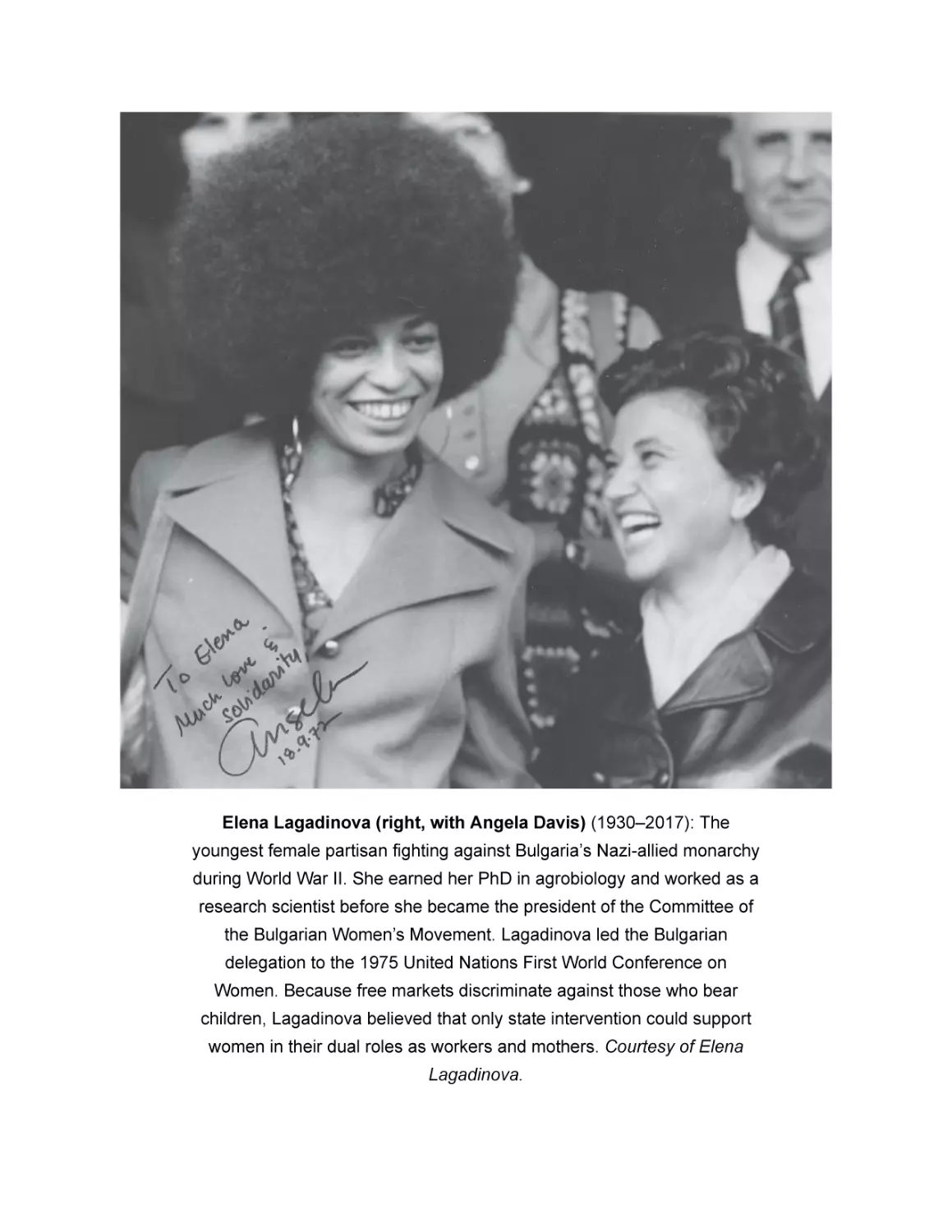
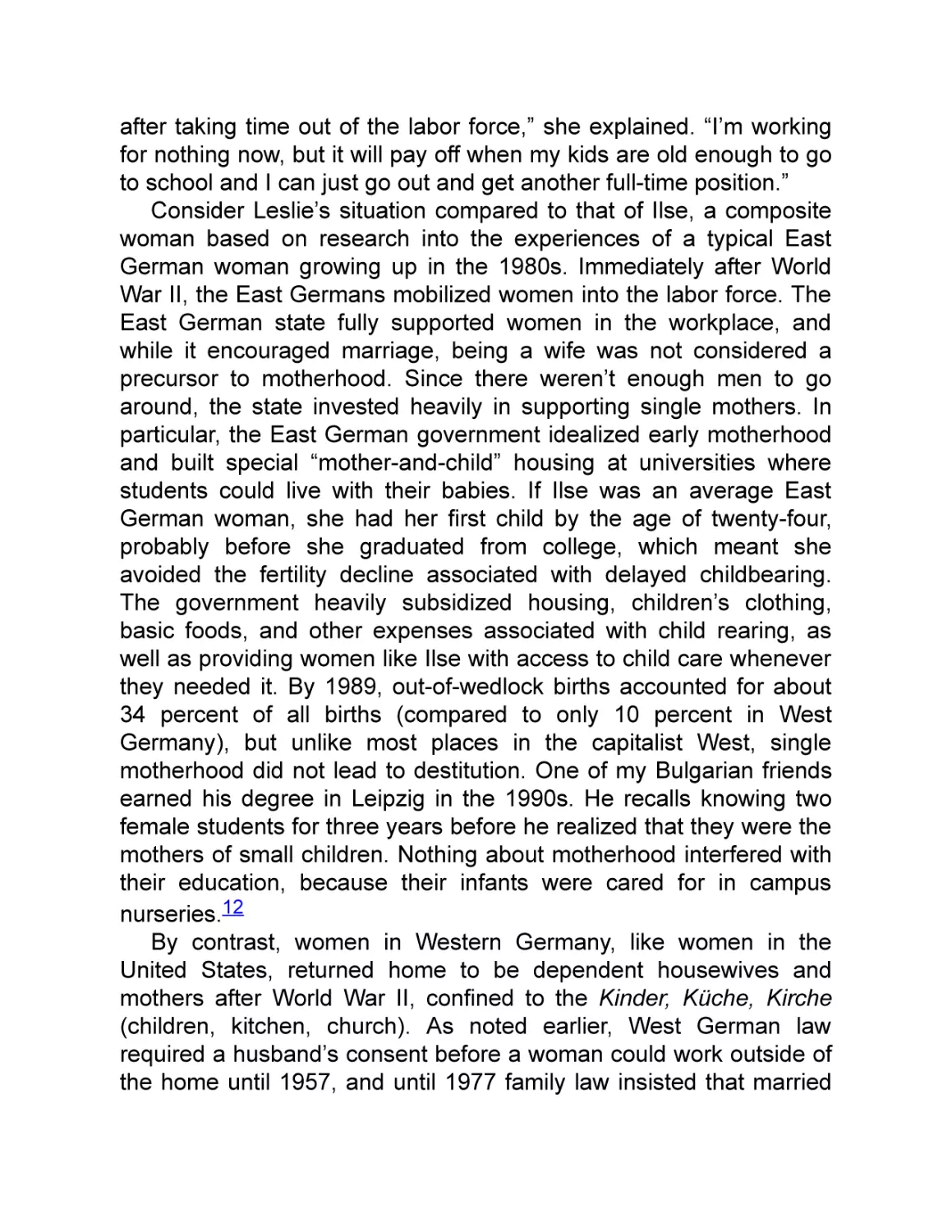
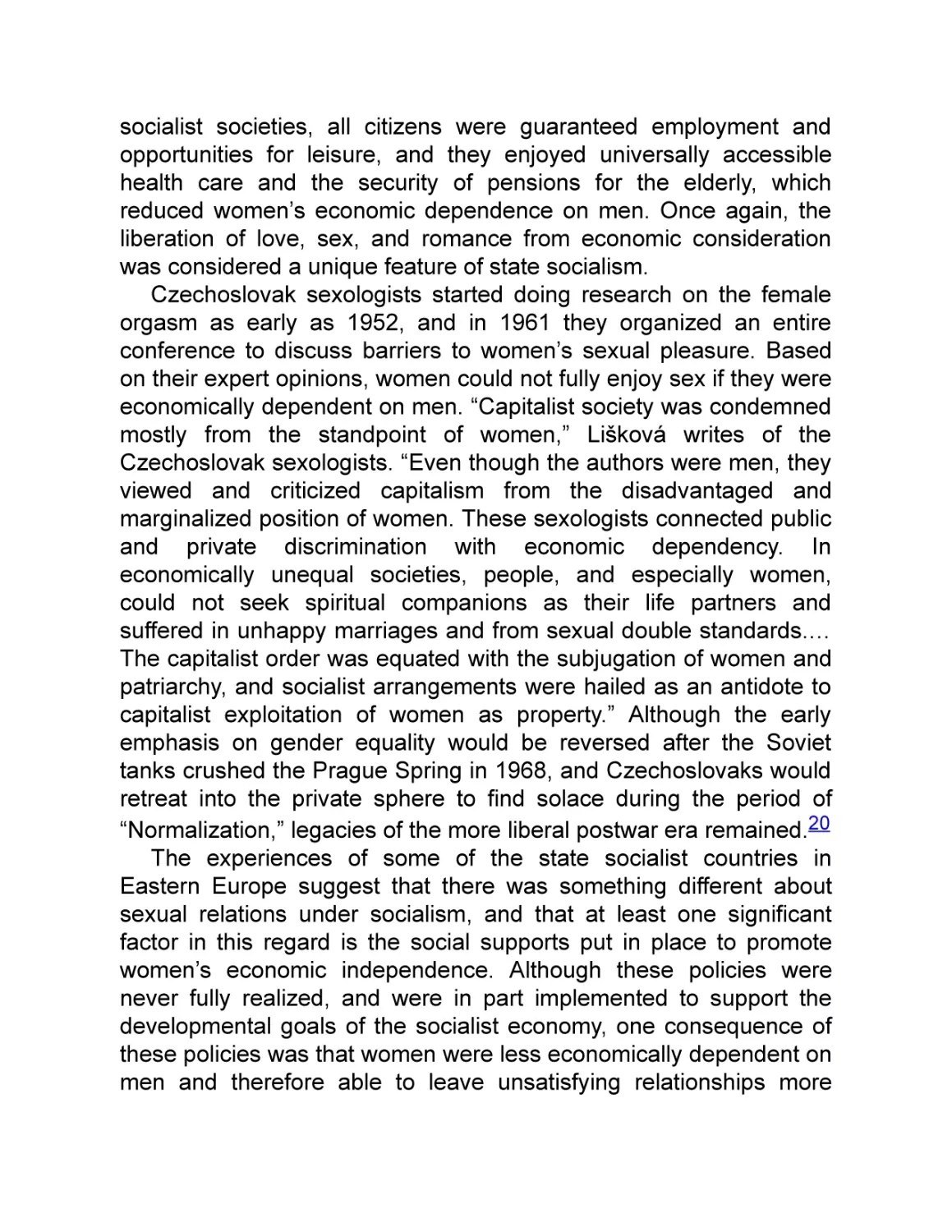
Elena Lagadinova (right, with Angela Davis) (1930–2017): The
youngest female partisan fighting against Bulgaria’s Nazi-allied monarchy
during World War II. She earned her PhD in agrobiology and worked as a
research scientist before she became the president of the Committee of
the Bulgarian Women’s Movement. Lagadinova led the Bulgarian
delegation to the 1975 United Nations First World Conference on
Women. Because free markets discriminate against those who bear
children, Lagadinova believed that only state intervention could support
women in their dual roles as workers and mothers. Courtesy of Elena
Lagadinova.

AUTHOR’S NOTE

For the last twenty years, I have studied the social impacts of the
political and economic transition from state socialism to capitalism in
Eastern Europe. Although I first traveled through the region just
months after the fall of the Berlin Wall in 1989, my professional
interest began in 1997, when I started conducting research on the
impacts of the collapse of communist ideology on ordinary people.
First as a PhD student and later as a university professor, I lived for
more than three years in Bulgaria and nineteen months in both
eastern and western Germany. In the summer of 1990, I also spent
two months traveling through Yugoslavia, Romania, Hungary,
Czechoslovakia, and the soon-to-disappear German Democratic
Republic. In the intervening years, I’ve been a frequent visitor to
Eastern Europe, delivering invited lectures in cities such as
Belgrade, Bucharest, Budapest, and Warsaw. Because I often travel
by car, bus, and train, I’ve seen firsthand the ravages of neoliberal
capitalism across the region: bleak landscapes pockmarked with the
decrepit remains of once thriving factories giving way to new suburbs
with Walmart-style megastores selling forty-two different types of
shampoo. I’ve also studied how the institution of unregulated free
markets in Eastern Europe returned many women to a subordinate
status, economically dependent on men.
Since 2004, I’ve published six scholarly books and over three
dozen articles and essays, using empirical evidence gathered from

archives, interviews, and extended ethnographic fieldwork in the
region. In this book, I draw on over twenty years of research and
teaching to write an introductory primer for a general audience
interested in European socialist feminist theories, the experience of
twentieth-century state socialism, and their lessons for the present
day. After the unexpected success of Bernie Sanders in the 2016
Democratic primaries, socialist ideas are circulating more broadly
among the American public. It is essential that we pause and learn
from the experiences of the past, examining both good and bad.
Because I believe in the pursuit of historical nuance, and that there
were some redeeming qualities of state socialism, I will inevitably be
accused of being an apologist for Stalinism. Vitriolic ad hominem
attacks are the reality of our hyperpolarized political climate, and I
find it quite ironic that those who claim to abhor totalitarianism have
no trouble silencing speech or unleashing hysterical Twitter mobs.
The German political theorist Rosa Luxemburg once said: “Freedom
is always and exclusively freedom for the one who thinks differently.”
This book is about learning to think differently with regard to the state
socialist past, our neoliberal capitalist present, and the path to our
collective future.
Throughout this book, I use the term “state socialism” or “state
socialist” to refer to the states of Eastern Europe and the Soviet
Union dominated by ruling Communist Parties where political
freedoms were curtailed. I use the term “democratic socialism” or
“democratic socialist” to refer to countries where socialist principles
are championed by parties that compete in free and fair elections
and where political rights are maintained. Although many parties
referred to themselves as “communist,” that term denotes the ideal
of a society where all economic assets are collectively owned and
the state and law have withered away. In no case has real
communism been achieved, and therefore I try to avoid this term
when referring to actually existing states.
On the topic of semantics, I have also endeavored to be sensitive
to contemporary intersectional vocabularies. For example, when I
talk about “women” in this book, I am primarily referring to cisgender
women. The nineteenth- and twentieth-century socialist “woman

question” did not consider the unique needs of trans women, but I
have no desire to exclude or alienate trans women from the current
discussion. Similarly, in my discussion of maternity, I do recognize
that I am discussing those who are female-assigned-at-birth (FAB),
but for the sake of simplicity, I use the word “woman” even though
this category includes some who identify as men or other genders.
Because this is an introductory book, there will be places in the
text where I don’t go into full detail about the debates surrounding
topics such as Universal Basic Income (UBI), surplus value
extraction, or gender-based quotas. In particular, although I believe
that they are absolutely essential, I don’t spend a lot of time
discussing universal single-payer health care or free public
postsecondary education, because I feel these policies have been
discussed at length elsewhere. I hope readers are inspired to
explore more about the issues raised within these pages, taking this
book as an invitation for further exploration of the intersections of
socialism and feminism. I also want to make it clear that this is not a
scholarly treatise; those in search of theoretical frameworks and
methodological debates should consult the books I’ve published with
university presses. I also recognize the long and important tradition
of Western socialist feminism, although it is not discussed in these
pages. I encourage interested readers to refer to the books listed in
the suggestions for further reading.
For all of the direct quotations and statistical claims made
throughout the book, I include consolidated citations in an endnote at
the end of the relevant paragraph. Few substantive endnotes
accompany this text, so most readers can feel free to ignore the
endnotes unless they have a question about a particular source.
General historical material can be found in the suggestions for
further reading. When discussing personal anecdotes, I have
changed the names and identifying details to preserve anonymity.
Finally, with the many social ills plaguing the world today, some
might find the chapters on intimate relations a bit too prurient for their
taste; some might think that having better sex is a trivial reason to
switch economic systems. But turn on the television, open a
magazine, or surf the internet, and you will find a world saturated

with sex. Capitalism has no problem commodifying sexuality and
even preying on our relationship insecurities to sell us products and
services we don’t want or need. Neoliberal ideologies persuade us to
view our bodies, our attentions, and our affections as things to be
bought and sold. I want to turn the tables. To use the discussion of
sexuality to expose the shortcomings of unfettered free markets. If
we can better understand how the current capitalist system has coopted and commercialized basic human emotions, we have taken
the first step toward rejecting market valuations that purport to
quantify our fundamental worth as human beings. The political is
personal.

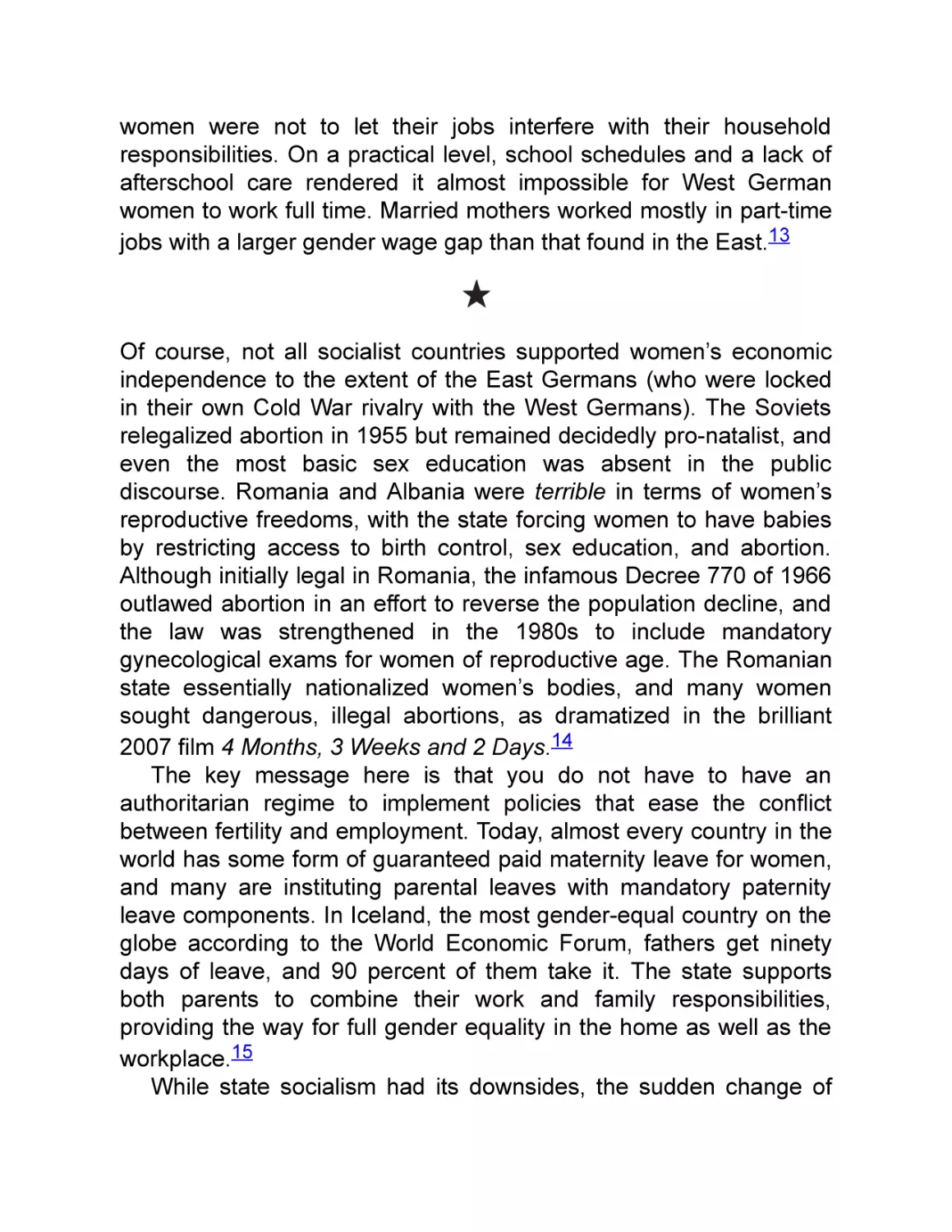
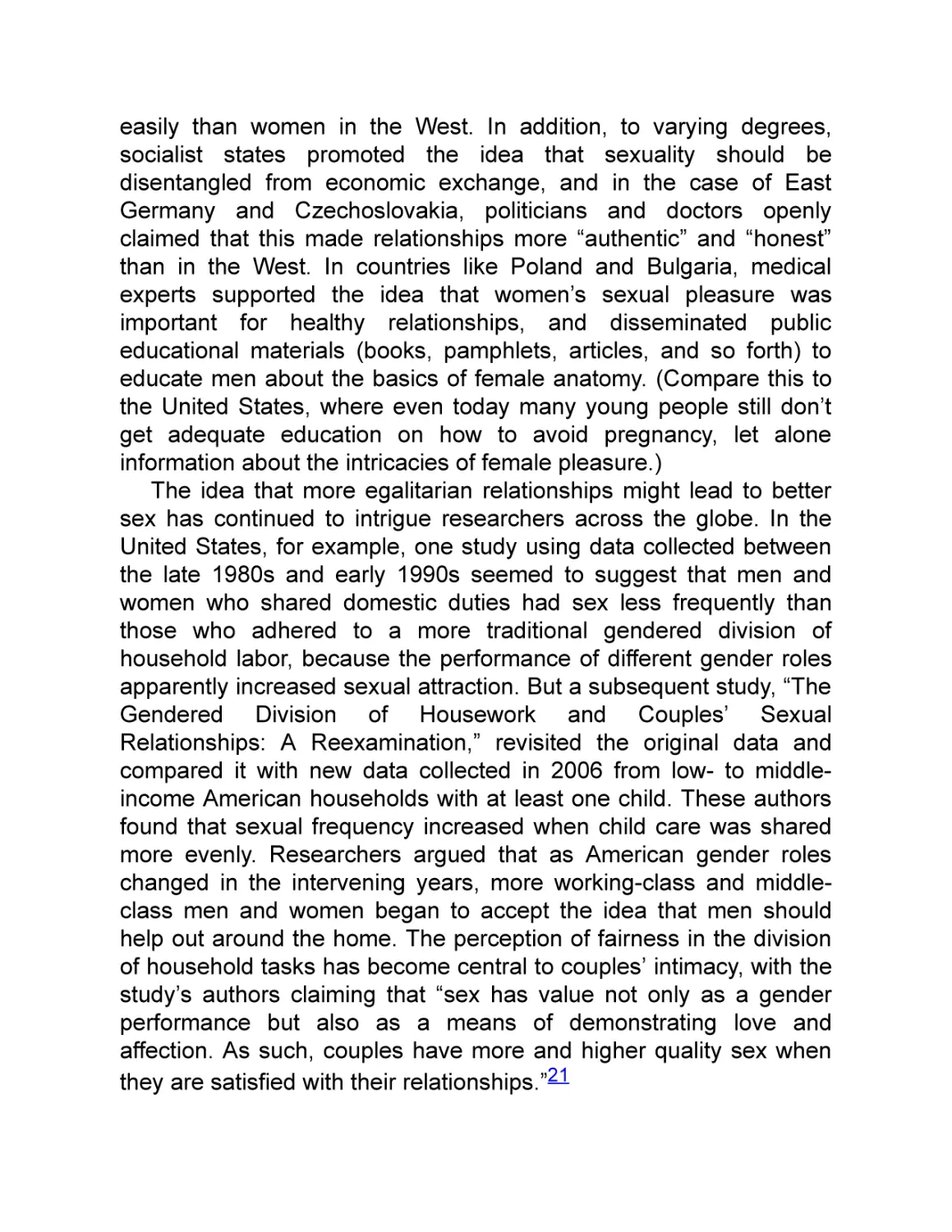
Valentina Tereshkova (born 1937): The first woman in space,
Tereshkova orbited the Earth forty-eight times in July 1963 on Vostok 6.
After her career as a cosmonaut, Tereshkova became a prominent
politician and led the Soviet delegation to the 1975 United Nations World
Conference on Women. She is still widely viewed as a national heroine in
Russia today. Courtesy of Elena Lagadinova.

Introduction
YOU MIGHT BE SUFFERING FROM
CAPITALISM

The

argument of this book can be summed up succinctly:
Unregulated capitalism is bad for women, and if we adopt some
ideas from socialism, women will have better lives. If done properly,
socialism leads to economic independence, better labor conditions,
better work/family balance, and, yes, even better sex. Finding a way
into a better future requires learning from the mistakes of the past,
including a thoughtful assessment of the history of twentieth-century
state socialism in Eastern Europe.
That’s it. If you like the idea of such outcomes, then come along
for an exploration of how we might change things. If you are dubious
because you don’t understand why capitalism as an economic
system is uniquely bad for women, and if you doubt that there could
ever be anything good about socialism, this short treatise will provide
some illumination. If you don’t give a whit about women’s lives
because you’re a gynophobic right-wing internet troll, save your
money and get back to your parents’ basement right now; this isn’t
the book for you.
Of course, some might argue that unregulated capitalism sucks
for almost everyone, but I want to focus on how capitalism

disproportionately harms women. Competitive labor markets
discriminate against those whose reproductive biology makes them
primarily responsible for child bearing. Today, this means humans
who get pink hats in the hospital and the letter “F” next to the name
on their birth certificate (as if we’ve already failed by not coming into
the world as a boy). Competitive labor markets also devalue those
expected to be the primary caregivers of children. Although societal
attitudes have evolved in this regard, our idealization of motherhood
means that most of us still believe that baby needs mama a whole lot
more than papa—at least until the child is old enough to play sports.
Others will argue that unregulated capitalism is not bad for all
women. Yes, for those women lucky enough to sit at the top of the
income distribution, the system works pretty well. Although women at
the executive level still face gender pay gaps and remain
underrepresented in leadership positions, on the whole things aren’t
too shabby for the Sheryl Sandbergs of the world. Of course, sexual
harassment still hinders progress even for those at the top, and too
many women believe that if you want to run with the big dogs, you
may have to suck it up and ignore the groping and unwanted
advances. And race plays an important role as well; white women do
a lot better in aggregate than do women of color. But when we look
at society as a whole, on average, women are comparatively worse
off in countries where markets are less encumbered by regulation,
taxation, and public enterprises than they are in nations where state
revenues support greater levels of redistribution and larger social
safety nets.
Choose your data source, and you find the same story.
Unemployment and poverty plague women with children. Employers
discriminate against women without children because they might
have them in the future. In the United States in 2013, women over
the age of sixty-five suffered from poverty at much greater rates than
men and dominated those in the category of “extreme poverty.”
Globally, women face higher rates of economic deprivation. Women
are often the last to be hired and the first to be fired in cyclical
downturns, and when they do find employment, bosses pay them
less than men. When states need to slash government spending on

education, health care, or old age pensions, mothers, daughters,
sisters, and wives must pick up the slack, diverting their energies to
care for the young, the sick, and the elderly. Capitalism thrives on
women’s unpaid labor in the home because women’s care work
supports lower taxes. Lower taxes mean higher profits for those
already at the top of the income ladder—mostly men.1
But capitalism was not always so savage. Throughout much of
the twentieth century, state socialism presented an existential
challenge to the worst excesses of the free market. The threat posed
by Marxist ideologies forced Western governments to expand social
safety nets to protect workers from the unpredictable but inevitable
booms and busts of the capitalist economy. After the Berlin Wall fell,
many celebrated the triumph of the West, consigning socialist ideas
to the dustbin of history. But for all its faults, state socialism provided
an important foil for capitalism. It was in response to a global
discourse of social and economic rights—a discourse that appealed
not only to the progressive populations of Africa, Asia, and Latin
America but also to many men and women in Western Europe and
North America—that politicians agreed to improve working
conditions for wage laborers as well as create social programs for
children, the poor, the elderly, the sick, and the disabled, mitigating
exploitation and the growth of income inequality. Although there were
important antecedents in the 1980s, once state socialism collapsed,
capitalism shook off the constraints of market regulation and income
redistribution. Without the looming threat of a rival superpower, the
last thirty years of global neoliberalism have witnessed a rapid
shriveling of social programs that protect citizens from cyclical
instability and financial crises and reduce the vast inequality of
economic outcomes between those at the top and bottom of the
income distribution.
For much of the twentieth century, Western capitalist countries
also endeavored to outdo the East European countries in terms of
women’s rights, fueling progressive social change. For example, the
state socialists in the USSR and Eastern Europe were so successful
at giving women economic opportunities outside the home that

initially, for two decades after the end of World War II, women’s wage
work was conflated with the evils of communism. The American way
of life meant male breadwinners and female homemakers. But
slowly, socialist championing of women’s emancipation began to chip
away at the Leave It to Beaver ideal. The Soviet launch of Sputnik in
1957 spurred American leaders to rethink the costs of maintaining
traditional gender roles. They feared the state socialists enjoyed an
advantage in technological development because they had double
the brainpower; the Russians educated women and funneled the
best and the brightest into scientific research.2
Fearing Eastern Bloc superiority in the space race, the American
government passed the National Defense Education Act (NDEA) in
1958. Despite a continuing cultural desire for women to stay at home
as dependent wives, the NDEA created new opportunities for
talented girls to study science and math. Then, in 1961, President
John F. Kennedy signed Executive Order 10980 to establish the first
Presidential Commission on the Status of Women, citing national
security concerns. This commission, chaired by Eleanor Roosevelt,
laid the groundwork for the future US women’s movement.
Americans received a further shock in 1963, when Valentina
Tereshkova became the first female cosmonaut, spending more time
orbiting the Earth than all male astronauts in the United States had,
combined. Later, Soviet and East European dominance at the
Olympics spurred the passage of Title IX, so that the United States
could identify and train more female athletes to snatch gold medals
away from the ideological enemy.3
In response to state socialist prowess in the sciences, the
American government sponsored an important study titled “Women
in the Soviet Economy.” The head of the study visited the USSR in
1955, 1962, and 1965 to examine Soviet policies to integrate women
into the formal labor force as an example for American legislators.
“Concern in recent years on the waste of women’s talent and labor
potential led to the appointment of the President’s Commission on
the Status of Women, which has issued a series of reports on
various problems affecting women and their participation in

economic, political, and social life,” the 1966 report began. “For any
formulation of policy directed toward the better use of our women
power, it is important to know the experience of other nations in
utilizing the capabilities of women. For this reason as well as others,
the Soviet experience is of particular interest at this time.” The
precedent set by the state socialist countries in Eastern Europe
acted as an influential example for American politicians at the same
historical moment that Betty Friedan published The Feminine
Mystique and revealed how unsatisfied middle-class, white women
felt with their circumscribed domestic lives. But in the current political
climate, it may be hard to fathom how a rivalry between superpowers
could have sparked interest in the status of women.4

Today, socialist ideas are enjoying a renaissance as young people
across countries such as the United States, France, Great Britain,
Greece, and Germany find inspiration in politicians like Bernie
Sanders, Jean-Luc Mélenchon, Jeremy Corbyn, Yanis Varoufakis,
and Sahra Wagenknecht. Citizens desire an alternative political path
that would lead to a more egalitarian and sustainable future. To
move forward, we must be able to discuss the past with no
ideologically motivated attempts to whitewash or blackwash either
our own history or the accomplishments of state socialism. On the
one hand, any nuanced account of twentieth-century state socialism
will inevitably encounter the sputtering and bluster of those who
insist that it was pure evil, end of story. As the Czech writer Milan
Kundera wrote in his famous novel The Unbearable Lightness of
Being: “The people who struggle against what we call totalitarian
regimes cannot function with queries and doubts. They, too, need
certainties and simple truths to make the multitudes understand, to
provoke collective tears.”5 On the other hand, some young people
today joke about “full communism now.” Leftist millennials might not
know about (or prefer to ignore) the real horrors inflicted on citizens
in one-party states. Gruesome tales of the secret police, travel

restrictions, consumer shortages, and labor camps are not just
anticommunist propaganda. Our collective future depends on a
balanced examination of the past so we can discard the bad and
move forward with the good, especially where women’s rights are
concerned.
Since the middle of the nineteenth century, European social
theorists argued that the female sex is uniquely disadvantaged in an
economic system that prizes profits and private property over
people. Throughout the 1970s, socialist feminists in the United
States also asserted that smashing the patriarchy wasn’t enough.
Exploitation and inequality would persist so long as financial elites
built their fortunes on the backs of docile women reproducing the
labor force for free. But these early critiques were based on abstract
theories with little empirical evidence to substantiate them. Slowly,
over the course of the first half of the twentieth century, new
democratic socialist and state socialist governments in Europe
began to test these theories in practice. In East Germany,
Scandinavia, the Soviet Union, and Eastern Europe, political leaders
supported the idea of women’s emancipation through their full
incorporation into the labor force. These ideas soon spread to China,
Cuba, and a wide variety of newly independent countries across the
globe. Experiments with female economic independence fueled the
twentieth-century women’s movement and resulted in a revolution in
the life paths open to women previously confined to the domestic
sphere. And nowhere in the world were there more women in the
workforce than under state socialism.6
Women’s emancipation infused the ideology of almost all state
socialist regimes, with the Franco-Russian revolutionary Inessa
Armand famously declaring: “If women’s liberation is unthinkable
without communism, then communism is unthinkable without
women’s liberation.” Although important differences existed between
countries and none achieved full equality in practice, these nations
did expend vast resources to invest in women’s education and
training and to promote them in professions previously dominated by
men. Understanding the demands of reproductive biology, they also

attempted to socialize domestic work and child care by building a
network of public crèches, kindergartens, laundries, and cafeterias.
Extended, job-protected maternity leaves and child benefits allowed
women to find at least a modicum of work/family balance. Moreover,
twentieth-century state socialism did improve the material conditions
of millions of women’s lives; maternal and infant mortality declined,
life expectancy increased, and illiteracy all but disappeared. To take
just one example, the majority of Albanian women were illiterate
before the imposition of socialism in 1945. Just ten years later, the
entire population under forty could read and write, and by the 1980s
half of Albania’s university students were women.7
While different countries pursued different policies, in general
state socialist governments reduced women’s economic dependence
on men by making men and women equal recipients of services from
the socialist state. These policies helped to decouple love and
intimacy from economic considerations. When women enjoy their
own sources of income, and the state guarantees social security in
old age, illness, and disability, women have no economic reason to
stay in abusive, unfulfilling, or otherwise unhealthy relationships. In
countries such as Poland, Hungary, Czechoslovakia, Bulgaria,
Yugoslavia, and East Germany, women’s economic independence
translated into a culture in which personal relationships could be
freed from market influences. Women didn’t have to marry for
money.8
Of course, just as we can learn from the experiences of Eastern
Europe, we shouldn’t ignore the downsides. Women’s rights in the
Eastern Bloc failed to include a concern for same-sex couples and
gender nonconformity. Abortion served as a primary form of birth
control in the countries where it was available on demand. Most East
European states strongly encouraged women to become mothers,
with Romania, Albania, and the USSR under Stalin forcing women to
have children they didn’t want. State socialist governments
suppressed discussions of sexual harassment, domestic violence,
and rape. And although they tried to get men involved in housework
and child care, men largely resisted challenges to traditional gender

roles. Many women suffered under a double burden of mandatory
formal employment and domestic work, as so well captured in
Natalya Baranskaya’s brilliant novella, A Week Like Any Other.
Finally, in no country were women’s rights promoted as a project to
support women’s individualism or self-actualization. Instead, the
state supported women as workers and mothers so they could
participate more fully in the collective life of the nation.9
After the fall of the Berlin Wall in 1989, new democratic
governments rapidly privatized state assets and dismantled social
safety nets. Men under these newly emerging capitalist economies
regained their “natural” roles as family patriarchs, and women were
expected to return home as mothers and wives supported by their
husbands. Across Eastern Europe, post-1989 nationalists argued
that capitalist competition would relieve women of the notorious
double burden and restore familial and societal harmony by allowing
men to reassert their masculine authority as breadwinners. However,
this meant that men could once again wield financial power over
women. For instance, the renowned historian of sexuality Dagmar
Herzog shared a conversation with several East German men in
their late forties in 2006. They told her that “it was really annoying
that East German women had so much sexual self-confidence and
economic independence. Money was useless, they complained. The
few extra Eastern Marks that a doctor could make in contrast with,
say, someone who worked in the theater, did absolutely no good,
they explained, in luring or retaining women the way a doctor’s
salary could and did in the West. ‘You had to be interesting.’ What
pressure. And as one revealed: ‘I have much more power now as a
man in unified Germany than I ever did in communist days.’”
Furthermore, following the publication of my New York Times op-ed,
“Why Women Had Better Sex Under Socialism,” I did an interview
with Doug Henwood on his radio show, Behind the News. One
listener, a forty-six-year-old woman born in the Soviet Union, emailed
the show to say that I had “nailed it” in my discussion of romantic
relations in “the old country,” as she called it, “but also the way men
lord it over women with money here [in the United States].”10

The collapse of state socialism in 1989 created a perfect
laboratory to investigate the effects of capitalism on women’s lives.
The world could watch as free markets were conjured from the
rubble of the planned economy, and these new markets variously
affected different categories of workers. After decades of shortages,
East Europeans eagerly exchanged authoritarianism for the promise
of democracy and economic prosperity, throwing their countries open
to Western capital and international trade. But there were
unforeseen costs.
The rejection of the one-party state and the embrace of political
freedoms came bundled with economic neoliberalism. New
democratic governments privatized public enterprises to make room
for new competitive labor markets where productivity would
determine wages. Gone were the long lines for toilet paper and the
black markets for jeans. Coming soon was a glorious consumer
paradise free from shortages, famines, the secret police, and the
labor camp. But after almost three decades, many Eastern
Europeans still wait for a bright capitalist future. Others have
abandoned all hope.11
The evidence is incontrovertible: like so many other women
across the globe, women in Eastern Europe are once again
commodities to be bought and sold—their price determined by the
fickle fluctuations of supply and demand. Writing in the immediate
aftermath of state socialism’s collapse, the Croatian journalist
Slavenka Drakulić explained, “We live surrounded by newly opened
porno shops, porno magazines, peepshows, stripteases,
unemployment, and galloping poverty. In the press they call
Budapest ‘the city of love, the Bangkok of Eastern Europe.’
Romanian women are prostituting themselves for a single dollar at
the Romanian-Yugoslav border. In the midst of all this, our antichoice nationalist governments are threatening our right to abortion
and telling us to multiply, to give birth to more Poles, Hungarians,
Czechs, Croats, Slovaks.” Today, Russian mail-order brides,
Ukrainian sex workers, Moldovan nannies, and Polish maids flood
Western Europe. Unscrupulous middle men harvest blond hair from

poor Belorussian teenagers for New York wig makers. In St.
Petersburg, women attend academies for aspiring gold diggers.
Prague is an epicenter of the European porn industry. Human
traffickers prowl the streets of Sofia, Bucharest, and Chişinău for
hapless girls dreaming of a more prosperous life in the West.12
Older citizens of Eastern Europe fondly recall the small comforts
and predictability of their life before 1989: free education and health
care, no fear of unemployment and of not having money to meet
basic needs. A joke, told in many East European languages,
illustrates this sentiment:
In the middle of the night a woman screams and jumps out of
bed, eyes filled with terror. Her startled husband watches her
rush into the bathroom and open the medicine cabinet. She
then dashes to the kitchen and inspects the inside of the
refrigerator. Finally, she flings open a window and gazes out
onto the street below their apartment. She takes a deep breath
and returns to bed.
“What’s wrong with you?” her husband says. “What
happened?”
“I had a terrible nightmare,” she says. “I dreamed that we
had the medicine we needed, that our refrigerator was full of
food, and that the streets outside were safe and clean.”
“How is that a nightmare?”
The woman shakes her head and shudders. “I thought the
Communists were back in power.”
Opinion polls throughout the region continue to show that many
citizens believe their lives were better before 1989, under
authoritarianism. Although these polls may say more about
disappointment with the present than they do about the desirability of
the past, they complicate the totalitarian narrative. For example, a
2013 random poll of 1,055 adult Romanians found that only a third
reported that their lives were worse off before 1989: 44 percent said
their lives were better, and 16 percent said there was no change.

These results were also gendered in interesting ways: whereas 47
percent of women thought that state socialism was better for their
country, only 42 percent of men said the same. Similarly, whereas 36
percent of men claimed that life was worse before 1989, only 31
percent of women said life under the dictator Nicolae Ceauşescu
was worse than the present. And this is from Romania, one of the
most corrupt and oppressive regimes in the former Eastern Bloc
where Ceauşescu gold-plated the flushing handle on his private
toilet. Similar results emerged from surveys in Poland in 2011 and
from an opinion poll conducted in eight other former socialist nations
in 2009. For citizens who have had the opportunity to live under two
different economic systems, many now feel that capitalism is worse
than the state socialism they were once so eager to cast aside.13

Back in the United States, the collapse of East European state
socialism ushered in an era of Western capitalist triumphalism. Great
Society ideas about how to regulate our economy and redistribute
wealth to maximize the well-being of all citizens, including women,
fell out of favor. The rise of what was called the Washington
Consensus (born of Reaganomics) meant marketization,
privatization, and the shredding of social safety nets in the name of
efficiency. Throughout the 1990s and 2000s, citizens witnessed
increasing deregulation of the financial, transportation, and utility
sectors and the growing commodification of everyday life. We
conflated freedom with free markets. After the global financial crisis
in 2008, economic elites targeted already lean state budgets,
slashing deeper into social programs while using taxpayer monies to
bail out the bankers who created much of the mess in the first place.
Occupy Wall Street called attention to structural inequality, but
politicians on both sides of the aisle met rising public anger with the
same old line: there is no alternative to capitalism.
This is a lie.
Conservative cold warriors will counter any attempt to complicate

the history of twentieth-century state socialism with screaming about
Stalin’s famines and purges. In their imagination, the entire
experience of state socialism consisted of people standing in bread
lines and snitching on their neighbors to the secret police. For
seventy years in the Soviet Union and forty-five years in Eastern
Europe, totalitarian leaders apparently shuttled everyone back and
forth between labor camps and prisons, a godless Orwellian
nightmare where people wore grey, unisex Mao suits and sported
shaved heads. If babies were born, it’s not because people chose to
start families, but because the Party mass-inseminated the
population to meet predetermined human production quotas.
Anticommunists refuse to acknowledge the important differences
among the wide variety of societies that embraced socialism or to
credit them for their various achievements in science, education,
health outcomes, culture, and sport. In the stereotypes promoted by
Western leaders, state socialism was an inefficient economic system
doomed to inevitable collapse and a terrifying red menace requiring
billions of dollars of taxpayer money to contain. It’s odd to consider
how it could have been both.
Within Eastern Europe today, numerous Western-funded research
institutes investigate the crimes of communism. In countries like
Hungary, Bulgaria, and Romania (all German allies in World War II)
the descendants of Nazi collaborators are keen to paint themselves
as “victims of communism.” Local politicians and economic elites
who benefitted from the transition to free markets (particularly those
who had the previously nationalized property of their grandparents
restituted to them after 1989) collude to create one official totalitarian
narrative about the past. For example, after a lecture I gave in
Vienna in 2011, a young Bulgarian woman in the audience sent an
email thanking me for my courage in discussing some of the positive
legacies of Todor Zhivkov, Bulgaria’s leader from 1954 to 1989. “No
one [in Bulgaria] can talk about the nostalgia and the pains of
transition without being framed as a communist and as someone
who denies the crimes of the Zhivkov regime. So the important
issues you deal with are not present in the discourse or media.”14 In

nearby Romania, the literary scholar Costi Rogozanu has criticized
the East European practice of using horror stories about the state
socialist past to justify the continued implementation of neoliberal
economic policies in the present: “Do you want a salary raise? You
are communist. Do you want public services? Do you want to tax the
rich and ease the burden on small producers and wage earners?
You are a communist and you killed my grandparents. Do you want
public transportation instead of highways? You are mega-communist
and a [stupid] hipster.”15
Although it’s important not to romanticize the state socialist past,
the ugly realities should not make us completely oblivious to the
ideals of the early socialists, to the various attempts to reform the
system from within (such as the Prague Spring, glasnost, or
perestroika), or to the important role that socialist ideals played in
inspiring national independence movements in the Global South.
Acknowledging the bad does not negate the good. Just as there are
those who would like to whitewash American history by downplaying,
just for starters, Jim Crow, institutional racism, gun violence, or the
unprecedented incarceration rate, there are those who would
blackwash the history of state socialism, insisting that everything
was evil.16
Today, we have over two hundred years of experimentation with
various forms of socialism, but the word “socialism” still carries
negative connotations. Howls about Stalin’s Gulag and Ukrainian
famines meet any mention of socialist principles. Opponents decry it
as an economic system doomed to failure and inevitably leading to
totalitarian terror, while ignoring the successful democratic socialist
nations in Scandinavia. Europe was a battleground in the Cold War,
and the northern European countries once had large, domestic
communist and socialist parties that participated in the parliamentary
process, promoting policies that ensured redistribution and social
welfare. In the 1990s, while Russia, Hungary, and Poland liquidated
state assets and dismantled their social safety nets, Denmark,
Sweden, and Finland maintained generous public spending financed
by government-owned industries and progressive taxation despite

the global fashion for neoliberalism. The democratic socialist
societies of Northern Europe show that it’s possible to find a humane
alternative to neoliberal capitalism. And although they aren’t perfect
or easy to replicate—they are ethnically homogenous and
increasingly hostile to immigrants—they have found ways to
combine the political freedoms of the West with the social securities
of the East.
Northern Europe is not only the happiest place to live in the world
but an oasis for women who enjoy more economic and political
power than anywhere else on the planet. In a brilliant article in
Dissent, “Cockblocked by Redistribution: A Pick-Up Artist in
Denmark,” Katie J. M. Baker exposed how the American womanizer
Daryush Valizadeh (aka Roosh) warned his fans that Denmark was a
veritable desert for men on the hunt for easy women. The country’s
generous social safety net and gender equalizing policies apparently
render Valizadeh’s alpha male seduction techniques useless
because Danish women don’t need men for financial security. In less
egalitarian countries, women understand that sexual relationships
provide an avenue for social mobility—the Cinderella fantasy. But
when women earn their own money and live in societies where the
state supports their independence, Prince Charming loses his
appeal. Roosh’s book, Don’t Bang Denmark, stands as a testament
to the idea that redistributive policies can provide women the stability
and security that mitigates the effects of discrimination in daily life.17

Young people are rediscovering the idea that democratic
governments have a role in ensuring a just economy. Today,
corporations and wealthy elites influence politicians to do their
bidding through campaign contributions and hired lobbyists: cut
services for the poor to slash taxes for the rich. The 2010 Supreme
Court decision in Citizens United v. FEC affirmed the idea that
money equals speech and therefore deserved protection under the
First Amendment of the Constitution. But as long as the United

States remains a representative democracy, ordinary people can
vote their economic interests and choose leaders who will pursue
policies of redistribution and support social safety nets for all. By
2020, millennial voters will make up the largest demographic group
of the American electorate. And young women make up half of the
millennial population. The math here is simple.
A June 2015 Gallup poll found that Americans ages eighteen to
twenty-nine were more willing to vote for a “socialist” presidential
candidate than any other age cohort, and this was well before Bernie
Sanders’s primary campaign was in full swing. In addition, a January
2016 YouGov poll asked Americans, “Do you have a favorable or an
unfavorable opinion of socialism?” The results showed a stark
difference in the opinions of different age cohorts. For those over the
age of sixty-five, 60 percent had an unfavorable opinion of socialism,
compared to the 23 percent that reported a favorable opinion. For
those between the ages of thirty and sixty-four, about a quarter
reported a positive idea of socialism, but half of thirty- to forty-fouryear-olds and 54 percent of forty-five- to sixty-four-year-olds
maintained a negative view. Among the eighteen- to twenty-nineyear-olds, only about one quarter had an unfavorable view of
socialism. A whopping 43 percent had a favorable opinion, greater
than the percentage of eighteen- to twenty-nine-year-olds who had a
positive opinion of capitalism (32 percent)! A follow-up poll by the
Victims of Communism Memorial Foundation in October 2017 found
that support for socialism continued to increase among the young:
“For starters, as of this year, more Millennials would prefer to live in a
socialist country (44 percent) than in a capitalist one (42 percent). Or
even a communist country (7 percent). The percentage of Millennials
who would prefer socialism to capitalism is a full ten points higher
than that of the general population. The significance of this finding
cannot be overstated—as of last year, Millennials surpassed Baby
Boomers as the largest generational cohort in American society.”18
This same study revealed fascinating gender differences in
opinions on whether respondents viewed either capitalism or
socialism as “favorable” or “unfavorable.” Of the 2,300 Americans

surveyed, women made up 51 percent of the sample, and their
opinions often diverged significantly from those of men. When asked
if they had a favorable view of capitalism as an economic system, 56
percent of men surveyed agreed compared to only 44 percent of
women, a 12-percentage-point difference. Alternatively, 53 percent
of men had an unfavorable view of socialism, compared to only 47
percent of women. Although men tended to have stronger political
opinions overall, these gender differences suggest that women
voters are more inclined toward redistributive policies. And these
changes in political opinions are despite the efforts of conservative
politicians to conflate all leftist ideals with the worst horrors of
Stalinism. Perhaps millennials don’t trust the authority of the baby
boomer cold warriors, or perhaps the economic realities of the
present day, with growing inequality and stagnant earnings for the
bottom half of the income distribution, are more real than ghost
stories about an “evil empire” that fell before they were born.19
George Orwell once wrote: “Who controls the past controls the
future. Who controls the present controls the past.”20 Conservatives
will do anything to suppress evidence that socialist experiments in
the twentieth century (despite their collapse) did some good things
for women, including policies that have been and can be
implemented in democratic societies: paid maternity leaves, publicly
funded child care, shorter and more flexible work weeks, free
postsecondary education, universal health care, and other programs
that would help both men and women to lead less precarious and
more fulfilling lives. Many of these socialistic policies already exist in
advanced Western countries, countries where Fox News and kneejerk anticommunism don’t deter citizens from voting in their
economic interests.
The current hyperpolarized political climate mitigates against a
more nuanced view of the past. Conservative critics care little about
the history of twentieth-century state socialism and its policies
toward women. They want to maintain the status quo. For instance,
the Washington DC–based Victims of Communism Memorial
Foundation claims that “an entire generation of Americans is open to

collectivist ideas because they don’t know the truth. We tell the truth
about communism because our vision is for a world free from the
false hope of communism.” Notice the slippage between “collectivist
ideas” and “communism” as if the former always and inevitably
become the latter. (If I want to own my snow blower in common with
my neighbors, it must be because I’m secretly hoping they’ll get sent
to the Gulag.) This foundation designs high school curricula, pays for
anticommunist billboards on Times Square, and hopes to build a
victims of communism museum near the National Mall in
Washington, DC (with funding from explicitly right-wing donors).
They want to control history in the same way that the Soviet Union
once manufactured the past to suit its own political ends. If you
challenge their single-minded focus on the worst aspects of the past,
you challenge their assertion that socialism will always fail no matter
how or where it is tried in the future.21
Millennials and members of generation Z reject the Cold War
baggage of their elders who once proclaimed, “Better dead than
Red!” Young people wonder whether their lives would be less
harried, insecure, and stressful if the government took a more active
role in redistribution. They have incentives to vote for leaders who
understand that markets boom and bust and that ordinary people
need protection from the sudden and often savage fluctuations of
free markets. Right-wing populist leaders will try to scapegoat
women, people of color, and immigrants to deflect blame from the
real roots of economic injustice: the high concentration of wealth in
the hands of fewer and fewer people. As ordinary men and women
struggle and scramble to cover their basic needs in an economy that
promises equal opportunities for social mobility, but in which 78
percent of African American children born between 1985 and 2000
grew up in highly disadvantaged neighborhoods (compared to only 5
percent of white children), citizens must join together to effect real
political change.22
Let’s be clear: I don’t advocate a return to any form of twentiethcentury state socialism. Those experiments failed under the weight
of their own contradictions: the vast chasm between their stated

ideals and the actual practices of authoritarian leaders. You shouldn’t
have to sacrifice toilet paper for medical care. Basic political
freedoms don’t need to be traded for guaranteed employment. But
there were other paths not taken, such as those envisioned by early
socialist theorists like Karl Liebknecht and Rosa Luxemburg. And no
socialist experiment was ever allowed to flourish without facing the
overt or covert opposition of the United States, whether direct
confrontations like those in Korea and Vietnam or secret operations
in places such as Cuba, Chile, or Nicaragua. Did somebody say,
“Iran-Contra affair”? Besides, the historical circumstances of the
twenty-first century differ from those of the twentieth century. As our
global economy evolves and changes in response to new
technologies, citizens need access to a theoretical toolkit that
contains the widest array of potential political solutions to the
problems we will face in the coming years.
Just as European peasants once believed that God anointed
kings and aristocrats to rule over them, today many believe the
superrich have earned their money in a fair competition in free
markets. But as suspicions of the so-called rigged economy grow,
more and more youth are searching for alternatives. The
seventeenth-century philosopher Spinoza once said, “If you want the
future to be different from the present, study the past.” Even if past
experiments with socialism failed, there were a few successes. We
should study these successes and salvage what we can of the most
powerful theoretical and practical tools we have to limit the worst
excesses of global capitalism today. Young women in particular have
little to lose and much to gain from a collective effort to build more
just, equitable, and sustainable societies.23
This book explains why.

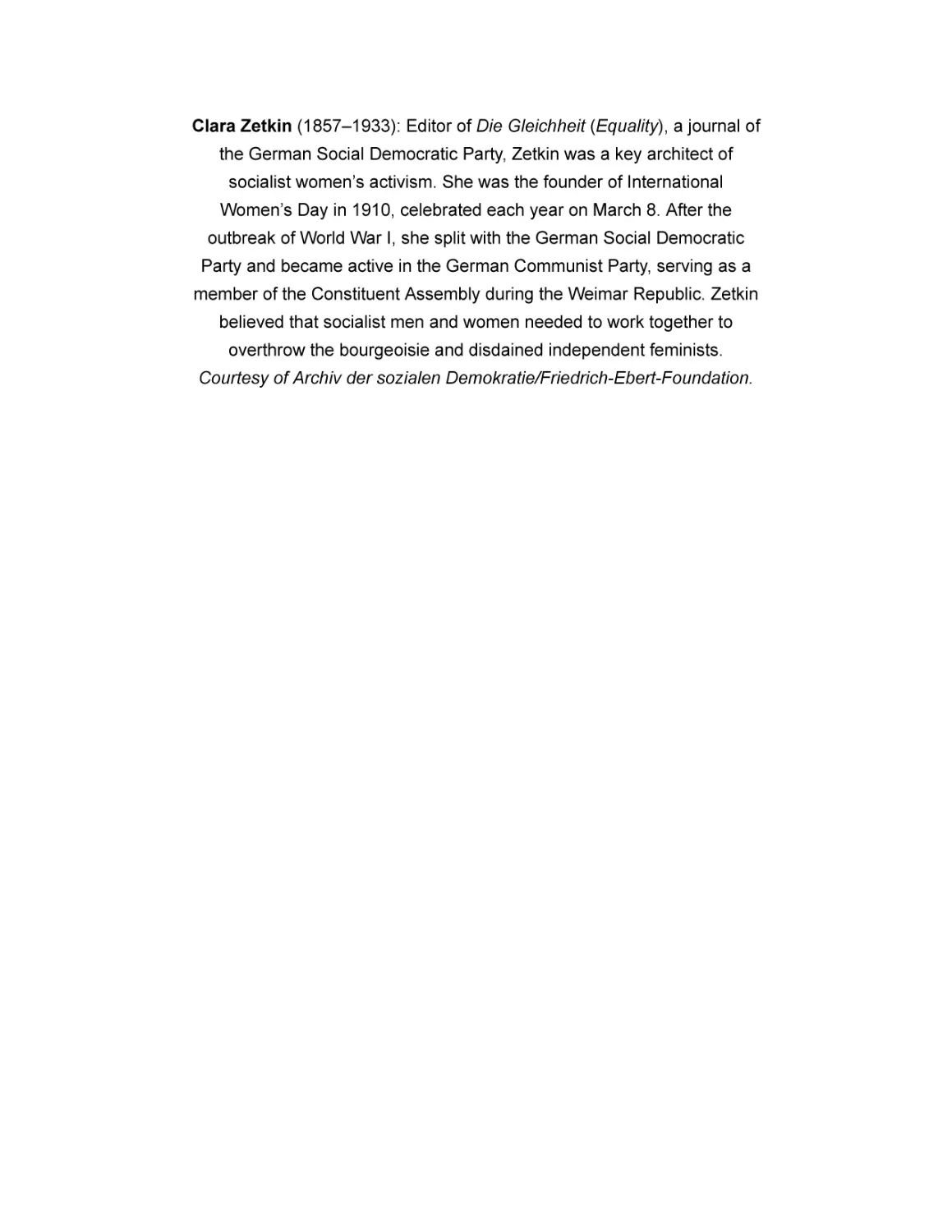
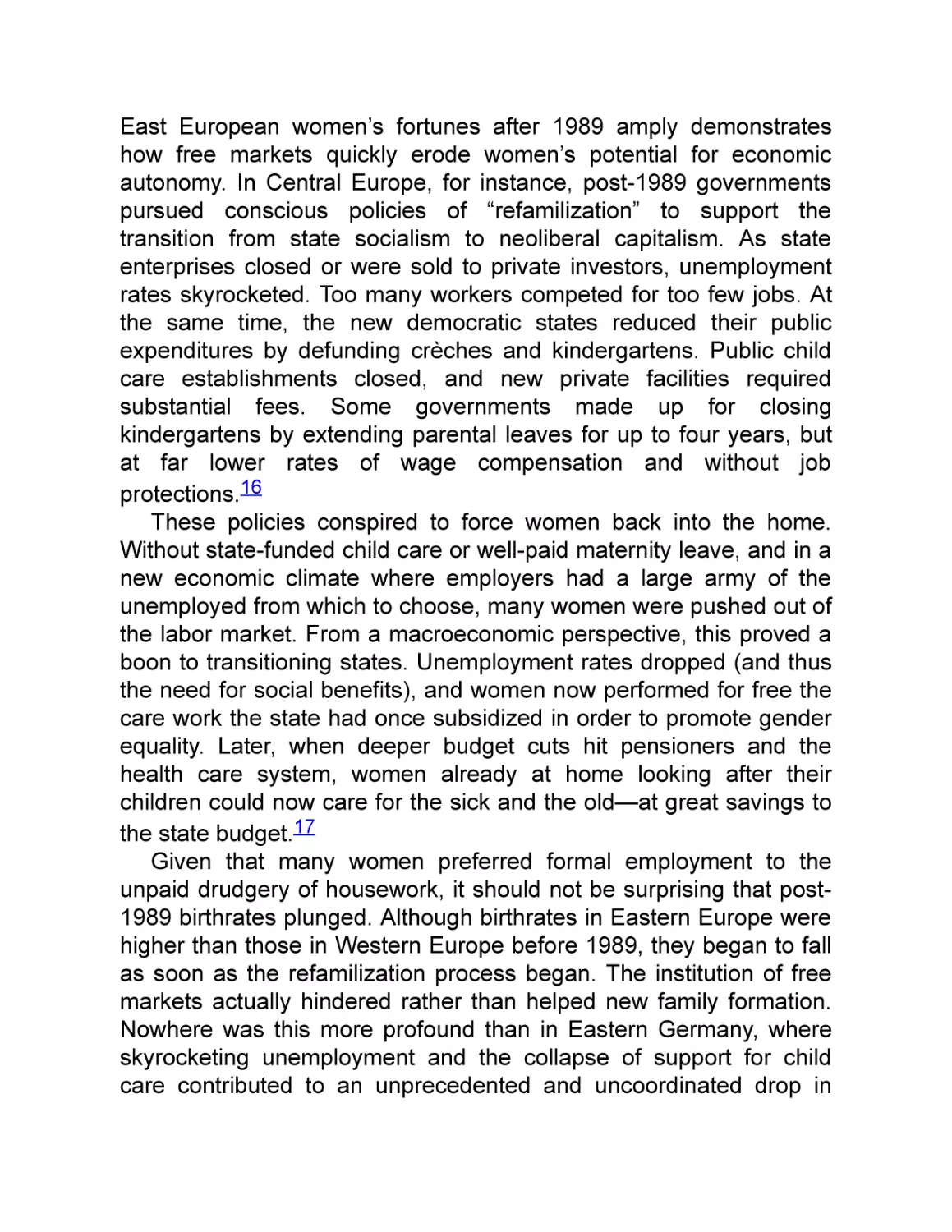
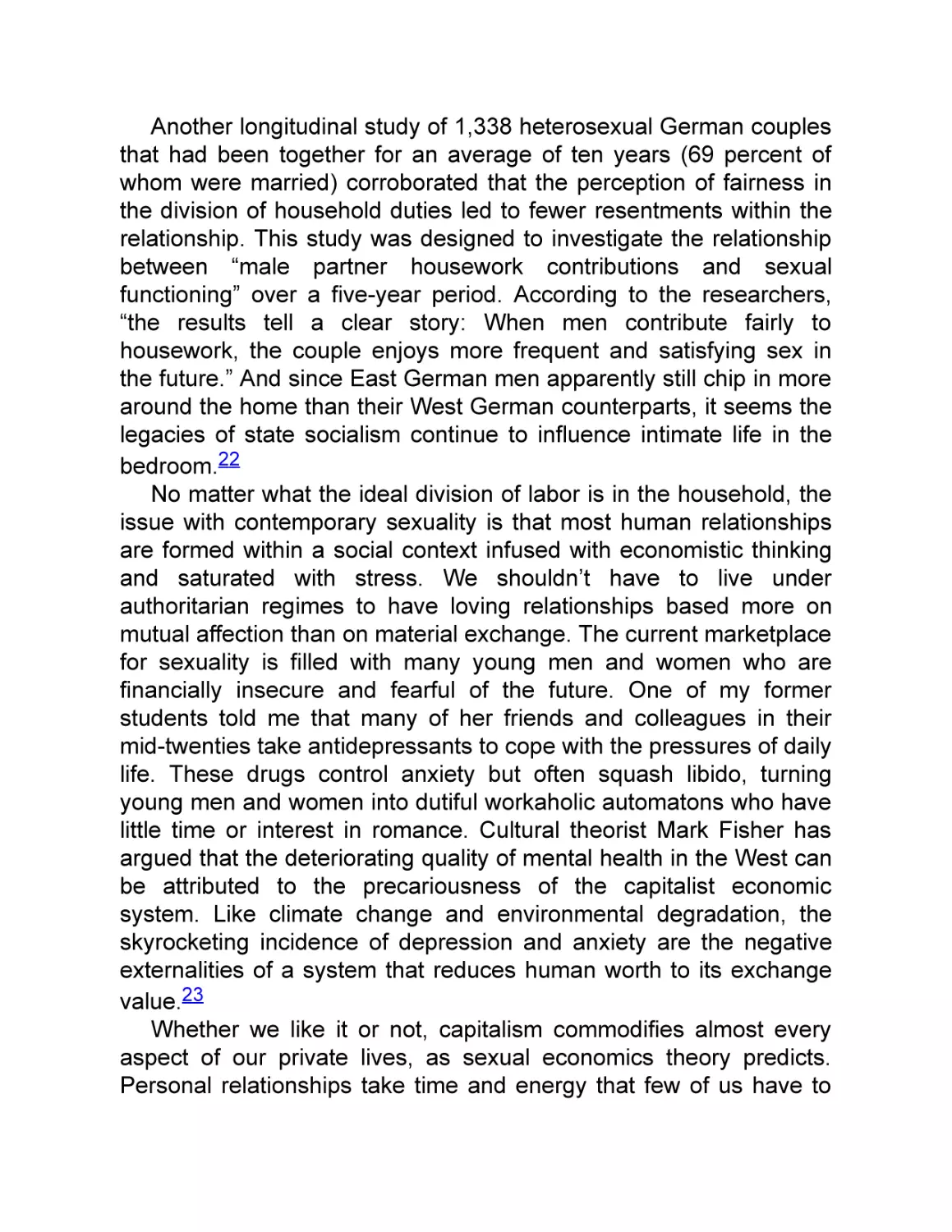
Clara Zetkin (1857–1933): Editor of Die Gleichheit (Equality), a journal of
the German Social Democratic Party, Zetkin was a key architect of
socialist women’s activism. She was the founder of International
Women’s Day in 1910, celebrated each year on March 8. After the
outbreak of World War I, she split with the German Social Democratic
Party and became active in the German Communist Party, serving as a
member of the Constituent Assembly during the Weimar Republic. Zetkin
believed that socialist men and women needed to work together to
overthrow the bourgeoisie and disdained independent feminists.
Courtesy of Archiv der sozialen Demokratie/Friedrich-Ebert-Foundation.

1 WOMEN—LIKE MEN, BUT
CHEAPER: ON WORK

When I was in my twenties, a dear friend of mine, whom I will call
Lisa, worked in human resources for a large corporation in San
Francisco. Lisa loved fashion, and my wardrobe still includes elegant
ensembles she put together for me on our frequent bargain shopping
excursions to Filene’s Basement and various thrift stores on Fillmore
Street. She had a knack for choosing discount designer treasures
and assembling outfits that mixed Levi’s with vintage Dior. Over the
years, we kept in touch, commiserating over marriage and new
motherhood. But whereas I started my life as a working mom on the
tenure track, Lisa quit her job to become a stay-at-home mom as
soon as she realized she was pregnant. Her husband earned
enough to support her, and he preferred that she not be employed.
His own mother had stayed home, and among their immediate
friends, neighbors, and peers, this was the normal arrangement. Lisa
claimed this was her choice; she wanted a break from the rat race of
corporate America. She had a second child soon after the first and
abandoned the idea of returning to the workforce. Lisa thought it was
easier this way; she would be physically there for her daughters in a
way that I never could be for mine.
In those early years, while she baked cookies and organized
playdates, I dropped my daughter off at a full-time day care center,

five days a week, costing me a small fortune. While her girls napped,
Lisa read novels, worked out, and cooked lavish meals. My first four
years of motherhood coincided with my first three years on the
tenure track. My life was a crushing routine of harried days. The first
time I taught class with my shirt inside out, I cringed with
embarrassment when a sympathetic student pointed to my seams.
But after the third time, I stopped caring. As long as my skirt wasn’t
on backwards, it was fine. I often envied Lisa’s choice, but I’d earned
my PhD and landed a good job. I didn’t want to quit. Once my
daughter turned five, things got a bit easier. My first book came out, I
earned tenure, and my daughter started first grade. Out from under
the crippling day care bills, I started to reap the psychological and
financial rewards of my perseverance.
A few years later, I spent a weekend with Lisa. Her husband
offered to stay in with our three girls so she and I could head to the
mall: dinner, a movie, and maybe a little shopping. Our social
engagements usually included our children, so this was a real treat. I
longed for a few hours of adult conversation with an old friend and
no urgent demands for juice or ice cream or unexpected tantrums. A
real girls’ night out.
I’d been upstairs at her house getting ready when I realized I’d
forgotten my hair dryer. I wanted to ask Lisa if I could borrow hers,
but as I started down the steps, I heard Lisa fighting with her
husband.
“… Please, Bill. It’ll be embarrassing.”
“No. You’ve spent enough money this month. I’ll give you the card
again after the statement rolls.”
“But I shopped for the house and bought clothes for the girls. I
didn’t buy anything for me.”
“You’re always buying things for yourself and saying it’s for the
girls.”
“But it is for the girls. They keep growing.”
“You have enough clothes. You don’t need anything else. I’ve
given you enough for the dinner and the movie.”
“Bill, please.” Lisa’s voice cracked.
I turned to tiptoe back up the stairs, praying they hadn’t heard me.

I hid in the bathroom until Lisa came up, jaw clenched and eyes pink.
We drove to the restaurant in silence. We ordered two courses,
and I attempted to prolong the dinner until just before the film
started. Lisa seemed grateful to linger.
After our second glass of Malbec she said, “Bill and I had a fight.”
I looked down at my plate.
“He says we don’t have sex often enough.”
I looked up. That’s not the fight I thought I heard.
She swirled her empty glass. “You think we have time for another
one?”
“You go ahead,” I said. “I’ll drive.”
She drank a third glass of wine, and we chatted about the reviews
of the film we planned to see. When the check came, she opened
her wallet and pushed some twenty-dollar bills across the table at
me. I put down my credit card.
She looked at the American Express with my name on it, and
sighed. “Bill only gives me cash.”
“Why don’t you let me get this?” I slid the money back at her.
“Keep it.”
She stared down at the table for a long moment. Finally, she said,
“Thanks,” and scooped the bills back into her wallet. “I’ll fuck him
tonight and pay you back tomorrow.”
I sat there, stunned.
Lisa looked at her watch. “If we hurry, I can hit the Shiseido
counter before the movie starts.”

Sitting in the restaurant that night, I swore to myself that no matter
how hard it was to balance my full-time job with care for my
daughter, I would never put myself in Lisa’s position if I had any
choice in the matter. “Capitalism acts on women as a continual bribe
to enter into sex relations for money, whether in or out of marriage;
and against this bribe there stands nothing beyond the traditional
respectability which Capitalism destroys by poverty,” George
Bernard Shaw wrote in 1928. Directly or indirectly, sex and money

are always linked in women’s lives, a remnant of our long history of
oppression.1
Too many women find themselves in Lisa’s situation,
economically dependent on men for their basic livelihoods. Divorce
laws and court orders for child support and alimony will offer Lisa
some (possibly inadequate) protection if Bill ever seeks to divorce
her, but she remains at his mercy while they are married. All of the
labor she performs caring for their children, organizing their lives,
and managing their home is invisible as far as the market is
concerned. Lisa receives no wages and contributes no funds toward
her own social security in old age. She accumulates no work
experience and creates a black hole on her résumé, one that will
require explaining away if she ever hopes to rejoin the labor force.
She even accesses medical care through her husband’s employer.
Everything she has she derives from Bill’s income, and he can deny
her access to their joint credit cards at will.
In Margaret Atwood’s chilling dystopian novel, The Handmaid’s
Tale, the founders of the Republic of Gilead legislate a blanket
prohibition on women’s employment and the seizure of their personal
savings. All at once, anyone designated female is fired from her job,
and the money in her bank account is transferred into the accounts
of her husband or nearest male relative, the first step in returning
women to their “rightful place.” The subjugation of women begins by
making them economically dependent on men once more. Without
money and without a means to earn it, women are helpless to
determine the course of their own lives. Personal independence
requires the resources to make your own choices.2
Free markets discriminate against women workers. At the
beginning of the industrial revolution, the big bosses considered
women inferior to their male counterparts (weaker, more emotional,
less reliable, and so forth). The only way to convince an employer to
hire a woman was through financial incentives: women cost less
than men. If she demanded a wage equal to that of a man, the
employer would just hire a man instead. Therefore, women’s
comparative advantage in the workplace from the very earliest days

of capitalism is that they will do the same work as a man for less
money. The idea of the family wage compounds the problem. When
women finally entered the industrial labor force en masse and began
to dominate light industries (like sewing, weaving, laundry),
employers paid women wages for a single person, not a family, even
if they were single mothers or widows. Society insisted that women
were the dependents of men, and working women were conveniently
imagined as wives and daughters earning pocket money to purchase
lace doilies for their dressing tables. Husbands and fathers were
supposed to meet their major needs for food, shelter, and clothing.
Patriarchal cultures reduce women to economic dependence,
treating them as a form of chattel to be traded among families. For
centuries, the doctrine of coverture rendered married women the
property of their husbands with no legal rights of their own. All of a
woman’s personal property transferred to her husband upon
marriage. If your man wanted to hawk your rubies for rum, you had
no right to refuse. Married West German women could not work
outside the home without their husband’s permission until 1957.
Laws prohibiting married women from entering into contracts without
their husbands’ permission persisted in the United States until the
1960s. Women in Switzerland didn’t earn the right to vote at the
federal level until 1971.3
Under capitalism, industrialism reinforced a division of labor that
concentrated men in the public sphere of formal employment and
rendered women responsible for unpaid labor in the private sphere.
In theory, male wages were high enough to allow men to support
their wives and children. Women’s free labor in the home subsidized
the profits of employers because workers’ families bore the cost of
reproducing the future labor force. Without birth control, access to
education, or opportunities for meaningful employment, the woman
was trapped within the confines of the family in perpetuity. “Under
the capitalist system women found themselves worse off than men,”
Bernard Shaw wrote in 1928, “because, as Capitalism made a slave
of the man, and then by paying women through him, made her his
slave, she became the slave of a slave, which is the worst sort of

slavery.”4

As early as the mid-nineteenth century, feminists and socialists
diverged on how best to liberate women. Wealthier women
advocated for the Married Women’s Property Acts and the right to
vote without questioning the overall economic system that
perpetuated women’s subjugation. Socialists, such as the German
theorists Clara Zetkin and August Bebel, believed women’s liberation
required their full incorporation into the labor force in societies in
which the working classes collectively owned the factories and
productive infrastructure. This was a much more audacious and
perhaps utopian goal, but all subsequent experiments with socialism
would include women’s labor force participation as part of their
program to refashion the economy on a more just and equitable
basis.
The perception that a woman’s labor is less valuable than a man’s
persists to this day. In a capitalist system, labor power (or the units of
time we sell to our employers) is a commodity traded in the free
market. The laws of supply and demand determine its price, as does
the perceived value of that labor. Men are paid more because
employers, clients, and customers perceive that they are worth
more. Think about it: Why do cheap diners always have waitresses,
but expensive restaurants often have male waiters? In the comfort of
our own homes, most of us grow up being served by women:
grandmothers, mothers, wives, sisters, and sometimes daughters.
But being served by men is rare, as is having men look after our
basic needs. We pay a premium to have a man serve us our dinner
because we perceive this service as more valuable, even if all he
does is set a plate in front of you and grind fresh pepper onto your
filet mignon. Similarly, although women have fed humanity for
millennia, men dominate the culinary world. Apparently, customers
prefer a side of testosterone with their mashed potatoes.5
In the past, women understood the general public valued their

work less and took steps to mitigate against the effects of
discrimination. Charlotte Brontë published her early novels under the
pen name Currer Bell, and Mary Anne Evans wrote as George Eliot.
More recently, both J. K. Rowling and E. L. James published books
using their initials to obscure their gender. In Rowling’s case, her
publisher asked her to do this to attract boy readers who might reject
a book written by a woman. In the world of university teaching,
having a female-sounding name results in worse teaching
evaluations, as students consistently rank male professors higher
than their female counterparts. One 2015 experimental study found
that assistant instructors who taught the same online class under two
different gender identities received lower ratings for their female
persona.6
Racism exacerbates gender discrimination. Hispanic and Black
women suffer a larger wage gap than white women. When we talk
about gender discrimination, we have to be careful not to privilege
gender as the primary category of analysis, as some feminists have
done in the past. The state of being female is complicated by other
categories such as class, race, ethnicity, sexual orientation, disability,
religious belief, and so on. Yes, I am a woman, but I am also a
Puerto Rican–Persian from an immigrant and working-class
background (my grandmother had a third-grade education, and my
mother only finished high school). The old concept of sisterhood
ignores the structural aspects of capitalism that benefit white,
middle-class women while disadvantaging working-class women of
color, something that socialist women activists understood as early
as the late nineteenth century. Within left circles, orthodox Marxists
obsessed with class position are often called “brocialists,” because
they emphasize worker solidarity over issues of race and gender.
Some feminists and brocialists will argue that too much focus on
identity politics divides people and undermines the potential power
base for mass movements for social change, but when examining
structures of oppression, we must be mindful of the hierarchies of
subjugation even while building strategic coalitions.
Taking an intersectional approach, for instance, helps us see how

public-sector jobs have created important opportunities for different
populations. While white working-class men once dominated private
manufacturing jobs, government employment provided important
avenues for African Americans who were (and remain) more likely
than whites to work in the public sector. The public sector has
historically offered jobs to religious minorities, people of color, and
women who faced discrimination in the private sector, creating
career opportunities for those disadvantaged by race or gender in
competitive labor markets. Cuts in public sector employment after
the Great Recession hit African American women particularly hard,
forcing them to seek work in private companies, where perceptions
of the value of their labor are more influenced by the color of their
skin and their gender.
A classic study showing the deep persistence of gender bias
involved auditions for symphony orchestras. Women musicians were
sorely underrepresented in professional orchestras before the
introduction of an audition process whereby musicians played their
instruments behind screens that separated them from the judges. In
order to ensure total gender anonymity, musicians removed their
shoes so that the footfalls of men and women would be
indistinguishable to those making decisions. When those doing the
auditioning judged musicians solely on their ability to play, “the
percent of female musicians in the five highest-ranked orchestras in
the nation increased from 6 percent in 1970 to 21 percent in 1993.”
This screen audition system would also eliminate racial biases.7
But we can’t hide ourselves behind screens for all of our job
interviews and interactions with potential employers. Our names give
us away, and even if we manage to hide our gender behind initials or
male pseudonyms, references use pronouns and other words that
reveal our gender. Proving discrimination is difficult, and there are
few repercussions for those who systematically pay women less than
men for the same work. Furthermore, because women earn less
than men, it makes economic sense for mothers to stay home with
young children when affordable child care is scarce. When women
do enter the labor force as part-time or flexible workers, they often

do so without benefits and without wages sufficient to cover their
basic needs. And as women withdraw from the labor force to care for
the young, the sick, or elderly relatives, discrimination against
women workers becomes more entrenched, since employers view
them as less reliable (more on this in the next chapter), and the cycle
of women’s economic dependence on men continues.
To counter the effects of discrimination and the wage gap,
socialist countries devised policies to encourage or require women’s
formal labor force participation. To a greater or lesser degree, all
state socialist countries in Eastern Europe demanded the full
incorporation of women into paid employment. In the Soviet Union
and particularly in Eastern Europe after World War II, labor
shortages drove this policy. Women have always been used as a
reserve army of labor when the men are off at war (just like
American women’s employment during the World War II era of Rosie
the Riveter). But unlike the United States and West Germany, where
women were “let go” after the soldiers returned home, East
European states guaranteed women’s full employment and invested
vast resources in their education and training. These nations
promoted women’s labor in traditionally male professions such as
mining and military service, and mass-produced images of women
driving heavy machinery, especially tractors.8
For example, while American women were stocking their kitchens
with the latest appliances during the postwar economic boom, the
Bulgarian government encouraged girls to pursue careers in the new
economy. In 1954, the state produced a short documentary film to
celebrate the lives of women helping to transform agricultural
Bulgaria into a modern, industrial power. This film, I Am a Woman
Tractor Driver, portrayed the daily lives of young women working in
an actual women’s tractor brigade. A peasant girl pens a letter to the
female head of the brigade, asking how she could learn to drive a
tractor. The film dramatizes the brigade leader’s reply. She describes
how socialism provides new opportunities for women who are now
the equals of men. In the final moments of this twenty-five-minute
film (which would have been shown in theaters across the country),

the brigade leader explains that Bulgarian women can now be
anything they want to be, as the audience sees short scenes of
women working in traditionally male jobs. The final scene shows a
pretty woman in the cockpit of an airplane, gazing up at the horizon
as she readies for takeoff. The message is clear: for Bulgarian
women, the sky is the limit.

Official statistics from the International Labor Organization (ILO)
demonstrate the disparity between the workforce participation rates
in state socialist economies and those in market economies. In 1950,
the female share of the total Soviet labor force was 51.8 percent,
and the female share of the total workforce in Eastern Europe was
40.9 percent, compared to 28.3 percent in North America and 29.6
percent in Western Europe. By 1975, the United Nations’
International Year of Women, women made up 49.7 percent of the
Soviet Union’s workforce and 43.7 percent of that in the Eastern
Bloc, compared to 37.4 percent in North America and 32.7 percent in
Western Europe. These findings led the ILO to conclude that the
“analysis of data on women’s participation in economic activity in the
USSR and the socialist countries of Europe shows that men and
women in these countries enjoy equal rights in all areas of economic,
political, and social life. The exercise of these rights is guaranteed by
granting women equal opportunities with men in access to education
and vocational training and in work.”9
Of course, women’s own accounts complicate the rosy picture
painted by the ILO in 1985. Gender pay gaps still existed in East
European countries. And despite the attempts to funnel women into
traditionally male employment, there remained a gendered division
of labor whereby women worked in white-collar professions, the
service sector, and light industry, compared to men who worked in
the higher-paid sectors of heavy industry, mining, and construction.
But salaries mattered less when there was little to buy with one’s
wages and where formal employment itself guaranteed social

services from the state. In many countries women had no choice;
they were forced to work when their children were old enough to go
to kindergarten. And women in state socialist countries suffered the
double burden of housework and formal employment (a problem
very familiar to many working women today). Consumer shortages
plagued the economy, and both men and women waited in lines to
acquire basic goods. But as workers, women contributed to their own
pensions and developed their own skill sets. They benefitted from
free health care, public education, and a generous social safety net
that subsidized shelter, utilities, public transportation, and basic
foodstuffs. In some countries, women could retire from formal
employment up to five years earlier than men.
Despite the shortcomings of the command economy, the socialist
system also promoted a culture in which women’s formal labor force
participation was accepted and even celebrated. Before World War
II, Eastern Bloc countries were deeply patriarchal, peasant societies
with conservative gender relations emerging from both religion and
traditional culture. Socialist ideologies challenged centuries of
women’s subjugation. Because the state required girls’ education
and compelled women into the labor force, their fathers and
husbands couldn’t force them to stay home. Women seized these
opportunities for education and employment. When birthrates began
to falter in the late 1960s, many Communist Party leaders worried
that their investments in women would hurt their economies in the
long run. They conducted sociological surveys and found that
women indeed struggled with their dual responsibilities as workers
and mothers. Some governments considered allowing women to
return to the home, but when asked if they would be happier if their
husbands earned enough to support the family, the majority of
women rejected the traditional breadwinner/homemaker model. They
wanted to work. In Natalya Baranskaya’s novella about a harried
Soviet working mom, the protagonist never once fantasizes about
quitting her job, stating unequivocally that she loves her work.10
Reflecting on the achievements of state socialism compared to
the situation of women in most East European countries prior to the

Second World War, Hungarian sociologist Zsuzsa Ferge explained,
“All in all… the objective situation of women has probably improved
everywhere compared to the pre-war situation. Their paid work
outside the home contributed to the well-being of the family (at least
it helped to make ends meet); their educational advancement and
the work outside the home enriched (at least in a majority of cases)
their life experience; their status as earners weakened their former
oppression within and outside the family and made them (somewhat)
less subservient in some walks of life. Also, it attenuated female
poverty, especially in the case of mothers who practically all started
to work, and of older women who obtained a pension in their own
right.” State socialist countries could promote women’s economic
autonomy because the state was the primary employer and it
guaranteed each man and woman full employment as a right and a
duty of citizenship. In the democratic socialist countries of northern
Europe, women’s employment is voluntary, but the state promotes
their labor force participation by providing the social services
necessary to help citizens combine their roles as workers and
parents.11

Socialist states also try to counter the persistent discrimination
against women by expanding opportunities for public sector
employment. Although not as sexy as start-ups, governments can
ensure women are paid equal (decent) wages for equal work and
support women in their work and family responsibilities. According to
a report from the Organization for Economic Co-operation and
Development (OECD), the Scandinavian countries lead the world not
only in terms of gender equality but also in terms of public sector
employment. This is no coincidence. In 2015, 30 percent of total
employment in Norway was government employment, followed by
29.1 percent in Denmark, 28.6 percent in Sweden, and 24.9 percent
in Finland. The United Kingdom, by contrast, employed only 16.4
percent of its total employed population in the public sector, and in

the United States this figure was 15.3 percent. Even more
remarkable is that women account for around 70 percent of all public
employees in Norway, Denmark, Sweden, and Finland, and the
OECD average is 58 percent. The authors of the report explain
women’s overrepresentation in the public sector partially because
teachers and nurses are female-dominated professions, but also
because of “more flexible working conditions in the public than in the
private sector. For example, in sixteen OECD countries the public
sector offers more child and family care arrangements than the
private sector.” Finally, studies reveal smaller wage gaps between
men and women in the public sector.12
Public sector employment rates used to be higher in the United
States until federal agencies began outsourcing, subcontracting to
the private sector, or just slashing jobs. A 2013 report analyzing US
employment trends showed a precipitous decline in public sector
employment after the Great Recession, as states and localities
pruned budgets after the crisis. The Hamilton Project examined
government responses to previous recessions and found that cutting
the jobs of teachers, emergency responders, and air traffic
controllers during a time of high unemployment slowed the recovery
and inflicted greater economic pain on American citizens, particularly
on the younger generation, who were crowded into larger
classrooms with fewer educators. “The ongoing recovery, which
began when the Great Recession ended in June 2009, dramatically
deviates from the usual pattern,” write the project’s researchers. “In
the forty-six months following the end of the five other recent
recessions, government employment increased by an average of 1.7
million. During the current recovery, however, government
employment has decreased by more than 500,000, and a
disproportionate number of those losing jobs were women. Put
together, the policy differences have led to 2.2 million fewer jobs
today. Such a large contraction of the public sector during a recovery
is unprecedented in recent American economic history.”13
Attitudes toward public sector employment reflect ideological
divides about whether the government is more or less efficient than

the market. Our banks are private because Americans believe that
state-run banks (like a postal bank) would be more bureaucratic and
less consumer-friendly than those forced to compete on free markets
for depositors’ money (even if the federal government provides
deposit insurance up to $250,000 and bails out banks deemed “too
big to fail”). Similarly, the United States rejects a national health
system because our private health insurance supposedly provides
better care at lower prices as a result of market competition.
Although countless studies show that Americans pay more money
for health care, Americans cling to the idea that markets produce
better outcomes than state-run programs even when presented with
copious evidence to the contrary. Another example is in higher
education, with the expansion of for-profit universities. A 2016 study
shows that employers don’t value for-profit college degrees as much
as they value degrees from public universities. Yet government funds
provide substantial financial aid for students at these universities,
thus subsidizing profits for investors when those funds could be used
to strengthen the quality of public education instead. Citizens in other
societies, even our close allies in Canada and the United Kingdom,
understand that the profit motive sometimes undermines the public
good.14
Of course, some might argue that instead of expanding public
employment, the government could legislate pay equality and
enforce provisions to ensure that private sector firms pay women
fairly, a step the Icelandic government took beginning in early 2018
and the state of Massachusetts took after July 1, 2018. But federal
legislation on equal pay in the United States has been relatively
weak and without real teeth, since the onus remains on women to
prove pay discrimination in court (and who has the money needed
for a lawsuit?). Attempts to strengthen the 1963 Equal Pay Act have
failed to win Republican support in Congress, most recently in April
2017 with the Paycheck Fairness Act, which did not receive a single
Republican vote.
Critics will also claim that expanded public sector employment
hurts growth and cripples the private sector, but private sector job

expansion has not been able to reverse wage stagnation, the rise of
the gig economy, or the incredible growth in inequality between the
rich and the poor, as revealed by Thomas Piketty. Economists and
legislators will have to debate the details, but given that as of 2017,
just eight men own the same amount of wealth as the 3.6 billion
people who make up the poorest half of humanity, redistribution is
going to come in one form or another. Current levels of inequality are
unsustainable in the long term. In a global economy buoyed by the
credit-fueled consumer spending of the masses, the bubble will burst
eventually. An acute crisis of overproduction and underconsumption
looms on the horizon.15
The expansion of public services would support women in a
second way. A wider social safety net means that women’s lower
private sector wages don’t disadvantage them in terms of access to
health care, clean water, child care, education, or security in old age.
Rather than trying to legislate equality or coerce private companies
into providing equal pay for equal work and giving women equal
opportunities for promotion, women could join together to choose
leaders who will lessen the social costs of gender discrimination
through public policy. Another idea is some form of guaranteed
employment like what they had in the state socialist countries. This is
an old economic concept to prevent the human suffering caused
during economic downturns. The United Kingdom’s Labour Party has
proposed a job guarantee in which the state acts as the employer of
last resort for young people ages eighteen to twenty-five who are
willing to work but cannot find employment. Economists have
debated job guarantees for decades, and in 2017 the Center for
American Progress (CAP) threw its weight behind a proposal for a
new “Marshall Plan for America,” which would create 4.4 million new
jobs. The CAP proposal calls for a “large-scale, permanent program
of public employment and infrastructure investment—similar to the
Works Progress Administration (WPA) during the Great Depression
but modernized for the 21st century. It will increase employment and
wages for those without a college degree while providing needed
services that are currently out of reach for lower-income households

and cash-strapped state and local governments.”16
In September 2017, I attended Mass with my eighty-nine-year-old
grandmother in the San Diego church I went to as a kid. On that
Sunday, the priest introduced the parable of the workers in the
vineyard (Matthew 20:1–16) by explaining that, for Americans, it was
one of the most controversial of the parables. In Jesus’s story, a
landowner goes into town to hire day laborers for a fair wage in the
morning. He then returns to hire more men at noon and later in the
afternoon. Near sunset, the landowner returns to find more idle men.
He asks why they are not working, and they explain that no one has
hired them that day. The landowner hires them and then proceeds to
pay all of the workers the same wage no matter how long they
worked. When the workers hired early in the morning complain about
the unfairness, the landowner chastises them: I offered you a fair
wage, and you accepted it. The landowner says, I am not being
unfair to you. Or are you envious because I am generous? Although
parables are typically interpreted allegorically, that day the priest
used the story to talk about fair wages and immigration in his homily.
“The landowner went into town and hired the men who needed
work,” he told us. “He didn’t ask to see their documents.” In the same
way, perhaps, the parable also supports the idea of job guarantees.
The landowner provided employment to all those willing and able to
work, and he paid them a fair wage no matter how long they actually
labored in the vineyard. From the landowner’s perspective, it was a
generous thing to do for people in need. For Americans, such
generosity sounds suspiciously socialist.17
But let’s face it: job guarantees would not only benefit women. In
the long run if privately owned robots and A.I. take over our
economy, organic men may find themselves just as devalued in
competitive labor markets as today’s organic women. The owners of
inorganic life may be the real beneficiaries of our future unregulated
free markets. Fears of the increasing automation have led some to
promote the idea of the Universal Basic Income (UBI), sometimes
called a Universal Citizen’s Income or Citizen’s Dividend. This would
guarantee that all qualifying citizens received a fixed monthly

payment to meet their basic needs. A generous UBI experiment has
been tried in Finland, and many people across the political spectrum
support the idea of some kind of flat payment to save people from
the ravages of unemployment. This revenue could be generated
from taxation of the private sector or from the profits of public
enterprises. UBI could go a long way in promoting gender equality,
since women’s unpaid labor in the home would be compensated. Of
course, some critics fear that UBI will make people lazy, while others
worry that it is just a way for the hyper-rich to gut the welfare state
and buy off the masses with small cash payments while they
luxuriate in their riches. It is an idea that requires much more debate,
particularly from a socialist perspective.18
Whatever happens, any move toward employment assurances
will require a substantial expansion of the public sector, which will
have the added benefit of promoting gender equality by eliminating
the wage gap between men and women. The irony here is that
where state socialist regimes reduced women’s economic
dependence on men by making men and women equally dependent
on the state, in a capitalist society our technological future may
reduce women’s economic dependence on men by making men and
women equally dependent on the generosity of those who own our
robot overlords. Some day in the near future, Bill may be begging a
computer to give him his Friday night allowance so he can head to
the sports bar with his buddies. There will be some cosmic justice
when Siri informs Bill that he’s already watched enough sports this
month, and should stay home and spend some quality time with his
wife and daughters.

Lily Braun (1865–1916): Feminist writer
and a politician within the German Social
Democratic Party. Her 1901 book, The
Women’s Question: Historical
Development and Economic Aspect
proposed many novel solutions to the
challenges faced by working mothers,
including proposals for what she called
“maternity insurance.” Braun was a
moderate and a reformer and did not
believe that revolution was necessary to
achieve socialism. Courtesy of Lebendiges
Museum Online (Deutsches Historisches
Museum).

2 WHAT TO EXPECT WHEN YOU’RE
EXPECTING EXPLOITATION: ON
MOTHERHOOD

One of my childhood friends, whom I will call Jake, hungered for
financial success in a society where financial success reflected a
kind of moral superiority. Jake valorized the idea of the American
Dream. He saw goodness in the kind of Horatio Alger, pull-yourselfup-by-the-bootstraps hard work required to “make something” of
yourself. Back then, I was already a feminist with concerns about
economic inequality, while Jake, true to the spirit of the 1980s,
believed that whoever dies with the most toys wins. We spent hours
debating the pros and cons of capitalism, and the ways that
Thatcherism and Reaganomics sucked or didn’t suck. Jake
embraced the Gordon Gekko zeitgeist of the age: “Greed is good.” I
wasn’t buying it. But back in those days when domestic politics
weren’t so polarized, we managed to maintain our friendship
throughout our college years. In the 1990s, while I was off teaching
English and reading Karl Polanyi in Japan, Jake was hustling his
way up the corporate ladder at a tech start-up.
One day in 1997, Jake informed me with great pleasure that he’d
hired a promising young woman for a strategic position in his firm.
She’d been a finalist with two other men, and with my voice ringing in
his ears, he decided to take a chance on her. “They were all equally

qualified on paper,” he told me, “But after years of listening to your
feminist rants, I convinced my boss that since women face so many
barriers in tech, she had actually worked harder to get where she
was than the men in the pool.” I was struggling through my first year
of graduate school at the time, and Jake’s news warmed my heart;
I’d made a little difference in the world.
Over the next few years, the woman proved herself clever,
competent, and hard-working. Jake’s company gave her a threemonth paid sabbatical for some additional training, grooming her for
a promotion. Then she announced she was pregnant. The start-up
had no formal maternity leave policy, but Jake asked his boss to give
her twelve paid weeks to stay home with her baby and make child
care arrangements. Jake argued that they had already invested so
much money in her training that a twelve-week leave would pay for
itself in the long run. His boss reluctantly agreed.
The woman returned to work after the birth of her baby and tried
her best to keep up with the demands of a small start-up. But she
was nursing. And the baby kept her up at night. She would attend
meetings bleary-eyed and unprepared. She called in sick when the
nanny didn’t show. She found a place in a good nursery, but if her
son got sick, they sent him home. Her husband traveled for
business, and she had no family in the area. Jake, always the
optimist, believed things would improve once the child was older. He
even offered to babysit in a pinch. His star employee managed to
hold on for six months. Then she quit.
That night Jake called me to share the news. Dejected and
frustrated, he told me, “I’m never hiring a woman again.”
“But she’s just one woman,” I said. “Not every woman is going to
make her choice.”
“There’s no way my boss will let me,” he said. His voice was low.
“And it’s the baby thing. I can’t be sure of anything about any
employee, but I can be certain that a man won’t have a baby.”

I think I hung up on him. But it really wasn’t Jake’s fault. What could

he do in a system that provides no support for women when they
become mothers, that forces women to choose between their
careers and their families? Economists call this “statistical
discrimination.” The basic idea is that since employers can’t directly
observe the productivity of individual workers, they can make
observations about demographic characteristics that are correlated
with worker productivity. They make decisions based on the
averages: if women are more likely to quit than men for personal
reasons, employers assume that any given woman is more likely to
quit than a man. Economists observe that the theory of statistical
discrimination can create a vicious cycle. If women are (or used to
be) more likely to quit, they will be paid less. If they are paid less,
they are more likely to quit. This vicious cycle provides a very good
justification for government intervention.1
The perception of women’s comparative inferiority as workers is
linked to their biological capacity for child bearing and nursing, and
the concomitant social expectation that women will be the primary
caregivers for babies and young children. And in some patriarchal
fantasy world, our supposedly innate caring nature also makes us
perfectly suited for nursing other sick, weak, or aged relatives. And
since women are at home anyway, so the argument goes, we might
as well do all of the shopping, cooking, cleaning, and emotional labor
required to maintain a household, right? Someone has to do it, and
that someone is almost always a woman, in part because the
location of the tasks align, but also because she has been socialized
from infancy to believe that it’s her natural role. Baby dolls, EZ Bake
ovens, and toy vacuum cleaners allow girls to play-practice the
labors they will perform when they grow up.
Employers discriminate against those whose bodies can produce
children because society attributes certain characteristics to the
owners of those bodies. When scholars talk about men and women,
they often make a distinction between the terms “sex” and “gender.”
The word “sex” means the biological difference between males and
females and the word “gender” connotes the social roles that
cultures expect to match the biology. For example, by sex I am a

woman because I have the physiological equipment necessary for
baby manufacturing, but my gender is also female because in many
ways I conform to contemporary American society’s imagination of
what a woman should be: I have long hair; I wear skirts, jewelry, and
makeup; I enjoy romantic comedies and nice bath products; and
although I might claim it’s for my general health, I do a daily hour on
the elliptical trainer because I worry about my weight (okay, well,
maybe it’s only forty-five minutes, and it’s not every day, but you get
the idea). In other ways, however, my gender identity is more
masculine: I have always worked full-time and earned my own
money; I enjoy watching soccer, science fiction, and action movies; I
love a good beer; and although I try to be polite about it, I always
speak my mind even if my thoughts and opinions may offend. I suffer
no fools, while according to some, real women tolerate gropers,
mansplainers, and plain old idiots with a smile.
Gender discrimination arises because society constructs
archetypes of the ideal man and the ideal woman based on their
supposedly natural biological differences. This is not to say that men
and women are the same—they are not—but only that our beliefs
about how men and women behave are a figment of our collective
imaginations—a powerful figment, yes, but a figment nonetheless.
When a student ranks a professor with a female name lower than a
professor with a male name, the student may assume that the male
professor has more time and energy to dedicate to his teaching
because he is not distracted by his care obligations outside of work.
When employers like my friend Jake’s boss see a woman’s name on
a job application, they immediately think that “woman” equals
potential mother with priorities in life that take precedence over their
careers. Employers also assume that men will put their careers over
their families because they are supposedly less biologically attached
to children. It doesn’t matter if individual men decide to stay home
with their children or if individual women sterilize themselves to
overcome the challenges of work/family balance; our gender
stereotypes of how men and women behave are rooted in our ideas
about the “natural” link between biological sex and how this informs
our life choices.

I used to do a classroom exercise with my students to get them to
think about the relationship between sex and gender. I borrowed a
scenario from Ursula Le Guin’s classic science fiction novel, The Left
Hand of Darkness, where a man from earth is sent to work on a
planet of “bisexual hermaphrodites.” This means that all people have
both male and female sexual organs and hormones. Throughout the
month, there are seven-day periods when a portion of the population
experiences a form of heat: an irresistible desire to copulate. At the
initiation of sexual contact, one of the members of the pair becomes
the male, and the other person becomes the female. In any given
sexual encounter, an individual will randomly become either the male
or the female. The member of the pair who becomes female can
become pregnant and will then have a nine-month gestation period
before giving birth. When an individual is not copulating or pregnant,
they revert to a neutral state until their next sexual encounter, when
the process repeats. Any one individual can therefore be both a
father and a mother, and everyone is equally “at risk” for pregnancy
and childbirth.
I asked my students to try to imagine how the society on this
fictional planet would be arranged compared to our society in the
United States. The first thing to go would be sex discrimination, since
everyone would be biologically identical. All people are
“hermaphrodites,” so you couldn’t use biological sex to create
hierarchies. Of course, more attractive “bisexual hermaphrodites”
might enjoy more privileges than the ugly ones, and the old might
have more power over the young, but discrimination would not be
based on whether you can make babies. Similarly, the social roles
linked to biology would be the same for everyone, since most
members of this society would be both mothers and fathers to
multiple children. My students also imagined that the society on this
fictional planet would be organized to accommodate the demands of
pregnancy and childbirth, since every member of that society would
benefit from collectively organized forms of support.

Socialists have long understood that creating equity between men
and women despite their biological sex differences requires
collective forms of support for child rearing. By the mid-nineteenth
century, as women flooded into the industrial labor force of Europe,
socialists theorized that you could not build strong worker’s
movements without the participation of women. The German feminist
Lily Braun promoted the idea of a state-funded “maternity insurance”
as early as 1897. In this scheme, working women would enjoy paid
furloughs from their jobs both before and after delivery, with
guarantees that their jobs would be held in their absence. It’s
important to remember that as late as 1891, in Germany female
industrial workers toiled for a minimum of sixty-five hours per week,
even if they were with child. Under these circumstances, pregnant
women and girls stayed at the assembly line until they gave birth,
and if they had no husband or family to support them, they returned
to work soon afterward. The infant and maternal mortality rate for
working women was more than double that of middle-class women
because of the harsh conditions.
Although British and American feminists wanted to support
working mothers through nonstate charities, Braun proposed that
funds for the maternity insurance be raised through a progressive
income tax. The German government could then pay a woman’s
wages for a fixed period before and after the birth of her child.
Everyone would contribute to a special pot of money that new
mothers could draw on, much like unemployment insurance or a
state pension. Braun asserted that since society benefitted from
children, it should help bear the costs of raising them. Children are
future soldiers, workers, and taxpayers. They are a benefit to all, not
just to the parents who bring them into the world (and some parents
of teenagers might argue that they are more of a benefit to society
than they are to their parents). This is especially true in ethnically
homogenous states, where societies place a premium on preserving
a particular national identity.2
But Braun’s proposal was expensive. It required new taxes and
would redistribute wealth to the working classes, an idea that many

middle-class men and women opposed. Braun’s ideas also faced
initial opposition from the Left. Because Braun was a reformer and
believed that her maternity scheme could be implemented under
capitalism, more radical German socialists like Clara Zetkin initially
rejected her ideas, claiming they could only be realized under a
socialist economy. Braun also favored communal living
arrangements (communes) over state-funded nurseries and
kindergartens, whereas Zetkin believed that housework and child
care should be socialized. Nonetheless, Braun’s proposals, in
watered down form at least, were passed into law as early as 1899.
And by the Second International Conference of Socialist Women in
1910, Braun’s ideas were incorporated into the official socialist
platform with the support of Clara Zetkin and the Russian Alexandra
Kollontai.
The fourth point on the 1910 socialist platform laid the foundation
for all subsequent socialist policies regarding state responsibilities
toward women workers. Under the title “Social Protection and
Provision for Motherhood and Infants,” the women of the Second
International demanded an eight-hour working day. They proposed
that pregnant women stop working (without previous notice) for eight
weeks prior to the expected delivery date, and that women be
granted a paid “motherhood insurance” of eight weeks if the child
lived, which could be extended to thirteen weeks if the mother was
willing and able to nurse the infant. Women would get a six-week
leave for stillborn children, and all working women would enjoy these
benefits, “including agricultural laborers, home workers and maid
servants.” These policies would be paid for by the permanent
establishment of a special maternity fund out of tax revenues.3
Seven years later, Kollontai attempted to implement some of
these policies in the Soviet Union after the Bolshevik revolution.
Instead of burdening individual women with household chores and
child care in addition to their industrial labor, the young Soviet state
proposed to build kindergartens, crèches, children’s homes, and
public cafeterias and laundries. By 1919, the Eighth Congress of the
Communist Party handed Kollontai a mandate to expand her work

for Soviet women, and she secured state commitments to expend
the funds necessary to build a wide network of social services. The
year 1919 also saw the creation of an organization called the
Zhenotdel, the Women’s Section, which would oversee the work of
implementing the radical program of social reform that would lead to
women’s full emancipation.4
But Soviet enthusiasm for women’s emancipation soon
evaporated in the face of more pressing demographic, economic,
and political concerns. After the country was devastated by the brutal
years of the First World War, followed by the Civil War and the
horrendous famine of 1921 and 1922, Lenin and the Bolsheviks did
not have the funds to support Kollontai’s plan. Hundreds of
thousands of war orphans roamed the major cities, plaguing
residents with petty crime and theft. The state lacked the resources
to care for them; children’s homes were overburdened and
understaffed. Liberalization of divorce laws meant that fathers
abandoned their pregnant wives, and poor enforcement of child
support and alimony laws meant that those men who had survived
the First World War, the Civil War, and the famine routinely skipped
out on their responsibilities. Working women couldn’t look after their
children and hoped the state would step in and help, as Kollontai and
the other women’s activists had promised. In 1920, the Soviet Union
had also become the first country in Europe to legalize abortion on
demand during the first twelve weeks of pregnancy. Birthrates
plummeted as women sought to limit the size of their families.
Eventually there was fear that the falling birthrate combined with the
devastations of war and famine would derail the country’s plans for
rapid modernization.5
No one ever wanted women’s economic independence to come
at the cost of motherhood, but this is what happened. As the
demands on Soviet women’s time increased, they chose to delay or
limit childbearing. Eventually, Stalin disbanded the Zhenotdel,
declaring that the “woman question” had been solved. In 1936, he
reversed most liberal policies, banned abortion, and reinstated the
traditional family, on top of his sustained program of state terror and

arbitrary purges. The rapidly industrializing Soviet state needed
women to work, have babies, and do all of the care work the world’s
first socialist state could not yet afford to pay for. Soviet women were
far from emancipated, and Alexandra Kollontai spent most of her
remaining years in diplomatic exile.

While the Soviet experiment failed, Braun’s ideas and the program of
the socialist women in 1910 found fertile soil in the Scandinavian
social democracies. The Danes introduced a two-week leave for
working women as early as 1901, and by 1960 a universal, statefunded paid maternity leave was extended to all working women. In
1919, Finland passed maternity leave provisions for factory workers
and professional women, and added job protections in 1922.
Sweden introduced an unpaid maternity leave of four weeks as early
as 1901, and by 1963, the government guaranteed women 180 days
of job-protected maternity leave at 80 percent of their salaries.
Compare this with the United States, which did not even pass a law
outlawing discrimination against pregnant women until 1978. And
American women didn’t have a federal law for job-protected unpaid
leave until 1993. We still don’t have mandated paid maternity leave
(but then again, we don’t have mandated paid sick leave either).6
Eastern European countries also made early use of maternity
leave provisions. Poland granted twelve weeks of fully paid maternity
leave in 1924, but most countries introduced these provisions after
World War II. These nations needed women to work because there
was a shortage of male labor, but they had also invested heavily in
women’s education and professional training and did not want to
lose their expertise (think back to Jake’s reasoning in the beginning
of this chapter). For example, the Czechoslovaks introduced the first
maternity support policies in 1948, and by 1956 the Labor Code
guaranteed women eighteen weeks of paid, job-protected leave. In
Bulgaria, the 1971 constitution guaranteed women the right to
maternity leaves. In 1973, Bulgarian women enjoyed a fully paid

maternity leave of 120 days before and after the birth of the first child
as well as an extra six months of leave paid at the national minimum
wage. New mothers could also take unpaid leave until their child
reached the age of three, when a place in a public kindergarten
would be made available. Time on maternity leave counted as labor
service toward a woman’s pension, and all leaves were jobprotected. Later, an amended law allowed fathers and grandparents
to take parental leave in the place of the mother. The Bulgarians
covered for those on parental leave with the labor of new university
graduates. (In Bulgaria, postsecondary education was free for
students who agreed to complete a period of mandatory national
service after earning their degrees. These internships allowed young
people to get work experience and ensured that a parent’s job would
be waiting when he or she returned from leave.)7
The 1973 Bulgarian Politburo decision also included language
about reeducating men to be more active in the home: “The
reduction and alleviation of woman’s household work depends
greatly on the common participation of the two spouses in the
organization of family life. It is therefore imperative: a) to combat
outdated views, habits, and attitudes as regards the allocation of
work within the family; b) to prepare young men for the performance
of household duties from childhood and adolescence both by the
school and society and by the family.”8
In the pages of the Bulgarian women’s magazine The Woman
Today, editors published articles about men doing their fair share of
the housework and encouraging men to be more active fathers to
their children. In the Young Pioneers and the Komsomol, two
gender-integrated youth organizations, boys and girls were
socialized to treat each other as equals who both had important
(albeit different) roles to play in building a socialist society. Where
men did mandatory military service after secondary school, women’s
reproductive labors counted as an equivalent form of national
service. In the end, these policies failed to challenge traditional
gender roles, but it is important to recognize that there were at least
attempts to redefine ideas about masculinity and femininity. Indeed,

specific state efforts to encourage men to be more active fathers and
participate more in housework can be found as early as the 1950s in
Eastern Germany and Czechoslovakia. However, in the face of male
recalcitrance, governments focused their efforts instead on the
socialization of housework and child care, hoping to expand the
network of communal kitchens and public laundries throughout the
country.
As early as 1817, the British utopian socialist Robert Owen had
suggested that children over the age of three should be raised by
local communities rather than in nuclear families, and this idea of the
public provision of child care influenced all twentieth-century
experiments with state socialism. In addition to maternity leaves,
countries like Poland, Hungary, Czechoslovakia, Bulgaria, East
Germany, and Yugoslavia invested state funds to expand the
network of nursery schools (for children from birth to age three) and
kindergartens (for children ages three to six) to support women’s
continued labor force participation. Of course, the quality of these
child care facilities was uneven across the region and often left much
to be desired; children got sick with more communicable diseases,
and caregivers were often overwhelmed by the demands of too
many children (problems common in day care centers today). But as
with so many things in the command economy, planners allocated
resources inefficiently, and demand always exceeded supply. In my
research in the archives of the Bulgarian Women’s Committee, for
instance, I discovered many letters to the relevant ministries
complaining about the lack of funds allocated for the crèches and
kindergartens. Here again, the northern European countries of
Sweden, Norway, Denmark, and Finland did much better. They
invested state funds to build child care facilities to promote women’s
full employment. By the end of the Cold War, Scandinavian female
labor force participation rates were second only to those of women in
the Eastern Bloc.9
Upon publication of my op-ed in the New York Times, I received
countless messages from Western readers who discussed their own
frustrations. Many women who grew up in the Eastern Bloc also

wrote me to relate their memories and opinions about life under
socialism, confirming with their personal anecdotes that not all was
so bleak behind the Iron Curtain. My favorite letter came from a
woman living in Switzerland, born into a middle-class family in
Czechoslovakia in 1943. She detailed her own recollections of life
under state socialism:
When I got married, we had to work to be able to pay off loans
both for the flat as well as furniture we had bought. Within a
year, we had our first child. The “generous” maternity leave
was eight months after which I went back to work. I had to
gently wake our little daughter every morning at 5:30 am as
the day care center opened at 6:00 am and it took us 15
minutes by tram to get there. Once at the day care center, I
had to dress her in a uniform and hurry to take the bus at 6:30
am to get to work. I often only just managed to catch the bus
and it was not unusual that the doors of the bus would close
behind me with part of my coat still hanging outside. At the
time, my husband was getting off work at 2 pm which meant
that he could pick up our daughter, buy some groceries and
prepare dinner in time for my return at around 5 pm. Shortly
after that, we would put our daughter to bed as the next day
promised the same rushed routine as the day before. My
husband and I were both tired after such a day.…10
The Swiss-Czechoslovak woman actually meant this description
of her former life as a criticism of the German version of the op-ed.
She felt that her life was too harried for sex with her husband. As a
working mother, I certainly understand how difficult it is to manage
work/family balance, but I don’t think this woman (age seventy-four
when she wrote me in 2017) realized the extent of her privilege in
state socialist Czechoslovakia compared to the situation of working
women today. In her criticism, she mentions that she and her
husband had their own private flat, she had eight months of
maternity leave, their child had a spot in a state-funded day care

center fifteen minutes from home, and her husband got off work at
two p.m. and picked up their daughter, bought groceries, and
prepared dinner before she returned home at five. She tells me that
she and her husband were exhausted by this “rushed routine,” but I
suspect she has no idea how luxurious this routine might sound to
women, even European women, trying to balance work and family
today. In fact, the Cambridge Women’s Pornography Cooperative
publishes a book called Porn for Women that features men who pick
up their children, buy groceries, and cook dinner before their wives
get home from work.11

For many women, access to affordable and quality child care is more
important than maternity leave, especially if the latter is not jobprotected. When I first started out as an assistant professor, I was far
removed from my family, and I placed my infant daughter in the oncampus day care center full time for five days a week. One of my
colleagues had three children under the age of four—two three-yearold twin girls and a one-year-old son. This colleague, whom I will call
Leslie, had been an established professional before motherhood and
had no desire to forfeit her career. She had accepted a threequarters-time job well below her qualifications, and her husband also
arranged to drop down to a four-day week. Leslie paid for the
remaining three full days of child care for her three children directly
through a payroll deduction. At the end of each month she would
waltz into my office with her pay stub. After taxes, insurance
payments, and the cost of childcare, Leslie earned about seventy
cents a month. She worked thirty hours a week, and often put in
unpaid extra time for evening events, for less than $9.00 of takehome pay per year. And she did this for three years!
I once asked Leslie why she didn’t just stay home with the kids,
and she admitted that she often fantasized about it. But she refused
to give up her work life, and she feared having a gap on her résumé.
“I’ve seen too many professional women get completely derailed

after taking time out of the labor force,” she explained. “I’m working
for nothing now, but it will pay off when my kids are old enough to go
to school and I can just go out and get another full-time position.”
Consider Leslie’s situation compared to that of Ilse, a composite
woman based on research into the experiences of a typical East
German woman growing up in the 1980s. Immediately after World
War II, the East Germans mobilized women into the labor force. The
East German state fully supported women in the workplace, and
while it encouraged marriage, being a wife was not considered a
precursor to motherhood. Since there weren’t enough men to go
around, the state invested heavily in supporting single mothers. In
particular, the East German government idealized early motherhood
and built special “mother-and-child” housing at universities where
students could live with their babies. If Ilse was an average East
German woman, she had her first child by the age of twenty-four,
probably before she graduated from college, which meant she
avoided the fertility decline associated with delayed childbearing.
The government heavily subsidized housing, children’s clothing,
basic foods, and other expenses associated with child rearing, as
well as providing women like Ilse with access to child care whenever
they needed it. By 1989, out-of-wedlock births accounted for about
34 percent of all births (compared to only 10 percent in West
Germany), but unlike most places in the capitalist West, single
motherhood did not lead to destitution. One of my Bulgarian friends
earned his degree in Leipzig in the 1990s. He recalls knowing two
female students for three years before he realized that they were the
mothers of small children. Nothing about motherhood interfered with
their education, because their infants were cared for in campus
nurseries.12
By contrast, women in Western Germany, like women in the
United States, returned home to be dependent housewives and
mothers after World War II, confined to the Kinder, Küche, Kirche
(children, kitchen, church). As noted earlier, West German law
required a husband’s consent before a woman could work outside of
the home until 1957, and until 1977 family law insisted that married

women were not to let their jobs interfere with their household
responsibilities. On a practical level, school schedules and a lack of
afterschool care rendered it almost impossible for West German
women to work full time. Married mothers worked mostly in part-time
jobs with a larger gender wage gap than that found in the East.13

Of course, not all socialist countries supported women’s economic
independence to the extent of the East Germans (who were locked
in their own Cold War rivalry with the West Germans). The Soviets
relegalized abortion in 1955 but remained decidedly pro-natalist, and
even the most basic sex education was absent in the public
discourse. Romania and Albania were terrible in terms of women’s
reproductive freedoms, with the state forcing women to have babies
by restricting access to birth control, sex education, and abortion.
Although initially legal in Romania, the infamous Decree 770 of 1966
outlawed abortion in an effort to reverse the population decline, and
the law was strengthened in the 1980s to include mandatory
gynecological exams for women of reproductive age. The Romanian
state essentially nationalized women’s bodies, and many women
sought dangerous, illegal abortions, as dramatized in the brilliant
2007 film 4 Months, 3 Weeks and 2 Days.14
The key message here is that you do not have to have an
authoritarian regime to implement policies that ease the conflict
between fertility and employment. Today, almost every country in the
world has some form of guaranteed paid maternity leave for women,
and many are instituting parental leaves with mandatory paternity
leave components. In Iceland, the most gender-equal country on the
globe according to the World Economic Forum, fathers get ninety
days of leave, and 90 percent of them take it. The state supports
both parents to combine their work and family responsibilities,
providing the way for full gender equality in the home as well as the
workplace.15
While state socialism had its downsides, the sudden change of

East European women’s fortunes after 1989 amply demonstrates
how free markets quickly erode women’s potential for economic
autonomy. In Central Europe, for instance, post-1989 governments
pursued conscious policies of “refamilization” to support the
transition from state socialism to neoliberal capitalism. As state
enterprises closed or were sold to private investors, unemployment
rates skyrocketed. Too many workers competed for too few jobs. At
the same time, the new democratic states reduced their public
expenditures by defunding crèches and kindergartens. Public child
care establishments closed, and new private facilities required
substantial fees. Some governments made up for closing
kindergartens by extending parental leaves for up to four years, but
at far lower rates of wage compensation and without job
protections.16
These policies conspired to force women back into the home.
Without state-funded child care or well-paid maternity leave, and in a
new economic climate where employers had a large army of the
unemployed from which to choose, many women were pushed out of
the labor market. From a macroeconomic perspective, this proved a
boon to transitioning states. Unemployment rates dropped (and thus
the need for social benefits), and women now performed for free the
care work the state had once subsidized in order to promote gender
equality. Later, when deeper budget cuts hit pensioners and the
health care system, women already at home looking after their
children could now care for the sick and the old—at great savings to
the state budget.17
Given that many women preferred formal employment to the
unpaid drudgery of housework, it should not be surprising that post1989 birthrates plunged. Although birthrates in Eastern Europe were
higher than those in Western Europe before 1989, they began to fall
as soon as the refamilization process began. The institution of free
markets actually hindered rather than helped new family formation.
Nowhere was this more profound than in Eastern Germany, where
skyrocketing unemployment and the collapse of support for child
care contributed to an unprecedented and uncoordinated drop in

fertility, what the West German press called the “birth strike.” Over a
five-year period, the birthrate in the East German states of reunified
Germany fell by 60 percent. Although the fertility rates have climbed
out of the pits of the 1990s in some countries, the former state
socialist nations of Eastern Europe have some of the lowest
birthrates in the world today. In 2017, Bulgaria had the fastestshrinking population in the world, and sixteen of the top twenty
nations facing the steepest expected population declines by 2030
were former state socialist nations.18
The irony is that as women were being forced back into the home
in Eastern Germany, many East German women moved to the West
looking for better paid jobs, and these women brought with them a
set of expectations that helped West German women find their way
into the workplace. The young East Germans who flooded into West
Germany after 1989 were the children of working mothers, and they
thought it absolutely normal that women would leave their children in
kindergartens. When I lived in Freiburg, I met a West German
woman who served as the managing director of a well-known
academic publishing house in Stuttgart. “Thank God for those East
German women,” she said, and explained that she wouldn’t have
had a career without them. Before 1989, West German women were
expected to stay home with their children. “But when the East
German women came over,” she told me, “they were used to having
crèches and kindergartens, and they demanded them.”

Not everyone is a fan of half-hearted government-mandated paid
maternity leave policies, especially those that are not enforced.
Some feminists object to these policies because they fear they will
disadvantage women in competitive labor markets. Employers will
prefer to hire men who will not get pregnant, like my friend Jake’s
boss. This is why some nations have instituted take-it-or-lose-it
paternity leaves to try to equalize the expectation for men’s and
women’s care responsibilities. Sweden now requires that new

mothers and fathers take a mandatory sixty days of leave each in
order to qualify for the state’s generous benefits. Free marketers
argue that companies should be free to set their own priorities
without interference from the federal government, but corporate selfregulation has had a pretty abysmal success rate. As of 2013, only
an estimated 12 percent of American workers were covered by paid
parental leave policies. And this is completely predictable in a free
market scenario. No business wants to be known as the one with the
generous maternity leave policies because it fears that the women
most likely to have babies will flock to it over its competitors. But if
the law requires that all companies must offer the same jobprotected leave, and if the government picks up part of the tab, as in
Braun’s maternity insurance plan, then many employers would be
willing to support these policies. It would mean they could hire the
most promising job candidates and invest in training them with a high
degree of certainty that they would reap the benefits of that training.
Thus, the only way to ensure that all women benefit from these
policies (not just wealthier, professional women working in already
enlightened companies) is to have the full weight of the federal,
state, or local government behind them.19
These same employers could count on workers continuing after
childbirth if high quality and reasonably priced child care were readily
accessible to all parents of young children. After all, Jake’s star
employee did not leave after having her baby. She left, reluctantly,
when the weight of an inflexible work life and a patchwork of
complicated child care arrangements came crashing down on her
exhausted head. The biggest help to working women would be the
expansion of high-quality, federally funded child care, which would
support women’s ability to combine motherhood with paid
employment. The United States once came close to having a
nationwide child care system: the Comprehensive Child
Development Act passed by a bipartisan vote of Democrats and
Republicans in 1971. The act would have funded a national network
of child care centers providing high-quality educational, medical, and
nutritional services, a crucial first step for universal child care.

President Richard Nixon vetoed the act and criticized the “familyweakening implications of the system” it envisioned. In his official
veto, Nixon wrote: “For the Federal Government to plunge headlong
financially into supporting child development would commit the vast
moral authority of the National Government to the side of communal
approaches to child rearing over against the family-centered
approach.” This “family-centered” approach required the unpaid
labor of women in the home, reinforcing the traditional gender roles
of male breadwinner and female homemaker. In essence, Nixon
asked, Why should the government pay for something that we can
get women to do for free?20
Although research shows that children are not harmed by quality
center-based child care, and may even enjoy greater cognitive,
linguistic, and socioemotional development than children cared for at
home, American conservatives hate the idea of child care because it
also challenges male authority in the family. One op-ed contributor
for Fox News sees universal child care as part of an evil plot, arguing
“totalitarian governments have gone to great lengths to indoctrinate
children, and the biggest obstacles they faced was parents who
contradicted what the government was telling their kids.” In this view,
everything that state socialist countries did to support women—
increasing labor force participation, liberalizing divorce laws, creating
kindergartens and crèches, and supporting women’s economic
independence—was aimed at brainwashing children. Even public
schools served the primary purpose of indoctrination.21
Women’s rights and entitlements are thus painted as part of a
coordinated plan to promote world communism, a threat spreading
across the West. From this perspective, even democratic socialist
Sweden has “aggressively instituted a very costly system of nursery
school care” to “force women out of the home and into the labor
force.” As if Swedish women wouldn’t choose to work of their own
accord. Behind the fear of government indoctrination of children is a
real fear of women’s economic independence and the breakdown of
the traditional family.22
For now, it is still women who must gestate and deliver the actual

babies (at least until scientists develop ectogenesis), but fathers can
be just as involved in child care as mothers. The number of stay-athome dads is growing, and it may be that one day employers will
view male employees as potential caregivers in the same way they
now view women. But until that time, competitive labor markets will
continue to penalize women for their biology. The high cost of private
child care—combined with the gender wage gap and social
expectations that young children need mothers more than fathers—
means that it is overwhelmingly still women who interrupt their work
lives to stay home with small children. In the United States, these
years out of the labor force hurt mothers in a variety of ways: lost
income, being passed over for promotions, less money toward social
security or retirement, and increased economic dependence on men.
Of course some women want to stay at home, and this should
remain a choice, as long as staying home to do care work does not
entail financial dependence. Our goal should be that an equal
number of men and women choose to act as stay-at-home parents.
While this option should be open to all, I expect most men and
women will not take it. With reasonable parental leaves and enough
high-quality affordable child care to go around, we really can have
our cake and eat it too.
One of the most obvious problems with many state socialist
countries was that while citizens were guaranteed employment by
the state, they were often forced to work at jobs they didn’t like.
Many routine jobs were monotonous and unsatisfying (not so unlike
routine jobs in the West). But too many American women who want
to work are forced to stay home because of the scarcity of quality
child care, the high cost when it is available, and the lack of flexibility
in the labor market. Other women need to work to survive,
particularly since private health insurance in the United States binds
employees to their workplaces if they don’t want to lose benefits. Not
all women have the option of a man who can support her, and even
those who do would be wise not to rely too heavily on that option.
Women should not be compelled into romantic relations because it is
their only chance to have a roof over their heads. Our system also
places a massive burden on men, since those who cannot afford to

support their spouses are shunned as romantic partners (something
that is already happening in the United States, where marriage rates
among the poor are at an all-time low).
At the end of the day, differences in reproductive biology make it
impossible to treat men and women as equals in labor markets,
where employers endeavor to hire those they guess will be their
most valuable workers. This is a sticky problem that lacks simple
solutions, but policies like parental leaves and state-funded universal
child care help alleviate the root causes of gender discrimination.
These policies started as socialist propositions and had the explicit
goal of gender equity at work and at home. Over the last century,
such policies have begun to work their way into the legislation of
almost every country around the globe. In 2016, the United States
joined New Guinea, Suriname, and some islands in the South Pacific
in being the only countries in the world lacking a national law on paid
parental leave.
When I think about the woman who quit Jake’s firm to stay home
with her baby and my former colleague Leslie, who worked for
seventy cents a month, I lament that motherhood—which should be
such a source of joy—has devolved into a crushing burden for so
many women. Nowhere in the developed world is it harder for
ordinary people to start their families. Surely the richest countries on
the planet can do better.

Flora Tristan (1803–1844): A French utopian socialist theorist and
activist who argued that the liberation of the working classes could not be
achieved without the concomitant emancipation of women. Her 1843
essay, The Worker’s Union, is a foundational socialist feminist text in
which Tristan envisioned a grand labor collective in which workers (both
men and women) would pool their resources to provide social services for
their own benefit. Courtesy of TASS.

3 PANTSUITS ARE NOT ENOUGH: ON
LEADERSHIP

In high school, I was a certifiable Model United Nations (MUN) nerd.
MUN is a kind of debate club in which students do research on the
foreign policies of UN member nations and then represent those
countries in mock sessions with fabricated political scenarios based
on real current events. To excel at MUN, you needed to learn the ins
and outs of international relations as well as understand the social,
political, and economic contexts that informed the foreign policy
decisions of different countries around the globe. The highest prize
of a MUN competition was the gavel, awarded to the student who
represented his or her country most convincingly in a mock session.
Generally, the most prestigious gavels were awarded to members of
the mock Security Council, the most powerful of the UN committees.
Students worked their way up from the lesser committees like the
General Assembly or the Economic and Social Council (ECOSOC)
until they were ready to serve on the Security Council, where the
brightest and most informed students discussed and decided the fate
of the globe.
To increase your chances of winning a gavel, you wanted to
represent one of the five permanent members of the Security
Council—the United States, France, the United Kingdom, the USSR,
or China, the only countries with veto power. If you have veto power,

you cannot be outvoted, and all other delegates need to secure your
support for their resolution or at least guarantee your abstention. In a
big competition, your school would be very lucky if it got assigned an
allotment of countries that included one of the Big Five. But as a girl,
I knew that the boys in my club would never let me represent the
United States, the United Kingdom, or France. You see, this was still
more than a decade before Madeleine Albright became the first
American female secretary of state. The boys would argue that it
wasn’t plausible for one of the Western countries to have a woman
as a Security Council representative. Even in the era of Margaret
Thatcher, men still dominated foreign affairs.
It was, however, plausible for China and the USSR. I didn’t want
to represent China because they abstained on everything. Not very
exciting. So I became the Eastern Bloc specialist in our club, hoping
that one day when we got the USSR, the boys would have to give
the Security Council seat to me. The lesson I learned at fifteen was
that while it was implausible that my own country would allow a
woman to make crucial foreign policy decisions on the world stage,
this was perfectly possible for the Soviet Union. But how could this
be? Democracy was good, and communism was bad. Why did bad
countries allow girls to do more than the good ones?
Fast forward thirty years later, to November 2016, as I was sitting
on the couch with my own fifteen-year-old daughter. We were
watching PBS and ready to pop the champagne to celebrate the
election of the first female president of the United States. Whatever
my personal feelings toward Hillary Clinton (you know me well
enough now to suspect that I preferred Bernie Sanders), I was
thrilled that this glass ceiling would finally be broken. Where I had
struggled to find role models of women in power, I hoped my
daughter would spend her remaining high school years with a
woman in the Oval Office.
The bitter disappointment of that night reflected two unpleasant
realities in America: the racist backlash against the first black
president and a persistent bias against women in positions of
authority. During the Cold War, the rise of a large domestic women’s
movement—combined with political fears about the perceived

progress of women in the state socialist countries—forced Western
countries to outlaw discrimination on the basis of sex and promote
policies to support gender equality in the workplace. In the course of
two short decades, women enjoyed opportunities for labor force
participation in almost all sectors of the economy, entering many
professions once considered the exclusive purview of men. Today,
women make up the majority of college graduates in many advanced
capitalist countries. But despite their experience and education,
women still face barriers to the top positions in government and
business. Over forty years of women’s activism has done little to
break the male stranglehold on political and economic power.
In the United States, there exists much handwringing about the
lack of women in leadership positions. Even though studies show
that diversity in corporate leadership increases profitability, efforts to
challenge the status quo find few proponents. Researchers look for
explanations, often faulting women for not being ambitious enough
or for not “leaning in.” Some blame the challenges of combining work
with family responsibilities and the frequent career interruptions for
those who perform care work in the home. Others say that
competition for top jobs is nasty and full of treachery, and that
women aren’t willing to join the fray. If they do, ambitious men will
backstab them first, believing women less likely to retaliate. While all
of these things may contribute to the problem, the underlying issue is
the persistence of gender stereotypes in society, stereotypes
internalized by girls from the earliest age. Just as I learned that it
wasn’t plausible for me to represent my country on the Security
Council because of my sex, my daughter learned that a well-qualified
woman with years of relevant experience could lose an election to a
celebrity businessman with no governmental experience.
Two 2014 surveys by the Pew Research Center revealed that
most Americans recognize the pervasiveness of this underlying
gender discrimination. One poll asked Americans what held women
back from moving into “top executive business positions” and “high
political offices.” Whereas only 9 percent believed that women
weren’t “tough enough” for the business world, 43 percent claimed
that “women are held to higher standards” and that businesses were

simply not ready to hire women as leaders despite their equal
qualifications with men. In terms of high political office, only 8
percent claimed that women weren’t “tough enough,” but 38 percent
believed that female candidates were held to higher standards, and
37 percent agreed that Americans were simply not ready to elect a
woman for a position of power. When asked about prospects for the
next decades, a majority of Americans believed that “men will
continue to hold more top business positions than women in the
future.”1
This is not to deny that American culture has changed; it is just to
note that it is changing at a far slower pace compared to many of our
peers. In 1990, only 7 percent of the members of the US Congress
were women. In 2015, this rose to 19 percent. Compared with some
of the democratic socialist Scandinavian countries, the home of the
brave looks like a laggard. The election of women members in the
Swedish parliament grew from 38 percent in 1990 to 44 percent in
2015. In Norway, 36 percent of MPs were women in 1990 and 40
percent in 2015. The relevant figures are 31 percent (1990) to 37
percent (2015) for Denmark and 32 percent (1990) to 42 percent
(2015) in Finland. Iceland wins the prize for almost complete gender
parity; women’s percentage of seats in parliament grew from 21
percent in 1990 to 48 percent in 2015. Why the difference? One
word: quotas.2
In terms of women in leadership positions in the corporate world,
the United States falls even further behind. Although women made
up 45 percent of the employees in the top Fortune 500 companies in
2016, they held only 21 percent of the board seats and represented
only 11 percent of the top earners. Compare this to Norway, where
strict quota laws on board representation mean that 42 percent of
corporate board seats were filled by women. In Sweden, this number
is 36 percent, and in Finland it is 31 percent. But even democratic
socialist countries like Sweden struggle with getting women into the
c-suite; the percentage of women in executive positions was still
under 15 percent in 2012. And in 2014, the Wall Street Journal
reported that out of 145 large Nordic companies, only 3 percent had

female chief executive officers. Although women have the education
and experience, top leadership positions in business everywhere
continue to be gendered male. The only way to crack this continued
dominance is through legislation that forces or strongly incentivizes
the gender parity of positions at the top.3
So what about the state socialist countries? Although there were
important efforts made to promote women to the highest ranks, and
they certainly supported the idea that women could and should be in
positions of power, the story is complicated by the specific nature of
twentieth-century East European regimes. First, while there were
official quotas for women in parliaments and in the Central
Committees of the Communist Parties of most states, the
composition of the elite Political Bureau (Politburo), where the real
power lay, remained overwhelmingly male. Second, even when
women’s political participation increased at the local and municipal
level, their participation was limited by the centralized nature of the
one-party state. In terms of managerial positions within the state-run
economy, the picture was also mixed. Decision-making power rested
in the hands of the central planners, who were largely (though not
exclusively) male. But different countries had different priorities, and
certain sectors of the economy were more amenable to women’s
leadership than others. Women dominated the fields of medicine,
law, academia, and banking, and on a symbolic level, at least, the
state socialist countries did have an excellent record of promoting
women into top positions compared to countries in the West.4

Unlike capitalism, which distributes society’s wealth on a competitive
model based on ideals of meritocracy and survival of the fittest,
socialism supports an egalitarian ideology. Social inequality is
considered an inevitable by-product of the private ownership of the
means of production: the factories, machines, technologies,
intellectual property, and so forth. Capitalist economies create an
ever-growing wealth gap between those who own the means of

production and those who must sell their labor for less than the value
it creates in order to meet their basic needs. Ongoing exploitation of
those who work for a living increases the wealth of those at the top;
the rich get richer at a faster and faster rate, which allows them to
control more and more of the means of production. Socialist policies
interrupt this trend toward growing inequality through a number of
mechanisms, including the creation of public or collectively owned
enterprises (co-ops) and/or redistribution of wealth through
progressive taxation and the creation of publicly funded social safety
nets to prevent destitution. Other than promoting the interests of the
poor majority over those of the rich minority, however, nothing
inherent in socialist ideology privileges any one social group over
another. And women’s emancipation was fundamental to the
socialist vision from its inception (even if women’s class identity was
always privileged over their gendered identity).
The idea that men and women would share political power had
roots in the earliest incarnations of socialist ideals, which emerged
after the French Revolution. In the 1820s and 1830s, the utopian
socialist Saint-Simonians organized themselves into small religious
communities in Paris, pooling their incomes and living collectively.
An early leader, Prosper Enfantin, served as the community’s “pope”;
he proposed to share his position of authority with a woman who
would serve as a “popesse.” Unlike Mary Wollstonecraft and John
Stuart Mill, who based their arguments for sexual equality on men’s
and women’s innate rationality, the Saint-Simonians believed that
men and women had different but complementary natures and that
both spiritual and political authority required representation from
each half of humanity. After internal debates, Enfantin’s views
prevailed, and the larger Saint-Simonian community was to be ruled
by a couple-pope who served as the living representatives of God’s
masculine and feminine attributes. All positions of power were to be
shared by a representative from each sex: each smaller community
was headed by a male-female couple, their collective homes were
led by a “brother” and “sister” pair, and each of their work syndicates
was governed by a “director” and a “directress.”5

Another prominent utopian socialist was the Frenchman Charles
Fourier, who is believed to have coined the word “feminism” in 1837.
Fourier was a fierce advocate for women’s rights and believed that
all professions should be open to women based on their abilities as
individuals. Fourier understood that European women were no better
than chattel to their fathers and husbands, and he proposed that
enlightened societies would demonstrate their moral progress by
freeing women from the narrow gender roles that trapped them in
conventional marriage. Fourier promoted the idea of collectively
owned agricultural communities (called “phalanxes”) in which men
and women would work side by side and share the fruits of their
labors in common. Fourier wrote: “Social progress and historic
changes occur by virtue of the progress of women toward liberty, and
decadence of the social order occurs as the result of a decrease in
the liberty of women.”6
The Saint-Simonians and Charles Fourier influenced the work of
another important French utopian socialist, the fascinating Flora
Tristan. She was the first theorist to connect women’s emancipation
with the liberation of the working classes. She understood that the
relationship of the wife to the husband was analogous to that of the
proletariat to the bourgeoisie. Writing and lecturing in the late 1830s
and early 1840s, Tristan saw feminism and socialism as mutually
dependent movements that would bring about a total transformation
of French society; the emancipation of women could not happen
without the liberation of workers, and vice versa. Instead of a model
in which sexual equality tricked downward from the legal gains and
increased educational opportunities of wealthy women, Tristan
believed that the creation of one large and diverse worker’s union
(composed of both men and women) would realize sexual equality
first among the toiling classes.7
Expanding on these ideas, the German socialists August Bebel
and Friedrich Engels proposed a historical justification for women’s
emancipation, arguing that hunters and gatherers had once lived in
primitive communal matriarchies. According to their theories, early
humans survived in clans that consisted of men and women who

practiced a form of group marriage and raised their children
collectively. Since paternity could not be established, descent was
traced through the mother, and women had an equal if not greater
share in decision making. Bebel and Engels argued that it was only
after the advent of agriculture and private property that wealth could
be accumulated. Hunters and gatherers did not horde resources;
they consumed everything they hunted and gathered. But when
some humans began fencing off large tracts of land to produce more
food than they needed to survive and started selling the surplus, a
new set of incentives destroyed old social structures. Landowners
needed laborers to help them create greater surpluses, and it was at
this moment in history that women’s bodies became machines for
manufacturing more workers. (They argue that this era also
coincided with the invention of slavery).8
According to Bebel and Engels, once landowners began
accumulating private fortunes, this class of men desired to pass their
wealth on to legitimate heirs. This precipitated the invention of
monogamous marriage and the enforced fidelity of the wife. The old
matrilineal system was replaced by a patrilineal system whereby
descent was traced through the father. (We can see the operation of
this patriliny today, when women take the last names of their
husbands upon marriage and children receive the surnames of their
fathers. In a matrilineal system, it would be the reverse.) Engels
postulated that this desire to accumulate wealth robbed women of
their earlier autonomy: “The overthrow of the mother-right was the
world historical defeat of the female sex. The man took command in
the home also; the woman was degraded and reduced to servitude,
she became the slave of his lust and a mere instrument for the
production of children.” For early socialists, therefore, the abolition of
private property would inevitably lead to the restoration of women’s
“natural” role as men’s equal.9

Socialist ideas about women’s emancipation would help fuel

revolutionary impulses in Russia in 1917. The February revolution
that toppled Tsar Nicholas II began on International Women’s Day,
precipitated by women strikers. As a provisional government tried to
stabilize Russia in the following months, these women demanded full
suffrage. In July 1917, they won the right to vote and stand for public
office. After the October Revolution, Lenin and the Bolsheviks
allowed women to vote and run in the elections for the Constituent
Assembly. Most people don’t realize that the Soviet Union did not
become a one-party authoritarian state overnight. Because Lenin
hoped to win a popular mandate, he allowed “the freest elections
ever held in Russia until after the collapse of the Soviet Union in
1991,” according to historian Rochelle Ruthchild. Voting began in
November 1917 and lasted for about a month. Voter participation in
the Constituent Assembly elections was incredible given the chaos
of the time, and women’s electoral turnout exceeded all
expectations. However, Lenin dissolved the democratically elected
Constituent Assembly once it became clear that his Bolshevik party
would not have a majority. Soviet women’s right to vote became
largely superfluous in the dictatorship of the proletariat.10
Despite the institution of “war communism” and the centralization
of political authority, Lenin did initially empower a group of activists to
lay the groundwork for the full emancipation of women. Alexandra
Kollontai served as the people’s commissar for social welfare and
helped to found the Soviet women’s organization the Zhenotdel. As
discussed earlier, she would be in charge of implementing a wide
range of policies to support women’s full incorporation into the Soviet
labor force. The American journalist Louise Bryant was awed by
Kollontai’s commitment and lack of fear when dealing with the
Bolshevik men. Bryant reported in 1923:
Madame Kollontai’s political judgment, even from the
standpoint of an orthodox Communist, is often very bad. She
has unlimited courage and on several occasions has openly
opposed Lenin. As for Lenin, he has crushed her with his usual
unruffled frankness. Yet in spite of her fiery enthusiasm she

understands “party discipline” and takes defeat like a good
soldier. If she had left the revolution four months after it began
she could have rested forever on her laurels. She seized those
rosy first moments of elation, just after the masses had
captured the state, to incorporate into the Constitution laws for
women which are far-reaching and unprecedented. And the
Soviets are very proud of these laws which already have
around them the halo of all things connected with the
Constitution.11
Kollontai would eventually be sent as the Soviet ambassador to
Norway, the first Russian woman to hold such a high diplomatic post
(and the third female ambassador in the world), but after the rise of
Stalin she would fall into relative obscurity, with many of her original
dreams for women’s emancipation either discredited or forgotten.
Among the other prominent women who worked with the
Zhenotdel in the 1920s was Nadezhda Krupskaya, Lenin’s wife, a
radical pedagogue who served as the deputy minister for education
from 1929 to 1939. She worked to build new schools and libraries for
a population in which six out of ten people could not read or write in
1917, and her educational ideals would go on to inspire leftist
educational reformers like Paulo Freire in Brazil. Another prominent
Bolshevik, Inessa Armand, worked as a leader in the Moscow
Economic Council, served as a top member of the Moscow Soviet,
and would eventually be the director of the Zhenotdel. Countless
other Bolshevik women would take up positions of power in the early
Soviet government as the country struggled to survive a civil war, a
horrific famine, and Lenin’s early death.12
The Stalinist era saw a relative return to traditional gender roles
even as the Soviets encouraged women to engage in military
training. The historian Anna Krylova has explored the slow
integration of Soviet women into the military despite initial male
resistance. By World War II, the USSR had squadrons of trained
female fighter pilots. These included the infamous Nachthexen (night
witches) of the 588th Night Bomber Regiment of the Soviet Air

Forces, who flew in stealth mode at night and dropped precision
bombs on German targets. The women pilots were all in their late
teens and early twenties, and they flew about thirty thousand
missions from 1941 to 1945. Although other countries had trained
female pilots who flew in support roles, the Soviet Union was the first
country in the world to allow women to fly combat missions. The
Nazis feared these female pilots, and any German pilot who shot a
“witch” out of the sky supposedly won himself an automatic Iron
Cross.13
Across Eastern Europe, World War II also inspired thousands of
women to take up arms as anti-Nazi guerillas, and many would go
on to have careers in national and international politics. For example,
Vida Tomšič was a Slovenian communist who fought as a partisan
against the Italians and became her country’s minister for social
policy after the war. She served in a wide variety of government
posts and became a dedicated women’s activist both within
Yugoslavia and internationally during the Cold War. A legal scholar
and jurist, Tomšič was revered as a national heroine between 1945
and 1991, and represented Yugoslavia in several posts at the United
Nations.14
Neighboring Bulgaria also produced spirited antifascist women
who would later enter politics. Elena Lagadinova was the youngest
female partisan fighting against her country’s Nazi-allied monarchy.
She later earned a PhD in agrobiology and worked for thirteen years
as a research scientist before serving as the president of the
Committee of the Bulgarian Women’s Movement for twenty-two
years. Lagadinova was also a member of Parliament, a member of
the Central Committee, and a passionate advocate for women’s
rights on the international stage, particularly during the United
Nations Decade for Women between 1975 and 1985. Another
Bulgarian partisan was Tsola Dragoycheva, who fought against
Bulgaria’s right-wing monarchist regime beginning in the 1930s. A
heroine of the Bulgarian Communist Party, Dragoycheva served as
Bulgaria’s first woman to hold a cabinet position as the minister of
the Postal Service, Telegraph and Telephone after World War II.

From 1944 to 1948, she also served as the general secretary of the
National Committee of the Fatherland Front, headed the Council of
Ministers, and wielded great influence over the development of
Bulgaria’s newly planned economy. Later she would become a full
member of the Bulgarian Politburo, one of the few women in the
Eastern Bloc to rise to such a high position without being the wife or
daughter of a communist leader.15
Other socialist women in Eastern Europe had been in and out of
prison for their political activities in the 1930s or spent time as exiles
in the Soviet Union until they could return home after the end of
World War II. In Romania, the rise of “Aunty Ana” Pauker showed the
world that state socialism would allow women to take up the highest
positions in government, shocking Western observers. Writing in the
New York Times in 1948, journalist W. H. Lawrence reported, “Ana
Pauker is both architect and builder of the new Rumanian [sic]
Communist state. She not only plans but she translates political,
economic, and social blueprints into action as secretary of the
Rumanian Communist Party and Minister for Foreign Affairs of the
newly proclaimed republic—the first woman in the world to hold the
title of Foreign Minister.… From the standpoint of international
communism, Ana Pauker’s is a Horatio Alger success story—from
political rags to political riches.” In September 1948, Time featured
her portrait on its cover and labeled her “the most powerful woman
alive.”
The Eastern Bloc countries also excelled at strategic international
demonstrations of their commitment to women’s rights, particularly in
the case of Valentina Tereshkova. In June 1963, just five years after
the launch of Sputnik, the front page of the New York Herald Tribune
read: “Soviet Blonde Orbiting as First Woman in Space.” In the same
year that Betty Friedan published The Feminine Mystique, the
banner headline of the Massachusetts Springfield Union declared:
“Soviet Orbits First Cosmonette.” The Soviets made Tereshkova a
symbol of their progressive social policy, and she headed their
delegations to the three UN world conferences on women in 1975,
1980, and 1985. In 1982, cosmonaut Svetlana Sevitskaya was the

first woman to fly on a space station, a year before Sally Ride
became the first American woman astronaut. Two years later,
Sevitskaya completed the first space walk by a woman and became
the first woman to complete two separate space missions.16
Although Soviet women rarely ventured into the realm of high
politics, there were some important exceptions. In 1919, Elena
Stasova was the first woman to become a candidate member of the
Soviet Politburo, the highest political body in the country, although
her tenure was very brief. Decades later, in 1956, Ekaterina Fursteva
was elected as a full member of the Politburo, serving for four years.
She supported Khrushchev’s de-Stalinization policies and eventually
left the Politburo to become the minister of culture from 1960 to
1974. In September 1988, Alexandra Biryukova became a candidate
member of the Politburo, which carried nonvoting status. Finally, in
1990, Galina Semyonova was the second woman to become a full
voting member of the Politburo. Nominated by Gorbachev himself as
a first step in his plan to put more women into positions of power,
Galina Semyonova earned a doctoral degree in philosophy and
spent thirty-one years as a working journalist. At age fifty-three she
was a mother and grandmother. Her election signaled that the
Soviets were ready to take domestic women’s issues more seriously.
In a January 1991 interview with the Los Angeles Times,
Semyonova was openly critical of the Soviet government’s previous
policies toward women’s leadership. “From the founding of our
state,” she told the American journalist, “we have many very humane
laws. Lenin personally signed many decisions and laws on the
family, on marriage, the political rights of women, the liquidation of
illiteracy among the female population. But these laws, in fact, were
quite often counteracted by social-economic practice. The result was
that women were not prepared to assume the leading role in
society.” Using the new freedoms being granted under perestroika,
Semyonova hoped that putting more Soviet women into leadership
roles would make politics “more humane and prevent it from
becoming too aggressive.”17
Although these high-profile examples demonstrate the state

socialist countries’ commitment to the ideal of women’s rights, actual
practice did not always live up to the rhetoric. Between 2010 and
2017, I spent over a hundred and fifty hours interviewing the
octogenarian Elena Lagadinova, the president of Bulgaria’s national
women’s organization. Lagadinova admitted that the socialist states
did not achieve as much as she had hoped. I once asked her why
more women did not rise up to the highest positions of power given
the general commitment to women’s rights. Lagadinova
acknowledged that this had been an ongoing challenge for the
Bulgarian women’s committee and claimed that East European
countries did not have enough time to overcome the centuries-old
idea that leaders should be men. It wasn’t just that men disliked
women in power, Lagadinova argued; it was that women also felt
uncomfortable with women’s leadership. As a result, they were less
likely to support their female comrades and more reticent to pursue
positions of authority. They preferred to work behind the scenes, she
said. High politics in Eastern Europe, just like high politics
elsewhere, was a treacherous place, infused with intrigues and
betrayals. Lagadinova suggested that women were less inclined to
engage in the necessary subterfuges. On the other hand, she
believed that political life might have been more civilized if there had
been more women at the top. Her organization tried to promote
qualified candidates when they could, but the patriarchal culture of
the Balkans, combined with the authoritarian nature of the state
(ruled by the same man for thirty-five years), discouraged women
from getting involved.
To encourage more women to take a chance in politics, Bulgaria
and other state socialist countries introduced quotas for women in
parliament, and they did have higher percentages of women holding
political office than most of the Western democracies throughout the
Cold War. Women’s positions in the governing apparatus of a oneparty state were largely symbolic, but the symbolism was important.
After all, male members of parliament and of the Central Committee
enjoyed no greater authority than their female comrades. Women
fared better in white-collar jobs in the planned economy, often
dominating banking, medicine, the academy, and the judiciary. Part

of this trend reflected specific policies to promote women in the
professions, but it was also the case that blue-collar, industrial jobs
paid higher wages under state socialism, so men tended to
concentrate their labor in those sectors of the economy. But as
discussed in Chapter 1, female labor force participation rates were
the highest in the world. Because the number of women in the
workforce was greater, there were numerically more women in
managerial positions. Furthermore, the Eastern Bloc countries did an
excellent job at funneling women into the science, engineering, and
technology sectors. A March 9, 2018, article in the Financial Times
revealed that eight of the top ten European countries with the highest
rates of women in the tech sector were in Eastern Europe, a legacy
of the Soviet era, when women were encouraged to pursue these
careers. Indeed, between 1979 and 1989, the percentage of women
in the USSR working as “engineering and technical specialists”
increased from 48 to 50 percent of all workers in those fields—exact
parity. Also by 1989, 73 percent of all Soviet “scientific workers,
teachers, and educators” were women.18

State-mandated quotas for women in political office, on corporate
boards, and in public enterprises have been implemented in
democratic countries around the world, and studies show that they
have been remarkably effective, if properly enforced, in increasing
the number of women in positions of authority. Since 1991, over
ninety countries have implemented some kind of quota system for
women in national parliaments, and the percentage of women in
positions of power has skyrocketed, creating role models for the next
generation of girls aspiring to careers in politics. In 2017, out of the
forty-six countries that have 30 percent or more women in their
parliaments, forty of them have some form of quota system in place.
But quotas work best in electoral systems based on proportional
representation, in which citizens vote for parties rather than
individuals. Quotas can legislate that a certain percentage of the

names on an electoral slate are those of women. Because
Americans vote for individual politicians in single-member
constituencies, quotas would be difficult to enforce. If political parties
had to run a certain number of women, they might concentrate them
in constituencies where they know women will lose. But there could
be quotas for appointed cabinet positions, for instance, or other
creative ways to increase women’s participation without revamping
the electoral system.19
State-mandated quotas for women on the executive boards of
corporations and public enterprises have successfully promoted
women into leadership positions and are quite doable in the US
context. Quotas were first introduced in Norway in 2003; companies
faced dissolution if they did not diversify their boards. For large firms,
a full 40 percent of board seats needed to go to women. After
Norway, other European countries imposed quotas on corporations,
albeit with softer penalties for noncompliance. Perhaps not
surprisingly, the softer the mandate, the fewer the companies that
complied. Although the percentage of women serving on the boards
of large publicly traded companies rose from 11 percent in 2007 to
23 percent in 2016, this figure was significantly higher in countries
with strict quotas in place: 44 percent in Iceland, 39 percent in
Norway, and 36 percent in France. In Germany, where quotas are
voluntary, the percentage is only 26 percent. As a result, the
European Commission decided in 2017 to push for an EU-wide law
requiring that large companies in all member states impose a 40
percent quota for women on corporate boards.20
Of course, no woman wants to feel like a second-class citizen or
occupy a position merely because she is female, so it is important to
realize that the ongoing discrimination against women in leadership
positions is not because Americans think that women are less
capable or lack the necessary leadership attributes. A 2014 Pew
survey on women and leadership found that most respondents saw
no difference between men and women’s innate abilities. In some
categories, such as honesty, ability to mentor employees, and
willingness to compromise, Americans who believed there were

differences between men and women thought that women were
better than men. Discrimination against women in leadership has
little basis in differential skill sets and more to do with social attitudes
about women in power. So this is not about putting less qualified
women into leadership positions because they are female; it’s about
trying to counteract the deep, unconscious gender stereotypes about
men as leaders and women as followers. Some people just feel
weird with a girl boss.21
We don’t associate women with positions of authority because
we’ve seen so few of them. And because there are so few women in
positions of authority, both men and women continue to associate
leadership with male bodies, a vicious cycle that is hard to break out
of. (A similar problem can be found for women in the sciences,
engineering, and tech.) When asked about factors affecting their own
ambition and willingness to stand for election or compete for top
jobs, women often blame a lack of female role models for their
reticence. For example, the consulting firm KPMG conducted a
Women’s Leadership Study in 2015, surveying 3,014 US women
between the ages of eighteen and sixty-four. In terms of learning
about leadership, 67 percent claimed that their most important
lessons came from other women. An additional 88 percent reported
that they were encouraged by seeing women in leadership positions,
and 86 percent agreed with the statement “When they see more
women in leadership, they are encouraged they can get there
themselves.” Finally, 69 percent of the women surveyed agreed “that
having more women represented in senior leadership will help move
more women into leadership roles in the future.” Because of the
importance of role models, KPMG recommended the promotion of
qualified women into high managerial positions, onto corporate
boards, and into the c-suite. And a 2016 study by the Rockefeller
Foundation found that 65 percent of Americans “say it is especially
important for women starting their careers to have women in
leadership positions as role models.” But we know from the
experiences in Europe that this won’t happen without some sort of
external intervention.22

While women’s leadership is important, it’s also worth noting that
quotas in business and politics may only benefit a small percentage
of white, middle-class women. If we focus on promoting women into
positions of power to the exclusion of other pressing issues that
affect poor and working-class women, particularly women of color,
we fall into the dangerous trap of corporate feminism à la Ivanka
Trump. Yes, the glass ceiling needs to be broken, but that does not
mean we should ignore the pressing problems of those nowhere
near as high in the pecking order. Both executive men and women,
as well as men and women in politics, often build their careers on the
backs of poorer women: the nannies, au pairs, cooks, cleaners,
home health aides, nurses, and personal assistants to whom they
outsource their care work. Policies to help women get to the top
always must be combined with practical steps to help those women
struggling at the bottom, or they simply exacerbate existing
inequalities.
For example, if federal, state, or local governments ever
embraced the idea of job programs for the unemployed, it would be
wise to couple this policy with a mandatory quota stipulating that 50
percent of all jobs created would be reserved for women. It’s not at
all unthinkable that politicians might decide to create a special jobs
program for men, believing that women don’t need to work since
they have responsibilities in the home. In the early years of the
economic transition in some Eastern European countries, job
creation policies targeted displaced men on the assumption that the
male breadwinner/female homemaker model was more desirable
than the reverse. Since job creation in the private sector paled in
comparison to the job losses caused by the rapid privatization or
liquidation of state-owned enterprises, there simply weren’t enough
jobs in the economy to employ all of the people made redundant by
the economic transition. In order to control unemployment, women
were forced back into the home by refamilization policies, and there
was explicit job discrimination against women as the imposition of
free markets came bundled with the return of traditional gender
roles.
But when most people talk about quotas, they are usually

discussing quotas for elite positions of power, and it’s also important
to realize that quotas alone can’t remove all barriers. There may be
other ways to increase the number of women in leadership positions,
but the core idea is to create more positive role models, which can
start to reshape societal attitudes. All women and girls are harmed
when society casts ambitious women as wicked or ugly, imagining
power and authority as a naturally masculine character trait.
Patriarchal culture permeates society, and both men and women feel
uncomfortable with women in power. Strong and competent women
are considered less feminine, if not downright unpleasant. Notice the
language used in Time’s 1948 description of “the most powerful
woman alive,” Romania’s Ana Pauker: “Now she is fat and ugly; but
once she was slim and (her friends remember) beautiful. Once she
was warmhearted, shy and full of pity for the oppressed, of whom
she was one. Now she is cold as the frozen Danube, bold as a Boyar
on his own rich land and pitiless as a scythe in the Moldavian grain.”
Pauker’s ugliness develops as her political authority expands; her
shy, warmhearted nature is corrupted by her entry into the maledominated corridors of power. Not surprisingly, the Time cover image
of Pauker is an unflattering profile of an angry, middle-aged woman
with short, grey hair.23
This negative image of fat and ugly communist women was
consciously produced and reproduced by the American media
throughout the Cold War. Growing up in the Reagan era, I believed
those awful stereotypes that circulated about unattractive Soviet
women. I remember an advertisement for the Wendy’s hamburger
chain in the mid-1980s—a fashion show, Soviet style. Playing on the
worst American tropes, the commercial features a fat, middle-aged
woman wearing a grey smock and a grandmotherly kerchief around
her hair. She struts up and down a catwalk below a portrait of Lenin.
Another fat, masculine woman in an olive green military uniform calls
out, “Day wear,” “Evening wear,” and “Swim wear” as the first woman
walks out wearing the exact same smock, only holding a flashlight
for “evening wear” and a beach ball for “swim wear.” The voiceover
of the ad informs viewers that they have a choice at Wendy’s (unlike

people in the USSR), but it was the image of Soviet femininity (or
lack thereof) that made the commercial so powerful. I was still in my
teens when I first saw this ad, and it certainly occurred to me that
wanting to wield veto power might somehow strip me of my
femininity. When I finally got my shot at a seat on the Security
Council, I wondered whether the boys thought they were punishing
me by making me represent the “evil empire.”
Of course, representing the East Bloc countries was also much
harder than role playing the United States, the United Kingdom, or
France. To be a Western country, all you had to do was peruse the
newspaper or binge-read U.S. News and World Report. Figuring out
the ideological and practical motivations for Soviet and Eastern Bloc
foreign policy positions required savvy research skills. In those days,
long before the internet, foreign policy research had to be done using
print sources, usually available only in a library. And if you wanted to
read actual records from the United Nations, you had to find a way to
get to a university library. But to win the top prize, I had to read
books and reports produced by the Eastern Bloc countries. I needed
to understand their worldviews so I could represent them more
convincingly.
It was 1987 when I stumbled upon a large, hardcover coffee-table
book as I conducted background research for the MUN conference,
where I was representing the Soviet Union on the Security Council.
Published in 1975 to coincide with the United Nations’ International
Year of Women, Women in Socialist Society was an elegant piece of
East German propaganda, celebrating the gains of women in the
Eastern Bloc. Although I was suspicious of the didactic English text, I
was entranced by the images. The photos of Rosa Luxemburg and
Alexandra Kollontai, the latter a strikingly beautiful young woman.
The lovely twenty-six-year-old Valentina Tereshkova in her uniform.
As if directly responding to the Western stereotype of Eastern Bloc
women as tired, fat, and ugly, the East Germans included a whole
chapter on “Women, Socialism, Beauty and Love,” complete with
stylized black-and-white nude photographs of gorgeous models
baring their perky breasts for the cause. Scattered across the glossy
pages were svelte, pretty women working in factories, in labs, in

classrooms, and sitting around conference tables with men. Women
competing at the Olympics, women smiling at their children, and
women laughing together as workmates.
Later, as I learned about the command economy, I understood
that the images in the book represented more of the communist ideal
than the lived reality of state socialism in Eastern Europe. In the late
1990s, when I first lived in Bulgaria, street vendors sold women’s
panties on every corner. In newspaper kiosks, you could buy a lace
thong with your morning edition, because people were trying to make
up for their relative deprivation before 1989. Under state socialism,
the central planners ignored women’s desires, and there were
persistent shortages of the feminine accoutrements women take for
granted in the West, including basic hygiene products. Bulgarian
women of a certain age still cringe when they think of the rough
cotton batting they had to use once a month (if they could find it).
Slavenka Drakulić captured this frustration when she traveled around
Eastern Europe for Ms. in 1991, reporting the complaint she “heard
repeatedly from women in Warsaw, Budapest, Prague, Sofia, East
Berlin: ‘Look at us—we don’t even look like women. There are no
deodorants, perfumes, sometimes even no soap or toothpaste.
There is no fine underwear, no pantyhose, no nice lingerie. Worst of
all, there are no sanitary napkins. What can one say except that it is
humiliating?’” While women in Eastern Europe may have had far
more career paths open to them, they certainly lacked the consumer
products available to women in the West.24
But as a high school student, I didn’t know any of this yet, and the
images in that glossy East German book gave me the confidence I
needed to fully embrace my role as a Soviet diplomat to the United
Nations. Since it was the eighties, I bought myself a shiny red
crushed satin suit with massive shoulder pads, slathered on the eye
shadow, and hot-rollered and hair-sprayed my curly hair to
precarious heights. Somehow, it helped to know that there were
societies that imagined, even if only in an idealized world, that
women could be both ambitious and beautiful. I could have my
breasts and veto power, too.

In the end, although patriarchal culture changes at a glacial pace,
experts from politicians in the European Union to the consultants at
KPMG believe that affirmative steps must be taken to promote
women’s leadership. There is no one-size-fits-all solution, but quotas
can be an important part of the process. States have a role in
shaping societal attitudes to increase diversity and inclusivity, and it
is essential that we use the tools of thoughtful legislation to create
more opportunities for women to stand for elected office or serve on
executive boards. Yes, popular attitudes have to change, but this
change requires that little girls grow up seeing more women in
positions of power. The only way for girls to see women in positions
of power is to find a way to challenge the political and economic
cultures that prevent their participation in the first place.

Alexandra Kollontai (1872–1952):
A socialist theorist of women’s
emancipation and a strident
proponent of sexual relations freed
from all economic considerations.
After the October Revolution,
Kollontai became the People’s
Commissar of Social Welfare and
helped to found the Zhenotdel
(Women’s Section). She oversaw a
wide variety of legal reforms and
public policies to help liberate
working women and to create the
basis of a new communist sexual
morality. But Russians were not
ready for her vision of
emancipation, and she was sent
away to Norway to serve as the first
Russian female ambassador (and
only the third female ambassador in
the world). Courtesy of U.S. Library
of Congress.

4 CAPITALISM BETWEEN THE
SHEETS: ON SEX (PART I)

My

best buddy from college, whom I will call Ken, was an
economics major who lost his life on September 11, 2001, in the
North Tower of the World Trade Center. Over our thirteen-year
friendship, we racked up long-distance phone bills and traversed
continents and oceans to meet in person when a call wasn’t enough.
We convened in Hong Kong after his divorce; I listened as he
sobbed over his vodka martini in a bar called Rick’s Café. He took
the photos at my wedding in 1998, and on Labor Day weekend of
2001, he flew out to Berkeley to feel my belly when I was seven
months pregnant. He was gone before I gave birth.
Born and raised outside of the United States, Ken lived the
American dream, starting on Wall Street in 1989 and currency
trading his way up into the company of millionaires. Before his
marriage, he enjoyed the successful love life of a wealthy New York
bachelor. At some gin joint in Oakland, we once traded notes about
what people needed for a healthy romantic relationship. I still have
the paper on which Ken wrote, “Kristy say: physical, emotional,
intellectual, spiritual. I say: nice legs with nice ankle, sad eyes, nicely
shaped 34C boobs + some brain.” I had been trying to argue that
there were four kinds of connections between people and that the
best romances were those in which you bonded in each of the four

ways, but Ken insisted that he liked his women pretty and just smart
enough to not be stupid. “I love bimbos!!!” he wrote. But when his
gold-digging wife ditched him immediately after they earned their
green cards, and then bilked him for a massive lump-sum alimony
payment, Ken began to question his taste in women.
“I never wanted to date professional women,” he told me on the
phone after the sting of his divorce began to wear off and he felt
ready to start dating again. “They have too much going on in their
lives, and they can’t be there for you when you want them to be. I
went out with a lawyer once, and all she did was talk about her
cases.”
“You talk about your work,” I said.
“I know,” he said, “And I want my girlfriend to listen to me.”
Ken drew a breath on the other side of the receiver. “But you
know, I think I should try dating more smart women. I’m tired of the
gold diggers.”
“Really?” I said. “That would be out of character.”
He went on to describe a recent epiphany. Ken explained that, as
I suspected, he avoided intelligent and independent women because
they made him feel less masculine, less in control of the relationship.
But one of his coworkers had recently married an “impossibly hot”
corporate lawyer. At the wedding reception after five too many
glasses of wine, Ken watched the new couple dancing and decided
that his coworker was actually manlier because he wasn’t intimidated
by being with a successful woman. “I mean, think about it,” Ken told
me. “It’s easy to get hot chicks if you want them. But it’s harder to get
a hot and smart chick with her own money. And if she’s got her own
cash, you know she’s not with you for yours.”
He sighed. “I think they really love each other.”
For Ken, attraction and love had always been tied to money and
power. He used his wealth to attract women and reveled in the role
of the alpha male. But what Ken discovered (rather late in his short
life) was the idea that more egalitarian relationships create fewer
opportunities for emotional subterfuge and resentment between
partners. Ken had adored his ex-wife and assumed that she
genuinely reciprocated his affections. She had certainly led him to

believe so, ceding him all power in their short-lived marriage. After
she dumped him for another man, Ken questioned whether his wife
had ever loved him or had simply used him to immigrate to the
United States. But what bothered him most was that he couldn’t tell
the difference; she had played the part of the attentive and loving
wife right up until the moment she filed for divorce. He never doubted
her authenticity, and he feared repeating the same mistake in his
next relationship. Unfortunately, he never had the chance; he was
only in his mid-thirties when the World Trade towers came down.

Because Ken was a college economics major and a full-throttle
capitalist, I know he would have loved a research paper published
just three years after his death. In 2004, a controversial article
—“Sexual Economics: Sex as Female Resource for Social Exchange
in Heterosexual Interactions”—proposed that sex is something men
purchase from women with either monetary or nonmonetary
resources, and that love and romance are mere cognitive veils
humans use to occlude the transactional nature of our personal
relationships. In their article, Roy Baumeister and Kathleen Vohs
took a bold theoretical leap and applied the discipline of economics
to the study of human sexuality. Their view precipitated a heated
debate among psychologists about the “natural” behaviors of men
and women in courtship.1
Sexual economics theory, or sexual exchange theory, proposes
that the early stages of sexual flirtation and seduction between men
and women can be characterized as a market where women sell sex
and men buy it with nonsexual resources. “Sexual economics theory
rests on standard basic assumptions about economic marketplaces,
such as the law of supply and demand. When demand exceeds
supply, prices are high (favoring sellers, that is, women). In contrast,
when supply exceeds demand, the price is low, favoring buyers
(men).” The basic idea is that sex is a female-controlled commodity,
because, according to the authors, women’s sex drives are weaker

than men’s. Because of the principle of least interest, and because
women are less ruled by their sexual impulses, they have power in
sexual relationships with men. They can demand compensation from
men because men want the commodity (sex) more than women do.
It is also in an attempt to keep the price of sex high that other women
supposedly suppress the sexuality of their fellow sellers. Thus,
Baumeister and Vohs argue that patriarchy is not responsible for slut
shaming. Rather, it is other women who want to punish those who
sell their sex too cheaply and thereby reduce its overall price.2
The authors are not talking about sex work, in which sex is
exchanged directly for money (although they do use the prevalence
of sex work as an example in support of their theory). So with what
do men purchase the sexual services of women? Sexual economics
theory proponents explain:
A broad range of valued goods can be exchanged for sex. In
return for sex, women can obtain love, commitment, respect,
attention, protection, material favors, opportunities, course
grades or workplace promotions, as well as money.
Throughout the history of civilization, one standard exchange
has been that a man makes a long-term commitment to supply
the woman with resources (often the fruits of his labor) in
exchange for sex—or, often more precisely, for exclusive
sexual access to that woman’s sexuality. Whether one
approves of such exchanges or condemns them is beside the
point. Rather, the key fact is that these opportunities exist
almost exclusively for women. Men usually cannot trade sex
for other benefits.3
Sexual economics theory has been attacked by other
psychologists as being based on the flawed assumption that
women’s sex drives are weaker than men’s and that women have a
“natural” desire to extract resources from men in exchange for sex.
Feminists have also pointed to the deeply patriarchal and
misogynistic assumptions embedded in sexual economics theory,

since the price of sex also varies with the perceived desirability of
the woman offering it (as determined by the male buyers). Others
have criticized the economistic thinking that reduces romance and
mutual affection to an adversarial competition between men and
women in which each side is trying to get the best deal. While these
critiques are important, sexual economics theory has won many
followers because it seems intuitive, especially in the individualistic
and materialistic culture of the United States.4
In fact, some American right-wingers have embraced sexual
economics theory as a way of blaming women for the current ills of
our society. Indeed, a viral 2014 animated YouTube video from the
conservative Austin Institute for the Study of Family and Culture
extrapolated from the work of Baumeister and Vohs and blamed the
falling marriage rate and the social maladjustment of young men in
the United States on loose women who have made the price of sex
too low. In their worldview, the availability of birth control (and one
presumes abortion) has reduced the risks associated with sex, since
it is now less likely to result in an unwanted pregnancy that must be
carried to term. When sex entailed the risk of parenthood, they
argue, women extracted a much higher price for access to their
bodies, at minimum a serious commitment and ideally marriage. But
once birth control reduced the risk of pregnancy, women could do
with their bodies as they liked, and the price they demanded for sex
fell, particularly since they had other opportunities to earn money.5
Is this a terrible thing? Other than the falling marriage rate (the old
“Why buy the cow when you can get the milk for free?” argument), a
low price for sex harms men who, according to these theories,
apparently have no incentive to do anything with their lives other
than the pursuit of sex. This is not a joke, I assure you. According to
the ideologues over at the Austin Institute, young men these days
are camping out in their parent’s basements, playing video games,
and subsisting on Domino’s pizza because cheap sex is just a text
away. When women have no birth control, the price of sex is higher.
When women have no access to abortion, the price is higher still.
When women have fewer educational or economic opportunities

outside of their relationships with men, the price for sex is usually
marriage. When the price of sex is very high, according to this
worldview, sex-starved men have incentives to go out and get jobs,
earn money, and make something of their lives so they can buy
access to a woman’s sexuality for life through marriage. In cultures
with more men than women, for instance, economists have shown
that there is a higher rate of male entrepreneurship. When the price
of sex is too low, however, men have no intrinsic incentive to do
anything productive.6
To be fair, the original authors of sexual economics theory don’t
suggest any normative changes to our society; they are just
observers, gathering evidence for their theoretical model. They also
recognize that sexual marketplaces are embedded in specific
cultural contexts that influence the supply and demand for sex. To
support their claims, the proponents of sexual economics theory
posit that women’s status in society is one important factor affecting
the underlying operation of the marketplace for sex. They note, for
instance, that women’s emancipation reduces the price of sex
because educational opportunities and paid employment give
women other avenues to provide for their basic needs. Their model
predicts that the price of sex is higher in more traditional societies,
where women are shut out of political and economic life.
To prove this point, Roy Baumeister and Juan Pablo Mendoza
correlated the results of a global sex survey with an independent
measure of gender inequality to show that economic opportunity for
women results in freer sex. They found that in countries where men
and women are more equal there was “more casual sex, more
sexual partners per capita, younger ages for first sex, and greater
tolerance/approval for premarital sex.” Thus the authors argue that
women’s economic independence often accompanies a loosening of
social mores around sexuality. “According to sexual economics
theory,” Baumeister and Mendoza explain, “when women lack direct
or easy access to resources such as political influence, health care,
money, education, and jobs then sex becomes a crucial means by
which women can gain access to a good life, and so it is vital to

female self-interest to keep the price of sex high.” Women do this by
reducing the supply (no more casual sex), which drives the price up.
It’s according to a similar logic that, for a certain group of extreme
social conservatives, the only way to “Make America Great Again” is
to abolish birth control and abortion while ensuring that women have
few economic opportunities to pay for basic goods outside of selling
their sex. When their sexuality is their only means of survival, they
will supposedly raise its price and thereby save an entire generation
of men from a life of sloth.7
Sexual economics theory assumes an underlying capitalist
economy in which women have an asset (sex) they can choose to
sell or give away either as sex workers or in less overt, but no less
transactional ways, as sugar babies, girlfriends, or wives. In order to
meet their basic needs (food, shelter, health care, education), they
must either sell their sex or earn money to pay for these resources
another way. The more opportunities they have to earn money (i.e.,
in societies with high levels of gender equality), the less reliant they
are on selling their sex, and the more likely they are to have sex for
pleasure. Similarly, one would also assume that women living in a
society that provides its citizens with subsidized access to basic
needs such as food, shelter, health care, and education would have
fewer incentives to horde their sex in order to keep its price high. In
other words, in societies with high levels of gender equality, with
strong protections for reproductive freedom, and with large social
safety nets, women almost never have to worry about the price their
sex will fetch on the open market. Under these circumstances, the
sexual economics theory model would predict that women’s sexuality
would cease to be a salable commodity at all.
As someone who is often critical of reductionist economistic
models, I am fascinated by sexual economics theory and think the
model gives valuable insight into the way sexuality is experienced in
capitalist societies. Essentially, sexual economics theory is right, but
only within the confines of the free market system. In fact, a beautiful
confluence emerges when you read the works of Baumeister and his
colleagues alongside socialist critiques of capitalist sexuality.

Although they may not realize it, sexual economics theorists
basically embrace a long-standing socialist critique of capitalism: that
it commodifies all human interactions and reduces women to chattel.
Back in 1848, Karl Marx and Friedrich Engels observed that
capitalism
has left remaining no other nexus between man and man than
naked self-interest, than callous “cash payment.” It has
drowned the most heavenly ecstasies of religious fervour, of
chivalrous enthusiasm, of philistine sentimentalism, in the icy
water of egotistical calculation. It has resolved personal worth
into exchange value, and in place of the numberless
indefeasible chartered freedoms, has set up that single,
unconscionable freedom—Free Trade.… The bourgeoisie has
torn away from the family its sentimental veil, and has reduced
the family relation to a mere money relation.
Since then, socialist theorists have also blamed capitalism for the
commodification of women’s sexuality, and argued that women’s
economic independence from men and the collective ownership of
the means of production would liberate personal relations from
economic calculation. In their view, a more egalitarian society with
men and women living and working together as equals would lead to
a new kind of relationship based on love and mutual affection,
unsullied by questions of worth, value, and exchange.8

As far back as the era of utopian socialism in the 1830s, theorists
argued that postcapitalist societies would generate a new form of
sexual morality. In his 1879 book, Woman and Socialism, August
Bebel wrote that sexual desire was natural and healthy, and that
women needed to be freed from the then socially accepted property
relations that distorted and suppressed their sexuality in order to
render it scarce:

The woman of the future society is socially and economically
independent, she is no longer subjected to even a vestige of
domination or exploitation, she is free and on a par with man
and mistress of her destiny.… In choosing the object of her
love, woman, like man, is free and unhampered. She woos or
is wooed, and enters into a union from no considerations other
than her own inclinations.… Under the proviso that the
satisfaction of his instincts inflicts no injury and disadvantage
on others, the individual shall see to his own needs. The
gratification of the sexual instinct is as much a private concern
as the satisfaction of any other natural instinct. No one is
accountable for it to others and no unsolicited judge has the
right to interfere. What I shall eat, how I shall drink, sleep and
dress, is my own affair, as is also my intercourse with a person
of the opposite sex. [emphasis in the original]9
Reading these words in the twenty-first century, it’s hard to
understand how radical they would have sounded in the late
nineteenth, when his book was first published. Bebel truly believed
that sexuality was a private concern (and has been celebrated by
modern LGBT rights activists as the first politician to publicly defend
the rights of gay people in 1898). Friedrich Engels also argued, in
1884, that women’s subjugation resulted from the male desire for
legitimate heirs to inherit his wealth. To ensure that his children were
really his, the man needed to control women’s sexuality through the
institution of monogamous marriage. Women’s fidelity and
reproductive capacity thereby became commodities to be exchanged
between men for the purpose of projecting their accumulated wealth
and power onto future generations of their descendants. But
monogamy was primarily monogamy for the woman, since men
could have sexual relations outside of marriage with impunity, and
the marriage contract deprived most women not only of control of
their bodies but also of their fundamental rights as individuals.
Marriage reduced women to the status of property of their
husbands.10

Alexandra
Kollontai
rebelled
against
this
continued
commodification of women. Born into a family of Russian nobility in
1872, she showed a deep empathy for the atrocious conditions of
Russia’s working classes from an early age and was slowly drawn
into political work, which often landed her in trouble with the tsarist
authorities. From observing the situation of women in her own class,
Kollontai grew to abhor the exchange of women’s sexuality for
money, goods, services, or social position. As a child, she watched
her mother push her twenty-year-old sister into marrying a man forty
years her senior because he was considered a “good match.”
Kollontai rejected marriages of convenience and wanted to marry for
love, for what she called a “great passion.” She wrote, “As regards
sexual relations, communist morality demands first of all an end to all
relations based on financial or other economic considerations. The
buying and selling of caresses destroys the sense of equality
between the sexes, and thus undermines the basis of solidarity
without which communist society cannot exist.”11
In 1894, she read August Bebel’s Woman and Socialism, and it
provided the basis for her own views on a new form of progressive
morality. Like Bebel, she believed that sexuality needed to be
liberated from social stigmatization: “The sexual act must be seen
not as something shameful and sinful but as something which is as
natural as the other needs of [a] healthy organism, such as hunger
and thirst. Such phenomena cannot be judged as moral or immoral.”
Kollontai argued that only under socialism would people love and
have sex with each other as free individuals, based on their mutual
attraction and affection and without regard for money or social
position. But it is important to realize that Kollontai was never
arguing for unbridled promiscuity or a form of “free love” in the sole
pursuit of hedonistic pleasure. Instead, she believed that by
destroying the link between property and sexuality, men and women
would have more authentic and meaningful relationships. Although
she has subsequently been characterized as a sexual libertine, she
was relatively conservative (by modern standards) in her views,
advocating for sexual fulfillment only within heterosexual

relationships based on love.12
Kollontai considered sex for pleasure as a bourgeois distraction
from the necessary work of the revolution, contrasting the “wingless
Eros” of pure physical sex with her idealized “winged Eros” of
emotional and even spiritual connection. This romanticized love
between men and women was supposed to contribute to the
generalized love of humanity that underpinned the basis of socialist
ideology (Kollontai might actually be the original hippie). In her 1921
pamphlet, Theses on Communist Morality in the Sphere of Marital
Relations, Kollontai wrote, “The bourgeois attitude to sexual relations
as simply a matter of sex must be criticized and replaced by an
understanding of the whole gamut of joyful love-experience that
enriches life and makes for greater happiness. The greater the
intellectual and emotional development of the individual the less
place will there be in his or her relationship for the bare physiological
side of love, and the brighter will be the love experience.”13
Kollontai viewed marriage as an institution that perpetuated the
subjugation of women, and it was this institution that she attempted
to dismantle in the first years after the 1917 October Revolution in
Russia. She and a small cadre of radical jurists tried to challenge the
traditional basis of matrimony by replacing church marriages with
civil ceremonies, liberalizing divorce laws, legalizing abortion,
decriminalizing homosexuality, equalizing rights for legitimate and
illegitimate children, and mobilizing women into the labor force, while
socializing domestic work through the establishment of public
laundries, cafeterias, and children’s homes. But as discussed earlier,
Lenin and the other male Bolsheviks had concerns that they
considered more pressing than the woman question, and Kollontai
was eventually dispatched as a diplomat to Norway (to get her out of
the country). Reflecting back on her life in 1926, Kollontai wrote, “No
matter what further tasks I shall be carrying out, it is perfectly clear to
me that the complete liberation of the working woman and the
creation of the foundation of a new sexual morality will always
remain the highest aim of my activity, and of my life.”14
Kollontai’s vision of a sexuality free from economic consideration

was shared by many Soviet youth in the 1920s. For example, a 1922
survey of 1,552 students at the Sverdlov Communist University in
Moscow found that only 21 percent of men and 14 percent of women
considered marriage as the ideal way to organize one’s sex life. In
contrast, a full two-thirds of the women and one half of the men
preferred a long-term relationship based on love. But these liberal
attitudes did not extend to the rest of the population. The traditional
conservativism of Russian peasant culture, combined with the expert
advice of a prudish medical establishment, conspired to subvert
Kollontai’s attempts at social reform. Without access to reliable birth
control, women could not control their fertility, and men who declared
their undying love disappeared once a child was on the way. The
courts attempted to enforce alimony payments, but men evaded their
responsibilities. Women’s wages were not high enough to support
children, and many turned to sex work to survive, precisely the type
of economic exchange Kollontai had hoped to eradicate. The Soviet
state attempted to create a network of orphanages to care for
homeless children, but the whole project was too costly. Kollontai
made one last attempt to replace alimony with a general insurance
fund that would allow the state to support all children, but her ideas
were ridiculed and rejected. By the mid-1920s, hundreds of
thousands of red orphans roamed the streets of Soviet Russia,
begging, stealing, and embodying the failures of a premature attempt
at sexual revolution.15
Stalin, who ascended to dictatorial power at the end of the 1920s,
decided it was much easier to return to a system in which women did
all of the childbearing and child rearing for free within the confines of
more traditional forms of marriage, while also forcing them to work
outside the home to help build Soviet industrial power. Many social
conservatives in the United States would find much to love in Josef
Stalin’s policies: he outlawed abortion again, promoted premarital
abstinence, repressed public discussions of sexuality, persecuted
gay people, and emphasized traditional gender roles in
heterosexual, monogamous marriage. Even after Stalin’s death,
when the abortion law was once again liberalized, most studies

confirm that public discourse around sexuality in the USSR was
nonexistent. Before this, most Soviet women viewed sex as a marital
duty for the sole purpose of procreation, and Soviet society was
decidedly prudish. Kollontai died in 1952, long before her vision of a
Soviet sexuality based on love and mutual affection had a chance to
develop.16

Yet Kollontai’s conception of a society in which sexuality is free from
economic constraint has continued to inspire feminist thought since
the early twentieth century. Between her socialist vision of a
sexuality based on mutual affection and the vision proposed by
sexual economics theory, we have two competing views of how to
organize heterosexual sexuality. One view celebrates women’s
economic independence as a prerequisite for a more authentic form
of love, and the other view sees women’s economic independence
as just one factor affecting the relative price of sex within a
marketplace wherein sex is a commodity to be bought by men.
Although certainly a wide variety of positions exist between these
two models, for the sake of argument, let’s focus on these two views
as poles on a spectrum of possible models for heterosexual
relationships. Which would be better?
Clearly, there is no easy answer. Human sexuality is complex and
rather difficult to study, making any kind of normative judgment about
sex fraught with problems. But setting aside the people who would
choose sex work without economic necessity, I’m going to go out on
a limb here and suggest that sex is not as great when you are forced
to sell it to pay your rent. Furthermore, if a man feels he is paying a
woman to access her body, why would he care about her pleasure?
He believes she is being compensated for the activity in nonsexual
ways. If he hired a woman to clean his home, would he care how
much she enjoyed it? Should he be expected to? On the other hand,
two people—freely exchanging their affections without any thought of
what else they might get out of it—are probably a lot more attentive

to each other’s needs than those who are consciously or
subconsciously worried about the economic nature of the exchange.
But how can we know?
We don’t have to limit ourselves to speculation. Here’s where the
experiences of state socialism in Eastern Europe provide an
interesting natural experiment to augment our understanding of the
effects of political economy on heterosexual courtship. Despite their
shortcomings, as we’ve seen, the countries on the other side of the
Iron Curtain did implement a wide range of policies to promote
women’s economic independence (albeit with much variation across
the region), which would have caused the price of sex to fall,
according to sexual economics theory. Is there evidence that women
and men began to view female sexuality as something to be shared
rather than exchanged for resources? Were intimate relations
experienced differently in capitalist versus socialist countries? And
what happened after the fall of the Berlin Wall? Did the sexual
marketplaces described by Baumeister and Vohs return with the
privatization and marketization of the postsocialist economy?
All studies of what is called “subjective well-being”—or people’s
own self-reported feelings of happiness or sexual satisfaction—share
the problem that people’s emotional states are difficult to research in
an objective fashion. When you study something like cancer, a
doctor can examine a human body and empirically determine the
presence or absence of cancer cells. But when doctors study pain,
they have to rely on the patient’s own account of how much
something hurts. But people vary in how they report pain. Doctors
often use a one-to-ten scale to measure pain. This is not an absolute
scale but one relative to the patient’s own pain threshold. When you
are in the hospital, for instance, the doctors and nurses will
continuously ask you to rank your pain to get a sense of your
individual scale and try to extrapolate from that how much and what
kind of medicine you require. Pain objectively exists, and someone
with a broken femur should feel more pain than someone with an
ingrown toenail, even if the person with the ingrown toenail wails
louder than the person with the fractured leg. We know this by
aggregating the self-reported levels of pain from all patients suffering

from these two conditions and comparing the averages.
Feelings of happiness and sexual satisfaction are more like pain
than they are like cancer in this respect. Psychologists, sexologists,
and other researchers identify representative samples of defined
populations and then ask individual questions about their emotional
states or their feelings about certain experiences. The choice of
questions, the way they are asked, and the form and sequence in
which answers are expected are all important aspects of studies of
subjective well-being. In well-designed studies, researchers ask
different formulations of the same questions multiple times to control
for various kinds of misunderstanding or bias. In theory, if the
number of people sampled is large enough, certain patterns emerge,
and generalizable claims can be made (at least within a given
cultural milieu).
It turns out that contemporary historians, anthropologists, and
sociologists have taken a great interest in whether noncapitalist
sexuality had a different character than the sorts of intimate relations
people had (and have) in the market economies of the West. In
searching for sources, they have discovered a range of studies
conducted before and after 1989 that suggest that there were some
fascinating differences in the way people experienced their sexuality
behind the Iron Curtain, results I will discuss in the next chapter.
Because state socialist scientists were concerned with falling
birthrates, they primarily focused on heterosexual relations between
men and women, but many of their insights into the damage that
market exchanges can do to human relationships are relevant to
people of all sexualities. Again, the key here is not to glorify or
suggest that we return to the state socialist past. Instead, we can
better understand how capitalism affects our most intimate
experiences by looking to societies in which market forces had less
of an impact. If sexual economics theory describes the way that the
capitalist system reduces our affections and attentions to the status
of salable goods, what policy levers might we have to push back
against the operations of the unfettered free market? Perhaps we
can find ways to have more fulfilling private lives in a society that
also guarantees individual freedoms and a robust public sphere,

undermining the operations of sexual economics theory without
embracing authoritarianism.

Inessa Armand (1874–1920): Born in Paris, Armand was a FrenchRussian Bolshevik and feminist who was a key figure in the
prerevolutionary communist movement. After 1917, she served as the
head of the Moscow Economic Council, sat as an executive member of
the Moscow Soviet, and headed the Zhenotdel, leading efforts to ensure
sexual equality and to socialize domestic work. She helped organize
children’s homes, mass cafeterias, and public laundries until her untimely
death from cholera at the age of forty-six. Courtesy of Sputnik.

5 TO EACH ACCORDING TO HER
NEEDS: ON SEX (PART II)

Ken and I actually dated in college for a short while back in 1988.
Even though he was a senior and I was a first-year student, we lived
in the same dormitory and shared a circle of friends. But I was only
eighteen, and he was going to graduate; we both knew it was bound
to be short-lived. Besides, from early on, we also understood that our
friendship was more valuable than our brief romance. Our shared
interests were mostly intellectual, and we spent much of our time
together discussing books and music and politics. We shared a
mutual love of Springsteen and Dylan. He introduced me to Dire
Straits, and I shared my obsession with U2. I proofread his papers,
and he taught me the basics of macroeconomic theory as I helped
him study for one of his exams. After he earned his degree and
moved to New York, I dropped out of college and flew to Europe. We
became regular pen pals (on paper) until the invention of email
moved our communication from the analog to the digital. When I
returned to California to finish my BA, we spoke on the phone every
few weeks. He thrilled to hear what I was learning about at the
university. I think he always suspected that I would become some
sort of academic, and that’s probably why we never considered
getting back together.
Ken died before I finished my PhD, and to this day I still miss his

persistent questions and endless curiosity. For many years after
2001, I found myself wanting to call him to tell him about an article I
just read or to discuss the research I was doing for one of my books.
The whole model posed by sexual economics theory would have
fascinated him, and he would have provided countless data points in
support of that view of heterosexual courtship. For a long time, it
bothered (and later fascinated) Ken that I didn’t conform to his idea
of what women want. I was just a statistical outlier as far as he was
concerned. But many years later, as I dug into the scholarship on the
relationship between women’s economic independence and
sexuality, I wished I could tell Ken that his view of women was
unique to capitalism. What he thought of as “natural” was really just
a product of a particular way of organizing society.
To prove this, I would have started by sending him a case study
from the Soviet Union that showed that Alexandra Kollontai’s ideas
of a socialist sexual morality did eventually begin to take hold across
the socialist world in the 1970s and 1980s. Two Russian
sociologists, Anna Temkina and Elena Zdravomyslova, conducted indepth, biographical interviews with two sets of middle-class Russian
women in 1997 and 2005. They examined the generational changes
in the way women described their amorous lives both during and
after the Soviet Union. The authors’ research revealed five basic
narratives that women used to discuss their heterosexual relations
with men, what they call “sexual scripts”: the pro-natalist script, the
romantic script, the friendship script, the hedonistic script, and the
instrumental script. In their 1997 interviews, the Russian researchers
found that the Soviet “silent generation” (those born between 1920
and 1945), primarily related to the pro-natalist script, meaning that
sex was something you endured in marriage to have babies. Love
and pleasure had nothing to do with it. And even though Soviet
women had access to abortion again after 1955, the lack of birth
control and the double burden of work and family responsibilities
conspired to depress sexual function in many women. There is no
doubt about it: for this generation, Soviet sex sucked.1
But things began to change after Stalin’s death. Despite a

continued lack of privacy because of housing shortages, the paucity
of official sex education, and the complete lack of erotica (all
pornography was banned), Temkina and Zdravomyslova found that
middle-class urban women born between 1945 and 1965 described
a marked move away from the pro-natalist script. Although the pronatalist view of sexual relations continued, it was complemented by
two new ways of talking about sexuality: romance and friendship.
The emergence of the romantic script was the result of a larger shift
in Soviet public narratives about sexuality. In the late Soviet era,
doctors, psychologists, and other experts began to emphasize the
role of “true love,” “common interests,” and “spiritual unity” as the
basis for a successful marriage. “The romantic script implies that
sexual life is interpreted as an integral part of strong emotion and
feelings,” write the Russian researchers. “Sex is described as an
attribute of love, romance, and passion. Love is the central category
in the narrative of sexual experience.” This romantic script of
sexuality is exactly what early socialists such as August Bebel and
Alexandra Kollontai would have envisioned for a society in which
economic considerations had less influence on the choice of an
amorous partner.2
The other way to describe sex that began to emerge among
middle-class women in the late Soviet period is the friendship script.
Unlike what we would call “friends with benefits”—uncommitted,
recreational sex with a partner of the opposite sex—the Soviet
friendship script described sex that occurred in a meaningful
relationship between two people who worked together or shared a
social circle, with the partners using sex as a way to show each
other affection and respect. This friendship script presumably arose
because women had access to their own resources and didn’t
depend on men to provide for their material needs. Because some
urban Soviet women felt secure in their economic position, sexuality
lost its exchange value and became something to be shared.3
If sexual economics theory is on the right track, you would guess
that the introduction of free markets and the rapid dismantling of the
social welfare state after the collapse of the USSR would precipitate

a return of a worldview in which women’s sexuality is once again a
commodity. And this is exactly what Temkina and Zdravomyslova
found in their 1997 and 2005 interviews with women of the postSoviet generation. In addition to the “hedonistic script,” in which sex
is purely physical for the purpose of experiencing individual pleasure,
often assisted by sex toys and other products that can be purchased
in a capitalist economy (a script absent, for obvious reasons, in the
Soviet era), they note the emergence of something they called the
“instrumental script,” which became ubiquitous after the advent of
free markets. “Commercialization of different spheres of social life,
gender polarization and inequality as well as the lack of resources
legitimate the instrumental script of sexuality,” write Temkina and
Zdravomyslova. “This script presupposed that sexualized femininity
(as well as young age) could be profitably exchanged for material
and other benefits. In this script marriage is represented as a
calculation.” The commodification of women’s sexuality in Russia
could be observed in the dramatic increase in sex work,
pornography, strategic marriages for money, and what the authors
call “sponsorship,” whereby wealthy men sponsor their mistresses.
According to Temkina and Zdravomyslova, this instrumental script
was “very seldom found in the narratives of sexual life” of the older
women who grew up in the Soviet Union.4
Evidence of the post-1991 prevalence of this instrumental script
can also be found in Peter Pomerantsev’s 2014 exposé of the
booming growth in Russian “gold digger” academies. As he
observed a class in this special form of educational institution in
Moscow, he described “a pool of serious blonde girls taking careful
notes” because “finding a sugar daddy is a craft, a profession.”
Aspiring gold diggers pay a thousand dollars a week for these
courses in the hope of finding a “sponsor” to pay their bills. For many
young women, training oneself to find a rich husband is a better
investment than a university education or pursuing a career. Once
they graduate from these academies, Pomerantsev explains that
these women lurk around “a constellation of clubs and restaurants
designed almost exclusively for the purpose of sponsors looking for

girls and girls looking for sponsors. The guys are known as
‘Forbeses’ (as in Forbes rich list); the girls as ‘tiolki,’ cattle. It’s a
buyer’s market: there are dozens, no, hundreds, of ‘cattle’ for every
‘Forbes.’” Thus, the reintroduction of free markets in Russia
coincided with a return to the commodification of women, particularly
when compared with the late Soviet past.5

The clash between the socialist vision of free sexuality and the
capitalist idea of commodified sexuality can also be observed in the
discussions and debates surrounding the reunification of the two
Germanys—the German Democratic Republic (GDR) and the
Federal Republic of Germany (FRG). Until the end of World War II,
Germany was one nation, but after the defeat of the Nazis, the
victorious Allies divided Germany amongst themselves. As the Cold
War began, the alliance between Stalin and the Western powers
fractured. East Germany fell on the Soviet side of the Iron Curtain
under the one-party rule of the Socialist Unity Party (SED).
The division of Germany presents an interesting natural
experiment in women’s rights and sexuality. The populations of the
two countries were close to identical in all respects save for the
divergence in their political and economic systems. For four
decades, the two Germanys followed different paths, particularly with
regard to the construction of ideal masculinities and femininities. The
West Germans embraced capitalism, traditional gender roles, and
the breadwinner/homemaker model of bourgeois monogamous
marriage. In the East, the goal of women’s emancipation combined
with labor shortages led to a massive mobilization of women into the
labor force. As the historian Dagmar Herzog argued in her 2007
book, Sex After Fascism, the East German state actively promoted
gender equality and women’s economic independence as the unique
features of socialism, trying to demonstrate their moral superiority
over the democratic capitalist West. As early as the 1950s, state
publications encouraged East German men to participate in

domestic work, sharing the burden of child care more equitably with
their wives, who were also employed full-time.6
According to German cultural studies professor Ingrid Sharp, the
East Germans created a situation in which women were no longer
dependent on men, giving them a sense of autonomy that
encouraged more generous male behavior in the bedroom. If West
German girlfriends and wives were unhappy with the sexual
performance of their male partners, they had few options open to
them. Because women relied on men to support them financially, at
best they could gently try to nudge their partners into being more
attentive to their needs. In the East, men who desired sexual
relations with women could not rely on money to buy them access,
and had incentives to improve their behavior. Sharp explains:
“Divorce in the GDR was relatively simple and had few financial or
social consequences for either partner. Both marriage and divorce
rates were far higher than in the West. The SED argued that these
figures reflected a beneficial desire for marriages based on love;
stale, unsatisfying relationships could be readily dissolved and
productive ones easily begun. The fact that women instigated the
majority of divorce proceedings was heralded as a sign of their
emancipation. Unlike in the West, women were not forced by
economic dependence to remain in marriages they no longer
enjoyed.”7
Women’s economic independence and the concomitant decline in
relationships based on economic exchange fueled East German
claims that socialists enjoyed more satisfying personal lives. But
rather than merely focusing on love, as Kollontai would have done,
East German researchers went out of their way to demonstrate that
their compatriots had more frequent and more satisfying sex. They
argued that the socialist system improved people’s sex lives
precisely because sex was no longer a commodity to be bought and
sold on the open market. Herzog observes: “The main concern in the
East was to show citizens that socialism provided the best conditions
for lasting happiness and love. (In fact, Eastern authors frequently
pointed out that sexual relationships really were more love based

and hence honorable in the East than in the West specifically
because under socialism women did not need to ‘sell’ themselves
into marriage in order to support themselves.)”8
Because East German researchers focused on sexual
satisfaction, and especially female sexual satisfaction, they
conducted a wide variety of empirical studies to try to demonstrate
the superiority of socialism in the bedroom. Bearing in mind the
methodological challenges discussed in the previous chapter, these
studies provide some interesting evidence that people had better sex
under socialism. For instance, in 1984, Kurt Starke and Walter
Friedrich published a book of their research findings about love and
sexuality among East Germans under the age of thirty. The authors
found that GDR youth, both male and female, were highly satisfied
with their sexual lives, and that two-thirds of the young women selfreported that they achieved orgasm “almost always,” with an
additional 18 percent saying that they did so “often.” Starke and
Friedrich claimed that these levels of personal satisfaction in the
bedroom resulted from socialist life: “the sense of social security,
equal educational and professional responsibilities, equal rights and
possibilities for participating in and determining the life of society.”9
Subsequent studies would corroborate these early results. In
1988, Kurt Starke and Ulrich Clement conducted the first
comparative study of the self-reported sexual experiences of East
and West German female students. They found that the East
German women said they enjoyed sex more and reported a higher
rate of orgasm than their Western counterparts. In 1990, another
study comparing the sexual attitudes of youth in the two Germanys
found that GDR men’s and women’s preferences were more in sync
with each other than those of young men and women in the West.
For example, one survey found that 73 percent of East German
women and 74 percent of East German men wanted to get married.
In contrast, 71 percent of women in the West desired marriage, but
only 57 percent of Western men did, a fourteen-point difference. A
different survey about sexual experiences uncovered much higher
levels of self-reported sensual enjoyment among East German

women. When asked if their last tryst had left them feeling satisfied,
75 percent of GDR women and 74 percent of GDR men said yes,
compared to 84 percent of FRG men and a mere 46 percent of FRG
women. Finally, respondents were asked to report whether they felt
“happy” after sex. Among the East German women 82 percent
agreed, whereas among West German women only 52 percent
reported feeling “happy.” To reverse that statistic, only 18 percent of
GDR females were not “happy” after sex, compared to almost half of
the surveyed females in the FRG.10
When the FRG and the GDR unified under the West German
constitution in 1990, the different sexual cultures of the two societies
collided and became the subject of many ongoing debates and
misunderstandings. Ingrid Sharp also studied the “sexual unification
of Germany” and argued that Western men initially fetishized the
idea of the passionate East German woman. “Hard statistics,” Sharp
writes (with no pun intended), “apparently confirmed the greater
sexual responsiveness of Eastern women. A survey of women’s
sexual practices conducted by the Gewis-Institut, Hamburg, for Neue
Revue reported that 80 percent of Eastern women always
experienced orgasm, compared to 63 percent of women in the
West.… The context [of this study] was the ideological battle
between East and West, the cold war being slogged out in the arena
of sexuality, with orgasmic potential replacing nuclear capacity.”
Indeed, Sharp reports that the continued claims by Eastern
sexologists that GDR women’s greater sensual enjoyment was
linked to women’s economic independence and self-confidence
threatened West Germans’ sense of superiority. The West German
media lashed out against the idea that anything in the East could
have been better, launching what Sharp called “The Great Orgasm
War.”11
The ongoing debates about the comparative sexual satisfaction of
East and West Germans inspired the historians Paul Betts and Josie
McLellan to explore the topic further, with the latter’s 2011 book,
Love in the Time of Communism, providing a 239-page rumination
on the subject. Betts and McLellan confirm the idea that female

economic independence did contribute to a unique, noncommodified,
perhaps more “natural” and “free,” form of sexuality that flourished in
the East, lending credence to the idea that sexual economics theory
does provide a good description of sex markets, but only those in
capitalist societies. Yet as Betts and McLellan note, there were also
other factors that contributed to the differences in sexual cultures. In
the first place, the church played a much stronger role in regulating
morality and sexuality in the West than in the secular and atheist
East (although it is important to note that the 1984 study by Starke
and Friedrich found no difference between atheists and those who
professed religious affiliation in their responses). Nevertheless, West
German culture certainly embraced the traditional gender roles of the
Protestant and Catholic churches to a much greater extent than the
East. Second, the authoritarian nature of the GDR regime foreclosed
the public sphere to East Germans, and they responded by
retreating into the private sphere, where they constructed cozy,
unideological private lives as a way to find refuge from the otherwise
omnipresent state. Third, there was less to do in the East compared
to the many commercial distractions available in the West, so people
probably had more time for sex. And finally, the East German regime
encouraged people to enjoy their sex lives as a way of distracting
them from the monotony and relative deprivation of the socialist
economy and the travel restrictions.12
Furthermore, as with Kollontai, the East German idea of sex
remained a conservative one when compared to our modern
standards. Gays and lesbians, although not overtly persecuted, lived
circumscribed lives confined to the private sphere. And as much as
the state tried to convince men to help out in the home, East German
women still performed the majority of domestic work. Despite the
availability of birth control and abortion, the GDR, like all other
socialist states, was still strongly pro-natal in its outlook; childbearing
was considered a duty of East German women, and socialists
tended to view sex as something that would eventually lead to
marriage and children. Finally, even if they wanted sex to be
pleasurable for both men and women, the state was never in favor of

unbridled promiscuity or “hedonistic” sex. Sex was supposed to be
an expression of love and affection between equal comrades.
Despite these important caveats, many East Germans believed
that their pre-1989 sexuality was more spontaneous, natural, and
joyful compared to the commercialized and instrumentalized
sexuality they found when they joined West Germany. Rather than
trying to preserve the best aspects of both systems while discarding
the bad parts, German reunification led to the erasure of the East
German way of life, including support for women’s economic
independence. The introduction of capitalist markets also meant a
radical revaluation of human value. “Without a doubt, most
devastating for the former East was a loss of economic security and
the new idea that human worth would now be measured primarily by
money,” Herzog writes. “East German citizens felt enormous
anxieties about the loss of jobs and social security, rising rents, and
uncertain futures.… Throughout the 1990s, and over and over,
Easterners (gay and straight alike) articulated the conviction that sex
in the East had been more genuine and loving, more sensual, and
more gratifying—and less grounded in self-involvement—than West
German sex.”13

Nearby Hungary presents another case study to help us think about
how state socialism shaped sexual morality. The Hungarian
sociologist Judit Takács has explored the intimate lives of her
compatriots before 1989 and suggests that their sex lives flourished
even under repressive circumstances. Writing retrospectively in
2014, Takács proposed that, although Hungarians suffered from a
lack of private space as a result of housing shortages and lived
under constant surveillance when out in public, “they seemed to be
able to negotiate their lives between the constraints of state
socialism and their longing for enjoyable relationships with partners
of a different and/or the same gender.” In other words, as in East
Germany and the Soviet Union, there was a considerable disjuncture

between private life and the public sphere in Hungary, but women’s
economic independence contributed to a culture in which sex was
something to be shared rather than sold.
Furthermore, although the Hungarians never managed to redefine
traditional gender roles, and domestic patriarchy was strengthened
by pro-natalist family policies, younger Hungarians seem to share
the same aversion to the commercialization of sexuality as East
Germans. In one sociological study conducted in the early 1970s,
researchers surveyed the sexual attitudes of 250 young students
and workers between the ages of eighteen and twenty-four. Young
Hungarians read eight stories about sexual practices that were
considered common in their country and then ranked them based on
whether they liked or disliked the protagonists. These eight stories
included (1) a virgin who wants to wait until marriage until she has
sex, (2) a female “demi-virgin” who fools around with men but stops
short of actual coitus, (3) a single mother who was dumped by her
sexual partner after she got pregnant with his child, (4) a prostitute
who meets random men in bars and has sex for money, (5) a
bachelor “womanizer” who has sex with as many women as
possible, (6) a gay man who has discreet relations with men, (7) a
man who satisfies his sexual needs through repeated masturbation,
and (8) a young couple who fall in love with each other and proceed
to have sex before marriage.
Among the vast majority of the students surveyed, the unmarried
but loving couple were ranked as the most likeable (although the
female workers rated the single mother slightly higher than the
couple). The majority of the surveyed students also ranked the
prostitute as the least likable character; she was the most abhorred
of the male and female students and of the female workers. Only the
male workers found the gay man less likeable. Also toward the
bottom of the list were the “womanizer,” the “demi-virgin” (tease),
and the chronic “self-satisfier.” The virgin was somewhere in the
middle. Particularly fascinating, in relation to sexual economics
theory, are the reasons given for the resounding disapproval of the
prostitute character. The respondents believed that the prostitute had
no legitimate reasons to sell her affections since the socialist state

met her basic needs. They also worried that “emotionless sex” would
be bad for her personal development. Interestingly, the male and
female students were more sympathetic to the gay man, and the
female students actually ranked the “womanizer” below the gay man,
suggesting that their distaste for promiscuity (for both men and
women) was greater than their early-1970s homophobia. Socialist
sexuality in Hungary (at least among this group of eighteen- to
twenty-four-year-old men and women) idealized loving relationships
based on mutual affection, just as Kollontai suggested they would
once the market incentives for “selling caresses” were overcome.
These students’ attitudes toward marriage, prostitution, and single
motherhood are confirmed by broader public opinion data from the
first wave of the World Values Survey (1981–1984). For instance,
when asked if marriage was an “outdated institution,” 16 percent of
Hungarians agreed, compared to only 8 percent of Americans. In the
same survey, researchers asked respondents in Hungary and the
United States: “If a woman wants to have a child as a single parent
but she doesn’t want to have a stable relationship with a man, do
you approve or disapprove?” Only 8 percent of the Hungarians said
they “disapproved,” compared to 56 percent of Americans,
demonstrating a much more liberal attitude toward single mothers
and women’s independence in the state socialist country.
Furthermore, whereas 63 percent of Americans reported that
prostitution is “never justifiable,” a full 80 percent of the Hungarians
surveyed said the same. An even bigger gap appears when the data
for this question are disaggregated by gender: only 55 percent of
American men claimed that prostitution was “never justifiable,”
compared to 76 percent of Hungarian men. The latter were perhaps
more averse to prostitution because they had been raised in a
society that strove to decouple sex and romance from economic
exchange.14

To the north, the situation in Catholic Poland allows us to further

consider the role of religion in shaping human sexual behaviors.
Because of the ongoing influence of the church, the Poles did little to
challenge traditional gender roles, and in fact, socialist-era
sexologists tended to reinforce rather than undermine presocialist
ideals of masculinity and femininity (unlike in East Germany).
However, women were fully incorporated into the labor force, and the
Polish state women’s organization ensured that abortion remained
legal and accessible after 1956 and that Polish youth received sex
education in schools after 1969 (although there were relevant
publications circulating before this). Despite their relative
independence, domestic responsibilities in the home led to a double
burden that neither male partners nor the Communist Party did much
to alleviate. Women also earned significantly less than men and,
because of their familial duties, had fewer opportunities for career
advancement, making them more dependent than in other state
socialist countries. “Nevertheless,” writes Agnieszka Kościańska, a
Polish anthropologist, “access to waged work, with the money
earned as well as the social networks and social life built through the
workplace, gave women independence and power vis-à-vis men,
and many families struggled with this new model of gender
relations.”15
Because of these new challenges to the traditional ideal of Polish
heterosexual relationships, the socialist state committed resources to
the scientific study of intimacy. Scholars who write in the field of
sexuality studies draw heavily on the work of the French theorist
Michel Foucault and his investigation of how expert medical
knowledge affects our individual subjective experiences of health
and illness. When we think about sex, for instance, the way we feel
about it will be heavily influenced by religious values and societal
norms, but our understanding of whether our sexuality is healthy or
“good” will also be shaped by what physicians and psychologists
consider “normal” and “abnormal.” Thus, for example, a young gay
man growing up in a culture where doctors assert that homosexuality
is a disease to be cured is going to experience his sexuality
differently than a young man growing up in a society where doctors

consider homosexuality normal and healthy. Similarly, medical and
psychological understandings of what constitutes good sex for men
and women are going to influence the way people judge the quality
of their own sex lives. When experts say that the lack of female
pleasure in heterosexual relationships is not “normal,” women may
become better advocates for their own needs, bolstered as they are
by the authoritative opinions of the medical establishment.
To explore these issues, Kościańska researched the expert
advice given by Polish sexologists during and after the state socialist
era, and found that the 1970s and 1980s were a kind of “golden age”
with regard to the understanding of human sexuality. Polish views
contrasted with the traditional American conceptual models, which
focused on physiology and proposed that “good sex” was the result
of a universal four-stage sexual response cycle. Based on the lab
experiments of William Masters and Virginia Johnson, this biological
view ultimately led to the medicalization and pharmaceuticalization of
treatment options for sexual dysfunction. Pharmaceutical companies
sought (and continue to seek) commercializable solutions to sexual
problems, preferably in the form of a patentable pill, which limits the
scope of sexological research to finding cures that could generate
profits.16
Alternatively, in state socialist Poland, sexology developed into “a
holistic discipline embracing the achievements of various branches
of medicine, social science and humanities, with psychology,
sociology, anthropology, philosophy, history, religious studies, and
even theology providing resources for sex education and therapy.
Sexuality was perceived as multidimensional and embedded in
relationships, culture, economy and society at large.” Unlike most of
their Western counterparts, socialist-era Polish sex therapists
explored individual desires for love, intimacy, and meaning, and
listened carefully to the dreams and frustrations of their patients. The
socialist state funded their salaries and research budgets, in a stark
contrast with the dominance of corporate funding in the West. This
had particularly positive impacts on local understandings of women’s
sexuality. According to Kościańska, Polish sexologists “didn’t limit

sex to bodily experiences and stressed the importance of social and
cultural contexts for sexual pleasure. Even the best stimulation—
they argued—will not help to achieve pleasure if a woman is
stressed or overworked, [or] worried about her future and financial
stability.” Similar to the line taken by the Eastern Germans, socialist
sex was supposedly better because women enjoyed greater
economic security, and because sex was less commodified than in
the capitalist West. And because men weren’t paying for it, they
perhaps cared more about their partners’ pleasure.17
After the collapse of state socialism, Poland experienced a rapid
resurgence of conservative gender roles, with once guaranteed
reproductive freedoms rescinded and a reversal of many of the
achievements of state socialism with regard to women’s rights. The
rise of nationalism in Poland has also heralded an increase in
homophobia, xenophobia, and anti-Semitism. But, interestingly, there
still remains a legacy of the more holistic view of sexuality developed
during the 1970s and 1980s. Although the field of sexology has now
been forced to deal with the same market pressures prevalent in the
West, research suggests that Polish women still report higher levels
of sexual satisfaction than women in the United States. Kościańska
cites a 2012 study that found that three-quarters of Polish women
were free of “sexual dysfunction,” and contrasts this with a 1999
study that found that only 55 percent of American women could say
the same.18
Once again, we can’t generalize about the experiences of all state
socialist countries in Eastern Europe before 1989. They each
approached the woman question uniquely, even if they all started
from a similar theoretical basis in the works of Bebel, Engels, or
Kollontai. In my view, the worst place to be a woman was Romania,
where state socialism did little to challenge a despotic, patriarchal
culture. Like Romania, Albania seems to have been a rather
inhospitable climate for intimate relations. Bulgaria was rather more
prudish than East Germany, but the state-run women’s magazine did
regularly publish a column on sexology. In 1979, the government
also facilitated the publication and wide distribution of one of the

most popular East German sex handbooks, The Man and Woman
Intimately, by Siegfried Schnabl. Although the language was
medicalized, and Schnabl was less than what we would consider
enlightened about homosexuality and masturbation, the Bulgarian
edition that I have does open with some statistics on the female
experience of orgasm in the GDR and includes anatomical diagrams
of where the clitoris is and what it looks like in various stages of
arousal. According to the Bulgarian novelist Georgi Gospodinov, the
book was a huge best seller, and few Bulgarian homes lacked a
copy tucked away behind the volumes on the highest bookshelf.
Compared to their Romanian neighbors to the north, Bulgarian
women enjoyed greater access to birth control, and sexuality was
less taboo. In response to my op-ed on sex and socialism in the New
York Times, for instance, one young Bulgarian woman posted on
Facebook: “I was born into Socialism. Growing up, sexuality seemed
just about the most normal thing: my family would talk about it
openly, there were sex education books lying around semi-hidden,
we’d go to nude beaches.… The second thing my mum still asks me
when I call her (after ‘How are you?’) is ‘Are you having sex often
enough?’… I am not saying Socialism was great, but it was definitely
interesting to read this article having a first hand experience!”19

One last case of interest is that of state socialist Czechoslovakia,
explored in depth by the Czech sociologist Kateřina Lišková.
Although the Czechs and Slovaks had a long history of interest in
sexology dating back to the 1920s, the advent of state socialism
produced a unique confluence of socialist ideology with expert
medical discourse. In the early 1950s, sexologists in Czechoslovakia
focused on female pleasure and argued that “good sex” was only
possible when men and women were social equals. They supported
women’s access to birth control and abortion, their full incorporation
into the labor force, and steps taken to alleviate their domestic
burdens or to share them more equitably with men. As in other state

socialist societies, all citizens were guaranteed employment and
opportunities for leisure, and they enjoyed universally accessible
health care and the security of pensions for the elderly, which
reduced women’s economic dependence on men. Once again, the
liberation of love, sex, and romance from economic consideration
was considered a unique feature of state socialism.
Czechoslovak sexologists started doing research on the female
orgasm as early as 1952, and in 1961 they organized an entire
conference to discuss barriers to women’s sexual pleasure. Based
on their expert opinions, women could not fully enjoy sex if they were
economically dependent on men. “Capitalist society was condemned
mostly from the standpoint of women,” Lišková writes of the
Czechoslovak sexologists. “Even though the authors were men, they
viewed and criticized capitalism from the disadvantaged and
marginalized position of women. These sexologists connected public
and private discrimination with economic dependency. In
economically unequal societies, people, and especially women,
could not seek spiritual companions as their life partners and
suffered in unhappy marriages and from sexual double standards.…
The capitalist order was equated with the subjugation of women and
patriarchy, and socialist arrangements were hailed as an antidote to
capitalist exploitation of women as property.” Although the early
emphasis on gender equality would be reversed after the Soviet
tanks crushed the Prague Spring in 1968, and Czechoslovaks would
retreat into the private sphere to find solace during the period of
“Normalization,” legacies of the more liberal postwar era remained.20
The experiences of some of the state socialist countries in
Eastern Europe suggest that there was something different about
sexual relations under socialism, and that at least one significant
factor in this regard is the social supports put in place to promote
women’s economic independence. Although these policies were
never fully realized, and were in part implemented to support the
developmental goals of the socialist economy, one consequence of
these policies was that women were less economically dependent on
men and therefore able to leave unsatisfying relationships more

easily than women in the West. In addition, to varying degrees,
socialist states promoted the idea that sexuality should be
disentangled from economic exchange, and in the case of East
Germany and Czechoslovakia, politicians and doctors openly
claimed that this made relationships more “authentic” and “honest”
than in the West. In countries like Poland and Bulgaria, medical
experts supported the idea that women’s sexual pleasure was
important for healthy relationships, and disseminated public
educational materials (books, pamphlets, articles, and so forth) to
educate men about the basics of female anatomy. (Compare this to
the United States, where even today many young people still don’t
get adequate education on how to avoid pregnancy, let alone
information about the intricacies of female pleasure.)
The idea that more egalitarian relationships might lead to better
sex has continued to intrigue researchers across the globe. In the
United States, for example, one study using data collected between
the late 1980s and early 1990s seemed to suggest that men and
women who shared domestic duties had sex less frequently than
those who adhered to a more traditional gendered division of
household labor, because the performance of different gender roles
apparently increased sexual attraction. But a subsequent study, “The
Gendered Division of Housework and Couples’ Sexual
Relationships: A Reexamination,” revisited the original data and
compared it with new data collected in 2006 from low- to middleincome American households with at least one child. These authors
found that sexual frequency increased when child care was shared
more evenly. Researchers argued that as American gender roles
changed in the intervening years, more working-class and middleclass men and women began to accept the idea that men should
help out around the home. The perception of fairness in the division
of household tasks has become central to couples’ intimacy, with the
study’s authors claiming that “sex has value not only as a gender
performance but also as a means of demonstrating love and
affection. As such, couples have more and higher quality sex when
they are satisfied with their relationships.”21

Another longitudinal study of 1,338 heterosexual German couples
that had been together for an average of ten years (69 percent of
whom were married) corroborated that the perception of fairness in
the division of household duties led to fewer resentments within the
relationship. This study was designed to investigate the relationship
between “male partner housework contributions and sexual
functioning” over a five-year period. According to the researchers,
“the results tell a clear story: When men contribute fairly to
housework, the couple enjoys more frequent and satisfying sex in
the future.” And since East German men apparently still chip in more
around the home than their West German counterparts, it seems the
legacies of state socialism continue to influence intimate life in the
bedroom.22
No matter what the ideal division of labor is in the household, the
issue with contemporary sexuality is that most human relationships
are formed within a social context infused with economistic thinking
and saturated with stress. We shouldn’t have to live under
authoritarian regimes to have loving relationships based more on
mutual affection than on material exchange. The current marketplace
for sexuality is filled with many young men and women who are
financially insecure and fearful of the future. One of my former
students told me that many of her friends and colleagues in their
mid-twenties take antidepressants to cope with the pressures of daily
life. These drugs control anxiety but often squash libido, turning
young men and women into dutiful workaholic automatons who have
little time or interest in romance. Cultural theorist Mark Fisher has
argued that the deteriorating quality of mental health in the West can
be attributed to the precariousness of the capitalist economic
system. Like climate change and environmental degradation, the
skyrocketing incidence of depression and anxiety are the negative
externalities of a system that reduces human worth to its exchange
value.23
Whether we like it or not, capitalism commodifies almost every
aspect of our private lives, as sexual economics theory predicts.
Personal relationships take time and energy that few of us have to

spare as we scramble to make ends meet in the precarious gig
economy. We are often exhausted and drained, unwilling to invest
the emotional resources necessary to maintain loving relationships
without compensation. I’m always stunned by the prevalence of
young, college-educated women and men looking for “sugar
daddies”
and
“sugar
mommies”
on
websites
like
Seekingarrangement.com, or signing up with escort agencies to help
pay for groceries. All relationships require some emotional labor, and
young people are learning that they might as well get paid for doing
it.24
Many will argue that there is nothing morally wrong with sex work,
and it should be legalized, protected, unionized, and fairly
compensated for those who freely choose to seek employment in
this sector of the economy. Sex work existed long before the advent
of capitalism, it continued to varying degrees throughout the state
socialist countries, and it will no doubt exist in some form well into
the future. But much overt sex work, as well as the subtler forms of
commodified sexuality for sale, is the result of an economic system
that provides little material security for women, and encourages all
people to turn everything they have (their labor, their reputations,
their emotions, their bodily fluids and ova, and so forth) into a
product that can be sold on a market where prices are determined by
the caprices of supply and demand. This form of amorous exchange
is not sex-positive empowerment for women, but a desperate
attempt to survive in a world with few social safety nets.

If we take sexual economics theory as one extreme model for how
sexuality operates in a capitalist economy, then considering the
experiences of the other extreme, the state socialist model, can help
us think about possible ways to move toward something that
combines the good aspects of both models while rejecting their
obvious negatives. By implementing socialist policies to increase
opportunities for women’s employment and leadership (through job

guarantees or some form of quotas) as well as state-supported
programs for parental leave and subsidized child care, women will
be less coerced into selling their sexuality to meet their basic needs.
Even universal health care would go a long way in reducing women’s
economic dependence on men. Building a universal health care
system is a very long way from implementing some form of
authoritarianism, no matter what the right-wing pundits want us to
believe. Critics of the American health care system often point out
that employer-based health care traps workers in jobs they hate
because the costs of individual plans are so prohibitive. But rarely is
it mentioned that dependent wives are also trapped in their
marriages because our health care system gives them access to
medical care through their husbands. In the case of divorce, a
woman loses access to her ex-husband’s employer-based plan,
leaving her to fend for herself.25
Americans worship at the twin altars of liberty and choice, but
some fundamental aspects of our economic system rob ordinary
people of the ability to make the decision to leave an unsatisfying job
or relationship because they might lose access to basic medical
care. “This crippling of individuals I consider the worst evil of
capitalism,” wrote Albert Einstein in his 1949 essay, “Why
Socialism?” Living in Princeton, New Jersey, for the last years of his
life, Einstein believed that “the economic anarchy of capitalist
society” undermined basic human freedoms, which could be restored
if Americans embraced certain aspects of socialism. And there are
many policy options open to us, a number of which operate in the
European social democracies today, to increase our own personal
freedoms.26
Which makes me think about Ken and his ex-wife. Because he
was my close friend, I always took his side in their divorce, sharing
his outrage at the crassness of her economic calculation. But in
many respects, she was a victim, too. Ken was a well-known lady’s
man who used his wealth to attract women. The rules of the game
were clear: women gave him access to their sexuality, and he paid
their bills. That is how he met the woman he married, and she

understood the rules of the exchange. But somewhere along the
way, Ken fell in love with her and expected that she would
reciprocate his affections. Both of them mistook money for
attractiveness and the transactional exchange of affection for love.
Ken’s economic power was supposed to be satisfying in the
bedroom. But then Ken had a change of heart and tried to rewrite the
rules. He realized that the transaction wasn’t enough for him
anymore; he wanted a real emotional connection. Ken wanted her to
desire him for who he was and not for what he could buy. He needed
to know that she would love him even if he lost his wealth. For her,
the honest thing to do at that point would have been to tell him the
truth and walk away from the relationship. But she was poor and
uneducated, and his marriage proposal offered her a golden ticket to
a green card and a new life in America. So she played along. Of the
economic choices available to her, faking her love for a wealthy man
was a pretty good option.
Was it her fault that she actually fell for someone else, a man who
didn’t have Ken’s money but to whom she felt a genuine attraction?
Once her residency permit came through, she couldn’t fake it any
longer, and ran away to be with the man she deemed her “true love.”
Poor Ken was left heartbroken and embittered by her deceit, but if he
had stopped for one minute to think about the power imbalance in
their relationship, he would have seen that her economic
dependency on him fueled her ongoing subterfuge. In those last
years of his short life, Ken realized that if he wanted a relationship
with someone who loved him for who he was (and not for what he
could pay), he needed to imitate his colleague and find a woman
who could meet her own basic needs. Although it may sound corny
to our twenty-first-century ears, Bebel and Kollontai were basically
right. Intimate relationships that are relatively free from the
transactional ethos of sexual economics theory are generally more
honest, authentic, and, well, just better.

Rosa Luxemburg (1871–1919):
One of the most important social
theorists of European Marxism. A
philosopher, economist, and
pacifist, Luxemburg earned her
doctoral degree at the University of
Zurich in 1897. An incredible orator
and a passionate writer, she was
considered a luminary among the
German socialist leaders of her day.
After the outbreak of World War I,
she broke with her colleagues in the
German Social Democratic Party
and helped to found the Spartacus
League, which eventually became
the German Communist Party. She
was murdered in 1919 along with
her colleague, Karl Liebknecht.
Courtesy of Rosa Luxemburg
Stiftung.

6 FROM BARRICADES TO BALLOT
BOXES: ON CITIZENSHIP

In 2006, I bought a map that everyone should own. Produced by the
Oxford Cartographers, the “World History Timeline: The Rise and
Fall of Nations” is a color-coded chart of the different civilizations and
states from 3000 BCE to 2000 CE. The x-axis of the map is the
timeline spanning five thousand years of human history. The y-axis
of the map presents six geographic formations whose relative size
corresponds to the amount of written history we have about them:
the Americas, sub-Saharan Africa, Europe, North Africa and the
Middle East, Asia, and Australasia. What I love about this map, and
what makes it so useful as a teaching tool, is that by showing that
empires are temporary, it provides an infographic for the possibility of
social change.
I’ve been teaching young people for almost twenty years. I marvel
at how fixed and static millennials believe the world to be and how
easily this worldview leads them down a path of political despair.
Because I grew up during the last decades of the Cold War, and was
nineteen when the Berlin Wall fell and twenty-one when the Soviet
Union imploded, I spent my twenties and thirties with a clear
understanding that big political changes are not only possible but
that they can come when you least expect them. In fact, in the
summer of 1989 I decided to drop out of college so I could see the

world before the whole thing got blown to bits in a nuclear war. The
threat of mutually assured destruction was so palpable in the late
1980s that it didn’t make sense to try to live an ordinary life. I
certainly didn’t want to be stuck in a classroom taking a chemistry
midterm when the bombs started falling. I bought a one-way ticket to
Spain and left the United States in late September of 1989. Less
than two months later, the Cold War ended. Just like that.
In the summer of 1990, as I backpacked through Eastern Europe,
I remember the euphoria and the sense of endless possibility. Young
people were especially jubilant that they would have free and
prosperous futures, enjoying opportunities denied their parents and
grandparents. In those heady months, many people still believed that
the streets of New York and London were paved with gold, and that
democracy and capitalism would usher in a new consumer Xanadu
of unlimited Levi’s jeans and Cacharel perfumes. Later, as I began
doing research in the region, I heard countless stories of suicides
and desperate acts of self-harm committed in the few days before
the wall fell on November 9, 1989. As they took stock of their lives,
these men and women believed that their world would never change.
Although there were growing protests across Eastern Europe, few
expected the scale of the transformation to come. How could they
have known that their world would be so different just a few days
later? If they had hung on for forty-eight hours more, they could have
lived out the rest of their lives in circumstances radically altered from
those in which they felt so trapped. If only they could have believed
that this particular present never extends infinitely into the future.
People born after 1989 came into a world where capitalism was
triumphant. It was the only political and economic system left
standing after the turbulent twentieth century, with Francis Fukuyama
famously declaring that humanity had reached the “end of history,”
the zenith of our civilizational development. If they found themselves
disenchanted with the chaos wrought by rampaging neoliberalism,
there were no alternatives. Their political consciousness was forged
in a world where American hegemony appeared ossified and
uncontested. To riff off a line from the Borg: resistance was futile; you
would be assimilated whether you liked it or not. The ideological

stranglehold of democro-capitalism bred apathy and inertia in many
young people, who repeated the same mantra year after year,
“Nothing will change. That’s just the way things are.”1
Whenever I hear that phrase, or some permutation of it, I always
pull out my Oxford Cartographers World History Timeline and try to
get students to think about what it means to say that nothing can
change. In the middle of this map is a huge, orange-red shape that
represents the Roman Empire, with its thousand-year history and its
geographic dominance over most of Europe, North Africa, and the
Middle East. Rome’s collapse plunged Europe into the Dark Ages,
and the fall of the Roman Empire is signified by an abrupt line that
demarcates the temporal boundary. Imagine, I tell the students, that
you were born in 456 CE just outside the city of Rome. You had your
twentieth birthday on September 1, 476, and had spent your whole
life in an empire that had existed for almost a millennium. Sure, there
were problems with the barbarians in the North and all sorts of
intrigues and plots undermining political stability, but this was Rome.
It had survived far greater crises than a few armies of rabid
Visigoths.
Can you even begin to imagine what it would have felt like on
September 4, 476, when Flavius Odoacer deposed Romulus
Augustulus on what is generally considered the specific day that
marks the end of the Roman Empire? Rather than a Roman
emperor, an Italian king now ruled, and all of your future days would
be lived in a state of liminal chaos and irrevocable decline. At this
point, I point to a little purple rectangle down in the bottom right
corner of the World History Timeline. This represents the history of
the United States, which seems rather small and insignificant
compared to the long histories of other cultures and civilizations. By
examining this map, it is easy to see the self-deception necessary to
maintain the myth that things can never change. The whole history of
the world is one of constant upheaval. Nations and empires rise and
fall. Sometimes they are defeated from the outside. Sometimes they
implode from within. Usually it is a combination of both. Almost
always it is completely unexpected. The anthropologist Alexei

Yurchak captured the zeitgeist of growing up in the USSR of the
1980s in the title of his book: Everything Was Forever Until It Was
No More.2
Positive change can and does happen, and while there are
always random historical contingencies at work, it is ultimately
people working collectively who shape history. “Never doubt that a
small group of thoughtful, committed citizens can change the world,”
begins a quote attributed to the anthropologist Margaret Mead.
“Indeed, it is the only thing that ever has.” Of course, things don’t
always change for the better, as Yurchak and many of his
compatriots in Eastern Europe found out. Regression happens just
as often as progress, which may be why so many people cling to the
status quo. But trying to tread water and stay in one place makes it
easier for those trying to pull us backward to succeed. Only strong
forward momentum can counteract the tug of people hoping for a
return of the social mores of the past.3
Women stand to lose the most in the coming struggles that will
redefine the future of our republic. There are already those clamoring
for our disenfranchisement, both figuratively and literally. In 2020, the
United States will celebrate a century of women’s suffrage, but there
are plenty of our fellow citizens who believe a century is long
enough.

In the weeks before the 2016 US presidential election, the Twitter
hashtag #Repealthe19th started trending in response to two tweets
by prognosticator Nate Silver. On his popular website
FiveThirtyEight.com, Silver decided to predict the election outcome if
only men or if only women voted. The electoral map for the men
showed a handy victory for Donald Trump, whereas the women’s
map revealed a landslide for Hillary Clinton. Some Trump supporters
then suggested that in order to ensure a Trump victory, the United
States should repeal the Nineteenth Amendment to the Constitution,
which granted women’s suffrage. “I would be willing to give up my

right to vote to make this happen,” wrote one female Trump
supporter. Twitter outrage ensued, and the story was covered by the
mainstream media, including the Los Angeles Times, Salon, and
USA Today, further fanning the flames of digital hysteria. Although it
was later revealed that more people were using the hashtag to tweet
against the idea, the hashtag reflected a popular belief among some
conservatives worried about demographic trends and the future
prospects of the Republican Party.4
Back in 2007, the right-wing pundit Ann Coulter told a radio
interviewer that the American political system would be vastly
improved if the country repealed the Nineteenth Amendment and
only let men go to the polls. “If we took away women’s right to vote,”
she explained, “we’d never have to worry about another Democrat
[sic] president. It’s kind of a pipe dream, it’s a personal fantasy of
mine.” Coulter went on to say that women voted “stupidly,” especially
single women, and argued that the Democratic Party should be
ashamed that more men didn’t vote for its candidates. Coulter
opined that the Democratic Party was the party of women, bribing
“soccer moms” with “health care and tuition and day care.”5
Coulter’s diatribe against the women’s vote, and especially the
votes of single women, may have been inspired by an influential
paper that appeared in the Journal of Political Economy in 1999. The
authors, John Lott and Lawrence Kenny, correlated the growth of US
government spending in the early twentieth century with the spread
of women’s suffrage across states (culminating with the
constitutional amendment in 1920) to argue that women are more
likely to vote for more socially progressive candidates than men. Lott
and Kenny suggest that because women have lower wages and
more barriers to self-sufficiency, they may prefer less risk and a
larger role for government. Using empirical evidence, the authors
purport to show how women have used their votes to steadily
increase the size of the government: “Since women tend to have
lower incomes, they benefit more from various government programs
that redistribute income to the poor, such as progressive taxation.”
And over time, single women in particular have understood they

benefit from more robust social services and vote accordingly. Lott
and Kenny argue that, “after women have to raise children on their
own, they are more likely to classify themselves as liberal, vote for
Democrats, and support policies such as progressive income
taxation.… It is not difficult to see that giving women the right to vote
is likely to have played some role in determining the path of
government spending over time.”6
To many conservatives, for whom the expansion of government
spending is anathema, Lott and Kenny squarely place the blame for
the historical growth of federal expenditures in the United States at
the feet of women who are voting in their own economic interests. If
you spend any time on the internet reading the blogs of “men’s
rights” activists, you will find that they rely heavily on Lott and
Kenny’s 1999 article to support their claims that women should no
longer vote (although really, you’re probably better off reading dog
food labels than reading men’s rights blogs).7 Even though women’s
political enfranchisement only shows up on the World History
Timeline in the last century, the basic thrust of the men’s rights
movement is that female suffrage has destroyed Western civilization.
In one book, The Curse of 1920, the author proposes that, “Women’s
rights are like cancer—if you have surgery and don’t get it all, it will
come back. The only solution to a vast amount of our nation’s
besetting ills is to remove the cause—women in politics and
government.” In his own little March 2017 screed on how to save the
West, Roosh V (of Don’t Bang Denmark notoriety) states
unequivocally that repealing the Nineteenth is the only way to save
the United States from certain socialist doom. “Remove a woman’s
right to vote and within just one national election, every single leftist
party would be crushed. Within two elections, politicians would speak
directly to men and their innate interest for patriarchy, economic
success, stable families, and an equitable distribution of females
among society.” I’m not sure who is going to be in charge of this
equitable distribution of females, but it certainly won’t be the females
themselves.8
While always wrapped in a thick blanket of misogyny, what all of

the men’s rights activists agree on is that women vote for
progressive candidates because it is in their own economic interests
to do so. Although the 1999 paper by Lott and Kenny continues to be
used in these women-hating diatribes, an alternative read of their
research actually confirms the idea that redistributive policies are a
better guarantor of women’s independence than the unbridled free
market. In fact, men’s rights activists know what many American
women fail to realize themselves: women have immense political
power at the ballot box.
Just as the proponents of sexual economics theory admit that
capitalism commodifies women’s sexuality and that gender equality
and generous social safety nets give women other ways of meeting
their basic needs besides selling themselves to the highest bidder,
Lott and Kenny provide evidence that women’s political participation
has (at least over the long term) resulted in a government that better
serves the needs of the many. Indeed, over and over the far right
accuses women voters of electing “socialist” leaders hell-bent on
undermining both patriarchy and private property. Of course, with
few exceptions, the United States hasn’t had anything close to a
socialist leader, but in this paranoid rewriting of our country’s past,
perhaps the lads of the alt-right are showing women a path toward a
possible future.

“Repeal the 19th” only means something in the year 2018 because
the demographic composition of the electorate of the near future
bodes ill for men and “their innate interest for patriarchy, economic
success, stable families, and an equitable distribution of females
among society.” This is perhaps why conservatives are so keen to
tar anyone flirting with socialist ideas with the black brush of
Stalinism. Desperate to discredit the political demands of “social
justice warriors,” opponents will shout about the purges, famines,
and Gulag, arguing that voter-supported attempts to build a
universal, single-payer health care system or a national network of
quality child care facilities will inevitably lead this country down a

slippery slope toward totalitarianism. But after years of bullying and
intimidation, the voices of the far right (although still well-funded) are
starting to be drowned out by a rising tide of millennials fed up with
the idea that capitalism is the only game in town.
Conservatives fear this growing youth disaffection with global
capitalism. And they worry that American women, and especially
younger millennial women, will vote for left-leaning or socialist
candidates, especially when women understand that they
disproportionately benefit from state regulation of markets, singlepayer health care, tuition-free postsecondary education, social
ownership of large enterprises like utilities or banks that are “too big
to fail,” and other redistributive policies. Today, millennials and
members of generation Z view democratic socialism as an answer to
their many frustrations—one less libido-inhibiting than selective
serotonin reuptake inhibitors. In a widely shared article for the Nation
in January 2017, “Why Millennials Aren’t Afraid of Socialism,” Julia
Mead recounts her personal discovery of socialist ideals and how
American political discourse foreclosed their discussion before the
emergence of Bernie Sanders in the 2016 Democratic primary:
The erasure of socialist ideas from serious political discourse
throughout most of my life wasn’t a historical fluke. The West’s
victory in the Cold War—liberal democracy for everyone!—
came at the price of iconoclasm, much of it celebratory.… So
communism was killed, and along with it went any discussion
of socialism and Marxism. This was the world of my childhood
and adolescence, full of establishment progressives who were
aggressively centrist and just as willing as conservatives to
privilege the interests of capital over those of labor: think of the
reckless expansion of so-called free trade, or the brutal
military-industrial complex. For most of my life, I would have
been hard-pressed to define capitalism, because in the news
and in my textbooks, no other ways of organizing an economy
were even acknowledged. I didn’t know that there could be an
alternative.9

Mead argued that millennials embrace socialism because they
are “tired of the unequal world they inherited.” Exactly six months
later, Nation editor Sarah Leonard followed Mead’s piece with her
own op-ed for the New York Times, “Why Are So Many Young Voters
Falling for Old Socialists?” Reflecting on the popularity of senior
white men like Bernie Sanders in the United States and Jeremy
Corbyn in Britain, Leonard argued that the growing millennial support
for socialism had less to do with the inherent radicalism of youth and
more to do with the failures of traditional parties to rein in the worst
excesses of capitalism: “Our politics have been shaped by an era of
financial crisis and government complicity. Especially since 2008, we
have seen corporations take our families’ homes, exploit our medical
debt and cost us our jobs. We have seen governments impose brutal
austerity to please bankers. The capitalists didn’t do it by accident,
they did it for profit, and they invested that profit in our political
parties. For many of us, capitalism is something to fear, not
celebrate, and our enemy is on Wall Street and in the City of
London.”10
For Republican politicians and their wealthy backers, the
sentiments expressed by Mead and Leonard, both young leftist
women, represent a real threat. For the first time in the 2016
election, millennial and generation X voters outnumbered baby
boomers. By the 2020 election, the millennial voters will enjoy huge
electoral influence if they go to the polls. Demographically, their
generation outnumbers gen Xers and will further expand with the
growing number of younger naturalized immigrants. For
establishment Republicans hoping for more deregulation and tax
cuts for the rich, the swelling ranks of younger voters poses a clear
and present danger to their long-term political prospects. According
to a July 2017 report of the Pew Research Center, millennial voters
are far more likely than their parents or grandparents to identify as
Democrats or Democrat-leaning independents.11
The growing influence of young voters means that real change is
possible if they go to the polls. I have no doubt that conservatives
will do everything possible to suppress voter turnout and to

demonize anyone who runs on a platform of redistribution and
market regulation or advocates for forms of social ownership. But
those inspired by the ideals of socialism must not let themselves be
derailed by horror stories about the past. For too long, the history of
twentieth-century state socialism has served as a cudgel to quash
debate on how socialist ideals and theories might be dusted off,
reexamined, repurposed, and applied to the twenty-first century. Of
course, the mistakes and atrocities of the twentieth century should
not be ignored, and robust debates about this past should flourish as
part of a general intellectual culture of open inquiry. Although some
East European governments are now trying to legislate a particular
version of the past, social progress requires a thorough
understanding of how historical truth gets made and by whom. We
need to watch for the ways that history is strategically deployed to
promote or suppress different political projects.

Ultimately this thing we call “government” is not inherently good or
bad. It is a vessel that is steered by those who happen to control it at
any one moment in time. That’s why they call it “the ship of state.” I’ll
also venture to say that this thing we call “the market” is neither good
nor bad but merely a tool that can be used by those who believe it
will further their interests. These days it seems the market is a tool
used by the super-rich to increase their wealth, which they use to
buy influence and power over our government. Even though we have
presidential elections once every four years, real political power has
accrued to the super-rich, and our government does their bidding
while pretending to represent the people, just as state socialist
governments in Eastern Europe once did the bidding of dictators and
high-ranking elites while pretending to work for the good of the
people.
The difference between governments and markets is that
governments, or at least democratic governments, are ostensibly
meant to serve the citizens. That’s the whole idea of one person, one
vote. Markets, on the other hand, are always going to be rigged in

favor of those who start the game with the biggest pile of cash. And
given the confluence of the way markets work with the 2010
Supreme Court ruling in Citizens United that has allowed for
unlimited campaign donations, the more cash one has, the more
influence one has on the government. A vicious cycle thus emerges,
with unregulated markets eroding the power of the government. This
creates greater profits for those who can buy more influence over the
government to repeal the regulations protecting our education
system, our environment, and our social services, which makes the
rich even richer.
The solution is real citizen control of the government. We must
make the state work in the interests of ordinary people. Democracy
means rule by the people; the Greek root demos refers to the
common people of a state. Plutocracy, on the other hand, means
rule by the wealthy, after the Greek word ploutos (wealth). The
massive Wall Street bailouts after the Global Recession and Donald
Trump’s 2017 tax heist clearly demonstrate which of these two
political systems we are living in. It might sound hyperbolic, but it’s
not impossible that the United States could become a one-party
state, ruled by the dark money of a shadow Plutocratic Party. But we
are not there yet. For now, economic elites are still invested in
maintaining the façade of democracy, and here is where young
American women can make a huge difference.
If young women don’t get wise and start going to the polls to vote
in their own long-term economic and political interests, they will have
little power to reverse the inevitable social upheavals the future has
in store. As the Republicans wrack up irresponsible deficits in the
short term, they already have their eye on the social programs they
will need to gut to prevent the United States from collapsing into
bankruptcy. When programs like Social Security and Medicare
disappear because the government can no longer afford to pay for
them, all of the care work needed to look after our parents will
descend onto the shoulders of women who are already at home
because they can’t afford day care for their children. And without
some form of universal health care, future cuts to Medicaid will mean
that more and more Americans will need constant care at home,

waited on, no doubt, by their daughters, mothers, sisters, and wives.
With women responsible for a growing heap of care work in the
private sphere, their autonomy will shrink, and they will find
themselves economically dependent and helpless to leave
unsatisfying, violent, or emotionally abusive relationships.
Some people will argue that it’s already too late and that our
political system is too broken to be fixed. Certainly, if the plutocrats
are stuffing ballot boxes or tampering with voting machines, the
game is over, and American citizens have lost. Then we really need
to start thinking about what to do next. But until then, our democratic
process still offers the possibility of radical political change or what
Bernie Sanders called a “revolution from below.” If younger voters,
especially younger women, start hauling their butts to the polls, they
have the power to make a difference. That is why the überconservatives want to take away their right to vote. Millennial women
have the demographic power to have an impact on our collective
future, especially if they can convince their baby boomer parents that
they’re going to have to fend for themselves if the Republicans finally
get their way and dismantle Social Security. If the young manage to
elect political leaders who make the government more responsive to
the needs of its citizens, then the plutocrats, if they want to maintain
the status quo, will have to abandon the façade of democracy
altogether. When that happens, we will no longer be living in the
United States of America, but in some other country governed by a
different set of rules.
While the first step is definitely voting (and mobilizing others to
get out and vote), casting a ballot is not enough. Young people need
to educate themselves in the basics of political theory. Read books,
watch videos, listen to podcasts, peruse infographics—whatever it is
you need to do to expand your understanding of how and why we
organize into nation-states and allow ourselves to be ruled by others,
and how and why this has changed over time. And don’t just stay in
your comfort zone; open your mind to opposing perspectives no
matter how painful it might be. If you’re a Jacobin reader, click
through the pages of Reason. Scroll through both the New York
Times and the Wall Street Journal. If you can stomach it, go out and

talk to people. Break out of your digital bubble, and engage where
you can by sharing what you’ve learned: at school, at work, at
church, at your local library, and so on. Join a book club or a reading
group, or sign yourself up to the organizing committee of a social
movement or political party. As an introvert, I know this is easier said
than done for some of us, but if you are the gregarious type, find
your voice and use it.
Outside of the electoral process, other political strategies can be
mobilized to force business leaders and government officials to
respond to the needs of ordinary people. For instance, you can join
with others to agitate for policies to expand public employment;
provide high quality, subsidized child care; guarantee job-protected,
paid parental leaves with built-in incentives for fathers to take it as
well as mothers; implement quotas to increase all forms of
leadership diversity; create a universal health care system; and
reduce the cost of college tuition. Such policies will go a long way
toward mitigating inequality and building a society that works for the
multitudes at the bottom rather than just the 1 percent at the top. A
wider social safety net, like those found in the contemporary
Northern European countries, will increase rather than decrease
personal freedom because it will restore to citizens the ability to
make the most important decisions about their own lives. No one
should have to stay in a job she hates for the health insurance, or
stick with a partner who beats her because she’s not sure how she’ll
feed the kids, or have sex with some sugar elder because she can’t
afford textbooks.
Most importantly, reclaim your time, emotional energy, and selfworth from the reductive logic of capitalism. You are not a
commodity. Your depression and anxiety are not just chemical
imbalances in your brain but reasonable responses to a system that
thrives on your dehumanization. As Mark Fisher argued in 2012,
“mental health is a political issue,” and to the extent that our private
lives inform our mental health, relationships are a political issue, too.
We must push back at the dominant ideology that mangles our social
bonds into nodes of economic exchange. We can share our
attentions without quantifying their value, giving and receiving rather

than selling and buying. Women need to establish what I want to call
“affective sovereignty,” to gain full control of our emotional labor. In
the summer of 2017, the awning of a bookstore in Munich read,
“Love kills capitalism.” If people are happy in their intimate lives, if
they feel loved and supported for who they are rather than what they
own, capitalism loses one of the most valuable tools it has: it can no
longer convince us that we need to buy more things to fill the void
left by our lack of personal connection. Our growing anomie is
profitable. By preventing our affections from becoming yet another
thing to be bought and sold, we are taking the first steps of
resistance.12

One of the most important things I learned from studying the
collapse of twentieth-century state socialism in Eastern Europe is
that people there were completely unprepared for the sudden
changes ushered in by the creation of free markets. Because their
governments controlled the flow of information about the West,
ordinary citizens actually knew very little about how capitalist
democracies worked in practice. If they heard anything about
homelessness, poverty, unemployment, or the boom-and-bust cycles
of the market, they disregarded these facts as mere propaganda.
Most importantly, East European citizens lacked access to some of
the basic texts explaining how and why liberal democracy differed
from what they called “really-existing socialism” (to distinguish what
they had from the ideal to which they were striving). They had no
way to explore for themselves the contrasts in the fundamental
political philosophies that brought the world to the brink of nuclear
annihilation. There is a popular saying in many East European
nations today: “Everything they told us about communism was lies.
But everything they told us about capitalism was true.”
In the Western world, no one is preventing us from reading
whatever we want, but few people take the time to think about what
kind of society we might have if our democracy falters and we find

ourselves living in a nation (or nations) that are post-American.
Because I watched radical social change happen in the countries of
Eastern Europe, I know that even if this is a peaceful dissolution or a
velvet divorce (as the breakup of Czechoslovakia was referred to),
the process of rebuilding trust in society will be painful and
disorienting. If the sudden social change results in violence (as in the
case of Yugoslavia), many lives will be lost unnecessarily, and it will
be decades before the psychic wounds heal for those who survive. I
know it’s old-fashioned to talk about things like civic duty, but as our
Western democracies become increasingly polarized, those hoping
for a more just, sustainable, and equitable world have a lot of work to
do if we want to be able to nudge things in a progressive direction.
Some will argue that attempts at reform only prolong the life of a
failing economic system, and we would all be better off if we just let
capitalism impale itself on a skewer of its own internal contradictions.
But a sudden collapse of twenty-first-century capitalism would have
massive global repercussions and cause widespread human
suffering to many of the same people who would ultimately benefit
from its demise. Self-proclaimed revolutionaries will certainly
disagree, but all forms of regime change (even good ones) create
collateral human damage, and if we can, we should try to minimize
this as much as possible. One of the biggest problems with
twentieth-century state socialism in Eastern Europe was that some
leaders were too eager to sacrifice the lives of their own citizens for
the sake of building a more just and egalitarian future. Rosa
Luxemburg believed that revolution and reform were just different
paths to the same end goal of socialism. Yes, empires rise and fall,
but ordinary people fare better if they collapse with a whimper rather
than a bang. The star of capitalism may go out like a supernova, but
the transition to postcapitalism will be easier for most of us if it dies
the death of a white dwarf.13
Which brings me back to my Timeline of World History map and
its big blocks of color representing the rise and fall of empires. It’s a
beautiful thing to stare at when you are feeling helpless about the
future, frustrated at the glacial pace of change, or fearful about the

present-day Visigoths hoping to plunge us all into the Dark Ages 2.0.
Although the Oxford Cartographers didn’t draw them, their map is
populated with over a hundred billion people—all of the men and
women who ever lived on Earth. Every single one of these people
was born to a mother, and if they survived their childhood, they grew
to adulthood and lived in some sort of clan or community. They ate,
drank, slept, dreamt, had sex, formed families, and eventually got
sick and died in ways not so different from the way we do today. It is
these billions of men and women who made our history, not just
those named in our textbooks. It is ordinary people who made the
babies, built the dams, grew the crops, fought the wars, raised the
temples, and started the revolutions.
And unless a huge meteor smashes into the planet and wipes us
all out tomorrow, it is still ordinary people who can push history
forward. Coordinated collective action can have a huge impact on
the world. If two billion people spontaneously decided to quit using
Facebook tomorrow or stopped shopping on Amazon.com, two of
the richest and most powerful corporations in the world could cease
to exist. If millions of men and women walked to any bank and
demanded their deposits on the same day, they could cripple even
the most powerful among them. Once upon a time, when there were
strong unions and workers bargained collectively, citizens retained a
greater portion of the wealth they helped to produce. The most
dangerous enemy of plutocracy is large numbers of citizens working
together for a common cause. It’s no coincidence that capitalism
thrives on an ideology of self-interest and individualism, and that its
defenders will try to discredit collectivist ideals based on altruism and
cooperation.
I know it’s not an easy task to find common cause while also
respecting our many differences, and we should always be mindful
of the power hierarchies that give some of us more privilege than
others. Forming powerful citizen coalitions that also acknowledge
and support our diversity is an urgent task, and we need to draw on
as deep a toolkit as possible if we are going to find a collective way
out of our current political and economic morass. Twentieth-century
experiments with Marxism-Leninism failed, but their failure should

provide lessons to help us avoid their many mistakes rather than
inspiring a knee-jerk rejection of all communalist ideas.
There was a baby in all that bathwater. It’s time we got around to
saving it.

August Bebel (1840–1913): A
cofounder of the Social Democratic
Worker’s Party of Germany who
would go on to head the Social
Democratic Party of Germany. The
author of the influential book
Woman and Socialism and a
prominent advocate for women’s
rights, Bebel argued that woman
would only be freed from their
economic dependence on men
when workers collectively owned
and controlled the means of
production. Bebel is widely credited
with being the first political figure to
deliver a public speech in favor of
gay rights. Courtesy of U.S. Library
of Congress.

ACKNOWLEDGMENTS

Writing

this book challenged me to break out of my usual
academic register. I had much help from family, friends, and
colleagues who encouraged me to pursue this project, gave moral
support, provided general editorial advice, and read or commented
on individual chapters: Courtney Berger, Susan Faludi, Dagmar
Herzog, Agnieszka Kościańska, Marwan Kraidy, Sonya Michel, Mira
Nikolova, Mitchell Orenstein, Kevin M. F. Platt, Rochelle Ruthchild,
Russ Rymer, Laura Sell, Julia Verkholanstev, and Alina Yakubova. I
am especially grateful to my colleagues Rachel Ex Connelly, Julia
Mead, and Scott Sehon, who read through the entire manuscript and
helped me shape my arguments. I am also thankful to Linda Gordon
and the members of the HOWAG seminar at NYU for a lively
discussion about the various reactions to my initial op-ed. I give
much gratitude to Joan Wallach Scott for being a thoughtful
interlocutor and for helping me to consider the political stakes of this
project within a broader historical framework. Many thanks to my
editors, the amazing Alessandra Bastagli and Katy O’Donell, and the
Nation Books team, especially Kleaver Cruz, who have been
wonderful to work with. At PublicAffairs, I am immensely grateful for
the support of Clive Priddle, Lindsay Fradkoff, Miguel Cervantes, and
Kristina Fazzalaro.
Finally, Professor Freeman Dyson’s ruthless optimism and vast
life experience convinced me that cynicism is a cop-out and that the

world is much brighter today than it was a hundred years ago. In an
email exchange in February 2018, when I was despairing about
politics and the state of the world, Professor Dyson (who was a
teenager in the 1930s and served at British Bomber Command
during World War II), helped me keep things in perspective. He also
shared some advice from one of the many great minds he has
known over the course of his ninety-four years: “Another wise
counselor was my Princeton colleague Albert Hirschman, who wrote
a book, Exit, Voice and Loyalty, describing the three choices
available to a member of a country or an organization that is
becoming corrupt or tyrannical. Exit means you escape and give up
hope of reform. Voice means you risk your life fighting the evil power.
Loyalty means you join the winning side and keep quiet. In the real
world, the big majority chooses Loyalty, most of the minority choose
Exit, and only a few heroes choose Voice.”
I’m certainly no hero. But it is with Professor Dyson’s voice ringing
in my ears that I decided to attempt, however feebly, to choose
Voice.

Kristen R. Ghodsee has her PhD from UC Berkeley and is
professor of Russian and East European Studies at the University of
Pennsylvania. She has written six books on gender, socialism, and
postsocialism in Eastern Europe, examining the everyday
experiences of upheaval and displacement that followed the fall of
the Berlin Wall in 1989. Ghodsee also writes on women’s issues for
the Chronicle of Higher Education and is the coauthor of Professor
Mommy: Finding Work-Family Balance in Academia. Her articles and
essays have appeared in publications such as Eurozine, Jacobin,
Dissent, Foreign Affairs, and the New York Times.

SUGGESTIONS FOR FURTHER
READING

There are many wonderful books about the intersections of socialism
and feminism. Below I list only a sample of relevant titles to explore.
Bebel, August. Woman and Socialism. Translated by Meta L. Stern.
New York: Socialist Literature, 1910. (Available online at
www.marxists.org.)
Boxer, Marilyn J., and Jean H. Quataert. Socialist Women: European
Socialist Feminism in the Nineteenth and Early Twentieth
Centuries. New York: Elsevier, 1978.
Brown, Wendy. Undoing the Demos: Neoliberalism’s Stealth
Revolution. Cambridge, MA: Zone Books, 2017.
Bucur, Maria. The Century of Women: How Women Have
Transformed the World Since 1900. Lanham, MD: Rowman &
Littlefield, 2018.
Carleton, Gregory. Sexual Revolution in Bolshevik Russia.
Pittsburgh: University of Pittsburgh Press, 2005.
Clements, Barbara Evans. Bolshevik Feminist: The Life of
Aleksandra Kollontai. Bloomington: University of Indiana Press,
1979.
Cobble, Dorothy Sue. The Other Women’s Movement: Workplace
Justice and Social Rights in Modern America. Princeton, NJ:
Princeton University Press, 2005.
Cobble, Dorothy Sue, Linda Gordon, and Astrid Henry. Feminism
Unfinished: A Short, Surprising History of American Women’s

Movements. New York: W. W. Norton, 2015.
Collins, Patricia Hill. Black Feminist Thought: Knowledge,
Consciousness, and the Politics of Empowerment. New York:
Routledge, 2008.
Davis, Angela. Women, Race & Class. New York: Vintage, 1983.
Dodge, Norton T. Women in the Soviet Economy. Baltimore: Johns
Hopkins University Press, 1966.
Du Plessix Gray, Francine. Soviet Women. New York: Bantam
Doubleday Dell, 1990.
Ehrenreich, Barbara, and Arlie Russell Hochschild. Global Woman:
Nannies, Maids, and Sex Workers in the New Economy. New
York: Henry Holt, 2004.
Engels, Friedrich. The Origin of the Family, Private Property and the
State. 1884. (Available online at www.marxists.org.)
Evans, Kate. Red Rosa: A Graphic Biography of Rosa Luxemburg.
London: Verso, 2015.
Featherstone, Liza. Selling Women Short: The Landmark Battle for
Workers’ Rights at Walmart. New York: Basic Books, 2005.
Federici, Silvia. Revolution at Point Zero: Housework, Reproduction,
and Feminist Struggle. New York: Common Notions, 2012.
Fidelis, Malgorzata. Women, Communism, and Industrialization in
Postwar Poland. New York: Cambridge University Press, 2010.
Firestone, Shulamith. The Dialectics of Sex: The Case for Feminist
Revolution. New York: Farrar, Straus and Giroux, 2003.
Fisher, Mark. Capitalist Realism: Is There No Alternative? Ropley,
Hampshire, UK: Zero Books, 2009.
Fitzpatrick, Sheila. Everyday Stalinism: Ordinary Life in Extraordinary
Times: Soviet Russia in the 1930s. New York: Oxford University
Press, 2001.
Fraser, Nancy. Fortunes of Feminism: From State-Managed
Capitalism to Neoliberal Crisis. New York: Verso, 2013.
. Scales of Justice: Reimagining Political Space in a Globalizing
World. New York: Columbia University Press, 2010.
Frink, Helen H. Women After Communism: The East German
Experience. Lanham, MD: University Press of America, 2001.
Gal, Susan, and Gail Kligman. The Politics of Gender After

Socialism: A Comparative Historical Essay. Princeton, NJ:
Princeton University Press, 2000.
, editors. Reproducing Gender: Politics, Publics, and Everyday
Life After Socialism. Princeton, NJ: Princeton University Press,
2000.
Ghodsee, Kristen. The Left Side of History: World War II and the
Unfulfilled Promise of Communism in Eastern Europe. Durham,
NC: Duke University Press, 2015.
. The Red Riviera: Gender, Tourism, and Postsocialism on the
Black Sea. Durham, NC: Duke University Press, 2005.
. Second World, Second Sex: Socialist Women’s Activism and
Global Solidarity During the Cold War. Durham, NC: Duke
University Press, 2019.
Goldman, Wendy Z. Women, the State, and Revolution: Soviet
Family Policy and Social Life, 1917–1936. Cambridge: Cambridge
University Press, 1993.
Grant, Melissa Gira. Playing the Whore: The Work of Sex Work. New
York: Verso, 2014.
Havelkova, Hana and Libora Oates-Indruchova. The Politics of
Gender Culture Under State Socialism: An Expropriated Voice.
London: Routledge, 2014.
Hensel, Jana. After the Wall: Confessions of an East German
Childhood and the Life That Came Next. New York: PublicAffairs,
2008.
Herzog, Dagmar. Sex After Fascism: Memory and Morality in
Twentieth-Century Germany. Princeton, NJ: Princeton University
Press, 2005.
. Sexuality in Europe: A Twentieth-Century History. Cambridge:
Cambridge University Press, 2011.
Hochschild, Arlie Russell. The Managed Heart: Commercialization of
Human Feeling. Berkeley: University of California Press, 2012.
Holmstrom, Nancy. The Socialist Feminist Project: A Contemporary
Reader in Theory and Politics. New York: Monthly Review Press,
2004.
Holt, Alix. Alexandra Kollontai: Selected Writings. New York: W. W.
Norton, 1980.

Kligman, Gail. The Politics of Duplicity: Controlling Reproduction in
Ceausescu’s Romania. Berkeley: University of California Press,
1998.
Kollontai, Alexandra. The Autobiography of a Sexually Emancipated
Communist Woman. New York: Prism Key, 2011.
Krylova, Anna. Soviet Women in Combat: A History of Violence on
the Eastern Front. New York: Cambridge University Press, 2011.
Lapidus, Gail Warshofsky. Women in Soviet Society: Equality,
Development, and Social Change. Berkeley: University of
California Press, 1978.
Lišková, Kateřina. Sexual Liberation, Socialist Style: Communist
Czechoslovakia and the Science of Desire, 1945–89. Cambridge:
Cambridge University Press, 2018.
Lorde, Audre. Sister Outsider: Essays and Speeches. New York:
Crossing, 2007.
Luxemburg, Rosa. Reform or Revolution and Other Writings. New
York: Dover Books, 2006.
McDuffie, Erik S. Sojourning for Freedom: Black Women, American
Communism, and the Making of Black Left Feminism. Durham,
NC: Duke University Press, 2011.
McLellan, Josie. Love in the Time of Communism: Intimacy and
Sexuality in the GDR. New York: Cambridge University Press,
2011.
Meyer, Alfred G. The Feminism and Socialism of Lily Braun.
Bloomington: Indiana University Press, 1985.
Millar, James R. Politics, Work, and Daily Life in the USSR: A Survey
of Former Soviet Citizens. New York: Cambridge University Press,
1987.
Moraga, Cherríe, and Gloria E. Anzaldúa. This Bridge Called My
Back: Writings by Radical Women of Color. 4th ed. Albany: SUNY
Press, 2015.
Penn, Shauna, and Jill Massino. Gender Politics and Everyday Life
in State Socialist Eastern and Central Europe. New York: Palgrave
McMillian, 2009.
Piketty, Thomas. Capital in the Twenty-First Century. Cambridge,
MA: Harvard University Press, 2014.

Porter, Cathy. Alexandra Kollontai: A Biography. Chicago:
Haymarket Books, 2014.
Ruthchild, Rochelle. Equality and Revolution: Women’s Rights in the
Russian Empire, 1905–1917. Pittsburgh: University of Pittsburgh
Press, 2010.
Sanders, Bernie. Our Revolution. New York: Thomas Dunne Books,
2016.
Shaw, George Bernard. The Intelligent Woman’s Guide to Socialism
& Capitalism. New York: Welcome Rain Publishers, 2016.
Stites, Richard. The Women’s Liberation Movement in Russia:
Feminism, Nihilism and Bolshevism, 1860–1930. Princeton, NJ:
Princeton University Press, 1978.
Sunkara, Bhaskar, editor. The ABCs of Socialism. London: Verso,
2016.
Vaizey, Hester. Born in the GDR: Living in the Shadow of the Wall.
Oxford: Oxford University Press, 2017.
Varoufakis, Yanis. Talking to My Daughter About the Economy: A
Brief History of Capitalism. London: Bodley Head, 2017.
Verdery, Katherine. What Was Socialism and What Comes Next?
Princeton, NJ: Princeton University Press, 1996.
Wagenknecht, Sahra. Prosperity Without Greed: How to Save
Ourselves from Capitalism. Frankfurt: Campus Verlag Books,
2018.
Weeks, Kathi. The Problem with Work: Feminism, Marxism, Antiwork
Politics, and Postwork Imaginaries. Durham, NC: Duke University
Press, 2011.
Weigand, Kate. Red Feminism: American Communism and the
Making of the Women’s Movement. Baltimore: Johns Hopkins
University Press, 2001.
Weigel, Moira. Labor of Love: The Invention of Dating. New York:
Farrar, Straus, and Giroux, 2016.
Yalom, Marilyn. The History of the Wife. New York: Harper Perennial,
2002.
Yamahtta-Taylor, Keeanga. From #BlackLivesMatter to Black
Liberation. Chicago: Haymarket Books, 2016.
Zheng, Wang. Finding Women in the State: A Socialist Feminist

Revolution in the People’s Republic of China, 1949–1964.
Berkeley: University of California Press, 2017.
Žižek, Slavoj. The Courage of Hopelessness: A Year of Acting
Dangerously. New York: Melville House, 2018.

Nadezhda Krupskaya (1869–1939): A radical Russian pedagogue and a
prominent figure in the prerevolutionary communist movement. She
served as the Soviet Union’s deputy minister of education for ten years
and is widely credited with helping to build a mass education system and
expanding a network of libraries across the USSR. Krupskaya was
involved in the founding of the Soviet youth organizations the Young
Pioneers and the Komsomol. Courtesy of Public Domain (Russia).

Ana Pauker (1893–1960): A Romanian Communist politician who served
as the unofficial head of the Romanian Communist Party after World War
II. She was the first woman in the world to serve as a Foreign Minister,
and in 1948, Time Magazine featured her on its cover and called her “The
Most Powerful Woman Alive.” Pauker was an influential leader until Stalin
decided to have her purged. Courtesy of National History Museum of
Romania.

NOTES

Notes to Introduction
1. Cynthia Hess and Stephanie Roman, “Poverty, Gender, and
Public Policies,” IWPR Briefing Paper, Feb. 29, 2016, iwpr.org/publi
cations/poverty-gender-and-public-policies; Maria Shriver, “The
Female Face of Poverty,” Atlantic, Jan. 8, 2014; Juliette Cubanski,
Giselle Casillas, and Anthony Damico, “Poverty Among Seniors: An
Updated Analysis of National and State Level Poverty Rates Under
the Official and Supplemental Poverty Measures,” KKF.org, Jan. 10,
2015, www.kff.org/medicare/issue-brief/poverty-among-seniors-anupdated-analysis-of-national-and-state-level-poverty-rates-underthe-official-and-supplemental-poverty-measures; Heidi Moore,
“Living Longer and Earning Less: Are Elderly Women Doomed to Be
Poor?” Guardian (London), Sept. 26, 2013,
www.theguardian.com/money/us-money-blog/2013/sep/26/areelderly-women-doomed-poverty.
2. Elaine Tyler May, Homeward Bound: American Families in the
Cold War Era (New York: Basic Books, 1988).
3. US Senate, “Sputnik Spurs Passage of the National Defense
Education Act,” Oct. 4, 1957,
www.senate.gov/artandhistory/history/minute/Sputnik_Spurs_Passag
e_of_National_Defense_Education_Act.htm; “Executive Order 10980
—Establishing the President’s Commission on the Status of
Women,” Dec. 14, 1961, www.presidency.ucsb.edu/ws/?pid=58918;
Tim Sharp, “Valentina Tereshkova: First Woman in Space,”
Space.com, Jan. 22, 2018, www.space.com/21571-valentinatereshkova.html; Susan Ware, Title IX: A Brief History with

Documents (Long Grove, IL: Waveland, 2014).
4. Norton T. Dodge, Women in the Soviet Economy: Their Role in
Economic, Scientific, and Technical Development (Baltimore: Johns
Hopkins University Press, 1966).
5. Milan Kundera, The Unbearable Lightness of Being (New York:
Harper Perennial, 2009), 254.
6. International Labor Organization, “Women in Economic Activity:
A Global Statistical Survey (1950–2000),” A Joint Publication of the
International Labor Organization and INSTRAW, 1985.
7. Inessa Armand as quoted in Barbara Evans Clements,
Bolshevik Feminist: The Life of Aleksandra Kollontai (Bloomington:
University of Indiana Press, 1979), 155; Fatos Tarifa, “Disappearing
from Politics (Albania),” in Women in the Politics of Postcommunist
Eastern Europe, edited by Marilyn Rueschemeyer (Armonk, NY: M.
E. Sharpe, 1998), 269.
8. Katherine Verdery, What Was Communism and What Comes
Next (Princeton, NJ: Princeton University Press, 1996); Josie
McLellan, Love in the Time of Communism: Intimacy and Sexuality
in the GDR (New York: Cambridge University Press, 2011). Other
sources will be discussed in later chapters.
9. Susan Gal and Gail Kligman, The Politics of Gender After
Socialism (Princeton, NJ: Princeton University Press, 2000).
10. Janine R. Wedel, Collision and Collusion: The Strange Case
of Western Aid to Eastern Europe, 1989–1998 (New York: St.
Martin’s, 1998); quote from Dagmar Herzog. “Post Coitum Triste
Est…? Sexual Politics and Culture in Postunification Germany,”
German Politics and Society 94, no. 28 (2010): 111–140; Soviet
quote from Doug Henwood, personal email communication with the
author, Aug. 18, 2017.
11. Kristen Ghodsee, “Fires,” in Red Hangover: Legacies of
Twentieth-Century Communism (Durham, NC: Duke University
Press, 2017).
12. Slavenka Drakulić, How We Survived Communism and Even
Laughed (New York: Harper Perennial, 1993), 132; Peter
Pomerantsev, Nothing Is True and Everything Is Possible: The
Surreal Heart of the New Russia (New York: PublicAffairs, 2014);

Justyna Pawlak, “Sex Slavery Plagues Romania and Bulgaria,”
Reuters, Jan. 21, 2007, www.reuters.com/article/us-eu-candidatestrafficking/sex-slavery-plagues-romania-and-bulgariaidUSEIC87273820061228; Krista Georgieva, “I Was Kidnapped by a
Bulgarian Human Trafficking Ring,” Vice, Apr. 28, 2013,
www.vice.com/en_us/article/avnb8g/human-trafficking-bulgariasouth-italy; Ana Maria Touma and Maria Cheresheva, “Modern
Slavery Risk Highlighted in Bulgaria, Romania,” BalkanInsight.com,
Aug. 17, 2017, www.balkaninsight.com/en/article/romaniabulgarians-at-great-risk-of-modern-slavery-experts-warn-08-16-2017.
13. INSCOP Research, “Barometrul,” Nov. 2013, In Romanian:
www.inscop.ro/wp-content/uploads/2014/01/INSCOP-noiembrieISTORIE.pdf; for the Polish results see Janusz Czapiński and
Tomasz Panek, editors, “Special Issue: Social Diagnosis 2011
Objective and Subjective Quality of Life in Poland Report,”
Contemporary Economics: Quarterly of University of Finance and
Management in Warsaw, 5, no. 3 (2011): 182,
ce.vizja.pl/en/issues/volume/5/issue/3#art254; Pew Research
Center, “End of Communism Cheered but Now with More
Reservations,” Nov. 9, 2011, www.pewglobal.org/2009/11/02/end-ofcommunism-cheered-but-now-with-more-reservations; John Feffer,
Aftershock: A Journey into Eastern Europe’s Broken Dreams
(London: Zed, 2017).
14. Kristen Ghodsee, “A Tale of Two Totalitarianisms: The Crisis
of Capitalism and the Historical Memory of Communism,” History of
the Present: A Journal of Critical History 4, no. 2 (2014): 115–142;
Bulgarian woman in audience, personal email communication with
the author, 2011.
15. Costi Rogozanu, “Condamnarea ritualică a comunismului şi
de unde începe reformarea stîngii,” December 18, 2014,
voxpublica.realitatea.net/politica-societate/condamnarea-ritualica-acomu nismului-si-reformarea-reala-a-stingii-110586.html, translated
and quoted by Liviu Chelcea and Oana Druţă, “Zombie Socialism
and the Rise of Neoliberalism in Post-Socialist Central and Eastern
Europe,” Eurasian Geography and Economics 57, nos. 4–5 (2016):
521–544, 521.

16. Kristen Ghodsee and Scott Sehon, “Anti-Anti-Communism,”
Aeon.co, March 22, 2018, aeon.co/essays/the-merits-of-taking-ananti-anti-communism-stance.
17. World Happiness Report 2017,
worldhappiness.report/ed/2017/; Katie Baker, “Cockblocked by
Redistribution: A Pick-up Artist in Denmark,” Dissent Magazine (Fall
2013), www.dissent magazine.org/article/cockblocked-byredistribution; Roosh V., Don’t Bang Denmark: How to Sleep with
Danish Women in Denmark (If You Must) (self-published, 2011).
18. William Jordan, “Democrats More Divided on Socialism,”
Yougov.com, Jan. 28, 2016, today.yougov.com/topics/politics/articlesreports/2016/01/28/democrats-remain-divided-socialism; Justin
McCarthy, “In U.S., Socialist Presidential Candidates Least
Appealing,” Gallup, June 22, 2015,
news.gallup.com/poll/183713/socialist-presidential-candidates-leastappealing.aspx; Catherine Rampell, “Millennials Have a Higher
Opinion of Socialism Than of Capitaism,” Washington Post, Feb. 5,
2016,
www.washingtonpost.com/news/rampage/wp/2016/02/05/millennialshave-a-higher-opinion-of-socialism-than-of-capitalism; Marion Smith,
“44% of Millennials Prefer Socialism. Do They Know What It
Means?” Dissident, Nov. 2, 2017, blog.victimsofcommunism.org/44of-millennials-prefer-socialism-do-they-know-what-it-means.
19. Victims of Communism Memorial Foundation (VOCMF),
“Annual Report on Attitudes Towards Socialism,” Oct. 2017,
victimsofcommunism.org/wp-content/uploads/2017/11/YouGov-VOC2017-for-Media-Release-November-2-2017-final.pdf.
20. George Orwell, 1984 (London: Harvill Secker, 1949).
21. See VOCMF mission statement,
victimsofcommunism.org/education; see VOCMF educational
initiatives, victimsofcommunism.org/initiative/educational-curriculum;
Warner Todd Huston, “Billboards Against Communism Appear in
New York’s Times Square,” Breitbart, Oct. 16, 2016,
www.breitbart.com/big-government/2016/10/16/billboardscommunism-appear-new-yorks-times-square/; Jacqueline Klimas,
“Cold War Casualties of Communism Seek Museum on National

Mall,” Washington Times, June 17, 2014,
www.washingtontimes.com/news/2014/jun/17/museum-honorvictims-communism-seek-spot-national-/; Ghodsee and Sehon,
“Anti-Anti-Communism.”
22. Patrick Sharkey, Figure 2 in Neighborhoods and the BlackWhite Mobility Gap, Pew Charitable Trusts, 2009,
www.pewtrusts.org/en/research-andanalysis/reports/0001/01/01/neighborhoods-and-the-blackwhitemobility-gap.
23. Baruch/Benedict Spinoza as quoted by David A. Teutsch,
editor, Imagining the Jewish Future: Essays and Responses (Albany:
SUNY Press, 1992), 139.

Notes to Chapter 1
1. George Bernard Shaw, An Intelligent Woman’s Guide to
Capitalism and Socialism (New York: Welcome Rain Publishers,
2016), 201.
2. Margaret Atwood, The Handmaid’s Tale (New York: Houghton
Mifflin Harcourt, 2017).
3. Marilyn Yalom, The History of the Wife (New York: Harper
Perennial, 2001).
4. Shaw, The Intelligent Woman’s Guide, 197.
5. Emily Shire, “Why Sexism Persists in the Culinary World,”
Week, Nov. 14, 2013, theweek.com/articles/456436/why-sexismpersists-culinary-world.
6. Richard Savill, “Harry Potter and the Mystery of J K’s Lost
Initial,” Telegraph (London), July 19, 2000,
www.telegraph.co.uk/news/uknews/1349288/Harry-Potter-and-themystery-of-J-Ks-lost-initial.html; Lillian MacNell, Adam Driscoll, and
Andrea Hunt, “What’s in a Name: Exposing Gender Bias in Student
Ratings of Teaching,” Innovative Higher Education 40, no. 4 (2015):
291–303.
7. Claudia Golden and Cecilia Rouse, “Orchestrating Impartiality:
The Impact of ‘Blind’ Auditions on Female Musicians,” American
Economic Review 90, no. 4 (2000): 715–741.
8. Elaine Tyler May, Homeward Bound: American Families in the
Cold War Era (New York: Basic Books, 1988); Anna Krylova, Soviet
Women in Combat: A History of Violence on the Eastern Front (New
York: Cambridge University Press, 2010).
9. International Labor Organization, “Women in Economic Activity:
A Global Statistical Survey (1950-2000),” A Joint Publication of the
International Labor Organization and INSTRAW, 1985.
10. Kristen Ghodsee, “Pressuring the Politburo: The Committee of
the Bulgarian Women’s Movement and State Socialist Feminism,”
Slavic Review 73, no. 3 (2014): 538–562.
11. Zsuzsa Ferge, “Women and Social Transformation in CentralEastern Europe.” Czech Sociological Review 5, no. 2 (1997): 159–
178, 161.

12. Niall McCarthy, “Scandinavia Leads the World in Public Sector
Employment,” Forbes, July 21, 2017,
www.forbes.com/sites/niallmccarthy/2017/07/21/scandinavia-leadsthe-world-in-public-sector-employment-infographic/#19dd03061820;
OECD, Government at a Glance, 2017, 96,
www.oecd.org/gov/government-at-a-glance-22214399.htm; Sheila
Wild, “The Growing Gender Pay Gap in the Public Sector Is a
Problem for Us All,” Guardian (London), Nov. 9, 2016,
www.theguardian.com/public-leaders-network/2015/nov/09/growinggender-gap-public-sector-equal-pay-day.
13. Michael Greenstone and Adam Looney, “Should the United
States Have 2.2 Million More Jobs?” The Hamilton Project, May 3,
2013,
www.hamiltonproject.org/papers/does_the_united_states_have_2.2_
million_too_few_jobs.
14. David J. Deming, Noam Yuchtman, Amira Abulafi, Claudia
Goldin, and Lawrence F. Katz, “The Value of Postsecondary
Credentials in the Labor Market: An Experimental Study,” American
Economic Review 106, no. 3 (2016): 778–806; Mehrsa Baradaran,
“Postal Banking Worked—Let’s Bring It Back,” Nation, Jan. 7, 2016,
www.thenation.com/article/postal-banking-worked-lets-bring-it-back.
15. Thomas Piketty, Capital in the Twenty-First Century
(Cambridge, MA: Harvard University Press, 2014); Oxfam
International, “Just 8 Men Own Same Wealth as Half the World,”
Jan. 16, 2017, www.oxfam.org/en/pressroom/pressreleases/201701-16/just-8-men-own-same-wealth-half-world. See also David
Harvey, Seventeen Contradictions and the End of Capitalism
(Oxford: Oxford University Press, 2014); Sif Sigmarsdottir, “Once
More, Iceland Has Shown It Is the Best Place in the World to Be
Female,” Guardian (London), Jan. 5, 2018,
www.theguardian.com/commentisfree/2018/jan/05/iceland-femalewomen-equal-pay-gender-equality.
16. Center for American Progress, “Toward a Marshall Plan for
America: Rebuilding Our Towns, Cities, and the Middle Class,” May
16, 2017,
www.americanprogress.org/issues/economy/reports/2017/05/16/432

499/toward-marshall-plan-america; and Anne Lowrey, “Should the
Government Guarantee Everyone a Job?” Atlantic, May 18, 2017,
www.theatlantic.com/business/archive/2017/05/should-thegovernment-guarantee-everyone-a-job/527208.
17. My description of the parable is a paraphrase based on the
notes I took after the sermon. For a further discussion of the social
justice implications of this parable, see Matthew Skinner, “Matthew
20:1-16: Justice Comes in the Evening,” HuffingtonPost, September
14, 2011, www.huffingtonpost.com/matthew-l-skinner/parable-of-theworkers-in-the-vineyard-commentary_b_961120.html.
18. Aditya Chakrabortty, “A Basic Income for Everyone? Yes,
Finland Shows It Can Really work,” Guardian (London), Nov. 1,
2017, www.theguardian.com/commentisfree/2017/oct/31/finlanduniversal-basic-income; for an excellent critique of UBI see Alyssa
Battistoni, “The False Promise of Universal Basic Income,” Dissent
(Spring 2017), www.dissentmagazine.org/article/false-promiseuniversal-basic-income-andy-stern-ruger-bregman.

Notes to Chapter 2
1. A. Michael Spence, Market Signaling: Informational Transfer in
Hiring and Related Screen Processes (Cambridge, MA: Harvard
University Press, 1974).
2. Alfred Meyer, The Feminism and Socialism of Lily Braun
(Bloomington: Indiana University Press, 1986), 66.
3. International Socialist Congress, 1910; Second International
Conference of Socialist Women, archive.org/details/International
SocialistCongress1910SecondInternationalConferenceOf, 22.
4. Richard Stites, The Women’s Liberation Movement in Russia:
Feminism, Nihilism and Bolshevism, 1860–1930 (Princeton, NJ:
Princeton University Press, 1978); Gail Lapidus, Women in Soviet
Society: Equality, Development, and Social Change (Berkeley:
University of California Press, 1978); Beatrice Brodsky Farnsworth,
“Bolshevism, the Woman Question, and Aleksandra Kollontai,”
American Historical Review 81, no. 2 (1976): 292–316, 296;
Elizabeth Wood, The Baba and the Comrade: Gender and Politics in
Revolutionary Russia (Bloomington: Indiana University Press, 1997).
5. Alexandre Avdeev, Alain Blum, and Irina Troitskaya, “The
History of Abortion Statistics in Russia and the USSR from 1990 to
1991,” Population 7 (1995): 452.
6. CESifo: DICE [Database for International Comparisons in
Europe], Parental Leave Entitlements: Historical Perspectives
(Around 1870–2014), www.cesifogroup.de/ifoHome/facts/DICE/Social-Policy/Family/Work-FamilyBalance/parental-leave-entitlements-historicalperspective/fileBinary/parental-leave-entitlements-historicalperspective.pdf.
7. Article 43, paragraph 1, Constitution of the People’s Republic
of Bulgaria, 1971, parliament.bg/bg/19 (in Bulgarian); Milanka
Vidova, Nevyana Abadjieva, and Roumyana Gancheva, 100
Questions and Answers Concerning Bulgarian Women (Sofia,
Bulgaria: Sofia Press, 1983).
8. Enhancing the Role of Women in the Building of a Developed
Socialist Society: Decision of the Politburo of the Central Committee

of the Bulgarian Communist Party of March 6, 1973 (Sofia: Sofia
Press, 1974), 10.
9. Josie McLellan, Love in the Time of Communism: Intimacy and
Sexuality in the GDR (New York: Cambridge University Press, 2011);
Kristen Ghodsee, “Pressuring the Politburo: The Committee of the
Bulgarian Women’s Movement and State Socialist Feminism,” Slavic
Review 73, no. 3 (2014): 538–562.
10. A reader, personal email communication with the author, Oct.
4, 2017.
11. Kristen R. Ghodsee, “Sozialismus und Sex,” Die Weltwoche,
2017, www.weltwoche.ch/ausgaben/2017-34/artikel/sozialismus-undsex-die-weltwoche-ausgabe-342017.html; Cambridge Women’s
Pornography Cooperative, Porn for Women (San Francisco:
Chronicle Books, 2007).
12. Myra Marx Ferre, Varieties of Feminism: German Gender
Politics in a Global Perspective (Stanford, CA: Stanford University
Press, 2012), 161; Cynthia Gabriel, “‘Now It Is Completely the Other
Way Around’: Political Economies of Fertility in Re-Unified Germany,”
in Barren States: The Population “Implosion” in Europe, edited by
Carrie B. Douglass (New York: Berg, 2005), 73–92.
13. Dagmar Herzog, Sex After Fascism: Memory and Morality in
Twentieth-Century Germany (Princeton, NJ: Princeton University
Press, 2005); Helen Frink, Women After Communism: The East
German Experience (Lanham, MD: University Press of America,
2001).
14. Gail Kligman, The Politics of Duplicity: Controlling
Reproduction in Ceausescu’s Romania (Berkeley: University of
California Press, 1998).
15. Jessica Deahl, “Countries Around the World Beat the U.S. on
Paid Parental Leave,” National Public Radio, Oct. 6, 2016,
www.npr.org/2016/10/06/495839588/countries-around-the-worldbeat-the-u-s-on-paid-parental-leave.
16. Steven Saxonberg and Tomas Sirovatka, “Failing Family
Policy in Post-Communist Central Europe,” Journal of Comparative
Policy Analysis 8, no. 2 (2006): 185–202.
17. Susan Gal and Gail Kligman, The Politics of Gender after

Socialism (Princeton, NJ: Princeton University Press, 2000).
18. Valentina Romei, “Eastern Europe Has the Largest Population
Loss in Modern History,” Financial Times, May 27, 2016,
www.ft.com/content/70813826-0c64-33d3-8a0c-72059ae1b5e3;
Ruth Alexander, “Why Is Bulgaria’s Population Falling Off a Cliff?”
BBC News, Sept. 7, 2017, www.bbc.co.uk/news/world-europe41109572.
19. CESifo: DICE, Parental Leave Entitlements; Nadja Popovich,
“The US Is Still the Only Developed Country That Doesn’t Guarantee
Paid Maternity Leave,” Guardian (London), Dec. 3, 2014,
www.theguardian.com/us-news/2014/dec/03/-sp-america-onlydeveloped-country-paid-maternity-leave.
20. Nancy L. Cohen, “Why America Never Had Universal Child
Care,” New Republic, April 24, 2013,
newrepublic.com/article/113009/child-care-america-was-very-closeuniversal-day-care; Richard Nixon, “387—Veto of the Economic
Opportunity Amendments of 1971,” Dec. 9, 1971,
www.presidency.ucsb.edu/ws/?pid=3251.
21. “The Relation of Child Care to Cognitive and Language
Development: National Institute of Child Health and Human
Development Early Child Care Research Network,” Child
Development 71, no. 4 (2000): 960–980, and Ellen Peisner-Feinberg
and Margaret Burchinol, “Relations Between Preschool Children’s
Child-Care Experiences and Concurrent Development: The Cost,
Quality, and Outcomes Study,” Merrill-Palmer Quarterly 43, no. 3
(1997): 451–477; John R. Lott Jr., personal email communication
with the author, Aug. 14 and Aug. 15, 2017; John R. Lott, “Public
Schooling, Indoctrination, and Totalitarianism,” Journal of Political
Economy 107, no. 6 (1999): S127–S157.
22. John R. Lott, “The New York Times Wants Us to Believe
Communists Have Better Sex,” Fox News, Aug. 14, 2017,
www.foxnews.com/opinion/2017/08/14/new-york-times-wants-us-tobelieve-com munists-have-better-sex.html.

Notes to Chapter 3
1. Pew Research Center, Women and Leadership: Public Says
Women Are Equally Qualified, but Barriers Persist, Jan. 14, 2015,
www.pewsocialtrends.org/2015/01/14/women-and-leadership.
2. All figures come from the website of the Inter-Parliamentary
Union, www.ipu.org, particularly its database on women in politics:
archive.ipu.org/wmn-e/classif.htm.
3. Data on the United States comes from Catalyst, “Women the
S&P 500 Companies,” www.catalyst.org/knowledge/women-sp-500companies, and data on women in Scandinavia comes from a report
by the Harvard Law School Forum on Corporate Governance and
Financial Regulation, “Gender Parity on Boards Around the World,”
Jan. 5, 2017, corpgov.law.harvard.edu/2017/01/05/gender-parity-onboards-around-the-world; Nathan Hegedus, “In Sweden, Women
Make Up 45% of Parliament But Only 13% of Corporate Leadership,”
Quartz.com, Dec. 17, 2012, qz.com/37036/in-sweden-women-makeup-45-of-parliament-but-only-13-of-corporate-leadership; Cristina
Zander, “Even Scandinavia Has a CEO Gender Gap,” Wall Street
Journal, May 21, 2014, www.wsj.com/articles/how-sandvik-scaniaare-addressing-the-ceo-gender-gap-1400712884.
4. Ghodsee, “Pressuring the Politburo: The Committee of the
Bulgarian Women’s Movement and State Socialist Feminism,” Slavic
Review 73, no. 3 (2014): 538–562.
5. Clare Goldberg Moses, “Equality and Difference in Historical
Perspective: A Comparative Examination of the Feminisms of the
French Revolutionaries and the Utopian Socialists,” in Rebel
Daughters: Women and the French Revolution, edited by Sara
Melzer and Leslie Rabine (New York: Oxford University Press,
1992), 231–253.
6. L. Goldstein, “Early Feminist Themes in French Utopian
Socialism: The St.-Simonians and Fourier,” Journal of the History of
Ideas 43, no. 1 (1982); “Degradation of Women in Civilization,”
Théorie des Quatre Mouvements et des Destinées Générales (The
Theory of the Four Movements and of the General Destinies), 3rd
ed. (originally published in 1808, this ed. 1841–1848, reprinted in

Women, the Family, and Freedom: The Debate in Documents,
Volume One, 1750-1880, edited by Susan Groag Bell and Karen M.
Offen (Stanford, CA: Stanford University Press, 1983), 40–41.
7. S. Joan Moon, “Feminism and Socialism: The Utopian
Synthesis of Flora Tristan,” in Socialist Women: European Socialist
Feminism in the Nineteenth and Early Twentieth Centuries, edited by
Marilyn J. Boxer and Jean H. Quataert (New York: Elsevier, 1978).
8. Friedrich Engels, The Origin of the Family, Private Property,
and the State, 1884,
www.marxists.org/archive/marx/works/1884/origin-family/ch02c.htm.
9. Engels, The Origin of the Family.
10. See also Rochelle Ruthchild, Equality and Revolution:
Women’s Rights in the Russian Empire 1905–1917 (Pittsburgh:
University of Pittsburgh Press, 2010), 235, and Rochelle Ruthchild,
“‘Going to the Ballot Box Is a Moral Duty for Every Woman’: The
Great War and Women’s Rights in Russia,” in Russia’s Home Front
in War & Revolution, 1914–22, Book 2: The Experience of War and
Revolution, edited by Adele Lindenmeyr, Christopher Read, and
Peter Waldron (Bloomington, IN: Slavica, 2018), 1–38.
11. Louise Bryant, “Mirrors on Moscow,” 1923,
www.marxists.org/archive/bryant/works/1923-mom/kollontai.htm.
12. R. C. Elwood, Inessa Armand: Revolutionary and Feminist
(New York: Cambridge University Press, 2002); Robert McNeal,
Bride of the Revolution: Krupskaya and Lenin (Ann Arbor: University
of Michigan Press, 1972); Cathy Porter, Alexandra Kollontai: A
Biography (Chicago: Haymarket Books, 2014). On Russian literacy
campaigns see Ben Eklof, “Russian Literacy Campaigns 1861–
1939,” in National Literacy Campaigns and Movements: Historical
and Comparative Perspectives, edited by Robert F. Arnove and
Harvey J. Graff (New Brunswick, NJ: Transaction Publishers, 2008),
128–129; Helen McCarthy and James Southern, “Women, Gender,
and Diplomacy: A Historical Survey,” in Gender and Diplomacy,
edited by Jennifer Cassidy (New York: Routledge, 2017), 15–31, 24.
13. Anna Krylova, Soviet Women in Combat: A History of
Violence on the Eastern Front (New York: Cambridge University
Press, 2011).

14. Mateja Jeraj, “Vida Tomšič,” in A Biographical Dictionary of
Women’s Movements and Feminisms: Central, Eastern and SouthEastern Europe, 19th and 20th Centuries, edited by Francisca de
Haan, Krasimira Daskalova, and Anna Loutfi (Budapest: Central
European University Press, 2006), 575–579; Chiara Bonfigioli,
“Revolutionary Networks: Women’s Political and Social Activism in
Cold War Italy and Yugoslavia (1945–1957),” PhD diss., University of
Utrecht, 2012.
15. Kristen Ghodsee, “The Left Side of History: The Legacy of
Bulgaria’s Elena Lagadinova,” Foreign Affairs, April 29, 2015,
www.foreignaffairs.com/articles/bulgaria/2015-04-29/left-side-history;
Kristen Ghodsee, The Left Side of History: World War II and the
Unfulfilled Promise of Communism in Eastern Europe (Durham, NC:
Duke University Press, 2015); Krassimira Daskalova, “A Woman
Politician in the Cold War Balkans: From Biography to History,”
Aspasia: The International Yearbook of Central, Eastern, and
Southeastern European Women’s and Gender History 10 (2016);
and John D. Bell, The Bulgarian Communist Party from Blagoev to
Zhivkov (Stanford, CA: Hoover Institution Press, 1985).
16. “A Girl Who Hated Cream Puffs,” Time, Sept. 20, 1948, 33; W.
H. Lawrence, “Aunty Ana,” New York Times, Feb. 29, 1948; Robert
Levy, Ana Pauker: The Rise and Fall of a Jewish Communist
(Berkeley: University of California Press, 2001); Valentina
Tereshkova, Valentina Tereshkova, The First Lady of Space: In Her
Own Words, Spacebusiness.com, 2015.
17. Michael Parks, “Profile: Galina Semyonova: No Mere Token in
Soviet Politburo,” Los Angeles Times, Jan. 15, 1991,
articles.latimes.com/1991-01-15/news/wr-327_1_soviet-union;
Leonid Lipilin, “Woman of Action,” Soviet Life (March 1991): 22–23;
Bill Keller, “A Soviet Woman’s Point of View,” New York Times, Jan.
24, 1989, www.nytimes.com/1989/01/24/world/a-soviet-woman-spoint-of-view.html.
18. Women in the Politics of Postcommunist Eastern Europe,
edited by Marilyn Rueschemeyer (Armonk, NY: M. E. Sharpe, 1998);
Marilyn Rueschemeyer and Sharon Wolchik, editors, Women in
Power in Post-Communist Parliaments (Bloomington: Indiana

University Press, 2009); The World’s Women 1970–1990: Trends
and Statistics, United Nations, 1991; Kerin Hope, “Bulgaria Builds on
Legacy of Female Engineering Elite,” Financial Times, March 9,
2018, www.ft.com/content/e2fdfe6e-0513-11e8-9e12-af73e8db3c71;
Peter Lentini, “Statistical Data on Women in the USSR,” Lorton
Paper #10, 1994.
19. Susan Wellford, “A Quota Worth Making,” U.S. News and
World Report, Feb. 21, 2017, www.usnews.com/opinion/civilwars/articles/2017-02-21/the-us-should-consider-gender-quotas-toincrease-women-in-politics.
20. Quotas not only promote gender diversity but also increase
the pool of qualified applicants overall. And some evidence suggests
that corporations with more diversity on their boards are actually
more profitable. Marcus Noland, Tyler Moran, and Barbara
Kotschwar, “Is Gender Diversity Profitable? Evidence from a Global
Survey,” Working Paper Series of the Peterson Institute for
International Economics, Feb. 2016; Margarethe Weirsema and
Marie Louise Mors, “What Board Directors Really Think of Gender
Quotas,” Harvard Business Review, Nov. 14, 2016; Oliver Staley,
“You Know Those Quotas for Female Board Members in Europe?
They’re Working,” Quartz.com, May 3, 2016, qz.com/674276/youknow-those-quotas-for-female-board-members-in-europe-theyreworking; and Daniel Boffey, “EU to Push for 40% Quota for Women
on Company Boards,” Guardian (London), Nov. 20, 2017,
www.theguardian.com/world/2017/nov/20/eu-to-push-for-40-quotafor-women-on-company-boards.
21. Pew Research Center, Women and Leadership: Public Says
Women Are Equally Qualified, but Barriers Persist, Jan. 14, 2015,
www.pewsocialtrends.org/2015/01/14/women-and-leadership.
22. The Rockefeller Foundation, “Women in Leadership: Why It
Matters,” May 12, 2016,
www.rockefellerfoundation.org/report/women-in-leadership-why-itmatters, and KPMG, “KPMG Women’s Leadership Study,” Sept. 13,
2016, home.kpmg.com/ph/en/home/insights/2016/09/kpmg-womens-leadership-study.html.
23. “A Girl Who Hated Cream Puffs,” 33.

24. Slavenka Drakulić, How We Survived Communism and Even
Laughed (New York: Harper Perennial, 1993), 31.

Notes to Chapter 4
1. Roy Baumeister and Kathleen Vohs, “Sexual Economics: Sex
as Female Resource for Social Exchange in Heterosexual
Interactions,” Personality and Social Psychology Review 8, no. 4
(2004): 339–363.
2. Roy Baumeister, Tania Reynolds, Bo Winegard, and Kathleen
Vohs, “Competing for Love: Applying Sexual Economics Theory to
Mating Contests.” Journal of Economic Psychology 63 (Dec. 2017):
230–241.
3. Baumeister et al., “Competing for Love.”
4. See, for instance, Laurie A. Rudman, “Myths of Sexual
Economics Theory: Implications for Gender Equality,” Psychology of
Women Quarterly 4, no. 3 (2017): 299–313.
5. The Austin Institute video The Economics of Sex can be found
here: www.youtube.com/watch?v=cO1ifNaNABY. For an interesting
critique of the effects on young people who watch it, see Laurie A.
Rudman and Janelle Fetteroff, “Exposure to Sexual Economics
Theory Promotes a Hostile View of Heterosexual Relationships,”
Psychology of Women Quarterly 4, no. 1 (2017): 77–88. On the
economics of abortion, see George Akerlof, Janet Yellen, and
Michael Katz, “An Analysis of Out-of-Wedlock Childbearing in the
United States,” Quarterly Journal of Economics 11, no. 2 (1996):
277–317. Shoshana Gossbard’s works on the economics of love and
marriage are also important precursors to sexual economics theory.
6. Simon Chang, Rachel Connelly, and Ping Ma, “What Will You
Do If I Say ‘I Do’?: The Effect of the Sex Ratio on Time Use Within
Taiwanese Married Couples,” Population Research and Policy
Review 35, no. 4 (20164): 471–500, and Simon Chang and Xiaobo
Zhang, “Mating Competition and Entrepreneurship: Evidence from a
Natural Experiment in Taiwan,” IFPRI Discussion Paper 01203, Aug.
29, 2013, papers.ssrn.com/sol3/papers.cfm?abstract_id=2143013.
7. Roy Baumeister and Juan Pablo Mendoza, “Cultural Variations
in the Sexual Marketplace: Gender Equality Correlates With More
Sexual Activity,” Journal of Social Psychology 151, no. 3 (2011):
350–360.

8. Karl Marx and Friedrich Engels, The Communist Manifesto,
1848, www.marxists.org.
9. August Bebel, “Woman of the Future,” in Woman and
Socialism, translated by Meta L. Stern (New York: Socialist
Literature, 1910), www.marxists.org/archive/bebel/1879/womansocialism/index.htm.
10. Bebel, Woman and Socialism; John Lauritsen, “The First
Politician to Speak Out for Homosexual Rights,” 1978,
paganpressbooks.com/jpl/BEBEL.HTM. Although state socialist
countries in the twentieth century would generally view
homosexuality as an unfortunate remnant of bourgeois decadence to
be persecuted, sexologists in Czechoslovakia and Eastern Germany
would eventually take a less critical position, with the East Germans
preparing to officially sanction same-sex relations right on the eve of
the Berlin Wall’s collapse. See Josie McLellan, Love in the Time of
Communism: Intimacy and Sexuality in the GDR (New York:
Cambridge University Press, 2011); Friedrich Engels, The Origin of
the Family, Private Property and the State, 1884,
www.marxists.org/archive/marx/works/1884/origin-family/ch02c.htm.
11. John Simkin, “Alexandra Kollontai,” Spartacus Educational,
Sept. 1997, updated Oct. 2017, spartacuseducational.com/RUSkollontai.htm; Alexandra Kollontai,
Autobiography of a Sexually Emancipated Communist Woman,
1926, www.marxists.org/archive/kollonta/1926/autobiography.htm;
Alexandra Kollontai, “Theses on Communist Morality in the Sphere
of Marital Relations,” 1921,
www.marxists.org/archive/kollonta/1921/theses-morality.htm.
12. Cathy Porter, Alexandra Kollontai: A Biography (Chicago:
Haymarket Books, 2014); Alix Holt, Alexandra Kollontai: Selected
Writings (New York: W. W. Norton, 1980).
13. Kollontai, “Theses on Communist Morality.”
14. Wendy Z. Goldman, Women, the State, and Revolution:
Soviet Family Policy and Social Life, 1917–1936 (Cambridge:
Cambridge University Press, 1993), and Kollontai, Autobiography.
15. Data on 1922 Moscow students cited in Sheila Fitzpatrick,
“Sex and Revolution: An Examination of Literary and Statistical Data

on the Mores of Soviet Students in the 1920s,” Journal of Modern
History 50, no. 2 (1978): 252–278. See also Goldman, Women, the
State, and Revolution; Richard Stites, The Women’s Liberation
Movement in Russia: Feminism, Nihilism, and Bolshevism, 1860–
1930 (Princeton, NJ: Princeton University Press, 1978); Gail
Lapidus, editor, Women, Work, and Family in the Soviet Union (New
York: Routledge, 1981); Gail Lapidus, Women in Soviet Society:
Equality, Development and Social Change (Berkeley: University of
California Press, 1978).
16. Frances Lee Bernstein, The Dictatorship of Sex: Lifestyle
Advice for the Soviet Masses (DeKalb: Northern Illinois University
Press, 2011).

Notes to Chapter 5
1. Mikhail Stern and August Stern, Sex in the Soviet Union, edited
and translated by Mark Howson and Cary Ryan (New York: Times
Books, 1980).
2. Anna Temkina and Elena Zdravomyslova, “The Sexual Scripts
and Identity of Middle-Class Russian Women,” Sexuality & Culture
19 (2015): 297–320, 306.
3. Temkina and Zdravomyslova, “The Sexual Scripts,” 307.
4. Temkina and Zdravomyslova, “The Sexual Scripts,” 308.
5. Peter Pomerantsev, Nothing Is True and Everything Is
Possible: The Surreal Heart of the New Russia (New York:
PublicAffairs, 2015).
6. Dagmar Herzog, Sex After Fascism: Memory and Morality in
Twentieth-Century Germany (Princeton, NJ: Princeton University
Press, 2007); Dagmar Herzog, “East Germany’s Sexual Evolution,”
in Socialist Modern: East German Everyday Culture and Politics,
edited by Katherine Pence and Paul Betts (Ann Arbor: University of
Michigan Press, 2008), 72. See also Donna Harsch, Revenge of the
Domestic: Women, the Family, and Communism in the German
Democratic Republic (Princeton, NJ: Princeton University Press,
2008).
7. Ingrid Sharp, “The Sexual Unification of Germany,” Journal of
the History of Sexuality 13, no. 3 (July 2004): 348–365.
8. Herzog, “East Germany’s Sexual Evolution,” 73.
9. Kurt Starke and Walter Friedrich, Liebe und Sexalität bis 30
(Berlin: Deutcher Verlag der Wissenschaften, 1984), 187, 202–203,
cited in Herzog, “East Germany’s Sexual Evolution,” 86.
10. Ulrich Clement and Kurt Starke, “Sexualverhalten und
Einstellungen zur Sexualität bei Studenten in der DRD und in der
DDR,” Zitschrift für Sexualforschung 1 (1988) cited in Herzog, “East
Germany’s Sexual Evolution,” 87; Werner Habermehl, “Zur
Sexualität Jugendlicher in der BRD und DDR,” in Sexualität
BDR/DDR im Verhleich, 20–40, 38; and Kurt Starke and Konrad
Weller, “Differences in Sexual Conduct Between East and West
German Adolescents Before Unification,” paper presented at the

Annual Conference of the International Academy of Sex Research,
Prague, 1992, both cited in Sharp, “The Sexual Unification of
Germany,” 354–355.
11. Sharp, “The Sexual Unification of Germany,” 356.
12. Paul Betts, Within Walls: Private Life in the German
Democratic Republic (Oxford: Oxford University Press, 2013), and
Josie McLellan, Love in the Time of Communism: Intimacy and
Sexuality in the GDR (New York: Cambridge University Press, 2011).
13. Herzog, “East Germany’s Sexual Evolution,” 90.
14. All figures come from the first wave of the World Values
Survey (1981–1984), using the “Online Data Analysis” webpage:
www.worldvaluessurvey.org/WVSOnline.jsp.
15. Agnieszka Kościańska, “Sex on Equal Terms? Polish
Sexology on Women’s Emancipation and ‘Good Sex’ from the 1970s
to the Present,” Sexualities 19, nos. 1–2 (2016): 236–256. On the
Polish women’s committee see Jean Robinson, “Women, the State,
and the Need for Civil Society: The Liga Kobiet in Poland,” in
Comparative State Feminism, edited by Dorothy McBride Stetson
and Amy G. Mazur (Thousand Oaks, CA: Sage, 1995), 203–220,
and Malgorzata Fidelis, Women, Communism, and Industrialization
in Postwar Poland (New York: Cambridge University Press, 2014).
16. Agnieszka Kościańska, “Beyond Viagra: Sex Therapy in
Poland,” Czech Sociological Review 20, no. 6 (2014): 919–938, 919.
17. Agnieszka Kościańska, personal email communication with
the author, Aug. 2017; Agnieszka Kościańska, “Feminist and Queer
Sex Therapy: The Ethnography of Expert Knowledge in Poland,” in
Rethinking Ethnography in Central Europe, edited by Hana
Cervinkova, Michal Buchowski, and Zdenek Uherek (New York:
Palgrave MacMillan, 2015).
18. Agnieszka Kościańska, “Beyond Viagra: Sex Therapy in
Poland,” Czech Sociological Review 20, no. 6 (2014): 919–938.
19. See for instance, Maria Bucur, “Sex in the Time of
Communism,” 2012, www.publicseminar.org/2017/12/sex-in-thetime-of-communism, and Gail Kligman, The Politics of Duplicity:
Controlling Reproduction in Ceausescu’s Romania (Berkeley:
University of California Press, 1998); Georgi Gospodinov,

, edited by Daniela Koleva (Sofia: RIBA,
2015). The quote comes from a public Facebook status update, Oct.
12, 2017.
20. Kateřina Lišková, “Sex Under Socialism: From Emancipation
of Women to Normalized Families in Czechoslovakia,” Sexualities
19, no. 2 (2016): 211–235.
21. The original study using only the 1992–1994 data is S.
Kornrich, J. Brines, and K. Leupp, “Egalitarianism, Housework, and
Sexual Frequency in Marriage,” American Sociological Review 78
(2013): 26–50. The follow-up study using the 1992–1994 data and
the 2006 data is Daniel Carlson, Amanda Miller, Sharon Sassler, and
Sarah Hanson, “The Gendered Division of Housework and Couples’
Sexual Relationships: A Re-Examination,” Journal of Marriage and
Family 78, no. 4 (2016): 975–995.
22. The longitudinal study of German couples is M. D. Johnson,
N. L. Galambos, and J. R. Anderson, “Skip the Dishes? Not So Fast!
Sex and Housework Revisited,” Journal of Family Psychology 30,
no. 2 (2016): 203–213.
23. Mark Fisher, Capitalist Realism: Is There No Alternative?
(Ropley, Hampshire, UK: Zero Books, 2009).
24. On emotional labor, see Arlie Russell Hochschild, The
Managed Heart: Commercialization of Human Feeling (Berkeley:
University of California Press, 2012).
25. Elizabeth O’Brien, “People Are Stalling Their Divorce So They
Don’t Lose Health Care,” Time, July 24, 2017,
time.com/money/4871186/people-are-stalling-their-divorce-so-theydont-lose-health-care.
26. Albert Einstein, “Why Socialism?,” Monthly Review 1 (1949),
monthlyreview.org/2009/05/01/why-socialism.

Notes to Chapter 6
1. For information on the Borg, see
www.startrek.com/database_article/borg; Francis Fukuyama, The
End of History and the Last Man (New York: Free Press, 1992).
2. Alexei Yurchak, Everything Was Forever Until It Was No More
(Princeton, NJ: Princeton University Press, 2005).
3. This quote is attributed to Margaret Mead, although there is no
written source. A full explanation of the quote can be found on the
website of the Institute for Intercultural Studies: www.intercul
turalstudies.org/faq.html.
4. Seema Mehta, “Trump Backers Tweet #Repealthe19th After
Polls Show He’d Win If Only Men Voted,” Los Angeles Times, Oct.
12, 2016, www.latimes.com/nation/politics/trailguide/la-na-trail guideupdates-trump-backers-tweet-repealthe19th-1476299001htmlstory.html.
5. Matthew Biedlingmaier, “Coulter: ‘If We Took Away Women’s
Right to Vote, We’d Never Have to Worry About Another Democrat
President,’” Media Matters, Oct. 4, 2007,
www.mediamatters.org/research/2007/10/04/coulter-if-we-tookaway-womens-right-to-vote-we/140037.
6. John R. Lott and Lawrence Kenny, “Did Women’s Suffrage
Change the Size and Scope of Government?” Journal of Political
Economy 107 (1999): 1163–1198, 1164.
7. See the website The Curse of 1920:
thecurseof1920.com/index.html.
8. Gary D. Naler, The Curse of 1920: The Degradation of Our
Nation in the Last 100 Years (Salem, MO: RTC Quest Publications,
2007), 48; Roosh V, “How to Save Western Civilization,”
Rooshv.com, March 6, 2017, www.rooshv.com/how-to-save-westerncivilization. The original Ramzpaul essay “How Female Suffrage
Destroyed Western Civilization” was reposted here:
www.theapricity.com/forum/showthread.php?164336-How-FemaleSuffrage-Destroyed-Western-Civilization.
9. Julia Mead, “Why Millennials Aren’t Afraid of Socialism,”
Nation, Jan. 10, 2017, www.thenation.com/article/why-millennials-

arent-afraid-of-the-s-word.
10. Sarah Leonard, “Why Are So Many Young Voters Falling for
Old Socialists?” New York Times Sunday Review, June 16, 2017,
www.nytimes.com/2017/06/16/opinion/sunday/sanders-corbynsocialsts.html.
11. Richard Fry, “Millennials and Gen Xers Outvoted Boomers
and Older Generations in 2016 Election,” FactTank, July 31, 2017,
www.pewresearch.org/fact-tank/2017/07/31/millennials-and-genxers-outvoted-boomers-and-older-generations-in-2016-election.
12. Mark Fisher, “Why Mental Health Is a Political Issue,”
Guardian (London), July 6, 2010,
www.theguardian.com/commentisfree/2012/jul/16/mental-healthpolitical-issue.
13. David Harvey, Seventeen Contradictions and the End of
Capitalism (Oxford: Oxford University Press, 2015).

INDEX

abortion
as birth control, 9
in Eastern Europe, 9
Soviet Union on, 58, 61
African American women, 33–34
Albania, 8–9, 67, 145
Albright, Madeleine, 78
American Dream, 49
Antidepressants, 150
Armand, Inessa, 8, 89, 126 (photo)
attraction, 109
of gold diggers, 107–108
Atwood, Margaret, 29
Austin Institute for the Study of Family and Culture, 112
authoritarianism, 11, 125, 152
perceptions of, 13
authority
masculinity in, 99–100
See also leadership positions, women in
Baker, Katie J. M., 17
Baranskaya, Natalya, 9, 38
Baumeister, Roy, 110, 113–114
beauty
in Eastern Europe, 102–103
gender stereotypes of, 100–101

of women in leadership positions, 100
Bebel, August, 145, 154, 178 (photo)
on love, 130
on sexual satisfaction, 116–118
on women’s emancipation, 85–86
on workforce, 31
Behind the News (radio show), 10
Berlin Wall, 3, 10, 158
travel to, ix
Betts, Paul, 136–137
Bible, 43–44
birth control, 67
abortion as, 9
conservatives on, 114
in Soviet Union, 129
birth rates, 69
birth strike, 69
Biryukova, Alexandra, 92
Bisexual hermaphrodites, 54
Bolshevik revolution, 57
Braun, Lily, 48 (photo), 59, 70
on maternity insurance, 55–56
Zetkin on, 56–57
bribery, 28
Brontë, Charlotte, 32
Bryant, Louise, 88
Bulgaria, 35–36
Politburo decision in, 60–61
politics in, 90–91, 93–94
Bulgarian Politburo, 90–91
Cambridge Women’s Pornography Cooperative, 64
CAP. See Center for American Progress
capitalism
bribery in, 28
commodification from, 151

in Eastern Europe, ix–x, 11
harm of, 2
labor division in, 30–31
millennials on, 165–166
in sexual economics theory, 114–115
sexual satisfaction under, 152–154
sexuality under, 128–129
structural elements of, 33
subjugation of women in, 148
of United States, 14–15
women in, 1–2
women’s free labor in, 30–31
Ceauşescu, Nicolae, 13
Center for American Progress (CAP), 43
Central Committees of the Communist Parties, 82
child care
significance of, 64, 71
as state-funded, 68–69
as universal, 72
Chile, 22
China, 7, 78
cisgender women, xi
Citizens United v. FEC, 18, 169
civic duty, 174–175
class, 33
Tristan on, 85
Clement, Ulrich, 135
Clinton, Hillary
against Trump, 78–79
in 2016 US presidential election, 78–79, 161
“Cockblocked by Redistribution: A Pick-Up Artist in Denmark”
(Baker), 17
Cold War, 157
in Eastern Europe, 158–159
millennials on, 21
Committee of the Bulgarian Women’s Movement, 90

commodification
from capitalism, 151
love over, 173
of sex, xii–xiii
communism, 7
benefits of, 12–13
crimes of, 15
defining of, xi
distinctions in, 177
in Eastern Europe, 15–16
negative framing of, 15–16
women’s emancipation under, 8
women’s rights as, 72–73
Comprehensive Child Development Act, 71
conservatism
birth control with, 114
in Germany, 137–138
millennials against, 166
in Russia, 121
in sexuality, 137–138
in United States, 114
in voting, 168
See also Republican Party
Corbyn, Jeremy, 6, 167
Coulter, Ann, 162
coverture, 30
Cuba, 7, 22
Czechoslovakia, ix, 9, 61–64, 146–148, 174
democracy, 11
citizen control in, 169–170
ensuring just economy, 18
Democratic Party, 162
socialism in, x
Denmark, 17–18, 39–40, 62, 81, 164
discrimination. See gender discrimination

Dissent (magazine), 17
divorce, 28
laws on, 58
men in, 107–108
women instigation of, 133–134
in women’s emancipation, 133–134
domestic violence, 9
Don’t Bang Denmark (Valizadeh), 18
Dragoycheva, Tsola, 90
Drakulić, Slavenka, 11–12, 102–103
East Germany
See German Democratic Republic; Germany
Eastern Europe, 1
abortion in, 9
beauty in, 102–103
birth rates in, 69
capitalism in, ix–x, 11
Cold War in, 158–159
communism in, 15–16
equal rights in, 4, 9
free markets in, 173–174
masculinity in, 10
on maternity leave, 60–62
patriarchy in, 38
sexuality in, 123–124, 145
socialist women in, 90–91
state socialism in, 8–9
wage gap in, 37–38
women in science in, 95
women’s labor in, 35–36
women’s rights in, 4, 9, 38
economic independence, 1
in Europe, 7–8
from men, 17–18
motherhood or, 58–59

in Northern Europe, 17–18
sexual satisfaction from, 137
with sexuality, 114, 122–123
in state socialism, 8–9, 39
economy
democracy impact on, 18
reformation of, 175
ECOSOC. See General Assembly or the Economic and Social
Council
education, 171–172
as free, xi
on sex, 67, 148–149
significance of, 148–149
egalitarian ideology, 83
egalitarian relationships, 109
sexual satisfaction in, 149
Eighth Congress of the Communist Party, 57
Einstein, Albert, 152–153
emotional labor, 151
employment
assurances of, 44
after Great Recession, 40–41
in Northern Europe, 39–40
in public sector, 39–41
Enfantin, Prosper, 84
Engels, Friedrich, 85–86, 145
on sex, 115–117
entrepreneurship, 113
equal pay
US government on, 42
See also wage gap
Equal Pay Act (1963), 42
equal rights
in Eastern Europe, 4, 9
women’s labor and, 36–37
Europe

economic independence in, 7–8
See also Eastern Europe; Northern Europe
Evans, Mary Anne, 32
Everything Was Forever Until It Was No More (Yurchak), 160
FAB. See female-assigned-at-birth
Facebook, 146
family wage, 29
fashion, 25
Federal Republic of Germany (FRG), 132, 135–136
See also Germany
female economic dependence
on men, 26–27
from patriarchy, 30
subjection from, 29
female-assigned-at-birth (FAB), xi
The Feminine Mystique (Friedan), 6
femininity, 101
sexualization of, 131
feminism, 84
on maternity leave, 70
socialism intersecting with, xii
Financial Times (newspaper), 94
Finland, 17, 39–40, 45, 59, 62, 81
First Amendment of the Constitution, US, 18
Fisher, Mark, 173
FiveThirtyEight.com, 161
Foucault, Michael, 143
4 Months, 3 Weeks and 2 Days (film), 67
Fourier, Charles, 84
free markets, 3
discrimination in, 29
in Eastern Europe, 173–174
sexual economics theory and, 130–131
freedom
Luxemburg on, x

of reproduction, 67
in travel, 158
French Revolution, 83
FRG. See Federal Republic of Germany
Friedan, Betty, 6
friendship, 127–128
script of, 130
in Soviet Union, 130
Fursteva, Ekaterina, 92
Gallup, 18
gay people, 138
in Hungary, 140–141
gay rights, 178
GDR. See German Democratic Republic
gender
bias based on, 34
gender identity versus, 52–53
sex and, 52–54
in workforce, 31–32
See also men
gender discrimination, 53
in leadership positions, 79–81, 97, 99
in motherhood, 73–74
racism with, 32–33
recognition of, 80–81
See also wage gap
gender identity, 53
gender nonconformity, 9
gender roles
in Hungary, 139–140
religion with, 137
sexual satisfaction with, 149–150
in United States, 1 49–150
gender stereotypes
of beauty, 100–101

of women in leadership positions, 100–101
in workforce, 53–54
gender-based quotas, xi
General Assembly or the Economic and Social Council (ECOSOC),
77
German Democratic Republic (GDR), ix, 132–138, 146, 182–183
See also Germany
German Social Democratic Party, 24, 48
Germany
birth strike in, 69
religion in, 137
reunification of, 132
sexual satisfaction in, 134–139
sexuality in, 132–133
Social Democratic Worker’s Party of, 178
Gewis-Institut, 136
Die Gleichheit (Equality) (journal), 24
gold diggers
attraction of, 107–108
in Russia, 131
Gospodinov, Georgi, 146
government, US
citizen control of, 169–170
on equal pay, 42
hope for, 171
indoctrination of, 73
markets and, 169
morality of, 168–169
on public services, 43
trust in, 41
Great Recession, 33
employment after, 40–41
Great Society, 14
Hamilton Project, 40
The Handmaid’s Tale (Atwood), 29

hedonistic script, 130
Henwood, Doug, 10
Herzog, Dagmar, 10, 133–134, 138
homosexuality, 146
human resources, 25
human trafficking, 12
Hungary, ix
gay people in, 140–141
gender roles in, 139–140
on marriage, 141
sexuality in, 139–142
I Am a Woman Tractor Driver (film), 35–36
Iceland, 42, 67, 81, 96
ILO. See International Labor Organization
industrialism, 30
inorganic life, 45
instrumental script, 130–131
International Labor Organization (ILO), 36
intersectionality, 33–34
in state-mandated quotas, 98–99
Iran-Contra affair, 21
Jim Crow, 16
job guarantees, 43–45
Johnson, Virginia, 143–144
Journal of Political Economy, 162
Kennedy, John F., 5
Kenny, Lawrence, 162
Kollontai, Alexandra, 102, 106 (photo)
on commodification of women, 118
on marriage, 118–120
Soviet Union impact of, 87–88
on Zhenotdel, 57–59, 106
Kościańska, Agnieszka, 142–145

KPMG, 97–98, 103
Krupskaya, Nadezhda, 88
Krylova, Anna, 89
Kundera, Milan, 6
labor markets
discrimination in, 2
See also workforce
Lagadinova, Elena, viii (photo), 90
interview with, 93
Lawrence, W.H., 91
Le Guin, Ursula, 54
leadership positions, women in
beauty of, 100
gender discrimination for, 79–81, 97, 99
in Northern Europe, 81–82
opinions on, 97–98
in politics, 93–94
in Soviet Union, 91–92
state-mandated quotas for, 96–97
stereotypes of, 100–101
The Left Hand of Darkness (Le Guin), 54
lesbians, 138
LGBT Rights activists, 117
Liebknecht, Karl, 21, 156
Lišková, Kateřina, 146–147
Los Angeles Times (newspaper), 92
Lott, John, 162
love, 130
over commodification, 173
Love in the Time of Communism (McLellan), 137
Luxemburg, Rosa, 21, 102, 156 (photo)
on freedom, x
The Man and Woman Intimately (Schnabl), 146
marriage, 9

bribery in, 28
Hungary on, 141
as institution, 120
Kollontai on, 118–120
women as property in, 118
Married Women’s Property Acts, 31
Marx, Karl, 115–116
Marxism, 156
masculinity
in authority, 99–100
in Eastern Europe, 10
intimidation of, 108–109
Masters, William, 143–144
masturbation, 146
material conditions, 8
maternity insurance
Braun on, 55–56
in Northern Europe, 59–60
in Soviet Union, 57–58
maternity leave, 50–51
Eastern Europe on, 60–62
feminists on, 70
paternity leave over, 71–72
McLellan, Josie, 136–137
Mead, Julia, 166–167
Mead, Margaret, 160–161
Medicare, 170
Mélenchon, Jean-Luc, 6
men
in divorce, 107–108
economic dependence on, 26–27
economic independence from, 17–18
entrepreneurship of, 113
on sex, 27
in sexual economics theory, 112–113
Mendoza, Juan Pablo, 113–114

men’s rights activists
misogyny of, 164
on Nineteenth Amendment, 163
mental health, 173
military, 89
Mill, John Stuart, 84
millennials
against capitalism, 165–166
on Cold War, 21
on conservatism, 166
Leftist millennials, 7
on politics, 157
as Republican Party threat, 167–168
on socialism, 18–20, 166–167
socialist voting of, 18–19
misogyny, 164
Model United Nations (MUN), 77–78
monogamy, 117–118
morality
of government, 168–169
of sexuality, 118–119
Moscow Economic Council, 126
motherhood
economic independence or, 58–59
for FAB, xi
gender discrimination in, 73–74
sex in, 63–64
while single, 66, 141
with women’s labor, 38, 50–51
See also maternity leave
mothers
gender pay gaps for, 34–35
maternity insurance, 55–56
poverty of, 2
unemployment of, 3
unpaid labor of, 3

See also stay-at-home moms
Ms. (magazine), 103
MUN. See Model United Nations
Nachthexen (night witches), 89
Nation (magazine), 166
National Defense Education Act (NDEA), 5
nationalism
in Poland, 145
See also conservatism
NDEA. See National Defense Education Act
Neue Revue, 136
New York Herald Tribune (newspaper), 91
New York Times (newspaper), 10, 62, 146
Nicaragua, 22
Nineteenth Amendment (US Constitution), 161
men’s rights activists on, 163
Valizadeh on, 164
Nixon, Richard, 71
Northern Europe
economic independence in, 17–18
employment opportunities in, 39–40
leadership positions in, 81–82
maternity insurance in, 59–60
socialism of, 17
Norway, 39–40, 81, 88, 96, 106, 120
Occupy Wall Street, 14
October Revolution, 120
OECD. See Organization for Economic Co-operation and
Development
Olympics, 5
Organization for Economic Co-operation and Development (OECD),
39
orgasm, 135, 147
Orwell, George, 20

Owen, Robert, 61–62
Oxford Cartographers, 157, 159
paternity leave, 70–72
US lack of, 74–75
patriarchy, 7
in Eastern Europe, 38
female economic dependence from, 30
Pauker, Ana, 91, 100
Paycheck Fairness Act, 42
pen names, 32
Pew Research Center, 80, 97, 168
Plutocratic Party, 170, 171
Poland
nationalist rise in, 145
religion in, 142–145
sexology in, 144
sexuality in, 142–145
political systems
millennials on, 157
sexuality in, 124–125
politics, women in
in Bulgaria, 90–91, 93–94
leadership positions for, 93–94
shared power in, 83–84
Soviet Union women on, 92–93
state-mandated quotas for, 95–96
Pomerantsev, Peter, 131
Porn for Women (Cambridge Women’s Pornography Cooperative),
64
pornography, 12
poverty, 3
of mothers, 2
Prague Spring, 16, 148
Presidential Commission on the Status of Women, 5
propaganda, 102

prostitution, 141
See also sex work
public sector employment, 39–40
opinions of, 41
public services
impact of, 43
US government on, 43
public universities, 41
quotas
intersectionality in, 98–99
limitations of, 99–100
for women in leadership positions, 96–97
for women in politics, 95–96
race, 2, 16, 33–34
racism, 16, 22, 33–34, 79
rape, 9
Reagonomics, 14, 49
religion
with gender roles, 137
in Poland, 142–145
sexuality in, 142–145
Repealthe19th, 161
reproduction, 2
reproductive freedom, 67
Republican Party, 161–162
millennial threat to, 167–168
Ride, Sally, 92
Rogozanu, Costi, 15–16
Roman Empire, 160
Romania, ix, 9, 12–16, 67, 91, 145–146
romanticism
of connection, 119–120
of sexuality, 129–130
Russia

conservatism in, 121
gold diggers in, 131
October Revolution in, 120
women’s emancipation and revolution in, 87
See also Soviet Union
Ruthchild, Rochelle, 87
Saint-Simonian community, 84
same-sex couples, 9
Sanders, Bernie
success of, x, 6
in 2016 US presidential election, x, 19, 166, 167, 171
Schnabl, Siegfried, 146
Second International Conference of Socialist Women, 56
“Social Protection and Provision for Motherhood and Infants” from,
57
Seekingarrangement.com, 151
Semyonova, Galina, 92–93
Sevitskaya, Svetlana, 92
sex, 1
as bribery, 28
commodification of, xii–xiii
as commodity, 115
Engels on, 115–117
gender and, 52–54
handbooks on, 146
men on, 27
money and, 28
in motherhood, 63–64
Sex After Fascism (Herzog), 133
sex work, 151–152
prostitution as, 141
sexism, 79
See also gender discrimination
sexology, 144–145
in Czechoslovakia, 146–147

“Sexual Economics: Sex as Female Resource for Social Exchange
in Heterosexual Interactions” (Baumeister and Vohs), 110
sexual economics theory, 110
capitalism in, 114–115
criticisms of, 111–112
exchange in, 111
free market and, 130–131
men in, 112–113
socialists on, 116
women’s status in, 113–114
sexual harassment, 9
sexual satisfaction
Bebel on, 116–118
under capitalism, 152–154
in divided Germany, 134–139
from economic independence, 137
in egalitarian relationships, 149
with gender roles, 149–150
importance of, 148
pharmaceuticalization for, 143–144
under socialism, 134–135, 152
sexuality
under capitalism, 128–129
commercialization of, 139
connection in, 119–120
conservatism in, 137–138
in Eastern Europe, 123–124, 145
economic independence in, 114, 122–123
embrace of, 125
of femininity, 131
in Germany, 132–133
hedonistic script of, 130
in Hungary, 139–142
instrumental script of, 130–131
morality of, 118–119
in Poland, 142–145

in political systems, 124–125
in religion, 142–145
romanticism of, 129–130
in Soviet Union, 128–130
Stalin on, 120–121
Tristan on, 85–86
Sharp, Ingrid, 133, 136
Shaw, George Bernard, 28, 31
Silver, Nate, 161
Slavery, 31, 86
Social Democratic Party of Germany, 178
Social Democratic Worker’s Party of Germany, 178
social programs, 4
Social Security, 170–171
socialism
by age, 19
benefits of, 1, 20–21
in Democratic Party, x
departure from past forms of, 21
Eastern European women in, 8–9, 90–91
egalitarian ideology in, 83
favorability of, 19
feminism intersecting with, xii
millennials on, 18–20, 166–167
negative connotations of, 16–17
of Northern Europe, 17
popularity of, 6
on sexual economics theory, 116
sexual satisfaction under, 134–135, 152
in 2016 US presidential election, x
in 20th century, 3
voting for, 18–19
women with, 1
socialist feminists, 7
Soviet Union, 4–5
on abortion, 58, 61

birth control in, 129
friendship in, 130
Kollontai impact on, 87–88
leadership positions in, 91–92
maternity insurance in, 57–58
military of, 89
sexuality in, 128–130
women on politics in, 92–93
women’s labor in, 35
Zhenotdel in, 57–59, 88–89
Spartacus League, 156
Spinoza, Baruch, 23
Sputnik, 4, 91
Stalin, Josef, 9, 14, 17, 20, 59, 88–89, 92, 129, 132, 165, 188
on sexuality, 120–121
Stalinism, x
Starke, Kurt, 135, 137
state socialism, 3–4
defining of, x–xi
in Eastern Europe, 8–9
economic independence in, 8–9, 39
state socialism (continued)
US misconceptions of, 14–15
women’s workforce in, 7–8
statistical discrimination, 50–51
stay-at-home moms, 25–26
Supreme Court, US, 18, 169
surplus value extraction, xi
Sverdlov Communist University, 120
Sweden, 17, 39–40, 59, 62, 70, 72, 81
Takács, Judit, 139
taxation, 2–3, 14–18, 45, 56, 65, 83, 163, 167, 170
tech start-up, 49–50
Temkina, Anna, 128–131
Tereshkova, Valentina, xiv (photo), 5, 91–92, 102

Thatcher, Margaret, 78
The Woman Today (magazine), 61
Theses on Communist Morality in the Sphere of Marital Relations
(Kollontai), 119
time, 173
Time (magazine), 100, 188
Tomšič, Vida, 90
totalitarianism, 165
transgender women, xi
travel
to Berlin Wall, ix
freedom in, 158
Tristan, Flora, 76 (photo), 85
on class, 85
on sexual equality, 85–86
Trump, Donald
Clinton against, 78–79
in 2016 US presidential election, 78–79, 161, 170
women’s suffrage and, 161–162
2016 US presidential election
Clinton in, 78–79, 161
Sanders in, x, 19, 166, 167, 171
socialism in, x
Trump in, 78–79, 161, 170
Twitter, x, 161
2008 financial crisis, 14
UBI. See Universal Basic Income
The Unbearable Lightness of Being (Kundera), 6
unemployment
of mothers, 3
rates of, 68
United Kingdom’s Labour Party, 43
United Nations Decade for Women, 90
United Nations’ International Year of Women, 101
United States

capitalism of, 14–15
conservatism in, 114
gender roles in, 149–150
lack of paid paternity leave in, 75–76
racism in, 79
sexism in, 79
state socialism misconceptions of, 14–15
See also government, US; Nineteenth Amendment (US
Constitution)
Universal Basic Income (UBI), xi, 45
Universal Citizen’s Income or Citizen’s Dividend, 45
University of Zurich, 156
unpaid labor, 3
U.S. News and World Report, 101
USSR. See Soviet Union
Valizadeh, Daryush (Roosh), 17–18
on Nineteenth Amendment, 164
Varoufakis, Yanis, 6
Victims of Communism Memorial Foundation, 19, 21
Vohs, Kathleen, 110
voting
conservatism in, 168
of millennials, 18–19
power of, 170–171
for socialism, 18–19
See also women’s suffrage
wage gap, 2
in Eastern Europe, 37–38
for mothers, 34–35
Wagenknecht, Sahra, 6
Wall Street Journal (newspaper), 81–82
Washington Consensus, 14
A Week Like Any Other (Baranskaya), 9
West Germany

See Federal Republic of Germany; Germany
“Why Are So Many Young Voters Falling for Old Socialists?”
(Leonard, S.), 167
“Why Millennials Aren’t Afraid of Socialism” (Mead, J.), 166
“Why Socialism?” (Einstein, A.), 152–153
Wollstonecraft, Mary, 81
Woman and Socialism (Bebel), 116–117, 119, 178
The Woman Today (magazine), 61
Women in Socialist Society (book), 102
“Women in the Soviet Economy” (book), 5
women of color, 2
women’s emancipation, 8
Bebel on, 85
divorce in, 133–134
Russian revolution and, 87
women’s labor
under capitalism, 30–31
in Eastern Europe, 35–36
equal rights and, 36–37
as free, 30–31
motherhood with, 38, 50–51
in Soviet Union, 35
value of, 31
Women’s Leadership Study, 97–98
women’s movement (US), 5
The Women’s Question: Historical Development and Economic
Aspect (Braun), 48
women’s rights
as communism, 72–73
in Eastern Europe, 4, 9, 38
women’s suffrage, 87
arguments against, 162–163
Trump and, 161–162
The Worker’s Union (Tristan), 76
workforce
Bebel on, 31

gender in, 31–32
gender stereotypes in, 53–54
in state socialism, 7–8
World Economic Forum, 67
“World History Timeline: The Rise and Fall of Nations,” 157, 162,
175–176
World Values Survey, 141
World War I, 156
World War II, 35
Yugoslavia, ix, 9, 62, 90, 174
Yurchak, Alexei, 160
Zdravomyslova, Elena, 128–131
Zetkin, Clara, 24 (photo), 31
on Braun, 56–57
Zhenotdel, 87–89
Kollontai on, 57–59, 106
Zhivkov, Todor, 15–16