/







Автор: Torchinsky A.
Теги: mathematics mathematical analysis natural sciences functional analysis
ISBN: 978-1-4704-2057-4
Год: 2015
Текст
Problems in
Real and Functional
Analysis
Alberto Torchlnsky
Graduate Studies
in Mathematics
Volume 166
American Mathematical Society
Problems in
Real and Functional
Analysis
Problems in
Real and Functional
Analysis
Alberto Torchinsky
Graduate Studies
in Mathematics
Volume 166
American Mathematical Society
Providence, Rhode Island
EDITORIAL COMMITTEE
Dan Abramovich
Daniel S. Freed
Rafe Mazzeo (Chair)
Gigliola Staffilani
2010 Mathematics Subject Classification. Primary 26-01, 28-01, 46-01, 47-01.
For additional information and updates on this book, visit
www. ams. org/bookpages/gsm-166
Library of Congress Cataloging-in-Publication Data
Torchinsky, Alberto.
Problems in real and functional analysis / Alberto Torchinsky.
pages cm. — (Graduate studies in mathematics ; volume 166)
Includes index.
ISBN 978-1-4704-2057-4 (alk. paper)
1. Mathematical analysis—Textbooks. 2. Functional analysis—Textbooks. 3. Set theory—
Textbooks. I. Title.
QA300.T65 2015
515,.7-dc23
2015022653
Copying and reprinting. Individual readers of this publication, and nonprofit libraries
acting for them, are permitted to make fair use of the material, such as to copy select pages for
use in teaching or research. Permission is granted to quote brief passages from this publication in
reviews, provided the customary acknowledgment of the source is given.
Republication, systematic copying, or multiple reproduction of any material in this publication
is permitted only under license from the American Mathematical Society. Permissions to reuse
portions of AMS publication content are handled by Copyright Clearance Center’s RightsLink®
service. For more information, please visit: http://www.ams.org/rightslink.
Send requests for translation rights and licensed reprints to reprint-permission@ams.org.
Excluded from these provisions is material for which the author holds copyright. In such cases,
requests for permission to reuse or reprint material should be addressed directly to the author (s).
Copyright ownership is indicated on the copyright page, or on the lower right-hand corner of the
first page of each article within proceedings volumes.
© 2015 by the American Mathematical Society. All rights reserved.
The American Mathematical Society retains all rights
except those granted to the United States Government.
Printed in the United States of America.
@ The paper used in this book is acid-free and falls within the guidelines
established to ensure permanence and durability.
Visit the AMS home page at http: //www. ams. org/
10 9 8 7 6 5 4 3 2 1 20 19 18 17 16 15
To Massi
Contents
Preface ix
Part 1. Problems
Chapter 1.
Set Theory and Metric Spaces
3
Problems
6
Chapter 2.
Measures
13
Problems
15
Chapter 3.
Lebesgue Measure
29
Problems
30
Chapter 4.
Measurable and Integrable Functions
41
Problems
44
Chapter 5.
IP Spaces
59
Problems
60
Chapter 6.
Sequences of Functions
75
Problems
76
Chapter 7.
Product Measures
93
Problems
95
Chapter 8.
Normed Linear Spaces. Functionals
105
Problems
108
Vil
vm
Contents
Chapter 9.
Normed Linear Spaces. Linear Operators
125
Problems
127
Chapter 10.
Hilbert Spaces
147
Problems
150
Part 2. Solutions
Chapter 11.
Set Theory and Metric Spaces
169
Solutions
169
Chapter 12.
Measures
191
Solutions
191
Chapter 13.
Lebesgue Measure
221
Solutions
221
Chapter 14.
Measurable and Integrable Functions
249
Solutions
249
Chapter 15.
IP Spaces
283
Solutions
283
Chapter 16.
Sequences of Functions
315
Solutions
315
Chapter 17.
Product Measures
349
Solutions
349
Chapter 18.
Normed Linear Spaces. Functionals
365
Solutions
365
Chapter 19.
Normed Linear Spaces. Linear Operators
403
Solutions
403
Chapter 20.
Hilbert Spaces
433
Solutions
433
Index
465
Preface
Students tell me that they learn mathematics primarily from doing prob¬
lems. They say that a good course is one that motivates the material dis¬
cussed, building on basic concepts and ideas leading to abstract generality,
one that presents the “big picture” rather than isolated theorems and results.
And, they say that problems are the most important part of the learning
process, because the problems force them to truly understand the defini¬
tions, comb through the proofs and theorems, and think at length about the
mathematics.
Exercises that require basic application of the theorems highlight the
power of the theorems. They also offer an opportunity to encourage stu¬
dents to construct examples for themselves. Problems can also be used to
explore counterexamples to conjectures. Supplying a counterexample helps
the student gain insight into theorems, including an understanding of the
necessity of the assumptions. Well-crafted problems review and expand on
the material and give students a chance to participate in the mathematical
process. Open-ended problems (“Discuss the validity of... ”) afford the stu¬
dents the opportunity to adjust to researching and discovering mathematics
for themselves.
The purpose of this book is to complement the existing literature in in¬
troductory real and functional analysis at the graduate level with a variety of
conceptual problems, ranging from readily accessible to thought provoking,
mixing the practical and the theoretical. Students can expect the solutions
to be written in a direct language, one they can understand; always the most
“natural” rather than the most elegant solution is presented.
The book consists of twenty chapters: Chapters 1 through 10 contain
the Problems, and Chapters 11 to 20 contain (selected) Solutions. Chapters
IX
X
Preface
1 to 7 cover topics in real analysis, from set theory and metric spaces to
Fubini’s Theorem, and Chapters 8 to 10 cover topics in functional analysis,
from functionals and linear operators on normed linear spaces to Hilbert
spaces. Each of the Problem chapters opens with a brief reader’s guide
stating the needed definitions and basic results in the area and follows with
a short description of the problems. There are 1,457 problems.
The notation used throughout the book is standard or else is explained
as it is introduced. “Problem 2” means that the result alluded to appears as
the second item of the chapter in question, and “Problem 3.2” means that
it appears as the second item in Chapter 3.
It is always a pleasure to acknowledge the contributions of those who
make a project of this nature possible. Mary Letourneau was the best editor
and Arlene O’Sean the best project manager this ambitious project could
have had. My largest debt is to the students who attended the real variables
courses I taught through the years and kept a keen interest in learning
throughout the ordeal. Many examples, counterexamples, problems, and
solutions are due to them. They also proofread the text and made valuable
suggestions. I owe them much. I assume full responsibility for any typos
that the text may have and apologize for any confusion they may cause. To
quote from John Dryden: “Errors, like straws, upon the surface flow; He
who would search for pearls must dive below.”
A. Torchinsky
Part 1
Problems
Chapter 1
Set Theory
and Metric Spaces
In this chapter we revisit basic notions of set theory and metric spaces.
We consider sets in a naive fashion. As Cantor said, “A set is a collection
into a whole of definite, distinct objects of our intuition or our thought.”
We say that the sets A and B are equivalent if there is a 1-1, onto function
/ : A B. A finite set is one that is empty, denoted 0, or equivalent
to {1,... ,n} for some n G N; any set that is not finite is called infinite.
Infinite sets equivalent to N are called countable, all other infinite sets are
uncountable. Often the term countable is applied to a set that is equivalent
to any subset of N.
Equivalent sets cannot essentially be told apart, which motivates the
following informal definition. We associate with a set A its cardinal number,
denoted card(A) or o, with the property that any two equivalent sets have
the same cardinality. 0 is the cardinal number of the class of sets equivalent
to 0, n that of {1,..., n}, No that of N, and c that of [0,1] or M.
The inclusion relation for sets translates into a comparison relation for
cardinal numbers. More precisely, given cardinals a, 6, we say that a < b
if there are sets A,B with card(A) = a and card(B) = b such that A
is equivalent to a subset of B. The Cantor-Bernstein-Schroder theorem
asserts that if there exist injective functions f : A B and g : B A,
then there exists a bijection h : A B. Thus if card(A) < card(B) and
card(B) < card (A), then card(A) = card(B).
As for the arithmetic operations, given cardinals a, b and disjoint sets
A, B with card(A) = a and card(B) = b, a + b is defined as the cardinal of
3
4
1. Set Theory and Metric Spaces
AUB-, the product a-bis similarly defined as the cardinal of A x B. And
6° is defined as the cardinal of BA, the collection of maps from A into B.
We say that (M, x) is an ordered set if the relation x on M x M is a
partial order on M, i.e., it satisfies the following three properties: (i) m X m
for every m G M. (ii) If mi -< m2 and m2 X mi, then mi = m2• (iii) If
mi X m2 and m2 X m3, then mi X m3.
Given an ordered set (M, x), we say that m G M is the first element
of M if m precedes any other element of M. We say that an ordered set
(M, x) is well-ordered if it has a first element and any of its subsets ordered
with the restriction order has a first element. Zermelo proved that every set
can be well-ordered provided the axiom of choice is assumed. In one of its
equivalent formulations the axiom of choice states that given an arbitrary
family A = {Ai : % G 1} of nonempty sets indexed by a (nonempty) set
I, there exists a function / : I -> (Jig/ Ah called the choice or selection
function, such that f(i) G Ai for each i € I.
In particular, the axiom of choice is equivalent to Zorn’s lemma — or
Zorn’s dilemma as Zorn used to say — which can be stated as follows. M
is said to be totally ordered if for any m 7^ ml £ M, m X vr\! or m! X m.
And M' C M is said to have an upper bound m € M if m' X m for all
m! G M'\ note that m need not be an element of M1. An element m € M
is said to be maximal if there is no m' G M so that m X m'. Finally, we
say that A C M is a chain in M if A, equipped with the induced order
relation x |a, is totally ordered. Zorn’s lemma asserts that if every chain
in a partially ordered set (M, x) has an upper bound, then (M, x) has a
maximal element.
As an immediate application of Zorn’s lemma it follows that a linear
space over a field contains a maximal linearly independent set, i.e., a basis.
A Hamel basis is a basis of R as a linear space over Q.
Finally, we need ordinals, in particular one, il. By Zermelo’s theorem
there exist uncountable well-ordered sets and there is one with the property
that all of its initial segments are countable. The ordinal of this set is
denoted il.
Recall that a metric space (X, d) is a nonempty set X together with a
nonnegative real-valued function d on X x X, called a metric, such that for
all x, y, z G X the following three properties hold: (i) d(x, y) = 0 iff x — y.
(ii) d(x,y) = d(y,x). (iii) d(x,y) < d(x,z) + d(z,y).
In a metric space the balls B(x,r) = {y G X : d(x,y) < r}, r > 0,
induce a natural topology on X where the open sets O are those sets such
that if x G O, there exists B(y,r) C O with x G B(y,r)-, closed sets are the
complements of open sets. We say that x G A C X is an interior point of
1. Set Theory and Metric Spaces
5
A if x G B(y,r) where B(y,r) c A; int(A), the interior of A, denotes the
collection of interior points of A and is the largest open subset of A. The
closure A of A is the smallest closed subset of X that contains A, i.e., the
intersection of all closed sets containing A.
We say that a metric space (X,d) is complete if all Cauchy sequences
of (X, d) converge. Cantor’s nested theorem asserts that the intersection of
any nested sequence of nonempty compact subsets of a metric space X is
nonempty iff (X, d) is complete.
We say that G is a Gg set in X if G is the intersection of a countable
family of open sets in X; similarly, F is an Fa set in X if F is the countable
union of closed sets in X.
We say that DcXis dense if D D O ^ 0 for every open set O in X. A
set in X is said to be nowhere dense if its closure has empty interior. The
sets of first category in X are those that are countable unions of nowhere
dense sets; all other sets are said to be of second category in X.
We say that a metric space (X, d) is a Baire space if every set of first
category in X has empty interior. The Baire category theorem asserts that
a complete metric space (X, d) is of second category in itself, i.e., X cannot
be represented as a countable union of nowhere dense sets.
The problems in this chapter cover the various areas described above.
They include observations dealing with the basic set-theoretical nature of
sets, including the fact that the countable intersection of dense Gg sets
is a dense Gg set, Problem 4, and the construction and properties of the
Cantor set, or Cantor discontinuum, Problems 18-19, as well as the Cantor-
Lebesgue function Problem 20. In the area of the Baire category problems
include the existence (and abundance) of functions satisfying various prop¬
erties, Problems 37-38, as well as the nature of the set of discontinuities
of a continuous function, Problems 35-37. In the area of limits of continu¬
ous functions, we consider if xq> the characteristic function of the rationals,
is the limit of continuous functions, Problem 41, and whether pointwise
convergence corresponds to metric convergence for an appropriate metric,
Problem 42. The properties of the Baire class Bi, i.e., those functions that
are pointwise limits of continuous functions, are covered in Problems 43-51.
Cardinality and cardinal arithmetic are discussed in Problems 54-70, and
the Hamel basis is discussed in Problems 72-74.
The interested reader can further consult, for instance, K. Devlin, The
Joy of Sets: Fundamentals of Contemporary Set Theory, Springer-Verlag,
2000; W. Brito, El Teorema de Categoría de Baire. Sus Aplicaciones, Edi¬
torial Académica Española, 2011; R.-L. Baire, Sur les fonctions de variables
réelles, Annali di Mat. Ser. 3 (1899), no. 3, 1-123.
6
1. Set Theory and Metric Spaces
Problems
1. Let (X, d) be a metric space. Prove that the following statements
axe equivalent: (a) (X, d) is a Baire space, (b) The countable intersection
of open dense sets is dense, (c) If A is of first category, Ac contains a dense
Gs subset.
2. Let (X, d) be a Baire space. Discuss the validity of the following
statement: A C X is nowhere dense iff Ac = X.
3. Let (X, d) be a Baire space. Prove: (a) An open subset O of X is a
Baire space in the induced metric, (b) If {Fn} are closed subsets of X with
X = (Jn Fn, then |Jn int(Fn) is dense in X.
4. Let (X,d) be a complete metric space. Prove: (a) The countable
intersection of dense Gs sets in X is a dense Gs set in X. (b) If a set and its
complement are dense subsets of A, at most one can be Gs- (c) A countable
dense subset of X cannot be Gs-
5. Give an example of: (a) A sequence of open dense subsets of [0,1]
whose intersection is a countable subset of [0,1]. (b) A Gs subset of R that
is neither open nor closed, (c) A subset of R that is neither Gs nor Fa. (d)
i4cl such that A £ Fas \ Fc and BcR such that B £ Gga \ Gs-
6. Let (X,d) be a complete metric space. Prove: (a) A nonempty
countable closed subset A of X has isolated points, (b) If X is perfect, X
is uncountable.
7. We say that Act has the Baire property if A = GAP with G open
and P of first category. Prove that if A, B are sets of second category that
have the Baire property, then A + B and A — B contain an interval.
8. Let (X, d) be a metric space, <p : X X a homeomorphism, and
A C X. Prove that A and </?(A) are of the same category.
9. Let d{x) = d(x, Z) denote the distance from x G R to Z. For gCN
and a > 0, let UQ{q) = {x £ R : d(qx) < q~a} and Ya = {x £ R : x
belongs to infinitely many Ua(q)}- Prove: (a) Ya is a Gs subset of R and
X = riaeR+ is a dense Gs subset of R. (b) For x £ R, x £ X iff there
exists a polynomial P with real coefficients such that P(n)d(nx) > 1 for all
n € N.
10. We say that a property in a metric space is generic if it holds except
possibly in a set of first category. Prove that a generic point in R2 has both
coordinates irrational.
Problems
7
11. We say that a real number x is Diophantine of exponent a > 0 if
there exists a constant c > 0 such that \x — p/q\ > cq~a for all rationals
v!Q- We denote by V(a) the set of Diophantine numbers of exponent a and
by V = (Ja D(o;) the collection of Diophantine numbers. A real number x
that is neither rational nor Diophantine is said to be a Liouville number;
£ denotes the collection of Liouville numbers. Prove: (a) If an irrational
number x is algebraic of degree d > 1, x € V{d). (b) V is of first category
and, therefore, generic real numbers are Liouville.
12. Prove that if A c R is of first category, then Ac — Ac = R.
13. Let A = {x G R : the decimal expansion of x contains every possible
finite pattern of digits}. Prove that A is a dense Gs subset of R.
14. Let M be a closed subset of R. Prove that M cannot be written as
M = (Jn Mn with Mn c M \ Mn for all n.
15. Let £ be an irrational number. Prove that X = {x € R : x =
m + n£,m,n integers} is dense in R.
16. Let G C R be an open set unbounded above and let {An} be such
that An —> oo and d = limsupn(An+i — An) = 0. Prove that every open
interval of R contains a point x with the property that x + An € G for
infinitely many n.
17. Let G be an unbounded open subset of (0, oo) and D = {x G (0, oo) :
nx G G for infinitely many integers n}. Prove that D is dense in (0, oo).
18. Let {an} be a fixed sequence in [0,1] such that ao = 1 and 0 < 2an <
an-1 for n > 1. Let Po = [0,1] and let Pi be the set obtained by removing the
middle open interval of Po of length ao — 2ai, i.e., Pi = [0, ai] U [1 — ai, 1];
note that each interval of Pi is closed and has length ai. Next, having
constructed Pn let Pn+i be the subset of Pn obtained by removing the middle
open interval of length an — 2an+i of each of the 2n disjoint closed intervals,
each of length an, that comprise Pn. Thus Pn+i consists of 2n+1 closed
intervals each of length an+i. Finally, let P = f)^L0Pn.
(a) Give an explicit description of the Pn. (b) Let S = {x : xn = 0 or
xn = 1} be the space of sequences with terms 0 or 1. Set rn — On-i — an
and let <p : S —>• [0,1] be given by <p(x) = J2n xnTn- Prove that ip : S P is
1-1 and onto. That is, P consists precisely of those numbers in [0,1] of the
form Enxnrn with xn = 0 or = 1.
Also, prove: (c) P has empty interior, (d) Every point in P is an
accumulation point of P and, consequently, P is uncountable, (e) Each Pn
is closed and has Lebesgue measure |Pn| = 2na„. Thus P is a Borel set with
Lebesgue measure |P| = limn 2nan. (f) If 0 < /3 < 1, {an} can be chosen so
that P has Lebesgue measure |P| = j3.
8
1. Set Theory and Metric Spaces
19. Let p be an integer greater than or equal to 3 and A a real number
such that 0 < A < p — 2. Proceeding as in the construction of the Pn in
Problem 18 remove open intervals of length Ap~n at the n-th stage and let
P\ = PinPn- (a) Find the Lebesgue measure of P\.
Now set p = 3 and A = 1. The resulting set is called the Cantor set, or
Cantor discontinuum, and is denoted C. Prove: (b) C is an uncountable
perfect set that contains no intervals and has Lebesgue measure 0. Also,
C consists of those x G [0,1] with ternary expansion x = xn/Zn where
xn ± 1 for all n. (c) C is symmetric about the point 1/2. Moreover, if
x G C, x/Z G C and, if x < 1/3, Zx G C. (d) Each point of [0,1] is the
midpoint of not necessarily distinct points of C. (e) C — C = [—1,1] and
C + C = [0,2]. Also: (f) Give examples of rational and irrational x € [0,1]
that are, and are not, in C. (g) Characterize the set of left endpoints of the
removed open intervals in the construction of C.
20. The Cantor-Lebesgue function f(x) is defined on [0,1] in two steps,
first on C and then on [0,1] \ C. If x G C, let
Prove: (a) / : C —>• [0,1] is onto, (b) If a, b are the endpoints of any of the
open intervals removed in the construction of C, then /(a) = f(b).
Next, if x G [0,1] \ C, x is in exactly one of the intervals (a, b) removed
from [0,1]. By (b), /(a) = f(b) and we define f(x) = /(a) for all x G (a, b).
Prove: (c) / is monotone and continuous, (d) / satisfies f(x) = 2f(x/Z) for
all x G [0,1]. (e) Determine where / fails to be differentiable.
21. Discuss the validity of the following statement: There exist an
interval J = [o, 6] and a strictly increasing function g on J such that g'(x) =
0 a.e. on J.
22. Let X = {sequences x : xn = 0 or = 1 for all n}. Prove that
equipped with the metric d(x,y) = ^2n2~n\xn - yn\, (X,d) is homeo-
morphic to the Cantor discontinuum, i.e., there is a continuous bijection
ip : X -* C with <p~l continuous.
23. Prove that I = [0,1] is not the union of a countable family of: (a)
Pairwise disjoint nonempty closed sets, (b) Cantor sets of positive Lebesgue
24. Suppose that to every igK there corresponds a set P(x) c M such
that x £ P(x) and x is not a limit point of P(x). We say that two points
x,y G M are independent if x & P(y) and y g P(x)\ A C M is said to be
independent if every pair of points of A is independent. Prove that there is
an independent subset of M which is of second category in E.
where
n
n
measure.
Problems
9
25. Discuss the validity of the following statements: There is an ordering
n,r2,... of the rationals in [0,1] such that: (a) limnrn exists, (b) J2nrn <
oo for some integer k. (c) Yhn rn < oo.
26. For / : [0,1] -¥ R, let
D+f{a) = limsup f ^ /(a) .
x—% O'
Prove that for each a G [0,1), Ga = {/ G C7(J) : £>+/(a) = oo} is a dense
subset of (7(7).
27. Let (X, d) be a complete metric space and T = {/a}aga a pointwise
bounded family of continuous functions on X, i.e., for each x G X there
is M(x) < oo such that \f\(x)\ < M(x) for all f\ G 7. Prove that T is
uniformly bounded in a ball B of X, i.e., there exist a constant M > 0 and
a ball B of X such that \fx(x)\ < M for all f\&7 and x € B.
28. Let (X, d) be a Baire space and / : X —¥ R a lower semicontinuous
function on X. Prove that / is bounded on a nonempty open subset O of
X.
29. Let {/n} be continuously differentiable functions on R. Prove: (a) If
l/»(*)l.l/A(*)l < M for each igR and all n, {/n} has a uniformly conver¬
gent subsequence, (b) If for each x 6 R there are finite numbers M(x),N(x)
such that |/n(aj)| < M(a;), \ fn(x)\ < N(x) for all n, a subsequence {/nfc} of
{/n} converges uniformly in an interval J C R.
30. Let {/n} C C(R) be such that for each x G R there exists an integer
n so that fn(x) = 0. Let O = {x € R : there exist an integer n and a
neighborhood Vx of x such that fn\vx =0}. Prove that O is an open dense
subset of R.
31. Let / : C —)• C be an entire function. Prove that / is a polynomial
or, given a positive integer n and a closed disk Dr(zo), f(n\z) ± 0 for some
z G Dr(zo).
32. Let / : R —> R be an infinitely differentiable function such that for
all x G R there exists an integer n (which may depend on x) with (x) = 0.
Prove that / is a polynomial.
33. Let (X,d) be a metric space and A C X. Prove that xa is lower
semicontinuous iff A is open.
34. Let (X, d) be a Baire space and O an open subset of X. Prove:
(a) The set of points of discontinuity D(xo) of the characteristic function
of O is a nowhere dense subset of X. (b) Given open sets {On}, there exists
x G X such that xon is continuous at x for each n.
10
1. Set Theory and Metric Spaces
35. Let (X,d) be a Baire space and / a function on X. Prove: (a)
D(f) = {x G X : f is discontinuous at x} is an Fa set. (b) / is continuous
on a dense subset of X iff D(f) is of first category in X.
36. Discuss the validity of the following statements: There exists a real¬
valued function / on [0,1] such that C(f), the points of continuity of /, are:
(a) The rationals in [0,1]. (b) The numbers with a finite decimal expansion,
(c) The algebraic numbers in [0,1].
37. Recall that a function / : R —¥ R is left-continuous at x € R if given
£ > 0, there exists S > 0 such that | f(x) — f(y)\ ^ e for x ó ^ t ^ x j sim¬
ilarly for right-continuous. Discuss the validity of the following statement:
There exists a function / : R —> R that is left-continuous everywhere and
right-continuous nowhere.
38. For / defined on an open interval J C R, let f'g{x) and fd(x) denote
the left-hand side derivative and the right-hand side derivative of / at x € J,
respectively, whenever they exist. Prove that A = {x € J : fg(x) ^ fd(x)}
is countable.
39. Let A = {an} be a countable subset of R. Construct a nondecreasing
real-valued function / on K with D(f) = A.
40. Let (X, d) be a Baire space, (Y, d') a separable metric space, and
/ : X —» Y with the property that the preimage of an open set in Y is Fa
in X. Prove that / is continuous in a dense G$ subset of X.
41. Prove that xq> is not the pointwise limit of a sequence of continuous
functions. However, show that there exist continuous functions {/m,n} on R
such that limn limm fm,n(x) = xq(x) for all x € R.
42. Prove that X = {/ : R R} cannot be equipped with a metric d
so that convergence in (X, d) is equivalent to pointwise convergence.
43. Let (X, d) be a metric space. We say that a function / on X is of
Baire class 1, and this is denoted / e Bi, if / is the pointwise limit of a
sequence of continuous functions on X. Prove that if X is a Baire space and
/ G Hi, the set C(f) of points of continuity of / is a dense G¿ subset of X.
44. Prove that if / on [0,1] has a finite number of discontinuities, / € B\.
In particular, B\ contains the step functions.
45. Let {/„} C B\ be defined on I and JJn a convergent series of
positive real numbers. Prove that if \fn(x)\ < Mn for x € I and all n, then
'Lnfn(x) = f(x)eB1.
46. Let {/n} be B\ functions on I. Discuss the validity of the following
statement: If fn converges uniformly to / in I, then / 6 B\.
Problems
11
47. Let (X, d) be a metric space and / a semicontinuous function on X.
Prove that D(f) is of first category in X.
48. Prove that if a metric space (X,d) is of the first category in it¬
self there exists an everywhere discontinuous bounded lower semicontinuous
function on X.
49. Prove that if / : [0,1] —>■ R is semicontinuous, then / £ B\.
50. Let (X,d) be a metric space and A a first category Fa subset of X.
Construct / € B\ with D(f) = A.
51. Let (X,d) be a complete metric space and / e B\. Prove that if
O C R is open, then /-1(0) is an Fa subset of X.
52. Let / : (0, oo) —> R be continuous and suppose that for An —>■ oo
with dn = An+i — An —¥ 0, limn f(x + An) exists for all a: in an open interval
J. Prove that lim^oo f(x) exists.
53. Let / : (0, oo) —¥ R be a continuous function such that limn f(nx) =
0 for each x > 0. Prove that f{x) -> 0 as x —> oo.
54. Prove that the set of real numbers in [0,1] which have two decimal
expansions (one terminating in 9’s and one in 0’s) is countable.
55. Prove that X = {0,1}N is uncountable.
56. Discuss the validity of the following statement: There is a set T C
■P(N) that satisfies the following two properties: card^) = c and, if A, B €
X, card(A D B) < oo.
57. Let A be a countable subset of R. Is it possible to translate A by a
real number r into r + >1 so that A n (r + ^4) = 0?
58. Let ylcRbe uncountable. Prove that for some t € R, A fl (—oo, t)
and A fl (t, oo) are both uncountable. Furthermore prove that there exist
a < b € R such that A PI (—oo, a) and A n (b, oo) are both uncountable.
59. Let A be a set of real numbers with the property that |aiH hon| <
1 for every finite subset a\,..., an of A. Prove that A is at most countable.
60. Construct A C R with card(A) = c such that A intersects every
closed nowhere dense subset of R in a countable set.
61. Prove: (a) Ho + n = Ho for all n = 1,2, — (b) Ho + Ho = Ho-
62. Let A be an infinite set. Prove: (a) A contains a countable subset,
(b) If card(.A) = a, then a+Ho = a. (c) For infinite cardinals a < b, a+b = b.
63. Let A be an infinite set. Prove: (a) A can be expressed as a pairwise
disjoint union of countable subsets of A. (b) If A is uncountable, A can be
expressed as A = X U Xc where X and Xc are uncountable.
12
1. Set Theory and Metric Spaces
64. Prove that if A is an infinite set, then A x A ~ A. Therefore, if
card(j4) = a, then a • a = a.
65. Given an infinite cardinal b, let {od}d<6 be cardinals such that < b
for all d. Prove that J2d<b ad < b. In particular, prove that the countable
union of countable sets is countable.
66. Discuss the validity of the following statements: (a) There exists an
uncountable pairwise disjoint collection of balls in Rn. (b) There exists an
uncountable pairwise disjoint collection of spheres in Rn. (c) There exists
an uncountable pairwise disjoint collection of figure eights in the plane.
67. We say that a sequence {an} is eventually constant if there is an
integer N such that an = an for all n> N. What is the cardinality of the
set of all eventually constant sequences of rational numbers? Real numbers?
68. Find the cardinality of C(I) and B\.
69. Prove that card(H(R)) = c.
70. Compute the cardinality of the family C of the compact subsets of
R.
71. Construct a set B C R such that both B and Bc intersect every
uncountable compact subset of the line.
72. Prove that if H is a Hamel basis of R, card(ff) = c.
73. Prove that there are 2C different Hamel bases of R.
74. Prove that the Cantor discontinuum contains a Hamel basis.
75. Prove that there exist pairwise disjoint {An} C R such that R =
(Jn An and for any open interval J C R, An fl J is of second category for
all n.
Chapter 2
Measures
This chapter is devoted to the notion of measure, a generalization of such
elementary concepts as the length of a line segment, the area of a rectangle in
the plane, and the volume of a parallelepiped in Rn. The natural setting for
measures is one that allows to operate freely with sets, including the taking
of limits; this is achieved with the introduction of algebras and cr-algebras
of sets.
A nonempty class A of subsets of a universal set X is called an algebra
of subsets of X, or plainly an algebra, provided the following two properties
hold: (i) If A € A, then X\A 6 A. (ii) If Ai,..., An € A, then (J£=1 Ak G A.
Given a family C of subsets of X, the intersection of all algebras containing
C clearly contains C and is an algebra; this algebra is denoted A(C) and is
called the algebra generated by C.
As for the limit, given a sequence {An} of subsets of X we consider
the sets lim supn An = {x 6 X : x belongs to infinitely many An} and
lim infn An = {x € X : x belongs to all but finitely many An}. In concrete
terms,
When the above limits are equal we say that {An} converges to the common
value, which is denoted limn An.
It becomes quickly apparent that limiting operations are not necessarily
closed in an algebra, and one is thus led to the concept of cr-algebra. We
say that an algebra M of subsets of A is a a-algebra of subsets of X if it
satisfies the additional property: (iii) If {An} c M, then (JnAn € M.
OO
and lim inf An = ^ Q A^j .
n k=n
14
2. Measures
Given a family C of subsets of A, there is the question of determining
the smallest family of subsets of X that contains the limits of sequences in C;
the answer is, of course, the smallest cr-algebra of subsets of X that contains
C. Now, the intersection of all cr-algebras containing C clearly contains C
and is a cr-algebra; this cr-algebra is denoted M(C) and is called the <j-
algebra generated by C. One of the most important examples in this setting
is M(On), the cr-algebra generated by the open subsets On of Rn; these are
the Borel subsets ofW1 and the cr-algebra is denoted B(Rn).
Other important concepts discussed below include monotone classes and
A-systems; their main use is to prove that if the class of sets generating a
cr-algebra satisfies a certain property, the property is satisfied by all the sets
in the cr-algebra.
A set function ip on an algebra A of subsets of X is a function that
assigns to each set in A a real value or ±oo; we require that if ip assumes
infinite values, they all be of the same sign, ip is said to be additive provided
the following property holds: if Ai,..., An C A axe pairwise disjoint, then
WUb.i4b) = Efa,iK4k).
Finally, a set function p on a cr-algebra M. of subsets of X is said to be
a measure provided the following three properties hold: (i) p : M [0, oo].
(ii) p(0) = 0. (iii) If {An} C M axe pairwise disjoint, then p(Un An) =
]Cn M-^ra)-
We then say that (A, A4, p) is a measure space and the sets in Xi are
said to be measurable. In particular, when M = B(Rn), p is called a Borel
measure. Borel measures on R that are finite on bounded sets are charac¬
terized in terms of distribution functions. A nondecreasing right-continuous
function F on R is said to be a distribution function if it has a limit as
x —> ±oo. If F is a distribution function, the set function pp given by
Pf((x, y}) = F(y) - F(x), all x < y € R,
can be extended to a Borel measure on R, called the measure induced by F.
The basic continuity properties of measures are: (Continuity from below)
If A\ C A2 C ... is a nondecreasing sequence of measurable sets, then
p{{JnAn) = limnp(An). (Continuity from above): If A\ D A2 D ... is a
nonincreasing sequence of measurable sets and p(An) < 00 for some n, then
t^iCXi-An) = limnp(An).
A measure space (X,M,p) is said to be complete if given N e N =
{N e M : p(N) = 0} and B C N, then B € M and p(B) = 0.
A measure space (A, M, p) is said to be finite if p(A) < 00, a probability
measure space if p(X) = 1, and a-finite if there are pairwise disjoint finite
measure measurable subsets {An} of A such that A = (JnAn. And, a
Problems
15
measure is said to be semifinite if p-{X) = oo and given 0 < M < oo, there
exists Ac X with M < p(A) < oo.
Let (X, M, p) be a measure space. We say that A e M with 0 < p{A) <
oo is an atom if whenever B C A and p{B) < p(A), then p(B) = 0. We say
that p is purely atomic if every measurable set of positive measure contains
an atom. A measure with no atoms is called nonatomic.
In this chapter we pose the questions as to whether there exist an infinite
a-algebra with countably many sets, Problem 14, and if a cr-algebra can be
extended to include a given nonmeasurable set, Problem 18, and the original
measure extended to a measure in this new setting, Problems 41-43. The
uniqueness of measures is discussed in Problems 39-40, Problem 71, and
Problem 95. The notion of induced cr-algebra is discussed in Problem 21
and that of induced measure in Problems 45-47. The completion of mea¬
sures is covered in Problems 54-56. In Problem 64 we consider whether an
arbitrary measure can be written as the sum of a purely atomic measure and
a nonatomic measure. The support of a measure is discussed in Problems
75-76. Various properties of measures, such as regularity, semifiniteness,
and saturation, are covered in Problems 70, Problems 79-83, and Problem
82, respectively. Metric properties of the space of measures are discussed
in Problem 84 and Problems 89-90. 7r-systems and A-systems, including
Dynkin’s 7T — A theorem, are covered in Problems 93-98. Independent sets,
including the second Borel-Cantelli Lemma, are discussed in Problems 106-
110, and measure preserving transformations in Problems 111-112. Dis¬
tribution functions are covered in Problems 113-121, and finally, doubling
measures, in Problem 127.
The interested reader can further consult P. Halmos, Measure theory,
Springer-Verlag, New York, 1974; V. I. Bogachev, Measure theory, I and II,
Springer-Verlag, New York, 2007; and P. Billingsley, Probability and Mea¬
sure, J. Wiley, New York, 1986.
Problems
1. Let A be an algebra of subsets of X and A,B £ A. Is the same true
of A U B1
2. Show that the union of algebras of subsets of X is not necessarily an
algebra. How about the union of an increasing collection of algebras?
3. We say that T C V{X) is a 7r-system on X if T is closed under
finite intersections. Let J- be a 7r-system on X such that X G T and if
16
2. Measures
A 6 J, then Ac = Ufc=i A-k with A/. G T. Prove that A = {A C X : A =
ULi -Afc € A7} = A{T), the algebra of subsets of X generated by T.
4. A left half-open interval in R is an interval of the form (a, 6] where
—oo < a <b < oo; in particular, (a, oo) is a left half-open interval. By a left
half-open interval J in Rn we mean a set of the form J = *^fc where Jk
is a left half-open interval in R, 1 < k < n. Let T denote the collection of
left half-open intervals in Rn and A the collection of finite unions of intervals
in T. Prove that A is an algebra of subsets of Rn.
5. Let X be an infinite set. (a) Prove that A = {A C X : A is finite
or X \ A is finite} is an algebra of subsets of X. (b) Given 0 ^ A C X, let
Sa = {B C X : B c A or Bc c A}. Prove that <S^ is a cr-algebra of subsets
of X.
6. Let X be an infinite set. Describe the cr-algebra generated by: (a)
the singletons of X, and (b) pairs of elements of X.
7. Is the union of an increasing family of a cr-algebra of subsets of A a
cr-algebra of subsets of X?
8. Let (X, d) be a metric space and S = {A C X : A is open}. When is
S a cr-algebra of subsets of X?
9. Given a nonempty class C of subsets of X, let C\ = {A C X : A G C
or Ac G C), C2 = | fin An : An G Cij, and C3 = [\Jn An : An <E C2|. Prove
that Cz = M(C).
10. Let H be a nonempty collection of subsets of X closed under count¬
able unions and relative complements (i.e., if A, B G 11, then A \ B in It),
1Z' = {Ac : A G 1Z}, and S = 1Z U 'Rl. Prove that S is a cr-algebra of subsets
of X.
11. Let Ad be a cr-algebra of subsets of X, A C X, not necessarily in
M, and Ma = {Mfl A : M G M}. Prove that Ma is a cr-algebra of subsets
of A.
12. Let Ad be a cr-algebra of subsets of X that contains countably many
nonempty pairwise disjoint sets. Prove that Ad is uncountable.
13. Let Ad be a cr-algebra of subsets of X. Given x G X, let Cx = {A e
Ad : x G A) and Bx = C\AeCx Prove that for x ^ y, Bx,By are identical
or disjoint. Are the Bx necessarily measurable? Show that an arbitrary
union of Bx is not necessarily measurable.
14. Does there exist an infinite cr-algebra Ad with countably many sets?
15. Let Ad be a cr-algebra of subsets of X and A = {An} measurable
sets. Prove that Bk = {x G X : x belongs to exactly k sets in A}, k > 1, is
measurable.
Problems
17
16. Let Ci and C2 be collections of subsets of X. Prove that if Ci C
M(C2) and C2 C At (Ci), then M(Ci) = M(C2).
17. Let £ be a collection of subsets of X. Prove that M(£) = Uj-M(F)
where T ranges over all countable families of £.
18. Let S be a a-algebra of subsets of X and V £ S. Prove: (a)
M(S,V), the cr-algebra of subsets of X generated by S and V, coincides
with T = {M C X : M = (A n V) U (B n Vc) with A,B 6 S}. (b) If
{Mn} are pairwise disjoint sets in M(S, V), there are {An} and {Bn}, each
consisting of pairwise disjoint sets in S, such that Mn = {AnC\V)\J(BnC\Vc)
for all n.
19. Let M be a a-algebra of subsets of X, {An} C M, and {Bn} given
by B\ = Ai, Bn+1 = Bn A An+1, n = 1,2, Characterize those sequences
{An} for which limn Bn exists.
20. Let <S(R) be a cr-algebra of subsets of R, A = {0, {—00}, {00},
{—00,00}}, and K = Ell {—00,00}. Prove: (a) <S(R) = {B U C : B €
<S(M), C € A} is a cr-algebra of subsets of R, specifically the cr-algebra gen¬
erated by <S(R) and A. (b) <S(R) = <S(R) flR.
21. Given a mapping T : X —>Y and a cr-algebra N of subsets of Y, let
Mt = {T~1(B) c X : B € J\f}. Prove that Mt is a a-algebra of subsets of
X; Mt is called the cr-algebra induced by T and is the smallest cr-algebra
of subsets of X that makes T measurable.
22. Given a mapping T : X Y and a collection C of subsets of Y,
characterize M(T~l(C)), the cr-algebra generated by T~l(C) = {T-1(C) :
CeC}.
23. Let / be a function defined on R with values in (R, £?(R)). Prove
that the singletons {x} € Mf for all x G R iff / is injective.
24. Let / be a nondecreasing real-valued function on R. Discuss the
validity of the following statement: Mf = B{R).
25. Consider the function / on R with values in (R,6(R)) given by
f(x) = x2. Characterize the cr-algebra M/ induced by /. Also, if g(x) = x,
is g : (R, Mf) (R, <B(R)) measurable?
26. Consider the function F on R2 with values in (R, B(R)) given by
F(x,y) = x — y. Characterize the cr-algebra Mf induced by F.
27. Let £ be an arbitrary collection of subsets of Rn that contains all
the open and closed sets. Prove that if £ is closed under countable unions
and intersections, £ contains B{Rn).
18
2. Measures
28. Let (X,M,n) be a measure space and {An} c M. Prove that
there are pairwise disjoint sets {En} c M such that En c An and |Jn En =
UnAn- Furthermore, n({JnAn) = m(U„ En) = £n /*(#») < EnM(^n)-
29. Let (X, M, y) be a finite measure space and S = {A e M : ¡jl(A) = 0
or /¿(A) = ¡jl(X)}. Prove that S is a a-algebra of subsets of X.
30. Let A be an algebra of subsets of X, ip a nonnegative set function
on A such that ip(Q) = 0, and C = {C G A : ip{A) = ip{CnA)+ip{CcC\A) for
all A € .4}. Prove: (a) C is an algebra of subsets of X. (b) The restriction
of ip to C is finitely additive, (c) If {C\,..., Cn} C C are pairwise disjoint
and A € A, then ip{[X=1 (Ck D >1)) = E£=i n A).
31. Let M be a <r-algebra of subsets of X and ip a positive, finitely
additive set function on M. Prove that ip is cr-additive iff the following
condition holds: If {An} is a decreasing sequence of sets in M with An =
0, then limn ip{An) — 0.
32. Let (X,/A,fi) be a finite measure space and ip a positive, finitely
additive set function on A4. Prove that if for any sequence {An} C M. with
n(An) 0 and also ip(An) ->• 0, ip is a measure on M.
33. Let M be a cr-algebra of subsets of X and ip a positive, finite set
function on M. Prove that ip is a-additive iff ip is additive and <r-subadditive.
34. Let (X, d) be a complete metric space and <S = {A C X : A is of
first or second category}. For j4e<S define
fi(A) =
0,
1,
if A is of first category,
if A is of second category.
Prove that S is a cr-algebra of subsets of X and that is a measure on S.
35. Let (X, d) be a complete metric space. Prove that C = {Ac X : A
has the Baire property} is the cr-algebra generated by the open sets together
with the sets of first category.
36. Let S = {A € B(R2) : if (x,y) € A, then (y,x) € A}. Prove that
S is a cr-algebra of subsets of R2. Furthermore, show that if ¿x is a measure
on S, it is possible to extend ¡i to B(R2) and that the extension need not be
unique.
37. We say that a nonempty collection M.q of subsets of a universal
set X is a monotone class if it is closed under countable increasing unions
and countable decreasing intersections. Specifically, if {An} c Mo and
(i) Ai c A2 C ..., then UkAk € Mo, and (ii) Ai D A2 D ..., then
fjfc-4fc € Mo- Prove: (a) If Mo is monotone, Af = {A € Mo : Ac e Mo}
Problems
19
is monotone, (b) Let C be a collection of subsets of X. If Mo is monotone,
N = {A G Mo : A D C G Mo for all C G C} is monotone, (c) Given a
collection C of subsets of X, there is a smallest monotone class of subsets of
X that contains C; this class is denoted Mq(C) and is called the monotone
class generated by C. (d) If a monotone class Mo is an algebra of subsets of
X, Mo is a a-algebra of subsets of X.
38. Let A be an algebra of subsets of X. Prove that Mo(A) = .A4(.4).
39. Give an example of a collection C of subsets of X and measures ß, v
on M(C) such that ß(Ä) = v(A) for all A G C yet ß and u do not coincide
on M(C). On the other hand, prove that if A is an algebra of subsets of X
and ß, v are finite measures on M(A) such that ß(A) = v(Ä) for all A G A,
then ß = v.
40. Let A be an algebra of subsets of X and ß, v measures on M (A)
that are cr-finite relative to A, i.e., X = (Jn An with the An pairwise disjoint
sets in A and ß(An) = u(An) < oo for all n. Prove that if ß(A) = v{A) for
all A € A, then ß = v. Is the result true if the measures are not <7-finite
relative to A'i
41. Let (X,S,ß) be a finite measure space, V $ S, and M(S, V)
as in Problem 18. Let ßi and ße be defined on Mß, V) by ßi{M) =
SUPA<zM,AzS №) and Pe(M) = infADM,AeS ß(A), respectively. Prove: (a)
If M,iV G M(S,V) with Mr\N — 0 and MöN G S, then ßi(M)+ße(N) =
ß(M U N). (b) If Mk C Ak with {Ak} c S and the Ak pairwise disjoint,
then ßi(\JkMk) = and ße(\JkMk) =
42. Let (X, S, ß) be a finite measure space and V S. Prove that the set
functions on M(S, V) given by = ßi(MnV) and v*(M) = ße(MC\V),
MeM(S,V), are measures on S.
43. Let (X, S, ß) be a finite measure space and V £ S. Prove that the
set functions ß*,ß* on Miß, V) given by ß*(M) = ßi(Mi) V) +ße(Mfl Vc)
and ß*(M) = ße(M fl V) + ßi(M n Vc) are extensions of ß to Mß,V)
that satisfy ß*(V) = ß%{V) and ß*(V) = ße(V). Furthermore, if £ is a real
number such that ßi(V) < £ < ße(V), there exists a measure v on M(<5, V)
such that u\s = ß and v(V) = £.
44. Let (X,M,ß) be a measure space and T : (X, M) -A (Y,Af) a mea¬
surable map, i.e., Mt C M. Discuss the validity of the following statement:
T(M) is a a-algebra of subsets of Y.
45. Let (X,M,ß) be a measure space and T : X -*Y a mapping from
X onto Y. Prove that Af = {B C Y : T~1{B) G M} is a (7-algebra of
subsets of Y and that the set function v on N given by v{B) = ß(T~1(B))
is a measure, called the measure induced by T.
20
2. Measures
Furthermore, if ¡j, is a probability measure, so is v; similarly for <j-
finiteness and completeness. Finally, if S : Y —)• Z, characterize the measure
induced by S o T : X —> Z.
46. Let Ai = {A C R : A is countable or Ac is countable} and n the
measure on Ai given by p(A) = 0 for A countable and = oo otherwise. If
Y = {0,1}, prove that the mapping T : (R, B(R)) —> (Y, V{Y)) defined by
T(x) = 0 if x G Q and = lifx€R\Qis measurable and determine the
measure induced by T.
47. Describe the measure fj, induced by T(x) = |a;| on (R, Z3(R)) endowed
with the Lebesgue measure A.
48. Let (X,M,n) be a measure space and A an algebra of subsets of
X with M. = M(A) such that X is cr-finite relative to A. Prove that A is
dense in Ai in the sense that given e > 0 and M € M with n(M) < oo,
there is A € A such that n(MAA) < e.
49. Let (AT, M., ¡j) be a measure space, {Ai,..., An} c Ai finite measure
sets, denote 1% = {I c {1,...,n} : card(/) = k}, 1 < k < n, and let
Aj = Hie/ A<. Prove the inclusion-exclusion principle, i.e., p(AiU.. .UAn) =
X)fc=i(—l)fc+1 Yliei™ [¿(Ai)- Deduce from this Poincare’s formula
card( (J A^j = ]P(-l)fc+1 card(^/) •
Vi=l fc=i i elg
50. Let (X,Ai,fi) be a measure space and {Ara} c Ai such that each
An intersects at most one other Am with n ^ m. Prove that /x(Un An) <
^2n^(An) ^ 2/i((Jn An).
51. Let X denote the collection of permutations a on {1,2,..., n} and
consider the probability measure on V(X) given by fj,(cr) = 1/n! for a £ X.
Let An = {cr e X : a(m) ^ m for all m = 1,...,n}. Find n(An) and
compute limn/i(An).
52. Let AI be a <r-algebra of subsets of X, Y c X, and suppose that
H is a measure on (Y, Aiy)- Does v(M) = /x(M fl Y) define a measure on
(X,Ai)?
53. Let (X,Ai,ii) be a measure space where fj. is not complete, Ai =
{N e Ai : /j,(N) = 0}, Afi = {A € Ai : Mi C A C M2 with Mi,M2 €
Ai,M2 \ Mi € M}, Ai2 = {M U B : M <E A4,B e V(N)}, and Ai3 =
{MAB : M G Ai, B € P(Af)}. Prove that Aii = Ai2 = Aiz is a «r-algebra
of subsets of X.
54. Let (X,Ai,/x) be a measure space where fj, is not complete, Ai =
{IV G Ai : n{N) = 0}, and <S = S(A4,V(Ai)) the cr-algebra generated by
Problems
21
Ad and V{N). Prove that there is a unique extension ¡j,\ of /x to <S such
that (X,<S,/xi) is complete; (X, <S, /xi) is called the completion of (X, Ad, n).
Furthermore, /x is cr-finite iff fi\ is cr-finite.
55. Let (X, Ad, /x) be a complete measure space. Prove: (a) If A U N G
M where /x(iV) = 0, then A g M. (b) If A, B C X are such that A € M
and n(AAB) = 0, then B G M and /.i(B) = n(A).
56. Let (X,M,fi) be a measure space and (X, S, ¡jl\) its completion.
For A C X define fi*{A) = inf{/x(M) : M G Ad, A C M} and fi*(A) =
sup{/x(M) : M G M,M C A}. Prove: (a) If A G S, fi*(A) = /x*(A) =
/xi(A). (b) Conversely, if A c X is such that n*(A) = ¿x*(A) < oo, then
Ag<S.
57. Let (X,M,fi) be a cr-finite measure space and C a collection of
pairwise disjoint sets in M of positive measure. Prove that C is countable.
58. Let (Xn,Mn, f^n) be measure spaces where the Xn form a pairwise
disjoint partition of X = (Jn Xn. Prove that M = {B C X : B D Xn G Mn
for all n} is a cr-algebra of subsets of X and n(B) = Yhn №n{BC\Xn), B G M,
a measure on M. Also, prove that ¡jl is cr-finite iff all the /xn are cr-finite.
59. Let Ad be a cr-algebra of subsets of X and {/¿h} a monotone sequence
of measures on M. Discuss the validity of the following statement: The set
function /a on M defined by fr(A) = lim^ fik(A), A G M, is a measure on
M.
60. Let (X,M,fi) and (X,M, v) be finite measure spaces and let A
denote the set function on M given by A(A) = /x(A) + v{A), A G M. Prove
that A is a measure.
61. Let Ad be a cr-algebra of subsets of X and /x, v measures on Ad with
v{A) < ¡i(A) for A G Ad. Prove that there exists a measure A on Ad such
that ¡x{A) = v{A) + A(A) for A G Ad. Show that in general A is not unique
and give a condition that ensures it is.
62. Let (X, M,n) be a finite measure space. Prove: (a) A is an atom
iff ii{AC\B) = 0 or ¡j,(A\B) = 0 for all B G Ad. (b) If ¡i is nonatomic, given
A with /x(A) > 0 and e > 0, there exists B c A with 0 < /x(5) < e. (c) If /x
is nonatomic, for every ri G [0, n(X)] there is A G Ad such that ¡x(A) = 77.
63. Let Ad be a cr-algebra of subsets of X and u and A purely atomic
measures on Ad. Prove that /x = v + A is a purely atomic measure on Ad.
64. Let (X,M,/x) be a measure space. Prove that there exist a purely
atomic measure /x 1 and a nonatomic measure /x2 such that /x = 7x1 + /X2.
65. Let (X,M,/j,) be a measure space such that {/x(A) : A G Ad}
consists of exactly N nonnegative real numbers together with 00. Prove
that there exist a positive integer n < N and pairwise disjoint measurable
22
2. Measures
sets Ai,... ,An,Aoo such that /¿(A^) = oo, the Ak are atoms with 0 <
li(Ak) < oo for k = 1,..., n, and /x(X \ {A\ U ... U An U A»)) = 0.
66. Let (X,M,tx) be a finite measure space and {A-}re(o,i] measurable
subsets of X satisfying Ar c As for r < s. Prove that A = flr>o Ar is
measurable and ¡x{A) = limr_+o /¿(Ar).
67. Let (X,M,fx) be a finite measure space and suppose that for some
r/ > 0, X = \JnXn with ^2niJi(Xn) < ¡x(X) + r}. Prove that for all A e M,
En »(Xn nA)< /x(X D A) + 7].
68. Let (X,M,/x) be a measure space and {An} measurable sets with
M(Un An) < oo. Discuss the validity of the following statement: ¿¿((JnAn)
= En iff n Am) = 0 for all n^m.
69. Let (X,M,/x) be a probability measure space and {An} c M such
that /x(An) = 1 for all n. Prove that fx(f)nAn) = 1.
70. Let jubea finite Borel measure on Rn. Prove that p is regular, i.e.,
for any B e B(Rn), n(B) = sup{n{C) : C c B, C compact} = inf}^^) :
Ad B, A open}. In other words, for any B e B(Rn) both inner and outer
regularity hold. Does the result hold if n is <r-finite?
71. Let ¡x, v be finite Borel measures on Mn such that ¡x(C) = v(C) for
every compact C. Prove that ¡x = u.
72. Let ip be a nonnegative, finite, finitely additive set function on B(Mn)
that is inner regular. Prove that ip is cr-additive and, hence, a measure.
73. Let fi be a Borel measure on Mn. Prove: (a) If there is a compact set
K C Rn with ¡jl{K) = oo, given rj > 0, there is an open cube Q of sidelength
less than rj such that fx(Q) = oo. (b) If \x is inner regular and V = {(J 0:0
is open and /x(O) = 0}, then /x(V) = 0.
74. Does there exist a probability Borel measure /x such that ¿¿({x}) = 0
for all x£Rn and ¡x{B) only assumes the values 0 or 1 for all B G B(Rn)7
75. For a Borel measure fi on Rn, the support supp(fx) of /x is defined
as the set supp(^x) = {x 6 Rn : fx(0) > 0 for every open O containing x}.
Let ¡x be a finite Borel measure on Rn with /i(Rn) = rj. Prove: (a) F, the
support of p, satisfies ¡x(F) — r) and /x(K) < r/ for every proper compact
subset K of F. (b) Rn \ F is the largest open set in Rn with fx measure zero.
76. Given a compact K in Rn construct a Borel measure ¡x supported
in K and a probability Borel measure u supported in K.
77. Let /ibea Borel probability measure on I = [0,1], m = J} x d/x(x),
and a = fax2d/x(x) — m2. Prove that a < 1/4 and determine the unique
measure fx for which a = 1/4.
Problems
23
78. Let X be an uncountable set and M the cr-algebra of subsets of X
given by M = {A C X : A is countable or X \ A is countable}. Prove: (a) If
{An} are pairwise disjoint measurable sets with union X, exactly one An is
uncountable, (b) Let /x be the counting measure on M, i.e., for A G M, /x(A)
is the number of elements in A if card (A) < oo and ¡¿(A) = oo otherwise.
Then n is a semifinite, but not a-finite, measure on M. (c) Let v be the
set function on M given by u(A) = 0 if A is at most countable and = 1 if
Ac is at most countable. Then v is a probability measure and those A € M
whose complement is at most countable are atoms of v.
79. Let (X, M,n) be a measure space where ¡i is semifinite and A € M
with /x(A) = oo. Prove: (a) Given c > 0, there is a measurable B C A with
c < ii{B) < oo. (b) A contains a measurable subset B with n(B) = oo such
that B is the countable union of sets of finite measure.
80. Let {X,M.,im) be a measure space and v the set function on M
given by v{A) = sup{/x(i?) : B € M,B C A,/j,(B) < oo}, A G M. Prove:
(a) v is a semifinite measure, (b) If /x is semifinite, v = ¡j,. (c) n = u + A
where v is semifinite and the measure A assumes only the values 0 and oo.
81. Prove that a semifinite Borel measure ¡j, on Rn is inner regular.
82. Let (X,M,[i) be a measure space, Mf = {M G M : jtx(M) < oo},
and Mioc = {A C X : AO M G M for all M G Mf}; sets in Mioc are
called locally measurable. Prove: (a) Mioc is a a-algebra of subsets of X
that contains M- (b) We say that /x is saturated if M = Mioc• If A4 is a~
finite, /x is saturated, (c) The set function v on Mioc given by v(A) = [¿(A) if
A G M and = oo otherwise is a saturated measure on Mioc■ (d) If (X, M, /x)
is complete, (X, Mioc,v) is complete.
(e) Also, we say that N G M is locally null if ¡x(A fl N) = 0 for all
A & Mf. Discuss the validity of the following statement: If N is locally
null, then n(N) = 0.
83. Let (X,M,fi) be a measure space where ¡jl is semifinite and let A
be the set function on Mioc given by A(A) = sup{/x(B) : B c A}, A G M.
Prove that A is a saturated measure on Mioc that extends ¡jl. Discuss the
validity of the following statement: With v as in Problem 82, A = v.
84. Let M be a cr-algebra of subsets of X and V the linear space
of finite measures on M. Prove that the function d, in V x V given by
d(/x, v) = sup^gju |^x(A) — v{A)\ is a distance and that (V, d) is a complete
metric space.
85. Let (X,M,fi) be a measure space and {An} C M. Discuss the
validity of the following statements: (a) ¿x(liminfn An) < liminfn/x(An). (b)
limsupn ¿i(An) < /x(limsupnAn). (c) If limnAn exists, then /x(limn An) =
limn/x(An).
24
2. Measures
86. Let (X,A4,/r) be a measure space and {An} measurable sets such
that /¿(|Jn Ai) < oo. Compute r] = lim supn /¿(lim inf/.(An fl A%.)).
87. Let (X,A4,/u) be a finite measure space and {An} C M. such that
EnM^n \ An+1) < oo. Prove: (a) /¿(lim info A) = /¿(lim supn A) = L.
(b) limn /¿(A) = L.
88. Let (X, M, ¡jl) be a probability measure space and Ai,..., Ao dis¬
tinct subsets of X with /¿(A) = 1/3, all n. Prove that A — {x € X : x
belongs to at least four distinct An} is a measurable set of positive measure.
Can the same conclusion be reached with only nine A?
89. Let (X, M,(j,) be a probability measure space. Given A, B e M, we
say that A ~ B iff n(AAB) = 0. (a) Prove that ~ is an equivalence relation
on M. (b) Consider the quotient space M = M/ ~ and for [A [B] e M
let d{[A\, [B]) = fx(AAB). Prove that (M,d) is a complete metric space.
90. Let (X, M, fi) be a measure space and (M, d) as defined in Problem
89. Prove that the mappings from (M, d) x (A4, d) —v (Ai,d) given by
<pi(A, B) = A U B, 4>2(A, B) =^A fl B, and 4>s(A, B) = AAB are continuous
and that the mapping <f> : (M,d) (M,d) given by <p(A) = Ac is an
isometry.
91. Let (X, M,n) be a probability measure space and A\,..., A^ mea¬
surable sets such that X)n=i K-^n) > N -1. Prove that /¿(fln=i ^n) > 0.
92. Let (X,M,fr) be a measure space and {An} a decreasing sequence
of measurable sets such that /¿(Ai \ A1+2) = 2-n and /¿(A \ A) = 1/3.
Find /¿((Jn(AA Ai+i))-
93. Let V c V{X). We say that V is a system, or Dynkin system, on
a set X if (i) X e V, (ii) A,B £ T> and A C B, then B\AeT>, and (iii)
{An} c V and An C An+1, n > 1, then (JnAn € V. (a) Give an example of
a A-system that is not an algebra.
Let T> be a A-system on X. Prove: (b) Condition (ii) in the definition of
V is equivalent to: If A € V, Ac G V. (c) Condition (iii) in the definition of
V is equivalent to: If {Bn} are pairwise disjoint sets in V, |Jn Bn € V. (d)
If x C V{X), there is a smallest A-system V{F), say, containing T\ V{T)
is called the A-system generated by T. (e) For A € T>, T>a — {B c X :
A n B G V} is a A-system on X. (f) V is a a-algebra iff V is closed under
intersections.
94. (Dynkin's 7r - A theorem) Let D be a A-system and T C V a
7r-system. Prove that M(B) C V.
95. Let T be a 7r-system in X and /¿, v measures on M{T) that are
cr-finite relative to T, i.e., X = \JnAn with the An pairwise disjoint sets
in T and /¿(A) = v(A„) < 00 for all n. Prove that if n(A) = u(A) for
Problems
25
all A e F, then ¡1 = v. Is the result true if the measures are not <j-finite
relative to FI
96. Let (X, A4, ß) be a probability measure space and let F, F\ C A4 be
7r-systems in X. Prove that ß(B D C) = ß(B)ß(C) for all B G Ai(F),C G
M(Fi) iff ß(B f)C) = ß(B)ß(C) for all B G F, C G Fi.
97. Let F be a 7r-system on X, (X,A4(F),ß) a probability measure
space, and (f> : X —> X such that A4<j> C A4(F). Prove that if ß(F) =
ß^-^F)) for F G F, then ß(A) = ß{<j)-l{Ä)) for A G M(F).
98. Let X, Y be nonempty sets, <f>: X —¥ Y, and T>x a A-system in X.
Prove that Vy = {F € V(Y) : <f>~l{F) € T>x} is a A-system in Y.
99. Let (X, A4, ß) be a measure space, {An} c M with limn n(X\An) =
0, and G = {x G X : x belongs to finitely many An}. Prove that G is a
measurable set with ß(G) — 0.
100. Let (X,M,ß) be a finite measure space and {An} c M. Prove:
(a) If p(An) < oo, then /¿(lim supn An) = 0. (b) If /x(lim supn An) — 0,
then limn ß(An) = 0. (c) If limn¡J.(An) = 0, there is a subsequence {Ank} of
{An} such that ¿¿(limsupnfc Ank) = 0. Is it true that /x(limsupn An) = 0?
101. Let (X, A4, ß) be a probability measure space and {An} c A4 such
that limsupn ß{An) = 1. Prove that given 0 < rj < 1, there is a subsequence
{Ank} of {An} such that ß(f]nk Ank) > 1 “ V-
102. Let ß be a nonatomic Borel measure on I and define for n > 1,
an = max{ß([i/n, (i + l)/n]) : 0 < i < n — 1}. Prove that limn an = 0.
103. Let (X, A4, ß) be a probability measure space, {An} C A4, and 0 <
T] < 1. Prove that the following statements are equivalent: (a) /x(limsupn An)
> t]. (b) If ß{B) > 1 —17, then ]T)n ß(An D B) = 00.
104. Let (X, A4, ß) be a finite measure space, M G A4, and {An} c A4
such that ^2n ß(M fl An fl A^+l) < 00 and /x(liminfn M fl An) = 0. Prove
that /j(limsupn An)<ß(X)-ß(M).
105. Let (X,A4,ß) be a finite measure space and {An} C A4 such that
ß(An) > 77 > 0, all n. Prove that /x(lim supn An) > rj. Is the conclusion
true if ß(X) = 00? On the other hand, show that there exists a sequence
{An} as above so that for any of its subsequences {Ank}, if the measurable
set B c Ank for all nk, then ß(B) = 0.
106. Let (X,A4,ß) be a probability measure space. Recall that we say
that {An} C A4 is independent if for every finite subfamily Ani, Ank
of {An}, /x(nr=i Ank) = TlfcLi ß(Ank)- Prove that if {An} are independent
sets, A\, A2,..., An,... are independent sets.
26
2. Measures
107. Let (X,M,fi) be a probability measure space. Prove that A € M.
is independent of all B E M iff n{A) = 0 or fi(A) = 1.
108. Let be a probability measure space and {An} indepen¬
dent measurable sets. Prove that if M-^n) = oo, then /x(lim supn An) =
1.
109. Let (X,M,n) be a probability measure space, {An} independent
measurable sets with p,(An) = an where a2n<^2n+i = oo, and Cn =
An (~l An+i, n = 1,2, — Compute /¿(limsupn Cn).
110. Let (X,M,ii) be a probability measure space and {An} indepen¬
dent measurable subsets of X such that p(An) < 1 for all n. Prove that
MU nAn) = 1 iff /i(limsup nAn) = 1.
111. Let (X,M,fi) be a measure space. We say that T : X -> X is
measure preserving if T~1(A) € M. for all A € M. and ¡i(T~l{A)) = p(A).
Prove that if T is measure preserving and {An} are measurable sets such
that n(An) < oo, then for ¿i-a.e. x G X there exists an integer N(x)
such that Tn(x) ^ An for all n > N(x).
112. Let (X,M,pL) be a probability measure space and T : X —» X
measure preserving. Prove that the following are equivalent: (a) If A 6 M.
and r-1(i4) = A, then ¡i{A) — 0 or 1. (b) If A 6 M and T~1(A) c A, then
p(A) = 0 or 1. (c) If A € M and T-1(A) D A, then p{A) = 0 or 1.
113. Given nonnegative reals {pn}> let F(x) = J2n<xPn- Prove that F
is a distribution function.
114. Let n be a Borel measure on R such that p{J) < oo for bounded
intervals Jcl. Prove that there exists a distribution function F such that
H = HF-
115. Let ip be the set function on B(R) given by ip (A) = ^ xa(^),
A € B(R). Prove that ip is a Borel measure associated to a distribution F
and find F.
116. Let hf be a Borel measure on R associated to the distribution
function F such that pjr((a- l,a]) < oo for all a € R. Prove: (a) ¿iF({a}) =
F(a) — F(a~). Obtain the expression for ¡jlf{J) where J is an interval in
R. (b) Compute p,p(Bj) for each of the following sets: B\ = {2}, B2 =
[—1/2,3),.E?3 = (—1,0] U (1,2), and £4 = [0,1/2) U (1,2], where
0,
x < -1,
1 + £,
—1 < x < 0,
2 + x2,
0 < x < 2,
9,
x > 2.
Problems
27
117. Let ¡j,p be the Borel measure on R induced by the distribution
function F. Prove that /j,f{{x}) = 0 iff F is continuous at x.
118. Let F be a continuous distribution function and ¡jlf the measure
induced by F. Discuss the validity of the following statement: If B is a
Borel set with hf(B) > 0 and /¿i?(R \ B) = 0, B is dense in R.
119. Given
F(x)=h x< °’
I x + n, n < x < n + 1, n = 0,1,2,...,
find Hf(A) for an arbitrary A g S(R).
120. Let F be a distribution function of a probability measure fj, such
that F(x) = 0 or = 1 for all x G D, where D is dense in R. Prove that ¡jl is
a Dirac measure.
121. Given a right-continuous nondecreasing function F : [a, 6] —>■ R
with F(a) = 0 and F(b) = L, — oo < a < b < oo, let F-1(i) = inf{s G [a, 6] :
F(s) > t}. Prove: (a) {t G [0, L] : F-1(i) < s} = [0,.F(s)j for every s G [a, 6]
and F-1 is Borel measurable on [0, L\. (b) If /jl is the set function on the Borel
subsets of [a, 6] given by /j,(A) = |{i G [0, L) : F~l(t) G j4}| = |F-1(^4)|, then
ju is a measure and /x([a, s]) = fr((a, s]) = F(s) for all s G [a, 6].
122. Given a right-continuous, nondecreasing function F : R —¥ [0,1],
find F-1(u) if F corresponds to a discrete function that takes the values
x\,X2, with \{F = Xi} | = Pi, 1 < i < k.
123. Let F be a nondecreasing, right-continuous function on R, $ : R —»
R continuous, increasing, with a continuous inverse, and /¿j? and /xfo* the
measures induced by F and Fo$, respectively. Prove that ¿¿fo$($-1(-A)) =
Hf(A) for all Borel A C R.
124. Let n be a finite Borel measure on R2, Sx = {y G R2 : \x — y\ = 1},
and (p(x) = /jl(Sx). Prove that <~p is continuous at x iff ip(x) = 0.
125. Given a finite Borel measure ¡jl on Rn and an open subset O of Rn,
let ip : Rn -> R be defined by <p(x) = ¡i(x + O). Is (p continuous? If not, is
if lower or upper semicontinuous?
126. Let n be a Borel measure on Rn. Prove that the upper fc-density
Dk(x) = limsupr_>0+ r~kf(B(x,r)) is a Borel measurable function of x for
each given k > 0.
127. Given a cube Q in Rn of sidelength i(Q), let AQ denote the cube
concentric with Q of sidelength £(XQ) = A£(Q). A Borel measure /i on Rn
is said to be doubling if n(2Q) < c/j,(Q) for all cubes Q. Prove that if p. is
doubling, /x(Rn) = 0 or f,{Rn) = oo.
Chapter 3
Lebesgue Measure
This chapter is devoted to the Lebesgue measure on Rre. The <7-algebra
£(Rn) of Lebesgue measurable sets is required to contain the intervals I
of Rn, i.e., those sets of the form I — {x G Rn : < x* < bk,k =
1,... ,n}, and the Lebesgue measure to be complete, translation invariant,
and to agree with the volume on intervals. First one defines the Lebesgue
outer measure, a nonnegative cr-subadditive set function on ^(R71), and the
Lebesgue measurable sets are selected as those subsets of Rn that can be
approximated by open sets in the sense of the Lebesgue outer measure. The
Lebesgue measure is then the restriction of the Lebesgue outer measure to
£(Rn). Specifically, given a subset A of Rn, the Lebesgue outer measure
\A\e of A is defined as the quantity |j4| e = inf { J2k v(Ik) : A C (Jfc /&},
where v(ifc) denotes the volume of the closed interval Ik and the infimum
is taken over the family of all coverings of A by countable unions of closed
intervals. The Lebesgue outer measure is additive for sets that are far apart,
i.e., if A,B c Rn are such that d(A,B) > 0, then \A U B\e = \A\e -f- |5|e,
cr-subadditive, and \I\e = v(I) for all intervals in Rn.
We say that A C Rn is Lebesgue measurable, or A G £(Rn), if, for any
e > 0, there is an open set O D A such that |O \ A\e < e. £(Rn) is then a
cr-algebra of subsets of Rn and the restriction of the Lebesgue outer measure
to £(Rn) is a measure, which is called the Lebesgue measure on Rn and is
denoted | • |.
Sets in £(Rn) can be described in one of two ways, namely, A e £(Rn)
iff A = H U N, where H is Fa and N € £(Rn) is null, and A G £(Rn) iff
A = G \ N, where G is G$ and N is null. Also, for arbitrary sets A C Rn,
there exist H C A C G such that H is Fa, G is G¿, and \H\ = \A\e = |G|.
29
30
3. Lebesgue Measure
Also, the Lebesgue measure is regular. That is, if A G £(Rn) and e > 0,
there are F C A C O such that F is closed, O is open, and \0 \ F| < e.
Moreover, if \A\ < oo, F can be chosen to be compact.
A characterization of £(Rn) due to Caratheodory highlights the interplay
between the Lebesgue measurable sets and the Lebesgue measure, and its
interest lies in the fact that it can be used to define the Lebesgue measure, as
well as other measures on more general a-algebras of sets. Caratheodory’s
characterization states that A G £(Rn) iff \E\e = \E fl A\e + \E \ A\e for
every E cRn.
The problems in this chapter include the existence of Lebesgue non-
measurable sets, Problem 1, and properties of the Lebesgue outer measure,
including the existence of infinitely many pairwise disjoint subsets of [0,1]
with Lebesgue outer measure 1, Problem 8, and the Lebesgue outer measure
version of the Borel-Cantelli lemma, Problem 22. The fact that a transla¬
tion invariant measure on the Borel subsets of R, as well as one that satisfies
appropriate “dilation” properties, is a multiple of the Lebesgue measure is
addressed in Problem 23 and Problem 54, respectively. A couple of impor¬
tant properties of Lebesgue measurable sets of positive measure are that
there exists a cube that contains an arbitrarily large proportion of the set
in question, Problem 55, and the Steinhaus theorem that asserts that the
difference set of a set of positive Lebesgue measure contains a neighborhood
of the origin, Problem 67. Also, such sets contain arbitrarily long sequences,
Problem 38.
The action of linear and Lipschitz maps on subsets of Rn is addressed in
Problem 49 and Problem 43, respectively. The properties of points of den¬
sity, and dispersion, of a Lebesgue measurable set are discussed in Problems
78-81. The Lebesgue measurability, and measure, of various sets defined in
terms of general expansions, including dyadic, ternary, or decimal, is dis¬
cussed in Problems 85-90. Properties of the Hamel basis are discussed in
Problems 101-104. The relation between category and measure are discussed
in Problems 111-113.
The interested reader can further consult R. L. Wheeden and A. Zyg-
mund, Measure and integral, Marcel Dekker, 1977.
Problems
1. Construct a Lebesgue nonmeasurable set in Rn.
2. How many Lebesgue nonmeasurable sets are there in R?
Problems
31
3. Prove that £(Rn) is the smallest a-algebra of subsets of Rn that
contains B(M.n) and the sets of Lebesgue measure 0.
4. Let B be a Lebesgue nonmeasurable subset of Rn. Prove that there
exists Bq c B such that Bq ^ £(Rn) and if A C Bo is Lebesgue measurable,
\A\ = 0.
5. Prove that B ^ £(Rn) iff there exists e > 0 such that for every
Lebesgue measurable Ac B, |_B\A|e>£.
6. Does there exist a Lebesgue nonmeasurable set B C R such that
A = {x G B : x is irrational} is measurable?
7. Prove that if A C R" intersects every compact subset of Rn of positive
measure, \A\e = oo.
8. Do there exist pairwise disjoint subsets {Bn} of [0,1] such that
\Bn\e = 1 for all n?
9. Let {Jn} be a finite collection of open intervals that covers [a, 6] fl Q.
Prove that |Jn| >b — a. Does it follow that |[a, 6] fl Q| > b — a?
10. Prove that for a compact subset A of Rn, |^4| can be computed using
finite covers, i.e., \A\ = inf{¿^=1 v(Ik) : A C UfcLi 4}-
11. Let B C Rn be bounded and for an interval J consider the expres¬
sion |J\ — \J \ B\e. Prove that as long as J contains B this expression is
independent of J.
12. Let {Ak} C Rn be pairwise disjoint measurable sets and A c Rn.
Prove that |A n (_Jfc Ak\e = \A n Ak\e.
13. Let A, B be subsets of Rn with \A\e, \B\e < oo such that |AU B\e =
|j4|e+|5|e. Prove: (a) \AnB\ = 0. (b) IfAUB € £(Rn), then A,B G £(Rn).
14. Let A, Be Rn. Prove: (a) If A € £(Rn), \AnB\e + \AUB\e = \A\ +
\B\e. (b) If there exists a measurable C such that Ac C and \B n C\ = 0,
then |A U B\e = \A\e + \B\e.
15. Discuss the validity of the following statement: If A C Rn is such
that inf{|G| : A C G, G open in Rn} = sup{|F| : F c A, F closed in Rn},
then A is Lebesgue measurable.
16. Discuss the validity of the following statement: A C Rn is Lebesgue
measurable iff |Q| = \Q H A\e + \Q \ A\e for all cubes Q in Rn.
17. Let A c Rn with \A\e < oo. Prove that A € £(Rn) iff given e > 0,
there exists a finite collection of closed intervals 4,... ,/jvi say, such that
|aau£.,/»|.<í.
32
3. Lebesgue Measure
18. Let A e £(Rn) with |A| < oo. Prove that there exists {Ak}, where
each Ak is a finite union of intervals, with the following two properties:
\irakXAk{x) = Xa(x) a.e. and |AA(liminffc Ak) | = 0.
19. Prove that the Lebesgue outer measure is continuous from be¬
low. Specifically, if {A*,} C Rn is an increasing sequence, then | (J*. -^fcle =
limfc\Ak\e-
20. Suppose {Aj} c Rn is such that for a strictly increasing sequence
ni < n2 < ..., I U£i Aj\e = YTjti\Ao\e- Prove that | Uj Aj\e = Ej \Aj\e-
21. Give an example of: (a) Pairwise disjoint sets {A&} such that
\{JkAk\e < Efc \Ak\e • (b) A decreasing sequence {Ak} with |Ai|e < oo
and Iflfe^fcle < limfc \Ak\e ■
22. Let {Ak} C Rn be such that Efc \Ak\e < oo. Prove that limsupfc Ak
is a measurable set of measure 0.
23. Let n be a Borel measure on R such that p((0,1]) < oo and D a
dense subset of R such that fj,(d+ (o, b]) = /¿((a, b]) for d G D and a < b € R.
Prove that ¡j, is a multiple of the Lebesgue measure on the Borel sets, i.e.,
for every A € B(R), n{A) — c |A|, where c = ¿t((0,1]).
24. Prove that A c Rn has |A| = 0 iff given e > 0, A can be covered
infinitely often by intervals {Ik} with Ylk v(^k) < £-
25. Let A € £(Rn) with |A| > 0, {a^} a bounded sequence in Rn, and
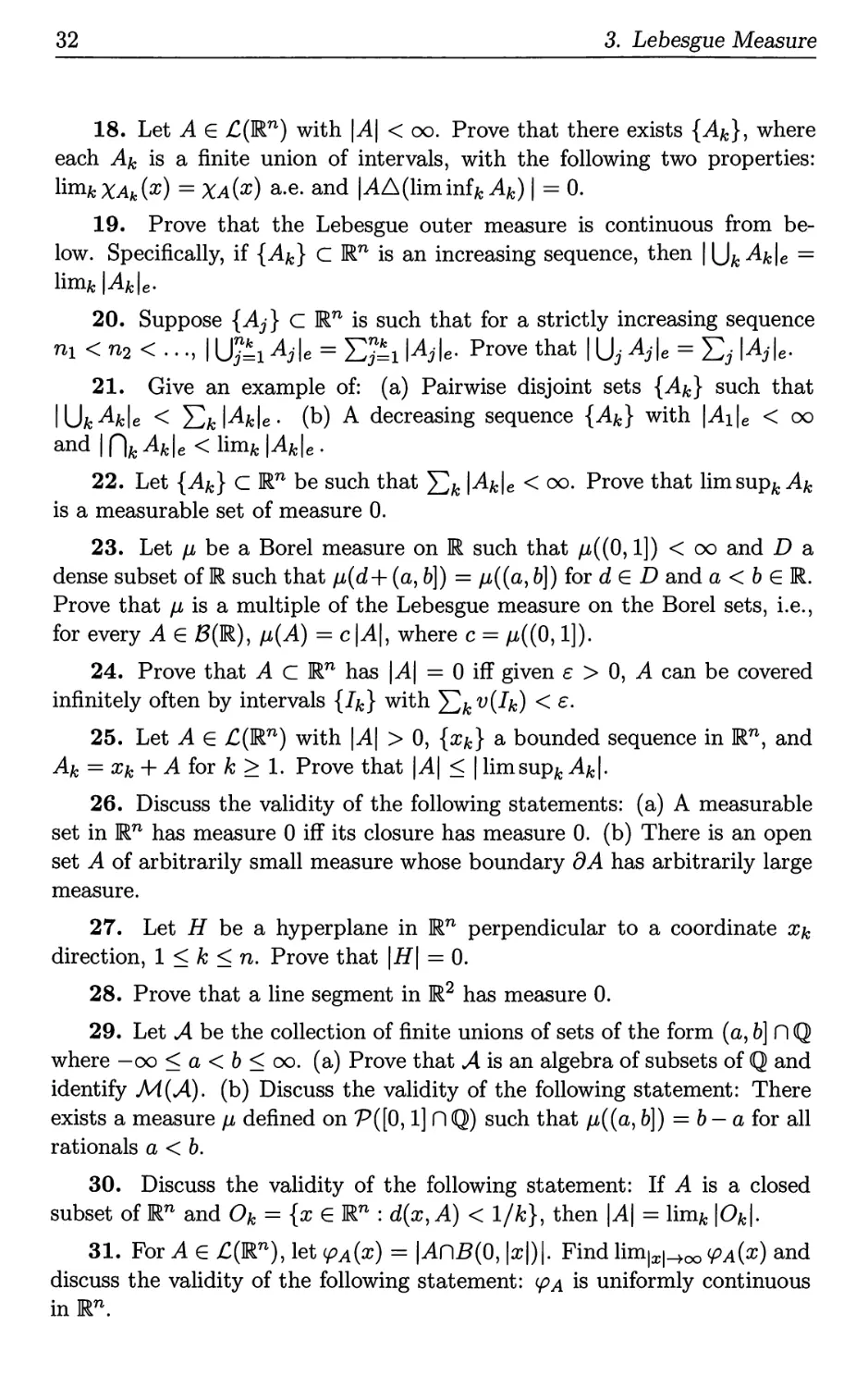
Afc = xk + A for k > 1. Prove that |A| < | limsupfc Ak\-
26. Discuss the validity of the following statements: (a) A measurable
set in Rn has measure 0 iff its closure has measure 0. (b) There is an open
set A of arbitrarily small measure whose boundary dA has arbitrarily large
measure.
27. Let H be a hyperplane in Rn perpendicular to a coordinate xk
direction, 1 < k < n. Prove that \H\ = 0.
28. Prove that a line segment in R2 has measure 0.
29. Let A be the collection of finite unions of sets of the form (o, 6] fl Q
where —oo < a < b < oo. (a) Prove that A is an algebra of subsets of Q and
identify M(A). (b) Discuss the validity of the following statement: There
exists a measure ¡jl defined on P([0,1] fl Q) such that n((a, 6]) = b — a for all
rationals a < b.
30. Discuss the validity of the following statement: If A is a closed
subset of Rn and Ok = {x € Rn : d(x,A) < 1/k}, then |A| = limfc |Ofc|.
31. For A € £(Rn), let <pa(x) = |AnB(0, |®|)|. Find limia-i^oo <pA(x) and
discuss the validity of the following statement: <pA is uniformly continuous
in Rn.
Problems
33
32. Let A c Rn with \A\e > 0. Prove that for r\ G (0, \A\e), there is a
compact K c A with \K\ = rj.
33. Let A € £(R) with |A| < oo. Prove that |.4n(—oo, x)| = |.4n(x,oo)|
for some ieR.
34. Let A € £(Rn) have infinite measure and let {A*,} be positive real
numbers. Prove that there are pairwise disjoint measurable subsets of
A such that \A^\ = Xk for all k.
35. Let Q be a cube in Rn. Prove that if A C Q is such that |.A| = |<3|,
A is dense in Q.
36. Discuss the validity of the following statements: (a) There is a closed
set F c [0,1] consisting entirely of irrational numbers such that \F\ = rj,
0 < rj < 1. (b) Given e > 0, there is an open dense Ocl with \0\ < e. (c)
For any 0 < e < 1 there is a closed nowhere dense subset F of [0,1] with
|F| > 1 — £. (d) Every closed subset of R with empty interior has Lebesgue
measure 0.
37. Let A be a measurable subset of Rn with positive finite measure.
Prove that lim^i^o D (x + ,A)| = |j4|.
38. Let A e £(R) have |^4| > 0. Prove that A contains arbitrarily
long arithmetic progressions, that is, for every positive integer n, there exist
a € A and h > 0 such that the points a,a + h,a + 2h,..., a + (n — l)h belong
to A.
39. Let A € £(R2) have |^4| > 0. Discuss the validity of the following
statements: (a) A contains the vertices of an equilateral triangle, (b) There
exists £ > 0 such that, for all 0 < rj < e, A contains the vertices of a square
of sidelength rj.
40. Let Abe & bounded measurable set in Rn with |A| > 0. Prove that
lim|x|^o \AA(x + j4)| =0. Show by means of an example that the result
may fail for sets of infinite measure.
41. Let A 6 £(Mn) with |j4| < oo and put ip(x) = \A n (x + ^4)| for
x € Rn. Prove that lim|I|_>00 <p(x) = 0.
42. Let A € £(Rn) and B € £(Rn) be bounded, and put <p(x) =
\A fl (x + B)|. Prove that <p(x) is a continuous function of x € Rn.
43. Let T : Rn —> Mn be a locally Lipschitz transformation, i.e., |T(x) —
T{y) I < Mj(\x — y| for all x, y in a compact K of Rn and a constant Mr
that may depend on K. Discuss the validity of the following statements: (a)
If A C Rn is bounded, \T{A)\e < oo. (b) If |4| = 0, \T(A)\ = 0. (c) T maps
measurable sets into measurable sets, (d) If A G £(Rn) has |j4| < oo, then
\T(A)\ < oo.
34
3. Lebesgue Measure
44. Suppose that A C [0,1] is measurable. Prove that B = cos(A) =
{cos(a;) : x E A} is measurable and |.B| < .85 |A|.
45. Let A c Rn, \A\e < oo, and r G R. Prove: (a) The dilation of A by
r, rA = {rx : x G A}, satisfies \rA\e = |r|n|^4|e. (b) A is measurable iff rA
is measurable for some r ^ 0, and then \rA\ = |r|n|^4|.
46. Let A E £(Rn). Prove that B = —A Li A € £(Rn) and |A| < \B\ <
2\A\.
47. Let A £ £(R) be such that for each irrational x, exactly one of
—x, x is in A. Prove that |A| = \AC\ = oo.
48. Let A, B C In be Lebesgue measurable with |A| + \B\ > 1. Prove
that there exist x £ A,y E B such that y = (1,..., 1) — x.
49. Let T : Rn —>■ Rn be a linear map. Prove: (a) For a closed cube
Qr of sidelength r, \T(Qr)\e — rj\Qr\ where 77 > 0 is a constant independent
of Qr and compute rj explicitly, (b) Let M be the n x n matrix such that
T{x) = Mx for all x G Rn. Then |T(4)| = |det(M)| \A\ for all A € £(Rn).
50. Prove that the Lebesgue measure is rotation invariant.
51. Can Rn be written as a countable union of hyperplanes?
52. An ellipsoid € in Rn with center xq is a set of the form £ = {x E
Rn : (A(x — :eo), x — xq) < 1} where A is an n x n positive definite matrix
and (•, •) denotes the Euclidean inner product. Find \£\.
53. An isometry <f> : Rn —» Rn is a mapping such that \(f>{x) — <f>(y)\ =
|x — y\ for all x,y £ Rn. Prove that if <j> is an isometry, \<f>{A)\ = |A| for all
A E £(Rn).
54. Let y, be a Borel measure on R that is finite on bounded subsets of R
such that y(tA) = |i| y(A) for all t E R, A E B(R). Prove that y(A) = rj |A|
where 77 = y((0,1]).
55. Let A c Rn have \A\e > 0 and 0 < r] < 1. Prove that there is a
cube Q in Rn such that |A fl Q\e/\Q\ > r}. Furthermore, prove that Q may
be assumed to have arbitrarily small measure.
56. Let A c Rn be such that | A fl Q\e > rj \Q\ for some rj > 0 and
all cubes Q c Rn. Prove that if A E £(Rn), \AC\ = 0, and show that if
A £ £(Rn), |Ac|e may be positive.
57. Let A C Rn with \A\e > 0 and 0 < 77 < 1. Prove that there is a
cube Q in Rn centered at a point of A such that \A n Q\e >77 \QV
58. Let A E £(Rn) be such that, given x ^y £ A, (x + y)/2 £ A. Prove
that |A| = 0.
59. Prove that if A c Rn has \A\e < 00, then Ac — Ac — Rn.
Problems
35
60. Discuss the validity of the following statement: If A, B £ £(R) and
|A| = |B| = 0, then |A + B\ = 0.
61. Let A, B be measurable sets in R of finite measure such that A + B
is measurable. Prove: (a) |A| + |I?| < \A + B\. (b) If 0 < rj < 1 and
(1 — r})A + r]B is measurable, then |A|1_,?|i?|,? < |(1 — t])A + tjB\.
62. Let A c [—1,1] be measurable with |A| > 1. Prove that 1 € A — A.
63. Prove that if A £ £(R) has |A| > 0, A—A contains: (a) An irrational
point x. (b) A rational point 0 ^ x.
64. Prove that if A £ £(Rn) has \A\ > 1, A — A contains a point with
integer coordinates.
65. Let B be a convex set in Rn centrally symmetric with respect to 0
with |£| > 2n. Prove that B contains a point x ^ 0 with integer coordinates.
66. Prove that if A £ £(R) has |A| > rj > 0, A — A and A + A contain
a measurable subset with measure > 2 V-
67. Prove that if A £ £(Rn) has |A| > 0, A —A contains a neighborhood
of the origin.
68. Prove that if A, B £ £(Rn) have positive measure, A — B and A + B
contain a nonempty open interval.
69. Prove that if A £ £(Rn) has |A| > 0, then card(A) = c. In other
words, if A € £(Rn) and card(A) < c, then |A| = 0.
70. Let E = {(x,y) £ R2 : x — y ^ Q}. Prove that E does not contain
a set of type Ax B with A, B £ £(R) with positive measure.
71. Prove that if A £ £(Rn) is a subset of a Vitali Lebesgue nonmea-
surable set V, then |A| = 0.
72. Prove that if A C Rn has |A|e > 0, A contains a Lebesgue nonmea-
surable subset.
73. Let V be a Vitali set in [0,1), {<&} the rationals in (0,1), Vk = qk+V,
and An = (Jfc=i Prove that the An are Lebesgue nonmeasurable.
74. Let / : [0,1] —> [0,1] be a continuous function. Discuss the validity
of the following statements: (a) If / is Lipschitz and A £ £([0,1]), then
/-1(A) £ £([0,1]). (b) If / is a homeomorphism, i.e., / is invertible and
has a continuous inverse, and K c [0,1] is a compact set of measure 0, then
i/mi=o.
75. Prove that if 0 ^ O C Rn is open, O can be expressed as the
countable union of disjoint open balls and a set of measure 0.
36
3. Lebesgue Measure
76. Discuss the validity of the following statement: There exists a se¬
quence of pairwise disjoint closed disks {Dn} contained in the open unit
square Q — (0,1) x (0,1) of R2 such that |A»I = L
77. Given a measurable set A C (0,1) with |A| > 1 — l/N, let B =
U~0 (n +A). Prove that given a finite collection of points x\,..., in R,
there exists x £ (0,1) such that x — xn £ B for 1 < n < N.
78. We say that A £ £(Rn) has density d at x £ Rn if
lim
i—>0+ \B(x,r)\
If d = 1 we say that x is a point of density of A and if d = 0 we say that x
is a point of dispersion of A. (a) Given xq £ R and d £ (0,1), construct a
set A c R with density d at xq. (b) Construct B with no density at 0.
79. Prove that if 0 is a point of density of A £ £(Rn), then A A fl A ^ 0
for |A| > 1.
80. Prove that if 0 is a point of density of A £ £(Rn), there exist Xk —> 0
such that (a) Xk £ —A D A for all k, or (b) Xk, 2Xk £ A for all k.
81. Let A £ £(Rn). We say that A has a well-defined density D(A) if
the limit
D(A) = lim
r->00
|^4 fl .5(0,r)|
|B(0,r)|
exists. Discuss the validity of the following statements: (a) D(A) is well-
defined for all A £ £(R). (b) If D(A) and D(B) are well-defined and AnB =
0, D(A U B) is well-defined and D(A U B) = D(A) + D{B). (c) If {Am} are
pairwise disjoint sets with well-defined density and A = |Jm Am, then A has
a well-defined density and D(A) = D(Am).
82. Prove that if A £ £(Rn) has |^4| > 0, there is a sequence {xk} in
Rn such that | Rn \ \Jk(xk + ^)| = 0. For {a:/.} one may take any countable
dense set D in Rn.
83. Let A = UceC where the Ic are intervals of length 1/10 centered
at the points c of the Cantor discontinuum. Find |A|.
84. Let {rjk} be a sequence in (0,1). Let Pq — [0,1], Pi the set obtained
by removing the middle open interval of Po of relative length r)\, and, having
constructed Pfc, let Pk+i be the subset of Pk obtained by removing the middle
open interval of relative length r)k of each of the 2k disjoint closed intervals
that comprise Pk- Let P = fj£Lo Prove that |P| = 0 iff = oo.
85. Fix an integer l > 1. For x £ [0,1] consider its expansion in base £,
x = ^ ^ , 0 < xn < l — 1 for all n,
71
Problems
37
where in case of ambiguity we pick the nonterminating expansion. When
i = 2 the expansion is called dyadic, when l — 3 ternary, and when t = 10
decimal, (a) Let An(k) = {«€/: xn = k} where 0 < k < i — 1 and
n € N. Prove that An(k) is Borel measurable and find its measure, (b)
Let Ak = {x E [0,1] : xn ± k, all n}, 0 < k < l — 1. Prove that Ak is
Borel measurable and find its measure, (c) Let Bk = {x E [0,1] : xn = k
for infinitely many n}, 0 < k < i — 1. Prove that Bk is Borel measurable
and find its measure, (d) Describe Ak + Ak, 0 < k < £, prove that it is
measurable, and determine its measure.
86. Suppose that i > 3 and let 0 < m < n < t. (a) Let A = {x E [0,1] :
Xk = m or Xk — n for all k}. Prove that A is an uncountable compact set
of measure 0. (b) Let B = {x E [0,1] : m appears before n in the expansion
of x}. Prove that B is Borel and find \B\.
87. Suppose that l > 3 and let 0 < l\,li < t, i\ ^ ¿2- Let A = {x =
Yhkxk^~k e [0)1] : if xm = l\ there is n < m such that xn — 12}. Prove
that A is measurable and compute its measure.
88. Let A = {x = xk%~k ^ [0,1] : Xk = 0,1, and X2k = 0 for all &}.
Prove that A is a compact, uncountable, nowhere dense set of measure 0.
89. Let A = {x = Yk xklQ~k : Xk = 0,..., 9, and, for each n = 0,1,...,
there is m with 2n < m < 2n+1 and xm = 0}. Discuss the validity of the
following statement: A is Lebesgue measurable and |.A| = 0.
90. Given x € M, define the mantissa M(x) of x as M(x) = x — [x]
where [x] is the integer part of x; M assumes values in [0,1). Prove that if
An = [2-nM(ln(ra + 1)), 2“nM(ln(n + 1)) + 1], then | limsupn An\ = 0.
91. Construct a set A c R with |j4| = 0 such that A D J is uncountable
for every interval J.
92. Let A be such that \A fl J\ = r)\J\ where 0 < rj < 1 is fixed and J is
a subinterval of M. Prove that \A n [0,1]| = 0 or = 1.
93. Let A € £(Rn) and Dcl#a dense subset of Rra such that d+A = A
for all d € D. Prove that |j4| = 0 or \AC\ = 0.
94. Let A G £(R) have the following property: If x E A and if the
decimal expansions of x and y differ in finitely many places, then y G A.
Give examples of such sets and prove that | A| = 0 or |R \ A| = 0.
95. Let A G £(Rn) have |.A| > 0, let Qn = {<?} be the rational n-tuples
in Rn, and let B = UgeQn(<7 + A)- Prove that |BC| = 0.
96. We say that p E R is a period of A if p + A — A. Let A E £(R)
have arbitrarily small periods. Prove that \A\ = 0 or \AC\ = 0.
38
3. Lebesgue Measure
97. Let A e £(R+) be such that rA = A for all rationals r > 0. Prove
that |j4| = 0 or \AC\ = 0.
98. Let A E £(Rn) be such that for all x in a dense subset D of Rn,
\AA(x + A)| = 0. Prove that |.A| = 0 or \AC\ = 0.
99. Construct a rotation invariant probability measure p on the unit
circle S1 = {(a:,y) E R2 : x2 + y2 = 1} in R2.
100. Let {on} be a real sequence and {An} a strictly positive real
sequence. Prove that if ^2nV\i < oo, 5^nAn|:r — an|_1 < oo for x a.e.
in R.
101. Prove that the existence of a Hamel basis of R as a linear space
over Q implies the existence of a Lebesgue nonmeasurable set.
102. Prove that if a Hamel basis H of R is Lebesgue measurable, then
|ff| = 0.
103. Prove that the Cantor discontinuum contains a Hamel basis of R.
104. Construct a Lebesgue nonmeasurable Hamel basis for R.
105. Characterize the differentiable functions / : [0,1] —> [0,1] such
that |/-1(J)| = | J\ for every interval J c [0,1].
106. Let OcRbe open and <p : O —¥ R a continuous function so that
E £(R) for every open interval J of R and |</?-1(J)| = |J|. Prove
that if A E £(R), ^(A) E £(R) and I^O4)! = \A\.
107. Discuss the validity of the following statement: The mapping
/ : [0,1] [0,1] given by f(x) = 2x if 0 < x < 1/2 and = —2x + 2
otherwise, is measure preserving.
108. Does there exist a function / : R -> [0,1] such that the set D(f)
of discontinuities of / has measure 0 yet D(f) D / is uncountable for every
II
109. Let (C,d) denote the metric space introduced in Problem 2.88
corresponding to the Lebesgue measure on I. Prove that S = {[.A] € £ :
\AHJ\ >0 and \AC D J\ > 0 for all intervals J C 1} is of second category in
(£,d).
110. Let {An} be positive reals such that An < oo and for A: > 0 let
x E
P >
q ~ k\q\
for all integers p, q, q
Prove that |R \ (Jfe ^fcl = 0.
111. Give an example of a subset of R: (a) Of first category and full
measure, (b) Of second category and measure 0.
Problems
39
112. Discuss the validity of the following statement: There exists a set
AcRoi first category and measure 0 such that A + A = R.
113. Discuss the validity of the following statement: If A, B are disjoint
subsets of R with A of second category, B positive measure, and AuB = R,
then A + B contains an interval.
114. Discuss the validity of the following statements: (a) Given an
integer n, there are n pairwise disjoint Borel subsets A\,..., An of R, say,
such that \Ak fl J\ > 0 for every nonempty open interval J and 1 < k < n.
(b) There are pairwise disjoint Borel sets {An} in R such that \An (1 J| > 0
for every nonempty open interval J and all n.
115. Let D = {m + y/2n : m,n £ Z} and for x, y € R consider the
equivalence relation x~yiffx — y £ D. By the axiom of choice there is a
set V, say, consisting of one point from each equivalence class. Prove that
V 0 £(R).
Chapter 4
Measurable and
Integrable Functions
This chapter is devoted to the notions of measurable and integrable
functions. Given a cr-algebra M of subsets of X, we say that a real-valued
function / on X is measurable if the level sets {x G X : f(x) > A} of / are
measurable, i.e., are in M, for all A e R. An extended real-valued function
/ on X is measurable if {/ = —00} G M and {A < / < 00} G M for each
real A. In the case of a measure space (X, M, p) the measurability of various
expressions involving /, such as f+(x) = V(0, f(x)) and \f(x)\p, 0 < p < 00,
for instance, follow at once from the fact that if / is a measurable p-a.e.
finite function on X and ip a real-valued continuous function on M, then
ip o f is measurable.
We say that a function <p on X is simple if ip = X)fc=i ^kXAk where
the Ak are scalars and the measurable subsets of X. Every measurable
function / is the /¿-a.e. pointwise limit of simple functions assuming rational
values; when / is nonnegative the functions are given by
... f(k- l)/2n, (k - l)/2n < f(x) < k/2n, for k = 1,2,..., n2n,
fn{x) = < ....
[n, f{x)>n.
For arbitrary functions f = f + — f~ the simple functions are obtained by
approximating f+ and f~ separately and then subtracting to approximate
/•
The integral of a nonnegative simple function (p over X with respect
to /t is denoted fx <p(x) dp(x), or fx (p dp, and is defined as the quantity
fx<pdiJ, = J2k=i Now, given a nonnegative measurable function /
41
42
4. Measurable and Integrable Functions
on X, let Ff = {ip : is simple and 0 < <p < /}. The integral of f over
X with respect to p is denoted fx /(x) dp(x), or fx f dp, and is defined as
fx f dp = sup { fx ipdp : cp G Xf}. Arbitrary functions f = f + — f~ have
an integral defined by Jx f dp = fx f+ dp — fx f~ dp provided at most one
of the integrals in the right-hand side of the definition is infinite.
We say that a measurable function / on X is integrable if Jx |/| dp < oo
and the linear space L1(X) is defined as Ll(X) = {/ : / is measurable and
fx |/| dp < oo}; endowed with the metric d(f,g) = Jx \ f — g\dp, {Ll(X),d)
becomes a complete metric space.
Integrable functions satisfy Chebychev’s, or Markov’s, inequality, i.e.,
V({|/l > A>) < /{|/|>A} l/l ^ for a11 A > °-
In the case of the Lebesgue measure in Rn, or A G £(Rn), the integral
of / is denoted fK„ f(x) dx, or fA f(x) dx, respectively, and if a function /
defined on a finite interval of Rn is Riemann integrable, / has a Lebesgue
integral and both integrals coincide. The Lebesgue integral is translation
invariant and simple or compactly supported smooth functions are dense
in L1(Mn) in the sense that given e > 0, there is a simple or compactly
supported smooth function g such that d(f,g) = fRn \f(x) — g(x)\dx < e.
Also, L1(Rn) functions are continuous in the metric, i.e., if / G L1(Rn),
given e > 0, there exists 6 > 0 such that fRn | f(x + y) — f(x)\ dx < e
whenever \y\ < S.
An essential feature of the Lebesgue integral is the Lebesgue differen¬
tiation theorem. It states that if / is locally integrable, i.e., integrable on
bounded subsets of Rn, then with Q(x,r) denoting the cube centered at x
of sidelength r > 0,
lim
r->o+ \Q(x,r)\ JQ(x>r)
Í
JQA
f(y) dy = /(x) a.e. x G
We say that a point x G Rn in the domain of a locally integrable function
/ on Rn is a Lebesgue point of f if
l™, ,n(l v. [ |/(y) - /(*)\dy = 0.
r->0+ \Q[x,r)\ jQ(xtr)
Then, the strong version of the Lebesgue differentiation theorem holds, i.e.,
almost every point in the domain of a locally integrable function / on Rn is
a Lebesgue point of /.
Some of the important questions in Lx{X) concern the passing of the
limit under the integral sign. A basic result is the Beppo Levi or monotone
4. Measurable and Integrable Functions
43
convergence theorem (MCT), which states that if {/„} is a nondecreasing
sequence of nonnegative finite g-a.e. measurable functions on X, then f(x) =
limnfn{x) exists everywhere on X, f is nonnegative and measurable, and
limn fx fn dg = fxf dg. The possibility that the limit is infinite is allowed.
Now, limits are hard to find and so Fatou’s lemma is an essential tool
in dealing with convergence. It states that if {/„} are extended real-valued
measurable functions on X so that g < fn ¿¿-a.e. for an integrable function
g, then Jx lim infn fn dg < lim infn fx fn dg.
Then there is one of the most celebrated theorems in real variables,
namely, the Lebesgue dominated convergence theorem (LDCT). It states
that if {/„} are extended real-valued measurable functions on X such that
limn/n = / exists g-a.e. and |/|,|/n| < g /¿-a.e. for g € Ll(X) and all n,
then limn fx fn dg = fxf dg.
Now to the problems. In Problem 13 we consider the relation of a mea¬
surable function and the nature of the underlying measure space, in particu¬
lar when it is not complete. Also the general form of a measurable function:
it is a linear combination of not necessarily pairwise disjoint characteristic
functions of measurable sets with rational coefficients, Problems 17-18. In
the particular case of Rn, various classes of functions, such as monotone
or semicontinuous, are Borel or Lebesgue measurable, Problems 21-29. On
the other hand, for an arbitrary cr-algebra of subsets of Rn, not all continu¬
ous functions are measurable, Problem 30. The composition of measurable
functions can also be problematic, Problems 36-38. The properties of mea¬
surable, not necessarily continuous, functions on R that satisfy the relation
f(x + y) = f(x) + f(y) for all real x, y, are explored in Problems 45-46.
That integrable functions in Euclidean space can be approximated in
the L1 norm as well as g-a.e., and continuous integrable functions every¬
where, and often uniformly, by simply constructed classes of functions is
done in Problems 54-55. The question as to whether two functions that
have the same integral over all measurable sets are equal g-a.e. is considered
in Problem 69. And, the fact that if a Lebesgue integrable function on R
has vanishing integral over all intervals of fixed length c > 0, it vanishes
a.e., is given in Problem 72. That integrable functions have a higher order
of integrability is done in Problem 73. The relation between the Riemann
improper integral and the Lebesgue integral on R is explored in Problems
93-95. Various forms of the Lebesgue differentiation theorem are given in
Problems 111-112. The question as to whether Lebesgue integrable func¬
tions on Rn tend to 0 as |«| -»• oo is discussed in Problems 122-130. A
general version of the Riemann-Lebesgue lemma is given in Problem 147.
44
4. Measurable and Integrable Functions
Problems
1. Let f,g be Lebesgue nonmeasurable functions on I. What can one
say about / + g, |/|, and fgl
2. Let (X,M,/x) be a measure space, / a measurable function on X,
and g = f fx-a.e. Is g measurable?
3. Let S denote the cr-algebra of subsets of R given by <S = {A c R :
A = —A}. Characterize the measurable functions: (a) / : (R, S) —»■ (R, S).
(b)c?:(R,«S)->(R,£(R)).
4. Let X — (0,1]. Consider the cr-algebras of subsets of X, <Si =
M{ (0,1/2], (1/2,3/4], (3/4,1] } and «S2 = M{ (0,1/4], (1/4,1/2], (1/2,1] }.
Give the following examples of functions / on X: (a) / is «Si measurable
but not «S2 measurable, (b) / is «S2 measurable but not <Si measurable, (c)
/ is both <Si and S2 measurable, (d) / is neither «Si nor «S2 measurable.
5. Let <S be the cr-algebra of subsets of R given by <S = {0, (—00,0], (0,00),
R}. Describe the S measurable functions / on R. If |/| is measurable, does
it follow that / is measurable?
6. Let M be a cr-algebra of subsets of X and / a function on X such
that |/| is measurable. Find an additional condition that ensures that / is
measurable.
7. Given a,b,c € R, let mid (a, b, c) denote the middle value when
a, b, c are arranged in an increasing (or decreasing) order. Let M be a cr-
algebra of subsets of X and given measurable functions /1, /2, /3, let g(x) =
mid /2(2)1 /3(2))• Prove that g is measurable.
8. Let M be a cr-algebra of subsets of X and /1,/21/31/4 measurable
functions on X. Let
f(x) =
/1(2), /2(2) < /3(2),
/4 (x'), otherwise.
Prove that / is measurable.
9. Let M be a cr-algebra of subsets of X, {An} C M with (Jn An = X,
{/„} measurable functions on X such that fn = fm on An fl Am, and / :
X ->■ R given by f(x) = fn(2) for x G An. Prove that / is a well-defined
measurable function on X.
10. Let (X,M,/x) be a measure space, / a measurable function on X,
and O an open subset of R containing the origin. Prove that there exists
A € M with n{A) > 0 such that f(x) — f(y) 6 O whenever x,y G A.
Problems
45
11. Let be a measure space and / a measurable function
on X that is not constant ¡jl-a.e. Prove that there exists A € R such that
¿¿({/ < A}) > 0 and n({f > A}) > 0.
12. Let <S denote the a-algebra of subsets of R2 generated by the
open balls B(0, r) of R2 centered at the origin. Prove: (a) The function
u : (R2,<S) -* (R+,5(R+)) given by u(x1,0:2) = (xj + £2)12 is measurable,
(b) The function v : (R+,£?(R+)) —> (R2,<S) given by v(x) = (x, 0) is mea¬
surable. (c) Let a, b € R2 be such that u(a) = u(b) and put C = {A € S : a
and b are simultaneously in A or in Ac}. Prove that C = S. (d) Discuss
the validity of the following statement: If / : (R2,<S) -» (R+,#(R+)) is
measurable, then /(3,4) = /(4,3) = /(0,5).
13. Let (X,M,fi) be a measure space where g is not complete and
(X, S, fj,i) is its completion. Prove that / : (X, S) —> (R, B(R)) is measurable
iff there exists a measurable g : (X, M) —>• (R, B(R)) such that f — g /ii-a.e.
14. Construct a Lebesgue nonmeasurable function / : R —» R such
that if g : R —> R satisfies |g(x) — f(x)\ < 1 for all x € R, g is Lebesgue
nonmeasurable.
15. Let A € £(R). Prove that given e > 0, there is a continuous function
/ on R such that \{x G R : f(x) ^ xa(®)}| < £•
16. Let / : [a, b] —> R be measurable and finite a.e. Prove that / is the
a.e. pointwise limit of polynomials.
17. Let M be a a-algebra of subsets of X and / an extended real-valued
measurable function on X. Prove that / can be expressed as / = AnXA„
with the An rational and the An in M., not necessarily pairwise disjoint.
18. Let M be a a-algebra of subsets of X and / a nonnegative mea¬
surable function on X. Prove that / can be expressed as / = n~1XAn
where the An are in M.
19. Let T be a 7r-system in X with X G T and V a linear space of
functions on X such that: (1) xa £ V for all A G X. (2) If {/n} C V is an
increasing sequence with limn fn = /, then / G V. Prove that V contains all
measurable functions / : (X, M{F)) -¥ (R, 5(R)).
20. Let M be a a-algebra of subsets of X and R = [—oo, oo] the ex¬
tended real line. Prove that / : (X,M) —> (R,f?(R)) is measurable iff
: (X,M) -> (R,5(R)) is measurable and/-1 ({oo}) and/-1 ({—oo})
€ M.
21. Let f(x) be a continuous function on [0,1]. Prove that A = {x €
[0,1] : f(x) > f(y) for all y € [0,x)} is Borel measurable.
22. Let / be a bounded function on R and A = {a: 6 R : lim^-^ f(y) =
f(x)}. Prove that A € B(R).
46
4. Measurable and Integrable Functions
23. Prove that a function / on R is measurable iff for every finite a < b
the restriction fa^ = fx[a,b] of / to [a, b] is measurable.
24. Prove that if / : Rn —> R is continuous a.e., / is Lebesgue measur¬
able.
25. Prove that if / on Rn is lower semicontinuous, / is Borel measurable.
26. Let / be a function on R that is right-continuous at each point of
M. Prove: (a) / is Borel measurable, (b) / is continuous a.e. in R.
27. Let / : M —> R be monotone. Prove that / is Borel measurable.
28. Suppose that / is differentiable everywhere on R. Prove that f is
Borel measurable.
29. Discuss the validity of the following statement: If / : [0,1] —> R is
bounded and Lebesgue measurable, then / agrees a.e. with a function in the
Baire class B\. If the statement is false, consider the following alternative:
/ agrees a.e. with a function in the Baire class Bk, for some k.
30. Let M. be a cr-algebra of subsets of Rn that does not contain B(Rn).
Prove that there is a continuous real-valued function on Rn that is not
measurable with respect to M..
31. Let / : Rn -> Rm be continuous. Prove that G B(Rn) for
all B G B(Rm).
32. Let / : Rn -> Rn be continuous, 1-1, and onto. Prove that / maps
Borel sets onto Borel sets.
33. Discuss the validity of the following statement: If / is a Lebesgue
measurable function on Rn and B G B(R), f~l(B) G £(Rn).
34. Let / : Rn —> R be measurable. Prove that f~1(A) G £(Rn) for
every A G £(R) iff /-1(/V) has measure 0 whenever N c R is a null set.
35. Let B ^ £(R) and A = {(a:, x) G R2 : x G B}. Prove that
A G £(R2) \ B(R2).
36. Let /, g : R —>■ R be such that / is Lebesgue measurable, g continu¬
ous, and fog well-defined. Discuss the validity of the following statement:
/ o g is measurable.
37. Let / be a measurable function on Rn and <p : Rn —>• Rn a continuous
function with the property that for every null set N C Rn, <£>_1(./V) g £(Rn).
Prove that / o <p is Lebesgue measurable.
38. Let ip : [—oo, oo] -> [—oo, oo] be monotone and suppose that / :
R —> [—oo, oo] is measurable. Prove that <p o f is measurable.
39. Let / be a measurable function on X and g(x) = 0 if f(x) is rational
and = 1 if f(x) is irrational. Is g measurable?
Problems
47
40. Let / : R —> R and L\(f) = {x G R : f(x) = A}, A real. Prove: (a) If
/ is measurable, L\{f) is measurable for all A. (b) If / is a simple function
and L\(f) is measurable for every A € R, / is measurable, (c) Suppose
L\{f) is measurable for all A € R. Does it follow that / is measurable?
41. Let / : Rn —> R be Lebesgue measurable and define g : R —> [0, oo]
by g(A) = |{x € R” : f(x) = A}|. Prove that g is Lebesgue measurable and
compute /K<7(A)dA.
42. Let / be the function on [0,1] defined as follows: If x = X)n Vn.
0 < xn < i — 1) let f(x) = maxn xn. Prove that / is Lebesgue measurable.
43. Consider ternary expansions x = ^nxn3-n in [0,1) (possibly ter¬
minating in 0’s) and, for x, y e [0,1), let g(x,y) denote the smallest n such
that xn — yn and g(x, y) = oo if no such n exists. Prove that g is Lebesgue
measurable.
44. Consider the functions {/n} on [0,1] given by /n(x) = xn where
x = YlnXn2_n> Xn = 0) Í- (a) Prove that fn is measurable, n > 1. (b) If
a : N -> N denotes a permutation, let f(x) = x<r(n)2_n- Prove that / is
well-defined and measurable in [0,1], and calculate |{/ < A}| for A € [0,1].
45. Let / be a measurable function on R that satisfies f(x + y) =
f(x) + f(y) for all real x,y. Prove that f(x) = cx for some constant c
provided: (a) / is integrable in some neighborhood of a point in R, or (b) /
assumes finite values in a set of positive measure.
46. Let / : R —»• R be a discontinuous function that satisfies f(x + y) =
f(x) + f(y) for all x,y € R. Prove: (a) For every irrational x there is a
sequence xn —> x such that f(xn) —> 0. (b) /-1({0}) is dense in R iff for
every Hamel basis {e^}AeA °f R over Q, T — {f(e\)} is linearly dependent
over Q. (c) If /(1) = 1, the graph G(f) of / is dense in R2.
47. Let / be a Lebesgue measurable function on R with periods s,t
with s/t irrational. Prove that / = c a.e.
48. Prove that if a continuous / : Rn -> R vanishes a.e. in Rn, f(x) = 0
for all x € Rn.
49. Given / : [0,1] —>• R, which of the following statements implies the
other? (a) / is continuous a.e. in [0,1]. (b) There is a continuous function
g : [0,1] —¥ R such that g = / a.e.
50. Let X be an uncountable set and M. the cr-algebra of subsets of X
given by M. = {A C X : A is countable or X \ ^4 is countable }. For A G A4,
let /i be the counting measure on M, i.e., n(A) = the number of elements
in A if card(.A) < oo and = oo otherwise. Characterize the measurable
functions on X and describe L1(X).
48
4. Measurable and Integrable Functions
51. Let (X,M.,y) be a measure space. Discuss the validity of the
following statement: / G Lx(X) iff lim^oo /{|/|>,\} l/l dy = 0-
52. Let (X, M,y) be a finite measure space and / a measurable function
on X. For an integer n, let An = {|/| > n} and Bn = {n < l/l < n + 1}.
Prove that the following statements are equivalent: (a) / 6 L1(X). (b)
EnM-Bn) < oo. (c) EnMAO < oo.
53. Show that (C(I), || • ||i) is not complete.
54. Consider a grid {Q\} of Rn consisting of nonoverlapping dyadic
cubes with \Q¿\ = 2-nfe, all Í. Given / G L(Rn), let {sk} be given by
Sk(x) - \Qe\~1 fQk f(y) dy for x G Qk, all £. Prove that «&(/) ->• / in
L^R”) and a.e.
55. Let / be a continuous function on [—1/2,1/2] with /(—1/2) =
/(1/2) = 0 and {sfc} nonnegative integrable functions on [—1,1] with integral
1 for all k such that lim*, Sk(x) dx = 0 for each S > 0. Prove that
if fk(x) = /_^2 sk(x - y)f{y) dy, x G [-1/2,1/2], then fk -» / uniformly in
[-1/2,1/2].
56. Let / G L1(Rn) and g G L°°(Rn). Prove that
ljmn f |/(* + h)~ f(x)| g(x) dx = 0.
N-»■0 Jun
57. Let (X,M,y) be a measure space, g a nonnegative measurable
function on X, and v the set function on M. given by v{A) = Jx gxA dy,,
A G M. Prove: (a) v is a measure, (b) If / is a nonnegative measurable
function on X, $xfdv = fx fg dy,. (c) If v is cr-finite, g is finite y-a.e.
58. Let (X,M,y) be a measure space, / a measurable function on
X, and v = / o y the set function on the Borel subsets of R given by
v(B) = y(f~1(B)), B G B(R). Prove: (a) v is a Borel measure on R. (b) A
Borel measurable function : R —> R has an integral with respect to u iff
<pof has an integral with respect to y and in that case fx <pofdy = fu ip dv.
59. Let M be a cr-algebra of subsets of X. We say that F : (X, M) —>■
(R2, B(R2)) is measurable if F~1(AxB) g M. for all open intervals A, B C R.
(a) Let f,g be real-valued functions on X and F : X ->■ R2 be given by
F(x) = (f(x),g(x)), x € X. Prove that F is measurable iff / : (X,M) —*
(R,B(R)) and g : (X,M) —> (R, B(R)) are measurable, (b) Let $ : (X,M)
(R2, B(R2)) be measurable. Prove that the set function y<s> given by
y$(E) = y(^~1(E)) for E G £(R2) is a measure, (c) Prove that /r2 / dy$ =
lxf°$dy for all /x<j> integrable functions / : (R2,B(R2)) (R,B(R)).
60. Let <p : [0,1] —> R be a strictly monotone absolutely continuous func¬
tion with continuous derivative and J = <p(I). Prove: (a) / |v?,(íC)l dx
Problems
49
= |j4| for every Borel A C J. (b) If / is integrable on J, f^Aj f{y) dy =
Ja /((Ha:)) W(x)\dx for every Borel A c (a, b).
61. Let / 6 L1(M) be a nonnegative function with integral 1, F(x) =
f-oo f(y) dy, and yp the Borel measure induced by F. Prove that for a
Borel measurable function g, fR g(x)f(x) dx = JRg(x) dyp(x).
62. Let g : R —> [0, oo) be a continuous function such that g(0) > 0 and
g(x) = 0 if x ^ [—1,1]. Prove that if h is a measurable function such that
g(x - n) < h(x) for n = 0,1,2,..then h <£ L^R).
63. Let (X,M.,y) be a measure space and / a nonnegative integrable
function on X. Prove that for every e > 0, there is A € M. with y(A) < oo
such that fx fdy < JAfdy + e.
64. Let (X,M,y) be a measure space and / a nonnegative measurable
function on X. Discuss the validity of the following statement: / € Ll{X)
iff given e > 0, there exists <5 > 0 such that jAf dy, < e whenever y(A) < 5.
65. Let (X,M,y) be a measure space and / € Ll{X). Show that the
parameter ó in the definition of absolute continuity of the integral cannot
be chosen to depend on e and ||/||i alone.
66. Let (X,M,y) be a measure space and A C X with y(A) < oo.
Prove that for some x € A, |/(rc) | < (l/y(A)) fA |/| dy.
67. Let (X,M.,y) be a measure space and / a measurable function on
X such that JAfdy> 0 for all A e A4. Prove that / > 0 y-a.e. From this
deduce that if fA f dy = 0 for all A <E M, then / = 0 y-a.e.
68. Let (X,A4,y) be a measure space and T a 7r-system of subsets of
X such that M(F) = M. Suppose that / is integrable, or measurable and
nonnegative y-a.e. Prove that if JAfdy = 0 for all A € F and A = X, then
/ = 0 y-a.e.
69. Let (X, M,y) be a measure space and /, g measurable functions on
X. Discuss the validity of the following statement: If
then f — g y-a.e.
70. Let (X,M,y) be a semifinite measure space, Fcla closed set,
and / an integrable function on X such that
all A € M ,
all A G A4 with y(A) < oo.
Prove that f(x) G F for y-a.e. x € X.
50
4. Measurable and Integrable Functions
71. Let (X, M, p) be a measure space and / G Ll(X) such that | JA f dp\
< cp(A) for all measurable A with p(A) < oo and a constant c. Prove that
|/| < c ¡i-a.e.
72. Let / € L1(M) and c > 0. Prove that if Jjf(y)dy = 0 for all
intervals J with | J\ = c, then / = 0 a.e.
73. Let / G ^(X). Prove that there is a nondecreasing Borel function
ip : R+ —> R+ with lim^oo (pit)/t = oo such that fx dp < oo.
74. Let (X,Ai,p) be a measure space, / an integrable function on X,
and g a bounded measurable function on X such that o < g{x) < b /¿-a.e.
Prove that Jx g |/| dp = c Jx |/| dp for some c with a <c<b.
75. Let (X,M, p) be a measure space and f,g G L}(X). Prove that
min(f,g) is integrable and fx min(/, g) dp < min(Jx f dp, fxgdp). When
does equality hold?
76. Let (X,M,p) be a measure space and / an integrable function on
X such that | Jx f dp\ = Jx |/| dp. Prove that / is of constant sign p-a.e.
77. Let fix) = 0 at each point of the Cantor discontinuum C and
f(x) = n in each interval of length l/3re in the complement of C. Prove that
/ is measurable and calculate Jj fix) dx.
78. Let / be the function on [0,1] given by f(x) = 0 if x is rational
and = n if there axe exactly n zeros immediately after the period in the
decimal representation of x. Prove that / is Borel measurable and compute
fj f(x) dx.
79. Let
F(x) = <
-2,
1,
12,
x < 1,
1 < x < 4,
x > 4.
Compute fRx2 dpp(x) where pp denotes the Borel measure induced by F.
80. Let / be defined on (0,1) by
f(x)
n 1, if n is the smallest integer with xn = 7,
0, otherwise.
Prove that / is measurable and compute ff f(x) dx.
81. Let [i] denote the integral part of t > 0 and for x G [0,1] put
f(x) =
0, x rational,
[1/x], otherwise,
and g(x)
0,
[l/*] >
x rational,
otherwise.
Prove that /, g are measurable and compute their integrals.
Problems
51
82. Compute
83. Given x G [0,1], let x — Ynxn£~n denote the expansion of x in
base £, 0 < xn < l — 1, all n, let xn(x) denote the function on I given by
xn(x) = xn, all n, and put for an integer m > 0,
Prove that / and g axe well-defined and compute their integrals over I.
84. Discuss the validity of the following statement: If n is a Borel
measure on R such that (f^ t dfi(t))2 = /Qx t3 dy,(t) for all x > 0, then y, is
the Lebesgue measure on B(R).
85. Let A G £(Rn), M an invertible n x n matrix, and / G Ll{A). Prove
that / o M G Ll{M-xA) and fA f(x) dx = | det(M)| JM_1A f o M(x) dx.
86. Let / G L1(Rn). Prove that if A > 0, fRn /(Ax) dx - Xn fR„ f(x) dx.
87. Let T : R2 -> R2 be the linear transformation given by T(x,y) =
(2x + y,x — y). Prove that if / G L^R2) is invariant under T, i.e., foT = f,
then fR2 f(x) dx = 0.
88. Let A be a real n x n symmetric positive definite matrix, i.e.,
(Ax,x) > 0 for x 0. Compute fRn e~l'Ax'x'>dx.
89. Given a distribution function F : R —> R and a continuous, increas¬
ing, invertible function $ : R —> R, let ¡if and denote the measures
induced by F and F o $, respectively. Prove that if / G lA(R, ¡jlf), then
/ o $ e L1 (R, mfo$) and fR f d¡j,p = fR f ° ® d¡j,Fo<t>-
90. Let / G L:(R). Prove: (a) Y^L-oo f(x + n) converges absolutely
for x a.e. in R. (b) If Yn I f(x + n)l is integrable, / = 0 a.e. (c) If {An} is
a real sequence, J2n /(^n (x — xn)) G LX(R) for any sequence {xn} in R iff
Yn l^nl 1 < °°-
91. Let /(x) be a strictly positive continuous function on [0,1] and
A = {(x,y) GR2:0<x<l,0<y< /(x)}. Compute |i4|.
92. Discuss the validity of the following statement: A function / on R+
is Riemann integrable in the improper sense iff / G L1(R+) in the Lebesgue
sense.
93. Discuss the validity of the following statement: A function / on
a finite interval [a, 6] is Riemann integrable in the improper sense iff / G
I^Qa, 6]) in the Lebesgue sense.
n
71
52
4. Measurable and Integrable Functions
94. Let / : (0,1) -»• R be given by /(x) = xn\nn{l/x) for -1 < rj < 0
and n > 0. Prove that / is Lebesgue integrable, that its integral coincides
with an improper Riemann integral of /, and compute it.
95. Compute xv(l — x)_1 ln(x) dx, rj > —1.
96. Let / be given on R+ by f(x) = (xln2(x))-1 if x G (0, e-1) and
= 0 if x g (0, e-1), and F(x) = x~x f(t)dt. Verify that / G L1(R) and
discuss the validity of the following statement: Jq F(x)dx < oo for some
rj > 0.
97. Let / be the function on R+ given by
/(*) = f
Jo
7r/2 cos(i)
t + X
dt, x > 0.
Prove that / is well-defined and continuous, give the asymptotic expres¬
sions for / at 0+ and oo, and determine, if they exist, limx_>0+ f(x) and
lim^oo f(x).
98. Let fa and ga denote the functions on R given by /o(0) = 0 and
fa(x) = l/(№ + M1/a) for x ± 0, and ga(y) = /0°° fa(x) cos(xy) dx, re¬
spectively. Find the values of a > 0 for which: (a) fa G L1(R). (b)
xfa(x) € ^(R). (c) ga G C1^)-
99. Let F{x) be given by
—oo < x < 1.
(a) Compute lim^-oo F(x) and lim.^- F(x). (b) Prove that for all k the
derivative F^ of order k of F is given by
/OO J-X
3^2 Ink(t)dt, x G ( oo, 1).
(c) Prove that F'(x)2 < F(x)F"(x), x g (—oo, 1), and conclude that the
function ln(F)(x) is convex in (—oo, 1).
100. Compute I = fR e~%2 cos (ax) dx, a G R.
101. Let / G L(R) be such that if (p is a compactly supported smooth
function, J^f(x)<pl(x) dx = 0. Prove that /R f(x)ip(x) dx is independent of
ip where xp is compactly supported and has integral 1.
102. Let (X,M,fr) be a measure space and f,g complex-valued, in-
tegrable functions on X such that ||/ + 0||x = ||/||t + \\g\\v Prove that
f(x)g(x) > 0 n-a.e.
103. Suppose that / G L1(/) satisfies fjXkf(x) dx = 0, 0 < k < n — 1,
and fj xnf (x) dx = 1. Prove that \f(x)\ > 2n(n + 1) on a subset of I of
positive measure.
Problems
53
104. Let /, g be continuous functions on [0,1] such that / is nonin-
creasing and 0 < g < 1. Prove that with rj = g(x)dx, f(x)g(x) dx <
Jo f(x)dx-
105. Let f,g be increasing functions on [0,1]. Prove: (a) f(x)g(x) dx
^ (fo f(x) dx)do 9(x) dx). (b)/01 f{x)g{ 1-x) dx < (fj f(x) dx)(fj g(x) dx).
106. Let (X,A4,g) be a probability measure space and /, g, h nonneg¬
ative integrable functions on X with integral 1. Prove: (a) g{{ f,q < 5)) >
3/5. (b) MU, 9, A < 5}) >1/5. '
107. Let / be a locally integrable function on [0, oo) such that for each
a > 0, /0°° \f(x)\ e~ax dx < oo. Does it follow that / is integrable? What if
there exists M such that /0°° \f(x)\e~axdx < M < oo, all a > 0? What can
one say about / if there exists M' such that /0°° \f(x)\eax dx < M' < oo, all
a > 0?
108. Given / on R+, let F(x) = ^2nf(n2x), x > 0. Prove: (a) If /
is integrable, the series defining F(x) converges absolutely for a.e. x > 0,
F is integrable, and /0°° F(x) dx = A /0°° f(x) dx where A is a constant to
be determined, (b) If / is continuous and (1 + x)f(x) is bounded, F{x) is
defined for all x > 0, and lima._>0+ ^fxF(x) = B exists where B is a constant
to be determined.
109. Let (X,A4,fi) be a measure space with X = Mn and suppose that
5(0,1/n) £ M for all n. Discuss the validity of the following statement: If
/ £ Ll{X), limn Jmi/n)fdn = 0.
110. Let n be a Borel measure on / so that fj fgd/j, = (Jjf dfi)(fj gdg)
for all continuous f,g on I. Prove: (a) There exists xq £ I such that
Jjfdg = 0 implies f(xQ) = 0 for all / £ C(I). (b) g = 6X0.
111. Let A c Rn have |A| = 0. Prove that if Q(x, £) denotes the closed
cube centered at x of sidelength £, there exists a nonnegative / £ L1(Mn)
such that
112. Let / £ L(Rn) and assume that for each x £ Rn, there exist cubes
{Qi.fe} containing x such that Jq^ f(y) dy = 0, all k, and lim*. = 0.
Prove that / = 0 a.e.
113. Let A £ £(Rn). Prove: (a) Almost every a: € A is a point of
density of A and almost every x £ Ac is a point of dispersion of A. (b) If
0 < |A| < oo there are a subset Ao of A and N > 0 such that |Ao| > |A|/2
and n|A fl (x — 1 /n,x + l/n)| > 1 for all x £ Ao and n > N. (c) Let
A = {x £ Kn : |A fl B(x,r)| > 0 for all r > 0}. Compute |A \ A|.
54
4. Measurable and Integrable Functions
114. Suppose A C I satisfies the following property: There exists a
dense set D c I such that if a, 6 G D, then |A fl (a, 6)|/|(a, f>)| = |d n I\/\I\.
Prove that \A\ = 1 or |d| = 0.
115. Let A G £(Rfc) and e > 0. Prove that there exist leR* and r > 0
such that \AC\ B(x,r)\/\B(x,r)\ < e or 1 — e < \A fl B(x,r)\/\B(x, r)|.
116. Discuss the validity of the following statement: There exists A e
£(R) such that if f(x) = |^4 n (—l,x)|, /'(0) = 1/4.
117. Given a closed subset F of R, let S(x) = d(x,F). Prove that
6(x 4- y)/\y\ —> 0 as |y| —> 0 for a.e. x G F.
118. Let / G L{I). (a) Does there exist x G I such that Jq f(y)dy =
J*1 f(y) dyl (b) What can one say about / if f{y) dy = f* f(y) dy for all
x € /?
119. Prove that if / G L1([a, 6]) satisfies
then / = constant a.e.
120. Let / G L1([0,1]), Jj f(x) dx = L. Does there exist a subset
A c [0,1] such that |A| = 1/2 and fA f(x) dx = L/2?
121. Let (X, M, n) be a probability measure space and / a nonnegative
measurable function on X with fx f d/j, = 1. Prove: (a) For all 0 < rj < 1,
J{f>v} f dpi > 1 — r/. (b) If / is bounded above by 1, then / = 1 ¿/-a.e. in X.
122. Discuss the validity of the following statement: If / is a continuous
integrable function on R, f(x) —» 0 as |s| —>• oo.
123. Let (X, M,/i) be a measure space and / G L1(X). Prove that given
e > 0, there is a measurable set A with ¡jl{A) < oo such that sup^g^ |/(x)| <
oo and fAc |/| dy, < e.
124. Let / G L1(Rn). Prove that given e > 0, there exist: (a) R > 0
and B C {|x| > I?} with |5| < s such that |/| < e for x G {|x| > R}\B.
(b) B G £(Rn) such that |i?| < e and f(x) Xbc(%) 0 as |x| oo.
125. Let / G L1(R), {/?n} a positive sequence and {an} such that
Y,nPn/\otn\ < oo- Prove that limn/3n|/(o:nx)| = 0 a.e.
126. We say that a function (p on Rn is radial if <p(x) = </?(|x|), x / 0.
Prove that if <p is a nonnegative, nonincreasing, integrable radial function,
then linift-Kx, BF(p(R) = 0.
127. Let / be a uniformly continuous, integrable function on [0, oo).
Prove that limx_>.0o f(x) - 0.
Problems
55
128. Suppose / £ L1(R+) is nonnegative and satisfies a Lipschitz con¬
dition |/(a;) — f(y)| < M \x — y\. Prove that liminfn \/ñ/(n) = 0.
129. Let / £ L^R) and {on} such that no more than N of the an lie
in any interval of length 1. Prove that limn f(x + an) = 0 a.e.
130. Let / £ L1([0,1]). (a) Prove that there is a sequence {an} decreas¬
ing to 0 such that an|/(an)| -¥ 0. (b) Let {/&} be integrable functions. Does
there exist a sequence {£>„} decreasing to 0 such that limn bn\fk{bn)\ —> 0 for
all*?
131. Suppose that / € L1([0,1]) and lim^!- f{x) — A. Compute
132. Let / be a Lebesgue integrable function on finite intervals of Rn
such that lim|x|_KX) f(x) = A. Compute
134. Let be a probability measure space. Does there exist a
nonnegative integrable function / on X such that limn fx fn dg, = 2?
135. Let (X, Al,fi) be a finite measure space, / a nonnegative measur¬
able function on X, and g a nondecreasing function on R that is continuous
at 0 and oo. Find limn fx g(fn) dfi.
136. Let (X, M., ¡j) be a finite measure space and / a measurable func¬
tion on X. Find limn fx | cos(irf(x))\nd/j,(x).
137. Let (X, M,fi) be a finite measure space and / a nonnegative
measurable function on X such that there exist a constant c > 0 and a
sequence ->• oo such that fx fnk d/j, = c. Prove that / is the characteristic
function of a measurable set.
138. Let (X, M,fi) be a measure space and / a measurable function on
X such that fx fn dy, = c for n = k, k +1, k -I- 2 where A; is a positive integer.
Prove that if k is even, f = xa ¿¿-a.e. for some measurable set A C X and
that the same holds if k is odd provided that / > 0 ¿¿-a.e. Can you think of
a circumstance under which only two successive indices suffice?
139. Prove that given e > 0, there is a nonnegative integrable function
f on I such that f(x) = 0 on a set of measure > 1 — e and f(x) dx > 0
for any interval (a, b) C I.
133. Given / £ L1(Rn) and A > 0, compute
56
4. Measurable and Integrable Functions
140. Let {rk} denote an enumeration of Qn, Jk the interval centered at
rk of sidelength 1, {ak} a nonnegative sequence such that Ylk ak < oo, and
set
Prove: (a) / G L^R”). (b) /2 is finite a.e. but is not integrable on any
interval of Rn. (c) / is discontinuous at every point of Rn and unbounded on
every interval of Rn and it remains so after any modification on a Lebesgue
set of measure 0.
141. Let / € L1(Rn), B(x,r) the ball centered at x of radius r, and
g(x, r) = JB^x f(y) dy. Prove: (a) For each fixed x G Rn, g(x, r) is a
continuous function of r. (b) For each fixed r > 0, g(x,r) is a uniformly
continuous function of x and lim^i^oo g(x, r) = 0.
142. Let (X,M,y) be a measure space and / 6 L1(X). For r > 0 let
Br = {\x\ < r} and define g : [0,oo) —^ R by g(r) = JB f dy,. Prove that g
is continuous at r iff y(dBr) = 0.
143. Let (X,M,y) be a measure space, {An} c M, and / G Ll{X) a
yu-a.e. strictly positive function on X. Discuss the validity of the following
statement: limn fA f dy = 0 iff limn y(An) = 0.
144. Let <p : I I be a Borel measurable function. Prove that the
following are equivalent: (a) For all Borel Ac I, |</?-1(i4)| = |j4|. (b) If / is
a nonnegative Borel measurable function on I, fj f(x) dx = Jj f(ip(x)) dx.
(c) If / is a continuous function on /, Jj /(x) dx = fj f(<p(x)) dx. (d) For
all x G I, |{í € I: <p(t) < x}\ = x.
145. Prove that if </? : R \ {0} —> R is given by <p(x) = x — 1/x and
9 = f°<P, then fR f(x) dx = fR g(x) dx.
146. Let (X,A4,y) be a probability measure space and T : X —> X a
measure preserving mapping. Prove that the following axe equivalent: (a)
If A E M and T~1(A) = A, then y(A) = 0 or 1. (b) If A G M and
y{AAT~l(A)) = 0, then y{A) = 0 or 1. (c) If / G Ll{X) and / o T = f
y-a.e., then / is constant y-a.e.
147. Let / G L1(R) and tp, bounded measurable functions on R.
Prove: (a) If ip(x + ¡3) = —^(x) for some ¡3 > 0 and all x G R, then
limn JRf(x) if>(nx) dx = 0. (b) If >p(x + /3) = <p(x) for some /? > 0 and all
x G R, then limn JRf(x) g>(nx) dx = (/3-1 Jq <p(x) dx) fR fix) dx.
148. Let an(x) = 2 + sin(na:), n = 1,2,..., x G [0,1]. Prove: (a) If / G
bmn fj f (x)an(x) dx = 2fIf (x)dx. (b) limn Jj f(x)an(x)~1dx
exists and compute it.
Problems
57
149. Let (X, M,n) be a measure space and /, g independent measurable
functions on X. Prove that cos(/) and sin(g) are independent.
150. Let X = [0,1] and for x = xn%~n € X, let fn(x) — xn. Prove
that if n ± m, /„ and fm are independent with respect to the Lebesgue
measure.
151. Let (X,M,/j) be a probability measure space and /, g bounded
functions on X. Prove that if / and g are independent, then fx fgdy, =
152. Let x = xq.x\X2 ... be the decimal expansion of x G M; the
expansion is unique except for a set of measure 0, which can be disregarded.
Define
Prove that if / € L1(M), limn /R f(x)tpn(x) dx = 0.
153. Let g e L1 (Mn) be such that Jq g(ry + s)dy = 0 where Q is a fixed
cube in Rn and r G Q and s = (si,..., sn) e Qn are arbitrary. Prove that
g = 0 a.e.
154. Let ri, r2,... be an enumeration of the rationals in [0,1], fn(x) =
H(x — rn) where H is the Heaviside function, and put f(x) = 2~kfk(x).
Compute fj f(x) dx.
155. Let (X,M,y.) be a measure space and / € Ll(X). Evaluate
156. Let (X, M, y) be a finite measure space, {An} с M with y,{An) >
e > 0 for all n, and let n(x) denote the number of integers к such that
x € Ak. Prove: (a) n(x) > 2 for some x € X. (b) sup^g^ n(x) = oo. (c)
y,({x € X : n(x) = oo}) > e > 0.
157. Let (Х,М.,ц) be a probability measure space and A\,..., An
measurable subsets of X such that ц almost every x in X belongs to at least
к of these subsets. Prove that maxi<т<пц(Ат) > k/n.
158. Let (Х,М,/л) be a measure space, {An} с M, and A = (Jn An.
Prove that if each x e A belongs to at most к different An’s, y(An) <
к y,{A).
159. Let (Х,М,ц) be a probability measure space, 0 < r] < 1, and
Ai,..., An in M. with y{An) > 77 for all n. Let 0 < a < 77 and A = {x G
X : x € An for at least aN values of n}. Prove that ¡л{А) > (77 — a)/(l — a).
xn even.
xn odd.
58
4. Measurable and Integrable Functions
160. Let {pn} be real-valued polynomials with pn of degree exactly n,
all n, and / G L1(I) such that fjf(x)pn(x)dx = 0 for all n. Prove that
/ = 0 a.e.
161. Characterize those locally integrable functions <p on R which satisfy
Jjg Hj(x)<p(x) dx = 0 for all dyadic intervals JcK. Here {Hj} denotes the
Haar system of functions on R.
162. Let / : R+ ->■ R be a C1 function such that <p(t) = sup{|/'(a;)| :
x > t}, t > 0, satisfies /Q°° <p(t) dt < oo. Prove that for a > 0, $(a, x) =
(/(ox) — /(x))/x is integrable and compute its integral.
163. Let / : [0, oo) —>■ [0, oo) be continuous, nonincreasing, and inte¬
grable. Prove that
164. Let / G L1([0,1]), An measurable subsets of /, and gn(x) =
Jo XAn(t) f(t) dt, all n. Prove that a subsequence {gnk} of {gn} converges
uniformly to a continuous function g in [0,1].
165. Let (X,M,p) be a measure space and f,g nonnegative integrable
functions on X with integral 1. Let A and v denote the probability measures
with density / and g with respect to p, respectively. Prove that the total
variation ||A — v|| = sup^g^ |A(^4) — v{A)\ is equal to (1/2) fx \ f — g\ dp.
166. Let jubea Borel measure on (R, B, p) and define I : [0, oo) —>• R
by I(x) = /[0 x] f(t)dp(t) = ¡RX[o,x](t)f(t)d»(t)> f € L1 (R). Prove that if
p has no atom at x, i.e., p({x}) = 0, 7(x) is continuous at x.
167. Let / be a nonnegative absolutely continuous function on I —
[0,1], M = maxx€//(x), and A = {x G I : f(x) = M}. Which of
the following statements is true? (a) limn fI(f(x)/M)n dx = |A|. (b)
limn fj |/'(x)| (/(x)/M)n dx = 0.
168. Prove that if A = An < oo where the An are positive, there is
a sequence pn —> oo such that Mn < 2 A.
169. Let (X, M, p) be a probability measure space and / a nonnegative
integrable function on X. Prove that Jx In(/) dp < In(Jx f dp).
170. Let G(t) : R —> R+ be given by G(t) = Jj0 |<p(x) — t| dx, where
<p is integrable. Prove that G is continuous and find the condition that
guarantees that G is differentiable at t.
iff for each t > 0,
Chapter 5
LP Spaces
This chapter is devoted to the spaces of p-integrable functions on a
measure space (X,M,p), 0 < p < oo. For p < oo, the expression ||/||p =
(fx \f\Pdp)l^p is called the IP norm of / and IP(X) = {/ : / is defined on
X, measurable, and ||/||p < 00} is a linear class of functions which, endowed
with the metric dp(f,g) = ||/—^||p, 1 < p < 00, or d%(f,g) = \\f-g\\p when
0 < p < 1, becomes a complete metric space. When p = 00, the expression
ll/lloo = inf{A > 0 : p{{\f\ > A}) = 0} is called the p-essential supremum
of / and the linear space L°°(X) = {/ : / is defined on X, measurable, and
ll/lloo < co}, endowed with the metric doo(f,g) = ||/ — p||oo, is a complete
metric space. As is the case for Ll(X), simple functions are dense in IP(X)
and, for the Lebesgue measure, compactly supported smooth functions are
dense in L^R71), 1 < p < 00.
Functions in LP satisfy Chebychev’s inequality Xpp({\f\ > A}) < ||/||p,
0 < A < 00, and an efficient way to evaluate the IP norm is given by
fx \f\pdp = p /0°°p({\f\ > A})Ap-1dA, 0 < p < 00. The weak LP spaces
are closely related to the IP spaces and are defined as Wk-LP{X) = {/ : /
is measurable on X and Xpp({\f\ > A}) < c for a finite constant c and all
A > 0}, 0 < p < 00. The infimum of the constant c is called the Wk-IP(X)
norm of /.
Essential tools in dealing with these spaces include various inequalities.
Jensen’s inequality states that, in a probability measure space, if / is in¬
tegrable and ip is convex on R, then <p(fx f dp) < fx(<P 0 /) dp. If tp is
concave, the inequality is reversed
Holder’s inequality states that, if 1 < p, q < 00 are conjugate indices,
i.e., 1/p + l/q = 1, then fx |fg\dp < ||/||p||p||9, with equality when \g(x)\
59
60
5. Iß Spaces
= c|/(x)|p_1 ¿¿-a.e. Also, fx\fg\ dp < ||/||i||fl'||oo, with equality when \g\ =
Iblloo
Next, Minkowski’s inequality states that if f,g € LP{X)^ 1 < p < oo,
then ||/ + g||p — Il/llp + ||p||p- The case of equality here depends on p. For
1 < p < oo the condition is: There exist nonnegative constants A, B not
both 0 such that Af = Bg p-a.e. On the other hand, if p = 1 the condition
is: There exists a nonnegative measurable function h such that fh = g p- a.e.
on the set {fg^ 0}.
Finally, Minkowski’s integral inequality states
(fx fYh^x'y^dv^d^x^) /P ^ f {f \h(x>v)\Pdv(x)) /P<Mz/)-
Now, the problems. The central role of the distribution function of a
function /, i.e., the measure of the level sets of /, in the computation and
estimation of the Iß norm of / for 0 < p < oo is covered in Problems 5-7
and Problems 30-32. The Marcinkiewicz Wk-Iß(X) classes are discussed in
Problem 35 and Problem 53.
The separability of Iß(X) is considered in Problem 43. Holder’s inequal¬
ity is exploited in Problems 45-46, Problems 93-94, and Problem 97. The
version of Holder’s inequality for indices 0 < p < 1 is given in Problem 119.
The fact that an inclusion between Lp spaces reflects the nature of the mea¬
sure in the underlying measure space is covered in Problems 57-58. And,
that in a finite measure space it is possible to define a function whose Iß
norm grows at an arbitrary rate is done in Problem 61.
L°°(X) is discussed in Problems 65-68, and interesting questions, in¬
cluding when it is finite dimensional, are considered.
Jensen’s inequality is explored in Problems 81-82, Hardy’s inequality in
Problems 84-87, and Schur’s lemma in Problems 88-89.
Problems 100-104 examine limp_>0+ ||/||p, and Problems 122-124 exam¬
ine the limit lirrip-Hx, ||/||p. Properties of the sequence HP spaces, including
compactness, are discussed in Problems 131-148. The local Iß spaces de¬
fined in open subsets of Mn are studied in Problems 155-156.
Problems
1. Can it happen that /2 G Ll{X), yet / 0 L2(X)1
2. Prove that for all 0 < p < oo, the equivalence class of an 77*(Rn)
function contains at most one continuous function.
Problems
61
3. Let (X, M,p) be a finite measure space, 0 < p < oo, and / ^ LP(X).
Prove that /X{|/|>a} ^ I^(X) for any A > 0.
4. Let (X, M,p) be a measure space and 0 < p < oo. Given a measur¬
able function / on X, let
Prove: (a) If / € U>(X), ||/n - /||p -> 0. (b) If ft IP{X\ {||/n||p} is an
5. Let (X,M,p) be a measure space, / a measurable function on X,
and An = {2n < |/| < 2n+1}, Bn = {|/| > 2n}. Given 0 < p < oo, prove
that the following statements are equivalent: (a) / G ¡/(X). (b) Ip =
£“-oo2np/i(An) < oo. (c) Jp = ¿“-oo2npM(^n) < oo. Furthermore,
verify that ||/||p ~ 7P ~ Jp.
6. Let (X,M,p) be a measure space and 1 < p < oo. Prove that
feu>(x) iff En«‘(p+1)M{I/I > i/™}) + EnnP“V({l/l > n>) < oo.
7. Let <p be a nonnegative, nonincreasing measurable radial function
and 0 < p < oo. Prove that ¡p G L^R”) iff EfeL-oo 2fen y>(2fe)p < oo.
8. For 0 < a < /3 < oo, consider
For what values of p does / G ^([0, oo))?
9. Let / : R3 —> R be given by/(a;i,22>*3) = (*i+*2+£C3)-p- For what
positive values of p is / integrable: (a) at the origin, and (b) at infinity?
10. Let / be the function on Rn given by f(x) = (1 — |*|) X{|x|<i}(x)-
For what values of p, —oo < p < oo, is fp integrable?
11. Let 0 < a, 7 < oo, and suppose that /, g are measurable functions
on Rra that satisfy
l/MI<!|ir“ln1(1/W)’ W-1, |9(z)|<rl~“ln"1(1/W)' w-1,
\o, M > 1, \o, |x| > 1.
For what values of p are f,g in Lp(Rn)?
12. Let 0 < /3,7 < oo, and suppose that f,g are measurable functions
on Rn that satisfy
increasing unbounded sequence.
1*1 < I»
1*1 > 1-
For what values of p are f,g in Lp(Rn)?
62
5. IP Spaces
13. Let 0 < p < oo. Give an example of a measure space (X, M, p) and
a function / on X so that / € IP(X) and / ^ Lq(X), 0 < q < oo, for all
Q^P-
14. Let (X, At, be a measure space and / € IP(X). Prove that there
exists a convex increasing function <p : [0, oo) -» R such that <¿>(0) = 0,
lim^oo <p(i)/£p = oo, and fx p(\f\) dp < oo.
15. Let (X,M,p) be a finite measure space, 0 < q < oo, and / a
nonnegative measurable function on X such that p({f > i}) < c/(l + tq),
t > 0. For what values of p does / € IP(X)?
16. Let (X,M,p) be a probability measure space and / € L2(X) such
that Jx fdp = 0 and Jx f2 dp = 1. Prove that p{{f > i}) < 1/(1 + i2),
i>0.
17. Let (X, M, p) be a finite measure space, 1 < p < q < oo, and A > 0.
Prove that ||/||p < AM{|/I < A})1^ + ||/|U({|/| > \})1/p-1/q.
18. Let (X,M,p) be a probability measure space and / a measurable
function on X such that p(f~1([k/2n, (k + l)/2n))) = 2-n for n > 1, k =
0,..., 2n — 1. Compute Jx f2 dp.
19. Let (X,M,p) be a probability measure space and / a measurable
function on X such that Mf(t) = Jx dp(x) < oo for some e > 0
and |t| < e; Mf is called the moment generating function of /. Prove:
(a) Jx \f\r dp < oo, all 0 < r < oo, and |£| < e. (b) the fc-th
derivative of M/(i), exists and find lim^o
20. For / 6 IP(I), 1 < p < oo, let irn(f) : [0,1] —>■ R be given by
7Tn/(0) = 0 and irnf(x) = 2n f(y)dy if k2~n < x < (k + l)2~n for
k € {0,..., 2n - 1}, n > 1. Prove: (a) |7rn/(x)|p < 7rn|/(a:)|p for x € [0,1],
and, consequently, ||7rn(/)||p < ||/||p. (b) limn7rn(/) = / in IP(I).
21. Let {fk} be bounded measurable functions on Rn with each /*.
vanishing outside B(0,1/k) and having integral equal to p, such that \\fk\\i <
c for all k. For g € ^(R”) define
fk(y)g{x-y)dy.
Prove that gk £ Lp(Rn) and 5% —> vg in /^(R”).
22. Let / G IP(I) be nonnegative. Find
lim
n
n— 1 P
<•-' 5U
f(y) dy)
l[k/n,(k+l)/n) '
p^l/p
23. Let (X, M,p) be a measure space and 0 < p < oo. Prove that p is
cr-finite iff IP(X) contains a strictly positive function.
Problems
63
24. Let (X,M,p) be the measure space where X = {a, b}, M = V(X),
and /¿({a}) = 1, p({b}) = oo. Discuss the duality relation between LP{X)
and Lq(X), 1 Ip + 1/q = 1, for 1 < p < oo.
25. Let (X, M, p) be a measure space and g a measurable function on X
such that fg G LP{X) whenever / G LP(X). Does it follow that g € L°°(X)?
If so, what is Halloo equal to?
26. Let (X,AA,p) be a measure space, 1 < p < oo, and consider the
following statement: If a measurable function / on X is such that fg is
integrable for every g G Lq(X), 1/p + 1/<j = 1, then / G U’(X). Prove that
the statement is true iff p is semifinite.
27. Prove: (a) If y? is a nonnegative function on Rn, then A = {/ G
I^R”) : \f(x)\ < <p(x) a.e.} is a closed subset of L^R”). (b) B = {/ G
C(I) : fj f2(x) dx > 1} is open in C(I).
28. Let 1 < p < oo. Discuss the validity of the following statement:
T = {/ G LP(R) : / > 0 a.e.} has empty interior.
29. Let (X,M,p) be a nonatomic finite measure space, (p a continuous
function on R, and 0 < p, q < oo. Prove that p(f) G Lq(X) for all / € LP{X)
iff limsupiti^ |<¿>(f)M*lp < o°-
30. Let (X,M,p) be a measure space, / a measurable function on X,
and 0 < p < oo. Prove: (a) If / G L?(X), then lim^oo Xpp({\f\ > A})
= 0. (b) lim^oo Ap/x({|/| > A}) = 0 does not imply that / G LP{X).
Nevertheless, if p(X) < oo, / G Lr(X), 0 < r < p. (c) If p(X) < oo and
MÍI/I > A}) < cA-pln(A)_(1+£) for A large, then / G LP{X).
31. Let (X,M,iu) be a measure space, / a measurable function on X,
1 < p < oo, and q — p = r > 0. Discuss the validity of the following
statement: I = En 2_nr I{\f\<2”} l/l9^ < oo iff / G LP(X).
32. Let (X,M,p.) be a finite measure space, / a measurable function
on X, and 0 < p < oo. Prove that the following statements are equivalent:
(a) JxI/Nm < oo- (b) EnM(l/lp > «}) < oo. (c) If a > 1, 7,/3 > 0
are such that 7/3 - a + 1 = p/3, then Enn_a /{|/|<n^} l/l7 < oo. (d)
If 0 < a < 1, 0 < 7 < p, ¡3 > 0 are such that 7^ - a + 1 = pi3, then
E„™-a/{|/|>n0}l/l7<^< 00.
33. Let Ty denote the translation operator ryf(x) = f(x + y) and 1 <
p < 00. Discuss the validity of the following statements: (a) ry is bounded in
D>(Rn). (b) For p e L°°(R"), lim|fc|_»o/Rn |rhf(x) - f(x)\p <p(x) dx = 0. (c)
Tyf converges to / in Lp(Rn) as \y\ -7 00. If not, does it converge weakly?
34. Let T be a relatively compact subset of Z/(Rn), 1 < p < 00. Prove
that T is bounded and that, given e > 0, there exists <5 > 0 such that
\\Thf — /lip < £ for all h with |h| < S and / G T.
64
5. IP Spaces
35. Let (X,M.,p) be a cr-finite measure space, / a measurable function
on X, and 0 < r < p < oo. Prove that / € Wk-Lp(X) iff there exists
a positive finite constant c such that fA |/|r dp < cp(A)l~r/p for every
measurable A with p(A) < oo.
36. Let (X,M,p;) be a finite measure space and, for 1 < p < oo, put
apU) = /0°° Mil/I > A})1/pd\. Prove: (a) ||/||p < cpAp(f). (b) For r > p,
Ap(f) < Cptr ||/||r with cpr y oo as r ^ p.
37. Let Sp — {g G ¿^([0,1]) : g2(t) dt = 1} and for / G £^([0,1]) let
dp(f, Sp) denote the distance from / to Sp in 1]). If f{x) — x — 1/2,
find di(f,Si), d2(f,S2), and doo(/,*5oo)-
38. Let / be a continuous function on I with /(0) = 0 that has a right-
hand derivative at 0. Prove that a:-3/2/ € IP (I), 1 < p < 2. Furthermore
show that without the differentiability assumption at the origin the result
is false.
39. Let / be a continuously differentiable function on [0,1] with /(0) =
0, l/p + l/q = 1, and 0 < r < oo. Prove: (a) |/(x)| < a^H/'llp, x € (0,1).
(b)ll/llr<(9/(9 + r))1/’J/V
40. Let / be a differentiable function such that /, /' e L2(R). Prove
that / is bounded and |/(x)| < ||/||2 \\fW2, all x € E.
41. Let T = {/ € C'1([— 1,1]) : jf(x)\2dx < 1}. Discuss the validity
of the following statement: If 0 < a < 1, then
77 = sup sup
\f(x) — f(y)\
\x-y\a
< 00.
42. A step function is one that can be written as a finite linear com¬
bination of pairwise disjoint intervals of Rn. Prove that step functions are
dense in IP{Rn), 1 < p < 00.
43. Let (X,M,p) be a cr-finite measure space and 1 < p < 00. Prove
that if M is countably generated, IP(X) is separable.
44. Let (X,M,p) be a measure space. Discuss the validity of the
following statement: If /, g G L2(X), then fg G L2(X).
45. Prove that if ||/s||r < c||/||p ||p||9 for all / G L?(Rn) and g G L«(Rn),
then l/p+ l/q = 1/r.
46. Let (X,M,p) be a measure space and 0 < p, q < 00. Prove that if
/ G IP(X) and g G L«(X), then fg G Lr(X) where 1/r = l/p + l/q and
ll/dlr < ll/IUMI,.
47. Let (X,M,p) be a measure space, 1 < r < p, and g a measurable
function on X such that fg G Lr(X) for all / G IP(X). Prove: (a) The
Problems
65
mapping T given by T(f) = fg is bounded from LP(X) into LT(X). (b) If
p is cr-finite, then g G Lq(X) where 1/r = 1/p + 1/q.
48. Let T be a linear mapping from real 17 (R) into real Lq(R), 0 <
p,q < oo, such that / > 0 implies T(f) > 0. Prove that T is bounded.
49. Given / G I7(/), 1 < p < oo, let g(x) = f(xv)cos(x) and h(x) =
f(xq) sin(x), 1 < r¡ < oo. For what values of p are g and h integrable?
50. Let / G Z7(Rn), 0 < s < p < oo, and a > n(l — s/p). Prove:
(a) limí?_>0+ 7?n(s/p_!) fB(0j¡) |/(x)|s dx = 0.
(b) lim^oo Ti°+n(s/P-1) fmn)c |/(a;)|* |o:|-« dx = 0.
51. Let (X,M,p) be a probability measure space, 1 < p < oo, and
/ G £P(X) a nonnegative function on X such that Jx f dp > A. Prove that
fx(f “ X) dp < p({f > X})1/q(Jx fpdpy/P where 1/p + l/q = 1.
52. Let (X,M,p) be a measure space, f,g measurable functions on X,
and 0 < p < oo. Prove that if 0 < a < p, 0 < /3,r, and m({M > ^})
< A-" X[|/|>a^} I f\T dp for all A > 0, there is a constant ca¡p such that
53. Let (X, M, p) be a measure space and 0 < p < q < oo. Prove that if
/ G D>{X) n Lq(X), then / G U{X) for p < r < q and ||/||r < ||/||J ||/1|^
where 0 < r¡ < 1 is given by the relation r = rjp + (1 — rj)q. What if
/ G Wk-I7(X)n Wk-Lq(X) instead?
54. Let Q(0, i) C Rn denote the cube centered at the origin of side-
length i and / G Lp(Rn), 1 < p < oo. Discuss the validity of the following
statement: lim^_^oo ./q(o,2^^)\Q(o,2^) (^) — 6.
55. Let / G LP{I) and 0 < p < q < oo. Prove that given e > 0
and K > 0, there exists a function g G LP(I) such that ||/ — g\\p < £ and
MU > K.
56. We say that a locally integrable function / on R has weak derivative
g if fR f(x)p/(x) dx = — /R g(x)g>(x) dx for all compactly supported smooth
functions <p. Prove: (a) / has weak derivative 0 iff / = c a.e. (b) If
/ G I7(R), 1 < p < oo, / has weak derivative 0 iff / = 0 a.e.
57. Let (X,M,p) be a measure space and 0 < p < q < oo. Prove that
LP{X) Lq{X) iff X contains sets of arbitrarily small positive measure.
58. Let (X,M,p) be a measure space and 0 < p < q < oo. Prove that
Lq{X) <f. LP{X) iff X contains sets of arbitrarily large finite measure. How
about q = oo?
66
5. IP Spaces
59. Let (X, M, p) be a probability measure space and suppose that / is
such that H/llp = ll/Hg for some 0 < p < q < oo. Prove that |/| is constant
//-a.e.
60. Let (X,M.,p) be a measure space and 0 < p,q < oo. When are
IP{X) and L*{X) equal?
61. Let limp ^(p) = oo. Construct a function / G P|p<00 LP(I) \ L°°(I)
such that limp ||/||p = oo and ||/||p < 'L(p) for all p large.
62. Let p be a nonatomic Borel measure on Rn and / G L1(Rn) with
A*({|/l > 0}) > 0. Given 1 < p < oo, construct a measurable function g such
that Jr» l/sl dp < co and fRn |/| \g\pdp = oo.
63. Discuss the validity of the following statements: (a) Simple functions
are dense in L°°(I). (b) CQO, 1]) is dense in LP([0,1]), 1 < p < oo.
64. Let (X,M,p) be a measure space, M = {^4 G M : p(A) = 0},
and for measurable / let A(f) = {A G R : {|/| > A} G M}. Prove: (a) If
A(f) = 0, ll/lloo = OO. (b) If A(f) JL 0, |/| < H/lloo p-a.e. and ||/||oo € A(f).
65. Let (X,M,p) be a measure space and / G L°°(X). Prove that
/ > 0 p-a.e. iff ||A - /||oo < A for all A > ||/||oo-
66. Let (X,M,p) be a measure space and / a real-valued measurable
function on X. The //-essential infimum of /, or plainly the essential infimum
of /, is defined as ess inf / = sup{A : p({f < A}) = 0}. Prove that if / ± 0
is nonnegative, ess inf / = 1/ess sup(l//).
67. Let (X,M.,p) be a measure space. Prove that the following state¬
ments are equivalent: (a) No collection of pairwise disjoint measurable sub¬
sets of X with positive measure is infinite, (b) L°°(X) is finite dimensional,
(c) L°°(X) is separable, (d) If / : (X,M) —>■ (R, B(R)) is measurable,
/ e L°°(X).
68. Let (X,M,p) be a measure space, Mf = {M g M : p(M) < oo},
and Aif = {A G M. : p{A fl M) = 0 for all M G Mf}- We say that a
measurable function / on X is locally //-essentially bounded if ||/||oo,/oc =
inf {A > 0 : {\f\ > e M,} < oo; H/lloo,ioc is called the local //-essential
supremum of / and we let L^C(X) = {/ : / is measurable and locally p-
essentially bounded}. Let A{g)f = {A G M : {|g| > A} G Mf}. Prove: (a) If
A(9)f = 0, then IMU/oc = oo. (b) If A(g)f ^ 0, then (|5| > \\g\\oo,ioc} G Mf,
or Hfflloo.ioc G A(g)f. (c) Modulo functions that coincide except on sets in
Mf, (L%C(X), || • Hoopoe) is a Banach space, (d) L°°(X) c Lf^(X) and
11/lloo.ioc < ll/lloo for all / G L°°(X).
69. Let (X,M,p) be a measure space and / a measurable function on
X such that fg G IP(X) whenever g G IP(X). Discuss the validity of the
following statement: / G L^C(X).
Problems
67
70. Let / e L°°([a, &]) be such that linxE_i.a+ f(x) = 7 exists. Discuss
the validity of the following statement:
lim /*
*-►»+ Ja
f(x)
y/(x- a)(t - X)
dx
exists.
71. Let V = {polynomials p : p( 1) = 0}. Prove that V is dense in Lq(I)
for 1 < q < 00.
72. Prove that V = {e~\x\2p{x) : p is a polynomial} is dense in Lq(Rn),
1 < q < 00.
73. Let {pm} be a sequence of polynomials that converge uniformly to
a function / on Rn. Prove that / is a polynomial.
74. Let (X,M,p) be a finite measure space where X = [0,1]. Prove:
(a) xn -¥ 0 in LP(X), 1 < p < 00, iff p({l}) = 0. (b) xn 0 in L°°(X) iff
p([l — 77, 1]) = 0 for some 77 > 0.
75. Let (X,M,p) be a measure space, 0 < r < p < 00, and suppose
that {An} are measurable sets such that limn p,(An) = 0. Prove that if
/ 6 then limn//(A„)r/p-1 fAn \f\r dp = 0.
76. Given / € Zf1([0,1]) and 0 < p < 00, let fp(x) = pxp~1f(xp). Dis¬
cuss the validity of the following statement: limp_,i JJ0 \fp(x) — f(x)\ dx =
0.
77. Let p be a probability Borel measure on M and <p, ip monotone
functions on R. If p, are monotone in the same sense (i.e., both decreasing
or increasing), prove: (a) (fRi/>(f)dp) (fR<p(f)dp) < dp. (b)
J i>U) ¥>(/) dlJ' + (p(JRfdlJ)'lt’(fVLfdlJ)
>ip( f fdp) f (p(f) dp + tp( [ fdp) f i>(f)dp.
' Jr ' Jm. 'J r /Jr
On the other hand, if <p, ip are monotone in the opposite sense, the opposite
inequalities hold.
78. Let (X,M,p) be a measure space and / on X such that |/| < 1
p-a.e. Prove that
79. Let (X,M,p) be a measure space and 1 < p < 00. Suppose that
/ G LP(X) satisfies fx fgdp = 0 for all g e V, a dense class in Lq(X) where
1/p + 1/q = 1. Prove that / = 0 p-a.e.
68
5. IP Spaces
80. Let (X,M,p) be a measure space, / a measurable function on
X, and <p,ip monotone functions on R+ such that <p(A |/|) and t/>(A|/|)
are integrable for all A > 0. Prove: (a) If <p is increasing, then p({\f\ >
t}) < infA>o^(Ai)_1/{|y;|>t}(/?(A|/|)dju, t > 0. (b) If ip is decreasing, then
/*({1/1 < *}) > supA>0 -0(A i)-1 /{|/|<t} V’CA |/|) rf/z, t > 0.
81. Suppose <p is a real continuous function such that <p(Jq f(x) dx) <
fo <P(f{x)) dx f°r aU bounded measurable functions /. Prove that ip is con¬
vex. Similarly, if ip(f(x)) dx < ip(fj f(x) dx), ip is concave.
82. Let (X, M, p) be a probability measure space and <p a strictly
monotone function on R with a strictly monotone derivative. Prove that
fx V(f) = <P(fx / dp) iff / = c p-a.e. on X.
83. Let (X,M,p) be a measure space and /, g € IP(X), 1 < p < oo,
with II/IIp. IIpIIp < M• Prove that fx \ |/|p - \g\? \ dp < 2pMp~l\\f - g\\p.
84. Prove Hardy’s inequality: If / is a nonnegative LP([0, oo)) function,
1 < p < oo, and
1 fx
F(x) = — I f(t) dt, x > 0,
x Jo
then ||F||p < p'H/llp where p' is the conjugate to p. Furthermore, prove that
p' is the best possible constant. What if p = 1? p = oo?
85. Let {/i,..., fn} C IP([0, oo)), 1 < p < oo, be nonnegative functions.
Prove that if
Fk(x) = - [ fk(t) dt, 1 < k < n,x > 0,
x Jo
then IKIK.1 ft)17“!!, < (p7»)II HU All,-
86. Prove the following variants of Hardy’s inequality: (a) Let / be a
nonnegative locally integrable function such that J0°° x~r(xf(x))p dx < oo,
1 < p, r < oo. If F(x) = Jq f(t) dt, x > 0, then
J x~TF{x)pdx < j x~r(xf(x))P dx.
(b) Let / be a nonnegative locally integrable function such that for 0 < r < 1
and 1 < p < oo, Jq00 x~T(xf(x))p dx < oo. If F(x) = JJ° f(t) dt, x > 0, then
f
x rF(x)pdx
(*r f
x r(xf(x))p dx.
87. Let /i,...,/n be nonnegative Lp([0,oo)) functions, 1 < p < oo.
Prove that if Fk(x) = fj fk{t) dt, 1 < k < n, x > 0, and 1 < r < oo, then
№.. a)17"!!« < (p/»(r -1)) II HU All«-
Problems
69
88. Let K(s,t) be a nonnegative integrable function defined for s,t > 0
which is homogenous of degree —1, i.e., K(\s,Xt) = A~1K(s,t), A > 0.
Also, suppose that /0°° t) dt = 7 < 00 for some 1 < p < 00. Let
Tf(s) =/0°° K{s,t)f(t)dt. Prove that ||T(/)||P < 7||/||P •
89. Verify that K(x,y) = 1 /(x + y) and K\(x,y) = 1/max(x,y) satisfy
the assumptions of Problem 88 and calculate the norm of the associated
integral mappings.
90. Let /, g be nonnegative lower semicontinuous functions on R and h
a function on R such that f(x)1~vg(y)v < h((l — r¡)x + rjy) for all x,y G R
and some r¡ € (0,1). Prove that if Ф is increasing and Ф(£) = $;(s) ds,
then
{^J Ф(/(а;))<£г) V J Ф(д(х)) dxY < J Ф(h(x))dx.
91. Let (X, A4,fj) be a measure space, / a nonnegative integrable func¬
tion on X, g a nonnegative measurable function on X, and 1 < p < 00.
Prove that (fxgfd¡x)p < ||/||?_1 !x9pfdP-
92. Let (Х,М,ц) be a measure space and 1 < p < 00. Discuss the
validity of the following statement: Given / € 1^([0,1]), there is a unique
g G L9([0,1]) with ||0||9 = 1 such that JIf(x)g(x) dx = \\f\\p.
93. Characterize the nonnegative functions g(x) e L4(I) that satisfy
(fj xg(x) dx)4 = (27/125) fjg(x)4dx.
94. Prove that
1 =
ж1/2
(1 — ж)1/3
95. Let (X,M, g) be a measure space and f,g G L3(X) such that
Wfh = Ik/lh = 1. Prove: (a) f2g G Lx(X). (b) If Jxf2gdfi = 1, then
g = l/l /i-a.e.
96. Let (X,M,y) be a probability measure space and f,g measurable
functions on X. Prove that if |Cov(/, g)| = iv/Var(/)i/Var(^), there exist
constants a and b such that g = af + b /x-a.e.
97. Prove that a:-1/3 sin2/3 (a:) da: < 21/37t2/3.
98. Let (X,A4,/x) be a measure space, 0<p<g<oo, AcX with
0 < g(A) < 00, and / a nonnegative function on X such that
For 0 rj ^ 1, let Aifj — (/ ^ arj). .Find a constant c ^ 0 depending on
ri,a,P, such that /x(A^) > cfj,(A) holds.
70
5. LP Spaces
99. Let / G L1(M) n L2(M) and put /o(x) = xf(x). Prove that ||/||2 <
8II/II2II/0II2.
100. Let (X,M,p) be a probability measure space and / an integrable
function on X such that p({f ± 0}) < 1. Prove that limp_,0+ ||/||p = 0.
101. Let (X,M,p) be a finite measure space and / e Lr(X) for some
0 < r < 00. Does limp_).0+ Jx \f\p dp exist? If so, what is it equal to?
102. Let (X,M.,p) be a probability measure space, / a nonnegative
function in Lr(X) for some r > 0 such that ln(/) € Ll(X), and F be given
by F{p) = fx fp dp, p € [0,r], F(0) = 1. Prove that F is right-differentiable
in [0, r) and compute the value of the derivative.
103. Let (X,M,p) be a probability measure space and / a simple
function on X. Prove that limp_+0+ ||/||p exists and compute it.
104. Let (X,Ai,p) be a probability measure space and / € Lr(X) for
some 0 < r < 00 and fxln(\f\)dp > —00. Prove that limp_>0+ ||/||p =
exp(/xln(|/|)d/i).
105. Let (X,M,p) be a probability measure space and 0 < p < 00.
Prove that (fx \f\pdp)\n(fx \f\p dp) < fx \f\p ln(\f\p)dp.
106. Let (X, M, p) be a measure space and / a nonnegative function in
Lr( X) fl LS(X) where l<r,<p<s<oo. Prove that (fx /pln(/) dp)2 <
(fx fpdp)(Jx fpln2(/) dp) and deduce that (j>{p) = ln(||/||p) is convex.
107. Let 01,..., an be nonnegative reals and pi, - ■ ■ ,pn > 1 such that
ELi 1/Pk = 1- Prove that nLi ak < EL 1 tft/Pk-
108. Let (X,M,p) be a measure space and / a nonnegative function
on X with fx f dp = 1. Prove that for every A C X with p(A) < 00 we
^ave Ia ln(^) df* - P(A) ln(l//x(j4)), and fA fp dp < p{A)l~p for 0 < p < 1.
109. Prove that if /, g € LP{X), 0 < p < 1,
ll/+9ll,<2<VP)-l(||/||p + ||9||I>).
110. Let J = [0, tt] and / € L2(J). Is it possible to have simultaneously
~ sin(a:))2 dx < 4/9 and Jj(f(x) - cos(x))2dx < 5/9?
111. Let / be a nonnegative integrable function on Mn. Prove that for
all real A,
(J^f(x)c°s(\\x\)dx'j + (J^f(x)sin(\\x\)dx'j - [J f(x)dx) •
112. Given that/0°° e 1 sin x dx = 1/2, estimate f™e~x (3+2sincc)??dx
where 0 < 77 < 1.
Problems
71
113. Let (X,A4,p) be a finite measure space and l/p + 1/q = 1, 1 <
p < oo. Prove that if / G LP{X) has integral 0,
114. Let (X,M,p) be a probability measure space, / G LP(X), 1 <
p < oo, and A G (0,1). Prove: (a) (1 - X) Jx f dp < fx fX{f>\fx fdy.} dp-
(b) p({f > Xfx fdp}Y~x > (1 - A)p(fxfdp)p/Jx fp dp.
115. Let (X, M, p) be a measure space, / a measurable function on X,
and r > s > t > 0. Prove: (a) If / G Lr(X) n L\X), ||/||* < № + ||/|||.
(b) (fx Ifl'dp)'-* < (fx | f\rdpy-yx |tfdpy-.
116. Let (X,M,p) be a finite measure space and f,g nonnegative
measurable functions on X such that f(x)g(x) > 1. For what values of p
and q, 0 < p, q < oo, is it true that
117. Let (X, M,p) be a finite measure space and / a measurable, finite
p-a.e. function defined on X. Prove that for any 0 < p, q < oo,
(^)IpnT)M4/r(mIxe-qmd^4,q^
118. Let (X,M,p) be a measure space, 0 < p < oo, and suppose there
is a measurable function / on X such that / and 1 // are m IP{X). What
can one say about p7
119. Let (X, M, p) be a measure space and 0 < p < 1, —oo < q < 0 be
conjugate indices, i.e., l/p+l/q = 1. Suppose that f,g are positive measur¬
able functions on X such that fp,gq are integrable, and fg is integrable.
Prove: (a) (Jx fp dp)1/p(Jx gq dp)1^ < Jxfgdp. (b) (Jxgqdp)1/g =
infy [fx fgdp/(Jx fpdp)1 p], and if 0 < ||/g||i < oo equality in (a) holds
iff A\f\p = B\g\q p-a.e. on X for some A, B > 0.
120. Let (X,M,p) be a finite measure space and 1 < p < r < oo.
Compute M = sup{||/||p/||/||r : / G Lr(X), / ^ 0}.
121. Let (X, M, p) be a measure space and / a function on X such that
/ G Lr(X) for all r < p. Discuss the validity of the following statement:
/ G Lp(X) and ||/||p = limr_>p- ||/||r.
122. Let (X,M,p) be a finite measure space. Discuss the validity of
the following statement: Plpcoo LP(X) = L°°(X).
72
5. IP Spaces
123. Let (X,A4, p) be a measure space and / € Lr(X) for some r <
oo. Prove that limp_>oo ll/llp — ll/lloo- Does the conclusion hold if the
assumption that / belongs to some Lr(X) is dropped?
124. Let (X,M,p) be a measure space, / € Ll(X) D L°°(X) with
M({|/| > 0}) > 0, and for each positive integer n, put an = Jx \f\ndp.
Prove that limn an+i/an exists and calculate it.
125. Let (X, M, p) be a finite measure space. Prove: (a) For a nonneg¬
ative function / on X,
““ nln 11/1100 '
(b) If h is a bounded continuous function on X,
lim — In ( f e~nhdp] = — minh(x).
» n \Jx / xex
126. Let {on} be a sequence of positive numbers such that an <
oo where 0 < e < 1. Prove that if {xn} c [0,1],
E
dn
X — Xr
converges absolutely a.e., and that the statement is not true for e = 1.
127. Let (X,M,p) be a measure space, / a function on X such that
ll/llp < cpv, where c is a constant independent on p, and 0 < tj < 1. Prove
that / is exponentially integrable and /x(exp((7|/(x)|)1/T?) — l)dp(x) < ci
where c\ is a constant independent of / and 7 = rjl^v/Qc.
128. Let (X,M,p) be a measure space, {/„} nonnegative measurable
functions on X, and 1 < p < 00. Prove that
129. Let 1 < p < 00. We say that a mapping T : LP(I) -4 LP(I) is a
contraction if ||T(/)||P < c||/||p for some constant 0 < c < 1. Let T be given
by Tf(t) = H f(s) ds. Prove: (a) If 1 < p < 00, T is a contraction on LP{I).
(b) T2 is a contraction on L°°(I) but T is not. (c) T is not a contraction on
L\I) but Tn(/) -4 0 in Ll(I) for all / <E L\I).
130. Discuss the validity of the following statement: The linear space
of sequences with finitely many nonzero terms is dense in tP for 1 < p < 00.
131. Let 0 < p < q < 00. Prove: (a) (P C £9, 0 < p < q < 00. (b)
Up<9^ £ (c) For * € Up<oo^» limp^oo IMIp = ||*||oo.
132. Let 1 < P, q < 00, q ^ p. Prove that (iP, || • ||9) is not complete.
Problems
73
133. Let <p : N —¥ N be a bijection. Prove that ^2n <p(n)/n2 = oo.
134. Let A = {x £ P : EJsinOn)| < oo}. Prove that A is a dense
subspace of ft and characterize it.
135. Let M = {x £ (P : EnnPWp < 1}, 1 < P < oo. Prove that M is
convex.
136. Let x = {xn} be a sequence such that Yhn n\xn\p < oo. Prove that
x £ (P for 0 < r < p < 2r.
137. Discuss the validity of the following statements: (a) A = {x £ £2 :
\xn\ < 1/n for all n} is closed in t2. (b) B = {x £ £2 : \xn\ < 1/n for all n}
is open in £2.
138. Characterize those positive sequences {An} such that A = {x £
£2 : \xn\ < An for all n} is open in t2.
139. Let A be a nonnegative sequence and for 1 < p < oo, let C\ =
{x 6 £p : \xn\ < \n for all n}. Prove that C\ is compact iff {An} 6 HP.
140. Given a nonnegative real sequence A ^ OP, 1 < p < oo, let C\ =
{x € £P : \xk\ < Afc for all k} and M\ — B f)C\ where B is the closed unit
ball in (P. Discuss the validity of the following statement: M\ is compact.
141. Let {6n} be an unbounded sequence of positive numbers. Show
that there is a positive sequence {on} such that Yhn an < oo but Yhn anbn =
oo. Along similar lines, let {cn} ft. Show there is a positive sequence
{dn} with limn dn = 0 such that cndn = oo.
142. Let a = {an} be a real sequence such that En converges for
every b — {6n} € cq. Prove that a £ i1.
143. Let a = {an} be a real sequence such that anbn converges for
every b = {6n} € IP. Prove that a £ lq, where 1/p + 1/q = 1.
144. Prove that for summable sequences {a«}, {bn} of nonnegative
reals, (En“«) ln((En°»)/(EnM) ^ ¿„onlnion/ftn).
145. Let {an}, {6n} be sequences of positive real numbers such that
0 < an < 1, all n, and £n bn = 1. Prove that En(ln(a™)) bn < ln(En anK)
and limfc II*=i an < En anbn-
146. Construct sequences {xn} such that, simultaneously, limn ||xn||i =
oo, limn ||xn||2 = 1, and limn ||xn||oo = 0.
147. Let Ap = {x £ £P : Yln xn = 0}. For what values of p is Ap closed
in £?, 1 < p < oo?
148. Prove that 1$, 1 < p < oo, is of first category in itself.
149. Prove that for 1 < p < oo, IP(I) is of first category in L1(/).
74
5. IP Spaces
150. Let (X,M,fi) be a finite measure space and Y c Lx(X) a closed
subspace of Ll(X) with the property that if / € Y, then / 6 IP(X) for
some p > 1. Prove that there is a fixed p > 1 so that Y c IP(X).
151. Let / € L1(Rn) n L°°(Rn) satisfy ||/||oo < tt/2. Prove that
lim*; fRn sink(f(x)) dx = 0. What if / € IP(Rn) instead, 1 < p < oo?
152. Show that L1(R) D L2(R) is not closed in (£1(R),IHIi) or in
(£2(R), II • Ik).
153. Let (XtM,p) be a finite measure space and 1 < p < oo. Explain
the following situation: IP(X) is separable but the subspace IP(X)nLco(X),
which is dense in both IP(X) and L°°(X), is not separable.
154. Let (X,M,p) be a measure space and 1 < p < r < oo. Prove
that ||/|| = ¡/Up + ||/||r is a norm in IP(X) n Lr{X) and that (IP(X) n
Lr(X), || • ||) is a Banach space. Furthermore, if p < Q < r, the inclusion
map LP{X) n Lr(X) Lq{X) is continuous.
155. Let O be an open set of finite measure in M.N and 1 < p < oo.
We denote Ilc{0) = {/ € IP(0) : supp(/) C O is compact} and Lfoc(0) =
{/ : O —>■ R : / is measurable and fxK G LP{0) for all compact K C O}.
(a) Equip L^oc(0) with a complete metric d such that for each sequence
{fn} c qjO) and / G L?oc(0), limnd(fnJ) = 0 ifflimre \\(fn~ f)xK\\P = 0
for all compact K C O. (b) Prove that Lc(0) is dense in (Lfoc(0),d).
156. Let O be an open set in Rw of finite measure, 1 < p < oo, and q
the conjugate exponent of p. (a) Given g G L?(0), let Lg denote the linear
functional on Lfoc(0) given by Lg(f) = fQ f(x)g(x) dx. Prove that Lg is a
well-defined continuous linear functional on Lgoc{0) and that the mapping
$ : Ll(0) —> Lfoc(0)* given by $(g) = Lg is a linear isomorphism (L^oc(X)
endowed with the distance d, or the norm q).
(b) We say that a linear functional i on Ifc (O) is continuous if for every
compact K C O, the restriction of I to the space {/ G IP(0) : supp(/) C
K}, endowed with the norm of || • ||p, is continuous. Denote by Lc(0)*
the collection of continuous linear functionals on Lc(0). If g G Lioc(0), let
Ig denote the linear functional on L?(0) given by Ig(f) = f0 f(x)g(x) dx.
Prove that the mapping ’F(g) = ig establishes a linear isomorphism from
LUO) onto IE(0)*.
Chapter 6
Sequences of Functions
This chapter is devoted to some of the various ways sequences of func¬
tions converge to a limit. The general setting is that of a real-valued sequence
{fn} defined on a measure space (X, A4, p); when the functions are complex¬
valued the results often follow by considering the real and imaginary parts
separately.
First, there is pointwise convergence. We say that {/n} converges point-
wise to f at x € X if limn fn(x) = /(«); here the term convergence means
to a finite limit. Of course, there is also the familiar notion of uniform
convergence.
Now, the notion of p-a.e. convergence is relevant in the presence of a
measure. We say {fn} converges to f p-a.e. on A C X if p({x G A :
limn fn(x) ^ f(x)}) = 0. Egorov’s theorem states that, if {/„}, / are mea¬
surable functions on a finite measure space (X, M, p) and /n —» / pointwise
/x-a.e. in X, then, for every e > 0, there exists a measurable B C X such
that p(B) < e and fn converges uniformly to / on X \ B.
Another way to incorporate the measure is convergence in measure. We
say that {/n} converges to f in measure if
lim/Li({x G X : |fn(x) — f(x)\ > e}) = 0 for each e > 0.
n
When p(X) = 1 we say that the convergence is in the sense of probability.
Finally, we say that {/ra} converges to f completely if ^np({|/n — f\> r?})
< oo for all 77 > 0.
The monotone convergence theorem (MCT), Fatou’s lemma, and the
Lebesgue dominated convergence theorem (LDCT) deal with conditions that
75
76
6. Sequences of Functions
allow for the limit to be taken under the integral sign, including norm con¬
vergence. We say that {/n} converges to f in LP(X), 0 < p < oo, if
limn || fn — f\\p = 0. And, we say that {/n} converges weakly to f in IP(X),
1 < p < oo, and write fn f in IP(X), if limn Jx fng dp = fx fg dp for all
g G Lq(X), where q is the conjugate Holder index of p given by the relation
l/p+l/q = l.
The problems in this chapter include the question of whether measur¬
ability is preserved under the operations of sup and inf and the taking of
pointwise limits, addressed in Problems 1-5. The behavior of the various
types of convergence with respect to usual concepts is covered in the next
few problems; for instance, convergence in measure is highlighted in Prob¬
lems 27-34 and Problem 36. As for /t-a.e. convergence, the question as to
whether it is equivalent to a metric convergence is considered in Problem
35.
The version of Fatou’s lemma for convergence in measure is discussed
in Problem 38 and that of the LDCT in Problem 42. And, the fact that
the existence of a majorant is not needed for the conclusion of the LDCT
to hold is covered in Problems 53-54. As for convergence in IP, deep and
useful results are covered in Problems 84-85.
The concept of a uniformly absolutely continuous family of functions is
introduced in Problem 90, and its central role in the theory of L1, as well
as IP, convergence is explored in Problems 91-101.
The role of uniform convergence as it relates to IP convergence is ex¬
plored in Problems 117-119. Weak convergence is discussed in Problems
145-156.
The interested reader can further consult his or her favorite real variables
textbook or the classics, including I. P. Natanson, Theory of junctions of a
real variable, Ungar Publishing Co, 1955; and E. Hewitt and K. Stromberg,
Real and abstract analysis, Springer-Verlag, New York, 1965.
Problems
1. Discuss the validity of the following statement: If Ad is a a-algebra
of subsets of X, A = [0,1], and {fa}aeA measurable functions on X, then
suP»eA fa{%) is measurable.
2. Let (X,M,p) be a measure space and {/a}aeA, {5a}aeA measurable
functions on X. Consider the following statement: If fa < gp /x-a.e. for
a, (3 £ A, then supagA fa < inf/3eA gp /x-a.e. (a) Show that the statement is
Problems
77
not necessarily true for arbitrary A. (b) What condition on A ensures that
the statement is true?
3. Let {/<*}aeA be measurable functions on R and A = {x € R :
lima_^ fa(x) exists}, (a) Show that A need not be measurable, (b) What
condition on {fa} ensures the measurability of A7 (c) What condition on A
ensures the measurability of A1
4. Let Ad be a a-algebra of subsets of X, {fn} measurable functions on
Xy and / = lim inf„ /„. Discuss the validity of the following statement: If
An = {fn > 0} G Ad for all n, then A = {/ > 0} G Ad.
5. Let (XyMyH) be a measure space and {/n} measurable functions on
X such that fn —> f /¿-a.e. Is / measurable?
6. Let (XyMyH) be a measure space and {/n}, / measurable functions
on X. Prove: (a) B = {x € X : limn/n(a:) ^ f(x)} = G x '■
supn>m | fn(x) - f{x)| > l/k}. (b) If fn -t / M-a-e-, then
7. Let (X,M,fi) be a probability measure space and {/„} measurable
functions on X. Prove that the following statements are equivalent: (a)
There is a subsequence {/nfc} of {/n} that converges to 0 /i-a.e. (b) There
is a sequence {cn} with limsupn|cn| > 0 such that J2n cnfn(x) converges
Ai-a.e. (c) There is a sequence {cn} with |cn| = oo such that cn/n(x)
converges absolutely (i-a.e.
8. Let Ad be a <r-algebra of subsets of X and {fn} measurable functions
on X. Prove that A = {x G X : fn(x) = 1 for exactly one n} is measurable.
9. Let (X,M,[f) be a finite measure space and {/n} measurable func¬
tions on X such that \fn(x)\ < M(x) for each x G X and all n, where M(x)
is finite everywhere. Discuss under what conditions on the fn and M(x) the
following holds: Given e > 0, there exist a measurable set A and a constant
M such that ¡jl{X \ A) < e and \fn(x)\ < M for all n and x E A.
10. Let (X,M,fi) be a probability measure space and {/n} measurable
functions on X. Discuss the validity of the following statement: /n —> /
fj,-a.e. where / is finite /¿-a.e. iff given e > 0, there is a finite constant Me
such that /¿({supn |/n| < Me}) > 1 — e.
11. Let {fn} be the measurable functions on I = [0,1] given by fn{x) =
n-th digit in the binary expansion of x G I; since there are countably many
binary rationals the choice at those points is irrelevant. Suppose {gn} are
Lebesgue measurable functions such that supn |{x € I : gn(x) / fn(x)}\ =
for every e > 0.
78
6. Sequences of Functions
7} < 1/4. Prove that no subsequence {gnk} of {</n} converges in a subset of
I of measure 1.
12. (Borel-Cantelli) Let (X,M,p) be a measure space and {An} c M.
Prove that if Yln p{An) < oo, then /¿(lim supn An) = 0.
13. Let (X,M,p) be a probability measure space and {/„} measurable
functions on X such that /¿({|/n| < 2_re}) > 1 — 3-n. Does it follow that
En \fn(x)\ converges /¿-a.e.?
14. Let (X,M,p) be a probability measure space, {/n} measurable
functions on X, and {An} such that An and ^ An}) converge.
Prove that fn converges /¿-a.e.
15. Let (X, A4, /¿) be a probability measure space, {/n} integrable func¬
tions on X with fx | fn| dp, < c < oo, and for a positive sequence {An}
such that ^2n A'1 < oo, let An = {|/ra - Jx fn dp\ > An}. Prove that
/¿(limsupn An) = 0.
16. Let (X,M,fi) be a probability measure space and {/n} nonneg¬
ative independent functions on X. Prove that supnfn(x) < oo (¿-a.e. iff
Sn ^({/n > M}) < oo for some M < oo.
17. Let (AT, M,/i) be a probability measure space and {/„} independent
functions on X such that > A}) = A-5 for all A > 1 and all n. Prove
that limsupnln(/n(a;))/ln(n) = c /¿-a.e. for some number c, and find c.
18. Let (X,Xi,n) be a probability measure space and for independent
measurable functions {fn} on X let /¿({/n = 1}) = pn and /¿({/n = 0}) =
1 — pn- Prove: (a) fn 0 in probability iff pn -> 0. (b) /n —> 0 /¿-a.e. iff
SnPra ^ °°-
19. Let (X,M,p) be a probability measure space and {/n} and {<?n}
measurable functions on X such that fn —> / /¿-a.e. and ^re/x({/n ^ gn}) <
oo. Prove that gn f /¿-a.e.
20. Let (X, M,p) be a finite measure space and {/n} finite /¿-a.e. mea¬
surable functions on X. Prove that there is a positive sequence {An} such
that limn \nfn(x) = 0 /¿-a.e.
21. Let (-X-, M,p) be a finite measure space and {/n} nonnegative mea¬
surable functions on X such that limn fn = 0 /¿-a.e. Prove that there exists a
nondecreasing integer sequence A with An —> oo such that limn An/n(x) = 0
/¿-a.e.
22. Let (X,M,p) be a measure space and {/n} measurable functions on
X such that /n —> 0 /¿-a.e. Discuss the validity of the following statement:
/„ -> 0 in measure.
Problems
79
23. Let (X,M,/r) be a measure space, {An} a positive sequence, and
{/n} measurable functions on X such that En/■i({|/n|/An > 1}) < oo.
Prove: (a) -1 < limmin(fn(x)/\n) < limsupn(/n(x)/An) < 1 /x-a.e. (b) If
{An} tends to 0, then limn fn = 0 /x-a.e. and limn fn = 0 in measure.
24. Let (X,M, /x) be a measure space, {/n} measurable functions on
X, and XmAn a convergent series with An > 0 for all n. Prove that if
E~=iM{l/n+i - fn\ > An}) < OO, there exists / on X such that /„->•/
/x- a.e.
25. Let (X, M, /x) be a measure space and {/n}, / measurable functions
on X. Prove that if limn fn = f completely, then fn ->■ / /x-a.e.
26. Let (X,M,n) be a probability measure space and {/n},/ measur¬
able functions on X. Prove that if fn -> / /x-a.e., a subsequence {/nfc} of
{fn} converges to / completely.
27. Let (X,M,/j,) be a measure space and {/n}, / measurable functions
on X such that fn f in measure, (a) Prove that a subsequence {fnk} of
{fn} converges to / /x-a.e. (b) Must lim„ fx |/n—/| dfi = 0? (c) Assume that
{fn} is an increasing sequence that converges to / in measure. Prove that
limn fx fn dfi = fx f dfi. (d) Prove that if a sequence {/re} of nonnegative
measurable functions converges to / in measure, then / > 0 /x-a.e.
28. Let (X,M,fi) be a measure space and {/„} a monotone sequence
of measurable functions on X that converges to / in measure. Prove that
fn -t / M-a-e-
29. Let {/„} be a sequence of nondecreasing functions on [0,1] that
converges to / in measure. Prove that if x is a point of continuity of /, then
limn/n(a:) = f{x).
30. Let (X,M,/jl) be a finite measure space and {/n} a sequence of
measurable functions on X that is Cauchy in measure. Prove that {/„}
converges to a measurable function / in measure.
31. Let (X,M,n) be a finite measure space and {/n} measurable func¬
tions on X. Prove: (a) If fn —> f in measure and fn->9 /x-a.e., then f = g
/x-a.e. (b) If {/„} converges to / and g in measure, then / = g /x-a.e.
32. Let (X,M,fi) be a finite measure space and {/n} measurable func¬
tions on X. Prove that fn —t f in measure iff every subsequence {/nfc} of
{/n} in turn has a subsequence {fnke} that converges to / /x-a.e.
33. Let (X,M,ff) be a finite measure space and {/n}, {gn} measurable
functions on X that converge in measure to / and g, respectively. Prove that
if •0 : R x R —> M is continuous, V’i/n, 5n) converges to ip(f,g) in measure.
Also, show that the finiteness of /x(X) and the continuity of are necessary.
80
6. Sequences of Functions
34. Let (X,M,p) be a probability measure space and for measurable
functions {/n},/ on X, let Fn(t) = ¿¿({/„ < i}) and F(t) = ¿¿({/ < f}),
i £ 1. Prove that if /«—>•/ in measure, then limn Fn(t) = F(t) at each
point of continuity t of F.
35. Let (X,M,iu) be a finite measure space with no atoms and T the
class of measurable functions on X where functions that agree ¿¿-a.e. are
identified. Discuss the validity of the following statement: There exists a
metric p : T x T —>• K+ such that convergence in the metric p is equivalent
to ¿¿-a.e. convergence.
36. Let (X,Xi,p) be a finite measure space and T the class of mea¬
surable functions on X where functions that agree ¿¿-a.e. are identified, (a)
Prove that d, d\ : T x T —»• [0, p(X)] given by
respectively, are metrics on T. (b) Discuss the validity of the following state¬
ment: (C(I), d) is a complete metric space, (c) Prove that limn d(fn, /) = 0
iff limn di(fn, f) = 0 iff fn -»• / in measure.
37. Let (X,M,iu) be a probability measure space and <p a nonnegative
continuous function on X with ip(0) = 0. We say that {/n} converges to
0 in ip if limn fx <p(fn) dp = 0. Prove that the following statements are
equivalent: (a) There exists <p such that {/n} converges to 0 in ip iff fn —> 0
p-a.e. (b) If limn fn = 0 in probability, then limn fn = 0 ¿¿-a.e. (c) X is a
countable union of atoms.
38. Let (X, M, p) be a measure space and {/„} nonnegative measurable
functions on X such that limn fn = / in measure. Prove that fx f dp <
lim infn fx fndp.
39. Let (X, M,p) be a measure space and {fn}, f measurable functions
on X such that /n —> / in measure and <p = supn |/n| € Ll{X). Prove that
limn fx \fn — /| dp = 0 and show that the conclusion may not hold if <p is
not integrable.
40. Let (X, M,p) be a measure space and {/n}, / nonnegative measur¬
able functions on X such that fn < / p-a.e., all n, and /«—>•/ p-a.e. Prove
that fx f dp = limn fx fn dp.
41. Let (X,A4,p) be a measure space and {/n}> / nonnegative inte¬
grable functions on X such that fn -* / ¿¿-a.e. and fx fn dp —)■ fx f dp. (a)
Prove that for every measurable Ac X, limn fA fn dp = JAf dp. (b) What
if /»» -> / in measure instead? (c) What if the functions are allowed to have
variable sign? If / 0 L1(X)?
Problems
81
42. Let (X, A4, ¡i) be a measure space and {/„},<? integrable func¬
tions on X such that |/n| < g ¿¿-a.e. and fn —> / in measure. Prove that
limn Jx fn dg> = Jx f dji-
43. Let (X,M,ff) be a measure space and {/n}, {gn} measurable func¬
tions on X such that gn, g are integrable, gn ->• g in Ll{X), fn ->■ / in
measure, and |/n| < gn ¿¿-a.e., all n. Prove that lim„ fx \fn — /| d¿¿ = 0.
44. Let (X,M,fi) be a measure space, {/n}, / measurable functions
on X, and g G Lx(X) such that fn —> f ¿¿-a.e. and |/n| < g ¿¿-a.e. for all
n. Prove that given e > 0, fn -> / uniformly on X \ B where B G M. has
fj,(B) < e.
45. Let 0 < r¡ < 1. Prove that, for no bounded sequences {an} and
{^n}, fn(x) = ansin(2nnx) + bncos(2-irnx) tends to t? a.e. in [0,1].
46. Let A c [0,27r] have positive measure and {rn} a real sequence.
Find limn fA cos2 (nx + rn) dx and limn fA sin2(nx + rn) dx.
47. Let (X,M,n) be a measure space, {/n} measurable functions on
^ With H/nll oo ^ c, all n, and lim.n fA fn dfr — 0 for all A with A) oo.
Prove: (a) If a subsequence {/nfc} of {/n} converges for x in A with 0 <
n(A) < oo, it converges necessarily to 0. (b) If fn(x) = sin(na;), n = 1,2,...,
no subsequence {fnk} °f {fn} converges for all x in a set A C M with |A| > 0.
48. Let (X,M,n) be a measure space, {An} c M such that n{An) >
r¡ > 0 for all n, and {An} nonnegative reals such that ip(x) = AnXAn(x) <
oo ¿¿-a.e. Discuss the validity of the following statement: < oo.
49. Let (X,M.,ff) be a measure space and {/n}, / integrable functions
on X. Consider the following statements: (a) /n —> / /¿-a.e. and Jx fn d(x -»
fx f djx. (b) fx | fn — /| dg, —¥ 0. Which statement implies the other?
50. Let (X,M,ti) be a measure space and / G lA{X). Discuss under
what conditions on a sequence {An} of measurable subsets of X does it
follow that limn fA f d/i = 0.
51. Let ip(x) be a positive function on [0, oo) such that, together with x,
<p(x) decreases to 0 as x —>• oo, and fn = AnXAn where {An} is a nonnegative
sequence and An c [0, oo) are measurable sets such that 0 < fn < <p and
fn —> 0 a.e. Prove that limn f£° fn(x) dx = 0.
52. Let {X,M,g) be a measure space, {/n} integrable functions on X,
and / a measurable function on X such that limn fx \fn — f\ d¡i = 0. Prove
that / G Lx{X) and if g,(AnAA) —> 0, then fAn fndg, —> JAfdg,.
53. Let {fn} be given by fn(x) = X[n,n+i/n](x), n > 1. Prove: (a)
fn —> 0 a.e. and in Lebesgue measure, (b) limn Jj0 ^ fn(x) dx = 0. (c) If
82
6. Sequences of Functions
<Pm(x) = supn>m|/n(x)|, <pm # ^([O.oo)). (d) Given e > 0, it is not true
that limm |{<pm > e}| = 0.
54. Let {/n} be given on [0,1] by fn(x) = (n/ln(n))x(o,i/7i)(a;)- Verify
that fn—^0 a.e. and prove that fj fn{x) dx —$■ 0 although for no ip € L(I)
does it hold that fn < <p a.e. for all n and, consequently, the LDCT does
not apply.
55. Let a € R. Compute
f°° 1
!Tnl (ITS5) dx'
56. Let fn{x) = n2x( 1 — x)n on [0,1]. Find f(x) = limn/n(æ) and
decide whether limn fg fn(x) dx = fg f(x) dx.
57. Find conditions on a nonnegative measurable function <p and A G 1
for the following limit to exist:
lim [ (l + — ) e~Xx (p(x) dx.
« Jo V n/
58. For integers n > 1, consider the integrals
r _ f1 1 + x2 H 1- x2n j T - f1 x + x2 A \-xn j
ln~ Jo l + x + --- + x* dX’ Jn~ J1/2x + xy2 + ---+x*/ndX'
Discuss the validity of the following statements: (a) {Jn} has a finite limit
as n —y oo. (b) {Jn} has a finite limit as n oo.
59. Find
f2n ( x\n
lim / (1 ) dx.
™ Ji V n/
60. Let (p in L°°(R+). Find limn fg xne~nx<p(x) dx.
61. Prove that G(x) = n-2 ln(l + n2x), x > 0, is continuously
differentiable and compute G'{x).
62. Let F(x) = Yjne~nXani an > 0, x > 0. Prove that Y^nan < oo iff
the right-hand derivative of F exists at the origin.
63. Let a > 0, b > 0, and
~ l _ e-bx ’
x e R+.
Compute fR+ f(x) dx.
64. By differentiating the relation ff° e~tx dx = 1/t for t > 0, prove
that /0°°xn e~x dx = n\, for all n G N.
65. Prove that ~ \/sin(:r))ncos(a:) dx is finite and find its
value.
Problems
83
66. Compute Jq x x dx.
67. Find sequences {An}, {Bn} c R such that limn An = limn Bn = R,
lim / _ X „ dx ± lim / , X -z dx,
N JAn 1 + Z2 N JBn 1 + X2
and both of the limits are finite.
68. Let p(x) = ^2f=i ajxK Find lim^ fg p(x)xn(l — x/k)k dx.
69. Find
rh?
70. Prove that if 0 < a < 1 and b > 0,
rr „a— 1
f X 1 (, x\br hT , 7T
hm / (1 ) e°dx = -r~f—r •
r—^oo Jo 1 + X \ r/ Sin(7ra)
71. Prove that
lim
r
Jo
X 7T
^ + x> + lnätt{x/n)dx = m-
72. In Rn, let \f{x)\ < (1 + M)a, ot < 1. Find
lim f f(x) ,1|„hn+i Asin(|ar|/A) dx.
A->oo JRn |x|(l + |x|)n+
73. Calculate
POO
lim /
n Jo 1
0 1 + (x/2n)n + ¿j sm(x-1e*) cos(x) - 2
dx
74. Let / be a positive, monotone, integrable function on [0,1], and
gn(x) = f(xn), n > 1. Find lim„ fg gn(x) dx.
75. Find
lim /C
n Jo
sin(xn)
xr
dx.
76. Let 0 < p < 1 and consider {/n} on I given by fn(x) —xn sinn(l/x)
for x ^ 0 and fn(x) = 0 for x = 0. Does limn Jj fn(x) dx exist?
77. Given ip{x) so that xa \<p{x)\ < c, a < 1/2, find
lim / e1/®-—^-5—sin(ne~1^x)<p(x)dx.
n J0 l + n2x
78. Let {rn} be a sequence of real numbers. Prove that
lim
n
f
e Xsinn(x+ rn)dx = 0.
84
6. Sequences of Functions
79. Calculate
“.m/( i+Lt&m cos(nl)<fe'
80. Let (X,M,y) be a measure space and {/n} functions on X such
that supn ||/n||2 < c and fx fnfm dp = 0 for n ^ m. Prove that given e > 0
and A with p(A) > 0, /n(a:) > e for x in A for at most finitely many n.
81. Let / G L1(Rn) and {yk} C Mn a bounded sequence. Prove that
{/(• + yk)} has a subsequence that converges in L1(Mn) and a.e.
82. Let (X,M,p) be a measure space, 0 < p < 1, and suppose that
fn -> / in I?{X). Prove that |/n|* ->\f\? in L\X).
83. Let (X,Xi,p) be a measure space and {fn},f nonnegative inte¬
grable functions on X with integral 1 such that fn —» / p-a.e. Compute
limn Ixifn2 ~ f1/2)2 dp.
84. Let (X, M, ¡x) be a measure space, 0 < p < oo, and {/n}, / € IF^X)
such that fn—>f At-a.e. Prove: (a)
2P Jr \f\p dfx < hininf (2P jr \fn\p d/x - \fn - f\p dy^j .
(b) limn ||/n - /||p = 0 iff H/nllp ->■ ||/||p- (c) What can be said about the
case p = oo?
85. Let (X,M,/x) be a measure space, 0 < p < oo, and {/n},/ mea¬
surable functions on X. Prove that if ||/n||p < c and /n —> / /x-a.e., then
limn fx | \fn\p - |/ - fn\p - \f\p\d,x = 0.
86. Let (X, A4, p) be a measure space and {/„}, / measurable functions
on X. Discuss the validity of the following statements: (a) fn -» / in
L°°(X) iff fn —> f almost uniformly, (b) /„—>•/ in L°°(X) iff there exists
a measurable set B with p(B) = 0 and limn/n(a:) = f(x) uniformly for
x G Bc.
87. Let (X,M,/x) be a measure space and {An} measurable subsets of
X. Prove that if XAn —> / in ^(X), 1 < p < oo, / is equal /x-a.e. to the
characteristic function of a measurable set.
88. Let (X,M,fx) be a measure space, 1 < p < oo, and {/„} c LP{X)
such that II fn ||p < oo. Prove that fn —>■ 0 fx-a.e.
89. Let (X,M,/x) be a probability measure space, {/n} independent
square integrable functions on X with ||/n||2 < M for all n, and
¥>»(*) = ^ {fa(x) ~ Jx fk dp) » n = 1,2,....
Prove: (a) H^nlb —> 0. (b) naipn —> 0 in measure for a < 1/2.
Problems
85
90. Let (X,M,n) be a measure space. We say that T = {/} C Ll(X)
is uniformly absolutely continuous (or uniformly integrable) if given £ > 0,
there exists 6 > 0 such that supj>eX \ fA f dpi\ < e whenever pi(A) < S. Prove
that T is uniformly absolutely continuous iff {|/| : / G T} is uniformly
absolutely continuous.
91. Let (X,M,pi) be a finite measure space and {fn},f integrable
functions on X. Discuss the validity of the following statements: {/n} is
uniformly absolutely continuous provided that: (a) The fn are nonnegative,
fn / M-a-e., and fx /„ dpi-A fxf dpi. (b) limn fx |/„ - f\dpi = 0.
92. Let (X,A4,pi) be a measure space and T a bounded set in Ll(X).
Prove that the following statements are equivalent: (a) J~ is uniformly ab¬
solutely continuous, (b) If the modulus of uniform continuity u>(X) of T is
given by
then uj{X) = 0. (d) There exists a nonnegative Borel measurable function
(p on M+ such that lim¿^oo <p(t)/t = oo and supyGj- Jx ip(\f\) dpi < oo.
93. Let (X, M, pi) be a probability measure space. Discuss the validity of
the following statement: T C Ll(X) is bounded iff T is uniformly absolutely
continuous.
94. Let (X,M,pi) be a measure space, {/n} integrable functions on X,
and / a finite pi-a.e. function on X such that limn fn = f pi-a.e. Prove:
/ € Ll(X) and limn fx \ fn — f\ dpi = 0 iff (a) {/„} is uniformly absolutely
continuous, and (b) given e > 0, there exists A G M with pi(A) < oo such
that JAc \fn\ dpi < e for all n.
Prove that this result, known as Vitali’s theorem, implies the LDCT.
95. Let (X,M,pi) be a probability measure space, {/„} C Ll(X), and
/ a pi-a.e. finite function on X. Prove: / G L:(X) and fn->f in L1(X) iff
(a) fn / in probability, and (b) {fn} is uniformly absolutely continuous.
96. Let (X,M,pi) be a measure space and T — {/„} a bounded se¬
quence in Ll(X). Prove that there exist a subsequence {/nfc} of {/n} and a
pairwise disjoint sequence c M with pi(Ap.) -t 0 such that {xA%fnk}
is uniformly absolutely continuous.
97. Let (X,M,pi) be a probability measure space, {/„} C LP(X), 1 <
p < oo, such that fn->fin probability, and / pi-a.e. finite on X. Prove that
u>( X) = lim w( X, e),
£->0+
then oj(T) = 0. (c) Let Bftn = {|/| > R}. If u{T) is given by
86
6. Sequences of Functions
the following are equivalent: (a) {|/n|p} is uniformly absolutely continuous.
(b) / € D>{X) and /„ -> / in D>{X). (c) ||/„||p -4 ||/||p < oo.
98. Let (X,M.,g) be a measure space and T = {/n} a bounded se¬
quence of nonnegative L1(X) functions that converges to g in measure.
Prove that g is integrable and the following statements are equivalent: (a)
{fx fn is a convergent numerical sequence, (b) For every subsequence
F = {/nj of {/„}, limnfc Jx fnk dn = u{F) + fxgdg and u(F) = u)(F).
(c) There exist subsequences F - {/nfc} and F' = {fne} of {/„} such that
limnfc /x fnk dg = lim infn fx fn dg, limní fx fni dg - lim supn Jx fn dg, and
u(F) = oj(F).
99. Let (X,M,g) be a measure space and T = {/„} a bounded se¬
quence of Ll(X) functions that converges to g in measure, (a) Prove that
lim supn fx \fn-g\ dg, < oj(T). (b) Assuming that limn fx \fn — 9\ dn exists,
find it. (c) Prove that if /z(A) < oo, fn -4 g in L1(A) iff limsupn ||/n||i <
llfflli-
100. Let (X,M,n) be a finite measure space and T = {/n} a bounded
sequence in Ll(X) such that /„ -» / p-a.e. Prove that {||/n||i} converges iff
{||/n-/||i} converges, and then lim„ ||/n-/||i = w(F) = lim«(||/»||i—H/||i)-
101. Let (X,M,/u) be a measure space and T = {/„} a bounded
sequence of nonnegative Ll(X) functions that converges in measure to an
integrable function g. Prove that the following statements are equivalent: (a)
F = {/nj is a subsequence of {/„} and limnfc fx fnk d/i = liminfn Jx fn dg,.
(b) u{F) = min{w(Jr") : F' = {fne} is a subsequence of {/n}}.
102. Let (X,M,g) be a measure space, {/„} measurable functions on
X such that /1 > /2 > • • • > 0, and f(x) = lim„/n(x), x € X. Discuss
the validity of the following statements: (a) limn fx fn dg = Jx f dg. (b) If
limn fx fn dg = 0, then / = 0 g-a.e. on X.
103. Let (X,M,g) be a probability measure space, {/n} nonnega¬
tive integrable functions on X such that limn fx fndg = 1, and {Bn} with
g(Bn) ->• 1 such that fBn fn dg -¥ 0. Prove that f(x) = supn fn{x) £ L1 (A).
104. Let (X,Xi,g) be a measure space, {fn} nonnegative measurable
functions on X that converge to 0 g-a.e., and <pn = sup{/!,..., fn}. Prove
that if fx<pndg < c for all n, then limn fx fn dg = 0.
105. Let (X, A4, g) be a measure space and {fn} measurable functions
on X such that g({\fn\ > A}) < c¿¿({|/i| > A}), A > 0, for all n. Further¬
more, suppose that ||/i||i = 1 and let <pn(x) = suPl<fc<n |/fc(*)|. Discuss the
validity of the following statement: limn n-1 fx tpn dg = 0.
Problems
87
106. Let (X,M,p) be a measure space and {/„} nonnegative measur¬
able functions on X. Prove that if supn fn is integrable, then
Verify that the inequality may be strict and that it may fail unless supn fn €
107. Let (X, Af, /x) be a measure space and 1 < p < oo. Prove that
{fn} on X is Cauchy in LP^X) iff the following conditions hold: (a) {/n}
is Cauchy in measure, (b) {|/n|p} is uniformly absolutely continuous, (c)
Given e > 0, there is a set A with p(A) < oo such that fAc \fn\p d/x < e for
all n.
108. Let (X,M,p) be a measure space, 0 < p < oo, and {/n}, / in
IP{X) such that fn —> f in IP{X). Prove that there exist a subsequence
l/nj of {/„} and h € L?(X) such that fHk ->■ / /x-a.e. and |/„fc| < h /x-a.e.
109. Let (X,M,n) be a measure space, 1 < p < oo, {/n} measurable
functions on X, and Sn = /1 + • • • + /„. Prove: (a) If /n -> 0 ¿x-a.e.,
Sn/n -»• 0 /x-a.e. (b) If fn -»• 0 in LP(X), Sn/n -> 0 in IP{X). (c) If /„ ->• 0
in measure, it does not necessarily follow that Sn/n —> 0 in measure.
110. Let (X,M,p) be a measure space with p(X) = 2 and {/„} non¬
negative L2(X) functions such that ||/n||i = 2 and | ||/n||2 — \/21 < 2_n, all
n. (a) Prove that /„ —>■ 1 /x-a.e. on X. (b) If the assumption that fn> 0 is
dropped, what conclusion follows?
111. Let (X,M,n) be a finite measure space and {/n} C L2(X) with
ll/nlh < 1 for all n. Prove that given e > 0, there is an integer N such that
M(l/»l ^ n2/3 for n > N}) > (1 - e)-
112. Let (X,M,fi) be a finite measure space, {fn},f integrable func¬
tions on X such that fn > p > 0 /x-a.e. and fn —> f in Ll{X), and
<p : [rj, oo) —> [0, oo) a Lipschitz function. Prove that the <p(/n) and <p(/) are
integrable and <p(fn) <p(/) in Ll{X).
113. Let (X, Ai, n) be a measure space, 0 < p, q < oo, and {/n} defined
on X such that ||/n||p < c for all n and ||/n||9 0 as n ->■ oo. Prove that
for any r between p and q, \\fn\\r -» 0 as n ->■ oo.
114. Let (X,Ai,fj,) be a measure space and 0 < p < oo. Suppose
that 0 < r < p, and let q = rp/(p — r). Prove that if ||/n — /||p —>• 0 and
lift» - Sllg -A 0, then ||/npn - fg\\r 0.
115. Let (X,M,p) be a measure space, 1 < p < oo, and {/n},/
nonnegative functions on X such that limn/n = / in IP{X). Prove that
in L'I'(X) for all r € \l,p).
L\X).
88
6. Sequences of Functions
116. Let (X, _A4,/x) be a measure space and 1 < p < oo. Prove: (a) If
f,g e U’iX), then / V g = max(/, g) e L^X). (b) If fn f and gn ->■ g in
LP(X), then fn V gn -»• / V g € D>{X).
117. Let {/n} be measurable functions on I such that /„ —> f uni¬
formly in [e, 1] for each 0 < e < 1, and fj \fn(x)\p dx < c for c > 0, some
1 < p < oo, and all n. Discuss the validity of the following statement:
limn fj | fn(x) - f(x)\dx = 0.
118. Let {/n} be continuous functions on R+ such that {/„} converges
uniformly to f € C(R+). (a) Suppose that lim^oo fn(x)dx exists and
denote it /0°° /„(x) dx. Show that lim0_>oo /0° f(x)dx does not necessarily ex¬
ist in R. (b) Suppose that in addition limn /0°° fn(x) dx = lima^oo /Qa f(x) dx
exists. Does it follow that limn /0°° fn(x) dx = /0°° f(x) dx?
119. Let (X, M,/j) be a measure space, 0 < p < oo, and {/n} c IP{X)
such that fn(x) -> f(x) uniformly on X. Discuss the validity of the following
statement: f € LP(X) and limn fx \fn — f\p dfi = 0.
120. Let (X,M,/j,) be a measure space, 0 < p < oo, and {/n},/ in
LP{X) such that fn —> / /x-a.e. Prove that ||/||p < liminfn ||/n||p-
121. Let (X,M,fj.) be a finite measure space and {/n} measurable
functions on X such that f\ € L2(X) and l¿({\fn\ > A}) < c/i({\fi\ > A})
for all A > 0. Prove: (a) For all e > 0, nM({|/i| > Sy/n}) —> 0 as n —> oo.
(b) n-1/2sup1<fe<n \ fk(x)\ -> 0 in measure.
122. Let (X, M,/j) be a measure space and {/n}, {gn} measurable func¬
tions on X. Further suppose that gn, g are integrable, gn g in Ll(X),
and fn < gn for all n. Prove that lim supn fx fn d/j, < fx lim supn fn d/x.
123. Let (X, M, g) be a measure space and {/„} integrable functions on
X that converge to / in L1(X). Show that if {gn},g € L°°(X) are such that
9n~> 9 M~a-e- it does not necessarily follow that limn fx fn 9n dfi = fx fg dg,.
What additional condition on {gn} ensures that it does?
124. Let (X, M, ¡i) be a measure space and {/n}, / nonnegative measur¬
able functions on X such that supn Jx fndn = K < oo and /n —> / ¡i-a.e. (a)
Prove that fx fdfi < K. (b) Does it follow that limn fx fn d/j, = fxf dfi?
If not, what additional condition on {/n} ensures that it does?
125. Let {X,M,n) be a probability measure space. Give an example
of integrable functions {/n} and an integrable function / on X such that
/«—>•/ /x-a.e., fx |/n| d/x = 2, all n, and fx |/| d/x = 1. Furthermore, prove
that for any such sequence, limn fx \fn — f\ d¡i = 1.
126. Let (X, M, /x) be a measure space and {/n}, {gn}, {hn} and /, g, h
in Ll(X) such that fn —>• /,gn —)■ g,hn -¥ h n-a.e. Assume further that
Problems
89
hn < fn < 9n /i-a.e. and Jxgndp -y fxgdp, fx hn dp -» fx h dp. Prove
thftt Jx jjj dp ^ J*x f dp.
127. Let (X,M,p) be a measure space and {fn}, f>g, {/«<?}> fg inte¬
grable functions on X such that /„—>•/ p-a.e. What can one say about
Jx fn9 dp?
128. Let (X,M,p) be a measure space, 1 < p < oo, and {/n}, /, {<?*;}
functions on X such that fn f in LP{X) and \\gk\\q < c for all k, where q
is the conjugate to p. Suppose in addition that lim* Jx fngk dp = 0 for each
n. Prove that lim*, fx fgk dp = 0.
129. Let (X,M,p) be a measure space and {/n},/ nonnegative inte¬
grable functions on X such that fn(x) —¥ f(x) p-&.e. Let An = {fn(x) <
2f(x)}. Prove: (a) fA fndp -»• fx f dp. (b) If in addition Jxfndp ->
Jx f dP>then /x I/» “ /1 dP 0.
130. Construct a sequence of nonnegative functions {/n} on [0,1] such
that limn fn(x) = 0 a.e., fj fn(x)dx = 1 for all n, and for each g G (7([0,1]),
limn /o fn(x) g(x) dx = (g( 1/5) + g(2/5) + g(3/5))/3.
131. Let {/n} C Ll(I) and h G Ll(I) be such that |/n| < h a.e.,
all n. Further suppose that limn /7 fn{x)g{x) dx = 0 for each g G C(I).
Discuss the validity of the following statements: (a) JAfn(x)dx -¥ 0 for
each measurable Ac I. (b) limn /7 \fn(x)\ dx = 0.
132. Let {/fc} be integrable functions on [0,1]. Discuss the validity of
the following statement: There exists a sequence {are} decreasing to 0 such
that limn on|/fc(on)| = 0 for all k.
133. Let (X,M,p) be a measure space, / a nonnegative integrable
function on X with Jx f dp = c > 0, and ip : [0, oo) —>■ [0, oo) a nonde¬
creasing bounded function that satisfies the following properties: (p(0) = 0,
<¿/(0) = 1, and p'{x) or (p(x)/x bounded. Prove that
lim
n
n<p((f(x)/n)a)dp(x)
oo, 0 < a < 1,
< c, Oí = 1,
0, 1 < OL < OO.
Finally, give examples of such functions ip and prove that the conclusion
is true for <p(x) = ln(l -I- x), which is unbounded.
134. Let (X, M, p) be a measure space and {fn} integrable functions on
X such that ||/n||i > ry > 0 for all n and if An = {|/n| > 0}, limn p(An) = 0.
Prove that limn ||/„||p = oo, 1 < p < oo.
90
6. Sequences of Functions
135. Let {<Pk} be an approximate identity in L(Rn), i.e., the >pk are
nonnegative, have integral 1, and their integral outside a neighbourhood of
the origin tends to 0. Prove that \\<Pk\\P -*• oo, 1 < p < oo.
136. Let (X, M,p) be a probability measure space and {An} measurable
sets with p(An) = 1/2 for all n and p(An fl Am) = 1/4 for n ^ m. Prove
that if fn(x) = n-1 ¿”=1 XAj(x), then limn fx \fn-l/2\pdp = 0, 0 < p < 2.
137. Let x = Xk2~k denote the dyadic expansion of a: € [0,1]. Prove
that
138. Let (X, M, p) be a measure space, 0 < p < oo, and {/n} functions
on X such that ||/n||p < c. Prove that for e > 1/p, \imnn~efn(x) = 0 fi-a.e.
on X.
139. Let (X,A4,p) be a finite measure space and {/n} nonnegative
functions on X such that fx /£ dp < n~(r+s\ 5 > 0. Prove: (a) limn fn(x) =
0 /¿-a.e. (b) ^2n fn converges in LP{X), 1 <p <r.
140. Construct nonnegative functions {/n} on [0,1] such that
141. Let X = {sequences x : xn = 0 for all n > nx} and for x,y G X
set
(a) Show that (X, p) is not a complete metric space, (b) Describe a complete
sequence space (F, p) such that X is dense in Y. (c) What if X is endowed
142. Let {an¡k} C R with la^fcl < 1 for n, k — 1,2,..., and lim*, an>k = 0
for each n. Prove that lim*, an>k/np = 0 for p > 1.
143. Let (X,M,p) be a finite measure space, 0 < a < /3, and {fn},9
integrable functions on X such that ||/re||i < c and n_a|/„|2 < g p-a.e.
Compute limn n~P Jx\fn\2 dp.
144. Let {X,M,p) be a measure space and {/n} nonnegative measur¬
able functions on X such that there exist M > 0 and positive convergent se-
ries J2nan> YsnPri < 00 such that f{fn<M} fndp < an and p({fn > M}) <
(3n for all n. Prove that fn{x) < oo p-a.e.
145. Let / € LX(R) have integral 1 and put fn(x) = nf(nx), all n.
Discuss the validity of the following statement: /„ —1 / in L1(R).
in L2([0,1]).
and
with || • ||oo?
Problems
91
146. Let / in LP(Rn), 1 < p < oo, and with a > 0 real, define
fn(x) = na f(nx), n = 1,2,— Does {/n} converge strongly in 1P{R^)?
Weakly in U>(RN)7
147. Let (X,M,p) be a <r-finite measure space and {/n},/ in U’(X),
1 < p < oo. Prove that /n —1 / in LP{X) iff ||/n||p < c for all n and
X4 /n d/x —» fAf dp, for all A with p(A) < 00.
148. Let (X,M,p) be a cr-finite measure space, 1 < r < p < 00, and
{/n} measurable functions on X such that ||/n||p < c and ||/n||r —> 0. Prove
that fn 0 in LP(X).
149. Let (X,M,p) be a measure space, 1 < p < 00, and {/n} mea¬
surable functions on X such that ||/n||p < c, and fn(x) = 0 or \fn(x)\ > n
)U-a.e. for all n. Prove that fn —L 0 in LP{X).
150. Let (X, M, n) be a measure space and {/„} a decreasing sequence
of nonnegative functions on X such that fn —>■ 0 in IP(X). Prove that
fn —^ 0 in measure.
151. Let (X,M,fi) be a cr-finite measure space and {/„} measurable
functions on X such that fn —^ f in U’(X) and fn—>9 Prove that
/ = 9 /Jra.e.
152. Let (X,M,fi) be a finite measure space and {/n},/ functions in
LP{X), 1 < p < 00, such that /n —1 / in LP(X) and limn ¿¿({|/n| > A}) = 0
for some A > 0. Prove that / € L°°(X) and ||/||oo < A.
153. Let (X, A4,9) be a measure space, 1 < p < 00, and {/„} C IP^X).
Discuss the validity of the following statement: If fn —l / in ^(X), a
subsequence {/nfc} of {/n} converges to / /z-a.e.
154. Let (X, M, n) be a measure space, 1 < p < 00, and {/n} defined on
X with H/nllp < c, all n, such that /„—>■/ ¡i-a.e. (a) Prove that / € LP(X)
and fn —k / in LP(X). Is the result true for p = 1? (b) Is the conclusion
in (a) true if fn —> f in measure? (c) Discuss the validity of the following
statement: If 1 < r < p, then limn || fn — f\\r = 0. But not for r = p.
155. With a € (1,00), let fn be the functions on [—1,1] given by
(a) Let 1 < p < a. Prove that limn||/n||p = 0. (b) Prove that {/n}
converges weakly to 0 in IP for p = a. Does {/n} have a strongly convergent
subsequence? (c) Let p> a. Does {/n} converge strongly in Lp([—1,1])? If
not, does it have a weakly convergent subsequence?
156. Let (X,Ai,p) be a probability measure space and {/n} functions
on X such that limn fA fn dp exists for all A e M.. Prove: (a) {/n} is
92
6. Sequences of Functions
uniformly absolutely continuous, (b) There exists / G Ll(X) such that
/n - / in L\X).
157. Let {fk},f G JL1([0,1]) be such that /*.-*•/ in L1([0,1]), T =
{XA : A G £([0,1])}, and Xn = {xa G T : | fA(fk(x) - /(x)) cte| < e for all
k > n}. Prove: (a) X and Tn are closed in Ll(I). (b) {//.} is uniformly
absolutely continuous.
158. Let {/n} denote the Borel measurable functions on [0,1] given by
fn = 1 a.e. on (2k/n, (2k + l)/n) for (2A: + l)/n < 1, and fn = —1 a.e. on
(2k — 1/n, 2k/n) for 2k/n < 1. Prove that fn —L 0 in LP(I) for 1 < p < oo.
159. For t G [0,1), let vt(x) denote the 1-periodic extension of X[o,t)(a;)
to R, and define the sequence {un} on [0,1] by v^(x) = vt(nx). Prove that
^ -*■ iX[o,i] in ^([0,1]) for all 1 < p < oo.
160. Let (X, M,ii) be a finite measure space, 1 <p, q < oo, cp :R—>-R
a continuous function such that |y?(t)| < c(l + \t\p/q) for all i G R, and
consider the mapping T : LP(X) Lq(X) given by T(u)(x) = <p(u(x)).
Prove: (a) T is continuous from U’(X) into Lq(X). (b) In X = [0,1], if
un —L u in LP(X) implies that T(un) —w T(u) in Lq(X), then ip is linear.
161. Let (X, M, n) be a measure space, 2 < p < oo, and {/n}, / defined
on X with ||/n||p ll/Hp, such that /n ^ / in LP(X). Prove that fn ->• /
in IX(X).
Chapter 7
Product Measures
Let At be a <r-algebra of subsets of X and N a cr-algebra of subsets
of Y. The product a-algebra At 0 Af of subsets of X x Y is defined as
follows: With 1Z = {A xBcXxY : A E At, B E A/"} the rectangles
in At x A/-, At ® A/- = M(1Z) is the cr-algebra generated by TZ. M ® N
satisfies the following property: Given E c X x Y, consider the sections
Ex = {y £ Y : (x,y) € £7} and = {x 6 X : (x,y) E E}. Then, if
E € At ® Af, Ex E N for all x E X and Ey E At for all y E Y.
This result serves as a starting point towards the definition of the product
measure p®v on At®Af. Specifically, if (X, At, p) and (V, A/", v) are cr-finite
measure spaces, p ® u is the unique cr-finite measure on At ® A/* such that
p ® v{A x B) = p(A) v(B) for all A x B E 1Z. Moreover, for E E At ® A/-,
p ® v(E) can be computed in one of three ways, namely,
[ Xe d(p ® v) = [ v{Ex) dp{x) = f p(Ey) dv(y).
JXxY JX JY
Along similar lines, if / : X x Y —»■ R, the x-section fx'Y —> R of /
is defined for each selby fx{y) = f(x, y) and the y-section fy : X -Y M
by fy{x) = f(x,y) for each y E Y. Now, if / : (X x Y,At ® A/) —> R is
measurable, then fx : (Y, A/") —> R and fy : (X, At) —>• R are measurable for
every x E X and y eY, respectively.
The main results concerning integration are Tonelli’s theorem and Fu-
bini’s theorem. They establish that, if f(x, y) : (X x Y, At ® Af) —> R is
measurable, then g : (X,At) —> R and h : (Y, A/") —> R given by g(x) =
fy fx(y)du(y) and h(y) = fx fy(x)dp(x), respectively, are measurable and
that, under appropriate conditions, the integral of / over X x Y is equal to
93
94
7. Product Measures
the iterated integrals of /, i.e.,
/ / d(fx ®u) — Í f fy(x) d/i(x) dv(y) = f [ fx(y) du{y) dy,(x).
JXxY Jy Jx Jx Jy
For Tonelli’s theorem / is assumed to be nonnegative and then the integrals,
whether finite or infinite, are equal. Fubini’s theorem establishes that, if at
least one of the three integrals fXxY 1/1 d(y <g> v), fy fx \ fy(x)\dy(x) dv(y),
or fx Iy \fx(v)\ dv{y) dji{x) is finite, then fx G Ll(Y) for p-a.e. x G X,
fy G Lx{X) for í/-a.e. y &Y, g(x) G L1(X), h(y) G Ll(Y), f is integrable,
and the integral of / over X x Y is equal to the iterated integrals of /.
Since the product of complete measure spaces is not in general complete,
it is of interest to consider the version of this theorem in this case. Specif¬
ically, let (XfMtfr), (Y,N, v) be complete <r-finite measure spaces and let
S = M®N and »7 = (p ® u)i denote the <7-algebra of subsets of X x Y
and the measure on S, respectively, constructed in Problem 2.54 such that
(X x y, 5, rj) is the completion of (X xY,M® N, y ®v).
Then, if / : (X x Y, S) —> R is nonnegative and measurable, fx(-) :
(Y,J\f) —> M is measurable for /x-a.e. x G X, fy(-) : (X,M) -> R is measur¬
able for i/-a.e. y G y, fx f(x,y) dy,(x) is (Y,Af) measurable, fy f(x,y) dv(y)
is (X,A4) measurable, and
[ fd{n®v)= [ [ fy{x) d/i(x) du{y) = [ [ fx(y) du(y) d/j,(x).
Jxxy Jy Jx Jx Jy
The possibility that the integrals are infinite is allowed.
Along similar lines, if / : (X x Y,S) -¥ K is measurable, and / G
L}(X x y) with respect to the measure 77, then fx G Ll(v), fy g Ll{y)
for n-a.e. x and i/-a.e. y, respectively. Moreover, fx f(x, y) d/j,(x) is (Y,J\f)
integrable, fy f(x, y) dv(y) is (X,Ai) integrable, and if one of the three
integrals considered in Fubini’s theorem is finite, the three integrals in the
conclusion above are finite and equal.
We adopt the notation An for the Lebesgue measure on Rn, Ai = A.
Also, {x G X : g(x) >t} = {g> t).
Convolution next. Given f,g G L1(Mn), f(x — y)g{y) is measurable
on in x R" = R2n, and the convolution f * g of / and g is defined as
/ =1= g(x) = /Rn f(x - y)g(y) d\n(y), x G Rn. f*g is well-defined and finite
for x An-a.e. in Rn and is translation invariant, i.e., if represents the
translation by h given by rhf{x) = f(x-h), then Th(f*g)(x) = (rhf)*g(x).
Moreover, the convolution operation is commutative and associative.
Furthermore, if g G L1(Rn) and / G £^(Rn), 1 < p < 00, / * g(x) is a
well-defined Lp(Rn) function that satisfies ||/ * g\\p < ||p||i||/||p •
Problems
95
The problems in this chapter include the natural questions as to whether
B(Rm) ® B(Rn) = £(Rm+n) and £(Rm) 0 £(Rn) = £(Rm+n), addressed in
Problem 3 and Problems 5-6, respectively.
The notion of product measure allows us to consider whether the integral
of a nonnegative function can be evaluated as the area under its graph,
Problem 25. And, on a different note, if the Lebesgue measure is the only
measure on Rn which is translation invariant, Problem 29.
Sections of measurable functions are discussed in Problems 31-34 and
Problems 38-39. The assumptions of Fubini’s theorem are elucidated in
Problem 40. Problem 60 is the prototype of results that deal with the /x-a.e.
finiteness of a function. Integrals of independent functions are considered in
Problems 82-84. And, properties of convolutions, including the existence of
a unit, are addressed in Problems 86-90, Problems 92-95, Problems 97-100,
and Problem 102.
Problems
1. Let M be an algebra of subsets of X, Af an algebra of subsets of Y,
and 11 = {A xBcXxY : A € AA, B G AT} the rectangles in AA x AT.
Prove that the collection of finite unions of rectangles in 1Z form an algebra
of subsets of A x Y.
2. Let Ad be a cr-algebra of subsets of X and Af a cr-algebra of subsets
of Y. Discuss the validity of the following statement: A x B € AA ® Af iff
A G AA and B G Af.
3. Discuss the validity of the following statements: (a) B(Rm) x B(Rn) =
#(Rm+n). (b) B(Rm) ® B(Rn) = £(Rm+n).
4. Discuss the validity of the following statement: If B C R2 is such
that Bx G B(R) for all x G R and By g B(R) for all ye R, then B e B(R2).
5. Prove that B(Rm+n) C £(Rm) <g> £(Rn) C £(R™+").
6. Prove that £(Rm+n) is the completion of £(Rm)®£(Rn) with respect
to the Lebesgue measure.
7. Let A G £(Rm) and B <£ £(Rn). Prove that Ax B e £(Rm+n) iff
Am(A) = 0.
8. Let A c Rm. Prove that the following are equivalent: (a) A G £(Rm).
(b) A x B G £(Rm+n) for every B G £(Rn). (c) A x Rn e £(Rm+n).
9. Let (A*, AA/ofik) be <r-finite measure spaces, k = 1,2,3. Prove: (a)
AA\®{AA2®A4.z) = {AA\®AA2)®AAz. (b) (¡ii® 112)®№ = Hi®{^2®Pz)
96
7. Product Measures
is the unique c-finite measure on the cr-algebra defined in (a) that assigns
to Ai x A2 x .A3 c X\ x X2 x X3 the value (m 1 <g> fJ>2)(Ai x A^p^A?) =
Mi C^i )M2 {M)pz (^3) •
10. Let (X,M,p) and (Y,Af, v) be cr-finite measure spaces such that
(X xY,M.<S> Ai, m x v) is complete. Prove that if Af contains a nonempty
null set, then M = V(X).
11. Characterize: (a) "P(N) <g> 'P(N). (b) p® p, where p denotes the
counting measure on N.
12. Let (X,M,p) and (Y,N, v) be measure spaces and E C X x Y
such that v{Ex) = 0 for /x-a.e. x G X. Prove that p <S> v(E) = 0 and that
fj,(Ey) = 0 for i/-a.e. y €Y.
13. Let (X,M,n) and (Y,Af, v) be probability measure spaces and
E c X x Y such that u(Ex) = 0 for fj,-a.e. x € X and if B = {y G Y :
/j,(X \ EV) < 1}, then 1/(B) > 0. Prove that E £ M®N.
14. Let A C Rm+n. (a) If Am <8> An(A) = 0, prove that An{Ax) = 0
Am-a.e. x G Mm and Xm(Ay) = 0 An-a.e. y G Mn. (b) If A is a Lebesgue
measurable subset of Rm+n such that for almost every x G Rm, \n(Ax) = 0,
prove that A has measure zero and that for almost every y G Rn, Xm(Ay) =
0.
15. Let A G S(R2). Suppose that for each t G R, {(x, y) G A : x — y = i}
is a finite set. Prove that A2(A) = 0.
16. For each x G R, let Lx denote the closed line segment in the plane
joining (x, 0) and (0,2). For each icR, the triangle T(A) over A is defined
as T(A) = {Lx : x G A}. Prove that for A G #(R), T(A) is measurable in
the plane and X2(T(A)) = A (A).
17. Let (X,M,n) and (Y,Af,v) be probability measure spaces and
E C X x Y such that n <8> u(E) = rj2 < l. Let A = {x G X : u(Ex) > 77}.
Find the sharp upper bound for /¿(A).
18. Let {X,M,n) and (Y,Af, v) be probability measure spaces and
E c X ®Y such that n(Ey) > a for all y G Y. Prove that if (3 < a and
A = {x G X : v(Ex) > (3}, then fr(A) > (a — p)/( 1 — /3).
19. Let {X,M.,y), (Y,Af, u) be probability measure spaces and E g
M<8>J\f. Prove that if u{Ex) <1/2 ¡jl-a.e. in X, then v({y G Y : n(Ev) = 1})
< 1/2.
20. Prove that R2 cannot be written as a countable union of zero sets
of nontrivial polynomial p(x, y) in two variables.
21. Let /i be a finite Borel measure on [0,00). (a) Characterize B(M+)®
'P(N). (b) Prove that there exists a unique measure n on B(R+) (g)'P(N) such
Problems
97
that
f tn
7t(B x {n}) = / e_t — cfyi(i), all n.
Jb n-
(c) Give an example where ir is and is not given by a product of measures
on B(R+) and P(N).
22. Let (X,M,y;) be a measure space and for A C X and 0 < a < oo,
put Aa = {(x,y) : a; € A,0 < y < a} for finite a and Aqq = {(x,y) : x G
A, 0 < y < oo}. Prove that if A G M, then Aa G Ai <8> B(R) and compute
y<g>\(Aa).
23. Let (X,M,y) be a <r-finite measure space and / : X —¥ R a non¬
negative function with graph T(/) = {(x,/(x)) G X x R+ : x G X}. Prove
that if / : (X, M) —)• K is measurable, y, <8> A(r(/)) = 0.
24. Let / be a Borel measurable function on R and E = {(x + f(x),
x — f(x)) : x <E M}. Discuss the validity of the following statement: A2(E)
= 0.
25. Let (X,M,y) be a measure space and / a nonnegative measurable
function on X. We denote by R(f, A) = {(a:,y) € X x R+ : x 6 A,0 < y <
f(x) if f(x) < 00, and 0 < y < 00 if f(x) = 00} the region of / over A.
Prove that R(f, A) € M <8> B(R) and compute y ® A(R(f, vl)).
26. Let 5 denote the Dirac measure concentrated at the origin of R and
A the Lebesgue measure on R. Compute: (a) \<g>5(E) where E = {(rc, y) G
R2 : \x — y\ < 1}. (b) /r2 / d(A ® 8) where f(x, y) = l/(x2 + (y - l)2).
27. Let y, v be a-finite Borel measures on R and A = {(x,y) G R x R :
x = y} the diagonal of R2. Compute y ® i^(A).
28. Let (X,M,y) and (X,M, u) be nontrivial a-finite measures such
that y (8) i^((X x X) \ A) = 0 where A = {(x, y) G X x X : x = y}. Prove
that there exist a G X and a,/3 G R such that y = a8a and u = /38a, with
5a the Dirac measure concentrated at a G X.
29. Discuss the validity of the following statement: If y is a translation
invariant measure on £(Rn), i.e., y(x + A) = y(A) for all A G £(Rn) and
x G Rn, then y is a multiple of the Lebesgue measure An.
30. Let / : R^ xR —> R. Discuss the validity of the following statements:
(a) If fx : R —»■ R and fy : RN —> R are Borel measurable for all x in R
and y G Rn, respectively, / is Borel measurable, (b) If fx : R —>■ R is left-
continuous for all x G R^ and fy : (RN,B(RN)) -> (R, B(R)) measurable
for all y G R, / is Borel measurable.
31. Let / be defined on [a, 6] x Rn such that /¿(x) is continuous for each
t G [a, 6] and fx(t) is Lebesgue measurable for each x G Rn. Prove that
/G£(M)<g>£(Rn).
98
7. Product Measures
32. Let / : Rm+n -> M be Lebesgue measurable such that if A =
{(x,y) € Rm+n : f(x,y) ± o}, then Am<g> An(A) = 0. Prove that Xn{Ax) = 0
Am-a.e. x G Rm and Xm(Ay) = 0 An-a.e. y G Rn.
33. Let / : Rm x Rn —> R be a Lebesgue measurable function such that
fx is continuous for Am-a.e. x G Rm and fy = 0 for An-a.e. in y G Rn. Prove
that for Am-a.e. x G Rm, f(x, y) = 0 for all y G Rn.
34. Let f(x,y) be Lebesgue measurable in Rm+n. Suppose that for
Am-a.e. x G Rm, f(x,y) is finite for An-a.e. y G Rn. Prove that for An-a.e.
y G Rn, f(x,y) is finite for Am-a.e. x G Rm.
35. Let Qm C Rm, Qn c Rn be cubes and / G L1(<5m x Qn)- Prove
that for An+m-a.e. (x,y) G Qm x Qm,
T7v~Ti / /(*»= y) •
e-MJ \Q[y,e)\ jQiy<e)
36. Let Qm C Rm, Qn C Rn be cubes and / : Qm x Qn —> R a
bounded measurable function such that fx is continuous for each x G Qm
and fy is Lebesgue measurable for y G D, a dense subset of Qn. Prove that
g(y) = Jgm p(x) d\m(x) is a well-defined continuous function on Qn.
37. Let Qm C Rm, Qn C Rn be cubes of measure 1, 0 < ¡3 < a <
1, and / : Qm x Qn —> R+ a nonnegative measurable function such that
JQJ(x,y)dX(y) > a for each x G Qm. Prove that if A = {y G Qn ■
JQm f(x,y) dX(x) > ft}, then Am(^4) > a - /?.
38. Let / : [a, 6] x [o, 6] -> R be a measurable function such that fx
is measurable and integrable with a continuous integral for A-a.e. x G [o, 6]
and P is measurable and integrable with a continuous integral for A-a.e.
y G [a, b], and such that the iterated integrals of / are finite and equal.
Discuss the validity of the following statement: / G L1([a, b] x [a, b]).
39. Discuss the validity of the following statement: There exists / :
I x I —> R such that Jj f(x, y) dX(x) = oo for all rationals y G [0,1] yet
Ilxl f =
40. Let ([0,1], -<) be a well-ordering of [0,1] with ordinal ÍÍ. Prove that
if S = {(«, y) G [0,1] x [0,1] : x < y} and / = xs, the iterated integrals of
/ exist but are not equal.
41. Let A = {(a:,?/) G I x I : x = y} denote the diagonal of the
unit square I x I in R2, A the Lebesgue measure on M. = f?([0,1], and
p the counting measure on N = V([0,1]). Prove: (a) A G M ® J\f. (b)
X®/j,(D), Jj JjXA(x,y)dX(y)diJ,(x), and fj fIXA{x,y)dy,(x)dX(y) are all
different, (c) There is more than one measure v on I x I such that v(Ax B) =
X(A)fj,(B) for all A,B e B(I).
Problems
99
42. (Y,N,v) be cr-finite measure spaces and / G L1(X),g €
Lx(Y). Prove that h(x,y) = f(x)g(y) € Z^pT x F) and fXxYhd(iJ, <g) p =
(/x / (fy 9 dv).
43. Let E = R+ x R+ and f(x,y) : E —> R such that fx G L1(R+)
for every x G R+ and /K+ /^(y) d\(y) = g(x) is a continuous function of x.
Discuss the validity of the following statement: / G Ll(E) and JEfdX<S)X =
JR+9(x)dX(x).
44. Let vn(r) denote the volume of the ball centered at the origin with
radius r in Rn; un(l) = vn. (a) Identify the function f(t) such that vn+\ =
vn fli f(t)ndX(t), all n, and prove that limn/(f)n = 0 for 0 < |i| < 1. (b)
Prove that for any A > 0, limn Anvn = 0.
45. Let (X, M, y) be a finite measure space and g a measurable function
on X. Discuss the validity of the following statement: If fix, y) = 2 g(x) —
3g{y) G L(X x X), then g G Ll{X).
46. Let / be a measurable periodic function with period 1, i.e., /(i+1) =
f{t), t G R, such that |/(a + i) — /(6 + i)| dX(t) < c for all a, b and a finite
constant c > 0. Prove that / G Z»1([0,1]).
47. Let / : R+ —> R be an absolutely continuous function, fix) =
/(0) + /[ox]^W^(0> x ^ 0> where g G L1(R+) and 0 < a < b < oo.
48. Let / be a nonnegative measurable function on [0,1]. Prove that
49. Let g G Z/1(R). Find those values of a for which the function
<f>ix,t) = |x|-aía-1yp)X[-t,í](a:) is integrable on R x R+.
50. Let / G Z/X(R) satisfy fR fR /(4x)/(x+y) dXix) dXiy) = 1. Compute
/*/<«•
51. Let / : Z x I —>■ R be given by fix,y) = (1 — xy)~a where o > 0.
(a) Discuss the validity of the following statement: The following three
quantities are equal: /7 Jf fix, y) dAp) dA(y), Jf fix, y) dA(y) dA(x), and
fix I f dX2- (b) Establish for what values of a, fIxI f dX% < oo.
52. Let a G R and / on R+ x R+ given by fix,y) = (1 + x + y)~a.
Determine the values of a for which / is integrable and compute the integral.
53. Let C = Hx,y,z) 6R3:0<i,¡/,z<1}. Decide whether f : C -¥
R given by fix,y,z) = (1 — xyz)~l is integrable and compute its integral.
Compute
s:s: fix)fiy)dXiy)dXix) = f(J^ fix) dX(x)^ .
100
7. Product Measures
54. Let J = (0,1) x (0,1) x (0,1), a, b, c positive real numbers, and
f(x,x,z) = (xa + yb + zc)~1 for (x,y,z) ± (0,0,0) and f(x,x,z) = 0
otherwise. Characterize those values of a, b, c, so that: (a) / € Ll(J).
(b) / G Ll{R3 \ J).
55. Given / G L^R), let Sn(x) = n~1 f{x + j/n) and S(x) =
fx+1 /(i/)d\(y). Prove that limnSn = S in ZA(R).
56. Let be finite Borel measures on R. Prove that there exists a
finite Borel measure y such that Jx f dy = Jx Jx f(x + y) dy\{x) dy2(y), all
/ G Cc(R). Furthermore, fj, is unique.
57. Let 1 < p < oo and define
For which p does / G I^R) imply that Tf G L1(R)?
58. Let / G L1(Rm+n) n LP(Rm+n), 1 < p < oo, and set u(y) =
fRm lf(x,y)l d\m(x) for j/G Rn and v(x) = (/Rn \f(x,y)\p d\n(y))1/p for x G
Rm. (a) Prove that u G L1(Rn) and v G i7(Rm). (b) (/Rn u(y)p dAn(y))Vp <
fRm v(x) d\m{x) if u G LP(Rn) and v $ L1(Rm) if u £ U>{Rre).
59. Let /ibea finite Borel measure on R and put F(x) = p((—oo,x]).
For c > 0 evaluate J = JR[F(x + c) — F(x)} d\(x).
60. Let y be a finite measure on R and define
Prove that f(x) is finite A-a.e. for isR,
61. Let F C R be a closed set with A(Fc) < oo and denote by Sp(x) =
d(x,F) the distance of x to F. Prove: (a) 5f is Lipschitz continuous, in
fact, |<5f(z) - ¿f(2/)| < I® - y\- (b) If M(x) = /e<5f(?/)/\x - y\2dX(y), then
M(x) = oo for x G Fc and M(x) < oo for A-a.e. x G F.
62. Let / G Ll(I) and, for x G [0,1], define g(x) = i_1/(i) dX(t).
Prove that g is Lebesgue integrable on (0,1), and JfgdX = JT f dX.
63. Calculate
64. Let / : R2 —>• R be twice continuously differentiable in a neighbor¬
hood of (a, b) G R2. Prove that the mixed derivatives fxy, fyx are equal, i.e.,
fxy(a,b) = fyx(a,b).
65. Let Ac I be measurable. Compute fj JjSin(iTtxA(x))dX(x)dX(t).
Problems
101
66. Calculate
roo roo 1
j=l L d+!/)(i+^)ix(x)ixw
and deduce the value of
K= r dX(x) and L= f1 dX(x).
Jo % i J 0 ^ ^
67. Let / : N x N —> Z be given by
{1, m = n,
-1, m = n + l,
0, otherwise.
Discuss the validity of the following statement: ^ n l/(m>n)l < °°-
68. Compute
rco sin(x)
f
Jo
X
dX(x).
69. Let E = {(x, y) £ R2 : 0 < x < oo, 0 < y < 1}. Compute
[ ysin(x)e~xy d(X<8> X)(x,y).
Je
70. Let {X,M,p) be a measure space, / € LP(X), 0 < p < oo, and
g : R+ —>■ R+ be given by g(t) = ptp~1p({\f\ > t}). Prove that g is Lebesgue
measurable and Jx \f\p dp = J0°° g(t) dX(t).
71. Let (X, M, p) be a cr-finite measure space and / € Ll{X). Prove
that fx f dp = /0°° p({f > f}) dX(t) - /0°° p({f < t}) dX{t).
72. Let (X,M,p) be a cr-finite measure space and f,g nonnegative
integrable functions on X. Prove that Jxfgdp = <p(t)dX(t) where
<p(t) = fFt g(x) dp(x) and Ft = {x e X : f(x) > t}.
73. Let (X,M,p) be a cr-finite measure space and for nonnegative
measurable functions f,g on X, let Ft = {/ > t} and Gs = {g > s}. Prove
that fx fg dp = /0°° /0°° p(Ft n Gs) dX(s) dX(t).
74. Let (X, J^i,p) be a cr-finite measure space and /, g integrable func¬
tions on X. Prove that
r r°° roo
/ (¡-9)^= K{f >t> g}) dX(t) - / p({f <t<g}) dX(t).
JX J~oo J—oo
75. Let (X, Ai, p) be a cr-finite measure space, /, g real-valued integrable
functions on X, and Pt = {/ > t}, Gt = {g > i}. Prove that fx \ f — g\ dp =
£>((MG*)u(Gt\Ft))dA(t).
102
7. Product Measures
76. Let (X,A4,fi) be a measure space and / a positive measurable
function on X. Prove that fx ln(l + f)dp = /0°°(1 + i)-1 p({f > i}) d\(t).
77. Let / be a nonnegative Lebesgue integrable function on C = [0,1] x
[0,1] with integral 1. Prove that given 0 < p < 1, there exists xo G [0,1] and
Rxo = {(x,y) € C : 0 < x < xo, 0 < y < 1} such that fR / d(A <g> A) = p.
78. Let oi, 02,03 > 1, / a nonnegative measurable function on R+, and
J = /r+xR+xR+ /(*1 + *2 + *3)x^xp-'x?-1 dA3(xi,x2)x3). Express J
as a one-dimensional integral over R+.
79. Let (X,M, /a), v) be measure spaces, k a measurable function
onlxY such that fx \k(x, y)\dp,{x) < A and fY |&(x,y)| dv{y) < B, and
T/(x) = fY k(x, y)f{y) du(y). Prove that if 1 < p < 00, T is well-defined in
U’(X) and with q the conjugate to p, ||r/||p < Al/pBl/q]\f\\p.
80. Let k : Kn x Rn —> R and w : Rn —>• R+ be measurable functions
such that for all x, y G Rn,
Prove that Tf(x) = fRn k(x, y)f{y) d\n(y) maps L2(Rn) boundedly into
itself with norm < A.
81. Let (X,M,p) be a finite measure space, /,g measurable func¬
tions on X, pf,pg the image measures defined in Problem 4.58, $(x) =
(/(*),0(x)), x G X, and /lí$ the image measure defined in Problem 4.58.
Prove that /, g are independent iff = pf <g> pg.
82. Let (X,M,y) be a finite measure space and /, g independent inte¬
grable functions on X. Prove that fx fgdp = (fx f dp)(Jx gdp).
83. Let (X, Mip) be a finite measure space, /, g independent mea¬
surable functions on X, and 0 < p < 00. Prove that / + g G Lp(X) iff
/ G LP (X) and g G IP{X).
84. Let (X, Ai,p) be a finite measure space, f,g independent mea¬
surable functions on X with Jxgdp = 0, and 1 < p < 00. Prove that
Jx\f\pdy< Jx\f + g\pdp,.
85. Let fa, a > 0, be the function on Rn given by fa(x) = exp(—o|x|2/2).
Compute fa * fb(x), a, b > 0, x G Rn.
86. Let / G LP(Rn), g G Lq{Rn), where p > 1 and q is the conjugate
exponent to p. Prove: (a) f * g is defined on Rn, is uniformly continuous,
and verifies II/* y||oo < ||/||p||y||g. (b) Ifp > 1, f*g(x) 0 as |x| -> 00. (c)
Discuss the validity of the following statement: If p = 1 and 9 = °°> then
/ * g(x) -> 0 as |x| —¥ 00.
Problems
103
87. Discuss the validity of the following statement: Convolution has a
unit in L1(En).
88. Let /, g be integrable functions on Rn with nonvanishing integral of
the same sign. Prove: (a) / * g > 0 on a set of positive measure, (b) If in
addition / or g is bounded, f * g > 0 in an interval of Rn.
89. Let / be an integrable function on Rn with ||/||x = A < 1 and
/fc = /*■■■* / where the convolution is performed k times. Prove that {/&}
converges in L1(Mn) and find its limit.
90. Let f,g be compactly supported C'1(R) functions. Prove that f*g G
C2(R).
91. Let 0,0\ be bounded open subsets of Rn such that 0\ d O.
Construct a function h G C'o°(Rn) such that h — 1 in 0\ and h = 0 outside
O.
92. For a locally integrable function / on Rn, with Q(x, h) the cube
centered at x of sidelength h, let
be the set where small averages of / converge to /. (a) Give an example of
a function / for which Lf = 0. (b) Give an example of a function / and
x G Lf such that / is not continuous at x. (c) Given a bounded measurable
function (p vanishing for \x\ > 1 with integral g, let (pe(x) — e~ntp(x/e).
Prove that lime_>0+ / * <Pe{x) = V f{x) for x G Lf.
93. For / G L^R), 1 < p < oo, and h > 0, put
94. Let ^ be a measurable function on Rn such that for 6 > 0, fa
satisfies the following properties: (1) |^\s(a:)| < cmin{<5_n,<5|a:|-n-1}.
(2) /Rn ips d\n = rj. Prove that at each point of continuity x of / G Lx(Rn),
lim5_>0+ / * V’i(z) = V /(*)•
95. Discuss the validity of the following statement: There exists a com¬
pactly supported bounded function / on Rn with nonvanishing integral such
that /*/ = /.
96. Let «bea continuous function on Rn such that fRn v<pd\n - 0 for
every compactly supported smooth function ip. Prove that v = 0.
97. Let g G L^R'*), 1 < p < oo, and / G L1(Rn) with ||/||i < 1. Prove
that the equation h — f * h = g has a unique solution in Z/p(Rn).
Lt = \x G Rn : fix) = lim
•'l h-+ oh
A—>o+ hn
104
7. Product Measures
98. Suppose that for all compactly supported functions f,g on Rn,
11/ * 5||r < ll/llp \\g\\q for some 1 < p,q,r < oo. Find a relation the indices
p, q, r satisfy.
99. Let g be a nonnegative measurable function on Rn such that
11/ * i?llp < c ||/||p for all nonnegative / € L^R”), 1 < p < oo, and some
constant c. Prove that ||p||i < c.
100. Suppose that / € L^R”) and that ||/ * g||p < c||^||i for all g G
L1(Rn) and some constant c. Prove that ||/||p < c.
101. Given / G IP{Rfc), 1 < p < oo, let rn/(x) = f(x—hn), n = 1,2,..
where limn |hn| = oo. Prove that fn —>■ 0 in Lp(Rn).
102. Let k € L1(R”) and T : L2(R) —»■ L2(R) the convolution operator
given by Tf(x) = k* f(x). Prove that if T is compact, k = 0 a.e.
Chapter 8
Normed Linear Spaces.
Functionals
In this chapter we consider normed linear spaces, in particular those
which are complete in the metric induced by the norm, or Banach spaces,
and the existence and properties of linear functionals on these spaces. So,
suppose X is a linear space over the field R of real scalars or over the field
C of complex scalars; unless pointed out explicitly we restrict ourselves to
the real case. A function on X that assumes values in the underlying scalar
field is called a functional. We say that a nonnegative functional p on X is a
seminorm provided the following two properties are satisfied: (i) (Triangle
inequality) p(x + y) < p(x) +p(y), x,y € X. (ii) (Absolute homogeneity)
p{Xx) = |A|p(x), A scalar, x G X. We say that p is a norm, and is denoted
|| • ||, provided that: (iii) p(x) = 0 implies x = 0, and, in this case, (X, || • ||),
or plainly X, is called a normed linear space. Now, if A is a normed linear
space, the nonnegative function d on X x X given by d(x,y) = ||a: — y\\,
x, y e X, is a metric, called the metric induced by || • ||. When (X,d) is
complete we say that X is a Banach space.
A useful criterion to decide when a normed linear space is complete is
the following. Given {xn} C X, we say that the series ^2n xn = s in X if the
sequence {sn} of the partial sums sn = xi H 1- xn, n= 1,2,..., converges
to s in the norm of X. Along the same lines we say that the series xn is
absolutely convergent in X if the numerical series ^2n ll^nll converges. Then
a normed linear space X is a Banach space iff every absolutely convergent
series converges in X.
Let A be a linear space and M a subspace of X. Given x,y € X, define
the equivalence relation a: ~ y on M if i - y € M. The equivalence class of
105
106
8. Normed Linear Spaces. Functionals
x G X under this relation is denoted [x] = x + M, and the quotient space
X/M = {x + M : x G X}. Then X/M is a linear space, and the canonical
mapping it of X onto X/M is defined by n(x) = [x]. When X is a normed
linear space, we define ||[x] \\x/M = dist(x, M) = infmeM ||® — rn\\x- Then
II' IIx/m is a well-defined semi-norm on X/M and if M is closed, then || • \\x/m
is a norm on X/M.
We say that a functional L on X is linear if, for every x, y G X and
scalar A, L(Ax + y) = A L(x) + L(y). A linear functional L on X is said
to be bounded if there is a constant c, independent of x G X, such that
|L(x)| < c||x||, all x G X; the norm ||L|| of L is defined as the infimum of
the constants c for which this inequality holds. Boundedness is equivalent
to continuity, i.e., if limnxn = x in X, then limn L(xn) = L(x), all x G X,
or even continuity at a single point.
The Hahn-Banach theorem, or theorems actually, is an indispensable
tool in the theory of duality of linear spaces. In the case of arbitrary linear
spaces, where no topology is apparent, it assures a plentiful supply of linear
functionals, and, in the case of normed linear spaces, under some general
domination assumptions, and with the aid of Zorn’s lemma or one of its
equivalent principles, a supply of bounded linear functionals. More precisely,
suppose X is a real linear space and p a sublinear functional on X, i.e., p
satisfies p(x+y) < p(x) +p(y) and p(Ax) = Ap(x) for all x, y G X and A > 0.
Further, let Y be a subspace of X and t a real linear functional on Y such
that £(y) < p(y) for all y € Y. Then there is a linear functional L on X
that extends l, i.e., L(y) = l{y), all y GY, and L(x) < p(x), all x G X.
As for the complex version of the Hahn-Banach theorem, it states that
if A is a complex linear space, p a seminom on X, i.e., a nonnegative
sublinear functional such that p(Ax) = |A|p(x) for all x G X and scalars
A, Y a subspace of X and l a complex linear functional on Y such that
1^)1 < p(y) for all y G Y, then there is a linear functional L on X that
extends l, i.e., L(y) = £(y), all y G Y, and |L(x)| < p(x), all x G X.
The version that deals with continuous linear functionals is the following:
Suppose A is a normed linear space, Y a subspace of X, and i a bounded
linear functional on Y. Then there is a norm preserving bounded linear
functional L on X that extends l, i.e., L(y) = £{y), all y G Y, such that
IWI = №
Also, there is a geometric version of the Hahn-Banach theorem: If X
is a nonempty closed convex subset of a Banach space B and xo G B\X,
there exists L G B* such that sup^^ 5?(L(x)) < 5ft(L(xo)).
The conjugate, or dual, space X* of a normed linear space X is the
linear space over the same scalar field as X consisting of all continuous linear
8. Normed Linear Spaces. Functionals
107
functionals L on X. Normed with ||L|| = sup^o |L(x)|/||cc||, (X*, || • ||) is a
Banach space.
The natural map Jx of a normed linear space X into its second conjugate
space X** (the Banach space of bounded linear functionals on X*) is defined
by Jx(x)L = L(x) for all L € X*. It is readily seen that Jx(%) is a bounded
linear functional on X* and || Jx{x)\[x** = IMI for all x € X. Thus, Jx
establishes a linear isometric embedding from X into X** and, in particular,
every normed linear space is a dense subspace of a Banach space, called a
completion of X. Now, if Jx is onto X**, X is said to be reflexive.
Finally, we say that a nontrivial proper closed subspace M of a Banach
space B is complemented in B if there exists a closed subspace IV of B such
that M f]N = {0} and B = M + N. In that case we write B = M © N.
Problems in this chapter include the consideration of the equivalence of
different norms in a linear space; in particular, all norms in a linear space
are equivalent iff the space is finite dimensional, Problem 16.
As for Banach spaces, they cannot be expressed as the countable union
of closed proper linear subspaces, Problem 19; see also Problem 34. Prob¬
lem 23 considers the computation of the distance of an element to a proper
subspace; different possibilities arise, and the distance is realized if the space
is separable and reflexive, Problem 155. The sum of Banach spaces is con¬
sidered in Problems 37-38, convexity properties in Problems 39-40, and
extreme points in Problems 42-43.
The fact that disjoint convex sets in a normed linear space cannot nec¬
essarily be separated by a linear functional is covered in Problem 56. Prob¬
lem 58 establishes that unbounded linear functionals exist. The properties
of the kernel of a linear functional are considered in Problems 60-61, and
Problem 65 establishes that two functionals that have the same kernel are
proportional. The question of the uniqueness of the extension of a bounded
linear functional defined on a subspace of a Banach space is addressed in
Problems 68-72, and Problem 84 highlights the fact that extensions do not
always exist. The question as to whether a linear functional attains its norm
is considered in Problem 85; Problem 115 provides an affirmative answer in
terms of best approximation and Problem 139 in terms of reflexivity.
Problem 106 establishes that £l is not reflexive; in fact, by Problem 109,
Cq = i1. Also, by Problem 114, for no normed linear space X does X* = co.
Properties of reflexive spaces are discussed in Problems 150-153.
The notion of weak convergence is discussed in Problems 130-138, and
quotient spaces in Problems 158-165. Problem 176 establishes that every
separable Banach space is isometrically isomorphic to a quotient space of l1.
108
8. Normed Linear Spaces. Functionals
The interested reader can further consult, for instance, N. Dunford and
J. T. Schwartz, Linear operators, General theory, Wiley Classics Library,
1988; K. Yosida, Functional analysis, Springer-Verlag, 1980; and J. Conway,
A course in functional analysis, Springer-Verlag, New York, 1990.
Problems
1. Show that an infinite-dimensional linear space X can be equipped
with a norm.
2. Prove that in a normed linear space X, limn \\xn — x\\ = 0 implies
limn||xn|| = ||x||.
3. Given sci,..., xn in a normed linear space X, prove that
11*1 + • • • + *»|| > 11*1 II - (IM + • • • + ||*»|| ) •
4. Let X be a real or complex normed linear space, x, y € X, and AeR.
Find lim„(||(n + X)x + y|| - ||nz + y||).
5. Prove that for all x, y in a normed linear space X,
11*11 < max{||a; — y||, ||a; + y||} .
Can equality hold for x G X and a suitable y ^ 0?
6. Let X be a normed linear space. Prove that for all nonzero x,y in
X, the following inequalities hold:
II*-»II > 2 max{IMI> Ibll)
X
w
Ik - y|l > j (Ml + Hull)
X
11*11 ll.'Vll
Are these inequalities sharp?
7. Let {a;n} be a convergent sequence in a normed linear space X.
Prove that the sequences {vn} and {wn} given by vn = (aq + • • • + xn)/n
and wn = (xi + 2x2 + • • • + nx„)/n2, respectively, converge, and find the
limits.
8. Let B be a Banach space, {xn} elements in B of norm 1, and {An}
scalars. Discuss the validity of the following statement: \nxn converges
in B iff Yju M < oo.
9. Discuss the validity of the following statements: (a) An absolutely
convergent series in a normed linear space X converges, (b) An absolutely
convergent series in a Banach space B converges unconditionally, i.e., for
Problems
109
every permutation o of the integers, the series Yjn xo{n) converges to the
same limit.
10. Let {xn} be a sequence in a Banach space B such that given e > 0,
there is a convergent sequence {yn} with ||yn -xn\\ < e for all n. Prove that
{xn} converges and give an example that shows that the assertion is false if
B is not complete.
11. Let X be a normed linear space. Prove that X is a Banach space
iff the unit sphere S = {x € X : ||x|| = 1} equipped with the metric
d(x,y) = ||x — y|| is complete.
12. On R2 let
p(x) _ | Vxl+x2 > xix2 > 0,
1 max{|xi|, |a:2|}, X1X2 < 0.
Is p(x) a norm? Is it possible to define a norm || • || on R2 such that the
vectors (1,0), (0,1) have norm 1 and ||(1,1)|| < 1?
13. Let X be a normed linear space and B(x,r) denote the closure of
B(x,r), the open ball centered at x of radius r. Prove: (a) B(x,r) is the
closed ball centered at x of radius r. (b) The diameter of B(x,r) is 2r. (c)
If B(x, r) C B(y, s), then r < s and ||x — y|| < s — r. (d) If X is complete,
a decreasing sequence of nonempty closed balls has nonempty intersection.
14. Let X be a normed linear space and p : X —>• R given by
P(x) =
N1
1 + IMI'
(a) Is p a norm on X? (b) Let r : X x X —> R be given by r(x,y) =
p(x — y). Prove that r is a metric on X. (c) Prove that limn ||xn — x|| = 0
iff limn r(xn, x) = 0. (d) Give an example of a metric in a linear space X
that is not associated with a norm as in (b).
15. Let {xi,..., xn} be linearly independent elements of a normed linear
space X. Prove that there is a constant c > 0 such that for every choice of
scalars Ai,..., A„, ||AiXi H 1- Anxn|| > c(|Ai| H 1- |An|).
16. Prove that all norms on a linear space are equivalent iff the space
is finite dimensional.
17. Prove that a finite-dimensional subspace of a normed linear space
X is closed.
18. Let Y be a subspace of a normed linear space X. Prove: (a) If Y
has nonempty interior, Y = X. (b) Yc is empty or dense in X.
110
8. Normed Linear Spaces. Functionals
19. Let B be a Banach space and {Xn} closed linear subspaces of B
with Xn ^ B for all n. Prove that (Jn Xn ^ B and give an example that
shows that the assumption that B is a Banach space cannot be dropped.
20. Let B be a Banach space. Discuss the validity of the following
statements: (a) If Xi,X2 are closed in B, Xi + X^ is closed in B. (b) If
Xi, X2 are closed subspaces of B, X\ + X2 is a closed subspace of B.
21. Let X be an infinite-dimensional normed linear space. Prove that
there is a sequence {xn} C X such that ||xn|| = 1 for all n, and \\xn — xm\\ >
1/2 for all n^m.
22. Let X be a separable normed linear space and S an uncountable
subset of X. Prove that there are a sequence {xn} c S and x G S such that
xn —^ x and xn 7^ x for all n.
23. Let B be a Banach space, Y a subspace of B, and d(x,Y) =
infj,ey ||x — y|| the distance from x G B to Y. (a) Prove that if Y is finite
dimensional there exists yo €Y with d(x, Y) = ||x — yo|| and show that yo
is not necessarily unique, (b) Show that if Y is infinite dimensional, yo does
not generally exist, even when Y is closed, (c) Suppose that B satisfies the
additional property: There is equality ||x + y|| = ||x|| + ||y|| in the triangle
inequality iff x and y are linearly dependent. Prove that there is a unique
y G Y such that d(x, Y) = ||x — y||.
24. Let X be a normed linear space and for K C X and x E X, let
T>k(x) = {y € X : ||y — x|| = d(x, K)}. Prove that if K is convex, T>k{x) is
convex for all x E X.
25. We say that a normed linear space X is strictly convex if ||x|| =
||y|| = 1 implies ||x + y|| < 2. Prove that if K is a convex subset of a strictly
convex normed linear space X, T>k{x) = 0 or T>k{x) contains a single point
for every x £ X.
26. Let X be a normed linear space and x,y in X such that \\x + y|| =
INI + II''/II Prove that for all A,y > 0, ||Ax + py\\ = A||x|| + y||y||.
27. Let X be a normed linear space. Prove that the following statements
are equivalent: (a) For all x, y in A, j/ / 0, ||x + y|| = ||x|| + ||y|| implies
x = Ay, A > 0. (b) For all x, y in I, a: / y, ||x|| = ||y|| = 1 implies
l|z + y|| < 2.
28. Discuss the validity of the following statement: A normed linear
space X contains linearly independent x, y such that ||x|| = ||y|| = 1 and
||x + y|| = 2 iff the unit sphere of X contains a line segment.
29. Let X = {x e co : 2-n£n = 0} and xo = (2,0,...) G cq. Prove
that X is a closed subspace of co and compute d(xo,X). Is the distance
attained?
Problems
111
30. Let Y be a proper closed subspace of a normed linear space X.
Prove that
sup
o^xex
d(x, Y)
11*11
= 1.
31. Let Y be a proper closed subspace of a normed linear space X.
Prove that if B(x,r) C ¿3y(0, s) = {y €Y : ||y|| < s}, then r < s.
32. Let {Yn} be a sequence of proper closed subsets of a normed linear
space X, rn —»■ 0+, and A = {x G X : d(x, Yn) = 0(rn)}. Prove that A is of
first category in X.
33. Let X be a normed linear space with unit ball ¿3(0,1). Prove that if
for some r > 1 the closed ball ¿3(0, r) of X can be covered by finitely many
translates of ¿3(0,1), then X is finite dimensional. From this deduce that if
a closed ball in X is compact, X is finite dimensional.
34. Let X be a linear space that contains a countable set {xn} such
that every x € X can be written as a finite linear combination of the xn.
Prove that X cannot be equipped with a norm so that (X, || • ||) is a Banach
space.
35. Prove that a Banach space is finite dimensional iff each of its sub¬
spaces is closed.
36. We say that {¿3a}a€A is a compatible family of Banach spaces if
the following two conditions hold: The Ba are continuously embedded in a
Banach space ¿3, and, if a sequence {xn} C BaP\ Bp converges to xa in Ba
and to xp in Bp, then xa = xp. Prove that if X = {x € flaeA • ||x||x =
EaeA IMI-Ba < °°}>then (■*. II' IU) is a Banach space.
37. Let Bo, B\ be Banach spaces continuously embedded in a Banach
space B and consider the linear space Bo -I- B\ = {x G B : x — xq + x\, xq €
Bo,xi € Bi} and HxIIbo+b! = infilMIflo + MIfl! : x = V+z,y eB0,ze Bi}.
Prove that || • ||b0+Bi is a norm and (¿30 + B\, || • Hbq+bJ is a Banach space.
38. Let Bo, B\ be closed subspaces of a Banach space B. Prove that
Bq + Bi is closed in B iff there exists a constant c such that ||x||b0+Bi <
c||x||b for all x € Bo + Bi.
39. Discuss the validity of the following statement: Given a nested
decreasing sequence {Kn} of nonempty bounded closed convex sets in a
Banach space B, p|n Kn ^ 0.
40. Let ¿if be a nonempty convex closed subset of a Banach space B.
Discuss the validity of the following statements: (a) K has an element of
least norm, (b) An element of least norm in K is unique.
112
8. Normed Linear Spaces. Functionals
41. Let B be a Banach space and co(B) = {sequences x : xn E B and
limn||a:n|| = 0}. Prove that endowed with the norm ||x||oo = supn||a:n||,
(co(jB), || • ||oo) is a Banach space.
42. Let if be a convex subset of a normed linear space X. We say
that x is an extreme point of K iff x = Ay + (1 — A)z, 0 < A < 1, y, z E K,
implies x = y = z, i.e., x is not in the interior of any line segment joining
two distinct points of K. Characterize: (a) E(Bg°°), the extreme points in
the unit ball of i°°. (b) E(BC), the extreme points in the unit ball of the
real c. (c) E(BC0), the extreme points in the unit ball of cq. (d) E(Bpi), the
extreme points in the unit ball of .
43. Characterize: (a) E(BL«>(/)), the extreme points in the unit ball of
real L°°(I). (b) E(Bc(i)), the extreme points in the unit ball of real C(I).
(c) E(BLi(j)), the extreme points in the unit ball of real Ll{I).
44. Let Vn denote the polynomials p of degree at most n normed by
INI = £2=0 |j>(*)|- Is {Vn, || • ||) a Banach space?
45. Let {pn} be a sequence of polynomials that converges uniformly
to some / € C([a, 6]), which is not a polynomial in [a, 6]. Prove that
supn degree (pn) = oo.
46. Let w be a strictly positive function on I = [0,1]. Prove: (a)
||x||oo,w = supte/ \x{t)\w(t) is a norm in C(I). (b) If inf/w = m > 0 and
sup7 w = M < oo, then m ||aj||oo,u) < IMloo < M ||®||oo,w and || • ||oo,tu ~ || • ||oo-
(c) If w(t) = t, || • Hoc,™ is not equivalent to || • ||oo • In fact, (C(I), || • lloo.w)
is not a Banach space.
47. Recall that x : I —> R is Lipschitz continuous if for some constant
M, |a:(i) — x(s)| < M\t — s\ for all i, s € /; the infimum over the constants
M is called the Lipschitz constant of x. Let X = {x : I —> R : x is Lipschitz
continuous}. Is X a closed subspace of C(/)?
48. Let X = C{I) and Ma{I) = {x € X : x e Cl{I), \x'(t)\ < a},
a > 0. Characterize MQ(I), the closure of Ma(I) in C(I).
49. For x G C{I), 0 < a < 1, put
Pa{x) = SUp
tyStzIJ^S
|z(t)-a;(a)|
\t~s\a
and let Ca{I) = {a; € C(I) : pa(x) < oo}. Prove that pa is a seminorm on
Ca(I) and introduce a norm in Ca(I) that turns it into a Banach space.
50. Prove: (a) For x G Ca{I), lim^,*- ||ar||jg = ||a;||a. (b) If xn ->■ x
in C{I) and ||xn||a < 1 for all n, then xn —> x in C&{I) for ¡3 < a. (c) For
ft < a, S = {x E CP{I) : ||®||a < 1} is compact in C^{I).
51. Prove that Ca(I), 0 < a < 1, is of first category in C{I).
Problems
113
52. For x € C(I), let Z(x) = {t € I : x(t) = 0} denote the zero set of
x. Prove that {x € C(I) : \Z(x)\ = 0} is a dense G$ set in C(I).
53. Let A = {ei,..., en,...}. Identify sp(^4), the closed span of A in HP
for 1 < p < oo.
54. Let = {x € t°° : x is eventually constant, i.e., at most finitely
many of the xn are distinct}. What is the closure of in ¿°°?
55. Consider the unit ball BCy) in C(I) and 4> '■ Bc(i) -tKa continuous
map. Is <(> necessarily bounded?
56. Let A = {x G ¿ft : if xn ^ 0 and xn = 0 for all n > N, then
xn > 0}, and B = —A. Prove that A, B are disjoint convex sets, and for
any nonzero linear functional L on £2, L(A) = L{B) = R. Thus A and B
cannot be separated by a linear functional.
57. Let X be a real linear space and K a convex subset of X with
the property that for any 0 ^ x € X, there exists M{x) > 0 such that
{A € I : Ai € K} = (—M(x), M(x)). Let xo € X \ K. Prove that there
is a linear functional L : X -» R such that L(xo) > 1 and L(x) < 1 for all
xeK.
58. Let X be an infinite-dimensional normed linear space. Construct
an unbounded linear functional on X.
59. Let Y be a subspace of a linear space X and L a linear functional
on X that does not map Y onto the scalar field. Prove that L is the 0
functional.
60. Let X be a normed linear space over C and L : X —> C a discontin¬
uous linear functional. Prove: (a) {L(x) : ||a:|| < 1} = C. (b) K(L) is dense
in X.
61. Let 0 7^ L be a linear functional on a normed linear space X. Prove
that the following statements are equivalent: (a) L is continuous, (b) K(L)
is a proper closed subspace of X. (c) K(L) is not dense in X.
62. Let L be a linear functional on a normed linear space X. Prove
that L is continuous iff {x € X : L{x) = A} is closed for any scalar A.
63. We say that a subspace Y of a normed linear space X is a hyperplane
UY^X and there is no proper subspace W of X such that Y C W C X.
Let L ^ 0 be a linear functional on X. Prove: (a) K(L) is a hyperplane,
(b) If L is not continuous, K(L) is dense in X. (c) F is a hyperplane iff
Y = K(l) for some linear functional l on X.
64. Let Y be a proper subspace of a normed linear space X. For xq €
X \ Y let L be the linear functional on7 + sp{®o} given by L(y + Azo) = A.
Prove that L is continuous iff xq ^ Y.
114
8. Normed Linear Spaces. Functionals
65. Let X be a normed linear space and L,L\ linear functionals on
X. Prove: (a) If K{L) — K(L%), L and L\ are proportional, (b) K(L) is
connected and X \K(L) is dense in X. (c) If L is continuous, X \K(L) has
exactly two connected components.
66. Let X be a normed linear space and L, L\ nontrivial bounded linear
functionals on X such that |Li(:r)| < e for all x € K(L) with ||a:|| < 1. Prove
that there is a scalar t) such that ||Li — 77LH < e.
67. Let X be a normed linear space and £ a mapping of the unit ball
{||x|| < 1} of X into R with the property that £(Xx + py) = X£(x) + p£(y)
whenever x, y, and Xx+py are in the unit ball. Prove that £ may be extended
to a bounded linear functional L on X.
68. Let X be a normed linear space, (a) Let Y be a subspace of X and
£ a continuous linear functional on Y of norm 1. Prove that if X* is strictly
convex, £ has a unique extension to a linear functional L on X of norm 1. (b)
If X* is not strictly convex, construct a subspace Y of X and a continuous
linear functional on Y of norm 1 admitting two distinct extensions to X of
norm 1.
69. Describe an infinite-dimensional subspace X of £l such that any
bounded linear functional on X has 2**° distinct norm preserving extensions
to £}.
70. Let Y = R x {0} C R2 and £ the linear functional on Y given by
£(t, 0) = t for t £ R. Discuss the validity of the following statement: £ has a
unique extension to (R2, || • ||p), 1 < p < 00.
71. Let Xp — (R2, || • ||p), 1 < p < 00. On Yp = {x € Xp : x\ — 2x2 = 0},
consider the linear functional £ given by £(xi,X2) — x\. Compute ||£|| and
determine the norm preserving linear functionals L that extend £ to Xp for
p = l,2,oo.
72. For 4cN, let 1 a denote the sequence with terms xn = XA{n), i.e.,
xn = 1 if n e A and xn = 0 otherwise, (a) Given L € £°°*, let pl denote the
set function on P(N) given by pi{/1) = L(1a)- Prove that pl is a bounded
finitely additive set function on P(N) such that Y2k IPL(Ak)\ < C for all
finite partitions Ai,..., An of N and a constant C. (b) Let X denote the
subspace of £°° defined by X = sp{l,4 : A € "P(N)}. Prove: (i) X is dense in
£°°. (ii) If p : V(N) —> R is finite, finitely additive, and satisfies the partition
property described in (a), p induces a unique linear functional £ on X such
that if x = G X, then £{x) = ¿n Xnp(An). (iii) £ has a unique
extension to a linear functional L : £°° R such that pl = p-
73. Let X = M © N be a normed linear space where M,N are closed
subspaces of X with M finite dimensional. Prove that if £ ^ 0 is a continuous
Problems
115
linear functional on M, L(x) = L(m + n) = £{m) is a continuous linear
functional on X that extends £.
74. Let X be a linear space, M,N subspaces of X, and £m,£n linear
functionals on M, N, respectively, such that £m\mc\N = £n\m<in- Prove that
there is a linear functional L on M + N such that L\m = £m and L\n = £^.
Furthermore, if X is a Banach space, M, N, and M + N closed, and £m, £n
bounded, then L is bounded.
75. Let X be a real normed linear space and S = {p : p : X —» M is
sublinear, i.e., positively homogenous and subadditive} partially ordered by
pointwise ordering (that is, p -< q iff p(x) < q(x) for all x € X). Prove that
the minimal elements of (S, -<) are precisely the linear functionals on X.
76. Let X be a real linear space and p a sublinear functional on X.
Prove that given xq G X, there exists a linear functional L on X such that
L(xo) = p(xo) and L(x) < p(x) for all x € X.
77. Let X be a finite-dimensional linear space and x ^ y € X. Prove
that there is a linear functional L on X such that L(x) ^ L(y).
78. Let X be a normed linear space and 0 ^ xo G X. Prove that there
exists a bounded linear functional L on X such that ||L|| = l/||xo|| and
L{xo) - 1.
79. Let X be a real normed linear space; we say that the norm is smooth
at x G X if for every y € X the function <f>(t) = ||x + ty\\ is differentiable
at t = 0. For ||x|| = 1, a linear functional L € X* such that ||L|| = L(x) =
||x|| = 1 is called a norming functional at x. Prove that a norming linear
functional at x exists and that, if the norm is smooth at x, it is unique.
80. Let Y be a subspace of a normed linear space X and x <E X such
that d(x, Y) = d > 0. Prove that there exists L 6 X* such that L(x) = d,
\\L\\ = 1, and L(y) = 0 for y e Y.
81. Let X be a real normed linear space and £,£i linear functionals on
a subspace Y of X such that \£(y)\ + \£\{y)\ < ||y|| for all y €.Y. Prove that
there exist L,L\ € X* that extend £ and £\ to X, respectively, and verify
|L(x)| + |Li(x)| < ||x||, x G X.
82. Let X be a linear space, p,q seminorms on X, and L a linear
functional on X such that |L(x)| < p(x) + q(x) for all x € X. Prove that
there exist linear functionals L\,L,2 on X such that L(x) = Za(x) + ¿2(x)
and |Li(x)| < p(x), |L2(x)| < q(x) for all x € X.
83. Let X be a normed linear space. Discuss the validity of the following
statements: (a) For every x € X, there is 0 X* such that |L(x)| =
||L|| ||x||. (b) For every L € X*, there is 0 ^ x € X such that |L(x)| =
l|£|| INI-
116
8. Normed Linear Spaces. Functionals
84. Let B be a Banach space and X a proper dense subspace of B
such that equipped with || • ||x, (X, || • ||x) is complete. Prove that if ||a;||s <
CII^Hx for a constant C and all x € X, there is a continuous linear functional
on (X, || • ||x) that cannot be extended to a continuous linear functional on
(B, II • IIb).
85. Let L be the bounded linear functional on C(I) given by L{x) =
Jjtx(t)dt. (a) Compute ||L|| and find x E C(I) so that L(x) = ||L||. (b)
Consider the subspace Y = {x E C(I) : x{\) = 0} and the restriction
L\y — L\ of L to Y. Show that ||Li|| = ||L|| and that ||Li|| is not attained
on Y.
86. Let Vn denote the space of real polynomials on I of degree < n.
Prove: (a) For every a € I, there is a unique Pn<a E Vn such that p(a) =
fjp(t) Pn,a(t) dt for all p E Vn. Furthermore, show that for no finite Borel
measure p on I with p({l}) = 0 it follows that p(l) = Jjp(t)dp(t) for all
p € \JnVn- (b) For every a E [0,1], there is a constant Cntk,a depending
on a,k, and n, but independent of p E Vn, such that for 0 < k < n,
|p(fe)(a)| < Cntk,a Jq \p(t)\dt, p E Vn. Is it possible to find a constant c0,
independent of k, n, such that the inequality holds for all p, no matter its
degree?
87. Discuss the validity of the following statements: There is a bounded
linear functional L on Lq(I), 1 < q < oo, such that L(x) = x'(0): (a) for all
x e Vn, the polynomials of degree < n, (b) for all x € P, all polynomials,
and (c) for all x € C1(/).
88. Let L be the functional on C(I) defined by L(x) =
where the Ak are real numbers and the tk different points in I. Compute
IN-
89. Let X be a normed linear space, M > 0, and suppose x € X satisfies
\L(x) | < M for all bounded linear functionals L on X with ||L|| < b. Prove
that ||a;|| < Mjb.
90. Let £ be in a real Banach space and x,y E B with ||a:|| = ||y|| = 1
such that ||x + 2y\\ = \\x - 2y\\ = 3. Prove that ||Ax + py\\ = |A| + |p| for all
reals A, p.
91. For 1 < P < oo, -oo < s < oo, let hps = {x : X)n((l + n)s|xn| )p <
oo}, 1 < p < oo, and h™ = {x : supn(l + n)s|a;n| < oo}. Prove: (a)
||{(1 + n)sxn]\\tP ~ ll((l + np)slpxn}\\lp, 1 < p < oo. (b) HzIlfcP =
||{ (l+n)sxn}\Up is a norm and (hp, || • ||ftp) is a Banach space, (c) If s > r > 0
and ||yn||fcP < c for all n, a subsequence {ynk} of {yn} converges to some
y E hr, i.e., closed balls in hps are compact in hp for s > r > 0. (d) lp is dense
in h?s, all p and s. (e) hp* = hq_s where 1 < p < oo and q is the conjugate
to p.
Problems
117
92. Let X be a normed linear space, Y c X, and Lq a linear functional
on Y. Prove that the following statements are equivalent: (a) Lq has a linear
extension L to X of norm < 7. (b) For all m € N and any xi,..., xm in Y
and scalars Ai,..., Am, | ]Cn=i An L0(xn)\ < 71| XX=i arn||.
93. Let X be a normed linear space and Y a closed subspace of X.
We say that z € X is orthogonal to Y, and write z X Y, if d(z,Y) = ||z||.
Prove that 2 ± Y iff there exists 0 / Lei' such that Y c K(L) and
\L{z)\ = ||L|| ||z||. Also prove that if Y ^ X, for any xo £ Y, yo e Y is
closest to xq (i.e., 0 < d(xo,Y) = ||a:o — yo|| < ||®o — y\\ for all y G Y) iff
x0-yo± Y.
94. Let Y be a closed subspace of a normed linear space X. Prove that
if every functional L £ X* that vanishes on Y vanishes on X, then Y = X.
95. Let X be a normed linear space and Y C X. Prove: (a) x G X is in
the closure of sp{F} iff L(x) = 0 for every L € X* such that Y c K(L). (b)
Y is dense in X iff every bounded linear functional L on X that vanishes on
Y vanishes identically.
96. Let Li,..., Ln be bounded linear functionals on an infinite-dimen¬
sional normed linear space X. Prove: (a) There exists 0 ^ x € X such that
L\(x) = ... = Ln(x) = 0. (b) If L € X* is such that L\(x) = ... = Ln(x) =
0 implies L{x) = 0, then L is a linear combination of L\,..., Ln.
97. Let B be a Banach space. Prove that {a:i,... ,a:n} C B are lin¬
early independent iff there exist continuous linear functionals L\,..., Ln
biorthogonal to xi,..., xn, i.e., for 1 <m,k < n,
Lm(xk) —
m = k,
m^k.
98. Let B be a Banach space and {Li,...,Ln} C B*. Prove: (a)
{Li,...,Ln} C B* are linearly independent iff there exist xi,... ,xn € B
such that
Lm(.xk) —
1, m = k,
0, m / k.
(b) L € sp{Li,..., Ln} iff Kih) D ... D K(Ln) C K(L).
99. Let X be a normed space and x G X with ||x|| = 1. Prove that there
is a closed subspace M of X such that X — M © sp{s} and d(x, M) = 1.
100. Let 5(0, r) be a sphere in a real normed linear space X and xq €
5(0, r). Prove there is a hyperplane Hq that contains *0 so that the closed
ball 5(0, r) is contained in one of the two semispaces determined by Hq.
101. Let M be a finite-dimensional subspace of a normed linear space
X. Prove that M is complemented in X.
118
8. Normed Linear Spaces. Functionals
102. Let B be an infinite-dimensional Banach space. Construct a
strictly decreasing infinite sequence {Xn} of infinite-dimensional closed lin¬
ear subspaces of B.
103. Let X be a normed linear space and B its completion. Prove
that B* ~ X*. Specifically, prove that the mapping <f> : B* —)• X* given by
<f>(L) = L\x for L G B* is a linear isometry.
104. Let Y be a subspace of a normed linear space X. What is the
relation of X* to Y*1
105. Given Banach spaces B\,..., Bn, consider Bk, the linear
space of IV-tuples x = (aq,..., rjv) with xn G Bn for n = 1,..., N. This
space can be normed by ||x||p = (J2k=i II^IIb*)1^ f°r 1 < V < °° and
Halloo = maxi<fc<^ ||xfc||Bfc- Prove: (a) (0^ Bk, || • ||p) is a Banach space,
1 < V < oo. (b) The dual of (0^ Bk, || • ||p) is (0^=1 B*k, || • ||9) where
1 < p < oo and p and q are conjugate indices.
106. Prove that L1(X) is not reflexive.
107. Is the natural map Jc(i) '■ C(I) —> C(I)** a bijection?
108. Prove that c is nowhere dense in £°°.
109. Prove that Cq = i1.
110. Discuss the validity of the following statement: There exists a
bounded linear functional L on i°° such that lim infn xn < L(x) < lim supn xn
for all x G £°°.
111. Let Loo be the functional on c given by Loo(x) = limn xn. (a) Prove
that Loo is a bounded linear functional and compute its norm, (b) Discuss
the validity of the following statement: L00 is of the form Loo(x) = ynxn
for some y G £l. (c) Prove that there exists L in i°°* such that L\c = Loo-
(d) Is L in (c) unique? (e) Prove that if L is as in (c) and xn > 0 for all n,
then L(x) > 0. (f) Let S(x) = y where yn = rn+i, n = 1,2,..., denote the
shift map in i°°. Prove that there is an extension L of Loo with ||L|| = 1
that is shift invariant, i.e., L(S(x)) = L(x), x G £°°.
112. Let {an>fc} be a sequence of nonnegative real numbers that satisfies
the following two conditions: Ylk an,k = 1 for all n, and limn an<k = 0 for
all k. Define the linear functional Ln on c by Ln(x) = an,k x G c.
Finally, let Loo be the linear functional on c given by Loo(x) = limn xn. Give
an example of such a sequence {an,fc}- Also prove that ||Ln|| = 1 for all n,
and limn Ln(x) = Loo(x) for all rGc.
113. Discuss the validity of the following statements: (a) c and co are
topologically isomorphic, (b) c and cq are isometrically isomorphic, (c) c*
and Cq are isometrically isomorphic.
Problems
119
114. Prove that, for no normed linear space X, X* ~ cq.
115. Let 0 7^ L be a linear functional on a normed linear space X.
Prove: (a) d(x,K(L)) = |L(a;)|/||L||, all x € X. (b) L attains its norm
at x G X iff 0 is a best approximation to x from K(L). (c) z _L K(L) iff
|L(z)| = ||L|| ||.:||. (d) If for a scalar A, = {x € X : L(x) = A}, then
d(x,A\) = |L(x) — A|/||L|| for all x € X.
116. Let X be a normed linear space, L G X*, and xq G X with ||£o|| = 1
such that ||a:o — x|| > 1 for every x € K(L). Prove that |L(xo)| = ||L||.
117. Let X = (C[0,1], || • ||i) and L the linear functional on X given by
L(x) = :r(l/2). Prove that L is not bounded.
118. Find the norm of the linear functional L on C(I) given by L{x) =
/[o 1/2] dt — f[i/21] x(t) dt- Is the norm attained?
119. Let X be a normed linear space, Y a subspace of X, and A = {L €
X* : ||L|| < 1,L = 0 on Y}. Prove: (a) d(x,Y) = supi6A |L(*)|) all x G X.
MP-rW *■(£)•
120. Let X = {x G C(I) : a:(0) = 0} and Y = {x G X : Jq x(t) dt = 0}.
Discuss the validity of the following statement: There exists x € X with
||x|| = 1 such that d(x, Y) > 1.
121. Let L be a bounded linear functional on Ck(I), for some integer
k > 1. Prove there exists a signed Borel measure /x on / and constants
co,...,ck-1 such that |c0|,..., |c*_i|, |/x|(/) < c||L||, and
122. Let X be the space of sequences X — {x : Yhn 2n|x?i| < c»o}. Prove
that ||x||x = 2n|xn| is a norm on X and describe X*.
123. Identify the closure of (P in cq.
124. Characterize those sequences a ^ 0 such that A = {x € Co :
anXn = 0} is dense in tP, 1 < p < oo.
125. Discuss the validity of the following statement: Given 1 < p < oo,
there exists a collection of sequences A that is dense in t for every 1 < p <
r < oo but not in £P.
126. Let A be a sequence such that |An| < 1 for all n and limn An = 0.
Let a1 = (1, Aj, Aj,...), and, in general for all n > 1, let an denote the
sequence with terms = A^_1, k = 1,2, Prove that A = spl«1, a2,...}
is dense in £p, 1 < p < oo.
k—1
n=0
120
8. Normed Linear Spaces. Functionals
127. For a > 1, let xa € C^O,1]) be given by xa(t) = l/(i — a). Prove
that if On > 1 for all n and limn an = oo, then X = sp{x0n} is dense in
(cmiDj-iioo).
128. Let 1 < p < oo. Prove that D = {x on Rn : x is measurable,
compactly supported, bounded, and fRn x(t) dt = 0} is dense in
129. Let 1 < p < oo. (a) Construct a subspace A that is dense in
Lr(Rn) for all 1 < r <p, but not in (b) Does there exist A so that
A is dense in L^R71) but not in Lr(Wl) for any 1 < r < p?
130. Let {xn} be a sequence in a normed linear space X. Prove that if
xn —1 x and xn y, then x = y.
131. Let X be a normed linear space and suppose that xn —1 xo in X.
Prove that xo € M = sp{xi,..., xn,...}.
132. Discuss the validity of the following statement: If {xn} is a weak
Cauchy sequence in a normed linear space X, {xn} converges weakly.
133. Prove that en 0 in iP, 1 < p < oo, and in Co, but not in i1.
134. Let vn = ei H 1-en. Prove that {vn} does not converge weakly
in^°°.
135. Let {xn} be a sequence that converges weakly to x in £?, 1 < p <
oo, and that in addition satisfies limn ||xn||p = ||x||p. Discuss the validity of
the following statement: limn ||£n — x||p = 0.
136. Let X be a normed linear space and Y a dense subset of X*. Prove
that if {xn} c X is bounded and £(xn) —» 0 for each l € Y, then xn —L 0 in
X.
137. Let {xn} be a sequence in a normed linear space X. Prove: (a)
If {xn} is weakly Cauchy, {xn} is bounded in X. (b) If xn —>• x, ||x|| <
liminfn ||xn||.
138. We say a Banach space B is uniformly convex if limn || (xn + x)/2||
= 1 implies limn ||xn—x|| = 0. Prove that if xn —^ x in B and limsupn ||xn|| <
||x||, then xn -¥ x in B.
139. Prove that if B is reflexive, every bounded linear functional L on
B attains its norm, i.e., ||L||b» = L(x) for some x G B with ||x||b = 1.
140. Let If be a compact subset of a Banach space B and suppose that
{xn} c K converges weakly to x € K. Must ||xn — x|| -» 0?
141. Let X be a normed linear space. Discuss the validity of the
following statements: (a) A proper subspace Y of X is closed iff Y is weakly
closed, (b) The closed unit ball B(0,1) = {x 6 X : ||x|| < 1} is weakly
closed, (c) A proper subset Y of X is closed iff Y is weakly closed.
Problems
121
142. Let (X,M,ir) be a measure space, {un} C U’(X) and {vn} C
Lq(X), such that u„, -*• u in D>(X) and vn^vm Lq{X) where 1 < p, q < oo
are conjugate indices. Prove that unvn —uv in L^{X).
143. Let X = {x E C7(J) : x(0) = 0 and x(t) dt > 1}. Prove: (a) X
is closed in C(I) and ||a:||oo > 1 for all x E X. (b) d(0,X) = 1. Does there
exist x E X such that d(0,X) = ||x||oo? Also: (c) Is X compact?
144. Let {xn} C C(I) be given by
{nt, t E [0,1/n],
2 — nt, i€ [l/n,2/n],
0, otherwise.
Prove that xn —L 0.
145. Consider C(I) equipped with the sup norm and {xn} C C(I).
Prove that the following are equivalent: (a) xn —L 0 in C(I). (b) xn(t) -> 0
for all t E I and supn ||xra||oo < oo.
146. Consider C{[—1,1]) endowed with the sup norm and define the
bounded linear functionals Ln, L on C{[— 1,1]) by Ln(x) = (n/2) /^{”n x(t) dt
and L(x) = x(0), x E C([-l, 1]), respectively. Discuss the validity of the
following statements: (a) ||Ln|| = 1 and limnLn(x) = L(x) for all x E
C-a-1,1]). (b) limn \\Ln - L\\ = 0.
147. Let Y be a closed subspace of a Banach space X with X* separable.
Prove that Y* is separable.
148. Let X be a normed linear space and {Ln} C X*. Prove: (a) If
Ln —L in X*, Ln(x) —> L(x) for all x E X. (b) If X is reflexive and
Ln(x) -»• L(x) for all x E X, Ln —L L in X*.
149. Let B be a Banach space and X a closed subset of B. Prove that
Jb(X) is closed in B**.
150. Let B be a Banach space. Prove: (a) If B is reflexive and X is a
closed subspace of B, then X is reflexive, (b) If every proper closed subspace
of B is reflexive, so is B.
151. Let B be a Banach space. Prove that if B* contains a proper
closed subspace Y that separates points in B, B is not reflexive.
152. Let B be a Banach space. Prove: (a) M = Jb*(B*) is comple¬
mented in B***. Specifically, if N = Jb(B)1- = {x*** E B*** : «***| jb(b) =
0}, then B*** = M © N. (b) B is reflexive iff B* is reflexive.
153. Discuss the validity of the following statements: (a) If B** is
reflexive, B is reflexive, (b) A Banach space B is reflexive or its second
duals are all distinct.
122
8. Normed Linear Spaces. Functionals
154. Let B be a reflexive Banach space. Prove: (a) A bounded sequence
in B has a weakly convergent subsequence, (b) B is weakly complete.
155. Let B be a separable reflexive Banach space and A a subspace of
B. Prove that given xo € B, there exists yo € X that is closest to xq.
156. Let C(X) denote the Banach space of real-valued continuous func¬
tions on a compact space X equipped with the sup norm and L a linear
functional on C(X). Prove that L is bounded and L(xx) = ||L|| iff L is
positive, i.e., L(x) > 0 for all nonnegative real-valued functions x g C(X).
157. Let X be a subspace of C(I) that contains xi and £ a positive
linear functional on X. Prove that there exists a positive linear functional
L on C(I) such that L\x = £ and ||L|| = ||^||a'*-
158. Let p be a seminorm on a linear space X and M = {x G X :
p{x) = 0}. Prove that M is a subspace of X and that p is a norm on X/M.
159. Let X be a normed linear space, M a closed subspace of X, and
7r: X -» X/M the canonical map. Prove: (a) sup^o IKO^Hx/m/IMIx = 1-
(b) For x € X and r > 0, ir(Bx(x,r)) = Bx/M(7r(a0>r)- (c) W C X/M is
open in X/M iff 7r-1(W) is open in X. (d) n is an open mapping, i.e., if U
is open in X, then 7r(E/) is open in X/M.
160. Let Y be a closed subspace of a normed linear space X. Prove:
(a) X is complete iff Y and X/Y are complete, (b) X is separable iff Y and
X/Y are separable.
161. Let Ai,..., An be subspaces of a normed linear space A. Prove
that if dim(A/Afc) = 1, 1 < k < n, then dim(A/ njb=i Afc) < n-
162. Let B = C(I) = C([0,1]). Prove that M is closed in B and identify
the quotient space B/M where (a) M = {x G C(I) : x(0) = 0}, and (b)
A C I is closed, M — {x G C(I) : x\a = 0}.
163. Let X = {x € C(I) : x is constant}. Given x G C(I), compute the
norm || [x]|| of x in C(I)/X.
164. Let A = L(I) and Y = {x G A : x(t) = 0 a.e. for t G [0,1/2]}.
Prove that Y is a closed subspace of A and describe the norm in X/Y.
165. Describe the norm in the nonseparable Banach space £°°/co.
166. Let M = {x G £? : xm = 0 for all n}. Prove: (a) M is a closed
subspace of £P. (b) £? and £P/M are isometrically isomorphic, 1 < p < oo.
167. Let A be a normed linear space and M a closed subspace of A.
The codimension codim(M) of M in A is defined as the quantity dim(A/M).
Prove: (a) codim(M) < oo iff there exists a finite-dimensional subspace N
of A such that A = M ® N. (b) If codim(M) < oo, given e > 0, there is a
Problems
123
finite-dimensional subspace N\ of X such that each x € X can be written
x = v\ + m\ with vi E Ni, m,\ € M and ||i>i|| < (l + e)|N|.
168. Let X be a subset of a Banach space B. The annihilator X1- of
X is defined as X1- = {L € B* : L(x) = 0 for all x € X}. Prove: (a)
X1- is a closed subspace of B*. (b) If X is a closed subspace of B, X1- is
isometrically isomorphic to (B/X)*. (c) If X is a closed subspace of B and
X1- is finite dimensional, then X is complemented in B. (d) If X is a closed
subspace of B, X* is isometrically isomorphic to B*/X±.
169. Let B be a reflexive Banach space and X a closed subspace of B.
Prove that B/X is reflexive.
170. Let B be a Banach space and X a closed subspace of B. Prove
that (B/X)* is isometrically isomorphic to XL.
171. Let B be a Banach space and X C B a closed subspace. Prove:
(a) X is finite dimensional iff X1- has finite codimension in B*, and in that
case dim(X) = codim(Xx). (b) X has finite codimension in B iff XL is
finite dimensional, and in that case codim(X) = dim(X~L).
172. Let N C B* be a closed subspace, (a) Prove that N is finite
dimensional iff Nx has finite codimension in B**, and in that case dim(iV) =
codim(iV-J-). (b) Discuss the validity of the following statement: If N has
finite codimension, then N1 is finite dimensional and codim(iV) = dim(iV-*-).
173. Let X be a normed linear space and Y a subspace of X. Prove
that Y** can be identified with a subspace of X**.
174. Is it possible for a separable and a nonseparable Banach space to
have the same dual space?
175. Let B be a Banach space, M, N closed subspaces of B, and X =
{(x, —x) : x € Mf)N} C MxN. Prove: (a) The mapping (j> : (MxN)/X —>
M + N given by (j)([m, n]) = m + n is well-defined and continuous, (b)
M + N is closed in B iff </> is an isomorphism of normed spaces when M + N
is equipped with the norm in B.
176. Let B be a separable Banach space. Prove that B is isometrically
isomorphic to a quotient space of i1.
Chapter 9
Normed Linear Spaces.
Linear Operators
In this chapter we consider linear mappings, or operators, from a normed
linear space into another. Let X, Y be linear spaces over the same scalar
field. We say that a mapping T : X —>• Y is linear if T(x + Ay) = T(x) +
A T(y) for every x,y G X and scalar A. When X, Y are normed we say that
T is bounded if there exists a constant c > 0, independent of x G X, such
that ||T(x)||y < c||x||x for all x G X; ||T||, the norm of T, is defined as
the infimum of the c for which this inequality holds. For a linear mapping
T boundedness is equivalent to continuity, i.e., if limna;n = x in X, then
limnT(xn) = T(x) in Y, all x G X, or even continuity at a single point.
Also, B(X, Y) = {T : X -> Y : T is linear and bounded} equipped with || • ||
is a normed linear space; for simplicity we denote B(X, X) = B(X).
When a linear mapping T is defined in a proper subset of X it is impor¬
tant to specify its domain D(T), which is a subspace of X. R(T), the range
of T, is the image of D(T) by T, i.e., R(T) = {y € Y : T(x) = y for some
x G D(T)}. The kernel K(T) of T is K(T) = {x G D(T) : T(x) = 0}.
And, by the graph G(T) of T we mean the subset of X x Y given by
G(T) = {{x,y) G X x Y : x € D(T) and y = T(x)}.
Given a linear mapping T : D(T) C X —)• Y, we say that a linear
operator S : D(S) C X —t Y is an extension of T if G(S) D G(T), i.e.,
D(S) D D(T) and S(x) = T(x) for x G D(T).
We say that a linear mapping T : D(T) C X -> Y is closed if G(T) is
closed in X x Y. Now, if G(T) is not closed in X x Y, we say that T is
125
126
9. Normed Linear Spaces. Linear Operators
closable if there is a linear mapping T : D(T) —> Y such that G(T) = G(T);
T is called the closed linear extension, or closure, of T.
A continuous linear mapping T : X —» Y is said to be compact if T maps
bounded sets in X to precompact sets in Y, i.e., sets with compact closure.
Or, if Bx denotes the unit ball in X, T(Bx) is compact in Y. Alternatively,
given a bounded sequence {xn} in X, {T(xn)} has a convergent subsequence
in Y.
The basic principles in the theory of bounded linear operators between
Banach spaces include the uniform boundedness principle, open mapping
theorem, and closed graph theorem. First, the uniform boundedness prin¬
ciple. Let X and Y be Banach spaces. We say that a family T = {T} c
B(X, Y) is pointwise bounded if supTe7- ||T(x)||y < oo for every x 6 X. The
uniform boundedness principle asserts that, if T is pointwise bounded, T is
uniformly bounded, i.e., supTej- ||Tj| < oo.
Next, the open mapping theorem. We say that a continuous linear map¬
ping T : X Y is open if T maps open sets in X to open sets in Y.
The open mapping theorem asserts that, if B, B\ are Banach spaces and
T : B -4 B\ is a continuous surjective linear operator, then T is open.
An immediate consequence of the open mapping theorem is the inverse
mapping theorem which states that if B, B\ are Banach spaces and T : B -4
B\ is a bijective continuous linear operator, then T is an isomorphism, i.e.,
T~l : B\ —► B is a well-defined continuous linear mapping.
Finally, the closed graph theorem asserts that if B, B\ are Banach spaces
and T : B -» B\ is a linear operator with G(T) closed in 6 x Bj, then T is
bounded.
Now, the notion of the adjoint operator of a linear mapping is an exten¬
sion of the transpose of a matrix. Let T € B(X, Y). The adjoint T* of T is
defined as the linear mapping T* : Y* -ï X* given by (T*i)(x) = £(T(x))
for all £ € Y* and x G X. Some of the basic properties of the adjoint are:
T* € B(Y*,X*), ||T*|| = ||T||, K(T*) = i?(T)x, and K(T) = Æ(T*)X.
The problems in this chapter are devoted to bounded linear operators,
with the sobering thought that unbounded linear operators on infinite¬
dimensional normed linear spaces abound, Problem 2. Linear mappings
defined in Euclidean space, Problem 4, linear mappings from sequences into
sequences defined on £P spaces, Problems 10-12, and linear integral operators
defined on continuous functions, Problems 14-15, serve as the prototype for
the bounded linear mappings we have in mind. A useful tool in this endeavor
is given by Problem 21: Given a continuous linear mapping T : X -*Y that
is onto, the mapping T : X/K(T) —>• Y defined by T([x]) = T(x) is a
Problems
127
well-defined linear continuous bijection with ||T|| = ||T||; see also Problem
166.
Problem 31 poses the question as to whether Cl(I) can be endowed
with a norm so that the natural operations there, i.e., differentiation and
multiplication by t, are both continuous. Simple criteria for continuity are
discussed in Problems 33-35 and Problem 39. The existence of bounded
linear extensions of bounded linear mappings is discussed in Problems 42-
44 and Problem 47 considers closed linear extensions.
Compact operators are discussed in Problems 53-74; Problem 74 is par¬
ticularly insightful. Projections are considered in Problems 75-82. The role
of category type arguments is highlighted in Problems 87-88, Problem 90,
and Problems 108-109. Sequences of operators are covered in Problems
91-92, Problems 94-95, and Problems 100-101. And, equivalent norms in
Banach spaces are discussed in Problems 116-122.
The case when a bounded linear operator has a continuous inverse is
covered in Problems 131-154 and Problem 173; Problem 139 deals with the
existence of a continuous left-inverse or right-inverse. Applications to the
theory of equations are given in Problems 155-161. Operators with closed
range are considered in Problems 162-164, Problem 168, and Problem 180.
And, the properties of Schauder basis are discussed in Problems 183-190.
Problems
1. Let X, Y be linear spaces. Prove that a subspace M of X x Y is the
graph of a linear mapping T : X —¥ Y iff no element of the form (0, y) with
y 7^0 belongs to M.
2. Let X, Y be normed linear spaces, dim(X) = oo. Construct an
unbounded linear operator T : X —*Y.
3. Let X, Y be normed linear spaces, 0 ^ xo € X, and yo € Y. Con¬
struct a bounded linear operator T : X Y such that T(a:o) = yo and
imi im* = iiyoiiv.
4. Let T : Rn -> Rm be a linear mapping represented by the m x n
matrix (aij) with respect to the standard bases in Rn, Rm. Compute the
norm of T if: (a) Rn is equipped with the £} norm and Rm with the £°°
norm, (b) Rn is endowed with the £°° norm and Rm with the £l norm, (c)
Rn and Rm are both equipped with the £l norm, (d) Rn and Rm are both
endowed with the £°° norm.
128
9. Normed Linear Spaces. Linear Operators
5. Let T be a linear mapping from sequences into sequences represented
by the infinite scalar matrix (amn), i.e., y = T(x) iff ym - Yn amnXn, m > 1.
Prove: (a) T : Co ->• £°° with norm 77 iff 77 = supm>x Yn \amn\ < 00. (b)
T : co -»• co with norm 77 iff t] = supm Yn \amn\ < 00 and limm amn = 0 for
each n.
6. Let T be the mapping from sequences to sequences given by T(x) = y
where yn = 2~n Yk=i xk- Prove that T is bounded from £°° to £l and
compute its norm.
7. Let T be the linear mapping from sequences into sequences given by
T(x) = y where yn = xn/n, all n, and 1 < p < 00. Discuss for what values
of p, T is bounded, onto, and R(T) is dense but not closed. Also, does T-1
exist? Is it bounded?
8. On X = i1 define T(x) = y by setting yn = Xn x\ + xn where
|An| < 2-n. (a) Is T bounded on £ll What is ||T||? (b) What is R(T)? (c)
Is T invertible? What is sup^o ||a;||/||T(a;)||?
9. Let X = [x G £} : Yin n|a:n| < 00}. Prove: (a) X is dense in il.
(b) The mapping T : X —> i1 given by T(x) = y with yn = nxn, n > 1, is
closed but not bounded, (c) T-1 is surjective but not open, (d) Can X be
equipped with a norm so that X becomes a Banach space?
10. Given a sequence A, let T be the linear mapping from sequences
into sequences given by T(x) = y where yn = Xnxn, n = 1,2, — Prove:
(a) T is bounded from ip into f iff A e £°°, and in that case ||T|| = ||A||oo-
Does there exist such that ||T(a:)||p = ||Tj| ||a;||p? (b) T is 1-1 iff
An 7^ 0 for all n. (c) If T is injective, R{T) is dense in lp. Also, R(T) is
not necessarily closed, (d) R(T) = £p and T is a linear homeomorphism iff
inf|An| >0.
11. Let 1 < r < p < 00. Given a sequence A, let T be the linear mapping
from sequences into sequences given by T(x) = y where yn = Xnxn, n =
1,2, — Prove that T is bounded from £P into f iff A € £s, 1/s = 1/r — 1/p,
and in that case ||T|| = ||A||S. Can T be a homeomorphism?
12. Let 1 < p < r < 00. Given a sequence A, let T be the linear
mapping from sequences into sequences given by T{x) = y where yn = Xnxn,
n = 1,2, — When is: (a) T densely defined in £P? D(T) = £P1 (b) R(T)
a dense subspace of £T1 R(T) = £r? (c) T bounded? (d) T invertible? In
that case compute ||T-1||. (e) T bounded and T-1 bounded?
13. Let k(s,t) be a continuous function on I x I and consider the linear
mapping T given by T{x)(t) = k(s,t)x(s) ds. Prove that T is continuous
from LP(I) into C(I) for 1 < p < 00, and from C(I) into C(I).
Problems
129
14. Prove that the integral operator T given by
is bounded from C(I) into itself.
15. Let X = {x € C(I) : 0 < x(t) < 1 for all t € 1} and k : [0,1] x
[0,1] —> [0,1] continuous, (a) Prove that X is closed in C(I). Is X compact?
(b) For x £ X, let T(x)(t) = y(t) = k(x(s),t) ds. Prove that y takes
values in [0,1] and is continuous. Also, prove: (c) T is uniformly continuous
on X. (d) T(C) is a uniformly equicontinuous subset of C(I). (e) T(C) has
a compact closure in C.
16. Let X, Y be normed linear spaces and T : X Y a linear mapping.
Prove: (a) T is continuous iff T~1(By(0,1)) has nonempty interior, (b) T is
unbounded iff there exists {xn} C X such that ||xn||x —>• 0 and ||T(xn)||y —¥
oo.
17. Let I be a normed linear space with closed unit ball Bx, B a
Banach space, and T : X -+ B a, continuous injective linear mapping. Prove
that if T(Bx) is closed in B, X is complete.
18. Prove that B(X, Y) is a Banach space iff Y is complete.
19. Let X, Y be normed linear spaces with X finite dimensional and
T : X -ï Y a linear mapping. Prove: (a) R(T) is a closed subspace of Y.
(b) T is bounded and assumes its norm.
20. Let X, Y be normed linear spaces and T : X Y a linear oper¬
ator with closed graph and finite-dimensional range R(T). Prove that T is
continuous.
21. Let X, Y be normed linear spaces and T : X -» Y a continuous linear
mapping. Prove that the mapping T : X/K(T) —ï Y given by T([x]) = T(x)
fora: € [x] is well-defined, linear, and continuous with ||Tj| = ||Tj|. Moreover,
if T is onto, T is a bijection. Is T an isomorphism?
22. Let B, B\ be Banach spaces, T : B —» B\ a surjective bounded
linear mapping, and {yn} C B\ such that yn -> yo in B\. Prove there
exist {xn} C B with xn -»■ xq in B and c > 0, such that T(xn) = yn and
|\xn - Soils < CIIyn - 2/ollsi for all n.
23. Let B,B\ be Banach spaces and T : B —>• B\ a bounded linear
operator with R(T) complemented in B\. Prove that R(T) is closed in B\.
24. Let B,Bi be Banach spaces and T : B ->• B\ a bounded linear
operator. Prove that if R{T) has finite codimension in B\, R(T) is closed
in B\.
130
9. Normed Linear Spaces. Linear Operators
25. Let B be a Banach space, Y a normed linear space, and T : B -*Y
a linear mapping with R{T) finite dimensional. Prove: (a) T is continuous
iff K(T) is closed, (b) If T is continuous, T is open.
26. Let X be a linear space and T : X X a linear mapping. Prove:
(a) K(T) C K(T2) C ..., and if K(Tm) = K{Tm+l) for some m > 1,
then K{Tn) = K(Tm) for all n > m. (b) R(T) D R(T2) D .... and if
R(Tm) = R(Tm+1) for some m > 1, then R(Tn) = R(Tm) for all n > m.
27. Let T : £P -»• HP, 1 < p < oo, be a bounded linear mapping of norm
1 such that T(en) = en for all n. Prove that T is the identity in £p.
28. Let M : Lq(I) -» Lq(I), 1 < q < oo, be the linear mapping given
by Mx(t) = tx(t) and suppose that T : Lq(I) —>■ Lq(I) is a bounded linear
operator that commutes with M, i.e., T(Mx) = M(Tx), x G Lq(I). Prove
that there is a function y such that Tx(t) = y(t)x(t) for all x G Lq(I). What
can one say about yl
29. Let (X,M,p) be a cr-finite measure space and for 1 < p < oo and
y G L°°(X), let Ty : LP(X) —>• IP{X) be given by Ty(x) = yx. Prove that
if T : IP{X) —> LV{X) is a bounded linear mapping that commutes with Ty
for all y € L°°(X), then T = Tyr for some yr G L°°(X) with 112/t11oo = ||T||.
30. Let X be a normed linear space and S,T : X -> X linear mappings,
(a) Prove that if ST-TS commutes with S, SnT-TSn = nS^iST-TS),
all n > 1. (b) Do there exist bounded linear operators S,T : X —> X such
that ST — TS = al, a a nonzero scalar?
31. Let Dx(t) = x'(t) and Mx{t) = tx(t) denote the derivation and
multiplication operators on C'1(/), respectively. Equip C1(/) with a norm
so that D and M are bounded with respect to that norm.
32. Let X, Y be normed linear spaces and T : X ->Y a bounded linear
mapping. Prove that r||T|| < supveBx(a. r) ||T(j/)||y for every x G X and
r > 0.
33. Let X, Y be normed linear spaces and T : X —t Y a linear mapping.
Prove that T is continuous iff xn —> x in X implies T(xn) T{x) in Y.
34. Let X, Y be normed linear spaces and T : X —¥ Y a linear mapping.
Discuss the validity of the following statement: T is bounded iff xn —k x in
X implies T(xn) —>■ T(x) in Y.
35. Let X, Y be normed linear spaces and T : X —>■ V a bounded linear
operator. Prove that if xn —x in X implies T(xn) —> y in Y, then T{x) = y.
36. Let T : C(I) —> C(I) be a positive linear operator, i.e., x > 0
implies T(x) > 0. Prove: (a) T is continuous and ||T|| = ||T(x/)||. (b) If
T(xi) = Xii and if {xn} C C(I) is such that |a:n(i)l — 1 xn(t) x(t)
for each t G I, then T(xn)(t) -> T(x)(t) for each t G I.
Problems
131
37. Let B be a Banach space and T : B —> C(I) a linear mapping such
that if ||xn|| -»• 0 in B, then T{xn) —> 0 pointwise on I. Prove that T is
bounded.
38. Given a real normed linear space X, let Xc = {x'c = x\ + ix2 :
xi,X2 G X}. Prove: (a) Xc is a complex linear space and ||xc||xc,p =
(||9to||p + ||9x||p)1/p, 1 < p < 00, with the usual interpretation for p = 00,
is a norm in Xc- (b) If Y is a complex normed linear space and T : X —>Y
is a bounded linear operator, the linear mapping Tc : Xc —> Y given by
Tc(xc) - T(9txc) + iT(Qxc), xc € Xc, is bounded and find cx,Cx such
that c*||T|| < ||TC|| < Cx||T||.
39. Let B,Bi be Banach spaces and T : B Bi a linear mapping.
Prove that T is continuous under one of the following additional conditions:
(a) LoT is a bounded linear functional on B for all bounded linear functionals
L on B\. Or: (b) There is a family T of continuous functionals on B\ such
that LoT is continuous for each L € T and f'|LGjrL_1({0}) = {0}.
40. Let Xi, X2,X3 be normed linear spaces and S : X\ —> X2, T : X2 —>•
X3 bounded linear mappings. Prove that TS : X\ —>■ X3 is a bounded linear
operator and ||T'5|| < ||T|| ||5||. Can the inequality be strict?
41. Let X be a normed linear space and T : X —^ X a bounded linear
mapping. Prove that limn ||Tn||1//n exists and is equal to infn ||Tn||1/n.
42. Let X be a normed linear space, Y a subspace of X, and S : Y —)• i°°
a bounded linear mapping. Prove that there is a norm preserving linear
extension T : X -» £°° of S.
43. Let X, Y be normed linear spaces, M C X, and To : M ->• Y a
bounded linear mapping. Prove that To has a bounded extension T to the
span of M (in X) iff there exists a constant K such that || X)n^=i AnTo(xn)||y
< K || Y^=i ^nXn||x for arbitrary xi,..., xn in M and scalars Ai,..., An.
44. Let X be a normed linear space with completion B, B\ a Banach
space, and S : X —> B\ a bounded linear mapping. Prove that there is a
unique norm preserving linear extension T : B —¥ B\ of S. Furthermore, if
S is an isometry, so is T.
45. Discuss the validity of the following statement: C1(/) = {x € C(I) :
x' € C(I)} endowed with the norm ||x|| = ||x||oo + Hx'Hoo is a Banach space.
46. Let X be a normed linear space and B a Banach space. Give an
example of: (a) A discontinuous linear mapping T : X -¥ B that has a
closed graph, (b) A discontinuous linear mapping T : B X that has a
closed graph.
47. Let X, Y be normed linear spaces and T : D(T) C X —» Y a linear
operator. Prove that the following statements are equivalent: (a) T admits
132
9. Normed Linear Spaces. Linear Operators
a closed linear extension T. (b) (0,y) ^ G{T) for all 0 ^ y G Y. (c) If
{xn} C D(T), xn 0 in X, and T(xn) -»• y in Y, then y = 0.
48. Let X, Y be normed linear spaces and T : D(T) C X —> Y a
bounded linear operator. Prove: (a) If D(T) is closed in X, T is closed, (b)
If T is closed and Y complete, D(T) is closed in X.
49. Let X, Y be Banach spaces and T : X -*Y a closed linear operator.
Prove: (a) K(T) is closed, (b) If C C X is compact, T(C) is closed in Y.
(c) If D C Y is compact, T~1(D) is closed in X.
50. Let X be a normed linear space, T : D(T) C X -» X a closed linear
mapping, and T\ : X —> X a bounded linear operator. Prove: (a) T + T\
is closed, (b) If X is a Banach space, T + T\ : D(T) —>• X has a bounded
inverse iff T + T\ is a bijection.
51. Let B, B\ be Banach spaces and T, T\ : B —»• B\ closed linear
mappings. Prove that T + T\ is bounded.
52. Let X, Y be normed linear spaces and T : X -*Y a linear operator
such that R(T) is closed in Y. Prove that if ||T(a;)||y > c||x||x for all
x € D(T) and some c > 0, T is closed.
53. Let X be a normed linear space with completion B, B\ a Banach
space, and T : X —>• B\ a compact linear operator. Prove that the extension
T of T to B constructed in Problem 44 is compact.
54. Let X, Y be Banach spaces and T : X -> Y a bounded linear
operator. Prove: (a) If T is of finite rank, T is compact, (b) If T is compact
and R(T) closed, T is of finite rank.
55. Let B be a Banach space and Tn : B —► B compact linear operators
such that Tn(x) —» T(x) for all x € B. Is T necessarily compact?
56. Let B be a Banach space and {Tn} c B(B) compact operators that
converge to T in B(B). Prove that T is compact.
57. Let A: be a measurable function k : [0,1] x [0,1] —> R such that
fj fT \k(s,t)\q dsdt < oo, 1 < q < oo. For x 6 1^(1), 1 /p+ 1 /q = 1, and
t G [0,1], let T(x)(t) = Jq k(s, t)x(s) ds. Discuss the validity of the following
statement: T : LP(I) —> Lp(/) is compact.
58. Let X be a normed linear space and T, K : X —>• X bounded linear
mappings with K compact. Prove that KT, TK are compact.
59. Let 5 be a Banach space, Tn : B B bounded linear mappings
such that Tn(x) —> T(x) for all x G B, where T is a bounded linear operator
on B, and K : B —» B compact. Prove that \\TnK — TK|| -> 0.
Problems
133
60. Given scalar sequences {an} and {/?„} such that |an_i| > |an| -> 0
and |/?n-i| > \Pn\ -> 0, let T : i2 —> i2 be given by T(x) = y where
y = («ixi, «2^2 + /3i®i, <23X3 + 02x2> • • •)• Prove that T is compact.
61. Let X be a normed linear space, x$ G X, and L G X*. Prove that
the mapping T : X -»• X given by T(x) = L(x) xo is compact.
62. Let X, y be normed linear spaces and T : X Y a compact linear
operator. Prove that if xn —1 x in X, then T(xn) -» T(x) in Y.
63. Given a sequence A, let T be the linear mapping from sequences
into sequences given by T(x) = y, where yn = Anxn, n = 1,2,..., and
1 < p < 00. When is T compact?
64. Let B be an infinite-dimensional Banach space, X a normed linear
space, and T : B —»• X a linear operator such that ||T(x)||x > c||x||# for all
x G B and a constant c > 0. Prove that T is not compact.
65. Let X be an infinite-dimensional normed linear space and T : X —>
X a compact linear operator. Prove that T-1 is not bounded.
66. Let y G C(I) and T : L2(I) —> L2(I) be given by T(x)(i) = y(t)x(t).
Prove that T is compact iff y = 0.
67. Let X be a normed linear space and T : X X a compact linear
operator. Prove: (a) If A 7^ 0, K(AI — T) is finite dimensional, (b) If xk
denotes the closest point in K(XI — T) to x, there is a constant c such that
||z — xk\\ < c ||(A7 — T)(x)|| for all x G X.
68. Let X be a normed linear space, A ^ 0, and T : X X a
compact linear operator. Prove that there is an integer k > 1 such that
K((XI - T)k) = K({XI - T)k+1).
69. Let X be a normed linear space, A ^ 0, and T : X X a compact
linear operator. Prove that R(XI — T) = X iff K(XI — T) = {0}.
70. Let B be a Banach space and T : B B a compact linear operator.
Prove that for A ^ 0, R(XI — T) is closed.
71. Let B be a Banach space, A ^ 0, and T : B —>■ B a compact linear
operator. Prove that K(XI — T) is finite dimensional, R(XI — T) has finite
codimension, and dim(7i(A/ — T)) = codim(i?(A7 — T)).
72. Let B, B\ be Banach spaces and T : B —» B\ a bounded linear
operator such that K(T) is finite dimensional and R(T) is closed and has
finite codimension in B\. Prove: (a) There are a closed subspace M of
B and a finite-dimensional subspace N of B\ such that B = M © K(T),
B\ = R(T) © N, and T\m • M ► R(T) is an isomorphism, (b) There
exist a bounded linear mapping To : B\ —> Bq and bounded finite rank
operators F\ : B —> B and F2 : B\ B\ such that K(Tq) = N, R(Tq) = M,
134
9. Normed Linear Spaces. Linear Operators
TqT = I on M, TTq = I on R(T), and in addition TqT = I — F\ on B and
TTq = I — F2 on B\.
73. Let X,Y be Banach spaces and T : X —> Y a bounded linear
operator with the property that there are bounded linear operators T\, T2 :
Y -¥ X, and compact linear operators K\ : X -»• X, K2 : Y ► Y, such that
T\T = I — Ki on X and TT2 = I — K2 on Y. Prove that K(T) is finite
dimensional and that R(T) is closed with finite codimension.
74. Let X,Y be Banach spaces and T : X —> Y a bounded lin¬
ear operator. Prove that the following are equivalent: (a) T is compact,
(b) Given e > 0, there is a finite-dimensional subspace F of Y such that
the composition of T with the canonical map 7rp '■ Y —>• Y/F has norm
||7TFor|| < e. (c) Given e > 0, there is a subspace W of finite codimension
in X such that ||T|jy|| < e.
75. Let X be a linear space. We say that a linear mapping P : X —> X
is a projection if P2 = P. Prove: (a) If P is a projection, R(P) = K(I — P)
and K(P) = R(I — P). (b) If P is a projection, R(P) D K(P) = {0} and
X = R(P) + K(P). (c) If X = M + N, where M, N are subspaces of X
with M D N = {0}, there is a projection P : X X with range R(P) = M
and kernel K(P) = N.
76. Let B be a Banach space. Prove that the following statements
are equivalent: (a) B = M © N. (b) There exist bounded projections
P : B M, Q : B —)■ N such that P + Q = I and PQ = QP = 0.
77. Let B be a Banach space and M, N closed subspaces of B such that
Mf)N = {0}. Prove that M+N is closed in B iff ||m||.B+||ri||£ < c||m-|-n||B,
for all m € M and n € N.
78. Let B be a Banach space and X, Y closed subspaces of B such that
X fl Y = {0}. Prove that X + Y is closed in B iff k = inf{||x — j/|| : x G
X,y€F,||:r|| = |MI = l}>0.
79. Let P be a projection on a normed linear space X. Prove that
||P(x)||/||P|| < d(x,K(P)) < ||P(x)|| for all x € X.
80. Prove that there is no bounded projection P : c -¥ Co of norm strictly
less than 2 and give an example of one such projection with ||P|| = 2.
81. Let X be a Banach space, P : X —> X a projection, and M = R(P),
N = K(P). Prove that a bounded linear operator T : X —> X commutes
with P iff T(M) C M and T{N) c N.
82. Let X be a normed linear space, X\ a closed subspace of X, and
M a finite-dimensional subspace of X such that M n Xi = {0}. Prove: (a)
X2 = X\ ® M is a closed subspace of X. (b) The operator P : X2 —> X2
defined by P(x) = x for x € M and P(x) = 0 for x € X\ is bounded.
Problems
135
83. Let X be an infinite-dimensional normed linear space and T : X
X a compact linear operator. Prove that R(T) contains no closed infinite¬
dimensional subspace.
84. Let B be a Banach space and T : B B a bounded linear
operator with ||T|| < 1. For an integer N consider the Cesaro means
Sn{T) = N-1 J2n=o Tn> T° = of T. Prove: (a) sup* ||S*(r)|| < M =
supn ||Tn|| < 1. (b) lim* \\TSN(T) - SN(T)\\ = lim* ||SN(T)T - SN(T)\\ =
0. (c) X = {x € B : limjv Sn(T)(x) exists} is a closed subspace of B. (d) If
P(x) = limn Sn(T)(x), then TP = PT = P, and P is the projection onto
K(T -I)CX.
85. Discuss the validity of the following statement: There is a bounded
linear operator T : i°° —»• £°° with K(T) = cq.
86. Prove that the mapping T : t2 —»• £2 given by T(x) = ||x||^6a: is a
continuous bijection but not a homeomorphism.
87. Let B, B\ be Banach spaces and T, Tn : B —> B\ linear mappings.
Prove that A = {x £ B : Tn(x) does not tend to T(x) in B\} and C = {x €
B : {Tn(x)} is not Cauchy in B{\ are empty or dense in B.
88. Let X be a normed linear space and B a Banach space. Consider
{Ik} c B(X,B) such that sup*. ||Tfc|| < oo. Let M = {x G X : lim*, Tfc(a:)
exists in B}. Prove that M is a closed subspace of X. Conclude that
if {Tf~(x)} converges in B for i in a dense subspace of X, then {Tk(x)}
converges in B for all x 6 X.
89. Consider the mappings {Tm} from sequences to sequences given by
Tm(x) = y where yn = xn for n < m, and yn = xm for n> m. Prove that
each Tm : —> £°° continuously, and that ||Tm(a:) — x||oo —> 0 as m —> oo
for each x € tl, but ||Tm — 7|| 0 as m —>■ oo.
90. Let coo = {x € Co : xn = 0 for all n sufficiently large} and consider
the functionals Ln on (coo, || • ||oo) given by Ln(x) = Xk' n — !• Prove:
(a) Ln is a bounded linear functional and compute ||Ln||. (b) {Ln(x)} is
bounded and limn Ln(x) exists for each x € coo- Deduce that coo is of first
category in itself, (c) D = {x € coo : |Ln(x)| < 1 for all n} is closed, has
empty interior, and verifies coo = Un n^-
91. Let X be a normed linear space and Tn : X —»• X bounded linear
operators such that limn Tn(x) = T(x) exists for all x € X. Discuss the
validity of the following statement: T is a bounded linear operator from X
into X.
92. Let B, B\ be Banach spaces and Tn,T : B —»• B\ bounded linear
operators, (a) Prove that \\Tn — T|| —► 0 iff for every e > 0 there is an
N, depending only on e, such that for all n > N and all x € B of norm
136
9. Normed Linear Spanes. Linear Operators
1 we have ||Tn(x) — T(x)\\b1 < £■ (b) Discuss the validity of the following
statement: ||Tn — T|| -> 0 iff Tn(x) —> T(x) in B\ for each x € B.
93. With Th given by Th(f)(x) = f(x + h), define Ah : Co(R) ->• Co(M)
by
Identify the classes of functions in Co(M) where Ah converges strongly, uni¬
formly.
94. Let B be a Banach space, X a normed linear space, and Tn: B X
bounded linear operators such that limn Tn(x) = T(x) in X for x € B.
Prove : (a) There is a constant c > 0 such that supn ||Tn|| < c. (b) Prove
that the conclusion in (a) follows provided that £(Tn(x)) —> £(T(x)) for all
x € B, t G X*, instead, (c) T : B -¥ X is a bounded linear operator and
||T|| <limmf„||r„||.
95. Let B be a Banach space, X a normed linear space, and Tn :
B —> X bounded linear operators. Prove that the following statements are
equivalent: (a) supn ||Tn|| < oo. (b) If ||xn||s —> 0, then ||Tn(xn)||jx —> 0.
(c) If En ll^nlls < oo, then ||Tn(ccn)||x -»• 0.
96. Let X be a normed linear space and Y C X. Prove that Y is a
bounded subset of X iff sup^gy \L(y)\ < oo for each L € X*.
97. Let B be a Banach space and C C B*. Prove that C is bounded iff
suPz,e£ |L(a:)| < oo for all x € B.
98. Let V be the linear space of polynomials p(t) = ao + a\t + • • • +
anin equipped with the norm ||p|| = max^ |afc|. Discuss the validity of the
following statement: (V, || • ||) is complete.
99. Let B be a Banach space, X a normed linear space, and T = {T}
bounded linear operators T : B X. Prove that the following statements
are equivalent: (a) supTe7-||T|| < oo. (b) supTe7- ||T(x)||x < oo for all
x e B. (c) supTe7-\L(T(x))\ < cx<l < oo for each x € B and L e X*, where
cx>l is a constant that depends on x and L.
100. Consider the mappings {Tn} from sequences to sequences given by
Tn(x) = y where yk = A)¿ar* for all k. Further suppose limn = A^ for all
k and |AJJ| < c for all n, k. Let T be given by T(x) = y where yk = Xkxk
for all k. Let 1 < p < oo. Discuss the validity of the following statements:
(a) limnTn(x) = T(x) in i? for every x 6 £?. (b) limn ||Tn — T|| -> 0. (c)
Tn(x) T(x) in P.
101. Let B, B\ be Banach spaces and {Tn},T bounded linear operators
from B to B\ such that Tn(x) —T(x) in B\ for each x G B. Prove that
{||Tn||} is bounded.
Problems
137
102. Let B be a Banach space, {xn} c B, and {Ln} C B*. Prove
that the following statements are equivalent: (a) If xn —>• 0 in B, then
£n \Ln(xn)\ converges, (b) £n Ln is absolutely convergent in B*.
103. Let B be a Banach space and T : B L1(Rn) a linear mapping.
For each A G £(Rn) consider the linear functional La on B given by La{x) =
fAT(x)(t) dt, x G B. Prove that T is bounded iff La is bounded for each
A G £(Rn).
104. Let / : I —> R be differentiable. Prove that / is Lipschitz on some
open interval (a, b) c [0,1].
105. Let X be a closed subspace of (C([0,1]), || • ||oo) consisting of
differentiable functions on [0,1] and fix to G [0,1]. For x G X and t G [0,1],
t 7^ to, let
At (a;) -
x(t) - x(tp)
t-to
Prove: (a) There exists M > 0 such that for all supt^io ||Af(a:)||0O <
Af|M|oo- (b) The unit ball of X is equicontinuous in tp. (c) X is finite
dimensional.
106. Let B, B\ be Banach spaces, X a normed linear space, T : B\-+ X
a 1-1 bounded linear operator, and S : B —> B\ a linear mapping such that
T o S : B —» X is bounded. Prove that S is bounded.
107. Prove that the closed graph theorem implies the open mapping
theorem.
108. Let B be a Banach space, X a normed linear space, and T C
B(B,X). Prove that G = {x € B : sup?^ || T(a:)||x < oo} is of first
category in B or coincides with B.
109. (Principle of the Condensation of Singularities). Let B be a Ba¬
nach space, {Xm} normed linear spaces, and T™ : B ->■ Xm, n = 1,...,
bounded linear operators. Suppose that for each m there exists xm G B
such that limsupn ||T^l(xrn)||xm = oo, m = 1, Prove that A = {x G B :
limsupn ||T™(x)||xm = oo, all m = 1,...} is of second category in B.
110. Let B,B\ be Banach spaces and T : B -¥ B\ a bounded linear
mapping. Prove: (a) If T is not onto but R(T) is dense in B\, then R{T) is
of first category in B\, but not nowhere dense in B\. (b) If T{B) is of the
second category in B\, T is onto.
111. Give an example of a first category set in 1^(1), 1 < p < oo, which
is not nowhere dense.
112. Let B be a Banach space and T : B —> C(I) a linear mapping
such that xn -¥ 0 in B implies T(xn) —> 0 pointwise in I. Prove that T is
bounded.
138
9. Normed Linear Spaces. Linear Operators
113. Let £ be a Banach space and T : B —> B an injective compact
linear mapping. Prove that if B is infinite dimensional, T cannot be onto.
114. Let £1,-62 be Banach spaces, X a normed linear space, and Ti :
B\ -> X, T2 : £2 —t X continuous linear mappings with the property that
the equation T\(x) = T^iy) has exactly one solution y e £2 for each x € £1.
Prove that the mapping T : £1 —£2 defined by T(x) = y is linear and
continuous.
115. Let £,£1 be Banach spaces and T : B B\, S : B\ B* linear
mappings such that L{T(x)) = S{L)(x) for all x € £, L £ B\. Prove that
S and T are bounded, with S = T*.
116. Let X be a linear space such that (X, || • ||) and (X, || • ||i) are
complete. Prove that the norms are equivalent iff ||a;n|| —> 0 implies ||«n||i ->
0.
117. Let C{I) be endowed with a norm || • || so that (C(I), || • ||)
is complete and if \\xn — x|| —> 0, a subsequence {xnk} of {an} satisfies
limnfc xnk(t) = x(t) for tel. Prove that || • || ~ || • ||oo-
118. Let X be a linear space equipped with two norms || • ||i and
|| • H2 such that (X, || • || 1) is a Banach space, and assume that the identity
mapping I: (X, || * ||i) —>■ (X, || • H2) is continuous. Further assume that, if
£i(0,r) = {x € X : ||a||i < r} and £2(0,7-) = {x e X : ||x||2 < r}, there
exists r > 0 such that £2(0,1) C £i(0,r) + £2(0,1/2). Prove that the two
norms are equivalent.
119. Let (X, M, p) be a measure space, 1 < p, q < 00, and Y a subspace
of LP{X) D Lq(X) that is closed in both LP{X) and Lg(X). Prove that the
IP and Lq norms are equivalent in Y.
120. Let 2 < p < 00 and X a subspace of Lp([0,1]) that is closed in
L1([0,1]). Prove: (a) If p < 00, (X, || • ||p) is isomorphic to a Hilbert space,
(b) If p = 00, X is finite dimensional.
121. Let X be a subspace of (C(I), || • ||oo) that is closed relative to the
IP(I) norm for some 1 < p < 00. Prove: (a) ||x||p < Halloo for each x € X.
(b) X is closed in C(I). (c) There exists M such that ||a:||oo < M ||r||p for
all x € X. (d) For each t € [0,1], there is a function yt € Lq(I) such that
x(t) = JIyt(s)x(s)ds, all x e X. (e) If xn —^ x in IP(I), xn(t) -»• x{t) for
each tel. (f) If {xn} C X and xn —k x in IP(I), then xn —t x in IP(I).
(g) X is finite dimensional.
122. For x e tl , let ||z|| = 2| £~=i xn\ + + n~X) W\- Prove
that || • || defines a norm in I1 that is equivalent to || • || 1.
Problems
139
123. Prove that there exists a positive constant M such that if p(t) =
ao+aiiH \-antn is a polynomial in [—1,1] of degree < n, then |p(t)| dt
< M max{|p(i)| : t = 0,1,... , n}.
124. Let X, Y be Banach spaces and T = {T} linear operators T :
X -» Y such that swpTeT ||T(x)||y < oo for every x G X. Prove that
||x||7- = ||x||x + supTe7- ||T(x)||y is a norm on X and that the following
statements are equivalent: (a) Each T G T is continuous, (b) || • H7- ~ || • ||x-
(c) (X, || • H7-) is complete.
125. Prove that (C(I), || • ||p) is not a Banach space, 1 < p < 00.
126. Prove the following statements: (a) If z is a sequence such that
Y2nynxn converges for each y G Co, then x G l1. (b) If {xn} C then
Yjj yjx'j -> 0 for every y € Co iff supn ||zn||i < 00 and limn xj = 0 for all j.
127. Discuss the validity of the following statement: There is a slowest
rate of decay for the terms of an absolutely convergent series; that is, there
exists a sequence a G i1 with an > 0, all n, such that an|xn| < 00 iff
x G £°°.
128. Let X, Y be normed linear spaces and T : X -¥ Y a bounded
linear operator. Prove that the following statements are equivalent: (a)
K(T) is a finite-dimensional subspace of X and R(T) is closed in Y. (b)
Every bounded sequence {xn} in X with {T(xn)} convergent in Y has a
convergent subsequence.
129. Let X = C([0,1], || • ||i) and B : X x X —*• R the bilinear func¬
tional given by B{x, y) = Jq x(t)y(t) dt. Discuss the validity of the following
statements: (a) B is separately continuous, (b) B is jointly continuous.
130. Let X, y, Z be Banach spaces and T : X x Y -» Z a separately
continuous bilinear mapping, i.e., for each fixed x G X and y G Y, T(x, •) :
Y Z and T(-,y) : X —> Z are bounded linear mappings. Prove that
T is jointly continuous, i.e., for each (xo,yo) G X x Y, given e > 0, there
exists 6 > 0 such that max{||xo - z||x, ||yo - y||y} < S implies ||T(zo,yo) —
T(x,y)\\z <£■
131. Let X, Y be normed linear spaces and T : X —>Y a bounded linear
operator such that T-1 : R(T) -» X is well-defined. Discuss the validity of
the following statement: T“1 is bounded.
132. Let X,Y be linear spaces with dim(X) = dim(Y) = n and
T : X -*Y a linear mapping. Prove that T-1 is well-defined iff R(T) = Y.
133. Let B, B\ be Banach spaces and T : B R{T) C B\ a bounded
linear operator. Prove that the following statements are equivalent: (a)
T-1 : R(T) B is bounded, (b) There exists a constant c > 0 such that
IIT^IIb! > c||z||b for all x G B. (c) K(T) = {0} and R{T) is closed in B\.
140
9. Normed Linear Spaces. Linear Operators
134. Let X be a normed linear space and T : X —> X a bounded linear
operator. Prove that if there exists {xn} c D(T) such that ||xn|| = 1 and
T(xn) —> 0, T does not have a bounded inverse.
135. Let B, Bi be Banach spaces and T : D(T) C B —> B\ a closed
linear operator. Prove that if T is invertible, R(T) is closed in B\.
136. Let X be a linear space and T,S : X X linear mappings such
that TS + T +1 = 0 and ST + T +1 = 0. Prove that T-1 is well-defined.
137. Let X be a normed linear space and T, T\ : X —»• X bounded
linear operators. Discuss the validity of the following statement: If TT\ is
invertible, T and T\ are invertible.
138. Let X, Y be normed linear spaces and T : X —»• Y a linear mapping.
Prove: (a) If T has a unique left inverse S, then S = T~l. (b) If T is
bounded and onto and S is a bounded left inverse of T, T~1 is well-defined
and S = T~l.
139. Let B, B\ be Banach spaces and T : B —> B\ a bounded linear
operator. Prove: (a) T is right-invertible iff T is onto and K(T) is comple¬
mented in B. (b) T is left-invertible iff T is 1-1 and R(T) is complemented
in B\.
140. Let X be a linear space and S,T : X -¥ X linear mappings. Prove:
(a) If I — TS is 1-1, I — ST is 1-1. (b) If I — TS is surjective, I — ST is
surjective, (c) I — TS is invertible iff I — ST is invertible.
141. Let X be a normed linear space and T:I->ia linear mapping
with I — T invertible. Prove that T is closed.
142. Let X, Y be normed linear spaces and T : X —> Y a closed linear
operator such that T~l : R(T) —>• X is well-defined. Prove: (a) T-1 is closed.
(b) If X, Y are Banach spaces and R(T) = Y, then T-1 is continuous.
143. Let B be a Banach space, T : B -* B a linear operator such
that ||T(x)|| > c||x|| for all x G B, and L a bounded linear functional on
B. Prove that there exists a bounded linear functional i on B such that
L(x) = £(T(x)) for all x € B.
144. Let X be a linear space and T : X —> X a linear mapping that
satisfies the polynomial relation J2n=o cnTn = 0, with c$ / 0. Prove that
T~l exists.
145. Let P : B -» B be a bounded mapping that satisfies P2 = P,
P^0,/. Given A € C with |A| < 1, compute (AI — P)-1.
146. Let X be a linear space and T : X X a linear operator such
that T / 0 but TN = 0 for some integer N > 1. Prove that for a scalar
A ^ 0, (T - XI)-1 = - Y^n=o A-(n+1)Tn.
Problems
141
147. Let B be a Banach space, T : B ^ B a bounded linear operator
with ||T|| < 1, and Sn = X)fc=o^> n — 1- Prove that {5n} is a Cauchy
sequence in B(B) and find its limit.
148. Let B be a Banach space and T € B(X) with ||T|| < 1. Prove that
the sequence {Pn} given by Pn = (I + T)(I + T2)(I + T4) •••(/ + T2") has
a limit and find it.
149. Let B be a Banach space and T : B —> B a bounded linear
operator. Prove that if ||/ — T|| < 1, T is invertible.
150. Let B be a Banach space and T : B B a bounded linear
operator. Prove there exists R > 0 such that rl — T is invertible for |r| > R
and find a bound for ||(rJ — T)-1||.
151. Let B be a Banach space and T : B B a bounded, invertible,
linear operator. Prove that if S : B —t B is a bounded linear mapping
satisfying ||T-1||-1||T — <S|| < 1, then S is invertible and ||5-1 — T-1|| <
||T-'|p||T-S||/(l-||T-‘||||r-S||).
152. Let B be a Banach space and Tn, T : B —» B bounded linear
operators with T invertible. Prove: (a) If ||Tn—T|| —> 0, the Tn are invertible
for n large enough, (b) If ||Tn(x) — T(x)|| —>• 0 for all x € B, it does not
follow that Tn is invertible for any n.
153. Let 5 be a Banach space and T : B B a bounded, invertible,
linear operator. Prove that if S : B —t B is a bounded linear mapping
satisfying ||ST-11| < 1, then T — S is invertible and
154. Let B be a Banach space, T : B —> B a bounded invertible linear
operator, and S : B —$ B a bounded linear operator. Let </>(T) = T-1
denote the inversion mapping on B(B). Prove: (a) T + tS is invertible for t
sufficiently small, (b) limt-,.0 <t>(T + tS) = <fi(T) in B(B). (c) +
tS) — <t>(T))/t exists in B, and find it.
155. Construct a normed linear space X and a bounded linear operator
T : X -)• X with ||T|| < 1 such that the equation x — T(x) = y has no
solution for some y G X.
156. Let B be a Banach space and T : B —¥ B a bounded linear operator
with ||T|| < 1. Prove that the equation x — T(x) = y has a unique solution
x € B for every y G B that depends continuously on y.
157. Let T be a linear mapping from sequences into sequences given
by T(ei) = 0 and T(e^) = 2ek-i for k > 1. Consider the equation y =
OO
k= 1
142
9. Normed Linear Spaces. Linear Operators
AT(x) + z, where z £ i2 and A is a scalar. For what values of A can the
equation be solved in £2?
158. Let X be a normed linear space and T : X X a compact
linear operator such that the equation x — T(x) = y is solvable for every
y € X. Prove: (a) The equation has a solution of minimal norm, (b) If
a: is a solution of minimal norm, there exists a constant c > 0 such that
INI < 4vl
159. Let X be a normed linear space and T : X —> X a compact linear
operator. Prove that, given y G X, the equation x — T(x) = y has a solution
iff L(y) = 0 for every linear functional Lei* which is a solution of the
homogenous equation (I — T)*(L) = 0.
160. Let X be a normed linear space and T : X X a compact linear
operator. Prove that L — T*(L) = £ is solvable for all l € X* iff £(x) = 0 for
every xel such that x — T(x) = 0.
161. Let X be a normed linear space and T : X -* X a compact
linear operator. Prove that x — T(x) = y is solvable for every y € X iff the
homogenous equation x — T(x) = 0 has only the trivial solution x = 0. In
this case the solution is unique and I — T has a bounded inverse.
162. Let X be a separable Banach space and T : X -» X a bounded
linear operator. Prove that if B is the closed unit ball of X, T(B) is closed.
163. Let B be a Banach space and T : B —>■ B a bounded linear operator
which is 1-1 and has closed range. Prove that there exists e > 0 such that
for every linear mapping S with 11511 < e, T + S is 1-1 and has closed range.
164. Let Z) = {z G C : |;z| < 1} be the closed unit disk in the
complex plane and X = C(D) the Banach space of continuous complex¬
valued functions on D equipped with the sup norm. Consider the operator
A : C(D) —>• C(D) defined by Af(z) = z3f(z). Find K(A) and prove that
i?(^4) is not closed.
165. Let X = L2([0,1]), k(t,s) = min{i,s}, 0 < s,t < 1, and T : X -»
X given by Tx(t) = fo k(t, s)x(s) ds. (a) Find R(T), compute T-1, and
explain why T_1 is self-adjoint, (b) Discuss the validity of the following
statement: The integral equation x = y + 2T(x) has a unique positive
solution x for each positive continuous function y € X.
166. Let X, Y be Banach spaces, T : X -¥ Y a continuous linear
mapping, and T : X/K(T) —> R(T) the operator defined in Problem 21.
Prove that the following are equivalent: (a) R(T) is closed, (b) T is an
isomorphism, (c) There is a constant M such that, for all a; € X, there
exists x' G X with T{x') = T(a:) and ¡x'Hx < -^l|r(a;)||y. (d) There is a
Problems
143
constant r > 0 such that T(Bx(0,1)) D BR^(0,r). (e) T(U) is open in Y
whenever U is an open subset of X (i.e., T is an open mapping).
167. Let X,Y be Banach spaces and T : X Y a bounded linear
operator. Prove that R(T) is closed in Y iff there is a constant c such that
d(x,K(T)) < c\\T(x)\\Y, all x e D(T).
168. Let T G B(X,Y). Prove that if T maps bounded closed sets in X
onto closed sets in Y, then R(T) is closed.
169. Let B,B\ be Banach spaces and T : B —>■ B\ a continuous linear
mapping. Prove that if there exists a continuous linear mapping S : B\-t B
such that T o S = Ibi, the identity on Bi, then T is open.
170. Let X be a Banach space, Y a normed linear space, and T : X
Y a bounded linear operator. Prove that if for some e < 1 and r > 0,
T(Bx{0,r)) contains an e-net for By(0,1), then T(Bx(0,R)) D By(0,1)
for some R > 0.
171. Prove that the mapping T : L1([l,oo)) —> L1([l, oo)) given by
Tx(t) = t~1x(t) is bounded, but not open.
172. Let X,Y be Banach spaces and U = {T € B(X,Y) : T*(Y*) =
X*}. Prove that U is open to B(X,Y).
173. Let X, Y be normed linear spaces, T : X Y a bounded linear
mapping, and T* :Y* -¥ X* its adjoint. Prove: (a) T* is surjective iff T is
injective and T-1 is bounded, (b) If X is reflexive, T is 1-1 iff R(T*) = X*.
174. Let X be a normed linear space and T : X -» X a bounded linear
operator that is onto. Prove that there exists e > 0 such that T + S is onto
provided that ||5|| < e.
175. Let X, Y be Banach spaces and T : X —> Y a surjective bounded
linear mapping. Prove that T* :Y* -» R(T*) C X* is an isomorphism.
176. Let X be a normed linear space, Y C X a subspace of X, and
I :Y X the inclusion operator. Describe I* : X* —> Y*.
177. Let X be a normed linear space and T : X X a densely defined
linear operator. Prove that T* is closed.
178. Discuss the validity of the following statements: T : X —> X is an
isometry, i.e., a norm-preserving bijection, in a normed linear space X if:
(a) ||T|| = 1. (b) ||r|| < 1 and IIT-11| < 1.
179. Let X, Y be Banach spaces and T : X —> Y a bounded linear
operator. Prove that T is an isometry iff T* :Y* X* is an isometry.
180. Let B,Bi be Banach spaces and T : B -»• B\ a bounded linear
operator with R(T) closed. Prove that R(T*) is closed.
144
9. Normed Linear Spaces. Linear Operators
181. Let X, Y be Banach spaces and T,S : X —> Y bounded linear
operators with R(T) c R(S). Prove there exists M > 0 such that for all
i€Y\ ||T*(*)IU* <M||S*(*)|U*.
182. Let X, Y, Z be Banach spaces and T : Y —> Z a linear, continuous,
injective mapping. Prove: (a) Let S : X —> Y be linear. If TS : X —> Z is
continuous, S is also continuous, (b) Let C : X —>■ Z be linear, continuous.
If R(C) C R(T), there is a continuous linear operator S: X ->Y such that
C + TS = 0 : X -)• Z. (c) Let S : X —y X for X = L2(D), for a bounded
region il C Rm. If S(x) is continuous on il when x € X is continuous and
bounded, then S(x) is a continuous function for every x G X.
183. Let X be a Banach space. We say that a sequence {xn} c X
is a Schauder basis for X if for each x € X there exist unique scalars
An = An (a;) such that x = J2n An£n, where the series converges in X. (a)
Is every Schauder basis a Hamel basis? Prove: (b) {en} is a Schauder basis
for co- (c) If /i = ei/2, /n = en/2 - en-i, for n > 2, then {/„} is linearly
independent. Is it a Schauder basis for co? (d) If e = (1,1,...), e, e\,... is
a Schauder basis for c.
184. Let X be a normed linear space with a Schauder basis. Prove that
X is separable.
185. Let X be a Banach space, {xn} a Schauder basis for X, and
Pn(x) = ]Cfe=i Ak%k where x = XkXk is the unique expansion of x. Prove
that ||a;||i = supn ||Pn(a:)|| is a norm on X equivalent to || • || and (X, || • ||i)
is a Banach space.
186. Discuss the validity of the following statement: If X is a Ba¬
nach space with separable dual and {xn} a Schauder basis for X, then the
biorthogonal functionals {x* } constructed in Problem 8.97 are a Schauder
basis for X*.
187. Let {a:fc} be a Schauder basis for a Banach space B and Ln the
n-th coordinate functional, i.e., if x = X^fcAfc^fe) then Ln(x) = An, all n.
Prove that Ln is a continuous linear functional and there is a constant M
such that 1 < Iknll l|L„|| < M, n = 1,2, In particular, if infn || ®»|| > 0,
then supn ||Ln|| < oo.
188. Let B,B\ be Banach spaces and {xn}, {yn} Schauder bases for B
and Bi, respectively. Prove that the following statements are equivalent: (a)
There exists a continuous linear bijection T : B —> B\ such that T(xn) = yn
for all n. (b) Given scalars {An}, Xnxn converges in B iff J^nAnyn
converges in B\.
189. Let X = C'1(J) denote the linear space of differentiable functions
x(t) with a continuous derivative xf(t), for 0 < t < 1 (one-sided at the
endpoints??), (a) Prove that ||x|| = maxie/ |x(i)| + maxie/ |a;'(i)|, x € X,
Problems
145
defines a norm on X and that X = (X, || • ||) is a Banach space, (b) Let
{en} be a Schauder basis for C(I). Prove that {bn} given by bi(t) = 1 and
bn{t) = fo en-i(s) ds, n > 1, t G I, is a Schauder basis for X.
190. Given an infinite-dimensional Banach space B with a Schauder
basis, construct a nonclosable densely defined linear mapping T : D(T) C
B B.
191. Let X be a closed subspace of a Banach space B. Prove that the
following are equivalent: (a) There exists a bounded projection P : B —► X
onto X. (b) For every Banach space Y, every operator To G B(X, Y) admits
an extension to an operator T G B(B, Y).
192. Let B be a Banach space. Prove that there exists a bounded linear
mapping P : B*** -»• B*** such that P2 = P, ||P|| = 1, R(P) = B*, and
P\b* = Ib* •
193. Let B be a Banach space that is not reflexive and T : B B a
bounded linear operator that is 1-1. Discuss the validity of the following
statement: The adjoint T* of T is 1-1.
194. Let X be a normed linear space, M a closed subspace of X, and
7r* : (X/M)* —> X* the adjoint of the canonical map 7r: X -» X/M. Identify
*(»*)•
195. Let X, Y be Banach spaces and T : X Y a bounded linear
operator with R(T) closed in Y. Prove: (a) R(T*) = T'(T)-L. (b) K(T*) ~
(Y/R(T)r.
196. Let X be a Banach space, Y a normed linear space, and T : X —tY
a bounded linear mapping. Prove that T is open iff ciKiiy* < imoiu- ^
all l G Y*.
197. Let X, Y be Banach spaces, T : X —*Y a bounded linear operator,
and T* : Y* —> X* its adjoint. Prove: (a) T is an isomorphic embedding
iff T* is an isomorphism, (b) T is an isomorphism iff T* is an isomorphic
embedding.
Chapter 10
Hilbert Spaces
In this chapter we consider linear spaces X over the field R or C which
is specified as necessary. By an inner product on X we mean a scalar-valued
function (y)onlxl such that: (a) (x, x) > 0 for all x G X and {x, x) = 0
iff x = 0, (b) (a:, y) = (y, x) for all x, y € X, and (c) (•, •) is linear in the first
variable, i.e., (Xx + y,z) = A (x,z) + (y, z) for all x,y,z € X and scalar A.
Thus, the inner product is skew symmetric, or Hermitian, and satisfies the
Cauchy-Schwarz inequality, i.e., |(x, y)\ < (x, x)(y, y) for all x,y € X.
Now, the expression ||x|| = (x, x)1/2 is a norm and we say that X is a
Hilbert space if X, endowed with this norm, is complete. Also, there is a
relation between the inner product and the norm known as the “polarization
identity”. Specifically, 4(x,y) = ||x + y||2 — ||x — y\\2 in a real inner product
space, and 4(x,y) = ||x + y\\2 - \\x - y\\2 - *(||x + iy||2 - ||x - iy\\2) in a
complex space.
If x, y e X, an inner product space, then ||x + y\\2 + ||x - y\\2 = 2||x||2 +
2||y||2, i.e., the “parallelogram law” holds. A normed linear space X is an
inner product space iff the parallelogram law holds and, then, the unique
inner product that induces the norm is given by the polarization identity.
An important notion in an inner product space is that of orthogonality.
We say that x, y 6 X are orthogonal, and write x i. y, if (x, y) = 0. Then the
Pythagorean theorem holds: If {xn}^=1 are pairwise orthogonal elements of
X, IIEiLi*«ll2 = EiLl IMP-
An interesting question is to decide whether, given a subset M of a
Hilbert space H and x ^ M, there exists y € H such that d(x,H) =
inf{||x' — x|| : x' € H} = ||x — 2/||, in other words, whether a perpendicular
can be dropped from x to M. Simple examples in R2 when M is an open
147
148
10. Hilbert Spaces
segment or an arc show that there may exist no y € M which satisfies this
relation, or that there may exist infinitely many such y. In a Hilbert space
we have the following result: Let M be a nonempty, complete, convex subset
of a Hilbert space H. Then, for every x € X, there exists a unique y € M
such that d(x, M) = ||£ — y||.
Then there is the projection theorem. For x G X, let £-*- = {y € X :
(,x,y) = 0} and, ifMcI, let M± = {y € X : y J. x for all x G M};
£-*• and M1- are closed subspaces of X. Now, if H is a Hilbert space and
M a closed subspace of H, every x € if can be expressed as x = xi + X2,
where x\ € M and £2 € ML. Furthermore, the representation is unique and
IMI2 = llxi||2 + llx2||2- The mappings P : X M and Q : X —¥ M-*• given
by P(x) = x\ and Q(x) = £2 are linear projections and represent the nearest
points to £ in M and M1, respectively. Moreover, (P(x),y) = (x,P(y)) for
all £, y € H. Projections that verify this property are called orthogonal.
That Hilbert spaces are reflexive follows from the Frechet-Riesz repre¬
sentation theorem which states that, if L is a continuous linear functional
on a Hilbert space H, there exists a unique xl G H with ||£l|| = ||L|| such
that L(x) = {x,xl) for all x € H.
We say that {£a}aeA is an orthogonal system (OS) in an inner product
space X if xa -L xp = 0 for all a ^ /3 in A. An OS is said to be an
orthonormal system (ONS) if ||£a|| = 1 for all a e A. Now, if {£a} is an
ONS, Bessel’s inequality holds, i.e., XlaeA K^)33«)!2 < INI2 f°r all x € X.
The (x, xa) are called the Fourier coefficients of x with respect to {£<*} and,
in particular, Bessel’s inequality implies that for each x € X all but at most
countably many of the Fourier coefficients of x with respect to the ONS
{£<*} vanish.
We say that an ONS {£<*} in a Hilbert space H is maximal, or com¬
plete, and we call it an orthonormal basis (ONB), if no nonzero element
can be added to it so that the resulting collection of elements is still an
ONS in if; by Zorn’s lemma a maximal ONS in H always exists. For an
ONS {£<*} in a Hilbert space H the following properties are equivalent: (i)
{xa} is maximal in H. (ii) sp{£a}, i.e., the collection of all finite linear
combinations of the xa, is dense in H. (iii) (Plancherel’s equality) Equality
holds in Bessel’s inequality, i.e., ||£||2 = SaeA £a)|2 for all £ € if. (iv)
(Parseval’s equation) For all x,y € if, (x,y) — SaeA{xixa)(y,ya)-
We say that a densely defined linear operator T : D(T) c if —» if is
symmetric if (T(x),y) = (x,T(y)) for all x,y € D(T). Recall that, given
T € B(H), T* € B{H), the adjoint of T, satisfies (x,T(y)) = (T*(x),y) for
all £,y € if. Furthermore, T* is unique and ||T*|| = ||T||. We say that an
operator T is self-adjoint if D(T*) = D(T) and T = T*. The condition for
a linear operator to be self-adjoint is stronger than to be symmetric: For a
10. Hilbert Spaces
149
symmetric operator T, D(T*) D D(T) and T*|D(T) coincides with T, i.e., T*
is an extension of T. Now, when T is densely defined, D(T*) is the maximal
subspace of H for which T* is defined, i.e., D(T*) = {y e H : there exists
T*(y) in H such that (T(x),y) = (x,T*(y)) whenever x e D(T)}.
Also, we say that a bounded linear operator T : H —> H is of finite rank
if R(T) is finite dimensional.
A bilinear, or sesquilinear, mapping <f>: H x H C is one that is linear
in the first variable and conjugate linear in the second variable, i.e., such
that <f>{Xx + x', y) = A<j>(x, y) + cj){x', y), 4>(x, py + y') = Ji<f>(x, y) + </>(x, y').
As is the case for an inner product, <j> satisfies the Cauchy-Schwarz inequal¬
ity \4>(x,y)\ < x)\l/2\4>{y, y)|1//2. Finally, we say that </> is bounded if
|#c,y)| < c||x|| ||y|| for all x,yeH.
The problems in this chapter deal with the closely related concepts of
inner product and Hilbert spaces; in fact, by Problem 12 the completion of
the former is the latter. Now, closed and bounded subsets of Hilbert spaces
have some interesting properties: by Problems 22-23 they do not necessarily
have an element of smallest or largest norm. Also, by Problem 21 there is
a separable Hilbert space such that the cardinality of an ONB and that
of a Hamel basis in the space are different. And, by Problem 33, given a
dense subspace M of a separable Hilbert space, there is an ONB consisting
of elements in M. Problems 52-53 prove that an ONS sufficiently close to
an ONB is itself an ONB.
Problems 35-38 deal with the Riesz-Frechet representation theorem and
its proof. Along similar lines, Problems 38-41 deal with the Hahn-Banach
theorem.
Given a subspace M of a Hilbert space, properties of M1- are discussed
in Problems 60-68, and applications of this concept are given in Problems
70-73. The notion of projection is explored in Problems 75-89; Problem 93
considers when a projection is compact.
Problems 95-107 discuss properties of weak convergence; for instance,
given a 27r-periodic function x € L2([0,27r]), if xn(t) = x{nt), n = 1,2,...,
Problem 104 proves that {xn} converges weakly in L2([0, 27t]) and identifies
its limit.
Hilbert-Schmidt operators are introduced in Problem 122 and isometries
are considered in Problems 124-128. Finite rank operators are discussed in
Problems 129-131. Problem 132 establishes that compact operators are the
uniform limit of finite rank operators; compact operators are considered in
Problems 133-140.
Properties of the adjoint T* of a linear mapping T are given in Problems
145-148 and Problems 151-153. D(T*), the domain of T*, is characterized
150
10. Hilbert Spaces
in Problem 155 and Problem 154 gives an instance when D(T*) = {0}. Sym¬
metrie operators are covered in Problems 156-161, and bilinear mappings
in Problems 172-175.
Problems
1. Let (X, || • II) be a normed linear space that satisfies ||x + y||2 +
II# — y||2 < 2||x||2 + 2||y||2 for all x, y € X. Prove that X is an inner product
space.
2. Let (X, || • ||) be a normed linear space of dimension greater than 2.
Prove that X is an inner product space iff the two-dimensional subspaces of
X are inner product spaces.
3. Discuss the validity of the following statement: If X is an inner
product space and x,y in X satisfy ||x + y||2 = ||x||2 + ||y||2, then x and y
are orthogonal.
4. Let X be an inner product space. Prove that the following statements
are equivalent: (a) x _L y. (b) ||x + y||2 = ||x||2 + ||y||2 and ||x + iy||2 =
|M|2 + IMI2 for all x,y€X. (c) ||x + 2/|| = ||x -y\\ and ||x + iy\\ = ||x-iy\\
for all x, y G X
5. Let X be an inner product space. Given nonzero x,y in X, prove
that the following statements are equivalent: (a) x ± y. (b) For all scalars
A, ||x + A2/|| = ||x — A2/||. (c) For all scalars A, ||x + A2/H > ||x||.
6. Recall that in a normed linear space X, x € X is said to be orthogonal
to a subspace Y of X if d(x,Y) = ||x||. Let X be an inner product space.
Prove that (x, y) = 0 iff x is orthogonal to the subspace Y = sp{2/}.
7. Let x,y be nonzero elements of an inner product space X. Prove
that |(x,2/)| = ||x|| ||2/|| iff x = Xy for some scalar A.
8. Let x,y,z be nonzero elements of an inner product space X. Prove
that ||x — 2/|| + ||2/ — ¿11 = ||® — z\\ iff y = Ax + (1 — A)z for some scalar A
between 0 and 1.
9. Let X be an inner product space and xo € X. Find x G X with
||x|| = 1 that is closest to xo, i.e., so that ||x — xo||2 is minimized. What is
the distance from x to xo?
10. Let if be a Hilbert space, B a Banach space, and T : H —v B an
isometric linear isomorphism. Prove that B is a Hilbert space.
Problems
151
11. Let A be a real sequence with 0 < A*, < 1, all k. On £2 define the
inner product (x,y) i = ^kXkVk- Discuss the validity of the following
statement: X = (£2, (•, -)i) is a Hilbert space.
12. Let X be an inner product space and X the completion of X. Prove
that the inner product on X x X can be extended to X x X, and so X is a
Hilbert space.
13. Discuss the validity of the following statements: (a) Equipped with
II • ||oo) C([0,1]) is a Hilbert space, (b) Equipped with || • ||p, £p,p ^ 2, is a
Hilbert space.
14. Let if be a Hilbert space and M a closed subspace of H. Prove
that H/M is a Hilbert space.
15. Let B be a Banach space. Discuss the validity of the following
statements: (a) If B is isomorphic to a Hilbert space H, then B is a Hilbert
space, (b) If there exist a Hilbert space H and a bounded linear operator
T : H —>• B which is onto, then B is linearly homeomorphic to a Hilbert
space, (c) If B is isomorphic to B*, then B is isomorphic to a Hilbert space.
16. Given x, y in a complex inner product space X, prove that (x, y) =
(2tt)-1 fa* ||x + eity\\2eitdt.
17. Let X be an inner product space and x1,..., a;100 unit vectors in
X such that |(a;n,a:m)| = 1/10 for all n ^ m. Find a sharp estimate for
11^1 har100||.
18. Let {xn} be an unbounded sequence in a Hilbert space H. Prove
that {(xn,x)} is unbounded for some x G H.
19. Let H be a Hilbert space, (a) Construct a sequence {xn} c H that
is summable but not absolutely summable. Suppose further that Y2n ||xn|| <
oo. Prove: (b) xn converges to some x € H with 11*11 < EJM- (c) If
H is infinite dimensional, the ratio (£)n ||xn||)/||x|| may be unbounded, (d)
If H is finite dimensional and {xn} is an ONS in H, then II^ID/IMI <
y^diin(H) and this bound is achieved.
20. Let {en} be an ONS in a Hilbert space H. Prove that En^«e”
converges unconditionally for every A € £2. Is this condition necessary for
convergence?
21. Give an example of a separable Hilbert space H such that the
cardinality of an ONB and that of a Hamel basis of H are different.
22. Let {en} be an ONB for a Hilbert space H and X = {x 6 H :
]T)n(l + l/n)2|(en,x)|2 < 1}. Prove that X is a closed, bounded, convex
subset of H with no element of largest norm.
152
10. Hilbert Spaces
23. Let {en} be an ONB for a Hilbert space H and X = {x e H : x =
(1 + 1/n) en, n= 1,2,...}. Prove that X is closed and bounded in if, with
no element of smallest norm.
24. Let if be a nonempty, closed, convex subset of a Hilbert space
H, and given x G H, let x k denote the unique element in K such that
d(x,K) = ||m — xkII- Prove: (a) xk is characterized by the variational
inequality: $R(x — xk, y — xk) < 0 for all y € K. (b) Given x, y € if,
||xk — Vk\\ < ||r — y||. (c) K has a unique element of smallest norm.
25. Let H be a Hilbert space. Discuss the validity of the following
statement: If {Kn} is a decreasing sequence of nonempty, bounded, closed
convex sets in H, f"|n Kn ± 0.
26. Let if be a real Hilbert space, L a bounded linear functional on
H, and K a nonempty closed convex subset of H. Consider the question
of minimizing J(x) = ||r||2/2 + L(x), x € K. Prove that there is a unique
x0eK such that J{xo) = inf^g^ J(x).
27. Let K be a closed convex subset of a Hilbert space H and {xn} C K
such that xn —k x in H. Prove that x G K.
28. Let if be a separable infinite-dimensional Hilbert space and p a
translation invariant measure such that balls are measurable and p is finite
on finite balls. Prove that p is identically 0.
29. Let if be an infinite-dimensional separable Hilbert space. Prove
that if is isometrically isomorphic to the Hilbert space H <gi H equipped
with the norm \\(x,y)\\HxH = (\\x\\2H + ||y||^)1/2 for (x,y) <= if <8» if.
30. Let if be a Hilbert space. Prove that if is separable iff every ONB
for if is at most countable, and for this it suffices that one such basis is
countable.
31. Prove that if a Hilbert space if has a countable ONB, X ~ i2.
32. Construct an ONS of polynomials {pn}, n = 0,1,..., in real L2(i)
where po(t) = 1 and pn(t) is a polynomial of degree n with positive leading
coefficient for each n > 1. Furthermore, prove that the sequence is unique
and an ONB for L2(f).
33. Let M be a dense subspace of a separable Hilbert space if. Prove
that if has an ONB consisting of elements in M.
34. Given an ONB {en} for a Hilbert space if, let xn = e<in> Un =
Vl — 4~n e2n + 2~ne2n-i, n > 1, and set X = spfaq,..., xn,...} and Y =
sp{yi,... ,yn,...}. Prove: (a) {xn} and {yn} are ONS’s in if, Xny = {0},
and X + y = if. (b) v = 'tn=o 2_ne2n+i € H \(X+ Y) and X+ Y is not
closed in if.
Problems
153
35. Discuss the validity of the following statement: If L is a continuous
linear functional in an inner product space X, there exists xl g X such that
L(x) = (x,xi) for all x € X.
36. Let H be a separable Hilbert space and L a bounded linear func¬
tional on H. Using the fact that H has a countable ONB, give an elementary
proof of the Riesz-Frechet representation theorem. Specifically, prove that
there is a unique xl G H such that ||L|| = ||xl|| and L(x) = (x,xl) for all
x€H.
37. Give a proof of the Riesz-Frechet representation theorem using
elementary properties of kernels of linear functionals.
38. Let X be an inner product space. Prove that if every continuous
linear functional L on X can be represented as L(x) = (x,xl) with xl G X,
X is complete.
39. Let H be a Hilbert space. Prove the following form of the Hahn-
Banach theorem: If A, B are disjoint convex subsets of H with A compact
and B closed, there exists a hyperplane that separates A and B.
40. Let X be a closed subspace of a Hilbert space H and £ a bounded
linear functional on X. Without recourse to a Hahn-Banach theorem prove
there exists a unique linear functional L on H such that L\x = £ and
l|£|| = №
41. Let H be a Hilbert space, X a closed subspace of H, and £ a bounded
linear functional on X. Prove that if P : H —¥ X denotes the orthogonal
projection onto X, then the functional L on H given by L(x) = £(P(x)) is
the unique extension of l to H.
42. Let {en} be an ONB for a Hilbert space H. Is there a bounded linear
functional L on H such that: (a) L(en) = 1/n for all n? (b) L(en) = 1/y/n
for all n?
43. Let g be an L2(Rn) continuous function such that g(x) 0 for a.e.
x G Rn. Discuss the validity of the following statement: V = sp{g(x)elx'^ :
£ G Mn} is dense in L2(Rn).
44. Let / G L2(Rn) be such that /(£) ^ 0 for a.e. £ G Rn> where /(£)
denotes the Fourier transform of /. Discuss the validity of the following
statement: The translates of / span L2(Rra).
45. Let / G L1(M.n) \ L2(M.n). Prove that there is an ONB {<pn} for
L2(Rn) consisting of continuous functions such that fRN f(x)<fn(x) dx = 0
for all n.
46. Let if be a Hilbert space and L\ ^ L2 nonzero bounded linear
functionals on H such that if x G H satisfies |Iu(:r)| = ||Lill IMI> then
£2(2) = 0. Prove that if x G H satisfies \L,2(x)\ = HL2II IMI> then -^i(x) = 0-
154
10. Hilbert Spaces
47. Let Ai,..., An be nonzero complex numbers and {Xk} an ONS in
[0, 27t] . Discuss the validity of the following statement: For some t € [0,1],
11 — X)fc=l xk(t) | — 1-
48. Let H be a Hilbert space. Prove: (a) If ||xn||, ||yn|| < 1 and
(xn,yn) ->■ 1, then \\xn - yn|| -»• 0. (b) If {xn},x are such that ||a:n|| =
||a:|| = 1 and |1 — (a:n,x)| < 1/n, then {xn} is not an ONB for H.
49. Let {en} be an ONB for L2([0,1]). Extend each en to R by making
it zero outside [0,1], and for each integer k define en^(x) = en(x — k), the
translate of en by k. Prove that {en>k} is an ONB for L2(R).
50. Construct an infinite ONS {/n} in a separable Hilbert space H such
that Bessel’s inequality is strict for some x €E H. Also show that although
Y%Li(x> fn)fn converges in H, it does not converge necessarily to x.
51. Let {en} be an ONB for a Hilbert space H. Discuss the validity of
the following statements: (a) If yn = e\ H ben+i, n > 1, {yn} is complete
in £2. (b) If zn = ei H hen — n > 1, {zn} is complete in l2.
52. Let {en} be an ONB for a Hilbert space H and {/„} C H an ONS
in H such that ||en — fn\\2 < 1. Prove that {/„} is an ONB for H.
53. Let {en} be an ONB for a Hilbert space H and {/„} an ONS in H
such that Y^n IIen ~ /n||2 < °°• Prove that {/n} is an ONB for H.
54. Let H be a Hilbert space, {en} an ONB for H, and fn =
(n2 + n)-1/2S=1
tk — nen+i), n = 1,2, Prove that {/n} is an ONB
for H.
55. Let {en} be an ONB for a Hilbert space H and {fn} c H such
that Yn \\en ~ fn\\2 < s2 < oo. Let T : H -> H be the linear mapping
defined initially by T(en) = fn and extended to H by linearity, (a) Prove
that if s < 1, ||I — T|| < s, and T is bounded and invertible, (b) Give an
example of {/„} of norm 1 with dense span in H which does not satisfy
Yn llen — /nil2 < oo and such that the corresponding operator T does not
have closed range.
56. Let H be a Hilbert space. We say that {ua}aeA C H is sta¬
ble if there are constants 0 < m < M < oo such that m YaeA l^a|2 <
II YaeA^o. Wall2 < MYaeA |Aa|2 for all {Aa} € i2{A). Prove: (a) Stability
implies linear independence, (b) If the normalized vectors {uo}ae4 satisfy
r}2 = Yaiib\(ua>ub}\2 < 1) then {u0}a6j4 is stable, (c) Let {en} be an ONS
in H and define un = (en + en+i)/2. Is {un} stable?
57. Prove that the unit ball of an infinite-dimensional Hilbert space
contains infinitely many pairwise disjoint translates of a ball of radius 1/4.
Problems
155
58. Let H be a separable infinite-dimensional Hilbert space. Prove that
there are closed linear subspaces {-Xt}te[o,i] of H such that Xs £ Xt for
0 < s < t < 1.
59. Let M, N be orthogonal closed subspaces of a Hilbert space H.
Prove that M + N is closed.
60. Let X = £q equipped with the usual £2 inner product and M =
{x € X : J2nxn = 0}- Characterize M and M1. Do the same for Mi =
{x G X : £nx„/n = 0} and M2 = {x G X : J2nxn/V^ = °}-
61. Let H be a Hilbert space. Prove: (a) If M C H, M1- — MX. (b) If
X = M is a closed subspace of H, M= M. (c) If X is a subspace of H,
Xx± = X. (d) If X is a subspace of H, X = H iff XL = {0}.
62. Let M be a subspace of a Hilbert space H. Discuss the validity of
the following statement: H = M ® M
63. Let M, N be closed subspaces of a Hilbert space H. Prove: (a)
(M + N)1 = M± n N^-. (b) (M n N)1 = M-L + JV-k
64. Let H be a Hilbert space and M, N subspaces of H such that
H = M + N and M L N. Prove that N = M2-.
65. In real L2([—1,1]) consider M = sp{l, i2, t4,...}. Is M closed? Give
an explicit description of the orthogonal projections onto M1- and M-*"*-.
66. Let X = (C'([—1,1]), || • H2) and consider M = {x € X : x(t) = 0
for t > 0}. Prove that M is a subspace of X, describe M1, and discuss the
validity of the following statement: If x € X, x can be written uniquely as
x = y + z with y € M and z € M^.
67. Let X be an inner product space, {xi,...,xn} C X, and Y =
sp{xi,..., xn}. Identify Y-K
68. Suppose that X is a closed subspace of a Hilbert space H. What is
the relation between H/X and X-*-?
69. Let H be a Hilbert space and X a linearly independent subset of
H. Prove that X is complete iff sp{X} is dense in H.
70. Let M be a closed subspace of a Hilbert space H, 0 ^ x 6 H, and
c = min{||x-y|| : y € M} and C = max{|(x,j/)| : y G M±, ||y|| = 1}. Prove
that c = C = \\xm_l || where x = xm + xM± is the unique decomposition of
x in = M © M^.
71. In real L2(I) consider M = {x € L2(I) : Jjx(t)dt = fjtxfydt =
Jjt2x(t)dt = 0}. Given y G L2(I), find the element in M that is closest
to y.
156
10. Hilbert Spaces
72. In real L2(I) compute max fTt3x(t)dt and min JT(t5 — a — bt)2 dt
subject to the conditions Jj tkx(t) dt = 0, k = 0,1,2, and fj x(t)2 dt = 1.
73. In real L2(I) let M = {x € L2(I) : Jf x(t) dt = 0}. Prove that M is
a closed subspace of L2(I), describe M1, and find the distance d(y,M) of
y e L2(I) to M.
74. Let H be a Hilbert space and 0 ^ y G H. Prove that
d(x, y■*■) = for all x 6 H.
\\y\\
75. In real L2([—1,1]) let M = {x € L2([—1,1]) : x is even}. Given
y € L2([-l,l]), find d(y,M).
76. Let if be a Hilbert space, X a closed subspace of H, and suppose
that the mapping P : H —> H satisfies the following two properties: R(P) C
X and (x —P(x)) -L X for all x 6 H. Prove: (a) P is linear, (b) (x,P(y)) =
(.P(x),P(y)) = (P(x),y) for all x,y € H. (c) P is bounded, (d) P{x)
is the projection of x onto X, i.e., ||x — P(x)|| = d(x,X) for all x € H.
(e) If (ei,..., en} is an ONS in H and X = sp{ei,...,en}, then P(x) =
EL i(x,ek)ek-
77. Let if be a Hilbert space and P •. H -¥ H a projection. Prove that
P is an orthogonal projection, i.e., (P(x),y) = (x,P(y)) for all x,y € if, iff
\\P\\ = I-
78. Let if be a Hilbert space, X a closed subspace of if, and P the
orthogonal projection onto X. Prove that X = {x € if : ||P(x)|| = ||x||}.
79. Let if be a Hilbert space, M, N closed subspaces of if, and Pm, Pn
the orthogonal projections onto M and N, respectively. Prove that the
following statements are equivalent: (a) P = Pm + Pn is the projection
onto M © N. (b) PmPn = PnPm — 0. (c) M _L N.
80. Let if be a Hilbert space and M, N closed subspaces of if. Prove
that P = PmPn is a projection iff PmPn = PnPm, i-e., Pm and P/v
commute. In that case identify the closed space P projects onto.
81. Let X = {x G £2 : xi — X2 = 0, X2 + xz = 0}. Determine the
orthogonal projection P onto X-1.
82. Let M, N be the subspaces of l2 defined by M = {x £ £2 : x<in = 0
for all n} and N = {y 6 t2 : j/2n-i = nyin for all n}, respectively. Prove
that M, N are closed but that M+N is not closed, and thus the sum is not a
direct sum. Moreover, prove directly that if P denotes the linear projection
P : M + N —^ N onto N, then P is not continuous.
83. Let if be a Hilbert space, (a) Let u G if with ||u|| = 1, and
P : if —> if be given by P(x) = (x, u) u. Is P an orthogonal projection onto
Problems
157
a subspace of HI (b) Let u, v € H be linearly independent, and P : H —>■ H
given by P{x) = (x, u) u + (x, v) v for all x G H. Prove that P is an
orthogonal projection iff ||u|| = ||t>|| = 1 and u _L v.
84. Let H be a Hilbert space and P : H H a bounded symmetric
linear operator such that P2 is an orthogonal projection. Is P an orthogonal
projection?
85. Let H be a Hilbert space and P : H H a bounded self-adjoint op¬
erator. Discuss the validity of the following statements: P is an orthogonal
projection provided that: (a) P3 = P2. (b) P4 = P3. (c) P4 = P2.
86. Let M, N be closed subspaces of a Hilbert space H. Prove that the
following are equivalent: (a) PMx(N) is closed in M^. (b) M + N is closed
in H. (c) PN±(M) is closed in N-1.
87. Let K\ K2 be nonempty closed convex subsets of a Hilbert space
H. Prove that ||P^ (x) — Px2 (x) ||2 < 2(d(x, K\)2 — d(x, K2)2) for all x € H.
88. Let {Kn} be nonempty closed convex subsets of a Hilbert space H.
Prove: (a) If {Kn} is increasing, then K = (Jn Kn is a closed convex subset
of H and limn Pxn(x) = Pk{x) for all x € H. (b) If {Kn} is decreasing
and K = f)n Kn, then limn Pku(x) = Pk(x) for all x € H if K ± 0 and
limn d(x, Kn) — 00 for all x G H if K = 0.
89. Let {Xn} be an increasing sequence of closed subspaces of a Hilbert
space H and X = |Jn Xn. Prove that limn ||Pxn(£) — Px(aOH = 0 for each
x € H, and K(Px) = f)nK(Pn).
90. Let H be a separable Hilbert space and {Xn} closed subspaces of
H such that Xn J_ Xm for 1 < n < m and fjn = {0}- Prove that every
x € H can be written uniquely as x = J2n xn e Xn> where the sum
converges in H.
91. Let H, Hi be Hilbert spaces and T : H -¥ Hi a bounded linear
operator with R(T) closed in Hi. (a) Prove that T = T o P where P is
the orthogonal projection onto Ä’(T)-1-. (b) Let S : KiT)1- —> R{T) denote
the restriction of T to K^)1. Prove that S is bijective and has a bounded
inverse.
92. Let M, N be closed subspaces of a Hilbert space H such that M n
N1- = {0}. Prove that dim(M) < dim(iV).
93. Let H be a Hilbert space, X C H a closed subspace of H, and
P = Px the orthogonal projection of H onto X. Prove that P is compact
iff X is finite dimensional.
94. Let H be a Hilbert space and % = {Hn} a decomposition of H =
®n Hn into nontrivial pairwise orthogonal finite-dimensional subspaces Hn
of H. For a sequence A of positive real numbers define A\%% = {x € H : x =
158
10. Hilbert Spaces
En xn with xn 6 Hn and ||xn|| < An, all n}. Prove: (a) A\t% is compact iff
A G £2. (b) Given a compact K c H, there exist a decomposition %' of H
and such that K c A^i.
95. Let {en} be an ONB for a Hilbert space H. Prove: (a) en -t* 0
but en 0 in H. (b) Given N > 0, there exists a sequence {xk} of convex
combinations of the en for n > N that converges to 0 in H.
96. Let X be an inner product space and {xn}, {yn} C X. Discuss the
validity of the following statements: (xn, yn) -> {x, y) if: (a) xn -4 x and
yn -4 y in X. (b) xn —^ x and yn —’- y in X. (c) xn —^ x and yn -*■ y in X.
97. Let H be a Hilbert space and {xn} c H such that xn —x and
||x„|| -4 ||x||. Prove that ||xn — x|| -4 0.
98. Let if be a Hilbert space and x G H with ||x|| = 1. Prove that if
{xn} C H is such that ||xn|| < 1 for all n and xn —x, then xn -4 x in H.
99. Let H be a Hilbert space and D dense in H. Prove that xn —>■ x in
H iff ||x„|| < c and (xn, y) —> (x, y) for all y E D.
100. Let {en} be an ONB for a Hilbert space H, xn = ££=1 fc_1/2efc,
and yn = n~1/2 YJk=i eki n > 1. Do {xn}, {yn} converge in norm? Weakly?
101. Let S = {xm,n} denote the collection of £2 sequences xm>n, m,n =
1,..., m ± n, given by
Prove that 0 is in the weak closure of S but no sequence in S converges
weakly to 0.
102. Let / G L2(R) and {An} a positive sequence tending to oo. Prove
that each of the following sequences converges to 0 weakly in L2(R): (a)
{/(• - A„)}. (b) {(l/V5D/(-/A»)>. (c) {f(x)e~iXnX}.
103. Let {en} be an ONB for a Hilbert space H. Prove that if {/n} C H
satisfies ||/n|| < M and fn G {ei,..., en}1 for all n = 1,2,..., then fn —^ 0
in H.
104. For a 27r-periodic function x g L2([0, 27t]), let xn(t) = x(nt),
n= 1,2, Prove that {xn} converges weakly in L2([0,27r]) and find the
limit.
105. Let H be a Hilbert space and {xn} C H such that xn ->• x in H.
Prove that there is a subsequence {xnfc} of {xn} such that N_1 J2k=ixnk
-¥ X in H.
Problems
159
106. Let {en} be an ONB for a Hilbert space H and define p(x) =
X}n2-n|(x,en)|, x G H. (a) Prove that p(x) < ||x|| for x G H and that
(H,p) is a normed space that is not complete, (b) Prove that for bounded
sequences {xk} C H, x& —^ x in H iff p(xk — x) —> 0. (c) Construct a
sequence {x*;} c H such that lim*;p(xfc) = 0 yet {x/J does not converge
weakly to 0 in H. (d) Prove that the unit ball {x G H\ ||x|| < 1} is compact
in (H,p).
107. Let H be an infinite-dimensional Hilbert space. Given x € H,
0 < ||x|| < 1, construct {xn} c H such that ||xn|| = 1, all n, and xn —^ x in
H.
108. Let H be a Hilbert space and K C H be closed, nonempty, and
convex. Prove: (a) K is weakly closed, (b) For all xq G H there exists
x G K such that ||x - xo|| = inf{||y — xo|| : y G K}.
109. Let X be an inner product space and T : X X a linear mapping.
Prove: (a) If the underlying field is R, the polarization identity 4(T(x),y) =
(T(x + y),x + y) — (T(x — y),x — y) holds for all x,y G H. (b) If the
underlying field is C, then 4(T(x),y) = (T(x + y),x + y) — {T(x-y),x — y) +
i(T(x + iy), (x + iy)) - i(T(x - iy), (x - iy)) for all x,y G H.
110. Let X be an inner product space and suppose that the linear
mapping T : X -* X satisfies (T(x),x) < 0 for all x G X. Prove that
(I — T) is injective.
111. Let H be a Hilbert space and T : H H a bounded linear
operator. Prove that ||r|| = sup||x||=M=1 |(T(x),y)|.
112. Let {en} be an ONB for a Hilbert space H. The left shift L :
H -» H is the linear mapping given by L(x) = y, where if x = xn.en and
y = ynZn, then yn — xn+i for all n > 1, and the right shift R : H H
is the linear mapping given by R(x) = y where y\ = 0 and yn = xn_i for
n > 2. Prove: (a) L is surjective and K{L) = sp{ei} ^ {0}. (b) R is
injective and its range sp{e2, e$,...} is not dense in H. (c) R* = L and
R*R = I but RR* ± I. (d) limfc ||Lfe(x)|| = 0 for each x G H and ||Lfc|| = 1
for all &, and so Lk 0. (e) limk(Rk{x),y) = 0 for all x,y € H but Rk -** 0.
113. Let T : H —» H be a bounded linear operator. Prove that for each
x G H, T(x) = limnTn(x) where {Tn} are finite rank operators.
114. Let H be a complex Hilbert space and T,Tn G B(H) for all n.
Prove that limnTn(x) = T(x) for all x G H iff (Tn(x),x) —> (T(x),x) and
||T„(x)|| -»• ||T(x)|| for all x€H.
115. Let X be an inner product space and T : X ^ X a bounded linear
operator that satisfies |(T(xo),xo)| = ||Tj| for some xq € X with norm 1.
Prove that T(xq) = Axq for some scalar A.
160
10. Hilbert Spaces
116. Let H be an infinite-dimensional separable Hilbert space. Dis¬
cuss the validity of the following statement: There is an unbounded linear
operator T : H —> H that vanishes on an ONB basis for H.
117. Construct bounded linear operators {Tn} from a Hilbert space H
into itself such that limnTn(x) = 0 for all x € H and limn ||fn|| = 1.
118. Let {en} be an ONB for a Hilbert space H. Does there exist a
bounded linear operator T : H —» H such that ||T(en)|| < 1 for all n yet
||T|| is arbitrarily large?
119. Let {en} be an ONB for a Hilbert space H and T : H —»• H such
that Yn I (e™> T(en)> |2 < oo. Suppose that the restriction of T to some closed
subspace X of H is the identity on X. Prove that X is finite dimensional.
120. Let H be a Hilbert space, {en} an ONB for H, and {x*,} such that
Yk\(xk,x)\2 < oo for all x € H. Prove that there exists a unique bounded
linear mapping T : H —> H such that (en, T(x)) = (xn, x) for all x € H.
121. Let if be a real Hilbert space and u, v € H such that (u,v) ^ 0.
Let T : H —$■ H be defined by the condition T(x) = y where y € H is the
only point in the line lx = {x + tv : t G R} which is orthogonal to u. Prove
that T is a bounded linear mapping and describe R(T). What if u,v are
linearly dependent?
122. Let if be a Hilbert space, {en} an ONB for if, and T : if —» if a
bounded linear operator. Prove: (a) The quantity ||T(en)||2, which may
be infinite, is independent of the choice of {en}. When the sum is finite we
say that T is a Hilbert-Schmidt operator, (b) ||T||2 < Yn ll^'(en)l|2- (c)
Hilbert-Schmidt operators are compact, (d) The composition of Hilbert-
Schmidt operators is a Hilbert-Schmidt operator.
123. Let X be an inner product space and T : X —)• X a linear map¬
ping. We say that T is a contraction if ||T|| < 1. Prove that the following
statements are equivalent: (a) T is a contraction, (b) (x,T*T(x)) < (x, x),
all x G X. (c) T* is a contraction.
124. Let if be a real Hilbert space and {en} an ONB for if. Given
x € X, let T(x) = y where y = Yn Vnen and
_ f ((x, en) - (x, en+i))/\/2, n odd,
[ ((x, e„_i) + (x, e„))/i/2, n even.
Prove that T : if —> if is an isometry.
125. Let if be a Hilbert space and T : if —>• if a bounded linear
operator. Prove that the following are equivalent: (a) T is an isometry, (b)
(T(x),T(y)) = (x,y). (c) T*T = I. (d) If {ea} is an ONB for if, {T(ea)}
is an ONS in if.
Problems
161
126. Let if be a complex Hilbert space and T : if —^ if a bounded
linear operator. We say that T is a partial isometry if T is isometric on the
orthogonal complement of K(T). Prove that T is a partial isometry iff T*T
is the projection onto K(Tj-1-.
127. Let if be a complex Hilbert space, T : H H a linear isometry
such that R(T) £ H, e ± R(T) of norm 1, and en = Tn(e) for n > 1. (a)
Evaluate T*(e) and T*(en) for n > 1. Prove: (b) e is orthogonal to {en},
n > 1. (c) {e, ei,..., en,...} is an ONS in H.
128. Let H = L2([0,27r]) denote the complex L2 space with normalized
Lebesgue measure, 0 < a < such that a/n is irrational, and T : if -> if
be given by Tx(t) = a;(27r +1 — a) if 0 < t < a and Tx(t) = x(t — a) if
a <t < 27t. (a) Prove that T : H H is an isometry, (b) Calculate T(en)
where en{t) = eint, n € Z. (c) Let SK = K~l Y%=o K>1. Verify that
II II < L Prove that lim# 5#(en) = 0 for all n ^ 0 in Z. (d) Prove that
for x € H, {S'#(a;)} converges to a constant function in H and determine it.
129. Let X be a complex inner product space and T : X —» X a
bounded linear operator. Prove that T is of rank 1 iff there exist y,z € X
such that T(x) = (x,y) z, all x e X. Find T* and compute ||T||.
130. Let if be a Hilbert space and T : H H a bounded linear
operator. Prove: (a) T is of finite rank iff T(x) = Ylk=i(x> vk) wk for all
x £ H where Vk,Wk € H. (b) T is of rank n iff T* is of rank n.
131. Let if be a Hilbert space and T : H H a bounded linear
operator of finite rank. Prove that T is compact. When does the identity I
satisfy this property?
132. Let if be a Hilbert space and T € B(H). Prove that T is compact
iff T is the uniform limit of finite rank operators.
133. Let {en}, {/n} be ONSs in a Hilbert space if, {An} a bounded
scalar sequence, and T : if —»• if the linear mapping given by T(x) =
An(x,en) fn. (a) Prove that T is bounded and compute its norm, (b)
Find the adjoint T* of T. (c) Prove that T is compact iff limn An —> 0.
134. Let if be a Hilbert space and T : H H a compact linear
mapping. Prove that if {en} is an ONB for if, then T(en) —» 0.
135. Let if be a Hilbert space and T : if if a compact linear
operator. Prove that f?(i — T) is closed in if.
136. Let if be a Hilbert space and T : if —)■ if a bounded linear
mapping. Discuss the validity of the following statements: (a) If T2 is
compact, T is compact, (b) If T*T is compact, T is compact.
162
10. Hilbert Spaces
137. Let {en} be an ONB for a Hilbert space H, T : H —t H a bounded
linear mapping, and
Pn —
sup
x±{e\ en},x^0
l№)ll2
IMI2 '
Prove that T is compact iff pn —¥ 0 as n —» oo.
138. Let {en} be an ONB for a Hilbert space H and T : H H the
linear mapping given by T{x) = Y^n(n + 1)-1(£, en+i) en, x G H. Prove
that T is compact and find T*.
139. Let H be a separable Hilbert space and IC B(H) a nonzero closed
two-sided ideal (i.e., for all S G 1 and T G B(H), ST,TS G 1). Prove that
if T : H —> H is compact, T G 1.
140. On L2(I) consider the integral operator T(x)(t) = Jq x(s)ds, x G
L2(I). (a) Prove that T : L2(I) —> L2{I) is compact, (b) Calculate T*.
141. Let if be a real Hilbert space and X = sp{®i,... ,xn} where
the Xk are linearly independent elements of H. Define the operator S :
X X by S(x) = X^=i(x> xk)xk, x € X. Prove: (a) S is self-adjoint
and invertible, (b) The orthogonal projection Px of H onto X is given by
Px(x) = Y%=i(x’S~1(xk))xk, X G H.
142. Let H be a Hilbert space and T : H —> H a bounded linear
mapping. Discuss the validity of the following statements: (a) If (T(x),x) =
0 for all x G H, then T = 0. (b) If T2 = 0, then T = 0. (c) If T*T = 0, then
T = 0. (d) If S : H —> H is a bounded linear mapping and S*S + T*T = 0,
then S = T — 0.
143. Let X be an inner product space. Discuss the validity of the
following statement: If a linear mapping T : X -»• X satisfies (T(x),y) =
(x,T(y)) for all x,y E X, T is bounded.
144. Let H be a Hilbert space and T : H ->• H a symmetric mapping.
Prove that T is linear and bounded with ||T|| = sup||x||=1 |(T(x), x)\.
145. Let H be a Hilbert space and Tn : H H linear mappings such
that Tn(x) —1 0 and T*(x) —L 0 in H for all x G H. Discuss the validity of
the following statement: TnT*(x) —1 0 for all x G H.
146. Let H be a Hilbert space and T : H H a bounded linear
operator. Prove: (a) T** = T. (b) ||T|| = ||T*|| and ||T*T|| = ||TT*|| =
iir»2.
147. Let H be a Hilbert space and T : H -* H compact. Prove that T*
is compact.
Problems
163
148. Let T be a bounded linear operator on a complex Hilbert space
77 with ||Tj| < 1. Prove: (a) If T(x) = x, then T*(x) = x. (b) K(I — T) =
K{I - T*). (c) 77 = K(I — T) © R(I - T).
149. Let 77 be a complex Hilbert space and T : H H a bounded
linear operator. Prove that ||T||i = sup||x||=1 |(T(a:),a:)| is a norm on B(H)
that satisfies ||T||i < imi < 2||T||i where 2 is the best possible constant.
150. Let 77, Hi be separable Hilbert spaces and T : H —»• H\ a bounded
linear operator with the property that there exist a bounded linear operator
B : H\ —)■ H and compact operators S : H —» H and Si : Hi —> Hi such
that BT = I —S and TB = I\ — Si where 7,7i denote the identity operators
in H,Hi, respectively. Prove: (a) K(T) is finite dimensional, (b) R(T) is
closed in Hi. (c) 7?(T)^ is finite dimensional.
151. Let H be a Hilbert space and T : H H a bounded linear
operator. Prove: (a) 5(f) = K(T*)L. (b) 1(7*) = 7sT(T)x. (c) R(T)L =
K(T*) and RiT*)1 = K{T).
152. Let H be a Hilbert space and T : H —> H a bounded linear
operator. Prove: (a) K{T) = K(T*T). (b) 1(2*) = R(T*T).
153. Let 77 be a Hilbert space and T : H —> H a self-adjoint linear
operator. Prove that K(T) = K(Tn) for all n > 1.
154. Let {en} be an ONB for 77 = L2(R+) and T : D(T) C 77 -> 77 a
linear operator given by Tx(t) = ^2nx(n)en(t), x € D(T) = Co(M+). Prove
that D(T*) = {0}.
155. Let 77 be a complex Hilbert space and T : 77 —> 77 a densely
defined linear operator. Prove that D(T*) = {y € 77 : £(x) = (T(x),y) is a
bounded linear functional on D(T)}.
156. Let 77 be a complex Hilbert space and T : 77 —> 77 a densely
defined linear mapping. Prove that the following are equivalent: (a) T is
symmetric, (b) D(T) C D(T*). (c) (T(x),x) e K for x G D(T).
157. Let 77 be a Hilbert space and T : D(T) C 77 —> 77 a closed
symmetric operator. Prove: (a) R(T + il) and R(T — il) are closed in 77.
(b) K(T* + il) = R(T - iI)L and K(T* - il) = R(T + il)1.
158. Let 77 be a Hilbert space and T : D(T) C 77 -4 77 a symmetric
operator. Prove that the following are equivalent: (a) T is self-adjoint, (b) T
is closed and K{T*+iI) = K(T*-iI) = {0}. (c) R(T+iI) = R(T-iI) = 77.
159. Let 77 be a Hilbert space, T : 77 —> 77 a linear mapping, and S
a symmetric extension of T such that R(S + il) = R(T + il). Prove: (a)
S = T. (b) If T is symmetric, R(T + il) = 77, and R(T — il) ^ 77, then T
has no self-adjoint extension.
164
10. Hilbert Spaces
160. Let H denote complex £2, M = {x G = 0}, and T the
mapping from M into sequences given by T(x) = y where
Prove: (a) T : £2 —>■ i2 is a densely defined symmetric mapping, (b) R(T+il)
is dense in t2. (c) e\ G D(T*) and (T*+iI)(ei) = 0. (d) T has no self-adjoint
extension to £2.
161. Let H be a Hilbert space and S,T : H -> H symmetric mappings.
Prove that ST is symmetric iff ST — TS.
162. Let if be a complex Hilbert space, S, Si : H -> H self-adjoint map¬
pings such that SSi = SiS and S2 = S2, and Q the orthogonal projection
onto K(S + Si). Prove: (a) Every bounded linear operator T : H -¥ H that
commutes with S + S\ commutes with Q. (b) If S(x) = 0, then Q(x) = x.
(c) S = (I — 2Q)S\.
163. Let if be a Hilbert space, T : D(T) C H H a densely defined
continuous linear mapping, and T* : D(T*) C if —» if the adjoint of T.
Prove: (a) G(T*) is closed in if x if. (b) T* is densely defined in if iff T
is closable. (c) If T is closable, then T** is densely defined and T** = T is
the closure of T, while T* =T*.
164. Let if be a Hilbert space and T \ H -¥ H a bounded linear
operator. Prove that T is invertible iff m\ = inf||a.||=1(T*T(x),x) and m2 =
inf||x||=1(TT*(x),x) are strictly positive.
165. Let T be a bounded linear operator from a real Hilbert space if
into itself. Suppose that \{T(x),x)\ > c ||x||2 for all x G if and a constant
c > 0. Prove that T is invertible and ||TI_1|| < 1/c.
166. Let if be a Hilbert space. We say that a bounded linear operator
T : H H is positive if T = T* and (T(x), x) > 0 for all x G if. Let T be
a positive operator. Prove: (a) S*TS is positive for all S G B(H). (b) T” is
positive for all n > 0. (c) |(T(x),y)|2 < (T(x),x)(T(y),y) for all x,y G if.
(d) If I — T is positive, then (T(x),T(x)) < (T(x),x) for all x G if. (e) The
following are equivalent: (i) I — T is positive, (ii) T — T2 is positive, (iii)
imi < 1.
167. Let if be a Hilbert space and T, I — T positive mappings on if.
Prove: (a) Tn — Tn+1 is positive for all n. (b) {(Tn(x),x)} converges for
all x G if. (c) limnTn(x) = P(x) in if for all x G if. (d) If P is as in
(c), P = P* and TP = P. (e) Let x G if such that T(x) = x. Prove that
P(x) = x. Deduce that P2 = P and that P is the orthogonal projection
onto K(T -1).
71—1
71
Problems
165
168. Let T, S be densely defined linear operators on Hilbert space if.
Prove that if S is an extension of T, T* is an extension of «S'*.
169. Let if be a Hilbert space and T : if —> if a symmetric linear
mapping such that R(T) = if. Prove that T is self-adjoint.
170. Let if be a Hilbert space and T : if -» if an injective self-adjoint
mapping. Prove that T-1 is self-adjoint.
171. Let if be a Hilbert space and T : if if a linear mapping. Prove
that T is unitary iff T is an inner product preserving surjection.
172. Let X, Y be inner product spaces over the same field and <p a
separately continuous bilinear mapping from X xY into the field, i.e., <f>(x, •)
is a continuous linear functional on Y for each fixed x E X and </>(•, y) is a
continuous linear functional on X for each fixed y eY, respectively. Discuss
the validity of the following statement: <p is continuous.
173. Let if be a Hilbert space, <p : if x if —> C a bounded bilinear
mapping such that <f>(x,x) > c||x||2, all x,y E H, and let T : if -¥ H be
given by <t>(x,y) = (T(x),y), x,y E H. Prove that T is a bounded linear
isomorphism.
174. Let if be a real Hilbert space and <f> : if x if —> R a bounded
bilinear mapping that is elliptic, i.e., <f>(x,x) > c2||a;||2 for all x E H and
some c > 0. Prove that, given a bounded linear functional L on if, there is
a unique yi E H such that L(x) = <p(x, yL,) for all x E H.
175. Let if be a Hilbert space, <f>(x, y) a positive, bounded, symmetric
bilinear form on H, and L a bounded linear functional on H. Consider the
following problems: (a) Minimize $(«) = <j>(x,x)/2 — L(x) + constant over
H. (b) Find x E H satisfying (f)(x, y) = L{y) for all y E H. Prove: (i) x E H
solves (a) iff x solves (b). (ii) There is at most one x E H that solves (a)
and (b). (iii) There is at least one x E H that solves (a) and (b).
176. Let if be a separable Hilbert space and T : H H a linear
mapping. Prove that TT* = I (or T*T = I) and (T(x),T(y)} = (x,y) for
all x, y E H iff T(M) is a total ONS in H whenever M is a total ONS in H.
177. Let if be a real Hilbert space. Prove that ext (ball if) = {h E if :
11*11 = !}•
178. For c = {cn} in £2, let K = {x E £2 : \xn\ < \cn\ for all n}. (a)
Prove that K is compact and convex, (b) Find the extreme points of K. (c)
Determine the convex hull of the set E of extreme points and its closure.
Part 2
Solutions
“DON’T PANIC!”
—Douglas Adams,
“The Hitchhiker’s Guide to the Galaxy”
Chapter 11
Set Theory
and Metric Spaces
Solutions
1. Recall the following relations in a metric space: X \ A = int(X \ A)
and X \ int(A) = X \ A. They imply that int(X \ A) = int(X \ int(A)) =
X \ int(i4), and, consequently, A is an open dense subset of X iff its com¬
plement X \ A is closed and nowhere dense.
(a) implies (b) Let {On} be open dense sets in X and put G = f")n On.
Then Gc = Un(* \ On) where each X \ On is closed nowhere dense and so
Gc is of first category and has empty interior. Now, by the second relation
above with A = Gc there, G = X \ int(Gc) = X \ 0 = X and G is dense in
X.
(b) implies (c) Let A = |Jn An with An nowhere dense, all n. Then An
is nowhere dense and A c (Jn An\ hence Ac D \ -^n) = G- Note that
since (X \ An) is open and dense for all n, G C Ac is a dense G$ subset in
X.
(c) implies (a) If A is of first category, X\.A contains a dense G$ set and,
consequently, (X \ A) = X. Also, since int(A) = X \ (X \ A), int(A) = 0.
3. (a) Let {On} be open dense subsets of O in the induced metric and
put G = p|n On\ we claim that G is dense in O. Let U = X \ O; since
O, U are open in X, Un = On U U is open in X. We claim that the Un
are dense in X, i.e., given a nonempty open subset V of X, V fl Un ^ 0.
Now, this is clearly true if V C U. Otherwise V C\ 0^0, and, consequently,
V 0 O ^ 0. Thus, since V n O is open in O, V fl O fl On ^0, and,
consequently, V fl Un ^ 0. Therefore {Un} are open dense subsets of X and
by Problem 1(b), H = P|n Un = G U U is dense in A. If V is a nonempty
169
170
11. Set Theory and Metric Spaces
open subset of O, V is an open subset of X and, therefore, V D H ^ 0.
Hence V P\G = V C\ H ^ Q and G is dense in O.
(b) Let V be a nonempty open subset of X. Then with F^ = FnC\ V,
V — Un K where the F'n are closed in the relative topology of V. Now, by
(a) V is a Baire space and, consequently, one of these closed sets, say,
has nonempty interior (in V). Let O = intv(i^). Since V is open, O is
open in X and since O C F^ it follows that O C int (F^). But O C V and
so O C int(P^J Pi V. Thus Un int(Fn) fl V ^ 0.
4. (a) Let {Gn} be dense Gs subsets of X and consider Fn = G£; each
Fn is Fa and nowhere dense. For the sake of argument suppose that f"|n Gn is
not dense. Then its complement Un Fn contains an open ball and, hence, a
smaller nonempty closed ball B, say. Now, since B is closed, B is a complete
metric space in its own right and, since B = Un(-BnPn), B is the countable
union of nowhere dense Fa sets. By the Baire category theorem this cannot
happen.
Note that this condition is equivalent to: If {Cn} are closed sets, none of
which contains a ball, then Un Cn 7^ X. This follows by complementation
since Gn = X \ Cn is open and dense for each n and, therefore, f]n Gn ^ 0.
(b) For the sake of argument suppose that A and Ac are dense Gs subsets
of X. Then, by (a), A fl Ac = 0 is a dense Gs subset of X, which is not the
case.
(c) For the sake of argument suppose that A is a countable dense Gs
subset of X; then Ac is Fa. Now, since A is countable, A is Fa, and since A is
dense, Ac is nowhere dense. Thus, contrary to the Baire category theorem,
X = A U Ac is the countable union of nowhere dense sets.
5. (a) You should not believe everything you read, no such example is
possible: By Problem 1(b) the intersection is a dense Gs set and by Problem
4(c) it cannot be countable.
7. Since the result for A + B = A — (—B) follows from that for A — B we
prove the latter. Let A = GiAPi, B = G2AP2 where Gi,<?2 axe nonempty
open sets (for otherwise A, B would be of first category) and Pi, P2 are of
first category. First, observe that G\ — G2, which is a nonempty open set,
is contained in A — B. Now, if x € G\ — G2, (x + B) f] A D ((x + G2) D
Ci) — ((x + P2) U Pi) where (x + C2) fl Gi is a nonempty open set. Since
(x + P2) U Pi is of first category and since a nonempty open set is not of
first category, ((a: + G2) D Gi) — ((a: + P2) U Pi) 0 and so (a: + B) D A ^ 0.
Thus x G A — B and Gi — G2 (Z A — B.
9. (a) Since Ya = f|n U^Ln^aiq), Ya is a Gs subset of K. Moreover,
for o: > f3 and an integer q, we have Ua(q) C Up(q) and so Ya c Yp. Thus
Solutions
171
X = fla€K+ Y<* = flneN Yn+1 is Gs in R. And since Q C X, X is dense in
R.
(b) Let x € R. Suppose that x € X, let P be a polynomial with real
coefficients, and a strictly larger than the degree of P; note that P(n) < na
for n sufficiently large. Now, since {n : d(nx) < n~a} is infinite there exists
an integer n such that P{n) < na and d(nx) < n~a, and, consequently,
d(nx)P(n) < 1. On the other hand, if x £ X, x £ Yg for some integer q > 0;
since {n € N : d(nx) < n~a} is a finite set there exists a > 0 such that
ad(nx) > 1 for all n in this set. Then the polynomial P{t) = tq + a satisfies
P(n)d(nx) > 1 for all n € N.
10. We claim that the set of points with at least one of its coordinates
rational is of first category in R2. If {rn} is an enumeration of the rationals
in R, let Xn — {(rn,y) : y G R} and Yn = {(x,rn) : x € R}; each Xn
and Yn is a line in R2 and is therefore closed and nowhere dense. Now,
the complement of the set of points in R2 with both of their coordinates
irrational is ((Jn Xn) U ((Jn Tn) and, therefore, of first category in R2.
11. (a) Let P(t) = aotd-\ ha«* be an irreducible polynomial of degree
d > 1 with integer coefficients satisfied by x\ since qdP(p/q) is an integer, if
not 0, one has qd\P{p/q)\ > 1. Now, since P'{t) is bounded near x by M,
say, it follows that q~d < \P(x) — P(p/q)\ < M \x — p/q\ and, consequently,
\x-p/q\ > 1 /(Mqd).
(b) For an integer n let An = {x G R : there exists a rational p/q,q> 1,
such that \x — p/q\ < l/nqT}; clearly An is open and since Q C An, dense
in R. Hence, by Problem 1(b), C = f]nAn is a dense Gs subset of R. Now,
R\ f\nLn = V{t) is of first category and so is V = (Jn P(u). Finally, C is
the complement of Q in the second category set M.\V and since Q is of first
category, £ is of second category in R.
12. For the sake of argument suppose that for some rER, r ^ x — y
for all j,j/E Ac. Then r + Ac c A and so r + Ac is of first category and by
translation so is Ac. Thus R = A U Ac is of first category, which is not the
case.
13. Let d = d\... dn, 0 < dk < 9, denote a finite pattern of digits;
the set {d} of all possible finite patterns is then the countable union of
finite sets and, hence, countable. Let Xd denote the set of real numbers
whose decimal expansion does not contain the pattern d; we claim that Xd
is nowhere dense. First, Xd is closed. Indeed, if x ^ Xd, the pattern d can be
found in x and x = xq.xi ... x^di... dnXk+n+1 • • •> say. Let s = 10-(fc+n+1)
and note that if \y — x\ < e, x and y do not differ in the first n + k digits,
y contains the pattern d, and so y € X%, which is therefore open. Next,
Xd has empty interior. For the sake of argument suppose that there are
172
11. Set Theory and Metric Spaces
x G Xd and e > 0 such that (x — e, x + e) C Xd‘, we may assume that
e = 10 Ar for some integer N. Then if the first N digits of y are the same
as those of x, the distance between x and y is less than e. Now consider a
number y = xq.xi ... xjydi... dn whose first N digits are those of x followed
by the pattern d. Then on the one hand y G (x — e, x + e) C Xd while
at the same time the decimal expansion of y contains the pattern d, which
cannot happen. Thus Xd is nowhere dense and X% is open dense. Therefore
A = Hd the countable intersection of open dense subsets of R and by
Problem 1(b), A is a dense Gs set in R.
14. For the sake of argument suppose that each x G Mn is the limit of a
sequence {xk} with Xk & Mn for all k. Let xq G Mi and Iq an open interval
containing xq. Since xq is a limit point of M\ Mi by the well-ordering of
the integers there is a least integer n\ > 1 such that Iq contains a point
x\ G Mni \ M\. Let I\ C 7i C Iq be an open interval containing x\ and
select a point X2 G M \ Mni such that X2 G Mn2 and n2 > n\ is the least
integer for which this happens; next let I2 be an open interval containing
X2, /2 C /2 C I\ and /2 contains no point of Mni. 12 contains no point of
Mi U M2. Continuing this way one constructs a nested sequence {M D Ik}
where each set is closed and bounded and so the intersection contains a
point which, by the selection process, is not in Mn for any n. But, since
M = (Jn Mn, this cannot happen.
17. Let G/n = {y G R : ny G (?}; observe that D = limsupn G/n =
DmUn=mGln- Now, since G/n is °Pen for every n> Un=mG/n is °Pen
for every m; we claim that it is also dense in (0,oo). For the sake of ar¬
gument suppose that this is not the case and let J = (a, 6) be an open
interval such that J fl \J£-mG/n = 0, i-e, G (1 U^Lm(no>n^) ~ Let M
be the smallest integer such that M > a/(b — a) and note that for m > M,
ma < (m + l)a < mb and, consequently, the above intervals overlap and
\J%Lm(na,nb) - (ma, 00). Therefore G D (ma, 00) = 0, which is not the
case since G is unbounded. Finally, if m < M, {j%LmG/n D (Ma, 00)
and G n (J^Lm(na, nb) ^ 0. Hence U^Lm G/n ^ dense for every m and by
Problem 1(b), f|m IXLm G/n = D is dense in (0,00).
It is also true that if {Gfc} is a sequence of open sets unbounded above
there is xq with the property that nx0 is in each Gk infinitely often; indeed,
it suffices to replace G in the above argument by G%, Gi, G2, G1, G2, G3,
Gu G2, Gs, C?4, —
The result also has the following interesting consequence: If A c N is an
infinite set of positive integers, there exists a > 1 such that infinitely many
[afc] (here [x] denotes x — fractional part of x) are in A; to obtain this let
G' = Un(ln(«),1n(n + 1))-
Solutions
173
18. (a) With P0 = [0,1] the construction of the Pn proceeds by induc¬
tion. First, some shorthand notation: let dn = an-\—2an > 0, all n > 1. Let
Jn-i,k, n > 1, 1 < k < 2n~1, denote the 2n_1 pairwise disjoint closed inter¬
vals, each of length an_i, that comprise Pn-i, i.e., Pn-i = Ufcli Jn-i,k> and
let Jn,2k—i and Jnfik be the closed intervals of length an such that Jn,2k-i
has the same left endpoint as Jn-i,k and Jn,2k has the same right endpoint
as Jn-i,k- Note that if /n,fc = Jn-i,k \ (Jn,2k-i U Jn>2k), n>0,l<k< 2n_1,
Intk is the open interval of length dn having the same midpoint as Jn~\,k-
It is clear that {In,k : n G N, 1 < k < 2n-1} consists of pairwise disjoint
open intervals. Also [0,1] = Po D Pi D ..., Pn-i \ Pn = UfcLi1 In,k, and
Po\P = Un(-Pn-i \ Pn)- In short, Pn is obtained from Pn-i by removing
the center of Jn-\,k for each k, i.e., the open interval Intk, 1 < k < 2n_1,
and then P is obtained by removing from [0,1] all the open intervals
n > 1,1 < k < 2n_1. Specifically, Pn = Ul=i Jn,k and P = fj^Lo pn-
For details of this construction consult K. Stromberg, Introduction to
classical real analysis, Wadsworth International Mathematics Series, 1981.
19. (a) We need to define the sequence {on} with 2an < an~i that
corresponds to this construction. Let oo = 1 and for n > 0 define On by the
relation On — 2an+i = Ap~(n+1). Note that 1 — 2oi = X/p or 2oi = 1 — X/p;
then ai — 2a2 = X/p2 or 4a2 = 1 — X/p — (2/p)X/p at the next step, and so
on. More precisely, by induction it readily follows that
and, consequently,
(b) The construction of the Pn is simplest in this case. Since On = 3-n
for all n,
1 1 0 1
r"=3lTT-3^ = 23^> n = I,2, - - •,
and the Cantor discontinuum consists of those x € [0,1] with expansion
x — Y,n xnTn = 2 Yju 3_n Xn where xn = 0 or = 1.
(e) Note that C - C = [-1,1] iff C + C = [0,2]. Indeed, if C + C = [0,2]
and A € [-1,1], then 1 + A € [0,2] and so 1 + A = c\ + c2 for some ci,c2 G C.
Then A = ci—(1—c2) G C—C. Since these steps are reversible the statements
are equivalent. Now, clearly C+C C [0,2]. And, given x G [0,2], x/2 G [0,1]
and by (d), x/2 = (y + z)/2 with y,z G C. Thus x — y + z with y, z in C
and so [0,2] c C + C.
174
11. Set Theory and Metric Spaces
(f) First, the rationals. For a positive integer p,
2 2 2
x ~ 3? 32p — 3P — l ’ p ~ ’ ’
is in C; for instance, 1, 1/4, 1/13, are in C. Also 0 = 1 — 1, 3/4 = 1 — 1/4,
12/13 = 1 — 1/13 are in C as are 1/39 = 1/(3 • 13), and so on.
As for the irrational numbers, let {n*} be given by n\ = 1 and =
nfc_i + k for k > 2. Then a: = 2£fc3-n* = 2(1/3 + 1/33 + 1/36 + • • •) is
in C. Another way to see this is to note that the ternary expansion of x is
.202002000200002.... Finally, 1/V2, which satisfies 19/27 < l/s/2 < 20/27,
has ternary decimal expansion beginning .201002..., and tt/4, whose ternary
decimal expansion begins with .210012..., are not in C.
(g) The left endpoints of the open intervals removed in the k-th step
in the construction of the Cantor discontinuum are those points in C with
ternary expansion ending in 1 at the k spot; they can also be thought of as
those points with 0 in the k spot followed by a string of 2’s. Moreover, since
the right endpoints are obtained by adding l/3fc to the left endpoints they
are those points in the Cantor discontinuum with ternary decimal expansion
with 2 in the k spot and ending in a string of 0’s.
20. (a) Let y = ak/2k, ak = 0,1 for all k, be the dyadic expansion
of y € I. Then x = 52fc(2afc)/3fc is in C and since
f(x\ = i V — = V— -v
/w 2 2k 2k ~~y'
k k
f is onto.
(d) Let x € C have ternary expansion x = ^2nxn/3n\ thus x/Z =
xn/Zn+l. Then by the definition of /,
/<*/’0-5£5sr-55££-5/(*)-
n n
Next, if x € [0,1] \ C, x and x/Z belong to different open intervals and
the conclusion follows as before.
(e) Since / is constant in the open components that comprise the com¬
plement of the Cantor discontinuum, /' = 0 there. Next, let x G C. For
each integer n take xn — x ± 2/3n where the sign is chosen so that xn G C.
Then
f(xn) ~ /(a) = 3n
xn — x 2n+1
and since these quotients increase to oo with n, / is not differentiable at any
X€C.
21. The statement is true. Let / be the Cantor-Lebesgue function on I
extended to be 0 for x < 0 and 1 for x > 1. Let {[on, 6n]} be an enumeration
Solutions
175
of the closed subintervals of [0,1] with rational endpoints an ^ bn and put
/„(*) = /(f^), *€[0,1].
fn is a scaling of / on the subinterval [an, bn] and so is nondecreasing and
f'n = 0 a.e. Now let g(x) = ^2n2~nfn(x), x 6 [0,1]; g is well-defined since
fn(x) < 1 for all n. Moreover, by Pubini’s lemma, g'(x) = J2n /n(x)2_n = 0
a.e. It only remains to prove that g is strictly increasing. Now, if 0 < x <
V < 1, pick [an, bn\ C [z, y],an ± x, bn ± y. Then
x dn
bn — &n
< 0 < 1 <
y-dn
bn — &n
and so
hMx)=
which implies that g(x) < g(y).
22. Let <p be given by <p(x) = 2 xn/3n. Clearly tp maps X onto C
and is 1-1: If x ^ y and if m is the first place where the ternary expansions
of x and y differ, then
\ip(x) - cp(y)\ >
oo 1
£
n=m+1
And, since |tp(y) - <p(x)\ < 2£n |yn - xn\/Zn < 2(£n(2/3)n) d(y,x), (p is
continuous.
Next, we verify that {xfe} c X converges to a; in A iff lim^ x^ = xn
for n = 1,2, If d(xk,x) —» 0, given e > 0, there exists N such that
d(xk,x) < e/2n for k > N. Then — xn\/2n < d(xk,x) < e/2n, and,
consequently, \xkl — xn\ < e for k > N. Conversely, if lim^a^ = xn for
each n, given e > 0, let N be such that Y^=n 2_n < e/2. Next pick k
large enough so that ^,^=0 \xn ~ a;n|/2n < e/2 and observe that d(xk,x) <
En=o I*» - Zn|/2n + T,n=N 1/2n < e/2 + e/2 = e for those k.
Finally, p~l is continuous. Suppose that |<p(xk) — ip{x)\ —)• 0 as k —> oo
and fix n. Then let e < 3-n and pick N so that \p(xk) — <p{x)\ < e for
k > N. As we saw above, if m is the first index where x^ ^ xm, l/3m <
|<p(xk) — ip(x) | < e < l/3n for all k > N and, therefore, such an index
m verifies m > n for that choice of e, and xk = xn for all k > N. In
particular, this means that limfc xk = xn and, since n is arbitrary, by the
above observation d(xk, x) —> 0 and p~1 is continuous.
23. (a) For the sake of argument suppose that [0,1] = (Jn A» where the
An are pairwise disjoint nonempty closed sets and let On = int(An). Then
X = [0,1] \Un On = (Jn (4«\0„) 7^ 0 is complete with the metric inherited
from [0,1] and, therefore, by the Baire category theorem there exist no and
176
11. Set Theory and Metric Spaces
an open interval J = (a, b), say, such that 0 ^ X fl J C Ano. We claim that
J fl On = 0 for n ^ no- Let x E X fl J and suppose that y E J D On; with no
loss of generality we may assume that x <y. Then there exists z E An \ On
such that a < x,z < y < b. Now, this implies that z E Xf)J, which in turn
implies that z E Ano but, since An is disjoint from Ano, this cannot happen.
Therefore J C X L) Ono, J = (J n X) U (J fl Ono) C Ano, and so J C Ono,
which is not the case since X fl J ± 0.
(b) By the Baire category theorem one of the sets must contain an
interval of positive length and no Cantor set of positive Lebesgue measure
does.
24. Since no point x E R is a limit point of P{x), to each x E R we can
associate an interval J{x) with rational endpoints such that x E J(x) and
J(x) n P{x) = 0. Now, there are countably many intervals with rational
endpoints, Ji, J2,..., say, and for every n let An = {a; E R : J(x) = Jn}.
Then R = \JnAn and by the Baire category theorem one of these sets,
An, say, is of second category. Hence, if x,y are two points in An, then
P(x) fl An = P(y) fl An = 0, x and y are independent, and, consequently,
An is an independent set.
26. For each n E N, let Vn = {f E C(I) : f(x) - f(a) > n(x — a)
for some x E (a, a + 1/n) fl [0,1]}. Then Ga = f]n Vn and by Problem 1(b)
it suffices to prove that each Vn is open and dense in C(I).
First, Vn is open. Let f EVn and pick x E (a, a + 1/n) fl [0,1] such that
f(x) — f(a) > n(x — a). Then finds > 0such that f(x) — f(a) > n(x—a)+2e
and observe that if g E B(f, e), g(x) - g(a) > f(x) - f(a) — 2e > n(x — a),
which implies that g E Vn and Vn is open.
Next, Vn is dense. Observe that VC{I) = {56 C{I) : g is piecewise
linear} is dense in C(I) (proof by pictures). Then let g E VC(I) and pick h E
VC(I) such that \\h\\ < e and D+h(a) > n — D+g(a); h is easily constructed
graphically, turning rapidly the slopes of the lines that define it, which is
always possible since D+g(a) < 00 for g in VC(I). Then D+(g + h)(a) > n
and since g + h E VC{I), g + h E Vn. Now, since VC{I) is dense in C(I)
and g + h E B(g,e), this guarantees that Vn is dense in C(I).
27. For each k let Af. = € X : |/a(®)| < k}; since the f\ are
continuous, Ak is the intersection of closed sets and, hence, closed. Now,
since each x E X belongs to Ak provided that k > M(x), X = |JkAk and
by the Baire category theorem An has nonempty interior for some n, i.e., a
ball B(xo,e) C An for some xq E An and e > 0. Hence |/^(x)| < n for all
A E A and x E B(xo,e) and the conclusion holds for M = n.
28. Recall that / : X R is lower semicontinuous if 0\ = {x E X :
f(x) > A} is open in X for all A € R. For the sake of argument suppose
Solutions
177
that / is unbounded on every nonempty open subset on X\ we claim that
then 0\ is dense in X for all A € K. Let O be a nonempty open subset
of X. Since / is unbounded in O there exists x G O such that f(x) > A,
x G O C\0\, and 0\ is dense in X. Now, by Problem 1(b), flnL-oo^«
is a dense G$ subset of X, but this is impossible since, as is readily seen,
n~_oo On = 0- Therefore / is bounded on a nonempty open subset O of
X.
29. (a) Since {fn} is uniformly bounded to invoke Arzela-Ascoli it
suffices to verify that the sequence is equicontinuous. Given e > 0, let
S = e/M. Then, for any x,y G R with \x — y\ < 5, by the mean value
theorem |/n(x) — fn(y)\ < e and the verification is complete.
(b) Let Aktg = {x G R : M(x) < k, N(x) < £}; since the fn and
are continuous each Ak)e is closed for all k, Z and R = UkiAk,e- Therefore
by the Baire category theorem one of the sets, Ak<e, say, contains an open
interval J and, in particular, both {fn} and {/^} are uniformly bounded on
any closed subinterval Jq of J. Now, as in (a) it readily follows that such a
sequence is equicontinuous in Jq and, consequently, a subsequence {/nfc} of
{fn} converges uniformly in Jq.
32. By Problem 30 with fn = /(”) there, / coincides with a piecewise
polynomial continuous function in a dense open set OcR. Let F = {x G R :
there is no neighborhood Vx of x such that f\vx is a polynomial}; F is the
complement of O and, therefore, is closed and nowhere dense.
For the sake of argument suppose that F ^ 0. First, note that F has
no isolated points because if xq is an isolated point of F, f is a polynomial
in (xo — r],xo) and in (xo, + v) f°r some 77 > 0 and by continuity also
in (xo — 77, xo + rj). Next, let An = {x G R : f^n\x) = 0}; An is closed
and by assumption (Jn Ai = R- Applying the Baire category theorem to F,
AnnF has nonempty interior in F for some n, i.e., there exists a nonempty
interval (xo — S, xo + <$) such that (xo — 6, xo + S) fl F C AnC\ F. Since
(x0 - S, x0 + 8) = ((x0-5,xo + 5)nF)U ((x0 - 6, x0 + S) n O) = A US, say,
the proof will be complete once we verify that / has vanishing derivatives
of order > n in both A and B for then / coincides with a polynomial in
(xo — 5, xo + 5), which is then contained in O, and this gives the desired
contradiction.
First, if x G A, /W(x) = 0 for all k > n. Indeed, since F has no isolated
points there exists a sequence {x&} C A with lim*, x/. = x. Thus, since A c
An, f{n)(xk) = 0 for all k and, therefore, by Rolle’s theorem we can construct
a sequence {x\} with between xk and xk+i such that /(n+1^(xfc) = 0, all k.
Since limfc xk = x it follows that /(n+1)(x) = lim^ /(n+1)(x}) = 0. Repeating
this argument with {x}} in place of {xfc} we get that y(n+2)(x) — 0, and so
on.
178
11. Set Theory and Metric Spaces
Now, suppose that x € B. Then / is a polynomial in some neighborhood
of x and since F ^ 0 this neighborhood is not the whole interval (xo — <5, xo +
<5). Let (a, b) be the maximal subinterval of (xo — 5, xo + 5) containing x
on which / is a polynomial. Then a or b, to fix ideas b, say, is in A and
so by the above argument f^k\b) = 0 for all k > n. Now, if / is of degree
d in (a, b), f^(x) 7^ 0 for x E (a,b) and taking limits, /^(o),/^(6) 7^ 0.
Therefore d < n and, consequently, /^(x) = 0 for all k > n and all x in
(a,b). This argument works for all x € B and combining with the first part
we conclude that f(k\x) = 0 for all A; > n and all x € (xo — S,xq + i).
Then, integrating n times and using the fundamental theorem of calculus
we deduce that / is a polynomial of degree < n in (xo — <5, xo + 6), which is
not the case. Therefore F = 0.
34. (a) Since xo assumes only two values, x € D(xo) iff every neigh¬
borhood of x contains points of O and Oc and so D(xo) is precisely the
boundary of O. Thus D(xo) is closed and since as noted above its interior
is empty, D(xo) is nowhere dense.
(b) Since by (a) the set of continuity of each xo„ is a dense open subset
of X, by Problem 1(b) their intersection is a dense Gs set in X and, in
particular, not empty.
35. (a) Given an open ball B(x,r) = {y G X : d(x,y) < r}, let
w(f;B(x,r)) denote the oscillation of / in B(x,r), i.e., w(f;B(x,r)) =
sup{|/(y) - f(z)| : y,z € B(x, r)}. Now, with Bx = {open balls B : x G B},
the oscillation iu(/,x) of / at x is defined as w(f,x) = inf{w(f;B) : B €
Bx}; note that / is continuous at x iff w(f, x) = 0.
Now, D(f) = (JnDn(f) where Dn(f) = {x € X : w(f,x) > 1/n}. Note
that Dn(f) is closed, all n. Indeed, if x is a limit point of Dn(f), then every
B € Bx contains y e Dn(f), x 7^ y, and so w(f\B) > w(f,y) > 1/n. Thus
w(f,x) > 1/n, i.e., x € Dn{f), and Dn(f) is closed.
(b) Necessity first. By (a) D(f) = (Jn At(/) where each Dn(f) is closed.
Moreover, since / is continuous on a dense subset of X, any open ball
contained in D(f) contains a point of continuity of / and, since Dn(f) c
D(f), any open ball contained in Dn(f) is also contained in D{f). But D(f)
cannot contain any such ball and so D(f) is of first category.
As for sufficiency, by Problem 1(c) if D(f) is of first category in X, its
complement contains a dense Gs subset of X.
36. (a) For the sake of argument suppose such an / exists. Then by
Problem 35, C(f) is a Gs subset of [0,1], and countable dense at that, but
by Problem 4(c) no such set exists.
(b) and (c) The sets in question are countable and dense. Therefore as
in (a) it readily follows that / does not exist.
Solutions
179
37. The statement is false. Let / be left-continuous everywhere and £k =
2_fc, k = 0,1, — Then for any xo € R, let 5o be such that \f{xo)—f(y)\ < eo
for y € Jo = (xo — So,xo). Next, for each k > 1 pick Xk € Jk-i and Sk such
that |f{xk) - f(y)\ < £k for Xk — S[ < y < Xk- Now, since Jk-1 is open,
we may pick 5k < 8k so that, if Jk = {xk - Sk,Xk), Jk C Jk-1; note that
\f(xk) ~ f(y)I < £k for y G Jk- Then {Jk} is a nested sequence of nonempty
compact sets and by Cantor’s nested property Ha; Jk i 0- Let x € f)kJk
and, given e > 0, let k be such that 2e*, < e. Since x g Jk+i C Jk we
can pick re > 0 such that (x, x + re) C Jk and so, for any y £ (x,x + re),
1/0*0 - f(v)\ < I fix) ~ f{xk)I + | f(xk) - f(y)| < 2ek < e and / is right-
continuous at x. Now, since in the above proof Jo could be an arbitrary
open subset of R it follows that the set of points where / is right-continuous
is dense in R.
38. Let {rn} be an enumeration of the rationals and B = {x G A :
fg(x) < f'd{x)}\ note that if x € B there is a smallest integer k, say, such
that fg{x) <rk< f'd{x). Let <p(x,y) = {f{x)-f{y))/{x-y)\ since <p{x,y) ->
fg(x) as y —¥ x~ it follows that <p(x, y) < rk for y sufficiently close to x. Thus
there is a smallest integer m, say, such that rm < x and <p(x, y) < r* for all y
such that rm < y < x. Similarly, there is a smallest integer n, say, such that
rn> x and <p(x, y) < rk for x < y < rn. Then f(y) — f(x) > rk{y — x) for
I'm. <y < I'n- We claim that the mapping x —> (k, m, n) is injective. Indeed,
if x 7^ xi corresponds to the same triplet, then f(xi) — f(x) > rk{xi — x)
and the opposite inequality must simultaneously hold, which is impossible.
Thus B has at most cardinality Kq = No-
39. Let <pn{x) = 2-nX(0n,oo)0*0 and put f(x) = Y^n^x).
40. Since Y is separable, given an integer n, there exist open sets
{O”} C Y such that Y = (Jand diam(0”) < l/2n for all m. Now,
/-1(^m) = Ufc say, where the Zk m are closed in X and since the
cover Y for each n, X = {Jk m Z^m, all n.
Now, since by Problem 3(b) (Jfe,m m) *s dense in X, by Problem
1(b) it suffices to prove that / is continuous on G = Dn Um fc fc)>
which is a dense Gs subset in X. So, let x G G and note that for every n
there exist m,k such that x € int(Z” k). Given e > 0, choose n such that
1/n < £. Then x G int(Z£ k) for some m, k, n, and, therefore, there exists
S > 0 such that d(x,y) < 5 implies y € Z^ k. Hence /(x), f(y) € and,
therefore, d'(f(x),f(y)) < 1/n < e.
Finally, since it is readily seen that the preimage of an open set by a
lower semicontinuous function / : R —» R is an Fa set in R, it follows that
such an / is continuous on a dense Gs subset of R.
180
11. Set Theory and Metric Spaces
41. For the sake of argument suppose that fn are continuous functions
such that limnfn(x) = xq(x) and let Ak - fln>fc fn Hb1/2) V2]); the Ak
are the intersection of closed sets and, hence, closed. Moreover, since for
x € Ak, \ fn(x)\ < 1/2 for n > k, it follows that limn fn(x) = Xq(x) = 0 and
A), consists entirely of irrational numbers. Now, if x is irrational, x G Ak
for sufficiently large k and, therefore, the irrationals in R can be written as
the Fa set |Jfc Ak\ then the rationals are a G$ set in R and by Problem 4(c)
this is not the case.
Next, let fmtn(x) = cos2m(n!7rx). Note that if x is rational with irre¬
ducible expression p/q and q < n, then limm cos2m(n!Tra;) = 1. In all other
cases, i.e., if x is irrational or q does not divide n!, limTO cos2m(n!7rx) = 0.
Thus with fn{x) = limmcos2m(n!7ra;) it follows that limn fn(x) = Xq(x) and
Xq is the limit of functions which are in turn limits of continuous functions.
42. For the sake of argument suppose that d is a metric in X x X such
that convergence in (X, d) is equivalent to pointwise convergence. Now, if
{fm,n(x)} is as in Problem 41, the pointwise limit limm/mi„(x) = <pn(x),
say, exists for all n, and, consequently, d(/m>n, <Pn) —> 0 as m —»• oo. There¬
fore by the triangle inequality limn d(ipn, xq) = 0 and, using the Cantor
diagonal process, it follows that for all m there exists n(m) such that
d(/m n(m), Xq) —t 0 and so, since convergence in the metric is equivalent
to pointwise convergence, xq is the limit of a sequence of continuous func¬
tions, which by Problem 41 is not the case.
43. Fix an integer n and for an integer m let A^ = € X :
|fm(x) — fk(x)| < 1/n}; by the continuity of the fk each A1^ is closed.
Now, since the numerical sequence {/m(.x)} converges for all x € X it is
Cauchy there and so there exists an integer m (depending on x) such that
|fm(x) — fk(x)| < 1/n for all k > m, that is to say, x € A^. Therefore
X = Um^m and if Om,n - int(A£J, by Problem 3(b) On = UmOm,n is an
open dense subset of X.
We claim that / is continuous in G = f]nOn, which by Problem 1(b) is
a dense G$ subset of X. To see this let x € G and given e > 0, pick n such
that 1/n < e/3. Now, since x € On, x € Om>n for some m. Moreover, since
Om,n c A^ we have \fm(y) - fk(y)\ < 1/n for y € Om>n and k>m. Thus
letting k —> oo it follows that | fm(y) — f(y)\ < 1 /n, an inequality that holds
in particular for y = x. Next, since fm is continuous at x there exists a
neighborhood V of x, which we may assume is contained in Om,n, such that
| fm(y) — fm.(x)I < e/3 for all y E V. Thus we have proved that for y € V,
I f(y) - f(x) I < I f(y) - fm(y)\ + | fm(y) - fm{x) I + I fm(x) ~ f(x)\ < e, which
gives the continuity of / at x. So / is at least continuous on the G$ dense
set G, which is of second category.
Solutions
181
Note that the result applies to an everywhere differentiable function
/ : M ->■ R. Indeed, consider the sequence
fn(x) = n(f(x + ^-/(x)), « = 1) 2, —
Then {fn} C C'(R) and, consequently, f'(x) = limn fn(x) is continuous on a
dense Gs subset of M.
46. The statement is true. By assumption there is a subsequence {/nfc}
of {/n} such that |fnk(x) — f(x)| < 2~k for all x G I. Consider now
{/?**!+1 /«*}• By the triangle inequality,
\fnk+1(x) “ fnk{x)\ < |fnk+1(x) - f(x)| + \f(x) - fnk{x)|
< 2-(fc+1) + 2~k = (3/2) 2~k
and, consequently, by Problem 45, Z)fc(/”/c+i(x) - fnk(x)) € B\. Thus
J2k(fnk+i(x)-fnk(x)) = lim/v Y^k=i(fnk+1(x)-fnk(x)) = f(x)-fm(x) € &\
and since fni <E Bi, by Problem 45, / = / - /ni + fni G B\.
47. Suppose / is lower semicontinuous and for each r G Q let Or =
{x G X : f{x) > r}; since the Or are open the sets Fr = Or\ Or are closed
and nowhere dense. Thus it suffices to prove that D(f) C UreQ Let
x G D(f). Then there exists e > 0 such that for every neighborhood U of
x and every r G (f(x), f(x) + e), the set U fl Or is nonempty. Therefore, if
r G {f(x), f(x) + e), x G Fr. Compare with Problem 40.
48. Let X = (Jn Xn where the Xn are closed and nowhere dense and for
x G X let f(x) = inf{n : x G Xn} and 5 = 1- (1//); g is clearly bounded
on X, we claim that g is lower semicontinuous. For this it suffices to prove
that / is lower semicontinuous which is obvious since (x£l: f(x) < k} =
(J^=1 Xn for every A: = 1, Moreover, / is continuous at no point of X.
Indeed, if O is a nonempty open subset of X, then no finite number of Xn
cover O. Therefore / is not bounded on O. Clearly g is continuous at no
point of X.
As an immediate consequence of this result it follows that a metric space
(A, d) is of second category iff every semicontinuous function on X is con¬
tinuous at some point of X.
49. We do the case when / is lower semicontinuous. For each integer n
let fn : [0,1] ->• R be given by fn{x) = inft6[0ii]( /(i)+n|i-x|). First, each /„
is continuous. Since a lower semicontinuous function achieves its minimum
in [0,1], / is bounded below and fn takes finite values. Now, for x,y & [0,1],
fn(x) = infie[0)i]( f(t) + n\t - x\) < fn(y) + n\y - x\ and exchanging x and
y, also fn(y) < fn(x) + n\y - x\. Therefore |/n(x) - fn(y)\ < n\x - y\ and
so each fn is continuous in [0,1].
182
11. Set Theory and Metric Spaces
Next, f(x) = limn fn{x) everywhere. Let x G [0,1]; by definition fn(x) <
f(t)+n\t — x| for all t G [0,1] and, in particular, setting t = x, fn(x) < f(x)
and so limsupn/n(x) < f(x). Next, suppose that f(x) > r, r e I. Since /
is lower semicontinuous at x there exists 8 > 0 such that f(t) > r for all t G
(x-<5, x+<S)n[0,1] = J, say. For these values of t, inftej (f(t)+n\t—x\) > r
and, since |t-x| > «5 for t G [0,1]\ J, infte[0,i]\j(/(i) + n|i-x|) > -M + n8
where — M is a lower bound for /. Thus /n(x) > r for n sufficiently large and
so lim infn fn(x) > r. Hence, since f(x) > r is arbitrary, lim infn fn{x) >
f(x) and finally, combining these inequalities, limn fn(x) = f(x).
50. Let A = (Jn An where each An is closed and nowhere dense. Given
x € A, mx = min{n : x G An} is well-defined, and let / : X —> R be given
by
/ 1/m*, x G A,
№) = 1o, x*A.
We claim that / G B\ and D(f) = A. First, D(f) = A. Let x G A\
since A contains no open ball, given e > 0, there is y G B(x, e) \ A. Then
\f(y) — f(x)\ = |0 — l/mx\ = l/mx and / is not continuous at x. Conversely,
let x G X \ A, e > 0, and pick N such that 1/N < e. Since F = (J^Li Ai is
closed there exists 8 > 0 such that B(x, 8) fi F = 0. Then \f(y) — f(x) \ <
1/N < e for all y G B(x, 8) and / is continuous at x. Thus D(f) = A.
Next, we verify that / is upper semicontinuous. For r G R let Br = {x G
X : f{x) > r}. Then
(X, r < 0,
Br=\\Jn=\An> l/(m + l) <r < 1/(to),
(0, r > 1.
Thus Br is closed in all cases, / is upper semicontinuous, and by Problem
49,/gBi.
51. Since O can be written as a countable union of pairwise disjoint
open intervals and since we can write an open interval (o, b) = (—00, b) fl
(a, 00), it suffices to prove that /-1((—00, q)) and /_1((q, 00)) are Fa in
X for each rational q. Let {/n} be continuous functions on X such that
limnfn(x) = f(x) for each x G X. Observe that with liminfn{/n < p} =
Umfln=m{fn < p}» /_1((-OO, g)) = UpGQ,P<9 liminfn{/n < p}. Now, the
continuity of the fn implies that the sets {/„ < p} are closed and, there¬
fore, liminf„{/n < p} is an Fa subset of X, as is /-1(-oo, q). Similarly,
{/>?} = UPeQ,P>9 lim infn{/n > p} is an Fa subset of X.
The converse to the statement is also true and is due to Baire. Finally,
observe that since Xq1((—1/2,1/2)) = R \ Q is not Fa, XQ £
Solutions
183
53. Given e > 0, let Bn = O^^x € (0,oo) : |/(nx)| < e}; since
/ is continuous, BN is closed. Now, if x € (0,oo), there is Nx such that
\f(nx)\ < e for n>Nx and so x G BNx C \JNBN. Thus (0,oo) = (J^ BN
and by the Baire category theorem there are N0 and an interval J = (a, b)
such that |/(nx)| < e for x € J and all n > TV0, and, consequently, |/(x)| < e
for all x G V = Un>iVo(na’n&)- Observe that if TV is an integer greater than
a/(b - a), then for n > TV we have (n + l)a < nb, and, consequently,
(TVa, oo) C V. Hence, given e > 0, there exists A > 0 such that x > A
implies |/(x)| < e, i.e., lim^oo/ix) = 0.
54. Such a number x can be written with only a finite number of nonzero
decimals, say n (depending on x). Then for some integer m, x = m/10n, x
is rational, and the set in question is countable.
55. For the sake of argument suppose that X is countable and let
/ : N -> X be a bijection from N into sequences of 0’s and l’s. If /(n) =
(x*, x£,...) is the sequence that corresponds to n let y be the sequence with
terms yn = 1 — x£, all n. Then y is a sequence of 0’s and l’s but since
yn 7^ x” for all n, y cannot be any of the sequences in /(N).
56. The statement is true. Since N and Q fl [0,1] are equivalent we
work with the latter set instead. T is then defined as the set of sequences
of rationals in [0,1] that converge to the irrationals there, one sequence per
irrational. Since card([0,1] \ Q) = c, T has the right cardinality. Now, if
A,B € F have infinite intersection, they contain a common subsequence
that must converge to the irrational number determined by both A and B.
But since these numbers are different, the intersection is finite.
57. Yes. Enumerate A = {ai,a2,...} and observe that the set of all
possible distances |on—am\ is countable. Now, since E is uncountable there is
a real number r that is not equal to any of the distances and so An (r+A) =
0.
58. For the sake of argument suppose that A fl (—oo, t) or A fl (t, oo)
is countable for all t € E; since A is uncountable at most one of these
sets can be countable. Let {rn} be an enumeration of the rationals of E
and for every n let An be A fl (—oo,rn) if A Cl (—oo, rn) is countable and
A fl (rn, oo) otherwise. Consider now A \ (Jn An. If A \ (Jn An = 0, A
is countable, which is not the case. If not, let y € A \ ljn An and write
^ = (Urn<y(A n (-oo,r„))) U {y} U (Ur„>y(^ n K.oo))). Now, for all
rn < y, A fl (—oo,rn) is countable because y & (JnAn', similarly, for all
rn > y, Af](rn, oo) is countable. Thus -A\(Jn An = {y} and since >l\Un
is countable, A is countable, which is not the case. The second statement
follows by applying the first statement twice.
184
11. Set Theory and Metric Spaces
60. Since there are c open dense sets in R and, consequently, c dense
Gg subsets of R, there are c closed nowhere dense subsets of R. Now, with
Q the first uncountable ordinal let {Aa : a < i2} be the collection of all
closed nowhere dense sets. Inductively choose xa € E as follows: x\ is any
point in A\ and, having chosen xp for ¡3 < a < ft, let xa be a point not in
{xp : fi < a} U Up<a Ap\ this choice is always possible by the Baire category
theorem. Then A = {xa : a < ii} is the required set.
62. (a) A contains a finite subset An of cardinality n for each integer n
and Un An C A is countable.
(b) Suppose that A D N = 0 and with B = {ai,..., an,...} a countable
subset of A, let <p : A U N —>■ A be given by
Then cp is a bijection and a + Ho = card(4 U N) = card(.A) = a.
(c) Let T = {(X, f) : X C A and / : X —»• {0,1} x X is a bijection}; by
Problem 61, X ~ {0,1} x X for X C A countable and T 0. Now, T is
partially ordered by set inclusion and extension of functions, i.e., (X, /) -<
(X',f) if X C X' and f\x = /. Moreover, if C C T is a chain, (X,f)
defined by X = Upc,/)ec X and f{x) = f(x) for x € X, (X, /) € C, is an
upper bound of C. Note that / is well-defined since for (X, /), {X', /') € C,
since C is a chain we may assume that (X, f) -< (X1, f). So, if x € X,
x € X' and f'(x) = /(x). Thus every chain in T has an upper bound and,
consequently, by Zorn’s lemma there is a maximal element (D, g) in T with
g : D {0,1} x D a bijection. Clearly D C A has infinite cardinality and
we have ^4 = (A\D)UD. Now, if A\D is finite, by (a) card(A) = card(D)
and we are done. So, for the sake of argument suppose that A \ D is infinite
and let B be a countable subset of A\D and / : B -4 {0,1} x 5 a bijection.
Then BC\D = $, X = Dl) B c A, and the mapping ft:l4{0,l}xl
given by
is 1-1 and onto, (h,X) € T and, since h\p = g, (h, X) extends (g,D),
contrary to its maximality. Therefore this case cannot occur and we have
established that a + a = a. Finally, since b + b = b and b<a + b<b + b = b,
it readily follows that a + b = b.
63. (a) Let A = {Aa c A : the Aa are countable and pairwise disjoint}
and T = {.4}; T consists of all pairwise disjoint collections of countable
subsets of A and by Problem 62(a), T ^ 0. Now, T is partially ordered by
x, x € A \ B,
<p(x) = < o2n-i, x = On €B,
<Z2n, Z = »€N.
x e D,
x € B,
Solutions
185
set inclusion, i.e., given two collections Ai, A2 in P, we say that A\ -< A2
if every countable subset of A in A\ is in A2. And, if C — {Pa}aei is a
chain in P, the collection of all countable subsets of A which belong to Pa
for some a e / is an upper bound of C. Hence by Zorn’s lemma P has
a maximal element M. = {Ma}, say, comprised of countable subsets of A.
Now, if A \ |Ja Ma 7^ 0, A \ (JQ Ma is finite or by Problem 62(a) contains
a countable set, which is not the case by the maximality of Ai. Therefore
A = |Ja Ma and we have finished.
(b) Let A be a set with at least two elements and consider P = {(A, /) :
A C A, f : A -»• Ac is injective}; P is partially ordered by set inclusion and
extension of functions and every chain in P has an upper bound. Therefore
by Zorn’s lemma P has a maximal element (A, /), say. Observe that Ac fl
f{X)c contains at most one element. Indeed, if x ^ x' € Ac fl /(A)c, then
(A, /) defined by
A = AU{x}, /1* = /, Kx) = x'
belongs to P and satisfies (A,/) (A,/), which is not possible by the
maximality of (A,/). Therefore A is the disjoint union of A,/(A) and a
set S of at most one element. Since / is 1-1, A ~ /(A) and these sets have
the same cardinality. Finally, since A is uncountable, A and Ac = f(X)US
are both uncountable.
64. First, if A = {01,..., On,...} is countable, the mappings / : AxN ->
A given by f(an,m) = 02"3m and g : A —> A x N given by g(an) = (on> 1)
are injective and, consequently, by the Cantor-Bernstein-Schroder theorem,
there exists a bijection <f>: A x N —>• A. In particular, Mo • Mo = Ho-
Let T = {(A,/) :A C A, f : A x A —> A is a bijection}; since
for a countable subset A of A, X x A ~ A, T ^ 0. Note that T is
partially ordered by set inclusion and extension of functions and every chain
in T has an upper bound. Therefore, by Zorn’s lemma T has a maximal
element (D,f), say. If card(D) = card(A) we are done. Now, for the sake
of argument suppose that card(D) < card (A). Then A \ D ^ 0 and there
is an injection from A\D into D or an injection from D into A \ D. In
the former case there is an injection of A = (A \ D) U D into {0,1} x D
and, since D x D ~ D, also an injection of A into D and, therefore, by the
Cantor-Bernstein-Schroder theorem A ~ D, which is not the case.
In the latter case D is equivalent to a subset Y of A \ D and put Z =
DUY; then
ZxZ = (DxD)\J(DxY)U(YxD)U(Y xY).
Now, since D ~ Y, (D x Y) U (Y" x D) U (Y x Y) ~ {0,1,2} x D. Also,
since D x D ~ D there is an injection from {0,1,2} x D into D x D and,
186
11. Set Theory and Metric Spaces
therefore, an injection from (D x Y) U {Y x D) U (F x Y) into (Y x Y).
Hence, by the Cantor-Bernstein-Schroder theorem there is a bijection /1 :
(D x y) U (Y x D) U (Y x Y) —> Y. Define now g : Z —> Z x Z by g\r> = f and
g\Y = fi. Then (Z,g) e T and (D, /) precedes it, but this is not possible
since (£>, /) is a maximal element of T. In other words, card(D) = card(A)
and we are done.
The reader will have no difficulty in verifying that given cardinals o, 6,
a • b = b ■ a, a ■ (b • d) = (a • b) • d and a ■ (6 + d) = a • b + a • d. Also, if
a, b > Mo and a < b, then a ■ b = b. The proof follows along similar lines
to the ones discussed above; we will not deprive the reader the pleasure of
carrying them out.
65. If {Arf} are such that card (A;) = a<j, all d < b, the sum Yld<b ad is
defined as card(|J(i<b(A<i x {</})); manipulating bijections it readily follows
that ^2d<b ad ~ card(Ut/<6 Bd) where {Bd}d<b are pairwise disjoint sets with
card(Hd) = ad. It is then clear that card((Jd<6 Bd) <6-6 = 6.
In particular, with 6 = Mo, if {An} is any sequence of countable sets,
card((Jn An) < Mo • Mo = Mo- Alternatively, since there exist 1-1 and onto
mappings fn : An —> N for every n, one can define <p : |Jn An —> N as follows:
If x € Un An, let x e An, say, and put <p(x) = clearly ^ is 1-1 and
onto a subset on N and so |Jn An is at most countable.
66. (a) The statement is false. Let B be a collection of pairwise disjoint
balls in Rn. Since Qn is dense in Mn, every ball in B contains a point in Qn,
and different balls contain different points. Hence, since Qn is countable, so
is B.
(b) The statement is true. If Sr = {a; € Rn : \x\ = r}, then S = {Sr :
r > 0} is a collection of pairwise disjoint spheres in Rn.
(c) The statement is false. Recall that a figure eight in the plane is a set of
the form D\ UD2 where D\ and D2 are circles whose bounded disks intersect
at exactly one point. Since the plane can be written as a countable union of
an increasing sequence of bounded disks it suffices to prove that a bounded
disk contains at most countably many pairwise disjoint eights. Then let D be
a bounded disk, C = {Ea : Ea is a figure eight totally contained in D}, and,
with d(Ea) denoting the diameter of Ea, 77 = {sup^ d{Ea) : Ea e C}; since
the Ea are totally contained in C, 77 < 00. Let C' = {Ea e C : d(Ea) > 77/2};
by the definition of 77, C ^ 0. Observe that no two distinct elements of C'
can be contained in one another (for otherwise the diameter of the larger
would exceed 77) and that by area considerations C' contains finitely many
Ea. Now let Ci = C \ C'\ then 771 = supa{d(i?Q) : Ea e Ci} < 77/2 and
repeating the argument for Ci, 771 in place of C, 77 we can extract a second
pairwise disjoint finite family of Ea with d(Ea) > 771/2. The procedure is
Solutions
187
now clear: having picked Ci,... ,Cn_i and rjk = {supa d(Ca) : Ca g Ck}
with rji > 2r)2 > •.. > 2n~1rjn-i and rjk < r¡/2k for 1 < k < n, pick
Cn C C \ Ufc=í Ck and T)n = supa{d(Ea) : Ea G Cn} < ??n_i/2 < i?/2n.
Observe that C can be written as the countable union of the Cn because,
since r/n —)■ 0 as n —»• oo, if Ea G C, then G Cn the first time that
d(Ea) > r¡n/2. Thus C is the countable union of finite sets and is therefore
countable.
67. We consider the rational sequences. Suppose {an} is such that
On = ax for all n > N. Then there are H^_1 possible choices for the first
N — 1 terms and Ho choices for a/v, giving a total of H¡^ = Ho possible such
sequences. So, since N G N, there are Hq = Ho such possible sequences.
68. Since continuous functions on I are determined by their values on
Q fl [0,1], there are cN° = 2N°'H° = c of them. Now, for the limits of the
sequences of continuous functions, there are c**° = c of them.
69. Let Cl denote the first uncountable ordinal. We first define classes
Ba of cardinality c for each ordinal a < Cl and then prove that £1(R) =
Uo<n the cardinality assertion follows readily from this. Let Bo denote
the collection of open intervals in R. In order to define B\ we need to
consider two cases, namely, A is a countable limit ordinal or A = a + 1 is
a successor ordinal. In the former case let B\ = Ua<A and in the latter
let Ba+1 be the collection of all subsets of R that are a countable union of
elements in Ba, or a countable intersection of elements in Ba, or differences
of two elements in Ba. Clearly the families are increasing in the sense that
Ba C Bp for a < /3.
Let U = Ua<n^“> we claim that U = B(R). The inclusion U C B(R)
is immediate since B(R) is a a-algebra and Bq c B(M.). As for the opposite
inclusion, since Bo C U it suffices to prove that U is a a-algebra. Suppose
that U, V G U. Then for some a, /3 < Cl, U G Ba and V € Bp and so, if
A = max(a,/5), U \ V C B\+1 C U. Next, suppose that {Xn} c U and for
each n let an < ÍI be such that Xn G Ban; note that an is countable for each
n and that there exists 7 <Cl such that an < 7 for all n. Then Xn e By for
all n and |Jn Xn, f|n Xn G B7+i C U.
Finally, we prove by induction that the cardinality of B\ = c for all A.
The statement is true for Bo. Also, if the assertion is true for Ba, since
countable unions and intersections have cardinality c**° = c, and so do the
differences, the statement is also true for Ba+1. As for the limiting ordinals,
their cardinality is Ho • c = c and we have finished.
70. Since the complement of a compact set is open there is an injective
mapping from C into O, the open sets in R, and so card(C) < card(O). Now,
since every open set in R can be written as at most a countable union of
188
11. Set Theory and Metric Spaces
pairwise disjoint open intervals and each such interval contains a distinct
rational number, card(O) < card(QN) = Hq° — c**° = 2N°'H° = 2^° = c.
Thus card(C) < c. On the other hand, for each x > 0, [0, x\ is compact
and so card(C) > c. Also, since each [0, x], x > 0, is uncountable and has
positive Lebesgue measure, the collection of uncountable compact subsets
of R with positive Lebesgue measure has cardinality c.
71. By Problem 70 the class C of uncountable compact subsets of the
line can be indexed by the ordinals less than ft, the first uncountable ordinal,
i.e., C = {Ka : a < ft}. We may also assume that M and, consequently, also
every Ka, has been well-ordered. Let x\,y\ be the first two elements of
K\. Next, if 1 < a < ft and if xp and yp have been chosen for all /3 < a,
let xa,ya be the first two elements of Ka \ \Jp<a{xp,yp}', such a choice is
always possible since the set in question has cardinality c for each a. Now
put B = {xa : a < ft}. Since ya € Bc, all a < ft, the intersection property
is readily verified.
72. Clearly a = card(ii) < c. Moreover, since the set of linear combina¬
tions of the elements of a finite set with coefficients in Q is countable but R
is not, a is infinite. For each integer n let An = {x G R : x — hk, qk
rational, hk G H}\ we claim that card(An) = a for all n. Note that listing
the rationals {ri,r2,...} we have A\ = \JnrnH, the union being disjoint,
and since card(rnH) = card(H) for every rn ^ 0, by Problem 64 it fol¬
lows that card(Ai) = Ho • card(ih) = Ho • a = a. We proceed now by
induction; we just saw that the statement is true for n = 1. Now, since
An C An+1 C An + Ai, it readily follows that card(An) < card(An+i) <
card(An + A\) < card(An x A\) = card(An) and if card(An) = a, then
card(An+i) = a. Finally, by the definition of Hamel basis, R = (Jn An and
c < card((Jn An) < Ho • a = a. Therefore a = c.
73. By Zorn’s lemma R has a Hamel basis H, say. Let ho 6 H, for
X C H \ {ho} let Bx = {ho + h : h € I}, and put Hx = Bx U (H \ X). Then
Hx is a Hamel basis of R and for any two different subsets X,X' of H \ {ho},
Hx / Hx>. Since card (H) = c there are 2C such subsets and, consequently,
2C different Hamel bases of R.
74. Since C + C = [0,2] every x € R can be written as x = n + xi + #2
where n 6 Z and xi, x? G C. Thus C spans R as a vector space over Q and,
consequently, by Zorn’s lemma C contains a minimal spanning set of R, i.e.,
a Hamel basis.
75. Let H = {ha} be a Hamel basis of R, hao the rational element
of H, and B = sp{ha}, a / ao. For the sake of argument suppose that
for some J = (a, b) and r G Q, (a, b) fl (r + B) is of first category and let
E = (a — r, b — r); E D B is of first category and since qB = B for each
Solutions
189
rational q ^ 0, q(E fl B) = (qE) fl (qB) = (qE) fl B is of first category.
Then, with {qn} an enumeration of the rationals, B = (Jnqn(E fl B) is of
first category and the same is true of the rational translations An = (qn+B),
all n, of B. Therefore M = (Jn An is of first category, which is not the case.
Thus the sets An, all n, will do.
Chapter 12
Measures
Solutions
1. No, let B = X \ A.
2. Let X = {a,b,c}, A\ = (0, {a},{6,c},X}, A2 = {0,{6},{a,c},X}.
Were A\ U A2 an algebra it would contain {a, 6} = {a} U {6}, which it
does not. On the other hand, if {An} is an increasing sequence of algebras,
A — Un An is an algebra. First, if A £ A, then A £ An for some n and
Ac £ An C A. Next, if A, B £ A, then A £ Am. for some m, B £ An for
some n, and A U B £ An where N = max(m, n).
3. First, if A £ X, clearly Ac £ A. Now, if A = (Jfc=i Ak € A, since
Ak € X, Ack = Ufci ^ with -Sf € F for all 1 < i < Lk. Therefore
^ = Hfc=i ¿fc = Dfc=i ife Bkt = Uf *! DLi 4 and since f)Li ^ € T for
all i, Ac £ A. Finally, if {Ak} c A is finite, A = |J£=1 Ak = (J£=i
is a finite union of sets in T and A £ A. Thus A is an algebra of subsets
of X that contains T and, therefore, contains A{X). Moreover, since any
algebra of subsets of X that contains T also contains A, A(T) contains A
and the two are equal.
4. In fact, A = A{T), the algebra generated by T.
In R note that since Q = UxeQ DnC* — Vn> can he written as the
countable union of a countable intersection of sets in T, Q £ How¬
ever, Q cannot be written as a finite union of intervals in T and, therefore,
Q?A(T).
6. (b) Let M. = {A C X : A is countable or X \ A is countable} and
B = {{%,y} '• x,y £ X}. First, given x,y £ X, {x,y} = {x}U{y} € M and,
consequently, Ai(V) c M. Now, given x £ X, let y ^ z £ X and observe
that {x} = {x,y} n {x,z} £ Hence the singletons of X belong to
M c and the sets are equal.
191
192
12. Measures
Note that the result is not true if X = {x, y}. Then M{V) = {0, {x, y}}
and M = V(X).
7. No. In the setting of Problem 5(b) let X = K and An = [—n,n];
we claim that |Jn Sau is not a cr-algebra of subsets of X. To see this let
Bm = [0,m]; then Bm c Am and so Bm € SAm C Un^n- On the other
hand, [0, oo) = |Jm Bm belongs to any cr-algebra that contains |Jm but
since neither [0, oo) nor [0, oo)c = (—oo, 0) is contained in Am for any m,
[0,oo) i Um£4m-
Now, a simple condition ensures that the union of finitely many cr-
algebras is a cr-algebra: Let M\,... ,Mn be cr-algebras of subsets of X
such that M = (Jfc=i Ad* is an algebra; then M is a cr-algebra. First,
M 7^ 0 and M is closed under complementation. Next, let {Ak} C M and
separate the sets into the classes Ai = {Ak : Ak € M\], Am = {Ak : Ak 6
Mm \ Ui <e<m^e}> 1 <m<n. Then U AkeAm Ak G Mm, 1 < m < n, and,
consequently, (Jfe Ak = L£=i \JAkzAm Ak 6 M‘
8. S is a cr-algebra of subsets of X iff every point in X is open.
10. First, note that 1Z is also closed under countable intersections;
indeed, if {An} C 1Z, f)nAn = A\ \ (Jn(vli \ An) € 7Z. Next, observe that
1Z' is closed under countable unions. Let {A'n} c TZ', A'n = A^ with An £ TZ
for all n. Then (Jn A'n = (f)n An)c which, since f)n An € TZ, is in TZ'. Now,
if {An} c S divides the sequence into two parts, one corresponding to those
sets in TZ, which we still call An, and the other consisting of those sets in
TZ', which we rename A'n, then the union can be expressed as L^An€HAn
Ua7 en> An where the first union is in TZ and the second, as we just proved,
is in TZ'; therefore the union is in 7?. U 7?/ = S. Finally, by the symmetry in
the definition of S, S is closed under complementation.
12. Let {An} be a countable family of nonempty pairwise disjoint sub¬
sets of X. For each X C N let Bx = Unei -Err are all distinct and
there are 2^° = c choices for X.
13. Suppose that Bx ^ By. Then Bx <£. By or By <f. Bx; to fix ideas
suppose the latter. Then there is A € M such that xei but y & A and,
consequently, y € X \ A G M. Thus, since x € A, Bx C A and By C X \ A,
and so Bx n By = 0 as we wanted to show.
Note that in general x ^ y does not imply BXD By = 0; consider, for
instance, X = {0,1} and M = (0, X}. Also, the Bx need not be measurable.
Let X be uncountable and Xq C X such that both Xo and X \ Xo are
uncountable. Now, if C = {A C X : A is countable and A fl Xq = 0} and
C1 = {A c X : Ac £ C}, M = C U C' is a cr-algebra of subsets of X and for
x € Xq, Bx = Xq, which is not measurable.
Solutions
193
Now, it is always the case that every measurable A is the disjoint union
of the Bx with x £ A. However, such unions might not be countable and,
even if every Bx is measurable, an arbitrary union of Bx is not necessarily
measurable. For example, let X be uncountable and M consist of all count¬
able sets and their complements. Then Bx = {a:} for all x £ X and every
subset Y = Uyer of X is the union of a suitable subcollection of the Bx.
14. No. We claim that Xi contains n pairwise disjoint sets for all n and
so there are countably many pairwise disjoint sets in M- If A € M, A, Ac
are two disjoint sets in M. Now, if A\,..., An are n pairwise disjoint sets in
M, let A = ULi Ak> ifX\A¿®, then there are n-l-1 pairwise disjoint sets
in M. On the other hand, if A = X, let B = {B £ M : B = Ufceí1 Ak w^re
F ranges over all nonempty subsets of {1,... ,n}}; since B is finite and A4
infinite there is a nonempty C £ M\B. Now, we claim that Ak fl C ^ 0
and Ak \ C 7^ 0 for some k, 1 < k < n. For the sake of argument suppose
this is not the case and let I\ = {1 < k < n : Ak n C ^ 0, Ak \ C = 0} and
12 = {f < k < n : Ak O C = Q, Ak \ C ^ ®}. It then readily follows that
C D Ufceii and that Cc D Ufcej2 which by complementation gives
C C (Ufc€i2 Ak)° = Ukeh Ak' and> consequently, C = Ufc6li Ak € B, which
is not the case. Therefore for some index k, which we may assume to be
n, An f] C ^ $ and An\C ^ 0. Therefore A\,.An-1, An D C, An \ C,
are n + 1 pairwise disjoint sets in M. Hence M. contains countably many
pairwise disjoint sets and by Problem 12 is uncountable.
Because of its simplicity we discuss a second approach. For the sake of
argument suppose that M is a countably infinite a-algebra of subsets of X
and for x G X let Bx be as in Problem 13; since M. is countable Bx is a
countable intersection of measurable sets, hence measurable. From Problem
13 we know that if Bx ^ By, BxC\By = 0. We claim that if {Bx : x G X}
is finite, M is finite. Indeed, note that the definition of Bx implies that if
x € X and A £ Xi, then Bx c A or Bx c X \ A. It thus follows that every
element of M. is the union (in fact, pairwise disjoint) of some subcollection
of {Bx : x £ X}. So, card({Ha; : x £ X}) = n < 00, which implies that
card(AI) < 2n and this is not the case. Hence {Bx : x £ X} must be infinite
and since the Bx are pairwise disjoint, M. is uncountable.
17. Let <S = Uj-M(F) where F ranges over all countable families of
£; clearly S C M(S). Conversely, first note that since £ C (Jc <5,
M{£) C M(S) and, therefore, it suffices to prove that S is a cr-algebra
of subsets of X. Since each M.{F) is closed under complementation, so is
S. Let {-A*,} C <S; then for each k there is a countable Tk C £ such that
Ak £ M{Fk). Now, T = (Jfc Tk is a countable collection of subsets of X
and each Ak £ M(F). Therefore (JkAk£ M(F) CS and <S is closed under
countable unions.
194
12. Measures
18. (a) Since a cr-algebra of subsets of X that contains S and V also
contains T it suffices to prove that T is a a-algebra of subsets of X; the only
condition that requires some thought is that T is closed under complemen¬
tation. Note that if M = (A n V) U (B n Vc), Mc = (Ac U Vc) D (Bc U V) =
(AcnBc)\J{AcnV)U(BcnVc). Moreover, (ACDBC) = (Acn£c)n(FUFc) C
(.Ac n V) U (Bc D Vc) and so Mc = (Ac il7)U (Bc n Vc) G T.
(b) Let {Mn} be pairwise disjoint sets in M(S, V) where Mn =
(A'n DV)U (B'n n Vc); then Mn n Mk = (A'n n A!k n7)U (B'n n B'k D Vc) = 0
and so A'n C\A'kC\V = B'n fl B'k D Vc = 0 for all n ^ k.
Now, since A'n = (A'n \ (Ufc/n A'k)) U {A'n n (U^„ A'k)) i<; readily follows
that A'n n V = {A'n \ (Uk^nA'k) n V) u (A>n n (Ufe^n^fc) n v) where 35
noted above the second set in the union is empty. Therefore, if An = A!n \
({Jkjin A'k)i Anr\V = A'n nv and, similarly, if Bn = B'n\ (UkfnB'k),
BnDV = B'nnV. Finally, {An} and {Bn} consist of pairwise disjoint sets
and Mn = (An fl V) U (Bn fl Vc) for all n.
19. We claim that limn Bn exists iff limn An = 0. Necessity first. Let
B = limnBn, X = B U Bc. First, if x € B, x € Bn for all n > nx and
since Bn+1 = Bn A An+i, x $ An+\ for all n > nx and x € lim infn A„.
Next, if a: € Bc, x belongs to at most finitely many Bn and x G B% for all
n > nx. Now, since Bn+\ = Bn A An+\, in particular x £ An+i D B^ for all
n> nx, which, since x € B^, implies that x An+1 for all such n, and so
x G liminfn A^- Hence liminfn A^ — X and limsupn An = 0. But then also
lim infn An = $ and limn An — 0.
Conversely, if limn An = 0, given x € X, let nx be such that x € A^
for n > nx. Now, there are two possibilities: x € BUx-1 or x £ BUx-\. In
the former case x G BUx-1 fl A%x and, therefore, x € BUx — Bn.x—i A Anx\
similarly, x G Bn for all n> nx and so BUx c Bn for all n>nx. As for the
latter case, x G x D Acnx and, hence, x G B^x\ similarly, x G B° for all
n>nx and so B^x c B^ for all n> nx. Thus Bn = BUx for all n>nx and
limn Bn exists.
21. First, since N ^ 0, Mr i 0- Let A G Mr and B G N such that
A = T~X{B). Then Bc G M and since T~X(BC) = (T_1(B))C = Ac, Ac G
Mt- Similarly, let {An} c Mr and {Bn} c N such that An = T~1{Bn) for
all n. Then UnBnGJV and Un K = Un T~x{Bn) = T^Un Bn) G Mt-
22. We claim that M{T~l(C)) = T~l(M(C)). First, Problem 21 gives
that T~X(M(C)) is a cr-algebra of subsets of X. Now, since C c M(C),
T~X(C) C T~1(M(C)) and, consequently, M(T~l(C)) C T~1(M(C)). Fur¬
thermore, T~l(C) c M(T~l{C)) and so T~\M{C)) c M(T~l(C)) and we
have finished.
Solutions
195
23. Necessity first. Let x G R and for the sake of argument suppose that
/(x) = f(xi) for some x\ ± x. Then {x} £ /_1({/(x)}) and {x} <£ Mf,
which is not the case. Hence / is injective.
Sufficiency next. Since / is injective, {x} = /_1({/(x)}) and since the
singleton {/(x)} is a Borel set in R, {x} G Mf.
24. If / has an interval of constancy the inverse image omits an interval
and, consequently, Mf ^ B(R). Thus Mf = B(R) iff / is injective or, in
this case, strictly increasing.
25. /-1 is defined on [0, oo) and is 2-valued, i.e., if y = /(x), then y =
±y/x. Given B G B(R), let B+ = B fl [0, oo). Then f~x(B) = f~1(B+) =
—y/E+ U y/EPp and Mf = {—/B+ U y/E+ : B € B(R)}.
Now, since <7-1((A, oo)) = (A, oo) is not symmetric about the origin, g is
not measurable.
26. First, {(x,y) € R2 : x — y = A} is a line with slope 1 shifted by —A
in the (x,y) plane. Thus, if B € B(R), F~1(B) = {(x,y) G R2 : x — y € B}
consists of lines with slope 1 and every possible shift from the set —B. In
other words, Mf consists of all 45-degree diagonal stripes in R2 with base
-B G B(R).
28. Let Ei = A\ and for n > 1 put En = An \ Ufc<n note that
En C An and Un Bn = 1JnAn. Then, by monotonicity, n(En) < n{An) and
since the En are pairwise disjoint, y,(\Jn An) = /x(|Jn En) = J2n v{En) <
30. (a) First, since X fl A = A, Xc D A = 0, and tp($) = 0, we have
i>(A) = i>(X n A) + ip(Xc fl A) for all A G A and so X G C. Next, C
is closed under complementation by definition. Finally, to verify that C is
closed under finite unions and, hence, an algebra, it suffices to prove that
C is closed under finite intersections. So, let Ci, C2 G C, C = C\ fl C2, and
A € A. Since Ci € C, C2 D A € A, and C\ D (C% C\ A) = C C\ A we have
ip(C Dvl) = ip(C2 n A) — D C2 fl ^4). Also, since C2 n Cc = C2 fl C{ and
C?2 D Cc = Cfi, and since A is an algebra, Cc fl A G A. Therefore for C2 G C,
4>(CC fl A) = ip(C2 D Cf fl A) + i>{C2 H A) and, consequently, since C2 € C,
1>(C n A) + ij}(Cc D A) = i>{C2 n A) + ^(C£ D A) = $(A). Hence C G C.
(b) Let Ci, C2 € C be disjoint. Then
V>(Ci n (Ci U C2)) + n (C1 U C2)) = ip(Ci U C2)
and since Cin(CiUC2) = Ci and Cfn(CiUC2) = C2 we have •¡/’(CiUC2) =
■0(Ci) + V*(C2). Thus ip is finitely additive on C.
(c) By induction it suffices to prove that if Ci, C2 G C are disjoint, then
V>((Ci n A) U (C2 fl A)) = tp{Ci fl A) + V>(C2 n A). First, since Ci G C,
ip(Ci C)B) + ip(C[ fl B) = ip(B). Now, note that if B = (Ci fl A) U (C2 fl A),
196
12. Measures
since Ci n C2 = 0 we have C\ D B = Ci n A and Cf n B = C2 D A. Whence
fl A) + i¡){C2 flA) = ip(B) as required.
31. The condition is necessary by continuity from above. Conversely,
given a pairwise disjoint sequence {Bk} c M, let An = Ufcln+i-®*> fhen
{An} is a decreasing sequence with P)nAn = 0 and so limnif>(An) = 0.
Then ^(Un B„) = nx=1 Bk) + *(U£.„+1 Bt) = EZ.1 *(Bk) + *(4.) for
all n and letting n —¥ 00 it follows that 4>{[Jk Bk) = limn E&=i ^(Bk) + 0 =
Zk^Bk).
For instance, if X = N, the set function ip(A), which = 0 if A is finite
and = 00 if A is infinite, is additive in M = V(N) but since the sequence
An - {1,... ,n} has limit N and limn ip(An) = 0 ^ 00 = is not
cr-additive.
An equivalent formulation of this result is the following: If {Bn} is an
increasing sequence of sets in M. with (Jn Bn = X, then limn ip(Bn) = 'tp(X).
To see this let An = X \Bn for all n, and note that {An} is a decreasing
sequence of sets in M with fjnAn = 0 and so, by the first part of the
argument, limn ip(An) = 0.
32. Since fj, is a measure it follows that for any decreasing {An} c M
with fjn An = 0, limn n(An) = 0. Therefore by assumption limn i¡){An) = 0
and by Problem 31, ^ is a measure.
33. Necessity is clear by Problem 28. As for sufficiency, given pairwise
disjoint {An} c M, by cr-subadditivity ip(\Jn An) < ^nV'(An). On the
other hand, by monotonicity and additivity, ^(Un An) ^ =
ELi 'HAti) for all k, and letting k-¥oo, V»(Un 4.) > En V'Mn).
34. Since the family of subsets of X which are of first category is closed
under countable unions and relative complementation and since the comple¬
ments of sets of first category are of second category, by Problem 10, S is
a a-algebra of subsets of X. Now, by the Baire category theorem no subset
of X is both of first and second category and \i is well-defined.
Clearly /i(0) = 0. Let {An} c <S be pairwise disjoint. Then, if each An is
of first category, Un An is of first category and M(Un An) = 0 = ZnAÍAn)-
On the other hand, if some An is of second category, and since no two
disjoint subsets of X are of second category there can be only one, we have
MUnAn) = 1 = EnMAn).
35. First, note that if F is closed and B denotes its interior, F\B is
nowhere dense. Indeed, since F \ B is closed it suffices to verify that its
interior is empty and this is clear since any neighborhood of x € F\B, since
x & B, contains a point, and hence a neighborhood, in Fc.
Solutions
197
Let A = GAP G C with G open and P of first category; then Ac =
GCAP where Gc = F is closed. Now, with B the interior of F, since B C F,
F = BA(F \ B) and, consequently, Ac = GCAP — BA((F \ B)AP) where
B is open and (F\B)AP is of first category; thus Ac has the Baire property
and C is closed under complementation. Next, let An = Gnl)Pn G C with Gn
open and Pn of first category for all n, and A — Un note that G = U„G„
is open and P = (Jn Pn is of first category. Moreover, G\PcAcGUP
and so GAA c P is of first category; thus A = GA(GAA) has the Baire
property and C is closed under countable unions. Therefore C is the u-algebra
generated by the open sets and sets of first category.
36. First, note that for (x, y) and (y, x) belong or do not belong
to A simultaneously and so Ac € <S; the other properties of a-algebra are
easily verified.
Consider now the half-planes below and above the 7r/4-diagonal defined
by L = {{x,y) G R2 : x > y} and U = {(x,y) G R2 : y > x}, respectively.
For A G B(R2) let A* denote the symmetrization of A, i.e., A* = {(x,y) G
R2 : (x,y) G A and/or (y, x) G A} (and/or means ‘or’ not excluding ‘and’),
and note that A* G S. Then fJ,s(A) = s/jl((A fl 17)*) + (1 — s)y,((A fl L)*),
s G [0,1], define extensions of fj, to B(R2) and these extensions are different
for different s.
37. (a) Let {An} c N be an increasing sequence. Then {A^} is a
decreasing sequence in .Mo and, therefore, (\JnAn)c = Dn^n e Mo; thus
Un Ai € N. The proof for a decreasing sequence in N is analogous and N
is a monotone class.
(b) Let {An} C N be an increasing sequence. Then {An fl C} is an
increasing sequence in Mo for all C G C and, therefore, \Jn{An ilC) =
C fl |Jn Ai € Mo and (Jn An G N. The proof for a decreasing sequence in
N is analogous and N is a. monotone class.
(c) First, V{X) is a monotone class that contains C. Next, the intersec¬
tion of all monotone classes containing C contains C and, as is readily seen,
is a monotone class; this intersection is Mq(C), the smallest monotone class
of subsets of X that contains C.
(d) Since an algebra is closed under complementation it suffices to prove
that Mo is closed under countable unions. Given {An} C Mo, let Bn =
ULi^fc» n > 1; since Mo is an algebra {Bn} c Mo- Thus {Bn} is an
increasing sequence of sets in Mo and so \JnBn G Mo- Finally, since
Uk Ak = Un Pn, Ufc Ak € Mo-
39. Let C = {[m, oo) : x G R} and A the Lebesgue measure on B(R).
Then M(C) = B(R) and if y. = X and fj,i = 2A, then ¡j, = m on C but
l = M([0,l])^/ii([0,l]) = 2.
198
12. Measures
Now, when A is an algebra, by Problem 37 it suffices to verify that
C = {C G M(A) : n{C) = i'(C)} is a monotone class that contains A. First,
let {Afc} be an increasing sequence in C. Since /x, v are measures on M.(A),
MIMfc) = limn^(Ufe=i^fc) = limnKUfe=i^fc) = KUkAk) and \JkAk g
C. Similarly, if {Ak} is a decreasing sequence in C, since fi(X) = v(X) < oo,
KC\kAk) = limn At(Dfc=i -^fc) = limn n(An) = \imnv{An) = i/(f|kAk) and
P)fe Ak € C. Therefore C is a monotone class containing A and so it contains
Mo{A) and, consequently, is equal to M(A). Then ¡i — v.
40. First, note that if A G A has ¡i{A) = v{A) < oo, by Problem 39, ji
and v coincide on M(A)a• Now, sets in M(A)a are of the form BC\A with
B G M(A) and so n(B fl A) = u(B n A) for all A G A and B G M(A) with
H(A) < oo. Thus ii(B) = n(\Jn(Anr\B)) = EnM(#nAn) = =
v{B) for all B G M(A) and n = v.
The result may fail if the measures are not cr-finite relative to A. To see
this let X be a countable set and Y Cl such that card(F) = card(X\T) =
oo. Let A = {A C X : A c Y, A finite or Ac c Y, Ac finite}; by an
argument similar to that in Problem 5, A is an algebra of subsets of X.
Consider now the measures n, v on M(A) given by n{A) = card(A) and
v{A) = card(A fl Y), A G M(A), respectively. Then fj, and v coincide on
A. Indeed, if A C Y, A G A is finite and /jl(A) = v{A n Y) = card(J4).
On the other hand, since Y is infinite, if Ac C Y is finite, A is infinite
and /j,(A) = v{A fl Y) = oo. Finally, since X \ {a;} G A for all x G Y,
X\Y = n*ey(*\M) e Ai(A)’, however, /j.(X\Y) = oo while u(X\Y) =
card((X \ Y) D Y) = 0.
41. (a) Observe that once we prove that /Uj(M) + ¡ie(Mc) = /i(X)
for M c X, the original question follows by setting X = A U E. Now,
given e > 0, let A D Mc be such that ¡jl{A) < ¡j,e(Mc) + e; then Ac c M
and n{X) < ne(Mc) + ji(Ac) + e. And, since n{Ac) < m(M), it follows
that n{X) < ¡j,e(Mc) + + e, which gives one inequality since e is
arbitrary. Conversely, let A C M, A G S. Then Mc C Ac and so fi(X) =
[¿(A) + fr(Ac) > fi(A) + /xe(Mc). Therefore, taking the sup over these A it
follows that n(X) > /ij(M) + which is the other inequality.
(b) Since the Ak are pairwise disjoint and IJitLi Ak C IJfcLi Mk it follows
that £*LiM4k) < MkAk) < ^k) for each fixed K\ therefore,
taking the sup we get EfcLi fH(Mk) < jtx*(Ufc Mfc) and since K is arbitrary
one inequality holds. Conversely, pick A G S such that A C \JkMk and
H(A) — MidJfe Af/c) — e; since the Ak are pairwise disjoint and A C IJ^. Mk,
An Ak C Mk for all k. Thus ^¿(Ufc Mk) < /jl(A) + e = Efc H Ak) + e,
and since M D Ak c Mk, Hi([Jk Mk) < Efc Hi(Mk) + e, which, since e is
arbitrary, gives the desired inequality.
Solutions
199
The proof for ¡xe follows along similar lines. Given e > 0, let Ak D
Mk, n(A!k) < ¡JLe{Mk) + e/2k. Then \JkMk c {JkA'k and /ze(\jkMk) <
M(U A'k) < < Ek^(Mk)+e. Let Ad \JkMk, /j,(A)<fj,e(\JkMk)
+e. Then A fl ljfc Ak contains Mk for all k and since the Ak are pairwise
disjoint, A n Ak D Mk. Thus J2k¡Xi{Mk) < Efe H Ak) < /x(A) <
Me(U kMk) +£•
42. Let {Mk} be pairwise disjoint sets in A4(S, V). Then by Problem
18, Mk = (Ak fl P) U (Bk D Pc) where each of the sequences {Afc} and
{Bk} consist of pairwise disjoint sets in S. Thus Mk DP = Ak fl P and
^(UkMk) = ^i(Ufc(Mfc n V)) = MUk(Ak n P)). Now, since Ak (1 V C
Ak and the Ak are pairwise disjoint, by Problem 41, ¡Xi(\Jk(Ak n P)) =
Efe Ai(Ak fl P) = Efe Ai(Mk fl P) = Efe v*{Mk) and we have finished. The
proof for v* is analogous.
43. First, by Problem 42, /x*,/x* are measures on Ai(S, V) and by
Problem 41, n*(A) = m{A fl P) + /xe(A D Pc) = ix(A), A € <S; analogously,
H*(A) = fx(A). Thus //* and ¡x* are extensions of ¡x. Finally, let 0 < < 1
be such that £ = (1 — 77)/x¿(P) + VVeiV)- Then v = (1 — rj)/x* + jjix* is
an extension of ¡x and i/(P) = (1 — r¡)m(y) + r)fxe(V) = £. For further
details, including the case of infinite measure, see J. Los and E. Marczewski,
Extension of measures, Fund. Math. 36 (1949), 267-276.
45. First, N is a cr-algebra of subsets of Y. Indeed, if B € N, T~l (Bc) =
T~l{B)c € M and so Bc e M. Similarly, if {Bn} C A/-, T_1((Jre5n) =
\JnT~l(Bn) 6 M and UnBn € Af. In fact, Af is the largest cr-algebra of
subsets of Y that makes T measurable.
Also, v is a measure on A/-. First, i/(0) = ¿x(T_1(0)) = 0. Now, if {Bn} C
Af are pairwise disjoint, {T~l(Bn)} c M. are pairwise disjoint and, conse-
quently, i/flj„£») = = /*(U»r_1№)) =
= E „«'№)•
Now, if ¡x is a probability measure, v(Y) = /x(T~1(Y)) = n(X) = 1
and v is a probability measure. Similarly, if ¡x is finite or cr-finite, so is
v. Finally, if fx is complete, given B € N with v(B) = 0 and B\ c B,
since C T~l{B) and n{T~l{B)) = 0, then T“1^) € M and
lx(T~l{Bi)) = 0, which implies that B\ € N and v{B\) = 0.
Now, the measure A induced by SoT, since (5oT)_1(C') = T~1(S~1)(C),
is defined on the cr-algebra {C C Z : 5-1(C7) € Af} = {Ó C Z :
(S oT)~x(C) € M} and is given by A(C) = ix(T~lS~x{C)).
47. T-1 is defined on [0,00) and is 2-valued, i.e., if y — T(x), then
x = ±y. Given B € <B(M), let B+ = i?n[0,00). Then T~X(B) = T~X(B+) =
—B+ U B+ and, consequently, Mr — {—-B+ U B+ : B € #(M)}. Then
lx(B) = A(T~l(B)) = 2A(B+), B € 5(E).
200
12. Measures
48. Suppose first that »(X) < oo. Let T = {M € M : for every
e > 0 there exists A € A such that »(MAA) < e}. Clearly A C T and,
in particular, X € T. Next, since MCAAC = MAA, T is closed under
complementation. Finally, let {Mn} C T and M = \JnMn. By continuity
from below there exists N such that »(M \ IJ^Li Mn) < e/2, pick An € A
such that »(Mn \ An) < e/2N, and let A = (Jn=l ^-n G A. Then, since
MAA C MAOJJU Mn) U ((Uti Mn) A(U^i An)) and MA((J%=1 Mn) =
M\(Un=i Mn), we have »(MAA) < »(M\((J*=l Mn))+£*=1 »(Mn\An) <
e/2 + N e/2N = e. Thus Me J, which is therefore a a-algebra of subsets
of X. And, since A C T, M(A) = M = T.
Now, in the a-finite case pick {Bn} c A with finite measure such that
X = (Jn Bn\ replacing Bn with Ufc=i for each n if necessary we may
assume that the sequence is increasing. Let M € M have finite measure.
Pick B^ such that »(M(~)Bn) > »(M)—e/2 and let A denote the restriction
of » to Bn- Then A is a finite measure and so by the above argument there
is Aq £ A such that X(MAAq) — »((MAAq) fl Bn) < e/2. Note that
Aq n Bn G A and since
MA(A0 n BN) C (MA(M n BN)) U ((M n Bn)A(A0 n BN))
C (M \ (M fl BN)) U ((MAAq) n BN),
it follows that »(MA(Aq fl Bn)) < e/2 4- e/2 and we have finished.
50. The first inequality follows from the <r-subadditivity of ». As for the
second, by Problem 49, £Li »(Ak) = m(ULi Ak) + Ei<k<j<n D A,).
Now, by subadditivity »(\J^=l Ak) < ££=1 »(Ak) and since each Ak inter¬
sects at most one other Aj with j A k, Ei<k<j<n^(AknA3) < ££=1 »(Ak).
Therefore »((jk=1 Ak) < 2 ££=1 »(Ak) and the conclusion follows letting
n —> oo.
51. Let Bm = {ex : <j(m) = m}, 1 < m < n. Then A — (B\ U ... U Bn)c
and by Problem 49, »(An) = l-»(BxU-■ -UBn) = l+£”=1(-l)mSm where
sm = E/eift Mf\e/ Bg). Now, Deel Be = W • c(£) = i for t £ 1} and so
n«e/ Be. consists of permutations that are fixed at m elements and permute
the remaining n — m elements. Since there are (n — m)\ such permutations
and each has probability 1/n! it follows that Be) = (n - m)\/n\ and
so »(An) = l + £m=i(—l)m E/6i« (n — m)\/n\. Now, card(X^) = (^) and,
consequently,
»(An) = l+Y,(-l)m
m= 1
U
m
(n — m)\
n!
1+I>
771=1
771=0
Whence »(An) ->■ 1/e as n -> oo.
Solutions
201
54. First, clearly S(AA, V(Af)) = S coincides with the <j-algebra of
subsets of X discussed in Problem 53. For ieS with A = M U B where
Mg AA and BcNe Af, let /¿i(A) = [¿(M). Note that ¡¿i is well-defined;
indeed, if also A = MiUBi, M\ G AA, B\ c N\ g Af, then M c MiliNi and
so [¿(M) < [¿(Mi). Reversing the roles of M and Mi also [¿(Mi) < ¡¿(M)
and ¡¿(M) = [¿(Mi).
Next, [¿i is a measure on S. Clearly [¿i($) = 0. Let {Mn U Bn} C S be
pairwise disjoint. Then B = |Jn Bn c N G Af and
Mi ( U(M" U B„)) = [¿i (( (JMn) U F?) = /x((J Mn)
n n n
n n
Finally, [¿1 is the only complete measure on <S such that [¿i\m = M- Since
for M G A4, M = M U 0, [¿1 (M) = [¿(M) and [¿1 extends [¿. To check that
[¿i is complete let A = M U B G S with [¿i(A) — [¿(M) = 0, B C N € Af,
and Ai C A. Then Bi = (Mfl Ai) U (Bn Ai) C MU JV with [¿(MUN) = 0
and Ai = 0 U Bi G 5 has [¿i(A{) = 0. Thus /Lix is complete.
Suppose that [¿2 is another complete extension of ju to S and note that for
BcNeAf, [¿2(B) < [¿2(N) = /¿(N) = 0. Thus, if A = MuB G S, [¿2 (A) <
[¿2(M) + [¿2(B) = [¿(M) = [¿i(A). Moreover, since for B G V(Af) also
[¿i(B) = 0, we can reverse the roles of ¡¿1 and [¿2 and obtain [¿i(A) < [¿2(A)
as well. In other words, [¿i(A) = [¿2(A) for every A G S and uniqueness
follows.
Finally, /4 is cr-finite iff [¿1 is cr-finite. Since AA C S and [¿i\m = M>
sufficiency is clear. As for necessity, let X = |Jn Xn where the Xn are
pairwise disjoint and [¿(Xn) < 00 for all n. Let B = -A\(Jn Xn\ clearly B G S
and [¿i (B) = 0 for otherwise B would contain a set M G AA with [¿(M) > 0
disjoint from all the Xn, which is not possible. Then with X[ = Xi U B
and X'n = Xn for all n > 2, {X^} is a pairwise disjoint partition of X with
[¿i(X'n) < 00 for all n.
55. (a) Note that A = ((AuN)\N)U(Ai~\N) where (AUN) \N G AA
and, since AD N C N, Af] N € A4 with [¿(A fl N) = 0.
(b) Since Ai) B = A\(A\ B) where A e AA and (A \ B) C AAB
has measure 0, An B G AA. Now, B \ A C AAB has measure 0 and so
B = (Afl5)U(5\A) is measurable. Moreover, [¿(B) < [¿(AnB)+p(B\A) <
[¿(A) and since B G AA, exchanging A and B also [¿(A) < [¿(B).
56. (a) Let A = Ai U N where Ai G AA and N C A2, A2 € AA with
[¿(A2) = 0. Thus Ai C A C Ai U A2 and [¿i(A) > ¡¿*(A) > [¿(Ai) —
[¿(Ai U A2) > [¿*(A) > [¿i(A). Hence [¿*(A) = [¿i(A) = [¿*(A).
202
12. Measures
(b) Let {Mn}, {M'} C M be such that Mn C A c M'n and fJ,*(A) =
limn (i(Mn) - limn ii{M'n) = n*(A). Note that B = (J„ Mi and C = f)n M'n
are in M, B C A C C, and ¡x{Mn) < n(B) < fi(C) < /r(M^) for all
n. Thus letting n oo it follows that /x(i?) = ¿¿(C), n{C \B) = 0, and
i = Bu(A\B)e5.
59. The statement is true if the sequence is increasing, i.e., for all k > 1,
fJ'k(A) < Hk+i(A), all A € A4, and the statement is false if the sequence is
decreasing.
61. Let A be the set function on M given by A(A) = sup{^(£?) — v{B) :
B C A, v{B) < oo}, Ae. M. Clearly A(0) = 0. We claim that A is additive.
Let A,B 6 M, A fl B = 0. Then for E c A U B with v{E) < oo it follows
that fj,(E) — v(E) = fj,(Er\A) — i/(Er\A)+fjL(Er\B) — i/(EDB) < A(A)+A(.B)
and, therefore, taking the sup over such E, A(A UB) < A(A) + A(B). Next,
let A' c A, B' c B with v(A'), v(B') < oo and note that since A' n B' = 0
and v(A'\JB') < oo, n{A')-v{A')+n{B')-v{B') = ^{A'DB^-vi.A'^B’) <
A(j4U5). Therefore, taking the sup over such A1, B\ X(A)+X(B) < A(AU5),
and A is additive.
To prove that A is a measure we invoke Problem 31. Let {An} be an
increasing sequence with limit A = (Jn An\ we claim that limn \{An) = A(^4).
First, by monotonicity the numerical sequence {A(Ai)} is nondecreasing and
so it has a limit < A (A). Next, let B C A with v{B) < oo; then {B fl An}
increases to B and, consequently, increases to n(B), {u(BnAn)}
increases to the finite value u(B), and {A(5 fl An)} increases to a limit
< A(B). Now, A(B) - ii{B) — v(B) = limnfJ-(B fl An) — limn v(B H An) -
limn A{B fl An) < limn A(^4n) < A(A) and, therefore, taking the sup over
Be A, \{A) < limn \(An) < A(A). Thus A is a measure.
Finally, we must verify that (¿(A) = v(A) + A(^4) for all A G M. First,
if v{A) = oo, ii(A) = oo and so fi{A) = v(A) + A(A). Also, if v(A) < oo, by
the definition of A, fi(A) — v{A) < A (A) and fi(A) < A(A) + v(A). As for the
opposite inequality note that for B c A, since v{B) < oo, ¡jl{B) — v{B) +
is(A) = fji(B) + v(A \B) < n{B) + ¡i{A \ B) = n(A) and so A(A) + i/(A) =
suPbca{»(B) ~ v(B) + v{A)} < n(A) and we are done.
To see that A is not necessarily unique let M = (0, X] and consider the
measures /r, v on M. given by /z(0) = i/($) = 0 and n{X) = v{X) = oo. Then
any measure A on A'f given by A(0) = 0 and X(X) > 0 satisfies /j, = v + A.
Note that the A constructed above satisfies A(X) = 0 and that in this case,
as well as in general, is in some sense the smallest measure that works.
On the other hand, suppose that v is cr-finite and let {Xn} be pairwise
disjoint sets with v(Xn) < oo such that X = (Jn Xn. If A, A7 are measures
so that n = u + X = u + X, then /j,(A ("l Xn) = v(A fl Xn) + A (A fl Xn) =
u(A fl Xn) + A7(A fl Xn), A 6 M, and since u(A fl Xn) < oo, A(A fl Xn) =
Solutions
203
A'(i4nXn) for all A and n. Hence A(A) = J2n A(>lnXn) = Y/,n A'(AnXn) =
A'(^4) and A is unique.
62. (a) Necessity first. Let B € M. If /¿(A fl B) = 0 we are done so
suppose n(AC\B) > 0; then since AC\B C A it follows that fi(Af)B) = /¿(A)
and, consequently, /¿(A \B) = fi(A) — ¡¿{A n B) = 0.
Sufficiency next. Let B C A with /¿(A) > /¿(B). For the sake of ar¬
gument suppose that /¿(B) > 0. Then since A = B U {A \ B) it follows
that /¿(A \ B) = /¿(A) — fi(B) > 0, which is not possible since then both
/¿(A nB) = /¿(B) > 0 and /¿(A \ B) > 0. Therefore /¿(B) — 0.
(b) Since fi is nonatomic there is a measurable Bo c A such that 0 <
KBq) < H(A) < oo. Define now Bj D B2 D ... inductively as follows:
Having picked Bn-1, let C € M have 0 < /¿(C) < fi(Bn-1) and pick Bn to
be whichever set, C or Bn-\ \ C, with measure at most /¿(Bn_i)/2. Clearly
Bn c A and 0 < /¿(Bn) < /¿(Bo)/2n, which may be made arbitrarily small
for n sufficiently large.
(c) Given A € M. with fi(A) < r/, let ^"(^4) = {B € M : A c B,fi(B) <
77} and ip(A) = sup{(i(B): B € J~(A)}\ note that since fi(A) < 77, A E HA).
Also, if A c B and fi(B) < rj, then 11>(A) > ^(B). Define now an increas¬
ing sequence Ao c A\ c ... of measurable sets, each of measure at most
77, as follows: Let Ao = 0 and, given An-1, choose An 6 T(An-1) so that
if>(An-1) — 1/n < fi(An) < ip(An-1). Let A = (JnAn. Note that since the
sequence is increasing and fi(An) < 77 for all n, fi(A) = limn fi(An) < 77; we
claim that fi(A) = 77. For the sake of argument suppose that fi(A) < 77. By
(a), X \ A contains a measurable set C with 0 < 11(C) < 77 — fi(A). Thus
fi(A U C) < 77 and, consequently, ip(An) — 1/n < fi(An+\) < fi(A) <
fi(A U C) <77. Now, since A U C € F(An) we have fi(A U C) < ijj(An),
which combined with the previous inequality gives tp(An) — 1/n < fi(A) <
fi(A U C) < ip(An). Hence 0 < fi(C) = fi(A U C) — fi(A) < 1/n, which is
impossible for large n. Thus fi(A) = 77.
This result is true for the Lebesgue measure on Rn and for nonatomic
regular Borel measures ¡j, on Mn which are inner-regular; see Problem 70.
63. Let fi(A) > 0; then v(A) > 0 or A(A) > 0. Suppose that v(A) > 0;
then there is a ¿'-atom B such that B c A. If A(B) = 0, B is clearly an atom
for ¡j,. On the other hand, if A(B) > 0, there exists a A-atom C such that
C C B; of course fi(C) >0. If C is a /¿-atom we are done. Otherwise, by
Problem 62(a) there exists D G M such that fx(C fl D) > 0 or fi(C\D) > 0
and in that case C fl D or C \ D is the required atom for fi.
64. Let S denote the family of all countable unions of /¿-atoms and for
A 6 M let fii(A) = sup{/i(A fl M) : M G <S} and /¿2(A) = sup{/t(A fl N) :
fii(N) = 0}; then ¡i = /¿1 + /¿2. First, /¿1 is purely atomic. Let A € M.
204
12. Measures
If H\(A) > 0, then pb(A fl M) > 0 for some M € S and since M = (Jn Mn
where the Mn are /x-atoms, ¡i{A D Mn) > 0 for some /x-atom Mn. Since
A fl Mn is a /x-atom such that »\(A n Mn) > 0 and since /xi < /x, A fl Mn is
a /xi-atom contained in A. Next, /X2 is nonatomic. Suppose that »2(A) > 0.
Then ¡jl(A D N) > 0 for some N such that »i(N) = 0. Now, A fl N is not
a /x-atom for otherwise »i(A n N) >0. Thus, since /x(A fl N) > 0 and
A fl N is not a /x-atom there exists B € M such that ¡i(A fl N fl B) > 0 and
li((AnN) \B) > 0. Now, necessarily fj,2(Ar\B) > 0 and fi2(A\B) > 0 and,
by Problem 62(a), /X2 has no atoms.
Observe that if /x is atomic and »(A) > 0, there exist countably many
atoms {Mn} such that ¡¿(A) = /x(A fl |Jn Mn). Letting
An — (Mn \ (Mi U ... U Mn_i)) D A
and disregarding those ^71 > if any, of measure zero, we have the following:
If /x is purely atomic and »(A) > 0, there exist countably many pairwise
disjoint atoms An C A such that »(A) = /x((Jn An).
66. Let {rn} be a sequence that decreases to 0. Since p|n ATn c Plr>o
it follows that A = p|rn ATjl and so, A G M. Hence by continuity from above
pi(A) = limn/x(j4rn) and since {rn} is arbitrary, limr_M) l^(Ar) = n(A).
68. The statement is true. Necessity first. For the sake of argu¬
ment suppose that there exist two indices, which we assume to be 1,2,
such that /j,(Ai fl A2) > 0. Then ix(A\ U A2) < /x(-Ai) + /x^) and so
/x(Ai U A2) + 3MA») < £nAi(^n) = li{{Ai U A2) U Un=3 An) <
fi{A\ U A2) + /x(U“=3 An). Thus canceling the finite quantity ii{A\ U A2)
we get the strict inequality £^L3 n(An) < /x(U^=3 ^n), which by the <7-
subadditivity of /x cannot hold.
Sufficiency next. We begin by constructing sequences {Bn}) {Cn} as
follows. Let B\ = 0 and Bn = An D (Um=\ An) for n > 1, and C\ = A\
and Cn = An \ (Jm=i An for n > 1; then An = Bn U Cn for all n > 1.
Moreover, Cn D Cm = 0 for n ± m and since Bn = Um=\(A H Am),
»(Bn) — £m=i »(An n An) = 0 for all n and, hence, also »(An) = »(Cn)
for all n > 1. Finally, we claim that |Jn Cn — (Jn An; it suffices to prove that
(JnAn C (jnCn, the other inclusion being obvious. Now, if x € Un Ai, let
m be the smallest index such that x G Am; then x € Cm C (Jn Cn- Hence
M(Un -Ai) = »((Jn^n) = EnM(Cn) = EnMAA
70. Let S = {Be B(Rn) : inner and outer regularity hold for B}\ we
claim that S is a cr-algebra that contains the open sets and so <S = H(Rn).
Now, outer regularity holds for open sets. Also, if O is open, O =
Ufc Qk where the Qk are nonoverlapping closed cubes; let Kn = |Jfe=i Qk-
Then {Kn} is an increasing sequence of compact sets with O = (JnKn
Solutions
205
and, therefore, by continuity from below /x(O) = limn/j.(Kn). Thus inner
regularity also holds for O and S contains the open sets.
Next, we claim that S is closed under complementation; clearly it con¬
tains Rn and 0. Let A be outer regular and given e > 0, let B D A be an
open set such that fi(A) > fi(B) — e/2; then C = Bc C Ac is closed and
l¿(Ac) = fx(Rn) -/¿(A) < /j,(Rn) — ¡jl(B) + e/2 = /j,(C) + e/2. Let {Kn} be an
increasing sequence of compact sets such that C = (Jn Kn- Since n is finite,
n(C) = limn V>{Kn) and so picking n large enough we have Kn C C C Ac
such that ¡J,(C) < /n(Kn) + e/2. Hence n(Ac) < /J,(Kn) + e and Ac is inner
regular. The fact that if A is inner regular, Ac is outer regular, follows along
similar yet simpler lines. Hence S is closed under complementation.
Finally, let {An} c S and A = |Jn An', we claim that A € S. Given
e > 0, let Cn be a compact set and Bn an open set such that Cn C An C Bn
and ¡i{Bn \ Cn) < e/2n+1. Let C = Un Cn, B = |Jn Bn\ then C C A C B
and since B\C C IJ n(Bn \ Cn), l¿(B \ C) < Y,nli(Bn \ Cn) < e/2 and,
consequently, /j,(B\A) < [i(B\C) < e/2 and A is outer regular. Next, since
C is not necessarily compact, let Kn = |Jm=i Cm, {Kn} is an increasing
sequence of compact sets and so limn/j,(Kn) = /¿(C); pick N large enough
so that n(C \ Kn) < e/2. Then Kn is compact, Kn C A C B, and
/j,(B \ Kn) = fi(B \C) + n(C \ Kn) < £ and, consequently, [i(A \ Kn) <
fj,(B\KN) < £ and A is inner regular. Thus S is a a-algebra and S = B(Rn).
In general inner regularity holds for Borel measures that assign a finite
measure to compact sets but the same is not true for outer regularity. Con¬
sider the Borel measure v given by v{B) = card(£? flQn), B 6 B(Rn); since
Mn = U<jeQn u (Qn)c) where v(q U (Qn)c) = 1 for each q, v is <r-finite.
Note that if B = {0}, then u(B) = 1. Now, any open set O that contains
B must contain an infinite number of rationals and so v(O) = oo. Thus
1 = v{B) < inf{i/(0) : O is open and B c 0} = oo.
72. For the sake of argument suppose that tp is not cr-additive. Then
by Problem 31 there is a decreasing sequence {An} of Borel sets with empty
intersection such that limntp(An) = infnip(An) = rj > 0. Pick now for
each n a compact set Kn c An such that ip(An) < ip(Kn) + r¡/2n+1;
then ip(An \ f|m=i Km) < £m=i ip(Am \ Km) < r¡/2. Then, in particular,
^(flm=i Km) ^ o and, consequently, f|m=i Km + 0- Finally, {f|m=iK™} is
a decreasing sequence of nonempty compact subsets in the compact space
K\ and, consequently, P)m Km ^ 0, which is not the case since f]m Am = 0.
73. (a) For the sake of argument suppose that for some r¡ > 0 all open
cubes of sidelength less than rj have finite measure. Now, since K is compact,
K can be covered by finitely many open cubes Qi,. ■ ■ ,Qn, say, of sidelength
less than rj and, therefore, by subadditivity n(K) < Y/k=i MQk) < o°> which
is not the case.
206
12. Measures
(b) Let K be a compact subset of an open set O. Then there are finitely
many open sets Oi,..., On, say, with /i(Ok) = 0, 1 < k < N, such that
K c UfcLi Ok, and, consequently, n{K) = 0. Therefore by inner regularity
¡j,(0) = sup{ju(i<r) : K C 0,K compact} = 0.
74. No. First, note that given x € Rn, linpv ^(n^Ljv -®(x> !/&)) =
p({x}) = 0 and since ¡jl only assumes the values 0 and 1, niC^N B(x, 1/fc))
= 0 for IV large enough. So, since 1 A)) = 1 /A:)),
n(B(x, l/kx)) = 0 for some kx sufficiently large. Now, for the sake of ar¬
gument suppose that ^ is a probability measure and pick a closed cube
Q in Rn with positive measure and to each x € Q assign the open ball
Bx = B(x, l/kx) with ¡r{Bx) = 0. Then by Heine-Borel there are finitely
many balls BXl,..., BXN, say, such that Q C UfcLi Bxk, and, consequently,
i = m(Q) — X)fc==i = 0, which is not the case.
75. (a) and (b) Let T = {O C Mn : O open and ¡jl{0) = 0} and
V = |Joer V an °Pen subset of Rn and by the inner regularity of /x,
n(V) = sup{/i(K) : K C V,K compact}. Now, if K C V is compact, K is
contained in a finite union of open sets O with /x(O) = 0 and so ¡i(K) = 0.
Therefore /x(F) = 0 and /x(Rn \V) = rj.
Let F = Rn \ V and K C F a proper compact subset of F; then W =
Rn \ K is open and if ¡jl(K) = r), fi(W) = 0. Hence W C V and Wc d Vc or
K D F, contrary to the fact that K C F. Thus fi(K) < fi(F). Also, V is
the largest open set with n{V) = 0.
76. Let ¡jl be the Borel measure given by ¡¿(A) = OifAnAT = 0
and n(A) = oo otherwise, A € B(Rn). Now, if x £ K there is an open
neighborhood Ox of x contained in Kc and so n{Ox) = 0. Otherwise, if
x € K every open neighborhood Ox of x contains x and so n(Ox) = oo > 0.
Thus supp(/x) = K.
v is constructed along similar lines. Let D = {dk} be a countable dense
subset of K and for A € B(Rn) let v be given by u(A) = ^2dkeA ^({dfc})
where v{{dk}) = 1/2* for all A; = 1,2, Then ^(Rn) = v{K) = 1 and v is
a probability measure. Now, if x E K and Ox is a neighborhood of x, since
D is dense in K, Ox n D ^ 0 and so v{Ox) > 0. Finally, if x £ K there is
an open neighborhood Ox C Kc and so v(Ox) = 0. Thus supp(i/) = K.
77. n = (¿o+^i)/2 where <?o and 5\ denote the Dirac measures supported
at 0 and 1, respectively.
78. (a) One An must be uncountable for otherwise X would be count¬
able. Now, if An, Am are uncountable, m, X\An and X \ Am are both
countable, and since X = An U (X \ An) c (X \ Am) U (X \ An), X itself is
countable, which it is not.
Solutions
207
(b) First, ¿¿(0) = 0. Next, let {An} be pairwise disjoint measurable sets
and A — Un An. The additivity, and the cr-additivity, of ¡jl are clear since
A is always at least countable and so /¿(A) = '¡TJn f-l(An) — oo. Finally, if
/¿(A) = oo, A is an infinite set and given an integer n, A contains a subset
An of n elements with 0 < /¿(An) < oo and /i is semifinite. And, since an
uncountable set cannot be written as a countable union of finite sets, /i is
not cr-finite.
(c) Only the cr-additivity of v is not immediate. Let {An} be pairwise
disjoint measurable sets and A = (JnAn. If An is countable for all n, A is
countable and 0 = v(A) = v(An) = 0. On the other hand, if An is not
countable for some n, and by (a) this can only happen for one n, v(An) = 1
and v(Ak) = 0 for all k^n. Then 1 = u(A) = ^2k v(Ak) = v(An) = 1.
Finally, let A 6 Ad be uncountable with Ac countable and B c A,
B G Ad. Then, if B is countable, v(B) = 0. Otherwise, Bc is countable and
u(A \ B) = v(A D Bc) < v(Bc) = 0. Thus A is an atom.
79. (a) We claim that 77 = sup{/¿(B) : B G Ad, 5 C A, /¿(B) < 00} = 00.
For the sake of argument suppose that 77 < 00 and pick {Bn} C A such that
limn /¿(Bn) = 77. Let B = |Jn Bn and note that B C A and /¿(B) > 77 and
since the sup is 77, /¿(B) = rj. Let A\ = A\B; then /¿(A\) — /¿(A)—/¿(B) = 00
and since /1 is semifinite there is B\ C A\ with 0 < /¿(B\) < 00. Now, since
B fl B\ = 0, it follows that B U B\ C A with /¿(B U B\) > 77, which cannot
happen. Therefore 77 = 00 and there exists B c A with c </x(B) < 00.
(b) Let B = (JnBn where the Bn correspond to c = n in (a). Then
/¿(Bn) < 00 for all n and /¿(B) = 00.
80. (a) That u is a measure follows by an argument analogous to that in
Problem 61 and is therefore omitted. Note that if /¿(A) < 00, v(A) = /¿(A).
Now, let v(A) = 00 and 0 < M < 00. Then there exist measurable sets
Bn C A with /¿(Bn) < 00 and /¿(Bn) —>■ 00 and, consequently, there exists
B c A with M < /¿(B) < 00 and since v(B) = /¿(B), also M < u(B) < 00.
Thus v is semifinite.
(b) As observed in (a) f¿ and v coincide on sets of finite measure. If
/¿(A) = 00, given 0 < M < 00, let B C A have M < /¿(B) < 00. Then also
v(A) > v(B) = /¿(B) > M and so v(A) = 00.
(c) We say that A G Ad is ¿¿-semifinite if /¿(A) = 00 and given 0 < M <
00, there exists Be A with M < /¿(B) < 00. Define the set function A on
M by
10, A is //-semifinite,
100, otherwise.
Since it is readily seen that ¡jl = v + A it only remains to prove that A is a
measure. Clearly, A(0) = 0. Now, let {An} C M be pairwise disjoint. If
208
12. Measures
all the An are ¿¿-semifinite so is (Jn An and, consequently, A(|Jn An) = 0 =
En A(An). On the other hand, if one An is not /x-semifinite, (JnAn is not
/x-semifinite and A((Jn An) = oo = A(A„).
81. By Problem 70, f¿ is inner regular on the Borel sets of finite measure.
Now, let B E B(M.n) with f(B) = oo; since /x is semifinite, by Problem 79, for
every m E N, there exists Bm c B, Bm e B(En), such that m < f(Bm) <
oo. And then, by the inner regularity on the Borel sets of finite measure
there is a compact Km C Bm such that m < n(Km) < oo.
82. (a) Clearly M C M¡oc. Next, let A € M¡oc and M € Mf. Then
Ac n M = (A fl M)c fl M E M and so Ac E Mioc• Finally, let {An} C Mioc
and M E Mf. Then Anf)M E M for all n and, consequently, ((Jn An)C\M =
(Jn(An fl M) E M. Thus Mioc is a cr-algebra of subsets of X.
(b) By (a) it suffices to prove that Mioc C M. Let X = [jnXn where
XnE Mf for all n. Then for A E Mioc, A = (Jn(AflXn) where Af\Xn E M
for all n and, consequently, A E M.
(c) First, z/(0) = /x(0) = 0. Next, let {An} c Mioc be pairwise disjoint
and A = \JnAn. If An E M for all n, then A E M and v{A) = ¡i{A) =
En MAO = En v{A-n)- Now, if An $ M for some n, then v(An) = oo and
there are two possibilities: If A ^ M, then v(A) = oo and we have equality
and, if A E M, then necessarily fj.(A) = oo for, if not, An fl A = An E M,
which is not the case. Therefore v is a measure.
Finally, we prove that {Mioc)ioc C Mioc- Let A E (Mioc)ioc and M E
Mf, then v{M) = f(M) < oo and, consequently, Af\M E Mioc• Therefore
(Ar\M)C\M = ADM E M and A E Mioc-
(d) Let A E Mioc have v(A) = 0 and A' C A. Since v(A) = 0, A E M
and since f is complete, A' E M and f(A') = 0. Hence v(A') = f(A') = 0
and the space is complete.
(e) The statement is false. Let M = {0, A} and f the measure on M
given by
Then X is locally /x-null but fi(X) ^ 0.
83. First, A(0) = 0. Now, let {An} c Mioc be pairwise disjoint and
A = (Jn An. If A(An) = oo for some n, by monotonicity oo = A(An) <\(A)
and we have equality. So assume that \(An) < oo for all n and let Mn E M
be such that Mn C An and A(Ara) < /x(Mn) + e/2n. Then \JnMnE M and
Un C A and so En A(^n) < En /x(Mn) + e = /x(Un Mn) + £ < A(A) + e.
Hence, since e is arbitrary, En A(An) < A (A).
Solutions
209
Next, let M C A. If n(M) < oo, M fl An £ M. for all n and /x(M) =
^n/x(M D An) < £^nA(An). And, if n{M) = oo, by Problem 79 there
exists a sequence {Mk} C M that increases to M and /x(Mfc) < oo for all k.
As before /x(Mfc) < Yn -M^n) and, consequently, also /x(M) < Yn A(An).
Hence, since M C A is arbitrary, A (A) < A(An) and equality holds.
Clearly A extends /x. Finally, that A is saturated follows as in Problem
82(c).
As for the statement, it is false. Let X\, X2 be disjoint uncountable
sets, X = Xi UX2, and M the a-algebra consisting of the countable subsets
of X together with those sets with countable complement. Let /xo be the
counting measure on V(X\) and define /x on M. by /x(A) = /xo(A D Xi);
clearly /x is a measure on M.. Now, if no(A) < 00 for A £ M, A c X\ is
finite. Then, for any Y C X, A fl F is 0 or a finite subset of Xi, which
implies that A fl Y £ V(X{). Thus Mioc = P(X). Finally, for x\ £ Xx,
ix({a;i} UX2) = 00 and A({xi} U X2) = >u({a?i}) = ¿xo({zi}) = 1 and so
v ^ A.
84. It is readily seen that d satisfies the properties of a distance; com¬
pleteness requires a moment’s thought. Let {/in} be a Cauchy sequence in
(Ptd). Now, since {/xn(A)} is a numerical Cauchy sequence for all A £ M,
limn /xn(A) exists, jix(A) = limn/xn(A) is a well-defined set function on M,
and limn d(/j,n, /n) = 0.
We claim that ¡1 is a measure on M. First, /x(0) = 0. Next, if Ax,..., Ak
are pairwise disjoint sets in M we have /x„((Jfc=i A*) = Yk-i Mn(Ak) for all
n and letting n -»• 00, ¿x(l)f=i Ak) = limn /x„(Uf=x Ak) = limn Yk=i Mn(Afc)
= Yk=i MAk) and /x is additive. Now, let {Ak} C M be a decreasing
sequence with f)kAk = 0. Since limfc/xn(Afc) = 0 for each n, given e > 0,
pick N such that — hn(B)\ < e/2 for all B £ M and then ko such that
^N(Ak) < e/2 for all k > ko. Then /x(Afc) < |/x(Afc) -/xjy(Afc)| +/xjv(Afc) < e
for all k > ko and lim^ /x(Afc) = 0. Hence, by Problem 31, /x is a measure.
86. We claim that 77 = 0. First, note that for each n, liminffc(AnnA£) =
An fl (liminffc Ack) = An fl (lim sup*. Ak)c and, consequently,
lim sup lim inf (An n A%) = limsup(A„ n (lim sup Ak)c)
n k n k
= (lim sup An) n (lim sup Ak)c = 0.
n k
Therefore
¿¿(lim sup lim inf (.An fl A%)) = 0
n k
lim sup ¿¿(lim inf (An n A%)) < ¿¿(lim sup lim inf (An fl A%)) = 0,
7i k n k
and
210
12. Measures
provided that (Jn(liminffc AjQ П An C \JnAn has finite measure, which by
assumption it does.
87. (a) First, note that for integers n, k,
n+k
|^| Am ^ An \ (An \ An.j_i) \ ... \ (An+k—i \ An+k)
m=n
and, consequently, //(f|m=n A™) > /¿(A„) - Em=n_1 ^{Am\Am+1); thus let¬
ting к ^ oo we get //(An) < n(f]m=n A™) + \ Am+1). Hence,
since f)m=n Am C lim infn An and limпЕт=пМАтг \Am+1) = 0, it fol¬
lows that limsupn //(An) < //(liminfn An). Therefore, by Problem 85(b),
//(lim supn An) < lim infn //(An) < //(lim infn An) and the equality holds.
(b) Similarly, observing that U^n Am contained in An+fcU(A„\An+i)
U.. .U(An+fc_1\An+fc), we get that //(limsupn An) < liminf„//(A„). Hence,
by Problem 85(b), limsupn /¿(An) < //(limsupn An) < liminfn //(An) and so
limn //(An) exists and is equal to L.
88. Let Bk = {x € X : x belongs to at least к of the An}, к = 1,..., 10;
since Bk = Ui<ni<...<nfc<io(rijLi Aij)) Bk is measurable. Moreover, since
Enii viAn) = Efcli M-Bfc) it follows that 10/3 = Enii MAi) < M(-Bi) +
fj,{B2) + //(B3) + 7//(54). But //(Hi) + fr(B2) + ¡¿{Bz) < 3 and so
//(B4)> 1/21 >0.
The same conclusion does not follow for only 9 sets. Consider Lebesgue
measure on [0,1] and Ai = [0,1/3], A2 = [1/3,2/3], A3 = [2/3,1],A4 =
[0,1/6]U[1/3,1/2], A5 = [1/3, l/2]U[5/6, 1],A6 = [1/6,1/3]U[2/3,5/6], A7 =
[0,1/6] U [1/2,2/3], = [1/6,1/3] U [5/6,1], and Ag = [1/3,1/2] U [2/3,5/6].
Then \An\ = 1/3 for 1 < n < 9 and |A| = 0.
89. (a) The relation ~ is clearly reflexive and symmetric. Now, given
A,B,C in M, since AAC С (AAB) U {ВАС), fi(AAC) < ц{ААВ) +
/i(BAC) and, consequently, if A ~ В and В ~ С, ц{ААС) = 0 and A ~ C.
Thus transitivity holds and ~ is an equivalence relation in M.
(b) Let A,B,C € M; as in (a) ¡x{AAB) < ц(ААС) + ¡jl{CAB). Now,
if A ~ C, fj,(AAB) < ц{САВ) and switching A and C, also ц{САВ) <
fi(AAB). Therefore fi{AAB) = ц{САВ) for all measurable B, d is well-
defined, and we can simply denote d([A], [5]) by d{A, В) where A G [A], В €
[В].
Also, d satisfies the triangle inequality. Moreover, d(A,B) > 0 and
d{A,B) = 0 iff ц{А A B) = 0, i.e., if A ~ B, and so [A] = [5]. Since
clearly d(A, В) = //(A A B) = (jl{B A A) = d{B, A), d is a metric. Finally,
completeness. Let {An} be Cauchy in (Ai, d) and pick a subsequence nm ->
00 such that d{Aj,Ak) < l/2m for j,k > nm. Put Bm - A„TO and Cm =
Solutions
211
BmABm+i; then ^2mii(Cm) < oo and by Borel-Cantelli /¿(limsupm Cm) =
0. Now, if x G (limsupmCm)c = lim infm C^n) x G for m > M and
since = {x G X : XBm(x) = XBm+1(x)}, limmXBm exists p-a-e- Since
XBm only assumes the values 0 and 1, limmXBm = XA where A = {x G X :
limmXBm(x) = 1} and lirnmBm = A.
We claim that limm d(Bm, A) = 0. First, observe that for C G Ai,
lim sup CABm c limsup(C' fl B^) U lim sup(Cc fl Bm)
mm m
= (C fl (lim inf Bm)c) U (Cc fl lim sup Bm)
171 m
= C7A limBm.
m
Thus by Problem 85(b) with C = A above,
limsup/it(i4ABm) < //(^lAlimsupBjn) = n(AAA) = 0,
m m
and so limm d(Bm, A) = 0. Finally, since a Cauchy sequence in a metric
space with a convergent subsequence converges to the same limit as the
subsequence, limn d(An, A) = 0 and the space is complete.
The fact that ¡j, is a finite measure is not essential for the validity of
the result. One could also observe that since xaab(x) = \xa(x) — Xb(x)\,
¡jl{AAB) = fx |XA ~ XB\dfJ, and, consequently, {An} is Cauchy in (Ai, d)
iff {XAn} is Cauchy in Ll(X). Since Ll(X) is complete, let / G Ll(X)
verify limn Jx \xAn — f\dfi = 0. Let {Ank} be a subsequence of {An} such
that limnfc XAnk = f M_a-e- and note that since XAnk only assumes the
values 0 and 1, / = xa where A — {x G X : limnkXAnk(x) = 1}. Then
limn d(An, A) = limn fx \xau — Xa\ dp = 0 and the space is complete.
As a matter of curiosity note that d(A, Ac) = fi(X).
90. First, since AAB = ACABC, d(A,B) = d(Ac,Bc) and (j) is an
isometry. Since the proof for all mappings is similar we do <j>\. Now, since
as is readily seen (A U B)A(A\ U B\) c (AAAi) U (BAB\), it follows that
d(A U£,AiU B\) < d(A, A\) + d(B, B{) and (f>\ is continuous.
92. Assume first that fi(Ai) < oo. Clearly A\ = (Jn(An \ An+1) and
so /x(Ai) = \ An+1). Now, fi(Ai \ A2) = 1/3, n(A2 \ A3) =
/i(A\ \ A3) — n(A\ \ A2) = 1/2 — 1/3 = (1/3) (1/2) and as is readily seen
by induction, n(An \ An+i) = (l/3)(l/2n_1), n > 1. Therefore the sum is
(1/3)(1 + 1/2 H ) = 2/3.
The result is not true unless fj, is a finite measure or /¿(Ai) < 00 as the
example Ai = [0,00), A2 = [1/3,00), A3 = [1/2,00),... shows.
93. (a) Let A be a finite set with an even number of elements and A the
collection of all subsets of A that contain an even number of elements. Then
A is a A-system and a monotone class, but not an algebra or a 7r-system.
212
12. Measures
(b) Follows from the fact that for A c B, B \ A = {A U Bc)c.
(c) First, suppose (iii) holds. Let {Bn} cVbe pairwise disjoint and put
An = (Jfc=i Bk', {An} is an increasing sequence in V and by (iii) \JnAn =
Ufc Bk € V. Conversely, let {An} C "D be an increasing sequence and put
B\ = A\ and Bn = An\ An~1, n > 1; the Bn are pairwise disjoint and by
(ii) {Bn} C V. Then |Jn Bn = |Jn An G V and (iii) holds.
(d) Clearly the intersection of A-systems is a A-system; T>{T) is then the
intersection of all the A-systems containing T.
(e) First, since X n A = A 6 V, X 6 T>a. Next, suppose that C C
B G VA\ then CnAc BDAeV and Bi)A\CnA= {B\C)DA€V
and so B\C G T>a- Finally, let {Bn} be pairwise disjoint sets in then
{A D Bn} are pairwise disjoint sets in T> and, consequently, (Jn(A n Bn) =
A n |Jn Bn G V. Thus (J„ Bn G VA.
(f) Necessity is obvious. As for sufficiency, first note that if A, B G T>,
Al) B eT>. Now, A fl B G V and since A fl B C B, also B \ (A D B) G V\
similarly, A\(Af"l.B) G V. Then AUB = (S\(ADB))U(An5)u(A\(An5))
is the union of three disjoint sets in V and, consequently, A U B G T>. The
same argument gives that for any finite {An}%=l c V, Un=i An € V. If
now {An} C V, let Bn = {Ax U ... U An) \ (Ai U . • • U An-x). Then {Bn}
are pairwise disjoint subsets in V and so |Jn Bn = (Jn An G V. Finally, if
AeT>, since X G V, X \ A = Ac G V.
94. Clearly V(J7) c V. Now, by Problem 93 to verify that V{B) is
a cr-algebra it suffices to prove that it is closed under intersections. So,
let A,B G then A n B G T C V{T) and B G V{B)A. By Problem
93(e) D(T)a is a A-system containing T and, consequently, T>{F) c T>(T)a',
hence if A G T and B G V{X), then A n B G ?)(?). So, if B G T>{X),
then T C V{T)b- But then V c V{X)b because V(F)b is a A-system
containing T and rD{J:') is the smallest such family. So T>(T) is closed under
intersections and we have finished.
95. Assume first that /¿, v are finite measures and ¿¿(X) = v(X). Let
V = {A G M{X) : n(A) = u{A)}-, we verify that V is a A-system and
since 7cP implies M.{F) c T>, then n = v. First, /x(X) = v{X) and
X G V. Next, if A, B G V and A C B, then n{B \ A) = ¡j,{B) - n(A) =
v(B) — v{A) = v{B \ A) and so B \ A G V. Finally, if {An} c T> are
pairwise disjoint, then fj,(An) = u(An) for all n and so with A = \JnAn,
fi(A) = limAf ^2^=1 n(An) = limjvEjUKA») = V{A). The proof for the
case when the measures are cr-finite relative to T follows as in Problem 40.
This condition is necessary. Indeed, consider the counting measure on
the integers and the Lebesgue measure which coincide on the 7r-system in R
consisting of sets of the form (—oo,a;], x G R, which generate B(R).
Solutions
213
96. Necessity is trivial since F C M(B) and T\ c M(F\). Conversely,
fix C in T\ and let A, v be the measures on M(F) given by A(B) = n{BC\C),
v{B) — fj,(B), B G M(F), respectively; it is readily seen that A and
v are finite measures on M(T) that agree on F. Then by Problem 40,
A = v on Ai(F), i.e., n{B fl C) = n(B)fx(C) for any fixed C in F\ and all
B G Ai(F). Similarly, fix B G M{F) and let A, v be the measures on M(Fi)
given by A(C) = fi(B n C), i'(C) = fj,(B)/j,(C), C G M(Fi), respectively.
By the first part of the argument A and u agree on B\ and, therefore, also
on M.{F\). Hence they are the same measure. This proves sufficiency.
97. By Problem 45 the set function v on M.(F) given by v{A) =
/i(0-1(A)), A G M(F), is a measure. Since <t>~l(X) = X it follows that
v{X) = ¡jl{X) = 1 and by assumption that fi(F) — v(F) for all F G T.
Therefore, by Problem 95, ii = v.
100. (a) Let Bn = U“=n^m; clearly f)nBn = limsupreJ4n. Now, since
Bn D Bn+i and n{Bi) < oo, ^x(limsupn An) = limn/i(Bn). Furthermore, by
cr-subadditivity, n{Bn) < X)m=n vi-A-m), which being the tail of a convergent
series goes to 0 as n -> oo. This result is known as the Borel-Cantelli lemma.
(b) Let Bn = Um=nAm. Note that Bn d -Cn+i and fi(Bi) < oo and so
limn /i(Bn) = /i(f]n Bn) = 0. Furthermore, since An c Bn, 0 < n(An) <
n(Bn) and limn n{An) = 0.
(c) Choose an increasing sequence {n*,} such that n(Ank) < 2~k; this
is always possible by the assumption. Then ^2k n(Ank) < oo and by Borel-
Cantelli, /ti(limsup„fc Ank) = 0.
As for the general case the answer is no. Consider the Lebesgue measure
in [0,1]. Let Ai = [0,1/2],A2 = [1/2,1/2 + 1/3], and so on; the addition
is mod 1. Now, a divergent series with terms < 1, like 1/n, wraps around
[0,1] infinitely many times. Thus, although |An| = 1/n -»■ 0 as n -»• oo,
each point in [0,1] is in limsupn An.
102. For the sake of argument suppose there exist r] > 0 and a subse¬
quence n/j —> oo such that Onk > r) for all n*,, and for each nk pick an interval
[ik/nk, (ik + 1 )/nk\, 0<ik<nk-l, such that fJ,([ik/nk, (ik + 1 )/nk]) > rj.
Now, since I is compact a subsequence of {ik/nk} converges to some x G I.
Using the same notation for the subsequence, since the intervals [ik/nk,
(ik+l)/nk] shrink to x, by Problem 85(a), n({x}) = ¡i{C\k[ik/nk, (ik+l)/nk\)
> r), which is not possible since fi has no atoms.
104. First, assume that M = X. Let Bn = AnnA£+1, B = limsupn Bn,
and A = lim supn An\ we claim that (lim infn An)c c B U Ac. Indeed, since
(liminfnAn)c C (An (liminfnAn)c) U Ac and (liminfnAn)c = limsupnA^
it suffices to prove that C = (lim supn An) n (lim supn A^) c B. Let then
x G C. If x G An> since x G limsupnA£ there exists a smallest integer
214
12. Measures
m > 0 such that x € A^+m and, consequently, x € An+m-i n A^+m. Now,
since x € lim supn An, repeating this procedure we construct a sequence
nk oo such that x 6 Ank n i4£fc+1, and so x G B. Now, taking comple¬
ments, A D Bc c lim infn An. Moreover, ^T,n M-^n) < °° and so by Borel-
Cantelli n(B) = //(limsupn Bn) = 0 and n(Bc) = n(X). Therefore ¡i{A) =
n{A fl Bc) < //(liminfn An) = 0.
In the general case let v(E) = ¡jl{M D E) denote the restriction of
H to Mm- Then by the first part of the proof ¡jl(M n limsupn An) =
//(lim supn An) = 0. Therefore /t(M) +//(limsupn An) = //(Mfllim supn An)
+n(M U lim supn An) < 0 + n(X) and, consequently, //(lim supn An) <
»(X)-n(M).
105. Let Bn = Ufc>„ Ak\ {Bn} is a nonincreasing sequence with n(B{) <
H{X) < oo and, consequently, /z(limsupn An) = limn//(Bn) > ¡x{An) > rj.
The conclusion is not true if n(X) = oo: With ¡x the Lebesgue measure on R,
let An = [n, n+1) for all n. Then fx(An) = 1 for all n and //(lim supn An) = 0.
For the second part of the question consider the binary expansion x =
^2n xn2~n, xn = 0 or 1 for all n, of x G [0,1]. Let An = {x € [0,1] : xn = 0};
clearly the countable collection of numbers with finite dyadic expansion can
be disregarded. Then \An\ — 1/2 for each n and, therefore, IflfcLi AiJ =
1/2“ and 10,,^.„1 = 0.
106. It suffices to prove that
//(Ai (~) Ani n...n AUk) //(./4i)/i(.i4ni) • • • //(-4nfc),
for 2 < n\,...,«fc. First, since Ai U A\ = X,
An i fl...n Ank = fl Am (~l... n Ank) U (A\ H An j n ... i I Am) •
Now, since the union is disjoint, /j.(Ani D.. .C\Ank) = n{A\C\AmC\-. .nJ4nfc) +
n{A\C\Am fl.. .n./4nfc), which since the sets are independent can be rewritten
as n(Ajjj) • • -//(j4}ifc) //(-4j n Am n ... i~l Ank) -H //(/4i)//(j4ni) • • ■ fx(Ank).
Thus, rearranging terms,
//(.Ai fl Am fl...n Ank) = (1 //(-4j.))/i(./4ni (~l... n Ank)
= n(Ai)/i(Am) • • • fi(Ank).
108. First, Ac = Um nr=m An- Observe that for fixed m, An)
= limfc V(0n=m_An) = limfc IIn=mV(An) = limfc IliLm i1 “ KAn)), which
since 1 — x < e~x is bounded by
k k
lim n exp(-/t(;4n)) = lira exp ^2 tx(Anf) =0.
Solutions
215
Thus /¿(A) = 1 — 0 = 1. This result is known as the second Borel-Cantelli
lemma and independence is necessary for it to hold. Take 0 < KB) < i,
An — B for all n. Then ^,n /¿(An) = oo but A = B and /¿(A) < 1.
109. Let En = C^n = A^n n A2n+i- Then the En are independent
and since ^„/¿(B„) = oo, by Problem 108, /¿(lim supn En) = 1. Now,
lim supn En c lim supn Cn and so /¿(limsupn Cn) = 1.
110. Sufficiency is clear: Since lim supn An c |Jn An it readily follows
that 1 = /¿(limsupn An) < ¡i{\JnAn) < 1.
As for necessity, first note that /¿(([Jn An)c) = /¿(f)n A£) = 0. Now,
by Problem 106 the family {A£} is independent and so, 0 = /¿(f)n A£) =
1 for all n, /¿(A£) > 0 for all n, and therefore the first factor above has
positive measure, which implies that the second factor is 0 for all k > 1 and,
consequently, /¿(lim infn A£) = /¿(Urnfln=mAn) < J2mK(XLm An) = 0.
Therefore /¿(limsupn An) = 1 — /¿(lim infn A^) = 1.
111. Since T is measure preserving, /¿(T-1(An)) = /¿(An) < oo,
and so by Borel-Cantelli /¿(limsupnT-1(An)) = 0.
112. (a) implies (b) Suppose that A 6 M with T_1(A) c A and with T°
the identity, let B = C\kL0T~k(A). Then T_1(B) = B and by (a), /¿(B) = 0
or 1. Now, by continuity from above, /¿(A) = lim^/¿(T_fc(A)) = /¿(B) and
/¿(A) is 0 or 1.
(b) implies (c) If A € Ad and T-1(A) D A, then T-1(AC) c Ac and by
(b), /¿(Ac) = 0 or 1 and, therefore, /¿(A) = 0 or 1.
(c) implies (a) If A 6 Ad and T-1(A) = A, then T-1(A) D A and by (c)
we are done.
113. If y > x, F(x) — F(y) = Y,x<n<yVn > 0 and F is nondecreas¬
ing. Also, limy_>1+ F(y) - F(x) = lim3/_>a.+ T,x<n<yPn- Note that if y is
sufficiently close to x, (x, y] does not contain an integer. Indeed, if x is an
integer and x < y < x + 1, (x,y\ does not contain an integer. And, if x
is not an integer and n is the smallest integer x < n as long as y < n,
{x,y\ contains no integer. So 'Ex<n<yPn = 0 for y sufficiently close to x,
limj/_fx+ F(y) = F(x), and F is right-continuous.
Note that we have n < x, and not n < x, in the definition to insure the
right-continuity of F.
114. Let
216
12. Measures
By assumption F(x) is finite for x € R. Also if x > 0 and en 0+,
F(x + en) = F(x) + /z((x, x + en]) and since by continuity from above
limn/i((x,x + en]) = fj,(f)n(x,x + en]) = m(0) = 0, F is right-continuous at
x. Similarly for the other values of x.
Let [¿f denote the Borel measure associated to F. We claim that ¡if = M!
by Problem 40 it suffices to verify that hf and p. coincide on intervals of
the form (o, 6]. First, if 0 < a < b, /¿^((a, 6]) = F(b) — F(a) = /x((0,6]) —
M((0, a]) = //((a, 6]). Next, if a < 0 < b, ^((0,6]) = F(b) — F(a) =
M((0,&]) - (—/x((a, 0])) = M(a,0]) + m((M) = m((M]), and, finally, if a <
b < 0, /xF((a, b\) = F(b) - F(a) = -/x((6,0]) - (-M((o, 0])) = /x((a, b]).
115. First, ip = Yin 2~n5i/n is a measure and since ip(M) = 1, ip is a
probability measure. Therefore its distribution function is given by
F(x) = V>((-oo, re])
'0,
x < 0,
a v^°° 0—k o—n
< 2^k=n+1z ~ z ’
l/(n + 1) < x < 1/n,
u
1 < X.
116. (a) First, since {a} = nn(°-1/n»°],
Mf(W) = lim/ip((a. — 1/n, a]) = limi?(a) — F(a — 1/n) = F(a) — F(a~).
n Tl
Then,
Mf((o, &)) = fiF((a, 6]) - Mf({&})
= F(b) - F(a) - (F(b) - F(b~)) = F(b~) - F(o);
similarly, /¿¿r([a,b)) = F(b~) — F(a~) and /ij?([o, 6]) = F(b) — F(a~).
(b) m(#i) = F(2) - F(2-) = 6-3 = 3; n(B2) = F(3") - F(-l/2") =
9- 1/2 = 17/2; ¡i{Bz) = F(0) -F{-1) + F{2+) -F(l) = 2- 0 + 6- 3 = 5;
and, /i(B4) = F(l/2") - F(0“) + B(2) - F(l) = 9/4 - 1 + 9 - 3 = 29/4.
118. Not necessarily. Let F(x) = 0 if x < 0, F(x) = x if x € [0,1],
and F(x) = 1 if x > 1. Then for B = [0,1] we have ^f{B) = 1 and
MK \ B) = m((-oo, o)) + /i(( 1,00)) = F(0) - F(—oo) + F(oo) - F( 1) = 0
but R \ B is not dense in R.
119. By Problem 64, /j,p = ¡i\ + /¿2 where /¿1 is nonatomic and fi2 is
atomic and by Problem 40 it suffices to identify mi> M2 on intervals of the form
(o, 6]. There are three cases, namely, a > 0, b < 0, and a < 0 < b. In the first
case, with [x] = integer part of x, /x((a, 6]) = F(b)—F(a) = 6+[6] —(a+[a]) =
(6—a)+[6] — [a]. Similarly, in the second case, /x((a, 6]) = F(b)—F(a) = b—a.
Finally, in the third case, /i((a, £>]) = F(b) — F(a) = b — a + [6]. Thus in
every case n((a, 6]) = | (a, 6] |+ number of positive integers in (a, 6]. Whence
Mf = Mi+ M2 where m 1 is the Lebesgue measure on B(R) and m2 is the
counting measure of the positive integers.
Solutions
217
120. By the right-continuity of F it follows that F(x) = 0 or F(x) = 1
for all x G M. Let a = inf{x G R : F(x) = 1}. Since F(x) —>■ 1 as x -» oo
we have a < oo; similarly, a > —oo. Then by the right-continuity of F,
F(x) = X[a,oo) (x) and, therefore, F is the distribution function of Sa.
121. (a) First, note that if t G [0, f?(s)], from the definition of F_1(i) it
follows that F~1(t) < s, and, consequently, [0, F(s)] C {t G [0, L] : F~l(t) <
s}. Next, if t > F(s), since F is right-continuous and nondecreasing there
exists x > s such that t > F(x), and, consequently, t > F(y) for s < y < x.
Hence i7’-1(i) > x > s and F-1(i) > s. In other words, [0,.F(s)]c C {t G
[0, L] : F~l(t) < s}c and taking complements also {i G [0, L] : F~l(t) <
s}c[0,F{s)\.
(b) Clearly F~l is Borel measurable on [0, L] and from the definition of
fi it follows that y,((a, s]) = F(s) — F(a) = F(s) = |[0,I'1(s)]| = |{t € [0, L] :
F-'(t) < s}\.
122. First, as in Problem 121, [0, F’(s)] = {t G [0, L] : F-1(f) < s}.
Then F~x(u) can be written as
123. First, [a, b) = $[$-1(a), $-1(6)) = $ o $_1([a, b)) and so we have
/iPo$($-1[a>i>)) = F(b) — F(a) = b)). The conclusion now follows
from Problem 40. Note that in particular, /la$(<I>-1(./4)) = \A\ for every
Borel 4cK.
124. First, observe that for no sequence {xn} may it happen that, simul¬
taneously, there exists y > 0 such that <p(xn) > r) > 0 for all n and that the
SXn have bounded overlaps, in the sense that each point belongs to at most N
of the SXn. Indeed, since £n<p(xn) = EnMSsJ = /Ra J2nXSXn(x) d/i(x),
if the iSVn have bounded overlaps, the expression is bounded by
and so the sequence has to be finite while, on the other hand, if the sequence
is infinite, Yln f{xn) > Yn V = 00 and the SXn cannot have bounded over¬
laps.
First, necessity. For the sake of argument suppose that <p is continuous
at x and (p(x) = y > 0; then there exists S > 0 such that <p(y) > t]/2 for all
y G B(x, S). Let {xn} be any points with \x — xn\ = 5/2 for all n. Then the
SXn intersect in exactly 2 points, contrary to the above observation.
Conversely, we claim that if <p is discontinuous at x, <p(x) > 0. Indeed,
there exist e > 0 and xn G B(x, 1/n) with <p(xn) > e, n = 1,2,— Now,
218
12. Measures
by Problem 85(b), /x(limsupn SXn) > £■ Next, we claim that limsupn SXn
C Sx. Indeed, if y G limsupn there exists {xnk} such that y e f]k SXnk
and each one of them satisfies | y — xnk\ = 1; hence
and so y G Sx. Consequently, <p(x) > ^(limsupn SXn) > £ and we have
finished.
125. Recall that by one of the characterizations of semicontinuity, a
function / on Rn is lower semicontinuous if {/ > A} is open for all real A
and upper semicontinuous if {/ < A} is open for all real A.
Now, for n = 1, let 8 be the Dirac measure at 0 and take O = (0,1).
Then
is not upper semicontinuous and so not continuous.
Nevertheless, we claim that <p is lower semicontinuous. Let A £ R and
suppose that ip(x) > A. Now, by inner regularity there is a compact K C
x+O with p(K) > A. Since Rn\(o;+0) is closed and RTn(Rn\(a:+0)) = 0,
there is e > 0 such that \y — z\ > e for all y € K and z G Mn \ (x + O).
Now, suppose that y G Mn and \x — y\ < e. Then also K C y + O and so
<p(y) > KK) > A. Thus {<p > A} is open and <p is lower semicontinuous.
A similar argument gives that for a closed set C the function tp(x) =
y(x + C) is upper semicontinuous.
Note that in particular, if ¡j, is a Borel measure on Rn that is finite
on bounded sets, since the open ball B(x,r) = x + 5(0, r), by the above
argument it follows that ¡i{B{x, r)) is lower semicontinuous as a function of
x for each r > 0.
126. Since Dk(x) = lim(5_M3+ (sup0<r<5 r~ky,(B(x, r))) is the limit of an
increasing function of 8 it readily follows that limsupr_,0+ r~ky(B(x,r)) =
infj>i(supo<r<]yj r~kn(B(x, r))) and, therefore, sup0<r<1/i r~ky(B(x, r)) is
a Borel measurable function of x for each j = 1,2,..., and so is the inf of
these functions.
Let f(x) = limr-^oGri®) where Gr(x) = supQ<p<rp~kfj,(B(x,p)). By
Problem 125, for each p the function p~kp(B(x, p)) is a lower semicontinuous
function of x, and since the sup of a family of lower semicontinuous functions
is lower semicontinuous, GT is lower semicontinuous and Borel measurable.
Now, since f(x) = limn Gi/n(x), f is the limit of Borel measurable functions
and, hence, Borel measurable.
An analogous result with a similar proof holds for lower ^-densities de¬
fined with lim inf instead of lim sup above.
\y-x\ = |(y - xnk) + (xnk - x)| 1
a; e (—1,0),
x <£ (-1,0),
Solutions
219
127. Suppose that /x is a finite measure. By continuity from below
n(Rn) — limr_>oo /¿(Qr) where Qr is the cube of sidelength r centered at the
origin and so, given e > 0, there exists r > 0 such that /tx(Mn \ Qr) < e.
Now, consider the translate of Qr to the cube Qr(xo) centered at xq =
(0,..., 0,r/2). Then <24r(®o) 3 Qr and, consequently, by monotonicity
and doubling, /z(Qr) < M(Q4r(®o)) < c?fj.(Qr(xo)) < c2e. Thus /x(Rn) =
/x(Qr) + /x(Rn \ Qr) < (c2 + l)e and since e is arbitrary, /x(Mn) = 0.
Chapter 13
Lebesgue Measure
Solutions
1. Let Qn denote the points in Rn with rational coordinates and for
x, y € Rn consider the equivalence relation x ~ y ift x — y € Qn. A Vitali set
V c [0, l)n is one that contains exactly one element from each equivalence
class; this construction is made possible by the axiom of choice. Note that
Rn = V + Qn = \Jvev(v + Qn) and since [0, l)n is partitioned into the
equivalence classes and each class v + Qn is countable, there are c classes.
Let qi = (0,..., 0), q2,..., be an enumeration of (—1, l)n fl Qn and put
14 = Qk + V, V\ = V. Then 14 fl Vm = 0, k ^ m, for otherwise two points in
V would differ by a nonzero element in Qn. Also, [0, l)n C (Jfc 14 C (—1,2)n.
Indeed, if z € [0, l)n, z — qk €V for some qk with k > 1 and so z € UfcVfc.
And, since z G (Jfc 14 is of the form z — y + qk with y € [0, l)n and qk €
(—1, l)n, 2 6 (—l,2)n. Now, by translation invariance, 14 is measurable iff
V is measurable and |14| = |1^| for all k. Thus, if V is Lebesgue measurable,
1 = |[0, l)n| < l^fcl = ¿fc |V| < 3n where J2k 1^1 is 0 or oo and both
choices lead to contradiction. Therefore V is Lebesgue nonmeasurable.
Note that if V is a Vitali Lebesgue nonmeasurable subset of [0, l)n, there
is a G$ set G containing V such that |G| = \V\e and \G \ V\e > 0.
2. There are 2C. Let V denote a Vitali Lebesgue nonmeasurable set in
[0,1), K = {y +1 : y G C} C [1,2] where C is the Cantor discontinuum, and
V{K) the collection of subsets of K. Now put V = {V l) P : P € V(K)}\
each element of V, the disjoint union of a Lebesgue nonmeasurable set V
and a measurable subset of K (since \K\ = 0 all its subsets are measurable),
is Lebesgue nonmeasurable. Furthermore, since card (A) = c, card(V) =
card^A)) = 2C.
4. First, suppose that \B\e < oo and let y = sup{|£j : E c B,E €
£(Rn)}; if y = 0 there is nothing to prove. Otherwise, let ¿4 c B be such
221
222
13. Lebesgue Measure
that {Bk} c £(Kn) and \Bk\ rj. Then - V an<^ since
for all k, | (Jfc Bk\ = rj. Now, Bo = B\\JkBk cannot contain a measurable
subset of positive measure because if it contained one such A € £(Rn), say,
then A U (Jfc Bk C B and, contrary to the definition of rj, \A U (Jfc Bk\ =
l-^l + I Ufc-Sfel > rj. Thus Bo only contains sets of measure 0 or Lebesgue
nonmeasurable sets. Moreover, since B is Lebesgue nonmeasurable, so is
Bo. In case \B\e = oo the above argument produces a measurable Ak c
sn{|x| < k} such that (B n {|x| < &}) \ Ak contains no measurable set of
positive measure. Then B \ (|Jfc Ak) contains no measurable set of positive
measure.
5. Necessity first. For the sake of argument suppose that for each k > 1
there is Ak € £(Kn), Ak C B, with |B \ Ak\e < 1 /k. Let A = (Jfe A*. Then
|B \ A\e < \B \ Ak\e < 1 /k for all k and, therefore, |B \ A|e = 0. Thus
B = (B \ A) U A is the union of a measurable set and a set of measure 0 and
so Be £(Rn), which is not the case.
Sufficiency next. For the sake of argument suppose that B € £(Rn).
Then, by the inner regularity of the Lebesgue measure, given e > 0, there is
a closed F c B such that \B \ F| < e, which is not the case.
7. For the sake of argument suppose that \A\e < oo and let O be an
open set of finite measure containing A. Then F = Mn \ O is a closed set
with |F| = oo and contains a compact subset K of positive measure. Now,
since FC\A = (l), Kr\A = ® and this cannot happen.
A similar argument gives that if a subset A of a bounded interval J in
Rn intersects every compact subset of J of positive measure, then \A\e = \ J\.
8. Yes. Let C denote the family of compact subsets of [0,1] of positive
measure; by Problem 1.70, with ii the first uncountable ordinal, C = {Ka :
a < fl}. Let {x°} be a sequence in Kq and, having picked sequences {xn}
in Ar/?\|J5</?{4} f°r /5 < < il, let {x%} be a sequence in AQ.\U/3<a{4};
this choice is always possible since Ka is uncountable and {Jp<a{xn}, the
countable union of countable sets, is countable. Now, let Bn = {x“ : a < fl};
the Bn are pairwise disjoint and since each Bn meets every compact subset
of [0,1] of positive measure, by Problem 7, |BnD (0, l)|e = 1. Finally, no Bn
can be measurable because if it were, by the inner regularity of the Lebesgue
measure we would have \Bn\ = sup{|A| : K compact, K C Bn} = 0 (since
Bn only contains countable compact subsets) but, as noted above, \Bn\e = 1.
10. By the definition of Lebesgue measure, given e > 0, there are
intervals {Ik} such that A c \Jkh and v(h) < |A| + e/2. Let {I'k}
denote open intervals such that Ik C I'k and |/(.| = |ifc| + e2~(fc+1). Now,
since A is compact there are finitely many open intervals I'ni,..., I'n , say,
Solutions
223
such that A C (JiLi4fc- Then EiMJ < EM) = EM) + e/2 <
|^4| + e. The conclusion follows since e is arbitrary.
13. (a) Let Ga D A, Gb D B be G$ sets with |Ga| = \A\e and \Gb\ =
\B\e, respectively. Then, since |Ga U Gb\ < \Ga\ + \Gb\ = \A\e + l-^le =
\A U B|e < |Ga U Gb\ it follows that |Ga U Gb\ = \Ga\ + \Gb\- Therefore
\Ga D GB\ = 0 and, since \A n B\ < \Ga H Gb\, also \A fl B\ = 0.
(b) Let Ga, Gb be as in (a); since AdGb C Ga<~)Gb, AhGb is null and,
hence, measurable. Now, by a proof by pictures A = ({AuB)\G s^iAnG b)
and A € £(Mn). The argument for B is analogous.
14. (a) Since equality holds when |.A| = ooor \B\e = oo we may assume
that |A|, \B\e < oo. First, note that {A\JB)C\A — A and {A\jB)f\Ac = B n
Ac. Therefore, by Caratheodory’s characterization \A\JB\e = |A| + |BD^4c|e.
Hence \A\JB\e+\AC\B\e = \A\ + \AC\B\e+\BC\Ac\e which, by Caratheodory’s
characterization, equals |j4| + \B\e.
(b) First, by Caratheodory’s characterization, since (A U B) fl C = A
and (A U B) \ C = B \ C, \A U B\e = \A\e + \B \ C\e. Now, by Caratheodory
again, since B fl C = 0, \B\e = \B \ C\e and so \A U B\e = \A\e + \B\e.
15. The statement is not necessarily true if \A\e = oo.
16. The statement is true. First, necessity follows from the additivity of
the Lebesgue measure. Conversely, we prove that \E\e = \E fl A\e + \E \ A\e
for every E cW1 and invoke Caratheodory’s characterization. First, by the
cr-subadditivity of the Lebesgue outer measure, \E\e < \E fl A\e + \E\ A\e,
and, in particular, equality holds if \E\e = oo. On the other hand, if \E\e <
oo let O be an open set such that E c O and \0\ < \E\e + e. Now,
0 = (Jfc Qk is the union of nonoverlapping closed cubes and so by the cr-
subadditivity of the outer Lebesgue measure, |O fl A\e < Ek I Qk n A\e and
\0\-4|e < Ek \Qk\A\e. Therefore \EnA\e + \E\A\e < \0nA\e + \0\A\e <
Ek \Qk(^A\e+Ek l<3fc\^|e = Ek I¿41 < \E\e+e, which, since e is arbitrary,
implies that |jE7 Pi ^4|e + \E \ A\e < \E\e and Caratheodory’s characterization
does the rest. Finally, if \E\e = oo, let Ek = E fl {|x| < k}; by above
|E H A\e + \E \ A\e > |Ek 0 A\e + \Ek \ A\e — \Ek\e for all k and the
conclusion follows letting k oo.
17. First, necessity. Given e > 0, let {Ik} be closed intervals such
that A C |J*¡4 and |A| < Ek 141 < |-A| + e/2. Now, let N be large
enough so that | Ik \ UfcLi 41 < ET=n+i |4| ^ e/2 and observe that
|A \ Uti h\ < | (Jfc4 \ UL 41 < e/2. Moreover, with this choice of N,
1 uti Ik\A\<\\JkIk\A\ = \ U£i Ik\ - \A\ < Ek 141 - \A\ < e/2 and
combining both estimates we get \A A (JfcLi 41 < £-
224
13. Lebesgue Measure
Next, sufficiency. Given e > 0, let {/i,..., In} be a finite collection of
closed intervals such that |AA (J^-i Ik\e < £/3. Now let {!}} be a collection
of open intervals such that Ik C I'k and \I'k\ < \Ik\ + e/3N, all k < N. Then
I'k = h U {I'k \ h) and, since U*Li I'k\Ac (UfcLi h \ A) U UltLi (I'k \ h), it
follows that | (JfcLi I'k\A\e < | (j£=i ifc\^lc+IDfcLi I4\-^I < e/3+iVe/3iV
2e/3. Next, since |A \ |j£Li I'k|e < |A\ U*U h\e < e/3 there is an open set
W such that A \ U£=i C W and | W| < e/3. Now let O = WU U^Li Ik5 O
is open and A = (A \ ^fc) U {A D UfcLi 1'k) c W u UfcLi ^ = Hence
|0\A|e < |(u£i Jfc)\4|e + |W\4|e < 2e/3 + |W| < e and A is measurable.
18. By Problem 17 there exist {Ak} where each Ak is a finite union of
intervals and |j4A>lfc| < 1/k for all k. Note that for each e > 0, {\xAk~XA\ >
e} C AkAA and so |{|xxfc - Xa\ > e} | < |AfcAA| < 1/k for all k. Therefore
{XAk} tends to xa in measure and, consequently, there is a subsequence of
{A*,}, which we call simply {A*.}, such that XAk(x) -A Xa{x) for x € Bc c A,
|BnA| =0.
Next, observe that (liminf^ Ak) (1BC = An Bc. Indeed, since XAk{x) ->
Xa(x) for x € Bc, x G A D Bc iff XAk(x) = 1 for all k large enough iff
x € (liminffc Ak)f]Bc. We claim that this implies that A A (lim inf^ Ak) C B.
Indeed,
(liminf Ak) f| Ac
= ((liminf Ak) n/nB)u ((liminf Ak) fl Ac n Bc)
k k
= ((liininf Ak) n Ac D B) U (A D Ac n Bc) C B,
and similarly for An (liminffc Ak)c. Thus |AA(liminf/. Ak)\ < |B| = 0.
19. First, since {|>lfc|e} is an increasing numerical sequence it has a limit
and by monotonicity lim*. \Ak\e < lU^le-
To prove the opposite inequality consider G$ sets {Gk} such that Ak c
Gk and \Ak\e = |GkI for all k. Now, by Problem 2.85(a), | liminf*. Gk\
< liminf*; |Gfc|, and, since {Ak} converges to A = (Jfc Ak, liminf* Ak = A.
Hence \A\e = | liminf*, Ak\e < | liminf* Gk\ < liminf* \Gk\ = liminf*\Ak\e
= fimfc |A*|e.
21. (a) The example in Problem 8 works. Also the Vk in Problem
1 are pairwise disjoint and their union is contained in [0,2), which gives
I Uk vk\e < 2, and since |Vfc|e = |V|e > 0 for all k, |V*|e = oo.
(b) Let Ak = Then A\ D A2 D ..., |Ai|e < 2, and since
(1 k Ak = <b,\ f\ Afcle = 0. Yet |A*|e > |Vfc|e = IV|e > 0 for all k.
23. First, we claim that ¡i{x + (a, 6]) = /x((a,5]) for every x € R.
Let {dn} be a sequence in D that increases to x. Then (a + dn,b + x] =
Solutions
225
(a+dn,b+dn]U(b+dn,b+x] and /¿((a+dn, b+x]) = n((a,b])+y,((b+dn,b+x]).
Now, since {(a+dn, 6+rc]} decreases to x+(a, b] and {(b+dn, 6+x]} decreases
to 0, by continuity from below /x(x + (o, 6]) = ¡¿((a, 6]) for each a, b € R and
x G R.
Next, since (0,1] = Ufc=o(^/n> + l)/n] and (fc/n, (A: + l)/n] = fc/n +
(0,1/n] for all such k, /¿((0,1]) = YlkZo ¡^{{k/n, (k + l)/n]) = n/i((0,1/n])
and so /x((0,1/n]) = (l/n)/x((0,1]). Moreover, since (0,m/n] = (0,1/n] U
.. .U((m-l)/n,m/n] = (0, l/m]U.. .U((m-l)/n+(0,1/n]), also n((0,m/n])
= m)u((0,1/n]) = (m/n)/x((0,1]). Thus, since (0,1] = (0,m/n] U (m/n, 1],
At((m/n, 1]) = (1 - m/n)/z((0,1]).
Next, we claim that y. has no atoms. Indeed, since {(1—1/n, 1]} decreases
to 1, by continuity from above ¿¿({1}) = limn^((0, l])/n = 0. By translation
the same is true for every point and by <r-additivity for any countable set.
Next, if (a, 6] = a + (0, b — a] is a subinterval of [0,1) with b — a rational,
/i((a,6]) = y((0,b — a]) = (b — a)y((0,1]). When b — a is not rational let {qn}
be a rational sequence that increases to 6—o. Then by continuity from below
/x((0,6-a]) = limn/¿((0, g„]) = (limnqn)y((0,1]) = (6-a)/x((0,1]) = ju((a, 6])
and the conclusion holds for this case as well.
We claim that this also holds for x > 0. If x > 1, let n be the integer
such that x — n G (0,1]. Then
n
(0, x] = U {{k - 1) + (0,1]) U (n + (0,x -n])
k=1
where the intervals appearing are pairwise disjoint and so ¿i((0, x]) = cn +
c(x — n) = cx. Finally, suppose that (x, y\ is a left-hand open interval in
R; then, since (x,y\ = x + (0,y — x], n((x,y]) = c(y — x) and this is all we
need to know about intervals.
Now, since T = {(a, 6] : a, b G R} is a 7r-system of subsets of R, by
Problem 2.95 the measures coincide on M(F) = B(R).
25. Let K be a compact subset of A; since {x&} is bounded, {Jk(x^ + K)
is bounded in R”. Thus, by Problem 2.85(b),
limsup |xfc + K\ < | limsup(xfc + if)|.
k k
Now, by the translation invariance of the Lebesgue measure, \xk-\-K\ = \K\
for all k, and so, limsupfe \xk+K\ = \K\. Moreover, since (xk+K) c (xk+A)
it follows that | limsup/.(xfc + K)\ < \ limsupfc(xA; + y4)|. Finally, by the
regularity of the Lebesgue measure, |A| = sup{|.Kj : K C A, K compact}
and, therefore, |^4| < | limsupfe(xfc + A)|. This result is from I. Arandelovic,
An inequality for the Lebesgue measure, Univ. Beog. Publ. Elek. Fak. Ser.
Math. 15 (2004), 85-86.
226
13. Lebesgue Measure
26. (a) This is false, as Qn C Rn shows. However, by Problem 10 the
following is true: A C Rn with bounded closure A has |A| = 0 iff for every
e > 0, there exists a finite pairwise disjoint collection of intervals {Ij} in Rn
with A c U; Ij and Yj \Ij\ < £-
(b) This is true. Let {qn} denote an enumeration of the rationals in R
and given e > 0, let A = (Jn(qn — e/2n+1,qn + e/2n+1); A is a dense open
set with \A\ < e. Now, dA = A fl Ac = Ac and since \AC\ = oo, \dA\ = oo.
29. (a) M{A) = 7>(Q).
(b) The statement is false. Let X = (a, 6] fl <Q> and put /¿([a, 6]) = b — a.
Clearly fi extends additively and = 0 for every rational q £ (a, 6].
However, since X = U„e<rw„ mM> if u were a measure on V(X) it would
follow that fx(X) = , b\) = b-a^ Yqex MM) = 0.
30. The statement is false if A is unbounded. Consider A = N in R; then
|A| = 0 and |Ofc| = oo for all k>2. And for n > 2 consider A = {0} x Rn_1,
which is unbounded and closed in Rn; then \A\ = 0 and \Ok\ = oo for k > 1.
On the other hand, A = (~)k Ok if A is bounded. Clearly A C
For the sake of argument suppose there is x G Ok \ A c Ac; since Ac is
open there exists a ball B(x, r) C Ac and so d(x, A) > r. Now pick k > 1/r;
then, by assumption x £ Ok and d(x,A) < l/k < r, which cannot happen.
Therefore A = fjfc Ok and, since A is bounded, {Ok} is a decreasing sequence
of bounded sets, and by continuity from above |A| = lim* |Ofc|.
31. Since A 0 H(0, |®|) increases to A as \x\ ->• oo, by continuity from
below <pa(x) |A| as |x| —»• oo. Now, since for |x| < |y| we have J?(0, |y|) \
B{0, |a:|) = {z £ Rn : |x| < \z\ < |y|}, it readily follows that |<Pa(v) —
<Pa(x)| < |An(H(0, |y|)\B(0, |a;|))| < c| |y|n-|a;|n |. Hence q>A is continuous
in Rn and uniformly continuous in R.
32. Let A D F = (Jfc Ffc, Fk closed, be an Fa set such that |F| = \A\e.
Now, with Qm = [-m,m] x • • • x [-m,m], m > 1, Fk = \Jm{Qm n Fk) is
the countable union of compact sets for each k and, therefore, F = (Jm Km
where Km is compact for each m. Moreover, replacing Km by Ufcli Kk if
necessary we may assume that {Km} increases to F and {|ATm|} increases
to |F|. Let l be the smallest integer such that \Kg\ > tj. Then, with B(0,r)
the closed ball of radius r centered at the origin, 4>(r) = |Kg fl B(0, r)| is a
continuous function that increases from 0 to \Kg\ > rj and, therefore, there
exists r such that </>(r) = rj. Then Kg D 5(0, r) is a compact subset of F
with measure rj.
33. Let <p(x) = |Af) (—oo,a:)|; <p is continuous in R, <p(—oo) = 0, and
<p(oo) = |A|. Therefore, </?(&) = |A|/2 for some x £ R and this gives the
conclusion.
Solutions
227
34. Let <p(r) = 1-4 fl S(0,r)|; ip is a continuous function of r > 0 that
maps onto [0, oo). Thus there is a positive real number r such that <p(r) = Ai
and A\ = A fl B(0,r) is a Lebesgue measurable subset of A with measure
Ai. Next, having picked pairwise disjoint measurable subsets A\,..., Ak of
A with \Aj\ = Aj for 1 < j < k, since |A| = Ylj=i |Aj| +1An(1J^=1 Aj)c\ and
|Aj| = Ej=i A? < °°> we have \A n (Uj=i Aj)c| = oo and, repeating
the construction of A\ with A replaced there by A n (U^=i Aj)c, we find
Ak+1 c An (Uj=iAj)c C A such that |Afc+i| = Xk+i- Clearly Ak+1 is
disjoint from Uj=i Aj.
36. (a) The statement is false if rj = 1 because a set of full measure
in [0,1] is dense there and, therefore, if closed, it contains the rationals as
well. Now, when 0 < 77 < 1, by Problem 32 there is a compact subset K of
[0,1] \ Q of measure \K\ = rj.
(b) The proof in Rn is similar. Given e > 0, consider the collection
{Im} of open intervals centered at points of Qn with sidelength (e2-m)1/n,
\Im\ = e2~m. Let O = |Jm Im. Clearly O is open and since it contains Qn, it
is dense in Rn; also, \0\ < |7m| = e = £• Observe that we may
construct O such that \0\ = e. Indeed, let Oe be the set just constructed
for the value e > 0 and put O — {e/\0e\)0£\ clearly O is open and by
Problem 45, |0| = e. Finally, O is dense. Given x £ Rn and 77 > 0, pick
z € Oe such that |(|Oe|/e)a; — z\< ‘q{\Oe\/e). Then \x — (e/\Oe\)z\ < rj with
{e/\Oe\)z G O.
(c) Let Fe = I \0£ where Oe is the dense open set with \0£\ < e
constructed in (b). Then Fe is a closed subset of / with measure \Fe\ > l — e
and, since Oe is dense, F£ is nowhere dense. Note that if F = |Jn FSn with
en —t 0, F is of first category and has measure 1.
(d) The statement is false as the set F in (c) shows.
37. Let O D A be an open set with finite measure such that |0\ A| < e.
Then A, (x+A) C G = OU(x+0) and so, Af\{x-\-A) = G\(G\(Afl(x+A))).
Now, since G \ (A n (x + A)) = (G \ A) U (G \ (x + A)), \G \ (A n (x + A))| <
|G\A|+|(7\(»+A)| = |G| —|A|+|G| —|a;+A| = 2|G|—2|A|, and, consequently,
|AD (* + A)| = \G\ - |G\ (An (x + A))| > |G| - (2|G| - 2|A|) = -\G\ +2\A\.
Hence 0 < |A| - \A n (* + A)| < |G| - |A|.
Next, G is the disjoint union G = O U ((x + O) \ O) and so, |A| —
|A n (a; + A)| < (jO| — |A|) + |(a; + O) \ 0\. Thus it suffices to prove that
|(x + 0)\0| < 77 for finite measure open sets and x sufficiently small. Now,
O is the countable union of nonoverlapping closed cubes and so, given 77 > 0,
228
13. Lebesgue Measure
there exists N such that |O \ U/£n-i-i Qk>\ — rl- Then
(x + 0) \0 C ((x + U u (x+ U
V \ fc=i / / V k=N-n
N / °o
cU«* + Qk) \ Qk) U I X + (J Qk
k= 1 V k=N+1
and, therefore, |(x + O) \ 0\ < | UfcLi((® + Qk) \Qk) I + r]. So it suffices to
prove that lim|x|_>o |(z + <2)WI = 0 for every bounded closed cube Q, which
is a straightforward verification.
38. We may assume that A is bounded. Then, by Problem 37, |A| ~
\A fi {A + h)| for sufficiently small h and so, repeating this argument n — 1
times, An(Hi4)n...n((n-1 )h + A) has positive finite measure ~ |A| for
h sufficiently small and, in particular, the intersection is not empty. So, for
some s:6l, there are ai,..., an G A such that x = ai, x = 02 + h,..., x =
an+(n-l)h, and, consequently, x, x-h,..., x-(n-l)h € A. The conclusion
clearly holds for a = x - (n - l)h,..., a + (n - l)h = x, since they all belong
to A.
39. Both statements are true and we prove (b). We may assume that
A is bounded. First, as in Problem 37, for h > 0 small enough |>1| ~
|(An((h, 0)+^4))fl((0, h)+A)n((h, h)+A)| and, in particular, the intersection
is not empty. If x is in that set there are 01,02,03,04 G A such that x =
ai,a: = (h,0) + 02.a: = (0,h) + 03,® = (h,h) + 04, and so, x,x — (h,0),
x — (0, h),x — (h,h) all belong to A for h sufficiently small and are the
vertices of a square of sidelength h.
40. First, since A = {A D (a; + A)) U (A fl (a; + A)c), by Problem 37,
lim|a:|-K> I-A n (x + A)c\ = |i4| — lim|a.|_>0 \ A D (x + j4)| =0. Also, x + A =
((x + A) fl A) U ((x + A) fl Ac) and, since |x + A\ = | A\, again by Problem 36,
|(*+A)nAc| = lim^i^o |o:+A|-lim|a.|_fo |(a:+A)nA| = |A|-|A| = 0.
Thus since AA(x + A) = {A fl (x + A)c) U ((x + A) fl Ac), combining the
above observations we get lim|x|_).o |AA(x + A)| = 0.
A direct approach also works. First, since (Ixz+a — Xa\ > 1/2} =
(x + A)AA, by Chebychev’s inequality and the continuity of integrable func¬
tions in the norm we have |(x + A)AA| < 2 fRn |Xx+a(v) ~ XA(y)\dy =
2 fRn IXA(y -x)- XA(y)\dy -> 0 as |x| -¥ 0.
Finally, let A = (Jn[2n, 2n + 1]. Then for 0 < e < 1, A \ (e + A) =
(Jn[2n, 2n + e) has infinite measure.
41. Let O D A be an open set of finite measure. Since (x + A) fl A C
(x + O) fl O it suffices to prove the statement for open sets of finite measure.
Now, O = \JkQk is the countable union of nonoverlapping closed cubes
Solutions
229
and so, given e > 0, there exists K such that Y^k=K \Qk\ < e/3. Write
O = Uti1 Qk U Ufelii Qk = Ok U Rk, say, where \RK\ < e/3. Then
(x + 0)C\0 c((x + Ok) n Ok) U ((x + Ok) n Rk) U ((x + Rk) fl Ok)
U ((x + Rk) n Rk),
and, consequently, |(x + 0)nO| < \{x + Ok)F\Ok\ + + |£ + #fc| + |.Rfc| <
|(x + Ok) n Ok\ + £• Thus it suffices to prove the result for finite unions of
closed cubes. But then (x + Ok) n Ok = Uk,7=i(x + Qk) H Qe and we are
reduced to proving the result for A = (x + Q) fl Q' where Q, Q' are closed
cubes in Rn. In this case the result is obvious since the intersection is empty
for |x| sufficiently large.
42. It suffices to check continuity at 0 since the continuity at x G Rre
follows from the continuity result for the set x + B at 0. First, An(x + B) =
(A fl (x + B) fl B) U {A fl (x + B) D Bc) and, consequently, \A fl (x + B) \ =
|(j4 n (x + B)) D B\ + | (A n (x + B)) fl Bc\. Similarly, \A fl B\ = | (^4 fl B) n
(x + B)\ + | {A fl B) fl (x + B)c| and so, <p(x) — cp(0) = \A fl (x + B) n Bc\ —
| (A fl B) D (x + B)c|. Therefore | ip(x) — v?(0)| < \A fl (BA(x + B))\ which
implies, by Problem 40, that | <p(x) — </?(0)| < |(x + B)AB\ —> 0 as |x| 0.
43. (a) The statement is true. First, observe that T maps compact
sets into compact sets. Let K C Rn be compact, {t/k} C T(K) and
{xfc} C K such that T(xfc) = yk for all k; since K is compact there are
a subsequence {xkm} of {x^} and x € K such that x = limkmXkm- Then
T(x) = limfcm T(xkm) and, consequently, {T(xkm)} is a subsequence of {yk}
that converges to y = T(x) G T{K) and T{K) is compact. Furthermore,
since a closed set in Rn can be written as a countable union of compact sets,
T maps closed sets into Fa sets and, consequently, Fa sets into Fa sets.
Now, let A. C Rn be bounded, K a compact set of Rn that contains A in
its interior, and {Ik} a covering of A by closed intervals of Rn contained in
K. Since T is locally Lipschitz the image of a set with diameter d contained
in K has diameter at most Mjfd and, in particular, if J C K is a closed
interval, T(J) is compact and |T(J)| < ck\J\ for some constant ck- Thus
T(A) c Ufc T(Ik) and \T(A)\e < ck l^fcl and, taking the infimum over
the coverings of A, \T(A)\e < c^|^4|e < oo. Note that if T is Lipschitz, i.e.,
|T(x) — T(y)| < M\x — y\ for all x,y in Mn, then |T(A)|e < c|^4|e for all
4cMn and some constant c.
(b) The statement is true. Let Bk denote the ball of radius k centered
at the origin and Ak = AilBk, k = 1,2,...; note that \Ak\e < |^4| = 0 for all
k. Then, by (a), \T(Ak)\e < Ck\Ak\e = 0 and \T(Ak)\ = 0 for all k. Finally,
since T(A) C (JfcT(Afc), \T(A)\e < Ek \T(Ak)\ = 0, and \T(A)\ = 0.
(c) The statement is true.
230
13. Lebesgue Measure
(d) The statement is false. In R, let T(x) = x2 and A = [JkAk with
Ah = [k, k + fc-3/2]; the Ak are pairwise disjoint, \Ak\ = fc~3/2, and |A| =
^2kk~3^2 < oo. Note that, since T(Ak) = [k2,k2 + 2k~1^2 + k~3), the
T(Ak) are pairwise disjoint. Then T(A) = \JkT(Ak), and, consequently,
\T(A)\ = Zk\T(Ak)\>Zkk~1/2 = oo.
44. Since f(x) = sin(a;) increases in [0,1] the Lipschitz constant of / is
sin(l) = .841..., and by Problem 43(a), |B| < .85|A|.
45. (b) First, necessity. Given e > 0, put rj = e/\r\n and let O be
an open set such that A C O and \0 \ A\e < r\. Now, clearly rO is open,
rA C rO, and r(0\A) = rO\rA. Hence |rO\rA|e = |r(0\A)|e < |r|ni? = e
and rA G £(Rn).
Next, sufficiency. If rA is measurable for some r ^ 0, by the first part
of the argument (1 /r)rA = A is also measurable.
46. By Problem 45, -A = (-1 )A G £(Rn) and | - A\ = \A\. Now,
if A = 0 the statement holds. Otherwise, note that 2\A\ = | — A\ + |A| =
| — A fl A\ + | — A U A\ < |A| + \B\ and, consequently, \A\ < \B\. Finally, by
subadditivity \B\ < \ — A\ + |yl| = 2\A\.
47. With I a = A fl Qc we have I\ = —Ia = Iac, and, consequently,
A fl I a = — {Ac fl ICA) = —{Ac fl Iac). Therefore, by Problem 45, |^4| =
|^4 D Ia\ = |Ac n Jac| = \AC\ and so, |^4| = \AC\ = oo.
48. Note that A\ = (1,..., 1) — A = {x G Mn : xk = 1 — ak, 1 <
k < n, a e A} C In and so by the translation invariance of the Lebesgue
measure and Problem 45, |^4i| = |A|. Also, A\ U B C In and \Ai n B\ =
|Ai| + |B| — |Ai U B\ > 0. Hence A\ fl B ^ 0 and there exist x,y G In with
x G A, y G B such that y = (1,..., 1) — x.
49. (a) Let Q, Q' C Kn be closed cubes of sidelength 1. Then Q = x+Q'
for some x G Kn and T(Q) = T(x + Q') = T(x)+T(Q'). Thus by the trans¬
lation invariance of the Lebesgue outer measure \T(Q)\e = |T(<2')|e and
|T(Q)|e = 77 is independent of the location of the cube Q of sidelength 1 in
Mn. Next, let Qi,Qr C Mn denote closed cubes of sidelength 1 and r, re¬
spectively, and observe that for some x €Rn, QT = x + rQ\. Then T(Qr) =
T{x) + rT(Q\) and so, by Problem 45, |T(Qr)|e = \T{x) + rT(Qi)\e =
V rn = r]\Qr\.
(b) That T{A) is measurable follows from Problem 43. A simple argu¬
ment gives the result for A = N, any part of the boundary of a cube Q,
and A = O, an open set O in Rn. Finally, |T(A)| = inf{|0| : T(A) C 0,0
open} = inf{|T(F)| : T(A) C T(V),V open} = 77 inf{|^| : A C V,V
open} = 771^4|- Alternatively, one may argue as follows. Let y, be the Borel
measure on Rn defined by ji{A) = |T(A)|, A G H(Rn). Then fx is translation
Solutions
231
invariant and so by the W1 version of Problem 23, |T(A)| = n(Â) = r}\A\ for
some 77 > 0.
It only remains to prove that 77 = det(M). First, if T is not invertible,
i.e., det(M) = 0, T(Rn) is contained in a hyperplane and so, by Problem
27, T(A) has measure zero for all A E £(Mn) and the conclusion holds with
77 = 0.
Next, if T is invertible, by linear algebra M is the product of elementary
matrices, i.e., square matrices that implement one of three elementary row
operations via left multiplication. These matrices are given below: Mj
multiplies a row of a matrix by a nonzero number, Mu interchanges rows,
and Mui adds a row to another. They are:
c
0
O'
0
1
o'
0
1
0
, Mn =
1
0 .
.. 0
_0
0 ..
. 1
0
0 ..
. 1
î
and
Mm =
1
0
1
1
0
0
00... 1
In the case of Mi, let Q = [0, l]n and suppose that c > 0. Then Mi(Q) =
[0, c] x [0, l]n_1 and 77 = \Mi(Q)\ = c. Similarly, if c < 0, M/(Q) = [c, 0] x
[0,1 ]n_1 and r] = \Mi(Q)\ = —c. Hence 77: |c|.
In the case of Mu, if J = IILikA), Mn(J) = [02,62) X [ai,6i) X
HU«*.bk) and so> \Mn(J)\ =v\J\ = IJ1 and 77 = 1.
In the case of Mm the result follows as for Mu once we observe that
J is mapped into a parallelogram with the same measure. Alternatively, we
may invoke Fubini’s theorem. Since = {{x\,X2 + cx 1,23,..., xn) :
xk € [o/ci bk), 1 < k < n}, it follows that
71 fbl , /»62+CX2 V
\Min(J)\ = Y[(bk-ak) ( dx2)dx1
Jcl\ ' Ja,2-\-cx\ '
n
= \c\(b2 - a2)(bi - 01) JJ(6fc - ojfe)
fc=3
and, therefore, \Mm(J)\ = |det(M///)||J|.
Finally, by properties of determinants, det (M) = IIm=ide^ (Mm)• Thus
|T(A)| = \M\M2 ■ ■ ■ Mk(A)\ = | det (Mi) | |M2 • • • Mk(A)\ and, consequently,
proceeding this way, \T(A)\ = n^=1 |det (Mm)| \A\ = |det(M)| |A|.
232
13. Lebesgue Measure
50. Rotations are given by orthogonal matrices with determinant ±1.
51. Rather than using measure theory, one could invoke the Baire cate¬
gory theorem since as is readily seen hyperplanes are closed nowhere dense
subsets of Rn.
52. \£\ = un| det (A) |-1/2 where un denotes the volume of the unit ball
in Rn.
54. If x > 0, /i((0,a:]) = x >u((0,1]) = 771(0, a:] |. Similarly, for y < 0,
M(2/>0]) = |y|/i((0,l]) = 771(y, 0]|. Thus fi((x,y]) = 77 |(a:,y]| for all x, y G R.
The proof now proceeds as in Problem 23.
55. First assume that 0 < \A\e < 00. For the sake of argument suppose
that for some 0 < 77 < 1, \A fl Q\e < y\Q\ for all cubes Q in Rn. Then,
given e = (I/77 — 1)|j4Ie > 0, there is a covering of A by intervals {/*.}
such that Ylk 1-ffcl ^ |j4|e + £• Now, the interior of each Ik is open and,
therefore, Ik = Nk U ljm where the l are nonoverlapping closed cubes
and \Nk\ = 0 for all k. Hence A c (JfcIVfc U (Jfc m Qm and, consequently,
\A\e < Em,k \A n Qm le < V 'Em* l<2ml = VEk\h\ < V(\A\e + e) = V\A\e +
77(1/77 — l)|A|e = \A\e, which cannot happen. If \A\e = 00, let Am = A fl
B(0,7n); then A\ C A2 C ... and A = Um Am- Now, limm |^4m|e = \A\e
and so \Am\e > 0 for 7n sufficiently large. Since \Am\e < 00 by the first part
of the argument the assertion is true for Am and, consequently, for any set
that contains it, including A.
Finally, since Q can be expressed as a finite union of nonoverlapping
subcubes {Qfe} obtained by subdividing Q, the conclusion must hold for one
of the Qk as well for, if not, |A n Q\e < ¿fe \A n Qk\e < vEk \Qk\ = v\Ql
which is not the case. Thus Q may be assumed to have arbitrarily small
measure.
56. First, let A G £(Mn). Since
= 1, for all cubes Q c Rn,
\Q\ 1^1
it follows that \AC fl Q\ < (1 — 77) \Q\ for all cubes Q and so by Problem 55,
\AC\ = 0. Also observe that if A c Qi satisfies \A fl <51 > b\Q\ whenever
Q C Qu then \A\ = |Qx|.
Next, let 7i = 1, I = [0,1], and B the Lebesgue nonmeasurable subset
of I with \B\e = 1 constructed in Problem 8; recall that |B fl J\e = | J\
for all subintervals J of I. Now take A = (R \ I) U B; we claim that
A satisfies \A D J\e > (1/2)|J| for all intervals J of R. This is clear if
| J fl (R \ J)| > (1/2)| J|. Otherwise, | J fl I\ > (1/2)|J| and, consequently,
IB O J\e > \B D (J 0 /)|e > | J 01\ > (1/2)| J\.
Solutions
233
57. By Problem 55, given 0 < e < 1, there is a cube Q centered
at x of sidelength t(Q), say, such that \A n Q\e > (1 - en) \Q\. Now let
J = J(x, ei{I)) be the cube concentric with Q with sidelength £(J) = et(Q).
Then (1 - en)\Q\ < \A n Q\e < \A n J\e + \A n (Q \ J)\e < \A n J|e +
\Q \ J\ = \A fl J|e + (1 — £n)\Q\- Thus \A fl J|e > 0 and, in particular,
A fl J 0; let z € A fl J. Now let Q' = Q'(z, (1 + e)t(I)) be the cube of
sidelength (l+e)^(<3) centered at z. Then, as is readily seen, Q c Q' and so
l^nQ'le > \AnQ\e > (l-en)|Q| = V’(e) \Qf\ where tp(s) = (1-en)/(l+e)n
is continuous and decreases from 1 to 0 as e increases from 0 to 1 and so,
picking e so that ip{e) = rj, we get \A D Q'\e > rj \Q'\.
58. The conclusion follows by Problem 57, or, alternatively, by Problem
38; we illustrate this in R. If |^4| > 0, A contains a progression x,x—h, x—2h,
say, and so A contains points x\ = x, X2 = x — 2h, and x$ = x — h that
verify x3 = (xi + X2)/2.
Finally observe that if for A c R with \A\ > 0 we have that (x+y)/2 € A
whenever x, y € A, A is an interval.
59. Compare with Problem 1.12.
60. The statement is false. If x = .X1X2 ■ ■ - denotes the dyadic expansion
of x € [0,1), let A = {x € [0,1) : X2n = 0 for all n > 1} and B = {x G [0,1) :
X2n-i = 0 for all n > 1}; we claim that |^4| = |£| = 0. We do B. First,
since half of the points x € [0,1) have x\ = 0, \B\ < 1/2, but then, half of
the remaining points have £3 = 0 and so, |B| < 1/22 = 1/4. Continuing in
this manner |B| < l/2n for all n and |£?| = 0. Similarly, |A| = 0 and by
the translation invariance of the Lebesgue measure, if D — (Jnez(n + ^)>
\D\ = 0. Therefore we have \D\ = \B\ = 0 and D + B = R.
Of course, a similar result holds for A = B = C, the Cantor discontin-
uum. Also, if A = C and B = (1/2)C, then [0,1] C A + B.
Now, in R2 the sets A = {0} x [0,1] and B = [0,1) x {0} have measure
0 and A + B = [0,1] x [0,1] has measure 1. On the other hand, A + B is not
measurable in general. Indeed, let V C [0,1] be a Lebesgue nonmeasurable
set and define A = V x {0} and B = {0} x [0,1]. Then A and B are
Lebesgue measurable subsets of R2 (with \A\ = \B\ = 0) but A + B is
Lebesgue nonmeasurable.
61. (a) Observe that for intervals J = (a, 6), J\ = (c, d), J + J\ =
(a + c,b + d). First, suppose that A, B are bounded open sets. Then, since
the sum of open intervals is measurable, A + B is measurable. Also, by the
translation invariance of the Lebesgue measure, |(s+i) + (A-\-B)\ — \A+B\,
|s + A\ = |A|, and \t + B\ = |B|, and the conclusion is invariant under
independent translations of A and B. Thus we can assume that A D B = 0
and sup A = inf B = 0. Note that then A U B c A + B\ indeed, for a G A
234
13. Lebesgue Measure
pick e > 0 such that (a — e, a + e) c A and then, since inf B — 0, e' € B
such that 0 < e' < e. Then a = (a — e') + s' € A + B\ the proof for b € B is
similar. Hence |A| + |5| = \A U B\ < \A + B\.
Suppose next that A, B are compact; then A + B is compact. Now, to
each point of A associate an open interval centered at the point of radius
l/k and denote by A& the union of these intervals; similarly for Bk- And
to each point in A + B associate an open interval of length 2/k centered at
the point and denote by {A + B)k the union of those intervals. Now, Ak,
Bk, and (A + B)k are open and bounded and Ak + Bk C {A + B)k- Indeed,
if x € Ak, let a G A be such that \x — a| < l/k, and, similarly, if y e Bk
let b e B such that \y — b\ < l/k. Then |(a; + y) — (a + 6)| < 2/k and
x + y G {A + B)k- Also, {Ak} decreases to A and by continuity from above
\Ak\ —> |A|; similarly, \Bk\ —»• \B\ and |(A + I?)fc| —»■ \A + B\. Now, by the
result for open sets \Ak\ + \Bk\ < \Ak + Bk\ < \(A + B)k\ and letting k —> oo,
\A\ + \B\<\A + B\.
Finally, if A, B are arbitrary measurable of finite measure, by inner
regularity, given e > 0, there exist compact sets Ka C A and Kb C B such
that |A \ Ka\ < e/2 and |B \ Kb\ < e/2. Then Ka + Kb C A + B and
\A + B\> \KA + KB\ > \KA\ + \KB\ > \A\-e/2 + \B\-e/2 = \A\ + \B\-e,
and, therefore, since e is arbitrary, the conclusion follows. This result is
known as the Brunn-Minkowski inequality.
(b) By (a) and Problem 45, (1 — ?7)|A| + rj\B\ — |(1 — ri)A\ + |?7B| <
\(l — r))A+r}B\. Finally, by the concavity of the function ln(x), |A|1_,)|B|ii <
(1 — t/)\A\ + T]\B\ for 0 < 77 < 1.
62. Let A0 = AH[-1,0] and A\ = An (0,1]; then |A0| + |AX| = |A| > 1.
Now, by the translation invariance of the Lebesgue measure, A2 = 1 + Ao C
[0,1] is measurable and has measure |A21 = |Ao|. Moreover, since A1UA2 C I
and jAi| +1A2| > 1, |AiHA2| = |Ai| + IA2I — |AiUA2| > 0 and so there exists
a € Ai n A2. Then a G A2 = 1 + A0, we have a = 1 + x with x € A0 C A,
and 1 = a — xeA — A.
64. Partition Kn into cubes with vertices at the points t of the integer
lattice Zn , i.e., (z\,..., zn), Zi integer for all i. Let Q0 = [0, l)n be the unit
cube and note that Rn = (J^ezn(i+Qo)- Then translate the sets Af]{£+Qo)
into the cube Qo, i.e., consider the sets Ag = {x — £ : x E A C) Qe}. Since
Ee\Ae\ = Ee\AnQe\ = \A\ > 1 the Ai cannot be pairwise disjoint and
there are i ^ № in the integer lattice such that Ag fl Ag/ ^ 0. Let a € Ag D Agi.
Then a = x-£ = x' where x, x' € A. Thus 0 ^ x - x' = l - i' is in the
integer lattice.
Similarly, if |A| > N, A contains N points with integer coordinates.
Solutions
235
66. By inner regularity there is a compact set К c A with \K\ > 77.
Now, a = inf{a; G R : x G K} and b = sup{* G К : x G K} are in К
and by the translation invariance of the Lebesgue measure we may assume
that a = 0. Since К П (b + K) = {b}, \K U (b + K)| = 2\K\ > 2t?,
and, therefore, К U (b + K) contains a Lebesgue measurable subset В with
\B\ > 277. Moreover, since К and К + b are contained in К + К it follows
that KU(b + K)cK + K с A + A and В с A + A.
Similarly, since —КПК = {0}, | — КUK\ =2 \K\ > 2rj and, therefore,
—Kl)K contains a Lebesgue measurable subset В with \B\ > 2 rj. Moreover,
since —K and К are contained in К — К it follows that —KL)K с К — К С
A — A and В C A — A.
67. We may assume that |A| < oo and by the regularity of the Lebesgue
measure that A is compact; then there is an open set О D A such that
\0\ < 2\A\. Note that d(A,Oc) = rj > 0. Let |ж| < 77. We claim that
A and x + A are contained in О and are not disjoint. For, if they were,
they are both measurable with the same measure and, consequently, 2 |Л| =
|Ли(ж + Л)| < \0\ ^ 21.11, which cannot hлрp6и since |^| ^ 0. 1JL'inis tliere
exist oi, a2 € A such that a\ = a^+x and so, x = a\ — a,2 G A — A.
Alternatively, we may assume that A is bounded and then by Problem
37, lim|a.|_>0 И П (x + A)\ = |A|. Hence there exists 5 > 0 such that
|АП(ж + А)| > |A|/2 for |ж| < S. But then, for those x, there exist 01,02 G A
such that a\ = x + a,2 and x G A — A.
68. Since the result for the sum A + B = A — (—B) follows from that for
the difference we prove the latter. Let 2n/(2n + 1) < 77 < 1. By Problem 57
there exist cubes Q and Q\ such that |Afl<5| > V |Q| and \BHQ\\ > rj |Qi|,
respectively. Suppose that i(Q\) < £(Q) and let к be the nonnegative
integer such that £(Q)/2k+l < £{Q\) < £{Q)/2k. Now, pick a subinterval
of Q of sidelength £(Q)/2k so that the original assumption for Q still holds;
as observed in Problem 55 this is possible. Calling this cube Q again for
simplicity we have now £{Q\) < £(Q) < 2£(Qi). Now, let x be such that
Q[ — x + Qi c Q and put В' = x + B; by the translation invariance of the
Lebesgue measure | В' П Qil = \x + (В D Qi)| = \BnQi\ > t?|Qi| = ц \Qi\.
Next, we want to prove that both A and B' intersect a substantial part
of Q and this ensures that their intersection has positive measure; A does by
construction. As for B' we have \B' П Q\ > \B' П Q^\ > 77 \Q'X\ > (r]/2n) |Q|.
Thus, by elementary properties of measures, \АП B' nQ\ = |Afl(5| +
\B' П QI - I (A U B>) П Q| > 7? \Q\ + (77/2-) \Q\ -\Q\ = (v (^) - l) \Q\ > 0
and so, by Problem 67, (А П В' П Q) — {А П В' П Q) contains an interval
about the origin. Now, since {АПВ' П Q) is a subset of both A and B1,
A — B' contains this difference set and, consequently, A — B' contains an
interval about 0. Thus A — В contains an interval about x.
236
13. Lebesgue Measure
69. Let <p : A x A —> A — A be given by cp(x, y) — x — y. Now, if
A e £(Mn) has |A| > 0, A — A contains an interval and c = card (A — A) <
card(A x A) = card(A) < c.
72. Let V be a Vitali Lebesgue nonmeasurable set in [0, l)n and for
each % € Qra let Vk = qk + V; the Vk are Lebesgue nonmeasurable, pairwise
disjoint, and by Problem 71 if B is a measurable subset of some Vk, \B\ = 0.
Suppose first that A c [0, l)n has \A\e > 0 and let Ak = A n Vk- Now,
if each Ak is measurable, by Problem 71, \Ak\ = 0 for all k, and so, 0 =
EfcMWe = lU^I > \A\e > 0, which cannot happen. Thus Ak is not
Lebesgue measurable for some k and we are done.
Another way to state this result is that if every subset of A € £(Rn) is
measurable, then |A| = 0.
73. Since \An\e > |Vj|e, |An|e > 0 for all n. For the sake of argument
suppose that An is measurable; then An — An contains a neighborhood of
the origin, which is not the case since An — An only contains the rationals
Hn-rj), 1 <i,j <n.
As an application of this result we get that Egorov’s theorem cannot
be improved, i.e., there is a sequence {/*,} of functions on [0,1] that does
not converge uniformly in any subset of I of positive measure. Indeed, let
fk = XLC=fcvfc) A: = 1,2,..., and pick 0 < e < \V\e. Fix x E I. Then x E Vk
for only one k and so, /„ = 0 for n > k, and, consequently, limn fn{x) = 0
for all x El. Moreover, since fk(x) = 1 for x E IJ^U K» and I Ki|e >
\V\e > e, {fk} cannot converge uniformly to 0 outside of a set of measure
< e.
74. (a) The statement is false. Let If be a Cantor set in [0,1] with
positive measure and g(x) = d(x, K)\ g is continuous and vanishes precisely
on K. Now let f(x) = Jq g(t) dt.
(b) The statement is false. Let C be the Cantor discontinuum in [0,1],
/ the Cantor-Lebesgue function, and g(x) = (x + f(x))/2; 5(0,1] —> [0,1]
is a bijection and has a continuous inverse. Now, [0,1] \ C = (Jn In where
the In are pairwise disjoint open intervals with |Ai| = 1. On each of the
In we have 2g(x) = x + c, c a constant, so each In gets mapped into an
interval of length |/n|/2 and since their images are pairwise disjoint we have
b([0,1] \ C)\ = Y,n |^n|/2 = 1/2. Finally, since g(C) = [0,1] \ #([0,1] \ C),
it follows that 215(C) | = 2 — 1 = 1>0.
75. Since O = |Jfc(0 0 S(0, k)) it suffices to consider the case when O
is bounded. First, O can be represented as a countable union of nonover¬
lapping closed cubes, O = (Jfe Qk, say. Now, by calculus, if B® denotes the
ball inscribed in Qk, |S°|/|Qfc| = g < 1 where rj = \B(0, l)|/2n is a dimen¬
sional constant. Therefore the balls in {B®} are pairwise disjoint and since
Solutions
237
0 \ U B°k = Uk(Qk \ B°k) it follows that |0 \ Ufe B°k\^ IQk \ B°k| =
Sfc( IQfcl - l-Bfcl) = (1 - f?)|0|. Next, let Oi = O \ 0\ is open and
repeating the previous procedure we obtain a sequence of balls {Bk}, dis¬
joint with {££}, such that \Ox \ [JkBl\ = (1 - r?)|0i| = (1 - r])2\0\. Note
that lO^U^uUfc-Bfc)! < = (l-i?)2|C>|- The pattern is now
clear and an induction argument produces a family {B™}, k,m = 1,2,...,
of pairwise disjoint open balls such that |O \ Ufe m BJ? | = 0.
76. The statement is true. Let T> = {D : D is a closed disk contained
in Q}, d\ = sup£)G£, |.D|, and pick a closed disk D\ € T>, say, such that
|-Di| > di/2. Now, having picked pairwise disjoint closed disks Dn-1
contained in Q, we select Dn as follows: Let Vn — {D : D is a closed disk
contained in Q \ {D\ U ... U Dn_i)}, dn = sup0ei?n |£>|, and pick Dn €
V, say, such that \Dn\ > dn/2. We claim that the sequence {Dn} has
the desired properties; the only property that requires proof is |£>n| =
1 or, equivalently, |Q \ (|JnDn)\ = 0. First, note that since J2n\Dn\ <
|Q|, |Dn| -> 0 as n —> oo and, since 2\Dn\ > dn, dn 0 as n —>• oo.
Next, fix N and consider the open set Qn = Q \ (\Jn=i Bn)- If xo £
Qn there is a closed disk D centered at xq contained in Qn. Because
at each step of the selection process we pick the next disk from among
the largest available disks and since dn -¥ 0, |D| is big compared to dn
for n large and, consequently, D meets some disk Dn with n > N. Let
then no be the smallest such index, i.e., D fl (Un^i1 Bn) = 0 and D D
Dno ^ 0. Then 2|Dno| > dno > |D| and, consequently, \/2radius(Dno) >
radius(D). Now, a simple geometric observation: since D n Dno ^ 0, the
closed disk concentric with Dno of radius equal to radius(Dno) + 2 radius(D)
contains D and, consequently, D*0, the concentric closed disk with Dno of
radius equal to (1 + 2 y/2) radius(Z?7v0) contains D. Finally, since xo is an
arbitrary point in QVdJ^Ti1 Bn) and no may be an arbitrary integer > N, we
conclude that Q \ (Un^ Dn) C U£1jv and, consequently, | Q \ (Jn Dn\ <
| Q \ U^Ti1 Dn\ < (1 + 2\/2)2 J2T=n \Dn\- Thus letting N oo it follows
that |Q\U„Ai| =0.
78. (a) The construction is easier when n = 2 for then we can take a
sector A of the unit disk of area nd so that \A n B(0,r)|/|B(0,r)| = d for
all r < 1.
Now, in our case first suppose that xq = 0, let
r) U (—r, n>l,
\ n n+1/ vn+1 n)
and pick measurable sets An C Bn such that \An\ = d\Bn\ for all n. We claim
that A = {JnAn has density d at 0. To see this, given 0 < r < 1, let n be such
that l/(n + 1) < r < 1/n and observe that Ufcln+i An Bk C An [-r,r] C
238
13. Lebesgue Measure
lX=n A n Bk- Therefore 2d/(n + 1) = E£U+i\A n Bk\ < \A n [-»*,r]| <
Y/T-n \A ^ Bk\ = 2d/n and, consequently, since 1 — r < l/(n + l)r and
1 /nr <1 + 2r, d(l — r) < \A fl [—r,r]|/(2r) < d(l + 2r) and so, the density
of A at the origin is d.
Finally, by the translation invariance of the Lebesgue measure if xo 7^ 0,
xq + A has the required property.
(b) Let 0 < a, 0 < 1, a + 0 = 1. Then, from right to left, construct
nonoverlapping closed intervals I\ of length 0/2, J\ of length a/2, I2 of
length /3/4, «/2 of length a/4, and so on; note that [0,1] = ((Jfc Ik) U (Ufc Jk)-
Let B C [—1,1] be the symmetric set about the origin such that B fl [0,1] =
Ukh\ note that for r < |Bn(-r,r)|/|(-r,r)| = l(Ufc4)n(0,r)|/|(0,r)|.
Now, let rk = Em=fc«/2m + E~=*/V2m = a/2k~l + 0/2k~l = l/2k~\
Then |B n (0, r*)| = Em=fe £/2m = 0/2k~1 and so
lim sup
r—>0
\B fl (0,r)|
1(0,01
> lim
rfc->0
l^n(0,rfc)|
l(0,r*)|
= lim
k
0/2k~1
\/2k~l
= 0-
Similarly, with rk = Em=fe a/2m + Em=fe+i /3/2m = <*/2fe + l/2fc now,
lim inf
r->0
|gn(0,r)|
1(0,01
< lim
rfc->0
|gn(0,rfc)|
l(0,rfc)|
0/l/2k 0
k l/2k + a/2k 1 + ce '
80. We may assume that 0 ^ A. With Bk = B(0,r/k), let Ak =
A fl Bk. Then 0 is a point of density of Ak and by Problem 79 we have
-Ak D Ak ^ 0 and 2Ak n Ak ± 0. We can thus pick 0/^€ —Ak D Ak
and 0 7^ zk e 2Ak D Ak ^ 0 for all k; note that |j/fc|, \zk\ < r/k -+ 0 as
k —> 00. For (a) let xk = yk G Ak c A for all k and for (b) xk = zk so that
xk = zki %xk = 2zk G Ak C A for all k.
81. (a) The statement is false. Informally, if A c M consists of pairwise
disjoint longer and longer intervals with bigger and bigger gaps between
them, the ratio in the definition of D(A) oscillates as r —> 00 and D(A) fails
to exist.
(b) Is true and follows readily from the definition of limit.
(c) Is not true. Let An = [n, n + 1) for all n > 1, and A = [1,00). Then
D(An) = 0 for all n and D(A) = 1/2.
82. For c > 0, put P = [—c, c)n; it clearly suffices to prove that |P \
UdeD(d + 4)1 = 0. Now, given 0 < 77 < 1, by Problem 55 there is a
cube Q with \Q\ small compared to |P| and \Q fl A\ > (1 — 77) |Q|; note that
KMI < rj |<2|. Let {ym+Q} be a collection of finitely many nonoverlapping
cubes such that P = \Jm(ym + Q)', note that there is a dimensional constant
C such that each of the cubes in the collection is contained in the union
(J^=1(cffc + Q) with dk € D. Thus combining these observations it follows
that there are d\,...,dN E D such that, with a dimensional constant k
Solutions
239
independent of Q, P C + Q) and Хл<т<лг Mm + Q\ < к |P|.
Then P \ UdeD(d + A) C Ui<m</v(dm + Q) \ (dm + A) and by the choice
of the intervals and the translation invariance of the Lebesgue measure,
Ei<m</vlMm + <3)\Mm + >l)l < V£i<m<w M™ + Q\ <vk\P\. Since T) is
arbitrary it follows that |P \ UdeD^A + A)\ — 0.
83. Since A = (-1/20,1/9 + 1/20) U (2/9 - 1/20,1/3 + 1/20) U
(2/3 - 1/20,7/9 + 1/20) U (8/9 - 1/20,1 + 1/20), |Л| = 38/45.
84. First, note that Pi consists of 2 disjoint closed intervals each of
length (1 — 7/i)2_1, P2 consists of 22 disjoint closed intervals each of length
((1 - ?7i)2—1 - (1 - ?7i)2_17?2)2-1 = 2-2n£=i(l “ Vn) and, in general Pk
consists of 2k disjoint closed intervals each of length 2~k П£=1(1 — Vn), and,
consequently, \Pk\ = Ij£=1(l — Vn)- Now, since each factor of this product
is positive and strictly less than one, {|Pfc|} is a strictly decreasing sequence
that converges to some nonnegative real number and by continuity from
above |P| = limk \Pk\.
First, suppose that Vn converges. Then limn rjn = 0 and by calculus
ln(l — T)n) ~ —rjn for n large. Hence £„ln(l — Vn) converges, and, con¬
sequently, lim*; \Pk\ = limfc IIn=i(l — Vn) exists and is not 0 and |P| > 0.
On the other hand, if vn diverges, there are two cases, limn Vn = 0 and
Vn 0. If limn rjn = 0 as before ln(l - Vn) ~ ~Vn for n large, J2n ln(l “ Vn)
diverges, and |P| =0. On the other hand, if Vn 0 there exists a sub¬
sequence {Vnk} of {vn} and 8 > 0 such that Vnk > 8 for all nk. Then
|PnJ = re=1(l — Vm) < (1 — 8)k —)• 0 as nk —> 00 and, therefore, |P| = 0.
85. (a) Let 0 < к < t — 1. Then those x 6 [0,1] with xn = к are of the
form
«1 , «2 ,
X = J+P +
г-2
0*71— 1
к
+ J^i+m+y
aif*-2 + 02Г-3 +
£n
+ an-
£n-l
+ ^+У
where 0 < a,j < l — 1 for 1 < j < n — 1 and 0 < y < l/P1. Now, since the
expression a\in~2 4- -| 1- an-\ assumes all the integer values from
0 to (£ - 1) ¿”~2 0 - ¿n-1 _ 1>
A>W = U [■
' + k je + k + 1
i=0
£n
£n
).
о < к < t- 1,
is the pairwise disjoint union of tn 1 intervals each of length 1 / in and so a
Borel set with |4n(jfc)| = l/l for all k,n.
(b) Ak is a Borel measurable set of measure 0.
240
13. Lebesgue Measure
(c) First, note that Bk = {x G [0,1] : for every m there is n > m such
that xn = k} and, consequently, Bf. = limsupn An(k) where An(k) is defined
in (a). Thus by Problem 2.85(b), \Bk\ > limsupn |An(A:)| = l/£.
(d) Let k = fci+fo, 0 < ki, k<i < k. For z G /, let x(z) be obtained from z
by substituting ki for each digit k in the decimal expansion of z, and obtain
y(z) by substituting &2 for each k in the decimal expansion of z and taking 0
for all other digits. Now, there is no problem with ‘carry’ and, consequently,
z = x(z) +y(z) with a;(z),y(z) G Ak. Then Ak -\-Ak = {z G [0,1] : z = x + y
for some x G Ak, y G Ak\ = [0,1].
86. (a) For the sake of argument suppose that x is a limit point of A
that is not in A. Then there is a first integer K such that xk ^ ?n, %i< 7^ n
and pick e = £~(K+l\ Then d(x, A) > le. Otherwise, d(x,A) > 2e. In that
case (x — e, x + e) = 0, which is not possible.
Also, A C {x G I : Xk 7^ some integer for all k} and by Problem 85(b),
\A\ = 0. Finally, by Problem 1.55 the collection of sequences consisting of
m’s and n’s is uncountable and so is A.
(b) Informally, the set of x G I which do not contain m or n in their
expansion has measure 0 and to each point in B, by switching the terms
in the expansion of x, there corresponds a point where n appears before
m. Therefore, modulo a set of measure 0, B contains half of the points in
the interval and \B\ = 1/2. Formally, we prove first that B is measurable;
in fact, we claim that Bc is Borel. Let B\ = [n/£, (n + 1)/^); |f?i| = l/£.
Next, consider B2 = Ui^m,n,/c=o[^n/^> ^(n + 1)/^); -B2 is disjoint from Bi,
and has measure (£ — 2)/i2. The process is now clear. Each Bn is the
union of pairwise disjoint half-open intervals and Bn+\ is obtained from
Bn by selecting £ — 2 specific subintervals of Bn, each of measure l/£ the
measure of the original interval. Therefore |i?n+i| = ((£ — 2)/£)\Bn\ and,
since |5i| = 1/e, \Bn\ = {£-2)n"Vr. Thus \BC\ = £n(^-2)n_1/r = 1/2.
87. \A\ = (£-l)/{2£-l).
88. That A is closed and uncountable follows as in Problem 86. Next,
divide [0,1] into 4 intervals of equal length, remove the intervals (1/4,1/2)
and (3/4,1) and denote the remaining two closed intervals A\\ A\ = {x G
[0,1] : X2 = 0}. At the second stage divide each of the two remaining closed
intervals into 4 intervals of equal length, remove the intervals (1/42,2/42),
(3/42,4/42), (9/42,10/42), (11/42,12/42), and denote by A2 the union of 4
remaining closed intervals; A2 = {x G [0,1] : £2 = £4 = 0}. Continuing
in this way, at the nth stage the set An consists of 2n closed intervals each
of length 4-n. Clearly A\ D A2 D ..., and A = f]nAn. Thus, since
|An| = 2n4_n = 2~n, |A| = 0. Finally, a closed set A of measure 0 is
nowhere dense: If J is an open interval, J cannot be a subinterval of A and
Solutions
241
so, J fl Ac is nonempty and open, and so it contains a subinterval disjoint
from A. Hence A is nowhere dense.
89. A is Lebesgue measurable and |A| > 0. To see this let Aq = {x —
^2kXkl0~k : x\ = 0}; Ao is a measurable set with measure |^4o| = 1/10 =
(1 — (9/10)2°). Next, A\ = {x = ]T)fe:Efcl.0_fc : X2 — 0 or x$ = 0}; A\ is a
measurable set with |Ai| = (1 — (9/10)21). The process is now clear and we
get that A = jJ^L0 An is a measurable set with |^4| = — (9/10)2n).
Now, the product converges to a nonzero limit iff X^o(9/10)2n < oo, which
is the case since (9/10)2" < (9/10)n for all n.
91. For n > 1, let Bn = {x = ^)fciCfclO-fc € I : x^ = 0 or Xk = 9
for all k > n}; by Problem 85(b), \Bn\ = 0. Moreover, since the set of all
sequences consisting of 0’s and 9’s is uncountable, Bn is uncountable for all
n > 1. Thus, if An = \J%L-oo(k + Bn), An is an uncountable set of measure
0 for all n > 1. Let A = (Jn An\ clearly A is an uncountable set of measure 0.
Now, given an interval J, let k be such that | [fc, A: + l]n J\ = r] > 0 and let N
be such that 77 > 1/10^. Then for some integer m, [m/10N, (m +1)/10^] C
[k, k + 1] n J, and, consequently, A fl J D (k + Bn) fl ([fc, k + 1] fl J), which
is uncountable, and so is A fl J. Thus A has the desired properties.
93. Fix a cube Q C Rn and let ip(x) = \A fl (x + <5)1, x G Kn- Now, for
d € D, A l~l (d + Q) = (d + A) fl (d + Q) = d + (^4 fl Q) and, consequently,
\A fl (d + Q)| = \A fl Q\ for all d e D. Moreover, by Problem 42, ip(x) is
a continuous function of x which, as we have just seen, is constant in the
dense set D. Therefore <p(x) assumes the constant value \A n Q|.
Suppose Qi is another cube with the same sidelength as Q, let x € Kn be
such that Qi = x+Q, and note that |Afl<3i| = |^4fl(a;+Q)| = <^(^) = |^4.nQ|.
Thus the expression |AnQ| depends on the sidelength but not on the location
of Q. Now, let x,y € Rn and let Q(xJ),Q(y,£) be cubes of sidelength
1 centered at x,y, respectively. Then \A n Q{x,t)\ = \A fl Q{y,£)\ and,
consequently, the expression
\A fl Q(x,t)\
H \Q{x,£)\
is independent of x € Mn. Since xa is locally integrable, by the Lebesgue
differentiation theorem this limit is a.e. equal to 0 or 1. So, if the limit is 0 on
a set of positive measure, it is 0 a.e. and |>1| = 0. On the other hand, if the
limit is 1 on a set of positive measure, since |^4CD<3|/|<5| = 1 — (l^nQI/IQI),
L4cnQ(:r,l)l
SSo \Q(x,£)\
= 0 a.e.
and \AC\ = 0.
242
13. Lebesgue Measure
94. The examples include the rationals and the set of reals with infinitely
many 7’s in their decimal expansion. Now, if A is such a set and t a rational
number with only finitely many nonzero digits in its decimal expansion, then
xG-Aiffi+xGA, i.e., A = t+A. The conclusion now follows from Problem
93.
96. Let pn —> 0 be positive periods of A. Then D = {mpn : n G N,m G
Z} consists of periods of A and, since pn —> 0, D is dense in K. Therefore
d + A = A for all d G D and, by Problem 93, |A| = 0 or \AC\ = 0.
97. By assumption ln(r) + ln(A) = ln(A) for all rationals r > 0 and
so ln(j4) has arbitrary small periods. Then, by Problem 96, | ln(yl) j = 0 or
| ln(A)c| = 0. In the former case, since exp(ln(A)) = A and ex is Lipschitz,
by Problem 43, |A| = 0 and, in the latter case, since ln(A)c = ln(Ac),
\AC\ = |exp(ln(Ac))| = 0.
98. Let Q be a cube in Rn and x G D. Then
4fl(x + Q) = (i4n(i + A)il(a; + Q))u(An(x + A)c D (x + Q))
and since A fl (x + A)c C AA(x + A) it follows that |(A fl (a: + Q))\ =
\An(x + A)n(x + Q)\. Similarly, \{x +A)n{x + Q)\ = |^n(x + ^)n(x + Q)|
and, consequently, |Afl(x+<5)| = |(x+A)fl(x+Q)| = |x+(AnQ)| = |^4nQ|
for all x E D. The proof now proceeds as in Problem 96.
99. Let T : S1 -» [0,2n) denote the mapping that assigns to z =
{x,y) € Sl the unique 6 € [0,2ir) such that x = cos(0),y = sin(^), and let
Mt = (T_1(B) c S1 : B G £([0,27t))} denote the cr-algebra of subsets of
S1 induced by T discussed in Problem 2.21.
We define p, on Mt- First, if A € M.r, A = T~l(B) for B G ^([0,27r))
and since T is a bijection, T(A) = B € B([0, 27t)). The set function p is
then defined by p{A) = (1/27t)|T(j4)|, A G Afr¬
it is readily seen that p is a measure on Mt and it remains to verify
that p is rotation invariant. Now, the rotation Ra of angle 0 < a < 2tt
is given by Ra(z) = (cos(0 + a),sin(0 + a)) for z = (cos(0),sin(0)) G S1;
observe that if A G Mt and B g B([0,2n)) is such that T(A) = B, then
T(Ra(A)) = a + B. Now, a + B can be written as the disjoint union
B\ U i?2 where B\ = (a + B) n [0,2ir) = (a + B) fl [ck, 27r) and B% =
(a + B) fl [27r,47r). By the translation invariance of the Lebesgue measure,
|Bi| = |(a + B) n [a, 2tt)| = \B n [0,27r - a)| and, since Air - a > 2n,
\B2\ = |(ce + B) n [27T, 47t)| = \B n [2n - a, 2-k)\. Therefore, if A G Mt and
T(A) = B, then
p(Ra(A)) = (l/2n)\T(Ra(A))\ = (l/2n)\a + B\
= (l/27r)(|BD[0,27r-a)| + |Bn[27r-a,27r)|) = (1/2tt)|B| = p(A).
Solutions
243
100. Let An = {x £ R : \x — an\ < \/A^}, n > 1; then \An\ = 2v%t,
El^nl < oo, and by Borel-Cantelli for x a.e. there exists an integer n(x)
such that \x — an\ > \An for n > n(x). Therefore for a.e. x and all n > n(x),
An/1x — an| < \/A^ and the result follows since En VK, < oo.
101. Let H - {e^}AgA be a Hamel basis of R over Q and ¡jl such that
is irrational. We claim that V = sp{e,\ : A ^ n} £(R). For the
sake of argument suppose that V £ £(R); then, by translation invariance,
qe^ + V € £(R) and |V| = |qe^ + V| for all q £ Q. Now, since if is a Hamel
basis, it readily follows that R = U9eQ(?eM + V) where by the uniqueness
of the Hamel representation the sets {qeM + V} are pairwise disjoint and
so we must have |V| > 0. However, observe that V — V cannot contain an
interval about the origin. Indeed, if it contained one such interval of length
t], say, then for all g € Q with Ige^l < rj/2 we would have qe^ = v\ — V2
with vi, V2 € V and, consequently, V fl (qe^ + V) ^ 0 for those q's, which, as
noted above, cannot happen.
102. H — H cannot contain an interval about the origin.
103. Let A = Unez(n^) where C denotes the Cantor discontinuum; A
contains a maximal set H, with respect to inclusion, of rationally indepen¬
dent subsets of A. For the sake of argument suppose that A is not a Hamel
basis of R and let r € R such that r £ sp{if}, where the span is over <Q>.
Since A + A = R there exist ai,<22 in A such that ai + a2 = r. Obviously
one of 01 or a2, 01, say, is not in sp{H}. Consider H' = {01} U H C A] H'
is also linearly independent over Q and contains H properly, which cannot
happen. Finally, note that A is of first category and |j4| = 0.
104. Let T denote the family of compact subsets of R of positive mea¬
sure; by Problem 1.70, T has cardinality c and, therefore, with fl the first
uncountable ordinal, its elements can be listed T = {Kb}b<n- We define
now the numbers {ej}i<n by transfinite induction as follows. Let eo be any
nonzero number in Kq. Next, if d < fl and if {ef,}b<d have been chosen, let
Bd be the linear space over Q spanned by {&b}b<d and pick to be any
nonzero number in Kd \ Bd\ this selection is only possible if Kd \ Bd ^ 0.
For the sake of argument suppose that Kd\Bd = 0, i.e., Kd C Bd, for some
d < fl. Now, since |/Q| > 0, Kd — Kd contains a neighborhood V of the
origin and since Bd is a linear space, x — y £ Bd whenever x,y £ Kd and
V C Bd. Then, since Bd is closed under rational multiplication it follows
that rV C Bd for every rational r, which is only possible if Bd = R, i.e., if
the set contains a Hamel basis E, say, of R. Since card({ei,}&<d) < c
it follows that card(.E) < c, which by Problem 1.72 is not the case. Thus
Kd\Bd^H) for all d < fl.
Finally, let Ho = {ed}d<n. Ho is linearly independent by construction
and by Zorn’s lemma it can be extended to a Hamel basis H of R. Since
244
13. Lebesgue Measure
Ho PI Kb 7^ 0 for all b < i2 also H fl Kf, ^ 0 for all b < fl or, in other words,
H C\K ^ 0 for every K € F. Thus, by Problem 7, \H\e — oo and, therefore,
by Problem 102, H cannot be measurable.
105. First, observe that \f(x)\ > 1 in (0,1). Now, derivatives sat¬
isfy the intermediate value property and, therefore, f(x) cannot vanish or
change signs. So, if f'(x) > 1, f(x) is strictly increasing on (0,1). Thus
/-1 ([/(*) »/(® + J0D = [x,x+h] and, consequently, \f~1([f(x), f(x+h)])\ =
f(x + h) — f(x) = h for h > 0 small enough and f(x) = 1 in (0,1). This
means that f(x) = x + a with a = /(0) > 0 and 1 + a = /(1) < 1; hence
a = 0 and f(x) = x. Similarly, if f{x) < —1, f(x) = 1 — x. Therefore
f(x) — x or = 1 - x.
106. Let OcObe open and write O = where the Ik’s are
pairwise disjoint open intervals. Then <p-1(0) = (Jfc <£>_1(4) and, conse¬
quently, |^_1(0)| = Efe It>_1(4)| = Efc 141 = \0\. Now, if IV is a null set,
given e > 0, let O be an open set containing N such that \0\ < e. Then
<p-1(iV) c ip~l{0) and, consequently, 1 (TV)|e < \0\ < e and <p_1(lV) is
a measurable set of measure 0. Next, every A € £(1R) can be written as
A = F U N where F € Fa and N null. Thus tp~l(A) = <p~l{F) U y-1(lV)
and since <p is continuous, <p~l(F) is Fa and since is null, ip~l(A) is
measurable and it only remains to compute its measure. Let 0,0\ be open
sets such that A c O, O \ A c Oi, and |Oi| < e; note that \<p~l{0 \ j4)| <
|^_1(Oi)| = |Oi| < e. Now, since \ A) = </>-1(0) \ (p~l(A) it follows
that |<p-1(0)| — e < \(p_1{A)\ < Iv?1-(0)|, which, together with |^-1(0)| =
\0\ and \0\—£ < |A| < |0|, implies that \A\— £ < |</?—1 (j4) | < |A|+e. Since
£ > 0 is arbitrary, |^4| = \<p~l{A)\.
107. The statement is true and by Problem 106 it suffices to prove that
I/-1 (*41 = 14 f°r subintervals Jcl.
108. Yes. Let f(x) = IQ~N(X) where N(x) is the number of 0’s and 9’s
after the decimal points in the expansion of x\ for example, /(0) = 0 = /(1)
and /(1/3) = 1 since 1/3 = .3333... and 7V(l/3) = 0. / is well-defined and
assumes values between 0 and 1. The discontinuities of / are precisely the
points x where / is finite and this set is of measure 0 and has uncountable
intersection with every open interval.
Alternatively, let K\ be the Cantor discontinuum in [0,1], K2 the union
of similar Cantor sets in each of the intervals in [0,1] \ Ki, and so on for
Kn. Finally, let K = (Jn Kn. The function f(x) = 2~n for x € Kn and 0 for
x K satisfies the desired properties.
109. Let {/n} be an enumeration of the open intervals with rational
endpoints contained in [0,1] and, for n = 1,2,..., let Vn = {[A] 6 C :
\A fl Jn| = 0}, Qn = {[A] e C:\AcO /„ | = 0}; then <SC = ([jnVn) U
Solutions
245
(Un Qn)- We claim that both Vn, Qn are closed and nowhere dense; since
the arguments are similar, we only do Vn- Given [A] G Vn and e > 0, let
[Ai] € Vn be such that |AAAi| < e. Then AC\In C ((AAAi)n/n)U(AiU/n)
and so \AC\In\ < |AAAi| < e. Since e is arbitrary, \AC\In\ = 0, [A] G Vn, and
Vn is closed. Next, Vn has empty interior. Let [A] G Vn and e > 0 arbitrary.
Let J C In be an interval with | J\ < e. Then d([A\, [AU J]) < e and clearly
[A U J] £ Vn', hence Vn has empty interior. Thus Vn, Qn are closed and
nowhere dense, Sc is of first category, and since (£, d) is a complete metric
space S is of second category.
110. It suffices to prove that [—L, L] \ |Jfc Afc has Lebesgue measure 0
for each positive integer L.
111. (a) Referring to Problem 1.11, let V denote the collection of Dio-
phantine numbers; V is of first category. Now, V — (Ja V(a) where T>(a)
denotes the Diophantine numbers of exponent a with a > 2 and by Problem
110 with Aq — |(j|_a there, V(a) has full measure for a > 2 and so does V.
(b) Let C denote the set of Liouville numbers C = R \ (Q U D); £ is
of second category in R and since Qul> has full measure, C has measure
0. Alternatively, one such set can be constructed as follows. Let {Om} be
dense open subsets of Rn with \Om\ < 1/m and put B = flm Om', B is a
Borel G$ set and being the intersection of dense sets, by Problem 1.1, is
dense in En. Moreover, since \B\ < \Om\ < 1/m for all m, |B| = 0. Thus
B is a set of second category in Rn with measure 0 and Rn \ B = (Jm
is the countable union of closed and, since does not contain points in
Rn with rational coordinates, also nowhere dense, sets, i.e., Rn \ B is of first
category and full measure. Hence R = BU (Rn \ B) is the union of two sets
which are small in different senses.
112. The statement is true. Let C denote the Cantor discontinuum;
C has measure 0, is nowhere dense, and C + C = [0,2]. Now, also each
nC = {x G R : x = ny,y G C}, —oo < n < oo, has measure 0 and is
nowhere dense. Then A = |Jn nC, being the countable union of null sets,
has measure 0, and, being the countable union of nowhere dense sets, is of
first category. We claim that A + A = R. Indeed, note that (Jn(nC + nC) C
A + A = \Jnm(nC + mC). Moreover, since nC + nC = n(C + C) D n[0,2],
(Jn(nC + nC) = R and so A + A = R.
113. The statement is false. First, observe that if A, B are arbitrary
sets such that Q — B C B and Af)B = 0, then A + B does not contain
an open interval. Indeed, it suffices to verify that (A + B) fl Q = 0. For
the sake of argument suppose that there exist q G Q, a G A and b G B such
that q — a + b. Then q — b = a, which is not possible since q — b G B and
AnB = $.
246
13. Lebesgue Measure
Now, to the construction. Let C be a Cantor discontinuum of positive
measure and set B = (Q — C) U (Q + C); since B is the countable union
of translates of C and —C, B is of first category. To see that B satisfies
<Q) — B c B let x = q — b, q € Q, b E B. Since b E B there exist q\ E Q
and c E C such that b = q\ — c or b = q\ + c. Thus x = (<? — <?i) + c or
x = (q — qi) — c and, in either case, x E B as we wanted to prove. Now, let
A = Bc. Since B is of first category, A is of second category. Also, B has
positive, and, hence, infinite measure, and A has 0 measure. Finally, A + B
contains no interval.
114. (a) The statement is true. First, observe that a nonempty open in¬
terval J of E contains a compact nowhere dense subset of positive measure.
A direct proof of this observation without recourse to the Cantor discontin¬
uum goes as follows: Let Jo C J be a closed interval of positive measure, O
a dense open subset of E with \0\ < | Jo|, and set K = Jo \ O; clearly AT is a
compact nowhere dense subset of J of positive measure. Furthermore, given
an integer n > 1, by subdividing J into n nonempty open intervals (and
a finite set of points), it readily follows that J contains n pairwise disjoint
compact nowhere dense subsets of positive measure.
Let {Ik} denote an enumeration of the open intervals of positive length
with rational endpoints in E. We construct n sequences {F^}, 1 < k < n,
say, of pairwise disjoint nowhere dense compact sets of positive measure
as follows. First, Ii contains n disjoint compact nowhere dense subsets of
positive measure, F^,..., F™, say. Next, having chosen {Fj^}, 1 < k < n,
m < M, pairwise disjoint compact nowhere dense sets of positive mea¬
sure, note that Ui<Knm<M^n is also compact and nowhere dense and,
consequently, Im contains a nonempty open subinterval Jm, say, disjoint
from that set. Therefore Jm contains n disjoint closed nowhere dense
sets Fm, ..., Fm, say, each of positive measure. Now, let A^ =
1 < k < n; by construction A\,..., An are pairwise disjoint F„ subsets of
E. Also, if J is a nonempty open interval in E, J contains an open subin¬
terval with rational endpoints Im, say. But then |A^ fl J| > \F^ fl Im\ > 0,
1 < k < n.
(b) The statement is true. We construct pairwise disjoint closed nowhere
dense sets {A£}, l<A:<n<oo, as follows. Let A\ denote a nowhere
dense compact subset of I\ of positive measure. Having constructed the
sets {A}}}, 1 < k < n — 1, we proceed in the n-th stage as follows. Note
that (Jk<m<n cl°se(i an(l nowhere dense. Thus In contains an open
subinterval Jn, say, disjoint from Uk<m<n-^k- As noted above there are n
pairwise disjoint closed nowhere dense subsets A”, A%,..., A” of Jn, each of
positive Lebesgue measure. Now, let A& = Un>fc k = 1,2,...; the A^’s
are pairwise disjoint Fa subsets of E. Let J be a nonempty open interval and
Solutions
247
k an integer. Then J contains a nonempty open subinterval with rational
endpoints Im, say, that is shorter than each of I\,..., I*,; note that since Im is
shorter than Ii for i < k, n > k. Therefore \An J\ > \AkC\J\ > \A™nIm\ > 0.
115. First, note that by Problem 1.15, D is a countable dense subgroup
of the additive group R. Moreover, the countably many sets {d + V : d € D}
are pairwise disjoint and R = Udei)(^+F). For the sake of argument suppose
that V is measurable. Then by the translation invariance of the Lebesgue
measure at least one the sets and, hence, also V, has positive Lebesgue
measure. Therefore, by Problem 67, V — V contains an open interval about
the origin and, since D is dense in R, there are x ^ y G V such that
x — y G D. In other words, x, y are distinct elements of V that belong to
the same equivalence class of D, contrary to the way V was defined.
Observe that the following is also true: If G ^ R is a Lebesgue measur¬
able additive subgroup of R, |(j| = 0. Indeed, were this not the case G — G
would contain a neighborhood of the origin and, being a group, G would
contain a neighborhood of 0 and, therefore, it would be equal to R.
Chapter 14
Measurable and
Integrable Functions
Solutions
1. Nothing. Let V be a Vitali Lebesgue nonmeasurable subset of
I. Then xv + Xl\v = Xi is measurable and xv + (~Xi\v) is not. And
\xv — X/\vl is measurable yet | — Xv| is not. Finally, xvXi\v is measurable
but xv (1 + Xl\v) is not.
2. It depends on whether the measure is complete. In fact, the following
is true: A measure space (X,M, g) is complete iff given / and g on X with
/ measurable and g = / /i-a.e., g is measurable.
Necessity first. Let N - {g ± /} and note that since g(N) = 0, Nc =
{g = /} is measurable. Now, for A real we have {g > A} = ({3 > A} fi
Nc) U ({5 > A} n N) where {g > A} n N° = {/ > A} D Nc € M and
{g > A} n N C N has measure 0; {g > A} is then the union of measurable
sets and, hence, measurable.
Sufficiency next. Let A C B with = 0 and consider / = 0 and
g = xa + Xb- Then / is measurable, {f ^ g} = B, and so / = g /x-a.e.
Therefore g is measurable, p"1({2}) = A is measurable, and the measure is
complete.
3. (a) The measurable functions / are those with |/| even.
4. (a) / = X(0,l/2] + 2 X(i/2,3/4] + 3 X(3/4,l] • (d) / = X(0,l/4]+2X(l/4,l/2] +
3 X(l/2,3/4] + 4 X(3/4,l] -
5. / is measurable iff / is constant on (—00,0] and (0,00).
6. If {/ > 0} € M, f is measurable.
10. Let tj > 0 be such that J = (—1??/2,^/2) C 2J = (—rj,r]) C O. For
r € R let AT = + J) and note that UreQ^r = f 1(Ur€Qr + J) =
249
250
14. Measurable and Integrable Functions
/ 1(R) = X. Then y(Aro) > 0 for some r0 e Q and with A = Aro it follows
that f(x),f(y) E tq+J for all x,y E A and, therefore, f{x) — f{y) E 2J C O.
11. Let = {/ < A}, A € R, and for the sake of argument suppose
that for all real A not both y{A\) and y(Acx) = y({f > A}) are positive.
Now, A\ c Ay for A' > A and A = {A € R : y(A\) > 0} is an interval of
the form [a, oo) or (a, oo) where a is a finite number (if a = —oo, / is the
constant function equal to — oo and if a = oo, / is the constant function
equal to oo). Similarly, let B\ — Ax, A G R, and B = {A € R : y{B\) > 0};
B is an interval of the form (—oo, 6] or (—oo,6) for some finite b. We claim
that a = b. Indeed, if a < b pick 7/ such that a < rj < b and observe
that y(Av) > 0 and y(Bv) > 0, which cannot happen. And, if b < a
and b < r] < a, then y(Av) = y(Bv) = 0, which cannot happen either.
Now, a — 1/n £ A ior n > 1 and so /¿(Ai-i/n) = 0, which, since {Aa_i/n}
is a nondecreasing sequence, implies y({f < a}) = limn/r(Aa_1/n) = 0.
Similarly, since {5a+1/n} is a nondecreasing sequence and a + 1/n ^ B, it
follows that m({/ > a}) = limn/i(i?0+1/n) = 0. Therefore y,({f / a}) =
fr({f < a}) + y,({f > a}) = 0, which implies that / = a y,-a.e., and this is
not the case. Thus y({f < A}) > 0 and y({f > A}) > 0 for some A E R.
12. (a) First, since S is the smallest a-algebra of subsets of R2 that
contains the open balls centered at the origin, S C 6(R2). Now let C =
{[0,7/) : t) > 0} and recall that M(C) = <B(R+). Then, since tt-1([0,?7)) =
■6(0,7/), it follows that u-1([0,7/)) € <S and by Problem 2.22, u~1(M(C)) =
M{u~l{C)) = <S. Therefore u is measurable.
(d) If / : (R2,<S) -¥ (R+,6(R+)) is measurable, since the singleton
{/(3,4)} E B{R+) by (c) it follows that /“1({/(3,4)}) € S = C. Now, since
(3,4) 6 /"'({/(M)» and «(3,4) = «(4,3), we have (4,3) € Z“1 ({/(3,4)}),
which implies that /(4,3) = /(3,4). The proof for (0,5) follows along similar
lines.
13. Necessity first. Since / : (A,«S) -* (R, 6(R)) is measurable, {/ >
A} G S for all A € R. Then by Problems 2.53 and 2.54, {/ > A} = F\ U N\
with F\EM and y\(N\) = 0; moreover, since yi is complete, replacing N\
by N\\F\ if necessary, we may assume that F\nN\ = 0. Let N = (Jasq
observe that yi(N) = 0, and define
Clearly / = g ¿¿i-a.e. Let A E R and consider rationals {An} that decrease
to A. Then {g > A} = (Jn{5 > K} where {g > An} E M for all n. Thus
{g > A} is the countable union of sets in M and g is measurable.
Conversely, given A E R, let N\ = {/ > A} \ {g > A}; by assumption
yi(N\) = 0. Then {/ > A} = {g > A} U N\ E S and / is measurable.
xiN,
x E N.
Solutions
251
14. With V a Vitali Lebesgue nonmeasurable subset of I, f(x) =
Xv{x) - xv°{x) will do. Indeed, if |0(:e) - f(x)\ < 1, then 0 < g(x) < 2 in
V and —2 < g(x) < 0 in Vc. Thus the sets {g > 0} = V and {g < 0} = Vc
are Lebesgue nonmeasurable.
15. / may be defined in Rn as follows: Observe that for a nonempty
closed set F, d(x, F) is a continuous function that vanishes iff x £ F. We
may assume O ^ Rn and F 0 (since otherwise we just let / = 0 or / = 1,
respectively), and define
/0*0 =
d(x, Oc)
d(x, Oc) + d(x, F)
Since Oc fl F = 0 the denominator does not vanish. Thus / is continuous
and f(x) = 0 if x £ Oc and f(x) = 1 if x £ F.
17. First, suppose that / > 0. Let {/n} be the nondecreasing se¬
quence of nonnegative simple functions assuming rational values described
in the introduction. Then {/n} tends to / everywhere: If f(x) is finite,
0 < /0*0 - fn(x) < 2-n for all n and if f(x) = oo, fn(x) = n for all
n. Put g{x) = J2n(fn+i(x) ~ fn(x))', then g is finite a.e. and g(x) =
lim/v T,n=i(fn+i(x) ~ fn(x)) -- limN fN+i(x) - fi(x) = f(x) - fi(x). Thus
f(x) = fi(x) + X)n(/n+i(x) — fn{x)), which is as described. Finally, if / is
arbitrary, f = f + — f~ is the difference of nonnegative functions and has
the desired representation.
18. Let A\ = {/ > 1} and then, assuming that A\,..., An-\ have been
defined, let
k=1
Since Ysnn~1 = °°> f(x) e [0, oo] is represented as desired for each x € X.
19. We claim that T> = {A c X : xa € V} is a A-system in X that
contains F. First, since X € J", X G V. Next, suppose A c B, A, B € V.
Then xa,Xb € V and since V is a linear space, xb — Xa — Xb\a e V
and B \ A € T>. Finally, let {An} c V with An c An+i, n > 1, and
put A = |JnAn- Then XAn € V, {x/l„} increases to xa and, therefore,
Xa € V and A £ V. Thus X> is a A-system in X that contains T and by
the 7r-A-theorem, Problem 2.94, M{T) C V. Therefore Xa ^ V for every
A £ M(F).
Next, since V is a linear space, simple functions Y^n=i AnXAn with An
scalar and An £ M(F) are in V. Finally, let / be measurable. Then
f = f+ — f~ where f+ and f~ are nonnegative and measurable and, hence,
monotone limits of simple functions. Now, since simple functions are in V
252
14. Measurable and Integrable Functions
and since V is closed under monotone limits, f+, f are in V and so is their
difference, /.
21. Since A remains unchanged if f(x) is replaced by sup^^ f(y) we
may assume that / is nondecreasing on [0,1]. Then /_1({x}) = [a, 6] c [0,1]
with a < x < b for each x G (0,1] \ A and so, (0,1] \ A can be represented as
an at most countable union of disjoint intervals (ak, 6fc] c (0,1], say. Hence
[0,1] \ A is a Borel set and so is A.
22. Consider the family {In,k} of dyadic intervals of R given by In>k =
((k — \)/2n,k/2n], k = 0,±1,±2,..., n = 1,2,..., and, for each n let gn
be the step function gn{x) = sup/n / — inf/n k /, x G Intk■ Note that for
each n,m = 1,2,... the set AntTn = {x € K : yn(x) < 1 /m} is an at most
countable union of intervals and so, Borel. Consider now those x which are
not endpoints of the In>k, i.e., outside a Borel countable subset of R. For
each such x we have x G A iff limn yn(x) = 0 iff for each m = 1,2,... there
exists an integer k such that gn(x) < 1/m for all n > k, i.e., x G F =
Dm Ufc D“=fc An,m- Then F = nm lim infn An>m € B(R) and since A differs
from F on an at most countable set, A G B(R).
24. Let D(f) denote the set of points of discontinuity of /; by assump¬
tion \D(f)\ = 0. Write {i£R": /(x) > A} = {a; G Rn \ D{f) : f(x) >
A} U {x G D(f) : f{x) > A} = A U B, say. Clearly \B\ = 0. Now, if x G A,
since / is continuous at x there is an open neighborhood Ox of x such that
/w > ^ for z € Ox and so A C IJieA Ox = O where O is open. Finally,
since A = O D (Rn \ D(f)), A is measurable and so is {/ > A} = A U B.
25. Recall that f(x) = liminfe_>.o{/(y) : \x — y\ < e}. Given A 6 R, it
suffices to prove that A = {/ > A} is Borel; in fact, A is open. To see this
let x € A. Then f(x) > A and so liminfe^oi/iz/) : \y - x\ < s} > A. Thus
there is e > 0 such that inf{/(y) : \y — x\ < e} > A. In particular, f(y) > A
for all y G B(x,e) and B(x,e) C A.
26. (a) For n = 1,2,... and k € Z, let I% = ((k — l)/n,k/n] and
consider the functions /n(x) = f(k/n) in the interval for all n, k. Note
that |Jfe 1% = ® f°r all that the fn are Borel measurable step functions,
and, since / is right-continuous, f(x) = limnfn{x) for all x. Hence / is
Borel measurable.
(b) Let A = {x G R : limsup^^ |/(x) — f(y)\ — 0} and write Ac =
(Jfc Bk where Bk = {x € R : limsup^ \ f(x) - f(y)\ > 1/k}, k = 1,2,....
Fix an integer k\ we claim that Bk is at most countable. First, by the right-
continuity of /, given x € R, there exists S = S(x) > 0 such that \f(x) —
f(y)| < 1/2k for all y € I(x) = (x,x + 8). Then for all y, y' G I(x) it follows
that |/(2/) - /(2/01 < 1/(2/) - f(x)\ +1 f(x) ~ f(y')\ < 1 A, and, consequently,
limsup^y /(2) - f(y)| < 1/k for all y g I{x), y / x. This implies that
Solutions
253
Bk D I(x) = 0. Now let x, x' G Bk and suppose that I{x) n I(x') ^ 0. Then
x G I{x') or x' G /(X) but neither of these alternatives is possible since
Bk n I(x) = 0. Since it is possible to choose a rational point in each of
the I(x) for x G Bk, these sets are finite or countable for each k and the
same is true for \JkBk. Hence | (Jfc Bk\ = 0 and / is continuous at each
iGl \ ((jHfc), that is, a.e. in R.
28. Since / is differentiable on R, it is continuous and, hence, Borel
measurable, as are fn(x) = n(f(x + 1/n) - f(x)) for all n. Thus f(x) =
limn fn(x) is Borel measurable on R.
29. The statement is false: With C a Cantor set of positive measure,
let f(x) = Xc(x) — Xc(x + 1/2). However, / agrees a.e. with a function in
the class £>2- Indeed, the characteristic functions of closed sets are in B\,
and, therefore, the characteristic functions of Fa sets are in Since an
arbitrary Lebesgue measurable set is an Fa set plus a set of measure 0, the
statement is true for / the characteristic function of an arbitrary Lebesgue
measurable set. It is therefore true for a simple function and the limit of
simple functions, i.e., an arbitrary /.
30. Note that M does not contain all open sets in Rn because, if it did,
it would contain the cr-algebra they generate, <B(Rn). Furthermore, since an
open set in Rn is the countable union of nonoverlapping closed cubes, A4
does not contain a closed cube Q = [ai,6i] x • • • x [an, bn], say. Now, given
a closed interval [a, 6] C R, let
Then the function f(x) = (pai,bi(xi) x • • • x <pan,bn(xn) is continuous and,
since {/ = 1} = Q ^ M, f : (Rn, M) —>■ (R,Z?(R)j is not measurable.
33. The statement is true. Let / = {A c R : f~1(A) g £(Rn)};
we claim that T is a cr-algebra that contains those sets of the form [A, oo),
which generate the Borel sets, and, therefore, it contains B(R). Clearly
0 G F. And, if A G F, since f~l{Ac) = f~l{A)c g £(Rn), Ac G T. Finally,
if {Ak} C F, /"HU Ak) = Ufc f~\Ak) G C(Rn) and (Jfe e ?■
Observe the following consequence of this result. If g : R —>• R is Borel
measurable, then g o / : Rn —>■ R is Lebesgue measurable. Indeed, if B G
B(R), then g~l{B) G H(R), and, therefore, f~1(g~1(B)) G £(Rn).
34. Necessity first. For the sake of argument suppose there is a Lebesgue
null set N such that |/_1(AT)|e > 0. Now, by Problem 3.72 there is a
0,
x < a — 1, ora;>6+l
a — 1 < x < a,
a < x <b,
b < x < b + 1.
-x + b + 1,
254
14. Measurable and Integrable Functions
Lebesgue nonmeasurable set B C f~1(N). Let A = f(B) C N; A is a subset
of a set of measure 0 and is therefore measurable, yet f~l{A) = B $ £(Rn).
Sufficiency next. Let A G £(R); then A = F U N where F is Fa and
\N\ = 0. Then /_1(A) = f~1(F)Uf~1(N) where by Problem 33, f_1(F) G
£(Rn) and by assumption \f~HN)\ = 0. Hence f~l{A) G £(Rn).
35. Since A is contained in a line in R2 and lines have Lebesgue mea¬
sure 0, \A\ = 0, and A G £(R2). For the sake of argument suppose that
A G ¿3(R2). Then, since g(x) = (x,x) is continuous, by Problem 31,
B = g~1(A) G Z?(R), which is not the case.
36. The statement is false. Let / denote the Cantor-Lebesgue function.
Then g(x) = (f(x) + x)/2 is a strictly increasing function that maps [0,1]
into itself. Now, g(I) = g(C) U g(Cc) and it is readily seen that g(Cc)
is a Borel subset of I of measure 1/2. Therefore g maps C into a set of
measure 1/2 and g(C) contains a Lebesgue nonmeasurable set B, say. Let
h = g~l and observe that since h(B) c C, h(B) G £(R) with \h(B)\ = 0.
Let / = Xh(N)\ then / is Lebesgue measurable, g is continuous, and, since
(/ ° <?)-1({l}) = -B </ £(R), / o g is not Lebesgue measurable
38. In fact, the following is true: / is measurable iff arctan(/) is mea¬
surable. We have just proved necessity. As for sufficiency, if arctan(/) is
measurable, {arctan(/) > A} is measurable for all A G R. If A > 7t/2,
(arctan(/) > A} = 0, and if A < — 7t/2, (arctan(/) > A} = X. Now, for
t G R there exists A G (—tt/2, tt/2) such that t = tan(A); then {/ > t} —
{arctan(/) > A}, which is measurable.
40. (c) No.
41. Let L\ = {/ = A}; the L\ are pairwise disjoint and Lebesgue
measurable. Therefore, by Problem 2.57, A = {A G R : |La| > 0} is
countable. Thus g(A) = 0 except for countably many A and g = 0 a.e. This
gives the measurability of g and the fact that fR g(A) dX = 0.
43. Since g is integer-valued it suffices to prove that An = <7_1({n}) is
measurable for each integer n. Now, (x, y) G Ai if x\ = y\ and A\ is the
union of 3 intervals, [0,1/3)2 U [1/3,2/3)2 U [2/3, l)2, where each interval
has sidelength 1/3 and measure 1/32; thus |Ai| = 3/32 = 1/3. Similarly,
(x, y) g A2 means that x\ ^ y\ and X2 = y2- Now, x\ ^ yi means that
x and y belong to different thirds of [0,1) and there are 3-2 = 6 such
choices. On each interval we fit three intervals as we did for A\ and so A2
is the union of 3(3 • 2) intervals each of sidelength 1/32 and size 1/34; thus
|j4_2I = 2 • 32/34 = 2/32. Finally, in general, (x,y) G An if xn = yn and
xk Vk for 1 < k < n — 1. For each k there are 6 options for pairs of
{xkiVk) with Xk 7^ yk for a total of 6n_1 pairs. Thus An can be expressed as
the disjoint union of 3 • 6n_1 squares with sidelength 3-n and consequently
Solutions
255
\An\ = 3 • 6n-1/32n. Furthermore, note that E — \Jng Hi71}) has measure
\E\ = En3 • 6n-732n = (1/3) EnCVs)"-1 = 1.
44. (a) Let D denote the dyadic rationals of J, \D\ = 0, and note
that fn is well-defined for x G I \D, in other words, a.e. Specifically,
fi{x) = X(1/2,1)(7, h(x) = X(i/4,2/4)(x) + X(3/4,4/4)(x), and, in general,
fn(x) - ES1"1 X(2j+1 /2n,2J+2/2n) (7 • Clearly the fn are measurable and
integrable.
(b) Let A = [0,1] \ D. Now, / is the pointwise limit of measurable
functions and so measurable, and since En x<r(n)/^n < 1, / G Ll{A). Now,
with A = En ^n2-n consider {x € A : f(x) < \} = {x e A : En x<T(n)2_n <
En An2-n} and observe that A = \JnAn where An = {x e A : xa^ = A*,
for 1 < k < (n - 1) and xa(n) < An}, n > 1. Now, An = 0,1, and if
An = 0, then An = 0 and |Ai| = 0, and if An = 1, then An = {x e A :
xa(k) = Afc for 1 < k < (n - l),^^) = 0} and |An| = l/2n = A„/2n. Hence
l{/ < A}| = En^n/2n = A for all A € [0,1] \ D. Finally, if A € D, pick
{An} C [0,1 ]\D such that An increases to A. Then {/ < An} increases
to {/ < A} and by continuity from below |{/ < A}| = limn|{/ < An}| =
limn An = A.
This statement can be stated as follows: If /i denotes the Lebesgue
measure in [0,1] and \i o /-1 the image measure, then /z o /_1 = ¡x.
45. First, note that f(rx) = rf(x) for all rationals r; thus the result
follows readily for continuous functions. Furthermore, by linearity the con¬
tinuity of / at any x G R is equivalent to the continuity of / at 0.
(a) By the linearity of / we may assume that / € L1((—77,77)) for some
77 > 0. Then, since (x — 77/2,as + 77/2) c (—77, »7) for x G (—77/2,77/2),
integrating the identity f(x) + f(y) = f(x + y) over (—77/2,77/2) yields
1 rn/ 2 1 rx+r)/2
f{x) = — / f{y) dy + - f(y) dy, x G (-T?/2,77/2).
V J—t)/2 V Jx—rj/2
Thus / is the integral of an integrable function + a constant in a neighbor¬
hood of the origin and, consequently, continuous there.
(b) First, note that / assumes finite values everywhere. Indeed, if / is
finite on a set A, then f(x — y) = f(x) — f(y) is finite for all x,y € A and,
consequently, / is finite in A — A. Now, if A is a Lebesgue measurable set
with |j4| > 0, A — A contains a neighborhood of the origin (—e, e), say, and,
therefore, since for 0 ^ rj G (—£,£) we have Ukez(^ + (—e,e)) = R, f is
finite everywhere.
Let An = {|/| < n} for all 7i. Since / is finite everywhere we have
R = \JnAn and, therefore, \An\ > 0 for some n; then, by the argument
above with An in place of A there, An — An contains a neighborhood of the
256
14. Measurable and Integrable Functions
origin (—77,77), say. Now, since for £ 6 (—77, r¡) there are x,y € An such that
£ = x — y, we have |/(£)| < 2n, and so / is bounded and, hence, integrable
in (—77,77), and by (a) / is linear.
46. (a) Since /(0) = 0 and the continuity of / at any point is equivalent
to the continuity at 0, there exist a sequence xn —> 0 and 77 > 0 such
that |/(xn)| > 77 for all n. Let qn be rationals such that xn/qn —>■ 1; since
xn ->• 0, qn -¥ 0. Then \f(xn/qn)\ > r¡/qn and the conclusion becomes: there
exists a sequence xn —>■ 1 such that |/(xn)| —> 00. Now, given 2 G 1, let
zn = 2 — rnxn where {rn} is a rational sequence such that rnf(xn) -» f(z);
note that since f(xn) —> 00, rn —> 0. Then rn ->• 0, zn -> 2, and f(zn) =
f(z) ~ rn /(*») -»■ f(z) ~ f(z) = 0.
(b) First, suppose that T is linearly independent over Q. Then, if f(x) =
0, write x = JX=i rk e\k and note that f(x) = Y2=irkfie\k) = °> which
implies that = 0 for 1 < k < n, and, consequently, x = 0. Therefore
/_1({0}) = {0}. On the other hand, if T is linearly dependent over Q there
exist finitely many exx,..., e\n and nonzero rationals ri,..., rn such that
rkf{e-\k) = 0. Then, if x — YZ= 1 rk^\k it readily follows that x ^ 0
and f{x) = 0. Therefore f(rx) = rf (x) = 0 for every rational r and since
{rx : r is rational} is dense in R, /_1({0}) is dense in R.
(c) Since /(1) = 1 and / is not linear, let xq be such that f(x0) = xo + 5,
5^0. Given p € R2 and e > 0, choose rationals r, s such that |p — (r, s)| <
e/2. Next, pick a rational a / 0 such that |5a + (r — s)| < e/8 and a
rational b such that |a(xo — 6)| < e/8. Observe that, if x = r + a(x0 — b),
then |x - r| = |a(xo — 6)| < e/8. Also, f(x) = r + a(x0 — b) + a8 and
I f(x) — s| < |(r — s) + a<S| + |a(xo — 6)| < e/4. Thus 2 = (x, f(x)) satisfies
\p-z\< e and G(f) is dense in R2.
47. Replacing f(x) by 7r/2 + arctan/(x) if necessary we may assume
that / is nonnegative and bounded. Now, since s/t is irrational, D = {x €
R : x = ns + mt, n, m € Z} is a dense subset of R consisting of periods of
/. Let p be the Borel measure given by p(A) = fA f(x) dx, A € f?(R); as is
readily seen p has the same periods as / and, consequently, by Problem 3.23,
p is a multiple of the Lebesgue measure and p(A) = c|A| for all A € £?(R).
Hence fA(f(x) — c) dx = 0 for all measurable A and by Problem 68, / —c = 0
a.e. and / is constant a.e. This argument is from R. Cignoli and J. Hounie,
Functions with arbitrarily small periods, Amer. Math. Monthly 85 (1978),
582-584.
49. Neither. If /(x) = l/|x — 1/2|, / is continuous everywhere except
at x = 1/2 but for no continuous <7 on [0,1] we have / = g a.e.; thus (a)
does not imply (b). And, if / = 1 — %q, g = 1 is continuous on [0,1] and
/ = g a.e. yet / is discontinuous everywhere on [0,1] and so (b) does not
imply (a).
Solutions
257
50. The measurable functions are those that are constant except possi¬
bly on a countable subset of X. Ll(X) consists of those functions / which
are 0 except on a countable subset IJ^- Aj of X with Ylj lAfl MA?) < °°> an<^
the sum is the Ll(X) norm of /.
51. The condition is necessary. Indeed, let A\ = {|/| > A}. Since / is
finite /z-a.e., xax |/| -> 0 ¡i-a.e., and \ax |/| < |/|, and so by the Lebesgue
dominated convergence theorem (LDCT) limA->oo /{|/|>a} l/l = 0-
However, the condition is not sufficient as the example f(x) = x~2 in R
shows. Nevertheless, it is sufficient if fi(X) < oo. To see this pick A large
enough so that X{|/|>a} l/l d/J,<l and note that fx |/| d\i < J{|/|<a} l/l dk- +
1 ^ A/x(AT) -I-1 oo.
52. Note that the Bn are measurable and YinnXBn(x) < J/(rc)| <
Y2n(n + l)xBn(x)- Hence by the monotone convergence theorem (MCT),
En«M5n) < fx l/ldn < En(n + l)/i(-Bn). Thus / e Ll{X) implies
Y2n Ti/j.(Bn) < oo. Conversely, if this last sum is finite, since Y2n M-8n) <
n{X) < oo it readily follows that / G Ll(X).
54. First, ||sjfe(/)||i < Y2efQ% \Qe\~1 Jq*\f(y)\dVdx < /*»|/(v)|dy.
Now, if g is a compactly supported continuous function on Rn, g is uniformly
continuous and Sk(g) converges uniformly to g. Moreover, since |sfc(p)(x)| is
bounded by sup |g| uniformly in k and is compactly supported with support
independent of k for k large, by the LDCT Sk(g) —>■ g in L1(Rn).
If now / g L1(Rn) is arbitrary, given e > 0, let g be a compactly
supported continuous function on Rn such that ||/ — g||i < e. Then
ll«*(/) - /111 < M) - ak{g)\\i + H(g) - Pill + IIP - f\h-
Now, since sk is linear, ||sfc(/) - Sfc(g)||i < ||/ - 5||i for all k. Thus
IISk(f) - /||i < 2e + ||sk(g) - flr||i. Now, since \\sk(g) - ^||i 0 the con¬
clusion follows. The a.e. convergence follows readily from the Lebesgue
differentiation theorem.
55. Since / vanishes at —1/2 and 1/2, letting f(x) = 0 for |x| > 1/2
we may think of / as a continuous function on R. Now, by the translation
invariance of the Lebesgue integral or by making the substitution u = x — y,
we have fk(x) = sk(y)f(x - y)dy, and since / vanishes for |x| > 1/2
it follows that fk(x) = flj sk(y)f{x - y)dy, and, consequently, \f(x) -
fk(x)\ < sk(y)\f(x) - f(x - y) | dy. Since / is continuous, / is uniformly
continuous on any compact interval, in particular [—2,2], and so given e >
0, there exists 6 > 0 such that \y\ < 6 implies |f(x) — f(x — y)| < £.
Therefore /{|y!<i} sk(y) \f(x) - f(x - y)\dy < e/{M<5} sk(y) dy < e. Now,
258
14. Measurable and Integrable Functions
3 = /{i<|»|<i} sk(v) 1/0*0 - f(x ~y)\dy<2M /{5<|y|<i} sk(y) dy where M
is a bound for / and picking k large enough, J <e.
For instance, Sk{x) = &X[o, i/fc]> k > 1> will do.
56. Since — |p| <9< |g| we may assume that g is nonnegative. First,
suppose that / is compactly supported and continuous. Now, if {i&} tends to
0, then with <fk(x) = | f(x + tk) — f(x)\g(x) there is a compact K in Rn such
that the pk are uniformly bounded, vanish off K, and lim^ <Pk(%) = 0 for all
x. Then by the LDCT, lim* fRn | f(x + tk) - f(x)\g(x) dx = 0 and since {ifc}
is arbitrary, limt_>0 fRn |f(x + t)- f(x)\g(x)dx = 0. Next, if / <E I/X(Rn)
is arbitrary, let h be a compactly supported continuous function such that
II/-^||i < e/3||<7||oo, and pick io such that fRng(x) \h(x+t) — h(x)\dx < e/3
for |i| < to. Then
/ 9(x)\f(x + t) - f(x)\dx < f g(x)\f(x + t)-h(x + t)\dx
J Rn J R"
+ / g(x) \h(x + t) - h(x)\dx
JRn
+ f g(x) \h(x) - f(x)\dx
J Rn
< IMloo [ \f(x + t)-h(x + t)\dx
jRn
+ e/3 + Halloo f \h{x) - f(x)\dx
^ e/3 + e/3 + e/3.
58. (a) That v is a measure follows as in Problem 2.45; v is known as
the image measure of / and is sometimes denoted Vf.
(b) Clearly cp o f is measurable. Next, first suppose that <p = xa with
A € Z3(R). Then JR<pdu = i/(A) and since Xa° f = Xf~l(A)> Jx ^ 0 f dp =
!xX.f-l(A)dl* = li(f~1(A)), the two quantities are equal by definition. By
the linearity of the integral and the additivity of ¡x it follows that the formula
is true for a nonnegative simple function ip. Next, let p be a nonnegative
Borel function and {<pn} nonnegative simple functions that increase to ip.
The result in this case follows by the MCT from fR <pn dv = fx<pn°f dp, for
all n. For functions <p = <p+ — <p~ of arbitrary sign the result follows from
the identities for <p+ and <p~. Thus, if for a Borel function p either integral
exists, so does the other and they are equal.
Particular instances of this identity include Jx f dp = fRx du{x) and
fx l/l dp = fR I®! dv{x).
59. (c) The proof follows along the lines of Problem 58(b) and we
shall be brief. First, let h = xe, E € B(R2). Then fxhdp$ = p<t>(E) =
Solutions
259
1(£^)) = / X^~1(E)dp = f Xe($(x)) dp(x) = fxho$dp. By linear¬
ity the formula holds for all nonnegative measurable simple functions h.
Next, let h be any nonnegative measurable function and pick {hn} sim¬
ple nonnegative measurable functions that increase to h. By the MCT,
f h dp$ = limn f hn dp$ = limn fxhno$dp = Jx h o $ dp. Here we used
that fin($) increases as n —» oo for all x € X. Finally, for h /x$-integrable
write h = h+ - hr and note that fR2 hdp<¡> = fR3 h+ dp§ - fR3 h~ dp<$ =
Jx h+ o $ d/j, — Jx h~ d/j, = fxh o $ dp.
60. (a) By considering -<p if necessary we may assume that <p is in¬
creasing. First, suppose that A = [a, b] C J is an interval. Then <p~l{A) =
[c,d] is an interval and since <p is absolutely continuous, f^-i^ <p'(x) dx =
<p(d) - ip(c) = b- a = \A\. Next, if A is open, A = \JnIn is the pairwise
disjoint union of open subintervals of J and since <p~l(\JIn) = (J y?_1(/n),
= f\Jn<p-mn)V'(x)dx = ZnU-Hin)V'(x)dx = £n |/»| =
|A|. Now, if A is closed, since J \ A is open the result holds in this case.
Finally, let A be a Borel subset of J and e > 0. Then there exist a closed
set F and an open set O such that F C A c O and |0 \ F| < e. Note that
since p> is continuous and increasing, <p~l{0) is open, p~l{F) is closed, and
<p~\F) C cp-HA) C <p~l(0). Hence \A\ - e < |F| = f^F)cp'(x)dx <
ftp-1 (A) f'(x) dx < fv-1(0) (p'(x) dx = |0| < |A| + e and since e is arbitrary,
U-HA) ^(s)dx = \Al
62. Let gn(x) = g(x — n); then gn(x) > 0 for all x,n, limn5n(x) = 0,
and fRgn(x)dx - fRg(x)dx > 0. For the sake of argument suppose that
h € L^R). Then by the LDCT, lim„ fRgn(x)dx = JR limn gn(x) dx = 0,
which is not the case since the limit is fR g(x) dx > 0.
63. Let An = {/ > 1/n}; {An} increases to A = {/ > 0}. Now, by
Chebychev’s inequality p(An) < oo for all n, and by the MCT limn fA f dp,
— Ja f dp = Jx f dp. Since all the quantities involved are finite, given e > 0,
there exists n such that fA f dp > fx f dp- £■
64. The condition, which is known as the absolute continuity of the
integral of /, is not sufficient. Indeed, let M = {0,X} and p($) = 0,
p(X) = oo. Pick / = xx- Then, given e > 0, since 0 is the only set with
finite measure, we have J9fdp = 0 yet / ^ Ll(X). More generally, the
integral of a constant function / is absolutely continuous yet, in the case of
an infinite measure space, / is integrable only when / = 0 p-a..e.
The condition is necessary, and obvious, if / is bounded. For arbitrary
/, let Xn = {n < |/| < n + 1}, observe that by the MCT fx \ f\dp =
En=o Jxn l/l dp< oo and pick N such that T,n=N Jxn l/l dP < e/2. Now,
let 0 < 6 < e/(2N) and A G M with p(A) < 6. Let BN = UfcLjv xn and
260
14. Measurable and Integrable Functions
note that since |/(s)| < N in B%, JA |/| dfj = fAnE¡N\f\ dfJ +JAnBcN |/| dfj <
Ibn l/l dfi + N/j,(A) < e/2 + e/2 = e.
65. We show that for any positive c, there exists e > 0 such that for
any sufficiently small <5 > 0 there exist a nonnegative integrable function /
with fx f dfj = c and a measurable set A with fi(A) < 5 such that fAfd/j>
e. We assume that the measure fj is such that given S > 0, there exists
measurable A such that fj(A) < d\ in particular, fj nonatomic will do. For
spaces that don’t satisfy this condition there is no such counterexample: If
5 > 0 is sufficiently small, then ¡j(A) < ó implies fi(A) = 0 and, consequently,
JAfdn = 0 for any / and e. Let c, ó be given and set e = c/2. Then choose
a measurable set A satisfying 0 < fi{A) < 6 and put / = cfj(A)~1XA] f is
nonnegative, fx fd/j, = c, and fAf dfj — c> e.
67. For the sake of argument suppose that /j({f < 0}) > 0. Then, if
Ak = {f < —1/&}, fr(Ak) > 0 for some positive integer k and, consequently,
fA fd/j,< —fi(Ak)/k < 0, which cannot happen. Now, if the integral of /
over every A € M vanishes, by the above argument / > 0 fj-a.e. and, since
the assumption applies to —/ as well, also —/ > 0 ¡i-a.e. Hence / = 0 fx-a.e.
Finally, note that the result gives that if / is a nonnegative measurable
function on X and Jx / dfj, = 0, then / = 0 fi-a.e.
68. Let T C {A € M. : JAf dfj, = 0}. From the properties of the
integral, {A 6 M : JAfdfi = 0} is a A-system and, consequently, by the
7T-A theorem, since M{T) = M, M C {A e M : JAf dfj, = 0} and so by
Problem 67, / = 0 fi-a.e.
69. The statement is false. Let M = {0,Af}, ¿t(0) = 0, fi(X) = oo,
and consider f(x) = 1 and g(x) = 2 on X. Then S<bfdfi = ¡%gdfj, = 0 and
fx f dfi = fx g dg, = oo, yet f(x) ^ g{x) for all x € X.
On the other hand, the statement is true if f,g are integrable or fi is
a-finite. In the former case, since /, g are finite fj,-a.e. we may assume that
/ and g are finite everywhere. Now, since / and g are measurable, so are
/ - g and g - f and, consequently, A = {/ - g > 0} and B = {g - f > 0}
are measurable. Now, fA(f -g)dfi = 0 and if n{A) > 0, since / - g > 0 in
A it follows that fA(f - g) dfj, > 0, which is not the case. Hence fj,(A) = 0.
Similarly, fB(g - f) dfi = 0 and so fi(B) = 0. Now, A U B = {/ ^ g} and,
therefore, fi(A U B) = 0. Hence / = g fi-a.e.
In the latter case suppose first that fJ,{X) < oo. Fix rationals r > s > 0,
and let A = {/ > r,g < s}. Then p{A) < oo and r¡j,(A) < fAfdfi =
fAgdfi < Sfi(A), which, if fi{A) ± 0, implies r < s, which is not the case.
Therefore fi(A) = 0. Now, {/ > g} = {Jr,se®if > r,g < s} and since each
set in the right-hand side has measure zero, g({f > g}) = q. Exchanging /
and g also A = {g > /} = 0 and so /x({/ ^ #}) = o. Now, if X = \JkXk
Solutions
261
with the Xk pairwise disjoint and n{Xk) < oo for all k, by the argument
above n({x € Xk : f(x) ^ <?(£)}) = 0 for all k and so m({/ ^ g}) = 0.
70. For the sake of argument suppose that B = {x e X : f(x) ^ F} has
/J>(B) > 0. Since F is closed, R\.F = (Jn In where the In are pairwise disjoint
open intervals of R. Then B C (Jnf~l{In) and, consequently, g{f~l(In)) >
0 for some n. Now, In is a bounded interval or the limit of an increasing
sequence {Jk} of bounded intervals and in the latter case, by continuity from
below, ¿x(/_1(Jk)) > 0 for some k. Thus /x(/-1(J)) > 0 for some bounded
interval J C R \ F. Now, since /x is semifinite, /-1(J) is of finite measure
or there exists D c /-1(J) with 0 < n(D) < oo. Now, if J = (x — r,x + r),
note that
mIofd^x\-mLu-x^<mLrd,‘=r
and, consequently, (l/g(D)) fD f dg, € J, which since F fl J = 0 cannot
happen. Thus n(B) = 0.
In particular, if for any A € M with 0 < n(A) < oo,
H(A)
f f dg, < c,
Ja
the result applies with F = [c, oo) and, consequently, / < c /i-a.e. Note that
for the Lebesgue measure it suffices to consider cubes A above for then the
conclusion follows from the Lebesgue differentiation theorem.
71. If fj, is semifinite, the result follows from Problem 70 with F = [—c, c]
there. In the general case, by Chebychev’s inequality ¿t({|/| > c}) < oo and
if A = {/ > c} and B = {/ < —c}, h(A),/j,(B) < oo. Now, cg,{A) <
f d/i < cfj,(A) and, therefore, fi(A) = 0. Similarly, c/j,(B) < I Jb f diA <
cfi(B) and n(B) = 0.
72. First, the result is false if / is not integrable as the example f(x) =
sin(r), c = 2-7T, shows. Now, let a < b be real numbers such that 0 < b—a < c.
Then
pb pa+c pa+c
/ f(y)dy+ / f(y)dy= / f(y)dy = 0
J a Jb J a
and
pa+c pb+c pb+c
/ f{y)dy+ / f{y)dy= / f(y)dy = 0,
Jb J a+c Jb
which combined give /tt6 f(y) dy = f(y) dy.
Next, picking a = x and b = x + h above where x, x + c are Lebesgue
points /, and 0 < h < c, we have
1
h
px+h i p
/ f(y) dy = -
Jx h J X
x+c+h
x+c
f(y) dy
262
14. Measurable and Integrable Functions
and so letting h —$■ 0, by the Lebesgue differentiation theorem it follows
that f(x) = f(x + c) a.e. and / is essentially periodic of period c, and
the same is true of |/|. But then /Qc \f(y)\ dy = /n^"+1)c |/(y)| dy for all n,
and, consequently, /0°° |/(y)| dy = En flc+1)C I f(v)\dy = oo and / g Z/(K)
unless / = 0 a.e.
73. By Problem 51, limA-^oo /{|/|>a} l/l d^ = 0 and, therefore, there
exists an increasing sequence {An} with An —» oo such that /{|/|>a„} l/l ^A4 <
1/n3. Now let v3 : R+ R+ be the continuous piecewise linear function
= 0 for t e [0, Ai] and slope n on (An,An+i); clearly lim^oo <p(i)/i = oo
and tp(t) < 2nt for t € (An,An+i). It then follows that fx dy, =
En /{A„<|/|<An+i} vdfl) dp - 2 En n /{|/|>An} l/l dp < 2 En n_2 < °°-
75. Equality holds when one function majorizes the other /i-a.e.
77. /(«) dx = 3.
78. Since f(x) = EnnX[i/ion+1,i/ion](a:;)> / is Borel measurable. Now,
by calculus Enn/rn = f/(r—l)2 for r > 1 and so, by the MCT, ff f(x) dx =
¿nn(10-n - 10"(n+1)) = (9/10) Ennl0_n = (9/10)(10/92) = 1/9.
79. As in Problem 2.116, the atoms have measure y,p({l}) = F( 1) —
F(l_) = 3, Mf({4}) = 1, and the intervals have measure yp((—oo, 1]) =
.F(l-) — F(—oo) = 0, /if((l,4)) = 0, and y,p((4, oo)) = 0. Hence for a
Borel set A in R, Hf(A) = np(Ar\(—oo, l)) + iuJp(An{l}) + ^F(-4n(l,4)) +
/iF(^4n{4})+iiiir(An(4,oo)) = 3xa(1)+X^(4). Now, the integral fRx2 dy,p(x)
is the limit of approximating sums and one readily obtains that it is equal
to 3 • l2 + 1 • 42 = 19.
80. First, f(x) = 1 in [.7, .8), a set of measure 1/10, f(x) = 1/2 in 9
intervals, each of measure 1/100, f(x) = 1/3 in 81 intervals of length 1/1000,
and so on. Hence Jjf(x)dx = Efe fc_1(9/10)fc_1 = (10/9) Efc fc-1(9/10)fc.
Recall now that ln(l — x) = — Efc k~lxk, 0 < x < 1. Then fj f(x) dx =
—(10/9) ln(l/10) = (10/9) ln(10).
81. Let In = (l/(n + l),l/n]. Then, since f(x) = J2nnXinni(x) we
have Jr f(x) dx = En n /(i/(»+i),i/»] dx = En n (™_1 - (» + 1)_1) = oo.
On the other hand, g(x) = En n_1 Xinm(x) and therefore, ff g(x) dx =
En n_1 h Xinm(x) dx = En n_1 (n_1 - (n + 1)_1) = (tt2/6) - 1.
82. Let {/n} be the sequence given by f0(x) = 0, fn+i(x) = yjx + fn{x),
n= 1,2,...; we claim that {/„} is increasing. Clearly /i > /o and if fn >
fn—i, then /n+i(cc) = y/x + fn(x) > yjx + fn-\{x) = fn(x). Furthermore,
the sequence is bounded above by its limit f(x) = (1 + y/1 + Ax)/2. Now, if
we denote the integrand by (1/2 — g>{x))2, since g>{x)2 = x + (p(x) it readily
Solutions
263
follows that (1/2 — (p(x))2 = l/A+x and so by the MCT the integral is equal
to 9.
83. fj f{x) dx = (£— l)/2(m — 1) and ff g(x) dx = 0.
84. The statement is false: The relation is satisfied by the Lebesgue
measure and the counting measure on the integers. To see the latter recall
that k = n(n+1)/2 and so (X^Li k)2 = n2(n +1)2/4 = zn, say. Then
Zn+i-Zn = (n+l)2((n+2)2-n2)/4 = (n+1)3. Now, z\ = 1, z2 = 1+23 and,
in general, zn = J2k=i k3. Hence k3 = n2(n + l)2/4 - (Y%= l k)2-
85. First, suppose / = xa is the characteristic function of a measurable
set A. Then by Problem 3.49 applied to M-1, JAdx = |det(M-1)| |A| =
|M_1(A)| and since |det(M-1)| = |det(M)|-1 it readily follows that fA dx =
|det(M)| |M_1(A)| = |det(M)| JM-iA dx. Next, by the linearity of the inte¬
gral, if s is a simple function, fRs(x)dx = |det(M)| fRs o M(x)dx. Sup¬
pose now that / > 0 and let 0 < s < f be a simple function. Then s o
M{x) < foM(x) and, consequently, fA s(x) dx = |det(M)| fR soM(x) dx <
|det(M)| fR f o M(x) dx. Hence, by the MCT it follows that fA f(x) dx <
|det(M)| JRfoM(x) dx. Now, applying this inequality to / replaced by fo
M-1 we get JA foM~1(x) dx < |det(M)| fR f(x) dx, and since |det(M-1)| =
l/|det(M)|, we finally get |det(M-1)| fA foM~1(x) dx < fR f(x) dx. Equal¬
ity holds replacing M-1 by M. For arbitrary / = /+ — /“ the conclusion
follows by considering /+, f~ separately.
Finally, if M is not invertible, MA is contained in a lower-dimensional
subspace of Mn for all A, which has measure 0, and the conclusion holds.
88. The integral is equal to 7rn/2 det^)-1/2.
89. Since f = f + — f~ it suffices to consider positive /. Also, it
suffices to prove that fR f o $ dfiFo® < JRf dfxp since, replacing $ by <J>-1,
the opposite inequality follows. Finally, by the MCT it suffices to consider
the case when / is simple and, by linearity, when f = xa where A € i?(R).
Thus we are reduced to proving that JR Xa°$ dfipo® < fR Xa dfiF = Hf{A).
Suppose then that A is covered by countably many half-open intervals {h}>
say. Then it suffices to prove that JrXa ° 4» dupo® < SnMF(fn) for any
such covering. By the MCT, Jrxa ° $dfxFo$ < fR Xln ° ® =
Sn Ir Xln ° ^ dnFo$ so it suffices to prove that for such an interval [a, 6) we
have fR X[a,b) ° $ dfjLp0<s> < 6)) = F(b) — F(a). But this follows since
X[o,6) °$ =
90. (a) Let g(x) = J2nL-oo I f(x + n)l» we claim that g is finite a.e.
Since g is periodic of period 1 it suffices to prove that g is finite a.e. in [0,1].
Now, by the MCT, ff En=-iv I/(* + n)\dx = Yln=-N h I/(* + n)\dx =
264
14. Measurable and Integrable Functions
I-N 1/0*01 dx Jr 1/1 < oo as N -» oo and so fjg < oo, and, in particular,
g is finite a.e. in I.
(b) For each integer n, let fn(x) = |/(x+n)|. Since |/| is nonnegative and
measurable, so is each fn and by the translation invariance of the Lebesgue
measure, /R \f(x + n)| dx = fR |/(x)| dx for all n. Thus, by the MCT,
Jr En fn(x) dx = Y2n Jr \f(x + n)l dx = Yin Jr \f(x)\dx, which is finite
only if fR |/(x)| dx = 0 and, consequently, / = 0 a.e.
(c) By the translation invariance of the Lebesgue integral and Problem
86> Jr |/(An(x — x„))| dx = |An|_1 fR \ f(x)\dx for all n. Then, by the MCT,
h (En I/(An (x - ®„))|) dx = (Zn |An|_1)(/R \f(x)\dx).
91. |Al| is the Riemann integral of / over [0,1].
92. The condition is not necessary. Let /(x) = Y2n (-l)nra-1X(n,n-i-i)(x)
and observe that since J^+1 f(x)dx = ]T^=1(—l)nn_1, the improper inte¬
gral exists and is equal to f(x)dx = lirnw-K» Y2n=i (-1 )nn~l = ln(2).
However, |/(x)| = Enn-1A(n,n+i)(a:) ^ L1(R+) since by the MCT its inte¬
gral is infinite.
However, if / G L1(R+) and the improper Riemann integral of / exists,
they are equal. To see this let fn = fx[o,n]'> then |/„| < |/| G L1(R+)
and so, since fQR f(x) dx = /[0 K] f(x) dx, by the LDCT Jj0oo) /(x) dx =
lim^oo fR fn(x) dx = lim^oo /[0 ^ /(x) dx = fR+ f(x) dx.
93. The statement is false. Let F(x) = x2sin(l/x2), x ^ 0, F(0) = 0.
Then F'(x) = /(x) exists for every x G R and is continuous in (0,1) and,
since e2 sin(l/e2) —» 0 as e —» 0, lime_>o f(x) dx = sin(l).
Now,
. Í2xsin(l/x2) — (2/x)cos(l/x2), x ^ 0,
/<I)=\0, * = 0,
where 2xsin(l/x2) is bounded and measurable, hence integrable, over
[0,1]. Thus / is integrable iff (l/x)cos(l/x2) is integrable. Let Ik =
[1/(/mt + 7T/6)1/2, l/(/u7r — 7T/6)1/2], k > 1; the Ik are pairwise disjoint and
141 (7rfc) 3/2 for k large. Therefore, since |cos(l/x2)| > 1/2 and 1/x ~
(irk)1/2 on Ik, Jj |(l/x) cos(l/x2)| dx > (1/2) ¿fc /Jfc( 1/x) dx > EfcMO-1 =
oo. Hence / ^ ^([0,1]).
However, the statement is true if / is nonnegative. To see this let 0 <
en < b - a tend to 0 as n oo. Then the functions fn = fx[a+en,b] are
integrable on I and fjfn(x)dx = f^+£n f(x) dx, the integral in the right-
hand side in the sense of Riemann. Now, since the fn increase to / on I, by
the MCT fj f(x) dx = limn J^+£n f(x) dx = ¡¿/(x) dx.
Solutions
265
94. fg xvlnn(l/x) dx = n\/(r] + l)n+1, n > 1.
95. First, a^(l - x)~l ln(x) = YJk=o xV+k ln(x) = TJk=o /*(*) where
fk(x) = xn+k ln(x) for all k > 0. Note that YJkLofk converges to the
integrand and by Problem 94 we have
°° fi °° fi
J2 \fk{x)\dx = V / xv+k ln(l/x) dx
k=0 ^0 fc=0 ^ 0
= ^21/(1 + v + k)2 < oo.
k=0
Then the series converges by the LDCT, the integrand is in •Z/1([0,1]), and
x) 1 ln(x) dx
OO «1 oo
^ / zT?+fc ln(x) dx = — + fe)~2.
o /°
k=0
96. By Problem 93 and the change of variables u = ln(i) we get
1 />ln(a:) 1 1
’ = lim / —~du = -r—
r-^-oo JR u1 ln(a
dt
iln2(t) R-*-°°Jr u2 ln(x)
for x G (0,e-1). Further, / is nonnegative and /R f(t)dt = f^e f(t)dt = 1,
and so / G L1(K). Now, let rj G (0,1/e). Then the change of variables
u = — ln(x) gives
rn rv i roo i
/ Fix) dx = — I , . . dx = I — du =
JO Jo Zln(x) ./-Info)«
oo.
From this result it follows that the Hardy-Littlewood maximal function
of an integrable function is not necessarily integrable.
97. For each fixed t, cos(t)/(t + a:) is continuous as a function of x and
for a; in a finite interval [a, 6] C M+, is bounded by l/(f + o) G F1([0, tt/2]).
Hence / is well-defined and continuous on R+. Now, observe that
/
*!2 1 —12/2
x +1
dt <
fn/2
№ <
Jo
X + t
dt.
Then for x > 0 close to 0 we have J^2 1 /(x + t)dt = ln((7r/2 + x)/x) ~
— ln(2x/7r). Also, j^2 —t2(x +1) dt is bounded and so o(ln(x)). It thus fol¬
lows that /(x) ~ — ln(2x/7r) at the origin and, consequently, lima._,o+ f(x) =
oo. Finally, since J^2 cos(t) dt = 1 it follows that
1
X + 7f/2
and, therefore, f(x)
1 /*^/2 1 pr/2 i
= ^TW9 / °°S^ dt - - ~ / C0S(0 dtz=x'
X + 7T/2 Jo X Jo X
1/x at oo and lim^oo /(x) = 0.
266
14. Measurable and Integrable Functions
98. (a) First, since fa = fi/a for all a > 0 it suffices to consider 0 < a <
1. Now, fa is nonnegative, even, and measurable; we are interested in the
finiteness of JRfa(x)dx = 2/0°° fa(x)dx. If a = 1, fi(x) = l/2|a;| ^ L1(E).
Next, when 0 < a < 1 note that fa(x) < min{x_a,a;_1/a}, x > 0, and,
consequently, /0°° fa(x) dx < Jq x~adx+x~1//a dx = (l+a)/(l — a) < oo.
Thus fa € Lx(lR) for every positive 1.
(b) Note that fR |x|/a(x) dx = 2 /0°° x/(xa + x1/a) dx. Now, if 0 < a < 1,
we have that Jq xfa(x)dx < fo fa(x)dx < oo, and so, |x|/a(a;) G L^R) iff
I = ff° x/(xa+x1/a) dx < oo. Since I ~ xl~l/a dx, I is finite iff 1—1/a <
—1, i.e., 0 < a < 1/2. Hence xfa{x) € iZ/R) iff a G (0,1/2) U (2, oo).
(c) Let h(x,y) = fa(x) cos(xy), a ^ 1. Then for each fixed x, h(x, y)
is continuous and \h(x,y)\ < fa(x) where fa G Z/(R) is independent of y.
Thus by the LDCT, ga is continuous on R.
Next, assume that a > 2; then it is readily seen that hy(x,y), the par¬
tial derivative of h with respect to y, is hy(x,y) = —xfa(x) sin(xy). Note
that this derivative depends continuously of y G R. On the other hand,
\xfa(x) sin(a:y)| < \x\fa(x) and the derivative is bounded by an integrable
function since a > 2. Thus ga G C'1(R) and g'a(y) = - /0°° xfa(x) sin(xy) dx
for all y 6 R.
99. (a) Note that for t > 1 and x < 0, 0 < ix/(l + i2) < 1/(1 + i2)
G ^((1,00)) and lim^-ootx/{1 + t2) = 0. Hence by the LDCT,
lim^^-oo F(x) = 0. Now, linij.^- tx/(l + t2) = f/( 1 + t2) and since
= oo, by Fatou’s lemma lim^!- F(x) = oo.
(b) The statement is proved by recurrence on k.
100. Since cosine is an even function we may assume that a > 0. Let
n ~2krr,2k
The fn are continuous and limn fn(x) = e *2 cos (ax) for all x € R. Now,
_ 71 n2k\^,\2k °° nk\„\k
k=0 v ' 1—n v '
= e_x2ea|x|
k=0
and since 2o|a;| < (a2 + |x|2), \fn(x)\ < e *2e0l*l < e“2/2e x2/2 € L1(R).
Therefore by the LDCT,
poo n2kJ2k „ ““ n2k p
s-'d
2k /»oo
(2*)!
e x2x2kdx.
Solutions
267
Now, by a change of variables the inner integrals are equal to y/ir(2k)\/Akk\
for all k and so
-I'.fc fl2fc Vn(2k)\
L^S > (2k)\ Akk\
oo
fe=0
(o2/4)fc
A:!
V^e"“2/4.
101. Fix a compactly supported smooth function ipo with integral
1. Observe that given a compactly supported function ip with integral
1, there exists a compactly supported such that ip = ipo + <p'\ indeed,
(p(x) = J^iipiy) — ipo(y)) dy is compactly supported, smooth, and has in¬
tegral 0. Then 0 = fRf(x)<p,(x)dx = fR f(x)ip(x) dx — fRf(x)ipo(x) dx and
fR f(x)ip(x) dx = fR f(x)ipo(x) dx is independent of ip.
104. Let F(x) = f* f (t) dt, G(x) = /* g(t)dt, H(x) = f(t)g(t)dt.
First, since 0 < g < 1, 0 < G(x) < x, and since / is nonincreasing, f(x) —
f(G(x)) < 0. Therefore, since g > 0,
(H-Fo G)'{x) = g(x)(f(x) - f(G(x))) < 0,
H — F o G is decreasing and, in particular, (H — F o (?)(x)|J < 0. Finally,
fo f(x)g(x) dx = /o1 f(G(x))g(x) dx + (H - F o G)'(x) dx < $ f(x) dx.
105. This is a particular case of Problem 5.77. Moreover, if the functions
are of opposite monotonicity, all the inequalities are reversed.
107. The function f(x) = |p(x)| where p{x) is a nonzero polynomial of
any degree satisfies /0°° |/(x)| e~ax dx < oo, a > 0, yet is not integrable.
108. (a) A = 7t2/6.
(b) Since |/(n2x)| < M/(l+n2x) for some constant M the series defining
F(x) converges absolutely for x > 0. For i > 0 let v(t) denote the smallest
integer greater than or equal to t. Then f(u2(t)x) is a step function equal to
f(n2x) for n-1 < t < n, and f{u2{t)x)dt = f(n2x) for 0 < x < N.
Moreover, since v{t) > t, \f(v2(t)x)\ < M/( 1 + v2{t)x) < M/( 1 + t2x) and
so f{v2{t)x) is integrable as a function of t for each x > 0. Hence, letting
N -» oo it follows that /0°° f(v2{t)x) dt = Y/,n f(n2x) = F(x).
Now, the change of variables t = y/u/x yields
1 f<x>
y/xF(x) = - / u~1/2f{xu2 {y/u/x)) du.
4 Jo
First, we compute lima._>0+ xu2 {y/u/x). Since y/u/x < v{y/u/x) <
l+y/u/x, squaring, u/x < v2{yfu[x) < 1+2y/u/x+u/x and, therefore, u <
xu2 (y/u/x) < x + 2y/ux + u, which implies that lim:r^.0+ xv2(y/u/x) = u.
Now, we claim that u~1^2f(xi/2 (y/u/x)) -> u~1/2 f(u) boundedly as x —) 0+.
268
14. Measurable and Integrable Functions
Indeed, since u < xi/2(y/u/x), |u l/2 f(xv2(^/u/x))\ < Mu 1/2/(l + u) G
L1(M+). Hence by the LDCT, limx_*0+ y/xF(x) = (1/2) /0°° u~l/2f{u) du.
109. The statement is false. Indeed, for y = S, the Dirac delta at
the origin fB(Q jynj fdy = /(0) for all n, which need not be 0; note that if
/(0) = 0, then / = 0 y-a.e. and the result holds in this case. In general, if
d{0}) = 0, then fn = fxB(o,i/n) ->• 0 ¿t-a.e. and since |/n| < |/| € Ll{X),
by the LDCT limn fB(0>1/n) fdy = Jx limn fn dp = 0.
110. (a) For the sake of argument suppose that for every x G I there
exists fx G C(I) such that /X(x) / 0 and fx fx dy — 0. Since fx is contin¬
uous fx(y) / 0 for y in a neighborhood Vx of x in I. Thus I C Uw* vx
and so there exist finitely many xi,..., xn such that I C (Ji<fc<n Vxk- Now,
the function /(x) = YSk=ifxk(x) is strictly positive and by assumption
Si f dy = Jj fxk dy = Ylk=l Si fxk dy = 52k=i(fi fxic dy)2 = 0, which,
since /(x) > 0 for x € /, can only happen if y(I) = 0, and this is not the
case.
111. Given k > 0, there is an open set Ok D A such that \0'k\ < 2~k.
Let Oi = 0[ and Ok+i = Ok D 0'k+l\ {0&} is a decreasing sequence of open
sets containing A and \Ok\ < 2~k, k > 1. Let / = J2k k Xok; by the MCT,
fun f(x) dx = Y,kk \°k\ < oo.
Let x € A and fix A: € N; since x € A C Ok it follows that Q(x,£) c Ok
for t small enough. Hence XQ{x,t) f > k XQ(x,e), and so,
EiblLamdy- m<)\La
Thus
liminf—-—ttt / f{y)dy > k, all x€A.
\Q(x,£)\ JQ{x/)
Since this holds for every k, the conclusion follows.
113. (a) By the Lebesgue differentiation theorem
to = «
r->0+ |H(x,r)|
L
Xa(v) dy = xa(x) a.e. x G
r-^0+ \B(x,r)\ JB(x,r)
and, consequently, almost every x G A is a point of density of A. Moreover,
since almost every x G Ac is a point of density of Ac and
\A H B(x, r)| + \AC fl B(x, r)|
|H(x,r)|
= 1
it readily follows that limr_*.o \A H B(x, r)|/|B(x, r)| = 0 for a.e. x G Ac and
a.e. x G Ac is a point of dispersion of A.
(b) Let /n(x) = \A n B(x, l/n)|/|B(x, l/n)|; by (a), fn -A- xa for a.e.
x G A. Setting e = \A\/2 in Egorov’s theorem it follows that there is
Solutions
269
Ai c A such that /„ ->• 1 uniformly for x € A± and |^4i| > \A\/2. Let
Ao — A^; since {/n} converges uniformly in Aq there is an N such that
\fn(x) — 1| < 1/2 for all x G Ao and n> N and so fn{x) > 1/2 for those n.
Thus |AnB(x, l/n)|/|£(a:, l/n)| > 1/2 for all x G Aq and n> N.
114. By assumption |.An(o, 6)|/|(a, b)\ = rj for some constant 0 < rj < 1,
all a, b € D. Now, for each x G I there is a sequence {(an, 6n)} of intervals
with endpoints in D that converges to x and so limn \An(an, 6„)|/|(an, 6n)| =
rj everywhere. Now, by the Lebesgue differentiation theorem the limit is 0
or 1 a.e., and so, if rj — 0, |j4| = 0 and if rj = 1, |^4| = 1.
116. By Problem 3.78(a) there is a measurable A C (0,1) with density
1/4 at the origin; let f(x) — Xa(v) dy = \A D (—l,x)|. By a direct
computation /'(0) = lim^o |A n (0, h)\/h = 1/4.
117. First, for x,y,z e R, |x + y -zI < \x-z\ + |y| and, therefore,
picking z E F it follows that ¿¡(x + y) < 5(x) + |y|; in particular, if x € F,
<5(x + y) < |y|. Let £ be a point of Lebesgue density of F and for the sake
of argument suppose that lim sup^o S(x + y)/\y\ = 2A > 0 with A < 1/2.
Then, for all e > 0 there is y such that |y| < e and 5{x + y)/|y| > A.
In particular, x + y £ F and the ball B(x + y, A\y\) c Fc. Since x is a
point of density of F, for any 0 < a < 1 we can find rj > 0 such that
\B(x,r) fl.F| > a\B{x,r)\ for all r < rj. Since B(x + y, A\y\) C B(x,2\y\) we
\B(x,2\y\)nF\ < \B(x, 2|y|)| - \B(x + y,A\y\)\ = (1 - (^/2)d)|B(x,2|y|)|.
which cannot hold if A is positive. So S(x + y)/|y| -> 0 as y —> 0 at the
density points x of F, that is, a.e.
118. (a) Yes. The functions g(x) = Jq f(y) dy and h{x) = f(y) dy
are continuous and satisfy y(0) = h(l) and y(l) = h(0). Thus g(x) = h(x)
for some x G [0,1].
(b) That / vanishes a.e.
119. By the Lebesgue differentiation theorem almost every point is a
Lebesgue point of /; pick a<x<y<bas two such points. Then
(c) \A\A\ = 0.
have
Thus, setting a = 1 — (A/4)d and |y| < min{e,rj}, we get
(1 - (AH)*)\B(x,ïm < (1 - (A/2)'<)|B(x,2|!,|)| ,
270
14. Measurable and Integrable Functions
and, consequently,
lim —
h—»0 h
ry+h
Jx+h
(f(t + h)~ f(t)) dt = 0.
Unraveling the above integral, by the translation invariance of the Lebesgue
integral we see that for h small enough the integral is equal to
1
h
dt.
Finally, since the limit of this expression as h -¥ 0 is 0 and by the Lebesgue
differentiation theorem is f(x) - f(y) a.e., we get that /(x) = f{y) a.e. and
/ is constant.
120. Yes, and in fact A is an interval. Let f^2 f(x) dx = t\ if l = L/2,
we are done. If not, l > L/2 or t < L/2. Since fx f(x) dx = L in the former
case we have fy2 f(x) dx < L/2 and in the latter J^2 f(x) dx > L/2. Let
F(t) = //+1^2 f{x) dx\ F is continuous (absolutely continuous actually), and
considering i7’(0) and F(l/2), one of these values is > L/2 and the other is
< L/2 and, consequently, F(t) = L/2 for some t G (0,1/2).
122. The statement is false. Let
fn{x) =
min(l — n2x, 1 + n2x), — 1/n2 < x < 1/n2,
0, otherwise.
The graph of fn is a triangle of width 2/n2 and height 1 centered at the
origin and so fjfn(x)dx = n~2. Now let f(x) = Y^n fn(x ~ n)> x > 0;
since for any x G [0,oo) at most one /n(x) is nonzero the sum defining /
is convergent and continuous. Also, /0°° f {x) dx = Y^=2 2_1(2n~2) < oo.
However, since /(n) = 1 for all n, f(x) 0 as x —> oo.
In fact, a slight modification of the argument shows that given a se¬
quence xn -» oo, there is a continuous integrable function / on R+ such
that limn f(xn) = oo.
123. Let An = {1/n < |/| < n}. By Chebychev’s inequality n(An)/n <
¡X l/l dfx<oo and the first and second conditions hold with A = An for any
n. Next, let fn = fxA^] then |/n| < |/| and /„ -)• 0 /x-a.e. and so, by the
LDCT, fx \ fn\ dy. -A 0. Therefore there exists n such that the integrals are
less than the given s; then set A = An.
124. (a) Let R > 0 be large enough so that |/(x)| dx < e2. Then
by Chebychev’s inequality, e|{|x| > R : \f(x)\ > e}| < /{|a|>Ji} \f(x)\dx <
e2, and so |/(x)| < e except possibly on a set B c {|x| > R} with measure
\B\<e.
Solutions
271
(b) Construct Bk as in (a) for e/2k, k> 1; the conclusion then holds for
B = {JkBk, \B\<e.
125. First, by Problem 86, fR \f(anx)\dx = KH fR \f(x)\dx and so,
by the MCT, fR J2n Pn I / ifiinx) | dx = (fx \f\dfi) J2nPn/\an\ < oo, which
implies that PAf(anx)\ converges a.e. and, consequently, limn Pt¡f(ocnx)\
= 0 a.e. In particular, if £n l/|an| < oo, limn |/(anx)| = 0 a.e.
127. Given 77 > 0 and xn oo, let /„ = |/| X(xn-«,xn+vy Then
fn(x) 0 for all x and /„ < |/| e L(R) and, consequently, by the LDCT,
limn Jr fn{x) dx = limn j/(a;)| dx = 0. Now, for the sake of argument
suppose that there exist e > 0 and xn oo such that \f{xn)\ > £ for
all n. Then by the uniform continuity of / there exists 77 > 0 such that
l/(z) - f(y)\ < e/2 whenever \x-y\<r¡ and so it follows that \f(x)\ > e/2
for x 6 (xn - r),xn + 77) for all n. Therefore \f(x)\ dx > erf for all
7i, which is not the case since, as we just saw, this quantity goes to 0 for
integrable /.
The result applies, for instance, to / nonnegative and integrable on
[0,00) with a bounded derivative |/'(x)| < M < 00.
128. For the sake of argument suppose there exists e > 0 such that
\/n/(n) > e for all but finitely many n. Now, since f(x) > f(n) -
1/0*0 - /H|, \/ñ/(x) > e/2 for \x — n\ < e/(2My/n). Therefore
OO p
£/
n=NJn
■n+e/(2My/ñ)
f(x) dx
OO
aE
n=N
€ £
2 y/ñ 2 My/ñ
= _í_ fi =
4 M
00,
n=N
which is not the case.
129. First, we claim that Jk+1 Y^n If(x + «n)| dx < 00 for each finite
integer k. To see this let Am = {n G N : an e [m,m + 1]}, m > 1; by
assumption, Am contains at most N elements. Now, for an 6 Am)
+
pK~\~CL‘
an)| dx = I
fc+an+1
k+m+2
k+m
\f(x)\dx
|/(x)| dx,
272
14. Measurable and Integrable Functions
and, consequently, Eane^m Ik+1 \f(x+an)\dx < N f£™+2 \f(x)\dx. Next,
Then En \f(x + °n)| < oo a.e. on each interval [k, k + 1] and, hence,
hmn f(x + an) — 0 a.e. on each [k, k + 1], and, consequently, a.e. on R.
130. (a) The claim is that liminfa._f0+ x \f(x)\ = 0. For the sake of
argument suppose there exist rj,6 > 0 such that x\f(x)\ > g/2 whenever
0 < x < <5. Then ll/Hi > \f(x)\dx > c f£ x~l dx = oo, which is not the
(b) First, choose ak -»• 0 such that Efc // \fk(x)\dx < oo; this can be
done for any sequence of integrable functions by putting 0 ^ ak = ftk/\\fk\\i
with Efc Pk < oo. Thus, by (a) applied to / = Efc «fcl/fcl there is a decreas¬
ing sequence {&„} such that bnf(bn) -¥ 0 and so, ak\imnbn\fk(bn)\ = 0 for
all A;.
131. The limit is A.
132. The limit is A.
133. The limit is 0.
134. No. If ¡i{{f > 1}) > 0, the limit is infinite. Hence / < 1 fi-a.e.
and then the limit is < 1.
135. Let A = {/ < 1}, B = {/ = 1}, and C = {/ > 1}. Since n(X) <
oo, we have g(fn) —> <?(0) boundedly on A and limn fA g(fn) d/i = g(0)/¿(.A),
and g(fn) = g(l) on B and limn JB g{fn) dfi = g(l)n(B). Finally, g(fn)
increases to 5(00) in C and by the MCT, limn Jc g(fn) dg, = g(oo)/j,(C).
Thus the limit is g(Q)n(A) + g(l)fj,(B) + g(oo)/i(C).
137. Let A = {/ > 1}. Then, by Fatou’s lemma, fA lim infnfc fnk d/j, <
lim infnfc fA fnk d/j. < c and since limnfc fnk (x) — 00 for x G A, this readily
implies that ¡jl{A) = 0. Let B = {/ < 1}. Then c = Jx fnk dfx = d/i+
fB fnk d¡x and, consequently, fB fnk d/j, = fB fne dfj, for nk < n¿. Thus
Ib fnk(l—fne~nk) d/j. = 0 and / vanishes /z-a.e. on B or n(B) = 0. Therefore
f(x) = Xm(x) n-a.e. where M = {f — 1}.
grouping the on into the Am they belong to,
■fc+l 00 rk+1
^2\f(x+on)\dx = Y/1 \f(x + o„)| dx
case.
Solutions
273
138. If k is even, observe that fx fk (1 — /)2 dy,= 0 and so by Problem
67, /(1 — /) vanishes ¿¿-a.e. Thus / assumes the values 0 or 1 /i-a.e. and
A = {/(«) = 1}. If k is odd, the conclusion holds provided / is nonnegative.
For two indices the situation is analogous provided that 0 < / < 1 M-
a.e. for then Jx fk(l — f)dfi = 0 and the integrand is nonnegative and,
consequently, vanishes ¡x-a.e.
139. Let O be an open set of measure < e that contains the rationals
in I and put f(x) = Xo(x)- Then f(x) = 0 in Oc, a set with measure
> 1 — e, and since for every interval (a, b) C I the open set O fl (a, b) ^ 0,
fa f (®) dx > 0.
141. (a) First, note that dB(x,r), the boundary of the ball centered
at x with radius r, has Lebesgue measure 0. Indeed, since for any e > 0,
dB(x,r) c B(x,r) \ B(x,r — e), \dB(x,r)\e < \B(x,r) \ B(x,r — e)|
= (rn — (t — e)n)\B(x, 1)|, which tends to 0 with e. Now, let —> r
be any convergent sequence of nonnegative real numbers. Then clearly
XB(x,rk) —•> Xb(x,t) except possibly on the boundary of the ball. Hence
fXB{x,rk) -> fXB(x,r) a.e. and \fXB(x,rk)\AfXB(x,r)\ < l/l with / € L'iW1)
and, consequently, by the LDCT,
9(rk) = / f(z)XB(x,rk)(z) dz -¥ I f{z)xB{x,r){z) dz = g(r)
J K« J En
as rk -»• r and g is continuous.
(b) First, note that for fixed r, if \x — y\ < 2r, B(x, r) D B(y, r) ^ 0 and
\B(x,r)\B(y,r)\ = | B(y,r) \ B(x,r)\ = \y-x\, and so \Br(x)/\Br(y)\ <
2| y — x\. Next, by the absolute continuity of the integral of /, given e > 0,
there is 0 < 8 < 2r such that fA \f(z) \ dz < e for |yl| < 6. In particular, if
x, y e 1R with \x — y\ < <5/2, we have
\9(x) ~g(y)\ = I f f{z)dz- f f{z)dz
1 JB(x,r) J B(y,r)
= I / /(*)dz- !
1 J B(x.r)\B(v.r) JB
</
J(B(x,
-L
■,r)\B(y,r))U(B(y,r)\B(x,r))
\f(z)\ dz < £
B(y,r)\B(x,r)
\f(z)\ dz
f(z) dz
I B(x,r)AB(y,r)
since \B(x,r)AB(y,r)\ < 2|x — y\ < 6. Since this holds for any x,y € R
with \x — y\ < <5/2, g is uniformly continuous on K.
142. Let rn -» r be any convergent sequence of nonnegative real num¬
bers. Then clearly XBrn ^ everywhere except possibly on dBr = {|a;| =
274
14. Measurable and Integrable Functions
r}. Therefore, assuming that dBr is /¿-null and that /t is complete, we have
fXBrn fXBr Ai-a-e. and \fXBrJ, \fXBr\ < \f\ G L(X). Thus, by the
LDCT, g(rn) g(r).
143. The condition is not necessary if the measure is infinite as the
example of the Lebesgue measure on R, An = [n, n + 1], and / any in¬
tegrable function shows. However, it is necessary if the measure is finite.
Let rj > 0. Then by Chebychev’s inequality, r/g,({x € An : f(x) > v}) <
J{xeAn:f(x)>v} f dv - ¡An f dLi’ and so Kmnn{An n {/ > Í7» = 0 for all
77 > 0. Now, since X = N U (Jfc{/ > l/k} with /¿(IV) = 0, it readily fol¬
lows from continuity from below that lim*, n(An D {/ > l/k}) = /¿(An);
let k be large enough so that /¿(An n {/ > l/k}) > /¿(An)/2. Then
limn /¿(An) < 2 limn MAi n {/ > l/k}) = 0.
The condition is sufficient: Since limnfxA„ = 0 /¿-a.e. and fxAn < / G
Lx(X), by the LDCT limn fAn fd/j, = lim„ fx fxAn dfi = 0.
144. (d) implies (a) Consider the set function ¡i{A) = |</?-1(.A)|, A G
B(I)‘, as in Problem 2.45 /¿ is a Borel measure on I. Now, /¿ coincides with the
Lebesgue measure on the intervals [0,x] and, therefore, for 0 < x < y < 1,
/*((*»*/]) = M([0,I/])-A»([0,®]) = |[0,y]|—|[0,x]| = |(x,y]|,i.e., on all intervals.
Problem 3.23 implies that n{A) = |A| for all Borel A in I.
145. A computation shows that if / = (0,6),
and, consequently, ip 1(I) is measurable and \<p x(/)| = (6 — o)/2 +
(6 — a)/2 = |/|. The conclusion follows now as in Problem 144.
146. (a) implies (b) Given A e M, let B = Then
T-1(B) C B and, by Problem 2.112(b), /¿(B) = 0 or 1. If /¿(B) = 0,
by monotonicity /¿(A) = 0. On the other hand, if /¿(B) = 1, since A C B
and B\A = ft suffices to prove that /¿((T-t(A))\A) = 0
for all i. We proceed by induction. Since by assumption /¿(AAT-1(A)) = 0
the statement is true for i = 1. Next, assuming it true for i, note that
/¿((T-(i+1)(A))\A)
< /¿(T-(i+1)(A) \ (T-^A) U A)) + /¿(((T-<i+1)(A)) 0 T-^A)) \ A)
< /¿((T-(i+1)(A)) \ (T-\A))) + /¿((T-¿(A)) \ A)
= p((T~\A)) \ A) + /¿((T-(A)) \ A) = 0.
= (
147. (a) Since ip is bounded, {fip(n-)} is uniformly in L1(R). Now, by
the translation invariance of the Lebesgue integral and the assumption on ip,
Jr /(x)ip(nx) dx = fR f(x + P/n) ip(nx + P) dx = - fR f(x + P/n) ip(nx) dx,
Solutions
275
and, consequently, with M = sup \ip\,
i f(x)ip(nx)dx = \\ f f(x)'ip(nx)dx— Í f(x + /3/n)'ip(nx)dx
Jr 2 I JR JR
Í 1/0*0 — f(x + P/n)\ \tp(nx)\ dx
< v / \f(x)- f(x + P/n)\dx.
¿ Jr
The conclusion follows readily from this since integrable functions are con¬
tinuous in the L1(R) metric.
(b) First, observe that Jq ip(x) dx = Jq ip(x + (3) dx = <p(x) dx\ simi¬
larly, fkp+1^ <p{x) dx = <p(x) dx for all k> 0. Let c=(3~1 <p(x) dx.
Then /02/3(<p(x) — c)dx = /Q2/3 <p(x) dx — 2 Jq (p(x)dx = 0 and, similarly,
f2kp+1^(p(x) — c) dx — 0 for all k > 0. Hence, changing variables, it follows
that /22^n1^n(</>(n:r) — c) dx = 0 for all k, n > 0.
Next, observe that if h(x) = Ylj=iajXij(x) is a step function, then
limn fR h(x)(<p(nx) — c)dx = 0. Indeed, note that JR h(x)(ip{nx) — c)dx =
aj Si-{tf{nx) — c) dx. Now, as observed above the integral on any
subinterval of Ij of the form [2k¡3/n, 2(k + l)/3/n] vanishes, so we are left
with an integral over at most two intervals containing the endpoints of
Ij, IjtL,Ij,R, say, each of length not exceeding /3/n. Thus, with M =
supieR \<p(nx) — c|, | Jj (ip(nx) — c) dx| < 2Mf3/n for all j and, consequently,
I Jk h(x)(tp(nx) - c) dx| < (2M/3/n) £i=1 |o,-|.
Now, given e > 0, let h be a step function such that \\f — h||i <
e/2M. Then, since fR f(x)(<p(nx) — c) dx — JR(f(x) - h(x)) ((p(nx) — c) dx +
Jr h(x)(<p(nx)—c) dx, we have | fR f(x)(cp(nx)-c) dx| < M fR \f{x)-h(x)\ +
| fR h(x)(<p(nx) — c)dx | = A + Bn, say. As noted above A < e/2 and
Bn < (2Mfi/n) J2j=i |uj| can be made arbitrarily small provided n is suffi¬
ciently large. Therefore limn fR f(x)<p(nx) dx = cfR f(x) dx.
Now, if ip satisfies (a), <p(x) = \ip(x)\ satisfies (b). In particular, ip{x) =
sin(a;) with /3 = it will do. It then follows that limn fR f(x) sin(nx) dx = 0
and limn fR f(x) | sin(nx)| dx = (2/n) fR f(x) dx. Similar results hold for
cos(ar) and | cos(x)|.
148. (a) Follows from Problem 147(b).
(b) We claim that the limit exists and is equal to c J) f(x) dx where
c = (2n)~1 JqW(2 + sin(x))-1 dx and this follows from Problem 147(b) with
/3 = 2n there.
276
14. Measurable and Integrable Functions
149. Recall that we say that /, <7 are independent if p(f~1(A)C\g~1(B))
= p(f~1(A))p(g~1(B)) for all Borel A, B in R. Let A, B C R be Borel. Then
cos-1(.i4) is Borel and cos(/)_1(A) = /-1(cos-1(A)); similarly, sin_1(B) is
Borel and sin(p)-1(B) = g~1(sin~1(B)). Then
M(/-1(cos-1(,4)) n<?_1(sin_1(B))) = /i(/_1(cos_1(yl)))M(p_1(sin_1(5)))»
and so//(cos(/) 1(Jl4) fl sin(^) 1(JB)) = p(cos(f) ^A))//(sin(<7) 1(B)) and
cos(/) and sin(g) are independent.
150. First, since binary expansions may not be unique, we chose the ex¬
pansion of x that has the least number of l’s (terminating in 0’s). We
have to prove that \f~l(A) n f~l{B)\ = |/^(A)! \imiB)\ for integers
n 7^ m and Borel subsets A,Bc {0,1}. Since the subsets of {0,1} are
0, {0}, {1}, {0,1}, if one of A or B is 0 or {0,1}, the condition obviously
holds. So we only need to verify the condition when A and B are {0} or
{1}; suppose that they are {0}. With no loss of generality we may assume
that n < m. Now, since half of the points in [0,1] have xn = 0 and for
the other half xn = 1, clearly |/“1({0})| = 1/2; similarly, |/T^1({0})| = 1/2.
Consider now those points in /“ 1({0}) D /“^{O}), their expansions are
like ,x\... xn-i0xn+i... rm_i0a;m+i..., so exactly 1/4 of the points in [0,1]
have xn = 0 and xm = 0 and so, \ f~1({0})n/“1({0})| = 1/4, and this gives
the conclusion in this case. A similar argument works for the other subsets
of A and B.
151. First suppose that f(x) = J2nanXAn(x) and g(x) = Em bmXBm{x)
are simple functions. Now, since the On’s are all different, An = /-1({an})
and, similarly, Bm = 5_1({M)- Then fxXAnXBmdp = p(An n Bm) =
p(An) p{Bm) and, consequently,
I fgdp = ^2 dnbm / XAnXBm d(¿ = ^2 a>nbm/J.(An) p(Bm)
^ n,m X n,m
£an//(An) 'y 1 bmp(Bm) = ^ J fdfij ^ J gdpj.
In the general case we first prove that / and g can be approximated
by independent simple functions. First, — M < f < M, say, and given
e > 0, let An = /-1([—M + ne, —M + (n + l)e)), an = —M + ne,
and put p(x) = En anXAn(x)'i n°te that since the An’s are empty
whenever n < 0 or n > 2M/e, the sum defining <p has finitely many
summands and |f(x) - <p(x)\ < e, x G X. Similarly, for g let Bm =
9~x{[—M' + me, —M' + (m + l)e)),bm = -M' + me,ip(x) = Y,mhrnXBm(x),
and |p(x) — ip(x)\ < e for x G X. Now, by independence p(An fl Bm) =
g,(An)iJ,(Bm) for all n, m, and as noted above, fx pip dp = (fx p dp) (fx ip dp).
Solutions
277
Finally, since
x Jx Jx Jx
and
\Jx Jx ) Jx \Jx J \Jx
it readily follows that
Jx \Jx / \Jx J Jx Jx
= h + h + h + hy
say. First, note that |/i| < Jx\f-<P\ \d\dfi< eM*¡i(X) and, similarly, I/2I <
eMfjb(X). Next, observe that IJ3I < Jx \cp — f\ fx \ij)\ dfi < eM'fj,(X)2
and, similarly, |J4I < e Mn(X)2. Finally, | fx fg dfi - Jx f dpt fx g dfi\ <
e(Mfj,(X) + M'¡jl(X) + Mpi(X)2 + M'/j,(X)2), which can be made arbitrarily
small with e and the conclusion follows.
152. We begin by examining the ipn more closely; <pi is alternatively
1 and —1 on the 10 intervals that comprise [0,1] and the same is true for
any interval of the form [&, k +1] where k is an integer, positive or negative.
Thus \ipi{x)\ = 1 for all x and J^N <pi(x) dx = 0 for all N > 1. Now, <p2(x)
alternates its values between 1 and —1 in each of the intervals of constancy of
for all IV > 1. A similar situation occurs for all n ^ m. In other words, if n <
m, say, <pn is constant on the intervals ipm, changes signs and, consequently,
J-N Vnirf'Pmix) dx = 0 for all N > 1.
To proceed with the proof let g be a bounded function with support
in [-N,N] for some N. Now, since ||<pn||2 = (27V)1/2 on any L2([-N,N}),
{{2N)~l/2ipn} is an ON set in L2([—N, N]) and by Bessel’s inequality
Therefore limn | J^N g(x)(pn(x) dx\ = 0.
278
14. Measurable and Integrable Functions
Now let / € L1(R); since compactly supported bounded functions are
dense in L1(M), given e > 0, there exists one such function g, say, with
support contained in [—TV, N] for some N and ||/ — 3||i < e. It then follows
that limsupn | /R f(x)<pn(x) dx\ < ||/ - p||i + limsupn | J^N g(x)<pn(x) dx\
< e and since e is arbitrary, limsupn | /K f(x)<pn(x) dx\ = 0.
154. Since f(x) = Yn 2-nX[rnii](a:), by the MCT we have that ff f(x) dx
= Yn 2_n frn dx = Yn 2_n(l — i'n), and we can say no more.
155. With 4>{x) = |ic| the expression under the integral becomes
<f>{l + hf(x)) -<¿>(1) fM
hf{x) }{Xh
and tends to </>'(1) f(x) — f(x) at each x where f(x) assumes a finite value,
which is \i-a.e. Also, since
||l + a|-|l|| |a|
|a| - |a| ’
the integrand is dominated by |/(x)| e Ll{X) and so by the LDCT the limit
can be taken under the integral sign and L = Jx f dpi.
156. (a) For the sake of argument suppose that n(x) = 1 for all x €
X. Then the An are pairwise disjoint and oo = Yk = M(Ufc -''U) ^
pi{X) < oo, which is not the case.
(b) Observe that oo = Yk»(Ak) = Yk fx XAk dg < fx Yk XAk dg <
(supxeX n(x))ir(X).
(c) Let F = lim supn An\ by Problem 2.105, pi(F) > e > 0. Let x G F;
then x 6 UnAn and so x € Ani for some n\. But then x € U^=m+i An an<^
so x G An2 for some n,2 > n\. Continuing this way, x belongs to infinitely
many An’s.
157. Note that if f(x) = X)m=i XAm{x)i then f(x) > k pi-a.e. Then
integrating, k < Jx f d/j, = Ym=iMAn) and, therefore, n(Am) > k/n for
some 1 < m < n.
159. Let / = Yn=iXA„\ then Yn=i ^(^n) > V^. Observe that since
fAc f dpi < aNg(Ac), it readily follows that fAfdpb = Jx / dpi — fAc fdpi>
r)N — aN(l — pi(A)) = N(r] — a) + aNpi(A). Now, since fAf dpi < Npi(A),
we have N(rj — a) + aNpi(A) < NpL(A), or {g — a) < (1 — a)/j.(A), hence the
conclusion.
160. First, by induction, Jj f(x) xn dx = 0 for all n. Indeed, with po we
get that the integral of / vanishes, with pi that the integral of xf(x) is 0,
and so on. Now, since continuous functions on I are the uniform limits of
polynomials, by the LDCT Jj f(x)h(x) dx = 0 for every continuous function
h on I. For the sake of argument suppose that |{x € / : f(x) / 0}| >0; then,
Solutions
279
by considering —/ if necessary, we may assume that A = {x € I: f(x) > 0}
has positive measure. Let {hn} be continuous functions that converge to
Xa in passing to a subsequence if necessary we may assume that
hn —> xa a.e. in I. Now, since xa is bounded, by truncating if needed we
may assume that {hn} converges to xa boundedly and, consequently, by the
LDCT, fj f(x)xA{%) dx = limn fj f(x)hn(x) dx = 0, which cannot happen
unless / = 0 a.e. on A.
161. Recall that the Haar functions on [0,1] are ho = 1,
(on/2 T c rkzl k-1/2X
" j ^ c l 2n ’ 2n / ’
Vfc = <-2n/2, *€[^,^),
0, elsewhere.
Now define Hj(x) = |/| (x/L — XIr)-, I dyadic, with right and left halves
Ir and II, respectively. This is an ONS.
Write a dyadic interval J = Jl U Jr, where Jr is the left half of J and
Jr is the right half of J. First, observe that if
V\
dx = c
and
L
Hj(x)<p{x)
dx = 0,
then
1
I^lI
c.
Consider Hi where I = [0,1]. Then, if Jj0 q <p(x) dx = c, it read¬
ily follows that 2 Jj0)1/2] V>(®) dx = 2 = a Further subdi¬
viding the new dyadic intervals that we obtained at each step we have
2” I[k/2n,k+i/2n] V(x) dx = c whenever [k/2n, k -I- l/2n] C [0,1].
Next, we extend the integral of (p outside [0,1]. For this purpose we
choose k = — 1, n = 0, and observe that
J h-\fi{x)(p{x) dx =
1
2
dx = 0.
Therefore Jj12j tp(x) dx = Jj0]1] <p(x) dx = c. Thus, dividing <p(x) dx as
before we get
2n f
J[k/2n,(k+ l)/2n]
ip(x) dx = C
whenever
■ k k + 1
_2n’ 2n
<= [1.2].
Continuing to extend and then subdividing the resulting intervals we have
2n [
J[k/2n,(k+l)/2n]
(p(x) dx = C
for
k k + 1
2n’ 2n
C [0, oo).
280
14. Measurable and Integrable Functions
Now, for each i>0we pick dyadic intervals I that contain x, |/| —»• 0, and
apply the Lebesgue differentiation theorem to obtain for almost all x,
<p(x) = lim f <p(y) dy =
|f|-+o |l| Ji
Similarly, if Jj_i>0] vK®) dx = d, <p(x) = d for almost all x € (—oo,0). There¬
fore <p(x) = dx(-oo,0)(x) + cX(0,oo)(*) a.e. in M.
162. First, since |$(a »®)i ^ i a—1| max(<p(a:), <p(ax)) for a ^ 1, it follows
that fR+ |$(a, x)\dx< |a—1| /0°° max.(ip(x), <p(ax)) dx < oo and $(a, x) is in¬
tegrable. Let 1(a) = /0°° $(a,x)dx. Now, <f>(a, x) is differentiable as a func¬
tion of a with derivative $a(a, x) = f (ox) and, since for each e > 0 we have
\f(ax)\ < <y(ex) for all x and a > e and /0°° <p(ex) dx = e_1 /0°° <p(x) dx <
oo, by the LDCT we can differentiate under the integral sign and 1(a) is dif¬
ferentiable on (e, oo) with derivative I1 (a) = /0°° f(ax) dx = a-1 /0°° f'(x) dx
= a_1(/(oo) — /(0)). Finally, since 7(1) = 0 we conclude that 1(a) =
1(a) - 1(1) = (/(oo) - /(0)) /“(1/y) dy = (/(oo) - /(0))ln(a). This result
is known as Frullani’s formula.
163. Necessity first. Given t > 0, observe that
1
/(*)
ds >t
f(x +1)
№
and, since the left-hand side above goes to 0 as x —¥ oo, so does the right-
hand side.
Sufficiency next. For the sake of argument suppose that for some t > 0,
there exist 77 > 0 and xn 00 such that f(xn +1) > r]f(xn) for all n. Then
/inn+t f(s) ds>t f(xn + t) >tri f(xn), and, consequently,
1 f°°
lim sup-77—r / f(s)ds>tr)> 0,
I-K30 j(x) Jx
which is not the case.
165. First, suppose that A e M verifies A(^4) > v(A). Then |A(j4) —
v(A)\ = A(^4) — v(A) = fA(f — g) dy, and since Jx(f — g)dy = 0 it follows
that
A(A) - u(A) = (1/2) ( j (f - g) dy + J (g - /) dy)
< (1/2){J \f -g\dy+J \g-/1 dy)
= (1/2) f \f-g\dy.
Jx
Solutions
281
The case A(A) < u(A) is similar and, consequently,
\X(A)-u(A)\ < (1/2) f \f-g\dn for all A 6 M
Jx
and so ||A - v\\ < (1/2) fx |/ - g\ dfj,.
As for the reverse inequality, consider the measurable sets A+ — {/ > g}
and A~ = {/ < g} = (A+)c. Then
í \f~9\df¿= í (f-g)d/i+ [ (g — f) dfj
Jx Ja+ Ja-
= A(A+) - u(A+) + v(A~) - A (A-) = 2(A(A+) - z/(A+)).
Thus (1/2) fx |/ — g\ dfj = A(A+) — i'(A+) < ||A — v\\ and equality holds.
166. First, independently of xn -A x~ and y„ x+, lim^.^- X(o,x„]f
= X(o,x)f and limJ/n_>x+ X(o,yn]f = X(o,x)f- Furthermore, both of these se¬
quences are pointwise majorized in absolute value by the integrable function
|/| and so by the LDCT,
I(x+)-I(x~)= lim X(o,yn]f d/J, - lim X(o,xn]fdfJ
Vn-+X+ JWL Xn^X- J]R
= / X(0,x)fdn- / X(o,x)f dfj) - / X{x}fdn=f{x)ii({x}).
Jr Jr Jr
Therefore, if fj({x}) = 0, then I(x+) — I(x~) = 0 and I(x) is continuous
at x.
168. For each j, let rij be an increasing sequence such that Yf£Lnj+i <
A/22j. Define fjn = 2J for rtj < n < rij+\. Then fjn -¥ oo as n —>• oo and
oo nj+l OO 71 j+1
y! l^n — An Mn = An
n j=0n=n¿+l j=0 n=rij+l
oo » oo
j=o j=o
169. We use the conventions that ln(0) = —oo and Jxgdfi = —oo mean
that fx g+d/j. < oo and fx g~ dfj = oo. First, by calculus ln(x) < (x - 1)
for x > 0, and so fx ln(/) dfj < Jx(f — 1 )d/i < oo. Thus fx ln(/) dfj is
finite or — oo. In the latter case the inequality holds trivially. In the former
case {/(x) = 0} has measure 0 and so modifying / on a set of measure 0 we
may assume that / is everywhere positive. Finally, by Jensen’s inequality
exP(fx ln(/) d/*) — fx e*n^ dfj, = fxf dfj and the conclusion follows by
taking In on both sides.
282
14. Measurable and Integrable Functions
170. Note that since <p(x) is finite a.e.,
\G(t) - G(s)| < f ||¥>(a;) - t\ - \ip(x) - s\ \ dx < \t - s\
J[o,i]
and G is uniformly continuous on M.
Next, for t € R and h^O,
G(t + h) — G(t) f1 |y(a)-t-^|-|y>(g)-t| dx_
h Jo h
Let {hn} be a strictly positive sequence decreasing to 0. Then, for x € [0,1],
\v{x) -t-hn | - | <p{x) - t\ y M M
■ Xfa>(a:),oo) W X(—co,<p(x))(t)
ff'n
as n —> oo. Now, since \<p{x) — t — hn\ — \<p(x) —1| < hn, by the LDCT, G
has a right-hand derivative at t equal to \{<p < i}| — |{<p > f}|; similarly, G
has a left-hand derivative at t equal to |{</? < i}| — \{<p > i}|- Therefore G
is differentiable at t iff \{ip = t}| = 0.
Chapter 15
LP Spaces
Solutions
1. Yes. Let X = [0,1] and put / = xv — Xi\v where V is a Vitali
Lebesgue nonmeasurable subset of I. Then /2 = xi is measurable with
finite integral but since / is not measurable, / ^ L2(X).
4. (a) Since for a > 0
ii(A) =
max(—a, A), A < 0,
min(a, A), A > 0,
is continuous, fn = Tn o f is measurable. Now, since LP{X) functions are
finite /x-a.e., the fn are measurable functions that tend to / a.e. Moreover,
\fn(x)\p < \f{x)\p G Ll(X) and the convergence assertion follows from the
LDCT.
(b) Since |/n+i(x)| > \fn(x)\, {|/n|} is nondecreasing. Therefore, if
/ i V(X), ||/„||? > /{WSll) \f\pdfi->ooasn—> oo and the MCT applied
t° {|/lpX{|/|<n}} gives the conclusion in this case.
5. (a) implies (b) Since 2npXAn(x) < If(x)\pXAn(x), summing over an
arbitrary finite F C Z and integrating, J2neF 2np n{An) < fx lflpd/n. Thus
taking the sup over F, Ip = T,n=-oo 2”p v(An) < fx \f\p dV-
6. First, \\f\\p =pf01 AP"V({I/I > A})dA+p/1°° Ap-1/i({|/| > A})dA =
I+ J, say. Next, note that I = p£n J$+1 Ap~ V({|/l > A}) d\ = £n In,
say. To estimate the In observe that since > A}) decreases, In
is bounded below by (n-p - (n + 1)_P)M{|/I > 1/n}) and above by
(n~p — (n + l)-p) //({|/| > l/(n + 1)}). Now, by calculus
(1 - - 1—')
\nP (n + l)pj
nP (n+l)p/ nP+1 ’
n > 1 ,
283
284
15. LP Spaces
and so p/q Xp V({|/l > A})dA = En7« ~ Enn (p+1V({l/l > 1/n}) and
the conclusion follows for this term. The proof for J is similar.
Note that when p(X) < oo, I < p(X) is automatically finite and, there¬
fore, / E LP(X) iff EnnP"V((l/l > n}) < oo• Along similar lines, when
0 < p < oo and p(X) < oo, / E LP(X) iff
Yy-1 lnp(n)/z({|/| > nln(n)}) < oo.
8. Since f(x) ~ x a near the origin and f(x) ~ x & at infinity we need
ap < 1 and ftp > 1, or < p < a-1.
9. First, (a). By symmetry we may restrict ourselves to the first quad¬
rant. Let A = /J /J fo(xi+X2 + x.})~pdxidx2dx3. The change of variables
x\ = u,X2 = f1/2, £3 = w1/3 with Jacobian J = 6-1u-1/2to-2/3, followed by
passing to spherical coordinates transforms the integral into
A-f'f'f1- 1
Jo Jo Jo
dwdvdu
(u2 + v2 + w2)p ôu1/2^2/3
r/2 j"^/2 f1 p2 sin 4>
Jo Jo Jo Qp2p(p sin (f> sin 0)1^2(p cos <f>)2/3
=i(rs=f»')(n3iS»)(i
dpdOd<j>
5/6—2p
dp) .
The integrals involving 0 (since sin 0 ~ 6 near 0) and <j> (since cos <f> ~ 1—4>2/2
near 7r/2) are finite. So the finiteness of A depends on the integral with
respect to p and this integral is finite iff 5/6 — 2p> —1, or 0 < p < 11/12.
A similar reasoning applies to (b) except that now we must consider
lim^oo p5/6-2P dp, which is finite iff 5/6 — 2p < —1, or p > 11/12.
lO- /{|a;|<l} (1 — \x\)Pdx = Efelo /{l-2-*<M<l-2-(fc+1)} (■*■ “ 1*1 )P dx =
Efclo Iki say. Now, on each Ik we have 2_(fc+1)p < (l — |x|)p < 2~kp.
Furthermore,
|{1 - 2~k < |a:| < 1 - 2-(fc+1)}|
= cn((l - 2-<fc+1))n - (1 - 2~k)n) ~ Cnn2~k (1 - 2-k)n~x ~ 2~k,
and, consequently, Ik ~ 2~k2~kp ~ 2~k(1+p\ Therefore Efe^fc < oo iff
1+p > 0, or p > —1. Note that the range of p is independent of the
dimension n.
11. For / apply an argument similar to the proof of Problem 7 with
<p(|x|) = |x|-a ln7(l/|x|)x{|a;|<i}(x); since Efc 2-*(»»-ap)fcTP < oo when ap <
n, / is in Lp(Rn) ifp < n/a. In particular, if a = 0, ln(x) E IP([0,1]) for 0 <
p < oo. As for g, consider the function <p(|x|) = |x|_a ln_7(l/|x|)x{|x|<i}(®)-
Solutions
285
Since ]TV 2 k(n ap^k 7P < oo when p < n/a or p < n/a and p > 1/7,
5 G LP(Mn) for those p.
12. For / apply an argument similar to the proof of Problem 7 with
<p(\x\) = \x\~P ln7(|a;|)x{|x|>i}(x).
13. In the setting of the Lebesgue measure on Rn consider the function
f{x) = |®|-n/i»(ln-2/p(l/|x|)x{|*|<i} + ln_2/p(|x|)x{|1|>1}). Then by Prob¬
lems 11 and 12, / € Lp(Kn) and / ^ Lq{Rn) for 0 < q < 00, q ^ p.
14. Since |/|p G L1 the conclusion follows from Problem 4.73.
15. For 0 < p < q. Note that / may fail to be in Lq(X) as the
function f(x) = —1 + 1/x1/9 in [0,1] shows. In this case |{/ > i}| =
\{x < 1/(1 + t)q}\ = 1/(1 + t)q < 1/(1 + tq) but f £ Lq([0,1]).
17. Observe that
11/11?=/ I f\pdp+ [ \f\pdp
<Ap/i({|/l<A}) + ||/||?M({|/l>A})1-p/«
The conclusion follows from the concavity of tJ!p.
18. Let Ak,n = f~1{[k/2n, (k-|-l)/2n)), n > 1, and k = 0,... ,2n—1. For
n > 1, let fn{%) = YJk=p1 k24~nXAk<n(x)', {fn} is a sequence of nonnegative
measurable functions that increase to /2 for all x G [0,1]. Furthermore,
r 2n—1 , 2
2n(2n _ !)(2n+i - 1)
6 • 8n
and so by the MCT,
= lim
n
2n(2n _ !)(2n+l _ 1)
6 • 8n
1
3‘
19. (a) Let A = {/ > 0} and B = {/ < 0}. Then for 0 < t < e, e4^3^ =
etf^XA(x) + e^^XBix), and so Jx e4^ dp < fA e4^ dp + fB e-4^ dp <
fx dp + Jx dp < 00. A similar result holds for — e < t < 0, and,
consequently, Jx e4^l dp < 00 for |i| < e. In particular, when t > 0, e4^ <
00 p-a.e. and so |/| < 00 p-a.e. Therefore the series defining e4^ is finite
p-a.e. and by the MCT it can be integrated termwise and we have
En*‘ f 1/1*4*= / e,|/l4«< 00.
k=0 kl Jx Jx
Hence / G Lk(X) for all integers k and by Holder’s inequality / G LP{X)
for all 0 < p < 00. The function f(x) = ln(l/|rc|) in [0,1], 0 < e < 1, shows
that / is not necessarily bounded.
286
15. LP Spaces
(b) Taking the limit under the integral sign,
f ghf{x) — 1 p
Mf(t) = lim dp(x) = Jx f(x) eVW d^x).
The proof for higher order derivatives proceeds by induction, Mk(t) =
fx fk e*f d^ ^ by the LDCT, limt^0 M$(t) = fx f(x)k dp{x).
20. (b) Suppose first that / is continuous. Then for all x € [0,1],
limnirnf(x) = f(x) and |7rn/(x)|P < H/y^ < oo, and so by the LDCT,
limn7rn(/) = / in IP (I). In the general case, given e > 0, let g be a
continuous function such that ||/ - g\\p < e. Then by (a), ||/ - 7rn(/)||p <
11/ ~ 5llp + Hi? — *n(g)\\p + lkn(/ — <?)||p < 2e + ||<7 — 7Tn(5)||p, and since g is
continuous ||<7 — 7rn(5)||p < e for sufficiently large n.
21. First, by Minkowski’s inequality and the translation invariance of
the Lebesgue measure, ||$fc||p < fRn l/fc(y)l h{--y)\\Pdy < c\\g\\p for all k.
Next, since the fk have integral r),
V9(x) - 9k(x) = / fk(y)(g(x)-g(x-y))dy
JRn
and by Minkowski’s inequality,
\\V9-9k\\P< [ \fk{y)\\\g(-)-9(--y)\\pdy.
J R«
Now, since Lp(M.n) functions are continuous in the IP metric, given e > 0,
let k be large enough so that \\g(-) - g(- - y)\\p < e for \y\ < 1/k. Then for
those k, ||g - gk\\P < e /B(0>1/fc) |/*(y)| dy < ec.
For example, for tj > 0, in Rn one may consider fk{x) = 9knX[o,i/k\n(x)i
k€N. As for rj = 0, fk{x) = kn [—X[—i/*,o)n(®) + X[o,i/*]»(*)]i k e N, will
do.
22. The limit is ||/||p. Suppose first that / is continuous. Then by
elementary properties of the Riemann integral, which coincides with the
Lebesgue integral since / is continuous, there are xn>k £ [k/n,(k + 1 )/n)
such that
nV 1 S ( / /0?) dvf
k=0 V J[k/n,{k+l)/n) '
1
n
n—1
/(xn,k)P i
fc=0
and, consequently, the limit in question is
lim
n
(il E /w)1/P = (/ dy)1,P ■
Solutions
287
Next, given / G LP(I), let g be continuous with ||/ — g\\p < e/3. Then,
since | ||an||#> - H&nl^l < ||an - bn\\eP, we get
f(v)dv)T)1,r
V t^0XJ\k/n,(k+l)/n) ' '
n—1
_(nPlS(/ 9(y)dyY)
V rTÍ V 7[fe/nifc+lVn) 7 7
p\ 1/pi
q •/[fc/n,(A:+l)/n)
V ^ V j{k/n,(k+l)/n) 7 >
which by Holder’s inequality is dominated by
CU Í \f(y)~9(y)\pdy) /P=(/ \f-9\pdyV/P <e/3.
Also, | ||/||p — H^llp | < 11/ — g\\p < e/3. The conclusion follows by
combining these estimates.
24. Since M = V(X) all functions / on X, which are given by the two
values /(o),/(6), are measurable. Now, since ¿/({6}) = oo, U’(X) = {/ :
|/(a)| < oo,/(&) = 0} for 1 < p < oo and ||/||p = |/(a)|. Furthermore,
since there are no nontrivial subsets of X of measure 0, L°°(X) consists of
everywhere bounded functions; that is, / G L°°(X) iff |/(o)|, |/(6)| < oo,
and so L°°(X) is isomorphic to R2 endowed with the sup norm.
As for the linear functionals Lon LP(X), 1 <p < oo, they are given by
L(f) = A /(a) for some real A and ||L|| = |A|. When 1 < p < oo, pick g with
g(a) = A; then L(/) = Jx fgdp, and ||L|| = ||i/||g, l/p+\/q = 1.
On the other handyL°°(X) contains properly the dual of Ll{X). Indeed,
since Lx(X) is isomorphic to R its dual is 1-dimensional but L°°(X) is
isomorphic to R2 with the sup norm. Actually, the dual of Ll(X) is given
by a quotient space of L°°(X) under the equivalence relation / ~ g whenever
f{a)=g(a).
It may be the case that p({a}) = p({b}) = oo; then Lx(X) is the trivial
space and L°°(X) still is R2. Or p({a}) = 0 and p({b}) = oo. Then,
although /(a) is still arbitrary, {a} has measure 0 and so the only integrable
function is the 0 function and the dual is {0}. As for L°°(X), it is still the
same; because of the /x-a.e. equivalence it consists of an arbitrary value g(a)
and so the equivalence class is independent of the value of g(b).
25. Not always. In the setting of Problem 24 any / G LP(X) verifies
f(b) = 0, and so if g is given by g(a) = 1 and g(b) = oo, then fg G
288
15. IP Spaces
IP(X) whenever / 6 IP{X) yet g £ L°°(X). The situation is different if
p is semifinite. For the sake of argument suppose that g ^ L°°(X). Then
(M > 2n} has positive measure for all n and since {\g\ > 2n} = |JfcLn{2fe <
|pr| < 2k+1}, there exists a sequence nk -» oo such that if Bk = {2nfc <
M < 2nfc+1}, then p{Bk) > 0. If p(Bk) < oo, let Ak = Bk, otherwise let
Ak C Bk have positive finite measure; the Ak are pairwise disjoint. Now
put f(x) = Efe2“nfcM(^fe)_1/pXAfc(a:). Then ||/||£ = £fc2_nfeP < 00 and
fx \f9\pdA* = Efe Z^MAk)-1 fAk lg\pdp > ¿fe1 = oo, which is not the
case. Hence g € L°°(X).
We claim that S = sup{ \\fg\\p : \\f\\p = 1} = ||p||oo- First, since \\fg\\p <
IIpIIoo oo* To see that there is equality let Bn — ^ Halloo
1/n}; by the definition of the L°° norm, p(Bn) > 0 for all n. If p(Bn) < oo,
let An = Bn\ otherwise, there exists An c Bn with 0 < p(An) < oo.
Now put fn(x) = p{An)~llpxau{x)\ note that ||/n||p = 1 for all n. Then
lb/n||p = p{An)~l fAn \g\pdii > ( Halloo - l/«)p for all n and so S > ||^||oo-
26. First, necessity. For the sake of argument suppose that X contains
a subset A with p{A) = oo such that all its subsets have measure 0 or oo;
clearly xa ^ IP(X). Now, if g £ Lg(X), B = {g ^ 0} is cr-finite and so
g(A D B) =0. Hence qxa = 0 /i-a.e. and is therefore integrable. Thus
Xa € IP(X), which is not the case.
Next, sufficiency. We first prove that if a measurable function / on X
with {/ ^ 0} cr-finite is such that its product with every Lq(X) function is
integrable, then independent of any condition on p, f € IP(X). Indeed, let
{/n} be bounded functions vanishing outside a set of finite measure such that
{|/n|p} increases monotonically to |/|p. The fn determine bounded linear
functionals Ln on Lq(X), say, given by Ln(g) = Jx fng dp, g € Lq(X), with
norm ||L„|| = H/nllp. Now, for any g <E Lq(X), \Ln(g)\ < Jx \fg\dp < oo
because |/n| < |/| and fg is integrable by assumption, and so {Ln(g)}
is bounded. Therefore by the uniform boundedness principle {||I'n||} is
bounded and, consequently, fx |/n|p dp < M, say, and since {|/n|p} increases
to |/|p, by the MCT fx \f\p dp < M < oo.
Next, we claim that if / is any function whose product with every Lq(X)
function is integrable, then {/ ^ 0} is cr-finite. In fact, let An = {|/| > 1/n},
n = 1,2,..., and for the sake of argument suppose that p(An) = oo for
some n. Then by Problem 2.79(b), An contains a cr-finite subset B such
that p(B) = oo. Now, fxB satisfies the condition of the above paragraph
and so belongs to IP{X), but this cannot happen since |/| > 1/n on B and
p(B) = oo.
Finally note that not all measures that satisfy the condition axe cr-finite:
If X is an uncountable set we assign to every finite subset of X a measure
Solutions
289
equal to the number of points in that set and to all the other sets we assign
the measure oo.
28. The statement is true when p < oo. The situation is different for
p = oo. Let f = xR and denote by B(f, 1) the ball in L°°(R) centered at / of
radius 1. Now, if ge B(f, 1), then |l-p(x)| = \f(x)-g(x)\ < ||/-p||oo < 1
a.e. and, therefore, g(x) > 0 a.e. Thus g G T and / is an interior point of
T.
29. First, necessity. For the sake of argument suppose that
limsup |^(i)|V|i|p = °o
|t|—^OO
and let |ffc| —> oo be such that \(p(tk)\q > 2k \tk\p. Let {Ah} be pairwise dis¬
joint measurable subsets of X with p(X)/2k+1\tk\p < p(Ak) < p(X)/2k\tk\p
and f{x) = Yk tkXAk (x). Then |/(x)|p = Yk MpXAfc(x) and, consequently,
Jx\f\pdp < p(X) YMp/2k\tk\p < /¿(X) < oo. Now, \<p(f)\q = \<p(tk)\q
> 2k\tk\p on Ak- Moreover, since p(Ak) > p(X)/2k+1\tk\p it follows that
Mf)\\i>Yk^h\p/2k+1\tk\p = oo.
As for sufficiency, since q> is continuous there is a constant K > 0 such
that \<p(t)\q < K{ 1 + |i|)p for all t G R. Thus, if / G L?{X), <p(f) € Lq{X).
31. Sufficiency holds. First, note that for k > 0, 2~kr—2_(fc+1)r = c2~kr
where c = (1 - 2~r). Then I = c Yt= o(2~kr ~ 2_(fc+1)r) /{|/|<2fc} \f\qdp =
YkLo 2 kr /{|/|<2*»} \ f\q dp - Yk 2~kr \ f\q dp = /{|/|<i> \ f\q dp> +
Yk2~kr /{2fc-1<|/|<2fc} \f\qdn, which in turn is bounded by \f\pdp+
Yk 2~kr 2k(q~p') /{2fc-i<|/|<2fc} l/|p dp, which, since q - p = r, is equal to
c 11/11?.
To see that necessity does not hold let f(x) = x_1/pX[i,oo)(x). Then,
since / G L«(R), for q > p, YT=o2~kr /{|/|<2*=} l/N/* ^ 11/11«Efclo2~kr <
oo for all r > 0 yet / ^ L^R).
32. (a) iff (b) Since \f\p G Ll{X) it follows from Problem 4.52.
(a) iff (c) First, since ot > 1, £n>J? n~a ~ all V > 0. Now, the series
in (c) can be written fx |/|7(£|/|i/0<nn_a) dp ~ fx |/|'y(|/|1//3)1_0E ¿A* ~
fx | f\p dp and the equivalence follows.
33. (a) By the translation invariance of the Lebesgue integral ry is
bounded in Lp(Rn) with norm 1.
(b) Since | /Rn |rhf{x) - f(x)\pip(x) dx\ < ||<p||oo /R» Irhf(x) - f(x)\pdx
we may assume that <p = 1. First, suppose that / is compactly supported
and continuous; then lim^i^o supieRn |/(x + h) — /(x)| = 0 a.e. and / is
uniformly continuous, which by the LDCT gives the desired result. Now,
for arbitrary /, given e > 0, let g be a continuous function with support in
290
15. LP Spaces
B(0, R), say, such that ||/—g\\p < e and let 0 < J < 1 be such that, if |/i| < Ô,
||g - Thg\\oo < e/(l + R)n/p. Moreover, since supp(g - Thg) C -6(0, R + 1)
it follows that fRn \g(x) - rhg(x)\p dx < ||y - Thg\\lo\B(0, R + 1)| < £p. Also
fRn |rhf(x) - rhg(x)\Pdx < ||/ - g\\l < £p. Thus, if |fe| < <5, \\rhf - f\\p <
IK/ - rhg\\P + |\Thg - g\\v + ||y - /||p < 3e.
(c) Observe that if g G IP(MP) has compact support, ryg and g have
disjoint supports for |y| sufficiently large and so by the translation invariance
of the Lebesgue integral \\ryg — g\\p = 2||g||p. Now, given / € LP(Mn) and
e > 0, let g be compactly supported and satisfy ||/ — g\\p < s. Then
I II7?//—/Up-Ilrÿ5—5Üp I < \\(Tyf-f)-(ryg-g)\\P < ||t3/(/-5')||p+||/-5|Ip <
2e. Finally, let |y| be large enough so that \\ryg — g\\p = 21/p||p||p. Then
I \\Tyf -f ||P - 21/p||/||p 1 = 111^/- /||p - 21/p||/||p - ||Tyg -g\\p + 2l/r\\g\\p | <
11\rvf ~ f\\p ~ ||ryg - g\\p\ + 2x/p |||5||p - ||/||p| < 2e + 21/p£, which implies
that lim|pKoo ||Tyf - /||p = 21/p||/||p.
As for the weak convergence, fix ip G Lq(Rn); we claim that for com¬
pactly supported g G Lp(Rn), limip^oo fRn Tyg(x)ip(x) dx = 0. First, given
e > 0, there exists a ball B = B(0,R) such that JBc \ip(x)\qdx < eq. Sup¬
pose supp(<7) c 5(0, M) and note that if |æ| < M and \y\ > M + R, then
\x — y\> |î/| — |æ| > R. Therefore
since £ is arbitrary it follows that limip^oo fRn Tyg(x)'ip(x) dx = 0. Next, for
arbitrary / € IP(Mn), let {gk} be compactly supported functions such that
11/ — Sfcllp ~^ 0. Then
where the second summand goes to 0 with |y| and, by Holder’s inequality
and the translation invariance of the Lebesgue integral, the first summand
goes to 0 as k —> 00 uniformly in y. Therefore the limit is 0. Now, since
the expression converges weakly to 0, the strong limit, if it exists, must be
0 but this is not possible since ||rp/||p = ||/||p.
34. T is bounded since a sequence {/n} such that ||/n||p —> 00 has
no convergent subsequence. For the sake of argument suppose there exist
£ > 0, {/„} C T, and \hn\ -»• 0 such that \\Thnfn-fn\\P > £ for all n. Passing
to a subsequence if necessary we may assume that {/n} converges to some
Solutions
291
/ € L*»(Rn) in LP(Rn). Then
Thnf - f = (ThJ - Thnfn) + (Thnfn - fn) + (fn - /)
where
lim Ikhnf ~ Thnfn\\p = Ihn ||/ - /„||p = 0.
n n
Thus, since \\Thnfn — fn\\p > £, it follows that, contrary to Problem 33(b),
liminfn \\Thnf — /||p > e.
35. First, necessity. Note that with M = Wk-Lp(X) norm of /,
p({x G A : |/(m)| > A}) < min(MpA-p, p(A)) and, consequently fA \f\r dp
< r /0°° min(MpA_p, p(A)) Ar_1 d\ < p(A) rf+Mp(r/p — r) r)~p+r for rj > 0.
Minimizing, or picking rj so that the summands are equal, it follows that
7j ~ p(A)~1^p, which gives the desired estimate.
Next, sufficiency. Given A > 0, let A C {|/| > A} with p(A) <
oo. By Chebychev’s inequality and assumption, Arp(A) < <
Mp(A)l~r/p. Thus, clearing out, \pp(A) < Mp!T for all A c {|/| > A}
with finite measure. Since p is u-finite there is a sequence {Xn} of sets with
finite measure that increases to X and so {x G Xn : |/(a:)| > A} increases to
{x G X : |/(z)| > A}. By the above argument APp({x G Xn : |/(x)| > A}) <
Mp/T and by continuity from below, \pp({x G X : |/(a:)| > A}) < Mp/V.
Hence / G Wk-LP(X).
The estimate does not imply that / G 1/(1). Indeed, with 1 = r < p,
let X = E, f(x) = |a;|-1/p. Then, if |A| = o it is clear that fAf(x)dx <
f[—a/2,a/2] f(X) ^X ~ ^ ^ut / ^ LP(\0, 1]).
36. (a) First, suppose that / is bounded. Then with q the conjugate to
Pi ^({1/1 > ^})1//? ^ \\f\$q/Xp/q and so
POO
II/11? = PJ0 A”'1 «({|/l > A})1*V({I/I > A})1'« dX
< V ll/lll7’ /” Ap-1 A~p/V({l/I > A})1'«’ dX.
Jo
Hence, since p and q are conjugate and ||/||p < oo, ||/||p < CpAp(f). For an
arbitrary / G L?(X), let fn = fx{\f\<n}i fn is a bounded LP(X) function
and so H/nllp < Cp Ap(fn) < Cp Ap(f). Finally, since ||/n||p increases to ||/|L,
by the MCT H/llp < CpAp(fy
(b) If p < r, /i({|/| > A})1/? < ||/||^p/Ar/p and so Ap(f) is bounded by
p(X) f d\ + \\f\\TJp f \~r/Pd\ = pp(X) H—-—rfr~p)/p ||/||£/p.
JO Jf) r—p
The conclusion follows by minimizing with respect to 77.
292
15. IP Spaces
37. di(f,Si) =0.
Next, d2(f,S2)- S2 is the unit sphere in L2([0,1]). Let g g S2; then
11/ - 9\\l = 11/111-2 fo №9(x) dx + \\g\\l = 13/12 - 2 £ f(x)g(x) dx >
13/12 - 2||/||2 = 13/12 - l/\/3. Equality is attained at g = //||/||2. There¬
fore the distance is ||/ — (//||/||2)||2 = 1 ~ II/II2 = 1 — l/\/l2.
Finally, if p = 00, let ||p||oo = r. Then
f (f + g)2(x)dx= [ (f2(x) + 2f(x)g(x) + g2(x))dx
Jo Jo
< [ f2(x)dx + 2r f \f(x)\dx + r2
Jo Jo
= 1/12 + r/2 + r2.
This inequality becomes equality if g(x) = -X[o,i/2](z) + X[i/2,i](®)- There¬
fore the distance is the positive solution of the equation l/12 + r/2-(-r2 = 1,
i.e., r = 1/47/48 — 1/4.
40. f(x)2 = -2 f(y)f(y)dy = 2f*oof(y)f(y)dy, x G R. Hence
f(x)2 < fZ I f'(y)\ \f(y)\dy and by the Cauchy-Schwarz inequality, \ f(x)\ <
WfhWfh.
41. For / G T and — 1 < æ < y < 1, by the Cauchy-Schwarz inequality,
I f(y)-f(x)\<J \f'(t)\dt < \y-x\1/2(J \f'(t)\2dtj
and, therefore, f? < 1 for 0 < a < 1/2. On the other hand, we claim
that 77 = 00 for 1/2 < a < 1. To see this consider the functions fe(x) =
2ce (x2 + e2)1/4, e > 0, with ce chosen appropriately. Then
[ I fe(x)\2dx — Ce [ X2 (X2 + £2)-3/2 dx < 2C2 / (x2 + £2)-1/2 dx
J-1 /-1 Jo
= 2c2In (x + \Jx2 + £2) = 2c2(ln(l + \/l + £2) - lnfi),
for small £ > 0 and, therefore, picking ce = (— ln£)-1/2/2 the integral is < 1
and fe G T. However, if a > 1/2,
— = \ (— ln(£))—1(21/4 - l)^/2-“ -4 oo as £ -4 0+.
42. Since simple functions are dense in IP{Rn) it suffices to approximate
Xa where A is a set of finite measure. Let O be an open set containing A
such that \0 \ A\ < 77; then ||xo — Xa\\p = \0 \ A\l!p < r}l!p. Now, since
O is open, O = N U (Jfc Qk where the Qk are pairwise disjoint open cubes
and |1V| = 0. Let gm = XQk- Then by the LDCT (with dominating
function xo), fRn |Xo(x) — gm(x)\pdx -4 0 as n 00. Whence, by the
Solutions
293
triangle inequality \\xa ~ 9m\\P < \\xa ~ Xo\\p + ||XO - 9m\\p < V1/p + V»
which can be made arbitrarily small.
43. Since simple functions with rational coefficients are dense in LP(X)
it suffices to approximate the characteristic function xa of a set A of finite
measure. For this use Problem 2.48.
44. The statement is false if X = I, just take f(x) = g(x) = re-1/4. On
the other hand, the statement is true in £2 since i2 C £°° and, therefore,
fg e t2.
45. Let f(x) = g(x) = xa(x) where A C Rn is measurable. Then the
inequality implies \A\1/r < c\A\l/p+l^q which, if true for 1 < \A\ < oo, gives
1/r < 1/p + 1 /q, and, if true for 0 < |yl| < 1, gives 1/r > 1/p + 1/q.
47. (a) For the sake of argument suppose that T is not bounded and
let {/n} C IP{X), \\fn\\p = 1, be such that ||/n9||r > 2n for all n > 1;
since H/nllp = || |/n| ||p and ||/ns||r = || |/n|p||r we may assume that fn >
0. Let h(x) = ¿n2-nr/£. First, assume that 1 < r < p and observe
that by Minkowski’s inequality, ||/i||p/r < 2_nr||/n||p and, consequently,
En2_nr/n converges n-a.e. to h € D>/r(X). Then / = hl/r € LP(X),
\f9\r = En 2~nrfn\9\r, and by the MCT, fx \fgfdM = En^nr\\fn9\\rr >
^2n 2 nrynr _ qq Thus T(f) = f g £ Lr(X), which is not the case. Next,
if 0 < p < r, by the concavity of g>(t) = ip/r, \h\p/r < ^2n2~np\fn\p and,
consequently, ||/i||j£ < En2_np||/n||p = En2_np < °°- Then / = h1/r e
IP{X) and the conclusion follows as before.
(b) Let {An} c M be an increasing sequence of sets with finite measure
such that X = \JnAn and put gn = min(|p|,n)xAn- Then gnP e LP(X)
and, therefore, ||5<7n^P||r < l|T||(/x gn dg)1/p. Hence, since gn < |g| and q =
r + (qr/p), (fx gn dg)l/r < (fx \g\Tg%/pdg)l¡r < \\T\\{fx g^d/j,)1^ and so
(!xgqnd^)1/q = UX9mdg)l/r-l/p < ||T||. Then by the MCT (fx gq dg)l/q <
||r|| and g G Lq(X).
48. Since l/l ± / > 0 it follows that |T(/)| < |T(|/|)| and so ||T(/)||g <
||T(|/|)||g. For the sake of argument suppose that T is unbounded and let
{pn} C L^R) be such that ||<?n||p = 1 and ||T(<7n)||9 > n2n. Now, the
sequence {/n} with fn = \gn\, all n, satisfies /„ > 0, ||/n||p = ||5n||p = 1,
and n2” < ||T(<?n)||g < ||T(|5n|)||9 = ||T(/n)||,. Let / = En2"n/n! by
Minkowski’s inequality if 1 < p < oo and the concavity of ip(t) = tp if
0 < p < 1, / g ¿/(R). Moreover, since / > 2~nfn for all n, T(f) >
2~nT(fn) > 0 for all n and so ||T(/)||9 > n2n2-n = n for all n. Thus,
although / G U>{R), T(/) i Lq{R).
49. g is integrable provided q < p < oo, and h is integrable for any
p > 1 such that rj/2 < p < oo.
294
15. IP Spaces
NoteLfSTnceX»1t = V*'»)*1 S ll/ll-'‘({-f > A>)V’'
S- X whid, tapUe, that / /X{/>i) it, > /x(/ _ A)<((1 ^
Jx(f - A) dp < p({f > A})V9(Jx fP dfly/p
have
52. Writing the integral of \g\p in terms of its distribution function
we
Ll°lPd^pL (4,^,1'^-“""
f / r\f\1/f}
=pLwrUo ^ix)d»=jr-Jxr«»*.
The statement remains true if all the inequalities are reversed.
53. In the case of the IP spaces the conclusion follows at once from
Holder’s inequality. Indeed, \\f\\; = Jx \f\m>Hi-v)i dp < ||/||jp In
fact, the function $(r) = In(fx \ f\r dp) is convex in the interval [p, q]. Note
that the conclusion also holds for q = oo: If p < r < oo, ||/||^ < ||/||^p||/||p
and ll/Hr < ||/||»’?||/||$ with rj = p/r.
The result is also true for the weak IP spaces. In this case with Mr
the weak-Lr(X) norm of / for r = p, q, by assumption p({|/| > A}) <
min(MpA p, MqX~q) and, consequently,
pi fO
<rMp Ar_1A~pdt + rMg j
y-l^-q d\
= rM,
r-p
V
r-q
p VvMq
r — p q — r
Picking f] so that the summands are equal it turns out that Mprf p =
Mqrf~q and so p = (Mq/Mp)l^q-p\ which yields, since r = pp + (1 - p)q,
ll/llr < Cp,q,r M£/r Mg(1-7?)/r with Cptq>r ->ooasr->porr-»q.
54. By Holder’s inequality with 1/p + 1/q = 1 and p > 1,
I [ f(x)dx I
1 ^<5(0,2«+! )\Q(o,2«) I
<(2(~e+1')n-2enY/q( [ \f(x)\pdx) /V.
_V ) \jQ(o,2e+1)\Q№) J
Now, the integral above goes to 0 but the factor multiplying it goes to oo
unless n = 1. So, the statement is true if n = 1 for 1 < p < oo and not true
for p = oo as the function / = 1 shows.
In Rn the statement is only true for p = 1. To see this let f(x) =
Et2'ne/(p~e)XQ(o,2e+im{0t2e)(x) where p - e > 1. Then, as is readily seen,
Solutions
295
ll/IIS ~ < 00 but /o,0,2,+i)v3,„,2i)/M<(z ~ ^-ntnr-,)
which tends to infinity as t —*• oo.
55. Fix a so that 1/q < a < l/p and note that since \ f(x)\p + x~ap G
L1^), there exists rj > 0 such that Jq (\f (x)\p + x~ap) dx < (e/2)p. Now put
g(x) = x-aX[o,v)(x) + f{x)x(r,,i}(x). Then \\f - g\\pP = $\f{x)-x~a\p dx <
2P JJ (\f(x)\p + x~ap) dx < ep and so ||/ — g\\p < e. Moreover, since aq > 1,
g Lg(I) and setting g equal to 0 in a small interval containing the origin
and contained in [0,77] it follows that g G Lq(I) and ||p||g > K. When
/ G C(I) an adjustment of the construction gives that g can be chosen to
be continuous.
56. (a) Sufficiency is trivial. Next, let h be a nonnegative smooth func¬
tion with integral 1 supported in B(0,1) and consider {hk} where hk(x) =
kh{kx), k > 1; hk is supported in B(0,1/k) and has integral 1. Then by
Problem 21, lim*, fR hk(y) f(x - y) dy = f in L^R) and, consequently, for a
subsequence {hke} of {hk} we have that limke fR hke(y) f(x - y)dy = f(x)
a.e. Now, by Problem 4.101 if / has weak derivative 0 and ^ is a com¬
pactly supported smooth function with integral 1, then fR f(x)ip(x) dx is
independent of i>. Hence, with ip = hk, there is a constant c such that
c = limke fR hke(y) f(x -y)dy = f(x) a.e.
(b) By (a) / = c a.e. and since / € ¿^(R) with p < 00, c = 0.
58. First, necessity. For the sake of argument suppose that p(A) < M
for all A € M and some constant M. Now, given / G Lq(X), let An =
{x E X : \f(x)\ > 1/n} for all n. By Chebychev’s inequality p(An) < 00
for all n, and, consequently, p(An) < M for all n. Moreover, since {An} is
nondecreasing and \JnAn = {x G X : \f(x)\ ^ 0} it follows that p{{f ^
0}) = lim np{An) < M and so, by Holder’s inequality,
/ l/lpdf, < ( f «({/(x) / 0})1-'/« < 00
Jx \J\JAn )
contrary to the fact that Lq{p,) <f_ LP{p).
Next, sufficiency. First, if X contains sets of arbitrarily large finite
measure, by monotonicity p(X) = 00. We claim that there exist pairwise
disjoint {An} such that 2n < p{An) for all n. To see this pick Ai C X with
2 < p{Ai) < 00, and having picked Ai,..., An-\, let An c ^\Ufe=i A» with
2n < p(An) < 00. The choice is possible since p(X) = 00 and ¿t(lJfc=i -^n) <
00. Finally, let f(x) = JJnp(An)~1/pXAn(x)> then / G Lp(X)\Lq(X) and,
consequently, Lq(X) (f. LP{X).
When q = 00 the result is L°°(X) (f. LP{X) iff p{X) = 00. To prove
necessity, for the sake of argument suppose that y(X) < 00 and let / G
L°°(X). Then, since |/(x)| < ||/||oo M-a.e., it follows that Jx\f\pdp <
296
15. IP Spaces
H/lloo P-(X) < oo and so L°°(X) C LP(X), which is not the case. As for the
sufficiency, if p(X) = oo, Xx(x) G L°°(X) \ IP(X).
59. By Holder’s inequality Jx \f\pdp < (fx \f\qdp)p/q - Jx \ f\pdp, and
so by the case of equality in Holder’s inequality |/|p and 1 are multiples of
each other and, consequently, |/| is constant p-a.e.
60. The LP{X) spaces are all equal iff there exist 0 < e < k < oo such
that e < p(A) < k for every 0 7- A e M and T — {A c X : p(A) > 0}
contains at most finitely many pairwise disjoint sets.
If the spaces are equal, by Problems 57 and 58, X does not contain
sets of arbitrarily small or large finite measure and so e,k exist. For the
sake of argument suppose that {An} are infinitely many pairwise disjoint
sets in T\ if p < q pick 1/q < a < l/p, and let / = Eran_QX4n- Then
lx l/NM = T,nn~aqIxXAndp < k tlnn~aq < 00 and / € Lq(X); how¬
ever» lx l/lp<*M = Enn_“MAi) > £ En n~ap = 00 and / £ D>(X).
Conversely, suppose that / is measurable and let An = {2n < |/| <
2№+1}, n = 0, ±1, ±2, Since the An are pairwise disjoint I — {n :
p(An) > 0} is finite and, consequently, Enex 2nr>(An) < k Enex 2”r < 00
for all r > 0. Thus by Problem 5(b), / G Lr(X) and the LP(X) spaces are
all equal.
61. Replacing if necessary \&(p) by 'k(p) = inf{^(^) : q > p}, since
i'(p) < i'(p), limp ^(p) = 00, and 'l'(p) is increasing, we may assume
that \I/(p) is increasing. Let g(x) — ln(e/x); g is unbounded, decreasing,
bounded below by 1 on /, and, by Problem 11, g G f]p<0oLP(I) \ L°°(I).
Now let cp : (0,00) —>• I be given by g(x)pdx = 1; since g(x)p >
1 in /, 0 < <p(p) < 1, (p is well-defined, and, since g(x)p < g(x)q for
p < q, ip is strictly decreasing. Furthermore, by the monotonicity of g,
limp_».9 <p(p) exists for all q G [0,00]; we claim that limp_^0+ <p(p) = 1 and
limp <p(p) = 0. To see the latter assertion, for the sake of argument as¬
sume that limp p{p) = rj > 0. Then, since limp g(x) = 00, for p sufficiently
large J^p) g{x)p dx > g(x)pdx > 1, which is not the case; the former
assertion is proved similarly. Thus <p : [0,00) —> (0,1]; we claim that <p
is continuous. We already know that <p is continuous at 0. First, suppose
that pn —> p~; by the monotonicity of <p, limPn_»p <p(pn) = p exists. But
then limPn_,px%9{pn)](x)g{x)Pn = X[o>r,](x)g(x)p, where the convergence is
bounded and so, by the LDCT, Jq g(x)pdx = limPn_>p g(x)Pn dx = 1
and, therefore, by the definition of <p, p = <p(p). A similar argument gives
that if p = limpn_>p+ pn, limPn_^.p ip(pn) = <p(p) and the continuity follows.
So tp : [0,00) (0,1] is continuous, decreasing, and onto, and, therefore,
p~l : (0,1] -4 [1,00) is well-defined, strictly decreasing, continuous, and
onto. Note that we may assume that \k(p) < g(p(p)) for otherwise we
Solutions
297
may replace 'I'(p) by ’I'(p) = min('I/(p), g(<p(p))), which increases to oo with
p. Let 0 < 6 < 1 and define /(or) = <5\E,(y>_1(x)), 0 < x < 1. Then
6-p\\f\\PP = foV(p) 1*0p-'izWdx + = A + B, say. To
estimate A note that 'P(p) < p(<p(p)) and so ^(«p-1^)) < g(x) and A <
Jp* g(x)p dx = 1. As for B, note that for <p(p) < x < 1, ^(^-1(a:)) < '¡'(p)
and so B = J^(p) \ty(p)\pdx < \I/(p)p. Thus, combining these estimates,
||/||p < S (1 + ^(p))1^ < <5 (1 + \l/(p)) and if q is such that \P(?) >6/(1 — <5),
it follows that ||/||p < 'F(p) for p > q.
It remains to verify that ||/||p —> oo as p —> oo. Let t be such that
<p~l(t) = then ^(ip_1(x)) > M on [0,i] and (<p~l (x))p > Mp on
[0,f]. Therefore \\f\\p > tl/pM and so liminfp^oo ||/||p > M.
62. Observe that there exist a set A with p(A) > 0 and constants c, C
such that 0 < c < |/(cc)| < C < oo on A\ the lower bound follows from the
fact that / ^ 0 on a set of positive measure and the upper bound from the
fact that /, being integrable, is finite p-a.e. Now, since p is nonatomic by
Problem 2.62(c) A contains subsets of arbitrarily small positive p measure
and so by Problem 57, Ll(A) <£. IP (A), 1 < p < oo; in particular, there exists
h £ Ll(A) \ LP(A). Let g - h\A• Then fRn |/g\ dp, < C fA |h| dp < oo and
fan |/| \g\pdp >cfA \h\pdp = oo.
63. (a) The statement is true. Let s > 0 and / £ L°°(I). Put M = ||/||oo
and partition [—M, M] with — M = po < p\ < ... < ym = M so that
Pk ~ Pk-x <£, k = l,...,m. Let Ak = {x £ I: Pk-i < f(x) < Pk} for k =
l,...,m, A0 = /-1({—M}), and g = EfcLo VkXAk- If * € f~l([-M,M\) =
UfcLo^fc» pick j such that x £ Ay, then f(x) is within e of pj and so
|p(x) — f(x)\ < e. The set (Ufc-^fc)0 : [x • 1/0*01 > M} has measure 0
and so ||p - /||
OO < £•
(b) The statement is true for p finite, but not for p = oo: The function
X[o, 1/2] e L°°(I) cannot be approximated uniformly by continuous functions
in [0,1], ||x[o,i/2] — (l/2)x/||oo = 1/2 and this is the best one can do.
64. (a) If A(f) = 0, p({|/| > A}) > 0 for all A and ||/||oo = oo.
(b) If A(f) ^ 0 it readily follows that ||/||oo = inf A(f) and, therefore,
there are a sequence {An} C A(f) that decreases to ||/||oo and {Bn} c M
with p(B%) = 0 such that \f(x)\ < An for x £ Bn. Let B = f]n Bn- then
B £ M and p(Bc) < ^np(i?£) = 0. Now, for x £ B we have |/(x)| < An
for all n and, therefore, letting noo, |/(aOI < ||/||oo- Since this estimate
holds for x £ B, that is, p-a.e., ||/||oo € A(f).
66. First, let ess inf / = 0. Then p({/ > A}) > 0 for every A > 0 and,
consequently, p({l// < /3}) > 0 for every 0 < ¡3 < oo. Thus ess sup(l//) =
oo and the conclusion holds in this case.
298
15. Lp Spaces
Next, suppose that ess inf / > 0. Then there exists A > 0 such that
p({f < A}) = 0. Hence ess inf / = sup{A > 0 : p({f < A}) = 0} =
sup{l/£ : p({f < 1//?}) = 0} = sup{l//3 : p({l/f > 0}) = 0} =
(inf{0 : p({l/f > /3}) = 0})-1 = 1/ess sup(l//).
67. (a) implies (b) Recall that by Problem 2.62 if a nonatomic measure
assumes a positive finite value, it assumes an infinite number of distinct
values. Thus p is purely atomic and since atoms are pairwise disjoint, there
are finitely many of them, Xi,..., Xn, say, such that p(X \ (J£=1 X^) — 0
and p(Xk D Xm) = 0 for k ^ m. Next, let / be a measurable function and
A an atom of X. Then /\a is measurable and, consequently, the limit of a
sequence of simple functions {/n}, say, defined on A. Since A is an atom,
the fn are constant on A except possibly on a set Bn) say, of measure 0; let
B = |Jn Bn. Then / is constant on A\B since, if x, y G A\B, fn(x) = fn(y)
for all n and so f(x) = limn/n(a;) = lim„/n(y) = f(y). Therefore every
measurable / : (X,M) (R, H(M)) is equal p-&.e. to a linear combination
of the xXmi 1 < m < n, and L°°{X) is finite dimensional.
(b) implies (c) A finite-dimensional linear space is separable.
(c) implies (a) For the sake of argument suppose that {Xn} is a countable
pairwise disjoint collection of measurable subsets of X with positive measure.
For A = {An} G {0,1}N, let £(X) = Zn*nXxn\ since the Xn are pairwise
disjoint £(X) is well-defined and ¿(A) G L°°(X). Now, if A ^ p, we claim
that ||^(A) — ¿(/ijHoo = 1. Indeed, ||^(A) — £(/i)||oo < 1 and if n is such that
An 7k Mn, then, since p{Xn) > 0, ||£(A) - £(p)\\oo > ||xx„||oo = 1- Finally,
observe that the balls H(^(A),l/2) with A G {0,1}^ form an uncountable
family of open pairwise disjoint subsets of L°°(X), which is not possible
since L°°(X) is separable.
(a) iff (d) Recall that if (a) holds the measurable functions on X are
simple and, therefore, p-a.e. bounded and (d) holds. Conversely, if (a)
doesn’t hold there exists a sequence {An} consisting of pairwise disjoint
sets in M of positive measure. The function J2n nXxn is then measurable
and unbounded and, consequently, (d) is false.
68. (a) If A(g)f = 0, then /i({|y| > A}CM) > 0 for all A and M G Mf,
and so Hylloo./m = oo.
(b) If A(g)f ^ 0, it readily follows that ||y||oo,/ = inf A(g) f and, there¬
fore, there exist a sequence {An} c A(g)f that decreases to ||y||oo,loc and
{Bn} C M such that {B%} c A/"/ and |y(x)| < An for x G Bn. Let
B = flnBn\ since p{Bc D M) < j2nP(Bn n M) = 0 for all M G Mf,
B G Nf. Moreover, for x G B we have |y(x)| < An for all n and, therefore,
letting n ^ oo, |y(x)| < ||y||oo,loc for x € B, that is, locally p-a.e., and
lldlloo,loc ^ A(g)f.
Solutions
299
(c) Clearly given f,ge L%C{X) and a scalar A, \\f+g\\oo,ioc < ||/IU*0C +
ll^lloo.ioc and \\\f\\oo,ioc = |A| H/lloo ,ZoC; thus || • ||oo,/oc is a seminorm on L^C(X)
and a norm when identifying functions that coincide except for sets in A//.
To prove completeness suppose that Y^k \\fk\\oo,ioc < oo and let G(x) =
Efe \fk(x)\. Then by (b), \fk(x)\ < \\fk\\oo,loc for x<pBk where Bk € A/), and,
consequently, G(x) < Efc IIAIIoo.Zoc < oo for x <£ B = \JkBk e Mf. Hence
G G Lhc(x) and Halloo,loc < Efc \\fk\\oo,loc- Now let F(x) = Efc/fefa); by
above the sum converges for x £ B where B G A//, and defines a finite value
with \F(x)\ < G(x). Therefore F € Lf£c(X) and since \F(x)~Yk=i fk(x)\ <
Efcin+1 l/fc(*)l f°r * iB e Aif, ||F-ELi fk\\oo,loc < Efeln+l IIfklUloc -+
0 as n —^ oo. Hence Lf£c(X) is complete.
(d) For / 6 L°°(X) we have |/(x)| < ||/||oo /¿-a.e., which implies |/(r)| <
H/ll^, locally fjL-.&.e., in particular giving the fact that / € Lf£c(X) and the
inequality of the norms.
69. The statement is true and the proof follows as in Problem 25.
70. The statement is true and the limit in question is 'yir.
73. Since \\pm -Pk\\ OO ^ llftn-/||oo + ||/-Pib||oo<2 for all m, k large
enough and since nonconstant polynomials have infinite L°°(Rn) norm, it
readily follows that pk(x) — pm(x) = ck>m where ckim is a constant inde¬
pendent of x, for all m,k large enough. Thus letting k -*■ oo it readily
follows that limfcpk(x)-pm(x) = f(x)-pm(x) = limfe Ck,m = cm, a constant
independent of x. So f(x) = pm(x) + Cm is a polynomial.
75. If p = r the conclusion follows at once from the LDCT. For p/r > 1,
piAnY/P-1 fAn If\rdp < p(Any/P-YfAn \f\pdpy/Pp(Any-r/P, by Holder’s
inequality, which goes to 0 as n -4 oo.
76. The statement is true. Assume first that g is continuous and, hence,
bounded in [0,1]; by the LDCT it readily follows that limp_>.i ||g — <7p||i = 0.
But these functions are dense in L1([0,1]) and so given an arbitrary / €
^([0,1]) and € > 0, pick a continuous function g such that ||/ — g\\i < s.
Then by the triangle inequality ||/-/p||i < ||/-0||i + lb-0plli + ll0p-/plli>
and we are done since, by a change a variables, ||/p — gp||i = ||/ — g||i < e.
77. (a) Observe that by Problem 4.27, <p, ip are Borel measurable and by
Problem 4.33, <fi(f)ip(f) is Lebesgue measurable. Now, if <p, ip are monotone
in the same sense, (tp(s) — ip(t))((p(s) — <p{t)) > 0 for all s,t £ R and so with
s = f(x) and t = f{y) we have (ip(f(x))-ip(f(y))) (<p(f(x))-<p(f(y))) > 0.
Whence multiplying out and integrating with respect to x over R it follows
that
/ ‘ll’(f)lP(f)dp-ip(f{y)) f <p(f) dp — <p(f(y)) [ ip(f)dp+<p{f(y))ip{f(y))
JR Jr Jr
>0,
300
15. LP Spaces
which integrated with respect to y over M gives
2 ^ V’(Z) <p(f) dp - 2 ( j <p(f) dp) ( j tp(f) dp) > 0,
whence the conclusion.
(b) Follows as (a) with s = f(x) and t = fR f dp.
On the other hand, if ip and ip are monotone in the opposite sense, then
(ip(s) — ip(t))((p(s) — ¡p(t)) < 0 for s,t € R, and all the inequalities above are
reversed.
78. Note that ip(t) = 1/(1 — t) is increasing in (0,1), ip(t) = 1/(1 +1) is
decreasing in (0,1), and <p(t)ip(t) = 1/(1 — t2). The conclusion follows from
Problem 77.
80. The proofs are similar so we only do (a). Since <p is nondecreasing,
{|/| > t} = (v?(A |/|) > <p(\t)} and, consequently,
m({|/I > 0) = [ dp < f dp for all X,t > 0.
81. Take f(t) = £X[o,a](0 + 2/X[a,i](^)- Then the left-hand side becomes
<p(Xx + (1 — A)y) and the right-hand side becomes A<p(x) + (1 — \)<p{y). Thus
ip is convex. Similarly for ip.
82. Equality clearly holds if / is constant p-a.e. on X. Conversely,
if equality holds for ip it holds for —ip and so we may assume that p
is increasing. The case when ip' is increasing or decreasing is handled
analogously and we consider the former. Let a = Jx f dp and ip(t) =
<p(t) — p(a) — (p'(ot){t — a); then ip(a) = 0 and ip'(t) = ip'(t) — <p'(a) = 0
iff t = a. We claim that ip(t) does not change sign and in this case is
strictly positive for t / a. If t > a, by the mean value theorem there exists
a < s <t such that
-✓(.)>✓(«)
and, consequently, ip(t) > 0. Similarly, if t < a,
-✓<.) <✓<«),
t — a
and ip(t) > 0. Let t = f(x) and note that since fx{f — a) dp = 0,
fx V*(/) dp = Jx p{f) dp—ip(cc), which is strictly positive if p({f / a}) > 0.
However, this is not the case and, consequently, / = a p-a.e.
83. By calculus \tp - sp| < p\t — s| (tp_1 + sp_1), s,t > 0. Hence
putting s = |<?(a;)|, t = \f(x)\, and integrating, by Holder’s inequality and
Solutions
301
Minkowski’s inequality,
jx |\f\r - lfllp\dH<pfx\f-3\ (l/r1 + lal'-1)
< p 11/ - slip ( Jx (l/r1 + Isr1)”'”"1 dv) ir~'VP
Spdl/lir’ + llslir1) »/-slip,
whence the conclusion.
84. The following proof is due to A. P. Calderón. Since F(x) =
Jq f(tx)dt, by Minkowski’s integral inequality ||F||P < Jq ||/(i -)||pcii =
(Jq1 dt) ||/||p = p1 H/llp. To verify that p1 is the best possible con¬
stant let f(x) = x~axi(t), ot < 1/p; then F(x) is strictly positive, F(x) =
(1/(1 - a)) f(x) for 0 < x < 1, and ||F||P > (1/(1 - a))||/||p. Now, by the
restriction on a, 1/(1 — a) is an arbitrary number < p1 and so, given any
c < p', there exists / € LP(M+) such that ||F||P > c||/||p.
Now, since f(x) < H/lloo a.e. on M+, the estimate is true for p = oo.
On the other hand, as Problem 4.96 shows, it does not hold for p = 1.
Alternatively, given a nonnegative integrable function /, let a > 0 be such
that f(t)dt < H/Hi/2. Then for x > a, ||/||i < f(t)dt + ||/||i/2 and
so F(x) > ||/||i/2x. Thus unless / vanishes a.e., F is bounded below by a
nonintegrable function and, therefore, F $ L1(M+).
85. By the arithmetic mean-geometric mean inequality, Problem 107,
,i/» 1-A
2>*W = -
-*=i -fei XJ0
and, therefore, by Hardy’s inequality,
71 i / -i 71 a 'T* Tb
(M ;!><*>
k=\ k=\ JQ k=1
dt
jf (n m)r/" * £ (j>r jT (i £ Mt))r a.
This result is from L. Bougoffa, On Minkowski and Hardy integral inequali¬
ties, J. Inequal. Pure Appl. Math. 7(2) (2006), Art. 60.
86. The proof of these inequalities follows along the lines as for Hardy’s
inequalities.
87. By the arithmetic mean-geometric mean inequality,
/ 71 \l/n 1 71 rx 1 n
(IIF*w) ^zYdFk{x)= mdt’
fc=l fc=l J0 k=l
and, therefore, by Problem 86
JT«-(nikw)'/,*s(I£7)'jr^(sEA(<*'-
J0 k=1 k=l
302
15. LP Spaces
89. First, for A,x,y strictly positive, XK(Xx,Xy) = \/(Xx + Xy) =
1 /(x + y) = K(x,y) and XKi(Xx,Xy) = A/max(Ax,Ay) = l/max(x,j/)
= Ki(x,y).
and
Next, with p' the conjugate to p,
'ÏK Jo 1 +1 * ^ P j0 1 + xP‘ sin(7T/p') Sin(7T/p)
f°° 1
iKi - / 77—r t~ltp dt = p + p'.
Jo max(l ,t)
90. Let t > 0. Then, if /(x) > t and g(y) > t, /i((l - r})x + rjy) >
f{x)1~ng(y)Tl > t and, consequently, (1 - r)){f > t} + rj{g > i} C {h > £}.
Now, since /, g are lower semicontinuous, {/ > 0.{s > t} are open and
(1 - v){f > t} + p{g > i} is measurable. Hence by Problems 3.61 and 3.45,
(1 “ V)\If > 01 + V\{9 > i}| < 1(1 - y){f >t} +1i{g > i}| < |{h > t}| and
SO
poo poo
(l-v) >t}\dt + g $'(t)|{5>i}|di
Jo Jo
poo
< / $'(t)|{h>i}|di.
Jo
Thus (1—»7) fR $(/(x)) dx+rf fR $(g(x)) dx < fR $(h(x)) dx and the conclu¬
sion follows by the concavity of ln(i). This result is related to the Prékopa-
Leindler inequality.
91. Let dv = (//H/lli) dp. Then u is a probability measure on X and
by Jensen’s inequality, (Jxgfdp)p = (||/||i fx g dv)p < ||/||i fxgpdv =
ll/lir1 Ix9pfdp.
92. The result is true for 1 < p < 00 by the case of equality in
Holder’s inequality. The result is not true for p = 1. Indeed, if f(x) =
2X[o,i/2](*). then for any 0 with |a| < !. p(®) = X[o,i/2](®) + aX(i/2,i](*)
satisfies ||^|joo = 1 and Jjf(x)g(x)dx = 1 = ||/||i. Nor is it true for
p = 00. Let f(x) = x, H/lloo = 1, and g any integrable function of
norm 1. Then by the LDCT, JjQ 1_1^n] \g(x)\dx > 1/2 for some integer n.
Hence I fj f(x)g(x) dx| < (1 - 1/n) /[0>i-i/n] |»(*)| dx + /[i_1/nii] |p(®)| dx <
fj |g(x)| dx - (1/n) Jj0 !_!/„] |p| < 1 — l/(2n) < 1, and no such g exists in
this case.
93. g(x) = cx1/3 for some constant c.
95. (b) If Jx f2g dp = 1, then 1 = \Jxf2gdp\ < Jxf2\g\dp < 1,
and by equality in Holder’s inequality, |<?(x)| = c[f{x)2]1!2 = c|/(x)| p-
a.e. for some nonnegative constant c. Moreover, since ||/||3 = ||g||3 = 1
we have c = 1 and so |/| = |c/| p-a.e. Finally, since fxf2(\g\ — g)dp =
Solutions
303
fx /2lflfl ^ fx /2 9 — Jx 1 — 0» arid /2 (|^| — g) > 0 /i-a.e., it
follows that f2(\g\ - g) = 0 p-a.e. and since |/| = |p|, g = |^| = |/|.
97. Applying Cauchy-Schwarz the integral is bounded by 31//27t2/3 but
the problem is not a misprint. The required estimate follows from Holder’s
inequality with conjugate indices 3 and 3/2.
98. Observe that since fA\A fp dp < (rja)pp(A), JA fp dp - fA fp dp-
fA\Ar, fP — (■*■ — Vp) otpp{A). Also, by Holder’s inequality, fA fp dp <
(Iav fq dp)p^qp{An)1~p/q < /3p/qp(AT))1~p/qp(A)p/q> which combined with
the previous inequality gives (1 — rf) ap p(A) < ¡5p/q p(AT])l~plq p{A)p/q.
Hence, finally,
101. Since X has finite measure, L°°(X) c Lr(X) for 0 < r < oo, and
so we may assume that r < oo. Now, for / € Lr(X), /¿({|/| = oo}) = 0,
and max(l, \f(x)\r) is a /x-a.e. integrable majorant for \f(x)\p for 0 < p < r.
Moreover, since liny^H- \f(x)\p = X{f¿o}(x) p-a.e., by the LDCT it follows
that limp^0+ fx If\PdP = fx X{/^o} dp = p({f + 0}).
102. Recall that by calculus ln(í) < t -1 for t > 0 and <p(p) — (tp -1)/p
decreases to ln(i) for t > 0 as p 0+. Now, since | ln(/)| and |/|r are finite
¿x-a.e. in X, 0 < / < oo p-a.e. in X and (f(x)p - 1 )/p- In(f(x)) >
0 decreases pointwise to 0 p-a..e. in X and has an integrable majorant
{f(x)r - 1 )/r - ln(/(x)). Then by Problem 6.102,
and F is right-differentiable at the origin with derivative fx In(/) dp.
Now, by calculus tp\ln(i)| < c(ts + tr), s<p<r,t> 0. Thus for each
fixed x G X where f(x) ^ 0, f(x)p has derivative f(x)pln(f(x)), which,
by the above remark, is integrable. And, since fp(x)(f(x)r p — l)/r — p is
integrable, fp(x)(f(x)£ — l)/s — fp(x) ln(/(x)) > 0 decreases pointwise to
0 ¿i-a.e. in X as e —*• 0+ and the expression is integrable for e = p — r.
Therefore, by Problem 6.102,
and F has a right-hand derivative at 0 < p < r equal to Jx fp In(/) dp.
103. Let / - X)fe=i ükXAk; then ||/||p = (]T)£=1 Wk\p p(Ak))1/p and
hm / -dp= [ ln(/) dp,
p->o+ Jx p Jx
l„(||/||p) =
p
304
15. LP Spaces
Let 7] = Yk=iP(Ak)- Since Yk=i \ak\pp(Ak) -> V as p -> 0+, there are
two cases, namely, 77 < 1 and rj = 1. In the former case, since In(77) < 0
the limit as p —»■ 0+ is —00 and so limp_;>0+ ||/||p = e_0° = 0. Also, since /
vanishes on a set A = X \ (J£=1 Aj- of positive measure, ln(|/|) \A = —00,
exp Jx ln(/) dp = 0, and we have equality. In the latter case, since rj = 1,
evaluating the limit as p -» 0+ gives an indeterminate form and by L’Hopital,
hm indl/Hp) = lim
p—»0+ p—»0+
]Cfc=l ln(lafc|) \ak\P [¿(Ale)
Yk=l\ak\P KAk)
= KAk)
Ynk=^(Ak)
¿ln(|afe|)/x(Afc) = f ln(|/|)d/x.
fc=i Jx
Therefore, exponentiating, lim?,^.o+ II/IIp = exP(fx ln(I/1) dp).
104. With F as in Problem 102 we have
Thus, since F(0) = 1, limp^0+ ln(||/||p) = limp_>0+ In(F(jp))/p = F(0)/F(0)
= Jx ln(/) dp, and so the result follows by exponentiating.
105. (p(t) = iln(i) is convex for f > 0.
106. Let <f>(p) = fx fp dp; then ln(<f>(p)) = pln(||/||p). As observed in
Problem 102, f(x)p, as a function of p, has derivative f(x)p ln(f(x)), and
since for p' <p< p", |/pln(/)| < fP' + fp" € Ll(X), we may differentiate
under the integral sign and get 4>'{p) = JE fp In(/) dp. A similar argument
gives that 4>'{p) is differentiable and 4>"(p) = fE fp ln2(/) dp. Now, the
second derivative of ln(0) is equal to — <f>l2)/<f>2 and since this quantity
is positive, ln(</>) is convex.
107. If one of the ais 0 there is nothing to prove, so assume that
flfc 7^ 0 for all k and let Xk = Pfcln(afc), 1 < k < n; then n*=iafc =
exP(Yk=ixk/Pk)- Now, the measure p with p(k) = 1/p*,, 1 < k < n, is a
probability measure, and, therefore, since e* is convex, by Jensen’s inequality
exP(Efc=i Xk/Pk) < Yk=1 exP(Xk)/Pk = Ete=i akk/Pk• Note that the choice
Pk = n for all k gives the arithmetic mean-geometric mean inequality.
108. Apply Jensen’s inequality for the concave functions <p(t) = ln(t)
and (p(t) = ip, 0 < p < 1, respectively, with measure du = dp/p(A),
u(A) = 1. More precisely,
In(/) dp = p(A) J^ ln(/) du < p{A) In f du) = p(A) ln(l/p(A)).
The other inequality is proved analogously.
110. No.
112. The integral does not exceed 4V.
Solutions
305
114. Let (X,M,p) be a probability measure space, / € LP{X), 1 <
p < oo, and A G (0,1). Prove: (a) (1 - X) Jx f dp < Jx fx{f>xf fdfi} dp.
(b) p({f > A fxf dp}?-1 > (1 - \nlx f dP)p! fx fP dp. ' X
(a) For A € (0,1) write / = fX{f<\fxfdti} + fX{/>xjx fd/x}. Then
Jx f dp < X Jx f dp + Jx fX{f>a fx f dp} dp and the conclusion follows.
(b) By Holder’s inequality
(JxfX{f>xfxfd^}dp) <p({f>^fxfdp}) JxfPdp,
and, therefore, by (a),
/•*({/ > xj^fdpjY >
(1 A)p(^fx f dpj
Jxfpdp
116. For all 0 < p, q < oo. First, suppose that 0 < p, q < oo, and since
the argument is symmetric, that 0 < p < q. Then [f(x) g(x)]p/2 > l and
integrating over X, by the Cauchy-Schwarz inequality,
« < jf №)SW)p/2< ( J /(*)”du)'1/2( J g(xy dpj1/2
and, consequently,
(m Lf(x)r *)1/P (m L3(xf ^ ‘/P s 1 -
Moreover, since by Holder’s inequality
(m L9{xr i9)1/r -imL9(x)q ^v' •
combining this estimate with the first inequality gives the conclusion.
The conclusion clearly also holds for either p, q or both equal to oo.
118. That p(X) is finite.
119. (a) Let r = 1 /p, s = -q/p\ then 1 < r, s < oo and 1/r + 1/s = 1.
The assumptions imply that (fg)p G Lr(X) and g~p G LS(X). So, by
Holder’s inequality with indices r, s,
jf F du = jf (/s)V’<«* < ( JxUgYlrditf ( J d^j
The conclusion follows by bringing the g term to the left-hand side of the
above inequality and raising to the power 1/p.
306
15. LP Spaces
(b) For 0 < MU < oo, the expression for ¡|g||g follows from the case of
equality in (a). And, by the case of equality in Holder’s inequality, equality
holds in (a) iff a,(\f\p\g\p)1/p = 6(|p|p)r, or a\fg\ = b\g\q p-&.e. on X for some
a, b > 0. Since 0 < |<j| < oo /x-a.e. on X this is equivalent to a\f\ = &|g|9-1
or ap|/|p = 6p|p|p(9-1) = b»\g\q p-a.e. on X.
120. First, assume r = oo; if p = oo, M = 1. Then, suppose p < oo.
Let / € L°°(p). Then |/(x)|p < ||/||So for p-a.e. x e X and so ||/||p <
n{X)1/p\\f\\oo- Hence M < p{X)Vp. Now, if / = 1, ||/||p = M*)1/p and
H/lloo = 1 and, consequently, M > p{X)l/p. Therefore M = p(X)l/p.
Assume now r < oo and, since M = 1 for p = r, also that p < r.
By Holder’s inequality with indices s = r/p > 1 and its conjugate it
follows that fx \f\p dtp < (fx (|/|p)r/p dp)p/rp(X) 1_p/r and, consequently,
M < p{X)x/r~l/p. Now, taking / = 1 on X, it follows that ||/||p/||/||r =
p(Xy/p / p{X)1/r and so M = p(X)^p-l/r.
121. The statement is false: The function f(x) = x~x!p € Lr(I) with
||/||r = (p/(p — ?"))1//r but / ^ //(/). On the other hand, the statement
is true if supr<p ||/||r < oo. First, since by Fatou’s lemma Jx\f\pdp =
Jx lim infr_,p- \f\r dp < liminfr_>p- Jx\f\r dp < supr<pfx |/|r dp < oo,
/ € LP(X). Next, let A = {|/| < 1}, B = {|/| > 1}. Then |/|r decreases
to |/|p as r increases to p on A and, therefore, by the MCT, fA \f\r dp —¥
JA \f\p dpasr-Ap~. Next, |/|r < |/|p on B and by the LDCT, JB \f\r dp -A
JB\f\pdp as r -A p~. Finally, since all the quantities involved are finite,
fx \f\r dV = Ia l/r d» + Jb l/r dH -»• Ia l/lp d/i + JB \f\p dp = fx \f\p dp as
r p~. Therefore, as r —> p~,
In (ll/llr) = i In ( jf l/r in) -* i in (Jx | f\”in) = In (ll/llp),
and the conclusion follows by exponentiating.
122. The statement is false. In [0,1] pick a sequence {An} of pairwise
disjoint measurable subsets of I so that \An\ = 2-n, n > 1, and put f(x) =
J2n nXAn(x); / is nonnegative and since the An are pairwise disjoint, \ f(x)\p
= 12nnPXAn(x)- Thus by the MCT, fj \f(x)\pdx = £nTrp2_n < 00 > for a11
p > 0. To verify that / ^ L°°(I) note that {x G I : /(x) > n + 1} D In,
and so |{s € I: f{x) > n +1}| > 2~n > 0 for all large n, and, consequently,
ll/lloo > n for all large n and / 0 L°°(I). Alternatively, by Problem 11 the
log function also works.
123. Note that if 0 < 77 < ||/||oo and B = {|/| > 77}, B has positive
measure and since by Chebychev’s inequality rip(By/r < ii/iir, m < 00.
Now, since 77 p(By/p < ||/||p for any p > 0 it readily follows that 77 <
liminfp^oo ||/||p and since 77 < ||/||oo is arbitrary, H/H«, < liminip-*» ||/||p.
In particular, if ||/||oo = 00 we get that ||/[|oo = limp-**, ||/||p. So to
Solutions
307
complete the proof we may also assume that / G L°°(X). Now, for / G
U{X) n L°°(X) and p > r, \\f\\pp = fx \ f\P~r \f\r dp < Hfl\£rfx ¡flrdM =
||/||§n/||; < oo. Hence ||/||p < ||/||»r/p ||/||r/p and letting p oo it
readily follows that limsupp^^ ||/||p < ||/||oo-
Finally, if ||/||p = oo for all p it does not follow that ||/||oo = oo. To see
this take the Lebesgue measure on M and / = 1. Then ||/||p = oo for all p
yet H/lloo = 1.
124. Note that since / is nonzero on a set of positive measure, 0 <
0Cn < ll/llill/IISr1 < oo for all n. Now, since |/|" = |/|(n-1)/2|/|(n+1)/2,
by Cauchy-Schwarz it readily follows that an < and, conse¬
quently, an/an-1 < ocn+i/an. Thus the nonnegative sequence in question
is nondecreasing and the limit exists. Moreover, an+1 < an||/||oo and so
limno;n+i/an < H/lloo-
We claim that the limit is ||/||oo- Assume first that p{X) — 1. Then
by Holder’s inequality with indices p = 1 + 1/n and its conjugate q =
n+1, otnWfWn = (Ix\f\ndtJ')1+1/n ^ Ix\f\n+1(1lJ' = and> conse¬
quently, ||/||n < an+i/an. Thus taking limits, by Problem 123, ||/||oo <
limn an+i/an.
Alternatively, there is a proof that does not use Problem 123. Since
ll/lloo > £ > 0, let A C X with p{A) > 0 be such that |/(æ)| > ||/||oo — £ for
x € A. Then an+i > fA |/|n+1d/x > (ll/lloo-e)(n+1)/u(A) and so an+i/an >
(ll/lloo -e)(p(A)/M(X)y/(^). Now,
lim(ll/lloo - e)(p{A)/p{X))1/{n+l) = ll/Hoo - e
and so limn an+\/an > ||/||oo — £> and, since e > 0 is arbitrary, the result
follows. This second proof is of interest because the conclusion of Problem
123 follows from this result by general considerations: If limn an+i/an = L,
then limn al/n = L.
Next, in the general case let
dV = ÎTC^= J n = I,2, —
Then an = ||/||i /3n-i for all n > 1 and by the finite measure case an+i/an
= Pn/Pn-I -* ll/lloo,V Now, let A\ = {|/| > A}. Note that if p(A\) = 0,
then v(A\) = H/llr1 JAx |/| dp, = 0, and, if v(A\) = 0, by Chebychev’s
inequality Xp(Ax) < v{A\) = 0 and p{A\) = 0. Therefore ||/||oo = ll/lloo,!/
and limnan+i/o:n = ||/||oo-
308
15. LP Spaces
125. (a) With the same notation for an as in Problem 124 we have that
ann -> ||/|| oo* Thus, with f there replaced, by e*^, it follows that
nln(jX &nf d= = ln^/n^ ln (ll^ll00) = ll/lloo •
(b) Apply (a) to e~h.
126. Since (52nan\x - xn|_1)e < Yjnan\x~xnI-6) integrating it fol¬
lows that ff ( En aen\x - xn\~s) dx < En aen fj \x - xn\~£ dx < oo.
127. Since etl/r> — 1 = tk^/k\, letting t = y\f(x)\ and integrating
over X,
b\m\)1/v _
<
71/чс1/»к fc jfefc
17 / A!
Since by Stirling’s formula &! ~ y/2nk(k/e)k, the above sum is domi¬
nated by
* V 4 '
which converges if 7 < rf/ce*.
128. We recognize the first quantity as the HP norm of the numerical
sequence {fx /„ dp). To estimate it we consider the sup of En °n Jx fn dp
where En ah = 1, 1/p + 1 ¡4 = !• Now, En an fx fn d^ = fx^n anfn) dp
< \\{an}\\e< fx\\{fn}\\epdp < fx ||{/п}|Мм- Thus, taking the sup over
sequences {an} with lq norm 1, (En(Jx fndp)p)l/p < fxif£infn)l^vdp- As
for the last inequality, it follows at once from the concavity of (p(t) = tl/p,
i-e.,(En/n)1/p<£n/n-
129. (a) By Holder’s inequality, for tel, \Tf(t)\ < tl/q\\f\\p, 1 /p +
1/q = 1. Thus ||T(/)||P < (fo tp/q dt)l/p\\f\\p and Г is a contraction with
c = (l/p)1/p.
(b) For / = X/, ||T(/)||oo = ll/llco- Now, from \T(f)(t)\ < i Ц/Ц00 it
follows that T2(f)(t) < (t2/2) Ц/Ц00 and so ||T2(/)||oo < (1/2) ||/||<x>-
(c) First, ||T(/)||i < ||/||i and the bound is sharp. Indeed, let /n(s) =
nx[o,i/n](s). Then T(fn)(t) = ll/nlli for all t > 1/n and, consequently,
||T(/n)||i > (1 — 1/п)||/п||ь which, since true for all n, gives that T is not
Solutions
309
a contraction. Moreover, since ||T(/)||i < ||/||i, T2(/)(i) < i||/||i and so,
l|r2(/)||, < (1/2)11/11!. Thus ||T“+'(/)lli < l|T“(/)||, < (1/2)* H/lli and
T'(j) -> 0 in LHl).
130. True for 1 < p < oo, not true for p = oo.
132. First assume that p < q. Recall that by Problem 131, ||x||9 < ||x||p.
For the sake of argument suppose that (ip, || • ||9) is complete; since (£p, || • ||p)
is complete, by the inverse mapping theorem ||x||p < c||æ||9 for some constant
c. Now, if x is the sequence whose first n terms are equal to 1 and are equal
to 0 otherwise, it follows that nl!p < cnliq, which does not hold for n large
enough. The case q < p follows analogously.
133. Fix n and consider X)fc=i Among all sums with n in¬
tegers in the denominator, is the largest (smallest denomina¬
tors) and, therefore, 1/V(^) < Xjü=i 1/k. Now, by the Cauchy-
Schwarz inequality, Y^=i 1/& < (E£=i fP(^)/^2)1^Œ,k=i lyV(fc))1/2 which
in turn is bounded by (Efc=i ¥?(^)/^2)1^2(Z)fc=i 1/A:)1^2, and so X)fc=i 1A <
ELi m/k2.
134. a is e1 ne2.
136. Let s = p/r\ by assumption 1 < s < 2 and so its conjugate s' > 2.
Then J2n læn|r = Énn-1/Sn1/S|æn|r < (EnnlænrS)1/s(Enn_S,/S)1/S,> ^
since rs = p and s'/s > 1, we have finished.
137. (a) The statement is true, (b) The statement is false.
138. We claim that A is open in £2 iff infn An > 0. First, necessity. Pick
e > 0 such that Ai > e > 0. Then x with xi = Ai — e and xn = 0, n > 2,
is in A, which is open and, therefore, for some S > 0 the ball B(x,5) C A.
Let p = min(e,(5/2). Then the closed ball B(x,p) C B(x,ô) C A. Then yn
with Vi = Ai — e and y£ = 0 for k ^ n and y% = P belongs to B(x, p) C A,
and, therefore, An > p for n > 2 and so infn ^71 > V'
As for sufficiency, let e > 0 be such that An > e for all n. Now, for x € A
pick k such that Eîüfc+i xl < e2/4- Let <5 = min(£/2, Ai—|®i|,..., A*,—|afc|);
since x € A, 5 > 0. We claim that B(x, <5) C A. Now, if y G B(x, S), \yn\ <
\Un - xn\ + \xn\ < à + \xn\ < A„ - \xn\ + |æn| = An for all n < k. Moreover,
\Vn\ < (E~=fe+i \Vn\2)1/2 < (E“=fe+i \Vn ~ æ„|2)1/2 + £/2 < <5 + £/2 < £ for
all n > k + 1; thus \yn\ < e < An for those n, hence \yn\ < An for all n and
y G A.
139. We do sufficiency. Observe that as in Problems 27(a), C\ is a
closed subset of £p. To see that C\ is totally bounded, fix e > 0, and let N
be chosen large enough so that EnL/v+i l^n|p < £p/2. Now, C\tN = {y G
RN : \yn\ < An, 1 < n < N} is a compact subset of RN and, hence, totally
bounded. Therefore there exist {y1,..., yM} c RN with the property that
310
15. IP Spaces
for every y G C\tN> there exists ym, 1 < m < M, such that \\y — ym\\p =
^2n=i \Vn ~ y%\p < ep/2. Now let x1,..., xM € ip be defined as follows:
x
m _
V%, 1 < n < N,
0, n> N,
for 1 < m < M.
Now, given x G C\tN> pick xm, 1 < m < M, such that Y^n=i \xn—x™|p <
ep/2, and observe that ||z - xm\\vp < Yln=i I xn ~ x™\p + jt,n=N+1 lAn|p <
e?/2 + ep/2 = ep.
140. The statement is false. First, observe that there is a sequence {nk}
such that Yjj^nk ^1 f°r afi k. Indeed, since A ^ HP it immediately follows
that for any nk G N, J2fLnk Aj = 00 an<^> therefore, there exists nk+i G N
such that Enfc<j<nk+i Ap > 1. Starting with n\ = 1 we can find a sequence
{rife} in N with the required property.
Next, we claim there is a sequence {xk} in M\ such that \\xm — a;n||p =
21/p if m ± n. Indeed, with {nk} as above, let
0k=( E Ai)~1/P’ k = l,2,....
nk<j<nk+l
Hence 0 < < 1 for all k and xk defined by
Aj, 7lk ^ j nk+i,
0, otherwise,
belong to C\ and have norm 1 and, consequently, are in M\. Finally, since
\\xm — xn||p = 2l/p if m 7^ n, M\ is not compact.
Note that since C\ and B are closed, M\ is closed.
141. First, pick an increasing sequence {nk} such that bnk > 2k for all
k. Now, let On = l/2k for n = nk and on = 0 otherwise.
Next, pick an increasing sequence {nk}, n\ = 1, such that cj >
k2, and define dj = 1/k when nk < j < nk+i-
143. For the sake of argument suppose that a £ iq and let —> oo be
chosen so that ni = 1, and we = Y^ne<k<ne+i lafcl9 — ^ f°r ^ > 1- Note
that if x is defined by
Xk
we 1|o*| q/p, ne<k< ne+i,
0, otherwise,
then ||x||£ = E, v w = EiV*1 < £(2-<p_1)' < °°
and x G (P. However, since {q/p) + 1 = q, it follows that J2n xnan =
Ene<k<ne+1 \ak\q,pak = Eewelwe = 00 •
Solutions
311
145. Let n be the measure on X = {1/n : n > 1} given by /¿(1/n) = bn,
n > 1. Then for a function / on X we have fg f dy = Xn /(1/n) bn, at
least if / is nonnegative or, more generally, if the sum in the right-hand side
is absolutely convergent. Note that >u([0,1]) = =
Now, if Xn(lnM) bn = —oo there is nothing to prove. Otherwise, since
all the terms in the sum are negative it follows that Xn I hi(an)| bn < oo and
also trivially Xn anbn < oo. So the function / on X given by /(1/n) =
ln(an) satisfies ||/|| = XnUn(°n)|&n < °° and is integrable. Therefore by
Jensen’s inequality, exp(Xn(ln(an))bn) < Xnexp(ln(a„)) 6n = J2nanbn,
and the first assertion follows by taking logarithms on both sides.
Finally, the second inequality follows by exponentiating the first inequal¬
ity.
146. An example are the sequences xn = {x%} given by
^n_i1/n» A: = 1,... ,n2,
tv jU \
10, otherwise.
Then ||xn||i = Xfii(l/n) = n, \\xn\\2 = (Xfeli 1 /n2)1/2 = 1, and ||xn||oo =
1/n.
147. Ap is not closed for 1 < p < oo. On the other hand, A\ is the
kernel of a bounded linear functional on £} and so A\ is closed.
148. Let Fn = {x € £q : xn ^ 0 and xn = 0 for all n > N}; by definition
£g = UNFjy- Thus it suffices to prove that each Fn is nowhere dense in
£l First, the Fn are finite dimensional and, hence, closed in £q. Next, let
x e Fn and r > 0. Then y = (aq,.. .,xN,r/2,0,...) € £||y - x||p = r/2,
y G B(x, r), and y Fn, and this is true for every N and every r > 0. Thus
Fn has no interior points.
149. Let Mn = {/ € LP{I) : Jj \ f(x)\p dx < n}; by Fatou’s lemma Mn
is closed in Ll{I). Let g € Ll(I) \ IF(I). Then for / G Mn and all R > 0,
the iJ-ball B(f, R) contains / + eg for e < R and B(f, R) 0 ^ 0. Thus
Mn has empty interior in Ll{I) and IP {I) = (J nMn is of first category in
L\I).
150. First note that (Y, || • ||i) is a Banach space. For each n > 1, let
yn = {/G YDL1+1/n(X) : ||/|| i+i/n 5: n}. Now, if / G Y, let p > 1 be such
that / G LP(X) and n such that 1 + 1/n < p. Then by Holder’s inequality
ll/lli+i/n < (1 + fJ,(X))i~'1/p\\f\\p, and, therefore, / G Yn for n sufficiently
large. Thus Y = (Jn Yn-
We claim that Yn is closed in Y for all n. To see this fix n and let
{fk} C Yn converge to / in Y. Passing to a subsequence if necessary we
may assume that limkfk = / ¿¿-a.e. and, therefore, by Fatou’s lemma,
312
15. IX Spaces
fx \f\1+1^ndp < liminffe Jx |/fc|1+1/n dp < n1+1/n. Thus / e Yn, which is
therefore closed in Y.
Hence, by the Baire category theorem one of the Yn has nonempty in¬
terior in Y. So, there exists fo € Yn and r > 0 such that Bi(fo, p) =
{9 € Y : ||/o - 5||i < r} c Yn. Let 0 / then /„ + (e/2||/||i)/ €
Bi(fo,r) and, therefore, /0 + (e/2||/||i)/ € Yn. Then with rj = e/2||/||i,
/ = (/o + vf)/v — fo/v can be expressed as a difference of functions in
L1+1/n(X), and therefore Y c L1+1/n(X).
151. Since | sin(i)| < |t| for all real t and |/(;r)| < 7r/2 a.e., | sin(/(x))| <
1 a.e. and, consequently, | sinfc(/(a:))| < | sin(/(x))| < |/(a;)| a.e., and
limfe sink(f(x)) = 0 a.e. Thus by the LDCT, lim*. fRn sink(f(x)) dx = 0.
The conclusion is still true if / € for eventually k > p and from
this point on we have | sinfc(/(a:))| < | sinp(/(a:))| < \f(x)\p a.e. and the
LDCT applies as before.
152. On the other hand, note that £l fl £2 is closed with respect to the
£l but not the £2 norm, and L1([0,1]) fl L2([0,1]) is closed with respect to
the L2 but not the L1 norm.
153. IP(X) n L°°(X) is dense in LP(X) and since it is actually equal
to L°°(X), also in L°°{X). Now, LP{X) is separable with respect to the LP
norm but L°°(X) is not separable with respect to the L°° norm.
154. That || • || is a norm in LP(X) D Lr(X) follows readily from the fact
that IX(X) and Lr(X) are normed spaces. Next, if J2n ll/n|| < oo, Y.n ll/n||p
and ll/n||r < oo, and since LV(X) and Lr(X) are complete, there exist
/ and g, say, such that fn = f in IX(X) and ^2nfn = g in Lr(X). But
then a subsequence of the partial sums converges to / /¿-a.e. and a further
subsequence converges to g /¿-a.e. Thus, / = g /¿-a.e., / € IX(X) n Lr(X),
and the series converges to / in IX(X)r)Lr(X), which is therefore complete.
Finally, by Problem 53, \\f\\q < ||/|| and IX(X)nLr(X) ^ L«{X).
155. (a) Let {Km} be an increasing sequence of compact subsets of O
with 0 = {JmKm and for / € Lploc{0) let q(f) = £m2-mrnin(l, \\fxKm\\v)-
Note that if q(f) = 0, ||/XKmllp = 0 for all m, f = 0 a.e. in Km, and, since
Um Km = O, f = 0 a.e. in O. Let d : Lfoc(0) x 1^(0) -¥ R+ be given
by d(f,g) = q(f - g), f,g e Lfoc(0); it is readily seen that (Lfoc(0),d) is a
metric space.
Note that if limnd(/,/n) = 0, limn ||(/ - fn)xKm\\p = 0 for all m
and since a compact K C O is contained in Km for all sufficiently large
m, limn ||(/ - fn)xi<\\p = 0. Conversely, given e > 0, pick M such that
Em=M+12_m < e/2> and note that E“=M+12-mmin(l, ||(/ - fn)XKm ||p)
< e/2. Now, since convergence holds for the compact subsets of O,
it holds for Ki,... ,Km, and we can pick n large enough such that
Solutions
313
IK/ — fn)XKe\\p < e/2M for all 1 < t < M and all k large enough. Hence
d(f, fn) < M(e/2M) + e/2 = e for n large enough and limn d(f, fn) = 0.
Finally, completeness. If {/n} c (Lp0C(X),d) is a Cauchy sequence, then
{fn\Km} is Cauchy in Lp{Km) for all m, and, therefore, {/n|icm} converges
to 4>m, say, in U‘(Km) for each m. Now, Km c Kmi for m < m', and
limn JKm |- fn(x)\pdx < limn fK^ \4>m'(x) - fn(x)\pdx = 0; thus
by the uniqueness of limits in LP(Km), <t>m'\Km = <Pm- Then the function
/ : O -> M given by f\i<m = 4>m is well-defined and since fxKm €
for all m, / € Lfoc(0), and by construction limn ||(/ - fn)XKm ||P = 0 for all
m, and so limn d(f, fn) = 0.
(b) Clearly Lc(O) C Ltfoc(0). Now, given / € Lploc{0) and e > 0, let M
be such that < £- Then fXKM e L?(0) and d(f,fxKM) < e-
Note that for 1 < p < oo, one can prove in an analogous fashion that
Lfoc(X) is separable, because the LP(Km) are.
Chapter 16
Sequences of Functions
Solutions
1. The statement is not necessarily true. Let M = £([0,1]), V a
Vitali Lebesgue nonmeasurable subset of [0,1], and for a 6 A put fa{x) =
Xv(o:)x{<i}(ic)- Since the image of fa is the single point 0 if a £ V or the
points 0 and 1 if a: € V, each fa is measurable but supaG|01] fa(x) = Xv(x)
is not. On the other hand, if the fa are continuous, or lower semicontinuous,
and / = sup fa, then {/ > A} = |Ja{/a > A} is the union of open sets and,
therefore, open, and / is measurable.
2. (a) Let M = £([0,1]), A = [0,1], and for a € A let fa(x) = x^O13)
and ga(x) = 0. Then fa < gp a.e. for any a, /3 in A, supaeA fa(x) = 1 for
any x, and not only inf^x ga(x) = 0 but also supagA <7a(a:) = 0.
(b) A is countable.
3. (a) Let V denote a Vitali Lebesgue nonmeasurable subset of [0,1] and
Aa = —a + Q = {x€R:x + a€ Q}; each Aa is measurable and |AQ| = 0.
Let fa(x) = XAa\v(x); since |Aa \ V\ < \Aa\ - 0, fa is measurable. Now,
if x e V, fa(x) = 0 for all a and lim^oo fa(x) = 0. On the other hand,
if x $ V, setting a = —x Irwe get that fa(x) = 1 if r is rational and
fa(x) = 0 if r is irrational. Thus, if x £ V, liminfa_Hx>/a(x) =0^1 =
limsup^^ fa(x), and if x € V, lim^oo fa(x) = 0. Then A = V <£ C(I).
(b) The condition is that the fa are continuous.
(c) The condition is that A is countable.
4. The statement is false. Suppose that M. ^ V(X), let B ^ M, and
put fn = xb + (l/n)xB<=- Then An = X 6 M for all n, yet A = B M.
However, note that {/ > 0} € M.
5. It depends on whether g, is complete. If not, put fn = 0 for all n,
and f = Xb + Xa where g(B) = 0 and A C B, A £ M. Then limn fn = f
315
316
16. Sequences of Functions
/u-a.e. but / is not measurable. On the other hand, if ¡i is complete, let
g = limsupn fn\ then g is measurable and since f = g ¿i-a.e., / is measurable.
6. (a) First, suppose there exist a subsequence {/nfc} of {/n} and rj >
0 such that \fnk(x) — f(x)\ > rf. It then follows that for each m > 1,
sup„>m\fn(x) - f(x)| > rj > 1/k whenever rj > 1/k. Thus for some k,
x € flmi® G X '■ SUPn>m I fn(x) - /(a:)| > 1/k} and, consequently, x € B.
Conversely, if a; € B, there is k > 1 such that supn>m |/n(a;) — f(x)\
> 1/k for all m > 1. Then for any 0 < rj < 1/k it follows that
supn>m \fn(x) — f(x)| > r]. In other words, for each m > 1 there exists
n>m so that \fn(x) — f(x)\ > V and so liminfn \fn(x) — f(x) | > r] > 0.
7. (a) implies (b) and (c) By Egorov’s theorem there exists Ck with
n(Ck) > 1 — 1/k such that |/nJ < l/2k on Ck• Now, let cn = 1 when n = nk
for some k and n = 0 otherwise. Then, since MUfc = Sn cnfn(x)
converges absolutely /¿-a.e.
(c) implies (a) For the sake of argument suppose that every subsequence
{fnk) °f {/n} satisfies liminf„fc |/nfc(a;)| > 0 for x in a set B of positive mea¬
sure. Pick {cnk} such that Y^k I°nk I = 00 and observe that Yk I Cnk fnk{x)| >
(liminfnfc \fnk(x)|) Yk I cnk\ = oo on a set B with n(B) > 0, which is not
the case.
9. We may assume that the fn are measurable and in that case M(x)
need not be measurable. On the other hand, if M{x) is measurable, the
conclusion follows for arbitrary /n, measurable or not.
10. The condition is necessary. Since / is finite [/,-a.e., given e > 0,
there exists Ne such that yu({|/| > Ne}) < e/3. By Egorov’s theorem there
exists Ac X with ¡jl(A) < e/3 such that /„ ->■ / uniformly on X \ A. Thus
there exists N such that, for n > N, |/n| < |/| + 1 on X \ A. Therefore, on
X\(>lU{|/| > Ne}), |/n| < |/| + 1 < iVe + l for all n > N. Since |/n| < oo ¡j,-
a.e. for n = 1,..., N—1 there exists Le such that > Le}) < e/3.
Let Me = max[Ne + l,Le] and B = Au{\f\> Ne}U\J^{\fn\ > Le}. Then
H(B) < e/3+e/3+e/3 = e, and, on X\B, |/n(®)| < Me, i.e., supn\fn(x)\ <
Mg for x G X \ B. Therefore /x({sup |/n| < Me}) > fi(X \ B) > 1 — e.
On the other hand, sufficiency is not true in general. For example, con¬
sider the Lebesgue measure on X = [0,1] and the family of dyadic subinter¬
vals {[fc2-n, (k + l)2-n] : 0 < k < 2n,n = 1,2,...} of [0,1]. This family is
countable and can be ordered first by level n and then, at each level n, in an
increasing order of k, i.e., going from left to right; for simplicity we denote
the resulting family of intervals {/m}. Now let fm — x/m; the graphs of the
fm consist of thinner and thinner plateaus of height 1 that sweep across the
interval [0,1]. Thus fm assumes only the values 0 and 1 and {fm(x)} only
converges for those x € [0,1] which are rationals of the form k2~n for some
Solutions
317
0 < k < 2n, that is to say, in a set of measure 0. Now, the values M < 1 are
excluded but for any M > 1 we have p({supm |/m(a;)| < M}) = 1 > (1 — e)
for any e > 0.
11. For the sake of argument suppose that a subsequence {gnk} of {gn}
converges pointwise on a subset of I of measure 1. Then by Egorov’s theorem
there is a measurable A C I with |A| > 1/2 + rj where {gnk} converges
uniformly and pick k sufficiently large so that \gnk (x) — <7nfe+i(®)| < 1 for
all x e A. Now, \fnk(x) — fnk+1(x)\ = 1 on a subset of I of measure 1/2
and, therefore, by assumption \gnk(x) — gnk+1(x)\ — 1 on a subset F of I of
measure at least 1/2 — 77; thus \A\ + |F| > 1 and so \A n F| > 0, which is
impossible.
13. Yes.
14. Let An = {fn 7^ An}; by Borel-Cantelli ¿x(limsupn An) = 0. There¬
fore fn(x) = An for all n > nXi where nx depends on x for /x-a.e. x € X.
Now, since converges, Yn fn(x) converges for such x, that is to say,
¿i-a.e.
15. First, by Chebychev’s inequality An^({|/n - Jxfndfx\ > An}) <
fx I fn~Ix I ^ ^c. Hence SnM({| fn~fx fndfi\ > An}) < X^n^c/^n ^
00 and the conclusion follows from Borel-Cantelli.
16. Necessity first. For the sake of argument suppose fi({fn > M))
= 00 for all M > 0. Then by the second Borel-Cantelli lemma, Problem
2.108, ¿¿(limsupn An) = 1 for every M > 0, i.e., limsupn/n > M /x-a.e. for
every M > 0, which implies that limsupn/n = 00 ¡i-a.e., which is not the
case.
Sufficiency next. Let An = {fn > M}; by Borel-Cantelli /n(limsupn An)
= 0 and, consequently, fn(x) < M for n > nx /i-a.e. Whence supnfn(x) <
ma,xi<k<nx fk{x) + M < 00 ju-a.e.
17. Let c > 0. Then ¿¿({ln(/n) > cln(n)}) = ¿¿({/n > nc}) = n-5c and
by the first and second Borel-Cantelli lemmas,
¿i(limsup{ln(/n) > cln(n)}) =
n
0, if 5c > 1,
1, if 5c < 1.
Thus limsupn(ln(/n(a;))/ln(n)) = 1/5 n~a.e.
18. (a) Since g,{{\fn\ > e}) = = 1}) = Pn for all n, fn -> 0 in
probability iff pn -» 0.
(b) By the first and second Borel-Cantelli lemmas and (a), for 0 < e < 1,
¿i(limsup{|/n|
n
if DnPn < 00,
otherwise.
Therefore /„ -> 0 fi-a.e. iff YnPn < °°-
318
16. Sequences of Functions
20. Since each fn is finite ¿t-a.e. and fi(X) < oo there are constants
bn such that if An = {|/n| < 6n}, ¡i{X \ An) < 2~n and, consequently, by
Borel-Cantelli, ^(limsupn(X \ An)) = 0. The good set is A = lim infn An;
then X\A = lim supn(X \ An) and, consequently, /i(X \ A) = 0. Now, let
An = 1 /nbn; we claim that limnAn/n(x) = 0 for x € A. Indeed, if x € A,
x belongs to all but finitely many An and x e An if n > N\ >0. Thus
\fn(x)\ < bn, which means that An|/n(x)| < (l/nbn)bn = 1/n and so if
n > N2 > N1 > 0, limn An|/n(x)| = 0 on A, which by the above argument
holds /i-a.e.
21. Redefining the fn on a set of measure 0 if necessary we may assume
that the fn are finite everywhere and limnfn(x) = 0 for every x € X. Let
gn(x) = supfc>n/n(x), x 6 X; the gn are measurable, gn{x) > fn(x) for all
x (E X and n, gn(x) > gn+i(x), and limngn(x) = 0. So, working with {gn}
instead we may assume that the original sequence decreases to 0 everywhere.
We define the An first. Let ni = 1 and note that since fn —1 0 in measure
there is a subsequence {/njJ of {/n} such that ¿¿({/nfc > 1/A;2}) < l/2fc for
k = 2,3, — The sequence A is defined in blocks as follows: An = k for
rik < n < n,k+1, k = 1,2,...; in other words, the first n2 - n\ terms of A
are 1, the next nz — n2 terms are 2, and so on. Moreover, since -»• 00 as
k ->■ 00, limn An = 00.
Next, we deal with the convergence of {An/n}. Let
OO
Bm = |J {An/n > 1/m}, m = 1,2, —
n-n-m
Since An = k for < n < n^+i we have
OO Tlfc+l-l
Bm = U U > 1/m}
k=m n=nk
and since {/n} is nonincreasing and k > m the innermost union above
is contained in {/„fc > 1/A;2} and so Bm C \J^Lm{fnk > 1/A:2}. Thus
KBm) < Ek=m»({fnk > 1A2}) < 2~m+\ m = 1,2,.... Finally, let B =
lim supm Bm. Since ^2mft(Bm) < 00, by Borel-Cantelli fi(B) = 0. So it
only remains to check that limn An/n(x) = 0 for x € X \ B. Given e > 0,
let m be so large that 1/m < e and x £ Bm\ such a choice is possible since
x belongs to at most finitely many Bm. Then by the above argument there
exists nm so that An/n(x) < 1/m < e for all n > nm, and, consequently,
An/n(®) ->■ 0. Note that this result implies Egorov’s theorem.
22. The statement is true if n{X) < 00. On the other hand, the state¬
ment is not true in an infinite measure space: If fn = X[n,oo) f°r all
Solutions
319
fn —> 0 a.e. but | {a; 6 R : |/n(x)| > 1/2} | = oo for all n. Nevertheless, it
is true in M.N if |/n(x)| < g(x) a.e. for all n, where g is a finite a.e. mea¬
surable function on Rn such that |{|g| > e}| < oo for each s > 0. To
see this let Bk denote the ball centered at the origin of radius k. Since
|{|p| > £}| = IbnfcKM > e} H Bk|, given r] > 0, there exists K such
that |{|p| > e} n BCK\ < rj. Now, |{|/„| > e}| < |{|/n| > e} D BK| +
KM > C> n BCK\ where the second summand can be made arbitrarily small,
and by the validity of the statement for spaces of finite measure the first
summand goes to 0.
23. (b) The ¿x-a.e. convergence is a particular case of (a) and if ¡jl(X) <
00 the convergence in measure follows from Problem 22. Otherwise, given
£ > 0, pick m such that Xn < e for all n>m. Then u({sup„>~ |/n| > e}) <
Mir=m(l/n| > An}) < £~mM{|/n| > An}). So, since
OO
K“ M(l/nl > An}) = 0,
m ‘
n—m
it follows that ¿i({supn>m |/n| > e}) = 0, which gives convergence in mea¬
sure.
24. Let An = {|/n+i - fn\ > An}; by Borel-Cantelli supn An) =
0. So, |/n+i(a;) — fn(x)\ < An for x e A with n(X \ A) = 0 for all n
sufficiently large. Now, since £nAn < 00, this is readily seen to imply
that {fn(x)} is Cauchy for x G A. Indeed, given x 6 A and e > 0, let
no be such that \fn+i(x) — /n(a;)| < Ara for n > no, let n\ be such that
< e> an<^ N = niax(no,ni). Then, for m > n > N, \ fm{x) —
fn(x)| = | ZX=n fk+i(x) - fk(x)\ < J2kLn Afc <£,x€ A. Therefore {fn(x)}
is Cauchy for x € A and there exists / on X such that limn fn(x) = f(x) for
x € A, i.e., ¿i-a.e. Note that if fi(X) < 00, convergence in measure follows
from Problem 22.
25. By the first Borel-Cantelli lemma, if £n/i({| fn — /| > e}) < 00,
then p(limsupn{|/n — /| > e}) = 0 and, hence, limsupn |/n — /| < e ¡jl-a.e.
Applying this to a sequence e„ -► 0 it follows that limsupn \fn - f\ = 0
/z-a.e. and the fi-a.e. convergence follows.
26. For each m,n = 1,2,..., let An,m = {|/n - /| > 1/m}. Since
fn ^ f M-a.e. it follows that infj>i An,m) = 0 for each m > 1. Let
ni = 1 and for k > 1, let n^ be the smallest integer greater than n^-i such
that /z(Un>nfc An,k) < 2~k. Given e > 0, choose an integer N > e~l. Then
££*/*({!/«. - /1 > O) < < 2.
27. (a) Replacing fn by \fn — f\ if necessary we may assume that the
fn are nonnegative and that fn —» 0 in measure. Now, by assumption
there exists ri\ such that n{{fn> 1}) < 1 for n > m, and, having chosen
320
16. Sequences of Functions
n\ < ri2 < ... < rik-i with the property that fj.{{fnj > 1 /j}) < 1/j2 for
1 < j < k, pick nk > nk-1 SO that y{{fnk > l/k}) < l/k2. We claim
that limnfc fnk = 0 //-a.e. Let Bk = {fnk > l/k} and B = limsupfc Bk\ by
construction Ylk n{Bk) < oo, and so by Borel-Cantelli y{B) = 0. Finally, it
remains to verify that limnfc fnk = 0 //-a.e. on X \B. Now, if x € X \ B,
x Bk for all k > k0, where ko depends on x. In other words, /nfc(x) < 1/A:,
all k > k0 and, consequently, fnk(x) /(«) for x outside a set B with
,x{B) = 0.
(b) No.
(c) By (a) a subsequence {/nfc} of {/n} converges to / //-a.e. and since
{/n} is increasing, the whole sequence converges pointwise //-a.e. and the
MCT does the rest.
28. Pick a subsequence {/nfc} of {/n} that converges to / //-a.e. and let
A = {x e X : limnfc fnk(x) = f(x)}i then n{Ac) = 0. Fix x € A. Since {/„}
is monotone, {/n(x)} converges to some extended real number g(x), say.
But we must have fnk (x) g(x) and so g(x) = f(x). Therefore fn~>f
//-a.e.
29. For the sake of argument suppose that there exist rj > 0 and nk oo
such that \fnk (x) - f(x) | > V- Now, fnk{x) - f{x) >v or fix) - fnk{x) > ri
for infinitely many nk\ suppose the former holds. Two more observations:
passing to a subsequence if necessary we may assume that {fnk} converges
to / //-a.e., and, since / is continuous at x, we may pick 8 > 0 such that
I f(x) ~ f{y)I < v/2 for \x ~ y\ < Finally, write fnk(y) - f(y) = fnk{y) ~
/»*(*) + fnk(x) - f(x) + f{x) - fiy) and note that for y in (x,x + 8),
fnk (y) ~ fnk{x) > 0. Thus fnk (y) - fiy) > (/„„ (x) - fix)) + ifix) - fiy)) >
T] - v/2 and, consequently, {z € I : \fnk(z) - f(z)\ > v/ty 3 (x,x + <5).
Therefore \{z £ I: \fnk(z) — f(z)\ > y/2}| > 8 > 0 for all nk, which cannot
happen since fn ->■ / in measure.
30. We begin by picking an increasing sequence nk —> oo as follows: n\
is chosen so that //({| fn — fm\ > 1/2}) < 1/2 for all n,m> ni, and, having
picked ni < ... < nk-1, let nk > nk-1 be such that //({|/n-/m| > l/2fc}) <
l/2fc for all n,m > nk\ this choice is possible since the sequence is Cauchy
in measure. Let Bk = {\fnk — fnk+J > l/2fc} and B = lim sup kBk\ since
y(Bk) < oo by Borel-Cantelli n{B) = 0. Let x G X \ B] then x belongs
to finitely many k and {/nfc} is Cauchy in X \ B. Let / be the pointwise
/z-a.e. limit; by Problem 22, {fnk} converges to / in measure and so the
whole sequence converges to / by the general principle that if a subsequence
of a Cauchy sequence converges, the whple sequence converges to the same
limit.
Solutions
321
32. We discuss sufficiency. For the sake of argument suppose that {fn}
does not converge to / in measure. Then there exists e > 0 so that for
every integer N, there is N' > N such that ¿¿({|/tv' — f \ > e}) > e and,
consequently, there is an increasing sequence so that p({\fnk — /| > e})
> e. This implies that {/nfc} has no subsequence that converges to / ¿¿-a.e.,
which is not the case.
33. That p(X) < oo is necessary follows from the following example.
Consider the Lebesgue measure on R and let fn{x) = gn(x) = x + 1/n for
all n, and f(x) = g(x) = x; clearly fn -» / and gn —>■ g in measure. On
the other hand, (x 4-1/«)2 — x2 > e when x > ne/2, and, consequently,
|{a: 6 R : | fn(x)gn(x) — f(x)g(x)\ > e}| = oo for every e and every n.
And ip needs to be continuous as the following example shows: Let
ip(x) = X{0}(a:), fn(x) = 1/n, and f(x) = 0 for x € [0,1]. Then fn converges
to / in measure but since ip(fn) — 0 for all n and ip(f) = 1, tp(fn) does not
converge to ip{f) in measure.
35. For the sake of argument suppose that such a metric p exists. Now,
by Problem 2.62(c) for each n there exist pairwise disjoint measurable sub¬
sets {A£} C X, k = 1,... ,n, such that X = (J£=i A* and p(A%) = p(A)/n
for k = 1,... ,n. Then the sequence {fm} consisting of the characteristic
functions of these sets, ordered first by the level n and then by k, converges
to 0 in measure yet tends pointwise to 0 only possibly in a set of measure 0.
Then p{fmi 0) 0 and, consequently, there exist e > 0 and a subsequence
{frnk} of {fm} such that p(fmk, 0) > £ for all k > 1. Now, since {fmk}
tends to 0 in measure by Problem 27(a) a further subsequence {fmkj} °f
{fmk} converges to 0 ¿¿-a.e. This contradicts the inequality p(/mfc.>0) ^ e
for j > 1.
36. (a) Since the proofs for d and d\ follow along similar lines we do d.
Clearly d(f,g) > 0 and if d(f,g) = 0, then |/ - g\/(l + \f - ^|) = 0 /¿-a.e.,
and so / - g = 0 ¿¿-a.e. and / = g in T.
Next, i/(l +1) increases for t > 0 and so
l* + s| < M + N < W , lgl
1 + |f + s| 1 + |i| + |s| 1 + |i| 1 + \s\
for all s, t G R. Hence, for f,g,h€ F,
|/-g| \f~h + h~g\ \f-h\ \h — g\
1 + 1/ — ^1 l + \f —h + h —g\~l + \f —h\ l + \h — g\
and, consequently, integrating, d(f — g) < d(f — h) + d(h — g).
322
16. Sequences of Functions
(b) The statement is false. For the sake of argument assume that
(C(I),d) is complete and consider the sequence
Then, since d(fn,fm) < di(/„,/m) < J0v(1/m,1/n) da; = V(l/m,l/n), {/„}
is Cauchy in (C(I),d), and, consequently, there exists f E C(I) such that
limn d(fn, f) — 0. We claim that /(x) = 1/x, x E (0,1], and, since / ^ C(I),
this cannot happen. Now, if /(a) ^ 1 /a for some a E (0,1], by continuity
there exist e,6 > 0 such that \l/x — f(x)| > e for x G (o — 5,a]. Then, if
TV is large enough so that 1/N < a — 5, /n(x) = 1/x for all n > TV and
x G [a — 6, a), and, consequently, d(fn,f) > f£_ge/(1 + e) dx for these n.
Then, since the right-hand side is a positive constant independent of n, fn
cannot converge to / in the metric d.
(c) That convergence in d is equivalent to convergence in d\ follows
readily from the relation (oA l)/2 < a/ (1 + a) < (aAl) valid for a >
0. Next, since fn —> f iff fn — f -»■ 0 for any of the convergences under
consideration, we assume that / = 0. First suppose that fn —^ 0 in measure.
Then for e > 0, di(/n,0) = /{|/B|<e}(l/»I Al)d/‘ + /{|/„|>e}d/»l A <
/{|/n|<ej \fn\ dn + f{|/n|>e} dfi < en{X) + M({|/n| > e})- Now, since the last
summand goes to zero as n —> oo it follows that limsup„di(/n,0) < en{X)
and, since //(X) < oo, lim supndi(/n,0) = 0. Thus the limit exists (all
integrals are nonnegative) and is 0.
Finally, if di(fn, 0) —> 0, then d(fn, 0) ->■ 0. Now, given rj > 0, let
An(v) — {\fn\ > v}- Then since i/(l +1) increases in [0,oo),
and, consequently, since d(fn, 0) —> 0, \imn ^(An(rj)) = 0 and fn -¥ 0 in
measure.
Observe that by Problem 30, T endowed with the metrics d,d\ is a
complete metric space and convergence in either metric is equivalent to
convergence in measure.
37. (a) implies (b) Let limn fn = 0 in probability and (p be as in (a). For
the sake of argument suppose there exist rj > 0 and a subsequence {fnk} of
{fn} such that Jx <p(fnk) dfi>rj for all nk. Now, limnfc fnie = 0 in probability
and by Problem 27(a), passing to a subsequence if needed we may assume
that limnfc fnk = 0 /i-a.e. Hence by (a), limnfc fx <p(fnk) dp = 0, which is not
fn
n2x, 0 < x < 1/n,
1/x, 1/n < X < 1.
Solutions
323
the case since fx <p(fnk) dfx > V- Therefore limn fx <p(fn) d/x = 0 and by (a),
/n ~t 0 /¿-a.e.
(b) implies (a) If limn/n = 0 /¿-a.e., then limn/n = 0 in probability,
which by Problem 36 is equivalent to the convergence of {/n} to 0 in ip
for (p(x) = |ar|/(1 + |x|) or (p = min(l, |x|). Conversely, by Chebychev’s
inequality, if {/n} converges to 0 in <p, then limn fn = 0 in probability and,
therefore, by (b), limn/n = 0 /¿-a.e.
(b) implies (c) For the sake of argument suppose there is a measurable
A c X with /¿(A) > 0 that contains no atoms. Then, contrary to (b), the
sequence {/m} constructed in Problem 35 tends to 0 in probability but not
/¿-a.e. in A. Thus fx is a purely atomic finite measure with at most countably
many atoms.
(c) implies (b) As noted in Problem 5.67, if the are the atoms of
X, measurable functions on X are /¿-a.e. equal to a linear combination of
the functions {xxfc}- Therefore limn/n = 0 in probability implies that if
fn = 12k ^kXxk, limn = 0 for all k, and, consequently, limn /„ = 0 /¿-a.e.
38. Pick nfc —> oo along which the liminf is assumed, i.e., limnfc fx fnk dfx
= lim infn fx fn dfx. Since limnfc fnk = f in measure, passing to a sub¬
sequence if necessary we may assume that limn/c fnk = / /¿-a.e. Then
lim infnfc fnk = / and by Fatou’s lemma Jx f dfx < lim infnfc J fnk dfi. More¬
over, since this last liminf is actually taken along a convergent sequence, it
equals the limit. Specifically, jx f dfi < liminfn fx fn dfi.
39. By Problem 27(a) a subsequence {fnk} °f {fn} converges to / fx-
a.e. and, consequently, \f\<<p /¿-a.e. Now, given e > 0, fx \fn — f\ d/x <
f{\f«~f\>*p} Mn ~f\d^ + /{|/«-/|<«?}\fn~ f\d/x = I + J, say. First, J <
e Jx<pdfx. Next, given rj > 0, observe that
Now, first pick e so that J is arbitrarily small and then 77 > 0 such that
2 ‘P d/x is as small as desired. Finally, since fn —> f in measure,
limn/¿({|/n — /| > £1]}) = 0 and, therefore, by the LDCT the first inte¬
gral bounding / goes to 0.
As for the example, consider fn = nx[o,i/n] and / = 0 in [0,1]. Or
fn = (l/n)x[o,n]> / = 0. And it is not necessary to check that <p is not
integrable because, if it was, convergence would follow and it does not.
{| fn - /1 > £¥>} = ({I fn ~ f I > ey} 0 {</> > 77})
U ({|fn ~ f\> £<p} O {</> < 77})
and, therefore, since \fn — f\ < 2<p it follows that
324
16. Sequences of Functions
40. First, suppose that / ^ Lx{X). Then by Fatou’s lemma, oo =
fxfdiit = fx lim infn fn dp < lim infn fx fn dp; thus limn fx fndp = oo and
we are done in this case. Now, if / € L1(X), by the LDCT limn fx fn dp =
Jx f dpi. Alternatively, the result follows by Fatou’s lemma applied to the
nonnegative sequence {/ — /„}.
41. (a) Let A c X be measurable. Fatou’s lemma then gives JAf dpi <
lim infnJAfndpi and fx\Afdp < lim infn fX\Afndp. Now, since the fn
and / are integrable and limn fx fn dpi = fxf dp;, the second inequal¬
ity can be rewritten as Jx f dp — fAf dp < lim infn(Jx fn dp — JAfndp)
= limn fx fn dp - lim supn fA fn dp = fxf dp- lim supn fA /„ dp. More¬
over, since Jx f dp < oo this integral can be canceled above and, con¬
sequently, lim supn fA fn dp < JAfdp, which combined with fAfdp <
lim infn fA fn dp gives the desired result.
(b) The result still holds.
(c) The conclusion does not hold for functions of variable sign. Consider
Lebesgue measure on [-1,1] and let /n(<r) = n(x(0)i/n)(x) - X(-i/n,o)(»))
and f(x) = 0. Then limn fn(x) = 0 — f(x) for all x, and for every n
we have J^_11^fn(x)dx = 0 = /[_x X] f(x) dx. Take A = [0,1]; then 1 =
fA fn(x) dx fA f(x) dx = 0.
The result may fail if / is not integrable. On R+ let fn(x) = nx(o,i/n)(x)
+X[i,n)(x); fn(x) converges pointwise to f(x) = %[i)00)(a;) on (0,oo) and we
have limn fn(x) dx -- fR f(x) dx = oo. But for A = (0,1), fA fn(x) dx = 1
for all n, and fA f(x) dx — 0.
42. By Fatou’s lemma / 6 Ll(X). Next, observe that g+fn > 0,g—fn >
0 and so, by Problem 38,
i g dp + i f dp = / (g + f) dp < lim inf f (g + fn)dp
Jx Jx Jx n Jx
= / ^cfyi + liminf / fndp,
Jx n Jx
and, similarly,
Kf 1
[ gdp- [ f dp = [ (g — f) dp < liminf [ (g - /„) dp
Jx Jx Jx n Jx
= / gdp — lim sup / fndp.
Jx n Jx
Whence, combining, Jx f dp < lim infn fx fn dp < lim supn fx fn dp <
fx f dp and so limn Jx fn dp = Jx f dp.
43. Pick Tik —y oo along which the limsup is assumed, i.e.,
lim sup / | fn - f\dp = lim / |/„fc - /| dp.
n Jx nk Jx
Solutions
325
Now, by the convergence in measure, passing to a subsequence if neces¬
sary we may assume that limnfc fnk = f ¿u-a.e. and then to a further sub¬
sequence if necessary, which we denote again {gnk}, so that gnk g g,-
a.e. and in L}(X). Then, since |/nJ < gnk ¿x-a.e., |/| < g g-a.e., and
|/nfc - /1 < gnk + g € Ll(X), it follows that gnk + g ->• 2g in Ll(X) and
by Problem 106 below, limsupn fx |/„ - /| xfyx = limsupnfc fx |/„fc - f\dg<
fx lim supnfc | fnk - /1 dg = 0.
44. First, since g is integrable, fn,f are finite g-a.e. on X. Now, for
A > 0, {|/„ — /| > A} C {2g > A} and, consequently, by Chebychev’s
inequality Xg({\fn — /| > A}) < 2 fxgdg. Now let A*, = 2~k and Ak =
{2g > 2~k}, < oo. Note that {|/re — /| > 2~k} C Ak for all n and
Ifn(x) - /(x) | <2 k on X \ Ak. Now, by assumption fn —¥ f pointwise
on Ak and, therefore, by Egorov’s theorem /„—>■/ uniformly on Ak \ Bk
where Bk C Ak and g(Bk) < s/2k. Therefore there exists Nk such that
I fn(x) - f(x)| < 2~k for all n > Nk and x e Ak \ Bk, and so by the
above estimate it follows that | fn{x) — f{x)\ < 2~k for x E X \ Ak- Let
B = Ufc Bk', note that /x(B) < e. Let 7 > 0 and choose k such that 7 > 2~k.
Then there exists N = Nk constructed above such that |/n(x) — f(x)\ < 7
for all x E X \ B C X \ Bk and all n > N. Hence fn f uniformly on
X\B.
45. For the sake of argument suppose such sequences exist. Then {/n}
converges boundedly to r¡ and by the LDCT, limn ff fn(%) dx = r), which is
not the case since fn{%) dx = 0 for all n > 1.
46. Let I = fA cos(2nx + 2rn) dx. Since cos2(x) = (1 + cos(2x))/2,
fA cos2(nx+rn) dx = \A\/2+I/2. Now, cos(2nx+2rn) = cos(2nx) cos(2rn)—
sin(2nx) sin(2rn) and I = cos(2rn) fA cos(2nx) dx — sin(2rn) fA sin(2nx) dx.
By Problem 4.147, or Bessel’s inequality applied to the function xa(x),
since I cos(2rn)|, I sin(2rn)| < 1, I —> 0 and, therefore, the limit is |A|/2.
Moreover, since sin2(nx + rn) = 1 — cos2(nx + rn), fA sin2(nx + rn)dx =
\A\/2 — fA cos2(nx + rn) dx and limn fA sin2(nx + rn) dx = |j4|/2.
Finally, since sin2(nx) = (1 — cos(2nx))/2, for / E L1(R) it follows that
limn /R /(z) sin2{nx) dx = (/R f(x) dx)/2.
47. (a) Suppose there exist a set A of positive finite measure and a sub¬
sequence {/nJ of {fn} that converges for x in A and let B be a measurable
subset of A. Then by Fatou’s lemma fB limnfc fnk dfi < liminfnfc fB fnk d/i =
0 and since B is arbitrary, limnfc fnk < 0 /x-a.e. on A. Similarly, since the
assumptions hold for {—fn} and {/n} is bounded above, limnfc(—fnk) < 0
on A, or limnfc fnk > 0 /x-a.e. on A. Hence limnfc fnk = 0 /x-a.e. on A.
(b) Since the Lebesgue measure on R is cr-finite we may assume that
|j4| < 00. First, by (a) if /nfc(x) —>■ g{x) for x E A, g(x) = 0 a.e. on A;
326
16. Sequences of Functions
we claim that |A| = 0. Indeed, since sin2(n¿x) = (1 — cos(2rifcx))/2 we
have fAsin2(nkx) dx = \A\/2 — (fA cos(2nfcx) dx)/2, where the integral in
the left-hand side goes to 0 by the LDCT and the integral in the right-hand
side goes to 0 as before and, consequently, |A| = 0.
48. The statement is false if n(X) = oo as the simple example <p(x) =
En X[n,n+i) (x) shows. It is however true if ¡jl{X) < oo. From this result
it follows that if En I An cos(nx)| < oo on a set of positive measure, then
Y2n |An| < oo; the idea being that since cos(x) is periodic, | cos(nx)| > c > 0
on a set An with measure bounded below independently of n.
49. In general neither statement implies the other. However, the condi¬
tion is sufficient under the additional assumption fx \fn — f\ d/j, < Xn with
En An < oo. Indeed, if this is the case, by the MCT, fx En l/n — f\dn <
En An < oo and, consequently, En \fn(x) ~ f(x)\ < °° M~a-e- Therefore
limn |/„(x) - f(x)I = 0 n-a.e.
50. Suppose that /x(lim supn An) = 0; then fj,-a.e. every point belongs to
at most finitely many of the An. Thus limn XAn f = 0 ¿x-a.e., xa„ l/l ^ l/l e
L1(X), and the conclusion follows by the LDCT. A similar argument gives
that the conclusion holds if limn i¿(An) = 0. Alternatively, by the absolute
continuity of the integral of /, given e > 0, there exists 8 > 0 such that if A is
measurable with f¿(A) < 8, then | fA / dfi| < e. Now, since limn /i(An) = 0,
there is an N such that pi{An) < 8 for n > N and so | fA f dfj,| < e for all
n > N.
51. Since fn->0 a.e. and 0 < fn{x)X[o,N](x) < </?(«)X[o ,N](X), 1 <N <
oo, and <p is locally integrable in [0, oo), by the LDCT, limn /n(x) dx = 0
for any fixed N. Suppose now that An fl [N, oo) has positive measure. Then,
since An < infze^n^oo) ^{x) and decreases, this inf is bounded in turn
by
= <p(N + \An n [iV, oo)|)
N 4- |An fl [N, oo)|
N + \An n [IV, oo)|
Therefore, if An fl [IV, oo) has positive measure,
(p(N)N |An fl [N, oo)|
< (p(N)N -A 0 as N -¥ oo.
Solutions
327
The proof can now be finished in one stroke. Given e > 0, pick N so large
that f™ fn(x) dx <e/2 and then pick no such that Jj0 ^ fn(x) dx < e/2 for
n > no- Then J0°° fn{x) dx < e for n > no-
54. Clearly fn —> 0 a.e. and fIfn{x)dx = l/ln(n) —> 0. Now, any
majorant p must verify p(x) > X)^L2(n/ln((n))) X(i/(n+i),i/n)(®) and so,
by the MCT,
/ ¥>(a:)<i£ > J3(n/ln(n)) / X(i/(n+i),i/n)0*0<k
n=2
oo
= ^ l/(n + 1) Inn = oo.
n=2
Another instance of this result is the following: Let / £ Ll(I) and fn
be given on I by fn(x) = f(x + 1/n). Then fn —> f in L1(/) and if / is
sufficiently continuous also a.e., but in general a majorant does not exist.
For instance, if fn(x) = \x — l/n|-A, x G I, 0 < A < 1, {/„} converges
pointwise, in measure, and in Ll{I) on (0,1) but if a majorant ¡p were to
exist, then clearly <p(x) > En X(i/(n+i),i/n}(x)fn(x). Now, it readily follows
that fyfa+i) fn(x) dx ~ nA_1 and so Jq ip(x) dx > l]nnA_1 = oo.
Finally, if one is content with functions of variable sign, let fn{x) =
-nX(-i/n,o)(x) + nX(o,i/n)(x), x e [-1,1], and if one doesn’t mind working
in an infinite measure space, the sequence {gn} on R given by gn(x) =
X[n,n+l/»](*) wil1 do-
55. If cl ^ 0 the limit is 0, if cl — 0 the limit is tt/2, and foi cl ^ 0, the
limit is 7r.
56. Applying L’Hopital’s rule twice it follows that f(x) = 0. Thus
lim„ H fn(x) dx = 1 ^ 0 = fg f(x) dx.
57. If A > 1 and <p is locally integrable and has polynomial growth at
oo, by the MCT
PH / rp \ fi POO
lim / (H— ) e~Xx <p(x) dx= e-^A-1^x p(x) dx.
n Jo ^ ^' Jo
And, if A = 1 and ip £ L1(R+), by the MCT
lim f1 (1 + -Y e~x <p(x) dx = f°°
n Jo v n) Jo
p(x) dx.
58. (a) The limit is equal to Jq(1 + x)~x dx = ln(2).
(b) The statement is false.
59. The limit does not exist.
60. The limit is 0.
328
16. Sequences of Functions
62. Necessity first. Note that for x > 0,
F{0)-F(x)
X
(1 —— p Î13J \
~ ) an= E >
n n
say. Moreover, since limT_>o+ An(x) = nan and by the mean value theorem
|j4n(x)| < nan for all n, by the LDCT
lim
F(0) - F(x)
x
Sufficiency next. Since lim^oil — e x)/x = 1 there exists 5 > 0 such
that (1 — e~x)/x > 1/2 for 0 < x < 6 and, therefore,
F(0)-F(x)
X
£(HF“N = [S/x).
n n=l
Now, since the right-hand derivative of F exists at the origin, the left-hand
side above is bounded by M, say, for x > 0 sufficiently small. Therefore,
for all such x > 0, J2n-i™n < 2M, N — [8/x]. Finally, since the right-
hand side above is independent of x and N -»• oo as x —> 0, it follows that
Ennan < oo-
63. Ir+ f(x)dx = E“=o(° + nb)~2-
65. Let fn(x) = (1—•y/sin(z))n cos(x), x G [0, tt/2]; fn(x) is nonnegative,
measurable, and E^Lo fn{x) = cos(x)/-y/sin(x). Then, by the MCT,
00 ^ ptt/2 pit/2 °°^ pir/2
E / fn(x) dx= E fn(x)dx = cos(a;)/v'sin (x)dx = 2.
n=0J<> J° n=0 J°
66. Since x x = Y,n=o(~xlriX)n/n]’ one would like to write
fi °° i rl
/ x~xdx = E —r / (—xlnx)ndx.
Jo ¿An’Jo'
This is readily justified since —x In x > 0 on [0,1] and so the MCT applies;
of course, one could use the bound |m In m| < 1/e and since En Vn- < 00
invoke the LDCT. In any case,
pi poo
/ (-a: In x)ndx= / une-ln+1l“
Jo Jo
du
(n +
1 f°° n!
l)(n+1) Jo U 6 dU~ (n + l)(n+1)
and so f0 x Xdx = £“=0 l/(n + l)(n+1) = En n n-
Solutions
329
67. Since for continuous functions the Riemann and Lebesgue integrals
coincide,
/
X
dx = - In
/l±oS
a 1 + X2 2 V1 + 62 >
Thus, if An = [—n, n] and Bn = [—n, 2n], the limit along An is 0 and along
Bn is ln(2).
68. The limit is i aj (n + j)-
69. The change of variables x/k — z gives
and so, by above, the limit in question is 2.
70. The integrand tends boundedly to ®a-1/(l + x) as r —> oo and
is bounded by the limit function, which is integrable on M+. Thus by the
LDCT and a calculation using residues, the limit is
Ca_1 7T
Wt —
/0 i + x sin(7ra) *
f
71. Let fn(x) denote the integrand above. Then limn fn(x) =
x2/(x4 + x2 + 1) and \fn(x)\ is dominated by the limit function, which
is integrable on R+. Therefore by the LDCT and evaluating the resulting
integral by residues,
f°° f°° x2
lim / fn(z) dx = I —r-———7 dx =
n Jo
ir
x4 + x2 + 1
2y/3'
72. Since lim^-).oo(sin(|a:|/A))/(|a;|/A) = 1 for x ^ 0, the integrand
above as well as the limit are dominated by 1/(1 + |x|)_(n+1)+a, which is
integrable since a < 1. Therefore the limit is fRn f(x)/(l + |x|)n+1 dx.
73. Let fn(x) denote the integrand above. Since | sin(x' _1e*)l < 1 for
all x it is readily verified that
rl/(cos(x) — 2), 0 < x < 2ir,
lim fn(x) = < l/2(cos(x) — 2), x = 2ir,
0, x > 2n.
To complete the verification of the assumptions of the LDCT we find
an integrable function g such that \fn(x)\ < g(x) for n > 2 and x € (0,00).
Let g(x) = (4/3)x(o,i)(a:) + ®-2X[i,oo)(a;); 9 is integrable. Now, if x > 1 and
n > 2, since l/(cos(x) — 2) is bounded and
l + xn +
sin(x 1ex)
4n
>xn> x¿,
4 n
330
16. Sequences of Functions
we have /n(x) < g(x). And, if 0 < x < 1,
1 i _n i sin^-V) ^ |sin(x-V)| ^ 1 ^ 13
i + 3: + 4n -1 4n -1 4n~1 4 ~ 4'
Hence fn(x) < g(x). Thus, by the LDCT, computing the integral by
residues,
lim f°° fn(x) dx = —t1---■ dx = ^ 7T .
n Jo Jo cos(x) - 2 3
74. A monotone function has a right-hand side limit a at 0, a < oo.
Assume first that / is decreasing. Then {gn} is an increasing sequence that
converges to a a.e. and by the MCT, limn gn{x) dx = a fjdx = a. On the
other hand, if / is increasing, a < oo. Then {gn} is decreasing and converges
to a a.e. Furthermore, g\ = / is integrable and by Problem 102 the limit is
a.
75. First, in the notation of Problem 74 with f{x) = sin(a;)/a; there,
o=l and limn gn(x) dx = 1. Furthermore, | sin(xn)|/|x|n < \x\~2 for
n large, limn | sin(a;n)|/|a;|n = 0, and by the LDCT limnff°gn(x)dx = 0.
Thus the limit is 1.
76. The limit exists and is 0.
77. The limit is 0.
78. Since sin(x) is periodic with period 2ir we may assume that 0 <
rn <2tt. Then
sinn(x + rn)\dx
sin” (a;) | dx
sin”(x)| dx.
Now, since limn | sin”(x)| = 0 a.e., by the LDCT limn /0°° e x\ sin”(x)| dx =
0 and the same is true for the integral we want to estimate.
79. First, observe that
f (1 — x)2 dx _ r
Ji In2 (a;) x J_,
0 (1 - e”)2
du < oo.
u“
n(l — x)2 _ n( 1 — x)2 1(1 — x)2
(1 + nx) ln2(x) (1 + nx) ln2(x) ^ x ln2(x)
Next, write
Solutions
331
and note that the integral in question is equal to
/ (tHT—\ - ~) (! 2,X\ cos(nx)dx+ f - ^ 2f*— cos(nx)dx
JI\(1 + nx) x) ln2(x) Jix ln2(x)
= An + Bn,
say. Since the integrand in Bn is integrable, by Problem 4.147, limn Bn = 0.
As for An, the integrand there is bounded by
1 1(1- X)2 < 1 (1 ~ X? e rim
(1 + nx)x ln2(a;) ~x ln2(x)
and tends to 0 as n —>• oo for x ^ 0, and, consequently, by the LDCT
limn An = 0. Thus the limit is 0.
80. Let <pn = /„/H/nlh; then Jx (pn<pm dg = 0 for n ± m and ||^n||2 - 1.
Now, since ||/n||2 < c, {/„ > e} C {<pn > e/c}. Then for g bounded, say,
by Bessel’s inequality I fx ^l2 — llalli and with g = \A it follows
that Y^n I Ia Vn consequently, limn fA <pn dg — 0. Then if
<pn(x) > e/c for x E A with g(A) > 0, then fA<pndg > eg(A)/c and since
the limit of the integrals is zero this can only happen for finitely many n.
In particular, given 0 < r¡ < 1 and icK with |A| > 0 there can be at
most finitely many distinct integers n with the property that cos (nx) > r¡
for all x G A.
81. Since {uk} is bounded by Bolzano-Weierstrass it has a subsequence,
which we call {yk} again for simplicity, that converges to a limit y G Rn,
say. Then by the continuity of integrable functions in the L1(Rn) metric,
limfc fRn \f(x + y) - f(x + yk)\dx = 0. Finally, if a sequence converges in
L1(Rn), it has an a.e. convergent subsequence, and we have finished.
83. First, since (fn2 - /x/2)2 = fn + f - 2 fn2f1!2 it follows that
Jxifn2 ~ f1/2)2dg = 2 - 2 Jx fn/2f1/2 dg. And, since lim nfn/2f1/2 = f
//-a.e., by Fatou’s lemma
lim sup / (/y2 - Z1/2)2 dg = 2-2 lim inf [ Zn/2Z1/2 dg
n Jx n Jx
<2-2 f fdg = 0,
Jx
and, consequently, the limit is 0.
84. (a) Consider the sequence gn = 2P \fn\p+2p |Zlp-|Zn-Z|p > 0. Then
lim infngn = 2-2p \f\p and by Fatou’s lemma, 2P+1 fx \f\pdg < 2P fx \f\pdg
4-liminfn(2p fx \fn\p dg - fx \fn - f\p dg). Now, since 2P+1 - 2P = 2P and
Z € I?(X), we have 2p fx\f\pdg < liminf„(2P/A. \fn\pdg-Jx\fn-f\pdg).
(b) Necessity is evident and will be discussed in the context of Banach
spaces. Conversely, iflimnan exists, liminfn(an-6n) < limnan-limsupn6ra
332
16. Sequences of Functions
and so by (a), 2P fx |/|p dp < 2P limn fx \fn\p dp - limsupn fx \fn - f\Pdp.
Hence limn fx |/n - f\p dp = 0.
(c) The statement is false. In R+ let fn(x) = X(i/n,oo)(x) and f(x) =
XM+(x). Then limn fn(x) = f(x) for x ± 0, 1 = ||/||oo = ||/n||oo for all n,
yet ||/ - /n||oo = 1 for all n.
85. First, note that given e > 0, there is a constant ce such that
| |s + t\p — |f|p| < ce|s|p + e|i|p for all real s, t. Indeed, if 0 < p < l(
|s + £|p — |i|p < |s|p and the inequality holds for every e > 0 with ce = l.
And, when 1 < p < oo, we consider two cases: |t| < |s|/4 and |s| < 4|i|. In
the former case | |s + i|p — |<|p| < c |s|p, c a constant independent of e, and
in the latter case | |s + £|p — |£|p| < p\t + £|p_1|s| where |£| < |s| < |£|, and
by Young’s inequality, since q(p — 1) = p, \ |s + i|p — |i|p| < e|£|p + ce|s|p.
By virtue of this inequality, since fn = /n — / + /, with s = f and
t = (f-fn), it follows that | |/n|p-|/-/n|p-|/|p| < |/lp + |(/n-/) + /|p-
1/ - fn\p < (1 + ce)|/|p + e\f - fn\p. Now, with a+ = V(a,0), given e > 0,
let We>n{x) = (||/n|p - |/ - fn\p - \ f\p\ ~ e\f ~ fn|p)+ and observe that since
fn f At-a.e., Wetn(x) -> 0 /¿-a.e. Also, since Ws>n(x) < (1 + ce)|/(x)|p 6
L1(X), by the LDCT, limn fx We>n dp = 0. Finally, since s < (s — t)+ + t, it
follows that | \fn\p - |/ - fn\p - \f\p\ < Ws,n(x)+e\f - fn\p, which together
with ||/ - /n||p < ll/Hp + c implies limsupn fx ||/n|p - |/ - /„|p - |/|p| dp <
e limsupn fx \ f — fn\p dp < e(||/||p+c)p, and the conclusion follows since e is
arbitrary. This result is from Brezis and Lieb, A relation between pointwise
convergence of functions and convergence of functionals, Proc. Amer. Math.
Soc. 88 (1983), 486-490.
86. (a) The statement is false. To see this let fn = X[o,i/n] f°r all n and
/ = 0. Given e > 0, let A = [0, e], |A| = e. Since fn = 0 on Ac for all n with
1/n < e, limn/n = 0 uniformly on Ac and limn/n = / almost uniformly.
However, since ||/n||oo = 1 for all n, fn 0 in L°°(I) as n -» oo.
(b) The statement is true. Let Bn with p(Bn) = 0 be such that |/n(x) —
/(*)| < ||/n-/||oo for x e B% and B = (JnBn, p(B) = 0. Now, given e > 0,
let N be such that ||/n — /||oo < e for n > N. Then supl€Bc \fn(x) — f(x)\ <
|| fn — /||oo < e for n > N and /„—>■/ uniformly on Bc.
Sufficiency next. Let Mn = supxeBc \fn(x)-f(x)\. Then \fn(x)-f(x)\ <
Mn for all x € Bc where p(B) = 0 and Mn € {c : \fn - f\ < c p-a.e.}.
Therefore ||/n - /||oo = inf{c : |/„ - /| < c p-a.e.} < Mn.
87. When p = oo the conclusion follows from Problem 86(b).
88. Since || £fc(/fc+i - fk) ||p < Efc ll/fc+illp + Efc WfkWp < oo, it fol¬
lows that Efc(/fc+i(x) — fk(x)) is finite p-a.e. Now, since fn(x) = fi(x) +
T,k=l(fk+i(x)-fk(x)), limnfn(x) -- fi(x) + J2k(fk+i(x)-fk(x)) exists and
is finite p-a.e. and so it only remains to prove it is 0. Since En ll/n||p < 00>
Solutions
333
limn H/nllp = 0 and, consequently, a subsequence {/nfc} of {/n} converges to
0 n~a.e. Finally, if a sequence converges, it converges to the same limit as
that of any of its convergent subsequences and so limn fn = 0 ¿¿-a.e.
91. By Problem 49 (a) implies (b), so we prove (b). Given e > 0, let
N be such that Jx \fn — f\d/j, < e/2 for n > N. Since /, /1,..., /¡v are
integrable, their integrals are absolutely continuous and so by picking the
smallest S corresponding to e/2 for this finite collection of functions it follows
that there exists S > 0 such that < S implies fA |/| dfi;, fA |/n| dp, < e/2,
1 < n < N. Also, for ¡i(A) < 5 and n > N, fA \ fn\dfi < JA \ fn — f\dfi +
¡A\f\d» < e/2 + e/2 = e. Since this already holds for n < N, {fn} is
uniformly absolutely continuous.
92. (a) iff (b) First, necessity. For the sake of argument suppose there
exist 77 > 0, {fn} C J7, and {An} with fi(An) < en, en 0, such that
V < fA \fn\ dfi. Let S > 0 be such that supfA |/| dp. < rj/2 whenever
[¿(A) < 6. Now pick 0 < en < 5 and note that since ¡J,(An) < en < 6,
rj < fA \fn\dfj, < 77/2, which cannot happen.
Sufficiency is immediate. Since oj(T, S) decreases to = 0 as 8 -» 0,
given e > 0, S) < e provided 6 is small enough.
(b) iff (c) We actually prove that (¿(J7) = wfT7) and, therefore, in partic¬
ular, u(J7) = 0 iff (¿(J7) = 0. Note that since oj(F, e) and ¿¿(J7, R) decrease
as e -¥ 0+ and R —> 00, respectively, the limits in the definitions of lo(T)
and u(J7) coincide with the infima. Since J7 is bounded, by Chebychev’s
inequality there is a constant c such that n(Bftp) < c/R for all / € J7.
Now, given e > 0, let R be large enough so that supf < e. Then
for R sufficiently large, (¿(J7) < w(.77, R) < wp7, e), and since e is arbitrary
u(F) < u(T).
The reverse inequality is also true. Given rj > 0, let R^ > 0 be such that
u>(F,R) < (¿(J7) +77, all R > Ry. Then for each f € J7 and A E A4 with
¡¿(A) < e it follows that
/ \f\dn< f l/ldfj, + f \f\dn<oj(J7,R)+eR<u(J7) + v + eR,
JA Jb/<r jAnB/,R
and so letting e —¥ 0, co{F) < w(Jr) + 77. Therefore, since rj is arbitrary,
w{F) < ¡¿(J7).
(c) iff (d) Necessity first. Observe that for each k there exists Rk such
that sup/eJr JB l/l dfj, < l/2fc; we may suppose that the sequence {Rk}
is increasing. For t > 0 put <p{t) = t if t < Rx and = t T,kX[Rk, <»)(*)
otherwise; then <p(t)/t = card{/c : Rk < t} 00 as t -> 00. Finally, since
v(l/WI) = l/WI E»xi*..~)l/WI = l/WI £*»>,,„>). ixf>mdn =
E* Ib, l/l £ Ei 2 * < 00 and sup/6^ Jx dp < OO.
334
16. Sequences of Functions
Next, sufficiency. Given e > 0, let to be such that t/ip(t) < e if t > to-
Then for R > t0, w(T, R) = supfeT JBfR\f\dV < eswpfeX fx<p(\f\)dn.
Thus, letting R-^ oo, u(X) < esup/ejr fx <p(\f\) d/x, and since e is arbitrary
uj(T) = 0 and (c) follows.
93. The statement is false. On the other hand, an absolutely uniformly
continuous family is bounded in Lx{X).
94. First, necessity, (a) is essentially done in Problem 92. As for
(b), given e > 0, let /o = / and pick n0 such that || fn — /o||i < e/2 for
n > no- Now, by Problem 4.123 there exist An € M with fx(An) < oo
and fAc |/n| d/i < e/2 for all n < no- Let A — Un=o^> ^ien ^
J2n=of‘(^n) < oo and Ac C A^ for 0 < n < no. With this choice of A
we have fAc \fn\d/J, — $Ag \fn\dn < e/2 for all n < no and fAc |/n| d¡i <
Ia% l/l + fx | fn — /1 dfj, < e for all n > no- Hence n{A) < oo and
Iac \fn\ dji<e for all n.
Next, sufficiency. Given e > 0, by (b) there exists A G M with fx(A) <
oo and fAc\fn\dn < e/2 for all n. Now, by Fatou’s lemma applied to
{\fn\XA°}, fAc l/ld/j, < e/2, and, therefore, fAc \fn - f\d/j, < e for all n.
Thus, since fi(A) < oo, we have reduced the problem to the finite measure
case. Now, by (a) there exists S > 0 such that ¡jl{B) < 6 implies fB\fn\d(i <
e for all n. With this choice of 8, by Egorov’s theorem there exists a set B
with n{B) < 8 such that {/n} converges to / uniformly on A\B. Therefore
by Problem 119, fA\B \ fn — f\ d/x -A 0 as n ->• oo and so it remains to
estimate the integral over B. First, note that by Fatou’s lemma fB |/| d/i <
liminfn fB \fn\dp < e. Therefore fB |/„-f\dn< fB |/n|d/x-t- fB |/|dfi < 2e
is arbitrarily small. Thus combining the estimates over Ac, A\B, and B, we
have limn fx |/n -f\d/x = 0. Also, fx |/| d¡x < fx\f - /„ | dfi + fx \fn\ dfx <
oo and ||/||i < lim infn ||/n||i.
Note that if fx(X) < oo, (b) holds automatically. If the measure is
infinite, (b) is necessary as the example fn = X[n>n+i) shows: {/n} is bounded
in L1(M), uniformly absolutely continuous, and converges to / = 0 a.e. but
limn fR | fn(x) - f(x)| dx = 1.
95. We discuss sufficiency. Let {fnk} be a subsequence of {/„} that con¬
verges to / ¡i-a.e. Then by Fatou’s lemma fx |/| d¡i < liminf^ fx |/nfc| dfx <
oo, where the last inequality follows from Problem 93 since uniformly con¬
tinuous families in L1(X) are bounded in Ll{X). Thus / is integrable.
Next, since {|/n|,|/|} is uniformly absolutely continuous, given e > 0, let
8 be the value corresponding to e/4 for this family. Now, since fn con¬
verges to / in measure, pick N such that n({\fn — f\ > e/2}) < 8 for
n > N. Then with Bn = {\fn — f\ > e/2} and n > N, fx \fn — f\dfi <
Jb„(I/”I + l/l)dM + ¡Bg I fn — f\dfx< 2e/4 + e/2 = e.
Solutions
335
96. If T is uniformly absolutely continuous we pick {/*.} for the subse¬
quence and Ak = 0 for all k. Otherwise, by Problem 92(b), > 0 and
there exist a subsequence of {/n}, which we denote {/n} for simplicity, and
measurable sets {Bn} such that n{Bn) < 2 n and ¡Bn \fn\ - 2 n
for all n. Let n\ = 1. Since lim*, ¿¿(U^Lfc Bn) = 0 and fni E L1(X), it follows
that Jjj OO jg \fni | dfi —> 0 as k oo and so, there exists n2 > n\ such that
^Bni\Un=n2 Bn l/ml«*/* > ~ 2“ni. Let Ai = Bni \ (J~=n2 Bn. Apply¬
ing the same argument to fn2, pick «3 > n<i so that JR
\l 100 l/n2l
■°n2 \Un=n3 Dn
> oj{T) — 2-nz and let A2 = Bn2 \ U^Ln3 Bn- In this way we obtain a subse¬
quence {fnk} of {/n} and pairwise disjoint measurable sets {Ak} such that
JA \fnk\ dfi > u(B) — 2~nk for all k. We claim that {XAck fnk} is uniformly
absolutely continuous. For the sake of argument suppose there exist 17 > 0, a
subsequence of {/nfc}, which we denote {fnk} for simplicity, and measurable
sets {Bk} with limfc fi(Bk) = 0 such that fBk XAck \fnk \dfi> r/ for all k. Then
¡BkuAk \fnk\dV = fAk I/nfc I dfj, + fBk XA%\fnk\d(M > uj(B) - 2~nk + 77 for all
k, which, since u>(B) — 2~nk + 77 > oj{B) for k large enough, contradicts the
definition of 00(B). This result is known as the Rosenthal splitting or Biting
lemma.
97. (a) implies (b) Let {/nfc} be a subsequence of {/n} that converges
to / /¿-a.e. Then by Fatou’s lemma fx \f\p dfi < lim inf*, Jx \fnic \p dfi < 00,
where the last inequality follows from Problem 93 since uniformly continuous
families in IB^X) are bounded in LP(X). Thus / G 1P(X). Now, since / E
LP(X) and {|/n|p} is uniformly absolutely continuous, it readily follows that
{\fn~f\p} is uniformly absolutely continuous. Since fn —> / in probability iff
fn~f -> 0 in probability we can assume that / = 0 ¿¿-a.e. and, consequently,
we need to prove that fx \fn\p dfj, -A 0. Fix e > 0 and observe that
\fn\Pdfl= / \fn\PX{\fn\P<e/2}dfi+ / \fn\PX{\}n\P>e/2}dfl
J X J X J X
< e/2 + f |/n|pX{|/„|p>£/2} dfi.
J X
Let p > 0 be such that supn fx \fn\pXA dp, < e/2 whenever p(A) < p.
Convergence in probability now implies that there exists no such that for
n > n0 we have /¿({|/n|p > e/2}) < p. It then follows that fx \fn\pdp < e
for n > no.
(b) implies (c) It is trivial and holds in the general context of Banach
spaces.
336
16. Sequences of Functions
(c) implies (a) For M > 1 define the function ipM • [0, oo) —»■ [0, oo) by
Mix) = {*’
1^0, M < x < oo,
interpolated linearly in x £ (M — 1, M). Observe that for a given e > 0, the
LDCT ensures the existence of a constant M > 0 (which we fix through¬
out) such that fx \f\pd/i - Jx'ipM(\f\p) d/J. < e/2. Convergence in proba¬
bility together with continuity of M imply that ipM(fn) ’’pM(f) in prob¬
ability for all M. Hence, from the boundedness of ipM and the LDCT,
it follows that fxi>M(\fn\p)d(J, -A fxipM(\f\p)d/i. Now, by (c) and the
above remark, there exists no such that Jx \fn\p d/i — Jx \f\p d/i < e/4
and fxipM(\f\p)d/i - fx ipM(\fn\p) d/i < e/4 for n > no- Therefore for
n > n0, fx \fn\pX{\fn\p>M} dn < fx \fn\p dn - Jx ipM(\fn\p) d/J, < e/2 +
fx \f\pdn — fxipM\f\p dfi < e. Finally, to get the uniform absolute con¬
tinuity of the entire sequence, we choose an even larger value of M to get
fx \fn\pX{\fn\p>M} dfj. < £ for the remaining n < n0.
98. First, note that since T is bounded, by Problem 38, g € Ll(X).
(a) implies (b) By Problem 96 there are a subsequence {/nfc} of {/„}
and pairwise disjoint {A^} c M with lim*,/¿(A*) = 0 such that {xAifnk} is
uniformly absolutely continuous and lim^ fA fnk dp, = u>{F). Furthermore,
since {\xA%fnk ~g\ > V} C AkU{\fnk-g\ > g} for all g > 0, lim kXA%fnk = g
in measure and, consequently, by Problem 97, limkXA%fnk = g in L\X).
Hence, since fx fnk d/J, = fx XAkfnk d/J, + fx XA%fnk d/J, and by assumption
limnfc fx fnk d/J, - lim„ fx fn d/j, exists, limn fx /„ d/i - limnfc fx fnk d/J, =
In general, let T' = {fnk} be a subsequence of {fn}- Since fnk —>
g in measure, by the above argument with T' in place of T, it follows
that limnk fx fnkd/J, = w{F') + fx9d/J- Finally, since g € Ll(X) and
limn fx fn d/i = limnfc fx fnk d/i, it follows that oj(F) =
(b) implies (c) Let T' = {/nfc} and T" = {fne} be subsequences of
{/n} along which {fx fn d/i} assumes its lim inf and lim sup, respectively.
Then by (b), oj{T') = and liminfn fx fn d/i = limnfc fx fnk d/i and
limsupn fx fn d/i = limn£ fx fnt d/i.
(c) implies (a) Let T' = {/nfc} and T" = {fne} be subsequences of {/n}
that satisfy (c). Then, as in (a) implies (b), we get that limnfc fx fnk d/i =
oj{T') + fxgd/i and \im.ne fx fned/i = oj{F") + fxgd/i. Therefore, since
w(F ) = w{T") it follows that lim infn fx fn d/i = limnfc fx fnk d/i = w(Jr/) +
fxgd/i = u{F") + fxg d/i = limn£ fx fnt d/i = lim supn fx fn d/i and (a)
holds. This result is from H.-A. Klei, Convergences faible, en mesure et au
sens de Cesaro dans L1(M), C. R. Acad. Sci. Paris, Ser. I 315 (1992), 9-12.
Solutions
337
99. (a) As in Problem 97, g G Ll{X). Let P = {\fnk — <?|} be a
subsequence of {| fn — <?|} along which {fx \ fn — g\ dg} assumes its limsup.
Then since |/n — > 0 in measure, along the lines of Problem 98,
limsup f |fn — g\dg = lim / |fnk -g\dg = u>(P) < u(F).
n Jx Jx
(b) Since g G L\X), if P = {|/n - g\} it follows that u{P) = u(P).
Therefore since |/n — <?| —» 0 in measure, by Problem 98(b),
lim [ \fn -g\dg = w(P) = u(P).
n Jx
(c) The condition is clearly necessary. As for sufficiency, first, since
{| M “ l/n| | > v} C {^-/nl > T}}, \ fn\ -> |^| in measure and by Problem 38,
fx |^| dg < liminfn Jx \fn\ dg and, consequently, fx |g| dg = limn fx \fn\dg.
The conclusion follows now from Problem 97.
100. First, / is integrable by Fatou’s lemma. Next, note that
f I in — f\dg= i (I /„ - /1 - |/»| + |/|) dg+ f \fn\ dg- f |/| dg
J X J X J X J X
= An+ [ \fn\dg- [ \f\dg
Jx Jx
where by Problem 84, limn An = 0. Thus the limit in the left-hand side
of the equality exists iff the limit in the right-hand side exists and we have
lim„ Jx \fn - /| dg = limn fx \fn\ dg - fx |/| dg. By Problem 99(b) (which
applies since in a finite measure space /x-a.e. convergence implies convergence
in measure), the limit in the left-hand side of the equality is (¿(T).
102. (a) The conclusion is not necessarily true unless fn G Lx(X) for
some n.
104. Since {y>n} is an increasing sequence, (p = supnpn is integrable
by the MCT. The conclusion follows now from the LDCT. In particular,
note that since limn fg nxn/(l + x) dx = 1/2, p{x) = supnnxn/(l + x)
L\[0,1]).
105. The statement is false in an infinite measure space.
106. Let g = supn fn and note that if hn = g — fn, then hn > 0 g-a.e.
and since liminfn hn = g — limsupn fn and liminfn fx hn dg = Jxgdg —
lim supn fx fn dg, by Fatou’s lemma Jxgdg — fx lim supn fn dg < fxgdg —
lim supn fx fn dg, and the result follows by canceling the finite quantity
Jx 9 dp-
Let {An} C M and fn = xa„; then limsupng(An) < gQ-imsupn An)
and equality does not necessarily hold: If An = [0,1/2) for n odd and. =
338
16. Sequences of Functions
[1/2,1] for n even, then 1/2 = lim supn f} XAn (x)dx < fo lim suPn XAn (x) dx
= 1.
Finally, to see failure consider Lebesgue measure in [0,1] and fn{x) =
2n+1X[2-(»+u>2-«](a;)- Then suPn fn(x) = is not
integrable, ff fn(x) dx = 1 for all n, and since limn/n(a:) = 0 a.e. on [0,1],
fo lim supn fn(x) dx = 0.
107. (c) First, necessity. Given e > 0, by Problem 4.123 there exist finite
measure sets An such that fAc \fn\p d/x < e for all n. Let A = Ao U... U An
where Aq corresponds to / and N is large enough such that ||/n — /||P < e for
all n> N. Then /x(A) < oo and fAc |/n|p djx < e for all n < N, and if n > IV,
(Sac \fn\p dtf/P < (fAe \fn ~f\p dfi)1^ + (fAe |/|p duf/P < e/2 + e/2 = e.
Next, sufficiency. Given e > 0, with A the set above, put Amn =
{\fm — fn\ > (e/z^A))1^}, and let 5 be as in given in (b). By (a) there
exists N such that |Amn| < 6 for all m,n> N. Hence
II fm - fnWp < [ | fm- fn\P dfl + f I fm- fn\P dfl
J A-xtxTi J A\A ran
+ [ |/m ~ fn\P dfl
J Ac
< [ 2P(| fm\p + \fnlp) dfi+ f e/n(A) dll
d Amn d A\Amn
+ [ 2p(|/m|p + |/n|p) dfi
J Ec
< 2p+1£ + e + 2p+1e,
and {/n} is Cauchy in Lp(Rn).
108. Passing to a subsequence if necessary we may assume that limn fn
— f /i-a.e. Now, since {/n} is Cauchy in LP(X) there is a subsequence
{/nj of {/„} such that ||/„fc+1 - /nJ|p < 2 k for all k. Observe that by
Minkowski’s integral inequality when 1 < p < oo and the concavity of tp
when 0 < p < 1, g = |/ni| + Efe \fnk+1 - fn J € IP{X) and, consequently,
the series fni + Efc(/nk+i — fnk) converges absolutely /i-a.e. in X with limit
fm + fimjv Ef=i(/nfc+i /rife) — lim7lw fnN+1 f Then | fnh - /| =
I Em=fe-i(/nm+i - fnm)I < 9 and |/nJ < h = |/| + g G £P(X) h-a.e. for all
nk-
109. (a) and (b) follow readily by known properties of Cesaro means.
110. All one can say is that |/n| -* 1.
112. Since a subsequence {fnk} of {fn} tends to / /j,-a.e., f >rj ¡x-a.e.
Now, if c is the Lipschitz constant for y?, |ip(f(x)) — <p(r))\ < c\f(x) — r)\
and, consequently, |^?(/(a?))| < c\f(x) ~V\ + viv) = i>(x) G Lx{X)\ thus
Solutions
339
<p(f) € Ll(X) and, similarly, the <p(fn) are integrable for all n. Now, since
fn(x),f(x) > rj, |y?(/(x)) - <p(fn(x))\ < c\f(x) - fn(x)| and, consequently,
integrating, fx |<p(f) - <p(fn)\ dp < c fx \f - fn\ dp -»> 0 as n ->■ oo.
114. Note that s = p/r > 1 and s' = p/(p — r) are conjugate Holder
indices. Now, since fngn - fg = (fn - f)gn ~ f(g ~ 9n) it follows that
\fn9n-fg\\rr<c J^\fn-f\r\gn\r dp + c J \f\r\g - gn\r dp
< c || |/n - /llsll bnll*' + c || 1/nUII 19 ~ Snlls'-
Then, since rs = p and rs' = q, and ||gn||9, ||/||p < c, it readily follows that
Wfn9n - fg\\rr < c(\\fn - f\\; Hft.li; + Wf\\; y - 9n\\rg)
< c(||/n ~ /Up + ||p — 9n\\q) 0 as n —>■ 00.
Particular cases include r = 1, q = p', and r = p/2, q = p. The result is
also true for the limiting case r = p, q = oo.
115. By calculus for s,i > 0 and r > 1, |sr — f | < r|s — i|(s + i)r_1.
117. The statement is true for 1 < p < oo but not true for p = 1.
119. If p(X) — oo, / is not necessarily in LP{X).
120. When p = oo, let A be such that limn fn(x) = f(x) for x € A
and p(Ac) = 0. Now, for all n, let An G M. be such that p(A^) = 0 and
\fn(x)\ < ||/n||oo for x € An, and put B = i4n(fjn An)\ B G M and p(Bc) =
0. Then for x € B, \f(x)\ = limn\fn(x)\ = liminfn |/„(x)| < liminfn ||/n||oo,
and, consequently, ||/||oo < liminfn ||/n||oo-
Clearly there may be strict inequality: For p < oo, let fn = n1/i,x(0)i/n)
and / = 0 a.e., and for p = oo, let fn = X(o,i/n) and / = 0 a.e.
122. Let rik be such that limnkJxfnkdp = lim supn fx fn dp where
the possibility that the limsup is infinite is allowed, and choose a further
subsequence, which we denote again {n^}, so that gnk —>• g p,-a.e. and in
Lx{X), and observe that liminfnfe(p„fc - fUk) = limnfe gnk - limsupnfc fUk >
g — limsupn/n. Now, since gnk — fnk > 0 by Fatou’s lemma it follows
that fx liminfnfc(gnk - fnk)dp < liminfnfc fx(gnk - fnk)dp, where by the
previous remark the left-hand side majorizes fx g dp — fx lim supn /„ dp and
by assumption the right-hand side is equal to fx g dp — lim supn fx fndp.
Therefore fxgdp — fx lim supn fn dp < fxg dp — lim supn fx fn dp and the
result follows by canceling the finite quantity fx g dp.
123. That Halloo < M for all n.
124. (b) No.
127. Nothing. On M let In = [n, n + 1], fn{x) = Xln{x)/\x ~ ^l1^2; then
limnfn(x) = 0 everywhere. Next, with 0 < f3n < 1/2 for all n, ^2n f3n <
340
16. Sequences of Functions
oo, let g(x) = YnPnXin(x)/\x — n\l^~ln where 0 < 7„ < 1/2 are to be
chosen. Now, JRg(x)dx = ¿n/3n J/n l/\x - n^-^dx <2^^ < oo
and, since fn(x)g(x) = 0nXin(x)/\x ~ «|1_7n it readily follows that An =
JR fn(x)g(x) dx = Pn/in < oo for all n. Therefore, if jn = fil/2, An =
Pn2 ->■ 0; if 7n = /3ni An = 1 for all n; and if jn = $*, An = l//3n ->• oo.
129. (a) Let >1 = {0 < / < oo} and 5 = {x G X : limn/n(a;) = f(x)},
¡j,{Bc) = 0. We claim that xau -* XA First, if xa(x) = 0, f(x) = 0,
x £ An for all n, and XA„(x) = 0 for all n. Next, if x G A (1 B, then
0 < f(x), fn(x) < 2f(x) for all n large, and XAn(x) = 1 for those n. Thus
XAn(x) -> Xa{x) for x G A n B, i.e., n-a.e. Then xaJu XaS
where the convergence is bounded since /x-a.e., XAnfn^f < 2/ G L^X).
The conclusion follows from the LDCT.
(b) Since Jx fn d/j, -a- Jxfdfj,, by (a), JA. /„ d/j. -A 0. Now, fn(x) >
2f(x) for x G and, therefore, \fn{x) - f(x)\ < fn(x) in A% and
he I fn ~ f\dn < fAc fn dfj, ->• 0. Furthermore, {xA„\fn - /1} tends to 0
n n
/x-a.e. boundedly and by the LDCT, JA \fn — f\ dg, -¥ 0. The result follows
by combining the estimates.
130. Put <f)n(x) = 2nx(-i/n,i/n)(x) and let
fn(x) = 3-1(^w(l/5 - x) + </>n(2/5 - x) + </>n(3/5 - ®)).
The /n satisfy the desired conditions.
131. (a) The statement is true.
(b) The statement is false. Let fn(x) — sin(27rnx); by the Riemann-
Lebesgue lemma limn Jj fn{x)f(x) dx = 0 for / g L1([0,1]). However, as we
saw in Problem 4.147, Jq | sin(27rnx)| dx -t* 0 as n -¥ oo.
132. The statement is true. We do the case of a single function /
first. For the sake of argument suppose that r] = lim inf^o x\f(x)\ >
0; then there exists S > 0 such that x\f(x)\ > rj/2 whenever 0 < x <
S. But then /q1 \f(x)\dx > Jq \f(x)\dx > c Jq 1/xdx = oo, which is not
the case. Therefore lim inf^o x\fix)\ = 0 and {an} exists. Next, choose
oik > 0 for all k such that Yk ak fo I fk(x)\dx < oo; ak = Pk/\\fk\\i with
Yk Pk < °° will do. We can then apply the previous result to the integrable
function f(x) = Yk ak\fk(x)\ and obtain a sequence {an} decreasing to 0
such that an/(an) -» 0. Moreover, since for all k, anak\fk(an)\ < on/(a„),
lim„ano:fc|/A;(an)| = 0 and since ak ± 0, limnan|/fc(a„)| = 0 for all k.
A similar argument gives that if / G L(M), there exists a sequence {an}
that increases to oo such that |an| |/(an)| -> 0 as an -> oo.
Solutions
341
133. Since <¿>(0) = 0 and <p'(0) = 1 we get for x^O,
<p{x/rj) - <p(0)
r)<p{x m) = x ———^ — —tx, as r)-too.
x/n
Moreover, since <p(0) = 0, the relation is also valid at x = 0. Also, if
\<p'(x)\ < M, say, as above we get that r}<p(x/r)) < Mx; this relation
clearly holds in case <p(x)/x is bounded. Therefore, if x > 0, rup((x/n)a) =
v}~ana<p((x/n)a) and so
limn<¿>((x/n)a)
71
oo, 0 < a < 1,
< x, a = 1,
0, 1 < a < oo.
First, suppose that 0 < a < 1. Since Jx f d/j, > 0 there exists A with
p(A) > 0 such that f(x) > 0 for x € A. Then limnny5((/(x)/n)a) = oo,
x G A, and by Fatou’s lemma limn fA n<p((f/n)a) dp = oo.
Next, if 1 < a < oo, to apply the LDCT we estimate rup{{f/n)a) <
cf € Ll{X). We consider the two cases, namely, f(x) < n and f(x) >
n. In the former case (f(x)/n)a < f(x)/n, and since tp is nondecreasing
and p(x)/x < M, we have rup((f(x)/n)a) < np{{f(x)/n))(f{x)/f{xj) =
n(p((f(x)/n))/(f(x)/n)f(x) < cf(x). In the latter case, since <p(x) < c
and f(x) > n we have ivp((f(x)/n)a) < c(n/f(x))f(x) < c f(x). So the
assumptions of the LDCT hold and so does the conclusion.
As for functions that satisfy the assumptions, they include arctan(x)
and x/(l + x). The conclusion also holds for ln(l + x), which satisfies all
the required properties except for boundedness; this fact is only needed for
1 < a < oo. Then by elementary calculus, 1 + ta < (1 + t)a , t > 0, and
so nln(l + (f(x)/n)a) < n\n{(l + f(x)/n)a) = an ln(l +/(x)/n) <af(x)
whenever /(x) < oo, which since / is integrable holds p-a.e. So we can
apply the LDCT with majorant af to get the limit for a > 1.
135. Let c be such that dy = cMn for all M > 0. Then for k suf¬
ficiently large, 3/4 < /{M<1/M} Pk(y) dy < /{w<1/M,%(y)<Mn/4c} <pk(v) dy+
f{<(>k>M*/4c} Vkiy) dy < 1/4 + f{(pk>Mn/4c} <Pk(y)dy. We then have 1/2 <
f{vk>Mn/4c} Vkiy) dy> and so fRn ppk(y) dy > Jyk>Mn/4cy Pk{y)p~l,Pk(y) dy
> fWn>M} My) dy > M^"1)/(2(4c)P-1).
136. By Holder’s inequality it suffices to prove that limn ||/n-l/2||2 = 0.
137. Let Ik,m = (2~m(k — 1), 2~mk) for m = 1,2,... and k = 1,..., 2m
denote the dyadic subintervals of I. Then
—
® ^ k odd,
x G k even.
342
16. Sequences of Functions
Now, for integers n > m) each Ik,m is represented as the union of 2n-m
subintervals Ij<n plus a finite number of their endpoints. On the interval
Ik,m the function fn(x) = xn(x) —1/2 alternates between —1/2 and 1/2 and
has zero integral while fm(x) is constant, specifically, 0 or 1. Hence for n >
m, fo fm(x)fn(x) dx = Efc=i hkiJn fm(x)fn(x) dx = 0. By symmetry the
functions {fk} are orthogonal in L2([0,1]). Further, note that Sn(x) —1/2 =
Then f0l |5n(x) — 1/2|2 cto = fm(x)fdx =
n"2 fo1S,moi №)/.(■) <fa = ™-2 fo SU tl(x) «fa = n-2("/2) 0 as
n —y oo.
140. Let fn(x) = n2X[o,i/n](z)> n > 1. Then /„/(1 + /„) < 1 and
limn(/n/(l + fn)) = 0 a.e. in J; hence the conclusion follows by LDCT. The
fn can be easily modified to be continuous on [0,1].
141. (a) Clearly (X,p) is a metric space. Let xn — ei + •••-)- en
denote the sequence with terms = 1 for k < n and = 0 otherwise; since
p(xn,xm) = 2_1 EfcLn+i 2_fc —^ 0 as n,m -» oo, {a;n} is Cauchy in (X,p).
Were {xn} to converge, the limit would be the sequence x with Xk = 1 for
all k, but x X.
(b) Let Y denote the collection of all sequences; we claim that (Y, p) is
a complete metric space and that X is dense in Y. The density is readily
seen since for y € Y, Efeln+i 2~k\Vk\l{f + N) < EfcLn+i 2~k = 2_n> and>
consequently, y is approximated by the truncates {yn} of y given by = yk
for k < n and y% = 0 otherwise.
As for completeness, let {x11} be a Cauchy sequence in (Y, p). First, we
claim that {xk} is a Cauchy sequence in R for each k > 1. Indeed, given 0 <
e < 1, fix k > 1, let e' be such that 2ke' < e/2, and pick N such that p(xp, xq)
< e' for p, q > N. Then, in particular, 2~fc|xj’ — x||/(l + \x^ — xqk\) <
p(xp,xq) < e', and so \xpk - xqk\/(l + |x\ - x\\) < 2ke! < e/2 for p,q > N.
Therefore, since e < 1 it follows that \xvk — xk\ < e for p,q > N, and {xpk}
is Cauchy in R and, hence, convergent. Let x^3 denote the limit for each k
and x°° = {a:^0}. Finally, given e > 0, pick N so that EfcLw+i 2~k < e/2
and note that
o(xn x°°) < ^2~k
?i
which, since limn — ar^°| = 0 for all k < N, implies that limn p(xn, x°°) =
0. Therefore (Y, p) is a complete space.
(c) (X, || • ||oo) is not complete. For example, consider the sequence xn =
(1,1/2,..., 1/n, 0,...); {xn} is a Cauchy sequence that does not converge
in X, and its limit in Y is x°° = (1,1/2,...). And, the closure of X in the
topology defined by || • ||oo in Y is cq.
Solutions
343
144. Let /„ = 9n + hn where we set gn - fnX{fn<M}(x) and hn(x) =
fnX{fn>M}(x); it suffices to prove that ¿2ngn(x),J2nhn(x) < oo p-a.e.
First, by the MCT, fx Qn. dp = 5"),» fx Qn dp ^ ooy and, con¬
sequently, the integrand, ^ngn> is finite p-a.e. Next, let An = {fn > M}
and A = lim supn An\ by Borel-Cantelli p(A) = 0. In other words, p-a.e.
every x G X belongs to finitely many An, and, consequently, hn(x) <
[finite number] M < oo p-a.e.
145. The statement is false.
146. First, if a < N/p, changing variables, ||/n||p = n0l~N^p\\f\\p ->• 0 as
n —^ oo. Next, let a = N/p. Suppose first that / vanishes for |x| > K, say,
and note that for <p € Lq(RN), by Holder’s inequality, | fRN fn(x)<p(x) dx\ <
WfnWp(f{\x\<K/n} \v(x)\qdx)1/* -)• 0 as n -* oo. For arbitrary /, given e > 0
and p € Lq(RN), let g be a function vanishing outside a compact set such
that ||/ — pUp < e/2||^||9. Then with gn(x) = nN/pg(nx) it readily follows
that fRN fn(x)p(x) dx -- JRN(fn(x) - gn(x)) p{x) dx + fRN gn(x)p(x) dx =
An + Bn, say. Now, by Holder’s inequality \An\ < ||/n - gn||plMI<j =
11/ — i?llplMI« — e/2 and since by the above limnBn = 0, it follows that
I Jjjat fn(x)<p(x) dx | < e for n large enough, and we have weak convergence
to 0 in this case.
Finally, if a > N/p and q is the conjugate to p, pick 0 < 0 < N/q
such that a — N/p > N/q — 0. Then for f = Xb the characteristic
function of the unit ball in RN and p(x) = \x\~@xb(x) € Lq(RN) note
that /E„ fn(x)p(x) dx = rca/B(oi/n) \x\~P dx = nQ+/3_/v, which is un¬
bounded as n —y oo since a + 0 — N = (a — N/p) — (N/q — 0) >0. Therefore
{/n} cannot converge weakly.
148. Since \JAfndp\ < /x(A)1/i',||/n||r -4 0 as n oo, the conclusion
follows from Problem 147.
149. Note that X = An U Bn U Nn where An = {/n = 0}, Bn =
{\fn\ > n}, and p(Nn) = 0 for all n. By Chebychev’s inequality, np p(Bn) <
Ibk l/n|P — °P and, in particular, limnfx(Bn) = 0. Now, for g 6 Lq(X), by
Problem 4.143, limn JB |p|9 dp = 0 and so by Holder’s inequality | fx fng dp\
— c (f Bn ~;► 0 as n ->■ oo.
150. Given 77 > 0, let Bn = {fn > 7?}; since {/n} is decreasing, {Bn}
decreases. Moreover, p(B\)rf < JBlfpdp < 00 and p(B\) < 00, and so
with B = f|„-Bn, limnp(Bn) = p(B). Now, let g = xb\ g G Lq(X) where
q is the conjugate to p, and so by assumption limn fx fng dp = 0. Since
{/n} is monotone, limn fn(x) = f(x) exists for all x € X, and, by definition
f(x) > 77 on B. Thus by the MCT, 0 = limn fx fn9 dp = fB f dp > r)p(B),
which gives limn p(Bn) = p(B) = 0 and fn —> 0 in measure.
344
16. Sequences of Functions
That {/n} is decreasing is necessary as the example fn = X[n,n+i) on R
shows.
151. Since weakly convergent sequences are norm bounded by Fatou’s
lemma, ||^||p < liminfn ||/n||p < oo and g € IP(X). To prove that / = g
//-a.e. it suffices to verify that Jx(f ~ <?)V’ dp = 0 for all ^ in a dense
class of functions of L9(X) where q is the conjugate to p. Now, by weak
convergence fx(f—g)ip dp = limn fx{fn~ 9)^ dp. Essentially as in Problem
147 this limit is 0 if X has finite measure. Next, given e > 0, pick 5 so that
fA \ip\9 dp < (e/2c)9, for all A with p{A) < 5. Now invoke Egorov with
p = 6. In other words, fn converges uniformly to g in a set G of measure at
least p(X) - p. Then fx(fn - g)ip dp = fG(fn - g)ip dp + fx\G(fn ~ g)ip dp.
Since ip is bounded, the first integral goes to 0 with n by the LDCT. As for
the second term, by Holder’s inequality it is controlled by
(ll/nllp + II^Hp) ( J 0>\qdp^j /q < 2ce/2c = e.
So> Sxif -9)^ dp = 0.
Finally, since L9(X) functions vanish off a u-finite set, the cr-finiteness
assumption is not really needed.
152. For the sake of argument suppose that A = {|/| > A} has positive
measure. Let g = sgn(f)xA (note that g € L9(X) where 1/p + 1/q = 1),
An = /{|/n|<A} 9fn dp, and Bn = /{|/n|>A} gfn dp. Note that limsupn \An\ <
Ap(A). Now, since weakly convergent sequences are norm bounded,
\\fn\\p < c for all n, and, consequently, by Holder’s inequality \Bn\ <
cp({\fn\ > A})1/9 which tends to 0 as n -> 00. Hence, since fA \ f\dp =
limn(An + Bn), Ap(A) < JA\f\dp < Ap(A), which is not the case. There¬
fore p{A) = 0 and ll/Hoo < A.
153. The statement is false. Let X = [0,1], <p(t) the periodic function
of period 1 given on [0,1] by <p(t) = X(o,i/2)(0 ~ X(i/2,i](0. and for « > 1»
let fn(t) = <^(2nt), t € I. We claim that limn fn(t)XA(t) dt = 0 for every
measurable subset A of [0,1]; the verification of this claim can be carried out
in steps, first for dyadic intervals, then intervals, open sets, sets of measure
0, and, finally, all measurable sets. Note that |/n(i)| = 1 a.e. for all n and t,
and so || fn||p < c for all n. Thus by Problem 147, /n ^ 0 in Lp but because
|/„(i)| = 1 a.e. for all n and t, no subsequence {fnk} of {/n} converges to
/ = 0 a.e.
154. (a) By Fatou’s lemma / € ^(X). Assume first that p(X) < 00.
Let Ejv = rinLjvd/n — /| < 1} and for g 6 L9(X), with q the conjugate to
p, let gN = gXBN, N > 1; note that since limn/n = / p-a.e., limN gN = g
p-a.e., and since |<7jv| < |^| p-a.e. for all N, by the LDCT, limjv gN = g
Solutions
345
in Lq(X). Write Jx fng dp fx fgdp — Jx fn(g — gw) dp + Jx fngN dp —
fx f9n dp+fx f(gN~g) dp = AntN+Bn>N — CN+Dn, say, and let e > O be
given. Then by Holder’s inequality |An|Ar| < ||/n||p||s;v-£r||g < c\\gN-g\\q <
e for all n, provided N is sufficiently large; similarly, \D^\ < ll/IWtor-dl, <
e provided N is large enough. Finally, since {(/n - f)gN} are integrable
functions majorized by the integrable function g^ and limn(/n — f)gN — 0
M-a.e. for each N, BUtN — Cn —> 0 as n —¥ oo for each N. Thus picking
first N and then n it readily follows that | fx fngdg, - fx fgdfj, \ < 3e for n
sufficiently large and fn —" / in IP(X).
When X has infinite measure, since |g|9 e Ll{X), by Problem 4.123,
there exists A with n(A) < oo such that fx\A |p|9 dfj, < £q. Then
Í (fn - f)gdn = f (fn — f)gdg, + Í (fn — f)g d/j, = I + <7,
Jx Ja Jx\a
say. By Holder’s inequality J < 2c\\gxx\A\\q < 2ce. As for I, we use the
finite measure space result.
Note that it may be the case that fn f in ^(X) as the example
fn = n1/pX(o,i/n), / = 0, in IP(I) shows.
And, when p = 1, the functions fn(x) = nx[o,i/n](®), / = 0, satisfy
ll/nlli = 1 for all n, fn —^ / a.e., but since /[01] fn(x)dx = 1 for all n, {/n}
does not converge weakly to 0 in Ll(I).
(b) The statement is true.
(c) The statement is not true if the measure is infinite.
156. (a) Recall that by Problem 2.89, M. endowed with the metric
d(A, B) = p(AAB) is a complete metric space. For £ > 0 and N = 1,2,...,
let Fn = {A e M : | fA(fm-fn) dp\ < £ for all n,m > N}. Since {fA fn dp,}
is Cauchy for each A € M, it follows that M = \JNFpf. Now, each is
closed and M is complete and so by the Baire category theorem some Fjv0
has a nonempty interior, i.e., there exist Aq G Fn0 and r > 0 such that
p(AAAq) < r implies A € F¡q0.
Now let B € M. with p(B) < r; then B = (Ao U5)\ (Ao \ B) and
p((Ao U B)AAo),p((Ao \ B)AAq) < r. Then for n,m > No we have
\ Js(fn~ fm) dp\ = I //l0ufí(/« — fm) dp — fA0\B(fn ~ ^Tn) ^1 —
the same argument to the sets Br\{fn—fm > 0} and Bn{fn—fm < 0} yields
Jg\fn — fm\ dp < £ whenever p(B) < r and m,n > No. Now, the family
F = {/i,..., fNo} is absolutely uniformly continuous and so there exists 0 <
s < r such that JB\fk\dp < £ whenever 1 < k < No and p(B) < s. Finally,
iip(B) < s and k > N0, JB\fk\dp < fB \fk~ fN0\dp +JB \fN0\dp < 4e + e.
Thus {fn} is uniformly absolutely continuous.
346
16. Sequences of Functions
(b) Let ip (A) = limn fA fn dpt, A E ip is an additive set function on
M.. We will use Problem 2.32. Let {Ak} c M. be such that pi(Ak) —>• 0.
Since {/„} is uniformly absolutely continuous, given e > 0, there exists 8 > 0
such that | fA fn dpi| < e provided pi(A) < 8, and, in particular, tp(A) < e
whenever pi(A) < 8. Thus if N is sufficiently large so that pi(Ak) < 8
for all k > N, ip{Ak) < e for those Ak and limfc ip(Ak) = 0. Then by
Problem 2.32, ip is a measure on M, which as pointed out in the argument
above, is absolutely continuous with respect to pi. Thus by the Radon-
Nykodym theorem there exists / € Ll{X) such that ip (A) = jAfdpi for
all A E M.. Now, since by Problem 5.63(a) simple functions are dense in
L°°(X), it readily follows that limn Jx fng dpi = Jx fg dpi for all g E L°°{X)
and /„ ->■ / in Ll{X).
157. (a) Let {xau} C Fand XAn -> 9 in L1^ 1]). Then g is measurable
and since a subsequence {xA„k} of {xau} converges to g a.e., g takes on
the values 0 and 1 a.e. and is, therefore, the characteristic function of a
measurable set. Thus F is closed.
Next, if {xAm} C Fn and XAm -»• g in ^([0,1]), then g = Xa for some
A E £([0,1]). Now fix k > n. Passing to a subsequence if necessary we may
assume that XAm -> Xa M-a.e. Now, (fk - f)xAm converges to (fk - ¡)xa
boundedly and so by the LDCT, Jj(fk - f)xAm dx /z(/fc - f)xA dx and,
therefore, | Jj(fk — f)XA dx\ < e. Thus g = xa € Fn and Fn is closed.
Moreover, since /*. —1 / in Ll(I) and xa € given e > 0,
I ¡¡{fk ~ f)XA dx| < e for all k large enough, i.e., k > N.
(b) Since F is closed in L1(/), it is complete and F = (Jn-^n- Therefore
by the Baire category theorem one of the sets, Fn, say, has nonempty interior
and there exist E c [0,1] with xe € Fn and 8 > 0 such that B(xe, 8) =
{XA ■ Hxe - Xa\\i <8} <Z Fn or, in other words, if ||xa||i = \A\ < 8, then
Xe + Xa € Fn. Therefore | JF(fk - f) dx\ < £ for all A: > n and xf G
B(xe,8). In particular, this applies to F = EU A and F = E\A and since
A = (En A) \ (E\ A), it readily follows that if |A| < 8, | fA(fk — /) dx\ < 2e
for all k > n. Now, note that this gives the uniform absolute continuity of
{fk ~ /} since Ak and Af defined as the subsets of A where fk — f > 0
(resp. fk — f < 0) have measure less than or equal to |A|. Finally, since
/ E L1(/), this readily implies the uniform absolute continuity of {fk}.
158. For <p E L1(I) we compute In = fI fn(x)<p(x) dx; we do the case n
even, the case n odd being similar. Then
Solutions
347
and, consequently, by the continuity of L1(7) functions in the metric, |7n| <
Jo1-1/" \<p(x) — <p(x + l/n)\dx —> 0 as n —» oo. Then, since L9(7) C 7A(7)
for q > 1, fn —k 0 in LP(I) for all 1 < p < oo.
159. Fix 0 < t < 1 and let denote the one-periodic extension of
X[O,t)0*0 - <X[o,i](aO t0 Then +(nx) = YIl=l X{k/n,(k+t)/n)(x) ~ tXi(x)
on 7 and since Jj <p(x) dx = 0, by Problem 4.147, limn Jg1 <p(nx)f(x) dx = 0
for / G Z^([0,1]), 1 < p < oo. Thus <p(nx) —1L 0 in Lp(7), 1 < p < oo,
or, equivalently, J2k=oX[k/n,(k+t)/n)(x) ix/(®) in ^(-0 for 1 < p < oo.
Moreover, since X[i-t,i](®) = 0-~t)Xi(x) -X[o,t](x) + txi(x), if ${x) denotes
the 1-periodic extension of X[i_t,i] (x) to R, then tp(nx) —<• (1 — t)xi(x) in
7^(7) for 1 < p < oo.
160. (a) By Problem 5.29, if u G If(X), then T(u) G Lq{X). Let
{«n}, u G 7ip(X) be such that un -+ u in LP(X). Then, by Problem 108 there
exist a subsequence {u„fc} of {un} and h G LP(X) such that Unk —> u /x-a.e.
and \unk| < h. Since |<p(«nfc) — <p(u)\q -> 0 p-a.e. and |<p(ttnfc) — <p(u)\q <
C(hp + |u|p + 1) G Ll(X), by the LDCT, fx \<p(unk) - <p(u)\qd/j, -+ 0 as
k —> oo, and so T(unk) —> T(u) in Lq(X). Similarly, from each subsequence
of [T(un)} we may extract a subsequence that converges to T(u) in Lq(X),
and, consequently, T(un) —> T(u) in Lq(X).
(b) For a fixed t G [0,1] and a,/3 G R, let £(x) denote the 1-periodic
extension of the function OiX[Q,t\(x)+/3x[i-t,i){x) t° and set un{x) = £(nx)
for all n. By Problem 159, un —1 (at+ ¡3(1 — t))xi in 7^(7). Moreover, since
T(£(nx)) = <p(a)x[o,t](nx) + <p(0)X[i-t,i](nx), by Problem 159, T(un) ->■
(‘p(<*)t + tp(/3)(l - t))xi in Lq(I).
Thus, by assumption, (p(at + /3(1 — t)) = <p(ct)t + ip(/3)(l — t) for all a, /3
and for all t G [0,1]. If T(0) = 0, letting /3 = 0 it follows that <p(cxt) = t<p(a)
for all t G [0,1]. Furthermore, picking i = 1/AifA > 1 and Aa in place
of a, we get that <p(\a) = A<p(a) for A G R+. In particular, if t = 1/2,
(p(a + p)/2 = ip((a + /3)/2) = (ip(a) + 2, (p(a + /3) = tp{ct) + <p(0),
and, therefore, T is linear. On the other hand, if T(0) 0, the argument
gives that T is affine.
161. When p = 2 the result follows from Problem 10.97. Next observe
that for p > 2, by calculus considerations there exists c > 0 such that
c|i|p +pt + 1 < |1 + t|p for all real t. Thus, r}(t) = h(t)/\t\p is positive and
well-defined for all t ^ 0, and since 77(f) 1 as |t| —> oo and lim^o i?(t) =
limt-^o |t + l|p-2/|i|p-2 = oo, there exists c > 0 such that rj(t) > c. Now,
replacing t by (t/s) — 1 it readily follows that for all s, t G R, |t |p > c|t — s|p +
|s|p + p(t — s)|s|p_1sgn(s), and, therefore, with s = / and t = fn we have
|/n|p > c|/„-/|p +|/|p+p(/„-/)|/|p-1sgn(/). Since l/p^sgn(/) G Lq(X),
348
16. Sequences of Functions
where q is the conjugate to p, the conclusion follows by integrating the above
estimate and letting n —ï oo.
The result is also true for 1 < p < 2, and the proof follows along the
same lines, although it is more complicated.
Chapter 17
Product Measures
Solutions
1. By Problem 2.3 it suffices to verify that 1Z is a 7r-system that contains
1x7 and that the complement of every set in 1Z can be expressed as a
finite union of elements in 1Z.
2. The statement is false if A = 0 because then Ax B = % e M for
all B cY\ similarly if B = 0. On the other hand, the statement is true if
E = A x B 0. In that case pick a € A,b e B and note that Ea = B e N
and Eb = A 6 M; sufficiency is obvious.
3. (a) The statement is false: B(Rm) x B(Rn) is not a a-algebra of
subsets of Rm+n. Indeed, if 0^ denotes the origin in Rfc, 0m+n = 0m x 0n €
S(Rn) x B(Rm). For the sake of argument suppose that {0m+n}c = Ax B
with A e B(Rm) and B £ B(Rn). Since the projection of (0m+n}c C RmxRn
into Rm is Rm and likewise the projection into Rn is Rn, it readily follows
that A = Rm and B = Rn but this is not the case since 0m+n ^ {0m+n}c.
A proof by pictures also works. Let A = (0,1), B = (2,3); A, B € B(R).
Were B(R) x B(R) an algebra, (AuB) x (AuB)\A x A would be an element
of B(R) x B(R) but clearly this set cannot be expressed as a product of sets
in B{R).
(b) The statement is true.
4. The statement is false. Let A C R, A ^ B(R), and put C = A x {0};
since C° £ B(R), C £ B(R2). Let B be a rotation of C with angle 9,
0 < 6 < 7r/2. Since balls are rotation invariant so are open sets and, hence,
B(R2) is rotation invariant and B £ B{R2). Now, Bx consists of a single
point or is 0 for all x € R and so Bx € Z?(R) for all x € R. Similarly,
By € B( R) for all ye R.
349
350
17. Product Measures
5. Let Vk = { niiK be) : ae < be,}. If C E Vm+n,
m n
C = X ( n [ae,be)) e £(Rm) x £(R»)
¿=1 ¿=m+l
and, consequently,
£(Rm+n) = M(Vm+n) c M(£(Rm) x £(Rn)) = £(Rm) <g> £(Rn).
To show that the inclusion is proper consider A ^ 0 with Am(A) = 0,
B e £(Rn) \ £(Rn), and note that Ax B € (£(Rm) x £(Rn)) \ £(Rm+n).
Next, let A x B G £(Rm) x £(Rn) and write A x B = (A x Rn) n(Rm x B).
Now, A = Fa(JNa where FA G B(Rm) is Fa and Am(NA) = 0. Then
A x Rn = (Fa x Rn) U (Na x Rn)
where FA x Rn g £(Rm+n) and Am+n(IV,i x 1") = 0 and so A x Rn G
£(Rm+n); Simiiariy( gm x B G £(RTO+n) and, consequently, Ax B G
£(Rm+n) Therefore £(Rm) ® £(Rn) = .M(£(Rm) x £(Rn)) c £(Rm+n).
To see that the inclusion is proper let B £ £(Rm) and note that since a
¿/-section of B x {0n} £ £(Rm), B x {0n} £ £(Rm) ® £(Rn).
6. Let M denote the completion of a u-algebra M. By Problem 5,
£(Rm+n) = £(Rm+n) c £(Rm) <g> £(Rn) c £(Rm+n) = £(Rm+n).
Note that since B(Rm+n) = £(Rm)<g>£(Rn), the completions of £(Rm)<g>
B(Rn) and £(Rm) <g> £(Rn) are the same.
9. (a) In fact, both product u-algebras are equal to M, the u-algebra
generated by the parallelepipeds {A\ x A-¡. x A3 : Ak G Mk, A: = 1,2,3}.
(b) Recall that ii\ ® /j,2 is u-finite. Next, we define //1 <g> 1^2 <8> nz on
M\®M2®Mz as the product measure (/xi<g>/X2)®/¿3. This measure assigns
the value (mi <8>M2)(^i x A2)frz(Az) = !i\(Ai)n2{A2)fiz{Az) to A\ x A2 x Az
and is the only u-finite measure that does so. Note that /xi® (/¿2®M3) agrees
with (/xi <g>/i2) <8>M3 on the parallelepipeds A\ x A2 x Az and, therefore, they
agree on the u-algebra they generate, i.e., M.\ ® M.2 <8> M.z-
11. (a) V(N) ® P(N) = P(N2).
(b) ¡j, <g> n is the counting measure on N2.
12. Since /.i ® u(E) = Jx i/(Ex) dfi(x) = 0 it readily follows that
fY fr(Ey) di/(y) = ¡X ® v{E) = 0, and, consequently, ¡x(Ey) = 0 for i/-a.e.
y€Y.
14. (a) Since \m+n is the completion of Am 18» An there exists E G
£(Rm+n) such that A C E and Am+n(E) = 0 and, therefore, by Tonelli’s
theorem 0 / dAm+n — f^n f x dXn d\m = fy dXm dXn.
Therefore An(Ex) = Xn(Ey) = 0 for An-a.e. x,j/ G M71, respectively, and,
Solutions
351
since Ax C Ex and Ay c Ev and An is complete, Xn(Ax) = An(A*0 = 0 for
An-a.e. x, y G Rn, respectively.
(b) First, by Tonelli’s theorem,
Ajn+n(E) = [ An(Ex) dXm(x) = f AmiEF) d\n(y).
JRm JRn
Now, since for almost every x G Rm, An(Ex) = 0, we have fRm X„(Ex) dXm(x)
= 0, and, consequently, Am+n(£) = 0 and fRn Xm(Ey) dXn(y) = 0, which
implies that for almost every y 6 Rn, Xm(Ey) = 0.
15. Let T : R2 —> R2 be given by T(x, y) = (x,y — x); T is an invertible
linear transformation given by a matrix with determinant 1. Moreover, since
A G £(R2) and T-1 is continuous, B = T{A) G #(R2) and by Problem 3.49,
A2(B) = A2(4). Now, since By is finite for any y G R, by Problem 3(b) and
Tonelli’s theorem it follows that X2(B) = fR fR xb(x, y) dX(x)dX{y) = 0 and
so A2(A) = 0.
17. First, ?y2 = ¡i®v(E) = $x v{Ex)dy,(x) > JAu(Ex) d/j,(x) > rjij,(A)
and so n(A) < 7]. To see that this bound is sharp consider the Lebesgue
measure on I, E = [0,1/2] x [0,1/2], and 77 = 1/2. Now, for each x el, A
is [0,1/2] or 0 according to whether 0 < x < 1/2 or x > 1/2, respectively.
Therefore A = [0,1/2] and A(A) = 1/2 = 77.
20. We claim that if p(x,y) is a nonidentically 0 polynomial of degree
n in two real variables, the closed set E = p-1({0}) has Lebesgue measure
0. To see this observe that for each fixed x the section px(y) = po(x) +
Pi(x)y + • • • + Pk(x)yk is a polynomial in y of degree < n with coefficients
polynomials in x of degree < n and, consequently, it has at most finitely
many roots or is identically 0. In the first case Ex is finite and has Lebesgue
measure 0. But since p is not identically 0 there are only finitely many
values of x such that px is identically zero (namely, the simultaneous roots
of all the Pi(x), which are not identically 0). Thus X(Ex) = 0 a.e. and
A <g) A(E) = fR X(Ex) dX(x) = 0.
21. (a) A G B(R+) ® 7>(N) iff A = |JneN Bn x {n} where Bn G B{R+)
for all 7i.
(b) Let v denote the counting measure on (N, V(N)). Let A = UneN AiX
{71} G B(R+) ® ^(N). If 7r exists,
7r(A) = S *(An x M) = f X>i»(i)e_t Mi).
neN neN^0-00) n-
which gives the uniqueness of ir. Moreover, this formula suggests the defi¬
nition of the desired measure.
(c) If p = ¿0, the delta at the origin, then 7r(.A x {n}) = 5(A)(5({ti}), the
product of measures. On the other hand, if p = 5 + then 7r({0} x {n})/
352
17. Product Measures
7r({0,2} x {n}) depends nontrivially on n (just check n — 1 and n — 0) and
7r is not a product of measures.
22. Let 0 < a < oo. Since XAa(x>y) = Xa(x) X[o,o](j/)> ^ is measurable
and by Tonelli’s theorem ¡x 0 A(^4a) = afx(A). Now, letting a -A oo, ¡x 0
A(i4oo) = oo if jx(A) > 0 and = 0 otherwise.
23. Let <t> : (X x R, M 0 B(R)) -> (R2,S(R2)) be given by <j>(x,y) -
(f(x),y); since for A,B e B(R), x B) = f~l(A) (15, <j> is Borel
measurable. Now, since i[> : (R2,B(R2)) R given by ip(x,y) = x — y
is continuous, $ : (I x I,jW 0 B(R)) (R, S(R)) given by $(x,y) =
tjj o <p(x,y) = f(x) — y is measurable and T(f) = $-1({0}) E M.® B(R) is
measurable.
Next, by Tonelli’s theorem, jU®A(r(/)) = Jx fR+ Xr(f)(x> v) dX(y)d/x(x).
Now, for each fixed x E X, (xr(f))x(y) = if(x)} if V = f(x) an(1 = 0 other¬
wise, and so fR+(xr(f))x(y) d\(y) = 0. Hence fx®X(F(f)) = Jx 0 dfx(x) = 0.
24. The statement is true.
25. First, R(A,f) = E(f)UF(f) where E(f) = {(x,y) E X x [0,oo] :
0 < y < f(x) < oo} and F(f) = {(x,y) € X x [0,oo] : 0 < y < oo,f(x) =
oo}. Then with the notation of Problem 23, E(f) = $-1([0, oo)) and F(f) =
/-1({oo}) x [0,oo] are Ai®B measurable and, therefore, R(A,/) is measur¬
able and by Tonelli’s theorem fx 0 A (R(f)) = fx /R XR(f) (x,y) dX(y) dy(x).
Now, for fixed x G X, XR(f)(x,y) = 1 iff X[o,/(*)](y) = *■> 811(1 so
If the statement y < f(x) is replaced by y < f(x), the result still holds
since E = (rp o 0)-1([O, oo)) is measurable and A([0, /(x)]) = A([0, /(x))).
28. First, since ((X x X) \ A)x = X \ {a;}, by Tonelli’s theorem fx 0
v ((X x X) \ A) = Jx v(X \ {x}) dfx(x) = 0, and so v(X \ {x}) = 0 ¡x-
a.e. Pick one such x and observe that since v is nontrivial, i^({x}) > 0.
Now, if there exists x\ ^ x such that v(X \ {xi}) = 0, then v(X \ {x}) >
i/({xi}) > 0, which is not the case. Thus x = a is unique and v = aSa with
a = z^({a}) > 0. Finally, again by Tonelli’s theorem fx 0 ^((X x X) \ A) =
a Jx fx(X \ {y}) d6a(y) = ay,(X \ {a}) = 0, and as before /X = f35a with
/3 = m(W)-
li ® = [ f X[0,/(*)](») dX(y)dfx(x)
26. (a) A 0 6(E) = 2.
(b) JRfd(X®6)=ir.
Solutions
353
29. The statement is not necessarily true: The counting measure on Rn
is translation-invariant but not a multiple of An; of course the counting mea¬
sure is not (T-finite. We claim that if /i is a cr-finite translation-invariant mea¬
sure on £(Rn), then y, = cXn for some constant c. To see this let A G £(Mn)
be a set with fx(A) < oo, Q = [0, l]n the unit cube, and observe that since
fRn Xq(u) dX(y) = 1, by the translation-invariance of ¡jl and Tonelli’s theo¬
rem we have y{A) = fRn xa(x) dy,(x) = fRn xq(v) fRn Xa(x) dy,(x) d\{y) =
Jr™ fun XQiv) Xy+A(x) dfj,(x) dX{y) fun fun XQ(y) Xa{x - y) dX{y) dn(x) =
fun fun Xq(x - y) XA{y) dx(y) dfx(x)
fun fun Xy+Q(x) XA(y) dX(y) dn(x).
Finally, by Tonelli’s theorem and the translation invariance of y, fi(A) =
fRn Xa(v) fRn Xv+q(x) dy(x) dX(y) = n(Q) An(^4).
30. (a) The statement is false. Take N = 1 and f = xb with B as in
Problem 4.
(b) The statement is true.
31. Pick a countable dense subset D = {dk} of Mn and for each m > 1
consider the sets A]n = B(d\, 1/m) and A^n=B(d£, l/m)np|j“J Bc(dj, 1/m),
i > 1; note that A^ € B(Rn) for all i and Alm = {x 6 Rn : de is the first
dk € D such that \x — dk\ < 1/m}. Now, let fm : [a, 6] x Rn -* M be defined
as follows: Given x 6 Mn, pick i so that x € A^ and put fm(t,x) = f(t,de)-,
since ft is continuous, limm /m(i, x) = f(t,x) for every (t,x) G [a, 6] x Mn.
Next, we claim that the fm are £([a, b]) ® B(Rn) measurable for all m.
To this end pick an open set U C M. Then fm{U) = {(t,x) G [a, 6] x
Rn : fm(t,x) G U} = U^.®) € [o,6] x Rn : x G Aem and fm(t,x) G
U} = Ui (0 ^ [a, 6] : /(f, dg) G U} x A^). Now, by assumption {i G
[o, 6] : f(t,de) G U} = (/di)-!([/) £ £([o, fe]) for all £, and, therefore,
Et = {t G [o,6] : f(t,de) G U}x Aem G £([o,6]) x B(Rn) for all £, and
f~\U) = 1JeEe G £([o, 6]) B(Rn). Finally, since the limit of measurable
functions is measurable, / is measurable.
32. Since Am+n is the completion of Xm <S> Xn there exists E G £(Rm+n)
such that A C E and Am+n(E) = 0. Then by Tonelli’s theorem 0 =
fum+n Xb dXm+n = fum fun (xe)x dXn dXm — fRn fRm Xe dXm dXn, and, con¬
sequently, fRn(XE)xdXn = An(Ex) — 0 for An-a.e. y G Rn, and, similarly,
Am(Ey) = 0 for Am-a.e. x G Rm. Hence since Ax c Ex and An is complete
it follows that An(Ax) = 0 for An-a.e. y G Rn and, similarly, since Ay C Ey,
Xm{Ay) = 0 for Am-a.e. y G Rn.
35. Since / is integrable, fx G Ll(Qn) for Am-a.e. x G Qm. Now, for
those sections fx the conclusion holds for An-a.e. y G Qn by the Lebesgue
differentiation theorem. Let E = {(x,y) G Qn x Qm : the conclusion does
not hold}. Then An(Ex) = 0 and by Problem 12, Xm®Xn{E) = 0, and since
Am+n is the completion of Xm <S> An, it follows that Am+n(E) = 0.
354
17. Product Measures
38. The statement is false.
39. To verify that the statement is true consider
f{x,y)
(n + 1), x G (l/(n + l),l/n], |/GQ(1[0,1],
0, x = 0,or y £Qn [0,1].
40. For every fixed y G [0,1], {x £ [0,1] : f(x,y) ^ 0} = {x G [0,1] :
x -< y} is an initial segment of this well-ordered set and, consequently, at
most countable and of Lebesgue measure 0. Thus fg fg f(x, y) dX(x) d\(y)
= 0. Similarly, for each x G [0,1] the set {y G [0,1] : f(x,y) ^ 1} = {y G
[0,1]: y -< x} is at most countable and fg fg /(x, y) dX{y) dX(x) = 1. Hence
the iterated integrals are not equal and S is not measurable.
41. (a) A is closed and hence Borel measurable.
(b) For a fixed x G [0,1], xa(x,y) = 1 for y = x and = 0 elsewhere,
and, consequently, since y is the counting measure we have fj Xa{x, y) dy(y)
= 1 for all x G [0,1], and, therefore, Jf fj xa(x,y) dy{y) dX(x) = 1. On the
other hand, for a fixed y G [0,1], xa(*,2/) = 1 for x = y and = 0 elsewhere,
and this function is a.e. 0 with respect to the Lebesgue measure. Then
// Xa(x, y) dX(x) = 0 and the other iterated integral is 0.
(c) Since XA(x,y) is nonnegative, bounded, and measurable, if it had
a finite integral, by Tonelli’s theorem the iterated integrals would be finite
and all three equal. Since this is not the case the double integral is oo.
For E G B ® B let v\ (E) = A <g> y,(C), the product measure, r>2 =
/ (/XE(x,y)dy) dy, and 1/3 = f (f xe(x, y) dy) dy. That 1/2 and z/3 are
measures follows from the MCT and that they are all different follows from
(b).
Finally, the reader should consider why Fubini’s theorem does not apply.
43. The statement is not true. Let
OO
f(xiV) = anX[n,n+l)x[n,n+l)(x> y) ~ anX[n,n+l)x[n+l,n+2)0r> If) >
n=0
where limn an = s > 0.
44. (a) Let B = {x G Rn+1 : x\ + • • • + x\ +12 < 1}. Then Bl =
{(*1» • • •, *„) G Mn : x\ + • • • + x2n < 1 - i2}, A n(B*) = Vn^iVl^P), and
by Tonelli’s theorem vn+\ is equal to
/ XBdXn+i= f [ XB*(x)dXn(x)dX(t)= f vn(^l - t2) dX(t).
J En+! J-1 Jun J-1
Now, by Problem 4.85, vn(Vl -12) = (1 - i2)n/2un(l) and so vn+i =
f(t)ndX(t) with f{t) = X[-i,i](i)(l - i2)1/2; since f(t) < 1 for t ^ 0,
limn f(t)n = 0 a.e.
Solutions
355
(b) Note that
Vn — Vn—1
[' mn~i d\(t) = = n f1 mk d\(t),
•/-1 fcV-1
and, consequently, Anvn = nL.^ f-1 f(t)kdX(t)). Now, by (a) it follows
that A fk(t) dX(t) < s < 1 for k sufficiently large and, therefore, the
product diverges to 0.
45. The statement is true.
46. Picking a = x,b — —x, and integrating over [0,1] it readily follows
that J = fo fo |/(i + x) - f(t - x)| dX(t) dX(x) ^ c, and, consequently, by
Tonelli’s theorem F(t, x) = |/(i + x) — f(t — ®)| € ¿x([0,1] x [0,1]). Let M
be the matrix
-a::
Then the linear transformation with matrix M maps [0,1] x [0,1] into the
diamond-shaped region D in (£, rj) space with vertices (0,0), (1,1), (1, —1),
and (2,0), and so JD |/(£) - /(t?)| dX($ ® X(V) = 2J < 2c. Thus |/(£) -
/(?;)| 6 L^D) and by Fubini’s theorem there exists £o € (1/2,3/2) such
that |/(£0) - f(rj)\ € Q) where A(Dio) > 1. Hence, since |/(r?)| <
\f(v) ~ /(Co)| + |/(£o)|, / € Ll{Df:0). And, since /(r?) is periodic of period
1 and X{D^0) > 1 it follows that / € L1([0,1]).
47. First, by Tonelli’s theorem, /0°° /0°° X[t/b,t/a](x) \g(t)I x~l dX{x) dX(t)
= In(b/a) /0°° |p(i)| dX(t) < oo. Thus, since f(bx) - f(ax) = g(t) dX(t),
by Fubini’s theorem
f
f№) - f(ax)
X
roo 1 ,00
dX{x) = -J X[ax,bx]^3^ d A(x)
and as before J = ln(6/a) /0°° g(t) dX(t).
This expression is known as Frullani’s formula; see also Problem 4.162.
In the particular case when / is continuously differentiable with compact
support, J = ln(fe/o) /(0).
Je / ^A = ±2.
51. (a) By Tonelli’s theorem the three integrals, whether finite or infi¬
nite, are equal.
(b) By Tonelli’s theorem it suffices to verify that an iterated integral of
/ is finite. Now, if a ^ 1 we have
/
f(x,y)dX(x)
(1 - xy)1 0
(1 - a)y
1-(1 -y)l~a
(1 - a)y
0
356
17. Product Measures
This function is undetermined as y
haviour with the aid of L’Hôpital:
0, we calculate its asymptotic be-
lim 1 j1 ° = lim ^-r—
ÿ->o (1 — a)y y-> o (1 — a)
= lim(l-y) a.
y—*o
and, therefore, the integral converges for a < 1. Thus the integral is finite
for a € (0,1). Next, we examine the case a = 1. Then
log(l - xy) 1 log(l - y)
l
f(x,y)dX(x) = —
y
Now, this function converges to 1 as y -t 0 and tends logarithmically to
oo as y —> 1; thus the asymptotic behavior as y 1 is integrable and the
integral converges. Hence the integral converges for a G (0,1].
Jr+X]r+ / d(\ <8> A) = (a — 1) 1(a —2) 1.
53. JcfdX3 = £“=o(n+ i)-3 < oo.
54. (a) Let A\ = {(x,y, z) G J : max(y6, zc) < xa}, A3 — {(x,y,z) e
J : max(xa, zc) < yb}, and A3 = {(x,y,z) G J : max(xa,yb) < zc}; it
is readily seen that the A^ are pairwise disjoint and J = A\ U A2 U A3.
We consider the integral of / extended over A\, the other integrals being
treated similarly. Observe that if (x,y,z) G Ai, xa < xa + yb + zc <
3xa and, consequently, it suffices to consider the integral of x~a over A\.
Now, by Problem 9 and Tonelli’s theorem, fjXAi(x,y,z)x~adX3(x,y,z) =
/(0,1)x_a /(0,1)x(0,1) X(0>xa/b)(y) X(0^/c)(z) dX2(y, z) dX(x) and this integral is
equal to f^0 x~axa^1lb+1lc^ dX(x), which is finite iff a(l/6+ 1/c— 1) > —1,
i.e., for 1/a + 1/6+ 1/c > 1.
Note that if a = 1, the integral converges for any 6, c > 0. This is because
fo(x + yb + zc)~x dX(x) = ln(l + yb + zc) - ln(y6 + zc) has an integrable
singularity in (0,1) x (0,1).
(b) A similar argument gives that / G L1(M3\J) iff l/a + l/6 + l/c < 1.
56. The statement can be stated as follows. Let m, be finite Borel
measures on R and let $ : R x R -a- R be given by $(x, y) = x + y. Then
the measure u{A) = /í2($-1(A)) on the Borel sets satisfies / dv =
/r2 f(x + V) dfJ.i(x) dfj,2(y) for all / G Ll{v).
59. J = c dfi(y).
60. Let A G £(R) be bounded and consider the integral
J =
//
JR J A
|to(k-<l)l
|æ - Í|V2
dX(x) d/j,(t).
Since I ln(|a:|)|/|a; — ¿I1/2 is locally integrable on R the innermost integral
above is finite and, therefore, J < 00. Therefore by Fubini’s theorem, / G
Solutions
357
Ll(A) and so / is finite A-a.e. there. Hence, since A is arbitrary, / is finite
A-a.e. in R.
61. (b) Suppose first that x G Fc. Then the ball B = B(x, 5(x)/2) C Fc
and for all y € B, SF(y) > \x — y\. Hence
M(x)> f 6F{y)\x-y\-(n+1U\(y)> f \x — y\~ndX(y) = oo.
Jb Jb
As for x E F, it suffices to prove that JpM(x)dX(x) < oo. First, since
6F(y) = 0 for y € F, by Tonelli’s theorem
Now, since F c {x € Rn : \x - y\ > SF(y)} the innermost integral is
bounded by /{|a._J,|>5F(j,)} \x ~ y|_(n+1) d\(x) = c6F{y)~l, and, therefore,
JpM(x) dX(x) < cX(Fc).
63. 7 = 0.
64. For the sake of argument suppose that fXy(a, b)—fyx{a>, b) > 0. Then
by continuity this expression is 0 on an interval J ~~ |d, cl I /ij x [b,b + h],
say. Therefore/ = fj(.fxy-fyx)d(X®X) = Jj fxyd(X<g>X)-fj fyxd(X<8>X) =
h — h > 0. Now, by Fubini’s theorem, I\ = J^+h f“+h fxy dX(x) dX(y) =
Jb+h(fv(a + h,y) ~ fv(a,y))dX(y) = f(a + h,b + h)~ f(a,b + h)~
f(a + h,b) + f(a,b). A similar argument gives that /2 = I\ and so I =
I\ — I2 = 0, which is not the case.
65. Jj JIsm(TrtxA(x))dX(x)dX(t) = fj sin(irtxA(x)) dX(t) dX(x) =
2X(A)/7r.
66. J = tt2/2, K = tt2/4, and L = K/2.
68. Note that for fixed iV > 0, by Problem 6.64,
A(N) = / S*n^ dX(x) = [ [ sin(x) e~xt dX(t) dX(x),
Jo x Jo Jo
and, consequently, since Fubini’s theorem applies, it follows that A(N) =
/o°° foN sin(x) e~xtdX(x)dX(t).
Now, by calculus (or differentiating with respect to N), the innermost
integral in A(N) is equal to
M(x) dX(x) = [ SF(y) [ \x-y\-{n+1)dX(x)dX(y).
■N
1 — cos(iV)e Nt — sin(N)te Nt
0 + i5)
sin(x)e xt dX(x)
0
358
17. Product Measures
and, therefore, A(N) is equal to
= ÜN — CN — djv ,
say. Since lim^o^v = tt/2, and by the LDCT, limjvc// = lim^djv = 0, we
get
The motivated reader will note that a similar argument gives that
69. The integral is equal to 2 1 ln(2).
70. Let / e LP(X). First, observe that since by Problem 5.23, {/ ^ 0} is
CT-flnite, we may assume that p is cr-finite. As in Problem 25, let /¿<g>A denote
the product measure on X x ]R+ and R(f) = {(x,t) € X x R+ : 0 < t <
|/(æ)| }, and define h(x, t) = ptp~lXR(f){x) t). Then, since for fixed x € X,
XR(f)(x,t) = 1 iff X[o,/(*)](*) = 1 it follows that /x/0°° h(x,t)dX(t)dp(x) =
lx ptp~l d\(t) dp(x) = Jx\f\pdp. Hence, by Tonelli’s theorem we
have Sx \f\PdH = /o°°Sx h(x>*) dA*(*) dX(t) = So°PiP_V({|/l > t}) dX(t).
In general, if <p : R+ -> R+ is an increasing differentiable function, then
Sx<P°fdP = ft- <S(t) /*({/ > t}) dX(t).
71. With / = f+ — f~, Sx f dl-L = Sx f+ d^ ~ Sx f~ Now, since
/+,/~ > 0, by Problem 70, we have Sx f ^ = So° fjb(if+ > t})dX(t) -
So°° m({/_ > *}) dA(i) = /0°° p({f > <}) dX(t) - /0°° p({-f > t}) dX(t) and
the conclusion follows since J0°° p({—f > t})dX(t) = S-oo^df < t})dX(t).
72. By Problem 4.57, v{A) = fA g(x) dp(x) is a measure on M and by
Problem 70, Jx fgdp = /0°° v({f > i}) dX{t) = /0°° <p(t) dX(t).
73. Note that f(x) = /0°° XFt(x)dX(t) and g(x) = /0°° Xg,(x) dX(s)-
Then by Tonelli’s theorem
Jx fg dp = ( J XFt (x) dX(t)j ( XGa (x) dX(s)) dp(x)
Now, since XFt(x)xGa(x) = XGsnFt, the innermost integral is equal to
p(Gs D Ft) and the conclusion follows.
7T
2
Solutions
359
Moreover, since Fs c Ft or Ft C Fs, ¡i(Fsr\Ft) = min(¡i(Fs), ¡i(Ft)), and
Ix f2 dF = /o°° /o°° min(¡i(Fs),¡i(Ft)) dX(s) dX(t).
78. J = a fR+ f(t) tai+“2+a3-i dX(t).
79. Let / € LP(F) and g G Lq(X) with ||5||9 < 1. Then |fc(x, 2/)| \f(y)\r
is measurable and if I = (fXxY |k(x, y)| \f(y)\p d¡i(x)<8>v(y))1/p, by Tonelli’s
theorem
1 = (fxfY y)\\f(y)\pdv(x)du(y)) /P < Al/p(Jx \f(y)\Pdu(y)) /P■
Similarly, if J = (fXxY \k(x, y)\\g{x)\q d¡i{x) ® v(y))l/q,
J = {jyjx\k^ y)Mx)\qdv{y)dii{xjf/q < \g(x)\qdtx(x)y/9.
Now, |fc(x, y)| |/(y)| \g(x)\ is measurable and by Holder’s inequality it
follows that fXxY |k(x, y)\\f{y)\\g(x)\d¡i(x)<8>v(y) < I J < A^B^WfWp <
oo. Therefore k(x, y)f{y)g(x) G Ll(X x Y) and, consequently, by Fubini’s
theorem fy k(x, y)f{y)g{x) du(y) exists for ¡i-a.e. x G X and is measurable
and integrable, and since g is arbitrary, Tf(x) = fYk(x, y)f{y)dv(y) is
measurable and finite ¿t-a.e. in X. Hence by the converse of Holder’s in¬
equality the above estimate gives that Tf G IP(X) and satisfies ||T/||P <
v41/pH1/9||/||p. The result is known as Schur’s lemma.
80. First, by the Cauchy-Schwartz inequality |T/(x)| does not exceed
(J^n\Hx>y)\\f(y)\2w(y)~ld>'n(y)) ' (J \k(x,y)\w(y)dXn(y)j 1
< A1/2w(x)1/2(J^ |/s(x,y)| |/(2/)|2w(y)-1dAn(y)) 1 .
Therefore, squaring and integrating, by Tonelli’s theorem
\\Tf\\2<A[ w(x) [ \k(x,y)\\f(y)\2w(y)~1dXn(y)dXn(x)
JRn JRn
= a[ \f(y)\2w(y)~l [ \k(x,y)\w(x)dXn(x)dXn(y)
JRn JRn
= A2 Í \f(y)\2w(y)~1w(y)dXn{y).
J Rn
81. Necessity first. If A,B € H(K), by independence ¡i$(A x B) =
x B)) = /i(/_1(^) H g~l{B)) = nf(A)ng(B) = ¡if® ¡ig(A x B).
Hence /i(j> coincides with ¡if (g> (ig on the measurable rectangles of X x X
and by the uniqueness of product measures they are equal.
Sufficiency next. If A, B G <B(M), ¡i$(A x B) = ¡i{f~l{A) fl g~1(B)).
Thus ¡if <g> fig(A x B) = ¿t(/_1(.A) n 0-1(2?)), and f,g are independent.
360
17. Product Measures
82. Let h(s,t) = st and $(«) = (f(x),g(x)); h is continuous, $ is
measurable, ho$ is measurable, and ho$(f,g) = fg. Then by Problem 4.58
and Problem 81, J = Jx fg dg = fR2 h(s, t) dg$(s, t) = fR2 st dgf <8> gg{s, t).
Now, |/i| is continuous, hence ^-measurable, and by Tonelli’s theorem
Ir2 ^)l dg$(s, t) = Jr2 I si | d/if ® gg(s, t) = (fR |s| d/Xf(s))(fR |f| dgg(t))
= ll/lli Ifolli < oo. Thus Fubini’s theorem applies and, consequently, J =
J^J^std/j,g(t)dg,f(s) = (JR s d/j,f(s))(fR t dgg(t)) = (fx f dg)(Jx g dg).
83. Sufficiency is true in general and necessity is false (take g = —/) un¬
less the functions are independent. If this is the case, let F(x) = (f(x),g(x)),
x € X. Then by Problem 4.59(c) and Problem 81, J = Jx \f + g\p dg, =
Jr2 |s + t\p dfj,p(s,t) = Jr2 |s + t\pdgf dfj,g(s,t) and by Tonelli’s theorem
and Problem 4.58(b),
J= f [ |s + t\pdg,f(s)dgg(t) = [ [ \f{x) + t\pdg(x)dgg(t)<oo.
Jr Jr Jr Jx
Thus Jx | f(x) + t\pdg(x) < oo for /is-a.e. t and fixing one such t,
f \f(x)\pdg(x) = f \f(x) + t-t\pdg(x)
Jx Jx
< 2p Qí |fix) + t\pdg(x) + |i|p/x(X)^ < oo.
Finally, g = (g + /) - / is in LP(X).
84. As in Problem 83, fx \f + g\pdg = fRfx \s + g(y)\pdg(y) dgf(s).
Now, for s € 1, by Jensen’s inequality we have Jx\g(y) + s\p dg{y) >
l/x(^(y) + s)dg(y)\p = | fx g(y) dy{y) + a? = |s|p. Hence integrating,
Ir fx I5 + 9(y)\p dy(y) dfj,f(s) > fR \s\pdyf(s) = fx \f\pdy. The conclusion
follows by combining these estimates.
85.
/ 27r \n/2
fa * fb(x) = fab/(a+b)(x) .
86. (c) The result is not true in general but is true if g(x) —> 0 as
|x| —>• 00.
87. The statement is false. For the sake of argument suppose that /
is an integrable function such that / * g = g for all g € L1(Rn). Then if g
is bounded, by Problem 86, f * g is continuous and, therefore, g = f * g is
continuous. Just pick g = XA to be the characteristic function of a set A of
finite measure to see that this is not always the case.
88. (a) Since by Fubini’s theorem fRn (f*g) d\n = (fRn f d\n)(fRn g d\n)
> 0, / * g > 0 in a set of positive measure. Similarly, if /, g have integrals
of different sign, f * g < 0 in a set of positive measure.
Solutions
361
(b) If one of the functions is bounded the convolution is continuous
and, therefore, if positive at a point, positive in an interval. In particular
note that if / = XA, 9 = Xb where A, B are Lebesgue measurable sets of
positive measure, then xa*Xb is a continuous not identically 0 function with
support included in A+B. Now, if a; € A+B is such that Xa*Xb(x) ^ 0, by
continuity there exists an open set U containing x such that Xa*Xb(v) > 0
for all y G U, and so U C A + B.
89. limfc fk = 0 in L1(Rn).
91. First, since d(Oi,Oc) > 0, there exists an open set O2 such that
0\ C 02 C O2 C O; pick e < mm(d(0i,d(02)),d(02,d(0))). Next, let
<p(x) be a Cq^R”) function supported in the unit ball B(0,1) of Rn with
integral 1; for instance, tp(x) = ce_1/(1_lxI ^XBi(o)(x) where c is chosen so
that (p has integral 1 will do. Then <p£(x) = s~n<p(x/e) is Co°(Rn), has
integral 1, and is supported in 5(0,e).
Now let h(x) = XO2 * Veix)- Since O2 is bounded and <p 6 Co°(Rn),
h € C'o°(Rn). Furthermore, if x € 0\ and t € B{0,e), xo2(x — ¿) = 1, and
so h(x) = fB{0e) xo2(x - t)(pe(t) d\n(t) = fB(0e) ip£(t) d\n(t) = 1. And, if
x £ O and t € 5(0,e), then xo2(x ~ t) = 0, and, consequently, h(x) =
Ib(0,£) Xo2(x ~ t)<pe(t) d\n(t) = 0.
92. (a) Since by the Lebesgue differentiation theorem for An-a.e.x € Rn,
f(x) = lim/l_,0+ h~n ¡Q^x h) f(y) d\n(y), such an / does not exist.
(b) Let f(x) = X(-i,o)0z) - X(o,i)(aO- Then 0 = h~l J^/2 f(x) d\(x) -A
/(0) as h -A- 0, yet / is not continuous at 0.
(c) Assume that \<p\ < M in Rn and let x G Lf. Then
\f*ipe{x)-rif{x)\< f \f(x-y)~ f(x)\\ipe(y)\d\n(y)
J Rn
<Me~n f \f(x — y) — f(x)\d\n(y)
JB{ 0,e)
where An(B(0,e)) = cnen. Hence
limsup| f*(pe(x) — f(x)\
£—>0
< limsupcnM|5(0,e)|-n [ \f(x -y)- f(x)\d\n(y) = 0
£->0 Jb{ 0,e)
and we have finished.
94. Many classical kernels satisfy the restrictions we have imposed.
Three important examples for the case n = 1 include the Poisson ker¬
nel, the Fejer kernel, (l/7r)(sinaj/x)2, and the Gauss-Weierstrass kernel,
1/^/7?ye~x2/y.
362
17. Product Measures
95. For the sake of argument suppose such an / exists. Then by Fu-
bini’s theorem /Rn / * / d\n - (fRn fdXn)2 = fR„ f dXn, and, therefore,
/RB f d\n = 1. Now, let £ > 0 and g a compactly supported continuously
differentiable function. Then, since
e~nf{x/e) = e~n f f(x/e - y)f(y) dXn(y),
J Rn
multiplying through by g(z — x) and integrating it follows that
fe * g(z) = [ e~n [ f(x/e - y)f(y) dXn(y) g(z - x) dXn(x).
JUn JRn
Now, switching the order of integration, which is legitimate since both func¬
tions are compactly supported and bounded,
fe * g{*0 = f f(y) £~n [ f(x/e - y)g(z - x) dXn(x) dXn(y).
JRn JUn
The change of variables x — ey = w gives that fs * g(z) is equal to
[ f{y)£~n [ f(w/e)g(z-w + ey)dXn(w)dXn(y)
JKn JRn
= [ f (y) e~n [ f(w/£)g(z-w)dXn(w)dXn(y)
J E" 7lRn
+ / f{y)£~n [ f(w/£)(g(z-w + £y) - g(z-w))dXn(w)dXn(y)
JRn JRn
= + Be,
say.
Since / has integral 1, by Problem 94 and Fubini’s theorem limc )0 Ac
= g(z) An-a.e. Moreover, since \g(z — w + £y) — g(z — u>)| < ce\y\ for all
y,z,w eW1, it readily follows that
\Be\<C Í £~n\f(w/£)\ Í \f(y)\£\y\dXn(y)dXn(w) =C£.
JK.n JKn
Therefore limero Be = 0, and, hence, f * g = g An-a.e. for such g.
Next, for an arbitrary h G L1(Kn), pick a continuously differentiable
function g vanishing off a compact set such that \\h — <?||i < e. Then / *
h-h = f*(h-g) + f*g-h = f*(h-g)+g-h, and, therefore,
11/ * h - h||i < 11/ *{h- ^)||i + ||h - 0||i < c£. Thus || f*h- /i||x = 0 and
/*h = h An-a.e. By Problem 87 this is impossible.
96. Let ip be a compactly supported smooth function and for igR"
and t > 0, let (/?(•) = t~nip(x — - ft). Then by assumption v * ipt(x) = 0 for
all x, t, and so by Problem 94, v = 0.
A strengthening of Problem 94 gives the same conclusion for a locally
integrable function v on Rn.
Solutions
363
97. Let T : Lp(Rn) -» Lp(Rn) be the mapping given by T(h) = f *h\
then ||T(/i)||p < ||/||i||h||p and ||T|| < ||/||i < 1. By Problem 9.156 the
equation h — T(h) = g has a unique solution h G Lp(Rn) that depends
continuously on g for every g G Lp(Rn).
100. If p < oo pick g = g>k where {<fik} is an approximate identity.
Then ||/ * yjfc||p < c||v?fc||i = c, and letting fc -> oo it follows that ||/||p < c.
On the other hand, if p = oo, let g = \Q{x,r)\~lXQ(x,r)^ where Q(x,r) is an
arbitrary cube centered at x of sidelength r, ||p||i = 1. Then
IQC0)7")! ' JQ(0,r)
f
JQA
f(x - y) d\n(y)
< C,
and consequently by the Lebesgue differentiation theorem ||/||oo < c.
101. Let g G Lq{R) where q is the conjugate to p. Then with h(x) =
f(-x) it follows that /Rfc Tnf(x)g(x) d\n(x) = h*g{hn) and by Problem 86,
limn h * g(hn) = 0.
102. Let J = [a, 6] be a fixed interval, 6 = b — a, f = xj> and fn(x) =
f(x + n8), n = 0, ±1,— Each of these functions has ||/n||2 = VS and
fRfmfn = S$m,n, and so they form a bounded sequence. Since by Problem
101, fn —*• 0, by Problem 9.62 it follows that T(fn) -*• 0 in L2.
Now, since Tfn = Trnsf = rnsTf, we get
||T/||2 = ||r„5T/||2 = \\Tfn\\2 —» 0 as n -¥ 00,
and, consequently, ||T/||2 = 0 and /j* k(y — z) d\(y) = 0 for all a, b and a.e.
z G R. Hence k = 0 a.e.
Chapter 18
Normed Linear Spaces.
Functionals
Solutions
1. Let {ca}a6A be an infinite Hamel basis for X; then each x G X has a
unique representation as a finite sum x = X^aga ^a^a- Now, for any collec¬
tion of positive real numbers {o:a}aga the expression ||x||a = XXgA «a|«a|
is a norm on X and the norms induced by a bounded and an unbounded
{c*a} are not equivalent. Note that when a\ = 1 for all A, ||eA - e^H = 2 for
A^/x and (X, || • ||) is not separable.
4. The limit is A ||x||.
5. Since 2x = (x — y) + (x + y) the triangle inequality gives the sharper
estimate 2||x|| < ||x — y|| + ||x + y||. As for the case of equality, in X =
L°°([0,1]) let x = X[o,i/2) and y = X[i/2,i]-
6. Since max{||x||, ||y||} > (||x|| + ||y||)/2 the second inequality follows
from the first. Now, assume that max{||®||, ||y||} = ||a;|| and set A = ||x||/||y||.
Then
l®-y|| = II [a; — A2/] - (1 - A)y|| > |||x-Ay|| - ||(1 — A)y|| |
> ||x-Ay|| - ||(1 — A)y|| = ||x||
X
\\x\\
= \\X\
11*11
and, consequently,
y
ll'/ll
y
ll'/ll
-I(l-A)|||y||
- 111*11 - \\y\\ | > \\x\\
X
\x\\
y
ii.'/ii
\x -:
2||*-2/11 >||*|
X
\x\\
y
bn
To see that 1/2 is the best possible constant suppose that the inequality
holds for a constant M, and for x G X with ||x|| = 1 put y = — x/n, n > 2.
365
366
18. Normed Linear Spaces. Functionals
Then ||y|| = 1/n, max{||x||, ||y||} = 1, and ||x - y|| = (1 + 1/n). Thus
max{IMI>IMI}
x y
11*11 INI
= 2,
and so, for all n, 1 + 1/n > 2M, which implies that 2M < 1 and M < 1/2.
The same example shows that the constant in the second inequality is best
possible.
7. Since the proofs are similar we only consider {wn}. Observe that we
may assume that limn xn = 0. Indeed, if the limit is x, say,
It, N . . .x n(n +1) 1
wn = ^2 ((si -x) + 2(x2 - x) H 1- n(xn - x)) H ^ x >
and so the resulting limit differs from the one obtained for sequences tending
to 0 by x/2. Now, we claim that if xn -» 0, wn —> 0. Given e > 0, let N be
such that ||xn|| < e for n> N. Then for any such n,
Kll < ^2 (M + 2IM + • • • + n\\xn\\)
ft
+ -K({n- N) + {n- N +l)-\ 1- n)e
n£ v
where the second term is less than e/2 and the first goes to zero with n. Thus
limn wn = (limn xn)/2. A similar argument gives that limn vn = limna:n.
8. The condition is sufficient but not necessary: Take xn — x for all n
and let An be a series that is conditionally, but not absolutely, conver¬
gent; for example, An = (—1 )n/n for n > 1 will do.
9. (a) The statement is false. Obviously X cannot be complete but
other than that any space will do. If X is not complete there is a Cauchy
sequence {xn} C X that does not converge in X. Pick an increasing sequence
{nk} such that \\xn — xm|| < 2~k for all m,n > nk, and consider the series
E*(*nfc+i - xnk)'i since Efc ll*nfc+1 - *nfc|| < Efc2_fe < oo it converges
absolutely. However, it does not converge in X for if it did the partial sums
Jjk=i xnk+i ~ xnk = xnj+i - 3„i would converge, {xnj+l} would converge,
and, therefore, the whole sequence would converge, which it does not.
(b) The statement is true. Since B is complete, yn = ^fc=i xk converges
to x € B. Let o : N -» N be a bijection; we claim that l x<r(k)
converges to x. Let n be large enough so that ||x — yn\\ < e and pick N large
enough so that all the terms xi,..., xn appear in the sum that defines y^-
Then, for m> N, ||x - y£j| < 2^^Ljv+1 Ikfcll < e. Thus limny^ = x and
the convergence is unconditional.
11. Necessity is obvious: S is closed and so complete. Conversely,
suppose that S is complete and let {xn} be a Cauchy sequence in X. Since
I llxn|| — ||3m|| | < \\xn — xm||, the numerical sequence {||xn||} is Cauchy in
Solutions
367
R; let 77 be its limit. If 77 = 0, xn —0. If 77 > 0, there is a constant c > 0
such that 1/c < ||xn|| < c. Normalize the Cauchy sequence and note that
xn xm /1 1 \ . 1 / \
lM ~ iMi~~ *n^lM _ IMk Iwi _ Xm)
is the sum of two Cauchy sequences and, hence, Cauchy in S. If x is the
limit, xn = ||xn|| (xn/||xn||) —> 77 x in X and X is complete.
12. Recall that a bounded open set O in R2 that is convex, symmetric
(O = (—1)0), and contains the origin is the unit ball of a norm || • || on
R2; indeed, ||(xi,X2)|| = inf {A > 0 : (xi, X2) € AO} defines a norm in
R2 and, in fact, generates all norms there. Therefore p is a norm in R2.
As for the second question, let 77 = ||(1,1)|| < 1. If the norm exists, then
IKl/77,1A?)II = I» and observe that the convex hull of (1,0), (I/77,1/77), (0,1),
(—1,0), (—I/77, —1/77), (—1,0), and (1,0) is then the unit ball of a norm || • ||
in R2 that satisfies the required properties.
13. (d) Let {B(a,k,rk)} be a decreasing sequence of nonempty closed
balls. By (a), r\ > 7*2 > ..., and the radii form a decreasing sequence
which is bounded below and, hence, has a limit; in particular, {r/J is a
Cauchy sequence. Now, by (c), ||on - am|| < \rn — rm\ 0 as n,m 00,
and, consequently, the sequence {on} consisting of the centers of the balls is
Cauchy in the Banach space X, and so it converges to a point a G X, say. We
claim that a G B(an, rn) for all n. Indeed, for each n, a = limm>n)m_>0o <hn G
B(an, rn) and, since the balls are nested and closed, a is in each Bn and,
consequently, in their intersection.
14. (a) Since p does not satisfy the homogeneity condition p(Ax) =
Ap(x), A > 0, it is not a norm.
(c) Since t/( 1 +1) decreases to 0 as t 0+, r(xn,x) —>• 0 whenever
||xn — x|| —> 0. Conversely, since for t < 1, t < 2i/(l + f), r(x„,x) ^ 0
implies ||xn — x|| —)■ 0.
(d) Since p(x) < 1 any unbounded metric on X, for instance, d(x, y) =
||x — y||, will do.
15. If |Ai | H h | An| = 0 the inequality holds for any c > 0, so it suffices
to prove that there exists c > 0 such that ||pixi H h pnxn|| > c whenever
|/ii | H 1- \pn\ = 1. For the sake of argument suppose this is not the case.
Then for each integer k there exist ■ ■ ■ ,p% with |^| H 1- \p%\ = 1 yet
||/4xi H l-MfeXn|| < l/k. Now, since the {p\} are contained in a compact
subset of the scalar field, by repeated application of Bolzano-Weierstrass
(first for i = 1, then for 7 = 2, and so on) there is a subsequence {km}, say,
such that {/4J converges for 1 < i < n. Let lim/tm plkm = a*, 1 < i < n;
note that since the generating p, sum in modulus to 1 not all the op can be
zero. Now, by Problem 2, ||/4mxiH hp^XnW ->• HceiXiH \-ocnxn\\ and
368
18. Normed Linear Spaces. Functionals
by construction \\ii\mx\ H \-p%mxn\\ -> 0. Thus ||ai®i H ban®n|| = 0,
which implies that a\x\ H \-anxn = 0, and so by the linear independence
all the ccj are 0, which is not the case.
16. When X is an infinite-dimensional linear space we have constructed
nonequivalent norms in Problem 1. On the other hand, if X is finite dimen¬
sional let X = sp{xi,..., xn} and suppose that X is endowed with norms || • ||
and || • ||i, say; we prove that one norm dominates the other and since they are
arbitrary, we are done. Let c = maxi<fc<n ||®fc||i. Then for x = J2k=l
we have ||®||i < c Ylk=i l^*l> and by Problem 15 there is a constant c\ such
that this expression is dominated by cci || ^kxk\\ = cci ||x||.
18. (b) Assume Yc ^ 0 and let xo € Yc. For x € Y, x + Xxo is
in Yc for all scalars A, for, if x + Xxq g Y, since x is in the subspace Y,
Xxq G Y, which in turn implies that xo G Y, and this is not the case. Now,
as A ->■ 0, x + Xxq g Yc converges to x, and so x G Yc. Thus Y C Yc and
X = y U Yc c F3, which gives X = Y°.
19. By Problem 18(a) Xn contains no ball and by Problem 1.3(b),
(Jn Xn ^ B. As for the example, in (C(I), || • ||oo) let X = sp{l, t,..., tn,...}
and Xn = sp{l,... , in}. Each Xn is finite dimensional, hence closed, and
each x G X is in some Xn, i.e., x = \jnxn.
20. (a) The statement is false. For instance, in 1 < p < oo, let
Xi = {ei,.. .,e„,...} and X2 = {-e2+2_1ei,..., -en+n-1ei,...}. Xi,X2
are closed since they have no limit points and 0, the only limit point of
X\ + X2, does not belong to Xi + X2.
(b) Although as is readily seen X\ +X2 is a subspace of B, it may happen
that X\ + X2 is dense but not closed in B. In Co, let X\ = {x G Co : x2n = 0
for all n} and X2 = {x G co : x2n = x2n-\/n for all n}. We claim that
X\ + X2 is dense in, but not equal to, cq. To see this we first characterize
the sequences in X\ +X2, namely, x G co is in X\ + X2 iff nx2n —>• 0. Indeed,
if x G co and nx2n -> 0, let y1 be given by y\n = 0, y2n_i = x2n-\ - nx2n for
all n, and y1 the sequence with terms y\n = x2n and y2n-\ = nx2n for all n.
Then y1 G X\,y2 G X2 and x = y1 +y2. On the other hand, if x G X\ +X2,
then x G co and the condition is clearly satisfied. From this it readily follows
that X\ + X2 is a proper subset of co so it remains to prove that it is dense.
Let x G co and fix e > 0. Then for some N, |a;n| < e for n > N. Defining
the sequence y with terms yn = xn for n < N and yn = 0 for n > N, we
have ¡a: — y||oo < e. From the above it is clear that y G X\ + X2, and so
X\ + X2 is dense. Since the sum is still a subspace we have shown that an
infinite-dimensional Banach space may contain a dense subspace that is not
closed. As we shall see later the kernel of a discontinuous linear functional
on B shares this property.
Solutions
369
On the other hand, if X2, say, is finite dimensional, X1+X2 is closed. It
suffices to prove that X\ + sp{x}, x € X2 \ Xx, is closed. By Hahn-Banach
there is a bounded linear functional L on B with L(x) = 1 that vanishes
on X\. Suppose that {yn} is a sequence in X\ + sp{x} that converges to
y; we claim that y G X\ + sp{x}. Now, yn = xn + Anx for some xn G X\
and scalars An and so An = L(yn) —>■ L(y). Therefore, since X\ is closed,
xn = yn~ A„y ->• y - L(y)x G Xx. Thus y = (y - L(y)x) + L(y)x G
X\ +sp{x}. Alternatively, since X is complete and Xx is closed in X, X/Xx
is complete and the projection 7r : X —> X/Xx is bounded. Since X2 is
finite dimensional, n(X2) is finite dimensional, hence closed in XjX\. Then
X1+X2 = 7r-1(7r(X2)) is the inverse image of a closed set under a continuous
map, and so is closed.
21. The assertion that for some infinite-dimensional normed space X
there is a bounded sequence with no convergent subsequence has an explicit
answer: Consider {l,t,t2,...} in the unit ball of C([0,1]).
23. (a) Let Y = sp{xi,..., x„}. For a scalar n-tuple A = (Ai,..., An),
let 0(A) = A1Z1 -I 1- Anzn. Then d(x,Y) = infA ||z - <^(A)||; we claim
that there exists Ao such that d(x,Y) = ||z — </>(Ao)||- Now, we may as¬
sume that the Xk are linearly independent and that 0 is a continuous B-
valued function, linear in A. Linearity is clear and continuity follows since
||0(A) - 0(ju)|| < n(maxi<fe<n |Afc - Hk\)- Let T] denote the infimum in ques¬
tion; clearly 77 < ||x||. To compute rj we may restrict ourselves to A = {A :
||x — 0(A) || < 11x11} which, by continuity, is compact. Indeed, A is closed and
by Problem 15, |Ai| -I 1- |An| < c||0(A)|| < c(||0(A) - x|| + ||z||) < 2c||x||
for A € A. Now let {A&} C A be such that lim* \\x - 0(Afc)|| = i). By
Bolzano-Weierstrass there is a subsequence, which we call again {A&} to
avoid unnecessary waste of time and energy writing two subscripts in what
follows (which, by the way, may be less of a waste of time and energy than
writing the preceding remark), so that A^ —> A G A. Thus by the continuity
of 0, rj < ||x - 0(^)|| < ||® - 0(Afc)|| + ||0(Afc) - 0(A) || -► 77 as k ->• 00 and
the infimum is attained, i.e., it is a minimum.
Now, yo is not necessarily unique: Let B = M.N equipped with the £°°
norm, x = (1,0,... ,0), and Y = {y G B : yx = 0}. Then d(x,Y) = 1 and
the infimum is attained at the vectors (0,1,0,..., 0),..., (0,..., 0,1).
(b) Let Y be the subspace of B = C([—1,1]) defined by Y = {y G B :
jliV(t)dt = fo yW& = 0}; we compute d(x,Y) where x G B satisfies
1 x{t) dt = -1 and fo x(t) dt = 1. Since /^(xfy-yit)) dt = -1 it readily
follows that infte[_1)0](x(i) - y(t)) < -1, and by continuity equality holds
only if y(t) = x(t)+1 for all t G [—1,0]. Similarly, since ff (x(t)-y(t)) dt = 1,
supf€[0ii](z(i) - y(t)) > 1 with equality holding only if y(t) = x(t) -1 for all
370
18. Normed Linear Spaces. Functionals
t G [0,1]. Thus dist(x, Y) > 1 and there is no y G Y such that \\x — y|| = 1
because if such y existed we would have both y(0) = x(0) + 1 and y(0) =
x(0) — 1. However we can define y(f) as x(t) + 1 for t G [—1,0] and x(t) — 1
for t G (0,1] and then change y(f) in a small neighborhood of 0 to make it
continuous and approximating this way we get that inf2ey ||x — z\\ = 1.
(c) As for uniqueness, suppose ||x — 0(A) || = ||x - 0(/i) || = rj, say. If
77 = 0, x — 0(A) = x — 0(/Li), and, consequently, 0(A) = 0(/i), which, by the
linear independence, implies A = p. Otherwise, by the definition of rj, 2rj =
II* “0(A) ||+ 11*-00011 > ||2*-[0(A) + 0(At)] || = 2||»-0((A + a*)/2) || > 277,
we have equality in the triangle inequality above, and, consequently, by
assumption, x — 0(A) = a [x — <f>(p)\ for some scalar a. If a = 1, A =
p as before. If, on the other hand, a ^ 1, it readily follows that x =
0(A — ap)/{l — a) and r? = 0, which is not the case.
25. If y, z G T>k(x), by Problem 24, (y + z)/2 G T>k(x), and, conse¬
quently, \\(x — y)/d(x,K)\\ = \\{x-z)/d(x,K)\\ = 1. Thus (x-y)/d(x,K) +
(x — z)/d(x,K) = (2/d(x,K))(x — (y + z)/2) has norm 2. This not being
the case implies that no two such points exist.
26. By the triangle inequality ||Am + py\\ < A||m|| + p\\y\\. Conversely,
suppose that A > p > 0. Then ||Ax+/iy|| = ||A(x+y) — (A—p)y\\ > A||x+y|| —
(A —A*)lll/Il = A (||*|| + ||y||) - (A-/i)||y|| = A ||*|| +p ||y|| and equality holds.
27. (b) implies (a) Suppose ||x + y|| = ||x|| + ||y|| with y ^ 0. If x = 0
we have x = 0 • y and we are done. So assume that s^O. Consider x/||x||,
y/l|yII, and fc>r the sake of argument suppose that x/||x|| ^ y/||y||- Then by
assumption x/||x|| + y/||y|| < 2. On the other hand, since
x y
11*11 + \\v\\
(* + y) - (
from the triangle inequality it readily follows that
= + (IWI + IM)-WI (+-+)= 2,
which is not the case. Thus x/||x|| = y/||y||, which implies that x = Ay with
A = ||*||/||2/|| > 0.
28. The statement is true.
29. d(xo,X) = 1 and for no x G X we have ||xo — x||oo = d. Indeed, if
x £ X, assuming as we may that X\ > 0, we have x\ > 1 and |xn| < 1 for
Solutions
371
all ^ 2. But then as we saw above j ) ' «, 2 ^ 1/2 for all A^, and,
therefore, the distance cannot be attained for any x € X.
Note that for x' = (1,-1,-1,...) we have ||xo - a/||oo = 1, and the
minimum is attained at this sequence x' G c, but ||xo — a;||oo > 1 for all
x€X.
31. It is a matter of rescaling. Note that d(ax, Y) = |a| d(x, Y). Hence
sup d(x, Y) = sup d(rx, Y) = r sup d(x, Y)
xeB(0,r) x€B( 0,1) a;eB(0,l)
and by the continuity of d(x, Y),
sup d(x, Y) = sup d(x, Y) = sup d(x, Y)
IMI<i ll*ll<i ll*ll=i
= supd(x/||x||, Y) = supd(x, Y)/||x||.
x^O x^O
Thus by Problem 30, supxeB(0 r) d(x, Y) = r when Y is a linear subspace
that is not dense; in other words, if 5(0, r) C 5y(0, s), and more generally
by translation, if B(x,r) C 5y(0, s), then r < s. Indeed,
5(0, r) c (5(x, r) + B(—x, r))/2 C (5y (0, s) - 5y (0, s))/2 C 5y (0, a),
and, consequently, r < s.
32. Observe that d(x,Yn) = 0(rn) iff limsupn d(x, Yn)/rn < oo, i.e.,
iff there exist integers m, M such that d(x,Yn) < Mrn for all n > m. Let
Am = Byn (0, rn), m integer. Then observe that the last condition is
equivalent to d(x,Yn) = 0(rn) iff x G M(f£Lm 5yn(0,rn)) = MAm, say.
Thus, since each Am is closed, A = (Jm M M Am is the countable union of
closed sets. For the sake of argument suppose that some Am has nonempty
interior and let B(x,r) C Am. Then for all n > m, B(x,r) C 5yn(0,rn) and
by Problem 31, r <rn and since rn —> 0, r = 0.
33. Assume that 5(0, r) can be covered by the n translates xi +
5(0, l),...,xn +5(0,1), say, of 5(0,1), and let Y = sp{xi,... ,xn}; Y
is a closed subspace of X. For the sake of argument suppose that Y is con¬
tained properly in X and let 9, r\ be such that 1 < 6 < r\ < r. Then by
Problem 30 there exists x G X with ||x|| = 1 and \\x — y\\>6 for all y in Y.
Now, ||nx|| = r\ < r, i.e., r\x G 5(0, r), and ||rix — riy\\ > r\6 > 1 for all
y G Y. In particular, taking y = r^Xj G Y it follows that ||rix — Xj|| > 1
for each j = 1,..., n. Hence the sets xi + 5(0,1),..., xn + 5(0,1) do not
cover 5(0, r), which is not the case. Therefore X is spanned by n vectors
and X is finite dimensional.
372
18. Normed Linear Spaces. Functionals
Now, if a closed ball in X is compact, since by translation and rescaling
all closed balls in a normed linear space are homeomorphic, 5(0, r) is com¬
pact and can be covered by finitely many translates of the unit ball 5(0,1).
Therefore the first part of the argument applies and X is finite dimensional.
34. For the sake of argument suppose that X endowed with the norm
|| • || is complete. Let Xn = sp{xi,..., xn}, n > 1; Xn is a finite-dimensional
and, hence, closed subspace of X for all n. Now, each Xn has empty interior.
Indeed, let x G X \ Xn (if no such x exists, X already is finite dimensional).
Then for y G Xn and e > 0, y + ex £ Xn, and so the interior of Xn is empty.
Now, by assumption X = \JnXn is a countable union of nowhere dense
sets and so of first category; this contradicts the Baire category theorem
unless X is finite dimensional. In particular, if a Banach space 5 contains
a countable spanning set, 5 is finite dimensional.
36. To verify that X is complete, let Enlkrcll* < oo, or more pre¬
cisely, EnE<*eA IWIb* < oo. Now, since ||x„||bq < ||®n|U for all a,
En II II Ba < oo for each a and since each Ba is complete, E^=i ®n con¬
verges to xa, say, in Ba. By the compatibility condition xa = xp for all
a, /0 € A and calling the common value x, EnLi xn ^ x m Ba for all a.
Now, ||® — En=i^nlls«« = II ^2n=N+ixn\\Ba < En=Ar+i ll^nllBc«) an<i> conse¬
quently, summing over a and invoking Tonelli’s theorem, ||x — En=i Xn\\x <
ESU+i llxnlU -»• 0 as N -¥ oo. Thus lim^r En=i xn = x in X and X is
complete.
37. The homogeneity and triangle properties of || • ||b0+Bi are readily
verified. Let ||x||b0+Bi = 0 and pick sequences {yn} in 5o and {zn} in B\
such that x = yn+zn with ||yn||B0 0 and ||zn||Bi ->■ 0. Then yn+zn -+ 0 in
5 and since x = yn+zn, yn+zn —¥ x in 5; thus x = 0. Finally, completeness.
Let En IknllBo+Bx < oo, and let xn = yn + zn with yn G 50, zn e Bi, and
||2/n||Bo> II^hHbi 5: ||®n||Bo+Bi + 2 n. Then En 112/n. 11 Bo 5 En II^Ubi < oo
and since 5o and B\ are complete there exist y e Bo and z G B\ such
that ||y - En=12/n||Bo, Ik - En=i ^»IIb! 0. Then y + z € B0 + Bu
(y + z) - En=ixn = (y - En=i Vn) + (z~ En=i zn), and so
N
71=1
N
N
(v+2)-Ei»||sc+Bi£ s'-EhL.+
n=l
Bo
n=l
IBi
as N oo.
38. Necessity first. Note that Bo + B\ is complete with both the norm
inherited from 5 and the norm introduced in Problem 37. Let x G Bq + B\
and x = xo+xi with xq g Bq and x\ G B\. Since Bo and B\ are continuously
embedded in 5, ||x||b < ||®o||b + ||®i||b < c( ||x0||b0 + ||®i||bi) and, taking
the inf over all possible decompositions of x in 5q + B\ it follows that
Solutions
373
||x||b < c ||x||b0+Bi- Now, since Bq + B\ is complete with respect to both
norms by the inverse mapping theorem there exists a constant c such that
IMIbo+Bi < c||x||b, which is what we wanted to prove.
Conversely, let {xn} be a sequence in Bq + B\ that converges to x G B.
Then {xn} is Cauchy in B, and, consequently, {xn} is Cauchy in Bo + B\,
which by Problem 37 is complete. Let y = limn xn in Bo + B\. Now,
||y - x||b0+Bi < ||y - *n||B0+Bi + c||xn - x\\b where the first term goes to 0
since ||y — £n||B0+Bi —> 0 and the second term goes to 0 since ||xn —x||b —t 0;
thus ||y - x||b0+Bi = 0 an<l x = y G BQ + B\.
39. The statement is false: In C(I) let Kn = {x£ C{I) : x(0) = 1,0 <
x{t) < 1 if t € [0,1/n] and x(t) = 0 if t G [1/n, 1]}.
40. (a) The statement is false. In C(I) let B = {x G C([0,1]) : «(1) = 0}
and K = {x € B : tx(t)dt = 1}; B is a closed subspace of (?(/), and so
a Banach space, and K is closed and convex. And, since for all x G K we
have ||x||oo > infyeK |y||oo, K has no element of least norm.
(b) The statement is false. In (Kn, II • lloo) let A be the closed unit ball
centered at 2en = (0,..., 2). Note that if xn = 1 and |xfe| < 1 for each k,
then ||x|| = 1 and ||x — 2en|| = 1; thus x G A and the distance from a; to 0 is
1. Now, if y € A, then ||y-2e„|| < 1, and so 2 = || -2en|| = ||y-2en-y|| <
1 + ||y||; that is, ||y|| > 1. Therefore the minimum distance 1 is attained at
each x € Rn with xn = 1 and \xk\ < 1 for each 1 < k <n.
42. (a) We claim that x € E(B^oo) iff |xn| = 1 for all n. For the sake of
argument suppose that x € E(Bg•») and |x/v| < 1 — e < 1 for some N. Then
x = l(x + eeN) + \(x-eeN)
can be written as a convex combination of distinct elements of Bf<x, which
is not the case. Conversely, note that if a scalar A with |A| = 1 is a convex
combination of distinct a and ¡3, then |a| > 1 or |/?| > 1. Thus, if x =
Ay + (1 — X)z with |xn| = 1 for all n and 0 < A < 1, then xn ^ zn for some
N, and |yjv| > 1 or \z^\ > 1.
(b) If x G E(BC), then x € E(B(<») and we have that both limn xn exists
and |xn| = 1 for all n. Therefore, if x is an extreme point, then xn = ±1 for
all n, and there exists N such that either xn = 1 or xn = — 1 for all n> N;
these are the extreme points in the unit ball of real c.
(c) EiBc,) = 0.
(d) E(Bei) consists of those x € i1 with ||x||i = 1 such that all the terms
except one, xn, say, vanish, and |xn| = 1.
43. (a) E(Bloo(/)) = {x G Bl«>(/) : |®(i)l = 1 a-e.}. First, if x G BLoo(/)
and there exist e > 0 and B C / with |B| > 0 such that |x(f)| < 1 — e on B,
374
18. Normed Linear Spaces. Functionals
with
y(0 =
x(t), t £ B,
x(t) + £, t £ B,
_ J *(0. 4 £ 5-
1x(f) —e, t€B,
it readily follows that y, z € B^yy x ^ y,z, and x = (y + z)/2, which is
not the case.
Next, let |x(i)| = 1 a.e. and suppose that x = Xy + (1 — A)z for some
y,z in L°°(I) and 0 < A < 1. Note that we may assume that |y(i)| = 1
a.e. Indeed, if this is not the case, |{|y| > 1}| > 0 or |{|y| < 1}| > 0; in
the former case ||y||oo > 1 and y ^ Bi<x,^ and in the latter ||^||oo > 1 and
z £ Bioo^y, similarly, |z(i)| = 1 a.e. Now let t be such that x(t) = 1. Since
|y(i)|, |z(f)| < 1 and 1 = Ay(t) + (1 — A)z{t) it follows that y(i) = z(t) = 1.
Analogously, if t is such that x(t) = —1, then y(f) = z(t) = —1. Therefore
x = y = z a.e. and x € E{Bi<x^). A similar, yet more involved, proof gives
the conclusion for complex-valued functions.
(b) E(BC{I)) = {—xr,X/}-
(c) We claim that E(BLi^) = 0. If x = 0 a.e. write x = (y + z)/2 with
y(t) = 1, z(t) = —1 a.e. Otherwise, if 0 ^ x € L1 (/), let F(t) = Jq |rc(«) | ds;
F is a continuous function of t with F(0) = 0 and F(l) = ||x||i, and,
therefore, there exists A € (0,1) such that F(A) = ||x||i/2. If ||x||i < 1 let
,(()= 2*(*)• 2(i)= °-
' (0, A < i < 1, }2x(f), A < i < 1.
Then, since ||x||i ^ 0,x^y,z, ||aj||i = ||y||i = \\z\h, and x = (y + z)/2.
44. To check that the given expression is a norm it suffices to verify that
||p|| = 0 implies p = 0. If ||p|| = 0, p(0) = ... = p(n) = 0, p has n + 1 roots,
and, therefore, vanishes identically. Now, B is a finite-dimensional normed
linear space and so by Problem 17 a Banach space.
46. (a) and (b) are clear. As for (c), if ||a;||oo,w = 0, x(t)w(t) = 0 for all
t € I, which implies that x(t) = 0 for t > 0, and, by continuity, x(0) = 0.
Thus x = 0; the other properties of the norm are readily verified. Finally,
the following is a Cauchy sequence with respect to || • ||oo,tu that does not
converge in C{I)\ Let
a m-/nl/2> 4 6 I0«1/"]’
Fix N and let n > m > N. It then readily follows that xn(t) — xm(t) =
(n1/2 - + (*-1/2 - rn^2)x(i/n,i/m](t), and, consequently,
ll®n - »m||oo,tu = suptG/1 \xn(t) - xm(t)\ does not exceed
sup [i n1/2X[0,i/n](i) + i1/2X(i/n,i/m](i) ] < n~1/2 + ™~1/2 < 2AT-1/2 ,
Solutions
375
which can be made arbitrarily small for N sufficiently large. Thus {xn} is
a Cauchy sequence with respect to the metric induced by || • Ho^ which
does not converge to any x uniformly because if it did it would follow that
x(0) = limnxn(0) = oo.
47. X is a subspace of C(I) but is not closed.
48. With the notation of Problem 47, Ma(I) = La(I), the space of
Lipschitz functions with Lipschitz constant < a.
49. It is readily seen that pa(x) is nonnegative, homogeneous with |A|,
and subadditive, and thus a seminorm. On the other hand, pa(x) = 0 for
any constant function x. We claim that ||x||a = |x(0)| + pa(x) is a norm on
Ca(I). Since ||x|U = 0 implies that |x(0)| = pa(x) = 0, if ||x||Q = 0, then x
is the constant x(0) = 0, and x = 0; the other conditions of norm axe readily
verified. To prove that Ca(I) is complete, let {xn} c Ca(I) be such that
£n IMU < °°- Since £n|a:n(0)| < oo, x(0) = £nxn(0) is well-defined,
and since £n |xn(f)| < £n |x„(0)| + |t|a £nPaM) < oo, x(t) = £nxn(i)
is well-defined for every t € I. We claim that ||x - £„=1 xn||a -» 0. Clearly
MO) — £n=i ®n(0)| < Y%Ln+i M0) | —> 0. Also,
(x(t) - x(s)) - ('¿T xn(t) - ^ ®n(«)) |
71=1 71=1
°° OO
< ^2 IM*) - *n(a) I < |i - s|a Po(*»),
n=N+1 n=N+1
and, consequently, pa(x - £^=1xn) < ’Zn=N+iPa{xn) 0 as N -> oo.
Thus £nxn converges in Ca(I), and Ca(I) is complete.
50. (b) First, note that x € Ca(I) and ||x||a < 1; indeed, for t / s,
|x(t) — x(s)| _ \xn(t) — xn(s)|
\t — s\<* n \t — s|Q — '
Next, let e > 0. Then there exists N such that ||xn - < e for n> N.
Now, if |t s| < £, since | (x(f) — xn(t)) — (x(s) — xn(s))| < \t-s\apa(x-xn),
it readily follows that pp(x-xn) < £a~Ppa(x-xn) < eQ-^(||xn||a + ||x||a) <
2 sa P. And, when |i — s| > e,
| (x(t) - xn(t)) - (x(s) - xn(s))|
|t - 8\0
< 2e~P\\x -
Xn
< 2el~P .
Thus combining these estimates, p^x - xn) < 2ea~P + 2e1“^, and, conse¬
quently, ||x - xny = |x(0) - xn(0)| + pp(x - x„) < e + 2ea~P + 2el~P.
(c) Let {xn} be a sequence in S with ||xn||^ < 1, Given £ > 0, let
S = el/a and note that since by the definition of S, ||x„||a < 1 for all n,
|xn(t) — xn(s)| < ||^n||a|i — sla ^ £ for |i — s| < 5. Thus {xn} is uniformly
376
18. Normed Linear Spaces. Functionals
bounded and uniformly equicontinuous and, consequently, by the Arzela-
Ascoli theorem {xn} has a uniformly convergent subsequence {xnk}, say.
By (b) {xnk} converges in CP(I).
51. In fact, Ca(I) is an Fa set with empty interior. Let Fn = {x G
Ca(I) : ||x||a < n}; then Ca(I) = |Jn Fn. As is readily seen each Fn is
closed under uniform convergence. For the sake of argument suppose that
Ca(I) contains an open ball. Then it contains a ball centered at 0 but this
is not possible since {t“/2/n} is a sequence in C(I) \ Ca(I) that converges
to 0.
52. Let On = {x G C(I) : |^(x)| < 1/n}; we claim that On is an open
dense subset of C(I). It is clearly dense since it contains all polynomials,
which have a finite zero set. Now, given x G On, let G D Z(x) be an open
set such that |G| < 1/n; observe that since I \ G is compact and x does not
vanish in I\G, x has a positive minimum there and ri = initej\Q |x(i) | > 0.
We claim that if ||x — y||oo < r), y G On. Indeed, let t G Z(y). Then, since
||ar — 2/II00 < ??, |*(i)|oo = |x(i) -y(i)|oo < V and so t £ I\G, i.e., t G G and
\Z(y)\ < 1/n. This means that y G On, which is therefore open. Finally, by
Problem 1.4(a), f)n On = {x G C(I) : \Z(x)\ = 0} is a dense Gg subset of
C(I).
53. The closed span is £p for 1 < p < oo and cq for p — oo.
54. The closure is c.
55. Only if <f> is linear. By Problem 21 there exists {xn} C Be(/) such
that \\xn — ajfnlloo > 1/2 for n ^ m. Fix a continuous function / on R+
such that /(0) = 1 and f(t) = 0 for t > 1/6. Now, for any x G
consider the functional (f)x on £c(J) given by 4>x(y) = /(||y — £||oo); note
that since ||y — x||oo is continuous in y and the composition of continuous
functions is continuous, <f>x is a continuous function on Let <p be the
functional on Bc{1) given by <p = Yln n4>xn ■ This series converges and its
sum is continuous because by construction for any x G -Bc(/) there is an
open neighborhood Ux of x such that all except for finitely many terms in
the series vanish on Ux. On the other hand, <p(xn) = n, and <j> is unbounded.
56. Given a linear functional 0 / L on l2, L(efc) ^ 0 for some integer
k. Now, for every A G K, Ae*, + e^+i G A and so L(Ae^ + e^+i) = AL(ejt) +
L(ek+1) G L(A). Moreover, since A is convex, L(A) is convex, i.e., an
interval, and since L(ek) ^ 0 the endpoints of the interval go to ±oo with
|A| —> oo, and, consequently, L(A) = M. Similarly for B.
In general, convex sets can be separated when one, A, say, has an ab¬
sorbing point, i.e., there exists xq G A such that for any x G X we can find
a scalar A so that x G xq + A(A — xq).
Solutions
377
57. Note that p(x) = 1/M(x), p(0) = 0, is a norm. First, p is nonnega¬
tive and positively homogenous. As for the triangle inequality, it is readily
seen if one of x, y or x + y is 0, so we assume that x, y, x + y ± 0. Then,
since Xx € K for 0 < A < 1 /p(x) and py € K for 0 < p < l/p(y), for all
such A, p, by the convexity of K,
A + p
Xx +
X p
X + p
(x + y)eK,
which implies that Xp/(X + p) < M{x + y), and, consequently, p(x + y) <
1/A + l/p, and since 1/A and 1/p can be picked arbitrarily close to p(x) and
p(y), respectively, the triangle inequality holds.
Now, since x0<£ Kit readily follows that M(x o) <1, and so p(®o) > 1.
Thus by Hahn-Banach there exists a linear functional L on X with ||L|| = 1
such that L(xq) =p(xo) > 1. In particular, since M(x) > 1, and so p(a;) < 1,
it readily follows that \L(x)\ < ||L|| p(x) < 1 for x € K.
58. Let H = {xn}u{x^} be a necessarily infinite Hamel basis for X and
define L(xn) - n||a;n|| and L(x\) = 0 for x\ € H \ {xn}. Now, given x G X,
x can be written uniquely as x = a\X\x -\ h otnX\n with x\x,..., x\n c
H and scalars ai,..., an. Then it is clear that L{x) = aiL(x\1) + • • • +
OinL{x\n) defines a linear functional on X such that |L(xn)| = n||xn||. Thus
||L|| > n for all n and L is unbounded.
59. For the sake of argument suppose that L(y) ^ 0 for some y € Y and
given a scalar A, let x\ = (A/L(y))y. Then x\ 6 T, L(x\) = L(X/L(y)y) =
A, and L maps Y onto the scalar field, which is not the case. Therefore
L{y) = 0 for all y G Y.
60. (a) First, L(0) = 0. Next, since L is discontinuous, given a scalar
z ^ 0, there exists xz € X with ||xz|| = 1 such that \L(xz)\ > \z\; note that,
in particular, L(xz) ^ 0. Now, let x = (z/L{xz))xz. Then L(x) = 2 and
INI = (|z|/|L(xz)|) ll^z|| < 1. The argument actually gives that if L(B(0, r))
is unbounded for some r > 0, then L(B(0,r)) = C.
(b) Let {xn} C X \K(L) be such that ||xn|| = 1 and \L(x 7l)| > n. Then
for y € X, {y — (L(y)/L(xn))xn} C K{L) and converges to y, whence the
density of K(L).
61. (a) implies (b) K{L) is a closed subspace of X and since L is
nontrivial, is proper.
(b) implies (c) Since K(L) = K(L) is a proper subspace of X, it is not
dense.
(c) implies (a) This has been done in Problem 60(b).
62. Necessity is clear. Conversely, Problem 61 gives the result if A = 0.
So suppose that L-1({A}) is closed for some A ^ 0. For the sake of argument
378
18. Normed Linear Spaces. Functionals
suppose that L is not bounded; then there is a sequence {a;n} in X with
||x„|| = 1 and |L(a:n)| > n. Let yn = Axn/L(xn); then ||yn|| ->• 0 while
L(yn) = X for all n. Now, since L-1({A}) is closed, it follows that L(0) = A,
which is not the case since L is linear.
63. (a) Y = K(L) is a subspace of X and since L ^ 0, Y ^ X.
Let W be a subspace of X that contains Y properly and w E W \ Y.
Then L(w) 0 0 and so L(x — (L(x)/L(w))w) = 0 for all x E X. Thus
x-{L(x)/L(w))w eYcW. Sox = x-(L(x)/L(w))w+(L(x)/L(w))w E W
and W = X as required.
(b) Since 0 ^ L is discontinuous, K(L) is not closed; let yo 6 K(L) \
K{L). In particular, L(y0) ^ 0 and for any y E X, L(y- {L(y)/L(y0))2/o) = 0
and, consequently, X = K(L) + sp{yo}- In fact, since K{L) fisp{yo} = {0},
X is the direct sum of these subspaces. Moreover, since K(L) is a subspace
of X, we have X = K(L) + sp{yo} C K(L) and K(L) is dense in X.
(c) Sufficiency follows from (a). Next, if Y is a hyperplane, let ip :
X/Y —>• F be a linear bijection into the scalar field F, and put £ = ° tt,
where n : X X/Y is the canonical map; we claim that £ is a linear
functional on X with K{£) — Y. Indeed, if x € Y, then 7r(x) = [0], so
£{x) = "0([0]) = 0, and x G K(£). Finally, if a: € K(£), then ift(ir(x)) =
£(x) = 0 = 0([O]), and, consequently, since ip is a bijection, 7r(x) = [0],
x eY, and K{£) C Y.
Note that, by (b), if Y is a hyperplane in a normed linear space X, then
Y is closed or dense in X.
65. (a) For x ^ K(L), as noted in Problem 63(b), X = K(L) ©sp{®}
and so, given y E X, we have y = yK + Aa: where yK £ K{L) and A is a
scalar. Now let £ be the linear functional on X given by £ = L\{x)L—L{x)L\.
Then £{x) = Li(x)L(x) — L(x)L\(x) = 0 and since K(L) = K(Li), £(yi() =
L\(x)L(yK) — L{x)L\(yK) = 0. Thus £ is identically 0, Li = (Li(x)/L(x))L>
and the functionals are proportional.
Note that if L\ ^ 0 it suffices to assume that K(L) C K(L\). Indeed,
since K{L) is a hyperplane and K(Li) 0 X, by Problem 63, K{L\) = K{L).
(b) A hyperplane is convex and, hence, connected. Alternatively, it is
clear that for a:,y E K(L), the segment 7 = {z E X : z = tx + (1 — t)y, 0 <
t < 1} is contained in K(L), which is therefore path connected, and hence
connected.
Next, let y E X. If y E X \K(L) there is nothing to prove. Otherwise,
let y = yK + Xx with yK € K(L), put yn = yK + (A + l/n)a:, and observe
that L(yn) = (A+l/n)L(x) 0 0 for n sufficiently large and so yn E X\K(L)
for those n. Finally, limn ||y — yn\\ = limn ||x||/n = 0.
Solutions
379
(c) When L is continuous, X \ K(L) = {x G X : L(x) < 0} U {x G X :
L(x) > 0} is the union of two disjoint open sets, which are also connected
since they are path connected as before.
66. If 0 ^ x G K(L), x/||x|| G K(L) and has norm 1, and so |Li(x/||x||)|
< e; thus |Li(x)| < e||x|| for all x G K{L). By Hahn-Banach there is an
extension £, say, of L\\k^ to X with norm < e. Now, since L\ and l
coincide in K(L), K{L\ — £) D K(L), and by Problem 65(a), L\ — £ = rjL
for some scalar p. Thus ||Li —r)L|| = ||^|| < e.
Note that since | ||Li|| — \\t)L\\ | < ||Li — pL\\ < e, e and rj are related by
the inequalities — ||Li|| — e < |?7|||L|| < — ||Li|| +e.
67. Let L(x) = ||x||£(x/||x||).
68. (b) Let Li,L2 G X* with norm 1 be such that (L\ + L2)/2 G S,
the unit sphere of X*. Put Y = K(L,2 — L\) and let £ = L\\y denote the
restriction of Li to Y; we claim that £ is a continuous linear functional on Y
of norm 1 that admits two distinct extensions to X of norm 1. Let x G Y.
Then L2(x) = L2(x) — L\(x) + L\(x) = L\(x) and clearly Li and L2 extend
£ to X; it only remains to prove that ||£|| = 1. To see this we first construct a
sequence {xn} c Y such that ||xn|| -»• 1 and £{xn) ->• 1. Since (L\ + L2)/2 G
5 there exists {yn} C X of norm 1 such that (L\{yn) + L2(yn))/2 —> 1, in
other words, L\(yn) + L2(yn) —> 2; since L\ and L2 have norm 1 each of
the terms converges to 1. Now, since L\ ^ L2 there exists uel such that
L\{u) — L2(u) = 1. Let xn = yn + (L2(yn) — Li(yn))u. It then readily follows
that Li(xn) = L2(xn), i.e., xn G Y. Also, since |L2(?/n) - Li(yn)\ -¥ 0,
limn Iknll = limn ||yn|| = 1, and since £(xn) = (L2(yn)-Li(yn))£(u) +£(yn),
limn^(xn) = limn £(yn) = limn Lx (yn) = 1.
69. Let X = {x G i1 : x2n = 0, n = 1,2,...}.
70. No matter what £P norm is considered in R2, ||^|| = 1. Now, for
p > 1, with q the conjugate to p, an extension L of £ of norm 1 is given
by L(xi,x2) = oxi + 6x2, where |a|9 + |6|9 = 1. Moreover, since L\y = £,
L(xi,0) = axi = xi, and a = 1, which together with |a|9 + |6|9 = 1 implies
6 = 0, and the extension is unique.
On the other hand, when p = 1 an extension L of £ is given by L(xi, x2) =
axi + 6x2 with max(|a|, |6|) = 1, which together with a = 1 gives any 6 with
|6| < 1, and so there are infinitely many extensions to (R2, || • ||i).
72. (a) If A, B C N are disjoint, then Iaub = 1.4+Ib, and, consequently,
Pl(A U B) = L(1aub) = L(1a) + L(1b) = Pl(A) + pl(B). Moreover, for
every A G ^(N), \pl(A)\ < ||L|| ||1a||oo < ||L|| < oo and m is finitely
additive and bounded. Finally, if A\,..., An is a finite partition of N, pick
A*, = ±1 so that / = Efc MAk)I = Afc^(Afc). Then I = XkL(lAk) =
||L|| and the conclusion holds with C <
380
18. Normed Linear Spaces. Functionals
(b) (i) Let x £ £°° and given e > 0 and N £ Z, put An = {i 6
Z : eN < Xk < e(N + 1)}; note that the An are pairwise disjoint and
that B = {N £ Z : An ^ 0} is a finite set. Therefore the sequence
y = £N 1 an is well-defined, belongs to X, and 0 < Xk — yk < £ for all
k € N, i.e., \\x 2/||oo < e.
(ii) Let £ be the linear functional on X defined as follows: If x =
]T)nAnlA„ € X with {An} pairwise disjoint, then £(x) = Y,n ^nP(An)', we
claim that t is well-defined. Note that if x = Ai1ax + A2Ia2 where Ai, A2
are arbitrary, then x = AilAl\Ai + A2l/t2\,41 + (Ai + A2)1aid/12) 311(1 so
£(x) = \ip(Ai \ A2) + A2)u(A2 \ Ai) + (Ai + A2)^i(Ai D A2)
= \x{p(A\ \ A2) + p(Ai (~l A2)) + A2(ju(A2 \ Ai) + p(A\ fl A2))
— Aiyu(Ai) + A2(A2).
From this it readily follows that if x = ^ = Ylj bj 1 Bj > then QiP(Ai)
= and, therefore, £ is well-defined on X. Also, £ is linear by
construction.
(iii) Since £ is linear, to prove that it admits a continuous linear extension
to £°° = X it suffices to prove that it is continuous. Let x = ak\Ak € X.
As we saw above we may assume that the A* are pairwise disjoint and then
IMloo = supfc |ofc|. Therefore \£(x)\ < ||x||oo]Cfc |m(A*)I < C'lMloo-
74. Let L(m + n) = + ^w(n)> m+n £ M + N; we claim that L is
well-defined. Indeed, if m+n = mi+ni, say, then m—m\ = n\—n £ Mi)N,
and, consequently,
L(m + n) = £m(m) + £n{ia)
= 1 + (m - mi)) + £n{u\ + (n — ni))
= £m{™ 1) + ^/v(m),
since £m(jb, — mi) + £n{™ — ni) £m{wi — m 1) + £n(~(m — mi)) = 0. L is
linear, L|Af(m) = £m(^), and L|iv(n) = £n(p).
Now, in the normed case, if £m,£n are continuous, it follows that
|L(m + n)| < \\£M\\ ||ni|| +\\tN\\ ||n|| < c(||m|| + ||n||) and since M + N
is closed, by Problem 38, |L(m -I- n)| < c||m + n||.
75. First, suppose p is a linear functional on X and let q be a sublinear
functional such that q X p. By sublinearity q(0) = 0 < q(x) + q(—x), and
so q(x) > -q(-x). Then q(x) < p(x) = —p(—x) < —q(—x) < q(x) for all
x £ X, p = q, and p is minimal.
Next observe that if p is a sublinear functional on X, then q : X —>• R
given by q(x) = inf{p(a; + Az) - Xp{z) : A > 0}, where z in X is fixed, is a
sublinear functional on X that precedes p. First, q is positively homogenous.
Indeed, since q(0) = inf{p(Az) — Ap(z) : t > 0} = 0, we have q(0x) = 0q(x).
Solutions
381
And, if p > 0,
q(px) = inf{p(px + Az) — Ap(z) : A > 0}
= inf{m(p(x + (X/fi)z) - (A/p)p(z)) : A > 0} = pq(x).
Next, subadditivity. Let x, y € X and, given e > 0, pick A, p > 0 such
that p(x + Az) - Ap{z) < q{x) + e/2 and p(y + pz) — pp(z ) < q(y) + e/2.
Then, adding these inequalities gives q(x) + q(y) > p(x + y + (A + p)z) —
(A + p)p{z) - e > q(x + y) - e, and q is sublinear. Finally, setting A = 0
in the definition of q it readily follows that q(x) < p{x) for all x G X and
q<p.
Suppose now that p is minimal. Then with q as above, we have q — p
for an arbitrary fixed z e X. In particular, when A = 1 and z = — x we get
p(x) = q(x) < p(x — x)—p(—x) = —p(—x). And, since as observed above for
sublinear functionals —p{—x) < p(x), we have p{x) = —p(—x) for all x 6 X.
To see that p is homogenous let A < 0. Then p(\x) = (-X)p(-x) = Ap(x)
for all x 6 X. Finally, additivity follows from p(x) < p(x + y) + p{—y) =
p(x + y) — p(y) since sublinearity guarantees the reverse inequality. Hence
p is a linear functional on X.
77. If x, y are linearly dependent, i.e., x = \y, A ^ 1, let {x, ®2,..., xn)
be a basis of X and for z = px + Y%=2 € X let L(z) = p. Then L is
a linear functional on X and L(x) = 1 7^ A = L(y). On the other hand, if
x, y are linearly independent, let {x, y, X3,... ,xn} be a basis of X and for
z — px + \y + X)fc=3 in X let L(z) = A. Then L(x) = 0^1 = L(y).
79. First, that a norming linear functional L at x exists follows by a
rescaling of the functional constructed in Problem 78. Now, if L is a norming
functional at x, for y € X and t > 0, we have
\\x + ty\\ - 1 = ||x + ty\\ - L(x) > L(x + ty) - L(x) = . .
t t ~ t {V) ’
and, replacing t with —t above the inequality reverses and therefore for all
y € X and for all t we have
l|g + *y|| -1 > r r \ > \\x~ty\\ ~ 1
t - KV) ~ -t
Therefore, if the norm is smooth at x, letting t -> 0 it follows that L(y) =
^(0) and L is unique.
81. Note that u — i + is a linear functional on Y such that |u(y)| <
\t(v)\ + \*i(v)\ < \\y\\ for all y € Y] similarly, vf = i —1\ is a linear functional
on Y such that \u'(y)\ < ||y|| for all y 6 Y. Then by Hahn-Banach there are
linear functionals U, U' on X that extend u and respectively, and satisfy
\U(x)\,\U'(x)\ < ||x|| for all x e X. Now let L = (U + U')/2 and Li =
(U — U')/2; L, L\ axe linear functionals on X of norm < 1. Also, L(y) = i{y)
382
18. Normed Linear Spaces. Functionals
and L\(y) = £\{y) for y £ Y, and so L, L\ e X* extend £ and £i, respectively.
Finally, \L(x)\ + \Li(x)\ = (|U(x) + U'{x)\ + \U{x) - U'{x)|)/2, and, since
(|a + 6| + |a —6|)/2 = max(|a|, |6|), \L(x)\ + \L\{x)\ < max(|£/(a:)|, \U'{x)\) <
||z||, x G X.
82. Note that p(x) 4- q(y), x,y G X, is a seminorm on the linear space
X x X. Now, the diagonal A of X x X is a linear subspace of X x X and
£(x, x) = L{x) is a linear functional on A that satisfies \£(x, a:)| < p(x) +q(x)
for all (x, x) 6 A. Then by Hahn-Banach there is a linear functional £* on
X x X that extends £ and satisfies \£*{x,y)\ < p(x) + q(y) for all (x,y) €
X x X. Let Li(x) = £*(x,0) and Li{y) = £*(0,y). Then |Li(x)| < p(x),
\L>2{x)\ < q(x), and L(x) = £(x,x) = £*(x,x) = £*(x,0) +¿*(0,x) = L\(x) +
L2{x) for all x € X.
83. (a) The statement is true.
(b) The statement is false.
84. For the sake of argument suppose that every continuous linear
functional on (X, || • ||x) can be extended to a bounded linear functional
on (B, || • ||#). Let R : B* X* denote the restriction mapping given by
R(L) = L\x, L € B*; by assumption R is onto. Furthermore, if L e B* and
R{L) = L\x = 0, since X is dense in B, L = 0 and R is injective. Finally, if
x € X and L € B*, then \L\x(x)\ = \L(x)\ < ||L||b*||*IIb < C\\L\\B*\\x\\x,
and so \\R\\ < C. Thus R is a bounded bijection and by the inverse mapping
theorem R^1 : X* —> B* is bounded, and, consequently, there exist c, C such
that c||L||B* < II^UHx* < C\\L\\B* for all L € B*.
Now, let x € X. By Problem 83(a) there is L € X* with ||L||x* = 1 such
that \L{x)\ = Usd*, and, by assumption, L can be extended to a continuous
linear functional £, say, on (B, || • ||#). Then ||x||* = |L(x)| = \£(x)\ <
||^||b*||®||b and since ||r||# < C'||r||x it follows that || • ||# ~ || • ||* on X.
Moreover, since (X, || • ||x) is complete, so is (X, || • ||#). Thus X is closed
in B, and being dense, X = B, which is not the case.
85. (a) It is readily seen that ||L|| = 1/2 and that if x = x/, L(x) = 1/2.
86. (a) Given a € /, let $ : Vn —> Mn+1 be the mapping given by $(p) =
(*o, • • •, xn) where Xk = f/P(t) (t — a)k dt, k = 0,1,..., n. We claim that
iiT($) = {0}, the zero polynomial. Indeed, let p(t) = X)fc=i cfe (i — a)k € Vn,
and note that if $(p) = (0,..., 0), then $(p) = ffp(t) (t — a)k dt = 0 for all
k, 0 < k < n, and, consequently, Jjp(t)2dt — 0, which implies that p = 0.
Therefore by dimensional considerations $ maps Tn onto Rn+1 and there
exists Pn,a e Vn such that JjP^ai^dt = 1, ff(t - a)kPnia(t)dt = 0, 0 <
k < n. Now, if p is a polynomial of degree < n, write p(t) = dk{t — o)k
and note that ffp(t) Pn,a(i) dt = p(a).
Solutions
383
As for uniqueness, if two polynomials, Pn,a,Qn,a, say, satisfy the
property, then ¡¡pit) (Pn,a(t) - Qn,a(t))dt = 0 for all p € Vn, and so
fj(Pn,a(t) - Qn,a(t))2dt = 0 and P„,0 = Qn,a-
Finally, for the sake of argument suppose that p is a finite Borel measure
on I with ¿i({l}) = 0 such that p(l) = ¡¡p{t) dp{t) for all p € \JnPn- Then
with p{t) = tk, by the LDCT it follows that 1 = lim^ Jjtk dp(t) = 0, which
is not the case.
(b) It suffices to prove the result for k = 0, deduce from this the result for
k — 1, and then iterate. Let Pn>a <£ Vn be the polynomial in (a) and cn)o,a =
supie7 |P„,a(f)|; by the representation formula |p(a)| — On,o,a J/1pif) I dt.
Since for p € Vn also p' € Vn, by (a), p'(a) = ¡¡p'{t) Pn,a(t) dt, and so
integrating by parts, p'(a) = Pn,a(l)p(l) - P„lO(0)p(0) - ¡¡p(t) P^>a(f)<ft
and the conclusion holds with cnXa = (c„,o,o + cn,o,i)cn,o,a + sup7 |P^a(f)|.
Finally, for no universal constant c0 the inequality holds for all polyno¬
mials. Indeed, let a = 1 and Pk{t) = tk. Then ||pfe||i = 1/(A + 1) and the
inequality 1 = |p/;(l)| < M/(k + 1) cannot hold for all k for a fixed finite
constant M.
87. (a) The statement is true.
(b) and (c) are false. For the sake of argument suppose that |L(x)| <
c||a;||9 for x € V and consider the sequence {xn} c Lq(I) fl C'1(7) given
by xn(t) = (1 - t)n, n > 1. Then L(xn) = x'n{t)) — -n and ||a;n||9 =
[nq + I)-1/9 < 1 for all n. Thus n < c for all n, which is not the case.
88. The norm is
91. (a) For sel, the function f(t) = (1 + t)s(l + tp)~s/p, t € [0,00),
is nonvanishing, continuous, and tends to 1 as t -* 00, and, consequently,
there exist constants c, C > 0 such that c < f{t) < C for all t > 0.
(c) Follows from a diagonal argument. Note that |(l+A;)sy£| < c for all n
and k, and so the sequence {y£,..., ...} is bounded for each k = 1,2,
In particular, since {j/J,is bounded there exists a subsequence
{?2i} such that {y”1} converges to yi, say. Having picked successively refined
subsequences {ni},..., {n^} with the property that {yjk} converges for 1 <
j < k, since as noted above {y^} is bounded, there is a subsequence {n^+i}
of {nk} such that {yj?^1} converges to a scalar y^+i, say, and, since {n^+i}
is a refinement of {n^} it follows that {y™k+1} converges for 1 < j < k + 1.
Once the iterative process is completed we claim that the subsequence {ynfc}
of {yn} converges in h% and for this it suffices to prove that it is Cauchy
in hr, i.e., given e > 0, there exists N such that ||ynfc — yne\\hp < £ for
nk,ng > N. Let K be such that 1/(1 + K)p(s~r^ < (e/c)p. Then we can find
N such that if nm, n7 > N, |y£m — y^|p < e/(l + K)rK for 1 < k < K, and
384
18. Normed Linear Spaces. Functionals
observe that
ii»"“ - »”1 = ¿a+*n»r - »?t+ £a+*ri»?- - viT
k=1 k>K
K
< e^-1 + E (f+¿rt1+*rp(s~r) i Vkm - Vke\p
k= 1 k>K
<e + ec~p IIyn™ - yn‘ ||Pj < e + 2e = 3e.
Therefore the sequence is Cauchy in hp and, hence, convergent.
(d) Finite linear combinations of the en are in h$ and so if x G hp
and e > 0, we can find a linear combination y of the en such that
11(1 + n)sxn - yn\\ep < e. Then setting zn = yn/( 1 + n)s, z € hp and
li*-*llfc? <e
(e) First, assume that Ly(x) - Yin VnXn and ||y||ft9 < 1; Ly is well-
defined as the sum converges by Holder’s inequality. Therefore \Ly(x)\ =
| En(! + n)~syn{ 1 + n)s*n| < ||y|kis ||*||fci-
Next, observe that every linear functional L on hvs is of the form Ly for
y € his, i.e., L(x) = Ly(x) for all x 6 hs and ||L||^p* = IMU« • Consider
the sequence {xw} C hps given by x% = (1 + n)-S9|yn|9-1sgn(yn), n < N,
and x% = 0 otherwise. Then L(xN) = Y!n=i(^ + n)~sq\yn\q and ||xw||fcp =
iYlnLii1 + n)~sg\yn\g)1/p and so,
ii(xK)i = E(i+»)-*«iv»i« £ 11*11«- (Ea+")"*5i»ni,)1/p.
71= 1 71=1
Hence (En=i(l + n)~sq\yn\q)llq < ll-t'IU?* and taking the sup over Ny
llyllfcl, < ll-C'lUr - Finally. as noted above> if L = Ly, \\Ly\\hT = IMLV
92. Suppose (a) holds and let L be the bounded linear functional that ex¬
tends Lo. Then given x\,..., xn € Y and scalars Ai,..., An, YYJn=i Lo(xn)
= £(En=i ■*»xn) and, therefore, | Yln=\ Lo(xn)\ < 7II En=i ®n||-
Conversely, let W = sp{xi,... ,xm} and define the functional Lw on
W by setting Lw{x) = Yln=l AnLo(®n) for x = EiT=i ^nXn- Note that
Lw is well-defined: If Yln=i Anxn = 0, by assumption | En=i KLo{xn)\ <
7II En=i xn\\ = 0, and so Lw(Yln=i^nXn) = 0. Moreover, from the
definition of Lw it readily follows that ||LvHI < 7- Then by Hahn-Banach
there exists L G X* such that L\w = Lw and ||L|| = ||Ln/|| < 7.
93. By Problem 80, given xo Y, there exists L € X* such that
||L|| = 1, Y C K(L), and |L(xo)| = d(xo,Y). Observe that if ||L|| = 1 and
Y C K(L), then |L(xo)| < d(xo, Y), and so |L(xo)| = d,(xo,Y) is the largest
possible value. Also, since z J_ Y iff d(z,Y) = ||z||, it readily follows that
Solutions
385
z -L Y iff there exists 0 ^ L G X* such that Y C K(L) and \L(z)\ = ||L|| ||z||,
and that d(xo, Y) = ||2o — yo|| iff *o — yo -L Y.
95. A particular case of interest is Y = {xn}, a sequence in X. Then
x 6 X is the limit of finite linear combinations of the xn iff L(x) = 0 for all
bounded linear functionals L on X such that L(xn) = 0 for all n.
96. (a) For the sake of the argument suppose that Lk(x) = 0 for
k = 1 ,...,n implies x = 0. Assuming as we may that the Lk are lin¬
early independent, we claim that dim(X) < n. If dim(X) = m > n, let
xi,..., xm be linearly independent elements of X and consider the system
of linear equations Y^k=\ akLi(xk) = 0, i = 1,..., n, with unknown scalars
ai,..., am. Since n <m the system has a nontrivial solution Ai,..., Am, say,
and if 2 = Y^k=\ ^kxki x i1 0, by construction Lk(x) = 0 for A: = 1,... ,n,
which by assumption implies that 2 = 0, which is not the case.
(b) Let F denote the scalar field. Assume that the Lk are linearly inde¬
pendent and let T : X —> Fn+1 be given by T(x) = (L(x), £1(2),..., Ln(x));
T is a bounded linear mapping and since (1,0,..., 0) ^ R{T), R(T) is a
proper subspace of Fn+1. Therefore there exists a nonzero linear func¬
tional on Fn+1 that vanishes on R(T). In other words, there exist scalars
A, Ai,..., An, not all 0, such that XL(x) + J2k=l AkLk(x) = 0 for all x € X.
If A = 0, this gives a nontrivial relation in the L/., contrary to their linear
independence. Thus A ^ 0 and L(x) = —A-1 Ylk=i AfcLfc(2).
98. (b) Necessity is clear. If x G K{L\) fl • • • D K(Ln), then L(x) =
XiLi(x) H 1- AnLn(2) = 0 and K(Li) fl • • • D K(Ln) C K(L).
As for sufficiency, observe that if 21,... ,xn are as in (a), any 2 € X
has a unique representation 2 = A121 + • • • + Xnxn + y where Afc € F and
y € K(Li) fl • • • fl K(Ln). Indeed, let y = 2 — £1(2)21 — • • • — Ln(x)xn.
Then Lm(y) = Lm{x) - Li(x)Lm{xx) - ••• - Ln(x)Lm(xn) = Lm(2) -
Lm(x)Lm(xm) = 0, m = 1,..., n, and y e K{L\) fl... D K(Ln). Hence
2 = A121 -I 1- Xnxn + y where Am = Lm(2). On the other hand, if 2 =
A121 -I 1- An2n + y, then Am = Lm(2), 1 < m < n, and the representation
is unique. Finally, in view of this representation L(2) = Li(2)L(2i) H 1-
Ln(2)L(2n) + L(y) where, since y G K(Li)D.. .DK(Ln) c K(L), L(y) = 0.
Thus L = L(2i)Li -I 1- L(xn)Ln and L € sp{Li,..., Ln}.
100. Let L be the linear functional constructed in Problem 99, M =
K(L), and define Ho = 20 + M, i.e., Hq = {x E B : L(2) = r}.
101. Let M = sp{2i,... ,2n}, Lk € X*, 1 < k < n, as in Problem
97, and N = f)k=iK(Lk)> N is the intersection of closed sets and, hence,
closed. Let 2 G M fl N. Since 2 G M there are scalars Ai,..., An such that
x = A121 H K Xnxn, and since 2 G IV, applying Lk to this expression it
follows that Ak = Lk(x) = 0 for each k. Thus 2 = 0 and M fl N = {0}.
386
18. Normed Linear Spaces. Functionals
Finally, if x € X, let y = ££=1 Lk{x)xk G M; then Lk(x - y) = 0 for all k,
and, consequently, x — y G N. Therefore X = M © N.
102. Let L\ be a nontrivial bounded linear functional on B\ such a
functional exists since by Hahn-Banach B* ^ 0. Let Xx = K{L\)\ by
Problem 63(a), X\ is a proper closed subspace of codimension 1 in B and
so it is infinite dimensional and can take the place of B in the previous
argument. Next, let L2 be a nontrivial continuous linear functional on Xx
and X2 = K{L2)\ X2 is a proper closed subspace of Xx of codimension 1 in
Xx- Keep going. This gives the desired sequence.
103. Let L G B*\ then ||L|| = sup^^u^! \L(x)\ > supieXi||I||=1 \L(x)\
= ||L|a'||- Let x G B, ||x|| = 1, and pick a sequence {xn} C X that converges
to x in B. Then \L(x)\ < \L(x-xn)\ + \L(xn)\ < \L(x-xn)\ + ||L|Aj| ||xn||,
and since L is continuous and \\xn — x|| —> 0 implies ||a;n|| —»• ||x||, taking the
sup we get ||L|| < ||L|x||- Thus the two norms are the same and B* ~ X*
by means of the restriction map.
104. It depends on whether Y is endowed with the norm induced by
X or not. In the former case, given l G Y*, by the Hahn-Banach theorem
there exists L G X* with L\y = £ and ||L||x* = IKIIy*> and, therefore,
we may think of Y* as consisting of restrictions of elements in X*, and so
smaller than X*. In the latter case, let X be equipped with norm || • ||x
and Y with a different norm || • ||y so that the topology induced by Y is
stronger than the subspace topology X induces in Y. Also assume that Y
is dense in X with the space topology. Then the mapping ip : X* —» Y*
given by = L\y is a well-defined bounded linear injection and we may
then think of Y* as bigger than X*. A typical instance of this is h?s, s > 0,
viewed as a subspace of £2 but with its stronger topology. Then h2* = h2_s,
and so h2c£2 = l2* c h2_s.
105. (a) To prove completeness, let {xn} C Bk be absolutely
convergent, i.e., ||xn||p < 00. If xn = (a;”,..., x1^) it readily follows
that Xmll^fellBk < £n ||:rn||p < 00, and, consequently, since the Bk are
Banach spaces, £nx£ converges to Xk in Bk, say, for 1 < k < N. Let x =
№ XN). Then III - £"1*% = (£", \\xt - £JL1*j|||.)1/1’ -* 0
as M —> 00 and Y2n %n converges to x in (¡&k=x Bk.
(b) Given Lk G B*k, k = 1,...,N, let L(x) = J2h=i Lk(xk); we claim
that L is a linear functional on ©£* Bk that is continuous with respect
to || • ||p for each 1 < p < 00, and ||L|| = (£^.211-LfcllB*)1^ where q is
conjugate to p. Indeed, by Holder’s inequality, |L(®)| = | J2kLx Lk{xk)\ <
Zt, «¿»IIbj IktlB. < (£"=1 l|i*IIJ.)I/*(i;iLi and so ||i|| <
(£feL 1 ll-Lfclls»)1^9 with the obvious interpretation for q = 00.
Solutions
387
For the opposite inequality recall that for 1 < p < oo, if sk, tk are
positive and sk = tlj/p, 1 < k < N, there is equality in Holder’s inequality.
Let e > 0. Then there are xk € Bk such that ||iCfe||sfc = and
L(xk) > \\Lk\\B* INIIb* -e, 1 < k <n, and, consequently,
N N
\L(X)\ = $~^Lk{xk) > ^2 \\Lk\\Bz\\xk\\Bk ~ Ne
k=1 fc=l
k=1 k=1
which since e is arbitrary gives ||L|| > (J2k=i II^IIb*)1^9- If V = 1 clearly
Ill'll > maxi<fe<n \\Lk\\B*.
Given a continuous linear functional L on Bk equipped with || • ||p
for a fixed 1 < p < oo, let Lk be the linear functional on Bk given by
Lk{xk) = L((0,..., 0, xk, 0,..., 0)), k = 1,..., N. Note that Lk e B% and
\\Lk\\B* < ||L||, 1 < k < n. Then L(x) = J2k=i Lk{xk) and by the above ar¬
gument ||L|| = (SfcLi ||£fc|iy1/9, which gives the desired characterization.
An interesting application of this result is the following: If (X,Ai,pi) is
a measure space and X is the disjoint union of X\,... ,Xpj, then IP(X) —
(®ti^P№).ll-|lp),l<P<oo.
106. Considering sequences first, since ll can be identified via the
natural map with a subspace of i°°* it suffices to show that this sub¬
space is proper; Problem 111(b) is relevant here. Or by Problem 139 it
suffices to verify that some bounded linear functional on i1 does not at¬
tain its norm; Problem 83(b) is relevant here. Similarly, for L1(/); since
with the usual integral pairing Ll{I)* = it suffices to exhibit a
functional L on L°°(I) that is not of the form L{x) = Jrx(t)y(t)dt with
y € Ll(I) for all x e L°°(I). Since X[o,i/2] € L°°(I) \ 0(1), by Hahn-Banach
there is a bounded linear functional l on L°°(I) such that t\c(i) = 0 and
Z(X[0,1/2]) = 1- F°r the sake of argument suppose that i(x) = Jjx(t)y(t)dt
for y e Ll(I) and all x € L°°(I). Let {xn} C C(I) be given by xn(t) = 1
if t e [0,1/2 - 1/n], xn(t) = 0 if t € [1/2 + 1/n, 1], and piecewise linear in
between. Then X[o,i/2)V = limnxny a.e. in /, and, therefore, by the LDCT,
1 = ^(X[o,i/2]) — Si X[o,i/2] dt = limn fi xn(t)y(t) dt — limn t(xn) = 0,
which is not the case. Finally, since L°°(I) = Ll(I)*, L°°(I) is not reflexive
either.
107. No.
108. We invoke the fact that a subset A of a metric space is nowhere
dense if Ac is open and dense. So, let c = A; Ac is open. Indeed, given
388
18. Normed Linear Spaces. Functionals
x € Ac, there exist a subsequence {xn/1} of {xn} and 77 > 0 such that
|x„fc - xUm | > 77 for all k,m. We claim that if ||x - y||oo < f?/3, y E Ac.
For the sake of argument suppose that one such y E A and pick M large
enough so that \ynk — ynmI < ?7/3 for all fc,7n > M. Then \xnic — x„m| <
\xnk ~ynk\ + |Vnk - Vnm\ + \Vnm -xnJ< 77, which is not the case. Also,
Ac is dense in £°°; let x E £°° and e > 0 be given. If x E Ac, put y = x.
Otherwise, define y with terms yn = xn, n odd, and yn = xn + (e/2), n even.
Then ||ar - y||oo < e/2, and, clearly, y E Ac.
109. First, £l C Cq. Indeed, since J2nxnVn converges for x E c0 and
y € i1, Ly(x) = J2n XnVn defines a linear functional on Co, which, since
\Ly(x)| < ||»||i||*||oo, is bounded with ||2^|| < ||y||i. Actually ||i^|| = ||y||i;
let x € co be given by xn = yn/\Vn\ if n < N and yn 7^ 0, and xn =
0 otherwise. Then \Lv{x)\ = Yln=i \yn\, and since ||x||oo = 1 and N is
arbitrary, ||X^|| > ||y||i-
Conversely, given L € Cq, let yn = L(en), n = 1,2,...; we claim that
y € £x and L{x) = Ly{x) for all x € Co- The latter assertion is obvious.
As for the former, fix N and as before define x € cq with ||x||oo = 1 and
L(x) = En=i \Vn\- Since L is bounded, J2n=i \Vn\ = \L(X)\ < ll^llcg for all
N, y e i1, and, since L = Ly, as before ||L|| = ||y||i.
110. Let p be the functional on £°° given by p(x) = limsupnxra; p is
clearly sublinear. Let £ be the linear functional on {0} given by the zero func¬
tional; then £(0) = 0 = lim supn 0n and by Hahn-Banach £ can be extended
to a linear functional L on £°° such that L(x) < p(x) — lim supn xn for all
x € £°°. Applying this to —x we get —L(x) = L(—x) < limsupn(—xn) =
— liminfnxn, and, therefore, liminfnxn < L(x) < limsupnxn. Finally,
since limsupnxn < supn xn < supn |xn| and also liminfnxra > infnxn >
— supn |xn|, we have |L(x)| < ||x||oo and L is bounded with norm < 1.
111. (a) Clearly L0Q is a bounded linear functional with norm < 1.
Moreover, since the sequence in c with xn = 1 for all n satisfies ||x|| = 1 and
Lqo(x) = 1, 11Loo11 = 1. Note that vanishes in cq.
(b) The statement is false.
(c) We first define a positively homogenous, subadditive functional p :
£°° —>• M such that Loo(x) < p(x) for x G c. Of course p(x) = ||a;||oo or
p(x) = limsupnxn will do but, since an attractive feature of p(x) is being
as small as possible, let
It is readily seen that p has the desired properties and if for x E £°°
we let yn = n~1Y%=ixk> then liminfnxn < lim infnyn < lim supnyn <
Solutions
389
limsupn xn. This implies in particular that L00(x) = p(x) for x G c and
by Hahn-Banach L00 has an extension L to £°° such that L\c = Loo and
L(x) < p(x) for x G £°°. Moreover, applying this observation to —x, since
—L(x) = L(—x) < p(—x) = — liminfnn-1 Y^k=1 xki it readily follows that
and, consequently, |L(x)| < ||x||oo-
A similar argument applies in the following setting: Let X = {x € £°° :
limn(—l)nxn exists}. Then there exists a bounded linear functional L on
£°° such that L(x) = limn(—l)nxn for x € X.
(d) The extension is not unique.
(e) In particular, if xn > 0 for all n, then liminfnn_1 X^fc=i xk > 0 and
by (c), L(x) > 0.
(f) Let X = R(S — I) = {y G £°° : there exists x in £°° such that
yn = xn+i — xn for all n}; X is a subspace of £°°. We claim that if e =
(1,1,...), d(e,X) = 1. First, e ^ X; this is clear since, if (S — I)(x) = e,
then xn = x\ + n for all n and x ^ £°°. Next, since X is a subspace,
d(e, X) < d(e, 0) = ||e|| = 1. Suppose that actually d(e,X) < 1. Then there
exists y € £°° such that ||e — y||oo = rj < 1 and so |1 — yn\ < V for all n.
Therefore there exists x £ £°° such that 11 — {xn+\ — xn) | < p for all n, and,
consequently, xn+\ > xn + (l — rj), and xn+i > n(l — r}) + xi, contrary to the
fact that x G £°°. Finally, since Loo(e) = 1 and ||Loo|| = 1, by Hahn-Banach
Lqo can be extended to a functional L on £°° so that L(e) = 1, ||L|| = 1,
and L(y) = 0 for all y G X. But for any x G £°°, y = S{x) — x G X, and so
L{y) = L(S(x)) - L(x) = 0.
112. An example of such a sequence is an>k = n-1(l — l/n)fe-1, k > 1,
113. (a) The statement is true.
(b) The statement is false. An isometric isomorphism maps the unit
ball of one space, BCo, say, bijectively onto the unit ball of the other, Bc in
this case, and so it maps extreme points into extreme points. Recall that
E{BCo) = 0 whereas (1,1,...) G E(BC).
(c) The statement is true. Given x G c, let Xqo = limn xn, and for x G c, a
scalar A, and y G i1, let L\>y{x) = Axoo + Y2nynxn\ each L\%y defines a linear
functional on c and these functionals are different for different pairs (A, y).
We claim that LAjJ/ is bounded and ||La)2/|| = |A| + ||y||i; ||LA,y|| < |A| + ||y||i
n > 2.
390
18. Normed Linear Spaces. Functionals
being obvious. As for the other inequality, let xN be the sequence in c given
by
xN ={ sgn(yfc)’ 1-k-N^
k ^sgn(A), k > N.
Then Har^Hoo = 1> x^o = sgn(A), and, consequently, L\.y(xN) = |A| +
EfcU \Vk\ +Y,b=N+iak sgn(A). Therefore, since y € t1, limN L^y(xN) =
W + llyili-
Furthermore, we claim that a bounded linear functional L on c is of
the form L\iV for some scalar A and y 6 t1. To prove this we verify that
the sequence y with terms yn = L(en) for all n is in t1 and ||y||i <
If xN is the sequence in c with terms x% = sgn(L(en)) for n < N and
x% = 0 otherwise, then Ha^Hoo = 1 and \L{xN)\ = \L(%2n=i xnen)\ =
En=l \L(en)\ < Ill'll- Since this is true for all N, ]Tn |L(en)| < ||L||. Also,
ife= (1,1,...), \L(e)\<\\L\\.
Finally, for x G c write x = «oo e + (xn — Xoo) en where the series
converges in £°° and, hence, in c, and so L(x) = (L(e) — J2n L(en)) Xoo
+ En L(en) %n- Thus with A = L(e) — ]T)n L(en) and yet1 with yn = L(en)
for all n, L = L\tV and ||L|| = |A| + ||y||^i. Thus the norm in c* is an t1 norm
and c* is isometrically isomorphic to t1, which is the dual of cq.
114. For the sake of argument suppose X is such a space; since by
Problem 103 the dual of a normed linear space and its completion are the
same we can assume that X is a Banach space; also via the natural map X
can be identified with a closed subspace of X** = cj$ = t1. Fix n and consider
en € Co- Since ||en|| = supa.eX ||a.||x=1 |en(a;)| = 1 there exist {vfc} C X with
||v*|| = 1 for all k, such that en(vk) —> 1 as k —> oo. Viewing the vk as
sequences in tl this means that ||vfe||i = 1 and en(vk) = vk —> 1 as k —> oo
and together these relations imply that —>■ 0 as A: —> oo for m ± n. Thus
vk —L en in tl, and, consequently, by Schur’s lemma vk —» en in l1, which,
since X is closed in t1, implies that en 6 X. But finite linear combinations
of the en are dense in t1 and so A = t1. However, tl* = t°°} which is strictly
larger than cq.
115. (b) Since 0 € K(L), d(x,K(L)) < ||a;|| for all x € X. By (a), a
bounded linear functional L attains its norm at x, i.e., |L(a;)| = ||L|| ||a:|| iff
d(x,K(L)) = ||x||, which is precisely the case when 0 is a best approximation
to x from K{L).
(c) By definition 2 _L K(L) iff ||^|| = d(z,K(L)), and by (a) this is the
case iff \L(z)\ = ||L|| ||^||.
(d) With x such that L(x) ^ 0, put y = Ax/L(x) G A^; in particular,
A* ^ 0. Then A\ = y + K(L), and so by (a), d(x, A\) = d(x — y,K(L)) =
\L(x — y)l/l|i'll = \L(x) — A|/||L||.
Solutions
391
118. The norm is 1 and is not attained.
119. (a) Since for any L 6 A and y EY, |L(a;)| = |L(x — y)| < ll*-y||.
taking the sup over L G A and then the inf over y e Y gives supieA \L(x)\ <
d(x, Y). As for the opposite inequality, if d(x, Y) > 0, by Hahn-Banach there
is a bounded linear functional L on X with norm ||L|| = 1 /d(x, Y) so that
L(x) = 1 and L vanishes on Y. Therefore d{x,Y) — |L(a;)|/||Z/|| and since
L/\\L\\ € A, d(x, Y) < supK€A \L(x)\. _
(b) If Y = X there is nothing to prove. Otherwise, if L G A, Y C K(L) =
K(L), and so Y C f]LeAK(L). Conversely, suppose that x <£Y. Then by
Problem 80 there exists L € X* such that ||L|| < 1, L(x) = d(x,Y) > 0,
and L(y) = 0 for y G Y. In particular, x ^ K(L) and so x ^ f]LeAK(L).
Hence rW*WcF.
120. The statement is false.
122. X* = {y : \yn\ < c2n for some constant c for all n} with ||y||A* =
supn2-n|yre|.
123. (P is dense in cq.
124. A is dense in £p if {on} ^ £g, where q is the conjugate to p.
125. The statement is true. By Problem 5.131(b), with q the conjugate
to p, there is a sequence a G iq\ (Js<9 Let A = {x € co : anxn = 0};
by Problem 124, A is not dense in (P. If now p < r < oo and s denotes the
conjugate to r, 1 < s < q, and since a £s, by Problem 124, A is dense in
£r.
127. Let L be a continuous linear functional on C([0,1]) such that
L(xan) = 0 for all n. Now, limmXX=otk/an = -xa„(t)/an uniformly
in [0,1], and so by the continuity of L it follows that YltLo ^(^k)/an =
—L(xan)/an = 0 for all n. Moreover, since \L(tk)\ < ||L|| for all k, the
function g(z) = Y^kLo L(tk)zk is analytic in the open unit disk \z\ < 1
and vanishes for z = l/on for all n. Since 0 is an accumulation point of
{l/an}, by elementary properties of analytic functions g{z) vanishes iden¬
tically. Thus L(tk) = 0 for all k > 0 and since polynomials are dense in
(7([0,1]), L is the zero functional. Therefore by Problem 95(b), X is dense
in C([0,1]).
128. Let L be a bounded linear functional on IP(Rn) that vanishes on
D and y € Lq(Rn) such that L(x) = fRn x(t)y(t) dt for all x G LP(Rn), l/p+
1/q = 1. Now, if I\,h are bounded cubes in Rn, then x(t) = |/i|_1x/1(t) —
Iis in D, and, consequently, fRn x(t)y(t) dt = |/i|_1 fh y(t) dt -
\h\~l Ji2 y(t) dt = 0. In other words, the averages of y are constant and by
the Lebesgue differentiation theorem y is constant a.e. But since y € Lq{Rn)
392
18. Normed Linear Spaces. Functionals
the constant is 0, y = 0 a.e., and L vanishes for all x € Z7(Rn). Hence by
Problem 95(b), D is dense in Lp(Rn).
129. (a) Let QcKn denote the cube centered at the origin of side-
length 1 and q the conjugate exponent to p. By Problem 5.11 the function
y(t) = 111~n/q(ln( 1 /1i|))-2/?x<2(t) e Lq(Rn) \ Uq<$Ls(Rn). Let A = {x on
Rn : x is measurable, bounded, and fRn y(t)x(t) dt = 0}. Now, for 1 < r < p,
let L be a bounded linear functional on Lr(Rn) that vanishes on A and
2 € Ls(Rn), where s is the conjugate to r, such that L{x) — fRn z(t)x(t) dt
for all x € 17 (Rn). Since XJ £ A f°r all cubes J C Qc, fjz(t)dt = 0
for such cubes and by the Lebesgue differentiation theorem z = 0 a.e.
in Qc. Next, x(t) = (fJiy(u)du)-1xj1(t) ~ (fj2y(u)du)~1XJ2(t) € A for
all cubes J\, J2 C Q, and, therefore, L(x) = (JJi y(u) du)~l z(t) dt —
(fj2 y(u) du)~l fj2 z(t) dt = 0 for those cubes. Consequently, the expression
(Jj y(u) du)~x fj z(t) dt is independent of the cubes J C Q and Jj z(t) dt =
c Jj y(u) du for all those cubes J and some constant c. Hence by the Lebesgue
differentiation theorem z(t) = cy(t) a.e. in Q and since y £ LS(Q), c = 0,
and then z(t) = 0 in Q. Thus z = 0 a.e. and L is the zero functional.
Consequently, by Problem 95(b), A is dense in 17 (Rn).
(b) Note that y(t) = \t\~n/qXQ*{t) € Dg<s Ls(Rn)\Lq(Rn) where Q is as
in (a). Let A = {x on Rn : x is measurable, compactly supported, bounded,
and fRn y(t)x(t) dt = 0}. Now, for 1 < r < p, let s be the conjugate to
r, and L the linear functional on 17(Rn) given by L(x) = fRn y(t)x(t) dt,
x € 17 (Rn). L is bounded and, therefore, since A c K(L), A is not dense in
17 (Rn). On the other hand, as in (a) it readily follows that if L is a bounded
linear functional on f7(Rn) that vanishes on A and L(x) = fRn z(t)x(t) dt
for x € Z7(Rn), then z(t) = 0 in Q and z(t) = cy(t) in Qc, and, therefore,
z = 0 a.e. Thus L is the 0 functional and by Problem 95(b), A is dense in
17 (Rn).
131. For the sake of argument suppose that xq £ M. Then d =
d(x0, M) > 0 and by Problem 80 there exists a bounded linear functional L
on X such that ||L|| = 1, L(y) = 0 for all y € M, and L(x0) = d. Now, since
{xn} C M, L(xn) = 0 for all n, and since xn xq we have L(xn) —> L(x0).
Therefore L(x0) = 0, which is not the case since L(x0) = d ^ 0.
132. The statement is false.
134. For the sake of argument suppose that vn —^ v in £°°; we claim
that v = (1,1,...). Let L* 6 £°°* be given by Lk(x) = Xk for all k. Then
limnLk(vn) = Lk{v). Now, Lk(vn) = 1 for all n > k, and, consequently,
limn Lk(vn) = 1 for all k and v = (1,1,...). However, for the functional
defined in Problem 111, Loo(^n) = 0 for each n whereas L^v) = 1, which
Solutions
393
is not possible. Thus limn Loo(vn) ^ Loo(v) and {vn} does not converge
weakly to v in £°°.
135. The statement is true for 1 < p < oo. The statement is not true
for p = oo. Let xn — e\ — en and x = e\. Then ||xn||0O = ||x||oo = 1 and
by Problem 133, xn —k x but \\xn — x||oo = ||en||oo = 1 for all n. And since
Cq = i1, it is not true for cq either.
136. Let L E X*; with M = supn ||xn||, given e > 0, there exists l 67
such that ||L — ¿|| < e/2M. Therefore \(L — i)(xn)\ < ||L — ^|| ||xn|| <
(s/2M)M = e/2 for all n. Pick N such that |^(xn)| < e/2 for all n > N\
then \L{xn)\ < |L(xn) — i{xn) \ + |^(xn)| < e/2 + e/2 = e for all n> N.
137. (a) Let L E X*. Then {L(xn)} is a scalar Cauchy sequence and,
hence, bounded, i.e., |L(xn)| < cl < oo for all n and some constant cl-
With Jx the natural map note that \Jx(x)(L)\ = |L(x)| < cl- Since X* is
a Banach space, by the uniform boundedness principle ||Jx(xn)|| < c < oo
for all n, and since ||xn|| = ||</x(x„)||, {||xn||x} is bounded.
(b) By Hahn-Banach there exists L € X* with ||L|| = 1 such that
|L(x)| = ||x||. Since xn x, L(xn) -> L(x), and so |L(x„)| ->• |L(x)|;
also, |L(xn)| < ||L||||xn|| = l|x„||. Hence ||x|| = |L(x)| = limn|L(x„)| =
liminfn |L(xn)| < liminf„ ||xn||.
Since {sin(ni)} converges weakly to 0 in L2(0, 27t) it is possible to have
strict inequality in the above equality. In particular, xn —^ x does not imply
11 Xn 11 -t INI-
139. By Problem 80, given L E B*, there exists x** E B** with
||x**||b». = 1 such that x**(L) = ||L||b«. Now, since B is reflexive let
x E B be such that x** = Js(x). Then ||x||b = ||x**||b.. = 1 and
L(x) = JB(x)(L) = x**(L) = \\L\\B*.
140. Yes.
141. (a) The statement is true. First, necessity. For the sake of ar¬
gument suppose that {xn} C Y is such that xn —^ x but x </ Y. Since
Y is closed, by Hahn-Banach there is a bounded linear functional L on X
with L(x) = 1 that vanishes on Y. Therefore, since L(xn) = 0 for all n,
L(x) 7^ limnL(xn), which is not possible since xn —v x. Conversely, let
{xn} C Y and limnxn = x E X. Then for every bounded linear functional
L, |L(xn) — L(x)| = |L(xn — x)| < ||L|| ||x — xn|| ->■ 0. Hence xn x, which
since Y is weakly closed gives that x E Y.
(b) The statement is true. We prove that B(0, l)c is weakly open. To
see this let x E B(0, l)c and set e = ||x|| — 1 > 0. By Problem 80 there
exists L E X* such that ||L|| = 1 and L(x) = ||x|| = 1 + e. Then O = {y E
X : | L(y — x)| < e} is an open neighborhood of x in the weak topology,
and we claim that O C Bc(0,1). Indeed, for any y E 5(0,1), we have
394
18. Normed Linear Spaces. Functionals
\L(y)\ < ||L|| ||y|| < 1, and hence \L(y - x)| > L{x) - \L(y)\ > e, so y £ O.
Thus B(0,1) is weakly closed.
(c) The statement is false.
143. (a) That X is closed in C(I) follows readily from the fact that
convergence in C(I) is uniform convergence. Suppose that x G C(I) vanishes
at 0 and ||x||oo < 1; by continuity there exists 77 G (0,1] such that |a:(i) | < 1/2
on [0,77]. Therefore /q1 |x(i)| dt = \x(t)\dt + |x(t)| dt < 77/2 + (1 — rj) =
1 — 77/2 < 1, and, consequently, x £ X.
(c) Let xn(t) = nt,n> 2; then xn € X and ||xn||oo = n. Hence X is not
bounded and, therefore, not compact.
147. Let y* €Y*; by Hahn-Banach y* can be extended to x* G X*, say,
with no increase in norm. Now, X* is separable and so given s > 0, there is
x* in a countable dense subset of X* with ||x* — x*\\x* < e. Note that the
restriction x*|y of x* to Y satisfies \\y* — x*|y ||y» < ||x* — x*||x* < e.
148. (a) Given x € X, since Jx(x) G X** and Ln —1 L, limn Jx(x)(Ln)
= Jx{x){L). Moreover, since Jx(x)(Ln) = Ln(x) for all n and Jx(x)(L) =
L(x), limnLn{x) = L(x).
(b) Given x** € X**, let x G X be such that x** = Jx (x). Then, since
x**(Ln) = Jx(x)(Ln) = Ln(x) and x**(L) = Jx(x)(L) = L{x), limnx**(Ln)
= limn Ln(x) = L(x) = x**(L), and, consequently, Ln —L L in X*.
149. Let {xn} C X and Jb(xu) —>■ y G B**. Then {Js(xn)} is a Cauchy
sequence in B** and since Jb is an isometric isomorphism, {xn} is Cauchy
in X. Since X is complete, limn xn = x € X exists and by the continuity of
Jb, limn JB(xn) = Jb{x)• By the uniqueness of limits y = Jb(x) G Jb(X),
which is therefore closed in B**.
150. (a) Let x** G X** and A the functional on B* given by A(L) =
x**{L\x), L € B*; A is linear and continuous and since B is reflexive,
A = Jb(x) for some x G B. Thus x**{L\x) = A(L) = L(x) for all L G B*
and some x G B\ we claim that x G X. For the sake of argument suppose
that x $ X; by Hahn-Banach there is a bounded linear functional L on B
with L\x = 0 and L(x) / 0 but this is impossible since then 0 ^ L{x) =
x**(L\x) = x**(0) = 0. Therefore we have x**{£) = t{x), l = L\X,L e B*.
But by Hahn-Banach every bounded linear functional on X can be written
as L\x with L G B*. Thus x**(£) = £{x) for all £ G X* where x G X. This
proves that x** = Jx(x) with x € X and X is reflexive.
(b) Recall that by Problem 63, B = AT(L)©sp{xo} where L is a nontrivial
bounded linear functional on B and xo ^ K(L). Now, since K{L) is a proper
closed subspace of B, it is reflexive, and since reflexivity is preserved under
Solutions
395
isomorphisms, so is sp{xo} ~ K. Finally, since the direct sum of reflexive
spaces is reflexive, B is reflexive.
151. For the sake of argument suppose that B is reflexive. Since B*\Y
0, by Problem 80 there is a bounded linear functional 0 ^ x** on B* that
vanishes on Y. Furthermore, since B is reflexive x** = Jb(x) for some
0 7^ x € B. In particular, this means that x**(L) = L(x) for all L E B*,
and, consequently, L(x) = 0 for all L E Y. Therefore, contrary to the
properties of Y, x and 0 cannot be separated by a functional in Y.
152. First, M = Jb*{B*) and N = Jb(B)-l are closed subspaces of
B***. Suppose that b*** E MDN. Then, since b*** E M, b*** = for
some b* E B*. Now, by the definition of Jb*, Js*(b*)(x**) = x**(b*) for all
x E X**, and so, in particular, Jb*(&*)(Jb(®)) = Jb(x)(5*) for all x E X.
Also, since b*** E N, 0 = 6***(Jb(®)) = Jb*(£>*)(Jb(:e)) = Jb(^)(&*), which
by the definition of the natural map is equal to b*(x). Therefore b*(x) = 0
for all x E X, which implies that b* = 0, and so b*** = Jb*(0) = 0 and
M n N = {0}.
Next, given x*** E B***, let x* be the functional on B given by x*(x) =
x***(Jb(x)); clearly x* is linear and bounded and thus in B*. Write x*** =
Jb*(x*) + (x*** — Jb*(x*)) where Jb*(x*) E Jb*{B*) = M. We claim that
x*** — Jb*(x*) E N. To see this note that as above, x*(x) = Jb*(x*)(Jb(x))
= x***(Jb(x)), and, consequently, (x*** — Jb*(x*))Jb(x) = 0 for all x E B.
Hence (x*** - Jb*(x*))\jb{B) = 0 and a:*** - JB*[x*) E N.
(b) B is reflexive iff Jb{B)l = {0}. Therefore, since B*** = Jb*{B*) ©
Jb(B)■*-, B is reflexive iff B* is reflexive.
153. Both statements are true.
154. (a) Given a bounded sequence {xn} c B, let X = sp{xn}; by
considering linear combinations of the xn with rational coefficients it follows
that X is separable. And by Problem 150, X is reflexive. Now, since
X** = X is separable, so is X*; let {L*} be a dense subset of X*. Since
{xn} is bounded the scalar sequence {L\(xn)} is bounded and, hence, a
subsequence {xni} of {xn} has the property that limni Li(xni) = 771, say,
exists. Continuing this way we obtain sequences {xnk} C {xnfc_j} C ... C
{xn} such that limnfc Lk(xnk) = 77^, say, exists for all k. Now, for the diagonal
sequence {xkk} we have Ln(xkk) —> r/n as k -» 00 for any n. Since {xkk} is
bounded and {Ln} is dense in X* it readily follows that for any L E X*,
Xkk(L) = L(xkk) -4 x**(L) where x** E X** = X. Thus we conclude
that there exists x** E X that satisfies L(xkk) -4 L(x**) for all L E X*.
Finally, for an arbitrary L e B*, let Lq = L\x and note that Lq E X* and
L(xkk) = Lo(xkk) -4 Lq(x**) = L(x**). Since X is separable, {J(xn)} has
a convergent subsequence {J(xnk)}, say, which converges to J(x0), xq E X.
396
18. Normed Linear Spaces. Functionals
But since X is reflexive, xUk —^xoinX and the conclusion follows since
B* c X*.
Also, note that the closed unit ball of C(I) is closed and bounded but
xn(t) = tn is a sequence of functions of norm 1 that does not admit a
convergent subsequence; thus it is not compact.
155. If xo G X let yo = xq. Otherwise d(xo,X) > 0 and let {yn} C X
be such that ||xo — yn|| d(xo,X) and ||a;o — yn\\ < 1 + d(xo,X) for all n.
Thus ||yn|| = ||yn -x0 + a;o|| < ||yn ~ *o|| + ||*o|| < 1 + d(x0,X) + ||x0|| and
{yn} is bounded. Now, by Problem 154(a) a subsequence of {yn}, which for
simplicity we denote {yn} again, converges weakly to some yo G B. Note
that yo € X for otherwise d(yo, A) > 0 and then there exists an L G B* such
that ||L|| — 1, X C K(L), and |L(yo)| = d(yo,X). But then 0 = L(yn) ->•
L(yo) ^ 0, which is a contradiction. Finally, for any L G B* with ||L|| = 1
we have \L(x0 - y0)| = limn |L(s0 - y„)| < limn ||x0 - yn|| = d(x0,X).
Since L is arbitrary we get ||so — yo|| < d(xo,Y) < ||so — yo||> which gives
ll*o-yoII = d(x0,X).
158. Let x,y G M and A a scalar. Then p(Xx + y) < |A|p(x) + p(y) =
0, and, therefore, As + y G M, and M is a subspace. First, we verify
that v : X/M —»• R given by v([s]) = p(x) is well-defined. Note that if
[si] = [S2], then si — S2 € M and p(x\ — S2) = 0, and so by the triangle
inequality p(x 1) < p(x2) + p(si — S2) = p(x2); similarly, exchanging si and
*2. p(x2) < p(si). Thus p(si) = p(x2), which implies that u([si]) = v{[x$)
and v is well-defined. Next, v is a norm. Clearly v > 0 and if v([s]) = 0,
p(x) = 0, and s G M. Therefore, since 0 = s + (—s), 0 G s + M, i.e.,
[s] is the zero element of X/M. Now, let A be a scalar and [s] G X/M.
Then A[s] = [As], and, consequently, u(A[s]) =p(As) = |A|p(s) = |A|u([s]).
Finally, since u([s]+[y]) = u([s+y]) = p{x+y) < p{x)+p{y) = u([s])+u([yj),
v satisfies the triangle inequality.
159. (b) By translation it suffices to consider the case s = 0. Then, if
[y] G ir(Bx(0,r)), let [y] = [z] for 2 G Bx(0,r). Hence ||[y] ||x/m = IIN IIx/M
< INIIx < r and [y] G BX/M([0],r).
Next, if [y] G £*/M([0],r) pick m G M such that ||y — m||x < r. Then
y - m G Bx(0,r), and [y] = [y - m] G 7r(£;t(0,r)).
(d) Let U C X be open; note that 7r-1(7r(i/)) = U+M = UmeAf(m+^0
where each m + U, being the translate of the open set U, is itself open and,
therefore, 7r—1(7r(C/)) is open. By (c), n(U) is open in X/M.
160. (a) First, necessity. Clearly Y is complete. As for X/Y, let
E^=i II [®n] IIx/y < 00, and let yn G Y be such that ||sn+yn|U < 2 || [xn\\\X/Y
for each n. Then ll*n + Vn\\x < 00, {xn + yn} is absolutely con¬
vergent in X, and since X is complete, there exists x G X such that
Solutions
397
x - En=i(xn + Vn) = (x - En=i xn) - Zn=iVn -> 0 in X. Therefore,
since J2n=i Vn e E if follows that
M - [l>»] || < ||(x - !>«) - 2>”|
71= 1 / 1 ~ —1
0,
71=1
71=1
and, consequently, [E^Li *n] [x] in X/Y. Hence X/Y is complete .
Sufficiency next. Let E„ ||xn||x < oo. Then En II [xn] \\x/Y < oo and
since X/Y is complete there exists [x] G X/Y such that
lim
N
N
w - Ew
n=l
X/Y
= 0.
Now, since [x] — En=1W = [x — E^Ll *n]> for each N there is yw € Y
such that || yN-(x- En=i xn)IIx < 21| [x] - En=i [*n] \\x/y- We claim that
{vn} is Cauchy in X, and, hence, convergent in Y. Indeed, let N < M,
and observe that yM - Vn = Vm =F (x - E^=i xn) - jMr ± (x - En=i *») =
VM-(x- T,n=i xn) -yN + {x- En=i xn) - E^i/v-1 *n, and, consequently,
M
\\yM-VN\\x < 2 [*]-£>»] ||x/y + 2
71=1
W-^lxn]
n=1
x/y
+
M
E i
n=W+l
Fnll*.
Since En ll*n||x < oo the expression in the right-hand side above goes to 0
as N, M —> oo and {j/tv} C Y is Cauchy and, hence, convergent to y € Y,
say. It is now clear that limjv ||(x—y) — E^=i xn||x = 0 and we have finished.
161. The proof proceeds by induction. The statement is true for n =
1. Assume then that dim(X/ p|fc=i Xk) < n — 1 and consider Xn. There
are two cases. First, if Xn D f]fc=i Xk, then (X=i Xk = rifc=i Xk and
dim(X \ f|Li Xk) < n — 1 < n. Next, suppose that Xn D Hfc=i Xk and let
xo € rife=i Xk\Xn. Since dim(X/f]fc=i Xk) < n — 1 there exist xi,..., xn_i
in X such that for any y 6 X, y = Efe=i akxk + z', z' 6 f|fe=i Xk- Since
dim(X/Xn) = 1 and xq & Xn, we have z' = aoxo + z, z € Xn. But xo €
nr=/ Xi, so we get z = z' — aoxo € HilTi1 Xi, and thus for any y £ X, y =
Er^i1 ciiXi+aoxo+z, z € fir=i Xi- It then follows that dim(X/ f]”=1 Xi) < n.
162. (a) B/M = C.
164. Let {xn} C Y converge to x € X; since a subsequence {xnfc}
of {xn} converges to x a.e., x(t) = 0 a.e. in [0,1/2] and x € Y, which is
therefore closed. Now, x = xx[o,i/2] +xX[i/2,i] and since xxp/2,1] £ F,
infyey II* + y\\x = ll*X[o,i/2]l|x, and || [x]\\X/y = /01/2 |x(i)| dt.
398
18. Normed Linear Spaces. Functionals
165. Since x € ¿°° can be written as x = y+z where ym = xm for m < n
and ym = 0 otherwise, and since y G Co, || [z]||i°°/Co = inf„supm>n \xm\ =
limsupn \xn\-
Now, since £°° is not separable and Co has a Schauder basis and is there¬
fore separable, by Problem 160(b), £°°/c$ is not separable,
167. (a) Necessity first. Let codim(M) = n and suppose that X/M =
sp{[xi], ..., [x’n]}. We claim that the Xfc, 1 < k < n, are linearly inde¬
pendent. This is clear since Y%=i^kxk = 0 implies Y?k=\^k[xk] = [0],
which since the [:xk] are linearly independent gives Afc = 0, 1 < k < n. Let
N = sp{xi,... ,xn}. Then for x G X, [x\ = Y%= l ^k\xk] = [E£=i hxk],
and so x — J2k=i Akxk € M. Thus x = m + Y%=i Akxk € M + N. Finally,
clearly M ON = {0}.
Sufficiency next. Let N = sp{xi,..., xn} and let <f> : N -¥ X/M be
given by <f>(xk) = [xfc]> i-e-> 4> is the restriction of the canonical mapping
to N. Now, since M ON = {0}, <fi is injective, and since X = M + N, (f>
is surjective. Hence by the inverse mapping theorem, 0 has a continuous
inverse, 4> is a bijection, and, consequently, dim (X/M) = codim(M) = n.
(b) We may assume that e < 1, and in that case (1 — e/2)-1 < 1 + e.
Let N = sp{cci,..., xn} be as in (a), [x'k] = [xk}/\\ [xk}\\x/M, 1 <k<n, and
observe that since X/M is finite dimensional its closed unit ball Bx/m(0> 1) is
compact and so, given e/2, we can complete {Bx/M{\x'^e/2)}> 1 < k < n,
to an e/2-net {5x/M([yi],e/2),..., 5x/M([ym],e/2)} of BX/m(0,1). Let
N\ = sp{yi,... ,ym}; then X = M + Ni, with M and N\ not necessarily
disjoint. Let <(> denote as above the restriction of the canonical mapping to
N\. Then by Problem 9.170 with R = (1 — e/2)-1 there,
<KBNl(0, (1 - e/2)-1)) D Bx/M(0,1)
and since (1 — e/2)-1 < 1 -h e, given x € X, there exists v G B^l (0,1 + e)
such that [a;/||a;||] = [v]. Hence for some m G M, ar/||rc|| — v = m, or
x = ||a:||v + \\x\\m = vi+mi where ||ui|| = ||x|| ||u|| < (1 + e)||z||.
168. (b) Define </> : (B/X)* X^ as follows: Given A G (B/X)*, let
A be the functional on B given by \(x) = A([x]), x G B\ <p(A) = A is a
surjective linear isometry.
(c) By (b), X1 is isometrically isomorphic to (B/X)*, which is therefore
finite dimensional. Hence B/X is finite dimensional and the conclusion
follows from Problem 167(a).
(d) For L G B*, let [L] denote its image in B*/Xx and let 4>: B*/XL —>
X* be given by <f>([L]) = L|x; we claim that 0 is a well-defined isometric
isomorphism. First, if [.L] = [Lx], L — L\ G Xx and so (L — L\){x) = 0 for
all x G X, i.e., L|x = Li|x; thus <f> is well-defined and clearly linear. Now,
if <j)([L]) = 0, then L\x = 0, L G X1, [L] = [0] and 4> is injective. And, if
Solutions
399
l G X*, by Hahn-Banach there is a norm preserving linear extension T of t
to B. Thus </>([T]) = L\x = t and <f> is surjective.
Next, the isometry part. If T G B*, given e > 0, pick L\ G X1- such that
IIL - Li||b* < || [L]\\B*/x± + e- Then for x € X, \L(x)\ = \{L - Ti)(*)| <
||T —Ti||b* IM|x> and so ||0([T])||X* < ||T-Ti||s* < I|[T]||s*/x-l+e- which,
since e is arbitrary, gives ||0([T])||x* < ||[T]||s*/xJ-- On the other hand, if
I G X*, by Hahn-Banach there is a norm preserving extension l\ G B* of l.
If t = <j>([L\), L G B*, it follows that L\x = ii\x and so T —1\ G XThus
II Wlls*/^ < IIT- (T-^i)||s* = II4IIb* = IKIU* = ||0([T])||x*, which
combined with the opposite inequality gives || [T] ||s*/J’C-1- = ||^([T])||x* and
we have finished.
169. Since by Problem 168(a), X1- is a closed subspace of B*t and by
Problem 152(b), B* is reflexive, by Problem 150, X1- is reflexive. Now, by
Problem 168(b), (B/X)* ~ X1- is reflexive, and by Problem 152(b) so is
B/X.
170. With 7r : B —> B/X the quotient map, define <f> : (B/X)* —> X1-
as follows: For A G (B/X)*, let <f>(A) = A o -k, i.e., 0(A)(a:) = A([a:]) for all
x G B. Then 4>(A) G B* and since tt(x) = [0] for all x G X it follows that
<f>(\) G X1. For A G (B/X)* we have
l№(A)|| = sup |A(tt(x))| = sup |A([®])| = ||A||
x€Bb( 0,1) [x] GBs/x(0,l)
where the second inequality follows on the one hand from the fact that
||7r(x)|| < ||:r|| and on the other hand from the fact that for any [x\ G
Bb/x{0) 1) there is a sequence {yn} c X such that limn ||x + yn|| < 1. Thus
<fi is an isometric embedding.
If T G XL C B* we define A G (B/X)* by A([®]) = L(x). First note
that, since L(x + y\) = L(x + y2) for all 2/1,2/2 € X, A is well-defined.
Moreover, since T is linear, A is linear and |A([x])| = |T(x)| for all x G B,
and, therefore, ||A|| = ||T||. Finally, since (7r(A),x) = (A,7r(x)) = L(x) for
all x G B, it follows that <j>(A) = T and <f> is surjective.
171. (a) First necessity. By linear algebra X is finite dimensional iff
X* is finite dimensional and in that case dim(X) = dim(X*). Now, by
Problem 168, X* is finite dimensional iff X1- has finite codimension and
then dim(X*) = dim(B*/ATJ-) = codim(ATJ-). All the steps are reversible
and sufficiency holds as well.
(b) By Problem 170, X1- is finite dimensional iff (B/X)* is finite dimen¬
sional, which, in turn, is equivalent to (B/X) being finite dimensional, i.e.,
X being of finite codimension in B. As above, dim(ATJ-) = codim (A).
400
18. Normed Linear Spaces. Functionals
173. Y** can be identified with the subspace Y’J"L of X**. More pre¬
cisely, with Jy denoting the restriction of Jx to Y, there is an isometric iso¬
morphism U : Y** —>• Y1-1- with the property that Uo Jy = Jx\y- Indeed, let
S : Y -» X be the natural embedding; then S** : Y** -* Y11 c X**. More¬
over S** o JY = Jx o S = Jx\y, as is shown by the following (“algebraic”)
argument: for z G Y and L G X*, (S** o Jy(z))(L) = (Jy(z))(S*(L)) =
(S*(L))(z) = L(S(z)) = (Jx o S(z))(L). Moreover, by standard arguments,
115**11 = ||5|| = 1. It remains to show that S** is an isometry onto Y’J“L, i.e.
that 115**011 > ||0|| for all 9 G Y**.
If 9 G Y** and ||0|| = 1, then, for all r < 1, there exists h G Y* with
\\h\\ — 1 and 9(h) > r. By Hahn-Banach we can extend h to / G X* satisfy¬
ing ||/|| = \\h\\. Expressing the notion of “extension” in other language, we
have / o 5 = h, or 5*/ = h. We thus have ||5**0|| > (S**9)(f) = 0(5*/) =
9(h) > r. Thus ||5**0|| = 1 and 5** is isometric.
Now suppose that £ G Y-11- c X**. We want to find 9 G Y** with
S**(9) = £. We notice that if G X* are such that /i|y = /2|y, then
/1-/2 € Y1 and so £(/1) = £(/2) because £ G T-*“1. For h G Y* we can
unambiguously define 9(h) =£(/), where / is any element of X* extending
h. It follows from this definition that 9(f\z) = £(/), i.e., S**(9) = £.
174. The duals of C(I) and of C(I) ® co are isometrically isomorphic.
176. Fix a countable dense subset {xn} of the closed unit ball of B and
let T : il —»• B be the linear mapping given by T(A) = Yin ^n%n, A G since
T(en) = xn and ||T(A)|| < |An| ||xn|| < ||A||^i, T is bounded with norm
1. We claim that T is onto. First observe that, given x G B with ||x|| < 1,
there is a subsequence {xUk} of {xn} such that ||a; —2~^xnj || < 2~(~k+1^
for all k > 0. Indeed, when A; = 0, by the density assumption there is xno
such that ||m — xno || < 2_1. Next, having chosen xnQt..., xUk_1 such that
II* - Ej=o 2~jxnj || < 2~k, let y = x - Yj=o2~jxnr Then ||2fcy|| < 1
and again by density there exists xnk ^ xnj for 0 < j < k — 1, such that
l|2fey — *„*11 < 2_1 or, equivalently, ||x - Yj=o2~jxnj\\ < 2_(fc+1). Now,
x = Y'jLo 2.~^xnj, and, therefore, if A is the sequence defined by An = 2-J
if n = rij and Ara = 0 otherwise, then A G t1 and T(A) = YJLo 2r^xnj = x.
Next, if x ^ 0 and ||a:|| ^ 1, let x! = x/||x||, ||a/|| = 1, and let A' G lx
be such that T(A') = x'. Then by the linearity of T, if A = ||ic||A' G i1,
T(A) = ^^(A') = ||x||a:' = x. Finally, if x = 0, then T(0) = 0. Hence, T is
surjective.
Now, let T : /K(T) —>• B be the mapping defined in Problem 9.21; T
is a continuous bijection of norm 1 and so, by the open mapping theorem,
T is an isomorphism.
Solutions
401
It remains to prove that T is an isometry. First note that if ||m|| = 1
the above argument with 2 replaced by r > 1 gives that there exists a
subsequence {x^.} such that ||x—Ylj=o r~:’xnj II — , and so, if Ar is the
sequence defined by \rn = r-J if n = nj and A£ = 0 otherwise, then Ar € i1
and T(Ar) = x. Then, with A, Ar as defined above, A — Ar € K(T) and,
consequently, || [A] \\ei/K(T) < IIA - (A - Ar)||£i = ||Ar||*i < Ejlor_CH'1) =
r/(r — 1). Therefore, letting r —> oo, || [A] ||^i/k(T) < 1-
Finally, given A G i1, let A' = A/||T(A)|| and x' = T(Y). Since ||x'|| = 1,
applying the above to A gives || [A]||^i/m < ||T(A)|| = ||T([A])||. And since
||T([A])|| < ||[A]||, we have equality.
Chapter 19
Normed Linear Spaces.
Linear Operators
Solutions
2. Let {xn} be a countable subset of a (necessarily infinite) Hamel basis
H for X, fix 0 ^ y € Y, and let T : H Y be given by T(xn) = n||a:n||x y
and T(xa) = 0 for xa G H \ {xn}. Given x G X, x = Aixai H 1- An«a„
is a finite linear combination of elements in H and T(x) = AiT(a;ai) H 1-
AnT(xan) defines an unbounded linear mapping from X into Y. Indeed,
given c > 0, let n > c/||y||y. Then ||T(®„)||y = n||x„||x ||y||y > c||icn||x
and, therefore, ||T|| > c.
4. (a) Let 77 = maxi<j<TOil<j<n |a^|. Then it readily follows that
||T(x)||oo < rnaxi<j<m Ylj=i \aijI \xj\ ^ V ||®||i and ||T|| <77. If 77 = 0 all the
entries of T are 0 and T = 0. Otherwise, if 77 > 0, pick 1 < I <m, 1 < J <n,
such that 77 = |a/j|, and x € Mn with Xj = sgn(ajj) if j = J and Xj = 0
otherwise. Then ||x||i = 1 and ||T(x)||oo = ||T|| = 77.
(b) Let 77 = YlT=i J2j=1 \aij\- Then for x e Rn it follows that ||T(x)||i =
I Sy=i aijxj\ — V IMloo, and so ||T|| < 77. That equality is possible
if all the entries of A are nonnegative is seen by picking x = (1,..., 1),
INI*00 = *•
(c) and (d) The reader should consider why the answers for (c) and (d)
are the same.
5. (b) Necessity first. Since Co C i°°, the statement concerning ||T||
follows from (a). Also, if T(x) € Co whenever x G co, limm | J2namnXn\ = 0,
and letting x = en € co it follows that limm |amn| = 0 for all n.
As for sufficiency, by (a) it remains to prove that R(T) C co- Let
x 6 cq. Given e > 0, let N be such that |a;n| < e/(2r/ + 1) for n > N.
403
404
19. Normed Linear Spaces. Linear Operators
Since limm amn = 0, there exists M such that |amn| < e/(27V) for each
m> M and n < N. Then for m> M, $~2n |omn| \xn\ = £^=1 l°mn| |a:n| +
X/n=iv+i \amn\ K| < e(2N) 1£n=1 1 + e(2?7 + 1) 1 £n=jv+i l°mn| < £/2 +
erj(2ri + l)"1 < e. Thus, given e > 0, there exists an integer M such that
£n |Omni \xn\ < £ for m> M.
6. A direct proof works. Alternatively, we may use the infinite-dimen¬
sional version of Problem 4(b). Let
1/2 0 0
1/22 1/22 0
l/2n l/2n
0
Then T(x) = Ax and the norm of T is obtained by summing the entries of
A. Thus summing first over the columns, ||T|| = ££10 2~k = 2.
7. Note that when p = oo, T is bounded with ||T|| = 1 and injective, but
since y = (1,1,...) € l°° \ R(T), not surjective. Also T-1, which is defined
on R(T) c l°°, since ||T-1(en)||oo = n, is not bounded.
Now, when 1 < p < oo, y — (1,1/2,1/3,...) € R(T) \ R(T). To see this
consider the £P sequences xn with terms x\ = 1 for 1 < k < n and x£ = 0
otherwise, n = 1,2, Then yn = T(xn) —> y in (P, and so y G R(T). On
the other hand, if y = T(x), then x = (1,1,...), which is not in (P.
8. (c) T is invertible: If y G X and
/ (1/(1 + Ai))yi, n = l,
Xn = \
[(—An/(1 + Ai))j/i + yn, n > 2,
then x € X and T(x) = y\ thus R(T) = X. And, supx^0 lla:ll/ll^1(a;)ll =
max{|l + Ai|-1(l + £~2 I An I), 1}-
10. (a) The norm of T is achieved iff the loo norm of A is achieved, i.e.,
there exists a nonzero x 6 tP such that ||T(x)||p = ||T|| ||x||p iff there exists
a positive integer k such that |Afc| = ||A||oo-
11. By Problem 5.46, ||T(x)||r < ||A||s||x||p, and T is bounded with
Ill'll < ||A||S. If T is bounded, since T(x) € lT whenever x € IP, by Problem
5.47(b), A € Is, ||A||S < ||T|| holds, and, consequently, ||T|| = ||A||S.
Now, T is 1-1 iff An ^ 0 for all n. Next, R(T) is dense in lr. Indeed,
given y € lT, consider the truncations yn = (j/i,..., yn, 0,...) of y. Then
Il2/-yn||r 0 and if xn = (yi/Ai,.. •, J/„/An,0,0,...), xn G (P, T(xn) = yn,
and ||T(xn) — y\\r —> 0. Hence R(T) is dense in lT and if R(T) is closed,
then T is onto IP and T is a linear homeomorphism. Then T-1 is given
Solutions
405
by T~1(x) = y where yn = xn/\n, and if T-1 : £P -¥ £P is bounded,
since £p £P, T~l maps £T continuously into £T and by Problem 10(a),
||T-1|| = 1/ infn |An| < oo, which is impossible since A € £s.
12. (a) Since T is defined on £%, it is densely defined if p < oo. Note then
that D(T) = £P iff A € £°°. Sufficiency first. If A € £°°, then En |An xn\r <
H-MloolMlp < °°> and D(T) = HP. On the other hand, if A ^ £°°, let {Anfc}
be a subsequence of A such that |AnJ > 3k for all k and observe that for
x = Efc2_fcenfc, IM|p = Efc2_fcp < oo. yet l|T(*)||? > Efc(3/2)fer = oo if
r < oo, and ||T(a;)||00 > sup/i.(3/2)fc = oo if r = oo. Hence x £ D(T) and so
D(T) ^ £P.
Lastly, if p = r = oo, D(T) is dense in £p iff D(T) = £P, which happens
iff A € £°° (done in (b)) below.
(b) If An = 0 for some n, ||en — y\\r > 1 for all y € R(T) and R(T) is
not dense in £r. On the other hand, if An ^ 0 for all n, R(T) contains the
subspace of all finitely nonzero sequences, which is dense in fP if r < oo.
Hence ifl<p<r<oo and An ^ 0 for all n, R(T) is dense in £r.
Now, if p < r = oo and y = T(x), then ||a;||£ = E^Li |Anr%n|p <
l|y||~E~=i|An|-p. Hence, if En |An|"p < oo, then R(T) = £°°. On the
other hand, if En l^nl_p = 00 and En \^n\~p\yn\P < oo, then liminfn \yn\ =
0, which implies that if e = (1,1,...), ||e — y||oo > 1, and so R(T) is not
dense in £°°.
Finally, if p = r = oo, as above it follows that R(T) is dense in £°° iff
infn |An| > 0, in which case R(T) - £°°.
Now, if T is onto we must have An ^ 0 for all n. If r < oo, let t = r/p and
s = r j(v — p) be conjugate exponents. Given y € £r, let x be given by xn =
A~lyn for all n. Then by Holder’s inequality En lxn|p = En l'M-p|s/n|p <
(En \K\~n1/s(En \yn\r)p/r, and, therefore, a sufficient condition for T to
be onto is that En l^n|-ps < oo. This condition is also necessary. For the
sake of argument suppose that En l-M_ps = oo and let ng —> oo be chosen
so that ni = 1 and wg = (En*<fc<nm |Afc|-ps)1/r > 2ps^r for all £ > 1.
Clearly, if ye is given by
e _ ( M~ap/r/we, ng<k< ng+1,
^k 1 0, otherwise,
\\y% = 1 for all £. Put y = 2~eye and note that yk = 2~eyek for
ng < k < ng+1 for all £, and ||y||r < E*2_^ = 1- Observe that if x has
terms xn = X~lyn for all n > 1, then T(x) = y. Moreover, since
Xk =
|Afc|-sp/72VAfc, ng < k < ng+1,
0, otherwise,
406
19. Normed Linear Spaces. Linear Operators
and p( 1 + sp/r) = pr/(r—p) = sp, a simple computation gives that ||x||p =
E£l2-<’V |A*|-» = ££i2-^rP. which since ^ >
2p(, implies ||a:||p = oo. This is not the case since T is onto.
Next, if p < r = oo, we claim that R(T) = £°° iff En |An|_p < oo. If
V = T(x), then ||a:||p = En |An|-p|yn|p < (En |An|-p)|M|So. Hence R(T) =
i°° and the condition is sufficient. On the other hand, if En I An I p = oo
and En |An|-p|yn|P < oo, then liminf„ \yn\ = 0, which implies that with
e = (1,1,...), ||e — y||oo > I. and I?(T) is not dense in £°°.
And, if p = r = oo, as pointed out above R(T) is dense in £°° iff
infn |An| > 0, and then R(T) = £°°.
Next, if R(T) — £r, by (b) it follows that An ^ 0 for all n. Let y € £r
and x e £p be such that y = T(x). If p = r it follows as in (a) that the
condition is infn | An| > 0. Otherwise, if p < r < oo, the answer is given in
Problem 5.47, namely, Enii |An|_ps < oo.
Finally if p < r = oo, by Problem 5.47, R(T) = £°° iff Ej |Aj|-p < oo.
(c) From ||T|| > ||T(en)|| = |A„|, for all n, it follows that ||T|| > HAHoq.
Also, as in (a), ||T(a;)||r < ||A||ooll^llp, and so ||T|| < ||A||oo. Hence ||T|| =
||A||oo for all 1 < p < r < oo.
(d) Since K(T) = {x € D(T) : xn = 0 whenever An ^ 0}, T is invertible
for all p, r, such that An ^ 0 for all n. If p = r, by (c), ||T-11| = supn | An|_1 =
1/inf |A„|. If p < r we put t = r/p,s = t/(t — 1) = r/(r — p). Assume
first that E |Aj|-ps < oo. For any j/ £ f, by Holder’s inequality it fol¬
lows that ||T-\y)\% = EnlAn|-p|yn|p < (EnlAn|-ps)1/s(Enl2/n|pt)lA =
(EnlAn|-ps)1/s|M|?. Hence ||i’-1||p- < EJAn|-ps- Next, let y = {Vn}
where i]n = |An|-s/i for all n. Then ||y||r = En Mr = En |An|_ps < oo,
and HT-Hy)!!? = En |An|-p|T?n|p = En lAnMAnl-^4 = En |An|-p(1+s/i)=
En |An|-ps = Ibllr. which implies that ||T_1||/||y||^ = ||y||r/p \ and, conse¬
quently, ||T-1||ps > ||y||; = EnlAn|-ps- Thus HT-1!! = (EnlAn|-ps)1/ps-
Assume now that En |An|_ps = oo. For the yk with norm 1 we found in
(b) we have IAjMAs^'1 = V£|Ai|-p‘
= wrk~p —>• oo. Thus the statement is true for all p and r with p < r.
(e) If p = r, from (c), it follows that T and T-1 are bounded iff, for some
c > 1, c-1 < | An | < c for all n. In case p < r it is impossible for both T and
T-1 to be defined and bounded. From (c) and (d) we see that T is bounded
if all An 7^ 0 and |An| < c for some c, and T-1 is bounded if all An ^ 0 and
En |Anj|-ps < oo (s = 1 if r = oo), respectively. Now, if |An| < c, then
En |An|-ps = oo, and if En IAn|_ps < oo, then |An| -4 oo.
Solutions
407
17. Let {xn} C X be such that M = Xm ll^nllx < oo. Then, since T
is continuous, II^XxrOHs < M\\T\\ < oo, and since B is complete there
exists y G B, say, such that limjv X)n=i T{xn) = y in B. Now, the sequence
of partial sums (X)^=i T(xn)} is contained in T(MBx), which is closed
since T{Bx) is closed, and, therefore, y G T(MBx)- Hence there exists
x G MBx C X such that y = T(x); we claim that limjv X)n=i xn = x in X.
To see this, given e > 0, let N, k be large enough so that || Yln=N xn\\x <
£. Then En=/V Xn € eBx and T(£n=lxn) - T(En=l xn) ->_T(x) -
1 xn) as N —> oo; thus, as before T(x) — T(X)^=1 xn) G T(eBx) and
there is Zk € eBx such that T(x — X^n=iXn) = T(zk) for all large k. There¬
fore, since T is injective, x - X^=1 xn = Zk € eBx and ||a; — J2n=l xn\\x =
Mx ^ £y k large enough. In other words, lim/. y ^— x in X,
19. (b) Since all norms on X are equivalent, ||«||x ~ ||®||i = X3fc=i l^fel
where x = X)fe=i € sp{xi,..., xn}. Then
||T(s)||y < max ||T(rcfe)||r||a;||i < c\\x\\x
1 <k<n
and T is bounded. Moreover, the expression ||x||x + ||T(x)||y is a norm on X
which is equivalent to ||x||x* Now let {xn} C X so that ||T(xn)||y/||xn||x
—> ||T|| and observe that since S = {x € X : ||ar||x = 1} is compact, a
subsequence {xnk/\\xnk\\x} of {xn/\\xn\\x} converges to x G 5, say. Then
l№)||y = lim„fc ||T(a;nfe)||y/||a:nfc ||x = ||T|| and T assumes its norm.
20. Note that the closed graph theorem does not apply since the spaces
involved are not necessarily complete.
21. Since K(T) is a closed subspace of X, X/K(T), equipped with the
norm defined in Problem 8.159, is a normed linear space. Now, if [x] = [y],
then x - y € K(T), and so T(x - y) = 0, and, therefore, T([x]) = T([y])
and T is well-defined. Also, since T([x] + A[y]) = T([x + Ay]) = T(x + Ay) =
T{x) -I- AT(y) = T([x]) + AT([y]), f is linear.
Next, note that if y G [x], ||T([x])J] = ||T(y)|| < ||T|| ||y||, and since y is
arbitrary, ||T([x])|| < ||T|| ||[x]|| and ||T|| ^_||T||. Conversely, let x G X with
||x|| < 1. Then ||[x]|| < 1 and ||T(x)|| = ||T([xj)|| < ||T|| and taking the sup
over ||x|| < 1 it follows that ||T|| < ||T||.
Finally, since T([x]) = r([y]) implies x -jy G K(T), it follows that
[x] = [y] and T is injective. Also, if T is onto, T is clearly onto.
Now, not every linear bijection is an isomorphism. To see this let X be a
linear space endowed with the norms || • || and || • ||i such that |j • || dominates
but is not equivalent to || • ||i. Then the identity I: (X, || • ||) —> (X, || • ||i)
is a continuous surjection with K(I) = {0} but the inverse of the induced
bijection 7, which is essentially I because K(I) is trivial, is not continuous.
408
19. Normed Linear Spaces. Linear Operators
22. As in Problem 21, if 7r : B —> B/K(T) denotes the canoni¬
cal projection of B into B/K(T) and T the unique continuous mapping
such that T = T o 7r, T is an isomorphism with bounded inverse S :
Bi ->• B/K(T), say. So, if yn -s> y0 in Bly S{yn) = [zn] -> S(yo) =
[zo] for some zn,z0 E B. By the continuity of S, || [zn\ - [20] \\b/k(t) =
II [zn-z0] \\b/k(T) < C \\yn-yo\\Bi for all n, and so there exists {an} C K(T)
such that ||zn - z0 - o„||b < 2C\\yn - j/o||bi- Let xn = zn - on, xo = z0.
Then x„ ->■ x0 in B, T(xn) = T(zn) = yn, T(x0) = T(z0) = yQ, and
Ikn-zollB < c||y„-yollfii-
23. Let Y be a closed subspace of B\ such that B\ = R(T) © Y. With
T : B/K(T) —> B\ the operator introduced in Problem 21, consider the
mapping S : B/K(T)®Y —> B\ between Banach spaces given by 5([x],y) =
T([x]) +y. Then S is a bounded linear isomorphism and hence, by the open
mapping theorem, open. Thus R(T) = S(B/K(T) © {0}) is closed.
Observe that it is not always the case that if a subspace X of a Banach
space B is complemented in B, i.e., there exists a closed subspace M of B
such that B = X © M, then X is closed. To see this let L be an unbounded
linear functional on B and put X = K(L). Then as in Problem 8.63 there is
a one-dimensional, and hence closed, subspace M of B such that B = X©M,
but, since L is unbounded, X cannot be closed.
25. (a) and (b) If T is continuous, K(T) = T-1({0}) is closed. Con¬
versely, if K(T) is closed, consider the Banach space B/K(T) and the map¬
ping T introduced in Problem^ 21; T is a linear bijection between finite¬
dimensional spaces and T = T o -n. By Problem 19, T is continuous and
since 7r is continuous, so is T. Finally, since T is a continuous isomorphism,
T is open, and so is T.
27. Since sp{ei,... ,en,...} is dense in 1 < p < 00, the conclu¬
sion follows readily in that case. Now, if p = 00, we first claim that
T(e) = e, where e = (1,1,...). Let T(e) = (ai,..., an, ■ ■ •), say. Then,
since ||T(e)||oo < 1, |an| < 1, and, in particular, an < 1 for all n. Next, since
(1,..., 1, -1,1,...) = e - 2en and T(e„) = e„, ||T(e) - 2e„||00 < 1, and, in
particular, |on - 2| < 1, i.e., -1 < an - 2 < 1, and so 1 < an for each n.
Therefore an = 1 for all n, and T(e) = e. Next, observe that if x E ¿°° and
x„ > 0 for all n, then the terms of T(x) are nonnegative. To see this let y =
1-x/llxHoo and note that ||y||oo = supn(l-xn/||x||oo) = l-infn(xn/||x||oo)-
Then ||T(y)||oo = ||T(e) - T(x/||x||)||oo < 1 - inf„(xn/||x||) for all n. Hence
(T(e) - T(x/||x||oo))n = 1 - T(x/||x||oo)n < 1 - mfn(x„/||x||), and, conse¬
quently, 0 < infn(xn/||x||oo) < T(x)„/||x||oo, which implies that T(x)n > 0
for all n. Moreover, this implies that T(x) > x termwise. Indeed, if
T(x)n < xn for some n, then since x — xnen > 0 termwise, T(x — xnen)n =
Solutions
409
T(x)n — xn > 0, which is not the case. Thus T{x) > x. Suppose now that
for some x G i00 with 0 < xn < 1 we have T(x)k > Xk for some k, and
let y = (1 — xi,..., 1 — xn,...). Then yn > 0 for all n, and, consequently,
T{y)n > yn for all n. However, since T{y)k = 1 — T(x)k < 1 — Xk = yk, this
doesn’t hold for the index k. Therefore T(x) = x. Finally, for an arbitrary
sequence x G £°°, let x = x\ — #2 where all the terms of x\ and X2 are > 0.
Then H^illoo, ||cc2||oo < IMloo, and
T(x) = INIo° (T( iRlfc)" T(jNfc)) = l|x|lco (]ii “ Ikfc) = x'
28. By Problem 5.25, y G L°°(I) and ||y||oo = ||T||.
30. (a) We proceed by induction. The case n = 1 is trivial. Suppose now
the relation holds for n and note that Sn+1T — TSn+1 = SnST — TSSn =
Sn(ST-TS)+SnTS+(ST-TS)Sn-STSn. Now, since ST-TS commutes
with S, (ST — TS)Sn = Sn(ST — TS). Also, by the induction assumption,
SnTS - STSn = 5(5n_1T - T5n_1)5 = S((n - 1 )Sn~2(ST - TS))S =
(n — l)Sn(ST — TS). Whence combining both expressions we have Sn+1T —
TSn+1 = 2Sn(ST - TS) + (n - 1 )Sn(ST - TS) = (n + 1 )Sn(ST - TS),
which is what we set out to prove.
(b) First, dividing by a and incorporating a into T we may assume that
a = 1. For the sake of argument suppose that ST — TS = I. By (a) we
have SnT — TSn = nS”-1, and, consequently, it follows that n||5n_1|| <
11-511 ||Sn-1|| ||T|| + IITH m ||5,n-1|| = 2||5|| ||r|| ||5-1||. Thus ||5»"1|| = 0
for some large n, or n < 2||S|| ||T’|| for all n, which is impossible. Working
back, by the induction condition Sn = 0 implies S'”-1 = 0, and so finally,
S = 0, which is not the case.
31. Since DM — MD = I, by Problem 30 no such norm exists.
34. The statement is true.
38. (a) To verify that Xc is a complex linear space offers no difficulty.
The only property that offers any difficulty in proving that || • ||xc,p is a norm
is the triangle inequality, and it follows at once from the fact that || • || is a
norm and the triangle inequality for the ip spaces.
(b) Clearly cx = 1. Next note that
||Tc(ac)l|y = \\T(^xc) + iT(^xc)\\Y
< ||T(fcrc)l|y + ||T(9fcC)||y < ||T|| (||»bc||a- + ll^cllx),
ll^cllx + ||&ec||x
xce?c Ikclkcp
and so
410
19. Normed Linear Spaces. Linear Operators
39. (b) Let xn —> x in B and T(xn) —> y in B\. Note that on the one
hand, L(T(xn)) —L(y), and on the other, L(T(xn)) —>• L(T(x)). Therefore
by the uniqueness of limits, L{T(x)) = L(y). Thus T(x) — y € K{L) for all
L € T, and, therefore, T(x)-y € X-1 ({0}) = {0} and T(x) = y. The
continuity of T follows by the closed graph theorem.
40. The inequality can be strict. For example, consider S, T : R2 -»• R2,
endowed with an £p norm, say, the matrices of norm 1 defined below and
the resulting matrix for ST,
0 O'
0 0 '
41. Fix a positive integer m and for n € N, write n = mqn + rn with 0 <
rn < m. Then ||Tn|| < ||Tm||9n||T||rn, and since qn/n -» 1/m and rn/n 0
as n —>■ oo, it follows that limsupn ||Tn||1//n < ||jim||1/r« < ||71|| < oo. This
readily gives limsupn ||Tn||1/n < infm ||Tm]|1/m < liminfn ||Tn||1/n.
42. Observe that S is of the form S(x) = y where yn = £n(x) is a
bounded linear functional on Y with norm < ||5|| for all n. Then, by Hahn-
Banach, there are norm preserving linear functionals Ln that extend ln to
X for all n. The mapping T : X —» i°° defined by T(x) = y with yn = Ln(x)
for all n gives the desired extension of S to X.
44. Given x € B, let {xn} C X converge to x € B. In particular, {xn}
is Cauchy in X and by continuity ||S'(xn) - S'(:rm)||£1 < ||5'|| \\xn - xm\\x-
Therefore {5(«n)} is Cauchy in B\ and we put T(x) = limn S(xn). And, if
S is an isometry, ||T(x)||b1 = limn ||5(xn)||JB1 = limn ||a;n||A- = ||x||s and T
is norm preserving.
45. The statement is false. Let T : Cl{I) —> C(I) be given by T(x) =
x + xthen T is linear and closed but not bounded, and, therefore, by the
closed graph theorem, (C'1(I), || • ||) is not a Banach space.
46. (a) As proved in Problem 45, the differential operator T : Cl{I) —>
C(I) is closed but not bounded; in this case the domain X = Cl(I) is not
complete. An example along similar lines has been discussed in Problem 9,
with X = {a: G i1 : ^n«|a;n| < oo} and T : X —» l1 given by T(x) = y,
where yn = nxn, x € X.
(b) Let B be an infinite-dimensional Banach space, H a (necessarily
infinite) Hamel basis for B such that \\h\\ = 1 for all h 6 H, and || • ||i the
norm on B given by ||a;||i = |a„| where x = anhn, hn € H, 1 < n <
N. Let X denote the linear space B endowed with the metric || • ||i, and
T : B X the identity map; T is 1-1, onto, and as is readily verified, closed.
However T is not bounded, for otherwise since B is complete it would follow
that X is complete, which is not the case.
S =
1 0
0 0
T =
0 0
0 1
ST =
Solutions
411
47. (a) implies (b) This is clear since (0, y) £ G(T) = G(T) for all y ^ 0.
(b) implies (c) Since (xn,T(xn)) 6 G{T) for all n, (0,y) G G(T), and,
therefore, by assumption y = 0.
(c) implies (a) Let D = {x € X : there exists y € Y such that
(x,y) G G(T)} and define T : D —> Y by T(x) = y. Now, if yi g Y is
such that (x,yi) G G(T), since G(T) is a linear subspace, (x,y) — (x, y\) =
(0,y — y\) G G(T), and so there exist (xn,T(xn)) G G(T) such that
(xn,T(xn)) ->• (0,y — yi), and, consequently, by assumption, xn -»• 0 and
T(xn) y — y\. Therefore y — yi = 0, and T is well-defined. Next, T is
linear and closed by definition. To see that T extends T we must verify
that D(T) C D and T(x) = T(x) if x G D(T). Now, x G D(T) implies
(x,T(x)) G G(T) c G(T), and so x G D. Then by the definition of D and
T it follows that T(x) = T(x) for x G D(T).
Note that T is the minimal extension of T, i.e., if T\ is a closed extension
of T, then (i) D(T) c D(Ti), and (ii) T\{x) = T{x) for all x G D{T).
To see this observe that since T\ is closed, G(T) C G(Ti) = G(Ti), and,
consequently, G(T) = G(T) c G(Tj), which gives (i). And, for all x G D(T),
(x,y) G G(T) implies (x,y) G G(7i). Thus y = T(x) implies y = Ti(x),
which gives (ii).
49. (a) Since G(T) and X x {0} are closed inXxF, G(T)fl(Ix {0}) =
K (T) x {0} is closed in X x Y. Let (f>: X X xY denote the linear mapping
given by <f>(x) = (x,0); 4> is 1-1, bounded, and onto X x {0}, and so by the
inverse mapping theorem <f>~1 is continuous. Hence K(T) = <p~1(K(T)x{0})
is the inverse image of a closed set and, consequently, closed.
50. (b) If A is a Banach space, by (a), T + T\ is continuous, and if
(T + Ti)-1 is bounded, T + T\ is a bijection. Conversely, since
G(Cr-l-Ti)-1) = {(v,w) G X x X : (w,v) G G(T + Ti)} is simply G(T-fTi)
with the coordinates switched, (Ti + T)-1 has a closed graph, and hence
is continuous by the closed graph theorem. Alternatively, one may check
that G(T-1) = {(T(x),x) : x G D(T)} C Y x X is closed, and, since the
mapping 4>:XxY->YxX, defined by <f>(x,y) = (y,x), is an isometry
and G(T) is closed, it follows that G(T-1) is closed.
51. Let S : B x B\ —> B x B\ be the linear mapping given by
S(x,y) = (x,y + Tl(x)). Note that S is closed: If (xn,y„) -»• (x,y) and
S(xn, yn) = (xn, yn + Ti(xn)) -4- (w, z), then w = x, and, since T\ is closed,
z = y + limnTi(xn) = y + Ti(x). Therefore by the closed graph theorem
S is continuous. Now, in this case, if xn —> x, then (xn,y) -> (x, y), and
5'(®n,J/) = (xn,y + Ti(x„)) ->• S(x,y) = (x,y+ Ti(x)), and, therefore, Ti is
continuous. The conclusion now follows by Problem 50(a).
412
19. Normed Linear Spaces. Linear Operators
53. Let {xn} be a bounded sequence in X; since X is dense in B
there are {xn} C X such that xn — xn ->• 0. Clearly {xn} is bounded and,
consequently, {T(xn)} has a convergent subsequence {T(xnk)}, say, that
converges to y € B\. Now, since \\xnk - x^|| -»• 0, then T(xnk) - T(xnk) =
T(xnk) — T(xnk) —» 0, and, consequently, T(xnk) ->• y. Thus T is compact.
54. (a) Let B C X be bounded. Then T(B) C T(X) is a bounded set
in a finite-dimensional Banach space, and so has compact closure.
(b) Note that R(T) is a Banach space. Now, if B is the open unit ball
in X, by the open mapping theorem the image T(B) is open in R(T). Thus
there is a closed ball of nonzero radius contained in T(B) and since T is
compact, this ball is compact. But by Problem 8.33, a ball is compact iff
the space, R(T) in this case, is finite dimensional.
55. No.
56. Given e > 0, let n be such that \\Tn — T|| < e. Now, with Bx a
ball in X, since Tn is compact, Tn(Bx) is precompact. Hence Tn(Bx) C
\Jn=iB(yn>£), say- But for a11 x € Bx, \\Tn(x) - T(x)\\ < e, and, there¬
fore, T(Bx) C Uti -B(yn, 2e). Since this is true for all e > 0, T{Bx) is
precompact.
57. The statement is true.
59. By Problem 94(a), ||Tn|| < c for all n and some constant c > 0.
For the sake of argument suppose that there exist rj > 0 and a subsequence
{TnkK} of {TnK} such that \\TnkK-TK\\ > rj. Let {xnk} C B with ||xnfc|| =
1 such that ||TnkK(xnk) - TK(xnk)\\B > V- Since K is compact, passing
to a subsequence if necessary we may assume that {K(xUk)} converges to
V € B, say. Then TnkK(xnk) - TK(xnic) = TnkK(xnk) - Tnk(y) + Tnk(y) -
T(y) + T(y) - TK(xnk), where \\TnkK{xnk) - Tnk(y)\\B < c \\K(xnk) - y\\B
is arbitrarily small for large, and the same is true for \\T(y)—TK(xnk)\\B
since T is bounded. Also, for sufficiently large, ||Tnfc(y) — T(y)\\B is ar¬
bitrarily small. Thus combining these estimates, \\TnkK(xnk) —TK(xnk)\\B
is arbitrarily small, which is not the case since it exceeds 77 > 0.
62. Since {||xn||} is bounded a subsequence {T(xnk)} of {T(xn)} con¬
verges to some y EY. Now, since T is continuous, by Problem 34, T{xnk) -A
T(x) in Y, and, therefore, y = T{x). The same argument applies to any
subsequence {xnk} of {xn}, i.e., {T(xnfc)} has a subsequence that converges
to T(x), and, consequently, limnT(xn) = T(x).
63. T is compact iff limn An = 0.
64. For the sake of argument suppose that T is compact. Now, by
Problem 8.21 there is a bounded sequence {xn} C B with no convergent
subsequence. Let {T(xnic)} be a convergent subsequence of {T(a:n)} and
Solutions
413
observe that since ||T(a:nfc) - T(xne)\\x > c\\xnk - xne\\b, {xnk} is a Cauchy
subsequence of {xn}, and, hence, convergent in B, which is not the case.
65. For the sake of argument suppose that T-1 is bounded. Then by
Problem 58, TT-1 = 7 is compact, but the identity is not compact unless
X is finite dimensional.
67. (a) Let {xn} C K(XI — T) be a bounded sequence; passing to a
subsequence if necessary we may assume that {T(a:n)} converges, and since
Xxn = T(xn), that {xn} converges to some x £ X. By the continuity of T,
T(x) = lrninT^n), (AI—T)(x) = limn(A7—T)(xn) = 0, and x £ K(XI—T).
Thus the unit ball of K(XI — T) is compact and, consequently, by Problem
8.33, K(XI — T) is finite dimensional.
(b) For the sake of argument suppose there is a sequence {xn} such
that ||(7 — T)(xn)|| < ||x„ — xnK\\/n\ in particular, xn — xni< ^ 0, and if
Vn = (xn-xnK)/\\xn-xnK\\, ||(7-T)(yn)|| < 1/n, and so (I-T)(yn) ->■ 0.
Now, by the compactness assumption there is a subsequence {ynk} of {yn}
such that {T(ynk)} converges in Y, and so ynk (Vnk T(ynk)) + T(ynk)
converges to some y with ||y|| = 1. Then by the continuity of T, y — T(y) =
limfc(ynfc — T(ynk)) = 0 and y € K(I — T). Thus we have shown that
((xnk - xnK)/\\xnk - XnKII) - y -¥ 0, or, in other words,
(Xnk ~ xnK ) + l|xnfc — XnK || y _
\\Xnk-XnK\\
and, in particular, ||(a:nfc - xnkj() + \\xnk - xUIck || y|| < ||xnfc - xnkj< || for
sufficiently large k, and this cannot happen by the definition of {xnkj<},
since xnkj< + \\xnk - xnkK \\y e K(I - T) is closer to xnk than xnkj(.
69. This result shows that for A ^ 0, (AI — T) is injective iff it is surjec¬
tive, in which case, when X, Y are Banach spaces, (AI — T)-1 is bounded.
71. Since x £ K(XI—T) implies that x = A-1T(a:), the identity acts as a
compact operator on K(XI — T), which is therefore finite dimensional. And,
since R(XI — T) is closed and T* : B* -> B* is compact, from K(XI — T*) ~
B/R{XI - T) it follows that codim(i?(A7 - T)) = dim(77(A7 - T*)) < oo.
Now let K(XI — T) = sp{aii,... ,xm}, m > 1, and B/R(XI — T) =
sp{[yi],..., [yn]}> ft > 1, where all the vectors involved are linearly indepen¬
dent. We claim that m = n.
First, suppose that m < n. By Problem 8.101, K(XI — T) is comple¬
mented in B. Let B = K(XI — T) © X, where A is a closed subspace of
B, and let F be the finite-rank operator which is 0 on X and F(xk) = yic>
1 < k < m. The operator T' = T + F is compact. Now, if (XI — T')(x) = 0,
then (XI — T)(x) = —F(x) £ R(\I — T) fi sp{yi,... ,y„} = {0}, and so
x £ K(XI - T), x = J2k=i ®kXk, and F(x) = Y%=i OLkyk = 0. Then by the
414
19. Normed Linear Spaces. Linear Operators
linear independence of the yk, all the Oik = 0 and x = 0. Thus AI — T' is
injective and by Problem 69, AI — T' is onto, and, consequently, m = n.
Along the same lines, if m > n, let F(xk) = yk for 1 < k < n and
F(xk) = yn for i > n. With T' = T + F, it readily follows that XI — T' is
surjective, so by Problem 69, injective, and, therefore, m = n.
This result is the Fredholm alternative for compact operators T and
A ^ 0: XI — T is bijective or has nontrivial kernel and nontrivial cokernel of
the same dimension.
72. (a) By Problem 8.101, K(T) is complemented in B\ let M be a
closed subspace of B with B = M © K(T). Now, T\m ■ M —?> R(T), the
restriction of T to M, is 1-1 on M, bounded, and R(T\m) = R(T). To
see the last assertion note that clearly R(T\m) C R{T). And, if y G i?(T),
let x G X be such that T(x) = y. Then x = xo + x\ where xq G M and
x\ G K(T), and so T(a:o) = T(x) = y € R(T\m)- Hence, since R(T) is
closed, by the inverse mapping theorem T\^ : R(T) —>• M is bounded, and
therefore T\m is an isomorphism.
(b) Since R(T) has finite codimension in B\, by Problem 8.167(a), R(T)
is complemented in B\\ let AT be a finite-dimensional subspace of B\ such
that B\ = R(T) ® N. Next, let P : B\ —> B\ be the bounded linear
operator defined in Problem 82 such that P(y) = y if y € N and P(y) — 0
if y € R(T); clearly (/ — P) : B\ ->■ R(T) is bounded and vanishes on N.
Lastly, let To = T|^ o (J — P) : B\ -> B; note that To vanishes on N,
coincides with Ton R(T), and, therefore, is bounded. All the properties
listed above are readily verified.
74. (a) iff (b) Necessity first. Since T is compact, given e > 0, there
is a finite e-net of balls for T(Bx(0,1)), i.e., T(Bx{0,1)) C Ufe=i Ry{yk^e)-
Let F = sp{yi,... ,yn}; F is a finite-dimensional subspace of R(T) with
dimension < n and d,(y, F) < e for all y G R(T). It then readily follows that
IKf °T|| < e.
Conversely, note that T(Bx(0,1)) is a bounded subset of Y that lies
within an e-neighborhhood of a bounded subset of F. And, since F is
finite dimensional, bounded subsets of F are totally bounded, T(Bx(0,1))
is contained in the union of finitely many balls of radius 2e in Y, and T is
compact.
(b) iff (c) Necessity first. Since T* : Y* —> X* is compact, given e > 0, by
(a) there is a finite-dimensional subspace Z of X* such that ||7xz o T*|| < e.
Let W = Zx = {x G X : £(x) = 0 for all l G Z}\ W is a closed linear
subspace of X. By linear algebra, W has finite codimension in X equal to
the dimension of Z, and there is a natural isomorphism between {X/W)*
and Z. In particular, W1- = Z in this case, since Z c W1- automatically,
Solutions
415
and Z and WL ~ {X/W)* have the same finite dimension. Let A : W —> X
be the inclusion mapping; then (T o A)* = A* o T*, where by Problem 176,
A* corresponds to the restriction mapping from X* onto W* ~ xyw1- =
X*/Z. By construction ||A* oT*\\ < e, which implies that ||T o A|| < e. In
other words, ||T|iy|| < e.
Sufficiency next. Let F be the subspace T(V) of Y. Since by Problem
8.167(b) with e = 1 there, each x € X can be written as x = v + w
with v £ V, w £ W and ||w||x < 3||a;||x-, it follows that ||7TF(2"'(a:))||y/jp <
||TH||y < 3e||a;||j)c- Thus (b), and hence (a), holds.
76. (a) implies (b) Given x = m + n € B, let P : B —> M, Q : B -> N,
be given by P{x) — m, Q(x) = n, respectively. By Problem 75, P, Q are
projections and P + Q = I. Also, PQ(x) = PQ(m + n) = P(n) = 0 for all
x € X, and, similarly, QP = 0. Next, continuity. Let T : M x N -> B be
given by T(m,n) = m+n; T is clearly linear, 1-1, and onto. Moreover, since
||T(m,n)||B = ||m + n||B < ||m||B + |M|b = ||(m,n)||MxJV, T is bounded.
Then by the inverse mapping theorem T-1 is bounded and, consequently,
I|P(z)IIb + ||Q(*)||b = IM|b + IMIb < c\\m + n\\B = c\\x\\b. Alternatively,
the boundedness of P follows from the closed graph theorem. Suppose that
xn —0 and P(xn) -> y. Since R(P) = M is closed, y 6 R(P)- Also,
P(xn - P(xn)) = P(xn) - P2(xn) = 0 and xn - P(xn) -y. Therefore
y £ K(P). Since K(P) fi R(P) = {0}, it follows that y = 0. Thus P is
closed and by the closed graph theorem, bounded.
(b) implies (a) By Problem 75 it only remains to prove that M, N are
closed. But this is clear since P, Q are continuous and N = K(P), M =
K(Q).
Another way of stating this problem is that a closed subspace M of
a Banach space B is complemented in B iff M is the range of a contin¬
uous projection on B. By Problem 8.101 this remark applies to a finite¬
dimensional subspace M of an infinite-dimensional Banach space B. In
fact, if M is a finite-dimensional subspace of B and N is any closed sub¬
space of B with M fl N = {0}, then M + N is a direct sum in B. For, if
M + N is not a direct sum, the projection P onto M is discontinuous and
there exist sequences {xn} C M and {yn} C N such that ||xn+yn|| —> 0 and
\\P(xn + yn)\\ = IMI -> °o; considering {a;n/||xn||}, {yn/||x„||} if necessary
we may assume that ||xn + yn|| —>■ 0 and ||xn|| = 1 for all n. Since M is finite
dimensional, there is a convergent subsequence {xn/c}. If the limit of this
subsequence is x we have x G M and ||rc|| = 1. But since ||xn + yn|| —» 0, x is
also the limit of the sequence {ynk} and hence in N. Thus 0 ^ x £ M n N,
which is not the case.
416
19. Normed Linear Spaces. Linear Operators
Finally, note that if B = M ® TV, M is isomorphic to B/N. Indeed, the
projection P : B —> M is continuous, has kernel TV, and is onto. Then the
mapping P : B/N —> M defined in Problem 21 is an isomorphism.
77. Necessity first. Since M + TV is a closed subspace of a Banach
space, it is a Banach space. Then by Problem 76 the projection Pm : M ©
N -¥ M given by Pm{txi + n) = m is bounded and, consequently, ||m||,B =
||Pjii(ra + n)||B < ||Pm|| ||wi + n||s for all m G M,n G TV. Similarly for
<2jv(m + n) = n.
Sufficiency next. Let {zn} c M + TV be such that zn ->• z for some
z G B. Now, zn = xn + yn, xn E M, yn e TV, and, by assumption,
\\xn — xm\\ < c\\zn — zm\\. Hence {xn} is Cauchy in M, and so conver¬
gent to x G M, say. Moreover, since TV is closed, yn = zn — xn —)• z — x G TV,
and 2 = x + (2 — x) € M + N as required.
78. Necessity first. If x G X, y G Y, both of norm 1, by Problem 77
there exists c such that c||a; + (—y)|| = c||x — 2/|| > 2, and so k > 2/c > 0.
Sufficiency next. For the sake of argument suppose that X + Y is not
closed. Then by Problem 77, given n > 1, there exist xn G X, yn € Y,
such that ||x„|| + ||y„|| > 2n||xra + yn||, and, consequently, there exists a
subsequence {xnk} or {ynk} such that ||xnJ > nk||x„fc +y„fc|| or ||ynJ| >
nfe||xnfc +ynk||; suppose the former occurs. Now, replacing xnk by xnfc/||xnJ|
and ynk by ynk/\\xnk || € Y, we may assume that ||x„fc || = 1 and ||xnfc+ynfc || <
l/nk for all nk. Note that |1 - ||ynfc|| | = | ||x„J| - || -ynJ| I < II®»* +Vnk || <
l/nk and ||ynJ| ->• 1. Therefore
IIxnk + ?/nfc/||?/nfc|||| < II®»* + 2/nfc|| + || -Vnk +ynk/\\yn\\\\
< l/nk + |1 - ||j/„J| | < 2/n*.
Thus c < 2/nk for a sequence nk oo, and so c = 0.
80. Let T : c-¥ c be a bounded linear operator with ||Tj| = 2 — r) < 2
such that T(en) = en for all n. With e = (1,1,...), we have ||e — 2en||oo = 1,
so that ||T(e) — 2en||oo <2 — 7?. In particular, the n-th term of T(e) must
be > t? for all 7i, and therefore T(e) ^ Co-
Now, Loo{x) = limnxn, the linear functional on c defined in Problem
8.111, is bounded with ||Loo|| = 1. Then the mapping P : c Co given by
P{x) = y where yn = xn — L^x) is a bounded projection of norm 2.
82. We prove (b) first. For the sake of argument suppose that P is not
bounded and let {xn} C Xi be such that ||P(xn)|| = 1, while xn -»• 0 in X.
Since M is finite dimensional, passing to a subsequence if necessary we may
assume that limn P(xn) = 2 exists in M, and, therefore, (I — P)(xn) -»• —2
in X\. Since both M and X\ are closed, 2 G MilXi, and, therefore, 2 = 0.
However, ||2|| = limn ||P(xn)|| = 1, which cannot happen.
Solutions
417
(a) Let {x„} C X-i be such that lim„ xn = x E X. Then, by (b), {P(xn)}
is a Cauchy sequence in M and, hence, converges to z E M. Consequently,
{(/ - P)(x„)} converges to w E X\. Hence xn = P(xn) + (I - P)(xn)
converges to 2 + w E X%. Thus x = z + w E X2, which is therefore closed.
85. For the sake of argument suppose T is one such mapping. Then
with £n the n-th coordinate functional on £°°, i.e., £n(x) = xn, x E £°°,
n = 1,2,..., observe that, since x E K(T) iff £n(T(x)) = 0 for all n, K{T) =
n nK(enoT).
Now, we claim that cq cannot be expressed as the countable intersection
of kernels of continuous linear functionals on f°. To see this let {Na}aei
denote the uncountable family of infinite subsets of N such that Na fl Np is
finite whenever constructed in Problem 1.56, and to each a E I assign
the £°° sequence xa = XNa, i.e., x“ = 1 if n E Na and x“ = 0 otherwise.
We claim that if cq C K{L) for a bounded linear functional I on f°,
then {a E I : L(xa) ^ 0} is countable. To see this let An = {a E
I : |L(x«)| > 1 /n}, n = 1,2,..., pick distinct elements <21,...,of
An, and let x = J2j=iSgn(L(xa)))xa}\ clearly L(x) > k/n. Now con¬
sider Mj = Naj \ Uij:jNai, 1 < j < k. Then Naj \ Mj is finite and
if x = l]j=1sgn(L(xai))xMj, x — x E co and L(x) = L(x). Moreover,
since the Mj are pairwise disjoint, it follows that ||x||oo = 1, and thus
k/n < L{x) = L(x) < ||L||. Hence An has at most n\\L\\ elements and
{a E I: L(xa) ^ 0} is countable.
Now, if {Ln} C £°°* and C = {a E I : Ln(xa) ^ 0 for some n} =
Un{a € I: Ln(xa) 7^ 0}, then C is countable, I\C 7^ 0, and, therefore, for
some a E I, xa E f|nK(Ln). Hence co ^ fjnK(Ln).
Note that, in particular, co is not complemented in £°°.
90. (a) ||Ln|| = n.
(b) Since each x in coo has vanishing terms after some N = Nx, \Ln(x)\ <
|®A:| for all n, and, therefore, {x E coo : supn|Ln(x)| < 00} = coo-
On the other hand, supn ||Ln|| = 00, and the conclusion of the uniform
boundedness principle does not hold. Consequently, coo is of first category
in itself.
91. The statement is false: T is linear but not necessarily bounded.
94. (a) Since Tn(x) —> T(x) in X for each x E B, ||Tn(x)||x <
||Tn(x) - T(x)|| x + ||T(x)||x < cx for some finite constant cx. Thus
{||Tn(x)||x} is pointwise bounded in B and by the uniform boundedness
principle, normed bounded. Hence supn ||Tn|| <00.
(b) Since for each £ E X*, limnT*£(x) = limn£(Tn(x)) = £(T(x)) =
T*£{x) for all x E B, by (a), supn ||T^(^)||x* < 00. Since this holds for all
418
19. Normed Linear Spaces. Linear Operators
l£ X* and X* is a Banach space, by the uniform boundedness principle it
follows that supn ||T*|| < oo, and, therefore, supn ||Tn|| < oo as well.
(c) First, T is clearly linear. Now, since for any subsequence {Tnk{x)} of
{Tn(x)}, limnfc Tnk{x) = T(x) in X, picking a subsequence along which
the norm assumes the liminf, it follows that ||T(x)||x = limnjt ||Fnfe(x)||x <
limnfc ||TnJ| ||x||b = liminfn ||Tn|| ||x||b, and the conclusion follows.
95. (c) implies (a) For the sake of argument suppose that limsupn ||Tn||
= oo. Then there is a strictly increasing sequence n* such that ||Tnfc || > 2k
for all k, and so there exist {xnk} C B with norm 1 such that ||Tnfc(ænfc)||x >
2k, or \\Tnk(xnk/2k)\\x > 1. Now, since J2k I\xnk/1k\\B < oo, by assumption
\\Tnk{xnj2k)\\x —>■ 0, which is not the case.
96. Necessity is clear: Since Y is bounded we have supyey \L(y)\ <
||L|| supygy ||y|| < oo for each L £ X*. Conversely, let y € F and put
y** = Jx(y)- Since y**(L) = L(y) for L £ X* we have \y**(L)\ = \L(y)\ < oo
for each L £ X*, and, consequently, {y**} C X** is pointwise bounded, i.e.,
bounded at each L £ X*. Now, since X* is a Banach space, by the uniform
boundedness principle {y**} is norm bounded and ||y**||x«» < c for some
constant c > 0, for all y £ Y. Finally, since ||2/||j>f = ||y**||x**i Y c X is
bounded.
98. For the sake of argument suppose that the statement is true. Define
the linear functionals Ln on V by Ln(p) = cio + ai + • • • + an. Then, if
p(t) = ao + ait H 1- dmim, \Ln(p)\ < (m + l)||p|| < oo for all n, and by
Problem 97, {||Ln||} is bounded. However, if pn(t) = 1 + t + t2 H 1-tn,
then ||p„|| = 1 and Ln(pn) = (n + l)||p„||. Hence n + 1 = |L„(pn)|/||p„|| <
ll^nll < c for all n, which is not the case.
99. Only (c) implies (a) offers any difficulty. For fixed x € B, let
Jx(T(x)) = T(x)**. Then L(T(x)) = Jx{T(x))(L) for each L £ X*, and,
consequently, sup^g-y | Jx(T(x))(L)\ = sup^g^- |L(T(x))| < oo for each L £
X*. Now, by the uniform boundedness principle applied to X* it follows
that supTg7-1| Jx(T(a:))(L)|| < oo and since ||T(a:)||A' = ||‘7x(î1(x))||x**, also
suprgTllT(æ)IU < oo. Now, this estimate is true for each x £ B and by
the uniform boundedness principle, sup^g-y ||T|| < oo.
101. Regard {Tn(x)} c B\ as a subset of B\*. Now, for each x £ B
and l £ B{ the scalar sequence {i{Tn{x))} converges and so is bounded.
The uniform boundedness principle then gives that the norms {||Tn(x)||}
are uniformly bounded for each x £ B. We are in a situation where we can
apply the uniform boundedness principle again to conclude that {||Tn||} is
bounded.
102. Since (b) implies (a) follows readily, we prove (a) implies (b).
Consider the Banach space cq(B) introduced in Problem 8.41, and let Tn,T
Solutions
419
be functionals on cq(B) given by Tn(x) = ^m=i Lm(xm) for all n, and
T(x) = Lm(xm), x G B, respectively; by assumption limnTn(x) = T(x)
exists for every x G B and T(x) is well-defined. Then, ||Tn|| < Z)m=i ll-^mll
for all n and |T(x) - Tn(x)| < ^¡“=n+1 \Lm(xm)\ ->• 0 as n -> oo for all
x G co(B). Now, for x G co(B), let Am = sgn(Lm(xm)), 1 < m < n, and
observe that ^^m=\\Lm(xrr^)\ = yi™—i AmLm(xm) = yy,_i Tm(Amxm) =
Tn(y) where ym = ATOxm for 1 < m < n and ym = 0 otherwise. Then
¿rn=i lLmOm)| < ||Tn|| ||y|| < ||Tn||. By picking the xm judiciously it fol¬
lows that II-kmII < \\Tn\l and so Em=i ll^mll = \\Tn\\ for all n. There¬
fore Tn(x) -4 T(x) for all x € co(-B), and the mappings are linear and contin¬
uous, and, therefore, by the uniform boundedness principle, supn ||Tn|| < oo,
which completes the proof.
Observe that it suffices for the assumption to hold for a dense subset X
of B. To see this, if xn —> 0 in B, pick yn G X such that ||xn — yn\\ < l/2n;
then yn -» 0 and by assumption \Lm{ym)\ < oo. As above {||Lm||} is
bounded, and, therefore, \Lm(ym)\ < oo. Moreover, since the norms are
uniformly bounded, | X)m(Lm(xm)-.Lm(ym))| < 2~m < oo, therefore
absolutely convergent, which implies convergent, and (a) follows.
103. For x G B, \La(x)\ < JA\T(x)(t)\dt < fm„ |T(x)(f)|dt for all
A € £(Rn), and so sup^g^n) |L^(x)| < oo for all x G B. Therefore by
the uniform boundedness principle, ||La|| < c for all A G £(Rn). Now,
sgn(T(x)(i)) = XA+(t) ~ XA-(t)> where A+ = {t G Mn : T(x)(i) > 0} and
A~ = {t G Mn : T(x)(t) < 0}. Then fRn |T(x)(i)|di = fA+T(x)(t)dt -
Ia- dt = la+(x) ~ La-(x) < 2c ||x||B.
104. The continuous functions
m =
converge to f'{x) pointwise, so M(x) = sup |/t(x)| < oo for each x. Now, by
the uniform boundedness principle there is an open set U on which M(x)
is uniformly bounded, and then f\u, since it has a bounded derivative, is
Lipschitz there.
107. Let B, B\ be Banach spaces and T : B -A B\ a bounded surjec¬
tive mapping, which we assume to be injective. Then T has a well-defined
inverse T-1 and its graph {(T(x),x): x G £}, being the image of the graph
{(x,T(x)) : x G B} of T under the isometry <f>: B x B\ -4 B\ x B given by
</>(x, y) = (y, x), is closed. By the closed graph theorem, T-1 is bounded,
and so, T is open.
In general, let T be bounded and onto B\ and as in Problem 21, write
T = T o7r where 7r is the canonical map onto B/K(T). Then, T is bounded,
420
19. Normed Linear Spaces. Linear Operators
1-1, and onto, and has a bounded inverse. By the first part of the argument
T is open and by Problem 8.159(d), T is open.
108. Suppose that G is not of first category in B; then G is of second
category in B. Let Xn = {x £ B : supj'gj- ||T(x)||x < «}; each Xn is closed
and G = {JnXn. Therefore by the Baire category theorem, there exists
no > 0 such that Xno contains a ball B(xq, r), say. Now, if x £ 5(0, r),
||T(aO|U < ||T(x - «0)||x + ||T(x0)|U < no + n0 = 2n0, and, if x £ B,
rx/2||x|| £ 5(0,r) and ||T(a;)||x < (4no/r)||x||B for all T £ T. Hence x £ G
and G = B.
This is an equivalent formulation: If supTejr ||T|| = oo, there exists a
“point of resonance”, i.e., x £ B such that supTej- ||T(x)||x = oo.
109. Consider the sequence {Gm} of (good) subsets of B given by
Gm = {x £ B : limsupn ||T™(x)||xm < oo}, ni = 1,— As in Problem
108 it readily follows that each Gm is of first category in B. Since B is
complete, by the Baire category theorem we get that A = B\ |Jm Gm is of
second category in B.
110. (a) Since T is not onto, from the open mapping theorem it follows
that R(T) is of first category in B\. Since R(T) is dense in B\, the interior
of R(T) is nonempty, and so R(T) is not nowhere dense in B\.
(b) Let Bx be the closed unit ball in X. Suppose that T(Bx) is nowhere
dense. Then T(X) = (JnT(nBx) = \JnnT(Bx) is a countable union of
nowhere dense sets and, hence, of first category. On the other hand, if
the convex set F — T(Bx) has nontrivial interior, then it contains a ball
5y(0,r) for some r > 0. The usual proof of the open mapping theorem
gives that T(X) = Y and T is onto.
111. Observe that for p < q < oo, Lq(I) C If (I) and the inclusion
mapping J : Lq(I) —> If (I) is bounded. Moreover, since Lq(I) contains the
continuous functions, it is dense in If (I). By Problem 110, Lq{I) is of first
category in If {I), but not nowhere dense there.
113. For the sake of argument suppose that T is onto. Then by the
open mapping theorem T~l is bounded, and by Problem 65 this is not the
case.
114. Let Ti(a;i) = T2(yi) and Ti(x2) = T2(y2). Then T(xi) = yi,
T(x2) = y2, and for a scalar A, Ti(xi + AX2) = T\{x\) + ATi(x2) = T2(yi) +
Xr2(y2) = T2(yi + Ay2); hence T(xi + \x2) = T(xi) + XT(x2) and T is linear.
Next, let xn -> x in B\ and T(xn) ->• y in B2. Since T\ is bounded, T\(xn) -»■
T\(x) in X. Let yn be the unique element in B2 such that Ti(xn) = T2(yn)\
then T(xn) = yn. Now, yn = T(xn) y in B2 and since T2 is bounded,
T2(yn) -»• T2(y) in X. Since T2(y„) = Ti(xn) for all n, T2(y„) Ti(x) in X
and by the uniqueness of limits Ti(x) = T2(y). Now, by assumption there
Solutions
421
is only one y with this property and so T(x) = y and by the closed graph
theorem T is continuous.
115. Let {a;n} C B and y e B\ be such that xn —> x in B and T{xn) —>
y in B\. Then for all L G B* it follows that L(y) = limnL(T(xn)) —
limn ,?(.£)(xn) = S(L)(x) = L(T(x)). Hence, since B* separates points in
B\, T(x) = y and T is bounded by the closed graph theorem. Finally, since
B separates points in B*, S = T*.
118. First observe that by scaling, in this case multiplying through
by 2-n, it follows that B2(0,l/2n) C 5i(0,r/2n) + H2(0, l/2n+1) for all
n > 1. Now let ||y||2 < 1, and y\ = y. Then, if \\yn\\2 < l/2n_1, we have
Vn = xn + yn+1, where ||xn||i < r/2n_1 and ||y„+i||2 < l/2n for all ra > 1.
Now, by completeness, there exists x G X such that limn ^jj=1 Xf. = x
in (X, || • ||i) and, therefore, by the continuity of 7, limnYk=xxk = x in
{X, || • ||2). Moreover, since y = Yk=xxk + Vn+x and limn ||y„+1||2 = 0,
then limn ££=i zn = y in (X, || • ||2), and x = y. Hence, ||y||i = ||a;||i <
Y^n IWIi < 2r and B2(0,1) C fii(0,2r). Now, since for any 0 ^ y € X,
y/(2||y||2) has || • ||2 norm < 1, then ||y||i < 4r||y||2. Finally, the continuity
of I gives that ||y||2 < c||y||i for all y € X, and the norms are equivalent.
119. Let Yp — (y, || • ||p), Yq = (Y|| • ||g); by assumption Yp,Yq are
complete. We claim that the identity map I :YP —)■ Yq, which is onto and
invertible, is continuous. By the closed graph theorem it suffices to verify
that if {xn} C Y converges in Yp to y and to yi in Yq, then y = yi /x-
a.e. This follows at once from the fact that norm convergent sequences have
y-a.e. convergent subsequences.
120. (a) First, X is closed in LP(I). Indeed, let {xn} c X be such that
xn —> x in LP(I). Then by Holder’s inequality xn -* x in Lx(/), and since
X is closed in L1(/), x € X. Thus X is complete in 1^(7).
Now, by Holder’s inequality, ||a:||i < ||x||p and, therefore, the inclusion
mapping I : (X, || • ||p) —>• (X, || • ||i) is continuous, 1-1, and onto. There¬
fore, since the spaces involved are complete, as in Problem 116 the inverse
mapping, which is the inclusion mapping I : (X, || • ||i) —> (X, || • ||p), is
continuous and so ||x||p < c ||x||i for some constant c and all x G X. Thus
the L1 and IP norms are equivalent in X. Moreover, since by Holder’s in¬
equality, ||a;||2 < ||x||p it readily follows that ||x||2 < ||x||p < c||x||i < c||a;||2,
and the IP and L2 norms are equivalent. Thus the identity mapping gives
an isomorphism of X with the Hilbert space L2([0,1]).
(b) As in (a), (X, || • ||oo) is isomorphic to (X, || • ||p) with p < oo, which
is separable. Then by Problem 5.67(b), (X, || • ||oo) is finite dimensional.
Similarly, if (X,M,p) is a finite measure space, 1 < p < oo, and W c
LP(X) f)L°°(X) is a closed subspace of IP(X), then W is finite dimensional.
422
19. Normed Linear Spaces. Linear Operators
Indeed, along the lines of (a), W is a closed subspace of L°°(X) and by the
open mapping theorem there is a constant c such that ||x||oo < c ||x||p for
x e W. Thus (X, || • Hoo) is isomorphic to (X, || • ||p) with p < oo, which is
separable, and as before (X, || • ||oo) is finite dimensional.
121. (g) Observe that there exists c > 0 such that ||m||oo < c ||m||2 for
x e X. First, if 1 < p < 2, by (c), ||x||oo < A/||x||p < M||a:||2. And, if
2 < p < oo, ||ar||p < IMI^IMloo2^ < \\x\\2P(M ||z||p)1-2/p, and, therefore,
IMIp < Mp/2-1 ||x||2, and so by (c) again, ||x||oo < Mp/2||m||2.
Let {e^}, 1 < k < K, be an ONS for X C L2(I) and note that for x =
HE.1 A№, 11*112. < |Afe|2. Hence | £*, Afcet(i)|2 < c* £*, |At|2
for a.e. tel, where the exceptional null set depends on the choice of
the Xk, but by restricting ourselves to rational sequences the set can be
made independent of the Xk- Then, letting Xk -* ek(t) for each t outside
the exceptional set it follows that | lefc(0l2|2 ^ c2 J2k=i lefc(^)|2i or
J2k=i \ek(t)\2 < c2 for a.e. tel. Whence integrating we get K < c2, and X
is finite dimensional.
• 123. Recall that as in Problem 8.44, ||p|| = max{|p(i)| : t = 0,1,..., n}
is a norm on Vn• Now, since Vn is finite dimensional, by Problem 8.16 all
norms in Vn are equivalent, and in particular || • || is equivalent to the L1
norm and, therefore, there exist constants M,M\ such that \p(t)\dt <
M\\p\\ < Mi |p(t)| dt. Note that by Problem 98, M cannot be chosen to
be independent of n.
126. (a) Problem 5.142 is relevant here.
(b) Necessity first. As in (a), taking y = ek, we have that x^ =
Ylj VjX™ -> 0 as n -> oo. Since xn e t1, it represents a bounded linear
functional on co and we have that \J2kxkVk\ - ll^llillylloo- The uniform
boundedness principle then gives that supn ||xn||i < oo.
Sufficiency next. Fix y e cq and note that for any e > 0 there exists K
such that \yk\ < e for k > K. Then
K— 1 oo
YhykXk = VkXl + ykXk = A + B ’
k fc=l k=I<
say. Then B < Y^k=K \Vk\ \xk\ - ella;n||i < esupn ||a;n||i, which can be made
arbitrarily small by choosing e appropriately. Moreover, since x% 0 for
1 < k < K — 1, pick N so that |x^| < e/K for those k and n > N, and
observe that A < Y,k=i life I \xl\ ^ IMIooEfeTi1 lxfcl ^ ellylU for those n.
The conclusion follows by combining these estimates.
127. For the sake of argument suppose that such a positive sequence
a exists and let T : £°° —¥ be given by T(x) = y where yn = OnXn for
Solutions
423
all n; T is bounded with ||T|| < an- Moreover, since a has the slowest
rate of decay for convergent sequences, given a convergent sequence y, the
sequence x with terms xn = yn/an for all n is bounded, T(x) = y, and T is
onto. Thus, T is surjective and, by the open mapping theorem, open.
Next observe that if S : X —> Y is a bounded open mapping between
Banach spaces X and Y, then the preimage of a dense subset in Y is dense
in X. To see this let A C Y be dense. Then for U C X open, S(JJ) is open
in Y and hence has nontrivial intersection with A, and since U D5-1(^4) 7^ 0
for an arbitrary U, 5_1(^4) is dense in X.
In particular, the preimage of a dense subset of lx under T is dense in
£°°. Now, applying this observation to the dense subspace t1 consisting of
sequences with finitely many nonzero terms, it follows that this subspace is
dense in (9°, which is not the case.
129. (a) The statement is true.
(b) The statement is false. Let xn(t) = yn(t) = n1/,2in_1, n > 1. Then
||a;n|| = ||3/n|| = n-1/2, and xn, yn -> 0 in X. So, if B were jointly continuous,
it would follow that B(xn,yn) —¥ B(0,0) = 0, but this is not the case since
B(xn, yn) = n J"q t2n~2 dt — n/(2n — 1) —> 1/2 as n ->• 00.
130. For y € By(0,1), let Ty : X —> Z be the linear operator given
by Ty(x) = T(x, y). Then by the continuity of T for x fixed, ||T3/(a:)||^ <
c(a;)||y||y < c(x), and, therefore, sup^g^y^,!) \\Ty(x)^z < c(x) for each x G
X. Hence by the uniform boundedness principle ||Tj,|| < c < 00 for a
constant c > 0 and all y G By(0,1). Therefore ||T(«,y)||^ = ||T2/(x)||^ <
cHxllx for all x G X and y G By(0,1). Now, Ty(x) is homogenous in y,
i.e., T\y(x) = \Ty(x) for each scalar A, and, therefore, since y' — y/||y||y G
By(0,l), T(x,y) = \\y\\YT{x,y') and \\T(x,y)\\z < c||a;|Ulli/||y for all x G
X,yeY.
Then, by bilinearity T(x0, yo) - T(x, y) = T(x0, yo - y) + T(x0 - x, y),
and, therefore, by the triangle inequality and the above estimate,
||T(xo,yo) - T(x,y)\\z < c||®olU lb - Vo\\y + c||®0 - ®||jf |||/||y
< c||xo||x||yO - v\\y + c||*o - ®IU||y - yollr
+ c||xo - aj||x||yo||y-
It follows that we may take 5 = min{l,e/c(l + ||xo||x + ||yo||y)}•
131. The statement is false.
134. For the sake of argument suppose that T-1 exists and is bounded.
Then by Problem 133(b), ||T(*)|| > c||a:|| for some c > 0 and all x G
D(T), and in particular, ||T(a:n)|| > c for all n, which is not the case since
T(xn) 0.
424
19. Normed Linear Spaces. Linear Operators
135. First, observe that T~1 is closed: If {yn} C D(T~l) is such that
yn —¥ y in B\ and T-1(yn) —> x in B, there exists {xn} c D(T) with
T(xn) = yn -> y in Bi, and, consequently, T~l{yn) = xn —> x in B. Since
T is closed, x € D(T) and T(x) = y, i.e., y € D(T~l) and T-1(y) = x. But
if T-1 is closed, D(T~1) = R(T) is closed.
Alternatively, since the mapping f:XxY^YxX given by f(x, y) =
(y,x) is an isometry and G(T) is closed, G(T-1) = {(T(x), x) : x €
D(T)} C Y x X is closed.
136. From the given relations it readily follows that T(S + /) + / = 0
and (S+I)T+I = 0. Thus I = -T(S+I) = ~{S+I)T and T~l = -(S+I).
137. The statement is true when X is finite dimensional. Let S denote
the inverse of TTi. Then TT\S = I and T\S is the right inverse of T.
Now, since X is finite dimensional, the right inverse is the inverse and so
T~l = TiS. Moreover, T\ = T~lTT\ is the product of invertible mappings
and so invertible. Note that the statement is true for T\ • • • Tn, n > 2.
On the other hand, the statement is not true when X is infinite dimen¬
sional. To see this consider X = £2,T the backward shift given by T(x) = y
where yn = xn+i,n > 1, and T\ the forward shift given by T\(x) = y where
yi = 0 and yn = xn~i for n > 1. In the case of an infinite-dimensional
linear space one can only deduce that T is onto and T\ is 1-1. Indeed, since
(mKmrHv) = T(Ti(TTi)~1)(y) = y, T is onto. And, T^x) = Tx(y)
implies T(Ti(a:)) = T(Ti(y)) and applying inverses, x = y, and, conse¬
quently, T is 1-1.
Thus, if T is 1-1, T is invertible. Now, T\ = T~l{TTi), Tf1 = (TTi)-1T
is continuous, and T-1 = Ti(TTi)-1 is bounded.
138. (a) (TS — I + S)T = T(ST) — T + ST = /, and so by uniqueness
TS-I + S = S. Hence TS = I and T-1 = S.
(b) Since S(T(x)) = x, ||T(a:)|| > ||®||/||<S|| and T is 1-1. Now, since
T is onto, T“1 is well-defined and ||T-1|| < ||5||. Then S = 5(TT_1) =
(,ST)T~X = T~l.
139. (a) First, necessity. Let S : B\ B denote the right inverse of
T. Since T(S(y)) = y for y e B\, T is onto. Next, since T is continuous,
K(T) is closed. To see that R(S) complements K(T) in B, let x G B and
put z = T(x) and w = S(z). Now, x = (x — w) + w with w € R(S),
and since T(x - w) = T(x) - T(S(z)) = z - z = 0, x -w e K(T)\ thus
B = K(T) + R(S). Now, if a; € K(T) n R(S), then x = S'(y), and so
0 = T(x) = T(S(y)) = y, and, therefore, x = S(y) = 0. Finally, let
{wk} C R(S), wn -¥ w in B. Then if {y^} c B\ is such that S{y^) - Wk for
all k, since T is continuous, limkyk = limkT(S(yk)) = limfcT(wk) = T(to),
Solutions
425
and since S is continuous, w = limkS(yk) = S(T(w)) G R(S)\ thus R(S) is
closed and B = K(T) © R(S).
Sufficiency next; we seek to define the right inverse S of T. Given
y € Bi, let x G B be such that T(x) = y. Since B = K(T) © iV, x =
xm + xn with xm G K(T) and xn € IV, and we define 5(y) = xn- Then
T(S(y)) = T(xN) = T(x - xM) = T(x) = y, and S is a right inverse of T.
We claim that S is well-defined. Given y G Bi, let x ^ x' G B be such that
T{x) = T{x') = y; then x' — x G K{T). Now, x' = (x' — x + xm) + xn, and
since (x' — x + xm) G K(T) and the decomposition is unique, by picking
x or a:' as the pre-image of y, it follows that S(y) = xn, and S is well-
defined. The linearity of S follows from that of T. Finally, continuity. Let
yn -»■ y in B\ and S(yn) -)• z in B\ note that since {<f>(yn)} C N, z G N.
Now, since T(S(yn)) = yn for all n, y = limnyn = T(z), and, therefore,
since T(S(y)) =y,z- S(y) G K(T). Hence z - S(y) € K(T) D N = {0},
S(y) = z, and the continuity of S follows from the closed graph theorem.
140. (a) Note that T(I - ST) = (I - TS)T. Now, if (J - ST)(x) = 0,
then T(I — ST)(x) = 0, and so (J — TS)T(x) = 0. Hence, since I — TS is
1-1, T(x) — 0, and, consequently, x = ST{x) = 0 and I — ST is injective.
(b) Let y G X. Since I — TS is surjective there exists x G X such that
(I - TS)(x) = T(y). Thus with z = S(x) + y,x = T(z), and, consequently,
T(I—ST)(z) = T(y), which implies that (I — ST)(z) = y+v with v G K(T).
Then setting w — z — v it follows that (I — ST) (w) = y and I — ST is onto.
(c) Follows by combining (a) and (b). Alternatively, if (I — TS) is
invertible, S(I - TS)~XT + I gives the inverse of (I — ST).
142. (a) Let yn -¥ y in Y and T~1(yn) —> x in X. Let {xn} C D(T)
be such that yn = T(xn) for all n, and note that xn = T~1(yn) —>• x and
T(xn) = yn —t y. Then since T is closed it follows that x G D(T) and
y = T(x). Hence y G R(T), x = T~l(y), and T-1 is closed.
(b) By (a), T-1 is linear and closed. Now let yn —> y in Y and T~l(yn) —>
w in X. We rewrite this as T_1(yn) —¥ w and T(T~1(yn)) -»• T(T~1(y)),
which since T is closed gives T(w) = T(T~1(y)). Thus w = T-1(y), T-1 is
closed, and by the closed graph theorem, bounded.
143. By Problem 133(a), T is 1-1 and T~l is bounded. Let £(x) =
L(T-1(x)); l is linear and since |^(a;)| < ||L|| ||T-1(x)|| < ||L|| ||T-1|| ||x||, it
is also bounded. Then £(T(x)) = L(x) for all x G B.
146. (T - A/)(- En=o A_(n+1)Tn) = - J2n=i X~nTn + ^=o X~nTn
= /.
147. The limit is (I — T)-1. The conclusion also holds under the as¬
sumption that limn ||Tn||1/n < 1, for then there exists 77 < 1 such that
limn HT”!!1/” < rj, and so ||Tn|| < rf1 for n sufficiently large and l|Tn||
426
19. Normed Linear Spaces. Linear Operators
converges. Then if A is a scalar such that limn ||Tn||1/ra < |A|_1, it fol¬
lows that limn ||(AT)n||1/n < 1, and, therefore, I — XT is invertible and
(/ — AT)-1 = ¿£10 AnTn. This result is known as Neumann’s formula.
148. {Pn} converges to (I — T)~l.
150. Let R = ||T||. Then for |r| > R,
||r* - T(*)|| > | Ml - ||T(*)|| | > (|r| - uni) N1,
and by Problem 133(b), rl — T is invertible. Now, for * G B, let y =
(rl — T)_1(x). Then as before if |r| > ||T||, ||x|| > (|r| - ||T||) ||y|| and
||(rJ-T')-1|| £l/(|r|- ||r||).
152. (a) Since \\Tn — T\\ < 1 for n large and T is invertible, by Problem
149, Tn = Tn - T + T is invertible.
(b) Let Tn,T : L2(I) L2(I) be given by Tn(x) = X[i/n,i] % and T(x) =
X/*, respectively. Then T is invertible but by Problem 5.25, \\Tn — T|| =
IIX[o,i/n)l|oo = 1 for all n, and so the assumption for (a) doesn’t hold. Note
that no Tn is invertible. However, by Cauchy-Schwarz, ||Tn(x) — T(x)||2 <
n"1/2||*|| 2 —> 0 as n oo.
154. (c) The limit is —T-1<ST-1.
155. Let T \ lq be given by T(x) = y where y\ = 0 and yn =
*n_i/2 for n > 2; then ||T(*)||P = 2-1||*||p and ||r|| < 1. Now, if * is
such that * — T(x) = e\ = (1,0,...), then xn = 21-n for all n > 1. Thus
x€iP\P0.
157. The equation is solvable for |A| < 1/2.
158. (a) If y = 0, * = 0 is a solution of minimal norm and the estimate
in (b) holds for any c > 0. Otherwise, if y ^ 0 and *o is a solution, then
every other solution * is of the form x = xq + z where (I — T)(z) = 0.
Let <j>{z) = ||*o + 21|, z € K(I — T); since K(I — T) is closed and *o
K(I — T), <f> is a continuous real-valued function bounded below by the
positive number a = inf{^>(2) : 2 G K(I — T)}. Let {zn} C K(I — T) be
such that (f>(zn) = ||xo+zn|| -» a; note that since {*o+2n} converges, {zn} is
bounded. Now, since K(I—T) is finite dimensional, passing to a subsequence
if necessary we may assume that {zn} converges to some zq g K(I — T),
say, and then 4>(zn) —> 4>(zq) = ||*o + 201| = a. Thus the equation has the
solution * = *0 + 20, which has minimal norm.
(b) For the sake of argument assume that if * is a solution of minimal
norm corresponding to y the quantity ||x||/||y|| is unbounded and pick {xn}
and {yn} such that ||*„||/||yn|| -> 00. Since for A ^ 0, Ayn corresponds to
the minimal solution A*„, we can assume that ||xn|| = 1 for all n, and in this
case ||yn|| ->■ 0. Since T is compact, passing to a subsequence if necessary
we may assume that {T(xn)} converges to *q, say. Moreover, since xn =
Solutions
427
T(xn) — pn and limnyn = 0, xn x'0 and, consequently, T(xn) -> T(x'0).
Thus x'0 = T(xo) and x'0 G K(I — T). Then, by the minimality of the norm
of the solution xn> it follows that \\xn — Xq|| > ||xn|| = 1> and {xn} does not
converge to x’Q, which is not the case. Thus ||x||/||y|| is bounded and the
desired inequality follows with c = sup(||a;||/||y||).
Prom this result it follows at once that, if the equation (7 — T)(x) = y
has a unique solution for every y G B\, then the solution is stable under
perturbations, i.e., there exists a constant C such that, if ||yi — 2/2||.Bi < £,
the corresponding solutions x\ and x% satisfy ||xi — X2IIb < Ce. Indeed, the
unique solution is minimal, and so ||aji — b < c\\yi — 2/21| < ce.
The observant reader will note that the fact that R(I — T) is closed
follows at once from this. Let {yn} C R(I — T) converge to 2/0; passing to
a subsequence if necessary we may assume that \\yn — 2/0II < l/2n+1 and
so Hj/n+i — Pn\\ < l/2n. Let xo be a minimal solution to (7 — T)(x) = 2/1
and xn a minimal solution to (7 — T)(x) = yn+i — yn, n = 1,2, — Then
||ar„|| < c\\yn+i - 2/nII < c/2n, and, therefore, IWI converges. Then,
if x' = ZZLo Xk> it follows that (7 - T)(x') = limn ¿fc=0(7 - T)(xk) =
limn(j/i + i2k=i(Vk+i ~ Vk)) = limnyn+i = yo, and y0 € R(I - T), which is
therefore closed.
160. Note that this result implies that if a; — T(x) = 0 only has the
trivial solution x = 0, then L — T*(L) = l is solvable for all i.
163. By Problem 133, ||T(rc)|| > c||a:||. Let e = c/2. Then
l№) + S(*)|| = ||T(*) - (-Six))II > ||T(x)|| - \\S(x)\\
> c INI -(c/2) INI = (c/2) ||x||.
Then again by Problem 133, T + S has the same properties.
164. If / e K(A), A(f)(z) = 0 for all z € D. Hence f(z) = 0 for
zeD\{0} and by the continuity of / also f(z) = 0. Thus A is 1 — 1. Take
now any function /„ G C(D) such that /n(z) = 0 if \z\ > 1/n, integer n,
and note that ||j4/n|| = max# |^3/n(2;)| = max|z|<1/nn_3|/n(^)|. Therefore
A does not satisfy ||vl/|| > c||/|| and R(A) cannot be closed.
165. (b) The statement is true. First, by Problem 57, T is bounded
with ||T|| < (/q1 Jo k2(s, t) ds dt)1^2 = l/y/6. We claim that the solution
is x = (7 — 2T)~1(y). Since ||2T|| < 2/V6 < 1, by Neumann’s formula
in Problem 147, 7 — 2T is invertible with inverse J2kLo(2T)k(y), and this
gives x = J2fc=i(2T)k(y) with the series converging in X. Note that since
T(V) ^ 0 for y 0, this makes x positive for y positive and continuous for
y continuous.
166. (a) iff (b) Necessity first. Since T is a bounded linear bijection, if
R(T) is closed in Y, it is complete and hence T is an isomorphism by the
428
19. Normed Linear Spaces. Linear Operators
open mapping theorem. Conversely, if T is an isomorphism, then R(T) is
isomorphic to the Banach space X/K(T) and is hence closed.
(b) iff (c) Necessity first. Let x G X. Since (T)_1 is bounded, let M
be such that ||[æ]||x/.ft:(T) < M||T([x])||y for every x e X. Then by the
definition of quotient norm there exists z G K(T) such that ||x + z\\x <
2||NIIx/A'(t)- Let x' = x + z and observe that, since T([x]) = T(x), we have
WAx < 2M||T(x)||y.
Sufficiency next. Since x' — x G K(T), it readily follows that ||[a:]||x/i<_(T)
< ||x'||x < M||T(x)||y = ||T([x])||y and, therefore, (T)-1 is bounded.
(c) iff (d) Necessity first. Given y G R(T) with ||y||y < 1 /M, let x G X
be such that y = T(x) and pick x1 G X with T(x') = T(x) and Hx'Hx <
M\\T(x)\\Y < 1. Then BR{T)(0,1/M) C T{BX{0,1)).
Sufficiency next. Given x G X, let y = T(x). Then (r/||y||y)y G
Br(T){0,r) and there exists x" G Bx(0,1) with T{x") = (r/||y||y)y. Put
x' = (\\y\\Y/r)x". Then T(x') = T{x) and ||æ'||x = (l/r)||T(x)||y. There¬
fore the conclusion holds with M = 1/r.
(d) iff (e) Necessity first. By the linearity of T we see that, for any x G X
and e > 0, T(Bx(x,e)) D By(T(x),re). It then readily follows that T{U)
is open in Y whenever U is open in X. Conversely, T(Bx(0,1)) is open and
certainly it contains 0 G Y, so T(Bx(0,1)) contains some open ball centered
at 0.
167. Necessity first. Let T : X/K(T) ->• Y^be the operator defined in
Problem 21; since R(T) = R{T) is closed and \\T\\ = ||T||, T is a continuous
homeomorphism and by the inverse mapping theorem T~l is continuous
and \\T~l{y)\\x/K(T) < c\\y\\y, y G R(T), or equivalently, ||[a;]||x/*:(T) <
c||T([x])||y for all x £ X. Therefore, since T(x) = T([x]), it follows that
d(x,K(T)) = ||M|U/*(D < c||f ([*])||y = c\\T(x)\\y for all x G D(T).
Sufficiency next. Let {yn} C R(T) be such that yn —ï y in Y, and
pick {xn} C X with T(xn) = yn for all n; then d(xn - xm,K(T)) <
c\\yn — ym\\Y -t 0 as m,n -> oo. Thus {[xn]} is Cauchy in X/K(T) and,
therefore, it converges to [x] G X/K(T), say. Let {zn} C K(T) be such that
\\xn - x - Zn\\x < 2||[xn] - [x]||x/K(T) for all n. Then {x„ - zn} converges
to x G X and by the continuity of T, T(xn — zn) = T(xn) —> T(x). Thus by
the uniqueness of limits y = T(x) and y G R(T), which is therefore closed.
Observe that since for a bounded linear isometry T : B —» Bi, ||T(x)|| =
||x — y|| for all y G K(T), then R(T) is closed in B\.
170. We claim that the conclusion holds with R — r/( 1 — e). Let
y G By(0,1). We define recursively sequences {xn} C X and {yn} C Y
with yi = y and satisfying the following properties: (i) ||yn||y < en_1,
Solutions
429
(ü) \\xn\\x < filthily, (iii) ||T(x„) - y„||y < en, and (iv) yn+1 = yn -
T{xn). We proceed as follows. Let y\ = y; since ||yi||y < 1, by assumption
there exists x\ with the required properties. Then let j/2 = yi — T(xi),
My < e. In general, if yn has been picked with ||yn||y < en let y' =
£1-n-î/n £ By (0,1). Then by assumption there exists x' e Bx(0, r) such that
y - T(x')\\y < £. If we now put xn — en~1x' and yn+1 =yn — T(xn), the
required properties are satisfied.
Now, by (ii), llæn|U < r/(l - e) = R and so Y^nxn converges to
some x € X with ||x||x < R, and by (iii) and (iv), ||y — J2k=i T{xk)\\Y =
||i/n+i||K < £n, so that limfe Yhk T(xk) = y in Y. Thus, by the continuity of
T, T{x) = y.
173. (a) Necessity first. Since K(T) = B(T*)-*- = {0}, T is injective.
Furthermore, since Y*, X* are Banach spaces and T* :Y* —»■ X* is surjec¬
tive, by the open mapping theorem Bx* (0, r) C T*(By* (0,1)) for some r > 0
and, therefore, scaling, Bx*{0,2) c T*(By(0,2/r)). Thus if ||L||x* < 2
there exists t G Y* such that ||^||y* < 2/r and T*(£) = L. Now, let
0/iEl; then by Hahn-Banach there exists L € X* such that ||L||x* = 1
and L(x) = ||x||x- Hence there is £ € Y* with norm rf 2 such that T*{£) = L.
So \\x\\x = L(x) = T*(£)(x) = £(T(x)) < |K||y.||T(x)||y < (2/r)||r(x)||y,
and by Problem 133, T 1 is bounded.
Conversely, given L € X*, L o T-1 is a bounded linear functional on
R(T). By Hahn-Banach there exists £ € Y* such that £(y) — L o T~1(y) for
all y € R(T). Now, for all x G X, T(x) 6 R(T) and so T*£(x) = £(Tx) =
L(T~1(Tx)) = L(x). Thus T* is surjective.
(b) Since X** = X, (T*)*(x)(L) = x(T*L) = T*L(x) = L(Tx) =
(:Tx)(L), and so (T*)* = T. Then, since A± = A±, K(T) = K(T**) = {0}
iff R(T*) = X*.
174. T is onto iff T* is bounded below with bound c, say. Then, since
ll'S'H = ||S*||, if e < cl2, ||T*(£) + ^(¿)||x* > ||r*(£)||x* - ||5*(€)||x* >
(c/2)\\£\\X; and so ||T* + 5*|| > c/2 is also bounded below, and, conse¬
quently, T + S' is onto.
176. Since (I*(x*))(y) = x*(I{y)) for all y € T, it follows that I*(x*) =
x*|y* for all x* G X*, and I* is the restriction operator to Y*.
181. Let U : R(S*) -» X* be the linear mapping given by U(S*(£)) =
T*(£)- since K(S*) = R(S)± C R(T)L = K(T*), U is well-defined. We
claim that U is bounded. For the sake of argument suppose this is not
the case and let {£n} C Y* be such that ||S*(^„)||x* = 1 for all n and
l|r*(4)|| x* —> oo. Now take x G X. Then, by assumption there exists
z € X such that S(z) = T(x). So T*(£n)(x) = £n(T(x)) = £n(S(z)) —
430
19. Normed Linear Spaces. Linear Operators
S*(£n)(z) and so \T*(£n)(x)\ < ||z|| < oo for each n. But as in Problem 94,
supn ||T*(^n)||x* < oo, which is not the case.
182. (c) Let C : X —>■ Y = L°°(Q) be given by C(x) = S(x) for each
x € X. Now, if Xk —>• x in X and C(Xk) —> y in Y, then yk = C'(xfc) =
S(xk) -¥ S(x) = C(x) in Y, and with yk —> y this gives y = C(x). Thus C
is continuous, so Xk —> x in X implies uniform convergence (L°° norm) for
S(xk) —> S(x), since the continuous functions are dense in X, each S(x) is
the uniform limit of continuous functions, and hence continuous.
183. (a) Not every Schauder basis is a Hamel basis: B = {en} is a
Schauder basis and not a Hamel basis for £p, 1 < p < oo. Since x = En xncn
for every x € £P, B is a Schauder basis for £p. Now, if x G £P has xn ^ 0 for
infinitely many n, then x — Efc=i xkek 7^ 0 for all n, x cannot be expressed
as a finite sum of elements in B, and B is not a Hamel basis for £P.
(b) If x e co, then ||x - En=i xnen\\ = snpn>N \xn\ -»• 0 as N ->• oo,
and, therefore, x = ^2nxnen. Also, if x = Enxnen, then \xn — x'n\ <
limjv ||x — En=ixnen|| = 0- So x'n — xn for all n, and the expansion is
unique. Hence {en} is a Schauder basis for co-
(c) No.
(d) For x € c, let Xoo = limnx„ and recall that as in Problem 8.111(c),
x = Xoo e + En (*« — x°°) en, where the representation is unique and the
series converges in £°° and hence in c. Now, since x € co can be written
as (0,xi,X2,...) in terms of the coordinates for c, this gives an intuitive
explanation why dim(c/co) = 1.
185. Clearly || • ||i is a norm. Now, since ||x — Efc=i ^fc*fc|| 0, we have
11*11 < II* - ELi *fc*fcll + suPn II ELi Afc*fcll. and 11*11 < ll*lli • Also note
that since ||P»(*)||i < supm || EfcLi Xkxk\\ = ||*||i, Pn maps (X, || • ||i) into
itself with norm < 1 for all n.
Next, completeness. Let Efc ||2/fe||i < oo. As noted above Efc Il3/fe|| < 00
and since X is complete there exists z € X such that limn Efe=i Vk = zm
X. Similarly, Efc \\pn(yk)\\ < Efc lli»(t/fc)lli < Efc lll/fcllx < oo, and, con¬
sequently, there are {zn} c X such that limjv Efcli Pn(Vk) = zn for all n.
And, since \\zn - E£Li Pn{Vk)\\ < EfcLiv+i llpn(yfc)|| < E£Ljv+i \\pn(yk)\\i
— EfcLw+i IlMlIi < £ for N large enough, the convergence is uniform in
n. Now, since R(Pm) is finite dimensional along the lines of Problem
20, Pn is continuous on R(Pm) for all n,m, and, therefore, Pn{zm) =
Pn(limjv Efc=l Pm{yk)) = lim/v PnPm(y^.i—i Vk) = limjv -PraAm(Efc=l Vk) =
ZnAm• This implies, in particular, that Pn{zm) = zn for all m > n, and so
for some scalar sequence A, zn = Efc=i ^fc*fc for all n. Then by the definition
of 2, Pn(z) = zn for all n.
Solutions
431
Finally, ||Pn(z - ELi 2/fc)|| = I\zn ~ ELi pn(yk)\\ < II ELam-i pn{Vk)\\
< ELjv+1 l|P»(w)ll ^ Efcljv+1 l|P»(lfc)Hi < ELjv+i lll/fclli < e uniformly
in n. Thus ||z - ELi Vkh = suPn IIPn(z - Ef=i Vk)II <£ for N sufficiently
large and z = J2k Vk in (-X) || ■ ||i), which is therefore complete.
The equivalence of the norms follows from the inverse mapping theorem.
186. The statement is false.
187. Since Ln(xn) = 1, 1 < ||Ln|| ||xn||. Next, let x = En^®" e p-
Then since Xnxn = ELi ^kxk - ELi ^k%k it follows that |Ln(x)| ||xn|| =
IIAnXnll < || EL 1 hxk\\ + II ELi tell < 2supn II EL 1 AfcXfcll = 211x11! <
2c||x||, and, therefore, ||xn|| ||Ln|| < 2c.
Alternatively, note that for an integer m, with Po = 0, Pm(x)-Pm-i(x) =
Lm{x)xm, and if we pick im G B* with tm{xm) = 1 and ||4n|| = l/||xm||,
it follows that Lm (x) =
im Pm—1 ( #)), and, hence, Lm E B* with
||Lm|| < 2supfc(||F5b||/||®fc||).
190. Let {xn} be a Schauder basis for B and xq € B with infinitely many
nonvanishing coefficients with respect to the basis. Let Yn = sp{xi,..., xn},
Y = |JnYn, and X = sp{xo,F}; note that since Y is dense in H, so is X.
Now, decompositions in X are unique: If x = \xq + y\ = ¡ixo + yM, then
(A — fi)xo = Vn — y\, which can only hold if A = n and y\ = y^. Let T be
defined by T(x) = Axo where x = Xxq + y G X; T is well-defined on X and
obviously linear.
We claim that T is not closable. Indeed, let yw = ELi an(xo)xn G Y;
then, yw -t xo in B and T(yjv) = 0. Thus lim/v(xo — yN,T(xo - y/v)) =
limAf(xo — yN,xo) = (0, xo) G G(T). Finally, (xo,xo) and (xo,0) both belong
to G(T), and, consequently, G(T) is not the graph of a linear mapping.
192. With Jb : B —>• B** the natural map and Jq : B*** —> B*
its adjoint, let P = Jb* ° Jb'-, we claim that P : B*** —>■ B*** is well-
defined and bounded. First, for all L G B*, since for any x G B we have
Jg(L)(x) = Jb(x)(L) = L(x), it follows that Jb\b* — Ib*■ Moreover, since
Jb(L) = L for all L G B*, P\b* = Ib*- Note that the argument actually
shows that R(P) C B* and P2 = P. Lastly, to compute the norm of P,
since natural maps are isometries, ||P|| < ll^ll l|JSII = ll*-|| \\Jb\\ = i. On
the other hand, ||P|| > ||P|b*|| = 1.
193. The statement is false. Let Jb be the natural map from B into
B** where B is a nonreflexive Banach space. Then, with Jb* : B* —» B***
the natural map from B* into B***, restricting ourselves to elements of
B** of the form Jb(x), x G B, for L G B* we have L(x) = Jb(x)(L) =
Jb*{L){Jb{x)) = Jq(Jb*(L))(x), and, consequently, J^ ° Jb*\b* = Ib* is
the identity on B*. Then, as observed in Problem 139(a) is onto. For
432
19. Normed Linear Spaces. Linear Operators
the sake of argument suppose that Jg is 1-1. Then Jb* maps B* onto B***
and B* is reflexive, contrary to the fact established in Problem 8.152 that
it is not.
194. R(7Г*) = M^~\ more precisely, 7r* is bijective from (X/M)* onto
M-L, with ||tt*(OIU* = Hellx/M for all e € (X/M)*. Thus, (X/M)* is
isometrically isomorphic to M
195. (b) First note that for £ G K(T*), £(T(x)) = T*(£)(x) = 0 for
all ж G X. Let ф : K(T*) -» (Y/R(T))* be defined by ф(£) = A where
A([y]) = £(y) for all [y] G Y/R(T); since £(y + T(x)) = £(y) for all x G X, it
is always the case that A is a well-defined linear functional on Y/R(T) with
l|A|| < №
Now, when R(T) is closed, the canonical projection 7Г: Y —> Y/R(T) is
bounded, and given a linear functional A on Y/R(T)f let £ G Y* be defined
by £ = Aott; then ||l|| < ||A||. Then (T*£)(x) = (А о тг)(Г(ж)) = 0 for
all x G X and £ G K(T*). It is readily seen that this inverts the previous
construction.
196. Necessity first. Since T is open, Ву(0,с) С T(Bx(0,1)) for some
c > 0, and, consequently, also Ву(0, с) С T(Bx(0,1))- Then, if £ G Y*, it
follows that sup||„||ir<c|£(y)| < suppu^! \£(T(x))\ = вирц,^^! |Т*(*)(ж)|.
This gives that c||i?||y* < ||T*(^)||x* •
Conversely, let Z = T(Bx(0,1)) C Y and w G Y \ Z; since i?x(0,1),
and hence T(Bx(0,1)), is balanced and convex, Z is closed, balanced and
convex. Then by Hahn-Banach there is a bounded linear functional £ on Y
such that supze^ \£(z)| < |^(ги)|. Now, since |^(ад)| < |К||у*||г«||к and by the
properties of the Minkowski functional supzG^ \£(z)\ = ||T*(£)||x* > с1И1у*>
it readily follows that c||^||y* < 1^)1 < ||£||y* |H|y, and, consequently,
||гу||у > c for all w G Y \ Z. Thus By(0, с) C Z and since X is complete it
follows that By(0,c) C T(Bx(0,1)) and T is open.
The reader should verify that analogous statements with the roles of T
and T* reversed also hold.
197. (a) Necessity first. Let c be such that ||x||x < с||Т(ж)||у for all
x £ X. Now, any L G X* induces a well-defined bounded linear functional £
on Z = R(T) C Y by £(T(x)) = L(x)\ note that |^(Т(ж))| < ||L||X*||®IU <
c||L||x* ||Г(ж)||у, so that ||^||y* < c||L||x*- Then, by Hahn-Banach £ extends
to £' G Y* with \\t\\Y* = Щу*. This gives £' G Y* with T*(£') = L and
Иг* < c ||L||x*, and by Problem 166, T* is an isomorphism.
Conversely, given ж G X, by Problem 8.78 there exists L G X* with
||T||x* = 1 and L(x) = ||ж||х- Then by Problem 166 there exists £ G Y* with
T*(£) = L and ||l||y. < c. Thus ||ж||х = L(x) = £(T(x)) < ||£||у.||Т(ж)||у <
с||Т(ж)||у, and T is an isomorphic embedding.
Chapter 20
Hilbert Spaces
Solutions
3. The statement is false as the example x = (M),y = (1 ,-i) in C2
shows. On the other hand, if X is a real inner product space ||x + y||2 =
\\x\\2 + ||y||2 + 2(x,y> and so 2(x,y) = 0.
5. (a) implies (b) Since ||x ± Ay||2 = ||x||2 ± 2$R(A(x,y)) + |A|2||y||2 the
implication follows at once.
(b) implies (c) ||x+Ay||2 = ( ||æ+Ay||2+||x-Ay||2 )/2 = ||æ||2+|A|2||y||2 >
INI2-
(c) implies (a) Note that for all scalars A, ||x+Ay||2—||x||2 = 2$ft(A(x, y))+
IA|2||y||2 > 0. Now, the value A = —<m,y>/||y||2 gives
J<*.y)I2 , \(x>y)I2 l<Æ»î/)l2^ft
llyll2 + IMI2 IMI2 - ’
which can only hold if (x, y) = 0.
6. If x = 0 or y = 0 there is nothing to prove so assume x ^ 0, y ^ 0.
First, always ||x|| > d(x,Y). Now, if (x,y) = 0, (x, z) = 0 for all z € Y.
Thus by the Pythagorean theorem ||x — z\\2 = ||x||2 + ||z||2 > ||x||2 for all
z eY, and, consequently, d(x,Y) > ||x|| and x is orthogonal to Y.
On the other hand, if (x,y) ^ 0, let A = (x,y)/(y,y); then A ^ 0 and
(x - Ay, z) = 0 for all z € Y. Therefore, since x = (x - Ay) + Ay, by the
Pythagorean theorem ||x||2 = ||x — Ay||2 + |A|2||y||2 > ||x — Ay||2 > d(x,Y)2.
Hence ||x|| > d(x,Y) and x is not orthogonal to Y.
9. x = xo/||xo|| and the distance is ||x — xo|| = | ||xo|| — 1|.
10. Since T_1 is an isometric linear isomorphism and the parallelogram
law holds in H, ||x - y||| + ||x + y\\% = ||T_1(x - y)\\2H + ||T-1(x + y)\\2H =
2||T-1(x)|||i + 2||T_1(y)|||r = 2||x||| + 2||y|||. Thus the norm in B satisfies
the parallelogram law and B is a Hilbert space.
433
434
20. Hilbert Spaces
11. The statement is not true in general. First, (-,-)i is always an
inner product and \\x\\2x ~ {x,x)l = Suppose that Yk^k < oo
and consider the sequence {xn} C X given by xn = e\ + • • • + en, n > 1.
Given e > 0, let N be such that Y^Ln < £- Now, for all m > n > N,
||xm — xn\\x = Yb=n+i < £• Then {xn} is a Cauchy sequence in X but
since (1,..., 1,...) ^ £2, it does not converge in X.
12. Given x,y € X, let {xn}, {yn} C X be such that xn —> x and
Vn V in X. We claim that {(xn, yn)} is a Cauchy sequence. Indeed, since
||xn||, ||yn|| < c < oo, it follows that for sufficiently large n, m,
I {xn, yn) (®m> ym) | — I (*» xmi yn) | "b | (®m> yn Um) |
< C ||x„ - Xm|| + C ||yn - J/m|| -> 0
as n,m —> oo. Therefore {(xn,yn)} converges and we define (x,y)i =
limn{xn,yn)- Now, this expression is well-defined since if x'n —> x and
y'n ^ y, then |(xn,yn)_- (x,n)y'n)\ < |(«n - x'n,yn)\ + |«,y„ - y^)| 0
as n -> oo. Next, (X, (•, -)i) is a Hilbert space. (-,-)i is bilinear (or
sesquilinear if the underlying field is C) because limits and the inner prod¬
uct are linear. It is symmetric (or conjugate symmetric) and positive for
the same reason. Finally, (x, x)i = 0 iff (xn,xn) 0, so xn —► 0 and
x — 0; hence it is positive-definite. Thus (•, •) extends to X and for x € X,
Mi = limn ||xn||2 = limn(xn,xn) = (x,x)i.
13. (a) The functions x(t) = 1/2 — t, y(t) = x(t) for 0 < t < 1/2,
and y(t) = —x(t) for 1/2 < t < 1 do not satisfy the parallelogram law and,
consequently, C(I) is not a Hilbert space.
14. By Problem 8.160(b), X/M equipped with || [x]|| = inf{||x — m|| :
m € M} = d(x, M) is a complete normed space so it only remains to verify
that the norm is induced by an inner product. By the projection theorem
|| [x]|| = ||x — xM|| where xm denotes the unique element in M such that
II® — xm\\ = d(x, M). Given [x], [y] in H/M, let x and y be elements in [x]
and [y], respectively, and define ([x], [y]) = (x — xm, U — yAf); we claim that
this is a well-defined inner product in H/M x H/M. Suppose that x, x' axe
elements in [x] and y, y1 in [y], respectively; then x — x' € M. Observe that
for m G M, x' — m = x — (m + x — x') and since ||x' — m|| is minimized
when m = x!M and ||x — (m + x — x')|| when m + x + x' = xm, by uniqueness
it follows that x — xm = x' — x'M. Similarly, y — yM = y' — y^> an(l,
consequently, (x — XM,y — Vm) = (x7 — xM,y' ~ Vm) an<^ ('>') is well-defined.
All the other properties of inner product are readily verified.
15. (a) The statement is false in general.
(b) Let H' = H/K(T); by Problem 14, H' is a Hilbert space. Now, T
induces a linear mapping T' : H' -> B which in addition to being bounded
Solutions
435
and onto is also 1-1. By the inverse mapping theorem V has a continuous
inverse and establishes a linear homeomorphism between B and H'.
(c) The statement is false. Let B be a reflexive Banach space which is not
a Hilbert space. Then B © B* equipped with the norm max(||6||B, ||5*||b*)
is isometrically isomorphic to its dual, without being a Hilbert space.
16. Expanding, ||x + = (||x||2 + ||y||2) e** + (x,y) + (y,x)ei2i,
which when integrated gives (27t)_1 ||x + elty\\2elt dt = (x, y).
17. Since 9,900 ordered pairs can be selected from 100 integers,
ioo 2 100 100
|| 2 xi| = J2 H^ll2 + &( {xn, zm>) < 100 + 9,900/10 = 1,090,
n=l n= 1 n/m
and, consequently, || En^i ^”11 — -*-> 0901/2. To see that the estimate is sharp
consider the sequences xn € i2 with terms x” = \/T, x”+1 = \/i9, and the
remaining terms equal to 0, for all n = 1,..., 100. Then the assumptions
are satisfied and || En=i xnll = 1) 0901/2.
19. (a) Let {en} be an ONS in H and set xn = en/n, n= 1,2, Then
II ELi xk - ELi xfcll2 = ELn+i 1/k2 -> 0 and so Efc xk € H. However
E k 11**11 = Efe1A = oo-
(b) Let yn = ELi xk € H. Then \\ym+n - yn\\ < ELLi M ^ 0 as
n oo. Therefore {yn} is Cauchy in H and so converges to some x e H.
Also \\vn\\ < ELi ll®fcll < Efe IM- Thus llxll = limn WvnW < Efc IM-
(c) Let {en} be an ONS in an infinite-dimensional Hilbert space H and
for A € (0,1) let xn = Anen. Then EJM = EnAn = V(1 - A) and
INI2 = £„ A2” = A2/(l - A2). Hence (£„ IMU/IM = ((1 + A)/(l - A))1/2
is arbitrarily large as A —> 1.
(d) We need to assume that the xn are pairwise orthogonal for otherwise
we may have En llxn|| > 0 with ||x|| = 0. Let n = dim(ii), {ei,..., en} an
ONB for H, and Xk = akek for k = 1 ,...,n. Then ELi IIM/IMI =
ELi N/(ELi l°fel2)1/2 ^ Equality holds iff ai = ... = an ^ 0.
20. Since || ELn Afcefc||2 = ELn M2, hmn ELi = x exists in H
iff A € i2. Let o : N -* N be a bijection; we claim that x£ = ELi K(k)e<r(k)
converges to x in H. Pick n so that ||x — ELi A^e^H2 < e2 and let IV > n
be large enough so that all the terms Ajei,..., Xnen appear in the sum that
defines xuN. Then ||x - x£J|2 < 2ELtv+i |Afc|2 < 2e2 for m > N and
limn xan = x.
21. Since {en} is a countable ONB for l2, all ONB’s for i2 are countable.
On the other hand, the sequences xn = (1,77, T]2,...), 0 < 77 < 1, form a
linearly independent uncountable subset of i2 and, consequently, a Hamel
basis of & is uncountable.
436
20. Hilbert Spaces
22. For the sake of argument suppose that x £ X has ||x|| = 1. Now,
xn = 1/(1 + 1 /п)еп £ X and ||жп|| -» 1. Therefore
0 < J^((l + 1/n)2 - 1)|(ега,ж)|2 < 1 - И2 = 0,
П
which implies that (en, x) = 0 for all n. Hence x = 0, which is not the case
since |N| = 1-
24. (a) Given x € H and у £ K, note that \хк + (1 — A)y £ К for
all 0 < A < 1, and since d(x,K) = \\хк — x|| and Ахк + (1 — A)y — x =
(хк — x) + (1 — \){y — хк) we have
\\хк ~ ж||2 < |\(xK - x) + (1 - A)(y - xK)\\2
= \\xK - x\\2 + (1 - A)2||y - xK\\2 + 2(1 - А)эг(жк -x,y-xK).
Thus 2Щх — хк, У — хк) < (1 - А)||у - ж.к-||2 and letting A -> 1 it follows
that Щх — хк, У - хк) < 0. Conversely, suppose that given x € H, z £ К
verifies the inequality for all у € К. Then since x — у = (x — z) + (z — y)
and Щх — z,y — z) = — 9?(ж — z,z — y) it follows that ||ж — y||2 = ||ж — z\\2 +
|\z - y||2 — 2Щх - z,z — y), and, consequently, ||ж - y||2 > ||ж - z||2. Since
у £ К is arbitrary, z = хк-
(b) By (а), 3?(ж - xK,xK -ук) >0 and Щук - У,хк - Ук) > 0.
Thus adding, (x - у) + (ук - хк),хк - У к) > 0, and, consequently,
Щх -у,хк- У к) ~ || хк - Ук\\2 > 0. Therefore
I\хк ~ Ук||2 < Щх -у,хк~ Ук) < \\х - у|| \\хк - ук\|
and, canceling, \\хк - Ук\\ < ||ж - у||.
(c) This is the unique element хк of К such that d(0, К) = ||а;к||.
25. The statement is true.
26. We claim that if 77 = infie# J(x) and {xn} c K is such that
J(xn) —> 77, {xn} is Cauchy. Indeed, (xn + xm)/2 £ K and
Xn %r
= J{xn) + J{xm) - 2j{Xn+2Xm) < J{xn) + J(xm) - 277.
Thus ||xn — xm|| —> 0 as n,m -> 00, and, therefore, {xk} is Cauchy and
converges to x £ K, say, where the minimum is attained. Now, if the
minimum is attained at x and xo, say, as above ||(x — xo)/2||2 < J(x) +
J(x 0) — 277 = 0.
27. Let xk € K denote the closest element of K to x. Then by Problem
24(a), 3?(x — XK,xn — xk) < 0, and, consequently,
3i(x — xk, xn — x) + $R(x — xk, x — xk)
= 3?(x - хк, xn-x) + ||x - xk\\2 < 0.
Solutions
437
Therefore ||æ—xk\\2 < —$1(x—xk, xn—x) and since by the weak convergence
the right-hand side tends to 0, the left-hand side, or ||x — xk\\, is 0, and
x = xk G K.
28. Fix r > 0 and write H = \Jy€H Br(y); since H is separable there
are countably many balls such that H = (JkBr(yk). Since y is not the
trivial measure, y(Br(yk)) > 0 for some k and by translation all the balls
of radius r have nonzero measure equal to y(Br(yk)). Let c = y(Bro/^0(y))
for any (and hence all) y € H and observe that if {en} is an ONB for H,
then BTQ/30(en/2) c Bro (0) for all n. By the Pythagorean theorem the balls
Bro/3o(en/2) are pairwise disjoint and so y(Bro(0)) > Yhnc = 00 unless y is
identically 0.
29. Let {en} be an ONB for H and T : H —» H x H the linear map¬
ping given by T(x) = (Xm(x, e2n-i) en, X)n(x, e2n) en). We claim that T is
1-1, onto, and ||T(x)||hxh = ||æ||i/, x € H. First, the convergence of the
Fourier series gives that T is well-defined and linear. Injectivity follows since
T(x) = 0 implies that (x, en) = 0 for all n and, hence, x = 0. Surjectiv¬
ity is clear since S : H (B H ->• H given by S(xi,X2) = ^n(æi,en)e2n-i +
J2n(x2> en)&2n is a 2-sided inverse of T. Finally, since by Plancherel’s equal¬
ity ||S'(xi,X2)||2 = ||cci||2 + ||x2||2, S is an isometry and so is T.
31. Let {en} be an ONB for H and consider the mapping J : H £2
given by J(x) = y where yn = (en,x) = an for all n; J is clearly linear.
Bessel’s inequality gives that {o:n} € i2 and Parseval’s equation gives that
the inner product is preserved, i.e., (x, xi) = (J(x),J(xi)). Isometries are
1-1 and since J is onto we have finished.
32. Consider the polynomials {fn}£L0 in [0,1]; by the Gram-Schmidt
orthogonalization process there are pairwise orthogonal polynomials {Pn}£Lo
on I where po(t) = 1 and pn has positive leading coefficient and is of degree
n for each n > 1. This sequence is unique.
33. If H is finite dimensional, H is the only dense subspace of itself and
the result holds since H has an ONB. Suppose then that H is infinite dimen¬
sional and let {xn} be a countable dense subset of H, which need not be a
subset of M. Since M is dense in H for each n there is a sequence {x™ } C M
such that limmx^ = xn\ D = \Jnm{xm} C M is then a countable dense
subset of H. Let B = {xn} be a maximal linearly independent subset of
D. Then the linear span of B contains D, is dense in H, and, therefore,
its closure is H. Let {en} denote the Gram-Schmidt orthonormalization of
{xn}. Since xn € M for all n and each en is a finite linear combination of
the xn, {en} c M, and since the closed linear span of {en} is equal to that
of B, {en} is an ONB for H.
438
20. Hilbert Spaces
34. (a) Clearly {xn} is an ONS. Now, since ||yn||2 = (1—4-n) + (2-n)2 =
1 and as a simple computation shows (ym, yn) = 0 if mj^n, {yn} is an ONS.
Next, suppose that x = £n Anen 6 X fi Y. Since x G X the odd Fourier
coefficients of x vanish and since x = £n Mn(\/l — 4_n ein + 2~ne2n-i) € Y
it follows that pn2~n = 0, and so pn = 0 for all n, and x = 0. Finally, we
claim that {en} C X + Y and so X + Y is dense in H. Indeed, e-in = xn G X
and e2n-i = 2n(yn — (1 — 4-n)1/2zn) 6 X + Y for all n.
(b) Since £n l(^> e„)|2 < oo, v G H. For the sake of argument suppose
that v = £nanxn + J2nbnyn G X + Y. Then 2~k = (v,e2k-i) = bk2~k,
which is impossible since it implies that bk = 1 for all k, and the series
defining y cannot converge. Therefore X + Y is dense but not closed in H.
35. The statement is not always true. Let L be the linear functional
on l\ given by L(x) = £nn-1xn. Since |L(x)| < (7r/-\/6) ||x|| for all x G £q,
L is continuous. Now, since en G Iq and L(en) = 1/n for all n, were xl to
exist it would follow that (xl)u = 1/n for all n, and so®iGf2\^.
36. By Problem 30, H has a countable ONB {en}, say. Let L(en) =
K. Then £2=1 N2 = £2=1 hL{ek) = L(££=1 bkek) < ||L|| || ££=16fcefe||
= ll^ll (E2=i N2)1/2 and £2=1 |6fe|2 < ||L||2 for all n. Hence £fc |6fc|2 < oo
and £2=1 bkek converges to xL G H, say, with ||xi,|| = (£fc |6fe|2)1/2 <
||L||. Now, given x G H, let xn = (x,en); since £2_i xkek -4 x by the
linearity and continuity of L it follows that L(x) = limn L(£2=i %kek) =
limn £2=1 xkbk = (x,xl)- Finally, by Cauchy-Schwarz |L(x)| = |(x,xi,)|
< ||z|| |M and ||L|| < ||xl||. The uniqueness of xl is clear.
37. Let L be a continuous linear functional on a Hilbert space H. If
L = 0, xl = 0 will do. Otherwise K(L) is a proper closed subspace of H and
by Problem 8.63(a), K(L)x is 1-dimensional; then K(L)1- = sp{y}, y ^ 0,
and K(L) = if (I/)-11- = yx. Thus the linear functional £(x) = (x, y), x G H,
satisfies K(£) = K(L) and by Problem 8.65(a) there exists A ^ 0 such that
L = X£, i.e., L(x) = A(x,y) = (x,Ay) = (x,xl) with xl = Ay. Clearly
l|£|| = II*l||.
38. Let y G X, the completion of X discussed in Problem 12. Since
L(x) = (x,y)i is a continuous linear functional on X by assumption there
is xl € X such that (x,y)i = L(x) = (x,xl) = (x,xl)i for all x e X. Now,
by the continuity of the inner product, (z,xl — y)i = 0 for all z G X and,
consequently, y = xl G X. Therefore X = X and X is complete.
39. The following is an example of disjoint convex subsets of a Hilbert
space H that cannot necessarily be separated by a continuous linear func¬
tional on H: In H = L2([— 1,1]) consider Xy = {x G H : x is continuous
and x(0) = 7}, 7 6 1; for a / /3, Xa,Xy are disjoint convex subsets of H
that cannot be separated by a continuous linear functional on H.
Solutions
439
Now, in our case, note that C = A — B is closed, convex, and does not
contain 0. Let *o denote the projection of 0 on C and X = xq/2 + Xq. Then
X separates C and {0} and so A and B are separated.
40. Since X is a Hilbert space in its own right by the Riesz-Frechet
representation theorem there is a unique xe G X with ||*^|| = ||^|| such
that l(x) = (*, X() for all a; € X. Let L be given by L(x) = (x,xe) for
x G H; then L\x = t and ||L|| = ||x^|| = ||^||. Suppose now that L\ is
another linear functional on H such that L\\x = t and ||Li|| = ||^||. Then
for all x G H, L\(x) = (*,*i) where x\ G H with ||*i|| = ||Li||. Since
L\\x = i we have (x, xi — xe) = 0 for all x G X, i.e., *i — xe G X±. Hence
|K||2 = HLxll2 = ||*i||2 = Urn - xe\\2 + |M|2 = ||*i - *,||2 + ll^ll2. Therefore
||*i — xe\\2 = 0, *i = xe, and the extension is unique.
41. Since H = X©X-1-, each * G H can be written as * = P(x) + Q(x),
and so L(x) is linear, L\x = t and ||L|| > ||f ||. On the other hand, ||L(*)|| <
ll^ll II-PII 11*11 = IKII 11*11 since ll^ll = !•
Suppose now that Li is another bounded linear functional on H such
that L\\x = t and ||Li|| = ||£||. Then by the Riesz-Frechet representation
theorem, Li(x) = (*,b) with ||6|| = ||Li||. Then since b = P(b) + Q(b), for
ally e X, L(y) = Li(y) = {y, P(b)) + (y,Q(b)) = (y,P(b)). This gives
||L|| = ||P(6)||. Now, since ||L|| = ||Li||, then ||Li|| = ||P(6)||. And, since
¡¡Li || = ||6|| this implies that Q(b) = 0 and so Li(*) = (*, b) — (x,P(b)) =
(P(x), b) = L(x) (for all * € XI)
42. (a) Since n~2 converges, by Problem 20, *o = Yhn^-/n)en G
H and we can define the linear functional L(x) = (*,*o), * € H. Then
L(en) = l/n for all n and ||L|| = ||*o|| = 7r/\/6.
43. The statement is true. Let L be a continuous linear functional
on L2(Rn) that vanishes on V; by Riesz-Frechet there exists h G L2(Mn)
with ||h||2 = ||L|| such that L(g) = JRn g(y)h(y) dy for all g G L2(Mn)
and, in particular, L(g) = fRn f(x)g(x) etx'^ dx = 0 for all £ G Rn. Now,
by the inversion formula for the Fourier transform, f(x)g(x) = 0 a.e. and
since g(x) ^ 0 a.e. this gives / = 0 a.e. and so L is the zero functional.
Consequently, by Problem 8.95(b), V is dense in L2(Rn).
44. The statement is true. Let V = sp{rxf : x G Rn} and L a con¬
tinuous linear functional on L2(Rn) that vanishes on V. By the Frechet-
Riesz representation theorem there exists h G L2(Rn) with \\h\\2 = ||L|| such
that L(g) = fRn g(y)h(y) dy for all g G L2(Rn) and, in particular, on V,
fRn /(* + y)h(y) dy = 0 for all * G Rn. Thus the convolution f *h vanishes
everywhere on Rn and so f(£)h(£) = 0 for all £ G Rn. But since /(£) ^ 0 a.e.
this implies that h(£) = 0 a.e. and by the inversion formula for the Fourier
440
20. Hilbert Spaces
transform h = 0 a.e. Therefore L is the zero functional and by Problem
8.95(b), V is dense in L2(Rn).
45. Let X = {g G L2(RN) : g is compactly supported and continuous}
and L the functional given by L(g) = JrN f(x)g(x) dx, g G X; clearly L
is linear and finite for every g e X. Suppose L is bounded in X. Then
by Hahn-Banach L can be extended to a bounded linear functional Li
on L2(RN) and by Riesz-Frechet there is a unique h G L2(RN) such that
Li(g) = (g, h) for all g G L2(RN). But this implies that / = h a.e., which
since h G L2(Rn) cannot happen. Therefore L is not bounded and by Prob¬
lem 8.63(b), K(L) is a dense subspace of L2(RN). Finally, since L2(R^) is
separable, by Problem 33 there is an ONB for L2(RN) consisting of elements
in K(L).
47. The statement is true.
49. Since for k ^ i the supports of en<k and em/ have at most one
point in common for all n,m, their product is zero a.e. and (en^, em^) = 0.
On the other hand, if n = m, {en>k,ente) = {ek,ee) - Sk,e and {eUtk} is
an ONS in L2(R). To prove completeness it suffices to verify that the en>k
span a dense subset of L2(R) and since compactly supported functions are
dense in L2(R) this reduces to proving the density in L2([—K,K)) for any
positive integer K. Given e > 0 and x G L2(R) supported in [—K,K), let
x = Yhk^-K xk be a decomposition of x into an orthogonal sum of functions
where xk = x X[k,k+i) € L2([k,k + 1)). Now, by the translation invariance of
the Lebesgue integral, for each k there is yk € sp{en,fc : n G N, k G Z} such
that \\xk - yk|| < e/4K, -K < k < K - 1. Setting y = Y,k=-K Vk> by the
orthogonality of the respective terms we have
K-1
K-1
Wx - y\\2 = J2 ll«fc - Vk\\2 < J2 (eßK)2 = (e/2)2
k=-K k=—K
as desired.
50. Note that for an ONB {en} for if, the ONS {e2,..., en,...}, and
xGH, we have J2^=2ix> en)e-n = x - {x, ei)ei.
51. (a) The statement is false since (1, —1,0,...) _L y„ for all n.
(b) The statement is true: x ± zn iff xn = 2n~2xi for all n, and so x G i2
only if x\ = 0 and then x = 0.
52. For the sake of argument suppose that {/n} is not complete and
let 0 7^ x € if satisfy {x,fn} = 0 for all n. Then ||x||2 = J2n |(x, en)|2 =
- fn)|2 < (¿„Ikn - /nil2) ||x||2 < |M|2, which cannot happen
since x/0.
Solutions
441
53. Pick N such that Yhn>N llen — /nil2 < 1 and let X denote the closed
span of {ejv+i,ejv+2> in H\ by Problem 52, X is the closed span of
{/w+i>/jv+2>* • •} in H. Now, let 1 < k < N. Since H = X © X-1, fk €
X1- - sp{ei,..., eN} and fk = Sn=i ^nen- Furthermore, since {/i,..., /jv}
is an ONS and, in particular, linearly independent, by linear algebra the
N x N matrix A = (A£), 1 < k,n < N, is nonsingular. Hence if (/fc,x) = 0
for some x G H and all k, 0 = (fk,x) — J2n=i ^n (en,x), 1 < k < N, and,
consequently, since the determinant of the above homogenous system is not
0, the system only admits the trivial solution and (ei,x) = ... — (ejy, x) = 0.
Finally, suppose that (x, fn) = 0 for all n. Combining the above results,
by Bessel’s inequality ||x||2 = £n|(z,e„)|2 = T,n=N+i l(®»en ~ fn)|2 <
llæll2 T^=n+l IIe« _ /"H2 < llæll2> and so x = 0 and {/„} is complete.
54. If n <m, {fn, fm) = 0 and the fn are pairwise orthogonal. Similarly,
||/n||2 = (n2 + n)_1(n + n2) = 1 for all n, and {/n} is an ONS.
Finally, we claim that the /„ span H. Let L be a bounded linear func¬
tional on H that vanishes on X = sp{/i,... ,/n,...}. If L(/i) = 0, then
L(ei — e-i)/V2 = 0 and L(ei) = L(e2). Next, we proceed by induction and
prove that if L(ei) = ... = L(en), then L(en+i) = L(ei). Indeed L(fn) =
(n2 + n)_1/2L(X)L 1 ek - nen+i) = (n2 + n)-1/2(nL(ei) - nL(en+i)) = 0
and, consequently, L(ei) = L(en+i). Now, let x = J2nen/n € H. Since L
is continuous, L{x) = lim/v en/n) = limjv(X^Li n-1)L(e 1) and this
expression diverges unless L(ei) = 0 in which case L(en) = 0 for all n and
L = 0. Therefore L is the 0 functional and by Problem 8.95(b), X = H.
55. (b) Let /1 = e\ and
. rir 1
fn — \l . + , —j- Cn+1 ) n — 2, . . . .
y n + 1 Vn + 1
As in Problem 54, sp{/n} is dense in H. Furthermore
T( *nen) = X) {Xn]/^Ti ~ An_1^) 6n '
n n y v
So if we wish to solve T(x) = y = ^2 ¿unen we can solve for the An recursively
and it is not hard to see that if Yln l/^nl2 < °o the same is not necessarily
true for the An.
58. Let {en} be an ONB for H, {qn} an enumeration of the rationals
in [0,1], and Xs = {x € H : (en,x) = 0 if qn > s}. These sets are obviously
closed (orthogonal complement of {en : qn > s}) and if s < t, Xs C Xt.
Moreover, since there is always a rational qn, say, between s and t, en G
Xt \ Xs and the spaces are not equal.
442
20. Hilbert Spaces
60. We claim that M is dense in X. Let y € X be such that yn = 0 for
n> N and l Vn = Vi say. F°r an integer K, let x be given by
Unt
Xn = <
-V/K,
10,
1 < n < N,
N + l<n<N + K,
n> N + K.
Then x £ X and ||x — y||2 = \r)\2/K -> 0 as K —> oo. So M is dense but not
closed in X and = {0}.
Next, Mi is the kernel of a bounded linear functional on £2 and, therefore,
is closed in £2. By taking relative topologies Mi C\X is closed but not dense
in X. A direct proof also works. Let x E X be a limit point of Mi and
given e > 0, pick m E Mi such that ||x — m\\ < e; then by Cauchy-Schwarz
IEfc®fc/*l = ILfcZfcA - E*w*fc/fcl < Efcl^fc-^fclA < (EfcA:_2)1/2e.
Since this is true for arbitrary e > 0, Ekxk/k = 0 and x £ Mi, which is
therefore closed. Now, we claim that y E Mj1 iff y — yi(l, 1/2,1/3,...), and
so y E X iff y = 0. This is readily seen because the sequence {ei — n en} is
in Mi, and so yi — nyn = 0 for all n when y £ Mj1. Then y is in X iff y = 0
and Mj1 = {0}. Hence X^Mi©M11 = Mi.
Finally, M2 = K(L) where L is the linear functional given by L(en) =
1/Vn; since {l/^/n} ^ £2, L is not bounded and, consequently, M2 is dense
but not closed in X. A direct proof of the density of M2 goes as follows. Let
y E M2 and N be such that yu = 0 for all k > N. Let C = Zk=i Vk/'/k,
for n > N define An = E^=/v 1/&, and let x be given by
Xk
Uki k < N,
< —C/An\/k, N < k <n
0, n <k.
Then Xk/Vk = Zk=i Vk/^k + ELiv ~C/{Ank) = C- (C/An)An = 0
and x G M2. Now, ||y - x||2 = Enk=NC2/(A2k) = (C2/A2n)An = C2/An
—>■ 0 since An —¥ 00 as n —»• 00. Thus M2 is dense in X.
62. The statement is not true in the case of the inner product space £q
as Problem 60 shows. It is not true for the Hilbert space £2 either. Since £q
is dense in £2 by Problem 60 so is M = {x £ £2 : En xn = 0} and, therefore,
M1- = {0}. Note that e\ E M\M. Indeed, let fk = ei — k~1(e 1 H hefc);
fk E M and ||/fc —ei||2 = k~l k1/2 = k~xl2 -)■ 0 asjk 00. Thus ei € M\M
and H 7^ M + M1. On the other hand, H = M © M1. Indeed, since by
Problem 61(a) MX = M1, the assertion follows at once from the projection
theorem.
65. M is not closed; for instance, cos(i) is the limit of polynomials of
even degree. We claim that consists of the odd functions in l2( [-1. i]);
Solutions
443
clearly odd functions are in ML. Conversely, if x G Mx, x(t)y(t) dt
= fo(x(t) + x(—t)) y{t) dt = 0 for all y g L2([—1,1]). In other words,
x(t) + x(—t) G L2([0, l])x, and so x(t) + x{—t) = 0 a.e. Therefore Mxx =
{x £ L\\-1,1]) : a; is even}. As for the projections, they are P^-x(x)(t) =
(x(t) — x{—t))f2 and PMxx(£)(t) = (£(t) + x(—i))/2.
66. Clearly M is a subspace of X and Mx = {z € X : z = 0 a.e.
in [0,1]}. For the sake of argument suppose that x(t) = X[-,i,i](i) can be
written as y + z with y G M and z G Mx. Since y G M, y = 0 in [0,1] and,
therefore, z = 1 in [0,1]. Similarly, z = 0 in [—1,0] implies y = 1 in [—1,0],
and, therefore, y,z £ C([—1,1]).
67. Y± = {x€X: £Li<*.**>** = 0}.
69. Necessity first. We claim that sp{X}x = {0}. Let y G H be such
that (y, z) = 0 for all z G sp{X}. Since X C sp{X}, (y, a;) = 0 for all x G X
and, since X is complete, y = 0. Since sp{X} is a subspace of H by Problem
61(d), sp{X} = H.
As for sufficiency, let (y, x) = 0 for all x G X and pick yn -»• y where
each yn is a finite linear combination of elements in X. Then (y,yn) = 0
for all n and by the continuity of the inner product ||y||2 = limn(y,yn) = 0.
Thus y = 0 and X is complete.
70. If M = {0}, Mx = H and x = xM±. Clearly c = ||a:||. Also, if
||y|| = 1, |(x,y)| < ||a:|| ||y|| < ||a;|| and C < ||a;||; to see there is equality just
take y = a?/||a:||. On the other hand, if M ^ {0} by the projection theorem
x — xm+%x with xm € M and xM±. G Mx. Now, for y G M, XM~y € M
and xM ~y -L xM±. Thus ||a;M - y + xM±\\2 = ||a;M - y||2 + ||xM-*-ll2 and
taking y = xm it follows that c = ||aiMx||. Now, if y G ML has norm 1,
|(a;,y)| = |(xMx,y)| < Hxj^xll and so C < ||xMx||. To see there is equality
take y = xMx/||a:Mx|| € M1, ||y|| = 1. Then {xM±,y) = \\xM±\\ and
C= \\xM±\\-
71. Let x\(t) = l,X2(i) = t,xs(t) = i2, and Y = sp{£i, £2,2:3}; then
M — yx. Y is a finite-dimensional and, hence, closed subspace of L2(7),
and so L2(J) = Y © Tx = Y ® M. Now, given y G L2(/), y can be
written uniquely as y = yy + yM with yy G Y and yM £ M, and by
the Pythagorean theorem the answer is yM- A quick way to obtain yM
explicitly is to consider an ONB {ei,e2,e3} of Y and the answer is then
Vm = y~ (yy ei)e\ - (y, e2)e2 — (y, 63)63. In our case, by the Gram-Schmidt
process e\ = 1, e2 = £2 — (a;2,ei)ei = t — 1/2, and e3 = £3 — (£3,ei)ei —
(£3, = \/5(6i2 - 6t + 1).
72. Let M = sp{l,i,t2}; M is finite dimensional and, hence, closed.
Then the max in question is equal to min{/J(i3 — (at2 + bt + c))2 dt :
444
20. Hilbert Spaces
a,b,c G R} by Problem 70. Expanding, integrating, and minimizing, by
calculus it readily follows that the minimum value is attained at a = 3/2,
b — —3/5, c = 1/20, and is equal to 1/2800.
As for the min, since Jf(t5 — a — bt)tk dt = 0, k = 0,1 it follows that
a = —4/21 and b = 5/7 and, consequently, the minimum is 100/4851. Alter¬
natively, squaring, a simple integration gives that the function to minimis
is a paraboloid opening up, so the critical point corresponds to a minimum
By calculus we obtain the same values of a, b as before.
73. d(y,M) = \Jiy(t)dt\.
74. L(x) — {x, y) is a continuous linear functional on H with ||L|| = ||y||
and K(L) = y1-. Then by Problem 70 with M = y1- there, d(x, y1) =
l(*,y)l/ll»ll-
75. As in Problem 65, Mx consists of the odd functions in £2([-i,i]).
Therefore by Problem 70, d(y, M) = max{| f_x y{t)x(t) dt\ : x odd, ||a:|| =
1}. Now, to estimate these integrals, since the even part of y integrates to
0 against x we can replace y by its odd part y0(t) = (y(t) — y(—t))/2 and
1 f-1 y{t)x{t) dt\ < ||y0||. On the other hand, let y = z0/||zo||> V is odd, of
norm 1. Hence max > | f*x y0(t) x(t) dt\ = ||y0|| and d(y, M) = ||y0||.
76. (a) Given x,y 6 H and a scalar A, P(x + Ay) — P(x) — XP(y) =
P(x + Ay) — (x + Ay) + (x - P(x)) + (Ay - P(Ay)) where the left-hand side is
in X and the right-hand side is perpendicular to X. Since the only element
that satisfies this property is 0, P is linear.
(c) Let xn->x and P{xn) ->• y. Then for z € if, (y, z) = limn(P(rn), z)
= limn(xn, P{z)) = (x, P(z)) = (P(x), z). Thus P(x) = y and P is continu¬
ous by the closed graph theorem.
(d) Let y € X. Then (x — P(x),P(x) — y) = 0 for every x G H and
so ||a; - y||2 = ||a: — P(r)||2 + ||P(a;) — y||2 > ||a: - P{x)||2 with equality iff
y = P(x).
77. We consider sufficiency. We claim that K(P)± = R(P). For the
sake of argument suppose that 0 / a: 6 K(P)1- \ R(P). Then P(x) =
(P(x) — x)+x with 0 ^ P(x) — xe K(P) and so a; € K(P)L. Hence by the
Pythagorean theorem ||P(a;)||2 = ||P(z) — z||2 + ||z||2 > ||x||2 and ||P|| > 1,
which is not the case. Thus K(P)1- C P(P).
To prove that R(P) C K(P)± we begin by observing that P(v) = v
for v G K(P)-L. Indeed, since v — P(v) € K(P), (v — P(v),v) = 0 and
IMI2 = (P(v),v). Then IMI2 = (P(v),v) < ||P(v)|| ||v|| < ||u||2 and by
equality in the Cauchy-Schwarz inequality, P(v) = \v with |A| = 1. And
since |M|2 = (P(v),v) = X(v,v), A = 1. Now, let y = P(x) G P(P), x G X.
Since X = K(P) © K(P)±, x = x\ + X2 with xi G K(P)x and xi G K(P),
Solutions
445
and so y = P(xi). Thus, if w G K(P), (y,w) - (P(xi),w) = (xi,w) — 0,
y G K(Pand R(P) C K(P)X.
Now that we have H = R(P) © P(P)X the proof proceeds as follows:
Given x,y 6 H, let x = x\ + X2 and y = yi + y2 where x\,y\ G R(P)
and x2,y2 G P(P)-1-. Then since K(P)X = R(P), (P(x),y) = (P(x),yi) =
{P{xi),yi) = (xi,yi). Similarly, (x,P(y)) = (x\,y\) and P is symmetric.
79. (c) implies (a) Note that PmPn = PnPm = 0: Given x,y G H,
Pm(x) G M1Pff{y) G N and (Pm(x), Pn(v)) = (x,PmPn(v)) = 0. Since
x, y are arbitrary we have PmPn = 0; similarly, PnPm = 0.
Now, since P is a sum of symmetric operators, P is symmetric. Further¬
more, P2 = (PM + Pn)2 = Pm + PmPn + PnPm + P^ = Pm + Pn = P
and P is a projection. Finally, P(x) = Pm(x) + Pn(x) € M © N as x
varies over X. Conversely, if x = x\ + X2 G M © N, x\ G M, X2 G N,
since PPm = Pm,PPn = Pn and since x\ = Pm(xi) = PPm(xi), X2 =
Pn(x2) = PPn(x2), we have P(x) = P(x 1 + x2) = PPm(x 1) + PPn(x2) =
£1 + £2 = x and P = Pm®n-
81. x G X iff x is orthogonal to ei — e2 and e2 + ez\ that is, X =
sp{ei—«2,62+63}-*-. Since sp{ei—e2, e2+e3} is a finite-dimensional subspace
of l2 and, therefore, closed, X1- = sp{ei—e2, e2+e3}. Now, /1 = e\—e2, /2 =
ei + e2 + 2e3 are orthogonal vectors that span Xx, and so P is given by
P(x) =
(x,h) . (x,h) .
(/l,/l)/l+(/2,/2)72’
x G X,
or P(x) = 4_1 (3«1 - a:2 + 20:3, -x\ + 3®2 + 2x3,2xi + 2x2 + 4x3,0,...).
83. (a) Yes.
(b) First, necessity. Since u, v are linearly independent by Hahn-Banach
there is a linear functional L on H such that L(v) = 1, L(u) = 0, and
||L|| = 1. In other words, there is x G X such that (x, u) = 0 and (x,v) ± 0.
Now, if P is a projection, P2 = P, and, consequently, (x, u) u + (x, v)v =
(x,u)(u,u)u + (x,v)(v,u) u + (x,u)(u,v) v + (x,v)(v,v) v for all x G H.
Hence (x,u) = (x, u) (u,u)+(x,v)(v,u), and, similarly, (x, v) = (x,u)(u,v)+
(x,v){v,v). Picking x as above, from the first equation we get |(u, v)\2 = 0,
and so u -L v, and from the second (v, v) = 1. Putting x = u in the first
equation gives ||u||4 = ||tt||2 and ||u|| = 0 or = 1.
Next, sufficiency. Let Pi(x) = (x,u)u and P2(+) = (x,v)v; by (a), Pi
and P2 are orthogonal projections on H. Moreover, PiP2(x) = (P2(x), u)u =
{(x,v)v,u)u = (x,v)(v,u)u = 0. Thus PiP2 = 0 and, similarly, P2Pi = 0.
Hence, by Problem 79, P = Pi + P2 is an orthogonal projection.
84. No. Let P = —7; since P2 is symmetric and P4 = (P2)2 = I2 = I,
P2 = I is an orthogonal projection. However, although P is symmetric
446
20. Hilbert Spaces
(<P(x),y) = (~x,y) = (x,-y) = (x,P(y)»> since P2 = 7 ^ P = -7, P iS
not a projection.
85. (a) If P3 = P2, then P4 = P3 = P2 and (P2-P)2 = P4-2P3+P2 =
0. Moreover P2 — P is self-adjoint and so by Problem 142(c), P2 — P = 0
and P is an orthogonal projection.
(b) In this case P5 = P3 and Pn = ^ for all n > 3. Therefore
(p3 _ p2^2 _ p6 _ 2p5 _|_ p4 _ anci since P3 — P2 is self-adjoint by
Problem 142(c), P3 - P2 = 0. Then by (a) P2 = P and P is an orthogonal
projection.
(c) No. If P = —7, P2 = P4 = 7, yet P is not a projection.
87. By the projection theorem d{x,K\) = ||x — P/f^aOH, and similarly
for K2. Now, by the parallelogram law
2d(x,Ki)2 + 2d(x,K2)2
= 4
x —
Pki (x) + PKi (?)
+ IIpKi(x) - Pk2(x)
and since Ki c K2) (Prx{x) + Pk2{x))/2 £ -^2 and we have
x —
Pki (x) + Pk2 (x)
> d(x, K2).
Therefore WPr^x) — Pk2{x)||2 < 2(d(x,Ki)2 + d(x,K2)2) — 4d(x,K2) =
2(d(x,K1)2-d(x,K2)2).
88. (a) Since the union of convex sets is convex as is the closure of a
convex set, K is closed and convex. And, since Kn c K for all n, d(x, K) <
d(x, Kn) for all n and x G 77. On the other hand, given e > 0, let y € (Jn
be such that d(Px(x), y) < e and let N be such that y € Kn. Then for all
n > N we have d(x, K) < d(x, Kn) < d(x, y) < d(x, Pk(x)) + d(P}((x), y) <
d(x, K)+£, which implies that limn d(x, Kn) = d(x, K). Finally, since Kn c
K for all n, by Problem 87, ||Pku(x) — Pk(x)\\2 < 2(d(x,Kn)2 — d(x,K)2),
and, consequently, limn Pku(x) = Pk(x).
90. Given x G 77, let xn = Pxn(x) and for each xn ^ 0, let en =
®n/||*n||- Since {en} is an ONS by Bessel’s inequality |(a:, en)|2 < ||x||2,
and, consequently, J2n(x> en)en converges in H. Now, since x — xn € X£,
{x — xn,xn) = 0 for all n, which gives (x,xn) = \\xn\\2 and if not zero,
(x,en)en - ||xn||_2(x,xn)xn = xn. Thus Ylnxn converges; it remains to
compute the sum, which we call ®o- Now, for every k > 1 and every y G
{x0, y) = limAr ^^=1(xn,y). Also, by assumption (xn,y) = 0 for all n ^ k
and so (xo,y) = (Xk,y). Now, since x = Xk + (x - x*) and x - x^ € X£,
(x,y) = (x*;,y), and, consequently, (x - x0,y) = 0 for all y G Xk and
x - xo € X£ for all k, which implies that x — xq £ X£ = {0} and x = xo
is the desired sum.
Solutions
447
Finally, uniqueness. Let a; € if and suppose that x — with
yn G Xn. Then, if y G Xk, as before (x,y) = (yk,y) and {x,y) = {xk,y).
Therefore (xk - yk, y) = 0 and since xk-yk€ Xk, by picking y = xk-yk
it follows that \\xk — yk|| = 0 and xk = yk.
92. Let P : H -¥ N denote the orthogonal projection onto N and
T = P\m the restriction of P to M; clearly T is injective. Hence, if M\ C M
is an arbitrary subspace of M with dim(Mi) = k, then dim (T(Mi)) = k <
dim(AT), which implies that dim(M) < dim(iV).
94. (a) Necessity first. The case when Hn = sp{en} where {en} is an
ONB for H is essentially done in Problem 5.139. In the general case, for
the sake of argument suppose that A ^ i2 and let xn G Hn with ||xn|| = An;
then {Efe=i xk} C AXyn- Now, by the Pythagorean theorem || Ylk=i xk\\2 =
X)fe=i A^ —^ oo as n —^ oo contrary to the fact that A\tu, being compact, is
bounded.
Sufficiency next. First, A\t% is clearly closed. Next, we claim that the
identity operator I on A\^i can be approximated by the finite rank operators
given by In = J2k<n ^Hk where Pnk is the orthogonal projection onto Hk
for all k. Given e > 0, let N be large enough so that Y^k=n tfc — ^ f°r
n > N. Now, for x € Axtn, since (I - In)(x) = J2kLn (x) we have
ll(i-«MII2 = < E£»4 < £2 for allr. > N, and,
consequently, \\I — In\\ —> 0 as n —)• oo. Thus I\aXm the limit in the norm
of finite rank operators and, hence, compact, and so A\^ is compact.
(b) Fix an integer j > 1. Since K is compact K is totally bounded and
there are {xi,..., xm} C K such that given x G K, ||x — **ll< l/8j for some
1 < i < m; moreover, by taking Nj > Nj-\ sufficiently large, xj.,... ,xm G
TV ■
Ej = 0i=f1 Hi. Note that if Pj denotes the orthogonal projection into Ej,
then ||x-P,(x)|| < ||x-Xi|| + ||Pj(x-Xi)|| < 1/4j. Let H'j = 0^._1+1 H%\
then H = 0^ Hj is an orthogonal decomposition. Now, if x G K we have
* = Ej xi where Xj G H'-. Then ||xj|| = ||Pj(x) -Pj_i(x)|| < ||x-Pj(x)|| +
||x — Pj_i(x)|| < 1 /j. Hence K C A^i with fij = 1/j and H' = {Pj}.
95. (a) Let x G H\ then x = where limn An = limn(x, en) = 0.
Now, given a linear functional L on X, let xl G H such that L(x) = (x, x£)
and ||L|| = ||xl||. Then limnL(en) = limn(en,X£,) - 0 and en —1 0 in H.
(b) Let xk = k_1 En=/v+1 en- Then each xk is a convex combination of
the en for n > N and ||a;fe||2 = k/k2 = 1/k ->■ 0.
98. First, ||x - xn||2 = ||x||2 - (x,xn) - (xn,x) + ||x„||2. Next, by
weak convergence limn(xn,x) = (x, x) = ||x||2, and since (x,xn) = (xn,x),
limn(xn,x) = ||x||2. Therefore liminfn(||x||2 - (x,x„) - (xn,x) + ||xn||2) =
liminfn ||xn||2 + ||x||2 — 2||x|| > 0 and so liminfn ||xn|| > ||x|| = 1. Now, since
448
20. Hilbert Spaces
by assumption limsupre ||xn|| < 1, limn ||a;n|| = 1 = ||x||, and the conclusion
follows from Problem 97.
99. In particular, note that if D = sp{ya} is dense in H, then xn —1 x
in H iff ||«n|| < c and limn(xn,ya) = {x, ya) for all a.
100. Since ||xn||2 = ELi IIM} is unbounded and {xn} does not
converge weakly in H, and, consequently, not in norm. Now, ||yn|| = 1 for
all n and since (em, yn) = 1 /y/n for all m,n, limn(em, yn) = 0 for all m.
Hence by Problem 99, yn —k 0 in H. Moreover, since ||yn|| 0, {yn} does
not converge in H.
101. Consider the £2 sequences ym defined by
Vk
1, k = m,
0, k^m.
Let L be a linear functional on £2 and xl € l2 such that L(x) = (x,xl) and
||L|| = \\xL\\. Then L(ym) = XL,m -> 0 as m -} oo, and, therefore, ym-i0
in £2. Now, xm,n = ym + myn, so for a fixed m, xm<n = ym + myn converges
weakly to ym in i2 as n —> oo. Thus ym is in the weak closure of S and since
ym —^ 0 in £2, 0 is in the weak closure of S.
For the sake of argument suppose that {a;m>n} in S converges weakly to
0. Then {xm>n} is bounded and, consequently, m is bounded. Now, if z e £2
is given by zn — 1/n, we have (z, xmtn) = 1/m+m/n —>■ 0 as n —> oo. Hence
m—> oo, which is not the case.
103. A particular instance of this result is the following: Let x € £2 and
put xn = (0,... ,0,xi,X2,...), n > 1, where the first n terms of xn are 0.
Then xn —^ 0 in £2.
by
104. Note that with ek = elkt the k-th Fourier coefficient of xn is given
1 f 1 i [2™
— / x(nt)ek(t)dt = -— / x(t)ek(t/n) dt
Z7T Jrp ¿'K U Jo
1 1 p2ir
= »— V] / x{t)ek{{t + 27x£)/n) dt
2nn7^>J°
1 p2n 1 . v
= / X(t) i ( £ e-“2"/”) ek(t/n) dt.
Now let y = E|fc|<iv dketkt be a trigonometric polynomial of degree N. Then
by Plancherel’s equality
<*.»> = è
Jo \k\<N e=o
dt.
Solutions
449
Let $(n,N,t) denote the function multiplying x(t) in the integral above.
To compute limn(27r)-1 /Q27r x(t)$(n, N, t) dt we consider two cases. If k = 0
the limit is do and if A: ^ 0, by Weyl’s lemma, the limit is fg e~lk2ir dx = 0,
and so
j r2ir ^ p2ir j p2n
(*» 2/> = ^ j0 x$)dt^ JQ V® dt= 2n jQ dt = ^C°’yS)
for all y € L2(I). Hence xn —1 co in L2([0,27r]).
105. Considering {xn — x} if necessary we may assume that x = 0. Let
xni = x\. Having chosen xni,.. -,xnk_1, pick nk so that |(xnA._1,a;ra)| < 2~k
for all n> nk\ this choice is possible by the weak convergence to 0. Recall
that also ||xn|| < c. Now, a direct computation gives
1 N 2 i N i
I^ vXnk — pj2 ^ ^ lla'n/sll + jy2 'y . {xnkixnm) = In + Jn i
k= 1 k=1 1 <kjim<N
say. Ijv < c2/iV and J/v is bounded by
2JV2 ^ \{xnk,xnm)\ < 2^.2 ^ 2fe+1
l<k<m<N 1 <k<m<N
■2
- 2 M2 2
N -k
<
N2 2fc - 2N"
«=1
Since 7jv, J/v —> 0 with iV, we have finished.
106. (a) It is readily verified that p is a norm on if and that by Cauchy-
Schwarz p(x)2 < (En2_2n)(En |(z,en)|2) < ||z||2. Therefore, were (H,p)
complete, by the inverse mapping theorem the norms would be equivalent
but this is not the case since ||en|| = 1 and p{en) = 2~n for all n.
(b) Considering {xk — x} if necessary we may assume that x = 0. Ne¬
cessity first. Let ||xfc|| < c for all k. Given e > 0, let m be large enough so
that c Y^n=m 2_n < e/2. Since Xk0 there exists ko such that |(x^, en)| <
e/2(m — 1) for all 1 < n < m and k > ko. Therefore, since |(zfc, en)| < c,
P(xk) < En=iX I (xk, en) | + c Y%Lm 2_n < im ~ l)e/2(m - 1) + e/2 = e, and
so p(xk) -* 0.
Sufficiency next. By Problem 99 it suffices to verify that (xk,en) —» 0
for all n. Fix n and given e > 0, let ko be large enough so that p(xk) < 2-ne
for k > ko. Then 2~n\(xk, en)\ < p(xk) < 2~ne and |(a;fc, en)| < e for k > ko.
(c) Let Xk — kek, k > 1. Since {||a;fc||} is unbounded {a;*;} does not
converge weakly in H. On the other hand, p(xk) = k2~k 0 as k —>• oo.
450
20. Hilbert Spaces
(d) Let {a;n} c H be bounded. Then by Problem 8.154(a) a subsequence
{xnk} of {xn} converges weakly to x € H, say, and, therefore, by (b),
p(xnk — x) —> 0. Thus every sequence in the unit ball of (if, || • ||) has a
convergent subsequence in (H,p) and the unit ball is compact there.
107. Let {en} be an ONS in H. The result is clearly true if ||r|| = 1.
Otherwise let bn = i/l — ||a;||2 + \cn\2 — cn where Cn = (x, en) are the Fourier
coefficients of x with respect to the ONS {en}; note that since |cn| < 1,
|6n| < 1 + \/2. We claim that if yn = x + bnen, then ||yn|| = 1 for all n.
Indeed, since x - cnen _L en,
||yn||2 = || * - cne„ + ( Vl-IMI2 + W2) en ||2
= II * - Cnenll2 + || ( x/l-|N|2 + |cnP)en ||2
= (INI2 - knl2) + (i -INI2 + M2) = i •
Therefore for z G if, \{z,yn)~{z>x)\ = |6n||(z,e„)| < {\ + \/2)\{z,en)\, which
tends to 0 as n —> oo.
In particular, the result gives that {x : ||a;|| < 1} is not weakly open
because each weak ball centered at a point xq in the set < 1 contains a
point of S = {||a:|| = 1}.
108. (a) Let {xn} C K be such that xn —*■ x in H. Then by Problem
105 there is a subsequence {xnk} of {xn} such that yN = N~l J2h=i xnk -> x
in H. Since K is convex, yw G K for all N, and since K is closed the limit
of the j/iv, i.e., x, is in K. Thus K is weakly closed.
A similar argument gives that if AT is a convex subset of a Hilbert space
H, 0 is in the closure of K iff there is a sequence {xn} C K that converges
weakly to 0 in A.
(b) The right-hand side above is finite for all xq G H since K ^ 0.
If xo G K, pick x = xq. Otherwise, call the inf p and let {a;n} C K be
such that ||xn — xo|| —> tj. Then {xn} is bounded and since H is reflexive,
by Problem 8.154(a), passing to a subsequence if necessary we may assume
that there exists x G H such that xn —>• x in H. Then as in (a) above x G K
and rj < \\x — a;o||• Moreover, since xn — xq —L x — xq, by Problem 8.137(b)
II® — ®o|| < liminfn ||a:n — a;o|| = V, and, therefore, ||a; — xo|| = p.
111. First, by Cauchy-Schwarz |(T(x),y)| < ||T(*)|| ||y|| < ||T|| ||x|| ||y||,
and so sup||I||_||J/||_1 |(T(x),2/)| < ||T||. Conversely, the conclusion is obvious
if T = 0. Otherwise, for an arbitrary e > 0, let xq be such that ||T(a;o)|| >
(1 — e)||T||, 11.roll = 1. Then with x = xq and y = T(xo)/||T(a;o)|| we have
|(T(x),y)| = |(T(*o),T(®o)>|/||r(®0)|| = ||T(xo)|| > (l-e)||T|| and the
conclusion follows.
Solutions
451
113. Let Pn denote the projection onto sp{ei,..., en} and put Tn =
PnoT\ each Tn is of finite rank, bounded, and T(x)—Tn{x) = (J—Pn)oT{x).
Since I — Pn = Rn o Ln, by Problem 112 it follows that ||T(x) — Tn(x)|| <
||Æn|| ||Ln|| ||T(x)|| -> 0 as n oo.
115. By assumption and Cauchy-Schwarz we get ||Tj| = |(T(xo),xo)| <
||T(xo)|| ||xo|| < Ill’ll) so |(T(xo),xo)| = ||T(xo)|| ||x0||. The conclusion
follows from Problem 7.
116. The statement is true. Let {en} be the standard ONB for &
and A an uncountable Hamel basis for l2 that contains the en. Then pick
e € A \ {en} and define T on the e\ by
T(ex) =
1, ex = e,
0, otherwise.
For x £ H write x = YlxeA æA eA> where the sum is actually finite, and let
T(x) = X^AeA x\T{ex)- Then T is linear and T(en) = 0 for all n. Since
e = lim/v Yln=i(e> en) en, if T were bounded it would follow that 1 = T(e) =
limjv En=i(e- en)T(en) = 0, which is not the case.
117. Let Tn(x) = (x, en)en, x € H.
118. Yes. For an integer k let T : H —> H be given by T{x) =
(x,ei + ••• + ejk)ei. Then T(en) = e\ if n < k and T(en) = 0 other¬
wise. Thus ||T(en)|| < 1 for all n, and if Xk = (ei -I 1- &k)/Vk, ||x/.|| = 1,
and ||T|| > ||T(xfc)|| = Vk.
119. Let 1 = {n € N : en e X}. Since T\x = lx it follows that
J2ne= Yhnex Ke^> T(en))|2 < oo. Therefore X can only contain finitely
many e„, and, consequently, is finite dimensional.
121. Given x we must find t so that x + tv -L u. This is equivalent
to t = —(x,u)/(v,u), which gives T(x) = x — ((x,u)/(v,u))v. T is clearly
linear. Moreover, since ||T(x)|| < (1 + (||u|| IMI/|(tt>v)|) )||x||, T is bounded.
We claim that R(T) = u2-. Indeed, from the definition of T, R(T) C tr1.
Moreover, if y J. u, then y = T(y + 0 • v) which gives the opposite inclusion.
Finally, if u, v are linearly dependent, T becomes the orthogonal projection
onto u2-.
125. (a) implies (b) Given x,y £ H and a scalar A, expanding
(T(x + Xy),T(x + Ay)) = (x + Xy,x + Ay) it follows that ||T(x)||2 +
5RA(T(x),T(y)) + \\T(y)\\2_= ||x||2 + $RA(x,y)_+ ||y||2. Since T is an isometry
this equation becomes 5RA(T(x),T(y)) = 3îA(x,y) for any scalar A. If H is
452
20. Hilbert Spaces
a real space the choice A = 1 will do. If H is a complex space pick A = 1
and A = i and verify that (T(x),T(y)) and (x,y) have the same real and
imaginary parts.
(d) implies (a) Let x = ]T)aAaea € H. Then it readily follows that
(T(x),T(x)) = T,a,pxcÂf)(T(ea)fT(ep)) = £a |Aa|2 = (x,x) and T is an
isometry.
126. Necessity first. Let M - KiT)1- and P : H M the orthogonal
projection of H onto M. By Problem 78, M — {x £ H : ||P(x)|| = ||x||}, and
if x € M, then (T*T(x), x) = ||T(x)||2 = ||æ||2 = ||P(æ)||2 = (P(x),x). And
if x e M1 = K(T), (T*T(x), x) = 0 = (P(x),x). Thus ((T*T-P)(x),x) =
0 for all x G H and since T*T-P is self-adjoint, by Problem 142, T*T = P.
Sufficiency next. As above ||T(æ)||2 = ||P(x)||2 for all x G M and,
therefore, ||T(x)|| = ||x|| if x € M and ||T(x)|| = 0 if x e M1 = K(T),
respectively.
127. (b) and (c) Since {ei,e2,...} C P(T), e is orthogonal to the
en. Also, since isometries preserve inner products we have (en,en+fc) =
(Tn(e),Tn(efc)) = (e,e*;) = 0 for n > 0 and k > 0. And since T is an
isometry, ||en|| = ||T(en_i)|| = ||en_i|| = ... = ||e|| = 1. Hence {en} is an
ONS in H.
128. (a) T is readily seen to be linear. Changing variables twice we
get ||T(x)||2 = (2n-)_1 jy |x(2tt + t - o.)\2dt + (2jr)_1 \x(t - ct}|2df =
(2*)-‘ l*WI2 ds +(2»)-> f?~° |*M|2 * = INI2.
(b) For 0 < t < a we have T(en)(t) - ' en(27r +1 — a:) == =
e~inaen(t), and, similarly, when t> a, T(en) = e~maen for all n € Z.
(c) Since T is an isometry, the Tk are isometries for all k > 1. Thus
\\Sk\\ = K~l|| E^TolTfc|| ^ K~l T,k=o llTfeH ^ L Now> since by (b) Tk{en)
= (e~ma)ken for all k > 0, it readily follows that Sk^u) = s^-en where
sk € C is given by
K-1
^ 2 ç—inka _
k=0
1 e-inKa - 1
K e~ina - 1 ‘
Thus |s^| < 2 |e tna — 1| 1 /K which tends to 0 as K —> oo.
(d) Since the constant function eo = 1 is invariant for T, Sx(eo) = eo
for all K > 1. Thus if y = ^2n——N is a trigonometric polynomial,
by (c), limKSK(V) = coeo. Now, if x € P is arbitrary given e > 0, let
V = 72n=N(f> en)en be a partial sum of x with N large enough so that
II® ~ y\\ < e/2. Then, since||Sii-(x) - 5^(2/) || < \\Sk\\ ||x - y|| < e/2 and
Solutions
453
ll-Stfiy)- coeo|| < e/2 for all K sufficiently large, we have ||5^(x)-coeoll < £
for those K. Thus {5^(x)} converges to the constant function co = (x> eo) =
(1/27t) Jq*x(t)dt, i.e., the average of x.
129. Necessity first. Let R(T) = sp{a;o}, 0 ^ xq g X. Then T{x) =
i{x)xo where t{x) is the bounded linear functional
t(x) = (i(x)xo, jj^jja) = jj^jja (r(*)»*o> = jj^p (x,T*{x0))
and, therefore, T(x) = {x,y)z where z = x0 and y = ||xo||“2T*(a;o)-
Sufficiency next. Clearly T is a linear mapping and dim(f?(T)) = 1.
Now, ||T(x)|| = \(x,y)\ II^H < ||x|| ||y|| ||z|| and ||T|| < ||y|| ||z||. Moreover,
setting x = y/\\y\\ we have ||T|| > | (y/\\y\\,y) \ \\z\\ = ||y|| ||z||, and, conse¬
quently, ||T|| = ||y|| \\z\\.
As for T*, since (T(x),w) = {(x,y)z,w} = (x,y){z,w} = (w,z)(x,y)
= (x, (w, z)y) we have T*(w) = (w, z)y.
Finally, T is self-adjoint when T*(x) = T(x) or y = {(p,y)/{x,z))z, i.e.,
there exists A G C \ {0} such that y = Az. Therefore, A(x,z)z = \{x,z)z
for all x G H. In particular, setting x = z/||z||2 it follows that (A — A)z = 0
and so A G R \ {0}.
131. Let {xn} be a bounded sequence in H, ||xn|| < c for all n. Then,
if {yi,---,VK} is an ONB for R(T) we have T(xn) = J2k=i(T(xn),yk)yk
where \{T(xn),Vk)\ < ||r(sn)|| ||yfc|| < c\\T\\ for all n,k. Pick first a sub¬
sequence {xni} of {xn} such that limni(T(a:ni),yi) = ai exists, then a
further subsequence {xn2} of {xni} such that lim„2(T(xn2),y2) = 02 ex¬
ists and so on until we pick a subsequence {xnK} of {xnK_1} such that
limnK(T(xnt),ye) = ae exists for 1 < l < K. Now let y = Ylk=i ak yk- Then
||T(xnK) - y\\2 = Ek=1 \(T(xnK)>yk) ~ ak|2 -> 0 as nK -> 00 and {T{xn)}
has a convergent subsequence
Finally, since ||ea — e@\\2 = 2 for any distinct elements of an ONB for H,
I is not of finite rank unless H is finite dimensional.
132. Necessity first. The answer is immediate if H is separable. In¬
deed, let {en} be an ONB for H and Pn(x) = J2k=i(x> ek)ek the orthogonal
projection onto sp{ei,...,en}. Then ||Pn(x) — /(x)|| —> 0 for all x G H
and since Pn o T is of finite rank and, hence, compact, by Problem 9.59,
lim„ ||Pn o T — Tj| = 0.
133. (a) ||T|| =supn|An|.
(b) T*(y) = Z)nA„(y, /„) e„. Thus when en = /„, T is self-adjoint iff
the An are real.
454
20. Hilbert Spaces
(c) Necessity first. For the sake of argument suppose that An 0 and
let {Anfc} be a subsequence of {A„} and y > 0 such that |AnJ > rj for all
k. Then T(enfc) = Anfc/nfc and ||T(enfc) — T(enj)||2 = ||Anfc/nfc — Anj/n31|2 =
|AnJ2 + |Anj.|2 > 2if. Therefore {T(enk)} has no convergent subsequence
and T is not compact.
Sufficiency next. Let T/. denote the partial sum of T of order k; is
a finite rank operator and, hence, compact. Moreover ||(T — Tfc)(x)||2 <
supfc>n |Afc|2||x||2, ||T - Tfc|| < supfc>n |Afc|2 -> 0 and T is compact.
136. (a) The statement is false. On H = l2 © £2 define T : H —>■ H
by T(x,y) = (0, x). Then T2 = 0 is compact yet T, which is essentially the
identity in £2, is not.
(b) The statement is true. Let {xn} c H be bounded, i.e., ||xn|| < c for
all n. Passing to a subsequence if necessary we may assume that {T*T(xn)}
converges. Now, since ||T(xn)—r(xm)||2 = (xn-xm,T*T(xn)—T*T(xm)} <
2c||T*T(a;n) — T*T(xm)\\, {T(xn)} is Cauchy, hence convergent, and T is
compact.
137. Necessity first. Observe that the sup can be taken over x €
{ei,..., en}1- with ||a;|| < 1. Now, {pn} is a nonincreasing sequence bounded
below and, consequently, it converges to a limit p > 0, say. For all n
sufficiently large there exists xn € {ei,... ,en}x, ||rrn|| = 1, such that
l№n)|| > ju/2. Since by Problem 103, xn —1 0 and T is compact, by
Problem 9.62, T(xn) 0 and p = 0.
As for sufficiency, consider the finite rank operators Tn given by Tn(x) =
£fc=i{ek,x)T(ek). Then T(x) - Tn(x) = ^^in+1(efc,x)T(efc), and, conse¬
quently, ||Tn — T|| = pn. Finally, since pn 0, T is the uniform limit of
finite rank operators and, consequently, compact.
142. (a) The statement is false if if is a real Hilbert space as a ±90
degree rotation in M2 shows. In the real case the condition is (T(x),y) = 0
for all x,y in H for then, given x 6 H, picking y = T(x) it follows that
||T(x)||2 = (T(x),T(x)) = 0 and so T(x) = 0 for all x G H.
On the other hand, the statement is true if the underlying field is C.
First, observe that (T(x+Ay),x+Ay) = (T(x),x)+A(T(y),x)+A(T(x),y) +
|A|2(T(y),y) = 0, and so A(T(y),x) + \{T(x),y) = 0 for all A G C. Picking
A = l,z we get (T(y),x) + (T(x),y) = 0 and (T(y),x) - (T(x),y) = 0,
respectively, which together imply that (T(x),y) = 0 for all x,y G H, and
so as before T = 0.
(b) No. Consider T : M2 —>• R2 given by the matrix
Solutions
455
(c) Yes. Observe that for x G H, ||T(x)||2 = (T(x),T(x)) = (x,T*T(x))
= 0. Thus T(x) = 0 for all x G H and T = 0. In particular, if T is
self-adjoint and T2 = 0, since T* = T, T = 0.
(d) Since {S*S(x) + T*T(x),x) = (S(x),S(x)) + (T(x),T(x)) = 0 for all
xeH,S = T = 0.
143. The statement is false. On let T be given by T(x) = y where
yn = nxn for all n. As is readily seen (T(x),y) = J2n nxnyn = (z,T(y)).
Since ||en|| = 1 and ||T(en)|| = n for all n, T is unbounded.
144. First, linearity. Let x,xi G H and A a scalar. Then for all
y E H, {T(x + Xxi),y) = (x + \xi,T{y)) = (x,T(y)) + \{x!,T(y)) =
(T(x),y) + X(T(xi),y) = (T(x) + XT(xi),y), and, consequently, T is linear.
Next, R(T) is closed. Let xn x and T(xn) -> y. Then for all z G H,
(y,z) = limn(T(xn),z) = limn{xn,T(z)) = {x,T{z)) = (T(x),z). Thus
T(x) = y and, consequently, T is continuous by the closed graph theorem.
Finally, the norm estimate. Let rj = sup||a.||<1 |(T(x), x}|; since |(T(x),x)|
< ||T(x)|| ||x|| < ||T||||x||2, T) < ||T||. Now, since (T(x + y),x + y) -
(T(x-y),x-y) = 2((T(x),y) + (T(y),x)) and |(T(z),z)| < t?||z||2 it readily
follows that
2|<T(i), y) + (T(V), x)| < <;(||a; + vll2 + - Jill2)
= 2^(||x||2 + ||!/||2)
for all x,y G H. Now let ||x|| = 1 be such that T(x) ^ 0 and put y =
||r(x)||-1r(x). Then ||y|| = 1 and (T(x),y) + (T(y),x) = (T(x),y) +
(y,T(x)) = 2 ||T(x)||, and, therefore, 4||T(x)|| < 277(1 + 1), or ||T(x)|| < 77,
which obviously holds when T(x) = 0. Hence sup||x||=1 ||T(x)|| = ||T|| < 77.
145. The statement is false. Let {en} be an ONB of H and Tn : H -* H
be given by Tn(x) = (x,en)ei; note that T*{y) = (y,ei)en for all n. Then
Tn(x) ->■ 0 and T*(y) —1 0 for all x,y G H, but TnT*(x) = (x, ei)ei does not
tend to 0 weakly in H.
147. Since T is compact and T* bounded, by Problem 9.58, TT* is
compact. Hence, since T = T**, T**T* is compact and by Problem 136(b),
T* is compact.
149. The only property that offers any difficulty in verifying that || • ||i
is a norm is ||T||i = 0 implies T = 0. Now, if ||T||i = 0, then (T(x),x) = 0
for all x G H with ||x|| = 1 and by Problem 142(a), T = 0. It is clear that
||T||i < ||T||. Moreover, since for a general T with adjoint T*, (T + T*)/2
and (T — T*)/2i are self-adjoint and T = (T + T*)/2 + i(T — T*)/2i, by
Problem 144, ||T||i < ||(r + T*)/2||i + |t| ||(T-T*)/2t||i < 2.
456
20. Hilbert Spaces
To see that 2 is the best possible constant consider on C2, A =
° 1\
o or
Take any x = (£1,2:2) G C2 such that ||x|| = \f\xi\2 + \x2\2 = 1; then
||A(:e)|| = 11(^2)0)11 < ||x|| = 1 with equality if x\ = 0. Hence ||A|| = 1.
On the other hand, |(A(x),x)| = \x2X\\ < (|a?i|2 + |x2|2)/2 = 1/2 with = if
|a?i | = | a?21 * Hence
PH = 1 = 2(1/2) = 2 sup |(j4(®), x)\.
Il*ll=i
150. (a) Note that for x G K(T), 0 = BT(x) = I(x) — S(x), i.e.,
'S'lAr(T) = I\K{T)i and the identity operator is compact on K{T). In partic¬
ular, the unit ball of K(T) is compact and K(T) is finite dimensional.
(b) Let {yn} C R(T) converge to y in Hi and {xn} C H such that
T(xn) = yn for all n. Now, if {||xn||} is bounded let {xnk} be a subse¬
quence of {xn} such that S(xnk) converges to 2 G H, say. Then xnk =
I(xnk) = BT(xnk) + S(xnk) -> B(y) + z, and, consequently, by continuity
y = limnfc T(xnk) = T(limnfc xnk) = T(B(y)+z) and y € R(T). On the other
hand, if {||xn||} is unbounded, passing to a subsequence if necessary we may
assume that ||xn|| —>■ 00. Also, since H = K(T) © A(T)1 we may assume
that xn _L K(T) for all n. Consider zn = xn/||xn||. Now, since {T(xn)}
converges, it is bounded and, therefore, T(zn) = (l/||xn||)T(xn) —>■ 0. Then
repeating the argument for bounded sequences, a subsequence {znk } of {zn}
converges to z, say. By the continuity of the norm ||z|| = 1, and since
Ar(T)-L is closed, z J. K(T). Finally, by the continuity of T, T(z) = 0,
i.e., 2 € K(T), which is not possible since ||z|| = 1. Hence R(T) is closed.
Alternatively, replacing B by (J — (S — F))_1B as in (a) we may assume
that S is of finite rank. Then if yn = T(xn) — y in H\ it follows that
xn — F(xn) = B(yn) -¥ B(y). A similar argument as above then gives that
V G R(T).
(c) First, taking adjoints we have B*T* = Ii —S^. Since H(T)-1 = K(T*)
and is compact, applying (a) to T* we get that RiT)1- = K(T*) is finite
dimensional.
151. (a) Let y = T(x) G R(T). Then for 2 G AT(T*), (y, 2) = (T(x), z) =
(x,T*(z)) = 0 and so R(T) C K(T*)L. Furthermore, since kIt*)1 is
closed, R(T) C K(T*)L. On the other hand, if y G i?(T)-*-, 0 = (T(x),y) =
(x,T*(y)) for all x G H, and, consequently, T*(y) = 0. Thus H(T)-1- c
K(T*), and, consequently, K{T*)L c RiT)^1- = R(T), which proves (a).
(b) We apply (a) to T* in place of T and use that T** = T.
(c) Take orthogonal complements in (a) and (b).
This result also implies that if T : H —»• H is a self-adjoint linear opera¬
tor, then H = W) © K{TL).
Solutions
457
152. (a) Clearly K (T) c K(T*T). Now, if x € K(T*T), {x,T*T(x)) =
(T(x),T(x)) = 0, and, therefore, ||T(x)|| = 0 and x G K (T).
(b) By Problem 151(b), R(T*) = K (T)1, and, therefore, by (a), R(T*) =
K{T*T)L. Now, since (T*T)* = T*T, R(T*) = Æ(T*T)±X, which gives the
conclusion by Problem 61(c).
153. Since T* = T the conclusion follows from Problem 152(a).
154. Since the sum defining T(x) is finite for x g D(T), T is well-defined.
Let y = J2nynen(t) € D(T*). Then (y,T(x)) = ^nynx(n), where the sum
is actually finite, and | X)n^x(n)l = |(T*(y),x)| < c||x|| for all x G D(T).
Now, fix an integer n and rj > 0, and pick xv>no G D(T) symmetric about
n so that xv>n(n) = 1 and xv>n(x) = 0 for \x — n| > 77 and ||x^)n|| -¥ 0 with
77. Then as 77 —>■ 0 the right-hand side of the above inequality goes to 0 and
the left-hand side is equal to yn (if 77 < 1). It thus follows that yn = 0, and
since n is arbitrary, yn = 0 for all ti, y = 0, and D(T*) = {0}
155. Recall that for a densely defined T, D(T*) is the maximal subspace
of H for which T* is defined, i.e., D(T*) = {y € H : there exists T*(y) in H
such that (T(x),y) = (x,T*(y)) whenever x € D(T)}. First, let y G D(T*)
and consider the functional ly on D(T) given by £y(x) = (T(x),y). ly is
linear and \£y{x)\ = |(T(x),y)| = |(x,T*(y))| < ||x|| ||T*(y)||; hence £y is
bounded on D(T) with H^H < ||T*(j/)|| and D(T*) c D{y G H : £y(x) =
(T(x),y) is a bounded linear functional on D(T)}. Conversely, if y G D,
since D(T) is dense in H, ty extends uniquely to a bounded linear functional
on H and by the Riesz-Fréchet representation theorem there exists a unique
xe in H such that (T(x),y) — {x,xe)\ let T*(y) = X£. Then D(T*) D D.
156. (a) implies (b) If y G D(T) the functional £y(x) = (T(x),y) =
(x,T(y)) satisfies \£y{x)\ < ||x|| ||T(y)|| and is thus bounded; by Problem
155, y G D(T*).
(b) implies (c) Since (T(x),y) = (x,T(y)) for x,y G D(T) it follows that
T* extends T. Then T is symmetric, (T(x),x) = (x,T(x)} = (T(x),x) for
x G D{T), and so {T(x), x) G R.
(c) implies (a) Expanding as in Problem 109(a) it readily follows that
\{T(y),x) + A(T(x),y) is real for all A G C. Picking A = i we get that
(T(y),x) — (T(x),y) is purely imaginary and for A = 1 that (T(y),x) +
(T(x),y) is real. From this it readily follows that (T(x),y) = (T(y),x), and,
consequently, (T(x),y) = (x,T(y)).
157. (a) We prove that R(T — il) is closed, the other assertion being
similar. For x G D{T), by symmetry ||(T—il)x\\2 = (T(x)—ix,T(x) — ix) =
||T(x)||2+7(T(x),x)-7(x,T(x)) + ||x||2 = ||T(x)||2 + ||x||2. Therefore, ifyn =
(T—iI)(xn) is a sequence in R(T—iI) that converges to y G H, say, it readily
follows that ||T(xn — xm)||2 + ||xn — xm||2 —> 0 as n,7n -> 00. Thus {xn}
458
20. Hilbert Spaces
and {T(xn)} are Cauchy sequences in H and, consequently, {(xn,T(xn))}
converges to (x, y1) e H x H, say. Now, since T is closed, x € D(T) and
y' = T(x), and, therefore, yn = T(xn) — ixn -¥ y' — ix = (T — il)(x). Thus
y G R(T — il), which is therefore closed.
(b) Follows from Problem 151.
158. (a) implies (b) If T is self-adjoint, T is closed. Now, if a: €
K(T*—iI), then T(x) = T*(x) = ix, andsoi||x||2 = {T(x),x) = {x,T(x)) =
—i||x||2 and x = 0. A similar computation gives that the same is true for
x G K(T* + il).
(b) implies (c) By Problem 157(a), R(T — il) is closed and by Problem
157(b), {0} = K{T* + il) = R(T - il)x, i.e., R(T - il) = H.
(c) implies (a) Since T is symmetric, T* extends T and D(T) C D(T*).
Now, if ¡e € D(T*), let x' e D(T) be such that (T* + il)(x) — (T + H)(x').
Then (T* + H)(x - of) = 0 and x - x' e K(T* + il) = R(T - il)-1 = {0}.
Thus x = x' € D(T).
159. (a) Let x G D(S); since R(T + il) = R(S + il) there exists
x' € D(T) with (T + iI)(x') = (S + iI)(x), which, since S extends T, implies
(S + il)(x — x') = 0. Hence S(x — x') = —i(x — x'), and by Problem
156(c), (S(x - x'),x — x') = — i\\x — x'||2 is real. Therefore x — x1 = 0 and
x = x' € D(T).
(b) For the sake of argument suppose that S is a self-adjoint extension
of T. Since H = R(T + il) = R(S + il), by (a), S = T and T is self-
adjoint. However R(T — il) ^ H implies, by Problem 158(c), that T is not
self-adjoint.
160. (a) That M is dense was done in Problem 60. Now, for x G M, let
Nx be the least integer such that X)n=o xn = 0 and xn = 0 if n > Nx. Let
x,y € M and assume, as we may, that Nx < Ny. Now, since X)m=o xm +
Xn + Em=n+1 Xm = 0 and Em=0 X™ + Em=n+1 X™ = °> We have (Tx)n =
-i(xn + 2 Em=n+i Xm)i and, consequently, (T(x),y) = -i En=o xnVn ~
En=o Em=n+1 xmVn = C- 2iD, say. Now,
Nx tn—1 Nx 71—1 Nx Ny Nx
d = E£ Xml/n ££ xnUm — £ £ xnVm ^ ^ %nUn
Solutions
459
(b) Let x G D(T). Then it follows that
wn = ((T + il)x)n = i +ixn
N
71
2i ^ ^ xm — 2i 'y ] xm.
m=0
Let v G K(T* — il) and an —> v, an G D(T). Since T* is closed, we
have (T* — il)an -¥ (T* — il)v = 0. Let b(n) = (T* — il)an. Hence,
b™ = 2i Sl=o am- Since 2ia% = f>£+1 - b%, we have 2ian = U(bn) - bn, where
U is the unilateral left shift. Therefore, 2||an|| < 2||6n|| —>■ 0. Hence v = 0,
thus 0 = K(T* — U) = R(T + U)1. Therefore, R(T + U) is dense in £2.
(c) Let w = e\ and v G D(T). We have |(T(u),to)|2 = \wq\2 < ||v||2.
Hence, w G D(T*). Furthermore, ((T — il)v,w) = (T(v),w) + {—iv,w) =
iVQ — ivo = 0 for all v. Hence, (v, (T* + il)w) = 0 for all v. Therefore
(T* + il)w = 0.
(d) By (b), R(T + il) j= H. By (a), T is symmetric. By_ (c),
R(T — i/)1sp{û)}, hence R(T — il) ^ H. Then, by Problem 159, T has
no self-adjoint extension.
162. (a) Let x G H\ since Q(x) G K(S + Si), T(Q(x)) G K(S + Si) and
(S + S\)TQ{x) = T(S + 5i)Q(a;) = 0; hence QTQ(x) = TQ(x). Similarly,
QT*Q{x) = T*Q(x) for all x € H. Therefore QT = (T*Q)* = (QT*Q)* =
QTQ = TQ.
(b) Let x G K(S). Then ||Si(x)||2 = (Si(x),Si(x)) = (S%(x),x) =
(S2(x),x) = ||5(x)||2 = 0 and x G K(Si). Since these steps are reversible,
K(S) = K(S\). Thus, if x G K(S), x G K(S + Si) and since Q projects
onto K(S + S\), Q(x) = x for x G K(S).
(c) Since S2 = S%, (S + Si)(S-Si)(x) = (S2-S%)(x) = 0 for all x G H,
hence (S-Si)(x) G K(S+Si), i.e., Q(S-Si)(x) = (S-Si)(x) for all x G H.
On the other hand, since Q(S + Si) = (S + Si)Q and Q(x) G K(S + Si)
for all x G H, it follows that Q(S + Si)(x) = (S + Si)Q(x) = 0. Finally,
from the relations QS + QSi = 0 and QS — QSi = S — Si it follows that
2QSi = Si — S, and so S = (I — 2Q)Si.
163. (a) Recall that G(T*) = {(v,u;) G H x H : {x,w) = {T(x),v) for
all x G D(T)}. Thus if {(vn,wn)} C G(T*) converges to (v, w) in H x H,
then (x,w) = (T{x),v) for all x G D(T)} and (v,w) G G(T*), which is
therefore closed.
(b) Necessity first. Since D(T*) is dense in H, T** is defined; we claim
that D(T) C D(T**). Indeed, if v G D(T), L(w) = (T*(w),v) = (w,T(v))
460
20. Hilbert Spaces
is a bounded linear functional on D(T*) with norm < ||T(v)||, and, con¬
sequently, by Problem 155, v G D(T**) and T**(v) = T(v) for v € D(T).
Thus T** is a closed extension of T, which is therefore closable.
Sufficiency next. For the sake of argument suppose 0 ^ vq G D^r*)^.
Then (0,wo) G G(T*)-^_and from (a) it follows that G{T*)L = W±J- = W.
Now, it is clear that W = {(w,—v) : (v,w) G G(T)}, and, hence, (0,vo) G
G(T), which implies by Problem 9.1 that G(T) is not the graph of a linear
operator.
(c) If T is closable, T* is densely defined and at the beginning of (b)
we checked that T C T**. In fact, there is equality, because we can use the
computation in (a) applied to T* instead of T to determine the graph of T*:
G(T**) = V1, where V = {(T*(x), -x) G H x H : x G D(T*)} c H x H}.
Thus V is obtained from the graph of T* as A(G(T*)), where A is the linear
isometry A(y,w) = (w,—v). In (b) we saw that Gf(T*)J" = W and since
A(W) = G(T), this gives G(T**) = (¿(GCT*)))-1 = ¿(GCT*))1 = A(W) =
G(T). Finally, for T closable we have T* = (T**)* = T* = T* since T* is
closed.
164. Necessity first. For the sake of argument suppose that m\ = 0 and
let {xn} be such that ||xn|| = 1 for all n, and ||T(xn)||2 = (T*T(xn),xn) ->■ 0.
Then 1 = ||xn|| = ||T_1T(icn)|| < ||T-1||||T(xn)|| -¥ 0, which is not the case.
Similarly m2 > 0.
Sufficiency next. Pick ci,C2 > 0 such that cjmi < l,C2m2 < 1, and
define the linear operators S\ = c\T*T, S% = C2TT*. Then Si, S2, I —
Si, I — S2 are self-adjoint and ||/ — 5i|| = sup||I||=1((/ — ciT*T)(x),x) =
1 — ci inf||a;||=1(T:,,T(x),x) = 1 —cimi < 1; similarly ||/ —S^H < 1. Therefore
by Problem 9.149, Si and S2 are invertible and, consequently, (T*T)-1 and
(TT*)“1 exist. Hence, since I = (T*T)-1T*T = TT*(TT*)~1, T has a left
and right inverse and is therefore invertible. Therefore T~l = (T*T)_1T* =
T*(TT*)-i exists.
165. Note that the result applies to T — I + SS* where S : H —»• H is
a bounded linear operator.
166. (a) Since (S*TS)* = S*TS and (S*TS(x),x) = (TS(x),S{x)) > 0
for x G H, S*TS is positive.
(b) The proof proceeds by induction for T2n and T2n+1 simultaneously.
First, for n = 0, T° = I and T1 = T are positive. Suppose next that T2n
and T2n+1 are positive. Then by (a), T2(n+1) = TT2nT and j’2(n+1)+1 =
TT2n+1T are positive.
(c) Let b be the functional on H x H given by b(x,y) = (T(x),y).
First, for y G H, the mappping b(-,y) is linear and since T — T*, b(y,x) =
(‘T(y),x) = (x,T(y)) = (T(x),y) for all y G H, and b is hermitian. Also,
Solutions
461
b(x, x) = (T(x),x) > 0 for x £ H. Therefore, by the Cauchy-Schwarz
inequality for b we have \{T(x),y)\2 < (Tx,x){T(y),y) for all x,y £ H.
Note that letting y = T(x) it follows that (T(x),T(x))2 = ||T(x)||4 <
(T{x),x)(T2{x),T{x)).
167. (a) If n = 2k is even, Tn — Tn+1 = Tk(I — T)Tk is positive by
Problem 166(a). On the other hand, if n = 2k + 1 is odd, Tn — Tn+1 =
Tk(T — T2)Tk is positive by Problems 166(e) and (a).
(b) By (a), {(Tn(a;),x)} is decreasing and by Problem 166(b) bounded
below by 0. Hence, it converges for all x £ H.
(c) Let n,m 6 N, n < m. Clearly (Tn - Tm)* = Tn - Tm. Now, as
we saw in (b), (T°(x),x) > (Tn(x),x) > (Tm(x),x) > 0, and, therefore,
0 < ((Tn - Tm)\x),x) < (T°(x),x). Whence Tn - Tm and I - (Tn - Tm)
are positive. Now, by Problem 166(d), ||Tn(x) - Tm(z)||2 < (Tn(a;),a:) -
(Tm(x),x) for all x £ H. Then since {(Tn(x),x)} converges, (Tn(a;)} is
Cauchy and, hence, converges to a limit P(x), say, in H for every x £ H.
Clearly P is linear. Since ||Tn(x)|| < ||T||n||x|| < ||cc|| for all n and x £ H,
the same is true in the limit, i.e., ||P(a:)|| < ||x||. Therefore P is continuous
and {Tn} converges in 13(H) in the strong topology.
(d) By the continuity of the inner product, limn(Tn(x),i/) = (P(x),y)
for all x,y£H. Now, since (T71)* = Tn for all n, it follows that (P*(x),y) =
(x, P(y)) = limn(z,Tn(y)) = limn{Tn(x),y) = (P(x),y), and so P = P*.
Since T is continuous, TP(x) = limnTTn(x) = P(x), and, therefore, TP =
P.
(e) If T(x) = x,Tn(x) = x for all n, and so P(x) = x. Let y £ H and put
x = P(y). By (d), T(x) = TP(y) = P(y) = x, and, consequently, P(x) = x.
This being the case for all y £ H we have P2 = P. By (d), (T — I)P = 0.
and, therefore, R(P) C K(T — I). For x £ K(T — I), P(x) = x, and so
x £ R(P), and, therefore, R(P) = K(T — I). Finally, if x £ R(P)x for all
y £ H we have (P(x),y) = (x,P(y)) = 0, and so P(x) = 0. We deduce that
P(x + y) = x if x £ K(T — I) and y £ (K(T —1))±, and, therefore, P is the
orthogonal projection onto K(T — I).
169. Let x £ D(T*). By assumption R(T) = R(T*) = H and T and T*
agree on the dense set D(T). So there is x' £ D(T*) such that T(x) = T*(x').
Hence (T(y),x') = (y,T*(xf)) = (y,T(x)) = (T*(y),x) = (T(y),x) for all
y £ D(T) C D(T*). Hence (T(y),x — x') = 0. Finally, since there is
y £ D(T) such that T(y) = x - x', ||a: - x'\\ = 0.
170. First, since R(T)'*’ = K(T*) = K(T) = {0}, P(T), which is the do¬
main of T-1, is dense in H. Now, y £ D(T~U) iff (T_1(a;),y) = (x,T~u(y))
for all x £ P(T), or, equivalently, (z,y) = (T(z),T~1*(y)) for all 2 £ D(T).
This means that T~u(y) £ D(T*) and T*T_1* = I. Similarly, since R(T*)
462
20. Hilbert Spaces
is dense in H, y € D(T x*) iff (T* 1(x),y) — (x,(T* x)*(y)) and, letting
x = T*(z) we get (z,y) = (T*(z), (T*-1)*^)) = (T*-1T*(z),y)). Thus,
172. The statement is false. Let (x, y) e X x Y with 4>(x, y) / 0,
An = n + 1/n, and observe that ||An(x,y) — n(x,y)|| = n-1||(x,y)|| ->• 0 as
n —> oo. However,
|<£(A„(x,y))-<£(n(x,y))| = |(n + l/n)2<£(x,y)-n2<£(x,y)|
= (2 + n_2)|^(x, y)| -> 2|^(x,y)| 96 0
as n —» 00.
173. Let x € H. Since <f>(x, •) is conjugate linear in the second variable,
<p(x, •) is a bounded linear functional on H with norm < K||x|| where K is
the norm of 4>. Thus, by the Riesz-Frechet representation theorem, there is
a unique x^ 6 H such that <f>(x,y) = (y,x^) and ||</>(x, -)|| = ||x^,||. Hence,
<p(x,y) = (x0,y). Let T : H H be given by T(x) = xFirst, T
is well-defined. Indeed, if T : H —> H is another such mapping, then
(j>{x,y) = (T(x),y) = (T{x),y) for all x,y G H, and so T(x) = T(x) for
all x € H. Next, T is linear. Indeed, for all x, x',yeH and scalars A,
(T(x + Ax7), y) = <f>(x + Ax', y) = 4>{x, y) + A</>(x', y)
= (T(x),y) + A(T(x'),y) = (T(x) + AT(x'),y).
Thus, since this relation holds for all y 6 H, T(x + Ax') = T(x) + AT(x').
Finally, T is an isomorphism. First, T is continuous: By Problem 134,
||T(x)|| < RT||x|| and T is bounded with ||T|| < K. Next, T is injective:
Let x € if. Then, by Cauchy-Schwarz, c||x||2 < 4>(x,x) = (T(x),x) <
||T(x)|| ||x||. Thus, if x 7^ 0, ||T(x)|| > c||x|| and, in particular, T is injective.
Next, T is onto. To see this, observe that R(T) is closed in H. Indeed,
let {T(xn)} be a convergent sequence in R(T). Then ||T(xn) — T(xm)|| >
c||xn — xm||, and, therefore, {xn} is Cauchy, and converges to x G if, say.
By the continuity of T, T(xn) —> T(x) € R(T), and R(T) is closed. So,
to prove that T is surjective it suffices to verify that if(T)-1- = {0}. Let
x e if(T)-1-. Then, since T(x) € R(T), 0 = (T(x),x) = <f>(x,x) > c||x||2, and
x = 0. Finally, by the inverse mapping theorem, T is a homoemorphism.
174. First, by the Riesz-Frechet representation theorem, there is a
unique yi € if with ||y£,|| = ||L|| such that L(x) = (yL,x) for all x € if. Let
T be the mapping defined in Problem 173, put u = T~l{yi) and observe
that 4>(u,x) = (T(u),x} = (yz,,x) = L(x) for all x € if. We claim that
u is unique. Let u' be such that x) = L(x). Then, 4>(u — u', x) = 0
for all x € if and, in particular, <j){u — u',u — u1) = 0. Then, c||u — v!||2 <
<p(u — u',u — v!) = 0 and u = v!.
Solutions
463
175. (i) For x e H and ( £ R, let f(t) = $(x + ty). Then, / is
a real-valued function of t and, from the symmetry of (f>, it follows that
f{t) = (t2/2)(f>(y, y)+t(</)(x, y) — L(y)) + (l/2)<p(x> x) — L(x) + C, and f(t) =
t(f>{y,y) + (<t>(x>y) ~ L(y)). Thus, $>(x) has a global minimum at x G H
iff f(t) has a global minimum at t = 0, i.e., $(x + ty) = $(x) + tf'{0) +
(t2/2)</>(x,x) > $(x) for all t G R, for all y G H iff f(0) = 4>{x,y)-L{y) = 0,
for all y G H. This establishes the equivalence of (a) and (b), and (i) is done.
176. Necessity first. Let M be a total ONS in H and pick y\,y2 €
T(M) and x\, X2 G M such that 3/1 = T(x\) and y2 = T{x2). Then (yi, 3/2) =
(T(xi)fT(x2)) = (xi,T*T(x2)) = {xi,T-1T{x2)) = (xi,X2) = 1 if xi = x2
and (3/1,3/2) = 0 otherwise. Now, since T is a bijection, x\ = X2 only when
3/1 = 3/2 and so (3/1,3/2) = 1 if 3/1 = 3/2 and <3/1,3/2) = 0 if 3/1 ^ y2 for all
3/1,3/2 € T(M). Thus T(M) is an ONS in H. Next, let y G T{M)-L. Then
(y,T(x)) = {T*(y),x) = 0 for all x € M and since M is total, T*(y) = 0.
Whence, since T* is injective when it exists, y = 0, and T(M) is total in H.
Sufficiency next. First, T is bounded. Given x € H with ||a:|| = 1, let
X = sp{x}; X is a closed subspace of H and, consequently, H = X © XL.
Now, since X1- is a closed subspace of H, Xis a Hilbert space in its own
right and has an ONB Mi, say. Let M = {a:} U Mi; since ||a;|| = 1 this
is an ONS in H and Mi is orthogonal to X and, hence, to x. Moreover,
since sp(M) D sp(Mi) U sp({x}) = X1 U X = H, M is a total ONS in H.
Then T(M) is a total ONS in H and, in particular, ||T(x)|| = 1. Since x
is arbitrary, ||T(x)|| = 1 whenever ||a;|| = 1 and T is bounded with norm 1.
Now, since x/||x|| always has norm 1, except when x = 0 but then T(0) = 0,
it follows that ||T(x)|| = ||x|| for all x G H and, in particular, T is injective.
Next, T is onto. Let M be a total ONS in H; by assumption sp(T(M)) =
H. Moreover, since T(M) c T(H), sp(T(M)) C T(H) and H = sp(T(M))
C T(H). Therefore T(H) = H. Then, given y G H, there exist {yn} C T(H)
and {xn} in H such that yn = T(xn) for all n, and yn y. Now, since T is
an isometry ||xm-xn|| = ||T(rm-xn)|| = \\ym-yn\\, and so {xn} is Cauchy
and, hence, converges to x in H, say. Finally, since T is bounded, T(x) =y
and T is surjective.
Next, by polarization, from the isometry one deduces (Tx, Ty) = (x, y)
for all x, y G H. (This is true for real and complex H\ for complex H do the
real and imaginary parts separately.) Now, this implies that (T*T(x),y) =
(T(x),T(y)) — {x,y) for all x,y G H. Hence, since y is arbitrary, T*T(x) —
x for all x G H.
Index
L1 (X), 42
L°°{}0, 59
LP(X), 59
A-system, 24
7r-system, 15
cr-algebra, 13
Borel £(Rn), 14
generated by, 14
product, 93
algebra, 13
generated by, 13
Baire category theorem, 5
Baire class Bi, 10
Baire space, 5
Banach space, 105
complemented, 107
uniformly convex, 120
bilinear mapping, 149
bounded, 149
Borel-Cantelli lemma, 78, 213
second lemma, 26
Cantor discontinuum, 8
Cantor set, 8
Cantor-Bernstein-Schroder theorem, 3
Cantor-Lebesgue function, 8
cardinal number, 3
Chebychev’s inequality, 42, 59
closed graph theorem, 126
convolution, 94
Diophantine number, 7
distribution function, 14
measure induced by, 14
Dynkin system, 24
Egorov’s theorem, 75
Fatou’s lemma, 43
Frullani’s formula, 280, 355
Fubini’s theorem, 94
functional, 106
bounded, 106
continuous, 106
linear, 106
Holder’s inequality, 60
Hahn-Banach theorem, 106
Hamel basis, 4
Hardy’s inequality, 68
Hilbert space, 147
orthogonal projection, 148
projection theorem, 148
Riesz-Fréchet representation theorem,
148
self-adjoint operator, 148
symmetric operator, 148
Hilbert-Schmidt operator, 160
inner product, 147
inner product space, 147
Bessel’s inequality, 148
Fourier coefficients, 148
maximal ONS, 148
ONB (orthonormal basis), 148
ONS (orthonormal system), 148
465
466
Index
orthogonality, 147
OS, 148
parallelogram law, 147
Parseval’s equation, 148
Plancherel’s equality, 148
polarization identity, 147
integrable function, 42
Lebesgue point, 42
inverse mapping theorem, 126
Jensen’s inequality, 59
LDCT, 43
Lebesgue differentiation theorem, 42
Lebesgue measure, 29
Caratheodory’s characterization, 30
point of density, 36
regular, 30
Lebesgue outer measure, 29
linear mapping, 125
adjoint, 126
bounded, 125
closed, 126
compact, 126
continuous, 125
extension, 125
finite rank, 149
norm, 125
projection, 134
linear space, 105
functional, 105
quotient, 106
seminorm, 105, 106
Louiville number, 7
Markov’s inequality, 42
MCT, 43
measurable function, 41
simple function, 41
measure, 14
doubling, 27
induced, 20
product, 93
regular, 22
support, 22
upper k-density, 27
measure space, 14
cr-finite, 14
complete, 14
finite, 14
independent sets, 25
measure preserving transformation,
26
nonatomic, 15
probability, 14
purely atomic, 15
semifinite, 15
metric space, 4
Fa set, 5
Gs set, 5
closed set, 4
complete, 5
dense set, 5
first category set, 5
generic property, 6
nowhere dense set, 5
open set, 4
second category set, 5
Minkowski’s inequality, 60
Minkowski’s integral inequality, 60
modulus of uniform continuity, 85
monotone class, 18
normed linear space, 105
conjugate space, 107
extreme point, 112
hyperplane, 113
linear mapping, 125
natural map, 107
strictly convex, 110
open mapping theorem, 126
ordered set, 4
chain, 4
first element, 4
maximal element, 4
totally ordered, 4
upper bound, 4
well-ordered, 4
Poincare’s formula, 20
principle of condensation of
singularities, 137
quotient space, 106
canonical mapping, 106
Schauder basis, 144
Schur’s lemma, 69
sequences of functions, 75
fjL-a.e. convergence, 75
complete convergence, 75
convergence in LP(X), 76
convergence in measure, 75
Index
467
pointwise convergence, 75
weak convergence in LP(X)> 76
set, 3
countable, 3
equivalent, 3
finite, 3
infinite, 3
Lebesgue measurable, 29
measurable, 14
uncountable, 3
Tonelli’s theorem, 94
uniform boundedness principle, 126
uniformly absolutely continuous family,
85
Vitali’s theorem, 85
Wk-Lp(X)y 59
Zorn’s lemma, 4
Selected Published Titles in This Series
166 Alberto Torchinsky, Problems in Real and Functional Analysis, 2015
164 Terence Tao, Expansion in Finite Simple Groups of Lie Type, 2015
163 Gerald Tenenbaum, Introduction to Analytic and Probabilistic Number Theory, Third
Edition, 2015
162 Firas Rassoul-Agha and Timo Seppäläinen, A Course on Large Deviations with an
Introduction to Gibbs Measures, 2015
161 Diane Maclagan and Bernd Sturmfels, Introduction to Tropical Geometry, 2015
160 Marius Overholt, A Course in Analytic Number Theory, 2014
159 John R. Faulkner, The Role of Nonassociative Algebra in Projective Geometry, 2014
158 Fritz Colonius and Wolfgang Kliemann, Dynamical Systems and Linear Algebra,
2014
157 Gerald Teschl, Mathematical Methods in Quantum Mechanics: With Applications to
Schrödinger Operators, Second Edition, 2014
156 Markus Haase, Functional Analysis, 2014
155 Emmanuel Kowalski, An Introduction to the Representation Theory of Groups, 2014
154 Wilhelm Schlag, A Course in Complex Analysis and Riemann Surfaces, 2014
153 Terence Tao, Hilbert’s Fifth Problem and Related Topics, 2014
152 Gabor Szökelyhidi, An Introduction to Extremal Kahler Metrics, 2014
151 Jennifer Schultens, Introduction to 3-Manifolds, 2014
150 Joe Diestel and Angela Spalsbury, The Joys of Haar Measure, 2013
149 Daniel W. Stroock, Mathematics of Probability, 2013
148 Luis Barreira and Yakov Pesin, Introduction to Smooth Ergodic Theory, 2013
147 Xingzhi Zhan, Matrix Theory, 2013
146 Aaron N. Siegel, Combinatorial Game Theory, 2013
145 Charles A. Weibel, The AT-book, 2013
144 Shun-Jen Cheng and Weiqiang Wang, Dualities and Representations of Lie
Superalgebras, 2012
143 Alberto Bressan, Lecture Notes on Functional Analysis, 2013
142 Terence Tao, Higher Order Fourier Analysis, 2012
141 John B. Conway, A Course in Abstract Analysis, 2012
140 Gerald Teschl, Ordinary Differential Equations and Dynamical Systems, 2012
139 John B. Walsh, Knowing the Odds, 2012
138 Maciej Zworski, Semiclassical Analysis, 2012
137 Luis Barreira and Claudia Vails, Ordinary Differential Equations, 2012
136 Arshak Petrosyan, Henrik Shahgholian, and Nina Uraltseva, Regularity of Free
Boundaries in Obstacle-Type Problems, 2012
135 Pascal Cherrier and Albert Milani, Linear and Quasi-linear Evolution Equations in
Hilbert Spaces, 2012
134 Jean-Marie De Köninck and Florian Luca, Analytic Number Theory, 2012
133 Jeffrey Rauch, Hyperbolic Partial Differential Equations and Geometric Optics, 2012
132 Terence Tao, Topics in Random Matrix Theory, 2012
131 Ian M. Musson, Lie Superalgebras and Enveloping Algebras, 2012
130 Viviana Ene and Jürgen Herzog, Gröbner Bases in Commutative Algebra, 2011
129 Stuart P. Hastings and J. Bryce McLeod, Classical Methods in Ordinary Differential
Equations, 2012
128 J. M. Landsberg, Tensors: Geometry and Applications, 2012
For a complete list of titles in this series, visit the
AMS Bookstore at www.ams.org/bookstore/gsmseries/.
It is generally believed that solving problems is the most important part of the learning
process in mathematics because it forces students to truly understand the definitions,
comb through the theorems and proofs, and think at length about the mathematics.
The purpose of this book is to complement the existing literature in introductory
real and functional analysis at the graduate level with a variety of conceptual problems
(1,457 in total), ranging from easily accessible to thought provoking, mixing the prac¬
tical and the theoretical aspects of the subject. Problems are grouped into ten chapters
covering the main topics usually taught in courses on real and functional analysis. Each
of these chapters opens with a brief reader’s guide stating the needed definitions and
basic results in the area and closes with a short description of the problems.
The Problem chapters are accompanied by Solution chapters, which include solutions
to two-thirds of the problems. Students can expect the solutions to be written in a
direct language that they can understand; usually the most “natural” rather than the
most elegant solution is presented.
ISBN 978-1-4704-2057-4
■ For additional information
and updates on this book, visit
www.ams.org/bookpages/gsm-166