/










Текст
                    ,he livonian
теб chponicle
Translated with an Historical Introduction, Maps and Appendices by
JERRY C SMITH and WILLIAM L. URBAN
1
L. as.
L512J
4ill

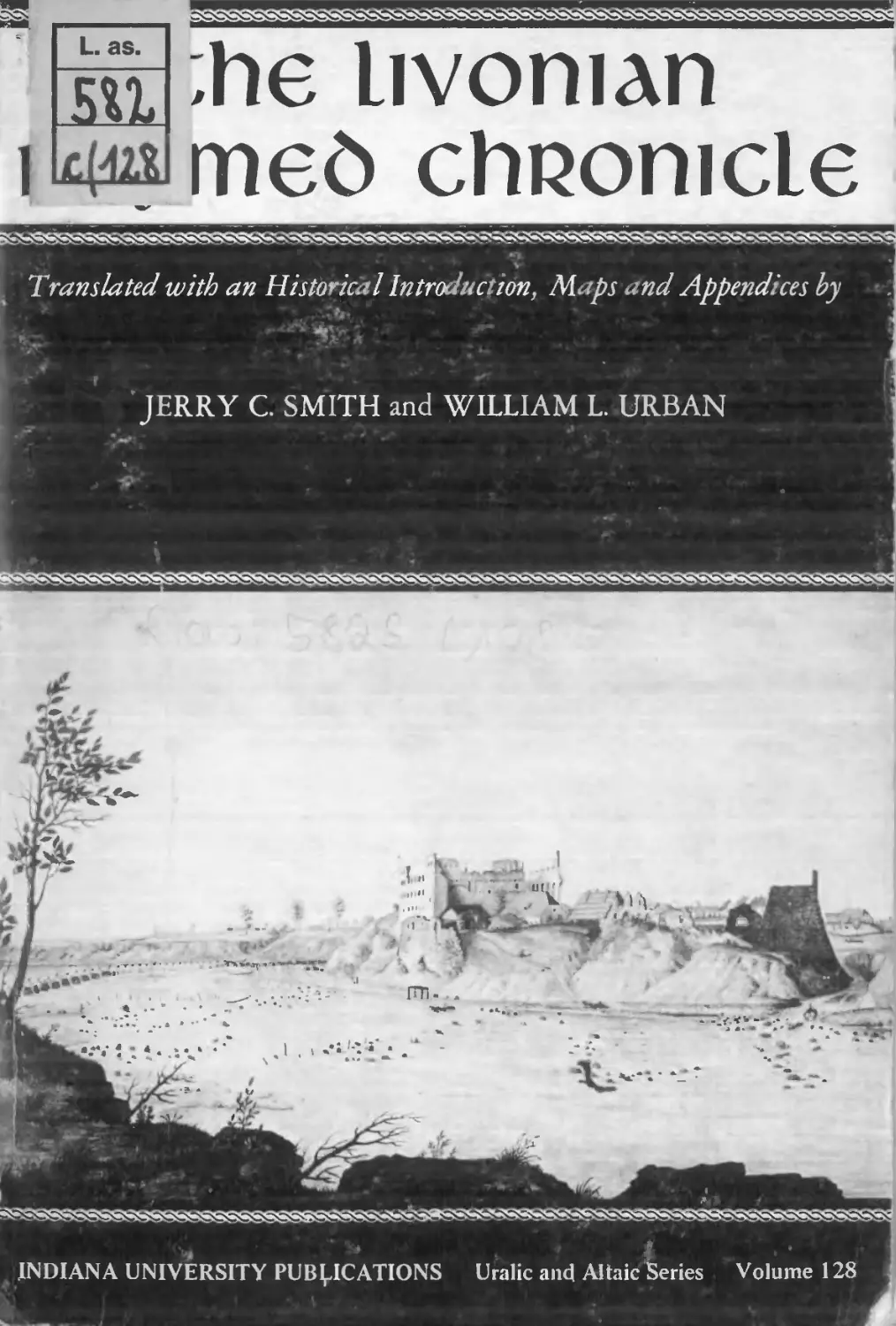
The cover art is the ruin of Goldingen (by permission of Bildarchiv Foto
Marburg).

R .do > G SQ —
THE LIVONIAN
RHYMED CHRONICLE

RESEARCH CENTER FOR LANGUAGE AND SEMIOTIC STUDIES
INDIANA UNIVERSITY
Thomas A. Sebeok, Chairman,
and Acting Director of Publications

THE LIVONIAN
RHYMED CHRONICLE
translated
with an historical introduction,
maps and appendices by
Jerry C. Smith
and
William L. Urban
Published by
INDIANA UNIVERSITY, BLOOMINGTON

INDIANA UNIVERSITY PUBLICATIONS
URALIC AND ALfSlC SERIES
Editor: John R. Krueger
Editor Emeritus: Thomas A. Sebeok
Volume 128
f.
daverlsche
Staatsbibliothek
Munchen
3
Copyright © 1977 by Indiana University
All rights reserved
ISBN 87750-213-7
Library of Congress Catalog Number 77-78928
Research Center for Language and Semiotic Studies, 516 E. 6th Street,
Indiana University, Bloomington, Indiana 47401.
Printed in the United States of America

Contents
PREFACE	vii
FOREWORD
An Historical Overview of the Crusade to Livonia	ix
Some Comments on the Livonian Rhymed Chronicle	xii
THE LIVONIAN RHYMED CHRONICLE	1
APPENDICES
Appendix One: Hartmann von Heldrungen’s Account	145
Appendix Two: Castles in Livonia	149

PREFACE
The translation of any piece of historical literature is bound to be
unsatisfactory in some part. Nuances understood by contemporaries of the
author are lost to modern men as much by the changes in culture as by the
evolution of the language; and there are moods and expressions which cannot
be put into modem English adequately. Such are the difficulties of the
Livonian Rhymed Chronicle that one eminent German authority advised
against any attempt to translate it-the translation was, fortunately, already
completed.
The use of prose has both advantages and disadvantages, for clarity is often
gained at the expense of the mood set by the poet. But, since neither
translator is a skilled poet, we concluded that any attempt to set this
chronicle in rhyme would have resulted in worse doggerel than the poet
himself resorted to repeatedly. And this would have been an undue burden on
the intended audience, who we believe will profit more from a clear
understanding of the poet’s account than from a reworking of his verse.
We acknowledge with gratitude the financial support of the Estonian
Learned Society in America and the work of T5nu Panning, who made many
valuable suggestions regarding both introduction and text. We also extend our
warm thanks to our mutual friend A. Z. Freeman, who established the initial
contact between us and who has supported our efforts with his advice and
encouragement.
Williamsburg, Virginia	Jerry C. Smith
Monmouth, Illinois	William L. Urban
vii

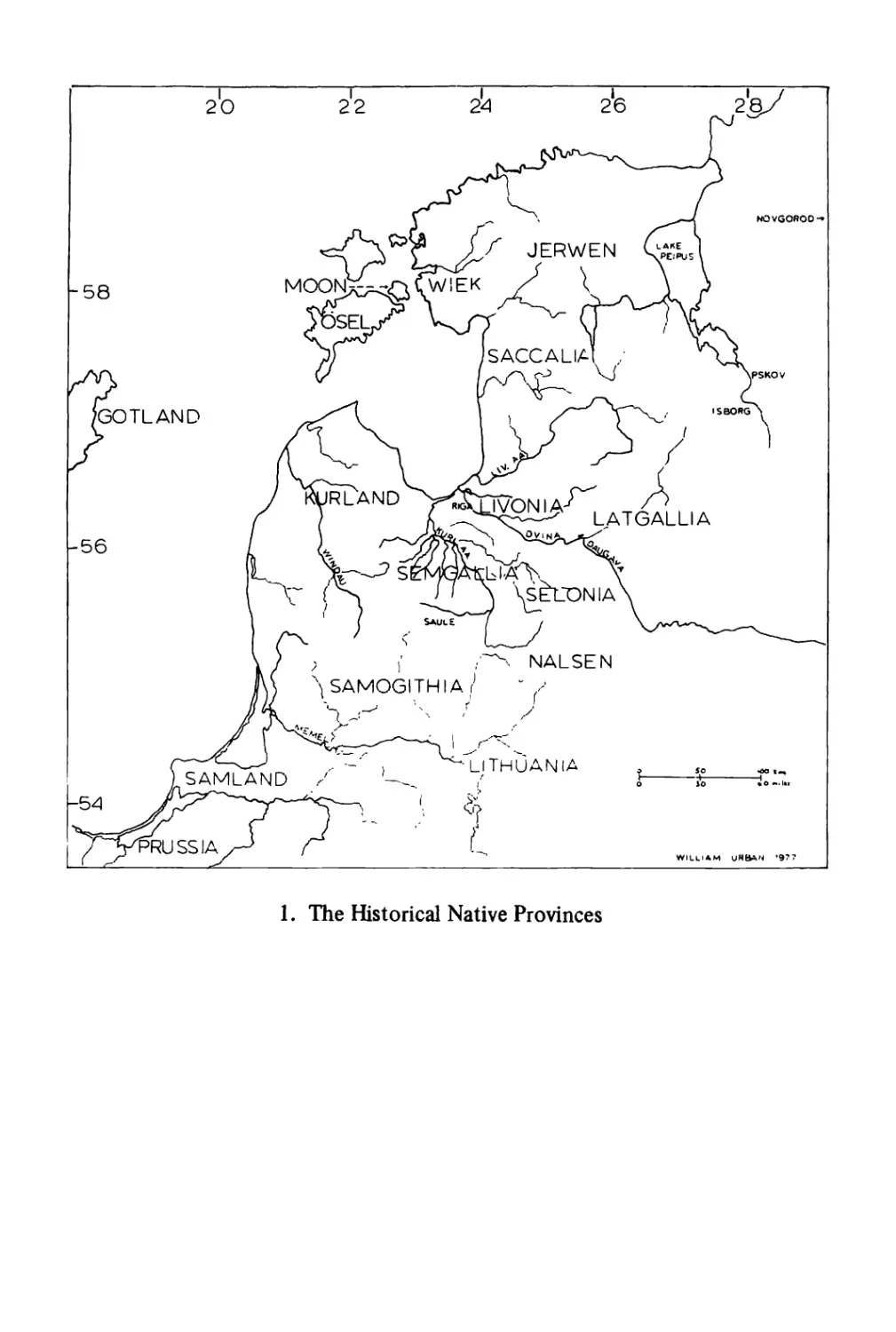
1. The Historical Native Provinces

GOTLAND
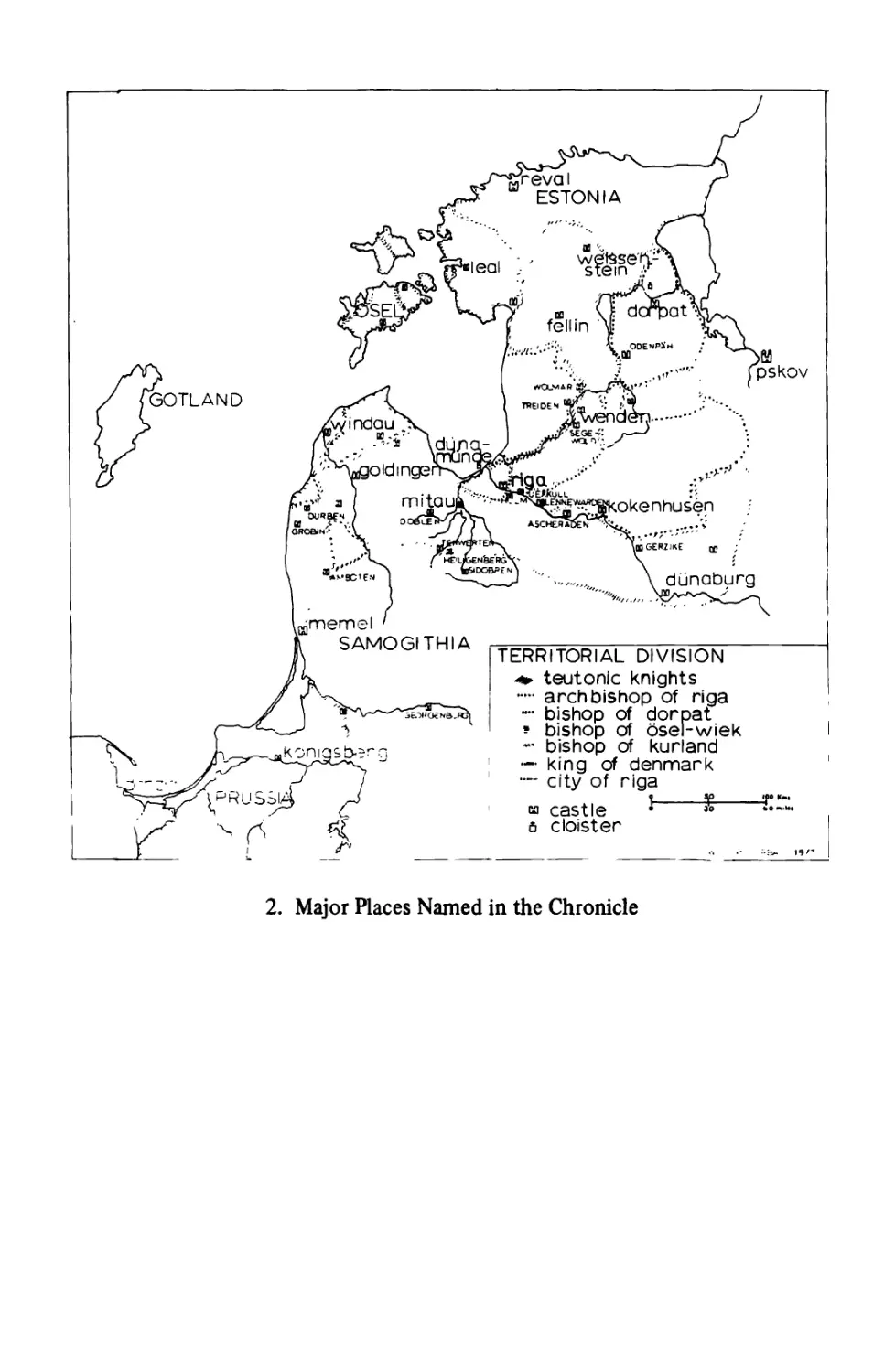
TERRITORIAL DIVISION
teutonic knights
archbishop of riga
-• bishop of dor pat
» bishop of osel-wiek
~ bishop of kurland
— king of denmark
~ city of riga
i	gp
и castle
б cloister
2. Major Places Named in the Chronicle

FOREWORD
An Historical Overview of the Crusade to Livonia
The thirteenth-century Crusade to Livonia, an event described by The
Livonian Rhymed Chronicle, is best understood within the context of two
powerful movements of the era—the Christian crusades and the German
Drang nach dem Osten. The opening decades of the century had witnessed
the high point of the crusades: the Fourth Crusade to Constantinople, the
Fifth Crusade to Egypt, the Albigensian Crusade in France, the Spanish
Crusades in Valencia, as well as the fighting in the Holy Land itself. During
the same period there had been a large German eastward migration. The early
movement of German peasants and petty nobles was mostly peaceful, in part
even a result of the invitation of Slavic nobles. However, German conquest of
eastern areas was not unknown, as for example in the case of the Wends.
These two movements—the Crusades and the German expansion eastward-
coincided in creating the Livonian and Prussian Crusades.1
The eastern shores of the Baltic Sea—the area from the present-day Prussia
to Finland—had been inhabited for several thousand years essentially by two
groups of people not related either to the Germanic people to the west and
northwest or the Slavic people to the east and south (nor to each other).2 In
the northern area lived various Finno-Ugric people, the best known of which
at present are the Finns and Estonians (discussed in the Chronicle are also the
Livs, now, almost extinct). The southern areas were inhabited by the
ancestors of present-day Latvians and Lithuanians (and the now extinct
natives of the area known as Prussia, who were linguistically related to them).
The lands inhabited by the Latvians, the Livs and the Estonians became
known in this period, after German conquest, as Livonia.3
Not very much accurate information exists as to the societal and political
organization of the natives of Livonia in this period.4 Clearly the natives were
not organized into Liv, Latvian or Estonian nations or states. Yet well-defined
ix

X
FOREWORD
political and territorial entities existed at the sub-national level, which might
be best labeled “provinces.” It would not be inaccurate to consider the
inhabitants of the provinces as “tribes.” That is, the people in the Estonian
provinces, for example, were closely related linguistically and ethnographical-
ly, but they did not at the time form a cohesive national whole. Nevertheless,
several tribes might unite either for common defensive or foreign military
operations. Indeed, some political coalescence was present in Estonia during
the Livonian Crusade, for example, under Lembitu, elder of Sakala [Saccalia]
province.
Yet the tribes also raided each other at times, and conflict existed
especially between the unrelated Estonians and the Latvians. Further, the
area was raided periodically by more powerful surrounding people—the
Russians to the East, the Lithuanians to the South, the Danes and Swedes to
the West. There were also attacks in the opposite directions. Wooden and
earthen fortified strongpoints existed in the native provinces of the time. The
backbone of the natives’ economy was agriculture, complemented by herding,
fishing and hunting, and even pirating on the part of the maritime provinces.
Foreign trade was also known, perhaps reflecting the many trade routes
between Byzantium and Scandinavia which crossed the region. In the late
twelfth century it was the German eastward trade, especially from Liibeck
and by way of Visby on Gotland, which helped set the stage for the
Livonian Crusade.
At that tune the German merchants were under the protection of Henry
the Lion, the Welf Duke of Saxony. Henry’s policy of cooperation with
Waldemar I of Denmark had resulted in a reduction of piracy in the western
Baltic and protection for the city of Visby, a port used by merchants from
Scandinavia, Russia, Poland, and Germany. The Visby merchants arranged
treaties with the peoples of the Baltic region for peaceful trade and
occasionally punished pirates with retaliatory raids. Retaliation was not,
however, often successful, and the merchants therefore were interested in
seeing stronger political control over the coastal areas. One of the early
trading centers on the eastern shores of the Baltic, and a major early base for
the Livonian Crusade, was near the mouth of the Daugava [Diina, Dvina]
River, a settlement which became known as Riga.
Along with the merchants came missionaries. While a strong tradition of
missionary activity existed from Hamburg to Scandinavia and from Magde¬
burg eastward, the missionary activities themselves were often intertwined
with political and mercantile scheming. The Archbishop of Hamburg-Bremen
in particular was eager to plant missions along the shores of the Baltic,
missions which would become bishoprics subordinated to himself. The natives
resisted the religious and economic encroachment, necessitating military

FOREWORD
xi
support for the traders and the missions. The “military protection,” however,
also provided a basis for the expansion of the trading and missionary
activities. In any case, political, mercantile, missionary and military policies
thus soon coincided. Earlier contacts of the natives with both the Orthodox
faith of the Russians and the Roman Catholicism of the Scandinavians did
not have lasting results among the Estonians, Latvians and Livs.5
The first missionary from Germany to establish himself successfully in
Livonia was an Augustinian friar from Segeberg in Holstein named
Meinhard. He arrived at the mouth of the Daugava with merchants in 1186,
and even obtained permission from the distant Russian lords, who at times
received tribute from the natives, to remain there. That winter, however, the
Lithuanians raided the area, and the Livs with whom Meinhard was staying
fled into hiding. Meinhard offered to protect them from future attack by
building two stone forts, if only they would convert to Christianity and pay
tithes for the upkeep of the Church. Once the forts were completed, however,
the Livs refused to be baptized and to pay taxes. Without success, Meinhard
employed threats and even imported a military force from Visby. He died a
Bishop, but a powerless one.
His successor, Berthold, was sent from Hamburg-Bremen to assume duties
as pastor to the small flock of Christians. He soon realized that the natives
both feared and hated the Christians, and for a number of reasons Berthold’s
mission was a failure. Berthold came to see coerced Christianization as the
only way of achieving his goals, and he received permission to preach a
crusade, raising a force of several thousand men, who arrived in Livonia in
1197. The Saxon knights scattered the Livs and ravaged the countryside until
the natives surrendered and submitted to baptism. But Berthold did not live
to see his victory, becoming a fatality of the fighting.
The subsequent Bishop was Albert Buxlioevden, a nephew of the
Archbishop of Hamburg-Bremen. More than any other person, he was
responsible for the success of the Livonian Crusade. Albert began his career as
Bishop by visiting the King of Denmark, Philip of Swabia, the leading
contender for the German crown. Realizing early that he would have to make
his way amidst the civil war in Germany and the strife between the Papacy
and the Holy Roman Empire, Albert used his skills and tact to win
widespread approval for the Crusade. Particularly, his campaign depended on
the good will of the Danish crown, which was beginning to dominate
northern Germany and the Baltic Sea.6 Only many years later did the Danish
protection become a threat to Albert’s independence.
In the early years the crusaders barely survived each winter. Isolated by
storms, surrounded by snow and ice, without comfortable cities or castles,
and lacking a steady and adequate revenue, the Christians in Riga were never

FOREWORD
xii
secure. Their protection depended on the annual spring influx of crusaders,
many of whom combined mercantile and religious activities, and on the
usually uncertain loyalty of the natives in the surrounding countryside. Still,
within a decade the Christians had consolidated their hold on the Livs, and
they extended their influence over the Latvian tribes to the east by assisting
them against the southern Estonian tribes to the north. A new crusading
order—the Fratres Militae Christi, or the Order of Swordbrothers—had come
into being in the process.
The Swordbrothers—and the Teutonic Knights who followed them—held a
combination of religious and secular ideas that may seem strange to us today.
Primarily they were a monastic order. They lived a celibate life in cloistered
convents, slept in dormitories, ate cabbage and other simple foods in silence
while listening to readings from the Bible, the Church Fathers, or the history
of their order, and they attended church services at regular hours night and
day. But in addition they were warriors, trained as knights and reared in
concepts of honor that clashed strongly with the monkish habits expected of
them. They had to remain in practice for battle, train the native militia and
their garrison troops, collect taxes and tithes, and build the castles, mills,
bakeries, breweries, smithies, storehouses, and churches necessary to their
way of life.
The order was led by a Master elected for life by the membership. He was
assisted by a vice-master who served in his absence or in the interval between
his death and a new election, by a marshal who was responsible for all
military affairs, and by a treasurer who oversaw financial affairs. Because of
the wide extent of the land, the commanders of the castles had much
responsibility. They each headed a convent of twelve to twenty knights, and
had a garrison of one to two-hundred sergeants and mercenaries. The official
responsible for native affairs was the advocate. Because he dealt with the
native nobles, the vassals, trained the militia, and heard court proceedings, he
had to know the languages and customs of the people and have unusual skill
in handling his proud and warlike subjects.
The native nobles responded variously to the new regime imposed by the
crusading order and the bishops. Some accepted their role willingly
(particularly those who were poor and weak during the pagan era), and others
rebelled at the first opportunity. Few understood the subtle relationships
implied in feudalism, and when their children and grandchildren returned
from Germany where they had been sent as hostages, the alienation of noble
from commoner that had always existed became much stronger-the nobles
became increasingly Germanized and the commoners slipped toward the level
of serfs. Only a few Germans came to Livonia, and most of those served the
Bishop of Riga as ministeriales, living from taxes rather than from lands. Some

FOREWORD
xiii
relatives of Bishop Albert settled as vassals around Riga and Tartu [Dorpat].
These immigrants intermarried with the native nobility, some from the
earliest days of the conquest. There were many more German knights in
Estonia, than Livonia, a result of the peculiar history of that region.
The Livonian Crusade was characterized by terrible fighting and atrocities
by both the Christians and the natives. Typically, the adult males in an area
were killed together with the old, crippled and very young. The women,
children and cattle were driven away by the victors. Dwellings and crops were
burned. In spite of a desperate resistance of several decades, the natives were
in the end forced to succumb. Militarily, the final turning point came when
the crusaders mastered the art of fighting during the winter, a lesson they
were slow to learn. In the winter the rivers and swamps ceased to be
obstacles, becoming even “highways” for the knights of the order. The
forests, denuded of leaves, no longer could hide ambushers and fugitives. The
footprints in snow betrayed both men and hiding places. The crusaders’ tents
provided better shelter on the march, their castles stocked food, clothing and
military supplies, their discipline kept the forces in the field. Indeed, after
several years of fighting a pattern had developed: the crusaders attacked in
the winter, the native counterattacks came in the summer, and each year
another tribe or province was subdued.
The crusaders were also able to successfully divide and conquer. The
weakest tribes were conquered first, and then incorporated into the Christian
cause. The political organization of the crusaders could, furthermore, be more
effectively applied. The conquered natives were forced to pay taxes, as did
the merchants and the citizens of the newly established cities, providing an
increasingly stronger financial base for operations; the nobles were enfeoffed
as vassals, and the commoners were pressed into military service as militia and
footmen. The natives, simultaneously, lacked strong centralized leadership to
organize resistance to the crusaders and they were divided by traditional
hatreds. The crusaders, additionally, held a superior position in regard to
military technology and organization. Lastly, the crusaders’castles, although
simple in design in comparison to those of central Europe, were impregnable
to native siegecraft, whereas the natives’ wooden forts almost always were
successfully conquered.
In the long run, the availability of replacement personnel was also to the
crusaders’ advantage. Every spring convoys of ships would bring in hundreds,
and occasionally thousands, of new crusaders—mostly Germans, but also
Danes, Swedes, Slavs and Frisians. Indeed, the replacements received by the
Swordbrothers were professionals who had dedicated their lives to the cause.
And the Bishop as well as the Order brought in money donated by the
faithful abroad for the support of the mission and the Crusade. Importantly,

XIV
FOREWORD
the natives in Estonia had to deal concomitantly with invasions by the
Swedes and Danes on their western and northern coast and by the Russians
from the east.
By 1218 the crusaders were ready for the final conquest of the militarily
most powerful native group, the Estonians. To a degree Bishop Albert had
ignored the provinces of the Estonians to date because that area had been
promised to King Waldemar of Denmark, and because a few of the provinces
paid tribute to the Russians. In 1219 King Waldemar personally led a huge
naval and ground force against the Estonians, defeating the latter at a
fortified location which later came to be known as Reval [Tallinn]. Within a
few years the last, and perhaps the strongest of the free Estonian provinces,
Saaremaa [Osel], was conquered. But by now Waldemar was no longer
powerful. In 1223 he was kidnapped by the Count of Schwerin, and his
empire in Germany collapsed. He was routed afterwards at the Battle of
Bornhoeved in 1227, and Denmark began a slide into a political and military
impotence from which it did not recover for a century. When the Danish
“protection” disappeared, Liibeck and its allies, particularly Riga and
Livonia, took up the task of policing the Baltic Sea and protecting merchants.
The conquest of Estonia did not, however, lead to peace. Rather, two
important conflicts ensued—between Bishop Albert and the Order of
Swordbrothers, and between the crusaders and the Russians. The Order had
established itself as an independent force in Estonia, and even plotted against
Albert with the help of the Holy Roman Emperor and the Danes. But the
Order’s ambitions were blunted by two events. First, as noted, Waldemar of
Denmark, the Order’s protector, had been kidnapped. And second, a native
Estonian uprising at the same time killed over a third of the Order’s members
and captured several castles. Bishop Albert helped resubdue the natives, but
he found it necessary to call for a papal legate to settle the differences
between himself and the Swordbrothers. Albert had also pursued relations
with the Russians for trade, even marrying a brother into the royal family of
Pskov. However, the policy proved unworkable, leading to clashes between
the crusaders and the Russians.
In 1225 the Pope had sent his vice-chancellor, Bishop William of Modena
to arbitrate the dispute in Livonia. Energetic and honest, William of Modena
soon earned the confidence of both parties, and arranged workable
compromises on boundaries, jurisdictions, taxes, coinage and other subjects.
Successful as his endeavor was, he could not resolve the basic quarrel, the
competing ambitions and desires of the Bishop and the Swordbrothers for
hegemony in Livonia. He sought to remove Estonia from contention by
taking it directly under papal control, appointing a vice-legate as governor,
and by bringing in German knights as vassals. But this did not work; the
vice-legate subsequently turned the land over to the Swordbrothers.

FOREWORD
xv
The Bishopric’s complaints against the Order of the Swordbrothers never
ceased, and the dispatch of a new papal legation became imperative in 1229
when Bishop Albert died. The Archbishop of Hamburg-Bremen exercised his
prerogative in appointing a candidate for a new Bishop, although the Pope
had long since removed Riga from his authority. Riga itself also chose a
candidate and appealed to Rome in the matter. The Pope delegated the
resolution of the problem to his legate in Germany, but the latter was too
involved in organizing opposition to Frederick II, and the task was finally
given to a monk named Baldwin from the monastery at Aina in Belgium.
Baldwin of Aina clearly was not on the side of the Swordbrothers. He
negotiated treaties with the semi-conquered natives, removed them from the
jurisdiction of the Order, and in essence reoccupied Estonia on behalf of the
papacy. This, of course, meant disaster for the Order since the lands and their
taxation were the basis of wealth for maintaining the strength of the
Swordbrothers. Rather than accept a subordinate status to anyone, the Order
decided to resist. The contest between Baldwin and the Order became so
bitter that the original purpose of his mission, the choosing of a new Bishop
of Riga, was more or less forgotten. Finally, Baldwin approved the candidate
proposed by Riga and hurried off to Rome to complain about the
Swordbrothers.
Baldwin managed to arouse the anger of the Pope against the Sword¬
brothers. The papacy had in any case long desired to give direction to the
crusading movement, and whatever his reason for doing so, the Pope armed
Baldwin with powers so extensive as to make him theoretical ruler of the area
upon his dispatch back to Livonia. Baldwin, however, did not return to Riga
immediately, believing that he should first recruit a new crusading army in
case the Swordbrothers resisted his authority.
After he and his army arrived in Riga in the summer of 1233, Baldwin
occupied Kurland and sent a garrison to Estonia. He made it clear to the
Swordbrothers that he was determined to humble them. While the Master of
the Order opposed armed resistance to Baldwin, the Brothers themselves
could tolerate this only until the summer of 1234, when Baldwin ordered the
Swordbrothers to surrender the castle at Reval [Tallinn]. The Brothers placed
their Master under house arrest, and attacked and routed the papal army. This
victory was followed by the arrest of Baldwin’s supporters throughout
Livonia, and Baldwin was driven to retreat to the fortified monastery at the
mouth of the Daugava River. Accusations and counter-accusations convinced
the Pope that Baldwin’s mission was a failure, and he was recalled. William of
Modena was again sent to restore peace.
William of Modena was in Livonia in late 1234 and early 1235. He divided
the lands among the three bishopries—Riga, Tartu [Dorpat], and Laane-
Saaremaa [Osel-Wiek] —and the Order of Swordbrothers, seeking a practical

XVI
FOREWORD
arrangement. Yet even he could not solve an underlying problem, the
financial plight of the Swordbrothers, or suggest an arrangement fully
acceptable to the Order’s membership. The Swordbrothers had no money
except that received in taxes in Livonia, and they enjoyed little prestige—
what little they had had was lost with the revolt. Also, they were incapable of
recruiting sufficient numbers of new members, and they could not afford to
hire enough mercenaries. Thus, they had only two hopes: to join a wealthier
crusading order, or to conquer sufficient lands to support their own forces.
The first hope dissipated when the Teutonic Knights rejected the Sword-
brothers’ application for membership. As a consequence, the Order sought
new conquests. Because Semgallia [Central Latvia] and Kurland [Western
Latvia] had yielded to the Order rather easily a few years earlier during a
time of famine—the natives submitted to Christianity in return for overseas
food brought by ships—it was hoped that a similar success could be obtained
against Lithuania to the south. But the Lithuanians were great warriors and
their lands were too extensive to occupy quickly. The ambition of new
conquests persisted nevertheless, and in 1236 a large crusading force arrived
from Germany and demanded to be led against the pagans. The Master of the
Order wanted to wait until the winter before a campaign was launched against
the Lithuanians, but the new crusaders insisted on fighting that summer. The
expedition set out through Semgallia toward the Saule River, the site of a
large Samogithian [a Lithuanian tribe] settlement. The crusaders caught the
natives unprepared, but returning north afterwards, the crusaders found the
crossing at the river blocked by a small Samogithian force. The Sword¬
brothers wanted to attack immediately and to fight their way across, but the
new crusaders insisted on waiting until morning. By dawn a large Lithuanian
force had gathered, forcing a fight because there was no other passage. The
battle was a disaster for the Order, and only those escaping into the dense
forest survived.
In a way, the Battle of Saule heralded the demise of the Order of
Swordbrothers. Those knights in the Order who survived-mostly the ones
who had been left behind in garrisons—went over to the Teutonic Knights. On
May 12, 1237, at Viterbo, the Pope formally incorporated the Swordbrothers
into the Teutonic Order. This was a decisive moment for the Livonian
Crusade. While badly needed reinforcements were sent from Prussia to
Livonia, Riga, which up to now had been the center of strategic thought for
the Livonian Crusade, together with Livonia as a whole, decreased in
importance in terms of priorities. Prussia and the Holy Land had to be
considered as well now, and future strategy in Livonia would be defensive, or
at best, offensive in support of the crusading operations in Prussia.
The Teutonic Knights were deeply committed in Prussia at the time.
Although there less than a decade, the Order had carved out a large territory

FOREWORD
XVII
with the help of German and Polish crusaders. Native resistance to the
conquest of Prussia, however, was to intensify annually and was marked by
great revolts in 1242 and 1260. Not until 1290 was this conquest completed.
Also, the subsequent century-and-a-half would see a period of brutal wars with
the Lithuanians. However, the Swordbrothers surviving the debacle of 1236 in
Lithuania could not agree to the relegation of Livonia to secondary
importance. In particular they protested the Treaty of Stenby in 1238 by
which Estonia was returned to the King of Denmark, a move the Teutonic
Knights found necessary to secure allies for an expansion eastward. At the
time, William of Modena was promoting a joint German-Danish-Swedish attack
on Novgorod, the only important Russian city to have escaped Mongol
attack, with the hope that its capture would lead to church unification.
In 1239 and 1240 the crusaders moved against the Russians, but the whole
adventure was a disaster. The Swedes were defeated at the Neva River in
1240, and the Germans on the wintry ice of Lake Peipus in 1242.
The Teutonic Knights did not again attempt a conquest of Russian lands east
of Livonia. Rather, the Order now confined its activities to the frontiers of
Semgallia and Kurland, building castles and consolidating its rule. The
Livonian branch of the Teutonic Knights thereby became involved in a
conflict with Mindaugas, a ruler who was uniting all of the Lithuanian tribes
and expanding his control over the Russian cities devastated and abandoned
by the Mongols in recent years.
Battles with the heathen were not the only problem which beset the
Teutonic Knights at the time. The Holy Land was hard pressed; Frederick II
and the Pope were locked in a desperate power struggle; the Mongols had
pierced Poland and Hungary and threatened to return. The finances of the
Order were inadequate, but others, particularly the new Archbishop of Riga,
were jealous of its power and prestige. As long as Bishop Nicholas had lived,
there was little open friction between the various factions in Livonia. The
Bishop of Riga, the Bishop of Tartu [Dorpat], the Bishop of Saaremaa-
Laanemaa [Osel-Wiek], the Bishop of Kurland, the governor of Estonia,
and the Teutonic Order had been able to coexist. However, when Nicholas
died, he was replaced by a papal appointee, Albert Suerbeer. Albert had
been a strong supporter of the papacy against Frederick II, and had ruled his
See in Ireland in such a way that it was unsafe for him to return there. As a
reward for his services, and in hope that he might distract the Teutonic
Knights-who did not support the papacy against the Holy Roman Emperor
as the Pope wished and who might give Frederick important help in
Germany—the Pope in 1248 appointed Albert Archbishop of Prussia and a
papal legate. The Teutonic Order, knowing Albert’s reputation, would not
allow him to settle in Prussia.

FOREWORD
xviii
Thus, Albert occupied the vacant Bishopric of Liibeck and proceeded to
interfere with the convoys destined for Livonia and Prussia. He had been a
candidate for the Bishopric of Riga in 1230 and claimed the See when it now
became vacant. The dispute dragged on until Frederick ITs death. But once
the Hohenstaufen danger to the papacy had passed, the Pope did not think it
necessary to continue his pressure on the Teutonic Order. An agreement was
thus reached whereby Albert gave up his claim on Prussia and went instead to
Riga. But Albert Suerbeer did not desist in his harassment of the Teutonic
Knights. He seized taxes, excommunicated knights (and when this was
forbidden, he excommunicated their backers), and sent complaint after
complaint to the Pope. William of Modena made one last attempt at arranging
Livonian affairs. Although many disputes were settled, the essential compro¬
mise was that Albert would become the Archbishop of Riga, but in return
would halt his harassment of the Teutonic Order. Albert did not fully yield,
but he did find it difficult now to interfere in the Order’s activities
effectively. In the 1250s the Teutonic Knights succeeded in converting
Mindaugas of Lithuania to Christianity and in building a castle at Klaipeda
[Memel], and by conquering Sambia in Prussia. This left the Samogithians as
the only remaining pagan tribe in the region.
During this period of relatively static frontier warfare, a technique of
defense introduced much earlier was perfected by the crusaders. Namely, the
frontier to the south was screened by castles, which on the whole had
relatively small garrisons. The castles served three purposes. First, they were a
base for scouts, who would patrol the frontier and send word to the interior
upon detection of signs that a raiding party had crossed into Christian
territory. Second, they were assembly areas for the militia of natives, which
together with a force of knights would be sent in pursuit of raiders with an
aim of destroying the latter and recovering any booty. While the raids could
not be halted, they could be thus made unprofitable. And third, the castles
served as bases for launching raids into pagan territories. The strategy was
relatively effective and uncostly. The Teutonic Knights varied from it only
when it was necessary to attack enemy castles or to build new forts in
advance of the frontier. For major operations it was necessary to recruit a
larger army from Livonia.
There was only one stretch of land along the Baltic coast at the time which
was not yet secure for the Knights—the area just north and east of Klaipeda
[Memel] known as Samogithia. In 1260 the combined crusading field armies
of Prussia and Livonia pressed into the area in an attempt to conquer it, and
thereby to connect the two areas by a land bridge. But the attempt was
disastrous. At the Battle of Durben, the Samogithians killed 150 knights and
two counts. The news spread quickly, precipitating revolts in Prussia,
Semgallia and the Estonian island of Saaremaa [Osel]. King Mindaugas of

FOREWORD
xix
the Lithuanians in turn threw off his Christianity, and joined with the
Russians in an attack on Livonia. For the Teutonic Order the crisis
nevertheless passed. The system of defense was capable of protecting the
land, and only a few frontier castles had to be abandoned. The militia,
although badly beaten several times, punished the raiding parties severely.
While Livonia recovered quickly, it was twenty years before the revolt was
extinguished in Prussia. But for the cause of the crusaders, the greatest
setback was the fact that from this time onward the Lithuanians and the
Samogithians fought side-by-side against the crusaders. Hence, the final
Christianization of Lithuania was to be delayed by a century and a half.
The situation which had developed lent itself well to the machinations of
Archbishop Albert Suerbeer. The military difficulties of the Teutonic Order
made its harassment by Albert all the more effective. But it was not until
1267	that he became an outright danger to the Order. About that time the
trade and border conflicts with Novgorod had become so serious that a larger
war was imminent. The Teutonic Knights sent an appeal for crusaders, and
many German volunteers sailed that summer for Livonia. Among them was
Prince Henry of Mecklenburg, who brought along his uncle, Gunzelin of
Schwerin, so as to prevent the latter from causing trouble at home. Henry
went to the threatened frontier at Tartu, but Gunzelin remained in Riga,
where he soon was plotting with the Archbishop. Gunzelin was a son of the
Count of Schwerin, who had kidnapped the King of Denmark in 1223, which
had contributed to the collapse of the Danish empire. He believed that he
could similarly upset the Teutonic Knights if given the opportunity.
Archbishop Albert thus conferred on Gunzelin the position of advocate, with
the use of all archepiscopal power and authorities. Gunzelin then proceeded
to hire soldiers, to equip castles and to plot with various persons and groups
in Livonia against the Knights. Meanwhile, the Knights, together with the
forces of the Bishop of Tartu [Dorpat], had fought a very bloody battle in
Estonia against the Russians. The conflict had lasted two days, and the bodies
were reported piled so high that horses were unable to advance over them. In
the end, both armies withdrew from the field, each claiming victory. In 1268
the Germans advanced on Pskov, and a peace treaty was signed there.
The Master of the Teutonic Order returned thereafter in December of
1268	to Riga, and arrested Archbishop Albert. Gunzelin was abroad
recruiting troops, and, warned to stay away, he returned to Germany.
Archbishop Albert was confined on bread and water until he, too,
capitulated. After that, neither he nor his immediate successors dared to defy
the authority of the Teutonic Knights.
The crusaders were not able to restore their lost position in Semgallia, in¬
sofar as the Lithuanians and Samogithians were supporting that area against
the Knights. It was known that Semgallia was a dangerous launching point for

XX
FOREWORD
raids into Kurland and Livonia, but it was not until February of 1270 that
the full extent of this danger became apparent. In that month a large
Lithuanian army went north across the ice to Saaremaa [Osel] and ravaged
the land. The Teutonic Knights in turn summoned all of their allies, with an
aim of intercepting the Lithuanians upon their withdrawal. The Christian
force met the Lithuanians on the frozen strait near Laanemaa [Wiek], but
the Knights suffered a severe defeat. This inspired the Lithuanians to even
more raids, and shortly thereafter they inflicted yet another defeat on the
crusader forces.
Once they had recovered from their losses, the reinforced crusaders began
a systematic reduction of Semgallia. Several strategic castles were taken,
thereby lessening the danger of Lithuanian raids. More importantly, a new
castle was built at Daugavpils [Diinaburg]. Standing at the southern bend of
the Daugava [Dvina] River, the castle screened the long eastern flank of the
crusader states, and moreover, it offered a position from which to launch
attacks against the easternmost Lithuanian settlements. No longer could the
Lithuanians concentrate their resources on one front, and they were thus
suddenly put on the defensive.
The castle at Daugavpils was used effectively for several years, but in 1279
a raiding army of the Knights was pursued out of Lithuania by a large native
force. In the ensuing battle 71 Brothers and a large contingent from Estonia
were lost, and Daugavpils was given up as ransom for prisoners. A new
Lithuanian offensive began, and several castles of the Order in Semgallia were
lost. The commander at Kuldiga [Goldingen] was given responsibility for
maintaining a semblance of a Christian hold on the region. In the winter of
1281-1282 a large Christian force sailed up the Lielupe [Aa] River to Jelgava
[Mitau], and from there marched onward to the native strongholds. But the
results were indecisive. The Semgallians promised neutrality, but it was a
promise they found hard to keep.
The Lithuanian attacks persisted, and in 1285 the Teutonic Knights
decided to place a castle in Semgallia opposite the main native fortification.
Heiligenberg, as the new castle was known, was to serve as a base for raids
against the pagans and for interdicting movement to and from the pagan
stronghold. The native siege of this new castle climaxed decades of warfare.
But the assault failed, as did the subsequent attempts to engage and destroy
the crusaders. By 1290 the Semgallians were subdued, and thus the conquest
of Livonia was completed.
Our chronicler, who had begun his tale in 1143, ended with this event in
1290, and it is a good point to stop the historical introduction to our
translation as well. The frontiers of Livonia were now permanently fixed, as it
turned out. The subsequent four decades were marked by a new problem—a
bitter civil war between the citizens of Riga and the Teutonic Knights. The

FOREWORD
xxi
citizens allied themselves with the Lithuanians, and the Knights pressed on
into Samogithia, but neither the alliance nor the conquest was permanent.
But this, and the subsequent history of Livonia and its people, is another
story.
Some Comments on the Livonian Rhymed Chronicle
The Livldndische Reimchronik—The Livonian Rhymed Chronicle—belongs
to the Deutschordens-literatur of the late Middle Ages, that is, to that body of
literature written specifically for, and often by, members of the Order of
Teutonic Knights. Because of the nature of the intended audience, religious
themes predominate—prayers, legends, translations of books of the Bible, etc.
However, historical themes are often treated, especially those depicting the
historical mission of the crusading order and its achievements in the Baltic
region. Some histories were written in Latin, but many were in German, since
the men for whom they were intended were knights first and foremost, often
with little or no traditional monastic education.
The Livonian Rhymed Chronicle, written in the last decade of the
thirteenth century, is the oldest extant Ordensgeschichte. It is also the earliest
work of German literature written in Livonia. The subject of the chronicle is
the first century of the German colonization and conquest of Livonia, from
about 1180 to 1290. Other histories cover parts of the same period, most
notably the Chronicle of Henry of Livonia7 (for the period 1184-1227), but
the Rhymed Chronicle is the only primary source for the important years of
1267-1290, during which the Teutonic Order waged war upon, and eventually
subjugated, the Kurs and Semgallians. Unlike the Chronicle of Henry of
Livonia, which centers upon the deeds and missionary activities of the
bishops of Livonia, the author of the Rhymed Chronicle concentrates almost
exclusively on the military affairs of the Teutonic Knights. Other aspects of
the colonization-church affairs, the growth and organization of towns, the
conversion of the natives-are touched upon only when they have direct
bearing on the affairs of the Order itself. This restricted perspective may be
explained by the author’s specialized purpose. His book was written for the
Teutonic Order and was intended as a source of information and religious
inspiration for its members. Perhaps the chronicle was used as a Tischbuch, a
book which was read aloud for the brothers during their meals.

ххи
FOREWORD
The identity of the author of the Rhymed Chronicle is unknown.8 He
neither names himself in the work, nor is his name given in any other
contemporary document. On the basis of the text itself, however, certain
assumptions can be made about him. In view of the disparaging remarks
which he occasionally directs towards monks and priests, it seems unlikely
that he himself was one. He criticizes their timidity in battle and their
luxurious mode of life, and contrasts this with the hazardous and severe
existence of the Teutonic Knights. His partiality toward the Order is also
apparent from the way in which he advances the territorial claims of the
Order and otherwise sides with it in disputes between the Masters and the
Bishops. From this and from the author’s specialized military terminology
and obvious knowledge of tactics, it would seem most likely that he himself
was an active member of the Teutonic Knights. Most scholars agree that his
detailed descriptions of individual battles and campaigns and his knowledge
of local geography and custom, especially in the latter part of the period
covered, strongly suggest that he wrote from first-hand experience and was a
participant in at least some of the events described.
Mackensen calls attention to the fact that in all the chronicle the only
actual date which the author mentions, aside from the beginning and end
dates of 1143 and 1290, is Lent of 1278, the date of the disastrous defeat in
which Master Ernst, Brother Eilhart and Johann von Thiesenhausen were
killed. It is suggested that the reason for the author’s special interest is that he
was among that group of 34 brothers sent from Germany under Conrad von
Fuchtewang as replacements for fatalities. However, the date of their arrival
in Livonia, St. Margaret’s Day of 1279, is also alluded to in the
chronicle. Mackensen further speculates that the chronicler is to be identified
with that brother who was captured in the battle in which Master Willekin
was slain, who managed to escape his captors, and who later led the charge at
the Battle of Sydobren [see lines 10667f, 10730, 11424ff of the chronicle]. It
does seem strange that this hero would remain nameless when so many others
are identified in the latter part of the chronicle. Mackensen attributes this to
the modesty and decorum of the author, who wishes to avoid calling
attention to his personal achievements.
The significant point here, however, is not the precise identity of the
author, but rather the fact that in the latter part of Ills chronicle he is
recording recent and contemporary events, while in the first half of the work
he is dealing with events which took place decades prior to his own arrival in
Livonia. Mackensen sees a rather sharp division occurring around lines
6500-7500 of the chronicle, basing his conclusion on the following
observation:
(1)	From about this point onward the author’s chronology improves

FOREWORD
xxiii
noticeably, and he describes the battles and geographical features in much
greater detail.
(2)	Several place names occur with variant spellings, for example:
My tow—Mitau; Isburc—Iseburc; sente Urian—sente Jurian. The first variants
all occur before Mackensen’s dividing line, the second variants afterwards.
(3)	The first part contains episodic material, for example the Emma
episode [line 759ff.], the murder and miracle at Poderejal [line 1279ff.],
observations on the customs of the natives, etc. After t «e dividing line, on the
other hand, the author restricts himself almost exclu Лу to military affairs.
Although the second half of the chronicle app ars to be based on the
author’s personal experiences and other eyewitness accounts, the first half is
obviously not. There can be little doubt that some of these sources were
actually earlier written accounts. In the Emma episode, for example, the
writer speak • if he were personally acquainted with the good woman [line
797f], b* ev^nt. which he describes took place, in fact, about 70 years
before the cnroniner himself presumably arrived in Livonia. It is thus
apparent that he is borrowing directly from an earlier account which was
written at the time the events occurred. Whatever the sources for the first half
of the chronicle, it is obvious that the chronicle in its final form is the work
of one man. The language is consistently Middle High German, with a very
few traces of Low German in the first 2000 lines, although this may be a
reflection of the language of one of the earlier written sources. The r! ning
technique and the use of formulae and other fixed expressions are also
uniform throughout the work.
The Livonian Rhymed Chronicle is written in the standard Middle High
German epic verse form, that is, short rhyming couplets with three to four
stressed syllables per line. The great epic poets such as Hartmann von Aue,
Gottfried von Strassburg, and Wolfram von Eschenbach, could meet the
demands which such a form placed on the skill and ingenuity of the poet, and
turn it to their artistic advantage. For the author of the chronicle, however,
the pressing need to find rhyme soon leads to contorted word order and
syntax, and to tedious repetitions. The chronicle abounds in filler-lines, such
as daz ist war [it is true], Was sal ich sagen me [What more could I say], and
Da ich er von las [as I mentioned earlier]. The author also relies heavily on
stock phrases and stereotypes when he describes recurrent events, such as the
safe and successful return of an army from a campaign, or the arrival of a new
Master at Riga.
The organization of the chronicle leaves much to be desired. The work is
merely a series of related episodes strung one after the other, and when the
author attempts to deal with two events which occur simultaneously,
confusion often results (for example, lines 8615ff.). Nor is there any attempt
at individual characterization. Aside from the heroes, who are portrayed

XXIV
FOREWORD
through their deeds in battle, only the Bishops and the Masters are
individually depicted—unfailingly as pious, wise and generous. The lack of
characterization, however, may be not so much the result of artistic weakness
as an intentional deemphasis of individual attributes in a work whose primary
purpose is to describe the achievements of the Order as a whole.9
One should not be too critical, however, of the author’s shortcomings. To
compose a history of this type in verse is, in itself, a noteworthy achievement.
After all, the author’s chief purpose was to write an account of the military
undertakings of his Order. He makes no pretensions to the style of the earlier
and more ambitious Weltchroniken such as the twelfth century Kaiser-
chronik, as he himself tells us in the prologue [lines 11, 15-25]. The author
does achieve his limited goal admirably, especially in the latter part of the
chronicle where he portrays each campaign and engagement in convincing
detail. Everything relevant to the military situation is described for us: the
composition and arrangement of the armies, the route of march, the weapons
and tactics used, the geography of the battlefield, and the reasons for a
victory or defeat. Many episodes, such as the pursuit down the frozen surface
of the Gauja [Aa] River [line 9303 ff.], or the battle at the Schenen River [line
1188Iff.], are related so vividly that the reader can easily visualize each detail
of the encounter.
The author also provides interesting information about the lives and
attitudes of the natives. While an implacable foe of their lack of Christianity,
the author is curious enough about the native religion to comment on their
burial customs [line 388Iff.], and on their methods of divination [lines
2485, 3018, and elsewhere]. He is also able to offer objective explanations of
some of their reasons for fighting the Order [lines 883-913], and he freely
acknowledges their valor in battle. But the most lasting impression of the
work is the insight it offers into the mind of a Teutonic Knight. The Livonian
Rhymed Chronicle captures and conveys, as well as any epic, the spirit of the
crusades, that strange combination of ferocity and humility.
We have chosen to translate the chronicle into prose in order to facilitate
its use as an historical source. It has not been our intent to translate and
present the work as an achievement of German literature in Livonia. The
translation is based on Leo Meyer’s Livlandische Reimchronik, first published
in 1876, and reprinted in 1963 by Georg Olms Verlagsbuchhandlung in
Hildesheim, West Germany. Meyer’s glossary was found helpful, but
occasionally we have disagreed with his definitions and interpretations. While
attempting to give a close rendering of the sense of the original, some
rearranging of individual phrases and sentences to obtain greater clarity, and
the deletion of some of the more tedious formulae, was done. Attention is
called to garbled passages in the original, and cases of uncertain translation in
footnotes. The footnotes appearing in the text have all been added by the

FOREWORD
XXV
translators. The numbers appearing in the margins of the pages represent line
numbers in the original chronicle.
The translation of place names in the Livonian Rhymed Chronicle presents
special difficulties. In the original version they appear in medieval German
form, while contemporary German sources have modernized the spelling.
However, many contemporary history sources use native Estonian, Latvian
and Lithuanian place names in lieu of the German ones. To a lesser degree
this problem exists also with proper names. While we have used the native
names in the present introduction to our translation, with the German forms
in brackets, in the body of the Chronicle itself the original forms are used
unless there are contemporary English or German forms which reflect
standard usage.
Leo Meyer’s Livlandische Reimchronik, pp. 344-352, provides a guide to
place and proper names in the Chronicle. Other guides to place names
include: Aleksander Kaelas, Ortsnamen Estlands (Stockholm: Estnischer
Nationalfond, 1958); Valdis J. Zeps, The Placenames of Latgola (Madison:
University of Wisconsin Press, forthcoming); Georg von Rauch, Geschichte
der baltischen Staaten (Stuttgart: Kohlhammer, 1970), p. 217; and Arnolds
Spekke, History of Latvia (Stockholm: Goppers, 1957), p. xix.
Other aids for the reader include several maps, commentary by Hartmann
von Heldrungen on the conquest of Livonia [Appendix One], and an overview
of castles in Livonia [Appendix Two].
NOTES
1.	The Livonian Crusade is covered in greater detail by William L. Urban’s
The Baltic Crusade (De Kalb, 111.: Northern Illinois University Press, 1975).
The standard guide to the numerous documents of the era is Friedrich
Benninghoven’s Liv-, Est,- und Kurlandische Urkundenregisten bis zum Jahr
1300 (Hamburg: History Seminar, 1959). The best detailed bibliography on
sources is Karl H. Lampe, Bibliographie des Deutschen Ordens bis 1959
(Bonn-Godesberg: Wissenschaftliches Archiv, 1975), volume 3 of Quellen und
Studien zur Geschichte des Deutschen Ordens, edited by Klemens Wieser and
Udo Arnold; and Katalog des Schriftums iiber die baltischen Lander
(Hannover: Niedersachsische Landesbibliothek, 1971), two volumes. There
are several useful secondary accounts to aspects of Livonian history in this
century, but surprisingly little available on the years covered by the Livonian
Rhymed Chronicle. The best modern accounts are: Friedrich Renninghoven,
Der Orden der Schwertbriider (Koln-Graz: Bohlau, 1965); Reinhard Wittram,
Baltische Geschichte; die Ostseelande, Livland, Estland, Kurland: 1180-1918

XXVI
FOREWORD
(Munchen: Oldenburg, 1954); and Manfred Heilman, Das Lettenland im
Mittelalter: Studien zur ostbaltischen Frilhzeit und lettischen Stammege-
schichte, insbesonders Lettgallens (Munster: Koln & Bohlau, 1954).
2.	Sources on the natives in the region prior to the German conquest
include: Richard Indreko, “The Prehistoric Age of Estonia,’’ in Aspects of
Estonian Culture, edited by Evald Uustalu (London: Boreas, 1961); Gustav
Rank, Old Estonia (Bloomington, Ind.: Research Center for Language and
Semiotic Studies, 1976); and Магца Gimbutas, The Balts (New York:
Frederick A. Praeger, 1963), Bronze Age Cultures in Central and Eastern
Europe (The Hague: Mouton, 1965), and The Prehistory of Eastern Europe
(Cambridge: Peabody Museum, Harvard University, 1956).
3.	The name Livonia has had various territorial connotations historically.
At one point it included most of present-day Estonia and Latvia, but at other
times Livonia referred only to parts of Latvia, for example, without
Kurland, and to all of Estonia. During the period of Czarist rule in the region
(1721-1917), Livonia meant the southern half of Estonia together with most
of Latvia.
4.	General histories of the region in English are: J. Hampden Jackson,
Estonia, second edition (London: George Allen and Unwin, 1948), Evald
Uustalu, the History of Estonian People (London: Boreas, 1952); Arthur
Voobus, Studies in the History of the Estonian People, three volumes to date
(Stockholm: Estonian Theological Society in Exile, 1969-1974); Arnolds
Spekke, History of Latvia: An Outline (Stockholm: M. Goppers, 1957);
Alfreds Bilmanis, A History of Latvia (Princeton: Princeton University Press,
1951).
5.	In regard to early contacts with Christianity, see especially Arthur
Voobus, Studies in the History of the Estonian People, volume 1 (Stockholm:
Estonian Theological Society in Exile, 1969).
6.	In regard to the Danish intervention and interest in the area, see P.
Peter Rebane, Denmark and the Baltic Crusade, 1150-1227 (Unpublished
doctoral dissertation, Department of History, Michigan State University,
1969), and his “The Danish Bishops of Tallinn, 1260-1346,” in Journal of
Baltic Studies, Volume 5 (No. 4, Winter 1974): 315-328. Aspects of military
techniques are discussed by Friedrich Benninghoven, “Zur technik spatmit-
telalterlicher Feldzuge in Ostbaltikum,” in Zeitschrift fiir Ostforschung,
volume 20 (1970): 631-651.
7.	Heinrici Chronicon Livoniae (Wiirzburg: Holzner, 1959) contains both
the Latin original and a German translation by Leonid Arbusow and Albert
Bauer. It is also available in an English translation by James A. Brundage, The
Chronicle of Henry of Livonia (Madison: University of Wisconsin Press,
1961).
8.	The present discussion of authorship and sources is based on the
following: Leonid Arbusow’s “Die mittelalterlichen Schriftuberlieferungen als
Quelle fur die Fruhgeschichte der ostbaltischen Volker” and Lutz Macken-
sen’s “Zur deutschen Literaturgeschichte Alt-Livlands,” both in Baltische

FOREWORD
xxvii
Lande, Volume 1, Ostbaltische Friihzeit, edited by Carl Engel (Leipzig: S.
Hirzel, 1939); and Wilhem Brauns’ “Die Livlandische Reimchronik,” in Die
deutsche Literatur des Mittelalters, edited by Wolfgang Stammler (Berlin: de
Gruyter, 1933-1955). The latter source is especially helpful for its recent
(1955) bibliography on the philological and literary aspects of the Chronicle.
Brauns (pp. 960-961) and Arbusow (pp. 187-189) divide the Chronicle into
three main parts as follows: the first (lines 1-2064) covers the period up to
1236 or 1238 and is based on local legend and unknown written sources; the
second (lines 2065 to about 8200) covers the period from 1240 to 1279 and
is based on primary sources—eyewitness accounts and the Order’s own
documents and letters; and the third (lines 8200 to 12017) records the years
1279-1290 and is based on the author’s personal first-hand knowledge.
However, as discussed subsequently in the text of the present introduction,
Mackensen divides the Chronicle, instead, into two parts.
9.	Walther Ziesemer in his book Die Literatur des deutschen Ordens in
Preussen (Breslau: F. Hirt, 1928) on page 12, says of the Ordensgeschichten
in general: “Die Ritter dienen dem Orden als hoherer Gemeinschaft, sie
ordnen sich in die praktischen Bedurfnisse des Ordens und seines Staates ein.
Der Einzelne tritt zuriick, das Individuelle fugt sich dem Ganzen ein.
Personliche Grosse ist durchaus vorhanden, aber sie drangt nicht vor.”

THE LIVONIAN
RHYMED CHRONICLE

LIVLANDISCHE
REIMCHKONIK
MIT
ANMERKUNGEN
NAMENVERZEICHNISS UND GLOSSAR
HERAUSGEGEBEN
VON
LEO MEYER.
	и»»
PADERBORN.
DRUCK UND VERLAG VON FERDINAND SCHONINGH.
1876.

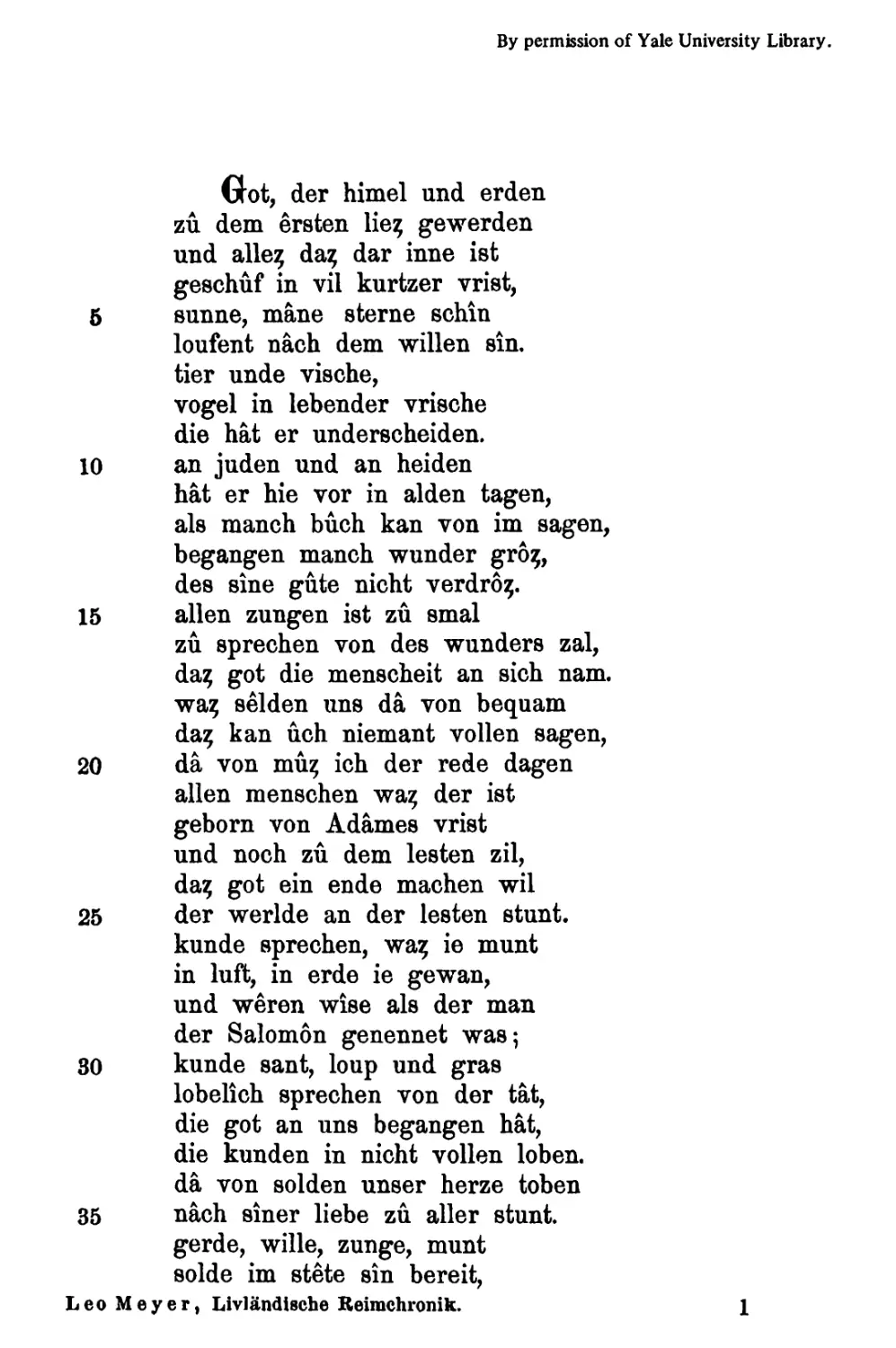
By permission of Yale University Library.
Got, der himel und erden
zu dem ersten lie? gewerden
und alle? da? dar inne ist
geschuf in vil kurtzer vrist,
6	sunne, mane sterne schin
loufent nach dem willen sin.
tier unde vische,
vogel in lebender vrische
die hat er underecheiden.
10 an juden und an heiden
hat er hie vor in alden tagen,
als manch buch kan von im sagen,
begangen manch wunder gro?,
des sine gute nicht verdro?.
15	alien zungen ist zu smal
zu sprechen von des wunders zal,
da? got die menscheit an sich nam.
wa? selden uns da von bequam
da? kan uch niemant vollen sagen,
20 da von mu; ich der rede dagen
alien menechen wa; der ist
geborn von Adames vrist
und noch zu dem lesten zil,
da? got ein ende machen wil
25 der werlde an der lesten stunt,
kunde sprechen, wa? ie munt
in luft, in erde ie gewan,
und weren wise als der man
der Salomon genennet was;
80 kunde sant, loup und gras
lobelich sprechen von der tat,
die got an uns begangen hat,
die kunden in nicht vollen loben.
da von solden unser herze toben
35 nach siner liebe zu aller stunt,
gerde, wille, zunge, munt
solde im stete sin bereit,
Leo Meyer, Livlandische Reimchronik.	1

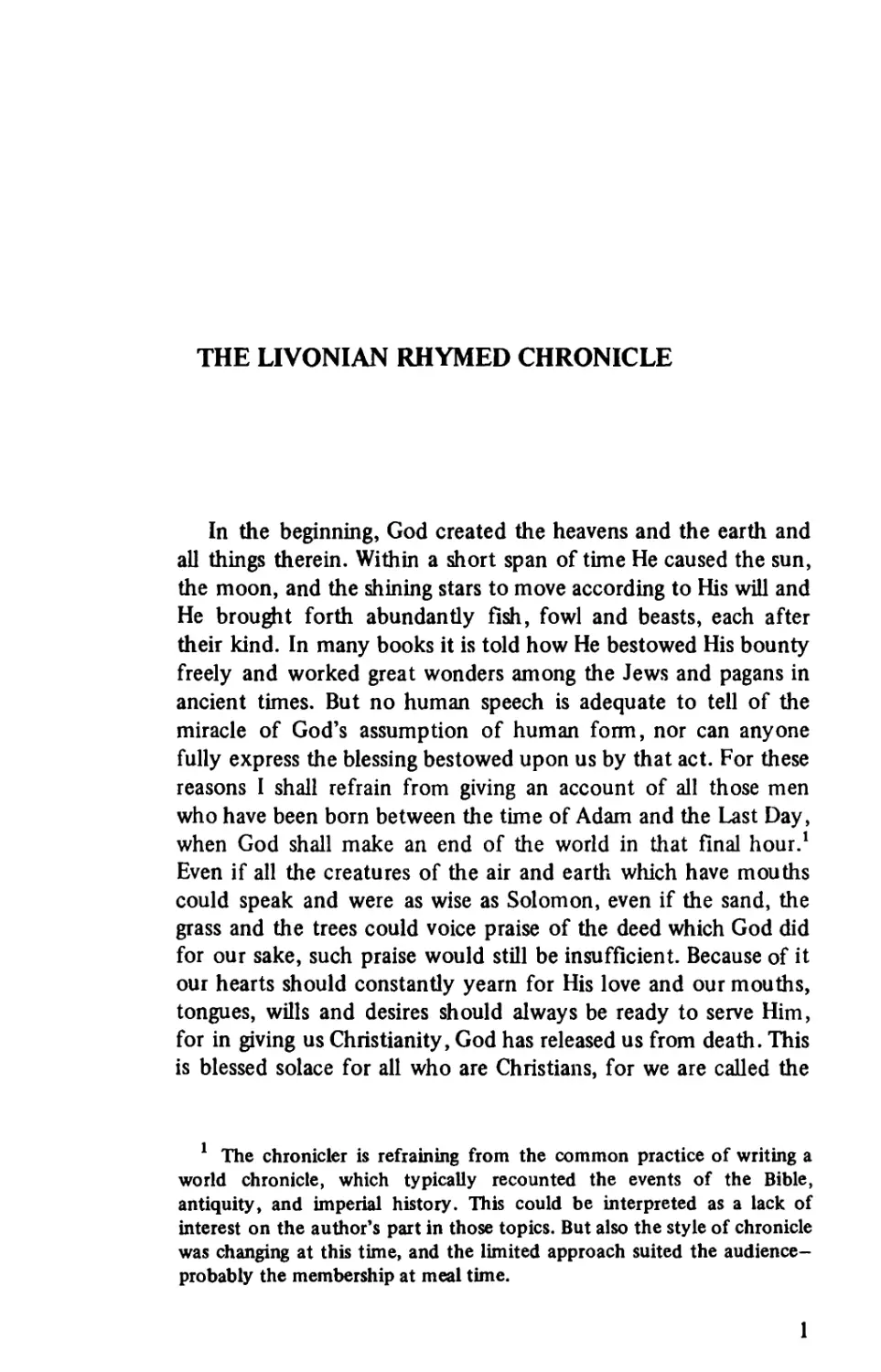
THE LIVONIAN RHYMED CHRONICLE
In the beginning, God created the heavens and the earth and
all things therein. Within a short span of time He caused the sun,
the moon, and the shining stars to move according to His will and
He brought forth abundantly fish, fowl and beasts, each after
their kind. In many books it is told how He bestowed His bounty
freely and worked great wonders among the Jews and pagans in
ancient times. But no human speech is adequate to tell of the
miracle of God’s assumption of human form, nor can anyone
fully express the blessing bestowed upon us by that act. For these
reasons I shall refrain from giving an account of all those men
who have been born between the time of Adam and the Last Day,
when God shall make an end of the world in that final hour.1
Even if all the creatures of the air and earth which have mouths
could speak and were as wise as Solomon, even if the sand, the
grass and the trees could voice praise of the deed which God did
for our sake, such praise would still be insufficient. Because of it
our hearts should constantly yearn for His love and our mouths,
tongues, wills and desires should always be ready to serve Him,
for in giving us Christianity, God has released us from death. This
is blessed solace for all who are Christians, for we are called the
1	The chronicler is refraining from the common practice of writing a
world chronicle, which typically recounted the events of the Bible,
antiquity, and imperial history. This could be interpreted as a lack of
interest on the author’s part in those topics. But also the style of chronicle
was changing at this time, and the limited approach suited the audience-
probably the membership at meal time.
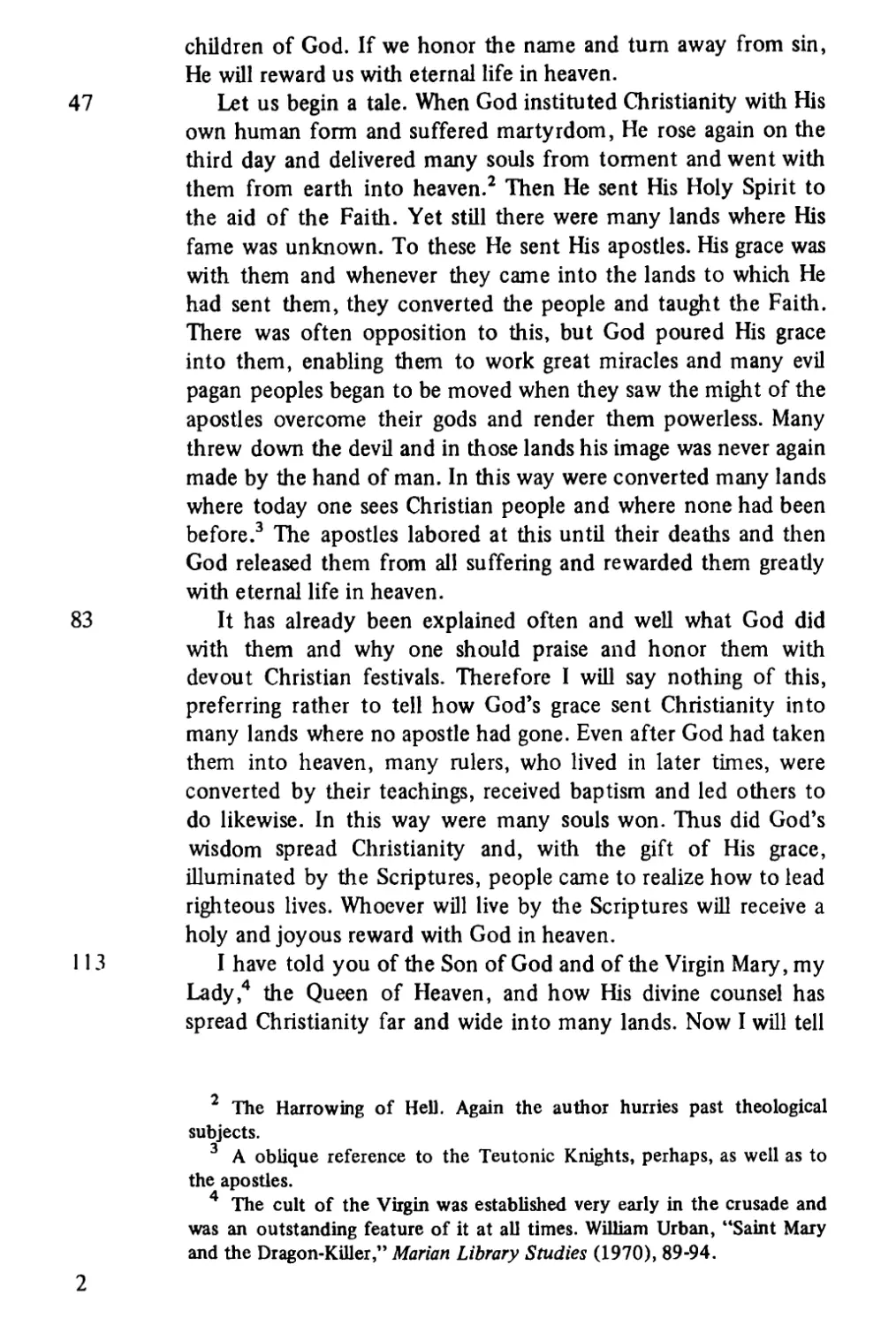
1

children of God. If we honor the name and turn away from sin,
He will reward us with eternal life in heaven.
Let us begin a tale. When God instituted Christianity with His
own human form and suffered martyrdom, He rose again on the
third day and delivered many souls from torment and went with
them from earth into heaven.2 Then He sent His Holy Spirit to
the aid of the Faith. Yet still there were many lands where His
fame was unknown. To these He sent His apostles. His grace was
with them and whenever they came into the lands to which He
had sent them, they converted the people and taught the Faith.
There was often opposition to this, but God poured His grace
into them, enabling them to work great miracles and many evil
pagan peoples began to be moved when they saw the might of the
apostles overcome their gods and render them powerless. Many
threw down the devil and in those lands his image was never again
made by the hand of man. In this way were converted many lands
where today one sees Christian people and where none had been
before.3 The apostles labored at this until their deaths and then
God released them from all suffering and rewarded them greatly
with eternal life in heaven.
It has already been explained often and well what God did
with them and why one should praise and honor them with
devout Christian festivals. Therefore I will say nothing of this,
preferring rather to tell how God’s grace sent Christianity into
many lands where no apostle had gone. Even after God had taken
them into heaven, many rulers, who lived in later times, were
converted by their teachings, received baptism and led others to
do likewise. In this way were many souls won. Thus did God’s
wisdom spread Christianity and, with the gift of His grace,
illuminated by the Scriptures, people came to realize how to lead
righteous lives. Whoever will live by the Scriptures will receive a
holy and joyous reward with God in heaven.
I have told you of the Son of God and of the Virgin Mary, my
Lady,4 the Queen of Heaven, and how His divine counsel has
spread Christianity far and wide into many lands. Now I will tell
2	The Harrowing of Hell. Again the author hurries past theological
subjects.
3	A oblique reference to the Teutonic Knights, perhaps, as well as to
the apostles.
4	The cult of the Virgin was established very early in the crusade and
was an outstanding feature of it at all times. William Urban, “Saint Mary
and the Dragon-Killer,” Marian Library Studies (1970), 89-94.

you how Christianity came to Livonia, as I have learned from
numerous wise men. I will relate it to you as best I can. In God’s
name I thus begin:
127	Established merchants, rich and prominent in honor and
wealth, had decided to seek profit from trade, as many still do
today. God led them to employ a man who knew of foreign lands
and straightaway he brought them by ship to the Baltic Sea.
What more should I say? The Dvina is the name of a river which
flows out of Russia. Along it live haughty pagans called the Livs.
They lived next to the Selonians, a very evil lot of heathens,
neighbors to the Russians. Around them lie many other pagan
lands. The Germans had heard that it was extremely dangerous to
approach these pagan lands and yet they were driven toward
them by the force of great winds so that when they had
approached so near that they could see the Dvina, they had no
choice but to sail in cautiously. As soon as the natives became
aware of their arrival, large groups gathered, rushing thither by
sea and overland. Their common aim was to take the lives and
goods of the Christians, but when the latter observed this, they
quickly and manfully prepared a defense against the pagan array.
With arrows and stones they began to harry those who came
within range. Many of these were quickly wounded by the shots
and when the other heathens saw this, they immediately realized
that they could not stand up to them. So they negotiated a peace
and promised to uphold it on pain of death. The Christians were
also happy about this and, after exchanging oaths, they peaceful¬
ly joined the pagans on land. God Himself had sent them to these
pagans. They had a quantity of goods which they sold here at a
slightly better profit than in other regions. Their hearts rejoiced
at this, and the pagans suggested that they make a treaty and
come back often. Also, if anyone wanted to come with them, he
too could come in peace, for whoever chose to trade there rather
than elsewhere would be welcome. The merchants gave gifts of
mead and wine to the pagans and the peace was confirmed with
proper oaths.5
5	This account is much fuller than that in Heinrici Chronicon Livoniae
(ed. Albert Bauer and Leonid Arbusow, Hannover, 1955), I, 1, which
simply says that there were certain German merchants familiar with
Livonia who frequently sailed there via the Dvina River; Adam of Bremen
in his History of the Archbishops of Hamburg’Bremen (trans. Francis
Tschan, New York: Columbia Univ. Press, 1959) pp. 196ff describes the
natives of a slightly earlier period; there is also a short mention of this in
Arnoldi abbatis Lubecensis chronica (ed. J. M. Lappenberg. Leipzig, 1868),
V, 30.
3

201
They went home and returned again often to Livonia in large
numbers. Whenever the natives observed their arrival, they were
received as welcome guests, and they spent many days buying and
selling. So well did it go that they traveled thirty miles into the
interior where many heathens lived with whom they could trade,
and they remained there long enough to build a settlement. With
native permission they built a worthy place on a mountain by the
Dvina, a castle so large that these traders could remain there in
peace and conduct trade for protracted periods of time. It was
named Uexkiill and stands even today in Livonia.6 While they
were building it the pagans did not expect it to take the form
which it eventually did.
229	Now, as I have heard it told, there had come with them a wise
man who read and chanted the Mass for them. He was a holy
priest, a man named Meinhard.7 He was armed with all the virtues
and was wise and intelligent. Such was his piety and conduct that
the people loved and honored him. He was able to give the rich
gift of salvation with his learning and counsel and he converted
many, winning them to Christian love. But there were many men
who wished to drive the Germans away and to forbid their
staying so much as an hour ever again in their land. They were
much troubled by the mighty form which the castle at Uexkiill had
assumed, for they feared hostile acts from the Christians whose
numbers increased daily. There came from Germany many stout
heroes who carried on their trade and remained there with the
rest.
259	Now there was an outstanding pagan nearby who was
powerful and rich as well as virtuous. Also, he had a great many
relatives among those heathens. God sent the Holy Spirit and the
assistance of His grace to that upright man and won him to the
Love of Christ. His name was Caupo and at the very beginning he
6	Uexkiill was on an island in the Dvina. The construction of this castle
is described in Heinriciy 1, 5-6. It was not a large castle, but could have a
garrison of perhaps two hundred men (20 knights and retainers) and give
shelter to practically the entire native population of the island. Ibid., X,12;
It was probably constructed 1181-82. Ibid., I, 5-7; l;or a description sec
Karl Heinz Clascn, “Grundlagen baltendeutschcr Kunstgcschichle,” in
Baltische Lande (ed. Carl Engel. Leipzig, 1939), I.
7	Meinhard was an Augustinian priest from the monastery at Segeberg
in Holstein. He came with the merchants to Livonia about 1180 and
obtained permission from the prince of Polozk, the nominal overlord of
the Livs, to preach the Gospel to them. When the merchants sailed for
home, Meinhard remained. Heinriciy 1,1.
4

had himself and a great number of his followers baptized.8 That
was great comfort to this soul. Many other heathens came also to
Meinhard and received baptism for the sake of heavenly reward.
The Christians rejoiced at this, but it was a blow to the heathens
that Caupo and his followers had accepted Christianity. This soon
became known throughout the land and a great outcry arose. The
Lithuanians and Russians were enraged and the Estonians, Letts,
and Oselians also, for the news that Christianity had come to
Livonia was too hard for them to bear. And the complaint of the
pagans was that the Christian numbers increased day by day. So
they killed many of them and harassed them both openly and
secretly. But God was firmly rooted among the common men and
women and they accepted baptism and went to it in friendship.
Some set themselves against it, as will be mentioned later, but
with God’s help they were subdued.
304	It was not overly long after that, that the good priest
Meinhard agreed with them that he should be sent across the sea,
for they desired the comfort of having a bishop in the land. For
the good of Christendom Caupo was sent with him and a large
number of merchants also traveled along to the court at Rome.9
They were fortunate on the journey and arrived safely. They
carried out their embassy faithfully and in all propriety and when
the Pope10 received them, he eagerly asked them to inform him as
to how things really stood in that land.
There are numerous pagans by whom we are oppressed. They do
much harm to Christianity, as we will tell you, father. One group
is called Lithuanians. Those pagans are arrogant and because of
their great might, their army does much harm to pure Christiani¬
ty. Nearby lies another gioup of pagans named Semgallians, who
have great strength of numbers and dominate the lands around
them. They impose hardships without relief upon those who live
near them. The Selonians are also pagan and blind to all virtue.
They have many false gods and perform evils without number.
Nearby is another people named Letts. All these pagans have
most unusual customs. They dwell together of necessity, but they
farm separately, scattered about through the forests. Their
8	Actually, we have no evidence that Caupo was baptized this early.
9	This section is greatly confused. Meinhard was consecrated in 1186 by
the Archbishop of Hamburg-Bremen, who had the ambition of extending
his influence over the Baltic Region. Caupo went to Rome in 1203 with
Theodoric, Bishop Albert’s (1198-1228) principal assistant. Heinrici, VII,3.
10	Innocent III.
5

women are beautiful and wear exotic clothing. They ride in the
ancient manner and their army is very strong whenever it is
assembled. Along the seashore lies an area named Kurland. It is
more than three hundred miles long. Any Christian who comes to
this land against their wishes will be robbed of life and property.
The Osetians are evil heathens, neighbors to the Kurs. They are
surrounded by the sea and never fear strong armies. In the
summers, as we have cause to know, they raid those neighboring
lands which they can reach by ship. They have attacked both
Christians and pagans and their greatest strength lies in their fleet.
The Estonians are also pagans and there are many mothers’ sons
of them. That is because their land is wide and extensive. I cannot
begin to describe it. They have so many powerful men and so
many provinces that I do not wish to say anything more about
them. The Livonians are also heathens, but we have hope that
God shall soon sunder them from that Just as He has with Caupo,
who has come here with us. God’s gentle wisdom has brought him
to Christianity. His tribe is large and most of it has come to us
and accepted baptism.
385	The Pope bade him speak further, giving a true account of
how it came about that Caupo accepted baptism. Lord Mein-
hard11 was a just and true servant of God and the Pope clearly
saw that he was full of grace and he therefore bore great love for
him. Priest Meinhard was perceptive and he explained all that
God had done with him from the beginning down to the present.
He then summarized it by saying that God had sent Christianity
to Livonia and caused it to take root, but that now certain other
groups of pagans wished to set themselves against it with force.
406	“I will compensate you for all your pains and whatever you
wish from me shall be granted you,” said the Pope to him. The
lord and his companions and the honorable pilgrims were
gladdened by his support. Happily they immediately asked for a
bishop in their land. The Pope heard this and his heart filled with
joy. Warmly he said, “I delight in hearing this. Meinhard, my dear
son, you yourself shall be the bishop. To your soul I entrust the
people and the land and grant you great power and authority.
11	Again, Theodoric, the Cistercian missionary, not Meinhard. We might
assume a visit to Rome by Meinhard, except that Henry, who was a
contemporary, does not mention it, and the whole episode sounds like the
visit by Bishop Albert described in Henry’s Chronicle. Friedrich Benning-
hoven, Der Orden der Schwertbriider (Cologne, 1965) indicates that
Theodoric was the key figure in the foundation of the crusading order in
Livonia, pp. 20-54.
6

And in the future, whatever pilgrims wish to come to Livonia,
accept them in God’s peace.” Before he set out on the return
journey he was consecrated bishop. This took place 1143 years
after the birth of God.12 Nothing finer ever happened to Caupo
than when he saw the Pope, who gave him his blessing and prayed
God to care for all of them.
437	The lord returned to his land13 a happy man, and later came
on to Livonia without mishap. And when the people learned that
their lord the bishop was coming, they praised Jesus Christ, who
is worthy of all praise, and His beloved mother, Mary the Queen.
(She later helped the region, as I shall soon tell you, with many
bands of crusaders, who came there out of love for Her and
subdued the territory.) For a long time the bishop successfully
labored in God’s service. How he set about this and what God
accomplished through him, I will now tell in part.
458	There came a time of famine. The generous and wise man gave
all his food to the poor, for the sake of God, and as a result, he
himself suffered great misery from the pain of hunger. The
merchants sent him bread, but it was too little and he nearly
starved. But then God worked a miracle for him. His official
looked in the stores and found them well-filled. God has a
generous hand: whoever gives something to Him is rewarded and
always receives his proper due. The lord was aware of this and
called the poor to come there and he divided God’s bounty
among them. He thus followed the Holy Scriptures, for God said
in the Gospels to the rich people, “As ye have done it unto one of
the least of these my brethren, ye have done it unto me.”14 He
lived peacefully for twenty-three years with both rich and poor
and then the lord died a holy death.15 He had guarded himself
against all transgressions in preparation for death’s journey. The
Christians mourned greatly that they did not have him any more.
491	They sent messengers with instructions to go to the arch¬
bishop of Bremen and ask if he would consent to send a bishop
who was deserving of God’s favor. He sent a pious hero named
1 2
Ascribing the foundation of the bishopric to the Pope eliminates the
embarrassing claims still held by the Archbishop of Hamburg-Bremen as late
as 1290, when this chronicle was finished. The date 1143 also connects the
missionary work of Meinhard to an earlier failure by a monk named Fulco,
who was active in Estonia at that early date.
13	Germany.
14	Matt. 26:40.
15	1196. The author’s chronology is in error.
7

Berthold from his own bishopric. That was a blessed gift for he
was a hero in battle and later died among his flock.16
503	The first battle of the Christians in Livonia occurred in his era.
The Lithuanians, with the Russians on one flank, waged battle on
the field of Kokenhusen. Death took its toll: three hundred
Christians lay dead and, though the exact numbers are not
known, many heathens also died. The meadow turned red from
blood. Caupo was severely wounded and although he did not die
immediately, he barely lived until he returned home. He had four
wounds and said repeatedly: “God received five wounds for me
and I only regret that what befell Him has not befallen me.” He
died in peace.17
523	Bishop Berthold began to build Riga like a man who wanted
very much to stay there.18 The Letts and Livs agreed about taxes
and that helped the Christians.19 The entire people was proud of
the good Bishop Berthold, because he was a virtuous man who led
the Christians faithfully. In quest of glory, the Estonians came
against them.20 Bishop Berthold and the crusaders were at Riga
with an army. He comforted his followers, saying,
Good heroes, remember that Jesus Christ spilled His holy blood
for us on the cross. The heathen’s power is never so great that we
may not attack them before they descend upon us. We are here
for the sake of God in Heaven, who never abandoned his friends
in the heat of battle. Those Christians who die will shortly receive
eternal life. Let my soul be your guarantee of this exchange. I will
stay by you, both in life and death.
1 6 Berthold was Abbot of Loccum. Failing to occupy his sec peaceably,
he obtained papal permission to raise a force of crusaders. This army from
Gotland and Germany was not large enough to cow the natives. As the
battle began, BerthokTs horse bolted, carrying him into the pagan lines, and
he was killed. July 24, 1 198. Heinrici, 11,1-6.
17	This is in error. Berthold fought only the Livs. Furthermore, Caupo
died in battle against the Estonians in 1217. Ibid., XXI,4.
18	Riga was founded in 1200 by Bishop Albert, Ibid., IV,5.
19	There were two types of taxes, the Zehnte (tithe) and the Zins (ccns).
Tire Zehnte was twice the amount of the Zins, but was applied only to
tribes which had rebelled or proved themselves untrustworthy in the past.
On the average, the tax amounted to three or six bushels per farm. Sec
Benninghoven, pp. 388-400.
20	Actually only the Livs opposed Bishop Berthold. The chronicler
probably considered them unworthy opponents, unable to bring about
Berthold’s martyrdom, whereas the Estonians were noted warriors.
8

555	All rejoiced at his comforting words. The people armed
themselves then and went forth against them on the beach, boldly
charging the Estonians as soon as they caught sight of their army.
Men were better then than they are now, as we have all had
occasion to learn. Whenever we need help nowadays, scarcely
anyone will press to the fore of a group.21 The bishop, however,
rode at the head of his followers in a knightly fashion, like a true
lord. Both sides sought a fight to the death. The Christians
suffered greatly. Oh, the pain of it! Eleven hundred lay dead, the
rest were routed and Bishop Berthold was lost in battle. He was
mourned publicly and privately, because he had ruled eleven
years.22 Although the Estonians had not been forced from the
field, still six hundred of them had been slain in the battle.23
Their friends at home mourned for the dead and their wives wept
bitterly.
582	The Christians were greatly distressed. They met in council
every day until they reached the decision to send messengers over
to Bremen, asking that, in accordance with God and the law,
another leader be sent them. A holy man named Albert24 offered
to undertake the journey to Livonia, but he went first to Rome.
The Pope confirmed him immediately as bishop of the land. He
said,
Because of the nature of the region, you shall also have authority
to found a crusading older on the model of the Templars, who
are known as the knights of God overseas and elsewhere. Give
them one-third of the people and land to rule as their own. They
shall stand undei my piotection and that of all future Popes.25
21	This comment is both conventional and enlightening. Medieval
custom required each generation to regard itself as less worthy than its
predecessors. But also, earlier the natives had more reason to fight hard. By
1290 tribal pride and traditional hatreds were doubtless not as important
as before.
22	Two years only. This is perhaps a scribal error, copying II as 11.
23	A complete error. Also the Christians won that battle. Heinrici, II.
24	He was the nephew of the Archbishop of Hamburg-Bremen, of the
house of Bekeshovede.
25	This is outright propaganda. The order was founded by the Cistercian,
Theodoric (see Benninghoven, pp. 20-54), and the division of the land was
hotly contested for the next three decades, the crusading order prevailing
only after a civil war against the bishop of Riga and a papal legate. See
Gisela Gnegel-Waitsche, Bischof Albert von Riga: ein Bremer Domherr als
Kirchenfurst im Osten (Hamburg, 1960).
9

The lord returned home again. He promised his friends that if
they would journey with him and save their souls in that land,
they would also be able to win both fame and riches honorably.
Plenty of them were of such mind and they undertook a journey
which turned out well for them, for their fiefs were so extensive
that their descendants are still today satisfied with them.26 The
bishop, Albert, placed before the people the Pope’s decree
concerning what portion of the land was to be given over to the
monastic life. This was accepted by the good heroes, who had
both martial courage and the true love of God.
626	A pious hero named Winno27 was Master among them. He bent
all his will to 4he protection of Christianity. In his time the castle
at Segewold was built,28 which pleased both young and old
among the people. The same hero built the castle at Wenden29 for
his Lettish children and straightaway they rendered whatever help
was asked of them. He offered good counsel. Next he built the
castle at Ascheraden.30 He comforted that poor land with his
great piety, but this disturbed the evil Russians. The lands of the
Selonians, Livs and Letts had become subject to the Russians
before the Brothers of the Sword arrived but then their authority
was taken away and they were driven back home, never again
oppressing those peoples. Winno won Kokenhusen from them,
killing there many bold men, including their king.31 He drove the
rest back to their homes and those who shamefully abandoned
their wives cried out in bitter anguish. Thus did the good heroes
exert themselves and thus did the Russians suffer. A brother
named Hartmund, who was the commander at Ascheraden,
summoned his best men and undertook a journey which widows
and orphans would later rue. He hastened up the Dvina, but they
found many impassable streams and met with great difficulties.
26	Again propaganda. The troubles which began in the 1290’s indicate
that some nobles were not completely satisfied, particularly the
descendants of the Bekcshovedc family. They desired an important
political role in Livonia, a role monopolized by the Teutonic Knights.
27	Benninghoven, pp. 420-23.
28	No exact date possible. Certainly about 1208, though Heinrici does
not mention it before 1211. Probably began right after the division of the
lands in 1207.
29	Before 1208. See John Leighly. “The Towns of Medieval Livonia,”
“University of California Publications in Geography” (Berkeley, 1937) pp.
264-69; and Benninghoven, p. 82.
30	1208. Heinrici, XI,5.
31	Again inaccurate. King Vetseke had abandoned his fort and tied.
Heinrici t XIII,1. Also these natives were not really Russians, only subject
more closely to Russian authority.
10

669
They came to Gerzike early one morning and took the castle.
There they struck many bold men, causing them to cry out in
anguish, and awoke many sleepers by bashing their heads. That
was a knightly exploit. Six hundred Russians were killed and the
women and children were driven away from there by the
Christians. The Brothers rejoiced. They took back much booty
without harm both by ship and overland. This campaign served
poor Christendom well and gave glory to the heroes.32
687	The good Master Winno, with the best intent, placed in the
castle at Wenden, to help and comfort those Lettish children, an
evil man, a villainous farmer from Soest. When he was no longer
able to accomplish anything and was of no use to the land, God
relieved him and removed him from his position and the knave
was greatly pained and offended.33
701	One day it happened that he saw the Master in a private
conference with his holy chaplain. He stole forward so stealthily
that they were not aware of his presence, and he slew them
both.34 The murder was so horrible that he was spared nothing.
Many bold men captured him and set him painfully on the rack.
No one prayed for him and the good people approved of this. Both
knight and squire applauded his death as the proper due of
traitors.35
717	The Brothers of the Teutonic Knights did not yet have
churches or monasteries in the land, but they were not to blame.
The crusading order was called the Sword-brothers and they
subdued the land honorably. They were very sad, however, that
they had lost their dear Master in such a way, for he had been
thcii friend and lcadei, discreetly and honestly, foi eighteen
years.36 For them he was the very image of justice until the day
he died. In reverence to God, they placed him in the earth and
performed the services for the dead, omitting nothing. Everyone
prayed for him faithfully and reverently. Thus did he depart.
32	The women and children were good hostages. The previous year
Vetseke had been attacked by an episcopal vassal and had returned to
make peace because of the hostages. Now, however, he was to become an
implacable foe of the Germans.
33	Heinrici, ХШД, also commented on this. Apparently Wickbert
disagreed with the order’s policy of opposition to Bishop Albert. Because
of his insistence that they submit to the Bishop he was removed from
office, and when he tried to escape to the bishop, he was recaptured and
held in chains. Benninghoven, pp. 81-97.
34	Heinrici, XIII,2.
3 5 Perhaps an oblique reference to the author’s own times.
36 Actually 1202 to 1209.
11

739
News of this went out over the land and the wise brothers
assembled in council. They said, “We should elect a leader before
too long, for every delay is costly. God help us in a decision. It
must be done soon.” They elected a good brother, Volkwin,37 as
Master and this pleased both rich and poor. He made himself
beloved of the people and they began to trust him. His word was
absolutely steadfast and faithful. He ignored completely all false
counsel and always did whatever he promised.
759	The Estonians heard of this and sent messengers to him asking
for peace. He granted it to them and yet still they remained
heathen. So he went into their land with some capable brothers
and swiftly seized the castle at Fellin and that hurt the faithless
Estonians.38 He sent other brothers to Dorpat39and to Odenpah40
and the hostility of the natives grew ever greater. They began to
commit misdeeds and follow evil counsel. They killed all these
brothers on a single day41 and thus brought the peace to an end.
They captured two knights at Fellin, but it happened that they
were both spared death from starvation because a good native
woman helped them in their need. She had great courage and,
with her husband’s help, came to them at all times of day. The
evil Estonians were not feeding the prisoners because of their hate
for them. She spoke spitefully, “Why do you let the Germans
live? I will kill them myself.” Then she threw stones at them so
that no one might guess her true feelings and at the same time she
gave them good food and encouragement. She herself later
profited from this for she remained free and exempt from all
taxes. I rejoice that good befalls their souls, Emma and her
husband Vilemas, for they have often helped and comforted me.
Lord God, through your goodness, grant them your sweet
blessing and preserve them from all torment.
803	When news of this came to the Master, he was sorrowful, and
all the Christians with him. Good Bishop Albert was especially
grieved. He was so true and just that, without doubt, he could
have been a pope, for he always kept his word and was never here
one minute and there the next, like a deceiver is. Both his life and
37 Probably from the family of the Counts of Naumburg. Benninghoven,
pp. 428-38.
8 February 1211. Heinrici, XIV,II. Fellin controlled all southwest
Estonia. Benninghoven, pp. 143-52.
39	January 1212. Heinrici, XV,7. Dorpat controlled northern Ungannia.
40	1216. Heinrici, XX,5.
41	Jan. 1223. Heinrici, XXVI,5-8; Benninghoven, pp. 179-82. About 1/3
of the total membership of the Swordbrothers perished.
12

his possessions were placed in the service of Christianity. He was
the Brothers’ right hand. “You have come to this land in God’s
name for the remission of your sins,” he said, “and we will have
both victory and defeat together. I will stand by you always with
love and counsel. Because of the land’s plight, I will travel
overseas immediately and gather more crusaders than have ever
been brought before. May God grant what I have planned.” The
good Master Volkwin and his brothers thanked Bishop Albert,
saying, “Just Lord, you have treated us so well that you can
depend on our faithful service ever more.”42
838	Then he set off over the sea. He placed both people, land and
all his own relatives under the care of the Master.43 He risked his
life on the ocean and passed over many deep waters before he
arrived. God gave him escort, and the lord traveled into the Saxon
land. Wherever he found good people he greeted them lovingly,
both rich and poor, and told them about the difficulties and
troubles in Livonia, of how the heathens were seeking to conquer
the Christians with force. He said, “You should not lie idle, good
heroes, but rather think how Jesus Christ spilled His blood for us.
Now let that be a lesson to you and undertake the journey for His
sake. You will receive remission of all sins, and will have eternal
praise and honor before God.” These words moved many men so
that they found the courage to pay for all their misdeeds. The
Duke himself was of like mind after he heard the sermon and
when Bishop Albert went to him he followed his counsel. The
bishop easily convinced him to send out a summons, calling
together all his subjects. He then made his will known to them
and many knights who never before had been so inclined, now
rejoiced and took the cross. They vowed to go to Livonia and
traveled there without difficulties.44
42	Bishop Albert was hardly so generous. The Swordbrothers had made
many enemies by their hasty and selfish advance into Estonia, and by the
collaboration with King Waldemar of Denmark. Bishop Albert’s administra¬
tors, therefore, drove a hard bargain before agreeing to come to the aid of
the Swordbrothers in Estonia. Heinrici, XXVI,13.
43	Definitely not accurate. Bishop Albert entrusted his relatives with
great responsibility, and the suggestion that Master Volkwin had a
significant role speaks more to the situation prevailing in the 1280s and
90s, when the Teutonic Knights usurped the powers of the Archbishop of
Riga whenever he left the country. In the fourteenth century the
Archbishop resided by preference at Avignon, and left his administration
largely to that Order.
4 The Duke of Saxony arrived in the summer of 1219. Heinrici,
XXIII,1.
13

883	From among his own subjects Master Volkwin recruited an
army and led it to Wiek, passing through many bad places until
they came to their goal. He took hostages from the natives and
they gave them to him without resistance on the condition that
he withdraw his army. This he did and then returned home a very
happy man. When the Estonians heard of this they assembled and
said:
Alas, shall the crusaders drive us from our ancestral homes with
the help of the Livs and Letts? Let us defend ourselves and raise
an army larger than ever before raised from Estonia and drive
them back over the seas so that they can never again return and
oppress us. And if we win glory in battle from the Livs and Letts,
who are now allies of the Germans, we shall capture their women
and children and carry them home with us.
Day and night they made their preparations for this.45
913	Reports of tills reached the Dvina and also news that the Duke
of Saxony and his men and many crusaders in God’s service
would arrive in Riga very soon. All estates rejoiced, and they
received the worthy crusaders kindly. The master and his men
offered entertainment. Everything in the stables was placed at
their service, and oats, hay, and grass were distributed. The next
day he invited the Duke and his men to be their guests, so pleased
was he that they had come. Even many who were not his
followers had invitations to the banquets pressed upon them and
this was not soon forgotten. He generously provided good wine,
beer, mead and whatever else one might wish for. The hospitality
was such that all thanked him and this same hospitality was
extended to all, to rich and poor alike. All were happy under
God. The guests went to their lodgings and the Master looked to
his own affairs. He sent scouts to Estonia, saying to them, “Be on
your guard that the pagans not find us defenseless here at home
and take the Letts along so that Urey can spy out the paths and
look for information. It would be hard on us if they should come
upon us here without warning.”46
958	They carried out his orders. The messengers rode away swiftly
45	This probably refers to the winter expedition to Reval and Sontagana
in 1218-19. The chronicler refers elsewhere to these provinces as Wiek:
1224, 6900, 7818, 7821 \Heinrici, XXII.
46	Duke Albert arrived in the summer of 1219. After a brief rest, the
crusaders went to Mesoten in Semgallia to assist Bishop Bernard, the
former Count Zu Lippe. Ibid., XXUI,3-4.
14

1005
and the Master went into council with the Brothers, saying,
“Today, let us leave the good crusaders to their leisure.
Tomorrow, we will tell them the news. I think that is best.” The
Brothers answered, “So be it.” Early the next day, the Master
took along the Brothers, as was proper, and went to the Duke. He
spoke politely,
Your lordship, we have news which we would find unbearable
were it not that God has sent you to comfort this wretched land.
The heathens are gathering and the Estonians will attack us here
in strength. We have sent out scouts toward them. So please give
us your counsel, if it be your opinion that we should advance on
the frontier before the blow falls.
Duke Albert replied, “That is correct, Master, and we will concur
in whatever you deem best.” Good Master Volkwin said,
My lord, you will have to bear with hardships for the sake of God
in heaven. Help us now tell the crusaders that they must make
ready. We must march no less than eighteen miles for tomorrow’s
camp. Then you can see what strength we have in crusaders. Ships
must also travel with us to carry the food and drink.
“Yes, truly, that is a good thought,” said Duke Albert, “Both
knights and soldiers will follow your leadership right into
heaven.” This they all promised.47
All armed themselves well and the next day Mass was
celebrated early throughout the city. The good Master Volkwin
told all the crusaders that when they hcaid the gieat bells ling for
the third time they were to come out onto the field and look
upon the banner of Our Lady. That happened soon afterwards.
The Duke took it in his hands and gave it to the best knight in his
entire army. He said, “Guard it in devotion to God and tome. I
will be at your side.” He himself carried a marshal’s staff as
emblem of the Empire,48 and said, “We shall protect the army
and, if God grace us, we will give these heathens pain.” He gave
the flagbearer an escort of four of the best knights and chose
47	In February of 1220, the Duke was still occupied in Semgallia, at the
siege of Mesoten. It was necessary to storm the castle, return to Riga, and
then rest two weeks before the crusaders were ready to march north. Ibid.,
XXIII,8.
48	The Saxon Dukes were the ceremonial marshals to the Holy Roman
Emperors.
15

1057
twelve others, who accepted the honor gladly, and placed them
before the banner. Outriders, accompanied by good scouts, were
dispatched. The Duke kept the Master with him, as was fitting,
and questioned him about the region;and the Master explained
the customs and geography. The army set out and genuine
fellowship prevailed among both rich and poor. They arrived at
the campsite and the people quickly spread themselves across a
broad and pleasant meadow. The Duke and the Master rode
around in inspection and told the people to group themselves
more closely together, for they would be foolish to expose the
army to attack. These two embodied wisdom and honor.
The next day they moved to Segewold, where a campsite
suitable for the army had already been prepared alongside a clear
stream. The Master had omitted nothing. Both roads and paths
were well-guarded. All the animals at Segewold were brought
onto the pasture so that they could journey on even better and
everyone appreciated that. They remained there two days, so that
the people could rest themselves thoroughly. The Livs joined
them eagerly and on the third day they rode proudly on to
Wenden. That castle was so well-provided that they were treated
better here than anywhere else. So the army assembled there as
happy guests. The Letts and Livs stood firmly by the Christians
because rumor was that the Estonians were coming there from
their land. They brought shield and spear and many breastplates
and helmets which one could see glistening through the dust of
the paths and roads. Then the Master’s advance guard came up in
fine order and sent a bold man ahead to sound the alarm, while
the proud young heroes kept company with the main army. The
Christians moved toward the river Emere seeking battle. There,
early one morning, they came upon half of the Estonian army.49
Ah, how they shook their spears when they saw one another!
They were not too far away, but they could not reach one
another because there was a deep ravine with an impassable
stream between them. Each side shouted their war cries, the
Christians here and the pagans there, and hurled darts and spears
at each other. The Letts meanwhile sought out crossings with
which they were familiar and led the crusader army safely across.
The Master and the Swordbrothers came over with them and also
49
The Oselian army had invaded Jerwen. As we shall see, there is some
confusion here. The description of the battle is that of Heinrici, XV,3,
which took place in 1211.
16

1169
the Letts and Livs, since they wanted to remain near them. In a
marvelous group the nobles charged like lions. The Estonians
courageously turned toward the German army, but their lines
were shattered since they had not properly concentrated their
forces. They were ridden into the grass as though they were
ungirded. Many men were struck with lances and thrown far from
their saddles and foreswore riding forevermore. They got their fill
of fighting. The Estonians were dismayed by the clashing of the
Germans’ swords and lost their courage and fled for their lives.
Fifteen hundred were killed and the others were routed, fleeing
through the swamps and woods and shunning all the bridges and
roads. They cried, “Now God’s curse is upon us and we are being
repaid for what we have done to the Christians.” Few failed to
rebuke their own gods and they brought a sorrowful tale home to
their wives and children. The Letts and Livs were undeniably
heroic. Both in the fight and in the pursuit they massacred the
heathens with the help of God. The Christians held the field, and
Master Volkwin gave orders that no one loosen his helmet until
the dust had settled and all those in the pursuit had returned.
They sought here and there for any wounded Christians who
might still be alive and whom they might help in their agony.
There were only sixty killed and one need not mourn too much
for them since they died for God’s sake. They had given their
lives in return for eternal life. Along with these were two
Swordbrothers who had also died in the battle.50
After they had praised God, the crusaders quickly returned to
their dwellings in Riga and, in accord with the Master’s counsel,
lived there happily. They rejoiced in the glory which had been
rendered unto God. The Estonians had suffered so greatly in the
battle that they sought a peace, which, after holding council, was
granted. This pleased most of the army, but dismayed those
heathens from Jerwen who still harbored their ancient hatred of
the poor Christians. The following winter, the Master rode toward
this land with an army and the crusaders; Letts and Livs happily
supported him. In most amiable fashion they visited Estonia and
discovered Oselians there. With their army these proud heathens
had collected a great amount of booty, without encountering the
least resistance. Now the Christians had come with the intent of
50 Here begins the characteristic memorial to the fallen comrades. The
knights were to pray for the souls of those who perished in God’s service.
The chronicle, therefore, has a religious function as well as being
entertainment.
17

1209
1227
attacking Jerwen, but when it was learned that the Oselians were
there, they hurried on their trail. When the Christians and
heathens had come so close that they could see one another,
battle became inevitable. The Oselians prepared to fight and then
the two armies came together marvelously. The Oselians had the
worst of it, however, and many of them lay dead. They
abandoned their booty in their plight. Very few of them escaped
home again, and there were bereft of all joy.51
This battle had taken place at Karidal and the bones of many
Oselians lay upon that field. If anyone does not believe this, let
him go and look for himself. Duke Albert and all his men
rejoiced. With much honor they took away from there men and
women and great booty. Duke Albert returned home and many
praised him, saying that he had covered himself with glory there.
May God grace his soul with His great mercy. He was always
ready to do what was right. Eventually the Master gave back the
hostages. Then the Swedes came afterwards in great strength to
Wiek and established themselves there permanently.52
A bishop and plenty of soldiers crossed over the sea and built
a castle in that land. The Oselians played with them like a cat
with a mouse and this proved too much for the Swedes. The
castle was taken and no one escaped. All were killed and the
bishop shared the general fate. To tell the truth, his powers of
excommunication helped very little.53 When the Master heard of
this, he sent messengers there to ask what their feelings were
toward Christianity. The natives of Wiek were pleased that they
were free of the Swedes and they had promised their neighbors
the Oselians that they would hate the Faith and repudiate it
entirely. So the Master took an army there, according to the
customs of war, and the Letts and Livs accompanied him to the
field at Suntaken. The natives of Wiek, in turn, came there with
their army. There were five hundred of them who never should
have gotten out of bed that morning, for this was the number of
them slain. They gave hostages grudgingly, but were happy that
no more of them had been killed. The Master returned home
51 This episode is confused with the preceeding. Apparently the
chronicler placed Duke Albert in the earlier expedition rather than the one
in Heinrici, XXIII,9.
5 2 The Swedes were simultaneously establishing themselves in Finland.
53	Aug. 8, 1220. The castle was at Leal. Ibid., XXIII,3; this also reflects
the Teutonic Knight’s hostility to other religious orders, and particularly
the bishops.
18

1269
1333
again without losses. They all had plenty of booty, which some
carried and which others drug along behind them, as is often the
case on such journeys. The undertaking was blessed with honor.54
The Estonians rebelled again. They were filled with hatred and
whenever they came upon a Christian, be he man, woman or
child, they did away with him. Indeed, there were not many
Christians among them to begin with. The Estonians freed
themselves and took up their false gods again, cutting down
Christianity. In these disorders one poor man was killed, a
German, but not a rich man. He made his living going from village
to village selling needles. Now he came to a place where he
thought he had friends. The innkeeper there greeted him
hospitably but in the end things turned out badly. He gave him
something to eat and said, “Do not worry about any harm. I will
protect you from trouble. I will have a room warmed and we can
take a bath together.” Under his arm, however, he hid two
hatchets and thus concealed them from his guest. He said to his
wife, “Help me kill this man, for I begrudge him his life. You
stand before the door and when he passes by, hit him on the
head. Then I will come help you finish him off.” She promised
him this without objection and it was a cursed agreement. They
carried out the deed, murdering him in that horrible manner. He
was then dragged into the woods and left lying there naked. Now
the woman was with child and when she gave birth, the child bore
the same wounds as those on the man slain by her and her
husband. This was a sign from God which told the world that He
had avenged it on the Estonians. Rumor of it went into many
lands, and a letter was sent to Rome. William of Modena, a legate,
described this very matter and I can tell you truthfully that the
child lived a year and half with the wounds and the mother was
never happy. What more can I say? The father was tormented
with sorrow. The village where God caused this miracle to occur
was Poderejal in the Karkus area which was ruled by the
Swordbrothers.55
The next year Count Albert,56 hero of Orlamunde, took the
cross and, for the remission of his sins, undertook the journey to
Livonia. There came with him many good knights, all eager in
54	Probably the expedition of 1220 mentioned earlier, Ibid., XXIII 9, or
of 1222. Ibid., XXVI, 11;but perhaps that of 1218. XXI, 5-6.
55	Ibid., XXVI, 10.
56	Count of Holstein.
19

1375
their desire to fight the pagans.57 So the count came to Livonia
with great strength. The Swordbrothers let him know that their
arrival was welcome. They received them lovingly, both noble and
commoner. The Master willingly did everything they desired and
the crusaders rejoiced. After they had taken their ease and
recovered from their fatigue, the Master and his men went to the
crusaders. The Count inquired into the local situation, asking who
was harassing the Christians. The Master spoke up quickly.
We are surrounded by many nations, all of whom war on us. One
nation is the Estonians, who are blind to the Truth. They had
accepted baptism, but now, unfortunately, it has come to pass
that they pray to their false gods in satanic derision of the True
Faith. Of the few Christians who were once in that land, none are
now alive. And now, my lord, give us your advice, now that you
have heard how it stands here.
Count Albert then spoke, “I am happy that I should attack the
heathens. I so trust in God that I believe we shall avenge ourselves
in such a way that they will never be happy again.”
The Master and his Brothers and the many crusaders and the
Letts and Livs did not want to be left behind and so they all
marched into Estonia and found the heathens there. The
Estonians refused to retreat and fought hard and proudly. The
battlefield was about eight miles from the big castle at Fellin. In a
short period about fourteen hundred of them lay dead and thus
was their arrogance crushed with the help of the Swordbrothers.
The Letts and Livs were happy and proud, for they had won
honor and riches in the battle. From that day on, in good times
and bad, the Estonians gave a tithe from all their goods.58 To
protect the Christians they were required to build castles and I
can well believe of them that they would gladly have been spared
this for they had no fear of hellfire. They paid their dues
grudgingly. They built churches for Christendom because they
were forced to and not for the glory of God. To tell the truth, if
their lords had not forced them, they would have done nothing.
5 7 Summer of 1217. Ibid., XXI, 1; Annales Stadenses auctore M. Alberto
(Ed. Johann Martin Lappenberg in MGM Scriptores, XVI, 271-379),
Rudolf Usinger, Deutsch-danische Geschichte, 1189-1217 (Berlin, 1863),
contains several documents which illuminates his brief crusade and his
connection to the King of Denmark.
58
The tithe was double the tax paid by the Livs and Letts.
20

1416
1491
Count Albert of Orlamtinde was a worthy crusader until he
returned home again.59
The next year Borwin of Mecklenburg took the cross along
with his knights and squires. He brought a fine assembly of proud
young heroes to Livonia.60 Both noble and commoner rejoiced,
but the Lithuanians were dismayed at the growing strength of the
Christians and assembled a force of fifteen hundred men. I am
convinced that the devil was leading them, for no army ever
moved so arrogantly into foreign lands as did this one. They
moved through Semgallia and that had never happened before.
May it never happen again! They crossed the sea at Swurben, on
the southern tip of Osel, which we called Easter Cape, and
Perkune, their idol, made it freeze harder than it ever had before.
They were daring and unrestrained. They ravaged through Osel,
robbing and burning and heeding no cries for mercy. Then they
ravaged Moon, the nearby island in the sea, and as they swept
across this land they were confident that no powerful forces were
nearby. They turned toward Wiek and covered both roads and
paths with blood. The people profited little from their coming,
for wherever they came they taught the people how to die-men
and women, whoever could not escape them. Fearing no man’s
threat, they rode freely into the land of Jerwen, and no one there
was so powerful but that he wished himself elsewhere. The land
was good and spacious and yet so lacking in forests that none of
the people could escape them. They killed many noble men, who
would have defended themselves well if their luck had not run
out. But they were blinded by fear and this cost their women and
children great suffering. Many were killed in that land at this
time. On their way home they ravaged Nurmegunde, cutting down
everyone they could catch, hacking many deep wounds with a
free hand. They ravaged through Saccalia toward the Letts. Never
had they had such great successes. But they paid for this in part
when misfortune later befell them. As they came to Remyn the
Livs did not welcome their visit, for their coming spelt disaster,
and they took great booty in cattle, horses, women and men,
proudly driving them away with them.
This news soon came to a brother at Ascheraden, who was in
charge there. He took the best men he had and twelve well-armed
59	1217. Heinrici, XXI, 2-5.
60	August, 1218. Borwin, like Albert of Orlamtinde, was an important
Danish vassal, but of Slavic descent. Ibid. XXII, 1.
21

1519
1553
knights. The sufferings of the Christians pained him, so he hurried
toward Lennewarden. The Letts met him there with a very small
force. He had less than four hundred men with which to engage in
battle. The Lithuanians were pressing homeward, and Brother
Lupprecht and his small band followed them, their minds full of
rage because of their friends and relations. They ignored the
danger of ambush in their determination to either save the men
and women or die in the attempt. On the third day they came to
the place where the heathen army lay. These were not on guard at
all. Because of their understandable exhaustion their only desire
was to rest. Moreover, the points of all their spears had been
broken from the shafts during their previous rampages, and that
was to be their downfall.
When he saw the heathens before him Brother Lupprecht said,
“You Livs and Letts stay together. Behold those women and
children, bound there before you. It were better that we all die
here if we fail to save them from this suffering.” All agreed. Then
the small force attacked with all its might and rudely interrupted
the Lithuanians’ rest and this cost many of them their lives.
Swordblows and spearthrusts were given freely. The Letts, for
their part, killed many men there and whoever escaped the Livs
was cut down by the Swordbrothers. The pagans were thoroughly
dishonored and forced to surrender their booty. Only three of
them escaped to bring the news home. (I would despise the man
who feels the least sympathy for them.) Their flight was
successful, but they later hanged themselves. The baptized ones
praised Christ, the Saviour of the world. They freed the women
and men and took the great booty happily back home and
divided it equally among themselves.61
Then it came to pass as often happens: when something good
happens to a poor man, then the evil one becomes jealous and
discontented. The Russians learned how Christianity was growing
in the land and wanted to prevent this. It caused them heart-felt
sorrow. So they gathered a great army and led it against the
Christians. They ravaged fearfully, hungry for glory, until they
reached Livonia, where they took great booty from the poor
Christians. They had already come far enough when they were
finally opposed at Yummenkulle. Here they drew up their ranks.
61	This episode cannot be placed chronologically with certainty.
Probably it occurred after 1227, because Henry, always so trustworthy,
would not likely have overlooked such a noteworthy invasion.
22

1613
1647
Meanwhile the Christians from Riga arrived early one morning
with many crusaders, the Master and his Brothers, and they all
went out onto the beautiful field to meet the Russians. The Letts
and Livs paid them their proper due, stabbing through many rich
breastplates and breaking helmets with their German swords. As
long as the Russians were desirous of battle they had their hands
full. Nineteen hundred of them were slain and the rest were
chased home again. The disgrace of it all pains them still today.
They fled in panic, leaving their rich banners on the meadow.
They fled along the many bad paths and wide roads and left
many bright suits of armor of steel and gold as payment, and
many light-colored helmets. The road along which they had come
was covered with shields. The Christians rejoiced. In the pursuit
five hundred Russians were slain at Ogenhausen. Their losses were
heavy and their king shouted out in fear when his horse failed to
run fast enough. With cries of terror they all fled from that place.
The Christians took a heavy toll of proud men who never again
were to mount a horse.62
Thus did God spread His fame throughout Livonia and His
name became more and more widely known. Now Osel lay locked
in the sea and this protected it so that it had never been attacked
by an army. In the summers they needed little defense and so for
many years they remained unbaptized and free of taxes. They
were a treacherous people. In the summers they ravaged the
surrounding lands with their ships, inflicting great damage. This
greatly disturbed the Master and he earnestly inquired how they
might cross the ice in winter to that land and subdue it. It was
reported to him that in winter the sound, in which the island lay,
froze solid. In summer, however, one had to sail twelve miles by
ship, being careful to avoid the numerous rocks which lay in the
water. Hence, whoever wished to attack the island with an army
had to do it in the cold days of winter when the ice could bear a
hundred armies. The Master rejoiced at the news and the
crusaders came nobly to Riga, both noble and commoner.63
The Count of Arnstein was there, the best knight in all of
Franconia and Thuringia. May God reward him well for wanting
to come so far to crusade for His honor.64 Soon after this the
62	Probably this is the invasion of August, 1218 mentioned Heinrici,
XXII, 2-6. If so the crusader victory is highly exaggerated.
63	January, 1227. Heinrici, XXX, 3-5.
64	The mention of the Count of Arnstein is probably in error. 1232 is a
more likely date. Benninghoven, p. 242.
23

1665
1690
1729
winter turned cold and the Master conferred with the crusaders.
He quickly ordered an army raised from the entire land and led it
toward Osel, for the ice had frozen hard there. He brought many
proud and daring warriors to the castle on Moon. They took the
castle by assault, and this dismayed the Oselians.
They slew in that massacre more than twenty-five hundred
men, women and children. One clever man slyly escaped,
however. A goat he had was his salvation.65 He threw it over his
shoulders, just like any other plundering crusader and carried it
here and there until he found the opportunity to escape. I am
sure he did not rest until he reached his friends. He called the
people together and told them the news. The people were all
sorrowful, and out of fear the entire population of Osel
submitted.66 Many men gave their children to be carried away as
hostages. Thus the hero from Arnstein and the other crusaders
went home with honor. May God grant them good fortune when
they need it most.
Many other worthy visitors took the cross who, if the truth be
known, never again returned to Livonia.67 Afterwards Master Volk-
win made war on the Semgallians. It occurred to him that he might
avenge the harm he had suffered from them. With a strong and
numerous army he advanced into that land until he found their
king, Vester. The latter assembled a great army, but God helped
His own against the heathen. The Semgallians arrogantly shot
darts and bolts, as was formerly done. The Germans returned
their fire with arrows and killed some sixteen hundred of the
pagans there. The rest fled. The Master remained in the land three
weeks and those who were the cause of his coming soon learned
how they were to accommodate him. Those are dark days for the
host when the guest gives the orders. The Christians could well
return home with honor, for they took away with them
tremendous booty and men, women and children and everything
found in that land. Then the crusaders departed from Riga by
ship. God be with them and help their souls from all distress, be
they living or dead.68
King Vester regretted his defeat and the next year he was
65	This seems to be the best translation of “reit”, which is abbreviated
from “rettete” for the sake of rhyme.”
66	January 1227. HeinricU XXX, 2-5.
6 7
This first sentence seems to belong to the preceding paragraph.
68	Probably between Sept. 1228 when Diinamunde was sacked by
Semgallians and Kurs, and Spring 1229. Hermann de Wartberge, p. 32.
24

1757
1799
ready with an army which he quickly led against Ascheraden. He
raided the Swordbrothers* land and collected great booty, which
made the raid rewarding for him. A brother named Marquart was
commander there and he was little pleased at the news. He did
little at first but send messengers to the Letts and Livs, promising
to stay with them in life or death until he rescued those who had
been captured. He was bound to succeed since he conducted
himself so well in such serious matters. The Semgallians then
departed with their booty, followed by Brother Marquart and his
men. He would sooner suffer torture than fail in freeing the
Christians from the hands of the pagans. So he followed them
until he found them one morning gathered around their campfire.
Now note what he bade his own men!
He said, “Think, good heroes, that your own flesh and blood
lies in bondage here before you, so let us now either free the men
and women or die in the attempt.” All were aroused by his words
and grimly began the battle. They struck deep wounds with spear
and sword and gave mighty Vester’s army a good fight. Five
hundred opposed them and they slew them all. The King himself
barely escaped, defending himself in an undignified manner with
a burning stick. Brother Marquart saw this and hurried toward
him, singling him out. He was bom in Burback and was by nature
a good knight. He guarded his honor well and many in that region
still praise him today and I, for my part, pray for his soul’s
salvation. But his steed brought him in a little too close, and
Vester hit him in the mouth, knocking out I don’t know how
many teeth and then escaping into a castle. Brother Marquart was
rather unhappy that he got away from him, but the Christians all
praised God, saying, “The devil’s spite now befalls the pagans, but
our Creator has dealt mercifully with us.” They lovingly freed
the men, women and children and took home great booty, armor
and horses worth many Marks.69
The Christians were all joyful and they praised God in heaven
for all His goodness. The Master’s mind was on Lithuania and he
was soon to be seen there. He rode to the land of Nalsen70 and
encountered a powerful army of heathens from all over. They
came toward him to their doom in uncounted numbers, boasting
and shouting. The Master spoke to his men, “Remember, mighty
69	Probably between Spring 1229 and Spring 1230. Benninghoven, p.
258.
70	Nalsen was directly south of Ascheraden.
25

1847
1859
heroes, why we have come here and give evidence of that now. If
you want to return home honorably, remain steadfast and
undaunted. We should be able to cut our way through with God's
help and with force of arms.” Then the entire army, yearning for
battle like a hungry falcon, cried, “Then let the speeches end, and
let us begin the first exchange with swords and spears.” The
battle went as follows: the Estonians killed many of the heathen;
the Letts fought for their honor and thus avoided all disgrace; and
the Livs were heroes in every way, useful in battle. Two thousand
Lithuanians were cut to pieces and fell on the field, and the rest
tired of the fight and fled in all directions. God gave victory to
His Christians, who happily turned homeward. God was deserving
of their praise, for they took twenty-five hundred horses from the
heathen and came home in bold spirits. Thus did the Good Lord
assist them.71
The good Master Volkwin and his other Brothers heard about
a religious order which was upright and honorable. It had been
founded as the Teutonic Order, and its members were to care for
the sick and to serve as good armed knights as well. So he turned
all his energy toward having his own order admitted into it.72 He
petitioned the Pope until his wish was granted, and they were
received into the Teutonic Knights.
Unfortunately it was during this time that he was killed (it was
the will of God) and, through no fault of his own, many of the
crusaders who had come to Riga died along with him. They had
often heard how things stood in this land, and they implored him
and insisted that he undertake a summer campaign. A nobleman
from Haseldorf73 and a good count from Dannenberg74 and many
71	Probably between May of 1235 and May of 1236. Ibid., p. 320.
17 The position of the Swordbrothers was desperate. Surrounded by
enemies, both Christian and pagan, and lacking money and manpower, it is
clear that Master Volquin needed outside assistance. Yet he was opposed
by members of his own Order in his attempts to avoid civil war and was
temporarily deposed in 1233 for his willingness to give in to the papal
legate. Paul Johansen, Die Estlandliste des Liber census Daniae (Copen¬
hagen, 1933), pp. 727-28; another blow came when the pope ordered
Estonia returned to the Danes. The Order could scarcely survive the
impending loss of revenue. Gustav Adolf Donner. Kardinal Wilhelm von
Sabina, Erzbischof von Modena, 1222-1234 (Helsingfors, 1929), pp. 166f;
Benninghoven, pp. 321-27.
73 Theodoric, a ministerale of the Count of Holstein.
26

1908
other good heroes had their minds set on going to Lithuania.
“You will have to fight your way back out,” said Master
Volkwin. “On that you have my word.” But when they all heard
that, both noble and commoner answered, “That’s why we have
come here!” So Master Volkwin permitted the war. He said, “We
too are here in God’s name-may He protect us! We will gladly
come with you since you so sorely yearn for battle. Give us a
little time and I will shortly lead you to a place where we will
have our fill of fighting.” He then sent messengers toward Russia
for help. The Estonians eagerly came in large numbers, nor did
the Letts and Livs want to stay at home. The crusaders were
encouraged by this. They put together a large and handsome
army and rode to Lithuania through the fields and over many
streams, suffering great hardships until they finally came to that
land. There many a glorious band robbed and burned and ravaged
freely up and down the land. They then turned back toward
Saule, moving through the swamps and across the heaths.
Alas, it was a great misfortune that this campaign had ever
been conceived! As they came to a stream, they saw the enemy.
Few of these who had been so bold in Riga now rushed into
battle. The Master rode up to the best of them and said, “Now is
the time to fight! Your honor is at stake! If we attack them at
once, then we can proceed freely home again.” But the worthy
heroes said, “We do not wish to fight here. If we should lose our
horses, we would have to use our feet.” The Master replied, “Well
then, would you like to lose your heads as well as your horses?”
And this is exactly what happened. More heathens arrived. The
next day the Christians thought to ride away early, but they had
to fight the pagans even though they did not want to. In the
swamp they could offer but weak resistance, and they were cut
down like women. I lament the deaths of the many heroes who
were so easily slain. There was a sizable number who were so
cowardly to flee homewards, but these were soon butchered by
the Semgallians. The Master and his Brothers put up a heroic
defense until their horses were slain and even then they fought on
foot and felled many men before they were vanquished. Good
Master Volkwin comforted his Brothers well. Forty-eight made
this stand and were attacked repeatedly. Finally, and with great
difficulty, the Lithuanians felled them with long spears. God rest
their souls. They, along with many other crusaders, departed this
27

2017
life in glory. May God, who died for their sake, be merciful to all
of them, and may He deliver their souls from all suffering.75
Thus Master Volkwin and his brothers met their end. He had
been Master for nineteen years. You have all heard what grace
God bestowed during his time, and I will therefore say no more
about the great disaster. The Christians in Livonia were all
dismayed. The Brothers, however, hurriedly sent messengers to
the wise man from Salza, the Grandmaster of the Teutonic
Knights. After they had read him the letters, he offered comfort
to the messengers, saying, “We must bear this suffering for the
sake of God in heaven. In a few days I shall send many brothers
there so that your ranks will be refilled.” Acting in our Master’s
stead he kindly asked all the commanders to help in recovering
from the great disaster. “In accordance with religious custom, we
must ally ourselves with them, since they have been entrusted to
us for as long as we shall live,” he said. “We should all see to it
that the best Brothers are sent to journey there.” This was soon
done. They elected from among themselves a virtuous man to be
Master in that land. He was named Herman Balke. Then they
chose the best brothers, some fifty-four worthy heroes, all of
whom were eager to undertake the journey. They equipped them
fully with steed, clothing, and horse, and they traveled in fine
style to Livonia. Both noble and commoner welcomed them
warmly for they brought comfort to that land. The knights of
God immediately laid down their own emblems and in exchange
received the black cross of the Teutonic Knights. This pleased the
bandmaster and all who were sent with him from Germany 76
Master Balke then thought that he should so manage his affairs
that the people would take pride in him, and that he should not
lose God’s favor through any sins. He often pondered this and
turned all his thoughts to virtue, for he was a man armed in
righteousness. It was explained to him how matters stood in the
land. As you have read earlier, Reval and Wierland had for some
time been under the control of the Brothers, i.e., those who had
been called the Swordbrothers, but who had exchanged their
emblem for the cross. They had won castles, land and a great
store of wealth and now all of this went to the Teutonic Order
and the land generally rejoiced.
75	Hermanni de Wartberge, pp. 33-34; Benninghoven, pp. 327-47, has
the best description of this crusader disaster of September 1236 yet
written.
76	Summer of 1237.
28

2039
2065
The Master had heard how they had gotten Reval and now
learned that King Waldemar lay claim to it. Soon afterwards they
sent messengers to the Pope to tell him of this. When the Pope
heard of it he sent a wise legate as messenger to offer a solution.
Harden, Reval and Wierland were to go to the Danish king, but
the Brothers received the land of Jerwen to hold alone and in
perpetuity. For the sake of God in heaven, King Waldemar agreed
to this grant to the Teutonic Knights. May God reward him for
this in eternity. This distribution of territories was documented,
and it has been observed ever since and shall be until Judgement
Day.77
Now we will lay this matter aside and speak further about how
it went for the Teutonic Knights in their early government in
Livonia. Bishop Herman of Dorpat78 began to quarrel with the
Russians in this period. They wanted to obstruct Christianity just
as before, and their godlessness caused much harm. They did
great mischief, and after he had borne that for a long time, he
called on the Brothers for help. The Master came to him
straightaway with many noble heroes, outstanding and bold, and
the king’s men79 also came with a fine force. Bishop Herman was
well-pleased. With this army they went happily into Russia, and
everything went well for them. They came to a castle there,
named Isborg, and their arrival dismayed the garrison. They took
the castle by storm and let not a single Russian escape, killing or
capturing all the defenders. Cries and shouts and a mighty lament
arose throughout the land.80
77	The Treaty of Stenby, June 7, 1238. Benninghovcn, pp. 362-69;
Johansen, Estlandliste, pp. 684-700; Donner, pp. 217-23; text of treaty in
Urkundenbuch, I, #CLX.
78	The Brother of the late Bishop Albert of Riga.
79	The vassals in Estonia, originally settled there by the papal legate and
now subject to the Danish king. For most practical matters, they were
autonomous.
80	September, 1240. There are varying interpretations of this attack
upon Russia which is usually remembered by Alexander’s victories on the
Neva and on the ice of Lake Chud (Peipus). Donner suggests that William
of Modena promoted the idea to unify the crusaders and strengthen the
western church, pp. 224-29; Johansen, Estlandliste, suggests that the Danes
and their recently acquired German vassals had much to do with it, pp.
695f: Benninghoven sees the survivors of the Swordbrothers who disagreed
with the policies of the Teutonic Knights as the instigators, pp. 369-82. See
also Chronicle of Novgorod, 1016-1471 (trans. by Robert Michell and
Nevil Forbes. Camden Third Series. Vol. XXV. London, 1914), pp. 84-87.
29

2099
2137
2165
Those from Pskov were unhappy about this news. This is the
name of a neighboring town in Russia, whose inhabitants were
extremely evil. None of them stayed behind, but rather all
participated in the expedition and grimly stormed toward Isborg
with many bright breastplates and helmets shining like glass.
There were also many crossbowmen among them. When they
came upon the Brothers’ army they attacked, and the Brothers
and the king’s men boldly charged toward them. A vicious battle
arose. The Germans hacked great wounds and the Russians
suffered terribly. Eight hundred of them were killed and fell on
the battlefield, which was near Isborg. The others took to flight
and were pursued relentlessly almost all the way back to Russia.
The Russians urged their horses on with whips and spurs,
convinced that all was lost. As they hurried toward home, the
way seemed terribly long to them and the woods were filled with
the noise of disaster. The Brothers’ army went in pursuit and
crossed the river Mode with their band of daring warriors.81
The Pskovians were unhappy about their visitors. The brothers
pitched their tents on a field before Pskov, and the Bishop and
the king’s men also chose a good place to camp. Many knights
and squires were called upon to earn their fiefs now, for the army
was informed that they should all prepare for battle, and that
they were going to storm the city. The Russians were aware that
many troops would assault both city and citadel, and, since they
had grown weary of battle after Isborg, and since they feared
further defeat, they submitted to the Order, asking for a truce. A
peace was made by which Gerpolt,82 their king, willingly gave the
castle and the good land over to the Teutonic Knights, to be
administered by the Master. And so the attack did not take place.
After the peace was arranged, the army did not tarry long
there, but soon broke camp. They were all happy and gave honor
to God, thanking Him greatly. When the army was ready they
rode away, but they left two Brothers and a small force of
Germans there to guard the land. This proved disastrous for
them and their rule was of short duration. There is a city in
Russia named Novgorod, and when its king83 heard what had
81	Late in 1240 according to the Chronicle of Novgorod, p. 85.
82	There was a power struggle going on inside Pskov. One former prince,
Jaroslav, was with the German-Danish army. Later, Tverdilo Ivankovich,
surrendered the city to the foreigners.
83	Alexander Nevski.
30

2204
2225
happened, he marched toward Pskov with many troops. He
arrived there with a mighty force of many Russians to free the
Pskovians and these latter heartily rejoiced. When he saw the
Germans he did not hesitate long. They drove away the two
Brothers, removed them from their advocacy and routed their
troops. The Germans fled and allowed the land to revert to the
Russians.84 Thus it went for the Teutonic Knights, but if Pskov
had been protected it would have benefited Christianity until the
end of the world. It is a mistake for one to take a fair land and to
fail to occupy it properly. It is deplorable, for the result is sure to
be disastrous.
But this was not the end of the matter. There is a great and
powerful city, also in Russia, named Suzdal, and Alexander was
its king at that time. He prepared his people for war, and, because
the Russians were grieved by their defeats, they were soon ready.
Then King Alexander, together with many other Russians,
marched out from Suzdal. There were bowmen without number
among them and many marvelous breastplates. Their banners
were splendid, and their helmets bright for all to see. They
advanced violently into the Order’s lands with the army. Quickly
the Brothers formed to oppose them, but there were very few of
them.85
It was known in Dorpat that King Alexander had come with
an army into the Order’s land to rob and bum. The bishop86 did
not sit still, but ordered his men to hurry to the Brothers’ army
and oppose the Russians. His command was obeyed, and in short
order they joined the Brothers’ forces. But they had brought
along too few people, and the Brothers’ army was also too small.
Nevertheless they decided to attack the Russians. The latter had
many archers, and the battle began with their bold assault on the
king’s men. The Brothers’ banners were soon flying in the midst
of the archers, and the swords were heard cutting helmets apart.
Many from both sides fell dead on the grass. Then the Brothers’
army was completely surrounded, for the Russians had so many
troops that there were easily sixty men for every one German
knight. The Brothers fought well enough, but they were
84	“Prince Alexander occupied all the roads right up to Pleskov, seized
the Germans and Chud men, and having bound them in chains, sent them
to be imprisoned in Novgorod.** Chronicle of Novgorod, p. 86.
85	The Germans defeated the invasion force at a bridge, and forced them
to retreat. Ibid.
86	Bishop Henry.
31

2263
2281
2299
nonetheless cut down. Some of those from Dorpat escaped from
the battle, and it was their salvation that they had been forced to
flee. Twenty Brothers lay dead and six were captured. Thus the
battle ended.87
King Alexander was happy that he had won the battle, and he
returned home. But he paid for his victory, for he left behind
many a bold man who would never again ride to war. As for the
Brothers who were slain in the battle, they were later mourned,
along with many other undaunted heroes. Many of those who, in
God’s name, took up the life of the Teutonic Order have, from
those days to these, been slain in the service of God. Also, at
other times, they subdued the lands with a mailed fist, as I shall
now relate. But this episode is now ended.
Master Herman Balke was in conflict with the Russians and
heathens. He had to defend himself against both with great
fighting and thus combated these enemies of God. The bishop
and the king’s men agreed with all that he did, as the successes
indicate. The book says for certain that Herman Balke led the
Order for six and one-half years, and that he then passed from
this world.88 May God reward his great deeds with a heavenly
crown!
Afterwards a pious hero was elected in Germany. His name
was Brother Henry, a man bom in Heimburg, and he was rich in
intelligence and virtue. He was consecrated as Master in the land
mentioned above and was sent to govern Livonia for the Order.
When the bandmaster arrived, he was received as the Master
should be. Whenever he entered a castle, he accepted the
8 7 “Prince Alexander and all the men of Novgorod drew up their forces
by Lake Chud at Uzman by the Raven’s rock, and the Germans and Chud
men rode at them driving like a wedge through their army; and there was a
great slaughter of Germans and Chud men. And God and St. Sophia and
the Holy Martyrs Boris and Gleb, for whose sake the men of Novgorod
shed their blood, by the great prayers of those Saints, God helped Prince
Alexander. And the Germans fell there and the Chud men gave shoulder,
and pursuing them fought with them on the ice, seven verst short of the
Subal shore.” Chronicle of Novgorod, p. 87; that was April 5, 1242. See
Paul von Osten-Sacken, “Der erste Kampf der Deutsche gegen die
Russen,” in Mitteilungen aus dem Gebiet der livlandischen Geschichte, XX
(1910), 87-124; also Artur Vassara and G. T. Naan, Istoria Estonskoi SSR
(Talinn, 1961). Eisenstein’s movie Alexander Nevsky is magnificent and
worth seeing, but he tells us more about 1939 than 1242.
88	Actually from the summer of 1237 to his death March 5, 1239.
Benninghoven, p. 462.
32

2332
2363
hospitality gladly. Then he inspected the castles and spoke with
the bishops who were in the land. He conducted himself in such a
manner that they were all pleased with him and gladly did
everything he wished. He did the same in return, and wherever he
saw danger for the land, he was ready and willing to help, fearing
no hardships. He ruled for a year and a half and then left the land
to return to Germany. The Brothers were unhappy that he had
resigned his office.89
A Brother was then elected who later was renowned in many
lands for his wisdom. He was very virtuous, Brother Theodoric of
Gruningen, the bandmaster.90 He rejoiced in the glory of God,
upholding it at all times. What more shall I say? When he came to
Livonia, all accepted him gladly as Master, and the Brothers
instructed him and fully explained to him every situation. Soon
after familiarizing himself with these matters, he learned that the
people in Kurland91 were still heathen. That pained him greatly
and in his heart he bore great anguish. Then God sent him the
thought that he should occupy Kurland, an act which later
benefited Christianity. He made this known to the Brothers, and
they rejoiced in their hearts. They would help with all their might
that this might be accomplished as the Master planned.
A day was set when everyone should be ready, and messengers
were sent to the Letts and to Livonia, and the Christians among
them came along gladly, as was the established custom. The
bishops and the king’s men were informed of the expedition, and
they came willingly with many stately detachments. The assem¬
bly was in Riga, and one could see many a glass-bright helmet in
the midst of the approaching armies. Guides were chosen who
knew Kurland well, while down on the beach near the sea, the
army was organized into groups under many banners in prepara¬
tion for the journey. Then this long and expansive array rode into
Kurland in good order and everything went well. Many large
detachments were sent out here and there and brought in large
amounts of booty (but I will condense my account). They set
upon many, and all who could not escape died. The Kurs were
89	1245-46. Ibid., pp. 462-63.
90	Probably succeeded Herman Balke and was bandmaster from that
date to 1251, although away from Livonia. Benninghoven, p. 462;
Hartmann von Heldrungen praised him highly.
91	The majority of the Kurs had come under Christian dominion in
1229-30, Urkundenbuch, I, #CIV, CV, but had probably apostatized after
the defeat at Saule in 1236.
33*

2429
2450
dismayed and siezed upon a plan: if they wanted to live in peace,
they would have to surrender to the Master. Their elders
conferred among themselves, reached the same conclusion and
sent messengers to the army. What more should I say? They
explained their wishes to the Master, and he rejoiced. With the
Brothers’ counsel he gave them a peace treaty. Then the army
quickly set off and came to the foot of a mighty mountain on
which they built a fine edifice,92 an imposing fortress whose name
I should mention now: the fortress was named Goldingen and
stands in Kurland still today. When the castle had been
completed, noble Brothers were chosen to guard the fortress, and
many warriors from among the commoners were left there with
their women and children. Some of the best Kurs remained with
the Brothers for their own safety and gave hostages to the Master.
They were pleased that they were received so kindly. Thus the
Brothers’ will was accomplished and the land occupied. The army
rejoiced, praising God in heaven and His loving mother, who was
also their patroness there.93
The army then returned to Riga. Those in the fortress at
Goldingen struggled against great difficulties and had to learn to
be of good cheer amid such discomforts for the sake of God in
heaven. Not long afterward they attacked Amboten, dismaying
the Kurs and forcing them to pay the tithe. Many Kurs were
killed before the land was conquered, but to break a stubborn
stone, one has to strike hard. One had to show them both
kindness and sterness before they would make the decision to
accept baptism, but at last they grudgingly accepted it.94
This annoyed Mindaugas, the King of Lithuania.95 He hated
9 9
1242-1245. Bernhard Schmid, “Die Burgen des deutschen Ritter -
ordens in Kurland,** Zeitschrift fur Bauwesen, 71 (1921), pp. 215-16;
Urkundenbuch, I, #CLXXI.
93
From this point on the chronicle is much more accurate, or, one
could say, we have less material with which to correct it. Only occasional
documents allow us to check occasional dates.
94
In September of 1245 the pope again had to warn the crusaders to
treat their new converts mildly and fairly. Urkundenbuch, I, #CLXXXV1.
95	The Lithuanians, though great warriors much feared by their
neighbors, had never been unified. At this moment, pressed from the south
by the Mongols and from the north by the Teutonic Knights, they began to
coalesce under the leadership of Mindaugas. Primitive as their system of
keeping records was, we can only estimate the year in which these events
took place. After 1242 and before 1250 is a safe range. See Thomas G.
Chase, The Story of Lithuania (New York, 1946), and Arnolds Spekke,i4
History of Latvia (Stockholm, 1951).
34

2495
2526
the Christians and by so doing heaped dishonor upon himself. He
assembled an army and led it to Kurland, where he found the
host at home, as I will now describe. Mindaugas believed that he
could make his will prevail, but God can protect His own, and did
protect those whom Mindaugas wanted to attack. There was a
castle in Kurland named Amboten, and he attacked it in great
force. He brought with him many heathens, hoping to defeat the
Brothers and deal a blow to Christianity. A watchman saw the
army and with a punishing gallop hurried to Goldingen. He took
the Brothers aside and told them the news, yet they feared
neither death nor any danger. They sent messengers to summon
the men they needed. The Kurs resolved to defend their women
and children, themselves and their lords, their castles and land,
and so they came to the Brothers with a determined force. Since
their oracles96 had been propitious, they were full of fight and
anxious for battle. The Brothers were also of good cheer, and
about thirty of them made ready for battle. Bernec of Haren took
the banner in his hand and said, “Brothers, remember what our
Order stands for! Stay with the flag!”
They hurried into a forest near Amboten97 with about five
hundred men. The Lithuanians came on proudly and in great
force. As the bold pagans advanced, shouts rang out from their
army. The Brothers stayed in the woods and carefully observed
their march. Mindaugas had ordered his men to build siege
machines, with which to intimidate those who were in the castle,
but they too knew how to deport themselves in war and offered a
stubborn defense against the army. Mindaugas ordered the attack,
and many a pagan fell from his horse onto the grass. The Brothers
were happy, since, for the first time, they had a true estimate of
their strength. It was a huge band of pagans, some thirty
thousand men. Mindaugas continued the assault with a frenzied
attack. Meanwhile the Brothers conferred, “Let us not rush out
from our hiding place in the woods too soon. It is to our
advantage to let them come so near to the castle that they will
take notice of nothing else. Great glory shall be rendered unto
God here before this very castle.”
Then they rode out of the woods and fanned out a little so
that they could better charge the enemy horse. “Now, you
96	This art of divination was from the position assumed by carved
wooden sticks cast upon the ground. Alternatively bones would be used.
See also lines 3018, 3761, 3872ff, 4681,7232-33.
97	South of Goldingen on Lithuanian frontier.
35

2573
2589
2608
heroes, fight!’* cried Brother Bernec, “Whether things go for good
or ill, stay by the flag! Have the courage of lions! I have nothing
more to say.” “Heed his words! Let’s charge!” They struck freely
at the enemy, and many widows in Lithuania were to mourn
because their husbands had departed this life so early. The Kurs
defended their land well with heroes’ hands and helped attack
Mindaugas. There was much hard fighting, and the Lithuanians
were dismayed and would have gladly been anywhere else but
there. Many took to flight, but Brother Bemac pursued them
relentlessly with the banner. Quite properly, however, he ordered
his men not to pursue them too far, saying, “If he should look
back and see how few of us there are it would mean our death. So
let us ride cautiously and look after our men.” Everyone accepted
this advice. All this greatly pleased the Kurs, and they regained
their high spirits. They came running down from the castle and
took much booty which they divided and took with them. Then
the others returned and rode into the castle and all the Christians
rejoiced. In all only four Brothers were killed, and that was a
slight loss considering the battle. Many of the Lithuanians lay
slain there, more than fifteen hundred, and their friends mourned
in sorrow.
Mindaugas fled home to his own land, and both the losses and
the disgrace stung him. For the next five weeks he stormed no
castle in Kurland, for he had paid there a heavy price in friends
and relatives, and never again did one need to be on watch for
him at Amboten. He fled from there so hurriedly that he seemed
to have lost his mind. The horses were not spared until he got
back to Lithuania. On account of Amboten he curtailed his raids
for over a year, and that is the very truth.98
The brothers returned to their lodgings; and since God had
given them glory, they praised His mercy, which is ever present
for the down-trodden. The Kurs also rejoiced and remained loyal.
The Brothers, however, had great travail, of which they com¬
plained little, for they labored in God’s name. They steadfastly
propigated the True Faith, but often suffered. For example,
whenever they came near a castle each one had to do everything
just right, or he died because of his negligence. They endured
many hardships: they kept watch, fasted and seldom rested. Their
sufferings were great.
One time it happened that they unknowingly rode into
98	The battle probably occurred about 1244.
36

2663
terrible danger. Their enemies, the Lithuanians, came strongly
against them, bringing many warriors into Kurland, where foe
would find foe slaughtered on the plain. The two armies
approached each other haphazardly, but the Kurs were apprehen¬
sive since they had already caught sight of the enemy. The
Brothers’ forces approached quite near to the Lithuanians but no
warning was given, for they had all taken off the saddles, and five
thousand of them were lying about on the plain. Their best men
had gone to a tribal council on the field some distance away from
the others. The Brothers rejoiced at this, and their small army,
both noble and commoner, was ready to fight. They took this as
a sign that they would live through the battle. The Germans all
cried out to God in heaven and the Kurs, as was their custom,
joined in with their battle cry. Then they attacked the tribal
council and with their blows caused many a youth to forget the
decrees he had heard there. Whoever managed to mount without
a saddle was not ashamed to flee homewards. The Brothers with
the German detachment broke their lines with charges, and
whatever pagans regrouped were struck down by the Kurs. They
had to fall back under the pressure, for half their army lay dead.
The heathens gave up defending themselves, and throughout their
army the cry arose, “The might of the Germans is upon us!”
Many a pagan neck was severed, and many fell to earth, never to
wage war again. Thus God gave help to His friends, while the devil
gave the heathens pain and suffering. Woe to him, who allies
himself with Satan."
When the battle was over, the brothers and their allies all
dismounted on the grass and their hearts were happy. Their rage
rightly disappeared when they found they had lost no one, and
for this they praised Jesus Christ, Savior of the World, who was
worthy of their honor. They divided the weapons and horses
equally, and a share was set aside for God in heaven. The whole
land benefited from this raid. The young and old then rode home
joyfully and safely. The others, however, were often attacked,99 100
and they in turn plundered wherever they went, now the poor,
now the rich. They harassed the fortresses in the land day and
night and captured them. Many men were slain on both sides, as
is often the case in such campaigns, yet they were seldom
defeated, because God helped His own in many ways to obtain
99	Probably about 1245-46.
i°° “urlouge” indicates guerrilla warfare. Not all Kurs were reconciled to
the crusaders domination.
37

2705
victory. The Lithuanians made raids there, but by and by they
paid them back; they rode into their own country and burned
and looted and repaid them to the last penny. The Lithuanians
paid a heavy price in men and wealth. In fact, blood was spilled
on both sides, and this was also the case in Livonia, as 1 well
know.
People tell of things which happened, and we learn of them
from others. We also all know that many give oral accounts of
matters of which they have knowledge.101 If I, for my part, were
to recount all the wonders which occurred in Livonia, a wagon
would be needed to haul the parchment on which to record the
miracles done by God for the Christians in that land. Now it was
painful to the heathens that glory was so often rendered unto
God. Mindaugas’ heart was downcast, as were those of other
heathens, one of whom I shall mention, Lengewin by name. His
name is well-known to many of you from old, and I will tell you
why. In his lifetime he took no respite, for his heart was filled
with violence, as his neighbors discovered full well to their
sorrow. He gave much trouble to Christian and heathen alike. If
you want to know why he was so arrogant, it was because he was
held in great favor by their high king, Mindaugas, the lord of
Lithuania. Lengewin seduced and misdirected his pride, as many
still do today. He attacked three noble brothers, famous men in
their country, and began a feud with them. One was named
Tusche, and another Milgerin, who followed an upright and just
course out of sincere conviction. He hated everything base.
Gingeike was the name of the third one and because of his manly
conduct he never suffered dishonor in any battle. This hero and
his brothers endured all manner of hardships, for it happened that
Lengewin would often come into their land with his army. They
would defend themselves and then ride into his land to rob and
burn. They did this so often that many unbelievers on both sides
were killed. Eventually Lengewin won King Mindaugas to his
support, and the latter then declared war on those I mentioned to
you earlier. When the news came that Mindaugas was going to
attack them, they said, “We are outmatched. Let us decide what
is best to be done.” “The Christians are nearby,” said the eldest
of them, “Let us ride to the Master102 and accept his counsel, for
101	Evidence that his sources were tales rather than written accounts.
102	Probably still Dietrich, though he was out of the country in the
summer of 1245 and 1246, at least. Hermann de Wartberge, p. 37,
footnote 1.
38

he has great wisdom. If he will accept us, let us gladly ally
ourselves with the Christians. Then we can avenge our sorrows by
bringing great armies into this land. We can serve as their scouts.”
Milgerin, the unbowed champion said, “Mindaugas has declared a
feud against us, and we cannot withstand him, but let us not give
up too soon. Before being driven from our land, let us take a
heavy toll of the pagans and cause them much sorrow.” The third
brother then spoke, “We have been defending ourselves for a long
time now, and our lands are devastated. If we wish to save our
lives and those of our women and children, we must allow
ourselves to be baptized in God’s name.” “There would be no
dishonor in that,” they all agreed.103
2794	The pious Lithuanians were happy with this decision, for their
pure hearts really did long for Christianity. They had broken
honorably with their king, and he was furious. They were
determined to drive out Mindaugas and Lengewin, and so, there
being no other way to save themselves, they turned to the
Christians. But it was also the Holy Ghost, sent to them by God
in His supreme grace, who caused them to ride to the Master. He
rejoiced in his guests. They explained their situation to him and
let him know they would rather have the True Faith than
paganism.
A king seeks with all his might to drive us from our land. Let us
remain with you. We ask this in God’s name, whose command¬
ments we will gladly obey. We have wives and children at home and
other friends, and they will join us here, if you but name the day.
We all eagerly desire to join with you and the Christians. If you
extend us welcome, it will be a blow to paganism.
2828	The Master said, “We shall gladly extend to you our
friendship. We shall enrich you in honor and goods, and you and
whomever you bring with you shall be under our protection. You
have made the best decision.” The exiles replied,
103
This act should not be misconstrued as treason. This is long before the
era of nationalism. Each tribe demanded that it remain independent, and
fought against other natives, even those related by kinship and language,
quite as fiercely as against foreign conquerors. These Samogithians feared
Mindaugas more than the Christians, consequently they sought aid against
him. Mindaugas, for his part, later sought to crush such opposition by
giving the Teutonic Knights carte blanche to attack them. William Urban,
“The Military Occupation of Semgallia in the Thirteenth Century”. Baltic
History, Arvids Ziedonis, et al., eds. (Columbus, Ohio: Association for the
Advancement of Baltic Studies, 1973), 21-34.
39

2849
2881
We shall return home now, and if God gives us success, you will
hear of it. We thank you heartily, Lord Master, that you have
received us so kindly. We have found a remedy for our troubles,
and if God allows us to live, we shall be at your service. With your
permission, we will now return home with the news of what we
have heard from you.
Then they departed.
When they arrived in their land they delivered the news to
their friends and relatives. Then they planned an ambush on
proud Lengewin. I understand that Milgerin, Gingeike and Tusche
secretly went into Lengewin’s land, and God Himself led them so
close to Lengewin that they could see him with their own eyes.
Without delay they knocked him from his horse as if he had sat
there ungirded. All his arrogance vanished. Nor could he escape,
for Milgerin quickly called to his brothers, “Now bring a rope, so
that we can make Lengewin our prisoner.” Lengewin was bound
without delay and all joy left him. They who captured him
deserve our thanks. Lengewin was so fine and proper that he held
his two hands behind his back.104 This greatly dismayed him.
When this had been done, it was quickly decided to lead
Lengewin captive back to Milgerin’s land. When they had arrived
here Tusche said, “Make haste and do as I ask! Come away from
here with us!” His relatives intelligently agreed to make the
journey, and so they left. They did not spare the horses, but rode
both night and day, taking no rest at all.The women and children,
oxen and cattle, and everything they had were all driven toward
Ascheraden. Then the proud cavalcade stopped in a great
forest.105 The three brothers left their people there and rode to
the Master to seek his advice. They said, “Lord, if God were to
give us a hostage, would you be willing to keep him for us? It
would make it easier for us to stay here with you with all our
wives and children.” “Now tell us your news, good proud heroes.
What prisoner have you brought?” They replied cautiously,
“What if we were to bring Lengewin at the end of a rope?” The
Master said, “That would please me greatly, and even if it were
that you had captured and bound all the best men of the heathen,
the Brothers would be happy for you to give them all over to
104	A forced joke. With his hands tied behind him, the savage Lengewin
looked like a refined courtier, walking with his hands demurely clasped
behind him.
105	A part of the frontier wilderness south of the Dvina.
40

2937
2961
them.” “It is as we have said.” “Now do as I advise and ride
quickly to bring us that very man, who has caused you such
suffering. If you place your trust in all of us Brothers, you may
be assured that we will never prove faithless, but will be eternally
grateful to you for what you have so bravely accomplished with
this deed.106
They all thanked the Master and then rode swiftly to the
aforementioned forest near Ascheraden, where their companions
had waited. The heroes found that all those whom they had left
there were well, and for this they thanked God in heaven. They
celebrated all night until morning and at day-break, when the
light was still quite weak, they took Lengewin, who lay there in
pain, and led him off to Riga. The Master received them lovingly
and made tham all happy with his greetings and his gifts. He also
gave them written grants of people and land and this was later
widely proclaimed.107
The Master accepted the prisoner Lengewin, as was proper. He
then recruited for a raid into Lithuania against the heathens. He
planned to invade in great strength, and when this became known
by the royal vassals in Reval, they came willingly. When the
Master learned of this he joyfully received his welcome guests. The
Letts and Livs also came along eagerly, as was their old custom.108
Tusche and his brothers, for their part, often displayed their
loyalty in battle, and each one offered himself and his steadfast
heart for all manner of noble endeavors.
As soon as the army was ready, the Master set out on his
expedition. The new Christians, who knew the land well, came
along. They had come to the Christians and had accepted baptism
along with all their followers and everafterwards were counted
among the Christian forces. When they crossed the Dvina, each
flag-bearer orderly assembled his unit and constantly kept it
together through the swamps and many terrible woods. Such is
the composition of the land and there are also many bad streams.
106	Passages such as these should cause us to reassess the motives of both
the natives and the Teutonic Knights. In this, and in other cases in the past
and future, the crusader hand was forced by opportunities offered by the
natives and their local quarrels. The Teutonic Knights probably had a
strategic plan for conquest, but in practice their policy was opportunism.
So was the native policy.
107	This document has not survived, but the practice is already common.
108	These were revengeful and cruel warriors, more so because of their
long history of defeat and oppression by their many neighbors. See
HeinricU XV, 7.
41

3018
3055
They suffered great hardships here. At last they arrived and
caused great damage. They ravaged the land and set upon many a
man, and whoever could not flee was killed. Gingeike attacked
Lengewin’s estate in great force, and later the entire army came
and camped there that very night, bringing with them much
booty. The next day they rode back toward Riga. The army was
in high spirits, the flanks were well-protected, and the rear guard
was good. Then the Lithuanians came in pursuit, and they all
wheeled around at once. What more shall I say? Lengewin’s
brother was slain and the others fled into the swamps, losing
many of their horses to the Christians.
Meanwhile a strange thing occurred in Riga; Lengewin sat at
the table, eating with the Brothers. Then he looked at a
shoulderbone109 and his heart sank. He said, “The Lithuanians are
defeated. My brother has been killed. An army has camped on my
estate from yesterday until today.” Now bones have since lied to
many a man, but Lengewin was not deceived. All that he had
divined happened just as he thought (He had not been told of the
expedition). Suddenly a messenger came running in, and he heard
the news of what had occurred in the land of Lithuania. The
messenger said,
We have killed many men and captured wives and children and
horses and cattle. Lengewin’s brother tried to drive the rear guard
back onto the main force, but they bravely opposed him, and he
was slain. If anyone laments this, let him mourn it in Lithuania
and not here. He can do it there without disgrace.
When Lengewin heard the report, his heart was filled with sorrow,
and the only reason he did not hang himself was that he was well
guarded. They intended to ransom him.
The Master and his company returned happily to Riga with
God’s assistance. Those from Reval later rode on home joyfully,
for these undaunted heroes had filled their hands with glory in
the raid. After this expedition Lengewin’s friends came together
in council and quickly decided to ransom Lengewin and relieve
him from his great suffering. So Lengewin was ransomed by his
109	Divining from bones is an ancient art, and, from this passage, an art
respected by the crusaders. No trace of the spirit of the Inquisitor here (in
1290)! Also, note that Lengewin’s captivity is honorable. He is living like
the brothers in the convent, not being held in the dungeon.
42

3075
3121
friends, and they led him home again after paying five hundred
coins for him.110
He remained there many days, but after a time his heart again
harbored hatred for the Christians. Shortly he took an army to
Wenden and this was a marvelous deed, a complete surprise to the
Christians111 who benefited little by it. Whoever hopes to strike
down his foe must not tarry. Force can break down walls, and if
one wishes to win a battle he must inflict losses on his enemy.
That is what happened at Wenden. The Commander and his
Brothers came out to fight at the wrong time. He charged a very
powerful army with only five hundred men. To what avail was his
courage? Most of the Brothers were killed. Only one of them
escaped to bring home the dismaying news. Nine Brothers were
killed in the battle and a tenth112 had to carry the severed head of
his commander back to Lithuania. He lamented to God that the
other Brothers had been slain while he remained alive and had to
carry the head. This was forced upon him by Lengewin, who,
after hurrying home, then killed him to avenge his own
brother 113 whom the Master had slain while all those things
which I mentioned earlier were happening in Riga. I will now
leave these matters and pass on to another tale.
The good Master Dietrich von Grunigen, always of great
understanding, worshipped God both in private and public. He
piously loved both the rich and the poor, and was ready at all
times, wherever the new Christians were in any distress, to go
there personally, for he did not fear death. He governed in
Livonia two and a half years, as I mentioned earlier. Whenever he
summoned the Commanders of Livonia, they obeyed his order
and came, and he also had a noble army of brothers and squires
110	Ransom is as common here as in western Europe. No enemy is too
dangerous to be ransomed. Consequently, whenever prisoners are executed,
the chronicler thinks it worth mentioning.
111	The watchmen and scouts operating from the castles along the Dvina
usually observed the signs that a hostile force had penetrated the frontier,
and sent word to the rear. But, as has been mentioned, the frontier forces
almost never intercepted a force as it entered the country; only as it left.
112	This is one of the passages we must use to estimate the size of the
crusader armies. Ten knights were stationed in that convent, which was a
major castle. With the native militia they could raise a force of five
hundred men. Therefore, the ratio of knights to other cavalry must be
high, perhaps ten or twenty to one, and higher if mounted infantry are
counted.
113	Human sacrifice is not common, however, or it would have been
mentioned more often in our sources.
43

who were fine warriors. Because of the land’s distress, he was
sent, at his Brothers’ request, to the Grandmaster.114 But, of
course, before he left on his journey, he advisedly placed a
Brother in charge of the land. With the blessings of his Brothers
he set out joyfully on the journey and took no rest until he
reached the Grandmaster. He then made his mission known, and
all that he desired was granted. The Grandmaster saw clearly that
he was a wise man. He relieved him of his duties in Livonia and
ordered him to travel to Rome. Then the Grandmaster called
together all the Brothers who were with him at that time. He
announced to them that the Master of Livonia had been sent to
Rome and relieved of his office. Thereupon the Brothers chose a
Master over Livonia who was thoroughly acquainted with the
situation in the land, for he had spent much time in that area. His
name was Brother Andreas, and he was born in Stierland. In
stature he was every inch a hero. As soon as he had been elected,
letters were written, and after very little delay they were sent to
Livonia with trusty messengers. When they came to Riga, they
were opened and read to the Master’s substitute and to the other
Brothers there.115 When the part proclaiming Andreas the Master
of Livonia was read they all rejoiced, for they all knew that he
was a religious man and they were willing to serve him. After he
accepted the Mastership he ruled kindly. He was full of the grace
of God, and whoever beheld him said to themselves that their
eyes had ncvei seen such a man before. His mouth was full of
sweetness, as my account shall soon show, and both young and
old in Livonia delighted in him. He was not in the land more than
half a year before he exerted his authority over the bishops of
Riga and Wiek. Nor did the third, the one from Dorpat, fail to
help him defend Christianity from the evil heathens in every
way.116 Neither did the knights from Reval and all their forces
114	This could be any date from 1245-47. In 1248 the documents name
him as master in Prussia. In 1256 he becomes master in Germany.
115	He may have come to Livonia as early as 1247. Certainly he was
present in 1248.
16 This was very important because the crusade had been hindered by
the quarrels between the bishops and the Teutonic Knights. This did not
settle the difficulties long, however, because the bishops did not agree with
the Teutonic Knights on many issues. The strong Archbishop of Riga,
Albert Suerbeer, who succeeded Bishop Nicholas later, had to be
kidnapped and imprisoned on bread and water until he gave into the
crusading order. Peter von Goetze, Albert Suerbeer, Erzbischof von
Preussen, Livland und Ehstland (St. Petersburg, 1854); Zeugenverhor des
Franciscus de Moliano (1312) (ed. August Seraphim. Riga, 1918).

3227
3245
3287
shirk this same obligation. They were all agreed in their
commitment, and there was not a breath of dissention among
them. They were all of one mind, and since they lived so
peacefully with one another, their land prospered. The native
inhabitants were also all content.
When the heathens learned that the Master was able to live so
harmoniously with his allies, it was a great disappointment to
them. They said, “We should beware of this man since he gets
along so amicably with his allies, for our losses might well grow, if
he happens to begin hostilities against us.” After saying this, the
Lithuanians and Samogithians began to prepare for war. The
Semgallians also heard about this bold Master, for they were his
neighbors.
Master Andreas of Stierland thought that he would never be
happy until he used his forces to deal a heavy blow to the
heathens. His hostility toward them was unremitting. At last he
made his decision and sent messengers to all his commanders. The
advocates and their forces came quickly. He said, “With your
assent, I would raid Lithuania. Hold back no longer your lives,
wealth and men. I ask you for them now, for God sent us here
into this land of His beloved mother that we should expand our
dominion, after careful and steadfast consideration.” The Com¬
manders answered, “Master, we are in agreement. Your will shall
be done.” Then they rode away and gave orders for the campaign
as the Master had commanded and no one was exempted. The
natives vied with each other in their eagerness for the expedition
to begin. The Brothers came to the Master with many proud
troops, and all of the Teutonic Knights rode there together. One
could see hebns and shields glistening on the field and countless
breast-plates shining like glass. The army was great and powerful
and ready for combat.117
Then after the army had camped according to the order of the
Master, he spoke, “Merciful God, aside from You Yourself, no
one can stop me from devastating Lithuania and Samogithia.
Lord, lead me as well against the evil Semgallians, who are our
neighbors, that I might subdue them and bring them to Your
service.” The army spent the night under the protection of Our
Lord and when the morning light appeared, the Master ordered
the war-horn blown as a signal. The noise was grand and mighty,
and the army quickly gathered itself together and made ready.
Once again the war-horn sounded clearly, and then the army broke
117 Before 1250.
45

3351
camp. When the third blast was blown, good Master Andreas of
Livonia, like a bold hero, began the march with his entire army.
They moved into the land of Nalsen, where they killed the people
with a free hand. They slaughtered them like cattle—men, women
and children—and few of them were spared. The well-ordered
army moved through Nalsen toward Lithuania, for the Master
wanted to see what King Mindaugas was capable of, if he were
any good at fighting. The king stayed in his castle. The Christian
army ravaged the area and was often attacked, but it repaid this
fully. All exerted themselves in devastating the land. Even those
who should have defended their camps against them had fled.
They had been checkmated.118 The Christians rejoiced and
thanked God in heaven and His loving mother, for the help of
both of them was evident there. They also took an innumerable
amount of booty in the land of Lithuania and then destroyed by
the torch everything around them. They could take their pick of
all the roads and the Brothers were seen in places no Christian
had ever been before.
The Master with his Brothers and crusaders formed up their
army carefully. They wanted to advance without resistance upon
the Samogithians and cause them great harm. The war-horn
sounded three times and the army made ready. Then they rode
toward Samogithia, bringing grief to many, who since the time of
their childhood had never been in battle, and who now suffered
death. The might of the Christians and the fierce figliting caused
much sorrow. Forget about the damage done in Lithuania! It was
not half as great. Samogithian blood was spilt, and they were
unable to defend themselves. Whoever wished to save his life had
to forego all pride and flee into the forests, seeking refuge in the
thickets and swamps, and whoever was found there had to pay
with his neck. This befell many, and the voices of the
Samogithians mourned for many a day. The Christians filled their
hands with booty, and then devastated the land with fire and
returned home. When they came to Riga, the citizens heard that
things had gone well for them, and they immediately praised God
in heaven for having defended Christendom with this expedition.
Following the advice of his Brothers, the Master gave a part of the
booty to our Lord, because He had given them a safe journey. He
had earned His share, and they gave Him weapons and horses. Wc
will now end this story and take up another.
118 Sic. as in chess.
46

3407
3417
3441
3451
Master Andreas von Stierland decided to no longer keep peace
with the heathens. He said, “Lord God, Your strength has stood
by me well, but I shall never be free of worry until You grant me
and the other Christians success in conquering the ancestral lands
of the heathens. I have no concern for my own life.”
Master Andreas immediately let his Brothers know that he
wanted to make an expedition to Semgallia, and they readily
agreed to the raid. The natives were summoned from here and
there, and the army came straightway to the Master. The Master
and his Brothers, the natives and the crusaders, set out on the
journey to Semgallia and when they came to that land they filled
their hands with booty and slew many Semgallians. This book
will tell you everything. The Master stormed back and forth with
his knightly band, attacking heathens wherever he found them.
He devastated their land, here one day, there the next, and the
heathens did not know where to look for refuge.
Soon the Semgallians reached a common agreement and sent a
messenger to the Master to ask for a just truce, indicating that
they would pay taxes and live under the Brothers’ peace. When
the Master heard that, his heart rejoiced. He received them back
into the fold, and later they paid the tax119 gladly.
Now I will tell you some of the other marvels that happened
to the Master of Livonia. He was well known in Lithuania to King
Mindaugas, who ruled over the people of that land. It happened
that a messenger of the king came to the Master with a request
that King Mindaugas would be pleased if he could have the good
fortune to see the Master. For this he would be forever grateful.
Such was the request of the king’s messenger. When the Master
had heard the messenger who had come to him, he took counsel
with his Brothers and then rode over many wide heaths until he
came to the land of King Mindaugas.120 He was received by him as
befitting a lord. The Queen also went up to him and lovingly
welcomed him and all the Brothers who had come there with
him. Afterward when it was time to eat, nothing proper to such
an occasion was omitted. They treated their guests well. After
they had eaten the meal and had been sitting around the table a
short time, the King thanked the Master of Livonia for coming
there to him. When the Master had heard the king’s words, he
spoke kindly, saying to Mindaugas, King of the Lithuanians, “If
119 TheZins.
*20 i_ ivn
47

you become a Christian, I will give you great honor. I will win a
crown for you, unless I die.”
3497	The king was pleased by this. He promised the Master part of
his land121 and bore good will toward him. Then the Master and
the king swore oaths on it and this pleased the Christians. When
the Master was ready to leave, the king, as a fitting gesture, chose
a brave heathen named Parnus, a man who was a wise counselor,
to ride back to Livonia with the Master. Later the Master sent a
brother from Riga to Rome for the purpose he had promised. The
messengers rode swiftly all the way back to Rome, taking little
rest. When they arrived they took their letters to the Pope. After
the letters were read the Pope said, “I consent willingly to your
request, and I will apply all the power at my command to bring it
about. This is a happy day for me.” The Pope then had letters
written concerning this case and ordered them given to the
messengers, who returned home with them.122 Parnus did not
regret the journey. When they came back to Riga, they took their
letters to Master Andreas and when the chaplain read the passage
which gave the Master the power to confer the crown, both
young and old rejoiced. The Master then had two crowns, rich in
ornament and artistry, made for King Mindaugas and his wife,
Martha. He had already sent messengers to Bishop Henry of
Prussia, who was pleased at the news. He happily rode to the
Master in Riga, and without delay they all set out on the journey
to Lithuania. Priests and Brothers joined the Master’s party. When
they arrived in that land, they baptized and consecrated the noble
King Mindaugas and his wife, Martha. The king rejoiced and gave
the Master documents, generously conferring upon him lich and
fertile lands in his kingdom.123 When all this was done, the Mastei
left priests and Brothers in Lithuania and ordered them to teach
the people, so that they would eventually be blest. The bishop
and the Master and all their subordinates then returned to their
own lands, and thus the journey ended.
3577	Now I should add something. The Master became ill at this
time, and when this was made known to the Grandmaster, he
quickly sent Brother Eberhard von Seine to Livonia.124 When he
arrived, Master Andreas turned his duties over to him. He had
121	Samogithia, which was not subordinate to him.
122	July 17, 1251. Urkundenbuch, 1, #CCXXV.
123	July, 1252. Urkundenbuch, I, #CCXLIII, and July 1253, #CCLII.
48

3609
3625
3655
governed the land six and one-half years, and he stayed another
half year, faithfully instructing the new Master in the customs of
the country. I need say no more of this. Brother Andreas took
leave of his Brothers and rode to Lithuania to his friend
Mindaugas and the Queen. At that time the Brothers were safe in
Lithuania, because the king was still friendly toward Christianity.
The king rode with Brother Andreas for a part of his journey and
then the Master took leave of Mindaugas in a worthy manner and
continued on to Germany. This is the end of that story.
Master Eberhard of Livonia proclaimed a campaign through¬
out all the Brothers’ lands. Immediately the commanders brought
him many people, more than I can enumerate, and Master
Eberhard led them into Samogithia.125 When he arrived there,
there was a dreadful robbing and burning and the army could
take its time, because it was so powerful and numerous. It
enjoyed great success and returned again to Riga where it rested
for a short time.
Then the Master moved his army once again, this time along
the beach, near the sea, toward Kurland. The journey went well;
and, being completely satisfied with the trip, he continued on
toward the Memel. When they came to the Memel, the Brothers’
army made camp on the river, near the sea. The Master then rode
back and forth until he came to the River Dangen, where the
waters joined, flowing into one another. Here, at the confluence
of the Dangen and Memel, they labored until they had built a
castle.126 He took the best men he had with him and garrisoned
the castle with them. Then he rode away. At the same time he
had supplies brought by ship across the wild sea’s deeps, as he had
planned earlier, and so the castle was well-provisioned.
The Master returned with his men to Riga and was in high
spirits. But shortly afterwards it happened (as I will now explain)
that the Master grew weary of his work. He shared his thoughts
with his Brothers, saying, “I must tell you that my body is
becoming infirm and that I am losing my strength. I must
therefore travel home, but if God preserves me, and if I do not
die, I will request on your behalf that a Master agreeable to you
be sent to this land.” Although some opposed this, his will was
125 Mindaugas had given over Samogithia. This attack probably took
place in 1252. For probable routes, consult “Die Littauische Wege-
bericht” in Scriptores rerum prussicarum (ed. Theodoric Hirsch, Max
Toppen, and Ernst Strchlke. Leipzig, 1863), II, 662-88.
124 Memel, founded 1252. Urkundenbuch, I, #CCXXV1.
49

3723
done. After conferring with them, he took one brother who was
suitable for the land and left him in his place, asking that all the
other Brothers be subject to him. He had governed wisely for a
year and a half and no more. When he arrived in Germany the
Grandmaster learned that he did not wish to stay in Livonia, and
he gave the office to a virtuous man named Brother Anne. He led
a religious life and was most suited for the office.127 Knights,
squires and swift horses were assigned to him, and the Master gave
him the Seal of Livonia. Then Master Anne rode to Livonia with
many noble men, and their arrival was welcome. When the
Brothers heard that the Master was arriving, they did not wait for
him, but rode out to meet him, ordering their army to give the
Brothers escort. Many bold warriors were seen riding toward him
on the shore, and he was welcomed as befitted the occasion. He
gladly accepted their friendship. They quickly rode on with them
and arrived in Riga at St. Jurian’s.128 Then not one of the many
men who had accompanied the Master was allowed to depart
until they had sat, drunk and eaten. When the meal was over,
they thanked the Master and went back to their cities. The people
honored him greatly.
While the Master was coming to Riga, as I mentioned earlier,
there were some in Samland who learned that a strong fortress,
garrisoned by many bothersome foreigners, lay on the Memel.
These said, “We should attack that place and spare none of
them.” Immediately a noble hero was chosen from among the
Samites. Straightaway he rode out with two proud companions in
his service. They swiftly came to the forest bordering the Memel
and the one said to the others, “Wait here.” He wanted to ride on
alone. After he said this he spurred his horse forward to a hill
which he had chosen. He quickly rode up it, and looking out over
the broad Memel, saw the castle built there. He said,
All the Christians there will come to rue it. They seem blind to all
reason, very stupid indeed, if they think that they can stay here. 1
rejoice that our land, Samland, has so many noble men who know
how to wage war. We will tear this crane’s nest to pieces in short
order. Then, from among the people who are there, men, women
and children, we will select some by lot and sacrifice them to our
gods. No one can stop us.
127	1253. The name is alternatively Anno.
128	This was the name of the brother’s convent in Riga, cf. 8898, St.
George’s.
50

3802
3819
With that he rode back to his companions and reported the news
to them. They were angry. Then they returned to Samland and
summoned those Samites who had sent them to the Memel and
said, “It grieves us to report that evil visitors are living near us.
Heed us well and hear what the Brothers have done. They have
built a very poor, inferior castle and are thus sure to fail. After
careful consideration, we say to you that we should destroy it
and avenge ourselves with their lives.” The wisest among them
went off by themselves to confer and the eldest of these came
upon a plan which pleased them all. Then these leading men
returned to the others and sat down. One spoke, “Grieve for what
the Brothers have done to us, but hear our counsel. I command
you in the strongest way we know, that is, on pain of death, to
see to it that no one who, on the given day, is capable of carrying
a shield, shall fail to march with us toward the Memel. No one
will be exempt.”
The Samites were all happy and they answered that all of them,
without argument, were ready to go. Someone asked how many
shields they would have, and the Samites all shouted with great
clamor, “We will bring forty thousand shields onto the field, and
then you shall see how the shields of the Samites can turn back
injustice. We will also attack with ships those who have built
there, and they shall rue it.”129
There was no delay. The ships which were to go to the Memel
were made ready. That was no trouble for the Samites. The
Samites then ordered the best men they had to join them as soon
as they heard that they were on the Memel, and the first group
set out on the wild sea. The other part of their army traveled by
ship up along the shore of what is called the Fresh Lagoon. Thus
they made for the Memel and rejoiced. When they came in from
the sea in their ships, the Brothers recognized the Samite
intentions and were not pleased. They had come to storm and do
battle. There were so many Samites that they could not be
counted. The Memel was so filled with their ships that one could
walk across it on them. That never happened again. The Memel is
a great river, but when the ships were drawn together, it was
covered over just as though they had placed a bridge over it. That
discouraged the Brothers, who were preparing their defenses.
Meanwhile the heathen army from Samland arrived, quickly put
ashore and took up spear and shield, being eager for battle. They
stormed the castle, but many of them should never have gotten
129 1252-53.
51

3891
3909
out of bed that morning, for they had to pay for it with their
lives. Although none had expected it, it happened to many, and
thereafter they did not approach so near. After these losses, they
were angry that the expedition had ever been planned, and that
those who now lay dead had been brought to such straits.
Immediately their wise men ordered them to burn the dead and
send them hence with all their weapons, so that they could make
expeditions and attacks in the hereafter. This is what they
believed at that time. They followed the instructions, because it
was the custom of their people. So they retreated and burnt their
dead, along with their equipment. Spears, shields, armor, horses,
helmets, clubs and swords were burned for their sake, that they
might appease the devil in the world beyond. Such great
foolishness is unheard of.130
The Brothers in the castle all rejoiced that God had sent them
aid. After the heathens had burned their dead, they rode away,
many of them wounded and downcast. Their leaders, however,
advised them not to forsake all those who had been shot or struck
there, but to take them back to Samland in their ships, sailing
closely along the shore. The ships were made ready and the
wounded placed in them, and then they sailed away.
Letters concerning what had happened at Memel were sent to
the Master in Livonia. When they had been read to him, he said,
“l will not lie idle, but rather shall I risk my life to deal with the
situation I have just heard about.” And so he sent messengers
with letters throughout the land, informing the commanders that
he wished to attack the Samites in order to pievenl them from
ever again harassing the brothers in Memel. When the letters were
read, the commanders said, “So be it. We will subdue the Samites
in short order.” They told their people that they wished to make
a raid, and, with God’s assistance, create widows and orphans.
When the people heard the message, they rejoiced and were in
high spirits, eager for the attack. Then a magnificent army of
Christians assembled near the wild sea, and the Master and his
Brothers and the many crusaders were well pleased. They and the
natives marched toward Samland in a stately procession, hoping
for booty and always staying near the coast. All this was
unknown to the Samites.131
130	See Caesar’s Gallic Warsy VI, 19.
131	1253. This has been identified as 1256 by some sources. See Ernst
Strehlke, Hermann de Wartberge, Chronicon Livoniae in Scriptores Rerum
Prussicarum (Ed. Theodor Hirsch, Max Toppen, and Ernst Strehlke. II
52

3949
3997
4031
The army came to the Memel, and Master Anne took some of
the brothers from the castle there along with him. He did this for
the safety of the army, since they were well acquainted with the
roads in Samland. This land is surrounded, and that has often
worked to their advantage. On one side no army can harm them
because of the wild sea. Nor can they be attacked from the other
side, because of a swift, deep, and wide current which stops those
who come by ship in summer, however mightily they exert
themselves. But there is a narrow peninsula which extends toward
the Memel and it was here the Christians came with their stately
army. There was a huge barricade here, erected earlier by the
Samites, to the later discomfort of many. It was large and thick,
made not of puny saplings, but rather of mighty trees, which had
been felled and positioned so as to form a bulwark. It was a
mammoth work that the Samites had constructed, black as night,
and stretching from the seashore across the peninsula to the Fresh
Lagoon. The Christians came upon it and vowed not to rest until
they had cut it in two, for they cared for it not at all. They did all
this unopposed, while the army camped in good order. After they
had cut and slashed through the barricade, making a sufficiently
large breech, the army advanced into the land. The Samites knew
that they were being burdened with guests who wished to do
them harm.
The Christians slew many people and filled their hands with
tremendous booty. They also did much damage with the torch.
Then they collected all they had taken there and gathered it
together. Meanwhile the leading Samite called his friends together
and said, “We will suffer greatly if we do not immediately avenge
ourselves for that which has happened to us.” A great band of
Samites gathered, and it was clear that they were angry. They
said, “Let us dash down between the Christians and the barricade,
and in this way we will grant them no respite until we have repaid
them fully.” “Then ride to that field in front of the barricade,
and we will fight there,” said their leader. So they turned and
went off toward the barricade, to the place where the Christians
had broken through, for they knew that it was here and nowhere
else that they could take a toll of the Christians.
The Samites were prepared to avenge the heartfelt injury
which had been done to them. When the Master learned that the
vols.), vol. II, 39-40; William Urban, “Redating the Expedition of Anno of
Sangerhausen to Sambia.” Journal of Baltic Studies (Winter 1976).
53

4085
4119
Samite army had come, he and all his Brothers, the natives and
the crusaders boldly set out against the pagan force. According to
the book,132 the Samites had gathered many groups in front of
the barricade. When the Master saw them, he did not hesitate, but
charged through the Samites with the Brothers. Many hands were
hacking, swords were clashing, and blood spurting through many
good coats of armor. Blood flowed on both sides. Many
Christians saved themselves by fighting their way through the
barricade, but even so some of them were slain. The Master
hacked through the pagan army and moved toward the sea, but
he lost some of his Brothers in the battle. The Samites recovered
entirely whatever booty had been taken from them earlier. But
many of them were slain before the battle came to an end. The
Master barely escaped through the barricade to the sea. His army
had been decimated in the attack on Samland as you now know.
The dead remained there, and Master Anne turned back with his
men toward Kurland, traveling along the seashore. When he came
to Memel, everyone praised God in heaven that he escaped from
the battle. He reassembled his army and brought it to Riga. I
commend to God those Christians who went to Samland and died
there fighting, for they died in obedience to Him.133
At this time there was a man in Samogithia named Aleman, a
bold hero, best of all the Samogithians. In his heart he bore bitter
sorrow and great hatred, and l will tell you why. It was because
King Mindaugas and many Lithuanians had become Christians
and forsaken paganism and were now totally obedient to God in
heaven. Aleman proposed to boldly and fiercly attack his
neighbors, the pious Kurs. Undaunted Aleman spoke out, Tf ii
pleases you, Samogithians, I will make raids upon the Kurs, who
are Christians, and upon their children. This was well received by
the Samogithians, so he continued, “When we have subdued and
destroyed the Kurs, then Mindaugas must submit to us, however
it might enrage him.”
And so the Samogithians began to move against Kurland. The
best men in Samogithia were brought along, and they arrived in
Kurland with a rather large army. The trip proved profitable for
them, for upon arriving in Kurland, they filled their hands with
132	Apparently a source used by the chronicler, but unknown to us.
133	The following year, 1254, an army from Prussia, reinforced by
crusaders from central Germany and Bohemia, crushed the Samites. The
castle raised there to cow the natives was named Konigsberg in honor of
the crusader king of Bohemia.
54

4159
booty. The Kurs were dismayed that they could do nothing to
stop them. Then the Samogithians rode away, taking men,
women and booty along with them. The Brothers and the proud
Kurs, fine warriors in battles and attacks, were exceedingly
annoyed. They said, “Although our forces are weak, let us before
the year is out, avenge those who have been made orphans here.”
After the Samogithian army had returned home, Master Anne
learned that they had devastated Kurland. He decided to attack
them and put an end to their arrogance once and for all, and so
he ordered an army raised from all his lands.134
The expedition assembled in Riga and it was very large. Master
Anne summoned all the noble crusaders from Riga to him and
said, “Now show that you have taken the cross for the sake of
Christianity, and be of good cheer.” No one had to invite the
Estonians, Livs and Letts, for they were all eager to join the
expedition. Then the well-ordered army moved off toward
Semgallia and when they came to that land, the Master ordered
all the natives there to join them, saying he would exempt no
one, and they had to obey him whether they liked it or not. The
Kurs proved their trustworthiness and boldly joined the expedi¬
tion. Thus the army went toward Samogithia in high spirits,
hoping for booty. Now after the native peoples of both
regions135 had joined them, the Master and his advocates and the
crusaders deemed it time to group the people under various
banners, as is the custom in war. When they arrived at the borders
of that land, the advocates regrouped their forces and drew them
up for combat. The banners were entrusted to those who were
eager for battle and who knew how to conduct themselves in such
matters. There were many peoples there in formations which no
foe could ever break. Although there were many banners, the
natives were so well trained that they would not stray from their
own. Their leaders also kept them under their constant care. The
army arrayed itself in many proud formations, as should be done
in battle. Guides were assigned to the leaders, and that benefitted
the entire expedition. These were native Lithuanians, fine heroes,
and the army was well-protected. One of them was named
Tusche, who was skillful at spying. Another was Milgerin, who
was as daring as a boar. The third was Gingeike, who boldly
sought out all the paths. His enemies fled before him in time of
storm and battle.
134	1254-56.
13 5 Kurland and Semgallia.
55

4229
4261
4309
4329
The army exploded into Samogithia and did tremendous
damage. This time the Samogithians were outmatched, and the
Kurs did not mind that at all. There were monks and friars in the
army and the first fires were set by the latter, the next by the
former. I have heard that everyone who had come on this
expedition was eager to bum. While the main army remained
well-protected and well-ordered at all points, ready for battle
smaller groups rode here and there plundering and the devastation
grew ever greater. When evening came, the great army of the
Christians made camp. During the night, some heroes continued
the attacks and brought in much booty: men, women, and
children and all manner of cattle. Whatever was not driven or
carried away was slain.
The army’s watchposts were strong and well-manned, but even
so the sentries there were strongly attacked by the heathen. They
bravely defended themselves, however, and did not rest until they
had given all the heathens blue heads. In the morning, at
daybreak, the sentries came in and the army moved on to plunder
some more. They swept through the land robbing and burning for
nine days. They devastated everything and met with no resis¬
tance. They took much booty and totally despoiled the land.
Then Master Anne spoke, “Everyone heed me. When the
war-horn is blown, we will all take our leave and ride for home.
The spoils we have taken here are worth a great deal.” The horn
was blown and the army set out on the journey. They were all in
good spirits, since eveiytiring had gone so well for them. Thus
they ictuined home with all then booty. The Kuis letuincd
safely lo their land, and when the great annу came to Semgallia,
the Master summoned the Semgallians and thanked them all. lie
then depaited with many men and returned to Riga. There they
lay down all their cares and worries.
During this time the good Grandmaster Poppe was in Rome
with the Pope. He no longer wished to be Grandmaster (as one
learned later), and with his entreaties he had convinced him to
accept another brother as his replacement, one whom his order
would find above reproach. So the Pope ordered his chaplain to
write letters to the commanders, also called Masters, in each land.
The letters were immediately sent. His mind and heart were
motivated by the love of God.
When the letters were read, they all obeyed and came to the
Master, Master Poppe von Osternach, and he received them
lovingly. There had also come from Livonia a holy man of good
56

4405
repute named Brother Anne.136 He was Master in Livonia. When
they had assembled and heard their Grandmaster’s intention, they
found it ill-advised and many argued against it. But he informed
them that he had already obtained permission to resign, so all the
brothers fell silent and acquiesced. Then from among the many
men under consideration, they elected Brother Anne of Livonia
according to the custom of the order.137 Brother Poppe came
forward and lay down the Grandmastership, and Master Anne of
Livonia accepted it virtuously. Then they placed a very beautiful
ring on his hand, the emblem which the Master always wore. As
soon as Master Anne was chosen to replace him, Brother Poppe
was relieved of the Mastership. Master Poppe then said, “You
brothers, if you wish to please me, as I believe you do, and free
me from worry, then send a Brother to Livonia to be Master.”
The Brothers who were with him counseled him to install the
commander of Konigsberg.138 Not a heathen in the land could
conceal himself from him, for he knew all the heathen customs
and habits. This counsel pleased the Grandmaster, and he said,
“He is my own preference, too.” At once the Master had letters
written and sent to Prussia. The signet139 was also sent along. The
letters soon came to Brother Burckhardt, surnamed von Horn-
hausen.140 He was a man who knew how to spy out the heathen
and come to terms with him. When Brother Burckhardt heard the
news, he quickly replied, “I will obey what is written in these
letters. Whatever is pleasing to my Mastership I will do uncondi¬
tionally.” Then he put on the signet of Livonia which Master
Anne, a fine man, had worn for more than three years.
The good and virtuous Master Burckhardt von Hornhausen
traveled to Livonia. After a long and arduous trip he came to the
seashore and turned toward the Dvina. Brothers and squires,
townsmen and crusaders, all came out from Riga to meet him. It
was obvious that they were pleased with the Master, and they
received him in a manner befitting his rank. They said, “Master,
you should have some refreshment here on this meadow, and so
we have brought wine and mead for you.” The Master answered
them thoughtfully, “May God reward you and give you eternal
136	Ludwig, the vice master, was left in command. Hermann de
Wartberge, p. 40.
137	July, 1256.
138	Early in 1257. He was still there in April.
13 9
The ring mentioned above.
140
Hornhausen is in Saxony, near Magdeburg.
57

4437
4453
4461
4489
life for welcoming me so warmly. May I prove worthy of it.”
They drank and were happy. Then they went into the good city
of Riga where all the people prayed that God might strengthen
him in all his noble endeavors.
Master Burckhardt von Hornhausen was led by his chivalry to
honor his friends most virtuously. He was gracious to them and
hostile to his foes, and this was also true of his dealings with the
neighboring peoples. Poor and noble alike wished him well and
praised him endlessly. He was honored in both Prussia and
Livonia. He sent a gift to King Mindaugas of Lithuania, and this
pleased him greatly.
Nor did Mindaugas forget the Master. In return he gave him a
fine gift and greeted him in writing, and there was great
friendship between the two. That distressed the heathens, and
they did not intend to stand idly by.
Late one night the Master decided to go to the coast of
Kurland to inspect the castle there which so pained and offended
those Lithuanians known as the Samogithians. He ordered everyone
to be ready the next morning, saying, “Great God in heaven will
lead us to the Memel.” He set out, riding like a hero along the
flood of the wild sea until he arrived at the Memel. When the
Master learned that the proud heathens were camped in a forest
near the castle, he said, “If that is the case, they must plan to
attack in the morning. With God’s help, we will prevent that.” In
all there were forty Brothers and some five hundred Kurs.
When day broke, one could see the Samogithian army boldly
positioned on the field. The Master said, “We have often been
delivered from danger just as great.” And he and his men went
confidently out onto the field. Blow followed blow and the
heathens, whose numbers were beyond counting, fought expertly
with the Christians. The latter were only five hundred strong and
were hard pressed. Many heathen were slain there, however, and
if anyone is sad about that, he has good cause to mourn. But the
Master was severly wounded by the heathen, and twelve Brothers
were killed. The Kurs also suffered heavily, and their commander,
Brother Bernard von Haren, along with some other Brothers, was
sorely wounded. The Brothers’ army had to boldly cut its way
back to Memel.141 I commend to God in heaven those Brothers
who were slain there. I will not mourn them, however, for they
exchanged this wretched life for the kingdom of heaven. As
58

4527
comrades of the martyrs their joy shall never fade, but rather
endure forever. There is no doubt that they shall rejoice with
God.
When the Master recovered from those wounds which I
mentioned, he rode back to Riga. He wished to prepare an
expedition of his forces against the Samogithians and repay them
for what they did to him on the field at Memel. He had thought
this all out and explained it to the Brothers. They replied, “Pray,
proclaim it in all various regions and help will be sent to you.” He
rejoiced at their support. It was not long after this that
messengers were sent to Riga from the Samogithians. These made
a request of the Master, saying that they would be happy if they
were granted a truce and if none of them were in any way
punished. The Master said to the messengers, “Stay a little while,
and I will summon the Brothers and with their advice decide
upon your request.” The messengers thought this counsel good.
They were cared for as messengers should be, and the Master
summoned the commanders. In a few days the Master’s people all
came willingly to Riga. Why make a long story of it? The
archbishop also came to the Brothers’ court in Riga, for the good
of Christendom, and a large number of the townspeople also had
a part in the decision. When they had all assembled, they prayed
to our Lord God that He, through His noble death, convert the
Samogithians and show them the way that Mindaugashad taken.
He had been converted to Christianity in a very few days and had
abandoned paganism for the sake of the glory of God. But let us
lay that story aside. They had thought to persuade the Samogithi¬
ans in the same way to become Christians, but this was not
achieved. Still, in order at least to improve relations, it was
decided to grant them a two years’ peace. During this time one
would be able to see what their true feelings were toward the
Christians. All approved of this, and after they had finished they
sent for the messengers. The terms of the truce were explained to
them, and they were well pleased. They made a peace treaty there
with the Samogithians which was to last two years,142 and it was
ratified in the proper manner. Those who had come with the
bishop, as I mentioned earlier, departed with him, and many a
man rejoiced at the peace as they returned to their city. The
heathens were also eager to return to their own country, as are
most people still today who find themselves far from home. They
59

4629
4675
shook hands with the Master and were satisfied, for it is the
custom of the land that if one gives his hand to another, even if in
a third land,143 he has made an honorable peace, binding on pain
of death. After this had taken place, they left Riga and
immediately returned to Samogithia. When they arrived, they
told their chiefs that the Master had pleased them with his
resoluteness, and the chiefs were content.
During these two years, no one had cause to complain about
the heathen. They showed them nothing but kindness and good
will. The peace was well maintained, and one could ride or even
walk to Samogithia without harm. Nor was it necessary to escort
the Samogithians into the lands of the knights of God, for it had
been agreed that they might move about and trade freely, at all
times of the day. But when the two years were over, the
Samogithians took up the feud again as before and caused much
harm, as I shall now tell you. They were full of arrogance, having
many bold warriors. This is the way they began the war: the
chiefs of the Samogithians gave a great drinking party which
many of their comrades attended. They drank and made merry,
and then the eldest among them addressed the chiefs,
This assembly of men pleases me, and as long as I live I shall
rejoice at the great number of bold warriors I see here. You
Samogithians should strive for glory and attack the Christians day
and night. You have lain idle long enough, and you should once
again wage war and with manly hand devastate the lands of the
Christians.
This speech pleased the chiefs, and then and there at the
drinking-bout they vowed to make war, relying on the protection
of their gods.
When the party was over, they immediately mustered up three
thousand men and sallied forth to the land of the Kurs. The priest
of sacrifice threw his lots according to the ancient custom and
also expertly sacrificed a living animal. Then he said,
Samogithians, be of good cheer, for although you shall encounter
both pleasure and pain on this expedition, yet shall you hold the
upper hand. You must fight with the Christians in Kurland now.
Do not delay. If you promise a third of the spoils to the gods,
you will meet with success, for if the gods are kindly disposed
toward you, you will be well-protected. The gods well deserve
143 In a neutral country, such as one of the Russian states.
60

that armor and horses and noble warriors be burnt for them in
accordance with our customs.
4741
4787
The Samogithians replied,
We are pleased with this advice. If we manage to win the battle,
hold the field and checkmate the Brothers, we will burn fine
armor and horses for our gods. Let us now ride forth and seek our
fortune. We will bring sorrow to those proud Kurs, and their
wives and children, horses and cattle, maids and servants, shall all
be ours. We will divide the wealth which they have hoarded these
many years among all who participate in the raid, both young and
old. Nor shall we spare the Brothers and the Germans whenever
we attack them. Now let us ride.
Immediately the entire army broke camp and rode forth.
Meanwhile the Brothers in Kurland (known as the Knights of
God) heard that the Samogithians were out to do them no good.
They hastily conferred and sent messengers to Memel to tell the
Brothers and the Germans to come quickly and to bring the Kurs
with them.
When the courier came to Memel, he delivered the message to
the Brothers, and the group of young men who were there
rejoiced. Nor did the Germans wish to be left behind, and the
Kurs, according to their custom, were eager for war. They all
armed themselves diligently for the journey. It was a proud army,
with many glittering helmets and silver-colored armor. They did
not waste time along the way because they were firm in their
resolve to subdue the heathens. Meanwhile the Brothers of
Goldingen heard the news and rejoiced that help was coming
from Memel and was on its way towards Goldingen. “Now may
we triumph!” cried the young Brothers, “Our hearts and tongues
shall give thanks to God. Our worries disappear. We will take up
arms against the Samogithian army.” Then the men from Memel
arrived joyfully at Goldingen, and Brother Bernard von Haren,
like a true hero, immediately set out on the expedition with the
Brothers of both castles. They prayed to God in heaven that He
watch over them and give them eternal life. The Kurs went with
them, and whoever had nothing to ride ran along with them on
foot. All were eager to find the Samogithians.
After the Samogithians had ravaged the land of the Kurs and
destroyed everything they encountered, they came to an un¬
spoiled region. Their mood was haughty, for they had taken
61

much booty. Brother Bernhard was a clever man, and he quickly
moved toward the heathens with his army. He said,
4835
4877
Brothers, the heathen army is lying nearby. Now is the time for
everyone who has come with us to turn his thoughts to God. A
mighty battle will be waged here, and let us risk our lives for
those captives whom the Samogithians now intend to take back
to their own country. You Brothers, and all you Germans, let
each of you call upon God in heaven and fight like men.
At the same time he addressed the Kurs,
Be bold and fight like heroes. You know how matters stand. I
implore you to fight loyally now against those heathens who have
invaded and ravaged your land, for if they are allowed to return
home unmolested, there will be nothing to discourage them from
returning and once again despoiling your land and your wealth.
So defend yourselves bravely, and let us all, of one accord, now
do battle here on the field of Schoten.144 Bind on your helmets
and arm yourselves for combat. The foe awaits us.
The Brothers and all the Germans and the numerous Kurs
armed themselves for battle as custom dictated. When they were
ready, Brother Bemhart von Haren took up the banner, and the
Christians immediately charged the heathen army, which quickly
took up arms to defend itself. Both sides fought viciously. One by
one the Kurs withdrew from the battle and fled, and the Brothers
found themselves left in a precarious position. But the Germans
resolutely stood by the Brothers even unto death, and those Kurs
who remained loyal stood firm and shared the danger. Spears flew
and Brother Bernhart and his Brothers, the Kurs and the
crusaders, hacked and hewed, killing and wounding a great
number of the heathen. And blood spurted through breast-plates
down onto the sand. But thirty-three Brothers and some of the
Germans died fighting on the battlefield. The Christians were
defeated. The Samogithians divided their horses and happily gave
thanks to their gods that the battle was theirs.145
Afterwards, by general agreement, they hurried home with
their booty. Immediately they began to urge another expedition
without delay. They were eager to attack the Christians once
144
1259. In Kurland, though sometimes identified as in Samogithia.
Probably the modern Skuodas on the Barta.
14s 1259.
62

4935
again since they had previously enjoyed such great success, and so
they formed another army. They were in high spirits after doing
such harm to pure Christianity, and they wanted to ravage
Kurland even more than they had before. But the Brothers had
been careful to position scouts on all the roads in constant
lookout, and before their army was ready, one of them learned of
what was occurring in the land and of what they were plotting.
He immediately rode to Goldingen and told them the truth
without delay. There were many downcast men there, who were
dismayed by the still painful disaster that had happened so
recently. Now they heard that the heathens were coming with an
army, and they had often observed how the pagans cut off and
carried away the heads of the Brothers they slew. They also knew
that they would have only some untrustworthy men with which
to fight, for the loyal ones had remained in the battle and died
with the Brothers. But as is well-known, many a brave hero, even
after the hardest fighting, may manage to live through a battle,
while others are destined to die. When the cowards fled, the
courageous were overwhelmed and had to bathe in blood, but
some had been able to fight their way out and return honorably
to their castles. For this reason their strength was not great, and
this discouraged them. The commander spoke, “Brothers, be of
good cheer. Everything will turn*out as it should. We will find
help in our distress, for everything follows the will of God.”
A messenger was quickly sent to Riga to the Master. When the
Master heard that the heathen were planning to devastate
Kurland, lie said, “Let us once again defend ourselves.” So
messengers were sent out to the Livs, Letts and Estonians, The
Brothers and the men of the Teutonic Order were all notified,
and they brought many splendid groups of men. The bishops’
men were also ready soon after they were summoned. Each
advocate gathered his forces. They all assembled in Riga and the
Master set out without delay with those he had chosen. They
galloped and trotted without pause until they arrived at Gold¬
ingen. Then they lay down on the grass. The Brothers in the
castle rejoiced and welcomed their worthy guests. The com¬
mander had not been idle himself, but had carefully placed
watches on all the roads leading into the land. Soon a messenger
came running in and said, “The heathen are coming, and I know
it for a fact that they plan to strike at Memel.” So those who had
come with the Master immediately marched off toward them, and
they took the Kurs along. There were also some Semgallians with
63

5009
5039
them who knew the lay of the land. The army was organized for
battle with the heathen. The man assigned to scout ahead picked
out his best men and those who knew the roads. They rode
through many treacherous ravines and suffered much, and the
army moved along behind them. Finally they found a very
beautiful field and there, alongside a splendid brook, the army
pitched its tents and spent the night. Early the next morning
some of their scouts came in bringing news that a mighty force
was storming back and forth across the countryside. The
Lithuanians had brought an army such as the Christians could not
hope to oppose. When the Master heard this he called his Brothers
and all those who had come with him into council. “You know
our situation,” said the virtuous Master, “and you know what
disasters Christianity is suffering. Now decide the best course.
The heathen are nearby. Do we wish to oppose them now? Let no
one hesitate to speak his mind.” Then a hero from among them
spoke, “Master, you have many men here who are willing to stand
by you in battle.”
While this was going on, the remaining scouts, proud heroes
specially chosen, returned to the main force. They told the
Christians that the heathens covered an entire field with their
army. They reported seeing many wonderful coats of mail and
helmets of rich gold which glistened like mirrors and whose
ornamentation shone like silver. They had seen many bands of
men ravaging and burning and seizing and slaying everyone they
encountered. This was the scouts’ report. When the Master heard
it he conferred with the Brothers and then went to a castle named
Warrach.146 His army had a vanguard and a rearguard and on both
flanks elements were carefully grouped for defense. It marched in
perfect order. He was determined to protect the Christians. Those
in the castle rejoiced over the Brothers and their army, and their
courage was revived when they caught sight of the Master.
The Christians pitched their tents on a splendid field of grass
near the castle. Part of the garrison there came out with their
forces. The Master decided, for good or ill, to delay no longer,
but to seek battle with the heathens the next day, wherever they
might be found. After this decision was made, some of the brave
men were selected and formed into two groups. One of these
would guard the army until the next day. But the surest
protection lay with God, who decides all things, and He guarded
146	Also spelled Warchdach, in Kurland.
64

the Christians well. The other group was sent out to see what the
heathens were doing. Late in the evening it rode out. Soon they
caught sight of a large band of Lithuanians. They were at the
brook and had just seen the tracks of the Christians there. After
examining them, the heathen were distressed. One said, “They are
seeking to avenge their losses and have called on the Master.”
Another added, “From these tracks on the trail it would seem
that nobody stayed at home in Livonia. We should not wait any
longer.” “Night is coming upon us quickly,” said one Lithuanian,
“I think we have ravaged enough. Let us report what we have
seen here to the army.” They spurred their horses and turned
back toward their army. The reason they had not been
immediately attacked by the Christians was that a deep ravine
had prevented it. They would have crossed it, but the darkness of
night made it impossible. Eventually, however, they picked up
their trail. Meanwhile, the Lithuanians galloped ahead and
quickly relumed to their army. What more need I say? They
delivered the news, and their king quickly and secretly sent
messengers throughout the army. They came together in council
and asked those Lithuanians to tell what they had learned. Those
who had come from the trail all spoke thoughtfully,
An army has been brought here from the Dvina, and it leaves a
trail so wide it is certain to overwhelm us Lithuanians. If you had
seen their tracks as we have, you would join with us in
acknowledging this. May our gods, in whom we place our trust,
help us! They will have aided us greatly if we manage to escape
from here safely.
5111	When they had heard this, they wasted few words in agreeing
to return to Lithuania. In their flight through the forest that
night they suffered greatly. Not long afterwards day broke, and
the Christians were able to see what the heathen had done. They
had stopped at a stream and concealed themselves, and now they
saw that the army had left. Their hearts felt deceived. They said,
The Lithuanians will come storming back after they have
plundered some more. They are trying to deceive us. But if we
wish to discover the truth, we must follow them into the forest,
so we can say where the Lithuanians are headed and whether they
really intend to return home. We must scout all this out if we
wish to give a true report.
65

5135
5163
5197
What more need I say? These Germans were undaunted heroes
and without delay set out after the Lithuanians. The scouts had
been ordered not to return until they had something to report to
the Master. When they had come through the forest, they saw the
truth, that the army was indeed riding toward Lithuania. No
section of it rested until they arrived home again. The Brothers’
scouts delayed no longer. Their commander ordered the best
mounted of them to hurry back to the castle. He was to tell the
Master that the Lithuanians had left and that they were fleeing
like cowards, ignoring the bridges and roads. From their trail it
could be seen that it would be impossible to overtake them, since
they had such a head start. They had not camped once. This was
what the messenger was to tell.
Without delay the messenger set out for the Brothers’ army.
When he saw the Master, he greeted him and delivered the
message, explaining what the heathens had done. “They are
already through the forest, and to tell the truth, no army can
overtake them now.” After hearing this part of the messenger’s
report, the Master quickly decided to summon the Brothers and
sent squires hurrying through the army. When the Brothers and
their men came, he told them what he had heard from the
messenger moments before. He said, “Give us your advice, since
God has brought us this far.” When they heard that the
Lithuanians had left the country and were too far away, they
considered it no disgrace to let them go. They advised that the
army be summoned and informed of the message. “When they
have heard this, it will be proper to seek their advice.”
After this was said, orders were given for all of the wisest men
to come to a splendid meadow. The Germans all came also. There
the Master explained what the heathen had done. He said, “The
Lithuanians are gone. They have fled right through the forest,
ignoring the bridges and roads. It is impossible to overtake them.
We have heard this from the scouts, who have seen the situation.
Let me know your thoughts concerning this.” They thanked the
Master and then said, “Lord, we are happy that God sent you
here, but if the Lithuanians have left the land ahead of us, let
them go. We will spare them until we have a better opportunity.
May God strike down the heathens!” The Brothers then advised
that they return immediately to the Dvina. Kurland was to be
protected by those ordered by the Master to remain there. The
entire army broke camp, and the Master gathered his own forces,
his Brothers and some of the crusaders who had come along, and
66

5239
5287
returned to Riga, arriving early one morning. They were
welcomed warmly. They stayed there many days, until they
recovered from their fatigue and their horses were rested and then
rode home.
Not long afterwards it happened that the Semgallians seized
upon an evil plan, which they later put into effect. They
apostatized, though in a rather polite manner, for they left the
advocates all their possessions. There was a chivalrous hero named
Schabe who advised the Semgallians to rob no advocate of his
possessions, but instead to allow them to ride out of the land
with an escort. This was how they ought to terminate the peace
with the Christians. They were all pleased with the advice Schabe
gave and sent men to all the advocates in the land. The advocates
of Semgallia rushed there and were informed that they were to
leave the country and never return. They immediately went to
Riga and told what had happened.147 The Master summoned the
Brothers stationed in Riga and said, “Brothers, give me your
advice. Should we tell the commanders and advocates that these
men have come to us?” The Brothers said, “It is our wish that
you have messengers ride day and night to Segewold, Estonia and
Ascheraden.” And so the messengers rode without pause to the
advocates and commanders, and as soon as they heard the news
they quickly decided to come to Riga. When the Master saw them
there, he welcomed them and lovingly said, “We must decide
upon a plan, for the Semgallians have apostatized.”
The Master then assembled all the Brothers present, as was
proper, and speaking extemporaniously, told them that the
Semgallians had dismissed their advocates and wished to live
outside the peace. He asked for their advice and they replied,
“Master, build a castle in their land and they will quickly come
under your control.” The Master agreed with the Brothers and
said he would build a castle in that land the next winter.148 After
the council, each man rode back home to his castle, and the
following winter everything was made ready. The Master did not
exempt any bishop in the land, but rather required assistance
from all of them. Nor had he reason to be ashamed of his request,
for they all complied willingly. All their advocates came to Riga
as ordered, and they rejoiced and praised God that they were to
make a pilgrimage to Semgallia for His sake. The king’s vassals
147	1259.
148	1259-60.
67

5337
5375
from Reval came and were happy to take part in the expedition.
Nor were those from Jerwen spared in the emergency. They came
as ordered. They came from Saccalia and Maritima, and those
Livs and Letts who wished to do battle came in with their units
to Riga. Thus an army was assembled from all these lands. They
were received lovingly, as was proper, and the Master himself rode
to meet them and made arrangements for the comfort of his
guests.
The next morning the Master took some of his Brothers and
went to those who had come to aid Christianity and save their
souls. He assembled their best men and said, “You lords
remember that we are about to strike at the enemy. Everything is
ready that we will need to supply a castle. I have had it all
collected. If all goes as planned, we will build a castle in
Semgallia. I wish your help in this and ask for your advice as to
how the supplies should be transported.” Then a chivalrous
knight spoke up, “Master, there are many sleds here of the Livs,
Letts and Estonians, so let us distribute the supplies among them,
both the mighty and the humble, since, as you have said, it is a
matter of such importance.” The Master was delighted with the
advice. Immediately the supplies were distributed, and the army
set out on the way to Semgallia. All who had come with the
Master were happy when they saw the banner of the Kurs, who
joined the expedition with their proud troops. That heartened the
Master and the noble knights.
When they arrived at the field of Terweten they joyously
pitched their tents. The Semgallians were not cowards, but
defended their ditches and gate, while the Christians besieged
them like true heroes. Siege towers were built and driven forward,
and faint hearts would have trembled at the sight. They were
moved forward over the ditches, and to the dismay of many, a
fierce attack was undertaken. It lasted all day. There were many
exchanges of spears, and many Semgallians were shot and carried
away dead. After they had attempted to storm it, they all fell
back, and those from the castle sallied forth in pursuit of the
Christians. The Christians and the heathens shot arrows and
spears back and forth at one another. Then the heathens quickly
went back into their castle, and the Brothers* army broke camp at
daybreak and traveled further into the land. There they built a
castle called Dobein. They left Terweten standing.149
149	Hermann de Wartberge states simply “iste construxit piimo castrum
68

5409
5445
5479
The Master rejoiced over the castle and garrisoned it as he
deemed proper. Those supplies which had been brought along on
the journey, as Master Burckhardt had planned, were taken into
the fortress. He selected the best and most daring of his Brothers
and said to them, “You shall stay here for God and the good of
the Order.” Brave sergeants were chosen, who were suitable for
such an assignment, and they were all admonished to be vigilant
in their defense. Cross-bows and arrows were brought into the
castle, and all were grateful for that. Then they dug ditches and
built wooden barricades. With that the Master went away with his
many noble men. The Kurs took their leave and returned happily
to their land, while the Master rode back to Riga with his men.
He also took the men from Rcval with him on the journey back
to Riga and treated them well and lovingly, as one should worthy
guests. The knights from Reval then rode home happy.
As soon as this occurred, those Lithuanians called the
Samogithians arrived before Dobein, like an arrow shot from a
crossbow. They came with a noble army, with silver-colored coats
of mail. They traveled in great force, having many daring warriors
with which to attack Dobein. They began to storm the castle.
The Brothers took pains to entertain their guests lavishly, but the
pagans benefited not at all from such hospitality—many a man
who rushed the castle was laid low. A general withdrawal ensued,
and those who had tasted of the Brothers’ welcome were carried
away dead. God in heaven guarded the Brothers in the castle and
their sergeants, and in all their number not one was killed and not
one was seriously wounded. The heathens then returned home.
They had achieved nothing. They carried away their dead, and
they had many injured men who were so badly wounded that
they never recovered. They sang a sorrowful tune. Such was their
success at Dobein.
Now they had begun to build Dobein during the hard, cold
winter. Later, after the following Easter, when the flowers were
breaking through the earth and the birds were singing, the Master
went through his domain summoning men to go and protect the
castle with faithfulness and diligence. The Brothers were pleased
with this and lovingly replied, “We will do as you ask and risk our
lives there for the sake of God. We will not shirk this.” And so
in Dobelen et castrum Karsowe.” p. 40; it stood very near the Semgallian
fort at Dobein. See Jakob Ozols, Die vor-und fruhgeschichtlichen Burgen
Semgallens (Commentationes Balticae, XIV/XV, 3. Bonn: Baltisches
Forschungsinstitut, 1971), pp. 16-19.
69

5511
5541
the Brothers were dispatched, and their superior set off with his
army and rode toward the Dvina. He returned to Riga, and his
army went home. Meanwhile the thoughts of the Lithuanians
burned in glowing hatred because the Brothers had settled
themselves there so boldly without prior agreement. They said,
“Sir Death has burdened us with these foreigners, who do us all
manner of injury. Let us devise ways of plucking their feathers.”
So the Lithuanians raised an army for a journey to
Karschauen.150 There before the crusaders’ castle they build a
strong fortress. They repeatedly attacked the gate to test the
Brothers and to see if they were good at fighting. The Brothers
and their sergeants paid them back for this and none too gently.
There were many exchanges of spears and many noble deeds on
either side. They shouted and screamed and hurled their spears
far. Each desired to do harm to the other and kill him. They
fought boldly, from dawn to dusk, between the two castles.
Meanwhile the Master had decided to go and protect these
Brothers at Karschauen. Letters were dispatched to Estonia and
they immediately sent him help.
While this was being done, Master Burckhardt von Horn-
hausen rode to Prussia in order to insure that pure Christianity
would not suffer defeat.151 He toiled ceaselessly, from morning
until night and did not begrudge his labors. When he arrived in
that land, he was received lovingly by the Brothers, and the
Marshal came out to meet the Master of Livonia. He told him his
situation and why he had come there. He asked the Brothers if
they would undertake a journey to Karschauen. They all rejoiced
at the request and leplied, “For your sake we are ready at all
limes to undergo both joy and soirow in raids and battles.”
Meanwhile there came riding in from Germany a band of thirty
Brothers, all wearing the cross of the Order. They earnestly
wished to render service unto God and had abandoned friends,
relatives and property. Even so, they had never resided in a
monastery.152 The Marshal assigned Brothers from Prussia to the
expedition, and they traveled without interruption to Memel. It
was none too soon. Meanwhile a splendid, well-armed army from
Livonia approached along the seashore.
150
Traditionally identified as Georgenburg, but actually located at some
unidentified site in northern Samogithia.
151	Spring of 1260.
152	They were raw recruits, who had just joined the order.
70

5583
5661
The Lithuanians had realized that they paid a terrible price in
brave men whenever they stormed the castle, and so they
abandoned the assault. They prepared for battle and moved off
toward Kurland. The Master approached them with his two fine
armies, hoping to counter their might. His army was large and
strong, but to no avail. When both armies were ready, and battle
between the Christians and the heathen was imminent, it happened
that the Kurs refused to fight. They had decided this beforehand,
and it was their unshakable resolve. Their argument was as
follows: if the Brothers lose their lives and the battle, and if their
allies are defeated, then we will be without overlords. None of
those Germans who are with us here in Kurland shall live. With
that they withdrew, and when the Estonians saw them, they also
fled. The Brothers and their men remained, believing the army to
be just as it was when they had brought it there. They had no
idea that the Kurs and Estonians might flee. They thought they
had allies there, but their allies had left them. They were
completely surrounded by the pagan force and when the battle
began, they were completely helpless. The Kurs had fled with all
their army; and most of the Estonians, hoping to save their lives,
took to flight as they had so often done before. The Brothers and
the good Samites were abandoned in time of need. Not a one of
them had imagned that their allies might flee, and none knew that
the Kurs had withdrawn from the battle because of their hatred.
This caused many a man, who had come to do battle for the sake
of Christianity, to die. Many an undaunted hero was surrounded
and suffered a martyr’s fate there on the broad field at Dorben.153
The heathen army cut down all the Christians, and they could do
little to defend themselves. The Master, along with one hundred
and fifty of his Brothers, was martyred. There were also many
crusaders who suffered the same fate for the sake of God and a
hero’s death.
The battle ended when those Brothers, sergeants, Samites and
crusaders who survived were unable to fight any longer. They all
had to flee for their lives, however they could. Then the heathens
took great booty unopposed. At this time there was heavy foliage
in the forest, and the Christians had noted it well. Those who
sought to save themselves from death fled into the forest and
1S3	July 13, 1260. Hermann de Wartberge, p. 41; “Chronicon Terrae
Prussiae von Peter von Dusburg,” in Scriptores rerum Prussicarum
(Leipzig, 1861-1874), I, 95-97. Durben is in west central Kurland.
71

learned what it was to crawl away after a defeat. Thus was the
army vanquished. I have read that Master Burckhardt had been
Master in Livonia for four and one-half years and no more. He
was greatly mourned, for he was a rare warrior. He had been born
in Hornhausen.
5687	When the battle I described above was over, those who
escaped each struck out for his own home, traveling across vast
stretches of uncultivated land like so many wild beasts. They did
not tarry along the way. They were bereft of all joy, and their
minds were full of wrath. When the Samites arrived home they
learned that they had lost many chivalrous and outstanding
heroes, and they mourned many days with bitter wails. This was
also the mood of the Natangians and the good Prussians and the
Ermians,154 for they had all paid a heavy price in the battle at
Dorben. Soon they learned that the Marshal was also killed, the
one who had so often waged war against the heathens with his
troops of experienced Brothers. Immediately these lands, which I
mentioned above, both great and small, all daringly and openly
broke with the Christians. For many days we were hostilely
attacked by all of them, but here is what happened to them. Lord
God graciously sent solace to the Brothers of Prussia, and they
bravely and of one accord subdued the Samites and the other
lands, which had hatefully turned away from Christianity, and
brought them back over to the Christian side through war and
cunning.
5735	Meanwhile the Kurs had sent to the Lithuanians and asked
them for assistance, reminding them of their timely withdrawal
from the battle of Dorben. Upon hearing this request, the
Lithuanians came to Kurland, eager to lend their aid. The Kurs
were pleased and in high spirits. There was a castle in their land
named Sintelein,155 and the Lithuanians were sent there to harass
and overwhelm the Brothers, for it was the Kurs' intention to
expell the good knights of God from the land. The Kurs thus
became subordinate to the heathens. But the Brothers had
learned of all this and had organized a good defense. Now there
was an evil Kur (his mind was wicked and his heart full of gall)
who rode off on an errand of treachery. His goal was Goldingen,
and his name was Utilie, a man well-versed in perfidy. He arrived
in Goldingen and took the commander aside. He implored him
154	Natives who came with the army from Prussia.
1 ss Probably southwest of Goldingen.
72

5813
5839
5849
5865
piteously, saying, “Lord, you must help me, for I have lived like a
true Christian and had nothing to do with those things the Kurs
did. I beg your help, for I wish to remain among the Christians, to
live or die with them. Let me and my wives and children stay
with you.” The commander quickly ordered eight Brothers to
make ready, and, for the sake of Christianity, rode with them to a
castle called Warrach. They were brutally seized and every
precaution was made to prevent their escape. A fire was built, and
some of the Brothers were roasted in it while others were hacked
to bits. May God preserve their souls! They suffered a great
martyrdom and were rewarded for it in heaven. Miraculously one
Brother stayed alive. He was tortured by the Kurs for many days,
but eventually made his escape. He later repaid them well, and
many Kurs met their end at his hands. I will now end this tale and
begin another.
The castle which was built at Karschauen, which I men¬
tioned earlier, still had Brothers in it, and they fought for many
days and with great determination. They were secretly informed
that all those provinces which were supposed to be their allies had
broken away. They were downcast by this but determined not to
abandon the castle they held, as long as they had bread. Finally
hunger overcame them, and when neither supplies nor reinforce¬
ments arrived, they slipped away one by one and made their way
to Memel, where they knew they would find the Brothers and the
Christians.156 God in heaven protected them with His great maj¬
esty. His help comforts the just, whatever language they may speak.
The commander ordered the Brothers escorted back to their
land. This was done, and they were all brought back. But those at
Dobein later abandoned their castle and returned to the Chris¬
tians. That did not displease the Semgallians.
Master Burckhardt von Homhausen, who was slain at Dorben,
had left in his place a Brother, whom I shall name for you all, in
case you do not know him. He was named Juries,157 and he
commanded in Livonia with the advice of the Brothers. He was
chivalrous through and through and well liked by the people.
Previously he had been the commander of young and old at
Segewold.
Brother Juries summoned his Brothers, as was proper, and
156	The same tactic was followed in Prussia, where the frontier castles
could not be relieved.
157	Georg, or Jorian von Eickstadt.
73

5912
asked them to suggest some way he might help the Christians
forget the heart-rending sorrow of Dorben. They advised him to
dispatch an expedition quickly and without delay. Brother Juries
agreed and sent messengers throughout the Brothers’ land to
inform the commanders. The commanders ordered their native
people and also the Germans to make ready for war, according to
the custom of the land. Soon the expedition was ready, for good
or ill, and it set out for Kurland, against those bad and evil
people. The assembly was at Riga. Then Brother Juries, who was
acting Master, conferred with the Brothers and chose one from
among them and ordered him to ride with the army to Kurland
along the sea and to exercise authority as commander over all
who were in the expedition, both young and old. He granted the
Master his request and rejoiced at being assigned to harass the
Kurs. He said, “We will strike down the arrogance of the Kurs. We
will be under the protection of God.” With that he left along the
sea with his army. Brother Juries rode from Riga to Segewold, sad
that he could not participate in the expedition.
Meanwhile the army came into Kurland in good order. The
Brothers at Goldingen learned of this and said, “God will make us
forget all our troubles, and we will set upon the evil Kurs, our
neighbors.” They assembled whatever sergeants and Kurs they
needed and rode to meet the approaching army. The commander
of the army welcomed the Brothers of Goldingen warmly, saying,
“I would like to hear your advice. 1 am happy that you are still
alive.” He followed their advice and turned toward the castle
Sintelein,158 that lay neaiby. There was a ganison of impudent
Lithuanian mercenaries there, and the Kurs were very fond of
tlicm. The Christian army arrived before the castle and rested
there through the night. Early the next morning they stormed the
castle with a mighty attack, which turned out well for the
Christians. They all rushed to the assault and filled the ditches
with wood and set it ablaze. As I mentioned earlier, there were
many Lithuanians in the castle, and these would gladly have
sacrificed their pay and their gold and silver to escape unharmed
from the Brothers. After the wood in the moat was ignited, the
fire spread to the castle with a great blaze. Even though
everything around them was catching fire, the Lithuanians
continued to fight the Brothers in the midst of the flames. Their
hearts were grim, for they were suffering greatly and faced certain
15 8 Also spelled Sinteles.
74

5977
6000
6027
6041
death. There was no escape, and they were slain amidst the
flames. All the Kurs over eleven years of age were also killed and
thrown into the fire. The army managed to carry much booty out
of the fire and took captive the young Kurs who escaped the
blaze. Those women who wished to survive the inferno had to
stretch out their hands to the Brothers and plead for their lives.
Many were granted their pleas.
After they had burnt the castle, the army turned to the castle
at Asseboten.ls9 Those who were in the castle were as quiet as
mice. They forewent their customary shouted taunts for they had
heard what had happened to the Lithuanians at Sinteles. They
had no desire to challenge the Brothers, and so they surrendered.
The nobles among them had to give their children as hostages.
After all this they abandoned their earlier taunts and boasting.
The Brothers from Goldingen returned to their castle, and the
main army marched safely back to Riga. Every Christian mouth
praised God and His dear mother for the help they had given
suffering Christendom.
They heard other reports that numerous bands of Lithuanians
were moving back and forth across Livonia, robbing and burning.
So the Brothers’ army set out on the journey, taking supplies
with it, according to the custom of the land. The best-mounted
man selected some of the bravest warriors and hurried off to
guard the roads which the heathens would use for their return
home. The Brothers’ army marched after them, hurrying in
pursuit of the heathens. The scouts kept careful watch and then
came hurrying back to inform the Brothers. “Forward! Quick
now! The heathen army is nearby. However large it may be, let
no brave man lose heart.”
The Brothers immediately ordered their men to arm them¬
selves, for they wished to do battle with those who had come
from Lithuania. The Brothers’ army was organized for battle, and
when the army was ready the nobles gathered around the
banners. No one needed to urge his fellow on, for they were all
primed for battle. So we tell you truthfully.
The Brothers’ army battled the heathens bravely and gave
them a good fight, but the heathens managed to pay them back
twice over. One group of heathens, fighting boldly on one flank,
particularly distinguished itself. They cut down some of the
Christians there, and in short order the native troops fled, one 159159 Haspenpoth, southwest of Goldingen.
75

6099
6105
after another. The heathens then pressed even more furiously
against the Christian forces. They cut completely through them
and opened a huge breech, to the dismay of the Christians. When
the army was cut in two by the heathens, the Brothers and the
crusaders had no choice but to retreat from the battlefield. The
heathens had overwhelmed them at all points. Christianity
suffered a defeat. The unhappy crusaders had to retreat to Riga,
after seeing many a brave young man die before their eyes. After
the crusaders had withdrawn, the Brothers realized how few men
they had (ten of them already lay dead), and they too were
forced to retreat. When they saw that the game was lost, they
hurried away from the battlefield and retreated toward Lenne-
warden. They were all disappointed that they had been given so
little support, and that they had had to retreat against their will.
The heathen took great booty, more than I can tell, and gave a
good part of it to their gods for bringing them aid and victory.
Then the heathens returned home again, having filled their hands
with booty. The Christians were all unhappy about the battle. Let
us leave this subject now. There is nothing to be done for those
fated to die.160
There is an old proverb that has been brought home to many a
man: a man rarely suffers a single misfortune. Disasters come in
twos and threes. Let me say no more.
The Oselians were glad that the Brothers had lost the battle on
the Dvina and welcomed the news. Soon they took counsel with
one another and decided to live free and oppose the knights of
God, for it was a cause of heartfelt sorrow to them that pure
Christianity had taken root in their land. All the Oselians, young
and old, broke away and left not a single Christian alive in all
their territories. Later many of them were destroyed for doing
this. Meanwhile there governed as acting Master in Livonia a
Brother who never swayed from justice. He heard the report that
the Oselians had apostatized, and that grieved him greatly. He
sent his messengers to the vassals of the king to seek help from
those knights. The messengers delivered their message in Reval,
160 Feb, 3, 1261. Hermann de Wartberge, p. 42; the losses were so severe
that the vice-master took the unusual step of inviting secular vassals to
settle in Kurland, offering a knight sixty Hufen, an armed squire forty
Hufen, and a soldier with horse and armor ten Hufen. A peasant would
receive as much as he could farm. Urkundenbuch, I, #CCCLXII. And the
pope issued several crusading bulls. Ibid., #CCCLXIV, CCCLXVI,
CCCLXXV, CCCLXXVII.
76

6171
6213
6235
and the knights promised to come to the aid of Christianity and
the knights of God. The date set by the messengers was a cold
winter’s day. After the messengers returned to Riga, the Master
sent them throughout the Brothers’ lands and informed them that
he planned to attack Osel. God alone could stop him. Later
Blessed Piety and her child Jesus Christ rendered help in the form
of a very cold winter that was the Oselians’ undoing. The winter
was so severe that the wild sea froze solid and was like a bridge
between 6sel and Estonia. Then many bold warriors were
summoned from Reval and they were all eager to come. The
Brothers’ men also came with many troops as soon as they heard
the news. Nor did the bishops fail to command their people to
join the expedition, as was customary.
When the army had assembled it began the great march toward
Osel.161 The Oselians soon learned of it. Their land lay twelve
miles from the coast and the Brothers crossed over to it with their
army. Soon there were many great fires whose smoke seethed like
storm clouds over all Osel. Their sorrows increased constantly.
Many noble bands ravaged back and forth, and the natives were
bereft of all joy. Whoever was overtaken paid for it with his life.
Much damage was done and much booty seized. The Letts, Livs
and Estonians took more booty than was ever taken before. They
filled their sleds with it. Then they turned toward a fortified
camp named Carmel. The Master had given orders for the camp to
be attacked early one Sunday morning. When Sunday came each
man took up his weapons and advanced. They were fiercely
driven back, for the Oselians were very determined. Later the
Christians drove them back into their camp with their blows, and
many were wounded and sunk to the earth, never to fight again.
They continued thus well into the day, and pait of the
Oselians lay dead before the camp. But those who were inside
once again put up a strong defense, for they were brave and
experienced warriors. Then the Master gave orders for the good
archers to be brought up. The archers took up their crossbows
and advanced grimly on the camp, and soon one could hear the
screams and wails of the Oselians. The Christians shouted and
advanced on the camp, which was surrounded by dead Oselians.
They took it by storm and slew both young and old. Very few
who had been inside survived.
After the Oselian fortification had been destroyed, there was
161 February or March, 1261.
77

6277
6315
much plundering, and the booty that the Christians took was
incalculable. The entire army moved up to the camp which had
been taken and spent two nights there. The Christians diligently
gathered up everything in it and carried it out to the army. The
Oselians were defenseless. On the third day, the Brother who was
in command of the army was in council when a messenger from
the Oselians hastened there saying, “We are completely van¬
quished by this army and our might is destroyed. We have seen
that the one who leads the Brothers’ army wins victories wherever
he turns. We have suffered so greatly, we shall mourn forever.
Many of our people have died. Now tell me where the Master is.”
They all said, “He is right here,” and pointed the way out to him.
When the Master was notified that an Oselian had come, he
conferred with the Brothers and then chose one and ordered him
to bring the Oselian to him. The good Brother went to the
Oselian and heard his story and then ordered him to go to the
Master.
The Oselian came forward and spoke, “Lord, I have been sent
to ask you for a general peace, which we will pledge to you on
pain of death. If we ever again violate your commands, you may
do with us what you will. You shall be our protector and our
rightful lord as before, and we will never again rebel.” The Master
replied, “Tell the Oselians that they may come to me in peace,
and that it will all be to their advantage.” The Oselian departed,
summoned the leading men and returned to the Master. Both
sides laid down the feud and began negotiations. The Master took
good hostages, for he was an intelligent and experienced man and
returned home again. I know that seldom thereafter was so great
a booty ever obtained. The knights who had come from Reval to
help the Brothers departed and, having filled their hands with
plunder, rode back to their lands. The vassals of the bishops, both
great and small, all went home with great booty, as did the
Brothers’ men who filled their sleds with it. All were well-pleased.
The Master returned happily to Riga with his Brothers and
crusaders. They were in high spirits, and when they arrived at
Riga they laid down all their cares. Brother Juries was in Livonia,
as I have said, acting in the Master’s place.162 He held the office
until Master Werner came from Germany to assume the Master¬
ship.163 Both young and old loved him. Grandmaster Anne had
162 1260-62.
Werner was still in Lubeck in August of 1262, but arrived in Livonia
shortly afterward.
78

6357
6427
sent him to be Master of Livonia with the approval of his
Brothers. He ruled diligently and honorably. During this period
King Mindaugas received messages which greatly distressed him,
for, as I mentioned earlier, he was a Christian. The Samogithians
sent messengers into Lithuania to King Mindaugas and to
Traniate. They took the latter aside and asked him to lend his
support to their cause and thus insure its success. Traniate said to
them, “Tell me your business.” The messengers said that the
Samogithians would be happy if King Mindaugas would destroy
all the Christians in his kingdom and become a heathen again,
rejecting the baptism which he had received. That was the
Samogithian plan.
Traniate said to them, “Samogithians, have no worry. We will
hurry to Mindaugas and implore and threaten him until all his
Christianity becomes hateful to him.” They shook hands and
went to King Mindaugas and his wife Martha. Traniate and the
Samogithians immediately took him to one side and said, “The
Samogithians grieve for you and for your honor. Truly, it would
be to your advantage to obey their instructions. They will act as
guarantors of your domains if you but give up Christ. You have
been deceived, and everything the Brothers told you to convert
you from your gods was a lie. Your father was a great king, and
during his lifetime he had no equal. Would you now make a yoke
for yourself and your children, when you could be forever free?
You have been very foolish. If the Christians subdue the
Samogithians all your honor and wealth will be taken away, and
you and your children will eventually become serfs. How blind
you are! You are said to be a wise king, yet you do not act the
part. If you wish to be free of the Christians, then support the
Samogithians, who love you faithfully. Agree to this and break
away from Christianity. Be truly sorrowful that a worthy king
like yourself, powerful and noble, has rejected the gods who
stood by your parents and aided them in so many ways. Will you
abuse the gods and cling to Christianity? Away with it! Repent of
what you have thought and of what you have done! You should
ally yourself with the Samogithians, whatever action the Chris¬
tians may take. Everyone who cherishes your honor, both young
and old, urges this. You have lost your senses. Truly, we have
heard that as soon as we go with you to the Letts and Livonians,
they shall place their lands in your hands. They too wish to
become heathens.”
When the king heard this he again turned hostile toward the
79

6471
Christians and followed all their advice and adhered to the pagan
cause. That angered his wife. She had found a friend in Brother
Siebert, a man bom in Thuringia, and she revealed the discussion
to him. Then she said, “I will hurry to the king and ask him to let
you return home unmolested. I will help you in every way 1 can.
Alas that I have lived to see this day. Heartfelt sorrow besets me.”
The lady went to King Mindaugas and made her request. “My
lord, send this man back to Riga to his Master, and then end the
peace. That will enhance your reputation.” “I will follow your
advice,” said the king. Thus the Brother was sent to Livonia at
Lady Martha’s request. King Mindaugas then had all the Chris¬
tians in his lands seized and some slain. He had also sent
messengers to a prince in Russia,164 and these quickly returned
and told him that the Russians were pleased with his plans. The
Russians soon sent messengers to King Mindaugas pledging him
strong support. The king was not displeased at the news.
Then, like a man with bitterness in his heart, King Mindaugas
launched an expedition against the knights of God.165 When that
day came, which had been set by Mindaugas and the Russians for
the start of the expedition, he quickly set out with his kinsman
Traniate. They had a very large army and hoped to devastate and
destroy all the holdings of God’s knights in Livonia and in the
land of the Letts and to kill their people. Soon the army spread
out along the Dvina, searching for booty. Mindaugas had been
told that the Russians would come to him, but they did not
come, I do not know why. When Mindaugas came to Wenden and
heard that the Russians had led him onto thin ice (that is to say,
they had left him to devastate the land with fire and sword by
himself), he said.
Traniate, tell me, you evil man and absolute coward, now that the
Russians have betrayed me and now that you have turned the
Master into my enemy, what advice can you give me? The Letts
and the Livs and all those lands which you promised would be
mine, have not come over to me in the slightest. I may come to
164	Daniel of Galica, most likely, but perhaps the prince of Pskov or
Novgorod.
165	Sometime in 1261. Hermann de Wartberge, p. 42; The Russians had
been allying themselves with the Lithuanian princes against one another.
See Chronicle of Novgorod, p. 97. But a document exists indicating
friendly relations as late as the early fall of 1261. Urkundenbuch, I,
#CCCLXII.
80

6527
6544
6587
rue this expedition. I intend to return to my own land and end
my attacks.
In all haste his army broke camp and went home again. He later
deeply regretted having followed Traniate’s advice. When he
arrived home, his wife welcomed him lovingly, took him to one
side and said, “When I looked out and saw you returning from
the expedition, I could tell that you were deeply disturbed. Now
I, poor Martha, would like to know how the raid went. Tell me
about it, dearest.”
The king replied,
When I came to a moderately large settlement in the lands of the
Letts, no one threw it open to me asTraniale had promised, but
rather the land stood united against me and my hopes were
dashed. It also dismayed me that the Russians did not come, even
though I stood by my pledge to them in good faith, as all my
friends and Traniate had advised. This is why I a in downcast.
Now listen, my dear lord, what I, your poor Martha, say to
you. I must truly grieve that you have acted on Traniate’s advice,
for you may regret it. I tell you, if you had followed me, you
would be happier now. The Master honored you and your people
and also myself in all manner of ways. He had ornaments
befitting a king made for you, and he instructed his priests to
teach you true justice. Now you follow that ape, Traniate, who
has betrayed you. Change your mind and follow me, for your
own good.
When the king saw how steadfast his wife was, he said,
Lady, I have done what I have done. Leave off the speeches. They
can help neither you nor me. I have abused Christianity, whether
you like it or not, and I have broken with the Master and chosen
paganism. It is too late now for me to listen to your advice, so
lady, hold your tongue! Let things take their course. I will follow
the advice of Traniate and the Samogithians, of that you may rest
assured. I know that I have acted foolishly, but I will change all
of that. Enough of your preaching.
Many good things had happened to Mindaugas, as I mentioned
earlier, but he had forgotten them completely. He ignored the
honor and distinction which the Master had bestowed upon him
when he awarded him the crown. He dishonored himself when he
81

6599
6650
6673
followed Traniate’s advice and attacked Master Werner with his
army.
Now when Mindaugas broke the peace, the Master, who was
an intelligent man, took firm measures and established defenses
along the frontier. He also assigned scouts to keep watch on every
road leading from the land of the Lithuanians. Meanwhile the
Russians were seen moving toward Dorpat.166 When this was
announced to the Master, he sent some Brothers and many brave
warriors there. When they arrived in Dorpat, numerous units of
the Russian army were sighted near the city. They approached so
rapidly the people had no time to organize a defense, and the
Russians took the town and burned it to the ground, bringing
grief to many. But there was a castle nearby, and whoever
managed to get to it survived. Canons and the bishop came to the
castle court, and the Teutonic Knights went there also and lent
their aid. The Russian army was very large, and that greatly
dismayed the bishop. The army advanced on the castle, and the
clerics feared death greatly. That had always been the way with
them and still is today. They say one should defend himself
bravely, but they seek safety in flight. The Brothers began
fighting and fired on the Russian army. They summoned the
people in the castle, and they joined in the defense. This made
the canons rejoice. The Russians suffered greatly from their heavy
fire, and their own archers shot back. Then they retreated from
the castle, satisfied with their raid. They took their prisoners and
booty and hurried back to their own land.
Meanwhile the Master had sent a summons out to all his lands.
Countless people along with many noble Brotheis came to him,
and with this army, he set out toward Dorpat, hoping to do battle
with the Russian army. His plans did not succeed, however, for
the Russians had returned home. When the Master heard this, he
was unhappy that the army had escaped him. Dorpat has been
mentioned to you often and I will now tell you where the city
lies. You have already heard how Christianity came to Livonia
with God’s help. Now I will tell you briefly how the land is
divided.
There is a bishop in Riga,167 who has castles and land in his
well-situated diocese. Everyone who lives there knows this. Some
82
166	Fall of 1262. Chronicle of Novgorod, p. 97; Hermann de Wartberge,
p. 42.
167	Archbishop Albert II (1258-1273).

6715
of the lands of the Selonians, Livs, and Letts are under his
control, and the rest were given to a spiritual order, the Brothers
of the Teutonic Knights. Instead of monasteries they built castles
in those lands I just mentioned. All wealth and property was
included in the description of the division of the lands. The city
of Riga is free, as their charters indicate. Now after all this had
been recorded and documented and nothing omitted, and after
Christianity was established in Livonia, they created two bishop¬
rics in the land for the sake of Christianity. One is named
Dorpat,168 near the lands of the Russians. The other is Leal.169
They were given their share of peoples and properties for the
defense of their dioceses, and the remaining part belongs to the
Brothers. This division of the lands had been carefully thought
out and established by charters. There was nothing in Estonia, no
meadow, heath, lake, forest or field, that was not duly described
and recorded. A number of Cistercian monks also lived there,170
and they have been given immunities which satisfy them. One
should honor God through them, for they lead pious lives
wherever their order is established.
The good land of Reval belongs to the king who rules
Denmark. The land lies near the sea and was earlier attacked by
several armies from Denmark. The king himself171 conquered it,
and therefore it has been his property for a long time. The natives
are called Estonians and they serve the king. He has fine castles
there, garrisoned by many noble knights and the land is strongly
defended. The king enfeoffed them well, and whoever holds a fief
leads an excellent life. They help protect the land. There are also
many good gentry who have earned fiefs. They all call them¬
selves the king’s men and have given much help against the
heathens. Their headman has the authority to bring many proud
warriors to the army of the Brothers for the good of the land.
Many a time they have given their aid, and many of them have
died alongside the Brothers like heroes. They are brave and
exceptional men, and when they join an expedition their help is
always welcome. Whenever the Russians attack the kings’ land,
the Brothers, for their part, come to their aid with their army,
and the Russians are thus out-matched. The bishops I mentioned
earlier, those from Riga, Leal and Dorpat, helped fight the
168	Bishop Alexander (1263-1268).
169	Herman I of Buxhovden (1262-1285).
170	At Falkenau.
171	Waldemar II (1202-1232) in 1219.
83

6793
heathens with their forces. Whenever the Master sent word, they
sent their vassals and their native subjects. They often joined the
expeditions and fought alongside the Brothers’ forces for the sake
of God in heaven. May He reward them eternally. Now you know
a little about the division of the land, how the Brothers fought,
and how they defended their lands against the heathens with
God’s help. Now I will return to the subject I left earlier. Master
Wemer was the one governing in Livonia when those faithless
ones, Mindaugas and Traniate, plotted against the Christians and
planned to drive them out. This had been agreed upon. The
Samogithians and Kurs were the evil neighbors of those in
Goldingen and Memel, but God in heaven helped the latter to
devastate Kurland, as you will soon learn.
The good Master Wemer sent messengers to summon an army
from all Livonia and a great many bands of people came to Riga.
When all the army had assembled, the Master became ill.172 This
distressed him, but he saw in it the will of God. He entrusted all
his affairs to Him who had visited the sickness upon him. There
were many youthful Brothers who had joined the expedition, and
one of these was selected to command the army. With God’s
blessings they set out and moved along the coast, staying near the
sea, until they came to Kurland.173 In Goldingen it was learned
that an army was coming from Riga, and all the Brothers rejoiced.
Without delay, the commander ordered the Brothers to arm
themselves, and he quickly rode out to find the army from Riga.
He knew the roads well. When these men from Goldingen arrived
they were taken along with the rest of the army to Lasen.174 That
was the name of a castle in Kurland at that time. The Brothers
army approached it, and the Kurs took up arms, but to no avail.
When all the army had arrived, there began a strong assault, and
fire was placed in the ditches. The Brothers’ men rejoiced when
they saw the Kurs’ castle bum as if it were straw. They captured
the castle at Lasen, and not a single Kur escaped. Many were
struck dead, and the rest surrendered. The army then filled its
hands with booty and herded away the women and children.
Nothing remained in the castle, and it was burnt to the ground.
The army rejoiced and advanced upon another castle, named
172	1262. According to Hermann de Wartberge, pp. 43-44, he had been
wounded by an insane brother of the order. See below, 7091f.
173	1263.
174	Probably just north of Grobin, east of modern Liepaja.
84

6883
6907
Merkes,175 with their powerful army. Here they encountered
strong resistance. They made the assault and shot many Kurs
dead. These feared the same fate that befell those at Lasen, for
they had all learned of this, and they were sick at heart. At last,
they asked for peace and were granted it. The Kurs were allowed
to live, but they had to abandon the castle and leave with all their
followers and possessions. The Brothers saw to it that they were
unmolested by the army. He who commanded in the Master’s
place ordered the castle burned, and then the army went to a
castle named Grubein.176 The Brothers’ might left the pagans no
choice but to surrender the castle and accept the Brothers’ terms.
The castle was burned, and the people were no longer permitted
to dwell there. Thus three castles were burnt on the raid to
Kurland. Then those who had accepted the Brothers’ terms were
brought quickly and safely to Goldingen and were allowed to
remain there with their wives and children.
When glory had been rendered unto God in the manner just
mentioned the Brothers’ army broke camp. It rode orderly along
the coast through Kurland and returned safely to Riga. Here they
heard other reports. While they had been in Kurland burning the
castles, Traniate had brought an army from Lithuania into
Livonia. He led many bands along the back roads and narrow
trails and then arrived at Wiek. He ravaged that land with fire and
sword. He did this unopposed because those who might have
countered his attacks had been sent to Kurland with the Brothers’
army.
The Master, who was ill in Riga, sent messengers to those
places from which he could expect assistance. They were sent to
Segewold, and the Brothers there eagerly came to him with their
forces. Meanwhile Traniate was returning from Wiek, and when
the Master heard of this he sent the army toward him. Many
heroes from among the townspeople joined the Brothers’ army
for the salvation of their souls, and the Brothers were all happy
about that. Then the army left Riga and went to Diinamunde,
where it made camp. This is the name of a cloister on the coast.
Sometime before midnight, Traniate and his forces attacked the
Brothers’ army. They sprang up and organized a defense, even
though one could not really see well enough to fight. They had
175	Probably in the same area, which was a long time stronghold of rebel
Kurs.
176	Grobin, southwest of the battlefield at Durben.
85

6951
6977
no choice but to battle by moonlight. Some of the heathens were
killed, but who could truly say whether friend had not slain
friend. The battle took place at night. The battlefield was red
with blood and nine Brothers and some of the burghers were
slain. One could hear the heroes mourning greatly and the dead
lay all around.177 Traniate then returned to Lithuania where he
was warmly welcomed by Mindaugas. Traniate happily told him
what had happened.
I will now tell you about Kurland and how the Brothers fared
there. They were greatly burdened with fighting, but endured it
gladly for the sake of God. The Kurs had numerous castles, but in
time they were driven from them, and their heads were smashed
in. Many expeditions were sent from the Dvina to Kurland, and
they often met with success. Memel was so far away that help
from Estonia would never have reached them, had not God
Himself been watching over them. Brothers were sent, however,
along with provisions, weapons and horses worth many marks.
They were burdened with enemies who often inflicted much
damage on them, but just as often they paid them back. Thus it
went, back and forth, as happens in war. Luck is in all things,
and they had their share. God gave them both victory and defeat.
There was a castle named Kreteinen,178 some eighteen miles
from them. Often its men came charging right up to the castle
gate at Memel, and spears were thrown back and forth. The
Brothers were very exasperated at their arrogant boldness, and so
they planned a raid on Kreteinen. The commander himself set out
with a fine force of brave sergeants and Brothers. They came
charging up to the castle of Kreteinen, and those inside were
angered that anyone dared ride so close. Immediately everyone,
both foot-soldiers and riders, fiercely charged the Brothers. They
fought back, but the heathen force was too strong for them. What
more should I say? A brave and chivalrous hero named Veltemus
was slain there, and two other Brothers lay dead at his side. The
others were hard pressed, but God in heaven helped them escape
back to Memel. They had also lost some of their good sergeants.
May God save their souls. Two Brothers were captured and I will
tell you what happened to them. One was the commander, and he
did not survive their hatred. They roasted him on a grate. The
other, a youth named Conrad Wirschinck, was later ransomed.
177	Feb. 9,1263. Hermann de Wartberge, p. 45\Chronik von DiinamUnde,
in Scriptores rerum Prussicarum, p. 141.
1 78
North of Memel on the Dange River.
86

7019
7059
7091
When the raid was over, those from Kreteinen proudly said,
“Now that the roots of the strong tree have been undermined, it
will be easy to do what we like to the others.” The Brothers
heard of this, and it filled their hearts with rage. In God’s name,
both noble and commoner eagerly set off on an expedition to
that place. Their forces were carefully distributed, a campsite was
chosen, and scouts were sent out ahead. They arrived before the
castle gates of Kreteinen. When the enemy saw them they were
happy that they had come and pursued them until the Brothers
galloped back into their camp. When the enemy caught sight of
the camp, however, they hurried back toward their castle. The
Brothers pursued them into the fortress at Kreteinen and there
the determined guests slew all their hosts. The women and
children perished with the rest. Guests had come from whom
they profited little, and they paid for the victory they had won
earlier. All their possessions were carried off to Memel, and the
Christians were all happy that God had sent them on the
expedition. Then the castle was burnt to the ground.179
Nor did the nearby castle of Ampille180 escape harassment.
The garrison fled immediately to Lithuania, but later they were
often seen ravaging the area around Memel once again. Since they
were situated so close to the heathens, the Brothers had to defend
themselves on all sides and were engaged in constant battles and
skirmishes. If God in His strength had not aided them, they could
not have held out. If one is to describe the wonders that occurred
there, he needs much parchment. If I am to relate it properly, I
will have to give it much thought. They did many wonders in the
land of Sclialowe,181 burning, looting and cutting down many a
band of proud Lithuanians, whom those back home could ill
afford to lose. Memel was harassed for a long period, but with
God’s help, it survived many an attack. Many heroes died there.
Now let us lay this theme aside and take up another, of how
the Master of Livonia, Brother Werner, met with great misfor¬
tune. By mischance it happened that a mad Brother wounded
him, without knowing what he was doing. God had taken his wits
from him. The Brothers were deeply grieved, but the Master was
the one who bore the pain. He wanted to save himself and live a
while longer, and so he decided to go to Germany. The Brothers
gave their consent. He did not complain about his injury, but
179	Mentioned briefly in Hermann dc Wartberge, pp. 42-43.
180	Impelt.
181
Just across the border in Samogithia.
87

went happily to Germany to the Grandmaster. He asked to be
relieved of his post and to be allowed to resign the Mastership in
Livonia. He had ruled two years. Another was then elected Master
in council. His name was Brother Conrad, a truly well-bred
gentleman, bom in Mandern. His pure virtue led him along paths
of righteousness.182
7121	Mindaugas, who had been crowned by Master Andreas, as I
mentioned, was still living at this time. He soon perished,
however, for there was another Lithuanian who bore him great
hatred and who was powerful and had many noble friends.183 He
murdered Mindaugas, King of Lithuania, and plotted to secure
the kingdom for himself. When Mindaugas was murdered, the
best subjects immediately decided to send a messenger to Russia
to make the news known to Mindaugas’ son.184 When he heard
the report, he came hurrying to Lithuania and took action against
those who opposed his father. He sent to the Master and asked
him to bring help, reminding him that he, too, was a Christian. As
soon as the Master of Livonia received the message his heart
rejoiced, and he immediately sent for all the commanders and
advocates. He bade them come to him with their troops on a
given day. They proclaimed the expedition throughout their
lands.
7159	Meanwhile Mindaugas’ son had freed all the Christians. The
only payment he took for this was the grace of God alone. He
freed them all from their bonds and they set out for their former
homes. It was noble and virtuous of Mindaugas’ son that in his
youth he showed such great charity toward the Christians. That
happened in Lithuania. Meanwhile the Master had summoned
many warriors to Livonia, and a large army came to him with
their bright, shining coats of mail and splendid helmets. All the
Brothers, both young and old, who were in positions of authority
(that is, the commanders) brought many chosen warriors to his
aid, men who could stand up to the enemy. After the army had
come to Riga, it was learned that messengers had come from
Lithuania. The message they delivered was as follows: Min¬
daugas’ son was pleased that he had been blessed to witness the
good faith and steadfastness which the Master had shown toward
him. They continued,
182	1263. He had been the commander at Marburg.
183	Traniate. This occurred in 1263. See Chronicle of Novgorod, p. 98.
184	Woischleg.
88

7209
7245
7281
Your Lordship, he thanks you greatly, and in gratitude promises
to maintain everlasting friendship with you. He recognizes the
love and good faith you bear him. He is now reunited with his
people, and they have all sworn allegiance to him, according to
pagan custom. A general reconciliation has been effected.
Therefore, you may remain here. The king would thank you
gladly.
The Master heard why the messengers had come, but he did
not wish to dismiss the assembly without going on a raid. He
conferred with the Brothers and sent the messengers back to
Lithuania. Then he sent four hundred and fifty mounted men
riding along the coast toward Kurland. They did not pause until
they reached Goldingen. They took from the cloister whatever
Brothers, sergeants and Kurs they needed. The latter knew the lay
of the land and the roads toward Gresen.185 They set out on the
journey in high spirits, because they expected to succeed. Their
oracle sticks fell propitiously, and their birds sang favorably, and
from all this they concluded that everything would go well for
them. On the journey to Gresen, they encountered many bad
paths, swamps and difficult streams, and even an unmounted
horse could barely negotiate them. Early one morning they
approached Gresen with their army, but no one in the fortress
was aware of it.
The men in the castle had made preparations for a raid on
Goldingen and had no idea that anyone planned to forestall that
so quickly. The Brothers’ army moved closer and closer to the
castle. It was still very early when this well-armed force entered
the fortress, and 1 can assure you that no one bid them welcome.
Many of the hosts were slain in short order. They sank down,
never again to plan raids on Goldingen. That had been bitterly
denied them. Those who escaped from the castle fled headlong
into the bush as if the devil himself were chasing them. The
Brothers seized the booty in the castle and then burned it to the
ground. What more should I say? They hurried home with their
loot without delay. They had filled their hands with booty from
the castle at Gresen.
The Brothers from Goldingen and those proud youths they
had with them traveled through a great forest, and those from
Riga turned toward the sea. When they arrived at the coast, they
rested there with all their baggage. They had seized and captured
IOC
In the neighborhood of Amboten.
89

7349
7391
men, women, maids, cattle and horses. Everything had gone well
for them. So the Brothers’ army camped there next to the sea.
Now after this army had been dispatched to Kurland, Master
Conrad had set out with his Brothers and crusaders on an
expedition to Semgallia. Many natives also went with him eagerly.
When the army arrived in that land, they plundered and killed
whatever they came upon. Many sly Semgallians, however,
managed to slip away. Their hearts were filled with bitterness
toward the Brothers and their army. They later organized a
defense. They felled trees and barred all the roads, both great and
small, and made huge barricades which later were a source of
trouble for many a Christian. After the Master had ravaged the
Semgallians unopposed, he decided to return home with his army.
He came riding up to a barricade which had been erected against
him. The enemy immediately launched a strong attack. The
Master and the crusaders, Brothers, sergeants and natives drew up
in a strong formation and defended themselves against the
Semgallian army. Six hundred men and twenty Brothers died in
this fierce battle, and many of the Brothers’ troops were
wounded. May God comfort them, whatever their names might
be. Whoever escaped the disaster returned home by various routes
through the forest. Many daring warriors made a brave escape.
The Semgallians paid a heavy price in men there. The Brothers’
people returned to Riga and did not delay along the way.
When the Master arrived in Riga, he conferred with his
Brothers and dispatched a messenger. He rode to the coast and
then hurried along the shore of the wide sea until he came to the
Brothers’ army. When the Brothers saw the messenger approach¬
ing, some of them ran out to welcome him. They asked him how
it had gone in Semgallia. He said, “I tell you, we have lost the
battle. Hurry and set out for home. The Semgallian army is
approaching, rushing toward the sea.” The entire army immedi¬
ately made ready and moved along the coast until it returned
home. The army rode unopposed to the Dvina, without loss and
with all its booty. They rejoiced and rode on into Riga, where
they laid down all their cares and worries. Then they divided the
men, women, children, cattle and horses equally and rode to their
dwellings. Thus great good befell poor Christianity. Part of their
sorrows were stilled, and they all praised God in heaven.
The next year,186 the Master again took an army to Semgallia.
186	1265. See Schmid, p. 222; The archbishop of Riga complained about
this invasion of his rights in Semgallia.
90

7421
7459
He had been making preparations for this expedition for some
time. About twenty-four miles up the Semgallian River Aa he
built a castle on the frontier. This greatly dismayed the
Semgallians, and they ceased their arrogant boastings. That castle
is named Mitau and lies on the Semgallian frontier.187 It caused
much injury to the Semgallians. The Master stationed many
Brothers and soldiers there, men who were ready to play their
parts bravely. He then left them and rode back to Riga. The
Semgallians later all fled into their fortresses to escape from their
foreign guests, that is, the Brothers and their army. They harassed
them constantly from Mitau.
Master Conrad von Mandern wished to campaign again in
Semgallia. He announced this to the Brothers, and they quickly
came. With their consent and assistance, he then rode to
Semgallia. When he arrived there with his army, he took much
booty and inflicted injuries without number. They burned their
villages and all their crops, and this enraged the Semgallians. Then
Master Conrad happily turned back toward Livonia with his fine
army. He decided to ride ahead of the army and improve the road
at the bridges and crossings. He spoke to a Brother, “With your
permission, I will take such men as I need and ride ahead to
rebuild the bridges which have been destroyed. If the Semgallian
army attacks you, set up a defense and blow my horn. That shall
be the signal for me to come with my group. You will need no
other means of communication than this. Ride slowly. Do not
rush.”
The Master left and rode away across a wide meadow. He was
in a hurry to get the work done, for the army was following
closely behind him. After he had left his men, he heard the
Semgallians coming angrily through the forest. They positioned
many warriors between the Master and his army. The Brothers
took up arms, but the Master could not come to their aid,
because the way was barred. That grieved him greatly. He
conferred with his squadron, and those who were with him
advised him to ride safely back to Mitau and to remain there and
wait for his army. He followed their advice, but he later regretted
187	On a map it appears to be at the center of Semgallia, but the land to
the north was all swampy. The site was perfectly situated for attacking the
Semgallian settlements along the rivers that radiated like spokes from a
wheel whose hub was at Mitau. Also, the castle could be reached by ocean
going vessels for easy resupply. Schmid, “Die Burgen des deutschen
Ritterordens in Kurland,” pp. 222-25.
91

it. And so, in anguish and sorrow, he rode to Mitau. Now I will
tell you how it went for the Brothers who remained in the forest.
I am unable to fully describe their distress. Many of their horses
were slain, and so they dismounted and fought against their
attackers on foot. The strength of the heathens was too great for
them, and their native troops lost heart and fled through the
woods. The chivalrous Brothers, however, were determined to
help the Germans escape, three of whom had already been killed.
The Brothers held fast and fought bravely against the heathen
army. What more should I say? Ten Brothers and many other
daring warriors were slain, and the rest had to retreat into the
forest. The dead lay where they had fallen, and the others
returned to Mitau. Master Conrad was happy and returned with
them to Riga, where he was warmly welcomed. Thus the
expedition ended. May God preserve the souls of those who
suffered death on it. I will now make brief mention of another
matter. During Conrad’s tenure a castle named Weissenstein was
built.188 It is the best fortress in all Livonia. No one has ever
taken it, for it is rich in lands and well defended. It was built on
the border of Jerwen and supplies provisions to many other
castles. I will say nothing more about it.
7527	The Master of Livonia conferred with the Brothers and sent
swift messengers to the Grandmaster. In the letters he informed
him of everything, both good and bad, as one friend to another,
and implored him to relieve him of his office and name another
Master of the land, according to the customs of the Brothers.
When the letters were read, the Grandmaster conferred with the
Brothers and sent messengers to Livonia, telling them to choose
the Master they wished. Upon receiving the letters, they went
into council and chose another Master. Master Conrad, who had
governed three years in Livonia,189 was relieved of office and
traveled back to Germany. The chivalrous hero who governed
after him was named Master Otto.190 Those in Livonia were
pleased with him, for he was a man of many noble virtues. He was
humble, faithful, worthy, and immune to arrogance. He was an
excellent mediator, yet firm in his dealings with the enemy. He
was an exceptional warrior and often gave proof of this in the
country. One cannot praise him enough.
188	In central Estonia, just south of the Danish frontier.
189	1263-66.
190	Otto von Lutterberg.
92

7567
7641
During his tenure, the Russians came riding boldly into the
king’s land.191 Their mighty army plundered and burned. They
themselves estimated they had over thirty thousand men-at-arms.
The total number was too great to be counted, but it was more
than enough for anyone who saw them. God, however, struck
many of them down for their great arrogance. They came
strongly marshalled, with many brightly colored banners. As I
have heard, Bishop Alexander from Dorpat along with many others
came to the aid of Christianity. What more should I say? This
band was greatly annoyed with all the Russians and later made
their anger known. A few Brothers from Fellin were there, but the
Master and his army were campaigning against the enemy
elsewhere,192 and that spared the Russians many a blow which
they would have otherwise received. That was obvious. A small
band of Brothers came from Leal, and a few came from
Weissenstein. If you wish to know the actual numbers, there were
thirty-four Brothers in all, but they had plenty of natives, who
were all very willing to fight against the Russians. When the
natives arrived, who were to help the Brothers, they were grouped
on the left flank. This was where they were to fight. The larger
group of the royal vassals of German birth moved up and held the
right flank. The Brothers and their men made a glorious charge, in
which Bishop Alexander was killed. Two formations of Russians
advanced upon them, but they were attacked and driven to flight.
They retreated across the field, and although they often turned
around and fought back, it was to no avail. They left many men
there. The Brothers honorably avenged the injuries they had
suffered so long from the Russians. The field was broad and wide,
and the Russian defeat was severe. They were dismayed at the
outcome of the battle. There was a rout and pursuit, and many
Russians were slain. God’s help was surely present there, for each
German had to fight sixty Russians. The hero Prince Dimitri then
organized a defense with five thousand chosen Russians. His other
army had fled.
Now hear what happened.193 The Brothers’ flagbearer led the
191	Into Estonia. January of 1268.
192	Semgallia, most likely.
193	The Russian story is somewhat different: “When they reached the
Kegola River they found a force of Nemtsy (Germans) in position, and it
was like a forest to look at; for the whole land of the Nemtsy had come
together. But the men of Novgorod without any delay crossed the river to
them, and began to range their forces; and the men of Pleskov took
93

7677
attack against Dimitri, pressing hard toward a deep river, and it
was here that he caught sight of the Brothers’ army. The Brothers
had one hundred and sixty men and that had to suffice. There
were also about eighty footsoldiers, and they heroically advanced
upon a bridge. Then they banded together with the Brothers and
hacked their way through the Russians, to their great dismay.
Thus the Brothers returned to their lands with great honor. I give
thanks to those eighty men whose swords rang so well alongside
the Brothers. Now I will end my account of the battle. Five
thousand Russians lay dead on the battlefield, and the others
were defeated and routed. They fled homeward in disgrace. Many
Russian wives mourned their husbands who had lost their lives in
the battle and who never came home again. This was the outcome
of the battle, and the Russians still hate the Brothers because of
it. This feeling has lasted many years.
Later the Master told the leading men of their country’s
danger and together with them decided to send an expedition
into Russia. The king’s men were happy at this and made
preparations throughout the land. All the natives were sum¬
moned, Letts, Livs, and Estonians, and they all came willingly.
The Master assembled as many Brothers as he could, about one
hundred and eighty. That pleased everyone. The army had about
eighteen thousand mounted men, and there were many grey
stand on the right hand, and Dmitri, and Svyatoslav took stand also on the
right higher up; on the left stood Mikhail, and the men of Novgorod stood
facing the iron troops opposite to the great wedge; and so they went
against each other. And as they came together there was a terrible battle
such as neither fathers nor grandfathers had seen. . . . Now that the great
encounter having taken place and the laying down of the heads of good
men with their heads for St. Sophia, the merciful Lord speedily sent His
mercy, not wishing utter death to the sinner; punishing us and again
pardoning, He turned away his wrath from us, and regarded with His
merciful eye: by the power of the Honourable Cross and through the
prayers of the Holy Mother of God our Sovereign Lady, the Immaculate
Mary, and those of all the Saints, God helped Knyaz Dmitri and the men of
Novgorod on February 18 .. . and they pursued them fighting them, as far
as the town, for seven versts along the three roads, so that not even a horse
could make its way for the corpses. And so they turned back from the
town, and perceived another large force in the shape of a great wedge
which had struck into the Novgorod transport; and the men of Novgorod
wished to strike them, but others said: “It is already too near night; how if
we fall into confusion and get beaten ourselves.” And so they stood near
together opposite each other waiting daylight. And they, accursed
transgressors of the Cross, fled, not waiting for the light.” Chronicle of
Novgorody pp. 101-03; Hermann de Wartberge, p. 46.
94

7711
horsecovers to be seen, such as are commonly used by knights.
There were also about nine thousand seamen there. When they
came to the Russian frontier, the army was divided into many
proud squadrons, and they then rode boldly into the land of the
Russians. They ravaged back and forth in many daring bands.
Isborg, a castle belonging to the Russians, was burned once again
by the Brothers.194
The Brothers’ army then moved boldly on Pskov, and the
Russians were not at all pleased when the Brothers landed. The
Russians burned their city to the ground themselves and went
into their citadel, which was strong and well defended. The castle
is named Pskov and is surrounded by a beautiful region. The
Brothers took up positions before it, and the Russians secured
their gate. The castle is so strong that it cannot be taken as long
as the garrison stands united and does not quarrel among itself.
Help was being sent to these Russians, but it would be of no use
to them unless they managed to hold out against the Brothers.
But reinforcements did arrive from Novgorod, and they helped
defend the fortress against the foreigners. There were many brave
men there, but I will say nothing of this. The weather was so cold
and wet that no attack on the castle could be attempted, and so
the army took counsel and departed by ship. The Russians
rejoiced when they saw the Brothers’ army crossing back over the
river. A spokesman for the king, a Russian prince named Juries,
rushed to implore the Master to come to him and hear his
message. The Master immediately got into a ship and crossed back
over the water with some of his men (Brothers, crusaders and
archers). When he had crossed, Juries met him and made a good
peace with him.195 The Russians’ mood was one of rejoicing.
When the peace was completed, the Master and his men went
back to their ship. The Master later communicated the peace to
his men, and they then rode away, each to his own home. Thus
the expedition came to an end.196
194	1269? Chronicle of Novgorod, p. 103.
195	June of 1268. Urkundenbuch, I, #CDX, CDXI.
196	The sudden end to the expedition may be connected with the
machinations of the Archbishop of Riga. The Master returned suddenly,
kidnapped him, and forced him to capitulate to him. Thereafter the
Teutonic Knights were dominant in Livonia. Goetze, Albert Suerbeer, pp.
105-07; Paul Johansen, “Eine Riga-Wisby Urkunde des 13. Jahrhunderts,”
in Zeitschrift des Vereins fur luebeckische Geschichte, XXXVIII (1958),
93-108.
95

7769
7807
7851
The following year,197 the Master recruited an army from all
his friends for a raid into Semgallia. When he came with them to
the Semgallian border, he heard other reports about the Lithuani¬
ans. They had been sighted with a fine large army, and the
Brothers knew nothing of it. They had assembled many daring
warriors from Lithuania in a forest and intended to attack
Livonia. The Master learned of this when a man came riding in
one night and gave the Master friendly advice, “Master, turn your
army around, and you will be happy you did. This very night
there is a mighty band of Lithuanians nearby, and they plan to
attack your land.” When the Master heard this, he was grateful
for the warning. He conferred with his Brothers, and then turned
back with his army. On the third day after this, the Lithuanian
army came storming to the sea. They planned to attack Osel and
soon reached that place. While they were ravaging Osel, Master
Otto had sent messengers everywhere, to Dorpat,198 Leal,199 to
wherever he could expect to find aid.
Nor did he neglect to order that army which had returned
with him to Riga to take up arms. He set out with it against the
heathens, following the trail which they had left. The natives
thronged to him night and day. Thus he rode along many paths
until he came to Wiek, which lies on the sea. All those he had
summoned joined him there. The king’s men came with many
proud squadrons, and Bishop Frederick came from Dorpat with
everyone he could bring. He had exerted himself in this and
willingly contributed all his people to the force. And so the
Master brought a huge army, including his own men, onto the
wild sea. The winter was very cold, and that proved costly for
many a mother’s son. The heathen army was returning from Osel,
after having looted and burned part of the land. The two armies
approached each other on the sea until each side caught sight of
the other. Both armies realized they would have to fight, and the
Lithuanians drew their sleds up into a defensive position. The ice
which covered the sea did not break under the great weight
placed upon it by both armies. It was thick enough for all of
them.
The men from Dorpat and Leal, Master Otto, and the king’s
men assembled. (I cannot name all of the latter, even though I
197	1270.
19 8
Bishop Frederick of Haseldorp, son of the count fallen at Saule in
1234.
199
Bishop Herman of Biixhovden.
96

hold them all in great regard, but I would mention one fine
knight. He had the courage of a lion and was named Seivereith,
headman over the king’s land of Reval). These men quickly
conferred, and then ordered all their people to move to attack
immediately. The entire army pressed forward. The bishops were
to defend the left flank, and they were given plenty of bold
Brothers for the battle. Seivereith of Reval and his men were to
fight on the right flank. Orders were given for a general attack,
but the Brothers charged upon the heathens too soon. When they
came dashing toward them, the heathen went behind the
defensive line of their sleds, and the foremost Brothers, the
flag-bearers, smashed into it. The heathens rejoiced and stabbed
their horses to death. Some of the Brothers were slain, but the
others put up a good fight. Meanwhile the main body of the
Christian army charged without delay. There was a wild hacking
and hewing on both sides, Christian and heathen, and the blood
of men from both armies spilled onto the ice. It was a fierce
battle in which many noble men were struck down. Good Master
Otto and fifty-two Brothers were slain, spilling their blood for
God, and some of the native allies were killed, may God save their
souls. The surviving Brothers were hard pressed, for most of their
horses had been killed, and they had to fight on foot. This
encouraged the heathens, but those Brothers who were still
mounted performed heroic deeds here and there on the ice,
slashing through many a band of heathens. The bishops of Dorpat
and Leal and the knights of Reval came to the Brothers with all
their men. Thus the Brothers’ army recovered and continued the
attack. The Brothers fought as one man and inflicted much
damage upon the heathens there on the ice of the sea. They
charged back and forth across the ice in many a bold band, and
many of the heathens were slain. Sixteen hundred of those who
had hoped to win glory lay dead, and the battlefield was red with
blood. The bishop of Leal was wounded, and six hundred
Christians were slain there upon the sea. The Brothers’ army rode
away, and the heathens rejoiced, for they had held the ice and
thus won the victory.200 They filled their hands with booty taken
in the battle and returned home. Master Otto had governed well
and wisely for three years and six months in Livonia. Praise of
him was widespread, and after the hero was slain, he was sincerely
mourned throughout Livonia. The Brothers conferred and in-
200 Feb. 16, 1270. Hermann de Wartberge, p. 47.

7995
8031
stalled Brother Andreas201 to wield the office and perform its
duties until another could be sent to be Master in the land. While
this was happening, the Lithuanians were seen ravaging the
Brothers’ land. When he learned of this, he went in bold pursuit,
hurrying after the heathens. His army was rather small, but he
was fond of it nonetheless. The Brothers’ army grew weary and
decided to rest. They lay down to relax. The heathens soon heard
of this and came charging down on the Brothers. The Brothers’
army was dismayed. What more should I say? Brother Andreas
along with twenty other Brothers were slain.202 They all died too
young. This disaster was soon known of throughout Livonia, and
sorrow and lamentation began anew. I will now tell you how the
land was comforted.
A chivalrous warrior was sent to be Master in Livonia. He was
a man of intelligent counsel, as you shall see from the deeds he
carried out during his rule. His name was famous throughout the
land. He was named Brother Walter von Nortecken,203 and he was
a cause of dismay for the Semgallians. I will tell you why. One
day all his commanders came to him with many honorable
squadrons (he had previously sent messengers to them throughout
his lands), and he himself brought a knightly band from Reval.
When the army assembled, it heard the Master’s plans and then
traveled to Semgallia. When he arrived at Terweten204 with the
army, he himself led the advance on the walls, and the huge army
followed him. They took Terweten and slew many men there.
The Brothers’ forces occupied the castle, which was provisioned
as well as a castle should be. The Master then rode back to Riga
with his army. He later contemplated another expedition, against
Mesoten.
At Easter time205 he summoned up his lands; and Brothers,
crusaders, and natives came to him. He made the trip to Mesoten206
by ship and as soon as he arrived, the castle surrendered and
placed itself at his mercy. That pleased the Brothers’ army, and
201	Andreas of Westphalia.
202	1270. Ibid.
203
Nortecken is in Hesse.
204	Terweten was located southwest of Mitau, and was the main
stronghold for the Semgallians.
206 l272‘
Probably in 1271. In October of 1272, he divided the conquered
lands with the archbishop and cathedral chapter. Urkundenbuch, I.
#CDXXX1I.
98

8072
8121
they took with them the men, women and children and whatever
possessions they found there and returned home. Not long
afterwards, an army was once again sent out into Semgallia. When
it arrived at Terweten, it took some daring Semgallians from the
castle and hurried on to Ratten.207 The expedition captured the
castle, burned it, and took everything it found there. After
burning the castle the army rode back to Livonia. Shortly
thereafter the Semgallians flocked back to Christianity. They
were sincerely sorry for what they had done earlier. They asked
to be allowed to pay tribute and live at peace with the Brothers.
The Master later granted them peace in return for taxes, and they
were all pleased.208
The Master contracted a great illness in his body and without
delay went to Germay, hoping to find a cure.209 He had been
Master in Livonia for two and a half years, and things had gone
well for him. He arrived in Germany, and when the Grand-Master
heard him, he released him from his office and ordered him to
travel to Marburg. He went there gladly, for he desired to enter
that monastery. Another Brother was elected.210 Meanwhile many
good Brothers were lost in Livonia. They planned to raid
Lithuania, and fifteen of them were slain. They had wanted to go
into Lithuania and take booty, but the Lithuanians planned to do
the same thing in the Brothers’ lands. They were told which roads
the Brothers were taking and sent a strong force in pursuit. The
Brothers had grown weary and had stopped to rest. They were all
lying around when they were attacked without warning. Some of
them managed to escape, but one was captured. Such was the
outcome of the battle. One chivalrous warrior named Suxe was
slain, and Christians should mourn him still. He had come to the
Brothers’ land and accepted Christianity for God’s sake and not
for glory. He had ridden on many expeditions against Lithuania.
He had been born there and was a daring and outstanding warrior.
Mother, Maid Mary, noble and pure, preserve his soul from all
distress, for he died in Your service.211
The Lithuanians rejoiced and raided the Brothers’ land the
next summer.212 The Brothers learned of it and set out after
207	Racketen, far south of Mitau, on the frontier of Samogithia.
208	The Zins, not the Zehnte.
209	1273.
210	1274. Ernst von Rassburg.
211	Probably winter of 1273-74.
212	Probably 1274.
99

8149
8169
8208
them, traveling day and night until they reached them. Then the
battle began. Six hundred were slain, and the Lithuanians fled
home in defeat. They left many men (I do not know their names)
and horses behind as payment. The battle was on the Dubenae.
That is a river.213 The Brothers then divided all the booty they
had taken and returned happily to Riga. They all gave thanks to
God in heaven for His grace. He deserves everlasting praise and
honor.
The Grandmaster214 took counsel and sent a praiseworthy
Brother to Livonia. He entrusted him with the office, according
to the custom of the Brothers, and then the Master of Livonia
departed, riding toward his land. When he arrived in Riga he was
gladly accepted as Master, for he was well known to them. His
name was Brother Ernest, and he pleased the people well, for he
was a virtuous man. He was a comfort to his friends, humble and
well-mannered. The land was never mismanaged while he was
Master there. He displayed absolute honesty.
Master Ernest thought of a good plan and informed his
commanders of it. They came to Riga with their men as soon as
they received his message, and Master Ernest was well pleased.
When the army had assembled, he led it up the Dvina toward
Dunaburg. He wisely brought along sufficient provisions. When
the army came to the mountain, the Master took counsel with the
Brothers and said, “I wish to build a castle here on this mountain,
which shall be a source of sorrow for King Thoreiden215 and the
heathens.” The Brothers concurred, and a castle was swiftly built
on the mountain. Crossbows and arrows and provisions sufficient
for such a castle were brought into the fortress. The best fighters
were chosen from among the Brothers and sergeants in the army,
and they and those natives who knew how to wield a sword were
stationed in the castle. The Master then returned to Riga with his
army.216
Soon afterwards, King Thoreiden rushed to Dunaburg with
many heathens, planning to bum it. When he saw how strong the
213	Flows south from the region where the Muse and Windau rise and
joins the Niemen.
214	Anne von Sangerhausen.
215	King of Lithuania.
216	No exact date can be set for this. 1274-1277 are the limits, with the
1275-76 date the more likely. W. Neumann, “Die Ordensburgen im sog.
polnischen Li viand,” in Mitteilungen aus der livlandischen Geschichte, 14
(1899), pp. 303-12.
100

8249
8273
castle was, he ordered four large catapults built. Those in the
castle were dismayed. Russian archers,217 who had come to serve
King Thoreiden, wounded many with their bows. This was
deceiving, however, for whoever was wounded in the castle was
soon well again. The garrison fired back and soon felled many
heathens, few of whom recovered. All four catapults were placed
in operation. Day and night they hurled huge stones, and the
heathens labored constantly to bring up more. They knocked
many planks out of the walls of the fortress. The Brothers hastily
made repairs in an attempt to save the castle. The assault
continued day and night, for four full weeks. The Brothers’
defense smashed the heads of many a heathen, but it was still a
miracle that anyone in the castle survived, considering the forces
which constantly surrounded them.
King Thoreiden realized that he could devise no way of taking
the castle with his mighty army and said,
This grieves me deeply. Heathens, believe me when I say that this
castle has been built in the middle of my heart. I shall suffer pain
as long as I live. All joy has left me. Why should I stay here any
longer? The heathens are abandoning me and returning home.
Tear down the catapults, I too wish to go home. My sorrows
increase.
The Lithuanians went up to the catapults, quickly cut down all
four and then returned home, weeping and wailing.
The Brothers in the castle were all happy that the heathens
had not succeeded and gave thanks to God for His grace. They
repaired the castle and sent messengers to tell the Master how the
heathens had fared. The report pleased the Master, and he spoke
to the Brothers, “This assault shall be aptly avenged. If I live, I
will organize an expedition against Lithuania.” The Master then
sent for the commanders and ordered them to bring aid,
reminding them what the heathens had done to Christianity. The
messengers immediately rode throughout the Brothers’ land to
proclaim the news.
217	Several Russian cities were subject to the king. And Dunaburg was so
close to the Russian frontier, he could easily require their aid. Pskov was
ruled by the Lithuanian Prince Dovmont, whose conflicts with the Germans
in 1271-1272 are described'mMedieval Russia’s Epics, Chronicles and Tales
(New York: Dutton,1974), pp. 239-241.
101

8295
8321
Nor did the Master fail to ask Eilard of Reval218 to join the
expedition with his people. He asked him to spare no effort and
to bring with him whoever was suitable for such an undertaking.
Eilard manfully replied, “Master, I will come join your expedi¬
tion, for victory or defeat. I will spare neither wealth nor life.”
There were also many other good knights with the same
intentions, such as Johann of Thisenhausen,219 a very virtuous
man, and the noble knight Henry of Franconia.220 They were
pleased about the raid and promised to be ready on the day
which had been set for them. Now let us leave this story and
speak of the expedition.
Eilard of Hohenberg, the headman at Reval, set out. He had
assembled a fine force and came riding with it to Riga. Nor did
the others tarry. Johann of Thisenhausen came like a man who
was happy about the trip. The Brothers’ army had already
gathered at Riga,221 so I have heard, and the Master was pleased
with them all. He rode toward Lithuania with the army, in the
service of Our Lady. A large force of Kurs came along, and the
Semgallians also eagerly joined in. One saw glittering helmets and
coats of armor shining like glass. The army was large and mighty.
The chivalrous knights of Reval were there, nobly outfitted in
ice-grey dress. The army turned toward Kernauen,222 to the
dismay of the Lithuanians. King Thoreiden’s lands were plun¬
dered and burned, and the Brothers’ army slew many people
there without opposition. Everything went well for them. The
army ravaged back and forth in many proud squadrons, and when
they assembled, they brought great booty back with them. This
was a cause of sorrow for the Lithuanians. The Master and his
men, the Brothers and the crusaders, and Eilard the headman
then rode out of the land in knightly fashion, having filled their
hands with booty. The natives also departed and hurried home.
The Lithuanian army gathered and took quick counsel. It was
large and strong and full of military cunning. It set out in pursuit
of the Christians, and its numbers increased constantly. The
218	Eilard of Hohenberg, the new head man of the Estonian vassals.
Strchlke identifies him as a member of the house of Oberge, located in
Saxony. Hermann de Wartberge, p. 49.
219	A relative of the house of Buxhoevden, and a descendent of Sophia of
Kokenhusen, hence his claim to that fief as a vassal of the Archbishop.
220	Henry of Wrangel, a vassal of the Archbishop.
221	February of 1279.
222	Not far from Vilna.
102

8385
8411
8453
Brothers’ army had fortified its camp, for it had learned
beforehand that the heathens were hurrying after them. Many of
the natives had left the Brothers’ army and ridden home, and thus
did not take part in the battle.
The heathen army arrived in separate groups, as I have heard,
and these should have been attacked, but they delayed too long.
There was hesitation on both sides. When their main army
arrived, the heathens felt the time right and launched an attack
on the Brothers. Both sides began to fight. They hacked deep
wounds, and blood flowed through the snow. Many dauntless
warriors, daring and outstanding men from both sides, Christian
and heathen, fell in grim death. The snow turned red from blood.
The Brothers’ army broke the heathens’ formations, and Eilard, a
good warrior hostile to all heathens, pursued them with his forces
and struck many dead. The heathens were hard pressed.
Now the Brothers had fought bravely in the battle, but they
were outmatched. The huge heathen army rallied, and there
ensued a melee of Christians and Lithuanians. There was hacking
and stabbing and rivers of blood spurted through the steel rings of
armor. The Brothers were defeated. The flag of Our Lady was cut
down without mercy, and the knight who held it, whose name
was Johann, was killed. God save him from all distresses. He was a
warrior from Thisenhausen, and may the angels in heaven
comfort his soul, for he was full of virtue. Even after all these
men had been slain, the Master and his Brothers remained
undaunted. They suffered great and unbearable agony and fought
a losing battle. The Semgallians fled and left not one of their men
behind. This dismayed the Christian army, and when the heathens
became aware of it, they advanced with their forces. The
Brothers’ flag was down, and that was a blow to the Christians.
Master Ernest and seventy-one good Brothers died in the battle.
They shed their blood for God.223
After Eilard had pursued and slain the heathens, as 1
mentioned earlier, he hurried back to the Brothers. When he
approached the battlefield and heard the news that the battle was
lost, he was pained and angered. He deeply mourned the Master’s
death. A large squadron of heathens held positions to either side
of his escape route, and this was the hero’s undoing. He spoke to
223	March 5, 1279. Hermann de Wartberge, p. 48; Chronik von
Dunamunde, p. 141. The date that follows, 1278, appears to begin the year
at faster.
103

8488
8511
his knights, “For my sake, stand by me, to live or die. I am
completely exhausted.” Some of the Brothers had dashed off
with him earlier, and with these he now charged the heathen
army. The heathens fought back. Lord Eilard’s horse was shot
from under him during the escape, and he was mortally wounded.
The others barely managed to cut their way out through the
heathens. Lord Eilard was slain, and well may we mourn it. He
had done his duty well. May his soul be comforted in the eternal
joy above!
Now I will continue the story. The winter was so very cold
that many men, both Christian and heathen, suffered greatly.
Many undaunted warriors, daring and outstanding men on either
side, froze to death. Let this book proclaim to friend and foe that
this battle was fought bravely and unstintedly one thousand two
hundred and seventy-eight years after God’s birth, in mid-Lent,
and not early, but very late in the day. I will say nothing more,
except to ask that God reward those who shed their blood for
Him and His mother. May their deaths ransom them from hellfire.
Let this be granted them, amen.
Master Ernest had reigned six years when he was slain. That
was a great blow to the land, and men and women mourned him.
In the meantime Brother Gerhard was left in his place. His fame
was widespread in Livonia. He was named von Katzenellen-
bogen224 and was handsome and well-mannered, a bold hero in
battle. He displayed virtue and justice in all his affairs. His land’s
defeat dismayed him, and, with the consent of the Brothers, he
sent swift messengers to Germany to tell the Grandmaster that
Master Ernest and seventy Brothers has been slain. They were
mourned by the Grandmaster and by whomever else learned of
the disaster. The commanders in all of Germany were summoned,
and they came to Marburg as soon as they heard the news of what
had happened in Livonia. The Marshal of Prussia also came
because his land was also suffering since its Master was dead.
Grandmaster Hartman von Heldrungen225 gathered the young
and old, as was proper, and when they had assembled, the
Brother sent from Livonia stood up and delivered his message.
The Marshal of Prussia did the same, as was proper. Some of the
Brothers began to say that Prussia and Livonia should join
together. They all agreed this would strengthen their defense and
224	A well known family from the Rhineland near Coblenz.
225	Hartmann was present at the union of the Swordbrothers and the
Teutonic Knights forty years earlier. See footnote, p. 14.
104

8605
frighten the enemy. The Master was pleased with the advice. It
occurred to him to send Brother Conrad von Fuchtewang out of
the council. They all agreed that Prussia and Livonia should be
entrusted to him, and he was called back in.226 He had no choice
but to accept. When he assumed the office, many Brothers came
to him and offered to follow him into the land. His heart rejoiced
at their good will. When he asked the Grandmaster for Brothers
to take into that territory, the latter replied, “You need have no
worry. I will send Brothers to you, and you may take whomever
you chose. You will find many daring warriors.” The Master
knew where to find men who would be willing to go, and he
ordered many of these Brothers to travel to Prussia. This noble
band set out. Meanwhile Master Conrad went around recruiting
men and he later rode to Prussia with them. When the Prussians
learned of this they were all pleased and warmly welcomed the
Brothers. Then they learned that the Master himself was
approaching, and they all rode out magnificently to meet him, as
was their custom.
After he had inspected the land, he called a chapter meeting
and ordered the commanders to come to Elbing, as I heard. The
advocates from Natangen227 and Samland228 were also summoned.
There was a large number of Brothers there from throughout the
land. A Brother from Livonia was also sent there on an embassy. I
will now tell you something of what was happening in Semgallia.
After Master Ernest was killed, those who had not been struck
down by the sword-blows of the Semgallians fled from the battle.
This was during Lent, and the spring following the Semgallians
agreed to attack Terweten, a castle in their land.229 This took
place on the date they had agreed upon. Every Christian in the
outerworks was either slain or captured. There was a knave there
named Berthold, and the Semgallians were kind to him because
he was an archer. He later proved to be of great use to them.
They offered him his life if he would join them, and this he gladly
did. The Semgallians soon found plenty of crossbows and arrows
in the outerworks of the castle, and they quickly gathered them
226	1279. This would mean a joint attack upon the Samogithians. There
had not been much cooperation previously. Not since the effort against the
Samland a quarter of a century earlier.
227	Province in Prussia bordering Lithuania.
228	The peninsula conquered in 1254. Konigsberg was the most important
castle there.
229	Spring of 1279. Hermann de Wartberge, p. 49.
105

8673
together. The evil Christian selected and assembled as many men
to be archers as there were crossbows and gave instructions to
whomever did not know how to draw and fire. This profited
them greatly. Meanwhile the good Brothers bravely defended the
innerworks.230 231 They were determined to guard and hold it. All
this time an army came rushing in from all sides. Nameise, their
leader, had sent them. I cannot fully describe the honors and
distinctions the Brothers had bestowed upon him, and now he
thanked them with a faithlessness which was soon to bring sorrow
to his tribe. Their own baseness was such that some of them felt
justified in attempting to execute him. Nameise fled the land, as
you shall hear later. Now let us lay this story aside and take up
another.
When the Semgallians arrived, they took up their shields and
spears, intending to attack the castle. In all there were fifteen
Brothers in the cloister. They had slain some of these and
clamored for the rest. But they fought like brave heroes, and,
although they were few, they defended themselves well. They
shot stones and arrows at those who came too close. They boldly
defended the ditch and gate from above. Nameise then ordered
his archers to fire. The Brothers had not known that the
unfaithful dog had forsaken the Christians, and they had no idea
that anyone would shoot at them. They felt they could take
advantage of this and so they fearlessly exposed themselves on
the ramparts.231 Berthold quickly took action and in a short time
had wounded several with his shots, and they could take no
further part in the defense. The others defended themselves
throwing and shooting and held out for four days. But their force
was too small, and they agreed to risk their lives and leave the
castle. One chivalrous hero suggested burning the mill which was
near the castle. The Brothers took the chance and brought up
fire. Then, when the castle had begun to bum as they all wished,
a woman became aware of it. She was a nun and hoped to save
her life and escape death by hurrying over a wooden rampart; but
230
This refers to the castle proper. The outer defenses were weak walls
and perhaps a thick hedge, designed only to slow down attackers and give
some protection to the natives who dwelt within it.
231	Apparently there is no cover along the ramparts, such as was
customary in western Europe. But there was little need-the natives feared
to use the crossbows they captured prior to this. Cronica Terrae Prussie,
p. 107.
106

8729
she fell between two boards, and there she burned to death. God
save her soul from all suffering.
The Brothers threw open their gate and found the enemy
standing grimly before the castle. When Nameise caught sight of
the Brothers’ men, he boldly spoke to this troop, “Proud heroes,
advance bravely now against the Brothers’ forces.” This was his
firm resolve. The Semgallians were happy that the castle before
them was burning, and they saw that the Brothers’ force was very
small and soon overwhelmed it entirely. The Brothers defended
themselves well enough, but were finally vanquished. Many of
them were captured. Such was the outcome of the battle. The
Semgallians had had their way. Soon afterward they held a
tribunal. They all stood around in a wide circle and would force a
Brother into the ring where he was hacked to pieces. Some of the
Brothers went to Lithuania where they rebuilt the castle which
belonged to the Brothers (the one I mentioned earlier)232 and
continued the feud as before. What more shall I say? When this
was reported in Riga, Brother Gerhard, who was the acting
Master, quickly summoned the Brothers. He conferred with them
and then swiftly sent a Brother to Prussia. He found the Master233
at Elbing at a large chapter meeting. The messenger was Brother
Close, and he reported those events which I have just related. He
described what had happened in Semgallia, and after he had
finished with this, he delivered another message, asking that the
Master come to that land (i.e., Livonia). He told him that if they
wished to defend the land and save it from the ravages of the
heathens, Brothers would have to be sent there. Otherwise, they
would very soon be receiving reports of new disasters. He made
this known to all. The Master was a good man, and he heeded the
message well. Brother Conrad von Fuchtewang, whose every
thought was of God said, “I will give such comfort to those in
Livonia that all of them shall rejoice.” He quickly assembled all
the Brothers, who had come from Germany, as you have heard,
and sent them there after conferring with the Brothers.234 Certain
other Brothers who had been in Prussia for some time, were
selected and sent to Livonia along with those Brothers who had
recently arrived with the Master. They journeyed happily along
23 2
Diinaburg, which had been surrendered after the great defeat, March
5, 1279.
233 Conrad.
107

the coast of Kurland toward Riga. When they arrived there, the
Brothers welcomed them warmly, both rich and poor.
8813	The man who was serving in the Master’s place235 lovingly
provided for them. After they had rested and after their horses
had been cared for, he summoned them to war, for they were
sorely needed. Now Master Conrad had been in Prussia for a year
and was supposed to supervise both lands. In his heart, however,
he did not want to govern both of them and desired to go to
Germany. He sent for the commanders, and they came straight¬
away. He told them of his heart’s desire, but when they heard it,
they opposed him strongly. Master Conrad, however, was clever,
and he beseeched them with such sweet words that they gave
their permission. On their advice, he chose a Brother who was
suitable for the land and left him to act in his place.236 He asked
the commanders to help him in such a way as to be worthy of
reward on Judgement Day. He left amidst great mourning and set
out on the journey to Germany.237 When he had come to the
Grandmaster and spoken to him, Master Hartman sent messengers
hurrying to all the commanders. A large number of them
gathered, and Master Conrad informed them of what had
happened in Livonia. After telling them about this and about the
Semgallians, Brother Conrad von Fuchtewang said, “I have not
the strength to govern both lands. Let another be sent in my
place.” They wanted to send him back, but they could not
dissuade him from relinquishing his office. The council then
chose a Brother to go to Prussia and sent Conrad to Livonia with
a proud band of thirty-four Brothers.238
8869	He set out for Riga, and his companions were all happy. He
was loving and kind toward them all. They arrived safely in two
ships at Dunaschar on St. Margaret’s Day.239 The Dvina is the
name of a well-known river that passes Riga. A messenger rushed
there to inform the Brothers that their Master had arrived. Their
horses were in the pasture, and they quickly sent for them. The
townspeople were also informed. They were pleased at his arrival
and rode out with the Brothers to meet the Master on a famous
field near Riga named the Beach. They welcomed him warmly,
and he thanked all who had come out to meet him, both rich and
235 Gerhard.
23 6
Willekin von Endorp (or Stade). He was certainly a Saxon.
237 1281. He became Grandmaster ten years later.
2 3 8
Willekin von Endorp became Master in 1282.
239	July 13,1280.
108

8901
8929
8951
poor. Then he rode with many escorts to St. Jurian’s,240 the
monastery inside the city where the Brothers lived.
The Master bade them sit down, and they were amiably served
mead and wine. Afterwards they rode to their quarters. A few
days later, the Brothers advised him to inspect the land. So he
rode through Livonia and found many fine castles, well-defended
by the Brothers. He was encouraged at finding such a fine land.
Now I will tell you what happened in Kurland. Master Conrad
went there because he had heard the name while he was in
Germany being named Master of Livonia. Listen while I speak of
the things that occurred there. Now Kurland and Livonia are
spoken of as one in foreign lands, for who wants to write down
the name of each and every region? The entire area is referred to
as Livonia.
I will now write about a warrior, and I would like to tell about
all the brave deeds he did in Livonia, but that would take too
long. His exploits were so many that I must pass some over in
silence. Let me mention his name. He was Brother John von
Ochtenhausen and he was famous in Lithuania and Russia. He
displayed great virtue and led a temperate and proper life. When
he first entered the Order, he was sent to Kurland by his Master.
He performed such worthy deeds there that his fame began to
spread at once. Some of his exploits in Livonia are described
below, though he will not be mentioned by name. The tale that
follows is about him.241
The hero was at Goldingen. He had been selected as advocate
there to supervise the Kurs. He was a courageous warrior and
harassed and oppressed the heathens. He knew the roads well and
many times made raids into Scmgallia, plundering and burning in
the neighborhood of Doblein242 and Terweten. He fell upon them
zealously and often gave them rude awakenings. One time he
planned an attack and after conferring with the Brothers, sent for
Kurs. They came hurrying to him as soon as they received word.
He took a small number of Brothers, four in all, and set out on
the journey to Doblein. With many daring warriors, both
mounted and on foot, he traveled along difficult paths and
through thick woods. They also had to labor at crossing many
rivers. Each man carried his provisions on his back. Their
advocate was very wise and when they had passed through the
240	St. George’s.
241	The date of these exploits must have been in the late 1270s.
242	At Dobein, mentioned earlier.
109

9038
barricades which were erected on the border of that land, he
ordered them to leave all their provisions behind. He took a small
band of men and one Brother and hurried toward Doblein, his
army following after. He came dashing up to their gate and found
many bold heroes before it, who came out onto the field and
attacked. He boldly made them pay for this, but they would not
give ground and their numbers were too large for him. This
greatly annoyed the advocate. Although he had only fifty men
with him, he charged them bravely and forced them to retreat
back through the sally-ports. His courage carried him too far,
however, and as he pressed through the ports far ahead of the
Kurish troops, the Semgallians caught sight of him deep within
their doors. A warrior came forward and struck the advocate on
the helm, and he fell into the dust. There was still one Brother
with him, and he dismounted from his horse onto the grass and
helped the advocate. Meanwhile the army came forward and
saved their advocate by fighting. Then they advanced on the main
gate, where spears were thrown back and forth until midday.
There was hard fighting on both sides and some of the Christians
were killed, but the advocate’s army had the better of it. Some of
the Kurs were wounded, but the Brothers who had come to
Doblein with the advocate were unhurt. The Brothers and their
troops advanced across a splendid field right up to the castle, but
they left it standing. They made horse-stretchers for the
wounded, but the advocate, whose condition was little improved,
sat astride his mount. His army was drawn up in orderly fashion
and well protected by a rear guard. Then they turned homeward.
Nameise, chief of Terweten, came dashing after them with
many daring men. I cannot estimate their numbers. He had
decided to pursue the Brothers and had chosen the best men in
Doblein to accompany him. Mounted and on foot, they hurried
rapidly along the Brothers’ path, resting very little. They came
upon the rear guard, and this was reported to the advocate. He
was still very weak and much downcast because of it. But God
comforted him, and he was relieved of his infirmity. When he
realized his strength and returned, his heart rejoiced, and he
arranged his army in formation against the enemy. They took up
their positions on foot, and, since they had no intention of
fleeing, their horses were taken away to be guarded. Nameise and
his men came charging through the forest, grim and determined.
When they saw that the advocate and his army were offering
battle, those men who were riding now dismounted onto the
110

9103
grass. His army was coming up quickly, hurrying toward the
Brothers. The advocate was in front of his army, and when he saw
the enemy, he rushed out at one of them and stabbed him. With
that his army charged as one man. What more should I say? The
Semgallian army was cut to pieces and left fifty dead lying on the
battlefield. The rest had enough of the fight and fled homeward
like wild men. They left over two hundred shields behind as
payment, and the Brothers shared the booty with their Kurish
troops. The battle took place amid fine fields and forests, near
the wall of a castle named Baboten,243 which had been burned
long before. The Brothers and the Kurs set out happily for home,
where they were warmly welcomed. Such was the outcome of the
battle. Jesus Christ, who is worthy of all praise, was lauded.
Not long afterward, the commander and the advocate planned
another expedition and summoned the Brothers without delay.
They all came riding, eager to go to Doblein and attack the
Semgallians. The council met in Goldingen, a castle in Kurland,
and sent messengers to the Kurs, informing them of the
expedition. They brought many brave men to a pre-determined
assembly point, a meadow in front of a forest. The commander
and the advocates joined them there with their Brothers and the
large number of squires who had come with them. When the army
had all assembled, scouts were chosen. Then they set out for
Doblein and encountered many bad roads, swamps and forests. It
was near daybreak when they came through the last forest. Some
daring warriors and Brothers were chosen from the army and
ordered to go with the advocate. They left their horses standing
there and hurried toward Doblein. (The horses were later
returned to them.) The advocate took his men and advanced
unobserved on the fortress. They slipped into the outerworks and
awoke many a sleeping man, who would never again utter a
sound. They captured and killed a good three hundred men and
women in the attack. Everyone who did not escape to the castle
fell into the hands of the Christians. The outerworks were burned
and much booty taken. Then the commander arrived at Doblein
with his forces, and the horses were brought to those who had
come ahead on foot, as you have heard. When each man had
taken his horse and gathered up his booty, the army was formed
up in an orderly fashion. The Brothers turned toward Goldingen
with their army and rejoiced, herding women, children, horses
243	Perhaps Babat? Babutna is mentioned in a document of 1272.
Ill

9193
9219
and cattle from Doblein to Kurland. They had filled their hands
with booty taken in the outerworks, and when they returned
home, they divided it equally among all their troops, both rich
and poor. They also gave part to God and praised Him for their
victory. After they returned from Doblein the natives went
home, and the Brothers rode on to Goldingen with their forces.
Their arrival laid to rest the worries of those who had remained at
home, and they all praised God in heaven. The Semgallians were
much disturbed that expeditions were so often sent against them
from Kurland to Doblein, but they could do nothing about it.
They were attacked frequently and suffered great losses.
Nameise, the chieftain of Terweten, decided to avenge the
Semgallian suffering.244 He assembled daring warriors, armed in
the native fashion, and rode toward the Dvina. Those in Mitau
learned of the expedition and immediately sent messengers to
Riga to inform the Marshal. His name was Brother Gerhard von
Katzenellenbogen, and he could bear it proudly, for he was brave
and well-bred. He was happy about the warning and listened
closely to the report of when Nameise was to arrive. Then he sent
for the Brothers, ordering them to take up arms and make ready.
The Brothers’ men were then brought out onto the field, and the
Marshal himself joined them there. The crusaders were notified,
and they came straightaway.
As soon as they received word, a Brother and about a hundred
men came from Wenden to Riga to defend the land. They came in
a stately manner with a red banner decorated with strips of white
fur, as was the Wendish custom. Wenden is the name of their
castle, and it lies in the land of the Letts, whose banner I have
just described. It is the custom there for the women to ride
horseback just like the men. A hundred of them were coming to
Riga. A Brother was their leader and they served under him
willingly. He came to the Marshal with his troops, and the latter
chose a campsite for them and ordered them to ride there. It was
not far from the city, near a manor, where few people lived. They
camped there, but soon grew weary of it, for the field was cold
and bare. Sentries were posted. Nameise attacked them and
captured one. Things would have gone badly for him, had he not
come to Nameise’s attention. He commanded him to tell him
about the Brothers. The sentry greatly feared death, and so he
gave him an answer.
244	1279-80.
112

9259
9303
Now they had hurried toward Riga sometime after daybreak,
and when Nameise and his troops saw the banners and shields of
the Brothers spread across the field, they turned homeward. They
were in such a hurry to flee that none of them remembered to kill
the sentry. They fled in two groups, and many threw down their
shields in their haste. Nameise fled overland, but the other group
went down onto the frozen river Aa. The sentry could see the
Brothers’ banners, and he hurried toward his lords, shouting and
waving his hands. The Master came running to him and asked him
what had happened and if he had seen the enemy. “I certainly
have seen them,” he replied,
I barely escaped from them. They took me prisoner, and things
would have gone badly for me, if Nameise had not saved me. He
planned to attack here with the Semgallian forces. When he saw
the banner, however, he asked me for information about the size
of the army, and I said the Brothers’ forces from Estonia and
from the land of the Letts had been assembled here. That angered
them, and they would have slain me, but Nameise forbade it.
They were in such a hurry to flee that they let me go.
“Let us delay no longer,” said the entire army. “This good news
pleases us.”
The army was quickly organized for the pursuit of the
heathens. The Marshal galloped ahead and came upon the trail of
those who had ridden out onto the Aa. The banners followed
him, and they all pursued with such abandon that many of their
horses fell. Sometime before midday, the Marshal had come near
enough to the enemy to see them, and he and his troops dashed
after them. The heathens then had a stroke of luck: Thirty of
them had fallen through the ice and had wisely left their horses
there and fled toward the shore. No one followed their trail. Now
I will tell you the consequences of this. Those heathens who had
not fallen through the ice hurried on toward home, with the
Master in pursuit. He did not turn aside for booty. Many of his
men, however, stupidly abandoned the Brothers when they saw
the horses in the flowing water. They meant to recover them for
themselves. The Marshal did not realize that his force was now so
small. There were only nine of them: five Brothers, three soldiers
and one knight. The latter was a fine man, pleasing to God and
man. Let me tell you what he said in Riga when they set out to
113

9405
pursue the enemy. “By nones245 today I will feast in the company
of our Lady before the throne of heaven.” He was called the
crusaders’ advocate246 and was from Westphalia. He had to
separate from the Brothers when his horse stopped from
exhaustion. Nameise and his forces, who had been fleeing
overland, caught sight of him and came rushing out onto the ice.
He killed the knight, and that hero was later greatly mourned.
Nameise continued to flee, and when he saw the eight men ahead
and recognized Brothers among them, he set out after them. He
had a good thirty men with him, and so he boldly pursued the
eight. The Brothers did not realize that the enemy force was
coming up from behind. Nameise slashed into them fiercely and
did them great injury. Three Brothers were slain and the other
two were taken along toward Terwerten. The Landmarshal was
one of those. Now those with the banner were also pursuing the
enemy and when they came to the place where their horses had
been taken from the ice, they asked, “Where has the Marshal
gone?” The people said, “He continued the chase. You warriors
should make haste, for he rode on with a small force.” They gave
their horses the spur and tarried no longer. They soon came to
the place where the knight lay slain, and that enraged them. They
continued the pursuit, and then saw the other dead men and
realized that the Marshal was lost. That caused them sorrow and
anger, and they would have fought eagerly, if only the heathens
had waited for them. They followed on a while longer, and then
they returned to Riga. The Landmarshal was later sent to the
land of King Thoreiden, the lord of Lithuania. He was forced to
fight a duel, and both combatants were killed. Thus Brother
Gerhard died, may God make his soul happy in heaven. Let us all
wish for it.
You have already heard how Master Conrad came to Livonia
with his Brothers, and I will now tell you what he did there while
he was Master. After he had thoroughly inspected the land, he
spoke with the local bishops. He conducted himself in such a way
that they were all loyal to him. Whenever he saw the king’s men,
and spoke with their headman, he offered such gentle speech that
they immediately voiced agreement. They gladly granted what¬
ever he asked of them, and his heart rejoiced when he learned of
245	Nones is the fifth of the seven canonical hours. About 3 P.M.
246
He had been elected to represent the interests of the crusaders from
overseas. See Henry’s chronicle.
114

9463
9507
their friendship. With the consent of the Brothers he sent swift
messengers throughout the land to proclaim a day when all were
to assemble in Riga. As soon as they heard this, each advocate
came willingly with all his forces. The bishop Frederick, a man
whose virtue was constant, came personally with his group of
knights. He was born in Haseldorf and was installed in the diocese
of the well-known city of Dorpat. The headman sent a splendid
force of the king’s men. When they came to Riga on the
appointed day,247 they were welcomed as dear guests and shown
every courtesy. Afterwards the army was grouped under the
various banners for the expedition and then advanced into
Semgallia. The inhabitants of the castle Doblein bore the brunt of
the attack and suffered greatly. Whoever was in the outer work
and failed to escape to the castle paid with their lives. A catapult
was erected and brought up to the ditch.
Then the news came that an army was coming from Lithuania.
When they heard this report, they abandoned the assault on the
castle and left Doblein standing. They cut down the catapult and
aligned the army into ranks against the Lithuanians. The heathen
army meanwhile came storming toward a place named Slacken-
kappen.248 The Brothers’ army grouped itself and set out toward
them. When they approached so near that they could see one
another, the heathens realized that the Christian force was large
and powerful, and they began to flee toward home. The Marshal
charged in pursuit, but his army came to a deep ravine, where the
swamp was still unfrozen. The army was sad and angry that the
enemy had escaped them. Bishop Frederick was also sorry that
they could not pursue them. Why should I make a long speech?
They returned safely to Riga. When the news was heard that the
army was coming back, everyone praised Jesus Christ, who is
worthy of all praise, and His dear mother, Mary, My Lady. The
Master and the bishop went to the Brothers’ monastery, and there
they warmly received the crusaders and the king’s men. Then the
Master and Bishop Frederick parted lovingly, and everyone else
who had come there returned home.
This took place in the winter, and the following year the
Master decided to send an expedition to Semgallia.249 He himself
rode to the bishops and the king’s men and won them to his
247	Winter 1280-81.
248	In Kurland.
115

support. Dorpat,250 Leal251 and Riga2S2 all promised him their full
assistance and kept their word. A day was set when they should
all be ready. Messengers were also sent throughout the Brothers’
land to inform the natives and the garrisons of the day on which
they were to assemble at Riga. When this time arrived, a large
number of banners were seen coming toward Riga from through¬
out the land. Lord Odewart, the headman, brought a fine
squadron of king’s men and a splendid force of Brothers also
came. The townspeople of Riga joined in, as was their ancient
custom. All the crusaders who had come to the city were
welcomed into the army. The Lord of Riigen arrived with his
proud squadron.253
9542	After the army assembled on the appointed day, it traveled by
ship and by land from Riga to Mitau, arriving at a beautiful
meadow. The army camped on a wide field, and were welcomed
as dear friends. They rested well that night and celebrated Mass
the next morning at daybreak. Master Conrad von Fuchtewang
led the army and devoted all his energies to that duty. The army
was grouped under the banners and advanced to Terweten. The
heathens resolutely charged toward them on the field, but there
was a counter-charge, and they were drived back into the castle.
One Semgallian was killed. Many tents were then pitched on a
beautiful field in front of Terweten. They plundered and ravaged
the surrounding areas, for it was the season when the grain was
ripe. This was cut down like grass and gathered for the army. A
little past midnight the heathens themselves burned all the
outerworks around the castle proper. The army which surrounded
it was large and powerful. The next day a siege tower was
designed, erected and moved forward to the ditch. The Master
had already sent for the army from Kurland. It had arrived at
Doblein and dismayed the Semgallians by inflicting grievous
injuries upon them. They burned the outerworks there. Then
they turned away from the castle and came to the Master’s army,
ready for battle. The army then numbered fourteen thousand in
all. As you have heard, the tower, as well as many other siege
machines, was advanced to the ditch. A strong attack was
launched. Many hundred wagonloads of wood were brought to
2S0 Bishop Frederick.
2 51 Bishop Hermann.
252	Archbishop John I.
253	Wizlaw of Riigen, present in Livonia, 1281-82.
116

9604
9667
fill the ditch, and then it was all ignited. The castle burned in
many places, but the fires were bravely extinguished.
Before the assault was completed, the Semgallians asked the
Master to let their prince come to him. This would benefit
Christianity, for they were willing to pay taxes and maintain
peace with the Christians, as in former times. The request
annoyed the Master, for he was well aware that it was not made
in good faith. Many times before they had deceived and lied to
the Christians. There was a noble knight there named the Lord of
Riigen. When they saw him they called out to him and asked that
he be so kind as to beseech the Master to grant them peace. They
said they would lead upright lives. The Prior of Riga and some
friars were also there, and the Lord of Riigen took them with him
and went to the Master. After he made the request for the
Semgallians, the Brothers said, “Harm will come of this clamoring
for Christianity.” The Lord of Riigen replied, “Calm your fears.
This should make you happy.” And in spite of the objections, the
Semgallians had their way. They were granted a peace, under the
terms of which they were to pay taxes254 255 and do no harm to
Christianity. The peace was confirmed with proper oaths.
Without delay, the army broke camp and chopped down the
tower. The army returned home to Riga, and when it arrived the
Master took his guests and thanked them warmly. Master Conrad
von Fuchtewang was filled with honor and virtue, and he gave
proof of this when he extended his hospitality to many a knight.
The archbishop from the city and many worthy crusaders were
among his guests, as were Lord Odewart and the king’s men.
When they had rested and been entertained as friends, all who
had come on the journey from Semgallia joyfully went home
again.
This all happened in August. The following fall2ss KinL‘
Thoreiden sent an army from Lithuania into Prussia. Nameise
went with it. There is a castle named Kirsburg256 in Prussia (it is
still there today), and when he went there he broke the peace
which he had made at Terweten. His oath was corrupt. He did not
return again to Semgallia, but the peace with the Semgallians had
been broken. Shortly before this, Master Conrad von Fuchtewang
had suggested that Prussia and Livonia be entrusted to a single
254	Again, the Zins, not the heavier Zehnte.
255	1282.
256	Christburg.
117

Master, one Brother Manegold. He was a spiritual man, deserving
of one’s devotion, and the Master of Livonia was glad to be
subject to him. They cooperated well and displayed great
affection for each other. Whatever either requested of the other
was done immediately, and both were happy. The Master sent
his messenger to Master Manegold with letters asking him to come
to him for the good of the land. When he was told the news he
made ready and, with the consent of his Brothers, quickly set out
along the coast of Kurland. When it was learned in Riga that
Master Manegold had arrived, he was warmly received, as a Master
should be.257 Whenever he visited the castles, he accepted the
hospitality gladly. He inspected the land and conferred with the
Brothers, and all were well-pleased with him. Then Master Conrad
affectionately requested of him that he be relieved of his office.
Though some spoke against this, his request was honored, and he
was relieved of Livonia and was no longer Master there. He had
governed the land two and a half years when he gave up the
office. Then another Brother was chosen Master over Livonia,
Brother Willekin. This chivalrous warrior was elected at Fellin.258
After the election, Master Manegold returned to Prussia with his
Brothers.
9741	Messengers were sent to Prussia from Acre to inform Master
Manegold of the Order’s distress: the Grandmaster259 was dead.
They commanded him to come to Acre, and upon hearing this he
had letters written and dispatched to Livonia. He informed the
Landmaster of the above-mentioned calamity and ordered him to
send Brothers appropriate for the expedition to Acre. Three
Brothers were chosen and sent to Prussia with letters. When the
Master learned that the men from Livonia had come, he set out,
arriving in Acre on the appointed day with the Brothers whom he
had taken with him. Knowledgable Brothers from many lands had
come there for the election. A chivalrous hero named Brother
Burckhardt was chosen and elected Grandmaster.260 They gave
him the seal and the ring, entrusting them to his steadfastness and
fidelity. After the election, Master Manegold asked that he be
relieved of Livonia, and he received permission to return to
Prussia. He who had been elected at Fellin, as I mentioned earlier,
257	August of 1282.
258	1282. Hermann de Wartberge, p. 50.
2 59
Hartmann von Heldrungen, died Aug. 19,1282.
118

9801
was confirmed by letters.261 Then many noble men set out on the
journey home from Acre. Some never arrived. Master Manegold
and two of the three Brothers from Livonia who had been sent
with him died at sea. It was God’s will. The third survived and
brought the letters home. When they learned in Livonia that one
of the envoys had arrived, they read the letters confirming Master
Willekin and rejoiced. He labored in God’s services for many days
in the land and lived amicably with both rich and poor.
During his time it happened that the Lithuanians attacked the
bishop’s land, robbing and burning.262 Reports were received that
they had come to Ascheraden, a castle on the Dvina which is
occupied by the Brothers. The commander quickly sent news of
the danger to Kokcnhusen. Thai is the bishop’s castle, but at that
time a Brother was the headman there.263 He was determined to
deal the enemy a blow. Soon he was ready, having recruited many
daring men from the city. The natives were also eager to join him,
and so he raised a splendid force. When the Lithuanians learned
that they were coming to defend the land, they hurried
homeward, fearing a defeat. They took their booty and happily
crossed over the Dvina, hoping to return home. Meanwhile the
commander at Ascheraden, whom I mentioned earlier, had sent
messengers throughout the land. Soon all those who heard the
news eagerly came to Ascheraden. His heart rejoiced, and without
delay he ordered the Brothers to*take up arms, which they gladly
did. When his army was ready, the commander was notified that
the heathens had gotten away, and he was enraged at the enemy
when he heard this. The Dvina was frozen solid, and so he took
his army out onto it. The Brother from Kokenhusen whom I
mentioned before also came. All the bold men set out in pursuit
of the heathens, hurrying along their trail. The scouts out ahead
came upon the heathen tracks. The Lithuanians also knew that
the Brothers’ forces were coming after them, but they were bold
and arrogant. They made camp in a forest, saying, “The Brothers
are coming. We did not take anything from them, and so they are
bringing their possessions to us. Let us be of good cheer.”
According to the book they cut down trees and erected a
barricade around themselves and their horses. The Brothers
arrived with their forces, and when the heathens saw them, their
261	1283.
262	1283-86.
263	The Archbishop was too poor to garrison his own castles.
119

9899
hearts rejoiced. They charged the Brothers as they dismounted
from their horses, and swords inflicted many losses on both sides.
The battlefield was red with blood. The Brothers, however,
pressed through the barricade and killed sixty of the heathens.
One of their leaders was slain, and the rest withdrew from the
battle. They left many shields, spears, swords and horses, but for
those who escaped it seemed gain enough to be able to flee
toward Lithuania on foot. They forfeited Schoriat, who was slain
on the battlefield. Let his friends mourn him. Two Brothers were
killed, but there is no need to mourn them. The Brothers and the
Christian forces gathered the booty and returned home safely.
Shortly thereafter they reported the news to the Master. He gave
great thanks to God and His dear Mother, the Queen of Heaven,
who are worthy of all praise and honor.
Master Willekin was pondering how he might inflict pain and
defeat upon the Semgallians and thus be unburdened of them, and
he sought his Brothers’ counsel as to how he might accomplish
this. The Brothers advised him that it would aid Christianity if he
were to build a castle in that land. His heart rejoiced when he
heard this. He did not rest until he had gathered all the clothes
and food that would be needed. He ordered all these provisions
taken to Mitau, and then raised an expedition the following
winter.264 He spared no effort in recruiting many warriors from
the king’s men, the bishops and the Brothers’ people. The Master
was happy when this army arrived in Riga, and he took it out
onto a lake named Balat. The army was long and wide, and there
were many banners. They rode to Mitau, where they loaded many
sleds. Then the army went to Terweten to inflict injury upon the
Semgallians. The Master decided to build upon a hill there, A
splendid edifice, a fine castle, was constructed with the Brothers’
advice. They named it Heiligenberg,265 and its name later became
famous. The castle was well-supplied, for one had taken care to
provide them with everything necessary to sustain life. The ditch
was prepared, and two catapults were brought up, one of which
was erected. The castle was well-stocked. Three hundred men
were left there, and the rest set out on the return journey. All
who departed from the castle, the Master and his Brothers, the
264	1285-86.
265	Hof zum Berg. See Schmid, “Die Burgen des deutchen Ritterordens in
Kurland,” pp. 220-21; Ozols, “Die vor-und Friihgeschichtlichen Burgen
Semgallens,” pp. 32-34.
120

9961
knights and the crusaders, later arrived in Riga. The Master’s will
had been done, and each man rode home thanking God in heaven.
They rejoiced in His praise, for that which they had planned had
been accomplished.
The castle which I named was garrisoned with warriors and
supplied with arrows and crossbows. Soon an army of Samogithi-
ans, who are also called Lithuanians, came rushing there. These
evil heathens arrived in great strength. They came the day after
the Brothers had returned to Riga with their forces and camped
on a field surrounding the castle. The heathens had no tents, but
they knew how to use wood and bushes to build huts, which were
comfortable in both warm and cold weather. They constructed
many of these in front of the castle. Now the garrisons of the
castles in Heiligenberg and Terweten did not get along well, and
many suffered from their feud. There was only a small depression
between them, and so their two forces could leave their castles and
quickly come down into the valley to do battle. The Semgallians
rejoiced when the Lithuanian army arrived. The Semgallians and
their guests rushed toward the above-mentioned castle without
delay. When the Brothers learned of this they hurriedly gathered
outside the gate. They found their enemy there, a powerful army
of Lithuanians, and took up their arms. The Brothers had many
heroes among their daring and chosen soldiers, who stood by
them manfully and refused to fall back. The Christians and the
heathens threw spears back and forth. Some of the former shot
crossbows and inflicted such great injury on the Lithuanians that
they began to retreat, leaving the Brothers where they stood. One
Brother died in the fight before the castle. I cannot say how
many heathens died, but many were dragged away, never again to
concern themselves with the Brothers. This enraged the Samogith-
ians, and they developed a plan to take the castle, which they
later put into effect. This was their undoing. Many daring
heathens were sent into the forest for wood. They brought back
wood and boards and laid them out on the field. Large siege
machines were built. The field was long and wide, and so one
could clearly see them working. The Brothers prepared defenses
against them and worked night and day building bulwarks and
ditches. A tower was also erected. The Brothers’ labor was great,
but none resented it. The soldiers and all the natives worked
willingly and spared no effort until the castle was prepared. Then
the people were grouped for the defense against the heathen
army.
121

10041
Let me tell you about the heathens’ labors. In ten days they
had constructed many large siege machines and brought up
several thousand loads of wood with which to fill the ditch. On
the eleventh day, however, many heathens met with great
misfortune: the life of their bodies was extinguished, and their
souls entered into great peril. The heathens launched a fierce
attack, moving their machines toward the ditch, but many of
them were slain before they reached the castle embankment. The
Brothers performed heroic deeds and shot many heathens dead.
The Lithuanians were hard-pressed, but they refused to abandon
the assault. They stood like a wall and threw their wooden spears.
As many of them bent over, their legs gave way and they fell to
earth, never to throw spears again. The arrows killed many of
them in this way. The Lithuanians did not stop, however, for
they were determined to carry away the Brothers’ possessions.
That proved to be the death of many of them. Many a
Samogithian was carried away, like the Germans carry their
brides.266 The white snow was like blood, and the entire field
turned red. The Brothers quickly took notice of the siege
machines standing at the ditch and fired their catapults at them.
This overwhelmed the heathens, and they suffered such losses
that they abandoned the machines. They fled from the wall and
left their dead lying there. Many displayed their ill-breeding by
falling on their backs and lifting their legs toward the castle267 as
their hearts stopped in death. Others had their feet pulled from
under them, and their companions had to dodge their fall. This is
the way it went the entire day. I cannot describe the Christians’
joy when the dead before them were gathered and loaded onto
sleds. The heathens became demoralized when so many of them
were killed by the archers. When evening came they ended the
attack and quickly burned their dead. Then they returned home
with the wounded, many of whom later died. They lamented the
defeat inflicted upon them at Heiligenberg, and those who had
lost friends in the battle cursed the whole undertaking. Three
hundred and fifty heathens were killed. Many others were
wounded and never recovered. Thus the Brothers were not to be
driven out, and they remained in Heiligenberg against the will of
the Semgallians. This dismayed the heathens and on the third day
after the attack, they took counsel among themselves. They were
266	Over their shoulders.
267	A bad joke.
122

10129
10201
filled with rage and decided to burn Terweten and move on to
another castle named Racketen. The men in Heiligenberg thanked
God and rejoiced.
The Brother who was commander of the castle which had just
been attacked and which survived the assault sent the Master his
best regards, as one friend to another, and informed him of what
had occurred in Semgallia and of how Terweten had been burned.
When the Master heard this his heart rejoiced, and he praised God
in heaven. That famous castle Heiligenberg was ideal in all
respects. Its garrison performed deeds which dismayed their
enemies. The Brothers and their forces often went to Racketen
and Doblein and inflicted great damage. The people there could
do nothing to stop them. The frequent attacks dismayed the
Semgallians. The castle oppressed them and caused them more
losses in people and property than I can recount. They sang many
a song of mourning for their friends and relatives and began to
ponder how they might avenge them. Their hatred often brought
them onto the field in front of the castle, but the Brothers and
their courageous soldiers and daring native warriors met their
attacks before the gates. Whenever the Semgallians approached
the Brothers* forces, a charge was made. If in former times Ecke
and Dietrich von Bern themselves had fought as they, they would
have earned great glory.268 There were many fierce attacks, but
whenever the crossbows were fired, the heathens retreated
homeward. Great numbers were slain. For many a day this sport
was played at the castle. They passed their time keeping watch,
hewing and digging, carrying and raising beams. Each honored his
fellow, and all opposed the enemy. The Semgallians were
discouraged and in the end tired of the game. So many of their
men had been shot that fewer and fewer of them came to the
castle. Rather, they patrolled the many roads leading to it.
Whomever they captured there lived, died or surrendered their
possessions, according to the pagans’ whims.
One Lenten season269 the Semgallians were observed advancing
toward Riga, intent on booty. News of this reached Heiligenberg,
and messengers were dispatched immediately to warn Riga. When
the Landmarshal learned that the heathens planned to attack the
city, he said, “We must prevent that.” He ordered his Brothers to
take up arms, and when they were ready he rode with them out
26 8
Famous heroes in contemporary literature.
123

10253
before the city. Some of the townspeople and a small band of
crusaders also came. The Letts and Livs who were in Riga likewise
joined the force gladly. There was a total of four hundred and
fifty men in the army. They stayed there most of the day, passing
their time galloping, jumping, running, and wrestling. When
evening came they still had not caught sight of the enemy, and so
the townspeople rode back into the city. The Marshal ordered his
Brothers and the natives to go to the Stables. That was a
well-known compound at Riga, and it was called the Brothers’
Stables. The Landmarshal ordered the gates left open, saying, “If
it is the will of God that they attack us here, let us put up a fight.
Let each man keep his spear ready so that we might take
immediate action. We will rush out to meet them before they
have a chance to get inside.” The gates remained open, and the
Marshal ordered some Brothers and good soldiers to ride out and
keep watch. He thought so many men would offer good
protection, but he was deceived, for all precautions are in vain if
God Himself does not protect us.
This was born out by the incident which follows. Now
watchmen had been sent out, as you know, but it was at a time
when the night was dark and cold, and they did not see the
enemy army. All their watch was in vain. The heathen army
arrived at Riga and entered the Stables unobserved. The Brothers
and all the natives were asleep. A squire, however, saw the enemy
and shouted, “The foe!”. He woke many of those who were
sleeping. Had God not been watching over them, not a one would
have survived, for the Stables was filled with the enemy. Yet they
inflicted no injuries until the Livs began to flee. They ran away as
soon as they awoke, and that was disastrous for the Brothers. The
latter defended themselves against the enemy, but the heathen
army was too strong and showered them with spears. All the
natives fled and left the eighteen men of the Brothers’ forces to
fight alone. Five of them were killed, and of all the rest only
three escaped serious injury. Some of the soldiers were also slain,
and those heroes were later greatly mourned. The Semgallians
burned the Stables and then approached the city. The towns¬
people, however, closed their gate and kept out the foe. At
day-break they left for home. The dead were then gathered and
given a Christian burial. Nothing proper to such matters was
overlooked. Messages were sent to the Master, and he wisely
observed,
124

10329
10370
All is as God wills, and we should praise Him and accept
everything, both good and ill. We should regard as good whatever
comes to us by His grace, for He does nothing without a reason.
It would be bad for our souls if we succeeded in everything. God
alone knows what is best for us. May everything be as He wills it.
We have often been saved from defeat and given victory, but only
the God of heaven, He who is filled with all goodness, knows
when victory shall once again be ours. May He help us uphold His
commandments in all distress.
Thus spoke the virtuous Master. We will now leave this story and
begin another.
During this time the Grandmaster270 sent Brothers to Livonia
on an embassy.271 One of them was named Brother Volmar von
Bernhausen. He was a holy and good priest, a man armed in
righteousness. The other Brother was named Sievert, and he was a
man of steadfast honesty. Some Brothers from Prussia were also
sent with them to Livonia. They were warmly welcomed there as
worthy guests. They told all the Brothers in the land why they
had come, and when their message was delivered as they had
planned, a chapter meeting was called. All the commanders in the
land were summoned to Riga, and Master Willekin and all the
advocates also came. On the twelfth day after the tragedy at Riga,
which I mentioned earlier, they all arrived at the city. Brother
Volmar and his company also came, and the Brothers welcomed
them lovingly. When the day set for the chapter meeting arrived,
Mass was celebrated, as was proper.
The next day during the meal, a messenger came rushing in to
tell the Master that a Semgallian force had attacked Uexkiill that
very night. The castle had repulsed the attack, but much damage
had been done. The messenger told them that the Semgallians had
burnt the outerworks and taken a great amount of booty. Almost
all of them were traveling on foot, however, and one should set
out in immediate pursuit. The Master made ready for battle as
soon as he heard this. The Brothers who were in Riga rejoiced in
their hearts, and all of them who were willing and able to fight
eagerly joined the expedition. The commander of Fellin and
Weissenstein was the only one to stay behind. All the others
joined Master Willekins’ force. The Master quickly conferred and
then ordered one Brother to remain in his place. Without further
2 70 Burckhardt von Schwanden.
125

10433
10499
delay he then ordered the army to ride to a manor named Rigeholm,
not far from the city. He ordered everyone who wanted to join
the force to meet him there. It happened as he wished. Many
daring squires, with bright armor and helmets that glistened like
glass, joined the Brothers’ force. Two hundred Letts and Livs and
some sixty brave crusaders and townspeople also came. The army
was organized and told how it should position itself for combat.
The flag was entrusted to a dauntless warrior named Brother
Berthold von Schauenberg, whom all the Brothers loved. No one
needed to urge him to be bold for he was full of courage and gave
proof of it on the journey. When it was apparent that all the army
had assembled, they set out without delay.
Once they started they traveled without interruption until
they arrived at Uexkull. They observed the situation and the
damage that had been inflicted. The Master asked how much time
had passed since the heathens had left. A knight in the castle
(that is, Uexkull) told the Master when the heathens had departed
and which direction they had taken. The fires were still burning
hotly, and from that it was apparent that they had been set that
very morning. Upon learning this, the Master set out without
delay and soon came upon the trail left earlier by the enemy. The
heathens were hurrying home with the Brothers’ army in pursuit.
There were not more than five hundred of the latter. The
Semgallians had many more. They had over fourteen hundred
fighting men in their army. The Brothers, however, had set out
determined for the sake of God and Christianity to attack the foe
wherever they met them, for good or ill. The defeat in the Stables
in Riga still pained them, and when Master Willekin boldly said,
“I will defeat the Semgallians, or we will all die,” the Brothers all
approved. During their pursuit of the enemy, they encountered
many difficult paths where neither bridge nor crossing had even
been built, and they often became drenched in the streams. They
traveled for three days and suffered great discomfort. On the
evening of the third day the army decided to rest and made camp
in a forest by a stream. The forest was so thick and dense that
they had no need of hitching posts for their horses. They just let
them stand in the woods. And so the army gathered, made camp,
and built numerous fires. The forest echoed with the sound of
wood-hewing. The people were tired, as were their horses, and
everyone longed to rest. Many a man who laid himself down there
never returned home again.
Now the heathens knew that an army was pursuing them.
126

10547
10565
When that army decided to rest and made camp, it laid all cares
aside. Unknown to them, however, the Semgallians were nearby
at that very moment. The latter ordered some daring warriors to
spy on the Brothers’ army and observe the campsite. They
hurried to do that. They caught sight of the campfires and
approached near enough to see the army itself. They returned
during the night and reported, “A small band has come after us
from the Dvina.” One of the Semgallians said,
We all know how often the Brothers* army has inflicted injuries
upon us. So let us take up arms and fight. Now is the time. The
army lies close by. If we defeat the Brothers, Heiligenberg will
perish, and they will abandon the castle immediately. That will
bring peace to our land. But if they remain in the castle, we will
have to forsake our lands. It would be better to risk our lives and
perhaps die than to suffer such ruin. Our force is large and, if the
gods favor us, we will deal a blow to the army that has come to us
from the Dvina.
The entire army replied, “The plan is good. We are heartened by
such counsel.” They sent their booty on to Semgallia and without
delay advanced on the Brothers with their well-ordered army.
At daybreak the Master told a messenger to summon the
Brothers. They came and joined him in council. The Master
ordered one Brother to have the watchmen look and see if
anyone could find strange tracks. The watchmen were sent out,
and they came back immediately, saying, “The enemy is coming.
We have seen them nearby in well-ordered ranks. They are very
near our army.”
Since the Master was sitting in council, all the Brothers heard
what the sentry reported. As soon as he finished they rushed to
take up arms. Brother Bcrtold was the warrior chosen as
banneret, and he took the flag in his hand and went onto a field.
Without any urging the Brothers, townspeople and crusaders
quickly gathered around the flag. The natives, however, were not
ready, for they had camped off in the woods. Some of them
joined the battle, but the rest left the army. Most of them never
even saw the enemy, but fled away toward home, leaving their
horses in the forest. But many a chivalrous squire displayed
proper courage and stood by his lord. Then the splendid force
moved through the forest with their shields. The daring hero
Brother Volmar von Bernhausen was compelled by his courage to
boldly charge the enemy as soon as he saw them. He rushed
127

toward them, and the banner followed after him. He alone was
mounted. All the others fought on foot. There was slashing and
stabbing, and the heathens retreated. More than twenty of them
were killed, and the rest fled from the fight. Some of the soldiers
were also killed. Brother Volmar returned like a hero to his
banner, once again spurred his horse, and charged the enemy.
This time the hero was slain. He died a brave man, and I wish his
soul well. The Master shouted to the Brothers to move out onto
the field, but it was too narrow for them and because of the
crowding on the battlefield, they were unable to group them¬
selves properly. A great band of men was seen approaching, and
they had no choice but to fight. The Brothers needed no
admonishment to fight by their banners, and the soldiers were
also ready and willing. Now another group which was after booty
came between the Brothers and their horses. The Brothers saw
that, and they moved in that direction with their banner, but
they were unable to save the horses from the Semgallians, whose
strength was too great. This dismayed the natives, and many of
them fled. The Brothers remained in the battle, however, forty of
them and fifty Germans. They were completely surrounded by
the Semgallian forces. Some of the others in the Christian army
fled away, ignoring bridges and crossings, but many of them were
later captured and killed. Many times the charging forces crashed
together where the Master was fighting. The Brothers were
fighting on foot as were all the Semgallians. Men on both sides
became overheated, and red sweat spurted through the chain
armor. Swords clanged, helmets split, and men on both sides fell
dead upon the field. Many sank to the ground, knocked
unconscious by the blows and stabbings. The Brothers often
forced the heathens back into the forest, but both sides lost many
daring warriors in the heat of battle. Thirty-three Brothers were
killed here, and the rest were overwhelmed in the fighting. Six
who had been wounded were captured. One Brother hacked his.
way through the enemy, as many Semgallians witnessed with their
own eyes. He struck down one man and rode toward home. He
was wounded by missiles, but recovered from his injuries. Master
Willekin, who had governed five years and five months, was slain.
One should mourn him, for he died for the glory of God under
the banner of His dear Mother. Let us ask Our Lady to be
merciful to all of them. She is so full of grace that She will do it
willingly. They spilled their blood for the sake of Her Child,
turning the battlefield red. Whoever managed to escape from the
128

10715
10745
fighting hurried toward Riga, but the Semgallians pursued them,
catching and capturing many. These riders then returned to the
battlefield and learned that many men from their side had been
slain. They bitterly mourned their friends who had been killed in
the fight. The loss of their leader was also a blow to the
Semgallians. They vented their rage on the Brothers who had
been captured in the battle. They immediately bound one to a
horse and martyred him by beating him to death with clubs. As
soon as he died, another lost his life when they set him upon a
grate and burned him. So thirty-five died in all. Four who lived
were captured. Such was the outcome of the battle.272
The Semgallians were pleased at the outcome and gave thanks
to their gods for their success in battle. They took weapons and
horses worth many marks and returned home with their
prisoners, whom they later ransomed. Those who had survived
were thus able to return, rejoicing in their good fortune at being
rescued from the heathens. There was great mourning in the land
at the death of Master Willekin, and all those commanders and
advocates who had been in his army. The total number of
Brothers in the expedition was forty. Thirty-five died. Four lived,
but were captured in the battle. The fifth escaped by force of
arms, as I mentioned above, and with God’s help he avenged the
injuries he had suffered. Later he repeatedly led armies against
them and ravaged their lands, as you will later learn.
But let us lay this subject aside and return to the one at hand,
namely, what the commander273 did after Master Willekin’s death.
He was the man who had been left in his place and who was
called Master until another was sent out from Germany. He had
remained in Riga and passed the time there until he was told who
had escaped from the battle. When he received the full report, he
said, “We are still undaunted. It would not be right to mourn all
the Brothers who have been slain in Livonia. Many chivalrous
warriors become soldiers of God. They save their souls and enter
the kingdom of heaven when they receive the gift of martyr¬
dom.” One wise and eloquent Brother said, “Let us leave the
dead lie and find other Brothers to properly safeguard the land.”
That was done immediately. Replacements were chosen for
whatever offices had become vacant, and advocates and com¬
272	March 26,1287. Hermann de Wartberge, p. 51.
273	Name unknown. Many offices were filled quickly because of the
unusually high number of high officers lost in the battle.
129

manders were also elected. After that had been done, they all
agreed to send Brothers to the Grandmaster, with letters
informing him that Master Willekin had been slain. The Brothers
who were sent from Livonia to the Grandmaster could give him a
full account of the disaster, for they had seen it themselves. They
requested permission to report all this and to explain the danger
facing their land. The Brothers told him that those in Livonia
would be pleased if a Master and Brothers would be sent there. If
the land was to be defended, there could be no delay.
10797	When Master Burckhardt heard that, he replied, <4I will
comfort you and make you happy. If I live but a little longer, I
will give you such aid that you will cease to moum your dead.”
He was also heard to say, “Their sorrows will be stilled. Germany
has many Brothers.” He sent messengers throughout Germany to
all the commanders, and a large number of them came to him.
When they had all assembled and heard the news of what had
occurred in Livonia, the Master decided to go and inspect Livonia
himself. When this decision had been made, the Grandmaster
ordered several of the commanders to choose some daring
warriors to accompany him. He asked them to send him capable
men as soon as possible. Many young Brothers were summoned
from throughout Swabia and Franconia, and a large force of fine,
well-armed warriors came to him. That encouraged the Master. He
set out toward Prussia and sent messengers ahead to announce his
arrival. He followed with his force. He was welcomed there in a
manner befitting the Master: whenever news that Master Burck-
hardl was approaching reached a region, people rode and ran out
to meet him and welcomed him respectfully. He quickly
inspected the castles and then called a chapter meeting. He
summoned all the advocates and commanders by letter, and they
all came willingly. At that time lie was at Elbing, a city in Prussia,
and the Brothers came to him there. Let me briefly tell you how
a chivalrous warrior, Brother Cuno,274 was elected by the council
of Brothers to perform the duties of Master in Livonia for the
Order. His name is well-known to you. When the Mastership was
offered him,275 he strongly resisted. The Grandmaster’s will
prevailed over his objections, however, and he obeyed. When he
had accepted the office, Master Burckhardt said to him, “Dear
274	Cuno von Hazingenstein, from Hesse.
275	1288. Hermann de Wartberge, p. 51; probably early in the year, when
the annual assembly was customarily held.
130

10877
10935
friend, you shall have whatever you wish from me. That 1 promise
you. Go now to Livonia and faithfully protect that land. You will
be rewarded for your obedience.”
Master Cuno replied, “Those in Livonia are unhappy because
their experienced Brothers have been slain. If we are to help them
forget their sorrows, then you should send Brothers there and
accompany them yourself.” “That, unfortunately, is impossible,”
the Master said, “You hurry on ahead, and if I am able, I will
follow as soon as I can.” With that the discussion ended. Forty of
the well-mounted Brothers who had come with the Master to
Prussia were sent to Master Cuno as his escort. They were all
eager for the journey. They left Prussia and traveled along the
coast to Kurland.276 The people at Goldingen joyfully welcomed
them and eagerly attended to all their needs. The Master
continued the journey to Riga without further delay. He and his
Гогсе safely crossed the Dvina and arrived on the other side. When
they learned of this in Riga, the townspeople and the Brothers
left the city and came out onto the Beach, the name of a field
near Riga. They rode out not quite six miles and passed the time
pleasantly while they waited. When they saw the Master come
riding up with his well-ordered squadron, they received him
lovingly. He thanked them all. ITie Brothers were warmly
welcomed, and the townspeople said all the proper things. Then
everyone rode back to the city with them to the monastery where
the Brothers lived. After that -the townspeople rode to their
dwellings. What more is there to tell? A few days later it was
decided to send the Brothers who had come with the Master out
to the castles in the land.
Soon afterward Master Cuno carefully inspected the castles in
Livonia, and whenever his arrival was announced, he was treated
in the usual manner: everyone rode out to meet him on the field
and lovingly escorted him to his quarters. This happened often to
Master Cuno. He had not, however, inspected the castle Heiligen-
berg, which lay in the land of the enemy and which I have often
mentioned. One had to have an army to safely transport food and
clothing there. This had last been done more than a year before
Master Willekin’s death. The winter after Master Cuno began to
govern the land 277 news came that they needed provisions. The
Master was intelligent and soon learned how one took an army
276	Summer of 1288.
277	1288-89.
131

11032
into Semgallia in the winter. When he heard the news, he
conferred with the Brothers and summoned many Estonians and
Letts. A large number of chivalrous warriors from Dorpat and
Leal also came. As was often the case, the assembly was at Riga,
because the army could supply itself with food and fodder better
here than anywhere else. The citizens wisely keep a constant
supply of whatever one needed for a journey. When the day the
Master had set came, the Brothers’ army arrived with its forces.
The army quickly made ready and set out from Riga, traveling
over ice and land to Mitau. During the summer many ships from
Riga had brought large amounts of meal, malt, meat and other
foodstuffs there. It had then been stored. Now sleds were loaded
with clothes and food while the army waited on the ice. When the
sleds were fully loaded, they were taken into the army and
escorted toward Semgallia. Part of the army, some six hundred
men, were sent to Doblein with orders to attack. They set out
eagerly. Early one morning they rushed toward the castle, but
when they came to the gate they found the enemy in front of it.
The heathens quickly attacked the Brothers’ army. They defend¬
ed their goods and lives and sent the women and children into the
castle on the mount. They also defended their outerworks, but
the Brothers forced their way inside, and the heathens finally had
no choice but to retreat from the battle. Some of them were shot
dead before they could escape through their gate. The Brothers’
army remained in the outerworks where they set a great fire and
did much damage. They slew many cattle and left them lying
there in the flames. Then they abandoned Doblein and left with
their men to ride to the Master’s army which was bringing the
provisions picked up in Mitau. They left them in Heiligenberg,
and the Master ordered the Brothers to pitch their tents there.
They made camp on the field outside the castle.
When the army had all assembled it numbered more than six
thousand men. They rested well that night and sang Mass the next
morning at daybreak. Shortly afterward, when they had eaten,
the army set out and proceeded to the castle at Racketen in
orderly fashion. The great army was not sighted until it arrived
before the gate. They met little resistance, and broke into the
outerworks while the men, women, and children fled toward the
castle. They left their horses, cattle and possessions lying behind
in the houses and hurried toward the castle gate. There they
defended themselves and destroyed their bridges. This worked to
their advantage later when the assault began, because the
132

11089
embankment itself was icy and slick, and no one could get a
foothold there. The Christians were thus unable to reach the wall,
even though they tried hard enough. Everyone who did not
escape into the castle was slain in the outerworks, and much
booty in horses and goods was taken. The army was encouraged.
When evening came they made camp there and pitched their tents
on a field near the castle. The Brothers’ army lay before Racketen
for three days. During this time many men were shot (1 cannot
give you the numbers), and the large and numerous outerworks
were burned to the ground. This dismayed the Semgallians, and
their hearts grieved at their losses. Then the army broke camp and
set out for Riga. They arrived safely and praised God in heaven
that everything had gone as it did and that they had returned
unharmed to Riga. The guests then rode home without further
delay.
Shortly afterwards news reached Lithuania that the Master
had been in Semgallia, and that he had provisioned the castle
well. That filled their hearts with rage. Of one accord an army of
Samogithians, also called Lithuanians, quickly gathered. They
planned to make a raid for booty and set off for Semgallia. The
people there were happy that they came, and after the Lithuani¬
ans had arrived, whatever Semgallians wished to join the raid were
received into the army. All eagerly joined the Lithuanian army
with their forces. When the army was ready, it rode off toward
Livonia, crossing the Dvina with a powerful band of bold
heathens. Their army was strong and large. The archbishop was
dismayed when they entered his land to burn and plunder. The
Master was in Riga then, and he was little pleased by the news. He
sent his messengers to Dorpat,278 Estonia,279 Reval280 and Leal.281
Master Cuno also sent riders to Goldingen to sound the danger
and to order the commander to come to him quickly. As soon as
he heard the news he left Kurland and came to Riga with a proud
band of many daring Brothers and twelve hundred selected Kurs.
About six hundred of the bishop’s people also came from
Kurland to join the army. Nor did they forget to send messengers
to the undaunted warriors of Heiligenberg, the castle I have
278	Bishop Bernard.
2 79
To the danish vassals.
280	To the bishop, who was nominally governor. See P. Peter Rebane, “The
Danish Bishops of Talinn, 1260-1346 "Journal of Baltic Studies, 5(1974).
281	Bishop Henry II does not take office till 1290. The prior was
probably handling affairs.
133

mentioned so often. They came proudly with a well-armed force.
The commander of Mitau came like a hero with many chosen
warriors. All his men were well protected by steel coats of armor,
and the Master was encouraged when they arrived in Riga. Many
warriors and daring Brothers had assembled there. The Master
took counsel with them, asking both young and old whether or
not they should fight. They all agreed that they should by no
means let the enemy return home unmolested. That was also the
Master’s opinion. When the council was over, they told the
natives, townsmen, and crusaders that everyone who wanted to
join in the battle should ride to the place assigned by the Master.
It happened as he wished. When the army with which they were
to fight was inspected, it was found to have over two and a half
thousand men, but no one had come from Estonia.
11175	When the review was over, they rode back to their quarters.
Messengers came hurrying to inform the Master of the size of the
heathen army. They said there were seven thousand of them and
that they had also learned that all the Semgallian forces had
joined the army and that no one had been left behind to defend
their land. The Master asked the Brothers how they might benefit
the land and at the same time insure the safety of the Christians
in Livonia. They said, “It is no disgrace to let them ravage
unopposed. We cannot give our consent to pit our forces against
seven thousand men. If those from Estonia had come it would
have helped us greatly in battle.” Such were the words of the
Master and the Brothers, but the former would not allow the
assembly to disperse without rendering some glory to God, as I
will now describe. With the consent of the Brothers, he quickly
organized two well-aimed bands. One rode toward Sidobren,and
the other, composed of the men who had come from Kurland,
rode with a band of Brothers toward the castle Doblein in
Semgallia. They went to spy out the enemy and would have
enjoyed great success had they not been seen first. The people
fled from them and ran into the castle, but they still killed four
men and took great booty. They burned all the outerworks
around the castle that day. They labored willingly for the sake of
God in heaven. The raid was a success, and they traveled on to
Kurland. The Brothers arrived safely in Goldingen, where they
were warmly welcomed. Such was the outcome of the expedition.
1 1233	I will now tell you what happened to the other band 1
mentioned. Their goal was the castle Sidobren in Semgallia. The
roads were such that they had to travel through swamps and
134

11317
terrible forrests. Now there were many warriors there from
among the Brothers, and one of them had been entrusted with
the banner. He was the one of whom I spoke earlier, the man who
fought bravely in the battle in which Master Willekin was slain
and who had ridden away from it with honor. He was galloping
along with his group and when he saw the castle he boldly
charged the gate of the outerworks. They all dismounted and
pressed in together. What greater joy: they found the people
defenseless. The Brothers’ army struck and stabbed, and barely
twenty men and women escaped into the castle. Some of them
remained at the gate and held back the Brothers. They had to
fight their way through them. The Brother who carried the
banner in his one hand used the other to strike down and kill
whomever was in his way. None of the Brothers needed urging
on. They all exerted themselves in killing the enemy, and many a
chivalrous squire discharged his duties by stabbing and slashing.
They sought to terrorize those who had gone into the castle and
made a foot-charge through the gate with the banner. Daring
warriors were waiting for them there, and the banner-carrier was
seriously wounded. Just then a shower of missies drove the
Brothers back from the gate, which was then barred and bolted.
The Brothers had to retreat. A pile of people lay slain at their
feet, more than a single wagon could have carried. The army was
grouped and ordered to storm the castle, but as they did, the
outerworks began to bum.282 All the Brothers were disappointed
and rode away. Nonetheless none of the people and livestock
which had been in the outerworks escaped the army and, since
nothing had been taken into the castle, a great amount of booty
was taken. Two hundred and fifty men were slain in the battle
and sixty were taken prisoner. Such was the outcome of the
expedition. The Christians turned away from the castle, praising
God, who is deserving of all praise, and rejoicing in His
handiwork. One should esteem everything He accomplished
through His friends and render Him thanks. The man who does
not do this has lost his senses. The army arrived safely in Riga,
and every Christian there praised Jesus Christ, who is worthy of
all praise.
Three days later, the powerful Lithuanian army rode away
with their troops and returned to their homes. Many Semgallians
282	The castles were still constructed largely of wood, particularly the
outerworks. This might refer to the village also.
135

11343
11409
were dismayed when they returned home to discover what
damages had been inflicted upon them and what relatives they
had lost. Had the choice been theirs again, they would never have
left home. Many lost their possessions and never recovered them.
Later things would go even worse for them. The Lithuanians rode
home, and their hearts were saddened by the suffering of the
Semgallians. They sang songs of lament. Soon afterward they
rebuilt their outerworks, but the Brothers quickly returned and
once more burned them to the ground. The Semgallians were
dismayed, but they rebuilt them still a second time.
Heiligenberg lay nearby, and they were never free of it.
Whenever they wished to plow or sow, their neighbors came out
and seized man and horse. Whenever they began to lose their fear,
the Brothers would immediately assemble and ride into their land
to bum and plunder. Many times it happened that two forces
would simultaneously bum the outerworks of both Racketen and
Doblein. They were helpless to stop them: whenever the Brothers
approached, they abandoned the outerworks, for whoever did not
escape into the castle was either killed or taken prisoner. Their
goods and cattle were seized, and they were greatly dismayed.
Whenever their grain was ripe it was cut down like grass, and such
deeds brought them famine. Whenever they were working in the
fields and least expecting an attack, the Brothers would make
ready and set upon them with an army. They used various routes
along the sea shore, so that no one would catch sight of their
army. Additional approaches to Doblein were also discovered,
and the foe suffered greatly. They were powerless to prevent this.
They were harassed in various ways, and many were shot or slain.
Meanwhile another danger pressed upon them: the men of
Heiligenberg often made raids and carried away great booty,
killing or capturing everyone they came upon outside the gate.
They had good cause to mourn, for they grew wretched and
impoverished. Finally they became so weary of this that they
seized upon a plan and later put it into effect. They abandoned
Doblein and mournfully left, riding and walking. Well might they
lament their injuries, for they had never suffered such defeats,
day after day, as during this time. Some went to Racketen, and
the rest sought safety in Lithuania. Doblein was burned shortly
thereafter. It had cost them a hundred gold pounds.
The castle at Racketen was attacked just like Doblein. They
defended themselves for a while, but they were raided so often,
and everything in the vicinity was burned so thoroughly that they
136

11462
despaired of their lives. Many of them were killed and famine
oppressed them. They abandoned their castle and their ancestral
lands, forfeiting them to the Teutonic Knights, and went off to
another land. I never asked what misfortunes befell them there. A
commander was appointed to supervise Heiligenberg for the
Master, and he was pleased at the news. He burned the Brothers’
prize, the castle Racketen. Now there was another castle in
Semgallia named Sidobren and there were many daring warriors
there. To go to it one had to ride and walk through many deep
forests. These people had caused much harm to pure Christianity,
and that grieved the knights of God. They attacked the castle
night and day, sparing themselves no labor. They would under¬
take the journey whatever the weather, hot or cold, however high
the river rose. No one among their subjects, be he vassal or squire,
held back, but they all came along as was their duty. The
Archbishop of Riga283 frequently ordered his people to make the
trip. Also the Kurs and their army, whenever the Brothers wanted
them, they were summoned and came, as was their duty. Thus
were many armies raised. They went to Sidobren and did great
damage. They burned the outerworks more often than the foe
might have wished, and whoever failed to escape into the castle
was captured or slain.
The Semgallians mourned and sang the same song of lament
that had been sung at Doblein and Racketen. They were
disheartened because their goods were seized so often. Many were
oppressed by hunger and near despair. Some of them seized upon
a plan and later put it into effect. They took their people and
sent them into the castle, abandoning the outerworks. They
carefully guarded their households and goods and sent them into
the castle unobserved. Then they themselves followed. After they
did this, they shouted down to the others: “Let whoever wishes
to join with the Brothers, come in to us in peace.” They soon
learned who wished to join them. The rest, who remained in the
outerworks, passed their time in mourning. They suffered greatly
from hunger and so could not remain there long, but had to flee
elsewhere. Many also feared being killed if the Brothers should
come upon them there. So they hurried away from Sidobren and
suffered greatly as a result. They went to Lithuania. It was their
misfortune to adopt a foreign country and thereby lose their
ancestral lands. Those who occupied Sidobren, and who had
283	John II of Vechten.
137

11519
made the decision I mentioned above, were daring warriors. Their
messengers came running through the forests and fields to Mitau.
They told the commander of their plan and of what had
happened at Sidobren. When they had told him everything, they
asked him to come there himself and do with them as he liked.
The commander was pleased and did as they asked. He quickly
decided to send Brothers back with them to be on the safe side,
and he held some of the Semgallians as hostages. The Brothers
who were sent were all acquainted with the customs of the
country and took their crossbows with them. When that had
taken place, the Master conferred with his Brothers and made the
news known without delay. Meanwhile, he who held the office of
Master in Livonia, Master Cuno, was elsewhere, dealing with some
threat to the land.284 He had left a wise man to act in his place,
while the Brothers awaited his return. News came to him of what
had happened at Sidobren, and he was told that they wanted to
give hostages and live as Christians. The Brother who was acting
Master knew enough to rejoice at this good news. He summoned
the wise Brothers who were with him at that time, explained the
situation to them, and asked their advice as to how he might act
to the Order’s best advantage. They all agreed to receive the
people of Sidobren, but on the condition that the castle be
burned to the ground. Immediately after the council, Brothers
were ordered to ride to Mitau. They hurried without interruption,
taking little rest, until they arrived at their appointed destination.
They told the commander what he was to do, and he knew what
steps to take. As soon as he heard the message, he told his
Brothers to make ready. He rode to Semgallia and took many
daring warriors into the forest near Sidobren. The army made
camp there, and he ordered the Brothers to wait for him, while he
went ahead to reconnoiter. He rode off toward the castle with
one Brother and some sergeants to ascertain the truth of the
matter. His approach was unobserved until he arrived before the
gate. They welcomed him warmly and were happy that he had
come. He spoke with them about peace. It all came about as he
wished, and they made a treaty with which the Semgallians were
pleased. The Brothers were sent for, and the army came eagerly.
The inhabitants had to abandon their castle and go elsewhere, but
they drove out all their livestock and took all their possessions.
The Brothers spared no efforts in burning the castle. Then they
284	1289.
138

11611
11670
rode away from the walls, rejoicing and praising God. They took
the people and their possessions and escorted them safely to
Mitau. After Sidobren was burned, the land was totally devastat¬
ed. No one could remember such a thing ever having been done
before.
Listen to me, and I will tell you exactly when the land was
devastated. It was after they had placed their trust in God and
had built the castle Heiligenberg in Semgallia. Twelve days after
its completion, the natives of Terweten admitted defeat and
decided to bum down their own castle. That was cause for later
regret. Four years after this initial defeat the above-mentioned
castles were burned. But let me name them for you once again:
the three were Racketen, Doblein and Sidobren. They were
burned one thousand, two hundred and ninety years after the
birth of God. At that time, the famous Master named Brother
Cuno was governing wisely and well. He was bom in Hazigenstein
and was one of the most handsome Brothers one could ever see.
Now I have told you when and where the Semgallians were
defeated. If anyone has witnessed something more, let him write
about it. Brother Cuno was Master in Livonia and had governed
there for two years. Then he was relieved of office and a Brother
Holt was chosen as Master over Livonia. He was elected at
Mergentheim. The people in Livonia rejoiced when the letters
announcing his election as Master of the land were read.285 The
natives and Brothers were loyal and obliging to him, as you may
well believe. He was wise and experienced and full of virtue. I will
avoid a long speech and say nothing more of this.
During his term, a fine hero and warrior286 was chosen in
Goldingen to lead the Brothers. He and the Brothers decided to
lead an expedition against Lithuania. The plan was kept secret.
After the decision had been made, he summoned the Kurs
without delay, and they came willingly to Goldingen as request¬
ed. They were not threatened with punishment if they did not
come. Three hundred and fifty of them joined the expedition.
Twelve Brothers and some brave squires also went. The army set
out to try its fortune wherever the Brothers led it. All had their
minds set on Lithuania. The army was arranged beneath the
banners in an orderly fashion. They sent scouts ahead and
285	1290. He was formerly advocate of Jerwen. By November of 1290 he
was in Livonia preparing an expedition against the Lithuanians. Urkunden-
buck, I, #DXXXVIII.
286	Helmicus.
139

followed their trail through swamps and dense forests. The land
was such that they encountered many bad paths where neither
bridge nor crossing had ever been made, but they were happy on
the journey. When they reached the borders of Lithuania, they
made camp. Let me tell you what happened then. The command¬
er had sent some daring sergeants into the land to scout the roads
and spy out the region the Brothers planned to attack, and to see
if anyone were defending it. Now the Lithuanians had assembled
to defend their land, for news had reached them that the Brothers
were coming there to do them injury. They did not tarry. Those
who had the very best mounts were assembled into a large band.
They grimly set out in pursuit and soon came upon the trail left
earlier by the Brothers’ army. Their hearts rejoiced, and they
hurried on even faster until they came to where they could see
the army. The Lithuanians who were riding dismounted from
their horses, as was their custom. They rushed at the Brothers’
army, which they found coming boldly toward them. The
Brothers and sergeants most experienced in swordplay charged on
foot. They bravely rushed into the forest toward the heathens
with their banner. Daring warriors, Christian and heathen, threw
spears back and forth. No one needed to urge his fellow on. The
Kurs stood by the banner like brave warriors. The Brothers
advanced upon the heathens with their troops, and God helped
them with His grace. Many heroes from both sides died in the
slashing and stabbing of battle, but the Lithuanians were forced
to fall back, retreating in disgrace. Many deemed themselves
lucky if they managed to get away from there on foot. It was
night and the forest was dark and deep, and thus many of the
enemy escaped the Brothers. They abandoned the pursuit and
found shields, clothing, and swords lying in the forest. They also
captured one hundred and sixty horses. They praised God and
rejoiced that such glory had been rendered unto Him. Then they
proudly turned homeward with their army, taking little rest until
they arrived at a castle named Amboten.287 It also lies in Kurland.
The Brothers brought their booty there and divided it equally.
God in heaven, who had given them victory, was given His share.
After the division of the spoils they set out without delay and
proudly rode home to Kurland. When the people in Goldingen
learned that the army had returned safely, they praised Jesus
287	South of Goldingen, almost to the Lithuanian frontier.
140

LI 794
Christ and His dear Mother, the Queen of Heaven, both of whom
are full of goodness and worthy of all praise.
In those days of grace, which I have described, the Semgallians
were expelled, and no castle save Heiligenberg remained. All the
others had been destroyed and burned. The Master and the
Brothers then decided that Heiligenberg also be torn down.288
That was done so that they might push out further and thus
better protect the Christians against the evil heathens. Many a
time God’s strength came to the aid of Christianity. But I will
now tell you how an army of Lithuanians fiercely invaded
Kurland unobserved and attacked the castle of Talsen289 early one
morning. The Christians managed to defend the outerworks and
saved the castle itself, but everyone outside the outerworks was
captured or killed. The heathens carried and drove away a great
amount of booty. They intended to return home then, but, with
God’s help, they were later prevented from doing that, as I shall
now explain. It was reported in Mitau that an army of
Lithuanians had ridden into Kurland. The commander there, with
the consent of the Brothers, immediately sent letters to inform
the Master, who was then in Riga. When the letters were read, the
Master quickly informed the Brothers and asked both young and
old for their advice, as to whether they should fight or let them
go. All the Brothers agreed that the enemy should, under no
circumstance, be allowed to ride away unmolested. (There were
also some Brothers visiting from Fcllin and Wcissenstcin there).
The Master made his decision and sent messengers to Scgewold.
When they heard the news, they quickly came to Riga. The
townspeople sent brave warriors to the expedition, and the
crusaders also came along, as was their ancient custom. The army
assembled and traveled with little respite until they reached the
castle Mitau on the Scmgallian border. The people there were
happy over their arrival, for they had thought they would have to
fight by themselves and depend entirely on God tor hope ot
victory. They welcomed them warmly and gladly accepted their
aid. The army was grouped under the banners in an orderly
fashion for the journey into Semgallia. There is a river named
Schenen, and at this time its waters were very high. The Brothers’
army halted in a forest near it and made camp. Scouts who knew
288	1290.
289	In the north of Kurland, on the Stende River.
141

the roads were sent toward Kurland in pursuit of the enemy.
They soon came near enough to see the Lithuanian army. Their
hearts rejoiced, and they returned without delay to inform the
Brothers. They said, “The heathens are approaching, and they
have taken a great amount of booty. They are very close to us.”
Now one of the Lithuanians had suggested building a bridge over
the river. The Brothers themselves could hear the noises the
Lithuanians made as they joyfully worked through the night to
complete the bridge. At daybreak, the Christians armed them¬
selves, and grouped their army on foot. They left some Brothers
behind to guard most of the horses. Some warriors, however,
were ordered to mount so that they might lead the charge. Their
assigned leader was named Brother Merkelein. He and his band of
men became famous among the heathens that day and he had
cause for great joy. Now the Lithuanians did not suspect that
anyone would attack them, so they rode and marched openly
across the river. Brother Merkelein took heart and charged with
his men. The heathens saw the Christian force coming and tried
to get back to their booty, but the bridge collapsed beneath
them. Many were slain, among them, the king’s son. Well might
his father mourn him. A grey monk named Brother Wickbold
Dosel had been captured in Kurland by the Lithuanians, and he
was now rescued and set free. After the heathens’ bridge
collapsed, the Brothers decided to build another over the river. A
peculiar thing happened: the heathens sat down and let them
rebuild the bridge, doing nothing until it was finished. For the
sake of God, the Christians sang the song, “Saint Mary, help us to
victory,” and then beneath three banners they charged the
heathens. The latter quickly took up arms and ran toward the
Brothers’ army, which continued to charge, inflicting great
damage. There was much stabbing and slashing, before anyone
began to fall back. One Brother, three Germans, and a much
greater number of heathens were killed in the battle. The
Christians eventually forced them to flee from the battle. Maseke,
their king, abandoned the booty and left helmets, shields, swords
and over two hundred and fifty horses. Whoever survived the
defeat and managed to escape on foot considered himself lucky
indeed. Some were fortunate enough to reach their horses and
they dashed toward home. The Christians chased the heathens
back and forth across the field, slaying whomever they encoun¬
tered. Their king escaped, but he forfeited his son and left him
142

lying dead on the battlefield. He fled grief-stricken back to his
own land. Thus the heathens were vanquished.
11984	The Christians were all happy with the outcome. Those whom
the Lithuanians had captured were released and joyfully set free.
Then they took the heathens’ horses, helmets, shields and swords
and divided them all equally. God in heaven was given His share,
for He had given them victory. Those who had been taken away
from Kurland as captives were sent back home and their relatives
rejoiced. The Christian army traveled through the fields and
forests to Mitau, where they were welcomed as dear friends. The
men from Riga who had joined the army soon returned home.
When news arrived there that they were approaching, the people
praised Jesus Christ, who is worthy of all praise, and His dear
mother, My Lady Mary.
143

APPENDIX ONE
Hartmann von Heldrungen’s Account1
In the name of our Lord, Jesus Christ, I, Brother Hartmann, Master of the
hostel of St. Mary’s of the Teutonic Order in Jerusalem, shall explain to all
God’s friends who hear or read this account, how the lands of Livonia came
to us and how the brothers who were there accepted our habit and order.
Therefore, so that one may know of these things, let us describe how the land
came to us. I was already a brother when the land became ours and saw and
heard it personally. At that time we had a master named Hermann von Salza,
who was master a long time and under whom everything went well, including
our great undertakings, such as our acquisition of Livonia and Prussia and
Bursa in Hungary. It was during Hermann’s mastership that Count [Landgraf]
Conrad von Thuringen, who had been his lord, became a Brother. I also
became a member at the same time. Before that time and after it many noble
persons, who had lived long in the world and were intelligent and
knowledgeable, became brothers. In Livonia there was a master of these
brothers, who were called God’s Knights and who wore a white mantel with a
red sword and a star. That master was named Volkwin. On behalf of his own
brothers, he asked our master, Brother Hermann von Salza, to accept his
brothers and all their properties [“alles ding”] and to combine the two orders
1 The account of Hartmann von Heldiungen is the only description of the final days of
the Swordbrother Order. While there are brief passages in treaties, reports, and petitions
that shed light on the personalities and events mentioned in the Livonian Rhymed
Chronicle, none approaches the vivid and illuminating memoir of this eye-witness who
later visited Livonia and still later became Grandmaster of the Teutonic Order. The
account was apparently written originally in Latin, then was translated into German
early in the sixteenth century and mmi m a postscript to a chronicle ascribed to
Hermann von Salza. The text was edited by Ernst Srehike and is found in volume five of
Scriptores rerum Prussicarum, pp. 168-172.
145

146
APPENDICES
into one. But for more than six years nothing was done. This was due to some
difficulty about which I know nothing since I was not a brother then. At last
our master sent two brothers to Livonia to see how their affairs stood and
how they were conducting themselves. One of the messengers was the
commander of Altenburg and was named Brother Ernfred of Naumburg, and
was considered a very wise man and was the master’s kinsman [“mogk”
“mage” sixteenth c. spelling “mog”]. The other was commander at Nagelstadt
and was called Brother Arnold von Nauendorf, a Saxon. The men were
ordered to return before winter. But this did not happen because they
remained over the winter, so that they could inspect everything better,
especially the life of the brothers. At that time one could reach Livonia only
by sea and during the winter no one could sail upon it. But now, by the grace
of God, our brothers have conquered so much that one can travel to Livonia
either by water or overland. After Easter, when the ice broke, the two
commanders returned, having seen the land and heard the words of the
master and the brothers in Livonia. The master sent with them three brothers
from Livonia, one of whom was named Reymond, who was a little man, and
was commander of Wenden. Another was Brother Johann von Magdeburg and
the third was Johann the Blessed [lit. transl. of “der Selige”], who was a big
man and who became a marshal overseas [i.e., The Holy Land] and died there.
Thus the other two became the most powerful in the land. These were with
our brothers, who had discussed the situation with our master. Now when the
brothers had not returned before winter, the master traveled over the
mountains to the emperor and pope and left in his place in Germany a
brother named Ludwig von Ottingen. The master ordered him, should the
brothers return and require a decision, to confer with the other brothers
about everything and act as God directed them. Then the messengers came to
Marburg and the brothers with them, and Brother Ludwig had assembled
more than seventy brothers. The commander of Nagelstadt and the
commander of Altenburg explained to the brothers how the master had sent
them to Livonia and how they had inspected the land and the order and why
they had remained there over the winter. When those from Livonia came and
did not see the master, they were disappointed. But they learned that the
master had told Brother Ludwig that he would approve of whatever action he
took regarding them, while acting in his place. Then they presented their
embassy as they had been instructed by their master and their brothers. When
Brother Ludwig had heard their message and also our brothers who had been
sent there, he assembled all the brothers with whom he wished to confer, and
presented this to them. He first asked the two who had been sent to Livonia
what they thought best. The commander of Altenburg, Brother Ernfred, said
that he disapproved of their way of life because they were people who
thought they would do just as they pleased and did not maintain their order

APPENDICES
147
properly. Some demanded letters promising that they would not be sent from
the land during their lifetimes, unless they themselves consented. This was the
position of the two who had been sent from Livonia and also of others who
wished to have things their way. The commander of Nagelstadt said, “It is
true, what Brother Ernfred said. But they wish to embrace our order so as to
improve their lives and l hope that they will stop those practices that harm
their souls, when they learn how our brothers live and learn from their good
example and, that they will recant after they are told that they should
abandon their demands for letters and other things.” After Brother Ernfred
had spoken. Brother Ludwig began to ask five or six questions about the
pratices of the lords, but the other brothers dissuaded him. Now since I had
only recently become a brother and was a young man, I was reluctant to
speak. Nonetheless, I said to Brother Arnold, “For Cod’s sake, speak and
refer this great matter to the Grandmaster before things go any further and
these requests are rejected.” Then Brother Arnold spoke to Brother Ludwig:
“Hear what this young man has said!” And he repeated what I had said to
him. “Brothers even if you all should disagree with me, I will still refer this
important matter to the Grandmaster and to the wisest brothers.” The
brothers followed his counsel. So they sent for the messengers from Livonia
and Brother Ludwig told them that they should not take offense that the
Grandmaster had not heard their request. It was because he had had to go to
the emperor on important business for the order. So they all waited for the
Grandmaster’s decision on this matter. The messengers were asked if they
wanted to wait for the Grandmaster or return home. They decided to go
home but to leave Brother Johann from Magdeburg there to hear the answer
of the Grandmaster. This was during the time that Emperor Frederick was
moving against Duke Frederick of Austria. He had taken most of his land
from him and had assembled his forces at Vienna. Many princes and eleven
bishops were there. The emperor went there with the Grandmaster. Brother
Conrad the Landgraf and I went there as well as Brother Ludwig von
Ottingen, who was the master’s substitute, and Brother Ulrich von Dome and
Brother Wychmann, the commander of Wurzburg. The Grandmaster con¬
ferred with the brothers and decided to accept those brothers into our order
if he could get the pope’s consent. The master himself went to the court in
Rome and the messenger from Livonia, Brother Johann, and I went with him.
We found the pope at Viterbo and we stayed there a good while, because the
master could not get his consent. Then Brother Gerlach the Red [der Rothe]
arrived, who was the brother of the chaplain of Kokenhusen [Hohenhausen],
the good protector. He came with a message from the brothers of Livonia and
said that Brother Volkwin of Livonia along with sixty other brothers had
been slain by the heathens. For the sake of the brothers, he implored the
pope to allow them to join the order. But the pope postponed a decision,

148
APPENDICES
because messengers from the king of Denmark were at the court and opposed
us in every way they could. That was because of the castle at Reval, which
the brothers of Livonia held. But the king claimed it was his by right. The
pope would do nothing until the master and the brothers satisfied the king.
After the master had settled the matter with the pope, he went one day to
the court and found the pope alone, except for the Cardinal of Antioch, the
Archbishop of Bar, and one of our brothers named Conrad of Strassburg, who
was the pope’s marshal, and one brother of the Hospitallers, who was the
pope’s chamberlain. The Grandmaster summoned us before the pope and
said, “Brother Hartmann, are the mantels at hand?” I said, “Yes!” Then he
ordered the brothers to come quickly and said, “The pope will grant our
request.” The brothers from Livonia came and knelt before him. Then the
pope absolved them of all the sins that they had committed both before
joining the order and afterward, and enjoined them to honor this order, and
gave them the white mantel with the black cross. When he gave them the
mantels, I grasped the old mantels, but the chamberlain also seized them and
I struggled with him. Then our brother, the marshal, spoke, “Let it be! They
are his and belong to him.” When we returned to our lodgings, the master
said, “Now tell me, brothers, what do we have in castles and lands?” I wanted
to tell him, but it was the others who told him how rich the land was. The
master said that the pope had insisted that they give the king back his castle.
The brother Gerlach said to me, “Brother Hartmann, if it had not already
been done [the union of the orders], it would never be done.” Shortly
thereafter, the master sent me with Brother Gerlach to Brother Ludwig to tell
him to take sixty brothers and go to Livonia to replace those who had been
slain and ordered him to provide them with provisions and clothes. The
master himself would furnish the horses and armor. The emperor gave them
five hundred marks to help. Afterward the master came to Marburg and sent
those sixty brothers who had been made ready to Livonia. At first he gave
them Brother Dietrich von Groningen as master. But then he recalled that
Brother Dietrich had only recently become a brother and so he sent Brother
Hermann Balke instead. When they arrived in Livonia, he did what the pope
and the Grandmaster had commanded: he returned the castle at Reval to the
king. But the brothers became so hostile toward him that he had to leave the
land and leave Brother Dietrich von Groningen in his place. During his tenure,
he built the castle Goldingen, which was one hundred and twenty-five miles
from Riga and he acquired two-thirds of the taxes which the brothers in
Prussia had, and which we had not had before, and the bishops received one
third. Later the brothers built a castle on the Memel one hundred and
twenty-five miles from Goldingen. That river flows to the sea and had been
the border between Samland, which belonged to Prussia, and Kawerland.
Now, however, by the grace of God, the two lands have been joined together

APPENDICES
149
and one can travel from the one to the other, either in winter, over the ice, or
in summer, over water. Now that master Hermann von Salza who had spoken
to me in the presence of the other brothers was the Grandmaster of the order.
By the grace of God, we made great aquisitions during his tenure: the lands of
Bursa in Hungary, which the king gave us, the lands of Prussia and Livonia,
and many great manors in Germany, which it is not necessary to ennumerate.
I know also that in his time our order grew more than in any other master’s
lifetime, for I know that there are now more than two thousand brothers in
the order. What God has in store for the order in the future, rests with His
divine grace!
APPENDED TWO
Castles in Livonia
There are numerous descriptions of Livonian castles available. Among
those which should be consulted are John B. Leighly’s “The Towns of
Medieval Livonia”, University of California Publications in Geography
(Berkeley, 1937): 235-313; August Winning, Der deutsche Ritterorden
(Stuttgart, 1969); Karl Heinz Clasen, “Grundlagen baltendeutschen Kunst-
geschichte”, Baltische Lande (Leipzig, 1939): 433-454; Bernard Schmid, “Die
Burgen des deutschen Ritterorders in Kurland”, Zeitschrift fur Bauwesen 71
(1921): 199-238; and William Urban, “The Organization of the Defense of
the Livonian Frontier”, Speculum, 48(1973):525-532.
The castles were simple rectangular structures of several towers and
connecting walls which were integral parts of the living, storage, and worship
areas. The visual impression was that of a giant building around an open court
yard. The defensive strength came from the site chosen for the castle, usually
a bluff overlooking the confluence of two streams. The castles were not even
of finished stonework, but had much wooden construction, and few defenses
against missile fire. The limited abilities of the natives in siegecraft allowed
the crusaders to dispense with these expensive items. Outside the main gate
were foreburgs. Natives and foreign merchants often chose to live in the
foreburgs or outerworks (as they were called), which were not strongly forti¬
fied and often did no more than give a few moments warning before the enemy
came storming up the streets. Nevertheless, the frontier scouting was so good
that sometimes the crusaders stored arms and supplies in the foreburgs. All of

150
APPENDICES
the great cities of Livonia grew out of a castle and foreburg complex, Riga
perhaps being an exception in that the castle was unimportant.
Some examples of Livonian castles are presented below.
Riga (by permission of Bildarchiv Foto Marburg)
Ruin of Kokenhusen (by permission of Bildarchiv Foto Marburg)