/


Автор: Smith A.
Теги: chess board games chess game methods game tactics
ISBN: 978-1-78483-124-0
Год: 2024
Текст
Contents
Title Page
Key to Symbols Used and Bibliography 4
Foreword by Hans Tikkanen 5
Preface 7
Introduction 9
General Instructions 15
The Five Steps of Woodpecking 17
Customizing the Woodpecker Method 19
Keeping Score 21
Other Advice & Guidelines 23
Priyome Exercises
1 Public Education 25
Exercises 1-50
Exercises 51-100
Exercises 101-150
Exercises 151-200
Exercises 201-250
Exercises 251-296
2 Exam Exercises 297-339 77
3 Academic Level 87
Exercises 340-400
Exercises 401-450
Exercises 451-500
Exercises 501-545
Positional Rules of Thumb Exercises
4 Medium Difficulty 123
Exercises 546-600
Exercises 601-650
Exercises 651-700
Exercises 701-739
5 Hard Challenge 157
Exercises 740-800
Exercises 801-850
Exercises 851-900
2
Exercises 901-950
Exercises 951-980
6 Expert Exercises 981-1000 199
Epilogue 367
Name Index
3
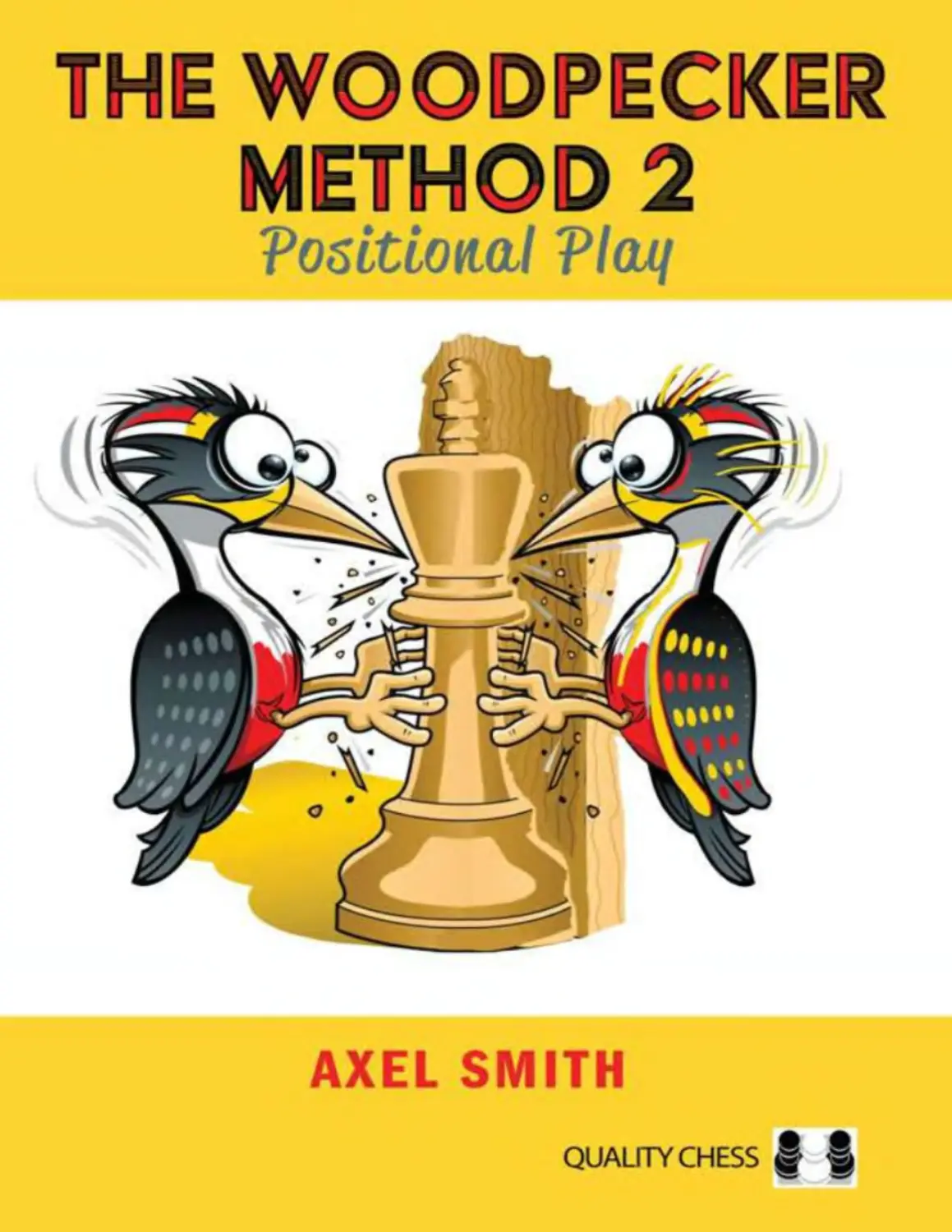
The Woodpecker Method 2
By
Axel Smith
Quality Chess
http://www.qualitychess.co.uk
First English edition 2024 by Quality Chess UK Ltd
Copyright © 2024 Axel Smith
All rights reserved. No part of this publication may be reproduced, stored
in a retrieval system or transmitted in any form or by any means, electronic,
electrostatic, magnetic tape, photocopying, recording or otherwise,
without prior permission of the publisher.
Paperback ISBN 978-1 -78483-123-3
Hardcover ISBN 978-1-78483-124 -0
4
All sales or enquiries should be directed to Quality Chess UK Ltd,
Suite 247, Central Chambers, 11 Bothwell Street,
Glasgow G2 6LY, United Kingdom
Phone +44 141 204 2073
e-mail: info@qualitychess.co.uk
website: www.qualitychess.co .uk
Distributed in North and South America by National Book Network
Distributed in Rest of the World by Quality Chess UK Ltd through
Sunrise Handicrafts, ul. Szarugi 59, 21-002 Marysin, Poland
Typeset by Jacob Aagaard
Proofreading by Jeremy Hart
Edited by Jacob Aagaard & Andrew Greet
Cover design by Kallia Kleisarchaki & Jacob Aagaard
Picture credit: Woodpecker © Jon Larter/Dreamstime.com
Author photo of Axel Smith by Selma Smith
Photos on pages 87, 249, 295 & 373 by Harald Fietz
The remaining photos come from the Dutch National Archives.
Photo on page 25 by Bart Molendijk/Anefo
Photo on page 77 by J.D . Noske/Anefo
Photo on page 123 by Koen Suyk/Anefo
Photos on pages 157, 199, 257 & 359 by Rob Bogaerts/Anefo
Photos on pages 205 & 321 by Rob C. Croes/Anefo
AI artwork by Jacob Aagaard
5
Axel Smith
6
Key to symbols used
2
White is slightly better
3
Black is slightly better
±
White is better
μ
Black is better
+–
White has a decisive advantage
–+
Black has a decisive advantage
=
equality
©
with compensation
„ with counterplay
ƒ
with an initiative
÷
unclear
?
a weak move
?? a blunder
!
a good move
!!
an excellent move
!? a move worth considering
?! a move of doubtful value
TM
only move
#
mate
Bibliography
Botvinnik: Keur van mijn beste partijen, De Tijdstroom 1947
Capablanca: Ultimas Lecciones, Inder 1962
Fischer: My 60 Memorable Games, Batsford 1969
Hildebrand: VM i schack 1960 Thal-Botvinnik, Bokförlaget Universitas Upsala 1960
Karpov: My Best Games, Edition Olms 2007
Kasparov: Barn av min tid, Prisma 1988
Kasparov: My Great Predecessors Parts I-V, Everyman Chess 2003-2006
Kramnik & Damsky: Kramnik – My Life and Games, Everyman Chess 2000
Smith: Pump Up Your Rating, Quality Chess 2013
Smith, Danelius & Erlandsson: Rolf Martens: Chess Genius – Maoist – Rebel, Thinkers Publishing
2023
Smith & Tikkanen: The Woodpecker Method, Quality Chess 2018
7
Smyslov: Wassili Smyslow – Meine 130 schönesten Partien von 1938-1984, Schachverlag Rudi
Schmaus 1988
Ståhlberg & Westberg: Världsmstarschack 1960 Botvinnik-Tal, Raben & Sjögren 1960
Ståhlberg & Westberg: VM i schack 1961 Tal-Botvinnik, Aftonbladet förlag 1961
Ståhlberg: Schack och Schackmästare, Nordstedts 1959
Suetin: Tigran Petrosjan – Die Karriere eines Schachgenies, Verlag Bock & Kūbler 1997
8
Foreword by Hans Tikkanen
Wow! The amount of hours and the dedication that must have been put into this book...
When the prospect of writing a second Woodpecker book arose after the success of the first one, my
initial thought was that it should contain positional rather than tactical exercises. I soon realized that it
was likely to be a harder and more time-consuming project than the first volume.
Despite a part of me really wanting to be involved in The Woodpecker Method 2, I decided for
practical reasons that it was better not to involve myself. I think everyone involved is thankful for that
–
the fact that it took me months just to write this short preface is an indication of how severely
delayed the book might have been!
Having read Axel’s preface and looked through some of the exercises and solutions, I can see that a
tremendous amount of work has been done to provide both the quality and quantity of exercises that
were required. The content of this Woodpecker sequel is fully in keeping with what I envisaged years
ago, when the idea was first discussed.
Just as the original book is a good complement to other types of tactical books – for instance, those
with lots of explanatory text, and/or complex, hard-to-calculate variations – I believe and hope that
this one will be a great companion to other types of books on positional chess. Best of luck to all the
hard-working chess students at the start of this journey – and also to all us
not-so-hard-working chess enjoyers!
Hans Tikkanen
Gullringen, June 2023
9
Preface
I never get tired of examples showing the ability of the human brain to process information
subconsciously. A test on elite volleyball players showed that they needed to see a photo for only 16
milliseconds (i.e . 0.016 of a second) to understand what’s going on. Even without seeing the ball, the
body positions tell them all they need to know. This is not a skill they have deliberately practised –
it’s called experience.
This book is designed to boost the reader’s experience, pattern recognition and subconscious ability
in the realm of positional chess, the way its predecessor did with chess tactics.
What is the Woodpecker method anyway? For those who are not yet familiar, it was developed by my
friend Hans Tikkanen as a self-training method to develop his own tactical ability. Hans solved a vast
number of tactical puzzles (in excess of a thousand), then repeated the same set of puzzles over and
over, getting faster each time and enabling his brain to assimilate the patterns at an unconscious level.
After training with this method in 2010, Hans achieved three GM norms in just a seven-week period.
The Finnish word Tikkanen is roughly translated as “small woodpecker” in English, and the term also
fits perfectly with the repetitive nature of the method. I wrote a bit about the method in my 2013 book
Pump Up Your Rating, and the readers took notice. It was only natural for Hans and I to author The
Woodpecker Method in 2018, in which we assembled and presented a full set of over a thousand
tactical exercises, along with detailed instructions and recommendations for carrying out the training.
I think it’s a great idea to repeat relatively simple exercises over and over again, and Hans’ success
after using his method speaks for itself. Even so, we did not foresee how popular The Woodpecker
Method would become. The readers have been more ambitious than I ever imagined, and several
young players have asked me for coaching while mentioning that they have worked through the book
up to eight times. I have heard about the book in the unlikeliest of places, from being recognized by a
stranger while dumpster-diving for food one night, to being sent a photo of a reader posing with the
book at the summit of Kilimanjaro.
A while ago I started learning Swahili in preparation for a trip to Kenya. I tried to do it the
Woodpecker way, avoiding text books in favour of translating sentences back and forth – mostly via
Duolingo, where Quality Chess co-founder John Shaw has a streak of more than 1800 days. However,
at some point I had to resign myself to borrowing a grammar book from the library, after
encountering a two-word sentence in Swahili that became twelve words when translated into English.
In Kenya, I visited St Patricks, a high school which has produced more than thirty-five Olympic and
World Champions in athletics. While many students visibly did sports, the school also had a thriving
chess club. Even though Swahili is never used in chess, meeting the players taught me Swahili in a
way that Duolingo, grammar books and university courses could not do. I do not have a ‘Grand
10
Theory of Learning’ that I can pass on to you, other than the general guideline that while passive
learning (for instance by reading) can help to fill some gaps in one’s knowledge, learning by doing
tends to yield the best results. This book contains 1000 positional exercises to turbo-charge your
active learning.
After the success of our Woodpecker tactical workbook, it was natural to think about using the same
method to improve one’s positional chess. The Woodpecker Method 2 was born, and I began the
process of assembling and annotating suitable exercises in February 2019. I discovered that it was
much more difficult to write a positional Woodpecker book than a tactical one. The general idea of
the method is to keep the exercises and solutions fairly short and simple, in order to work through a
high volume of examples – too much intervention from the author and the momentum is lost. This
isn’t too difficult with short tactical puzzles, as one can quickly see if the solution leads to mate, gain
of material or some other obvious benefit. Positional exercises are not so straightforward, as the
reader may require a more detailed explanation and possibly more thinking time to understand and
accept the solution. As the project progressed and feedback was received from numerous test solvers,
the exercises and solutions gradually evolved until, nearly five years after work on this project began,
I was satisfied with all 1000 exercises and solutions.
I would like to thank Kaan Küçüksari, Alexander Nord and August Jalving, as well as Lunds ASK for
the use of their library.
Thanks also to the test solvers, who included Renier Castellanos, Christopher Yoo, Sam Shankland
and Nodirbek Abdusattorov. By the way, Nodirbek worked through most of the 1000 exercises (as
well as many others which were subsequently cut) and has since rocketed to 4th in the live rankings at
the time of writing.
I am also grateful for valuable help from Ellinor Frisk, and invaluable help from Jacob Aagaard.
Axel Smith
Lund, March 2024
11
12
Introduction
Before we get started, I will present a general overview of this book. As explained earlier, the
Woodpecker concept involves solving a high volume of exercises, then repeating the process multiple
times. This book contains a total of 1000 exercises, divided into two main categories, each containing
three sub-sections. As with The Woodpecker Method, the exercises come from games involving
World Champions – with a few exceptions, as will be explained.
Part 1 – Priyome
Priyome is a Russian noun without a direct English translation. In Russian, when it is used in a chess
context, it describes some sort of thematic technique or manoeuvre. In this section of 545 exercises,
the overarching theme will be common pawn structures and the positional motifs associated with
them.
In my previous books, I have mentioned how great it would be to have a book exploring the details of
every pawn structure. I had a rough draft almost a decade ago, and wanted to work on it with Ulf
Andersson, who is hand-in-glove for the task. However, he was impossible to convince. Having
abandoned the idea, I felt a certain sense of relief. Chess is too complex, and Ulf’s knowledge cannot
be transferred into a book with clear guidelines.
Let’s approach pawn structures the Woodpecker way. The Priyome exercises show standard
positional moves in a variety of common pawn structures. Don’t expect to find any move with two
exclamation marks. Such moves need to be not only strong, but also difficult and surprising. That’s
not what we are looking for.
The Priyome section also contains some simple tactical combinations that should be part of your
positional repertoire. Many such moves should simply seem normal, not deserving of an exclamation
mark. They nevertheless need to be ‘woodpecked’.
Public Education
You may have seen video clips where Magnus Carlsen is shown positions from games of World
Champions. He recognizes all of them: the players, the tournament and the continuation. Such skills
are easy to admire but hard to achieve. Fortunately our aim is not to remember the exact positions, the
players or the year the games were played. Typical ideas are enough, and we have the luxury to
‘woodpeck’. Let’s aim to include the ideas from the first 296 positions in your public chess education.
13
Exam
The second Priyome section is a smaller one, featuring certain ideas and pawn structures which I
regard as important but which I couldn’t find in the games of the World Champions. Some of the 43
test positions occurred in games involving other players, while in a few cases when I couldn’t find a
suitable example of a certain motif, I composed a realistic-looking position myself to demonstrate the
key idea. Most of these positions take place during or shortly after the opening phase.
Academic Level
The last Priyome section consists of 206 exercises, still involving standard ideas in thematic pawn
structures, but at a slightly higher level than before. You can expect to find more subtle ideas in the
solutions, and a bit of calculation may be needed to justify the standard moves.
Part 2 – Positional Rules of Thumb
In this section we will be focusing on positional ‘rules of thumb’ rather than ideas associated with
pawn structures. Well, it’s hardly possible to keep these elements completely separate, so in the first
section you can expect to find certain positional principles in action which could also be applied in
other pawn structures, while in the second section you will find examples where the pawn structure is
still of some relevance to the principle on display. So the difference between the two sections lies in
the overall emphasis of each, rather than an absolute distinction.
When I first started playing chess, I was taught twenty positional rules, such as “place rooks on open
files”, “don’t move pawns in front of your king” and so on. The list later expanded to sixty-four
positional principles which started to build upon, combine and sometimes contradict some of the
previous rules. For instance, “when your opponent has the advantage of the bishop pair, it will often
have cost some time, in which case the side with the knight(s) should open the position as fast as
possible” – contrary to the more general principle about bishops preferring open positions and knights
being better suited to closed positions.
Let there be twenty, or sixty-four, or 400, or 5,362 rules. They are useful guidelines – not an exact
science.
Medium Difficulty
Part 2 starts with this section of 194 exercises. By the way, the exercises in each section are arranged
in chronological order, so they generally start with games involving Steinitz and end with those of
Carlsen or another of the champions from the modern era. Apologies to Ding Liren, who became
World Champion too late for his games to be included. By the time he achieved the highest title in
April 2023, I had already finished selecting exercises and was into the phase of refining the solutions.
Hard Challenge
The difficulty level increases in the next 241 exercises. Of course the difficulty level is just an
14
approximate guide – I would expect most players to solve at least a few of the “harder” exercises with
relative ease, and to struggle with some “easier” exercises.
Expert
Finally we will meet 20 exercises which I’m sure most readers will find more challenging.
We will end with an Epilogue, featuring some further discussion of positional concepts and decision-
making. It’s a little unorthodox to include such a discussion at the end rather than the start of the
book, but it’s the Woodpecker way. You will work hard in solving so many exercises for multiple
cycles. The Epilogue will give you a break from solving, along with some final food for thought
regarding the challenges of making complex decisions at the board, especially when we need to
weigh up competing positional principles.
Selection Process for Exercises
A database containing all the games of the World Champions consists of more than 50,000 games.
Since it would not have been a practical use of time to play through all of them, I searched for
different openings and manoeuvres and chose positions where the intended solution is objectively the
best continuation.
From time to time, solutions can be disputed. An example of a grey area could be when a World
Champion chooses a move connected with a manoeuvre or other positional idea of clear instructive
value – but the latest Stockfish narrowly prefers a different option, or assesses multiple moves with
its favourite 0.00 evaluation. I received valuable feedback from the various test solvers named in the
preface, as well as from Jacob Aagaard who checked every exercise and solution. After taking
everyone’s comments and feedback into account, I took the final decision on discarding and replacing
certain exercises, while keeping some others with some debatable aspect to them.
In the great majority of these 1000 exercises, the side to move stands better and the solution is the
strongest continuation, confirmed by the engine. However, there are three types of exercises that you
might not be used to:
1) Positions with multiple winning continuations
It’s not always easy to convert a winning advantage. Thus, when a certain continuation wins more
convincingly than the others and also contains a wider instructive point, I consider it a worthy
exercise.
2) Positions where you stand worse
We all reach bad positions sometimes, and we still need to search for good moves. In a few exercises,
the solution is the best way to limit the disadvantage while also demonstrating an important positional
motif, which makes it a valid exercise according to my way of thinking.
15
3) Positions where the engines evaluate several moves equally
Generally in these situations there is still a correct positional plan, but it might be possible to delay it
for a move or two. In such cases, it is generally better to play the key idea and then make the more
peripheral decisions based on the opponent’s reaction. Also, let’s remember that the engine
evaluation is based on what it sees as optimal play on both sides, which does not reflect the practical
reality of human chess. To take an abstract example, you might set up an endgame with rook and
bishop versus rook, which the tablebase will instantly prove to be a draw; and if the stronger side then
allows its rook to be captured, the position is still a draw – so does that mean it wasn’t a mistake to
throw away the rook?
In each of the above three scenarios, I considered the arguments against the exercise in question and
ultimately used my best judgement. I discarded and replaced several, but kept some others. When you
encounter such exercises and check the solution, you might not agree that it was a good exercise to
include. Such cases are a small minority in a pool of 1000 exercises, so just move on to the next one.
Other Background Information
As with The Woodpecker Method, I selected almost all the exercises from games involving World
Champions, except for the 43 exercises in the Priyome Exam. For the avoidance of any confusion,
when I refer to World Champions I mean players who held the highest title at some point in their
careers – not necessarily when the games were played. I tried to avoid the absolute most famous
games, though of course it’s likely that you will have seen some of the examples before. If you
recognize some positions and already know the continuation then no problem – you have many more
exercises to work through, and our training method relies on reinforcement through repetition
anyway.
In the majority of the exercises, the World Champion executes the key positional idea in a classical
game against a strong opponent. Kasparov scored 83% from the 132 relevant positions in this book,
and half of the points he dropped came in games against other World Champions. However, there are
also some positions where the solution was overlooked by a champion. We will also see a small
number of exercises where the solution was played, or could have been played, against a World
Champion. Chess history is not written by games from simultaneous exhibitions, but I did not shy
away from using such games when they contained sufficiently instructive ideas. I also selected a few
examples from games involving faster time controls and even blindfold events.
Don’t expect to find any endgame positions. When the game enters its final phase, typical
middlegame principles are often superseded by new and contradictory priorities. Perhaps a theme for
a future book?
Evaluation Symbols
16
Chess Informant-style symbols are forbidden in the chess magazine where I am editor. I consider
them a lazy shortcut compared to using words to explain what’s happening. Quality Chess has also
moved away from using evaluation symbols in some of their publications. However, in this book the
evaluation tools are included as a useful complement to the text. If the solution says, for instance, that
weak squares are more important than a pawn which has been sacrificed, it is useful to know if that
means the position is clearly better or only slightly better. In my magazine or a normal chess book, all
this could be expressed in words. However, I have already spoken in the Preface about the challenges
of keeping the solutions from getting too lengthy, so the space-saving benefits of symbols are the
most important consideration.
***
We are almost ready to begin your positional Woodpecker training! The next few pages will provide
everything you need to know about organizing your solving sessions and generally getting the most
out of the process.
17
General Instructions
The next four mini-chapters will cover the following topics:
• A five-step program for carrying out your Woodpecker training
• Possible ways to customize the training to fit your playing strength, lifestyle and competing
commitments
• Whether or not to keep score, and how to do so
• Miscellaneous advice and guidelines
Some of the advice has been reproduced from The Woodpecker Method, with minor edits for this
book.
***
The concept of the Woodpecker Method is to solve a high volume of exercises, then start all over
again and do them faster. In the following pages, I will recap the main solving instructions as
presented in The Woodpecker Method, with some minor adaptations for the positional exercises
presented here. Even if you have already completed your Woodpecker tactical training, I recommend
reading the instructions presented here before getting started.
First, a couple of important definitions:
A set: The exercises which you will solve before you start all over again.
A cycle: One round of solving the set. Normally you will perform up to seven cycles with the same
set.
General Advice Before Getting Started
Positional exercises are very much about finding the correct plan but, as in a real game, you are
always required to choose a move.
Positional evaluations and small tactics can’t be completely separated. So even though positional
moves are the focus, you need to calculate as well. A few standard combinations are also included.
The first time you solve the exercises, you will definitely want to check the solutions. Solutions to
positional exercises generally take more time to understand than tactical ones. On the second cycle,
with the benefit of memory, it may be enough to check only the first move of the solution to know if
18
you have solved it. In later cycles, you might remember some solutions clearly enough that you don’t
need to refer to them at all.
Should a Real Board and Pieces be used?
Whether or not one should solve using a real board is a contentious issue among trainers. Some,
especially more old-school trainers, might argue that you always should. Artur Yusupov is one
example of a renowned trainer who emphasizes the importance of using a board and pieces in his
multi-volume training series (also published by Quality Chess). Others don’t see it as being so
important. You obviously have to choose for yourself, but I can give you my two cents: neither I nor
Hans used a board and pieces for our Woodpecker tactical training. There is most likely a
generational divide: players of a certain age, who developed their chess skills before the computer
era, are more likely to value a board and pieces; whereas those who have spent a significant portion of
their formative years studying chess using computers tend not to be put off by the two-dimensional
aspect of solving from diagrams in a book (or on a screen, for those who purchased this work on a
digital platform).
Obviously you should do what feels right for you. A possible compromise is to take an initial glance
at each exercise directly in the book. If you solve it within a few seconds, then move on to the next
exercise. On those occasions when you have yet to find the solution within roughly one minute (or
whatever timeframe you find most appropriate), set the position up on a board if it helps you to think
more clearly. One optional way to get some extra training out of this process is to set the position up
from memory as far as possible – but don’t forget the main purpose of your training.
My general thinking is that with the huge amount of positions which we study nowadays from
diagrams with computer databases, internet play and so on, solving from the book should mostly use
the same neural configurations and thus be similar enough and good enough for these short exercises.
True, classical tournament play still involves a physical board and pieces, so an argument could be
made for replicating that in training. You may also wish to take into account the extra time invested
in setting up the pieces, which adds up to quite a lot when you are dealing with anything up to a
thousand exercises. From my point of view, this time could be better spent by solving more exercises
(or with loved ones). If I were solving harder exercises requiring ten or more minutes of effort, I
would probably use a board, but that’s the kind of training used to develop deeper calculation rather
than pattern recognition.
There is one absolute advantage that I see in using a board and pieces (apart from the
aesthetic/hedonistic one): that is, the possibility of playing the moves out in order to see the final
pattern take shape on the board, while possibly developing some muscle memory at the same time.
For some players, the process of playing out the solution might negatively impact on their overall
speed and ability to focus on the main task, while others might find it helpful having a micro-break
for setting up the pieces before moving on to the next exercise.
19
Ultimately, my advice is to think about the pros and cons of each approach; experiment with a mixed
approach if you need to; and ultimately do what works best for you.
20
The Five Steps of Woodpecking
Step 1
Cycle 1: Solve as many exercises as you can manage in four weeks. These exercises are your set; and
solving them brings you to the end of your first cycle. The four-week time period can be adjusted
according to your lifestyle and circumstances, but try not to spend much more than four weeks. If you
find yourself taking significantly longer than four weeks, you have probably either not been putting in
sufficient time, or have included too many exercises in your set.
Step 2
Take a break from chess for at least a clear day, and up to a week if you need it.
Step 3
Cycle 2: Solve the same set of exercises but faster: within two weeks is the target.
Step 4
Repeat steps 2 and 3, and repeat again. Aim to complete each cycle in half the number of days as the
previous cycle (rounded up, when dealing with an odd number of days).
Step 5
The Woodpecker Method has been completed when the full set of exercises has been solved entirely
in one day – or after the 7th cycle, if you are unable to solve the full set in a day. In the final two
cycles, you should focus more on spotting ideas, patterns and motifs at speed, and less on the finer
details of calculation.
21
22
Customizing the Woodpecker Method
The five-step plan is straightforward enough, but a crucial variable is missing: how much time should
you spend solving during the initial four weeks? Since the answer will depend on your level of
ambition and life situation, it has to be your decision. Before you begin, we recommend that you set a
target timetable with upper and lower limits. Between five and ten hours per week would seem
realistic for an amateur player with work and/or family commitments. By setting a loose schedule,
you ensure a certain amount of personal accountability for your training, while also having some
leeway for unforeseen events. Life may have a tendency to get in the way; but if chess improvement
is really important to you, we urge you to set an ambitious schedule and follow it ruthlessly (barring
any life-changing events of course).
As an optional extra to setting a target number of hours per week, some players may find extra
motivation by choosing the number of exercises beforehand. The appropriate number will depend on
one’s playing strength, ambition and time available. A club player with work/family commitments
might aim for a set of 296 positional exercises at the minimum, possibly increasing to 339 or 545 –
corresponding to the first one, two or three Priyome sections. Ultra-ambitious players with significant
time and energy to devote to training may go for anything up to the full set of 1000.
Remember to take into account the gradually increasing difficulty level, and be ready to adjust your
target as you go along. For instance, if you set a target of 739 exercises (corresponding to the full
Priyome section plus one additional chapter from the next section), but barely solved half that number
after four weeks, you probably set the initial target too high.
23
24
Keeping Score
After each session, note the time taken and the number of exercises. Counting the number of points
you have scored is optional. I consider the score to be of secondary importance, and keeping count of
it takes up some of your time and focus. Hans and I trusted our conscience when doing our tactical
Woodpecker training: if we overlooked too many moves, we slowed down for the next session (or
during the current one).
On the other hand, keeping a record of your accuracy also brings certain benefits. It may serve as a
motivator when you know you will be competing with yourself and striving to score more points than
in your previous cycle(s). It also provides feedback as to whether you are seeing enough. This is
especially important from the second cycle onward, to avoid being satisfied with only remembering
the first move of the solution. (This last point was more relevant to the first Woodpecker book on
tactics – but some solutions to these positional puzzles also rely on tactical details; and even for those
that don’t, it’s still important to look deeper than the first move.)
Downloadable Scoresheet
A scoresheet template is available to download in both Excel and PDF formats at:
https://qualitychess.co.uk/woodpecker2scoresheet.xls
https://qualitychess.co.uk/woodpecker2scoresheet.pdf
After each solving session, you can log your time along with number of exercises and points scored
(should you wish to keep track of your score). If you use the spreadsheet, it will automatically
calculate the total time and percentage score for each cycle, so you can track your improvements from
one cycle to the next. For those who prefer to print a physical copy using the PDF link, it should be
simple enough to calculate those things yourself.
An Important Change
In The Woodpecker Method, Hans and I went to a lot of trouble to insert ‘ü’ signs next to key moves in
the solutions, showing the important details that needed to be seen for maximum points to be
awarded. For positional exercises, it doesn’t make as much sense to do this, as the solutions generally
don’t rely on tactical details two or three moves down a forcing line.
Let’s keep things simple: for each exercise in this book, award yourself one point per correct solution.
If you found the main idea but missed an important supporting detail, award yourself half a point – or
adapt the scoring in some other way that makes sense to you. The exact scoring details are less
25
important than tracking your scoring improvements across cycles. That is, if you opt to keep score at
all.
26
Other Advice & Guidelines
Solve the exercises in order. If you are stuck and unable to find a solution, then choose a move
anyway, as you would have to do the same in a game.
In The Woodpecker Method we recommended trying to limit the amount of time you spent writing
down and checking solutions. Things are a bit different for this book, as positional decisions are
likely to require a bit more thought and consideration to understand the point behind them, compared
to “bang-bang!” tactics. So take as much time as you need to understand the solutions – especially
during your first one or two cycles of solving. Invest some time and effort early, and you will find it
easier to speed up in later cycles.
Motivation
To push yourself, there are at least two types of goals you can set yourself in every training session.
Pace: In each solving session during your first cycle, aim to solve at least as many exercises as in
your previous session (assuming the exercises are of the same difficulty level) in the same amount of
time.
Score: If you decide to keep track of your scoring, then aim to increase your percentage as you go
along while maintaining your pace.
Beyond the First Cycle
Once you have finished the full set and enjoyed/endured your break, it’s time to start again. Your
main goal for the second cycle is to solve more quickly, ideally halving the overall time. With the
third cycle, aim to halve your time again, and so on. With every additional cycle, your increased
recognition should compensate for the decreasing deadlines.
Although speed is key, do not satisfy yourself with spotting only the first move of the solution. Even
if you are sure it’s the right move, be sure to consider the follow-up. And remember, even when
making positional decisions, tactics are never far away!
Reaching the End
The Woodpecker Method has been completed when the full set of exercises has been solved in a
single day (or after seven cycles, if one day proves unattainable). Time to celebrate! But where should
27
you go from here? First and foremost, the ideal next step will be able to play some tournaments and
put your improved positional ability to use. As far as subsequent training is concerned, this will
depend on your playing strength and goals. Woodpecker training is hard, so you will probably want to
take a break from it for a while, and perhaps train some other aspect of your game. When you are
ready though, you may wish to consider one of the following approaches.
If your first bout of Woodpecker training comprised a set of, say, the first 296 exercises from this
book, the way to build upon your progress is obvious: after taking a suitable break, begin a new four-
week cycle starting with exercises from the next chapter. The difficulty level will creep up as you
progress through the book, but you should be well and truly ready for it by now.
Readers who began their Woodpecker positional training with a high level of playing strength and
ambition may have been able to take on a larger set, perhaps even extending to the full 1000
exercises. If you were able to complete a set like this within a day (or over seven cycles) then your
positional ability should have taken a significant leap. Strong players searching for an extreme
challenge might even attempt, on their final cycle, to solve all 1000 exercises not within a single day
but within a single session for the ultimate Woodpecking challenge!
Summary of Instructions
Step 1) Cycle 1: Solve a set of exercises over approximately four weeks
Step 2) Take at least the next day off
Step 3) Cycle 2: Solve the same set, but within two weeks
Step 4) Repeat steps 2-3, completing each cycle in half the number of days (rounded up where
necessary)
Step 5) The method is complete when the set has been solved in one day (or after seven cycles)
Now there’s no more text to delay the exercises. Have fun and may the unconscious be with you!
(At least after a while...)
28
Few things are as psychologically brutal as chess. – Garry Kasparov
29
To be champion requires more than simply being a strong player;
one has to be a strong human being as well. – Anatoly Karpov
Show in Text Mode
1. Steinitz – Robey, London 1862
Show/Hide Solution
16.g4!± Launching an attack. 16.0-0 was played in the game, but White should be happy that the king
is still on e1. A plausible continuation: 16...Nd7 17.h4 c6 Stopping Nd5. 18.g5 f6 White continues
with g5-g6 or Ng4, Ra2-g2 and h4-h5.
2. Steinitz – Blackburne, London (1) 1862
30
Show/Hide Solution
10.f5! Increasing the scope of the f1-rook, e3-bishop and e2-knight; and after the next move, also the
remaining pieces on d3, c3 and a1. It can hardly be better! If White does not push immediately, Black
can play 10...d5 and it will be too late. 10...exf5 Otherwise Black would get a weak e-pawn after fxe6.
11.exf5± White continues with Bg5 or Bh6, playing on the kingside.
3. Steinitz – MacDonnell, Dublin 1865
Show/Hide Solution
14.f5! Steinitz played 14.Nd2 which allows 14...exf4 15.gxf4 g6, when the open centre (rook against
31
queen!) gives Black some counterplay. 14...Nc5 Since the centre is closed, White obtains a dangerous
attack by advancing the g-pawn. In the event of 14...Nf8 15.g4 h6 a possibility that might be worth
remembering is: 16.h4 (The simple 16.Nd2± is also good.) 16...N6h7 A standard defence. 17.g5 hxg5
18.Kh1!ƒ With Rg1 coming next.
4. Steinitz – Sellman, Baltimore 1885
Show/Hide Solution
12.cxd3! This improves White’s structure since:
a) It controls the c4- and e4-squares (the main point) b) White can use the open c-file
c) Black can’t use his queenside pawns to open files (not relevant in this game)
d) The pawn can advance to d4 e) It closes the a6-f1-diagonal. “It may seem strange to attach an
exclamation mark to a move which today would be automatically made by any candidate master,”
wrote Kasparov in the book series on his predecessors. “But then, in 1885, the consequences of the
pawn capture were by no means obvious, and the majority of players were simply unable to think
long-term.” According to Kasparov, Black had to play 12...b4 followed by ...a6-a5 and ...Ba6. 12...a5
has the same idea. 12...d4 opens the long diagonal for the light-squared bishop, but also gives up the
e4-square. 13.Nf22
5. Zukertort – Steinitz, USA (13) 1886
32
Show/Hide Solution
17.d5! A standard isolated queen’s pawn position. Pushing and exchanging the pawn is usually
favourable, as White’s pieces are more actively placed. Zukertort missed this opportunity by playing
17.Red1?, which takes us to the next exercise. 17...exd5 18.Nxd5 Nxd5 19.Bxd5 Bf6 20.Rad1 Rf8
21.Be4 All White’s pieces are on excellent squares and Black has no good defence. For instance,
21...Rad8 22.Qc2 with a double threat – or triple if you count Rd6.
6. Zukertort – Steinitz, USA (13) 1886
Show/Hide Solution
33
17...Na5! Chasing back the bishop to increase Black’s control over the important d5-square. 17...b4
is met by 18.Ne4= and if ...Nd5, White can trade on d5. 18.Bc2 b4 19.Ne4 Nd5μ The isolated pawn
is blocked for the foreseeable future.
7. Lasker – Bauer, Amsterdam 1889
Show/Hide Solution
14.Nh5! Exchanging the key defender. 14.f5 g6!2 defends quite well. 14...Nxh5 14...Ne8 15.Bxg7!
Nxg7 16.Qg4 wins. 14...Rfc8! was the best defensive try, when White can win the h7-pawn but the
black king escapes to the centre and the game continues. 15.Bxh7†! 15.Qxh5 f5= 15...Kxh7
16.Qxh5† Kg8 17.Bxg7!! Kxg7 18.Qg4† Kh7 19.Rf3 Black has to give up too much material to
avoid mate. 19...e5 20.Rh3† Qh6 21.Rxh6† Kxh6 22.Qd7! White could have won more slowly, but
the double threat ends the game in short order. Why are we seeing a tactical combination in a book of
positional exercises? Because classic combinations such as this one should be part of one’s
foundational knowledge, which can guide us towards correct positional decisions – in this case,
exchanging the defensive knight.
8. Lasker – Steinitz, St. Petersburg 1895
34
Show/Hide Solution
21...f4! Closing the centre and gaining space. Black prepares to push the g-pawn and launch an
attack, using as many pieces as possible on the kingside. After the game continuation 21...fxe4?
White gets a nice square on e4. 21...Nf6 22.exf5 gxf5 opens things up for White’s pieces. There is
even 23.Nxe5!? dxe5 24.Rxe5 with compensation, as Black is cramped. 22.Nf1 b6 23.N1d2 After
23.b4 a5 24.a3 g5 25.c5 h5μ White’s pieces are not well placed to attack on the queenside. 23...g5
24.Kf1!÷ White should run from the kill zone.
9. Steinitz – Lasker, St. Petersburg 1895
35
Show/Hide Solution
10...d4 Following the school book by exchanging the isolated pawn to release the active pieces
behind it. 11.exd4 Re8†!3 An irritating intermediate move, forcing White to retreat. There is no need
to calculate further. Lasker played 11...Nxd4 with a balanced position
10. Steinitz – Lasker, Moscow (3) 1896
Show/Hide Solution
9...d5!3 White should not be allowed to gain space with d4-d5. 9. ..0-0? 10.d52 10.Ba3? White should
play something else, but in that case Black simply castles with a good game. The only downside to
Black’s last move would be if White could catch the king in the centre, so this is the only critical
move to check. 10...dxc4 11.Re1 Black has several decent moves, so you didn’t need to decide
between them before choosing 9...d5. Best is: 11...Qd5 12.Nd2 Be6 Followed by long castling.
William Steinitz“
A sacrifice is best refuted by accepting it.”
11. Lasker – Maroczy, London 1899
36
Show/Hide Solution
18...Ne5! Opening the diagonal for the bishop on b7, and also in some way preparing ...Be5 which
neutralizes White’s bishop on b2. In many similar positions with the c- and d-pawns exchanged, both
players try to be first with ...Ne5 or Ne4, to exploit their respective diagonals. 19.Nxe5 Instead
Lasker accepted doubled pawns on f3, a long-term concession. 19...Bxe5 20.Qc2 Black has slightly
more active pieces, but it’s not enough to claim a real advantage.
12. Blackburne – Lasker, London 1899
Show/Hide Solution
37
18...b53 A standard minority attack, to eventually create a weak white pawn on the queenside – and
in the meantime, solidifying the c4-outpost for a knight. 18...f5 is also a good move, gaining space
and controlling the light squares. The game continuation is more straightforward though.
13. Lasker – Mackay, Great Britain (Simul) 1908
Show/Hide Solution
13...Rxc3! For the exchange, Black destroys White’s structure and picks up a valuable central pawn.
14.bxc3 14.gxf6 Rxe3 15.fxg7 Kxg7–+ 14...Nxe4–+ Lasker went on to lose this simul game.
14. Lasker – Cohn, St. Petersburg 1909
38
Show/Hide Solution
14. Emanuel Lasker – Erich Cohn, St. Petersburg 1909
20.Na4!+– Taking control over the dark squares, where Black is helpless due to the immobile
doubled c-pawns. Other moves are also good (winning), but that’s no reason not to choose the most
logical and convincing path.
Emanuel Lasker
“To refer to the oft-mooted question, ‘Which piece is stronger, the bishop or the knight?’ it is clear
that the value of the bishop undergoes greater changes than that of the knight.”
15. Alekhine – Cohn, Karlovy Vary 1911
Show/Hide Solution
10.a4!2 Black is forced to move the a-pawn and recapture with ...cxb6, weakening his structure and
giving up the d5-square.
16. Znosko-Borovsky – Alekhine, St. Petersburg 1913
39
Show/Hide Solution
12.g4! With a closed centre, White can afford to advance on the wing. 12...Bg6 13.h4 f6 13...h5
14.Ng5! hxg4 15.h5 Bh7 16.h6 g6 and it’s temping to use another diagram to embarrass the bishop
on h7. 14.h5 Bf7 White failed to find the best continuation: 15.g5! Before Black has a chance to stop
it with ...h7-h6. The attack is winning.
17. Ed. Lasker – Alekhine, Scheveningen 1913
Show/Hide Solution
14...a5!3 Stopping b3-b4.
40
The game went: 14...f5 15.b4=
18. Mieses – Alekhine, Mannheim 1914
Show/Hide Solution
6...Na5! Picking up the bishop – the most ambitious and best move. Note that 7.b4? Bxd5! wins a
pawn or destroys White’s structure.
19. Alekhine – Teichmann, Berlin 1921
Show/Hide Solution
7.Na4!2 Hunting down the bishop and thus preparing to castle.
41
20. Alekhine – Rubinstein, The Hague 1921
Show/Hide Solution
9.h4! A standard move against the knight on g6. 9...Bd6 After 9...h5 White clearly has more use for
the g5-square than Black has for the g4-square. 9.. .h6 is the best defence. 10.h5 Nge7 11.h6 g6
12.Bg5 0-0 13.Bf6 Black was not mated on g7, but surviving on the dark squares meant giving up an
exchange and eventually losing the game.
21. Alekhine – Tarrasch, Hastings 1922
42
Show/Hide Solution
13...c5 First things first: Black gets rid of the backward pawn and opens the diagonal for the b7-
bishop. 13...Re8 was played in the game. 14.dxc5 14.d5 exd5 15.exd5 Nb6–+ picks up the loose
pawn. (The pin along the d-file yields nothing for White.) 14...Qc7μ The knight is misplaced on a2,
and the e4-pawn is vulnerable.
22. Bogoljubow – Capablanca, New York 1924
Show/Hide Solution
12...Nb4! Threatening to exchange White’s strong bishop. Capablanca’s 12...Bd7 should have been
met by: 13.c3!2 13.Be2 Ne4! 14.Re1 Nc3 14...b6= is a way to avoid an early draw. 15.Qd2 Ne4!=
Leading to a repetition. 15. ..Nxe2†?! 16.Rxe2 exchanges the bishop, but Black will then miss the
knight that defended the kingside. White continues with c2-c3 and Nxc6 to play with knight against
bishop.
Jose Raul Capablanca
“Chess is something more than a game. It is an intellectual diversion which has certain artistic
qualities and many scientific elements.”
23. Alekhine – Dusek, Czechoslovakia (Simul) 1925
43
Show/Hide Solution
14.f5!± White gets the e4-square and an initiative on the kingside. 14.Bxd5?! was played. After
14...Qxd5 15.Nc3 Black can go for 15...exf4!? 16.Bxf4 Qd7 17.Bxc7 f5© with decent play for the
pawn. 14...Nf6 15.Nc3 Kh8 16.Bg5 White is close to winning.
24. Spielmann – Euwe, Wiesbaden 1925
Show/Hide Solution
14...f4!3 Turning the e2-knight and c1-bishop into bad pieces is much more important than giving
away the e4-square. Black will later get coordinated with ...c6-c5 and ...Nc6. 14. ..0-0? allowed:
44
15.f4= 15.Ne4 15.Nf5 0-0 16.Nxe7† Qxe7 17.f3 c5μ 15...0-0 16.f3 c5μ
25. Alekhine – Grünfeld, Semmering 1926
Show/Hide Solution
6.g4! Bg6 7.h4 f6 White can exchange on g6 and attack on the light squares, but it’s more exact to
start with Alekhine’s 8.Qa4†! as Black cannot respond with ...Nc6, ...Qd7 or ...Kf7. 8.h5 is also
good. 8...c6 9.Nxg6 hxg6 10.Qxc4+– White is positionally winning.
Alexander Alekhine
“Playing on both sides of the board is my favourite strategy.”
26. Kmoch – Alekhine, Semmering 1926
45
Show/Hide Solution
13...c4!= Black gains space and will follow up by pushing the a- and b-pawns. This method of
releasing the tension normally comes with the drawback of giving White a free hand to play in the
centre with e3-e4, but that is not on the agenda here.
27. Alekhine – Nimzowitsch, New York 1927
Show/Hide Solution
8.f3! A nice set-up against the bishops on b7 and b4, both of which fight for the e4-square. 8.e4?! is
risky when White is less than fully developed. Black obtains good counterplay with: 8...c5! 9.d5 exd5
46
10.cxd5 This is the only critical move, but 10...Qe7 leaves Black with an improved Benoni position
because the bishop is well placed on b4.
28. Kmoch – Alekhine, Kecskemet 1927
Show/Hide Solution
22...b5! Winning the d5-square for a heavy piece before White has time to interfere with a2-a4. 23.c5
Opening the c-file only helps Black, as the white rooks are busy defending the d-pawn. Kmoch tried
23.Qf3–+ but he lost a pawn and eventually the game. 23...g5μ Having obtained a dominant position,
Black can set about creating a second weakness.
29. Bogoljubow – Alekhine, Germany/Netherlands (8) 1929
47
Show/Hide Solution
14...h5! Challenging the knight with extra force, as the e4-pawn is loose. There is no point in starting
with 14...c4; it’s better to retain the option of ...cxd4. 15.Qe2 15.e5 gives Black the d5-square, but
there is also 15...h4!?, leading to a line which is not especially relevant, but which may still be of
interest to those who are curious: 16.exf6 hxg3 17.fxe7 Rxh2 18.Rf3! Kxe7 19.Rxg3 Qxf4 20.Qg4
(20.Kxh2? Rh8†–+) 20...Rxg2† 21.Rxg2 Qe3† 22.Kf1 Qxd3†3 The position is close to equal, but I
slightly prefer Black’s chances with three pawns versus a piece. 15...h4 16.Nh13 The knight can’t
easily return to the game, as White needs to defend the f-pawn.
30. Yates – Alekhine, San Remo 1930
48
Show/Hide Solution
16...f4μ Black gains space and avoids giving White a chance for exf5. Black will follow up by
pushing the g-pawn.
31. Bogoljubow – Alekhine, Germany (11) 1934
Show/Hide Solution
9...Nd8! Black avoids gifting White an open c-file, and prepares to recapture on e6 with the knight.
9...exd5? 10.cxd5± 10.Nb5 is met by 10...Qd7 or even 10...Nxd5!?.
32. Alekhine – Nimzowitsch, Zurich 1934
49
Show/Hide Solution
13...e5!= The bishop on c8 is no longer a problematic piece, and the potential queen exchange on d2
will suit the player with fewer central pawns.
13...b6 is an attempt to exchange bishops but 14.Qd3!2 is a good reply.
33. Alekhine – Johner, Zurich 1934
Show/Hide Solution
9.Bc2! Avoiding simplifications is best, as Black’s light-squared bishop and queenside knight both
belong on d7. Black needs the bishop to support future counterplay with ...f5, so ideas involving
50
...Bg4 and exchanging on f3 are nothing to be afraid of.
9.Bxd7† Nbxd7=
34. Lasker – Capablanca, Moscow 1935
Show/Hide Solution
19.h4! With a few black pieces stuck on the queenside, White has time to open the h-file and go for
an attack. A test solver opined that 19.Qc1 Rad8 20.b4 is a good alternative. It’s true that White
stands much better here too, but I see no point in delaying the more incisive plan of attacking on the
kingside. 19...Qd8 20.h5 Qg5 Black needs to defend against a sacrifice on g6. 21.hxg6 21.Bxg7?
Kxg7 makes life easier for Black, who now has the option of bringing a rook to h8 in case the h-file
opens up21...hxg6 22.Re3+– White has a decisive attack.
Jose Raul Capablanca
“People who want to improve should take their defeats as lessons, and endeavour to learn what to
avoid in the future. You must also have the courage of your convictions. If you think your move is
good, make it.”
35. Lasker – Bogoljubow, Nottingham 1936
51
Show/Hide Solution
18.h4!ƒ Pinpointing the weakened g6-pawn. 18.e4= was played in the game.
36. Alekhine – Alexander, Nottingham 1936
Show/Hide Solution
13.d5! Undermining the f-pawn. 13...exd5 13...e5 is the move Black would like to play, but 14.Nh4!
wins at least a pawn. 14.cxd5 Ndf6 15.Nh4 Qd7 16.Bh3!+– Black is losing, due to the weakness of
the f5-pawn along with the additional threat of f2-f3.
52
37. Lasker – Alexander, Nottingham 1936
Show/Hide Solution
10.b4 Starting White’s main plan: to soften up the long light-squared diagonal. (Even though the rook
would be better on b1 than c1.)
10.Nxd4? exd4 11.Ne4 f5 12.Ng5 h6 13.Nh3 g53 only helps Black to advance.
38. Euwe – Alekhine, Netherlands (21) 1937
Show/Hide Solution
Nowadays this is known as a common theoretical position which arises with Black to move. 9.d5!
53
Obstructing the b7-bishop and fighting for the e4-square. 9.Be1?! saves the bishop, but is slow.
9...Nxd2 9...exd5 gives White a choice between recapturing on d5 with the knight or the pawn, both
with a clear advantage. 10.Qxd2± White’s central control and nullifying of the b7-bishop are more
important than Black’s bishop pair.
Max Euwe
“Alekhine is a poet who creates a work of art out of something that would hardly inspire another
man to send home a picture post card.”
39. Alekhine – Capablanca, Netherlands 1938
Show/Hide Solution
11...f6! Immediately challenging for the centre. 11.. .Nf8? 12.b4+– was the game. 11...Na5?! 12.h4
Nb3 13.Rb1±; 11...0-0?! 12.Qc2 h6 13.h4‚ 12.Nf4 12.exf6 Nxf63 White needs more than a square on
e5 to compensate for the king on f1. 12...Ndxe5! 12...fxe5?! only leads to unclear complications.
13.Nxe6 (13.dxe5 Ndxe5 14.Nxe5 Nxe5 15.Qh5† Nf7÷) Capturing the e6-pawn tends to be the
critical try in this structure, but Black has many possible continuations, 13...e4 14.Bf4 Kf7÷ being
one example. 13.dxe5 fxe5 14.Nh5?! Safest is giving back the piece: 14.Nxe5 Nxe53 14...0-0
15.Be3 Necessary to defend f2. 15...Qxb2 16.Be2 e4μ Black has three pawns for the piece, plus an
ongoing initiative.
40. Alekhine – Flohr, Netherlands 1938
54
Show/Hide Solution
16.Ng5! Black needed the pawn on h6 to ensure the safety of the bishop on e6. 16.Nd5 opens up for
the bishop on c2, but also for Black’s rook against White’s queen. 16...Bxd5 17.exd5 e4! 18.Bxe4
Bf8 19.Qc2 Nxe4 20.Rxe4 Qd7= Black wins back the pawn. 16...Bd7 The game move 16...c4 is not
challenging; White simply captures the bishop. 16...Bc4?! is unsatisfactory: 17.Qf3 h6 18.b3 hxg5
19.bxc4± Black suffers from a weakened kingside. 17.Nd52
41. Georgadse – Petrosian, Tbilisi 1945
Show/Hide Solution
55
12.f4! The way to increase the pressure. Black doesn’t want to capture on either e4 or f4 since it
would help White’s knights forward. However, the exf5 and especially fxe5 exchanges tend to be
good moves for White. Another important factor is that Black’s knight on a6 is misplaced. In this
Czech Benoni set-up, it would have wanted to chase away White’s bishop with ...Nb8-d7-f6-g8.
Remember this manoeuvre, as there will be no further reminders in this book. I initially wanted to
include an exercise with the knight manoeuvre, but it was eventually discarded since Black’s position
was too bad. By the way, White could have made some other move and followed up with f2-f4, but
the sooner the better. 12...Nc7 12...Bf6 defends e5, but the bishop will be less effective than a knight
on the central square, because it will be vulnerable to knight threats. There are many good
continuations, 13.Rae1 Nc7 14.fxe5 Bxe5 15.Nf4 being one example. 13.exf5 13.Rae1 was the game,
where Black eventually escaped with a draw. 13...gxf5 13...Bxf5 14.fxe5 gives Black an isolated
pawn. White continues with h2-h3 and g3-g4, then puts a knight on e4. 14.g4! This is not forced, but
it’s both strong and instructive. 14...fxg4 15.fxe5 dxe5 16.Rxf8† Bxf8 17.Ng3+– White’s pieces will
smoothly join the attack.
42. Smyslov – Lilienthal, Budapest 1950
Show/Hide Solution
8.Bxc6†! bxc6 9.Qa4 Black does not have an effective way to open lines for the bishop pair.
Smyslov won convincingly, and exchanging on c6 has since been a standard device in such positions.
In the game Black became passive, but strong players nowadays would consider 9...Ne6!?2, offering
the c6-pawn in the hope of gaining some initiative.
43. Szabo – Petrosian, Saltsjobaden 1952
56
Show/Hide Solution
14...Rxc3 15.bxc3 d5 The exchange sacrifice is so standard that you hardly need to consider what to
play next, until the opponent has executed the only move. 16.Nb1 dxe4!3 This improves on the game
continuation of 16...Nxe4 17.Rxd5!, when Black’s best is to take on b1 and remove the queens,
leading to approximate equality. Instead Petrosian took on g5 and stood worse, though he eventually
won.
44. Petrosian – Vaitonis, Saltsjobaden 1952
Show/Hide Solution
57
23.f4! Bolstering the bishop on e5 to keep the e-file closed. 23.Bxf6 Qxf62 23...Bxe5 24.dxe5!±
Keeping the f-pawn to threaten Black’s king.
45. Taimanov – Petrosian, Gagra (Training) 1953
Show/Hide Solution
13...c4! Black should play actively in the Benoni, and Petrosian took the opportunity in this training
game. 14.Bf1 b4 15.Nb1 Nc5! 16.Qxc4 a5! 16...Nfxe4 was Petrosian’s choice, which gave him a
pleasant game but nothing more. If White captures the b4-pawn, Black’s active pieces will offer more
than enough compensation. The text move is even better than the game continuation. Black’s
initiative is developing with the speed of a carbon bike, for instance: 17.Nbd2 Ba6 18.Qc2 Bxf1
19.Kxf1 Rc8 20.Qb1 Qb6–+
46. Geller – Smyslov, Zurich 1953
58
Show/Hide Solution
13...Na5 Threatening the weak c4-pawn. 14.dxc5 There are two other ways to defend the pawn, the
passive 14.Rc1 and 14.d5. However, neither of these will work well, as Black exchanges queens with
either ...Nc7 or ...Nf6 followed by ...Qe8 (or ...Qd7). White would like to attack and leave the weak
pawn to its fate, but after something like 14.f4 cxd4 15.cxd4 Bxc4–+ it becomes clear that the
queen’s placement on a4 is completely incompatible with a kingside attack. 14...dxc5 A move ago
White had a nice-looking pawn centre. Now White’s structure looks ugly, and Black went on to win.
47. Smyslov – Keres, Zurich 1953
59
Show/Hide Solution
14.d5! An obvious move which hardly requires any serious calculations. 14...cxb2 14...e5 15.bxc3+–
was the game. 15.Bxb2 A good alternative is: 15.dxe6!? bxa1=Q? 16.exd7† Kf8 17.Qc4 The only
move, but easily good enough since 17...Qe7 18.d8=Q† leads to a quick mate. The above variation
featured a rare case on move 15 where Black’s best option would have been to underpromote to a
knight without having a check or fork in mind. Even in that case, Black is still losing. 15...Bxb2
16.dxe6! This is strongest, although the straightforward 16.Qxb2 is also clearly better for White.
48. Stahlberg – Petrosian, Zurich 1953
Show/Hide Solution
13...a4! Freezing White’s ambitions on the queenside. (Stahlberg’s last move 13.a3? wasn’t clever.)
49. Smyslov – Botvinnik, Moscow (17) 1954
60
Show/Hide Solution
13...f6! Activating the rook, bishop and knight. 14.Bg4 14.exf6 Qxf6μ 14...fxe5! Not 14...Qe7?!
15.f4 when White consolidates. 15.dxe5 d4μ Black is active.
Mikhail Botvinnik
“When my opponent’s clock is going, I discuss general considerations in an internal dialogue with
myself. When my own clock is going, I analyse concrete variations.”
50. Botvinnik – Smyslov, Moscow (18) 1954
61
Show/Hide Solution
18...h3! The pawn was threatened and 18...hxg3? would have been a losing mistake due to 19.fxg3!
with a deadly pin. 19.Bh1 Qc8!= Stepping out of the pin before it becomes a problem.
62
Public Education Exercises 51-100
In November, there was a USSR Championship in Moscow. Open championship, perhaps the last one
–
I don’t know. On 9th November, I played there and made my draw, and Alexei Shirov from Riga
won brilliantly, came to me and said, “I’m glad that it was today, 9th November (Tal’s birthday), that
I played so good. I dedicate this game to you.” Very moving. – Mikhail Tal
63
Show in Text Mode
51. Vesterinen – Smyslov, Amsterdam (Ol) 1954
Show/Hide Solution
14...b5!3 Black should delay castling to speed up the attack. Smyslov played 14...0-0 -0?! when
Black’s king will be slightly weak for a long time. 14. ..0-0 15.g4 is dangerous for Black. 14...h5
invests a tempo to stop White’s g-pawn before going ...b7-b5. But White can disrupt Black’s plan
with 15.Na4!? Bd8 16.Nc3!, when it’s hard for Black to find a better idea than repeating the position,
since 16...b5? 17.Bxb5± favours White. 15.g4 White should try something else, but Black stands
better anyway. 15...b4 16.Ne2 a5μ Black is clearly ahead in the race.
52. Czerniak – Smyslov, Amsterdam (Ol) 1954
64
Show/Hide Solution
15...Rxc3! 15...e6? was not a move in Dragon style. The game was subsequently drawn after further
mutual errors, but at this point 16.f4 Nc4 17.Bxc4 Rxc4 18.f5+– was a straightforward path to a
decisive advantage for White. 16.bxc3 16.Qxc3 Nxf3„ 16...Qc7 I didn’t want to debate whether or
not Black has enough compensation. The important thing in a game would be to recognize that the
exchange sacrifice is the only option to offer a fighting chance. However, it is worth mentioning
17.Bh6 Bxh6 18.Qxh6 Qb6† 19.Ka1 Qa5 20.Qxh5 Be6 21.Nb3 Qxc3† 22.Kb1 Rc8 23.Rg2 a5© as
one critical line which should eventually lead to a draw.
53. Fairhurst – Smyslov, Hastings 1955
65
Show/Hide Solution
10.Nf5! Before the bishop can retreat to f8. 10...Re8 11.Nxe7†2 The knight looks nice, but after 11.0-
0?! Bf8= it will be kicked back by ...g7-g6. Therefore White should exchange on e7 and aim for a
gradual exploitation of the bishop pair.
54. Furman – Spassky, Moscow 1955
Show/Hide Solution
11...e5! Putting pressure on the d4-pawn before White has played e3-e4 (which would make d4-d5
66
possible). It is possible to start with 11...Rd8, but the rook move is less flexible. The rook may prove
better on e8 to reinforce a possible ...e5-e4.
55. Smyslov – Geller, Moscow 1955
Show/Hide Solution
9...c5! Acting before White has castled. 9...Qg5? runs into 10.Nf3! Qxg2 11.Bxh7†+– when
capturing the bishop will lead to the loss of the black queen. 10.Ne2 10.dxc5 d4!ƒ 10...Nc6 More
ambitious was: 10...c4 11.Bc2 Bg4 12.f3 Bh5 13.Qd2 Bg63 With a third pair of minor pieces soon to
be exchanged, Black’s queenside majority is more important than White’s central majority. 11.dxc5
d4 12.exd4 Nxd4=
56. Smyslov – Ivkov, Zagreb 1955
67
Show/Hide Solution
16.dxe5 dxe5 17.c4! A standard reaction, preparing Nf1-e3-d5 while Black’s knights are far away
from d417...Bc6 Holding back the intended knight manoeuvre, but not forever. The easiest way to
prepare it is: 18.Bb2 Bf8 19.N3d2±
Vasily Smyslov
“The Ruy Lopez occupied a constant place in my opening repertoire. In it is reflected the classical
interpretation of the problem of the centre.”
57. Fuderer – Smyslov, Zagreb 1955
68
Show/Hide Solution
19...Nc6 There’s no time to wait. White threatened to keep the knight sidelined by means of d4-d5.
20.d5 Nd4 21.Qd1 Nxc23
58. Smyslov – Trifunovic, Zagreb 1955
Show/Hide Solution
21.d5! Exchanging the isolated pawn unleashes the full power of White’s bishops and heavy pieces.
You don’t need to calculate further to make this decision, so consider the following variations
69
supportive rather than necessary. 21...exd5 21...Bb4 gives White a choice: 22.dxe6!? (A simple
alternative is 22.Rf1 exd5 23.Rxd5± when Rb5 is a threat, and after 23...a6 24.h4! White harasses the
bishop.) 22...Bxe1 23.Rxe1 fxe6 24.Qb2± Black can’t save the g7-pawn, as 24...Rf7 is met by
25.Bxg7! anyway: 25...Rxg7 26.Rxe6+– 22.Rxd5± But not 22.Bxd5? Bb4 23.Rf1 Rfe8 24.Qb2 Bf8
when White can’t use the nice-looking bishop for anything useful.
59. Karaklajic – Smyslov, Zagreb 1955
Show/Hide Solution
17...c5! Chasing the knight before White’s f-pawn starts to run. 17 ...Bd7 is too slow: 18.f4 c5 19.Nb3
b6 20.f5+– 18.Nf3 After 18.Nb3 b6 19.f4 Bf5= Black is in time to block the pawns. 18...b6!=
60. Spassky – Ravinsky, Leningrad 1957
70
Show/Hide Solution
21.b4! Splitting the hanging-pawns couple and gaining access to the d4-square. 21.Ne3 d4 22.Nc4
Bd5= 21...Nd6 21...c4±; 21...cxb4 22.Nxb4± 22.bxc5 Rxc5 23.Nd42
61. Taimanov – Spassky, Moscow 1957
Show/Hide Solution
5.Bf4 If Black goes for the Stonewall before e2-e3 or g2-g3 has been played, White should take the
chance to develop the bishops more actively. The bishop on f4 is in contact with the weak e5-square.
71
White will follow up with e2-e3, including against ...Bd6, as the exf4 structure is excellent for White.
Notice that the other bishop should avoid g2, where it would be obstructed by the well-defended d5-
pawn. A possible set-up is e2-e3, Qc2, Bd3, 0-0-0 and g2-g4.
62. Smyslov – Botvinnik, Moscow (14) 1957
Show/Hide Solution
18.h6! g6 19.0-0± Black is eternally weak on the dark squares.
63. Tal – Dittmann, Reykjavik 1957
72
Show/Hide Solution
16...f4!= Giving up the e4-square is a small price to keep the kingside closed. 16...Qf7? 17.g4+–
opened up Black’s king in the game. 16...Qg6?! 17.g4 Bh6 also opens Black’s kingside: 18.Bxh6
Qxh6† 19.Kb1 Nf4? 20.g5!+–
64. Petrosian – Taimanov, Leningrad 1959
Show/Hide Solution
Black’s last move was 15...e5, so the question is whether or not to capture en passant. 16.f5!
73
Preventing Black from exchanging on f4, which would open the g7-bishop’s diagonal and take
control over the e5-square. According to Stockfish, 16.dxe6 Nxe6 17.Bh4 is almost equally good, but
to me it feels strange to give Black access to the d4-square. 16...f6 17.Be3 b4 The game continued:
17...g5 18.cxb5 axb5 19.Nxb5 Nxb5 20.Qxb5 Rxa2 21.Ra1+– 18.Na4 g5± White will gradually
prepare to open a kingside file. Having more space means that it’s easier to manoeuvre the pieces
towards the kingside.
65. Donner – Tal, Zurich 1959
Show/Hide Solution
10...Bg4! Black has two minor pieces that can be developed to d7, so it’s wise to get rid of one of
them. 11.h3 Bxf3 12.Qxf3 Nbd7 Threatening another piece exchange in Black’s favour. 13.Bf4 Qc7
14.Qe2 Rfe8 15.Bh2 Rac8=
66. Spassky – Lutikov, Tbilisi 1959
74
Show/Hide Solution
If Black pushes ...f7-f5 before White has closed the centre, the normal reaction is to capture twice.
12.exf5 12.dxe5?! Nxe5 allows Black to take back on f5 with the bishop. 12...gxf5 13.dxe5 Nxe5±
The Black structure is not harmonious; the pawn on f5 is a long-term weakness without any real
redeeming features. 13...dxe5 14.Bc5 wins material, and it’s no surprise that Black is busted.
14...Rf7? 15.Nxe5 is the main point, exploiting the pin on the d-file.
67. Geller – Tal, Tbilisi 1959
75
Show/Hide Solution
16...c4! Tal demonstrates his own saying that Black has to be active in the Benoni – even if it’s not
possible. On this occasion, it is. Preparing ...c5-c4 with 16...Rac8 also works, but there is no reason to
delay the advance. 17.Be2 Rac8„ Keeping the knight flexible before deciding whether it will go to
e5ortoc5.
Mikhail Tal
“I believe most definitely that one must not only grapple with the problems on the board – one must
also make every effort to combat the thoughts and will of the opponent.”
68. Klasups – Tal, Riga (Ol) 1959
Show/Hide Solution
15...Nh5 Having weakened the kingside with ...g6-g5, Black should hunt down the g3-bishop before
White creates an escape square on h2. 16.Nd2! 16.h3?! was played in the game. 16...Bxe2 17.Nxe2
White is ready to recapture on g3 with the knight, targeting the weak f5-square. Black should
therefore switch to a different plan for the time being. 17...Nb5!? 18.Nb3!?„ With mutual chances.
69. Najdorf – Fischer, Mar del Plata 1959
76
Show/Hide Solution
11.Ng5! In an effort to save time, Black elected not to prepare ...f7-f5 with ...h7-h6. The consequence
is being forced to part with the light-squared bishop, while opening the long diagonal for White’s
bishop. 11...Nf6 12.a4!? Stockfish’s suggestion. 12.Ba3 was played in the game, but it’s a bit early to
determine if the bishop will have a good future on this square. 12.Ne6 is possible straight away, but
why not wait for Black to spend a tempo on ...h7-h6? 12...a5 13.b5± The knight will jump to e6 soon,
and Black will have obvious problems on the light squares.
70. Botvinnik – Tal, Moscow (17) 1961
77
Show/Hide Solution
13...Ne6 Putting the knight on its best square. The sacrifice 14...Nhf4 is in the air. 13...a5?! 14.Qd62
favours White. 13...Re8!? is a good alternative. Black begins to redirect the bishop towards c5, and if
14.Qd6 Bf8= Black is fine. Botvinnik should probably have played 14.g3 when Black has some
dynamic potential, but nothing more. The game went 14.Qe1 and Black was comfortable. 14.Qd6?!
Qf6!3 shows another advantage of Black’s 13th move.
71. Petrosian – Botvinnik, Moscow (15) 1963
Show/Hide Solution
17.h4 Preparing h4-h5 followed by opening the h-file, or perhaps h5-h6 in some cases. 17...h5
Preventing the above plan but also making a concession, as Black’s king is less secure. There is no
need to think any deeper before deciding on 17.h4.
72. Smyslov – Ciocaltea, Sochi 1963
78
Show/Hide Solution
18.b6! The standard way of opening lines on the queenside. Black can’t avoid exchanging two pawns.
By the way, the same move normally gives a huge initiative even with the a-pawn still on a4.
18...axb6 18...cxb6 is met by 19.axb6, as 19.cxb6 a6 unnecessarily gives Black some time before
White breaks through. 19.axb6 cxb6 White has succeeded in undermining Black’s central pawn
chain, and there are many good ways to proceed. 20.Nxb6 20.cxd6 Bf8 is good for White, but the
game continuation is better. 20...Rb8 21.Nb5 Bf8 22.Na7 Smyslov held on to his advantage until
(according to the database) a draw was surprisingly agreed on move 28. Better is 22.Qc2 to bring the
rook from f1 to the queenside.
73. Petrosian – Olafsson, Los Angeles 1963
79
Show/Hide Solution
8.c5! A strong move with Black’s knight on c6. The reason is that the consistent follow-up b2-b4 also
prepares to attack the knight. 8...b6?! is a typical retort but it doesn’t work here due to: 9.Bb52
Threatening the misplaced knight on c6. 9.b4 is also possible, and if 9...a5? 10.b5+– White once
again exploits the misplaced knight.
74. Petrosian – Dreyer, Tel Aviv (Ol) 1964
Show/Hide Solution
80
9.d5! It is important to play this advance before Black gets time for ...e7-e5 or ...d6-d5. (White should
play the same move even if the pawn was defended by a bishop on e3.) 9.Nf3 Bg4ƒ; 9.Be3 e5„
9...Ne5 10.Be2 Capturing on c4 runs into an embarrassing check. (I have tried!) Starting with 10.b3
is also fine. 10...0-0 11.b3±
75. Smyslov – Carrean, Tel Aviv (Ol) 1964
Show/Hide Solution
19.exd5± By not opening the c-file, White keeps all the heavy pieces on the board and can
successfully attack Black’s king. Moves like Rc3, Qd2 and Rh3 are likely to be on the agenda.
76. Karpov – Ravinsky, Leningrad 1966
81
Show/Hide Solution
12...Nh5!3 Heading for f4, a strong square as White has fianchettoed the dark-squared bishop. The
...f7-f5 advance is also in the air.
77. Larsen – Petrosian, Santa Monica 1966
Show/Hide Solution
16.f5!‚ Preparing a kingside attack with moves like Bh6, fxg6, Rf3 and Qf4. The weak e5-square is
less important, since Black’s knight is several moves away from reaching it. 16.b4 Nxd5 17.exd5
82
Bd72 should be tolerable for Black. 16...Nxd5 17.exd5 Bd7 18.Bd3±
78. Petrosian – Jimenez Zerquera, Havana (Ol) 1966
Show/Hide Solution
7.d5!± Advancing the d-pawn to the fifth rank with gain of tempo is usually a good idea. Matters
after e4-e5 (when it is possible) are more double-edged, as the e-pawn typically has less support.
79. Karpov – Lilein, Leningrad 1967
83
Show/Hide Solution
15...Nh7! Stopping g4-g5 while threatening the h-pawn. It takes a while for White to get a rook to the
g-file, and Black always has ...Qd8 if necessary. 16.Bf2 16.Qe1 Rfc8 17.Qg3 Qd8!μ brings an end to
White’s ambitions. 16...Rfc83
80. Petrosian – Estrin, Moscow 1968
Show/Hide Solution
9.Ng5 Instead of allowing a bishop exchange with ...Bh3, White traps the bishop. 9...Bf5 9...e4? is a
shot into empty air. 10.Bb2+– 10.e4±
Tigran Petrosian
“Some consider that when I play I am excessively cautious, but it seems to me that the question may
be a different one. I try to avoid chance. Those who rely on chance should play cards or roulette.
Chess is something quite different.”
81. Buslaev – Smyslov, Riga 1968
84
Show/Hide Solution
11...b5!„ Taking space on the queenside is often possible when White has fianchettoed the light-
squared bishop, which no longer points towards b5.
11...Nc5 12.Nd2 Bd7 13.Nc4 Qa6 14.Na32 would maintain an edge for White.
82. Mecking – Spassky, Palma de Mallorca 1969
Show/Hide Solution
18...d4! Exchanging the isolated pawn. 19.Qxe6 Rxe6 20.exd4 Rxd4= 20...Nxd4 looks more natural,
85
but Spassky’s move is also fine.
83. Smyslov – Hort, Monte Carlo 1969
Show/Hide Solution
8.Bxc3 8.bxc3?! c5 leads to a situation where the Bd2 and Rc1 moves make little sense. 8...c5 One of
the points behind White’s set-up is that 9.dxc5 can be played without conceding an isolated pawn on
c3. Another option is 9.d5!? Bxc3† 10.Rxc3 with a semi-active rook. In both cases, White has some
chances for an opening advantage, but Black should be okay after accurate play.
84. Spassky – Petrosian, Moscow (5) 1969
86
Show/Hide Solution
21.d6!± “Passed pawns must be pushed.” Black is a pawn up, but will be tied down with the rooks
stuck on the eighth rank.
Boris Spassky
“When I am in form, my style is a little bit stubborn; almost brutal. Sometimes I feel a great spirit of
fight which drives me on.”
85. Karpov – Rashkovsky, Kuibyshev 1970
87
Show/Hide Solution
17.Ncd5! White should not allow Black to exchange the light-squared bishops “for free”. 17...Nbxd5
17...Nfxd5 is worse, since it exchanges the king’s best defender: the bishop on g7. 18.cxd5 Bxb2
19.Qxb2 Bb5± The pawn on d5 makes it difficult for Black to manoeuvre the minor pieces to the
kingside. White will build up an attack with f2-f4 and/or h3-h4. 18.cxd5 Bb52 Just like in the note
above, White will play on the kingside. It’s not as easy with the knight on f6 and bishop on g7, so
White can only claim a slight advantage.
86. Hort – Petrosian, Kapfenberg 1970
88
Show/Hide Solution
11...b6! Preparing to exchange the bad bishop with ...Ba6. No more moves are needed! By the way,
some test solvers queried this exercise on the basis that Black stands clearly worse even after the
solution. Statistics reveal a 57% score for White from over 600 games, and the engine likes White.
However, I think it’s important to be able to play good moves even if the position is dubious.
87. Tal – Kolarov, Kapfenberg 1970
Show/Hide Solution
15.Nf3!± It’s useful to avoid exchanges since White has more space. 15.Nxd7 Qxd72 would allow
Black to untangle with ...Bf6 and ...Bf5.
88. Korchnoi – Petrosian, Moscow 1971
89
Show/Hide Solution
14.e4! This is a standard pawn lever in this structure with Black’s bishop hidden behind the c6-pawn,
and it becomes even more effective when Rd1-e1 harasses the black queen. That’s all you would need
to know to play the move. Stockfish’s evaluation of +1.5 merely confirms what we can already see
from looking at the board. 14 .Qa4?! was played. 14...dxe4 15.Nxe4 h6 15...Nef6? runs into
16.Neg5!+– when Black has no good defence against Re1 followed by Nxf7†. 16.Re1 Black’s queen
needs to retreat, and White clearly has a strong initiative.
89. Petrosian – Jansa, Sarajevo 1972
90
Show/Hide Solution
20...b5 Black has two possible follow-ups: ...b5-b4 with a dark-square blockade, or (more likely)
...b5xc4 to leave White with a weak pawn. 21.Rdc1 The most natural reply. 21...Nf6= Prophylaxis
against cxb5, which would now run into ...Rxc3 followed by ...Nd5.
90. Spassky – Fischer, Reykjavik (5) 1972
Show/Hide Solution
16...a5!3 Stopping a4-a5 has two advantages. Firstly, the b6-pawn is easier to defend with the a-file
closed; and secondly, White will need to keep an eye on the a4-pawn. It would have been even more
important to stop White’s a-pawn if Black had castled long. 16...Ng4 does not achieve anything
special, so it would be better to keep such ideas in reserve. The main merit of the knight jump is that
it doesn’t stop Black from going ...a7-a5 next!
Bobby Fischer
“Too many times, people don’t try their best. They don’t have the keen spirit; the winning spirit. And
once you make it you’ve got to guard your reputation - every day go in like an unknown to prove
yourself. That’s why I don’t clown around. I don’t believe in wasting time. My goal is to win the
World Chess Championship; to beat the Russians. I take this very seriously.”
Boris Spassky
“I still hope to kill Fischer.”
91
91. Spassky – Fischer, Reykjavik (17) 1972
Show/Hide Solution
6...Qa5! A standard move, available in many similar positions. 6 ...dxc5? 7.Qxd8† Kxd8 8.e5+– is
horrible for Black. The king is vulnerable on d8, the g7-bishop is passive, and White can swiftly
attack the f7- and c7-squares. 7.Bd3 7.cxd6?! Nxe43 is good for Black. 7...Qxc5 Black keeps the
pawn on d6, reaching a reasonable version of a Dragon structure.
92. Karpov – Browne, San Antonio 1972
92
Show/Hide Solution
4.Bxf6! The placement of Black’s c-pawn makes this move strong: White gains full control over the
d5-square. 4...exf6 5.Nc3 Bg7 6.g32
Anatoly Karpov
“Pawns not only create the sketch for the whole painting; they are also the soil, the foundation, of
any position.”
93. Petrosian – K. Smith, San Antonio 1972
93
Show/Hide Solution
15.Na5! Attacking the b7-pawn, which can’t move. 15...Rab82 Before Black can get rid of the
irritating knight, White has a couple of moves in which to create an initiative.
94. Evans – Karpov, San Antonio 1972
Show/Hide Solution
8...Nge7 A knight on f6 could be pinned, and would also block the f-pawn. 8 ...f5?! argues that the
knight is better on f6, but the queenside is too exposed for Black to have realistic chances for a
94
kingside attack. 9 .d3 Nf6 (9...h6 is slow, and 10.e4!? Nf6 11.Nh4± is unpleasant.) 10.Bg5 h6
11.Bxf6 Bxf6 12.Nd5 0-0 13.b4± Black’s kingside advances have only created weaknesses. 9.d3 0-0
This position is still often seen nowadays. The exercise is over, but it’s worth including some
additional moves from the game, which featured logical play from both sides. 10.Bd2 Rb8! A useful
move, avoiding ...Be6 as long as White has Ng5. 11.Ne1 Be6 12.Nc2 d5! Before White clamps
down with Ne3. 13.cxd5 Nxd5 14.Nxd5 Bxd5 15.b4 Bxg2 16.Kxg2 b5 17.bxa5 Nxa5 We can see
that the rook on b8 is useful!
95. Kasparov – Vasilchenko, Kyiv 1973
Show/Hide Solution
8...Nf7 Avoiding Bxh6. Developing the knight with ...Nh6-f7 is common when the c1-bishop is
blocked (as was the case with the knight on d2 in this game), but sometimes it’s okay to allow Bxh6
leading to a damaged pawn structure after ...gxh6. However, the present position is not one of those
cases, as the earlier exchange on c6 would make it easier for White’s knights to exploit Black’s
structural weaknesses after ...gxh6. The exercise ends there, but it is worth noting after the text move
that Black should not be in a hurry to exchange on e5, which would allow dxe5 and Nbd4. Instead,
Black should simply develop with ...Qd7 and ...0-0 -0 before planning his next move.
96. Rashkovsky – Tal, Sochi 1973
95
Show/Hide Solution
13...c5 No exclamation mark – it’s a move that must be played. Black intends to fight for the c4-
square with ...Rc8 and ...c5xd4. 13...Bxh6?! 14.Qxh6 c5 makes it easier for White to attack: 15.e5±
The threat is Ne2-f4-h5.
97. Tal – Szabo, Sochi 1973
Show/Hide Solution
8.dxc5! dxc5 8...Bxc3† 9.bxc3 dxc5 10.c4± An eventual mate on g7 would not be a surprise. 9.e5!±
96
Blocking the bishop on g7 and getting the e4-square for the bishop or the knight. (Black can’t play
both ...c5-c4 and ...b5-b4.) Szabo should have prepared ...c7-c5 with ...Nd7
98. Karpov – Spassky, Leningrad (9) 1974
Show/Hide Solution
11.a4! Securing the outpost on b5. Black gets a square on b4 for the knight, but it will not be able to
stay there forever. Karpov eventually played c2-c3 on his 26th move. Black’s knight had to retreat to
a6, where it was out of play, after which a sudden kingside attack decided matters in White’s favour.
However, for now White is content to gain space and restrict Black’s play. A move like 11.Kh1?!
allows 11...a4 12.Nd4 a3 when White’s queenside is weakened. 11.a3 a4 12.Nd4 Nxd4 13.Bxd4
Bc6= 11...Nb4 12.Bf3 Bc6 13.Nd4 g6 14.Rf2 e5 15.Nxc6 bxc6 16.fxe5 dxe5 Black has defended
against any e4-e5 ideas, but instead White gets the c4-square, which Karpov highlights with his next
move. 17.Qf1! White went on to score a masterful victory.
99. Tal – Vaganian, Riga 1975
97
Show/Hide Solution
15.f3 The rooks on e1 and f1 would otherwise have no purpose. 15...exf3 16.Nxf3 Be6 17.e4! fxe4
18.Rxe4= It’s the usual scenario with an isolated pawn: White has more active pieces but a potential
weak pawn. The pawn will not be attacked in the near future, and there will probably be a lot of
exchanges leading to a draw.
100. Karpov – Spassky, Riga 1975
Show/Hide Solution
98
13.dxc5 Forcing Black to decide what kind of weak pawn(s) to get: an isolated pawn or a hanging
pawn couple. 13...Bxc5 13...bxc5 14.Bg5 also leaves Black under unpleasant pressure; it’s hard to
decide which option is the lesser evil. 14.Nd3 Bd6 15.Bf4±
99
Public Education Exercises 101-150
Show in Text Mode
101. Smyslov – Weinstein, Lone Pine 1976
Show/Hide Solution
17...Rfe8!= Black keeps the structure solid. Next he will play ...b6-b5 or ...e7-e6. 17...Nxd5?! gives
White the c6-square after either recapture. Play could continue: 18.cxd5 Bxd4 Avoiding Nd4-c6.
19.Bxd4 b5 20.h42
102. Karpov – Kavalek, Montilla 1976
100
Show/Hide Solution
13...c5 Black should not delay the usual Grünfeld move any longer. 13...Rfd8?! 14.Bh6 c5 15.Bxg7
Kxg7 16.d5 e6 17.c4!± The last move becomes possible after the g7-bishop has been exchanged.
14.Bh6 14.d5 e6=; 14.dxc5 is “always” compensation – many moves are possible. 14...cxd4 15.Bxg7
Kxg7 16.cxd4 Rac8 17.Rac1 If White wanted more, the rooks had to be kept. Instead Karpov offered
a draw, which was accepted. 1⁄2–1⁄2
103. Vaganian – Karpov, Moscow 1976
101
Show/Hide Solution
23.Ne12 On the way towards e3, a blockading square where the knight puts pressure on f5 and
controls the g4-square.
104. Hort – Petrosian, Hastings 1977
Show/Hide Solution
8...Bf5!= Exchanging the bad bishop. (With a move more, White would stop it with Qc2.) 8...Bg4
9.Bxd6 Qxd6 10.Qc22 9.Bxd6 Qxd6 10.Ng3 Bxd3 11.Qxd3 Nd7 12.Nd2 The players agreed a
draw. 1⁄2–1⁄2
105. Karpov – Hort, Bugojno 1978
102
Show/Hide Solution
9.g4 Bg6 9...Be4 10.f3 Bd5 11.c4+– 10.h4 To avoid losing the bishop to h4-h5, Black has to allow
the ugly ...f7xg610...h5 11.g5 Nd5 12.Nxg6 fxg6 13.Qc2+–
106. Pavlenko – Kasparov, USSR 1979
Show/Hide Solution
17...b5! It’s also possible to go for 17...Rc8 followed by ...b6-b5, but there’s no reason to delay the
pawn break. 18.Nf2 In the event of 18.cxb5 axb53 White risks being left with a weak pawn on the
103
queenside. 18...Rc8!3 18...bxc4 19.Qxc4 d5= was Kasparov’s choice. 18...b4 19.Ne2 a5 allows
20.Qe3= intending Nd4-b5. 19.cxb5 axb5 20.Qb4 Rb8!3 The queen is not the ideal blockading
piece.
Garry Kasparov
“I see my own style as being a symbiosis of the styles of Alekhine, Tal and Fischer.”
107. Petrosian – Najdorf, Buenos Aires 1979
Show/Hide Solution
14...c4! A must before White plays c3-c4. 14...Ne8 15.c42 15.Bc2 Najdorf now missed an
opportunity to obtain excellent play on the queenside with: 15...Nb3 16.Rd1 a5!3 Planning ...Ba6 and
...Nc5-d3.
108. Karpov – Ljubojevic, Montreal 1979
104
Show/Hide Solution
17.e5 Opening the diagonal for the bishop on f3. Black doesn’t have time to fortify the d5-square.
Two illustrative lines: 17...Rab8 17...Rc7 18.Rb1 Nxa2 19.Rb3± Followed by Ra1 on the next move.
18.e6! fxe6 19.Bf4± Black is in trouble.
109. Sosonko – Karpov, Waddinxveen 1979
Show/Hide Solution
19.d5± White’s advantages are the passed pawn and the nice square on c4. 19.dxc5? released Black’s
105
pieces. Sosonko tried to hang on to the pawn, but in vain: 19...Qc7 20.Rxd7 Qxd7 21.Nb6 Qb5
22.Nxa8 Rxa8 23.Rc1 Rc8 24.Nd4 Qxc5 Black is at least fine.
110. Tal – Kasparov, Minsk 1979
Show/Hide Solution
12...Nxd4! 12...Bd7 13.Qg32; 12...Na5 13.Rd1 Nc4 14.Bc12 13.Bxd4 e5 Equalizing in the centre.
14.fxe5 In the event of 14.Be3 Black should not allow f4-f5. 14...exf4 15.Bxf4 Be6 Black’s plan is
...Nd7-e5. The knight manoeuvre is a standard procedure in this structure, and worth remembering.
14...dxe5 15.Qg3 Bd8= The only move. Black defends the e-pawn and also the queen, thus
threatening ...exd4.
111. Smyslov – Koch, Los Polvorines 1980
106
Show/Hide Solution
17.c52 Otherwise Black would have released the bishop with ...c6-c5. White is better on both wings,
but it’s more logical to play on the kingside where the b7-bishop can’t take part, but the b2-bishop
can.
112. Karpov – Hübner, Bad Kissingen 1980
Show/Hide Solution
17.f5 White can exert further pressure with Qh3 or perhaps Qh4 (depending on the specific tactics
107
after the reply ...e6-e5). Note that White should not rush to exchange on e6, as this would open space
for Black’s rook and deprive White of a potential f5-f6 . 17...e5 18.Be32 White will continue to harass
the knight on f6 with moves like Bg5 and Qh4.
113. Petrosian – Torre, Moscow 1981
Show/Hide Solution
10.b4 The only way to fight for an advantage is by stopping the move Black absolutely wants to play
(...c6-c5). With ...c6-c5 unavailable, the b7-bishop will be passive for a long time. However, Black
will attack the b-pawn (...a6-a5, ...Bd6, ...Qe7, ...Nd5) and will also look for a good moment to play
...e6-e5.
114. Karpov – Smyslov, Moscow 1981
108
Show/Hide Solution
24.h4± With control over the position, it’s possible to attack the black king with h4-h5-h6, or
sometimes h4-h5xg6. 24...h5? 24...Rbe8 does not trouble White after 25.g3. 25.Qf6+– Threatening to
take on g6. Even 25.Rxf7!? Rxf7 26.Qf6 wins.
115. Gulko – Kasparov, Frunze 1981
Show/Hide Solution
13...g5!± Black stops f3-f4 (which would actually have trapped the knight) and prepares to take
109
further control of the dark squares with ...Ng6 and ...Nh5. You have to be able to find good moves in
disadvantageous positions, as well as in advantageous ones.
116. Karpov – Bellon Lopez, Linares 1981
Show/Hide Solution
15.b4!? Stopping ...Nc5. 15...Rac8 15...d5?? cannot be played with Black’s queen standing opposite
the white rook. 16.cxd5+– 16.Nb3 Qb8 17.a3 Safest. We have a normal Hedgehog position. 17.a4!?
prepares a4-a5 and Nxa5, but the b-pawn is a problem after: 17...Qa8 18.a5 d5!?; 17.Bd2 was
Karpov’s choice.
117. Karpov – Franco Ocampos, Mar del Plata 1982
110
Show/Hide Solution
14.Na4 This is usually the correct square for the knight, blocking Black’s a-pawn while looking
towards b6. 14.Ne2 Qa5 15.Kb1 e5 16.Be3 d5„ 14...Bc6 15.Nb6 Rb8 16.Nc4± 16.Qf2±
118. Portisch – Petrosian, Tilburg 1982
Show/Hide Solution
16...Bh6!= Exchanging the passive restricted bishop and giving the king a square on g7. 16...a4 can
be met with 17.g4 (or 17.a3 first) and it’s too late for Black to exchange bishops. After 16...Nh5
111
17.Qf2 Bh6 it’s possible to go 18.f4 as Black doesn’t have an immediate knight jump to g4. 17.f4?!
Ng4 is good for Black, since 18.Bd2? allows 18...Nf2!.
119. Andersson – Karpov, Tilburg 1982
Show/Hide Solution
13...c5!= Exchanging the backward (and threatened) pawn. The game continued for another eight
moves. Guess the result...
120. Korchnoi – Kasparov, Lucerne (Ol) 1982
112
Show/Hide Solution
14.Na3! Keeping the knights (White has more space) and also stopping ... b7-b5. Black is fine
according to current theory; but since White’s last move is the only logical and critical try, it
nevertheless qualifies as an exercise. 14.Ne3? b5μ; 14.Nxe5 Rxe5 15.a5 b5 16.axb6 Rxb6= The a6-
and b2-pawns are both weak. 14...Nh5! Black opens up for ...f7-f5. 15.e4 Theory has been well
established after more than a thousand games from this position. Theoretical details are not the topic
of this book, but it’s worth mentioning a few lines involving instructive and typical moves. 15.g4
gives Black multiple ways to sacrifice a piece for good compensation. 15. ..Bxg4 (15...Nxg4 and
15...Qh4 also offer dynamic equality.) 16.hxg4 Nxg4 A spectacular drawing line continues: 17.Qd3
Bxc3 18.bxc3 Re3! 19.Bxe3 Qh4 20.Rfd1 Re8! 21.Nc4 Nf4 (21...Rxe3= is also good.) 22.Bxf4
Qxf2† 23.Kh1 Qh4† 24.Kg1 With a draw. 15...Bd7 Kasparov played 15...Rf8. 16.a5 Black must
now choose between taking and sacrificing a pawn. 16...b5! This is the most reliable choice.
16...Qxa5 17.g4 Nf6 18.f4 Trapped! 18...Nexg4 19.hxg4 Nxg4 20.f5 The position is approximately
equal but White does have some attacking chances. 17.axb6 Bb5 18.Naxb5 axb5 19.Nxb5 Qxb6
20.Na3 Qb3© Black is doing fine.
121. Agzamov – Karpov, Moscow 1983
113
Show/Hide Solution
14.Bxf6! Not being able to take back with the bishop, Black must accept doubled pawns. 14...gxf6
14...Bxf6 15.a3! (15.dxc5 allows 15...a5!= and possibly ...Nb4-a6.) 15...Nd5 16.dxc5± 15.a3 15.Nc3
was played in the game. As we will see below, it helps White to avoid obstructing the c-file. 15...Nd5
16.Qh6 White does not play for an immediate attack. An important reason why Black is unhappy
with the doubled f-pawns is that the structure rules out ...e6-e5, which would now weaken the f5-
square too much. 16...Rd8 17.Rc1!2
122. Agzamov – Karpov, Moscow 1983
114
Show/Hide Solution
20.Ne1! Exchanging bishops while preparing to put the knight on its best square, d3. 20...Bxg2
20...Bb3? is critical but runs into a brilliant tactic: 21.Rd3! (It’s hard to spot short moves along an
open file when it’s possible to exchange.) 21...Rxd3 22.Nxd3 Rc8 23.Rc1+– 21.Kxg2 f5 22.Rxd8†
Rxd8 23.Nd3 Be7 24.Rc12 The squares on the c-file will not lead to anything concrete by
themselves, but White can also try to improve the king and push the kingside pawns. For instance, h2-
h3, g3-g4 and hxg4 could lead to an open h-file against Black’s lonely h-pawn. The game went 24.a4
bxa4 and Karpov held a draw quite comfortably.
123. Razuvaev – Tal, Moscow 1983
Show/Hide Solution
12...Ne4! Black is happy to exchange pieces and open the diagonal for the g7-bishop. 13.Nxe4 Rxe4
The rook might continue to b4.
124. Chandler – Anand, London 1984
115
Show/Hide Solution
13...Na5! In the Sicilian, Black’s semi-open c-file tends to be worth more than White’s d-file.
Abstractly, I think this has something to do with the open part of the file being longer. (White can
seldom put pawns on b3 and c3, unlike Black’s equivalent formation with pawns on d6 and e6.) In
this example, the fact that White has castled queenside makes the c-file especially relevant. To avoid
the knight settling on c4, White needs to exchange it, thus facilitating the development of the enemy
queen. 13...b4?! 14.Na42 14.Nxa5 Qxa5 15.Kb1 15.e5 b4!–+ 15...b4 16.Ne2 0-03 The game move
16...Bc6 could have been met by 17.Qd3 0-0 18.Nd4= when White is okay.
125. Hübner – Smyslov, Tilburg 1984
116
Show/Hide Solution
12...Bd3 A creative route to attack the pawn on d5. (But a standard motif in the positions arising from
this opening variation.) It’s the best way to fight for equality. 13.d6! White takes the last chance to
exchange the doubled pawn for Black’s b-pawn. 13...exd6 14.Bxb7 Rb8 Black has some
compensation along the b-file, with ...Bc4 and ...Nbd5 being the next two moves. 15.Bf3 Stockfish
doesn’t think Black has full compensation but, as stated previously, we still need to be able to find
good moves in worse positions.
126. Van der Wiel – Anand, Thessaloniki (Ol) 1984
117
Show/Hide Solution
14.Bh6!+– Stopping Black from castling. Black’s extra pawn is of little value.
127. Karpov – Martinovic, Amsterdam 1985
Show/Hide Solution
21...Bd8! A bishop on a5 puts pressure on White’s centre. Black should avoid trading e-pawns, as
21...Nxe4?! 22.Qxe6† Kh8 23.Nxe4 Qxe4 24.Bf3 Qxc2 25.Bxb72 gives White an advantage on the
light squares. 22.Bd3 White does not have time for 22.a5 due to 22...Nxe4, although perhaps this
should still have been played. For instance, after 23.Bh5 Ng6 24.Bg4 d53 Black stands better but
White does have some compensation. 22...Ba5μ 22...Rc7 was played, but is overly cautious.
128. Anand – Howell, Sharjah 1985
118
Show/Hide Solution
16...f5! Increasing the scope of the b7-bishop, f8-rook and h5-knight. (The last by enabling the rook
to cover the f4-square.) 17.exf5? White should avoid the capture on f5 and instead give the bishop an
escape square by: 17.Qe1! fxe4 (17...Ndf6÷) 18.Ndxe4 Ndf6÷ 17...d5!μ A strong intermediate
move. 17...gxf5?! 18.Nc4÷ was the game.
129. Khalifman – Kengis, Minsk 1985
Show/Hide Solution
119
12.cxd3 Capturing towards the centre. Well, a better argument is that the pawn vacates its slightly
vulnerable spot on the c-file, and now performs a useful function in covering the c4-square against a
future bishop incursion. 12.Qxd3 Qc73 is a standard Sicilian position where Black is happy with the
bishop pair. Black puts a rook on c8, eying the c2-pawn. 12...exf4 13.Bxf4 Be6=
130. Tal – Rozentalis, Volgograd 1985
Show/Hide Solution
14.Bf5! Activating the bishop before Black plays ...Ne4. It is better on f5 than on b5 for a few
reasons, the main one being that it pins the d7-knight. Moreover, threatening the bishop with ...g7-g6
slightly weakens the black king – and if it happens, the bishop can stay on its newfound diagonal by
retreating to h3. 14...g6 15.Bh3 Ra8 Moving out of the pin before Ne5 can be played. White’s 14th
move has paid off. 15...Ne4 runs into: 16.Nxe4! White could maintain some advantage by quieter
means, but the concrete approach works well. 16...dxe4 17.Nd2! (17.Ne5? Nxe5! 18.Bxc8 Nd3=)
17...Bf6 18.Ba3± White wins a pawn16.Ne5 16.Ba1!?± was interesting, to use the diagonal with
Qb2. 16...Nxe5 17.dxe5 Ne4 18.Nxe4 dxe4 19.e6ƒ
131. Anand – Jansa, Kolkata 1986
120
Show/Hide Solution
15...f5! Otherwise Black’s rook would look – and be! – stupid. Still, White’s position is to be
preferred slightly since Black will soon have three pawn islands against two. (And with several minor
pieces exchanged, the two centre pawns don’t cramp White.) 15...Nxb6 16.Bxb6 Qd7 17.c4±
16.Nxd7 Qxd7 17.Qd3 fxe4 18.Bxe4 Bxe4 19.Qxe4 d5=
132. Karpov – Timman, Brussels 1986
Show/Hide Solution
121
11.Bh3! Taking the retreat square from Black’s bishop, while preparing Ng5 or Nd2. 11...Bxf3
Forced. 12.Qxf32 White has space and the bishop pair.
133. Moussa – Anand, Doha 1986
Show/Hide Solution
13...b5! Black should act immediately to create counterplay. After h2-h3 followed by f3-f4, it would
be too late. 14.axb6 Qxb6 15.Be2 Bb5= 15...Rfb8 was also possible.
134. Marin – Anand, Oakham 1986
122
Show/Hide Solution
13...Nf8 Allowing the bishop to develop, and at the same time manoeuvring towards d4. Black’s next
moves are likely to be ...Bg4, ...Ne6 and ...Rad8.
135. Kasparov – Lutz, Frankfurt (Simul) 1986
Show/Hide Solution
23.h6†+– The pawn will irritate Black for a long time. Even in rook endings, there might be back-
rank mates or a rook penetration with Rh8xh7, leading to a dangerous passer. Taking into account the
123
above advantage plus White’s protected passed pawn and better minor piece, we can evaluate the
game as positionally over.
136. Karpov – Ribli, Dubai (Ol) 1986
Show/Hide Solution
32.Nd4± Heading towards b5. No additional variations are needed. Ribli had missed that the b3-
knight could reach b5, only considering Nd1-c3-b5.
137. Kasparov – Torre, Brussels (Blitz) 1987
124
Show/Hide Solution
11.h4 There’s no acceptable defence against h4-h5. 11...h6 12.Nxg6 fxg6+– The g6-pawn is too
weak.
138. Arnason – Tal, Jurmala 1987
Show/Hide Solution
14...d5! A flank attack is best met by a counterattack in the centre. If Black delayed this break, White
would secure an advantage with g4-g5. 15.e5 15.exd5 Nxd5 16.Nxd5 Rxd5!!μ White’s king is weak,
125
regardless of whether or not the exchange sacrifice is accepted. (16...exd53 followed by ...d5-d4 gives
Black a lesser advantage.) 15...Nd7μ The exercise ends here, but let’s see Tal’s nice sacrifice: 16.Be3
Ndxe5! 17.fxe5 d4 18.Nd5 Rxd5! 19.Bxd5 dxe3 20.Be4 Nxe5–+ White surely regretted g2-g4.
139. Kasparov – Short, Brussels 1987
Show/Hide Solution
9.Nd3! A normal white plan in the Stonewall is Nf3-e5-d3 in conjunction with Nd2-f3-e5, and
eventually f2-f3 to kick away the black knight which usually goes to e4. It takes some time and leaves
the h2-pawn undefended for a few moves, but Black’s attacking tries with ...Qe8-h5 and ...Ng4 or
...Rf6-h6 are more naive than dangerous. 9.Ndf3 is less effective due to 9...Nxe5 10.Nxe5 Nd7!
when avoiding the exchange would leave the c4-pawn hanging. White keeps some edge, but the e5-
square is worth less without knights. 9...Ne4 10.Qc2 Protecting the c4-pawn. 10...Bf6 10...Nxd2
11.Bxd2± Black should keep the knight on e4 as long as possible. 11.Nf3!2
140. Karpov – Kasparov, Seville (9) 1987
126
Show/Hide Solution
20.d5 Threatening Bxa7 and preparing both Bd4 and Nd4-e6. 20...Nc4 21.Bd4 e5! In the event of
21...Ne52 White moves the queen and prepares Nf4-e6. 22.dxe6 White should not allow a good
blockading knight on d6. 22...Qxe6 23.Bxg7 Kxg7 24.Nf4ƒ Black’s king is weak but material is
limited, which keeps White’s advantage small.
141. Karpov – Ehlvest, Mazatlan (Rapid) 1988
Show/Hide Solution
127
12.c5! A standard move in similar positions, preparing Bxa6 while undermining Black’s pawn centre
(since there is no pawn on c7 defending d6). Here it’s even stronger than usual – Black actually loses
material12...exd4 12...dxc5 13.dxe5+– 13.cxd6 Qxd6 14.e5+–
142. Spassky – Hort, Germany 1988
Show/Hide Solution
4.Bxc6!2 When f2-f4 is still possible (i.e. Nf3 has not been played), White gets a good version of the
Rossolimo, continuing with the standard moves d2-d3, f2-f4, Nf3, 0-0, Qe1 and so on. The doubled
pawns make it difficult for Black to push pawns without creating a weakness. For example, 4...bxc6
followed by ...d7-d5 makes c5 weak.
143. Karpov – Van der Wiel, Tilburg 1988
128
Show/Hide Solution
13.Ne4! Increasing White’s control over the weak squares on the c-file. 13.Rfd1?! is slow. 13...Bb7
and it’s too late to go Nc3-e4. 13...Nxe4 14.Qxe4 Bb7 15.Bd3 f5 16.Qh4± Black can’t push the c-
pawn and there is always b2-b4 if necessary. Another threat is e3-e4.
144. Kasparov – Andersson, Belfort 1988
Show/Hide Solution
17.e4 This is one of White’s main positional plans in the Carlsbad structure. If Black doesn’t react,
129
White continues with e4-e5 (and later f3-f4-f5). 17...dxe4 18.fxe4 Rcd7 19.d5!? Kasparov’s move is
strong, but there was no need to hurry. 19.h3 was possible, as 19...Rxd4? is refuted by: 20.Ncd5+–
19...cxd5 20.Bb5 Rc7 21.exd5 Bd7 21...Bxd5? 22.Rd1+– 22.Be2±
145. Khalifman – Lau, Rotterdam 1988
Show/Hide Solution
15.e5! No return for Black’s bishop. 15...Qf5?! For better or worse, Black had to allow the bishop to
be exchanged with 15...Bd4, either now or on the next move. 16.Rb3 Ba5 17.Nh4+– White is not “a”
piece up on the kingside, but two or three pieces up.
146. Anand – Larsen, Cannes 1989
130
Show/Hide Solution
14.Be3! Avoiding exchanges as White has more space. The bishop stops Black from developing with
...Qb6. 14.Bf2!? also counts as a correct solution. The same general comments apply, although it
feels slightly less active not to have the bishop operating on the c1-h6 diagonal.
147. Karpov – Ljubojevic, Linares 1989
Show/Hide Solution
20.b5± There is no reason to delay the standard minority attack. It gives Black a weak pawn, and
131
Ljubojevic decided to accept one on a6. It was lost on move 38. 20.Qc52 gives White a lesser
advantage.
148. Yusupov – Karpov, London (6) 1989
Show/Hide Solution
11...f5! Before continuing to attack the c-pawn, Black stops f4-f5 and thus limits the scope of all three
of White’s minor pieces, as well as the f1-rook. By the way, Karpov also played the same move
against Yusupov four years later in Linares.
149. Haik – Kasparov, Evry (Simul) 1989
132
Show/Hide Solution
16...Nh5÷ Eying the dark squares, and intending to continue with ...Be5 and/or ...Nf4 soon. There’s
no need to be afraid of Bxc5. 16...b5?! is well met by 17.Nd4!2 when White will do well on the light
squares.
150. Piket – Kasparov, Tilburg 1989
Show/Hide Solution
20...g3! Sacrificing a pawn and/or a rook to speed up the attack. 21.hxg3 The game went 21.Nxa8?
133
Nh5! and Black won in great style. (Kasparov’s move was best, but 21...gxf2† 22.Rxf2 Qxa8 was
also good enough.) 21...fxg3 21...Nh5? allows 22.g4! Ng3 23.Nxa8 intending 23...Qh4? 24.Bxa7+–
and the king escapes. 22.Bxg3 Nh5 23.Bf2 23.Bh2? Bh6 24.Rc3 Bf4 and the knights invade with
decisive effect. 23...Ngf4ƒ Stockfish’s main line goes: 24.Nxa8 Qg5 25.g4 Nh3† 26.Kh1 N5f4
27.Bg3 Nxe2 28.Qxe2 Qxc13
134
Public Education Exercises 151-200
Show in Text Mode
151. Anand – Arakhamia-Grant, Oakham 1990
Show/Hide Solution
9...Bg5! Getting rid of (or at least activating) the bad bishop before developing the g8-knight. I am
not concerned that Stockfish thinks 9...Rc8 10.Na3 Nf6 is of equal value. Black would like to
exchange the dark-squared bishops. 9...Nf6 is met by 10.Nd52 without ...Bg5 being possible. 10.Nd2
Nf6 The knight may aim for the c5-square. 10...Nge7 was also possible.
152. Anand – Gurevich, Wijk aan Zee 1990
135
Show/Hide Solution
A common pawn structure where White has three pawns on each wing and Black an extra pawn on
the kingside. It’s not often that Black manages to use the majority with ...e6-e5 and ...f7-f5. (Black is,
after all, Black.) On the queenside, White can use the majority to gain space, but Black can also use
the pawns for a minority attack. The question is often: who is first? 10.c4!2 If it were Black’s move,
10...b5 would be a good choice. 10...Nf6 Black’s pieces find themselves restricted. 10...Ndb4?! does
not help, since after 11.Bb1± Black’s knight is in danger. 11.Qe2 0-0 12.Rd1 Qc7 13.Bg5 Nxe4
14.Bxe7 Qxe7 15.Bxe4± The c8-bishop is still a problem.
153. Karpov – Kasparov, Lyon/New York (5) 1990
136
Show/Hide Solution
12...Bf8 To slowly take control over the d4-square, which is potentially weak since White has
advanced both the c- and e-pawns. Black’s next move might be ...Nc5, attacking e4 and getting the
knight closer to e6 and ultimately d4. Without ...Bf8, White would have pushed c4-c5 with the threat
of Bxa6, while also preparing Nd2-c4, aiming at d6.
154..Kramnik – Ostojic, Leningrad 1991
Show/Hide Solution
137
22.cxd5± With Bb5 coming next, White has great prospects on the queenside light squares.
Vladimir Kramnik
“For me art and chess are closely related; both are forms in which the self finds beauty and
expression.”
155. Spassky – Koch, Montpellier 1991
Show/Hide Solution
20.Nb5!± The set-up with a2-a4, b2-b3 and Nb5 makes for a highly effective configuration on the
queenside, depriving Black of any activity along the a- and b-files. Since Black can’t challenge the
knight, it’s a positional disaster. 20...c4!? is the best try for counterplay, but nothing that scares
White. Black has no threats, and remember that White is a pawn up.
156. Smyslov – Blasek, Gelsenkirchen 1991
138
Show/Hide Solution
14.h3!± Not allowing ...h4-h3. White’s minor pieces are much better than Black’s, in addition to
White’s favourable pawn structure.
157. Topalov – Dochev, Pazardzik 1991
Show/Hide Solution
17.Nd2± Avoiding unnecessary exchanges, and preparing f2-f4 followed by Nc4.
139
158. Karpov – Anand, Brussels (2) 1991
Show/Hide Solution
11...b5 11...c5 12.dxc5 Nxc5 13.a42 12.Bd3 c5= Since Black had already played ...a7-a6, it was
possible to advance the c-pawn immediately after advancing its neighbour. Note that 13.Ne4 is met
by 13...c4! 14.Nxd6 Qxd6 15.Bf1 Bb7 when Black’s control of the light squares compensates for
White’s bishop pair.
159. Karpov – Salov, Reykjavik 1991
140
Show/Hide Solution
17.f52 There was no way to increase the pressure on the e5-pawn, so instead White takes space and
plans to advance further on the kingside (18.f6 is a threat). Moreover, the plan of b2-b3, a2-a3 and
b3-b4 can also be prepared. The pawn structure gives White an advantage all over the board.
160. Lindstedt – Kramnik, Maringa 1991
Show/Hide Solution
11...c5! Not allowing White to gain space with c4-c5. Kramnik’s move also gives the b8-knight the
option of moving to c6. 11.. .Nbd7 12.c5 Bc7 13.b4 a5 14.a32
161. Karpov – Anand, Brussels (8) 1991
141
Show/Hide Solution
13.Nh4! Threatening 14.Ng6 and 14.Nf5. 13.Bd2 e4! was the move Black planned when playing
...h7-h6, as Ng5 is no longer possible. 14 .Nh4 Nb6 15.Ng6 Qd6 16.Ne5 Be6÷ 13...Re8 13...exd4
14.exd4 Qd6 15.g3± White is threatening Bf4, winning a piece, and after 15...Qxd4? 16.Be3 that is
going to happen. 14.Nf5 Qf8 15.Nb5! Exploiting Black’s temporary lack of coordination. 15 .Ng3
leads to an IQP position with a modest plus for White. The game move is better. 15...Bb8 15...cxb5
16.Qxc7± 16.Bd2 On the way to b4, trapping the queen. 16...a5 17.Nc32 White keeps a nice
advantage. 17.dxe5 was played in the game.
162. Kasparov – Garrido Fernandez, Cordoba (Simul) 1992
142
Show/Hide Solution
6.Bxc6†! Black should generally strive to avoid doubled pawns on the c-file when White still has the
option of f2-f4. (Or if f2-f4 has already been played, as is the case here.) It is also possible to start
with 6.e5 before taking on c6. 6...bxc6 7.d3 7.Qe2?! allowed 7...c4! and Black will get rid of the
doubled pawn while activating the bishop via a6. 7.e5 Nd7 8.d3 is a promising alternative. (8.b3 Ba6
9.d3 c4 gives Black reasonable play.) 7...c4!? Black should immediately exchange one of the c-
pawns. 8.e5 Nd7 9.d42 Black still has a restricted light-squared bishop.
163. Kasparov – Tejero, Cordoba (Simul) 1992
143
Show/Hide Solution
13.Ng3 The best square for the knight, preparing e3-e4. 13.g4 h5!?„; For the record, Stockfish
suggests the nonsense move 13.Rb1. A rook on an open file is useful, but White should concentrate
on the centre. 13...Qa5 13...h5! stops e3-e4 for the moment, at the cost of weakening the kingside.
14.h4!?± forces through e3-e4, even if it gives Black the g4-square. 14.Bd2 b5 15.e4+–
164. Anand – Bareev, Dortmund 1992
Show/Hide Solution
11...Qb6 Better than retreating with the knight. The pin is no problem and Black can follow up with
...b5-b4 and ...a6-a5. Trying to be active backfires: 11...Ne4? 12.Nxe4 dxe4 13.Nd2 Qd4 14.c3 e3
15.cxd4 exf2† 16.Kxf2 Nxd4 17.Ne4±
165. Kamsky – Kasparov, Manila (Ol) 1992
144
Show/Hide Solution
11...Nf4! Rather than going backwards, Black offers a pawn to open the diagonal. Kamsky declined,
but if he had taken the pawn, the game might have continued: 12.Bxf4? exf4 13.Qxf4 Nd7 14.Qxd6
Be5 15.Qa3 b5ƒ
166. Kramnik – Nunn, Manila (Ol) 1992
Show/Hide Solution
17.d62 The pawn won’t queen in the near future, but it keeps Black restricted.
145
167. Kveinys – Kramnik, Debrecen 1992
Show/Hide Solution
18...Rxc3! 19.Qxc3 Qxa2† 20.Kc1 d5!–+ Activating the bishop and avoiding Qa3 with a queen
exchange. Now ...Rc8 followed by ...Qa1† and ...Bb4† is a strong threat. 20...Rc8? 21.Qb4= enables
White to survive.
168. Karpov – Lobron, Baden-Baden 1992
146
Show/Hide Solution
15.Nh4!± A standard idea when Black has fianchettoed the light-squared bishop (no ...Bxf5) and
played ...h7-h6 (no ...g7-g6). 15.Na4 does not win material due to 15...Na6. 15.Ne52 is a decent
option but the text move is stronger. By the way, it is also necessary to see that 15...g5? doesn’t win a
piece due to 16.Nf5 with a huge threat.
169. Kasparov – Dubiel, Katowice (Simul) 1993
Show/Hide Solution
14.c5!2 Locking in Black’s bishop on b7 makes it worth giving up the d5-square. White can
manoeuvre the knight with Ne5-c4, and also wants to exchange dark-squared bishops with Bg5 or
Bf4-d6.
170. Karpov – Timman, Moscow (Blitz) 1993
147
Show/Hide Solution
16...f5 Threatening ...f5-f4 to fortify the e5-square. It’s possible to include 16...a6 17.a4 before
17...f5; 16...Bd4?! is ineffective. 17 .Qd22 17.exf5 gxf53 17...Bxf5 is also possible, but taking over
the e4-square with the pawn is more ambitious. 18.Rfe1 18.f4 Re8 gives White concrete problems.
18...Be53 Timman played 18...Qh4.
171. Kramnik – Short, Amsterdam 1993
Show/Hide Solution
148
14.Nd2!± The knight heads towards b3 (a threat) and a5 (a severe threat). It’s important to open the
long diagonal before Black gets time for ...Bc6.
172. Oll – Topalov, Groningen 1993
Show/Hide Solution
16.e4! Achieving e2-e4 is usually a good sign for White in the Dutch. Black will be left with two
central pawns against one, but also a weakened kingside (without the f-pawn). In this particular case,
White obtains nice pressure along the e-file. 16...fxe4 17.Nxe4 g5 18.Ne6± Forcing Black to part
with the bishop, after which White plays on the light squares.
173. Kramnik – Kasparov, Moscow (Rapid) 1994
149
Show/Hide Solution
11.Nd2 11.h3 also saves the bishop, but it won’t be happy on h2. 11...Nh6 12.f3 The bishop can
retreat to f2 in case of ...g5, which was a threat in the initial position. The resulting position has been
tested dozens of times in top-level games, so I guess that the players on both sides are happy with
their chances.
174. Salov – Spassky, Montpellier 1994
Show/Hide Solution
150
17.c5! Killing the bishop on a8, and getting a winning positional advantage. More white than black
pieces can reach the kingside, so White will win there in the long run. Let’s see how Salov executed
another plan and quickly got a tremendous knight on d6. 17...Nf6 18.Ne5 Nd5 19.Nc4 Qd8 20.Bd6!
Bxd6 21.Nxd6+–
175. Oll – Kasparov, Moscow (Ol) 1994
Show/Hide Solution
A few dozen grandmasters have reached this position, and everyone chose 10...Bc4 with decent
results for Black. 10...Bxb3?± gives up the bishop with the light squares already weakened, and
White stands clearly better after either recapture. 10...Bd7!? moves backwards and blocks the best
square for the knight. Some test solvers preferred it though, as it keeps a piece that can control d5.
Still, this is a chapter about standard moves, so we will note the retreat as an interesting alternative
while keeping our main line as the primary solution.
176. Karpov – Polgar, Alma-Ata (Blitz) 1995
151
Show/Hide Solution
20.e5!+– Black is much slower than usual on the queenside and has not managed to exchange any of
the knights. There is thus time for White’s main pawn lever in Benko positions: e4-e5. It activates the
rook on e2, closes the bishop on g7 and prepares Ne4 (which will not necessarily be played). Here
White also threatens e5-e6, weakening the g6-pawn decisively. There is one key position to evaluate
after the exchanges on e5: 20...dxe5 21.Nxe5 Nxe5 22.Bxe5 Bxe5 23.Rxe5 Qxb2 White avoids the
queen exchange and gets a winning attack with Ne4 and/or g3-g4. 24.Qf4!+– is the best among
several possible moves.
177. Hracek – Khalifman, Germany 1995
152
Show/Hide Solution
16...Bxd5! Rather than spending a tempo to defend the e7-pawn, Black gives up the bishop pair to
play for a dark-square blockade. It is worth knowing ...Bb2-a3-c5 as a possible manoeuvre, as well as
...Re8 followed by ...e7-e6 as a way to create counterplay. Black should avoid simply waiting, which
allows White to push the kingside pawns with an initiative. 17.cxd5 Bb2!2 The bishop is on its way
to c5 to exchange one half of White’s bishop pair and play for the dark squares. It also fights for
control over the c-file.
178. Anand – Kamsky, Las Palmas (3) 1995
153
Show/Hide Solution
14.Bxb6 cxb62 The change in the queenside structure means that Black can no longer attack the
centre with ...c7-c6. White will slowly prepare the standard kingside attack.
179. Aseev – Khalifman, St. Petersburg 1995
Show/Hide Solution
13...Nc4!μ Preparing ...Qa5/b6 and ...Nde5. The knight on c4 is difficult to chase away.
Alexander Khalifman
“Never play for the win, never play for the draw – just play chess!”
180. Anand – Kamsky, Las Palmas 1995
154
Show/Hide Solution
20.d5!± Avoiding problems on the c-file, while leaving Black’s queenside pieces awkwardly placed.
It’s not easy for White to break through, although in the long run it may be possible to use the f-pawn.
20.dxc5?? would of course be met by 20...Rxc5–+ with a terrible pin. 20.Qb2? leaves the f4-square
undefended (...Nf6-h5-f4), but it also has another flaw: 20...Nbd5! 21.exd5 Rxe1† 22.Nxe1 b4μ
181. Kamsky – Anand, Las Palmas (10) 1995
Show/Hide Solution
155
16...Na5„ Heading for c4, Black’s key square in the Grünfeld. White has to allow ...Nxb3 or ...Nc4.
182. Karpov – Piket, Monte Carlo (Rapid) 1995
Show/Hide Solution
18...c5! Black should not allow bxc6. 19.dxc5 Nxc5 20.Qd1 Bf6 21.Nfd4= The squares on the c-file,
mainly c4, compensate for the isolated pawn.
183. Ponomariov – Firman, Kyiv 1995
156
Show/Hide Solution
18...Rxf3! A standard sacrifice in the French. It’s almost too simple now, as Black immediately picks
up the d-pawn. 19.gxf3 19.Qxf3? Qxd4! forks the loose pieces on a4 and h4. 19...Nxd4μ Black
should keep the queens on the board, as White’s king is weak. 19...Qxd4? was the incorrect choice
made by Black in the game.
184. Morozevich – Anand, Moscow (Rapid) 1995
Show/Hide Solution
16...g5! 17.f5? 17.fxg5 hxg53 gives Black the e5-square, but White should have preferred this. 17...e5
18.Nb3 g4 19.Be2 Rxb3! 19...Nxe4μ is also good, but the exchange sac is immediately winning.
20.cxb3 Nxe4–+ The queen is trapped.
185. Kramnik – Short, Dortmund 1995
157
Show/Hide Solution
20.e5!± 21.Bxe6 followed by 22.Qxg6 is a threat, and Ne2-f4 is a way to include another piece in the
attack. Weakening the d5-square is no problem, as Black does not have a suitable piece to post there.
186. Vaganian – Kasparov, Horgen 1995
Show/Hide Solution
8...g6! Developing the bishop to f5 before White has time to stop it with Bd3. A test reader argued
that 8...Ne6 9.Bh4 Be7 is just as good, as there’s no constructive way for White to stop ...g7-g6,
158
...Ng7 and ...Bf5. However, I don’t agree. Executing ...Bf5 immediately gives more flexibility.
Maybe the knight can jump to another square than g7. 9.e3 9.e4 dxe4 10.Nxe4 Be7= leaves Black
ready for further exchanges. 9...Bf5 10.Bd3 Bxd3 11.Qxd3= Black has got rid of a piece that’s
normally passive. The other bishop will go to e7, as placing it on g7 would leave it with few active
prospects.
187. Kasparov – Frolik, Internet (Simul) 1995
Show/Hide Solution
11...e5! Undermining the c5-pawn. White will not capture, but Black is happy to exchange pawns on
d4, as the d4-pawn will be slightly weak and it will be easier for Black to fight for the e4-square.
Black could also consider the space-gaining ...e5-e4, possibly as a first step in an attack. Either way,
Black has better prospects than in the cramped structure with the pawn on e6. It is possible to delay
...e6-e5 but, as I have stated so often during those exercises, starting with the essential idea gives you
more flexibility.
188. Karpov – Fritz, The Hague 1996
159
Show/Hide Solution
15.Na4 Taking control over the c5-square. Karpov later exchanged the dark-squared bishops and the
queens, increasing the significance of Black’s weaknesses. 15.e4? c5μ
189. Karpov – Salov, Belgrade 1996
Show/Hide Solution
17...Qa6! Black is not unhappy to exchange queens, but more important is the ability to access the
c4- and d3-squares. For that reason, White needs to capture on e5. 18.Bxe5 Bxe5 19.Rc2 Qxe2
160
20.Rexe2© Black can either take on c3 or double the rooks. The ...Qa6 idea can be delayed in the
initial position, but... you know the rest.
190. Ulibin – Khalifman, Elista 1996
Show/Hide Solution
17.a4!± Before Black has time for ...c5-c4. A slow move like 17.Re2 is punished by 17...c4 when
18.b4? is met by: 18...Ra3–+ Black can win back the pawn but it backfires: 17...c4 18.b4 Bxc3
19.Qxc3 Rxa4 The square that will secure White a winning position is not g7, but c6: 20.Nd4!+–
191. Anand – Timman, Amsterdam 1996
161
Show/Hide Solution
15...f5! Softening up the long diagonal for the light-squared bishop that has no counterpart. 16.Ne3
16.exf5 Rxf5 17.Ne3 Rxf3!?3 is a good exchange sacrifice, although retreating the rook is also
entirely possible. 16...f4 16...fxe4 17.dxe4 Qe8= was possible, but Timman aims for a kingside
attack. 17.Nd5 g5÷
Viswanathan Anand
“In 1996, the players at the VSB tournament in Amsterdam sent me a card for my wedding with this
dedication: ‘Anand, congratulations on your wedding. You were a great player – now be ready to
lose 50 points.’”
192. Kasparov – Kramnik, Amsterdam 1996
162
Show/Hide Solution
17...h5! Preventing Qh6†, as well as stopping White from posting a piece on h5 later. 18.Rc1 18.f5 is
met by 18...a4 19.Nf4 Qe5μ and ...a4-a3. 18...a4 Kramnik’s proposal, which is nice for Black.
18...d5?! was the game. Also possible is the unusual 18...f5!? 19.exf5 exf5μ intending ...a5-a4 and
...Bf6.
193. Short – Kramnik, Moscow (Rapid) 1996
Show/Hide Solution
163
20...h5‚ Kramnik has all his minor pieces on the kingside, and uses the exposed bishop on g3 as a
point of attack. Other moves are playable, but less threatening for the opponent. The following lines
are not a part of the exercise, but just showing that it’s not easy for White to find the best moves.
21.Nc4! 21.dxc5?! bxc5 22.Nc4 allows 22...d5!μ as the knight can’t jump to e5. 21...h4 22.Bxd6
Nxd6 23.Nbxd6! Rxd6 23...cxd4 24.cxd4 Rxd6 25.Nxd6 Qxd6 26.Qb5!„ White gets counterplay
against the g5-pawn and on the c-file. 24.dxc5! 24.Nxd6? Qxd6μ 24...Re6 25.cxb6 axb6©
194. Shirov – Topalov, Dortmund 1996
Show/Hide Solution
11...d5! Releasing Black’s position thanks to the threats along the e-file. (White to move would have
stopped it by Rfe1, with rook against queen.) 12.cxd5 cxd5 12...Nxd5 13.Bf2 Nxc3 14.bxc32
13.Bd3= 13.Bb5 Bd7=
195. Kasparov – Maroulis, Corfu (Simul) 1996
164
Show/Hide Solution
9.exf5! With the bishop on d3, White should make sure to open the diagonal. (Otherwise Black closes
it with ...f5-f4.) 9.Ng3 Nf4! 10.exf5 Nxd3 11.Qxd3 gxf5„ 9...gxf5 10.f4 White’s normal
development plan is Be3, Qd2 and Rae1. Black will probably go ...e5-e4 sooner or later, reaching a
pawn structure discussed in other exercises. 10.f3!? stops ...e5-e4 while keeping the f5-pawn as a
possible target. A downside is that it allows ...f5-f4!?. 10.Ng3 Nxg3 11.fxg3!2 is a promising
alternative.
196. Kramnik – Dreev, Linares 1997
165
Show/Hide Solution
10.e4! It’s important to play this before Black gets time for ...e6-e5. 10...dxe4 11.Nxe4± Black will
find it difficult to activate the bishop on c8. For example: 11...h6 11...e5? 12.Nxf6†+– is no good for
Black. 12.Re1 Black still cannot play ...e6-e5.
197. Gelfand – Topalov, Novgorod 1997
Show/Hide Solution
15...Nc7 Overprotecting d5 and preparing to expand on the queenside with ...c5-c4 and ...b6-b5.
Black could play other moves first, but as the knight has to be brought into play it’s most flexible
(and best) to do it immediately. Let’s see some illustrative lines, including a beautiful queen sac!
15...Nb8? is temporarily passive; and compared to the main line, the knight would be worse on c6
than on e6. 16.Ne5±; 15...c4 16.b32 Nc5! (16...cxb3 17.Qxb3± Both black bishops are passive and
White will soon control the c-file – it’s difficult for Black to double up there.) 17.dxc5 Bxc3 18.Rc2
Qf6 19.bxc4 d42 16.Rfd1 c4!? 16...Ne6 was Topalov’s choice17.Ne5! b5 17...Bxe5? 18.dxe5 Qxe5
19.Qxc4!+– 18.Qa5 18.Nxb5? Bxe5 19.dxe5 Bc6–+ 18...a6÷
Veselin Topalov
“...unlike some of the other top players, I fight to the full in every game.”
198. Karpov – Mephisto, Gelsenkirchen (Rapid) 1997
166
Show/Hide Solution
17.b4! Avoiding ...b5-b4 followed by ...c6-c5, releasing the bishop on b7. 17.b3 b4 18.Na4 Ne4‚
199. Ptacnikova – Khalifman, Sweden 1997
Show/Hide Solution
22...d5! With the h5-knight and queen combining to threaten the f4-pawn, it’s a good moment for the
pawn lever Black wants to achieve in the Hedgehog. 22...b5!? 23.cxb5 axb5 24.Nxb5 d5μ works as
well, but Black can get the same effect without sacrificing the queenside. 23.cxd5 Nxf4μ
167
200. Karpov – Adianto, Jakarta (4) 1997
Show/Hide Solution
17.b4!3 Black has active prospects on the queenside, but allowing ...b5-b4 would be much worse.
168
Public Education Exercises 201-250
Show in Text Mode
201. Gyimesi – Khalifman, Ulcinj 1998
Show/Hide Solution
13...Ne4! The knight occupies an excellent square, and if White exchanges it, Black gets a strong
pawn on e4. Other moves are playable, but less logical and less strong. 14.Nxe4 dxe4 15.Bxe7 Qxe7
16.Nd2 c5= Before White stops it with b2-b4.
169
Show/Hide Solution
16...f6!–+ Opening the f-file, which White has weakened seriously with g2-g4. 16...f5 allows 17.g5μ
when White is still in trouble, but has chances to stay in the game. 16...Nf4μ is also strong, but the
text move is clearly best. 17.Rc1 17.exf6 Bxf6 and the only way to defend the d-pawn is to retreat
with the knight to b1. 17...fxe5 18.dxe5 Black has more than one way to win. The simplest is to take
material with: 18...Bc5 19.Re2 Nf4–+
203. Karpov – Kramnik, Wijk aan Zee 1998
170
Show/Hide Solution
9...e5 To develop the bishop on e6 – otherwise Black would be worse. Chess does not have to be
difficult. 10.dxe5 10.d5 Ne7 11.Nc3 keeps more tension, but after something like 11...h6 12.Rfd1
a6÷ Black is not worse. 10...Nxe5 11.Nxe5 Bxe5= Black is ready for ...c7-c6 followed by ...Be6.
204. Anand – Illescas Cordoba, Madrid 1998
Show/Hide Solution
19.e5! White will use the pawns to open space around Black’s king. 19.Re22 19...Rac8 19...Nc5
20.d6 Rac8 21.Bd5+– The line could be continued, but let’s stop here. 20.e6! fxe6 21.Rxe6+– The e7-
pawn is hanging and Black’s light squares are chronically weak; d5-d6 followed by Bd5 is one of
many threats.
205. Svidler – Kasparov, Internet (Blitz) 1998
171
Show/Hide Solution
11...b4! 11...d5 12.g5 d4 13.gxf6 dxe3 14.Qxd8† Rxd8 15.fxg7 Bxg73 is good, but Kasparov’s
choice is even better. 12.Ne2 d5 13.g5 Nfd7μ White has lost control over the centre.
206. Topalov – Kasparov, Leon (Advanced) 1998
Show/Hide Solution
18.Nc6 A thematic sacrifice to weaken the light squares. It’s interesting to see a few more moves of
this game in which two elite players could use computer assistance. 18...Bxc6 19.dxc6 Qxc6
172
20.Qxb4 20.b3 offers good compensation, but it allows Black to give back the pawn with 20...d5 to
simplify matters and relieve the pressure. 20...d5 20...Qxf3 21.Qa4† Without castling, Black is
doomed. 21.Qb3 Rd8 22.c4ƒ
207. Smyslov – Arakhamia-Grant, Roquebrune 1998
Show/Hide Solution
13.f6! Creating a kingside weakness, before Black has time to open up for the light-squared bishop
with ...exf5. 13.Na4!? tends to be a good positional move in this central structure, but it’s strange to
combine it with kingside play: 13...Bd6 14.f6! Despite the previous comment, this is still clearly best.
14...Rd8± Black has better survival chances than in the game. 13...Rd8 13...gxf6? gives White a
choice of winning lines using the queen, rook and bishop to attack. 13...g6 14.Na4! Not the only
winning move, but the most precise, as the bishop can’t stay on the b4-f8 diagonal. 14...Bd6 15.e5!
Bxe5 16.Qd2 Without ...Bf8, there is no defence. 14.fxg7+– Smyslov won without trouble.
208. Miladinovic – Topalov, Elista (Ol) 1998
173
Show/Hide Solution
8...Nc5 Going to c5 with tempo, not allowing White to push b2-b4. 9.Qc2 a5 Before White kicks the
knight with b2-b4, Black needs to get contact with e4 (normally ...f7-f5). There’s plenty of time.
10.Bg5 10.a3? a4 immobilizes White’s queenside. 10...h6 11.Be3 b6 12.Nd2 Ng4!?÷ 12...Nh7
13.a3 f5 was standard and fine.
209. Kramnik – N.N., Paris (Simul) 1999
Show/Hide Solution
174
12.e5! Bxg2 It’s important that this doesn’t threaten the rook on f1. 13.exf6 With Black’s bishop on
e7, it would have been game over immediately. Now it lasts another move (or three). 13...Bb7
14.Rxe6† Or with the knight. 14...fxe6 15.Qh5† g6 16.Qxg6# Why is this exercise in a positional
book? It’s a positional concept that in a Hedgehog structure with a pawn on e4 and bishop on g2,
Black needs to have the bishop on b7 defended.
210. Anand – Shirov, Monte Carlo (Blindfold) 1999
Show/Hide Solution
19.e5! 19.Rd1 defends the pawn, but the rook should get a more active task. 19...a5„; 19.d5 a5„
19...Qd7 20.Ra12 White will attack a7 with everything. 20.Ra52 is practically the same.
211. Topalov – Morozevich, Sarajevo 1999
175
Show/Hide Solution
16...Ba6 Activating the bishop and connecting the rooks before pushing the queenside pawns. 16...a4
17.c3! Rb8 18.Rc1 subjects Black to unnecessary problems on the c-file. 16...Bb7 places the bishop
on a passive square. 17.Bxc5 Nxc5‚ Keeping the queens on the board to attack.
212. Topalov – Polgar, Frankfurt (Rapid) 1999
Show/Hide Solution
11.c5! White’s main pawn lever to open the position. 11.bxa5 can be met by 11...b6!? to stop c4-c5,
176
even though White probably keeps an edge. 12.Bb4 (12.axb6!? Rxa3 13.Nb5 Ra8 14.bxc72) 12...bxa5
13.Ba3 Nf4 14.c52 11...Nf4 12.b5 Threatening b5-b6. 12.bxa5 Rxa5 13.Bb4 allows 13...Rxc5!?
14.Bxc5 dxc5 with some compensation. 12...b6 13.cxd6 cxd6± White increases the pressure with
Nd2-c4 and Rc1.
213. Topalov – Kramnik, Las Vegas (Rapid) 1999
Show/Hide Solution
26.cxb5! axb5 27.a5 White has created a passed pawn, and Black’s centre is not too important with
only one minor piece on the board. 27.axb5 d5 may also be better for White, but it’s messier. 27.Qd5
holds on to the d5-square, but with few pieces on the board, it’s not enough for an advantage.
27...Qxd5 28.Rxd5 bxa4 29.bxa4 Rb3 30.Kf2 Bg5= 27...d5 28.Bb6± The b5-pawn drops, but after
28...e4 White can change plans to 29.Qe3!? winning one of the central pawns, with Rcd2 coming
next.
214. Smejkal – Khalifman, Germany 2000
177
Show/Hide Solution
16...Nac4 The knight is the best blockading piece, not being afraid of exchanges by enemy pieces,
while still having influence over the squares on the other side of the passed pawn. The knight should
jump to d6 before b2-b3 prevents it. 16...Bf5 17.h3 h5 18.b3 e4 19.Be32
215. Ivanchuk – Kramnik, Monte Carlo (Rapid) 2000
Show/Hide Solution
15.d5! White’s passed pawn and active rook can be considered more valuable than Black’s a-pawn
178
and pressure along the d-file. However, the pawn must be pushed before Black stops it with ...Rd8.
15...exd5 15...Rad8?! 16.d6±; 15...Rfd8?! gives White a choice of strong continuations, the best
being: 16.Rxf7!+– Intending Ng5† if the rook is captured. The following line is not relevant for the
exercise: 16...exd5 17.Bb5 dxe4? 18.Rxg7† Kxg7 19.Qc1 exf3 20.Qc3†+– 16.exd5 In this line of the
Grünfeld, White’s passed d-pawn, supported by the rook on the seventh rank and the dark-squared
bishop, is usually more important than Black’s passed a-pawn. 16...Rfd8 16...Ne5?! 17.d6± was the
game. 16...Rad8?! 17.d6± 17.d62 17.dxc6!? Rxd1 18.Bxd1 is also possible, although Black can hold.
216. Karpov – Topalov, Monte Carlo (Blindfold) 2000
Show/Hide Solution
12.Bf1 Defending the pawn. The bishop counts as developed, even though it’s back on its initial
square. There’s actually no other good way to defend, as b2-b3 is impossible and the queen wants to
keep an eye on the d4-knight. The Bf1 retreat is a standard idea to keep in mind in these positions.
12.Qe2 Qc5! is a double threat.
217. Kasparov – Baramidze, Frankfurt (Simul) 2000
179
Show/Hide Solution
9...f5 Avoiding e3-e4, and vacating the f6-square for the knight. A test solver offered 9...Kg7 and
claimed that 10.e4 c5 is equal. Maybe, but White doesn’t need to go e3-e4 immediately – and if not,
Black’s best follow-up is to play ...f6-f5 anyway. 9...c5 aims to open the centre, which is logical with
the bishop pair, but Black is also behind in development. 10.Rc1 White will get some initiative. 10.e4
10.Rc1 was the game continuation, with a draw after only five more moves. 10...fxe4 11.Nxe4 Nf6=
11...Be7?! Black can’t play for an advantage by keeping the bishop pair. White has active pieces and
at least one strong knight in the centre. 12.Re1 Nf6 13.Ne52
218. Karpov – Galanis, Rethymno (Simul) 2001
180
Show/Hide Solution
16.Na5! Keeping pieces, as Black has less space. The knight is strong on a5, making it difficult for
Black to develop with ...b7-b6. White is positionally winning. A test solver queried the suitability of
this exercise, on the basis that 16.e5 Nfd5 17.Bd2+– also gives White a decisive advantage.
Nevertheless, it’s still preferable to gain the maximum advantage possible from the position, making
it easier to find a path to victory later.
219. Spassky – Korchnoi, Zurich 2001
181
Show/Hide Solution
5...Bb4†! Black “punishes” White for playing c2-c4 slightly prematurely. It’s likely that we will get a
position with either an isolated pawn on d4 or hanging pawns after an exchange on c3. In both cases,
Black is happy to exchange minor pieces.
220. Anand – Hernandez, Mirabal (Rapid) 2001
Show/Hide Solution
14.Ne3 Avoiding the exchange as White has more space. White will soon kick back the knight with
a4-a5. 14.Na3?! serves the same purpose, but runs into 14...Re8„ intending: 15.a5? Nbxd5–+
14...Re8 15.a5±
221. Anand – Shirov, Leon (Advanced) 2001
182
Show/Hide Solution
19...Bg5 It is also possible to start with 19...Nc5 or 19...b6, with ...Bg5 to follow. 20.f4?! Weakening
even more dark squares. 20.Rae13 20...exf4 21.Bxf4 Nc5 There are other ways as well. 22.Qg3 Bxf4
23.Qxf4 Qf6 24.b3 g5μ
222. Kolev – Anand, Villarrobledo (Rapid) 2001
Show/Hide Solution
21...Bg5 Exchanging the passive bishop. If 21...e4 22.Qe2!± White captures the pawn with the
183
knight. 22.Bxg5! White’s position is loose after 22.b4 Bxe3 23.Qxe3 Qh4 with ...Nf6-g4 as a threat.
22.b3 Bxe3 23.Qxe3 Nf6= 22...Qxg5 23.Ne4 Qe7 24.b3 Nf6 Black has less space but is close to
equality due to the limited material.
223. Kramnik – Bareev, Monte Carlo (Rapid) 2002
Show/Hide Solution
8...Nh5! Pinpointing the f4-square that has been weakened with Bg5-h4. 9.Bg3 Black will be happy
with the bishop pair. 9.Bxe7 Qxe7† 10.Qe2 Nf4 11.Qxe7† Nxe7 12.Bf1 Bf5 gives Black a lead in
development.
224. Anand – Short, Dubai (Rapid) 2002
184
Show/Hide Solution
10.d5 Black’s last move (...c7-c5) forces the d-pawn to move or get exchanged, thus increasing the
scope for Black’s dark-squared bishop. To play for an advantage – and to avoid being worse – White
needs to get a passed d-pawn in return.
225. Khalifman – Bologan, Prague (Rapid) 2002
Show/Hide Solution
21.f4! Using the pawn majority. 21...g6! Black’s best chance, though far from ideal. 21...Rec6 22.f5±
185
White can double up on the f-file before advancing further. Nh5 is another dangerous attacking move.
22.f5! Before Black has time for ...Ng7. 22...Nxf5 23.Nxf5 gxf5 24.Qxf52 Black’s king misses the g-
pawn, even though the advantage is not big.
226. Anand – Ivanchuk, Prague (Rapid) 2002
Show/Hide Solution
17.Bxf6 Winning the d5-square. Black threatened 17...Nxe4 but was also ready to move the knight to
other squares. 17...Bxf6 18.Nd5 Bxd5 19.Qxd52 White’s plan is to attack on the kingside, but an
endgame could also be favourable with weak black pawns on the queenside. With the better structure,
stronger bishop and safer king, White has at least a small advantage.
227. Khalifman – Kovalev, Bled (Ol) 2002
186
Show/Hide Solution
21.Nde2! Black’s pieces are cramped, so White should avoid exchanges. The next idea might be to
double rooks on the d-file. Khalifman won the d-pawn on move 29. Note that after 21...g5!? White
should stay with the pawn on f4.
228. Ponomariov – Krasenkow, Bled (Ol) 2002
Show/Hide Solution
15.Ng3 The pin was annoying, so White needs to break it immediately. 15.g4 is too weakening with
187
the centre wide open. Black’s best is 15...d3! 16.gxh5 dxc2 17.Qxc2 Qd5 with at least compensation
for the pawn. 15...Bxf3 16.Qxf32
229. Anand – Buhmann, Germany 2002
Show/Hide Solution
14...b4 Kicking away the knight and starting to push pawns towards White’s king. It’s important to be
quick! 14...Bb7 can be met by 15.a3!?. 15.Na4 Bxd4 16.Qxd4 a5 Buhmann played 16...Rb8. 17.h5
17.Bb5 was played in Glek – Korchnoi, Willingen 1999. 17...h6!? Black seems to have enough
counterplay.
230. Motylev – Topalov, Bastia (Rapid) 2003
188
Show/Hide Solution
13.Bh6! Prophylaxis against castling. 13...Bf8 14.Bxf8 14.Qd22 is also possible, to keep Black’s
king in the centre. It may actually castle long. 14...Kxf8 The exchange of bishops has weakened the
d6-pawn, but also Black’s king’s position. 15.f42
231. Karpov – Stark, Kamp Lintfort (Simul) 2004
Show/Hide Solution
14...Nh5! Soon taking control over f4 with ...Be5, ...f7-f5 (opening the f-file for the rook) and/or
189
...Qh4. 15.Ra4 15.f4? is too weakening. 15...Rab8 16.Qc2 Qh4–+ 15...Be5μ The game ended
prematurely with a draw. 1⁄2–1⁄2
232. Kramnik – Shirov, Monte Carlo (Blindfold) 2004
Show/Hide Solution
15.Nh2!2 Preparing Qf3 and Ng4 (intending hxg4, if Black exchanges) – a standard way to build a
slow attack. 15.g4 c5„; 15.d4? exd4–+ The e4-pawn is lost.
233. Anand – Leko, Monte Carlo (Rapid) 2004
190
Show/Hide Solution
12...Nf8 The best square for the knight is e6, controlling d4 and f4. But it’s not certain that it will go
there immediately – Black also wants to develop the light-squared bishop. 13.Rb1 f6 13...Qc7 is
another way to keep e5 defended after ...Ne6. 14.b4 Be6! 14...Ne6 15.bxc5 Nxc5 16.Bb42 15.Ne3
b6 15...cxb4= 16.axb6 axb6 17.bxc5 The players agreed a draw.
234. Kramnik – Anand, Dortmund 2004
Show/Hide Solution
191
16...Ne7 Exchanging White’s active knight. 17.Nxe7† Qxe7= 17...Rxe7? blocks the diagonal d8-h4
and allows 18.Nh4!+– when the knight reaches f5.
235. Kasparov – Queiroz, Sao Paulo (Simul) 2004
Show/Hide Solution
11.g4! Black’s bishop will be passive on g6. 11...Bg6 12.Ng3± 12.g5! hxg5 13.Bxg5+– was even
stronger, as Black can’t get out of the pin in any convenient way. White continues with Ng3 and h4-
h5.
236. Kramnik – Anand, Monte Carlo (Rapid) 2005
192
Show/Hide Solution
12...Ng6 Often the best placement for the knight in the Berlin endgame. The knight avoids
obstructing the light-squared bishop, and at the same time makes it harder for White to prepare Nd4
and f2-f4 (as the e5-pawn would be hanging). Black will continue developing with ...Bb4 or ...Be7,
and will then prepare to exchange a pair of rooks with ...Rd8. 12...Be6 13.Nd4±; A test solver noted
12...a5 13.a3 Ng6 14.Nd4 Nxe5 15.Bf4 Nc4 16.Ndb5!!± as an argument for not starting with 12...a5.
A better argument is that we should develop pieces before pawns, unless there’s a truly compelling
reason not to.
237. Karpov – Zechner, Vienna (Simul) 2005
193
Show/Hide Solution
17.c5! Forcing Black to part with the bishop, and at the same time stopping ...c6-c5 forever. 17.b4 is a
decent move, with the idea to meet 17...c5 with: 18.dxc5 bxc5 19.b5± 17...Bxe5 17...bxc5 18.dxc5
Bxc5 19.Ng6+– 18.Bxe5 Qd7 If 18...Qd8 19.f4+– White’s attack should decide the outcome, as
Black is essentially a piece down. 19.Bxf6 gxf6 20.Qg4† Kh8 Surprisingly, Karpov opted to force a
draw by repetition. In a serious competition he would surely have played for (and most likely
obtained) the win. One good method is: 21.Qf4 The game ended: 21.Qh5 Kg7 22.Qg4† Kh8 23.Qh5
Kg7 24.Qg4† Kh8 1⁄2–1⁄2 21...Kg7 22.Rfd1+– Intending to transfer the other rook to the kingside via
the third rank.
238. Leko – Topalov, San Luis 2005
194
Show/Hide Solution
14.Bxd5! Rather than losing a tempo by moving the bishop, White opens up by exchanging.
14...Nxd5 15.Rhe1 Bb7 16.Qe2! Threatening to sacrifice on e6. 16...Qd6 17.f4!+– The most direct
and powerful. 17.Kb1± was the game continuation.
239. Adams – Anand, Bastia (Rapid) 2005
Show/Hide Solution
16...Bg5 Activating the passive bishop is correct, even though White can (and should) avoid the
195
exchange.
240. Yemelin – Karpov, Tallinn (Rapid) 2006
Show/Hide Solution
8...b6! Challenging White’s pawn before it’s properly defended. 9.b4 9.cxb6 Qxb63 9...a5 9...bxc5?
10.bxc5± 10.Na4! The only way to avoid a collapse. 10...axb4 10...Nbd7 allows 11.b5 with the c5-
pawn still protected. 11.Nxb6 Ra5! Karpov played 11...Ra7 but the text move is stronger. Black
develops actively and will exert pressure on the a2-, c5- and d4-pawns. For example: 12.Nxc8 Or
12.Bd3 Ba6 13.0-0 Bxd3 14.Qxd3 Ne43 threatening 15...Bxc5. 12...Qxc8 13.Bd3 Nc6 14.0-0 Qa83
241. Gustafsson – Anand, Germany 2006
196
Show/Hide Solution
5...c5!= 5...Nbd7 is another way of playing. In some ways the choice is a matter of taste, but I
included it as an exercise since there’s no better moment to go for the Tarrasch approach with an
isolated pawn. One reason is that the knight on d2 does not exert pressure on d5, and would be better
on c3. The fact that White has committed to e2-e3 also helps Black in two ways: it prevents the c1-
bishop from going to g5, and it means that the f1-bishop is likely heading for e2 rather than g2. (The
kingside fianchetto is considered optimal against the IQP structure, as it fortifies the kingside while
enabling the bishop to exert pressure against d5.)
242. Anand – Almasi, Germany 2006
197
Show/Hide Solution
14...h5 Prophylaxis against g2-g4. (It’s not clear if it was an immediate threat, but Black could not
ignore it for much longer.) A test solver argued that 14...b6 is “as good”, but I disagree. The computer
may not indicate much of a difference, but from a human perspective Black’s first priority should be
the kingside.
243. Kramnik – Caen University, Paris (Simul) 2006
Show/Hide Solution
198
11.Ba3!2 Exchanging the black bishop that controls e5. 11...Bxa3 In the event of 11...Nbd7 12.Bxd6
Qxd6 White might, in the long run, manoeuvre with Nc3-e2-f4-d3. 12.Nxa32 12.Qxa3 is not so
logical with Black’s king still in the centre.
244. Kramnik – Aronian, Turin (Ol) 2006
Show/Hide Solution
18.Nd5! Threatening to take on f6. 18.cxb5 axb5 19.Qb4 Rb72 18...Nxd5 In the event of 18...Qd8
19.Bxf6 Bxf6 20.Nxf6† exf6 White has some pressure on the d-file, but mainly a dangerous plan
with 21.Qh6± followed by Rd4-h4. 19.cxd5 Black is not in time to defend e7 and fight for the c-file.
19...Rc7 20.Rc6± Or simply: 20.Bxe7+–
245. Vallejo Pons – Topalov, Leon (Rapid) 2006
199
Show/Hide Solution
14.Nf1! Preventing the positional threat of ...d6-d5, while preparing Ne3 followed by a timely
occupation of d5 or perhaps f5.
246. Ponomariov – Bologan, Tomsk (Rapid) 2006
Show/Hide Solution
16.f4! Black’s pawn duo e5-f5 is halted. 16.f3? f4 17.Bf2 h3 and White’s king is weak. 16.Bh6?!
Bxh6 17.Qxh6 Qf63 16...exf4 16...b52 17.Bxf4 Ne5 Black has an active knight but weak pawns.
200
18.Nf22
Ruslan Ponomariov
“Even the slightest details are important, and if something goes wrong, your rivals will pounce on
it.”
247. Polgar – Topalov, Bilbao (Blindfold) 2006
Show/Hide Solution
15.Bh3! Exchanging bishops to get rid of a piece that can challenge for the weak d5-square. 15.Bg2
is less testing. 15...Bxh3? Positionally correct is: 15...Be6 16.Ncb4 Reinforcing d5 without allowing
...Bxe3. 16...Nxb4 17.Nxb4 Qd7 18.Bxe6 fxe6 19.0 -0 a5 20.Nd3 Qc6 21.Qe2 White can try to play
on the queenside where the black bishop doesn’t participate. 15...Bb7 is also better than the game
continuation. 16.Rxh32
248. Karjakin – Topalov, Wijk aan Zee 2007
201
Show/Hide Solution
18.f5! Forcing Black to part with the bishop. 18...gxf5 19.exf5 Bc4 20.Nxc4 bxc4 21.Be4 21.Be2 is
also good. 21...Nxe4 22.Nxe4 Nf6 White dominates the light squares. A good way to continue would
have been: 23.Nxf6† Bxf6 24.Ba7 Qc7 25.Rd5+–
249. Karpov – Marin, Calatrava (Rapid) 2007
Show/Hide Solution
14.Be2! Black can’t avoid the upcoming Bxh5. However, retreating the bishop to e2 would have been
202
a standard move even if the h5-knight could retreat. 14.Nxe5?! fxe5 helps Black to control f4. 14...f5
Defending against g2-g415.Nxe5 Bxe5 16.Bxh5 gxh5 17.Bh6+– 17 .Qxh5 allowed 17...f4± in the
game.
250. Carlsen – Aronian, Elista 2007
Show/Hide Solution
19...d5!= It’s generally a good idea to get rid of the slightly weak d6-pawn, provided White is unable
to achieve anything concrete from the opening of the centre. 19...e5? 20.Nh4±; 19...Qb8 20.h32
203
Public Education Exercises 251-296
Show in Text Mode
251. Carlsen – Anand, Dortmund 2007
Show/Hide Solution
18.Be1! Keeping the bishop pair is the only way to fight for the advantage.
Magnus Carlsen
“I spend hours playing chess because I find it so much fun. The day it stops being fun is the day I
give up.”
252. Anand – Aronian, Mainz (Rapid) 2007
204
Show/Hide Solution
13.b4! With this move White fixes the pawn on b5, thus preparing a3-a4 without allowing ...b5-b4 in
reply. White may also be happy to develop the bishop to b2, eyeing the slightly weak e5-pawn.
13.a4?! b4= is fine for Black. 13...Rfd8 13...a5 14.Bb2 threatens a3-a4, and if 14...a4? 15.c4! Black’s
centre collapses. 14.Rd1 Defending the d3-square. 14...dxe4 Aronian tries to be active, but it doesn’t
lead anywhere. 15.Nxe4 Nxe4 16.Qxe4 Qd5 17.Bb22
253. Karpov – Levitov, Ajaccio (Blitz) 2007
205
Show/Hide Solution
19...Nb5 Exchanging the defender of the a2-pawn while opening the g7-a1 diagonal. Black is
generally happy to exchange minor pieces. 20.Nxb5 After 20.a4 Black can take on c3, but another
option is: 20...Nd4 21.Nxd4 cxd4 22.Nb5 Qb7!3 The last move prepares ...Nc5 by ensuring that b2-
b4xc5 will not hit the queen. 20...Qxb5 21.a3 Rb6©
254. Drazic – Karpov, Ajaccio (Blitz) 2007
Show/Hide Solution
10...Nxe4 11.Bxe7 Nc3! A standard intermediate move, with many different versions. 12.Bxd8
12.bxc3 Qxe7μ 12...Nxe2† 13.Kd2 Nxd4!μ Black is a healthy pawn up.
255. Nisipeanu – Topalov, Vitoria-Gasteiz 2007
206
Show/Hide Solution
20.Ka12 Keeping the pawn to hide behind. White’s attack with g4-g5 and f5-f6 has more potential
than Black’s. 20.Kxa2? Qa5† 21.Kb1 Rb8–+
256. Kramnik – Leko, Moscow 2007
Show/Hide Solution
18...c5 Exchanging a backward pawn and activating the rook on a7. There is no other move to
consider, so we don’t need an evaluation.
207
257. Savchenko – Anand, Moscow (Blitz) 2007
Show/Hide Solution
14...Nh7! The best way to handle g4-g5, which White nevertheless is forced to play as the h4-pawn is
hanging. 14...h5!? 15.gxh5 d5 is okay (better) for Black according to the engine, but 16.h6÷ still
looks shaky for Black’s king. 15.g5 15.h5 is positionally lost for White. 15...hxg5 16.hxg5 Bxg5 The
time control must be the explanation why Anand chose to keep the bishops with 16...Nxg5?. After
17.Qg4 f6 18.Be3± there is no doubt as to which bishop is best. 17.Bxg5 Nxg5 Black continues with
...f7-f6, avoiding any mate on the h-file as the king has an escape square.
258. Kramnik – Carlsen, Dortmund 2007
208
Show/Hide Solution
15.b4! Stopping Black from executing the pawn lever that would exchange his weak pawn and open
the file for his rook15...a5 16.Ne5! 16.Rfb1 axb4 17.axb4 Nd5 gives counterplay. 16...Nd5?! The
game continues in Exercise 943. 16...Bxg2 17.Kxg2 c62 was a better defensive try.
259. Kramnik – Anand, Wijk aan Zee 2007
Show/Hide Solution
19.b4! White’s entire strategy has been based on stopping ...c7-c5. His next plan is to double up on
209
the c-file. 19...e5 A less tasty pawn lever. 20.dxe5 Bxe5 20...Nxe5 21.Nxe5 Bxe5 22.Ra2!2 21.Nxe5
Nxe5 22.f3!?2 Not forced, but given an exclamation mark by Kramnik. He will expand in the centre
(while Black’s c-pawn can’t reach c5) and the queen on a8 may feel uncomfortable.
260. Anand – Topalov, Wijk aan Zee 2008
Show/Hide Solution
13...Bh6!= Exchanging the bishop pair.
261. Kramnik – Navara, Prague (Rapid) 2008
210
Show/Hide Solution
14.Bg5! Threatening Bxc6. 14...f6 After 14...Qc7 the knights defend each other, but Black’s position
is shaky. 15 .Na4! is interesting (but not the only good move). 15 ...b5 (15...f6 16.Bd22) 16.Nxc5 bxc4
17.Nxe6 fxe6 18.Bxe7 Nxe7 19.Bxa8 Rxa8 20.Rc1 Qb6 21.dxc4 Qxb2 22.c52 15.Be3 By inducing
...f7-f6, White has reduced the scope of the g7-bishop and opened the diagonal leading towards
Black’s king. No further lines are needed, but let’s see one anyway: 15...b6 16.Qa4 Bd7? This would
be a good move if the pawn was still on f7, but here it loses to 17.Qb3! with a double threat thanks to
...f7-f6.
262. Ivanchuk – Anand, Leon (Rapid) 2008
211
Show/Hide Solution
12...Bc4= 12...Bxb3?! 13.cxb3!2 opens up the c-file in White’s favour – Black was supposed to exert
pressure along this file.
263. Kramnik – Leko, Dortmund 2008
Show/Hide Solution
6.d5! Not allowing Black to get a Hedgehog. 6.Bg2 allows 6...Nc6. 6...exd5 7.cxd5 Bb7 8.Bg2 8.e4
Qe7 9.Bg2 is another way to sacrifice the pawn, but allowing a queen exchange is less critical.
212
8...Nxd5 White’s compensation consists of development, a semi-open d-file and the d5-square.
Practice has shown that White tends to have the easier play, although several World Champions and
other elite players have tried the black side as well.
264. Polgar – Anand, Mainz (Rapid) 2008
Show/Hide Solution
9...Nbd7 The knight almost always belongs on d7 rather than c6 in this structure. The main
advantages are that the c-file is kept open for the rook and, in the event of an exchange on f6, Black
can recapture with the knight to maintain control over d5. Moreover, ...Nb6-c4 is an attractive
possibility in some lines. ( ...Nc6-a5-c4 would be less threatening due to the possibility of Nxa5.) A
quick search shows that in games between strong players, the knight is developed to d7 in 90% of the
games. Does anyone want to argue with decades of experience? Not even Stockfish. 9...0-0 may be
okay, but it gives White the option of 10.Bxf6!? with increased control over the d5-square.
265. Ivanchuk – Kramnik, Moscow (Blitz) 2008
213
Show/Hide Solution
14.g4! White wants to use the pawn majority on the kingside, if the pawns are not too weak after an
immediate ...h7-h5. That’s not going to happen with Black’s knight on h6. 14.Rd3 Rhd83 14...c5! A
pawn sacrifice is the best chance. The game went 14...Nh6?! when White is positionally dominating,
though still a long way from winning the game. 15.Nd5† 15.Rd5!? also wins a pawn: 15...Nh6
16.Rad1 Rhd8 17.Rxd8 Rxd8 18.Rxd8 Kxd8 19.Ng5 Black is unable to defend h7. 15...Bxd5
16.Rxd5 Ke6 17.Rd2 Nd4 Black has good drawing chances.
266. Anand – Wang Yue, Nice (Rapid) 2009
214
Show/Hide Solution
15.f4! Stopping ...e6-e5. Only this move is needed to solve the exercise. 15...b6 16.a3 16.g4!? is a
logical alternative suggested by some test solvers. 16...a5 17.Qc2 Qb72 Black will continue with
...Bc7 followed by rook exchanges on the a-file. This should stop White’s kingside attack from
becoming too dangerous, but Black is still on the defensive.
267. Ponomariov – Bareev, Moscow (Blitz) 2009
Show/Hide Solution
16...Ng4! Not only preparing a knight exchange (which is in Black’s favour in the Benko Gambit),
but also eyeing the d3-square. White would have loved to replace e2-e4 with h2-h3. 17.Red1 Nge5
18.Ne1 Nc4 19.Bc1 White has been pushed back. The best way to increase the pressure was
19...Qb4! 20.Nd3 Qa5, threatening to take on c3.
268. Topalov – Anand, Sofia (12) 2010
215
Show/Hide Solution
30...f5! To activate the bishop. 31.exf5? 31.Re2?! fxe4 32.fxe4 Rd4μ; 31.Nd2!= was the best way to
fight against the bishop. 31...e4 32.fxe4? Losing, but White was in trouble anyway. 32...Qxe4†
33.Kh3 Rd4 Black is winning. Anand’s next moves were instructive: 34.Ne3 Qe8! 35.g4 h5!–+
269. Kramnik – Grischuk, Monte Carlo (Rapid) 2011
Show/Hide Solution
11...b5! The move Black wants to play in the Benoni. Black should not start with 11...h6?! 12.Be3 as
216
it gives White a tactical idea: 12...b5 13.a3 Nbd7 14.0-0 Nc5? 15.e5! 12.a3 12.Nxb5 Qa5† 13.Nc3
Nxe4 and White loses a pawn. 12.0-0 b4 13.Nb5÷ 12...Nbd7 13.0-0 Nc5÷ It’s possible to delve
deeper into these lines but there’s no need – when it comes to the decision on the first move of the
exercise, Black’s b-pawn should be pushed.
270. Vitiugov – Khalifman, Taganrog 2011
Show/Hide Solution
12.Kf1! The strong pawn centre would be less valuable without queens. Yes, White would have
preferred to castle, but the rook can still become useful on the h-file after h2-h4. 12...b6 13.Qe2!2
271. Giri – Ponomariov, Beijing (Blitz) 2011
217
Show/Hide Solution
21...cxb5! 21...axb5 22.axb5 Nbc4 23.bxc6 bxc62 reaches a position where it’s hard for White to win,
but the weak c6-pawn will be there for a long time. 22.axb5 22.a5 Nbc4 23.Nxd5 Qf73 Black
controls the most important light squares. 22...a5 White has not achieved anything on the queenside;
the a-pawn is more strong than weak. 23.Nd2 Black could now have prevented e3-e4 at the price of a
weak e5-square. 23...f5!?÷ 23...a4 24.e4÷
272. Carlsen – Aronian, Wijk aan Zee 2012
218
Show/Hide Solution
14.f3!2 Mobilizing the central pawns. 14.Rad1 is a decent move but puts less pressure on Black. One
difference is 14...a4 15.f3 b5 16.e4 b4 when White can’t go to a4 with the knight.
273 Karpov – Humeau, Ciamannacce (Simul) 2012
Show/Hide Solution
16.Be1!+– Preparing Nd2-c4 to make use of the weak squares on the queenside. Black is surprisingly
helpless.
274. Ponomariov – Harikrishna, Leon 2012
219
Show/Hide Solution
13.Bxe6 13.d4 Bxa2 14.Rxa2 exd4 15.cxd4 c53 13...fxe6 Black’s doubled pawns are not weak for the
moment, but they are (as usual) making it difficult to advance other pawns without creating
weaknesses. For example, White does not have to worry about ...d6-d5 as it would weaken the e5-
pawn. Even so, White’s standard reaction after doubling Black’s pawns is to exchange one of them.
14.d4! bxc3 15.bxc3 exd4 16.cxd4± Black soon needs to spend energy defending the e6-pawn. With
the position opening up, Black’s king would have preferred to have a pawn on f7.
275. Ponomariov – Cheparinov, Leon 2012
220
Show/Hide Solution
13.Nf1!2 Heading for e3 to control d5. (Black was threatening ...d6-d5.)
276. Aronian – Kramnik, London 2012
Show/Hide Solution
13...h4 Planning ...Rh5 (sometimes) and restricting White’s pawn majority before g2-g3 is played.
277. Kasimdzhanov – Topalov, Zug 2013
221
Show/Hide Solution
11.g4! Before Black has played ...Qh4. 11...Nf6 Black has spent a tempo to weaken White’s
kingside. (Moving the knight from f6 to h5 and back to f6 takes one more tempo than g2-g4.) There is
some logic to the idea, but practical results have favoured White. 12.Bf4 h5 13.Nf5!? The sacrifice is
strong, but the details of it are another story. White has other decent options, so you don’t need to
have planned this move to solve the exercise.
Rustam Kasimdzhanov
“I’ve been playing chess for 35 years and I’m still warming up!”
278. Ardelean – Khalifman, Legnica 2013
222
Show/Hide Solution
9...c4! White should not castle long before the pawns have been exchanged with dxc5 or ...c5xd4.
Black has a self-playing attack9...Qa6 10.Kb1 c4! is an alternative leading to the same type of
situation.
279. Carlsen – Anand, Moscow 2013
Show/Hide Solution
19.f3! Making use of the centre pawns. 19.b4?! is unnecessary because Black cannot play ...c6-c5
223
anyway. 19.Qb4!? tries to exchange the well-placed black queen, but 19...Qd8 is a possible reply.
19...Be6 19...c5?! 20.e4 and the threat of e4-e5 leaves Black on the brink of collapse. 20.e4 dxe4?!
20...Qd7 21.Nxe6 Qxe6 22.e5 Ne8 23.f42 White will not manage to push f4-f5 soon, but will slowly
increase the pressure on the kingside while holding back ...c6-c5. 21.fxe4±
280. Carlsen – Anand, Moscow 2013
Show/Hide Solution
24.Nxe6! After 24.exd5 Black can’t recapture on d5, but 24...Bf5! leaves White with only a small
advantage. 24...fxe6 25.Bh3+– Black collapses. (A tactical exercise? Well, Bh3 is a standard move.)
281. Khalifman – Predke, Voronezh 2014
224
Show/Hide Solution
14...c6! Activating the b7-bishop as well as the e7-knight. 14...Bxe3?! 15.Rxe3 helps White’s rook to
develop, making it easier to double up in the future. 15.dxc6 Nxc6= Black has plenty of active
possibilities, so the backward d6-pawn is no big deal.
282. Kramnik – Giri, London (Rapid) 2014
Show/Hide Solution
14.e5!± White continues with f4-f5 (unless g2-g4 traps the knight). The e4-e5 advance can be
225
delayed, but it’s most forceful if played immediately. 14...g6 15.f4 Ng7 16.Ng3 f5 The normal way
to avoid f4-f5. Kramnik should now have directed his attention to the queenside, while having g2-g4
as a long-term plan.
283. Kramnik – Nakamura, London 2014
Show/Hide Solution
12...gxf5 Every Russian schoolboy knows that Black must take back with the pawn. Every American
superstar as well. 12 ...Bxf5 13.g4! Bd7 and White’s pieces are better – especially after 14.g5!±
gaining the g5-square. The following moves are not part of the exercise, but since they are instructive,
let’s include them: 13.Qc1! f4! 14.g3! e4! 15.Nh4 e3! 16.fxe3 fxg3 17.Ng6 With a position that’s
been discussed a lot in top-level games.
284. Caruana – Anand, Stavanger (Blitz) 2015
226
Show/Hide Solution
14...c5 Getting rid of the backward pawn. 15.dxc5 Nxc53 White’s pieces are misplaced.
285. Topalov – Aronian, Stavanger (Blitz) 2015
Show/Hide Solution
16.Qb4! Before Black has time for ...c7-c5. To avoid losing material Black is forced to exchange
queens, which opens the c-file in White’s favour. 16...Qxb4 17.cxb4 Nc6 18.Rab12
227
286. Grischuk – Topalov, Stavanger 2015
Show/Hide Solution
15...b4 Not allowing White to play b3-b4. 15...Qb6 can be included first. 16.Na4 16.Nb5? Qb6
17.Kh1 g5! was the game, and Black soon won a piece. 16...Nxa4 17.Rxa4 a5=
287. Kasparov – Rajkovic, Pula (Simul) 2015
Show/Hide Solution
13...h6! Not allowing h5-h6, which would create eternal weaknesses in Black’s position. After h5-h6
228
and ...g7-g6 White could attack on the dark squares in the middlegame, and Black would also have to
worry about the back rank and weak h7-pawn in future endgames. 13...f5? 14.exf6±; 13...a4? 14.h6
g6 15.c4!?± 14.Ng4 A sacrifice on h6 is not yet a threat, but Black will have to prepare for it by
playing ...Bf8 at some point. Kasparov managed to sacrifice an exchange on a3(!) and later the bishop
on h6, winning in style.
288. Nakamura – Topalov, Moscow 2016
Show/Hide Solution
12...e4 This pawn provides the starting ground for an expansion on the kingside. 12...exd4 13.exd4 is
usually only advisable when Black can follow up with ...Ne4 soon. 12...0-0 is okay for Black, but less
flexible given the choices mentioned at the end of the main line. (This is in contrast to the common
scenario where it’s most flexible to start by castling!) 12...b5 13.b4 leaves the pawn on c6 weak,
which encourages White to play for e3-e4. In the event of 13...e4 White plays 14.f3 exf3 15.Qxf32
with good chances on the light squares. 13.b4 Now 13.f3? exf3 14.Qxf3 is well met by 14...Nf8
intending ...Ne6-g5. 13...axb4 14.axb4 Nf8 15.b5 Ne6 16.Bd2÷ Black has two major choices to
make. Should he castle or keep the rook on the h-file? And should the knight go to g5 quickly, or wait
until ...g6-g5-g4 has been played? These decisions are beyond the scope of the exercise; but in any
case, White is not playing on the queenside for free.
289. Karjakin – Topalov, Moscow 2016
229
Show/Hide Solution
17...Bf6!÷ Defending the king while also having active possibilities in mind. 17...Rc8? was played in
the game, and we’ll return to it in Exercise 542. 17 ...Qc8?! guards e6 but is too passive. The exercise
ends here, as White has many possibilities and we can’t realistically expect to calculate all of them.
One of many possible continuations is: 18.h6!? fxg6! 19.hxg7 19.Nxe6?! Qe7 20.Nxf8 Bxc3
21.bxc3 Bxe4© is balanced according to the engine, but from a human perspective it’s clearly more
dangerous for White. 19...Re8 20.Rh3! The complicated fight continues.
290. Kasparov – Caruana, St. Louis (Blitz) 2016
230
Show/Hide Solution
13.Ne2! Chasing away the bishop from the defence of the knight. 13...Bxb2 14.Rb1 Ba3 White has
two good options here, the strongest being: 15.Bxe6! 15.Bxf6 Qxf6 16.Qxf6 gxf6 17.Rxf6± is
excellent for White. 15...fxe6 16.d4 Trapping the bishop! A tactical exercise? Well, the first move is a
standard one.
291. Kramnik – Sjugirov, Sochi 2016
Show/Hide Solution
6.Bc4 Since White has omitted c2-c4, it’s possible to put the bishop there. It overprotects the centre,
and makes (if needed) Qd3 possible later on to hold back ...b7-b5. Another good point is that the
bishop doesn’t obstruct the d- or e-files.
292. Kramnik – Carlsen, Paris (Blitz) 2016
231
Show/Hide Solution
8...c5! Controlling the centre. The move has to be played straight away, as White would otherwise go
b2-b4.
293. Carlsen – Ghaem Maghami, Baku (Ol) 2016
Show/Hide Solution
9.Bb5 Playing for the e5-square. 9...Bd7 10.Bxc6 Bxc6 11.Ne52 White doesn’t follow up with f2-f4,
but rather with active moves such as Qf3 and/or g3-g4. If the knight needs to be defended, Ndf3 is a
232
better choice.
294. Caruana – Anand, Stavanger 2017
Show/Hide Solution
12...e4 13.Nd2 d53 Black can slowly prepare an attack on the kingside. Trying to fight back with f2-
f3 would weaken White’s position too much.
295. Carlsen – Grigoriants, Riyadh (Blitz) 2017
233
Show/Hide Solution
8.Qd1!2 The only square where the queen isn’t harassed further. Moving the queen two times to end
up on the starting square looks odd, but Black has also spent one tempo (...e5xd4) and can’t use the
other to open up with ...d7-d5. Without that, White has a favourable structure. White’s next moves are
likely to be Nf4, Be2 and 0-0.
296. Anand – Nakamura, Moscow (Rapid) 2018
Show/Hide Solution
18.c42 Preparing Ne3-d5, and most probably e4xd5 if Black exchanges. Note that Black’s knights are
far away from d4. Black to move would go 18...c4.
234
235
I was recently called a pessimist because I said that I don’t think a computer will ever be as strong as
a master. – Max Euwe (1981)
236
Show in Text Mode
297. Queen’s Gambit Accepted
Show/Hide Solution
14.Bf4 Trying to exchange Black’s good bishop, to play with the knight against the other
bishop14...Bb4! Keeping a companion for the restricted light-squared bishop. 14...Be7!? is also
possible, with the choice depending on how Black feels about playing with opposite-coloured bishops
after an exchange on c3. Either way, White is happy to have developed the bishop ‘for free’, but can’t
claim a meaningful advantage.
298. Exchange French
237
Show/Hide Solution
9.Qf3! Stopping Black from exchanging the bad bishop with ...Bf5. No other move serves that
purpose. White can play for an advantage.
299. Reti Opening
Show/Hide Solution
12.Bc1! Keeping the bishop pair. 12 .Bd2 would keep the bishop “developed”, but on d2 it obstructs
White’s other pieces. 12...a5 13.a4 The moves with the a-pawns are normally included, whoever
starts. The evaluation is, as often, between equal and a slight plus for White.
238
300. Erigaisi – Howell, Riga (Rapid) 2021
Show/Hide Solution
9.Qb6! Qxb6 10.axb6 Ra8 11.c5± Black’s queenside may look solid but, after Nd2-b3-a5, it will be
hard to defend against sacrifices on b7 and c6 in the long run.
301. D.H. Nguyen – V.H. Nguyen, Vung Tau City (Rapid) 2008
Show/Hide Solution
11.bxa5! 11.Ba3?? is a standard move, preparing bxa5 and Bb4 (or c4-c5 immediately), with the
239
bishop pointing towards c5 and d6. But with Black’s pawn on c6 (instead of c7), it runs into 11...axb4
12.Bxb4 c5 and the bishop is trapped. 11 .b5? c5 closes the position on White’s stronger wing, giving
Black a free hand on the kingside. 11 .Rb1 is equally strong according to Stockfish, but it turns out
half a tempo worse than 11.bxa5. 11...Rxa5 White’s plans include Nd2-b3 and a3-a4 before
completing development and eventually opening up the queenside.
302. Smith – Danielsen, Aarhus 2019
Show/Hide Solution
21.g3 The bishop pair is a long-term advantage, but it’s not yet working properly. By pushing the h-
pawn, White starts to soften up the light squares. 21...Qd7 22.h4 b4 Black aims for counterplay.
22...h5 halts White’s h-pawn but permanently weakens g6. 23.Bg5! is a good move: Black can’t
dislodge the bishop with ...h7-h6, and White can think about preparing g2-g4. (The immediate
23.g4!? is also possible, but after 23...hxg4 24.Qxg4 Qd62 Black is ready to counter in the centre
with ...e6-e5, with reasonable chances.) 23.Be42 It was possible to exchange the a-pawns, but this
would have opened the file for the rook on a8. The drawback of maintaining the tension is that White
might be left with a weak pawn on a3, but in this particular position it should not be a big problem. In
the next phase of the game White can consider c3-c4 to put pressure on the c6-pawn, as well as h4-h5,
with a view to establishing a troublesome pawn on h6.
303. Berkes – Tudor, Bucharest (Rapid) 2022
240
Show/Hide Solution
Bucharest (Rapid) 2022
11.Bg5! To get rid of the annoying pin, Black will need to seriously weaken the king’s shelter.
11...h6 12.Bh4 g5 12...Na5 attacks c4, but White’s attack is too dangerous after 13.f4+– followed by
e4-e5. 13.Be1! 13.Bg32 gives White a smaller advantage. White intends f3-f4 with a big attack, and
13...e5?! does not help because 14.f4!! exf4 15.Nxf4! gxf4 16.Bh4+– is crushing.
304. Aronian – So, Internet (Rapid) 2023
Show/Hide Solution
241
7...Bg4! Putting pressure on a piece that controls the centre. 7...Bg7 8.h3 and it would have been too
late. 8.Be2 Bg7 9.0-0 0-0= Black will be in time for either ...e7-e5 or ...b7-b6. (With one move more,
White would have been able to keep everything protected.)
305. Scheveningen
Show/Hide Solution
12...Ne5!= The knight settles on an excellent square, while keeping e6 and f6 sufficiently protected.
12...e5 13.Nc22 and the knight moves towards d5. 12. ..Nc5 13.Bc2 threatens b2-b4. 12...gxf5 13.exf5
e5 14.Nc2 d5 15.Qe1± Black’s centre is as fragile as it is strong, and the weak king is always there.
306. Osmak – Ward, Internet (Rapid) 2022
242
Show/Hide Solution
17...Nd4! Potentially opening up the c-file or the a8-h1 diagonal. Exchanging on f3 is also important
to avoid White’s sacrifice with Bxh6, Nxh6† and Qf4, as White would need the second knight for the
attack. 18.Nxd4 18.c3 Nxf3† 19.Bxf3 bxc3 20.bxc3 d43 18...cxd4 Black has enough counterplay not
to let White attack for free.
307. Braamhaar – Juth, Internet (Rapid) 2023
Show/Hide Solution
12...Bc7 Preparing ...Qd6. Since White has played h2-h3, it’s not currently possible to close the
243
diagonal with g2-g3. (However, ...Bc7 followed by ...Qd6 is also a standard plan in positions with the
pawn on h2.) 12...Bb8 is also possible, but less natural – and who knows, maybe the rook will want to
move one day... 12. ..h5!? is a useful move, since 13.Bxh5? Nxd4 wins a piece – but Black should still
go for ...Bc7 and ...Qd6 in the near future. If this was your idea, then it also counts as a correct
solution. 13.Bf1 It seems best to protect the h3-pawn in advance, thus preparing g2-g3. 13.b4 Qd6
14.Nf3 Ne5‚ 13...h5!3 White’s problem is the bishop on c1.
308. Nimzo-Indian
Show/Hide Solution
11.Nh4!± Black’s unfortunate piece arrangement makes f5 a tasty square. 11...g6? would make
things much worse: 12.f4+–
309. Smith – Johansson, Uppsala (Rapid) 2022
244
Show/Hide Solution
15.b5 With the knight on b6 undefended, this standard move comes with a threat. 15.a5 Nd7 16.Na4
looks nice, but there’s not much to achieve on the queenside. 15.Ng3 stops ...Bf5, but the game
continuation is a better way to do it. 15...axb5 15...cxb5 is an important option to consider. (16.axb5
a5 would be fine for Black. However, since Black has delayed ...Be6, White can play 16.a5!± to
target the d5-pawn. A useful idea to remember!) 16.axb5 The knight on b6 is hanging, so Black
doesn’t have time for the desirable ...Bf5. 16...c5 16...Nc4?! 17.bxc6 bxc6 18.Bxc4 dxc4 19.Rb6±
17.dxc5 Qxc52 This position has been reached in several games besides my own – but none
involving a World Champion.
310. Symmetrical English
245
Show/Hide Solution
12.Bxf6! 12.Bd22 12...exf6 The change in pawn structure isolates the d-pawn and makes it
impossible for Black to control the d5-square with ...e7-e6 in the future. After 12...Bxf6?! 13.Nd5+–
Black will be forced to recapture with ...e7xf6 anyway, with an even worse version. 13.Nd5± A
golden square on d5 is more important than the bishop pair. Black has only one pawn lever (...b7-b5)
and it does not open the position much.
311. Queen’s Gambit
Show/Hide Solution
246
Black has stayed with the c-pawn on c7 in a Carlsbad structure, avoiding White’s standard minority
attack. White should still play on the queenside11.b5! White may proceed with a4-a5, or with Ba3
followed by doubling up on the c-file. 11...a6 loses a pawn after 12.bxa6 Bxa6 13.Bxa6 Rxa6
14.Nxd5 Nxd5 15.Qxd52, although Black does have some compensation due to the weak a-pawn.
312. Slav Defence
Show/Hide Solution
8...Ba3! The pawn on b2 is overloaded and White loses material. (White’s queen is busy defending
the bishop on d3.) Remember that the same configuration might occur with a white queen on a4,
black knight on c6 and so on.
313. Vocaturo – Grandelius, Wijk aan Zee 2010
247
Show/Hide Solution
15...c5! Challenging White’s centre, and threatening to capture several times on d4 to get the e5- or
h4-square for the knight. 15...Nh4? runs into 16.Nxh4 Qxh4 17.Nf5± when exchanging on f5 opens
up for White’s rook, putting pressure on the e5-pawn. 16.Qd2 16.d5 is met by 16...Nh4= when the
Nxh4/Nf5 idea is no longer dangerous. 16.dxc5 dxc5ƒ Black threatens ...Rd8, chasing White’s queen
from the defence of the knight on f3. 16...exd4 17.cxd4 cxd4 18.Bxd4 18.Nxd4 leaves White short of
defenders on the kingside. Without going into details, 18...Bxh3!ƒ is a promising sacrifice.
(18...Nxg2!? is also adequate.) 18...Bxd4 19.Qxd4 Ne5 20.Nxe5 dxe5=
314. King’s Indian
248
Show/Hide Solution
White threatens b3-b4. 17...a4! Getting not only a square on b3... 18.b4 Nb3 19.Rb1 Nd43 ...but also
one on d4.
315. Accelerated Dragon
Show/Hide Solution
19...Bf6! A convenient way to defend the pawn. Exchanging bishops would only help Black.
20.Be3!= 20.Bxf6 exf63 gives Black good chances with the superior minor piece.
316. Siebrecht – Farago, Arco 2010
249
Show/Hide Solution
11...Na5! Taking control over the light squares. 12.Bd3 12.Ba2?! Be6 When playing for colour
domination (in this case, the light squares c4 and d5), it’s generally favourable to exchange the
bishops that control those squares. 12...Bg4! Immediately controlling the c4-square with 12...Qd5
allows White to avoid the pin: 13.Qa4 13.h3 Bh53
317. Queen’s Gambit – Exchange Variation
Show/Hide Solution
17...f5! The only good way to stop f4-f5. 18.Nge2 White can play for g2-g4 in the long run, but that’s
250
a lot less dangerous than f4-f5. 18.exf6? Bxf6μ 18...Kh8! 18...Bf7?! 19.g4!2 Or in the short run, if
Black gets careless. 19.a3 Bf7= The knight reaches e6. Note that the otherwise desirable 19...c5?
loses an exchange: 20.Bb5+–
318. Grünfeld
Show/Hide Solution
17.a4!± Planning to exchange White’s isolated pawn, while also creating a backward pawn in Black’s
camp. The next two moves may be a4-a5 and Reb1. White should keep the rooks and not care about
the e-file.
319. Benoni
251
Show/Hide Solution
16...Be5! Taking control over f4 before the knight was kicked back by g2-g4. White is still better
after several different moves, but Black has to play like this. 17.g3!? Keeping pieces on the board is
the most ambitious, but at least Black has managed to temporarily shut in the bishop on h2.
320. Mensch – Giffard, Belfort 2004
Show/Hide Solution
16.Bf3! As the c3-knight is too far away from the f3-square, another defence is needed against ...h5-
h4. 16.Bh3 also does the job, but in that case the bishop is worse placed in the event that Black
252
refrains from ...h5-h4. 16...h4 17.Bxg4 fxg4 17...Qxg4 18.Kg2! hxg3 19.Rh1+– (19.f3 is also good.)
18.gxh4 Qxh4 19.Kg22
321. French
Show/Hide Solution
11...Na5! Activating the knight – a standard manoeuvre. White has two ways to play for the
advantage. 12.Nd2!? 12.Na4 is the simpler option. After 12...Bxa4 13.Qxa4 Nc4 14.Qb3 Rc7 the c4-
knight is strong, but its colleague on g6 is the worst-placed piece on the board. 12...Qxd4! 12...Nc4
13.Nxc4 dxc4 14.h4!± Another standard move, which must be played before Black has time for
...Rfd8 and ...Bc6, threatening ...Nxe5. 13.bxa5 Rxc3 14.Bxc3 Qxc3 15.Nc4!2 Let’s not analyse any
longer – the exercise was about seeing ...Na5-c4.
322. King’s Indian
253
Show/Hide Solution
11...Bh6! Black’s bishop in the King’s Indian is restricted by the pawn on e5, but it does a good job
of defending the king, and often comes alive later in the middlegame. Nevertheless, when situations
arise such as the present position, where Black can fight for the dark squares (c5 and e3, for instance),
it’s generally a good idea to exchange it. In the event of 11...Nac5 White could consider 12.0-0 -0!?
intending h4-h5. 12.Bxh6 12.Bf2 avoids the exchange, but Black is obviously the one who has
benefited from the inclusion of the bishop moves. 12.Qd2?! Bxe3 13.Qxe3 Nac5 14.0-0 a43
12...Qh4† 13.Ng3 Qxh6=
323. Bureev – Agalakov, Novokuznetsk (Rapid) 2013
254
Show/Hide Solution
10.e4! Opening up for the bishop on c1. The isolated d4-pawn will never be weak, as Black will need
to arrange ...c6-c5 to liberate the light-squared bishop. 10.Ne5 can be adequately met by: 10...Nxe5
Black should exchange before the knight is reinforced with f2-f4. 11.dxe5 Ng4 12.f4 f6= (12...d4!? is
also possible.) 10...dxe4 11.Nxe4 Bb7 12.Qe2 c5 12...Re8 13.Ne52 13.Neg52 White has some
initiative.
324. Nilsson – Smith, Lund (Rapid) 2006
Show/Hide Solution
9.Nxf7! White only gets two pawns for the knight, but more importantly deprives Black’s king of a
safe future. 9...Kxf7 9...Bxf3 10.Nxd8 Bxd1 11.Nxe6 Bg4 12.Nxc7† Kf7 13.Nxa8 Rxa8+– and
White has too many pawns. 10.Ng5† Kg8 11.Nxe6 Qc8 White is not in a hurry, but should still play
forcefully. 12.Re1!± First priority: developing.
325. Smith – Namini, Lund (Rapid) 2019
255
Show/Hide Solution
This highly unusual pawn structure can be compared with two popular opening variations featuring
doubled pawns. The Caro-Kann with 4...Nf6 5.Nxf6† exf6 features the same doubled f-pawns on
Black’s side, but White does not have doubled c-pawns.
Conversely, the Mikenas Variation of the English Opening (1.c4 Nf6 2.Nc3 e6 3.e4 d5 4.e5 d4 5.exf6
dxc3 6.bxc3 Qxf6) produces the same queenside structure for White, but without the doubled f-pawns
for Black.
Compared to the former, White’s queenside structure is weaker and less mobile, and there is no
chance of White’s king being able to settle on the queenside. Compared to the latter, Black has a safer
king. It might sound as if White is doing badly, but it’s actually not the case. 9.Bd3!2 White’s
advantage is the d5-square. The best set-up is Bd3, 0-0, Be3 and later Be4 (the key move). The
bishop can sometimes continue to d5. 9.Be2?! was the less purposeful continuation that I chose in the
game. 9...Nc6 Threatening the pawn. 9...Bg4 10.h3! Bh5 11.Rb12 leaves Black with weak light
squares on the queenside; having been driven to h5, the bishop has no way back. 10.d5! Ne5
11.Nxe5 fxe5 12.f42
326. Browne – Marovic, Skopje (Rapid) 1970
256
Show/Hide Solution
11...Nxe4 A neutral move like 11...Nbd7 leaves Black slightly worse due to some development
challenges (especially with the c8-bishop) and White’s more active pieces. 12.Bxe4 f5! Black
mobilizes the kingside pawn majority. Notice that this would not have been possible with a knight on
c6 due to Bxc6, gaining control of the e5-square. 13.Bc2 Bf6 The following moves are ...Nc6 and
...e6-e5. The bishop on f6 stops White from developing smoothly. The chances are balanced.
327. Kryavkin – Smith, Lund (Rapid) 2019
Show/Hide Solution
257
9.Nb1! Shifting the knight to c3, from where it controls d5 as well as b5. Delaying castling also
makes it possible to meet Black’s short castling with h2-h4. This is hardly a revolutionary idea, and
Black would answer with ...h7-h6 or ...h7-h5 – but still, it’s useful to have the option.
328. Smith – Hirneise, Pardubice (Rapid) 2010
Show/Hide Solution
Dozens of games have reached similar positions, and in almost half of them White has missed
Black’s mating combination. 24.gxh3! 24.Ra2?? Bxg2† 25.Kxg2 Qh3†!! is the sacrificial motif that
both players must be aware of in such positions. 26.Kxh3 Ng5† 27.Kg2 Nh4† 28.Kh1 g2#
24...Qxh3 25.Rf2 The only move that defends against mate. Not an easy move to play if you haven’t
seen the idea before, but it’s a standard defence in many similar positions. 25...gxf2 26.Bxf2 Black is
an exchange up, but the attack is stopped and White wins on the queenside and with the d5-square.
329. King’s Indian
258
Show/Hide Solution
21...Bxh3! It is said that Black needs the light-squared bishop for an effective attack on the kingside.
(A positional remark.) 22.gxh3 Qd7 White can’t really defend. Here is a sample variation (that you
don’t need to have calculated): 23.Bd3 Qxh3 24.Ra2 Nh4 25.Re1 g2 26.Kf2 Qg3† 27.Ke2 Nxf3
Finally winning material.
330. Rajkovic – Vratonjic, Bar (Rapid) 2007
Show/Hide Solution
8.Qa4†! With less space, Black is happy to exchange one (or several) minor pieces in the Benoni
259
pawn structure. The queen check avoids any such exchanges. 8...Bd7 8...Nbd7 9.Nd2! To avoid
getting the bishop on g4 trapped, Black has to play the ugly ...g6-g5, or the even uglier ...Ke7
followed by ...Nb6. 9.Qb3± Black would have preferred a knight on d7.
331. Meran Variation
Show/Hide Solution
12.b4! An important trick to stop ...c6-c5. 12...0-02 The tactical justification speaks for itself:
12...Bxb4 13.Nxb5! cxb5 (13...Be7 14.Na7+–; 13...Bxd2 14.Nd6†+–) 14.Bxb42
332. Zucchelli – Gladyszev, Budapest 1996
260
Show/Hide Solution
15.h4! To stop ...h5-h4, which would prepare an attack against the white king and the h2-square. In
the structure with Bg5xf6 and ...e7xf6, White’s main objectives are to restrict Black’s dark-squared
bishop and make any necessary prophylactic moves on the kingside, while gradually expanding on
the queenside. The knights can be placed on e2 and c3 (as in this example), or d2 and e2 (to have Nf3
available in case Black plays ...g6-g5), or even c3 and h3. In any case, ...h7-h5 is almost exclusively
answered by h2-h4. No other moves are required for the exercise, but it’s worth seeing how the game
may develop from here. 15...Ng4 16.Bf3! As White does not have a knight available to come to f3,
another defence is needed against ...g6-g5 and ...h5-h4. 16...g5 17.Kg2! gxh4 Black’s best is to
sacrifice a pawn with: 17...f4! 18.gxf4 gxf4 19.Bxg4 hxg4 20.Nxf4 Qf6!2 Followed by ...Bf5 and
...Bh6. 18.Rh1 hxg3 19.Bxg4 hxg4 19...fxg4 20.Rxh5± 20.Nxg3±
333. Nimzo-Indian
Show/Hide Solution
18.dxc5! Not allowing Black to open the e-file. 18.dxe5 is the same. 18...dxc5 19.Nd2 The knight
manoeuvres towards d5. However, Black is doing okay by playing for ...f7-f5. 19.Rd5?! Qc7 and the
rook has to return soon. 19...Bc6 20.Nf1 Qh4! 21.f3 f5! To avoid the risk of being worse, White had
to start the knight manoeuvre towards d5. However, Black’s energetic last few moves have created
enough counterplay. 22.Ng3 fxe4 23.Nxe4 Rad8=
334. Slav Defence
261
Show/Hide Solution
15.f3!± Intending to lock the g6-bishop in jail with e3-e4. Black will require many tempos to free it
by shifting the knight from f6, followed by ...f7-f6, ...Bg6-f7 and ...e6-e5.
15.Na5?! does not create a real threat, and 15...0-0 16.Bf3 Nc5= makes it impossible to carry out the
plan of f2-f3 and e3-e4.
335. Alekhine’s Defence
Show/Hide Solution
10...Bg4! Attacking the centre by pinning/exchanging the knight on f3. All recaptures will then have
262
a disadvantage: Bxf3 leaves the c4-pawn en prise, Qxf3 weakens the d4-pawn and gxf3 weakens
White’s kingside structure. 10...d5?! 11.c5 Nc4 12.Bxc4 dxc4 13.0-0± 11.Be2 11.h3 Bxf3 12.Qxf3
Nc6 13.Rd1 e53 Everything against d4!; 11.d5 e63; 11.b3!= is the best way to keep White’s position
together. 11...Bxf3 12.Bxf3 12.gxf3 might be the lesser evil, although Black can obviously be happy
to have provoked this. 12...Nxc4 13.Bxb7 Ra7 ...a7-a6 was an important move! Black has an
excellent position.
336. French Defence – Burn Variation
Show/Hide Solution
16.Qxe3!+– Holding back both ...c6-c5 and ...e6-e5, and at the same time preparing Qe4. Black has
no defence against g2-g4-g5.
16.fxe3? e53;
16.Rxe3 c52
337. Accelerated Dragon
263
Show/Hide Solution
20.cxd5 Black is a tempo short to defend the queenside, since 20...Rfc8 21.Bh3!+– decides matters.
Black would need a spare tempo for ...Kf8-e8 in order to survive.
338. Skrondal – Kvisvik, Oslo (Rapid) 2009
Show/Hide Solution
To stop ...d6-d5, White has been clever with Nf3-d2-f1-(e3) before castling. But Black has also been
clever by avoiding ...Bg7. Or has he? 8...Bg7! Black should focus on completing development and
accept the hole on d58...d5? was played in the game, when 9.Bg5!± would have left Black in a mess
264
due to the threats of cxd5 and Bf6. 9.Ne3 0-0 The exercise is over, but it’s worth seeing a few sample
lines from here. 10.a3 10.Ned5 Rb8 11.a3 a6= 10...Rb8 10...a5?! 11.Ned52 11.Rb1 b5!! 12.0-0=
12.cxb5?! Nd43 threatens ...Bb3, so Black should get the pawn back immediately. 12.Nxb5 d5©
339. Stojanovic – Saric, Borovo (Rapid) 2005
Show/Hide Solution
12.c5! Attacking the knight and threatening to exchange on d6. That would be in White’s favour,
since the knight can settle on d5 without being chased away by ...c7-c6. 12...exd4 13.Nd5 Qd8
14.Bxa6 bxa6 15.Nxd4+– White’s knights are tremendous and there is already a threat to trap the
queen.
265
When I was growing up, what we tried to pass on to people was: how do you find better moves? But
now, when the computer is giving you the best moves right away, or the quickest answer, the thinking
almost has to change. How do you remember what it tells you? How do you pick out what is
essential? So, the skillset has changed. – Viswanathan Anand
266
267
When I was a kid, the most difficult challenge was simply qualifying for the world championships in
your age category. Actually winning it was not a big deal. That was normal. But winning the Soviet
championships to qualify, that was much more difficult. – Vladimir Kramnik
340. Steinitz – Mongredien, London 1863
268
Show in Text Mode
Show/Hide Solution
7.dxe5! 7.Bc4 allows Black to keep the bishop on g7 alive: 7...exd4 8.cxd42; 7.Bb5† is mildly
irritating for Black, but less thematic. 7...dxe5 Black’s fianchettoed bishop on g7 is doomed to
passivity for a long time. (But if White’s c-pawn was on c4 rather than c3, the bishop would make a
good job helping Black to plant a knight on d4.) In the long run, the dark-squared bishop may be
relocated via f8, but first Black needs to complete development and defend the e-pawn. That gives
White time to create play on the queenside (where the bishop doesn’t participate). The first plan is a2-
a4-a5, and if Black stops that by playing ...a7-a5, White will use the b5- and d5-squares for his pieces.
If White can provoke Black into playing ...c7-c6 to control these squares, new weak squares arise on
b6 and d6. 8.Bc4± Key factors: a black bishop on g7, a white pawn on c3.
341. Green – Steinitz, London (1) 1864
269
Show/Hide Solution
9...Nf4!3 The knight is irritating, and if it’s taken, Black recaptures with tempo and gets time to jump
with the other knight. The game continued 9...Qh4?! 10.Nxh5 Qxh5 11.c3÷ when White was
allowed to exchange the strong knight without any concession. 9...Nxg3 10.hxg3 h5÷ tries to attack,
but White can always meet ...h5-h4 with g3-g4. 10.Bxf4? exf4 11.Ne2 Ne5 12.Nxf4 Qh4 Black is
winning. There is no need for additional analysis, but for those who are uncertain, here is an
illustrative line: 13.Ng2?! Qh3 14.Ne1 0-0-0 Black threatens ...d6-d5 followed by ...Rd6, and if
15.d4 Nxc4 16.dxc5 dxc5 Black will win with ...Nd2 or...Ne5, or a deadly rook lift.
William Steinitz
“The king pawn and the queen pawn are the only ones to be moved in the early part of the game.”
342. Steinitz – Chigorin, Havana (4) 1892
270
Show/Hide Solution
Black is well placed to fight against d3-d4, so White needs another plan. 11.h4! Moving the flank
pawn is justified by the “hook” on g6. Opening the h-file with h4-h5 and hxg6 would be an
achievement; alternatively, advancing the pawn to h6 would make it a long-term asset. Notice also
that Black cannot easily open the centre with ...d6-d5 (and even achieving that would not threaten
much, if White just avoids the exchange of queens). 11...Ne7 If ever 11...f5 should be played, it is
now. After 12.h5 (12.exf5 gxf5 13.d4 is another logical reaction) 12...f4 13.Nd5 g5 14.h6 Bf6±
Chigorin said that “the consequences of this counterattack are very hard to foresee.” Had he met
AlphaZero, he would have been more afraid of the pawn on h6. 11. ..h6?! 12.h5 g5 abandons the f5-
square. 11 ...h5 may have been the best response, but it deprives Black of the option to continue with
...f7-f5. White is satisfied and castles short, probably after taking space on the queenside with 12.b4.
11...Nf4 invites White to soon (maybe now) go for 12.h5 Nxh5 13.Nf5 Bxf5 14.exf5 with
compensation. 12.h5 d5 13.hxg6 13.h6!? also favours White. After the text move Chigorin made the
mistake of recapturing with the f-pawn instead of the h-pawn, and Steinitz went on to win a famous
game.
William Steinitz
“I may be an old lion, but I can still bite someone’s hand off if he puts it in my mouth.”
343. Lasker – Blackburne, London (4) 1892
271
Show/Hide Solution
9.cxd5 This becomes attractive as soon as Black’s knight has moved from b8 – otherwise there is
...c6xd5 and ...Nc6. Lasker’s 9.f4 ruled out e3-e4 as an idea. 9.0-0-0 can be met by 9...dxc4„ followed
by ...b7-b5. 9.e4?! is too ambitious: 9...e5ƒ 9...Nxd5 9...exd5 10.0-0-0± is good for White, who might
follow up with Kb1 and e3-e4. 9...cxd5? 10.Rc1 wins material. 10.Nxd5 exd5 With the knight on d7,
Black can’t afford to open the c-file. 11.0-0-0±
344. Steinitz – Lasker, Moscow (17) 1897
Show/Hide Solution
272
10...a6! Preparing ...c6-c5 is the top priority, to activate the bishop (which will soon go to b7) and get
rid of the backward pawn. 10...Bb7 11.0-0 a6 allows 12.Bxf6 Nxf6 (to stop Ne4) 13.Na4 Nd7
14.Rac1 Qc7 15.Nc5 Nxc5 16.dxc5 and the bishop is temporarily bad on b7. Black’s position is still
okay, but the game continuation is more precise.
345. Capablanca – Marshall, New York (6) 1909
Show/Hide Solution
11.g4! With an extra move, Black could have stopped this advance with ...Bg5. 11.Nf5 Ng5=
11...Bg6 12.Nf5± Black is not in a position to make use of the weakened squares (f3, f4, h3 and h4).
White can answer ...h6-h5 with h2-h3.
346. Capablanca – Meyer Phillips, New York 1913
273
Show/Hide Solution
12.Nd4! White’s idea is to play c3xd4 to control the escape square on c5, and thus threaten to harass
the e4-knight. 12.Ra6?! Qd7 and White does not have the same trick anymore. 12...Qd7 12...Nxd4?
13.cxd4+– Black has no convenient way to meet f2-f3 followed by h2-h4 or f3-f4-f5. (Another merit
of moving the knight from f3 is to open a path for the f-pawn.); 12...Nxe5?! 13.Bf4± wins an
exchange with Nc6, or a piece after: 13...Bd6? 14.Nxe6 (But not 14.Bxe5 Bxe5 15.Nc6?? which runs
into a trick: 15...Bxh2† 16.Kxh2 Qd6†–+) 14...fxe6 15.Bxe5 Bxe5 16.Qh5†+– 13.Re1± Indirectly
defending the pawn on e5. Capablanca played: 13.Ra6? Challenging the knight to obtain the cxd4
structure is a good idea, but here it allows: 13...Nxe5÷
347. Capablanca – Janowski, St. Petersburg 1914
274
Show/Hide Solution
11.Rb1! Preparing an attack with b2-b4 is White’s best plan. 11 .Qh4?! f6 and the queen will be hit by
...g7-g5 sooner or later. 11...Rhf8÷ Black’s best may be to capture on f3 and go ...f7-f5-f4. The game
went: 11...f6 12.b4 Nf7 13.a4 Bxf3 14.Rxf3 b6 15.b5 cxb5 16.axb5 a5 17.Nd5 Qc5 18.c4±
Capablanca managed to push d3-d4 and c4-c5 with a winning attack.
348. Lasker – Capablanca, St. Petersburg 1914
Show/Hide Solution
In the Exchange Ruy Lopez, Black gets the bishop pair while White has a healthy pawn majority – a
275
pawn ending would be winning. White’s next move compromises the structure and produces a
backward pawn on e4, but restricts Black’s pieces. 12.f5! White does not stand better, but that does
not change the fact that Lasker’s move is clearly best. It’s difficult to find another plan for White.
Black, on the other hand, had the easy plan of completing development with ...Ng6, ...b7-b6, ...Bb7
and ...Rad8. As soon as the knight arrives on g6, f4-f5 loses its effectiveness as the knight continues
to e5. 12...b6 13.Bf4=
Emanual Lasker
“The intelligent perusal of fine games cannot fail to make the reader a better player and a better
judge of the play of others.”
349. Winter – Capablanca, Hastings 1919
Show/Hide Solution
12...Bg4! 13.h3 Bxf3 14.Qxf3 Qxf3 15.gxf3μ A classical example where the bishop on g3 is
essentially dead. Black’s bishop does not have any active prospects for the moment, but Capablanca
eventually managed to force through ...c5-c4.
350. Euwe – Fontein, Scheveningen 1920
276
Show/Hide Solution
15.g4!2 Chasing back the knight before Black gets too far on the queenside. 15.Kh1?! b4 16.Ne2 a5
17.g4 a4 18.Nbd4 d5 is an example of g4-g5 coming too late. 19.e5 Ne43 15...b4 16.Ne2 d5 16...Bc8
17.g5 Nd7 18.Qg32 17.e5 Jumping forward to e4 will lose a pawn. 17...Ne8 18.Nc52
351. Kmoch – Alekhine, Vienna 1922
Show/Hide Solution
11...h5! With the annoying e4-pawn, it’s logical to prepare an attack and this is the way. 11...Nf6!? is
also slightly better for Black. 11...Qh4 12.g3 Qh3 plans to continue the attack with ...Nf6-g4 or ...h7-
277
h5-h4. However, after 13.f3! Nf6 14.Nxe4 Nxe4 15.fxe4 Bxe4 16.Bf3 Black does not have anything
better than a draw: 16...Bxg3 17.hxg3 Qxg3† 18.Kh1 Qh3† 12.f4 A bonus of ...h7-h5 is that 12.f3
Qh4 13.g3? is no longer available as a drawing line, as Black has 13...Bxg3 14.hxg3 Qxg3† 15.Kh1
Qh3† 16.Kg1 Rh6! with mate. 12.b5!? discourages the immediate 12...Bxh2†, as White gets
counterplay with bxc6 and Qa4 later on. (The sacrifice should ultimately lead to a draw.) However,
Black can maintain some initiative with: 12...Nf6! 13.f4 (13.bxc6? is what White wants to play, but it
is refuted by: 13...Bxh2†! 14.Kxh2 Ng4†–+) 13...exf33 12...g5ƒ Alekhine attacked, and the game
lasted only eight more moves.
352. Capablanca – Janowski, New York 1924
Show/Hide Solution
16.c52 A reversed Benoni where White’s main plan is to advance with the pawn majority on the
queenside. Black to move could have stopped White’s progress by 16...b6. 16.h5?! unnecessarily
weakens the pawn. 16...Bb8 17.Nc42 Followed by b3-b4. It’s important to get the move order right,
since 17.b4? is met by the clever 17...axb4 18.axb4 b5!μ when White’s queenside play is stifled, as
capturing en passant runs into a discovered attack.
353. Reti – Lasker, New York 1924
278
Show/Hide Solution
13.e4! Nowadays a standard tactical idea in the Reti opening. The game continued 13.a4 h6 and
Black was fine. 13.Nh4?! is not necessary to force through e2-e4. The knight would be better on f3
after: 13...Be6 14.e4 (14.f4? backfires as the knight on h4 becomes undefended: 14...exf4 15.gxf4
Nh5–+) 14...dxe4 15.dxe4 g6=; 13.Re1?! allows 13...Be6 14.e4 d4, taking space and limiting the
scope of the b2-bishop. 13...dxe4 Black needs to exchange. 13...Be6 runs into either 14.d4± or
14.exd5± followed by Nc4. 13...Bg4 14.exd5 Nxd5 15.Nc4± 14.dxe4 Be6 The bishop must retreat,
as capturing loses material. 14...Bxe4? 15.Nxe4 Nxe4 16.Nh4+–; 14...Nxe4? 15.Nh4+– 15.Nc4
Bxc4 16.Rxc42
354. Ed. Lasker – Capablanca, New York 1924
279
Show/Hide Solution
10.h3!± Keeping all the minor pieces on the board while securing the centre.
10.Nc3 Bg4÷ forces White to take back with the g-pawn on f3.
355. Capablanca – Marshall, New York 1927
Show/Hide Solution
10.cxd5! With ...b7-b6 played, Black does not want to take back with the pawn, since it’s not possible
to establish a solid pawn chain from b7-c6-d5. And recapturing with the knight runs into e2-e4, as
there’s no knight on c3 to capture. 10...Nxd5 White has (at least) two good options after 10...exd5:
280
11.Qxc7 Qxe2 12.Rfe1± or 11.Rfe1 c5 12.e4±. 11.e4 Nb4 12.Qc3± But not 12.Qxc7? Ba6©.
Jose Raul Capablanca
“Chess is something more than a game. It is an intellectual diversion which has certain artistic
qualities and many scientific elements.”
356. Alekhine – Capablanca, Buenos Aires 1927
Show/Hide Solution
16.g4! White must choose the right way to attack. 16.0-0-0?! c5ƒ is less promising. The point is that
g4-g5 might be met by ...Nfe4, and it’s important for White that this only happens when the c-file is
still closed. 16.f3 is not necessary and 16...b5 17.g4 c5! gives Black decent counterplay. 16...Nxg4
The game went: 16...Nfe4 17.g52; In the event of 16...c5 17.dxc5 Rxc5 18.g5 Nfe4 19.gxh6± White’s
king is not entirely safe, but Black’s is more exposed. 17.Rg1 17.Bxd6? Bxd6 18.Bf5 h5!3 will give
Black more than enough compensation for the exchange. 17...f5 17...h5 is met by 18.0-0 -0± and f2-
f3. 18.Bxd6 White wins back the pawn and keeps some advantage. 18...Bxd6 19.Bxf5 Nh2 20.Bxc8
Nf3† 21.Ke2 Qxc8 22.Qg62
357. Capablanca – Michell, Ramsgate 1929
281
Show/Hide Solution
17.f4! Otherwise Black would have pushed the f-pawn. 17...exf4 18.Nxf4! Exchanging the knight
that blocks the rook. 18.exf42 18...Nxf4 19.exf4! White will double up on the e-file, with something
near the borderline between a slight and a clear advantage.
358. Capablanca – Marshall, Karlovy Vary 1929
Show/Hide Solution
6.d5! Not allowing Black to get a Hedgehog. Notice the similarity with Exercise 263, where we saw
the same idea with the queen on c2. 6...exd5 7.cxd5! A standard sacrifice. If Black doesn’t take, it
282
becomes a Benoni with a misplaced bishop on b7. The simple 7.Nh42 sets up a pin that allows White
to recapture the pawn. For maximum flexibility, White should avoid a premature cxd5 in favour of
moves like Nc3, 0-0 and Bg5, keeping the option of taking on d5 with the knight. However, it would
be even more favourable to recapture on d5 without having to play Nh4. 7...Bxd5 7...Nxd5?? 8.Nh4
wins outright. 8.Nc3 Bc6 9.e4± Practice has shown that White’s lead in development and central
control are worth more than a pawn. Black is even allowed capture a second one: 9...Nxe4 10.Nxe4
Bxe4 11.Qe2 Qe7 12.0-0 Nc6 13.Bf4±
359. Capablanca – Yates, Barcelona 1929
Show/Hide Solution
16.f4! Exchanging bishops is generally in White’s favour as it weakens Black’s kingside. 16.Kh2 or
any other reasonable move yields a small advantage. 16...Nc6 17.Bxg7 Kxg7 18.Qb2† Immediately
attacking the dark squares, but there’s nothing wrong with 18.e4. 18...f6 19.g4! Nb4 The only way to
defend the f6-pawn. 20.g5 Nxd5 21.cxd5+– Another exchange in White’s favour, as c7 is eternally
weak.
360. Capablanca – Menchik, Moscow 1935
283
Show/Hide Solution
10.g4! The standard method: preparing to capture twice in case of ...f7-f5. 10.h4 is also reasonable,
for instance: 10...f5 11.exf5 gxf5 12.Bg5 Bf6 13.g4!?‚; 10.c5?! dxc5 11.Bxc5 Nd6= 10...h6 10...Bf6
is the only potential argument against g2-g4. Black plans to post the bishop on h4, but 11.g5 Be7
12.h4 spoils Black’s plan. 12...f6 can be met in several ways, for instance: 13.f4± 11.h4 Kh7+–
White has no straightforward way to open the kingside, and will probably keep the king in the centre
in order to play on the queenside later. Without ...f7-f5 as a means of counterplay, Black has no
compensation for White’s extra space.
361. Alekhine – Eliskases, Podebrady 1936
284
Show/Hide Solution
Black to move would play ...d5-d4. 14.exd5 Or taking with the knight first. 14...Nxd5 15.Nxd5
Qxd5 16.d4! Preparing Be4, which is why it was good to help Black’s queen to develop. 16...exd4
17.Be4 Qd7 18.Ne5! 18.cxd4 was played in the game, when 18...Bb7! would have been okay for
Black. 18...Nxe5 19.Bxa8±
Alexander Alekhine
“During a chess tournament, a master must envisage himself as a cross between an ascetic monk and
a beast of prey.”
362. Euwe – Alekhine, Netherlands (5) 1937
Show/Hide Solution
10.dxc5! To push e3-e4-e5. 10.Rd1?! Qc7 11.d5?! does not yield anything: 11...exd5 12.Nxd5 Nxd5
13.Bxd5 0-0= 10...Bxc5?! Black should have kept the bishop on e7 to protect the g5-square. After
10...0-0 11.e4 Bb72 it’s possible to take back the pawn with ...Nd7xc5. 11.e4± Black is not in time to
control the e5-square. (Given an extra tempo, ...Qc7 and ...Bd6 could be played.)
Max Euwe
“Alekhine can see five or six times as much as I can; but I have a plan, and that plan sometimes
permits me to win.”
285
363. Botvinnik – Alekhine, Netherlands 1938
Show/Hide Solution
11.Nxd5 Otherwise Black would take on c3. 11...exd5 12.Bb5± Black would like to develop the
light-squared bishop to f5 or g4, and keep the knight on c6. That’s not possible. Transforming an IQP
position to a symmetrical pawn structure, while keeping the more active pieces, is a standard plan.
364. Botvinnik – Capablanca, Netherlands 1938
Show/Hide Solution
18.f3 Preparing e3-e4 to use the pawn majority and the rooks. 18.e4? dxe4μ is positionally horrible
286
for White, giving up the light squares. 18...Nb3 19.e4 Qxa4 19...dxe4 20.fxe4 Qxa4 allows, among
others 21.Rxf6 gxf6 22.Qf2+– with a crushing attack. 20.e5 Black has an extra pawn, but can’t really
defend against the galloping pawns. Botvinnik went on to win a game which deservedly became
known as a classic.
Mikhail Botvinnik
“I claim that nothing else is so effective in encouraging the growth of chess strength as such
independent analysis, both of the games of the great players and your own.”
365. Pogrebissky – Botvinnik, Leningrad 1939
Show/Hide Solution
10...Qa4!÷ The queen is normally not a good blockading piece, but stopping a3-a4 and Ba3 is
essential. White can’t chase away the queen easily. Pogrebissky eventually did so with Ng5-h3-f2-d1-
b2, by which time Botvinnik had castled long and taken over the kingside.
366. Bondarevsky – Botvinnik, Leningrad/Moscow 1941
287
Show/Hide Solution
10...e4! Simple reasoning: the pawn on e4 is strong. 10...exd4 11.Nxd4 Bxe2 12.Ncxe2 dxc4 may
equalize, but Black can play for more. 10...Bxf3?! 11.Bxf3 e4 gains half a tempo compared to the
game, but more important is that White keeps control over g4. 11.Nd2 11.Ne5 is more logical,
exchanging the knight since White has less space. 11...Be6!3 (11...Bxe2 12.Qxe2 Bd6 13.cxd5 cxd5
14.Nb5!=) 11...Bxe2 11...Bf53 is also reasonable. 12.Qxe2 Re83 Black should be ready for f2-f3,
while slowly arranging the pieces for an attack with moves like ...Nf8-g6, ...Qd7 and ...Bd8-c7. The
game continued 12...Bb4 13.a3 Bxc3 14.Bxc3 Re8, when 15.Bb4! would have prepared to exchange
the knight as soon as it goes to f8.
367. Smyslov – Koenig, Radio 1946
288
Show/Hide Solution
22.Kg2!± The rook is transferred to the h-file, with a dangerous attack. 22.g5 was the game
continuation, when Black should have played 22...Bxf5! 23.exf5 (in the event of 23.gxf6? Bg6
24.fxg7 Kxg7–+ it is Black who gets to exploit the open files on the kingside) 23...e4! 24.Nxe4 Nxe4
25.Bxe4 Qg3†© with sufficient counterplay.
368. Tipary – Smyslov, Budapest 1949
Show/Hide Solution
18.e5! Planning to send the knight to e4, via c3 or g3. Something has to be done before the black
289
knight heads towards c4. 18.Rfc1 Na5= 18...Qa3!2 The queen cooperates with the knight (...Na5) to
create counterplay. 18...Qe7 19.Nc3 Na5 (19...f6 20.Ne4 fxe5? 21.Bg5+–) 20.Rxc8 Rxc8 21.Ne4±
It’s now too late for 21...Nxb3 22.axb3 Qa3 since the queen would have needed to be on b3 after:
23.Nd6 Rc6 24.d5+– In the game White opted to exchange the dark-squared bishops. An
improvement is: 19.Ra4!? Qe7 20.Bg5 Provoking a weakening of Black’s pawn structure. 20...f6
21.exf6 Bxf6 22.Be3!? Na5 23.Rxa5 bxa5 24.Qxa5©
369. Dubinin – Petrosian, Gorky 1950
Show/Hide Solution
16...f6! A tactical trick allows Black to play the favourite move in the French. 16...g5?! was the game.
17.Be3 Nf5 18.Rg1±; 16...g6? 17.h6 g5? tries to round up the h-pawn with ...Nf5 next, but 18.h7+–
refutes Black’s scheme. 17.h6!÷ 17.exf6? e5 does not win a piece, but White’s kingside is in ruins
after: 18.Qg2 exf4 19.fxe7 Rxh5–+
370. Smyslov – Suetin, Moscow 1950
290
Show/Hide Solution
17.g4!+– Undermining the e4-pawn. White wants to continue with Bd4 and Ng3 (and maybe gxf5 in
between), but should probably prepare with Kh1 first. 17.Rc1 gave Black time to attack the d-pawn
with 17...Rd8 (which he didn’t do).
371. Mukhitdinov – Petrosian, Tashkent 1951
Show/Hide Solution
9...Ne8 Retreating the knight avoids the pinning Bg5, while also preparing to answer f2-f4 with ...f7-
f5. In the seventy-plus years that have passed since Petrosian’s game, ...Ne8 has become a standard
291
resource in the Nimzo-Indian.
372. Bronstein – Botvinnik, Moscow (12) 1951
Show/Hide Solution
9...dxc4! Before White threatens e4-e5. 10.Bxc4 10.e4 fxe4 11.Nxe4 (11.Bxc4 exf33) 11...b5μ
10...b53 Black continues with ...a7-a5, ...Na6 or ...e6-e5. Let’s not go into the details.
373. Tolush – Smyslov, Bucharest 1953
Show/Hide Solution
292
19...f3! Better now than later, since Black’s next moves depend on White’s reaction. 20.gxf3 20.g3 is
met by 20...g4 followed by ...h5-h4 and an invasion on the h-file. White has time to escape with the
king, but is clearly on the defensive. 20.Ne4 g4‚ 20...Nh4 21.Nd2 Bh3!‚ Followed by ...Qd7,
when the queen joins the attack.
Vasily Smyslov
“No fantasy, however rich, no technique, however masterly, no penetration into the psychology of the
opponent, however deep, can make a chess game a work of art, if these qualities do not lead to the
main goal: the search for truth.”
374. Szabo – Smyslov, Zurich 1953
Show/Hide Solution
16.d5! exd5 17.e5!± The knight is forced to retreat, after which White will recapture on d5 with a
dominant position. Playing d4-d5 before e4-e5 deprives Black of the d5-square.
375. Smyslov – Botvinnik, Moscow (13) 1954
293
Show/Hide Solution
8...f5! Black strikes first in the centre – before White has developed the bishop to e3, which would
threaten d3-d4. 8...Nd4 9.f52 9.Be3 The game was a rumble: 9.g4 fxg4 10.f5 Qd7 11.Nf4 gxf5–+
9...Nf6 10.h3 Preventing ...Ng4. 10...Qd73 Black should be happy to have gained some space with
the pawn on f5.
376. Botvinnik – Smyslov, Moscow (24) 1954
Show/Hide Solution
23.g4! White could have built up slowly but, since it’s possible to use the pawn majority
294
immediately, the text move is the most logical option. 23...Rea8 23...fxg4 24.Ne4+– is the tactical
justification. 24.gxf5 gxf5 24...Bxf5 25.Ne4 threatens to invade with the knight, and exchanging off
the f5-bishop will lead to the destruction of Black’s kingside. 25.Kh2+– Count White’s and Black’s
pieces on the kingside!
377. Botvinnik – Furman, Moscow 1955
Show/Hide Solution
13.dxe5 Avoiding ...e5-e4. 13...Nxe5 14.c42 The ideal way to activate the b2-bishop. 14.Nxe5?!
would activate Black’s queen.
378. Smyslov – Geller, Moscow 1955
295
Show/Hide Solution
12.exf5! 12.g3?! was played. 12.g4 runs into 12...fxg4 13.fxg4 Qh4† and the king has to move. 12 .0-
0-0 Qa5„ Black follows up with ...b7-b5. 12...gxf5 13.g42 White fights for the e4-square, while
gaining space on the kingside. The king is likely to seek shelter on the queenside.
379. Petrosian – Benko, Budapest 1955
Show/Hide Solution
12.Nh4! There is no need to spend a tempo defending the c-pawn. 12.Bg5 is not a problem for Black:
12...h6 13.Bh4 g5 14.Bg3 d6μ; 12.Nd2 d6= 12...g6 13.f4! Attacking the newly weakened knight on
296
f6. Black can’t defend properly, for instance: 13...exf4 13...Nxe4 wins a pawn, but there is 14.fxe5
Qxh4 15.Rf4 Nxc3 16.Qd2+– when the e5-pawn is positionally decisive. 14.e5! Nh5 15.Nf5+–
White’s powerful central pawns decide.
380. Smyslov – Bisguier, Moscow 1955
Show/Hide Solution
11.Ne5! On the next move, it would have been too late. 11 .Ne2 tries to exchange the passive bishop
on d2, but in vain. 11...Bd6! White will not have any fruitful pressure along the c-file, for instance:
12.Ng3 g6 13.b4 Qe7 14.Qb3 Ne43 11...Nxe5 This is the only critical reply. 11.. .Bd6 12.f42 gave
White a pleasant edge in the game. 12.dxe5 Nd7 13.f4 White is ready to attack, but Black can create
some counterplay. 13...Nc5 14.Bc2 d4! 15.Na4! a5! After 15...Bxd2 16.Qxd2 Nxa4 17.Bxa4 dxe3
18.Qxe3+– White’s pawn majority and rooks are crushing. 16.Bxb4 axb4 17.Nxc5 bxc52 Material
will be equal, with slightly weak black pawns. You don’t need to have seen this far to have decided
on 11.Ne5 – it was the only move not to leave White in a passive position.
381. Khasin – Tal, Leningrad 1956
297
Show/Hide Solution
16...Bxd5! 16...Nxd5 17.exd5 Bd7 18.Qf42 White is ready to meet ...Bf6 with Bd4. 17.exd5
17.Bxd5! offers the c2-pawn to avoid being left with a bad light-squared bishop. 17...Nxd5
(17...Qxc2 18.Bb3©) 18.Qxd5 Qc4= Both sides have weaknesses and the chances are balanced.
17...Nd73 A standard dark-square strategy.
Mikhail Tal
“I’d like to always be romantic in chess. Sadly, it doesn’t always work like that.”
382. Petrosian – Pilnik, Amsterdam 1956
298
Show/Hide Solution
12.cxb5! Getting the c4-square for the knight. 12...0-0 13.b4!?± Taking the pawn would give the
rook immediate access to c6; otherwise White continues to put pressure on the queenside with bxc5
and/or a4-a5.
383. Smyslov – Djurasevic, Belgrade 1956
Show/Hide Solution
14.Bd4! Threatening b3-b4, forcing Black to retreat. 14...dxc4 A concession; White’s first move has
thus achieved something. 14...Qc7 15.b4 Ncd72 15.dxc4!?2 Also possible is: 15.Nxc4!? Qxb3
299
16.Qc1±; 15.b4 cxd3!© is not so clear though.
384. Tal – Gurgenidze, Tbilisi 1959
Show/Hide Solution
11...Bh6 Playing actively to avoid White’s normal plus (which is bearable for those choosing to play
the Maroczy with Black). You don’t need to have calculated any of the lines that follow. 11...e52
forces the elimination of White’s dark-squared bishop, but the d5-square and backward d6-pawn are
more important factors. 12.Qd1 Ne5 Threatening ...Nc6, trapping the bishop. 12...e5? 13.Bxa7!±
13.Nd5 13.f3 is met by 13...Be6, and if 14.b3? Nc6 15.Bf2 Qa5 Black wins material. 13...e6 14.Be3!
14.Ne3 was the game, when 14...Qh4! would have made it impossible for White to defend the e-
pawn in a good way. 14...Bxe3 15.Nxe3 Qa5† White has to make a concession. With the queens
exchanged, Black can defend the d6-pawn with the king. Still, White’s position is slightly easier to
play.
385. Nikitin – Tal, Tbilisi 1959
300
Show/Hide Solution
12...g5! 12...Ng6 13.Bg3 Nh5 14.f42 13.Bg3 Nh5!μ Black will remove the bishop when appropriate.
Tal’s 13...Bd7 allowed the bishop to escape.
386. Petrosian – Larsen, Copenhagen 1960
Show/Hide Solution
15.g4 With the black bishop being passively placed on f8, White is not worried about weakening the
king. 15.c5 sacrifices a pawn to achieve e4-e5, with decent but not overwhelming compensation.
15...Nxc5 16.Bxc5 dxc5 17.e5 Nd5 18.Nde4 Qb6÷ 15...Nc5?! 15...g6 was a better defence. White
301
would like to open the f-file with 16.e5? dxe5 17.fxe5, but 17...c5! 18.Be3 Nxe5 19.Qxf6 Qxf6
20.Rxf6 Nxg4 saves Black. For that reason 16.Kh1!? gives the bishop an escape square on g1. A
possible line: 16...b5?! 17.e5! c5 18.Bg1 dxe5 19.fxe5 Rxe5 20.Nde4+– 16.Bxc5 dxc5 17.e5+– The
pawn majority is running over Black.
Tigran Petrosian
“Chess is a game by its form, an art by its content and a science by the difficulty of gaining mastery
in it. Chess can convey as much happiness as a good book or work of music can.”
387. Botvinnik – Schmid, Leipzig (Ol) 1960
Show/Hide Solution
11.e5! Making use of the knight before it has to move. 11.axb5? axb5 12.Rxa8 Qxa8 13.e5 is not as
strong due to 13...bxc4 14.exf6 Bxf6 15.Bxc43 when Black benefits from the removal of the a-pawns.
If 11.Nb6?! Rb8 (11...b4!? is also an option) 12.Nxd7 Qxd7 Black’s initiative on the queenside more
than compensates for the bishop pair. 11...dxe5 11...bxc4 12.exf6 Bxf6 13.Bxc42 With the a-pawns
on the board, the black knight is a passive piece. 12.axb5! But not 12.Nxe5? b4 and Black wins a
pawn. 12...axb5 13.Rxa8 Qxa8 14.Nxe5 b4 14...Nfxd5 15.Nxd7 Bxc3! 16.Nxc52 White stands
better due to the bishop pair. 15.d6!2 A nice detail, but not a move you need to see before deciding on
11.e5.
388. Penrose – Tal, Leipzig (Ol) 1960
302
Show/Hide Solution
19.e5! dxe5 20.f5 The pawn sacrifice has deprived Black of the e5-square (compared to f4-f5
immediately), while giving White the e4-square. 20...Bb7 20...Rf8 defends f7, but 21.f6 wins a piece
since the knight on d7 is overloaded. (White is also winning after a normal move like 21.Nge4.)
21.Rad1 White has a decisive positional advantage. There was an immediate win: 21.fxg6 fxg6
22.Bxg6! hxg6 23.Qf7† Kh7 24.Nh5! gxh5 (24...Rg8 25.Nf6†+–) 25.Rf5+–
389. Botvinnik – Tal, Moscow (3) 1961
Show/Hide Solution
303
14.Ne6! After 14.Qc2 Qe7 it’s too late to jump to e6. Black is okay with ...a7-a5 next. 14...fxe6
15.dxe6 Kh8 16.exd72 A standard sequence, eliminating the light-squared bishop for a knight, while
also damaging Black’s structure.
390. Botvinnik – Bisguier, Hastings 1962
Show/Hide Solution
14.b4! White gets a pawn to c5 regardless of Black’s answer. The problem of the black rook pointing
towards the white queen is thus solved. 14...cxb4 14...bxc4 15.bxc52 15.c5 Qc7 16.Qd3 Avoiding
...Nb6-c4. White can’t win back the pawn on the queenside, and instead focuses on the kingside with
Rfe1, Nf1-e3, h2-h4 and further knight jumps. 16...a5 16...f6?! is met by 17.exf6 Bxf6 18.Bh3 Qc6
19.Nb3 with the nasty threat of Na5. 17.Rfe1! Preventing ...f7-f6 and intending to build up on the
kingside.
391. Fischer – Korchnoi, Stockholm 1962
304
Show/Hide Solution
A reason why White can exert pressure in the Ruy Lopez is that Black’s knight on c6 blocks the pawn
on c7. To release the tension against the knight, Black often chases the bishop on b5 with ...a7-a6 and
...b7-b5 (before White is ready to take on c6). If Black can follow up with ...c7-c5, the queenside
expansion can be a strength; otherwise it may be a weakness which White can exploit by a2-a4. Thus,
after ...a7-a6 and ...b7-b5, the knight on c6 must move. Redeveloping with ...Nb8-d7 is one way, but
to avoid losing time Black usually choses ...Na5, hitting the bishop on b3. That is what we have here
–
but this is an unusual version with Black’s bishop on g4. (Normally White prevents it with h2-h3 .)
15.d5! The knight is out of play on a5 and White has scored tremendously at the top level. Black’s
best hope is to achieve ...c5-c4, but what then? ...c4-c3 followed by ...Nb7-c5 takes too many moves,
giving White time to occupy the weak d4-square with a knight. (White can afford h2-h3 and g2-g4 to
break the pin.) A few more moves of the game will clarify. 15.Bb2 Nc6! is the dream for Black’s
knight, putting pressure on d4 and threatening ...Nb4xc2, as played in Capablanca – Bogoljubow,
London 1922. 15.Nbd2 is met in the same way. 15.e5 achieves nothing after the tactical trick:
15...dxe5 16.dxe5 Qxd1 17.Rxd1 Nc6!= 15...Nd7 The temporary piece sacrifice 15...Nxe4 16.Rxe4
Bxf3 17.Qxf3 Bf6 18.Nc3 b4 19.Bb2 bxc3 20.Bxc3 Bxc3 21.Qxc3± only reinforces Black’s problem
with the knight on the rim. 15 ...Nxd5? does not work: 16.Qxd5 Bf6 17.e5+– 16.Nbd2 Bf6 17.Rb1 c4
17...Ne5 was played in Tal – Gligoric, Belgrade (7) 1968. 18.h3 There is no need to play 18.b4
because ...cxb3 isn’t a threat. 18...Bxf3 18...Bh5 is met by 19.g4 Bg6 20.Nf1± with Ng3 and Kg2
coming. 19.Nxf3 cxb3 20.axb3 Qc7 21.Be32 Black’s temporary initiative is fading, and White is
soon ready to (slowly) go for the king, still with the knight on a5 far away.
392. Bertok – Fischer, Stockholm 1962
305
Show/Hide Solution
11...Be6! When White has exchanged on d5, the bishop belongs on e6. Black normally continues
with ...c7-c5, ...Nd7 and ...Rfc8. The bishop may later continue to g4 or f5, where it controls the
centre (e4) and the b-file (b1). The engines consider 11...Bb7 to be of equal strength, but the verdict
of decades of grandmaster practice is unquestionable. Black’s main plan is to play for hanging pawns
with ...c7-c5, dxc5 and ...bxc5, which opens the b-file. On b7, the bishop would stop ...Qb7 and make
...Rab8 less effective. To hide the bishop on a8 is not ideal either. It costs time but it also deprives
Black’s rook of the a8-square in case White plays b2-b3 and after ...a5-a4 continues with bxa4.
11...c5?! 12.dxc5± and Black can’t take with the pawn. 11...Qb4†?! 12.Qd2 An exchange on d2 helps
White to develop and get the rooks to the c- and d-files. 12.0-0 c5 13.dxc5 bxc5„ By the way, if
White didn’t exchange on d5, Black would have placed the bishop on b7. In that case, in the event of
a subsequent cxd5, Black almost always recaptures with a piece rather than the e6-pawn, to avoid
restricting the bishop.
393. Keres – Fischer, Curacao 1962
306
Show/Hide Solution
10...exf4! White threatened 11.f5±, smothering Black’s kingside and being ready to continue with the
g-pawn. The tactical point is that 11...gxf5? 12.exf5 Bxf5 13.Bxc6 costs Black a piece. There are
other ways to stop White’s threat. 10...d5?! is a thematic move for these positions. It shields the c6-
knight and thus stops White from pushing the f-pawn. The drawback is that 11.b5! forces the knight
to an unfavourable square. 11.. .Na5 White takes on d5 or e5 and the game goes on, but Black can do
better than this. 10...f5 is another option, when 11.fxe5!? exchanges the same pawns as in the game,
but under slightly different conditions. Normally it’s better to allow the opponent to release the
tension by exchanging, since it helps your development, but the problem for Black here is that every
recapture has a disadvantage. (11.exf5? Bxf5 12.b5 wins material but after 12...Na5 13.Bxa8 Qxa8
Black is positionally winning! After weakening the kingside with g2-g3, f2-f4 and e4xf5, White’s
light-squared bishop should not be ‘sacrificed’ for a mere rook.) 11...dxe5 The g7-bishop is restricted.
Black still has a good position, but the game continuation is more logical. (11...Nxe5 allows 12.d4;
11...Bxe5 allows 12.Bh6.) 11.gxf4 11.Nxf4 offers to sacrifice a pawn on the queenside, but I would
decline it in favour of 11...Ne5!3 with ideas of ...Bg4 and possibly the unusual ...Qc8-a6 manoeuvre.
Black’s pieces are more active. 11.Bxf4 d5 is also pleasant for Black, whose pawn on c5 is
controlling more important squares than the pawn on c3. (Well, they are controlling exactly the same
squares! But as they are on White’s side of the board, Black controls more space.) 11...d5!μ
11...cxb4? is well met by: 12.f5ƒ; 11...f5?!÷ is playable but less accurate than the main line. After the
text move, play could continue: 12.e5 Nf5 13.d4 Nh4 Threatening to take on g2.
Bobby Fischer
“I don’t recommend trying to cram a lot of long opening-move variations into your head. The main
idea behind any opening is to get a strong pawn centre and give your pieces a lot of scope so that you
cramp your opponent’s position and can attack weaknesses in his game.”
307
394. Petrosian – Botvinnik, Moscow (1) 1963
Show/Hide Solution
13...h5! Harassing the knight. It’s possible to delay the move, but doing so would unnecessarily give
White more options, like Nh1-f2. 13...c5 does not yield an initiative after: 14.Kf2! Not a bad square
for the king. 14.. .cxd4 (14...c4 15.b32 Black has to capture.) 15.Qxd4= 14.Be2 14.h43 is not a fun
move to play, as the rook needs to stay on h1 to keep the pawn protected. 14...h4μ Black continues to
develop.
Mikhail Botvinnik
“If Tal sacrifices a piece, take it. If Petrosian sacrifices a piece, don’t take it.”
395. Petrosian – Olafsson, Los Angeles 1963
308
Show/Hide Solution
In Exercise 73 we saw that 8.c5! was a good option for White. Now your task is to determine the best
reply for Black8...Ne4 Black has less space and is happy to exchange a piece, while leaving the f6-
square empty. That’s good since: a) in case of ...e6-e5, White doesn’t capture with a threat; b) ...Bf6
is possible; c) ...f7-f6 can prepare ...e6-e5 (though this is not common) 9.Qc2 White doesn’t want to
recapture with b2xc3; the b-pawn should reach b5! (Kasparov didn’t agree in a similar position
though.) 9...Nxc3 9...e5? loses a pawn. 10.Qxc3 0-0 Black should be able to find sufficient
counterplay. For example: 11.b4 11.Bb5 e5!? 12.Bxc6 exd4 13.Nxd4 bxc6 14.Nxc6 d4! 15.Nxd4
Qd5© also gives Black nice activity. 11...e5! 11...a6 was a bit too passive in the game, although
Olafsson went on to draw. 12.Nxe5 Nxe5 13.dxe5 d4 Black has enough activity, with ...a7-a5 the
likely follow-up.
396. Benko – Petrosian, Los Angeles 1963
309
Show/Hide Solution
16...b5! Preventing b4-b5, as well as White’s other thematic idea of bxa5 followed by a2-a4. Now
Black intends ...Nb6, aiming at the c4-outpost. Later ...Bg7-f8 might attack the b4-pawn. Black has
the more comfortable game, although White might be able to hold the balance by preparing e3-e4.
16...axb4 17.axb4 b5 is playable but slightly less flexible.
397. Polugaevsky – Spassky, Leningrad 1963
Show/Hide Solution
18...g5! Black has a weak pawn on c6, but it’s hard for White to pick it up. In the meantime Black
310
plays for an attack, with ...g5-g4 and ...Re6 likely to be the next moves. White might be objectively
slightly better in a double-edged position.
Boris Spassky
“I try to help develop junior chess. When I lived in the USSR, I got a lot of free help from very good
coaches – now I am trying to repay that debt.”
398. Fischer – Benko, New York 1963
Show/Hide Solution
There is trade-off in this position. White has the bishop pair and space on the kingside, while Black
has a strong square on d4 for his knight. 11.f5! Planning g2-g4-g5. Allowing Black to activate his
fianchettoed bishop with ...exf4 would be a mistake. 11.g32 is a reasonable move, but not the best.
11...gxf5 11...Nd4 12.Qf2 gxf5 13.exf5 and White continues with 0-0-0 and g2-g4, as seen in
Bednarski – Kraidman, Tel Aviv (ol) 1964. 12.Qxf5 12.exf5 is what White wants to play, but it
allows Black to sacrifice a pawn with 12...e4!, leading to compensation consisting of counterplay
along the e-file and the long diagonal. 12...Nd4 13.Qf2 White is better due to the semi-open f-file and
plans to kick away the knight from d4 quite soon. Fischer castled short, but hiding the king on the
other wing is also possible. In My 60 Memorable Games, Fischer mentioned that 13.Qxe5! Ng4
14.Qxg7† Kxg7 15.hxg4 Nc6 is tempting but that Black’s defence is “hard to crack.”
399. Petrosian – Bronstein, USSR 1967
311
Show/Hide Solution
11.Bb5! Making it harder for Black to achieve ...e6-e5. 11...Bd7 Without the bishop on b5, Black
could have played 11...g5 12.Be3 f5, but not when White has: 13.Bxc6! bxc6 14.h4 f4 15.Bd2 g4?
16.Ne5+–; Black needs to have the option of ...Nxe5 to make this type of continuation possible.
11...Qa5? goes for the a2-pawn – unsurprisingly not a good decision. 12.Bxc6 bxc6 13.0-0 Nxc3?
14.Rxc3 Qxa2 15.Ne5+– The rook joins the attack. 12.0-02 White will soon capture on c6. A sample
line: 12...b6 13.Bxc6 Bxc6 14.Ne5 Be8!2 After 14...Nxc3? 15.Rxc3 Bb5 16.Re1 bxc5 17.Bxh6! the
attack is decisive, but this is not really a part of the exercise.
400. Suetin – Tal, Budva 1967
312
Show/Hide Solution
White has executed a standard sacrifice in the Sicilian with Bxb5, getting three pawns for a piece.
15...Kf8! With an extra piece, Black wants to play for an attack with the queens on the board. The
rook on h8 gets stuck for the moment, and before moving the queen Black needs to make sure that
White doesn’t have anything concrete. Tal got a reasonable position after 15...Bxd6 16.Qxd6 Qxd6
17.Rxd6 Na5!2 but, since the pawns are best in the endgame, it’s logical for Black to keep the queens.
16.g5 This is the critical continuation. 16.e5?! must also be checked, but 16...Nd5! 17.Nxd5 Rxa2!–+
does the trick16...hxg5 17.fxg5 Nh5 17...Nb4!? 18.gxf6 Bxf6 is the solution proposed by Swedish
youngsters who tried to play in the style of Tal. They did it even better than the wizard himself.
19.Kb1 Nxa2 20.Bd4 Qxd6= 18.Nxf7 Kxf7 19.Qxd7 Qc8÷ The queen exchange is more palatable
now that Black’s king is exposed and White kingside pawn structure has been compromised.
313
3. Academic Level Exercises 401-450
Show in Text Mode
401. Fischer – Myagmarsuren, Sousse 1967
Show/Hide Solution
13.a3!÷ A move that soon became standard for these positions. Fischer breaks the principle of
avoiding moving pawns on the wing where you are weaker, because in this particular case a2-a3
actually makes it harder for Black to make progress. After 13.N1h2 a3 14.b3 Black can proceed with
14...Na7 intending to send the knight towards c3, possibly followed by a timely ...c5-c4. 13.c4!?
stops Black from gaining as much space, but allows the queenside to be opened.
Bobby Fischer
“Chess is a matter of delicate judgement, knowing when to punch and how to duck.”
402. Tal – Donner, Wijk aan Zee 1968
314
Show/Hide Solution
8.a4 Simply preparing to make use of the a-file. At the same time, it’s good to make a useful move
while waiting for ...Ba6. 8.Bb5† Bd7 9.a4 is another standard way of playing. 9...Bxb5 10.axb52
White plays against a backward a-pawn or a b-pawn (in case of ...a7-a6). But it’s a long way from
getting anything concrete; and given that Black can aim for counterplay along the c-file at some
point, I think White can do better than the axb5 structure. 8...Ba6 8...Ne7 9.a52 9.Bxa6 9.Bb5† Bxb5
10.axb5 transposes to the note to White’s previous move. 9...Nxa6 10.Qe2 Stopping ...b6-b5 before
pushing the a-pawn. 10.Qd3 would have been a more active square, and a better move since Black
doesn’t want to close the queenside with ...c5-c4 with the bishop poised to go to a3. 10...Nb8 11.a52
Despite the minor inaccuracy on the previous move, Tal kept a slight plus. Notice that 11...cxd4?
would be ill-advised, since 12.0-0 gives White a great initiative.
Mikhail Tal
“As long as my opponent has not yet castled, on each move I seek a pretext for an offensive. Even
when I realize that the king is not in danger.”
403. Tal – Chikovani, Gori 1968
315
Show/Hide Solution
17.Qc2! Forcing a weakness. 17...g6 18.Ba2! There was no more to gain on the b1-h7 diagonal.
Black has no defence against d4-d5. The game ended in just five more moves: 18...h6 18...Nxd4 is a
tactical try that doesn’t quite work: 19.Rxd4 Rxd4 20.Nxd4 Ng4 21.Nf3! Bxg5 22.h3+– 19.Bxe6!
The most stylish, although 19.Bxh6 also wins easily enough. 19...hxg5 20.Qxg6† Kh8 21.Qh6† Kg8
22.Nxg5 Rf8 23.Re4 1–0
404. Spassky – Panno, Palma de Mallorca 1969
Show/Hide Solution
316
15.f5 Chasing back the bishop is the only convenient way to defend the c4-pawn. 15...Bd7 White
should continue to play actively. Spassky chose: 16.fxg6 16.Bf3 Rab8 17.c5 is Stockfish’s preference,
with the following line: 17...b4 18.Ne2 gxf5 19.exf5 dxc5 20.Bf4 Rb6 21.Ng3© 16...hxg6 17.e5 b4=
405. Polugaevsky – Tal, Moscow 1969
Show/Hide Solution
16.d5! exd5 It doesn’t really help Black to delay the capture. For example, after 16...Rc5 White can
choose between exchanging on e6 or playing some other useful move. 17.e5! At the cost of a pawn,
White has blocked the b7-bishop and created an outpost on d4, which the knight might use as a
springboard to get to f5. Moreover, the b1-h7 diagonal has been opened for the d3-bishop, and the
black queen is unable to aid the defence from f6. Let’s see how Polugaevsky brilliantly exploited
these factors in the next phase of the game. 17...Nc4 18.Qf4 Nb2 19.Bxh7†! Kxh7 20.Ng5† Kg6
21.h4!! Threatening 22.h5† Kxh5 23.g4† followed by either winning the black queen or forcing
checkmate. 21...Rc4 21...f5 22.Rd4! renews the threat. 21 ...Qe7 prepares ...Kh6 without a decisive
discovered knight check, but 22.Rb1 Nc4 23.Rb3+– decides. 22.Qg3!+– Polugaevsky played 22.h5†
and eventually won an endgame, but not convincingly. 22.Rd4 Rxd4 23.Qxd4 Nc4 24.Qd3† also
wins.
406. Fischer – Petrosian, Belgrade 1970
317
Show/Hide Solution
5...h5! Pushing the h-pawn is strategically the soundest way of handling the Gurgenidze structure. It
fights for the f5-square by preparing ...Bg4(xf3) followed by ...e7-e6, while being ready to meet h2-
h3 with ...h5-h4 before g2-g4 can be played. Black also prepares ...Nh6 without blocking the h-pawn.
Some test solvers questioned the validity of the exercise because the whole opening is known to be
disadvantageous for Black. Indeed, I certainly would not recommend playing it. However, it should
still be a part of one’s general chess understanding to know how to handle such a structure from either
side. 5...Nh6!? is an equally valid option although White still stands better. Nevertheless, from a
positional/structural point of view, ...h7-h5 is the move I want to emphasize because it stabilizes
Black’s kingside for a long time to come. 6.Nf3 Bg4 7.h3 Bxf3 8.Qxf3 e6 9.Bd3! Fischer played
9.g3 to avoid getting his kingside structure immobilized, but his slow approach gave Petrosian time to
develop counterplay by placing his queen on b6, knights on d7 and e7, long castling and ...f7-f6.
Later it became clear that White can simply develop normally without fearing ...h5-h4. Let’s see a
few more typical moves. 9...h4 10.Be3 Ne7 11.Ne2 Nf5 12.Bf2± White’s best plan is to castle short
and follow up with b2-b3 and c2-c4. Black has a solid position but not many chances for counterplay.
After completing development, White can further improve with the regrouping plan of Kh2, Ng1,
Qe2 and Nf3.
407. Petrosian – Fischer, Belgrade 1970
318
Show/Hide Solution
8.Bxc3! There are several reasons why White should recapture with the bishop. It’s likely that the
dark-squared bishops will be exchanged, which will leave Black with some holes on the kingside. On
a related note, White will have the option of dxc5 without being left with a weak pawn on c3. Finally,
White keeps the c-file open for the rook. By contrast, 8.bxc3? Nc6 9.e3 e53 leaves the d2-bishop and
c1-rook misplaced.
408. Smyslov – Browne, Zagreb 1970
Show/Hide Solution
319
13.e4! White is also slightly better after other moves; but with extra space, it’s generally advisable to
avoid unnecessary exchanges. 13.f3?! is slightly weakening and also leaves White unable to follow a
future Nd5 with e4xd5. 13...Qd7 There is a tactical sequence that makes 13.e4 possible: 13...Nxe4?
14.Nd5! Bxd4 15.Nxe7† Kg7 16.Bxd4† f6 17.Nxc8± 14.Nd5 14.Qd22 14...Bxd5 15.exd5!± White
will double up on the e-file. This exchange of minor pieces was a different matter to the exchange
referred to in the opening comments, as it changed the structure in a beneficial way.
409. Petrosian – Tomic, Vinkovci 1970
Show/Hide Solution
13.Bxe4 dxe4 14.g4! Isolating the e4-pawn and threatening Ng3. 14.d5!? is a good alternative. Black
should play 14...Nd72 with a slight disadvantage. 14.Ng3?! is the wrong idea, and after 14...f5 15.d5
Ng63 Black starts to take over. 14...f5 15.Rdg1!± Petrosian opted for 15.gxf5?!, which helped Black
to develop. After the text move, play could continue: 15...Ng6 16.gxf5 Bxf5 17.Ng3 Nh4 18.Nxf5
Nxf5 19.Rg4+–
410. Petrosian – Mecking, Wijk aan Zee 1971
320
Show/Hide Solution
11.Ne5! 11.0-0 Bd6= and it’s too late for Ne5. 11.Bf4 doesn’t control e5 for long: 11...Nh5!
11...Nd7 11...Bd6 can be met by 12.f4. (12.Ndf3 and 12.Bf4 are also good.) 11...Nxe5?! 12.dxe5±
was the game continuation. 12.Ndf32
411. Tukmakov – Tal, Moscow (Blitz) 1972
Show/Hide Solution
19...d5! It’s essential to play this before White has time for Nb4, clamping down on d5. 20.exd5 e4©
For the pawn Black has obtained nice squares on d6 and e5 (...Qe5/...Bd6 or ...Bd6/...Ne5 are
321
possible set-ups), while keeping the a2-knight passive for the moment.
412. Spassky – Fischer, Reykjavik (5) 1972
Show/Hide Solution
11...Ng6! The ...fxg6 structure makes it easier for Black to defend the kingside. 11...exf4?! 12.Bxf4
g5 13.e5! turns out badly for Black. 11 ...Bg42 is the second-best option. 12.Nxg6 fxg6 13.fxe5
dxe5÷ The position is less than ideal for the bishop pair, and Fischer went on to score a famous
victory.
413. Saidy – Petrosian, Las Palmas 1973
322
Show/Hide Solution
22.Bc3 The evaluation of the position depends on whether or not Black manages to find a meaningful
purpose for the knight on a5. With the last move, White puts pressure on it before Black has time for
...Rb4. If White waits, Black has 22.Kh2 Rb4 23.Bc3 Nxc4!? 24.Bxb4 Nxe3 25.Nxe3 cxb4 26.Qd2
a5 with almost enough compensation. 22...Qc7± The game soon ended in a draw, but White stands
much better. A good plan is to slowly advance on the kingside with h3-h4 followed by Bf3-e2,
kicking the knight from h5 and overprotecting the c4-pawn. Later g3-g4-g5 can be considered.
414. Petrosian – Karpov, Moscow 1973
Show/Hide Solution
12.e5! This is the move White wants to play, to kick away the f6-knight and gain access to the e4-
and d6-squares. When thinking about this move there are two issues to consider: will the e5-pawn be
lost, and is ...Bxf3 a problem? 12.Bf4 Bb4= 12...Bxf3?! 12...Ng4?! 13.Bf4 Qb8 tries to pick up the
pawn. White can simply defend, or refute the idea with 14.Rad1! intending: 14...Bxf3 15.gxf3 Ngxe5
16.Rxd7+–; 12...Nd5 is the lesser evil but White maintains a nice plus after: 13.Nxd5 (13.Bxd5? exd5
14.Rd1 tries to win a pawn, but backfires: 14...Re8 15.Nxd5 Nxe5μ) 13...exd5 14.Bd32 13.gxf3 Nh5
14.Rd1! Preventing ...Qh4. 14...Qe7?! 14...Qc7 15.f4 g6± was a better try, preventing f4-f5 (since e5
would drop). 15.f4 g6 16.f5! exf5 17.e6+–
Tigran Petrosian
“It is easy to play against the young players; for me they are like an open book.”
415. Petrosian – Beliavsky, Yerevan 1975
323
Show/Hide Solution
14.b42 Space is generally useful, and specifically it’s good to defend the a2-pawn with the queen as it
stops ...b7-b5.
416. Adorjan – Karpov, Skopje 1976
Show/Hide Solution
11.f5! A slow move like 11.a4 can be met by 11...h6 12.Bh4 0-0 and it’s now possible to counter
13.f5 with: 13...g5!? 14.fxe6? (14.Bg3 is better and balanced.) 14...Ne5! With a double threat. 11...e5
Black can’t play 11...Ne5? because of 12.fxe6+– when the f6-knight hangs. 11...gxf5?! 12.exf5 e5
324
13.Ne6!± opens up Black’s king, and is not even a real sacrifice. 12.Nc22 On the way to e3. The
central clamp would have been even better with the c-pawn on c4, but Black can’t really stop it
anyway, for instance: 12...b5 13.Ne3 Bb7 14.c4±
417. Tal – Pribyl, Tallinn 1977
Show/Hide Solution
15.Bf5! Threatening Bxd7 and soon forcing ...b6-b5. 15.Bb1 was Tal’s choice. 15.e4 is thematic but
15...c5!2 keeps Black’s disadvantage within reasonable bounds15...Nf8 15...b5 16.e4± leaves the b7-
bishop out of play. 16.Na4 g6 17.Bh3 b5 18.Nc5±
418. Kasparov – Pigusov, Riga 1977
325
Show/Hide Solution
12.Ne5! The knight is irritating since Black can’t really capture it. (The same idea tends to work even
better when Black has included ...h7-h6, since it makes it harder to kick the knight with ...f7-f6.)
12...Nd7 12...Nxe5 13.dxe5 Ng4 14.Bxe7! (After 14.Bxh7† Kh8 White can’t both defend the e5-
pawn and save the bishop.) 14...Qxe7 15.f4!± 13.Bxe7 Qxe7 14.f4±
419. Tukmakov – Kasparov, Tbilisi 1978
Show/Hide Solution
In this pawn structure, White wants to keep all the minor pieces. 10...Bf5! Otherwise White stops it
326
with Bd3. 10...Ne4 11.Nxe4 Rxe4 also serves the purpose of exchanging, but the rook is clumsy on
e4 when Black is underdeveloped. 12.Bd3 Re8 13.Bg5ƒ 11.Bd3 11.Nh4 Bd7 12.Bd3 avoids the
exchange, but allows a sacrifice: 12...Nxd5! 13.Nxd5 Qxh4 14.Nc7 Nc6 15.Nxa8 Black can either
recapture on a8 with compensation or force a draw with: 15...Bxh3!? 16.gxh3 Qxh3 17.Re1 Rxe1†
18.Qxe1 Qg4† 19.Kf1 Qh3† White must settle for a perpetual, since running with the king loses the
queen in three moves. 11.Re1! is a critical test, based on the following line: 11...Ne4 12.Nxe4 Bxe4?
(Black should prefer 12...Rxe4 when White stands better, but let’s not debate how much.) 13.Bg5
Bf6? 14.Bxf6 Qxf6 15.Bd3! White wins because of the undefended rook on e8. 11...Ne4 12.Nxe4
Bxe4 13.Bxe4 Rxe4 With only two minor pieces remaining for each side, Black’s lack of space is of
little concern.
420. Rodriguez – Tal, Riga 1979
Show/Hide Solution
20.Nh2! Continuing the attack by redirecting the knight. 20...a6 21.Na3 Ne7 After 21...h5 White
should manoeuvre the a3-knight to the kingside before breaking with g3-g4 . 22.Ng4 Nf5 22...h5
23.Nf6†± 23.Nb1 Nc6 24.Nd2± White went on to build a decisive advantage, but the Latvian wizard
escaped.
421. Rytov – Tal, Tallinn 1979
327
Show/Hide Solution
11...c4! Creating counterplay before White has overprotected the e4-pawn. 12.Kh1 12.Bxc4 Nc5 and
White can’t defend e4, for instance: 13.Qc2? Ng4 14.Nf3 Qb6 15.Kh1 Bxc3 16.bxc3 Nxe4μ
12...Nc5„ 12...b5„ is also a typical move.
422. Kasparov – Anikaev, Minsk 1979
Show/Hide Solution
16.f5! Opening up around Black’s king. 16.Nd5? might look standard, but it’s far too easy for Black
to defend: 16...exd5 17.exd5 Ne7–+ 16...0-0 16...Ke7 17.Bh5± places the bishop on an excellent
328
square. 17.Qf4 Ne5± White has a great position and there’s no need to analyse it in detail. Some of
the ideas under consideration include Kh1, Nd4, Bh5, Nce2 and even Ra3 to lift the second rook into
the attack.
423. Karpov – Quinteros, Buenos Aires 1980
Show/Hide Solution
15.e5! Black can’t stop d3-d4, restricting the bishop on g7. 15.exd5 exd5 16.d4 isn’t a great idea with
the white knight far away from e5. 15...a5 15...d4 16.cxd4 cxd4 17.Nxd4± 16.d4±
Anatoly Karpov
“Happiness should always remain a bit incomplete. After all, dreams are boundless.”
424. Karpov – Quinteros, Malta (Ol) 1980
329
Show/Hide Solution
18...h5! Preparing to exchange the dark-squared bishops on h6, which would increase Black’s control
over the d4-square. 18...Bf8 was played. Black eventually managed to exchange bishops on c5, but
the text move is a faster way to achieve the goal. 18...Qf8 can be met by 19.Qb3! with an annoying
threat against b7. 19.h4 Kh73
425. Garcia Gonzales – Karpov, Linares 1981
Show/Hide Solution
23...h5! Creating a weakness around White’s king, which the bishop and queen on a8 and b8 are
330
perfectly placed to attack. 24.h4 Stopping ...h5-h4, but now Black obtains the g4-square. A logical
alternative is: 24.Kg1 h4 25.g4 (25.gxh4 also weakens the f4-square: 25...Nh53) 25...e5 26.Nc2
Ne6÷ The knight continues to f4. 24...b5!? 24...Rc8 was played in the game. 25.cxb5 axb5
26.Ndxb5 d5 27.exd5 Ng4† 28.Kg1 exd5©
426. Karpov – Bellon Lopez, Linares 1981
Show/Hide Solution
We saw an earlier part of this game in Exercise 116. 20...d5! This is what Black always wants to play
in the Hedgehog, but doesn’t always succeed with it. It’s a good moment, with the e8-rook pointing
towards White’s queen and the queen on a8 increasing the pressure along the diagonal. 21.cxd5
21.e5? fails: 21...dxc4 22.Bxc4 Rxc4! 23.Qxc4 (23.exf6 Rxb4 24.fxg7 Rxb3–+) 23...Bxg2†μ
21...Nxe4! 21...exd5 22.e52 22.Bxe4 22.Qxe4? exd5 23.Qf3 Sadly the only square23...Bxc3 24.Bxc3
d4–+ 22...exd5 23.Nxd5 Bxd5 24.Bxd5 Qxd53 Black is more active.
427. Portisch – Karpov, Linares 1981
331
Show/Hide Solution
14...g5! Black stops d3-d4, while preparing to attack the king. 14...0-0-0 15.d4!= 15.d4?! 15.Rfd1 g4
16.Nh4 0-0-03 15...g4 16.Nh4 exd4 17.Nf5 0-0-0μ
428. Karpov – Romanishin, Moscow 1981
Show/Hide Solution
17...g5! A radical method to make sure that the knight stays on e5. 17...Qc7 was played. 18.Qd2 h63
429. Portisch – Kasparov, Moscow 1981
332
Show/Hide Solution
15.g4! Weakening squares, but winning time. A slow move would allow Black to fight for the dark
squares with ...Bd4 or ...Qh4. 15...Nhf6 16.f32 16.h3 is also possible.
430. Korchnoi – Karpov, Merano (1) 1981
Show/Hide Solution
24...d4! The dream when playing with hanging pawns. 25.Ne2 The tactical justification is: 25.exd4
Bc6 26.Qc4 The only square. 26...cxd4 27.Nxd4 Bf3 Winning material. 25...dxe3 26.fxe3 c4 Black
went on to win. It’s obvious to the human eye that White is in trouble, but it’s still surprising that
333
Stockfish evaluates it as –7!
431. Korchnoi – Karpov, Merano (9) 1981
Show/Hide Solution
17...Bc6! Black takes control over d5 at the cost of splitting his queenside pawns. 18.Nxc6 Rxc6
With less space, Black is happy to exchange rooks. 18...Nxc6 19.d5 and White has a slight initiative.
18...bxc6 19.Rc3 would allow White to use the rook on the kingside. 19.Rc3 19.Rxc6 bxc6! and the
pawn on d4 is weaker than the one on c6, since it will never have an opportunity to advance. Still, it
shouldn’t be a great problem for White, who can defend actively with Rc1-c419...Qd6 20.g3 Rd8
21.Rd1 Rb63 Black will target the d4-pawn.
432. Spassky – Mestel, London 1982
334
Show/Hide Solution
14...Rxc3! 14...Qa5? 15.Nd5 Nxd5 16.exd5+– followed by g2-g4 with a devastating attack. 15.bxc3
Qa5© Black’s compensation consists of the squares along the c-file, and the queenside being more
open than the kingside.
Boris Spassky
“When you play Bobby, it is not a question of if you win or lose. It is a question of if you survive.”
433. Kasparov – Murey, Moscow 1982
335
Show/Hide Solution
14.d5! Black can’t develop the bishop from f8, as this would leave the g7-pawn en prise. 14...exd5
15.exd5+– The pawn also threatens to advance another step.
434. Kasparov – Nunn, Lucerne (Ol) 1982
Show/Hide Solution
13.f5! Preparing Bg5. Giving up control over e5 doesn’t matter as the black knight is so far away
from there. 13...0-0 14.Bg5 f62 Black’s bishop on g7 is out of play.
336
Garry Kasparov
“Chess is one of the few arts where composition takes place simultaneously with performance.”
435. Korchnoi – Kasparov, Lucerne (Ol) 1982
Show/Hide Solution
14...Nh5! Preparing ...f7-f5 and ...g6-g5 to take space on the kingside. 15.f4 15.g4 gives Black a
choice15...Nf6 has provoked a weakness, while the potential sacrifices make it too risky for White to
continue pushing the e- and f-pawns. 15. ..Bxg4 16.hxg4 Nxg4 gives Black enough compensation.
15...Qh4!? also turns out okay after: 16.Ne4! h6! (The analysis goes on and on, but let’s stop here.)
15...Nxg3÷ 15...Nd7÷ is also acceptable.
436. Kasparov – Beliavsky, Moscow (9) 1983
337
Show/Hide Solution
11.Bf4! Creating a threat before Black has time for ...e6xd5 and ...Bf5. 11...e5 11...Ne8 is passive.
11...Bxb5 12.Nxb5 exd5 exchanges pawns in the centre, but a white piece on d6 is worth more. One
of several possible lines is: 13.c3 dxe4 14.cxb4 exf3 15.Bxd6 a6 16.Bxf8 Bxf8 17.Qxd8 Rxd8
18.Nc3 cxb4 19.Rad12 White has some even better options along the way, but you don’t need to
calculate them to decide to play 11.Bf4. 12.Bg5± Black has no more active possibilities, and White
can slowly prepare f2-f4. The b4-knight can be kicked away by c2-c3 if necessary.
437. Kasparov – Karpov, Moscow (32) 1984
338
Show/Hide Solution
8.Nxd5! Taking back with the bishop allows e2-e4 with gain of tempo, and taking with the pawn
leads to a worse pawn structure with the bishop on b7 restricted. (White is in time to develop before
Black gets active with ...c7-c5.) 8...exd5 9.Bg5 f6 9...Qc8 can be met by 10.g32 followed by Bh3.
10.Bf4 c5 11.g32 11.dxc52 is also possible.
438. Andersson – Kasparov, Belgrade (2) 1985
Show/Hide Solution
21...Nc4! Using a tactical detail to clamp down on c4. 22.Qc3! 22.Nxc4 dxc4 23.Ne2 (23.a5? It
looks like White will round up the pawn, but 23...Rxd4!–+ refutes White’s last move.) 23...b5μ
22...Nd6= 22...b5= is also fine.
439. Palatnik – Anand, New Delhi 1986
339
Show/Hide Solution
14...a4! Sacrificing a pawn to stop b2-b4. 15.Bxc5 bxc5 16.Nxa4 h5!© Black has good compensation
and will focus on the kingside. The last move prepares to activate the dark-squared bishop via h6.
Anand soon followed up by pushing the pawn to h4, with the knight coming to h5 and bishop to f4.
440. Tal – Wiedenkeller, Moscow 1986
Show/Hide Solution
15...Be8! Relocating the bishop to h5, while at the same time threatening the d4-pawn. 15...Qxb2?!±
is not good due to 16.Na4 intending Nxd7 and Rb1, winning back the pawn at least. (Or the queen, if
340
Black gets careless). 15. ..Nxd4? is even worse in view of 16.Nxd7 Nxd7 17.Bb5+– with a double
threat.
441. Kasparov – Lutz, Frankfurt (Simul) 1986
Show/Hide Solution
15.h4! Other moves have been played in many games, but both the statistics and the engine confirm
that Kasparov’s move is the most dangerous. (33 years before AlphaZero and Carlsen started to play
h2-h4 in all kinds of Grünfeld positions.) 15...Qd7 The tactical justification is: 15...Qxh4 16.Bg5
Qg4 17.f3 Qh5 18.Ng3 Bxd4† 19.Rf2 Bxf2† 20.Kxf2 Qh2 21.Rh1+–; 15...h5 is well met by 16.Bg5
Qd7 17.Bh6± when the ...h7-h5 move has seriously weakened Black’s kingside. White threatens to
continue with Bxg7 and Qg5, followed by Nf4/g3 and/or f2-f4, with a huge advantage. 16.Bh62
Kasparov takes the opportunity to play this before Black has time to move the rook from f8, which
would have made ...Bh8 possible.
442. Tal – Quinteros, Santiago del Esterol (Blitz) 1987
341
Show/Hide Solution
7...b5! Black should create immediate counterplay. Quinteros chose a neutral move: 7...Na6?! 8.0 -0±;
7...Bg4 is fairly sensible although 8.h3 Bxf3 9.Qxf32 is pleasant for White. 7 ...c4!? 8.Bxc4 b5 is a
logical alternative in the same spirit as the main solution. White should respond with 9.Bd3! when it’s
hard to prove full compensation. Nevertheless, the objective evaluation is similar to the main line, so
this option also counts as a correct solution. 8.Nxb5 8.Bxb5? Nxe4!μ; 8.e5 dxe5 9.fxe5 Ng4 is
unclear, for instance: 10.d6 Nd7 11.Bg5÷ 8...c4! 9.Bxc4 Nxe4© Black needs to play forcefully to
keep compensation. One test solver analysed deeper and provided a long line: 10.0-0 Qb6† 11.Nbd4
Bg4 12.Kh1 Rc8 13.Bd3 f5 14.Be3 Bxd4 15.Bxd4 Bxf3 16.gxf3 Qxd4 17.fxe4 fxe4 18.Qe2 Nd7
19.Qxe42 Ultimately Black may not be able to claim enough compensation for full equality.
However, I don’t feel this is relevant to the initial position, where we followed the general rule for
Benoni structures of striving for counterplay rather than sitting passively.
443. Tal – Sygulski, Jurmala 1987
342
Show/Hide Solution
14.b4! Giving back the pawn to avoid getting the bishop imprisoned after ...Nc6-b4. 14 .Bd2 Nc6©
14...cxb4 15.Ng3± White continues with the normal slow attack on the kingside, having a more
active light-squared bishop than usual.
444. Kasparov – Short, London (Rapid) 1987
Show/Hide Solution
9.a5! Not giving Black a chance for ...a7-a5. GM Todorcevic is one of only a few players who have
pushed the a-pawn before exchanging bishops when this position arose. Next comes Ba3. 9.Ba3 is a
343
standard move which has been executed in hundred of games, but it’s a slight inaccuracy. 9...Bxa3
10.Nxa3 Nbd7?! (Short should have played 10...a5! intending ...Na6-b4.) 11.a52 Kasparov took the
opportunity to seize some additional queenside space. It’s worth noting that Black does not have time
to exploit White’s move order by posting a knight on b4, as 9...Na6 10.Ba3 Nb4?? runs into 11.c5.
445. Kasparov – Tal, Brussels 1987
Show/Hide Solution
14.f4! Intending to push Black back with f4-f5. 14...h6 15.Bxf6 Qxf6 16.f5 Ne7 17.Ng3± White can
double up on the f-file and push f5-f6 as soon as the queen moves.
446. Kasparov – Karpov, Seville (8) 1987
344
Show/Hide Solution
6.b4 6.Rb1 is not obligatory and can be met by 6...a5, when White needs more time to prepare b2-b4.
(And if White changes plan, the Rb1 move makes little sense.) 6...Bg7 6...cxb4 7.axb4 Nxb4 gives
White the option of winning back the pawn immediately by checking on a4 and taking on c6.
However, I’m sure Kasparov would have preferred 8.Ba3 Nc6 9.Nf3 when White has great
compensation, and the vulnerability of the d6-pawn makes it difficult for Black to develop smoothly.
7.Rb12 The rook is moved only now when White has already played b2-b4, and the b-file can be
opened. By removing the rook from the long diagonal, White also prepares Nf3 without allowing
...e5-e4 in response.
447. Georgiev – Kasparov, Saint John (Blitz) 1988
345
Show/Hide Solution
13...b5! 13...e6?! leads to a Hedgehog structure with a backward pawn on d6. In such positions, Black
would prefer to keep all the minor pieces on the board. 14.Nxf6† Bxf6 15.Qd2 Bxb2 16.Qxb2 The
d6-pawn is weak, and if 16...d5 17.Ne1!? Black must deal with an awkward pin. 14.Ne1 Bxd5!
14...Nc5 was the game. 15.cxd5 Qa5 White must take care to avoid becoming worse.
448. Kramnik – Ulibin, Odessa 1989
Show/Hide Solution
22...e5! It’s better to have an isolated d-pawn than a hole on e5 and a passive bishop. 23.dxe5 A
346
tactical detail is 23.Nxd5? Qd6–+ when Black wins back the pawn (at least) and White’s
coordination is ruined. 23...Qxe5 Black should provoke the exchange of queens, since White’s queen
was more active. Black is fine in the endgame, since the d-pawn is not only isolated, but also a passed
pawn, and White lacks a convenient way to blockade it with the knight on d4. (If, on the other hand,
something similar arose but with White having a pawn on c3 to immobilize the d-pawn, then White
would stand better.)
449. Khalifman – Arkell, Leningrad 1989
Show/Hide Solution
18.Bxh6! A standard sacrifice in this set-up, with a queen on h4 and bishops on adjacent diagonals
pointing towards the black kingside. 18...gxh6 19.Qxh6 White threatens Ng5 followed by Bh7†, or a
rook lift. 19...Rd8 The only move, preparing to capture on d3. 20.Rae1 Rd5 To stop Re5. 21.Ng5
Threatening Bh7† with mate. 21...Rxd3 Again the only defence. 22.cxd3 Qd8 Defending the knight
and thus preparing ...Bf8. Black is just in time to survive, but White still has an ongoing attack.
23.Re3 Bf8 24.Qh4!?‚ 24.Qh8†2 was the game.
450. Nogueiras Santiago – Kasparov, Barcelona 1989
347
Show/Hide Solution
14...b5! A standard pawn exchange to create counterplay. 15.Nxb5 15.a3!? is possible, but after
15...a6 it’s clear who has benefited from the inclusion of these moves on the queenside. 15...Nxe4
16.Bxe4 Rxe4 17.Nxd6 Rxe3 18.Rxe3 Bd4 19.Qf3 Rb8= White must give back the pawn
immediately.
348
3. Academic Level Exercises 451-500
Show in Text Mode
451. A. Sokolov – Karpov, Linares 1989
Show/Hide Solution
21.Ng4! Increasing White’s control over d5 by exchanging Black’s knight. After 21.Ng3 Na5 22.Ba2
Nc4= Black will soon be able to play ...d6-d5. 21...Nxg4 22.hxg4!2 The g4-pawn will offer
additional support to a knight on f5, and also gives White an open h-file which might eventually be
used for attacking purposes in conjunction with g4-g5.
452. Karpov – Miles, Biel 1990
349
Show/Hide Solution
12.Bg52 White is happy to make this exchange, to avoid a potential scenario of being left with a bad
bishop restricted by the e5-pawn. Black should normally avoid this exchange, and Kasparov is
another player who took the opportunity for Bg5 in a similar position. If Black was to move, the best
plan would be to try to exchange knights with 12...Nh4, preventing the Bg5 possibility and making it
easier for Black to complete development.
453. Anand – Quillan, Prestwich 1990
Show/Hide Solution
350
14...Qg8 The queen cooperates with the bishop on the other wing. 15.0-0 Qh7 16.Ra2 g6÷ The
position starts to open up on the kingside, with the a2-rook and a4-bishop unable to participate for the
time being. Black has the safer king, but White can point to the strong e5-pawn and Black’s weak
dark squares. Overall the chances are balanced.
454. Gelfand – Anand, Manila 1990
Show/Hide Solution
16...Qb4 Blocking the b-pawn and thus preparing ...a5-a4. 16...a4?? 17.b4+– would have been good
for White even without winning a piece. If White had a free move, then 17.a3 would be a logical
choice. 17.Rc2 White should stop ...a5-a4, and Gelfand’s choice is the most popular way of doing it.
17...Bxc3!? 17...a4? 18.Nd5 wins a pawn. Anand played 17...Rfc8, again threatening ...a5-a4.
18.Qc1!2 is the right answer, preparing a2-a3. 18.Qxc3 18.Rxc3 a4„ 18...Qxc3 19.Rxc3 b62 Black
has given up the bishop to simplify and avoid a knight jump to d5. Still, it’s a defensive task ahead.
455. Kramnik – Atkinson, Arnhem 1990
351
Show/Hide Solution
21.a4! Before Black has played ...c5-c4. 21...c4 22.a5!+– White’s extra pawn should decide matters.
22.b4 Bxc3 23.Qxc3 is better for White because of the dark squares, but not winning.
Vladimir Kramnik
“I don’t like to show my emotions at the board, not because they might give something away to an
opponent, but because that’s my style: I like to keep it to myself.”
456. Kasparov – Gelfand, Linares 1991
352
Show/Hide Solution
10...dxc4! This move is possible since it hits White’s bishop (meaning that there is no time for e4-e5).
It is the standard reaction when White advances in the centre. 10...dxe4 11.Nxe4 Nxe4 12.Bxe4± It’s
hard for Black to develop the c8-bishop. The following moves are not forced, but they represent
Black’s most direct attempt to complete development. 12...e5 (12...f5 13.Bc2 e5 14.Bg5+–) 13.Qc2
g6 14.c5 Bc7 15.Bg5 f6 16.Bh6+– If the rook moves, then Bxg6 is killing. 10...e5 sacrifices a pawn
on d5. It would have worked better if White had played another passive move earlier in the game.
11.bxc4 11.Bxc4 e5= 11...e5 12.c5! 12.d5 Nc5= 12...Bc7 13.Na4÷
457. Akopian – Kramnik, Moscow 1991
353
Show/Hide Solution
8...a5! Halting White’s a-pawn before it reaches a5. Black develops normally with ...0-0, ...b7-b6 and
...Bb7. The queenside knight usually goes to d7, although it can also consider the a6-b4 route.
458. Bareev – Kasparov, Tilburg 1991
Show/Hide Solution
18...g5 The kingside is Black’s wing. Pushing back the bishop is better done before it can retreat to
f2. 18...Nf7 19.c5 Bh6 is also a standard manoeuvre, just not as active. 20.0-0= 19.Bg3 h4 Keeping
the h-pawn on the board. 20.Bh2 f5ƒ
459. Korchnoi – Kasparov, Amsterdam 1991
354
Show/Hide Solution
19...Bc8! The bishop is needed to support ...g5-g4. Black can also reverse the move order: 19...Bh6
20.bxa5 Bc8! 20.bxa5 Bh6! 21.Nb4 g4ƒ If White takes the pawn with 22.fxg4? hxg4 23.hxg4 Black
prepares an invasion on the h-file: 23...Rh7μ
460. Karpov – Kamsky, Tilburg 1991
Show/Hide Solution
16...Na5 Kicking the bishop before White gets time for d4-d5. 16...Rfc8?! 17.d5 exd5 (17...Na5 is
too late: 18.dxe62) 18.Bxd52 17.Be2 Rfc8=
355
461. Shirov – Kasparov, Dortmund 1992
Show/Hide Solution
11...exd4! A normal move when White can’t recapture on d4 with the knight. 11 ...Re8?! 12.d5! is
standard, as the rook is misplaced on e8. With a closed centre Black wants to play for ...f7-f5. But
White’s last move is actually mainly based on a tactical justification: 12...cxd5 13.Nxd5! (13.cxd5
yields a positional advantage but the text move is stronger.) 13...Nxd5?! 14.Qxd5 Nb6? 15.Bxb6
Qxb6 16.Qxa8 With the rook on e8 undefended, Black does not have ...Be6 available to trap the
queen. 12.Bxd4 This position has been reached many times. Black has several options, and should be
ready to sacrifice the d6-pawn in case White gives up his dark-squared bishop, as happened in the
game. 12...Re8 12...b4 was played by Kasparov against Kramnik a year later, the game ending in a
draw. 13.Bxf6 13.Bf2 is met by 13...Bf8!3 when attempts to win the d-pawn only help Black: 14.Bg3
Ne5 15.c5 d5 16.exd5 cxd5 17.Nxd5 Bxc53 13...Qxf6 14.Qxd6 Qxd6 15.Rxd6 Ne5 Black’s active
pieces, especially the mighty dark-squared bishop, offer enough compensation.
462. Kamsky – Kasparov, Paris (Rapid) 1992
356
Show/Hide Solution
Black should regroup to support ...g5-g4 and defend the d6-pawn. The following moves show the
standard scheme. 15...Rf7 16.Ba3 Bf8 17.a5 Rg7÷ Black’s next moves on the kingside may be ...h7-
h5 and ...g5 -g4, although in some cases ...g5-g4 can be played without the support of the h-pawn –
this would typically occur when White moves the knight away from c3, leaving the e4-pawn
vulnerable in the event of f3xg4.
463. Kasparov – Ivanchuk, Reggio Emilia 1992
Show/Hide Solution
357
10.d5 This is the normal response to ...Re8 in the King’s Indian. Not only does it avoid the threat of
...exd4 followed by ...Nxe4, but it also leads to a central structure where the black rook would be
better on the f-file. 10.dxe5 is not critical.
464. Kasparov – Beliavsky, Reggio Emilia 1992
Show/Hide Solution
White is threatening Qc1 with a double attack on h6 and c5 (the latter after Nxd5). 13...b6!3 It makes
sense to defend the c5-pawn, as this pawn could be threatened in various ways such as Ne4, Rfc1 etc.
Another reason is that 13...Kh7?! invites 14.Qa4! with ideas of Qh4 and Ng5†. Beliavsky played
13...Nd4= but exchanging pieces is not ambitious. 13...Rc8 is another playable move, but less flexible
as the rook may be useful on the a-file.
465. Shirov – Karpov, Biel 1992
358
Show/Hide Solution
16...Na5! Rather than taking the pawn back, Black sacrifices a pawn to keep the c-file open and
increase the impact of the outpost on c4. 17.cxb6 Qxb6† 17...axb63 is good as well. White’s
restricted bishop, Black’s two semi-open files and the c4-square practically always offer
compensation in such positions. Karpov didn’t want to allow 18.Rd1 Rfd8 19.Rxd8† Rxd8 20.Bg5
with simplifications. 18.Be3 Qc63
466. Anand – Ivanchuk, Linares (8) 1992
Show/Hide Solution
359
20.Ba6! Black should have closed the queenside with ...c5-c4 on the previous move. 20.a4 c43;
20.dxc5 Qxc5= Black attacks the c-pawn, making 21.Nd4 impossible. 20...Rb8 21.dxc5! Again
avoiding ...c5-c4. 21...Qxc5? 21...bxc5 was the lesser evil, even though 22.c42 leaves Black’s king
rather unsafe. For instance: 22...Rb6 23.cxd5 exd5 24.Be2 Rhb8 25.Rd12 22.Nd4±
Viswanathan Anand
“Intuition in chess can be defined as the first move that comes to mind when you see a position.”
467. Kramnik – Ulibin, Chalkidiki 1992
Show/Hide Solution
25.g4!2 Stopping ...f7-f5, and also ...h7-h5. White continues by taking more space on the kingside
and keeps the bishop pair as a long-term trump.
468. Ljubojevic – Kasparov, Linares
1992
360
Show/Hide Solution
10...fxe4! Good timing when White can’t take back with the d-pawn due to ...Bxc4. 11.Nxe4 Nxe4
12.Bxe4 d53
469. Adams – Anand, Roquebrune (Rapid) 1992
Show/Hide Solution
22...Bd8 Finding a more active diagonal for the bishop and more or less forcing White’s reply.
23.Bb6 23.Ra4 loses coordination. There might follow: 23...Qd7 Threatening ...Rxc3 and ...Qxa4.
24.Ra3 Rxc3 25.bxc3 Nxe4© 23...Bxb6 24.Rxb6 Qd72 Black still has the worse structure, but suffers
361
less without a bad bishop.
470. Spassky – Fischer, Sveti Stefan/Belgrade (26) 1992
Show/Hide Solution
12.exd5!2 Delaying ...e6xd5 in the Benoni has the downside that White can recapture with the e-
pawn. That gives Black less counterplay, since it’s harder to carry out ...b7-b5 and there is no pawn
on e4 to attack. True, White lacks the possibility of a central break with f2-f4 and e4-e5, but White
still controls more space and can look to slowly expand on the kingside. 12.cxd5 is a normal Benoni
position.
Boris Spassky
“My forte was the middlegame. I had a good feeling for the critical moments of the play. This
undoubtedly compensated for my lack of opening preparation and, possibly, not altogether perfect
play in the endgame. In my games things often did not reach the endgame!”
471. Shirov – Kasparov, Manila (Ol) 1992
362
Show/Hide Solution
19...g3! A standard sacrifice, gaining squares for the pieces. 20.hxg3 20.Bb6 Qe7 also leaves White
in some danger on the kingside. 20...fxg3 21.Bxg3 h4 22.Bh2 Nh5 23.Qb6 Qg5© Sacrificing the
pawn was the correct way to be fast enough before White could win on the queenside.
472. Korchnoi – Kasparov, Debrecen 1992
Show/Hide Solution
18.Nb5 The way forward in this typical King’s Indian position. 18...a6 Kasparov sacrificed a pawn:
18...g4 19.fxg4 hxg4 20.Bxg4 Bxg4 21.Qxg4 Nf6 22.Qf3 And another pawn: 22...Qd7 23.Nxa7 Ng4
363
The game was eventually drawn, but the engine is not impressed by Black’s concept. 18...Nf6
19.Nxa7 Rxa7 is another standard sacrifice, though not good enough here. (19...Bd7 20.a6+–)
20.Bxa7 g4 21.Rc1 g3 22.Kh1+– 19.Na3 A standard manoeuvre to force a weakness. I won’t give an
assessment – it’s enough to know that this is the way White should play. 19...Rg8 20.Nc4 This is the
most thematic continuation, heading for b6. 20.b5!? also deserves consideration.
473. Short – Kasparov, Debrecen 1992
Show/Hide Solution
14...exf4 Opening the diagonal before White pushes f4-f5. After 14...Be6 15.f5 Bxb3 16.cxb3 Nd4
17.Qh3© White’s attack compensates for the pawn on b3. 15.Qxf4 Be6μ The activity of the bishop
on g7 makes all the difference compared to a normal position with the bishop on e7. Going after the
b2-pawn with 15...Nh5?! would allow White to get active with Nd5, either immediately or after
moving the queen somewhere.
474. Polugaevsky – Anand, Roquebrune (Rapid) 1992
364
Show/Hide Solution
14.Bf1! To avoid a bishop exchange when gaining space (with either Ne5 or Nd2, followed by f2-f3
and e2-e4). 14.Bh3 has the same idea, but the bishop does not do much on that diagonal. Black can
also offer a bishop exchange with ...Bf5. 14...Bxf3 14...Nbd7 15.Ne52 15.exf32
475. Kasparov – N.N., London (Simul) 1993
Show/Hide Solution
13.e4 Threatening e4-e5. 13.Rad1 is a slow move that keeps the advantage, but there’s no reason to
wait for Black to develop. 13...dxe4 13...b4 can be met in two ways, both tactical. 14.Na4 (14.Bxf6
365
Bxf6 15.Na4 dxe4 16.fxe4 Bxd4 17.Rad1 Bg4 18.Bc4 Bxe2 19.Bxf7†±) 14...dxe4 15.fxe4 It’s
important that 15...Nxe4? doesn’t work due to 16.Bxe4 Bxg5 17.Bxc6 with a fork. 14.fxe4 Ng4
15.Bd2? Keeping the bishops is logical, since White has more space, but it should have retreated to
c1. Black now had a strong tactical idea to avoid the positional suffering. Let’s see it, even though it’s
not part of the exercise. 15...Ne6 16.h3 Nxd4! 17.Nxd4 Qxd4 18.hxg4 Rd8 19.Rf3 Bxg4 20.Raf1÷
20.Rg3? Qe5! 21.Rxg4 Qh5†–+
476. Kramnik – Romanishin, Belgrade 1993
Show/Hide Solution
9.b4! Sacrificing a pawn to open files and exploit the weak dark squares in Black’s position. It
increases White’s advantage. 9...cxb4 10.axb4 Qxb4 11.Qxb4 11.Qd3± followed by Ba3 is also
strong. (Other squares for the queen also work.) 11...Nxb4 12.Nd4± Next comes Ba3.
477. Kasparov – Kamsky, Linares 1993
366
Show/Hide Solution
10.a3! Tactically defending the pawn without making any big concession. After 10.Rb1 White can’t
castle long. 10.Qc1 threatens Nxe6. (10...Qc7 11.Qd2 would be good for White. However, Black
has: 10...d5! 11.exd5 Ne5 12.Be2 Nxd5 13.Nxd5 exd5=)
478. Kasparov – Short, London 1993
Show/Hide Solution
15.Nxd4 The structural change after ...exd4 helps White, as it slightly reduces Black’s central
control. Ordinarily, both f2-f4 and e4-e5 would be new possibilities for White; but in this particular
367
position, the pawn structure will soon change again. 15.Bxe6 Nxe6= 15...exd4 16.Nd5! 16.Bxe6?!
helps Black, who will either recapture with the pawn towards the centre, or with the queen coming
forward. 16...Nxd5 17.exd52 Both sides have doubled d-pawns, but the pressure on the a6-pawn
makes it easier for White to fight for the e-file.
479. Kasparov – Short, London (15) 1993
Show/Hide Solution
We have a Carlsbad structure where White either plays in the centre (f2-f3 and e3-e4) or for a
minority attack on the queenside (b2-b4-b5xc6). 10.b4! This tactical idea, to push b2-b4 earlier than
normal, has for a long time been considered strong. 10.f3 is normal and not bad at all, but it misses a
good opportunity to expand on the queenside. 10...Bxb4? The game continued 10...a6 11.a3 c6 when,
having seized some queenside space, Kasparov reverted to the plan of expanding in the centre and
won in instructive style. However, from the perspective of the exercise, we should focus on what
happens if Black makes the mistake of grabbing the pawn. 11.Bxf6 gxf6 11...Qxf6 12.Nxd5 Qd6
13.Qa4 wins material after: 13...Bd7 14.Qxb4 Qxd5 15.Bc4 Qc6 16.Qb3 Re7 17.Bd5 12.Nxd5
12.Rc1± followed by Ng3 is also good. 12...Qxd5 13.Qa4± White regains the piece while keeping a
highly favourable structure.
480. Bareev – Kasparov, Linares 1994
368
Show/Hide Solution
14...c4! Preparing ...Nc5 before White has played b2-b3. Kasparov’s 14...Ne5 is best met by 15.a42,
planning Nb5 and b2-b3, which is White’s ideal set-up. 15.a4 Nc5©
481. Lutz – Kasparov, Horgen 1994
Show/Hide Solution
15...Nfd7! By opening the diagonal Black creates a tactical threat against White’s piece configuration
on the queenside. That is important, as it means White has no time for Bxe7. 15...Nxa4!? is also
playable, based on the following line: 16.Bxa6 Nxc3 17.Qc4! Qxa3! 18.bxa3 Nd7!2 Black wins the
369
bishop on a6 and should be okay. This also counts as a correct solution – but only if you calculated
this entire line. 16.Rfa1 16.Bxe7? Bxc3 17.Rxc3 Nxa4 wins an exchange. White collapsed after the
game continuation: 16.Bd2?! Bxb5 17.Nxb5 Qa6μ The pawns on b2 and a4 are threatened, and 18.b3
runs into: 18...Nxd5! (Kasparov played 18...Nc8 and eventually won, but the text move is much
stronger.) 19.exd5 Rxb5 20.Qxe7 Rb7–+ Black will destroy the white queenside with ...Bb2 and
...Rxb3. 16...Bxc3 17.bxc3 Bxb5 18.Qxb5 f6= Defending against Bxe7 without losing a tempo.
Black will sooner or later win back a pawn on the queenside.
482. Khalifman – Hracek, Pardubice 1994
Show/Hide Solution
21.exd5 After this move, White can either advance on the queenside with a timely b2-b4, or prepare a
gradual attack on the kingside. It is best to keep the c-file closed, as 21.cxd5 a4!= enables Black to
create immediate counterplay on the queenside. 21.Qxd5!?2 is a decent option which keeps an edge
for White. 21...Qg7? 21...a4?! 22.b4 Nb3 23.Qf2±; Black should keep a tighter queenside defence
with 21...b6. 22.b4 axb4 23.axb4 Na4 24.c5+– The last move seems strongest, although Khalifman’s
24.Rb3 also maintained a near-decisive advantage.
483. Nikolic – Kasparov, Tel Aviv (Simul) 1994
370
Show/Hide Solution
15...Nh5 Black has an inferior pawn structure and needs to create play before White is fully
developed. 16.Kh2 16.g4 Nf4!„ was the game. 16...f5 17.exf5 Nxg3! 18.Kxg3 Bxd4 19.Bxd4 Qg5†
20.Kh2 Qf4† 21.Kh1 Qxd4„ A nice line, but you don’t need to see all of it to decide on the standard
move 15...Nh5.
484. Adams – Karpov, Las Palmas 1994
Show/Hide Solution
14...Nb8! Activating the light-squared bishop. 14...Nb4? allows: 15.Nd6†! cxd6 16.Qxb42 15.Be2
371
15.Nd4 Bc6 16.Nf6 Bxf6 17.exf6 Qc5= 15...Bc6 16.Nf6 Nd7 Black’s regrouping is complete, and
White should have exchanged knights with a balanced position.
485. Kramnik – Karpov, Monte Carlo (Blindfold) 1994
Show/Hide Solution
14.Bh3! This move not only pins the d7-knight, but also serves an important purpose in controlling
the g4-square, helping to prepare both Bh6 and g3-g4-g5. 14.g4 is met by 14...h6! when Bxh6 doesn’t
win a pawn, and 15.h3 g5÷ is satisfactory for Black. 14.Bh6 allows 14...Bxh6 15.Qxh6 b5! 16.cxb5
axb5 17.Nxb5?! Qb63 when ...Ng4 (or ...Qxf2†) is a threat. 14...Rc7 15.Bh6 15.g4 is also possible.
15...Rc5 15...b5 16.Bxg7 Kxg7 17.cxb5 axb5 18.Nxb5 leaves Black with insufficient compensation.
16.Bxg7 Kxg7 17.Qd42
486. Gulko – Kasparov, Moscow (Rapid) 1995
372
Show/Hide Solution
18...h4! Preparing ...Nh5 and ...Rh8 with play on the h-file. 19.f4?! Acting before Black has created
threats, but it does not make things better. 19.Qxh4 Nxd5μ is a tactical justification, but 18...h4 could
also have been played as a pawn sacrifice with the open h-file providing compensation. 19.Rfb1
seems best, although 19...Nh5 20.b4 Rh8ƒ gives Black nice play. 19...exf4 20.Qxf4 h33 White will
be weak around the king, and has weak dark squares as well.
487. Krasenkow – Khalifman, Elista 1995
Show/Hide Solution
373
11...Qb6! Offering an exchange, as Black has less space. Against 11...Ng4?! White can exchange the
restricted light-squared bishop, but can also go 12.Qg3 Ne5 13.f4!± when it is not possible to capture
on c4, and f4-f5 follows. 12.Qd3 Black’s last move developed the queen for free, and if White plays
Be3 the queen can continue to b4 to attack a pawn. After 12.Qxb6 axb6 the b6-pawn is easily
defended, while Black intends ...Rfc8, or perhaps ...Nd7 with threats such as ...Bxc3 followed by
...Rxa2. A possible continuation is 13.a3 Rfc8 14.b3 b5! with good counterplay.
488. Anand – Kamsky, Las Palmas 1995
Show/Hide Solution
12.Qb6! White is often happy with a queen exchange on b6 in the open Sicilian. 12...Qxb6 13.Bxb6
Black has a hard time completing development, and the d6-pawn may prove vulnerable in some lines.
13...Ne8 13...Bd7 14.e5 Ne8 15.Bc5!+– 14.e5 d5 15.f5± Anand’s choice, following up with Bg4.
15.Bf3!?± is an excellent alternative, threatening to capture twice on d5 and trap the bishop on e7.
489. Beliavsky – Khalifman, Linares 1995
374
Show/Hide Solution
20...f5! Indirectly threatening the d5-pawn. Often, ...f7-f5 weakens the e6-square and e7-pawn
considerably; but without queens, White is far too passive to make use of those weaknesses.
20...Rb3© 21.f3 The normal reaction. 21...fxe4 22.fxe43 Compared to the starting position of the
exercise, the e4-pawn is an additional weakness that can be attacked with ...Ra4 and/or ...Nf6. A
sample line: 22...Nb5 23.Bd2 Nbxc3 24.Bxc3 Nxc3 25.Nxc3 Be53 White is unable to do anything
with the extra pawn, and Black may advance on the kingside to create an additional target.
490. Anand – Kasparov, New York (9) 1995
375
Show/Hide Solution
17.b4! Gaining space by a tactical idea. 17...Qc7 17...Qxb4? 18.Rdb1 Qa5 19.Bb6 and the queen is
trapped. 18.b5! Otherwise Black pushes ...d6-d5. 18...Bd7 19.Rab1±
491. Anand – Kasparov, New York (13) 1995
Show/Hide Solution
18...e5! Black gets rid of the backward pawn on e7. 18...e6 is simply met by: 19.0-0 -0 19.dxe6?!
19.0-0-0 is the lesser evil, when Black has several options. (19...e43 questions White’s pawn
structure; 19...Qb43 angles for a promising endgame; 19...a53 prepares a slow attack.) 19...d5!
20.Be2 Black has become active and has many good moves20.Bxd5? Rfd8 21.c4 fxe6 wins the
bishop. 20...c4 Kasparov later commented that he was happy to “prevent castling on two wings with
one move” (as castling long loses the b3-pawn).
492. Anand – Ivanchuk, Dos Hermanas 1996
376
Show/Hide Solution
18.b4 Capturing on c6 first would give the knight the e6-square. 18...Ncd7 19.dxc6 Bxc6 20.Bb32
Black won’t be able to push ...d6-d5.
493. Kasparov – Graf, Moscow (Rapid) 1996
Show/Hide Solution
7.a4 Forcing the b-pawn to move is a good idea with the knight still on b1. 7...b4 8.Bd32 White
follows up with Nbd2 and Nc4.
377
494. Deep Blue – Kasparov, New York (6) 1997
Show/Hide Solution
8.Nxe6 Qe7?! After 8...fxe6 9.Bg6† Ke7 10.0 -0 White has scored excellently in practice. The next
few moves are likely to be Re1 and c2-c4. Black’s best chance is to put the queen on c7 and king on
d8, preparing to develop the kingside. 9.0-0 fxe6 10.Bg6† Kd8 11.Bf4± Black is too passive and the
king has long-term problems. There have been many games, White winning almost all of them.
495. Ivanchuk – Anand, Linares 1998
Show/Hide Solution
378
17...e5! 17...d5? allows 18.e5! with the following justification: 18...Qxe5 19.Bg3 Qf5 20.Nd4 Qh7
21.Bd3 Qh8 White is winning even without finding the decisive: 22.Nxe6! fxe6 23.Rxe6+– 18.Bxf6
The only way to stop ...d6-d5. 18.Nc3 d5!μ 18...Bxf6 19.Nc3 Bg5μ A problem for White is that Nd5
followed by Qxd5 isn’t possible due to the loose c2-pawn. Black can push the queenside pawns with
an attack.
496. Fritz 5 – Anand, Frankfurt (Rapid) 1998
Show/Hide Solution
13...Bxc3! The Berlin endgame gives Black the bishop pair, but perhaps a more important theme is to
play for domination of the light squares. That can be achieved by swapping the dark-squared bishop
for a knight, and reaching a position with opposite-coloured bishops on the board. Of course, it’s
important not to allow e5-e6 under favourable conditions. Some might argue against this exchange,
but it’s not only Anand’s choice to beat a computer – it has also been played by Kramnik in similar
positions. 14.Bxc3 a4= 14...c5 was the game.
497. Topalov – Anand, Dos Hermanas 1999
379
Show/Hide Solution
17...exd4! Black exchanges the vulnerable e5-pawn. The game went 17...Ng6?! reaching another
exercise. 18.cxd4 d5 18...Ng6 19.d5 Nh5÷ is a valid alternative. 19.e5 Ne4 A standard method
against the d4/e4 pawn centre. 20.Qe3 White is not really threatening to take on e4, as Black gets
compensation on the light squares. Black also has a move to create counterplay. 20...Nc6÷
498. Kramnik – Karpov, Frankfurt (Rapid) 1999
Show/Hide Solution
12.d5! The standard break, possible since Black hasn’t castled yet. 12...b4 12...Nxd5 13.Nxd5 Qxd5
380
is met by 14.Bd2!± intending Be4 and Rc1, when Black will do well to survive. (14.Qxd5 exd52);
12...exd5? 13.Bg5 0-0 14.Rxe7!+–; 12...0-0 is a better try, although it does not fully solve Black’s
problems. 13.Qd3 g6 14.Bf42 13.Ba4†± Black has to move the king, and the position continues to
open up.
499. Anand – Shirov, Monte Carlo (Rapid) 2000
Show/Hide Solution
21.f5! Threatening to destroy Black’s king shelter with f5-f6. 21...Bc3 After 21...exf5 22.Nxf5 Qxe5
23.Qg4 Nxd3 24.Rxd3 White wins with Bd4 or Bf4 next. 22.f6 gxf6 23.Bxh7† White’s attack is
decisive.
500. Khalifman – Bareev, Dortmund 2000
381
Show/Hide Solution
16.b4! Directed against ...c6-c5. 16.bxa3 c5= 16...f5 16...Bxb4? stops protecting the g5-square, thus
allowing: 17.Bxh7†! (17.Qb3? merely gives positional compensation.) 17...Kxh7 18.Ng5† Kg6
19.h4 Rh8 20.Qd3† f5 21.exf6† Kxf6 22.Qf3†+– 17.Bd32 Black’s backward c-pawn and bad bishop
will remain after White picks up the a3-pawn. 17...Bxb4?! is inadvisable since 18.Bc4 wins the e6-
pawn. (White can follow up with Qb3 and/or Ng5 if necessary.)
382
3. Academic Level Exercises 501-545
Show in Text Mode
501. Anand – Gelfand, Shenyang 2000
Show/Hide Solution
14.dxc5! Giving Black vulnerable hanging pawns. 14.Rc1 cxd4 and Black somehow semi-escapes.
14...bxc5 White follows up with threat after threat. 15.Na4 Ne6 16.Rc1 Rc8 16...Qb8!? is Stockfish’s
choice, to defend the bishop and be able to move the d-pawn. 17.Nd3 d4 18.Bf4 Nxf4 19.Nxf4 Bxg2
20.Nxg22 17.Nd3 Qa5 17...Nd7 18.Nf4! Nxf4 19.gxf42 and Black loses a pawn. 18.Naxc5! Bxc5
19.Bxc5 Nxc5 20.Rxc5 Rxc5 21.b4 Qxa2 22.bxc5± White is better placed to exploit the open files
on the queenside and has two weak pawns to attack. Anand went on to win a nice game.
502. Karpov – Staikopoulos, Rethymno (Simul) 2001
383
Show/Hide Solution
14.Rb1! Preparing b2-b3 as a response to ...Bc4. (The rook needs to leave a1 before the long diagonal
opens.) A good set-up is to have the pawns on b3 and a4. 14 .b3 c4!©; 14.e4? Bc4μ and White can’t
untangle.
503. Kramnik – Piket, Monte Carlo (Rapid) 2001
Show/Hide Solution
14...d5! Fighting for the centre and getting rid of a potentially weak pawn. 14...Rad8 can be met by
15.Bg5 (or 15.Bf4) and it’s too late. 15.cxd5 Nxd5! Exchanging knights opens the diagonal for the
384
bishop on g7. 15 ...cxd5 16.Ndb52 16.exd5 Rxe1 17.Qxe1 Bxd4† 18.Be3 Qb6=
504. Kramnik – Anand, Dortmund 2001
Show/Hide Solution
15.d5! The thematic break, making use of the d-file (rook against the queen) and the h4-d8 diagonal.
A few key variations secure White a clear advantage, and that’s chess: positional moves are backed
up by concrete calculation. 15...Bxd5 Other captures are worse: 15...Nxd5? 16.Bxh7† Kxh7 17.Qh4†
Kg8 (17...Kg6 18.g4 Bxg5 19.Qh5† Kf6 20.Qxg5#) 18.Rxd5!+– After the knight lands on g5, Black
will have to give up the queen. 15...exd5? 16.Qh4 h6 (16...g6 17.Rfe1+– and the pin decides.)
17.Bxh6 with a mating attack. 16.Nxd5 16.Ne5? Rc73 16...exd5 16...Nxd5 can be refuted in more
than one way. For instance: 17.Rxd5 exd5 18.Bxh7† Kxh7 19.Qh4† Kg6 (19...Kg8 20.Bxe7 Qxe7
21.Ng5+–) 20.Ne5† Kf5 21.Qg4† Kxe5 22.Bf4† Kf6 23.Re1 With mate on the next move. 17.Qh4
h5± Other moves lose in the same way as after 15...exd5. After the text move, White should not hurry
to pick up the pawn with Bxf6 and Qxh5, but instead play for an attack. 18.g4!? is one of a few good
options.
505. Kasparov – Kramnik, Moscow (Rapid) 2001
385
Show/Hide Solution
14.dxe6! Black wanted to exchange several times on d5, with a static pawn structure. 14.Rfe1 exd5
15.exd5 cxd5 16.cxd5 Nc52 14...fxe6 14...Rxe6 15.Rad1± 15.f4± Black has an extra central pawn,
but no good way to use the pawns.
506. Kramnik – Tregubov, France 2002
Show/Hide Solution
10.c5 Gaining space on the queenside before Black has time for ...Qc7, hitting the h2-pawn. The
downside with c4-c5 is that it allows Black to push his e-pawn without weakening d5. However,
386
Black will first have to play ...g7-g6 to defend f5; and when ...e6-e5 finally comes, White has more
than one way to deal with it. 10.b3 dxc4 11.bxc4 c5= 10...Bc7 11.b4 Nbd7 12.Bd2± When ...e6-e5
eventually happens, White will most likely be able to meet it with e3-e4, exploiting his lead in
development. A second possibility is to play dxe5 followed by f3-f4, gaining an outpost on d4 and
intending to play on the dark squares.
507. Karpov – Kosteniuk, Manises (Rapid) (1) 2002
Show/Hide Solution
9.c5 Avoiding ...dxc4. 9.e4 dxc4 10.Bxc4 e5= 9...Bc7 10.e4! Before Black gets time for ...e6-e5.
10...e5? Black is not ready for this. 10...dxe4 11.Nxe4 Nxe4 12.Bxe4 h6 13.Re1± The square on d5 is
outweighed by the bad bishop on c8. 11.exd5 cxd5 12.Re1!? 12.Bg5+– was the game. 12...e4
13.Nxd5! Nxd5 14.Bxe4+– White will be at least a pawn up.
508. Karpov – Kosteniuk, Manises (Rapid) (3) 2002
387
Show/Hide Solution
A difficult position where the main point is to understand that White wants to play useful
prophylactic moves, waiting for a reaction in the centre. Possible moves are Bb3 (avoiding ...Nb6
with tempo), a2-a3, h2-h3 (already played), Bd2 and Rad1/e1. Black also has prophylactic moves:
...Bc7/b8, ...h7-h6 and ...Re8. Apologies in advance for the number of variations below. They are
included to aid our understanding of this pawn structure. 11.a3! 11.Bb3 was Karpov’s choice, and a
natural move. However, the bishop is better on a2, as there are some possible lines where ...Nd7-c5
might hit the bishop on b3. 11.dxe5?! Nxe5 12.Nxe5 Bxe5= frees Black’s game, and the bishop can
go to e6 in the near future. 11.e4 exd4 12.Nxd4 Ne5= 11...Bc7 11...Nb6? 12.dxe5±; 11...exd4?!
12.exd4 Nb6 13.Re1±; The possible downside of playing a2-a3 instead of Bc4-b3 is shown after
11...e4!? 12.Ng5 Nb6, but White is still better with exact play. 13.Ba2 Bf5 14.f3 A must before ...h7-
h6. 14...Nbd5 15.Ngxe4 (15.Ncxe4 Rae8=) 15...Nxe4 16.Nxe4 Rae8 17.Qf2! Bxe4 18.fxe4 Qxe4
19.Bb1± The e3-pawn will march to e4 and e5 with gain of time. 12.Ba2 h6 Preparing ...e5-e4.
12...Re8 13.Bd2 h6 14.Nb5!± gains time for Bb4. After Black’s last move we have transposed to
Karpov – Anand from Exercise 161, where we saw that 13.Nh42 is a good move.
509. Karpov – Gelfand, Cap d’Agde (Rapid) 2002
388
Show/Hide Solution
16...b5! A pawn lever that works more often when White has fianchettoed the light-squared bishop
(thus controlling d5, but not b5). The downside with 16...Bxg2 17.Nxg2 b5 is that it allows the knight
to hop from g2 to e3, with equal chances. (Note that 17...d5? is too shaky, and 18.cxd5 Nxd5
19.Nxd5 Rxc1 20.Rxc1 Qxd5 21.Qxe7 picks up a pawn.) 17.Nd5 17.cxb5? Bxg2 18.Nxg2 Rfc8–+;
17.Bxb7 Qxb7 18.Nc2 bxc4 19.bxc4 Ne53 17...Bxd5! 17...Nxd5= was the game. 18.cxd5 Rfc8
19.Rc6 Qa7 20.Rdc1 Ne53 Black plays on the dark squares, or rather against White’s passive bishop.
510. Khalifman – Filippov, Sochi 2004
389
Show/Hide Solution
18.b4 axb4 19.Rxb4!± The b7-pawn is weak. 19.axb4 is a standard minority attack, intending b4-b5
to create a weak pawn on b7 or c6. Black has a long line that seems to equalize. Let’s leave it
unannotated: 19...Nc4 20.Bxc4 dxc4 21.b5 c5! 22.Nce4 Nxe4 23.Nxe4 Qe7 24.Nxc5 Bf5 25.e4
Bxe4 26.Nxe4 Qxe4 27.Qxc4 Rad8 28.Rd1 Rd5©
511. Karpov – De Dovitiis, Villa Martelli (Simul) 2005
Show/Hide Solution
12.Nh4! Threatening 13.Ng6 and 13.Nf5. 12...Nb6 12...Qd8 moves the piece that’s part of both
forks, but it’s passive. 13.Nf5 Bc7 14.Rd1±; 12...Rd8 13.Nf5 Qf8 14.Nxd6 Qxd6 15.Rd1 Black will
miss the dark-squared bishop. 13.Ng6 Qc7 14.Nxe5! Or taking with the pawn first. 14.Nxf8? Nxc4–
+ and the knight is trapped on f8. 14...Bxe5 15.dxe5 Qxe5 16.Bd3± White has good chances with the
bishop pair. Depending on Black’s next move, White will either mobilize the central pawns with f2-
f4 and e3-e4 or develop the dark-squared bishop on b2.
512. Anand – Van Wely, Wijk aan Zee 2006
390
Show/Hide Solution
18.Rxa4! Bxa4 19.Qxa42 For the exchange, White has a passed pawn and firm control over the light
squares. Black needs to redirect the bishop to d8 to keep the b-pawn under control.
513. Kramnik – Caen University, Paris (Simul) 2006
Show/Hide Solution
10.cxd5! A standard exchange when Black can’t take back with the e-pawn (f5 would drop). 10.Ba3
is a normal plan, but White may only get one chance for the text move. 10...Nxd52 White has an
advantage in the centre. The strategic plan is e3-e4, opening the e-file and the b1-h7 diagonal.
391
10...cxd5?! 11.Ba3±
514. Kamsky – Topalov, Sofia 2006
Show/Hide Solution
14...e5! 14...a5 is a mistake due to 15.Nd4, so Black starts by stopping the knight’s journey. 15.N1d2
a5 16.Kb1 16.Nc4 a4 is sometimes dangerous due to: 17.Nd4!? (Black could have gone for the
prophylactic 16...Bc8!? on the previous move to avoid this, but it wasn’t necessary.) 17...exd4 18.e5
On this occasion Black remains on top after: 18...dxe5 19.fxe5 b3!μ 16...a4 17.Nc1 0-0 Black’s
attack is faster – which normally means winning.
Veselin Topalov
“...I always play only for first place, with my style, 100% effort in every game...”
515. Carlsen – Ivanchuk, Morelia/Linares 2007
392
Show/Hide Solution
15.h4!± Preparing to put Black’s kingside under pressure. 15...Qe7 It’s required to calculate a line:
15...Qxh4? 16.Bg5 Qg4 17.f3 Qh5 18.Ng3 Bxd4† 19.Rf2+– 16.h5± Exchanging on g6 is always an
option, but it’s more likely that White will play h5-h6 at some point. With that being said, it makes
sense to postpone the decision for at least a few moves, to keep Black guessing.
516. Khalifman – S. Cao, Dresden 2007
Show/Hide Solution
9.d5! The bishop on b7 would be misplaced in a Benoni structure, as would the bishop on e7. 9...exd5
393
10.Nh4!2 White gets the pawn back. 10.Ng5 Nc7÷
517. Kramnik – Anand, Nice (Rapid) 2008
Show/Hide Solution
20...g4!÷ Securing the e4-square à la Yusupov, a great expert in this system and Anand’s former
coach. 20...Rc7 21.f3 g4 is too late: 22.e4! gxf3 23.e5±
518. Ivanchuk – Topalov, Sofia 2008
Show/Hide Solution
394
12.c5! Together with the next move, this is a standard method. 12.e4 allows 12...dxc4 13.Bxc4 and
Black has several options, 13...c5= for instance. 12...Bc7 13.e4! Otherwise Black goes ...e6-e5.
13...dxe4 14.Nxe42 White plays against the bishop on c8, and with the idea that 14...e5 15.Rfe1
leaves Black’s queen exposed. It’s possible to analyse further, but this is all you need to see to decide
to play 12.c5.
519. Kramnik – Shirov, Moscow 2008
Show/Hide Solution
14.Nc4! In many similar positions, the h-pawn is less important than controlling the dark squares on
the queenside. 14...Bxh2† 15.Kh1 Nb6 15...Bd6 16.Nxd6† Qxd6 17.b3! and Black’s king is kept in
the centre. 15...axb2?!± picks up another pawn but speeds up White’s development. 16.b3! In the
game there followed 16.Nxb6 axb6 17.g3 Bxg3 18.fxg3 Qxg3 19.Qh5 and White eventually won.
However, Sveshnikov later introduced 18...a2!! when Black has more than sufficient compensation
for the piece. 16...Nxc4 17.bxc4 Bd6 18.c5 Be7 19.Rxa32 In return for the sacrificed pawn, White
benefits from a superior pawn structure and an active bishop on e4, in contrast with its counterpart on
b7. The plan from here is simply to develop with Bd2, Qc2 and Rfa1, putting pressure on the a-pawn.
Also note that Black doesn’t have any active use for the extra pawn for the moment.
520. Topalov – Ivanchuk, Nanjing 2008
395
Show/Hide Solution
15.Nxh5! White’s main plan is not to attack the isolated pawn, but to gain space on both wings and
use the bishop pair. Sending Black’s knight to h5 wins time. 15...Nxh5 16.f4 Nf6 17.Qf32
521. Anand – Leko, Elista 2009
Show/Hide Solution
14.Nd2! White would rather sacrifice a pawn than allow the freeing ...c6-c5. 14.Bd3 Qe7! defends
the a3-pawn temporarily, and supports ...c6-c5 (after castling). 15.e4 Bb4= 14...Nxe4 14...Qc7 was
played by Kramnik against Topalov in their 2006 match, after which Topalov continued to sacrifice
396
the h-pawn. 15.Nxe4 Bxh2† 16.Kxh2 Qh4† 17.Kg1 Qxe4 18.f3 Qg6 19.Bxa3 Black can’t castle
and White’s bishop is much better than Black’s. Those factors would normally be worth much more
than a pawn, but Leko had seen at home that he could create just enough counterplay to achieve a
draw. 19...h5! White will soon have to think about a queen exchange.
522. Carlsen – Naiditsch, Dortmund 2009
Show/Hide Solution
20.e6! White should always be on the lookout for opportunities to play this move in the Berlin
endgame, as it increases the scope of virtually all White’s pieces, and may also lead to attacking
chances against the black king. (With some chess education, you should automatically recognize this
as a position where Black cannot castle – although in this particular case, Black would not get a
chance to castle even it were legal.) 20...fxe6 20...Nxe6? 21.Nf5 Bxg5 22.Nxg7†+–; 20...Bxe6?!
21.Nf5± 21.Bxe7 Kxe7 22.Nf5† Kf6 23.Ne32 Ng4† comes next.
523. Karpov – Nueesch, Zurich (Simul) 2009
397
Show/Hide Solution
18.b4!= Before Black has time for ...b6-b5, which is now stopped.
18.e4 b53
524. Carlsen – Topalov, Nanjing 2009
Show/Hide Solution
11...a4! A standard sacrifice. With g2-g4 played, White hardly wants to give up the dark-squared
bishop. Topalov played 11...Nfd7. 12.Bxc5?! Critical but dubious. 12.Qf3!? is one of a few moves
which offers White chances for an edge in a complicated position. 12...dxc5 13.Nxa4 13.dxc6? bxc6
398
14.Nxa4 is worse in view of 14...Qa5 15.Nc3 Ne8μ when the knight heads towards d4. 13...cxd5
14.cxd5 Bh6© Black has good prospects on the dark squares.
Veselin Topalov
“Magnus’s huge advantage is that he’s able to play well for a very long time, to make a lot of good
moves, as if forever. His brain works well after the fifth, sixth or seventh hour of play... In my view he
should give his brain to science...”
525. Leko – Topalov, Nanjing 2009
Show/Hide Solution
22...f4! 23.Bc5 There is a tactical point: 23.gxf4 exf4 24.Bxf4 Bxc3μ Winning an exchange.
23.Bxa7! is the best chance. Play continues 23...f3 24.Bh1 b5!3 when Black is still the favourite, but
at least White has a couple of pawns to compensate for the dead bishop. 23...f3 24.Bxf8 24.Bh1 kills
White’s bishop forever. 24...Rf4! is a nice detail, after which 25.c4 b6 sees Black pick up the c4-pawn
with a strategically won game. 24...Bxf8 25.Qxb7 fxg2 26.Kxg2–+ Materially White is more or less
okay, but Black should be able to use the bishops to create decisive threats against the king.
526. Anand – Karjakin, Moscow (Blitz) 2009
399
Show/Hide Solution
13...Rd8! Black can’t castle (since the king has moved – you should realize this when seeing the
pawn structure!), and exchanging one pair of rooks makes it easier to live with less space. Black
should carry out this plan immediately, otherwise it can be stopped by Rad1. However, Black wants
to keep the second rook, for several reasons. Firstly, the presence of a rook makes it harder for White
to advance the kingside pawn majority, as this would expose White’s king. On a more general note, a
rook tends to cooperate well with a bishop or pair of bishops. Furthermore, preserving one rook
reduces the risk of Black ending up in a bad endgame with a single bad bishop against a stronger
knight.
A test solver mentioned the strange-looking 13...Rg8!? to prepare ...f7-f6. However, after 14.Ne4! it’s
time to revert to the main plan: 14...Rd8=
527. Topalov – Anand, Sofia (1) 2010
400
Show/Hide Solution
11...b6! Black doesn’t want to capture on d4 yet, opening the c-file for White’s rook. Instead, Anand
makes a standard move offering a pawn sacrifice. 11 ...cxd4 12.cxd4 b6 13.Rc1 Bb7 14.d52 12.dxc5
This is the critical move to check. 12.Qd2 was the game continuation. 12.Rc1 is met by 12...e5!„ and
if White answers with d4-d5, Black is satisfied to have the c-pawns on the board. 12...bxc5 12...Qc7
is also a normal move, to open the a-file as well. 13.Bxc5 Qc7 Black’s activity and use of the c4-
square yield enough compensation for the pawn.
528. Hammer – Carlsen, Kristiansund (Rapid) 2010
401
Show/Hide Solution
21...h4! Gaining space. The tactical justification is so standard that we can call it a positional motif.
21...Qf8 22.Rd1 Bh6 23.Qe12 22.Bf4 The h-pawn can become weak, of course, but Black trusts that
he will achieve a pawn lever with the b- or d-pawns if White goes after it. 22.Bxh4 Nxe4! is the
tactical point, when White is worse in every line: 23.Qe1 (23.Bxd8? Nxd2–+; 23.Nxe4? Qxh4 and if
24.Nxd6? Rd8 White loses one of the knights.) 23...g5!3 Forcing the exchange of knight for bishop is
the most ambitious approach, giving Black excellent prospects on the dark squares. (But even after
the more modest 23...Bf6 or 23...Nf6, Black would benefit from exchanging the h-pawn for White’s
central pawn. The b7-bishop would certainly approve!) 22...Rc5!? It’s worth including a few more
moves to see how Carlsen uses the h-pawn. 22...Nh5 23.Be3 Ba82 is a reasonable alternative. 23.Re1
23.Kg1!2 is an improvement pointed out by a test solver. 23...Nh5 24.Be3 Ng3†! 25.Kg1 25.hxg3?
hxg3 is too dangerous for White. (The analysis contains some nice points, but the details are too
much for this book.) 25...Nxf1 Black soon gained a strong attack on the light squares.
529. Bluvshtein – Topalov, Khanty-Mansiysk (Ol) 2010
Show/Hide Solution
12...Nf4 The knight belongs here, and sacrificing a pawn is no big deal. 12...Qf6? 13.g3± 13.0-0!÷
13.Bxf4 exf4 14.Qxf4 gives Black the initiative, and moves such as ...Rb8, ...Re8, ...Nc5 and
...Qb6/a5 will mostly come with gain of tempo.
530. Karpov – Milliet, Cap d’Agde (Rapid) 2010
402
Show/Hide Solution
13.e5! This is a theoretical position, but it finds its way into the book because it’s a standard method
which can be applied in similar positions. White takes concrete measures before Black has developed
with ...Qc7, ...Rfd8 and ...Rac8. 13...dxe5 14.Qxd8 Rfxd8 15.Nxe5 Bxg2 16.Kxg2 The c6-square is
White’s first asset. 16...Bf8 16...Rdc8 can be met by: 17.b4!? Not the only good move. 17...Nce4
(17...Nb7? 18.Na4! Bd8 19.Rxd8†!+–) 18.Nxe4 Nxe4 19.Nd72 17.Bxc5!? 17.f4 was Karpov’s
move. 17...Bxc5 17...bxc5 18.Na42 The knights will soon enter, giving White control over the d-file.
18.Na4 Rac8 18...Kf8? 19.b4! Bxb4 20.Nxb6 is winning for White. 19.Nxc5 bxc5 20.a32 Instead of
trying to put pressure on the “weak” d6-pawn, the best idea was to exchange it straight away, leaving
White with a pleasant edge in the resulting endgame.
531. Ponomariov – Moranda, Warsaw (Blitz) 2010
403
Show/Hide Solution
13.0-0! It’s better to redeploy the knight via h1 and f2, rather than obstructing castling with Nf1.
13.Bg5 is met with 13...c4!÷ when the bishop would have preferred to be on e3. Note that White
can’t castle short due to the check on b6. 13...Nh7 13...h4 14.Nh1 h3?! is premature in view of:
15.g4!± 14.Qd2 h4 15.Nh1 f5 Many games have reached this position, with a 58% score for White.
532. Khalifman – Puusep, Puhajarve (Rapid) 2011
Show/Hide Solution
12.c5! Undermining the defence of the e5-pawn. 12.Qc22 gives White a modest plus. 12...dxc5
404
12...exd4 13.cxd6 Qxd6 14.Nxd4 Bb7 15.f4+– and Black will be forced backwards. 13.dxe5 Nxe5
14.Nxe5 Qxe5 15.f4 Qe7 16.e5+– White wins back the pawn, and has much better minor pieces. At
least one more black pawn will drop.
533. Anand – Howell, London 2011
Show/Hide Solution
Black is a pawn up, but White has a crude attack along the h-file. 22...Kf8! Ensuring that Qxh7 will
not come with check. White has no time to take back the pawn. 22...h6?! is met by 23.Bxh6 when
Black can’t take the bishop, although 23...g6= is still okay. (23...Qg4 24.Qxg4 Nxg4 25.Bxg7!2);
22...h5!? is another standard defence which is good enough for equality. 23.Bxf6 Bxf6 24.Qxh5 g6
The fianchettoed bishop defends the king well. 25.Qh7† Kf8 26.Qh6† Black can avoid the repetition.
The isolated d-pawn is not a problem because it’s also a passer, and because Black can challenge the
blockading knight with ...Re4. 23.Nf3 23.Rd1 Bd83; 23.Bxf6?? Bxf6 24.Qxh7 Bxd4–+ 23...Rac8
24.Bxf6 Bxf6 25.Qxh7 It is now possible to capture on b2, but 25...Rc4!μ is the strongest move,
preparing to block the e-file if White starts checking.
534. Topalov – Greet, Edinburgh (Simul) 2012
405
Show/Hide Solution
11.f3! Instead of retreating or defending the knight, White wants to open the centre to increase the
scope of the g2-bishop and punish Black’s slow development. Simple tactics are used to carry out
positional objectives. Topalov played 11.h4 and this book’s editor went on to win, finishing with a
discovered-check motif that would have been at home in the first Woodpecker. 11...exf3 The point is
that 11...Bxg5 12.Bxg5 Qxg5 is met by 13.Nxd5+– when the knight cannot be captured and the
centre soon opens up. 11...Nxc3? s refuted by 12.Qf7† Kd7 13.bxc3 when the knight still can’t be
captured, now because of a different pin. 12.Bxf3+– Other captures are also strong, but this one is
best. Captures on g5 are met in the same way, and Black is desperately behind in development with
the centre opening up.
535. Areshchenko – Topalov, Kyiv (Rapid) 2013
406
Show/Hide Solution
13.h4!± Stopping Black from grabbing space with ...g7-g5. It may seem counterintuitive to move a
pawn on the wing where White may wish to castle, but it’s an important prophylactic move before
starting the promising attack on the queenside. White can delay castling: in the game the king moved
to f1 twenty moves later.
536. Korobov – Topalov, Kyiv (Rapid) 2013
Show/Hide Solution
14...e4 Chasing away the main defender of White’s king. 15.Nd2 Bg6! Forcing White to either
407
weaken the kingside, or misplace two heavy pieces. 15...Na5?! 16.Ba2 does not help. White threatens
c3-c4, and if 16...cxd4 17.cxd4 Qc2 18.Rb1 the knight is out of play on a5. 16.Rc1 If 16.f3? exf3μ
Black exerts pressure on the e-file with ...Rfe8 next. 16...Na5! Now this move works well. 16...Ne7
was played in the game. 17.Ba2 Bh5! White must either weaken the kingside or allow: 18.Qe1 c4!
White’s bishops have had happier days.
537. Ponomariov – Etienne Bacrot, Elancourt 2013
Show/Hide Solution
17...Bb5! Giving a pawn to avoid suffering after f2-f4. 17...Qxb6? 18.f4± 18.Naxb5 axb5 19.Nxb5
Qxb6 20.Na3 Aimed at controlling the c4-square, but in the long run White might have problems
with this knight. 20...Qb3© The start of a typical queenside invasion.
538. Anand – Nakamura, Zurich (Blitz) 2014
408
Show/Hide Solution
8...g5! White has castled, so Black takes the opportunity to launch a flank operation – attacking the
centre. With the c-pawns exchanged, White would conveniently be able to defend the d-pawn with
Nb3, but now, that runs into a fork. 9.dxc5?! A concession, giving Black a pleasant game after
capturing either of the available pawns. 9 .h3 would be met by 9...h5. 9.Kh1!? and 9.b3!? are the
critical moves.
539. Tarasov – Khalifman, Voronezh 2014
Show/Hide Solution
409
16...e5! Threatening ...Bxd5 (with a good knight against a bad bishop) without getting a backward
pawn on e7. It’s also important to open the d8-h4 diagonal for the queen. 17.Rh3 h5 With the pawn
still on e7, White would have been able to crash through with Rxh5. 18.Nc3 Avoiding ...Bxd5.
18...Nc5 Black’s position is preferable.
540. Anand – Carlsen, Stavanger 2015
Show/Hide Solution
21.Nh6†! Bxh6 21...Kf8?! is dangerous, as White may soon arrange f2-f4. 22.Bxh6± Even though
it’s not possible to exploit them for the moment, Black’s dark squares are chronically weak.
541. Caruana – Kasparov, St. Louis (Blitz) 2016
410
Show/Hide Solution
16...exf4! Avoiding f4-f5. 17.Bxf4 Ne5μ White’s knight is not happy on a4.
542. Karjakin – Topalov, Moscow 2016
Show/Hide Solution
In this exercise we will see why 17...Rc8? was a worse move than 17...Bf6!. 18.h6! Black can’t avoid
having the h-file opened. 18.gxh7†? is met by 18...Kh8 19.h6 g6μ when the kingside is kept closed.
18.Rdg1 Bf6 19.h6± is promising for White, but including the additional moves before h5-h6 has
slightly improved Black’s chances. 18...fxg6 19.Nxe6 Without any ...Bxc3 ideas to worry about,
411
there is no reason for White to avoid this. 19.hxg7 Rf6 20.Rh6± 19...Qd7 20.Nxf8 Bxf8 21.hxg7
Bxg7 22.Bd4+– White is an exchange up.
543. Anand – Pelletier, Zurich 2017
Show/Hide Solution
18.f5! Otherwise Black would control the f5-square with ...Ne7. 18...exf5 If Black kept the tension,
then f5-f6 ideas would have been unpleasant (perhaps with Bg5 coming first). But White is also better
after the text move, with g5 and f4 being nice squares for the bishop and knights. Black’s king is
vulnerable wherever it goes. There is no need to see more moves.
544. Kasparov – Nakamura, St. Louis (Blitz) 2017
412
Show/Hide Solution
12.g4!± Playing in Alpha Zero’s style. The flank attack is justified because Black can’t attack
White’s king. 12...Qd5 13.Qxd5 Nxd5 14.g5± Even after the queen exchange, White’s attack is
strong.
545. Carlsen – Vachier-Lagrave, Zagreb 2019
Show/Hide Solution
20.Bg5! A normal move to disturb Black, or provoke the awkward ...f7-f6 (weakening e6 and
blocking the bishop). 20.d5 exd5 21.Bf4 Rc6 22.exd5 Rxc1 23.Bxc1 Nc6!= 20...f6 20...Re8 21.d5!
413
This move is possible when Black only has one rook on the d-file. 21...exd5 22.Bb5! Ra8 23.exd5+–
The pawn runs. 21.Be3± Note that 21...Nc6 is met by 22.d5! when Black can’t take twice.
Magnus Carlsen
“There wasn’t any particular player I modelled my game after. I tried to learn from everyone and
create my own style. I studied past players... Truth be told, I never had a favourite player. It’s just not
my nature to go around idolizing people. I just try to learn.”
414
I have no other dream than to play chess. – Anatoly Karpov
415
When I was young, I spent days and nights at the board, studied everything that was created, all
stages and twists of theory and chess history. My knowledge was encyclopaedic. And then – also for
416
hours, very intensively – I studied music. These are two things that I love. Music gave me rest, a
special state of mind, and opportunities to connect with people emotionally. Chess was more of a
struggle. – Vasily Smyslov
Show in Text Mode
546. Steinitz – Mongredien, London 1862
Show/Hide Solution
11...c5! Challenging the centre and undermining White’s strong knight on e5. The game went
11...Nd5?! 12.Nxd5 exd5? 13.Rf3 and Steinitz won a beautiful attacking game. 12.Rad1 After
12.dxc5, Black can recapture with either the knight or the bishop with comfortable equality. 12...cxd4
13.Bxd4 Nxe5 A safe choice, since White can’t take back with the pawn. 14.Bxe5 Qc8=
547. Blackburne – Steinitz, London (4) 1862
417
Show/Hide Solution
10...d5! Developing with tempo. 11.Bc2 11.Bf3 Qd6 Black defends the d5-pawn and threatens ...e6-
e5. After 12.0-0 -0 Rb8μ an attack is coming up. 11...e5!μ White is more or less forced to castle long
soon, leaving temporarily weak pawns on g2 and f2.
548. Green – Steinitz, London (1) 1864
Show/Hide Solution
13...Ne7!3 Redirecting the knight to the attack.
13...Rg6 gave White the opportunity for 14.Bb5!, which he failed to take.
418
549. Green – Steinitz, London (Casual) 1864
Show/Hide Solution
9...Bxc4 10.dxc4 Bb4! 11.Qd3 Bxc3† 12.bxc3μ The moves speak for themselves. To keep equal
material White had to accept tripled, isolated pawns.
550. Steinitz – de Riviere, Paris 1867
Show/Hide Solution
10.Nxe6! A difference compared to a normal isolated pawn position is that White has a c-pawn
419
instead of an e-pawn. That makes it much easier to attack e6. 10.Nb3?! was played in the game.
10...fxe6 Typical moves include Bh3 and Re1, but another good idea is to start by chasing away
Black’s bishop: 11.Na4+– This also prepares c2-c4.
551. Kolisch – Steinitz, Paris 1867
Show/Hide Solution
9...Bg4! An active move, making use of White’s dubious development. Black threatens ...Rd8 and if
the queen moves, then ...Rd1 mate. 10.Be3 10.Be2 Rd8 11.Qc4 Bb6–+ White can’t develop properly
and if nothing else, Black continues smoothly with ...0-0 and ...Rfe8. 10.Nxc5 Rd8μ 10...Rd8 11.Qc4
Bxe3 12.fxe3 0-0–+ Losing the e4-pawn is far from White’s only problem.
552. D’Andre – Steinitz, Paris 1867
420
Show/Hide Solution
10...d5! Good timing when White can’t defend with f2-f3. 10...g5? is a swashbuckling try, but after
11.Bxg5 Rg8 12.Bxf6 Qe6 13.Bxe5 Qxe5 14.Nf5± Black’s compensation should not be enough.
11.Bxb63 A concession, allowing Black to connect the pawns. Both recaptures are possible although
11...axb6 feels more natural.
553. Steinitz – Baker, Great Britain (Simul) 1868
Show/Hide Solution
25.h3!+– Avoiding ...h4-h3, weakening White’s king.
421
25.Bc4 h3 26.g3 might still be winning, but the risk that something goes wrong is much bigger with
the black pawn on h3. Having a superior position is no excuse for not choosing the best moves.
554. Steinitz – Mocatta, England (Consultation) 1875
Show/Hide Solution
10.Bxc6! Avoiding ...Nd4. You don’t need to plan any further than this to solve the exercise.
10...bxc6 11.0-0-0!?± Normal. Instead, Steinitz started with 11.Ne22 and castled short ten moves
later. 11.Bg5?! Bd4 12.Ne2 Bxb2 13.Rb1 Rb8 14.c32 is unnecessarily complicated.
555. Zukertort – Steinitz, England (Consultation) 1875
422
Show/Hide Solution
29...Bxd4! The knight must not be allowed to reach the outpost on e6. 30.Rxd4 Ng63 In addition,
Black gets a beautiful knight on e5, which White can’t challenge with the bishop.
556. Steinitz – Rosenthal, London 1883
Show/Hide Solution
27.Na4! Heading for c5, hitting two of Black’s pieces. 27.Bf4 Ba5„ 27...Nh5? It’s not your task to
find Black’s best defence, but it was not Rosenthal’s desperate try. 28.Nc5 Nxg3 29.Nxe6 Rxe6
30.Qg2+– It’s over. Instead, White gave back material with 30.Bf4?? and later lost. 30.hxg3+– also
works.
557. Steinitz – Sellman, Baltimore 1885
423
Show/Hide Solution
13.b4! Taking control over the dark squares in the centre. 13...Be7 14.Qf22 Continuing with the same
strategy. Steinitz played 14.a3, which is a reasonable move but not essential at this point.
William Steinitz
“The task of the positional player is systematically to accumulate slight advantages and try to
convert temporary advantages into permanent ones, otherwise the player with the better position
runs the risk of losing it.”
558. Steinitz – Zukertort, USA (2) 1886
424
Show/Hide Solution
22.Rxd6! Exchanging two pieces puts an end to Black’s active possibilities. 22.Rae1? c53 and it’s too
late to get rid of Black’s dark-squared bishop. 22...Rxd6 23.Bb42 Black has weak pawns and the
bishop hits empty air.
559. Zukertort – Steinitz, USA (9) 1886
Show/Hide Solution
30...f5! White’s rook has no convenient way back. 31.Rg6? Making things worse. The knight can’t
reach d6 after 31.c5 Qe7 32.Nc4 as Black has 32...Bb5!, and if 33.a4 Bxc4 34.Qxc4 Rxc5μ Black
425
wins a pawn. 31...Be4 32.Qb3 Kf7–+ White loses material. 32...Kh7 33.c5 Rxc5 34.Rxe6 Rc1† also
works, as the game showed.
560. Steinitz – Zukertort, USA (12) 1886
Show/Hide Solution
22.a6! Undermining the c6-pawn. Black is forced to give up the bishop pair. (Given another move,
Black would have played ...a7-a6.) 22...Bxd3 22...b6? 23.Nxc6+– 23.Nxd3 b62 The pawn on a6 is
an asset.
561. Steinitz – Zukertort, USA (18) 1886
426
Show/Hide Solution
35.f4! Improving the scope of White’s queen, rook and dark-squared bishop, while not allowing
Black’s knight to settle on d4. 35...Qd7 36.f5!± Preventing a check on g4. 36.fxe5 attacks f7, but
36...Nxe5 37.Bxe5 Bxe5 38.Qxf7† Qxf7 39.Rxf7 Kh8= gives Black enough counterplay with
...Bxb2 or ...Rc2 coming. 36...Kh7 37.Qxb6 Nd4 38.Qxa5±
562. Steinitz – Chigorin, Havana (16) 1889
Show/Hide Solution
23.Nh3! The knight is heading for the splendid f4-square. White thus improves the worst-placed
piece. 23.f4 does not win a pawn due to 23...Nc6! when 24.Bxf6?! (24.Bf3 Be62) 24...Bxf6 25.Rxd5?
runs into a fork: 25...Nb4 23...Rd8± To preserve the d5- and f5-pawns while keeping the e6-square
protected, Black stayed passive with the bishop on c8. The lesser evil might have been to give up a
pawn with: 23...Ng6!? 24.Bxf6 Bxf6 25.Rxd52
563. Chigorin – Steinitz, Havana (17) 1889
427
Show/Hide Solution
13.Bxe7! Keeping Black’s king in the centre. 13...Kxe7 14.d6†! Just look at the state of Black’s
queenside pieces. 14...Kf8 White just needs to prevent ...Bc5xd6 to have a winning position. Chigorin
did that with: 15.Qb4!
564. Steinitz – Chigorin, Cable (2) 1890
Show/Hide Solution
21...f3! Opening the f-file at the small cost of a pawn. 22.gxf3 exf3 23.Bxf3 23.Nxf3 Bh3† 24.Ke1
Rxf3 Most straightforward. 25.Bxf3 Re8–+ White’s king won’t survive. 23...Bf5–+ Chigorin won
428
both games in this famous telegraph match, which was something of a philosophical duel between
dynamic and static factors in chess. 23...Nxc4! would have been even stronger, with a rook sacrifice
coming up: 24.bxc4 Qxc4† 25.Be2 (25.Kg2 Rxf3! 26.Nxf3 Qg4† 27.Kf1 Qxf3 and the light-squared
bishop soon joins the party.) 25...Rxf2† 26.Kxf2 Qh4† 27.Kg2 Nf5 White is a rook and a piece up,
but Black’s attack is the deciding factor.
565. Steinitz – Lasker, St. Petersburg 1895
Show/Hide Solution
24...Rb6! Keeping queens on the board is an easy decision, being material down and having an attack.
25.Qc4 Rxb2 26.h4© Any move that defends the bishop gives Black decent compensation for the
pawn.
Emanuel Lasker
“By some ardent enthusiasts chess has been elevated into a science or an art. It is neither; but its
principal characteristic seems to be – what human nature mostly delights in – a fight.”
566. Lasker – Steinitz, St. Petersburg 1896
429
Show/Hide Solution
15...b6!3 Preparing to develop the light-squared bishop to b7 or a6. 15...Nxc1? tries to win the d6-
pawn, but White has 16.Ne7†! Bxe7 17.dxe7 Re8 18.Rxc1 Rxe7 19.Re12 when Black is too passive
with the back rank vulnerable. 16.Nf4 16.Ne7† Bxe7 17.dxe7 Re8μ 16...Nxf4 17.Bxf4 Bb73
567. Steinitz – Schiffers, Rostov-on-Don (6) 1896
Show/Hide Solution
18.b3!2 To keep White’s king safe, it’s important to prevent the b6-knight from reaching c4. 18.Bb1?
Nc4μ; 18.Bb5 is met by 18...Bd7! and Black will obtain great play on the light squares. If White gets
430
greedy with 19.Ne5?! Bxb5 20.Rxb5 Nc4 21.Nxc4 dxc4 22.Rxb7? Nd3† Black obtains a decisive
initiative, helped by the superior minor piece. 18.Ne5 also stops ...Nc4, but gives up the a-pawn:
18...Nxd3† 19.Qxd3 Nxa4 Trying to catch the knight does not work: 20.Rb5 b6 21.Qc2 Nc5!
22.dxc5 Qxe5÷
568. Lasker – Marshall, USA (8) 1907
Show/Hide Solution
15.g3 Releasing the bishop from the defence of the g-pawn. No evaluation or further arguments are
needed, although it’s worth mentioning one small detail: 15...Ne7 16.d5!2 The a7-pawn is hanging.
569. Blumenfeld – Alekhine, Moscow (2) 1908
431
Show/Hide Solution
29...h3! It doesn’t have to be difficult. After ...hxg2, White can’t defend against both ...f4-f3† and
...Qxe4†. 29...Qxe4? 30.Nxh4= The game ended: 30.Qe6 30.gxh3 Qxe4 31.Nd4 Rd5–+ 30...hxg2
31.Kxg2 f3† 32.Kg1 Qxf1† 33.Kxf1 Rd1# 0–1
570. Alekhine – Dus Chotimirsky, Karlovy Vary 1911
Show/Hide Solution
21.e5! Opening up Black’s king. 21...fxe5 21...Rad8 was the game. 22.Rde1± 22.Rde1 Black can’t
defend the pawn: 22...Rhe8 23.Rxe5 Qxe5 24.Rxe5 Rxe5 25.Qc3 Rae8 26.f4+–
432
571. Alekhine – Levenfish, Vilnius 1912
Show/Hide Solution
15.Bf3! Hindering Black’s development is more important than capturing the c-pawn (which would
lead to a queen exchange and an open c-file). 15...Nd7 15...Bd7 16.Bxc5± is now possible, since
...Ne4 is not an option. 16.Rfe1±
Alexander Alekhine
“As a rule, so-called ‘positional’ sacrifices are considered more difficult, and therefore more
praiseworthy, than those which are based exclusively on an exact calculation of tactical
possibilities.”
572. Euwe – Reti, Amsterdam (3) 1920
433
Show/Hide Solution
11.d4! Fighting for the centre and opening the position, as Black is two moves away from castling
short. 11...Nge7 11...e4? is refuted by: 12.Nxe4! dxe4 13.Qxe4+– The pin and the d4-d5 fork ensure
that White will immediately regain the piece with interest. 11...0-0-0± is not what Black wants with
the c-pawn missing. 12.dxe5 Bxe5 12...fxe5 13.Ng5 Bg8 Black is again two moves from castling.
14.Rad1+– 13.Nxe5 fxe5 14.Rad1 0-0-0± Euwe went on to win a great game. 14...Rd8 15.f4±
573. Rabinovich – Alekhine, Moscow 1920
Show/Hide Solution
434
15...Bxe4! Making sure that the bishops are exchanged. If White were to move, then 16.Bd3 would
be strong. 16.Rxe4 Otherwise ...Nxc4. 16...Qh53 The pawn on c4 is weak, and without the bishop
pair, White does not have enough active play.
574. Alekhine – Teichmann, Berlin (4) 1921
Show/Hide Solution
17.a4! Activating the rook with a threat. 17...b4 17...f6± was played. 18.cxb4 Bxb4 19.Rfc1± White
has some pressure against the pawns, along with better bishops and (soon) better rooks.
575. Alekhine – Marotti, London 1922
435
Show/Hide Solution
15.d6! Opening lines for the queen, rook and the bishop on e3. Black doesn’t lose material yet, but
will be horribly passive. Alekhine’s 15.Rc1 was less clear. 15...Qd8! 16.dxc7 Qxc7 17.Qd6 Rfc8
18.a4+– White is dominating.
576. Bogoljubow – Alekhine, Hastings 1922
Show/Hide Solution
17...e4! Closing the diagonal of the g2-bishop is just one of the merits of putting the pawn on e4. The
f3-square, g4-square and not losing the e-pawn are others. Black is positionally winning.
577. Alekhine – Sämisch, Vienna 1922
436
Show/Hide Solution
10...d5!μ Black attacks the centre and plans to open the diagonal of the g7-bishop by recapturing with
the knight. White is not active enough to use the queenside pawn majority.
10...dxc5? 11.Nxc5 Bc8± left Black passive in the game.
578. Grünfeld – Alekhine, Karlovy Vary 1923
Show/Hide Solution
27...Ne5!μ The knight will be even stronger on d3. White lasted for only seven more moves. 28.Na2
Nd3 29.Rxc8 Qxc8 30.f3? 30.Nc3 was more resilient. 30...Rxd4 31.fxe4 Nf4 32.exf4 Qc4 33.Qxc4
437
Rxd1† 34.Qf1 Bd4† 0–1
579. Bogoljubow – Alekhine, Karlovy Vary 1923
Show/Hide Solution
9.Bf4!± Making sure that it’s possible to capture on e5 with a minor piece. 9.0-0 allows Black some
respite with: 9...cxd4 (The game continuation of 9...e5 also enables Black to give back the pawn to
free the position.) 10.Qxd4 e5 11.Nxe5 Nxe5 12.Qxe5 Qd62
580. Alekhine – Lille, Paris (Simul) 1925
438
Show/Hide Solution
17.c4 Using the doubled pawn before it’s too late. 17...dxc4 17...c6 18.cxd5 cxd5 19.c42 18.Bxc4†
Kh8 18...Be6 19.d52 19.Ng32 The bishop pair gives White an advantage.
581. Alekhine – Colle, Baden-Baden 1925
Show/Hide Solution
31.f5! Otherwise Black would play ...f6-f5. 31...Nxf5 31...e5 gives White a choice of strong options;
32.Re3± for instance. 32.Bxf5 exf5 33.Qxf5 Qd8 34.cxd5±
582. Alekhine – Yates, Semmering 1926
439
Show/Hide Solution
12.Nb5!± The queen has to stay on d8 to defend c7, so Black has no defence against Bxf6, doubling
the pawns.
583. Alekhine – Zagrodzki, Warsaw (Simul) 1928
Show/Hide Solution
20...f6μ 20...e5? restricted the bishop and weakened numerous squares. White can respond with:
21.Ba3! Bd6 22.Rd1© With the pawn on e7, the bishop would be stable on d6.
440
584. Euwe – Bogoljubow, Amsterdam & The Hague (6) 1928
Show/Hide Solution
17.Qc3! Threatening the e5-pawn is the only way to avoid ...Ne6-f4. 17...Nfd7 17...Ncd7 is not
critical since Black’s knight can no longer reach f4. White is much better since the bishop on g6 is out
of play. 18.a4± is a good move, playing for the d6-square. 18.f4 Again creating a threat to avoid
...Ne6. Black is forced to react passively. 18...f6 19.b4 Na6 20.f5± g4-g5 comes sooner or later.
585. Bogoljubow – Alekhine, Germany/Netherlands (10) 1929
Show/Hide Solution
441
30.Rc1!= Keeping Black’s pawn on c5.
30.Qc2? c4 was bad for White, with ...Bf6 and ...c4-c3 coming.
586. Alekhine – Flohr, Bled 1931
Show/Hide Solution
24.h4! Attacking the king is logical with Black’s queen on the other wing. 24...Ba6 White has a good
choice, but the exercise ends here. There’s no need to decide on your next move before executing
24.h4. 25.Bf3 25.Bxa6 Qxa6 26.Qf6! (26.h5 runs into the triple threat 26...Qe2.) 26...h5 The only
way to avoid h4-h5. (26...Qe2 27.Rd7 Qxe4 28.h5+–) 27.Rd7 Threatening Rg5xg6† with mate to
follow. 27...Ra7 28.Rd2! The rook on a7 can’t challenge White on the c-file. The threat is g2-g4.
28...Qb7 29.Rxh5! gxh5 30.Qg5† Kh7 31.Rd3 Qxe4 32.Qxh5† Kg7 33.Rg3† Qg6 34.Qc5 Qxg3
35.fxg3+– White advances the kingside pawns. This line was, of course, far too long for anyone to
calculate. 25...f6 25...Rac8 is met by: 26.Rxc8 Rxc8 27.h5+– 26.Qe3 Rad8 27.Rxd8 Rxd8 A position
from The Woodpecker Method. There is a tactical win: 28.e5! f5 29.Rc8 Black resigned. 1 –0
587. Bernstein – Alekhine, Pasadena 1932
442
Show/Hide Solution
16...Nb7!μ Avoiding Bxc5, which would close the c-file and thus safeguard the weak c-pawns. Black
can attack them with ...Qa4 and ...Na5.
16...exd5 17.cxd5 f5 18.Bxc5 bxc5 19.Rae1=
588. Alekhine – Sultan Khan, London 1932
Show/Hide Solution
10.Bxf6 Weakening Black’s pawn structure. (Positional chess consists mostly of easy moves.)
10...gxf6 11.cxd5 exd5?± 11...Nb4 would have limited Black’s disadvantage.
443
589. Alekhine – Bogoljubow, Germany (16) 1934
Show/Hide Solution
11.d4!2 Instead of allowing Black to get rid of the doubled pawns, White gets an advantage in the
centre (with a pawn majority on the kingside).
590. Bogoljubow – Alekhine, Germany (25) 1934
Show/Hide Solution
15...b5 Preparing to attack the knight that defends the e4-pawn. (After 16...b4 17.axb4 axb4 Black
444
doesn’t have to be afraid of a discovered attack, as the queen can capture on a1.) White doesn’t want
to move the e-pawn. 16.Ne5?! White should have preferred one of the alternatives: 16.e5 Nd5=;
16.Nh4 b4 17.Nxg6 hxg6 18.axb4 axb4 19.Ne2 Qb7= followed by ...c6-c5. 16...Nxe5 17.Bxe5
17.dxe5 Nd73 gives Black a mobile queenside majority, while White does not really have an attack.
17...b4 18.Bxf6 Bxf63 Exchanging minor pieces makes the centre less important, and the bishop pair
is a bonus.
591. Alekhine – Euwe, Nottingham 1936
Show/Hide Solution
16.Na4!2 Catching the bishop, winning the dark squares. Note that 16...Ng4?! followed by the
exchanging ...Bd6 does not improve Black’s situation on those squares.
592. Winter – Alekhine, Nottingham 1936
445
Show/Hide Solution
16...h5!μ Preventing f4-f5, which would have activated practically all of White’s pieces. By chasing
the knight away from g3, Black also enables ...Nf5. 17.h4 would avoid one problem while creating a
new one by weakening the g4-square: 17...Qg4μ
593. Alekhine – Alexander, Margate 1937
Show/Hide Solution
9...Bc5! To stop short castling. 9...dxe4?! 10.Nxe43 Exchanging pieces makes life easier for White.
9...Bxc3? 10.Bxc3 dxe4 11.Bxe42 10.Qe2 The queen is badly placed on the e-file but has no other
446
convenient square. White is more or less forced to castle long. 10...Re8μ
594. Alekhine – Euwe, Netherlands (24) 1937
Show/Hide Solution
16.f4!2 Securing the knight on d4 for the moment. Playing ...f7-f6 and ...e6-e5 would leave Black
with a weak e-pawn.
595. Euwe – Capablanca, Netherlands 1938
Show/Hide Solution
447
14.Nc6! Blocking Black’s c-pawn on c7. 14...Bxc6 14...Bd6 15.a32 15.Qxc6 Qxc6 16.Rxc6 Nb4!
The best try. 16...Rf6 17.Rfc1± was the game. 17.Rc4! After 17.Rxc7? Nd5= White’s extra pawn will
not be worth much with opposite-coloured bishops on the board and the g2-bishop restricted by the
pawn structure. 17...Nd5 17...Nxa2? 18.Rxc7± 18.Bd22
Max Euwe
“I honestly feel very humble when I study Capablanca’s games.”
596. Alekhine – Eliskases, Buenos Aires (Ol) 1939
Show/Hide Solution
27.h5!2 Weakening Black’s king. Black to move would have played ...h6-h5.
597. Alekhine – Junge, Poland 1942
448
Show/Hide Solution
24.f6 An obvious attacking blow, ruining the king’s position. Let’s see how the game ended:
24...gxf6 25.Qh6 f5 A position from The Woodpecker Method. 26.Bxf7†! Qxf7 27.Rxd8 Na4
27...Rxd8 28.Qg5† with a fork. 28.b3 1–0
598. Alekhine – Bogoljubow, Salzburg 1942
Show/Hide Solution
17...Bg5!3 By exchanging bishops, Black gets closer to White’s king.
449
599. Alekhine – Keres, Munich 1942
Show/Hide Solution
17.dxc5 bxc5 18.b5± Black is left with a weak c-pawn while White has obtained a mobile pawn
majority. Notice that the c-pawn limits the scope of Black’s two rooks, the dark-squared bishop and
one of the knights!
600. Alekhine – Bogoljubow, Warsaw (2) 1943
Show/Hide Solution
18.b5! Pushing back the knight is the only argument needed. 18.Nxb6† axb6 19.b5 allows the knight
450
to go to a5. 18...Nb8 18...Nxc4 19.bxc6± 19.Nxb6† axb6 20.a4±
451
4. Medium Difficulty Exercises 601-650
Show in Text Mode
601. Alekhine – Novotny, Prague 1943
Show/Hide Solution
28.g6!± Black will always have to defend against a sacrifice on h6 (which was finally executed, with
decisive effect).
602. Euwe – Kitto, Plymouth 1948
452
Show/Hide Solution
13.gxf3± Keeping the bishop pair. Exchanging minor pieces would make White’s king less secure.
603. Szabo – Smyslov, Budapest 1950
Show/Hide Solution
15.b4!± A standard trick, using the threatened knight instead of moving it. White forces a favourable
exchange while keeping a lead in development.
15.Nb3 has the same idea, but after 15...cxd5 16.Nxa5 b6= Black gets the tempo needed to develop.
15.Nc3=
453
604. Boleslavsky – Smyslov, Budapest 1950
Show/Hide Solution
13.e5! Forcing Black’s knight to retreat before the rook on h8 is developed. 13...Ne8 After 13...Nh5
14.Bd2 there is no good way to save the knight from being trapped by g2-g4, as 14...f5 15.Bg5† is
crushing. For instance, 15...Kf7 16.Rad1 Bc6 17.Nd6† Bxd6 18.Rxd6 Nc7 (18...Rhe8? 19.Bxa6 picks
up a piece) 19.b4! and Black is positionally busted. 14.Ne4 White is almost winning.
605. Smyslov – Szabo, Budapest 1950
454
Show/Hide Solution
18.e5!2 Keeping Black restricted, with f2-f4 coming soon. Black is not without chances, though, as
...Nf7-d8-c6 is a possible manoeuvre.
It was not a good idea to allow Black’s rook to escape after 18.exf5?! Rxf5 19.Nf4 (19.Be4 Rxh5
20.Qe2 c4μ) 19...Bb7; for instance, 20.Bxb7 Rxb7 21.Rac1 Rb43 and ...Rbxf4 is a threat.
White can also start with 18.a4!? Rb4 before 19.e5!2.
606. Kotov – Smyslov, Budapest 1950
Show/Hide Solution
15.Nf5 No exclamation mark, as there was no choice. The alternatives either improve Black’s
structure or weaken White’s. 15.Bf5? Bh5μ favours Black. (15...Nxh4!? 16.Bxg4 Rg8 is a good
alternative, with a promising attack.) 15...Bxf5 16.Bxf5± Kotov went on to carry out a strong
positional squeeze for most of the game, but eventually lost after miscalculating a rook sacrifice on
move 39.
607. Petrosian – Keres, Budapest 1952
455
Show/Hide Solution
10...e5!ƒ The threat of ...e5-e4 forces White to retreat. Black can continue with ...d5-d4 or ...e5-e4,
but there’s no need to decide until White has made a move.
10...Qe7?! 11.cxd52
608. Smyslov – Kotov, Gagra (Training) 1953
Show/Hide Solution
18.c5! Activating the bishop. 18...dxc5 Kotov desperately gave away a pawn with 18...a4. 19.Bxc5
Re8 20.Bd5† Kh8 It’s not over yet, but Black is far from happy with the position opening up while
456
still not having developed the queenside.
609. Smyslov – Reshevsky, Zurich 1953
Show/Hide Solution
34.exf5! A first step towards opening the diagonal for the light-squared bishop. 34...gxf5 35.g4 fxg4?
After Reshevsky’s 35...Nf4+– White wins a pawn with gxf5, before or after Bxf4 and Qh4†.
36.fxg4+– A second and final step.
610. Botvinnik – Smyslov, Moscow (12) 1954
457
Show/Hide Solution
27.f5 Using the pawn majority. 27...Nc5 27...Nc7 is better, but not challenging. 28.Qg5 Rd7? This
gives White time to create decisive threats before the knight jumps to e4. 28...f6! was essential,
although White can keep some advantage with 29.Qg2! followed by Rg1. 29.Rg1 But not 29.f6?
Ne6= and Black has defended. 29...f6 30.exf6 Ne4 31.f7†! Rxf7 32.Qd8† Kh7 33.Bxd5 Nf2†
34.Kg2 Qf6 35.Qxf6 Rxf6 36.Kxf2 Rxf5† 37.Bf3 Rf4 38.Rg4 Black resigned. White won with a long
tactical line, but there was no need to calculate it before pushing the f-pawn. The moves can be found
step by step, and there were good alternatives along the way. 1 –0
Mikhail Botvinnik
“Above all else, before playing in competitions a player must have regard to his health, for if he is
suffering from ill health he cannot hope for success. In this connection, the best of all tonics is fifteen
to twenty days in the fresh air, in the country.”
611. Smyslov – Borisenko, Moscow 1955
Show/Hide Solution
14...d5! Not allowing White to take space with e2-e4 (which would have secured an advantage). We
don’t need a precise evaluation of the resulting position, but it’s safe to say that Black is not worse.
612. Botvinnik – Shcherbakov, Moscow 1955
458
Show/Hide Solution
17.Nxd4 Black is seldom happy recapturing with the e5-pawn in such positions. 17...exd4 18.Ne2
White threatens the d4-pawn, and ...c6-c5 is not possible, since it would open the long diagonal. The
only way to defend the pawn is 18...Qb6? but then White’s kingside attack is decisive.
613. Smyslov – Lisitsin, Moscow 1955
Show/Hide Solution
16.Ng5!± Exchanging the bishop for the passive knight (f3), while keeping the strong knight (f4).
White follows up with Ngxe6 and Bh3.
459
614. Smyslov – Shcherbakov, Moscow 1955
Show/Hide Solution
21.e5!2 Opening the diagonal. To make the move, White just needs to make sure that the pawn can’t
be taken twice.
Vasily Smyslov
“My study of chess was accompanied by a strong attraction to music, and it was probably thanks to
this that from childhood I became accustomed to thinking of chess as an art, for all the science and
sport involved in it.”
615. Korchnoi – Botvinnik, Moscow 1955
460
Show/Hide Solution
16.d5! Black was set to fight for the initiative with: 16...exd4 17.cxd4 Nb4 16...Nb8 17.a42 Black’s
pieces are worse than normal for this structure.
616. Botvinnik – Averbakh, Moscow (Training) 1955
Show/Hide Solution
15.e4!+– White’s bishop pair, passed pawn and control over the centre are far more important than
the exchange.
15.Re1? Qxd5÷
461
617. Smyslov – Bertok, Zagreb 1955
Show/Hide Solution
14.Ne2! Immediately redirecting the knight to f4, harassing Black’s bishop. It’s important to do this
before Black has played ...Ng4-e5. 14...Ng4 15.Nf4! Smyslov chose 15.Nd4 which is less strong,
since after 15...Ne5 16.Be2 Bc8 he can’t put pressure on Black’s d-pawn as the knight obstructs the
d-file. 15...Ne5 As White was fast with Ne2-f4, the bishop can retreat to e2. 16.Be22
618. Pirc – Smyslov, Zagreb 1955
462
Show/Hide Solution
14.a4!2 Activating the bishop via a3, taking space, and stopping ...Bb5. The only thing you need to
see is why Black can’t take on b4.
619. Smyslov – Dueckstein, Zagreb 1955
Show/Hide Solution
21.a4! Pushing the pawn passer before Black has time to stop it with ...b6-b5 or ...c6-c5. 21...Nf6
21...b5 is met by a check followed by a4-a5. 22.a5+– Smyslov won smoothly.
620. Smyslov – Keres, Amsterdam/Leeuwarden 1956
463
Show/Hide Solution
14...Rxe3!? 14...Qb5 was played. Let’s not debate how big White’s positional advantage is; it’s
enough to say that it’s undoubted. When they agreed to a later draw, Smyslov was clearly winning.
15.fxe3 Qxe3† 16.Kh1 Bd72 White’s position is preferable, but Black is not without chances.
Black’s ideas include ...h7-h5-h4 and ...Re8, while keeping the queens on the board. The e4-square
has been weakened, and if White captures a knight there, the light squares around the king become
weak. I think sacrificing the exchange improves Black’s chances compared to not doing so.
621. Petrosian – Pilnik, Amsterdam 1956
464
Show/Hide Solution
14.Bxf6 Removing pieces that can control the light squares is more important than keeping the bishop
pair. 14...Qxf6 15.0-0 Rfd8 16.Nc4 Bf8 16...cxb4 would have led to something similar to the game.
17.g3!? Petrosian probably rejected 17.bxc5 dxc5 on the basis that Black would be ready to improve
the knight with ...Ne6-d4 or ...Ne8-d6. However, it turns out that 18.f4! exf4 19.e5 is close to
winning for White. 17...cxb4 This is not forced, but after other moves White would have continued
building up his position and taken on c5 at a good moment. 18.Qb3 If Black only could place his
knight or bishop on c5! Instead, White’s rook reached c6. 18...Kg7 19.Rfc1 h5 20.Ne3 Ne8 21.Qxb4
Rdc8 22.Rc6 Game over! (Positionally, even though Stockfish gives less than +2.)
622. Smyslov – Karaklajic, Belgrade 1956
Show/Hide Solution
16...Ne4!3 Hitting the bishop before it can retreat to e1. Black captures on d2 on the next move.
Exchanging minor pieces is something Black wants when playing against a hanging pawn couple.
623. Smyslov – Djurasevic, Belgrade 1956
465
Show/Hide Solution
19.c5!2 Avoiding Black’s threat: to get a strong square on c5 by exchanging the c-pawn with ...c6-c5.
19.Bc3 is a less active way to avoid Black’s threat.
624. Lorson – Smyslov, Moscow (Ol) 1956
Show/Hide Solution
19...a5! Keeping the queenside closed. 19...g5 20.bxa63 and it’s harder for Black to focus on the
kingside. 20.Qa3 g5!μ The next moves are ...Bh5 and ...Kh8, with an attack.
466
625. Smyslov – Johannessen, Moscow (Ol) 1956
Show/Hide Solution
25.a4!+– White is an exchange up and activates the rook as quickly as possible. No more arguments
are needed.
626. Smyslov – Botvinnik, Moscow 1956
Show/Hide Solution
18...Bxd5! Eliminating the knight before it jumps to c7. 19.exd5 To play for an advantage, Black
should avoid the exchange on d4. 19...Nb5! is the best choice, threatening to settle on c3. 20.Bd2
467
Na33 Black can trade the knight for the bishop any time, keeping the better pawn structure.
627. Golombek – Smyslov, Moscow 1956
Show/Hide Solution
18...a5! Chasing the knight. 18...f5!?μ is worth considering, but it’s best to save this idea for later.
19.a4 19.Bc3 a4 20.Nd2 Nd4–+ Placing the pawn here is a concession; just look at the b4-square.
Black can settle the knight there (after exchanging bishops), or do like Smyslov and switch to the
other flank: 19...f5! If a positional advantage is enough to claim the position to be winning, let’s do it
here.
628. Szabo – Smyslov, Moscow 1956
468
Show/Hide Solution
16...f6! To open the f-file. 17.exf6 17.exd6 Qxd6μ and Black will probably win the c4-pawn before
White has developed the rook on h1. 17...Nxf63 White is behind in development. Note that 18.Rd1
can be met with 18...e5 – although it’s not necessary to have seen this when solving the exercise.
629. Pachman – Smyslov, Moscow 1956
Show/Hide Solution
16...b5!3 Creating a weakness on the b-file, regardless of how White responds. 16...d5? is met by
17.cxd5 exd5 18.Rc1 Bd6 19.Ne32 followed by Qc6 soon. 17.Rc1 There is one forcing sequence to
469
see: 17.cxb5 Qxb5 18.Qxc7 Rfc8 19.a4 Rxc7 20.axb53 Black takes back the pawn and puts pressure
on b3. 17.Rb1 bxc4 18.bxc4 Rfb83 17...bxc4 18.Qxc4 c53
630. Bannik – Tal, Moscow 1957
Show/Hide Solution
25...e3! 26.fxe3 Qxe3† The e2- and g3-pawns are clearly weak. 27.Qf2? Missing a tactical refutation.
27.Kh23 was necessary. 27...Nxe2†–+
631. Botvinnik – Smyslov, Moscow (17) 1957
470
Show/Hide Solution
21...b4! 21...Ba6 followed by ...b4 transposes. (Full points if you chose this.) Putting a rook on the c-
file before ...Ba6 would be a mistake, as Black can’t take back with the rook after: 21...Rfc8 22.Nf2
b4 23.h5 Ba6 24.Rxc8†= 22.Nf2 Ba63 The queen has no convenient square. Smyslov went on to
control and infiltrate on the c-file, winning after 69 moves.
632. Reissmann – Tal, Munich (Ol) 1958
Show/Hide Solution
22...g5!–+ The bishop on g3 is dead and buried.
633. Tal – Benko, Bled/Zagreb/Belgrade 1959
471
Show/Hide Solution
21.e6+– Black’s pieces on the queenside can’t defend the king, and the finish is only a matter of time.
634. Petrosian – Larsen, Beverwijk 1960
Show/Hide Solution
12.a42 Putting a halt to Black’s queenside ambitions. (12...b5 was a positional threat, since the knight
on c3 would be overloaded.) Two other moves that also stop ...b7-b5 have disadvantages: 12.f3
allows 12...Nh5; and 12.Qc2 moves onto an open file, inviting 12...Rc8.
472
635. Tal – Hoppensack, Berlin (Simul) 1960
Show/Hide Solution
17...Bb5= Exchanging the bad bishop for White’s good bishop.
636. Tal – Benko, Curacao 1962
Show/Hide Solution
14...Bb5! By exchanging bishops, Black (who has less space) gets access to the d5-square. 14.. .Bc6
15.Ne52; 14...Rfd8?! 15.Rb3± and it’s too late to exchange bishops. 15.Rb3 Bxc4 16.Qxc4 Rfc8=
Avoiding any structural damage. White can’t win a pawn with 17.Rxb6 Rxc4 18.Rxb7 because of
473
18...Nd5 and Black has a double threat.
637. Petrosian – Botvinnik, Moscow 1963
Show/Hide Solution
15.Ng5! Forcing Black to place the rook on a passive square. Delaying this move would allow the
black king to go to f7 and e7. 15...Re82 15...Rd6? runs into: 16.Nb5+– After the text move the knight
can always continue to e4 – a strong and secure outpost due to Black’s pawn structure. We don’t need
to think any further.
638. Botvinnik – Petrosian, Moscow (18) 1963
474
Show/Hide Solution
45...Nc8! Improving Black’s worst-placed minor piece while opening the e-file for the rook. White
has to defend the e-pawn, and then Black smoothly opens the queenside. Stockfish evaluates Black’s
advantage in excess of –2.
Tigran Petrosian
“If it is true that a player’s style is his person, then everyone plays as he is intended to by nature. I
am naturally cautious, and I altogether dislike situations which involve risk.”
639. Tal – Larsen, Bled (10) 1965
Show/Hide Solution
19.h4+– To attack Black’s king. With the rook needed on f7 (to defend the e7- and f5-points), Black
can’t keep the g- and h-files closed.
640. Spassky – Petrosian, Moscow (7) 1966
475
Show/Hide Solution
18...a6!μ Black can now avoid opening any queenside files after a4-a5 or b4-b5.
641. Spassky – Petrosian, Moscow (11) 1969
Show/Hide Solution
20...b5 Playing actively before White has mobilized the last rook. Black has both rooks on the
queenside, so it’s logical to open things up there. 21.a5 21.axb5 Bxb5 22.Bxb5 Qxb5μ 21...b4–+
Intending ...Bb5, winning control over the c4-square. Petrosian’s 21...Bb7 was less active, although
he won with the help of a ...Rc4 exchange sacrifice later.
476
642. Petrosian – Fischer, Buenos Aires (2) 1971
Show/Hide Solution
20.c5!+– Creating a passed pawn (soon), opening the diagonal for the bishop on a2 and denying
Black the use of the c5-square. These factors are more important than a pawn.
20.fxe3 Qc5±
Bobby Fischer
“Don’t even mention losing to me. I can’t stand to think of it.”
643. Taimanov – Karpov, Moscow 1973
477
Show/Hide Solution
14...Bxc3! Starting to play for the light squares. 15.bxc3 15.Bxc33 leaves White with a bad isolated
pawn position: two minor pieces exchanged and the passive bishop still on the board. 15...Qc7
Karpov’s 15...Rc7 was fine as 16.c4? Qc8! wins a pawn; however, it seems safer to settle on c4 with
the queen. 16.Rdc1 Qc4!μ The idea is that 17.Qxa7?? Ra8 18.Qb7 Rfb8 traps the queen.
644. Kurajica – Karpov, Skopje 1976
Show/Hide Solution
14...Nf5μ Black exchanges knights to get smooth development. White has weaker pawns and a
478
passive bishop – especially when/if c4-c5 is provoked.
645. Browne – Karpov, Amsterdam 1976
Show/Hide Solution
24...c5!= Opening the c-file against White’s three minor pieces. It’s important to do it before White
has solved the problem of the pinned knight and started to threaten the pawn on e5.
646. Portisch – Petrosian, Lone Pine 1978
Show/Hide Solution
479
17...exf3 White threatened to gain the advantage of the bishop pair by capturing on e4 multiple times.
18.Bxf3 Bxf3 19.Nxf3 19.gxf3 gives White a weak king; no further moves needed. 19...Ne4 Black
must prevent e3-e4. 20.Nxe4 Qxe4 21.Qxe4 Rxe43 White can finally force through e3-e4 but, after
all the exchanges, it’s not anything to worry about. There is also a tactical trick that’s not part of the
solution. Let’s give the line without comments: 22.Nd2 Re7 23.e4 Nc5! 24.e5 Nd3 25.Nf3 Nxe1
26.Rxe1 c6 27.exd6 Rxe1† 28.Nxe1 cxb53
647. Karpov – Spassky, Montreal 1979
Show/Hide Solution
19.Be52 Taking control over c3 and d4.
Wasting a tempo would have allowed Black to escape: 19.Rfe1 Ne4 20.Be5 Nxc3 21.Bxc3 Bf6=
648. Karpov – Hort, Waddinxveen 1979
480
Show/Hide Solution
12.Bg5!2 Before safeguarding the rook, White wins a tempo or forces a weakness (...f7-f6).
649. Karpov – Lutikov, Moscow 1979
Show/Hide Solution
10.f3 Closing the diagonal to castle long. 10...Bf5 11.Nge4 Qd7 12.0-0-0+– Black is badly
developed and has problems with the knight on b4.
650. Tal – Tseshkovsky, Riga 1979
481
Show/Hide Solution
23.gxf5 Opening the g-file. 23...gxf5 24.Rg1+– White doubles up with a positionally winning
advantage. First things first. 24.Be3!? was slower in the game.
482
4. Medium Difficulty Exercises 651-700
Show in Text Mode
651. Tal – Dobosz, Yerevan 1980
Show/Hide Solution
25.Qd5† Exchanging Black’s active queen and opening a diagonal for the light-squared bishop.
25...Qxd5 A sad necessity as the knight on c6 was hanging. 26.cxd5± The bishop pair will be strong
when both sides advance their pawns.
Mikhail Tal
“It’s funny, but many people don’t understand why I draw so many games nowadays. They think my
style must have changed but this is not the case at all. The answer to this drawing disease is that my
favourite squares are e6, f7, g7 and h7 and everyone now knows this. They protect these squares not
once but four times!”
652. Karpov – Ribli, Amsterdam 1980
483
Show/Hide Solution
19.Ra6 Controlling Black’s pawns. To defend them, Black has to gravely misplace the pieces.
19...Kf8 20.Rb4 Be5 21.Rba4 b5 21...Bxb2 22.Bxb6± 22.Ra2 Rb7 23.b3 Bb8 24.Bc5 Ke8 25.d4±
Karpov won convincingly.
Anatoly Karpov
“I still remember Botvinnik’s reaction to each of my games, right from the opening moves. At first he
would express amazement, then annoyance, and finally irritation.”
653. Korchnoi – Karpov, Merano (1) 1981
484
Show/Hide Solution
17...Nh5!3 Simply trading minor pieces and leaving Black with the pair of bishops. The bishops have
a lot of potential, especially if Black manages to advance the hanging pawn couple and thus open
diagonals.
654. Karpov – Najdorf, Mar del Plata 1982
Show/Hide Solution
21.a42 Blocking the a5-pawn, which will be an eternal weakness. White is left with a backward pawn
on the b-file, but that one will be easier to defend.
485
655. Portisch – Petrosian, Tilburg 1982
Show/Hide Solution
25...a4!–+ Otherwise White would play a2-a4. The attack is now decisive.
656. Polugaevsky – Petrosian, Moscow 1983
Show/Hide Solution
18...Nd73 Offering a bishop exchange to increase the control over the dark squares. White’s bishop
can retreat, but that is also a success for Black. Also note that the black knight has a great square on
486
c5.
657. Kasparov – Korchnoi, London 1983
Show/Hide Solution
11.Nd4! Reaching the c6-square. 11.Bb2?! makes Nd4-c6 impossible: 11...Qb6 12.Nd4 Na4! 11...0-
0 11...Bd7 The following line is not forced, but it’s a good example showing that White doesn’t need
to worry too much about ...Bxa1: 12.Nc6! Bxc6 13.dxc6 Nfe4 14.Be3 Bxa1 15.Nd2 White gets a
minor piece for the rook. 15.. .Nxd2 16.Qxa1 0-0 17.Bh6 Ne6 18.Bxd2± The mighty bishops and the
strong pawn on c6 are worth more than the exchange. 12.Nc62 Kasparov started with 12.Nc3, which
is as good.
658. Anand – Sandstrom, Kiljava 1984
487
Show/Hide Solution
24...h5! Keeping the kingside as closed as possible. 24...g6 25.gxh6 Kh7 26.h5 g5 is also good for
Black, but it offers White more chances of counterplay than the game continuation. 25.Ne2 25.g6 can
simply be captured. 25...g6–+ With White’s attack neutralized, Black can methodically prepare
...Bc5-d4/e3, ...a5-a4 and ...b4-b3, with a winning attack.
659. Kasparov – Hübner, Hamburg (2) 1985
Show/Hide Solution
32.Rb3!+– The rook is transferred to the h-file with a winning attack. Black’s kingside is desperately
488
missing a bishop on g7.
660. Torre – Anand, Dubai (Ol) 1986
Show/Hide Solution
17.d5! Undermining the f5-pawn while Black still hasn’t completed development. 17...exd5 18.Bxf5!
It’s better to let Black exchange queens, as it opens the f-file. 18.Qxe7? Rxe7 19.Bxf5 h63 18...Qxe3
18...h6 19.Be6† Kh8 20.Nf7† Kh7 21.cxd5+– 19.Bxh7† Kh8 20.fxe3+– White is not only a pawn
up, but also winning against the king.
661. Tal – Karpov, Brussels (Blitz) 1987
489
Show/Hide Solution
13.Rxe6!± No variations needed; the light squares are worth more than the exchange, as the rooks are
far from doing anything meaningful. White continues by attacking the e6-pawn, but also has h2-h4-h5
as a positional plan. (Tal eventually delivered mate on h7.)
662. Wahls – Kasparov, Hamburg (Simul) 1987
Show/Hide Solution
29...Rxd5! 30.exd5 Qxd5© In return for the exchange Black wins a pawn and gets rid of White’s
tremendous knight, while keeping the strong knight on c4. Black’s positional compensation will
endure, and further moves are not required.
663. Karpov – Van der Wiel, Tilburg 1988
490
Show/Hide Solution
17.e4! Opening up for the dark-squared bishop while preparing a kingside attack with e4-e5, Bd3 and
possibly Bxh6. Black has difficulties countering with ...c6-c5 (the b5-pawn is hanging) or ...e6-e5
(the knight on d7 is loose). Karpov chose the unnecessarily cautious 17.Be1?!. 17...Be7 17...e5
18.Bxh6! Not the only move, but simply winning a pawn due to: 18...gxh6?! 19.Qg4† Followed by
20.Qxd7. 18.Qh3±
664. Kasparov – Thorsteins, Saint John (Blitz) 1988
Show/Hide Solution
491
19.b5 Challenging the knight before d4 is made a safe square (by ...Bxf3). 19...Bxf3 19...Nd4 is met
by 20.Nxd4 exd4± when Qc4xd4 and Rc7xb7 are two ways to go for pawns. 20.bxc6 bxc6 20...Bxg2
21.c7+– 21.Rxc6 Bxg2 22.Kxg2± Black no longer has any minor piece that can challenge the
tremendous knight.
665. Kasparov – Timman, Amsterdam 1988
Show/Hide Solution
16.Nxg6 Exchanging on g6 is the only way to play for an advantage – otherwise the bishop escapes
to h5. (Following the exchange, White should look to patiently exploit the bishop pair and delay e3-
e4 for a while.)
666. Kasparov – Hjartarson, Madrid (Rapid) 1988
492
Show/Hide Solution
22.e4! Splitting Black’s hanging pawn couple. 22.b4 is another way to do it, but 22...cxb4 23.axb4
Rc4= gives Black an active rook. 22...Nb6 22...d4 23.b4 cxb4 24.Qxd4± wins a pawn. 23.exd5±
Black has more pawn islands.
667. Kasparov – I. Gurevich, New York (Simul) 1988
Show/Hide Solution
27.f6 Giving Black a slightly weak pawn on d6. 27...exf6 28.Rxf6+– Keeping the queens on the
board. 28.Ne4?! f5!= No other moves are necessary, but the game continuation was nice: 28...Qh6
493
29.Kg2 Qe3?! 30.Rxf7! There is a discovered attack if Black recaptures.
668. Zaichik – Khalifman, Leningrad 1989
Show/Hide Solution
19...exf6!= Getting rid of the backward pawn on e7. The same pawn structure sometimes arises when
Black offers a bishop exchange with ...Bf6. 20.f5 is met by 20...Rxe1 21.Rxe1 Qa4!= and ...Re8.
669. Kasparov – Short, Paris (Rapid) 1990
Show/Hide Solution
494
22.Bc5! Black has most of the pawns on light squares, and is thus weak on the dark squares.
Exchanging dark-squared bishops helps White to exploit those squares. 22...Rf6 23.Bxd6 Rxd6
24.Qd4 Bf7 25.a4± With a minority attack.
Garry Kasparov
“The highest art of the chess player lies in not allowing your opponent to show you what he can do.”
670. Karpov – Kasparov, Lyon/New York (17) 1990
Show/Hide Solution
26.Rc6! Using the weak back rank to clamp down on the outpost. 26...Be5 26...Rxc6 27.dxc6 Qxc6
28.Qd8† Bf8 29.Bh6+– 27.Bc3!± Another strong move, but there is no need to spot it in the starting
position.
671. Ehlvest – Kasparov, Linares 1991
495
Show/Hide Solution
12...Bxc3†! Black has only one chance to damage White’s pawn structure. If 12...0-0 13.Rc1 the
knight on c6 is misplaced in this Hedgehog, as shown after: 13...b6? 14.Nd5!± 13.bxc3 e5 14.f5=
Black will finish developing the queenside and exert pressure on the c-file before castling.
Bobby Fischer
“Patzer sees a check, gives a check.”
672. Kasparov – Veiga Goy7, Galicia (Simul) 1991
496
Show/Hide Solution
16.Ra2! The rook is transferred to f2 in anticipation of a future opening of the f-file. (If not, White
might play f3-f4 later on.) The text move also overprotects the f3-pawn, anticipating a future ...Ng5.
16.b5 intending a4-a5 is another plan, but it arguably reduces White’s advantage. 16.Bf1 defends the
king, but with more space, White prefers to keep the minor pieces.
673. Panno – Kasparov, Buenos Aires (Simul) 1992
Show/Hide Solution
28...g4! Starting the attack straight away. (Otherwise White may play f2-f3.) 28...Qf5 was the game.
497
29.hxg4 Qxg4 30.f3 Qg3 Black is positionally better and can continue with ...Nf5, ...Re8 and/or
...Bg5. One nice line is: 31.Bf4? A fork? 31...Bxd4† 32.Kh1 Nf5!–+ Black gets almost everything
for the queen.
674. Ivanchuk – Anand, Linares (1) 1992
Show/Hide Solution
18...h5! Opening the h-file before White has prepared g4-g5. 19.Rg1 19.Be2 hxg4 20.fxg4 Rh3μ
19...hxg4 20.fxg4 Bc4!μ Gaining access to the h3-square. One slow move allows White to defend:
20...Kd7 21.h3 Bc4 22.Bg2=
675. Shirov – Kasparov, Dortmund 1992
498
Show/Hide Solution
17...Nf2 By covering d3, Black can check on f5 to force White’s king away. It’s a positional move,
winning time for development. 18.Rg1 Bf5† 19.Ka1 19.Bd3 Nxd3 20.Nxd3 bxc4–+ 19...b4 20.Na4
f6μ White is far behind in development.
676. Kasparov – Piket, Dortmund 1992
Show/Hide Solution
15.Qe3 It’s better to accept an isolated pawn on e3 than to allow Black to develop with tempo.
15.Kb1? Bf5† 16.Ka1 Rfe8–+; 15.Nd2? a5μ 15...Qxe3† 16.fxe32 The evaluation is not important
499
(there was no real choice), but at least it’s White that plays for an advantage due to Black’s isolated
doubled pawns.
677. Kramnik – Ulibin, Chalkidiki 1992
Show/Hide Solution
13.Ne5 Using a simple tactic to force a favourable trade. 13...N6c5 14.Nxd72 White will enjoy
playing with two bishops against a pair of knights.
678. Kasparov – Cebalo, Manila (Ol) 1992
500
Show/Hide Solution
25.Rc6!± By settling on c6 immediately, White prevents ...Nb6-c4.
679. Psakhis – Smyslov, Rostov-on-Don 1993
Show/Hide Solution
26.Qd4†! Other moves would have been unclear. 26...Qxd4 27.Rxd4± Without queens on the board,
Black has no counterplay. White has a material advantage and good chances to convert it.
680. Ljubojevic – Kasparov, Linares 1993
501
Show/Hide Solution
19...g4 There’s no reason to delay the attack. Black threatens 20...g3. 20.fxg4 Nxg4 Keeping the
light-squared bishop as an attacking piece. 21.h3 21.Bxg4 Bxg4 22.Qxb7 f3–+ The knight will reach
h4 or f4. 21...Nh6μ Black continues attacking with ...Bf6-h4 and ...Rg8.
681. Kramnik – Gelfand, Linares 1993
Show/Hide Solution
26.c6! The pawn is doomed anyway, so White may as well use it to split Black’s pawns. 26...bxc6
27.Nf42
682. Kasparov – Short, London (9) 1993
502
Show/Hide Solution
20.h4! White either opens the h-file or gets an undefended pawn on g4 to attack. 20...Nd7 20...g4
21.Be2 wins an important tempo, which proves useful after: 21...h5 22.Rab1 Nd7 23.Rb5 Nxc5
24.Rd1 Ne4 25.Rd3+– (However, you don’t need to see any of this to understand that it’s a good idea
to win a tempo.) 21.hxg5 hxg5 21...Nxc5 22.gxh6+– 22.Rh5±
683. Adams – Karpov, Dortmund 1994
Show/Hide Solution
21.b4!± Using the pawn majority to gain space and control squares. Meanwhile, Black is far away
503
from doing anything meaningful with the e- and f-pawns.
684. Anand – Kamsky, Sanghi Nagar 1994
Show/Hide Solution
35.Ng2!± Preparing Bf4, either depriving Black of the bishop pair and weakening the dark squares in
Black’s camp, or getting a strong bishop on e5.
685. Kramnik – Kasparov, Linares 1994
Show/Hide Solution
504
19.f6! Stopping Black’s queen from reaching f6. 19.Qxd3? Qf6μ The f5-pawn drops and Black’s
king is well protected. 19...Rxf6 20.Qxd32 By opening the f-file, White gains control over the
important f5-square. Next step is sending a knight forward: Nb5, Ne4 or even Ne2-f4.
686. Kasparov – Anand, Lyon 1995
Show/Hide Solution
18.c5± White has sacrificed two pawns, and is happy to further open the position against Black’s
uncastled king. No further variations or exact evaluation are needed to decide on this continuation.
687. Cramling – Smyslov, Prague 1995
505
Show/Hide Solution
22.Ng6 Winning time – a positional factor. White continues with Bxf6 and you don’t have to
calculate any longer. Here are two plausible variations anyway: 22.Ba1?! was played in the game.
22...Qe6 22...Qf7 23.Bxf6 Qxf6 24.Qxf6 gxf6 25.Rd7+– 23.Qxe6† Rxe6 24.Nf4 Rd6 Black blocks
the d-file but loses a pawn: 25.Rxd6 cxd6 26.Bxf6 gxf6 27.Rd1+– In a game, you could play the first
move quickly and calculate the follow-up when Black is considering where to go with the queen.
688. Kasparov – Anand, Geneva (Rapid) 1996
Show/Hide Solution
25.Re3!+– The rook joins the attack before it’s stopped by ...d5-d4. There is no defence, for instance:
25...g5? 25...Qb2 is better, although 26.h4 leaves Black without a good defence against Rg3. 26.Qh5!
gxf4 27.Qxh6† Ke7 28.Qf6† Kf8 29.Rh3 Followed by mate.
689. Kasparov – Seirawan, Geneva (Rapid) 1996
506
Show/Hide Solution
18.e5!± The only good move, gaining access to the g5-square. Black is the exchange up, but is
severely underdeveloped.
690. Smirin – Kasparov, Yerevan (Ol) 1996
Show/Hide Solution
19...d4 20.Nc2 e5 Better to have space and a protected passed pawn than a weak pawn. Black has a
substantial advantage. 20...c5?! reduces Black’s advantage in view of 21.Ne1 followed by Nd3, and
later it becomes easier to create counterplay with b2-b4.
507
691. Anand – Ivanchuk, Monte Carlo (Rapid) 1997
Show/Hide Solution
22...e5! Black must keep the bishop on g7 to defend the king. The game continued 22...axb5?
23.Bxg7 and White had a winning attack. 23.Qh4 axb5 24.axb5 24.Qxh7†? Kf8 leaves White unable
to trap the enemy bishop, as ...Bxe4 is available. 24...Nf8 25.bxc6 Qxc6= White’s extra pawn is of
little value.
692. Anand – Kasparov, Linares 1997
508
Show/Hide Solution
31...g5! Not allowing White’s knight to reach f5. 32.h4 32.Rce1 was the game. 32...h6 32...g43 is also
good. The g5-pawn is not weak. For instance: 33.hxg5?! hxg5 34.Ne2? Kf7–+
693. Kasparov – Polgar, Linares 1997
Show/Hide Solution
15.Nb6! Before Black has defended with ...Nd7, or captured on a4. 15...Rad8 16.b4± 16.Nd5± is
also a typical move, making use of the rook and queen standing on the same file.
694. Topalov – Bareev, Novgorod 1997
509
Show/Hide Solution
15.b5! Getting the e5-square for the knight. Even though it won’t stay there forever, it is irritating and
wins time. 15...Ne7 16.Ne5 Be8 17.g3! Taking control over f4. 17...h5 17...Ng6 18.Ng4± wins a
pawn. 18.a4±
695. Kramnik – Polgar, Dortmund 1997
Show/Hide Solution
13.c5 As White is not interested in cxd5, it’s better to gain space and threaten c5-c6. 13...c6± The last
move made Black’s light-squared bishop even worse. After 13...bxc5 14.dxc5! is best, with a strong
510
queenside majority. (14.Qxc5 is a good alternative though, with pressure against Black’s queenside
pawns.)
Vladimir Kramnik
“Every month I look through some ten-thousand games, so as not to miss any new ideas and trends.”
696. Kasparov – M. Gurevich, Sarajevo 2000
Show/Hide Solution
17.Rxd5! exd5 18.Ne3± For the exchange, White has shattered Black’s pawn structure. At least one
of the weak pawns will quickly be captured, and Black’s king is vulnerable. The opposite-coloured
bishops only enhance White’s domination of the light squares. No further variations are needed.
697. Anand – Shirov, New Delhi/Teheran 2000
511
Show/Hide Solution
21.Nd42 Keeping a strong knight that can’t be challenged. Otherwise Black would have captured it
on f3.
698. Anand – Ivanchuk, Monte Carlo (Rapid) 2001
Show/Hide Solution
28.Nc1! The first step in a journey towards d5 or c4. It’s important to be quick. If White spends a
tempo on 28.Kf2 Black gets time for 28...Rb8 29.Nc1 Rb5 winning the pawn. 28...Rd8 28...Rb8 is
now met by: 29.Ne2 Rb5 30.Nf4 Re5 31.Rxd6+– 29.Nd3 29.Ne2 is also okay, but d3 is a better
512
square, since it threatens the c5-pawn and there is a route to c4 as well (d3-b2-c4). 29...Rd7 30.b3±
699. Akopian – Kasparov, Moscow 2002
Show/Hide Solution
20.f4! Starting to attack the e5-pawn. At the same time White prevents ...f5-f4, which would see
Black weaken the e4-square but, more importantly, gain space on the kingside and improve the
prospects of the c8-bishop. 20.Re1 f42 20...Rf7 21.Qe1 Rg7? 22.Nf3+– White wins the e5-pawn, and
Kasparov resigned three moves later.
Garry Kasparov
“Setbacks and losses are both inevitable and essential if you’re going to improve and become a
good, even great, competitor. The art is in avoiding catastrophic losses in the key battles.”
700. Van Wely – Topalov, Dortmund 2005
513
Show/Hide Solution
27.d5!÷ White activates the dark-squared bishop at the cost of a pawn. 27.Qe2?! Nd5μ was the
game, when Black was in control and went on to win. 27...Nxd5 28.Qd2! Rc7 28...Nxe3? 29.fxe3
Rc7 30.Rf4+– 29.Nxd5 Qxd5 30.Qxd5 exd5© With opposite-coloured bishops and a lot of weak
squares, Black’s extra pawn is not that important.
514
4. Medium Difficulty Exercises 701-739
Show in Text Mode
701. Adams – Anand, Bastia (Rapid) 2005
Show/Hide Solution
17.Bg1!2 Keeping the bishop that has influence over the queenside and protects c5. White continues
with c3-c4-c5. 17 .Bf2 is less natural, as the bishop is slightly more exposed, but objectively of equal
strength.
702. Anand – Gelfand, Monte Carlo (Blindfold) 2006
515
Show/Hide Solution
17.g4! White plays actively before Black gets time to exchange rooks on the e-file. 17...Bf7 17...Bg6
18.Bxg6 hxg6 19.Nh4 Qf7 20.Re1± With the bishop exchanged, Black can’t play ...Rfe8. 18.Nh4
Rfe8 18...g6 creates a weakness: 19.Rf32 19.Nf5 Rxe3 20.Qxe3 Re8 21.Qg32 The knight is
annoying, and Black still has to solve some problems.
Viswanathan Anand
“For me, each game is a new challenge, which has to be dealt with rationally and systematically. At
that time, every other thought fades into oblivion.”
703. Roiz – Anand, Rishon LeZion (Blitz) 2006
516
Show/Hide Solution
16.Bd2!= Keeping the bishop pair. 16.Bxc5 Nxc5 17.Bc2 Ke73 The knight is stronger than the
bishop. 16.Bf5? gets rid of the potentially passive bishop at the price of a doubled pawn. 16...Bxe3
17.Bxd7† Kxd7 18.fxe3 Ke6 One of the test readers thought that this was okay for White since the
d3-square can be used to double rooks, but Black is nevertheless better, with more space and an
active king. 16...Bb4 White can return the bishop to e3, or even retreat to c1, later winning a tempo
with a2-a3.
704. Kramnik – Topalov, Elista (8) 2006
517
Show/Hide Solution
21...Nd5 Centralizing the knight with tempo while preparing an escape square for the king. 22.Bd6
f5÷ It’s not necessary to evaluate this position to understand that Black needs to develop.
705. I. Sokolov – Topalov, Hoogeveen 2006
Show/Hide Solution
18...Bg6!3 Preparing ...f6-f5 to release and activate the dark-squared bishop.
706. Anand – Cubillo Munoz, Benidorm (Simul) 2007
518
Show/Hide Solution
12...Nh5! Heading for the g3-square. 13.f4 Nd7 14.g4 White’s only way to defend g3 is the passive
14.Ne2 which allows: 14...b5μ 14...Ng3 15.Rg1 Nxf1 16.Rxf13 Where should White’s king hide?
With the kingside pawns far advanced, Anand would have preferred to keep all four minor pieces.
707. Carlsen – Morozevich, Monte Carlo (Rapid) 2007
Show/Hide Solution
9.a3! Gaining the advantage of the bishop pair while improving the structure by opening the a-file.
9.Nh4 c6 10.a3 Ba5 11.Nxa52 obtains only one of the advantages mentioned above. 9...exf3 10.Bxf3
Bxa3 11.Rxa3±
708. Berg – Topalov, Dresden (Ol) 2008
519
Show/Hide Solution
21...f5!3 Defending against the two big threats of Bh6 and Nde4. 22.Nde4! Berg correctly judged
this to be White’s best try nevertheless, but the complications were safe enough for Black. 22...fxe4
23.Nxe4 Rxf1† 24.Rxf1 Qc7 25.Qg4? 25.Nd6! Ba7 26.Qh3 Qd7 27.Rf7 Qxf7 28.Nxf7 Kxf7
29.Qxh7 would have given White counterplay against the king, and a draw seems the most likely
outcome. 25...Qxe5 26.Qh5 h6!–+ White’s attack was dead in the water.
709. Anand – Karjakin, Nice (Rapid) 2009
Show/Hide Solution
520
22...Bd8! Preparing to exchange the passive bishop, gaining control over the d4-square. At the same
time Black defends the queen and thus prepares ...b5xc4. 23.cxb5 axb5 24.Bd3 Bb6= 24...b4?!
25.Qb3 Bb6 26.Rxb4± was the game.
710. Mamedyarov – Anand, Baku (Rapid) 2009
Show/Hide Solution
17.d5! Otherwise White is simply worse with a weak pawn on e3, in addition to Black’s bishop pair.
17...exd5 18.Bxd5 No more bishop pair. 18...Bxd5 19.Rfd1= Both players have weak pawns, and the
knight on d5 is not enough to claim an advantage. 19.Rcd1 was Mamedyarov’s choice.
711. Khalifman – Topalov, Zurich (Rapid) 2009
521
Show/Hide Solution
27...c4 Exchanging an isolated pawn while activating the bishop and rooks. Black just needs to make
sure that White doesn’t win on the eighth rank. 28.Rd8 28.bxc4? Rb2μ 28...Kg7!μ
712. Karjakin – Carlsen, Wijk aan Zee (Rapid) 2010
Show/Hide Solution
18...f6! Attacking White’s centre, which is insufficiently defended. 18...Nb6?! goes immediately for
the c4-square, but 19.Bd3 h6? 20.f5 gives White a winning attack. Black needs to address the
kingside first. 19.exf6 19.Bd3?! h6 only increases White’s problems with the rook stuck on d4.
522
19...Rxf6μ Black has pressure along the f-file and ...Nb6-c4 is coming.
713. Anand – Ivanchuk, Wijk aan Zee 2010
Show/Hide Solution
17...Qb6 With the queens exchanged, Black’s king would be able to walk to e7, defending the d-
pawn. 18.Qd2 Black has now activated the queen for free. 18...Rfd8 ...and the game goes on.
714. Hammer – Carlsen, Kristiansund (Rapid) 2010
Show/Hide Solution
523
26...h3! White has no light-squared bishop, so it’s logical that Carlsen weakens the pawn on f3.
27.Nde2 hxg2 28.Kxg23 Hammer misses his light-squared bishop. At the press conference before
the tournament, Carlsen was asked whether he could possibly lose against Hammer. He answered that
he was celebrating ten unbeaten years against his friend, rapids included. Well, later in the game
Hammer got a decisive king’s attack and won – on the light squares! The outcome of chess games is
not always logical.
715. Carlsen – Polgar, Kristiansund (Rapid) 2010
Show/Hide Solution
15.a6! Bc6 15...bxc4 16.axb7 Rab8 17.Bxc4 Rxb7± White has the bishop pair and the a-pawn is
chronically weak. 15. ..Bc8 16.Ne3 Black is forced to weaken the light squares with ...b5-b4, either
now or on the next move. The pawn on a6 is an asset, and the knight can move forward instead of
retreating: 16.Na52
716. Carlsen – Short, London 2010
524
Show/Hide Solution
20.Nb6! Keeping Black’s bishop on c8 is worth more than losing the bishop pair. 20.Rxd5 exd5
21.Nb6 Rb8 22.Bf4 is not winning material due to: 22...Bc5!= 20...Nxe3 20...Nxb6 21.Bxb6+–
21.fxe3 Rb8+– To develop the bishop, Black needs to go ...e6-e5, which allows the rook to snatch a
pawn with Rd5xa5.
717. Ponomariov – Carlsen, Wijk aan Zee 2011
Show/Hide Solution
13.Nc6 Exchanging Black’s bishop and thus making it realistic to attack the d-pawn. 13...Bd8 The
525
best defence. 13...Rfe8 14.Nxe7† Rxe7 15.Nb5± wins the pawn. 14.b4 Capturing on d8 was good
enough for an advantage, but Ponomariov opted to stay with the irritating knight for a few more
moves. However, you would not need to decide on this before making the previous move.
Ruslan Ponomariov
“I have no plans to marry. Thanks to the amount of travel and, it must be said, our rather egotistical
natures, chess players have a very high divorce rate.”
718. Khalifman – Gabrielian, St. Petersburg 2011
Show/Hide Solution
15.f5± White should not allow ...e5xf4, opening the diagonal for the bishop on g7. In addition, White
starts to put pressure on Black’s kingside.
719. Short – Kramnik, London 2011
526
Show/Hide Solution
19...d5!–+ The bishop on b3 is killed forever. It moved five times between b3 and a2 before White
resigned on move 44. According to Jacob Aagaard, this is “one of the greatest instructive games of
history”.
720. Topalov – Karjakin, Zug 2013
Show/Hide Solution
22...h3! 22...Qh8?! allowed 23.g4 Bd7 24.h3= in the game. 23.Bh1 Re8μ g3-g4 is not winning a
piece, and the pawn on h3 is a potential winner in the middlegame as well as in the endgame.
527
721. Korobov – Topalov, Kyiv (Rapid) 2013
Show/Hide Solution
18...Nf5!μ On the way towards e4, via either g3 or d6. White’s centre is more fragile than strong.
After 18...Rfe8 19.Qf2 it would be too late to jump to f5.
722. Gelfand – Anand, Zurich 2014
Show/Hide Solution
13...a4 14.Qc2 a33 The last two moves stopped White from kicking the bishop with a2-a3.
528
723. Navara – Topalov, Bilbao 2014
Show/Hide Solution
21...Rxc1! Diverting one of White’s pieces in order to push ...d4-d3. 22.Rxc1 22.Qxc1 allows
22...Rc8 followed by invading on c2. 22.Bxc1!? d3 23.h4! gives White chances to hold after
exchanging some pawns and the queens, although Black is still thoroughly in control. 22...d3
23.Bxe5 23.Re1 Re7 does not change much. 23...Qxe5μ White will have a hard time controlling the
passed pawn.
724. Carlsen – Anand, Sochi (2) 2014
529
Show/Hide Solution
13.d42 Taking over the centre before Black has time to do so. If Black was to move then 13...d5!
would be a good choice. 13...Qc7 14.Ra3!? The rook is developed without moving the bishop from
c1. Many squares along the third rank could be interesting.
725. Anand – Nakamura, Zurich (Blitz) 2015
Show/Hide Solution
19.Bxf6 Keeping control over the light squares, while leaving Black with a bad dark-squared bishop.
19...Bxf6 20.a4± 20.Nxe7† is logical, to make sure the knights are exchanged, but it helps Black to
fight for the d5-square after: 20...Qxe7 21.a4 Qf7 22.a5 d52
726. Anand – Nakamura, Zurich 2015
530
Show/Hide Solution
25.Rb6!± Using the outpost to threaten the c6-pawn. An exchange on b6 would give White a strong
passed pawn.
727. Anand – Carlsen, Stavanger 2015
Show/Hide Solution
27.f5± Not giving Black the e5-square for the knight (by ...e5xf4). One idea for White is h3-h4,
f5xg6, Be3 and h4-h5, finally getting the f5-square. Black can’t keep the position closed with 27...g5
because of: 28.h4+–
531
728. Gledura – Anand, Gibraltar 2016
Show/Hide Solution
31.Bxf6! Exchanging the knight makes Black’s bishop a bad piece. White can put everything on the
light squares. 31...Bxf6 32.Ke4 Bd8 33.Ne5 Ke7 34.Kd5 Bb6? Black can hold a draw with
34...Bc7! followed by further precise defence, but that doesn’t change the fact that 31.Bxf6 was the
correct move. 35.Nd3 Kd7 36.Nc5†! Bxc5 Or 36...Kc7 37.Ne4 and White wins with f2-f3 followed
by Nd6. 37.Kxc5 The pawn ending is winning, but that’s not for this book.
729. Kasparov – Caruana, St. Louis (Blitz) 2016
532
Show/Hide Solution
11...Bg4!3 The pin is problematic for White; for instance, if 12.Qd2? Nxe4!–+ Black wins a pawn.
730. Kramnik – Sjugirov, Sochi 2016
Show/Hide Solution
14.Bxf6! A correct exchange, considering that Black has a weak light square on d5. Kramnik later
won with opposite-coloured bishops.
731. Topalov – Mamedyarov, Shamkir 2018
533
Show/Hide Solution
25...Bxe6! 25...fxe6? gives White a winning attack in several ways, 26.fxg6 for instance; there is no
need to calculate more. 26.fxe6 Rxe6 27.Rad1 Rae8 The best choice, as Black does not need all the
pawns. 28.Bxd3 cxd3 29.Rxd3 b43 Black’s three healthy pawns, supported by well-coordinated
forces, are more than a match for White’s extra knight. The game move 29...Re4?! allowed 30.Bf4!
threatening both Rxc3 and Ng5.
732. Carlsen – Wojtaszek, Shamkir 2018
Show/Hide Solution
25.Qe3!± With Black’s weak king, White should keep the queens on the board. The game did not last
long: 25...Rc5?! 25...Qc5 or 25...Rc7 would have offered more resistance. 26.e5! dxe5 27.fxe5 Rh1?
28.Rxh1 Bxh1 29.Rh2 Rxe5 30.Rh8† Ke7 31.Qa7† 1–0
733. Carlsen – Giri, St. Petersburg (Blitz) 2018
534
Show/Hide Solution
18.Qf4 With Black having the weaker king, White should keep the queens on the board. 18.Qg3?!
gives Black a change to activate the queen with ...Qe4. Winning a pawn with 18.Qxc6† bxc6
19.Bxa7 is fruitless. Black has three weak pawns to put pressure on after 19...Kc7 18...b6 19.a4!‚
734. Anand – Giri, Shamkir 2019
Show/Hide Solution
23.Ne1± Redirecting the knight to d3, where it controls the c5-square and leaves the f-pawn free to
advance with f2-f4.
535
735. Karjakin – Carlsen, Shamkir 2019
Show/Hide Solution
23...Qc8!© Keeping the queens, as all Black’s minor pieces point towards the kingside. The plan is
...Bg4 to gain control over the f3-square. Karjakin was soon in deep trouble. He should have given
back the pawn with 24.Qd1 Nxc4, with approximate equality.
736. Carlsen – So, St. Louis 2019
Show/Hide Solution
536
27.Rb1! The b6-pawn is a great weakness, but not if White exchanges rooks. 27...Rb8 28.Ng22 The
knight is heading towards d5.
Magnus Carlsen
“Not winning a tournament is not an option for me, unless it’s no longer theoretically possible – then
of course winning becomes impossible. But up to that point, not winning is just not an option.”
737. Anand – Caruana, Bucharest (Rapid) 2019
Show/Hide Solution
15.Bd52 Against a flank attack, it’s logical to counter in the centre. Anand’s move prepares Nc4 to
put pressure on the e5-pawn. In the game, White won the pawn on f4 six moves later. However, there
is no need to calculate further at this stage.
738. Carlsen – Aronian, London 2019
537
Show/Hide Solution
22.h62 Weakening the kingside, whether Black allows h6xg7 or plays ...g7-g6.
739. Anand – Kasparov, Zagreb (Blitz) 2021
Show/Hide Solution
16.Na2!± Keeping the a-file closed is necessary to halt Black’s attack. 16.bxa5? allows: 16...b4μ;
16.Nb1? is also bad in view of: 16...axb4 17.axb4 Qa1μ
538
Previously there was a lot of respect for the thinking and creativity of a grandmaster. Now you see
spectators saying that the machine took three seconds to come up with a move but the player took half
an hour, negating all their creative effort. – Veselin Topalov
539
Blitz is intuition and fast calculation. A lot of emotion, and spectators love it. But! There’s no depth
or possibility to show the beauty of chess as an art... in chess, apart from the result of the game we
also value the thought itself and the psychological struggle. That’s absent in blitz. – Anatoly Karpov
Show in Text Mode
540
740. Steinitz – Strauss, Vienna 1860
Show/Hide Solution
15.e5! Opening the position before Black has castled. 15...Nd5 15...dxe5?? 16.Bxf7† is a tactical
shot. 16.exd6 0-0 Black is forced to defend g7, which means that White has regained one of the
sacrificed pawns. Black opted to give up the g7-pawn with 16...cxd6? in the game, but may have
regretted it after his king was chased around the board and eventually mated. 17.Qb3 c6 18.Qg3 f6
19.Rac1± The strong pawn on d6 and the active bishops more than compensate for Black’s extra
pawn.
741. Steinitz – Robey, London 1862
541
Show/Hide Solution
15...d5!÷ Striking in the centre before White has time for g2-g4-g5. 15. ..Rb8 was played in the game,
when 16.g4! would have been best. 16.Nxd5 16.exd5? e4μ opens things up with White’s king in the
centre. 16.g4 can be met in two ways: 16...d4 17.cxd4 Qb4† with unclear counterplay; or 16...dxe4
17.dxe4 Nb7 18.g5 Rfd8 19.Qe2 Ne8 and Black is better developed, even though 20.f6!?÷ looks
scary. 16...Nxd5 17.exd5 Nb7÷
742. Blackburne – Steinitz, London (4) 1862
Show/Hide Solution
13...Bg4! Developing fast to make use of White’s uncastled king. 14.Qe3 14.f3 Nxe5 15.fxg4 Rae8–
+ White will lose the queen, to begin with. 14...Qh5 14...Qxe3† is also winning. 15.f4 Nxe5!–+ The
game lasted only four more moves: 16.fxe5 Rae8 17.Bxh7† Kxh7 18.Qd4 Qg5 19.h4 Rxe5† 0–1
743. Blackburne – Steinitz, London (Casual) 1863
542
Show/Hide Solution
22...c5! Freeing the bishop on b6 before it’s too late. Steinitz played 22...Rad8? but would have had
great problems after 23.Qc2!+– when Black’s extra pawn is of no help at all. 22 ...g6? 23.a4 a5
24.Ba3+– is also great for White. 23.Rg4 23.dxc5 Qxb2 24.cxb6 axb63 Black is still a pawn up and
threatens to activate the rook on the a-file. 23.Nf4 threatens Nh5 with a fork, but 23...Rhg83 defends.
23...Rhg8 24.Ng3 cxd4 25.Rg1 g5÷
744. De Vere – Steinitz, London 1865
Show/Hide Solution
543
7...d5! 7...Be7? allowed 8.d5± in the game. 8.dxc5 dxc4 Black is not losing a piece on the e-file:
9.Qe2 Qe7 and the knight can move if needed.
745. Steinitz – Anderssen, London (2) 1866
Show/Hide Solution
16.e5!! Sacrificing a second pawn to exploit Black’s lagging development. 16...dxe5 16...Qe7? was
the game, when 17.Re1 is most direct – rook against queen. 16...Qg7! was the best chance to survive,
although Black’s position is clearly not pleasant. 17.dxe5 17.Ne4? Qf5!÷ threatens both knights and
18.Qd3? exf4! 19.Nd6† Bxd6 20.Qxf5 fxe3†–+ gives Black too many pieces for the queen.
17...Nxe5 18.Bd4 Bf5 19.Qe1!+– In time before Black has castled long. 19.Bxe5?? Bc5†!–+ would
spoil things.
William Steinitz
“Only the player with the initiative has the right to attack.”
746. Anderssen – Steinitz, London (1) 1866
544
Show/Hide Solution
14.Ng3! To stop Black from playing ...fxe4 followed by ...Bf5. Anderssen’s 14.Rc1 allowed:
14...fxe4 15.Bxe4 Bf5!=; 14.Qc2 also fails to stop Black’s idea: 14...fxe4 15.Bxe4 Bf5= 14...fxe4
15.Bxe4+– The knight on g3 stops Black from exchanging the active bishop on e4. 15...Bf5? doesn’t
work. 15.. .Nc4 16.Bxh7† wins a pawn. 16.Nxf5 Nxf5 17.Qd3 Qd7 18.Ng5! and Black soon loses
material.
747. De Vere – Steinitz, Paris 1867
Show/Hide Solution
545
15...Ne8! Defending c7 while keeping everything else protected. 15 ...Nxe5 16.Bxe5 d6± gives Black
problems with the f5-pawn, since the d-pawn no longer defends e6. 15. ..c6? should also be avoided
due to: 16.d6± 16.Nd3 Bxb2 Steinitz played 16...e5 but he should have exchanged bishops, as it wins
time and forces White’s knight to retreat. 17.Nxb2 Ng53 Black has good attacking chances.
748. Steinitz – Hamel, Dundee 1867
Show/Hide Solution
8.d5! Making it difficult for Black to move the c- and e-pawns, while preparing Qd4-a4†. 8...0-0-0
9.Qd4! There is no check on a4, but the queen move is still strong, as Black can’t defend the a7-pawn
in a good way. For example: 9...Kb8? 9...e5!? is the best chance to prolong the game, sacrificing a
pawn to get the queens off. 10.Nb5 b6 11.Qa4 Kb7 12.Nxc7!+– It’s no surprise that White has a
tactical blow, but you didn’t need to foresee it when deciding on 8.d5.
749. Steinitz – Dufresne, Great Britain (Simul) 1874
546
Show/Hide Solution
16.Nxg5! Sacrificing a piece to get closer to Black’s king. There is no other good way to cope with
Black’s threats against e4 and g3. 16.gxf4 runs into 16...fxe4 17.Bc2 Qe6μ when Black wins a piece
anyway. (17...Be63 is also good.) 16...Qxg5 17.Bxf4 Qg6 Following the previous sacrifice, the
positional part of this exercise is to evaluate the current position. White is a piece down but the black
king is unsafe, and the a8-rook will take quite some time to get into the game. White has easy moves
available to develop the initiative. Calculation does not give a clear verdict, but if you’ve seen similar
positions you can use your intuition. 18.Qh4† Nce7 19.Bg5 Qf7 White needs to play actively to
develop the attack. The best way is to invite the rook to the party with: 20.Nxe7 Nxe7 21.Rf1!±
750. Steinitz – Sellman, Baltimore 1885
547
Show/Hide Solution
14...d4! Black gives a pawn to open the b7-h1 diagonal, and stops White from easily controlling the
dark squares. There are other less exact ways to play the same kind of pawn sacrifice. 14...f5? is
described by Kasparov as: “Essentially the decisive positional mistake: Black leaves himself without
counterplay.” One possible line is: 15.Qf2 Bb7 16.0-0 0-0 17.Qxd4 Rfd8©
751. Steinitz – Zukertort, USA (6) 1886
Show/Hide Solution
16.Qe3! Moving to d4 to provoke another weakness. 16...d5 16...Qb6 17.Nf6†!+–; 16...Bf8 is not
548
what Black wants to play, since the bishop leaves the protection of the g5-square. One nice and
logical line continues: 17.Re1 d5 18.Ng5 Bd7 19.Qd4 f6? (19...Ng7±) 20.Nxh7! Kxh7 21.Qh4† Bh6
22.g4!+– 17.Qd4 f6 18.Ng3±
752. Zukertort – Steinitz, USA (9) 1886
Show/Hide Solution
21.c4 Chasing away the centralized knight and using the advantage of a hanging pawn couple:
covering squares. Zukertort played 21.Bxd5? Rxd5 22.c43 probably with the idea that the knight was
more active than Black’s bishop. However, with hanging pawns White wants to keep as many minor
pieces on the board as possible. 21...Nf6 The position is easier to play with White, but Black should
be okay. 21...Nf4 is about the same.
753. Steinitz – Zukertort, USA (16) 1886
549
Show/Hide Solution
32...Rc8!÷ Keeping the knight on d5. It’s hard for White to make cxd5 a threat. The queen and the
king need to move, and the latter doesn’t want to be on the b-file.
The game continued 32...bxc4 33.Qxc4 Rb8 34.Rd2± and Black had no active follow-up.
754. Gorham & Lester – Steinitz, Correspondence 1888
Show/Hide Solution
13...Bb4! Disturbing White with a pin. 14.Re2 14.c4? dxc4 and Black wins a piece. 14.Re3 is a better
try, to meet 14...Bc3 with a simplifying check on h7. (Instead, 14...Bc5! prepares to put the bishop on
550
d4.) 14...Bc3μ White’s c-pawn will have a hard time moving. (In the game, Black eventually carried
out ...c6-c5-c4.)
755. Steinitz – Gorham & Lester, Correspondence 1888
Show/Hide Solution
14.Bxf4! White needs to develop! The pawn on b2 is less important. Steinitz played the materialistic
14.Nxf4? and was in trouble after: 14...Bf5μ 14...Bxb2 15.Rb1 Bg7÷ After 15...Bc3† 16.Nxc3
Qxc3† 17.Kf22 Black misses the dark-squared bishop.
756. Steinitz – Chigorin, Havana (6) 1889
551
Show/Hide Solution
16.Bc3! Keeping the bishop. White will be in time to defend the f4-pawn. 16.Nxb6 allowed
16...Nxd2 17.Rxd2 axb63 when the f4-pawn will fall. 16...c6 16...Nxf4 tries to trick White. There are
many decent replies, but the strongest is: 17.Rg3!! Nxd5 18.exd5 Nd4 19.Kd2± The bishop pair and
centre are more important than Black’s extra pawn. 17.Nxb6 axb6 18.Rf2±
757. Chigorin – Steinitz, Havana (9) 1889
Show/Hide Solution
14.Rxc3! In the game, there followed 14.Nb5?? Qxb5–+ and the forced queen exchange was
certainly not in White’s favour. 14.Qxb4?? Bxb4–+ is similar. 14...Qxc3 The exchange sacrifice kept
the queens on the board. There are now several ways to stop Black from castling. 15.Nc4 15.d6!?
cxd6 16.Nc4± 15...b5 16.Qa3 f6 16...b4 17.Qa5+– 17.Rc1+–
758. Bird – Lasker, Liverpool (3) 1890
552
Show/Hide Solution
22.dxe5! The natural capture, gaining the d4-square for the knight. Black will have a hard time
defending the queenside pawn. The game ended abruptly with: 22.Qxa5?? Nxf3† 22...Ng4 23.Qxa5
bxa5 24.Re1± White’s next moves are likely to be Nd4, h2-h3 (possibly with g2-g4 afterwards) and
Ra1.
759. Steinitz – Chigorin, Cable (2) 1890
Show/Hide Solution
17.f4!2 Stopping ...f5-f4. The game continued 17.Nc3?! Be6 18.b3?! Bb4 19.Bb2 f4 and Black had
553
an attack. After 17.c5? Bc7 18.b4 Black can move the knight, but even stronger is: 18...Nd5! 19.bxa5
f4μ
760. Bird – Lasker, Newcastle-on-Tyne (4) 1892
Show/Hide Solution
10...Nxf2! 10...e4 11.hxg4 exd3 allowed White to keep the position closed with 12.g5! (which was
not played). 11.Kxf2 Bc5†μ Black gets the piece back with White’s king in the centre. (White will be
a pawn up, just as in the initial position.)
761. Blackburne – Lasker, London (7) 1892
554
Show/Hide Solution
8...d5! Both this and ...Re8 are natural moves, and it’s often best to start with the most active. Black
threatens to move the pawn another step. 8.. .Re8 9.Qf2 d5 10.Bg5÷ 9.Qc5 9.exd5 Nxd5μ opens the
diagonal for the g7-bishop. (9...Nb4μ is also good.) 9...d4μ 9...dxe4?! was played.
762. Steinitz – Lasker, NY/Philadelphia/Montreal (10) 1894
Show/Hide Solution
7...Qh4†! Making it worse for White to exchange queens. 7 ...Nxc3?! 8.Qxd8†3 was too kind. 8.g3
Nxc3 9.bxc3 9.gxh4 Nxd1 10.Kxd1 Nc6–+ Compared to the game continuation, White has the king
stuck in the centre and a scattered pawn structure. 9...Qf6–+ Black benefits from keeping the queens.
763. Steinitz – von Bardeleben, Hastings 1895
555
Show/Hide Solution
9.0-0! Developing is more important than keeping material equal. White now threatens to take on d5,
so Black has no time to castle. 9...Be6 9...Nxc3 10.bxc3 Bxc3 11.Qb3! A double threat. 11. ..Bxa1
12.Bxf7† Kf8 13.Ba3† Ne7 14.Rxa1+– The pin is decisive. 10.Re1! Strongest. 10.Bg5!?± was the
game. 10...0-0 No better is: 10...Nxc3 11.bxc3 Bxc3 12.Bg5 Qd6 13.d5+– 11.Ng5 Nxc3 12.Qd3!
Followed by Nxe6 with a decisive advantage.
764. Lasker – Chigorin, St. Petersburg 1896
Show/Hide Solution
556
19...f4! Black defends against Bxh6 with tempo, which is important as it gives Black time to release
the bishop on c8. 19...Qh4 was played, when 20.Re1± would have ended Black’s dream of activating
the bishop. 20.Rf3 Other rook moves are met in a similar way. 20...e5! 21.dxe5 Qxd3 22.cxd3 g5©
765. Lasker – Levitsky, Moscow (Casual) 1896
Show/Hide Solution
20.Na4!± Controlling the dark squares. Exchanging on b6 would have repaired Black’s structure.
766. Schiffers – Steinitz, Rostov-on-Don (7) 1896
557
Show/Hide Solution
Defending/retreating the knight allows Black to take back material with ...Qxc3. White would still be
clearly better with the bishop pair, but there is an even stronger way to play. 10.Bxf7†! Rxf7 11.Nxf7
Kxf7 12.c4± Black’s pieces won’t find good squares.
767. Schiffers – Steinitz, Rostov-on-Don (5) 1896
Show/Hide Solution
15...b6!3 Immediately putting the bishop on the weakened long diagonal. 15...dxe5 16.Nxe5 Nxe5
17.dxe5 Qxd1 18.Rfxd1= With the exchange of queens, g2-g4 is no longer a weakening move, and
White’s centralized pieces compensate for Black’s bishop pair.
768. Lasker – Albin, Nuremberg 1896
558
Show/Hide Solution
20...dxe5! Black gets a great initiative on the kingside. Threatening the pawn on a3 wins a tempo.
20...Nxe5 21.f4= 21.Nb5 Qg5μ ...e5-e4 and ...f5-f4 are on the way.
769. Lasker – Steinitz, Moscow (6) 1896
Show/Hide Solution
26.b5! Exchanging an undefended pawn while weakening Black’s king. 26...cxb5 A logical reply,
giving up the f6-pawn but keeping the black king reasonably safe. 26...Ka8 27.bxc6± was the game.
27.Nd5 Qd8 28.Rxf6! An important detail. 28.Nxf6 Nxf6 29.Rxf6 Qa5 30.Kb1 Rc8! gives enough
559
counterplay due to the trick 31.Rxd6 Qc7!. 28...Nxf6 29.Rxf6! 29.Nxf6? g5! is winning for Black.
29...Bc6 30.dxe5 Bxd5 31.exd5 White is clearly better.
770. Lipschuetz – Steinitz, Thousand Islands 1897
Show/Hide Solution
15.c4! The game went 15.Nc3 Bb7 16.Qh6 and eventually ended in a draw. 15...Bb7 16.Nc3± The
pawn on c4 gives White the possibility of Nd5.
771. Lasker – Chigorin, London (14) 1899
560
Show/Hide Solution
23.c4!3 Keeping the queenside as closed as possible limits Black’s advantage.
23.g4 or a more timid move is met by 23...bxc3 24.bxc3 a4–+
772. Corzo y Prinzipe – Capablanca, Havana (4) 1901
Show/Hide Solution
15...d5! 15...Qg5 was the game. 16.Bb3 f5!μ Black has a strong centre and White’s decision to put
the knight on h5 suddenly looks premature.
773. Lasker – Chigorin, Cambridge Springs 1904
561
Show/Hide Solution
19.h4 Using the pawn majority and planning h4-h5-h6 to weaken Black’s king. 19...Ne5 After
19...f6?! 20.h5± White was ready to jump with Nh4-f5. 20.Nxe5 Bxe5 21.Rxd8!? Rxd8 22.Bd22
Planning to push all the kingside pawns. Black’s doubled c-pawns make it harder to do anything
threatening with the queenside majority.
Emanuel Lasker
“To find the right plan is just as hard as looking for its sound justification.”
774. Lasker – Bampton/Kaiser/Martinez, USA (Simul) 1907
562
Show/Hide Solution
22.c4! Bc6 23.c3± The two moves with the c-pawns have gained space and pushed back Black.
775. Marshall – Lasker, USA (15) 1907
Show/Hide Solution
14...c5! Opening up the position, as White is two moves from castling. Black has some initiative,
although with exact play White can hold the balance. 15.Qa3! Black’s ambition paid off in the game:
15.cxd5? cxd4 16.exd4 Re8† (This keeps some initiative, but 16...Nf6!μ was even stronger.) 17.Re3
Rxe3† 18.fxe3 Nf63 15...Qxa3 16.Rxa3 dxc4 16...cxd4 17.cxd5= 17.dxc5=
563
776. Lasker – Tarrasch, Düsseldorf/Munich (11) 1908
Show/Hide Solution
15.g3± The only convenient way to develop. It also helps that the bishop reaches a nice diagonal.
777. Lasker – Janowski, Berlin (9) 1910
Show/Hide Solution
14.c5!± Not allowing Black to open the b-file. 14.Qd2?! was the game.
564
778. Nimzowitsch – Capablanca, San Sebastian 1911
Show/Hide Solution
10.exd5! White should not allow Black to open the f-file with ...fxe4. 10.Bf1?! was played.
10...Nxd5 10...exd5!? 11.d4± leaves Black suffering from weakened squares on the e-file. As
compensation, Black would have wanted to place a knight on e4, but both knights are too far away.
11.d4 cxd4 12.cxd42 Followed by Nc4 or Bc4.
779. Lasker – Baumeister, Germany (Simul) 1913
Show/Hide Solution
565
14.f6! Black is a piece down on the kingside. Good moves are still needed, but White is winning.
14.Bxb7!? Rb8 15.Bd5± allows Black to escape the worst (f5-f6) with ...Qf6, ...Ng4 or ...Nd7.
780. S. Rubinstein – Capablanca, New York 1913
Show/Hide Solution
13...Bg4! 13...Nhf4 is met by 14.Nxf4 Nxf4 15.Bf1 followed by g2-g3, and Black does not achieve
anything. 14.Ng3 Nhf4 It’s hard to get rid of Black’s annoying pieces. 15.Nf5 15.d5 Nxg2–+;
15.Bf1 Nh4–+ 15...Bf6μ
Jose Raul Capablanca
“As one by one I mowed them down, my superiority soon became apparent.”
781. Capablanca – Janowski, Havana 1913
566
Show/Hide Solution
12.Nh4!2 Black must decide what to do about the threat of Nf5. 12...Nc5 The game went: 12...g6?
13.Bh6+–; 12...f6 13.Be3 g6 allows White to pick up a pawn with 14.Qc4†; 12...Qe6 13.Nf5 Re8
plans ...Bf8. White is not forced to, but I think it’s a good idea to exchange one type of advantage for
another with: 14.Nxd6 cxd6 15.Qd22 13.Nf5 Bxf5 14.exf5 White threatens Be3xc5 followed by
Ne4, and also has f5-f6 as an idea. 14...e4!2 is the strongest reply, when Black stands worse but
remains in the game.
782. Capablanca – Teichmann, Berlin (2) 1913
567
Show/Hide Solution
16.Bxf6! Gaining access to c5. 16.Rxc8?!= was Capablanca’s choice. 16...Rxc1 17.Rxc1 Bxf6
18.Nc5 Bc82 Black keeps both bishops; but with nice squares on c5 and d4, the knights are stronger.
783. Znosko-Borovsky – Capablanca, St. Petersburg 1913
Show/Hide Solution
23...d5 Pushing pawns in the centre is a good thing. The only thing Black needs to see is that there’s
no knight fork on e6 after: 24.Bxf5 Nxf5μ Due to a check on b6.
784. Capablanca – Alekhine, St. Petersburg 1913
568
Show/Hide Solution
22.Qc7! Exchanging the queens creates weaknesses on both wings of Black’s camp. 22.Rc7 b6
23.Qc3 Rae8 doesn’t lead anywhere. 22...Qxc7 23.Rxc7 h6 23...b6 24.Ng5+– threatens both
25.Ngxf7 and 25.Ne6†. 24.Rxb7 White soon won.
Jose Raul Capablanca
“The winning of a pawn among good players of even strength often means the winning of the game.”
785. Tarrasch – Capablanca, St. Petersburg 1914
569
Show/Hide Solution
15.Nxd4! 15.cxd42 was the game. 15...Bxd1 16.Nxc6 Qd7 17.Ndxe7† Kh8 18.Rxd1 Rb6 Black can
include 18...Nxc3 which gives White the option to play with three pieces against the queen after
19.Rd3; or White can get a similar piece configuration as the main line after 19.Rd4. Both options are
good. 19.Bf1 Rxc6 20.Nxc6 Qxc6 21.Be3 White has a rook and bishop pair versus Black’s queen
and knight. Even though Black is materially slightly ahead, the passed a-pawn is a great asset, and
with accurate play White should win.
786. Lasker – Tarrasch, St. Petersburg 1914
570
Show/Hide Solution
15.a4! Targeting both of Black’s minor pieces on the queenside. 15...Ne4 16.Be1 Rad8 17.a5 Bc5
18.Rac1! Lasker chose 18.a6 which is also strong, and he went on to win convincingly. After the text
move Black’s position is even worse than it looks. For example: 18...a6? 19.Nh4!+– Black can’t
keep everything defended.
787. Lasker – Capablanca, St. Petersburg 1914
Show/Hide Solution
13...Bxf4! Capablanca accepted a weak pawn on d6 with: 13...Bb7? 14.Bxd6 cxd6 15.Nd42 Rad8?
(15...Bc8 was better but, as Kasparov noted: “Black still does not take his opponent’s plan seriously
and does not realize his mistake – and yet the knight at e6 will be like a bone in his throat!”) 16.Ne6±
14.Rxf4 c5= Black is comfortably equal. Nevertheless, Black can’t easily manoeuvre the knight to e5
without allowing Nd5 with an initiative, so White should be able to hold the balance.
Emanuel Lasker
“Truth derives its strength not so much from itself as from the brilliant contrast it makes with what is
only apparently true. This applies especially to chess, where it is often found that the profoundest
moves do not much startle the imagination.”
788. Bernstein – Capablanca, New York 1916
571
Show/Hide Solution
13.Qxf3 Sacrificing a pawn. Weakening the f4-square with 13.gxf3? should be out of the question,
but that is what happened, and Black won easily. 13...exd4 The bishop pair gives White full
compensation for the pawn; but even if it did not, White simply had to avoid weakening his kingside
in such a dreadful way. 14.cxd4, 14.Rb1 and 14.Bb2 are all possible moves.
789. Capablanca – Lasker, Havana (5) 1921
Show/Hide Solution
16.Ba6 Developing while keeping a material advantage. 16.dxc5?? would help Black’s knight to
572
come forward, as well as allowing a structurally disastrous exchange on f3. 16.Be2? cxd4 17.0-0
dxe33; 16.Qxa7 is the wrong priority. One of Black’s decent replies is 16...Bxf3 17.Qxd7 Bc6
followed by ...cxd4, and White has to give back both pawns to develop. 16...Bxf3 16...Bxa6 17.Qxa6
and Black’s c-pawn is pinned. 17.Bxc8 Rxc8 18.gxf3 Qxf3 19.Rg1± With the white king stuck in the
centre, the game is far from over. Nevertheless, White’s extra exchange is the most important factor.
Emanuel Lasker
“I have known many chess players, but among them there has been only one genius: Capablanca!”
790. Alekhine – Bernstein, Paris 1922
Show/Hide Solution
8...Qd7!3 The queen would be slightly exposed on a5, c5, d6 or e6. Two squares remain: d8 and d7.
The latter is more active, but it blocks the light-squared bishop. However, the bishop is best on the
long diagonal! 8...Qd8 was played in the game. An advantage of having the queen on d7 rather than
d8 is shown after: 9.f4 b6 10.a3 Bc5† 11.Kh1 Bb7 12.fxe5 Nxe5 13.d4 And now 13...0-0-0 is
possible thanks to the queen being developed.
791. Capablanca – Reti, London 1922
573
Show/Hide Solution
18...Qa8! Threatening the bishop while there’s still a pin along the c-file, and before White can
defend with b2-b4-b5. 18...Bh6 was played in the game. 19.Nc4! 19.Qc4 Nb8 soon wins material for
Black. 19...Bf83 White has to exchange on b7 or d7, after which Black becomes active with ...Nc5
and – depending on which way White traded the c6-bishop – ...Ba6 or ...Qa6.
792. Alekhine – Tarrasch, Vienna 1922
Show/Hide Solution
19.c6 By defending against ...Bb5 with gain of tempo, White ensures that Black doesn’t get time for
574
...e5-e4. 19.Rfe1? e4–+ 19...bxc6 20.dxc6 Be6 20...Bc8 21.dxe52 21.d5 Bg8 22.Bg2 Kh8± White is
more active. Black still doesn’t have time for 22...e4?! because 23.g4!+– destroys Black’s structure.
793. Alekhine – Lasker, New York 1924
Show/Hide Solution
18...Bh5! Forcing a weakness. 19.g4 19.Be2 Bxf3 wins a pawn. 19...Bf73 The f4-square is weak.
794. Capablanca – Tartakower, Moscow 1925
Show/Hide Solution
575
15.Nb3 Qb6 16.dxc5 Bxc5 17.Nxc5 Qxc5 18.Qd22 White got rid of Black’s bishop pair and created
an isolated pawn on d5.
795. Lasker – Spielmann, Moscow 1925
Show/Hide Solution
14.Qd4! White uses the temporarily undefended g7-pawn to improve the pawn structure. 14...Qxd4
15.exd4 15.cxd42 is also promising, getting two pawn islands instead of three. White has a nice
centre, but plays against a pawn majority on the queenside. If Black tries to advance the a- and b-
pawns, the c6-pawn will be left backward and weak. 15...Be6 15...0-0 16.Rfe1 offers a slight
initiative, but Black should be able to neutralize it with careful defence. 15. ..f6!? keeps the king in the
centre. 16.Rfe1 Kd7 17.Bxe6† fxe6 18.Re52 Lasker went on to win. White only has a slight
advantage in all these lines after 14.Qd4 – but without that move, there’s no advantage at all.
796. Capablanca – Bogoljubow, Moscow 1925
576
Show/Hide Solution
11.0-0! White has sacrificed a piece, and there are loose pieces and pawns on various squares. Even
so, the only winning continuation is to move the king to safety. A positional move! 11.Nxg7† Kf7
12.Nf5 Ne52 11...Bxe3 12.fxe3+– Black has an extra bishop, but the king is stuck in the centre and
White has strong threats of Nb5 and Nd5, as well as Nxg7†.
797. Alekhine – Flores Alvarez, Santiago de Chile (Simul) 1927
Show/Hide Solution
22.Rh4!+– A multi-purpose move, defending d4 while preparing to double rooks. The d5-pawn is
577
now really hanging.
22.Nxd5? Nxd4 23.Nf6† Qxf6 was okay for Black in the game.
798. Capablanca – Tartakower, Bad Kissingen 1928
Show/Hide Solution
16.Qxa7! Sacrificing a piece to get an attack. 16.Qxf6? allowed Black to escape, especially if he
would have found: 16...Qg6!3 16...cxd5 17.cxd5+– Before entering such a position you should of
course check some lines, but you don’t need to calculate everything to a finish before evaluating the
position as favourable for White. As it happens, there is no good defence against Rac1†.
799. Capablanca – Yates, Bad Kissingen 1928
578
Show/Hide Solution
19.Bd4+– Capablanca allowed the knight to exchange itself: 19.e5? Nxe3 20.Qxe32 19...Bxd4†
20.Qxd4 Black’s knight is in danger. The threat is f4-f5; and if the knight retreats to f6, then e4-e5
will kill. 20...Nh6 is not a fun move to play. 20...b5 21.Nc3 bxc4 22.f5+– wins a piece. White is
positionally winning with: 21.e5 There is also 21.f5 Bd7 22.Qd2 Kg7 23.c5 and White soon wins
material. 21...Nf5 22.Qf2 Rc7 23.g4 Ng7 24.Nb6+–
800. Tarrasch – Capablanca, Berlin 1928
Show/Hide Solution
579
22...d5! Exchanging on f4 would help White’s bishop. 22...Nxf4 23.Bxf4 d5 24.Bg5 Rd7 25.Bf6+–
23.exd5 Nxf4 24.Bxf4 Rxe1† 25.Qxe1 Rxd5= Black got rid of the backward pawn and has opened
the position enough to defend against a mate on g7.
580
5. Hard Challenge Exercise 801-850
Show in Text Mode
801. Winter – Capablanca, Ramsgate 1929
Show/Hide Solution
26...fxe4! Opening the f-file. Otherwise White might have taken on f5. 27.fxe4 dxe4 28.Bxe4 White
has weak pawns. Capablanca moved the queen to d6 next but it looks more logical to go with the
knight: 28...Nd6μ
802. Colle – Capablanca, Karlovy Vary 1929
581
Show/Hide Solution
14...Nxd4! 14...g6 was the game. 15.cxd4 Be2! 16.Qxe2 Qxc2 The position has opened up without
White’s queenside pieces taking part. 17.Rc3 Qa4 18.Nf3 Rac8 19.Bd2 White’s cost for completing
development was to give up control over the light squares in the centre. 19...Rxc3 20.Bxc3 d5!μ
Black gets a strong knight.
803. Alekhine – Bogoljubow, Germany/Netherlands (21) 1929
Show/Hide Solution
12.Nxe6! White does well to trade one advantage (the doubled f-pawns) for another (the light
582
squares). 12.e3± was played. 12...fxe6 13.e4 Bxf2 Otherwise Black simply loses a pawn. 14.exd5 e5
The b7-pawn will not taste good, but instead after 15.d6† the passed pawn is a second trump. White
is positionally winning.
804. Stahlberg – Alekhine, Prague (Ol) 1931
Show/Hide Solution
26...Kh8! Inviting the a8-rook to join the attack. 26...f4 gives White time to defend more smoothly
with: 27.Nd2 Kh8 28.Kh1 Rag8 29.Rg1÷ 27.Nd2 27.Ng3 f4 28.Ne2 Rf8 gives Black a strong
initiative, for instance: 29.Kh1 (29.Rf1? f3 30.Ng3 h5–+) 29...Nc4–+ Black will increase the
pressure on g2 with ...Ne3 or, in the event of an exchange on c4, with ...Bd5. 27...Rag8μ The game
lasted only six more moves: 28.Bf1 f4 29.Nf3 Qh5 30.Rb2 Nc4 31.Rba2 Ne3 32.Ne1 Ng4 33.Qxf4
Rf7 0–1
805. Euwe – Bogoljubow, Bern 1932
583
Show/Hide Solution
12.g4! Preparing Nxe5 and f2-f4, almost trapping the bishop – a common motif. 12...Bg6 12...Nxg4
13.hxg4 Bxg4 gives White a choice. 14.Qe3+– is the easiest option, avoiding the pin. (Also possible
is 14.d5 Qf6 15.Kg2 Qg6 when 16.Rh1+– and 16.Qe3+– both win.) 13.dxe5 Nxe5 13...Bxe5
14.Nxe5 Nxe5 15.Ba2+– 14.Nxe5 Bxe5 15.f4 Bxc3 Retreating is no better. 15...Bd4† 16.Be3 also
doesn’t help, as f4-f5 will soon come. 16.bxc3 h6 Black loses a piece if capturing on e4. 17.f5 Bh7
18.e5 Nd5 19.Ba3+– White has a decisive positional advantage.
806. Alekhine – Bogoljubow, Germany (2) 1934
584
Show/Hide Solution
20.Nxe5! Opening the c-file to threaten the queen. 20.Bxe5 was played. 20...Bxe5 21.Rfc1 Qd6
22.Bxe5 Qxe5 23.Rc42 Winning a tempo was the main point of the exercise. Thanks to that, White
will restore material equality by collecting the b-pawn, and remain with a better structure.
807. Alekhine – Bogoljubow, Germany (4) 1934
Show/Hide Solution
16...Nb8! On c6, the knight would threaten two pawns. 17.Ne5 Nc6 17...Qxd4†? 18.Be3ƒ 18.Nxc6
Bxc6μ The d-pawn is weaker than before the exchange of knights. Moreover, Black has ...h7-h5-h4
as a possible plan, since there is no knight on f3 defending the h4-square.
808. Bogoljubow – Alekhine, Germany (9) 1934
585
Show/Hide Solution
11.e5! The game continued with 11.0-0-0 Ng4= when the opportunity was gone. 11...Ng4 The best
defence, fighting for the e5-square. 11...Nxe5 12.Nxe5 Qxe5 13.0-0-0 The e-file decides, for
instance: 13...Bg7 14.Bf4+–; 11...dxe5 12.Nb5+– Not the only move, but the threat of d5-d6 followed
by Nc7† is strong. 12.e6! fxe6 13.dxe6 Qxe6 14.0-0-0 Black gets a beautiful knight on e5, but
everything else favours White: the d- and e-files, the long light-squared diagonal, and the d5-square.
14...Bg7 15.Re1 Nge5 16.Nxe5 Nxe5 17.Bg2+–
809. Lisitsin – Capablanca, Moscow 1935
586
Show/Hide Solution
10.Ne4! Rather than allowing Black to exchange knight for knight, White forces the trade of a knight
for an enemy bishop. 10...Be7 10...N7f6 11.Nxd6† Qxd6± was the game. 11.Ng32 Followed by h2-
h3.
810. Capablanca – Menchik, Margate 1936
Show/Hide Solution
12.Nd6†! Simply gaining the advantage of the bishop pair. Capablanca played: 12.Nd4 Nxd4
13.Qxd42 12...Bxd6 13.Rxd6±
811. Kan – Capablanca, Moscow 1936
587
Show/Hide Solution
20...Ba6!= Depriving White of the bishop pair. (White to move could have avoided it by g2-g3 and
Bg2.)
812. Alekhine – Eliskases, Podebrady 1936
Show/Hide Solution
19.Bg5! Exchanging an undeveloped bishop for an active one. 19.Ne5 tries to make use of the e4-a8
diagonal, but Black doesn’t lose material. 19...Bxe5 20.dxe5 Qxd1 21.Rxd1 Bb7 22.f4± 19...Rxe4
Sadly the best defence. 19...Bxg5 20.Nxg5 leaves Black’s king undefended, and dxc5 is also a threat.
588
If 20...h6 then 21.Nxf7+– and 21.Qh5+– both win. The other option is 19...Bxd4, when the position
screams for a tactical solution. There is one: 20.Bf5+– 20.Rxe4 Bxd4 21.a4!+– The last move is the
most precise, but you don’t need to have planned it to solve the exercise. Alekhine’s 21.Nxd4 kept a
big advantage and he soon won the game.
813. Capablanca – Reshevsky, Nottingham 1936
Show/Hide Solution
15.Be3!= Neutralizing Black’s strong bishop. White just needs to calculate a few moves: 15...Rc8
16.Qd2 Ne4 17.Qd3 There are no more dangerous threats against the queen.
814. Capablanca – Alexander, Nottingham 1936
589
Show/Hide Solution
23.h5 If White delayed this move, Black could have played ...h7-h5. 23...g5 24.h6!2 Black will
always have to worry about the king.
815. Euwe – Alekhine, Netherlands 1937
Show/Hide Solution
18.c5! Pushing the majority. 18...Ra3 White just needs to see that 18...Bxd5? 19.exd5 Qxd5
20.Bxh7+– leads to a disaster on the light squares. 19.Bc4±
590
816. Alekhine – Book, Margate 1938
Show/Hide Solution
17.e4! The only way to win is following the positional rule of inviting the last pieces to the party.
Being a whole rook down, this is not the time to take back part of the material: 17.Bxd7? Rxd7μ
17...Nf6 18.Bg5 Threatening Rd1 and Qh5. 18...Qc7 19.Qh5 This is the most precise, although
19.Bf4+– was good enough in the game, and Alekhine soon won. 19...Qxe5 The only critical move,
but it allows a forced mate: 20.Qe8† Kd6 21.Rd1† Kc7 22.Qd8† Kb7 23.Rb1† Nb3 24.Rxb3# 1–0
Alexander Alekhine
“Yes, chess is an art, beautiful and aesthetic... I derive tremendous spiritual satisfaction from delving
into its intricacies. Liking for it must be intuitive. It’s like music.”
817. Capablanca – Menchik, Margate 1939
591
Show/Hide Solution
27.h5!± Fixing Black’s kingside and stopping ...Ng6 (even though it wasn’t an immediate threat).
The pawn is undefended on h5, but Black is in no position to exploit that.
818. Tolush – Botvinnik, Leningrad 1939
Show/Hide Solution
11...Rxd5! 11...Qd7 is quite promising for Black but the text move is stronger. 12.Qxd5 Nc6!ƒ Black
continues with rapid development. The b2-pawn is hanging, and White is far away from castling.
Trust your intuition, or update it! Botvinnik’s 12...Be6© was less flexible.
592
819. Rabinovich – Botvinnik, Leningrad 1939
Show/Hide Solution
25...e4μ Knowing the evaluation is less important than the decision to keep the e-file closed.
25...exd4? 26.cxd4+– gives White an open e-file.
820. Botvinnik – Kan, Leningrad 1939
Show/Hide Solution
15.f5 White secures the e4-outpost, gains space and plans f5-f6 (after Ne4). 15...Nf6 16.Ne4 Qd8
593
17.Nxf6† Qxf6 18.Be42 White can continue with Bd5 and e3-e4. Black’s queen is not comfortable as
a blockading piece.
821. Kotov – Botvinnik, Leningrad 1939
Show/Hide Solution
14...axb3 A positionally desirable move to split White’s pawns. Black just needs to decide whether to
include ...Nxd3 first. The general answer is no, as it opens the diagonal for the b2-bishop. But also,
after 14...Nxd3?! 15.Qxd3 axb3?! 16.cxd52 the d5-pawn is defended! 15.Nxb3 15.cxd5? Nxd5μ
There are several good moves; Botvinnik’s 15...Ne43 is one of them.
822. Botvinnik – Boleslavsky, Moscow 1940
594
Show/Hide Solution
32.Rg5! The rook occupies a strong outpost, planning to double up. 32.Rg3?? is less logical from an
abstract perspective, as the rook is less secure. Concretely, it loses outright to: 32...Nxd5! 33.Nxd5
Bxd4 34.Qxd4 Rxg3† 32...Qxh4 33.Rfg2+– White threatens Bxf6 followed by Rh5†.
823. Botvinnik – Konstantinopolsky, Moscow 1940
Show/Hide Solution
12.fxe6 fxe6 13.Bh5†! Black surely regretted the decision to delay short castling. 13...g6 A weakness
that Black is not happy with. 14.Bg4±
595
824. Botvinnik – Boleslavsky, Leningrad/Moscow 1941
Show/Hide Solution
26.h4! Harassing the knight. 26.Ra1? is the only way to defend the a-pawn, but it looks stupid.
26...f6± was the game continuation. Black should avoid 26...Qxa4? 27.h5 Nh8 28.Nf4 Qc6 29.Re5
Rfd8 30.Nxd5+– when White regains the pawn with a winning position. 26...Rfd8 27.h5 Rf6!2
followed by ...Nf8 was Black’s best chance to resist.
825. Alekhine – Bogoljubow, Munich 1941
596
Show/Hide Solution
15.exd5! Disturbing Black’s coordination. Neither the knight nor the bishop wants to leave its current
square. 15.Qg3?? loses the knight after: 15...Nh5–+ 15...Nxd5 15...Bxd5 leaves f5 undefended, and
after 16.Nf5!± White will follow up with Qh3, with the plan to sacrifice on h6. 16.Qg3 Qf6 Keeping
h6 and e5 defended. 17.f4ƒ
826. Makogonov – Botvinnik, Sverdlovsk 1943
Show/Hide Solution
14...Bf5–+ Gaining access to e4.
827. Guimard – Euwe, Groningen 1946
597
Show/Hide Solution
26...Rh8! Preparing to attack along the h-file. 26...Kg7 is the right idea but wrong timing: 27.Nf5†
(No damage done, as Black can repeat.) 27.Qe2 Kg7 28.Ng2 28.Nf5† Kf8–+ shows why it’s better
to start with the rook. 28...h5 29.h4 hxg4 30.fxg4 Rxh4†! 31.Nxh4 Rh8 32.Kg2 Qxh4–+ White soon
had to resign.
Max Euwe
“Strategy requires thought; tactics require observation.”
828. Botvinnik – Euwe, The Hague/Moscow (2) 1948
598
Show/Hide Solution
White has sacrificed a pawn, and has strong bishops and a lead in development as compensation.
20.f3 Opening the f-file and the b1-h7-diagonal. 20.Bxf6? Qxf6 21.Qxf6 gxf6 22.f3 fails to win back
the pawn: 22...exf3 23.Rxf3 Be6!3 20...Nd5?! The best defence was: 20...exf3! 21.Bb1 Re8!2
21.Qxe7 Nxe7 22.fxe4±
829. Ratner – Petrosian, Gorky 1950
Show/Hide Solution
19...f5! This pawn thrust is more common with a closed centre. However, it’s strong here due to the
599
clumsiness of White’s set-up with the knight on e2, bishop on c3 and rook on c1. The weak d4-square
is also there after 19...f63, but Black’s advantage is smaller than in the game. 20.Nd2 Nfe6μ White’s
last move took away the pressure on the e5-pawn, making this possible. After 21.exf5? Nd4!–+
Black will take back on f5 with the bishop.
830. Smyslov – Flohr, Budapest 1950
Show/Hide Solution
24.Ba3!± White will win the exchange anyway, and Smyslov exchanges the bishop pair to increase
the power of the rooks. 24.Nxh8 may transpose, but unless you have a good reason, it’s better to
delay capturing one of the rooks. It may win a tempo. 24.. .Rxh8 25.Ba3 Let’s look for a difference
compared to the game continuation. 25...Bxa3 26.Rxa3 Nd4 27.Rc3† Kb8 28.Nc5?! Bb5 29.f4 Black
should not win the exchange back, since White’s e-pawn becomes too strong. But it’s possible to use
the rook actively with: 29...Rc8 This would not have been possible in the analogous line when White
delays capturing on h8.
831. Unzicker – Euwe, Düsseldorf 1951
600
Show/Hide Solution
15...d5! If it works tactically to strike in the centre with a fianchettoed bishop (or two), it’s usually a
good idea since it extends the diagonal. On this occasion, it involves a pawn sacrifice. 16.exd5 e4!
16...exd4 helps White’s knight forward: 17.Nxd4 Nxd5 18.Nf52 17.Bxe4 Nxe4 18.Rxe4 Bxd5
19.Re1 Qb7© The threats against the f3-knight and d4-pawn provide full compensation. Also possible
is: 19...Nc6 20.Be3 Bb4 21.N1d2 f5!©
832. Botvinnik – Ragozin, Moscow (Training) 1951
Show/Hide Solution
601
29.Bh6 Weakening Black’s king, preparing Bxg7 and Ng5. 29...Bf8 29...Bh8?? 30.Qd8† Kh7 and
White wins in many ways, the fastest being 31.Ng5† with mate in five. Black could have escaped to a
pawn-down endgame with: 29...Bxh6 30.Qxh6 Qc2 31.Ng5 Qd1† 32.Kh2 Qh5† 33.Qxh5 gxh5
34.Bf3 30.Bxf8 Kxf8 31.Ng5+–
833. Botvinnik – Bronstein, Moscow (7) 1951
Show/Hide Solution
29.exd4!2 Black’s king is weaker, and White can kick away the knight with f2-f3. To capture with
the queen on d4 (and keep Black’s isolated pawn), White needs to give up the c-file: 29.Rxc7† Rxc7
30.Rxc7† Qxc7 31.Qxd4 Black has sufficient counterplay after 31...Qc2= or by offering a queen
exchange. This time, a dynamic factor (the c-file) is more important than a static factor (pawn
structure).
Mikhail Botvinnik
“I only think well when my mind is calm.”
834. Euwe – Rico Gonzalez, Gijon 1951
602
Show/Hide Solution
12.Ne1!2 Planning f2-f3 and e3-e4, while the knight can continue to d3.
835. Botvinnik – Moiseev, Moscow 1951
Show/Hide Solution
17.Ba3 It is logical for White to act on the queenside, which may be opened after ...axb5, and it’s also
good to exchange the bishop before Black has time for ...Bd6xf4. 17...Bxa3 18.Rxa32 Black should
close the queenside with ...a6-a5. In the resulting position White stands better due to the additional
queenside space, more active bishop and more flexible pawn structure.
603
836. Smyslov – Stoltz, Bucharest 1953
Show/Hide Solution
10.a3! Forcing Black to part with the bishop – it has to be done before the knight has reached c6.
10...Ba5?! 10...Bxc3 11.Bxc32 11.b4! cxb4 12.axb4 Bxb4 13.Ncd5†! Nxd5 14.Nxd5† exd5
15.Bxb4†± The resulting position suits the bishop pair.
837. Taimanov – Petrosian, Gagra (Training) 1953
Show/Hide Solution
604
16...a5! Getting active with ...Ba6 and ...Rc8 is more important than immediately regaining the pawn.
16...Nfxe4 17.Nbd2= was the game. 17.Nbd2 Ba6 18.Qc2 Bxf1 19.Kxf1 Rc8 20.Qb1 The only
move that keeps the pawn. 20...Qb6–+ The queen goes to a6 next.
838. Taimanov – Euwe, Zurich 1953
Show/Hide Solution
18...Nh4 Either winning a pawn or exchanging one half of the bishop pair. 19.Be4 Nxe4 20.fxe4 f5
Playing for the light squares. 21.exf5 Nf3†! The game went 21...e4 and now 22.f4! exf3 23.e4μ saw
Taimanov limit the damage. 22.Kg2 e4–+ Black has full light-square control and White’s king is in
some danger.
839. Kotov – Smyslov, Zurich 1953
605
Show/Hide Solution
11...d4! Smyslov’s 11...dxc4 should have been met by 12.bxc4! to avoid ...b7-b5. Black has nice
squares (c5 and c6), but so does White (d5). 12.exd4 exd4 13.Ne4 Nc63 The d-pawn is not only
isolated, but also passed, which makes it harder for White to keep control over d3 in the long run.
White is not active enough to push the queenside majority.
840. Smyslov – Kluger, Amsterdam (Ol) 1954
Show/Hide Solution
29.Rxc6! White was clearly better after Smyslov’s 29.Red1, but the text move is the best way to
606
increase White’s advantage. 29...Rxc6 30.Ba4 The exchanges make the c4-pawn vulnerable, and/or
provide entrance squares on the d-file. 30...Qc7 30...Rec8 31.Bxc6 Rxc6 32.Rd1+– 31.Bxc6 Qxc6
32.Rc1 Nf6 33.Nd2+–
841. Smyslov – Sliwa, Lodz 1955
Show/Hide Solution
13...Rb8! Black prepares to put the bishop on its best square. There is a short line to calculate.
13...Bd7= was played. 13...b5!? is a nice try, but the main move is better. 14.Bxb5 Bb7 15.Qxb7
Bxe5 16.Rb1 Rb8 17.Qe4! (17.Qd7 Qa5μ) 17...Bxh2† 18.Kxh2 Rxb5 19.Bb2÷ Black can grab a
pawn but White’s strong bishop provides compensation. 14.a3 b5! 14...Nd5= 15.axb4 bxc43 White
might win a pawn (on a7), but Black’s passed b-pawn and active bishops are more important.
842. Smyslov – Petrosian, Amsterdam/Leeuwarden 1956
607
Show/Hide Solution
13.Ba7! Misplacing Black’s rook before putting the bishop on d413...Rb7 13...Ra8 14.Nxb5 Bd7
15.a4+– (or 15.Nfd4+–) 14.Bd42 14...e5 is less effective with the rook on b7. (Petrosian played it
nevertheless.)
Vasily Smyslov
“I have frequently stated that I regard chess as an art form, where creativity prevails over other
factors.”
843. Botvinnik – Stahlberg, Moscow (Ol) 1956
608
Show/Hide Solution
19.Qxc4!2 To be able to answer ...e7-e5 with d4-d5. After 19.bxc4 e5= White will either be left with
an isolated pawn on the c- or d-file, or allow 20.e3?! e43 when White’s knight is ridiculous, unless f2-
f3 is played (which gives Black the e4-square).
844. Botvinnik – Benkner, Moscow (Ol) 1956
Show/Hide Solution
17.f4± Not allowing ...f5-f4, and preparing to put pressure on f5 after f4xe5. 17...exf4 18.gxf4± This
simple recapture is strong enough to justify White’s previous move. However, 18.Rxf4! was even
609
stronger, thanks to the following tactical justification: 18...g5? 19.Nxf5! Threatening a fork on h6, so
Black has no time to capture the rook. 19...Bxf5 20.Rxf5 Qxf5 21.Qb3† Rf7 22.Rf1 Qg6 23.Rxf7
Qxf7 24.Bd5 Winning the queen.
845. Smyslov – Keres, Moscow 1956
Show/Hide Solution
21.a5!± Avoiding ...bxa4 (even though that isn’t the most dangerous threat), while keeping the a-file
closed and fixing the pawn on a6. White continues with Bg4, b2-b4 and Be3, with the ultimate plan to
infiltrate on the queenside – perhaps with Qb6. Instead, Smyslov played 21.Bc1 and there slowly
followed exchange after exchange with a draw.
846. Sliwa – Smyslov, Moscow 1956
610
Show/Hide Solution
20...Ba6! This retreat is forced, to avoid activating White’s bishop on g2. The game went: 20...b5?
This is a good positional idea, but concretely it doesn’t work, as White can undermine the pawn
centre. 21.Nxc4 bxc4 22.b5! If only the king was on h8, Black could have taken on b5. 22...Nb6
23.bxc6+– Black does not have a convenient way to regain the pawn, as a4-a5 attacks the d5-pawn
once again. 21.a4 Kh8 22.Rad12
847. Smyslov – Botvinnik, Moscow (4) 1957
Show/Hide Solution
611
27.Red1! Using the worse-placed rook to prepare the exchange of bishops. 27.Rcd1?! e4 28.Bd5 Bb4
and Black wins material. 27...e4 27...Bb8 prevents Bd5, but allows 28.a4÷ followed by a4-a5, a
check on the diagonal and Qc5 or Nc5. 28.Bd5! Bf4 29.Rc5!= Smyslov gave up the exchange with
29.Bxb7? and lost.
848. Euwe – Yanofsky, Munich (Ol) 1958
Show/Hide Solution
13...f6 13...Nd6 was played. White stands better, especially after 14.Qe2! hitting the e7- and c5-
pawns with Ne5-d3. 14.Nf3 e5!= With a tactical detail (seeing that capturing en passant loses the
queen), Black avoids the backward pawn on e7.
849. Matanovic – Petrosian, Kyiv 1959
612
Show/Hide Solution
20...b4!3 21.Bxd5?! Trying to avoid a weak pawn on d4 or c3. 21.Qf3?! bxc3μ was the game.
21.cxb4 is the best try although 21...Nxb43 is no fun for White. 21...Rxd5 22.cxb4 Qg6†! Taking on
d4 would give Black some advantage, but the text move is much stronger. 23.Qd3 To defend the g3-
pawn. 23...Rxd4! 24.Qxg6 Rxd1† 25.Rxd1 Rxd1† 26.Kc2 fxg6! 27.Kxd1 White can’t create a
passed pawn on the queenside, but Black can on the other wing. 27...Kf7 28.Ke2 g5! 29.fxg5 Kg6
30.h4 Kf5–+ A single passed pawn is better than two doubled pawns.
850. Tal – Krogius, Tbilisi 1959
613
Show/Hide Solution
24.Ra6!± Keeping the active rook. White will soon send the other rook to a1, while Black has no
entrance square on the c-file.
614
5. Hard Challenge Exercise 851-900
Show in Text Mode
851. Nezhmetdinov – Tal, Tbilisi 1959
Show/Hide Solution
18.e6! Very natural, but some thought is needed. 18...0-0 18...fxe6 tries to castle long, but runs into:
19.Bh5†; 18...dxe6 19.Qxg7 Rf8 was the game. White subsequently mishandled his advantage and
lost, but he could have won by stopping long castling: 20.Bg4! 0-0 -0 This loses tactically, but Black’s
position was untenable anyway. 21.Bxe6† fxe6 22.Qxf8! Rxf8 23.Rxf8† Kd7 24.Rf7† Kd6
25.Rxc7+– 19.exf7† Rxf7 Black’s king is weak – and just compare the bishops! – but there’s nothing
decisive. 20.Rxf7 Kxf7 21.Rf1† Kg8 22.Qf2 d6 23.Bh5±
852. Benko – Tal, Bled/Zagreb/Belgrade 1959
615
Show/Hide Solution
25...f4! Aiming for the weak light squares. 26.Rb8 26.exf4 is how White wants to capture, but it loses
material: 26...e3 27.fxe3 (27.Be1 exf2† 28.Kxf2 Bd4†–+) 27...Bxc3 28.Bxc3 Qxe3†–+; 26.gxf4
Qh4 is almost mate. 26...Bh3 Black’s queen infiltrates via the b-file. 26...fxe3 also gives a winning
position. 27.Rxf8† Qxf8 28.exf4 Qb8!–+
Mikhail Tal
“Just as one’s imagination is stirred by a girl’s smile, so is one’s imagination stirred by the
possibilities of chess.”
853. Tan – Petrosian, Beverwijk 1960
616
Show/Hide Solution
22...Nc5!3 Threatening the bishop (with check) before White has time for Nd5 and Bxd5.
854. Bronstein – Petrosian, Leningrad 1960
Show/Hide Solution
15...cxd4! Ignoring White’s threat. 15...Kg7÷ 16.Bxg6† hxg6 16...Kg7= 17.Qxh8 dxc3–+ For the
exchange, Black got a pawn, an offside white queen, and White’s king stuck in the centre. (Castling is
met by ...Qb6† and ...cxb2.) The positional evaluation is that the position is too open to give any
chances for White to survive.
617
Tigran Petrosian
“Even the most distinguished players have in their careers experienced severe disappointments due
to ignorance of the best lines or suspension of their own common sense.”
855. Botvinnik – Tal, Moscow (7) 1961
Show/Hide Solution
17.h4! Activating a piece (a positional factor). White makes use of the rook on h1 before deciding
how to act in the centre. 17.fxe4 Qa4!÷ 17...gxh4 17...g4 18.fxe4 Qa4 19.Qd2+– The white queen is
much stronger compared to the 17.fxe4 line above, as the f4-square and h6-pawn have been weakened
by ...g5-g4. 17 ...exf3? is as bad as it looks. One way: 18.Nf4† Kf8 19.hxg5+– 18.Bxh4+– Other
captures were equally strong.
856. Botvinnik – Tal, Moscow (13) 1961
618
Show/Hide Solution
22.a4! Taking action on the queenside before Black does it (...c5-c4). 22...bxa4 22...b4 23.Nb1+–
leaves White with a great square on c4 and a weak pawn on c5. 23.bxa4+– White will win the b-file.
857. Botvinnik – Unzicker, Oberhausen 1961
Show/Hide Solution
11.Nxc4! dxc4 12.d5 To avoid getting a weak pawn, Black needs to take on d5. 12...Nxd5 13.Nxd52
White has a powerful knight; and if Black exchanges it, the bishop pair will be strong.
619
858. Fischer – Petrosian, Bled 1961
Show/Hide Solution
15...b5! Black delays castling to be the first to launch his pawns against the opponent’s king. 15...0-
0= 16.Bd3 No mating threat on h7. 16.Bxd5 gives Black a pleasant choice. 16...cxd5 followed by
short castling and advancing the queenside pawns looks promising; as does 16...Rxd5 with pressure
on the d-pawn. White will be reluctant to play c2-c3, as this will invite Black to prepare ...b5-b4.
16...b4ƒ Stopping White’s c-pawn from moving. 16...a5 was played in the game.
859. Unzicker – Fischer, Varna (Ol) 1962
620
Show/Hide Solution
White would be positionally winning with the knight on d5, but it’s too far away. 19...Ra4! Black
puts pressure on the e4-pawn and is ready to take control over the a-file. 20.c3 If Black was allowed
four free ‘quiet’ moves, they may be ...Rc8, ...Bg5, ...h7-h6 and ...Rcc4. Pursuing a minority attack to
open files on the queenside with ...b5-b4 is also in the air. White can’t kick the rook away with the b-
pawn, and 20.Rxa4? bxa4 enables Black to pick up the b2-pawn. 20...Qa6 Fischer beat Unzicker after
only five more moves. Interestingly, Fischer had already reached the exact same position earlier the
same year against Tal, who managed to manoeuvre his knight to d5 while losing a queenside pawn.
That was enough to make a draw.
Bobby Fischer
“The turning point in my career came with the realization that Black should play to win instead of
just steering for equality.”
860. Botvinnik – Penrose, Hastings 1962
Show/Hide Solution
19...Nh7! Fighting for the dark squares. After 19...Ba6 20.Rfc1 it was too late for ...Nh7 followed by
...Qd8-h4, not because c5 would be hanging but because White would have time for Bf1 and Kg2 to
defend the knight on g3. 20.Be3 Qd8!3 Black follows up with ...Qh4, and then either ...f7-f5 or
...Bf6-g5.
861. Botvinnik – Petrosian, Moscow (14) 1963
621
Show/Hide Solution
33.g5!± Weakening the e5-square.
862. Petrosian – Botvinnik, Moscow (19) 1963
Show/Hide Solution
23.Ba3! Forcing Black to choose between passivity (...Rfe8, leaving the open file), bad coordination
(...Rf7, leaving the d8-rook undefended), or being deprived of the c5-square for the knight while
weakening the d6-square (...c7-c5). 23.Qe4 g5 24.Qc6 Nc5„ 23...Rfe8 White is satisfied with the
inclusion of the last two moves; no further calculation or evaluation is needed. 23...Rf7 temporarily
622
creates a pin along the d-file. 24.h3+–; 23...c5 24.Qe4+– White follows up with Qc6 and Rd6 to
collect material.
863. Spassky – Petrosian, Moscow (7) 1966
Show/Hide Solution
12...h6! Starting an attack by harassing White’s pieces on the kingside. 12...Rg8? 13.Bxh7 is a safe
pawn-grab. 12...0 -0-0 allows the surprising: 13.h4! h6 (13...g6 is slower than 12...h6 . Stockfish gives
a surprising line: 14.Qe2 h6 15.Bg3 g5 16.h5 g4 17.Nd4! cxd4 18.cxd4 Nb8 19.Rfc1 Nc6 20.Bb5=)
14.h5! and Black’s g-pawn is halted. 13.b4 13.h4 g5μ 13...g5 14.Bg3 h5μ
864. Petrosian – Najdorf, Santa Monica 1966
623
Show/Hide Solution
15.cxd5 Not allowing ...e5-e4 or ...d5-d4. White wants to improve the scope of the g2-bishop.
15...Nxd5 16.Rb12 16.b5 cxb5 17.Qb32 was logical (but not necessarily better).
865. Najdorf – Petrosian, Santa Monica 1966
Show/Hide Solution
18...g5! A risky move to force the bishop back and be able to put a knight on e5. As it comes with
tempo, Black’s activity is more important than the weakness. 19.hxg5 19.Be3!? was worth
considering, although Black still does well with 19...gxh4 20.gxh4 Ne53 followed by ...Bg4 or ...f6-
624
f5. 19...fxg5μ Opening the diagonal for the g7-bishop.
866. Tal – Zhuravlev, Kharkov 1967
Show/Hide Solution
15.Rb5!÷ The rook is useful (hitting b7 and supporting b3-b4), and the risk that it gets trapped in the
future is something White has to accept to play actively. 15.Re1 e53 The bishop on b2 is misplaced in
the reversed Benoni structure.
867. Spassky – Petrosian, Moscow (11) 1969
625
Show/Hide Solution
16...Rfc8! Intending to open the c-file before White has completed development. White should still be
close to equal, but in the game Spassky was unable to tame Petrosian’s initiative. 16...axb5 17.axb5
Rfc8 has the downside that White gets rid of the weak a4-pawn.
868. Tal – Kolarov, Kapfenberg 1970
Show/Hide Solution
16.Rxe6! fxe6 Black’s weak light squares and shattered structure are more than enough to
compensate for the exchange. The key point is that Black’s rooks have no open files. 17.Qe2 e5
17...Nf8 18.Bf4+– White prepares Bc4 and Ng5. 18.Bc4† Kh8 19.dxe5 Qc7 20.Re1! Keeping
control. It’s hard for Black to do anything against h4-h5, and White is close to winning. 20.Bf7?! was
the game move.
869. Hübner – Petrosian, Seville (7) 1971
626
Show/Hide Solution
22...Qxa5! After 22...Qd8 23.a62 it is possible to tactically defend the a7-pawn, but Black is still
under some pressure. 23.Qxa8 Qxc3 24.Qxa7 Nxe4 The exchange sacrifice (Petrosian’s trademark)
won a few pawns. Black’s pawn structure may not be pretty, but the pawns are still of some value –
and more importantly, Black has reached an open position where it’s easy to create threats against the
enemy king. Hübner should have gone for: 25.Qxe7 Qxe3† 26.Kh1 Nf2† 27.Kh2 Qf4† 28.Kg1
Black can play on in a position with balanced chances, or go for an immediate draw with: 28...Nxh3†
29.gxh3 Qg3†
870. Petrosian – Korchnoi, Moscow 1971
627
Show/Hide Solution
22.b4! Positionally, White wants to advance on the queenside, and tactically it is possible. 22...cxb4
23.Nb3 White threatens to win a piece with Bxc6. 23...Bb6 24.Bxc6! Best, but not the only move.
24...bxc6 25.axb4± The pawn can’t be taken and White threatens c4-c5 (winning the a7-pawn).
871. Tal – Grigorian, Leningrad 1971
Show/Hide Solution
19.exf5 A necessary move to exchange the bishops and avoid Black’s easy kingside expansion. In the
game, there followed 19.Ne3?! f4 20.Nd5 Bd83 when White had a nice square, but not much to do as
Black pushed the pawns on the kingside. 19...gxf5 20.Bd5 f4!?2 Prophylaxis against Ne3. Due to
Black’s restricted bishop, and the weak squares on d5 and e4, White is still better.
872. Taimanov – Karpov, Moscow 1973
628
Show/Hide Solution
17...Rc4! The light squares are worth more than the pawn on a7. Putting the rook on c4 stops c3-c4,
since it’s difficult for White to challenge the rook with the knight. 17...Ne4 18.c4= 18.Qxa7 Qc6
19.Qa3 Rc8 White can’t do anything active and only hopes to hold on to the extra pawn for as long as
possible. It’s not necessary to know how much better Black is. By the way, 20.Ne5?! would be a
mistake, as White would be exchanging the last minor piece that can challenge the light squares.
873. Tal – Petrosian, Moscow 1973
Show/Hide Solution
629
13...c4! The pawn exchange keeps the d-file closed, and starts to open things up around White’s king.
14.Bxc4 Nxa4μ 14...Nxc4 15.Qxc4 Nd5μ was also possible.
874. Garcia Martinez – Karpov, Madrid 1973
Show/Hide Solution
19.Nd5! Qd8 19...exd5? 20.cxd5+– gives Black a ruined pawn structure. 20.Nxf6†! You need to
have planned this move to have fully solved the exercise. The game continued 20.Qxb6 Qxb6
21.Nxb6 Ne4 with reasonable compensation for Black. One important detail is that White has to part
with a bishop to hold on to the extra pawn. 20...Rxf62 White is happy with the knight exchange. With
fewer minor pieces on the board it becomes easier to attack the d6-pawn, and Black no longer has the
option of sending the f6-knight via h5 to g3.
875. Larsen – Petrosian, Milan 1975
630
Show/Hide Solution
19...Bd5!ƒ Eyeing the a2-pawn, with ...Qe6 coming next. Closing the d-file also avoids a rook
exchange on d8, which would leave the knight on e5 less stable.
876. Hübner – Karpov, Tilburg 1977
Show/Hide Solution
22...Bh6! 23.e3 Giving up the c-file would be devastating. 23...Bxe3! 24.fxe3 Nxe3† 25.Kf3 Nxf1
26.Nxf1 White would have liked to keep the rooks, but it loses material. 26...Rxc1 27.Bxc1 Rc8–+
After a small tactical sequence, it’s time to evaluate the position. The two minor pieces are not
631
working together and they can’t stop Black’s rook from invading. It’s over.
877. Petrosian – Gulko, Vilnius 1978
Show/Hide Solution
19.Bxd5† Consider what you get instead of what you have. 19.b4?! is a positional move to keep the
c6-pawn backwards, but it fails to achieve its objective after: 19...Bxf3 20.Nxf3 c5! 21.bxc5 Nxc5
Black has equalized, with 22.Qxc5?? Rd1† the tactical justification. But even if the b2-b4 idea
worked, opening the c-file secures a bigger advantage. 19...cxd5 20.Nf3± White can follow up by
offering a queen exchange on c6 or c7, or by improving the rooks in some way.
878. Karpov – Bukic, Bugojno 1978
632
Show/Hide Solution
26.Qg1!± A prophylactic move, directed against any central counterplay. White will continue with
N1e2 and perhaps b2-b3, before preparing to attack on the kingside. 26.N1e2 d5! 27.exd5 Nf6„ is
the key idea which Karpov’s move prevents.
Anatoly Karpov
“My studies with Botvinnik brought me immense benefit, particularly the homework assignments
which forced me to refer to chess books and to work independently.”
879. Spassky – Karpov, Montreal 1979
633
Show/Hide Solution
20...exf5!μ With the strong bishop on g7 and control over the e-file, Black stands much better.
20...gxf5? 21.d5=; 20...cxd4 21.Qxe6† Qxe6 22.fxe6 Nc5 23.Nd5 Rxe6μ is promising for Black, but
not to the same extent as the main move.
880. Karpov – Larsen, Tilburg 1979
Show/Hide Solution
17.Rxe6! fxe6 18.Qxe6† Kh82 For the exchange, White has a pawn, the bishop pair and weak light
squares to exploit. Karpov won convincingly.
634
881. Danailov – Kasparov, Dortmund 1980
Show/Hide Solution
17...Bd8 Manoeuvring to an open diagonal. (It’s also possible to postpone it a move or two.) 18.g3 a4
19.Kc2 Ba5 20.Re3 Rad8 Taking control over the d-file increased Black’s pressure, and Kasparov
soon won.
882. Ribli – Karpov, Tilburg 1980
Show/Hide Solution
635
14...bxc4! Preparing Black’s next move. 14...e4 15.dxe4 fxe4 leads to balanced play after a few
possible continuations. 15.dxc4 e43 The bishop on g2 is restricted. To add to White’s difficulties,
Black threatens ...Bxd5 followed by ...Nb4.
883. Tal – Radulov, Malta (Ol) 1980
Show/Hide Solution
16.Bb3! Planning Ba4†. 16...Bd7 16...Bg7 17.Ba4†± 17.Nf3 Clearing the d-file, with ideas of e4-e5.
17...a5 Black must keep the bishop on f8 to defend the d6-pawn. 17...Bg7? 18.e5+– 18.Ne5!? 18.Qe3
Qd8 19.Qd4 is another way to try to develop an initiative. 18...Bb5? Black had a narrow path to a
playable position: 18...Bg7! 19.Nc4 a4! 20.e5 Qd8 21.Nxb6 axb3 22.Qxd6 bxa2 23.Kd2 Bc6
24.Qxd8† Kxd8 25.Ra1 Kc7 26.Nc4 Ra8 The bishop pair gives decent compensation. 19.Ng4 Qg7
Otherwise Qd4 with a double threat. 20.e5+– Black’s position collapses after Qd4 and/or Nf6†.
884. Karpov – Beliavsky, Moscow 1981
636
Show/Hide Solution
22.Nxe6! Otherwise the bishop might move. 22...fxe6 22...Rxe6 23.a5! Bxa5 24.Qxb7+– with threats
of Rc8 and Qxa7. 23.a5 Exchanging pawns makes it easier to exploit Black’s weaknesses. 23.Be5±
23...Bxa5 24.Qxb7±
885. Karpov – Ljubojevic, Amsterdam 1981
Show/Hide Solution
22.Nc6! Starting to open up the light-squared diagonal. 22...Bxc6 22...Qc7 23.Qxc5!+– 23.dxc6
There’s no good way to defend against e4-e5. 23...Nh5 23...Rc8 24.e5+– 24.Bd2+– e4-e5 comes
637
next.
886. Petrosian – Bronstein, Kislovodsk 1982
Show/Hide Solution
23.dxc5! 23.Rbd1 allows 23...cxd4! opening the c-file. 24.exd42 (24.Qxd4 e5 25.Qc3 e4! splits
White’s pawns.) 23...bxc5± With a pawn on c5, it’s more difficult for Black to advance with the d- or
e-pawns without getting a weak pawn. The Hedgehog set-up (with a pawn on b6 instead) is more
solid. After 23...dxc5± Black regrets ...f7-f5. The bishop on b2 is strong.
887. Van der Wiel – Kasparov, Moscow 1982
638
Show/Hide Solution
14...Nfd7! Preparing to deploy the bishop on g5 or h4. Black has less space and is generally happy to
exchange minor pieces. 14...Nbd7 15.Ng3±; 14...b5 is not a big achievement without a white knight
on c3. 15.Ng3± 15.Ng3 Bg5! 16.Kf2 Ne5÷
888. Kasparov – Gheorghiu, Moscow 1982
Show/Hide Solution
14.d5! Opening the position before Black has castled. 14...exd5 15.exd5 Bxd5 16.Bb5 a6 16...Be6
17.Qe4 and the bishop on e7 makes it impossible for Black to castle. 17...Rd8 (17...0-0 18.Bxd7
Bxd7 19.Qxe7+–) 18.Bf4 Qc8 19.Ne5+– 17.Bf4! 17.Rxd5?! axb5 18.Qe2 gives White a promising
position but is still far less convincing than Kasparov’s move. White should avoid 17.Bxd7†? Qxd7
18.c4? because of: 18...Be4!–+ 17...Qxf4 18.Bxd7† Kxd7 19.Rxd5†+– Black’s king is too exposed
and White continues to develop with tempo.
889. Alburt – Kasparov, Lucerne (Ol) 1982
639
Show/Hide Solution
Securing a minor piece on b5 (with a2-a4) is White’s best set-up in Benko positions. Black needs to
act before White has castled, and there is a good option. 14...Bxb5 15.Bxb5 Qxb5! 16.axb5 Rxa1†
17.Bc1 Nxe4 17...Bh6? leads nowhere after: 18.0-0 18.0-0 Nef6© Black has only a knight and a rook
for the queen, but there are also some weak pawns to attack. Most importantly, Black’s position is
solid and well-coordinated, so the queen is unable to show her full power.
890. Bouaziz – Karpov, Hannover 1983
Show/Hide Solution
640
22...f4! 22...Kg7 or any other slow move allows 23.exf5 gxf5 24.g32 when White benefits from the
opening of the position due to the more active bishops. A possible plan is doubling rooks on a8 and
b8, followed by some tactics with Rxc8 and Bxf5. 23.Bf2 g5= White has no effective plan of
invasion; however, Black’s pawn majority is also not too dangerous.
891. Petrosian – Beliavsky, Moscow 1983
Show/Hide Solution
18.f5!± Extending the f-file for the queen and the rook. Next comes e3-e4, with great pressure.
18.e4?! dxe4 19.Nxe4?! threatens f4-f5, but 19...Bf5!3 is a convincing answer.
892. Polugaevsky – Petrosian, Moscow 1983
641
Show/Hide Solution
19...Rxe3! 20.fxe33 The opposite-coloured bishops make the exchange sacrifice strong. There will be
so many weak dark squares, with ...Re8, ...Bh6, ...Nc5 and ...Qe7 as possible moves. Petrosian made
all those (in another order) and then won after a blunder.
893. Kasparov – Karpov, Moscow (19) 1985
Show/Hide Solution
11.c4! Playing actively before Black is ready to settle on c4. Nd2 may be the next move to challenge
the e4-knight (when ...d6-d5 can be met by c4xd5). 11.Rd1 b6=; 11.Nd2 Nxd2 12.Bxd2 d5=; 11.Bf4
642
Nc4= 11...b6 11...dxc5 12.Ba32 12.Bd2! 12.Nd22 is good but the text move is even better.
12...Nxd2 13.Nxd2 d5 14.cxd5 exd5 15.e3± Black is left with a bad bishop.
894. Karpov – Kasparov, London/Leningrad (3) 1986
Show/Hide Solution
18...Qb8!= Challenging White’s best piece. Other moves are not so bad, but they allow White to
double up on the c-file, with chances to get an edge. For example: 18...Rc8 19.Rd2 a6 Otherwise
White has Nb5 after an exchange of queens on c7. 20.Rdc2 Qc7 21.Qxc7 Rxc7 22.Na42
895. Kasparov – Karpov, London/Leningrad (4) 1986
643
Show/Hide Solution
15.Nb3 Solving the problem with the weak c4-pawn while b7 is still hanging. 15...Nxc4 15...Nac6 is
passive and not what Black wants to play. 16.Bxb7 Rc7 17.Ba6!± Challenging the knight again. The
bishop pair gives White an advantage.
896. Karpov – Kasparov, London/Leningrad (15) 1986
Show/Hide Solution
11...Qd6! Exchanging queens diminishes the impact of White’s centre, and evacuating the d8-square
allows Black to increase the pressure with ...Rfd8. White had been threatening 12.d5 pushing the
knight back, since 12...Ne5 allows the standard idea of 13.Nxe5 Bxe2 14.Nxf7 winning a pawn.
12.e5 12.d5 is now safely met by 12...Ne5 13.Nxe5 Bxe2 since White’s try to win a pawn backfires:
14.Qxd6 cxd6 Opening the c-file. 15.Nxg6 Bxd1 16.Nxf8?? (16.Nxe7† would give decent
compensation for the exchange.) 16...Ba4–+ The knight is trapped. 12.Qxd6 cxd6= 12...Qxc5
13.dxc5 Nothing else is needed for the exercise, but it’s worth taking a quick look at Black’s options
from here: 13...Nd7 Or 13...Nc8 with a further split: a) 14.Nb5 was played in the present game. The
e5-pawn will be captured but White will win back the c7-pawn. b) In his next game with the white
pieces, Karpov improved with 14.h3! and won. 14.h3 Bxf3 15.gxf3! Capturing on e5 loses a piece, so
White gets time for f3-f4, but it doesn’t fully secure the centre. 15...Rfd8 16.f4 g5!÷
897. Tal – Larsen, Brussels (Blitz) 1987
644
Show/Hide Solution
18.Bg5 By attacking the knight, White stops ...d6-d5. At the same time the rook defends the e4-pawn.
18.Nh4?! Bxe4!3 No further variations are needed; but for the curious, the engine gives: 18...Nh5
19.Nxh5 Bxh5 20.g4 Bg6 21.Nh4 d5 22.Nxg6 Qxg6 23.Bc12
898. Tal – Speelman, Subotica 1987
Show/Hide Solution
14.Ne5! Developing the g1-knight is White’s top priority. Tal sacrifices a pawn to do it. 14...Qxd4
15.Bc3 Qd8 16.Ngf3+– White pushes the kingside pawns, with a huge attack.
645
899. Xu Jun – Tal, Subotica 1987
Show/Hide Solution
21...Ng7! Aiming for d4. 22.g4 22.Bd3!?3 may be the best defence, and if Black captures the h3-
pawn, White counters with f2-f4. Nevertheless, White remains under some pressure. 22...g53 Next is
...h7-h5 or ...f7-f5.
900. Kasparov – Ivanchuk, Moscow 1988
Show/Hide Solution
646
14.g4! Undermining the knight on e4, while the b7-pawn is still not properly defended. 14.Nd2? also
tries to challenge the knight, but allows: 14...Nxd4! 15.cxd4 Qxd4† 16.Kh1 Nf2† 17.Rxf2 Qxf2μ
14...Qe7 14...fxg4 is the first (and maybe only) move to calculate. 15.Ne5! Black can’t hold on to the
pawn. 15...Nf6 (15...Nxe5 16.Bxe4 Ng6 17.Bxg6±) 16.Nxc6 bxc6 17.Bxc6 Bd7 18.Bg2!± 15.gxf5
Nd6? Necessary was: 15...Bxf5 16.Ng5 Bg6 17.Bxe4 Bxe4 18.Nxe4 Qxe4 19.Qxe4 Rxe4 20.Rxb72
16.Ng5!+– A nasty check on d5 is coming.
Garry Kasparov
“A brilliant strategy is, certainly, a matter of intelligence, but intelligence without audaciousness is
not enough.”
647
5. Hard Challenge Exercise 901-950
Show in Text Mode
901. Speelman – Kasparov, Madrid (Rapid) 1988
Show/Hide Solution
19...f3! Sacrificing a pawn to keep the g- and h-files closed. 19...fxg3? 20.Bxg3+– 20.Bxf3 g4!©
Black follows up with ...Bh6 and ...Ne5. Kasparov’s 20...Ne5?! 21.Be2 g4 led to a similar type of
situation but was marginally less accurate, because ...Bh6 cannot (yet) be played.
902. Kasparov – Karpov, Amsterdam 1988
648
Show/Hide Solution
20.h4! Prophylaxis against ...Qg5, while preparing the sequence shown in the note below. 20...Qc5
20...Qd6 21.Nxe6 Nxe6 22.Qe4 g6 23.h52 shows another purpose of moving the h-pawn. 21.Re32
903. Kasparov – Andersson, Belfort 1988
Show/Hide Solution
White has an extra pawn, but at least Black controls the blockading square d6. With a short tactical
sequence, Kasparov increases his advantage by exchanging the d-pawn for Black’s b-pawn. 25.d6!
25.Qd3± 25...Nxd6 26.Nfd5 Re5 27.Qxb6+– The queenside pawns are decisive.
649
904. Short – Kasparov, Belfort 1988
Show/Hide Solution
19...Nb8! Black is in a hurry to do something before White’s attack breaks through. The knight
manoeuvre prepares to hunt down the dark-squared bishop. 20.Qe5! White should take the
opportunity to provoke a weakness. The game went: 20.f5 Nc6 21.f6 Nxd4 22.Rxd4 Bc5 23.fxg7
Rd8μ; In the event of 20.h5 Nc6 21.h6 g6 22.Bg7 Rd83 White’s bishop has escaped, but at the price
of closing the kingside. 20...f6 21.gxf6 Bxf6 22.Qd6 Be7= Black is not forced to repeat moves, but
the position is balanced anyway.
905. Karpov – Hjartarson, Seattle 1989
650
Show/Hide Solution
17.Qc6! Stopping ...c7-c5. 17.Nxd4 Nxb4 18.axb4 Qxd4 19.b5 gives White a clear advantage, but
Karpov’s choice is even more convincing. 17...Qxc6 18.Rxc6 Bd7 If the rook retreats, Black will
play ...c5, but Karpov has something else in mind. 19.Nxd4! Bxc6 20.Nxc6+– White has
overwhelming compensation for the exchange, with complete domination over the light squares and a
tremendous knight on c6. Moreover, Black’s minor pieces are tactically loose, and the a7-pawn can
soon be captured. The game continued: 20...Rce8 21.Rc1 f5 22.Nd2 Nf6 23.Nxa7 White went on to
win convincingly.
906. Anand – Rogers, Manila 1990
651
Show/Hide Solution
16...g5! Undermining the e5-pawn and creating problems for White’s bishop. 17.Bg3 h5! 17...g4 was
the game, when 18.Nh4 Ncxe5 19.bxc5 gives White compensation. 18.h3 g4‚ The ...g7-g5 thrust
often works well in similar positions. Keep in mind that sometimes you can allow White to capture on
g5, as Black can get e5 in return.
907. Khalifman – Larsen, London 1991
Show/Hide Solution
14.e5! dxe5 15.f5!± A standard sacrifice. White has improved the prospects of multiple pieces by
vacating the e4-square and denying Black the use of the e5-square (unless giving back the pawn). One
unsophisticated plan is Nce4 followed by Qg4-h4.
908. M. Gurevich – Kasparov, Reggio Emilia 1991
652
Show/Hide Solution
29...Bf7!3 Black’s bishop is more useful than White’s – especially with ideas of ...Nxb3 in the air.
909. Ehlvest – Karpov, Linares 1991
Show/Hide Solution
25.Ne2!+– Manoeuvring towards the weak e6-square is more important than recapturing the pawn.
No variations are needed – Black has to resort to gymnastics to keep everything defended. The game
move 25.Nd5?!= allowed the knight to be captured.
653
910. Karpov – M. Gurevich, Amsterdam 1991
Show/Hide Solution
16.Bc1! Not allowing ...Nxf4. The game went: 16.Rxd6 Nxc4 17.Rd3 Nxf4 18.gxf4= 16...Nxc4
16...Qe7 17.b3± 17.b3 Ne5 18.Rxd6±
911. Karpov – Anand, Brussels (4) 1991
Show/Hide Solution
16.axb5 axb5 17.Ra5 Provoking Black’s next move in order to weaken the pawn on c4. 17...b4
18.Na4 Qd8 The rook has only one square, but that’s enough. 19.Ra7 White is likely to win material
654
soon.
912. Karpov – Anand, Brussels (8) 1991
Show/Hide Solution
20.Be1!+– Redirecting the bishop. Black has insufficient time to activate the pieces on the queenside
before White breaks through with Bh4, Rad1 and capturing somewhere – possibly with Nxh6†.
913. Kasparov – Timman, Tilburg (8) 1991
Show/Hide Solution
655
17.a5! Simply planning to get an annoying pawn on a6. 17...Nf6 Timman’s 17...Rc7 was not
challenging. 17...e5 18.a6 Ba8 19.Rbc1± 18.a6 Ba8 19.Bd3! White is happy to be in time with b4-b5
(threatening Bxe7) before Black can play ...Ne4-c3. (So it was important to push 17.a5 immediately.)
19...Ne4 20.b5 Rec7 21.Rbc1±
914. Ivanchuk – Anand, Linares (1) 1992
Show/Hide Solution
17...gxf6!! To carry out ...h6-h5 and open the h-file for the rook. The pawn on f6 stops White’s reply
g4-g5 and the bishop on e7 keeps the d6-pawn defended, saving a tempo. 17...Bxf6 is equal.
18.Rxd23 We have reached the (simpler) Exercise 674.
915. Kramnik – Lputian, Debrecen 1992
656
Show/Hide Solution
17.d5! Kramnik uses a minor tactical detail to get rid of the isolated pawn and weaken Black’s pawn
structure. 17...Rd8 17...cxd5 18.Nxd5+– wins with a combination of tactical themes: discovered
attack (on the black queen), intermediate check (Nxe7†) and removing the defender (the knight
guarding h7). 18.Rfe1+– A good alternative is 18.dxe6+– with a winning positional advantage.
Vladimir Kramnik
“I started playing chess when I was about four or five years old. It is very good for children to learn
to play chess, because it helps them to develop their mental abilities. It also helps to consolidate a
person’s character, because as it happens both in life and in a chess game we have to make decisions
constantly. In chess there is no luck and no excuses: everything is in your hands.”
916. Shabalov – Smyslov, Tilburg 1993
657
Show/Hide Solution
12.d5 A move White wants to play before Black has castled. Some calculation is required though, as
Black has a clever defence. 12...Nxd5 12...exd5? 13.Bxf6 gxf6 14.Bxd5+–; After 12...Qb6± White
can exchange many times on e6, giving Black a weak pawn, or play more aggressively. 13.Bxd5
Bxh4 14.Nxh4 Qd8 A double threat. 15.Nf5! 15.Ng62 15...Qxd5 16.Nxg7† The knight is not lost,
and Black’s king will soon find itself under an attack, which is likely to decide the outcome.
917. Smyslov – Hansen, Biel 1993
Show/Hide Solution
658
20.Bb5! Black wanted to exchange rooks with ...Rc8, but White’s rook will now escape towards the
kingside. The b5-square was the only logical option for the bishop, as retreating to c2 or b1 would
allow ...Ba6. White’s attack may already be winning.
918. Smirin – Smyslov, Biel 1993
Show/Hide Solution
19.e5! Clearing the e4-square for the knight, or possibly the bishop. After 19.fxg5? Nh73 Black
regains the pawn with some advantage. 19...dxe5 20.fxg5 Nh7 21.Ne4±
919. Kasparov – Short, London (3) 1993
659
Show/Hide Solution
14.Ng62 White will have an edge with the bishop pair. If White wants to play for an attack, 14.h3
stops the idea of ...Qg4 to exchange queens. After 14...Ne7 Black plans 15...d5. 15.d4÷ avoids it; but
with the e4-pawn slightly loose, it’s hard for White to manoeuvre the d2-knight to g3. There’s no real
attack going on.
920. Arbakov – Kasparov, Paris (Rapid) 1994
Show/Hide Solution
22...c4!μ Opening the a7-g1 diagonal and the c-file. 23.Bxc4 23.Qxc4? is strongly met by: 23...Be3†
24.Kh1 Ng3†! (The simple 24...Qf6 followed by ...Qg5 also yields a strong initiative.) 25.Nxg3
(25.hxg3? hxg3 26.Nxg3 Qf6–+) 25...hxg3 Black will soon create decisive threats along the h-file.
23...Bd7!?μ Black gets a clear advantage by simply playing for the c-file. 23...Kg7ƒ is the attacking
option which was chosen by Kasparov.
921. Short – Kramnik, Novgorod 1994
660
Show/Hide Solution
25...Kh8!μ Preparing ...Rg8, but also to recapture on e5 with the knight.
922. Topalov – Polgar, Las Palmas 1994
Show/Hide Solution
10.c5! Holding back Black’s d-pawn is more important than defending the pawn on b2 and the rook
on a1. 10.Nc3 d62 10...Bxb2 11.Nd2 0-0 After 11...Bxa1 12.Qxa1 0-0 13.Bh6 f6 White can either
take back the exchange, or be more flexible with: 14.Nc4± White can later choose between f2-f4-f5
(attacking) and Rd1 (increasing control). 12.Rb1 Bg7 13.Nc4± Black’s extra pawn on d7 is of little
661
use, and Black’s pieces (with the exception of the dark-squared bishop) are badly restricted.
923. Kasparov – Nikolic, Paris (Rapid) 1994
Show/Hide Solution
15.h6 First things first: White should weaken the dark squares around Black’s king. 15.Kf1 (or 15.0 -
0) avoids doubled pawns on the f-file. However, after 15...Nxf3 16.Bxf3 Qc4† 17.Be2 Qc6 the same
idea of 18.h6 is less dangerous due to: 18...g6!© Followed by ...f7-f6 and ...Kf7. 15...Nxf3† 15...g6
16.Bc3±; 15...gxh6 16.Bxh6†± was the game. 16.gxf3 Qe5 17.hxg7† Kxg7 18.Bh6†‚
924. Kasparov – Nikolic, Novgorod 1994
662
Show/Hide Solution
18.Bh5! Creating a weakness. 18...g6 18...Ng6? loses control over c6 and d5. White has a few ways
to win, the simplest being 19.cxd5 exd5 20.Rc1+– with threats of Ne6† (followed by taking on c6)
and Re3-f3. 19.Bg4!± White threatens to sacrifice on e6. Black will not be able to use the g7-square
for the king in a secure way. The game continuation of 19.cxd5?! exd5 20.Bg4 was less exact, as
Black could have played 20...Bc8! to simplify. 19...Bc8 19...Kg7 20.Bxe6 fxe6 21.Rxe6+– White has
several ways to increase the pressure. A nice line is: 20.Nf3 h6 21.Qc1± Kg7? 22.Bg5! hxg5
23.hxg5+– Trapping the queen.
925. Smyslov – Yandemirov, Elista 1995
Show/Hide Solution
8.d4! A flank attack should be met with a break in the centre. 8.d3 was the game. 8...Qf6 8...Bxf3
9.Qxf3 exd4 and White’s development is worth more than the pawn, with e4-e5 coming either
immediately or in the near future. 8...exd4? loses control of the f4-square, making 9.hxg4! hxg4
10.Nh2 Qh4 11.Bf4+– possible9.Nbd2 g5 10.dxe5 dxe5 11.Nc4± Without 8.d4, this move would
not have come with a threat, and that makes all the difference.
926. Kasparov – Morozevich, Paris (Rapid) 1995
663
Show/Hide Solution
23.Bxe6 The exchange helps Black to manoeuvre the knight from f4 towards d4, but it’s still worth it
because White gets to exert immediate pressure. 23...Nxe6 24.Nc4 Threatening to capture on e5. A
secondary idea is to invade on d6; this isn’t really a threat right now, as Black can respond with
...Nc8, but it might be strong later. 24...Nd4 24...f6 25.Qb3+– wins material. 25.Bxd4 exd4
26.Nd6+– White can increase the pressure with Qc4 and e4-e5. Morozevich tried sacrificing the
exchange, but in vain.
927. Kramnik – Kasparov, Riga 1995
664
Show/Hide Solution
17...fxe4! The only good way to create counterplay before White smashes through with b5-b6 and
Nc4. 17...Bh6? allowed 18.exf5 gxf5 19.b6± in the game. 17...b6? 18.b4± leaves Black with
problems on the c-file. 18.Nxe4 18.fxe4 Bh6„ threatens ...Bxd2 followed by ...Nxe4. 18...Nxe4
19.fxe4 Rxf1† 20.Qxf1 Bh6„
928. Topalov – Kasparov, Yerevan (Ol) 1996
Show/Hide Solution
20.Nd5! 20.Qf2 was the game continuation, when 20...Rdc8! would have stopped Nd5 for a while.
For instance, if 21.Rac1 then 21...Ba3! is a good move. 20...Bxd5 21.exd5± The light-squared bishop
is a good piece, ready to move to g4 when needed.
929. Piket – Kasparov, Amsterdam (Rapid) 1996
665
Show/Hide Solution
17...Nxh5! Black is happy to give up the d-pawn in order to gain time to develop an initiative.
17...gxh5? would be a horrible positional decision. 18.Ng3± 18.Be7 Rfc8 19.Bxd6 Nb7 20.Be7 f63
White’s bishop will be forced to retreat to a3, after which ...a6-a5 forces a weakness on the queenside.
It is not easy to evaluate that Black is better, but you don’t need to be certain of that to solve the
exercise – you only needed to see that this direction was clearly better than any of Black’s other
options.
930. Van Wely – Karpov, Tilburg 1996
666
Show/Hide Solution
19.d5! 19.e4 allows 19...cxd4 20.Bxd4 e5= when the b7-bishop is active and Black has the c5-square
for the knight. 19...e5 19...exd5 keeps the black bishop alive, but Black will have problems on the b2-
g7-diagonal. 20.cxd5 Bxd5 21.Bxd7 Rxd7 (21...Nxd7 22.Bxg7±) 22.Bxf6 gxf6 23.Qxf6± 20.e4±
Black’s bishop is dead and White can play for f2-f4.
931. Shirov – Kasparov, Linares 1997
Show/Hide Solution
21...f5!3 Preventing any ideas of f4-f5 (especially after an exchange on c6, which White might
include to avoid ...Ne5), while solidifying Black’s kingside pawn chain and starting to carve open a
path towards the weak light squares around White’s king. It’s a double-edged decision because White
gets the d5-square, but the benefits outweigh this drawback. 22.c4 Qa5 23.Nc3 Rae8 24.exf5
24.Rfe1?! e5!μ gave Black a larger advantage in the game. 24...exf5 25.Bf2 25.Nd5? allows
25...Rxe3! 26.Qxe3 Nxd4 27.Rxd4 Re8 28.Qf2 Bxd4 29.Qxd4 Qxa2–+ when Black wins thanks to
the threat of mate on g2. 25...b53 White will be able to land a knight on the d5-outpost, but the knight
doesn’t play alone. Black has a potential stronghold on e4 as well, and can also exchange the
powerful knight.
932. Kramnik – Kasparov, Moscow (Blitz) 1998
667
Show/Hide Solution
20.e4! Just in time before Black has kicked the knight with ...b5-b4. 20...b4 20...dxe4 21.Nxe4 Qc7
Defending d6 and c6. 22.Nxd6 Qxd6± That bishop on h7... 21.e5 bxc3 22.exd6 Rxe1 23.Rxe1 cxb2
24.Qxb2+– White would stand better even if the d6-pawn were missing. With the pawn surviving, the
contest is virtually over.
933. Topalov – Anand, Dos Hermanas 1999
Show/Hide Solution
18.dxe5 dxe5 19.c4!2 Activating the bishop on b2. 19.Nxe5!? Nxe5 20.c4 is working tactically, but it
668
unnecessarily gives Black more opportunities.
934. Khalifman – Volkov, St. Petersburg 1999
Show/Hide Solution
13...Ndb8! Vacating the d7-square for Black’s bishop, while redirecting the knight to a6 and later b4.
Black should not castle (yet, anyway), since it would make White’s attack easier. 14.Be3 Bd7 15.g4
h5!? Volkov later castled on the queenside.
935. Kramnik – Topalov, Dortmund 1999
669
Show/Hide Solution
16.f5! A sacrifice to compromise Black’s pawn structure. Advancing on the queenside does not yield
an advantage: 16.a4 0-0 17.b5 axb5 18.axb5 Nf6„ Black is less restricted than normal for this type of
structure. 16...exf5 17.exd5 cxd52 For the sacrificed pawn, White has isolated the weakness on d5
and restricted the bishop on g6. In the long term, White is free to advance on the queenside without
worrying about the centre being opened.
Veselin Topalov
“It is not always right to play for a win in every game. At certain moments I simply lose my head, as
they say. I just want so much to win, and this sometimes leads to defeats. I need to control myself
better.”
936. Kramnik – Short, Wijk aan Zee 2000
Show/Hide Solution
16.Bg5! Exchanging the (for the moment) only piece defending Black’s king. 16...Qxb2?! 16...Bf5?
17.Qh4 Bxg5 18.Nxg5 is an important tactical detail, threatening mate in two. 16...Bxg5 17.Nxg5
Kg7 is the best defence the engine can come up with, but Black remains in a depressing situation a
pawn down. 17.Bc4‚ You don’t need to have calculated any further, but it’s worth seeing the
instructive continuation of the game. 17...Kg7 18.Qh4 h5 19.Bxf7 An elegant tactical blow, although
19.Rab1 is equally winning. 19...Bxg5 19...Kxf7 20.Rab1 Qc3 21.Rfc1+– The point of the
combination is that White can recapture on g5 with check. 20.Nxg5+– With an extra pawn and the
safer king, White is winning.
670
937. Lautier – Kramnik, Monte Carlo (Rapid) 2000
Show/Hide Solution
19.Nd5! Bxd5 19...exd5? 20.exd5+– The double threat wins back the piece, after which the white
bishop(s) will be too strong. 19...Bd8? 20.Nxf6† creates a weakness that’s fatal for Black’s king.
20.exd5 e52 The bishop pair works well in conjunction with White’s queenside pawn majority.
938. Grischuk – Kasparov, Linares 2001
Show/Hide Solution
13...d5! The move order is important. 13...Ne5 14.Be2 d5 does not come with a threat, so White has
671
an intermediate move: 15.g5+– Black will not be able to recapture on d5 with the knight. 14.exd5
Ne5! 15.Be2 Nxd5= The knight arrives with tempo on an active square, from where it also defends
the weak b6-point.
939. Anand – Shirov, Moscow 2001
Show/Hide Solution
White stands better. The protected passed pawn on d5 is strong, while the queen isn’t the best
blockading piece. Black would rather have the bishop or the knight on d6. However, White has to
handle Black’s kingside majority before it takes off. 17.f3! Immediately getting rid of the pawn on e4.
17.g3 f5 18.Bf42 also favours White to some extent, but Black will get counterplay with ...g7 -g5 at
some point. 17...f5 18.Nf2± Black can’t maintain the pawn on e4, and nothing else is required to
solve the exercise. The game continued 18...Bf6 19.fxe4 Be5 20.h3 Bd4, taking us to Exercise 995.
940. Adams – Kasparov, Linares 2005
672
Show/Hide Solution
20...Be5!÷ Keeping the bishop to both defend and attack. 20...Bxg5? 21.gxh7†+–; 20...fxg6?!
21.hxg6 hxg6 (21...h6 22.Bxh6+–) 22.Bxf6 Rxf6 23.Rh4± 21.gxh7†? 21.f4? Nxe4 22.Nxe4 Bxd4–+;
21.h6?! fxg6μ; 21.Be3!÷ keeps White in the game, maintaining flexibility regarding taking on f7 or
h7. 21...Kxh7!μ Black’s attack is stronger. The king could also have sidestepped to h8, but it’s in no
danger after capturing the pawn. On the contrary – it is helpful for Black to avoid any potential threats
involving h5-h6 followed by a check on the a1-h8 diagonal.
941. Topalov – Anand, Sofia 2006
673
Show/Hide Solution
18...Rc8 The rook stands opposite the queen, threatening to win a pawn. 19.Qb2 c4 Black has other
decent options, but the text move is both direct and strong. 20.dxc4 Bxc43 The rook is useful on the
c-file.
942. Leko – Topalov, Morelia/Linares 2007
Show/Hide Solution
24.Qf1+– White is winning on the queenside and defends the king well enough. 24.fxe4? gave Black
access to the g4-square. (The exercise is about understanding this.) 24...fxe4 25.Qb3 Ng4 26.h3 Nxe3
27.Nxe3 Bg5„; 24.Qe2 is also good, but it’s unnecessary to have the queen exposed on the h5-e2
diagonal.
943. Kramnik – Carlsen, Dortmund 2007
674
Show/Hide Solution
17.Nb3! 17.bxa5?! c5=; 17.e4 is better for White, but not to the same extent as the game
continuation. 17...axb4 18.Na5! Aiming for c6, while gaining a tempo against the b7-bishop.
18...Ba8 19.Nac6 Bxc6 20.Nxc6 Qd7 21.Bxd5! exd5 22.axb4+– A tactical sequence leading to a
positional dream. Black can’t challenge the knight and White can continue by winning the b5-pawn
with Ra5.
944. Mamedyarov – Anand, Dortmund 2007
Show/Hide Solution
675
15.d5! White gives a pawn to open the b2-f6-diagonal, thus creating threats against h7. 15.Bb2 h6=
15...exd5 15...Bxd5 16.Nxf6† Nxf6 17.Bxd5 exd5 18.Bb2 is likely to transpose to the game after
Black simplifies with ...Ne4. Black does have the additional option of 18...g6 19.Qc3 h6 20.Nf3
Kg7±, but it looks uncomfortable to step into a pin. After 15...e5 16.Nxf6† Nxf6 17.Bb2 Black does
not manage to keep the b2-g7-diagonal closed after, for instance: 17...Re8?! 18.f4± 16.Nxf6† Nxf6
17.Bb2 Ne4 18.Nxe4 dxe4 19.Bxe4 Bxe4 20.Rxe4± Material is equal, but White has a strong bishop
and the better pawn structure.
945. Carlsen – Adams, Khanty-Mansiysk 2007
Show/Hide Solution
15.Nb3!± Defending against mate on c1, while preparing to chase away the annoying rook. 15...Bc4
16.Na1 Ba2 17.Nxc2 Bxb1 18.Na1± White keeps the extra pawn that was there in the initial
position.
946. Karjakin – Anand, Nice (Blindfold) 2008
676
Show/Hide Solution
14...Bd8 The bishop is redirected to a5 (or b6, in case White plays f2-f4 and Bxf4). The position can
be evaluated as slightly better for White, but it doesn’t matter for the exercise – the best move is still
the best move.
947. Cheparinov – Topalov, Sofia 2008
Show/Hide Solution
21.Qf2! 21.f5 Qxe5© gives White decent play for a pawn, but anything could happen from here. The
text move is all that’s needed to solve the exercise. White positions the queen in preparation for
677
opening the f-file and landing on f7. The veiled attack on the c5-knight might also be useful in some
lines. There’s no need to calculate White’s next move until Black has chosen what to play. Let’s see
the game continuation along with a few sample variations. 21...Be8 21...dxc4 22.f5 exf5 23.gxf5
Qxe5 24.fxg6 fxg6 25.Qf7† Kh8 Black has a couple of extra pawns but the king is too weak. 26.Rfe1
Rf8 27.Qxc4 There is no defence against Nf3 and Bd4† (among other threats). 21.. .Rf8 22.Ne2 Na6
23.f5 exf5 The e5-pawn is untouchable due to Bd4, f5-f6 and Qh4-h6 . 24.cxd5 cxd5 25.Nf4+– 22.f5!
Qxe5 23.Nf3! Hitting c5 as well. Cheparinov squandered his advantage with 23.fxe6? Nxe6 and
eventually lost. 23.fxg6 Qg7!± enables Black to keep fighting. 23...Qd6 24.fxg6 fxg6 25.Ng5 With a
crushing attack.
948. Kramnik – Anand, Bonn (10) 2008
Show/Hide Solution
23.Qa6! Stopping ...Nc4 while preparing a2-a4-a5. 23.Bxc5?! Nc4 24.Qb4 Be63 and the active
knight gives Black more than enough compensation. 23.Qb5!? is objectively of equal strength to the
game continuation, although to me it feels more natural to place the queen on a6, where she is less
likely to be prodded by an enemy piece. Nevertheless, this also counts as a correct alternative
solution. 23...f6? An improvement is 23...Be6! 24.Bf1 Nd7 planning ...Nf6-g4. White can still fight
for an advantage, but Black is doing better than in the game. 24.a4 Qf7 25.Bf1!±
949. Kamsky – Kramnik, Baku (Rapid) 2010
678
Show/Hide Solution
15...Bc6! The undefended b2-pawn forces White to exchange bishops, which makes it easier for
Black to exert pressure along the queenside files. 16.Bxc6 Nxc6 17.Rb1 Nc7 18.h4 Ra83
950. Adams – Carlsen, Khanty-Mansiysk (Ol) 2010
Show/Hide Solution
30.Bd1! The bishop is redirected to a diagonal that Black has weakened by moving the g-pawn and
exchanging the light-squared bishop. You don’t need to calculate anything else to solve the exercise,
but let’s see a few more moves anyway. 30...bxc4 31.bxc4 Bh4 32.Ng5! This flashy move is the
679
engine’s favourite, although the game continuation of 32.Bc2 f5 33.Rg6! was also good enough to
win. 32...hxg5 33.fxg5 Bxg5 34.Rxf7 There is no defence against 35.Bc2.
>
680
5. Hard Challenge Exercise 951-980
Show in Text Mode
951. Aronian – Anand, Moscow (Rapid) 2011
Show/Hide Solution
16...Qb8! Defending the bishop on b7 and thus preparing ...d5-d4. As the black queen also takes
control over the diagonal, White’s queen has no good squares! 16...Nd7 17.Bc2=; 16...Qc7?! 17.Rac1
d4?! 18.Nd52 17.Qf4 Qxf4 18.exf4 Black has practically got an extra pawn in the centre. There is
still some work required to win the game, and 18...Nd7!μ was a good start, eyeing the weak b3-
square.
Viswanathan Anand
“Chess is like a language; the top players are very fluent at it. Talent can be developed scientifically
but you have to find first what you are good at.”
952. Carlsen – Radjabov, Moscow (Blitz) 2012
681
Show/Hide Solution
26.f5! Sacrificing a piece to destroy the black king’s shelter. Notice that all the white pieces
participate on the kingside, while Black has three pieces far away on the c-file. 26...exf5?! 26...Ne4
would have survived for longer, but after 27.Bxe4 dxe4 28.f6 followed by Qf4 and Re3, White is
winning. 27.Nxf5 gxf5 28.Qg3† Checkmate will follow shortly, so Radjabov resigned. 1–0
953. Khalifman – Lavrov, St. Petersburg 2012
Show/Hide Solution
15.c5! After deflecting the d6-pawn, White will be able to push e4-e5. 15...dxc5 16.f4 Ned7 17.e5±
682
The only way for Black to avoid losing a piece is: 17...Rae8 18.Bf2 Nf8 19.Qc2 N6d7 20.Ne4±
Black’s pieces are not a pretty sight.
954. Carlsen – Karjakin, Wijk aan Zee 2013
Show/Hide Solution
49.Rxb5! 49.Rc1? Nc3 50.Bf3= is a textbook example of a good exchange sacrifice with opposite-
coloured bishops. White’s bishop is quite useless, the main deficit being that it can’t challenge the
knight. The best that White can hope for is to draw, possibly by giving back the exchange at a good
moment. 49...Nb6 50.e4! Nxc4 51.Rb8† The check is optional, and the evaluation is essentially the
same with or without it. 51...Kg7 52.Bxc4± Black’s pawn on c5 is useless, while White can advance
the majority on the kingside.
955. Carlsen – Anand, Moscow 2013
683
Show/Hide Solution
12.Bb4! White will either exchange the passive bishop or get hanging pawns to attack. Had Carlsen
delayed this move, Black might have stopped it with ...a7-a5. 12...Nf6 After 12...c5 13.dxc5 bxc5
14.Bc32 White’s bishops are active and the d5-pawn can be targeted. 13.0-02
956. Carlsen – Aronian, St. Louis 2013
Show/Hide Solution
23...Ne8! Getting rid of the knight on c4 would be a success, especially with ...cxd6 to improve
Black’s structure. But Black’s knight also has other prospects. 24.Ra2 Nd6 25.Nfd2 Nb5!μ The last
684
move takes aim at the c3-square. 25...Nb73 wins the a5-pawn but allows White to regain some
coordination.
957. Anand – Carlsen, Chennai (9) 2013
Show/Hide Solution
20.f5!± White should keep the rooks on the board, as Raf2 may add a useful piece to the attack.
Anand played: 20.axb4?! axb4 21.Rxa6 Nxa6 22.f5
958. Carlsen – Caruana, Zurich 2014
685
Show/Hide Solution
13.Nxd6† To enable White’s next move. 13.f4? Bxc43 13...cxd6 14.f4 exf4 15.Nxf42 White has
slightly more space and a modest initiative.
959. Anand – Aronian, Khanty-Mansiysk 2014
Show/Hide Solution
23.c4!± Opening files on the queenside while keeping the bishop pair. 23.a4?! allows: 23...Bd5!=
960. Mamedyarov – Carlsen, Shamkir 2014
686
Show/Hide Solution
22...Nf8!μ Taking control over the d-file instead of hanging on to the extra pawn on c5. The game did
not last long: 23.Bxc5?! Rxd6 24.Bxd6 Rd7 25.Bxf8 Qxf8 26.Rd1 Qc5† 27.Kh2 Bxe4 0–1
961. Kramnik – Topalov, Tromso (Ol) 2014
Show/Hide Solution
30.e4! 30.Rac1 Rb8„ 30...Bxa1 31.exd5± For the exchange, White gets a huge passer (after Black
safeguards the a1-bishop and White continues with d5-d6), with good chances to pick up the c6-pawn
later. Another option would be d5xe6, in order to pick up a pawn and weaken the light squares around
Black’s king, but the d5-d6 idea is the best.
962. Carlsen – Anand, Sochi (2) 2014
687
Show/Hide Solution
16.Nh4!‚ Preparing Rg3, Qh5 and Nf5. Such a primitive plan is possible since the centre is closed.
The game continued: 16...Rd8?! 17.Qh5 f6 18.Nf5 Be6 19.Rg3 Ng6 20.h4±
963. Anand – Carlsen, Sochi (5) 2014
Show/Hide Solution
23...Qf6! The alternative is 23...Kh8 24.Re7 f5 25.Rxa72 when White can continue to press. 24.Qxf6
gxf6 The doubled pawns are not really a problem, as White’s bishop can’t attack the dark squares and
the rooks are unable to coordinate for an attack on f6 or f7. 25.Re7 Kg7 26.Rxa7 Nc6= Exchanges
688
follow, with a draw.
964. Carlsen – Anand, Sochi (6) 2014
Show/Hide Solution
13.h4! 13.0-0-0 is less threatening. 13...b6 13...h5 has its own pros and cons. I quote Hans Tikkanen:
“A possibility to prevent h4-h5-h6, but it creates a so-called hook that White can use to open up the
kingside later by forcing ...g7-g6 and then getting through 1.g4 hxg4 2.Bxg4 and 3.h5. Not always a
disaster, but it gives White more possibilities compared to allowing h4-h5-h6 or h4-h5xg6.” 14.h5 h6
Tikkanen recommends 14...Bb7 15.h6 g6 as the lesser evil. However, it’s clear that the pawn on h6 is
an asset, being only two moves away from promoting. Black’s dark squares have also been
permanently weakened. 15.0-0-0± As Tikkanen points out, the problem with Black’s previous move
is that the g7-pawn is fairly easy to attack, so White will sooner or later be able to provoke ...g7-g6,
leading to further weaknesses.
965. Caruana – Anand, London (Blitz) 2014
689
Show/Hide Solution
16...b5! Pushing back the active knight. 17.Na3 17.Nd2 Nb4 and White doesn’t have Rd2 anymore.
18.Rdc1 d3μ 17...a6μ Black can now start to play on the kingside.
966. Caruana – Carlsen, Wijk aan Zee 2015
Show/Hide Solution
17...g5! Prioritizing the attack over defending the c-pawn. 17...c4?! 18.Na4 c5 19.dxc4 Bxc4 20.Rfe1
leaves Black under pressure, with little hope of counterplay. For instance, if 20...g5?! 21.Nc3± there
is no real attack with the bishop on c4. 18.Na4?! 18.Rfe1 g4÷ 18...g4 18...c4?? is too late: 19.Bb4+–
690
19.hxg4 Bxg4 20.Qxc5 Qf6ƒ
967. Bartel – Topalov, Gibraltar 2015
Show/Hide Solution
18.g4! With several of Black’s pieces on the queenside, it’s logical to start action against the king.
18...Rff8 19.g5ƒ
968. Topalov – Grandelius, Stavanger 2016
Show/Hide Solution
691
23.Nh5! Preventing ...Nf4, and preparing f2-f4 in the long run. No further lines are needed to justify
this choice, but it’s worth including a few more moves from the game: 23...Bxe3 24.Rxe3 Nd7
25.Ra7 Re5 26.Be2 Ndf8 27.Qa1!+– With the threat of f2-f4. The immediate 27.f4 allows 27...Qb6!
with some counterplay.
Veselin Topalov
“We recently watched the Oscar-winning film ‘No Country For Old Men.’ But for the time being, the
‘old men’ in the chess world are holding their own!”
969. Caruana – Kasparov, St. Louis (Blitz) 2016
Show/Hide Solution
15.h3!÷ The only way to fight for the kingside light squares. White follows up with g3-g4. The game
continued 15.Rfd1?! Bg4 followed by ...Qd7, and Kasparov went on to win in characteristic attacking
style.
970. Anand – Gelfand, Moscow 2016
692
Show/Hide Solution
23.h4! Stopping Black’s pawn majority. 23.Nf4 is met by 23...Rdd8 when it’s too late to stop ...g6-
g5, since the c3-pawn is hanging as well. 23...Bf6 23...Bxc3? 24.Nxc3 Rxc3 25.Bxh6+– Black’s
problem is the weak c5-pawn. 24.Bxh6 24.Nf4 was played in the game, but is inexact due to:
24...Rdd8 25.Nd5 Rxd5! Gelfand overlooked this resource. 26.cxd5 Bxc32 24...Bxh4 25.Nf4± If
Black captures on c3, either rook to d1 gives White a big initiative.
Viswanathan Anand
“I attend to my fitness. I go the gym every day and try to maintain my physical fitness; without that, it
is tough to take challenges on the chess board.”
971. Anand – Vachier-Lagrave, London 2016
693
Show/Hide Solution
27.Qe2! White has to exchange queens before Black’s knight reaches a4. 27.Bf3? Na4μ 27...Qxe2
27...Qd7 28.Bf3 Na4 29.Bb4+– 28.Rxe2± Two pawns are more than enough for the exchange,
regardless of whether Black exchanges the rooks or the knight.
972. Carlsen – Vachier-Lagrave, Leuven (Blitz) 2017
Show/Hide Solution
White has already sacrificed one pawn, and should aim to achieve something before Black has time to
consolidate and move the king to safety. 12.e4! Sacrificing a second pawn enables White to gain
694
additional time. 12...Qxe4† 13.Be3 Threatening to trap the queen with Bd3. 13...Qf5 13...Nf4?
14.Rg5 f6 15.Nd2 Nd3† 16.Bxd3 Qxd3 17.Rxg7+– 14.Ng5ƒ A great battle lies ahead, with White in
the driver’s seat.
973. Anand – Mamedyarov, Wijk aan Zee 2019
Show/Hide Solution
20.c4! Using tactics to get rid of a backward pawn. 20...Rxc4 21.Rxd5 There is a fork if Black takes.
21...Rf7 22.Rd3± Black has many weaknesses: the pawns on b6 and g5, and the bishop on d7.
974. Karjakin – Carlsen, Shamkir 2019
695
Show/Hide Solution
19...e4! 19...Nf8 is a somewhat logical alternative. I quote Peter Heine Nielsen’s instructive
comments comparing this with Carlsen’s choice: “Playing ...Nf8-d7 and covering h5 before castling
of course is possible, but [the game continuation] is so much more tempting, as the knight on e5
touches vital squares at f3 and d3 and starts making the “aggressive” h4 and g3 by White look like
weaknesses.” 20.0-0 20.0-0-0 Ne5„; 20.Bd4 is met by 20...Ne5, and if 21.Bxe5?! dxe53 the
improved scope of the dark-squared bishop counts for more than Black’s doubled pawns. 20...0-0!
20...Ne5 is inaccurate due to 21.Qa4†! Bd7 22.Qd1 with a double threat, when Black’s best
continuation is to sacrifice a pawn under less favourable conditions than in the game. 21.Bxh5 Ne5
22.Be2 Qd7© Black has a promising initiative in return for the sacrificed pawn, and already threatens
to invade on the light squares with ...Bg4.
975. Carlsen – Grischuk, Shamkir 2019
Show/Hide Solution
24.Bc1! White prepares f2-f4 without having the bishop stuck on g5. With the a1-rook already having
moved to the kingside, the bishop is happy to return to its original square. 24...Ba7 25.f42
976. Giri – Carlsen, Zagreb 2019
696
Show/Hide Solution
19...g5! Quick-starting the attack, following the saying that “the execution is often better than the
threat”. (I am not joking.) Let’s see an example of what could happen if Black delays the advance of
the g-pawn: 19...h4 20.Rad1 Rxd1 21.Rxd1 Qa8 22.Qb3 g5 23.Qb8†!μ White is still worse, but the
queen exchange brings some relief. 20.Rad1 Rxd1 21.Rxd1 Qa8 22.Bc7 22.Bc1 Nh4–+ 22...h4 23.f3
White has no time to exchange queens: 23.Qb5 Kg7–+ 23...h3 White resigned. 0–1
977. Carlsen – So, St. Louis 2019
Show/Hide Solution
697
White wants to attack the b-pawn but needs to start with a prophylactic manoeuvre. 24.Bc1! Kg7
25.Be32 Redirecting the bishop protects the entry square d2, which makes it possible to move the
rook to b1.
978. Vachier-Lagrave – Carlsen, St. Louis 2019
Show/Hide Solution
22...Bxc3! Making it possible to force through ...e7-e5 and ...f5-f4. The exchange has additional
benefits, as Black swaps off the bishop which would have been restricted behind the pawns, in return
for the knight which might otherwise have settled on the d5-outpost. 22...e5? 23.Bg5± 23.Rxc3 e5
24.Bc1 Vachier-Lagrave desperately gave up material with 24.Rd3, but after 24...exf4 25.Qb2† Rbg7
26.h6 fxe4 it proved to be in vain. 24...f4–+ White can’t defend g2.
979. Nakamura – Carlsen, Internet (Rapid) 2020
698
Show/Hide Solution
The exercise is not about finding a strong move – it’s about avoiding a tempting but bad continuation.
18...Qf6 A normal, neutral move. The position does not need to be evaluated more than “quite
balanced”. 18...Rf8 is another decent option. Instead, the game continued with: 18...Nd4? Marin cites
Botvinnik, who wrote that when you have pawn weaknesses, you should keep a knight on the board.
19.Nxd4 Qxd4 20.Rc1 fxg3 21.fxg3 Qg1† 22.Qf1 Qxg3† It’s easy to understand why Carlsen was
tempted to go for a forcing sequence involving capturing a pawn with check, but it was a bad
decision. 23.Qf2 Qxf2† 24.Kxf2± Even though Black has won a pawn, the position is strategically
dangerous for Black because of the numerous weak pawns fixed on dark squares. Later the rooks
were exchanged and Nakamura won convincingly.
980. Caruana – Carlsen, Wijk aan Zee 2022
699
Show/Hide Solution
26...Rxd4! 27.Bxd4 Qxd2 28.Rd1 Qf4μ Black has a pawn for the exchange, and will soon pick up a
second. Another highly important factor is that the light-squared bishop now has an eternal, stable
home on c6.
Magnus Carlsen
“I normally do what my intuition tells me to do. Most of the time spent thinking is just to double-
check.”
700
;
My grandfather was a pharmacist; my father was a doctor; my elder brother was a doctor; my son
is also a doctor. The only man who played Black against medicine was me, and medicine probably
took revenge on me because of that. – M ikhail Tal
701
Tactics involve calculations that can tax the human brain, but when you boil them down, they are
actually the simplest part of chess and are almost trivial compared to strategy. – Garry Kasparov
Show in Text Mode
702
981. Steinitz – Zukertort, USA (6) 1886
Show/Hide Solution
A hard exercise. With some tactics, White gets a positional advantage. 12.Ba3! 12.Qf3 was played in
the game. 12...Rxe3 13.fxe3 Ne8 This is Black’s normal way to develop, preparing ...d7-d5 (and
...c7-c6). 14.Nd5! This is the reason why it was better to develop the bishop to a3. (Besides the fact
that it threatened Bxd6.) 14...c6 14...Bxa1? 15.Be7!+– 15.Nxf6† Qxf6 16.Qc1 White attacks on the
long diagonal, and Black soon has to play the weakening ...f7-f6.
982. Steinitz – Clemente Vasquez, Havana (Casual) 1888
703
Show/Hide Solution
To tame White’s attack, Black should hit the d3-bishop as quickly as possible. 10...Bb6!!3 White is
now slightly worse, since it’s not possible to use the queen on h3 actively. The slow 10...a6? allowed
11.g4+– in the game. 10...Nc6 looks natural but 11.a3! prevents ...Nb4, and if 11...Bb6 White can
play 12.Na4!2 in order to exchange the knight when it arrives on c5. The g2-g4 plan remains strong.
11.g4?! White should develop modestly, but let’s see what happens if White tries to attack. 11.Na4?
does not work here because 11...Qb4† forces the knight back. 11...Nc5 12.gxf5 Nxd3† 13.cxd3
Rxf5μ The main point of removing the d3-bishop was to facilitate this recapture with the rook.
983. Steinitz – von Bardeleben, Hastings 1895
Show/Hide Solution
17.d5!! For a pawn, White deprives Black’s knight of its outpost and creates one for his own knight,
while opening the c-file for the rook. It’s a positional move, even though the rest of the game follows
for pure pleasure. (You have probably seen it before, but it’s difficult to get tired of great art. How
long have you kept the same paintings on your wall?) 17...cxd5 17...Kf7± is a better defence, but still
clearly in White’s favour. 18.Nd4 Kf7 19.Ne6 Threatening Rc7. Other moves give enough
compensation, but not more. 19...Rhc8 19...Rac8 20.Qg4 The dual threats of Qxg7 and Ng5† can’t be
defended, as in the game. 19...Nc6 20.Nc5 and White is close to winning. 20.Qg4! g6 21.Ng5† Ke8
22.Rxe7†! Kf8! White’s weak first rank almost saves Black. 22...Kxe7 23.Re1† Kd6 24.Qb4† Rc5
25.Re6†+– 23.Rf7†! Kg8! 24.Rg7†! Kh8! 24...Kf8 25.Nxh7†+– 25.Rxh7†! The game ended here in
an unusual way, as von Bardeleben left the playing hall without resigning. Based on such behaviour, I
always assumed he was not an especially strong player. However, before this game he had scored
71⁄2/9 in the tournament, including a win over Lasker. After 25.Rxh7†! the conclusion would have
been: 25...Kg8 26.Rg7† Kh8 27.Qh4† Kxg7 28.Qh7† Kf8 29.Qh8† Ke7 30.Qg7† Ke8 31.Qg8†
704
Ke7 32.Qf7† Kd8 33.Qf8† Qe8 34.Nf7† Kd7 35.Qd6# 1–0
William Steinitz
“Chess is not for the faint-hearted; it absorbs a person entirely. To get to the bottom of this game, he
has to give himself up into slavery. Chess is difficult; it demands work, serious reflection and zealous
research.”
984. Stoltz – Alekhine, Munich 1942
Show/Hide Solution
19.f4! White is playing actively, but the main purpose of this move is actually prophylaxis, as Black
threatened to become active with ...f7-f6. The downside of f2-f4 is that Black might get a chance to
use the e5-square with some combination of ...e5xf4, ...Nc4, ...Re8 and ...Bf8-g7 . However,
considering that White also gets to play some moves, there’s no chance that Black will have time for
such a regrouping. 19...exf4 19...f6 20.f5! is good for White. 20.Bxf4 20.e5? was the game
continuation, when the simple 20...dxe5 would have been clearly better for Black. 20...Nc4 20...f6
can be met by 21.e5! with the possible continuation: 21...fxe5 22.Bxe5! dxe5 23.Bxg6 Bf5 24.Qxh5
Bxg6 25.Qxg6† Kh8 26.Rxe5ƒ White has three pawns for the piece, plus the initiative. 21.Ne3 Nxe3
21...Ne5 is not what Black wants to play before the knight is defended by another minor piece.
22.Bxe5 dxe5 23.d6 Bd8 24.Qd5± White wins a pawn. 21...Nxb2 22.Qc1 Na4 23.Bxa4 bxa4 24.Nc4
also favours White. 22.Bxe32 Again White is ready to meet 22...f6?! with: 23.e5!±
Alexander Alekhine
“I do not play chess – I fight at chess. Therefore, I willingly combine the tactical with the strategic,
the fantastic with the scientific, the combinative with the positional, and I aim to respond to the
705
demands of each given position.”
985. Gligoric – Smyslov, Moscow 1956
Show/Hide Solution
15...Qe8!!3 One of the hardest exercises in the book. Smyslov’s move looks artificial but it meets the
demands of the position. Black prepares ...Nd5 before White has time to carry out any active plans.
15...h6 16.Bh4 Qe8! is also good, but it allows 17.Bg3 “saving” the bishop. 15...Re8 16.Ne5 is an
example of how things can go wrong. White threatens Nxd7, and after 16...Nf8 17.Nc3 Black must
worry about Bb5. With careful play Black is still alright, but the game continuation is much easier.
16.Nc3 16.Ne5 h6 17.Bh4 Nd53 16...h6 17.Bh4 Nh5 18.Bg3 Nxg3 19.hxg33 Black is happy to have
neutralized White’s bishop.
Vasily Smyslov
“In my opinion, the style of a player should not be formed under the influence of any single great
master.”
986. Tal – Tolush, Riga 1958
706
Show/Hide Solution
9.Nxd5! This tactical strike is really just an exchanging operation. The key point is that, following a
few forced moves, Black will be forced to capture on e3 (to avoid being a pawn down), which helps
the c1-bishop to develop. 9.axb4 dxc3 10.cxd5 exd5 11.bxc3 Nb6 is a sample line where the dark-
squared bishop ends up restricted. 9...exd5 10.axb4 dxc4 11.Bxc4 Nb6 12.Bb3 dxe3 13.Bxe3±
White is fully mobilized and the bishops enjoy open diagonals. Other ninth moves would have given
White a more modest edge with the bishop pair.
Mikhail Tal
“When I asked Fischer why he had not played a certain move in our game, he replied: ‘Well, you
laughed when I wrote it down!’”
987. Fischer – Eliskases, Mar del Plata 1960
707
Show/Hide Solution
Another difficult exercise. White’s best move is the surprising: 18.g4! To arrive at this decision, we
first need to consider Black’s idea. If Black had a free move, then 18...Nf4 19.Bxf4 exf4 would leave
Black with the bishop pair and White with a restricted knight on f1. 18.g3!? is a logical way to stop
Black’s plan before continuing to make use of White’s trump: the d5-square. However, 18...Nf6!= is
a satisfactory reply. (The tactics after 18...Bxh3 19.Ng52 work out well for White. The game
continued 18...g6 19.h42 with ideas of Bg5 or Ne3-d5.) 18...Nf4 After 18...Nf6 19.Ne32 White will
land the knight on d5, either on the next move if the tactics work out well, or after g4-g5. 19.Bxf4
exf4 20.e52 White follows up with Qe4 and picks up the f-pawn for less-than-full compensation. If
the pawn was on g2 instead of g4, Black could counter with ...g7-g6, preparing to meet Qe4 with
...Bf5.
Bobby Fischer
“To get squares you have to give up squares.”
988. Kasparov – Andersson, Belgrade (3) 1985
708
Show/Hide Solution
16.Qb3! Eyeing e6 to stop Black from castling short. 16...g5 16...0 -0 17.Nd6!+– wins a pawn.
16...Kf7 17.Bf4+–; 16...Rd8 17.Rxd8† Bxd8 allows 18.Qxb7+– among other options. 17.Rac1+–
Black still can’t develop.
989. Short – Anand, Tilburg 1991
Show/Hide Solution
19.c3!! White should move the pawn from the vulnerable c2-square, and it should go to c3 rather than
c4 to keep the queenside closed. The game went 19.c4 Qd6 20.Bxc5 Rxc5 21.Qe2 when White is not
709
doing badly; but thanks to the pawn on c4, Black can obtain counterplay with ...b7-b5, either
immediately or a bit later. 19...Qd6 20.Rf52 White follows up with Rdf1. Even though there is no
direct breakthrough, Black is not entirely happy with the pressure on the f-file and the king caught in
the centre.
990. Anand – Ivanchuk, Linares 1993
Show/Hide Solution
21.Bd3! Amazingly, this is a prophylactic move before proceeding with the queenside attack.
21.Bxa6?! allows 21...Rxd4! 22.Bxd4 Qxd4= when Black is fine. 21.Rb3 Rxd4! 22.Bxd4 Bxd4 also
gives White no more than equality. The positional part of the exercise is understanding that Black
threatens to sacrifice an exchange. 21...Qg4? 21...Qe7? also loses quickly: 22.Bxa6+–; Black’s best
is: 21...Qd5 22.Bxa6 Bxd4 23.Bxb7! Bxc5! 24.Bxc6 Qd1† 25.Kg2 Qxa4 26.Rxa42 White will end
up with an extra pawn, but Black can hold with careful defence. 22.Rb3!+– White threatens both
Rxb7† and Bxa6, and Black is unable to defend against both.
991. Ivanchuk – Kramnik, Linares 1993
710
Show/Hide Solution
18...Qc7!! Black prepares ...b5-b4 without running into a Rd4 counter. At the same time, the queen
defends e5, which is vitally important in one critical line. 18...b4 19.Rd4!÷; 18...a5!? 19.e5 (19.Nxa5
Qc73) 19...b4 20.exf6 bxc3 21.f5„ 19.e5 b4!μ 19...dxe5?? fatally opens additional lines for White’s
pieces. 20.fxe5 Following the exchange on e5, 20...b4 is no longer any good because of 21.exf6 Qxh2
22.fxg7 Bxg7 23.Ne4+– with decisive threats. After the text move, the position is complicated but
favourable to Black. A key point is that the counterplay we saw after 18...a5 is not working for White:
20.exf6? bxc3 21.f5 cxb2† 22.Kb1 e5!–+ The queen defends against a bishop sacrifice on e5.
Vladimir Kramnik
“In chess one cannot control everything. Sometimes a game takes an unexpected turn, in which
beauty begins to emerge. Both players are always instrumental in this.”
992. Kasparov – Short, Horgen 1994
711
Show/Hide Solution
18.f5! Undermining Black’s centre, with the help of some tactical ideas. 18...Qh6† The first idea is
that 18...Qxf5? 19.Rf3 Qg6 20.Rxf8† Nxf8 21.Nb6 wins material. 19.Kb1 Rxf5 20.Rf3! Rxf3
21.gxf3+– The second tactical point is that Black’s position collapses after Bh3. The knight on d7
can’t move due to Nb6 – the punishment for Black’s underdeveloped queenside.
993. Kasparov – Piket, Amsterdam 1995
Show/Hide Solution
14.Nc3! Correctly evaluating development as more important than material. 14.d52 14...Bxd4
712
14...Qxd4 15.Nd5± Qxc4? 16.Rc1 Qa2 17.Rxc7+– White wins back the piece, and the black king
will be stuck in the centre. 14...c6 was worth considering although 15.d5!± is stronger than on the
previous turn. Black would have preferred ...Qe7 and ...d7-d6 (to develop the light-squared bishop)
rather than moving the c-pawn. 15.Nd5! Bxa1 16.Qxa1 0-0 17.e5 Qc5 18.Rc1+– Black’s queen has
no good square, and the rook on a8 is also in trouble.
994. Kasparov – Kramnik, Astana 2001
Show/Hide Solution
When Kasparov finally beat Kramnik in the Berlin Defence, he did it with an evacuation sacrifice.
16.e6!! Opening the e-file and getting the e5-square for the bishop. 16...Nxe6 16...fxe6? 17.Be5+– is
horrible for Black. 16...Bxe6 also loses: 17.Nf6†! gxf6 (17...Ke7 18.Ba3† wins two exchanges.)
18.Rxd8† Kxd8 19.Bxf6† Kc8 20.Bxh8+– White is the exchange up with a better pawn structure.
17.Be5!! 17.Nd4 led to a success for White in the game, but Black could have survived with accurate
defence. The text move is stronger. 17...Rc8 18.Nh4!+– There is no good defence against f2-f4-f5.
Garry Kasparov
“Attackers may sometimes regret bad moves, but it is much worse to forever regret an opportunity
you allowed to pass you by.”
995. Anand – Shirov, Moscow 2001
713
Show/Hide Solution
21.e5! Keeping the f-file closed is more important than hanging on to the extra pawn. 21 .Kh1 Qg3„;
21.Bd2 fxe4 22.Bc3± is a possibility, leading to a long line which is elegant but irrelevant, since the
main move is simply stronger. 21...Qxe5 22.Kh1± White is better developed and has good squares
available for all the pieces.
996. Van Wely – Topalov, Wijk aan Zee 2006
Show/Hide Solution
Black has active development and strong minor pieces as compensation for the sacrificed exchange.
714
20...e5! Opening up against White’s king. 21.fxe5 21.Nxe5 Qh4† 22.g3 Rxg3 23.hxg3 Qxh1 There is
no good defence against ...Qh2†, as 24.Nf3 Bxf3 25.Qxf3 Be1† 26.Ke2 Nc1† wins the queen.
21...f4! 22.Be2 22.exf4 Bxf3 23.gxf3 Bd2!–+ wins the crucial d4-pawn. 22...fxe3† 23.Kxe3 Black is
winning in more than one way. The most convincing is: 23...Bd5! Black’s ideas include ...Qb6, as
well as involving the rook, either by taking on g2 or by jumping via g4 to e4. 23...Bb7! is virtually the
same. The game continuation of 23...Qd5!? is also good enough. However, Black should avoid
23...Bxf3?? 24.Bxf3 Bd2† in view of 25.Ke2 (but not the ‘clever’ 25.Qxd2?? hoping to simplify with
Ra8 next, which runs into 25...Qg5†–+) 25...Nxd4† 26.Kf1+– when Black’s initiative dies out.
997. Ivanchuk – Topalov, Morelia/Linares 2006
Show/Hide Solution
16...Rc7! Black improves the pieces before going for anything forcing. 16...b4 17.Ne2 a5 can be met
by 18.e4! dxe4 19.Bxe4= when Black must defend against Qxh6, so White will have time to simplify
with d4-d5. 17.Ne2!? 17.e4? Bf4 is no good for White. The game continued with 17.Qe1 to prepare
e3-e4. Topalov chose the perfect moment to kick the knight away: 17...b4 18.Ne2 a53 Black has a
better version of the 16...b4 line above, as White no longer gains a tempo against the h6-pawn in the
event of e3-e4. White’s best may be 17.Rc2!?3 even though it doesn’t look nice to the bishop on b1.
17.a3 is met by 17...Rfc8 and Black will nevertheless play ...b5-b4 in the near future. 17...Rfc8 18.e4
dxe4 19.Bxe4 Kg73 Compared with the 16...b4 line, Black has spent a couple of tempos improving
the rooks rather than moving the queenside pawns. White still cannot claim equality, for instance:
20.d5?! exd5 21.Qxd5 Bb4 Threatening ...Be6, among other ideas.
998. Anand – Topalov, Wijk aan Zee 2008
715
Show/Hide Solution
25.Bxd7! Excellent timing! Black would have wanted to take back with the queen to defend the
kingside, but that’s not possible since it leaves the a5-pawn en prise. 25...Nxd7 25...Rexd7 26.f4!±
Without a rook on e7, Black is unable to take on f4 on pain of Ne4. 25 ...Rdxd7 gives White the
options of f3-f4 and g3-g4 as possible breakthroughs. White can start with 26.Rf1!?‚ when Ne4
followed by fxe4 is another idea. 26.f4‚ White is likely to follow up with f4-f5.
Viswanathan Anand
“There are some things we do much better than computers, but since most of chess is tactically based
they do many things better than humans. And this imbalance remains. I no longer have any issues.
It’s a bit like asking an astronomer, does he mind that a telescope does all the work. He is used to it.
It is just an incredible tool that you can use.”
999. Carlsen – Caruana, Zurich 2014
716
Show/Hide Solution
22.Rxf7! Bxf7 23.Rxf7+– White’s exchange sacrifice has opened both the seventh rank and the h3-c8
diagonal towards Black’s poorly protected king.
1000. Carlsen – Anand, Sochi (11) 2014
Show/Hide Solution
Black’s main asset in the Berlin endgame is the light-squared bishop. The pawns on a4, b3 and c4
restrict the bishop, but the same pawns may become vulnerable if Black can get active late in the
endgame after some piece exchanges. 23...b5!! Or even earlier, as Anand’s move shows. 24.Bc3! If
717
24.cxb5? c6μ the b3-pawn soon drops, followed by its colleague on a4. 24.axb5?! is met by 24...a4
25.bxa4 Rxa43 when Black’s activity more than compensates for the pawn, with ...Nf4 next on the
agenda. 24...bxa4 25.bxa4 Kc6 Black’s plan is simply to use the b-file for a rook. 26.h4! Jon Ludvig
Hammer’s recommendation. 26.Kf33 was the game. 26.Rb1? is well met by 26...Bg7μ when ...Bxf6
is a serious threat. 26...gxh4† 27.Kh2 The last two moves, which are far from easy to find, enable a
quick f2-f4. White should have enough counterplay to make a draw.
Magnus Carlsen
“For me right now I think being the world number one is a bigger deal than being the world
champion because I think it shows better who plays the best chess. That sounds self-serving but I
think it’s also right.”
718
;
Nervous energy is the ammunition we take into any mental battle. If you don’t have enough of it, your
concentration
719
720
Epilogue
How much should we rely on positional rules of thumb when deciding on a move, and what happens
when different positional principles contradict each other? It’s a deep topic, and the answer will vary
according to the position. In some of the 1000 exercises, it was enough to grasp one key feature of the
position and decide on the strongest move without much further thought. Other exercises required a
degree of calculation and weighing up of competing factors. In these final pages, we will explore one
last example from World Championship play involving more complex decision-making, and consider
the kinds of thought processes that may help us to find the best move.
We will use the following position as the basis for a hypothetical discussion between two players.
Magnus Carlsen – Ian Nepomniachtchi
Dubai (6) 2021
Player 1: Black’s doubled f-pawns don’t matter. They are easily defended, and White has no pawn
majority.
Player 2: True, they are not vulnerable to direct attack – but doubled pawns do have the disadvantage
that advancing them tends to leave weak squares behind.
Player 1: White is missing the light-squared bishop on the kingside, so Black can attack with the h-
pawn.
721
Player 2: But that would take time. If the pawn goes to h5, White can attack it with Nf4.
Player 1: Black’s king is slightly exposed, so perhaps White should keep the queens on the board to
attack it.
Player 2: But it could be good for White to exchange all the major heavy pieces, reaching an
endgame with a knight against a single bishop and playing against Black’s pawn weaknesses.
Player 1: Black should place as many pawns as possible on light squares, to avoid limiting the scope
of the bishop.
Player 2: But a black pawn on b4 would give the bishop a strong outpost on c3, which would also
block White’s queen and rook on the c-file.
Player 1: Yes, White dominates the c-file for now. The next step might be to occupy the seventh
rank.
Player 2: On the other hand, White may wish to prioritize exchanging queens, since Black’s queen is
perfectly centralized and controls more squares than White’s.
Player 1: Black would like to challenge for the c-file with ...Rac8, but it would lose material.
Player 2: But in the resulting position, the black queen might be a match for two white rooks. The
queen is powerful when attacking weak pawns, and White will have two undefended pawns on the
queenside.
Player 1: White can kick the centralized bishop with e2-e3 at any moment.
Player 2: True, but that would also render the knight less stable.
Player 1: How will we ever manage to sort this out? We have mentioned a dozen different positional
principles.
Player 2: We have not looked in detail at a single move yet. And all those principles may change in
importance, depending on other factors in the position.
Player 1: Are there any overarching rules for this?
Player 2: With a handful of small imbalances, like we see here, that would give rise to a huge number
of sub-rules.
Player 1: My ears are open.
Player 2: It’s too much. In the end, we would be left with only one rule for each position. Find the
best move!
Player 1: Where do we begin?
Player 2: Let’s start by considering the most forcing option: ...Rac8. If White retreats the queen then
Black would seem to have benefited from activating a rook with tempo, so let’s consider the critical
continuation where White gets two rooks for the queen.
722
Player 1: We discussed this imbalance. I said White had a material advantage, but you pointed out
that Black’s queen could attack the queenside pawns.
Player 2: If White can consolidate, White should have a long-term advantage – but before then,
Black will have short-term threats.
Player 1: And which of those factors matters the most?
Player 2: It’s a concrete question. We require some calculation, but also some positional intuition.
Player 1: What does your intuition tell you?
Player 2: I don’t know yet – it’s been busy talking. Please leave my brain alone for a while.
Player 1: So that you can use your experience to determine which factor or factors matter the most.
Player 2: Spot on!
Let’s see what actually happened.
Magnus Carlsen – Ian Nepomniachtchi
Dubai (6) 2021
25...Rac8!?
Carlsen subsequently commented on this move: “I felt like we were both risking a bit, but I thought
Black was maybe risking a bit more.” Let’s check a couple of alternatives:
25...h5?! achieves nothing after 26.Nf42. The endgame is still more or less equal after the
impending queen exchange, but Black will need to be more careful. As ‘Player 2’ pointed out,
Black’s queen on e4 is more active than White’s on c2, so forcing a queen exchange helps White
723
slightly.
25...b4! is the soundest continuation, combining correct judgement of positional principles –
specifically, the fact that the outpost on c3 is more important than the notion of not putting pawns on
the same-coloured squares as one’s bishop – with relatively simple tactics to justify the decision.
26.axb4 axb4
The first tactical point is that 27.Nxb4 Bxf2† 28.Kxf2 Qxb4 is absolutely fine for Black.
The second point is that 27.Qc4 can be met by 27...Qf5!, and if 28.Qxb4? Rab8 White is in trouble
because ...Bxf2† is coming.
26.Qxc8 Rxc8 27.Rxc8 Qd5
An important point is that White has no convenient way of arranging to double rooks on the
seventh rank.
28.b4 a4
724
The position is objectively balanced but arguably a bit more dangerous for Black, as stated by
Carlsen. As it turned out, both players made mistakes and both missed chances to seize the upper
hand before move 40. By the time the time control had been reached and the dust had settled, White
stood better and Carlsen eventually managed to grind out the victory. The remaining moves are not so
important but I will include them for the sake of completeness.
29.e3 Be5 30.h4 h5 31.Kh2 Bb2 32.Rc5 Qd6 33.Rd1 Bxa3 34.Rxb5 Qd7 35.Rc5
35...e5 36.Rc2 Qd5 37.Rdd2 Qb3 38.Ra2 e4 39.Nc5 Qxb4 40.Nxe4 Qb3 41.Rac2 Bf8 42.Nc5 Qb5
43.Nd3 a3 44.Nf4 Qa5 45.Ra2 Bb4 46.Rd3 Kh6 47.Rd1 Qa4 48.Rda1 Bd6 49.Kg1 Qb3 50.Ne2
Qd3 51.Nd4 Kh7 52.Kh2 Qe4 53.Rxa3 Qxh4† 54.Kg1 Qe4 55.Ra4 Be5 56.Ne2 Qc2 57.R1a2 Qb3
58.Kg2 Qd5† 59.f3 Qd1 60.f4 Bc7 61.Kf2 Bb6 62.Ra1 Qb3 63.Re4 Kg7 64.Re8 f5 65.Raa8 Qb4
725
66.Rac8 Ba5 67.Rc1 Bb6 68.Re5 Qb3 69.Re8 Qd5 70.Rcc8 Qh1 71.Rc1 Qd5 72.Rb1 Ba7 73.Re7
Bc5 74.Re5 Qd3 75.Rb7 Qc2 76.Rb5 Ba7 77.Ra5 Bb6 78.Rab5 Ba7 79.Rxf5 Qd3 80.Rxf7† Kxf7
81.Rb7† Kg6 82.Rxa7 Qd5 83.Ra6† Kh7 84.Ra1 Kg6 85.Nd4 Qb7 86.Ra2 Qh1 87.Ra6† Kf7
88.Nf3 Qb1 89.Rd6 Kg7 90.Rd5 Qa2† 91.Rd2 Qb1 92.Re2 Qb6 93.Rc2 Qb1 94.Nd4 Qh1 95.Rc7†
Kf6 96.Rc6† Kf7 97.Nf3 Qb1 98.Ng5† Kg7 99.Ne6† Kf7 100.Nd4 Qh1 101.Rc7† Kf6 102.Nf3
Qb1 103.Rd7 Qb2† 104.Rd2 Qb1 105.Ng1 Qb4 106.Rd1 Qb3 107.Rd6† Kg7 108.Rd4 Qb2†
109.Ne2 Qb1 110.e4 Qh1 111.Rd7† Kg8 112.Rd4 Qh2† 113.Ke3 h4 114.gxh4 Qh3† 115.Kd2
Qxh4 116.Rd3 Kf8 117.Rf3 Qd8† 118.Ke3 Qa5 119.Kf2 Qa7† 120.Re3 Qd7 121.Ng3 Qd2†
122.Kf3 Qd1† 123.Re2 Qb3† 124.Kg2 Qb7 125.Rd2 Qb3 126.Rd5 Ke7 127.Re5† Kf7 128.Rf5†
Ke8 129.e5 Qa2† 130.Kh3 Qe6 131.Kh4 Qh6† 132.Nh5 Qh7 133.e6 Qg6 134.Rf7 Kd8 135.f5
Qg1 136.Ng7
Black resigned. At 136 moves, this game set a new record as the longest ever in a World
Championship match.
1–0
What can we learn from the critical decision on move 25? Firstly, chess is difficult! The introductory
hypothetical conversation included all kinds of competing positional considerations, and ultimately
the player needs to determine which factors matter the most – backed up with calculation when
necessary. The purpose of our positional Woodpecker training is to develop intuition by reinforcing
positional themes and principles at a subconscious level. This should improve our ability to think of
promising ideas in a position, but we still need to think independently, weighing up competing
considerations and calculating any necessary variations before choosing a move.
In the notes to the game, I gave 25...b4! as the simplest route to a good and safe position for Black.
With the benefit of hindsight, this may well have led to a better outcome for Black than the game
continuation. At the same time, it is important to recognize that Nepo’s choice was not an outright
726
mistake. If the same position occurred in another event involving different players, 25...Rac8!? might
represent the best practical choice, especially if the tournament or match situation dictates that Black
should play for a win.
Let’s look at two final positions, both of them far simpler than the example given above. I composed
them myself to illustrate the topic of competing positional guidelines.
Example 1
Show/Hide Solution
1.Qf1!± Black’s damaged kingside is the most relevant factor in the position. The solution is White’s
only way to avoid an exchange of queens, which justifies the otherwise undesirable placement of the
white queen on a passive square on the first rank.
Example 2
727
Show/Hide Solution
The most important positional factor is the weak square on d5, but how should White exploit it?
1.Bd5!+– With this accurate choice, White forces the exchange of Black’s last minor piece that
controls the key square. 1–0 in minor pieces controlling d5 is, proportionally, a greater degree of
domination than a 2–1 advantage. 1.Nd5 appears tempting, as White would have a crushing
advantage with opposite-coloured bishops. However, Black is not obliged to exchange on d5, and
1...Rc5! restricts White to a lesser (though still clear) advantage. 1...Bh6 is the critical reply to
consider, as exchanging the bad bishop would solve Black’s problems. However, White can prevent
Black’s idea with: 2.Bxb7 2.Rcb1!? leads to a similar type of positional domination, albeit in a
slightly less precise way. 2...Qxb7 3.Rcb1 Avoiding the pin with gain of tempo. Black must move the
queen, when Nd5 maintains White’s winning advantage. Simple stuff, but still a useful reminder that
positional play and tactics go hand-in-hand.
728
Final Remarks
The difficulty with positional chess is the constant trade-offs. We continually give up one thing to
gain something else, whether it be material, pawn structure, development, king safety, piece activity,
passed pawns and so on. Principles and guidelines, while useful, are often not enough to guide you to
the correct decision. Instead, you have to use your intuition and judgement to decide what matters
most in a position. With experience and training, we can develop a better sense of which trade-offs to
make and when to make them.
At the time of writing, I think most chess observers would agree that Magnus Carlsen plays the game
of chess at a higher level than any human who has ever lived, so it’s worth repeating his words as
quoted on page 357:
Magnus Carlsen
“I normally do what my intuition tells me to do. Most of the time spent thinking is just to double-
check.”
729
Virtually none of us can aspire to play chess as well as Carlsen does, but we can learn something
from his thinking process: the more we train our intuition, the better our chances of finding the right
idea or ideas at some point in our thought process. After finishing your Woodpecker training, I hope
and believe your positional intuition will be significantly better than it was before.
730
Name Index
A
Aagaard 8, 11, 318
Abdusattorov 8
Adams 65, 109, 112, 146, 149, 191, 192, 193, 240, 282, 284, 313, 315, 351, 352
Adianto 59, 235
Adorjan 100, 273
Agalakov 82, 253
Agzamov 46, 223, 224
Akopian 107, 149, 280, 315
Albin 162, 325
Alburt 182, 343
Alekhine 28, 29, 30, 31, 32, 84, 89, 90, 91, 127, 128, 129, 130, 131, 132, 133, 165, 166, 167, 168,
169, 170, 172, 200, 208, 209, 210, 211, 221, 255, 260, 261, 262, 299, 300, 301, 302, 303, 327, 329,
330, 331, 332, 333, 361
Alexander 31, 32, 131, 170, 211, 302, 332
Almasi 66, 241
Anand 46, 47, 48, 50, 51, 52, 53, 55, 56, 57, 59, 60, 62, 63, 64, 65, 66, 67, 68, 69, 70, 72, 73, 74, 75,
104, 106, 107, 109, 110, 112, 113, 114, 115, 116, 117, 118, 119, 120, 121, 142, 143, 145, 147, 148,
149, 150, 151, 153, 154, 155, 156, 185, 186, 187, 190, 191, 192, 193, 194, 195, 196, 201, 202, 203,
224, 225, 227, 228, 229, 231, 232, 233, 235, 236, 238, 239, 240, 241, 242, 243, 244, 246, 248, 249,
277, 279, 281, 282, 283, 285, 286, 287, 288, 289, 290, 291, 293, 294, 310, 312, 313, 314, 315, 316,
317, 318, 319, 320, 346, 349, 350, 351, 352, 353, 354, 355, 356, 362, 363, 364, 365
Anderssen 158, 159, 322, 323
Andersson 9, 45, 49, 104, 185, 201, 223, 227, 277, 345, 362
Anikaev 101, 274
Arakhamia-Grant 51, 60, 228, 236
Arbakov 188, 347
Ardelean 72, 246
Areshchenko 120, 293
Arkell 106, 279
Arnason 48, 226
Arnous de Riviere 296
Aronian 66, 67, 71, 73, 79, 156, 193, 194, 241, 242, 245, 246, 251, 320, 352, 353, 354
Aseev 55, 231
Atkinson 107, 279
Averbakh 135, 305
731
B
Bacrot 120, 293
Baker 125, 296
Balinas 217
Bampton/Kaiser/Martinez 163, 326
Bannik 138, 306
Baramidze 62, 237
Bareev 53, 63, 70, 107, 111, 114, 148, 229, 238, 244, 280, 284, 287, 314
Bartel 195, 355
Bauer 27, 206
Baumeister 164, 327
Bednarski 270
Beliavsky 100, 104, 108, 112, 182, 183, 273, 276, 281, 285, 342, 343
Bellon Lopez 45, 102, 223, 275
Benkner 175, 336
Benko 94, 97, 138, 139, 176, 265, 269, 270, 307, 337
Berg 151, 316
Berkes 79, 250
Bernstein, J. 130, 166, 301, 328
Bernstein, O. 166, 329
Bertok 96, 135, 268, 305
Bird 161, 324, 325
Bisguier 94, 96, 265, 267
Blackburne 26, 27, 88, 124, 158, 161, 206, 207, 259, 296, 322, 325
Blasek 51, 228
Blumenfeld 127, 299
Bluvshtein 119, 292
Bogoljubow 29, 30, 31, 129, 130, 131, 132, 133, 167, 168, 169, 172, 209, 210, 267, 300, 301, 302,
303, 329, 330, 331, 333
Boleslavsky 133, 171, 172, 303, 333
Bologan 63, 66, 238, 241
Bondarevsky 92, 263
Book 170, 332
Borisenko 134, 304
Botvinnik 34, 36, 37, 91, 92, 93, 94, 95, 96, 97, 134, 135, 137, 138, 139, 171, 172, 173, 175, 177,
178, 213, 215, 216, 262, 263, 264, 265, 266, 267, 269, 304, 305, 306, 307, 309, 333, 334, 335, 336,
337, 338, 339, 342, 357
Bouaziz 183, 343
Braamhaar 79, 251
Bronstein 93, 97, 173, 177, 182, 264, 270, 335, 338, 343
Browne 41, 82, 99, 140, 219, 254, 272, 308
Buhmann 64, 239
732
Bukic 181, 341
Bureev 82, 253
Buslaev 39, 217
C
Caen University 66, 116, 241, 289
Cao 117, 289
Capablanca 29, 31, 32, 88, 89, 90, 91, 92, 132, 163, 164, 165, 166, 167, 168, 169, 170, 209, 210, 211,
259, 260, 261, 262, 263, 267, 302, 326, 327, 328, 329, 330, 331, 332
Carlsen 9, 10, 67, 68, 71, 72, 74, 75, 117, 118, 119, 121, 122, 150, 151, 152, 153, 154, 155, 156, 191,
192, 193, 194, 195, 196, 197, 198, 203, 242, 243, 245, 246, 247, 248, 277, 289, 290, 291, 292, 294,
316, 317, 318, 319, 320, 351, 352, 353, 354, 355, 356, 357, 365, 367, 369, 370, 371, 374
Carrean 38, 217
Caruana 73, 74, 121, 154, 155, 194, 195, 196, 198, 203, 246, 247, 248, 294, 319, 320, 353, 354, 355,
357, 365
Castellanos 8
Cebalo 146, 312
Chandler 46, 224
Cheparinov 71, 192, 245, 352
Chigorin 88, 126, 127, 160, 161, 162, 163, 258, 298, 324, 325, 326
Chikovani 98, 271
Ciocaltea 37, 216
Cohn 28, 208
Colle 129, 168, 300, 330
Corzo y Prinzipe 163, 326
Cramling 147, 313
Cubillo Munoz 150, 316
Czerniak 34, 213
D
Danailov 181, 342
D’Andre 125, 296
Danielsen 78, 250
De Dovitiis 116, 289
Deep Blue 113, 286
de Riviere 124, 296
De Vere 158, 159, 322, 323
Ding Liren 10
Dittmann 36, 215
Djurasevic 95, 136, 266, 306
Dobosz 141, 309
Dochev 52, 228
733
Donner 36, 98, 215, 271
Drazic 68, 242
Dreev 58, 234
Dreyer 38, 217
Dubiel 54, 230
Dubinin 92, 264
Dueckstein 136, 305
Dufresne 159, 323
Dus Chotimirsky 128, 299
Dusek 29, 209
E
Ehlvest 49, 144, 186, 226, 312, 346
Eliskases 91, 132, 170, 201, 262, 302, 332, 362
Erigaisi 78, 250
Estrin 39, 217
Euwe 29, 32, 77, 89, 91, 128, 130, 131, 132, 133, 168, 170, 172, 173, 174, 176, 209, 211, 260, 262,
299, 301, 302, 303, 331, 332, 334, 335, 337
Evans 41, 220
F
Fairhurst 34, 213
Farago 81, 252
Filippov 116, 289
Firman 56, 232
Fischer 37, 40, 41, 96, 97, 98, 99, 100, 109, 140, 177, 201, 216, 219, 221, 267, 268, 270, 272, 273,
282, 308, 312, 338, 339, 361, 362
Flohr 32, 130, 173, 211, 301, 334
Flores Alvarez 167, 330
Fontein 89, 260
Franco Ocampos 45, 223
Frisk 8
Fritz 57, 114, 233, 286
Frolik 57, 233
Fuderer 35, 214
Furman 34, 94, 214, 265
G
Gabrielian 152, 318
Galanis 62, 237
Garcia Gonzales 102, 275
Garcia Martinez 180, 341
734
Garrido Fernandez 52, 229
Gelfand 58, 107, 114, 116, 146, 150, 153, 196, 234, 279, 280, 287, 288, 313, 315, 318, 355
Geller 33, 35, 37, 94, 212, 214, 215, 265
Georgadse 32, 211
Georgiev 105, 278
Ghaem Maghami 74, 248
Gheorghiu 182, 343
Giffard 81, 253
Giri 71, 72, 155, 197, 245, 246, 319, 356
Gladyszev 83, 255
Gledura 154, 319
Glek 239
Gligoric 200, 267, 361
Golombek 137, 306
Gorham & Lester 160, 324
Graf 113, 286
Grandelius 80, 196, 252, 355
Green 88, 124, 258, 296
Greet 120, 293
Grigorian 179, 340
Grigoriants 75, 248
Grischuk 70, 73, 191, 197, 244, 246, 350, 356
Grünfeld 30, 129, 209, 300
Guimard 172, 334
Gulko 45, 112, 180, 222, 285, 341
Gurevich, I. 144, 311
Gurevich, M. 51, 149, 186, 228, 315, 346
Gurgenidze 95, 266, 272
Gustafsson 66, 240
Gyimesi 59, 235
H
Haik 50, 227
Hamel 159, 323
Hammer 119, 152, 292, 317, 365
Hansen 187, 347
Harikrishna 71, 245
Hernandez 62, 238
Hirneise 83, 254
Hjartarson 144, 185, 311, 345
Hoppensack 138, 307
Hort 39, 40, 43, 49, 141, 218, 221, 226, 309
735
Howell 47, 78, 120, 225, 250, 293
Hracek 55, 111, 231, 284
Hübner 44, 46, 142, 179, 180, 222, 224, 310, 340, 341
Humeau 71, 245
I
Illescas Cordoba 59, 235
Ivanchuk 61, 63, 69, 70, 108, 109, 113, 117, 118, 145, 148, 149, 151, 184, 187, 201, 202, 237, 238,
243, 244, 281, 286, 289, 290, 312, 314, 315, 317, 345, 346, 362, 364
Ivkov 35, 214
J
Janowski 89, 90, 164, 259, 260, 326, 327
Jansa 40, 47, 219, 225
Jimenez Zerquera 38, 217
Johannessen 137, 306
Johansson 80, 251
Johner 31, 210
Junge 132, 302
Juth 79, 251
K
Kamsky 53, 55, 56, 108, 110, 112, 117, 147, 192, 230, 231, 232, 280, 281, 283, 285, 289, 313, 352
Kan 169, 171, 332, 333
Karaklajic 35, 136, 214, 306
Karjakin 67, 74, 119, 121, 151, 153, 155, 192, 193, 197, 241, 247, 291, 294, 316, 317, 318, 319, 352,
353, 356
Karpov 25, 38, 39, 40, 41, 42, 43, 44, 45, 46, 47, 48, 49, 50, 51, 52, 53, 54, 55, 56, 57, 58, 59, 61, 62,
64, 65, 67, 68, 71, 100, 101, 102, 103, 104, 105, 106, 108, 112, 114, 115, 116, 118, 119, 140, 141,
142, 143, 144, 146, 157, 180, 181, 182, 183, 184, 185, 186, 189, 217, 218, 219, 220, 221, 222, 223,
224, 225, 226, 227, 228, 229, 230, 231, 232, 233, 234, 235, 237, 239, 240, 242, 245, 257, 273, 274,
275, 276, 277, 278, 279, 280, 281, 284, 286, 287, 288, 289, 291, 292, 308, 309, 310, 311, 313, 341,
342, 343, 344, 345, 346, 349
Kasimdzhanov 72, 245
Kasparov 12, 25, 41, 43, 44, 45, 48, 49, 50, 51, 52, 53, 54, 55, 56, 57, 58, 60, 62, 65, 73, 74, 101, 102,
103, 104, 105, 106, 107, 108, 109, 110, 111, 112, 113, 115, 121, 122, 142, 143, 144, 145, 146, 147,
148, 149, 154, 156, 181, 182, 183, 184, 185, 186, 187, 188, 189, 190, 191, 196, 199, 201, 202, 206,
220, 221, 222, 223, 225, 226, 227, 228, 229, 230, 231, 232, 233, 234, 235, 237, 239, 247, 269, 274,
275, 276, 277, 278, 279, 280, 281, 282, 283, 284, 285, 286, 288, 294, 310, 311, 312, 313, 314, 315,
319, 320, 323, 328, 342, 343, 344, 345, 346, 347, 348, 349, 350, 351w, 355, 359, 362, 363
Kavalek 42, 221
Kengis 47, 225
736
Keres 33, 96, 132, 134, 136, 175, 213, 268, 302, 303, 305, 336
Khalifman 47, 50, 55, 57, 59, 61, 63, 70, 72, 106, 111, 112, 114, 116, 117, 120, 121, 144, 151, 152,
185, 190, 193, 225, 227, 231, 233, 235, 237, 238, 239, 245, 246, 279, 284, 285, 287, 289, 292, 294,
311, 317, 318, 346, 350, 353
Khasin 94, 265
Kitto 133, 303
Klasups 37, 216
Kluger 174, 336
Kmoch 30, 89, 209, 260
Koch, B. 44, 222
Koch, J.- R . 51, 228
Koenig 92, 263
Kolarov 40, 179, 218, 340
Kolev 62, 238
Kolisch 124, 296
Konstantinopolsky 171, 333
Korchnoi 40, 45, 62, 96, 103, 107, 110, 135, 141, 142, 179, 218, 223, 238, 239, 267, 275, 276, 280,
282, 305, 309, 310, 340
Korobov 120, 153, 293, 318
Kosteniuk 115, 116, 288
Kotov 134, 171, 174, 303, 333, 335
Kovalev 63, 239
Kraidman 270
Kramnik 51, 52, 53, 54, 56, 57, 58, 59, 60, 61, 63, 64, 65, 66, 68, 69, 70, 71, 72, 73, 74, 87, 106, 107,
109, 110, 112, 114, 115, 116, 117, 145, 146, 147, 148, 150, 152, 154, 187, 188, 189, 190, 191, 192,
194, 201, 202, 228, 229, 230, 232, 233, 234, 235, 236, 237, 238, 239, 240, 241, 242, 243, 244, 245,
246, 247, 278, 279, 280, 281, 283, 284, 286, 287, 288, 289, 290, 312, 313, 314, 316, 318, 319, 347,
348, 349, 350, 351, 352, 354, 362, 363
Krasenkow 63, 112, 239, 285
Krogius 176, 337
Kryavkin 83, 254
Küçüksari 8
Kurajica 140, 308
Kveinys 53, 230
Kvisvik 84, 256
L
Larsen 38, 50, 95, 138, 139, 180, 181, 184, 185, 217, 227, 266, 307, 308, 341, 342, 344, 346
Lasker, Ed. 17, 28, 208,261
Lasker, Em. 27, 28, 31, 32, 88, 89, 90, 127, 161, 162, 163, 164, 165, 166, 167, 206, 207, 208, 210,
211, 259, 260, 298, 299, 324, 325, 326, 327, 328, 329, 360
Lau 50, 227
737
Lautier 190, 350
Lavrov 193, 353
Leko 64, 65, 68, 69, 118, 191, 239, 240, 242, 243, 290, 291, 351
Levenfish 128, 299
Levitov 68, 242
Levitsky 162, 325
Lilein 39, 217
Lilienthal 32, 212
Lille 129, 300
Lindstedt 52, 229
Lipschuetz 163, 326
Lisitsin 135, 169, 304, 331
Ljubojevic 43, 50, 109, 146, 182, 222, 227, 281, 313, 342
Lobron 53, 230
Lputian 187, 347
Lutikov 36, 141, 215, 309
Lutz 48, 104, 111, 225, 277, 284
M
MacDonnell 26, 206
Mackay 28, 208
Makogonov 172, 333
Mamedyarov 151, 154, 192, 194, 196, 317, 319, 351, 354, 356
Marin 48, 67, 225, 242, 357
Maroczy 27, 207
Marotti 128, 300
Maroulis 58, 234
Marovic 82, 254
Marshall 88, 90, 91, 127, 163, 259, 261, 299, 326
Martinovic 47, 224
Matanovic 176, 337
Mecking 39, 99, 217, 272
Menchik 91, 169, 170, 262, 331, 332
Mensch 81, 253
Mephisto 58, 234
Mestel 103, 276
Meyer Phillips 89, 259
Michell 90, 261
Mieses 28, 208
Miladinovic 60, 236
Miles 106, 279
Milliet 119, 292
738
Mocatta 125, 297
Moiseev 173, 335
Mongredien 88, 124, 258, 296
Moranda 119, 292
Morozevich 56, 61, 150, 189, 232, 236, 316, 348
Motylev 64, 239
Moussa 48, 225
Mukhitdinov 93, 264
Murey 103, 276
Myagmarsuren 98, 270
N
Naiditsch 118, 290
Najdorf 37, 43, 142, 178, 216, 221, 309, 339, 340
Nakamura 73, 75, 121, 122, 153, 154, 197, 246, 247, 248, 293, 294, 318, 357
Namini 82, 254
Navara 69, 153, 243, 318
Nepomniachtchi 367, 369
Nezhmetdinov 176, 337
Nguyen, D.H . 78, 250
Nguyen, V.H . 78, 250
Nielsen 356
Nikitin 95, 266
Nikolic 111, 188, 284, 348
Nilsson 82, 253
Nimzowitsch 30, 31, 164, 209, 210, 327
Nisipeanu 68, 242
N.N . 60, 110, 236, 283
Nogueiras Santiago 106, 279
Nord 8
Novotny 133, 303
Nueesch 118, 291
Nunn 53, 103, 230, 276
O
Olafsson 38, 97, 216, 269
Oll 54, 55, 230, 231
Osmak 79, 251
Ostojic 51, 228
P
Pachman 137, 306
739
Palatnik 104, 277
Panno 98, 145, 271, 312
Pavlenko 43, 221
Pelletier 121, 294
Penrose 96, 178, 267, 339
Petrosian 32, 33, 36, 37, 38, 39, 40, 41, 43, 44, 45, 92, 93, 94, 95, 97, 99, 100, 134, 136, 138, 139,
140, 142, 172, 174, 175, 176, 177, 178, 179, 180, 182, 183, 211, 212, 213, 215, 216, 217, 218, 219,
221, 222, 223, 264, 265, 266, 269, 270, 272, 273, 303, 305, 307, 308, 310, 334, 335, 336, 337, 338,
339, 340, 341, 343
Pigusov 101, 274
Piket 50, 56, 115, 145, 189, 202, 227, 232, 287, 312, 349, 363
Pilnik 95, 136, 266, 305
Pirc 136, 305
Pogrebissky 92, 263
Polgar 55, 61, 67, 69, 148, 152, 188, 231, 236, 241, 244, 314, 317, 348
Polugaevsky 97, 98, 110, 142, 183, 269, 271, 283, 310, 343
Ponomariov 56, 63, 66, 70, 71, 119, 120, 152, 232, 239, 241, 244, 245, 292, 293, 317, 318
Portisch 45, 102, 140, 142, 223, 275, 308, 310
Predke 72, 246
Pribyl 100, 274
Psakhis 146, 313
Ptacnikova 59, 235
Puusep 120, 292
Q
Queiroz 65, 239
Quillan 106, 279
Quinteros 101, 102, 105, 274, 275, 277
R
Rabinovich 128, 171, 299, 333
Radjabov 193, 353
Radulov 181, 342
Ragozin 173, 334
Rajkovic, D 83, 255
Rajkovic, F 73, 247
Rashkovsky 40, 41, 218, 220
Ratner 172, 334
Ravinsky 35, 38, 214, 217
Razuvaev 46, 224
Reissmann 138, 307
Reshevsky 134, 170, 304, 332
740
Reti 90, 128, 166, 260, 299, 329
Ribli 48, 141, 181, 226, 309, 342
Rico Gonzalez 173, 335
Robey 26, 158, 206, 322
Rodriguez 101, 274
Rogers 185, 346
Roiz 150, 316
Romanishin 102, 110, 275, 283
Rosenthal 125, 297
Rozentalis 47, 225
Rubinstein, A. 29, 208
Rubinstein, S. 164, 327
Rytov 101, 274
S
Saidy 100, 273
Salov 52, 54, 57, 229, 231, 233
Sämisch 129, 300
Sandstrom 142, 310
Saric 85, 256
Savchenko 68, 243
Schiffers 127, 162, 299, 325
Schmid 95, 266
Seirawan 147, 314
Sellman 26, 125, 159, 206, 297, 323
Shabalov 187, 347
Shankland 8
Shaw 7
Shcherbakov 135, 304
Shirov 58, 60, 62, 64, 108, 109, 114, 117, 145, 149, 189, 191, 202, 205, 234, 236, 238, 239, 280, 281,
282, 287, 290, 312, 315, 349, 350, 363
Short 49, 54, 56, 58, 63, 105, 110, 111, 144, 146, 152, 185, 187, 188, 190, 201, 226, 230, 232, 234,
238, 278, 282, 283, 311, 313, 317, 318, 345, 347, 348, 350, 362, 363
Siebrecht 81, 252
Sjugirov 74, 154, 247, 319
Skrondal 84, 256
Sliwa 174, 175, 336, 337
Smejkal 61, 237
Smirin 148, 187, 314, 347
Smith, A. 8, 78, 80, 82, 83, 250, 251, 253, 254
Smith, K. 41, 219
Smyslov 32, 33, 34, 35, 36, 37, 38, 39, 42, 44, 46, 51, 60, 92, 93, 94, 95, 99, 123, 133, 134, 135, 136,
741
137, 138, 146, 147, 173, 174, 175, 187, 188, 200, 212, 213, 214, 215, 216, 217, 218, 221, 222, 224,
228, 236, 263, 264, 265, 266, 272, 303, 304, 305, 306, 307, 313, 334, 335, 336, 337, 347, 348, 361
So 155, 197, 320, 356
Sokolov, A. 106, 279
Sokolov, I. 150, 316
Sosonko 44, 222
Spassky 34, 35, 36, 39, 40, 41, 42, 49, 51, 54, 62, 97, 98, 100, 103, 109, 139, 140, 178, 179, 181, 214,
215, 217, 218, 219, 220, 221, 226, 228, 231, 238, 269, 271, 273, 276, 282, 308, 309, 339, 340, 342
Speelman 184, 344, 345
Spielmann 29, 167, 209, 329
Stahlberg 33, 168, 175, 213, 331, 336
Staikopoulos 115, 287
Stark 64, 239
Steinitz 10, 26, 27, 88, 124, 125, 126, 127, 158, 159, 160, 161, 162, 163, 200, 206, 207, 258, 259,
296, 297, 298, 299, 322, 323, 324, 325, 326, 360
Stojanovic 85, 256
Stoltz 174, 200, 335, 361
Strauss 158, 322
Suetin 93, 98, 264, 270
Sultan Khan 131, 301
Svidler 60, 235
Sygulski 105, 278
Szabo 33, 42, 93, 133, 137, 212, 220, 264, 303, 306
T
Taimanov 33, 36, 140, 174, 180, 212, 215, 308, 335, 341
Tal 36, 37, 40, 41, 42, 44, 46, 47, 48, 94, 95, 96, 98, 99, 100, 101, 104, 105, 138, 139, 141, 143, 176,
177, 179, 180, 181, 184, 200, 205, 215, 216, 218, 220, 221, 222, 224, 225, 226, 265, 266, 267, 269,
270, 271, 273, 274, 277, 278, 306, 307, 308, 309, 310, 321, 337, 338, 339, 340, 341, 342, 344, 361
Tan 176, 338
Tarasov 121, 294
Tarrasch 29, 164, 165, 166, 168, 208, 326, 328, 329, 330
Tartakower 167, 329, 330
Teichmann 29, 128, 165, 208, 300, 327
Tejero 53, 229
Thorsteins 143, 311
Tikkanen 3, 4, 5, 7, 354
Timman 47, 54, 57, 59, 143, 186, 225, 230, 233, 235, 311, 346
Tipary 92, 263
Todorcevic 278
Tolush 93, 171, 200, 264, 333, 361
Tomic 99, 272
742
Topalov 52, 54, 58, 59, 60, 61, 64, 65, 66, 67, 68, 69, 70, 72, 73, 74, 114, 117, 118, 119, 120, 121,
148, 149, 150, 151, 153, 154, 188, 189, 190, 191, 192, 194, 195, 196, 202, 228, 230, 234, 235, 236,
237, 239, 240, 241, 242, 243, 244, 245, 246, 247, 286, 289, 290, 291, 292, 293, 294, 295, 314, 315,
316, 317, 318, 319, 348, 349, 350, 351, 352, 354, 355, 364
Torre 44, 48, 143, 222, 226, 310
Tregubov 115, 288
Trifunovic 35, 214
Tseshkovsky 141, 309
Tudor 79, 250
Tukmakov 99, 101, 273, 274
U
Ulibin 57, 106, 109, 145, 233, 278, 281, 312
Unzicker 173, 177, 334, 338, 339
V
Vachier-Lagrave 122, 196, 197, 294, 355, 357
Vaganian 42, 43, 56, 220, 221, 232
Vaitonis 33, 212
Vallejo Pons 66, 241
Van der Wiel 46, 49, 143, 182, 224, 227, 311, 343
Van Wely 116, 149, 189, 202
Vasilchenko 41, 220
Vasquez 200, 360
Veiga Goy 145, 312
Vesterinen 34, 213
Vitiugov 70, 245
Vocaturo 80, 252
Volkov 190, 350
von Bardeleben 161, 200, 325, 360
Vratonjic 83, 255
W
Wahls 143, 310
Wang Yue 70, 244
Ward 79, 251
Weinstein 42, 221
Wiedenkeller 104, 277
Winter 89, 131, 168, 260, 302, 330
Wojtaszek 155, 319
X
Xu Jun 184, 344
743
Y
Yandemirov 188, 348
Yanofsky 176, 337
Yates 30, 91, 130, 167, 210, 262, 300, 330
Yemelin 65, 240
Yoo 8
Yusupov 16, 50, 227, 290
Z
Zagrodzki 130, 300
Zaichik 144, 311
Zechner 65, 240
Zhuravlev 179, 340
Znosko-Borovsky 28, 165, 208, 327
Zucchelli 83, 255
Zukertort 26, 125, 126, 159, 160, 200, 206, 297, 298, 323, 324, 360
744