/







































Текст
WORKERS OF ALL COUNTRIES, UNITE!
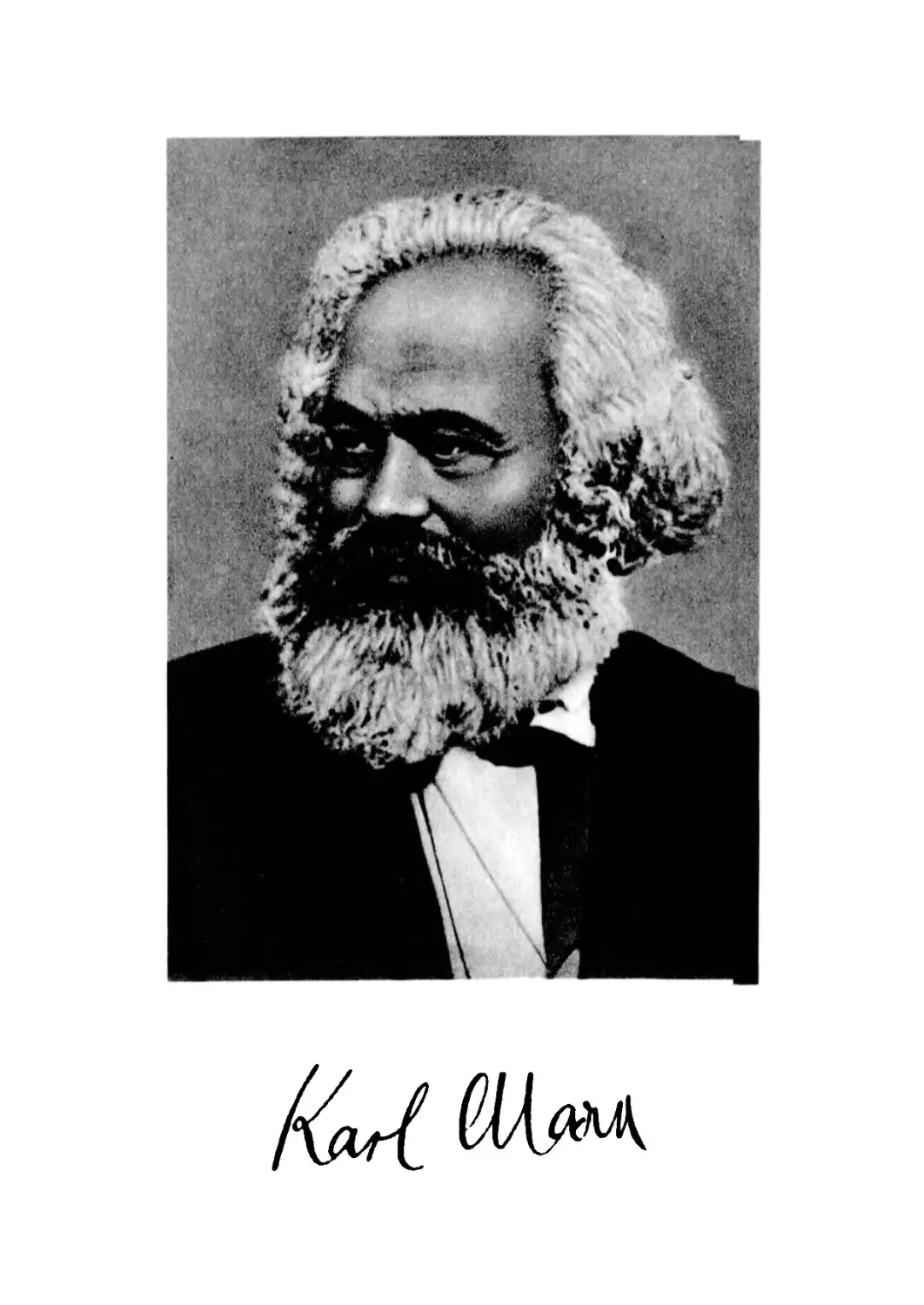
KARL MARX
FREDERICK ENGELS
SELECTED LETTERS
FOREIGN LANGUAGES PRESS
PEKING
First Edition 1977
PUBLISHER'S NOTE
The present English edition of Marx and Engels’ Selected Letters
contains those included in the Chinese edition of the same book
published by the People’s Publishing House, Peking, in September
1975. All the letters or excerpts from letters in the booklet are
reprinted from the text given in the existing English editions of
Marx and Engels’ works. Certain adjustments of translation and
style have been made based on a check with the originals.
The footnotes and the notes at the end of the book are based on
those given in the Chinese and previous English editions.
Printed in the People’s Republic of China
CONTENTS
MARX TO P. V. ANNENKOV (December 28, 1846) 1
MARX TO J. WEYDEMEYER (March 5, 1852) 18
MARX TO ENGELS (April i6, 1856) 19
MARX TO ENGELS (September 25, 1857) 21
MARX TO L. KUGELMANN (February 23, 1865) 23
MARX TO L. KUGELMANN (October 9, 1866) 30
MARX TO L. KUGELMANN (July n, 1868) 03
MARX TO L. KUGELMANN (Aprü 12, 1871) 36
MARX TO L. KUGELMANN (April 17, 1871) 38
MARX TO F. BOLTE (November 23, 1871) 40
ENGELS TO T. CUNO (January 24, 1872) 44
ENGELS TO A. BEBEL (June 2Q, 1873) 53
ENGELS TO F. A. SORGE (September 12-17, 1874) 58
MARX AND ENGELS TO A. BEBEL, W. LIEBKNECHT, W.
BRACKE AND OTHERS (Circular Letter) (September 17-18,
1879)
60
ENGELS TO C. SCHMIDT (August 5, 1890) 71
ENGELS TO J. BLOCH (September 21-22, 1890) 75
ENGELS TO G SCHMIDT (October 27, 1890) 79
ENGELS TO F. MEHRING (July 14, 1893) 89
ENGELS TO N. F. DANIELSON (October 17, 1893) 96
ENGELS TO W. BORGIUS (January 25, 1894) 100
NOTES 105
NAME INDEX 122
MARX TO PAVEL VASILYEVICH ANNENKOV
Brussels, December 28 [1846]
My Dear Monsieur Annenkov,
You would have received my answer to your letter of
November ist long ago except for the fact that my bookseller
only sent me Mr. Proudhon’s book, The Philosophy of
Poverty, last week. I have gone through it in two days so as
to give you my opinion on it at once. As I have read through
the book very hurriedly, I cannot go into details but can only
tell you the general impression it has made on me. If you
wish, I could go into details in a second letter.
I must confess that on the whole I find the book bad, and
very bad at that. You yourself laugh in your letter at the
mere “bit of German philosophy”1 which Mr. Proudhon
parades in this formless and pretentious work, but you as¬
sume that the economic argument has not been infected by the
philosophic poison. Far be it from me as well to attribute
the errors in the economic argument to Mr. Proudhon’s
philosophy. Mr. Proudhon does not give us a false criticism
of political economy because he has an absurd philosophic
1
2
SELECTED LETTERS
theory, but he gives us an absurd philosophic theory because
he fails to understand the social system of our day in its
concatenation (engrènement), to use a word which, like many
other things, Mr. Proudhon has borrowed from Fourier.
Why does Mr. Proudhon talk about God, about universal
reason, about the impersonal reason of humanity which never
errs, which has always remained equal to itself and of which
one need only have the right consciousness to know the truth?
Why does he resort to feeble Hegelianism to make himself
appear like a bold thinker?
He himself provides you with the answer to this riddle.
Mr. Proudhon sees in history a series of social developments;
he finds progress realized in history; finally he finds that
men, as individuals, did not know what they were doing and
were mistaken about their own movement, that is to say,
their social development seems at first glance to be distinct,
separate and independent of their individual development.
He cannot explain these facts, and so the hypothesis of
universal reason manifesting itself comes in very handy.
Nothing is easier than to invent mystical causes, i.e., phrases
in which there is no sound common sense at all.
But when Mr. Proudhon admits that he understands
nothing about the historical development of humanity — he
admits this by using such high-sounding words as: Universal
Reason, God, etc. — is he not implicitly and necessarily
admitting that he is incapable of understanding economic
development?
What is society, whatever its form may be? The product
of men’s reciprocal action. Are men free to choose this or
that form of society? By no means. Assume a particular level
of development of men’s productive forces and you will get
a particular form of commerce and consumption. Assume
MARX TO P. V, ANNENKOV. DECEMBER 28, 1846 3
particular stages of development in production, commerce
and consumption and you will have a corresponding social
system, a corresponding organization of the family, of social
orders or of classes, in a word, a corresponding civil society.
Assume such a civil society and you will get a political system
appropriate to it, a system which is only the official expres¬
sion of civil society. Mr. Proudhon will never understand
this because he thinks he is doing something great by appeal¬
ing from the state to civil society — that is to say, from the
official epitome of society to official society.
It is superfluous to add that men are not free to choose
their productive forces — which are the basis of all their
history — for every productive force is an acquired force, the
product of former activity. The productive forces are there¬
fore the result of practically applied human energy; but this
energy is itself conditioned by the circumstances in which
men find themselves, by the productive forces already ac¬
quired, by the social form which exists before they exist, which
they do not create, which is the product of the preceding gen¬
eration. Because of the simple fact that every succeeding
generation finds itself in possession of the productive forces
acquired by the previous generation, and that they serve it
as the raw material for new production, a coherence arises
in human history, a history of humanity takes shape which
becomes all the more a history of humanity the more the pro¬
ductive forces of men and therefore their social relations de¬
velop. Hence it necessarily follows that the social history
of men is always the history of their individual development,
whether they are conscious of it or not. Their material rela¬
tions are the basis of all their relations. These material re¬
lations are only the necessary forms in which their material
and individual activity is realized.
4
SELECTED LETTERS
Mr. Proudhon confuses ideas with things. Men never re¬
linquish what they have won, but this does not mean that
they never relinquish the social form in which they have
acquired certain productive forces. On the contrary, in order
that they may not be deprived of the results attained and
forfeit the fruits of civilization, they are obliged, when the
mode of carrying on commerce no longer corresponds to the
productive forces acquired, to change all their traditional so¬
cial forms. — I am using the word “commerce” here in its
widest sense, as we use Verkehr in German. For example:
the privileges, the institution of guilds and corporations, the
regulatory regime of the Middle Ages, were social relations
that alone corresponded to the acquired productive forces and
to the social condition which had previously existed and from
which these institutions had arisen. Under the protection
of the regime of corporations and regulations, capital was
accumulated, overseas trade was developed, colonies were
founded. But the fruits of this would have been forfeited by
men if they had tried to retain the forms under whose shelter
these fruits had ripened. Hence two thunderclaps occurred,
the revolutions of 1640 and 1688. All the old economic forms,
the social relations corresponding to them, the political
system that was the official expression of the old civil society,
were destroyed in England. Thus the economic forms in
which men produce, consume, and exchange, are transitory
and historical. With the acquisition of new productive forces,
men change their mode of production and with the mode
of production all the economic relations which are merely
the relations appropriate to a particular mode of production.
This is precisely what Mr. Proudhon has not understood
and still less demonstrated. Mr. Proudhon, incapable of
following the real movement of history, produces a phantas-
MARX TO P. V. ANNENKOV, DECEMBER 28, 1846 5
magorîa which claims to be dialectical. He does not need to
speak of the seventeenth, the eighteenth or the nineteenth
century, for his history proceeds in the misty realm of imagi¬
nation and is above space and time. In short, it is not history
but trite Hegelian trash, it is not profane history — history of
man — but sacred history — history of ideas. From his point
of view man is only the instrument of which the idea or the
eternal reason makes use in order to unfold itself. The evo¬
lutions of which Mr. Proudhon speaks are understood to be
evolutions such as are accomplished within the mystic womb
of the absolute idea. If one discards the veil of this mystical
language, it means that Mr. Proudhon specifies the arrange¬
ment in which economic categories are classified inside his
own mind. It will not require great exertion on my part to
prove to you that it is the order of a very disorderly mind.
Mr. Proudhon begins his book with a dissertation on value,
which is his pet subject. I will not enter on an examination
of this dissertation today.
The series of economic evolutions of eternal reason begins
with division of labour. To Mr. Proudhon division of labour
is a perfectly simple thing. But was not the caste system also
a particular type of division of labour? Was not the system
of the corporations another division of labour? And was not
the division of labour under the system of manufacture, which
in England began in the middle of the seventeenth century
and ended towards the end of the eighteenth, also totally
different from the division of labour in large-scale, modern
industry?
Mr. Proudhon is so far from the truth that he neglects
what even the profane economists attend to. When he talks
about division of labour he does not feel it necessary to men¬
6
SELECTED LETTERS
tion the world market. Well, in the fourteenth and fifteenth
century, when there were as yet no colonies, when America
did not yet exist for Europe, and East Asia only existed
through the medium of Constantinople, was not division of
labour at that time bound to be fundamentally different
from division of labour in the seventeenth century which
already had a developed colonial system?
And that is not all. Is the whole internal organization of
nations, are all their international relations anything but the
expression of a particular division of labour? And are they
not bound to change when changes occur in the division of
labour?
Mr. Proudhon has so little understood the problem of the
division of labour that he does not even mention the separa¬
tion of town and country which took place, for instance in
Germany, from the ninth to the twelfth century. Thus, this
separation must become an eternal law for Mr. Proudhon
since he knows neither its origin nor its development. All
through his book, therefore, he speaks as if this creation of
a particular mode of production would endure until the end
of time. All that Mr. Proudhon says about division of labour
is only a summary, and moreover a very superficial and in¬
complete summary, of what Adam Smith and a thousand
others have said before him.
The second evolution is machinery. The connection be¬
tween division of labour and machinery is entirely mystical to
Mr. Proudhon. Each kind of division of labour had its spe¬
cific instruments of production. Between the middle of the
seventeenth and the middle of the eighteenth century, for in¬
stance, people did not make everything by hand. They had
instruments, and very complicated ones at that, such as looms,
ships, levers, etc., etc.
MARX TO P. V. ANNENKOV, DECEMBER 28, 1846 7
Thus there is nothing more absurd than to declare that
machines have come into being as a consequence of division
of labour in general.
I may also remark, by the way, that since Mr. Proudhon
has not understood the historical origin of machinery, he has
still less understood its development. One can say that up
to the year 1825 — the period of the first general crisis — the
demands of consumption in general increased more rapidly
than production, and the development of machinery was a
necessary consequence of the needs of the market. Since
1825, the invention and application of machinery has been
simply the result of the war between workers and employers.
But this is only true of England. As for the European na¬
tions, they were driven to adopt machinery owing to English
competition both in their home markets and on the world
market. Finally, in North America the introduction of ma¬
chinery was due both to competition with other countries and
to lack of hands, that is, to the disproportion between the
population of North America and its industrial needs. From
these facts you can see what sagacity Mr. Proudhon displays
when he conjures up the spectre of competition as the third
evolution, the antithesis to machinery I
Lastly, it is altogether absurd to make machinery an eco¬
nomic category alongside with division of labour, competi¬
tion, credit, etc.
The machine is no more an economic category than the
ox which draws the plough. The contemporary use of ma¬
chines is one of the relations of our present economic system,
but the way in which machinery is utilized is totally distinct
from the machinery itself. Powder is powder whether used
to wound a man or to dress his wounds.
8
SELECTED LETTERS
Mr. Proudhon surpasses himself when he allows competi¬
tion, monopoly, taxes or police, balance of trade, credit and
property to develop inside his head in the order in which I
have mentioned them. Almost the whole of the credit system
had been developed in England by the beginning of the
eighteenth century, before the invention of machinery. Gov¬
ernment loans were only a fresh method of increasing taxa¬
tion and satisfying the new demands created by the rise of
the bourgeoisie to power. Finally, the last category in Mr.
Proudhon’s system is property. In the real world, on the
other hand, division of labour and all Mr. Proudhon’s other
categories are social relations forming in their entirety what
is today known as property, outside these relations bourgeois
property is nothing but a metaphysical or legal illusion. The
property of a different epoch, feudal property, develops un¬
der entirely different social relations. By presenting property
as an independent relation, Mr. Proudhon commits more
than a mistake in method: he clearly shows that he has not
grasped the bond which holds together all forms of bour¬
geois production, that he has not understood the historical
and transitory character of the forms of production in a par¬
ticular epoch. Mr. Proudhon, who does not regard our social
institutions as historical products, who is unable to understand
either their origin or their development, can only produce
dogmatic criticism of them.
Mr. Proudhon is therefore obliged to take refuge in a
fiction in order to explain development. He imagines
that division of labour, credit, machinery, etc., were all in¬
vented to serve his fixed idea, the idea of equality. His ex¬
planation is sublimely naive. These things were invented in
the interests of equality but unfortunately they turned against
equality. This constitutes his whole argument. In other
MARX TO P. V. ANNENKOV, DECEMBER 28, 1846 9
words, he takes as his starting point an arbitrary assumption
and then, since the actual development contradicts his fiction
at every step, he concludes that there is a contradiction. He
conceals the fact that the contradiction exists solely between
his fixed ideas and the real movement.
Thus, Mr. Proudhon, mainly because he lacks the histori¬
cal knowledge, has not perceived that as men develop their
productive forces, that is, as they live, they develop certain
relations with one another and that the nature of these re¬
lations is bound to change with the change and growth of
these productive forces. He has not perceived that economic
categories are only abstract expressions of these actually
existing relations and only remain true while these relations
exist. He therefore falls into the error of the bourgeois
economists, who regard these economic categories as eternal
laws and not as historical laws which are valid only for a
particular historical development, for a definite development
of the productive .forces. Instead, therefore, of regarding the
politico-economic categories as abstract expressions of the
real, transitory, historic social relations, Mr. Proudhon, owing
to a mystic inversion, regards real relations merely as reifi¬
cations of these abstractions. These abstractions themselves
are formulas which have been slumbering in the bosom of
God the Father since the beginning of the world.
But here our good Mr. Proudhon falls into severe intel¬
lectual convulsions. If all these economic categories are
emanations from the bosom of God, if they constitute the
hidden and eternal life of man, how does it come about, first,
that there is such a thing as development, and secondly, that
Mr. Proudhon is not a conservative? He explains these evi¬
dent contradictions by a whole system of antagonisms.
10
SELECTED LETTERS
To throw light on this system of antagonisms let us take
an example.
Monopoly is a good thing, because it is an economic
category and therefore an emanation of God. Competition is
a good thing because it is also an economic category. But
what is not good is the reality of monopoly and the reality
of competition. What is still worse is the fact that monopoly
and competition devour each other. What is to be done? As
these two eternal ideas of God contradict each other, it seems
obvious to him that there is also within the bosom of God a
synthesis of these two ideas, in which the evils of monopoly
are balanced by competition and vice versa. As a result of
the struggle between the two ideas only their good side will
manifest itself. One must snatch this secret idea from God
and then apply it and everything will be for the best; the
synthetic formula which lies hidden in the darkness of the im¬
personal reason of man must be revealed. Mr. Proudhon does
not hesitate for a moment to come forward as the revealer.
But look for a moment at real life. In the economic life
of the present time you find not only competition and
monopoly but also their synthesis, which is not a formula but
a movement. Monopoly produces competition, competition
produces monopoly. But this equation, far from removing
the difficulties of the present situation, as the bourgeois
economists imagine it does, results in a situation still more
difficult and confused. If therefore you alter the basis on
which present-day economic relations rest, if you destroy the
present mode of production, then you will not only destroy
competition, monopoly and their antagonism, but also their
unity, their synthesis, the movement, which is the real equal¬
ization process of competition and monopoly.
MARX TO P. V. ANNENKOV, DECEMBER 28, 1846 H
Now I will give you an example of Mr. Proudhon’s
dialectics.
Freedom and slavery constitute an antagonism. I need not
speak either of the good or of the bad sides of freedom. As
to slavery, I need not speak of its bad sides. The only thing
that has to be explained is the good side of slavery. We are
not dealing with indirect slavery, the slavery of the proleta¬
riat, but with direct slavery, the slavery of the black people
in Surinam, in Brazil, and in the Southern States of North
America.
Direct slavery is as much the pivot of our industrialism
today as machinery, credit, etc. Without slavery no cotton;
without cotton no modern industry. It is slavery which has
given value to the colonies; the colonies have created world
trade; world trade is the necessary condition of large-scale
machine industry. Thus, before the traffic in Negroes began,
the colonies supplied the Old World with only very few
products and did not visibly change the face of the earth.
Slavery is therefore an economic category of the highest im¬
portance. Without slavery North America, the most progres¬
sive country, would be turned into a patriarchal land. If
North America were wiped off the map of the world the result
would be anarchy, the total decay of trade and of modern
civilization. But to make slavery disappear would mean to
wipe America off the map of the world. Since slavery is an
economic category, it has existed in every nation since the
world began. Modern nations have merely known how to
disguise slavery in their own countries while they openly im¬
ported it into the New World. After these observations on
slavery, how will our worthy Mr. Proudhon proceed? He
will look for the synthesis between freedom and slavery, the
12
SELECTED LETTERS
true juste-milieu* in other words equilibrium between slavery
and freedom.
Mr. Proudhon has very well grasped the fact that men pro¬
duce cloth, linen, silks, and it is really a great merit to have
grasped such a small matter! But he has failed to understand
that, in accordance with their productive forces, these men
also produce the social relations amid which they manufacture
cloth and linen. Still less has he understood that men, who
produce their social relations in accordance with their mate¬
rial productivity, also produce ideas, categories, that is to say
the abstract ideal expressions of these same social relations.
Thus the categories are no more eternal than the relations
they express. They are historical and transitory products. To
Mr. Proudhon, on the contrary, abstractions, categories are
the primary cause. According to him they, and not men,
make history. The abstraction, the category taken as suchy i.e.,
apart from men and their material activities, is of course im¬
mortal, unchangeable, immutable; it is simply an entity of
pure reason, which is only another way of saying that the
abstraction as such is abstract. An admirable tautology\
Thus, regarded as categories, economic relations for Mr.
Proudhon are eternal formulas without origin or progress.
Let us put it in another way: Mr. Proudhon does not di¬
rectly state that bourgeois life is for him an eternal truth ; he
states it indirectly by deifying the categories which express
bourgeois relations in the form of thought. He regards the
products of bourgeois society as spontaneously arisen eternal
entities, endowed with lives of their own, since they present
themselves to his mind in the form of categories, in the form
of thought. Accordingly he does not rise above the bour-
* Happy medium. — Ed.
MARX TO P. V. ANNENKOV, DECEMBER 28, 1846 13
geois horizon. As he is operating with bourgeois ideas, as
though they were eternal truths, he seeks a synthesis of these
ideas, their equilibrium and does not see that the present
method by which they reach equilibrium is the only possible
one.
Indeed he does what all good bourgeois do. They all
assert that in principle, that is, considered as abstract ideas,
competition, monopoly, etc., are the only basis of life, but
that in practice they leave much to be desired. They all want
competition without the pernicious effects of competition.
They all want the impossible, namely, the conditions of bour¬
geois existence without the necessary consequences of those
conditions. None of them understands that the bourgeois
form of production is historical and transitory, just as the
feudal form was. This mistake arises from the fact that the
bourgeois man is to them the only possible basis of every
society; they cannot imagine a society in which men have
ceased to be bourgeois;
Mr. Proudhon is therefore bound to be a doctrinaire. The
historical movement, which is overturning the present-day
world, reduces itself for him to the problem of discovering
the correct equilibrium, the synthesis, of two bourgeois
thoughts. And so the clever fellow by virtue of his subtlety
discovers the hidden thought of God, the unity of two isolated
thoughts — which are only isolated because Mr. Proudhon
has isolated them from practical life, from present-day pro¬
duction, which is the combination of the realities which they
express. In place of the great historical movement arising
from the conflict between the productive forces already ac¬
quired by men and their social relations, which no longer
correspond to these productive forces; in place of the im¬
minent terrible wars between the different classes within
14
SELECTED LEITERS
each nation and between different nations; in place of the
real and violent action of the masses by which alone these
conflicts can be resolved — in place of this vast, prolonged
and complicated movement, Mr. Proudhon puts the whim¬
sical motion of his own head. It is therefore the men of
learning that make history, the men who know how to pur¬
loin God’s secret thoughts. The common people have only
to apply their revelations. You will now understand why
Mr. Proudhon is the declared enemy of every political move¬
ment. The solution of actual problems does not lie for him
in public action but in the dialectical rotations of his own
head. Since to him the categories are the motive force, it is
not necessary to change practical life in order to change the
categories. Quite the contrary. One must change the cate¬
gories and the consequence will be a change in the existing
society.
In his desire to reconcile the contradictions Mr. Proudhon
does not even ask whether it is not the basis of those con¬
tradictions that must really be overthrown. He is exactly like
the political doctrinaire who chooses to regard the king, the
chamber of deputies and the chamber of peers as integral
parts of social life, as eternal categories. All he is looking
for is a new formula by which to establish an equilibrium
between these powers whose equilibrium consists precisely in
the actually existing movement in which one power is now
the conqueror and now the slave of the other. Thus in the
eighteenth century a number of mediocre minds were busy
finding the true formula which would bring the social estates,
nobility, king, parliament, etc., into equilibrium, and they
woke up one morning to find that all this — king, parliament
and nobility — had disappeared. The true equilibrium in this
antagonism was the overthrow of all the social relations
MARX TO P. V. ANNENKOV. DECEMBER 28, 1846 15
which served as a basis for these feudal institutions and for
the antagonisms of these feudal institutions.
Because Mr. Proudhon places eternal ideas, the categories
of pure reason, on the one side and human beings and their
practical life, which, according to him, is the application of
these categories, on the other, one finds with him from the
beginning a dualism between life and ideas, between soul and
body, a dualism which recurs in many forms. You can see
now that this antagonism is nothing but the incapacity of
Mr. Proudhon to understand the profane origin and the pro¬
fane history of the categories which he deifies.
My letter is already too long for me to speak of the ab¬
surd case which Mr. Proudhon puts up against communism.
For the moment you will grant me that a man who has not
understood the present social system may be expected to
understand still less the movement which seeks to over¬
throw it, and the literary expressions of this revolutionary
movement.
The only point on which I am in complete agreement with
Mr. Proudhon is his dislike for socialist sentimentalism. I
had already, before him, drawn much enmity upon myself by
ridiculing this sheep-like, sentimental, utopian socialism.
But is not Mr. Proudhon strangely deluding himself when he
sets up his petty-bourgeois sentimentality — I am referring to
his declamations about family life, conjugal love and all such
banalities — in opposition to socialist sentimentality, which in
Fourier, for example, goes much deeper than the pretentious
platitudes of our worthy Proudhon? He is himself so well
aware of the emptiness of his arguments, of his utter incapac¬
ity to speak about these things, that he bursts into violent
fits of rage, vociferation and righteous wrath, foams at the
mouth, curses, denounces, cries shame and murder, beats his
16
SELECTED LETTERS
breast and boasts before God and man that he is in no way
connected with the socialist infamies 1 He does not criticize
socialist sentimentalities, or what he regards as such. Like
a holy man, a pope, he excommunicates poor sinners and
sings the glories of the petty bourgeoisie and of the miser¬
able patriarchal amorous illusions of the domestic hearth.
And this is certainly no accident. From head to foot Mr.
Proudhon is the philosopher and economist of the petty bour¬
geoisie. In an advanced society the petty bourgeois is
compelled by his very position to become a socialist on the
one hand and an economist on the other; that is to say, he is
dazed by the magnificence of the upper middle class and has
sympathy for the sufferings of the people. He is at once both
bourgeois and man of the people. Deep down in his heart he
flatters himself that he is impartial and has found the right
equilibrium, which claims to be something different from the
juste-milieu. Such a petty bourgeois deifies contradiction
because contradiction is the essence of his existence. He is
himself simply social contradiction in action. He must justify
in theory what he is in practice, and Mr. Proudhon has the
merit of being the scientific interpreter of the French petty
bourgeoisie — a genuine merit, because the petty bour¬
geoisie will form an integral part of all the impending social
revolutions.
I wish I could send you my book on political economy2
with this letter, but it has so far been impossible for me to
get this work, and the criticism of the German philosophers
and socialists* of which I spoke to you in Brussels, printed.
You would never believe the difficulties which a publication
of this kind comes up against in Germany, on the one hand
♦Refers to Marx and Engels, The German Ideology. — Ed.
MARX TO P. V. ANNENKOV, DECEMBER 28, 1846
17
from the police and on the other, from the publishers who are
themselves the interested representatives of all the tendencies
I am attacking. And as for our own Party, it is not merely
that it is poor, but also that a large section of the German
Communist Party is angry with me for opposing their utopias
and declamations.
Yours truly,
Karl Marx,
MARX TO JOSEPH WEYDEMEYER
London, March 5, 185a
. . . As to myself, no credit is due to me for discovering
the existence of classes in modern society, nor yet the struggle
between them. Long before me bourgeois historians had de¬
scribed the historical development of this struggle of the
classes, and bourgeois economists the economic anatomy of
the classes. What I did that was new was to prove: 1) that
the existence of classes is only bound up with particular
historical phases in the development of production; 2) that
the class struggle necessarily leads to the dictatorship of the
proletariat; 3) that this dictatorship itself only constitutes the
transition to the abolition of all classes and to a classless
society. . . .
18
MARX TO ENGELS
London, April 16 [1856]
. . . The day before yesterday, a small banquet was held
to celebrate the anniversary of the People’s Paper.3 On this
occasion, I accepted the invitation, as the times seemed to
demand it, all the more so since I alone (as announced in
the Paper) among all the refugees had been invited and the
first toast, too, fell to me, in which I was to hail the sover¬
eignty of the proletariat of all countries. So I made a little
speech in English, which however I shall not have printed.4
The aim I had in mind was achieved. M. Talandier, who
had to buy his ticket for 2s. 6d., and the rest of that gang of
French and other refugees, have been convinced that we are
the only “intimate’' allies of the Chartists and that, though
we refrain from public demonstrations and leave open flirta¬
tion with Chartism to the Frenchmen, we have it in our power
to reoccupy at any time the position that historically is al¬
ready due to us. This has become all the more necessary
because at the already mentioned meeting of February 25
under Pyat’s chairmanship, that German blockhead Scherzet
19
20
SELECTED LETTERS
(“old boy”) came forward and in a really awful Straubinger
style denounced the German “men of learning,” the “intellec¬
tual workers” who had left them (the blockheads) in the
lurch and thus forced them to discredit themselves in front of
the other nations. You know this man Scherzer from the
Paris days. I have had some more meetings with our friend
Scbapper and have found him to be a very repentant sinner.
The retirement he has been living in for the past two years
seems rather to have sharpened his mental powers. You will
understand that in any eventuality it might always be good
to have the man at hand, and, still more, keep him out of
Willich’s reach. Schapper is now furious with those block¬
heads in Windmill Street.5
I'll take care of your letter to Steffen. You should have
kept Levy’s letter there (in your own possession). Do that
in every case with all letters I don’t ask you to send back to
me. The less they go through the mail the better. I fully
agree with you about the Rhine province. The fatal thing
for us is that I see something looming in the future that will
smack of “treason to the fatherland.” It will depend very
much on how things turn out in Berlin as to whether we are
forced into a position similar to that of the Mainz Clubbists
of the old revolution.6 That would be tough. We who are so
enlightened about our worthy brothers on the other side of
the Rhine! The whole thing in Germany will depend on the
possibility of backing the proletarian revolution by some
second edition of the Peasant War. Then the affair will be
splendid. . . .
MARX TO ENGELS
[London] September 25,1857
. . . Your “Army”* is very well done; only its size made
me feel as if I had been hit over the head, for it must do you
a lot of harm to work so much. If I had known that you
were going to work far into the night, I would rather have
let the whole matter go hang.
The history of the army brings out more clearly than any¬
thing else the correctness of our conception of the connection
between the productive forces and social relations. In gen¬
eral, the army is important for economic development. For
instance, it was in the army that the ancients first fully de¬
veloped a wage system. Similarly among the Romans the
peculium castrense** was the first legal form in which the
right of others than fathers of families to moveable property
was recognized. So also the guild system among the corpora-
* Marx is referring to Engels* essay the “Army” published in the
New American Cyclopaedia. — Ed.
** Camp property, i.e., soldier’s private property in the ancient Roman
army. — Edt
21
22
SELECTED LETTERS
tion of Fabri* Here too the first use of machinery on a
large scale. Even the special value of metals and their use
as money appears to have been originally based — as soon as
Grimm’s stone age was passed — on their military signifi¬
cance. The division of labour within one branch was also
first carried out in the armies. The whole history of the
forms of bourgeois society is very strikingly epitomized here.
If some day you can find time you must work the thing out
from this point of view.
In my opinion, the only points which have been overlooked
in your account are: i) The first appearance of mercenary
troops, ready for use on a large scale and at once, among the
Carthaginians (for our private use I will look up a book on
the Carthaginian armies written by a Berlin man,7 which I
came to know only later). 2) The development of the army
system in Italy in the fifteenth and early sixteenth centuries.
Tactical tricks, at any rate, were developed here. Extremely
humorous is Machiavelli’s description (which I will copy out
for you) in his history of Florence of the way the Condottieri
fought one another.8 (No, when I come to see you in Brigh¬
ton — when?9 — I would rather bring the volume of Machia-
velli with me. His history of Florence is a masterpiece.) And,
finally, 3) the Asiatic military system as it first appeared
among the Persians and then, though modified in a great
variety of ways, among the Mongols, Turks, etc. . . .
* Work force or artisans in the Roman army. — Ed.
MARX TO LUDWIG KUGELMANN
London, February 23, 1865
Dear Friend,
Yesterday I received your letter, which interested me
greatly, and will now reply to the separate points you raise.
First of all, I shall briefly describe my attitude towards
Lassalle. While he was engaged in agitation, relations be¬
tween us were suspended: 1) because of his self-praise and
bragging, to which he added the most shameless plagiarism
from my writings and those of others; 2) because I condemned
his political tactics ; 3) because, even before he began his agita¬
tion, I had fully explained and “proved” to him here in
London that direct socialist intervention by a “State of Prus¬
sia” was nonsense. In his letters to me (from 1848 to 1863),
as in our personal meetings, he always declared himself an
adherent of the party I represented. As soon as he realized,
in London (at the end of 1862), that he could not play his
games with me, he decided to come out as the “workers’ dic¬
tator’' against me and the old party. In spite of all that, I
23
24
SELECTED LETTERS
recognized his merits as an agitator, although towards the
end of his brief career, even that agitation appeared to me to
assume an increasingly ambiguous character. His sudden
death, the old friendship, wailful letters from Countess Hatz-
feldt, indignation over the cowardly impertinence of the
bourgeois press towards one whom in his lifetime they had
so greatly feared — all that induced me to publish a short
statement against that wretched Blind,* which did not, how¬
ever, deal with the substance of Lassalle’s doings. (Hatzfeldt
sent the statement to the Nordstern.10) For the same reasons,
and hoping to be able to remove some elements which ap¬
peared to me dangerous, Engels and I promised to contribute
to Social-Demokrat11 (it has published a translation of the Ad¬
dress12 and at its request I wrote an article about Proudhon
when he died**) and, after Schweitzer had sent us a satisfac¬
tory programme of its editorial board, we allowed our names
to be given out as contributors.13 We had the further guaran¬
tee of the presence of W. Liebknecht as an unofficial member
of the editorial board. However, it soon became clear — the
evidence fell into our hands — that Lassalle had in fact be¬
trayed the Party. He had entered into a formal contract with
Bismarck (of course, without having any sort of guarantees
in his hands). At the end of September 1864 he was to go
to Hamburg and there (together with that crazy Schramm and
the Prussian police spy, Marr) “force” Bismarck to incor¬
porate Schleswig-Holstein, i.e., to proclaim its incorporation
in the name of the “workers,” etc., in return for which Bis¬
marck promised universal suffrage and a few socialist char¬
latanries.14 It is a pity that Lassalle could not play the
* Marx, “Letter to the Editor of the Beobachter in Stuttgart.” — Ed.
** Marx, “On Proudhon (Letter to J. B. Schweitzer).“ — Ed.
MARX TO L. KUGELMANN, FEBRUARY 23, 1865
25
comedy through to the end! It would have made him look
damned ridiculous and foolish! And it would have put a
stop forever to all attempts of that sorti
Lassalle went astray in this way because he was a “realistic
politician” of Mr, Miquel’s sort, but cut out on a larger
pattern and with far bigger aims. (By the bye, I had long
ago seen through Miquel sufficiently to explain his public
utterances by the fact that the National Association15 offered
an excellent way for a petty Hanoverian lawyer to make his
voice heard in Germany outside his own borders and thus
cause the enhanced “reality” of himself to make a retroactive
impression in his Hanoverian homeland, playing the “Hano¬
verian” Mirabeau under “Prussian” protection.) Just like
Miquel and his present friends snatched at the “new era”16
inaugurated by the Prussian Prince Regent in order to join
the National Association and to cling to the “Prussian lead,”17
just as they developed their “civic pride” generally under
Prussian protection, so Lassalle wanted to play the Marquis
Posa of the proletariat with Philip II of the Uckermark,18 with
Bismarck acting as the procurer between him and the Prus¬
sian Kingdom. He only aped the gentlemen of the National
Association. But while the latter invoked the Prussian “reac¬
tion” in the interests of the middle class, Lassalle shook hands
with Bismarck in the interests of the proletariat. These gen¬
tlemen had greater justification than Lassalle, in so far as the
bourgeois is accustomed to regard the interest directly under
his nose as being “reality,” and as in fact this class has con¬
cluded a compromise everywhere, even with feudalism;
whereas in the very nature of things, the working class has to
be sincerely “revolutionary.”
For a theatrically vain character like Lassalle (who was
not, however, one to be bribed by paltry trash like offices, a
26
SELECTED LETTERS
mayoralty, etc.)» it was a most enticing thought: an act direct¬
ly on behalf of the proletariat, carried out by Ferdinand
Lassallel He was in fact too ignorant of the real economic
conditions required for such an act to be critical of himself.
The German workers, on the other hand, were too “demor¬
alized” by the despicable “realistic politics ” which had in¬
duced the German bourgeoisie to tolerate the reaction of
1849-59 and simply to look on as the people were being
stupefied, not to hail such a quack saviour, who had promised
to get them with one leap into the promised land.
Well, to pick up again the thread broken off above: the
Social-Demokrat had hardly been founded when it became
clear that old Hatzfeldt at last wanted to execute Lassalle’s
“last will and testament.” Through Wagener (of the Kreuz-
Zeitung19) she was in touch with Bismarck. She placed the
“Workers' Association” (the General Association of German
Worker s'2®) y the Social-Demokrat, etc. at his disposal. The
annexation of Schleswig-Holstein was to be proclaimed in the
Social-Demokrat, Bismarck to be recognized in general as
patron, etc. The whole pretty plan was frustrated because
we had Liebknecht in Berlin on the editorial board of the
Social-Demokrat. Although Engels and I were not pleased
with the editorial board of the paper with its spittle-licking
cult of Lassalle, its occasional flirting with Bismarck, etc., it
was, of course, more important to stand by the paper publicly
for the time being so as to prevent old Hatzfeldt’s intrigues
and the complete compromising of the workers* party. We
therefore made bonne mine à mauvais jeu * although privately
we were always writing to the Social-Demokrat that they
must oppose Bismarck just as much as they oppose the Pro-
* The best of a bad bargain. — Edi
MARX TO L. KUGELMANN, FEBRUARY 25, 1865 27
gressives.21 We even put up with the intrigues of that vain
fool, Bernhard Becker — who takes the importance be¬
queathed him by Lassalle’s testament quite seriously —
against the International Working Men's Association,22
Meanwhile, Mr. Schweitzer’s articles in the Social-Demo-
krat became more and more Bismarckian. I had written to
him earlier saying that the Progressives could be intimidated
on the “question of combinations,” but that the Prussian
Government would never under any circumstances concede
the complete abolition of the Combination Laws, because that
would involve a breakdown of the bureaucracy, would make
the workers become legally of age, would shatter the Rules
Governing Servants,23 abolish the aristocracy’s thrashing of
arses in the countryside, etc., etc., which Bismarck could never
allow and which was altogether incompatible with the Prus¬
sian bureaucratic state. I added that if the Chamber repu¬
diated the Combination Laws, the government would take
recourse to phrases (such phrases, for instance, as that the
social question demanded “more thoroughgoing” measures,
etc.) in order to retain them. All this proved to be correct.
And what did Herr von Schweitzer do? He goes and writes
an article for Bismarck24 and saves all his heroic courage to
be used against such infinitely small people as Schulze,
Faucher, etc.
I think Schweitzer and the others have honest intentions,
but they are “realistic politicians.” They want to take
existing circumstances into consideration and refuse to sur¬
render this “privilege” of “realistic politics” to the exclusive
use of Messrs. Miquel & Co. (The latter seem to want to
reserve for themselves the right of intermixture with the
Prussian Government.) They know that the workers’ press
and the workers’ movement in Prussia (and therefore in the
2a
SELECTED LETTERS
rest of Germany) exist solely by the grace of the police. So
they want to take things as they are, and not irritate the gov¬
ernment, etc. just like our “republican” realistic politicians,
who are willing to “put up with” a Hohenzollern emperor.
But since I am not a “realistic politician,” I, along with
Engels, have found it necessary to give notice to the Social-
Demokrat in a public statement (which you will probably
soon see in one paper or another) of our intention to quit.*
At the same time, you will understand why at the present
moment I can do nothing in Prussia. The government there
has refused point-blank to repatriate me as a Prussian citi¬
zen.25 Only in a form acceptable to Herr von Bismarck
would I be allowed to agitate there.
I prefer a hundred times more my agitation here through
the International Association. Its influence on the English
proletariat is direct and of the greatest importance. We are
making a stir here now on the General Suffrage Question,
which of course has a significance here quite different from
what it has in Prussia.26
On the whole the progress of this “Association” is beyond
all expectations: here, in Paris, in Belgium, Switzerland and
Italy. Only in Germany, of course, I am opposed by Las-
salle’s successors, who: i) are stupidly afraid of losing their
importance; 2) are aware of my avowed opposition to what
the Germans call “realistic politics.” (It is this sort of
“realism” that places Germany so far behind all civilized
countries.)
Since anybody who pays one shilling for a card can be¬
come a member of the Association; since the French chose this
* Marx and Engels, “Statement (Letter to the Editorial Board of the
Social-Demokrat).”— Ed.
MARX TO L. KUGELMANN, FEBRUARY 23, 1865 29
form of individual membership (also the Belgians), because
the law prevents them from affiliating to us as an “associa¬
tion” and since the situation in Germany is similar, I have
now decided to ask my friends here and in Germany to form
small societies — the number of members in each locality is
immaterial — and each member is to take out an English
membership card. Since the English society is public, there
is nothing to stand in the way of such a procedure, even in
France. I would be glad if you and the people closest to you
would get into touch with London in this way. . . *
MARX TO LUDWIG KUGELMANN
London, October* 9,1866
... I was very much worried about the first Congress at
Geneva.27 On the whole however it turned out better than
I had expected. The effect in France, England and America
was unanticipated. I could not and did not want to go there,
but wrote the programme for the London delegates.** I de¬
liberately restricted it to those points which allow for im¬
mediate agreement and joint action by the workers, and give
direct sustenance and impetus to the requirements of the
class struggle and the organization of the workers into a class.
The Parisian gentlemen had their heads full of the emptiest
Proudhon ist phrases. They babble away about science and
know nothing. They scorn all revolutionary action, i.e., action
arising out of the class struggle itself, all concentrated social
movements, and therefore also those which can be carried
* “November” in the original. — Ed.
** Marx, “Instructions for the Delegates of the Provisional General
Council. The Different Questions.” — Ed.
30
MARX TO L. KUGELMANN, OCTOBER 9, 1866 31
through by political means (for instance, the legal shortening
of the working day). Under the pretext of freedom, and of
nnti-governmentalism or anti-authoritarian individualism,
these gentlemen — who for sixteen years have so quietly en¬
dured the most miserable despotism, and still go on enduring
it! —are actually preaching ordinary bourgeois economy,
only in a Proudhonistically idealized forml Proudhon did
enormous mischief. His sham criticism and sham opposition
to the Utopians (he himself is only a petty-bourgeois utopian,
whereas in the utopias of a Fourier, an Owen, etc., there is
the anticipation and imaginative expression of a new world)
attracted and corrupted first the “jeunesse brillante,** the
students and then the workers, especially those of Paris, who
as workingmen in luxury trades are, without knowing it,
strongly attached to the old rubbish. Ignorant, vain, pre¬
sumptuous, talkative, blusteringly arrogant, they were on the
verge of spoiling everything, because they had rushed to the
Congress in numbers which bore no relation at all to the
numbers of their members. On the quiet, I am going to give
them a rap on the knuckles in the report.
I am particularly delighted about the American Workers*
Congress which took place at the same time in Baltimore. The
slogan there was organization for the struggle against capital,
and remarkably enough most of the demands I drew up for
Geneva were also put forward there by the correct instinct
of the workers.28
The Reform Movement here, which our Central Council
{quorum magna pars fui*™) brought into being, has now taken
on immense dimensions and become irresistible.26 I have
* In which I played a great part. — Ed,
32
SELECTED LETTERS
kept behind the scenes all the time and do not worry further
about the matter, now that it has been set into motion.
Yours,
K. Marx
MARX TO LUDWIG KUGELMANN
London, July n, 1868
... As for the Centralblatt, the man is making the great¬
est possible concession in admitting that, if one means
anything at all by value, the conclusions I draw must be ac¬
cepted.30 The unfortunate fellow does not see that, even if
there were no chapter on “value” in my book,31 the analysis
of the real relations which I give would contain the proof
and demonstration of the real value relations. All that
palaver about the necessity of proving the concept of value
comes from complete ignorance both of the subject dealt with
and of scientific method. Every child knows that a nation
which ceased to work, I will not say for a year, but even for
a few weeks, would perish. Every child knows, too, that the
volume of products corresponding to the different needs re¬
quires different and quantitatively determined amounts of the
total labour of society. That this necessity of the distribution
of social labour in definite proportions cannot possibly be
done away with by a particular form of social production but
33
34
SELECTED LETTERS
can only change the mode of its appearance, is self-evident.
Natural laws cannot be abolished at all. What can change in
historically different circumstances is only the form in which
these laws assert themselves. And the form in which this
proportional distribution of labour asserts itself, in a social
system where the interconnection of social labour manifests
itself through the private exchange of individual products of
labour, is precisely the exchange value of these products.
Science consists precisely in demonstrating how the law of
value asserts itself. So that if one wanted at the very be¬
ginning to “explain” all the phenomena which seemingly
contradict that law, one would have to present the science
before science. It is precisely Ricardo’s mistake that in his
first chapter on value* he takes as given a variety of catego¬
ries that have not yet been explained in order to prove their
conformity with the law of value.
On the other hand, as you have correctly assumed, the
history of the theory certainly shows that the concept of val¬
ue relations has always been the same — sometimes clearer,
sometimes hazier, more hedged around with illusions or more
precise scientifically. Since the reasoning process itself pro¬
ceeds from the existing conditions, and is itself a natural pro-
cess, truly intelligent thinking must always be the same, and
can vary only gradually, according to the degree of develop¬
ment, including the development of the organ by which the
thinking is done. Everything else is drivel.
The vulgar economist has not the faintest idea that the
actual everyday exchange relations can not be directly iden¬
tical with the magnitudes of value. The essence of bourgeois
society consists precisely in this, that a priori there is no con-
* David Ricardo, Principles of Political Economy and Taxation. — Ed.
MARX TO L. KUGELMANN, JULY 11, 1868
35
scious social regulation of production. The rational and
naturally necessary asserts itself only as a blindly working
average. And then the vulgar economist thinks he has made
a great discovery when, confronted with the disclosure of in¬
trinsic interconnection, he proudly states that on the surface
things look different. In fact, he boasts that he sticks to ap¬
pearance, and takes it for the ultimate. Why, then,, have any
science at all?
But the matter has also another background. Once the in¬
terconnection is grasped, all theoretical belief in the perma¬
nent necessity of existing conditions collapses before their
collapse in practice. Here, therefore, it is absolutely in the
interest of the ruling classes to perpetuate this senseless con¬
fusion. And for what other purpose are the sycophantic bab¬
blers paid, who have no other scientific trump to play except
that in political economy one must not think at all?
But satis superque * In any case the fact that workers and
even manufacturers and merchants understand my book and
find their way about in it, whereas these “learned scribes” (!)
complain that I make excessive demands on their understand¬
ing shows how debased these priests of the bourgeoisie
are. . * •
Enough and more than enough. — Edi
MARX TO LUDWIG KUGELMANN
London, April 12, 1871
... If you look at the last chapter of my Eighteenth
Brumaire, you will find that I declare: the next attempt of
the French Revolution will be no longer, as before, to trans¬
fer the bureaucratic-military machine from one hand to
another, but to smash it, and this is the preliminary condition
for every real people’s revolution on the Continent. And this
is what our heroic Party comrades in Paris are attempting.
What elasticity, what historical initiative, what a capacity for
sacrifice there is in these Parisians I After six months of hun¬
ger and ruin, caused even more by internal treachery than by
the external enemy, they rise up, beneath Prussian bayonets,
as if there had never been a war between France and Ger¬
many and the enemy were not standing at the gates of Paris!
History has no comparable example of similar greatness!
Their “good nature” alone can be blamed for it if they are
defeated. They should have marched at once on Versailles
after first Vinoy and then the reactionary contingent of the
Paris National Guard had themselves retreated. They missed
36
MARX TO L. KUGELMANN, APRIL 12, 1871
37
their opportunity because of conscientious scruples. They
did not want to start a civil war, as if that mischievous abor¬
tion Thiers had not already started the civil war anyway with
his attempt to disarm Paris I Second mistake: The Central
Committee, in order to make way for the Commune, surren¬
dered its power too soon. Again as a result of its “honour¬
able’' scrupulosity! However that may be, the present upris¬
ing in Paris — even if it should be crushed by the wolves,
swine and vile dogs of the old society — is the most glorious
deed of our Party since the June insurrection in Paris. Just
compare these Parisians, storming heaven, with those slaves
to heaven of the German-Prussian Holy Roman Empire, with
its posthumous masquerades reeking of the barracks,
the Church, the clod-hopping Junkers and above all, of
philistinism. . . .
MARX TO LUDWIG KUGELMANN
[London] April 17, 1871
Dear Kugelmann,
I have duly received your letter. Just at this moment I
have my hands full. So I’m writing only a few words. How
you can compare petty-bourgeois demonstrations like that of
June 13, 184932 etc* with the present struggle going on in Paris
is quite incomprehensible to me.
World history would indeed be very easy to make if the
struggle were taken up only on condition of infallibly favour¬
able chances. On the other hand, it would be of a very
mystical nature if “accidents” played no part. These acci¬
dents naturally form part of the general course of develop¬
ment and are compensated for by other accidents. But accel¬
eration and delay are very much dependent upon such
“accidents,” including the “accident” of the character of the
people who at first stand at the forefront of the movement.
The decisively unfavourable “accident” this time is by no
means to be sought in the general conditions of French so-
38
MARX TO L. KUGELMANN. APRIL 17, 1871
39
ciety, but in the presence of the Prussians in France and their
position just outside Paris. The Parisians were well aware
of this. But the bourgeois canaille of Versailles were also
well aware of this. Precisely for that reason, they presented
the Parisians with the alternative of either taking up the fight
or succumbing without a struggle. The demoralization of the
working class in the latter case would have been a far greater
disaster than the doom of any number of their “leaders.”
With the struggle in Paris the struggle of the working class
against the capitalist class and its state has entered upon a
new phase. Whatever the immediate outcome may be, a new
point of departure of world-wide historical importance has
been gained.
Adieu!
K. M.
MARX TO FRIEDRICH BOLTE
[London] November 23, 1871
. . . The International22 was founded in order to replace
the socialist or semi-socialist sects by a really militant organ¬
ization of the working class. The original Rules and the
Inaugural Address* show this at a glance. On the other hand
the International could not have stood its ground if the
course of history had not already smashed sectarianism. The
development of socialist sectarianism and that of the real
working-class movement always stand in inverse proportion
to each other. Sects are (historically) justified so long as the
working class is not yet ripe for an independent historical
movement. As soon as it has attained this maturity all sects
are essentially reactionary. But the features displayed by
history everywhere are repeated in the history of the Inter¬
national. Antiquated aspects attempt to re-establish and to
assert themselves within the newly acquired form.
* Marx, “Provisional Rules of the International Working Men’s As¬
sociation” and “Inaugural Address of the Working Men’s International
Association.” — Ed.
40
MARX TO P. BOLTE, NOVEMBER 23. 18?1
41
And the history of the International was a continual strug¬
gle of the General Council against the sects and amateur ex¬
periments, which sought to assert themselves within the In¬
ternational against the real movement of the working class.
This struggle was conducted at the congresses, but to a far
greater extent in private negotiations between the General
Council and individual sections.
Since in Paris, the Proudhonists (Mutualists33) were co*
founders of the Association, they naturally held the reins
there for the first few years. Later, of course, Collectivist,
Positivist, etc., groups arose there in opposition to them.
In Germany — the Lassalle clique. I myself corresponded
with the notorious Schweitzer for two years and proved to
him irrefutably that Lassalle's organization was a mere secta¬
rian organization and, as such, hostile to the organization of
the real workers' movement which the International is striv¬
ing for. He had his “reason” for not understanding.
At the end of 1868 the Russian Bakunin joined the Inter¬
national with the aim of forming inside it a second Interna¬
tional called the “Alliance de la Démocratie Socialiste/,34
with himself as leader. He — a man devoid of all theoretical
knowledge — claimed to represent the scientific propaganda
of the International in that separate body, and wanted to
make such propaganda the special function of that second
International within the International.
His programme was a hash superficially scraped together
from the Right and from the Left — equality of classes (!),
abolition of the right of inheritance as the starting point of
the social movement (Saint-Simonist nonsense), atheism as a
dogma dictated to the members, etc., and as the main dogma
(Proudbonist): abstention from political action.
42
SELECTED LETTERS
This puerile myth found favour (and still has a certain
hold) in Italy and Spain, where the material conditions for
the workers' movement are as yet little developed, and
among a few vain, ambitious, and empty doctrinaires in the
French-speaking part of Switzerland and in Belgium.
To Mr. Bakunin his doctrine (the rubbish he borrowed
from Proudhon, Saint-Simon, and others) was and is a sec¬
ondary matter — merely a means to his personal self-asser¬
tion. Though a nonentity as a theoretician he is in his element
as an intriguer.
For years the General Council had to fight against this
conspiracy (supported up to a certain point by the French
Proudhonists, especially in the South of France). At last, by
means of Conference Resolutions i, 2 and 3, IX, XVI and
XVII, it delivered its long-prepared blow.35
It goes without saying that the General Council does not
support in America what it combats in Europe. Resolutions
i, 2, 3 and IX now give the New York Committee the legal
means with which to put an end to all sectarianism and ama¬
teur groups, and, if necessary, to expel them. . . .
The ultimate object of the political movement of the
working class is, of course, the conquest of political power
for this class, and this naturally requires that the organiza¬
tion of the working class, an organization which arises from
its economic struggles, should previously reach a certain level
of development.
On the other hand, however, every movement in which thé
working class as a class confronts the ruling classes and tries
to constrain them by pressure from without is a political
movement. For instance, the attempt by strikes, etc., in a
particular factory or even in a particular trade to compel in¬
dividual capitalists to reduce the working day, is a purely
MARX TO F. BOLTE, NOVEMBER 23, 1871
43
economic movement. On the other hand the movement to
force through an eight-hour, etc., law is a political movement.
And in this way, out of the separate economic movements of
the workers there grows up everywhere a political movement,
that is to say, a class movement, with the object of enforcing
its interests in a general form, in a form possessing general,
socially coercive force. While these movements presuppose a
certain degree of previous organization, they are in turn
equally a means of developing this organization.
Where the working class is not yet far enough advanced
in its organization to undertake a decisive campaign against
the collective power, i.e., the political power, of the ruling
classes, it must at any rate be trained for this by continual
agitation against this power and by a hostile attitude towards
the policies of the ruling classes. Otherwise it remains, a
plaything in their hands, as the September revolution in
France showed, and as is also proved to a certain extent by
the game that Mr. Gladstone & Co. have been able to play
in England up to the present time.
ENGELS TO THEODOR CUNO
London, January 24, 1872
. . ♦ Bakunin, who up to 1868 had intrigued against the
International,22 joined it after he had suffered a fiasco at the
Berne Peace Congress36 and at once began to plot within it
against the General Council. Bakunin has a peculiar theory
of his own, a medley of Proudhonism and communism. The
chief point therein is that it does not regard capital, i.e., the
class antagonism between capitalists and wage workers which
has arisen through social development, but the state as the
main evil to be abolished. While the great mass of the So¬
cial-Democratic workers are of the same opinion as we, i.e.,
that the state is nothing more than the organization which
the ruling classes — landowners and capitalists — have
established in order to protect their social privileges, Baku¬
nin maintains that it is the state which has created capital,
and that the capitalist has his capital only by the grace of the
state. As, therefore, the state is supposed to be the chief
evil, it is above all the state which must be abolished and
then capitalism will go to blazes of itself. We, on the con-
44
ENGELS TO T. CUNO, JANUARY 24, 1872
45
trary, say: abolish capital, the appropriation of all the means
of production by a few, and the state will collapse of itself.
The difference is an essential one: Without a previous social
revolution the abolition of the state is nonsense; the aboli¬
tion of capital is precisely the social revolution and involves
a change in the whole mode of production. But since for
Bakunin the state is the main evil, nothing must be done
which can keep the state — that is, any state, whether it be
a republic, a monarchy or anything else — alive. Hence
complete abstention from all politics. To commit a political
act, especially to take part in an election, would be a betray¬
al of principle. The thing to do is to carry on propaganda,
heap abuse upon the state, organize, and when all the work¬
ers, hence the majority, are won over, all the authorities are
to be deposed, the state abolished and replaced with the or¬
ganization of the International. This great act, with which
the millennium begins, is called social liquidation.
All this sounds extremely radical and is so simple that it
can be learnt by heart in five minutes; that is why the Ba-
kuninist theory has speedily found favour in Italy and Spain
among young lawyers, doctors, and other doctrinaires. But
the mass of the workers will never allow itself to be per¬
suaded that the public affairs of their countries are not also
their own affairs; they are by nature politically-minded and
whoever tries to make them believe that they should leave
politics alone will in the end be dropped by them. To preach
to the workers that they should in all circumstances abstain
from politics is to drive them into the arms of the priests or
the bourgeois republicans.
Now, as the International, according to Bakunin, was not
formed for political struggle but to replace the old state
organization as soon as social liquidation takes place, it
46
SELECTED LETTERS
follows that it must come as near as possible to the Bakunin-
ist ideal of future society. In this society there will above
all be no authority, for authority=state=absolute evil. (How
these people propose to run a factory, operate a railway or
steer a ship without a will that decides in the last resort,
without a central administration, they of course do not tell
us.) The authority of the majority over the minority also
ceases. Every individual and every community is autono¬
mous; but as to how a society of even only two people is
possible unless each gives up some of his autonomy, Bakunin
again maintains silence.
And so the International too must be arranged according
to this pattern. Every section, and in every section every
individual, is to be autonomous. To hell with the Basle res¬
olutions,37 which confer upon the General Council a perni¬
cious authority demoralizing even to itself! Even if this
authority is conferred voluntarily it must cease just because
it is authority!
Here you have in brief the main points of this swindle. But
who are the originators of the Basle resolutions? Well, Mr.
Bakunin himself and his associates!
1 When these gentlemen saw at the Basle Congress that their
plan to remove the General Council to Geneva, that is, to
get it into their hands, would not succeed, they followed a
different tack. They founded the Alliance de la Démocratie
Socialiste^ an international Society within the big Interna¬
tional, on a pretext which you will now encounter again in the
Bakuninist Italian press, for instance, in the Proletario and
Gazzettino Rosa:38 for the hot-blooded Latin races, it is
claimed, a more outspoken programme is necessary than for
the cool, slow-moving Northerners. This little scheme came
to naught because of the resistance of the General Council,
ENGELS TO T. CUNO, JANUARY 24. 1872
47
which of course could not tolerate any separate /«ternational
organization within the International. It has since reappeared
in various shapes and forms in connection with the efforts of
Bakunin and his crew to substitute the Bakunin programme
for that of the International. On the other hand it was pre¬
cisely Bakunin's empty boastful phrases that were always
seized upon by the reactionaries, from Jules Favre and Bis¬
marck to Mazzini, whenever it was a question of attacking
the International. Hence the necessity of my statement of
December 5 against Mazzini and Bakunin,* which was also
published in the Gazzettino Rosa.
The nucleus of the Bakunin crowd consists of a few dozen
people in the Jura whose whole following amounts to scarce¬
ly 200 workers. Their vanguard is made up of young lawyers,
doctors and journalists in Italy who everywhere now pretend
to act as spokesmen of the Italian workers; a few of them
are in Barcelona and Madrid and every now and then you
will find one — hardly ever a worker — in Lyons or Brussels ;
in London there is a single specimen, Robin. The confer¬
ence,** convoked under the pressure of circumstances in lieu of
the congress that had become impossible, served them as a
pretext; and since most of the French refugees in Switzerland
went over to their side because they (being Proudhonists)
found some kindred views among them and for personal
reasons, they sallied forth on their campaign. They counted,
and not without reason, on malcontent minorities and mis-
* Engels, “The General Council’s Statement to the Editorial Boards
of the Italian Newspapers Regarding Mazzini’s Articles on the Interna¬
tional.” — Ed.
** Engels is referring to the Conference of the First International that
took place in London in 1871. — Ed.
48
SELECTED LETTERS
understood geniuses, who may of course be found every¬
where in the International. At present their fighting strength
is as follows:
1) Bakunin himself — the Napoleon of this campaign.
2) The 200 Jurassians and the 40-50 members of the French
Section (refugees in Geneva).
3) In Brussels Hins, editor of the Liberté ® who however
does not come out openly for them.
4) Here, the remnants of the French Section of 1871,40
which we have never recognized and which has already split
into three parts which are fighting with one another. Then
there are about 20 Lassalleans of the type of Herr von
Schweitzer, who had all been expelled from the German
Section (because of their proposal to withdraw from the In¬
ternational en masse) and who, being advocates of extreme
centralization and rigid organization, fit to a T into the league
of anarchists and autonomists.
5) In Spain, a few personal friends and adherents of Ba¬
kunin, who have strongly influenced the workers, particularly
in Barcelona, at Jeast theoretically. The Spaniards, on the
other hand, are very keen on organization and quick to no¬
tice any lack of it in others. How far Bakunin can count on
success there will not be seen until the Spanish Congress in
April, and as workers will predominate there I have no
grounds for anxiety.
6) Lastly, in Italy, the Turin, Bologna, and Girgenti*
Sections have, as far as I know, declared in favour of con¬
vening the congress ahead of time. The Bakuninist press
claims that 20 Italian sections had joined; I don’t know them.
At any rate, almost everywhere the leadership' is in the hands
* Now Agrigento. — Ed.
ENGELS TO T. CUNO, JANUARY 24, 1872
49
of friends and adherents of Bakunin, and they are raising a
terrific hubbub. But a closer examination will most likely
disclose that their following is not numerous, for in the long
run the bulk of the Italian workers are still Mazzinists and
will remain so as long as the International is identified there
with abstention from politics.
At any rate, in Italy, for the time being, it is the Bakuninist
crowd that has the main say in the International. The Gen¬
eral Council has no intention of complaining on that score;
the Italians have the right to commit all the absurdities they
choose and the General Council will counteract them only
by way of peaceful debate. These people also have the right
to declare for a congress in the Jurassian sense, although it
is certainly exceedingly strange that sections which have only
just affiliated and cannot be posted on anything should in
such a matter at once take sides, especially before they have
heard both parties to the dispute! I have told the Turin mem¬
bers the unvarnished truth about this matter and shall do
the same with the other sections which have made similar
declarations. For every such declaration of affiliation is in¬
directly an approval of the false accusations and lies made
against the General Council in the Circular/11 Incidentally,
the General Council will shortly issue a circular* of its own
about this matter. If you can prevent the Milanese from
making a similar declaration until the circular appears you
will be fulfilling all our desires.
The funniest thing is that the same people in Turin who
declare in favour of the Jurassians and therefore reproach us
here with authoritarianism, now suddenly demand that the
General Council should take such authoritarian measures
* Marx and Engels, “Sham Splits in the International.” — Ed.
50
SELECTED LETTERS
against the rival Federazione Operate*42 of Turin as it Had
never taken before, should excommunicate Beghelli of the
Ficcanaso,43 who does not even belong to the International,
etc. And all that before we have even heard what the
Federazione Operaia has to say!
Last Monday* I sent you the Révolution Sociale contain¬
ing the Jura Circular, one issue of the Geneva Égalité44
(unfortunately I have no copies left of the issue containing
the answer of the Geneva Comité Fédéral,** which repre¬
sents 20 times as many workers as the Jural people do)
and one V oiks Staat45 which will show you what the people
in Germany think about the case. The Saxon Regional
Meeting —120 delegates from 60 localities — declared
unanimously for the General Council.46 The Belgian Con¬
gress (December 25-26) demands a revision of the Rules, but
at the regular congress (in September).47 From France we are
every day receiving statements expressing consent. Of course,
none of these intrigues find any support here in England.
And the General Council will certainly not call an extraordi¬
nary congress just to please a few intriguers and busy-bodies.
So long as these gentlemen keep within legal bounds the Gen¬
eral Council will gladly let them have their way. This
coalition of the most diverse elements will soon fall apart;
but as soon as they start anything against the Rules or the
Congress resolutions the General Council will do its duty.
If one considers that these people have launched their
conspiracy precisely at the moment when a general hue and
cry is being raised against the International, one cannot help
* January 22. — Ed.
** “Answer of the Committee of the Romanic Federation to the Cir¬
cular of 16 Participants in the Sonvillier Congress.” — Ed.
ENGELS TO T. CUNO, JANUARY 24, 1872
51
thinking that the international sleuths must have a hand in
the game. And so it is. In Beziers the Geneva Bakuninists
have picked the chief superintendent of police* as their cor¬
respondent! Two prominent Bakuninists, Albert Richard
from Lyons and Blanc, were here and told a worker named
Scholl, also from Lyons, with whom they got in touch, that
the only way to overthrow Thiers was to restore Bonaparte
to the throne; and for this very reason they were travelling
about on Bonaparte money to conduct propaganda among
the refugees in favour of a Bonapartist restorationX That is
what these gentlemen call abstaining from politics! In Berlin
the Neue Social-Demokrat® subsidized by Bismarck, pipes
the same tune. How far the Russian police is involyed in
this I shall leave for the present undecided, but Bakunin was
deeply embroiled in the Nechayev affair (he denies it, of
course, but we have the original Russian reports here and
since Marx and I understand Russian he cannot put anything
over on us).49 Nechayev is either a Russian agent provoca¬
teur or anyhow acted as if he were. There are moreover all
kinds of suspicious characters among Bakunin’s Russian
friends.
I am very sorry you lost your position. I had expressly
written to you asking you to avoid anything that might lead
to that, stating that your presence in Milan was much more
important for the International than the small effect one
could produce by public utterances, and that one can also ac¬
complish much on the quiet, etc. If I can be of assistance to
you by getting you translations, etc., I shall do so with the
greatest of pleasure. But please tell me from which lan-
* Abel Bousquet. — Ed.
52
SELECTED LETTERS
guages and into which languages you can translate and how
I can be useful to you.
So those police swine have also intercepted my photograph.
I am enclosing another one for you and would ask you to
send me two of yours, one of which is to serve the purpose of
inducing Miss Marx to let you have a photograph of her
father (she is the only one who still has a couple of good ones
left).
I would also ask you to be on your guard when dealing
with any of the people connected with Bakunin. It is a char¬
acteristic feature of all sects to stick together and intrigue.
You can be sure that any information you give them will im¬
mediately be passed on to Bakunin. It is one of his funda¬
mental principles that keeping promises and the like are
merely bourgeois prejudices, which a true revolutionary must
treat with disdain when it benefits the cause. In Russia he
says this openly, in Western Europe it is an esoteric doctrine.
Write to me as soon as possible. It would be very good if
we could induce the Milan Section not to join in the chorus
of the other Italian sections.
Fraternal greetings.
Yours,
F. Engels
ENGELS TO AUGUST BEBEL
London, June 20, 1873
. . . With regard to the attitude of the Party towards
Lassalleanism, you of course can judge better than we what
tactics should be adopted, especially in particular cases. But
there is also this to be considered. When, as in your case,
one is to a certain extent in the position of a competitor to
the General Association of German Workers,20 one can easi¬
ly be too considerate of one’s rival and get into the habit of
always thinking of him first. But both the General Associa¬
tion of German Workers and the Social-Democratic Work¬
ers’ Party50 together still form only a very small minority of
the German working class. Our view, which we have found
confirmed by long practice, is that the correct tactics in prop¬
aganda are not to entice away a few individuals and local
groups here and there from one’s opponent, but to work on
the great mass, which is not yet taking part in the movement.
A single individual whom one has oneself reared from the
raw is worth more than ten Lassallean turncoats, who always
bring the germs of their false tendencies into the Party with
53
54
SELECTED LETTERS
them. And if one could get only the masses without their
local leaders it would still be all right. But in fact one must
always take along a whole crowd of these leaders into the
bargain, who are bound by their previous public utterances,
if not by their previous views, and who must now prove
above all things that they have not deserted their principles
but that on the contrary the Social-Democratic Workers’
Party preaches true Lassalleanism. This was the unfortunate
thing at Eisenach, which perhaps could not be avoided at
that time, but these elements have certainly done harm to
the Party and I am not sure that the Party would not have
been at least as strong today without that accession. In any
case, however, I should regard it as a misfortune if these
elements were to receive reinforcements.
One must not allow oneself to be misled by the cry for
“unity.” Those who have this word most often on their lips
are the ones who cause most of the discord, just as at present
the Jura Bakuninists in Switzerland, who have provoked all
the splits, clamour for nothing so much as for unity. These
unity fanatics are either narrow-minded people who want to
stir everything into one non-descript brew, which, the mo¬
ment it is left to settle, throws up the differences again but
in much sharper contrast because they will then be all in one
pot (in Germany you have a fine example of this in the peo¬
ple who preach reconciliation of the workers and the petty
bourgeoisie) — or else they are people who unconsciously
(like Mülberger, for instance) or consciously want to adulter¬
ate the movement. It is for this reason that the biggest secta¬
rians and the biggest brawlers and rogues shout loudest for
unity at certain times. Nobody in our lifetime has given us
more trouble and has caused more quarrels than the shouters
for unity.
ENGELS TO A. BEBEL, JUNE 20, 1873
55
Naturally every party leadership wants to see successes,
and this is quite a good thing. But there are circumstances in
which one must have the courage to sacrifice momentary
success for more important things. Especially for a party like
ours, whose ultimate success is so absolutely certain, and
which has developed so enormously in our own lifetime and
before our own eyes, momentary success is by no means
always and absolutely necessary. Take the International,22
for instance. After the Commune it had a colossal success.
The bruised and shattered bourgeoisie ascribed omnipotence
to it. The great mass of the membership believed things
would stay like that for all eternity. We knew very well that
the bubble must burst. All the riff-raff attached themselves
to it. The sectarians within it became arrogant and misused
the International in the hope that they would be allowed to
commit the greatest stupidities and vulgarities. We could not
put up with that. Knowing very well that the bubble must
burst some time it was for us not a matter of delaying the
catastrophe but taking care that the International emerged
from it pure and unadulterated. The bubble burst at the
Hague51 and you know that the majority of the Congress
members went home sick with disappointment. And yet
nearly all these disappointed people, who imagined they
would find the ideal of universal brotherhood and reconcilia¬
tion in the International, had far more bitter quarrels at home
than those which broke out at the Hague. Now the sectarian
quarrel-mongers are preaching reconciliation and decrying us
as being cantankerous and dictators. And if we had come
out in a conciliatory way at the Hague, if we had hushed up
the breaking out of the split — what would have been the
result? The sectarians, especially the Bakuninists, would have
56
SELECTED LETTERS
had another year in which to perpetrate, in the name of the
International, still greater stupidities and infamies; the
workers of the most developed countries would have turned
away in disgust; the bubble would not have burst but, pierced
by pinpricks, would have slowly collapsed, and the next Con¬
gress, which would have been bound to bring the crisis after
all, would have turned into the most sordid personal row,
because principles would already have been abandoned at the
Hague. Then the International would indeed have gone to
pieces — gone to pieces through “unity”! Instead of this we
have now got rid of the rotten elements with honour to our¬
selves — the members of the Commune who were present at
the last and decisive session say that no session of the Com¬
mune left such a strong impression upon them as this judicial
session dealing with the traitors to the European proletariat.
For ten months we let them expend all their energies on lies,
slander and intrigue — and where are they? They, the alleged
representatives of the great majority of the International, now
themselves announce that they do not dare to come to the
next Congress. (An article which is being sent off to the
Volksstaafà simultaneously with this letter contains further
details.*) And if we had to do it again we should on the
whole not act any differently — tactical mistakes are always
made, of course.
In any case, I think the good elements among the Lassal-
leans will in due course join you of their own accord and it
would, therefore, be unwise to break off the fruit before it is
ripe, as the unity crowd wants to.
* Engels, “In the International.” — Ed.
ENGELS TO A. BEBEL, JUNE 20, 1873
57
Moreover, even old Hegel said: A party proves itself vic¬
torious by splitting and being able to stand the split.* The
movement of the proletariat is bound to pass through various
stages of development; at every stage part of the people get
stuck and do not join in the further advance; and even this
alone is sufficient to explain why the “solidarity of the prole¬
tariat’" is in reality everywhere being realized in different
party groupings, which carry on life-and-death feuds with one
another, as the Christian sects in the Roman Empire did
amidst the worst persecutions.
If the Neue Social-Demokrat48 for example has more sub¬
scribers than the V oiks Staat, you ought not to forget either
that each sect is necessarily fanatic and through this fanati¬
cism obtains, particularly in regions where it is new (as for
instance the General Association of German Workers is in
Schleswig-Holstein), much greater momentary successes than
the Party, which simply represents the real movement,
without any sectarian oddities. But on the other hand,
fanaticism does not last long. . . .
* See G. W. F. Hegel, Phänomenologie des Geistes (Phenomenology
of Mind). - E4.
ENGELS TO FRIEDRICH ADOLPH SORGE
London, September 12 [-17] 1874
. . . With your resignation52 the old International22 is in
any case entirely wound up and at an end. And that is good.
It belonged to the period of the Second Empire, during which
the oppression that dominated throughout Europe prescribed
unity and abstention from all internal polemics to the work¬
ers’ movement, then just re-awakening. It was the moment
when the common cosmopolitan interests of the proletariat
could come to the fore: Germany, Spain, Italy and Denmark
had only just come into the movement or were just coming
into it. Actually in 1864 the theoretical character of the move¬
ment was still very unclear everywhere in Europe, that is,
among the masses. German communism did not yet exist as
a workers’ party, Proudhonism was too weak to be able to
trot out its particular hobbyhorses, Bakunin’s new rubbish
didn’t as much as exist in his own head, and even the leaders
of the English Trade Unions thought the programme laid
down in the preamble to the Rules gave them a basis for
joining the movement. The first great success was bound to
58
ENGELS Tô F. A. SORGE, SEPTEMBER 12-17, 1874 59
blow to pieces this naive collaboration of all factions. This
success was the Commune, which was without any doubt the
child of the International intellectually — although the Inter¬
national did not lift a finger to produce it — and thus the
International was quite properly held responsible for it.
When, thanks to the Commune, the International had become
a moral force in Europe, the row began at once. Every trend
wanted to exploit the success for itself. The inevitable disin¬
tegration set in. Jealousy of the growing power of the only
people who were really ready to go on working along the
lines of the old comprehensive programme — the German
Communists — drove the Belgian Proudhonists into the arms
of the Bakuninist adventurers. The Hague Congress51 was
actually the end — and for both parties. The only country
where something could still be accomplished in the name of
the International was America, and by a happy instinct the
Executive was transferred there. Now its prestige is ex¬
hausted there, too, and any further effort to galvanize new
life into it would be folly and a waste of effort. For ten years
the International dominated one side of European history —
the side on which the future lies — and it can look back on its
work with pride. But in its old form it has outlived its useful¬
ness. In order to produce a new International along the lines
of the old one, that is, an alliance of all proletarian parties of
all countries, a general suppression of the workers' movement,
like that which prevailed from 1849-64, would be necessary.
For this the proletarian world has now become too big, too
extensive. I believe the next International — after Marx’s
writings have produced their effect for some years — will
be directly Communist and will candidly proclaim our
principles. • . .
MARX AlSfD ENGELS TO AUGUST BEBEL,
WILHELM LIEBKNECHT,
WILHELM BRACKE AND OTHERS
(«CIRCULAR LETTER”)6 *
[London, September 17-18, 1879]
III, The Manifesto of the Three Zürichers
In the meantime Höchberg’s Jahrbuch has reached us, con¬
taining an article “The Socialist Movement in Germany in
Retrospect,”54 which, as Höchberg himself told me, has been
written by precisely the three members of the Zurich Com¬
mission.* Here we have their authentic criticism of the move¬
ment up till now and consequently their authentic programme
for the attitude the new organ is to take in so far as this
depends on them.
Right at the beginning we read :
“The movement, which Lassalle regarded as an eminently political one,
to which he summoned not only the workers but all honest democrats,
at the head of which were to march the independent representatives of
* K. Höchberg, E. Bernstein and K. A. Schramm. — Ed.
60
MARX AND ENGELS (Circular Letter), SEPTEMBER 17-18, 1879
science and all men imbued with true love of mankind, was lowered under
the presidency of Johann Baptist von Schweitzer to a one-sided struggle
of the industrial workers in their own interests .”
I shall not examine whether or how far this is historically
accurate. The special reproach here levelled against Schwei¬
tzer is that he lowered Lassalleanism, which is here regarded
as a bourgeois democratic-philanthropic movement, to a one¬
sided struggle of the industrial workers in their interests,*
by heightening the characteristic features of the industrial
workers* class struggle against the bourgeois. He is further
reproached with having “rejected bourgeois democracy.’*
What business has bourgeois democracy within the Social-
Democratic Party? If it consists of “honest men” it cannot
wish to join, and if it nevertheless wants to join then only in
order to make trouble.
The Lassallean party “chose to conduct itself in the most
one-sided way as a workers* party.** The gentlemen who write
that are themselves members of a party which conducts itself
in the most one-sided way as a workers* party, they are at
present holding high offices in this party. Here there is an
absolute incompatibility. If they mean what they write they
must leave the Party, or at least resign their offices. If they
do not do so, they admit that they are proposing to utilize
their official position in order to combat the proletarian char-
* Further in the manuscript, the following is deleted: “Schweitzer
was a scoundrel, but at the same time very talented. The service he
performed was to smash the original narrow Lassalleanism with its limited
panacea of state assistance. . . . Whatever were the things he did for
his own selfish motives, and however much he insisted in striving to pre¬
serve his hegemony, on the Lassallean cure-all of state assistance, he
nonetheless performed a service in breaching the original narrow Lassal-
Icanism, broâdened his party’s economic field of vision and thus prepared
its later entry into the unified German party. The class struggle between
the proletariat and the bourgeoisie — the nucleus of all revolutionary so-
SELECTED LETTERS
acter of the Party. Consequently, if the Party leaves them
their offices it is betraying itself.
In the opinion of these gentlemen, then, the Social-Demo¬
cratic Party should not be a one-sided workers’ party but an
all-sided party of “all men imbued with true love of man¬
kind.” It must prove this above all by laying aside coarse
proletarian passions and placing itself under the guidance of
educated, philanthropic bourgeois “in order to cultivate good
taste” and “to learn good form” (p. 85). Then the “ragged
appearance” of some of the leaders will give way to a
thoroughly respectable “bourgeois appearance.” (As if the
ragged external appearance of those here referred to were
not the least they can be reproached with!) Then, too, <
“numerous adherents from the circles of the educated and propertied
classes will turn up. But these must first be won if the . . . agitation con¬
ducted is to attain tangible successes’* German socialism has “attached
too much importance to the winning of the masses and in so doing has
neglected energetic[!]* propaganda among the so-called upper strata of
society.” For “the Party still lacks men fit to represent it in the Reichs¬
tag.” It is, however, “desirable and necessary to entrust the mandates
to men who have had the time and opportunity to make themselves
thoroughly acquainted with the relevant material. The ordinary worker
and small master craftsman... have the necessary leisure for this only
in rare and exceptional cases.”
cialism — was already preached by Lassalle. Insofar as Schweitzer em¬
phasized this point even more, this was a step forward in essence, no
matter how cleverly he may have used this point to cast suspicion on
persons dangerous to his dictatorship. It is indeed correct to say that he
transformed Lassalleanism into a one-sided struggle of the industrial work¬
ers for their interests. But he rendered it one-sided only because, from
selfish political motives, he did not want to know anything about the
struggle of rural workers against large-scale landed ownership. His stub¬
bornness, however, lay not in this but. ...” — Ed.
* Words and punctuation within square brackets in the indents were
added by Marx and Engels themselves. — Ed.
MARX AND ENGELS (Circular Letter), SEPTEMBER 17-18, 1879 63
Therefore elect bourgeois!
In short: the working class of itself is incapable of eman¬
cipating itself. For this purpose it must place itself under the
leadership of “educated and propertied“ bourgeois who alone
possess the “time and opportunity“ to acquaint themselves
with what is good for the workers. And secondly, the bour¬
geoisie is on no account to be attacked but — has to be won
over by energetic propaganda.
But if one wants to win over the upper strata of society or
only its well-disposed elements one must not frighten them
on any account. And here the three Zürichers think they
have made a reassuring discovery:
“Precisely at the present time, under the pressure of the Anti-Socialist
Law,55 the Party is showing that it does not intend to pursue the path
of violent, bloody revolution but is determined... to follow the path of
legality, that is, of reform
Hence if the 500,000 to 600,000 Social-Democratic voters
— between a tenth and an eighth of the whole electorate and,
besides, dispersed over the length and breadth of the country
— have the sense not to run their heads against a wall and
attempt a “bloody revolution” of one against ten, this proves
that they forever renounce taking advantage of some tremen¬
dous external event and a sudden revolutionary upsurge aris¬
ing from it or even of a victory gained by the people in a
conflict resulting from it. If Berlin should ever again be so
uneducated as to have another March 18,56 the Social-Demo¬
crats, instead of taking part in the fight like “riff-raff with a
mania for barricades“ (p. 88), must rather “follow the path
of legality,“ put on the brakes, clear away the barricades and
if necessary march with the glorious army against the one¬
sided, coarse, uneducated masses. Or if the gentlemen assert
that this is not what they meant, what then did they mean?
64
SELECTED LETTERS
But still better follows.
“Hence, the more quiet, objective and deliberate it [the Party] is also
in its criticism of existing conditions and in its proposals to change them,
the less possible will it be to repeat the present successful move [when
the Anti-Socialist Law was introduced] with which the conscious reac¬
tionaries intimidated the bourgeoisie by conjuring up the Red bogey”
(p. 88).
In order to relieve the bourgeoisie of the last trace of anx¬
iety it must be clearly and convincingly proved to it that
the Red bogey is really only a bogey, and does not exist. But
what is the secret of the Red bogey if not the dread the bour¬
geoisie has of the inevitable life-and-death struggle between
it and the proletariat? Dread of the inevitable outcome of
the modern class struggle? Do away with the class struggle
and the bourgeoisie and “all independent people” will “not
eschew going hand in hand with the proletarians”! And the
cheated ones would be just those proletarians.
Let the Party therefore prove by its humble and lowly
manner that it has once and for all laid aside the “impro¬
prieties and excesses” which occasioned the Anti-Socialist
Law. If it voluntarily promises that it intends to act only
within the limits of this law, Bismarck and the bourgeoisie
will surely have the kindness to repeal it, as it will then be
superfluous !
“Let oo one misunderstand us”; we do not want “to give up our Party
and our programme, we think however that for years to come we shall
have enough to do if we concentrate our whole strength and energy upon
the attainment of certain immediate aims which must in any case be
achieved before the realization of the more far-reaching aspirations can
be thought of.”
Then those bourgeois, petty bourgeois and workers who are
“at present frightened away ... by our far-reaching de¬
mands” will join us in masses.
MARX AND ENGELS (Circular Letter), SEPTEMBER 17-18, 1879
65
The programme is not to be given up but only postponed —
for an indefinite period. One accepts it, though not really for
oneself and one’s own lifetime but posthumously, as an heir¬
loom to be handed down to one’s children and grandchildren.
In the meantime one devotes one’s “whole strength and
energy” to all sorts of trifles and the patching up of the
capitalist order of society so as to produce at least the ap¬
pearance of something happening without at the same time
scaring the bourgeoisie. There I must really praise the “Com¬
munist” Miquel, who proves his unshakable belief in the
inevitable overthrow of capitalist society in the course of the
next few hundred years by swindling for all he’s worth, con¬
tributing his honest best to the crash of 1873 and so really
doing something to bring about the collapse of the existing
order.
Another offence against good form was the “exaggerated
attacks on the company promoters,” who were after all “only
children of their time”; it would therefore “have been better
to abstain . . . from abusing Strousberg and similar people.”
Unfortunately everyone is “only a child of his time” and if
this is a sufficient excuse nobody ought ever to be attacked
any more, all controversy, all struggle on our part ceases; we
quietly accept all the kicks our adversaries give us because we,
who are so wise, know that these adversaries are “only chil¬
dren of their time” and cannot act otherwise. Instead of
repaying their kicks with interest, we ought rather to pity
these unfortunates.
Then again the support of the Commune had after all the
disadvantage that
“people who were otherwise well disposed towards us were alienated
and in general the hatred of the bourgeoisie against us was increased.”
Furthermore, the Party “is not wholly without blame for the passage of
SELECTED LETTERS
the October Law,57 for it had increased the hatred of the bourgeoisie
unnecessarily/'
There you have the programme of the three censors of
Zurich. In clarity it leaves nothing to be desired. Least of
all by us, who are very familiar with the whole of this phra¬
seology from the days of 1848. It is the representatives of
the petty bourgeoisie who are here making themselves heard,
full of anxiety that the proletariat, under the pressure of its
revolutionary position, may “go too far.“ Instead of deter¬
mined political opposition, general mediation; instead of
struggle against the government and bourgeoisie, an attempt
to win over and persuade them; instead of defiant resistance
to ill-treatment from above, humble acquiescence and admis¬
sion that the punishment was deserved. Historically neces¬
sary conflicts are all interpreted as misunderstandings, and
all discussion ends with the assurance that after all we are
all agreed on the main point. The people who figured
as bourgeois democrats in 1848 could just as well call them¬
selves Social-Democrats now. To the former the democratic
republic was as unattainably remote as the overthrow of the
capitalist system is to the latter, and therefore is of absolutely
no importance in present-day practical politics; one can me¬
diate, compromise and philanthropize to one’s heart’s content.
It is just the same with the class struggle between proletariat
and bourgeoisie. It is recognized on paper because its
existence can no longer be denied, but in practice it is hushed
up, diluted, attenuated. The Social-Democratic Party must
not be a workers’ party, it must not incur the hatred of the
bourgeoisie or of anyone else; it should above all conduct
energetic propaganda among the bourgeoisie; instead of
laying stress on far-reaching aims which frighten away the
bourgeoisie and after all are not attainable in our generation,
MARX AND ENGELS (Circular Letter), SEPTEMBER 17-18, 1879 07
it should rather devote its whole strength and energy to
those petty-bourgeois patchwork reforms which, by provid¬
ing the old order of society with new props, may perhaps
transform the ultimate catastrophe into a gradual, piece-meal
and as far as possible peaceful process of dissolution. These
are the same people who, ostensibly engaged in indefatigable
activity, not only do nothing themselves but try to prevent
anything happening at all except — chatter ; the same people
whose fear of every form of action in 1848 and 1849 obstructed
the movement at every step and finally brought about its
downfall, the same people who never see reaction and are
then quite astonished to find themselves in the end in a blind
alley where neither resistance nor flight is possible, the same
people who want to confine history within their narrow phi¬
listine horizon and over whose heads history invariably pro¬
ceeds to the order of the day.
As to their socialist content, this has been adequately crit¬
icized already in the Manifesto, the chapter on “German,
or ‘True,’ Socialism.” Where the class struggle is pushed
aside as a disagreeable “coarse” phenomenon, nothing- re¬
mains as a basis for socialism but “true love of mankind”
and empty phraseology about “justice.”
It is an inevitable phenomenon, rooted in the course of
development, that people from what have hitherto been the
ruling classes also join the militant proletariat and supply it
with cultural elements. We have clearly stated this already
in the Manifesto. But in this context two points are to be
noted :
First, in order to be of use to the proletarian movement
these people must bring real cultural elements into it. But
with the great majority of the German bourgeois converts
that is not the case. Neither the Zukunft nor the Neue Ge~
68
SELECTED LETTERS
Seilschaft58 have contributed anything which could advance
the movement one step further. Here there is an absolute
lack of real knowledge, whether factual or theoretical. In its
place there are attempts to bring superficially mastered social¬
ist ideas into harmony with the exceedingly varied theoretical
standpoints which these gentlemen have brought with them
from the universities or elsewhere and of which one is more
confused than the other, owing to the process of decomposi¬
tion which the remnants of German philosophy are at present
undergoing. Instead of first of all thoroughly studying the
new science themselves, each of them preferred to trim it to
fit the point of view he had brought along, made himself
forthwith a private science of his own and at once came for¬
ward with the pretension of wanting to teach it. Accordingly,
there are about as many points of view among these gentry
as there are heads; instead of elucidating a single problem
they have only produced hopeless confusion — fortunately
almost exclusively among themselves. The Party can very
well manage without such intellectuals whose first principle
is to teach what they have not learnt.
Secondly. If people of this kind from other classes join the
proletarian movement, the first condition must be that they
should not bring any remnants of bourgeois, petty-bourgeois,
etc., prejudices with them but should unreservedly adopt the
proletarian outlook. But these gentlemen, as has been
proved, are chock-full of bourgeois and petty-bourgeois con¬
cepts. In such a petty-bourgeois country as Germany these
concepts certainly have their justification. But only outside
the Social-Democratic Workers’ Party. If these gentlemen
want to constitute themselves into a Social-Democratic petty-
bourgeois party they have a perfect right to do so; one could
then negotiate with them, form a block according to circum¬
MARX AND ENGELS (Circular Letter), SEPTEMBER 17-18, 1879 69
stances, etc. But in a workers' party they are an adulterating
element. If reasons exist for tolerating them there for the
moment it is our duty only to tolerate them, to allow them
no influence in the Party leadership and to remain aware
that a break with them is only a matter of time. That time,
moreover, seems to have come. How the Party can tolerate
the authors of this article in its midst any longer is incompre¬
hensible to us. If however the leadership of the Party were
to fall more or less into the hands of such people, the Party
would simply be emasculated and it would mean the end of
proletarian energy.
As for ourselves, in view of our whole past there is only
one road open to us. For almost forty years we have empha¬
sized that class struggle is the immediate driving power of
history, and in particular that the class struggle between
bourgeoisie and proletariat is the great lever of the modern
social revolution; we, therefore, cannot possibly co-operate
with people who wish to expunge this class struggle from the
movement. When the International22 was formed we ex¬
pressly formulated the battle-cry: The emancipation of the
working classes must be achieved by the working classes
themselves. We cannot therefore co-operate with people who
openly state that the workers are too uneducated to emanci¬
pate themselves and must be freed from above by philanthrop¬
ic persons from the upper and lower middle classes. If the
new Party organ adopts a line that corresponds to the views
of these gentlemen, that is middle class and not proletarian,
then nothing remains for us, much though we should regret
it, but publicly to declare our opposition to it, and to dissolve
the bonds of the solidarity with which we have hitherto rep¬
resented the German Party abroad. But it is to be hoped
that things will not come to such a pass.
70
SELECTED LETTERS
The letter is dedicated to the whole five members of the
German commission* as well as Bracke. . . .
On our part, we don’t mind the Zürichers reading the
letter.
* A. Bebel, W. Liebknecht, F. W. Fritzsche, B. Geiser and W. Hasen-
clever. — Ed.
ENGELS TO CONRAD SCHMIDT
London, August 1890
... I saw a review* of Paul Barth’s book** by that bird
of ill omen, Moritz Wirth, in the Vienna Deutsche Worte,59
and this criticism left on my mind an unfavourable impres¬
sion of the book itself, as well. I will have a look at it, but I
must say that if ‘‘little Moritz” is right when he quotes Barth
as stating that the sole example of the dependence of
philosophy, etc., on the material conditions of existence which
he can find in all Marx’s works is that Descartes declares ani¬
mals to be machines, then I am sorry for the man who can
write such a thing. And if this man has not yet discovered
that while the material mode of existence is the primum
agens*** this does not preclude the ideological spheres from
* M. Wirth, Hegeluntug und, Hegelaustreibung im modernen Deut¬
schland (The Insult and Persecution of Hegel by Modern Germany). — Ed.
** Paul Barth, Die Gescbicbtspbilosophie, Hegels und der Hegelianer
bis auf Marx und Hartmann (Hegel’s Philosophy of History and the
Hegelians up to Marx and Hartmann). — Ed.
*** Primary agent, prime cause. — Ed.
71
72
SELECTED LETTERS
reacting upon it in their turn, though with a secondary effect,
he cannot possibly have understood the subject he is writing
about. However, as I have said, all this is second-hand and
little Moritz is a dangerous friend. The materialist conception
of history has a lot of these nowadays, whom it serves as an
excuse for not studying history. Just as Marx used to say,
commenting on the French “Marxists” of the late seventies:
“All I know is that I am not a Marxist”
There has also been a discussion in the Volks-Tribüne
about the distribution of products in future society, whether
this will take place according to the amount of work done
or otherwise.60 The question has been approached very
“materialistically” in opposition to certain idealistic phrase¬
ology about justice. But strangely enough it has not struck
anyone that, after all, the method of distribution essentially
depends on how much there is to distribute, and that this
must surely change with the progress of production and social
organization, so that the method of distribution may also
change. But to everyone who took part in the discussion,
“socialist society” appeared hot as something undergoing
continuous change and progress but as a stable affair fixed
once and for all, which must, therefore, have a method of
distribution fixed once and for all. All one can reasonably
do, however, is i) to try and discover the method of distribu¬
tion to be used at the beginning, and 2) to try and find the
general tendency of the further development. But about this
I do not find a single word in the whole debate.
In general, the word “materialistic” serves many of the
younger writers in Germany as a mere phrase with which
anything and everything is labelled without further study,
that is, they stick on this label and then consider the question
disposed of. But our conception of history is above all a
ENGELS TO C. SCHMIDT, AUGUST 5, 1890 73
guide to study, not a lever for construction after the manner
of the Hegelians. All history must be studied afresh, the con¬
ditions of existence of the different formations of society must
be examined individually before the attempt is made to de¬
duce from them the political, civil-law, aesthetic, philosophic,
religious, etc., views corresponding to them. Up to now but
little has been done here because only a few people have got
down to it seriously. In this field we can utilize heaps of
help, it is immensely big, and anyone who will work seriously
can achieve much and distinguish himself. But instead of
this too many of the younger Germans simply make use of
the phrase historical materialism (and everything can be
turned into a phrase) only in order to get their own relatively
scanty historical knowledge — for economic history is still in
its swaddling clothes ! — constructed into a neat system as
quickly as possible, and they then deem themselves something
very tremendous. And after that a Barth can come along
and attack the thing itself, which in his circle has indeed been
degraded to a mere phrase.
However, all this will right itself. We are strong enough
in Germany now to stand a lot. One of the greatest services
which the Anti-Socialist Law55 did us was to free us from
the obtrusiveness of the German scholar who had got tinged
with socialism. We are now strong enough to digest the
German scholar too, who is giving himself great airs again.
You, who have really done something, must have noticed
yourself how few of the young literary men who fasten them¬
selves onto the Party give themselves the trouble to study
economics, the history of economics, the history of trade, of
industry, of agriculture, of the formations of society. How
many know anything of Maurer except his name! The self-
conceit of the journalist must serve for everything here and
74
SELECTED LETTERS
the result looks like it. It often seems as if these gentlemen
think anything is good enough for the workers. If these
gentlemen only knew that Marx thought his best things were
still not good enough for the workers, how he regarded it as
a crime to offer the workers anything but the very best! . . .
ENGELS TO JOSEPH BLOCH
London, September 21 [>22] 1890
. . . According to the materialist conception of history, the
ultimately determining element in history is the production
and reproduction of real life. Neither Marx nor I have ever
asserted more than this. Therefore if somebody twists this
into saying that the economic factor is the only determining
one, he is transforming that proposition into a meaningless,
abstract, absurd phrase. The economic situation is the basis,
but the various components of the super-structure — political
forms of the class struggle and its consequences, such as:
constitutions drawn up by the victorious class after a success¬
ful battle, etc., juridical forms, and even the reflections of all
these actual struggles in the minds of the participants, politi¬
cal, juristic, philosophical theories, religious views and theit
further development into systems of dogmas — also exercise
their influence upon the course of the historical struggles and
in many cases determine their form in particular. There is
an interaction of all these elements in which, amid all the
endless number of accidents (i.e., of things and events whose
75
76
SELECTED LETTERS
inner interconnection is so remote or so impossible to prove
that we can regard it as non-existent and can neglect it) the
economic movement is finally bound to assert itself. Other¬
wise the application of the theory to any period of history
one chose would be easier than the solution of a simple equa¬
tion of the first degree.
We make our history ourselves, but, first of all, under very
definite assumptions and conditions. Among these the
economic ones are ultimately decisive. But the political ones,
etc., and indeed even the traditions which haunt human
minds also play a part, although not the decisive one. The
Prussian state also arose and developed from historical,
ultimately economic, causes. But one could scarcely maintain
without being pedantic that among the many small states of
North Germany, Brandenburg was specifically determined by
economic necessity to become the great power embodying the
economic, linguistic and, after the Reformation,61 also the re¬
ligious differences between North and South, and not by any
other elements as well (above all by its entanglement with
Poland, deriving from its possession of Prussia, and thus with
international political relations — which were in fact also de¬
cisive in the establishment of the dynastic power of Austria).
Without making oneself ridiculous it would be a difficult
thing to explain in terms of economics the existence of every
small state in Germany, past and present, or the origin of the
High German consonant permutations which widened the
geographic wall of partition formed by the mountains from
the Sudetic range to the Taunus, making a regular division
across all of Germany.
In the second place, however, history is made in such a way
that the final result always arises from conflicts between in¬
dividual wills, of which each in turn has been made what it
ENGELS TO J. BLOCH, SEPTEMBER 21-22, 1890 77
is by a variety of particular conditions of life. Thus, there
are innumerable criss-crossing forces, an infinite series of
parallelograms of forces which give rise to one resultant —
the historical event. This may again in turn be regarded as
the product of a power which works as a whole unconsciously
and without volition. For that which each individual wills
is obstructed by everyone else, and what emerges is something
that no one wanted. Thus history, up to the present, has pro¬
ceeded in the manner of a natural process and is essentially
subject to the same laws of motion. But from the fact that
the wills of individuals — each of whom desires what he is
impelled to by his physical constitution and external, in the
final analysis economic, circumstances (either his own per¬
sonal circumstances or those of society in general) — do not
achieve what they want, but are merged into an aggregate
mean, a common resultant, it must not be concluded that
their value is equal to zero. On the contrary, each contrib¬
utes to the resultant and is to this extent included in it.
I would furthermore ask you to study this theory from the
original sources and not at second-hand; it is really much
easier. Marx hardly ever wrote anything in which it did not
play a part. But especially The Eighteenth Brumaire of Louis
Bonaparte is a very excellent example of its application.
There are also many allusions to it in Capital. I may also
refer you to my writings: Herr Eugen Duhring’s Revolution
in Science* and Ludwig Feuerbach and the End of Classical
German Philosophy, in which I have given the most detailed
account of historical materialism which, as far as I know,
exists.
* Anti-Dühring. — Ed.
78
SELECTED LETTERS
Marx and I are ourselves partly to blame for the fact that
the younger people sometimes lay more stress on the economic
side than is due to it. We had to emphasize the main prin¬
ciple over and against our adversaries, who denied it. We
had not always the time, the place or the opportunity to let
the other factors involved in the interaction be duly consid¬
ered. But when it came to presenting an era of history, i.e.;
to making a practical application, it was a different matter
and there no error could be permitted. Unfortunately,
however, it happens all too often that people think they have
fully understood a new theory and can apply it without
further ado from the very moment they have mastered its
main principles, and even those not always correctly. And
I cannot exempt many of the more recent “Marxists” from
this reproach, since some of the most amazing stuff has been
produced among them, as well. . . .
ENGELS TO CONRAD SCHMIDT
London, October 27, 1890
Dear Schmidt,
I am taking advantage of the first free hour to reply to
you. I think it would be wise to accept the post in Zurich.62
You could certainly learn a good deal about economics there,
especially if you bear in mind that Zurich is after all only a
third-rate money and speculative market, and that therefore
the impressions felt there are weakened by two-fold or three¬
fold reflection or are deliberately distorted. But you will get
a practical knowledge of the mechanism and be obliged to
follow the stock exchange reports from London, New York,
Paris, Berlin and Vienna at first-hand, and thus gain an in¬
sight into the world market, as it is reflected in the money
and stock market. Economic, political and other reflections
are just like those in the human eye: they pass through a
convex lens and therefore appear upside down, standing on
their heads. But the nervous apparatus to put them on their
feet again in our imagination is lacking. The money market
man sees the movement of industry and of the world market
79
80
SELECTED LETTERS
only in the inverted reflection of the money and stock market
and thus effect becomes cause to him. I noticed that already
in the forties in Manchester:63 the London stock exchange
reports were utterly useless for understanding the course of
industry and its periodical maxima and minima because these
gentlemen tried to explain everything by crises on the money
market, which were after all usually only symptoms. At that
time the point was to prove that temporary over-production
is not the cause of industrial crises, so that the thing had in
addition its tendentious side, conducive to distortion. This
point has now ceased to exist — for us, at any rate, once and
for all — it is moreover a fact that the money market can also
have its own crises, in which direct disturbances of industry
play only a subordinate part or no part at all, and in this
context a great deal has still to be ascertained and examined,
especially in the history of the last twenty years.
Where there is division of labour on a social scale the sep¬
arate labour processes become independent of each other.
In the last instance production is the decisive factor. But as
soon as trade in products becomes independent of production
proper, it has a movement of its own, which, although by
and large governed by that of production, nevertheless in
particulars and within this general dependence again follows
laws of its own inherent in the nature of this new factor; this
movement has phases of its own and in its turn reacts on the
movement of production. The discovery of America was due
to the thirst for gold which had previously driven the
Portuguese to Africa (cf. Soetbeer’s Production of Precious
Metals), because European industry and accordingly trade
which had grown enormously in the fourteenth and fifteenth
centuries required more means of exchange than Germany,
the great silver country from 1450 to 1550, could provide. The
ENGELS TO C. SCHMIDT, OCTOBER 27, 1890
81
conquest of India by the Portuguese, Dutch and English be¬
tween 1500 and 1800 had imports from India as its object —
nobody dreamed of exporting anything there. And yet what
colossal repercussions upon industry had these discoveries
and conquests, which were called forth solely by trade inter¬
ests; it was only the need for exports to these countries that
created and developed modern large-scale industry.
So it is, too, with the money market. As soon as trade in
money becomes separate from trade in commodities it has —
under definite conditions determined by production and
commodity trade and within these limits — a development of
its own, specific laws determined by its own nature and dis¬
tinct phases. Add to this the fact that money trade, devel¬
oping further, comes to include trade in securities and that
these securities are not only government papers but also in¬
dustrial and transport stocks, consequently money trade gains
direct control over a portion of the production by which it is
on the whole itself controlled, thus the repercussions of money
trading on production become still stronger and more com¬
plicated. The money-dealers become owners of railways,
mines, iron works, etc. These means of production take on a
double aspect: their operation is governed sometimes by the
interests of direct production, sometimes however also by the
requirements of the shareholders, in so far as they are money-
dealers. The most striking example of this is furnished by
the North American railways, whose operation is entirely
dependent on the daily stock exchange transactions of a Jay
Gould or a Vanderbilt, etc., which have nothing whatever to
do with the particular railway and its interests as means of
communication. And even here in England we have seen
contests lasting decades between different railway companies
over the boundaries of their respective territories — contests
82
selected letters
on which an enormous amount of money was thrown away,
not in the interests of production and communication but
simply because of a rivalry whose sole object usually was to
facilitate the stock exchange transactions of the shareholding
money-dealers.
With these few indications of my conception of the relation
of production to commodity trade and of both to money
trade, I have actually answered your questions about “his¬
torical materialism” generally. The thing is easiest to grasp
from the point of view of the division of labour. Society
gives rise to certain common functions which it cannot dis¬
pense with. The persons appointed for this purpose form
a new branch of the division of labour within society. This
gives them particular interests, distinct, too, from the in¬
terests of their mandators; they make themselves indepen¬
dent of the latter and — the state is in being. And now
things proceed in a way similar to that in commodity trade
and later in money trade: the new independent power, while
having in the main to follow the movement of production,
reacts in its turn, by virtue of its inherent relative independ¬
ence — that is, the relative independence once transferred
to it and gradually further developed — upon the conditions
and course of production. It is the interaction of two un¬
equal forces: on the one hand, the economic movement, on
the other, the new political power, which strives for as much
independence as possible, and which, having once been set
up, is endowed with a movement of its own. On the whole,
the economic movement prevails, but it has also to endure
reactions from the political movement which it itself set up
and endowed with relative independence, from the move¬
ment of the state power, on the one hand, and of the opposi¬
tion simultaneously engendered, on the other. Just as the
ENGELS TO C. SCHMIDT, OCTOBER 27, 1890
83
movement of the industrial market is, in the main and with
the reservations already indicated, reflected in the money
market and, of course, in inverted form, so the struggle be¬
tween the classes already existing and fighting with one an¬
other is reflected in the struggle between government and
opposition, but likewise in inverted form, no longer directly
but indirectly, not as a class struggle but as a fight for polit¬
ical principles, and it is so distorted that it has taken us
thousands of years to get to the bottom of it.
The retroaction of the state power upon economic develop¬
ment can be of three kinds: it can proceed in the same
direction, and then things move more rapidly; it can move in
the opposite direction, in which case nowadays state power
will go to pieces in the long run among every great people;
or it can prevent the economic development from proceeding
along certain lines, and prescribe other lines. This case ulti¬
mately reduces itself to one of the two previous ones. But
it is obvious that in cases two and three the political power
can do great damage to the economic development and cause
extensive waste of energy and material.
Then there is also the case of the conquest and brutal
destruction of economic resources, as a result of which, in
certain circumstances, the entire economic development in a
particular locality or in a country could be ruined in former
times. Nowadays such a case usually has the opposite effect,
at least with great peoples: in the long run the vanquished
often gains more economically, politically and morally than
the victor.
Similarly with law. As soon as the new division of labour
which creates professional lawyers becomes necessary, another
new and independent sphere is opened up which, for all its
general dependence on production and trade, has also a
84
SELECTED LETTERS
specific capacity for reacting upon these spheres. In a modern
state, law must not only correspond to the general economic
condition and be its expression, but must also be an internally
coherent expression which does not, owing to internal con¬
flicts, contradict itself. And in order to achieve this, the faith¬
ful reflection of economic conditions suffers increasingly. All
the more so the more rarely it happens that a code of law is
the blunt, unmitigated, unadulterated expression of the domi¬
nation of a class — this in itself would offend the “conception
of right.” Even in the Code Napoléon64 the pure, consistent
conception of right held by the revolutionary bourgeoisie of
1792-96 is already adulterated in many ways, and, in so far
as it is embodied in the Code, has daily to undergo all sorts
of attenuations owing to the rising power of the proletariat.
This does not prevent the Code Napoléon from being the
statute book which serves as the basis of every new code of
law in every part of the world. Thus to a great extent the
course of the “development of law” simply consists in first
attempting to eliminate contradictions which arise from the
direct translation of economic relations into legal principles,
and to establish a harmonious system of law, and then in the
repeated breaches made in this system by the influence and
compulsion of further economic development, which involves
it in further contradictions. (I am speaking here for the mo¬
ment only of civil law.)
The reflection of economic relations in the form of legal
principles is likewise bound to be inverted: it goes on without
the person who is acting being conscious of it; the jurist
imagines he is operating with a priori propositions, whereas
they are really only economic reflections; everything is there¬
fore upside down. And it seems to me obvious that this
inversion, which, so long as it remains unrecognized, forms
ENGELS TO C. SCHMIDT, OCTOBER 27, 1890 85
what we call ideological outlook, influences in its turn the
economic basis and may, within certain limits, modify it. The
basis of the right of inheritance is an economic one, provided
the level of development of the family is the same. It would,
nevertheless, be difficult to prove, for instance, that the ab¬
solute liberty of the testator in England and the severe and
very detailed restrictions imposed upon him in France are
due to economic causes alone. But in their turn they exert
a very considerable effect on the economic sphere, because
they influence the distribution of property.
As to the realms of ideology which soar still higher in the
air — religion, philosophy, etc. — these have a prehistoric
stock, found already in existence by and taken over in the
historical period, of what we should today call nonsense.
These various false conceptions of nature, of man’s own
being, of spirits, magic forces, etc., have for the most part
only a negative economic factor as their basis; the low eco¬
nomic development of the prehistoric period is supplemented
and also partially conditioned and even caused by the false
conceptions of nature. And even though economic neces¬
sity was the main driving force of the increasing knowledge
of nature and has become ever more so, yet it would be
pedantic to try and find economic causes for all this primi¬
tive nonsense. The history of science is the history of the
gradual clearing away of this nonsense or rather of its re¬
placement by fresh but less absurd nonsense. The people
who attend to this belong in their turn to special spheres in
the division of labour and they think that they are working
in an independent field. And to the extent that they form
an independent group within the social division of labour,
their output, including their errors, exerts in its turn an
effect upon the whole development of society, and
86
SELECTED LETTERS
even on its economic development. But all the same they
themselves are in turn under the predominant influence of
economic development. In philosophy, for instance, this can
be most readily proved true for the bourgeois period. Hobbes
was the first modern materialist (in the sense of the eighteenth
century) but he was an absolutist at a time when absolute
monarchy was in its heyday throughout Europe and began
the battle against the people in England. Locke was in religion
and in politics the child of the class compromise of i688.65 The
English deists66 and their consistent followers, the French
materialists, were the true philosophers of the bourgeoisie,
and the French were even philosophers of bourgeois rev¬
olution. The German philistinism runs through German
philosophy from Kant to Hegel, sometimes in a positive and
sometimes in a negative way. But the precondition of the
philosophy of each epoch regarded as a distinct sphere in the
division of labour is a definite body of thought which is
handed down to it by its predecessors, and which is also its
starting point. And that is why economically backward
countries can still play first fiddle in philosophy: France in
the eighteenth century as compared with England, on whose
philosophy the French based themselves, and later Germany
as compared with both. But both In France and in Germany
philosophy and the general blossoming of literature at that
time were the result of an economic revival. The ultimate
supremacy of economic development is for me an established
fact in these spheres too, but it operates within the terms laid
down by the particular sphere itself: in philosophy, for in¬
stance, by the action of economic influences (which in their
turn generally operate only in their political, etc., make-up)
upon the existing philosophic material which has been hand¬
ed down by predecessors. Here economy creates nothing
ENGELS TO C. SCHMIDT, OCTOBER 27, 1890 87
anew, but it determines the way in which the body of thought
found in existence is altered and further developed, and that
too for the most part indirectly, for it is the political, legal
and moral reflexes which exert the greatest direct influence
on philosophy.
As regards religion I have said everything necessary in the
last section on Feuerbach.*
Hence if Barth alleges that we altogether deny that the
political, etc,, reflections of the economic movement in their
turn exert any effect upon the movement itself, he is simply
tilting at windmills. He should only look at Marx’s Eight¬
eenth Brumaire, which deals almost exclusively with the
particular part played by political struggles and events, of
course within their general dependence upon economic con¬
ditions. Or at Kapital, the section on the working day, for
instance, where legislation, which is surely a political act, has
such a drastic effect. Or the section on the history of the
bourgeoisie (Chapter XXIV).67 And why do we fight for the
political dictatorship of the proletariat if political power is
economically impotent? Force (that is, state power) is also
an economic power!
But I have no time to criticize the book** now. Volume
III*** must first be published and besides I think that Bern¬
stein, for instance, could very well deal with it.
What these gentlemen all lack is dialectics. They always
see only cause here, effect there. That this is an empty ab-
* Engels, Ludwig Feuerbach and the End of Classical German Philos¬
ophy. — Ed.
** Paul Barth, Hegel's Philosophy of History and the Hegelians up to
Marx and Hartmann. — Ed.
*** Volume III of Capital. — Ed.
88
SELECTED LETTERS
straction, that such metaphysical polar opposites exist in the
real world only during crises, and that the whole vast process
goes on in the form of interaction — though of very unequal
forces, the economic movement being by far the strongest, the
primary and most decisive and that in this context everything
is relative and nothing absolute — they cannot grasp at all.
As far as they are concerned Hegel never existed. . . .
ENGELS TO FRANZ MEHRING
London, July 14, 1893
Dear Mr. Mehring,
Today is the first opportunity I have had to thank you for
the Lessing Legend you were kind enough to send me. I did
not want to reply with a mere formal acknowledgement of
receipt of the book, but intended at the same time to tell you
something about it, about its contents. Thus the delay.
I shall begin at the end — with the appendix “On Histor¬
ical Materialism,”08 in which you have summarized the main
points excellently and for any unprejudiced person convinc¬
ingly. If I find anything to object to it is that you give me
more credit than I deserve, even if I take into account every¬
thing that I might possibly have found out for myself — even¬
tually — but which Marx with his more rapid coup d*oeil and
wider vision discovered much more quickly. When one has
had the good fortune to work for forty years with a man like
Marx, one usually does not during his lifetime get the rec¬
ognition one thinks one deserves. Then, when the greater
man dies, the lesser easily gets overrated and this seems to
89
90
SELECTED LETTERS
me to be just my case at present. History will set all this
right in the end, and by that time one has managed to kick
the bucket and knows nothing any more about anything.
Otherwise only one more point is lacking, which, however,
Marx and I always failed to stress enough in our writings and
in regard to which we are all equally guilty. That is to say,
in the first instance we all laid, and were bound to lay, the
main emphasis on the derivation of political, juridical and
other ideological notions, and of actions arising through the
medium of these notions, from basic economic facts. But at
the same time we have on account of the content neglected
the formal side — the manner in which these notions, etc.,
come about. This has given our adversaries a welcome op¬
portunity for misunderstandings and distortions, of which
Paul Barth is a striking example.*
Ideology is a process which is indeed accomplished con¬
sciously by the so-called thinker, but with a false conscious¬
ness. The real motive forces impelling him remain unknown
to the thinker; otherwise it simply would not be an ideological
process. Hence he imagines false or illusory motive forces.
Because it is a rational process he derives its form as well as
its content from pure reasoning, either his own or that of his
predecessors. He works exclusively with thought material,
which he accepts without examination as something produced
by reasoning, and does not investigate further for a more
remote source independent of reason; indeed this is a matter
of course to him, because, as all action is mediated by thought,
it appears to him to be ultimately based upon thought.
* Paul Barth, Hegel's Philosophy of History and the Hegelians up to
Marx and Hartmann. — Ed.
ENGELS TO P. MEHRING, JULY 14, 1893
91
The historical ideologist (historical is here simply a com¬
prehensive term comprising political, juridical, philosophical,
theological — in short, all the spheres belonging to society
and not only to nature) thus possesses in every sphere of
science material which has arisen independently out of the
thought of previous generations and has gone through its own
independent course of development in the brains of these
successive generations. True, external facts belonging to one
or another sphere may have exercised a co-determining in¬
fluence on this development, but the tacit presupposition is
that these facts themselves are also only the fruits of a process
of thought, and so we still remain within that realm of mere
thought, which apparently has successfully digested even the
hardest facts.
It is above all this semblance of an independent history of
state constitutions, of systems of law, of ideological concep¬
tions in every separate domain that dazzles most people. If
Luther and Calvin “overcome” the official Catholic religion,
or Hegel “overcomes” Fichte and Kant, or Rousseau with
his republican Contrat social indirectly “overcomes” the
constitutional Montesquieu, this is a process which remains
within theology, philosophy or political science, represents a
stage in the history of these particular spheres of thought and
never passes beyond the sphere of thought. And since the
bourgeois illusion of the eternity and finality of capitalist pro¬
duction has been added to this, even the overcoming of the
mercantilists by the physiocrats and Adam Smith is regarded
as a sheer victory of thought; not as the reflection in thought
of changed economic facts but as the finally achieved correct
understanding of actual conditions subsisting always and
everywhere — in fact, if Richard Coeur-de-Lion and Philip
Augustus had introduced free trade instead of getting mixed
92
SELECTED LETTERS
up in the crusades we should have been spared five hundred
years of misery and stupidity.
This aspect of the matter, which I can only indicate here,
we have all, I think, neglected more than it deserves. It is
the old story: form is always neglected at first for content.
As I say, I have done that too and the mistake has always
struck me only later. Hence I am not only far from reproach¬
ing you with this in any way — as the older of the guilty
parties I certainly have no right to do so, on the contrary, but
I would like all the same to draw your attention to this point
for the future.
Connected with this is the ridiculous notion of the ideolog¬
ists that because we deny an independent historical develop¬
ment to the various ideological spheres which play a part in
history we also deny them any effect upon history. The basis
of this is the common undialectical conception of cause and
effect as rigidly opposite poles, the total disregard of interac¬
tion. These gentlemen often almost deliberately forget that
once an historic element has been brought into the world by
other, ultimately economic causes, it reacts, and can react on
its environment and even on the causes that have given rise
to it. For instance, Barth when he speaks of the priesthood
and religion, your page 475. I was very glad to see how you
settled up with this fellow, whose banality exceeds all ex¬
pectations; and such a man is made professor of history in
Leipzig I Old Wachsmuth — also rather a bonehead but
greatly appreciative of facts — was after all quite a different
chap.
As for the rest, I can only repeat about the book what I
repeatedly said about the articles when they appeared in the
Neue Zeit?9 it is by far the best presentation in existence of
the genesis of the Prussian state. Indeed, I may well say that
ENGELS TO F. MEHRING, JULY 14, 1893 93
it is the only good presentation, correctly developing in most
matters their interconnections down to the very details. One
regrets only that you were unable to include the entire further
development down to Bismarck and one cannot help hoping
that you will do this another time and present a complete
coherent picture, from the Elector Frederick William down
to old William.* For you have already made the preliminary
investigations and, in the main at least, they are as good as
finished. The thing has to be done sometime anyhow before
the shaky old shanty comes tumbling down. The dissipation
of the monarchical-patriotic legends, although not really a
necessary precondition for the abolition of the monarchy
which is a screen for class domination (for a pure, bourgeois
republic in Germany has been made obsolete by events before
it has come into existence) is nevertheless one of the most
effective levers for that purpose.
Then you will also have more space and opportunity to
depict the local history of Prussia as part of Germany’s
general misery. This is the point where I occasionally depart
somewhat from your view, especially in the conception of the
preliminary conditions for the dismemberment of Germany
and of the failure of the bourgeois revolution in Germany
during the sixteenth century. If I get down to reworking the
historical introduction to my Peasant War, which I hope I
shall do next winter, I shall be able to develop there the
points in question.70 Not that I consider those you indicated
to be incorrect, but I put others alongside them and group
them somewhat differently.
In studying German history — the story of a continuous
state of wretchedness — I have always found that only a com-
* William I. - Ed.
94
SELECTED LETTERS
parison with the corresponding French periods produces a
correct idea of proportions, because what happens there is
the direct opposite of what happens in our country. There,
the establishment of a national state from the scattered parts
of the feudal state precisely at the time we pass through the
period of our greatest decline. There, a rare objective logic
during the whole course of the process; with us, increasingly
dreary desultoriness. There, during the Middle Ages, the
English conqueror, who intervenes in favour of the Provençal
nationality against the Northern French nationality, represents
foreign intervention, and the wars with England represent,
in a way, the Thirty Years’ War, which there, however, ends
in the ejection of the foreign invaders and the subjugation of
the South by the North. Then comes the struggle between the
central power and Burgundy, the vassal, which relies on its
foreign possessions, and plays the part of Brandenburg-
Prussia, a struggle which ends, however, in the victory of the
central power and conclusively establishes the national state.71
And precisely at that moment the national state completely
collapses in our country (in so far as the “German kingdom”
within the Holy Roman Empire can be called a national state)
and the plundering of German territory on a large scale sets
in. This comparison is most humiliating for Germans but for
that very reason the more instructive; and since our workers
have put Germany back again in the forefront of the historical
movement it has become somewhat easier for us to swallow
the ignominy of the past.
Another especially significant feature of the development
of Germany is the fact that not one of the two member states
which in the end partitioned Germany between them was
purely German — both were colonies on conquered Slav ter¬
ritory: Austria a Bavarian and Brandenburg a Saxon colony
ENGELS TO F. MEHRING, JULY 14, 1893 95
— and that they acquired power within Germany only by
relying upon the support of foreign, non-German possessions:
Austria upon that of Hungary (not to mention Bohemia) and
Brandenburg that of Prussia. On the Western border, the
one in greatest jeopardy, nothing of the kind took place; on
the Northern border it was left to the Danes to protect
Germany against the Danes; and in the South there was so
little to protect that the frontier guard, the Swiss, even suc¬
ceeded in tearing themselves loose from Germany!
But I am speaking of all kinds of extraneous matter, let
this palaver at least serve you as proof of how stimulating an
effect your work has upon me.
Once more cordial thanks and greetings from
Yours,
F. Engels
ENGELS TO NIKOLAI FRANTSEVICH DANIELSON
London, October 17, 1893
. . . Many thanks for the copies of the OqepKH,* — three
of which I have forwarded to appreciative friends. The
book, I am glad to see, has caused considerable stir and
indeed sensation, as it well merited. Among the Russians I
have met, it was the chief subject of conversation. Only
yesterday one of them** writes: y Hac Ha PycH H/fëT cnop
o “cy/ib6ax KanHTajiH3Ma b Pocchh.”*** In the Berlin
Sozialpolitische Centralblattf12 a Mr. P. B. Struve has a long
article on your booktt I must agree with him in this one point,
that for me, too, the present capitalistic phase of development
* Danielson (Nikolai—on), Essays on Our National Economy Since
the Reform. — Ed.
** Iosif Petrovich Goldenberg. — Ed.
*** Here in Russia a controversy is going on about “the fate of capital¬
ism in Russia.” — Ed.
t Third year of the publication, No. 1, October 1, 1893. — Note by
Engels.
ft P* B. Struve, Zur Beurtbeilung der kapitalistischen Entwickelung
Russlands (On the Development of Capitalism in Russia). — Ed.
96
ENGELS TO N. F. DANIELSON, OCTOBER 17, 1893 97
in Russia appears an unavoidable consequence of the histor¬
ical conditions as created by the Crimean War, the way in
which the change of i86i in agrarian conditions was accom¬
plished, and the political stagnation in Europe generally.
Where he is decidedly wrong, is in comparing the present
state of Russia with that of the United States, in order to
refute what he calls your pessimistic views of the future. He
says, the evil consequences of modern capitalism in Russia
will be as easily overcome as they are in the United States.
There he quite forgets that the U.S. are modern, bourgeois,
from the very origin; that they were founded by petits bour¬
geois and peasants who ran away from European feudalism
in order to establish a purely bourgeois society. Whereas in
Russia, we have a groundwork of a primitive communistic
character, a pre-civilization Gentilgesellschaft* crumbling
ruins, it is true, but still serving as the groundwork, the
material upon which the capitalistic revolution (for it is a real
social revolution) acts and operates. In America, Geldwirt¬
schaft** has been fully established for more than a century,
in Russia, Naturalwirtschaft*** was all but exclusively the
rule. Therefore it stands to reason that the change, in Russia,
must be far more violent, far more incisive, and accompanied
by immensely greater sufferings than it can be in America.
But for all that it still seems to me that you take a gloomier
view of the case than the facts justify. No doubt, the passage
from primitive agrarian communism to capitalistic industrial¬
ism cannot take place without terrible dislocation of society,
without the disappearance of whole classes and their transfor-
* Gentile society. — Ed.
** Money economy. — Ed.
*** Natural economy. — Ed.
SELECTED LETTERS
mation into other classes; and what enormous suffering, and
waste of human lives and productive forces that necessarily
implies, we have seen — on a smaller scale — in Western
Europe. But from that to the complete ruin of a great and
highly gifted nation there is still a long way. The rapid in¬
crease of population to which you have been accustomed, may
be checked; the reckless deforestation combined with the ex¬
propriation of the old noMemHKH* as well as the peasants
may cause a colossal waste of productive forces; but after all,
a population of more than a hundred million will finally fur¬
nish a very considerable home market for a very respectable
grande industrie, and with you as elsewhere, things will end
by finding their own level — if capitalism lasts long enough
in Western Europe.
You yourself admit that
“the social conditions in Russia after the Crimean War were not
favourable to the development of the form of production inherited by
us from our past history.”
I would go further and say, that no more in Russia than
anywhere else would it have been possible to develop a higher
social form out of primitive agrarian communism unless —
that higher form was already in existence in another country,
so as to serve as a model. That higher form being, wherever
it is historically possible, the necessary consequence of the
capitalistic form of production and of the social dualistic
antagonism created by it, it could not be developed directly
out of the agrarian commune, unless in imitation of an exam¬
ple already in existence somewhere else. Had the West of
Europe been ripe, 1860-70, for such a transformation, had
that transformation then been taken in hand in England,
* Landlords. — Ed.
ENGELS TO N. F. DANIELSON, OCTOBER 17, 1893 99
France, etc., then the Russians would have been called upon
to show what could have been made out of their Commune,
which was then more or less intact. But the West remained
stagnant, no such transformation was attempted, and capital¬
ism was more and more rapidly developed. And as Russia
had no choice but this: either to develop the Commune into
a form of production from which it was separated by a num¬
ber of historical stages, and for which not even in the West
the conditions were then ripe — evidently an impossible task
— or else to develop into Capitalism, what remained to her
but the latter chance?
As to the Commune, it is only possible so long as the dif¬
ferences of wealth among its members are but trifling. As
soon as these differences become great, as soon as some of
its members become the debt-slaves of the richer members, it
can no longer live. The KyjiaKH and MHpoe/tbi* of Athens,
before Solon, destroyed the Athenian gens with the same
implacability with which those of your country destroy the
Commune. I am afraid that institution is doomed. But on
the other hand, capitalism opens up new views and new
hopes. Look at what it has done and is doing in the West.
A great nation like yours outlives every crisis. There is no
great historical evil without a compensating historical prog¬
ress. Only the modus operandi is changed. Que les des¬
tinées s’accomplissent!**
Yours ever,
* Big peasants and village exploiters. — Ed.
** May destiny take its course 1 — Ed.
ENGELS TO W. BORGIUS73
London, January 25, 1894
Dear Sir,
Here is the answer to your questions:
i. By economic relations, which we regard as the deter¬
mining basis of the history of society, we understand the
manner in which men in a given society produce their means
of subsistence and exchange the products (in so far as division
of labour exists). They comprise therefore the entire tech¬
nique of production and transport. According to our con¬
ception this technique also determines the mode of exchange
and, furthermore, of the distribution of products and hence,
after the dissolution of gentile society, also the division into
classes, and consequently the relations of lordship and ser¬
vitude and consequently the state, politics, law, etc. The
economic relations comprise also the geographical basis on
which they operate and those remnants of earlier stages of
economic development which have been actually transmitted
and have survived — often only as a result of tradition or
100
ËNGELS TO W. BORGIUS, JANUARY 25, 1Ô94 101
inertia; and of course also the external environment which
surrounds this form of society.
If, as you say, technique largely depends on the state of
science, science depends far more still on the state and the
requirements of technique. If society has a technical need,
that advances science more than ten universities. The whole
of hydrostatics (Torricelli, etc.) was called forth by the neces¬
sity for regulating the mountain streams of Italy in the six¬
teenth and seventeenth centuries. Only since the technical
applicability of electricity was discovered do we know any¬
thing rational about it. But unfortunately it is customary in
Germany to write the history of the sciences as if they had
fallen from the skies.
2. We regard economic conditions as that which ultimate¬
ly determines historical development. But race is itself an
economic factor. In this context, however, two points must
not be overlooked:
a) Political, legal, philosophical, religious, literary, artistic,
etc., development is based on economic development. But
all these react upon one another and also upon the economic
basis. One must think that the economic situation is cause,
and solely active, whereas everything else is only passive ef¬
fect. On the contrary, interaction takes place on the basis of
economic necessity, which ultimately always asserts itself. The
state, for instance, exercises an influence by protective tariffs,
free trade, good or bad fiscal system; and even the extreme
debility and impotence of the German philistine, arising from
the wretched economic condition of Germany from 1648 to
1830 and expressing themselves at first in pietism, then in sen¬
timentality and cringing servility to princes and nobles, were
not without economic effect. That was one of the greatest
obstacles to recovery and was not shaken until the revolution¬
102
selected letters
ary and Napoleonic wars made the chronic misery an acute
one. The economic situation therefore does not produce an
automatic effect as people try here and there conveniently to
imagine, but men make their history themselves, they do so
however in a given environment, which conditions them, and
on the basis of actual, already existing relations, among which
the economic relations — however much they may be influ¬
enced by other, political and ideological, relations — are still
ultimately the decisive ones, forming the keynote which alone
leads to understanding.
b) Men make their history themselves, but not as yet with
a collective will according to a collective plan or even in a
clearly defined given society. Their aspirations clash, and
for that very reason all such societies are governed by neces-
sity, whose complement and manifestation is accident. The
necessity which here asserts itself through all accident is again
ultimately economic necessity. In this connection one has to
deal with the so-called great men. That such and such a man
and precisely that man arises at a particular time in a partic¬
ular country is, of course, pure chance. But if one eliminates
him there is a demand for a substitute, and this substitute will
be found, good or bad, but in the long run he will be found.
That Napoleon, just that particular Corsican, should have
been the military dictator whom the French Republic, ex¬
hausted by its own warfare, had rendered necessary, was
chance; but that, if a Napoleon had been lacking, another
would have filled the place, is proved by the fact that a man
was always found as soon as he became necessary: Caesar,
Augustus, Cromwell, etc. While Marx discovered the mate¬
rialist conception of history, Thierry, Mignet, Guizot and all
the English historians up to 1850 are evidence that it was
being striven for, and the discovery of the same conception by
ENGELS TO W. BORGIUS, JANUARY 25, 1894 103
Morgan proves that the time was ripe for it and that it simply
had to be discovered.
So with all the other contingencies, and apparent con¬
tingencies, of history. The further the particular sphere which
we are investigating is removed from the economic sphere and
approaches that of pure abstract ideology, the more shall we
find it exhibiting accidents in its development, the more will
its curve run zigzag. But if you plot the average axis of the
curve, you will find that this axis will run more and more
nearly parallel to the axis of economic development the
longer the period considered and the wider the field dealt
with.
In Germany the greatest hindrance to correct understanding
is the irresponsible neglect by literature of economic history.
It is very difficult not only to rid oneself of the historical
notions drilled into one at school but still more to take up
the necessary material for doing so. Who, for instance, has
read even old G. von Giilich, whose dry collection of
material* nevertheless contains so much stuff for the clarifica¬
tion of innumerable political facts!
By the way, the fine example which Marx has given in
The Eighteenth Brumaire should, I think, provide a fairly
good answer to your questions, precisely because it is a prac¬
tical example. It seems to me moreover that I have already
touched on most of the points in Anti-Dühring I, chs. 9-11,
and II, 2-4, as well as in III, 1, or Introduction, and also in
the last section of Beuerbach.
* G. Giilich, Geschichtliche Darstellung des Handels, der Gewerbe und
des Ackerbaus der bedeutendsten handelstreibenden Staaten unserer Zeit
(Historical Description of Trade, Industry and Agriculture of the Most
Important Commercial States of Our Time). — Ed.
104
SELECTED LETTERS
Please do not weigh each word in the above too scrupulous¬
ly, but keep the general connection in mind; I regret that I
have not the time to word what I am writing to you as exactly
as I should be obliged to do for publication. . . .
NOTES
1 Commenting on the book by Proudhon, P. V. Annenkov wrote in a
letter to Marx dated November i, 1846: “I must say that the plan
of the work itself appears to me to be rather a mental game by a
man who knows only a bit of German philosophy than something
flowing naturally from the subject and the necessities of its logical
development.” p. 1
- Here Marx refers to his intended work A Critique of Politics and
Political Economy. Marx started to study political economy at the
end of 1845, and in the spring of 1844 set himself the task of writing
press criticisms of bourgeois political economy from the materialist and
communist standpoint. Only parts of his manuscripts of that time
have survived — the Economic and Philosophical Manuscripts of 1844.
In order to write The Holy Family he temporarily halted his study of
political economy, not resuming it until December 1844. Numerous
outlines, excerpts and notes that he made in 1845-46 in studying works
by British, French and other economists have been preserved. But his
plan for the resultant work was never realized. In February 1847 the
publisher Leske cancelled the contract that Marx had signed with him
on February 1, 1845 for the publication of A Critique of Politics and
Political Economy in two volumes. p. 16
3 People’s Paper — a Chartist weekly founded in London in May 1852
by Ernest Jones, one of the revolutionary Chartist leaders and friend
of Marx and Engels. From October 1852 until December 1856 Marx
and Engels contributed to this paper and also helped with its editing.
Besides the articles Marx and Engels wrote for it especially, it also
reprinted their most important articles published in The Neva York
105
106
SELECTED LETTERS
Daily Tribune. At that time the People’s Paper defended the interests
of the working class and propagated socialist ideas. Marx and Engels
ceased to contribute to the paper, and for a time broke off rela¬
tions with Jones when he began to associate with bourgeois radicals.
In June 1858 the People’s Paper fell into the hands of the bourgeois
entrepreneurs. p. 19
4 The minutes of Marx’s speech were published by the editorial board
of the People’s Paper on April 19, 1856. p. 19
5 Marx refers to A. Willich and K. Schapper, the two former members
of the Communist League’s Central Committee who headed a sectarian
and adventurist faction in the Communist League. In September 1850
a split occurred as a result of acute ideological differences regarding
the tactics to be followed during the period of reaction then setting
in. The dissenting minority, mustered by the Willich-Schapper faction,
was supported by several members of the London section of the Com¬
munist League and the majority of the London German Workers’
Educational Association (This organization was founded in London in
February, 1840, by K. Schapper, J. Moll and other members of the
League of the Just. After the founding of the Communist League, its
section had played the leading role in the Association). Because most
members of the Association supported the Willich-Schapper faction,
Marx and Engels, who had participated in the Educational Associa¬
tion’s work in 1847 and 1849-50, resigned from it on September 17,
1850 and only at the end of the fifties re-established relations with it.
In the 1850s the office of the German Workers’ Educational Associa¬
tion was in Windmill Street, Soho, London. p. 20
6 The Mainz Clubbists — the Club of the Friends of Freedom and Equality
which was set up, on the model of the French Jacobin Club, following
the occupation of Mainz by the French army in October 1792. The
Club called for the abolition of feudal burdens and the establishment
of a republic. In February 1793, elections were held and the Rhenish-
German National Assembly was summoned. The Assembly enacted a
decree abolishing the numerous ecclesiastic and secular princely titles
and declared Mainz together with its surroundings a republic.
In March 1793 the Assembly proclaimed the incorporation of Mainz
into France. The Mainz Clubbists were accused of “treason of the
fatherland” not only by the reactionary aristocrats but also by the
bourgeois forces. The Club and the Assembly also failed to win the
indispensable support of the peasants and handicraftsmen. A decree
of the French National Assembly did abolish feudal dependence, the
NOTES
107
privileges of the nobility and the clergy and the previous levies and
taxes, but it required at the same time that contributions be made to
France. This was an essential reason for discontent amongst the peas¬
ants and handicraftsmen.
After the seizure of Mainz by the Prussian army in July 1793, which
put an end to the Mainz Republic, the members of the Mainz Club
were imprisoned and cruelly treated. p. 20
7 This refers apparently to W. Bötticher’s Geschichte der Kartbager
(History of Carthage), Berlin, 1827. It mainly deals with the military
history of Carthage. p. 22
8 N. Machiavelli, Historie fiorentine (History of Florence); the first edi¬
tion appeared in Rome and Florence in 1532.
Condottieri — heads of mercenary troops in Italy in the 14th and 15th
centuries. p. 22
9 It was probably around September 30, 1857 that Marx met Engels in
Brighton. p. 22
10 Nordstern (Northern Star) — German weekly published in Hamburg
in 1860-66; from 1863 it became a Lassallean journal. p. 24
11 Social-Demokrat — the organ of the Lassallean General Association
of German Workers, published under this title in Berlin from December
15, 1864 to 1871; Johann Baptist Schweitzer was its editor from 1864 to
1867. p. 24
12 The author’s own German translation of the “Inaugural Address of the
Working Men’s International Association” was published in Social-
Demokrat, Nos. 2 and 3, December 21 and 30, 1864. Marx made some
revisions in his translation. p. 24
13 On November 11, 1864, J. B. Schweitzer and W. Liebknecht wrote to
Marx asking him to contribute to Social-Demokrat which was then
being set up as the organ of the Lassallean General Association of
German W'orkers. Marx and Engels received the prospectus of the
newspaper which contained no Lassallean theses and agreed to con¬
tribute to it, because they had no other organ at their disposal to in¬
fluence the German workers’ movement. W. Liebknecht worked as
unofficial editor of the organ. The journal published Marx’s “Inaugural
Address of the Working Men’s International Association” and “On
Proudhon” as well as Engels’ translation of the old Danish folk song
“Herr Tidmann.” But Marx and Engels had to make repeated criti¬
cisms of the newspaper’s orientation. Later it was proved that the
newspaper’s editor, Schweitzer, had adopted the Lassallean policy of
108
SELECTED LETTERS
favouring the Bismarck government and the Junkers and tried to spread
blind faith in Lassalle, so Marx and Engels, on February 23, 1865,
declared an end to their contact with the newspaper. Immediately
following them, W. Liebknecht also withdrew from his editorship, p. 24
1/1 In his letter to Marx, dated before January 20, 1865, W. Liebknecht
informed him that Lassallc had taken the road of compromise with the
government of Bismarck and had promised the latter that the annexa¬
tion of Schleswig-Holstein by Prussia would be given support by the
General Association of German Workers on the condition that Bis¬
marck promise to introduce universal suffrage. Marx and Engels
regarded Lassalle’s political “testament” as a betrayal of the pro¬
letariat. The correspondence between Lassalle and Bismarck published
in 1928 confirmed the information given by Liebknecht. p. 24
15 The National Association was set up on September 15-16, 1859, at a
conference of bourgeois liberals from the German states held in Frank-
furt-on-Main. Its purpose was the unification of all German states
except Austria under Prussian leadership. It disbanded itself on
November 11, 1867, after the Austro-Prussian War and the creation of
the North German Confederation. p. 25
16 When Prince Wilhelm of Prussia (who was to ascend the throne in
1861) became Regent in October 1858 he dismissed the ministry headed
by Manteuffel and asked the moderate liberals to form a government.
This policy was hailed in the bourgeois press as a “new era.” In fact
Wilhelm’s measures were aimed exclusively at strengthening the posi¬
tion of the Prussian monarchy and of the Junkers. Greatly disap¬
pointed, the bourgeoisie refused to vote in parliament for military
reforms proposed by the government. The ensuing constitutional con¬
flict and Bismarck’s coming to power in September 1862 marked the end
of the “new era.” p. 25
17 The term “Prussian lead” (“preussische Spitze”) was used by King
Friedrich Wilhelm IV of Prussia in his speech of March 20, 1848. He
declared in his lecture that he was determined to stand “at the head
{an die Spitze) of the whole motherland” to “save Germany.” In the
period of Germany’s unification this term was used for Prussia’s at¬
tempt to unify the entire country under her leadership. p. 25
18 Marquis Posa — one of the main characters in Schiller’s tragedy Don
Carlos. As a high-minded court official with liberal ideas, he tries to
influence the tyrant. Philip II is another main character in the drama.
“Fhilip II of the Uckermark” is an allusion to Wilhelm I. p. 25
NOTES
109
19 Kreuz-Zeitung {Gazette of tbe Cross) — a name used for the German
daily the Neue Prcussiscbe Zeitung {New Prussian Gazette), because its
masthead bore a cross, the emblem of the Landwehr, or military
reserves. Published in Berlin from June 1848 to 1939, it was the organ
of the counter-revolutionary court camarilla and the Prussian Junkers;
later, it became the organ of the ultra-Right wing of the conservatives.
p. 26
20 Tbe General Association of German Workers — a political organization
of the German workers founded on May 23, 1863, at a conference of
workers’ societies in Leipzig. From the outset it was strongly influ¬
enced by Lassalle and his followers, who tried to lead the workers along
the reformist road. Its aims were restricted to a fight for universal
suffrage and to peaceful parliamentary activity. While rejecting the
day-to-day economic struggle of the working class, it advocated the
formation of producers’ co-operative societies with state aid, regarding
them as the basic means for resolving social contradictions. On for¬
eign policy, the Lassallean leadership of the Association adopted a
nationalistic stand and therefore supported the Prussian government’s
reactionary policy and the unification of Germany from above by
means of dynastic war.
With the establishment of the International Working Men’s Associa¬
tion, the opportunist tactics of the Lassallean leadership within the
Association became an obstacle to founding a genuine workers’ party
in Germany. Thanks to Marx and Engels’ consistent struggle against
Lassalleanism, the advanced German workers turned their backs on it
in the early seventies. At the Gotha Congress held in May 1875 the
General Association of German Workers united with the German
Social-Democratic Workers’ Party (the Eisenachers), formed in 1869
and led by Bcbel and Liebknecht. The united party was named the
Socialist Workers’ Party of Germany. pp. 26, 53
21 The Progressives — members of the Prussian bourgeois Progressive
Party which was formed in June 1861. The party demanded Germany’s
unification under Prussian leadership, the convocation of an all-German
parliament and the formation of a strong liberal government responsible
to the chamber of deputies. Fearing the working class and hating the
socialist movement, the Progressive Party accepted the ascendancy of
the Prussian Junkers in a semi-absolute German monarchy. This party’s
political vacillations reflected the uncertain stand of the strata upon
which it relied — the commercial bourgeoisie, small manufacturers and
a section of the artisans. p. 27
110
SELECTED letters
22 The International Working Men's Association, known as the First In¬
ternational, was formed by Marx in the autumn of 1864. Headed by
Marx and Engels, it guided the economic and political struggles of the
workers of different countries, fought vigorously against Proudhonism,
Bakuninism, trade-unionism, Lassalleanism and other anti-Marxist trends,
and strengthened the international solidarity of the workers. After
the Hague Congress of the First International in 1872 it virtually ceased
to exist and in 1876 declared itself dissolved. The historical importance
of the First International is, as Lenin put it, that it “laid the founda¬
tion of the international organization of the workers in order to pre¬
pare for their revolutionary onslaught on capital.”
pp. 27, 40, 44. 55» 58, 69
23 Rules Governing Servants {Gesindeordnung) is an ironic name Marx
gave to the producers’ regulations then operative in Prussia, which pro¬
hibited workers’ associations and strikes, and the laws of 1854 in
connection with rules of the serfs’ rights.
The so-called Rules Governing Servants were feudal rules of the
Prussian provinces in the 18th century; they sanctioned the arbitrary
treatment of the serfs by the Junkers. p. 27
24 Marx refers to the third article in Schweitzer’s series on the Bismarck
government, published in the Social-Demokiat, No. 23, of February 17,
1865, that is after Marx had called upon Schweitzer to end his flirtations
with Bismarck. In these articles Schweitzer openly supported Bismarck’s
policy of unifying Germany by “blood and iron.” p. 27
25 On January 12, 1861, following Wilhelm I’s accession to the throne,
Prussia proclaimed an amnesty and permitted political refugees to
“return to the Prussian states unhindered.” In spring of 1861, while in
Berlin, Marx made an attempt to reinstate his Prussian citizenship,
but was refused by the Prussian authorities on the pretext that in 1845
he had “voluntarily” abandoned it and “therefore” could be regarded
“only as a foreigner.” p. 28
26 On February 23, 1865 a meeting of supporters of electoral reform, held
at St. Martin’s Hall in London on the initiative of the General Council
of the International and with its active participation, resolved to found
the Reform League which became the political leading centre of the
workers’ mass movement for the Second Reform. Members of the
General Council, chiefly those who were leaders of British trade unions,
took part in the leading organs of the League, its Council and Execu¬
tive Committee. The programme of the reform movement headed by
the League, and its tactics towards the bourgeois parties, were worked
NOTES
111
out under the direct influence of Marx who strove for a British work¬
ing-class policy independent of those parties. As against the bourgeois
demand for the extension of voting rights only to home-owners and
renters of separate houses, the Reform League, on Marx’s insistence,
put forward the demand for a universal franchise embracing the entire
adult male population. This Chartist slogan, revived by the Interna¬
tional, drew a wide response from the ranks of the British working class
and secured for the League the support of the hitherto politically in¬
different trade unions. The League had a network of branches in all
Britain’s big industrial cities as well as in the provinces. However,
due to the vacillation of bourgeois radicals among the League’s leader¬
ship, who were frightened by the mass movement, and the concilia-
tionism of the opportunist trade-union leaders, the League could not
implement the line laid down by the General Council; the British
bourgeoisie was able to split the movement and in 1867 a miserable
reform was put through, which gave voting rights only to the petty
bourgeoisie and the upper level of the working class, leaving its main
mass without political rights as before. pp. 28, 31
27 The Geneva Congress of the First International was held September
3-8, 1866. Attending were 60 delegates representing the General
Council and the different sections of the International, as well as
workers’ societies in England, France, Germany and Switzerland.
Hermann Jung was in the chair. Marx’s “Instructions for the Delegates
of the Provisional Central Council. The Different Questions” was
read at this congress as the General Council’s official report. The
Proudhonists, who commanded one-third of the congress votes, counter-
posed to Marx’s “Instructions” a comprehensive programme covering
all the agenda items. However, supporters of the General Council won
out on most of the questions discussed. The congress adopted as
resolutions six of the nine points in the “Instructions,” dealing with
the united action of the international forces; legislative introduction of
the eight-hour working day; women’s and child labour; co-operative
labour, trade unions, and standing armies. The Geneva Congress also
approved the Rules and Administrative Regulations of the Interna¬
tional Working Men’s Association. p. 30
20 The American Workers’ Congress was convened in Baltimore on August
20-25, 1866. Present were 60 delegates representing 60,000 workers in
the trade unions. It discussed legislation for the eight-hour working
day, workers’ political activities, co-operative societies, admission of
112
SELECTED LETTERS
all the workers into the trade unions, strikes, housing and so on. It
passed the decision to set up the National Labour Union. p. 31
29 Virgil, Aeneid, Book Two. p. 31
30 Marx refers to the review signed by “H,” “Marx, Karl, das Kapital,
Kritik der politischen Ockonomie. (Karl Marx, Capital, Critique of
Political Economy).“ It appeared in Centralblatt, No. 28, pp. 754-56,
July 4, 1868.
Centralblatt, i.e., Literarisches Centralblatt für Deutschland {Central
Literary Review for Germany), a German scientific-information and
critical weekly published in Leipzig from 1850 to 1944. p. 33
31 Marx refers to the first chapter (“Commodities and Money”) in the first
German edition of Capital, Vol. I. In the second and the following
German editions of this volume, Part I corresponds to this chapter.
P- 33
32 On June 13, 1849, the petty-bourgeois party of Montagnards organized
a peaceful demonstration in Paris to protest against the sending of
French troops to Italy to suppress the Italian revolution, an act violating
the Constitution of the French Republic which prohibited the sending
of French forces to other countries to interfere with the freedom of
foreign peoples. The demonstration was dispersed by armed force.
Its failure testified to the bankruptcy of French petty-bourgeois democ¬
racy. Beginning June 13, the French authorities launched persecutions
of democrats, including foreigners living in France. p. 38
33 Mutualists — this is what the Proudhonists called themselves in the
1860s. They put forward a reformist petty-bourgeois plan of liberating
the working people by organizing mutual aid (co-operatives, mutual-
aid societies, etc.). p. 41
34 Alliance de la Démocratie Socialiste {The Alliance of Socialist Democ¬
racy) —- an international organization of anarchists founded by M.
Bakunin in Geneva in October 1868. The Alliance, which included
Bakunin’s secret conspiratorial league had its sections in the industrially
underdeveloped regions of Italy, Spain, Switzerland and the south of
France. In 1869 the Alliance applied to the General Council of the
First International for membership, to which the General Council agreed
on the condition that the Alliance should dissolve itself. Having
joined the International, Bakunin did not in fact act upon the decision
but wormed the Alliance into the International, under the guise of
its Geneva section, while preserving its own name. He resorted to open
and secret sabotage within the International in an attempt to subordi-
NOTES
113
nate the international workers’ movement to his leadership. The
anarchists rejected the dictatorship of the proletariat and the necessity
of founding an independent workers’ party of a mass character; their
policy would have led the workers’ movement into submission to the
bourgeoisie. Marx and Engels as well as the General Council carried
on a firm struggle against the Alliance, exposing it as a faction hostile
to the workers’ movement which it sought to split and distract from the
road of independent development. At the Hague Congress of the
First International (1872) the Bakuninists were given a fatal blow and
Bakunin and Guillaume, the chieftains of the Alliance, were expelled
from the International. Marxism won the ideological and organizational
struggle against the petty-bourgeois sectarian socialism that had existed
prior to Marxism. pp. 41, 46
35 The reference is to the following resolutions of the London Conference
of 1871: “Designations of National Councils, etc.” (Resolution II,
clauses 1,2,3), “Political Action of the Working Class” (Resolution IX),
“The Alliance of Socialist Democracy” (Resolution XVI), and “Split
in the French-Speaking Part of Switzerland” (Resolution XVII). p. 42
36 The reference is to Bakunin’s attempt to secure, at the Congress of
the League of Peace and Freedom, a bourgeois-pacifist organization,
held in Berne in September 1868, the adoption of the muddled socialist
programme he had drawn up (the “social and economic equalization
of classes,” the abolition of the state and the right of inheritance, etc.).
When Bakunin’s draft was rejected by majority vote, he and a handful
of others withdrew from the League and founded the Alliance of
Socialist Democracy, an open organization. The programme of the
Alliance was based on the aforesaid draft. p. 44
37 The reference is to the Basle resolutions on organizational questions
adopted at the Basle Congress of the International held September 6-
11, 1869. The resolutions extended the rights of the General Council.
Resolution 5 granted the General Council the right to admit or refuse
affiliation of any new branch or group; Resolution 6 granted it the
right to suspend any branch from the International till the meeting
of the next congress. After the London Conference of 1871 these res¬
olutions were contained in the organizational regulations of the In¬
ternational, which were under attack by the Bakuninists. p. 46
3811 Proletario (Proletariat) — an Italian newspaper published in Turin
from 1872 to 1874; it favoured the Bakuninists and opposed the resolu¬
tions of the General Council and the London Conference.
Gazzettino Rosa ÇReel Gazelle) — an Italian daily published in Milan
114
SELECTED LETTERS
from 1867 to 1873. It took the side of the Paris Commune from 1871
to 1872, carrying the International’s reports and documents; but from
1872 onwards it was dominated by Bakuninists. p. 46
39 La Liberté {Liberty) — a Belgian democratic newspaper published in
Brussels from 1865 to 1873; from 1867, one of the press organs of the In¬
ternational in Belgium. p. 48
40 The French Section of i8ji was formed by French refugees in London
in September 1871. Its leaders established dose contacts with the
Bakuninists in Switzerland and, in agreement with them, attacked the
organizational principles of the International. In 1871, the rules of the
French Section were published in its organ Qui Vive! At an extraordi¬
nary session of the General Council held on October 14, 1871,
the rules were submitted to a commission of the General Council
for examination. At the meeting of October 17, Marx made
a report on the Section’s rules and put forward a draft resolution
that was unanimously approved by the General Council. The resolution
pointed out that some of these rules were contrary to the General
Rules of the International, making it difficult for it to enter the In¬
ternational, and the suggestion was made that the Section revise them
to conform with the General Rules. In its letter of October 31 the
Section disagreed with the General Council’s resolution, attacked the
General Council and challenged its rights in general. This reply, having
been discussed by the commission, was submitted to the General Council
for discussion. Serraillier, the Corresponding Secretary for France,
moved the draft resolution worked out by Marx, which was approved
unanimously by the General Council. Afterwards, the Section split
into several groups. p. 48
41 This refers to “Circular to All Federations of the International Working
Men’s Association” adopted at the Congress of the Bakuninist
Jura Federation held in Sonvillier on November 12, 1871. Opposing
the General Council and the London Conference of 1871, the circular
countered the conference decisions with the anarchist dogmas of
abstention from politics and the full autonomy of each section, and
contained slanderous attacks on the actions of the General Council. The
Bakuninist circular suggested that all the federations demand the im¬
mediate convocation of a congress to revise the General Rules of the
International and censure the General Council. p. 49
42 Federazione Opérai a (Workers’ Federation), set up in Turin in the
autumn of 1871, was influenced by the followers of Mazzini. In
January 1872 the proletarian members left it and formed a new society
NOTES
U5
called the Liberation of the Proletariat which later became a section
of the International. Up to February 1872 the society was headed by
Terzaghi, a secret police agent. p. jo
Ficcanaso (Busybody) — a satirical daily of the Italian Republicans. It
was the organ of the Left Mazzinists, published in Turin in 186S-72.
p. 50
La Révolution Sociale (Social Revolution) — a weekly published in
Geneva from October 1871 to January 1872; after November 1871 it
became the official organ of the Bakuninist Jura Federation.
L'Égalité (Equality) — a Swiss weekly, organ of the Romanic Federa¬
tion of the International, published in French in Geneva from December
1868 to December 1872. From November 1869 to January 1870, Bakunin,
Perron, Paul Robin and their likes, working on the editorial board, tried
to use the paper against the General Council of the International. The
Council of the Romanic federation, however, reorganized the editorial
board, removing the Bakuninists from their posts. After this, L’Égalité
began to support the policy of the General Council. p. 50
45 Der V oiks Staat (The People’s State) — central organ of the German
Social-Democratic Workers’ Party (Eisenachers), published in Leipzig
from October 2, 1869, to September 29, 1876, twice weekly at first, then
three times a week from July 1875 onward. The journal represented
the viewpoint of the revolutionaries in the German working-class
movement and was therefore subjected to frequent persecution by the
government and police. As the editors were arrested from time to
time, the editorial board membership was always changing, but the
leadership of the paper remained in the hands of Wilhelm Liebknecht.
August Bebel, its managing director, also played a prominent role. As
contributors to the journal from its founding, Marx and Engels con¬
stantly helped the editorial board and corrected the guiding line of
Der Volksstaat, which remained one of the best working-class papers
of the 1870s.
On October 1, 1876, by the decision of the Gotha Congress of the
same year, Der Volksstaat and the Neuer Social-Demokral (New
Social-Democrat) were fused into the Vorwärts (Forward). On October
27, 1878, after the enforcement of the Anti-Socialist Law, the Vorwärts
ceased publication. pp. 50, 56
The Saxon Regional Meeting of the German Social-Democratic Party
was held in Chemnitz on January 6-7, 1872. It was attended by 120
delegates, including Bebel and Liebknecht, representing more than 50
local organizations. It discussed the attitude to be taken by the work-
116
SELECTED LETTERS
ers’ party towards universal suffrage and the organization of trade
unions. It also discussed in closed session the position to be taken
towards the Sonvillier Circular (see Note 41) and towards the anti¬
anarchist struggle within the International. The meeting unanimously
supported the General Council and endorsed the resolutions of the
1871 London Conference. In a letter to Engels on January 10, 1872,
Liebknecht informed him of this decision, saying that the meeting “went
off excellently. . . . At a secret session of the delegates it was decided
unanimously to stand by you in the fight against the Bakuninists, and
I have a specific order to inform you of this. . . .” On January 23, 1872,
Marx informed the General Council of the meeting’s decision, p. 50
47 The Congress of the Belgian Federation of the International, met in
Brussels on December 24-25, 1871. In its discussion on the Sonvillier
Circular, it did not support the Swiss anarchists' demand for immediate
convocation of a general congress but instructed the Council of the
Belgian Federation to prepare the new draft Rules of the International
Working Men’s Association. A brief report on the congress was
published in LTnternationale, No. 155, December 31, 1871, under the
title “The Belgian Workers’ Congress.” p. 50
48 Neuer Social-Demokrat (New Social-Democrat) was the organ of the
Lassallean General Association of German Workers, appearing three
times a week in Berlin from 1871 to 1876. Its line faithfully reflected
the Lassallean policy of accommodation to the Bismarck regime and
propitiation of the German ruling classes, as well as the Lassallean
leadership’s opportunism and nationalism. Taking a sectarian stand,
it consistently opposed the International and the German Social-
Democratic Workers’ Party, and supported the hostile activities of the
Bakuninists and other anti-proletarian elements against the General
Council of the International. pp. 51, 57
49 In 1869, S. G. Nechayev, after establishing links with Bakunin, was
active in founding a conspiratorial organization called “People’s
Vengeance” in several Russian towns. Anarchist ideas of “absolute
destruction” were preached in the circles he organized. Attracted by
their attacks on the Tsarist autocracy and their calls to fight vigorously
against Tsarism, revolutionary-minded young students and commoners
of various strata joined them. Making use of a “mandate” from
Bakunin to represent the “Revolutionary Alliance of Europe,” Nechayev
tried to present himself as a representative of the International, deluding
his followers.
NOTES
117
When Nechayev’s organization was smashed and its members were
put on trial in St. Petersburg in the summer of 1871, the adventurist
methods he had used for his ends became publicly known. Nechayev,
fleeing abroad, spread false rumours orally and in print that he had
been arrested but fled on the way to exile, and that there was a secret
order to have him killed.
In accordance with a decision of the 1871 London Conference, Marx
wrote a declaration stating that the International Working Men’s
Association had nothing to do with the so-called Nechayev conspiracy.
p. 51
r>n The German Social-Democratic Workers’ Party —an independent rev¬
olutionary party (later known as the Eisenachers or the Eisenach party)
founded at the General German Social-Democratic Workers’ Congress
held at Eisenach on August 7-9, 1869 and attended by German, Austrian
and Swiss Social-Democrats. The Eisenach Programme adhered in
general to Marxist principles, although there was also some Lassallean
influence. The congress in Eisenach ‘‘helped provide a sound basis for
a genuinely Social-Democratic workers’ party.” (See Lenin, Collected
Works, FLPH, Moscow, 1963, Vol. 19, p. 298.) p. $3
Engels refers to the Hague Congress of the International Working
Men’s Association held between September 2 and 7, 1872. As compared
with several previous congresses, it was the most broadly representative.
The 65 delegates from 15 national organizations attending included Marx
and Engels, who directed its entire work. This congress marked the
culmination of the struggle which Marx, Engels and their comrades-in-
arms had waged for many years against various kinds of petty-bourgeois
sectarianism in the working-class movement. It condemned the splitting
activities of the anarchists and expelled their leader Bakunin from
the International. The decisions of the Hague Congress paved the
way for the founding of independent political parties of the working
class in a number of countries. pp. 55, 59
Sorge resigned from the General Council in August 1874, and informed
Engels of this on August 14, 1874; his official resignation followed on
September 25, 1874. p. 58
The circular letter, which Marx and Engels wrote on September 17-18,
1879 and sent to A. Bebel, was intended for the whole leadership of
the German Social-Democratic Workers’ Party, and was therefore in
the nature of a Party document. This was confirmed by the content
of the letter and a statement made by Marx and Engels. In a letter
to F. A. Sorge of September 19, 1879, Marx called it a circular letter
118
SELECTED LETTERS
“for private circulation among the German Party leaders.” On the
basis of the correspondence of Marx and Engels, V. I. Lenin (to whom
the text of the letter was still unknown) also called the exposition by
Marx and Engels of their views and the Party position in relation to
the opportunism that had appeared in the Party “a circular letter
[addressed] directly to Bebel, Liebknecht and other leaders of the
Social-Democratic Party” (Lenin, Collected Works, Vol. 12, p. 366).
It was drafted by Engels in the middle of September. On September
17, immediately after Marx’s return to London, the draft was discussed
and finalized by them jointly.
The letter first appeared in Die Kommunistische Internationale {The
Communist International), twelfth year of publication, No. 23, June 15,
1931. p. 60
54 The article was written by Karl Höchberg, Eduard Bernstein and Karl
August Schramm and published in the Jahrbuch für Sozialwissenschaft
und Sozialpolitik (Yearbook of Social Science and Social Politics), first
year of publication, No. 1, pp. 75-96, Zurich, 1879.
The Yearbook was a social-reformist publication published by K.
Höchberg (under the pseudonym of L. Richter) in Zurich from 1879
to 1881; only three issues appeared. p. 60
55 The Anti-Socialist Law was enacted by the Bismarck government with
the support of the majority in the Reichstag on October 21, 1878, and
was aimed against the socialist and workers’ movements. It banned
the German Social-Democratic Party; all Party organizations, mass
workers’ organizations and the socialist and workers’ press were out¬
lawed, socialist literature was confiscated and Social-Democrats were
persecuted. However, with the active help of Marx and Engels, the
Social-Democratic Party overcame the opportunist and “ultra-Left”
elements in its ranks and correctly combined illegal with legal activities,
enhancing its influence. Under the pressure of the working-class move¬
ment, the Anti-Socialist Law was repealed on October 1, 1890. Engels
commented on the law in his article Bismarck and the German Work¬
ers’ Party (1881). pp. 63, 73
56 This refers to the revolutionary fighting on the barricades in Berlin
on March 18, 1848, which paved the way for the German Revolution
of 1848-49. p. 63
57 Referring to the Anti-Socialist Law (see Note 55). p. 66
58 Die Zukunft {Future) — a social-reformist periodical published in Berlin
from October 1877 to November 1878 by a group of German Social-
NOTES
119
Democrats. K. Höchberg was its publisher. Marx and Engels sharply
criticized the periodical, which tried to lead the party along the
reformist road.
Die Neue Gesellschaft (New Society) — a reformist journal published
in Zurich from October 1877 to March 1880; its editor was Franz Wiede.
p. 68
59 Deutsche Worte (German Word) — Austrian economic and socio-polit¬
ical journal, which appeared in Vienna between 1881 and 1904, as a
weekly from 1881 to June 1883, and a monthly subsequently. p. 71
60 From June 14 to July 12, 1890, the Volks-Tribüne (Peopled Tribune)
carried in succession articles by Ferdinand Domcla Nieuwenhuis, Paul
Ernst and Paul Fischer, a letter signed “By a Worker” and the con¬
cluding remarks on the discussion — all under the general head “To
Each the Entire Produce of His Labour.”
Volks-Tribüne was the shortened name of Berliner Volks-Tribüne.
Social-Politisches Wochenblatt. (Berlin People's Tribune. Socio-Political
Weekly). Published from 1887 to 1892, it was the organ of the German
Social-Democratic Party and was close to the “Young” group, a semi¬
anarchist opposition group. p. 72
61 This refers to the religious reform movement in Germany in the 16th
century, led by Martin Luther (see Chapter II of Engels’ The Peasant
War in Germany). p. 76
62 Conrad Schmidt had informed Engels on October 20, 1890, that he had
been offered the editorship of the financial page of Züricher Post. He
accepted the offer, but only for a brief period, taking charge not of the
financial page but of the political news report for foreign countries. On
June 18, 1891 Conrad Schmidt wrote to Engels that he had left this post.
Züricher Post (Zurich Post) — a daily newspaper of the Swiss demo¬
crats published from 1879 to 1936. p. 79
63 Engels refers to having worked in 1842-44 as a clerk in a cotton mill
which belonged to the Manchester merchant house of Ermen and
Engels. p. 80
64 The Code Napoléon in its broad sense, employed here by Engels, in¬
cludes the Civil Code, the Code of Civil Procedure, the Commercial
Code, the Criminal Code and the Code of Criminal Procedure, which
were adopted in 1804-10. In its narrow sense the Code Napoléon is the
Civil Code adopted in 1804, which Engels called “so classic a legal
120
SELECTED LETTERS
code ... for bourgeois society.” (Engels, Ludwig Feuerbach and the
End of Classical German Philosophy, FLP, Peking, 1976, p. 53.) p. 84
05 This refers to the coup d’état in England in 1688 which resulted in the
overthrow of the Stuart monarchy and the establishment of the con¬
stitutional monarchy headed (from 1689) by William of Orange, based
on a compromise between the landed aristocrats and the big
bourgeoisie. p. 86
66 Deists — adherents of the religious philosophy that regards god as the
impersonal and rational primal cause, but denies his intervention in
natural and social phenomena. While the feudal-clerical outlook was
dominant, the Deists often took rationalist positions in criticizing
mediaeval theological thinking and exposing the parasitism and charla¬
tanism of the clergy. p. 86
67 Marx, “The Working Day” and “The So-called Primitive Accumula¬
tion,” Capital, Vol. I. p. 87
68 Franz Mehring’s article “On Historial Materialism” was printed in
1893 as an appendix to his book The Lessing Legend. p. 89
Die Neue Zeit (New Times) — theoretical journal of the German
Social-Democratic Party, published as a monthly in Stuttgart from 1883
to October 1890, then as a weekly until the autumn of 1923. From
1883 to October 1917 it was edited by K. Kautsky, then by H. Cunow
until the autumn of 1923. In 1885-94 Engels published some articles
in the journal, frequently made suggestions to its editors and criticized
their departures from Marxism. In the late 1890s, after Engels’ death,
the journal began systematically to print articles by revisionists. During
the First World War (1914-18) it took a centrist stand and in fact sup¬
ported the social-chauvinists. p. 92
70 This wish of Engels was not realized. For parts of his articles and
outlines that have been preserved, see Marx and Engels, Works, Gcr.
ed., Dietz Verlag, Berlin, 1962, Vol. 21, pp. 392-403. p. 93
71 The Duchy of Burgundy, which arose in the 9th century in eastern
France, comprised areas along the upper courses of the Seine and the
Loire, as well as areas subsequently acquired (Franche-Compté, a part
of northern France and the Netherlands). In the 14th and 15th cen¬
turies Burgundy became an independent feudal state which reached the
acme of its power in the second half of the 15th century under Charles
the Bold. Seeking to expand its territories, it was an obstacle to the
formation of a centralized French monarchy; the Burgundian feudal
NOTES
121
nobility, in alliance with the French feudal lords, opposed the cen¬
tralizing policy of the French King Louis XI and carried on a war of
conquest against the Swiss and against Lorraine. Louis XI succeeded
in forging an anti-Burgundian coalition of the Swiss and the Lorrainers.
In the war against this coalition (1474-77) the forces of Charles the
Bold were defeated and he himself was killed in a battle outside
Nancy (1477). His domain was then divided between Louis XI and
the son of the German Emperor Maximilian of Hapsburg. p. 94
72 Sozialpolitisches Centralblatt {Socio-Political Central Gazette) — German
social-democratic weekly, appearing under this title in Berlin from
1892 to 1895 with H. Braun as its publisher. From 1895 it merged with
Blätter für soziale Praxis {Social Practice Papers) into the journal So¬
ziale Praxis {Social Practice). p. 96
This letter was first published without any mention of the addressee
in the journal Der sozialistische Akademiker {The Socialist Academician),
No. 20, 1895, by its contributor H. Starkenburg. As a result, Starkenburg
was wrongly identified as the addressee in previous editions. p. 100
NAME INDEX
A
Annenkov, Pavel Vasilyevich
(1812-87) — Russian liberal land¬
lord, man of letters — 1
Augustus Octavianus (63 B.C.-
A.D. 14) — Roman Emperor
(27 B.C.-A.D. 14) — 102
B
Bakunin, Mikhail Alexandrovich
(1814-76) — Russian anarchist,
avowed enemy of Marxism;
expelled from the First Inter¬
national at its Hague Congress
(1872) for splitting activities —
44-48, 51-52, 58
Barth, Paid (1858-1922) — German
bourgeois philosopher, sociolo¬
gist, and educationist; from
1890 taught in Leipzig Univer¬
sity— 71» 73- 87, 90, 92
Behel, August (1840-1913) — prom¬
inent leader in the Germao
and international working-class
movement, a turner by trade;
from 1867 led the Union of
German Workers* Associations,
member of the First Interna¬
tional, deputy to Reichstag
(from 1867); one of the founders
and leaders of the German
Social-Democratic Party, fought
against Lassalleanism, during
the Franco-Prussian War stood
for proletarian internationalism,
defended Paris Commune;
delegate to international social¬
ist workers’ congresses (1889,
1891 and 1893); friend and
comrade-in-arms of Marx and
Engels; leading figure of the
Second International; at the
end of nineteenth century and
the beginning of the twentieth
century, waged struggles against
reformism and revisionism; but
towards the end of his political
activity made a number of
mistakes of centrist character —
53. 60, 70
122
NAME INDEX
123
Becker, Bernhard (1826-82) — Ger¬
man publicist and historian,
Lassallean, President of the
General Association of German
Workers (1864-65), later joined
the Eisenachers; delegate to
Hague Congress of the Interna¬
tional (1872) — 27
Beghelli, Giuseppe (1847-77)
— Italian journalist, bourgeois
democrat, participated in Gari¬
baldi’s campaigns, editor of a
number of republican news¬
papers — 50
Bernstein, Eduard (1850-1952)
— German Social-Democrat,
editor of the newspaper
Sozialdemokrat (.Social-Dem¬
ocrat); after Engels’ death in
1895 began openly to advocate
revision of Marxism from
reformist stand; a revisionist
ringleader of the Second In¬
ternational — 60, 87
Bismarck, Otto (1815-98) — prince,
statesman and diplomat of
Prussia and Germany, rep¬
resentative of Prussian Junker¬
dom (landlords) ; ambassador
to St. Petersburg (1859-62) and
ambassador to Paris (1862);
Minister-President of Prussia
(1862-72 and 1873-90); Chancel¬
lor of North-German Union
(1867-71) and of German Em¬
pire (1871-90); unified Germany
by counter-revolutionary means;
sworn enemy of the working-
class movement, introduced
Anti-Socialist Law in 1878 —
24-28, 47, 51, 64, 95
Blanc, Gaspard — French Baku-
ninist, road-builder; partici¬
pated in the Lyons uprising of
1870; after Paris Commune was
suppressed, became a Bona-
partist — 51
Blind, Karl (1826-1907) — German
journalist, petty-bourgeois dem¬
ocrat, took part in the revolu¬
tionary movement in Baden
(1848-49); in the 1850s one of
the leaders of German petty-
bourgeois émigrés in London;
from 1860s a National-Liberal;
during and after the Franco-
Prussian War an extreme
chauvinist — 24
Block, Joseph (1871-1936) — a stu¬
dent of Berlin University, later
journalist, publisher, editor of
Sozialistische Monatshefte (So¬
cialist Monthly) — 75
Boite, Friedrich — prominent fig¬
ure in the American working-
class movement, German-born
cigar-maker, Secretary of the
Federal Council of North
American sections of the In¬
ternational (1872); an editor of
Arbeiter-Zeitung (The Worker);
elected at Hague Congress a
member of the General Council
(1872-74); in 1874 expelled from
the General Council — 40
Bonaparte, Louis — see Napoleon
III.
Borgius, W. — German university
student in Breslau (Wroclaw)
— 100
124
SELECTED LETTERS
Bousquet, Abel — French anarch¬
ist; expelled from the Interna¬
tional as a police official — 51
Bracke, Wilhelm (1842-80) — Ger¬
man Social-Democrat, publisher
of socialist publications at
Brunswick, a founder (1869) and
leader of the Social-Democratic
Workers’ Party (the Eisenach¬
ers) and one of the Party's
deputies to Reichstag (1877-79);
close associate of Marx and
Engels; fought against Lassal-
leanism and opposed, though
not consistently enough, op¬
portunist elements in Social-
Democratic Party — 60, 70
C
Caesar, Caius Julius (c. 100-44
B.C.) — Roman general, states¬
man and writer, author of De
bello Gallico ÇChe Gallic
Wars) — 102
Calvin, Jean (1509-64) — prom¬
inent figure in religious Re¬
formation, founder of Calvin¬
ism, a trend of Protestantism
expressing the interests of
bourgeoisie during the primi¬
tive accumulation of capital
- 91
Cromwell, Oliver (1599-1658)
— leader of bourgeoisie and
bourgeoisified nobility in the
period of British bourgeois
revolution of the seventeenth
century; in 1649 commander-in¬
chief of the army sent to Ire¬
land and Governor of Ireland;
from 1653 Lord-Protector of
England, Scotland and Ireland
— 102
Cuno, Friedrich Theodor (1846-
1934) ~ prominent figure in the
German and international
working-class movement, social¬
ist, from 1871 to 1872 cor¬
responded frequently with En¬
gels, fought actively against
Italian anarchism; organizer of
Milan section of the First In¬
ternational, delegate to Hague
Congress (1872), after the
congress he emigrated to the
U.S. and participated in the
activities of the International
there; later joined the Amer¬
ican working-class and socialist
movement; one of the founders
of American workers’ organiza¬
tion “Knights of Labour”;
contributor to socialist publica¬
tions — 44
D
Danielson, Nikolai Frantsevich
(pseudonym “Nikolai—on”)
(1844-1918) — Russian economist
and writer; an ideologist of
Narodism (Russian Populism)
in the 1880S-90S; corresponded
with Marx and Engels for many
years, translated into Russian
Volumes I, II and III of Marx’s
Capital (Vol. I together with
H. A. Lopatin) — 96
Descartes, René (1596-1650)
— prominent French dualist
philosopher, mathematician and
natural scientist — 71
NAME INDEX
125
F
Faucher, Julius (1820-78) — Ger¬
man publicist, Young Hegelian;
advocate of Free Trade, prop¬
agated bourgeois individualism
and anarchism in the early
1850s; emigrated to London
(1850-61), contributor to The
Morning Star, author of works
on the housing question; re¬
turned to Germany in i86t, and
later became a Progressist — 27
Favre, Jules (1809-80) — French
lawyer and politician, one of
the leaders of the moderate
bourgeois republicans; around
1848 Secretary General of
Ministry of the Interior and
Vice-Foreign Minister, deputy
to the Constituent and Legisla¬
tive Assemblies (1848-51), For¬
eign Minister of the Govern¬
ment of National Defence and
Thiers’ government (1870-71),
conducted negotiations on the
capitulation of Paris and peace
with Germany; hangman of
Paris Commune — 47
Feuerbach, Ludwig (1804-72)
— great German materialist
philosopher of pre-Marxist
period, a representative of
classical German philosophy —
87
Fichte, Johann Gottlieb (1762-
1814) — a representative of
classical German philosophy,
subjective idealist, representa¬
tive of German idealism of late
eighteenth and early nineteenth
centuries — 91
Fourier, François Marie Charles
(1772-1837) — great French uto¬
pian socialist — 2, 15, 31
Frederick William (1620-88)
— elector of Brandenburg
(1640-88) — 93
Fritzsche, Friedrich Wilhelm (1825-
1905) — one of the reformist
leading figures of the German
Social-Democratic and trade
union movement, tobacco-
worker; participant in the 1848-
49 Revolution, a founder and
leader of General Association
of German Workers, Lassallean,
joined the Eisenachers in 1869;
deputy to Reichstag (1868-78) —
70
G
Geiser, Bruno (1846-98) — German
Social-Democrat, publicist,
editor of the journal Die Neue
Welt CThe New World); deputy
to Reichstag (1881-87); at the
end of the 1880s expelled from
the Social-Democratic Party as
an opportunist — 70
Gladstone, William Ewart (1809-
98) — British statesman, Tory,
later became a Peelitc; in the
latter half of the nineteenth
century, a leader of Liberal
Party; Chancellor of the Ex¬
chequer (1852-55 and 1859-66)
and Prime Minister (1868-74,
1880-85, 1886 and 1892-94) — 43
126
SELECTED LETTERS
Goldenberg, Iosif Petrovich (1873-
1922) (pseudonym : “Mesh-
kovsky”) — Russian Social-
Democrat, studied abroad from
1890, became a Bolshevik in
1903; joined the Defencists
during the First World War,
in 1920 again joined the Bol¬
shevik Party — 96
Gould, Jay (1836-92) — American
millionaire, railway tycoon and
financier — 81
Guizot, François Pierre-Guillaume
(1787-1874) — French bourgeois
historian and statesman, from
1840 up to February Revolution
of 1848 framed France’s home
and foreign policy, expressed
interests of big financial bour¬
geoisie —102
Gülicb, Gustav (1791-1847) — Ger¬
man bourgeois economist and
historian; author of a number
of works on history of political
economy —103
H
Hasenclever, Wilhelm (1837-89)
— German Social-Democrat,
-Lassallean, editor of Neuer
Social-Demokrat (New Social-
Democrat), President (1871-75)
of General Association of Ger¬
man Workers; elected as a
president of the Socialist Work¬
ers’ Party of Germany at the
Gotha Unity Congress (1875);
1876-78 together with Leib-
knecht, edited the journal
Vorwärts (.Forward); deputy to
Reichstag (1874-87) — 70
Hatzfeldt, Sophie von (1805-81)
— Friend and follower of Las-
salle — 24, 26
Hegel, Georg Wilhelm Friedrich
(1770-1831) — outstanding rep¬
resentative of classical German
philosophy, objective idealist,
exponent of idealist dialectics
in its most comprehensive form,
German bourgeois thinker —
57, 86, 88, 90
Hins, Eugène (1839-1923) — Bel¬
gian teacher, Proudhonist, later
Bakuninist; one of the founders
of Belgian section of the First
International; delegate to the
Brussels (1868) and Basle (1869)
congresses of the International
-48
Hohbes, 'Thomas (1588-1679)
— prominent English phi¬
losopher; representative of
mechanistic materialism, his
social and political views were
pronouncedly anti-democratic —
86
Höchberg, Karl (1853-85) — (pseu¬
donym: L. Richter), German
social-reformist; son of a
wealthy merchant; in 1876
joined the Social-Democratic
Party, founded and financed a
number of reformist newspapers
and journals — 60
Hohcnzollerns — dynasty of Bran¬
denburg electors (1415-1701),
Prussian kings (1701-1918) and
German emperors (1871-1918) —
28
NAME INDEX
127
K
Kant, Immanuel (1724-1804) —i
father of classical German
philosophy, idealist, ideologist
of German bourgeoisie; also
known for his works on natural
science — 86, 91
Kugelmann, Ludwig (1830-1902) —
German physician, took part in
the 1848-49 Revolution in Ger¬
many; member of the First
International; delegate to its
Lausanne (1867) and Hague
(1872) congresses; from 1862 to
1874 corresponded frequently
with Marx and kept him in¬
formed of the situation in
Germany; friend of Marx and
Engels — 23, 30, 33, 36, 38
L
Lassalle, Ferdinand (1825-64) —
one of the founders of General
Association of German Work¬
ers; supported the unification
of Germany “from above”
under the hegemony of reaction¬
ary Prussia, instigator of the
opportunist trend in the Ger¬
man working-class movement •—
23-27, 41, 60
Levy, Gustave — German socialist
from Rhine Province, later one
of active leaders of General
Association of German Work¬
ers; in 1856 was delegated by
Düsseldorf workers to Marx
who lived in London — 20
Liebknecht, Wilhelm (1826-1900)
— prominent figure in the
German and international
working-class movement; took
part in the 1848-49 Revolution,
member of the Communist
League and of the First In¬
ternational, waged struggle
against Lassalleanism and de¬
fended the principles of the
International in the German
working-class movement, after
1867 deputy to Reichstag; one
of the founders and leaders of
the German Social-Democratic
Party, editor (1869-76) of Der
Volksstaat (The People's State)
and of Vorwärts {Forward)
(1876-78 and 1890-1900); during
the Franco-Prussian War stood
for proletarian internationalism
and defended Paris Commune;
on some questions adopted an
attitude of compromise towards
opportunism; delegate to in¬
ternational socialist workers’
congresses (1889, 1891 and 1893);
friend and comrade-in-arms of
Marx and Engels — 24, 26, 60,
70
Locke, John (1632-1704) — out¬
standing English dualist philos¬
opher, sensualist and bourgeois
economist who wavered be¬
tween the fiat and metallic
theories of money — 86
Luther, Martin (1483-1546) — prom¬
inent leader of the religious
Reformation in Germany,
founder of Protestantism
(Lutheranism) in Germany;
128
SELECTED LETTERS
ideologist of German burghers,
during the Peasant War of 1525
sided with princes against in¬
surgent peasants and the urban
poor — 91
M
Machiavelli, Niccolô (1469-1527)
— Italian politician, historian
and writer, an ideologist of the
Italian bourgeoisie at the dawn
of capitalism — 22
Mart, Wilhelm (1819-1904) — Ger¬
man petty-bourgeois publicist
and journalist; in 1865-66
publisher of the newspaper
Beobachter an der Elbe (Ob¬
server on the Elbe) in Ham¬
burg; in the first half of the
1860s, supported Bismarck’s
policy — 24
Maurer, Georg Ludwig (1790-1872)
— prominent German bourgeois
historian, researcher into the
social system of ancient and
mediaeval Germany; made a
great contribution to the study
of history of the mediaeval
community, the Mark — 73
Mazztni Giuseppe (1805-72) — Ital¬
ian revolutionary, bourgeois
democrat, a leader of national
liberation movement in Italy;
well-known figure in Italy’s
1848-49 Revolution, head of the
Provisional Government of the
Roman Republic (1849); in
1850, an organizer of the Cen¬
tral Committee of European
Democracy in London; in the
1850s opposed interference by
Bonapartist France in the na¬
tional liberation struggle waged
by the Italian people; in 1864,
when the First International
was founded, he tried to subor¬
dinate it to his influence; in
1871, he attacked the Paris
Commune and the International,
hindered the development of
an independent working-class
movement in Italy — 47
Mehring, Franz (1846-1919) —
prominent figure in German
working-class movement, his¬
torian and publicist; became a
Marxist in the 1880s; wrote
many books on the history of
Germany and the German
Social-Democratic Party, author
of Karl Marx; an editor of the
journal Die Neue Zeit (New
Times); one of the leaders and
theoreticians of Left-wing of
German Social-Democracy;
played a prominent part in the
founding of the Communist
Party of Germany — 89
Mignet, François-Auguste-Marie
(1796-1884) — French bourgeois
historian of liberal views during
the restoration period, tried to
explain the role of class strug¬
gle in the development of
capitalist society — 102
Miquel, Johannes (1828-1901)
— German politician and
financier; member of the Com¬
munist League in the 1840s,
National-Liberal after the 1850s,
NAME INDEX
129
one of the founders of the
National Union (1859), Mayor
of Osnabrück (1865-70, 1876-80),
a leader of the Right wing of
the National-Liberal Party
after 1867, member of the
Lower Chamber of Prussia,
deputy to Reichstag; Prussian
Minister for Finance in the
1890s — 25, 27, 65
Mirabeau, Honoré-Gabriel (1749-
91) — prominent leader of the
French bourgeois revolution at
the end of the eighteenth
century; representative of the
interests of the big bourgeoisie
and bourgeoisified nobility —
*5
Montesquieu, Charles (1689-1755)
— outstanding French bourgeois
sociologist, economist and
writer, representative of the
eighteenth-century bourgeois
Enlightenment; theoretician of
constitutional monarchy; fol¬
lower of quantity theory of
money — 91
Morgan, Lewis Henry (1818-81)
— prominent American scholar,
ethnologist, archaeologist and
historian of primitive society,
spontaneous materialist — 105
Mülberger, Arthur (1847-1907)
— German physician, petty-
bourgeois publicist, Proudhonist
— 54
N
Napoleon I (Bonaparte) (1769-
1821) — Emperor of the French
(1804-14 and 1815) — 48» 102
Napoleon III (Louis Bonaparte)
(1808-73) — nephew of Napoleon
I; President of Second Republic
(1848-51), Emperor of the
French (1852-70) — 51
Nechayev, Sergei Gennadyevich
(1847-82) — Russian anarchist,
supporter of Bakuninism, took
part in the student movement
in St. Petersburg in 1868-69;
between 1869 and 187t was
closely, associated with Bakunin;
founder of secret organization
called “Narodnaya Rasprava”
(People’s Vengeance) in Mos¬
cow (1869); in 1872 Swiss
authorities extradited him to
tsarist government, died a
prisoner in the Peter and Paul
Fortress — 51
O
Owen, Robert (1771-1858) — great
English utopian socialist — 31
P
Philip II Augustus (1165-1223)
— King of France (1180-1223);
one of the leaders of the Third
Crusade (1189-91) — 91
Proudhon, Pierre-Joseph (1809-65)
— French publicist, vulgar
economist and sociologist,
ideologist of petty-bourgeoisie,
a founder of anarchism, deputy
(1848) to Constituent Assembly
— 1-16, 24, 51, 47
Pyat, Félix (1810-89) — French
publicist, playwright and
politician, petty-bourgeois dem-
130
SELECTED LETTERS
ocrât; took part in the 1848
Revolution, in 1849 emigrated
to Switzerland, Belgium and
Britain; opposed independent
working-class movement; for
a number of years carried on
a slander campaign against
Marx and the First Interna¬
tional, using for this end the
French section of the Interna¬
tional in London; deputy (1871)
to French National Assembly,
member of Paris Commune,
after its defeat, emigrated to
Britain, returned to France
after the general amnesty in
1880, between September and
November published La Com¬
mune —19
R
Ricardo, David (1772-1823) — Eng¬
lish economist, a great rep¬
resentative of classic bourgeois
political economy — 34
Richard, Albert (1846-1925)
— French journalist, one of
the leaders of Lyons section of
the International, member of
the Social Democratic Alliance,
participated in the 1870 Lyons
uprising, after the Commune
was suppressed became a
Bonapartist; in the 1880s a
follower of opportunism in
French socialist movement — 51
Richard 1 {Lion-Heart) (1157-99)
— King of England (1189-99) —
91
Robin, Paid (1837-1912) — French
teacher, Bakuninist, one of the
leaders of the Social-Democrat¬
ic Alliance after 1869; member
of the General Council of the
International (1870-71), delegate
to the Basle Congress (1869)
and the London Conference
(1871) of the International — 47
Rousseau, Jean-Jacques (1712-78)
— outstanding figure of the
French Enlightenment, dem¬
ocrat, ideologist of petty bour¬
geoisie, deistic philosopher —91
S
Saint-Simon, Henri (1760-1825)
— great French utopian social¬
ist — 42
Schapper, Karl (1812-70) — prom¬
inent figure in the German
and international working-class
movement, a leader of the
League of the Just, member of
the Central Committee of the
Communist League; took part
in the 1848-49 Revolution in
Germany; member of Rhine
Committee of Democrats, one
of the accused in the trial of
the Committee (February 8,
1849) ; President of Cologne
Workers’ Association (February-
May 1849); in 1850 headed
adventurist sectarian faction
during the split in the Commu¬
nist League; after 1856 again
became close associate of Marx;
member of the General Council
of the First International — 20
Scherzer, Andreas (1807-79)
— German tailor, member of
one of the Paris branches
NAME INDEX
131
which, after the split of the
Communist League, joined ad¬
venturist faction of sectarians
led by Willich and Schapper;
a defendant in the case of the
so-called Franco-German con¬
spiracy in Paris in February
1852; later emigrated to Britain;
one of the leaders of German
Workers' Educational Society
in London; publisher of Die
Neue Zeit (New Times) and
contributor to Das Volk (The
People) — 19, 20
Schmidt, Conrad (1863-1932)
— German economist and
philosopher, at the beginning
of his career adopted Marx’s
economic doctrine but subse¬
quently joined bourgeois op¬
ponents of Marxism; author of
works that ccrved as a theoret¬
ical source of revisionism — 71,
79
Scholl — French worker, member
of the Lyons section of the
International, an émigré in
London; in 1872, supported
Bonapartist plans for restoring
the empire — 51
Schramm, Rudolf (1813-82) — Ger¬
man publicist, petty-bourgeois
democrat, member (1848) of
the Left wing in the Prussian
National Assembly, emigrated
to Britain after the revolution;
opposed to Marx; in the 1860s,
adherent of Bismarck; brother
of Conrad Schramm — 24
Schulze-Delitzsch, Franz Hermann
(1808-83) ~ German politician
and bourgeois vulgar econo¬
mist; advocate of the unifica¬
tion of Germany under Prussian
hegemony, one of the founders
of the Prussian National As¬
sembly Party; a leader of the
Progressist Party in the 1860s;
sought to divert the workers
from the revolutionary struggle
by organizing co-operative
societies — 27
Schweitzer, Johann Baptist (1833-
75) — one of Lassallean leaders
in Germany; editor of Social-
Demokrat (1864-67) ; President
of General Association of Ger¬
man Workers (1867-71); gave
support to Bismarck’s policy of
unification of Germany “from
above” under Prussian hege¬
mony; prevented German
workers’ affiliation to the First
International, fought against
Social-Democratic Labour
Party; expelled from the As¬
sociation in 1872 after his con¬
nections with Prussian authori¬
ties were exposed — 24, 27, 41,
48, 61
Smith, Adam (1723-90) — British
economist, one of the great
representatives of bourgeois
classic political economy — 91
Soetbeer, Georg Adolf (1814-92)
— German bourgeois economist
and statistician — 80
Solon (c. 638-c. 558 B.C.) — famous
Athenian legislator who, under
the pressure from the people,
formulated a number of laws
132
SELECTED LETTERS
directed against the aristocracy
-99
Sorge, Friedrich Adolph (1828-
1906) — prominent figure in the
international and American
working-class and socialist
movement, participant in the
1848-49 Revolution in Ger¬
many; in 1852 emigrated to the
U.S. where he later organized
American sections of the First
International; deputy to Hague
Congress (1872), Secretary Gen¬
eral of the General Council in
New York (1872-74), one of the
founders of the Socialist Labour
Party of North American
(1876); active propagator of
Marxism; friend and comrade-
in-arms of Marx and Engels —
58
Steffen, Wilhelm — former Prus¬
sian officer, witness for defence
at Cologne Communist Trial
(1852), in 1853 emigrated to
Britain, then to the U.S.; in
the 1850s closely associated
with Marx and Engels — 20
Strousberg, Bethel Henry (1823-
84) — big German railway
entrepreneur; went bankrupt in
1873 — 65
Struve, Pyotr Berngardovich
(1870-1944) — Russian bourgeois
economist and publicist, a
“legal Marxist/’ after 1905,
member of the Constitutional-
Democratic Party and later a
White émigré — 96
T
Talandier, Pierre-Tbéodor Alfred
(1822-90) — French petty-bour¬
geois democrat, journalist, took
part in the Revolution in 1848;
emigrated to London after
coup d’état of 1851, a friend of
A. I. Herzen, member (1864)
of the General Council of the
First International; member
(1876-80, 1881-85) of French Na¬
tional Assembly —19
Thierry, Augustin (1795-1856) —
French bourgeois historian of
liberal views in the Restoration
period, in his writings he
tried to understand the role of
material factors and class strug¬
gle in the history of the de¬
velopment of feudal society
and the emergence of capitalist
society —102
Thiers, Louis-Adolphe (1797-1877)
— French bourgeois historian
and statesman, Orleanist,
Minister of the Interior (1832
and 1834), Prime Minister (1836
and 1840), deputy to the Con¬
stituent and Legislative As¬
semblies of the Second Re¬
public; chief of the executive
power (1871), President of the
Republic (1871-73); hangman of
the Paris Commune — 37, 51
Torricelli, Evangelista (1608-47)
— outstanding Italian physicist
and mathematician — 101
V
Vanderbilt Cornelius (1794-1877)
— one of the biggest financiers
NAME INDEX
133
and industrial tycoons of the
U.S. in his time — 81
Vinoy, Joseph (1800-80) — French
general, Bonapartist, took part
in the coup d’état of December
2, 1851; Governor-General of
Paris after January 22, 1871; one
of the executioners of the Paris
Commune, commander of Ver¬
sailles army — 36
W
Wachsmuth, Ernst Wilhelm Gott¬
lieb (1784-1866) — German bour¬
geois historian, professor in
Leipzig, author of a number
of books about ancient Greece
and Rome and the history of
Europe — 92
Wagener, Hermann (1815-89)
— German publicist and poli¬
tician, thinker of bourgeoisified
Prussian Junkerdom (landlords);
editor of Neue Preussische
Zeitung (New Prussian Times)
(1848-54), one of the founders
of the Prussian Conservative
Party, official in Bismarck’s
Ministry of State (1866-73) ;
supporter of the reactionary
Prussian “state socialism” — 26
Weydcmeyer, Joseph (1818-66)
— prominent figure in the
German and American work¬
ing-class movements, a “true
socialist” in 1846-47; later
turned, under the influence of
Marx and Engels, to the stand
of scientific communism and be¬
came a member of the Com¬
munist League; took part in
the 1848-49 Revolution in
Germany, one of the editors of
Neue Deutsche Zeitung (New
German Time) (1849-50); after
the defeat of the revolution,
emigrated to the U.S. and
fought in the Civil War there,
on the Northern side; prop¬
agator of Marxism in the
U.S.; friend and comrade-in-
arms of Marx and Engels — 18
William l (1797-1888) — Prussian
prince and Prince Regent (1858-
61); King of Prussia (1861-88),
Emperor of Germany (1871-88)
— *5. 93
Willich, August (1810-78) — Prus¬
sian officer, who resigned on
account of his political con¬
victions; member of the Com¬
munist League, participated in
the Baden-Palatinate insurrec¬
tion (1849); a leader of
sectarian-adventurist group dur¬
ing the split in the Communist
League in 1850; emigrated to
the U.S. in 1853 and to°k Part
and on the Northern side in
the Civil War — 20
Wirth, Moritz (1849-1916?) — Ger¬
man publicist — 71
马克思恩格斯书简
拿
外文出版社出版(北京)
1977年(32开)笫一版
绢号:(英)丨050—2320
00050
1/1—E—1409P