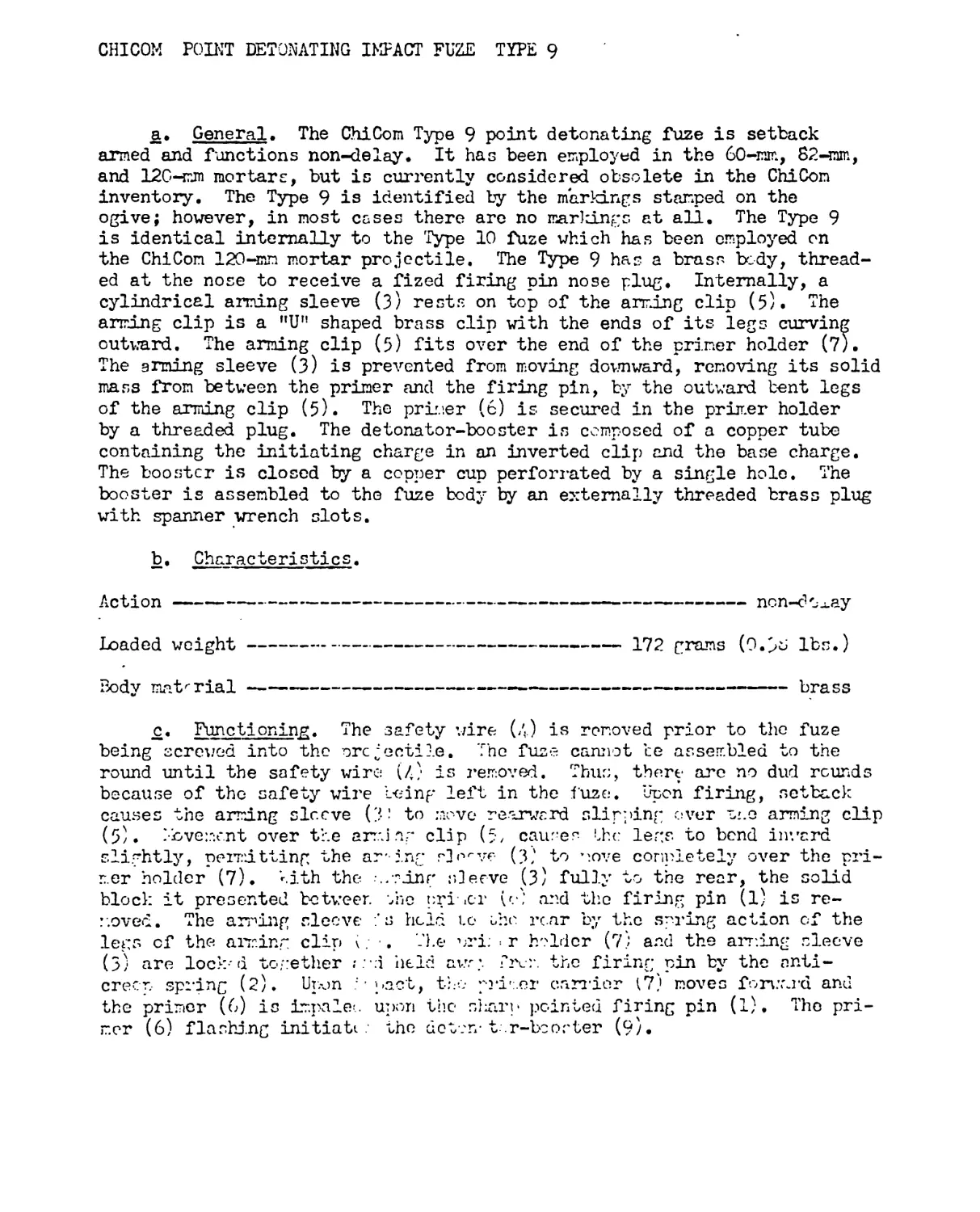
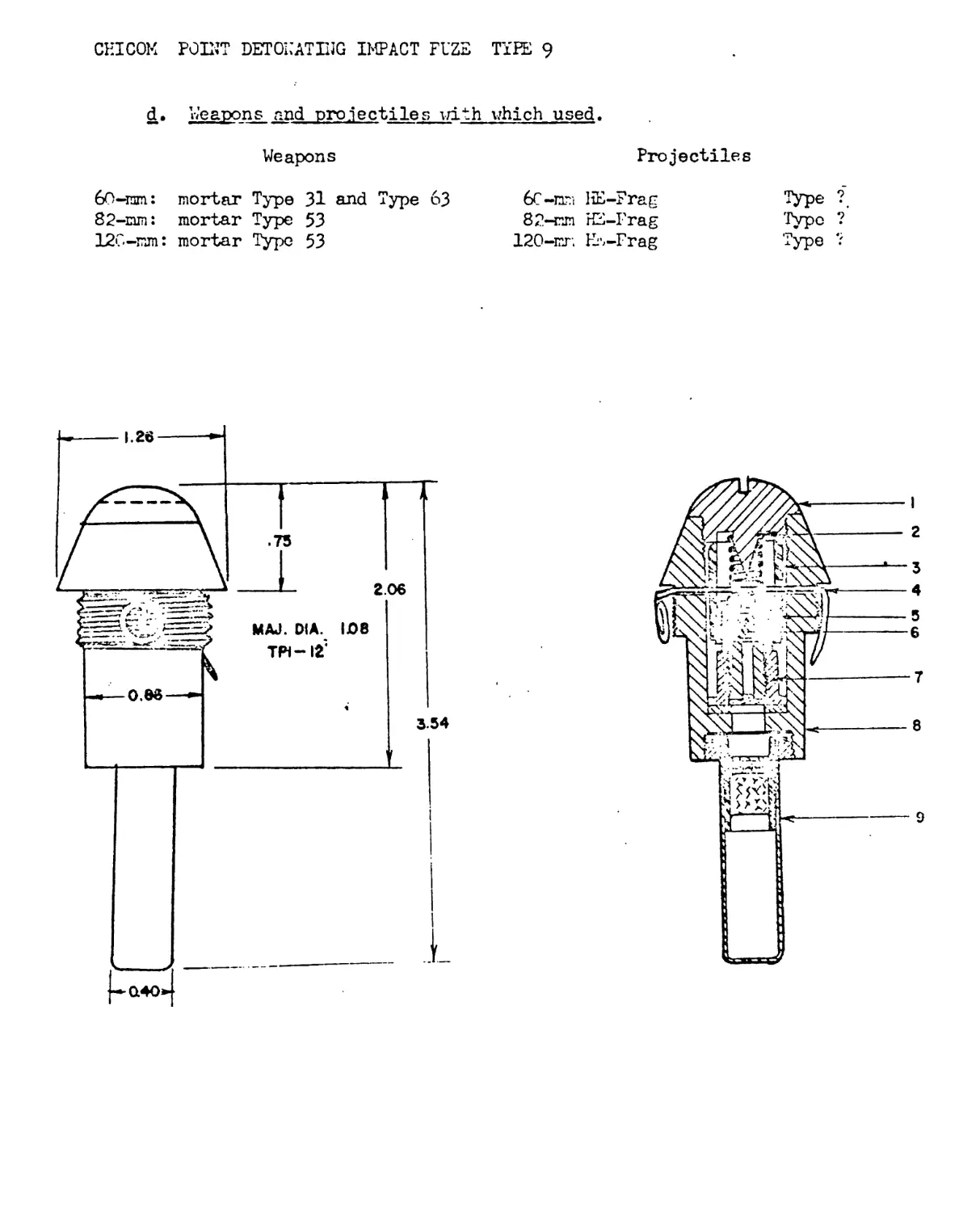
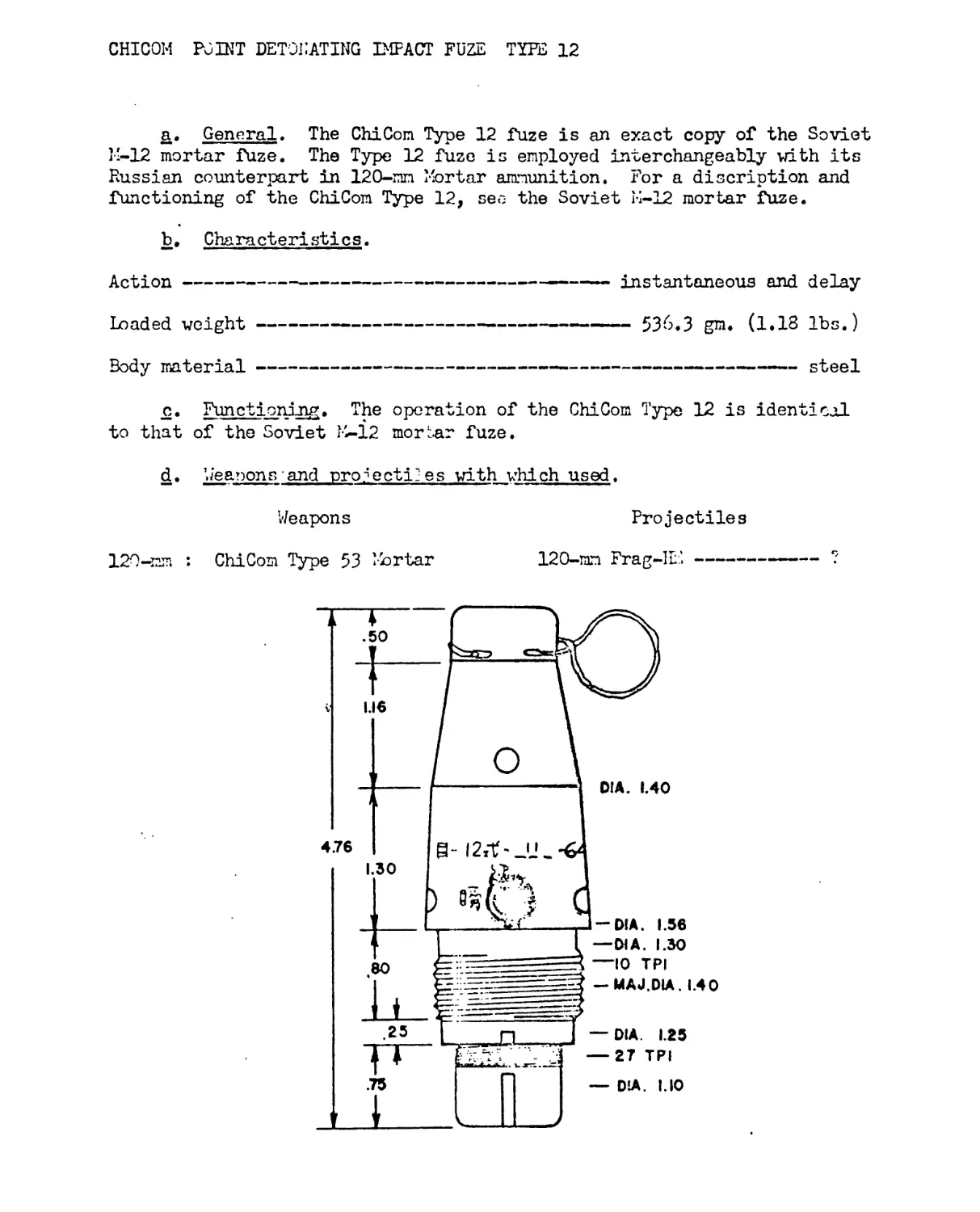
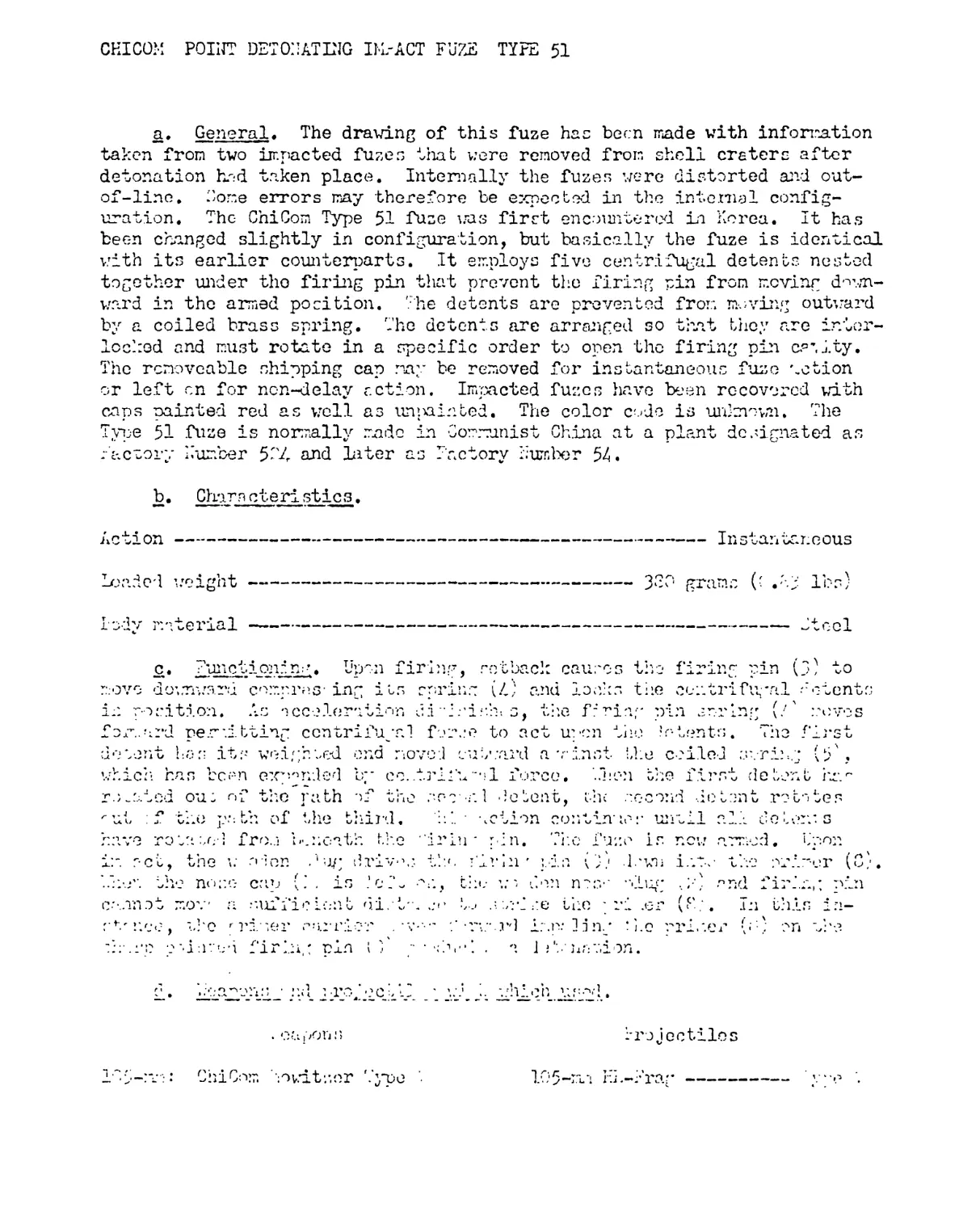
/
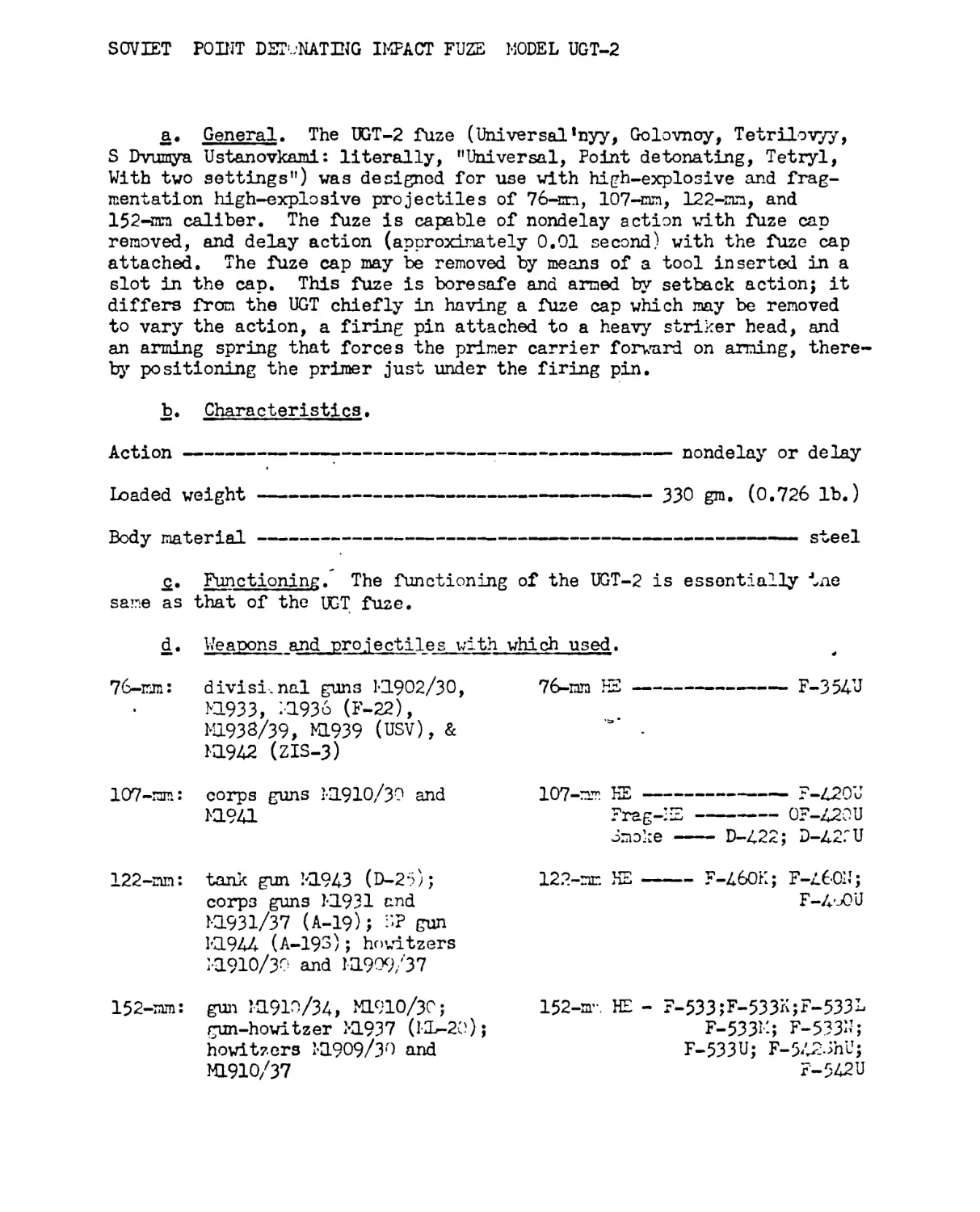
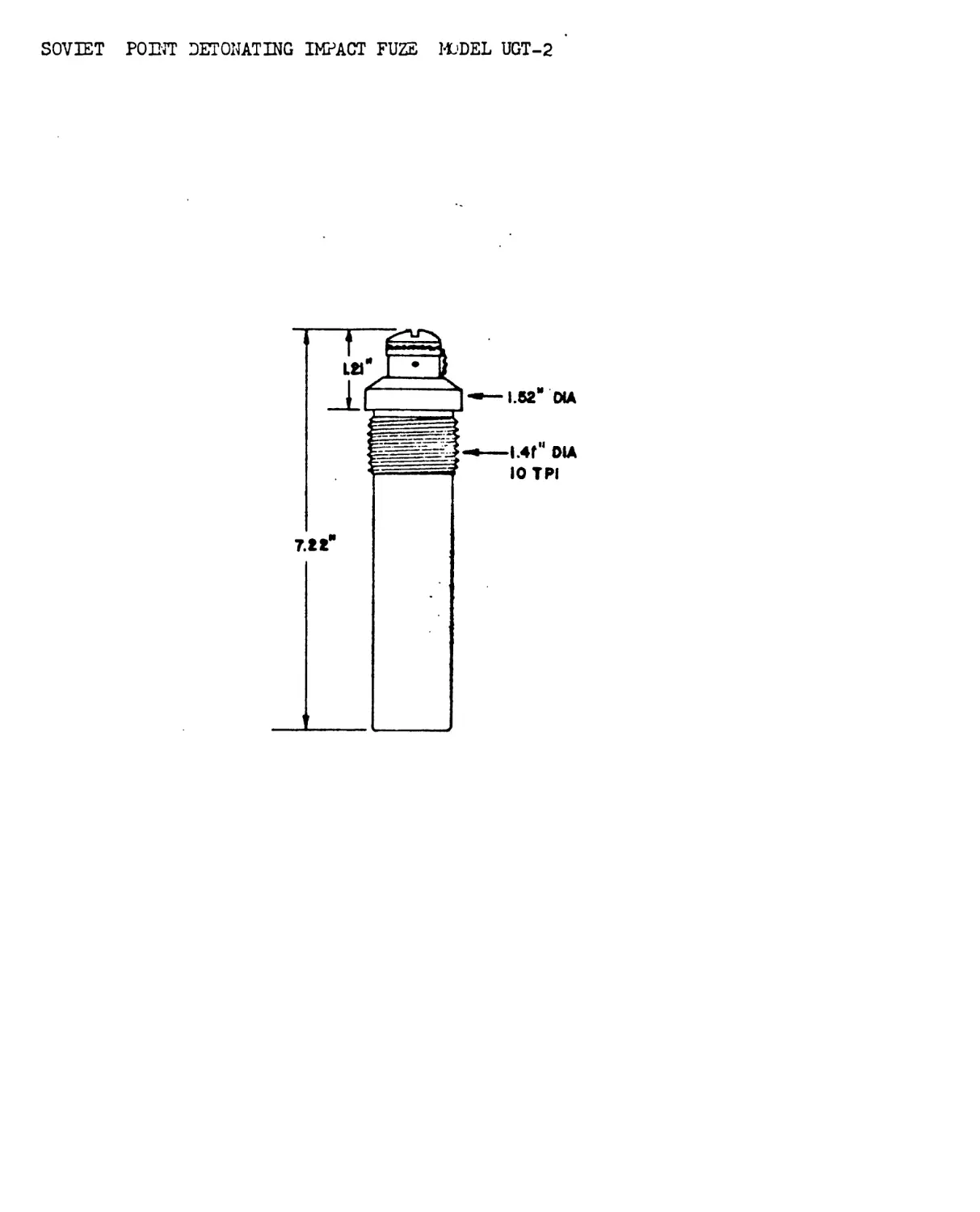
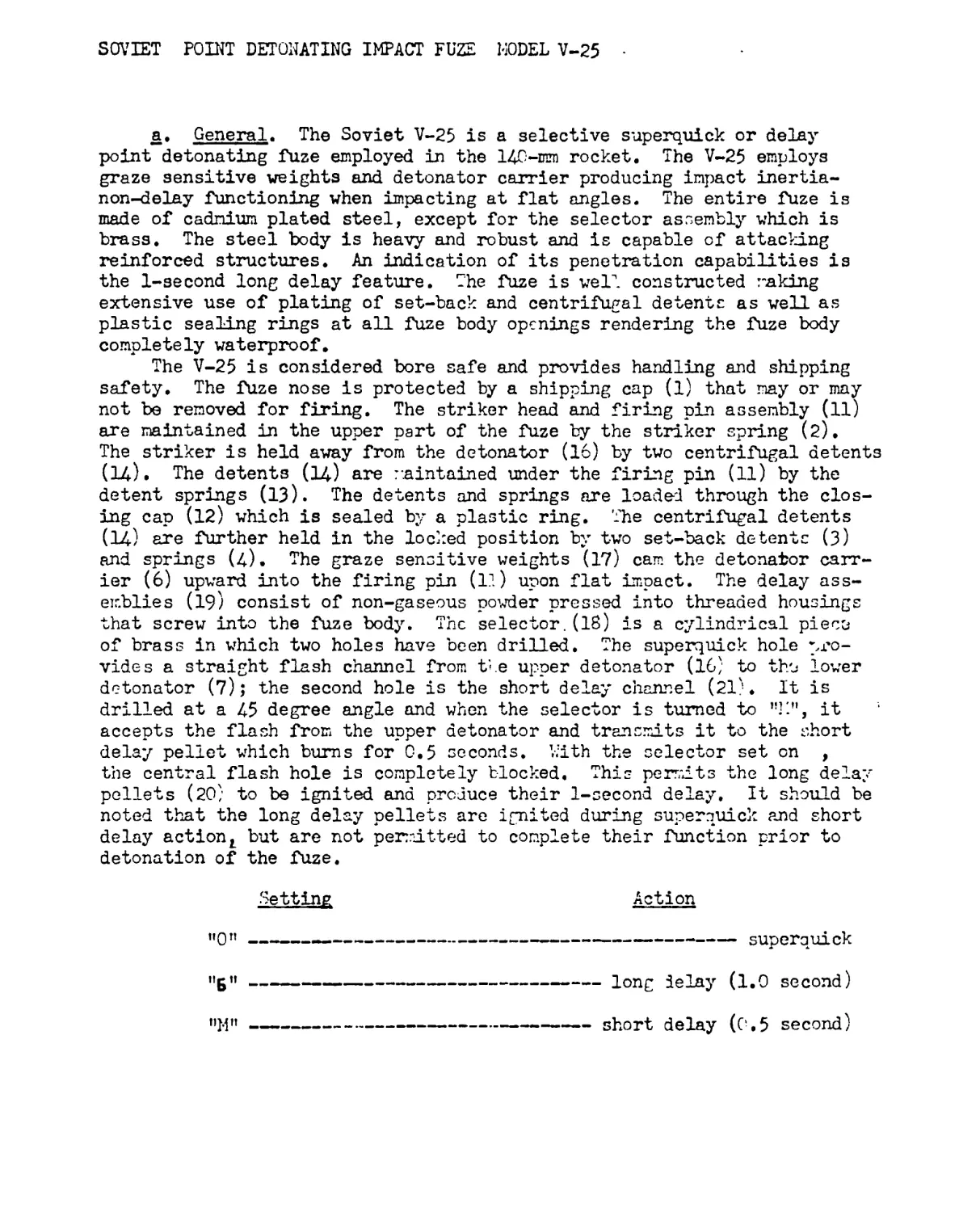

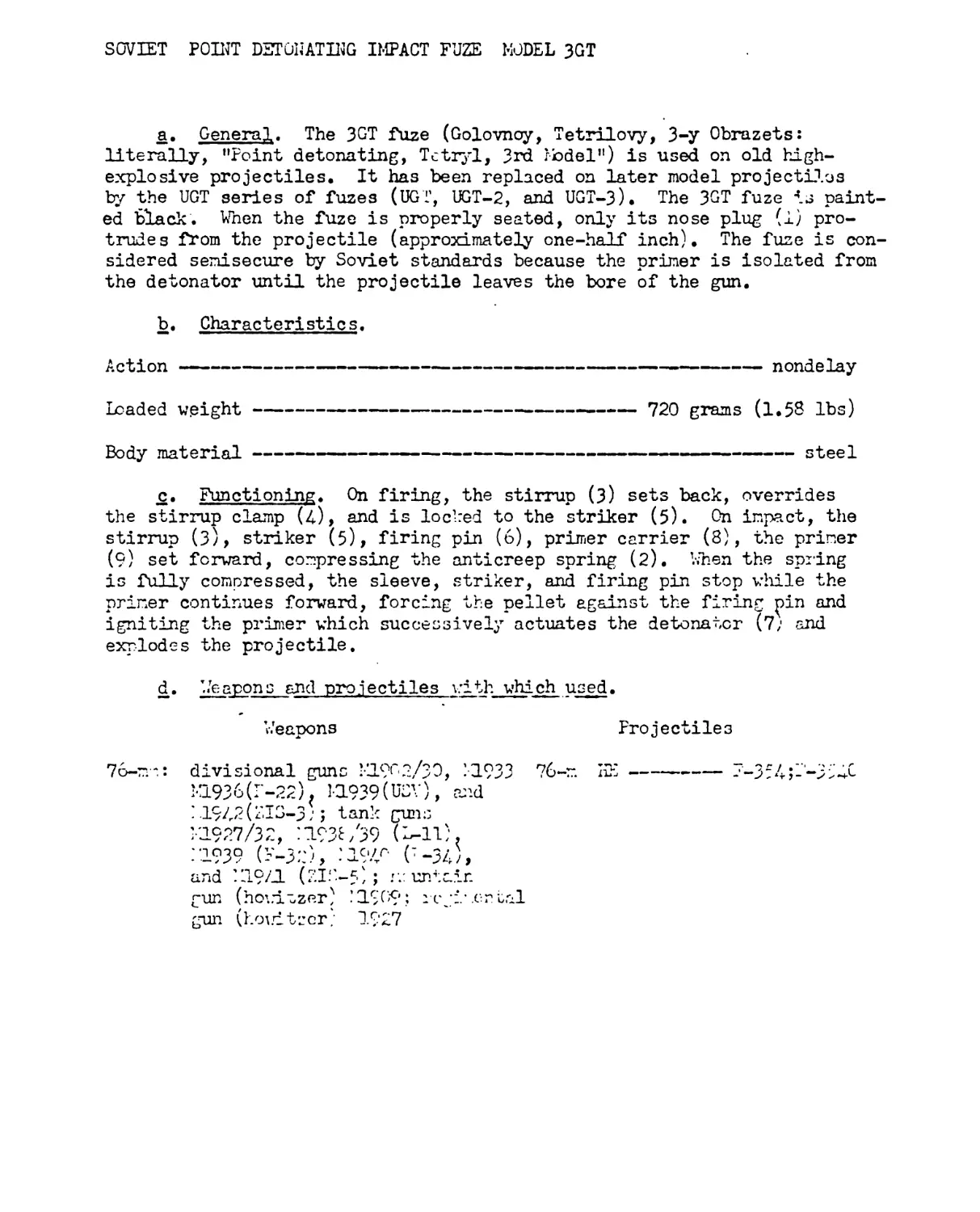
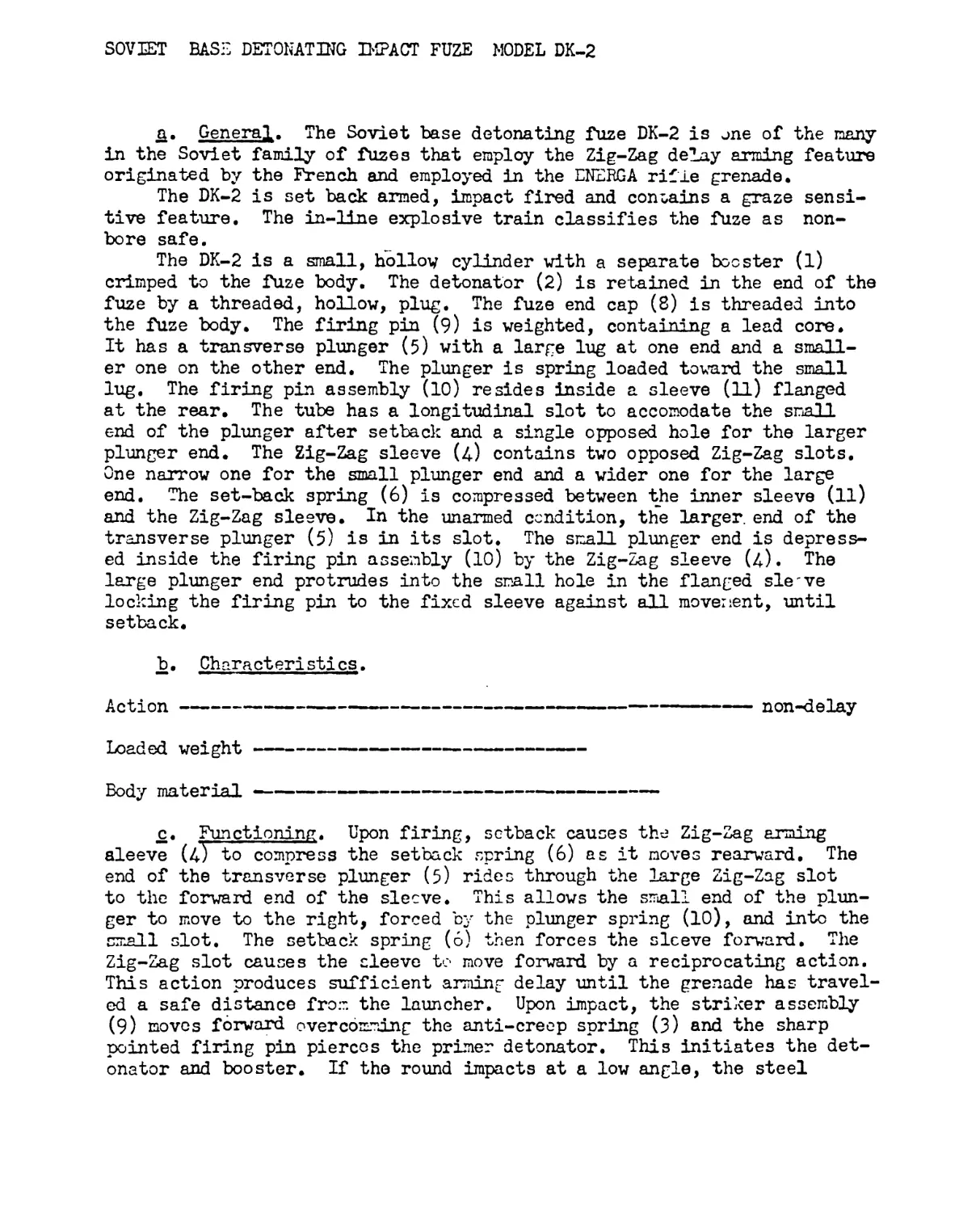
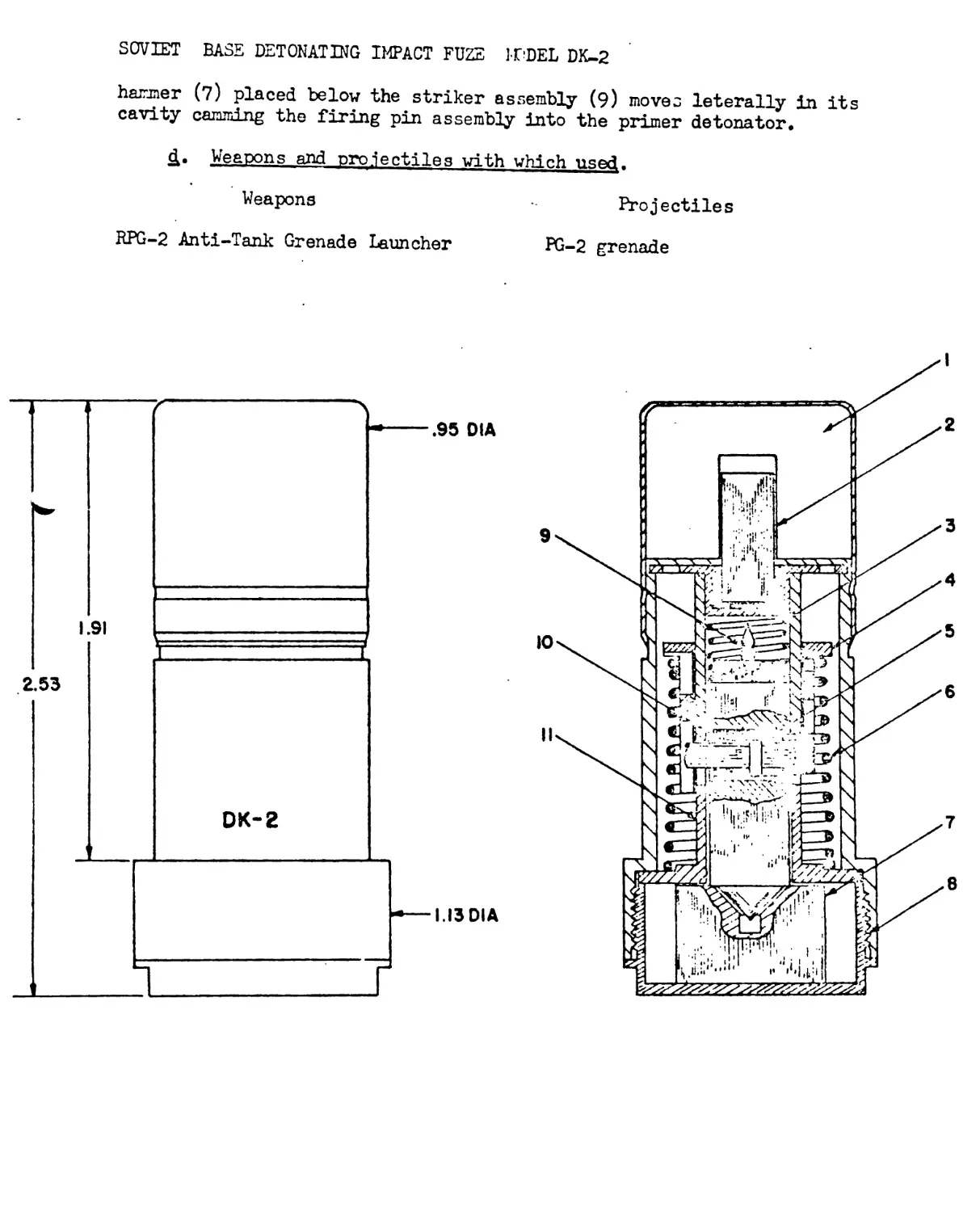
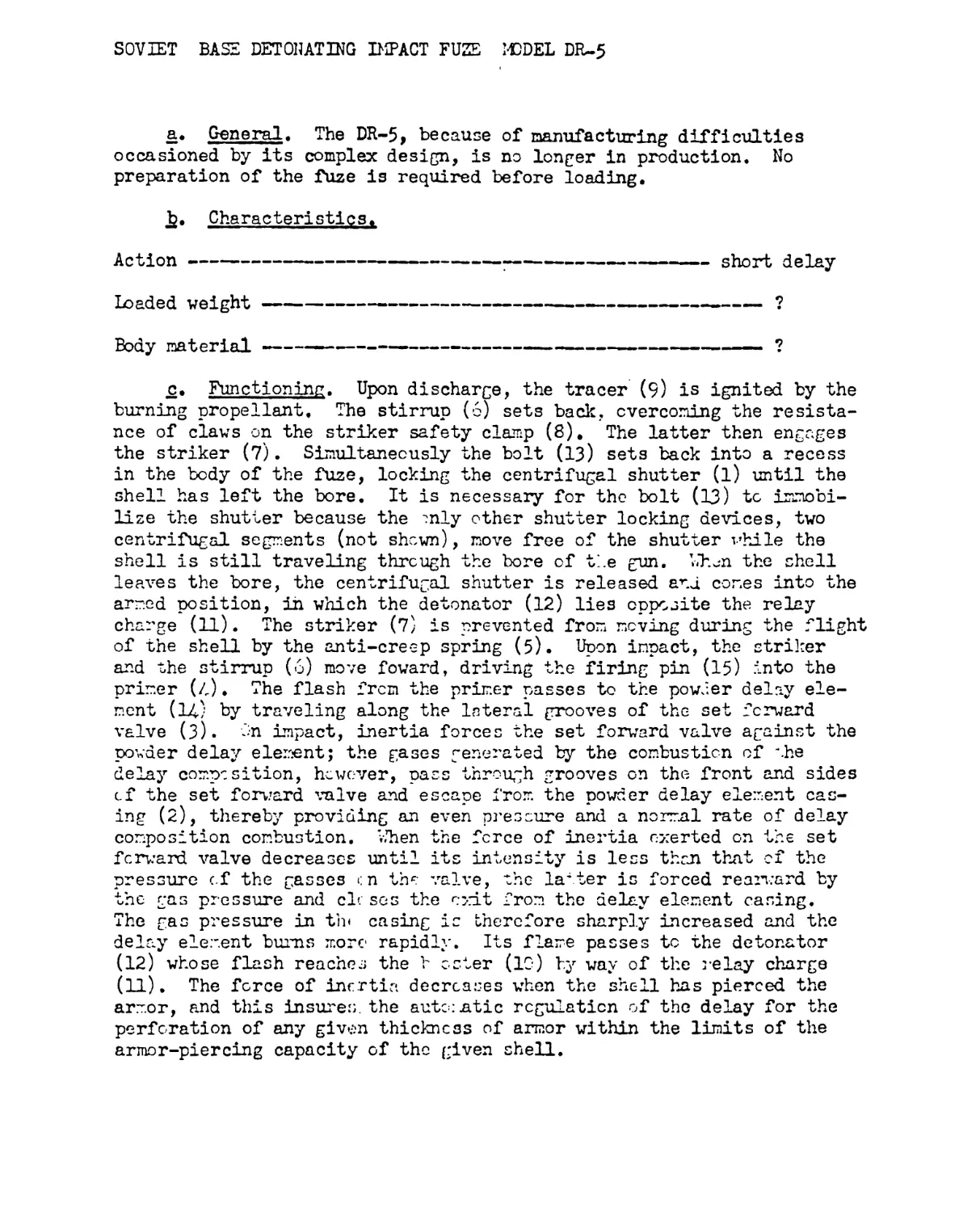
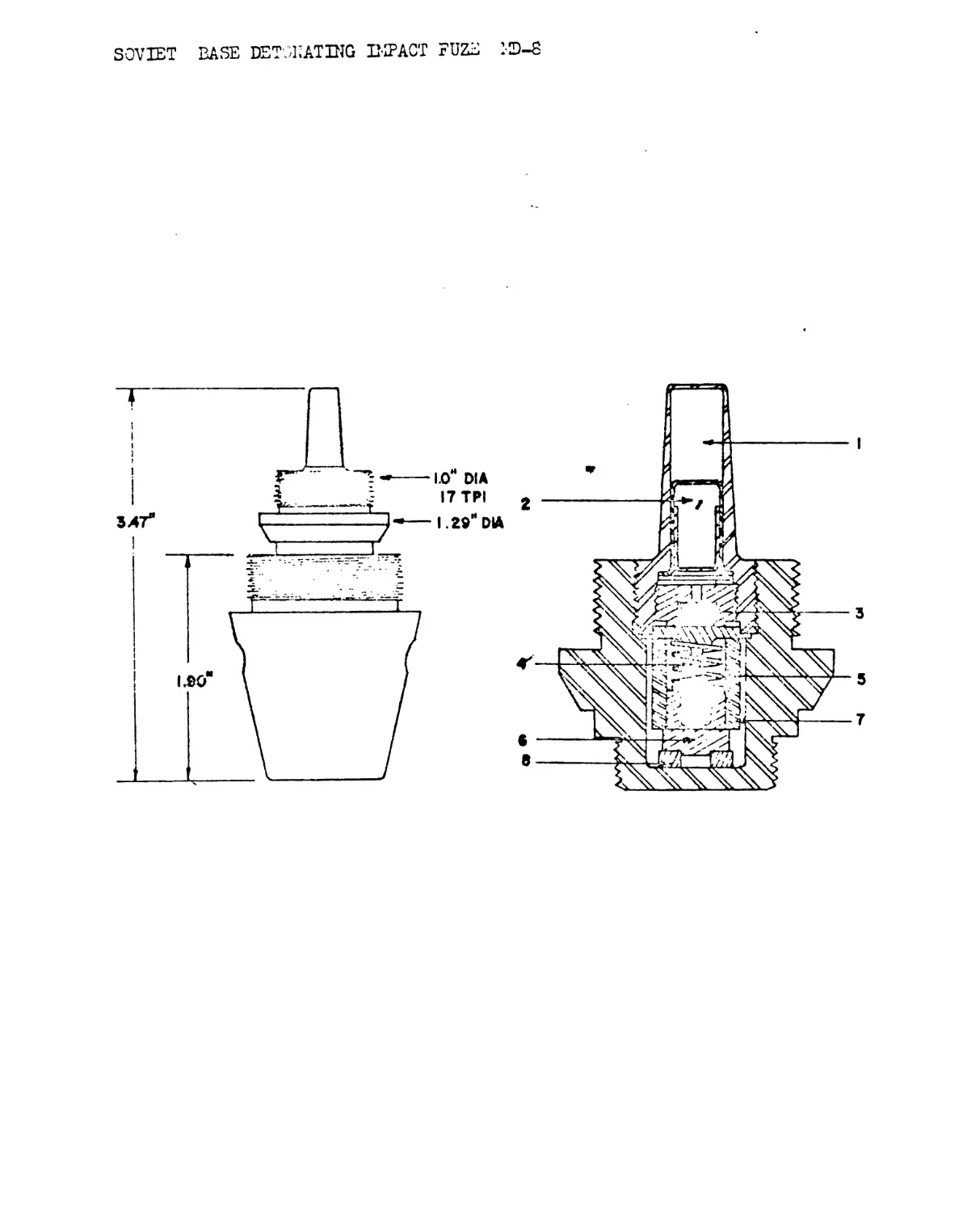
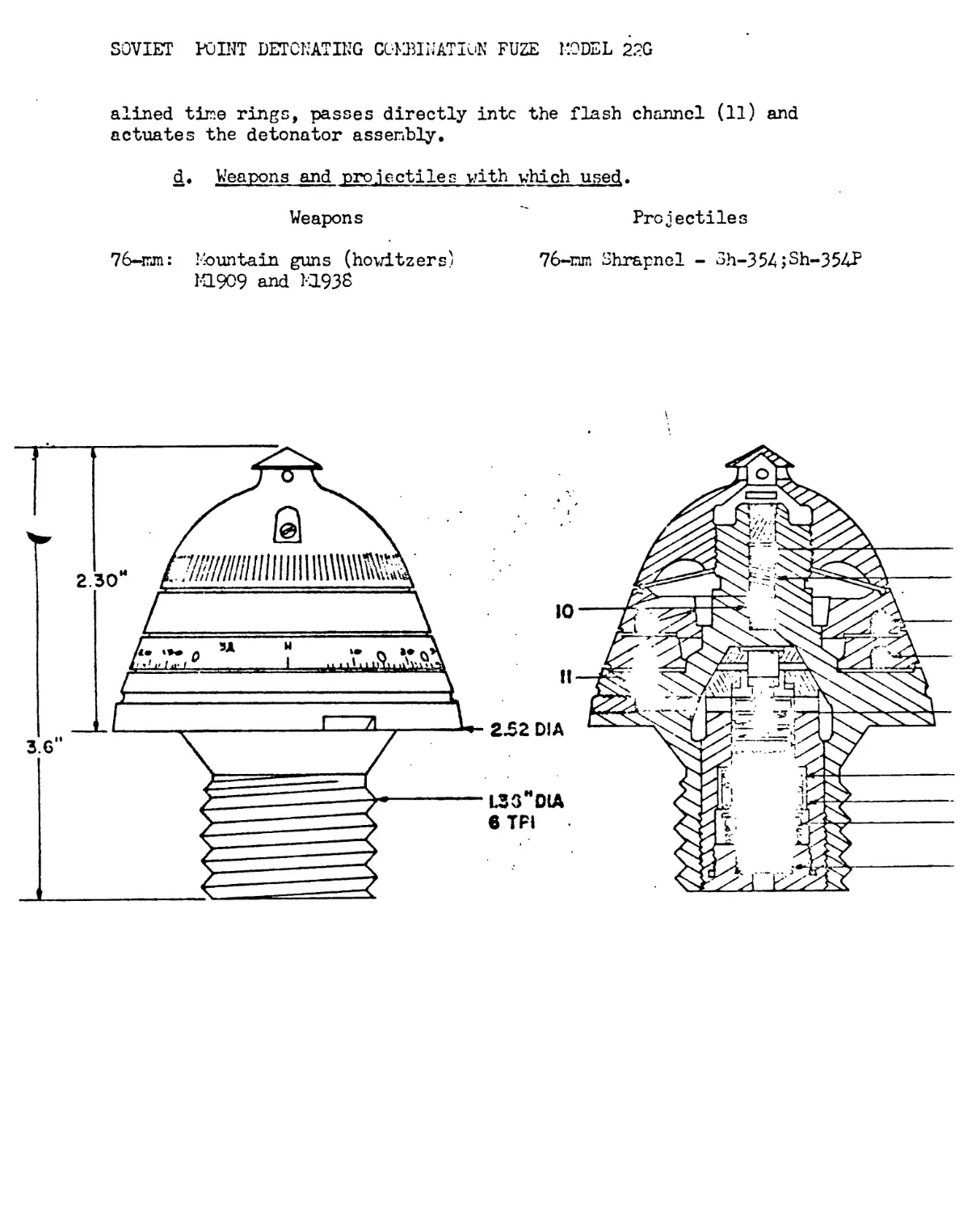
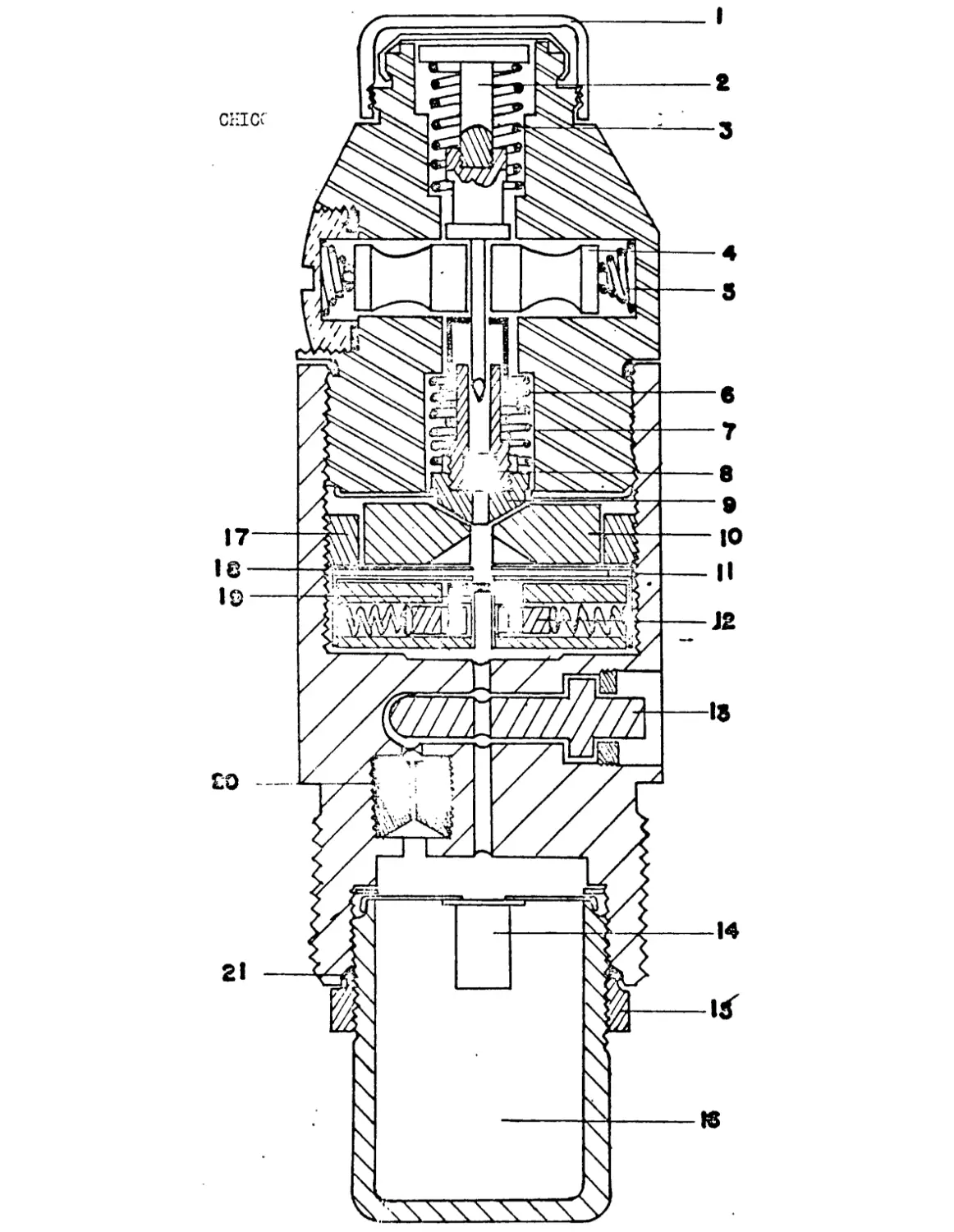
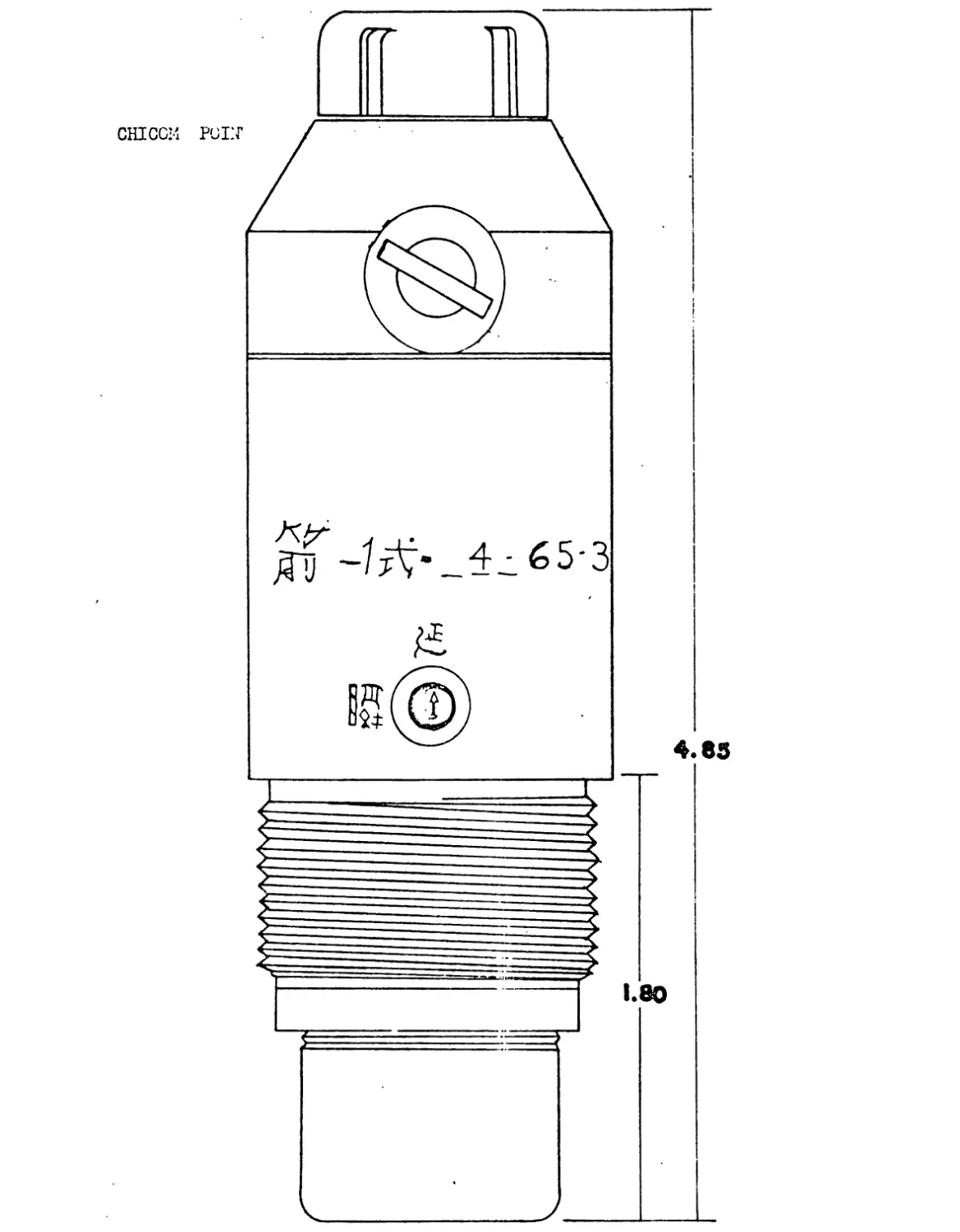
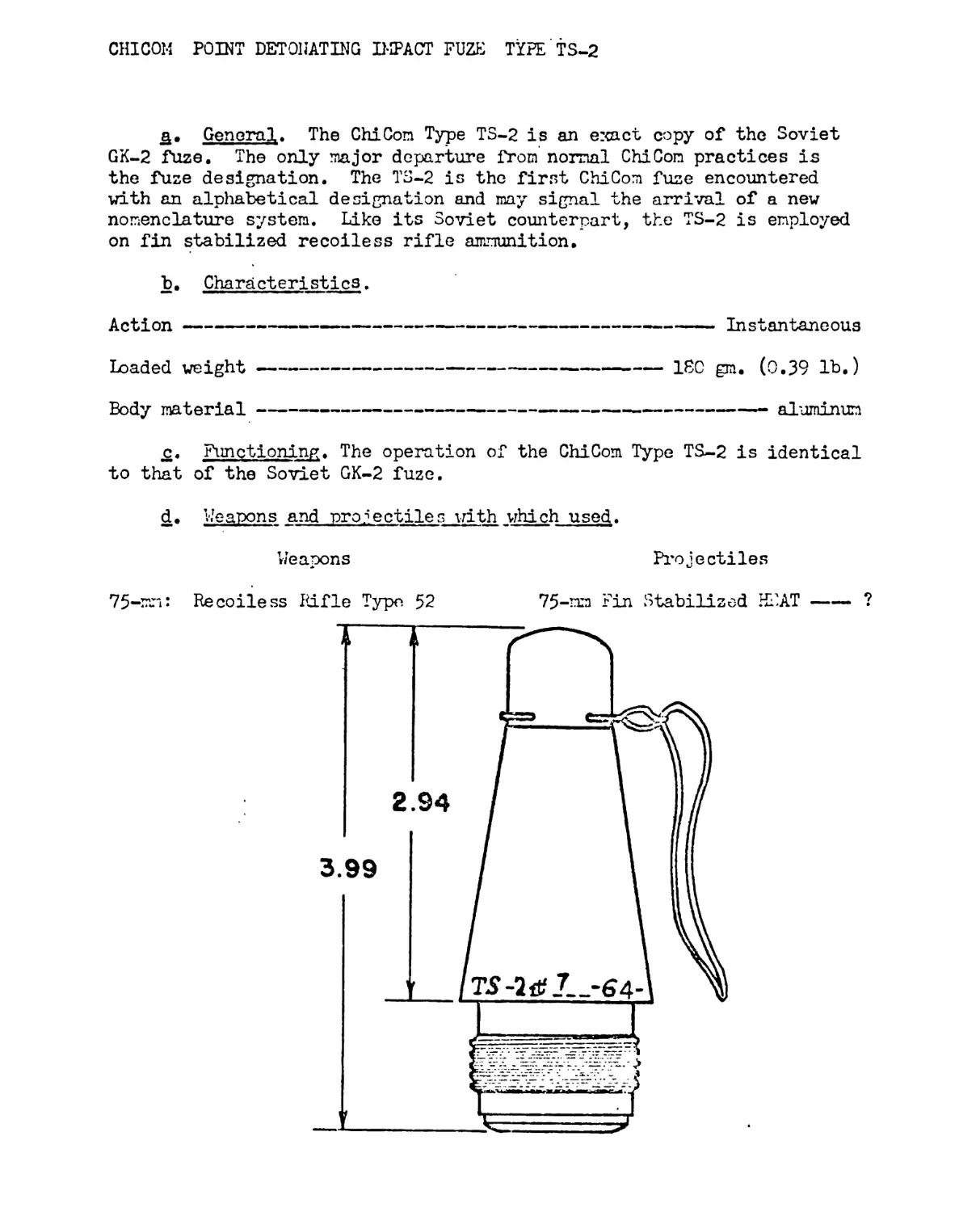
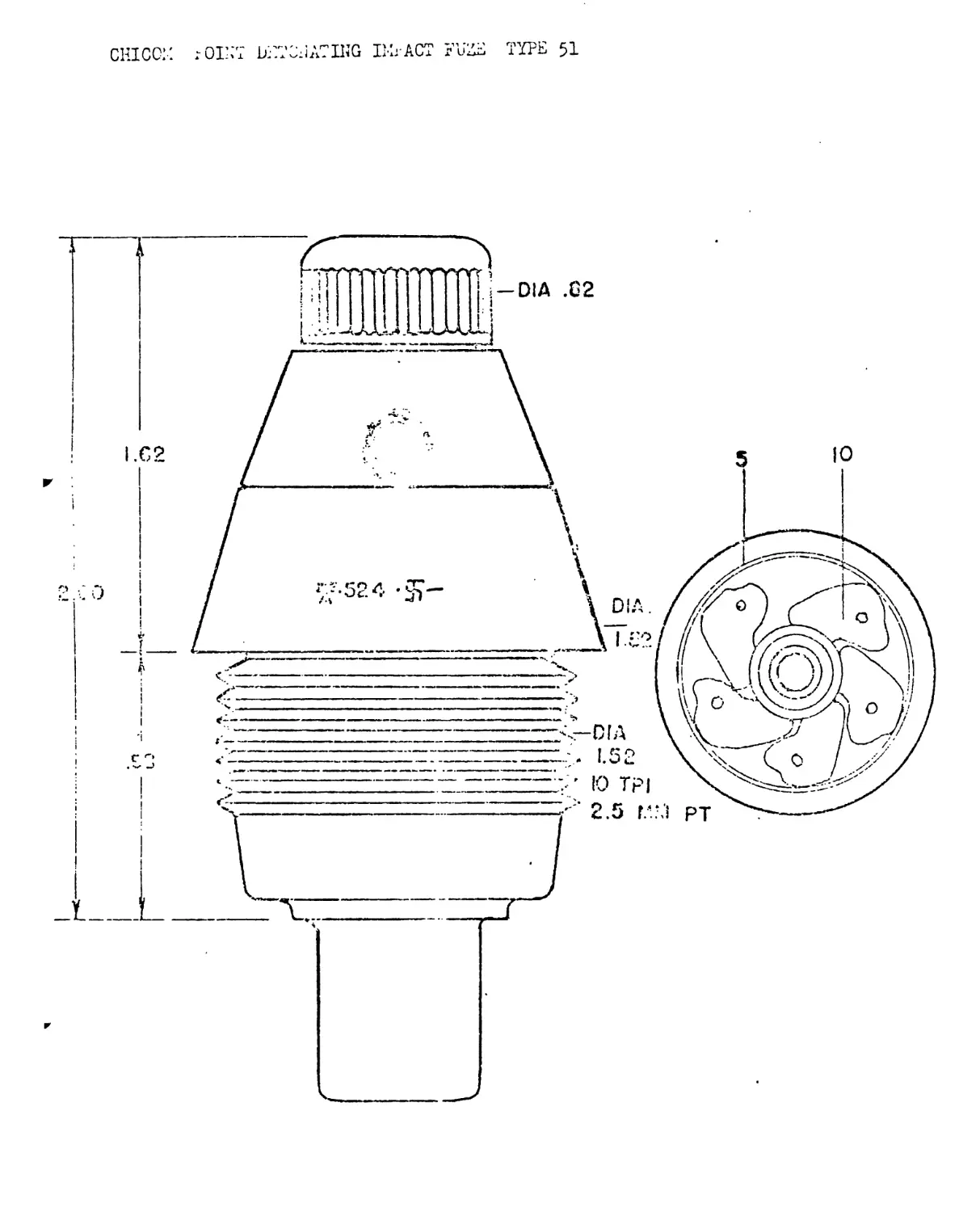
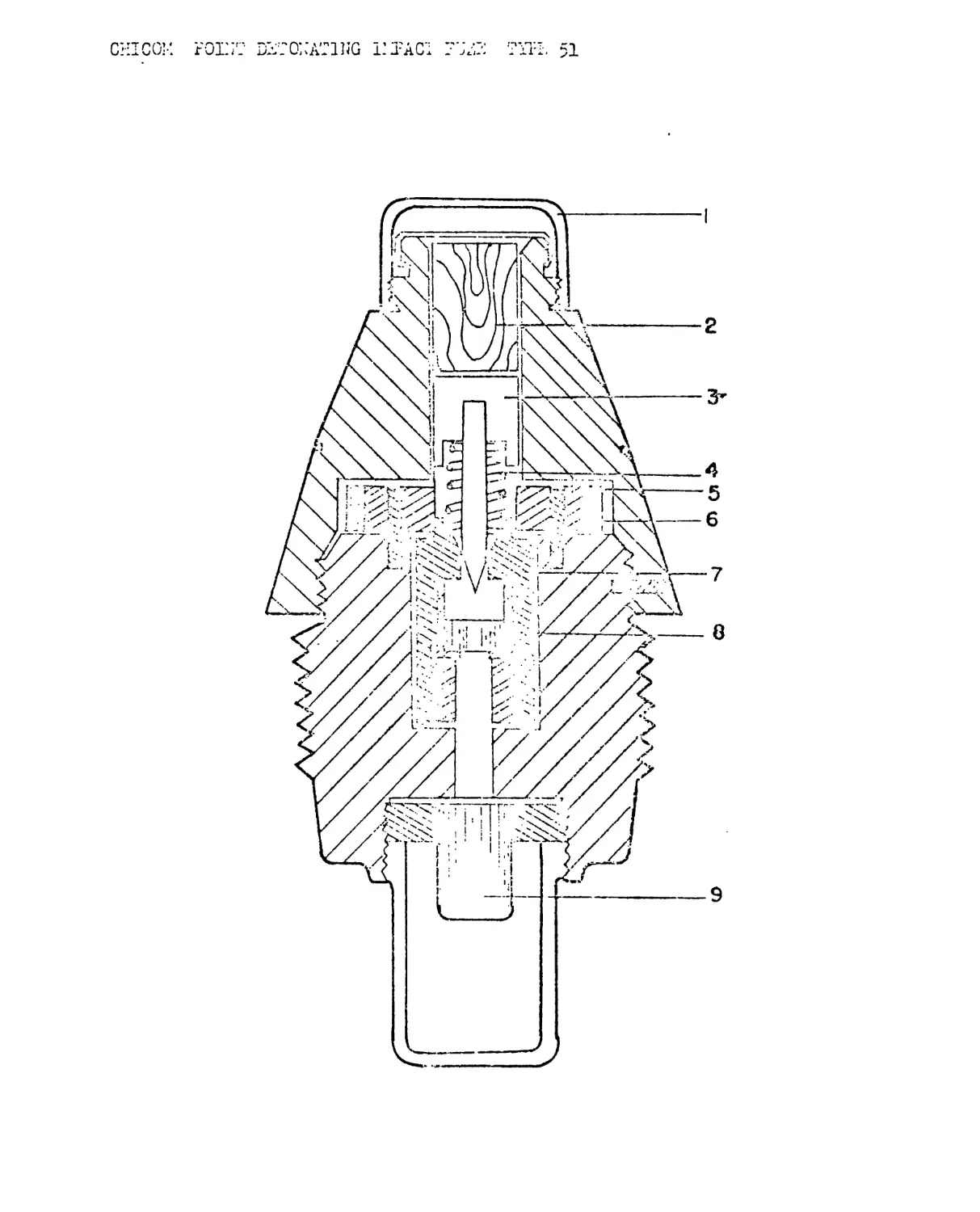
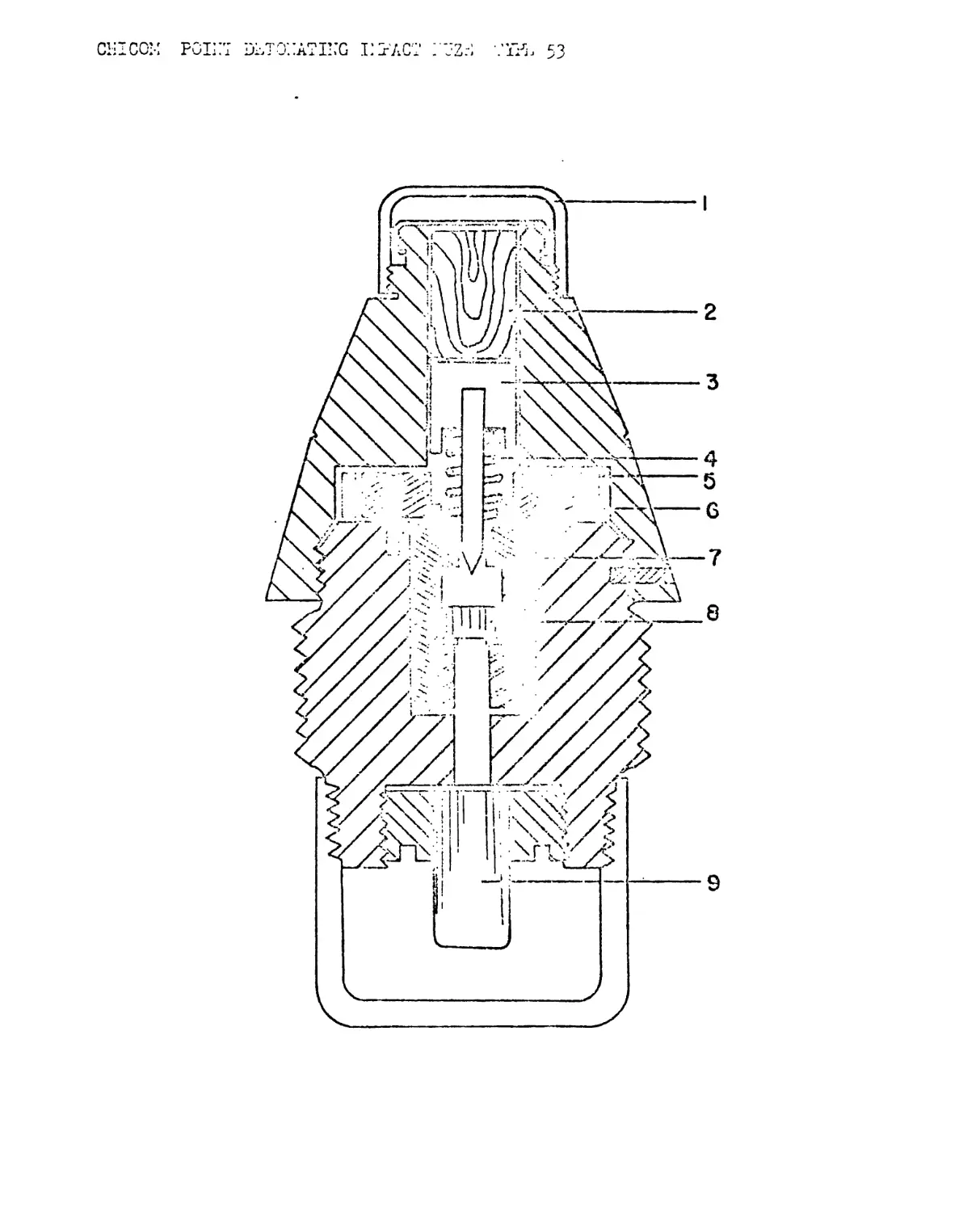

Автор: Aevermann G.
Похожие

Текст
                    ARTILLERY FUZE IDENTIFICATION MANUAL
SECTION I
COIZ.TUNIST BLOC AILIUNITION
by
G-erhard Aevermann
The extraction of оГ
reproduction infor-
mation from this
is strictly forbidden
without permission.
COPY of 50
PURPOSE
This rork is compiled as an aid in Identifying Connuni st Bloc
Fuzes used on cannon ammunition. It is a technical manual vith
a mission of suppling the technical data needed to correctly
identify nr classify artillery fuzes. It is directed to museum
personnel, ordnance collectors, and EOD personnel.
SCOPE
This manual outlines the technical characteristics, current status,
brief history of use, and detailed functioning of Communist Bloc
artillery ammunition fuzes. This includes all fuzes used on any
ammunition 2Cmm or’ larger, manufactured since the First ’Jorld Uar
to the Present date.
The fuzes are arranged by tactical class and are sub-divided by
functioning groups. These groups are further sub-divided by
country of nfigin. 7,’ithin each subdivision the fuzes are arranged
alphabetically by designation and model number of the country *f
origin. Fuzes vith numerical designations are listed in ascending
order.
The technical data presented in this vork is general in nature and,
tn most instances, has been derived from the actual examination of
'uzes. Otherwise the information is taken from documents or ordnance
publications kno~n to be reliable.
It is interded to discuss only standard fuzes, that is , those nor-
mally procured for use in the field, experimental fuzes are not
discussed unless they have been observed on ammunition in current
use.
No attempt has been made to include virtually every Com~uniet bloc
fuze ever produced. Hovever it is felt that the majority of fuzes
no” in use or those thet have been in use have been included in this
vork. Additions and corrections to this manual are invited and
encouraged. All comments and suggestions should be forwarded direct-
ly to the author.
FORMAT
Standard military format, as usually employed by such manuals, is
used throughout. The data is presented in uhat is hoped is a clear
and precise manner.
The manual is presented in loose leaf form rith unnumbered pares
to facilitate the addition of nevi, corrected or revised information
CHAPTER 1
FUZES FOR AIRCRAFT AND ANTI-AIRCRAFT GUNS
GENERAL
All fuzes of this classification are improved modifications
of earlier known fuzes. They are all mechanical, point detonating,
impact types that are designed to function reliably on light
material targets. The aircraft gun fuzes appear to have been based
upon World War II German types of proven reliability. In some
instance* exact copies of internal elements have been noted. In
other cases German mechanical principles have been assimulated with
Soviet munition philosophy design practices, resulting in a composite,
but highly effective design.
The Soviet Anti-Aircraft gun fuzes all employ pyrotechnic type
self-deetruct features, rrecisely the same principles are employed
in fuzes used in weapons from 23mm through 57mm calibers. The purpose
of the eelf-destruct feature is to destroy projectiles that miss
targets, at an altitude where the fragmenting projectile will not
endanger friendly ground units. A secondary purpose is to provide
air bursts as a pychological factor in preventing accurate bombing.
All of the Soviet fuzes in the aircraft and anti-aircraft
classification are bore safe, in that they are provided with
mechanical features designed to prevent the fuze from arming while
in the tube of the weapon. Some of the earlier fuzes are not
detonator safe, by American standards, in that the explosive train
is not interrupted to positively preclude an in-bore detonation.
However, a major trend is indicated toward both bore and detonator
safe fuzes. This is evidenced by the introduction of the MG and В
series fuzes with their out-of-Une detonator rotors.
The extreme effort in designing moisture end environment proof
fuzes is seen in Aircraft and Anti-Aircraft Fuzes. It appears that
the Soviets have great confidence in the moisture proofness of their
ammunition, due to the small amount of attention being given to
environment proof j'acking containers. Soviet shipping containers
are little more than a means of protecting the ammunition from the
normal hazards of shipping and handling.
Soviet fuzes are marked plainly on the ogive. Each fuze is die
stamped with the fuze nomenclature. Where space is available the
lot number, year of manufacture, and plant number are included.
Anti-Aircraft fuzes are normally ’’blued" or painted black with an
additional coating of varnish or epoxy to inhibit external corrosion.
If the fuze is cadmium plated, the exterior epoxy or varnish
coating is still applied. Some fuzes have been seen with colored
lacquer on the nose. The significance of the color has not been
determined. It has been noted that not all fuzes of a specific
designation, produced by the same plant, have the color marking.
GENERAL (con't)
Normally air-craft and anti-aircraft fuzes do not require any
preparation for firing or linking. The larger calibers, such as
57mm, possess fuzes with removable shipping caps to increase impact
sensitivity, but it has not been determined what the presence of a
cap signifies, other than as a shipping safety device.
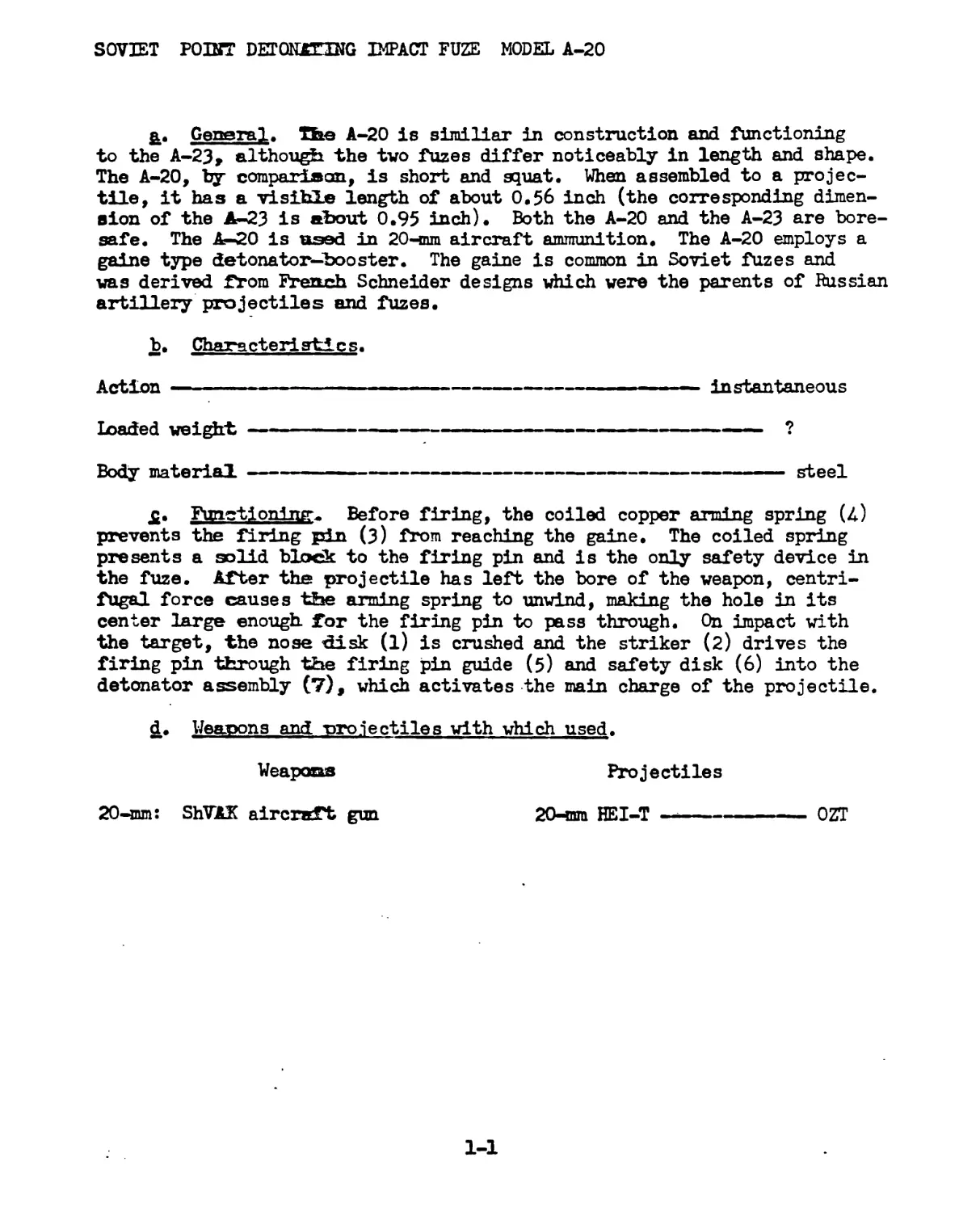
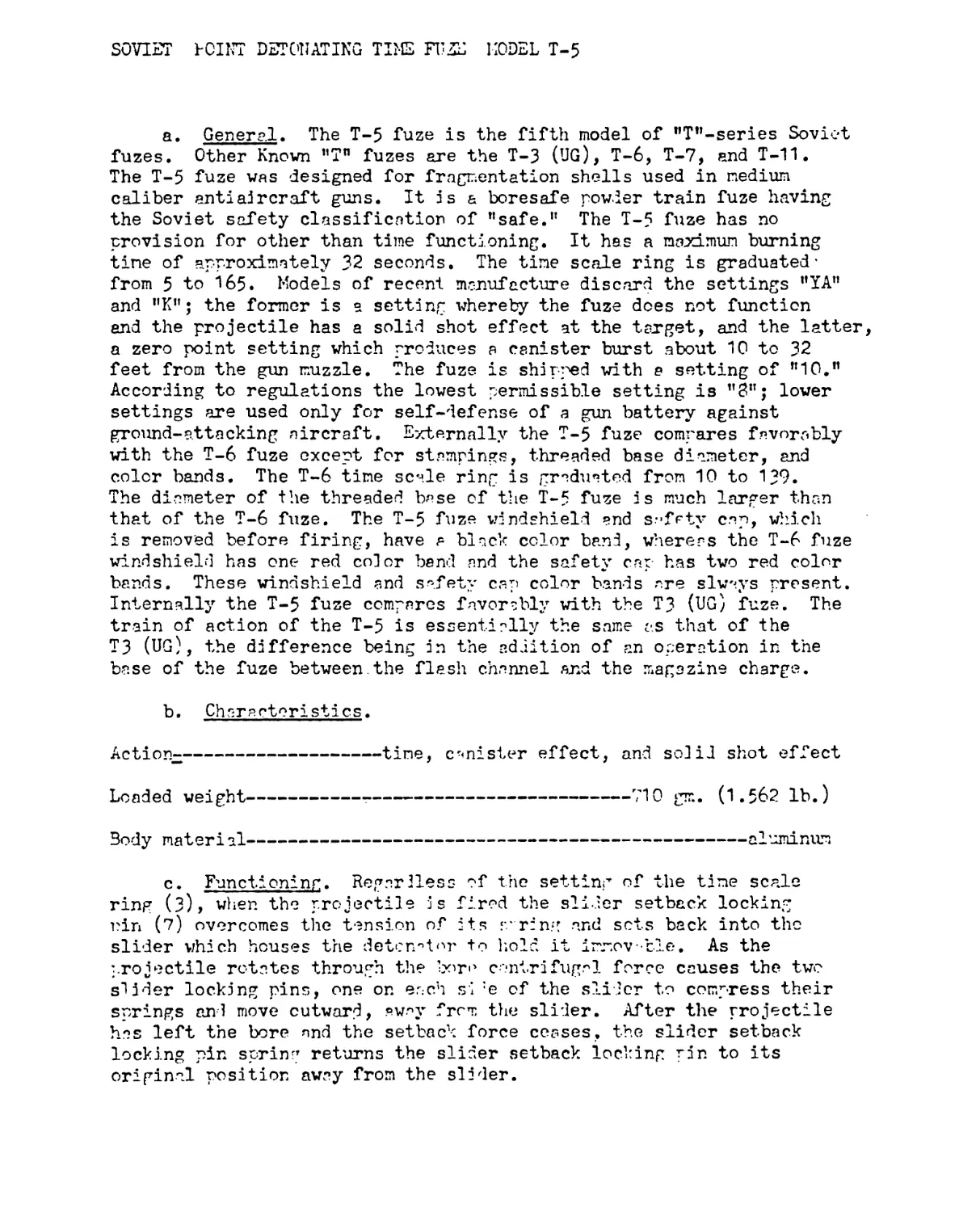
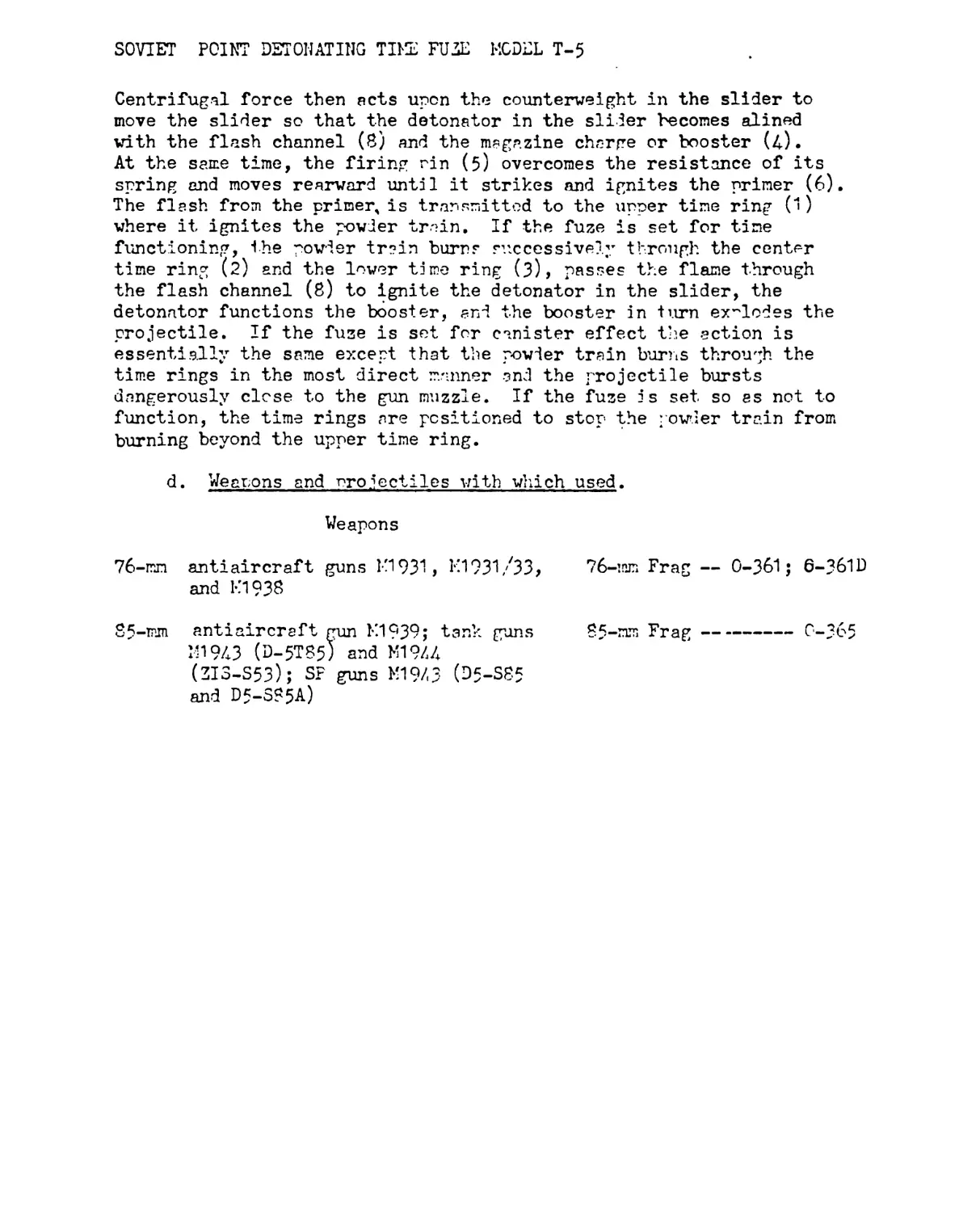
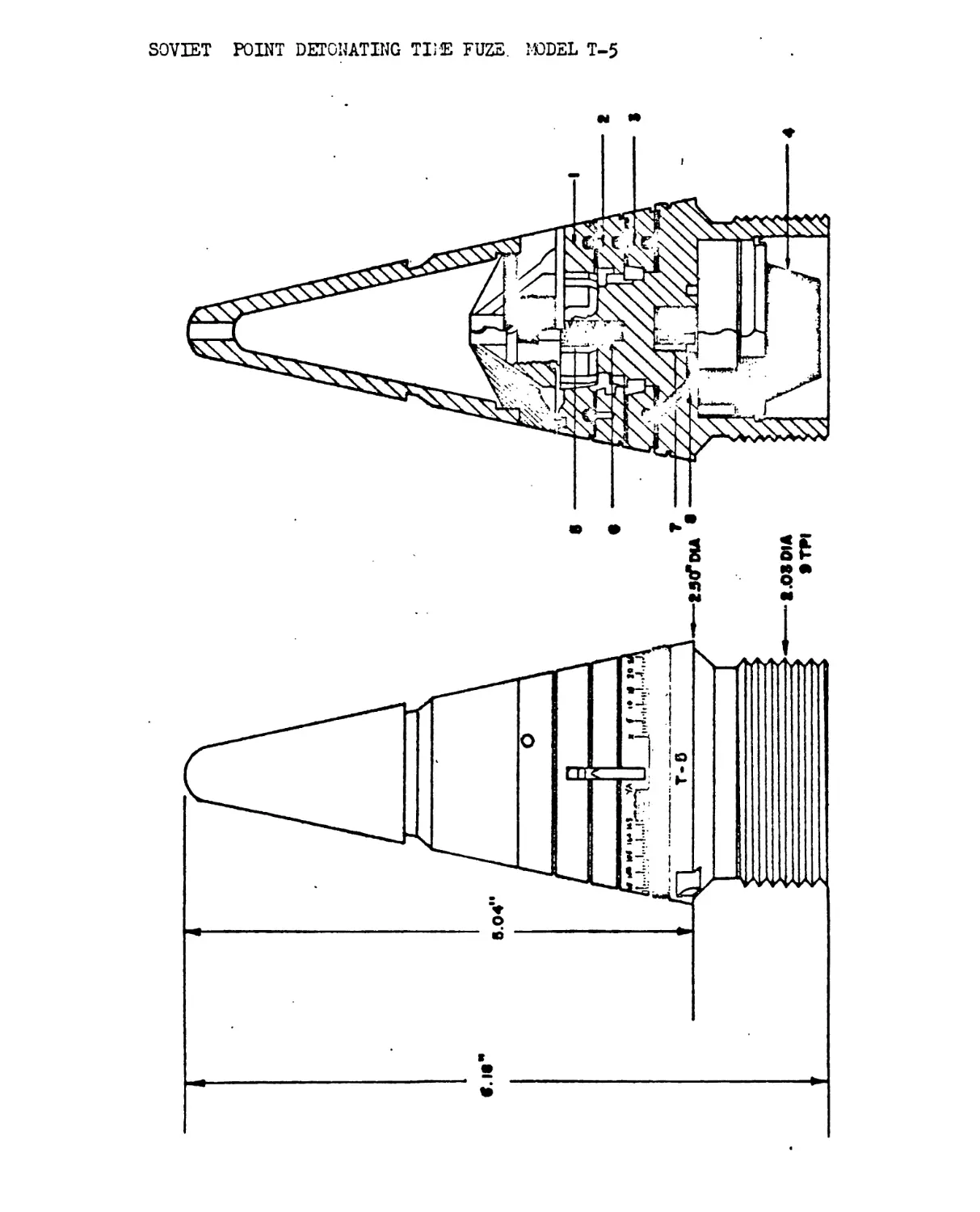
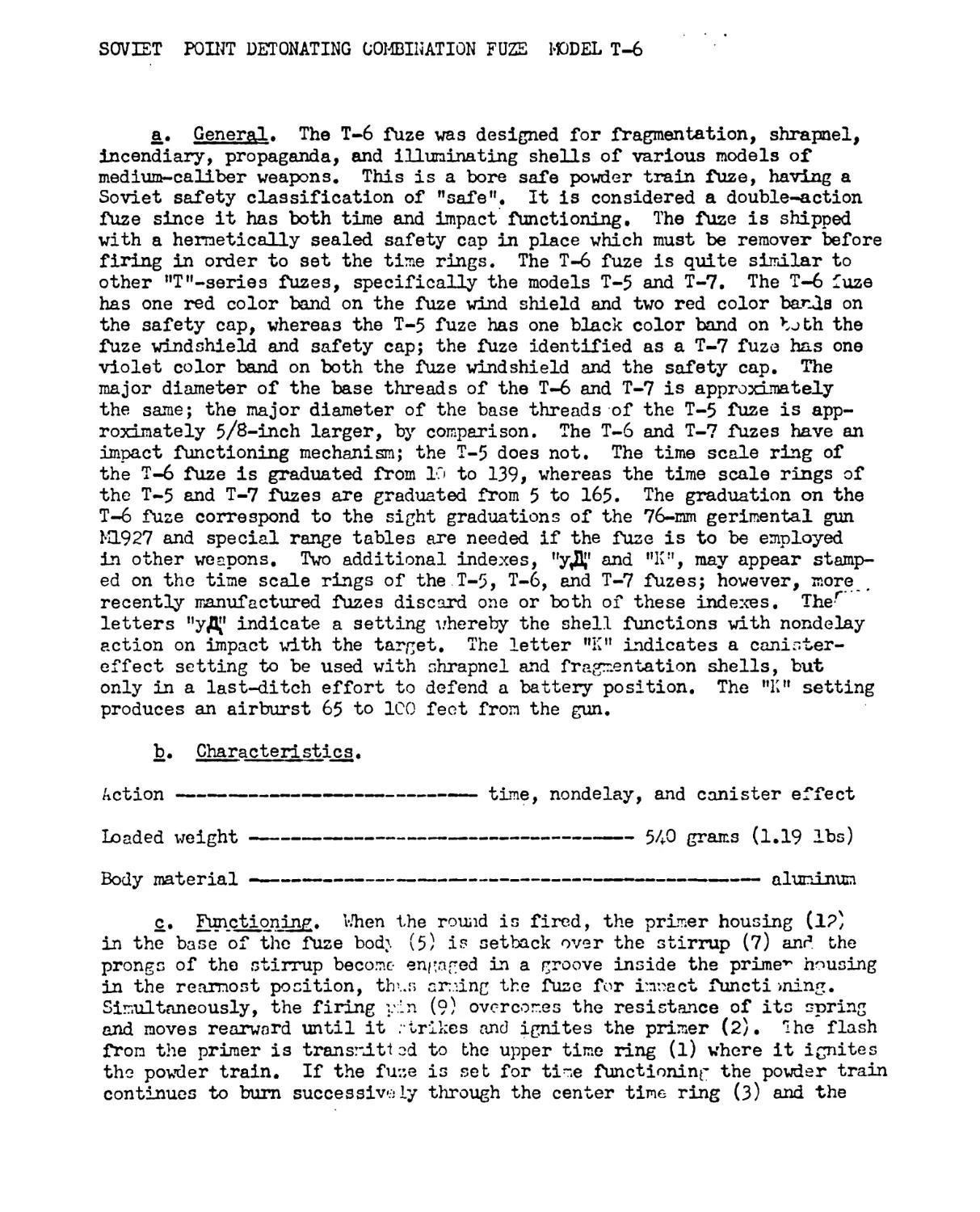
SOVIET POINT DETONATING IMPACT FUZE MODEL A-20
&. General. Tbe A-20 is siroiliar in construction and functioning
to the A-23, although the two fuzes differ noticeably in length and shape.
The A-20, by comparieon, is short and squat. When assembled to a projec-
tile, it has a visible length of about 0.56 inch (the corresponding dimen-
sion of the A-23 is about 0.95 inch). Both the A-20 and the A-23 are bore-
safe. The A-20 is used in 20-mm aircraft ammunition. The A-20 employs a
gaine type detonator—booster. The gaine is common in Soviet fuzes and
was derived from French Schneider designs which were the parents of Russian
artillery projectiles end fuzes.
b. Characteristics.
Action----------------------------------------——--------instantaneous
Loaded weight----------——------—-— -----------———--------——. ?
Body material--------------------------------------------—— steel
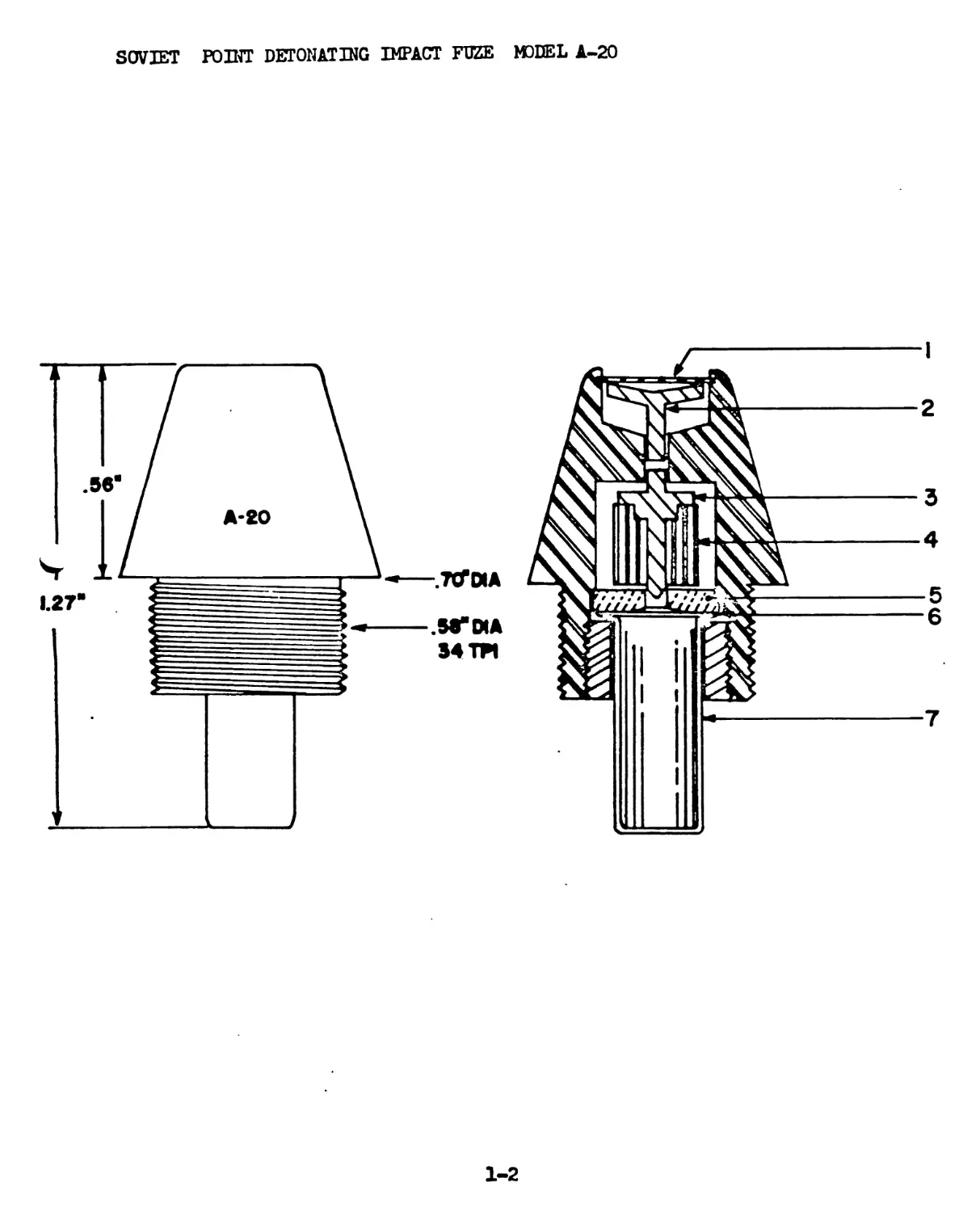
Functioning- Before firing, the coiled copper arming spring (4)
prevents the firing pin (3) from reaching the gaine. The coiled spring
presents a solid block to the firing pin and is the only safety device in
the fuze. After the projectile has left the bore of the weapon, centri-
fugal force causes the n-rming spring to unwind, making the hole in its
center large enough, for the firing pin to pass through. On impact with
the target, the nose disk (1) is crushed and the striker (2) drives the
firing pin through the firing pin guide (5) and safety disk (6) into the
detonator assembly (7), which activates the main charge of the projectile.
<1. Weapons and projectiles with which used.
Weapons	Projectiles
20-mm: ShVAX aircraft gun	20-nm HEI-T --------------OZT
1-1
SOVIET POINT DETONATING IMPACT FUZE MODEL A-20
10(0
1-2
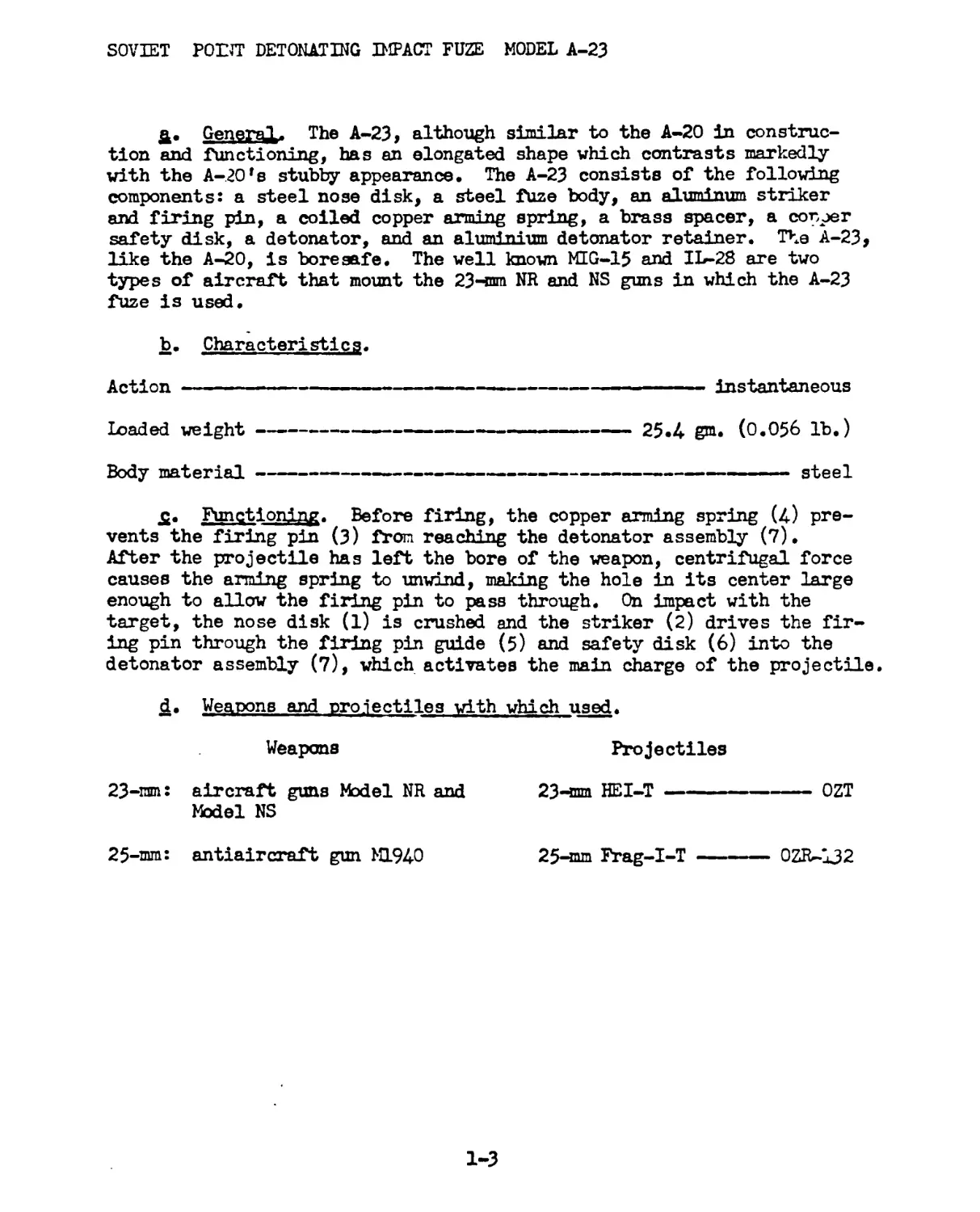
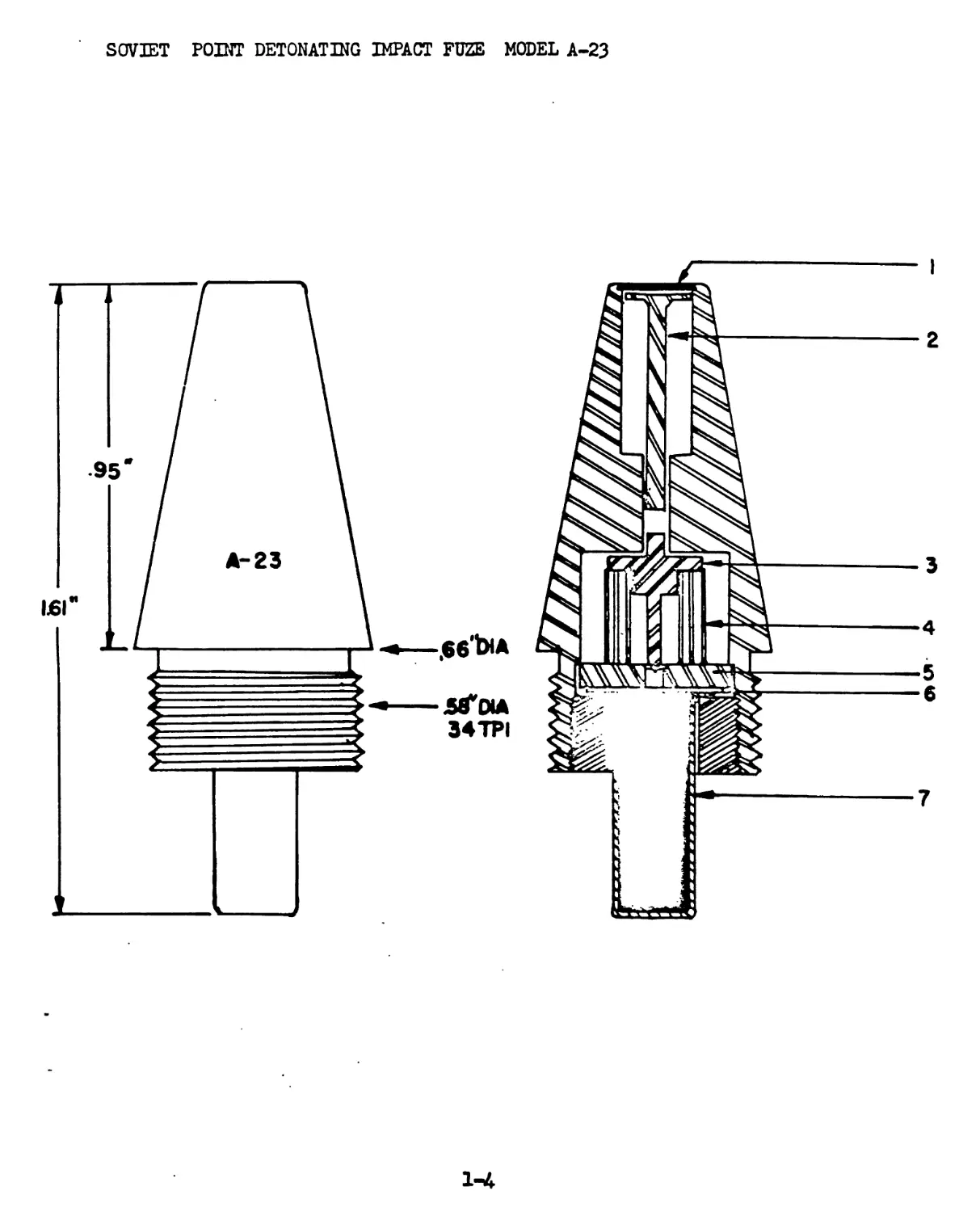
SOVIET POINT DETONATING IMPACT FUZE MODEL A-23
GenaraT - The A-23, although si mi lar to the A-20 in construc-
tion and functioning, has an elongated shape which contrasts markedly
with the A-20fs stubby appearance. The A-23 consists of the following
components: a steel nose disk, a steel fuze body, an aluminum striker
and firing pin, a coiled copper arming spring, a brass spacer, a copper
safety disk, a detonator, and an aluminium detonator retainer. The A-23,
like the A-20, is bore safe. The well known MIG-15 and Ib-28 are two
types of aircraft that mount the 23-mm NR and NS guns in which the A-23
fuze is used.
b. Character!sti с s.
Action	---- — -------------------------.. . —--- Instantaneous
Loaded weight ---------—------------—------------- 25*4 gm. (0.056 lb.)
Body material-----------------—— —--------------------------— steel
£. Functioning. Before firing, the copper arming spring (4) pre-
vents the firing pin (3) from reaching the detonator assembly (7).
After the projectile has left the bore of the weapon, centrifugal force
causes the arming spring to unwind, making the hole in its center large
enough to allow the firing pin to pass through. On impact with the
target, the nose disk (1) is crushed and the striker (2) drives the fir-
ing pin through the firing pin guide (5) and safety disk (6) into the
detonator assembly (7), which activates the main charge of the projectile.
d. Weapons and projectiles with which used.
Weapons	Projectiles
23-nm: aircraft guns Model NR and	23-nnn HEI-T---------------OZT
Model NS
25-mm: antiaircraft gun M1940	25-mm Frag-I-T -------- OZR-132
1-3
SOVIET POINT DETONATING IMPACT FUZE MODEL A-23
14
SOVIET POINT DETONATING IMPACT FUZE MODEL A-37
a.	General. The к-У1 is a sensitive, bore safe fuze with a self-
destniction feature, and is designed for use with 37-mm aircraft guns.
It is similiar to the MG-8 fuze and almost identical to the MG-37, the
MGZ-37, and the B-37, (all of which are used with the 37-mm AA gun
ML939), differing significantly from the latter only in having a short-
er self-destruction powder train. Apparently because of its short self-
de struct ion time causing undesirably early detonation, destroying the
projectile at some point short of the effective combat range of the
ammunition, the A-37 has been succeeded by a modified version, the A-37U,
with a longer self-destruction powier train. The A-37, unless activated
sooner by impact, will destroy itself after a flight of about 3 seconds;
a flight of 10 - 12 seconds precedes self-destruction of the A-37U.
b.	Characteristics.
Action---------------------—-------- ----—— — - — instantaneous
Loaded weight---------------------------------------179 gm. (0.39 Го.)
Body material---------------------—-------------------------—— steel
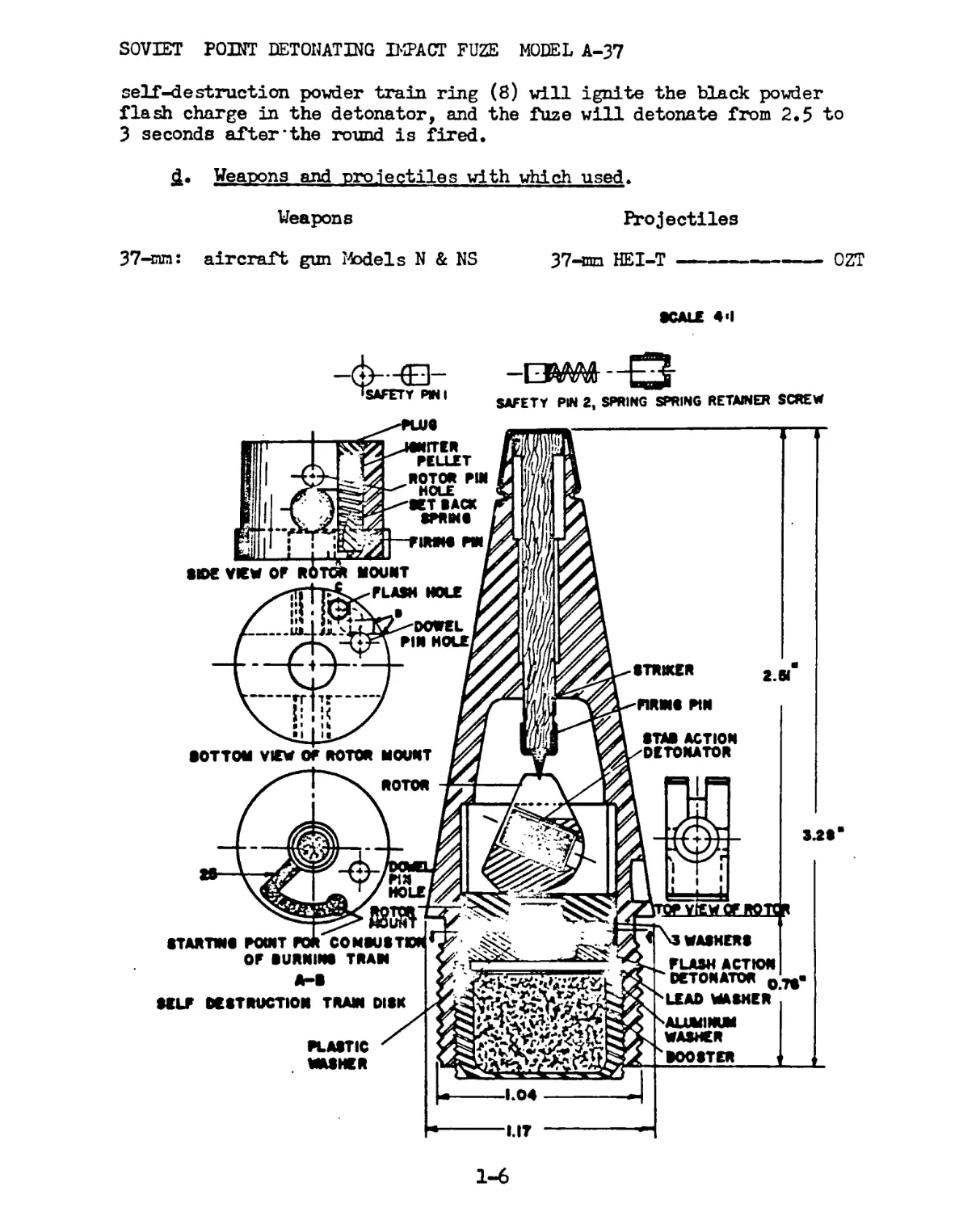
$. Fanetinning. On firing, the moveable setback igniter pellet
(12) overcomes the resistance of the setback spring (13) and strikes the
fixed setback firing pin (14). The resulting flash ignites both the self-
destruction powder train (7) and a black powder pellet (15) which holds
the centrifugal rotor locking pin (16) in place. As the black powder
pellet burns, centrifugal force causes a second rotor locking pin (11)
to compress its retaining spring and move outward from a recess in the
rotor (3); after the black powder pellet is consumed, the first centri-
fugal locking pin (16) also moves out of its recess in the rotor, which
is then free to rotate in the U-shaped trough of the rotor mount (6).
(Since the locking pin (16) retained by the powder pellet immobilizes
the rotor until the other locking pin (11) clears its straight-walled
recess in the rotor, any possibility of the rotor jamming the latter pin
(11) is precluded. The rotor recess for the pellet-retaining pin (16)
has sloped walls, so that the movement of the rotor tends to cam this pin
out of the recess, rather than to jam it). Centrifugal force causes the
freed rotor whose center of gravity is located off the axis of rotation,
to turn 90 degrees around the pivot pins (10), thus dining the primer
charge (4) with the impact firing pin (2) and the detonator assembly (5).
Upon impact with the target, the nose cap is crushed and the impact strik-
er (1) drives the impact firing pin into the primer charge. The flash
from the primer charge passes to the detonator assembly, which activates
the booster (9), and the booster in tura activates the projectile’s
charge. If impact does not occur first, the burning powder Erwin in the
1-5
SOVIET POINT DETONATING IMPACT FUZE MODEL A-37
self-destruction powder train ring
flash charge in the detonator, and
3 seconds after'the round is fired
(8) will ignite the black powder
the fuze will detonate from 2.5 to
(J. Weapons and projectiles with which used»
Weapons
Projectiles
37-mm: aircraft gun Models N & NS 37-mn HEI-T
OZT
•CALE 4'1
-EWM-
SAFETY PIN 2, SPRING SPRING RETAINER SCREW
LIT
1-6
SOVIET POINT DETONATING IMPACT FUZE MODEL A-37U
The A-37U, a later version of the A-37, is essentially identical to the
A-37 except for having a longer self-destruction powder train. Where the
A-37 destroys itself after a flight of 2.5 - 3 seconds, the A-37U permits
a flight of If) - 12 seconds before self-destruction. It is believed that
the tine to self-destruction of the A-37U was lengthened in order to pre-
vent detonations from occuring at points short of the effective amnunition
conbat range. If rounds fuzed with the A-37U are fired horizontally at
altitudes above 2500 feet, the increased time to self-destruction does
not endanger ground personnel. This fuze is used with the same weapon
and ammunition as the A-37.
1-7
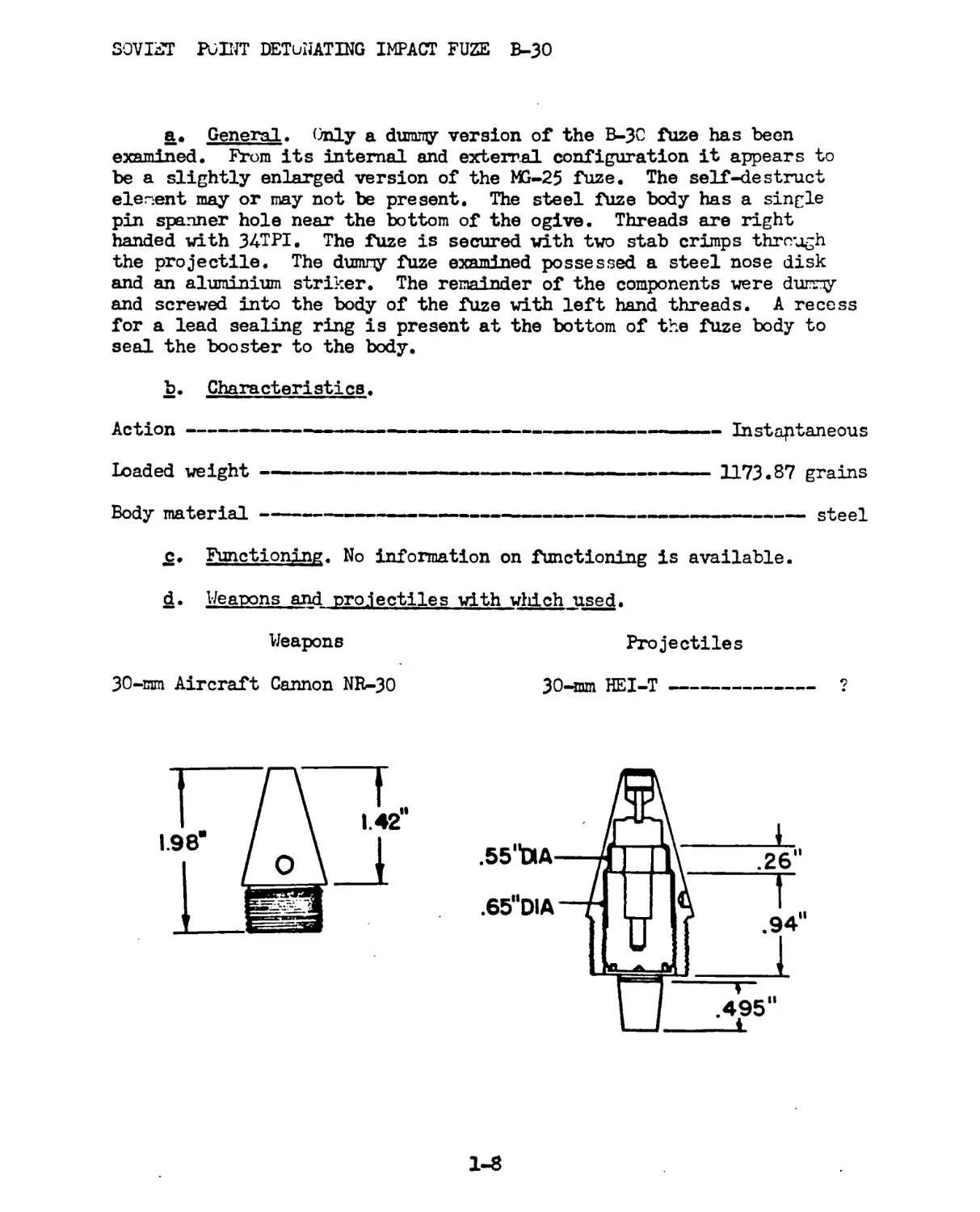
SOVIET POINT DETONATING IMPACT FUZE B-3O
a.	General. Only a dumny version of the B-3C fuze has been
examined. From its internal and external configuration it appears to
be a slightly enlarged version of the MG-25 fuze. The self-destruct
element may or may not be present. The steel fuze body has a single
pin spanner hole near the bottom of the ogive. Threads are right
handed with 34TPI. The fuze is secured with two stab crimps through
the projectile. The dummy fuze examined possessed a steel nose disk
and an aluminium striker. The remainder of the components were dummy
and screwed into the body of the fuze with left hand threads. A recess
for a lead sealing ring is present at the bottom of the fuze body to
seal the booster to the body.
b.	Characteristics.
Action —-------------—  —  —----------—— -------------- - Instantaneous
Loaded weight      ----------------- —-----——. —--------- 1173.87 grains
Body material------—-—---------—-----------------------------------steel
c.	Functioning. No information on functioning is available.
d.	Weapons and projectiles with which used.
Weapons	Projectiles
30-mm Aircraft Cannon NR-30	30-mm HEI-T -------------- ?
1-8
SOVIET POINT DETONATING IMPACT FUZE B-37
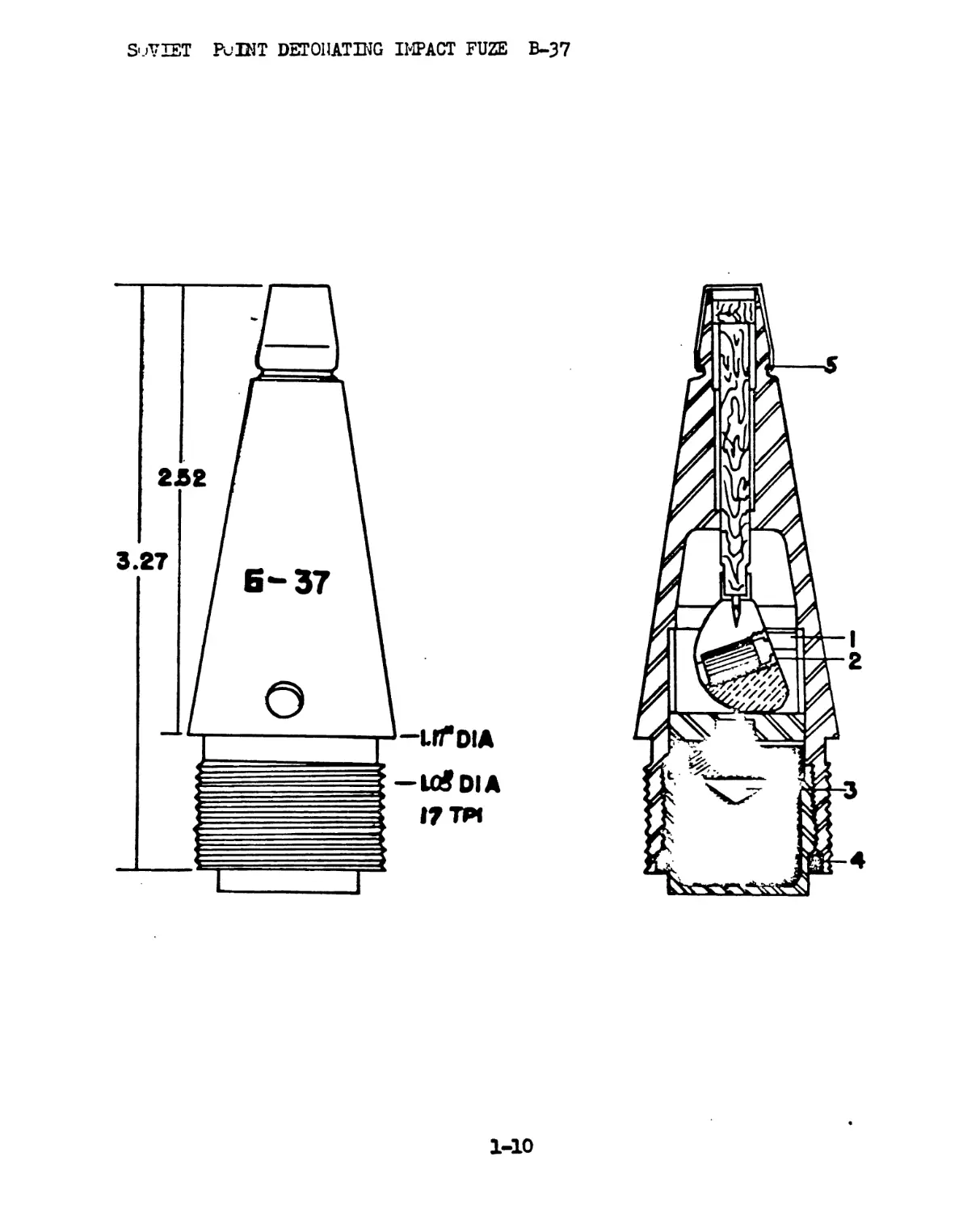
a.	General. The Soviet B-37 is a modified copy of the Soviet MG-37.
The fuzes and their functioning are essentially identical. The B-37 has
a rotor lock and a slot (1) cut into the rotor housing to receive the pin.
When the rotor rotates, the lock pin is forced into the slot (2) by cen-
trifugal force. The detonator of the B-37 is retained in the rotor by a
threaded keep ring (2) rather than by a press fit as in the case of the
110-37. The keep ring is slotted for a comon screw driver. The B-37 has
a conical depression (3) in the booster. A metal foil liner also has the
same shape and covers the shaped explosive in the booster. The B-37 also
has a portion of the fuze body and the booster cup relieved and a lead
crush ring (4) pressed into the cavity. The lead ring renders the lower
part of the fuze waterproof. The nose cup also has a vinyl ring (5) in
the crimping groove at the nose of the fuze. When the nose cap is crimp-
ed into place, the vinyl ring (5) is compressed, rendering the nose of
the fuze waterproof.
b.	Characteristics.
Action-----------------------------------------------------Instantaneous
Loaded weight ------------------------------------- 172 grams (0.38 lbs)
Body material--------——-----—----------------------——------—.—— stael
c.	Functioning. This fuze is identical to the Soviet MG-37, except
f: r the additional function of the rotor lock pin.
d.	Weapons and project! es with which used.
Weapons	Projectiles
37-mm Anti-Aircraft Gun M1939	37-mm Frag-T —---------- CR-167
SOVIET PuDiT DET01IATING IMPACT FUZE B-37
1-10
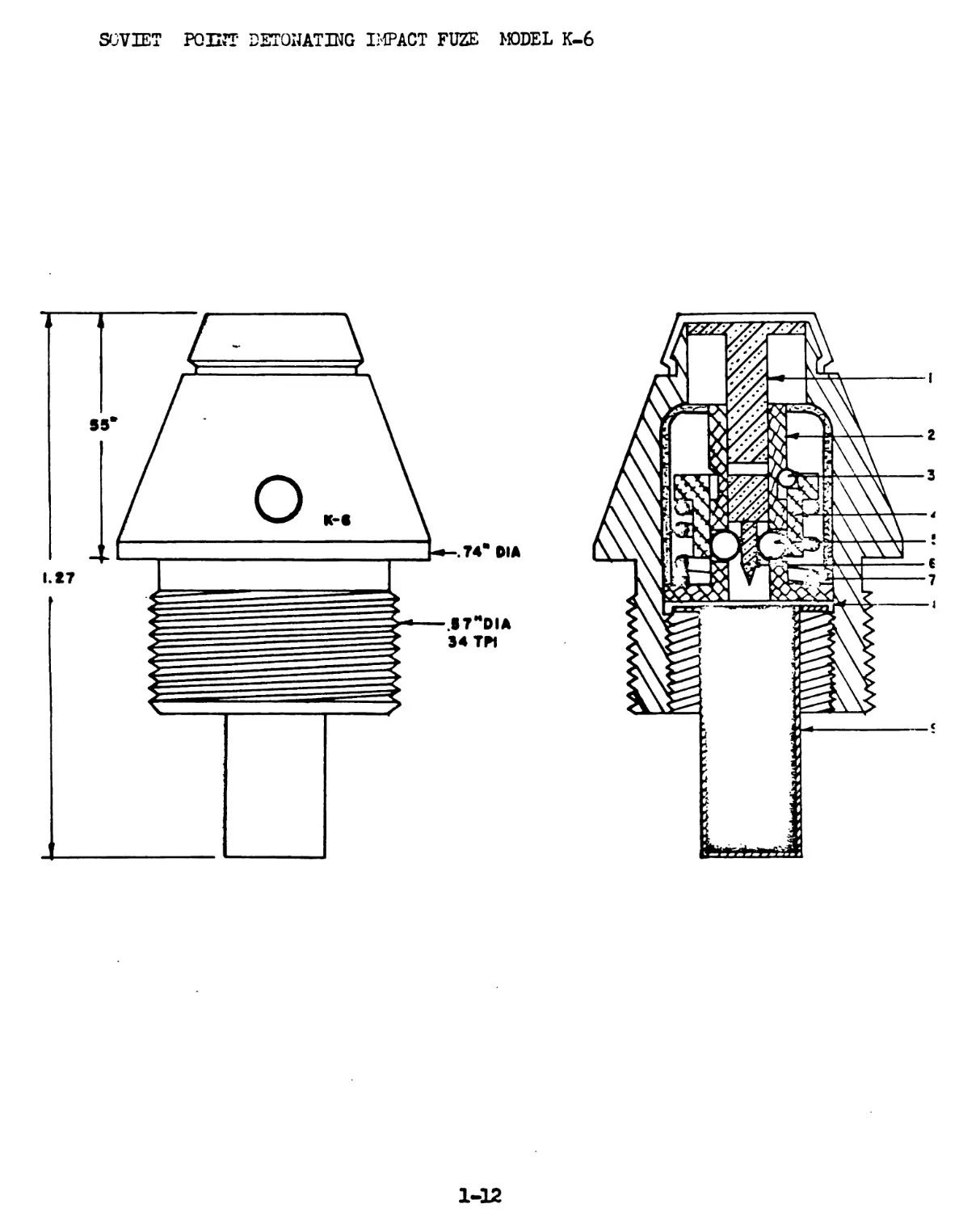
SOVIET POINT DETONATING IMPACT FUZE MODEL K-6
a.	General. The K-6 is similar to the K-20 in construction and
functioning, but is considerably smaller. It is a single action fuze,
requires no special adjustments prior to firing, and is boresafe. A
gaine type detonator-booster is employed. The K-6 exhibits an early
version of the arming system employed in many current Soviet fuzes.
The only modern departure is the addition of the Zig-Zag delay arming
system.
b.	Characteristics.
Action--------——---------——------------—.—- ..  instantaneous
Loaded weight-------—----—-------------------—------------------ ?
Body material---------------------------------------------------— steel
Functioning. Upon firing, inertia causes the arming sleeve (4)
to set back, thereby releasing the arming sleeve retaining balls (3) and
further compressing the arming spring (7). After the projectile leaves
the bore, the arming spring overcomes inertia and moves the arming sleeve
forward, freeing the two firing pin check balls (5); the two check balls
then are thrown out of their housings in the firing pin guide (2) by
centrifugal force, so that they no longer prevent the firing pin (6)
from moving rearward. The firing pin is maintained in the forward posi-
tion by creep action. On impact, The striker (1) is forced rearward,
driving the firing pin through the safety disk (8) into the detonator
assembly (9), and the resulting detonation activates the explosive charge
of the projectile.
£. Weapons and projectiles with which fired.
Weapons	Projectiles
20-mm: ShVAK aircraft gun	20-mm HEI-T------ —-------OZT
1-11
SOVIET
POINT DETONATING IMPACT FUZE MODEL K-6
1-12
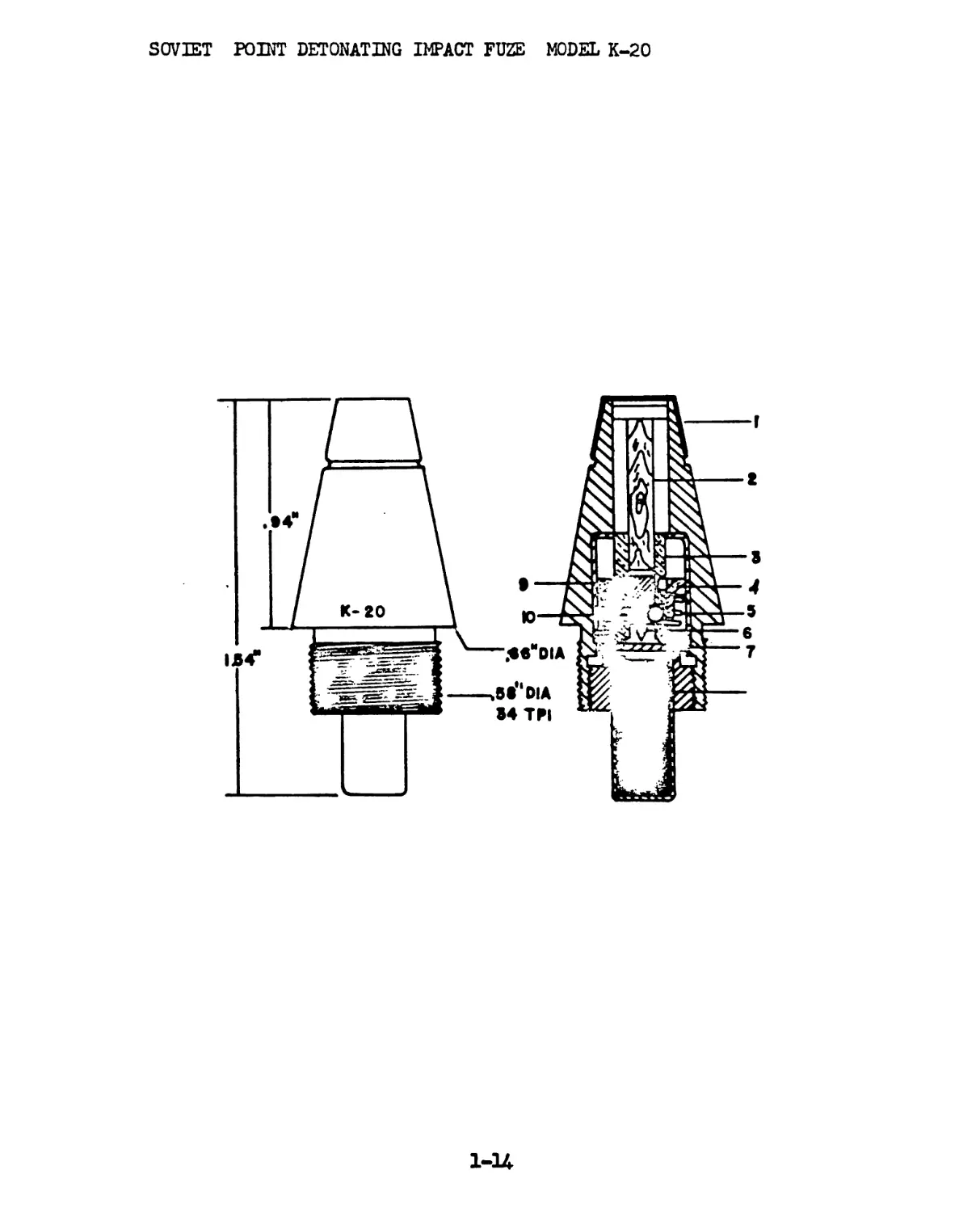
SOVIET POINT DETONATING IMPACT FU2E MODEL K-20
£. General. The K-20 is used with projectiles fired from 23-mm
aircraft and 25-mm antiaircraft guns. Since it does not have a self-
destroying element, the fuze will detonate upon contact with the
ground or any other obstruction, if it misses the target. Although
the K-20 is a bore safe fuze, it is supersensitive in the armed condi-
tion and should be handled with caution. The Soviet safety classifi-
cation of the fuze is '’unsecured." The K-20 possibly may be used in
the 23-иш aircraft gun Models NR and NS, but evidence of its use
with these weapons is lacking. The K-20 and the almost identical
K-20M appear to have been replaced by the A-23 fuze, presumably be-
cause the latter, although less sensitive, is simpler and cheaper
to manufacture.
b. Characteristics.
Action
instantaneous
Loaded weight--------------------——------------------------
Body material
steel
£. Functioning. Upon firing, the arming sleeve (4) sets back,
compressing the arming sleeve spring (5) and creating an cutlet for
the three arming sleeve retaining balls (9). After the projectile
has left the gun and centrifugal force has thrown the retaining balls
out of their housings, the arming spring overcomes the diminishing
force of inertia arid moves the arming sleeves forward until it frees
the two firing pin check balls (10). The check balls pass into the
fuze body cavity through openings in the striker guide (3), and only
the safety disk (7) remains between the firing pin (6) and the deton-
ator assembly. Upon impact, the foil cap (1) is crushed inward, the
striker (2) drives the firing pin through the safety disk into the
detonator initiating pellet (8), and the resulting detonation activ-
ates the projectileb explosive charge.
Weapons and pro.iectiles with which used.
Weapons	Projectiles
23-mm: aircraft gun Model Via	23-mm HEI----------------?
HEI-T--------------OZT
25-шт: antiaircraft gun IH940	25-mm Frag-I-T ----- OZR-132
1-13
SOVIET POINT DETONATING IMPACT FUZE MODEL K-20
1-14
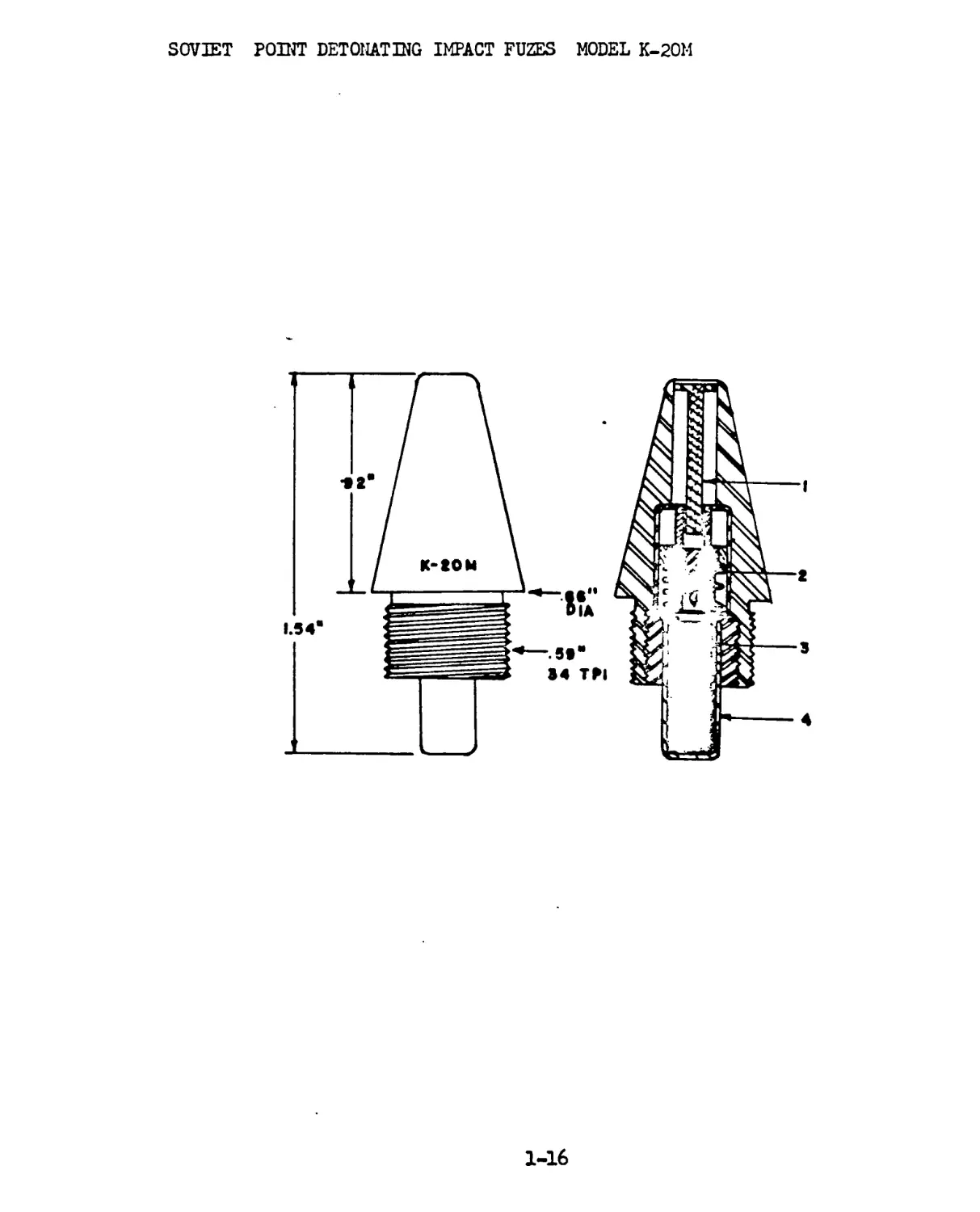
SOVIET POINT DETONATING IMPACT FUZES MODEL K-20M
&.	General. The K-20M is identical to the K-20 in external
dimensions, body material, functioning, and (except for sizes and the
materials of certain parts) internal construction. It differs from
the K-20 in outer appearance only by having a smooth, unrrooved body
contour, and by mounting a foil disk in the top of the nose cavity
instead of having a foil cap crimped over the nose. Any difference
in loaded weights of the two fuzes is believed to be negligible.
b. Internal differences from the K-20.
(1)	The K-20M has a steel striker (1) with a shorter length
and smaller head diameter; the diameter of the nose cav-
ity, corresponding to the striker head, is likewise
smaller. The K-20 striker, besides being larger, is
made of wood or aluminum.
(2)	The firing pin (2) in the K-20M is longer than the K-20.
(3)	The full length of the detonator assembly retainer (3)
is threaded, in the K-2CM; in the K-20, there is an un-
threaded shoulder at the top of this retainer.
(4)	The length of the detonator assembly (4) is greater for
the K-20 fuze.
£. Weapons and projectiles with which used. The K-20M can be
used with the same weapons and ammunitions as the K-20. Both fuzes
appear to have been replaced by the A-23
1-15
SOVIET POBJT DETONATING IMPACT FU2ES MODEL K-20M
1-16
SOVIET Р0Г.Т DT.TLNATING IMPACT FUZE MODEL IC-8
a.	General. The >D-8 (Malokalibemyy, Golovnoy, 8-y Obrazets:
snail-caliber, point detonating, Model 8) is a boresafe fuze which
arms at approximately 50 - 100 metters from the muzzle of the gun.
It incorporates a setback-actuated self-destruction feature which
will cause the projectile to detonate 8-11 seconds after leaving
the bore, provided that the target is not struck beforehand. The
Soviet safety classification of the fuze is’safe’. The ЬЕ-8 is
similar in external appearance and internal construction to the
later MG-37 antiaircraft fuze, and also closely resembles the A-37
and A-37U aircraft fuzes.
b.	Chara cteri sties.
Action —-------------—-—--------------------instantaneous
Loaded weight —------------- -------------— ?
Body material  ------——---------------——— steel
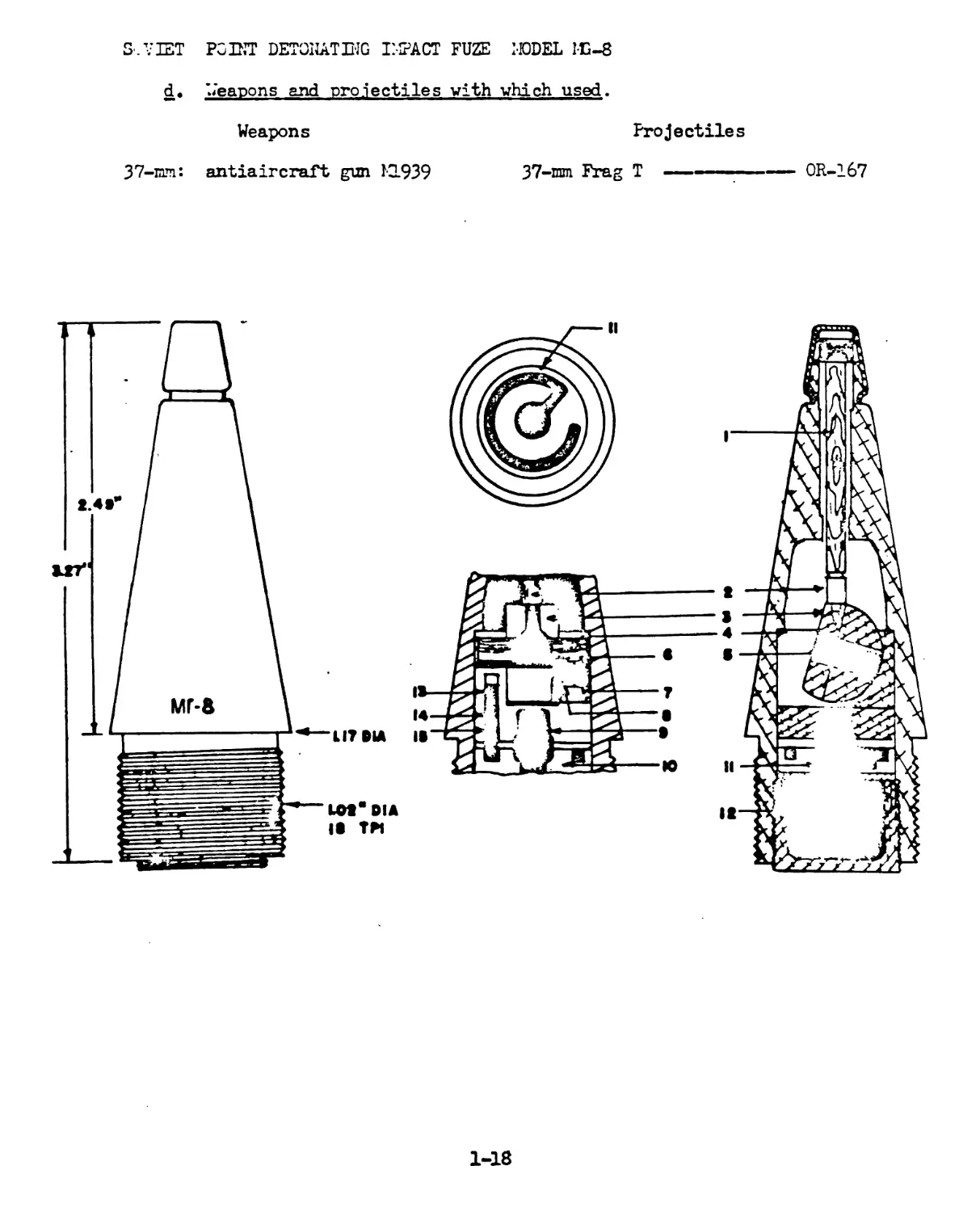
£. Functioning. Upon firing, the setback igniter pellet (13)
over c. me s the resistance of the safety spring (14) and impings on the
setback firing pin (15). The resulting flash simultaneously ignites
the self-destruction powder train (11) in the powder train ring (10)
and the black powder pellet (7) which he Ids the rotor locking pin (8)
in place. (The flash presumably reaches powder pellet (7) through a
channel not visible in the drawing) When the black powder pellet
has burned away, centrifugal force moves the rotor locking pin out of
the groove in the rotor (3), which is then free to rotate in the trough
of the U-shaped rotor mount (4) • Centrifugal force causes the freed
rotor, whose center of gravity is located off the axis of rotation, to
turn 90 е around the pivot pins (6), thus alining the primer charge (5)
with the impact firing pin (2) and the detonator assembly (9). Upon
impact with the target, the nose cap is crushed and the striker (1)
drives the impact firing pin into the primer charge. The flash from
the primer charge passes to the detonator assembly, which activates the
booster (12), thereby detonating the projectile. Should the projectile
fail to hit the target, the burning self-destruction powder train ring
(10) will ignite the detonator, and the fuze will function from 8 to 11
seconds after the round is fired. This length of time is sufficient to
permit the projectile to travel beyond the maximum range at which it is
normally used.
1-17
S'.VIET POINT DETOUATDJG IMPACT FUZE MODEL 1E-S
d. Weapons and projectiles with which used.
Weapons	Projectiles
37-шп: antiaircraft gun KL939	37-шп Frag T  . ----- — OR-167
1-18
SOVIET hCIl’T DETONATING IMPACT FUZE l-IG-25
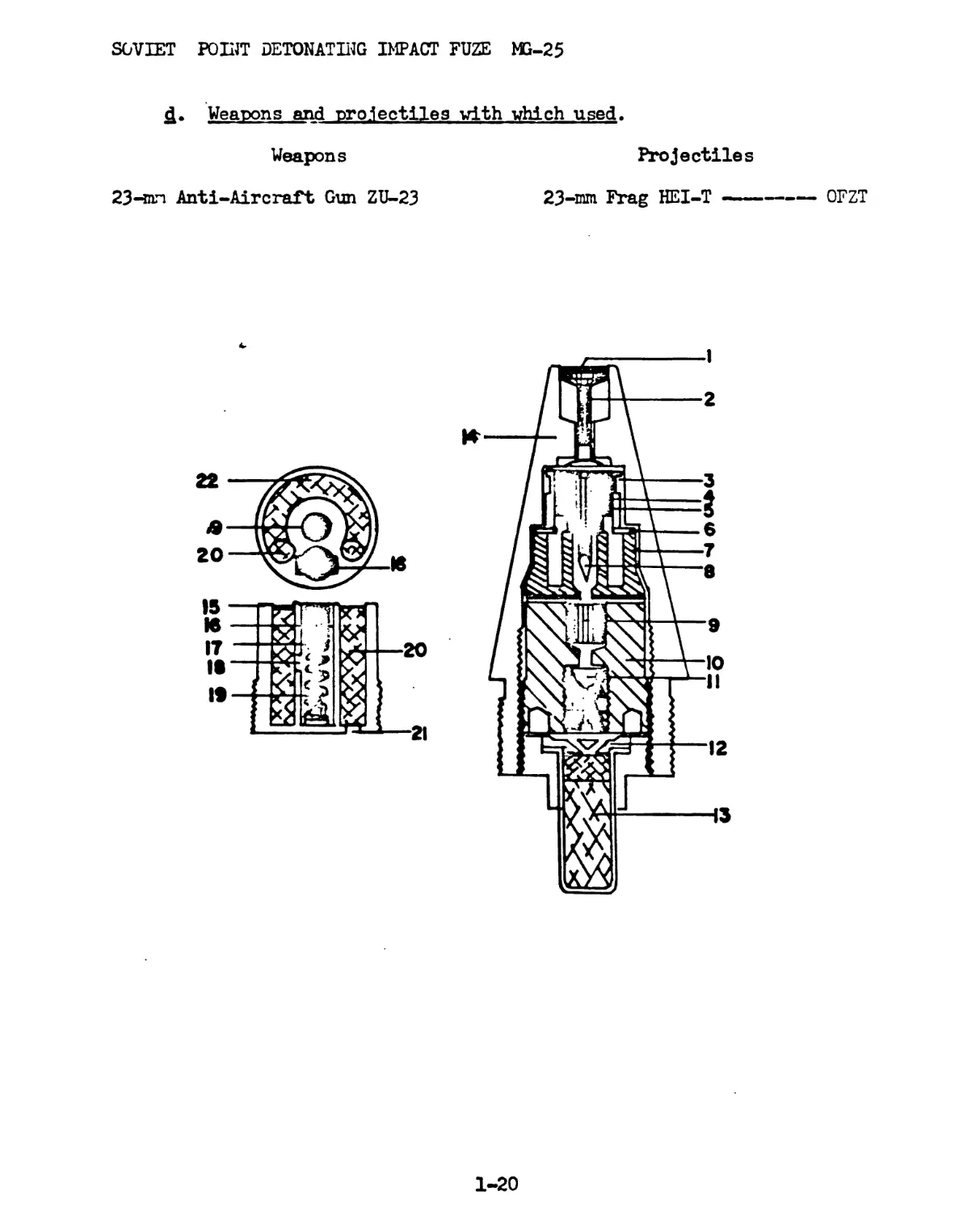
g. General. The IiG-25 fuze is boresafe and is supersensitive
in the armed condition. It contains a set-back actuated self-
destruction feature that destroys the projectile between 5 and 8 sec-
onds after firing, provided the target has not been hit beforehand.
The fuze has a thin aluminium foil membrane (1) over the firing jin
cavity in the nose. Beneath the membrane is a floating firing pin
extension (2). The floating firing pin extension passes through and is
retained by a solid bulkhead, into the main fuze cavity. In this cavity,
the firing pin (5) rests on a coiled centrifugal spring tape (4). The
tape prevents‘the firing pin from reaching the primer. Surrounding the
tape is a setback detent (3) that rests on a ring with four internal
prongs (6). This safety ring (6) rests on top of an internal support
(7). An aluminum cylinder (10) containing the self-destruct initiator
(16), the self-destruct pyrotechnic delay element (22), the body primer
(9) and a relay flash pellet (11) is threaded (left hand) into the steel
fuze body. The self-destruct initiator (16) consists of a fixed firing
pin (19) in the bottom of a cavity in the cylinder, a setback spring (17),
and a weighted primer (16). The booster (13) screws into the bottom of
the fuze body. Its twin flash holes (12) are directly beneath the relay
flash pellet.
Characteristics.
Action —-------------------------------—----—------------Instantaneous
Loaded weight--------------------------------------------3C grans
Body material  -------——-----------—---------------------steel
Upon setback, the setback detent (3) moves downward, forcing its
way through the four internal prongs in the safety ring (6). Simul-
taneously the weighted self-destruct flash pellet (16) moves downward
compressing its spring (17) and impales itself on the fixed firing pin
(19). The resulting flash passes through a lateral hole (18) from the
self-destruct initiator cavity into the pyrotechnic delay cavity (20),
igniting the self-destruct element (22). Centrifugal force then causes
the coiled tape (4) to expand, releasing the firing pin (5). The firing
pin (5) and the firing pin extension (2) move foward into their cavity
by creep action. Upon impact, the firing pin extension (2) is driven
rearward forcing the firing pin downward into the body primer (9). The
resulting flash ignites the relay pellet (11) which causes flame to flash
through the two flash holes in the booster cap, detonating the booster (13).
If the fuze fails to impact with the target, the pyrotechnic self-
destruct element (22) will burn into a flash pellet (21) which flashes
into the two flash holes (12) in the booster cap causing a detonation.
1-19
SOVIET POINT DETONATING IMPACT FUZE MG-25
Weapons and projectiles with which used.
Weapons
Projectiles
23-nm Anti-Aircraft Gun ZU-23
23-mm Frag HEI-T --------- OFZT
1-20
SOVIET POINT DETONATING IMPACT FUZE MODEL MO-37
a.	General. The MG-37, a later version of the World War II l-C-8,
is a boresafe fuze with a setback-actuated self-destruction feature
that will detonate the fuze 10-12 seconds after the round is fired.
It is almost identical to the MS-8 in external appearance, and its only
major internal differences appear to be a redesigned rotor and an
improved arming safety arrangement involving the use of two rotor locking
pins instead of one. The MO-37 also bears a close resemblance to the
к~У1 and A-37U aircraft fuzes in external appearance, internal construc-
tion, and demensions,, but available evidence indicates that the ID-37 is
restricted to antlaircraftgun fire and is not interchangeable with air-
craft fuzes.
b.	Characteristics.
Action ———  ------—------- --------------—— instantaneous
Loaded weight ———————---------———------------ 172 gm. (0.38 lb.)
Body material	steel
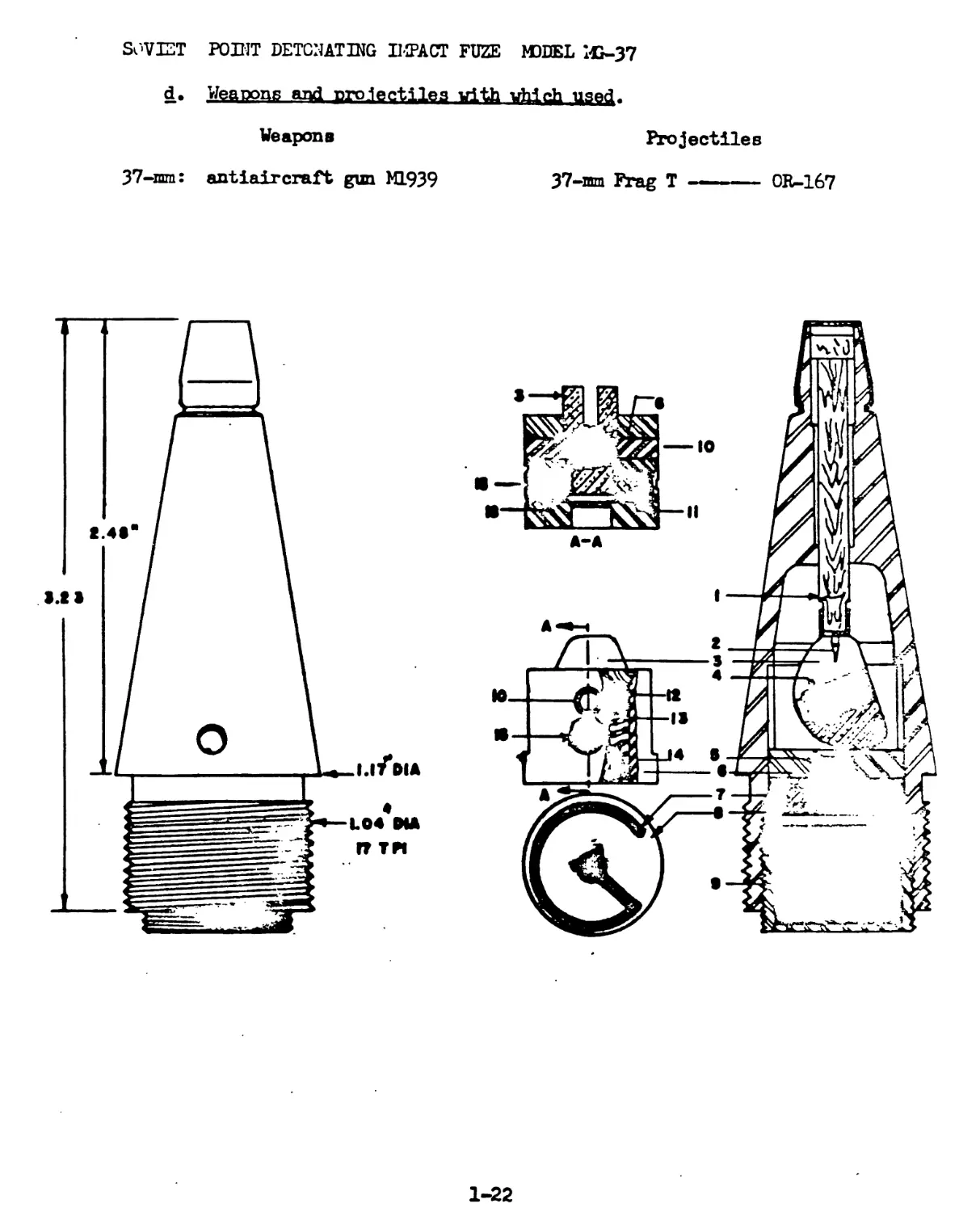
£. Functlopfof. On firing, the setback igniter pellet (12) over-
comes the resistance of the safety spring (13) and strikes the setback
firing pin (14). The resulting flash ignites both the self-destruct-
ion powder train (7) and a black powder pellet (15) which holds a rotor
locking pin (16) in place. As the black powder pellet burns, centrifugal
force causes a second rotor locking pin (11) to compress its retaining
spring and move out of a recess in the rotor (j); after the black powder
pellet bums away, the locking pin (16) also moves out of its recess in
the rotor, which is then free to rotate in the U-shaped trough of the
rotor mount (6). (Since the locking pin (16) retained by the powder
pellet immobilizes the rotor until the other locking pin (11) clears
its straight-walled recess in the rotor, any possibility of the rotor
jamming the latter pin is precluded. The rotor recess for the pellet-
retained pin (16) has eloped «*11 я, so the movement of the rotor tends
to cam this pin out of the recess, rather than to jam it). Centrifugal
force causes the freed rotor, whose center of gravity is located off the
axis of rotation, to turn 90° around the pivot pins (10), thus alining
the primer charge (4) with the impact firing pin (2) and the detonator
assembly (5). Upon impact with the target, the nose cap is crushed and
the impact striker (1) drives the impact firing pin into the primer
charge. The flash from the primer charge passes to the detonator
assembly, which activates the booster (9)» and the booster in turn
activates the projectile's explosive charge. If impact does not occur
first, the burning self-destruction powder train in the powder train ring
(8) will ignite the detonator, and the fuze will explode from 10-12
seconds after the round is fired.
1-21
SOVIET Р0Б1Т DETONATING IMPACT FUZE MDDEL l-E-37
d. Weapons and projectiles with which nse^.
Weapons	Projectiles
37-nm: antiaircraft gun №939	37-mm Frag T-----— OR-167
1-22
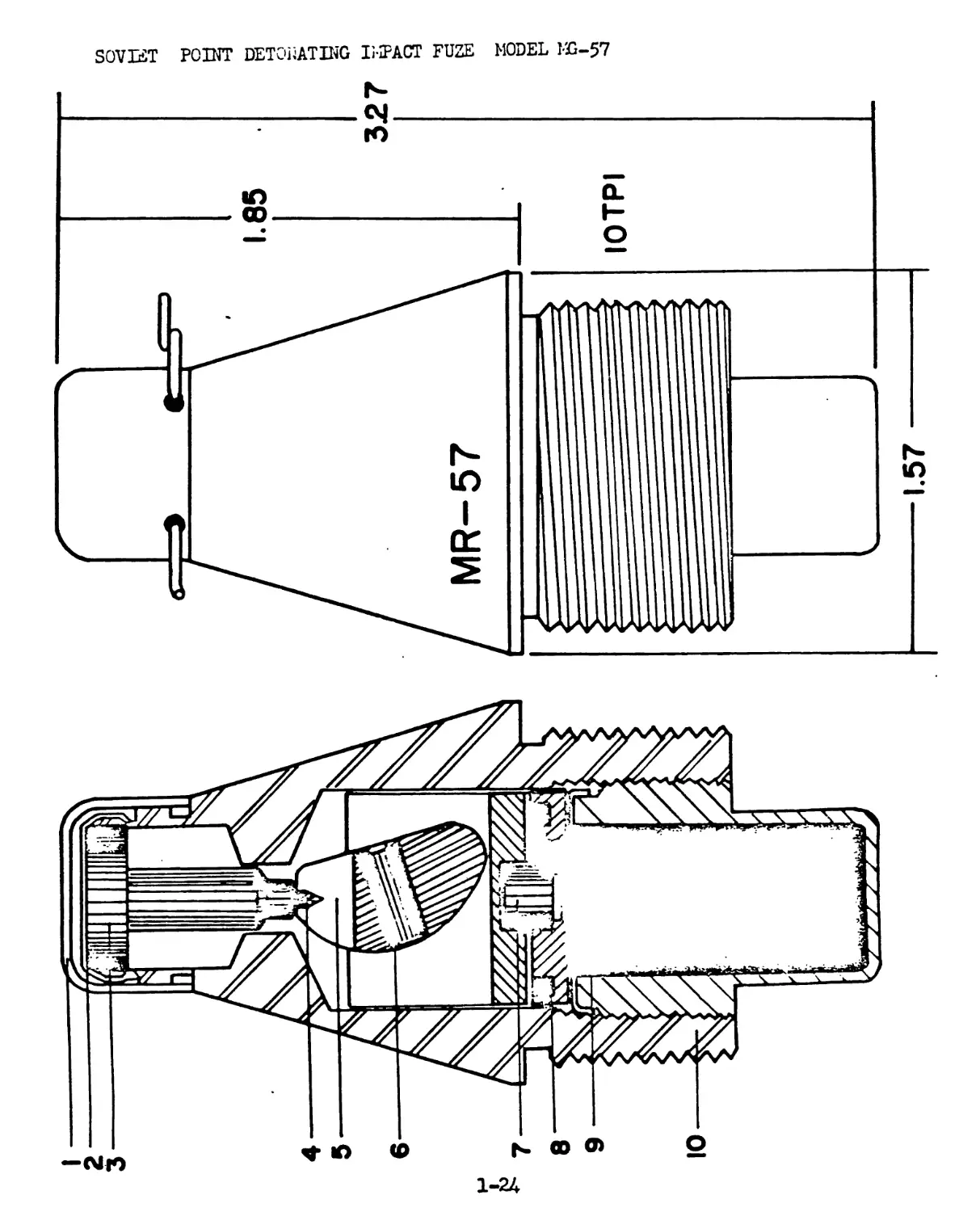
SOVIET POINT DETONATING IMPACT FUZE MODEL MS-57
a.	General. The MO-57 is a bore safe, out of line detonator fuze.
It employs a setback-actuated self-destruction feature that will cause
the projectile to detonate 19 seconds after leaving the bore, providing
no prior target impact occurs. A metal shipping cap (1) with pull wire
protects the firing pin membrane during shipping. The firing pin is
composed of a metal firing pin (Д) attached to a wooden shaft (3)» It
locks the rotor (5) during setback. The rotor housing contains the self-
destruct initating mechanism. This consists of a weighted moveable,
detonator, spring, and fixed firing pin. This assembly is parallel to
the fuze axis. The main fuze detonator (7) sits in the center of the
pyrotechnic self-destruct disc. The fuze features a delay arming, con-
sumable, black powder detent that is initated by the self-destruct flash
pellet upon setback. The fuze arms by centrifugal force. The floating
type firing pin used in the MS-57 makes it supersensitive.
b.	Characteristics.
Action----------— ---------—----—---Instantaneous
Loaded weight —-------------— 335 grams (0.733 lbs.)
Body material ————————————---------------Steel
£. Functioning. A detailed description of functioning can be found
in the entry under the Soviet MS-37 fuze.
£. Weapons and projectiles with which used.
Weapons	Projectiles
57-mm: Soviet AA guns S-60	57-mm HE-Frag —---------OR-281
1-23
SOVIET POINT DETONATING IMPACT
FUZE MODEL MG-57
1.57
1-2Д
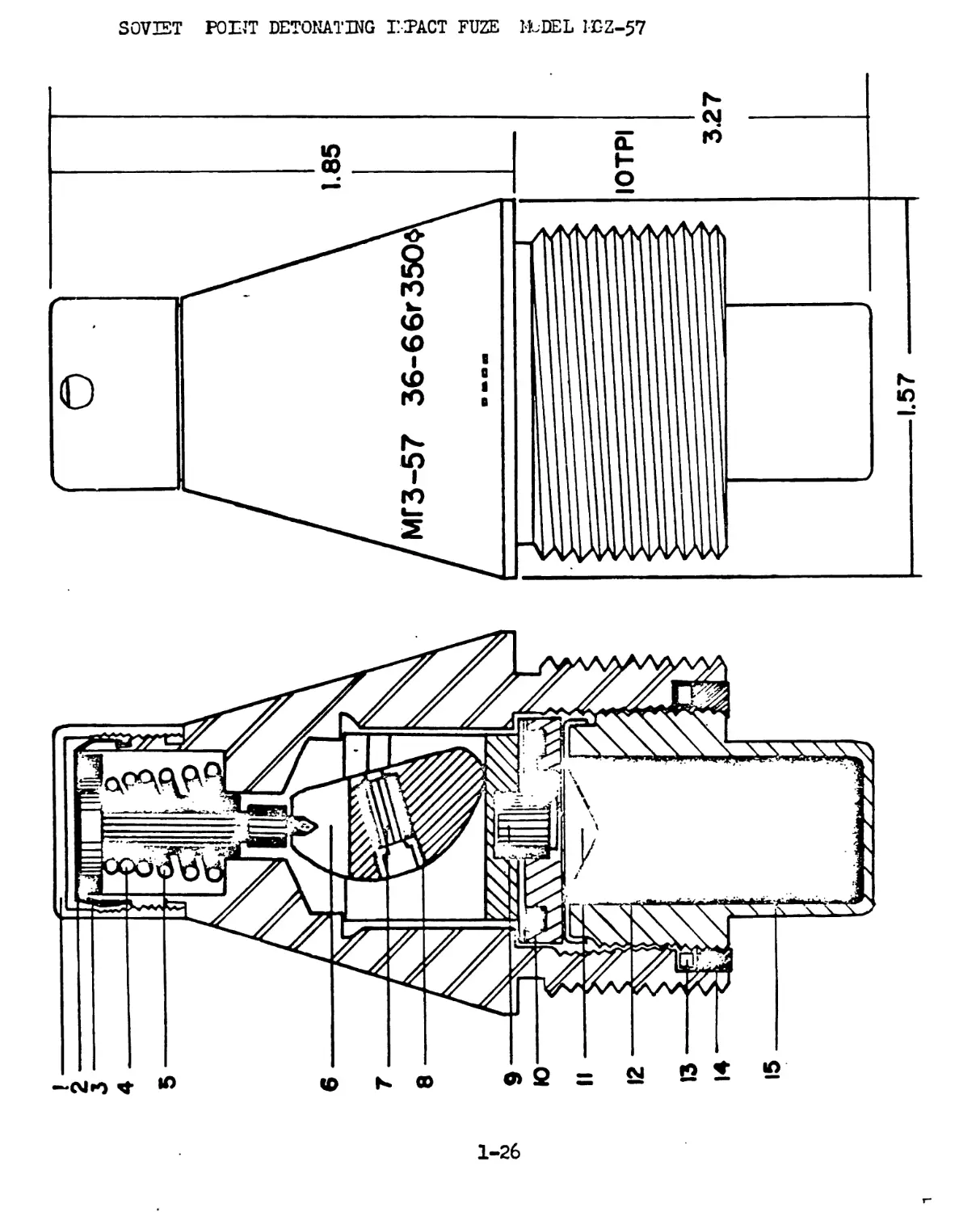
SOVIET PODIT DETONATING IMPACT FUZE MODEL MGZ-57
a.	General. The IEZ-57 fuze is essentially identical with the MG-
57, with certain modifications. It has a threaded metal shipping cap
with four equi-distant holes near its upper rim. The thin aluminum
crush cap is crimped into a groove cut into the fuze body. A vinyl seal-
ing ring occupies the groove and makes the upper part of the fuze water
proof. The firing pin is all metal versus metal and wood in the MG-57.
There is also a spring under the firing pin head in lieu of a wax filler
in the ’E-57. The detonator in the rotor is held in position by a thread-
ed ring. In the MG-57, the detonator is pressed and stab crimped in the
rotor. The fuze body is recessed at the booster cavity to accept a vinyl
water proofing ring and a steel lock ring. The lock ring employs the
booster threads to compress the vinyl ring. The copper foil seal over the
booster is conical concave. This same shape is formed into the PE7N boos-
ter explosive. The booster on the MG-57 has a flat surface. The rotor
has centrifugal locking pins to lock the rotor in the armed position.
b.	Characteristics.
Action
Loaded weight
ncndelay
314 gm. (0.691 lb.)
Body material
steel
£. Functioning. When fired, setback causes the same functioning
as occurs in the MG-57 fuze. Centrifugal force moves the spring retain-
ing the rotor lock pin out of the rotor. When the delay arming black
powder pellet is consumed the detent is moved into the evacuated cavity.
The rotor then rotates to the armed position. Simultaneously, the rotor
lock pin moves into a slot cut into the rotor cavity in the rotor hous-
ing, locking the rotor in the armed position. Functioning then contin-
ues in a manner identical to that of the IE-57 fuze.
d. Weapons and projectiles with which used.
Weapons	Projectiles
Identical to that of the Soviet MG-57 fuze.
1-25
1
о
-----1.57
CHAPTER 2
HJZES FOR CHINESE COMMUNIST AIRCRAFT AND ANTI-AIRCRAFT GUNS
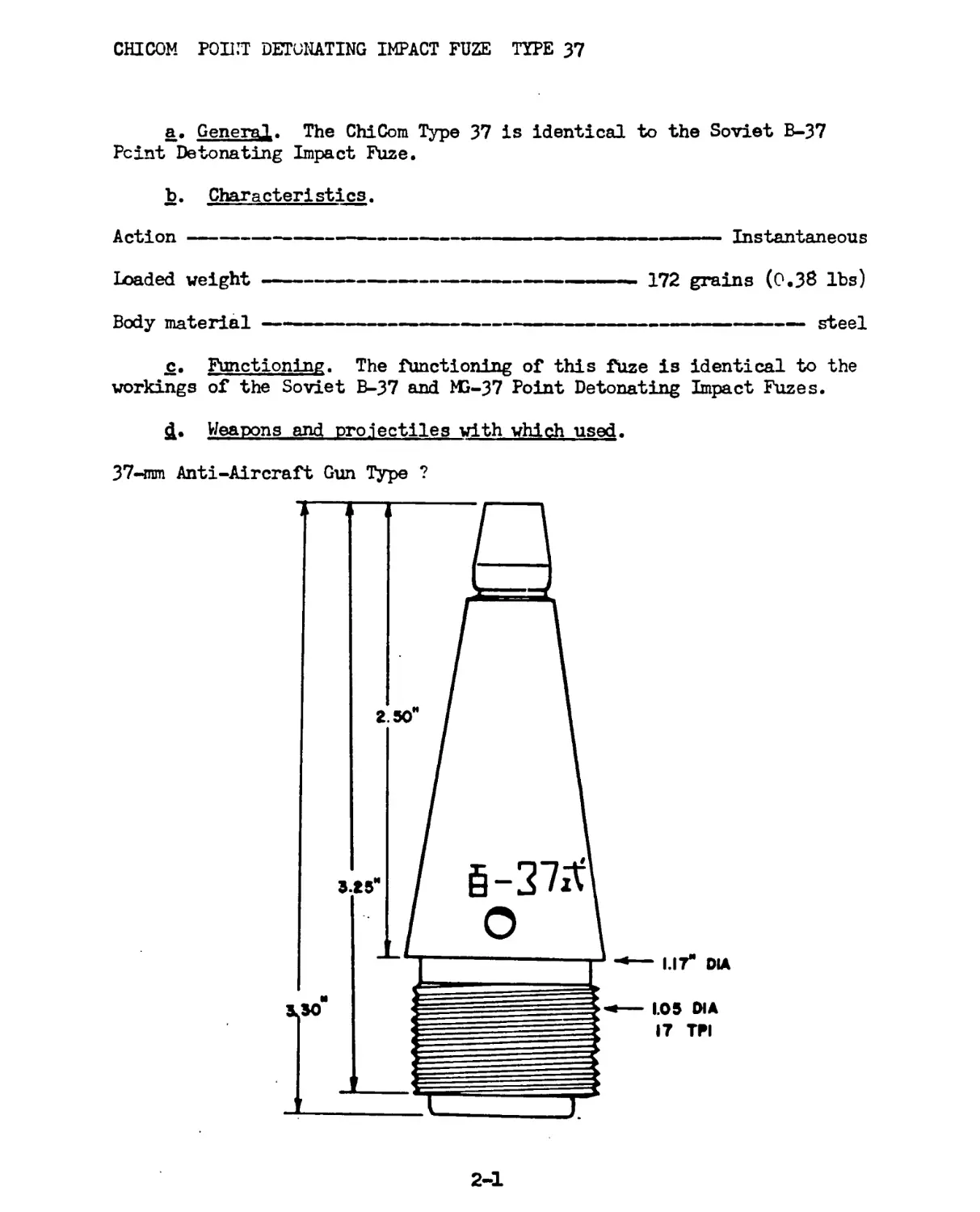
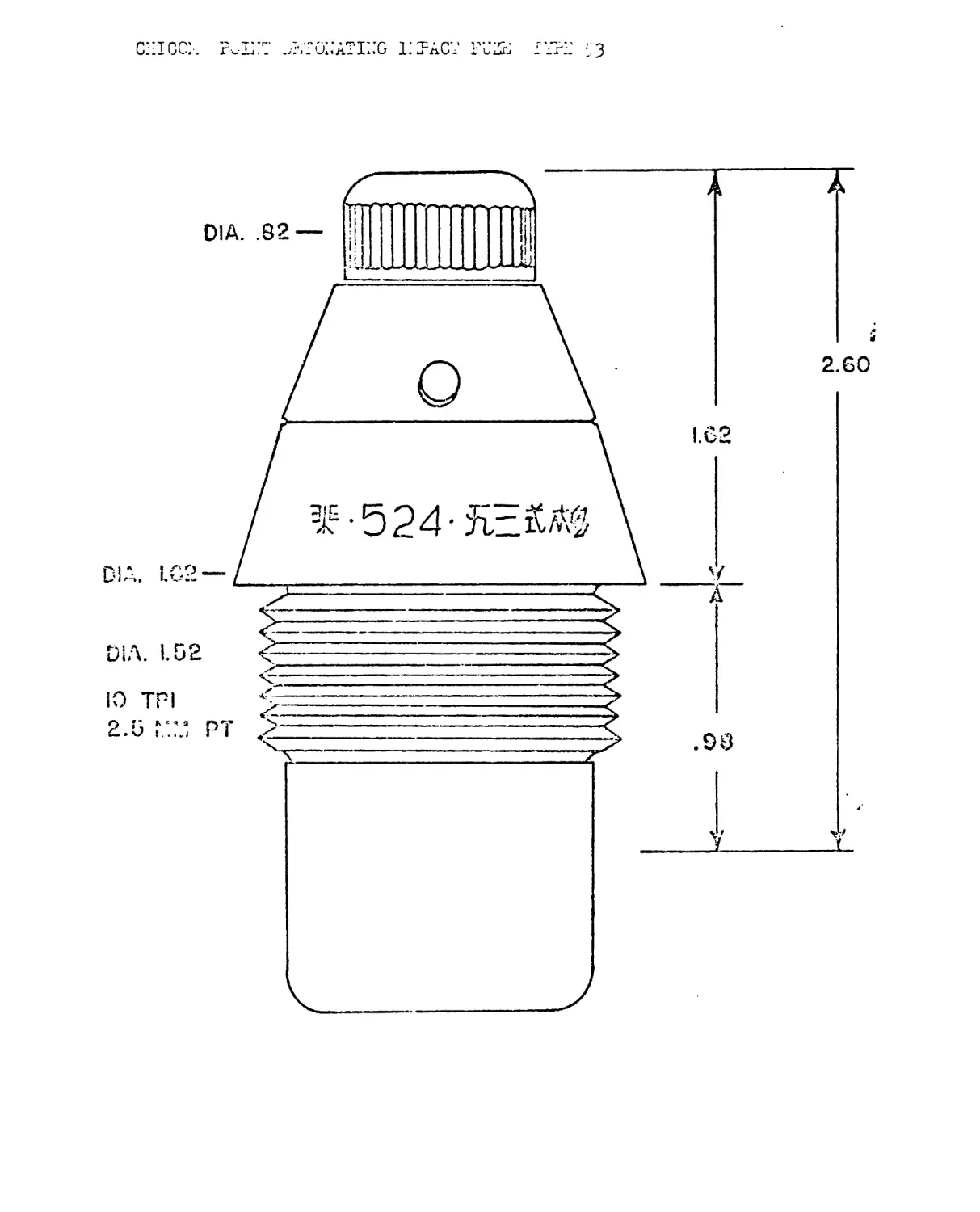
CHICOM POINT DETONATING IMPACT FUZE ТУРЕ 37
a.	General. The ChiCom Type 37 is identical to the Soviet B-37
Point Detonating Impact Fuze.
b.	Characteristics.
Action---------------——---------------- -	-	------- Instantaneous
Loaded weight —------------—----------------------172 grains (0.38 lbs)
Body material----------------------------------------------------— steel
c.	Functioning. The functioning of this fuze is identical to the
workings of the Soviet B-37 and MO-37 Point Detonating Impact Fuzes.
Weapons and projectiles with which used.
37-mm Anti-Aircraft Gun Type ?
2-1
CHAPTER III
Fuzes for Artillery (ground weapons) Ammunition
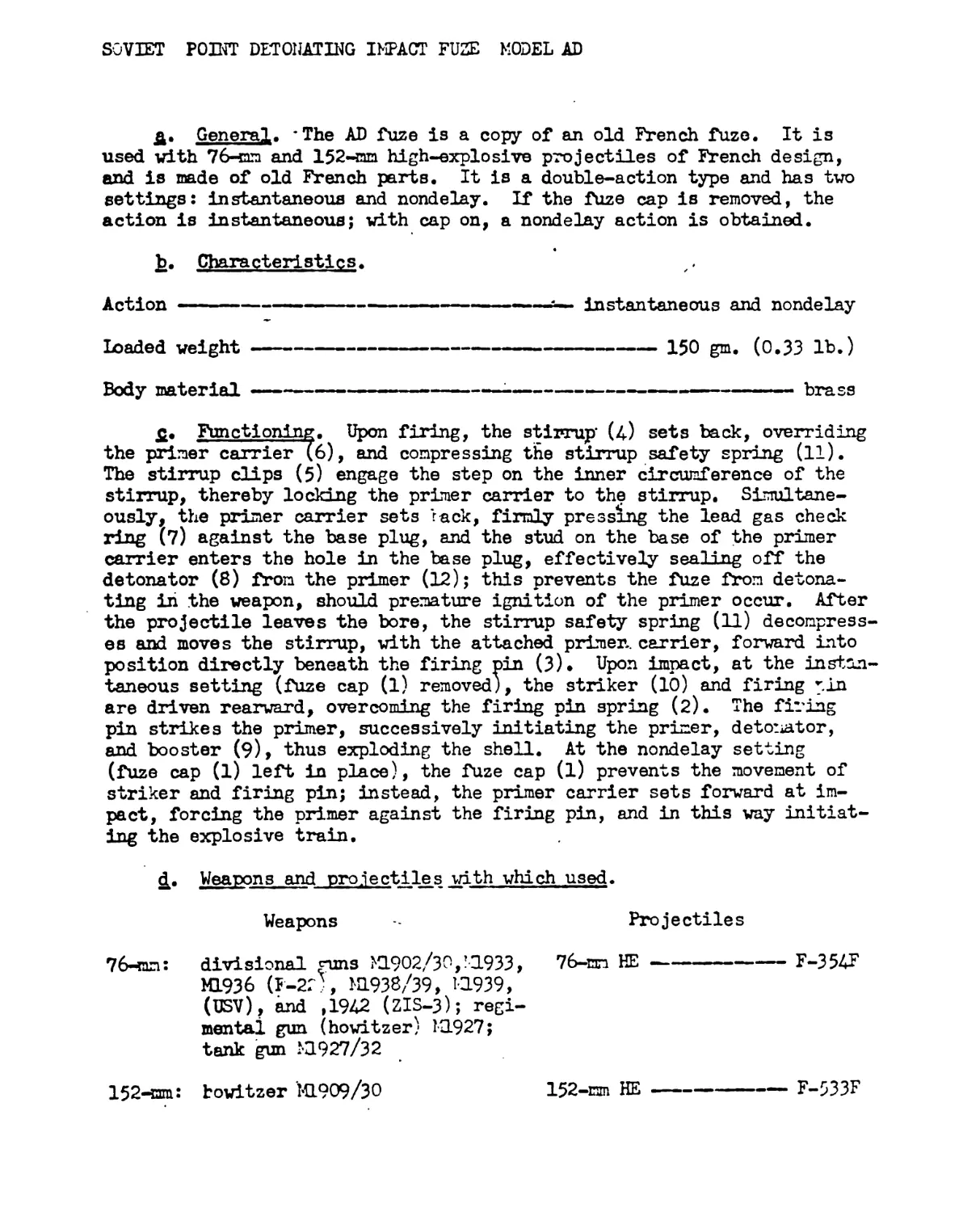
SOVIET POINT DETONATING IMPACT FUZE MODEL AD
General. ‘The AD fuze is a copy of an old French fuze. It is
used with 76-rnn and 152-mm high-explosive projectiles of French design,
and is made of old French parts. It is a double-action type and has two
settings: instantaneous and nondelay. If the fuze cap is removed, the
action is instantaneous; with cap on, a nondelay action is obtained.
b. Characteristics.
Action —— ——--------------------------——a—
instantaneous and nondelay
Loaded weight--------------------------------------— 150 gm. (0.33 lb.)
Body material-------------------------:--------------------------brass
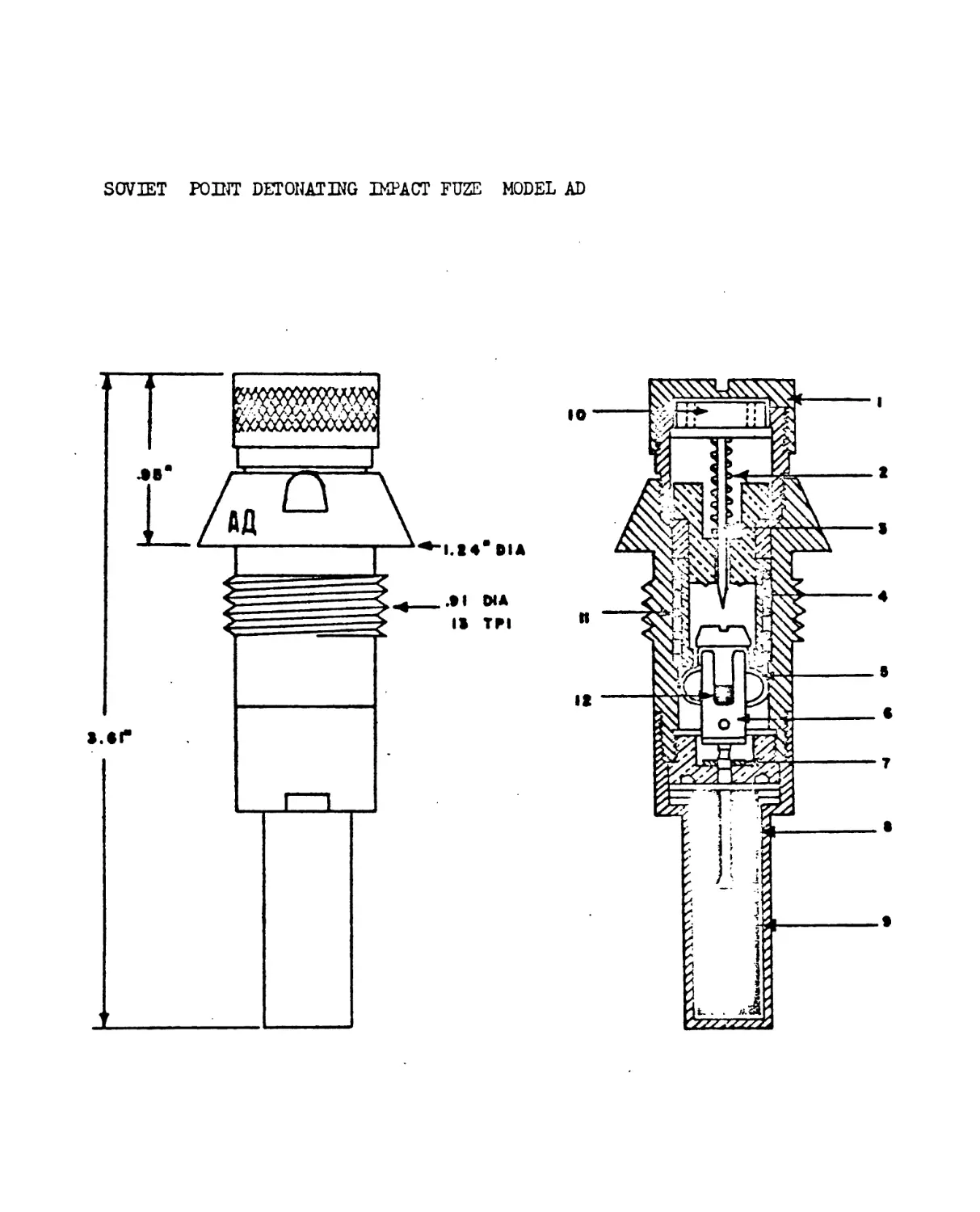
£. Functioning. Upon firing, the stirrup' (4) sets back, overriding
the primer carrier (6), and compressing the stirrup safety spring (11).
The stirrup clips (5) engage the step on the inner circumference of the
stirrup, thereby locking the primer carrier to the stirrup. Simultane-
ously, the primer carrier sets rack, firmly pressing the lead gas check
ring (7) against the base plug, and the stud on the base of the primer
carrier enters the hole in the base plug, effectively sealing off the
detonator (8) from the primer (12); this prevents the fuze from detona-
ting in the weapon, should premature ignition of the primer occur. After
the projectile leaves the bore, the stirrup safety spring (11) decompress
es and moves the stirrup, with the attached primer, carrier, forward into
position directly beneath the firing pin (3). Upon impact, at the in st in
taneous setting (fuze cap (1) removed), the striker (10) and firing pin
are driven rearward, overcoming the firing pin spring (2). The firing
pin strikes the primer, successively initiating the primer, deto:xator,
and booster (9), thus exploding the shell. At the nondelay setting
(fuze cap (1) left in place), the fuze cap (1) prevents the movement of
striker and firing pin; instead, the primer carrier sets forward at im-
pact, forcing the primer against the firing pin, and in this way initiat-
ing the explosive train.
d,. Weapons and projectiles with which used.
Weapons	Projectiles
76-ram: divisional nms >2902/30/2933,	76-mn HE--------------F-354?
>2936 (F-2T), >2938/39, 1-2939,
(USV), and ,1942 (ZIS-3); regi-
mental gun (howitzer) >2927;
tank gun >2927/32
152-mm: howitzer >2909/30	152—mm HE ——  1  -----F-533F
SOVIET POINT DETONATING IMPACT FUZE MODEL AD
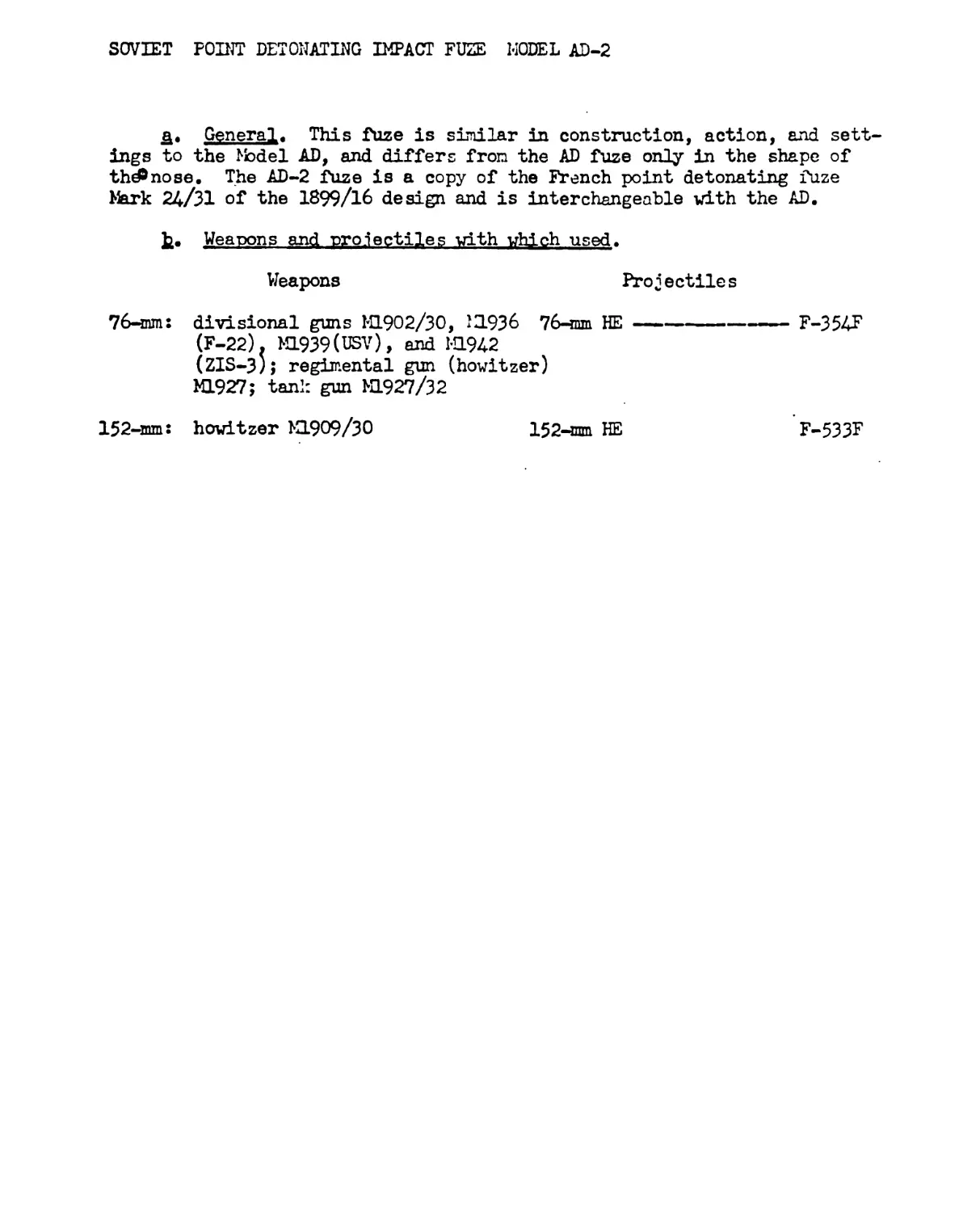
SOVIET POINT DETONATING IMPACT FUZE MODEL AD-2
д. General. This fuze is similar in construction, action, and sett-
ings to the Model AD, and differs from the AD fuze only in the shape of
th^nose. The AD-2 fuze is a copy of the French point detonating fuze
Mark 24/3I of the 1899/16 design and is interchangeable with the AD.
fe. Weapons and •projectiles with which used.
Weapons	Projectiles
7б-<шп: divisional guns Ш.902/30, 13.936 76-nm HE —-----------------F-354F
(F-22). M1939(USV), and M1942
(ZIS-3); regimental gun (howitzer)
M1927; tank gun >3.927/32
152-mm: howitzer >3.909/30	152-mm HE	F-533F
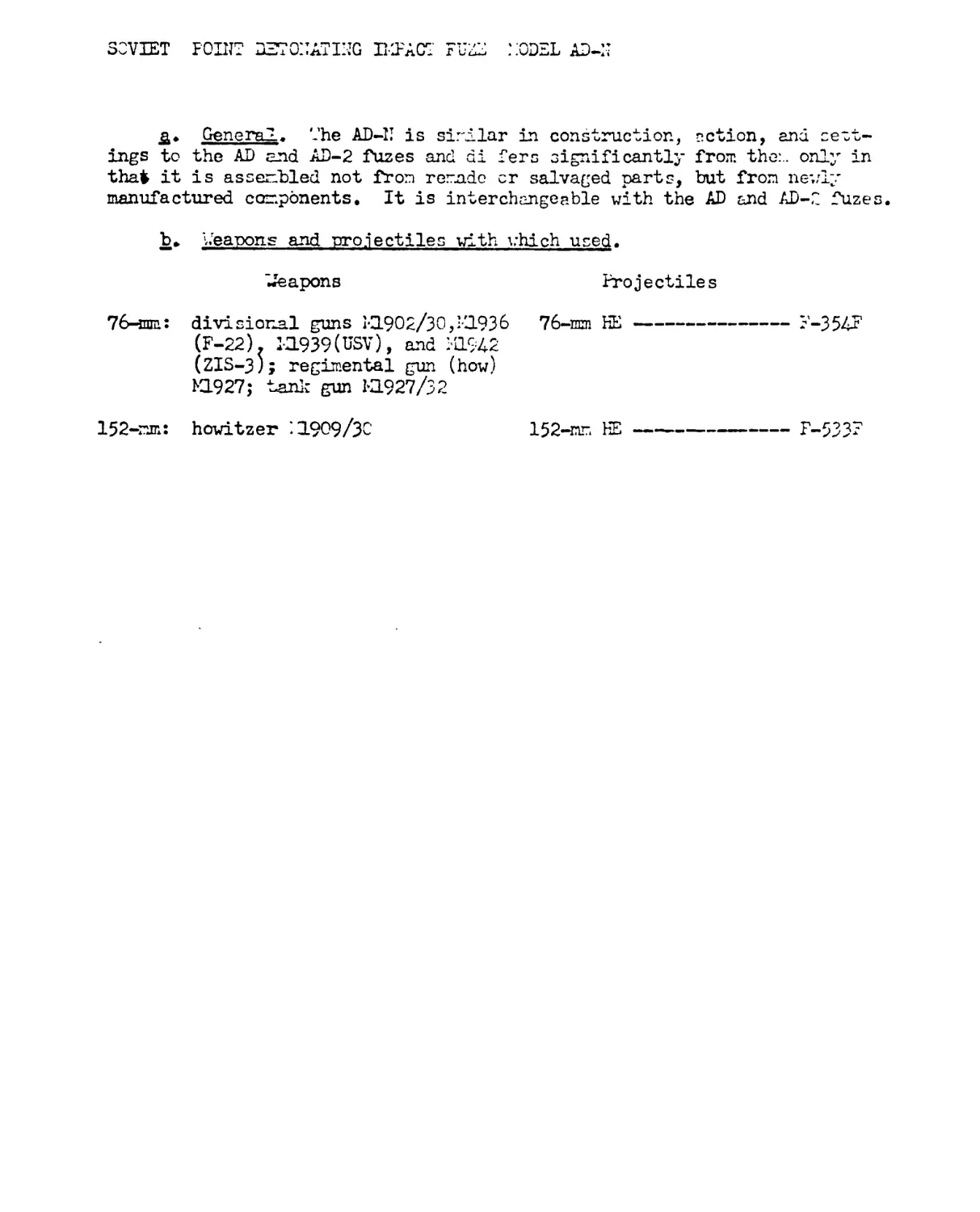
soviet foint deto::ati:ig impact fuze model ad-:;
General.. The AD-II is similar in construction, notion, and sett-
ings to the AD and AD-2 fuzes and di Pers significantly from the:., only in
that it is assembled not from remade cr salvaged parts, but from newly
manufactured components. It is interchangeable with the AD and AD-2 fuze
b. Weapons and •projectiles with which used.
’Jeapons
7бмпт: divisional guns г1902/30,М193б
(F-22). 1-1939 (USV), and М19Д2
(ZIS-з); regimental gun (how)
M927; tank gun 11927/32
152-mm: howitzer 1909/30
Projectiles
76-ran HE-----------------r'-354F
152-иг. PE-----------------F-533P
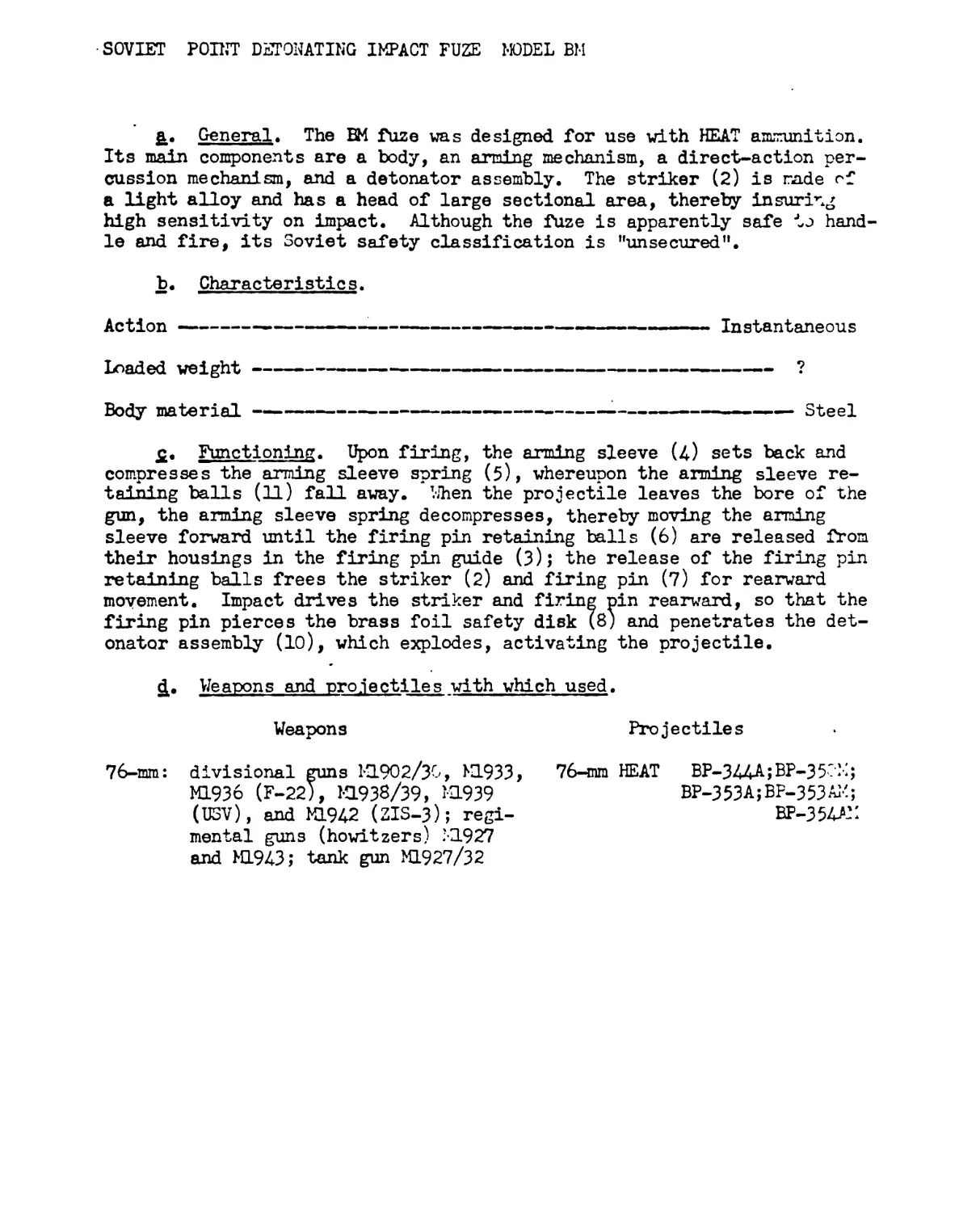
SOVIET РОВГГ DETONATING IMPACT FU2E MODEL BM
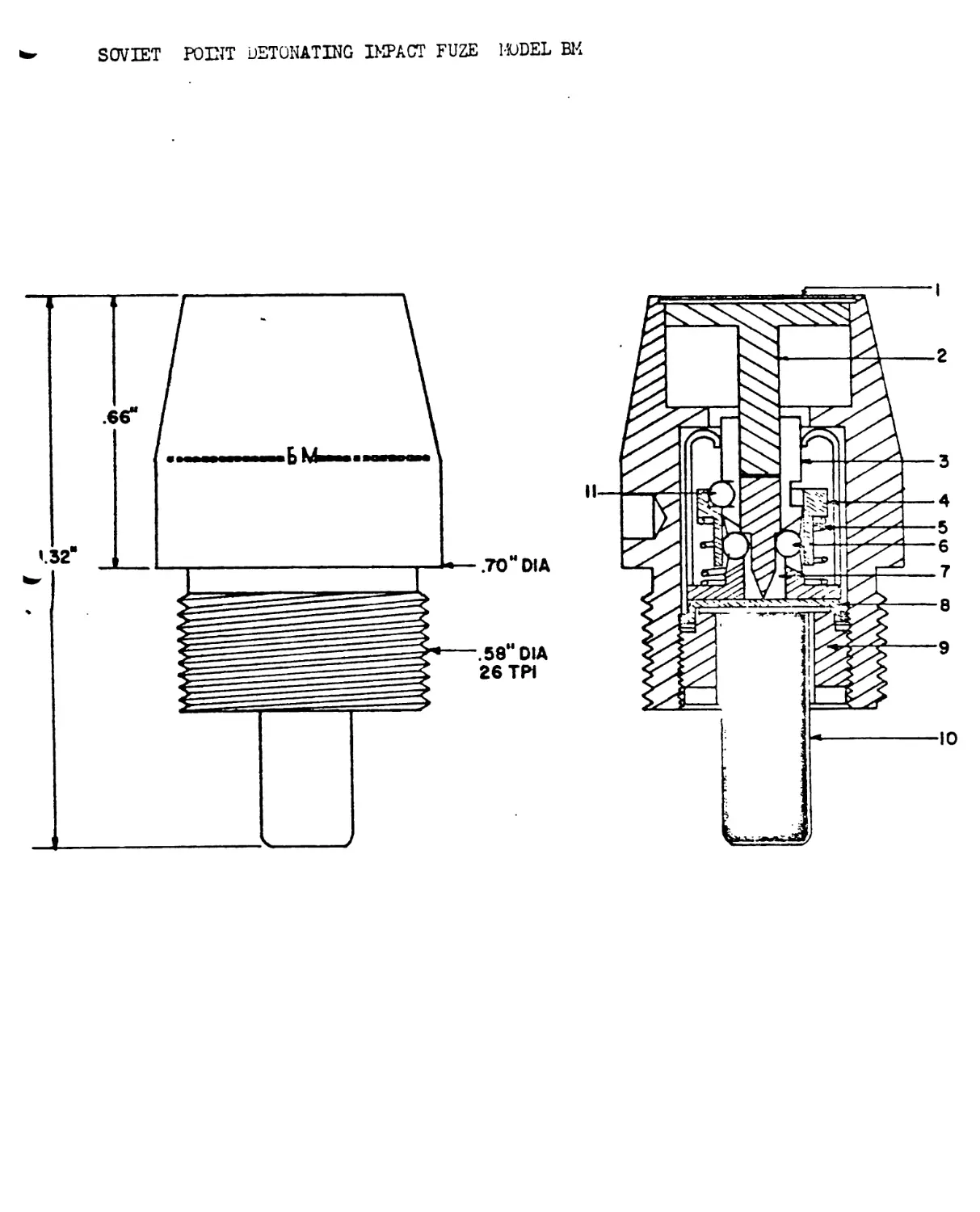
General. The BM fuze was designed for use with HEAT ammunition.
Its main components are a body, an arming mechanism, a direct-action per-
cussion mechanism, and a detonator assembly. The striker (2) is made of
a light alloy and has a head of large sectional area, thereby insuring
high sensitivity on impact. Although the fuze is apparently safe to hand-
le and fire, its Soviet safety classification is "unsecured".
b. Characteristics.
Action —--------------------------------—-----—---—-------- Instantaneous
Loaded weight ———----------------——----------------—-———— ?
Body material------------------------------------------------------Steel
£. Functioning. Upon firing, the arming sleeve (4) sets back and
compresses the arming sleeve spring (5), whereupon the arming sleeve re-
taining balls (11) fall away, then the projectile leaves the bore of the
gun, the arming sleeve spring decompresses, thereby moving the arming
sleeve forward until the firing pin retaining balls (6) are released from
their housings in the firing pin guide (3); the release of the firing pin
retaining balls frees the striker (2) and firing pin (7) for rearward
movement. Impact drives the striker and firing pin rearward, so that the
firing pin pierces the brass foil safety disk (8) and penetrates the det-
onator assembly (10), which explodes, activating the projectile.
Weapons and projectiles with which used.
Weapons	Projectiles
76-mm: divisional guns №902/30, №933,	76-mm HEAT BP-344A;BP-35'M;
№936 (F-22), №938/39, 10-939	BP-353A;BP-353AM;
(USV), and №942 (ZIS-3); regi-	BP-354/21
mental guns (howitzers) M927
and №943; tank gun №927/32
SOVIET POINT DETONATING IMPACT FUZE MODEL BM
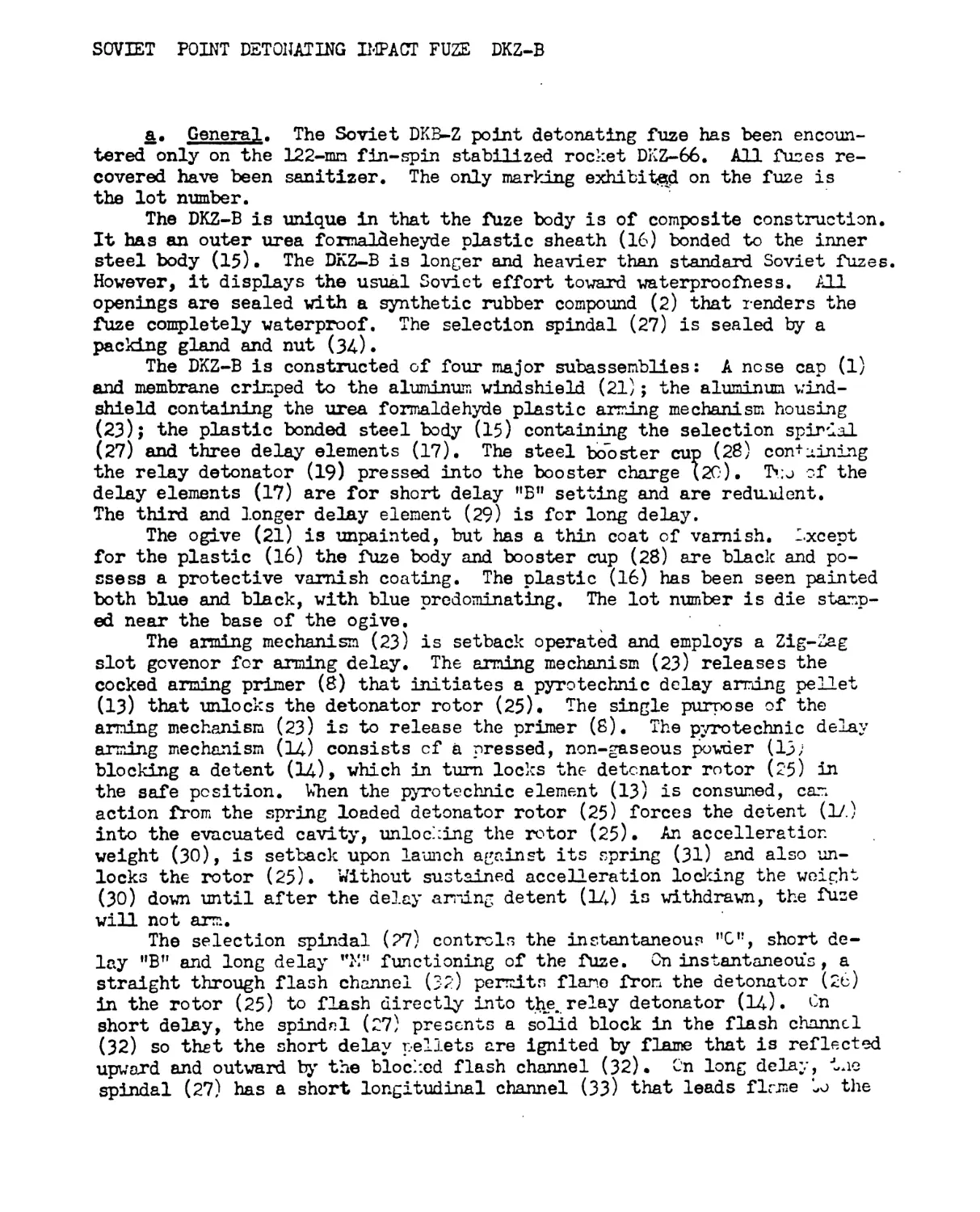
SOVIET POINT DETONATING IMPACT FUZE DKZ-B
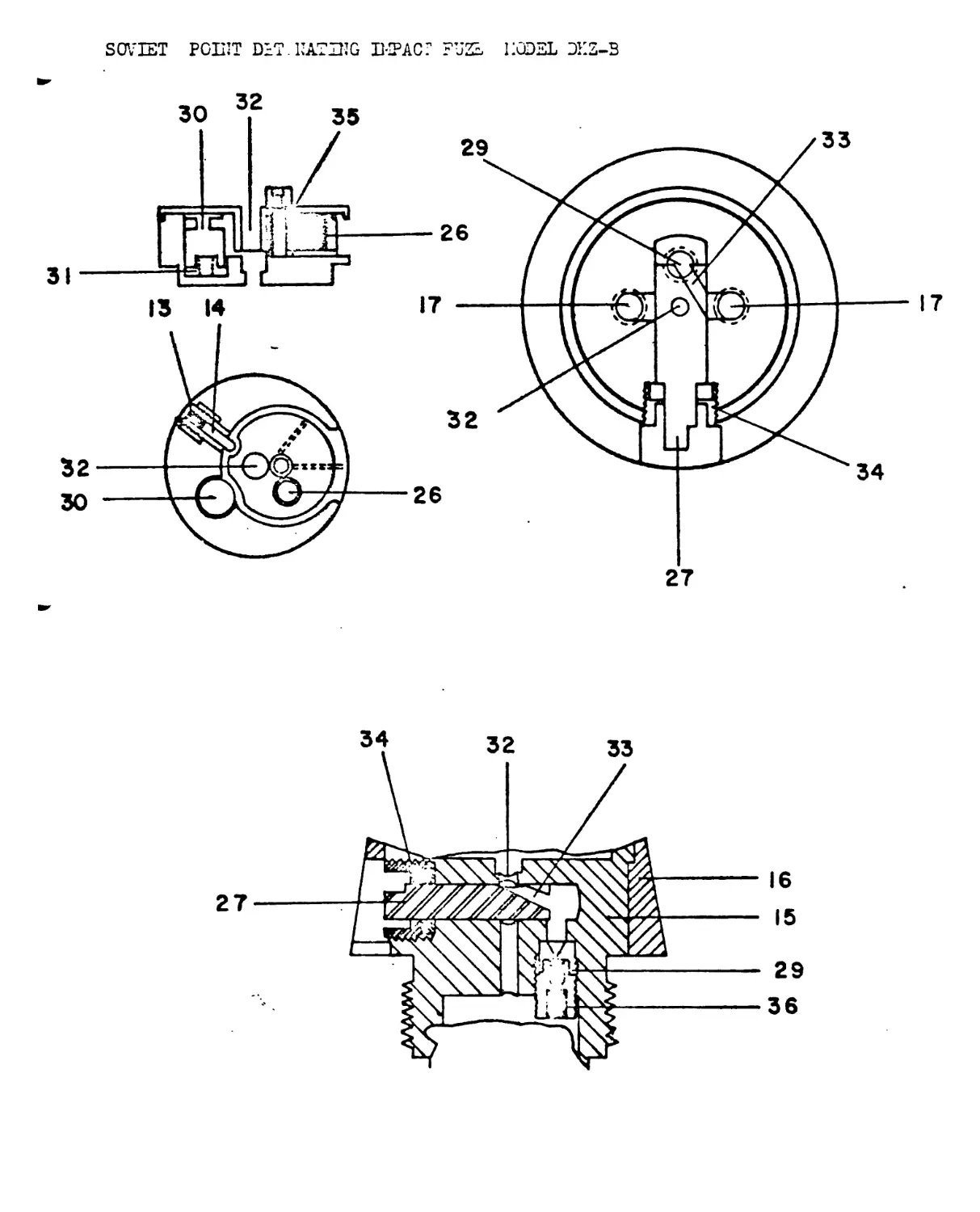
General. The Soviet DKB-Z point detonating fuze has been encoun-
tered only on the 122-mm fin-spin stabilized rocket DKZ-66. All fuzes re-
covered have been sanitizer. The only marking exhibited on the fuze is
the lot number.
The DKZ-B is unique in that the fuze body is of composite construction.
It has an outer urea formaldeheyde plastic sheath (16) bonded to the inner
steel body (15). The DKZ-B is longer and heavier than standard Soviet fuzes.
However, it displays the usual Soviet effort toward waterproofness. All
openings are sealed with a synthetic rubber compound (2) that renders the
fuze completely waterproof. The selection spindal (27) is sealed by a
packing gland and nut (34).
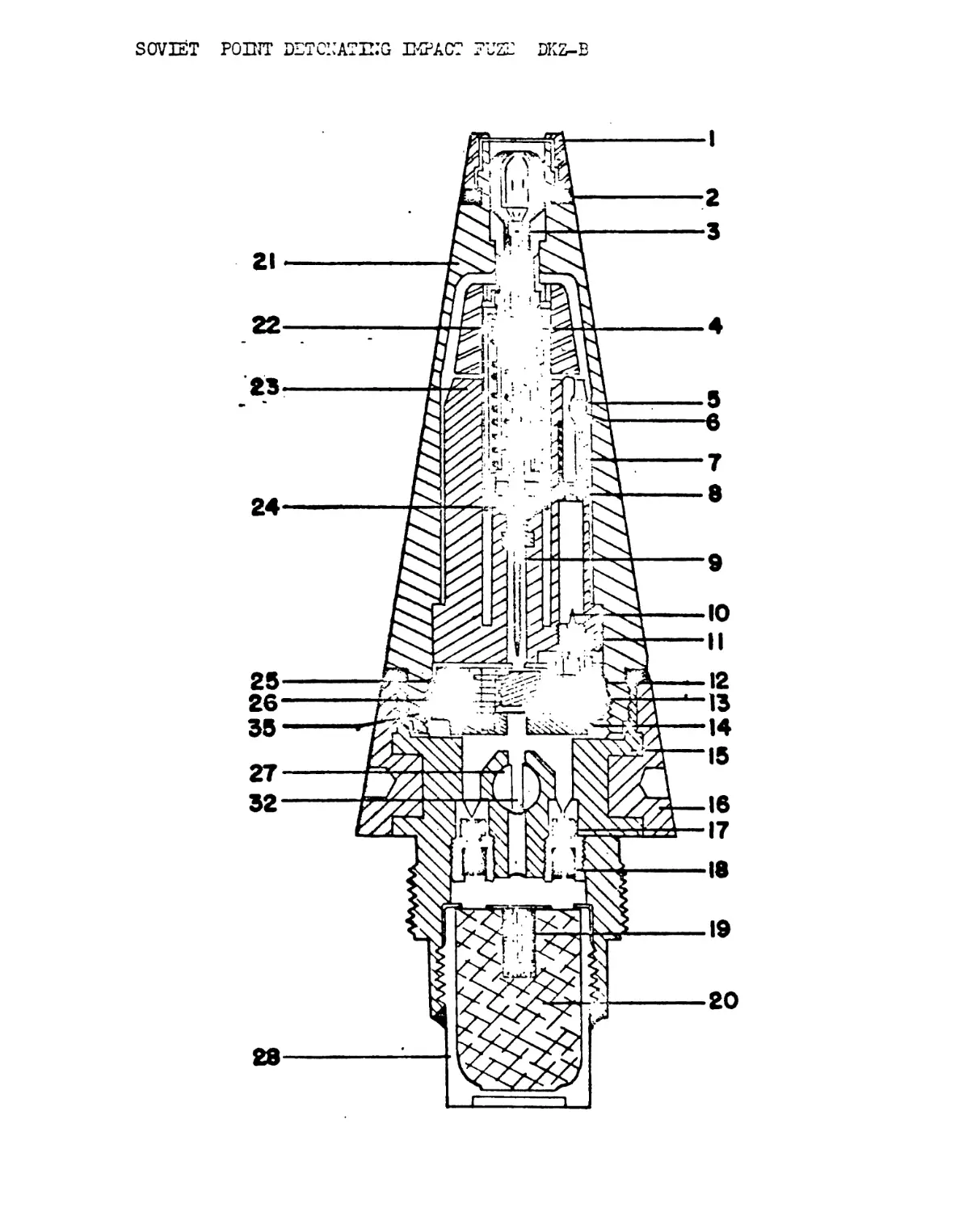
The DKZ-B is constructed of four major subassemblies: A nose cap (1)
and membrane crimped to the aluminum windshield (21); the aluminum wind-
shield containing the urea formaldehyde plastic arming mechanism housing
(23); the plastic bonded steel body (15) containing the selection spirual
(27) and three delay elements (17). The steel booster cup (28) containing
the relay detonator (19) pressed into the booster charge (2C). Tro of the
delay elements (17) are for short delay "B” setting and are redundent.
The third and longer delay element (29) is for long delay.
The ogive (21) is unpainted, but has a thin coat of varnish. Except
for the plastic (16) the fuze body and booster cup (28) are black and po-
ssess a protective varnish coating. The plastic (16) has been seen painted
both blue and black, with blue predominating. The lot number is die stamp-
ed near the base of the ogive.
The arming mechanism (23) is setback operated and employs a Zig-Zag
slot govenor for arming delay. The arming mechanism (23) releases the
cocked arming primer (8) that initiates a pyrotechnic delay arming pellet
(13) that unlocks the detonator rotor (25). The single purpose of the
arming mechanism (23) is to release the primer (8). The pyrotechnic delay
arming mechanism (14) consists cf a pressed, non-gaseous powder (13;
blocking a detent (14), which in turn locks the- detonator rotor (25) in
the safe position. When the pyrotechnic element (13) is consumed, cam
action from the spring loaded detonator rotor (25) forces the detent (1/.)
into the evacuated cavity, unlocking the rotor (25). An acceleration
weight (30), is setback upon launch against its spring (31) and also un-
locks the rotor (25). Without sustained accelleration locking the weight
(30) down until after the delay arming detent (14) is withdrawn, the fuze
will not arm.
The selection spindal (27) controls the instantaneous "C'!, short de-
lay "B” and long delay functioning of the fuze. On instantaneous, a
straight through flash channel (32) permits flame from the detonator (26)
in the rotor (25) to flash directly into the. relay detonator (14). On
short delay, the spindal (27) presents a solid block in the flash channel
(32) so thet the short delay pellets are ignited by flame that is reflected
upward and outward by the blocked flash channel (32). On long delay, tae
spindal (27) has a short longitudinal channel (33) that leads flame to the
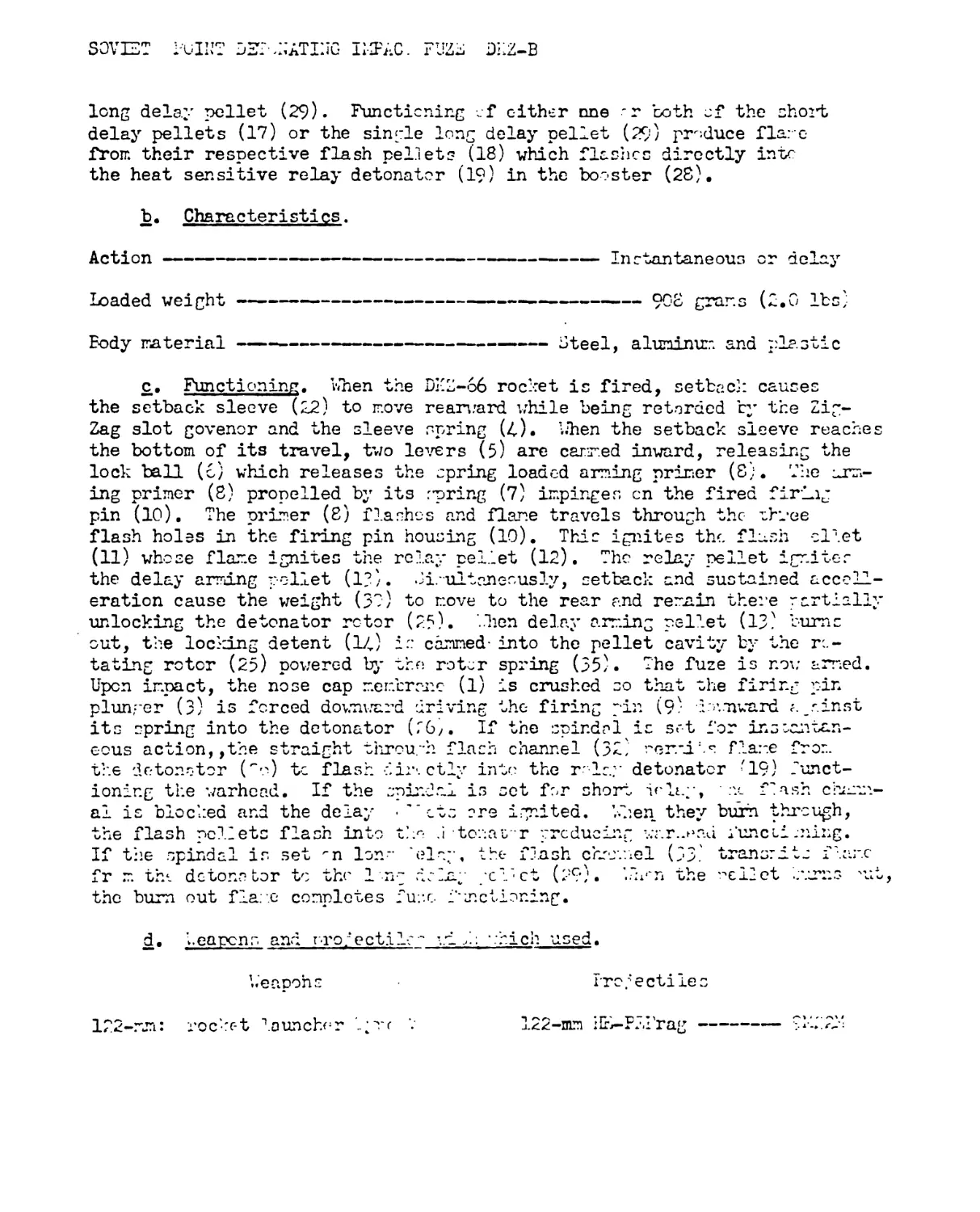
SOVET i-uIL’T DZENATIliG IkFAC. FUZii DiLZ-B
long delay pellet (29). Functioning _f cither nne 'r both of the ohoi’t
delay pellets (17) or the single long delay pellet (29) produce flare
from their respective flash pellets (18) which flashes directly into
the heat sensitive relay detonator (19) in the booster (28).
b.	Characteristics.
Action ------------------------------------------ Instantaneous or delay
Loaded weight ----------------------------------------99'8 grams (2.0 lbs)
Body material ------------------------------- oteel, aluminum and plastic
c.	Functioning. When the DKZ-66 rocket is fired, setback causes
the setback sleeve (22) to move rearward while being retarded by the Zig-
Zag slot govenor and the sleeve spring (4). When the setback sleeve reaches
the bottom of its travel, two lexers (5) are cammed inward, releasing the
lock ball (b) which releases the spring loaded arming primer (8). The arm-
ing primer (8) propelled by its spring (7) impinges cn the fired firing
pin (10). The primer (8) flashes and flame travels through the ebmee
flash holes in the firing pin housing (10). This ignites the flash diet
(11) whose flame ignites the relay pellet (12). The relay pellet igniter
the delay arming pellet (1?). Ji.-ultnneously, setback and sustained accel-
eration cause the weight (3?) to move to the rear and remain there rartially
unlocking the detonator rotor (25). '..lien delay arming pellet (13) burns
out, the locking detent (14) is cammed- into the pellet cavity by the ro-
tating rotor (25) powered by the rotor spring (35). The fuze is now armed.
Upon impact, the nose cap r.encror.c (1) is crushed so that the firing pin
plunger (3) is forced downward driving the firing pin (9) downward ?. rinst
its- spring into the detonator (.'6/. If the spindrl is set for instantan-
eous action,,the straight thrown flash channel (32) rer.-j.l': flar.e free,
the detonator (~o) tc flash fir. ctly into the r- Is.y detonator '19) funct-
ioning the warhead. If the spindnl is set for short, idi.y, ' .w flash ciurr.-
al is blocked and the delay  '’etc ore ignited, ’.ben they burn through,
the flash pellets flash into the .i tonav. r producing war..pad funciiming.
If the spindal is. set ^n Ion-- ’elnp, the flash chrWiel (33) transrdto flar.e
fr m th*, detonator tc the 1 пр delay pcl'ct (29). '..'wn the relict .roms 'ut,
the burn out flare completes fur.c l'-r.ctioning.
d.	i.eapens. and rro/ectilw •.ri -.hich used.
Weapons
rro;ectileo
rockc-t launch^
122-m.m hE-R-.i’rag
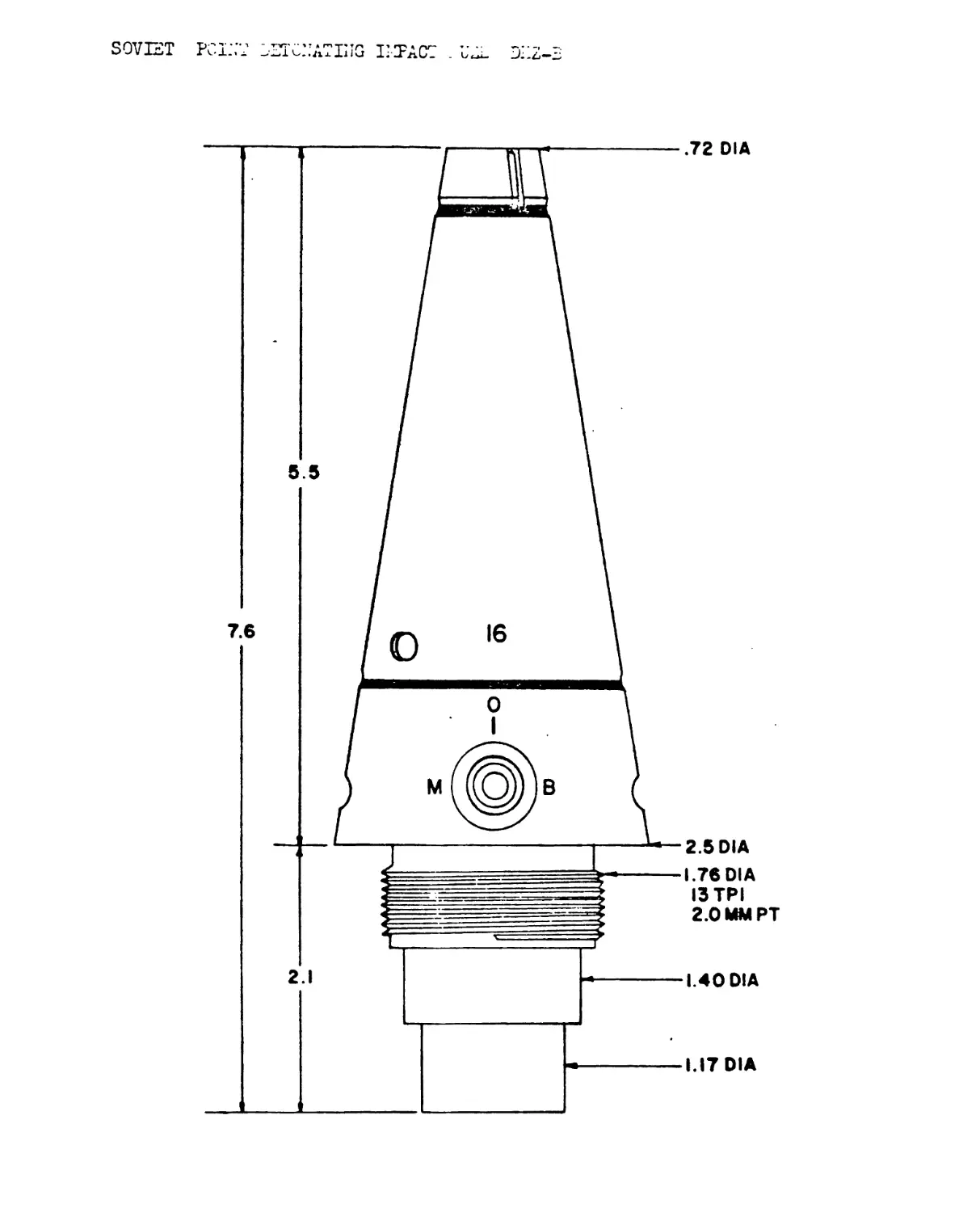
SOVIET
-Elv.;ATLiG IEFAC2 . UAi- J..Z—E
7.6
5.5
2.1
2.5 DIA
1.76 DIA
I3TPI
2.0 MM PT
1.40 DIA
.72 DIA
1.17 DIA
SOVIET POINT DETONATING impact fuze dkz-b

SOVIET POINT INITIATING BASE DETONATING IMPACT FUZE MODEL GK-1
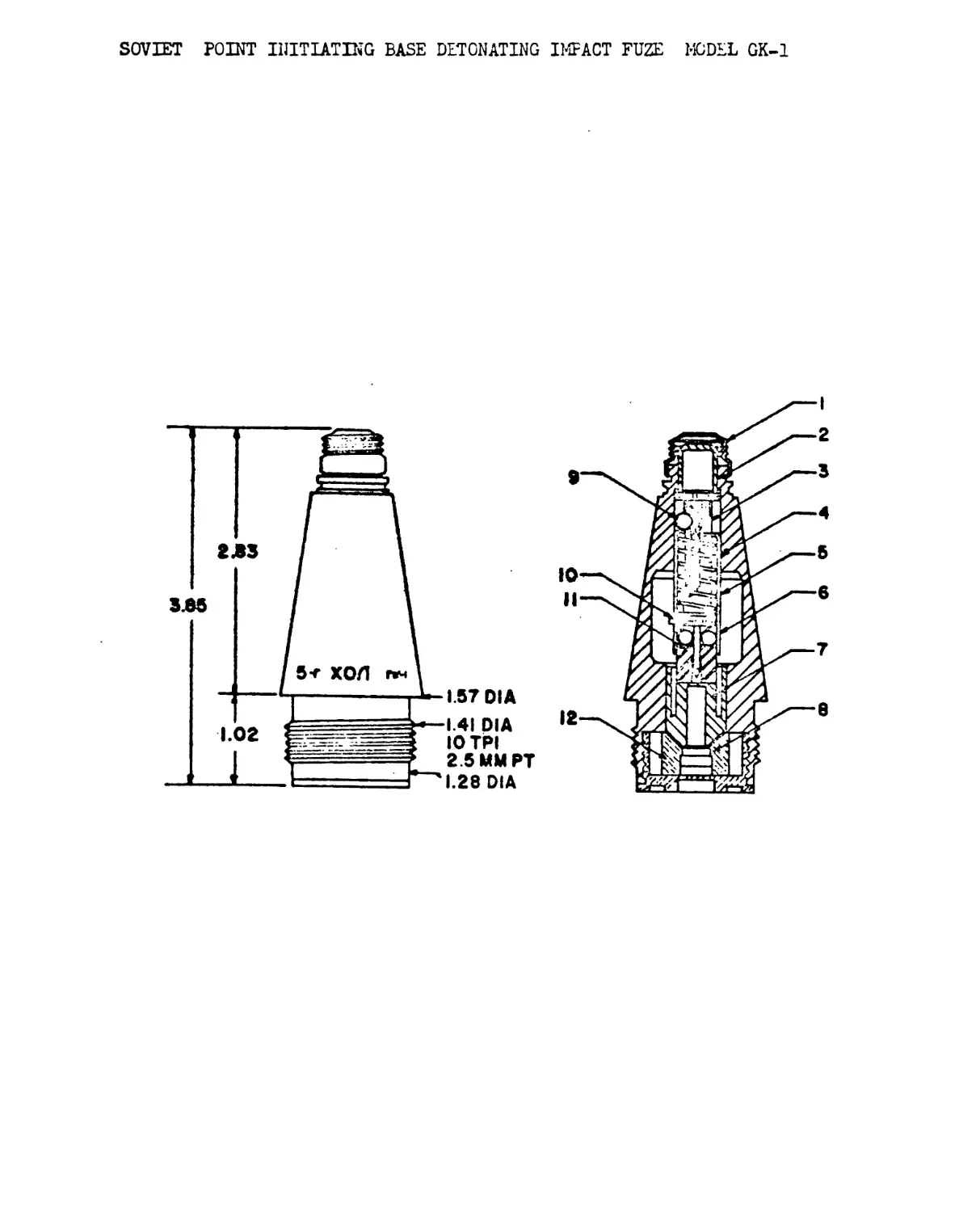
General. The Soviet Model GK-1 fuze is a setback armed, nondelay,
impact fuze. It was designed to be employed as a point initiating, base
detonating fuze for use with high explosive antitank (HEAT) projectiles
and as a straight impact fuze for use with high explosive fragmentation
projectiles. The GK-1 is an extremely sensitive fuze, as are all of the
GK series. The nose of the GK-1 is protected with a shipping cap which
is removed prior to firing. Delayed arming is achieved by the use of a
zig-zag slot cut in the setback sleeve (5). Because of the in-line explo-
sive train the GK-1 is not detonator safe. Graze sensitivity is achieved
through the use of a cam weight positioned in the bottom of the fuze. Any
laterial impact causes the weight (12) to cam the primer carrier (7) up
into the firing pin (3). The GK-1 is considered obsolete having been re-
placed by the GK-2 and GK-2M fuzes.
b. Characteristics.
Action---------------------—--------—----------------------Instantaneous
Loaded weight —   —--------------——— ----------    155 grams (0.34 lbs.)
Body material — — —— —— —   —_ Aluminum
£. Functioning. Upon firing, setback causes the sleeve (5) to move
to the rear, releasing the sleeve retaining ball (9), which falls into the
fuze body cavity. As setback diminishes, the sleeve spring (4) forces the
sleeve (5) to move forward to the head of the firing pin (3). This releases
the four firing pin retaining balls (6) allowing them to fall into the fuze
cavity. The fuze is now armed with the firing pin (3) separated from the
primer (7) only by the expanded firing pin spring (11). Upon impact, the
foil cap (1) and the firing pin plunger (2) are driven downward against
the head of the firing pin (3), which in turn causes the firing pin to
pierce the stab sensitive primer (7). This initiates the detonator (8)
which causes the projectile to detonate. On graze impacts, the graze weight
(12) moves laterally camming the primer carrier (7) onto the firing pin (3)
producing functioning.
d. Weapons and projectiles with which used.
Weapons	Pro jectile s
82-nnn: Soviet AT Rocket Launcher	82-mm: HEAT----————— rG-82
Model SPG-82
SOVIET POINT INITIATING BASE DETONATING IMPACT FUZE MODEL GK-1
1.57 DIA
1.41 DIA
IOTPI
2 5 MM PT
1.28 DIA
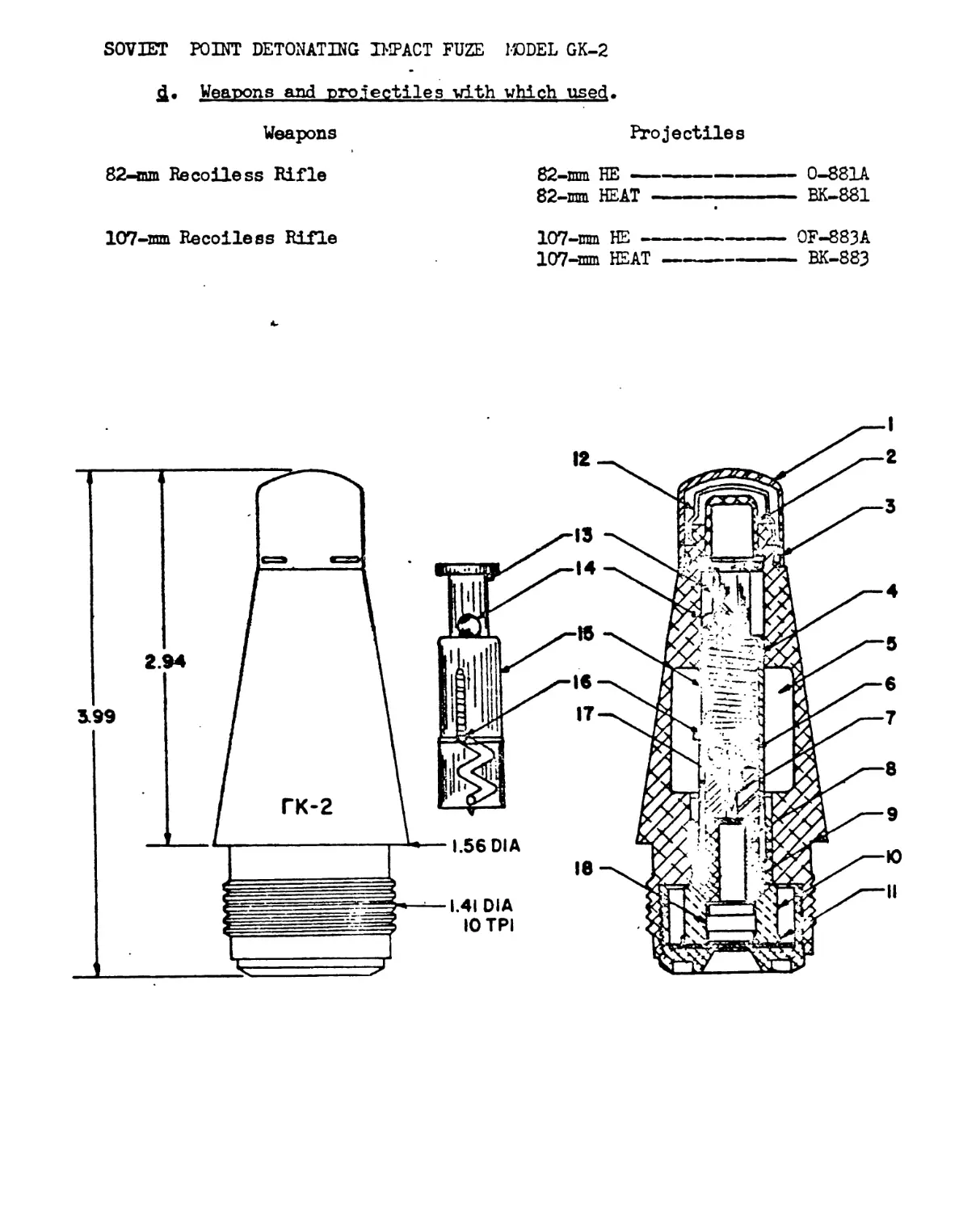
SOVIET POINT DETONATING IMPACT FUZE MODEL GK-2
fl. General. ‘The GK-2 is similar in construction ar_l functioning
to the Soviet GK-1. The only noticeable difference between the GK-2
and GK-1 is the Zig-Zag delay arming assembly. This element provides
a greater safe arming distance for the GK-2. The basic design for the
GK-2 appeared in the Soviet M-50 mortar fuze and is almost identical
with the current Soviet M-6 mortar fuze. Do to the in-line explosive
train, the GK-2 is not considered detonator safe.
The GK-2 may be fired with or without the shipping cover in place.
If the fuze is fired with the shipping cover a slight delay is inherent
in functioning.
The GK-2 employs a graze sensitive feature to insure functioning at
low angles of impact. The graze sensitive plunger or hammer resides in
an enlarged cavity. Its concave surface rests against the conical sur-
faces of the primer detonator assembly. Any impact, other than one di-
rectly on the nose of the fuze, causes the graze hammer to move laterally,
thereby forcing the primer-detonator forward through cam action.
b. Characteristics.
Action —————————--------------------————————— instantaneous
Loaded weight-----------------------------------------------— 0.39 Lb.
Body material----------------------------------------------—— Aluminium
c. Functioning. Upon firing, set back forces the Zig-Zag sleeve (15)
to the rear, releasing the sleeve retaining ball (14) which falls into the
fuze body cavity. As set back decreases the sleeve spring (4) which was
compressed by the sleeve, expands , moving the sleeve (15) forward be-
neath the head of the firing pin assembly (13) and releasing the four fir-
ing pin locking balls (6), allowing them to drop into the iuze body cavity
(5). The fuze is now armed. The firing pin is held separated from the
primer detonator (9) by the firing pin spring (17). Upon impact, the
plunger (2) is driven against the head of the firing pin assembly (13)
which pierces the primer detonator (9) causing it to detonate and,in turn ,
detonate the booster.
If the fuze impacts at a flat angle so that the plunger (2) is not
depressed, the graze sensitive plunrer moves laterally, overco-iming the
•retaining disc (11) and forcing the primer-detonator assembly (9) forward
onto the firing pin (9) achieving detonation.
SOVIET POINT DETONATING IMPACT FUZE MODEL GK-2
Weapons and projectiles with which used.
Weapons
82-шп Recoiless Rifle
107-mm Recoiless Rifle
Projectiles
82-mm HE-----------------0-881A
82-mm HEAT--------------- BK-881
107-mm HE ------------- 0F-883A
107-mm HEAT--------------BK-883
SOVIET POINT INITIATING IMPACT FUZE MODEL GK-2M
a.	General. The Soviet GK-2M is a later version of the GK-1 and
GK-2 Soviet fuzes, Two major modifications have been incorporated into
the GK-2M to improve fuze reliability on graze impact. The firing pin,
plunger and nose assemblies have been redesigned. It has a cone shaped
plunger and cone shaped cavity in the nose. The second change consists
of the addition of an adapter for the primer-detonator assembly. This
adapter eleminated the inner body cavity to receive the firing pin lock-
ing balls after setback. The cavities were difficult to machine and have
been eleminated in the GK-2M. In all other respects the GK-2M is identi-
cal with the earlier GK-2.
£. Character! sti cs.
Action —— — ----------------—----------—- . 	Instantaneous
Loaded weight — --------——--------------—-------------------—— 7.12 Cz.
Body material---------——------------------—-— -	—Aluminium
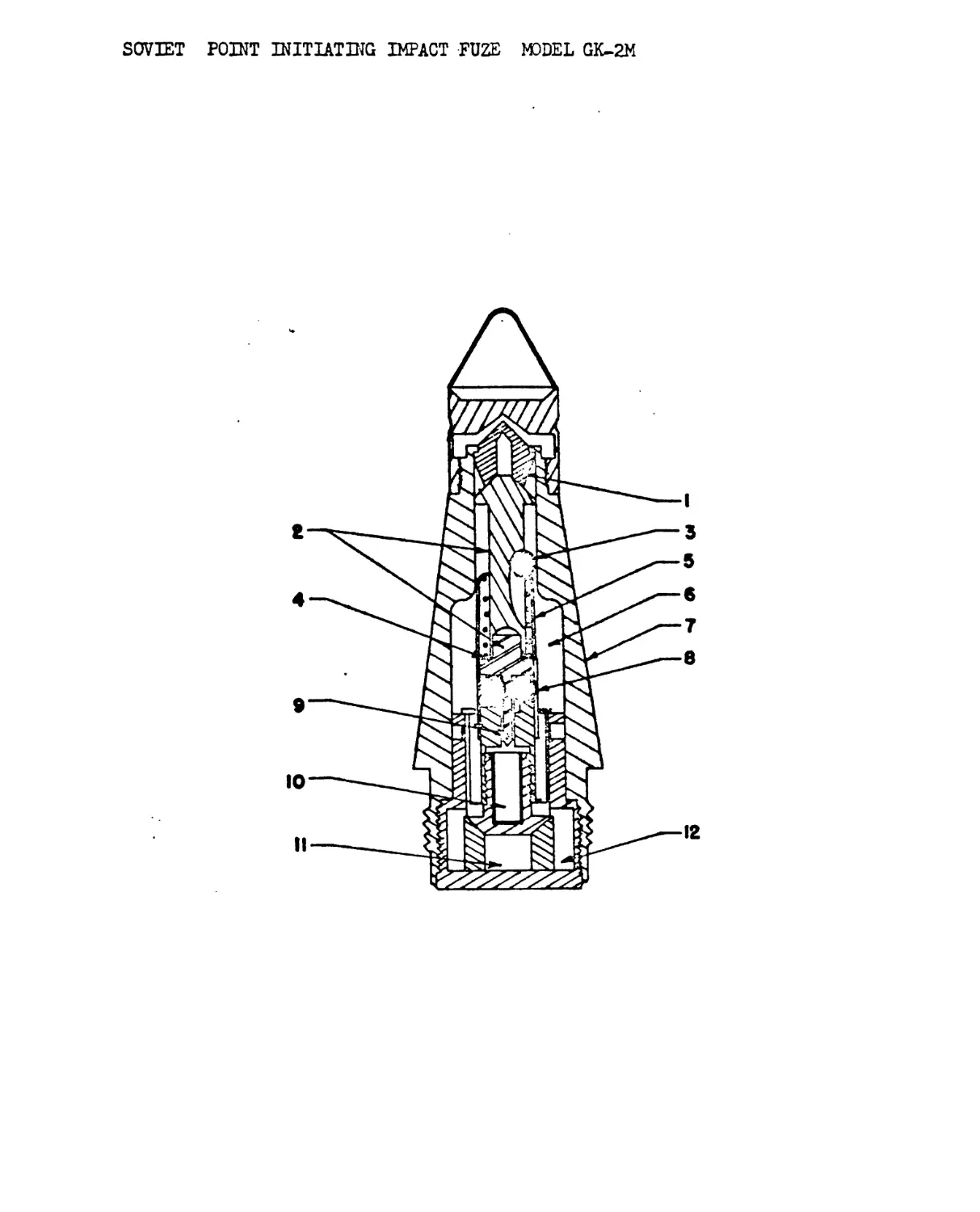
Functioning. Upon firing, setback causes the Zig-Zag sleeve (5)
to move to the rear releasing the sleeve retaining ball (3) which falls
into the fuze body cavity (6). As setback forces decrease, the sleeve
spring (4) which was compressed by the sleeve during setbsck, recoils,
moving the sleeve (5) forward, releasing the four firing pin locking ball.s
(8), allowing them to drop into the body cavity (6). The fuze is now arm-
ed, with the firing pin (2) being held away from the stab sensitive det-
onator (10) by the anti-creep spring. Upon impact, the cone shaped plunger
(1) is driven against the firing pin assembly (2) which causes the firing
pin to pierce the primer-detonator, detonating the booster. On low angles
of impact, the graze impact feature causes the booster impact weight to
move leterally overcomming the retainer washer (12), camming the primer-
detonator assembly (10) forward into the firing pin (9) causing it to
function. If the cone nose strikes at an angle and is crushed out of line
with the plunger (2), the cone shaped cavity in the nose causes the plunger
to cam downward against the firing pin head, causing it to function.
Д. Weapons and projectiles with which used.
82-mm Recoiless Rifle B-10	82-ram HEAT ------------- Bk-881M
SOVIET POINT INITIATING IMPACT FUZE MODEL GK-2M
SOVIET POINT DETONATING IMPACT FUZE MODEL GVM
General. The GVM fuze differs from the GVMZ and the GVMZ-1
fuze inasmuch as it has no delay element and, consequently, no fuze
setting device. It is an instantaneous fuze with one permanent setting.
In other respects it is similar to the GVMZ and GVMZ-1. The GVM fuze is
not being manufactured at the present time.
b.	Weapons and projectiles with which used.
Weapons
120-mm: regimental mortars M1938
and M1943
Projectiles
120-mm Frag-HE --- OF-843,
0F-843A
Smoke —— D-843A
Smoke
SOVIET POINT DETONATING IMPACT FUZE MODEL GVMZ
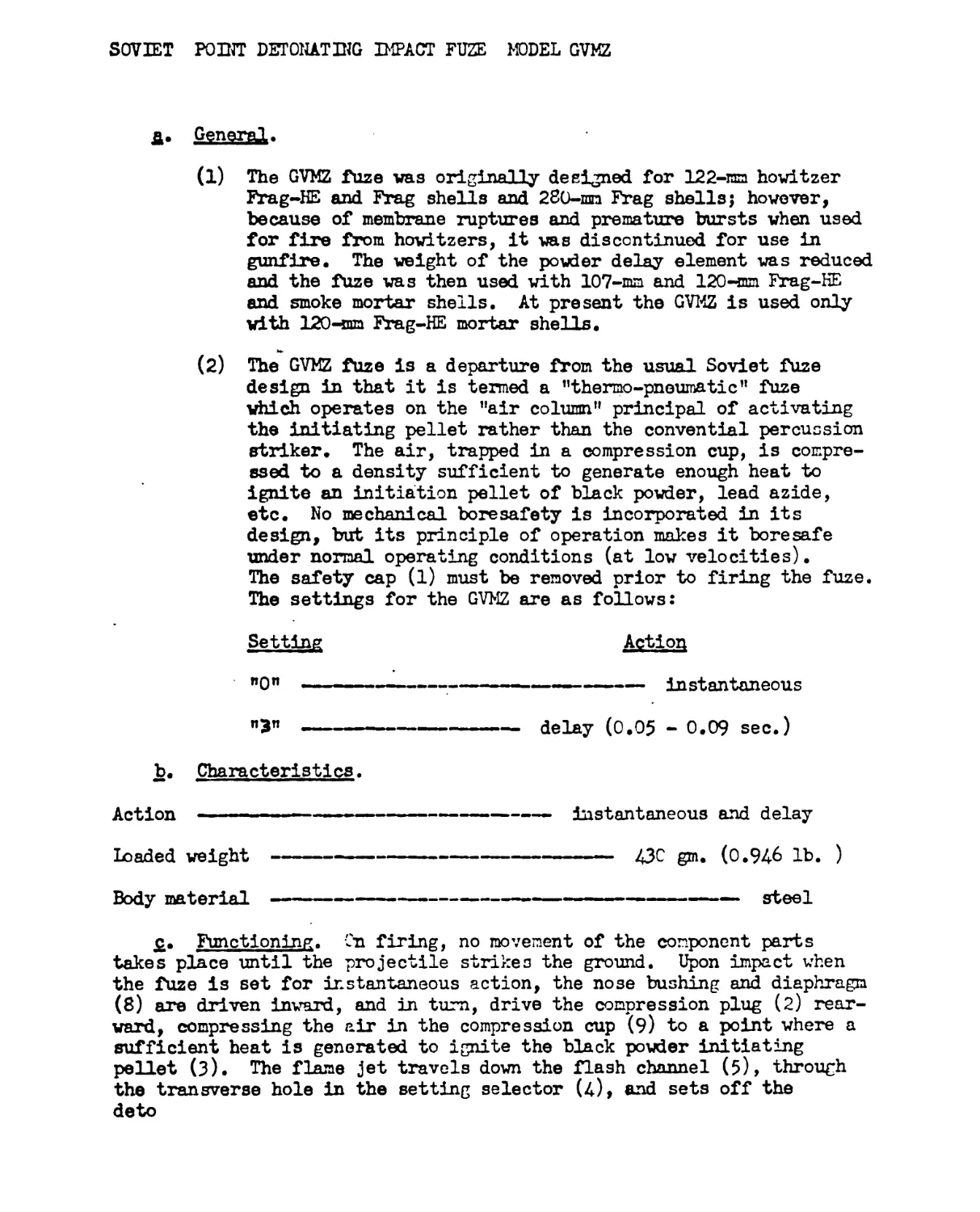
д. Ggngrgl.
(1) The GVMZ fuze was mHпяЧ1y designed for 122-mm howitzer
Frag-HE and Frag shells and 28O-mm Frag shells; however,
because of membrane ruptures and premature bursts when used
for fire from howitzers, it was discontinued for use in
gunfire. The weight of the powder delay element was reduced
and the fuze was then used with 107-mm and 120-mm Frag-HE
and smoke mortar shells. At present the GVMZ is used only
with 120-nm Frag-HE mortar shells.
(2) The GVMZ fuze is a departure from the usual Soviet fuze
design in that it is termed a "thenno-pneumatic" fuze
which operates on the "air column" principal of activating
the initiating pellet rather than the convential percussion
striker. The air, trapped in a compression cup, is compre-
ssed to a density sufficient to generate enough heat to
ignite an initiation pellet of black powder, lead azide,
etc. No mechanical boresafety is incorporated in its
design, but its principle of operation makes it boresafe
under normal operating conditions (at low velocities).
The safety cap (1) must be removed prior to firing the fuze.
The settings for the GVMZ are as follows:
Setting	Action
”0”-----------------------------------instantaneous
"3" ---------------------- delay (0.05 - 0.09 sec.)
b. Characteristics.
Action	—-------------------— instantaneous and delay
Loaded weight ----------------------------------- ДЗС gm. (0.946 lb. )
Body material------------------------------------—----------steel
£. Functioning. On firing, no movement of the component parts
takes place until the projectile strikes the ground. Upon impact when
the fuze is set for instantaneous action, the nose bushing and diaphragm
(8) are driven inward, and in turn, drive the compression plug (2) rear-
ward, compressing the air in the compression cup (9) to a point where a
sufficient heat is generated to ignite the black powder initiating
pellet (3). The flame jet travels down the flash channel (5), through
the transverse hole in the setting selector (4), and sets off the
deto
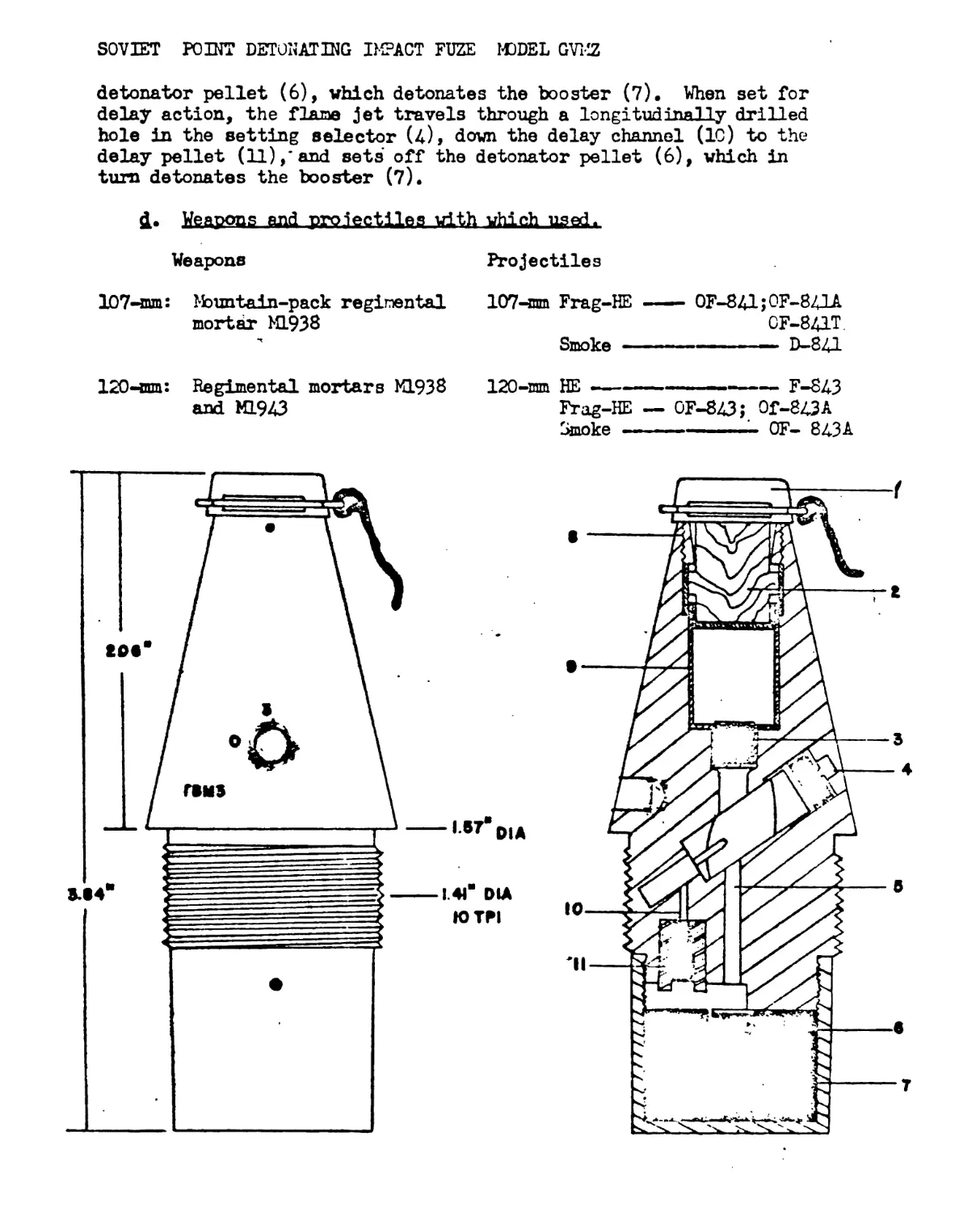
SOVIET POINT DETONATING IMPACT FUZE MODEL GVl-S
detonator pellet (6), which detonates the booster (7). When set for
delay action, the flame jet travels through a longitudinally drilled
hole in the setting selector (4), down the delay channel (10) to the
delay pellet (11)," and sets off the detonator pellet (6), which in
turn detonates the booster (7).
Weapons and projectiles with which used.
Weapons	Projectiles
107-mm: Mountain-pack regimental
mortar M1938
120-mm: Regimental mortars KL938
and M1943
107-mm Frag-HE ----- 0F-841;0F-841A
0F-841T.
Smoke 		 — D-841
120-mm HE--------------------F-843
Frag-HE — OF-843;. Of-843A
□moke . 1.   —..— OF- 843A
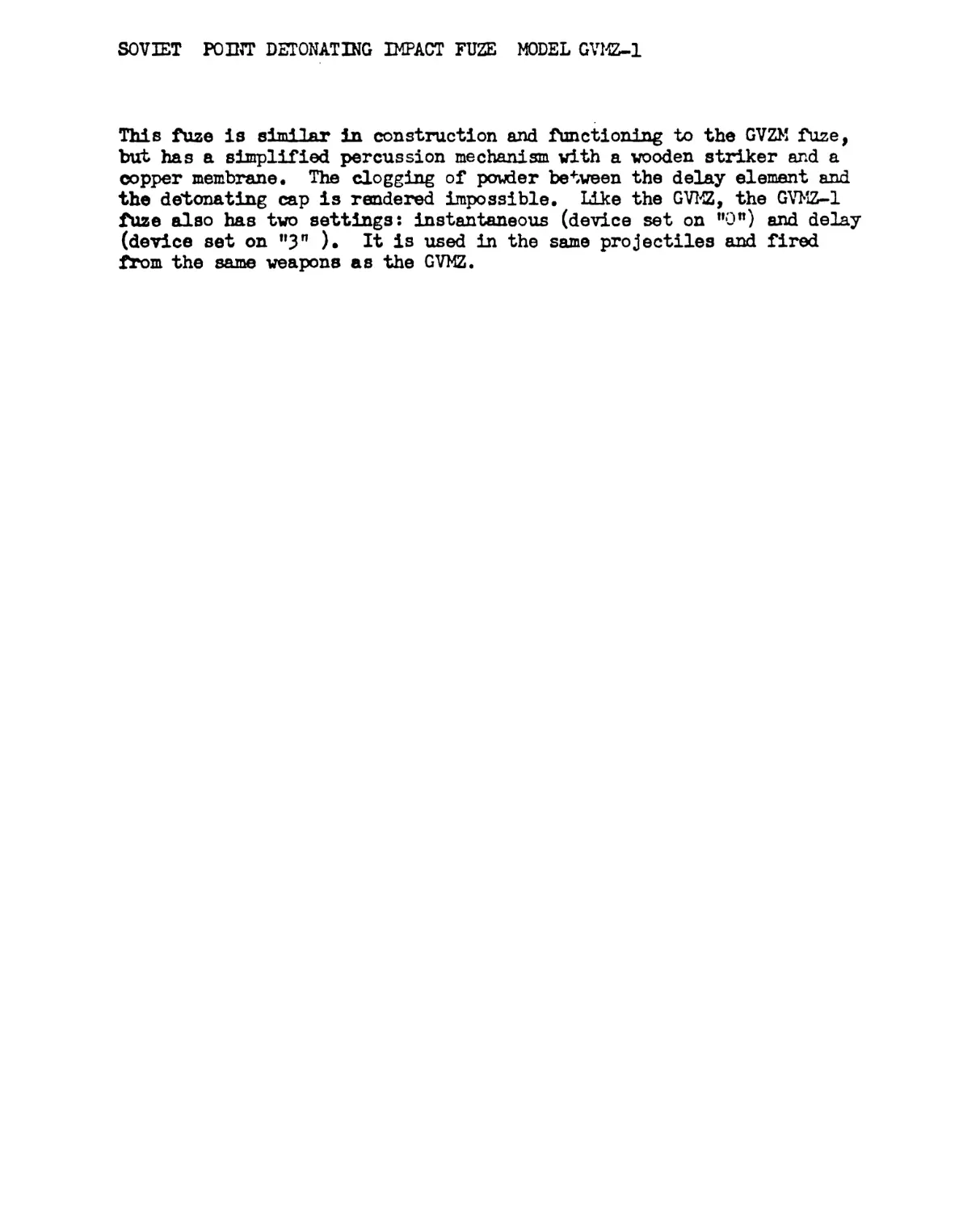
SOVIET POINT DETONATING IMPACT FUZE MODEL GVMZ-1
This fuze is similar in construction and functioning to the GVZM fuze,
hut has a simplified percussion mechanism with a wooden striker and a
copper membrane. The clogging of powder between the delay element and
the detonating cap is rendered impossible. Like the GVMZ, the GVMZ-1
fuze also has two settings: instantaneous (device set on "0") and delay
(device set on ”3n ). It is used in the same projectiles and fired
from the same weapons as the GVMZ.
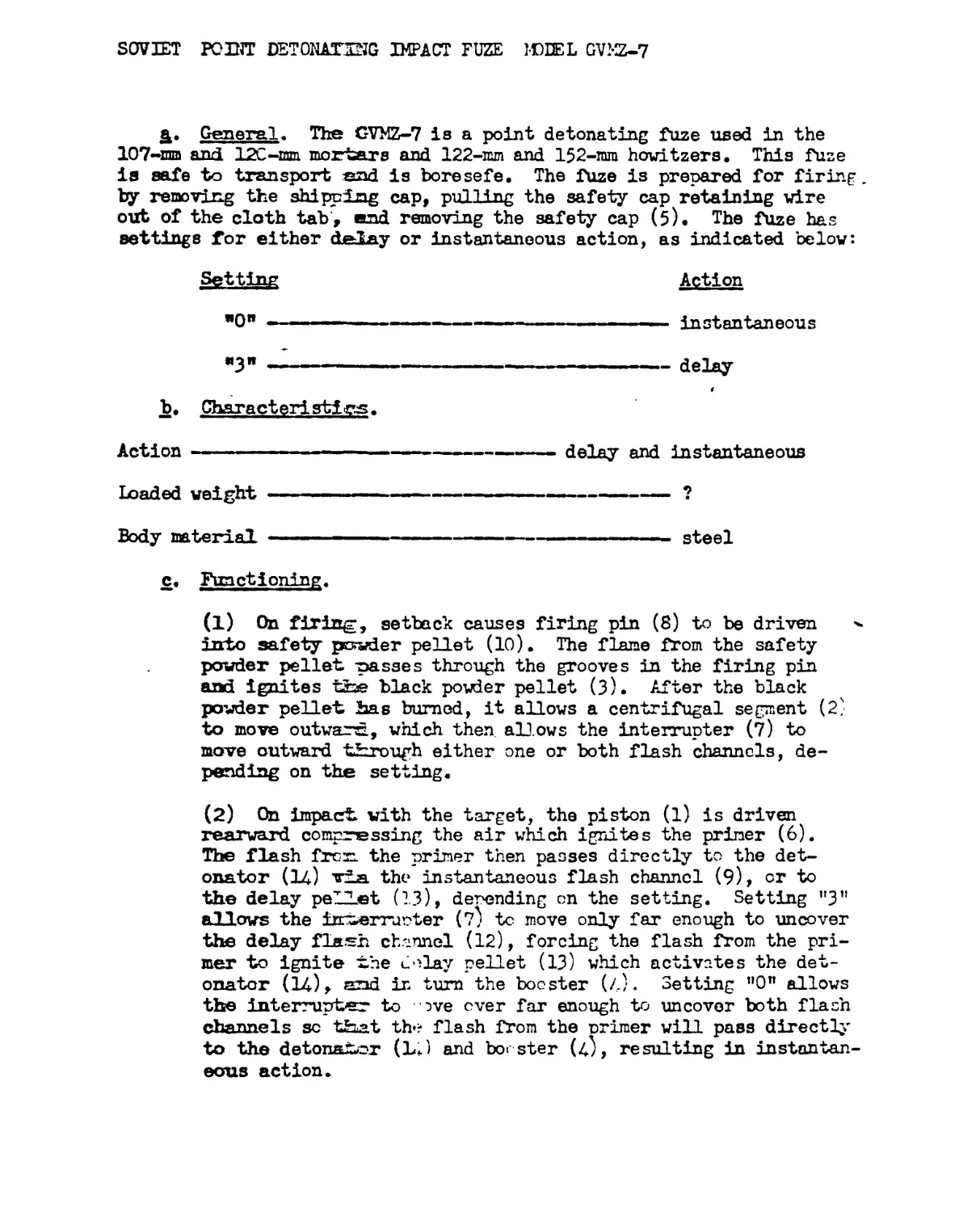
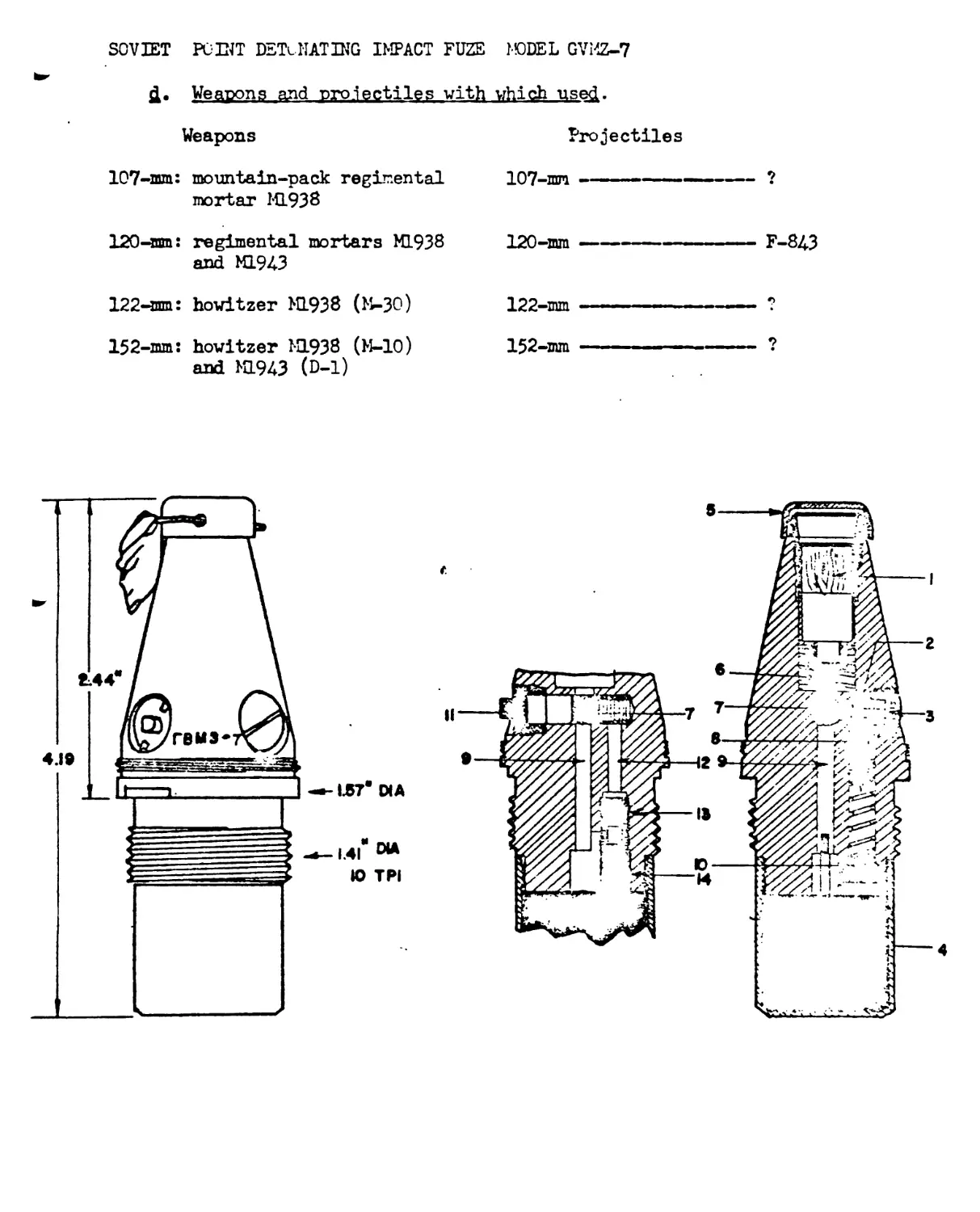
SOVIET POINT DETONATING IMPACT FUZE IDDEL GVMZ-7
General. The CVMZ-7 is a point detonating fuze used in the
107-xnm and 12C-mm mortars and 122-mm and 152-mm howitzers. This fuse
is safe to transport end is boresefe. The fuze is prepared for firing
by removing the shipping cap, pull ing the safety cap retaining wire
out of the cloth tab', end removing the safety cap (5). The fuze has
settings for either delay or instantaneous action, as indicated below:
Setting
Action
"0”
instantaneous
"3" .	. —	.............-——---------delay
t
b.	Character! sties.
Action	- - .-----------------delay and instantaneous
Loaded weight ------——-------------------------------?
Body material -  —..............................    steel
c.	Functioning.
(1)	On firing, setback causes firing pin (8) to be driven *
into safety powder pellet (10). The flame from the safety
powder pellet passes through the grooves in the firing pin
and ignites t£ae black powder pellet (3). After the black
powder pellet has burned, it allows a centrifugal segment (2)
to move outward., which then allows the interrupter (7) to
move outward through either one or both flash channels, de-
pending on the setting.
(2)	On impact with the target, the piston (1) is driven
rearward compressing the air which ignites the primer (6).
The flash frer. the primer then passes directly to the det-
onator (14) via. the instantaneous flash channel (9), or to
the delay pellet (13), depending on the setting. Setting "3"
allows the irrterructer (7) to move only far enough to uncover
the delay flash channel (12), forcing the flash from the pri-
mer to ignite the dolay pellet (13) which activates the det-
onator (14), arid in turn the booster (/,). Setting ’'0n allows
the interrupter to ^ve over far enough to uncover both flash
channels sc that the flash from the nriraer will pass directly
to the detonator (14) and bolster (4), resulting in instantan-
eous action.
SOVIET POINT DETONATING IMPACT FUZE MODEL GVMZ-7
d.	Weapons and projectiles with which used.
Weapons	Projectiles
107-mm: mountain-pack regimental 107-mm  --------------——----- ?
mortar M193S
120-nm: regimental mortars M1938	120-mm —-------------— F-843
and M1943
122-mm: howitzer N1938 (M-30)	122-mm — -------------—- ?
152-mm: howitzer 1-1938 (M-10)	152-mm------------------?
and M943 (D-l)
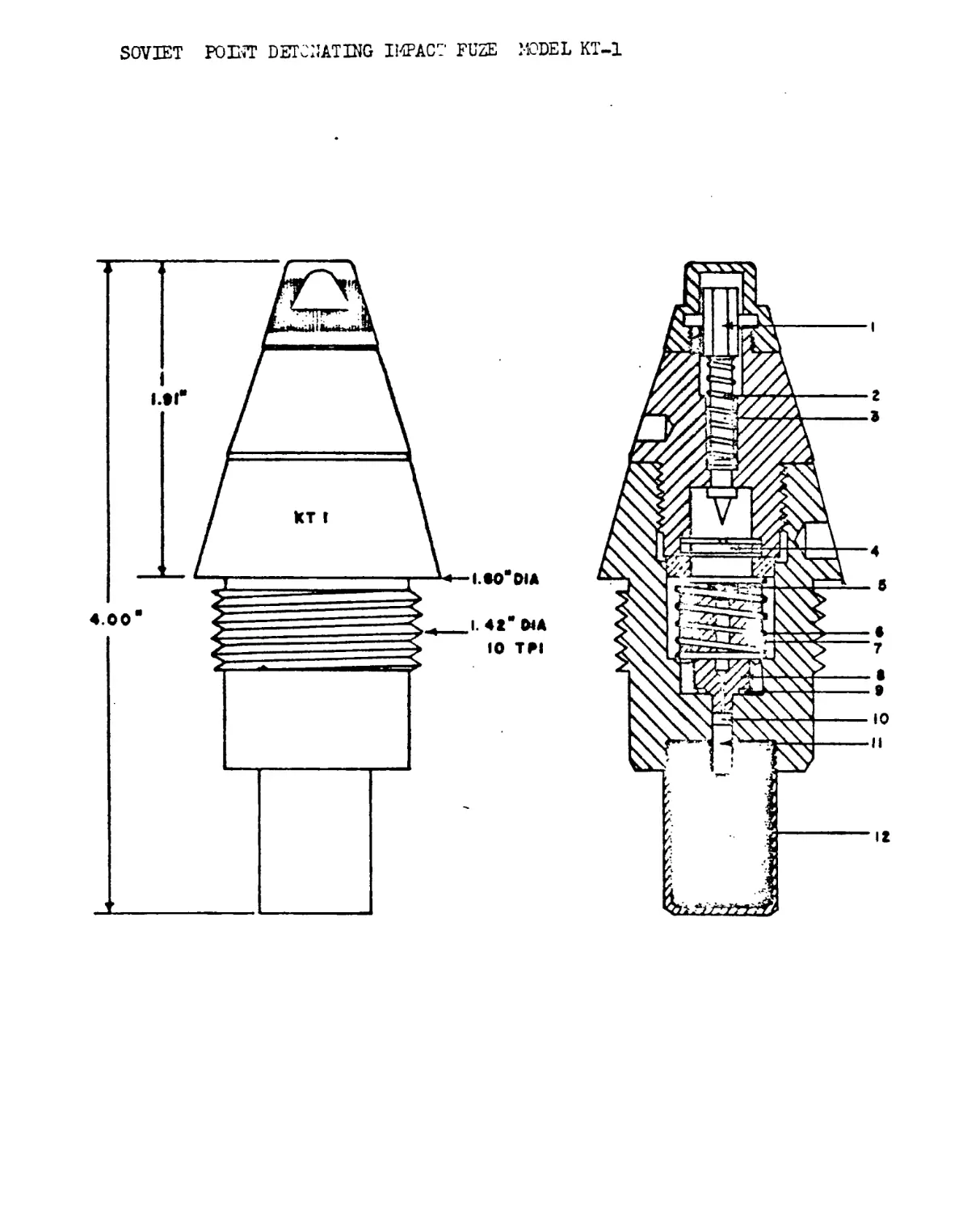
SOVIET POINT DETONATING IMPACT FUZE MODEL KT-1
&• General. The KT-1 is a point detonating, setback-armed fuze
used with Frag and Frag-HE projectiles of 45-mm, 57-ram, and 76-mm caliber
sizes. The Soviets refer to this fuze as !,semisecure" and boresafe.
The fuze is capable of nondelay and delay action depending on the use
of the fuze pap and the compressed black powder delay pellet (10) which
is sometimes inserted in this fuze for special demolition purposes.
Fuzes containing the delay pellet are painted black; models without the
delay pellet are painted light gray. The fuze action is regulated as
indicated below:
Fuze color
Black, w/delay element and cap
w/delay element, w/o cap
w/o delay element and cap
w/o delay element, w/cap
Light gray, w/o delay element and cap
w/o delay element, w/cap
Black nose only, w/delay element and cap
w/delay element, w/o cap
Action
Long delay
Short delay
Instantaneous
Short delay
Instantaneous
Short delay
Long delay
Short delay
b. Chara cteri sties.
Action -------------------------------------------- delay and nondelay
Loaded weight--------------------------------------370 gm. (.814 lb.)
Body material--------------------------------------------------- steel
Functioning, ’/hen the I7F-1 fuze is set for instantaneous action
(nose cap removed), the fuze functions as follows: Setback causes the
stirrup (7) to cempress the spring (6), override, and lock itself to th°
primer carrier (8) . The pri.-.ег carrier is also setback and empresses
sealing washer (9) over the vent in the body, shielding tne detonator
(11) from the primer (5) should premature ignition oc<-ur. The striker
(1) and firing pin (3) are also set back, but the firing pin does not
reach the primer. Afier the projectile leaves the bore, the spring (6)
raises the primer carrier (8) and stirrup (7) to a position directly
SOVIET POINT DETONATING IMPACT FUZE MODEL KT-1
under the firing pin (3). At the same time, the spring (2) returns the
firing pin (3) and the striker (1) to their ordinal positions, '-n
impact, the striker (1) is driven rearward, forcing the firing pin (3^
into the primer (5) which successively sets off the primer, the detonator
(11), the booster (12). When the fuze is set for delayed action (nose
cap in place), the action is identical tc that of instantaneous action
except that on impact the cap prevents the striker (1) and the firing
pin (3) from being driven rearward. At the same time, inertia drives
the primer carrier (8) forward, forcing open the segmented safety shutter
(4) and driving the primer (5) against the firing pin to activate the
explosive train.
d.	Weapons and projectiles with which used. Weapons	Projectiles
45-mm: 45-ил:	antitank guns 12.932, M1937, and	45-mm Frag			0-240 KL942; tank guns 11932 and M934
57-mm:	antitank guns 11941 and 12.943	57-n.m Frag		 0-270; 0-271
76-mm:	tank guns 12.927/32, 12938/39	76-mm Frag-HE — OF-343 CF-350; (Ь-11), 12.939 (F-32), 12.940	CF-35OA (F-34), and 12.941 (ZIS-5;; divi- sional guns 12.902/3-', ’2.933, 12.936 (F-22;. 12.939 (USV), and 12.942 (ZIS-3;; regimental guns (howitzers) 12927 and M943; mountain guns (howitzers; 12.909 and 12.938
SOVIET POINT DETONATING IMPACT FUZE MODEL KT-1
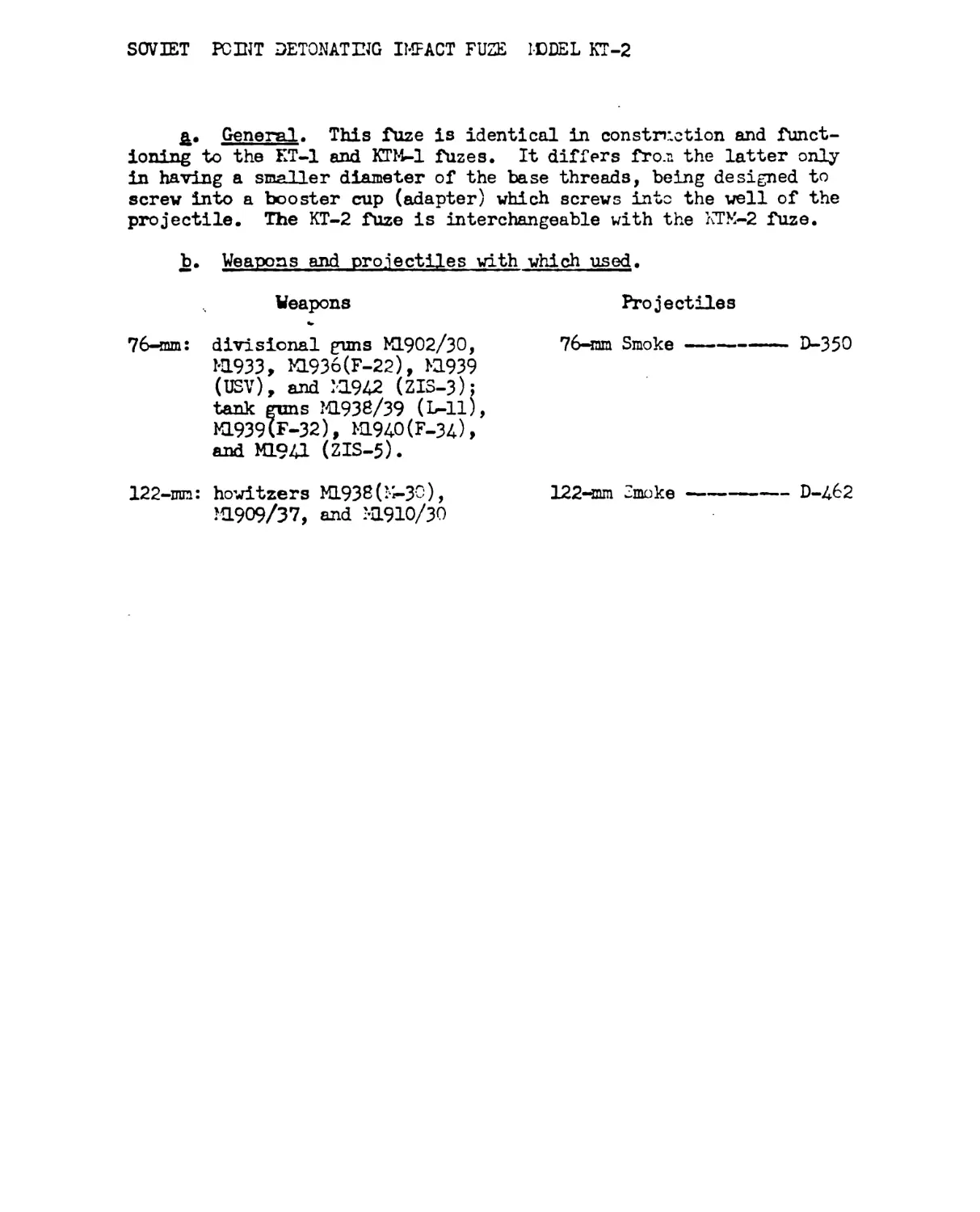
SOVIET POINT DETONATING IMPACT FUZE 1DDEL KT-2
General. This fuze is identical in construction and funct-
ioning to the KT-1 and КГМ-1 fuzes. It differs from the latter only
in having a smaller diameter of the base threads, being designed to
screw into a booster cup (adapter) which screws into the well of the
projectile. The KT-2 fuze is interchangeable with the KTM-2 fuze.
b. Weapons and projectiles with which used.
Weapons
Projectiles
76-mm: divisional guns Ю.902/30,
>3.933, M1936(F-22), >3.939
(USV), and >3.942 (ZIS-3);
tank guns >3.938/39 (b-ll)
K1939(F-32), M940(F-34),
and KL941 (ZIS-5).
76-mm Smoke —-----—„ D-350
122-mm: howitzers ML938(M-30),
>3.909/37, and >3.910/30
122-mm Zmoke
- D-462
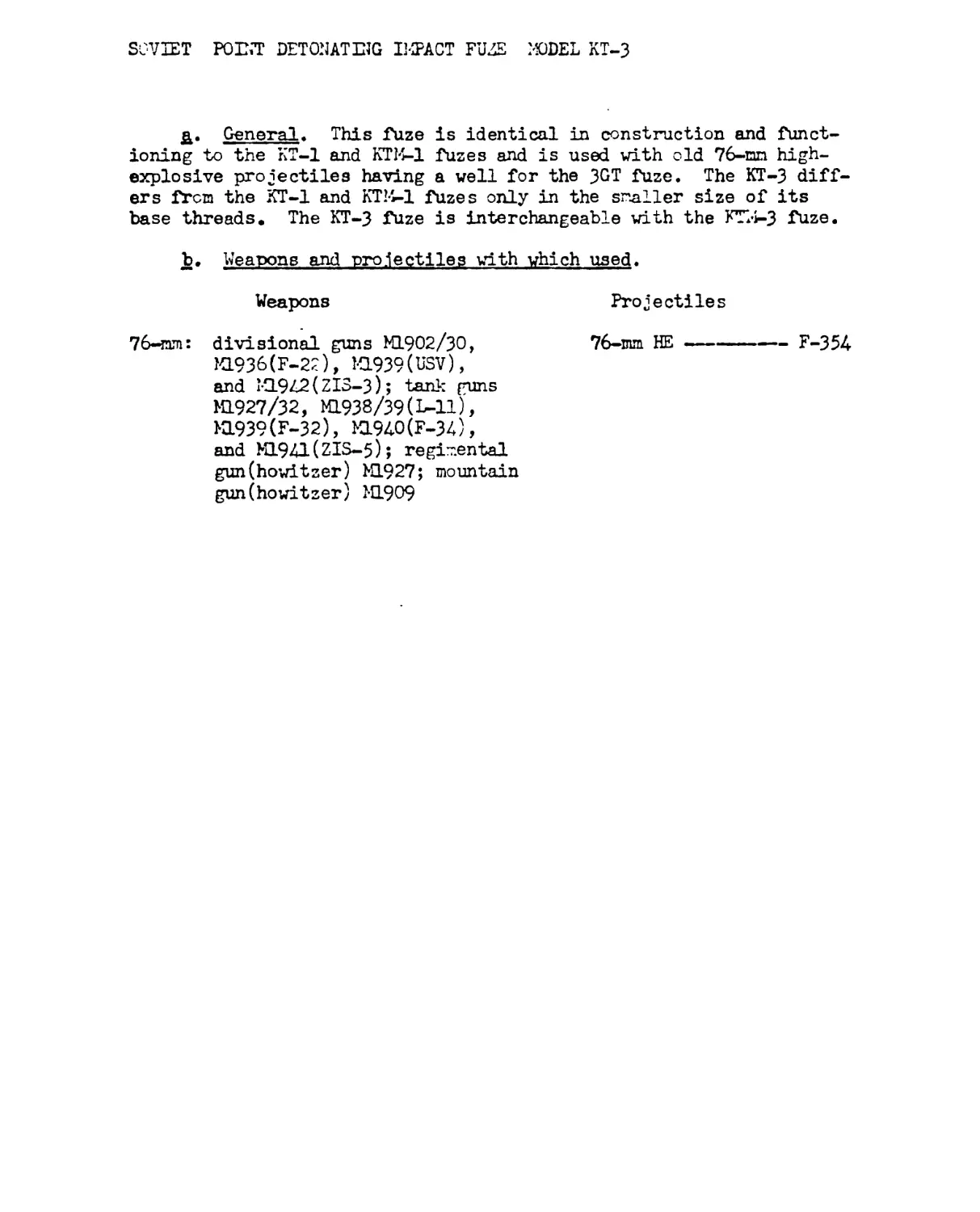
SOVIET POINT DETONATING IMPACT FUZE MODEL KT-3
&. General. This fuze is identical in construction and funct-
ioning to the KT-1 and KTM-1 fuzes and is used with old 76-mn high-
explosive projectiles having a well for the 3GT fuze. The KT-3 diff-
ers from the KT-1 and KTM-1 fuzes only in the smaller size of its
base threads. The KT-3 fuze is interchangeable with the KT>i-3 fuze.
b. Weapons and projectiles with which used.
Weapons
Projectiles
76-mm: divisional guns M1902/30,	76-mm HE -——— F-354
M93&(F-2<), 11939 (USV),
and >1942(ZIS-3); tank guns
>1927/32, ML938/39(L-H),
>1939 (F-32), >1940(F-34),
and >1941(ZIS-5); regimental
gun(howitzer) >1927; mountain
gun(howitzer) >1909
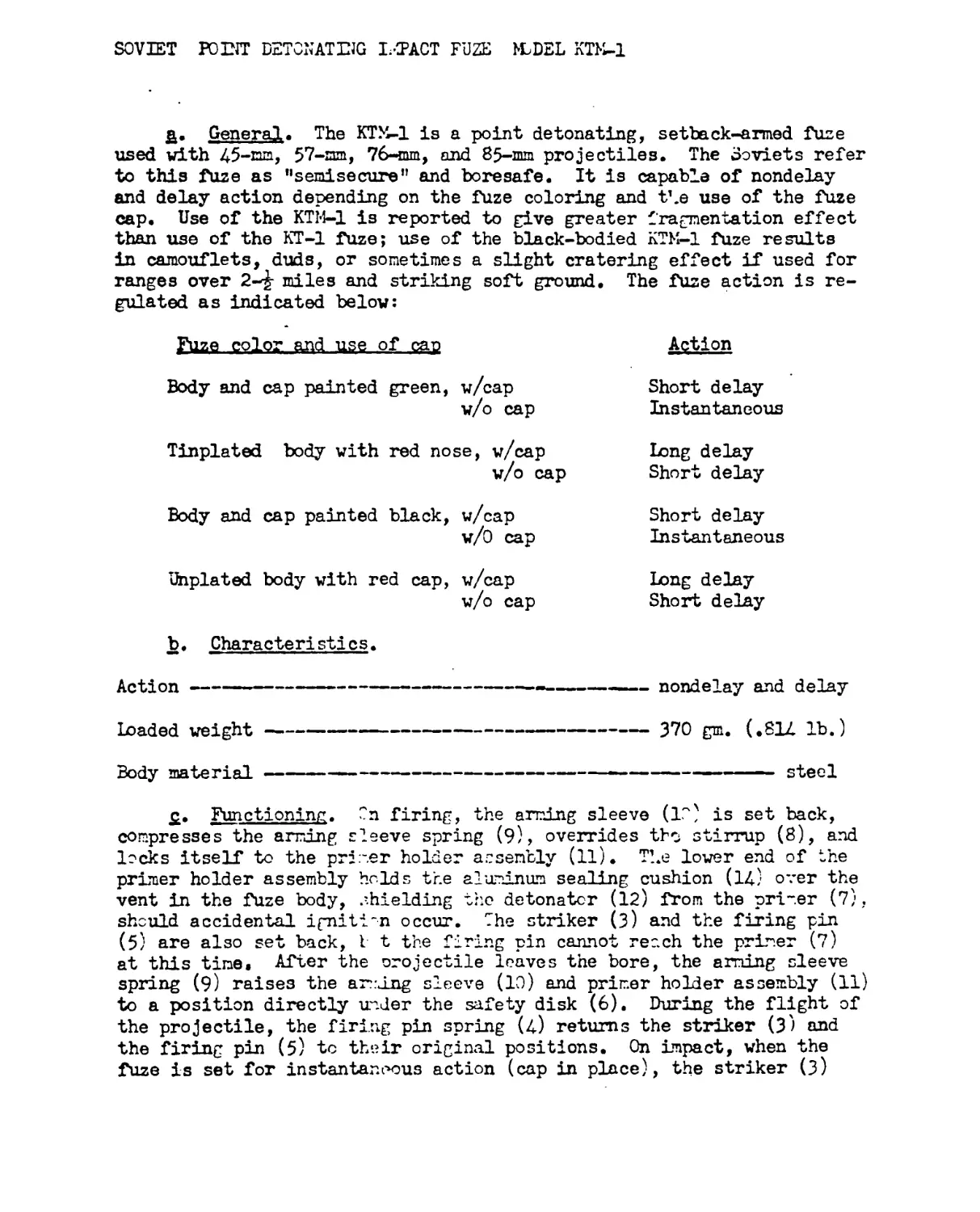
SOVIET POINT DETONATING L<PACT FUZE MJDEL KTM-1
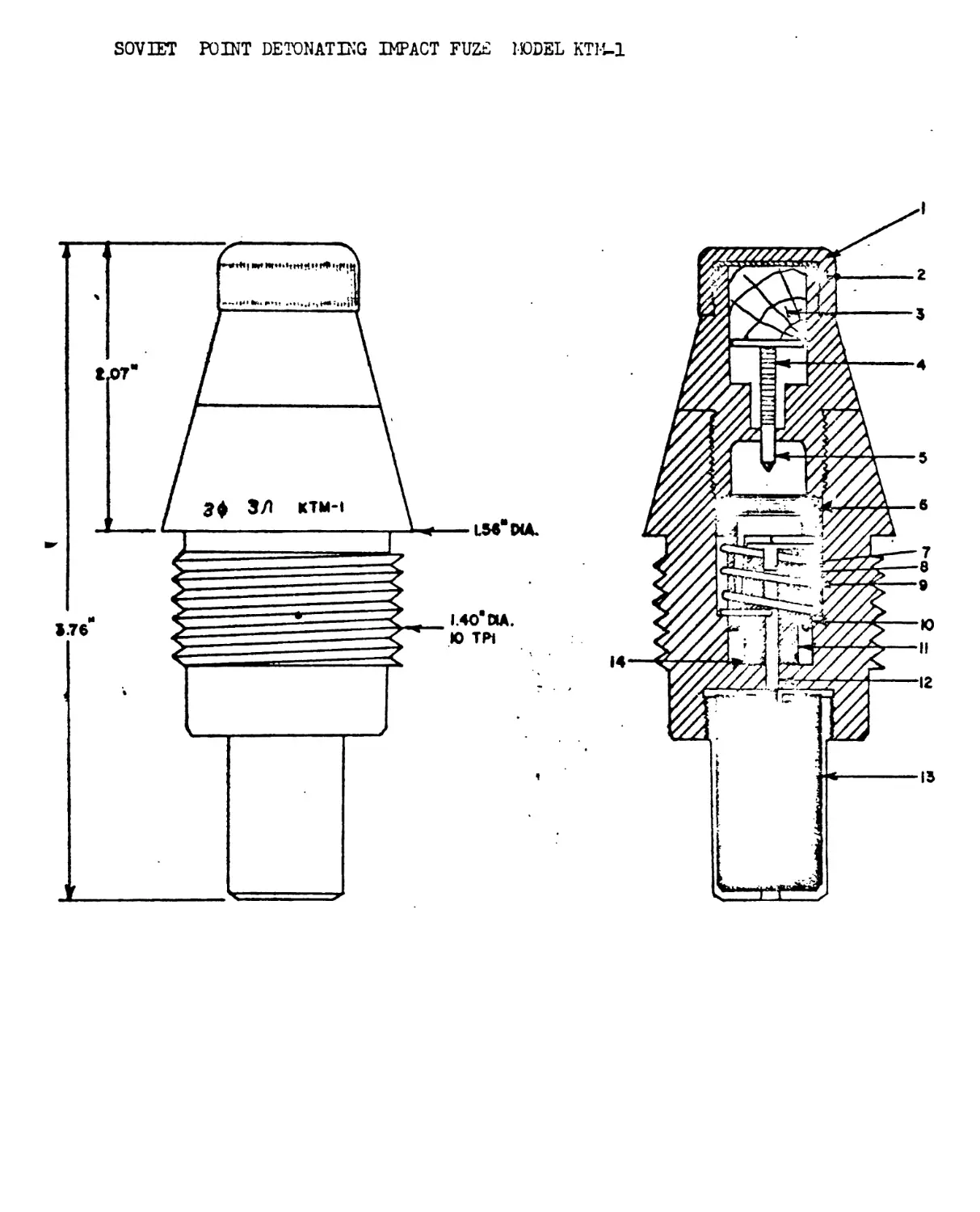
£. General• The KTM-1 is a point detonating, setback-armed fuze
used with 45-ии, 57-ии, 76-mm, and 85-mm projectiles. The Soviets refer
to this fuze as "semisecure” and boresafe. It is capable of nondelay
and delay action depending on the fuze coloring and t’.e use of the fuze
cap. Use of the KTM-1 is reported to give greater fragmentation effect
than use of the KT-1 fuze; use of the black-bodied KTM-1 fuze results
in camouflets, duds, or sometimes a slight cratering effect if used for
ranges over 2~£ miles and striking soft ground. The fuze action is re-
gulated as indicated below:
Fuze color and use of can	Action
Body and cap painted green, w/cap w/o cap	Short delay Instantaneous
Tinplated body with red nose, w/cap w/o cap	Long delay Short delay
Body and cap painted black, w/cap w/0 cap	Short delay Instantaneous
Unplated body with red cap, w/cap w/o cap	Long delay Short delay
b. Character!sti cs.
Action ——— ---------------------------•—— ——— nondelay and delay
loaded weight-------------------------------------- 370 gm. (.814 lb.)
Body material--------------------------------------------------steel
£. Functioning, On firing, the arming sleeve (1?) is set back,
compresses the arming sleeve spring (9), overrides tbo stirrup (8), and
locks itself to the pri:-.er holder assembly (11). The lower end of the
primer holder assembly holds the aluminum sealing cushion (14) over the
vent in the fuze body, .-.hielding the detonator (12) from the primer (7),
should accidental igniti-n occur. The striker (3) and the firing pin
(5) are also set back, I t the firing pin cannot reach the primer (7)
at this tine. After the orojectile leaves the bore, the arming sleeve
spring (9) raises the arming sleeve (10) and primer holder assembly (11)
to a position directly under the safety disk (6). During the flight of
the projectile, the firing pin spring (4) returns the striker (3) and
the firing pin (5) to their original positions. On impact, when the
fuze is set for instantaneous action (cap in place), the striker (3)
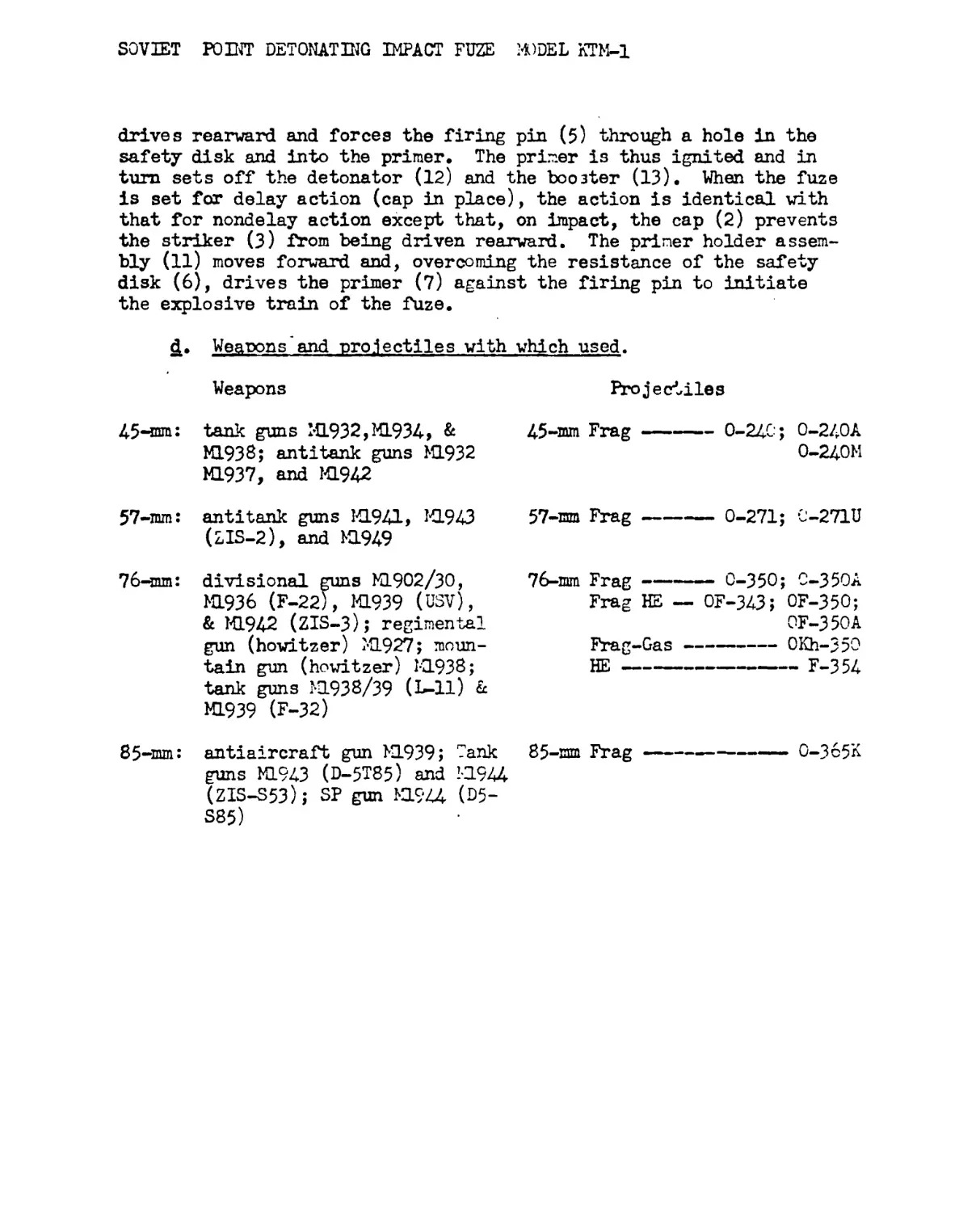
SOVIET POINT DETONATING IMPACT FUZE MODEL KTM-1
drives rearward and forces the firing pin (5) through a hole in the
safety disk and into the primer. The primer is thus ignited and in
turn sets off the detonator (12) and the booster (13). When the fuze
is set for delay action (cap in place), the action is identical with
that for nondelay action except that, on impact, the cap (2) prevents
the striker (3) from being driven rearward. The primer holder assem-
bly (11) moves forward and, overcoming the resistance of the safety
disk (6), drives the primer (7) against the firing pin to initiate
the explosive train of the fuze.
Weapons and projectiles with which used.
Weapons
Projectiles
45-nrn: tank guns >H932,ML934, &
M1938; antitank guns M1932
M1937, and М19Д2
45-mm Frag ------- 0-240; 0-240A
0-240M
57-mm: antitank guns M1941, >3.943
(LIS-2), and M1949
57-mm Frag
0-271; C-271U
76-mm:
divisional guns Ml902/30,
>0.936 (F-22), ML939 (USV),
& M1942 (ZIS-3); regimental
gun (howitzer) >0.927; moun-
tain gun (howitzer) >0938;
tank guns >0938/39 (L-ll) &
M1939 (F-32)
76-mm Frag -——- 0-350; 0-350A
Frag HE — OF-343; OF-35O;
OF-35OA
Frag-Gas----------OKh-35O
HE------------------F-354
85-mm: antiaircraft gun >0939; Tank
guns M1943 (D-5T85) and 10944
(ZIS-S53); SP gun >0944 (05-
S85)
85-mm Frag
O-365K
SOVIET POINT DETONATING IMPACT FUZE
MODEL KTM-1
SOVIET POINT DETONATING IMPACT FUZE KTM-l-U
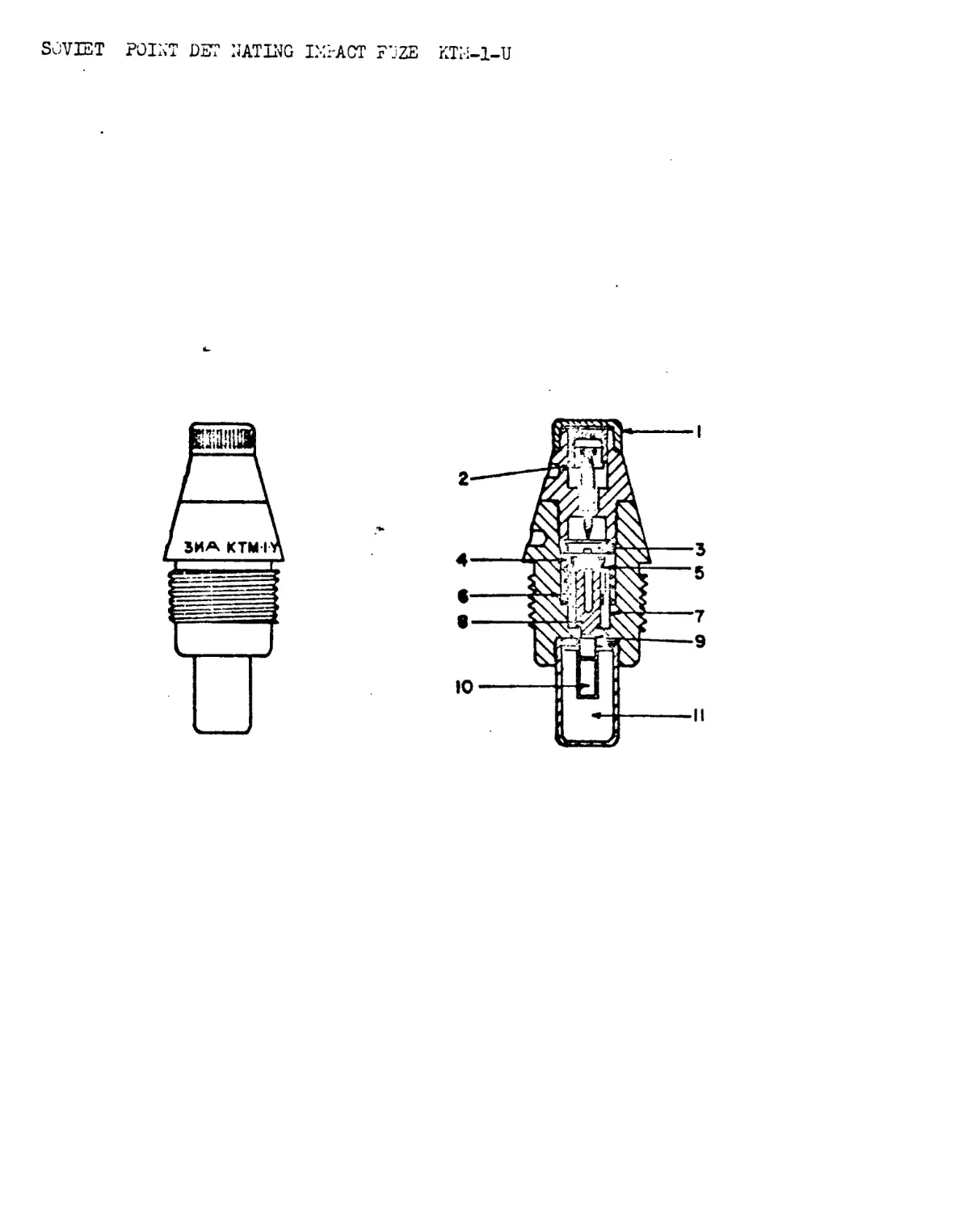
a.	General. The Soviet KTM-l-U point detonating fuze is an im-
proved, modified version of the earlier KTM-1 and is employed in t’..e same
applications. Like the KTM-1, the KTM-l-U is not detonator safe, but is
bore safe. Arming is entirely by setback. The KTM-l-U displays a slight
modification in the wooden firing pin plunger assembly and in the position
and configuration of the detonator (10). Dimensions and configuration of
KTM-l-U remain the same as the KTM-1.
b.	Characteristics.
Action ------------------—----------— —	  Instantaneous and non-delay
Loaded weight-------------------------------------- 370 grams (0.81 lbs.)
Body material ----------------------------------------------------- Steel
£• Functioning. Upon firing, setback causes the arming sleeve (4)
to move rearward compressing the arming spring (6), permitting the stirrup
prongs (7) to lock into the groove cut into the sleeve (4). This locks
the arming sleeve (4) to the primer carrier (8). The fuze is not armed
until this takes place. As acceleration diminishes, the arming spring
(6) moves the married arming sleeve (4) and primer carrier (8) forward
until the nose of the carrier is stopped by the safety ring (3). For
instantaneous action, the nose cap (1) is removed so that upon impact, the
direct acting firing pin (2) is driven into the primer (5). Flame from
the primer passes through the flash hole (9) in the bottom of the fuze b
body and functions the detonator (10) and the booster (11). For non-delay
action the nose cap (1) is left in place. The direct acting firing pin
is not moved upon impact; instead, inertia causes the married arming sleeve
(6) and primer carrier (8) to move forward shearing the four lugs on the
safety ring (3). The primer impales itself on the stationary firing pin
initiating the explosive train functioning. The slight delay produced by
inertia functioning is sufficient to permit projectile penetration before
detonation.
d. Weapons and projectiles with which used.
Weapons	Projectiles
Same as Soviet KTM-1
SOVIET POINT DET DATING IMrACT F jZE КТИ-1-U
SOVIET POINT DETONATING IMPACT FUZE MODEL KTM-2
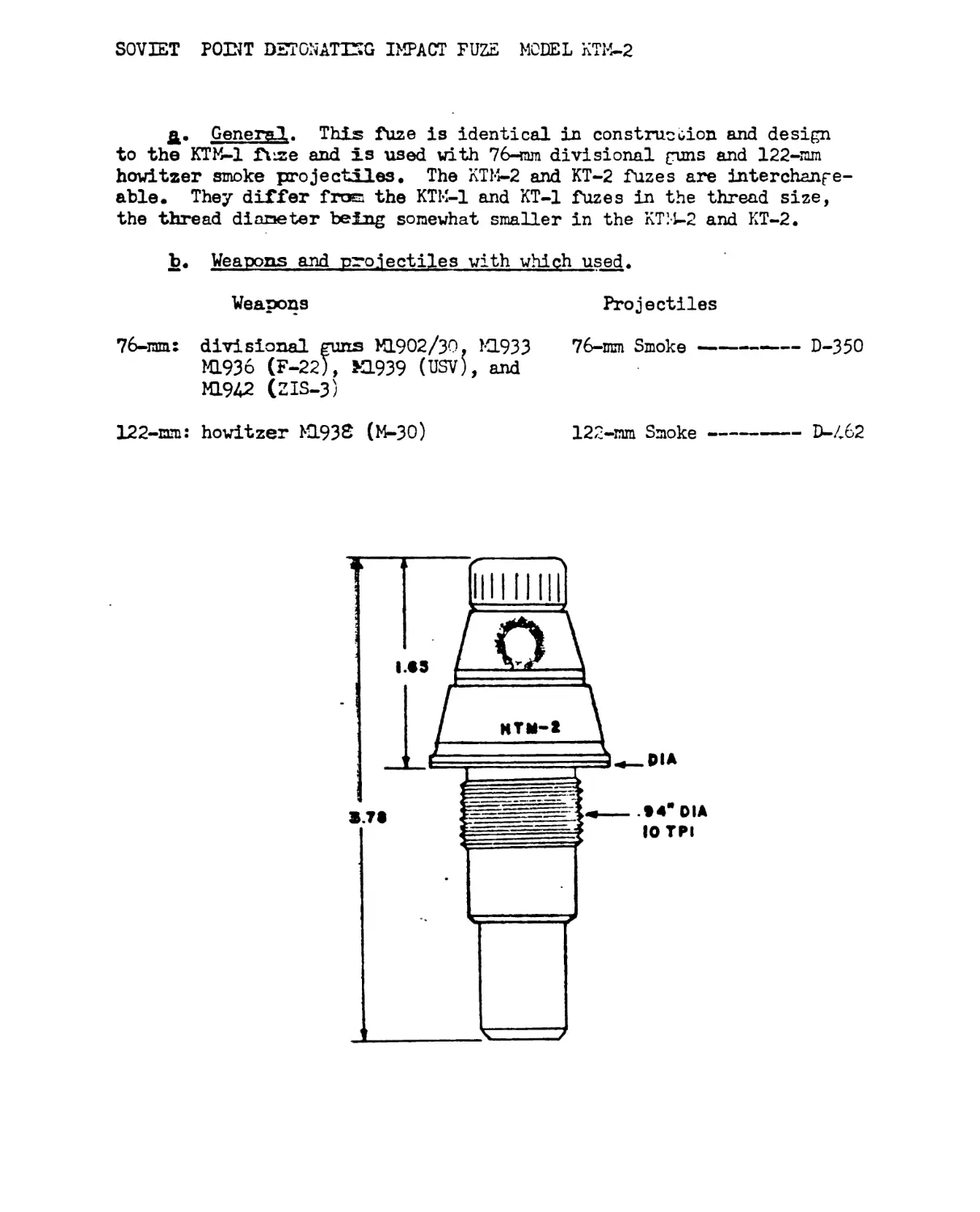
д. General. This fuze is identical in construction and design
to the KTM-1 fitze and is used with 76-mm divisional guns and 122-mm
howitzer smoke projectiles. The KTM-2 and KT-2 fuzes are interchange-
able. They differ froe the KTM-1 and KT-1 fuzes in the thread size,
the thread diameter being somewhat smaller in the KTM-2 and KT-2.
b. Weapons and projectiles with which used.
Weapons
Projectiles
76-mm: divisional guns M1902/30. M1933
М19Э6 (F-22), KL939 (USV), and
M1942 (ZIS-3)
76-mm Smoke —---------D-350
122-mm: howitzer M193S (М-ЗО)
122-mm Smoke --------- D-462
SOVIET PvINT DETONATING IMPACT FUZE MODEL KTM-3
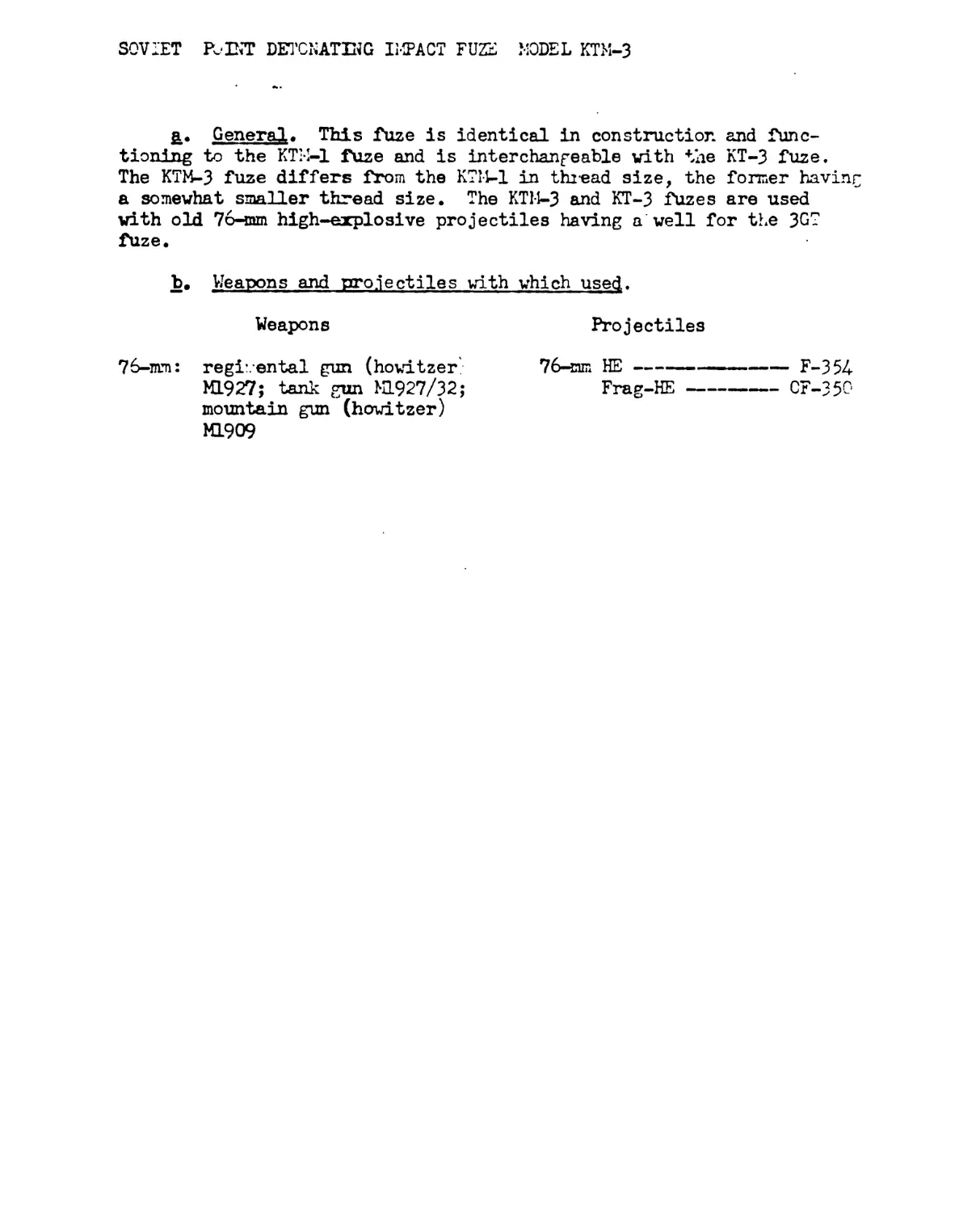
£. General. This fuze is identical in construction and func-
tioning to the KTM-1 fuze and is interchangeable vith the KT-3 fuze.
The KTM-3 fuze differs from the K7M-1 in thiead size, the former having
a somewhat smaller thread size. The KTM-3 and KT-3 fuzes are used
with old 76-влп high-explosive projectiles having a well for the 3G7
fuze.
h. Weapons and projectiles with which used.
Weapons	Projectiles
76-mm: regimental gun (howitzer' 76-mm HE------------- — —....--F-354
M1927; tank gun М927/32;	Frag-HE----------CF-350
mountain gun (howitzer)
M1909
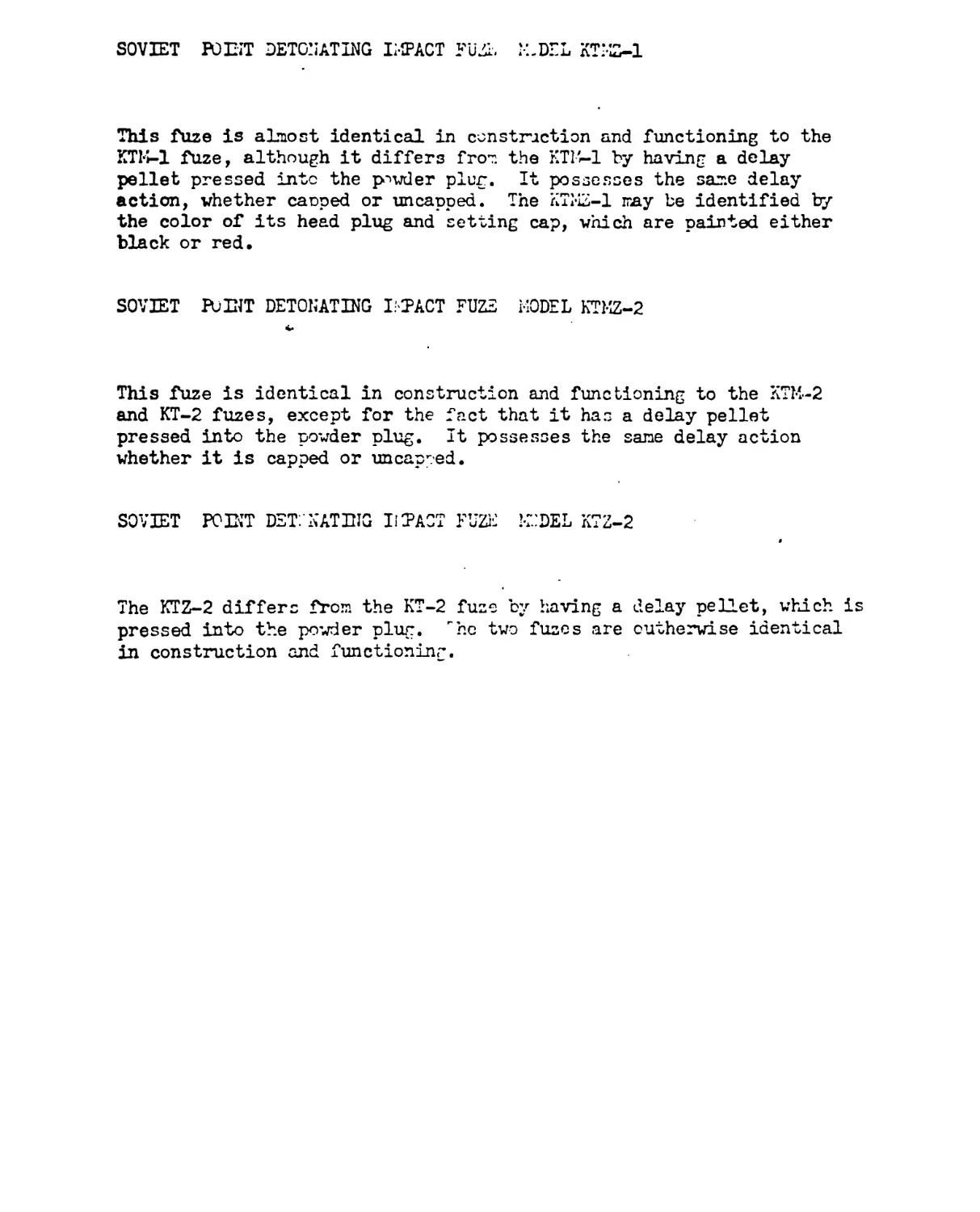
SOVIET POINT DETONATING IMPACT FUEL. M-DEL KTMZ-1
This fuze is almost identical in construction and functioning to the
KTM-1 fuze, although it differs from the KT1'^-1 by having a delay
pellet pressed into the powder plug. It possesses the same delay
action, whether caoped or uncapped. The KTMZ-1 iray be identified by
the color of its head plug and setting cap, which are painted either
black or red.
SOVIET PuINT DETONATING IMPACT FUZE MODEL KTMZ-2
This fuze is identical in construction and functioning to the KTM-2
and KT-2 fuzes, except for the fact that it has a delay pellet
pressed into the powder plug. It possesses the sane delay action
whether it is capped or uncapped.
SOVIET POINT DETONATING I! TACT FUZE MODEL K7Z-2
The KTZ-2 differs from the KT-2 fuze by having a delay pellet, which is
pressed into the powder plug, '’he two fuzes are outherwise identical
in construction and functioninr.
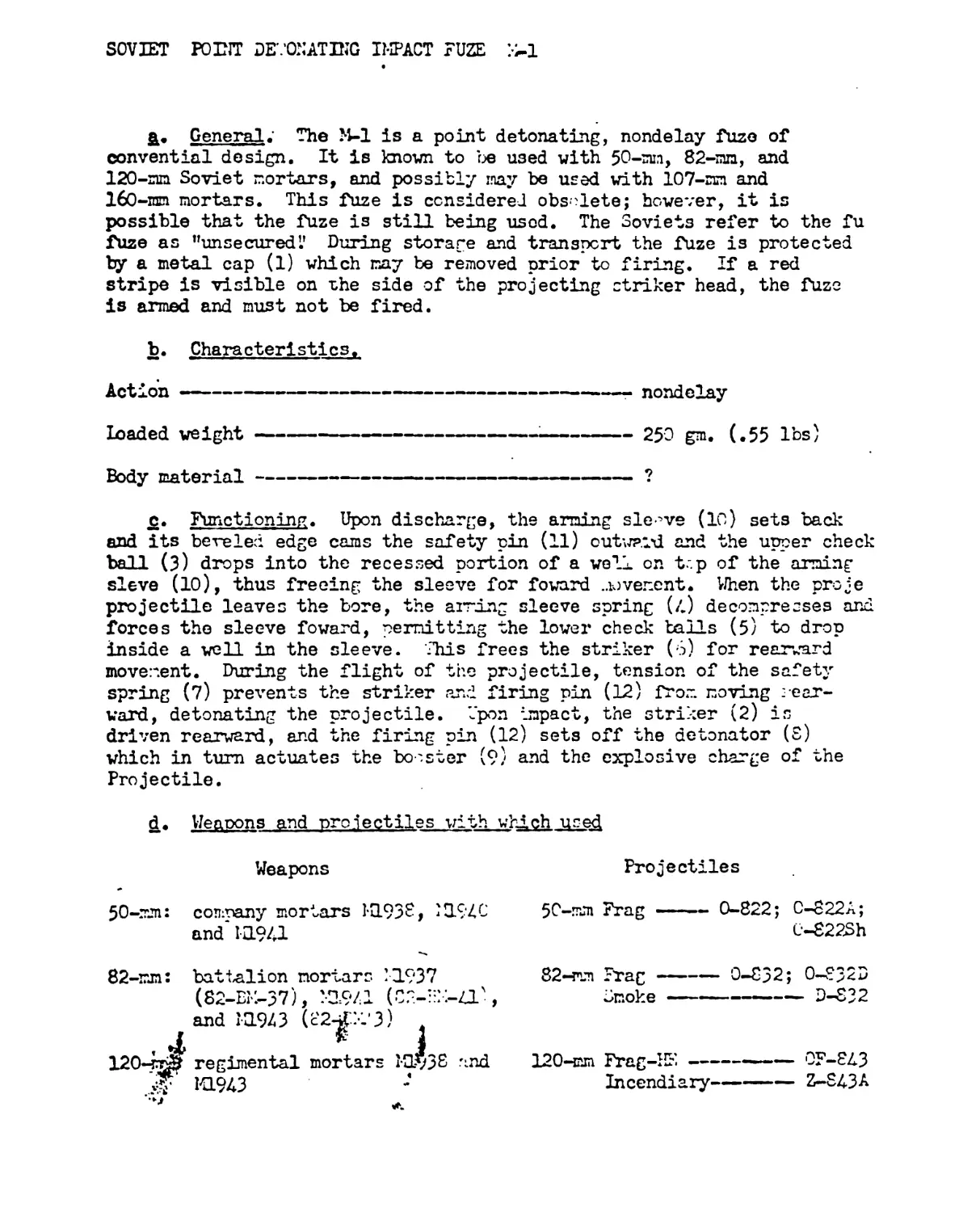
SOVIET POINT DETONATING IMPACT FUZE I-l-l
General; The M-l is a point detonating, nondelay fuze of
convential design. It is known to be used with 50-mm, 82-mn, and
120-nm Soviet mortars, and possibly may be used with 107-пи and
160-inn mortars. This fuze is considered obsolete; however, it is
possible that the fuze is still being used. The Soviets refer to the fu
fuze as "unsecured'.' During storage and transport the fuze is protected
by a metal cap (1) which may be removed prior to firing. If a red
stripe is visible on the side of the projecting striker head, the fuzo
is armed and must not be fired.
b. Chara cteri sti c s.
Action--------------------------------------------- nondelay
Loaded weight----------------------------:-------- 250 gm. (.55 lbs)
Body material ------------------------------------ ?
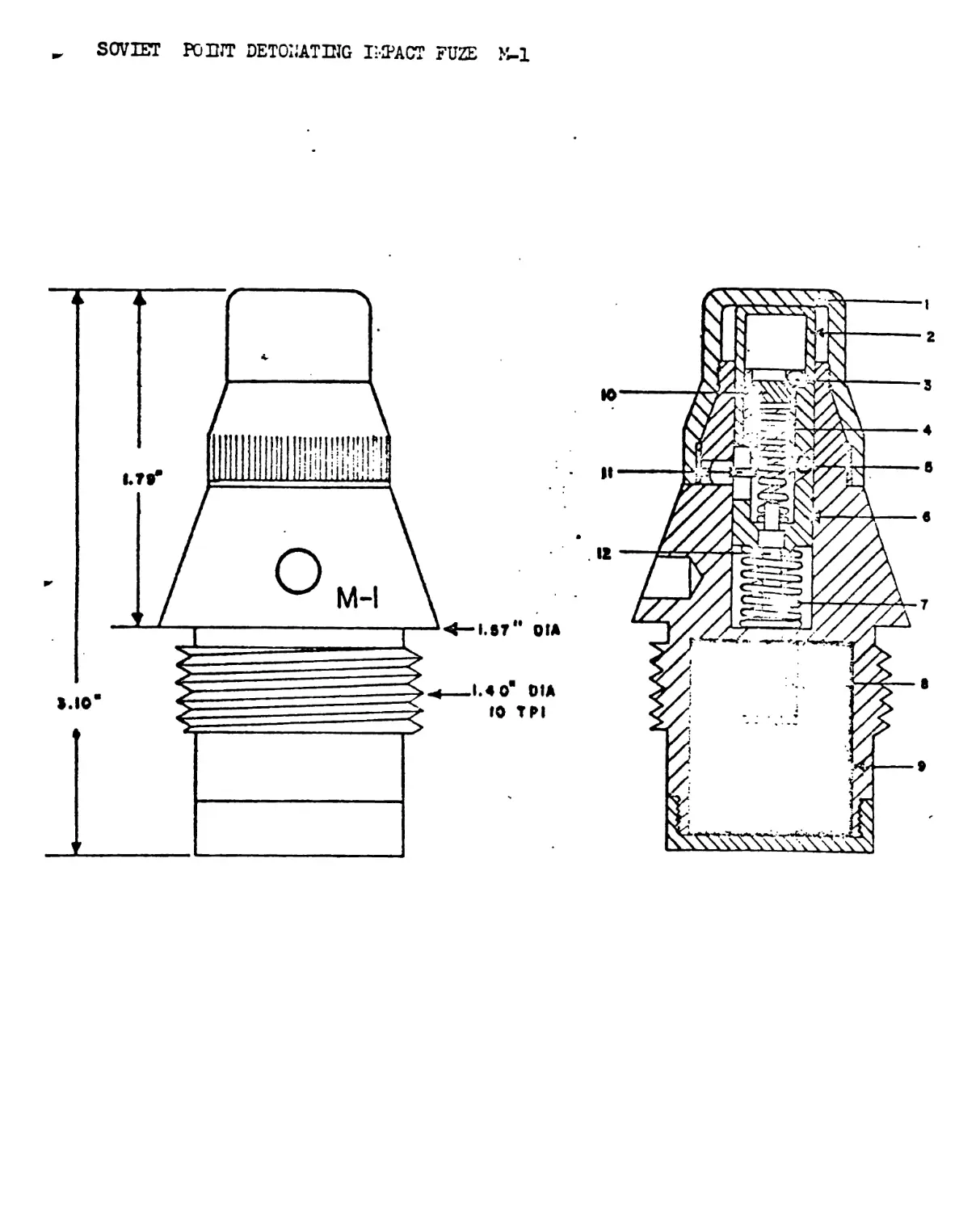
£. Functioninn. Upon discharge, the arming sle-ve (10) sets back
and its beveled edge cams the safety pin (11) outward and the upper check
ball (3) drops into the recessed portion of a well on tsp of the arming
sieve (10), thus freeing the sleeve for foward „wvenent. When the proje
projectile leaves the bore, the arming sleeve spring (Z.) decompresses and
forces the sleeve foward, permitting the lower check balls (5) to drop
inside a well in the sleeve. This frees the striker (6) for rearward
movement. During the flight of the projectile, tension of the safety
spring (7) prevents the striker and firing pin (12) from moving rear-
ward, detonating the projectile. Upon impact, the striker (2) is
driven rearward, and the firing pin (12) sets off the detonator (S)
which in turn actuates the booster (9) and the explosive charge of the
Projectile.
d. Weapons and projectiles with which used
Weapons	Projectiles
50-mm:	company mortars M193S, 1194 C and’ 1-3.941		50-mm Frag 	— 0-822; C-822A; C-822Sh
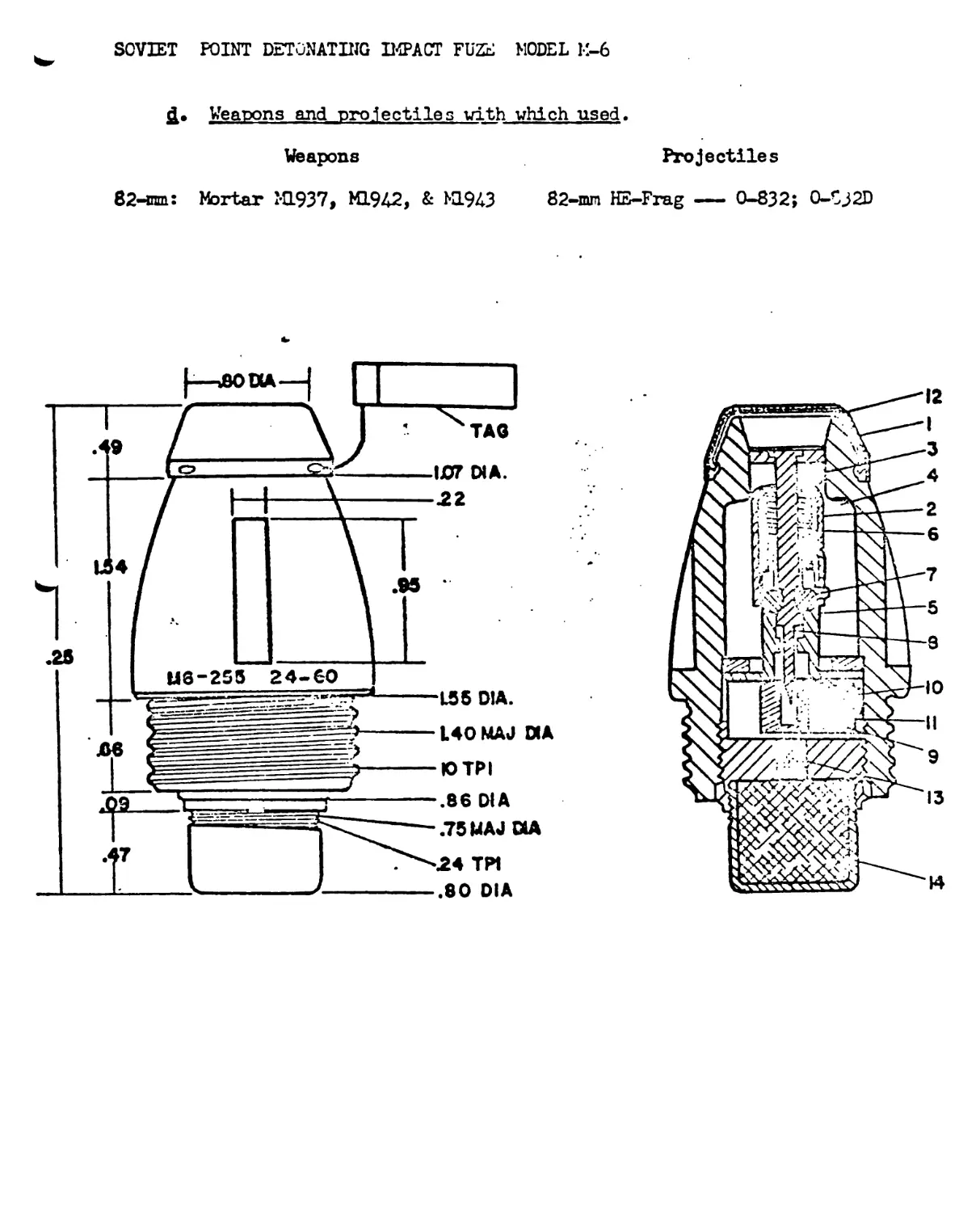
82-mm: , 4	battalion mortars ’3.937 (82-EM-37), >2.941 and 1-3.943 (E2-jp.’3)	-41',	82-фи	Frag	 Smoke —		- 0-832; 0-832D 	 D-S32
120-f^t	regimental mortars 13.943	and	120-min	Frag-IE — Incendiary-		 0F-843 	 Z-S43A
SOVIET К) ЛIT DETOL'ATDIG IMPACT FUZE М-1
SOVIET РОЕГГ DETOIIATEiG IMPACT FUZE MODEL 14-2
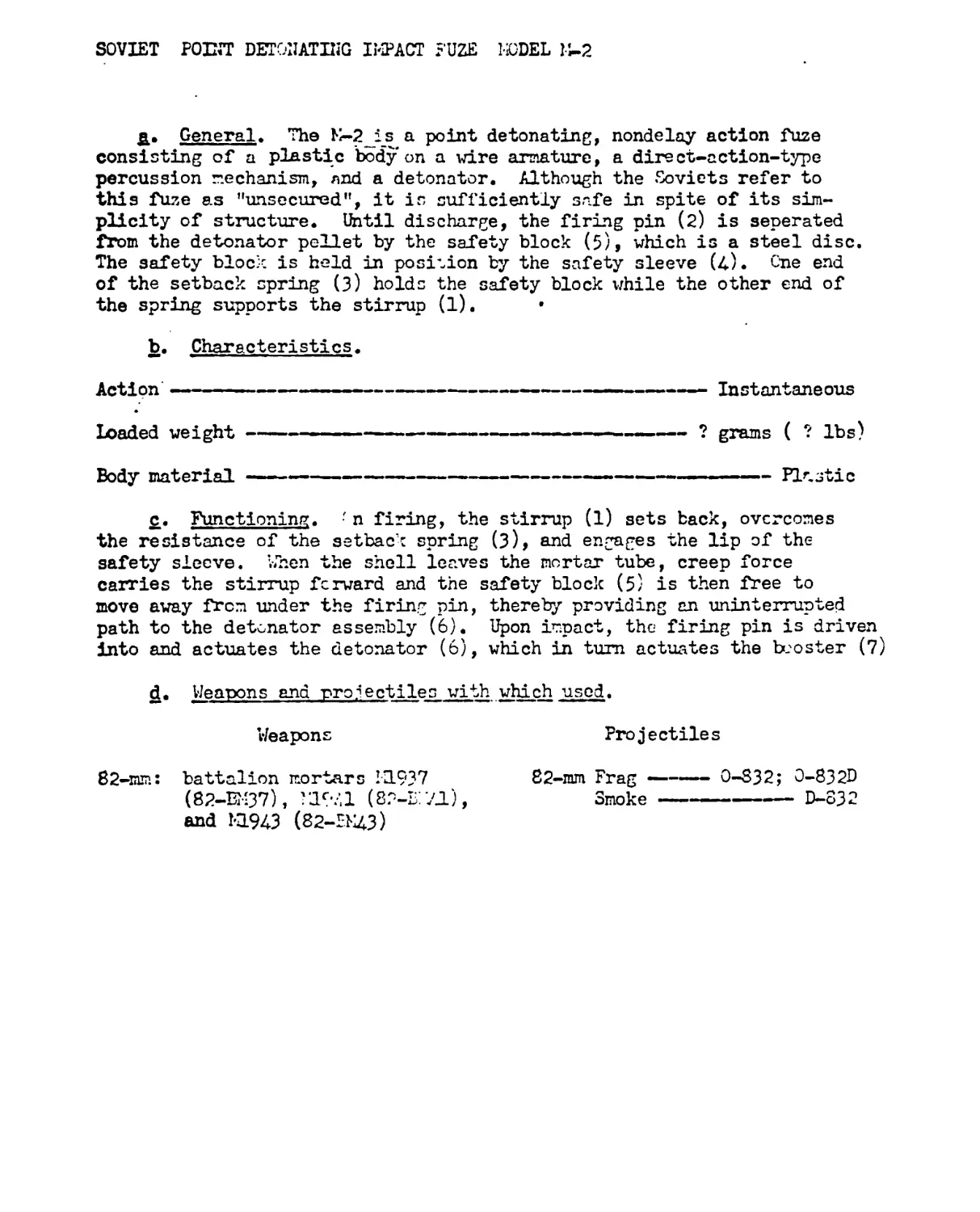
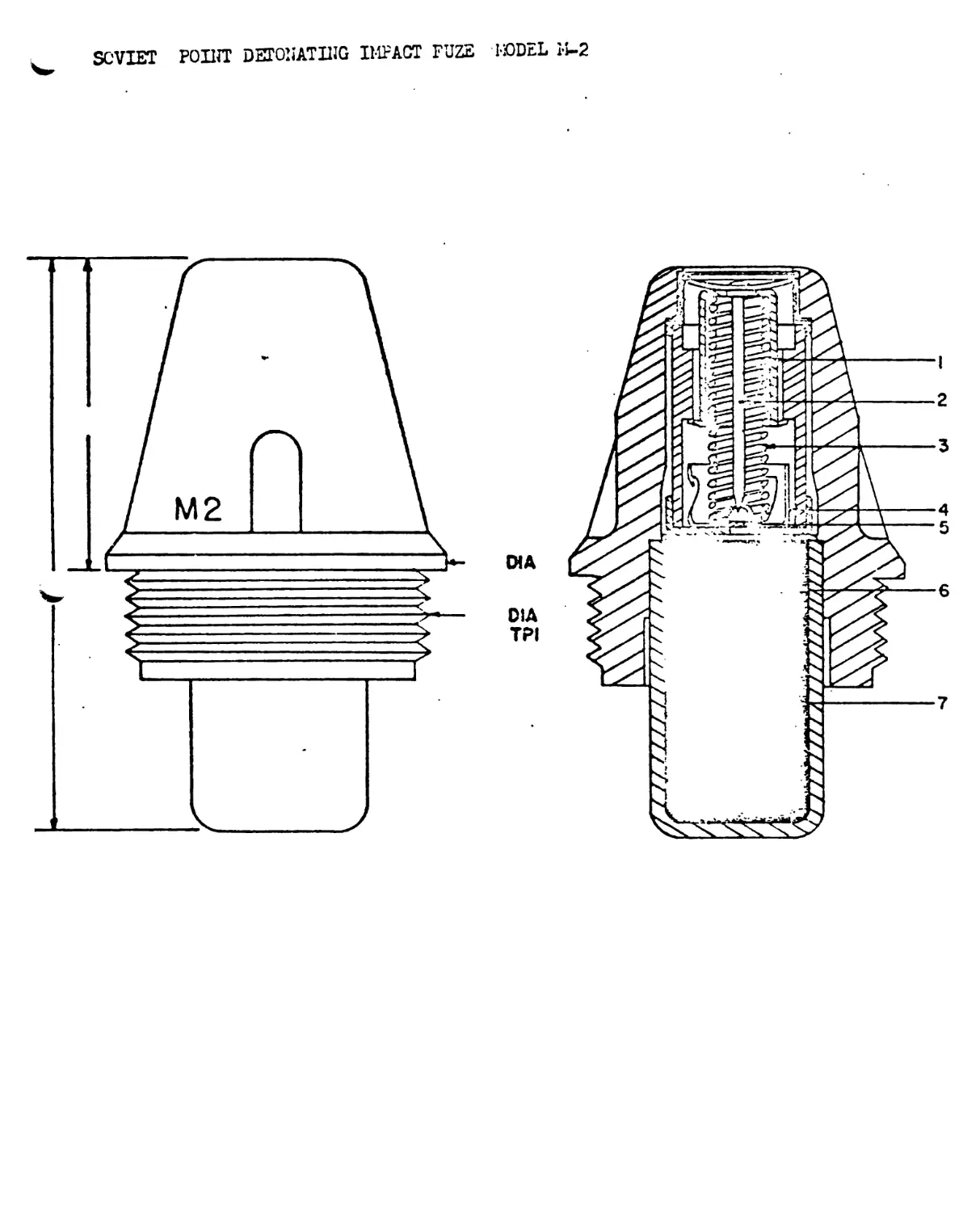
д. General, The ^2 i_s a point detonating, nondelay action fuze
consisting of a plastic body on a wire armature, a direct-action-type
percussion mechanism, and a detonator. Although the Soviets refer to
this fuze as "unsecured", it is sufficiently safe in spite of its sim-
plicity of structure. Until discharge, the firing pin (2) is seperated
from the detonator pellet by the safety block (5), which is a steel disc.
The safety block, is held in position by the safety sleeve (4). One end
of the setback spring (3) holds the safety block while the other end of
the spring supports the stirrup (1).	•
b. Characteristics.
Action  ---------------------------------------------------Instantaneous
Loaded weight-----————-----------------------------------? grams ( ? lbs)
Body material----------------------------------------------------Plastic
£. Functioning. ' n firing, the stirrup (1) sets back, overcomes
the resistance of the setback spring (3), and engages the lip of the
safety sleeve. When the shell leaves the mortar tube, creep force
carries the stirrup forward and the safety block (5) is then free to
move away from under the firing pin, thereby providing an uninterrupted
path to the detonator assembly (6). Upon impact, the firing pin is driven
into and actuates the detonator (6), which in turn actuates the b.'oster (7)
d. Weapons and •projectiles with which used.
Weapon:
Projectiles
82-mm: battalion mortars Il 937
(82-EM37), ri^l (8?-E:Zl),
and KL943 (82-EM43)
82-mm Frag
Smoke
0-832; 0-8320
------- D-832
SOVIET POINT DETONATING IMPACT FUZE MODEL M-2
SOVIET РОЛГГ DETONATING IMPACT FUZE MODEL- M-3
The M-3 is a point detonating, nondelay fuze vrliich is similar in design
and functioning to the 14-2 fuze, and is used with the same projectiles
as the 14-2 fuze. The body of the ’*-3 fuze is constructed of steel,
rather than the plastic material used in the -4-2; in all other respects
the two models appear to be identical.
SOVIET РОЛИ DETONATING IMPACT FUZE MODEL М-Д
a,	General. The M-4 la the fourth model of the ”M" series of Soviet
mortar fuzes. It is usually used for explosive mortar shells, but can
be used with smoke and incendiary shells. It is known to be used with
82mm Mortars and can be used with 107mm and 120mm Mortars. Thre is no
visible means to determine whether the fuze is armed or unarmed.
b.	Characteristics
Action----------------------------------— nondelay
Loaded weight------———-----------------—- 300gm. (.66 lb.)
Body material--------------—-------—------- steel or plastic
c.	Functioning. On firing, the stirrup (4) seta back, forces its
flanged lover end down into the hollowed-out safety block retainer (9),
and compresses the spring (3). This action retains the safety block (5)
between the firing pin (8) and the detonator (6) until the projectile
has left the mortar tube. After the projectile has left the tube, the
spring (3) decompresses and forces the stirrup (4) upward. During this
upward movement of the stirrup, its flanged lower end carries the safety
block retainer (9) with it. As the safety block retainer moves upward,
the cammed surface on its outer circumference engages a vertical tongue,
extending upward from the safety block (5) and cams the block outward,
away from its position over the detonator (6), thus allowing the firing
pin (8) free access to the detonator. On impact, the foil membrane (1)
is ruptured and the firing pin is driven rearward, forcing its pointed
lower end into the detonator, successively actuating the detonator and •
the booster (7) which, in turn, detonate the shell.
£. Weapons and projectiles with which used.
Weapons
82mm: battalion mortars M937
ML941 etc
Projectiles
82mm Frag ----------- 6-832; 0-S32D
Smoke-----------—---—— D-832
120mm Frag-Iffi------OF-843; 0F843A
Incendiary ---------------Z-843A
Smoke------------------—-D-843A
SOVIET POINT DETONATING IMPACT FUZE MODEL М-Д
SOVIET POINT DETONATING IMPACT FUZE M-5
General. The M-5 is a point detonating, setback-armed,
nondelay action fuze. It is used in projectiles fired from 82-mm
mortars. The fuze is considered boresafe; however, the Soviets
refer to it as "unsecured". The M-5 fuze functions nearly the
same as the 14-2 and M-3 fuzes and is considered almost identical
to the M-4 in construction, and functioning.
J>. Characteristics.
Action — —----------------———nondelay
loaded weight--------------------------77.11 gm. (.17 lb)
Body material ———----------------------plastic
c. Functioning. The firing pin (5) is seperated from the detonator
assembly (7) by a small safety disk (9). This disk is held in place by
a saftey cup (6). The safety spring (4) holds the cup and disk in place.
Whan the mortar is fired, setback causes the stirrup (3) to move rearward
and engage the prongs of the safety cup (6). As the shell decelerates
during flight, creep force allows the safety unit to move foward and the
safety disk to fall away from under the firing pin, thereby providing
•the pin with free access to the detonator assembly (7). On impact, the
foil disk (1) is ruptured and the firing pin strikes the detonator
assembly, actuating it and the booster (8) in turn.
Weapons and •projectiles with which used
Weapons	Projectiles
82-mm: battalion mortars 13.937	82-mm Frag ------- 0-832; C-832D
(82-BM37), ML941 (82-21-41),	Smoke----------------D-832
and 1-3.943 (82-21143)
SOVIET РОИЛ? DETONATING IMPACT FUZE M-5
SOVIET РОБ<Т DETCHATING IMPACT FUZE MODEL M-6
д. General. The M6 fuze has become the standard 82-mm Mortar fuze
almost to the total exclusion of all other fuzes. The M6 is a superquick
fuze used with low velocity projectiles. It is boro and detonator safe
possessing a laterial moving detonator slider. The fuze consists of a
brown plastic body made from compression molded, thermosetting, urea form-
aldehyde with a cotton filler, arming assembly, slider, detonator, lead
charge and booster.
A steel sleeve with a Zig-Zag slot, a spring, three steel balls and
a slider comprise the arming assembly. The slider, with it’s out-of-line
detonator, is maintained in the safe condition by the firing pin, which
extends into a hole in the slider, preventing it’s movement. A coil spring
is compressed between the slider and inner fuze wall and provides power
to move the slider at arming.
The protective steel cap (1) which is secured by a pull wire is re-
moved prior to firing. This exposes the thin crush cap (12) which is
entirely water proof. The firing pin (8) prevents the slider (9) from
moving and thus holds the detonator out-of-line. The firing pin (8) is
locked in position by two steel balls (?) which are housed in the arming
sleeve (2). The coiled arming spring (6) is held compressed under the
arming sleeve (2), while the arming sleeve is held by the sleeve retaining
ball (3) wedged between the firing pin head and arming sleeve.
b. Characteristics.
Action-------------------------—---------------------------Instantaneous
Loaded weight-'	-—————-----------——— 127.1 grams (0.28 lbs.)
Body material - — ----——-----------------------------	—-------Plastic
£. Functioning. Upon firing, setback forces the arming sleeve (2)
downward. This releases the arming sleeve retaining ball (3) which falls
into the fuze body cavity (4). The arming sleeve (2) continues rearward,
delayed by the Zig-Zag slot in the arming sleeve and guided by a pin on
-the slideh holder' (5) until it reaches the end of it’s travel. As set-
back ceases, the arming spring (6) expands moving the arming sleeve (2)
forward, releasing the two firing pin retaining balls (7), which fall
into the body cavity. This permits the firing pin (8) to rise, powered
by the arming spring (o), moving the point of the firing pin (8) out of
it’s hole in the slider (9). ’-'he slider (9), powered by the slider spring
(10), moves laterially aligning the detonator (11) with the firing pin (8).
The fuze is now armed. Upon impact, the firing pin (8) is driven dewnward
by a combination of compressed air and debris crushing the copper membrane.
The point cf the firing pin pierces the detonator (11) initiating the lead
charge (13) and the beoster (14).
SOVIET POINT DETONATING IMPACT FUZE MODEL M-6
Weapons and projectiles with which used.
Weapons
Projectiles
82-nm: Mortar >1937, ML942, & >1943	82-mm HE-Frag---- 0-832; 0-CJ2D
TAG
155 DIA.
L40MAJ DIA
ЮТР1
.24 TPI
.80 DIA
.86 DIA
.75 MAJ DIA
IJ07 DIA.
22
L54
U6-255 24-60
SOVIET POINT DETONATING IMPACT FUZE MODEL M12
д. General. The M12 fuze is a setback armed, point detonating
fuze with optional superquick and fractional second delay functioning
upon impact. The fuze consists of three assemblies; the striker assem-
bly, the delay assembly, and the booster assembly.
The striker assembly is identical with that used in the M6 fuze,
except the ML2 possesses a primer instead of a detonator, and is.inter-
changeable, Basically the fuze is an M6 with selective superquick or
delay action. The assemblies are mounted in a rugged steel body which
is completely waterproof. There are two delay elements mounted in parr-
ellei. Both provide the same delay period. Superquick action is select-
ed by rotating the interrupter within its’ packing gland, until the indi-
cator arrow points to "C”. Tn the delay setting the arrow points to the
"3“ position.
b. Character!stic s.
Action---------—  ----------------—————— Superquick or delay
Loaded weight-----------------------------—-— 536.3 grams (1.18 lbs.)
Body material---------—-----------------------------------———— steel
g. Functioning. The arming functioning is identical with that of
the M6 fuze. Upon impact, the firing pin initiates the primer which pro-
duces a flash. On the superquick option the flash passes through the
axial hole in the body of the delay housing (13) igniting the flash det-
onator (15) and detonating the booster. Simultaneously both delay eleme-
nts are ignited but serve no purpose since the fuze detonates prior to
their functioning the attached flash pellets. If the interrupter (14) is
set for delay action, the primer flash is blocked in the axial hole and
the black powder in the upper chamber of both delays (12) is ignited.
Af cer the delays burn through, the flash charge in the bottom of each
delay is ignited, which then flashes into the detonator (15) producing
fuze detonation.
d. Weaoons and orr^ectiles with which used.
ОМ	II   <  ——	Н   I 		- 1 -
Weapons
Projectiles
120-mn Lbrtars >2.938 and >2.943
120-mm Frag -----F-843, CF-843,
OF-843A
SOVIET POINT DETONATING IMPACT FUffi MODEL lfl.2
AO
1.08 DIA
22 DIA
1.40 DIA
38 DIA
.21 DU
1.58 DU
1.30 DIA
.25 DU
1.40 MAJ DU
10 TFI
^I.K> MAJ DIA
27 TPI
Ц12-73-58
944
478
130
л??"'*»
SOVIET РОЮТ DETONATING IMPACT FUZE I-LDEL M-5O
А» General. The 14—50 is a point detonating, setback-armed,
nondelay action fuze used only with fragmentation projectiles. The
M-50 is an extremely sensitive fuze which the Soviets consider
’’unsecured". Prior to use, the nose of the fuze is covered with a
lead foil cap. This cap must be removed before firing. The firing pin
pin (3) is immobilized by two check balls (6) which are lodged between
the bottom of the striker head (1) and the top of the stirrup (2), and
two check balls (S) lodged at the lower end of the firing pin (3).
This prevents any movement of the firing pin until firing takes place.
It is not recommened that the fuze be removed from duds; however, if
removal must be accomplished, loosen the grub screw that secures the
fuze to the projectile and unscrew the fuze from the projectile. If
the striker head is protruding, and a red line can be seen across its
diameter, it is recommened that the fuze be blasted in place.
b. Characteristics.
Action-----------------------------------—— nondelay
loaded weight ---------------------------------112 gm. (.25 lbs)
Body material-----—----------------------------steel
£. Functioning. On firing, the stirrup (2) sets back and allows the
upper check bal?.s (6) to fall away, thus releasing the firing pin (3? for
foward movement. After the projectile leaves the mortar tube, the anti-
creep spring (7) forces the stirrup forward, allowing the lower check
balls (S) to fall away, freeing the firing pin for rearward mover-ent.
At this’point, the striker head (1) protrudes approximately one-half
its length above the top of the body of the fuze, showing a red line
across its diameter. On impact, the firing pin is driven rearward,
initiating the detonator (.') and booster (5), functioning the fuze.
jl. Weapons and proiec lies with which used
Weapons	Projectiles
50-rom: company mortars Ю -?8,	50-m.m Frag--------------0-822;
M1940, and 1-0-941	0-822A; C-8Z25h
SOVIET РОЮТ DETONATING IMPACT FUZE MODEL M-5O
SOVIET POINT DETONATING IMPACT FUZE MG-N
a.	General. The MG-N is a bore safe, out-of-line detonator fuse.
It employs a setback initiated, pyrotechnic, arming delay feature seen jn
the MG-57 fuze. The MG-N is a representative of the current Soviet effort
to produce bore safe, detonator safe fuzes to replace the earlier "unsecur-
ed" and "semisecure" fuzes. It is expected that the MG-N will replace the
KTM series fuzes in all applications. The MG-N has a single piece steel
body that has been waterproofed at its two openings by sealing compound.
The shipping cap protects the firing pin membrane (2). When the cap is
removed the fuze functions instantaneously; when the. cap is left on, a
slight functioning delay is obtained. The firing pin (3) is a hollow
aluminum, two piece assembly. It assists in locking the rotor (4) in the
safe position during set-back. The rotor rotates on pins in the rotor
housing. It is held out-of-line by two centrifugal detents. One is of
the direct arming type (18) and the other is of the delay arming type (19)
employing a consumable black powder pellet to block the detent. Rotor
aiming is delayed until the pellet is consumed and the detent is moved into
the evacuated cavity. The rotor delay arming detent (19) is initiated by
the set-back primer assembly that consists of a weighted moveable primer
(13), setback spring (15), and a fixed firing pin (16). This assembly is
parrallel to the fuze axis. This es embly is employed only to ignite the
delay arming pellet (20). The fuze body detonator (7) rests in the center
of the lower part of the rotor housing (5) and is initiated by the rotor
detonator (6). The booster (11) is separated from the rotor housing (5)
by a paper disc and a plastic disc (8). These body discs are employed as
space fillers to render the internal components rigid. The booster cup
(11) contains the booster explosive (12) which is pressed to form a rounded,
convex head. The purpose of this configuration has not been determined.
b.	Characteristics.
Action---------------------------------—--------------—- Instantaneous
loaded weight-------------------------------------- 347 grams (0.76 lbs.)
Body material ----------------------------------------------------- cteel
c.	Functioning, ’..hen firedthe setback causes the weighted delay
arming primer (14) and weight (13; in the rotor housing (5) to move rear-
ward against its spring <’15) and impale itself unon the firing pin (1C.
The resulting flame flash-, s through a groove (21) in the side of the rotor
housing initiating the bl-.ok powder delay arming pel?et (2C) holding the
rotor locking detent (19) in position. The rotor (4) remains locked. As
the powder (2C) burns, the rotor locking detent moves into the evacuated
area by centrifugal force and cam. action of the rotor (41). Simultaneous-
ly, the opposite rotor locking detent (18) moves outward against its spring
by centrifugal force. This unlocks the rotor (4). The rotor is now turned
SOVIET РСЮТ DETONATING IMPACT FUZE MG-N
by centrifugal force until the detonator (6) is aligned under the.firing
pin (3). Upon impact, the firing pin is driven into the stab sensitive
rotor detonator (6), which initiates the body detonator (7) and booster.
fl. Weapons and projectiles with which used.
Weapons	Projectile s
76-mm: Gun 1-11942(ZIS-3)	76-mm HE-Frag	0-3 5C A
76-mm: Tank Gun D-56T	76-mm HE-Frag	OF-350 &
0F-35CA
SOVIET POINT DETONATING IMPACT FUZE 1-E-N
L67
SOVIET POINT DETONATING II TACT FUZE 1-3G-II
SOVIET POINT DETONATING IMPACT FUZE MODEL MP
a. General. The MP (Minnyy Plastmassovyy: literally, "Mortar,
Plastic") fuze was orginally developed for use with 50-mm HE mortar
projectiles, but can be used with 82-mm projectiles. The body of
this fuze is made of plastic, which accounts for its light weight.
The entire fuze, including the metal cap, is black. It is boresafe
through a setback-actuated mechanical block safety. The Soviet
safety classification of the "1?" fuze is "unsecured". It is believed
that the fuze is no longer used with 82-mm projectiles, having been
replaced with the MP-82 mortar fuze. This fuze has been found inerted
and used as a closing plug in 122-mm HE and HEAT projectiles.
b.- Characteristics.
Action-----------------------------------------nondelay
Loaded weight --..-	---------------------- 80 gm. (.176 lb.)
Body material-----------------------— ----—— plastic
£. Functioning. Prior to firing, the small metal boresafety
cylinder (6) located in the base of the bushing (a) is held in
position by the arming spring (10) so as to prevent the firing pin
(3) from contacting the primer pellet (7). Upon firing, the arming
weight (5) is violently set back against the arming spring (10),
freeing one end of the arming spring from its recess in the bushing (A).
The tension of the arming spring then causes the arming spring to move
in an oblique direction carrying with it the boresafety cylinder (6),
thereby clearing the path of the firing pin. Upon impact, the nose cap
(1) is crushed rearward, driving the firing pin (3) into the primer
pellet (7) in the bushing Cup (11) and setting off the detonator (8),
which in turn explodes the booster (9). The booster then detonates the
explosive filler of the projectile.
£. Weapons and Projectiles with which used.
Weapons	Projectiles
50-mm: company mortars M1938, M939, Frag--------------—------——— C-C22
1-1940, and 1941	0-822A
82-mm: battalion mortars '1937	Frag-------——........—	0-832
(82-ЕИ37), M941 (if 2-1'41),
and ML943 (82-E>43)
SOVIET POINT DETONATING IMPACT FUZE MODEL MP
SOVIET POINT DETOIdLTHJG IMPACT FUZE MODEL MP-82
This fuze is similar in construction to the MP fuze, from which it
differs only by the increased resistance of its membrane. The IT-82
is interchangeable with the MP mortar fuze and is used in 82-mm mortar
shells. This fuze may be used in the same shells and fired from the
same weapons as the MP fuze. This fuze is considered "unsecured" by
the Soviet safety classification.
SOVIET POINT DETONATING IMPACT FUZE MODEL RG-6
д. General.
(1)	The RG—6 has been replaced by the later RGM and RG14-2 fuzes
because its striker action is less sensitive than that of the
other "two fuzes and it is unsafe to fire when set for delay
action. It is not tc be used at temperatures below freezing,
or in firing guns and howitzers with a full charge. The
Soviets consider the fuze to be in the "safe" category, pre-
sumably because the explosive train is interrupted between
the detonator and the booster until the projectile leaves the
bore of the weapon. In the case of premature primer ignition
at the delay setting, however, the powder delay element would
burn until the explosive train was alined, so that the projec-
tile would burst dangerously close to the weapon.
(2)	The RG—6 differs in construction from the RGM and RGM-2 at
several points. It has an elongated nose cap with a rounded
top, into which the head of its striker extends; tho other
fuzes have a relatively short, flat-topped cap, ?. striker
which does not extend beyond the nose of the fr.se proper, and
membranous metal cover cup designed to prever.m air pressure
from acrivating the fuze when it is fired without the nose cap.
Another major difference is that the RG-6 has no safety device
to prevent premature activation at the delay setting; the RGM
and RGM—2 have been provided with a safety plunger to eliminate
this drawback.
(3)	The different settings of the RG-6 give a fragmentation, high-
explosive, ricochet, or delayed high-explosive effect.
Setting	Action
”0" w/o cap----------------------instantaneous (Frag)
"0" w/cap--------------------------------nondelay (HE)
”3” w/o or w/cai ------delay (delayed HE or ricochet)
NOTE: The f'..ze cap may be either removed or left in place
when .he fu-,c setting is "3", since its influence
at this setting is insignificant.
SOVIET POINT DETONATING IMPACT FUZE MODEL RG-6
Characteristics.
Action — ————————— instantaneous, nondelay, and delay
Loaded weight
430 gm. (0.946 lb.)
Body material -----------—	—---------------------------------steel
&• Functioning.
(1)	On firing, the arming sleeve (2) sets back, compresses
the arming sleeve spring (3), and locks with the retaining ball sleeve
(4). Simultaneously the inertia sleeve (17), overcoming the opposition
of the prongs of the inertia pin safety clamp (18), sets back, compress-
es the inertia sleeve spring (19), and locks with the inertia pin (20).
The springs (3) and (19) remain compressed until the shell leaves the
bore of the gun, when they overcome the force of inertia. Then the arm-
ing sleeve spring moves the arming sleeve and the retaining ba.11 sleeve
forward, releasing the three retaining balls (11), and centrifugal force
causes the balls to escape from their housings in the striker (1) so
that they no longer prevent the movement of the striker or the primer
holder (5). At the same time, the inertia sleeve spring moves the iner-
tia sleeve forward, drawing the attached inertia pin out of its socket
in the relay charge housing (16) and thereby unlocking the rotor body
(14). The rotor body turns under the influence of the spiral spring (8'
and brings the detonator (15) into alinement with the relay charge (9)
leading to the booster (10), and comes to rest on a check pin.
(2)	If the fuze is set to instantaneous action ("0"), with
fuze cap removed, the striker (1) is driven rearward on impact with the
target, overcoming the anticreep spring (12), and the firing pin strikes
the primer (6). At the same setting, but with the fuze cap on, the pri-
mer holder and primer move forward, and the primer strikes the firing
pin. In either case, the flash passes directly through an opening in
the setting selector (13), and into the detonator in the rotor body.
The detonation wave from the detonator travels through the relay charge
and activates the be ster.
(3)	If the fuze is set for delayed action (’’J"), the setting
selector blocks the direct channel from the primer tc the detonator, and
the flash must pass t the detonator by way of the powder delay pellet
(7). (The fuze cap has the same effect on the operation at the delay
setting as at the instantaneous setting: without fuze cap, the firing
pin moves rearward tc strike the primer: with fuze cap, the primer
moves forward to strike the firing pin.)
SOVIET POINT DETONATING IMPACT FUZE MODEL RG-6
Weapons and projectiles with which used.
Weapons -
122-mms howitzers 141910/30
ML909/37, and >0.938 (M-30);
corps guns M1931 and
KL931/37 (A-19)
152-mm: howitzers M1909/30,K1938
(M-10), and >0.943 (D-l);
tank howitzer >3.938/40;
gun-howitzer >11937 (ML-2C);
gun М19Ю/34; SP gun
M1937/43 (ML-20S)
Projectiles
122-mm HE — F-460;F-460A;F460K;
F-460N;F-460U
Frag HE— 0F-462;0F-462A
0F-462L;0F-462N
152-ram HE—F-533;F-533K;F-533L;
F-533M;F-533N;
F-533U
Frag HE---0F-$30;0F-530A
Frag ———---------O-53OA
 SOVIET POINT DETONATING IMPACT FUZE MODEL RGM
a.	General. The RGM and RGM-2 fuzes have replaced the RG-6, which
they closely resemble in design and functioning, largely because they are
more sensitive than the RG-6 when set at instantaneous action and are
boresafe at all three settings. The chief disadvantage of the RGM lies
in the relatively high resistivity of its safety devices, which may pre-
vent the fuze from arming when setback is insufficient ( a condition
sometime occuring in howitzer fire with low charges). It is presumably
for this reason that the Soviets, according to documentary evidence, have
not issued the RGM with howitzer shells since 1949. The arming difficul-
ties were corrected in the RGM-2. The body of the RGM may be either
smooth-surfaced as depicted, or identical to that shewn in the illustra-
tion of the RGM-2, so that the two fuzes may be distinguished externally
only by the stamped model designation. The RGM is designed to provide
fragmentation, high-explosive, ricochet, or delayed high-explosive effect,
depending on the speed of action determined by the fuze setting and the
presence or absence of the fuze cap, as indicated below.
Setting	Action
”0" w/o cap-------——----------------------instantaneous (Frag)
n0” w/cap ---------------------------------------nondelay (EE)
"3" w/o or w/cap----------------delay (delayed HE or ricochet)
NOTE; The fuze cap may be either removed or left in place when
the fuze setting is "3", since its influence at this
setting is insignificant.
b.	Characteri stic s.
Action —----------------------------- instantaneous, nondelay, and delay
Loaded weight-------------------------------------- 460 gm. (1.012 lb.)
Body material ---------------------------------------------------- steel
£. Functioning.
(1)	On firing^ the arming sleeve (2) sets back, compresses the
arming sleeve spring (3), and locks with the retaining ball sleeve (5Л
Simultaneously, the inertia sleeve (16), overcoming the opposition of the
prongs of the inertia pin safety clamp (17), sets back, compresses the
inertia sleeve spring (18), and locks with the inertia pin (19)• The
SOVIET POINT DETONATING IMPACT FUZE MODEL RGM
springe (3) and (18) remain compressed until the shell leaves the bore
of the gun, when they overcome the force of inertia. Then the arming
sleeve spring moves the arming sleeve and the retaining ball sleeve
forward, releasing the three retaining balls (6), and centrifugal force
causes the balls to escape from their housings in the striker (4) so
that they no longer prevent the movement of the striker or the primer
holder (8). At the same time, the inertia sleeve spring moves the
inertia sleeve forward, drawing the attached inertia pin out of its
socket in the relay charge housing (12) and thereby unlocking the rotor
body (11). The rotor body turns under the influence of the spiral spring
(10), brings the detonator (21) into position opposite the relay charge
(23) leading to.the booster (13), and comes to rest on a check pin.
(2)	If the fuze is set to instantaneous action ("0"), with fuze
cap removed, the striker (4) is driven rearward on impact with the target,
and the firing pin (14) strikes the primer (9). At the same setting, but
with fuze cap on, the primer holder and primer move forward, shearing the
claws of the primer holder retainer (7), and the primer strikes the firing
pin. In either case, the flash passes directly through an opening in the
setting selector (15), and into the detonator (21) in the rotor body.
The detonation wave from the detonator travels through the relay charge
(23) and activates the booster.
(3)	If the fuze is set on delayed action ("3"), the setting
selector blocks the direct channel from primer to detonator, and the
flash must pass to the detonator by way of the powder delay pellet (2.?),
(The fuze cap has the same effect on the operation at the delay setting
as at the instantaneous setting: without fuze cap, the firing pin moves
rearward to strike the primer; the primer moves forward to strike the
firing pin when the cap is used.) A safety plunger (20) prevents muzzle
bursts at this setting , should the fuze primer ignite while the shell
is in the bore of the weapon. Premature action of the primer forces the
safety plunger to shear its retaining pin, move rearward, and immobilize
the rotor body, thereby preventing the rotor body from moving the detona-
tor into alinement with the relay charge and booster. Accordingly, the
flash travels from the powder delay pellet to the detr.uitor but, unable
to pass from the detonator to the relay charge and booster, cannot acti-
vate the projectile.
Weapons and •oro?ectiles with which used.
Weapons	Froj ectile s
100-nna: field (AT) gun ML944 (ЕЗ-З);	10C-mm KE---------------F-412
SP gun 1-0.944 (D-103)
SOVIET
POINT DETONATING IMPACT FUZE MODEL RGM
Weapons (Cont)
Projectiles (Cont)
107-mm: corps guns 1-3.910/30 and	107-<nm HE------- F-422L;F-422M
11940 (M-60)	Frag HE----------CF-420
122-mm: howitzers 1-1910/30,M909/37,	122-mm HE ------- F-46O; F-Z60K;
and 1-1938 (M-30); corps guns	F-46ON; F-46OU
M931 and M931/37 (A-19);	Frag HE---CF-462;0F-462A
tank gun M943(D-25) ;SP guns	0F-4o2L;0F-462M
M944(D-25S) and 11931/44 (A-19S)	0F-471;CF-471N
152-mm: howitzers M909/3C, M938( 14-10), 152-mm HE---------F-533;F-533K;
and 1-1943 (0-1); guns 11910/34	F-533L;F-533M;
and 1-1935; gun-howitzer 13937	F-533N;F-533U;
(ML-20); SP gun И937/4З (ML-20S)	F-540Sh;F-542
Frag HE OF-53O;CF-53OA;
0F-540
SOVIET POINT DETONATING IMPACT FUZE MODEL RGM-2
a. General. The RGM-2 (Rdultovskogo, Golovnoy, Membrannyy, 2-y
Obrazets: literally, "Rdultovskiy (designer's name), Point detonating,
Membrane, Model 2") differs structurally from the RGM only in the per-
cussion safety mechanism and in the rotor body locking device. This
objectionable rigidity (and the consequent high resistance to setback)
of these parts in the RGM, which led to arming failures in low-velocity
fire, has been corrected in the RGM-2 principally by using springs in-
stead of rigid parts. According to a Soviet publication, the RGM-2 is
used in fragmentation, fragmentation high-explosive, aru high-explosive
shells for guns and howitzers of 122-mm caliber end above. The fuze is
boresafe, and falls under the Soviet classification :,safe" because the
explosive train from the detonator to the booster is inoerrupted until
the fuze arms. Like the RGM, the RGM-2 provides fragmentation, high-
explosive, ricochet, or delayed high-explosive effect. The effect is
determined by the fuze setting and by the use or nri g.H rm of the fuze
cap, as shown below.
Setting	Action
n0" w/o cap	instantaneous (Frag)
"0" w/cap	nondelay (HE)
"3" w/o or w/cap	delay (delayed HE or
ricochet)
NOTE: The fuze cap may be either removed er left in place when the
fuze setting is "3", since its influence at this setting is
insignificant.
b. Characteristics.
Action ------------------------•------instantaneous, nondelay, and delay
loaded weight — 	--------•-------------------170 gm. (1.034 lb.)
body material------------------------------------------------------steel
c. Functioning. The functi-ning of the RGM-2 ir identical to that
of the RGM.
SOVIET POINT DETONATING IMPACT FUZE MODEL RGM-2 •
Weapons and projectiles with which used.
Weapons
Projectiles
122-пи: howitzer ML938(M-30);corps guns 122-пи Frag-HE-------------OF-462;
>0931 and 10.931/37 (A-19); tank	0F-471N
gun 10.943 (D-25); SP guns >0944 -
(D-258) and >1931/44 (A-19S)
152-nm: howitzers >0938(14-10) and >0943	152-пи Frag-HE ------- OF-53O;
(D-l); tank howitzer >0938/40;	OF-53OA;
gun >0.910/34;gun-howitzer >0937	CF-540
(ML-20);SP gun >0937/43 (MI-20S)
SOVIET POINT DETONATING IMPACT FUZE XDEL NGM-3
The RGM-3 fuze is mown to exist, but no infcmaticn as to its design
and functioning is available. It is believed likely, however, that the
RGL'-3 is similar in construction and functioning to the RGM-2 fuze.
SOVIET POINT DETONATING IMPACT FUZE RGM-6
a.	General. The Soviet RGM-6 selective point detonating and delay
fuze has not been recovered and is reported from documents. It closely
resembles the non-bottle necked version of the RGM-2 and is almost ident-
ical in configuration to the later V-429. The RGM-6 can be fired for
instantaneous action by removing the shipping cap and setting the delay
selector on "0". For non-<lelay action the shipping cap is left on. For
delay action the shipping cap can be removed or laft on, and the selector
spindle set to "3”.
b.	Characteristics.
Action---------------------------------—----------Instantaneous or delay
Loaded weight-------------------------------------- 454 grams (1.00 lbs.)
Body material--------------------------—— ------------------------Steel
c.	Functioning. Functioning of the RGM-6 is identical to the P.GM
and U-429 Soviet fuzes,
d.	Weapons and projectiles with which used.
Weapons	Projectiles
Information on this subject is unavailable.
SOVIET POINT DETONATING IMPACT FU2E McDEL UGT
a.	General. The UGT fuze (Universal’nyy Golovnoy, Tetrilovyy:
literally, "Universal, Point detonating, Tetryl") is a nondelay fuze of
early Soviet design which has been replaced by the Model UGT-2 fuze. HE
projectiles of old design are currently using the UGT; however, new model
projectiles now use the UGT-2. The UGT is termed "universal" because of
its versatility of use in projectiles of varying caliber. Prior to fir-
ing, the primer carrier (5) is held in the rearmost portion of the fuze
by the anticreep spring (1) so that the primer is isolated from the det-
onator (6). The fuze is considered "safe" by Soviet standards prior to
firing. In the armed position this fuze is extremely sensitive and a very
light blow on its nose may detonate it. It is recomneneded that any dud
projectiles armed with this fuze be blasted in place.
b.	Characteristics.
Action---------------—-
——----- nondelay
Loaded weight-------:---—----------------——-------— 330 gm. (0.726 lb.)
Body material —-------------------------------------------— ------ steel
c.	Functioning. On firing, setback forces the stirrup (3) rearward
over the primer carrier clamping spring (4) which springs outward behind
the shoulders on the inner surface of the stirrup (3) and thus locks the
stirrup to the primer carrier (5). 'On impact, the stirrup with the carr-
ier locked to it, and the primer (7) which is firmly affixed to the end
of the carrier, drive forward and bring the primer into position in the
center of the detonator (6). On striking the firing pin (2), the primer
is activated, and in turn activates the detonator (6), exploding the pro-
jectile filler.
d.	Weapons and projectiles with which used.
Weapons	Projectiles
lo7-mm: corns guns M1910/30,M1940 (l-i-80), and M1941	107-mm HE	F-422L
152-mm: gun i3.910/34;gun-howitzer 1-1937 (ML-20) 203-mm: howitzer M1931 (B-4)	152-mm HE 	 F-542G 203-mm HE —  - 		F-621
305-mm: howitzer M1940 (BR.-18)	305-mn 	 ?
SOVIET POINT DETONATING IMPACT FUZE MODEL UGT
SOVIET POINT DETONATING IMPACT FUZE MODEL UGT-2
a. General. The UGT-2 fuze (Universal’nyy, Golovnoy, Tetrilovyy,
S Dvumya Ustanovkami: literally, "Universal, Point detonating, Tetryl,
With two settings") was designed for use with high-explosive and frag-
mentation high-explosive projectiles of 76-nn, 107-mm, 122-mm, and
152-mm caliber. The fuze is capable of nondelay action with fuze cap
removed, and delay action (approximately 0.01 second) with the fuze cap
attached. The fuze cap may be removed by means of a tool inserted in a
slot in the cap. This fuze is boresafe and armed by setback action; it
differs from the UGT chiefly in having a fuze cap which nay be removed
to vary the action, a firing pin attached to a heavy striker head, and
an arming spring that forces the primer carrier forward on arming, there-
by positioning the primer just under the firing pin.
b. Characteristics.
Action--------------:--------------———————— nondelay or delay
Loaded weight---------------------—--------—— 330 gm. (0.726 lb.)
Body material-------------------------------------------—steel
£. Functioning. The functioning of the UGT-2 is essentially ine
same as that of the UGT fuze.
d. Weapons and projectiles with which used.
76-mm: divisional guns 1-2.902/30, >2933, >2936 (F-22), M1933/39, >2939 (USV), & 12942 (ZIS-3) 107-mm: corps guns >2910/30 and >2941 122-mm: tank gun >2.943 (D-25); corps guns 1-2.931 and 1-2.931/37 (A-19); UP gun 1-2.944 (A-193); howitzers >2910/30 and >2909/37 152-mm: gun >2919/34, >2910/30; gun-howitzer >2937 (ML-20); howitzers >2909/30 and >2910/37	76-ram HE	F-354U 107-mm HE 	 F-420U Frag-HE	0F-420U Smoke 	 D-422; D-42rU 122-mm HE	F-460K; F-46-0N; F-4-jOU 152-m-. HE - F-533;F-533K;F-533L F-533>-; F-533U; F-533U; F-542-5hU; F-542U
SOVIET POINT DETONATING IMPACT FUZE MODEL UGT-2
SOVIET POINT DETONATING IMPACT FUZE MODEL UGT-3
This fuze is the third r.odel of the UGT series and is rinilar in design
and-functioning to the UGT-2 fuze. The UGT-3 differs fror. the UGT-2 only-
in the shape of the nose.
SOVIET POINT DETONATING IMPACT FUZE MODEL V-25
a.	General. The Soviet V-25 is a selective superquick or delay
point detonating fuze employed in the 140-mm rocket. The V-25 employs
graze sensitive weights and detonator carrier producing impact inertia-
non-delay functioning when impacting at flat angles. The entire fuze is
made of cadmium plated steel, except for the selector assembly which is
brass. The steel body is heavy and robust and is capable of attacking
reinforced structures. An indication of its penetration capabilities is
the 1-second long delay feature. The fuze is well constructed raking
extensive use of plating of set-back and centrifugal detents as well as
plastic sealing rings at all fuze body openings rendering the fuze body
completely waterproof.
The V-25 is considered bore safe and provides handling and shipping
safety. The fuze nose is protected by a shipping cap (1) that nay or may
not be removed for firing. The striker head and firing pin assembly (11)
are maintained in the upper part of the fuze by the striker spring (2).
The striker is held away from the detonator (16) by two centrifugal detents
(14). The detents (14) are maintained under the firing pin (11) by the
detent springs (13). The detents and springs are loaded through the clos-
ing cap (12) which is sealed by a plastic ring. The centrifugal detents
(14) are further held in the locked position by two set-back detents (3)
and springs (4). The graze sensitive weights (17) cam the detonator carr-
ier (6) upward into the firing pin (1.1) upon flat impact. The delay ass-
emblies (19) consist of non-gaseous powder pressed into threaded housings
that screw into the fuze body. The selector. (18) is a cylindrical pieco
of brass in which two holes have been drilled. The superquick hole px'o-
vides a straight flash channel from the upper detonator (16; to thu lower
detonator (7); the second hole is the short delay channel (21). It is
drilled at a 45 degree angle and when the selector is turned to it
accepts the flash from the upper detonator and transmits it to the short
delay pellet which bums for 0.5 seconds, ’kith the selector set on ,
the central flash hole is completely blocked. This permits the long delay
pellets (20; to be ignited and produce their 1-second delay. It should be
noted that the long delay pellets are ignited during superquick and short
delay actiont but are not permitted to complete their function prior to
detonation of the fuze.
Setting
Action
"0"-------—----------------------------------------superquick
”5"------------------------------------long delay (1.0 second)
'ij.pt----------------------------------short delay (C.5 second)
SOVIET POINT DETONATING IMPACT FUZE MODEL V-25
b. Characteristics
Action ——
Loaded weight —
superquick or delay
605 grams (1.30 lbs.)
Body material
steel
£• Functioning. When the rocket is fired, setback causes the two
setback detents (14) to move downward against their springs, unlocking
their centrifugal weights (14) which move outward against their springs
(13) by centrifugal force. As the centrifugal detents (14) move outward
the positive block is removed from the firing pin (11). The striker is
prevented from firing the detonator by the striker spring (2). When set-
back ceases, the centrifugal detent blocking cup (15) rises under the
influence of its spring to prevent the centrifugal detents from returning
to their original positions and blocking the striker. The fuze is now
armed and will function upon impact or grazing action. Upon impact, the
striker assembly (11) is driven rearward. Simultaneously, the graze
weights (17) slide laterally camming the detonator carrier (6) forward.
The firing pin pierces the detonator, initiating the explosive train.
If the fuze strikes a target at a low angle, the striker assembly (11)
may not be driven rearward. The graze weights (17) move laterally camm-
ing the detonator carrier (6) upward. The detonator carrier overcomes the
resistance of the carrier spring (5) and impales itself on the detonator,
initiating the explosive train.
d. Weapons and -projectiles with which used.
14'-mm: Soviet rocket launcher	140-mm EZ-Frag ---------— M140F
Model ?
SOVIET POINT DETONATING IMPACT FUZE MODEL V-25
SOVIET РЭ11ГГ DETONATING IMPACT FUZE MODEL V-25
SOVIET РОЕГГ DETONATING IMPACT FUZE MODEL V-229
General. The V-229 is an instantaneous, nose-percussion-type
fuze of convential design, used only on HE,AT projectiles fired from
122-mm howitzers. The fuze body is plastic. Three check balls, posi-
tioned above the stirrup to prevent forward movement of the firing pin,
and three steel rollers, positioned at the lower end of the striker to
prevent rearward movement, make this fuze mechanically boresafe. The
fuze is extremely sensitive when armed and caution should be exercised
in handling it. To remove it from the dud or an unfired projectile,
loosen the grub screw which secures it to the projectile nose, ar/1 un-
screw the fuze (left-hand thread). A visual examination will not
reveal whether the fuze is armed or unarmed.
b.	Characteristics.
Action ------------------------------------------------------ instantaneous
Loaded weight-------------------------------------------------------?
Body material ------------------------------------------------------ plastic
_g. Functioning. On firing, the stirrup (Д) sets bad: and compress-
es the arming spring (5) and, at the same time, frees the check balls (3)
from the recess and allows then to drop down into the fuze body. This
frees the stirrup for forward movement, although it is momentarily held
rearward by the force of inertia. After the projectile has left the gun
tube, the arming spring (5) decompresses and forces the stirrup forward
until it contacts the under surface of the striker head (2). This frees
the safety rollers (6) and permits them to drop down into the fuze body,
freeing the striker for rearward movement. On impact, the foil cap (1)
is ruptured, the striker is driven downward, forcing the firing pin (7)
into the detonator assembly (8), and exploding the projectile.
i. Weapons and pjrojectil.e.q with whicl; used.
Weapons	Projectiles
122-mm: howitzers 13.9Ю/30, KL9OS/37,	122-mm. HE,AT-----------BP-//3A
and ML93S (M-31' )
SOVIET POINT DETONATING IMPACT FUZE MODEL V-2.29
SOVIET POINT DETONATING IMPACT FUZE V-429
a.	General. The Soviet V-429 is the latest product in the
evolution of the Soviet RG-6 and RGM series fuzes. The V-429 contains a
firing pin arming mechanism identical in principal to that seen in the S
Soviet M-50 mortar fuze and in the Soviet V-229 fuze. The selector
spindle is the same as that employed on the RGM. The coiled, flat spring
powered, out-of-line detonator system is the same as that employed on the
Soviet D-l and RGM series fuzes. The setback operated rotor unlocking
system is identical with the one used on the later version of the RGM-2.
The Soviet V-429 is armed only by setback.
The Soviet V-429 closely resembles the RGM series fuzes in that it
is machined from steel, the upper body is cadmium plated while the lower
body is blued. The entire fuze is sprayed with varnish for corrosion
protection. All openings in the fuze are sealed by vinyle sealing rings.
The selector is made waterproof through a compound packing gland. Exter-
nally, The Soviet V-429 differs from the RGM in having a slightly longer
booster containing 12.0 grams of tetryl and wax as well as a booster lock
ring.
The safety plunger (9) prevents muzzle bursts should the primer (8)
premature. When the primer fires, the gas/es drive the plunger (9) down-
ward shearing the pin (10). The shank of the plunger prevents the lug on
the rotor spring mechanism (11) from turning the rotor (20) to align the
detonator with the booster lead (16). In this case the fuze ;d.ll be a
dud. The safety plunger (9) also functions when the primer is fired to
lock the rotor (20) in the armed position. This prevents the rotor (20)
from bouncing out of line upon impact so that delay functioning will be
normal.
b.	Characteristics.
Action------------------------------------------Instantaneous and delay
Loaded weight -------------------------------------- 434 grams (0.95 lb)
Body material-----------------------------------------------:------dteel
£. Functioning. Prior to firing, a selection is made of the de-
sired fuze functioning. The nose cap (1) nay be removed for superquick
functioning or left in place for non-delay functioning. The selector is
turned to the "0" position for superquick or to the "3" position for a
delay setting.
Upon setback, the setback sleeve (5) moves down, compressing its
spring (4), and releasing the locking ball (3). The setback collar (13)
moves downward against its spring (15) and the lock pin (14) releases its
pressure on the ball (12). Setback and centrifugal force causes the ball
(12) to move into the collar (13) cavity. As acceleration diminishes,
SOVIET РО1.ЛГ DETONATING IMPACT FUZE V-429
the setback sleeve (5) moves forward, powered by its spring (4) into
the space occupied by the locking ball. This uncovers the firing pin
locking balls (6), which are removed from their сапаties by centrifugal
force. The lock pin (14) is also forced upward by its spring with-
drawing its shank from the lock pin hole in the booster lead disc.
This unlocks the out-of-line rotor (20). The rotor (20) is then rotated
by the clock type spring (11) aligning the detonator with the booster
lead (16). The stop pin (21) limits the travel of the rotor to assure
it stops in line with the detonator and booster lead.
Upon impact, the firing pin (2) is driven into the primer (8) if
the shipping cap is removed. If the cap remains in position the primer
cover moves forward impailing the primer (8) on the firing pin (?).
When the primer fires the flash passes through the flash channel and
ignites the delay element (17) and drives the safety plunger (9) down-
ward shearing its pin (10). The safety plunger locks the rotor in the
armed position. If the selector (18) is set for superquick functioning,
the primer flash initiates the detonator in the rotor (20) which in turn
functions the booster lead and booster. If the selector (18) is set on
delay the flash channel is blocked and the delay initiates detonator
functioning.
d. Weapons and projectiles with which used.
Weapons
Projectiles
SOVIET POINT DETONATING IMPACT FUZE V-429
SOVIET POINT jEft RATING IMPACT FUZE V-429
SOVIET POINT DETONATING IMPACT FUZE MODEL 3GT
a.	General. The 3GT fuze (Golovnoy, Tetrilovy, 3-y Obrazets:
literally, "Point detonating, Tetryl, 3rd rbdel") is used on old high-
explosive projectiles. It has been replaced on later model projectiles
by the UGT series of fuzes (UGT, UGT-2, and UGT-3). The 3GT fuze is paint-
ed biack. When the fuze is properly seated, only its nose plug (1) pro-
trudes from the projectile (approximately one-half inch). The fuze is con-
sidered semisecure by Soviet standards because the primer is isolated from
the detonator until the projectile leaves the bore of the gun.
b.	Characteristics.
Action ---------------------------------------------------------- nondelay
Loaded weight--------------------------------------— 720 grams (1.58 lbs)
Body material--------------—----------------------------------------steel
£. Functioning. On firing, the stirrup (3) sets back, overrides
the stirrup clamp (4), and is locked to the striker (5). On impact, the
stirrup (3), striker (5), firing pin (6), primer carrier (8), the primer
(9) set forward, compressing the anticreep spring (2). ’.'.hen the spring
is fully compressed, the sleeve, striker, and firing pin stop while the
primer continues forward, forcing the pellet against the firing pin and
igniting the primer which successively actuates the detonator (7; and
explodes the projectile.
d. Weapons and projectiles with which used.
Weapons	Projectiles
76-mr: divisional guns ’-29G2/30, >2933 76-m KE------------- 7-354?--354C
>2936(7-22) ? 1-2939(U8V), and
71942(7.13-3;; tank guns
>2927/32, :293b'39 (-11).
7.1939 (1-32), ’194r' (-34/,
and '2941 (ZI‘ — f.) ; untair.
gun (howimzer) ’290$*; regimental
gun (howitzer; 2927
SOVIET Pc-INT DETONATING IMPACT FUZE i-WEL 3GT
SOVIET POINT DETONATING IMPACT FUZE MODEL 4GT .
a.	General. The 4GT is a single action, short delay-type fuze which
has been replaced by the UGT-series fuzes in current use. Information
relative to this fuze is very limited. The fuze is used in old-type high-
explosive projectiles of the 152-mm and 203-min caliber. The safety pin
(1) must be removed before the projectile is fired. The powder charge (9)
is sealed off from the primer (5) by a lead washer and a shaft (8).
b.	Character!sti c s.
Action
short delay
Loaded weight ---------------
Body material---------—--------
c.	Functioning. On firing, the upper firing pin (3) sets back and
is locked in position by the clip (2). During flight, the primer holder
(6) is held in position by the anticreep spring (4)« On impact, the
primer holder moves forward because of inertia, and impinges the primer
(5) on the point of the upper firing pin (2). The flash from the primer
(5) passes through the flash channel (7) and ignites the powder charge (9)
The gases produced by the burning of the powder charge forces the firing
pin (10) into the detonator assembly (11). The action of the detonator
causes the booster (12) to explode, thus actuating the main charge of the
projectile.
d.	Weapons and projectiles with which used.
We apons	Pro j e c ti le s
152.-m.rn: guns M910/30 and 11910/34;	152-mm HE ----- F-542G;F-542ShG;
gun-howitzer 11937 (ML-2 )	F-542-?h
203-mm: howitzer 11931 (B-4)	2C3-mm HE ——-------------F-G21G
SOVIET POINT DETOI.'ATING IMPACT FUZE MODEL 4GT
SOVIET BASE DETOUATEJG IMPACT FUZE DBR-2.
General. The DBR-2 base detonating fuze represents the second
fuze in the DBR series. These fuzes are a new series of simple, reliable,
well built, bore safe fuzes introduced into ths Soviet arsenal since 1950.
The only major fault the fuze possesses, by American standards, is that
it is not detonator safe. Arming is by centrifugal force only.
The DBR-2 has a tracer element (18) that threads into the fuze body
(28) and becomes an integral part of the fuze. The tracer composition
(18) is pressed into an aluminium cup (17). The cup, in turn, is pressed
into the tracer housing (29). The tracer composition is waterproofed and
protected by a celluloid disc (30) positioned at the mouth of the tracer
housing (29). The tracer element is stepped to increase its ignition sur-
face. The fuze body and tracer housing (29) have presure escape ports (16)
drilled into the tracer cavity.
The arming element of the fuze consists of a cylindrical housing con-
taining the moveable primer carrier (27) and three centrifugal detents (12)
that lock the primer carrier until setback ceases and centrifugal force
overcomes the detent springs (13). The detents (12) are spring loaded
downward and fit into an annular groove cut into the primer carrier (27),
thereby securely loclcing the carrier against all movement. The detents are
prevented from moving outward until after setback ceases by a setback collar
which moves downward covering the detent stems- (12). Upon impact, an impact
collar (14) moves forward restraining the detents from moving inward under
the influence of their springs (13). The detents are retained in their
housing by the detent spring (13) and the "Do—but" shaped cap (11).
An anti-creep spring (23) maintains separation of the primer /airier
(27) and the fixed firing pin (8) when the funs is armed. The small dia-.
meter of the spring surrounds the firing pin (.8),
The firing pin-relay-detonator-b~.oster assembly is combined into one
assembly and is threaded into the fuze body. '-116 firing pin assembly (8)
consists of a hollow, threaded plug that is threaded into the open end of
the booster housing (2). The firing pin housing (9) possesses a verticle
and horizontal, combination flash channel and gas expansion channel (7).
These channels relay flame from the primer to the flash pellet (6). The
flash pellet consists of a wheel and nub shaped assembly. The wheel is
perforated with by-pass flash holes. The center of the whe il has a single
tapering hole filled with a flash composition (6). The flash pellet ass-
embly (6) is maintained in correct position with the flash channel in the
retaining cup (21) by a single coil lock spring.
The detonator is cr/ered by a convex piste (5) that has a single flash
hole :n the center. This insures that only t?-.e flame from the flash pellet
(6) reaches the detonator (3) • The detonator (3) rests inside an al’t.iinum
collar (20) that seats on shoulders inside the booster cup (2). The collar
rests on a lead and felt ring. The open end of the detonator is closed by
a cap, perforated by a single hole.
The booster cup is sealed in the fuze body (28' by a lead caulling
ring (4) that is pressed into an annular dovez-.il groove cut into the base
of the fuze body. The fuze body is sealed to the projectile body by a
SOVIET БАЗЕ DETONATING IMPACT FUZE DBR-2
lead crush washer (26). The combination of these lead rings effectively
seal and waterproof the fuze.
b. Characteristics.
Action---------------—------------—------------------—----- Impact inertia
Loaded weight --------------------------------------- 372 grams (0.81 lbs)
Body material ---—------------------------------------------------- Steel
c. Functioning. When the round is fired, setback causes the set-
back collar to move downward, compressing the spring (25) and covering
the detent cups (11) preventing the detents (12) from retracting until
after accelleration ceases. As setback diminishes, the spring (25)
forces the setback collar (10) forward uncovering the detent stems (12),
Centrifugal force acting on the three detents (12) cause them tc move cut-
ward, compressing thier springs (13). With the detents withdrawn from the
annular groove in the primer carrier, the carrier is prevented frca moving
forward only by the anticreep spring (23). The fuze is now armed. Upon
impact, the impact collar moves forward putting frictional restraint bn
the detent. This is done to prevent them from moving inward prematurely.
Simultaneously, inertia causes the primer carrier (27) to move forward
against the anti-creep spring (23) permitting the primer (24) to impale
itself on the fixed firing pin (8). When the primer (24) flashes, flame
and hot gasses pass into the flash channels (7), igniting the flash pellet
(6). The flash pellet sends its flame through the flash channel in the
convex plate (5) into the heat sensitive detonator (3). This causes the
detonator (3) to initiate the booster and projectile main charge.
If the projectile strikes at a flat angle so that friction restrains
the forward movement of the primer carrier (27) the split, graze sensitive
'cam weights (15) move laterally caning the primer carrier into the firing
pin, producing functioning.
d. Weapons end projectiles with which used.
Weapons	Projectiles
100-mm: field g’jn M944; tank gun 100-mm APCBC-T-----------------BR-412D
M944 (D10-T); AA gun K3-19
SP assault gun 11944

SOVIET ВАЗЕ DETONATING IMPACT FUZE DBiU-2
SOVIET BASE DETONATING IMPACT FUZE MODEL DK-2
£. General. The Soviet base detonating fuze DK-2 is one of the many
in the Soviet family of fuzes that employ the Zig-Zag delay arming feature
originated by the French and employed in the ENERGA rifie grenade.
The DK-2 is set back armed, impact fired and contains a graze sensi-
tive feature. The in-line explosive train classifies the fuze as non-
bore safe.
The DK-2 is a small, hollow cylinder with a separate booster (1)
crimped to the fuze body. The detonator (2) is retained in the end of the
fuze by a threaded, hollow, plug. The fuze end cap (8) is threaded into
the fuze body. The firing pin (9) is weighted, containing a lead core.
It has a transverse plunger (5) with a large lug at one end and a small-
er one on the other end. The plunger is spring loaded toward the small
lug. The firing pin assembly (10) resides inside a sleeve (11) flanged
at the rear. The tube has a longitudinal slot to accomodate the small
end of the plunger after setback and a single opposed hole for the larger
plunger end. The Zig-Zag sleeve (4) contains two opposed Zig-Zag slots.
One narrow one for the small plunger end and a wider one for the large
end. The set-back spring (6) is compressed between the inner sleeve (11)
and the Zig-Zag sleeve. In the unarmed condition, the larger, end of the
transverse plunger (5) is in its slot. The small plunger end is depress-
ed inside the firing pin assembly (10) by the Zig-Zag sleeve (4). The
large plunger end protrudes into the small hole in the flanged sle've
locking the firing pin to the fixed sleeve against all movement, until
setback.
b. Character!sti cs.
Action--------------------------------------------------------non-delay
Loaded weight --------------------------------
Body material ---------------------------------------
c. Functioning. Upon firing, setback causes the Zig-Zag arming
sleeve (4) to compress the setback spring (6) as it moves rearward. The
end of the transverse plunger (5) rides through the large Zig-Zag slot
to the forward end of the sleeve. This allows the small end of the plun-
ger to move to the right, forced by the plunger spring (10), and into the
small slot. The setback spring (6) then forces the sleeve forward. The
Zig-Zag slot causes the sleeve to move forward by a reciprocating action.
This action produces sufficient arming delay until the grenade has travel-
ed a safe distance from the launcher. Upon impact, the striker assembly
(9) moves forward overcomming the anti-crecp spring (3) and the sharp
pointed firing pin piercos the primer detonator. This initiates the det-
onator and booster. If the round impacts at a low angle, the steel
SOVIET BASE DETONATING IMPACT FUZE MODEL DK-2
Earner (7) placed below the striker assembly (9) moves laterally in its
cavity camming the firing pin assembly into the primer detonator.
-Weapons and projectiles with which used.
Weapons	Projectiles
RPG-2 Anti-Tank Grenade Launcher	PG-2 granad?
SOVIET ВАЗЕ DETONATING IMPACT FUZE MODEL DP
The DP fuze is reportedly quite similar to the MD-5 fuze in function-
ing; however, in construction it differs from the latter ly having
larger external dimensions, increased weight of booster, and an anti-
creep spring which, during the flight of the projectile, holds the
primer carrier and primer and prevents them from stri^dng the firing
pin. The delay pellet is of pressed black powder, and delays function-
ing of the fuze until the projectile has penetrated the target. No
illustration of this fuze is available, and there is no further infor-
mation on it at this time.
SOVIET BASE DETONATING IMPACT FUZE MODEL DR-5
a. General. The DR-5, because of manufacturing difficulties
occasioned by its complex design, is no longer in production. No
preparation of the fuze is required before loading.
£. Characteristics.
Action ------------------------------—-------------------short delay
Loaded weight-----------—--------------—-----------------—----?
Body material-----——  ----—---------------—-----— -------—— ?
c. Functioning. Upon discharge, the tracer (9) is ignited by the
burning propellant. The stirrup (6) sets back,, overcoming the resista-
nce of claws on the striker safety clamp (8). The latter then engages
the striker (7). Simultaneously the bolt (13) sets back into a recess
in the body of the fuze, locking the centrifugal shutter (1) until the
shell has left the bore. It is necessary for the bolt (13) to immobi-
lize the shutter because the -?nly other shutter locking devices, two
centrifugal segments (not shown), move free of the shutter while the
shell is still traveling through the bore of tie gun. ’..‘h^n the shell
leaves the bore, the centrifugal shutter is released and cones into the
armed position, in which the detonator (12) lies opposite the relay
charge (11). The striker (7) is prevented from moving during the flight
of the shell by the anti-creep spring (5). Upon impact, the striker
and the stirrup (6) move foward, driving the firing pin (15) into the
primer (/,). The flash from the primer passes to the powder delay ele-
ment (14) by traveling along the lateral grooves of the set forward
valve (3). in impact, inertia forces the set forward valve against the
powder delay element; the gases generated by the combustion of '.he
delay composition, however, pass through grooves on the front and sides
cf the set forward valve and escape from the powder delay element cas-
ing (2), thereby providing an even pressure and a normal rate of delay
composition combustion. When the fcrce of inertia exerted on the set
forward valve decreases until its intensity is less than that of the
pressure c.f the gasses tn the valve, the latter is forced rearward by
the gas pressure and clc ses the exit from the delay element casing.
The gas pressure in t'm casing is therefore sharply increased and the
delay element burns more rapidly. Its flare passes tc the detonator
(12) whose flash reaches the b ester (10) by way of the relay charge
(11). The fcrce of inertia decreases when the shell has pierced the
armor, and this insures, the automatic regulation of the delay for the
perforation of any given thickness of armor within the limits of the
armor-piercing capacity of the given shell.
SOVIET BASE DETONATING IMPACT FUZE MODEL DR-5
Weapons and projectiles with which used.
Weapons	Projectiles
107-mr.: corns guns M191C/3O &	. 107-nm AP-T------------BR-240
M1940 (14-60)
122-хшп: corps guns M1931 & KL931/37	122-nm AP-T	BR-471 &
(A-19); tank gun KL943(D-25);	BR-471B
SP gun 1-3.944 (D-258)
SOVIET BASE DETONATING IMPACT FUZE MODEL KTD
1
a.	General. The KTD (Kollektiv Trubochnikov, Donnyy: literally,
"Group of fuze designers, Base detonating") fuze is the safety type
and is used with a concrete-piercing projectile in both 122-mm and
up to 280-mm caliber sizes. The fuze consists of a striking mechan-
ism, safety mechanism, a setting selector, and a detonating device,
all assembled in a sturdy steel body which is provided with a left-
hand thread for attachment to the projectile. Settings for the fuze
are as follows:
Setting	Action
ИПК"--------—----------------------none (for transportation)
"3"--------------------------------------——-—— delay
"0"---------------------------------------------nondelay
b.	Chara cteri sti cs.
Action------------------------------------------delay and nondelay
Loaded weight---------------------------—------------------- ?
Body material---------------------------—---------------—— steel
c.	Functioning. Upon firing, the arming rod (10) is set back by
the force of inertia, compressing the arming rod spring (12), and comes
into a position where the arming rod recess is opposite the striker
check ball (11). The striker check bal] drops into the recess in the
arming rod and frees the striker (8). The anticroep spring (6) prevents
the striker from moving forward against the primer (5). After the pro-
jectile leaves the bore of the weapon, the arming rod spring decompresses,
forcing the arming rod into the extreme forward position, so that the
recess in the rod is opposite the shutter check ball (4). Under centri-
fugal force, the shutter check ball drops into the recess in the rod and
frees the centrifugal shutter (2). Centrifugal force moves the shutter
in the guideway of the shutter housing (3) until it stops on the wall of
the fuze body, thereby alining the detonator (located in the shutter,
but not shown) with the clay charge (’?). Upon impact, inertia drives
the striker forward and the firing pin (7) strikes the primer. If the
fuze is set for nondelay action ("0"), the flash from the primer passes
along a groove in the setting selector (13) and ignites the detonator.
r. he detonator activates the re'ay charge, which initiates the booster (1),
and the booster detonates the projectile. When the fuze is set for delay
action ("3"), the groove in the setting selector in turned 180 •' away from
the primer (5) and the direct passage from primer to detonator is closed.
As a result, the flame from the primer is transmitted through a powder
delay element (located in the shutter housing, beside the primer; not
SOVIET BASE DETONATING IMPACT FUZE MODEL KTD
shown in the drawing) to the detonator. The detonation wave then tra-
vels through the relay charge to the booster, just as in nondelay action.
£. Weapons and projectiles with which used.
	Weapons	Projectiles
122-sn:	corps guns >3.931 & M931/37 (A-19); tank gun >1943 (D-25) SP gun M1944 (D-25S)	122-mn	CP		 G-471
152-nm:	guns Ю.9Ю/34 and M935; gun-howitzer M1937 (ML-20); howitzers M9O9/3O and >3.938 (MO); tank howitzer M.933	152—mm	CP		 G-530; G-540; G-545
203-nm:	howitzer M.931 (B-4)	203-mm	CP		 G-620
280-nn:	nortar (howitzer) M939 (BR-17)	280-rcn	CP		 G-675
сч
SOVIET BASE DETONATING IMPACT FUZE MODEL KTD-2
д. GenerajL»
(1)	The KTD-2 (Kollektiv Trubochnikov, Donnyy, 2-y Obrazets:
literally, "Group of fuze designers, Base detonating, 2nd
Model") is an improved model of the KTD fuze. However,
the KTD has not been replaced altogether, because the
KTD-2 cannot be used for low-velocity fire. For this rea-
son the KTD-2 fuze is employed for priming 122-mm and
152-mm CP gun shells. The KTD-2 is almost identical in
construction to the KTD, except as described below:
(a)	The steel arming rod of the KTD has been replaced in
the KTD-2 by a lighter, aluminum arming rod, in order
to improve the arming qualities at nigh muzzle and
angular velocities; because of the rocSs lighter
weight, there is less friction arising from the eff-
ect of centrifugal force, and the arming rod spring
can easily move the arming rod forward.
(b)	Increased sensitivity has been obtained by giving
more weight to the striker (4); this was achieved by
pressing a lead core (5) into its center.
(c)	The sealing off of gases from the primer (3) by the
setting selector (7) has been improved by the fact
that the forward part of the selector has a circular
section, the groove in the surface of the selector
being replaced by an internal channel (6).
(2)	The KTD-2 fuze is not employed for fire at low velocities
because of its poor arming qualities under such conditions.
Because of the lightness of the arming rod, setback force
at relatively low pressures is not sufficient to overcome
the resistance of the arming rod spring.
(3)	Both the KTD and KTD-2 fuzes are completely safe, should
spontaneous action of the primer (3) occur, at both non-
delay and delayed action settings. If the fuze is set to
delayed action ("3й/, premature action is impossible since
the primer’s eclosion would cause a bulge in the thin floor
of the centrifugal shutter housing (2) that would jam the
centrifugal shutter (1) in the safe position.
SOVIET BASE DETONATING IMPACT FUZE MjDEL KTD-2
b. Characteristics.
Action  -------------------------------—-----------nondelay and delay
Loaded weight --------------------------------------------------- ?
Body material --------------------------------------------------- steel
£. Functioning. The KTD-2 is identical in functioning to the KTD.
Weapons and projectiles with which used.
Weapons	Projectiles
122-nm: corps guns M1931 and '2931/37	122-mm CP-------------G-471
(A-19); tank gun 12943 (D-25) I
SP gun 12944 (D-258)
152-mm: guns 12910/34 and '<1935; gun- 152-mm CP---------- G-530; G-545
howitzer 1-2937 (ML-20)
DIA
TPI
DIA
SOVIET BASE DETONATING IMPACT FUZE MODEL KTMF
A KTMF fuze is known to exist, but information on it is quite limited.
Reportedly a modification of a French base detonating-fuze, it is used
with the "Morskoy" ("Naval") semi-armor-piercing high-explosive projec-
tile in the 152-mm howitzers M1938 (M-10) and >2.943 (D-l). Its overall
length is 4.60 inches, its maximum diameter 2.70 inches, and its major
thread diameter 2.15 inches.
SOVIET BASE DETONATING IMPACT FUZE MODEL MD-1, MD-2, KD-3 & HD-4
Thses are earlier models in the series of MD (Malokalibernyy, Donnyy:
small caliber, base detonating) fuzes. Although there is little avail-
able information on them, they are thought to be essentially very simi-
lar, and are presumably obsolete. The MD-2 is illustrated below.
1.57"
.90" DIA
TPI
1.14" DIA
SOVIET BASE DETONATING IMPACT FUZE MODEL MD-5
a.	General. The MD—5 (Malokalibernyy, Donnyy, Obrazets:
snail caliber, base detonating, 5th Model) is the fifth model of the
MD series of Soviet fuzes used with armor-piercing high-explosive
projectiles. Previous models of this series are numbered MD-1
through MD-4, and known later models are the MD-6, MD—7, MD-8, and
MD-1O, The MD-5 is of conventional design, and incorporates a primer,
a delay pellet, and a detonator in the explosive train. It is equipp-
ed with a removable tracer. An "initiator," which is inserted separat-
ely in the projectile, is used to initiate the main charge. This init-
iator is kept separate from the fuze and projectile, and is inserted in
the fuze well just prior to use. The Soviet safety classification of
the MD-5 is "unsecured."
b.	Characteristics.
Action---------—----------------------------------------— short delay
Loaded weight------------------------------------110 gm. (0.242 lb.)
Body material —---------------—---------------------------------steel
_c. Functioning. Upon firing, the tracer mixture (8) is ignited
by the propellant gases. Flame from the tracer is prevented from enter-
ing the fuze body and causing premature detonation by the solid end of
the fuze body. At the same time, the stirrup (5) sets back over the
primer carrier (?) and clamps itself to the carrier. This action brings
the primer (6) flush with the forward end of the stirrup in a position
to impinge upon the firing pin (4) at impact. Upon impact, the stirrup
and primer carrier set forward, driving the primer against the firing
pin. The primer ignites and emits a jet of flame through holes drilled
in the firing pin holder, thence through a hole in the base plug (2) to
the black powder delay pellet (3). The pellet burns sufficiently long
to permit the projectile to penetrate the armor, and then activates the
detonator (1), which in turn detonates the explosive filler of the pro-
jectile. CAUTIIN: In the armed state, this fuze is extremely sensitive
and a light blow upon the nose of the projectile may detonate it.
SOVIET BASE DETONATING IMPACT FUZE MODEL MD-5
Weapons and projectiles with which used.
Weapons
Projectiles
45-шп: antitank guns №932, №937,	45-mm AP-T ---- BR-240; B-240
and №942; tank guns №932,
and №934
57-mm: antitank guns 13.941 and №943	57-mn AP-T--------------ER-271
(ZIS-2)
76-mm: divisional №902/30, №933,	76-mm AP-T ---- BR-35O;BR-35OA;
№936 (F-22). №939 (USV),&	BR-36I
№942 (ZIS-3); tank guns 13.938/
39 (L-ll) and №939 (F-32);
regimental guns (howitzers)
№927 and №943
.9O"DIA
16 TPI
1.14“ DIA
SOVIET BASE DETONATING IMPACT FUZE MODEL KD-6
This is the sixth model of the MD series of Soviet fuzes used with
armor-piercing high-explosive projectiles. Previous models of this
series are numbered MD-1 through >D-5, and known later models are
KD-7, MD-8, and MD-10. The i-O-6 differs from the MD-5 only in thread
size. Accordingly, it cannot be used in the same projectiles as the
MD-5. The designs of the two fuzes are otherwise identical. The
MD-6 is interchangeable with the MD-8 and 'D-10 fuzes. The main
drawback of the MD-6 is the constant delay. This time cannot be
varied according to the thickness and hardness of the target armor
plate. The result is that the fuze action is not always effective
against different armor plate thicknesses. The automatic retarding
feature of the fuze models DR-5, MD-7, and MD-8 has partly corrected
this fault.
SOVIET BASE DETONATING IMPACT FUZE MD-7
a.	General. The MD-7 (Malokalibernyy, Donnyy, 2“У Obrazets:
small caliber, base detonating, 7th model) is similar to the MD-5 in
internal structure, but differs from it by having an anticreep spring,
a tin foil safety disk, and an automatically regulated delay. The
anticreep spring and the tin foil safety disk on the primer insure a
high degree of safety from premature bursts of the shell while in the
tube of the weapon, and the Soviets classify the MD-7 as "safe”.
There are further differences in the shape of the tracer nut. This
fuze is used with armor-piercing tracer projectiles.
b.	Characteristics.
Action -----  -------—-----------------------------------— -— delay
Loaded weight -------------------------------------------------- ?
Body material--------------------------------------------------- ?
£. Functioning. Upon firing, the burning propellant ignites the
tracer (10) and setback causes stirrup (7) to move rearward, overriding
the primer carrier (9), which is then held in the rearward position
only by the anticreep spring (6). Upon impact with a target, the pri-
mer (8) and primer carrier move forward against the firing pin (5).
The flash from the primer passes through a hole drilled in the firing
pin holder and ignites the delay composition (3). The set forward
valve (4) moves forward, because of inertia, and remains in the forward
position until the projectile has penetrated the armor, at which tine
the gases produced by the delay pellet force the valve rearward, thus
sealing off the gases. This causes a rapid increase in presure which
in turn causes the delay element tc bum almost instantaneously.
When the delay element has burned through, it actuates the detonator
(2), which detonates the booster (1).
d. Weapons and projectiles with which used.
Weapons	Projectiles
57-mm: antitank gun ’’1941 nnd 57-mn AP-T----------------BR-270; BR-271
:1943 (ZIS-2)
152-mm: gun М19Ю/34; gun-howitzer 152-mm Ar-T
10.937 (M1^23)
BR-540
SOVIET BASE DETONATING IMPACT FUZE MD-7

SOVIET BASE DETONATING IMPACT FUZE MD-8
a. General. The Soviet ID-8, base detonating, inpact fuse is the
eighth model in the MD series employed with armor-piercing high explosive
projectiles. The MD-8 is interchangeable with the MD-6 and l-D-10 fuzes,
and is used in 76-mm, 85-nm, l<’r,-m, and 122-mm AP projectiles. The MD-8
is of conventional design, employing a primer, delay pellet, detonator
and booster type explosive train. It is equipeJ with removeable tracer
assembly and can be encountered with or without the tracer. The ’<D-8
has been designed with a delay pellet to permit greater target penetration
prior to projectile detonation.
b. Characteristics.
Action-----------------------------------------------------------delay
Loaded weight--------------------—---	—
Body material----------------------------------------------------steel
c.	Functioning. Upon firing, setback forces the split safety sleeve
(7) off the shoulder of the primer carrier (6} and down onto the lead
cushion ring (8). The moveable primer carrier in then separated from the
firing pin (4) only by the anti-creep spring (5). Upon impact with the
target, inertia causes the primer carrier to move forward impaling the
primer onto the firing pin (4). Flame from the prir.er passes through a
flash channel at the base of the firing pin igniting th' delay pellet (3).
Upon burnout, the delay pellet flashes inoo th? detonator (2) which ini-
tiates the booster and main charge.
d.	’..'capons and projectiles with which used.
Weapons	Projectiles
Various types of ammunition to fit 7i'-rr;, if-mm, 10~-mm, end 122-mm runs,
too numerous to list here.
SOVIET BASE DETONATING IMPACT FUZE MD-8
SOVIET BASE DETONATING IMPACT FUZE MODEL MD-10
a. General. The MD-10 is the tenth model of the MD series of
Soviet fuzes used with armor-piercing high-explosive projectiles.
Previous known models of this series are numbered MD-1 through MD-8.
The MD-10 is of conventional design and incorporates a primer, a
delay, and a detonator. It is equiped with a removable tracer. The
simplicity of this fuze, in contrast with more complicated self-
regulating delays employed in earlier models of the series, tends to
indicate that the self-regulating delay, although good in theory, has
proven impractical. The MD-10 has two safety features: the stirrup
(6) which rests on the shoulder of the primer carrier (7j, preventing
it from moving forward; and the anticreep spring (5). which also tends
to hold the primer carrier in the rearward position. This fuze is
interchangeable with the MD-6 and MD-8.
12. Characteristics.
Action------------------------------------------------.----short delay
Loaded weight----------------------——— -------—-------———— ?
Body material----—-----------------—------—----------------------steel
Functioning. Upon firing, the tracer mixture (8) is ignited
by the propellant gases. Flar.e from the tracer is prevented from
entering the fuze body and causing premature detonation by the solid
end of the fuze body. At the same time, the stirrup (6) sets back
over the primer carrier (7) and clampc itself to t’. e primer carrier.
The fuze is then armed and the pri.-.er carrier is prevented from carry-
ing the primer (10) forward only by the resistance of the anticreep
spring (5). Upon impact, inertia causes the primer carrier to over-
come the anticreep spring and move forward, driving the primer into
the firing pin (4). The flash from the primer passes through the flash
channel (9) in the firing pin and ignites the delay element (3). The
delay element burns through and actuates the detonator (2), which in-
tiates the booster (1).
SOVIET BASE DETONATING IMPACT FUZE M3DEL MD-1O
Weapons and •projectiles with which used.
Weapons	Projectiles
76-mra: divisional guns M19O2/3O,M1933	76-шп AP-T ——— HR-350B
h£L936(F-22). M1939(USV), and
M1942(ZlS-3)j tank guns M1938-
/39(L-H) and M1939(F-32)
85-nrn: antiaircraft gun M1939; tank 85-шт AP-T BR-36f>K;BR-365
guns M1943(D-5T85) & М194Д
(ZIS-S53);SP gun M1943(D5-S85)
122-mm: corps guns №931 & №931/37	122-rnn AP-T---------BR-471B
(A-19);tank gun M1943 (D-25);
SP guns M1943(D~25S) & M1944
(A-19S)
SOVIET BASE DETONATING IMPACT FUZE MODEL KD-76
An MD-76 fuze is reported to exist, end is said to be a ccmventional
base detonating type designed for use with 76-mm armor-piercing
projectiles. No farther information cn this fuze is available at this
time.
SOVIET BASE DETONATING IMPACT FUZE MR-Z
General. The Soviet Mti-Z base detonating impact fuze is a set-
back armed, boresafe fuze that may incorporate a delay pellet. The fuze
has a steel body and employs large pitch, modified-buttress type threads.
It is employed on large caliber concrete-piercing and armor-piercing pro-
jectile.
b. Chara cteri sti c s.
Action — r---—-----------------------------------------------------delay
Loaded weight------------— —------—----------------------? grams (? lbs)
Body material  ----------———----------—— -------—————— ------------ Steel
£. Functioning. The fuze diagram depicts the fuze in the armed
condition. Prior to being fired, the arming sleeve (4) is in the forward
position, resting against the primer housing (2). This effectively masks
the firing pin, preventing contact with the primer. Upon being fired, set-
back causes the arming sleeve (4) to move to the rear, earning the legs of
the stirrup (5) inward so that they can expand into the internal groove
cut into the arming sleeve (4), locking the sleeve to the moveable firing
pin (6). The firing pin is held away from the primer by the anti-creep
spring (3). When the projectile is fired, a lock pin (not shown) moves
to the rear permitting the rotor to turn by centrifugal force. When the
flash channel is opened between the primer and the detonator, a spring
locks the rotor in position. Upon impact, inertia causes the firing pin
with the added weight of the arming sleeve (4), to move forward, piercing
the stab sensitive primer and initiating the explosive train.
d. Weapons and projectiles with which used.
Weapons	Projectiles
130-mm: Field gun 13.946	130-mm APC ---- BJU£2, BP^4S2B
13C-nun CP---------------G-4S2
SOVIET BASE DETONATING IMPACT FUZE MR-Z
MR- I
SOVIET BASE DETONATING IMPACT FUZE MjDEL 5DM
£. General. Information on the 5DM is based entirely on
documentary sources, and is extremely limited,
£. Characteristics.
Action-------------—-------------------------------— ----- . — delay
Loaded weight---------------------------------------------- — —	?
Body material -• ——------------------------------------—  ------- ?
&• Functioning. Apparently, upon firing, setback causes the
stirrup (o)to shear the safety pin (10), move rearward, and over-
ride the striker clip (9), an action which secures the stirrup to
the striker (12). Then only the anticreep spring (7) prevents for-
ward movement of the striker. Upon impact with the target, inertia
causes the striker to overcome the anticreep spring ani drive the
firing pin (11) forward into the primer (6). The primer emits a jet
of flame through a flash channel, igniting the delay element (5).
When the delay burns through, it ignites the powder charge (4) which
forces the firing pin (3) into the detonator (2). The detonator
activates the booster (1), which detonates the main charge.
£. Weapons and projectiles with which used. Information on this
subject not available.
SOVIET BASE DETONATING IMPACT FUZE
MODEL 5DM
SOVIET BASE DETONATING IMPACT FUZE MODEL 5ET-2
a.	General. The 5UT-2 is an inefficient fuze because of the
overcomplexity of its detonating device and the poor gas obturation
of its closing cap. This fuze is not boresafe. Settings for the
5DT-2 are as follows:
Setting	Action
"П" —:--------------------------none (for transportation)
«3»------------------------------------------------delay
"M”----------------—	— likelihood of premature
bursts in the bore; this
setting must not be used
Before loading the weapon, the fuze must in all instances be set for
delay action.’
b.	Characteristics.
Action------------------------------------------------------ delay
Loaded weight---------------------------------------—-------- ?
Body material----------------------——...----------------————	?
£. Functioning. On firing, the stirrup (12) sets back, overcomes
the resistance of the stirrup retaining spring (14), pushes the locking
ball (8) into the socket of the setting selector (10), and locks itself
to the stirrup retaining spring. On impact with the target, inertia
causes the striker (9) tc overcome -che anticreep spring (7) and to
rdive the impact firing pin (13) forward into the primer (6). The
flash from the primer Dasses through the powder delay pellet (11) to
the powder magazine (5/. Under the pressure of the gasses produced
by the burning of the powder magazine, the detonator firing pin (4)
breaks through the brass disk (?' and pierces the detonator (2). The
resulting explosion then detonates the booster (1).
SOVIET BASE DETONATING IMPACT FUZE MODEL 5DT-2
d. Weapons and projectiles with which used.
Weapons	Projectiles
203-unn: howitzer M1931 (В-д)	_	2O3-m HE----------------F-62O
280-шп: Mortar (howitzer) №939 (BR~5)	280-ram HE — —  —...... ?
305-mm: howitzer №915	305-mm HE---------------?
SOVIET BASE DETONATING IMPACT FUZE MODEL 7DT
д. General. Information on the 7DT is limited and unverified.
The fuze appears to be a conventional base detonating type and is
reportedly used in medium and large-caliber naval and coastal arti-
llery in both high-explosive and armor-piercing projectiles.
b. Character!sti c s.
Action-------—--------------------—----------—--------------nondelay
Loaded weight ---—— ------------------------------------------?
Body material —---------------------------------------------— ?
£. Functioning. Apparently, upon firing, setback force causes
the stirrup (3) to move rearward and engage the dete:iator carrier (5).
During flight the detonator carrier is prevented from moving forward
by the anticreep spring (1). On impact with the target inertia causes
the stirrup and the attached detonator carrier to move forward until
the detonator (6), which is secured to the detonator carrier, strikes
the fixed firing pin (2). At this point, the detonator is approximate-
ly in the center of the booster (Д). The explosion of the detonator
initiates the booster, which activates the main charge of the projectile.
d. Weapons and projectiles with which used. Information is not
available as to the specific naval and coastal artillery weapons or
a-munition associated with this fuze.
SOVIET BASE DETONATING IMPACT FUZE MODEL 10 DT
a.	Genera^- The 10 DT is unusual in that it has an automatic
mechanism which enables it to function as either a nondelay or delay
action fuze without setting previous to firing. This feature enables
the fuze to detonate a projectile almost instantaneously upon encounter-
ing a thin-skinned target, or after a delay upon encountering a thick-
skinned target, thus allowing the time necessary to embed the projectile
in the target before detonation. The 10 DT, which is fired only in large
caliber weapons, differs slightly for each type weapon in which it is
used. This difference is necessitated by the difference in terminal
velocity, which dictates the tensile strength of the shutter wire (12)
that controls the action of the fuze (c below).
b.	Characteristics.
Action------------------------------------------------nondelay and delay
Loaded weight —---------——------------------------—...—------ ?
Body material —----------------------------------------------- ?
<5. Functioning. On firing, the stirrup (8) sets back, cutting the
shear pin (14). The stirrup safety clamp (10) is crushed, and the stirrup
remains to the rear, fixed with the striker (11) as one piece. The strik-
er, though its forward movement is no longer prevented by the stirrup, is
held to the rear by the anticreep spring (7) until impact. On impact with
a thick-skinned target, the stirrup and striker move forward, carrying the
impact firing pin (9) into the primer (6). At the same time the metal
shutter (13) cuts the shear wire (12), and sets forward to plug the direct
flash channel that leads to the black powder pellet (4). The flash from
the primer (6) ignites the delay pellet (5) which bums through an! ignites
the black powder pellet. Gases from the burning black powder pellet drive
the detonator firing pin (3) into the detonator. The detonator actuates
the booster (1), which in turn explodes the projectile. On impact with a
thin-skinned target, the force of inertia is not sufficient for the metal
shutter (13) to cut the shear wire (12) and plug the direct flash channel
to the black powder pellet (A). Therefore, the primer flash is transmitted
directly to the black powder pellet, bypassing the delay pellet (5), so
that the action of the fuze is accelerated.
d. Weapons and projectiles with which used. The 10 DT is used with
armor-piercing and concrete-piercing projectiles in weapons of 152-nrn or
larger. The specific using weapon and projectile has not been identified.
SOVIET BASE DETONATING IMPACT FUZE MODEL 10 DT
SOVIET POINT DETONATING COMBINATION FUZE MODEL D
ft. General. The Model D fuze is provided with a threaded protec-
tive cover (not shown). The initial setting of the fuze, as issued, is
"K", for canister action. Upon loading the shell, the protective fuze
cover is removed (right-hand thread), and the fuze is set by turning the
bottom time ring until the desired graduation of the scale is in line
with the setting index on the platform of the fuze body. The burning
time may be adjusted from 1 through 21 seconds. The time mechanism con-
sists of two time rings. On the external surface of the bottom time ring
is engraved a scale of 100 or 130 sight graduations, the value of each
graduation being 50 m., and, in addition to this, two lines marked with
the Russian letters "K" and "YA", which correspond to the settings of the
for cannister effect and for nondelay (impact) action, respectively. The
graduation scale of the fuze corresponds to the sights of the 76-mm regi-
mental gun (howitzer) M1927. Special firing tables are required to use
the fuze in other 76-mm guns. The Model D fuze is believed to be obsolete.
b.	Characteristics.
Action-------------------------------------------------Time and nondelay
Loaded weight —--------—-----------------——   ДС'О grams (0.882 lb.)
Body material  ----------------------------———--------------------Brass
c.	Functioning. No reliable information on the functioning of this
fuze is now available.
d.	Weapons and projectiles with which used.
Weapons	Projectiles
76-mm: divisional guns M1902/3' .1'1933, 76-mm Shrapnel ———•------ Sh-354
KL936 (F-22). M939 (USV), and	Incendiary--------Z-354S
11942 (zi3-3); regimental gun
(howitzer) M927; tank guns
Ю.927/32 and 11938/39 (b-11);
mountain gun (howitzer) 1'2909
SOVIET POINT DETONATING COMBINATION FUZE MODEL D
SOVIET POINT DETONATING COMBINATION FUZE MODEL D-l
General. The maximum burning time of the D-l fuze varies from
35 to 45 seconds, depending on the conditions under which it is used.
The bottom time ring (6) has a scale of 125 graduations; the minimum
setting on this scale is 10 graduations on the older D-l fuzes, and 5
graduations on the newer ones. If the fuze is set between 115 and 125,
the impact mechanism will not arm. Nondelay (impact) action is obtained
by setting the bottom time ring at "Л4."
b. Chara cteristics.
Action----------------------------------------------— time and nondelay
Loaded weight-------------—--------------------—— £30 gm. (0.946 lb.)
Body material--------—------------------------------,. —------braes
£. Functioning.
(1) For a time setting: Upon firing, the setback striker (11)
sets back, igniting the initiating pellet (12), which ignites
the powder train in the upper time ring (2). The flame travels
around the upper time ring, burns through a transmission hole,
and ignites the powder in the middle tine ring (A), at the same
time igniting a powder blocking pellet (13). The blocking pel-
let burns away, releasing the safety interrupter (3). Centri-
fugal force causes the safety interrupter to move outward.
This action is also accelerated by the safety interrupter spring.
This action frees the impact striker (1), which will activate
the fuze in the event the projectile strikes an object before
the powder train is consumed. Meanwhile the flame from the
middle time ring passes into the lower time ring (6) through the
flash channel (14), and then through a flash channel in the
safety rotor (8) (which has been centrifugally rotated to aline
its flash channel with the detonator pellet (9)). The flame thus
reaches the detonator pellet (9), which activates the booster (10),
exploding the projectile filler.
(2) For nondelay (imnact) action (setting ”W): The ’УД”
setting positions the time rings so that the maximum burning
time of 45 seconds is assured. Up until the moment of impact,
the fuze functions exactly as described above. Upon impact,
the impact striker (1) is driven rearward and forces the firing
pin (5) into a primer (7) alined with the flash channel of the
safety rotor (8). Flame from this primer passes to the detonator
pellet (9), which then sets off the booster (10) and the pro-
jectile filler.
SOVIET POINT DETONATING COMBINATION FUZE MODEL D-l
Д. Weapons and projectiles with which used.
Weapons	-	Projectiles
107-nm: corps guns №910/30 and	107-mm Frag-HE ----------0F-420
№940 (14-60)
122-mm: corps guns №931 and №931/37	122-mm Frag-HE - 0F-462;0F-471;
(A-19); tank gun №943 (D-25);	0F-471H
SP gun №944 (A-19S)
152-mm: gun №910/34; gun-howitzer 152-mm Frag-HE —- OF-53O;CF-54O
№937 (ML-20)
I.5T*DIA
1.42* DIA
10 ТИ
SOVIET РОШТ DETONATING COMBE] ATION FUZE MODEL OM-82
a. General. The 014-82 is a powder train tine fuze used to ignite
the expelling charge in the Soviet 82-mn mortar propaganda shells. The
base portion of the body is threaded, apparently to receive a safety cap.
No data is available on the safety cap.
h. Chara cteristi cs.
Action  ———----------------------------------------------------— time
Loaded weight ----------------------------------------------------- ?
Body materials -—-——--------------—----------------------brass and steel
&. Functioning. When the round is fired, setback causes the firing
pin (1) to overcome the resistance of the spring (2) and move rearward
until it strikes and ignites the primer (Д). The flash from the primer
moves along a flash channel until it ignites the powder train in the upper
time ring (3). The burning powder train follows a path within the upper
time ring (3), through a passage to the center time ring (5), within the
center time ring (5), through a passage to the lower time ring (6),, to
flash channel (8), and then ignites the powder magazine (7), which in
turn functions the bursting charge of the projectile.
d. Weapons and projectiles with which used.
Weapons	Projectiles
82-m.m: battalion mortars №937	82-nm Propaganda---------A-832
(82-BM37), №941 (82-ВИ41),
and №943 (82-ВМДЗ)
SOVIET POINT DETONATING COMBINATION FUZE MODEL 014-82
SOVIET POINT DONATING THE FUZE WDEL T-3
a.	General. The T-3 fuze is used with shrapnel shells in 76-mm
divisional, tank, and antiaircraft guns, It is used for both ground and
antiaircraft fire. Construction of the T-3 fuze is simple in comparison
to fuzes in the 22-second series and other time fuzes, but it is subject
to failure during flight. This fuze has a setting scale graduated up to
32. This fuze will arm at a distance of 30 to 60 feet from the muzzle of
the gun and has a maximum, burning time of 21.7 seconds. The T-3 fuze
does not have percussion action upon impact. The base portion of the
fuze body is threaded for a safety cap which must be removed at the fir-
ing point.
Spttjing	Actlaa
"YD" —,,,-----------------———— will not function
"K"	------ ——--------— ---------———— canister
(Other)--------------------------------------—----- time
b.	Characteristics.
Action --------------------------------------
Time, canister effect, and
solid shot effect
Loaded weight —---------
650 grams (1.ДЗ lb.)
Eody material---------------------'--------------------------------Steel
c.	Functioning. With the fuze set for time functioning, upon firing,
setback causes the firing pin (1) to overcome the resistance of the spring
(6) and move rearward until it strikes and ignites the primer (7). The
flash from the primer is transmitted to the upper time ring (2), where it
ignites the powder train. The burning powder train follows a path within
the upper time ring (2), through a passage to the center time ring (3),
within the center time ring through a passage to the lower time ring (4),
and within the lower time ring to the channel (8). The burning powder
train' then flashes through the channel to ignite the black powder magazine
(5) which functions the projectile. When the fuze is set on ”K", for
canister effect, the passages cf the tire rings are directly alined to the
channel (8); consequently, after the burning powder train consumes the
path within the upper time ring (2), it goes directly to the channel, to
the magazine, and functions the projectile. When the fuze is set on "YD",
it will not function. The powder train in the upper time ring (2) is con-
sumed, but the time rings have been positioned so that the passages arp
blocked and the powder train is prohibited from burning beyond the i-.pper
time ring. The "YD" setting results in the projectile having a solid shot
effect against the target.
SOVIET POINT DETONATING TIME FUZE MODEL T-3
d.	Weapons and projectiles with which used.
Weapons	Projectiles
76-mm: divisional guns M1902/30,M1933, 76-mm Shrapnel—Sh-3 61; Sh361A;
M1936(F-22). M1939(USV), and	Sh-354R; Sh-355
M1942(ZIS-3); tank guns M1938/39
(I-U) and M1939 (F-32); antiair-
craft guns M1931, №931/33, and
ML938
SOVIET POINT DETONATING TIME FUZE MODEL T3(UG)
a. General. The T3 (UG) (Trubka, 2-go Obraztsa, Uluchshennogo
Gabarita: literally, "Fuze, 3rd Model, Improved Dimensions") was designed
for use with bar shrapnel shells used in 76-cm antiaircraft guns and has
been used with shrapnel projectiles for Soviet 76-mn divisional, regi-
mental, and tank guns. This fuze is designed only for an air burst, since
it contains no arrangement for impact functioning. This fuze has 165
graduations on the time scale ring. The maximum burning time of the T3
is 32 seconds. The powder train of the T3 fuze burns more uniformly than
the powder train of the 45-second fuze because of the arrangement of
openings in the nose and sides of the streamlined fuze windshield; con-
sequently, the T3 has a greater height of action. This fuze is fitted
with a safety cap which must be removed just prior to setting
Setting	Action
"YD" —---------—----solid shot effect (fuze does not function)
"K"	—-----------------------------------------------canister
(Other)-----------------------------------------------------time
b. Characteristics.
Action —-----------—-----—--------------time, canister effect, and solid
shot effect
Loaded weight -------------------------
——-— 636 grans (1.40 lb.)
Body material ----------
--------------- steel
c. Functioning. The firing pin (1) is retained within the stem of
the fuze body (5) by a retaining plug (8) and held away from the primer (10)
by the spring (9)• With the fuze set for time functioning, upon firing,
setback causes the firing pin (1) to overcome the resistance of the spring
(9) and move rearward until it strikes and ignites the primer (10). The
flash from the primer is transmitted to the upper time ring (2) where it
ignites the powder train. The burning powder train follows a path within
the upper time ring (2), through a passage to the center time ring (3),
within the center tine ring tnreugh a passage to the lower time ring (4),
and within the lower time ring to the channel (12). The burning powder
train then flashes through th? channel to ignite the black powder magazine
(6) and send a jet of flame through base plug (7) to explode the projectile.
When the fuze is set on "K" f.r canister effect, the passages of the time
rings are directly alined to the channel (11); consequently, after the
burning powder train consumes the path within the upper time ring (2), it
SOVIET POINT DETONATING TIME FUZE MODEL T3(UG)
goes directly to the channel, to the magazine, and explodes the projectile
at about ICO to 165 feet from the gun muzzle. Normally the T3(UG) fuze is
not fired with the setting of ,TYD"; the exception would arise when no armor-
piercing rounds were available and direct fire against tanks was needed.
In this case, with the fuze set on ’’YD", the fuze would not function and
the projectile would produce a solid shot effect against the target, When
the fuze is fired with the "YD" setting, the powder train in the upper time
ring (2) is consumed, but the time rings have been positioned so that the
passages are blocked and the powder train is prohibited from burning be-
yond the upper time ring.
<X. Weapons and projectiles with which used.
Weapons	Projectiles
76-mm: antiaircraft guns KL931,10-931/33	76-nm Shrapnel -------- Sh-361
and M1938; divisional guns 1-0.902
ML936(F-22),K1939(USV) and M942
(ZIS-3); tank guns 1-0.938/39(L-ll)
M939(F-32), 1-0.940(F-34), & 10-941
(ZIS-5); regimental guns t-0.900,
1-1902, and 1-0.927
85-mm: tank gun 1-0.944 (ZIS-S-53)
85-mm Frag
0-365
SOVIET POINT DETONATING TIME FUZE MODEL T3(UG)
SOVIET hOINT DETONATING TIME FI’S MODEL T-5
a.	General. The T-5 fuze is the fifth model of "T"-series Soviet
fuzes. Other Known "T" fuzes are the T-3 (UG), T-6, T-7, and T-11.
The T-5 fuze was designed for fragmentation shells used in medium
caliber antiaircraft guns. It is a boresafe powder train fuze having
the Soviet safety classification of "safe." The T-5 fuze has no
provision for other than time functioning. It has a maximum burning
tine of approximately 32 seconds. The time scale ring is graduated-
from 5 to 165. Models of recent manufacture discard the settings "YA"
and "K"; the former is a setting whereby the fuze does not function
and the projectile has a solid shot effect at the target, and the latter,
a zero point setting which produces a canister burst about 10 to 32
feet from the gun muzzle. The fuze is shipped with e setting of "10."
According to regulations the lowest permissible setting is "3"; lower
settings are used only for self-defense of a gun battery against
ground-attacking aircraft. Externally the T-5 fuze compares favorably
with the T-6 fuze except for stampings, threaded base diameter, and
color bands. The T-6 time scale ring is graduated from 10 to 139.
The diameter of the threaded base cf the T-5 fuze is much larger than
that of the T-6 fuze. The T-5 fuze windshield and safety cap, which
is removed before firing, have a black color band, whereas the T-6 fuze
windshield has one red color band and the safety car has two red color
bands. These windshield and safety cap color bands are slways present.
Internally the T-5 fuze compares favorably with the T3 (UG) fuze. The
train of action of the T-5 is essentially the same as that of the
T3 (UG), the difference being in the addition of an operation in the
base of the fuze between.the flesh channel and the magazine charge.
b.	Characteristics.
Action--------------------time, canister effect, and sod id shot effect
Loaded weight--------------------------------------710 gm. (1.562 lb.)
Body material-------------------------------------------------aluminum
c.	Functioning. Regardless of the setting of the tine scale
ring (3), when the projectile is fired the slider setback locking
rin (?) overcomes the tension of its r ring and sets back into the
slider which houses the detonator to hold it ir-r.ov- cle. As the
projectile rotates through the boro centrifugal force causes the two
slider locking pins, one on each si :e of the slider to compress their
springs and move cutward, away from the slider. After the projectile
has left the bore and the setback force ceases, the slider setback
locking pin spring returns the slider setback locking pin to its
original position away from the slider.
SOVIET POINT DETONATING TIKE FUSE MODEL T-5
Centrifugal force then acts upon the counterweight in the slider to
move the slider so that the detonator in the slider becomes alined
with the flash channel (8) and the magazine charge or booster (4)•
At the same time, the firing rin (5) overcomes the resistance of its
spring and moves rearward until it strikes and ignites the primer (6).
The flash from the primer, is transmitted to the upper time ring (1)
where it ignites the powder train. If the fuze is set for time
functioning, the powder train burns successively through the center
time ring (2) and the lower time ring (3), passes the flame through
the flash channel (8) to ignite the detonator in the slider, the
detonator functions the booster, and the booster in turn explodes the
projectile. If the fuze is set for canister effect the -action is
essentially the same except that the powder train burns through the
time rings in the most direct manner and the projectile bursts
dangerously close to the gun muzzle. If the fuze is set so es not to
function, the time rings are positioned to stop the powder train from
burning beyond the upper time ring.
d.	Weapons and projectiles with which used.
Weapons
76-mn antiaircraft guns 1'1931, 1-1931/33, 76-inm Frag — 0-361; 6-361D
and F1938
85-mm antiaircraft gun 1'1939; tank guns
1'1943 (D-5T85) and M19Z4
(ZI3-S53); SP guns M19Z3 (95-38$
and D5-S85A)
85-mm Frag —
- 0-365
SOVIET POINT DETONATING THE FUZE. MODEL T-5
«.OS DIA
• TFI
SOVIET POINT DETONATING COMBINATION FUZE MODEL T-6
a.	General,. The T-6 fuze was designed for fragmentation, shrapnel,
incendiary, propaganda, and illuminating shells of various models of
medium-caliber weapons. This is a bore safe powder train fuze, having a
Soviet safety classification of "safe". It is considered a double-action
fuze since it has both time and impact functioning. The fuze is shipped
with a hermetically sealed safety cap in place which must be remover before
firing in order to set the time rings. The T-6 fuze is quite similar to
other "T"-series fuzes, specifically the models T-5 and T-7. The T-6 fuze
has one red color band on the fuze wind shield and two red color bands on
the safety cap, whereas the T-5 fuze has one black color band on both the
fuze windshield and safety cap; the fuze identified as a T-7 fuze has one
violet color band on both the fuze windshield and the safety cap. The
major diameter of the base threads of the T-6 and T-7 is approximately
the same; the major diameter of the base threads of the T-5 fuze is app-
roximately 5/8-inch larger, by comparison. The T-6 and T-7 fuzes have an
impact functioning mechanism; the T-5 does not. The time scale ring of
the T-6 fuze is graduated from 10 to 139, whereas the time scale rings of
the T-5 and T-7 fuzes are graduated from 5 to 165. The graduation on the
T-6 fuse correspond to the sight graduations of the 76-mm gerimental gun
K1927 and special range tables are needed if the fuze is to be employed
in other weapons. Two additional indexes, and may appear stamp-
ed on the time scale rings of the T-5, T-6, and T-7 fuzes; however, more #
recently manufactured fuzes discard one or both of these indexes. Ther
letters ”уД' indicate a setting whereby the shell functions with nondelay
action on impact with the target. The letter "K" indicates a canister-
effect setting to be used with shrapnel and fragmentation shells, but
only in a last-ditch effort to defend a battery position. The "K" setting
produces an airburst 65 to ICO feet from the gun.
b.	Characteristics.
action ----------------------------- time, nondelay, and canister effect
Loaded weight ------------------------------------- 540 grams (1.19 lbs)
Body material  ---------------------------------—— ------------aluminum
c.	Functioning. When the round is fired, the primer housing (12)
in the base of the fuze bod?. (5) is setback over the stirrup (7) and the
prongs of the stirrup become engaged in a groove inside the prime" housing
in the rearmost position, thus arming the fuze for impact functi >ning.
Simultaneously, the firing pin (9) overcomes the resistance of its spring
and moves rearward until it ."trikes and ignites the primer (2). The flash
from the primer is transmit! ed to the upper time ring (1) where it ignites
the powder train. If the fuze is set for time functioning the powder train
continues to burn successively through the center time ring (3) and the
SOVIET POINT DETONATING COMBINATION FUZE MODEL T-6
lower tine ring (4); the flame passes through the flash channel (11)
to ignite the black powder base charge (8) which sets off the bursting
charges in the shell. If the fuze is set for canister effect (the min-
imum burning time setting), the action is essentially the same except
that the powder train burns in a straight passage through the time rings
to the flash channel, and then to the base charge. Because of dispersion
at the beginning of the powder train combustion, the projectile nay burst
dangerously close to the gun muzzle when the canister setting is used.
If the fuze is set for impact functioning, or if the fuze fails to func-
tion on the time or canister settings, upon impact the primer holder (13),
the stirrup (7), and the primer housing (12) are thrown forward to over-
come the tension of the anticreep spring and cause the impact primer (6)
to impinge against the fixed firing pin (10). This action causes a pro-
jection on the base of the primer holder to be moved out of the central
hole in the primer housing retainer (14), thereby opening this orifice to
allow the flame from the ignited primer to pass to the base charge and
then to the shell.
d.	Weapons and projectiles with which used.
Weapons
76-mm: regimental guns (howitzers) 13.927
and 1’2943; mountain guns (howit-
zers) 1-3.909 and 1-3.933; divisional
guns 1-3.902/30, 1-3.936 (F-22), 12939
(USV), and 1-2942 (ZIS-3); tank guns
1-2927/32, 1-2938/39 (Uli), 1-2939
(F-32). 12940(F-34), and 1-2941
(ZIS-5); OF gun 12942/43 (3AU-76)
Projectiles
76-nm Shrapnel — Sh-354T;
Sh-354U
Incendiary — Z-350;
Z-354
SOVIET POINT DETONATING COl-SIl.'ATION FUZE MODEL T-6
SOVIET POINT DETONATING COMBINATION FUZE MODEL T-7
General. The Soviet T-7 fuze is a time and point detonating
superquick fuze with settings for time and instantaneous action. It is
of the powder train type and is bore safe. The T-7 is nearly identical
to the T-6 fuze in design and functioning, differing in that the T-7
time scale is graduated from 5 to 165, instead of 10 - 139 as in the T-6.
The T-7 is identified by the violet-colored band on the shipping cap and
on the fuze windshield. It can be employed on the same projectiles and
fired from the same guns as the T-6. . It is trans ported with a shipping
cap, which moisture proofs the fuze. The cap must be removed to set the
time rings. There additional indexes marked "Y ” and "K" on the time ring
scales. Thses settings indicate nondelay impact functioning and muzzle
burst action respectively.
b. Characteristics.
Action —  ------------------------—————--------------time and superquick
Loaded weight---------------------------------——— 540 grams (1,19 lbs)
Body material -------------------------------------------------- aluminum
£. Functioning. Upon firing, with the fuze set on time, setback
causes the firing pin (1) to move rearward against its spring (2) and
function the powder train primer (4). Flame from the primer ignites the
powder train in the upper time ring (3), which burns until the flame
reaches the transfer channel to t'. e center time ring (5) igniting its
powder train. This sequence is repeated in the lower time ring (7).
When flame reaches the flash channel (6), a flash pellet sends flame to
the magazine charge (1C), which functions the projectile. When the fuze
is set for nondelay, the flash channel to the time rings is blocked.
Upon being fired, setback causes the safety bushing (11) down over the
primer carrier (13). The legs on the primer carrier engage the internal
groove in the bushing (11) locking the bushing and carrier together in the
rearward position. The fuze is now armed. Upon impact, the primer carrier
(13) and bushing (11) move forward by inertia, impaling the primer (8) on
the fixed firing pin (9). Flame from the primer flashes into the magazine
charge (10) functioning the projectile. When the fuze is set for muzzle
burst action, the flame transfer channels in the three time rings arc all
set in line with the flash channel (6). The projectile will travel 65 to
100 feet from the muzzle before functioning. This setting is normally
employed in cannister ammunition.
SOVIET POINT DETONATING COMBEIATICN FUZE MODEL T-7
Weapons and projectiles with which used.
«	Weapons	Projectiles
122-mm:	howitzer KL938	122-mm Shrapnel 	—— Illuminating 	 Propaganda 		Sh-460T — S-426 - A-462
152-mm:	howitzer M1943	152-mm Shrapnel —			Sh-5O1T
SOVIET POINT DETONATING IMPACT FUZE MODEL T-ll
The T-ll time fuze is similar in overall appearance and construction to
the T-5 fuze, but differs from the latter in having a time powder t.-min
of an improved slow-burning gasless powder composition. This composition
bums mere slowly than the usual powder used, and does not fail at high
altitudes as does the powder used in the T-3 fuze. The T-Ц does not
have a percussion arrangement for impact firing, and must therefore be
set only for aerial bursts. It is used with the 0-361 and O-361D pro-
jectiles in the 76-mm antiaircraft guns M1931, №931/33, and №938
SOVIET Р01ЭТ DETtKATEJG TI'.Z FUZE MODEL \П’^2
a.	General. The VM-2 is believed to have been designed mainly
for antiaircraft fire, since it functions only through the action of its
clocl^/ork mechanism and has no prevision for function upon impact. It
can be set for longer burning time than any other Soviet fuze known to
be used in the E5-mm antiaircraft gun 11939. The windshield and fuze
body are made of aluminum; the locldng ring and internal mechanism aru
made of brass. The settings in seconds are inscribed on the windshield
and the time setting indicator point is inscribed on the fuze body. The
fuze is set to desired time of function by rotating the windshield until
the desired time graduation lines up with the indicator line on the fuze
body. The entire fuze mechanism closely resembles the German ZT. Z S/30
artillery fuze which was used with S8-mm antiaircraft guns.
b.	Characteristics.	,
Action----------------------------------------------------mechanical time
Loaded weight —--------------------------------—---— 755 grans (1.66 lbs)
Body material-----------------------------------------•------------aluminum
c.	Functioning. On firing, setback causes the trigger (8) to move
rearward and release the hand (7). The hand, upon being released, is ro-
tated in a countercloclnn.se direction by the main spring and clockwork
mechanism. The complete cloclcwork mechanism has not been sho’-.n in the
drawing. ’..hen the hand has cleared the safety bridge (1) it is pressed
up against the hand race on the under surface of the top of the retainer
cup (9) by a spring (2) under the center of th-.- hand (7;. ’..Ъеп the hand
reaches the portion of the hand race which ir cut out to receive it, it
is forced upward by its spring ar. i the ring-like section of the hand
clears the prong of the safety lever (3), all.owing it to move outward
under the pressure of its srring and centrifugal force. This pulls the
lower section .if the safety lev-'r -ut f the safety slot of the firing
pin (4), allowing the firing’ pin t- so rearward under the influence of its
spring and activate the primer i ’’ which inturn detonates the booster (V)
The fuze has an ndlitional safety feature in its "'.ring-loaded shuooe*.’ (5;
which remains in place, blocking the primer from the firing pin until the
centrifugal force of the rotnti-r. of the shell in flight pulls it to the
side and leaves a clear passage ' ' the primer,
d.	У.’еарл-ns and nrc/ect ~ lc. with which used.
’..capons
m. jectiles
85-mm: antiaircraft gun 11939
£5—mm Frag
SOVIET POINT DETONATING THE TUZE NODEL VM-2
SOVIET POINT DETONATING COMBINATION FUZE MODEL 22G
a.	General. The 22G is one of the fuzes in the 22-second series,
which also includes the models 22-sec., 22P, and 22PG. The Model 22-sec.
fuze appeared in 1899 and was standard until the outbreak of World War II.
The 22G is similar to all other fuzes in the 22-second series in internal
construction. The major difference between these fuzes lies in the arm-
ing safety arrangements. The 22G fuze may be set for time, canister, or
nondelay action, as can all other fuzes of the 22-second series. Some of
the fuzes in the series have been found with safety caps which are removed
prior to firing. In all probability, the 22-second series fuzes have been
replaced by the "T" series in the Soviet services.
Setting	Action
"0" - "130" graduations------------------,--Time
"YD"——--------------------------------——Nondelay
"K"------—-— -------------———Canister effect
b.	Characteristics.
Action----------------—---------— Time, ncndelay, and canister effect
Loaded weight------------------------------------------------- ?
Body material —----------------------—-------------—	----Aluminum
c,	. Functioning. On firing, when the fuze is set for time action,
the setback firing pin (1) overcomes the resistance of the primer carrier
spring (2) and ignites the primer (1(.) which ignites the upter time ring
(З) and lower time ring (4). When the lower time ring burns through, the
flar.e passes through the flash channel (11) and actuates the detonator
assembly (9). When set for instantaneous action, setback causes the arm-
ing sleeve (7) to move rearward and over the safety ring (8), compressing
the arming spring (6), and temporarily holding the split safety ring (8)
closed; this action prevents the srlit safety ring from, opening to release
the detonator assembly for foivurd r.o’.event while the round is in the bore
of the weapon. After the- projectile leaves the bore, the arming spring
(6) lifts the arming spring upw.ro., making it, possible for the split safe-
ty ring (8) to spread apt.'. t (t;. centrifugal force; and free, the detonator
assembly (9) for forward -.overи.nt.	u ir.pact with the target, the det-
onator moves forward and strike.- the ir.r.act striker (5) find the c'.,derive
train is actuated. When .;ct for canister, the time rings (3 and 4/ are
lined up and the flash from the primer (1,, after burning through the
SOVIET POINT DETONATING COMBINATION FUZE MODEL 2.0G
alined time rings, passes directly intc the flash channel (11) and
actuates the detonator assembly.
d.	Weapons and projectiles with which used.
Weapons	Projectiles
76-ran: Mountain guns (howitzers'	76-nm Shrapnel - 3h-354;Sh-354P
KL9O9 and M936
UjT POIiiT LoT'm.ATING CO.	ruza. гл-’Э^Х 22x'
a. General. rbrcept that it differs slightly in the arming safety
arrangement, the 22P fuze is virtually identical to the 22G.
t. '..'canons and projectiles with which used.
’..eapons .	rrojectilcs
76-mn: divisional guns I-il9rf/ЗС.	76-m Shrar.nel-..•h-35Z-;ih-3>-AG;
1J.936 (F-7-;), i<1939 (UGV),	3h-354U
md 13.942 (ZIS-3)	Incendiary-----------2-354
SOVIET РОЮТ DETONATING COMBINATION IUZE MODEL 22PG
a.	General. The 221G fuze is almost identical to the 220 and
22? fuzes, except that it differs slightly in arming safety arrange-
ments.
b.	Weapons and projectiles with which used.
Weapons
Projectiles
76-mm: guns 12900, 1-3.902, and	76-mm Shrapnel-Oh-354;Oh-3540;
1-3.902/30; tan}; guns 1-2938/39	*	3h-354U;Sh-352P
(L-ll), >3.939(F-32), 1-3940	Incendiary----------Z-354
(F-34), and 12941 (ZIN-5);
mountain gun (howitzers) 1-2909
and 1-2938; divisional guns	>
12902/30, 1-2936 (F-22), 1-2939
(USV), and 1-2942 ("13-3); regi-
mental gun (howitzer) 1-2927
SOVIET POINT DETjNATIHG TII-E FUZE EODEL 32-3EC
General. The 32-sec. tine fuze has three settings. When set
at "K", the projectile will travel only a short distance before it is
activated, giving a canister effect. The fuze may also be set for time
functioning (1-32 seconds) by use of the firing ring. When set at n
all flash channels are closed off and the fuze will not function.
b. Characteristics.
Action----------------------—-----------------------------time, canister
Loaded weight -------------------------------------------------
Body material ——•
-----------------------jteel
£. Functioning. On firing, setback causes the firing pin (1) to
overcome the resistance of the spring (2) and strike the primer (3). The
flash from the primer travels through the upper flash channel and ignites
the powder train in the upper time ring (4) which burns successively
through the middle time ring (5) and lower time ring (6). The flash from
the lower time ring passes through the flash channel (7) and ignites the
powder magazine (8) which in turn explodes the projectile.
d. Weapons and projectiles with which used.
Information on this subject is not available.
SOVIET Pc ЮТ DETONATING THE FUZE MODEL 32-SEC
SOVIET POINT DETONATING CO1-33INATION FUZE MODEL 45-SEC
a. General. The 45 second fuze has three settings: time, impact,
and canister. The time graduation marks on the lower time train ring
and the graduation index mark is on the fuze body. This fuze is used
with low-velocity howitzers as well as high-velocity guns. The safety
pins (11) are used to pin the time primer carrier (12) and the impact
stirrup (5) to the fuze body for safety during transport and handling.
These pins are removed prior to use. This fuze is of very old design
and is quite similar internally to the U.S. 21-second combination fuze
M1907 which has been obsolete in the United States service for some years
Setting	Action
"0" - "45” (seconds)-----------------------—-----;------------------time
"0"-------------------------------------------------—— canister effect
ЧУД"  ---------------------------------------————— impact, nondelay
b.	Characteristics.
Action------------------------——— time, canister effect, and nondelay
Loaded weight----------------------------------------480 gm. (I.C56 lb.)
Body material --------------------------------------------------- aluminum
c.	Fun ctioning.
(1)	Timo. On firing, the time prir.er carrier (12) sets back
overcoming its retainer (not shown in drawing) and impinges
upon the firing pin (14 , irniting the primer (13) set in the
carrier which in turn i'nites the upper time ring (1). Flame
successively passes through the middle (2) and lower rings (3)
into the channel (15), and thence tc the detonator (9) which
emits a flame Jet tlsroivh a htle in the plug (?6) into the
burster tube of the pre ectile.
(2)	Canister. Same a above except that the fuze setting "0”
alines holes in all th:  c rings with the channel (15/ and the
flame jet passes direct у t- the detonat.r (\) without passing
around the time rings.
SOVIET POINT DETONATING COl-BEIATION FUZE MODEL 45-SEC
(3)	Impact (nondelay). The setting of И*Д" blocks the flame
holes in the time rings and upon firing, setback forces the
impact stirrup (5) rearward, over the impact primer carrier (8)
and retainer (7) where it is held during the flight of the pro-
jectile. On impact, carrier (8) and stirrup (5) go forward,
overcoming the resistance of the retainer (7) and the anticreep
spring. The impact primer (6) is ignited by the firing pin (4)
and activates the detonator (10) which in turn actuates- the time
detonator (9). The flame jet then passes through the hole in
the plug (16) into the burster tube of the projectile or, in
the case of a conventional shrapnel shell, into the detonator-
booster.
d.	Weapons and projectiles with which used.
Weapons
Projectiles
107-mm: corps guns M191O/3O, №940
(M-60), and №941
122-mm: howitzers №910/30, №909/37,
and №938 (M33O)
152-mm: howitzers №909/30, №938
(K-10), and №943 (D-l)
107--<шп Shrapnel	—------- Sh-422
122-mm Shrapnel	-------- Sh-460
152-mm Shrapnel	-------- 3h-501
TPI
CHICOM POINT DETONATING IMPACT
FUZE TYPE 1 (AKIILDERY)
&• General. The ChiCom Type 1 is a setback and centrifugal dree
armed fuze, with pyrotechnic delay arming and a graze sensitive feature.
Its most notable feature is its cocked detonator. Overall color is black
and the markings are stamped into the upper fuze body. The Type 1 is very
robust, but the design does not display the current trend toward extreme
waterproofness noted in other ChiCom/Joviet fuzes. The Type 1 is indigane-
ous to Communist China and is not a copy of any 'ricwn fuze.
The TYPE 1 has an upper and lower fuze body that are threaded together.
The upper body is then roll crimped with the lower body. The cap at the
nose of the fuze is normally removed for instantaneous action or left on
for nondelay, graze sensitive action. A thin metal membrane covers the
firing pin opening in the fuze and is securely crimped to an annular groove.
The firing pin head (1) is a separate flanged metal disc that fits ever the
firing pin shank (2). The firing pin is of two piece construction. The
firing pin is not restrained by an anti-creep spring. The firing pin is
locked in the unarmed position by two centrifugal detents. One detent (7)
is a direct arming type that is spring loaded inward by the detent s-ring
(6). The detent and spring are retained in the cavity by the detent plug
(5). The opposite detent is of the delay arming type. Its housing (18)
contains a solid, consumable, black powdei* pellet (1?) that is ignited by
the setback primer (29). As the pellet is consumed, centrifugal force
causes the detent to retract into the evacuated cavity, unlocking the fir-
ing pin (20). A detent locking sleeve (8) is forced forward by its spring
to lock the two centrifugal detents in the armed position. In the unarmed
position the locking sleeve (8; is held downward by the two extended detents
The graze sensitive firing as-enbly (21) is held locked in the unarmed
position by the two centrifugal detents, '..hen the two detents move out and
are locked by the Docking sleeve (8), the firing assembly is then held in
position by the anti-creep spring (17). The graze firing assembly has three
locking ball recesses that house the three locking balls (IT) that Deck the
primer carrier (22; in the cocked position. An annular "reeve, cut into
the inner wall of the loxzer fuze body, is located just above the locking
ball recesses. V/hen the graze firing assembly (21) moves forward, by impact
inertia, the locking ball s (DC; are forced into the groove find release the
coded primer carrier (22). The pri; or carrier (.'•?) is spring loaded upward
by tho compressed primer carrier snring (ID}, The soring (ID.) propellc the
primer carrier forward on graze im.rrcls so that the primer (9) is impaled
upon the firing r?in (20). The primer carrier soring (11) ir retained in
the primer carrier by the thread plum (12) that is perfcrrated by a single
flash channel. The graze firin'- mechanism (21) is prevented from rotating
by a locking ball (23) pc-siti'v.i.d in a recess that is cut into both the fuze
body and the graze firing meci -.ni.'-.r. Lousing. The entire assembly is closed
by a threaded plug f 13)-. Tills plug porsesse:- two spanner holes and a cen-
tra?. flash channel loading to th'-’ detonator (15). The detonator rests on
a shaped detonator holdei’ (14), which in turn is separated from the booster
explosive (16) by cardboard discs (24)• The booster is sealed to the fuze
CHICjM 'VIIJT DET.nATIDG IMPACT FUZE TYPE 1 (AKTILLERI)
body by an apo:у sealing compound.
A vertical cavity in the upper fuze body houses the setback primer
(29) and firing pin assembly (27) . The prir.er is fixed in the bottom of
the cavity. The firing pin is moveable and is separated from the primer
by the setback spring (28). The firing.pin has two vertical grooves cut
cut into its surface that ret as flash channels. The firing pin (27),
and primer (29), are retained in the cavity by a slotted plug (25). A
horizontal flash channel (30) connects the prir.er cavity with the consum-
able black powder pellet (19) in the delay arming detent assembly. The
flash channel (30) permits flames from the prir.er (29) to be transmitted
to the delay arming pellet (19). Dud Type 1 and Type 3 fuzes are consid-
ered hazardous due to the aimed, cocked primer assembly.
b. Characteristics.
Action---------'----------------------------------------— Instantaneous
loaded weight------------------------------———— Д'" 5 grans (C.87 lbs.)
Body material--------------------------------------------------— Etc el
c. Functioning. Prior to firing, the fuze cap may be removed for
instantaneous action or left on for non-dclay action. Upon firing, the
detent locking collar (8) moves down compressing its spring, removing
frictional resistance from the centrifugal detents. Simultaneously, the
set-back firing pin (27) moves downward against the spring (28), firing
the primer (29). The resulting flame passes through the flash channels
(2;;) in the firing pin (27) and passes through the channel (30) igniting
the delay arming pellet (19). Centrifugal force causes the detent (7)
to move outward against its spring (c), partly unlocking the firing pin
(2l). As the pellet (19) is consumed, centrifugal force causes the delay
arming detent to move into the evacuated cavity. This produces delay
arming of the firing pin (2C) and the graze firing assembly (21). As
acceleration diminishes, the locking cellar spring forces the collar (8)
forward, preventing the centrifw'T detents fro:? extending upon spin decay.
Th( fuze is now armed. In flirhn, the anti-creep spring prevents the graze
firing assembly (21) from moving forward prematurely, firing the fuze.
Upon impact, the firing pin (?. ) is driven downward into the prir.er vy)
which flashes through the channel into the detonator (15' initiate.г/ the
booster (16).	-'n graze impact:', ir.cr..ia causes th; graze firing ochanism
(21) to move f.rward until the ‘oc .inp balls (Ю) are forced out ">f their
recesses into, the annu-.ar <zr. ore. The compressed primer carrier spring (11)
pre pells the primer c- : rier (?? f ward, impaling the primer (9) nn the
sharp pointed firing ni.n (20), initiating functioning. Dud Type 1 and
Typo 3 fuzes are rare due to the combined impact and gr^ze action function-
ing.
CHICOM Pt ШТ DET-HATING IMPACT FUZE TYPE 1 (AKTIL1ERY)
d.
We anons and projectiles with whj.ch.jisgd,.
Weapons
Projectiles
CHICOM FOINT DETONATING IMFACT FUZE TxTE 1 (A1CILZ2EI)
CHICOM POINT DETONATING IMPACT FUZE TYPE 1 (AKTILIERY)
a. General. The ChiCom Type 1 (Artillery) fuze is an exact copy
of the Soviet KTM-1. The upper portion of the fuze body is cadmium plated
while the lower fuze body is blued. The entire fuze is sprayed with var-
nish es a corrosion resistant. The Type 1 (Artillery) is entirely water-
proof. This is in keeping with current ChiCom and Soviet fuze design
philosophy.
b. Characteristics.
Action
Instantaneous
Loaded weight ----------
365 grams (0.80 lbs.)
Body material --------
----------- Steel
c. Functioning. For derailed functioning of the ChiCom Type 1
(Artillery) see the entry for the Soviet KTM-1.
d. Weapons and projectiles with which used.
Weapons
Projectiles
57-mm:	AT Gun Type 55
76-mm:	Field	Gun	Type	54
85-mm:	Field	Gun	Type	7
IC' -mm:	Field	Gun	Type	?
57-mm HE-Frag---------Type	271
76-mm HE-Frag----------Type	354
85-mm HE-Frag-------— Type 367
10"-mm El-Frag	—------Type	412
CHICOM POINT DETONATING IMPACT FUZE TYPE 1 (ARTIL.ERY)
CHICOM POINT DETONATING IMPACT FUZE TYPE 1 (1ECOILIESS RIFLE)
a.	General. The ChiCom Type 1 recoilJ.ecs rifle fuze is another
exact copy of the Soviet GK-2. The relationship between the Type TS-2
is not understood. The Type TS-2 examined was manufactured earlier than
the Type 1. Both were produced by plant 34 and appear to be identical.
The booster cup is sealed with nylon pipe sealant and the entire fuze
appears waterproof. Workmanship appears to be excellent.
b.	Characteristics.
Action --------------------------------------------------- Instantaneous
Loaded weight ----------------
---------------- 176 grams (0.38 lbs)
Body material
----Aluminum
c.	Functioning. For a discription of the functioning of the Type 1,
refer to the Soviet GK-2.
d.	Weapons and projectiles with which used.
’./capons
Projectiles
75-mm: recoilless rifle Type 52
75-mm. rlt Fin-Stabilized ’.^AT
1.57 DIA
10 TPI
2.5 MM PT
1.41 DIA
1.28 DIA
CHICOM POINT DETONATING IMPACT FUZE TYPE 1 (POCKET)
General. The ChiCora Type 1 (Rocket) fuze is a modified version
of the Soviet V-25 rocket fuze and is employed interchangeably with the
V-25 on the Soviet 140-mm rocket I-2L4CF. • It is a selectable superouick or
delay impact fuze that arms entirely by centrifugal force. The Type 1 is
very robust. Each opening is sealed with a plastic ring so that the fuze
is completely waterproof. The fuze is cadmium plated internally and cer-
tain moveable parts such as detents, are chromeplated. All setback detents
seen in the Soviet V-25 have been eliminated in the ChiCom Type 1 and an
additional centrifugal element has been added. This additional component
increases the length of the Type 1 over that of the Soviet V-25. The
Type 1 has only one delay setting of 0.025 seconds. The Soviet V-25 has
two selectable delays of 0.025 and 0.1 seconds. In all other ways the
fuzes are identical. The centrifugal safety device added to the Type 1
consists of a flat, circular housing machined fro: steel. All parts are
chrome plated against corrosion and to reduce friction. The housing has
a central flash channel that aligns with the upper detonator and th»’ flash
channel in the fuze body. Twc lateral grooves act as a track for a ”U"
shaped, sliding detent. This detent is rectangular in shape wita a notch
in each leg as a recess for a spring loaded detent to lock. The detents
are located in cavities drilled through the housing. A thin cup is press-
ed over the machined housing to secure all components within the housing.
b. Characteristics.
Action -------------------------------- Selective instantaneous or delay
Loaded weight--------------------------------------- 694 grams (1.53 lbs)
Body material ---------------------------
--- Steel
c. Functioning. Upon firing, setback causes the firing pin (2) to
seat firmly upon the centrifugal detents (4) locating them in place. The
detent locking cup (6) is also setbnek compressing its spring. As accell-
eration ceases and centrifugal forces increase, the centrifugal detents
(4) under the firing pin (2) move outward against their curings (5). The
detent blocking cup spring forces the detent blocking cup (6) upward until
it rests against the shoulder of the firing pin. In this position it
blocks any return of the detents (4). finultaneousJ.y, centrifugal force
causes the sliding detent to move utwnrd along its track opening the flash
channel, "he fuze is now armed. .Jith th», selector set on superquick, the
flash channel is 'pen from the upocr detonator (O'1 t> the lower detonator
(14) in the booster cup. Upon impact, the filing pin is driven into the
upper detonator (?) cr upon irqiact nt flat angles, the graze weights (10)
rove laterally and cam the detonator carrirr (9) upward so that the deto-
nator (8) is impaled on the firing pin (2). The detonat: r flashes dow.i
into the lower detonator (14) which initiates the booster.
CHICO?! POINT DETOjATHIG IMPACT FUZ2 TYPE 1 (ROCKET)
If the selector (13) is set on delay, the delay elements (2r) are
ignited upon functioning of the upper detonator (8), However, the selector
blocks the flash channel on the delay setting so that the flash fro;?, the
upper detonator cannot reach the lower detonator (14) • When the delays
(20) burn through after approximately 0.025 seconds, they flash into the
lower detonator (14) causing the booster to detonate.
d. Weapons and projectiles with which used.
Weapons	Projectiles
107-m: rocket launcher Type ?	107-mm lE-Frag-------Type H-12

сытеем pour
CHICOM POINT DETONATING IMPACT FUZE TYPE TS-2
д. General. The ChiCom Type TS-2 is an exact copy of the Soviet
GK-2 fuze. The only major departure from normal ChiCom practices is
the fuze designation. The TS-2 is the first ChiCom fuze encountered
with an alphabetical designation and may signal the arrival of a new
nomenclature system. Like its Soviet counterpart, the TS-2 is employed
on fin stabilized recoiless rifle ammunition.
b.	Characteristics.
Action--------——----------------------------------—--------Instantaneous
Loaded weight----------------------------------------ISC gm. (0.39 lb.)
Body material------------------------------------------------—— aluminum
c.	Functioning. The operation of the ChiCom Type TS-2 is identical
to that of the Soviet GK-2 fuze.
d.	Weapons and projectiles with which used.
Weapons	Projectiles
75-mn: Recoiless Rifle Type 52	75-mm Fin Stabilized HRAT —?
CHICOM POINT DETONATING IMPACT FUZE TYPE 3 (SPECIAL)
a.	General* The ChiCom Type 3 (Special) is identical in every
detail tri.th the Type 1, except for color and markings. Parts are inter-
changeable between fuzes and it is apmrent the same drawings were used
for both fuzes. The reason for the different nomenclature on identical
fuzes in unknown. The fuzes have been employed interchangeably. The
ChiCom Type 3 (Special) fuze has a black lower fuze body. The upper fuze
body is cadmium plated and presents a slightly yellow appearance. The
ChiCom Type 1 fuze is black overall.
b.	Characteristics.
Action-----------------------------------------------------Instantaneous
Loaded weight -------------------------------------- 4?5 grams (0.87 lb.)
Body material------------------------------------------------------Steel
c.	Functioning. Information on the functioning of the Type 3
(Special) can be found in the entry under the ChiCom Type 1 fuze.
d.	Weapons and projectiles with which used.
Weapons
Projectile
75-mm: ChiCom Recoilless Rifle
Type 52
75-mm 'E-Frag —
----T28
CHICOM роют виаиип» i^act fuze
TYPE 3 (SPECIAL)
CHICOM POINT DETONATING IMPACT FUZE TYPE 5
General» The ChiCon Type 5 point detonating impact fuze is an
exact copy of the Soviet M-5 fuze. Sone fuzes have been :'sanatized",
i.e., factory markings and fuze nomenclature have been machined off the
fuze body. Further information about this fuze can be found in the entry
for the Soviet M-5 fuze.
b.	Characteristics.
Action —----------------------------------------------------Instantaneous
Loaded weight.---------------------------------------77 grams (0.16 lbs.)
t
Body material-----------------------------------------------------Plastic
c.	Functioning. Detailed functioning for this fuze can be found in
the entry for the Soviet fuze.
d.	Weapons and projectiles with which used.
CHICOM POINT DETONATING IMPACT FUZE TYPE 6
a.	General. The ChiCom Type 6 fuze is an exact copy of the Soviet
M-6 mortar fuze, using the same body and internal components. A detailed
description of the ChiCom Type. 6 is needless due to the similarities be-
tween it and the Soviet 14-6.'
b.	Characteristics.
Action---------—----------------------------------------------Superquick
Loaded weight-----------—---------------------------127.1 gm. (0.28 lb)
Body material-----------—-----------------------------——---------plastic
c.	Functioning. The operation of the ChiCom Type 6 is identical
to that of the Soviet M-6 mortar fuze.
d.	Weapons and projectiles with which used.
Weapons	Projectiles
82-mm: ChiCom Type 53	82-m HE----------Type 53; M-30
CHICOM POINT DbTONATLiG U-irACT FUZL TYPE 7 (A1CILIERY)
a.	General. The ChiCom Type 7 (Artillery) fuse is an identical
copy of the Soviet GVMZ-7 fuze. It is employed in the same 120-nm
mortar applications. The Type 7 (Artillery) appears to be oosolescent
and is being replaced by the ChiCom Type 12 fuzes in all 120—m mortar
applications. Seo the entry under the Soviet GVMZ-7 for.more detailed
information.
b.	Character!stic s.
Action ------------------------------------------ Instantaneous or delay
loaded weight------------------------------------461 grams (1.01 lbs.)
Body material-----------------------------------------------------Steel
c.	Functioning. See the entry under the .'Soviet GVMZ-7 for detailed
functioning of this fuze.
d.	Weapons and projectiles with which used.
Weapons
Projectiles
120-rm: ChiCom Type 53 mortar
120-nm liS-Frag-------------Type 0
WITH SHIPPING CAP
WITHOUT SHIPPING CAP
CHICOM. POINT D.-.TOUATING IMPACT FUZE TYPE 7 (MORTAit)
a.	General. The ChiCom Point Detonating Impact Fuze Type 7
(Mortar) consists of a brass body, firing pin assembly, primer assembly,
and a detonator assembly. It is a setback armed, bore safe fuze. The
firing pin assembly consists of a firing pin (4), an arming sleeve (2),
an arming sleeve retaining ball (1), two firing pin locking balls (5),
an arming sleeve spring (3) and a firing pin guide. The Type 7 fuze is
considered an improved version of the Soviet M-50. The head of the fir-
ing pin is raised above the head of the fuze body producing superquick
functioning rather than non-delay as in the case of the M-50. The Type 7
has a clear cellulose cover glued over the nose of the fuze, partially
waterproofing this end of the fuze. The Type 7 is considered obsolete,
having been replaced almost completely by the ChiCom Type 100-3 fuze.
b.	Characteristics.
Action----—-------------------------------------------------Instantaneous
Loaded weight------------------------------------— 156 grams (0.34 lbs.)
Body material-------------------—-----------------------------------Brass
c.	Functioning. Once the fuze is assembled to the round no further
preparation is neces'ary before firing. Upon firing, setback causes the
arming sleeve (?.) to move rearward compressing its spring (3). This re-
leases the arming sleeve retaining ball (1) which falls doxm i;to the fuze
body. Then setback diminishes, the arming sleeve spring (3) forces the
arming sleeve (.?) forward into the place formerly occupied by the arming
sleeve retaining ball. This uncovers the two firing pin locking balls (5)
which escape from their caitier into the fuze body, completely unlocking
the firing pin (4). Upon impact, the firing pin is driven into the pri-
mer (7) which in turn initiates the r-’ine (U).
d.	V.’capons and pro?* octi les jrith which used.
Weapons
Projectiles
60—rm;: ChiCom Type 31 and ’Гуре 63
C-O-mm HE-Frag
CHICOM POINT DETONATING IMPACT FUZE TYPE 7 (MOR-AR)
129
CHICOM POINT DETONATING IMPACT FUZE TYPE 8
a.	General. The ChiCom Type 8 fuze мая first encountered during
the Korean War. It has largely been superseded by more modern fuzes,
but is still periodically encountered. The Type S fuse is constructed
of brass and is easily identified by its configuration. It is straight
point detonating, setback armed and is currently employed only in the
cast iron 60-m.m mortar shell.
b.	Characteristics.
Action ------------------------------------------------------- Instantaneous
Loaded weight ---------------------------------------- 167 grams (0.36 lbs)
Body material---------------------------------------------------------Brass
c.	Functioning. When the round is fired, setback causes the set-
back si .eve (6) to move to the rear, striking the beveled set-back lock-
ing ring (10) with sufficient force to adhere by tension and remain secur-
ed in the rearward position. The primer carrier locking ball (7) falls
out of its recess, in the primer carrier (8). The primer carrier is now
free to ere p forward. As the angle of fall of the round increases, the
primer carrier (8, moves, forward to the front of the primer carrier
housing (5) until it comes to the primer carrier stop поПят. (/,). At
this point the two primer safety balls (14) are out into the recess in the
end of the primer carrier housing (5) by the tin of the striker. Upon
imoact, the two primer safety balls (14) in the primer carrier housing
(5) securely lock the primer carrier (o'- in the forward position so that
the firing pin (1) can produce a full blow -.-n the primer (9), which in
turn functions the detonator (13). At short ranges, or low angles of
fire, the primer carrier (8) is carried forward upon impact by inertia
to impale itself on the firing pin (1) and thereby function the detonator.
d.	Weapons and pro.'ectile;- with which used.
Weapons.	Projectiles
60-mm: ChiCom Type 31 4 Type	GC-nr lid-l’rap —--------Type '•


CHICOM РОИТ DETONATING IMPACT FUZE TYPE 9
a.	General. The ChiCom Type 9 point detonating fuze is setback
armed and functions non-delay. It has been employed in the 60-mm, 82-mm,
and 12C-mm mortars, but is currently considered obsolete in the ChiCom
inventory. The Type 9 is identified by the markings stamped on the
ogive; however, in most cases there are no marJzings at all. The Type 9
is identical internally to the Type 10 fuze which has been employed on
the ChiCom 120-mn mortar projectile. The Type 9 has a brass body, thread-
ed at the nose to receive a fized firing pin nose plug. Internally, a
cylindrical arming sleeve (3) rests on top of the arming clip (5). The
arming clip is a "U" shaped brass clip with the ends of its legs curving
outward. The arming clip (5) fits over the end of the primer holder (7).
The arming sleeve (3) is prevented from moving downward, removing its solid
mass from between the primer and the firing pin, by the outward bent legs
of the arming clip (5). The primer (6) is secured in the primer holder
by a threaded plug. The detonator-booster is composed of a copper tube
containing the initiating charge in an inverted clip and the base charge.
The booster is closed by a copper cup perforrated by a single hole. The
booster is assembled to the fuze body by an externally threaded brass plug
with spanner wrench slots.
b.	Characteristics.
Action----------------------------------------------------------non-dtj.ay
Loaded weight -------
— 172 grams (0.3o lbs.)
Body matr rial ------------------------—--------------------------brass
c.	Functioning. The safety wire (/,.) is removed prior to the fuze
being screwed into the orcjentile. The fuze cannot be assembled to the
round until the safety wire (4; is removed. Thus, there are no dud rounds
because of the safety wire being left in the fuze. Upon firing, setback
causes the arming sleeve (3' to move rearwerd slipping over ai.e arming clip
(5). Movement over the arming clip (5, causer lhe legs to bend inward
slightly, permitting the ar' inp r]orve (3,' to wove completely over the pri-
mer holder (7). '.ith the -..rinr sleeve (3) fully to the rear, the solid
block it presented between /no primer (c) and the firing pin (1) is re-
moved. The arming sleeve s hold t.o /nc rear by the spring action of the
legs of the arming clip (. . '-’he wri; r holder (7; and the arming sleeve
(3) are lock'd together ; .".i held aw.y. free. the firing pin by the anti-
crecr. spring (2). Upon : • pact, the- primer carrier 17) moves forward and
the primer (6) is impale;. upon the гЛлгр pointed firing pin (1). The pri-
mer (6) flashing initiatt  the det-.-n-1 .r-boorter (9).
CEICOM POINT DETONATING IMPACT FUZE TYPE 9
d.	Weapons and projectiles with which used.
Weapons	Projectiles
60-nm: mortar	Type	31	and Type 63	6C-nm	liE-Frag	Type	?
82-mm: mortar	Type	53	82-mm	HE-Frag	Typo	?
12C-mm: mortar	Type	53	120-rcr.	FG-Frag	Type	?
CHICOM POINT DETONATING DIFACT FUZE TYPE 12
a. General. The ChiCom Type 12 fuze is an exact copy of the Soviet
M-12 mortar fuze. The Type 12 fuze is employed interchangeably with its
Russian counterpart in 120-mn Mortar ammunition. For a discription and
functioning of the ChiCom Type 12, sec the Soviet M-12 mortar fuze.
b. Characteristics.
Action-------------------------------------------instantaneous and delay
Loaded weight
536.3 gm. (1.18 lbs.)
Body material
steel
c. Functioning. The operation of the ChiCom Type 12 is identical
to that of the Soviet 14-12 mortar fuze.
d. Weapons and projectiles with which used.
Weapons	Pro je ctile s
120-mm : ChiCom Type 53 Mortar	120-mn Frag-lit.-------—— ?
CEICOM POINT DETONATING ILL-ACT FUZE TYPE 51
a.	General. The drawing of this fuze has been made with information
taken from two impacted fuzes that were removed from shell ereters after
detonation had taken place. Internally the fuzes were distorted and out-
of-line. Come errors may therefore be expected in the internal config-
uration. The ChiCom Type 51 fuze was first encountered in Korea. It has
been changed slightly in configuration, but basically the fuze is identical
with its earlier counterparts. It employs five centrifugal detents nested
together under the firing pin that prevent the firing pin from moving down-
ward in the armed position. The detents are prevented from moving outward
by a coiled brass spring. The detents are arranged so that they are inter-
locked and must rotate in a specific order to open the firing pin cs’.ity.
The rcmovcable shipping cap may be removed for instantaneous fuze motion
or left cn for non-delay action. Impacted fuzes have been recovered with
caps painted red as well as untainted. The color code is unlmown. The
Type 51 fuze is normally made in Communist China at a plant designated as
: acaoi-y Number 5'Z and later as factory Number 54 •
b.	Chara cteri sties.
Action
------- Instantaneous
Loaded weight
-----------------------------------330 grams C .'r lbs)
Lady material----------------------------------------------------dtcol
c.	functioning. Upon firing, setback causes the firing pin (3) to
move dowTiuard compras- ing its syrins (Д; and locks the centrifugal detents
ir. position. As accelerntior. di "jrif.h. s, the ffriny pin soring (/' wevos
for..urd permitting centrifugal for.:*? to act upon the 'r-tent:;. The first
detent has its weighted end moved ent’.-ard avinst the ceiled .-.wring (5'_.
which: has been e?rg’nled by cc..trii’u-il force, ’..non the first detent
ro-aied ou; of the ruth of the .-пег. 1 detent, f.-w second detent rotates
r ut :f the path of the third. i? action continue:' until all deter.: s
have rotate : from b-.nenth the "irin - r:n. Ti'.c fuze is new armed. Upon
ir. oct, the w .''ion dug driv-n; t’.''Irin - yin (';•} l.-wn int.- the primer (C).
..‘•.•.л. the nu?‘: cay is .’e?^ th</ w .’.on п-:>- "'1цу ,;•) and fir.’.r.,: pin
cannot mow a .-.uffic iont 6.1.t-.	the vi .er (fr. In this in-
nw?, ’-’•о r riser carrier . ?••"	v-. rd 1: .n.- 1 i nr :i.o rrl.'.er rn the
;? '• I u’.'wi firing pin I) " '	. a 1 it' nation.
6. латут.' nd JтоДесLt;. .•_ w.J; wKcil.
. or.-.pori!'>	rrojcctilos
l~>-:w:: ChiCom howitzer Type	105-m.i rd.- 1'ray------------- yye
CHICCM г 01’07 bP-TOdATING Il-bACT FU1SE TYPE 51
CHICO!'.
FOL!'? DlCOXATlliG 12TACI ?YH. 51
CHICOM POINT DETONATING IMPACT FUZE TYPE 53
a.	General. The ChiCom Point Detonating Impact Fuze Type 53 is a
copy of the ChiCom Type 51 fuze. Internally the fuzes are identical
and function in the same manner. The only difference noted between the
Type 53 and the Type 51 is that the Ty<e 53 has a larger diameter booster,
a thicker detonator, and a slightly longer detonator cavity. The Typo 53
is the father of the improved Type 53 Mod 1 and Mod 2 fuzes being used in
the 75-mm recoilless rifles.
b.	Characteri sties.
Action ------------------------------------------------------ Instantaneous
Loaded weight --------------------------------------- 3S0 grams (O."3 lbs)
Body material--------------------------------------------------------Steel
c,	Functioning. Functioning is identical to that of the ChiCom
Type 51 fuze.
d.	'..'cancnr. and nro.’ecti It s wi th which used.
Weapons	ire; octi le s
105-mm: ChiCom. howitzer Type '	l('5-r.m 11.,-Frag--------Type
CHICO;-: POIE7 DZTOZATING Г НАС? 1 UZS ‘.'Т/ь 53
CHICO.	.HsTOH’ATIHG L2FAC7 FUZE lYPH ^3
Y
CHIC-M r'OIIJT DETOHATIGG IllirACT FUZE TYrn 5.3 ’-'od 1
a.	General. The ChiCom Type 53 God 1 fuze io practically identical
to the earlier Type 51 and Type 53 ChiCoir. fuzes. The Type 53 God 1 uses
the- small booster seen on the Type 51. Construction and r.au-.rials so-:m
to be identical with the Type 53. The Type 53 God 1 is a centrifugal
force armed, superquick action fuze that possesses a graze sensitive
capability. The fuze is not detonator safe nor bore safe. It conioits
of an upper and lower fuze body machined fro:.-, bar stock. A groove is
cut into the fuze body surface at the junction of the upper and lower
sections. This groove apparently has no purpose. The upper and lower
bodies are secured by a single str-ke, rather than with a pin as in the
Type 51 and Type 53 fuzes. Internally the fuze is identical with the
Type 51 and Type 53 fuzes. It contains a firing pin assembly, u?ta a
wooden plunger and a steel firing pin spring. There are five brass cen-
trifugal segments enclosed by a brass, coiled, leaf soring that fen.: the
arming elements. The pri-er assembly consists of a brass primer holder,
two chip board spacers, a primer and a retaining slug. The ccntrif . :al
detents rotate on pins seated in the lower fuze body. The nose cap io
painted red and the fuze body appears to be r-aie fro?.-: stainless steel.
b.	Characteristics.
Action -------------------------------- Instantaneous
h'adol weight---------------------3'3 grt.mo. (C'.c-i lbs.)
zedy material ———~—------~——_———.-tool
c.	Functioning, ’..hen the round is load"! 5nt the weapon in load-
ed, the firing pin (A) is sear.-ed on the coil soring (5) which hold:' the
firing pi:: (/.' above the centrifugal s.-gwent:’ The contrl fu.-r 1 nog-
rents are nrevented fro:.', moving outward by the cosr.rifup.l s; ring (6-?.
firing, setback causer the firing nin to move ronrw.rd c -’pressing
the oprin” (5? until it io rented n the centrifugal sey.ar.tn, holding
the**, in position. As acccir rs.ti n c; rser m-l cenz.r.i fur-.i 1 force ir.-?r< nrer,
the spring force о r.hc firin - i ir. forward. '“h*? centrifugal rt yr.cn4 r. ro-
tate ab ut t’wir pi.no •.:; ,v: • am 4”.ly • J.p or if-y-'f spring (o' ex-
pands. .’bin leaves on on-.;} t t.rwctcd -sr.-'cc f r ti:>. f.‘r?.ng pir. (A, c-.-
reach tie urircr ($•;.	win revet: ti.r firing rir f-r?d int the-
noon uf t,ho fuze -.g.'..It.-'  w r •	2’.;.per. ’’tie c; il si'X’jng. \5. -.vr
lh-- pri-< г h-'ldcr free-	f	nt.: ' in firing pin. -Ус..; ir- t.<-,
tl.o ’5ring pin is :ri.г-зг- ."d ;>y the- w >< -. ?. ulu.Ir.pact -a: .lot
.angles cruse the prir.cr ho .joy -<д-.- f.гг'.го itting the pri'.. r
to hit ti:n firing pin. : ir.j -,.iatc the b rtcr ill) which •ic/т.-..ег
•he projectile.
CHIC2H FGLJT DLTOIIATIiiG IJ-JAC7 FUZE TYPE 53 1-nd 1
d.	-.,'eapons and pro? octi .les xrith which used.
Weapons	Projectiles
l'5-nu.->: howitzer Type ?	К 5-ггл EE-Frag ---------------- •’№ ?
о
CHICO!'. F.JlIJT D2T0j;ATlNG L’irACT FUZL TYPE 88
a.	Genera].. The ChiCom Type 88 point detonating fuze is an exact
copy of the Horld War II Japanese Type 8S fuze. Prior to and during the
Korean War, the fuze was produced for several applications. In Viet ..air.
it has been observed only on the ChiCom copy of the Japanese 70-mn how-
itzer projectile. According to markings, the fuze was produced in hr'.-oh
last China (.’ianchuria) by factory 7PZ. This factory', plus factor;.' 'j.’J-.
were noted for th.'ir fuze production during no Korean '..’ar.
The Type 88 fuze is bore safe, tut is not det.nator safe. It is
. ado of brass and employs the typical Japanese "rajno'1 explosive train.
The upper fuze body (8) threads into the lower fuze body (iC’i by left
hand threads. The gains has right hand threads. All threaded sections
are secured by stab crimps. The fuze is given - casting of varnish to
render the fuze corrosion resistant. I;o effort was made toward water-
proofing. The firing pin plunger (1) is machined from aluminum. The
firing pin (11) is steel.
b.	Char;, cteri sties.
Instantaneous
leaded weight--------------------------------------------------------------17 grams (• .37 lbs)
i’i.'-dy material--------------------------------------------------------------------------------Trass
c.	functioning. The safety fork (9) rust be ro.ov-;.d prior t-- firing,
ёр. n firing, setback causes th~ s :tb-ck. sleeve ip' to move rearward com-
pressing the four legs of the stirrup (/;). ..hen the internal circumfrcn-
ti.-.l n'O'.''.-е in the sctbsch. ест? ’ (.!.' in present-d to the Ic-'s of the
stirrup (Z . these legs snas int' th- m-ove ]• eking zb zc.i-bick sleeve
!.') t- th..- stirrup (/.). This Гт.:':. the four safety sepr/nts (3) which, are
. - -.с 2 fro:-, under the firing -.-in (1.1; by centrifu ail firce. ' be fuze is
aimed. fpon impact, th- rbi-W r is drlv-'n downward which p-rmits the
fir in'; pin (1.1) to pi rcc th ’ri-.--r -5; inltl-tirg trie ••:-.!tenatwr
which functions th uroj. ct.'.lo.
d.	(nAA-il-l-l Jf't'wH-.'ul. .I'--’A'll jlVAX-L-LH**. A'iS-l»
7 ohl wi". е ру 'Г	rap-----(h;j Com
;yp- V.' howitzer
chicgm defeating ii-ifact FUi-j TirE 88
ciiicci-i fol:t defoliating impact fujm tyii ioc
a.	Genera?-. The ChiCo:.: Tyne l.?G point detonafng fuze represents
the early type Chi Cor. fuzes that appeared during the Korean '.'ar on: is
now ov.iolite. It;: application l.a • 1ч.cn as.nr-.cd by other r.ore dem
fuzes. The current ChiCom Type 1^”. ha:: not Teen ccarinod internally due
t; the lack cf a serviceable mr.plc for erploiia',; or. however, its func
tiering appears to be si-.ilar to the ’oviet	A r.ore detailed dis-
criplion will be supplied an a later date.
b.	Chara etcristies.
Action-------------------------------------------------------------Ins ion^aneou.o
loaded weight---------------------------------------------------------------- ?
nd;; :.".nterial ----------------------------------------------------------- .uecl
_c. Tuncticnin.p. Эе si?/ .’, •’'ui.otl-. ring will be i iipplicd at a In .er
d. '..'.-.nronr nr.-: nrs/ychilo •	; hich n-o l.
..'rachor.s	les
г. or^ar ’.урс 53	rag------------ -p - '
i--.c’.:et Juuneher '	I".'.-;-:	r-----------.'.do
CHICOM POIIiT DLTOKATIHG IMPACT FUZE 100-3
a. General. The ChiCom IOC-3 is the latest in the evolution of the
old Korean i.'ar "Universal" series fuzes. The early fuzes, could, with
slight execution, be employed on the 6C-mn, 81-mm, 82-mm, and IS'-.z.-. mor-
tar projectiles. Currently the If -3 fuze is employed only on tno <'.<’-mm
Mortar. Several variants of the li,;-3 exist; however, the variations are
in body materials and tho method by which the rliipuing cup is attached tn
the body, bodies have been seen made of aluminum with tho steel shipping
cap threaded to the body, other bodies have been of phenolic plastic
with the shipping cap attached by a semi-circular clip engaging slots in
the cap that are aligned with similar slots in the body. The shipping
cap is removed prior to firing. The Iff -3 is entirely waterproof. The
opening in the nose of the body is sealed with a foil disc which in turn
is sealed with a ring crimp around the nose. The booster opening is seal-
ed with either a lead washer and glue or plastic washer and glue. The only
safety device in the Ъ’.’-З is the shear wire nnl tho fact that tho primer
is held stationary by the locking plate and locking plate spring. The
locking plate is also held rigid- by a bulkhead in the inner fuze cavity.
b• Characteristics,
Action
-------------------------------------------------------------lion-delay
L-adcd weight-------------------------------------------129.5 grr.r.s (f.fo lbs.)
Tody material------------------------------------------------Aluminum or plastic
c.	Th? ship-pin.'; cap (1' is removed prior to firing.
The- closing cup (2) and tho primer housing are held i'.~ove;-.ble by the
shear pin (3;. these, in turn, live’ th-, firing pin (o) and firing pin
disc (5; in position. The primer (b 1 hold ir. its у sition at the
bttom of tho primer housing (/.; by ;• ‘.ockirw plate (8. which ride.-, in
.'l'-.,s cut thr. ugh the pr.iv.r r.-usir • ./ . "i.e plate is held stniir-.is.ry
by its lugs riding in the rece" ;••• cut into th-- in ?cr fu.-.c cavity . ulk-
I. "he lockin,- plate '-pr.’.n •	-irtin -min‘mini ng the 1->с’-.5лу
’'late (<' and primer (9' in t':?- end f the -.-гТин'- h-'Using (Z if
th; shear pin (3) is oh- yea by . i-h.o'..	.••n ims.-ct, vie :,b.!3.r yin t,3'
i~ .-ht.are-l or-: the primer h.	is m. ry; г» a run rd ly th'.- c'-o-ing enn
int. the inn-r fuze cavi1'.	1.	-in у ’ at d firing pin disc (?)
are also f^rce-i r s.rvani	th'- ? cup (.”. . The ы iri-r (9) "ove~
fom..-.rd by inertia, slid' . • :,he >. • Ln ' l:d" > • ahead of it. ";.e '.o f.-
in..- plate move.: in 1  s'y ir. tho - id-er ••••uring (/), c-myress-
i'.y -f'.c locking pl.'itf s r!n.'	-.'.e rrir. r a:;.! firing pin (c; a :>
c-nuaet, ini Liu tine L;;e rimer •' , -..-.Тип. fiytions the detonator and
b.c.-ter (11).
CHICOM FOIirr DifTOriATING IMPACT FUZZ 100-3
d. Weapon5 and projectile_r with which used.
Weapons
Projectiles
CHICCM POINT D3TOIJATE4G IMPACT FUZE TYPE 429
a.	General. The Chi Cor?. Type 429 is an exact copy of the Soviet
V-429 fuze. Design, materials and worlzmanship appear to be identical
between the two fuzes. Further details can be found in the section
covering the Soviet V-429 fuze.
b.	Chara cteri st 1 c s.
Action---------------------------------------------instantaneous & delay
Loaded weight---------------------------------------- 434 gms. (0.95 lbs)
Body material-------------------------------------------------------steel
c.	Functioning. The operation of the ChiOom Type /29 fuze is
identical to that of the Soviet V-429 fuze,
d. Weapons and T?rojectiles with which used.
Weapons	Projectiles
CHICOM РОЛГГ INITIATING BASE DETONATING IMPACT FUZE TYPE UNKNOWN
a.	General. The ChJ.Com fuze for the 57-nm HEAT projectile is a
centrifugally armed, point detonating fuze with a superquick action.
Externally, the ChiCom fuze resembles the U.S. 57-mm HEAT fuze. Inter-
nally, the fuzes are vastly different. Functioning of the ChiCor. fuze
is almost identical with the ChiCom type 57 and early Type 53 fuzes. It
has brass centrifugal detents that are mated together and they lock each
other in position. They are retained in the unarmed position by a brass,
leaf type, centrifugal spring. A wooden firing pin plunger transmits the
force of impact to a brass firing pin. The firing pin plunger transmits
the impact to a brass firing pin. The firing pin is maintained forward
in its cavity, away from the primer, by a spring. The 57-mm BI. fuze is
machined from a solid block of aluminum and is assembled entirely from
threaded components except for the nose diaphram disc. There is no ”'’
preparation for firing required.
b.	Characteristics.
Action-----------------------------------------------——---- Instantaneous
Loaded weight -------------------------------------175 grams (C.38 lbs)
Body material-------------------------------------------------— Aluminum
£. Functioning. Upon firing, setback seats the firing pin (2)
firmly on the centrifugal detents (4) and restrains any outward rotation.
After setback decreases, centrifugal forces cause the detents (4) to rotate
about their pins against the tension of the centrifugal soring (3), which
encircles the detents (4). ’.Tien the noses of the detents (4) reach their
outermost travel, they tend to engage the rear of the detent in front of
it. As spin decreases, the centrifugal spring attempts to force the de-
tents inward and become locked in the open position. The firing pin is
raintai.'.ed in the upper end of its cavity by the firing pin spring. Upon
impact, the wooden firing pin plunger (1) forces the firing pin (2^ down-
ward into the primer (6). The primer flashes into the detonator <7,’,
which, because of its shaped charge design, sends a ”spit-back" jet of
incandescent particles into the base detonator of the projectile.
d. Weapons and projectiles with which used.
57-mm: ChiCom Type 3'> PR
57-mm HEAT
Type ?
CHI COM PonJT INITIATING ВАЗЕ DETvHATElG IMPACT FUZE TYPE UIXiOVN
52
CHIСОИ Р31П7 INITIATING БАЗЕ DETCKATIxIG IMPACT I-’UZ.-, TYPE ШОК
CHICOM BASE DETONATING IMPACT FUZE TYPE 2 (AaTIURY)
a.	General. The Chi Con base detonating fuze, Type 2, is an exact
copy of the Soviet DBR-2 Base Detonating Impact Fuze. Differences were
noted only in the paint and markings. For a more complete description
of the ChiCom Type 2 see the Soviet DBR-2
b.	Characteristics.
Action--------—— ----------------------------------------Impact inertia
Loaded weight ------------------------------------- 372 grams (0.81 lbs.)
Body material  ------——— ------------------------——---------—----— steel
£• Functioning. See the Soviet DBR-2 for functioning information,
d.. Weapons and projectiles with which used.
85-mm ChiCom Field Gun Type ?	85-mri APBC-T-------- 367 Series
CHICOM BASb DETONATING IMPACT FUZF. TYPE 2 (ARTILLERY)
CHICOM EASE DETONATING IMPACT FUZE TYE- 2 (GRENADE LAUNCHER)
a.	General. The ChiCon base detonating impact fuze Type 2 (Grenade
Launcher) is an identical copy of the Soviet DK-2 fuze employed in the
Soviet PG-2 grenade. For a discussion of this fuse see the entry under
the Soviet DK-2 fuze.
b.	Characteristics.
Action---------——------------------------------------------Instantaneous
Loaded weight------------—--------------------------98 grams (0.23 lbs.)
Body material ------------------------------------------------- Aluminium
c.	Functioning. For a detailed discussion of trie functioning of
this fuze, see the entry made under the Soviet DK-2 fuze.
d.	Weapons and projectiles with which used.
Weapons	Projectiles
ДО/80-mm: ChiCom Type 56 .AT Grenade Д'1/80-nm HEAT--------------Type 50
NORTH VIETNAMESE CHEMICAL LONG DELAY FUZE MODEL NEC 8t
a.	General. The North Vietnamese 82-mr; Chemical Long Delay Fuze
Model UNO 82 is the only known long delay fuze employed with projected
munitions. For this reason it- occupies a unique position in the worlds
family of fuzes. To use the fuze, the explosive in the fuze well cavity
of the mortar shell is drilled out to a depth of 2.5 /nches. The fuze
provides four standard long delay periods by selecting a colored acetone
filled glass ampule with different concentrations of acetone. A yellow
ampule produces a delay of 2.5 hours; red produces a delay of 3.5 hours;
blue produces 5 hours and violet 8 hours. All timer, are + 20$ at 86°F
(3C°C). Lower temperatures will produce longer delays.
The fuze consists of four major sections: The nose plug, upper
fuze body, lower fuze body, and the booster cup. The nose plug (1),
with fiber washer (2) screws into the upper fuze body (3). The upper
fuze body (3) threads into the main fuze body (12* and is sealed by a
fiber washer (21). The booster cup (19) screws into the bottom of the
main fuze body (14) on fine pitch threads. The /xjoster contains 12.5
grams of pressed tetryl and wax (18) and a detonator (17). A copper
disc and two fiber discs (16) held the booster y-ellet (18) in position.
The delay firing mechanism consists of a plastic washer (5), which
is the delay element, a steel striker (12) with a tapered head (4)
embedded in the delay washer (5), a striker housing (10) into which the
striker (12) is threaded amd a striker spring (9). The plastic delay
element (5) rests on the delay support (8). I'he striker spring (9) is
compressed between the delay support (8) and an interrupted flange (24)
at the bottom of the striker housing (10). the striker spring (9) pulls
the striker through the acetone softened pirnstic body (5). The delay
element (5) protrudes through a body washer (6) which rests against the
bottom of the upper fuze body (3). A fibc/ washer (23) seals the bottom
of the ampule cavity (22). The delay eh’’, nt support (8) rests under the
body washer (6). The firing mechanism hcu.-ing (15) is the rigid support
for all fuze components- It threads int the bottom of the main fuze
body and has recesses for the loclcing baits (11) and an annular groove
for the balls to fall into. The two 0.25 inch locking balls (11) posi-
tively lock the striker (12) until impact frees them. The locking balls
(11) are further retained in their recesses by a brass impact arming
collar (13). The collar is maintained in the rear position by the impact
aiming spring (7).
КС1.ТН VIETHAi-lSE C .3MICAL LONG DELAY FU^E 1.GDLL Ш1С 82 -
b.	Character!stcs.
Action--------------------------------------------- Chenical Long Delay
leaded weight-----------•-----------------—--------------- 232.5 Grams
Dcdy material---------------------------------------------—— Aluminum
c.	Functions ng. r'ior to firing an ampule is installed in the fuze
and crushed by tighteniftj the nose plug (1). This releases acetone on
the delay element (5) tha'. retains the striker (10) in the cocked position.
The striker is further heSd in the safe position prior to impact by the
two locking IxiU.s (11) seated under the striker housing flange (24).
ilose impact is the only force that arms the fuze. Upon firing, setback
locks all moveable parts firmly together. По arming movement occurs.
Upon impact, the impact arming collar (13) moves foward compressing the
impact spring (7), simultaneously the locking balls (11) fly out of their
recesses due to inertia. The balls move into the circumferential grooves
in the firing mechanism housing (15) and are held in this groove when the
impact arming cellar (15) is forced rearward by the spring (11). The
striker (12) is now unlocked and the fuze armed. As the acetone softens
the plastic delay clement (5) the striker spring (9) pulls the head of
the striker (4) through the softened plastic and propells the sharp
pointed striker (12) into the s ;ab sensitive detonator (17) causing the
detonator and booster to detonate.
It is apparant the fuze may i.ave the fuze ampule crushed at any
time prior to firing. Until impact, the fuze remains unarmed and safe.
If the long delay period expires prior to firing, the fuze will detonate
non-delay и;юг. impact.
d.	Weapons and projectiles with which used.
Weapons
Projectiles
82-mm "ortar 12937, 1-2942, 12943
82—mm HE Frag ——0—832; 0—832D